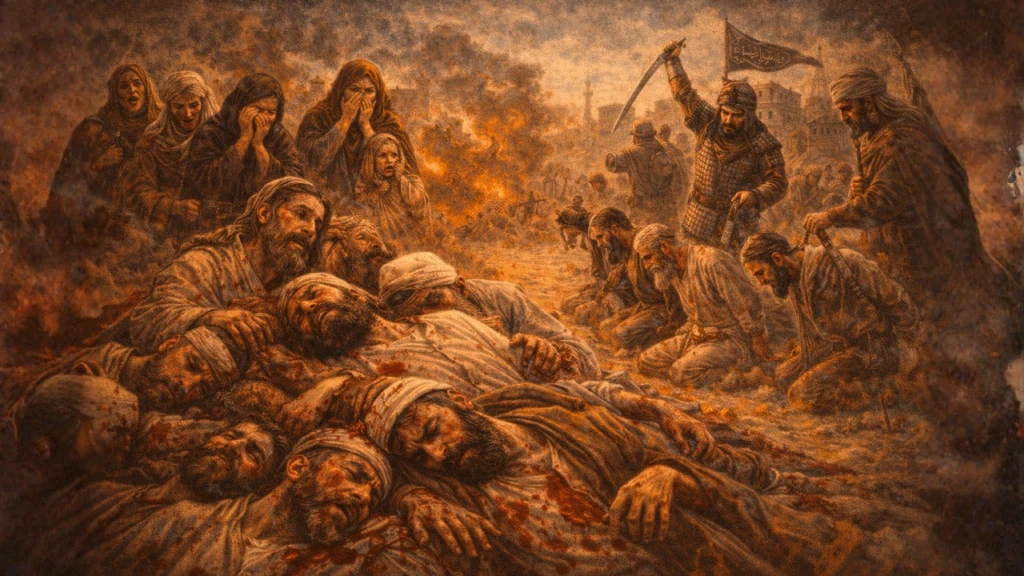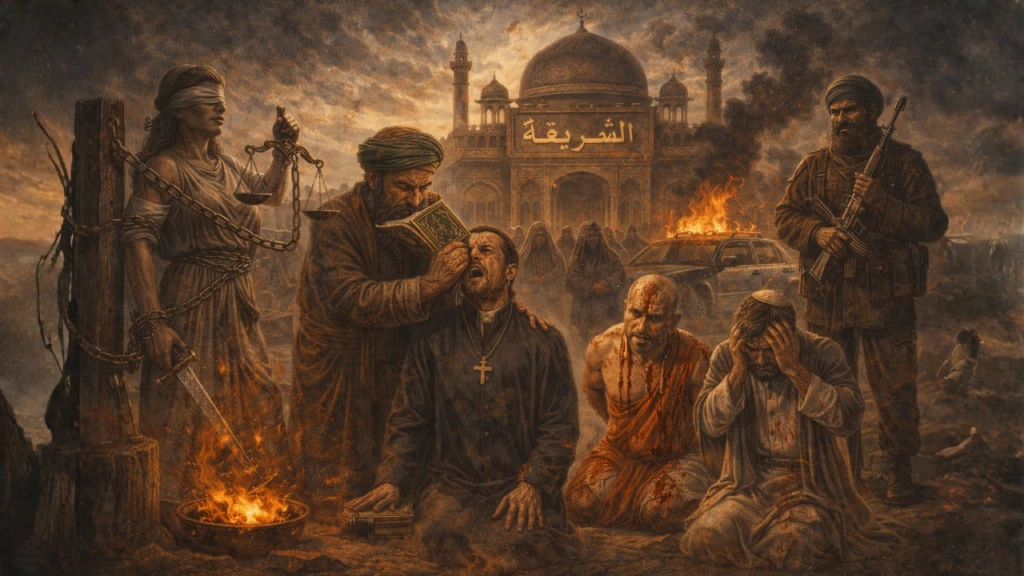
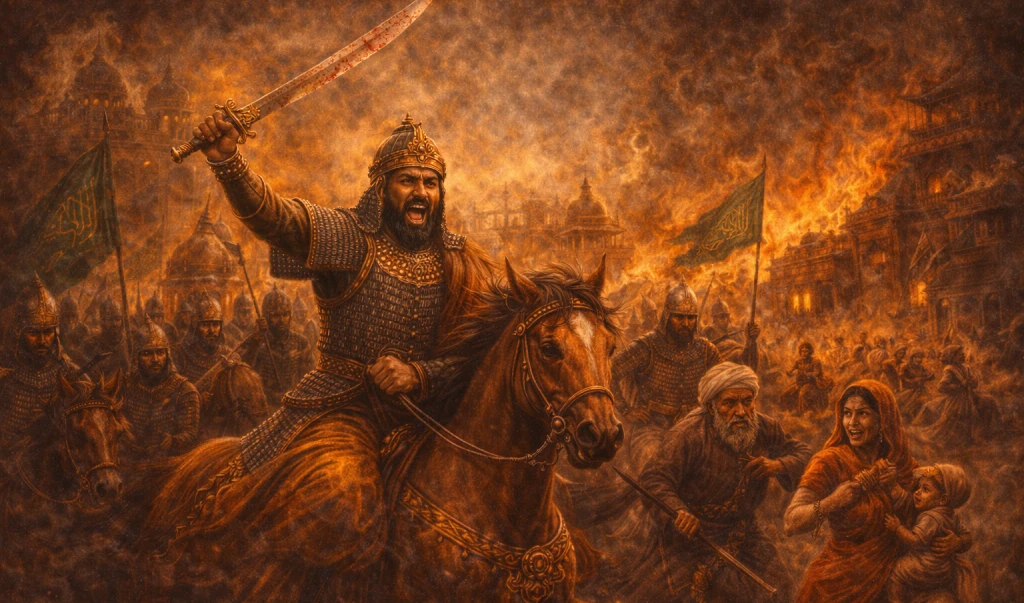
Bakhtiyar Khalji’s Invasion of Bengal and Sharia Rule in India
Introduction
Alongside ancient Egypt, Mesopotamia and the Minoan civilisation, the Harappan civilisation of the Indus basin, including Mohenjo-daro, represents an important chapter in the history of urban life. Cities such as Harappa, Mohenjo-daro, Lothal, Kalibangan, Dholavira and Rakhigarhi bear witness to the region’s planned settlements, civil engineering and systems of production. In subsequent periods, the agricultural land, commerce, wealth and centres of learning of the Indian subcontinent continued to attract outside powers. From Alexander’s expedition to the arrival of European trading powers, the ascendancy of the East India Company and British colonial rule, military force was used in different periods to establish control over territory, resources and human labour. Each campaign had its own political context; nevertheless, a country’s prosperity does not give outsiders a moral right to invade it, kill its inhabitants or plunder their property. The history of cities and centres of learning is part of our past, and so too are the attacks upon them and the suffering of their inhabitants. When the experiences of people buried beneath the conqueror’s triumphal narrative are excluded, history becomes an exercise in the self-glorification of power.
European colonial exploitation receives extensive attention in our society. Discussions of Islamic military aggression in India, however, along with plunder, captivity and Sharia-based domination over non-Muslims, are frequently held hostage to religious sentiment. Branding criticism as “Islamophobia” or intimidating an author does not answer a historical document. When threats of murder and machete attacks silence people, treating that silence as evidence that no crimes occurred is equally dishonest. This article focuses on Bakhtiyar Khalji’s campaigns in Bihar and Bengal, the Sharia rules associated with the subsequent tradition of rule, and Ahmad Sirhindi’s political and religious statements. The question is not simply who conquered which territory: it is what happened to the lives, freedom, property and dignity of the conquered, and how that system was legitimised in the name of religion.
Different powers invaded India, particularly Bengal, Bihar and Odisha, at different times. Whoever the perpetrators were, the killing of innocent civilians, enslavement and plunder must be judged by the same standard. Listing other invasions while discussing one does not erase responsibility for the invasion under examination. If Kalimuddin has committed ten rapes, Rahimuddin’s eight rapes do not become legitimate; both remain crimes. In the same way, British exploitation does not justify Islamic plunder, and Islamic plunder provides no justification for British exploitation. A religion that presents its rules as justice ordained by Allah must also have the moral responsibility of its policies of war and government examined. The claim that “everyone did it in that era” establishes, at most, that injustice was widespread. It does not establish the moral superiority of a religious system.
The Religious Merit of Attacking India in Islam
Arab society in Muhammad’s time was familiar with medical knowledge and practitioners from beyond its own boundaries. Al-Harith ibn Kaladah was a recognised Arab physician of that period. Detailed information about his life is limited, but accounts associate him with medical studies at Gundeshapur. These accounts of his education at the Persian centre of learning indicate his familiarity with medical knowledge from outside Arabia. His case is significant because early Arab society looked beyond its own religious circle for medical expertise, and subsequent Islamic literature sometimes circulated a physician’s statement as a prophetic hadith. The following fatwa explicitly identifies the erroneous attribution to Muhammad of a medical saying associated with al-Harith. Let us read the fatwa in full.
2199. Question
I heard a religious scholar cite the following hadith while explaining the importance of maintaining good health:
المعدة بيت الداء، والحمية رأس الدواء، وأعط كل بدن ما عودته
Meaning: The stomach is the centre of all disease, dietary restraint is the principal remedy for all disease, and give the body what you have accustomed it to. My question is whether this is a hadith. If it is, in which book can it be found? Please clarify.
Answer
Although the statement in the question is mentioned in some places as a hadith, hadith specialists have stated that it is not established as a hadith of the Messenger of Allah; rather, it is a saying of the renowned Arab physician al-Harith ibn Kaladah.
It therefore cannot be narrated as a hadith.
—Al-Maqasid al-Hasanah, p. 611; Kashf al-Khafa, 2/93; al-Durar al-Muntathirah, p. 168; al-La’ali al-Manthurah, p. 145; al-Fawa’id al-Majmu‘ah, p. 166; Zad al-Masir, 3/188; Ruh al-Ma‘ani, 5/110; Tafsir al-Qurtubi, 7/192.
Hadith collections also contain a report in which a patient is directed to al-Harith ibn Kaladah. The two translations below describe the same incident, and both identify the report as weak. The quoted collection itself states its classification and the reason for its weakness. The incident preserved in the report is that the sick Sa‘d is instructed to consult an experienced physician. Biographical discussions also mention al-Harith’s familiarity with Greek medical knowledge and translation. This physician’s case and the report of a patient being referred to him are relevant to the recognition of medical expertise in Arab society. The point relevant here is that the need for external knowledge and specialists in medicine was recognised. Both quotations are reproduced below in full, including the explanation of the report’s weakness.
Mishkat al-Masabih
Book 21: Food
Chapter: Section Two
4224-[66]. Narrated by Sa‘d: On one occasion I became seriously ill. The Prophet came to enquire after me. He placed his hand between my breasts, on my chest, and I felt its coolness in my heart. He then said: “You are suffering from a heart ailment. Go to al-Harith ibn Kaladah of the tribe of Thaqif. He is a physician.” He then said that al-Harith should grind seven ‘ajwah dates from Medina together with their stones and administer them into my mouth. (Abu Dawud)[1]
[1] Weak: Abu Dawud 3875; Da‘if al-Jami‘ al-Saghir 2033; al-Mu‘jam al-Kabir by al-Tabarani 5346; Da‘if al-Jami‘ 2033.
The reason the hadith is weak is that Mujahid’s narration from Sa‘d is mursal. Abu Zur‘ah al-Razi stated this. For details, see ‘Awn al-Ma‘bud, 10/255, hadith 3875.
Hadith classification: Da‘if (weak).
Narrator: Sa‘d ibn Abi Waqqas.
Arabic and English online text: Mishkat al-Masabih 4224; Sunan Abi Dawud 3875.
Sunan Abu Dawud (Islamic Foundation edition)
22. Medicine
Chapter 12: Concerning ‘ajwah dates.
3835. Ishaq ibn Isma‘il … narrated from Sa‘d: Once, when I was ill, the Messenger of Allah came to visit me. He placed his hand upon my chest, and I felt its coolness in my heart. He then said: “You are suffering from a heart condition. Therefore, go to al-Harith ibn Kaladah of the tribe of Thaqif, for he is an experienced physician. Let him take seven ‘ajwah dates from Medina, crush them together with their stones, and prepare seven pills for you from them.”
Hadith classification: Da‘if (weak).
Narrator: Sa‘d ibn Abi Waqqas.
Arabic and English online text: Sunan Abi Dawud 3875.
The following hadith provides a direct example of the reputation of Indian products reaching Arabia in Muhammad’s time. Muhammad advised his followers to use a medicinal substance of Indian origin. The Bengali translation calls it “Indian sandalwood”; the relevant Arabic terminology and the chapter in Bukhari refer to Indian costus, a medicinal substance. Despite this difference in the translated name of the product, the fact under discussion remains the same: medicinal materials from India were known in Arabia, and favourable views of their properties were preserved in religious reports. India, in other words, was not a wholly unknown distant land: the reputation of its products and their medical usefulness had reached Arab society. This familiarity matters in understanding the historical background of Arab interest in Hindustan [1]. Let us read the following hadith in full.
Sunan Abu Dawud (Islamic Foundation edition)
22. Medicine
Chapter 13: Concerning pressing the throat with the fingers.
3837. Musaddad and Hamid ibn Yahya … narrated from Umm Qays bint Mihsan: One day I brought a son of mine to the Messenger of Allah after massaging his throat because of an illness. He said: “Why do you massage your children’s throats when they have a throat ailment? Instead, you should use Indian sandalwood for this condition, for it cures seven kinds of illness, one of which is pneumonia. For swelling of the throat, administer it through the nostrils; for pneumonia, prepare it as pills to be taken.”
Imam Abu Dawud says: The meaning of sandalwood here is that it should be ground and made into pills to be taken.
Hadith classification: Sahih (authentic).
Narrator: Umm Qays bint Mihsan.
Arabic and English online text: Sunan Abi Dawud 3877.
This reference to Indian medicinal materials shows that the recognition and reputation of Indian products had reached Arabia in Muhammad’s time. The following section will also discuss the subcontinent’s centres of learning, scholarship and prosperity. India was therefore a territory known to people in Arabia for its wealth and important commodities. Let us now examine the religious account of warfare against that territory. A hadith preserved in Muhammad’s name promises deliverance from Hell to those who participate in a campaign against India. It states that Allah will protect two groups of his community from Hell, one of them being those who participate in the Indian campaign. The statement mentions no prior Indian attack, hostility towards Medina or condition of self-defence. It describes no incident in which anyone in India had harmed Muhammad or interfered with his interests. Yet a campaign against India is associated with the reward of salvation in the afterlife. Where do the lives, property and freedom of the people attacked stand in this calculation of the attacker’s religious benefit? Let us read the hadith in full.
Sunan an-Nasa’i (Islamic Foundation edition)
25. Jihad
Chapter 41: Jihad against Hindustan.
3178. Muhammad ibn ‘Abd Allah ibn ‘Abd al-Rahim … narrated from Thawban, the slave of the Messenger of Allah: The Messenger of Allah said: “Allah will save two groups of my community from Hell: one group will wage jihad against Hindustan, and the other will be with ‘Isa ibn Maryam.”
Verification: Sahih. Al-Silsilah al-Sahihah 1934; Sahih al-Jami‘ al-Saghir 4012.
Hadith classification: Sahih (authentic).
Narrator: Thawban.
Arabic and English online text: Sunan an-Nasa’i 3175.
The same report appears as Sunan an-Nasa’i 3175 in another commonly used numbering system; in the Islamic Foundation quotation above, its number is 3178. The relevant online edition gives Darussalam’s classification as “Hasan”, while the quoted Bengali edition calls it “Sahih” [2]. An assessment of acceptability within a religious collection does not establish the moral validity of the report. The fundamental problem lies in its content: warfare in another territory is linked to the reward of salvation in the afterlife. This displaces the lives and freedom of the people attacked from the centre of moral evaluation and puts the participant’s religious benefit in their place. Why should a person pay for an invader’s reward in the afterlife with their own life, property or captivity?
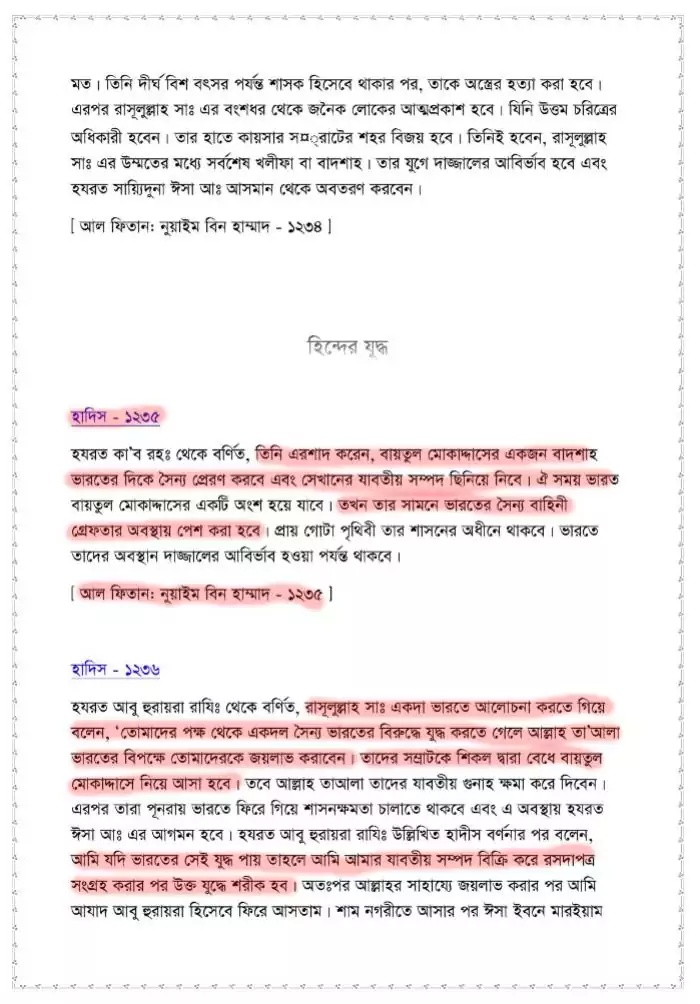
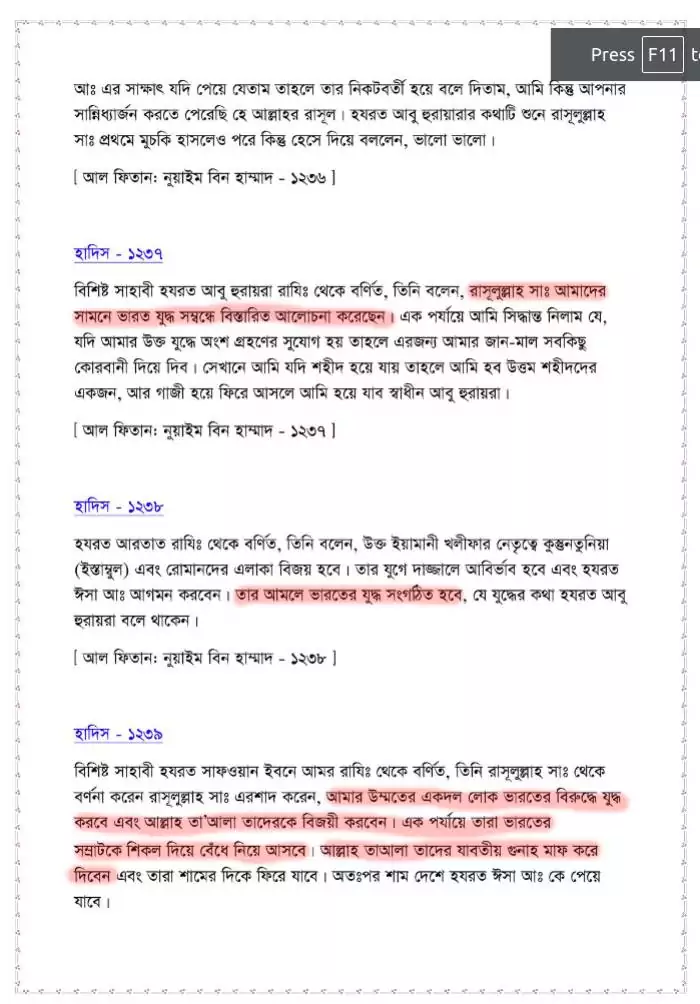
Reports about campaigns against India also appear in Nu‘aym ibn Hammad’s Kitab al-Fitan. Islamic hadith specialists have raised objections to the quality of reports in this collection. The relevant point here is that the idea of a campaign against India was preserved and circulated in various religious collections. This compilation has a place in the dissemination of the ideology that links military expeditions against a distant territory to salvation in the afterlife. The direct basis for the discussion of the religious reward for an Indian campaign is Thawban’s report, reproduced in full above. Nu‘aym’s book is also relevant to understanding how the idea of a campaign against India circulated in subsequent religious literature [3]. A more extensive discussion appears in Shongshoy’s article Ghazwat al-Hind in Islam: The Ruling on Attacking India.
Universities in Ancient Bengal
Taxila, located in the Rawalpindi region of Punjab in present-day Pakistan, was an important centre of learning in the ancient subcontinent. Ptolemy’s geography describes the place as “Taxiala” [4]. Taxila’s reputation as an ancient centre of learning forms part of the subcontinent’s long history of advanced intellectual activity. It is remembered as a gathering place for teachers, students and scholarship. Accounts of Kautilya’s composition of the Arthashastra and of the studies of Jivaka, the physician of King Bimbisara, are associated with its renown. Various accounts place its beginnings in the first millennium BCE. Nalanda Mahavihara in Bihar, India, was also a celebrated residential centre of learning in the ancient world. It underwent particularly significant development from the fifth century onwards, and for many centuries students and scholars came there from China, Tibet and Central Asia. UNESCO’s account describes Nalanda’s long continuity of organised learning [5]. Somapura Mahavihara at Paharpur in Bengal was likewise one of the major Buddhist centres of education and religious study in the southern Himalayan region. Its reputation extended over approximately three centuries, and accounts describe its connections with Buddhist learning beyond the subcontinent, including China, Tibet, Myanmar—then Burma—Malaysia and Indonesia. Bengali scholars such as Atisha Dipankara Shrijnana are associated with this extensive educational tradition. The life and work of this tenth- and eleventh-century scholar illustrate Bengal’s relationship with the wider world of Buddhist scholarship. The importance of these institutions extended beyond religious worship to education, scholarship, translation and the exchange of knowledge between regions.
Another important figure in this history of learning is the great scholar and senior monk Shilabhadra. His birthplace is traditionally associated with the area of present-day Cumilla, and he was a leading teacher at Nalanda and a distinguished scholar of Buddhist texts. The Chinese traveller and monk Xuanzang studied under him. Later accounts give the name “Dharmaganja” to Nalanda’s vast library. They describe three buildings named Ratnasagara, Ratnodadhi and Ratnaranjaka; Ratnodadhi is also described as a nine-storey building. These accounts state that the library preserved manuscripts on many subjects alongside the Prajnaparamita sutras, the Guhyasamaja and Buddhist religious texts. The claim that books continued to burn for several months after the library was set on fire is also a widely circulated tradition. This tradition forms part of historical memory about the immense scale of Nalanda’s manuscript holdings. An attack on a library is an attack on accumulated human knowledge, manuscripts and the traditions through which they are read and interpreted. When teachers and students are killed and institutions preserving knowledge are destroyed together, the damage extends beyond a building: it disrupts the opportunities for subsequent generations to acquire knowledge.
An important document in the discussion of Bakhtiyar’s Bihar campaign is the account of his forces attacking a centre of learning, killing its inhabitants and plundering its wealth. The quoted passage from the Tabaqat-i-Nasiri describes a fortified educational institution that the translator’s note identifies as Odantapuri. Among the major centres of learning established under the patronage of the Pala rulers in ancient Bengal and Magadha, Vikramashila University, Nalanda University, Somapura Mahavihara, Odantapuri and Jagaddala are particularly notable. Their long histories, residential educational arrangements and interregional scholarship illustrate the richness of intellectual life in the subcontinent. They were important institutions for education, translation and manuscript preservation. These mahaviharas were connected through royal patronage, scholarship and communication among teachers. Renowned scholars travelled from one centre to another, creating an extensive interregional system of education and religious study. Teachers and students from Bengal also had connections with Nalanda and Odantapuri. The destruction of a centre of learning was therefore more than the collapse of a building: it struck at a wider system of teachers, students, manuscripts and intellectual exchange.
Different works give dates for Bakhtiyar’s Bihar campaign ranging from 1193 to the beginning of the thirteenth century; Banglapedia’s account places the attack on Bihar in 1203 and the Nadia campaign in early 1205 [6]. These centres of learning in Bihar and Bengal formed part of an extensive intellectual tradition. Attacks on their inhabitants and the seizure of the institutions endangered the people and infrastructure sustaining that tradition. The incident examined here through documentary evidence is the entry of Bakhtiyar’s forces into Bihar’s fortress-like educational centre, the killing of its inhabitants and the plundering of its wealth. Minhaj calls the shaven-headed inhabitants “Brahmans”; the Bengali edition’s note identifies them as Buddhist monks. What the army initially believed the place to be does not erase responsibility for indiscriminate killing. Mistaking a building for a fortress and killing the people found inside it are two separate decisions: the error in the first does not provide moral permission for the second.
Bakhtiyar Khalji’s Invasion
The religious report above promises deliverance from Hell to those participating in a campaign against India. Presenting participation in such a campaign as a route out of Hell is itself a serious moral problem. In religious belief, Hell is the place of punishment for crimes and sins; when release from that punishment is linked to warfare in another territory, participants can view their actions as a means of gaining rewards in the afterlife. The destruction of the lives, property and freedom of the people attacked is buried beneath this calculation of the attacker’s salvation. When warfare, plunder and captivity are described in the language of religious merit, participants can judge their actions by the prospect of religious reward rather than by the experiences of their victims. This system creates opportunities to weaken moral restraints on wrongdoing. The language of religious warfare in accounts of Bakhtiyar’s campaigns, and the rules in jurisprudence establishing claims over war booty and captive people, make this moral problem still clearer. Military force deprives people of their freedom, while religious status is conferred upon the resulting domination. The suffering of the people attacked is consequently obscured by the narrative of the attacker’s acquisition of merit. Let us now examine the documents concerning those military campaigns.
Ikhtiyar al-Din Muhammad Bakhtiyar Khalji, a member of the Turkic Khalji group, came from the Garmsir region of Afghanistan. Early in his career he visited various courts seeking military employment, and later found opportunities under local rulers, including Hizbar al-Din. Operating in frontier areas, he expanded his forces and power through small raids. His campaigns in Bihar and Bengal brought him considerable wealth, and he established his own authority in the territories he seized. Advancement in a military career, the acquisition of wealth and territorial expansion were practical results of these campaigns; understanding them does not require reliance on the conqueror’s self-glorification. He subsequently suffered a disastrous expedition towards Tibet. The accounts of his final years describe extensive troop losses, the hardships of his return and complaints from the families of dead soldiers. Minhaj’s account describes his falling ill and dying, while also mentioning, as a circulating account, his murder at the hands of ‘Ali Mardan Khalji. In both accounts, the background to his final days was military disaster, illness and a crisis of power. The consequences of the campaign in which he had led his forces into catastrophe also returned upon his authority and the families of his followers.
Minhaj-i-Siraj Juzjani, whose full name was Abu ‘Uthman Minhaj al-Din ibn Siraj al-Din, was an important thirteenth-century historian writing in Persian. His birth is generally dated to 1193. His Tabaqat-i-Nasiri narrates the histories of prophets, dynasties and various Muslim rulers down to his own time. It is a principal source for reconstructing the early history of Muslim rule in Bengal, particularly because of its important information about Bakhtiyar and his successors. Its special significance is that it is not a later protest written by the conquered population: it was composed by a historian closely connected with the system of Muslim rule. When that historian records killing, plunder and the captivity of women, these accounts cannot simply be dismissed as anti-Islamic inventions.
Minhaj’s family had connections with the Juzjan region of Ghor, and his father served as a qadi under the Ghurid rulers. Minhaj arrived in India at approximately thirty-four years of age. Educated and experienced in administration, he first joined Nasir al-Din Qubacha’s court at Uch and was appointed a qadi. After Qubacha lost power to Iltutmish, Minhaj moved to Delhi. Under the patronage of Delhi’s rulers, he served in such positions as imam, preacher, head of a madrasa, qadi and sadr-i-jahan. His book was written during the reign of Sultan Nasir al-Din Mahmud and dedicated to him. This institutional position helps us understand the language of his writing: those whom we assess as killers and plunderers appear in his account as “religious warriors” and conquerors. Both the events and the language used to glorify them can therefore be examined through this source.
The Tabaqat-i-Nasiri is an indispensable written source for Bengal’s political history from Bakhtiyar’s campaigns to 1259. Alongside inscriptions and coins, its detailed accounts provide important information for reconstructing the history of Bakhtiyar’s rule and that of his successors. One reason for its importance is that Minhaj himself visited Bengal, stayed for approximately two years and gathered information from people associated with the events. His work also contains a separate tabaqat devoted to Bengal’s Muslim rulers. Around forty years after Bakhtiyar’s Bihar campaign, he heard about the incident from a participant named Samsam al-Din; the quoted text itself contains this information. Minhaj here preserves information received from someone who participated in the campaign. This account of massacre and plunder entered a Muslim historian’s work through the testimony of a person connected with the attacking force. Consequently, descriptions of the violence inflicted on the people attacked emerge from within the religious language of conquest itself. The Bengali translation of the Tabaqat-i-Nasiri is provided for readers, who can download the complete book and compare its text and notes [7]. The relevant pages are reproduced below with their quotations and notes.
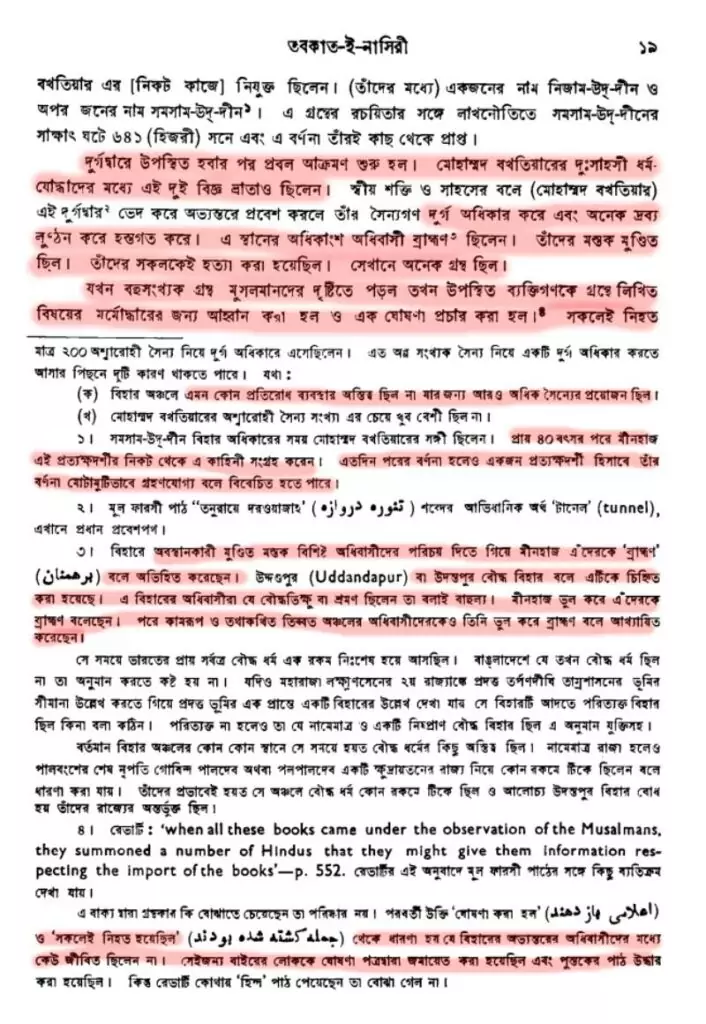
Let us first examine the account of Bakhtiyar’s forces attacking the centre of learning in Bihar. Minhaj’s text describes the attack, the plundering of wealth and the killing of all the shaven-headed inhabitants. He calls them “Brahmans”; the Bengali translation’s note identifies the site as Odantapuri and its inhabitants as Buddhist monks or shramanas. Whether they are accepted as “Brahmans” or identified as Buddhist monks, the moral problem of their killing remains the same. Religious identity does not confer a right to kill anyone. Particularly striking here is that people are being sought to explain the contents of the many books, after the inhabitants of the institution have already been killed. The attackers first eliminated the people belonging to a society that preserved knowledge, and then sought to understand that knowledge [8].
…were employed in Bakhtiyar’s service. One was named Nizam al-Din and the other Samsam al-Din. The author of this book met Samsam al-Din at Lakhnauti in the year 641 AH, and this account was obtained from him.
After they reached the gate of the fortress, a fierce attack began. These two learned brothers were among Muhammad Bakhtiyar’s intrepid religious warriors. By his own strength and courage, Muhammad Bakhtiyar broke through the gateway and entered; his soldiers captured the fortress and seized a great quantity of plunder. Most of the inhabitants of this place were Brahmans. Their heads were shaven. All of them were killed. There were many books there.
When the Muslims saw the large number of books, people present were summoned to explain their contents, and a proclamation was issued. All had been killed.
He had come to capture the fortress with only 200 cavalrymen. There may have been two reasons for attempting to capture a fortress with so few troops:
(a) There was no system of resistance in the Bihar region that would have required more soldiers.
(b) Muhammad Bakhtiyar’s cavalry force was not much larger than this.
1. Samsam al-Din accompanied Muhammad Bakhtiyar during the conquest of Bihar. Approximately forty years later, Minhaj collected this account from that eyewitness. Although the account was given after such a long interval, his testimony may be regarded as broadly acceptable because he was an eyewitness.
2. The expression “tanurah-i darwazah” (تئوره دروازه) in the original Persian literally means “tunnel”; here it refers to the main entrance.
3. In identifying the shaven-headed inhabitants of Bihar, Minhaj calls them “Brahmans” (برهمنان). The site has been identified as the Buddhist monastery of Uddandapur or Udantapur. It goes without saying that its inhabitants were Buddhist monks or shramanas. Minhaj mistakenly called them Brahmans. Later, he also mistakenly described the inhabitants of Kamrup and the so-called Tibetan region as Brahmans.
At that time, Buddhism was approaching extinction throughout much of India. It is not difficult to suppose that Buddhism was then absent from Bengal. Although the Tarpandighi copperplate grant issued in the second regnal year of Maharaja Lakshmanasena mentions a vihara at one boundary of the granted land, it is difficult to say whether the monastery was already abandoned. Even if it was not abandoned, it is reasonable to suppose that it was a Buddhist monastery existing only in name, without vitality.
Buddhism may still have survived in certain parts of present-day Bihar. It may be supposed that the last Pala rulers, Govinda Paladeva or Panapaladeva, survived in some fashion with a small kingdom, though kings only in name. Buddhism may have survived in that area through their influence, and the Udantapur monastery under discussion probably belonged to their kingdom.
4. Raverty: “when all these books came under the observation of the Musalmans, they summoned a number of Hindus that they might give them information respecting the import of the books”—p. 552. Raverty’s translation here differs in some respects from the original Persian.
What the author intended to convey through this sentence is not clear. The subsequent statements, “a proclamation was issued” (اعلامی باز دهند) and “all had been killed” (جمله کشته شده بودند), suggest that none of the inhabitants inside the monastery remained alive. People from outside were therefore assembled by proclamation, and the texts of the books were deciphered. It is unclear, however, where Raverty found the reading “Hindu”.
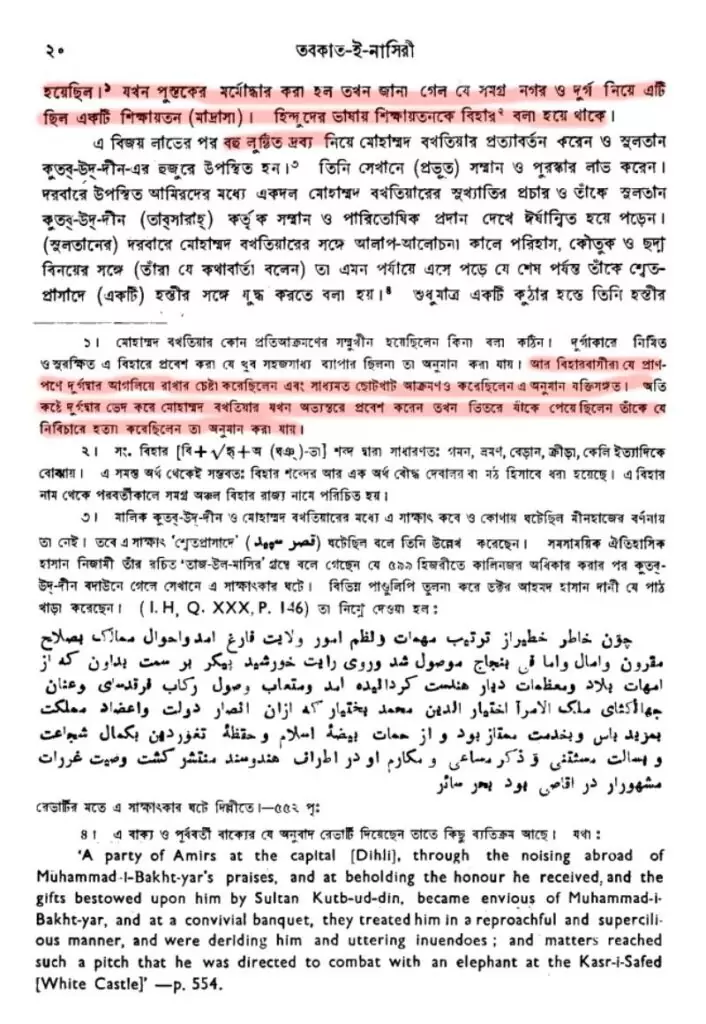
On the following page, Minhaj explains that, once the contents of the books were understood, the whole city and fortress were found to constitute an educational institution. He calls it a “madrasa”, using a familiar term to describe a centre of learning. The account describes an extensive centre combining an educational institution with a settlement. Its many books, the people who read them and an urban life organised around education illustrate its social importance. Comparisons with intellectual life in ancient Athens and Alexandria, or the educational character of modern Oxford, can help general readers understand the social significance of such centres. The close relationship between education and urban life meant that an attack on the institution struck at learning across the entire settlement. Bakhtiyar’s forces killed and plundered there; when he returned with the stolen wealth, he received honour and rewards from the ruler. The outcome of the crime was therefore not limited to personal enrichment: it also received social recognition and acknowledgement at court as a military achievement [9].
…had been killed.¹ When the contents of the books were deciphered, it became clear that the whole city and fortress constituted an educational institution, a madrasa. In the language of the Hindus, an educational institution is called a “Bihar”.
After this victory, Muhammad Bakhtiyar returned with much plunder and appeared before Sultan Qutb al-Din. There he received considerable honour and rewards. Some of the amirs present at court became envious when they saw Muhammad Bakhtiyar’s fame spreading and Sultan Qutb al-Din granting him honours and rewards. In their conversations with Muhammad Bakhtiyar at the Sultan’s court, their jokes, mockery and feigned humility reached such a point that he was eventually instructed to fight an elephant at the White Palace. With only an axe in his hand, he faced the elephant…
1. It is difficult to say whether Muhammad Bakhtiyar encountered a counterattack. It may be supposed that entering this monastery, built and protected as a fortress, was not easy. It is reasonable to suppose that the inhabitants tried desperately to hold the gate and made whatever small attacks they could. When Muhammad Bakhtiyar broke through the gate with great difficulty and entered, it may be inferred that he indiscriminately killed whomever he found inside.
2. The Sanskrit word vihara [vi + hr + a (ba)-ta] generally denotes movement, travel, wandering, sport, play and similar activities. From these meanings, another meaning of vihara was probably understood to be a Buddhist temple or monastery. From this name, Bihar, the entire region subsequently became known as the state of Bihar.
3. Minhaj does not state when or where this meeting between Malik Qutb al-Din and Muhammad Bakhtiyar occurred. He does, however, mention that it took place at the “White Palace” (قصر). The contemporary historian Hasan Nizami states in his Taj al-Ma’asir that the meeting occurred when Qutb al-Din went to Badaun after capturing Kalinjar in 599 AH. The reading established by Dr Ahmad Hasan Dani after comparing different manuscripts (I.H.Q., XXX, p. 146) is given below:
چون خاطر خطیر از ترتیب مهمات ولظم امور ولایت فارغ امد واحوال ممالک بصلاحمقرون وامال واما في بنجاج موصول شد و روی رایت خورشید بیگر بر سمت بداون که از امهات بلاد و معظمات ديار هندست کردانیده امد ومتعاب وصول ركاب فرنده ای و عنان جها الكثای ملك الأمراً اختيار الدین محمد بختیار که از ان انصار دولت و اعضاد مملکت بمزيد باس و بخدمت ممتاز بود و از حمات بیضه اسلام و حفظه تغوردون بكمال شجاعت و بسالت مستتنى و ذکر مساعی و مکارم او در اطراف هندوسند منتشر کشت وصیت غررات مشهورار در اقصی بود بدر سائر
According to Raverty, the meeting occurred in Delhi—p. 552.
4. Raverty’s translation of this sentence and the preceding sentence contains certain differences:
“A party of Amirs at the capital [Dihli], through the noising abroad of Muhammad-i-Bakht-yar’s praises, and at beholding the honour he received, and the gifts bestowed upon him by Sultan Kutb-ud-din, became envious of Muhammad-i-Bakht-yar, and at a convivial banquet, they treated him in a reproachful and supercilious manner, and were deriding him and uttering inuendoes and matters reached such a pitch that he was directed to combat with an elephant at the Kasr-i-Safed [White Castle]”—p. 554.
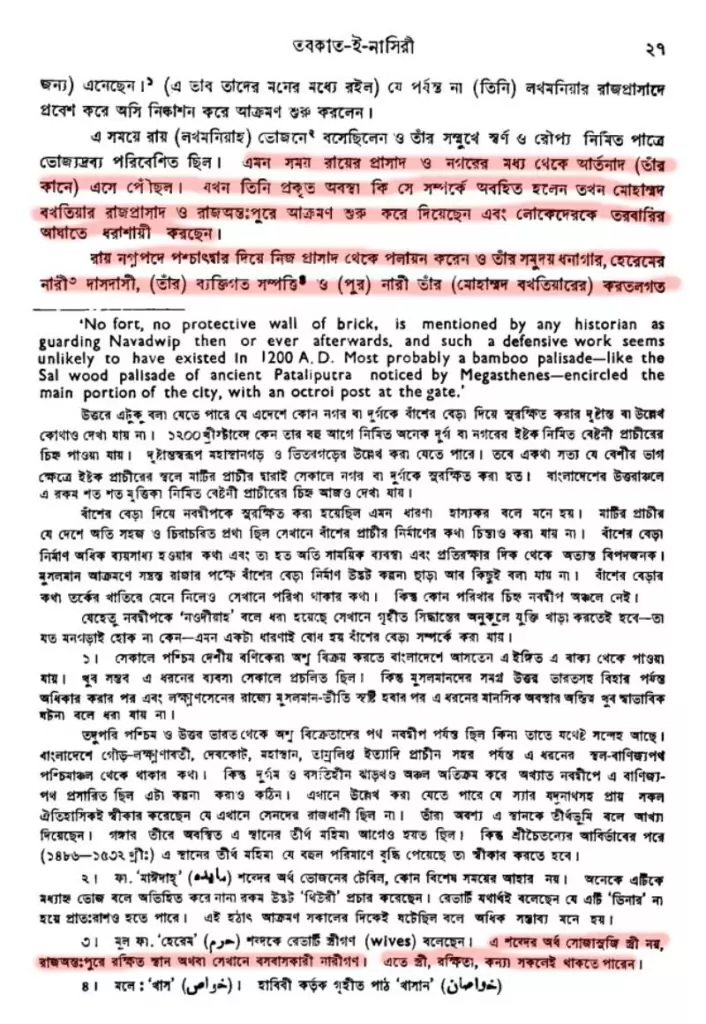
The account of the subsequent Nadia campaign describes entry into the royal palace, people being struck down by swords, and the king’s wealth, the women of the inner palace and male and female slaves falling into Bakhtiyar’s hands. The fate of the families and women attacked is recorded alongside the calculation of acquired wealth. The women are not treated here as people possessing rights of their own: they are incorporated into the tally of conquest beside the treasury and other seized assets. With the king’s defeat, their individual freedom also came under the conqueror’s control. Being someone’s wife, mother, sister or daughter does not grant anyone a right to turn a woman into war booty. This account of military ownership over human life and freedom exposes the moral character of conquest. In a later section, full quotations will show how the rules of booty treat women and children as distributable property [10].
…had brought them for sale.¹ This impression remained in their minds until he entered Lakhmaniah’s royal palace, drew his sword and began the attack.
At that moment, the Rai, Lakhmaniah, was seated at a meal, with food served before him in vessels of gold and silver. Cries from his palace and the city reached his ears. By the time he learned what was actually happening, Muhammad Bakhtiyar had begun attacking the palace and its inner quarters and was striking people down with his sword.
The Rai fled barefoot through the rear entrance of his palace, and his entire treasury, the women of the harem, male and female slaves, his personal property and the women of the palace fell into Muhammad Bakhtiyar’s hands…
“No fort, no protective wall of brick, is mentioned by any historian as guarding Navadwip then or ever afterwards, and such a defensive work seems unlikely to have existed in 1200 A. D. Most probably a bamboo palisade-like the Sal wood palisade of ancient Pataliputra noticed by Megasthenes-encircled the main portion of the city, with an octroi post at the gate.”
In response, it may be said that no example or reference exists of a city or fortress in this country being protected by a bamboo fence. Traces of brick enclosure walls have been found around many fortresses and cities built long before 1200 CE. Mahasthangarh and Bhitargarh may be cited as examples. It is true, however, that cities and fortresses in that period were more often protected by earthen walls than by brick ones. Traces of hundreds of such earthen enclosures can still be seen in northern Bengal.
The supposition that Navadwip was protected by a bamboo fence appears ridiculous. Where earthen walls were an easy and customary arrangement, constructing bamboo walls is hardly conceivable. A bamboo fence would have been more expensive, highly temporary and extremely dangerous as a defensive measure. The idea that a king confronted with a Muslim attack would construct a bamboo fence can only be called a bizarre fantasy. Even if the bamboo fence is accepted for the sake of argument, a moat should have been present. No trace of such a moat exists in the Navadwip area.
Since Navadwip has been identified as “Naudiyah”, arguments must apparently be constructed to support that accepted conclusion, however invented they may be. This seems to explain the supposition about the bamboo fence.
1. This sentence suggests that merchants from western regions came to Bengal to sell horses. Such commerce was very probably practised at the time. However, after the Muslims had conquered the whole of northern India as far as Bihar, and fear of Muslims had arisen in Lakshmanasena’s kingdom, the existence of such a state of mind cannot be treated as entirely natural.
Moreover, considerable doubt exists as to whether the route used by horse dealers from western and northern India extended as far as Navadwip. Overland trade routes from the west probably reached ancient cities in Bengal such as Gaur-Lakshmanavati, Devkot, Mahasthan and Tamralipti. It is difficult to imagine such a route crossing the inaccessible and uninhabited Jharkhand region and extending to the obscure settlement of Navadwip. It may be noted that almost all historians, including Sir Jadunath, acknowledge that the Sena capital was not located there. They have, however, described it as a place of pilgrimage. Situated on the Ganges, the place may have possessed religious importance earlier, but it must be acknowledged that its importance as a pilgrimage centre increased greatly after the appearance of Shri Chaitanya (1486–1532 CE).
2. The Persian word “ma’idah” (یه۰) means a dining table, not a meal at any particular time of day. Some have described it as lunch and circulated various bizarre “theories”. Raverty rightly states that it need not have been “dinner” and could have been breakfast. It appears more likely that this sudden attack occurred in the morning.
3. Raverty translates the original Persian word “harem” (حم) as “wives”. The word does not simply mean wives; it refers to a place reserved within the royal inner quarters or the women living there. Wives, concubines and daughters could all be included.
4. In the original: “khwass” (خواص). The reading adopted by Habibi is “khassan” (خواصان).
So much plunder came into Bakhtiyar’s hands that Minhaj writes that its quantity could not be described. His account records the seizure of elephants, the treasury and other wealth. The author presents this immense acquisition of property as an achievement of conquest. Yet the wealth was taken from other people by military force: opposite the conqueror’s tally of gains stood the defeated population’s loss of property. The questions of whose property it had been, how it changed hands and how the transfer affected the defeated are buried beneath the conqueror’s achievement. The fact that a commander acquired vast wealth does not establish that he benefited the people he attacked. The final portion of the quotation also records that Lakshmanasena’s successors retained authority in other parts of Bengal, illustrating the continuation of political power and subsequent conflict elsewhere in the region [11].
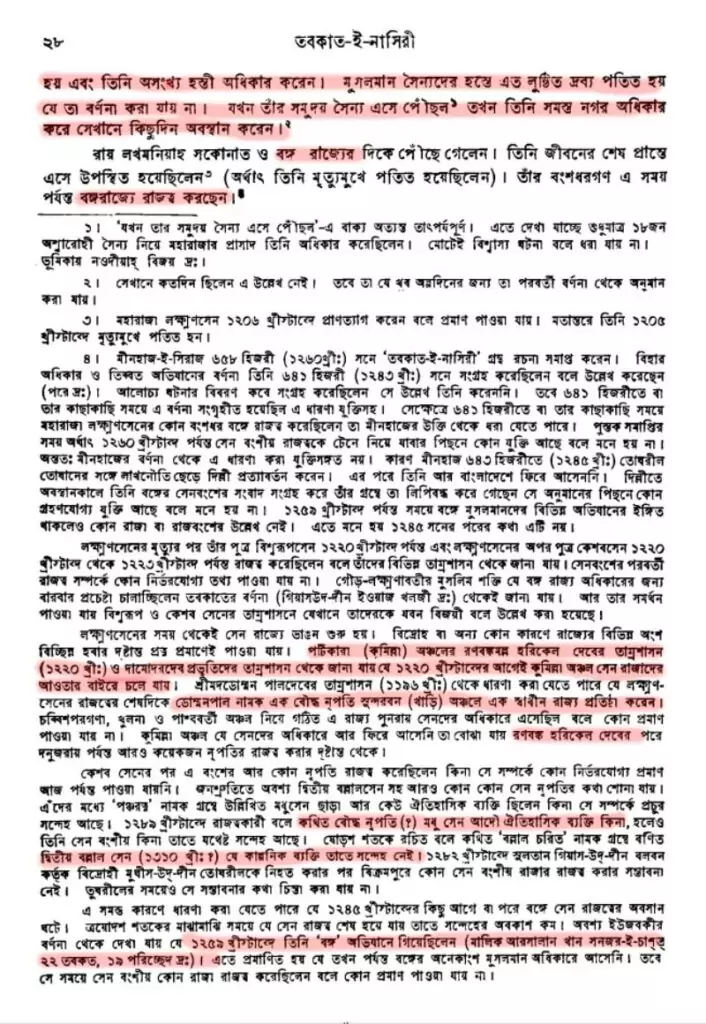
…fell into his hands, and he seized innumerable elephants. So much plunder fell into the hands of the Muslim soldiers that it cannot be described. When all his troops arrived, he occupied the entire city and remained there for some time.*
Rai Lakhmaniah reached Sakanat and the kingdom of Bang. He had reached the end of his life—that is, he had died. His descendants rule in the kingdom of Bang down to this time.
1. The statement “when all his troops arrived” is extremely significant. It suggests that he captured the Maharaja’s palace with only eighteen cavalrymen. This cannot be regarded as a believable event. See the discussion of the conquest of Naudiyah in the introduction.
2. How long he remained there is not stated. The subsequent account nevertheless suggests that it was only a very short time.
3. Evidence indicates that Maharaja Lakshmanasena died in 1206 CE. According to another view, he died in 1205 CE.
4. Minhaj-i-Siraj completed the Tabaqat-i-Nasiri in 658 AH (1260 CE). He states that he collected the accounts of the conquest of Bihar and the Tibet expedition in 641 AH (1243 CE); see below. He does not state when he collected the account of the incident under discussion. It is reasonable, however, to suppose that it was collected in or around 641 AH. In that case, Minhaj’s statement indicates that a descendant of Maharaja Lakshmanasena was ruling in Bang in or around that year. There seems to be no justification for extending Sena rule down to the completion of the book in 1260 CE. At least, Minhaj’s account does not reasonably support that supposition. Minhaj left Lakhnauti with Tamuril Tamadar and returned to Delhi in 643 AH (1245 CE). He did not return to Bengal afterwards. There appears to be no acceptable basis for assuming that, while living in Delhi, he collected information about Bengal’s Sena dynasty and recorded it in his book. Although there are indications of various Muslim campaigns in Bang down to 1259 CE, no king or dynasty is named. This suggests that the statement does not concern a period after 1245.
Various copperplate grants show that, after Lakshmanasena’s death, his son Vishvarupasena ruled until 1220 CE, and another son, Keshavasena, ruled from 1220 to 1223 CE. No reliable information is available about the dynasty’s subsequent rule. The Tabaqat’s account shows that the Muslim power at Gaur-Lakshmanavati repeatedly attempted to conquer the kingdom of Bang; see Ghiyath al-Din ‘Iwaz Khalji. This is supported by the copperplates of Vishvarupa and Keshava Sena, which describe them as conquerors of the Yavanas.
The Sena kingdom had begun to disintegrate during Lakshmanasena’s own reign. Direct evidence shows that parts of the kingdom broke away through rebellion or other causes. The copperplate of Ranavankamalla Harikela Deva from Pattikara, in the Cumilla region (1220 CE), and those of Damodaradeva and others show that the Cumilla region had passed beyond the Sena kings’ authority before 1220 CE. The copperplate of Shrimad Dommana Paladeva (1196 CE) suggests that, towards the end of Lakshmanasena’s reign, a Buddhist ruler named Dommanapala established an independent kingdom in the Sundarbans, or Khari region. There is no evidence that this kingdom, comprising the Twenty-Four Parganas, Khulna and adjoining areas, returned to Sena control. That the Cumilla region also did not return to their control is indicated by the succession of several rulers after Ranavankamalla Harikela Deva down to Danuj Rai.
No reliable evidence has so far been found establishing whether another ruler of this dynasty reigned after Keshava Sena. Oral traditions do mention a second Ballalasena and some other Sena rulers. Apart from Madhusena, mentioned in a work called Pancharatna, considerable doubt exists as to whether any of them were historical persons. There is substantial doubt about whether the supposedly Buddhist ruler (?) Madhu Sena, said to have ruled in 1289 CE, was a historical person at all and, even if he was, whether he belonged to the Sena dynasty. There is no doubt that the second Ballala Sena, described in the Ballala Charita, supposedly composed in the sixteenth century, and associated with 1310 CE (?), is a fictional figure. After Sultan Ghiyath al-Din Balban killed the rebel Mughith al-Din Tamuril in 1282 CE, there is no possibility of a Sena king having ruled in Vikrampur. Such a possibility cannot be envisaged during Tamuril’s time either.
For all these reasons, it may be supposed that Sena rule in Bang ended shortly before or after 1245 CE. There is little room for doubt that Sena rule ended around the middle of the thirteenth century. ‘Uzbak’s account does show that he undertook a campaign against “Bang” in 1259 CE; see Malik Arslan Khan Sanjar-i-Chast, Tabaqat 22, Chapter 19. This establishes that large parts of Bang had still not come under Muslim control. There is nevertheless no evidence that a Sena king was ruling at that time.
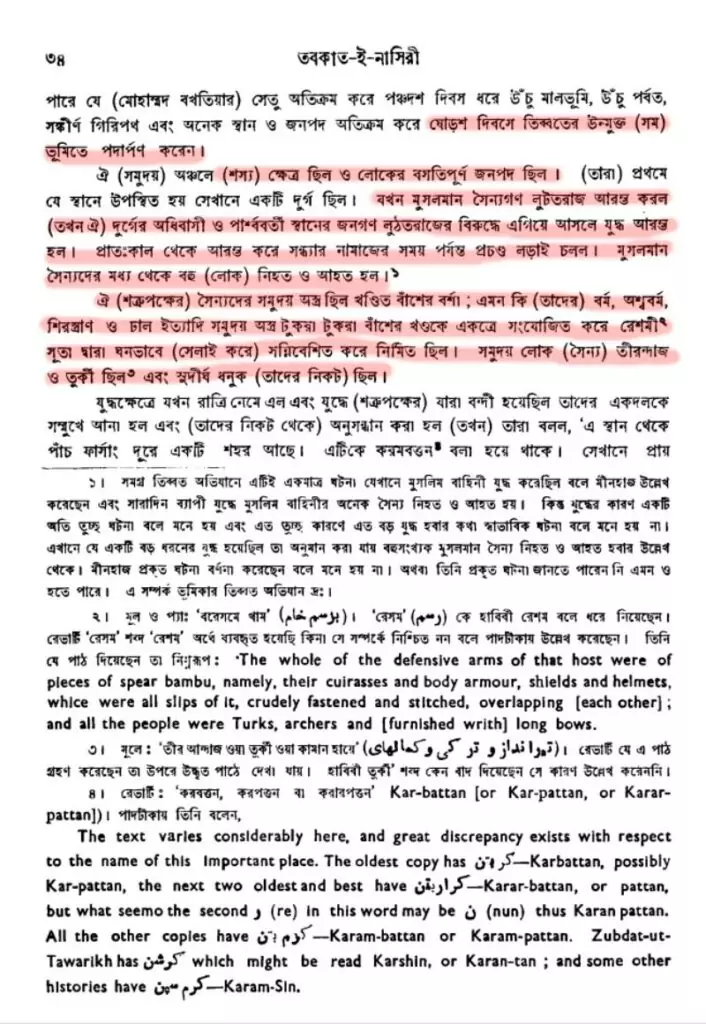
Next comes the account of Bakhtiyar’s expedition towards Tibet. What particularly deserves attention is that the local inhabitants came forward to resist after the army reached a settled region and began plundering. Whatever the attackers’ religious identity or purpose, local people had a right to defend their homes, fields and settlements. The terms used for the defeated or opposing force in the conqueror’s language do not make that resistance unjust [12].
…may be stated that Muhammad Bakhtiyar crossed the bridge and travelled for fifteen days through high plateaus, tall mountains, narrow passes and many places and settlements. On the sixteenth day he entered the open, level country of Tibet.
The whole region contained cultivated fields and inhabited settlements. At the first place they reached there was a fortress. When the Muslim soldiers began plundering, the inhabitants of the fortress and the people of the surrounding area came forward against the plunder, and fighting began. A fierce battle continued from morning until the evening prayer. Many of the Muslim soldiers were killed or wounded.¹
All the weapons of the opposing force were spears made from split bamboo. Their armour, horse armour, helmets, shields and other defensive equipment were made by joining pieces of bamboo and sewing them densely together with silk thread. All the men, or soldiers, were archers and Turks, and they had long bows.
When night fell upon the battlefield, some of those captured from the opposing force were brought forward and questioned. They said: “Five farsangs from this place there is a city called Karambattan. There are approximately…”
1. This is the only incident in the entire Tibet expedition in which Minhaj states that the Muslim army fought a battle. Many Muslim soldiers were killed and wounded during the day-long fighting. Yet the reason for the battle appears to be a very trivial incident, and such a large battle over so trivial a cause does not seem natural. That a major battle took place can be inferred from the reference to the large numbers of Muslim soldiers killed and wounded. Minhaj does not appear to have described the actual events. Alternatively, he may not have known what actually happened. See the discussion of the Tibet expedition in the introduction.
2. In the original and the manuscript: “ba resan-i kham” (برسم خام). Habibi takes “resam” to mean silk. Raverty states in his footnote that he is uncertain whether “resam” is used in the sense of “resham”, silk. His rendering is as follows: “The whole of the defensive arms of that host were of pieces of spear bambu, namely, their cuirasses and body armour, shields and helmets, which were all slips of it, crudely fastened and stitched, overlapping [each other]; and all the people were Turks, archers and [furnished with] long bows.”
3. In the original: “tir-andaz wa Turki wa kaman-ha’i” (تیرانداز و ترکی و کمالهای). The passage quoted above shows that Raverty accepted this reading. Habibi does not explain why he omitted the word “Turki”.
4. Raverty: “Kar-battan [or Kar-pattan, or Karar-pattan]”. In his footnote he states:
“The text varies considerably here, and great discrepancy exists with respect to the name of this important place. The oldest copy has کربن—Karbattan, possibly Kar-pattan, the next two oldest and best have کاربن—Karar-battan, or pattan, but what seems the second (re) in this word may be (nun), thus Karan pattan. All the other copies have کرم بن—Karam-battan or Karam-pattan. Zubdat-ut-Tawarikh has کرشن which might be read Karshin, or Karan-tan; and some other histories have کرم سین—Karam-Sin.”
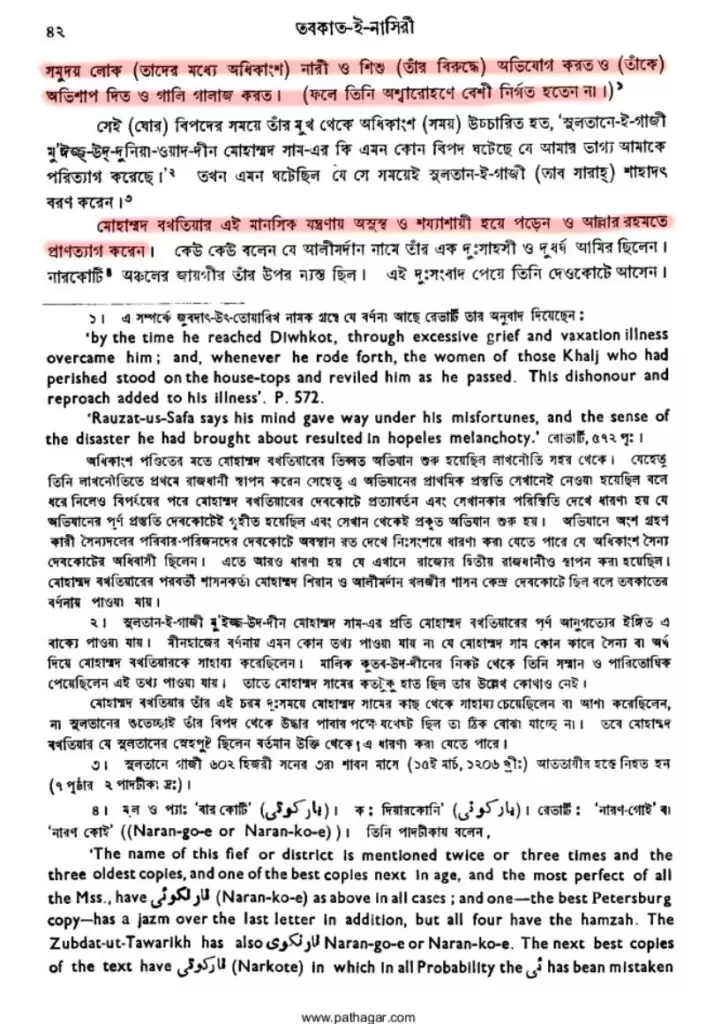
After the expedition’s disaster, the account describes complaints, curses and abuse directed at Bakhtiyar. The identity of those protesting is important: the translation’s note explains that they were the wives and families of the Khalji soldiers who had died. The consequences of leading his followers into destruction returned upon him through the anger of their families. The wives and children of the dead soldiers also paid the price of their commander’s power and ambition. Minhaj describes mental anguish, illness and death. Military disaster, grief and anger against the commander appear together in his account. Here, too, the suffering of ordinary families is evident behind power and conquest. The families of people subordinate to an aggressor also often pay the price of a conquest glorified as religious heroism [13].
All the people, most of them women and children, complained against him, cursed him and abused him. Consequently, he seldom rode out.
During that grave crisis, the words frequently uttered by him were: “Has some such calamity befallen Sultan-i-Ghazi Mu‘izz al-Dunya wa’l-Din Muhammad Sam that my fortune has abandoned me?” It so happened that the Sultan-i-Ghazi was martyred at that very time.³
Under this mental anguish, Muhammad Bakhtiyar became ill and bedridden, and died through Allah’s mercy. Some say that he had a daring and formidable amir named ‘Ali Mardan. The jagir in the Narkoti region had been entrusted to him. On hearing this bad news, he came to Devkot.
1. Raverty translates the account in the work called Zubdat al-Tawarikh as follows:
“by the time he reached Diwhkot, through excessive grief and vexation illness overcame him; and, whenever he rode forth, the women of those Khalj who had perished stood on the house-tops and reviled him as he passed. This dishonour and reproach added to his illness.”—p. 572.
“Rauzat-us-Safa says his mind gave way under his misfortunes, and the sense of the disaster he had brought about resulted in hopeless melancholy.”—Raverty, p. 572.
Most scholars believe that Muhammad Bakhtiyar’s Tibet expedition began from the city of Lakhnauti. Since he first established his capital there, it may be assumed that the initial preparations were made there. Nevertheless, his return to Devkot after the disaster and the circumstances there suggest that the full preparations were made at Devkot and that the actual expedition began from that place. The presence in Devkot of the families of the troops participating in the expedition permits the confident inference that most of those soldiers were residents of Devkot. This further suggests that a second capital of the kingdom had been established there. According to the Tabaqat, Devkot was the seat of government of Muhammad Bakhtiyar’s successors, Muhammad Shiran and ‘Ali Mardan Khalji.
2. This statement indicates Muhammad Bakhtiyar’s complete allegiance to Sultan-i-Ghazi Mu‘izz al-Din Muhammad Sam. Minhaj’s account contains no information that Muhammad Sam ever assisted Muhammad Bakhtiyar with troops or money. It does state that he received honour and rewards from Malik Qutb al-Din. No account mentions the extent of Muhammad Sam’s involvement in this.
It is not clear whether, in this extreme crisis, Muhammad Bakhtiyar sought or expected assistance from Muhammad Sam, or whether the Sultan’s goodwill alone was considered sufficient for his deliverance. The present statement does, however, suggest that Muhammad Bakhtiyar enjoyed the Sultan’s favour.
3. The Sultan-i-Ghazi was killed by an assassin on 3 Sha‘ban 602 AH (15 March 1206 CE); see footnote 2 on p. 7.
4. In the original and the manuscript: “Bar Koti” (بارکوئی). In another copy: “Diyarkoni” (بارکونی). Raverty: “Naran-go-e” or “Naran-ko-e”. He states in a footnote:
“The name of this fief or district is mentioned twice or three times and the three oldest copies, and one of the best copies next in age, and the most perfect of all the Mss. have قمار لوئی (Naran-ko-e), as above in all cases; and one—the best Petersburg copy—has a jazm over the last letter in addition, but all four have the hamzah. The Zubdat-ut-Tawarikh has also لارنكوى Naran-go-e or Naran-ko-e. The next best copies of the text have قمار کوقی (Narkote) in which in all probability the … has been mistaken…”
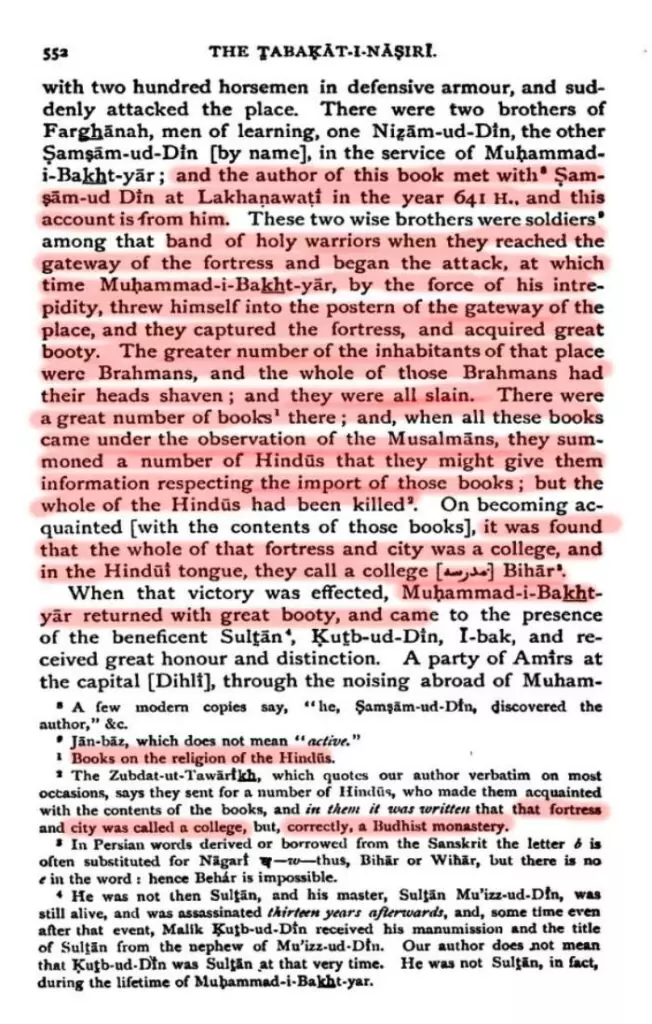
Let us also examine the English translation of the same incidents. The passages below describe the killing and plunder at Bihar’s centre of learning, the surprise entry into Nadia of cavalrymen mistaken for merchants, the king’s flight, the seizure of women and wealth, and the continued authority of the Sena dynasty in other parts of Bengal. Placing the Bengali and English translations of the same book side by side allows readers to compare the descriptions of massacre, plunder and the seizure of people directly. The suffering of those attacked is written into the account of the attacker’s success itself. A campaign described as a religious warrior’s triumph consisted in practice of killing people, seizing property and establishing control over inhabitants, including women [14].
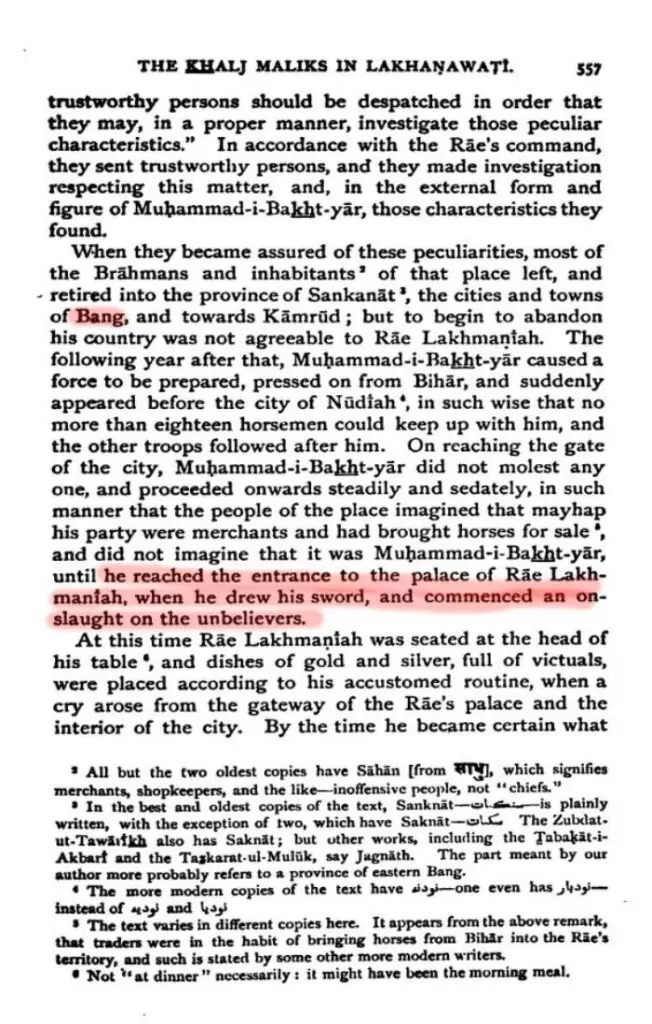
with two hundred horsemen in defensive armour, and suddenly attacked the place. There were two brothers of Farghānah, men of learning, one Nizām-ud-Din, the other Şamşām-ud-Din [by name], in the service of Muhammad-i-Bakht-yär; and the author of this book met with Şam-şam-ud Din at Lakhanawați in the year 641 H., and this account is from him. These two wise brothers were soldiers among that band of holy warriors when they reached the gateway of the fortress and began the attack, at which time Muhammad-i-Bakht-yär, by the force of his intrepidity, threw himself into the postern of the gateway of the place, and they captured the fortress, and acquired great booty. The greater number of the inhabitants of that place were Brahmans, and the whole of those Brahmans had their heads shaven; and they were all slain. There were a great number of books’ there; and, when all these books came under the observation of the Musalmans, they summoned a number of Hindüs that they might give them information respecting the import of those books; but the whole of the Hindüs had been killed. On becoming acquainted [with the contents of those books], it was found that the whole of that fortress and city was a college, and in the Hindül tongue, they call a college مدرسه Bihar
When that victory was effected, Muhammad-i-Bakht-yär returned with great booty, and came to the presence of the beneficent Sultan, Kutb-ud-Din, I-bak, and received great honour and distinction. A party of Amirs at the capital [Dihli], through the noising abroad of Muham-
A few modern copies say, “he, Şamşām-ud-Din, discovered the author,” &c.
Jän-baz, which does not mean “active.”
Books on the religion of the Hindüs.
The Zubdat-ut-Tawarikh, which quotes our author verbatim on most occasions, says they sent for a number of Hindüs, who made them acquainted with the contents of the books, and in them it was written that that fortress and city was called a college, but, correctly, a Buddhist monastery.
In Persian words derived or borrowed from the Sanskrit the letter & is often substituted for Nāgarī -o-thus, Bihär or Wihär, but there is no e in the word: hence Behár is impossible.
He was not then Sultan, and his master, Sultan Mu’izz-ud-Din, was still alive, and was assassinated thirteen years afterwards, and, some time even after that event, Malik Kutb-ud-Din received his manumission and the title of Sultan from the nephew of Mu’izz-ud-Din. Our author does not mean that Kutb-ud-Din was Sultan at that very time. He was not Sulţăn, in fact, during the lifetime of Muhammad-i-Bakht-yar.
trustworthy persons should be despatched in order that they may, in a proper manner, investigate those peculiar characteristics.” In accordance with the Rae’s command, they sent trustworthy persons, and they made investigation respecting this matter, and, in the external form and figure of Muhammad-i-Bakht-yar, those characteristics they found.
When they became assured of these peculiarities, most of the Brahmans and inhabitants of that place left, and retired into the province of Sankanat, the cities and towns of Bang, and towards Kāmrüd; but to begin to abandon his country was not agreeable to Räe Lakhmaniah. The following year after that, Muhammad-i-Bakht-yär caused a force to be prepared, pressed on from Bihar, and suddenly appeared before the city of Nüdiah, in such wise that no more than eighteen horsemen could keep up with him, and the other troops followed after him. On reaching the gate of the city, Muhammad-i-Bakht-yär did not molest any one, and proceeded onwards steadily and sedately, in such manner that the people of the place imagined that mayhap his party were merchants and had brought horses for sale, and did not imagine that it was Muhammad-i-Bakht-yär, until he reached the entrance to the palace of Rae Lakhmaniah, when he drew his sword, and commenced an onslaught on the unbelievers.
At this time Räe Lakhmaniah was seated at the head of his table, and dishes of gold and silver, full of victuals, were placed according to his accustomed routine, when a cry arose from the gateway of the Rae’s palace and the interior of the city. By the time he became certain what
All but the two oldest copies have Sähän [from साधु], which signifies merchants, shopkeepers, and the like—inoffensive people, not “chiefs.”
In the best and oldest copies of the text, Sanknat – نكاتis plainly written, with the exception of two, which have Sanat – سكات The Zubdat-ut-Tawäıfkh also has Saknät; but other works, including the Tabakāt-i-Akbarī and the Taskarat-ul-Mulük, say Jagnath. The part meant by our author more probably refers to a province of eastern Bang.
The more modern copies of the text have خودند-one even has نودبار instead of نودیه and نودیا
The text varies in different copies here. It appears from the above remark, that traders were in the habit of bringing horses from Bihar into the Räe’s territory, and such is stated by some other more modern writers.
Not at dinner” necessarily: it might have been the morning meal.
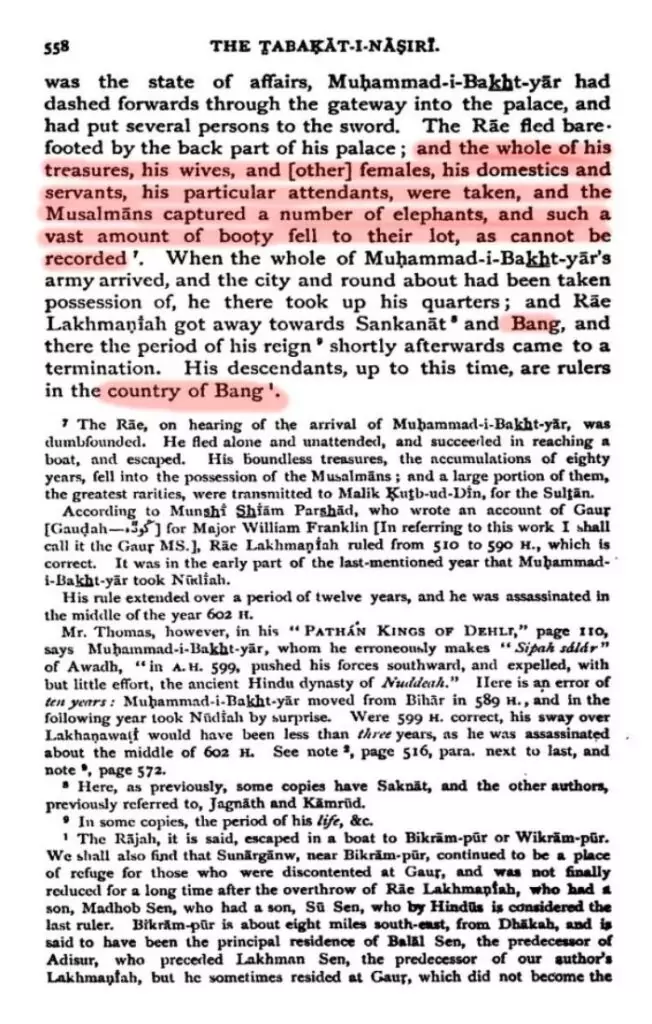
was the state of affairs, Muhammad-i-Bakht-yär had dashed forwards through the gateway into the palace, and had put several persons to the sword. The Rae fled barefooted by the back part of his palace; and the whole of his treasures, his wives, and [other] females, his domestics and servants, his particular attendants, were taken, and the Musalmans captured a number of elephants, and such a vast amount of booty fell to their lot, as cannot be recorded’. When the whole of Muhammad-i-Bakht-yär’s army arrived, and the city and round about had been taken possession of, he there took up his quarters; and Räe Lakhmaņiah got away towards Sankanāt and Bang, and there the period of his reign shortly afterwards came to a termination. His descendants, up to this time, are rulers in the country of Bang’.
The Rãe, on hearing of the arrival of Muhammad-i-Bakht-yär, was dumbfounded. He fled alone and unattended, and succeeded in reaching a boat, and escaped. His boundless treasures, the accumulations of eighty years, fell into the possession of the Musalmans; and a large portion of them, the greatest rarities, were transmitted to Malik Kutb-ud-Din, for the Sultan. According to Munshi Shiăm Parshad, who wrote an account of Gaur Gaudah – گوده for Major William Franklin [In referring to this work I shall call it the Gaur MS.], Räe Lakhmanfah ruled from 510 to 590 H., which is correct. It was in the early part of the last-mentioned year that Muhammad-
i-Bakht-yär took Nikliah. His rule extended over a period of twelve years, and he was assassinated in the middle of the year 602 H.
Mr. Thomas, however, in his “PATHẦN KINGS OF DEHLI,” page 110, says Muhammad-i-Bakht-yär, whom he erroneously makes “Sipak sálár” of Awadh, “in A. H. 599, pushed his forces southward, and expelled, with but little effort, the ancient Hindu dynasty of Nuddeah.” Here is an error of ten years: Muhammad-i-Bakht-yär moved from Bihär in 589 H., and in the following year took Nüdiah by surprise. Were 599 H. correct, his sway over Lakhanawatt would have been less than three years, as he was assassinated about the middle of 602 H. See note, page 516, para. next to last, and note, page 572.
Here, as previously, some copies have Saknāt, and the other authors, previously referred to, Jagnath and Kämrüd. In some copies, the period of his life , &c.
1 The Rajah, it is said, escaped in a boat to Bikram-pür or Wikräm-pür. We shall also find that Sunargānw, near Bikräm-pür, continued to be a place of refuge for those who were discontented at Gaur, and was not finally reduced for a long time after the overthrow of Räe Lakhmapfah, who had a son, Madhob Sen, who had a son, Sü Sen, who by Hindüs is considered the last ruler. Bikram-pür is about eight miles south-east, from Dhakah, and is said to have been the principal residence of Balal Sen, the predecessor of Adisur, who preceded Lakhman Sen, the predecessor of our author’s Lakhmayfah, but he sometimes resided at Gaur, which did not become the
Human Defeat Concealed by the Language of Victory
The most serious feature of these accounts is that the author does not assess killing and plunder as crimes: he describes them as achievements of conquest. The attackers are “religious warriors”, property is “booty”, and the women and inhabitants seized appear in the inventory of victory. This historical language carries the perspective of power. Yet using an exalted term for turning human beings into commodities does not make the deprivation of their freedom an exalted act. “Ghanimah” expresses a religious conception of ownership; it provides no evidence that the people attacked voluntarily surrendered their property or their bodies. The glorification of acquired wealth and the assessment of violations of human rights are therefore different matters. A commander who increased his own power did not thereby become the liberator of those over whom he established it.
The distinction between self-defence and aggression is also specific here. In the quoted expedition towards Tibet, the army began plundering local settlements before the inhabitants came forward to resist. This account cannot be rearranged to present local resistance as the initial attack. Military skill in making a surprise entry likewise does not establish the consent of the conquered. Rapid victory, the capture of a palace with few troops or catching an opponent unprepared are matters of military tactics; none establishes a moral right to impose another’s rule on a territory. The problem of presenting jihad as a war of liberation is discussed in detail in Shongshoy’s article Is Islamic Jihad a War of Liberation or Guerrilla Warfare?.
Bakhtiyar’s Horse and the Spirit of Jihad
The quotations above describe killing by Bakhtiyar’s forces, an attack on an educational institution, plunder and the seizure of people, including women. Yet historical memory often pronounces the attacker’s name with pride while obscuring the identities of Bengali scholars associated with learning, such as Atisha Dipankara and the senior monk Shilabhadra. Presenting a killer’s and plunderer’s campaigns to children and adolescents as simple heroism reverses the moral judgement of history: praise is measured by how quickly and how much territory was conquered, rather than by what was done to human beings. Al Mahmud’s poem “Bakhtiyar’s Horse” presents this attacker as “Allah’s soldier” and “the king of the suffering”. Blood, gunpowder and the desire for jihad recur throughout the same poem. Let us read it in full and examine how a killer in history becomes a religious hero.
Bakhtiyar’s Horse — Al Mahmud
—————————————–
Sometimes the heart cries out for war.
It feels as though blood alone is the solution, gunpowder the final satisfaction;
Then I wake within my dreams crying jihad, jihad.
Awakening, I find adolescence surrounding me.
As though this boy will not rest his head on the pillow,
As though he will blow the mosquito net away,
Rub his eyes beside his mother’s breast and rise this very moment;
Outside, his horse is restless, its mane trembling in the wind.
And he has leapt upon the movement of time.
No, he is still a child. His mother sings him a soothing rhyme.
She says, rest your head on the pillow, son. Listen—
Bakhtiyar’s horse is coming.
Our seventeen riders are coming,
Naked swords in their hands.
Curious at his mother’s rhyme, he presses his ear to the pillow,
The sound of his own heart within the pillow’s breast.
He thinks he can hear galloping. He says, who is Bakhtiyar, Mother?
I will see Bakhtiyar’s horse.
His mother smiles as she waves her fan:
He is Allah’s soldier, the king of the suffering.
Where the believers fear to give the call to prayer,
And human beings worship human beings,
There he comes. The rider on the Khaljis’ white horse.
Look, look, the tyrant flees through the back door,
Look, look.
The boy falls asleep to his mother’s tale;
To the sound of hooves within the cotton, his dream
Flies its banner.
Where is that boy?
Today once again the heart holds only the drums of war;
It feels as though blood alone decides.
Gunpowder alone is the judge. And
Waking within dreams crying jihad, jihad.
In the poem, the excitement of warfare blends with dreams, adolescence, a mother’s rhyme and the sound of horses. But the ideas that “blood alone is the solution” and “gunpowder alone is the judge” substitute the power of weapons for judgement. To determine whether a man is the king of the suffering, we must examine the experiences of those endangered by his actions; calling him Allah’s soldier does not answer that question. Those whose killing and dispossession appear in the earlier documents have no voice in the poem. The absence of murdered teachers and monks, captive women and inhabitants deprived of their wealth makes it easier to imagine the attacker as an innocent hero. When such literature is accepted as a substitute for history, the religious excitement of military victory displaces the memory of human losses. The poem’s beauty can be discussed, but that beauty does not turn killing into a humane act or a plunderer into a liberator.
The Mughal Period and the Fatawa Alamgiri
Various Muslim rulers conducted campaigns in the Indian subcontinent before and after Bakhtiyar. A detailed history of every campaign is beyond this article’s subject; the particular question here is how Islamic law defined domination over conquered non-Muslims, warfare, captivity and the seizure of property. The Fatawa Alamgiri is an important work for this discussion. Known as al-Fatawa al-‘Alamgiriyyah or al-Fatawa al-Hindiyyah, this Arabic legal compilation was produced under the patronage of the Mughal emperor Aurangzeb. It was organised by collecting rulings from recognised works of Hanafi jurisprudence. Decisions from authoritative works such as the Hidayah, Mabsut and Muhit were incorporated within the Hanafi legal tradition grounded in the Qur’an and hadith. Through these sources, the rules concerning warfare, property and the status of conquered people acquired an institutional legal framework. The names of these works appear in the quotation below itself. Identifying these sources is important because the issue under discussion is not a commander’s personal whim: it is the rules of an established jurisprudential tradition concerning war and the position of conquered people.
Popular accounts of the number of compilers speak of five hundred religious scholars, divided into three hundred from South Asia, one hundred from Iraq and one hundred from the Hijaz. Other accounts of the compilation describe four assistants and teams working under Shaykh Nizam Burhanpuri. According to the TDV Encyclopaedia of Islam, the work was completed between 1664 and 1672 [15]. Compiled over many years, it includes rules on personal and family matters, slavery, warfare, property, interreligious relations, taxation and transactions. It is an influential foundational work of Hanafi law. These rules, compiled under royal patronage, are important for understanding the relationship between religious knowledge, the judicial system and ruling power. Muhammad Khalid Masud’s research discusses the compilation’s position in the state, its royal patronage and its relationship with the judiciary [16]. Our specific question is what this work authorises regarding warfare against non-Muslims, their rights, booty and control over captives. Let us read the relevant rules in full from the Islamic Foundation Bangladesh translation [17].
Chapter Two
The Methods of Jihad and Warfare
1. Ruling: When the imam of the Muslims, the ruler, intends to enter Dar al-Islam, his duty is to inspect the army and ascertain the numbers of cavalry and infantry, record their names and obtain the necessary information. (Sharh al-Tahawi.)
2. Ruling: When the Muslim army enters Dar al-Harb and besieges a city or fortress, it will invite the inhabitants to Islam.¹ If they respond to the invitation, it will refrain from fighting them. If they refuse, it will call upon them to pay jizya. (Hidayah.) If they agree to pay jizya, all the benefits and obligations applicable to Muslims will also apply to them. (Kanz.)
The above ruling concerns those from whom jizya may be accepted from an Islamic perspective. Those from whom jizya cannot be accepted will therefore not be invited to pay it. (Tabyin.) 510
It should be noted that the unbelievers are divided into several categories:
First category: Those from whom, by unanimous agreement, taking jizya is not permissible.
These are the Arab polytheists who do not follow any revealed scripture. When the Muslims gain victory over them, their men must either accept Islam or be killed. Their women and children, however, will be regarded as war booty.
Second category: Those from whom, by unanimous agreement, taking jizya is permissible. These are the followers of revealed scripture: Jews and Christians, whether Arab or non-Arab, and fire-worshippers, whether Arab or non-Arab.
Third category: Those concerning whom jurists disagree about the collection of jizya. These are people other than the groups described above. According to our Hanafi school, however, collecting jizya from them is obligatory. (Muhit.)
3. Ruling: It is not permissible to begin fighting people whom the invitation to Islam has not reached without first inviting them to Islam. (Hidayah.) If Muslims fight them without conveying the invitation to Islam, they will be sinful. They will nevertheless bear no liability for damage to those people’s lives or property, just as they are not held liable in the case of their women and children. (Mabsut.) Inviting those whom the invitation has already reached a second time, as an additional warning, is recommended, not obligatory.² (Hidayah.)
1. Ibn ‘Abbas narrated that the Prophet did not fight any people without first inviting them to Islam.
2. Authentic reports establish that the Prophet attacked Banu al-Mustaliq when they were unprepared and instructed Usamah to make a forceful attack on the settlement of Ubna and burn it. A surprise attack cannot occur after an invitation has been issued.
503
There are also two conditions for this second invitation to be recommended. First, it must not expose the Muslims to any possible harm, such as the opponents using the additional time to prepare for war or adopting a stratagem. In such cases, repeating the invitation before fighting is not recommended.
The second condition is that a repeated invitation may lead them to accept Islam. If there is no such possibility, they will not be invited. (Muhit.) Consequently, there is no wrongdoing in attacking the unbelievers of a territory by surprise, by night or by day, once the invitation to Islam has reached them. (Muhit: Sarakhsi.)
If they reject the invitation to Islam, the Muslims will seek Allah’s assistance against them and engage in fighting. (Ikhtiyar: Sharh al-Mukhtar.) They will deploy manjaniq, cannon or siege engines, against them, carry out burning and destruction, release water upon them by breaking a dam or other means, cut down their trees and destroy their crops and harvests. (Hidayah.) They will demolish and devastate their fortresses, flood them with water and destroy their buildings and palaces. Hasan ibn Ziyad says that this applies if it is known that there is no Muslim prisoner in the fortress. If that is not known, burning and destruction are not permissible. Our position, however, is that preventing the Muslim armies from doing this will make it difficult for them to fight and defeat the polytheists. Moreover, there are very few fortresses without captives from the opposing side. These actions should nevertheless be directed at the polytheists. (Mabsut.)
There is no impediment to shooting arrows at them even if Muslim prisoners or merchants are among them.¹ If Muslim children or prisoners are used as shields, the Muslims will still not refrain from shooting arrows at them. They will, however, intend to direct their arrows at the unbelievers.² No blood money will be obligatory upon the mujahids for the Muslims struck by their arrows, nor will expiation be obligatory.³
4. Ruling: There is no objection to taking women and copies of the Qur’an with the Muslim army if their safety can be assured. Taking them with a small force whose safety is uncertain is, however, reprehensible. If a Muslim enters their country under a guarantee of security and they are a people who honour their promises, there is no objection to taking a copy of the Qur’an. (Hidayah.)
5. Ruling: Elderly women may be taken with a large army for necessary services.⁴ For young women, by contrast, the home is safer. However, because of the fear of temptation…
1. Shooting arrows can avert a greater harm to the centre of Islam, whereas the killing of Muslim prisoners and merchants is a limited harm. Moreover, very few fortresses are empty of Muslims. If the Muslims must refrain from attacking on that account, the door of jihad itself will be closed.
2. Although making a distinction in practice is impossible, making it in intention is possible. Moreover, the obligation to obey a command is assessed according to one’s capacity.
3. Jihad is obligatory, and a “penalty” cannot be attached to the performance of an obligation.
4. Such as cooking, providing drinking water, nursing and similar services.
7. Ruling: Showing favour to prisoners—that is, releasing them freely without enslaving them, making them dhimmis or killing them—is not permissible.¹ (Kafi.)
8. Ruling: Imam Muhammad says that if polytheist children are captured together with their parents, those children may be given in ransom.² If only the children are captured, without their parents, and are brought into Dar al-Islam, they may not be given in ransom.
Likewise, if booty is distributed in Dar al-Harb and a child falls to an individual’s share, or booty is sold there and an individual acquires ownership of the child by purchase, the child will be regarded as Muslim by following that individual’s status. (Muhit.)
9. Ruling: Imam Muhammad says that if the Muslims take horses and weapons from the unbelievers, it is not permissible to allow them to redeem those items in exchange for property. Conversely, if they request, “Return our captive people to us and take one polytheist, or two polytheists, in exchange”, it is not permissible for the Muslims to do so. Dirhams, dinars and items that are not implements or materials of warfare, such as clothing and food, may be given in exchange for Muslims held captive in Dar al-Harb. Military equipment such as weapons, horses and iron may not be given. (Siraj al-Wahhaj.)
10. Ruling: Imam Muhammad states in al-Siyar al-Kabir that if a free Muslim or dhimmi is held captive in Dar al-Harb and tells a Muslim or dhimmi present there under protection, “Ransom me or purchase me”, and that person does so and brings the captive to Dar al-Islam, the captive will be considered free. The ransom or purchase price will be regarded as a debt owed by that person. The person instructed may therefore recover the amount paid as ransom from the person released. The recoverable ransom must, however, be no greater than the amount of blood money. If a ransom exceeding the blood-money threshold is paid, only the amount equivalent to that threshold may be recovered, not more.
Some have stated that, according to Imam Abu Hanifah’s position, the applicable ruling should be that whatever amount the person instructed pays as ransom may be recovered from the person who gave the instruction, the captive, regardless of whether it is below or above the blood-money threshold. The most authentic position, however, is that the same ruling—the one first mentioned—applies according to Imam Abu Hanifah, Abu Yusuf and Muhammad alike.
1. The divine command states: “Kill the polytheists wherever you find them.” (Surah al-Baqarah.) Moreover, once they have been captured and brought under control, they become eligible for enslavement, and the Muslims have a right in them. It is therefore not permissible to relinquish that right without a benefit or exchange. In addition, there is a strong fear that they may subsequently harm the Muslims.
2. These are supplies for warfare and important means of defeating the enemy on the battlefield.
Their utensils, furnishings and all household belongings will be smashed in such a way that they cannot benefit from them subsequently. All kinds of liquids will also be poured away so that they cannot benefit from them afterwards. These actions will be carried out in order to enrage them.
18. Ruling: When returning from a campaign in Dar al-Harb, if it is not possible to bring the prisoners along, the men will be killed unless they accept Islam, and the women, children and elderly women will be abandoned in an isolated place without food or drink so that they die of hunger and thirst. They cannot be killed because a prohibition occurs in hadith, yet there is no particular reason to keep them alive.¹
For the same reason, if Muslims find snakes or scorpions anywhere in Dar al-Harb, they will cut off the scorpions’ tails and break the snakes’ teeth so that these creatures do not harm them during their stay. They will not kill them entirely, so that their lineage survives and their offspring subsequently sting or bite the unbelievers and cause them suffering. (Siraj al-Wahhaj.)
19. Ruling: Ownership of booty cannot be established until it is brought into Dar al-Islam and secured there. (Muhit: Sarakhsi.)
Several rulings are based upon the above principle. (1) If someone entitled to a share of booty has intercourse with a captive slave woman while still in Dar al-Harb, and the woman subsequently gives birth to a child whom the man claims as his own, the child’s lineage will not be established through him. He will, however, be liable to pay ‘uqr because of the intercourse.
The slave woman, her child and the ‘uqr paid will consequently be distributed among those entitled to the booty. (2) If booty is distributed in Dar al-Harb and everyone receives their share, but someone dies before bringing their share into Dar al-Islam, no one will be entitled to inherit that share. (3) If a mujahid damages or destroys any item of booty, he will not be held liable for it according to the Hanafi school. (4) If the ruler distributes the booty without exercising ijtihad or taking the needs of the warriors into account, the distribution will not be valid according to our Hanafi school.² (Tabyin.)
1. The reason for prohibiting killing is compassion for the weak. For that same reason, the action described above cannot be permissible. (Editor.)
2. If the imam is a scholar and possesses the capacity to exercise ijtihad and reach a correct and beneficial decision, distribution without such deliberation or without considering the mujahids’ benefit and needs is not valid. If the imam distributes the booty because he considers that it may be damaged or destroyed before reaching Dar al-Islam, the distribution will be valid. It will likewise be valid if it benefits the mujahids.
Source: Fatawa Alamgiri, Islamic Foundation Bangladesh, Volume III, pp. 502, 503, 535, 537, 540. Arabic online edition: al-Fatawa al-Hindiyyah, Volume II, p. 193, methods of warfare; p. 194, attacks involving Muslim captives and children; p. 204 onwards, booty and its distribution.
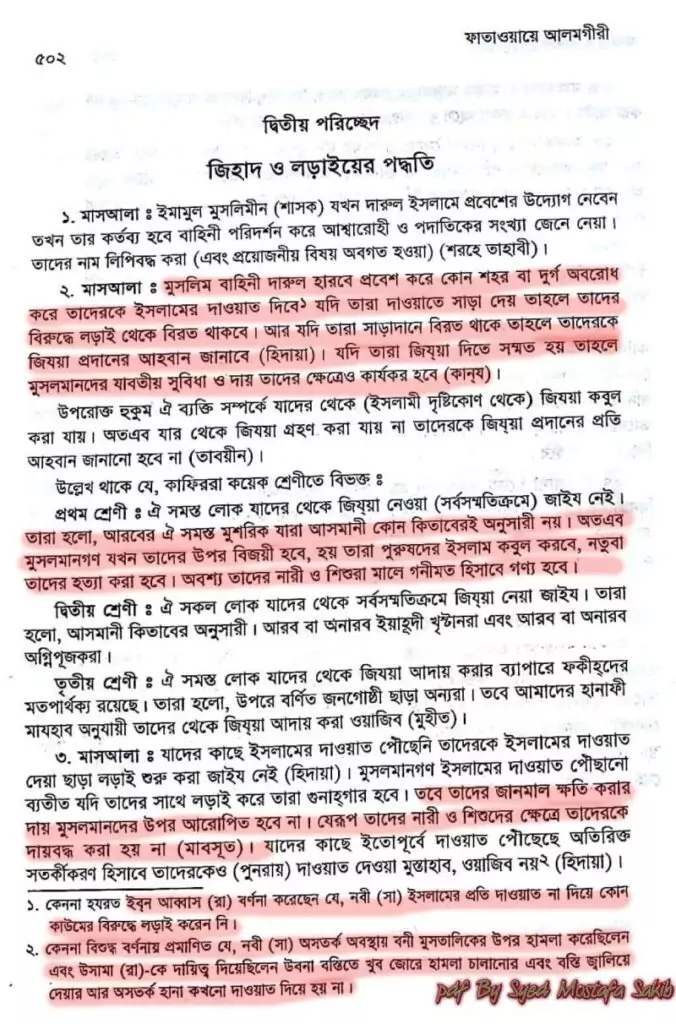
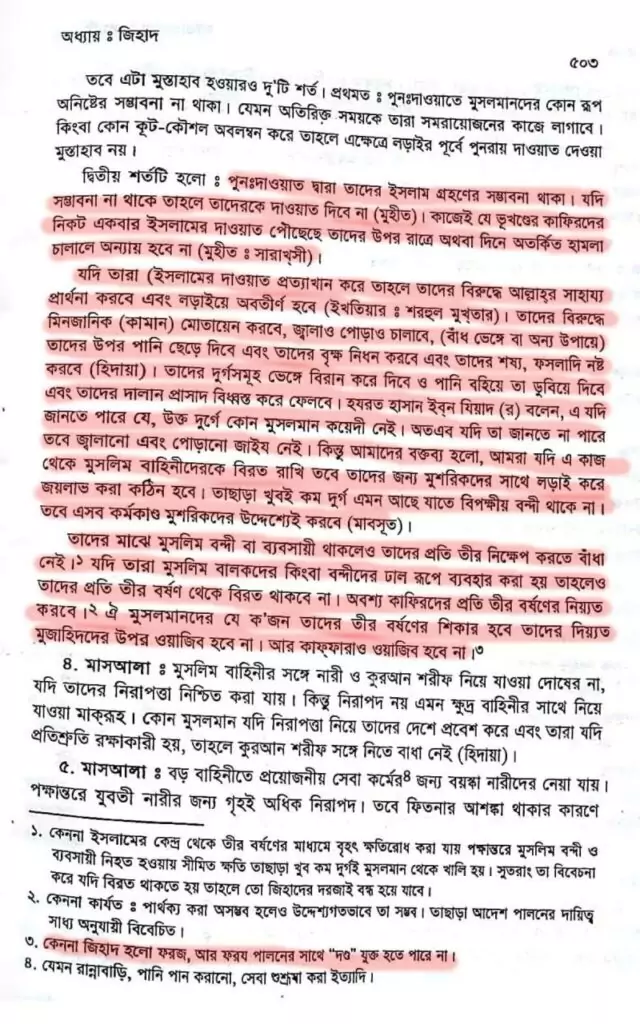
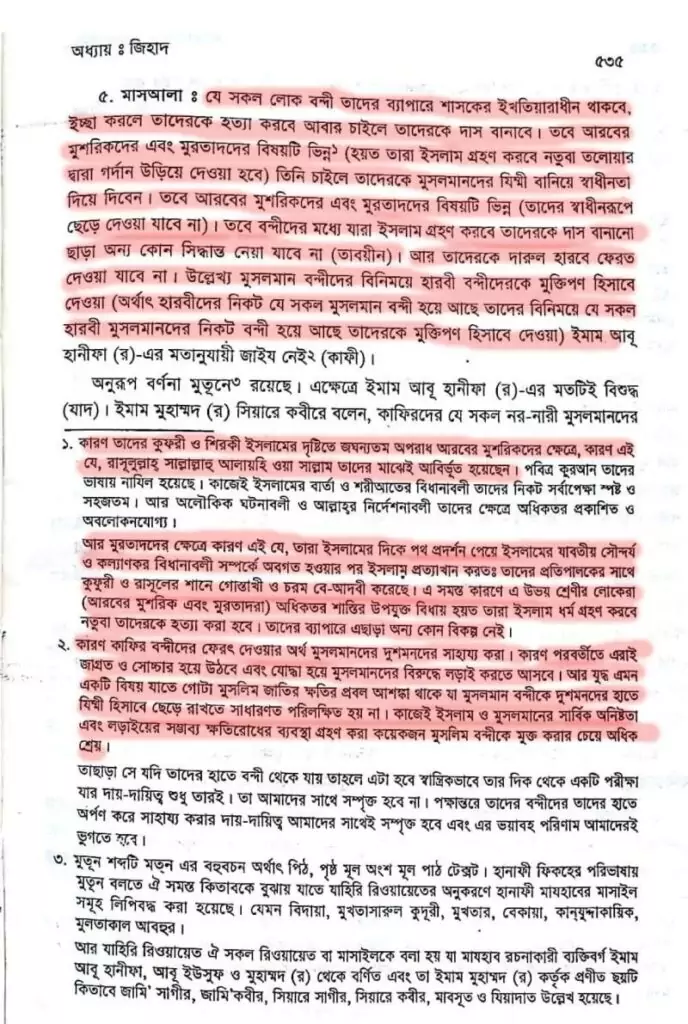
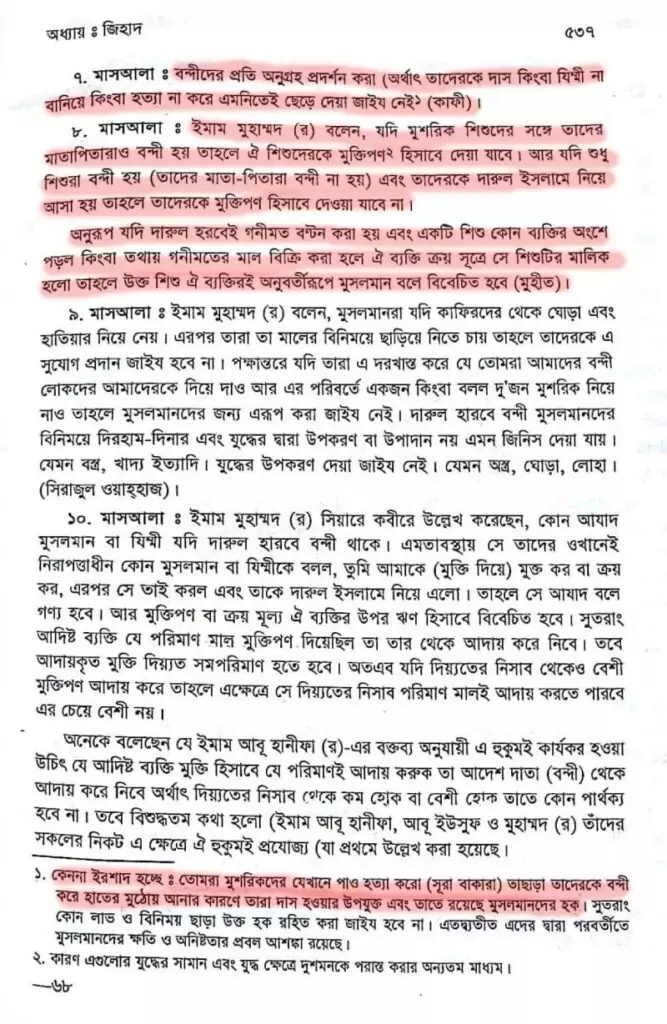
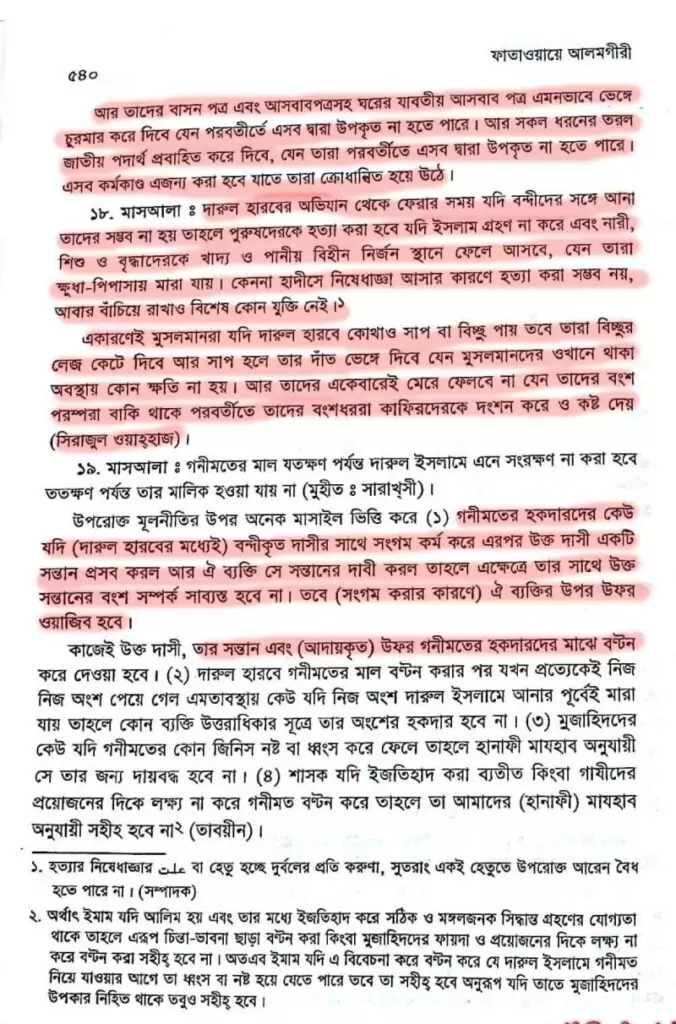
War After the Religious Summons: Military Conditions for Religious Submission
The second ruling in the Fatawa Alamgiri gives a clear sequence: the Muslim army will besiege a city or fortress in another territory, call upon its inhabitants to accept Islam and, if they refuse, demand jizya from those from whom its collection is lawful. Conversion or submission on terms determined by the ruler is presented as the condition for avoiding war. The rule contains no requirement that the people attacked must previously have attacked Muslims. War here is therefore not merely a response in defence of one’s own territory: it is a method of entering another territory and establishing religious and political authority. Standing armed before an independent society and demanding “Accept the religion, pay the tax or face war” does not create conditions for a free decision about belief. Options imposed by military force cannot be called voluntary consent. The religious objective of this form of jihad is discussed further in Shongshoy’s articles The Objective of Islamic Jihad: Offensive Jihad and Qital Until Polytheism Is Eradicated, Up to the Day of Judgement and Unprovoked Attacks: Examples of Muhammad’s Jihad, Qital and Suppression of Dissent.
Understanding the religious basis of jizya also requires reading the relevant Qur’anic verse in full. It links the cessation of warfare to jizya and submission. The phrase “wa-hum saghirun” in this verse became important in subsequent jurisprudence and Sirhindi’s discussions of the position of non-Muslims.
Qur’an, Surah al-Tawbah, verse 29.
قَاتِلُوا الَّذِينَ لَا يُؤْمِنُونَ بِاللَّهِ وَلَا بِالْيَوْمِ الْآخِرِ وَلَا يُحَرِّمُونَ مَا حَرَّمَ اللَّهُ وَرَسُولُهُ وَلَا يَدِينُونَ دِينَ الْحَقِّ مِنَ الَّذِينَ أُوتُوا الْكِتَابَ حَتَّىٰ يُعْطُوا الْجِزْيَةَ عَنْ يَدٍ وَهُمْ صَاغِرُونَ
Meaning: Fight those among the People of the Book who do not believe in Allah and the Last Day, do not regard as forbidden what Allah and His Messenger have forbidden, and do not follow the true religion, until they pay jizya with their own hands and remain in a state of submission.
Original verse: Surah al-Tawbah 9:29.
In this system of taxation based on religious identity and demands for military submission, the relationship between individuals and the state is not determined by equal standing. One side possesses religious authority; the other receives permission to live under that authority. The quoted passage from the Fatawa also classifies those from whom jizya may be collected and those who face the alternatives of accepting Islam or being killed. People’s security within the same territory consequently depends on their inherited or adopted religious identity as well as their conduct. When survival without changing one’s religion requires accepting a prescribed subordinate position, the claim to freedom of belief itself is called into question. The relationship between these rules and the statement that “there is no compulsion in Islam” is examined in detail in Shongshoy’s article La Ikraha fi al-Din: Is There Really No Compulsion in Islam?.
No Liability for Harm Inflicted Without a Religious Summons
The third ruling contains an even more serious point. It states that a Muslim army will be sinful if it fights people who have not received the invitation to Islam without first inviting them; nevertheless, the army will not be held liable for damage to their lives or property. A religious violation is acknowledged, while the people harmed receive no remedy. The attacker’s account of sin in the afterlife does not compensate the person killed or deprived of property. Meanwhile, surprise attacks by day or night without another warning are authorised against those who have already received the invitation. Turning “receipt of the invitation” into moral permission for an attack equates hearing a religious message with accepting a military ultimatum. The conclusion that a surprise attack on someone’s home becomes legitimate merely because they have heard of a religion is incompatible with the rights of free individuals. Such surprise attacks and their consequences for women and children are discussed in Shongshoy’s article The Legitimacy in Islam of Killing Women and Children in Surprise Night Attacks.
Permission to Destroy Crops, Water Systems and Settlements
Alongside deploying cannon or siege engines against the enemy, the quoted rules permit burning, flooding, cutting down trees, destroying crops and demolishing buildings. These are not merely the weapons of fighting soldiers: they are the infrastructure sustaining ordinary people’s lives. When crops, homes, water systems and fruit-bearing trees are destroyed, the burden of hunger, displacement and death falls upon the inhabitants. The rules also discuss attacks on fortresses containing Muslim prisoners or merchants. They decide that shooting arrows must not stop even when captive Muslim children are used as shields, and state that neither blood money nor expiation will be obligatory for their deaths. Possible deaths of innocent people were therefore not outside the discussion: the advance of warfare was prioritised with that possibility already known. An “intention to target the enemy” does not bring a dead child back to life. Before a law that exempts attackers from liability for such harm in advance can be described as a system of justice, the question of remedies for the people harmed must be answered.
Turning People into Booty: Women, Children and Slavery
The compilation’s position on captive women and children is even more explicit. After requiring one category of non-Muslim men to accept Islam or be killed, it calls their women and children booty. Later provisions place children under individuals through distribution or sale. The moment a free person is made purchasable and distributable, their rights become subordinate to an owner’s decisions. A child’s religious identity is also determined by following the owner’s status. Losing one’s family, freedom and capacity to determine one’s future through captivity cannot be described as humane guardianship. The term “booty” is used to reduce a previously free family to the category of property through war. This legal framework illuminates the social significance of the accounts of women and palace inhabitants being seized in Bakhtiyar’s campaigns. Detailed documentation appears in Shongshoy’s article The Fate of Civilian Women and Children in War: Ghanimah, or Plunder, in Islam.
Ruling nineteen concerns intercourse with a slave woman and the calculation of lineage, payment and distribution after the birth of a child. The discussion centres on when ownership becomes established, whose share the woman belongs to and how the child or money is to be divided. The woman’s independent decision is not central to this calculation. Breaking the rules of distribution may entail financial liability, but the system of control over the captive woman’s body remains in place. Organising a woman’s life through this calculation of ownership is incompatible with recognising her as a person possessing full rights. Regarding the release of prisoners, the quoted seventh ruling also opposes releasing them without a benefit or exchange. Further discussion of the religious reasoning behind this rule and the human position of prisoners of war appears in Shongshoy’s article The Will of the Infinitely Merciful Allah: Let the Blood of Unbelieving Prisoners of War Flow Abundantly!.
Permission to Inflict Harm, the Editor’s Objection and the Rules’ Moral Responsibility
The quoted passage also discusses abandoning the enemy’s livestock to die of starvation when it cannot be taken away. Meanwhile, it gives the possibility of their descendants subsequently biting or stinging unbelievers as the reason for preserving snakes and scorpions rather than eliminating their capacity to cause harm entirely. Religious identity becomes the basis for a hostility that makes future harm to people desirable. The same quotation includes the editor’s objection to starving animals to death: if compassion for the weak underlies the prohibition on killing, the same reason prevents such treatment from being permissible. This note is important. It shows that a logical inconsistency in a rule can be identified within the work itself. Religious sources do not need to be declared sacred in order to evade criticism: their statements, reasoning and consequences for living beings must be judged directly.
Sufism: A Wolf in Sheep’s Clothing
A familiar popular understanding of Sufism presents it as a tradition of love, humanity and non-sectarian spirituality in place of a rigidly Sharia-centred Islam. Sufi songs, poetry and stories of dervishes have popularised this perception. Love of God, purification of the self, surrender and the desire to apprehend life’s deeper truths are important themes of Sufi practice. The tradition has also exercised a long influence on the culture of the Indian subcontinent. Yet the language of spiritual love and the recognition of equal social standing for people of other religions are separate questions. A mystic may love his God profoundly while simultaneously wanting those who do not believe in that God to live in humiliation. His spiritual identity does not automatically establish the humanity of his political principles. To assess claims of Sufi tolerance, the social and political statements of its influential figures must therefore be read alongside its songs and methods of spiritual practice.
The history of Sufism in India developed through long-standing Arab-Persian contacts, the movement of mystics and the spread of different orders. Discussions of its early roots refer to contacts in the eighth century; in subsequent centuries, the circulation of mystics, students and orders turned these contacts into organised traditions. Persian rule and intellectual activity contributed to the spread of Sufi thought in the eleventh century, and various orders became established in the following centuries [18]. Interaction with local languages, societies and religious cultures produced different forms of Sufism in the subcontinent. Within this tradition, the Naqshbandi-Mujaddidi current connected spiritual practice with demands for strict Sharia authority. The instructions directed to rulers, nobles and religious scholars in Sirhindi’s letters provide direct documentary evidence of that connection. They contain specific principles concerning the social position of non-Muslims and the exercise of state power.
Various forms of Indian Sufi practice display similarities and exchanges with local Hindu devotional traditions, Buddhist meditation and other spiritual cultures. Themes such as devotion, surrender, meditation and self-reflection have created connections between different traditions. These cultural interactions enriched the language and social practices of Sufism. Assessing the rights of non-Muslims, however, requires examining their standing in society and the rules imposed upon them. A person may adopt the songs or spiritual vocabulary of a local culture while demanding Sharia-based subordination for its non-Muslim inhabitants. Cultural intermingling within Sufism cannot therefore be used to grant advance moral approval to every political position associated with it.
Music and poetry occupy an important place in Indian Sufi culture. Qawwali and other songs express divine love, the desire for union and spiritual experience. Associated with shrines and gatherings, this art attracts many people across religious identities. I personally enjoy many songs from different branches of Sufi music, including those of Nusrat Fateh Ali Khan and A. R. Rahman. Yet the beauty of a song and the moral value of a Sufi leader’s social statements cannot be assessed by the same measure. Enjoying art does not require endorsing the humiliation of non-Muslims, degradation through jizya or the killing of religious opponents. Conflating the two allows the emotional attachment to beloved art to conceal intolerant political views.
The pir, or spiritual guide, has an important role in Sufi practice. Followers respect him as a possessor of spiritual knowledge, a counsellor and a person qualified to guide their practice. The relationship between a pir and his followers is often expressed in the language of love, devotion and profound allegiance. This relationship also has social consequences: the political opinions of someone regarded as spiritually superior may acquire additional authority among his followers. If a pir’s teachings instruct followers to distrust, hate or humiliate people of other religions, those instructions are therefore more than a private outburst: the devotional relationship creates opportunities for them to become social practices. Followers’ reverence does not place a leader’s statements beyond question. They must also be judged by their effects on people of other religions.
Dhikr, the repetition of God’s name and remembrance, is another important Sufi practice. It is used to purify the heart, concentrate attention, deepen devotion and pursue spiritual insight. Some social practices also include remembrance of a pir’s or mystic’s name. This practice is connected with the pir’s teachings and instructions; when those instructions demand that non-Muslims be kept in humiliation, their social consequences must also be assessed. Sirhindi’s letters directly connect spiritual leadership with such political and social instructions. When a peaceful religious practice exists alongside demands that state power subordinate another community, the visible tranquillity of the former does not erase the harm of the latter.
The long history of Indian Sufism includes love, surrender, interaction with local cultures and connections among different spiritual traditions. Its music and literature continue to influence people’s lives. Within this diversity, there is also a tendency to insist upon the establishment of Sharia and the social degradation of non-Muslims. Treating the identity “Sufi” as a guarantee of humanity obscures that tendency. The question is how much room the language of spiritual advancement leaves for other people’s freedom and dignity. A statement defining another community’s degradation as the advancement of one’s own religion cannot be made innocent through the language of love. This is where the writings of Ahmad Sirhindi, an influential figure in the Mujaddidi tradition, become particularly important.
This section specifically examines the Naqshbandi-Mujaddidi current associated with Ahmad Sirhindi. Within the Naqshbandi tradition, named after Baha al-Din Naqshband, the branch of Sirhindi’s followers spread under the name Mujaddidiyyah. It has followers in various regions, including Bangladesh, India, Pakistan and Turkey. Sirhindi is known as “Mujaddid-i Alf-i Thani”, the reformer of the second millennium. Alongside discussions of personal spiritual practice, his letters and writings prescribe the duties of rulers, nobles and religious scholars. This is why his statements matter: he is not merely recording private feelings about non-Muslims. He is giving instructions on what the policies of Muslim rule should be and how state power should be used in the interests of religion.
Ahmad al-Faruqi al-Sirhindi (1564–1624) was a Hanafi theologian and Naqshbandi Sufi leader born in Sirhind, Punjab. His father, ‘Abd al-Ahad, was associated with Sufi traditions, and his family is traditionally said to trace its ancestry to Caliph ‘Umar. The TDV Encyclopaedia of Islam describes his life, his connection with the Naqshbandi order and the spread of the Mujaddidi branch [19]. During the Mughal period, he opposed religious intermingling and the relaxation of Sharia rules, demanding the establishment of Islamic regulations in letters addressed to nobles. Sirhindi died before Aurangzeb’s reign began, but the Sharia-centred political thought preserved in his writings remained an important part of subsequent religious traditions. His own letters explicitly call for keeping non-Muslims subordinate, humiliating them through jizya and establishing Sharia through the ruler’s power. The moral responsibility for this political programme promoted in the name of spiritual leadership is present in his statements themselves.
During Emperor Akbar’s reign, policies of religious coexistence and cooperation among communities were connected with the decision to abolish jizya on non-Muslims. Measures of this kind came into conflict with strict Sharia-centred thinking. Sirhindi’s letters directly express disappointment at the cessation of jizya and objections to the respect accorded to non-Muslims. His concerns were therefore not limited to personal religious observance: they also concerned how much dignity non-Muslims would enjoy in society and the state. In the quotation below, he expressly identifies humiliation as the purpose of jizya. This tax and the subordinate position of non-Muslims are discussed further in Shongshoy’s article on the Humiliating Jizya Tax. Let us now examine his statements in his own words.
Notable works of Mujaddid-i Alf-i Thani include:
- Al-Mabda’ wa’l-Ma‘ad
- Risalah-i Tahliliyyah
- Risalah fi Ithbat al-Nubuwwah wa Adab al-Muridin
- Radd-i Rawafid
- Maktubat.
Sirhindi’s Disturbing Statements
Two levels of evidence concerning Sirhindi’s statements are presented below: first, the discussion of his political role in the historian Saiyid Athar Abbas Rizvi’s research; then his own letters in the Bengali translation of the Maktubat Sharif. This allows the researcher’s analysis and Sirhindi’s direct statements to be read together. Rizvi’s Muslim Revivalist Movements in Northern India discusses the use of the sword to establish Sharia, attempts to influence the emperor and efforts at religious revival through the nobility. This discussion shows that Sirhindi’s objective was not to confine spiritual practice to his own khanqah: it was also to incorporate state policy and the ruler’s power into his religious project [20].
diverted him from orthodox Islam. Their success he mainly ascribed to the nearness of the Day of Judgment and the long time that had elapsed since the ‘Seal of Prophets’ had appeared. He seemingly laboured under the wrong notion that Jahangir would set everything right and restore Islam to its pristine purity if he were to wield his sword on the Hindus and the Shias. “Shariat can be fostered through the sword,” was the slogan he raised for his contemporaries. It was for this reason that he equated the status of the Emperor vis-à-vis his kingdom with the position of the soul or heart in relation to body. ‘A reform, if possible by any means, in the Emperor, would mean the eradication of evils from the body-politic of Islam’ was his firm conviction. Akbar’s eclectic tendencies and his policy of “peace with all” had frozen Mujaddid’s expectations on this score but they were revived a bit with the accession of Jahangir. This expectation had its stimulant not in the belief that Jahangir had previously shown any leanings towards Sunni orthodoxy but in the hope that if efforts to persuade the Emperor to stand by his (Mujaddid’s) ideals succeeded in the beginning of the new reign, the transformation from heterodoxy to orthodoxy was guaranteed. He, therefore, quite oblivious of the problems which the Mughul emperors and the nobles had to face in governing a country of such heterogeneous population as India, sought to make the nobles his tool for the revival of orthodoxy. He underestimated the complexity of the task by appealing only to the communal sentiments. He did not make any attempt to organise the common Muslims or those below the status of the nobility. It was only on one occasion, that he wrote to the eminent Saiyids, Qazis and inhabitants of Samana against the Khatib of that place who had intentionally dropped the name of the first four Caliphs from the Khutba. When the people raised objections, the Khatib emphatically said, “How does it matter then if I did not mention the names of the Caliphs?” Mujaddid expressed great surprise over the indifference and tolerance of the eminent as well as common people of the locality towards this ‘sacrilegious act’ of the unscrupulous Khatib. In his view they should have taken serious steps against him. He accepted that the mention of the name of the Caliphs was, no doubt, not one of the fundamentals of the Sunni faith but it was one of the important Sunni practices and as such deserved to be strictly adhered to. Intentional omission of the name of the Caliphs smacked of Shiism. Even if the
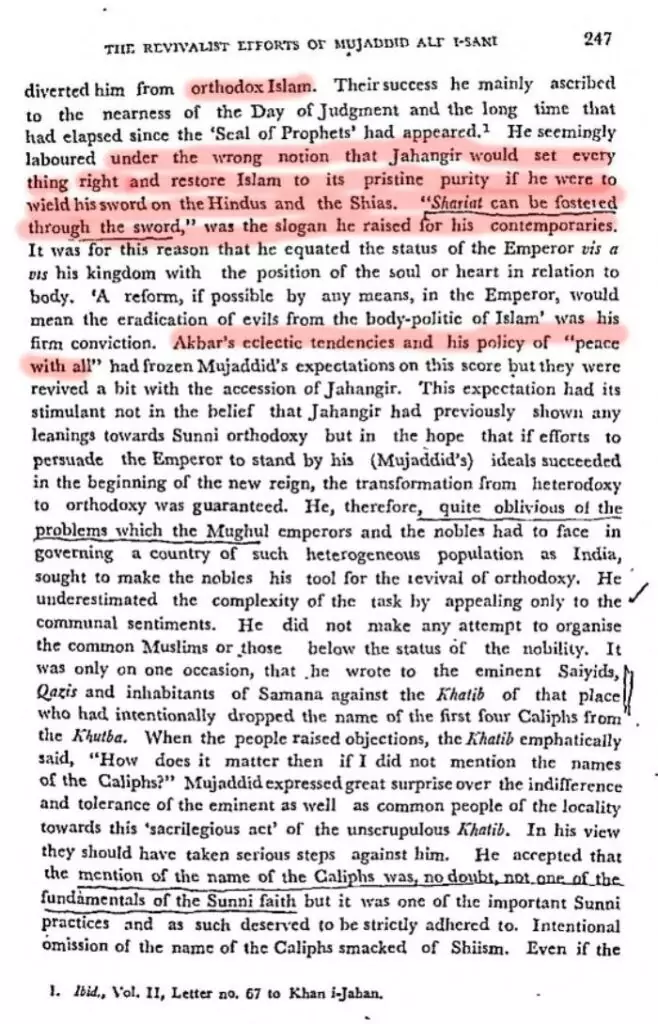
Let us now read a lengthy passage from Sirhindi’s Maktubat Sharif. In Letter 193, instructions to maintain pure Sunni belief, satisfaction at the killing of a Sikh religious leader, a call to degrade unbelievers and humiliation through jizya appear together. He urges religious scholars to approach the ruler to have the customary practices of non-Muslims abolished. This is therefore more than theological disagreement: it is a demand to determine another community’s social position through state power. The relevant pages of Letter 193, together with the end of the preceding letter, are reproduced below [21].
Supremacy belongs to the prophets. In this respect, if a person other than a prophet reaches the station of that partial perfection and finds himself at a station higher than that of the prophet, this too is permissible. Of course, his attainment of that station occurs through following the prophet. The prophet also receives a share of that station, because whoever establishes a virtuous path receives its reward and the rewards of others who act upon it. Therefore, if a person other than a prophet can be superior to a prophet in a particular respect, he can certainly be superior in a particular respect to another person who is not a prophet. No doubt therefore remains. Peace.
Letter 193
Written to Sayyid Shaykh Farid, encouraging the purification of belief according to the views of the Ahl al-Sunnah wa’l-Jama‘ah.
In the name of Allah, the Compassionate, the Merciful.
May Allah grant you assistance and strength to protect yourself from whatever brings you blame and reproach. The first duty of those responsible for Islam is to purify their beliefs according to the views of the scholars of the Ahl al-Sunnah wa’l-Jama‘ah, because salvation in the afterlife depends upon following the true path shown by these elders. They and their followers are the saved group. They follow the path of the Prophet and his Companions. The knowledge or rulings of the hadith and Qur’an that are acceptable are those extracted from them by these scholars. Every heretical and misguided group extracts its own false beliefs from the Qur’an and hadith according to its own understanding. Therefore, not every meaning one understands from the Qur’an and hadith is acceptable. For correcting belief, the work of the eminent Imam Turpushti is excellent and easy to understand. You should continue studying that work in your gatherings. It is lengthy because it contains many proofs and arguments. If a short book containing only the rulings can be found, that would be better. Meanwhile, it has also occurred to me to write a book on this subject that states the beliefs of the Ahl al-Sunnah wa’l-Jama‘ah and can be easily understood. If I am able to write such a book, I will, Allah willing, send it to you.
After correcting belief in this manner, acquiring knowledge of the lawful, unlawful, obligatory, necessary, Sunnah, recommended and reprehensible acts described in jurisprudence, and acting accordingly, is also an essential duty. You should tell a student of religious knowledge to study a Persian work of jurisprudence in your gatherings, such as Majmu‘ah-i Khani or ‘Umdat al-Islam. Allah forbid, if a departure occurs in the essential beliefs, one will be deprived of salvation in the afterlife. If, however, there is negligence in practice, one may be pardoned even without repentance and may eventually be released even if punished for it. Purifying belief is therefore the principal task. It is narrated from Khwaja ‘Ubayd Allah Ahrar that he said: If Allah grants me every spiritual state and inspiration, but does not adorn my inner world according to the beliefs of the Ahl al-Sunnah, I will perceive nothing but harm. Conversely, if He imposes every harm and corruption upon me but purifies my beliefs according to those of the Ahl al-Sunnah wa’l-Jama‘ah, I will have no fear. Through the Prophet, may Allah keep us and you steadfast upon their path. Amen.
A dervish arrived from Lahore and said that Shaykh Jiu, meaning Shaykh Farid, had attended Friday prayers at the congregational mosque in the old bazaar. Miyan Rafi‘ al-Din, discussing his favourable disposition towards Islam, said that Nawab Shaykh Jiu had built a congregational mosque in his own mansion. I give thanks to Allah for this. May Allah grant you further strength and opportunities of this kind. Sincere friends are greatly pleased to hear such news.
Sayyid Sahib, Islam has lately become extremely weak, like a stranger on the road. Spending a single penny upon it now has the value of spending millions upon millions. Allah alone knows which brave man will be granted this good fortune. Assistance to Islam, whenever and by whomever it is given, is most excellent; but at this time of Islam’s weakness, its coming through brave men of the Prophet’s household such as yourself is particularly fine and pleasing. This wealth belongs to your household. For you it is therefore your own, while for others it is acquired and received from elsewhere. Attaining this exalted task is to become the Prophet’s true heir. Addressing his Companions, the Prophet said: “You live at a time when abandoning one-tenth of Allah’s commands and prohibitions will ruin you. But after you a group will come who will attain salvation by observing one-tenth of them.” This is that time, and these are those people.
The ball of good fortune lies freely in the field; no one comes to play—where are the riders?
The killing of Guru Gobind and his descendants has been particularly excellent for the present time; it has left the followers of other religions broken. Whatever the purpose for which he was killed, degrading the unbelievers is the Muslims’ capital. Before he was killed, this faqir saw in a dream that the emperor of this age had crushed the head of polytheism. He truly was the foremost figure and leader of those unbelievers and polytheists. May Allah degrade them. The master of this world and the next, the Prophet, often cursed the polytheists in his prayers as follows: “O Allah, break their unity and destroy their homes. Attack them as a mighty and capable one attacks.” The honour and dignity of Islam and the Muslims therefore consist in disgracing and degrading unbelief and the unbelievers; the meaning of collecting jizya is to humiliate them.
The more honour accorded to them, the more Islam will be dishonoured. This principle must be carefully preserved. Most people have lost it—that is, forgotten it. As a result, the religion is moving towards destruction.
Allah has said: “O Prophet, wage jihad against the unbelievers and the hypocrites, and treat them harshly.” Jihad and harsh treatment of unbelievers are therefore essential duties of Islam. The customs of unbelief that have been practised from earlier times still receive no attention from the Muslim emperor; this pains the Muslims’ hearts. It is the Muslims’ duty to inform the Muslim emperor of the faults in the practices of those impure people and to endeavour to abolish them. Perhaps these practices still exist because the emperor does not know their harmfulness. At a suitable time, you should inform the Muslim scholars that they ought to explain to the emperor the harm in those customs of the unbelievers. No display of miraculous power is necessary to propagate Sharia.
On the Day of Judgement, their excuse that they could not propagate Sharia because they lacked miraculous powers will not be accepted. The prophets were the best of creation, yet they too propagated Sharia. When a member of their communities wished to see a miracle, they would say: “Miracles come from Allah—that is, they are beyond our power. We have no duty other than conveying the commands…”
Source: Maktubat Sharif, Bengali translation, Volume II, pp. 70–73. English online text of the corresponding letter: Maktubat, Volume I, Letter 193.
Satisfaction Based on Religious Identity, Whatever the Reason for the Killing
The Bengali translation quoted above gives the murdered Sikh leader’s name as “Guru Gobind”. The historical context of the letter needs to be clear: the reference in Letter 193 to the killing of the religious leader of Govindwal or Goindwal is identified as Guru Arjan’s death on Jahangir’s orders in 1606 [22]. Beyond this naming problem in the translation, Sirhindi’s moral position is clear in his own statement: whatever the reason for the killing, the degradation of an unbeliever benefits the Muslims. Instead of asking whether a person actually committed a crime, received a just trial or suffered a punishment proportionate to the offence, religious identity becomes the basis for satisfaction. Under this standard, even the death of an innocent non-Muslim can be celebrated as a religious success.
Sirhindi did not stop at expressing this satisfaction. In the same letter, he identifies humiliation as the purpose of jizya and instructs his reader to preserve the principle that the more honour non-Muslims receive, the more Islam is dishonoured. Human dignity is treated as the exclusive property of one community: another’s increased honour diminishes one’s own. Accepting this idea makes coexistence in equal dignity impossible, because keeping a neighbour’s head lowered becomes a condition of one’s religion’s advancement. It is also significant that he instructs religious scholars to complain to the ruler about non-Muslim customs so that they can be abolished. A demand for administrative intervention thus emerges directly from spiritual leadership. Restricting religious freedom does not even require miraculous powers: the royal court and the ruler’s strength are his proposed instruments.
In another lengthy quotation from the same work, Sirhindi explains his opposition to friendship, social contact and the granting of respect to non-Muslims. In his reasoning, the honour of Islam and that of unbelief are opposed; respecting a non-Muslim therefore diminishes Islam’s honour. From this conception, he advocates restricting relationships, maintaining hatred and keeping non-Muslims fearful and subordinate through jizya. A person’s religious identity, rather than their conduct, honesty or wrongdoing, becomes the principal criterion for social treatment. Let us read the quoted passage in full [23].
…following consists in observance and in abandoning the customs and practices of unbelief. Islam and unbelief are opposed to one another. Establishing one removes the other, and they therefore cannot possibly be combined. When one is honoured, the other is dishonoured. Allah said to His beloved: “O Prophet, engage in warfare against the unbelievers and the hypocrites, and treat them harshly.” Since He commanded the Prophet, who possessed the finest character, to treat unbelievers harshly, it is apparent that such treatment belongs to the finest character. The honour of Islam therefore increases through the degradation and humiliation of unbelief and the unbelievers. Whoever honours unbelief degrades Islam. Giving them honour does not only mean granting them dignity and seating them in high places: giving them a place in one’s gathering and speaking to them with a feeling of brotherhood also constitutes honouring them. They should be driven away like dogs. If they are needed for some worldly matter that cannot be accomplished without them, they may be associated with to the extent necessary, while maintaining distrust towards them.
The perfection of Islam, however, is to disregard that worldly need and avoid associating with them. In His holy word, Allah has called the unbelievers His enemies and the enemies of the prophets. Maintaining relations with these enemies of Allah and His Messenger is therefore a deeply blameworthy act. The least harm of their company is that it diminishes the power to implement Sharia’s commands and to eliminate the customs of unbelievers: the embarrassment arising from a feeling of brotherhood becomes an obstacle. This is extremely harmful to Islam. Friendship with Allah’s enemies leads towards enmity against Allah and His Messenger. Many may think that they are Muslims and believe in Allah and His Messenger,
yet such conduct destroys their wealth of Islam at its root, while they remain entirely unaware of it. We seek Allah’s protection from our evil inclinations and wrongful deeds.
He thinks himself a master, saying he has attained God; all he has attained is his own imagining.
The only activity of these worthless people is to revile Islam and the Muslims.
If they obtain an opportunity, they will strive with all their strength to injure or kill Muslims or turn them into unbelievers. Muslims must therefore also possess shame: “Shame is part of faith.” Islamic shame is absolutely necessary; one must continually strive to degrade the followers of other religions. The emperors of India abolished the jizya imposed upon them because of their association with them. The real purpose of collecting jizya from them is to keep them degraded. They must be degraded to such an extent that fear of jizya prevents them from daring to wear fine clothes or move about in splendour. They must remain constantly fearful and terrified that their wealth will be confiscated. Since Allah has ordered the imposition of jizya to keep them subordinate, what authority do the emperors have to abolish it? Keeping them subordinate and raising Islam is Allah’s purpose.
“Kill as many followers of other religions as you can; Islam will certainly advance thereby.”
Maintaining hostility towards unbelievers is a sign of attaining the good fortune of Islam. In His holy word, Allah has called them “najas”, impure, in one place and “rijs”, unclean, in another. Muslims should therefore see them as impure. When they see them this way, they will certainly regard them as hateful and keep away from their company. To ask them anything…
Source: Maktubat Sharif, Bengali translation, Volume II, pp. 23–24. English online text of the corresponding letter: Maktubat, Volume I, Letter 163.
Permanent Fear and Social Subordination Through Jizya
In this quotation, Sirhindi himself closes off the possibility of explaining jizya merely as state revenue or payment in exchange for protection. His stated objective is to keep non-Muslims so humiliated and frightened that they do not dare to wear fine clothes or move about in splendour, and live in fear of the confiscation of their wealth. Concealing a tax whose declared purpose is to keep people’s heads lowered behind the neutral language of civic duty is a dishonest interpretation. The relationship here is not between a ruler and citizens with equal rights: it is between a dominant religious side and a subordinate side living by permission. The assumption that paying a tax provides dignified security does not match Sirhindi’s own explanation; he identifies the taxpayer’s permanent fear as desirable.
His statements about friendship with non-Muslims follow the same structure. They prescribe avoiding relationships except where business requires them, maintaining distrust even when contact is necessary, and regarding social closeness as harmful to Islam. Why harmful? His explanation is that when a sense of brotherhood develops, embarrassment becomes an obstacle to imposing harsh rules upon non-Muslims. This admission is extremely significant: once another person is seen as familiar, dear and equal in dignity, conscience may obstruct their humiliation, so the relationship itself must be weakened. Ordinary human empathy is treated here as an obstacle to religious domination. This position cannot be called non-sectarian humanism.
These statements by Sirhindi are also quoted in other studies and compilations. Reading the passages reproduced through Rizvi’s and Friedmann’s research and Andrew Bostom’s compilation alongside the direct passages from the Maktubat above makes clearer the ideas of establishing Sharia through the sword, humiliating non-Muslims and making one’s own religion’s honour dependent on their decline. The reproduction of the same statements in different sources also illustrates their history of circulation and reception. These statements are given below with their references.
■ Sharia will be established through the sword. [24]
■ Fighting the unbelievers and treating them harshly is one of the essential requirements of Islam.
■ The honour of Islam lies in the downfall of unbelief and the unbelievers.
■ The original purpose of taking jizya from unbelievers is their degradation, which should be such that they cannot wear fine clothing for fear of jizya … and remain constantly fearful and trembling …
■ On that day, the accursed unbeliever of Govindwal was most fortunately killed. This was a cause of defeat for the hell-bound Hindus. Whatever purpose or objective their killing fulfils, their very lives are an affront to Muslims. Before this unbeliever was killed, I saw in a dream that the emperor of that time had destroyed the crown of the head of polytheism or unbelief. It is true that this unbeliever, Guru Arjan, was the chief and leader of the unbelievers. The purpose of imposing jizya, the tax on non-Muslims, upon them is to degrade and humiliate the unbelievers; waging jihad against them and maintaining hostility towards them are requirements of the Muhammadan faith.
■ Whenever a Jew is killed, it serves the interests of Islam. [25]
■ Every Muslim is therefore instructed to wage jihad against all innovations, or bid‘ah, that are not part of Islam. [26]
■ Cow sacrifice in India is the greatest of Islamic practices. The unbelievers (Hindus) may agree to pay jizya, but they will never agree to cow sacrifice … The original purpose of taking jizya from them, the Hindus, is to degrade them so far that they cannot wear fine clothing or live in splendour for fear of jizya. They should remain constantly terrified and trembling. Its purpose is their degradation and the elevation of Islam’s honour and glory. [27]
■ Unbelief and Islam are opposed to one another. The advancement of one is possible only through the degradation of the other, and coexistence between these two contradictory beliefs is inconceivable.
■ The honour of Islam lies in insulting unbelief and the unbelievers. Whoever respects the unbelievers dishonours the Muslims. Respecting them does not only mean honouring them and assigning them a seat in an assembly; it also means maintaining friendship with them or giving them importance. They must be kept at a distance like a dog … If some worldly business cannot be accomplished without them, only the minimum necessary contact should be maintained, without placing any trust in them. The highest Islamic disposition insists that such worldly business should instead be abandoned and no relationship maintained with unbelievers.
■ The purpose of imposing jizya upon them, the non-Muslims, is to degrade and humiliate them so that they cannot wear fine clothing or live in splendour for fear of jizya. They should remain constantly terrified and trembling. Its purpose is their degradation and the elevation of Islam’s honour and glory.
■ (He wrote to Lala Beg:) Cow sacrifice in India is the greatest of Islamic practices. The unbelievers, the Hindus, may agree to pay jizya, but they will never agree to cow sacrifice.
■ The execution of the accursed unbeliever at Govindwal, the Sikh leader, is an important achievement and the cause of a great defeat for the accursed Hindus. “Whatever the purpose or objective behind the execution, dishonouring the unbelievers is the most praiseworthy act for Muslims. Before this unbeliever was killed, I saw in a dream that the emperor of that time had destroyed the crown of the head of polytheism. He truly was the chief of the polytheists and the leader of the unbelievers.” [28]
English online texts of the relevant letters: Maktubat, Volume I, Letter 163; Maktubat, Volume I, Letter 193.
Using Religious Ritual to Humiliate Others
The same principle appears in the quoted statements about cow sacrifice. The distress of another community and its inability to accept the practice are presented as reasons for a religious ritual’s importance. The quoted statements connect that community’s objection and humiliation with the special status of one’s own religious practice. A neighbour’s suffering thus becomes a means of demonstrating religious authority. Coexistence cannot be the social objective of a ritual whose significance is measured through a neighbour’s humiliation. The statement that people may agree to jizya but cannot accept cow sacrifice shows that economic subordination is not regarded as sufficient: asserting authority over the opposing community’s religious feelings is also desirable. This conception makes a non-Muslim’s independent life dependent on the ruler’s mercy and refuses to recognise their objection as an attempt to preserve their dignity.
Throughout this long collection of quotations, satisfaction at the killing of non-Muslims, social humiliation, distrust, taxation through fear and the assertion of authority through religious ritual are connected within a single line of thought. Sirhindi’s statements therefore cannot be dismissed as a handful of isolated harsh expressions. They are part of his desired social order: Muslims’ religious honour increases when non-Muslims’ standing is lowered. This connection between spiritual advancement and political domination is precisely why preconceived ideas about “loving Sufism” must be examined. A pir’s status, number of devotees or spiritual reputation does not make his political instructions just. Objections to a principle that treats religious identity as sufficient grounds for humiliating people arise from their equal human dignity.
Conclusion
The documents above reveal a clear relationship between military campaigns, the acquisition of wealth, captivity and religious authority. Accounts of Bakhtiyar’s campaigns describe the killing of inhabitants of a centre of learning, extensive plunder and the seizure of people, including women. The Fatawa Alamgiri contains rules for entering another territory and imposing conversion or jizya, conducting surprise attacks, destroying the means of subsistence and including women and children in booty. Sirhindi’s letters describe the humiliation of non-Muslims as Islam’s honour, jizya as a means of degradation and the death of a religious leader of another faith as a cause for satisfaction. Together, these statements show that the rights of the people attacked were subordinated to the conqueror’s religious and political interests. Calling plunder “ghanimah”, participation in a campaign “merit” and subordination “protection” does not change the nature of that deprivation of rights.
The conflict between attempts at religious coexistence and pressure from strict Sharia advocates at different periods of Mughal rule also forms part of this history. Akbar’s initiatives towards religious openness, the experimental sphere of Din-i Ilahi and the Sikh tradition initiated by Guru Nanak show the existence of alternative ideas within that society. Yet if people’s security and dignity depend upon a ruler’s personal goodwill, an open-minded reign does not guarantee permanent rights. A change of ruler or an increase in religious extremism can restrict them again. When the honour of non-Muslims is treated as the opposite of Islamic honour, and their subordination as a religious duty, this crisis remains embedded in the rules themselves. A ruler’s temporary decision not to enforce them does not resolve the moral problem.
Judging this history requires refusing special exemptions for a conqueror’s religious identity. Whoever deprives people of life, freedom, property and dignity bears responsibility for doing so. Claims of religious advancement or rewards in the afterlife do not erase that responsibility. Indeed, when a rule claims divine authority in order to place itself beyond revision, reasoned questions about its injustice become still more necessary. There is no reason to accept the killing of teachers and monks as heroism, the captivity of women and children as the lawful acquisition of property, or a neighbour’s humiliation as religious progress. We need to read the documents from the perspective of the people attacked, reject the glorification of plunder and killing, and oppose systems of government in which religious identity determines human rights. The Indian subcontinent’s future political and social institutions must rest on equal human dignity; neither the power of the sword nor claims of Sharia authority can justify taking that dignity away.
References
- Sahih al-Bukhari, 5692–5693; chapter on Indian costus ↩︎
- Sunan an-Nasa’i 3175; Book of Jihad, chapter on the expedition against India ↩︎
- Kitab al-Fitan, Nu‘aym ibn Hammad ↩︎
- J. W. McCrindle, The Invasion of India by Alexander the Great as Described by Arrian, Q. Curtius, Diodorus, Plutarch and Justin, Westminster: Constable, 1893, pp. 343–344 ↩︎
- UNESCO: Archaeological Site of Nalanda Mahavihara ↩︎
- A. B. M. Shamsuddin Ahmed, “Bakhtiyar Khalji”, Banglapedia ↩︎
- Tabaqat-i-Nasiri, Minhaj-i-Siraj, Bangla Academy, Dhaka; English translation by H. G. Raverty, Volume I ↩︎
- Tabaqat-i-Nasiri, Minhaj-i-Siraj, Bangla Academy, Dhaka, p. 19; Raverty’s English translation, Volume I, p. 552 ↩︎
- Tabaqat-i-Nasiri, Minhaj-i-Siraj, Bangla Academy, Dhaka, p. 20; Raverty’s English translation, Volume I, pp. 552–554 ↩︎
- Tabaqat-i-Nasiri, Minhaj-i-Siraj, Bangla Academy, Dhaka, p. 27; Raverty’s English translation, Volume I, pp. 557–558 ↩︎
- Tabaqat-i-Nasiri, Minhaj-i-Siraj, Bangla Academy, Dhaka, p. 28; Raverty’s English translation, Volume I, p. 558 ↩︎
- Tabaqat-i-Nasiri, Minhaj-i-Siraj, Bangla Academy, Dhaka, p. 34; Raverty’s English translation, Volume I, account of the Tibet expedition ↩︎
- Tabaqat-i-Nasiri, Minhaj-i-Siraj, Bangla Academy, Dhaka, p. 42; Raverty’s English translation, Volume I, p. 572 ↩︎
- Tabaqat-i-Nasiri, Volume I, pp. 552, 557, 558 ↩︎
- Ahmet Özel, “el-Âlemgîriyye”, TDV Encyclopaedia of Islam ↩︎
- Muhammad Khalid Masud, “Religion and State in Late Mughal India: The Official Status of the Fatawa Alamgiri” ↩︎
- Fatawa Alamgiri, Islamic Foundation Bangladesh, Volume III, pp. 502, 503, 535, 537, 540; Arabic online edition: al-Fatawa al-Hindiyyah, Kitab al-Siyar ↩︎
- Stanford Encyclopedia of Philosophy: Mysticism in Arabic and Islamic Philosophy ↩︎
- Hamid Algar, “İmâm-ı Rabbânî”, TDV Encyclopaedia of Islam ↩︎
- Muslim Revivalist Movements in Northern India, Saiyid Athar Abbas Rizvi, p. 247 ↩︎
- Maktubat Sharif, Volume II; original author: Ahmad Sirhindi, known as Ghawth-i Samadani, Mahbub-i Subhani, Imam Rabbani and Mujaddid-i Alf-i Thani; translator: Shah Muhammad Muti Ahmad Aftabi; publisher: Aftabia Khanqah Sharif, pp. 70–73; English online translation of Letter 193, Volume I ↩︎
- Yohanan Friedmann, “Ahmad Shaikh (1564–1624)”, The Encyclopaedia of Sikhism ↩︎
- Maktubat Sharif, Volume II; original author: Ahmad Sirhindi, known as Ghawth-i Samadani, Mahbub-i Subhani, Imam Rabbani and Mujaddid-i Alf-i Thani; translator: Shah Muhammad Muti Ahmad Aftabi; publisher: Aftabia Khanqah Sharif, pp. 23–24; English online translation of Letter 163, Volume I ↩︎
- Saiyid Athar Abbas Rizvi, Muslim Revivalist Movements in Northern India in the Sixteenth and Seventeenth Centuries, Agra, 1965, p. 247; online English edition ↩︎
- Excerpted from Saiyid Athar Abbas Rizvi, Muslim Revivalist Movements in Northern India in the Sixteenth and Seventeenth Centuries (Agra, Lucknow: Agra University, Balkrishna Book Co., 1965), pp. 247–250; and Yohanan Friedmann, Shaykh Ahmad Sirhindi: An Outline of His Thought and a Study of His Image in the Eyes of Posterity (Montreal, Quebec: McGill University, Institute of Islamic Studies, 1971), pp. 73–74; Rizvi: online English edition; Friedmann: English edition ↩︎
- Saiyid Athar Abbas Rizvi, Muslim Revivalist Movements in Northern India in the Sixteenth and Seventeenth Centuries (New Delhi: Munshiram Manoharlal Publishers Pvt. Ltd., 1965), p. 256 ↩︎
- Bostom, The Legacy of Jihad, pp. 200–201 ↩︎
- Bostom, A. G., MD, The Legacy of Jihad: Islamic Holy War and the Fate of Non-Muslims (Amherst: Prometheus, 2010); quoted through S. A. A. Rizvi, Muslim Revivalist Movements in Northern India in the Sixteenth and Seventeenth Centuries, Agra, 1965, and Y. Friedmann, Shaykh Ahmad Sirhindi: An Outline, 1971. ↩︎
About This Article
Genre: Semi-Academic Historical and Textual Critique.
Epistemic Position: Rational Skepticism, Historical Inquiry and Secular Humanism.
This article examines the religious glorification of military campaigns against India, Bakhtiyar Khalji’s conquests in Bihar and Bengal, and the human consequences of conquest, plunder and the destruction of centres of learning. It also investigates the religious and legal foundations of coercion, enslavement and the subordination of non-Muslims through the Fatawa Alamgiri and Ahmad Sirhindi’s letters.
Drawing on hadith collections, medieval chronicles, Hanafi jurisprudence and historical scholarship, the article examines how violence and religious discrimination acquired sacred authority. Its ethical standard is human life, freedom, equality and dignity: promises of salvation, the prestige of a conqueror or the spiritual reputation of a religious figure cannot establish the justice of the actions and doctrines examined here.