Islamic Predestination (Taqdeer): Free Will, Divine Control, and Moral Responsibility
Summary
In Islamic theology, ‘Taqdeer’ or Predestination is not merely an ordinary belief; it is a form of cosmic determinism in which human will, actions, consequences, and ultimate destination are claimed to have been written and determined before creation itself. However, this concept faces profound difficulties in light of classical logic, causation theory, and moral responsibility. If an omniscient and omnipotent God has predetermined every event, decision, and outcome in advance, and it is practically impossible for human beings to go beyond that determination, then human free will is not an effective reality; rather, it is merely a psychological feeling experienced while moving within a predetermined script. According to Pierre-Simon Laplace’s mechanical determinism, or the concept of Laplace’s Demon, the present state of the universe is the effect of its past and the cause of its future [1]. The Islamic concept of the ‘Preserved Tablet’ is a theological form of this determinism, in which God not only knows the future but also determines and controls the most minute chain of events in creation in advance.
When examined in light of David Hume’s theory of causation, it becomes clear that if every human decision depends on some predetermined original cause or divine will, then the individual’s own agency or moral authority becomes seriously questionable [2]. For free will means a decision that arises from a person’s own judgment, values, and desires—not from the predetermined control of an omnipotent conscious agent. This article will show, in light of the Quran, Hadith, classical creed, and related Islamic interpretations, that the rigid structure of Taqdeer undermines the very foundation of human moral responsibility. Thus, predetermining a person’s actions and then punishing them for those actions is not justice; rather, it creates a fundamental logical conflict between free will, responsibility, and divine judgment.
Instead of modern apologetic reinterpretations or additional theological assumptions, this article takes Islamic foundational texts, classical creed, and the straightforward logical meaning of the original texts as the basis of discussion. Avoiding Ad Hoc Hypothesis, Special Pleading, and unnecessary interpretive assumptions, it analyzes the internal contradictions among Taqdeer, free will, and the system of judgment in the afterlife in light of Occam’s Razor.
Introduction
In Islamic theology, ‘Taqdeer’ (qadar)—that is, the idea that the course of events in the created world is predetermined—is presented as a central belief. In defining faith, many hadith collections mention “belief in Taqdeer of both kinds—good and bad” as a fundamental component of faith (the chain of narration concerning the Hadith of Gabriel). Some Quranic verses also contain wording stating that “everything is measured/predetermined” and “written in Taqdeer before creation”—which creed texts associate with the concept of a ‘book/record’ and, in many interpretations, with the concept of the ‘Preserved Tablet’ (Lawh al-Mahfuz).
The problem begins when this concept of ‘predetermination’ is placed alongside human “free will” and moral responsibility. If every one of my decisions and actions—including their causes—is specified in advance, then how meaningful is the idea that “I could have done otherwise” ? And if “it is impossible to do otherwise”, how can the justice of punishment and reward be established? This has long been a question in philosophical and rationalist discussions. Two broad positions are generally found in this debate: (a) incompatibilism—if determinism is true, free will/responsibility does not survive; and (b) compatibilism—if certain definitions and conditions are changed, responsibility can still be ascribed within determinism.
In religious discussions, various analogies and examples are often presented to “resolve” this tension—usually with one purpose: “knowing/writing something in advance” does not mean “forcing it to happen”; therefore, the responsibility belongs to the human being. But the problem is that many analogies strategically conflate knowledge with causation/creation/control. As a result, although the analogy may sound natural, the fundamental paradox remains: where is the real possibility of going beyond an outcome that is infallibly true? At the same time, there is no actual need for Allah, the omnipotent, whose command “Be” makes everything happen, to force anything to happen. Force is necessary for a being with limited power; in the case of the omnipotent, the notion of force is meaningless. If He wills something, it will happen. No force will be necessary at all. This article will examine such common analogies or examples separately and will also analyze why they fail to resolve the fundamental problem.
What Is Free Will?
The question of what ‘free will’ means is entirely foundational when beginning a discussion of Taqdeer, morality, responsibility, or punishment and reward. For unless the claim that ‘human beings are free’ is understood, its relationship with Taqdeer cannot be understood either. The first question is: what do we actually mean by free will? Can “If I wanted to, I could fly through the sky like a bird” be called free will? Yes, as a desire it is free, but we lack the physical and biological capacity necessary to carry it out. Therefore, free will is not regarded as some miraculous power or superhuman ability—it is a particular form of human mental, rational, and value-based capacity. An operational definition useful for this discussion is as follows:
“Free will is a mental capacity in which an individual makes decisions on the basis of their own desires, values, reasoning, and deliberation—and that decision is not determined or nullified by the intentional coercion or covert manipulation of a conscious agent. Natural or unconscious causal factors do not destroy free will, as long as the decision-making process remains consistent with the person’s own internal motivational structure.”
This definition most closely corresponds to the views of modern compatibilist philosophers, because they explain free will not as a ‘miraculous power’ but as a mental and moral capacity. In the philosophical debate over free will, the principal division is generally compatibilism versus incompatibilism. Compatibilism holds that even if determinism is true, “freedom” can be understood to mean that a person makes a decision according to their own desires, reasons, and values, without external force or control; therefore, moral responsibility may survive. Incompatibilism, on the other hand, claims that if determinism is true, free will does not exist in the sense of “genuine alternatives” —the real ability to do otherwise; consequently, determinism and free will cannot both be true in this sense. [3] Although libertarian philosophers, such as Robert Kane, view free will as completely undetermined decision-making, the strict determinism of Taqdeer makes this impossible as well. The philosophical rationale for this definition is explained sequentially below:
1. Natural causation versus conscious coercion: The central issue in free will is understanding the difference between ‘having a cause’ and ‘having someone impose a cause’. The philosopher W.T. Stace showed that the existence of causes behind human actions does not destroy free will, but freedom is destroyed when a cause is consciously imposed by an external agent. For example, if a street child dies of starvation because they have not received food, that is a natural cause beyond their control; but if Mahatma Gandhi voluntarily fasts in prison for a moral ideal, that is the result of his free will. In both cases there is no food in the stomach—but the source of the decision is entirely different. In one case free will is not operating, while in the other it is.
This also corresponds to Daniel Dennett’s explanation. Daniel Dennett argues that we are not outside the laws of physics or biology, but as long as ‘we ourselves’ are in control of the decision, free will remains intact. In other words, freedom exists as long as there is no ‘invisible master pulling the strings’.
2. Internal motivational structure: The second level of the definition concerns the structure of an individual’s internal formation of desires. The philosopher Harry Frankfurt showed that human desires are layered—first-order desires, or immediate impulses, and second-order desires, or deeper values and long-term judgments. A person is free when they can evaluate and control their first-order desires through second-order judgment. If an external entity directly controls the first- or second-order desires, then the person’s freedom disappears. For example, someone may want to assault another person in a fit of anger, but their higher values—their second-order desires—stop them; this is freedom. But if someone secretly interferes with their mind and psychology before they make a decision, then freedom no longer exists.
3. Manipulation and controlled sourcehood: Our definition states that if a conscious agent controls the source of decision-making, free will is destroyed. In his famous ‘Zygote Argument’, Alfred Mele showed that if a miraculous designer predetermined and implanted inside a person what they would do in the future, then although the person’s actions might appear ‘voluntary’, they would in reality be predetermined. In other words—if control lies entirely in someone else’s hands, the individual merely experiences the consequences and is not the owner of the decision.
Thus, it can be seen that free will is a human mental capacity in which a person makes decisions on the basis of their own values, and the decision arises from within the person—not from a conscious external agent. Let us look at a visual diagram of what we will discuss in this article,
Free Will versus Taqdeer
Logical Definition versus Classical Determinism
The individual’s own desires + reasoning + personal values
Control of guidance + sealing of the heart
In Islamic theology, Allah, as a conscious agent, has determined every human action and its ultimate outcome before birth. If it is impossible for a person to go beyond that predetermined decision, then it cannot in any way be called “free will”.
4. Free Will in Light of Neuroscience: The Libet Experiment and “Free Won’t”: Alongside the philosophical debate over free will, modern neuroscience has questioned the very foundation of this concept. In the famous Readiness Potential (RP) experiment conducted by neuroscientist Benjamin Libet, it was observed that preparatory electrical signals for an action begin in a person’s brain before they consciously make a decision. In other words, when a person feels “I have just made a decision”, the brain has already begun the process of that decision several hundred milliseconds earlier.
This finding offers an important philosophical implication: the actual starting point of human decision-making is not under the control of the conscious ‘self’. Rather, it is the result of unconscious neural processes over which the individual has no direct control. Thus, the feeling “I am making a decision” may be a post hoc construction, not the actual cause.
Libet proposed the concept of “Free Won’t” as a partial solution to this problem, according to which a person can cancel or veto an action at the final moment. But this concept faces the same problem: if the desire to initiate an action is unconsciously determined, then is the desire to stop that action not also unconsciously determined? In that case, “vetoing” itself is not an independent decision but merely a predetermined neural process.
Although this interpretation remains controversial, an important conclusion follows from the analysis: if human decision-making is predetermined and controlled within the individual’s own neural structure, then assigning full moral responsibility to the individual becomes logically weak. For a person cannot be held completely responsible for a decision whose starting point lies beyond their effective control.
The fact that the decision-making process begins several milliseconds earlier has been widely discussed in the worlds of philosophy and science—because, if this is true, the question of how much moral responsibility humans actually retain becomes unavoidable. When a person has no effective control over the very beginning of their own decision, how reasonable is it to hold them fully responsible for the outcome of that decision? This emerges as a fundamental problem in philosophy. In this context, the problem becomes even more acute in Islam’s doctrine of Taqdeer. There, not only the beginning of the decision but every minute detail is claimed to have been determined, recorded, and made unchangeable before creation itself. Consequently, human agency is not merely limited—it is effectively eliminated, and the concept of moral responsibility is thereby placed under profound question. You can read more at Soon et al. (2008).
Brain activity begins before the decision → the conscious “self” comes later
Although the ability to stop an action is proposed → it too may be part of an unconscious process
If the beginning of the decision is not under one’s control → assigning full responsibility becomes questionable
Everything is predetermined and unchangeable before creation → there is no real possibility of alternatives
If even partially unconscious decision-making calls moral responsibility into question,
then within a completely predetermined structure (Taqdeer),
free will and moral responsibility effectively disappear.
What Is Taqdeer (Destiny)?
In Islam, belief in Qada (fate) and Taqdeer (destiny) is regarded as one of the fundamental pillars of faith. A Muslim’s faith is considered complete only when they firmly believe that whatever has happened occurred according to Allah’s predetermined plan, and whatever has not happened could not have happened under any circumstances. This is because Allah the Exalted has predetermined what will happen and what will not happen. And this is not changeable. According to Islamic belief, those who completely accept the idea that everything occurs according to Allah’s Qada and Taqdeer are regarded as Muslims in the true sense. Without this belief, faith in Islam is not complete. Belief in Taqdeer is part of Islam’s fundamental practices and teachings, and Muslims are obligated to believe in it. It is not merely a religious belief; it is also a symbol of dependence upon and submission to Allah in every aspect of Muslim life. The Hadith states regarding this [5] –
Reference : Jami` at-Tirmidhi 2155
In-book reference : Book 32, Hadith 23
English translation : Vol. 4, Book 6, Hadith 2155
Chapter : Chapters On Al-Qadar
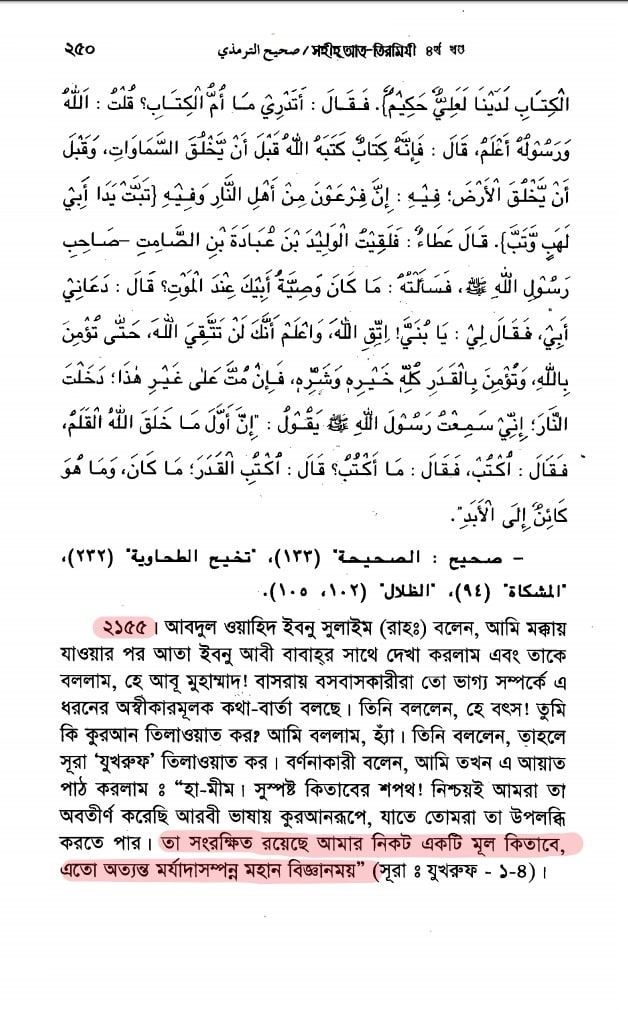
Abdul-Wahid bin Sulaim narrated: I once came to Makkah. There I met Ata ibn Abi Rabah (may Allah have mercy on him).I said to him: O Abu Muhammad, the people of Basra speak in denial of Taqdeer. He said: My dear son, do you recite the Quran? I said: Yes. He said: Then recite Surah al-Zukhruf. I recited:
Ha-Mim. By the clear Book, We have made it a Quran in Arabic so that you may understand. It is with Us in the Mother of the Book; surely it is exalted, full of wisdom (43:1, 2, 3, 4).
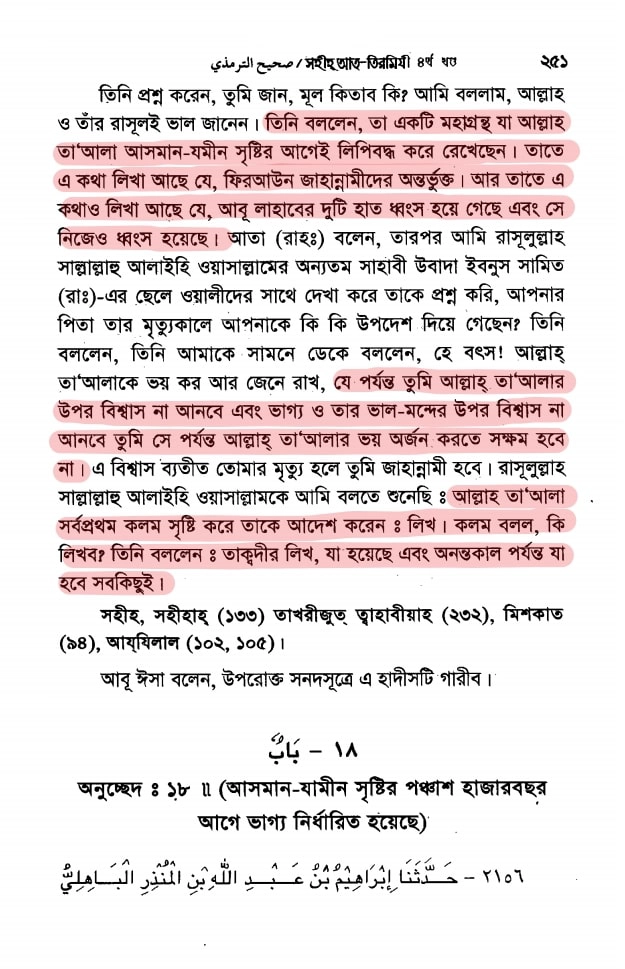
He said: Do you know what the Mother of the Book is? I said: Allah and His Messenger know best. He said: It is a great book,which Allah recorded before creating the heavens and before creating the earth In it is recorded that Pharaoh is among the people of Hell, and in it is recorded: تَبَّتْ يَدَا أَبِي لَهَبٍ وَتَبَّ — Perished are the hands of Abu Lahab, and perished is he himself.
Ata (may Allah have mercy on him) said: I met Walid (may Allah have mercy on him), the son of Ubadah ibn al-Samit (may Allah be pleased with him), one of the Companions of the Messenger of Allah (peace and blessings be upon him). I asked him: What testament did your father make at the time of his death?
He said: He called me close to him and said: My dear son, fear Allah. Know that you will never attain fear of Allah until you believe in Allah and believe in all of Taqdeer, both its good and its bad. If you die in any condition other than this, you will have to enter Hell. I heard the Messenger of Allah (peace and blessings be upon him) say: Allah the Exalted created the Pen first. Then He commanded it, “Write.” It said: “What shall I write?” He said: “Write the Taqdeer of everything that has happened and everything that will happen until eternity.” Sahih, Sahih 133, Takhrij al-Tahawiyyah 232, Mishkat 94, al-Zilal 102, 105, Tirmidhi Hadith number: 2155 (al-Madani Publications)
(Abu Isa said) This hadith is غريب through this chain of transmission.
Grade: Sahih (Darussalam)
Let us also look directly at it in the Tirmidhi Sharif book [6] –
Consequences of Disbelief in Divine Decree
Many Muslims do not accept what Islam says about divine decree, or they make up their own claims about it. Yet, if one does not believe in this extremely fundamental matter of Islam exactly as Islam teaches it, one directly commits disbelief [7] [8] –
Reference : Sunan Abi Dawud 4699
In-book reference : Book 42, Hadith 104
English translation : Book 41, Hadith 4682
Chapter : Belief In Divine Decree
Ibn al-Dailami said : I came to Ubayy ibn Ka‘b (RA) and said to him, “A doubt has arisen in my mind about qadar. Please narrate a hadith to me so that, by Allah’s mercy, these doubts and uncertainties about qadar may be removed from my heart.” He said, If Allah the Exalted wished to punish all the inhabitants of the heavens and the earth, He could punish them; He would not thereby be deemed unjust. On the other hand, if He showed mercy to all His creatures, His mercy would be better for them than all their deeds. Therefore even if you gave gold equal to Mount Uhud in Allah’s path, He would not accept it from you, until you believe in qadar and until you believe that whatever has befallen you could never have missed you, and whatever has missed you could never have befallen you. If you die without establishing this belief, you will certainly enter Hell.
Ibn ad-Daylami said: After hearing this narration from Ubayy ibn Ka‘b (RA), I went to the Companion Abdullah ibn Mas‘ud (RA) and asked him. He gave me the same reply. He said: Then I also went to Hudhayfah ibn al-Yaman (RA) and asked him, and he too gave me the same reply. Then I came to Zayd ibn Thabit (RA). He himself mentioned the Prophet (peace and blessings be upon him) by name and told me the same kind of statement. (Ahmad, Abu Dawud, and Ibn Majah)(1)
(1) Sahih: Ahmad 21144, Abu Dawud 4699, Ibn Majah 77.
Grade: Sahih (Al-Albani)
Reference : Jami` at-Tirmidhi 2152
In-book reference : Book 32, Hadith 20
English translation : Vol. 4, Book 6, Hadith 2152
Chapter : Chapters On Al-Qadar
It is narrated from Nafi‘ (may Allah have mercy on him). He said: A man came to Ibn Umar (RA) and said, “So-and-so has sent greetings of peace to you.” In reply, Ibn Umar (RA) said, “I have heard that he has introduced a new doctrine into the religion, meaning that he disbelieves in qadar. If he truly has introduced something new into the religion, then do not convey any greeting from me to him. For I have heard the Messenger of Allah (peace and blessings be upon him) say: In my ummah, or in this ummah, severe punishment from Allah will fall upon some people in the form of the earth swallowing them, their faces being transformed, and stones being rained down upon them; those people will be the deniers of qadar. (Tirmidhi, Abu Dawud, and Ibn Majah; Imam Tirmidhi said: this hadith is hasan sahih gharib)(1)
(1) Hasan: Tirmidhi 2152, Ibn Majah 4061, Abu Dawud 4613.
Grade: Hasan (Darussalam)
The Quran on Divine Decree
Allah Wills First; the Servant’s Will Is Dependent
The Quran, Islam’s sacred scripture, states that human beings cannot will anything without Allah’s will. This means that if someone wishes to commit rape, Allah has certainly willed that wish for him. He cannot form this wish independently of Allah’s will. Likewise, if someone wishes to pray, that too occurs by Allah’s will. Human beings can wish only for what Allah has willed for them.
This means that human will is subordinate to Allah’s will. It means that Allah’s will is independent, while the servant’s will depends on Him. A person cannot even wish for anything without Allah’s permission. In other words, if a person expresses the desire to do something evil, that desire arises because of Allah’s will. Likewise, if a person wishes to perform a good deed, the emergence of that desire is also possible because of Allah’s will. Allah exercises complete control over people’s hearts and feelings, and He decides who will possess the ability to perceive the truth in their hearts. The Quran further states that Allah places a seal on the hearts of some people, causing them to deviate from the path of truth. From the Islamic perspective, everything that occurs in the world is part of Allah’s predetermined plan, which He has written in the Preserved Tablet. Therefore, nothing is possible for human beings outside Allah’s will. Whatever happens, happens by Allah’s will; He guides whomever He wishes to the straight path and leads whomever He wishes astray. No action can be carried out without Allah’s will, and everything that occurs in creation is the result of Allah’s predetermined will and plan. Let us read the Quranic verses on this subject [9] –
Quran reference : Surah At-Takwir, 81:29
Arabic : وَمَا تَشَآءُونَ إِلَّآ أَن يَشَآءَ ٱللَّهُ رَبُّ ٱلۡعَٰلَمِينَ ٢٩
Translation — Dr. Mustafa Khattab, The Clear Quran : But you cannot will ˹to do so˺, except by the Will of Allah, the Lord of all worlds.
Many Muslim preachers frequently misrepresent this matter in Islam, or knowingly and deliberately lie by saying, “The servant’s will and Allah’s will supposedly proceed in parallel!” Yet this is an outright lie. The servant’s will and Allah’s will do not proceed simultaneously in parallel at all. The Quran and hadith state very clearly that Allah had already willed what Abu Lahab would do, even before Abu Lahab’s will—let alone his birth—existed [5]. Let us understand the matter through a diagram,
Allah Seals Hearts or Grants Guidance
Allah has stated very clearly in the Quran that He seals the hearts of some people, closes their ears, and covers their eyes with a veil. As a result, they cannot learn about or understand Islam. Consequently, they become unbelievers. Now, if Allah seals the heart of an atheist like me, and as a result I cannot perceive the truth of Islam, who is actually responsible for this? [10] –
Quran reference : Surah Al-Baqarah, 2:7
Arabic : خَتَمَ ٱللَّهُ عَلَىٰ قُلُوبِهِمۡ وَعَلَىٰ سَمۡعِهِمۡۖ وَعَلَىٰٓ أَبۡصَٰرِهِمۡ غِشَٰوَةٞۖ وَلَهُمۡ عَذَابٌ عَظِيمٞ ٧
Translation — Dr. Mustafa Khattab, The Clear Quran : Allah has sealed their hearts and their hearing, and their sight is covered. They will suffer a tremendous punishment.
Believing Is Impossible Without Allah’s Will
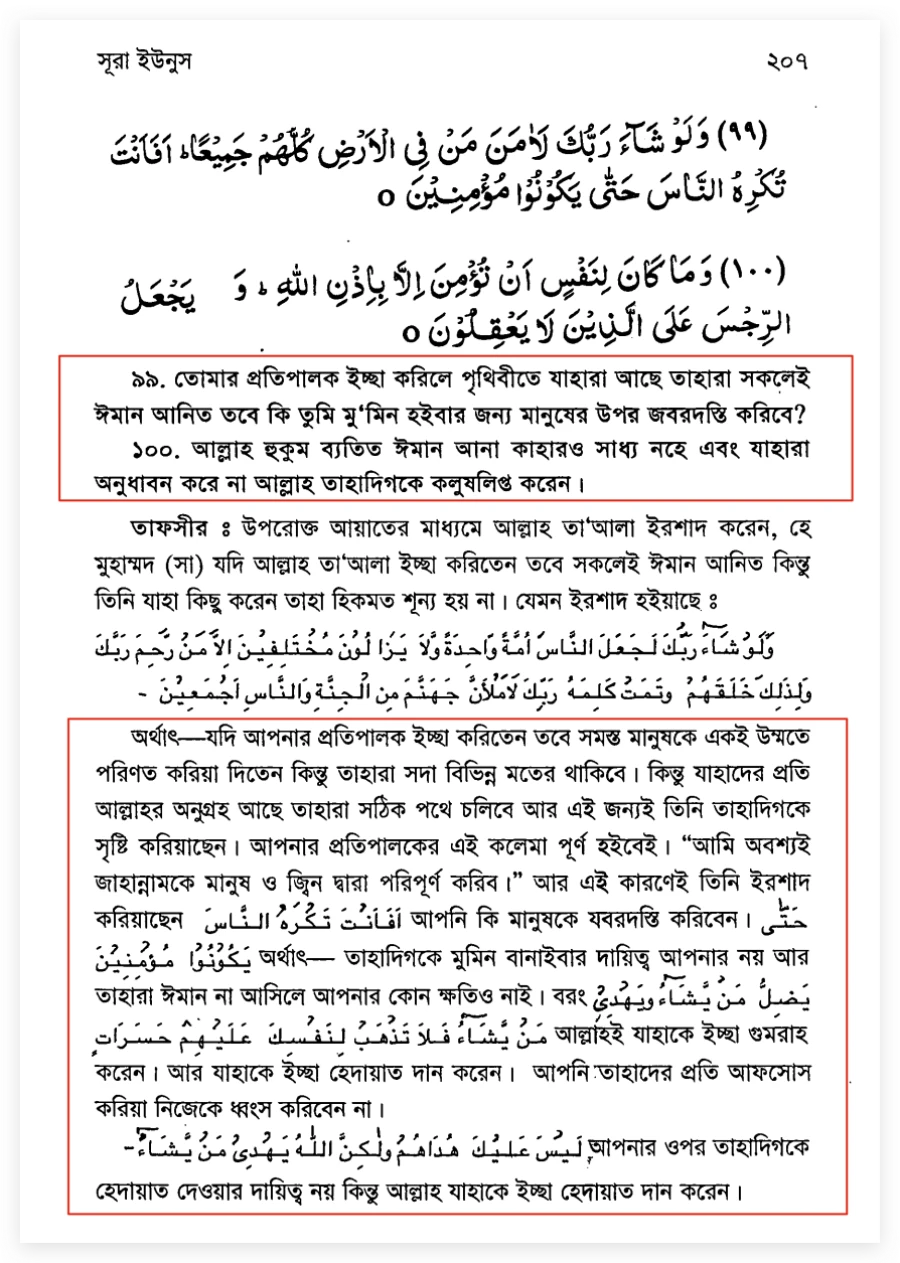
What is stated about this in Surah Yunus is that, regarding belief in Islam, a person’s own willingness or unwillingness actually depends on Allah’s “permission” or “enabling grace.” Therefore, no one can become a believer unless Allah grants permission. If Allah does not grant someone that permission, that person is compelled to disbelieve. [11]
Quran reference : Surah Yunus, 10:100
Arabic : وَمَا كَانَ لِنَفۡسٍ أَن تُؤۡمِنَ إِلَّا بِإِذۡنِ ٱللَّهِۚ وَيَجۡعَلُ ٱلرِّجۡسَ عَلَى ٱلَّذِينَ لَا يَعۡقِلُونَ ١٠٠
Translation — Dr. Mustafa Khattab, The Clear Quran : It is not for any soul to believe except by Allah’s leave, and He will bring His wrath upon those who are unmindful.
Everything Created According to Divine Decree
The Quran states that He created everything according to divine decree [12] –
Quran reference : Surah Al-Qamar, 54:49
Arabic : إِنَّا كُلَّ شَيۡءٍ خَلَقۡنَٰهُ بِقَدَرٖ ٤٩
Translation — Dr. Mustafa Khattab, The Clear Quran : Indeed, We have created everything, perfectly preordained.
Allah Almighty knows about every kind of good event, calamity, misfortune, and turmoil that occurs in this world before it happens, and He has determined each one with certainty and written it in the Preserved Tablet. Every Muslim is obligated to believe this. The Quran states [13] –
Quran reference : Surah Al-Hadid, 57:22
Arabic : مَآ أَصَابَ مِن مُّصِيبَةٖ فِي ٱلۡأَرۡضِ وَلَا فِيٓ أَنفُسِكُمۡ إِلَّا فِي كِتَٰبٖ مِّن قَبۡلِ أَن نَّبۡرَأَهَآۚ إِنَّ ذَٰلِكَ عَلَى ٱللَّهِ يَسِيرٞ ٢٢
Translation — Dr. Mustafa Khattab, The Clear Quran : No calamity ˹or blessing˺ occurs on earth or in yourselves without being ˹written˺ in a Record before We bring it into being. This is certainly easy for Allah.
Allah’s Will Is Independent, Not Dependent
According to Islam, every Muslim must believe that nothing occurs outside Allah’s will, whether it concerns Allah’s actions or the actions of created beings. Allah determines whatever He wills and chooses whomever He wills. Allah is dependent on no one and is in need of no one in any matter. He acts independently as He pleases and is accountable to no one. He does not will anything based on dependence upon His servants. The Quran states [14] –
Quran reference : Surah Al-Qasas, 28:68
Arabic : وَرَبُّكَ يَخۡلُقُ مَا يَشَآءُ وَيَخۡتَارُۗ مَا كَانَ لَهُمُ ٱلۡخِيَرَةُۚ سُبۡحَٰنَ ٱللَّهِ وَتَعَٰلَىٰ عَمَّا يُشۡرِكُونَ ٦٨
Translation — Dr. Mustafa Khattab, The Clear Quran : Your Lord creates and chooses whatever He wills—the choice is not theirs. Glorified and Exalted is Allah above what they associate ˹with Him˺!
Allah further says that He does or brings about whatever He wills. The Quran states [15] –
Quran reference : Surah Ibrahim, 14:27
Arabic : يُثَبِّتُ ٱللَّهُ ٱلَّذِينَ ءَامَنُواْ بِٱلۡقَوۡلِ ٱلثَّابِتِ فِي ٱلۡحَيَوٰةِ ٱلدُّنۡيَا وَفِي ٱلۡأٓخِرَةِۖ وَيُضِلُّ ٱللَّهُ ٱلظَّٰلِمِينَۚ وَيَفۡعَلُ ٱللَّهُ مَا يَشَآءُ ٢٧
Translation — Dr. Mustafa Khattab, The Clear Quran : Allah makes the believers steadfast with the firm Word ˹of faith˺ in this worldly life and the Hereafter. And Allah leaves the wrongdoers to stray. For Allah does what He wills.
Allah says that He gives form in the womb as He wills. These matters are entirely subject to His sovereign will. In other words, the countless children who are born in this world with various physical problems are given such forms by Allah Almighty’s deliberate will. The Quran states [16] –
Quran reference : Surah Ali ‘Imran, 3:6
Arabic : هُوَ ٱلَّذِي يُصَوِّرُكُمۡ فِي ٱلۡأَرۡحَامِ كَيۡفَ يَشَآءُۚ لَآ إِلَٰهَ إِلَّا هُوَ ٱلۡعَزِيزُ ٱلۡحَكِيمُ ٦
Translation — Dr. Mustafa Khattab, The Clear Quran : He is the One Who shapes you in the wombs of your mothers as He wills. There is no god ˹worthy of worship˺ except Him—the Almighty, All-Wise.
Allah Almighty also says that no one could do anything if Allah did not will it. The Quran states [17] [18] –
Quran reference : Surah Al-An’am, 6:112
Arabic : وَكَذَٰلِكَ جَعَلۡنَا لِكُلِّ نَبِيٍّ عَدُوّٗا شَيَٰطِينَ ٱلۡإِنسِ وَٱلۡجِنِّ يُوحِي بَعۡضُهُمۡ إِلَىٰ بَعۡضٖ زُخۡرُفَ ٱلۡقَوۡلِ غُرُورٗاۚ وَلَوۡ شَآءَ رَبُّكَ مَا فَعَلُوهُۖ فَذَرۡهُمۡ وَمَا يَفۡتَرُونَ ١١٢
Translation — Dr. Mustafa Khattab, The Clear Quran : And so We have made for every prophet enemies—devilish humans and jinn—whispering to one another with elegant words of deception. Had it been your Lord’s Will, they would not have done such a thing. So leave them and their deceit,
Quran reference : Surah Al-Furqan, 25:2
Arabic : ٱلَّذِي لَهُۥ مُلۡكُ ٱلسَّمَٰوَٰتِ وَٱلۡأَرۡضِ وَلَمۡ يَتَّخِذۡ وَلَدٗا وَلَمۡ يَكُن لَّهُۥ شَرِيكٞ فِي ٱلۡمُلۡكِ وَخَلَقَ كُلَّ شَيۡءٖ فَقَدَّرَهُۥ تَقۡدِيرٗا ٢
Translation — Dr. Mustafa Khattab, The Clear Quran : ˹Allah is˺ the One to Whom belongs the kingdom of the heavens and the earth, Who has never had ˹any˺ offspring, nor does He have a partner in ˹governing˺ the kingdom. He has created everything, ordaining it precisely.
Furthermore, according to Islamic belief, the entire universe belongs to Allah Almighty. Therefore, nothing can occur in His kingdom without His knowledge or against His will. The Quran states [19] [20] –
Quran reference : Surah Al-Kahf, 18:17
Arabic : ۞ وَتَرَى ٱلشَّمۡسَ إِذَا طَلَعَت تَّزَٰوَرُ عَن كَهۡفِهِمۡ ذَاتَ ٱلۡيَمِينِ وَإِذَا غَرَبَت تَّقۡرِضُهُمۡ ذَاتَ ٱلشِّمَالِ وَهُمۡ فِي فَجۡوَةٖ مِّنۡهُۚ ذَٰلِكَ مِنۡ ءَايَٰتِ ٱللَّهِۗ مَن يَهۡدِ ٱللَّهُ فَهُوَ ٱلۡمُهۡتَدِۖ وَمَن يُضۡلِلۡ فَلَن تَجِدَ لَهُۥ وَلِيّٗا مُّرۡشِدٗا ١٧
Translation — Dr. Mustafa Khattab, The Clear Quran : And you would have seen the sun, as it rose, inclining away from their cave to the right, and as it set, declining away from them to the left, while they lay in its open space. That is one of the signs of Allah. Whoever Allah guides is truly guided. But whoever He leaves to stray, you will never find for them a guiding mentor.
Quran reference : Surah Al-A’raf, 7:178
Arabic : مَن يَهۡدِ ٱللَّهُ فَهُوَ ٱلۡمُهۡتَدِيۖ وَمَن يُضۡلِلۡ فَأُوْلَٰٓئِكَ هُمُ ٱلۡخَٰسِرُونَ ١٧٨
Translation — Dr. Mustafa Khattab, The Clear Quran : Whoever Allah guides is truly guided. And whoever He leaves to stray, they are the ˹true˺ losers.
Whom Can Satan Lead Astray?
The Quran also states in very clear language that Satan gives people evil suggestions or incites them only with Allah’s permission. He is unable to lead anyone astray without Allah’s permission. The Quran says [21]—
Quran reference : Surah Al-Mujadila, 58:10
Arabic : إِنَّمَا ٱلنَّجۡوَىٰ مِنَ ٱلشَّيۡطَٰنِ لِيَحۡزُنَ ٱلَّذِينَ ءَامَنُواْ وَلَيۡسَ بِضَآرِّهِمۡ شَيۡـًٔا إِلَّا بِإِذۡنِ ٱللَّهِۚ وَعَلَى ٱللَّهِ فَلۡيَتَوَكَّلِ ٱلۡمُؤۡمِنُونَ ١٠
Translation — Dr. Mustafa Khattab, The Clear Quran : Secret talks are only inspired by Satan to grieve the believers. Yet he cannot harm them whatsoever except by Allah’s Will. So in Allah let the believers put their trust.
The hadith states even more clearly that Satan can lead astray only those for whom Allah has decreed Hell [22]—
Reference : Sunan Abi Dawud 4616
In-book reference : Book 42, Hadith 21
English translation : Book 41, Hadith 4599
Chapter : Adherence To The Sunnah
Khalid al-Hadhdha asked al-Hasan about the Quranic verse: “Can lead (any) into temptation concerning Allah, except such as are (themselves) going to the blazing fire.” Al-Hasan replied that it refers to the one whom Allah destined that he should go to Hell.
Arabic : حَدَّثَنَا أَبُو كَامِلٍ ، حَدَّثَنَا إِسْمَاعِيلُ ، حَدَّثَنَا خَالِدٌ الْحَذَّاءُ ، قَالَ قُلْتُ لِلْحَسَنِ { مَا أَنْتُمْ عَلَيْهِ بِفَاتِنِينَ * إِلاَّ مَنْ هُوَ صَالِ الْجَحِيمِ } قَالَ إِلاَّ مَنْ أَوْجَبَ اللَّهُ تَعَالَى عَلَيْهِ أَنَّهُ يَصْلَى الْجَحِيمَ .
Grade: Sahih al-Isnad, Maqtu‘ (Al-Albani)
An Explanation of Divine Decree from Tafsir
Tafsir Ibn Kathir — The Servant Cannot Exercise Will
Now let us read a Quranic verse together with its tafsir [23]
Quran reference : Surah Al-Insan, 76:30
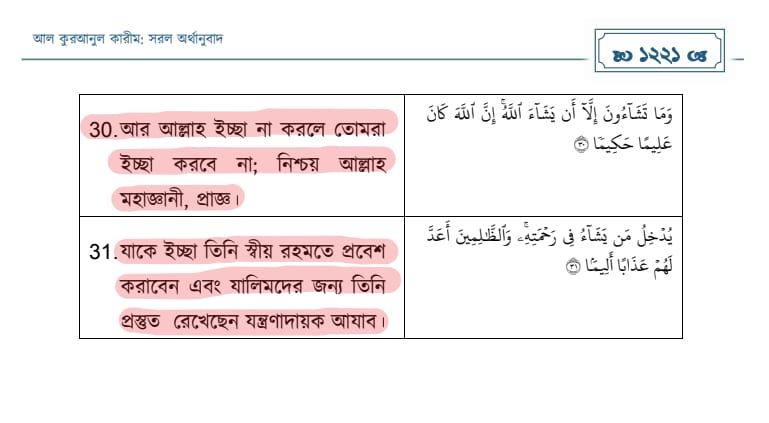
Arabic : وَمَا تَشَآءُونَ إِلَّآ أَن يَشَآءَ ٱللَّهُۚ إِنَّ ٱللَّهَ كَانَ عَلِيمًا حَكِيمٗا ٣٠
Translation — Dr. Mustafa Khattab, The Clear Quran : But you cannot will ˹to do so˺ unless Allah wills. Indeed, Allah is All-Knowing, All-Wise.
Let us also look at the translation by the Al-Bayan Foundation, authenticated by the Saudi government:
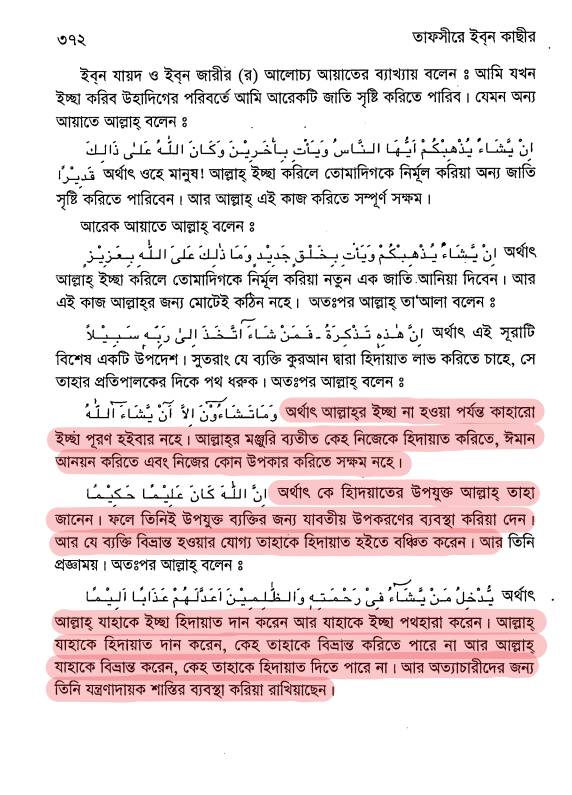
Now let us read the tafsir of this verse from Tafsir Ibn Kathir [24]—
Tafsir Mazhari — The Servant Cannot Exercise Will
Now let us read the tafsir of this verse from another work, [25]—
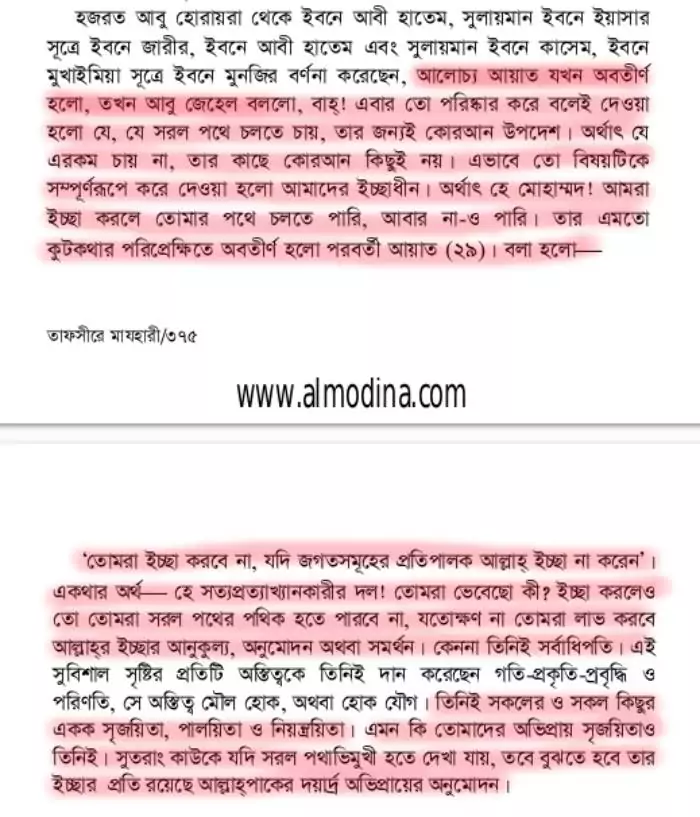
Ibn Abi Hatim, through the chain of Sulayman ibn Yasar; Ibn Jarir, Ibn Abi Hatim, and Sulayman ibn Qasim, through the chain of Ibn Mukhaimiyah; and Ibn al-Mundhir have narrated that when the verse under discussion was revealed, Abu Jahl said, “Ah! It has now been made clear that the Quran is guidance only for the one who wishes to follow the straight path. In other words, to the one who does not wish this, the Quran is nothing. Thus, the matter has been made entirely dependent on our will. In other words, O Muhammad! We may follow your path if we wish, or we may not.” In response to this sophistry of his, the subsequent verse (29) was revealed. It said—
“You will not will unless Allah, the Lord of the worlds, wills.” The meaning of this is: O disbelievers! What have you imagined? Even if you wish, you cannot become followers of the straight path until you receive Allah’s favor, approval, or support for your will. For He is the Supreme Sovereign. He alone has granted motion, nature, growth, and destiny to every existence in this vast creation, whether that existence is elemental or composite. He alone is the sole Creator, Sustainer, and Controller of everyone and everything. He is even the Creator of your intentions. Therefore, if someone is seen moving toward the straight path, it must be understood that Allah the Exalted has approved that person’s will through His compassionate intention.
Tafsir Ibn Kathir — A Person Will Not Receive Guidance Simply by Wishing for It
Now let us read an excerpt from another page of Tafsir Ibn Kathir [26]—
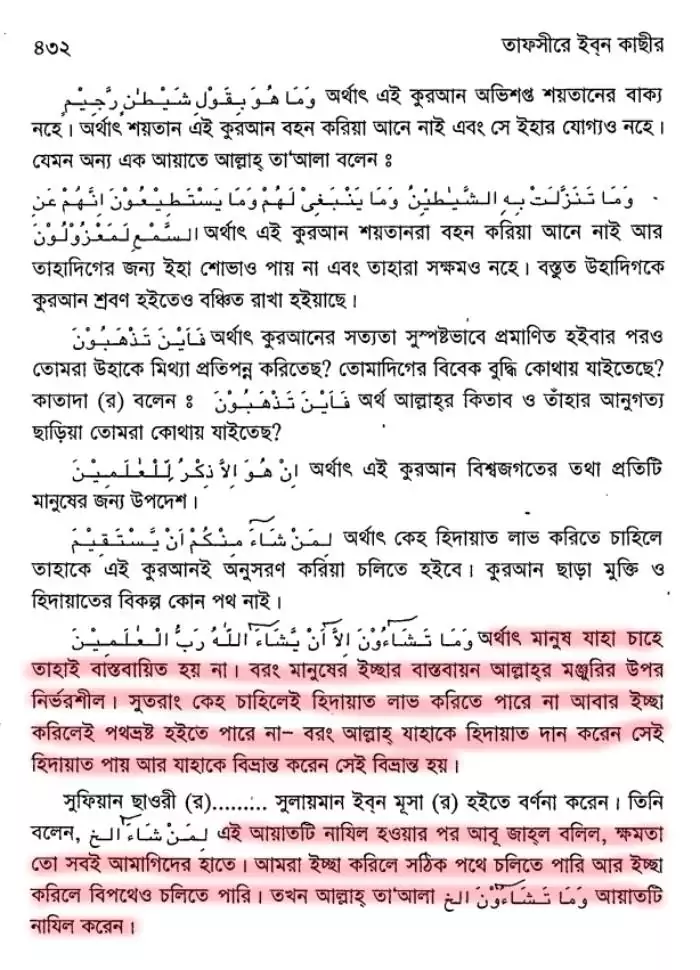
… In other words, whatever a person wishes does not necessarily come to pass. Rather, the realization of a person’s will depends on Allah’s approval. Therefore, a person cannot attain guidance merely by wishing for it, nor can a person become misguided merely by wishing for it. Rather, the one whom Allah guides receives guidance, and the one whom He leads astray becomes misguided. Sufyan al-Thawri (may Allah have mercy on him)……… narrated from Sulayman ibn Musa (may Allah have mercy on him). He said: After this verse was revealed, Abu Jahl said, “All power is in our hands. If we wish, we can follow the right path, and if we wish, we can follow the wrong path.” Then Allah the Exalted revealed [the next verse].
Tafsir Ibn Kathir — Faith Is Impossible Without Allah’s Command
The Quranic verse and its tafsir state very clearly that no person has the ability to believe in Islam without Allah’s permission and will. If this text or interpretive framework is accepted, then a person’s desire to believe or to disbelieve ultimately becomes dependent on Allah, and in no way remains dependent on human free will. Let us look at what the tafsir work says [27]
An Explanation of Divine Decree from Creedal Works
Let us read this passage from a renowned work on creed by Imam Harb al-Kirmani (d. 280 AH) [28]
Creed Regarding Divine Decree
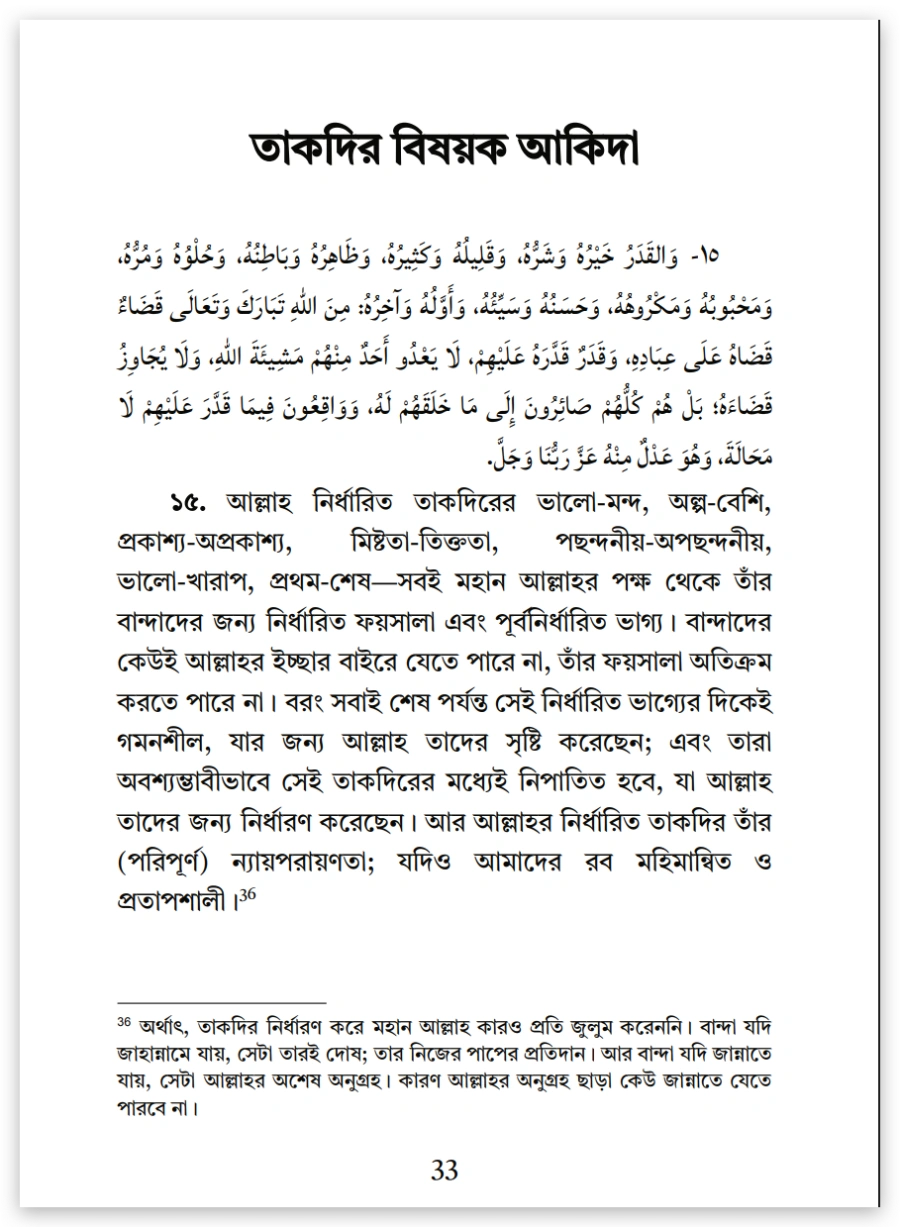
١٥- وَالْقَدَرُ خَيْرُهُ وَشَرُّهُ، وَقَلِيلُهُ وَكَثِيرُهُ، وَظَاهِرُهُ وَبَاطِنُهُ، وَحُلْوُهُ وَمُرُّهُ، وَمَحْبُوبُهُ وَمَكْرُوهُهُ، وَحَسَنُهُ وَسَيِّئُهُ، وَأَوَّلُهُ وَآخِرُهُ: مِنَ اللَّهِ تَبَارَكَ وَتَعَالَى قَضَاءٌ قَضَاهُ عَلَى عِبَادِهِ، وَقَدَرٌ قَدَّرَهُ عَلَيْهِمْ، لَا يَعْدُو أَحَدٌ مِنْهُمْ مَشِيئَةَ اللَّهِ، وَلَا يَتَجَاوَزُ قَضَاءَهُ؛ بَلْ هُمْ كُلُّهُمْ صَائِرُونَ إِلَى مَا خَلَقَهُمْ لَهُ، وَوَاقِعُونَ فِيمَا قَدَّرَ عَلَيْهِمْ لَا مَحَالَةَ، وَهُوَ عَدْلٌ مِنْهُ عَزَّ رَبُّنَا وَجَلَّ.
15. The good and evil, little and much, apparent and hidden, sweet and bitter, desirable and undesirable, good and bad, first and last aspects of the decree Allah has determined—all are decisions and predetermined destinies established by Almighty Allah for His servants. None of the servants can go beyond Allah’s will or surpass His decision. Rather, all of them ultimately move toward the destiny for which Allah created them, and inevitably fall within the decree He determined for them. Allah’s determined decree is His (perfect) justice, although our Lord is Glorious and Majestic.36
36 In other words, by determining the decree, Almighty Allah has not wronged anyone. If a servant enters Hell, it is that person’s own fault and the recompense for their own sins. If a servant enters Paradise, it is due to Allah’s infinite grace. For no one can enter Paradise without Allah’s grace.
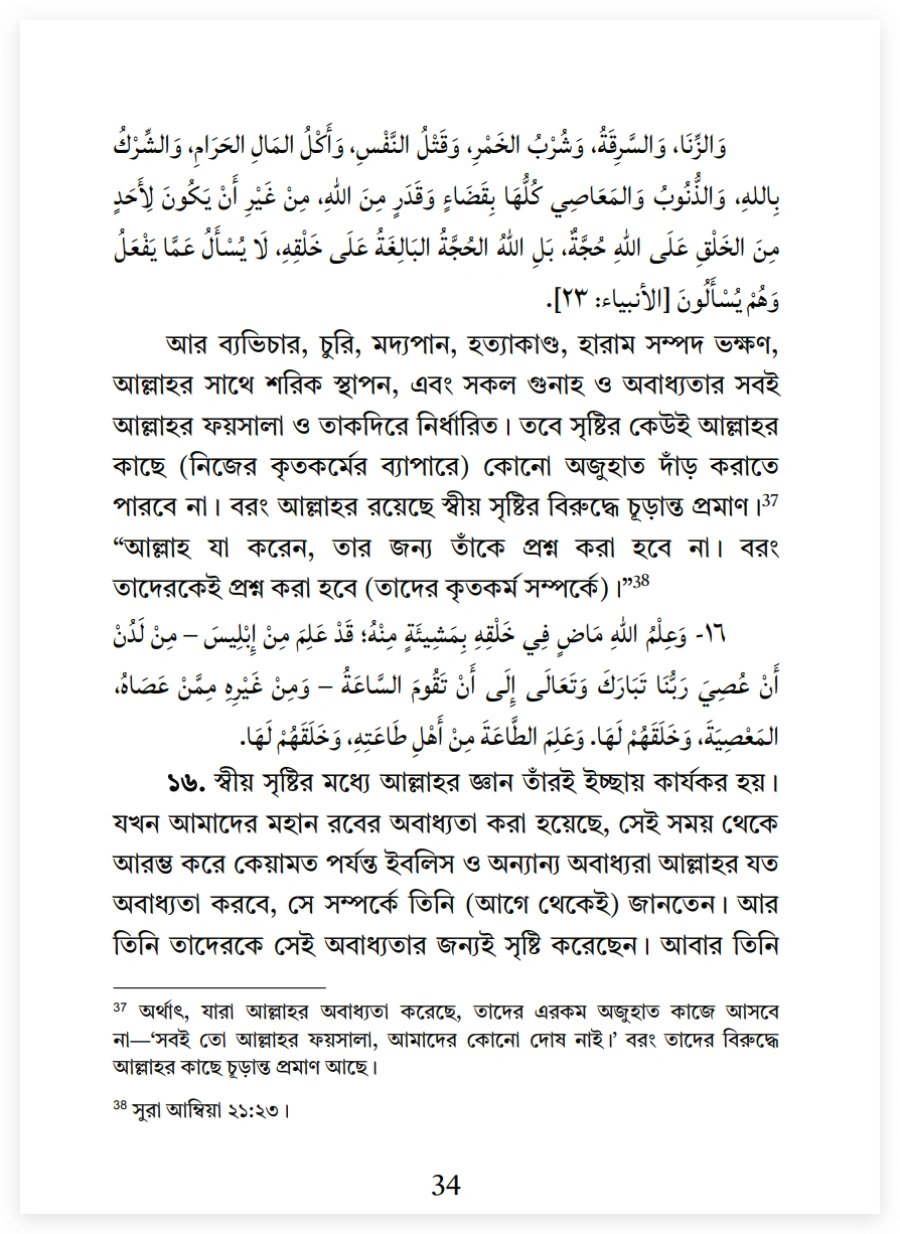
وَالزِّنَا، وَالسَّرِقَةُ، وَشُرْبُ الْخَمْرِ، وَقَتْلُ النَّفْسِ، وَأَكْلُ الْمَالِ الْحَرَامِ، وَالشِّرْكُ بِاللَّهِ، وَالذُّنُوبُ وَالْمَعَاصِي كُلُّهَا بِقَضَاءٍ وَقَدَرٍ مِنَ اللَّهِ، مِنْ غَيْرِ أَنْ يَكُونَ لِأَحَدٍ مِنَ الْخَلْقِ عَلَى اللَّهِ حُجَّةٌ، بَلْ اللَّهُ الْحُجَّةُ الْبَالِغَةُ عَلَى خَلْقِهِ، لَا يُسْأَلُ عَمَّا يَفْعَلُ وَهُمْ يُسْأَلُونَ [الأنبياء: ٢٣].
Adultery, theft, drinking alcohol, murder, consuming unlawful wealth, associating partners with Allah, and all sins and acts of disobedience are all determined by Allah’s decision and decree. However, none of creation can present an excuse before Allah regarding their actions. Rather, Allah possesses the conclusive proof against His creation.37 “He will not be questioned about what He does; rather, they will be questioned about their deeds.”38
37 In other words, those who have disobeyed Allah cannot use the excuse, “Everything is Allah’s decision; we are not at fault.” Rather, Allah has conclusive proof against them.
38 Surah Al-Anbiya 21:23.
١٦- وَعِلْمُ اللَّهِ مَاضٍ فِي خَلْقِهِ بِمَشِيئَةٍ مِنْهُ؛ قَدْ عَلِمَ مِنْ إِبْلِيسَ – مِنْ لَدُنْ أَنْ عُصِيَ رَبُّنَا تَبَارَكَ وَتَعَالَى إِلَى أَنْ تَقُومَ السَّاعَةُ – وَمِنْ غَيْرِهِ مِمَّنْ عَصَاهُ، الْمَعْصِيَةَ، وَخَلَقَهُمْ لَهَا. وَعَلِمَ الطَّاعَةَ مِنْ أَهْلِ طَاعَتِهِ، وَخَلَقَهُمْ لَهَا.
16. Allah’s knowledge operates within His creation by His own will. He knew the disobedience that Iblis and the other disobedient ones would commit—from the time our Exalted Lord was disobeyed until the Day of Resurrection. He created them for that disobedience. He also knew the obedience of those who obey Him, and created them for that obedience.
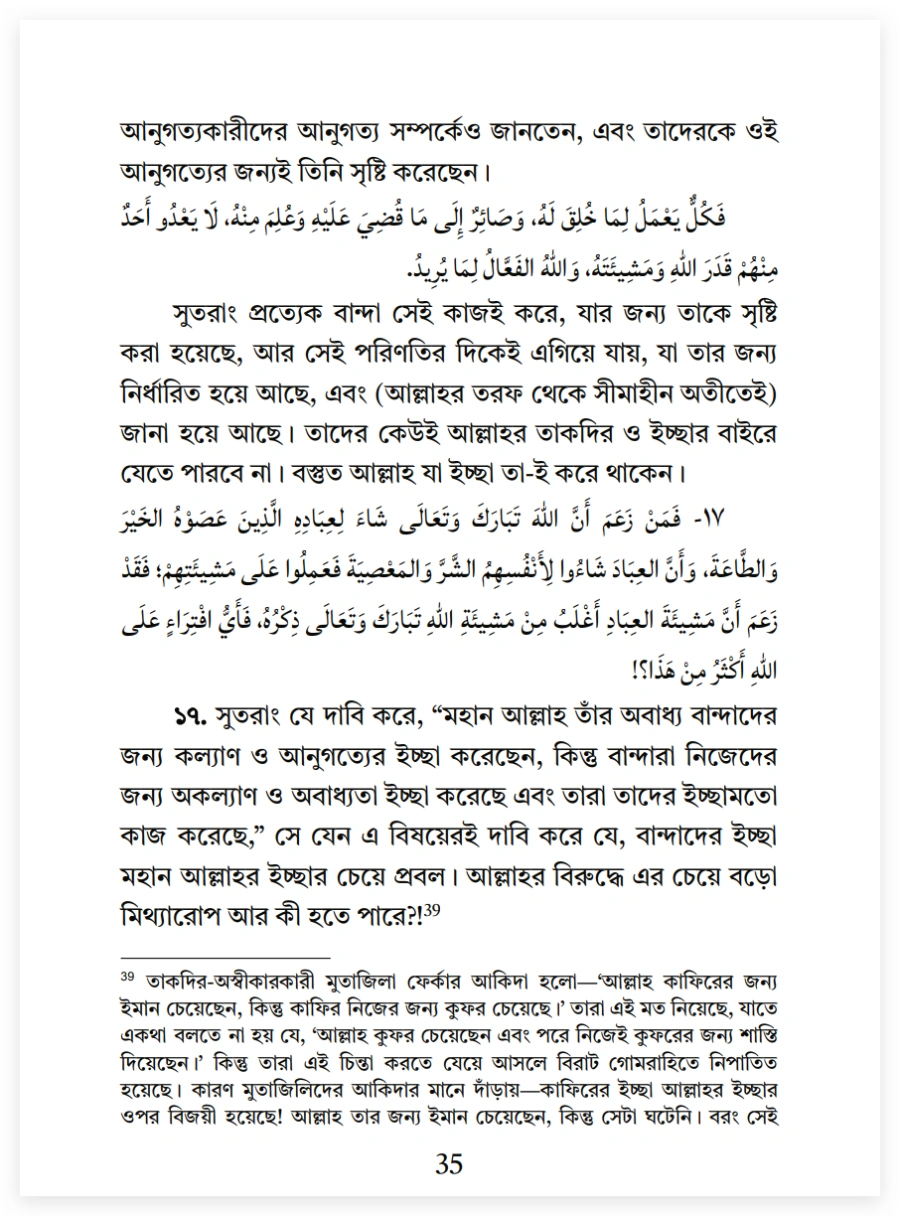
فَكُلٌّ يَعْمَلُ لِمَا خُلِقَ لَهُ، وَصَائِرٌ إِلَى مَا قُضِيَ عَلَيْهِ وَعُلِمَ، لَا يَعْدُو أَحَدٌ مِنْهُمْ قَدَرَ اللَّهِ وَمَشِيئَتَهُ، وَاللَّهُ الْفَعَّالُ لِمَا يُرِيدُ.
Therefore, every servant performs the work for which they were created and moves toward the outcome that has been determined and known for them (by Allah from the limitless past). None of them can go beyond Allah’s decree and will. Indeed, Allah does whatever He wills.
١٧- فَمَنْ زَعَمَ أَنَّ اللَّهَ تَبَارَكَ وَتَعَالَى شَاءَ لِعِبَادِهِ الَّذِينَ قَضَاهُمُ الْخَيْرَ وَالطَّاعَةَ، وَأَنَّ الْعِبَادَ شَاءُوا لِأَنْفُسِهِمُ الشَّرَّ وَالْمَعْصِيَةَ فَعَمِلُوا عَلَى مَشِيئَتِهِمْ؛ فَقَدْ زَعَمَ أَنَّ مَشِيئَةَ الْعِبَادِ أَغْلَبُ مِنْ مَشِيئَةِ اللَّهِ تَبَارَكَ وَتَعَالَى ذِكْرُهُ، فَأَيُّ افْتِرَاءٍ عَلَى اللَّهِ أَكْثَرُ مِنْ هَذَا؟!
17. Therefore, whoever claims, “Almighty Allah willed good and obedience for His disobedient servants, but the servants willed evil and disobedience for themselves and acted according to their own will,” is effectively claiming that the will of the servants is stronger than the will of Almighty Allah. What greater fabrication against Allah could there be than this?!39
39 The creed of the Mu’tazilah, who deny divine decree, is: “Allah wanted faith for the disbeliever, but the disbeliever wanted disbelief for himself.” They adopted this view so that they would not have to say, “Allah wanted disbelief and then punished him for disbelief.” But in thinking this way, they actually fell into great misguidance. The meaning of the Mu’tazilite creed is that the disbeliever’s will prevailed over Allah’s will. Allah wanted faith for him, but it did not happen. Rather, the disbeliever wanted disbelief for himself, and that is what happened! This is one of the worst creeds, for which there is no evidence. Rather, this creed directly contradicts the legal proofs. See: Ibn Abi al-Izz, Sharh al-Aqidah al-Tahawiyyah, vol. 1, p. 321.
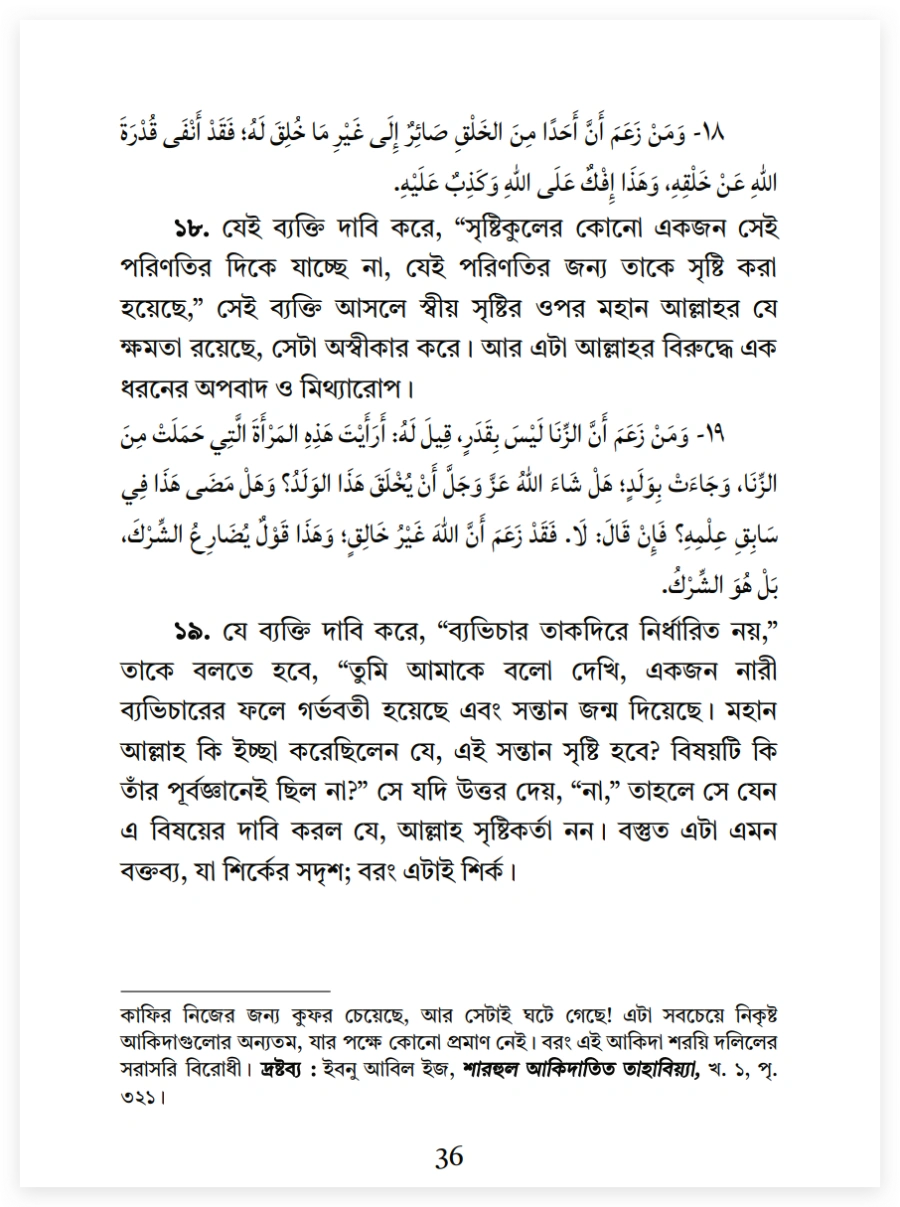
١٨- وَمَنْ زَعَمَ أَنَّ أَحَدًا مِنَ الْخَلْقِ صَائِرٌ إِلَى غَيْرِ مَا خُلِقَ لَهُ؛ فَقَدْ أَلْغَى قُدْرَةَ اللَّهِ عَنْ خَلْقِهِ، وَهَذَا إِفْكٌ عَلَى اللَّهِ وَكَذِبٌ عَلَيْهِ.
18. Whoever claims, “Any member of creation is moving toward an outcome other than the one for which they were created,” is in fact denying the power that Almighty Allah exercises over His creation. This is a false accusation and a lie against Allah.
١٩- وَمَنْ زَعَمَ أَنَّ الزِّنَا لَيْسَ بِقَدَرٍ، قِيلَ لَهُ: أَرَأَيْتَ هَذِهِ الْمَرْأَةَ الَّتِي حَمَلَتْ مِنَ الزِّنَا، وَجَاءَتْ بِوَلَدٍ؛ هَلْ شَاءَ اللَّهُ عَزَّ وَجَلَّ أَنْ يَخْلُقَ هَذَا الْوَلَدَ؟ وَهَلْ مَضَى هَذَا فِي سَابِقِ عِلْمِهِ؟ فَإِنْ قَالَ: لَا، فَقَدْ زَعَمَ أَنَّ اللَّهَ غَيْرُ خَالِقٍ؛ وَهَذَا قَوْلٌ يُضَارِعُ الشِّرْكَ، بَلْ هُوَ الشِّرْكُ.
19. Whoever claims, “Adultery is not part of the decree,” should be asked, “Tell me: a woman became pregnant through adultery and gave birth to a child. Did Almighty Allah will that this child be created? Was this not already within His foreknowledge?” If the person answers, “No,” then they are claiming that Allah is not the Creator. This is a statement resembling polytheism; indeed, it is polytheism.
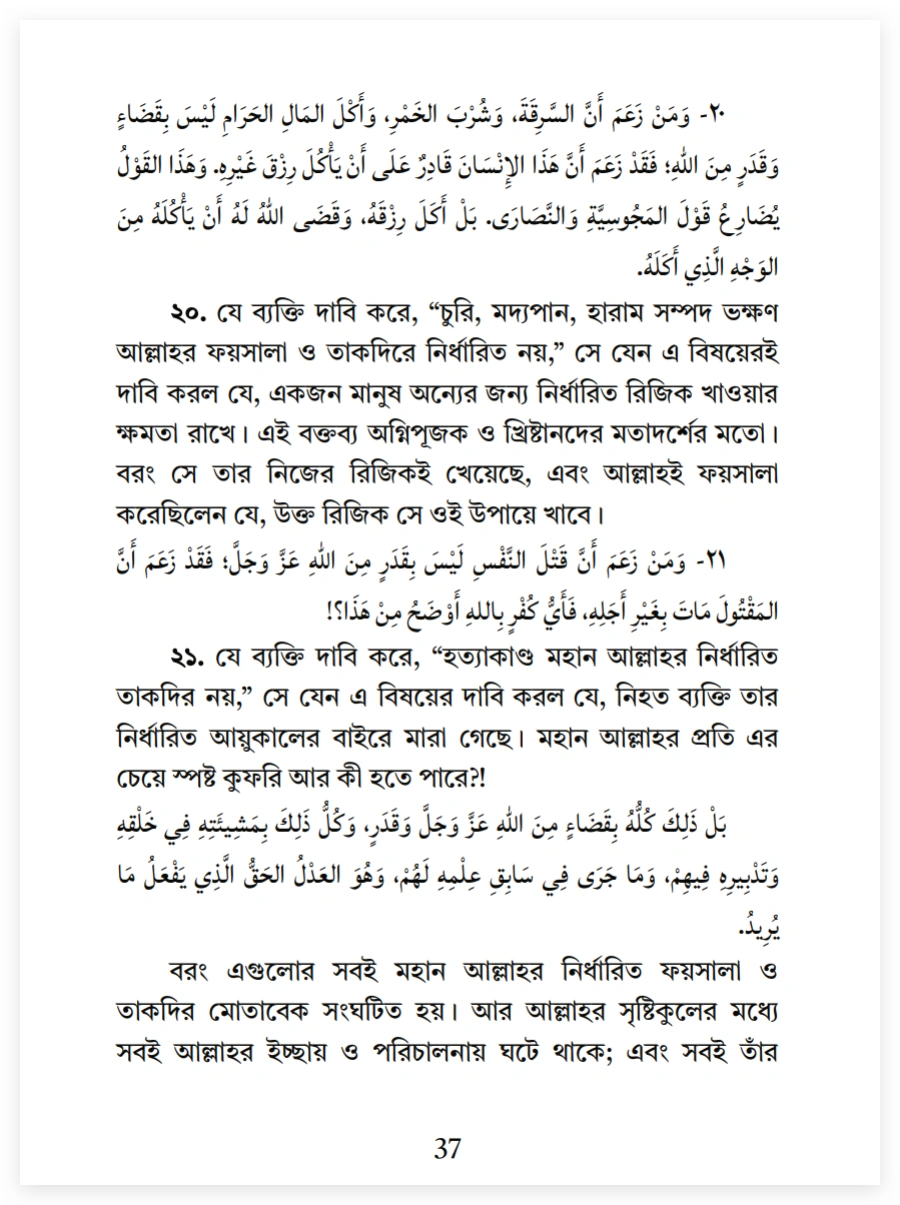
٢٠- وَمَنْ زَعَمَ أَنَّ السَّرِقَةَ، وَشُرْبَ الْخَمْرِ، وَأَكْلَ الْمَالِ الْحَرَامِ لَيْسَ بِقَضَاءٍ وَقَدَرٍ مِنَ اللَّهِ؛ فَقَدْ زَعَمَ أَنَّ هَذَا الْإِنْسَانَ قَادِرٌ عَلَى أَنْ يَأْكُلَ رِزْقَ غَيْرِهِ. وَهَذَا الْقَوْلُ يُضَارِعُ قَوْلَ الْمَجُوسِيَّةِ وَالنَّصَارَى. بَلْ أَكَلَ رِزْقَهُ، وَقَضَى اللَّهُ لَهُ أَنْ يَأْكُلَهُ مِنَ الْوَجْهِ الَّذِي أَكَلَهُ.
20. Whoever claims, “Theft, drinking alcohol, and consuming unlawful wealth are not determined by Allah’s decision and decree,” is effectively claiming that a person has the power to consume the sustenance designated for someone else. This statement resembles the doctrine of the Zoroastrians and Christians. Rather, the person consumed their own sustenance, and Allah had decreed that they would consume it in that manner.
٢١- وَمَنْ زَعَمَ أَنَّ قَتْلَ النَّفْسِ لَيْسَ بِقَدَرٍ مِنَ اللَّهِ عَزَّ وَجَلَّ؛ فَقَدْ زَعَمَ أَنَّ الْمَقْتُولَ مَاتَ بِغَيْرِ أَجَلِهِ، فَأَيُّ كُفْرٍ بِاللَّهِ أَوْضَحُ مِنْ هَذَا؟!
21. Whoever claims, “Murder is not part of the decree determined by Almighty Allah,” is effectively claiming that the murdered person died before or beyond their appointed lifespan. What disbelief in Almighty Allah could be clearer than this?!
بَلْ ذَلِكَ كُلُّهُ بِقَضَاءٍ مِنَ اللَّهِ عَزَّ وَجَلَّ وَقَدَرٍ، وَكُلُّ ذَلِكَ بِمَشِيئَتِهِ فِي خَلْقِهِ وَتَدْبِيرِهِ فِيهِمْ، وَمَا جَرَى فِي سَابِقِ عِلْمِهِ لَهُمْ، وَهُوَ الْعَدْلُ الْحَقُّ الَّذِي يَفْعَلُ مَا يُرِيدُ.
Rather, all of these occur according to Almighty Allah’s decision and decree. Everything among Allah’s creation occurs by Allah’s will and direction, and everything takes place according to His foreknowledge. Despite this, He is the truly Just and the Ultimate Truth, who does whatever He wills.
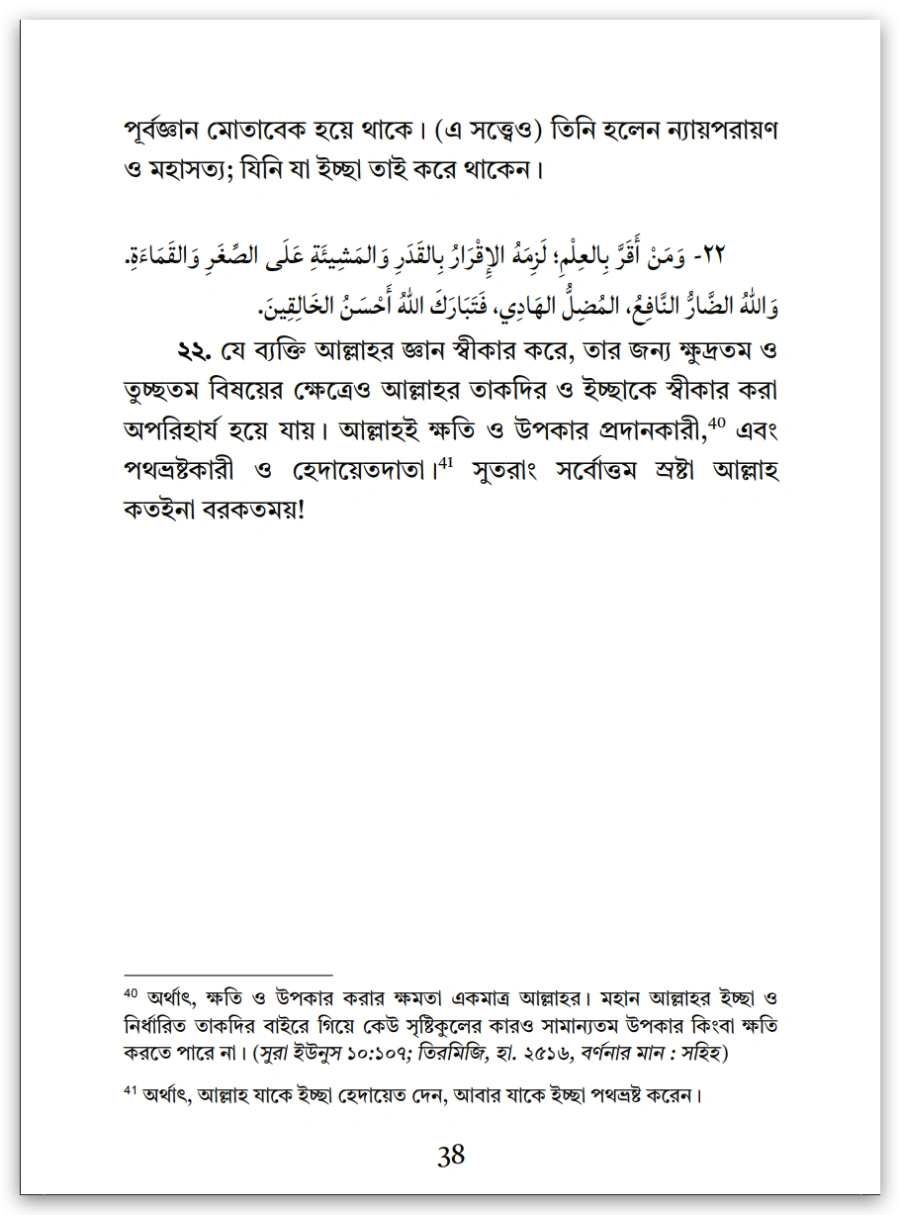
٢٢- وَمَنْ أَقَرَّ بِالْعِلْمِ؛ لَزِمَهُ الْإِقْرَارُ بِالْقَدَرِ وَالْمَشِيئَةِ عَلَى الصِّغَرِ وَالْفَاقَةِ. وَاللَّهُ الضَّارُّ النَّافِعُ، الْمُضِلُّ الْهَادِي، فَتَبَارَكَ اللَّهُ أَحْسَنُ الْخَالِقِينَ.
22. Whoever acknowledges Allah’s knowledge must necessarily acknowledge Allah’s decree and will even with regard to the smallest and most insignificant matters. Allah alone causes harm and provides benefit,40 and He is the One who leads astray and guides.41 How blessed, then, is Allah, the Best of creators!
40 In other words, only Allah possesses the power to cause harm and provide benefit. No one can provide even the slightest benefit or cause the slightest harm to anyone among creation outside Almighty Allah’s will and determined decree. (Surah Yunus 10:107; Tirmidhi, Hadith 2516, grading: Sahih)
41 In other words, Allah guides whomever He wills and leads astray whomever He wills.
Now let us consult the work Aqidah Islamiyyah [29]
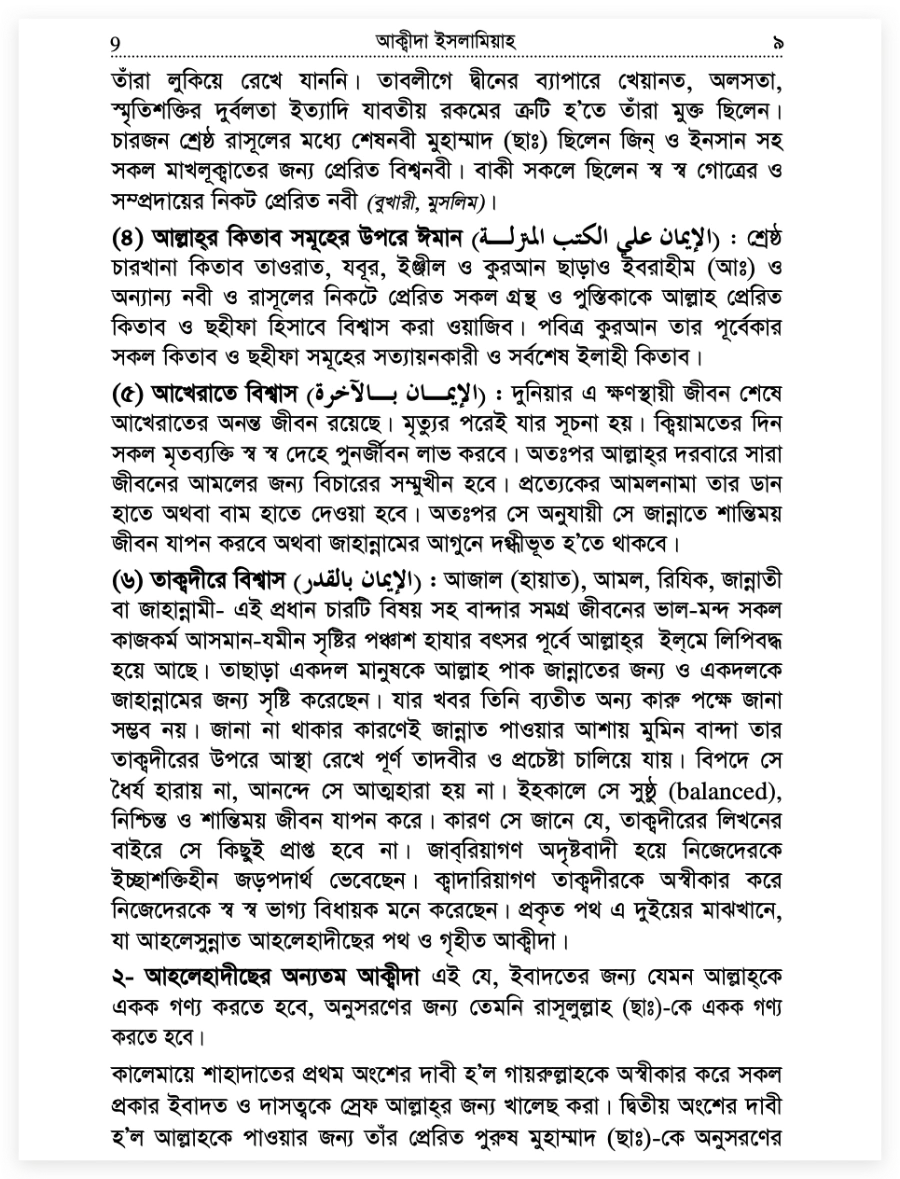
(6) Belief in Divine Decree (الإيمان بالقدر( : The lifespan, deeds, sustenance, and whether a person will enter Paradise
or Hell—along with these four principal matters, all the good and evil deeds of a servant’s entire life have been recorded in Allah’s knowledge fifty thousand years before the creation of the heavens and the earth. In addition, Allah the Exalted created one group of people for Paradise and another group for Hell. No one except Him can know who belongs to which group. It is precisely because they do not know this that believing servants, hoping to attain Paradise, place their trust in their decree while making every effort and taking all necessary measures. They do not lose patience in adversity, nor do they become overwhelmed with joy in happiness. In this worldly life, they live balanced, carefree, and peaceful lives. For they know that they will receive nothing beyond what has been written in their decree. The Jabriyah, adopting a fatalistic view, considered themselves powerless inanimate objects. The Qadariyah denied divine decree and considered themselves the determiners of their own destinies. The true path lies between these two, and this is the path and accepted creed of the Ahl al-Sunnah and Ahl al-Hadith.
The Arguments and Examples of Islamic Preachers
The Shirk-Based Example of the Teacher, Student, and Examination
A familiar analogy used to make divine decree appear “just” is the story of a teacher and an examination. It is said: After teaching for a long time, a teacher can roughly determine whose results will be good and whose will be poor. If, before the examination, the teacher writes in a notebook—“So-and-so will receive an A+, and so-and-so will fail”—and exactly that later happens in the examination, should the teacher be held responsible for the student’s failure? No; because the teacher merely knew or predicted it—he did not cause the student to fail. Thus, “knowing or writing something down beforehand” does not destroy the student’s free will. First, presenting this kind of comparison is considered a serious offense from the perspective of Islam, because such an example directly constitutes shirk: it compares a teacher with Allah. Second, this example creates complications concerning Allah’s exclusive sovereignty over everything.
Analysis and Meaninglessness: Although this analogy is psychologically appealing, it breaks down logically in several places—
The Logical Futility of the Teacher–Student Analogy
Thus, the teacher analogy actually creates a kind of category mistake: it treats limited, information-based human prediction—which may be wrong—as equivalent to omniscient and infallible predetermination—which cannot be wrong. Therefore, although it demonstrates the difference between “knowing beforehand” and “making something inevitable beforehand,” it cannot resolve the central conflict concerning the Creator–Controller and the “real possibility of doing otherwise.”
To understand quickly: Which two things are conflated in this analogy?
- Prediction (may be wrong) versus infallible truth/decree (no possibility of error)
- Observing teacher (not the cause/creator) versus a framework involving creation/control (which also includes the causal chain)
Now let us hear a statement by Dr. Abu Bakr Muhammad Zakaria, in which this purist Salafi scholar states very clearly that the student–teacher example is incorrect in the case of taqdeer, because the teacher knows nothing with certainty, whereas Allah knows everything with certainty and has determined everything beforehand,
Many people also give the example of a game developer or a robot. Using this example, they say that the robot’s programmer creates its code, but the robots can choose an option for a particular task of their own accord. In other words, they intend to suggest that if a robot commits a crime, the code developer or programmer bears no responsibility. The programmer or developer had provided several options, and that particular robot chose a specific option. But this example is also incorrect. Now let us hear a statement by Dr. Abu Bakr Muhammad Zakaria, in which this purist Salafi scholar states very clearly that this example constitutes a gravely erroneous creed in the case of Islam. For Allah does not create many options like a developer and grant the servant the freedom to choose among them,
Now let us look at this diagram,

The Video and Outcome of a Completed Game
Another popular analogy is “a recording of a match watched beforehand.” It is said: suppose you watched a cricket match live once. As a result, you know that the batsman will hit a six on a particular delivery. Now, when you watch the video for a second time, you already know the outcome—does that destroy the batsman’s free will? Is he hitting the six because of your knowledge? No. Therefore, even if Allah knows beforehand, human actions are not “caused by force.”
Subtle analysis: why this analogy produces the opposite result—There are problems at several levels here, and the interesting thing is that if the analogy is understood properly, it instead reinforces precisely the idea that “determination means inevitability.” When Islamic preachers present this analogy, they perform a clever sleight of hand: they say that the player on the video screen still has free will, which is in fact a false statement. For we are not seeing a real person in the video; we are seeing recorded rays of light, which are merely data stored on a device.
In other words, rather than demonstrating “foreknowledge versus causation,” this analogy actually points toward a “fixed script.” But if human beings are placed within such a script, where the outcome is inevitable, then they become like characters in a recording: apparently alive, but effectively without alternative possibilities. It is from this point that the moral question becomes more acute—are punishment and reward then merely “announced rules of the game,” or are they just judgment?
The teacher analogy and the video analogy generally perform the same function: they bring “foreknowledge” to the forefront while concealing “causing by force.” But if taqdeer is not merely a prior conception but infallible prewriting/predetermination—and if the Quran’s language of “written in the record” and “predetermined” is understood in that sense—then these analogies cannot solve the central problem. They either place human prediction—which may be wrong—in the position of divine determination—which cannot be wrong—or use something like a video, “fixed beforehand,” as an example and unintentionally reveal how greatly the space for free will contracts when fixity is present.
To understand quickly: Why is “video” a separate case?
- A video is a preserved frame of an event that occurred in the past.
- In a replay, the character is not in a position to make a new decision “now”—because the scene is already fixed.
- Therefore, “alternative possibilities” (could have done otherwise) cannot easily be established through this analogy.
Did Allah Write It Because the Servant Would Do It?
Recently, many Islamic dais and preachers have regularly made a popular claim—“Allah writes down that the servant will want to or will perform an action based on that. Since Allah knows the future beforehand, He has supposedly only written it down. In other words, what Allah writes depends on human actions.” They use this statement as an argument in favor of intention and free will, as though Allah wrote only on the basis of human actions.
But the traditional, authoritative, and classical position of Islamic aqeedah (creed) is the complete opposite. For centuries, the primary works on creed have clearly stated that nothing in Allah’s writing, knowledge, decision, or taqdeer depends on human actions, decisions, or will. Rather, human actions depend on Allah’s preordained writing. The complete structure of qadar or taqdeer is built upon these four pillars: Allah’s ilm (knowledge), mashiyah (will), kitabah (writing), and khalq (creation); none of these takes human free will as its foundation.
According to the accounts of prominent Islamic scholars, classical interpreters of creed, and renowned experts in hadith and tafsir—
The Inevitable Reality of Islamic Qadar
For this reason, the claim made by some modern da’is—“Allah writes depending on human actions”—is, according to mainstream Islamic creed, a serious distortion and an attempt to mislead ordinary Muslims, in many cases through deliberate falsehood. For if Allah writes depending on people’s future actions, then the concepts of Allah’s foreknowledge, omnipotence, and perfect independence collapse—something that Islamic creed explicitly does not accept.
Thus, in classical Islam, it is Allah’s writing that determines human actions; human actions do not determine Allah’s writing. The actions people will perform occur according to His will, knowledge, and prewritten decree—this has been established as the principal position of Islamic creed for centuries. Let us hear what the scholars have said on this subject,
Let us understand the matter more clearly through a diagram,
“Allah’s writing depends on the servant’s actions” versus “the servant’s actions depend on Allah’s writing”
The claim of some modern da’is on the left; the classical qadar model on the right (Knowledge → Will → Writing → Creation → Human action)The Model Promoted by Some Modern Da’is
Here, Allah’s writing is assumed to be dependent on the servant’s future actions.
The Classical Islamic Qadar Model
Here, all creation and human actions occur through Allah’s knowledge, will, and writing.
- In the model on the left: An attempt is made to present qadar as an ordinary “prediction,” which conflicts with classical evidence.
- In the model on the right: The fundamental creed of Islam (Knowledge → Will → Writing → Creation) is reflected, with Allah’s sovereignty as final.
Qadar: Determined, Infallible, and Unchangeable
According to the correct creed of Islam, qadar is a determined, one-hundred-percent infallible, and unchangeable matter, the knowledge of which is possessed by no human, angel, or jinn. In this section, we will present these matters with evidence and raise logical questions.
Why Did Allah Write It Down?
According to Islamic belief, qadar is that unseen, recorded grand book, plan, or logbook which the Pen wrote in the Preserved Tablet—a record known only to Allah, and which no prophet, messenger, or angel is permitted to know [31] . Verses such as Qur’an 57:22, in Surah al-Hadid, and Qur’an 85:21–22, in Surah al-Buruj, mention this written qadar, stating that before any calamity or fortune occurs on earth, “We have written it down”.
But a fundamental logical question arises here: What is the reason for the omniscient, omnipotent, and infinite Allah writing down this qadar? We human beings generally write things down for two reasons:
For example, an author writes a book so that their thoughts will remain alive even after their death, or the owner of a company writes a will so that their property will be distributed properly. There are countless human reasons why it becomes necessary to write something down, since human beings make mistakes and forget. But these limitations do not exist in Allah’s case! He is All-Knowing (al-‘Alim); His knowledge is infinite and infallible—He never forgets and never needs the assistance of memory. So what is the need for writing it down?
If it is said that this is for the angels or serves as some kind of instruction manual, then the question arises: the angels do not know this written qadar; even principal angels such as Jibril act only according to Allah’s commands, and they have neither the right nor the ability to know what is written in the Preserved Tablet (it is stated in hadith that even the Prophet Muhammad does not possess knowledge of what is written in qadar; he knows only what has been communicated to him). And if the matter concerns an instruction manual or documentation, then for whom is this instruction or documentation intended? For Allah Himself? The angels act according to Allah’s commands, so why would it be necessary to write these things down separately? At the same time, Allah Himself is the supreme judge, and His word is the final proof—no written document is necessary.
Furthermore, Allah is immortal and one; there is no “subsequent Allah” for whom documentation would need to be prepared. This concept of writing things down actually humanizes Allah (attributing human characteristics to Him) (anthropomorphism), which conflicts with Islam’s own doctrine of tawhid—because it portrays Him as a limited being, as though He writes down plans for the future or out of fear of forgetting, just as we do. Logical analysis shows that this is another self-contradictory layer of qadar: if Allah’s knowledge is infinite, then the need for a written record is merely a collection of human-made sophistries that make religious belief even more irrational. A concept is being assumed here that conflicts with the logical principle of non-contradiction—for if “omniscience” is true in the full sense, “the assistance of written memory/records” cannot be presented as a necessary condition for retaining knowledge. Therefore, if “writing in advance” is explained as assistance to memory, the structure of qadar becomes even more unstable, and it appears to be nothing more than an interpretive patchwork created by human beings—something that does not readily fit the concept of omnipotence. This idea of writing things down hints at a kind of “divine bureaucracy,” which may be a legacy of pre-Islamic pagan religious beliefs. In the religious imagination of the ancient Near East, especially after the emergence of literate civilization, descriptions of such a divine scribal entity are frequently found. For example, in Mesopotamian religion, Nabu (Nabu/Nabû) is found as the patron god of writing and scribes; symbolic conceptions such as “the clay tablet and stylus”—that is, the symbolic notion of “writing” fate or destiny—were established as his symbols [32] .
Allah “writes it down” → then gives commands → the angels implement them
According to the Islamic conception, in the Preserved Tablet “everything that will happen is written”; but full access belongs only to Allah—the angels do not act by reading the written record; they act only after receiving Allah’s commands.The idea is that everything that will happen on earth, including any calamity or fortune, has already been “written down.” We imagine this “written” qadar as a kind of grand book or logbook.
It is not that the angels open the Preserved Tablet, “read the qadar,” and then act; they receive instructions or commands from Allah for specific tasks.
Events are implemented according to the commands—whatever they may be, including events, calamities, sustenance, administration, and so on. Here, what effectively causes things to happen is the “command,” not the “record written in the qadar.”
If the “written qadar” is known only to Allah, while the angels act only after receiving Allah’s commands, then what practical role does writing it down actually play? What is its necessity?
- For memory? — An omniscient being has no fear of forgetting and no need to keep notes.
- An instruction manual for the angels? — The angels do not act by reading the written qadar; commands come directly from Allah.
- As testimony or evidence? — Allah Himself is the final judge; “before whom” would a written document be necessary?
- To be left for someone later? — Allah is immortal and one; there is no “subsequent Allah” for whom documentation would be necessary.
At the same time, when it is said that no one has access to this record and that actual actions take place through direct commands, the concept of “recording” logically becomes unnecessary.
Even Intelligence Is Predetermined by Qadar
If human intelligence is included within qadar or predetermined fate, then this conflicts with and is logically inconsistent with Islam’s concept of fairness or justice. The fundamental principle of justice is that each person is responsible for their own actions, and judgment will be based on their free will, with everyone standing on the same level playing field. But if a person’s intelligence is the result of Allah’s predetermined decision, then holding that person responsible for decisions made because of cognitive limitations or a lack of sound judgment is not just.
First, if intelligence is determined by Allah’s will, then why should a less intelligent person, whose powers of reasoning are limited, be punished or reproached if they fail to understand the truth of Islam due to a lack of knowledge and wisdom? From an ethical and justice-based perspective, it is unjust to punish someone for reasons beyond their control. Here a fundamental question arises: if Allah intentionally creates someone without intelligence, is it possible for that person to improve morally or religiously? How could they understand the truth of Islam? As a result, equal opportunities in fulfilling moral and religious obligations become limited, which is contrary to the concept of justice.
Second, this concept runs counter to free will. An important philosophical foundation of Islam is human “free will,” on the basis of which people are held responsible for their actions. But if intelligence and lack of intelligence are predetermined, then that “free will” or freedom of choice does not remain effective. If people are not free and equal in their own thoughts and actions, it is inconsistent to hold them responsible for their decisions.
Consequently, if intelligence is included within Allah’s qadar, it renders Islam’s concept of justice meaningless and destroys the basis for holding people morally responsible. Now let us see what is said in the hadith. It is narrated in the hadith that human intelligence is included within qadar. Let us read the hadith, [33] –
Mishkat al-Masabih (Mishkat)
Part 1: Faith (Belief)
Section: 3. First subsection – Belief in Qadar
80-[2] Narrated by Ibn Umar (RA). He said, The Messenger of Allah (peace and blessings be upon him) said: Everything exists according to Allah’s qadar (predestination/fate), including stupidity and sound judgment. (Muslim)[1]
[1] Sahih: Muslim 2655, Ahmad 5893, Sahih Ibn Hibban 6149, Silsilah al-Ahadith al-Sahihah 861, Sahih al-Jami‘ 4531. Imam Bukhari (RA) also narrated this hadith in Sahih al-Bukhari in the chapter entitled خَلْقُ أَفْعَالِ الْعِبَادً (The Creation of the Actions of the Servants). Some contemporary hadith scholars have mistakenly attributed the hadith exclusively to Imam Muslim. Imam Malik (RA) also included the hadith in his “Muwatta.” Imam Bukhari transmitted this hadith through Imam Malik’s chain of transmission.
Hadith grade: Sahih (Sahih)
Narrator: Abdullah ibn Umar (RA)
Allah Makes People Perform Actions
If Allah makes people perform actions that have already been predetermined, such as the actions of the people of Paradise or the actions of the people of Hell, then this seriously conflicts with Islam’s concept of justice. According to this belief, Allah governs human life through a system in which people have no real control over their actions. Consequently, in this context, Allah’s punishing or rewarding people gives rise to a serious philosophical and ethical contradiction.
First, if Allah determines in advance who will be among the people of Paradise and who will be among the people of Hell, and makes them act accordingly, then the concept of individual free will becomes completely ineffective. According to Islamic belief, every person will be held accountable for their actions. But if those actions are predetermined by Allah and Allah Himself makes them perform them, then how can the individual be held responsible for those actions? For example, if Allah determines in advance that a person is destined for Hell and makes that person perform the actions of the people of Hell, then that person will perform those actions under compulsion. If the Almighty Allah makes someone perform an action, is it possible for any human being not to do it? In this situation, punishing that person is an inconsistent and unjust measure.
Second, this concept creates moral inequality. If Allah determines in advance who will be inhabitants of Paradise and who will be inhabitants of Hell, then some people are born with special advantages, while others are prepared for punishment despite being innocent, and Allah makes them do precisely what He has predetermined. This discriminatory perspective directly contradicts the fundamental principles of Islamic justice, which claim that each person will be judged for their own actions. But when Allah Himself determines their actions and makes them perform them, the judicial process becomes a false promise. Punishment or reward then becomes merely part of a predetermined drama over which the individual has no influence. It is Allah’s will or predetermined qadar that has influence there.
Third, this belief conflicts with Allah’s attributes. From an Islamic perspective, Allah is just, merciful, and possessed of perfect knowledge. But if He determines human actions within a system in which some are predestined for Paradise or Hell and makes them perform the actions that determine their fate, then how can the concepts of mercy and justice be maintained? How can an omnipotent and omniscient Creator guide a person along a path over which they have no control and then punish them for those actions? Now let us read a verse from the Quran. It is stated in the Quran [34] –
Quran reference : Surah Fatir, 35:8
Arabic : أَفَمَن زُيِّنَ لَهُۥ سُوٓءُ عَمَلِهِۦ فَرَءَاهُ حَسَنٗاۖ فَإِنَّ ٱللَّهَ يُضِلُّ مَن يَشَآءُ وَيَهۡدِي مَن يَشَآءُۖ فَلَا تَذۡهَبۡ نَفۡسُكَ عَلَيۡهِمۡ حَسَرَٰتٍۚ إِنَّ ٱللَّهَ عَلِيمُۢ بِمَا يَصۡنَعُونَ ٨
Translation — Dr. Mustafa Khattab, The Clear Quran : Are those whose evil-doing is made so appealing to them that they deem it good ˹like those who are rightly guided˺? ˹It is˺ certainly Allah ˹Who˺ leaves to stray whoever He wills, and guides whoever He wills. So do not grieve yourself to death over them ˹O Prophet˺. Surely Allah is All-Knowing of what they do.
Now let us think about this for a moment. Tell me, if Allah shows me an evil deed as attractive with the intention of leading me astray, then that evil deed will appear good to me, will it not? I will then perform that very evil deed, believing it to be a good deed, because Allah Himself willed it. If Allah had not intended to lead me astray, would it have been possible for a trivial creature like me to go astray?
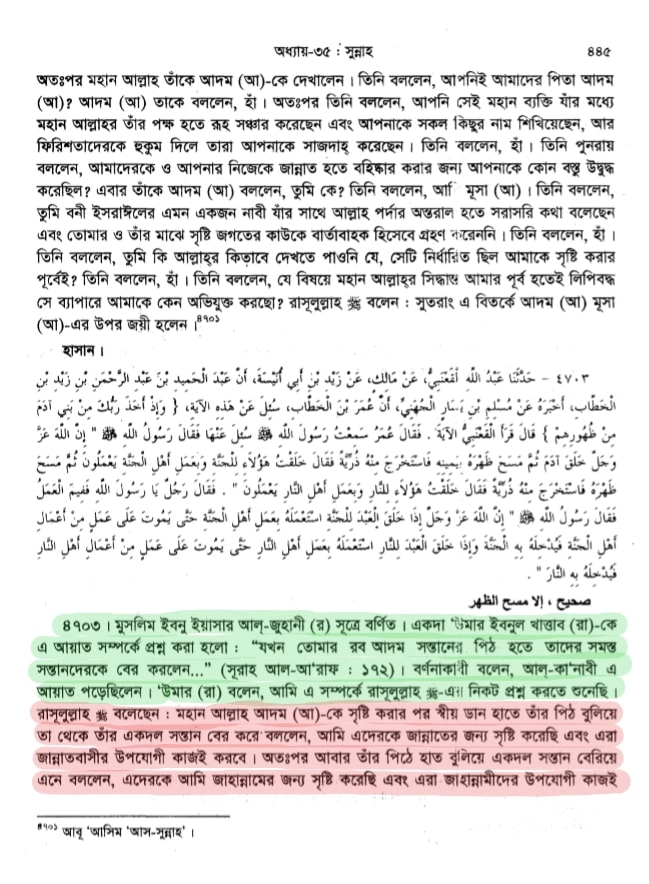
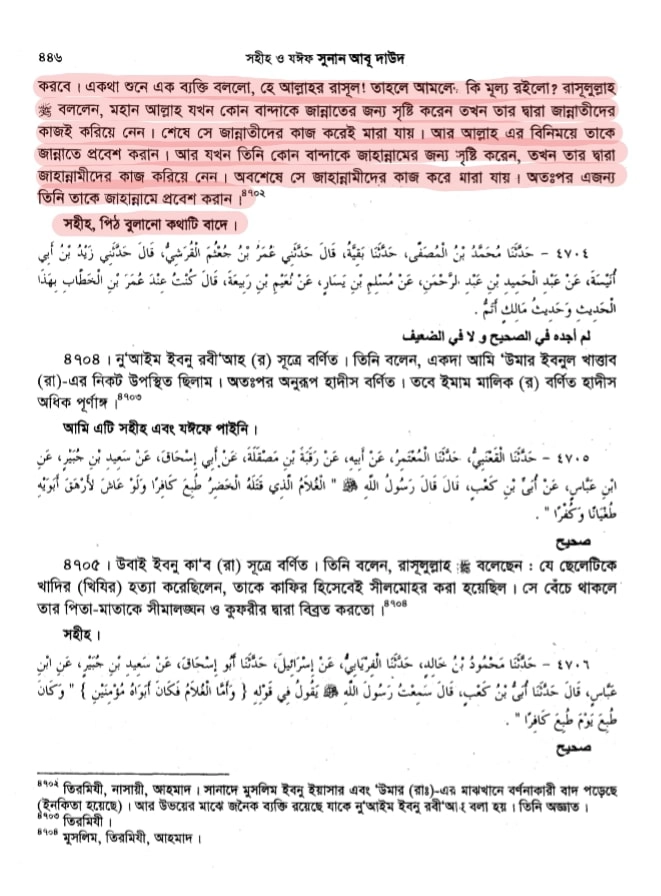
Now let us read a very important hadith. This hadith is not only a sahih hadith from Sunan Abu Dawud Sharif; it is also a sahih hadith authenticated by Muhammad Nasiruddin al-Albani. The hadith states very clearly that Allah had determined everyone’s Paradise or Hell from the very beginning. He did not merely determine it and leave it there; Allah makes the person whom He created for Paradise perform the actions of the people of Paradise, and makes the person who was created for Hell perform the actions of the people of Hell. Now think for a moment: what does this mean? You will find the hadith here [35] [36] –
Reference : Sunan Abi Dawud 4703
In-book reference : Book 42, Hadith 108
English translation : Book 41, Hadith 4686
Chapter : Belief In Divine Decree
Narrated Umar ibn al-Khattab: Umar ibn al-Khattab (RA) was once asked about the verse: “When your Lord took from the backs of the children of Adam all their descendants…” (Surah al-A‘raf: 172). The narrator says that al-Qa‘nabi recited this verse. Umar (RA) said, I heard the Messenger of Allah (peace and blessings be upon him) being asked about this. The Messenger of Allah (peace and blessings be upon him) said: After creating Adam (AS), Allah passed His hand over his back with His right hand, brought out from it a group of his descendants, and said, I created these for Paradise, and they will perform the actions appropriate for the people of Paradise.
Then He again passed His hand over his back, brought out another group of descendants, and said, I created these for Hell, and they will perform the actions appropriate for the people of Hell. Hearing this, a man said, O Messenger of Allah! Then what value do deeds have? The Messenger of Allah (peace and blessings be upon him) said, When Almighty Allah creates a servant for Paradise, He makes that person perform the actions of the people of Paradise. Eventually, that person dies while performing the actions of the people of Paradise, and Allah admits him to Paradise in return. And when He creates a servant for Hell, He makes that person perform the actions of the people of Hell. Eventually, that person dies while performing the actions of the people of Hell, and for this reason He admits him to Hell.(1)
Sahih, except for the phrase about passing the hand over the back.
Grade: Sahih except for the statement concerning passing the hand over Adam’s back (Al-Albani)
Let us examine this hadith from the Muwatta Malik hadith collection, [37] [38]
Book title: Muwatta Malik
Chapter: 46. The Chapter on Qadar
Publisher: Islamic Foundation
Section: 1. Prohibition of disputing concerning Qadar
Narration 2. Narrated from Muslim ibn Yasar al-Juhani (RA): Umar (RA) was asked about the verse (وَإِذْ أَخَذَ رَبُّكَ) (Surah al-A‘raf: 172). He said, I heard that the Messenger of Allah (peace and blessings be upon him) was asked about this matter. He said, Allah created Adam (AS), passed His right hand over his back, then brought out his descendants from Adam’s back and said, I created these for Paradise. They will perform the actions of the people of Paradise. Then He again passed His right hand over his back, brought out some more of his descendants, and said, I created these for Hell. They will perform the actions of the people of Hell. A man exclaimed, O Messenger of Allah! In that case, what benefit is there in performing deeds? The Messenger of Allah (peace and blessings be upon him) said, When Allah creates a servant for Paradise, He makes him perform the actions of the people of Paradise, and when he dies, he dies while performing righteous deeds; then Allah admits him into Paradise. And when He creates a servant for Hell, He makes him perform the actions of the people of Hell. Then He causes him to die while performing evil deeds. And Allah then admits him into Hell.
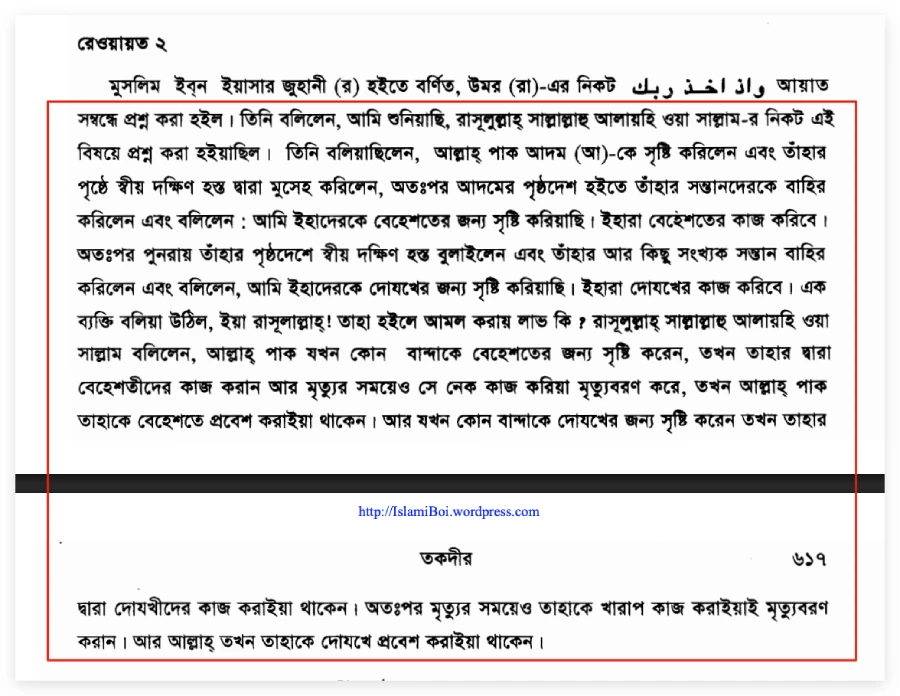
What do these hadiths mean? After creating Adam, Allah brought out the people of Paradise and the people of Hell from his back, which indicates that Allah specifically created some people for Paradise and some people for Hell. What Allah has predetermined, He makes happen, and it is not possible for people to change it [39]
Mishkat al-Masabih (Mishkat)
Chapter: Part 1: Faith (Belief)
Publisher: Hadith Academy
Section: 3. Second subsection – Belief in Qadar
95-(17) Narrated by Muslim ibn Yasar (RA). He said, “Umar ibn al-Khattab (RA) was asked about this Quranic verse: “(O Muhammad!) When your Lord brought forth all their descendants from the backs of the children of Adam” (Surah al-A‘raf 7:172) (…until the end of the verse). Umar (RA) said, I heard the Messenger of Allah (peace and blessings be upon him) being asked about this matter, and in response he said, Allah created Adam (AS). Then He passed His right hand over his back and brought out a group of his (future) descendants from it. Then He said, I created these for Paradise, and they will perform the actions of the people of Paradise. He again passed His hand over Adam’s back, brought out another group of descendants from it, and said, I created these for Hell, and they will perform the deeds of the people of Hell. One of the Companions asked, O Messenger of Allah! Then what need is there for deeds? In response, the Messenger of Allah (peace and blessings be upon him) said, When Allah creates a servant for Paradise, He makes him perform the actions of the people of Paradise. Eventually, he dies while performing the actions of the people of Paradise, and Allah admits him into Paradise. Likewise, when Allah creates one of His servants for Hell, He makes him perform the actions of the people of Hell. Eventually, he dies while performing the actions of the people of Hell, and for this reason Allah admits him into Hell. (Malik, al-Tirmidhi and Abu Dawud)(1)
(1) Sahih: Except for the portion وَمَسَحَ ظَهْرَهٗ. Muwatta Malik 1395, Abu Dawud 4081, al-Tirmidhi 3001; Sahih Sunan Abu Dawud. The narrators in the chain of transmission of this hadith are reliable and are also narrators of Bukhari and Muslim. However, there is a break between Muslim ibn Yasar and Umar in this chain; nevertheless, because the hadith has many supporting narrations, it is sahih. In Sahih Sunan Abi Dawud, al-Albani (RA) declared the hadith sahih except for the portion وَمَسَحَ ظَهْرَهٗ.
Hadith grade: Sahih (Sahih)
Let us also look at the original book [40]
![গ্রন্থের নামঃ মিশকাতুল মাসাবীহ (মিশকাত) হাদিস নম্বরঃ [95] অধ্যায়ঃ পর্ব-১ঃ ঈমান (বিশ্বাস) (كتاب الإيمان) পাবলিশারঃ হাদিস একাডেমি](https://assets.shongshoy.com/2019/09/A9Uc2ei.jpg.webp "Islamic Predestination (Taqdeer): Free Will, Divine Control, and Moral Responsibility 34")
Let us also examine the following hadith [41] –
Reference : Sunan Abi Dawud 4703
In-book reference : Book 42, Hadith 108
English translation : Book 41, Hadith 4686
Chapter : Belief In Divine Decree
Narrated Umar ibn al-Khattab: He said, A man once asked Umar ibn Khattab (RA) about this verse:
إِذْ أَخَذَ رَبُّكَ مِنْ بَنِي آدَمَ مِنْ ظُهُورِهِمْ
That is, remember when your Lord brought forth the descendants of the children of Adam from their backs and took a testimony from them concerning themselves, saying, Am I not your Lord? They said, Indeed, we bear witness. (7:172)
The narrator says: When Qa‘nabi recited this verse, Umar (RA) said: I once heard the Messenger of Allah (peace and blessings be upon him) being asked about this verse. In response, he (peace and blessings be upon him) said: After creating Adam (AS), Almighty Allah wiped his back with His right hand. As a result, many descendants of Adam were created. Then He said: I created these for Paradise. They will perform deeds like the people of Paradise. Then Allah wiped Adam’s back with His hand. As a result, more descendants were created. He said: I created these for Hell. They will perform deeds like the people of Hell. Then a man said: O Messenger of Allah (peace and blessings be upon him)! In that case, what is the need for deeds? The Messenger of Allah (peace and blessings be upon him) said: When Allah creates a servant for Paradise, He makes him perform the deeds of the people of Paradise. Consequently, that person dies while performing deeds like the people of Paradise, and for this reason Allah admits him into Paradise. And when He creates a servant for Hell, He makes him perform deeds like the people of Hell. Consequently, he dies while performing deeds like the people of Hell, and for this reason Allah admits him into Hell.
Grade: Sahih except for the statement concerning passing the hand over Adam’s back (Al-Albani)
Let us read another famous hadith, in which it is stated that every person will perform the action for which they were created, or which was made easy for them [42],
Sahih al-Bukhari (Tawheed Publication)
82/ Qadar
Section: 82/2. The pen has dried in accordance with Allah’s knowledge (after writing).
Allah’s saying: “Allah led him astray knowingly” — (Surah al-Jathiyah 45/23). Abu Hurairah (RA) said, The Prophet (peace and blessings be upon him) told me: The pen has dried after writing what you will encounter (what will happen to you). Ibn Abbas (RA) said, (لَهَا سَابِقُوْنَ) Good fortune has prevailed over them.
6596. Narrated by Imran ibn Husayn (RA). He said, A man said, O Messenger of Allah! Can the people of Paradise be distinguished from the people of Hell? He said: Yes. He said, Then why do those who perform deeds perform them? He said: Every person performs the deed for which he was created. Orthat which has been made easy for him. [7551; Muslim 38/1, Hadith 2649] (Modern Publication- 6136, Islamic Foundation- 6144)
Hadith grade: Sahih (Sahih)
Narrator: Imran ibn Husayn (RA)
Another hadith states that Satan can lead astray only those for whom Allah has made Hell obligatory! Readers themselves will decide what this means [22] –
Reference : Sunan Abi Dawud 4616
In-book reference : Book 42, Hadith 21
English translation : Book 41, Hadith 4599
Chapter : Adherence To The Sunnah
Abu Kamil (RA) …. Khalid al-Hadhdha (RA) said: I asked Hasan (RA) about the meaning of this verse, in which it is stated: Satan cannot lead any of you astray, except the one who will enter Hell. He said: Certainly, Satan will ensnare in his trap of misguidance only the one for whom Allah has made Hell obligatory.
Hadith grade: Sahih (Sahih)
Narrator: Khalid al-Hajja (RA)
Now the question is: if a person commits rape, did Allah determine it in advance, or is that individual deciding to do it?
Human Zina and Adultery Are Predetermined
Will a person commit as much zina and adultery as Allah has written for them? Let us see what the hadith says! [43] [44] [45] [46] [47]
Sahih Muslim (Islamic Foundation)
48/ Qadar
Section: 5. The portion of zina and other acts of the children of Adam that has been predetermined
6513. narrated through Ishaq ibn Mansur (RA) … from Abu Hurairah (RA), from the Prophet (peace and blessings be upon him). He said, Every son of Adam will inevitably receive his share of zina that has been written for him. The zina of the eyes is looking, the zina of the ears is listening, the zina of the tongue is conversation, the zina of the hands is touching, the zina of the feet is walking, and the zina of the heart is desire and longing. The private parts confirm this and refute it.
Hadith grade: Sahih (Sahih)
Narrator: Abu Hurairah (RA)
Sahih Muslim (Islamic Foundation)
48/ Divine Decree
Section: 5. The portion of Adam’s descendants’ adultery, and so forth, has been predetermined
6512. Ishaq ibn Ibrahim and Abd ibn Humayd (may Allah have mercy on them) … Narrated from Abdullah ibn Abbas (RA). He said, “I have not seen anything more closely resembling what Abu Hurayrah (RA) said regarding ‘lamam’ (minor sins).” He said that the Messenger of Allah (peace and blessings be upon him) said: Allah has decreed that every son of Adam will receive the portion of adultery allotted to him, and he will inevitably commit it. The adultery of the two eyes is looking, the adultery of the ears is listening, the adultery of the tongue is speaking, and the heart harbors desire. The private parts either carry it out or disprove it.
Abd ibn Humayd (may Allah have mercy on him), in the narration of Tawus (may Allah have mercy on him), said that he heard this from Ibn Abbas (RA).
Hadith grade: Sahih (Sahih)
Narrator: Abdullah ibn Abbas (RA)
Sahih Muslim (Hadith Academy)
47. Divine Decree
Section: 5. The portion of adultery and other matters allotted to Adam’s descendants
6646-(20/2657) Ishaq ibn Ibrahim and Abd ibn Humayd (may Allah have mercy on them) ….. Narrated from Abdullah ibn Abbas (RA). He said, “I have not seen anything more closely resembling what Abu Hurayrah (RA) said regarding ‘lamam’ (attractive major sins).” He said, “The Messenger of Allah (peace and blessings be upon him) said: Allah has written for every son of Adam a portion of adultery, which he will undoubtedly receive. The adultery of the two eyes is looking; the adultery of the tongue is speaking; the adultery of conversation is speaking with one another; and the adultery of the heart is wishing and desiring. The private parts either confirm it or declare it false.
Abd (may Allah have mercy on him), in the narration of Tawus, said that he heard this from Ibn Abbas (RA). (Islamic Foundation 6512, Islamic Center 6563)
Hadith grade: Sahih (Sahih)
Narrator: Abdullah ibn Abbas (RA)
Sunan Abu Dawud (Verified)
6/ Marriage
Section: 44. Matters regarding which one has been commanded to restrain one’s gaze
2152. Narrated from Ibn Abbas (RA). He said, “I have not seen any hadith concerning minor sins more closely resembling the hadith narrated from Abu Hurayrah (RA) from the Prophet (peace and blessings be upon him). He said: The Almighty Allah has decreed a portion of adultery for every son of Adam, which he will inevitably commit. Thus, looking is the adultery of the eyes, amorous conversation is the adultery of the tongue, desiring to enjoy it is the adultery of the heart, and the private parts turn it into reality or falsehood.(1)
Sahih.
(1). Bukhari, Muslim.
Hadith grade: Sahih (Sahih)
Narrator: Abdullah ibn Abbas (RA)
Mishkat al-Masabih (Mishkat)
Part 1: Faith (Belief)
Section: 3. First section – Belief in Divine Decree
86-(8) Narrated from Abu Hurayrah (RA). He said, “The Messenger of Allah (peace and blessings be upon him) said: The Almighty Allah has written for every son of Adam his portion of adultery, and he will certainly commit it. The adultery of the eyes is looking, and the adultery of the tongue is speaking (sexually arousing words). The heart desires and longs, while the private parts confirm it or prove it false. (Bukhari, Muslim)(1)
However, another narration in Sahih Muslim states: “Whatever portion of adultery has been decreed for Adam’s descendants, each of them will inevitably receive that portion. The adultery of the two eyes is looking; the adultery of the ears is listening to sexually arousing speech; the adultery of the mouth is speaking emotionally arousing words; the adultery of the hands is touching (a non-mahram woman with evil intent); the adultery of the feet is advancing with the intention of committing adultery; and the adultery of the heart is wishing and expecting. The private parts confirm it or prove it false.”(2)
(1) Sahih: Bukhari 6243, Muslim 2657, Abu Dawud 2152, Ahmad 7719, Sahih Ibn Hibban 4420, Irwa 1787, Sahih al-Jami 1797.
(2) Sahih: Muslim 2657.
Hadith grade: Sahih (Sahih)
The Determination of Destiny While the Fetus Is in the Mother’s Womb
While the child is still in the mother’s womb, Allah the Almighty sends an angel who writes down its sustenance, deeds, lifespan, and whether it will be wretched. If the angel writes that a person is a disbeliever, then he will grow up to be a disbeliever. No human being can change the decree written by Allah [48] [49] [50] [51] [52] [53]
Sahih al-Bukhari (Tawhid)
Chapter: 97/ Tawhid
Section: 97/28. The statement of Allah the Almighty: “My word has already gone forth concerning My servants who were sent.” (Surah as-Saffat 37/171)
7454. Narrated from Abdullah ibn Masud (RA). He said, “The Messenger of Allah (peace and blessings be upon him), who was truthful and whose truthfulness was affirmed, narrated to us that the creation of each of you is gathered from a drop of fluid in his mother’s womb for forty days or forty nights. Then, for a similar period, it becomes a clot, and then, for a similar period, it becomes a lump of flesh. Then Allah sends an angel to him. This angel is commanded to write four matters. Thus, the angel writes his sustenance, his deeds, his lifespan, and whether he will be wretched or blessed. Then the soul is breathed into him. Therefore, one of you may perform the deeds of the people of Paradise and advance so far that only a cubit remains between him and Paradise, but the decree written for him overtakes him. He then performs the deeds of the people of Hell and ultimately enters Hell. Again, one of you may perform the deeds of the people of Hell and reach the point where only a cubit remains between him and Hell, but the decree written for him overtakes him. As a result, he performs the deeds of the people of Paradise and ultimately enters Paradise. (3208) (Modern Publications- 6936, Islamic Foundation- 6946)
Hadith grade: Sahih (Sahih)
Sahih al-Bukhari (IFA)
Chapter: 86/ Refutation of the Jahmiyyah’s doctrine and discussion of Tawhid
Section: 3130. The statement of Allah the Almighty: “My word has already been decreed concerning My servants who were sent.” (37:171)
6946. Adam (may Allah have mercy on him) … Narrated from Abdullah ibn Masud (RA). He said, “The Messenger of Allah (peace and blessings be upon him), who was truthful and whose truthfulness was affirmed, narrated to us that the creation of each of you is gathered from a drop of fluid in his mother’s womb for forty days or forty nights. Then, for a similar period, it becomes a clot, and then, for a similar period, it becomes a lump of flesh. Then Allah sends an angel to him. This angel is commanded to record four things. Thus, the angel writes his sustenance, his deeds, his lifespan, and whether he will be blessed or wretched. Then the soul is breathed into him. This is why one of you may perform the deeds of the people of Paradise and advance so far that only a cubit remains between him and Paradise, but the decree written for him overtakes him. He then performs the deeds of the people of Hell and ultimately enters Hell. Again, one of you may perform the deeds of the people of Hell and reach the point where only a cubit remains between him and Hell, but the decree written for him overtakes him. Consequently, he performs the deeds of the people of Paradise and enters Paradise.
Sahih al-Bukhari (Tawhid)
Chapter: 59/ The Beginning of Creation
Section: 59/6. Description of the angels.
3208. Narrated from Zayd ibn Wahb (may Allah have mercy on him). Abdullah (RA) said, “The Messenger of Allah, accepted as truthful, narrated a hadith to us and said, ‘The material of each of your creations remains in the form of a drop of fluid in its mother’s womb for forty days. Then it becomes a clot of blood and remains in that state for forty days. Then it becomes a lump of flesh and remains (as before, for forty days). Then Allah sends an angel.’ The angel is commanded regarding four matters. He is told to record his deeds, his sustenance, his lifespan, and whether he will be sinful or righteous. Then the soul is breathed into him. Thus, one of you may continue performing deeds until he reaches such a stage that only a cubit remains between him and Paradise. At that moment, his record overcomes him, and he performs the deeds of the inhabitants of Hell. Another person may continue performing deeds until he reaches such a stage that only a cubit remains between him and Hell. At that moment, his record overcomes him, and he performs the deeds of the inhabitants of Paradise. (3332, 6594, 7454) (Muslim 47/1, Hadith 3643, Ahmad 3624) (Modern Publications: 2968, Islamic Foundation: 2978)
Hadith grade: Sahih (Sahih)
The Forty Hadith of al-Nawawi
Chapter: 1/ Miscellaneous
Publisher: Islam House
Section: No section
4. Narrated from Abu Abdir-Rahman Abdullah ibn Masud (may Allah be pleased with him). He said—The Messenger of Allah (peace and blessings be upon him)—who was truthful and whose words were accepted as true—told us:
“The creation of each of you begins with being gathered in the form of semen in his mother’s womb for forty days; for the next forty days it remains as a clot of blood; and for the following forty days it remains as a lump of flesh. Then an angel is sent to him, and the spirit is breathed into him,” and the angel is commanded to write four matters: his sustenance, his lifespan, his deeds, and whether he will be blessed or wretched.
By Allah, besides whom there is no true deity, one of you may perform the deeds of the people of Paradise—(1) until only a cubit remains between him and Paradise. At that point, his record takes effect upon him, so he begins performing the deeds of the people of Hell and enters it as a result.
And another of you may begin performing the deeds of the people of Hell until only a cubit remains between him and Hell. At that point, his record takes effect upon him, so he begins performing the deeds of the people of Paradise and enters it.
(Bukhari: 3208, Muslim: 2643) (1) This means that, outwardly, his deeds are regarded by everyone as the deeds of the people of Paradise. In reality, he did not perform the deeds of Paradise, because there was some deficiency in his faith and sincerity. (Editor)
Hadith grade: Sahih (Sahih)
Mishkat al-Masabih (Mishkat)
Chapter: Part 1: Faith (Belief)
Publisher: Hadith Academy
Section: 3. First section – Belief in Divine Decree
82-(4) Narrated from Ibn Masud (RA). He said, “The Messenger of Allah (peace and blessings be upon him), who was truthful and whose truthfulness was affirmed, said: Each of you is created in such a way that, in his mother’s womb, his original substance remains as semen for forty days. Then, for forty days, it takes the form of a red clot of blood. During the following forty days, it takes the form of a lump of flesh. Then Allah sends an angel to write four matters. By Allah’s command, the angel writes in his destiny: (1) his deeds (what deeds he will perform), (2) his death, (3) his sustenance, and (4) whether he will be righteous or wretched. Then the soul is breathed into him. By the One besides whom there is no true deity! One of you may continue performing the deeds of the people of Paradise until only a cubit remains between him and Paradise. At that moment, the decree written for him comes before him, and he begins performing the deeds of the people of Hell and enters Hell. Another of you may begin performing the deeds of the people of Hell until only a cubit remains between him and Hell. At that moment, the decree written for him comes before him, and he begins performing the deeds of the people of Paradise and enters Paradise. (Bukhari, Muslim)(1) (1) Sahih: Bukhari 3208, Muslim 2643, Abu Dawud 4708, Ibn Majah 76, Tirmidhi 2137, Sahih Ibn Hibban 6174, Ahmad 3934.
Hadith grade: Sahih (Sahih)
![গ্রন্থের নামঃ মিশকাতুল মাসাবীহ (মিশকাত) হাদিস নম্বরঃ [82] অধ্যায়ঃ পর্ব-১ঃ ঈমান (বিশ্বাস) (كتاب الإيمان) পাবলিশারঃ হাদিস একাডেমি](https://assets.shongshoy.com/2019/09/7nHYQGw.jpg.webp "Islamic Predestination (Taqdeer): Free Will, Divine Control, and Moral Responsibility 35")
There Is No Punishment in the Grave If One Dies on Friday
Several hadiths state that if a person dies on Friday—that is, on the day of Jumu‘ah—he supposedly does not suffer punishment in the grave. Let us begin by reading the hadiths, [54] [55]
Sunan al-Tirmidhi (Islamic Foundation)
10/ Shrouding and Burial
Section: Death on Friday.
1074. Muhammad ibn Bashshar and Abu Amir al-Aqadi (may Allah have mercy on them) …. Narrated from Abdullah ibn Amr (may Allah be pleased with him). He said, “The Messenger of Allah (peace and blessings be upon him) said,” “Allah the Almighty will protect any Muslim who dies on Friday or on Friday night from the trial of the grave.” – Mishkat 1367, Al-Ahkam 35, Tirmidhi Hadith no.: 1074 [Al-Madani Publications]
Imam Abu Isa (may Allah have mercy on him) said that this hadith is gharib. Its chain of transmission is not connected. Rabi‘ah ibn Sayf narrated this hadith from Abu Abdur-Rahman Hubuli—from Abdullah ibn Amr (may Allah be pleased with him). We do not know of anything that Rabi‘ah ibn Sayf heard directly from Abdullah ibn Amr (may Allah be pleased with him).
Hadith grade: Hasan (Hasan)
Narrator: Abdullah ibn Amr ibn al-As (RA)
Mishkat al-Masabih (Mishkat)
Part 4: Prayer
Section: 42. Third section – The Friday Prayer
1367-[14] Narrated from Abdullah ibn Amr (RA). He said, “The Messenger of Allah (peace and blessings be upon him) said: If a Muslim dies on Friday or on Friday night,” “then Allah the Almighty will protect him from the trial of the grave.” (Ahmad, Tirmidhi; he [Imam Tirmidhi] said that this hadith is gharib and that its chain is not connected.)[1]
[1] Hasan li-ghayrihi: al-Tirmidhi 1074, Ahmad 6582, Sahih al-Targhib 3562. However, Ahmad’s chain is weak.
Hadith grade: Hasan (Hasan)
Now let us hear a statement by Bangladesh’s prominent scholar Ahmadullah on this hadith, in which he explains the hadith and promotes it,
If the above hadiths are placed alongside the Islamic creed’s claim that “Allah alone determines death,” the moral and logical gap within it becomes completely exposed. For the statement that “if one dies on Friday or Friday night, the trial of the grave is forgiven” is not really religious justice; it is a calendar-based lottery of destiny, which Allah Himself determined long ago. A person’s character, right and wrong, harm and benefit, and prevention of injustice are not important here; only one day of the week will determine your fate. If two people lead identical lives, but one dies before Thursday evening, he suffers punishment in the grave, while the other dies shortly afterward—after evening, or on Friday—and is exempted from punishment, that is not justice; it is clock-based predetermined morality. The standard of morality has here been reduced to the scale of minutes and seconds, which is absurd from the standpoint of rational judgment.
An even more frightening problem is that “the time of death” is not in human hands. No one can say with certainty, “I will die on Friday.” “The time of death” is actually beyond every individual’s control. Normally, none of us chooses the day of our own death; the case of a patient in an ICU under exceptional circumstances is different. Therefore, even if this special exemption is true, it is not the result of anyone’s moral effort, piety, repentance, or sense of responsibility; it is a bonus for a preset timestamp. In other words, where the principle of religious reward and punishment is supposed to rest on “moral responsibility,” it has instead been made dependent on the whim of a date. Such an idea does not create morality; rather, it teaches people that superstition of the “auspicious day/inauspicious day” variety, not morality, is what truly matters. It is somewhat like a prepaid phone company’s recharge offer: recharge on Friday and your money doubles! The difference in Islam is that who will recharge and when has already been predetermined by Allah!
The most brutal question arises here: if Allah Himself determines the time of death, then what does it mean to make “dying on Friday” a condition for receiving a special reward? It means that Allah Himself determines the time and then turns that very time into a ticket for exemption. Consequently, the statement ceases to be a “principle of justice” and becomes propaganda for an arbitrary special exemption—a repetition of the hollow phrase “whatever He wishes,” without logic or any standard of fairness.
Human Beings Were Created Precisely for Sin
It is stated in an authentic hadith that if human beings did not commit sins, Allah would remove them and create another nation that would commit sins and seek forgiveness from Allah. In other words, a sinner and one who seeks forgiveness are far more beloved to Allah than people who do not sin. Allah wants His servants to commit more and more sins and seek forgiveness from Him. For if there were no sins, there would be no need to seek forgiveness. The human race will continue to exist only as long as sin exists. If there were no sin, Allah too might face an existential crisis [56] –
Mishkat al-Masabih (Mishkat)
Part 10. The Names of Allah the Almighty
Section: 2. First section – Forgiveness and Repentance
2328-(6) Narrated from Abu Hurayrah (RA). He said, “The Messenger of Allah (peace and blessings be upon him) said: By the One in whose hand is my life! If you did not commit sins, Allah the Almighty would remove you and create a nation that would commit sins and seek forgiveness from Allah the Almighty. Then Allah the Almighty would forgive them. (Muslim)(1)
(1) Sahih: Muslim 2749, Shu‘ab al-Iman 6700, Sahihah 1950, Sahih al-Targhib 3149.
Hadith grade: Sahih (Sahih)
Now let us hear Mizanur Rahman Azhari’s statement on this matter,
Philosophical Problems Related to Divine Decree
Evasion Regarding Divine Decree and the Prohibition of Thinking About It
The Prophet forbade discussion, argument, and debate concerning this extremely important matter of divine decree. He would become intensely angry whenever anyone discussed it. He wanted his followers to believe these matters blindly. To frighten them, he said that discussing the subject would lead to destruction [57].
Sunan al-Tirmidhi (IFA)
Chapter: 35/ Divine Decree
Section: A stern warning against becoming engrossed in discussions about divine decree.
2136. Abdullah ibn Muawiyah al-Jumahi (may Allah have mercy on him) ……. Narrated from Abu Hurayrah (may Allah be pleased with him). He said: The Messenger of Allah (peace and blessings be upon him) came out to us. We were then arguing about divine decree. He became extremely angry. His face became red, as though pomegranates had been squeezed and poured over his temples. He said: “Is this what you were commanded to do? Is this why I was sent to you? Your predecessors were destroyed when they engaged in disputes over this matter. I emphatically tell you, do not engage in debate about this matter.” Hasan, Mishkat 98, 99, Tirmidhi Hadith no.: 2133 (Al-Madani Publications)
Hadiths have also been narrated on this subject from Umar, Aisha, and Anas (may Allah be pleased with them). This hadith is gharib. We know of no account of it except through this chain as a narration of Salih al-Murri. Salih al-Murri has several gharib narrations for which he stands alone.
Hadith grade: Hasan (Hasan)
Narrator: Abu Hurayrah (RA)
Now let us read what is written on this subject in the creed books of Ahl al-Sunnah wa’l-Jama‘ah. Sharh al-Aqidah al-Tahawiyyah is a highly renowned work on creed, whose author is Imam Ibn Abi al-Izz al-Hanafi. In his book, he clearly describes this doctrinal issue in Islam and instructs the entire Muslim community to refrain from acquiring knowledge, investigating, and thinking about it. All scholars agree that thinking about this subject may weaken faith in Islam [58] –
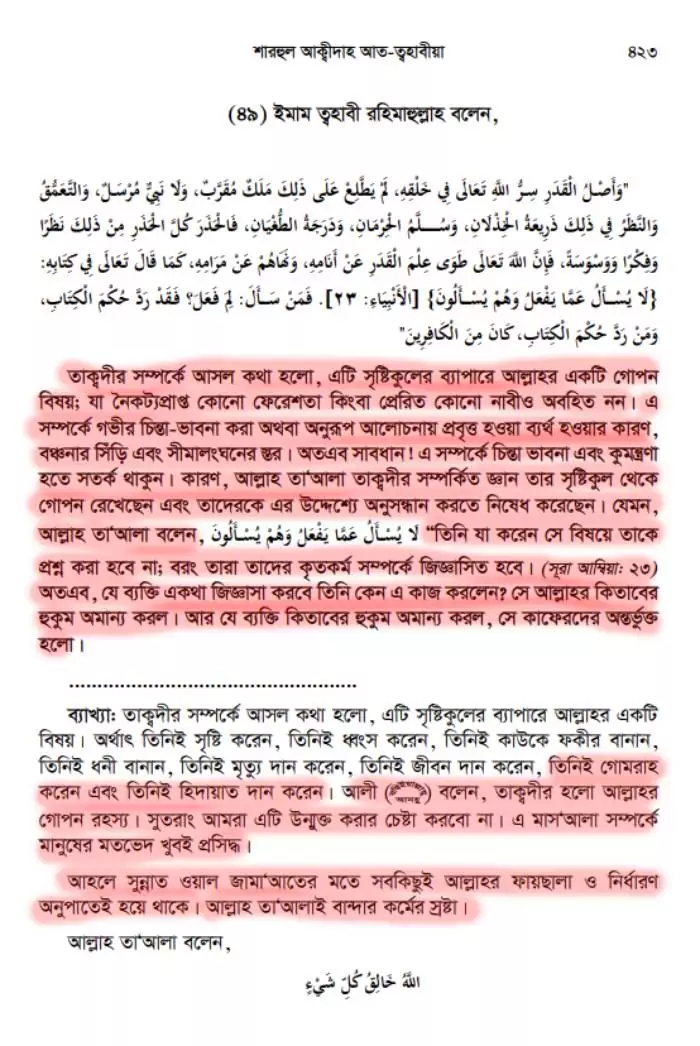
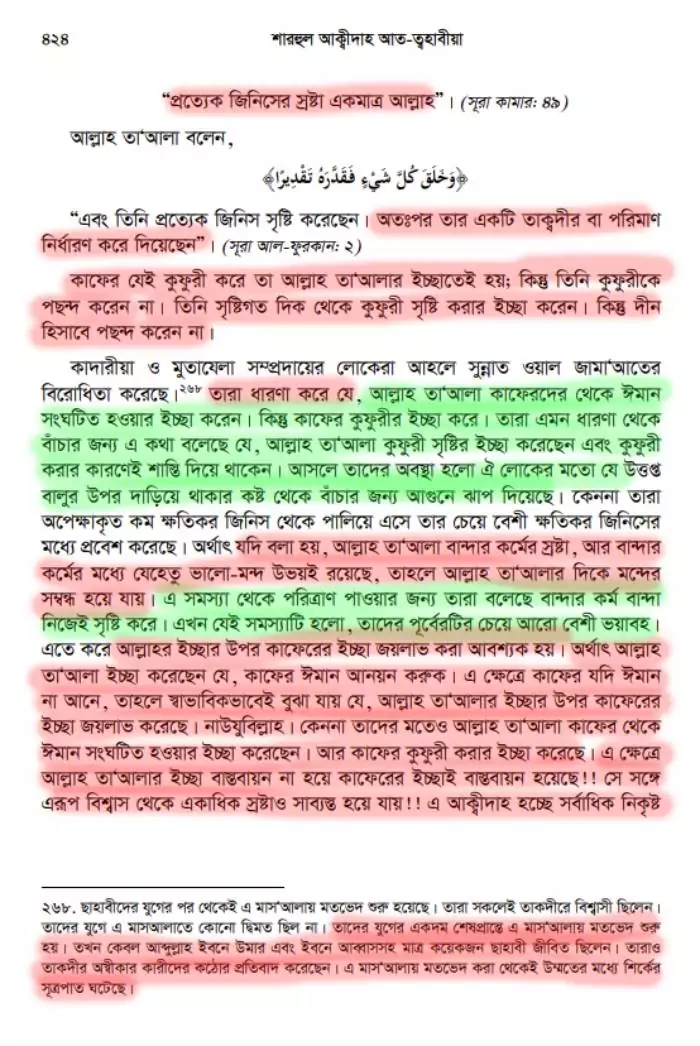
Let us now hear Dr. Abu Bakr Zakaria’s statement about how delving too deeply into predestination is prohibited in Islam.
Free Will versus Everything Being Predetermined
One of the fundamental beliefs of Islam is that every minute detail in predestination has been written and predetermined. To begin, let us hear a statement by Dr. Abu Bakr Zakaria.
Let us hear another discussion.
Now let us read a page from Tafsir Mazhari, [59]
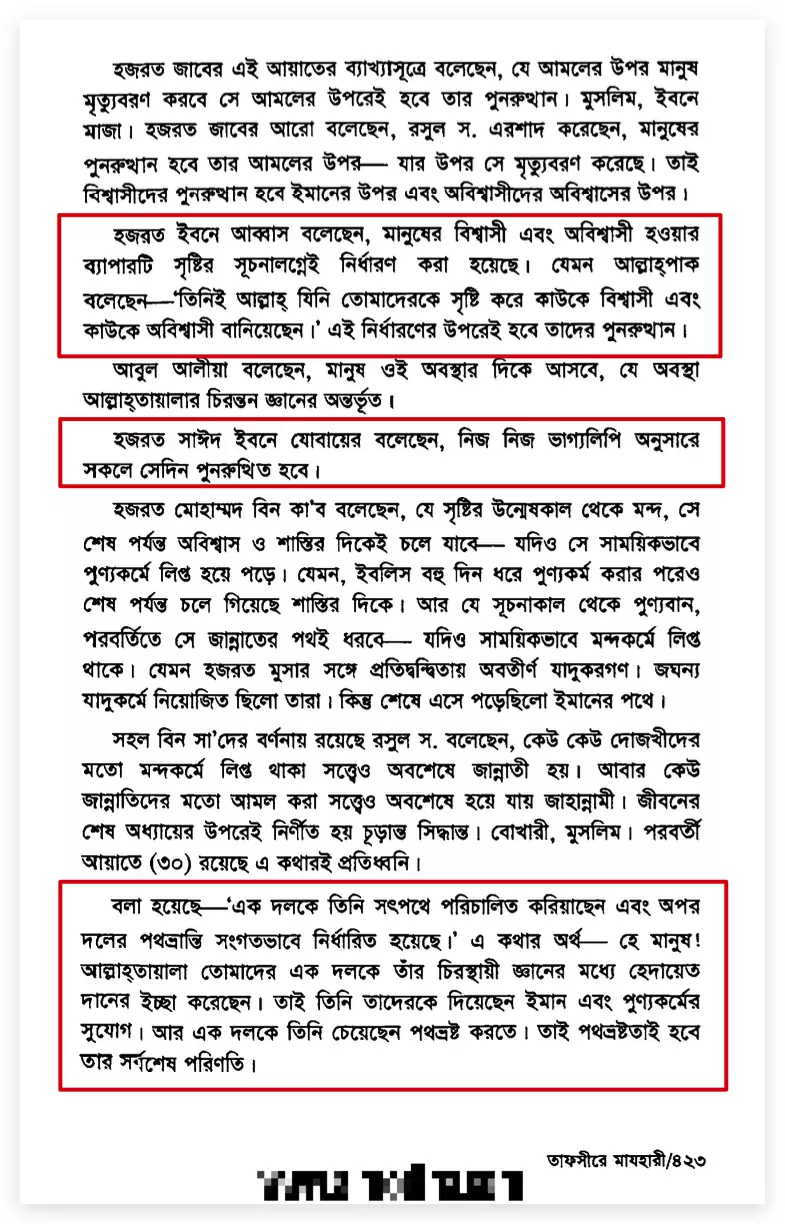
Now let us read another hadith, in which it is stated very clearly that everything was predetermined beforehand [60] –
Sunan at-Tirmidhi (verified edition)
30/ Predestination
Chapter: 3. Fortune and Misfortune
2135. It is narrated from Abdullah ibn Umar (may Allah be pleased with him) that he said, Umar (may Allah be pleased with him) asked, “O Messenger of Allah (peace and blessings of Allah be upon him), what is your view regarding deeds? Are the deeds we perform something newly occurring, or have they already been predetermined?” He said, “O son of al-Khattab! They have already been predetermined. Everyone’s actions have been made easy for them. Those who are among the fortunate will perform the deeds of the blessed, while those who are among the unfortunate will perform the deeds of the wretched.”
Authentic, Zilal al-Jannah (161, 167).
Abu Isa said: Hadiths have also been narrated in this chapter from Ali, Hudhayfah ibn Usayd, Anas, and Imran ibn Husayn (may Allah be pleased with them). This hadith is hasan sahih.
Hadith grade: Sahih (Authentic)
Narrator: Abdullah ibn Umar (may Allah be pleased with him)
Now let us read another hadith, [61]
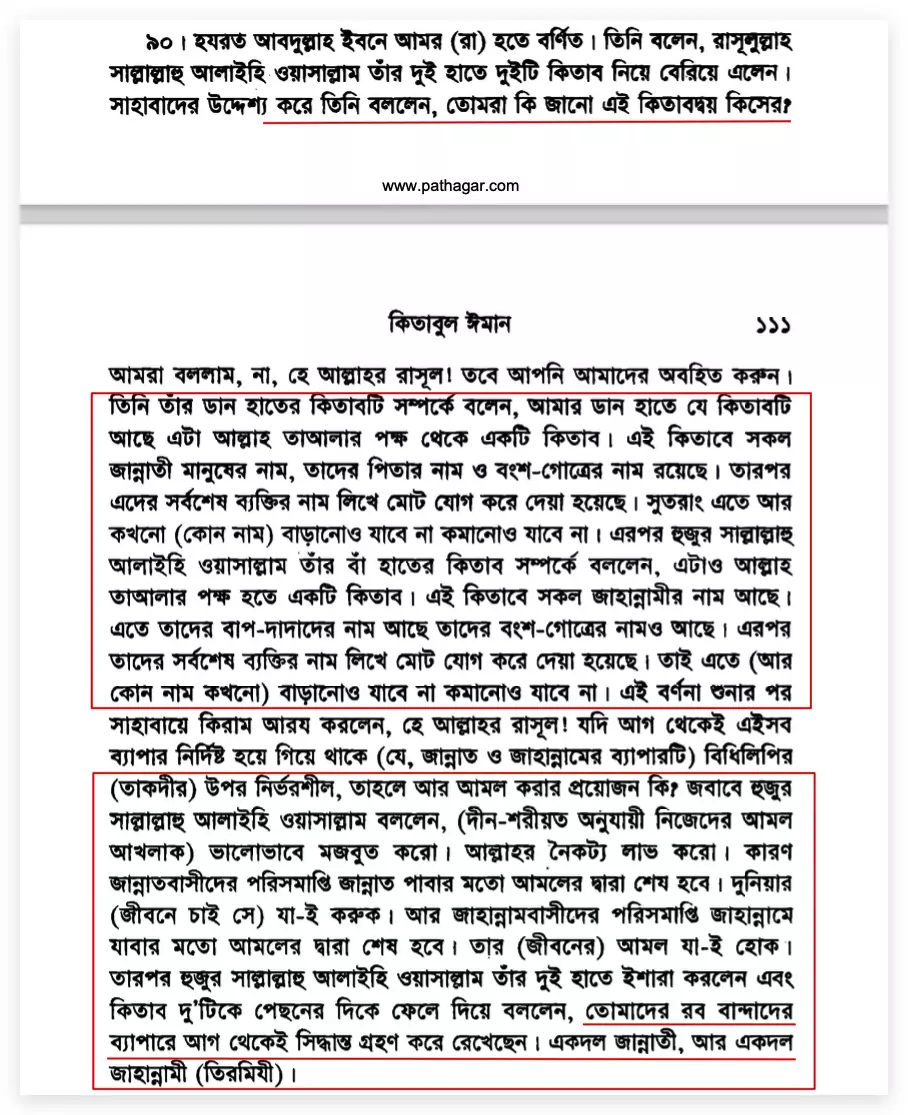
Now let us read another hadith, in which Allah says that He determines the matters of predestination without caring about anyone. Allah declares arrogantly that He does not care about anyone and does whatever He wishes, however He wishes [62]
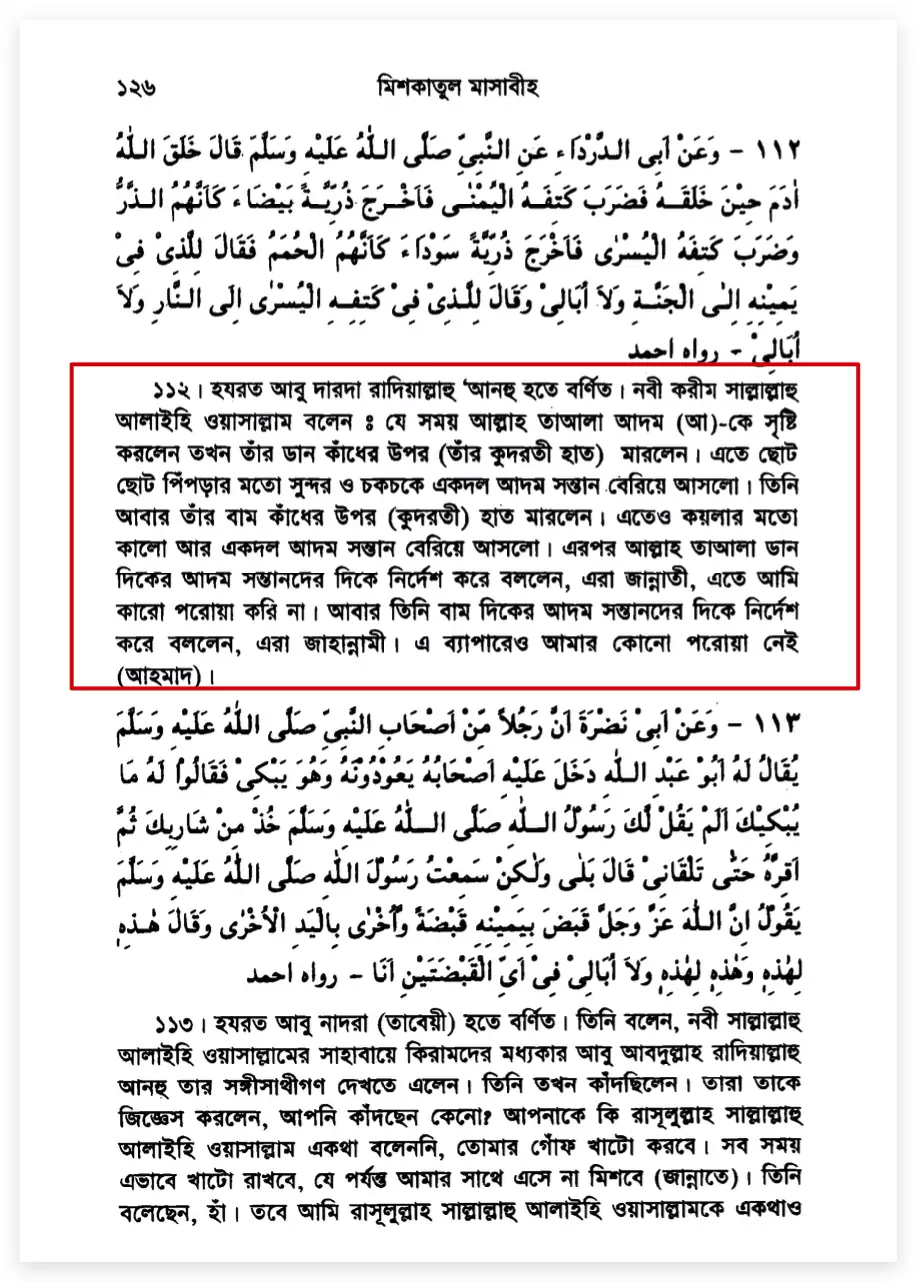
Now let us hear about predestination from Bangladesh’s renowned scholar, Dr. Abu Bakr Zakaria.
Can Humans Do Anything Through Free Will?
This hadith makes the fundamental conceptual contradiction between human free will and predestination in Islamic belief even clearer. It shows that, in the pre-Islamic period, ignorant people attributed every event to predestination—that is, they believed that human actions were controlled not by free will but by some supernatural power. Islam did not merely preserve this idea; it further reinforced it theologically. In other words, it firmly established the same notion held by the ignorant people of earlier times.
In the narration of the hadith, Umar ibn Abd al-Aziz states that this concept of predestination was not a new line of thought; even during the Age of Ignorance, people blamed predestination for their failures. Islam institutionalized this idea and, through the words and hadiths of Muhammad, established predestination as an all-encompassing principle. From this perspective, human beings are no longer autonomous entities but executors dependent on God’s will—their actions, decisions, and even moral inclinations having been predetermined.
At the center of this belief is a form of determinism in which God controls everything and no human action can occur without His will. As a result, the concepts of moral responsibility and free will become questionable. If human beings act only according to a script predetermined by God, then both moral praise and moral condemnation for good or evil conduct become logically incoherent.
Thus, this hadith points to a profound philosophical problem in Islamic thought, which may be called Islam’s “philosophical disaster”—a situation in which the concept of predestination eliminates the concept of human freedom. It represents a form of theological determinism that holds people responsible for immoral actions while denying their effective freedom. In other words, Allah has already decided what He will make them do, has determined it in precise terms, and then makes them perform those actions; afterward, He holds them responsible for those very actions and condemns them to eternal punishment in Hell [63]
Sunan Abu Dawud (verified edition)
35/ Sunnah
Chapter: 7. Calling to Follow the Sunnah
4612. Narrated through Abu al-Salt (may Allah be pleased with him). He said: Once a man wrote to Umar ibn Abd al-Aziz (may Allah have mercy on him), asking him about predestination. In reply, he wrote: “I advise you, therefore, to fear Allah, obey His command in a balanced manner, follow the Sunnah of the Prophet (peace and blessings of Allah be upon him), and abandon the innovations of the innovators after the Prophet’s model had been established and preserved. It is your duty to hold firmly to the Sunnah, for this Sunnah is, by Allah’s permission, a safeguard for you. Know that people have never introduced an innovation without there having previously been evidence established against it or an instruction demonstrating its error. For the Sunnah was established by one who was aware of what contradicted the Sunnah.
“Ibn Fasir did not mention in his narration the words, ‘He knew about their errors, ignorance, and fanaticism.’ Therefore, choose for yourself the path that your righteous predecessors chose for themselves. They possessed complete knowledge of what they had learned, refrained with keen insight, and were well-versed in the religion. They prohibited what they prohibited knowingly and deliberately. They were more knowledgeable than us regarding the meaning of the religion. If your ideology is the correct path, then you have surpassed them. If you claim that they introduced new things into the religion, then say that the earlier people were better and were ahead of these people. They conveyed as much as needed to be conveyed and said as much as needed to be said. There is nothing beyond that to say, nor anything less. One group disregarded them and reduced something from it, and so they strayed from the right path; those who added to it transgressed. The righteous predecessors followed the correct middle path between these extremes.
“In your letter, you asked about belief in predestination. By Allah’s grace, you have asked someone knowledgeable about this matter. To the best of my knowledge, the new doctrine of the innovators has not exerted influence over belief in predestination. This is not a new matter; it was also discussed during the Age of Ignorance. The ignorant people mentioned this matter in their discussions and poetry even then, and they blamed predestination for their failures. Islam further entrenched this concept, and the Messenger of Allah mentioned many hadiths concerning it. The Muslims heard them directly from him and discussed them among themselves during his lifetime and after his death.
“With faith in their hearts, submission to their Lord, and a sense of their own incapacity, they believed that nothing exists outside Allah’s knowledge, His Book, and His predestination. Moreover, it is recorded in Allah’s Infallible Book. If you ask why Allah revealed this verse and why He said this, know that they too read the matters of the Book that you have read; in addition, they possessed interpretations that you do not know. Despite this, they said,”“Everything occurs according to Allah’s Book and predestination. Whatever Allah has determined must occur; whatever Allah wills occurs, and whatever He does not will does not occur. We are not capable of bringing benefit or harm to ourselves through anything. “Thereafter, they became eager to perform good deeds and cautious regarding evil deeds.”[1]
Sahih mawquf.
[1]. Al-Ajurri, al-Shari‘ah.
Hadith grade: Sahih (Authentic)
Now let us hear a statement by Sheikh Ahmadullah.
Do Deeds Really Have Any Value?
The hadith above indicates that Allah has determined predestination in advance. In that case, do deeds really have any value? Is it possible to change Allah’s predetermined destiny through one’s deeds? Moreover, as the Prophet himself explained in this hadith, even his entry into Paradise is not one hundred percent certain. Let us read it directly from the hadith, [64] [65] [66]
Sahih Muslim (Islamic Foundation)
53/ Description of the Day of Resurrection, Paradise, and Hell
Chapter: 17. No one will enter Paradise in exchange for his deeds; rather, he will enter Paradise through Allah’s mercy
6852. Qutaybah ibn Sa‘id (may Allah have mercy on him) … Narrated from Abu Hurayrah (may Allah be pleased with him). The Prophet (peace and blessings of Allah be upon him) said: There is no one among you whose deeds can admit him into Paradise. He was then asked, “O Messenger of Allah, not even you?” He said, “Yes, not even me. Unless my Lord covers me with His grace.”
Hadith grade: Sahih (Authentic)
Narrator: Abu Hurayrah (may Allah be pleased with him)
Sahih Muslim (Islamic Foundation)
53/ Description of the Day of Resurrection, Paradise, and Hell
Chapter: 17. No one will enter Paradise in exchange for his deeds; rather, he will enter Paradise through Allah’s mercy
6853. Muhammad ibn al-Muthanna (may Allah have mercy on him) … Narrated from Abu Hurayrah (may Allah be pleased with him). The Prophet (peace and blessings of Allah be upon him) said: There is no one among you whose deeds can save him. The Companions asked, “O Messenger of Allah, not even you?” He replied, “Not even me. Unless Allah, Most High, covers me with His forgiveness and mercy.” The narrator, Ibn Awn (may Allah have mercy on him), gestured toward his head with his hand and said, “Not even me. Yes, unless Allah covers me with His forgiveness and mercy.”
Hadith grade: Sahih (Authentic)
Narrator: Abu Hurayrah (may Allah be pleased with him)
Sahih Muslim (Islamic Foundation)
53/ Description of the Day of Resurrection, Paradise, and Hell
Chapter: 17. No one will enter Paradise in exchange for his deeds; rather, he will enter Paradise through Allah’s mercy
6854. Zuhayr ibn Harb (may Allah have mercy on him) … Narrated from Abu Hurayrah (may Allah be pleased with him). The Messenger of Allah (peace and blessings of Allah be upon him) said: There is no one whose deeds can save him. They said, “O Messenger of Allah, not even you?” He said, “Not even me. Yes, unless Allah saves me through His mercy.”
Hadith grade: Sahih (Authentic)
Narrator: Abu Hurayrah (may Allah be pleased with him)
Now let us examine a statement from a tafsir work, [67]
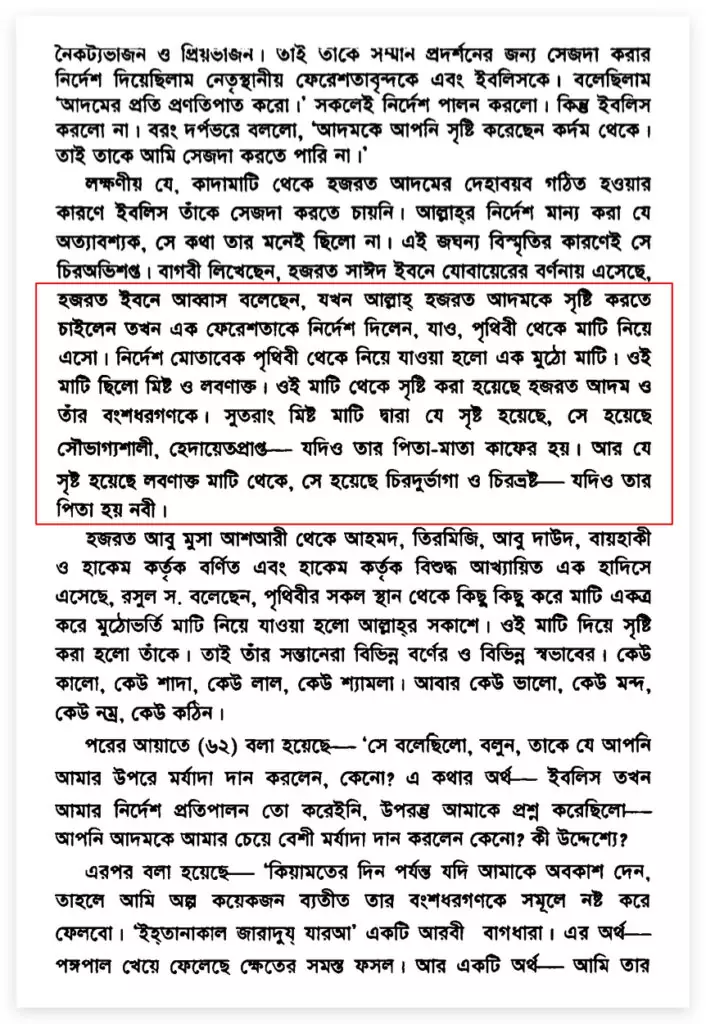
Can Allah’s Written Predestination Be Changed?
According to Islamic belief, Allah is omniscient and His decision is final. He is independent in making decisions and does not listen to anyone’s advice or counsel. The hadith also says that the ink of the pen has dried; therefore, it is impossible to change the predestination written by Allah. Yet various Islamic texts also contain some strange statements that turn all Islamic beliefs into a confused jumble. Let us hear a discussion in which Allah’s written predestination supposedly told Adam to change it, and Allah changed it. In other words, Adam gave part of his lifespan to the Prophet David. If the ink of the pen had dried and Allah’s written predestination were final, how did Allah change it?
If Lifespans Are Predetermined, Why Punish the Murderer?
Now let us watch another video, in which Bangladesh’s renowned scholar Ahmadullah makes a forceful attempt to reconcile this contradiction in predestination. Yet, in trying to do so, he repeatedly confuses the matter himself. Let us first listen to the video.
He is answering this question by presenting Imam Ibn Taymiyyah’s argument. The question is: if a person’s lifespan has been predetermined, why should the murderer be punished? Allah Himself determined the lifespan, after all. Mr. Ahmadullah gives Ibn Taymiyyah’s answer from his book. Ibn Taymiyyah said that predestination is supposedly of two types: final and non-final. Final predestination supposedly does not change, while non-final predestination does change. This non-final predestination is supposedly written by the angels. But by whose command do the angels write this non-final predestination? Allah’s, of course, is it not? Then why does Allah knowingly give the angels false information when He knows the final predestination? Why does He lie to the angels? Again, what is the need to write down either final or non-final predestination? Since non-final predestination is changeable, what is the point of preserving it unnecessarily?
This flowchart shows where the theory of “final/non-final predestination” creates a contradiction regarding the question of punishing the murderer.
If lifespan/death is predetermined beforehand, why will the murderer be punished?
(a) Final predestination: Does not change.
(b) Non-final predestination: Can change; angels write it; it changes through prayer, charity, and deeds.
The non-final portion is also fixed beforehand within Allah’s knowledge/final plan.
Human decisions/actions actually change lifespan/events—not merely in appearance.
If the murder is part of the “final plan,” the murderer has effectively carried out a predetermined act.
Then moral responsibility and the justice of punishment become questionable.
If a person’s actions actually change their lifespan, then the statement that “the lifespan was predetermined” is not inevitable.
The claim of a “predetermined lifespan” consequently becomes unstable.
By dividing matters into “final/non-final,” the theory creates pressure in both directions instead of solving the question—
in one direction, the justice of punishment is weakened; in the other, the claim of a “predetermined lifespan” is weakened.
Prayer versus Qadar: The Omniscience Paradox
In Islamic theology, it is claimed that “prayer can change destiny” [68]. But when we reconcile this with the Creator’s ‘omniscience’ (Omniscience) and ‘perfect foreknowledge’ (Foreknowledge), it creates a classical logical paradox or contradiction. If Allah is ‘Al-‘Alim,’ or All-Knowing, then He knew 50,000 years before creation that a certain person would pray at a specific time in 2026. In other words, the person’s prayer and the supposed ‘change’ in destiny resulting from it—the entire event—had already been recorded in the primordial record, the Lawh al-Mahfuz.
Human Autonomy or Divine Projection
Islamic theology claims that human beings have been given the freedom, or ‘choice,’ to choose between good and evil. However, the Qur’an’s original text, or textual evidence, directly rejects this claim. The Qur’an clearly declares that every human action—whether good or evil—is Allah’s own creation. The Qur’an says that Allah Himself creates what people do—that is, the essence of human actions [69] [70]
Quran reference : Surah As-Saffat, 37:96
Arabic : وَٱللَّهُ خَلَقَكُمۡ وَمَا تَعۡمَلُونَ ٩٦
Translation — Dr. Mustafa Khattab, The Clear Quran : when it is Allah Who created you and whatever you do?
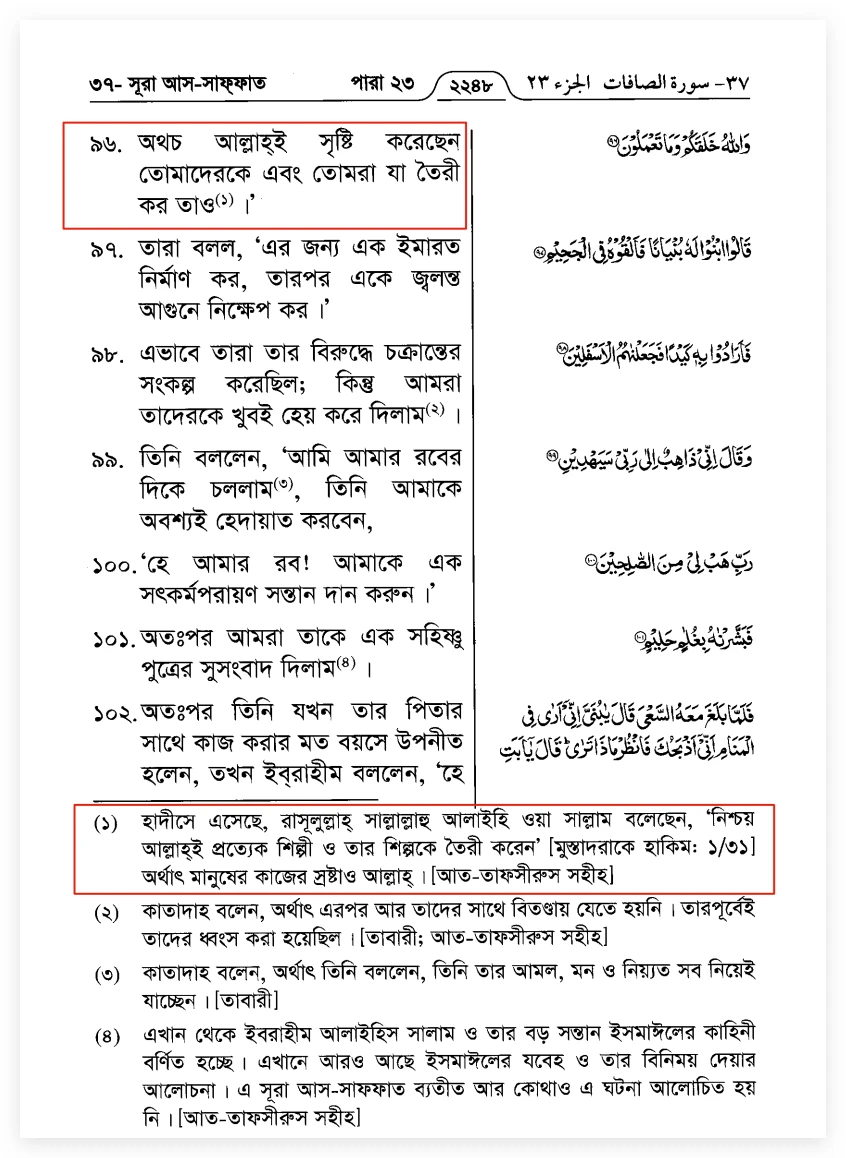
In the language of philosophy, this verse is a definitive proof of ‘Hard Determinism’. When analyzed in light of the seventeenth-century philosopher Baruch Spinoza’s pantheistic determinism, the matter becomes even clearer. According to Spinoza, nothing in the universe is accidental; rather, everything arises from the necessity of divine nature. Spinoza believed that people consider themselves free only because they are ignorant of the true ‘cause’ behind their own actions [71]. In the Islamic context, human beings essentially function as an ‘extension’ or instrument of Allah. If human action, or ‘Action,’ is itself Allah’s creation, then Allah is also the original creator of the crime committed by a criminal. The criminal here is merely a ‘biological proxy,’ whose neural circuitry and circumstances Allah uses to enact His predetermined script.
This metaphysical concept can be challenged even more forcefully through modern neuroscience. In particular, the famous neuropsychological experiments conducted by Benjamin Libet in the 1970s and 1980s have called the existence of human ‘free will’ into question. Libet showed that an unconscious electrical signal, or ‘Readiness Potential,’ forms in a person’s brain several hundred milliseconds before they develop a ‘Conscious Will’ to perform an action [72]. In other words, when we think that we are raising our hand or making a decision ‘of our own free will,’ our brain has already made that decision. Our conscious mind merely creates an ‘after-the-fact’ explanation for that unconscious decision.
A strange parallel can be observed between Libet’s experiment and verse 7 of Surah Al-Baqarah in the Qur’an [73],
“Allah has set a seal upon their hearts and upon their hearing, and over their eyes is a veil…”
In the language of neuroscience, if someone’s decision-making system—especially the prefrontal cortex—is already “programmed,” or effectively ‘sealed,’ in such a way that their capacity to make alternative decisions is destroyed, then it is not reasonable to expect a different decision from them. And if a creator deactivates someone’s moral-neural or spiritual capacity—sealing it—and then inflicts eternal punishment on the basis of that deactivation, that does not accord with justice. It is like placing someone in a game with their hands and feet tied, then punishing them for the “offense” of failing to score a goal.
Spinoza’s philosophy and Libet’s neuroscience both suggest that human ‘will’ is essentially a secondary process. In the Islamic God-model, when Allah creates an action and seals a person’s heart, He effectively destroys that person’s moral agency completely. Under these circumstances, the fear of Judgment Day or Hell is nothing more than a victim-blaming mechanism.
Various Accounts from the Qur’an and Hadith
The Dispute between Adam and Moses
The greatest moral crisis in the concept of Qadar is this: who bears responsibility for sin? If every action has been determined before creation, then a criminal’s offense is essentially a scripted performance. This issue of exoneration was first raised by Iblis, or Satan himself. According to the Qur’anic account, when Iblis was expelled for refusing to prostrate before Adam, he directly addressed Allah and said [74]
“He (Iblis) said: Because You have led me astray (bi-mā aghwaytanī), I will surely lie in wait for them (human beings) on Your straight path.”
It is noteworthy that Iblis did not hold himself responsible for his disobedience; instead, he highlighted the fact that ‘Allah had led him astray.’ According to Islamic theology, since nothing occurs without Allah’s permission or will, Iblis’s claim is theoretically correct. We see the same kind of paradox in the ‘Double Predestination’ theory of the sixteenth-century Christian theologian John Calvin. According to Calvin, God, in His sovereign power, had predetermined certain people for salvation and the rest for eternal destruction [75]. Just as Calvinism’s strict determinism risks accusing God of being the ‘Author of Sin,’ the Islamic concept of Qadar similarly absolves the criminal of moral responsibility.
The most classic example of this ‘theological immunity,’ or religious exoneration, is the famous debate between Adam and Moses, which is narrated in authentic hadith. Prophet Adam and Prophet Moses once argued about a certain matter, and the incident is found in the authentic hadith collections. See the hadiths [76] [77]
Sahih Muslim (Islamic Foundation)
48/Qadar
Chapter: 2. The debate between Adam (peace be upon him) and Moses (peace be upon him)
6501. Muhammad ibn Hatim, Ibrahim ibn Dinar, Ibn Abi Umar al-Makki, Ahmad ibn Abd al-Dabbi, and Tawus (may Allah have mercy on them) … Narrated from Abu Hurairah (may Allah be pleased with him). The Messenger of Allah (peace and blessings of Allah be upon him) said: Adam (peace be upon him) and Moses (peace be upon him) debated with each other. Moses (peace be upon him) said, “O Adam! You are our father; you have deprived us and driven us out of Paradise.” Adam (peace be upon him) said to him, “You are Moses. Allah Most High spoke to you, selected you, and wrote the Torah for you with His own hand. Are you reproaching me for something that Allah Most High had decreed forty years before my creation?”
The Messenger of Allah (peace and blessings of Allah be upon him) said: Adam (peace be upon him) prevailed over Moses (peace be upon him) in the argument.
In the hadith narrated by Ibn Abi Umar and Ibn Abadah, one of them said خَطَّ and the other said كَتَبَ: He wrote the Torah for you with His own hand.
Hadith grade: Sahih (Authentic)
Narrator: Abu Hurairah (may Allah be pleased with him)
Sahih Muslim (Islamic Foundation)
48/Qadar
Chapter: 2. The debate between Adam (peace be upon him) and Moses (peace be upon him)
6502. Qutaybah ibn Sa‘id (may Allah have mercy on him) … Narrated from Abu Hurairah (may Allah be pleased with him). He said: The Messenger of Allah (peace and blessings of Allah be upon him) said: Adam (peace be upon him) and Moses (peace be upon him) engaged in a debate. Moses (peace be upon him) said, “You are Adam (peace be upon him), who led people astray and expelled them from Paradise.” Adam (peace be upon him) said, “You are the person, the prophet, whom Allah Most High granted knowledge of all things and sent to humanity with the responsibility of prophethood.” Moses (peace be upon him) said, “Yes.” Adam (peace be upon him) said, “Are you reproaching me for something that was decreed for me before my creation?”
Hadith grade: Sahih (Authentic)
Narrator: Abu Hurairah (may Allah be pleased with him)
Sahih Muslim (Islamic Foundation)
48/Qadar
Chapter: 2. The debate between Adam (peace be upon him) and Moses (peace be upon him)
6503. Ishaq ibn Musa ibn Abdullah ibn Musa, Ibn Abdullah ibn Yazid al-Ansari (may Allah have mercy on them) … Narrated from Abu Hurairah (may Allah be pleased with him). He said: The Messenger of Allah (peace and blessings of Allah be upon him) said: Adam (peace be upon him) and Moses (peace be upon him) debated before their Lord. Adam (peace be upon him) prevailed over Moses (peace be upon him). Moses (peace be upon him) said, “You are the Adam (peace be upon him) whom Allah Most High created with His own hands, breathed His spirit into, caused His angels to prostrate before, and granted residence in His Paradise. Then, through your error, you brought humanity down to earth.
Adam (peace be upon him) said, “You are the Moses (peace be upon him) whom Allah Most High selected and honored with prophethood and His speech, gave the Tablets—the Torah—in which everything is recorded, and brought close for private conversation. Now, how many years before my creation did Allah Most High write the Torah, as you have seen?” Moses (peace be upon him) said, “Forty years.” Adam (peace be upon him) said, “Did you find in it that Adam disobeyed his Lord and went astray?” He said, “Yes.”
Adam (peace be upon him) said, “Then why are you reproaching me for an act that Allah Most High had decreed for me forty years before He created me?” The Messenger of Allah (peace and blessings of Allah be upon him) said: Then Adam (peace be upon him) prevailed over Moses (peace be upon him).
Hadith grade: Sahih (Authentic)
Narrator: Abu Hurairah (may Allah be pleased with him)
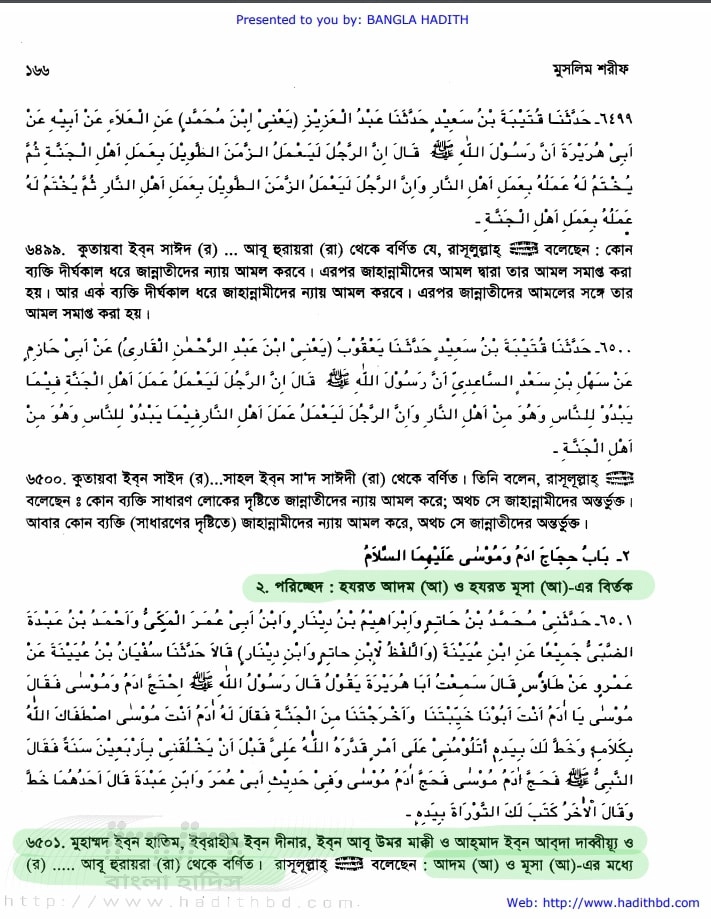
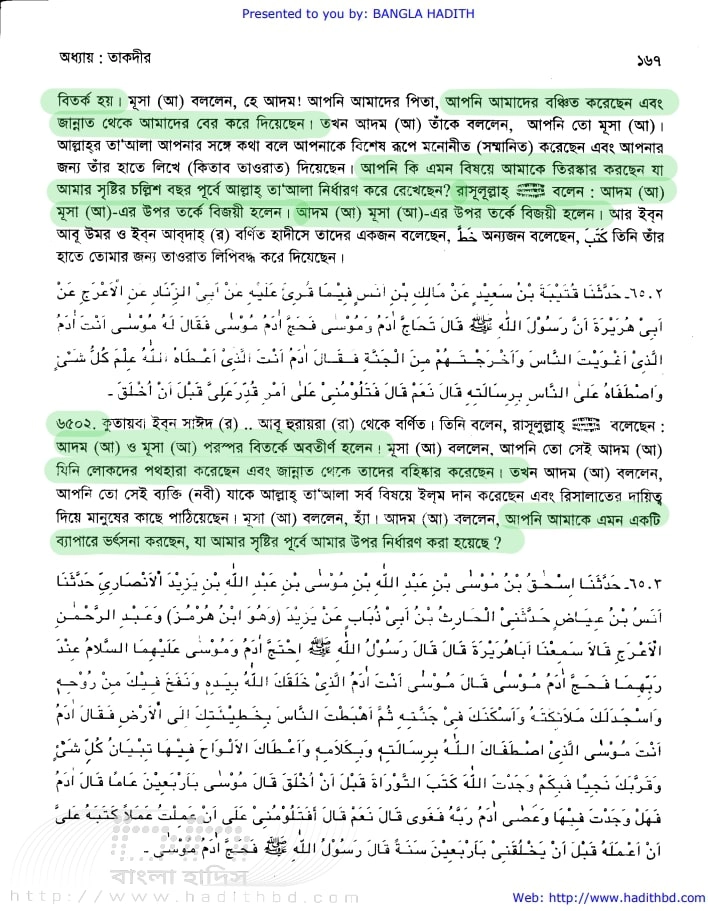
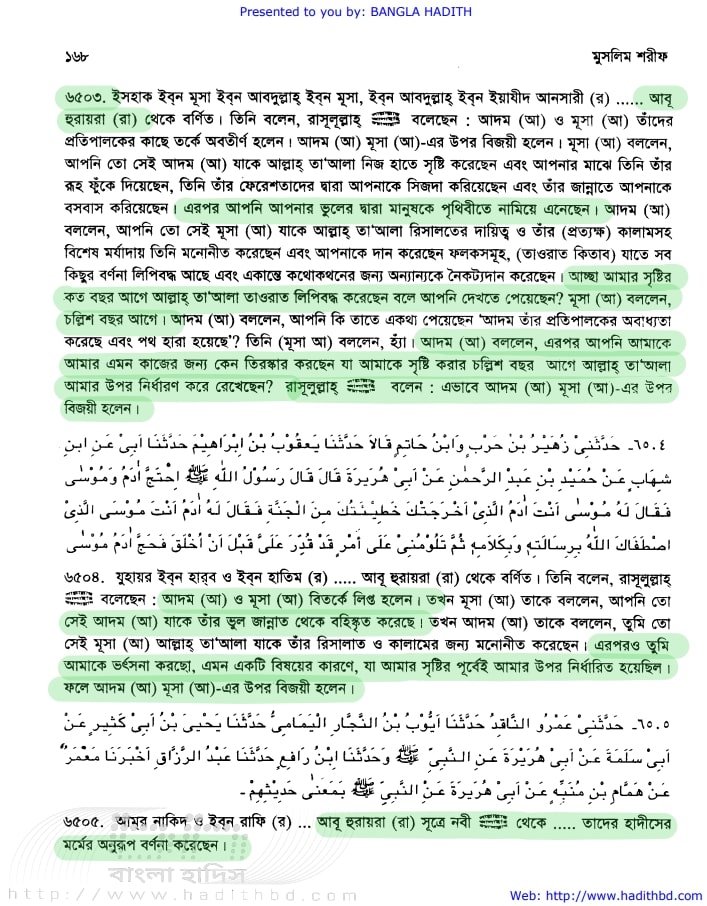
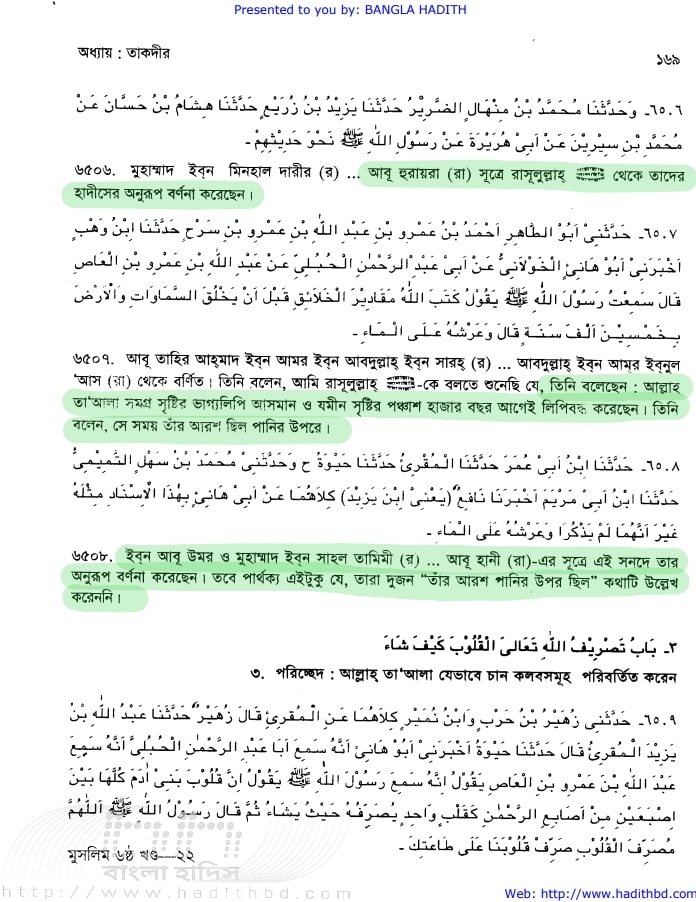
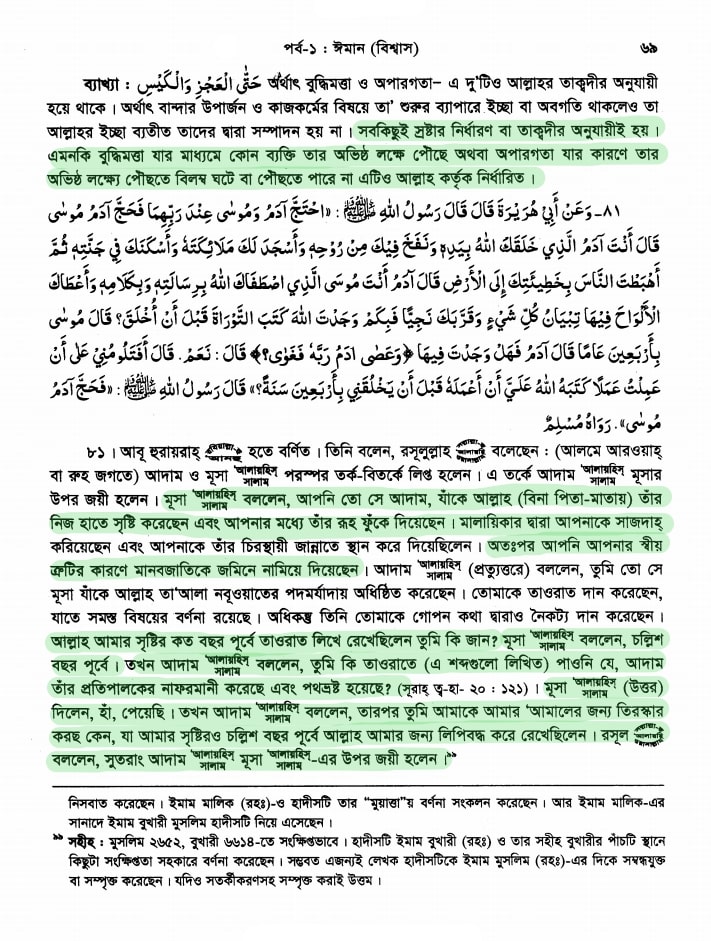
Let us hear what the scholars have to say about this,
This debate yields an extremely important conclusion for logic. If Adam can be declared innocent of his error by invoking Qadar, then why should any other criminal on earth be punished? According to Adam’s argument, since the act had already been written, he had no alternative. Similarly, if a murderer claims that the murder had been written in the ‘Lawh al-Mahfuz’ 50,000 years before creation [78], then according to Adam’s argument, he too is innocent.
The parallel position of John Calvin’s predestination and Islamic Qadar demonstrates that if there is an ‘Omnipotent Author,’ ‘Individual Responsibility’ becomes meaningless. From Satan to Adam, all have essentially used the same logical shield: “I did not do it; my destiny made me do it.” If this argument is recognized by God Himself or His prophet, then the entire concept of Judgment Day is nothing more than a grand farce.
The Curse of Prophet Noah
Let us now read a story described in the Qur’an. The story concerns the time of the Prophet Noah. For a long time, Prophet Noah preached the religion to the disbelievers in his region, but he did not achieve the expected results. When, despite many efforts, he was unable to guide most of the disbelievers, he prayed to Allah to kill every disbeliever during the flood, so that not a single living being would remain except those who believed in Noah’s religion. In other words, all the disbelievers—including women, children, people with disabilities, and the elderly—would die. May Allah kill them all! Let us read Prophet Noah’s prayer [79] [80] –
Quran reference : Surah Nuh, 71:26
Arabic : وَقَالَ نُوحٞ رَّبِّ لَا تَذَرۡ عَلَى ٱلۡأَرۡضِ مِنَ ٱلۡكَٰفِرِينَ دَيَّارًا ٢٦
Translation — Dr. Mustafa Khattab, The Clear Quran : Noah had prayed, “My Lord! Do not leave a single disbeliever on earth.
Quran reference : Surah Nuh, 71:27
Arabic : إِنَّكَ إِن تَذَرۡهُمۡ يُضِلُّواْ عِبَادَكَ وَلَا يَلِدُوٓاْ إِلَّا فَاجِرٗا كَفَّارٗا ٢٧
Translation — Dr. Mustafa Khattab, The Clear Quran : If You leave them, they will lead Your servants astray and give birth only to wicked sinners, staunch disbelievers.
Consider this: Prophet Noah prayed for all the disbelievers to be killed because disbelievers might give birth to disbelieving children! What boundless cruelty! These verses remind us of statements made by Hitler during the Second World War or by Yahya Khan during Bangladesh’s Liberation War. Just as Hitler called for Jews to be killed one by one, and Yahya Khan called for Bengalis to be killed one by one during Bangladesh’s Liberation War, so too. As though no more children belonging to the opposing side should ever be born. Can any of us guarantee that a child will grow up to be good rather than evil? To wish for their death on the assumption that they will certainly become evil is appalling barbarism. This applies equally to everyone. Islamic militants attempted to kill me several times personally. They also killed many atheists in Bangladesh. Even so, I cannot wish for the death of any Muslim on the assumption that they might give birth to a child who becomes an Islamic militant! I can demand that those involved in crimes be punished on the basis of evidence, but I cannot demand that an entire nation or community be eradicated or subjected to genocide. After all, not all Muslims can possibly become militants; surely there are many good people among Muslims. There are also children, women, elderly people, and people with disabilities. Similarly, if a Muslim child in Kashmir or Palestine is killed on the grounds that they will grow up to become Islamic militants, or members of al-Qaeda or Boko Haram, that would be an act of boundless barbarism and cruelty. In the same way, killing all the members of a disbelieving lineage before they are even born out of fear that they will give birth to disbelieving children is also a horrifyingly inhumane act!
Now let us read another incident from the life of the Prophet Muhammad. Even after making many efforts, the Prophet could not bring his uncle Abu Talib to Islam. Allah then revealed an ayah informing Muhammad that Allah alone possesses guidance. No human being can guide anyone unless Allah wishes to grant that person guidance. Let us read the ayah [81] —
Quran reference : Surah Al-Qasas, 28:56
Arabic : إِنَّكَ لَا تَهۡدِي مَنۡ أَحۡبَبۡتَ وَلَٰكِنَّ ٱللَّهَ يَهۡدِي مَن يَشَآءُۚ وَهُوَ أَعۡلَمُ بِٱلۡمُهۡتَدِينَ ٥٦
Translation — Dr. Mustafa Khattab, The Clear Quran : You surely cannot guide whoever you like ˹O Prophet˺, but it is Allah Who guides whoever He wills, and He knows best who are ˹fit to be˺ guided.
The Quran also states repeatedly that Allah is the sole possessor of the power to guide and lead astray [19] [20] —
Whoever Allah guides to the right path is rightly guided, and whoever He leads astray, you will never find for him a guide or helper.
Whomever Allah guides, that person will be guided. And whoever He leads astray, that person will be ruined۔
Now tell me, after reading verses 26–27 of Surah Nuh and verse 56 of Surah Al-Qasas, does any question arise in your mind? Think honestly: does no question arise at all? If Allah Himself did not guide the unbelievers during the time of Noah, where would they have found guidance? And how can killing all the unbelievers for this reason be justified?
Ali’s Argument: The Crisis of Moral Responsibility in the Trap of Predestination
This narration from Sahih Muslim is particularly important for understanding the conflict between predestination and human responsibility. There is no abstract philosophical debate here; rather, the logical crisis within the doctrine of predestination is revealed directly through an everyday incident involving Muhammad, Ali, and Fatimah. Although the incident appears to concern the tahajjud prayer, the underlying question is deeper: if human sleep, wakefulness, will, and actions are all under Allah’s control, to what extent can a person be held morally responsible for failing to perform a particular action?
According to the hadith, one night Muhammad came to Ali and Fatimah’s room and asked why they were not performing the tahajjud prayer. The question was phrased as encouragement or exhortation, but Ali’s answer rested directly on the logic of predestination. He said that their souls were in Allah’s possession; they would awaken only when Allah wished to awaken them. In other words, Ali was effectively saying: whether we wake or remain asleep lies beyond our independent control and is subject to Allah’s will and control.
This answer is important because Ali did not use an external argument; he applied Islam’s own concept of predestination. If human will, sleep, wakefulness, and actions truly lie under Allah’s predetermined will, then it is difficult to describe Ali’s failure to wake as personal negligence. For the straightforward logical consequence of Ali’s answer is that Ali and Fatimah remained asleep because the Being who holds human souls in His possession and can awaken them if He wishes did not awaken them.
Muhammad’s reaction is also noteworthy. He did not refute Ali’s argument, say that Ali’s understanding of predestination was mistaken, or explain how Ali could remain fully morally responsible within Allah’s complete control. Instead, he left and struck his thigh with his hand, saying, “Human beings are fond of arguing about most things.” This reaction does not resolve the argument; rather, it expresses logical discomfort. Ali’s statement exposes an internal consequence of the doctrine of predestination that directly calls the conventional concept of moral responsibility into question.
This is where the hadith’s philosophical significance lies. If no one can will anything without Allah’s will, if human sleep and wakefulness are also under Allah’s control, and if everything has already been recorded, then when a person fails to wake at a particular time or fails to perform a particular action, upon whom does the responsibility ultimately fall? Although Ali did not articulate this question in theoretical language, his answer makes the central weakness of the doctrine of predestination clear: imposing full moral responsibility while maintaining predetermined control is logically unstable. Let us look directly at that hadith — [82] [83]
Sahih Muslim (Hadith Academy)
6. The prayer of travellers and its shortening
Chapter: 28. Discussion concerning one who slept through the night and awoke in the morning
Hadith Academy number: 1703, international number: 775
1703-(206/775) Qutaybah ibn Sa’id (RAH) ….. Narrated from Ali ibn Abi Talib (RA). The Prophet (peace and blessings be upon him) came to him and Fatimah (RA) one night and asked them: “Do you not perform the (tahajjud) prayer?” I said, “O Messenger of Allah! We are all under Allah’s control. If He wills, He can awaken us.” Ali (RA) said: When I said this, the Messenger of Allah (peace and blessings be upon him) turned away. As he was turning away, I heard him slap his hand forcefully on his thigh and say: “Human beings are accustomed to arguing about most things.” (Islamic Foundation 1688, Islamic Center 1695)
Hadith grade: Sahih (Sahih)
Narrator: Ali ibn Abi Talib (RA)
Sahih Muslim (Islamic Foundation)
6/ The traveller’s prayer and shortening
Chapter: 22. Encouraging the tahajjud prayer, even if it is brief
1691۔ Qutaybah ibn Sa’id (RAH) … Narrated from Ali ibn Abi Talib (RA) that the Prophet (peace and blessings be upon him) came to his and Fatimah’s (RA) house at night and said, “Are you not performing the prayer (tahajjud)?” [Ali (RA) said:] I replied, “O Messenger of Allah! Our souls are in Allah’s grasp; so when He wishes to raise us, He raises us.” The Messenger of Allah (peace and blessings be upon him) went back when I said this to him. As he was going away alone, I heard him strike his thigh and say,وَكَانَ الإِنْسَانُ أَكْثَرَ شَىْءٍ جَدَلاً “Human beings are fond of arguing about most matters” (Surah Al-Kahf: 54)
Hadith grade: Sahih (Sahih)
Narrator: Ali ibn Abi Talib (RA)
Why Does Allah’s Throne Tremble?
It is learned from the hadith that, upon the death of a Companion, Allah became so grieved that even Allah’s Throne trembled. The question is: if Allah knows the future with absolute certainty, why would Allah’s Throne tremble at someone’s death? We human beings, who do not know the future, become sad and distressed when someone we know dies; for that reason, we may tremble. But what could be the reason for Allah’s trembling, when He Himself has determined who will die, when, and how? [84]
Sahih Bukhari (IF)
Chapter: 50/ The noble prophets (peace be upon them)
Section: 2122. The merits of Sa’d ibn Mu’adh (RA)
3531. Muhammad ibn Musa (RAH) … Jabir (RA) said, I heard the Prophet (peace and blessings be upon him) say, upon the death of Sa’d ibn Mu’adh (RA), “The Throne of Allah trembled.” Al-A’mash (RAH) … A similar narration has been reported from the Prophet (peace and blessings be upon him). A man said to Jabir (RA), “Bara ibn Azib (RA) says that the funeral bier moved.” In response, Jabir (RA) said, “There was some disagreement between the tribes of Sa’d and Bara (RA), but this is not correct, for I heard the Prophet (peace and blessings be upon him) say عَرْشُ الرَّحْمَنِ that is, Allah’s Throne at the death of Sa’d ibn Mu’adh (RA) trembled — that is what I heard him say.
Hadith grade: Sahih (Sahih)
Allah’s Bureaucratic Complexity
Let us read a few more hadiths. The central theme of these hadiths is that, at specific intervals, “deeds” are raised or presented to Allah, and the Prophet wishes to be fasting at the moment of that presentation. Here, the word “raising/presentation,” at least in its ordinary textual sense, suggests a process in which deeds are first recorded or preserved somewhere and then presented “upward” according to a specific routine. Two kinds of cycles are also evident: (1) annual/monthly — Sha’ban; and (2) weekly — Monday and Thursday. The language of this recurring routine sounds less like a “one-time event” and more like a “regular process.” [85] [86] [87] [88]
Sunan an-Nasa’i (Islamic Foundation)
22/ Fasting [Sawm]
Chapter: 69/ The fasting of the Prophet (ﷺ), may my parents be sacrificed for him
2359۔ Amr ibn Ali (RAH) … Narrated from Usamah ibn Zayd (RA). He said, “I asked, ‘O Messenger of Allah! I do not see you fasting in any other month as much as I see you fasting in Sha’ban.’ He said, ‘Sha’ban is a month between Rajab and Ramadan, of which people are unaware despite its importance. In this month, the records of deeds are raised to Allah, Lord of the Worlds. Therefore, I like my record of deeds to be raised to Allah while I am fasting.’
[Hasan. Ta’liqu’r-Raghib]
Hadith grade: Hasan (Hasan)
Narrator: Usamah ibn Zayd (RA)
Sunan an-Nasa’i (Islamic Foundation)
22/ Fasting [Sawm]
Chapter: 69/ The fasting of the Prophet (ﷺ), may my parents be sacrificed for him
2360۔ Amr ibn Ali (RAH) … Narrated from Usamah ibn Zayd (RA). He said, “I asked, ‘O Messenger of Allah! When you begin fasting, you do not soon stop fasting, and when you begin breaking your fast, you do not soon resume fasting. But there are two days that occur among the days on which you fast, and you fast on those two days as well; even when they do not occur, you still fast on those two days.’ The Messenger of Allah (peace and blessings be upon him) asked, ‘Which two days are they?’ I replied, ‘Monday and Thursday.’ He said, ‘On those two days, the records of people’s deeds are raised to Allah, Lord of the Worlds. Therefore, I like my record of deeds to be raised to Allah while I am fasting.’
[Hasan Sahih. Ta’liq ala Ibn Khuzaymah 2119, Ta’liqu’r-Raghib 2/85, Sahih Abu Dawud 2105]
Hadith grade: Hasan (Hasan)
Narrator: Usamah ibn Zayd (RA)
Sahih Bukhari (Tawhid Publication)
97/ Tawhid
Chapter: 97/23. The Word of Allah: The angels and the Spirit ascend to Allah — (Surah Al-Ma’arij 70:4). And the Word of Allah: To Him ascends the pure word — (Surah Fatir 35:10).
وَقَالَ أَبُو جَمْرَةَ عَنْ ابْنِ عَبَّاسٍ بَلَغَ أَبَا ذَرٍّ مَبْعَثُ النَّبِيِّصَلَّى اللَّهُ عَلَيْهِ وَسَلَّمَ فَقَالَ لِأَخِيهِ اعْلَمْ لِي عِلْمَ هَذَا الرَّجُلِ الَّذِي يَزْعُمُ أَنَّهُ يَأْتِيهِ الْخَبَرُ مِنَ السَّمَاءِ وَقَالَ مُجَاهِدٌ الْعَمَلُ الصَّالِحُ يَرْفَعُ الْكَلِمَ الطَّيِّبَ يُقَالَ ذِي الْمَعَارِجِ الْمَلاَئِكَةُ تَعْرُجُ إِلَى اللهِ
Abu Jamrah (RAH) narrated from Ibn Abbas (RA) that, upon hearing the news that the Prophet (peace and blessings be upon him) had received prophethood, Abu Dharr (RA) said to his brother, “Find out for me about the condition of that man who claims that news comes to him from the sky.” Mujahid (RAH) said, “Righteous deeds raise pure words.” Regarding ذِي الْمَعَارِجِ, it is said that it refers to the angels who ascend toward Allah.
7429. Narrated from Abu Hurairah (RA). The Messenger of Allah (peace and blessings be upon him) said: “Angels take turns coming to you by night and by day. They gather at the Asr and Fajr prayers. Then those who spent the night among you ascend. At that time, their Lord asks them—although He knows best about you—‘In what condition did you leave My servants?’ They reply, ‘We left them while they were performing prayer; when we first came to them, we found them performing prayer.’ [555] (Modern Publication — 6912 first part, Islamic Foundation — 6924 first part)
Hadith grade: Sahih (Sahih) Narrator: Abu Hurairah (RA)
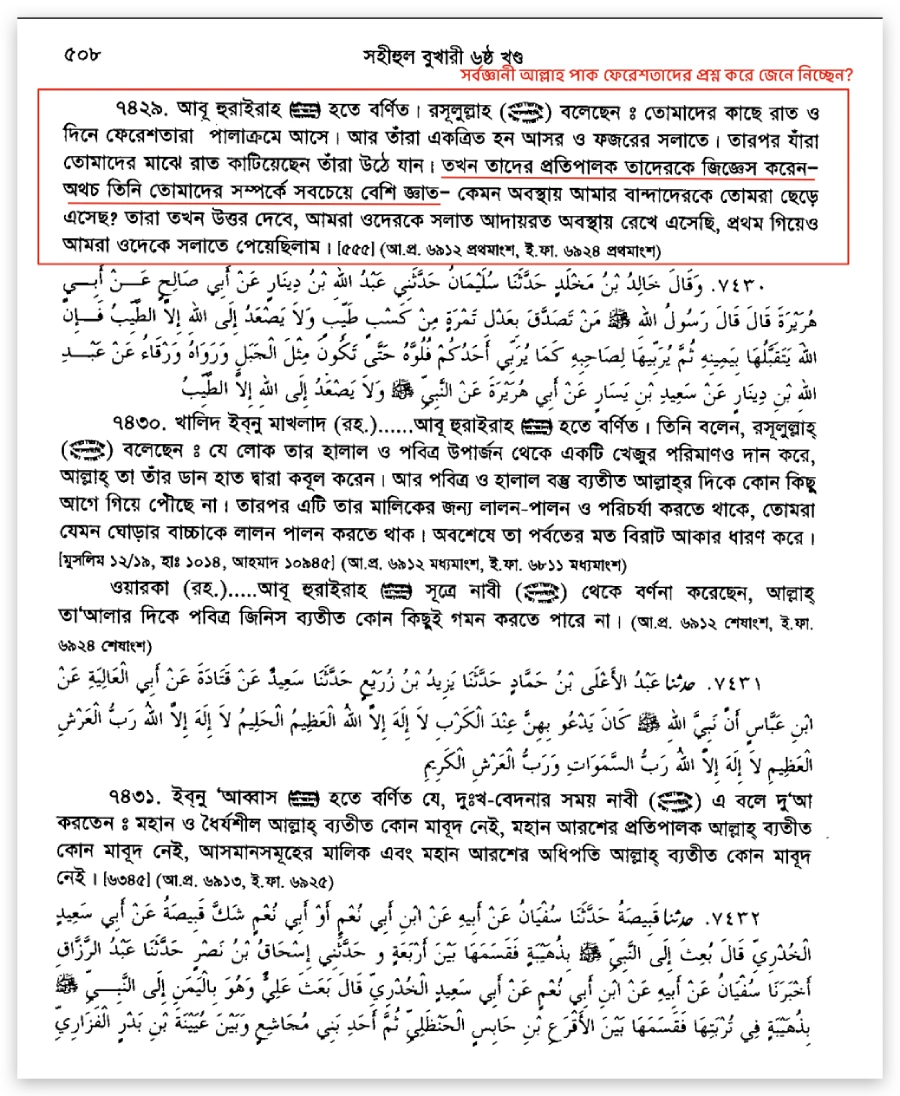
The hadiths’ theme of the record of deeds being “raised/presented” in fact creates a complete divine bureaucracy: human beings act → angels “write” → according to a specific routine (weekly/annual), the record is “presented” to Allah → then questioning and reporting follow. However religious this picture may sound, internally it uses the language of human royal courts, offices, and paperwork: one superior above, reporting officers below, and files moving upward and downward in between. The problem is that this entire description reduces the omniscient Allah to a level at which He supposedly becomes updated by examining a “report,” or at least cannot begin the process of judgment until He “receives the file.”
But the framework of predestination says that everything was determined and written beforehand; Allah is omniscient and knows even the intentions within people’s hearts. So what is the function of this reporting routine? If the report provides Allah with new information, the concept of omniscience is nullified. And if it provides no new information, then the entire reporting system is logically worthless—in other words, a kind of formal performance, an official ritual of the “there is a process because there is a reason” type. Here the central claims of theology bite into one another: if omniscience and predestination are maintained, the “report” is meaningless; but if the “report” is to be meaningful, omniscience and predestination themselves are placed in question. And if we assume that Muhammad fabricated some false statements to make his followers attentive to worship, and that no report is actually presented to Allah, or that Allah Himself performs the false act of receiving reports despite having no need to receive them—Allah continuing this deception in order to inspire His servants to worship—then such an interpretation requires us to imagine both Allah and the Prophet as liars. Let us first hear what is said in the conventional sermon tradition when interpreting these hadiths.
But the matter has become even worse now, hasn’t it? The psychology underlying this sermon often amounts to “an employee performs more visibly when the boss comes over to the desk”—a form of impression management. But Allah is independent of everyone—why would He need to “demonstrate” Himself before anyone in order to justify His judgment? And even if it is said that this is “evidence to show people,” the evidence ultimately comes from Allah Himself: the recording system belongs to Allah, the witnesses are Allah’s employees, and the Book is in Allah’s hands—in other words, the judge and the evidence are located within the same center of authority. The principled question therefore remains: if the party issuing the judgment also produces the evidence, can that evidence genuinely be “neutral”? Thus, the explanation based on “establishing evidence” does not solve the problem; rather, it creates a new objection concerning justice.
For the sake of argument, let us assume that “showing people” or “providing people with proof on the Day of Judgment” is the purpose of these reports. At the same time, for the sake of argument, let us assume that the self-sufficient Allah is preserving these reports in order to justify His judgment “before insignificant human beings.” Then an even greater logical problem arises: the source of that evidence ultimately comes from Allah Himself. The angels are Allah’s employees or intermediaries, the records are created through a system appointed by Allah, the “Book” is also provided by Allah, and the system of testimony is established by Allah. In other words, both the judge and the evidence are in the hands of the same party. This leaves a fundamental question concerning justice: if the party issuing the judgment also creates or supplies the evidence, an accused person can, in principle, say—“This does not come from a neutral source; how can I be sure that the evidentiary process is impartial?” In other words, if an atheist unbeliever like me expresses disbelief in Allah and asks for evidence, and Allah then attempts to prove on the basis of these reports that I am indeed guilty, I would say that the judicial procedure, verdict, witnesses, and evidence all come from Allah’s side; they do not come from any neutral observer. So how acceptable are these reports?
In other words, the explanation of “establishing evidence” does not actually resolve the problem; instead, it creates a new one, because the evidence does not come from any independent or neutral third party. Thus, even if one invokes the argument of “evidence to show people,” the opportunity to raise the question logically remains—because judgment and evidence are confined within the same center of authority.
For this reason, trying to preserve reporting or raising by describing it as “convincing people,” “honoring the angels,” or “the beauty of the system” often becomes a later rescue explanation—ad hoc: where the original text directly speaks of a presentation toward Allah, a new purpose is subsequently inserted and forced into the text to make it appear consistent. Its consequence for the discussion of predestination is devastating: on the one hand, everything has already been written and determined; on the other, there is once again a performance of “testing” through files, reports, testimony, and evidence—as though a theater of justice were being staged before human beings in order to make predetermined punishment appear morally legitimate.
A Level Playing Field in the Test
In any examination or election, the most important issue is whether all examinees or candidates receive equal opportunities. If the examination controller supplies an examinee with answers, helps them, writes the answers for them, whispers the answers in their ear, gives them extra time, or favors them through nepotism because they are the controller’s chosen person, then it cannot be regarded as an examination under any circumstances. If even the slightest nepotism exists, it cannot be considered a proper examination. Likewise, if an election commission seals the ballot box of a particular candidate during an election, or helps that candidate in any way, it will be regarded as unjust and unfair treatment of the other candidates. In such a case, it must be understood that such an examination has no legitimacy (Legitimacy — validity). The question is: according to Islam’s claim, this world of ours is an examination center. Do all of us receive equal opportunities as examinees in this examination center?
Who Led Satan Astray?
The Quran states very clearly that, after creating Adam, Allah cursed Satan because he did not prostrate before Adam in accordance with Allah’s command. It was then that he became the accursed Satan. But before that curse was imposed, there was no one called Satan. So who whispered to Satan and led him astray? Let us read an ayah from the Quran on this subject, from which we can learn Satan’s own statement [89] —
Quran reference : Surah Al-A’raf, 7:16
Arabic : قَالَ فَبِمَآ أَغۡوَيۡتَنِي لَأَقۡعُدَنَّ لَهُمۡ صِرَٰطَكَ ٱلۡمُسۡتَقِيمَ ١٦
Translation — Dr. Mustafa Khattab, The Clear Quran : He said, “For leaving me to stray I will lie in ambush for them on Your Straight Path.
Qualifications for Becoming a Prophet
An important question may be raised: Did Muhammad become a prophet through the merits of his own actions, or was his becoming a prophet determined before his birth or from his childhood? According to authentic hadith, he did not become a prophet through the merits of his actions; rather, his becoming a prophet had been predetermined. This is because Gabriel cleansed his heart and freed it from sin during his childhood. Allah did not do this for any other ordinary human being. Think about it: if Gabriel had come and cleansed your heart, you too would not have committed any sin. In an examination, all examinees must be given equal opportunities; therefore, a level playing field is extremely important. Yet it appears that in Allah’s examination, there is no such thing as a level playing field. The arbitrary Allah does everything according to His own will. During Muhammad’s childhood—that is, before he had done any good deed to prove his worth—He had already selected him as a prophet. This means that Muhammad’s becoming a prophet was predetermined, whereas there is no possibility of my becoming a prophet, no matter how many good deeds I perform. In other words, all examinees are not receiving equal opportunities here. Allah’s will is the decisive factor.
We see many people occupying important positions in the world. For example, becoming the Secretary-General of the United Nations is no trivial matter. It is possible for a person to reach that position only after possessing considerable talent, education, and dedication. Similarly, becoming the chief of a country’s armed forces, becoming the CEO of Google, or holding an important position at Apple all require education, talent, and competence at the same time. The question is, what qualifications are required to become a prophet? Is this position determined on the basis of qualifications, or does Allah decide beforehand that a particular person will be made a prophet? For example, in ancient Greece, Socrates, Plato, and Aristotle, and later Hypatia, left unique marks through their own qualities, deeds, abilities, and intelligence. People have remembered their words for generations. As philosophers, scientists, and thinkers, humanity is indebted to them. But by what qualification did the Prophet Muhammad become a prophet?
If Allah had selected Abu Lahab as a prophet during his childhood, it would not have been possible for Abu Lahab to commit sin under any circumstances. Thus, it appears that all examinees are not receiving equal opportunities in this examination. Allah is selecting people as He wishes. Allah’s will does not depend on human actions; it depends solely on His own will. Let us read two hadith side by side and try to understand when the destinies of Abu Lahab and the Prophet Muhammad were written [90] [5]—
Reference : Jami` at-Tirmidhi 3609
In-book reference : Book 49, Hadith 5
English translation : Vol. 1, Book 46, Hadith 3609
Chapter : What Has Been Related About The Virtue Of The Prophet (SAW)
Narrated Abu Hurairah:
“They said: ‘O Messenger of Allah (ﷺ)! When was the Prophethood established for you?’ He said: ‘While Adam was between (being) soul and body.'”
Grade: Sahih (Darussalam)
Sunan al-Tirmidhi (Islamic Foundation)
35/ Divine Decree
Section: No section.
2158. Yahya ibn Musa (may Allah have mercy on him) ….. Narrated from Abd al-Wahid ibn Salim, may Allah be pleased with him, who said: I once came to Mecca and met Ata ibn Abi Rabah, may Allah have mercy on him. I said to him: O Abu Muhammad, the people of Basra make statements denying divine decree. He said: My dear son, do you recite the Quran? I said: Yes. He said: Recite Surah al-Zukhruf. So I recited:
حم* وَالْكِتَابِ الْمُبِينِ * إِنَّا جَعَلْنَاهُ قُرْآنًا عَرَبِيًّا لَعَلَّكُمْ تَعْقِلُونَ * وَإِنَّهُ فِي أُمِّ الْكِتَابِ لَدَيْنَا لَعَلِيٌّ حَكِيمٌ
Ha-Mim. By the clear Book, We have sent it down as an Arabic Quran so that you may understand. It is recorded with Us in the Mother of the Book; it is truly exalted and full of wisdom (43:1, 2, 3, 4).
He said: Do you know what the Mother of the Book is? I said: Allah and His Messenger know best. He said: It is a great book that Allah, the Exalted, recorded before creating the heavens and before creating the earth.It contains the decree that Pharaoh is among the inhabitants of Hell, and it contains: “Perished are the hands of Abu Lahab, and perished is he” (تَبَّتْ يَدَا أَبِي لَهَبٍ وَتَبَّ)—the two hands of Abu Lahab have perished, and he himself has perished.
Ata, may Allah have mercy on him, said: I met Walid, the son of Ubadah ibn al-Samit, may Allah be pleased with him, one of the Companions of the Messenger of Allah, peace and blessings be upon him. I asked him: What did your father advise you at the time of his death?
He said: He called me close and said: My dear son, fear Allah. Know that you can never attain the fear of Allah until you believe in Allah and believe in all that has been decreed, both good and bad. If you die in any condition other than this, you will enter Hell. I heard the Messenger of Allah, peace and blessings be upon him, say: Allah, the Exalted, created the Pen first. Then He commanded it, “Write.” It said: “What shall I write?” He said: “Write the decree of everything that has happened and everything that will happen until eternity.” Sahih, Sahih 133, Takhrij al-Tahawiyyah 232, Mishkat 94, al-Zilal 102, 105, Tirmidhi hadith number: 2155 [Al-Madani Publication]
(Abu Isa said) This hadith is gharīb through this chain.
Hadith grading: Authentic (Sahih)
Now let us read another hadith in which we learn that Allah sent an angel to cleanse the Prophet’s heart. If this had been done in the case of Abu Lahab, Abu Lahab too could have entered Paradise, could he not? [91] [92]
Sahih Muslim (Islamic Foundation)
Chapter: 1/ The Book of Faith
Section: 73. The Prophet’s Ascension and the Obligation of Prayer
310. Shayban ibn Farrukh, may Allah have mercy on him … narrated from Anas ibn Malik, may Allah be pleased with him, that Gabriel, peace be upon him, came to the Messenger of Allah, peace and blessings be upon him, while he was playing with children. He seized him, laid him down, split open his chest, and removed his heart. Then he extracted a blood clot from his chest and said, “This is the portion of Satan.” Thenhe placed the heart in a golden vessel and washed it with Zamzam waterand then gathered its parts and restored it to its proper place. The children ran to his foster mother and said, “Muhammad has been killed.” Hearing this, everyone went in that direction and found him pale with fear. Anas, may Allah be pleased with him, said: I saw the mark of that stitching on the chest of the Messenger of Allah, peace and blessings be upon him.
Hadith grading: Authentic (Sahih)
The Prophet’s Nepotism and Justice
The Prophet Muhammad gave many members of his family the glad tidings of Paradise. He did not merely give them glad tidings; he explicitly declared them to be leaders. Apart from being fortunate enough to be born into the Prophet’s family, it is difficult to understand in what respect they were superior to all the people of the world or what they had done for the benefit of humanity. Nevertheless, the Prophet declared his daughter Fatimah to be the leader of the women in Paradise. Did she accomplish anything greater than Marie Curie or Mother Teresa? Or Hypatia, or Begum Rokeya? If so, what were those achievements? By what qualification did she become the leader of the women in Paradise? Or is being the Prophet’s daughter itself the qualification for becoming the leader of the women in Paradise? [93]
Sahih al-Bukhari (Islamic Foundation)
50/ The Noble Prophets (peace be upon them)
Section: 2091. The status of the close relatives of the Messenger of Allah and the status of Fatimah, daughter of the Prophet. The Prophet (peace be upon him) said,“Fatimah is the leader of the women who will inhabit Paradise.”
3447. Abdullah ibn Abd al-Wahhab, may Allah have mercy on him … narrated from Abu Bakr, may Allah be pleased with him, who said: Show greater respect to the family of Muhammad, peace and blessings be upon him.
Hadith grading: Authentic (Sahih)
Narrator: Abu Bakr al-Siddiq (may Allah be pleased with him)
Not only that, he also declared his two grandsons, Hasan and Husayn, to be the leaders of the young men of Paradise. [94] [95]
Verified Sunan al-Tirmidhi
46/ The Virtues of the Messenger of Allah and His Companions
Section: 31. The Virtues of al-Hasan ibn ‘Ali and al-Husayn ibn ‘Ali ibn Abi Talib (may Allah be pleased with them)
3768. Narrated from Abu Sa’id al-Khudri, may Allah be pleased with him, who said, The Messenger of Allah, peace and blessings be upon him, said: Al-Hasan and al-Husayn, each of them,is the leader of the young men of Paradise.
Authentic: Sahihah (796)
Sufyan ibn Waki‘, Jarir, and Muhammad ibn Fudayl narrated something similar through this chain from Yazid. Abu Isa said: This hadith is hasan sahih. Ibn Abi Nu’m is Abd al-Rahman ibn Abi Nu’m al-Bajali, a resident of Kufa. His kunyah was Abu al-Hakam.
Hadith grading: Authentic (Sahih)
Narrator: Abu Sa’id al-Khudri (may Allah be pleased with him)
Sunan Ibn Majah
Introduction
Section: 14. The Honor of ‘Ali ibn Abi Talib (may Allah be pleased with him)
5/118. Narrated from Ibn Umar, who said, The Messenger of Allah, peace and blessings be upon him, said:Hasan and Husayn are the leaders of the young men of Paradise, and their father is superior to them.
Al-Albani’s verification: Authentic. Al-Albani’s takhrij: Sahihah 979. Regarding Mu‘alla ibn ‘Abd al-Rahman, the narrator of this hadith, ‘Ali ibn al-Madini said that his hadith was weak and that he was accused of fabricating hadith. Ibn ‘Adi said, “I hope there is no serious problem with him.” Abu Hatim al-Razi said that his hadith was weak. Imam al-Daraqutni said that he was weak and a liar. The hadith is authentic on the basis of supporting evidence.
Hadith grading: Authentic (Sahih)
Narrator: Abdullah ibn Umar (may Allah be pleased with him)
On the other hand, if Abu Lahab or Abu Jahl had been born into the Prophet’s household—as the Prophet’s son or as Fatimah’s son—then they too could have become leaders in Paradise, could they not? If you or I had been the Prophet’s grandchild, we could have entered Paradise for free. What was the reason for this kind of nepotism on the part of Allah’s Prophet? If this is indeed the case, why do we call the acquisition of power by Hasina’s son Joy or Khaleda’s son Tarique nepotism? These are simply the customs of the ancient landlords and kings, under which people inherited estates without possessing any qualification!
Kafir by Birth?
The Prophet Muhammad said that if the minor children of believers die while still young, they will follow their forefathers—that is, they will enter Paradise. On the other hand, the minor children of polytheists will enter Hell according to the deeds of their parents, without having performed any deeds themselves [96]—
Mishkat al-Masabih (Mishkat)
Part 1: Faith (Belief)
Section: 3. Second Subsection—Belief in Divine Decree
111-(33) Narrated by ‘A’ishah (may Allah be pleased with her). She said, I asked the Messenger of Allah, peace and blessings be upon him, O Messenger of Allah! What is the ruling concerning the young children of believers(regarding Paradise and Hell)? He replied, They will follow their forefathers. I said, “Without performing any good deeds?” He said, “Allah knows best what deeds they would have performed had they remained alive.” I asked again,“What is the ruling concerning the young children of polytheists?” He said,“They too will follow their forefathers.” I asked in astonishment, “Without performing any evil deeds?” He replied, “Allah knows best what deeds those children would have performed had they remained alive.” (Abu Dawud)(1)
(1) Authentic: Abu Dawud 4089. Shaykh al-Albani said: This hadith has been narrated through two chains, one of which is authentic.
Hadith grading: Authentic (Sahih)
According to the Quran, the sacred scripture of Muslims, a hadith in Sahih Muslim relates that a man named Khidr once killed a boy without any apparent reason. When questioned about this, he replied indifferently that the boy was a kafir by birth. Therefore, he was killed before committing any act of disbelief and before compelling his parents to commit acts of disbelief. Khidr already knew that the boy would grow up to commit disbelief or would not believe in Allah. Consider this: until that moment, the boy had committed no crime whatsoever. Yet he was killed without any crime, before committing any offense, without any trial, witnesses, or evidence. And this act was again described in the hadith as a very good deed! How can someone be punished for an act that they have not committed?
Will this boy go to Hell or Paradise? He had committed no crime. Someone who was born a kafir would surely go to Hell. What kind of justice is this? Allah caused him to be born a kafir, then had him killed without committing any crime, and will send him to Hell as well—is this called justice? Let us read the hadiths [97] [98] [99]—
Sahih Muslim (Hadith Academy)
47. Divine Decree
Section: 6. The meaning of every child being born upon the Islamic disposition and the ruling concerning the deceased children of disbelievers and Muslims
6659-(29/2661) Abdullah ibn Maslamah ibn Qa‘nab, may Allah have mercy on him, ….. narrated from Ubayy ibn Ka‘b, may Allah be pleased with him, who said: The Messenger of Allah, peace and blessings be upon him, said: Indeed, the boy whom Khidr, peace be upon him, killed by Allah’s commandwas created with a disbelieving nature.Had he remained alive, he would have compelled his parents to disobedience and disbelief. (Islamic Foundation 6525, Islamic Center 6576)
Hadith grading: Authentic (Sahih)
Narrator: Ubayy ibn Ka‘b (may Allah be pleased with him)
Sahih Muslim (Islamic Foundation)
45/ Virtues
Section: 42. The Virtues of Khidr (peace be upon him)
5949. Muhammad ibn Abd al-Ala al-Qaysi, may Allah have mercy on him, … narrated from Sa‘id ibn Jubayr, may Allah be pleased with him, who said: It was said to Abdullah ibn Abbas, may Allah be pleased with him, “Nawf claims that the Moses who went out in search of knowledge was not Moses of the Children of Israel.” Ibn Abbas, may Allah be pleased with him, said, “O Sa‘id, did you hear him say this?” I said, “Yes.” He said, “Nawf has lied. For Ubayy ibn Ka‘b, may Allah be pleased with him, narrated to us that I heard the Messenger of Allah, peace and blessings be upon him, say: Moses, peace be upon him, once admonished his people, reminding them of Allah’s blessings, punishments, and trials. In response to someone’s question during the discussion, he said that he knew of no person on earth who was better and more knowledgeable than him.
The narrator said: Allah sent revelation to Moses, peace be upon him: I know who is better than him and with whom there is greater goodness. Indeed, there is another person on earth who is more knowledgeable than you. Moses, peace be upon him, said: O Lord, show me the way to him. He was told: Take a salted fish with you. Wherever this fish disappears, that is where the man will be. Moses, peace be upon him, and his servant set out. Eventually they reached a huge rock. Moses, peace be upon him, went away out of sight, leaving his companion behind. Then the fish moved and entered the water, and the water formed a tunnel-like passage without closing over the fish’s path.
Moses’s servant said: I will go and meet Allah’s prophet and tell him about this event. But later he forgot. When they had gone farther ahead, Moses, peace be upon him, said: Bring us our breakfast; we have indeed become tired from this journey. The Prophet, peace and blessings be upon him, said: They did not feel tired until they had passed beyond that place.
The narrator said: When his companion remembered, he said: Do you know that when we took shelter by the rock, I forgot about the fish? Satan made me forget to mention it to you, and, astonishingly, the fish made its way into the sea. Moses, peace be upon him, said: That is what we were seeking. So they retraced their steps. Then his servant showed him the place where the fish had been.
Moses, peace be upon him, said: This is the place about which I was informed. The Messenger of Allah, peace and blessings be upon him, said: Moses, peace be upon him, then began searching and saw Khidr, peace be upon him, lying covered with his garment, on his back with his neck raised—or, according to another narration, lying straight on his back. Moses, peace be upon him, said: Peace be upon you. Khidr, peace be upon him, removed the cloth from his face and said: And peace be upon you. Who are you? Moses, peace be upon him, said: I am Moses. He said: Which Moses? Moses, peace be upon him, replied: Moses of the Children of Israel. Khidr, peace be upon him, said: What great matter has brought you here? Moses, peace be upon him, said: I have come so that you may teach me some of the righteous knowledge that has been given to you.
Khidr, peace be upon him, said: You will not be able to remain patient with me. And how could you remain patient concerning something of which you have not been given knowledge? It may be that I have been commanded to do something which, when you see it, you will be unable to tolerate. Moses, peace be upon him, said: If Allah wills, you will find me patient, and I will not disobey any command of yours.
Khidr, peace be upon him, said: If you follow me, do not ask me about anything until I myself mention it to you. Then the two of them proceeded until they boarded a boat. Khidr, peace be upon him, damaged it—that is, he pressed forcefully against one of its planks. Moses, peace be upon him, said to him: Have you damaged the boat in order to drown its passengers? You have certainly done a grave thing. Khidr, peace be upon him, said: Did I not tell you that you would not be able to remain patient with me? Moses, peace be upon him, said: I forgot, so do not blame me or make my matter difficult for me.
The two of them continued on their way. At one place they found some boys playing, and Khidr, peace be upon him, went directly to one of the children and killed him. Moses, peace be upon him, was greatly shocked and said: Have you killed an innocent soul without its having killed anyone? You have certainly done a reprehensible thing. At this point the Messenger of Allah, peace and blessings be upon him, said: May Allah have mercy upon us and upon Moses, peace be upon him. If he had not hastened, he would have seen even more astonishing events. But he felt embarrassed before his companion, Khidr, peace be upon him, and said: If I ask you about anything after this, then do not keep me as your companion. You will have sufficient justification concerning me and will be free of responsibility.
If Moses, peace be upon him, had remained patient, he would have seen even more astonishing matters. Whenever the Messenger of Allah, peace and blessings be upon him, mentioned a prophet, he would begin with himself, saying: May Allah have mercy upon us and upon my such-and-such brother. In this way, he would pray for Allah’s mercy upon himself and others.
Then the two of them continued on their way and arrived at a town inhabited by vile people. They went around to various gatherings of the people and asked them for food, but they refused to offer them hospitality. Then they found a wall that was about to collapse. Khidr, peace be upon him, repaired it. Moses, peace be upon him, said: If you wished, you could have taken payment for it. Khidr, peace be upon him, said: This is the point of separation between me and you.
Khidr, peace be upon him, held Moses’s garment and said: I will now explain the meanings of the matters over which you became impatient.
“As for the boat, it belonged to some poor people who worked at sea”—up to the end of the verse. When the ruler who seized boats came, he saw that it was damaged and left it alone. Then they repaired the boat with a piece of wood.As for the boy, he had been created with disbelief from birth.His parents loved him dearly. Had he grown up, he would have led both of them into disobedience and disbelief. Therefore, I intended that their Lord should replace him with a son better than him, purer, and more compassionate. “As for the wall, it belonged to two orphan boys in the city”—up to the end of the verse (Surah al-Kahf: 60–82).
Hadith grading: Authentic (Sahih)
Narrator: Sa‘id ibn Jubayr (may Allah have mercy on him)
Sahih Muslim (Islamic Foundation)
45/ Virtues
Section: 42. The Virtues of Khidr (peace be upon him)
5948. ‘Amr ibn Muhammad an-Naqid, Ishaq ibn Ibrahim al-Hanzali, ‘Ubaydullah ibn Sa‘id, and Muhammad ibn Abi ‘Umar al-Makki (may Allah have mercy on them) … It is narrated from Sa‘id ibn Jubayr. He said: I asked ‘Abdullah ibn ‘Abbas: Nawf al-Bikali claims that the Musa who accompanied Khidr (peace be upon him) was not Musa, the prophet of the Children of Israel. Ibn ‘Abbas said: The enemy of Allah has lied. I heard Ubayy ibn Ka‘b say that he heard the Messenger of Allah (peace and blessings of Allah be upon him) say: Musa (peace be upon him) stood up to deliver a sermon among the Children of Israel. He was asked, “Who is the most learned person?” He replied, “I am the most learned.” Allah expressed displeasure with him because Musa (peace be upon him) did not attribute knowledge to Allah.
Then Allah sent him a revelation: “Among My servants, at the junction of the two seas, there is a servant who is more knowledgeable than you.” Musa (peace be upon him) asked, “O my Lord, how can I find him?” He was told, “Take a fish in a basket. Wherever the fish disappears, you will find him there.” Then he set out. His servant, Yusha‘ ibn Nun, also accompanied him, and Musa (peace be upon him) placed a fish in a basket.
He and his servant continued walking until they reached a huge rock. Musa (peace be upon him) fell asleep there, and his companion also fell asleep. The fish moved, slipped out of the basket, and fell into the sea. Meanwhile, Allah restrained the movement of the water, so that it became like a niche and formed a tunnel-like passage for the fish. This became a matter of wonder for Musa (peace be upon him) and his servant.
Then they continued travelling throughout the day and night. Musa’s (peace be upon him) companion forgot to inform him of what had happened. When morning came, Musa (peace be upon him) said to his servant, “Bring us our breakfast. We have certainly become tired from this journey.” The Messenger of Allah (peace and blessings of Allah be upon him) said: They did not feel tired until they had passed beyond the appointed place. The servant said, “Do you know that when we took shelter by the rock, I forgot about the fish? Satan made me forget to mention it to you, and, astonishingly, the fish made its own way into the sea.”
Musa (peace be upon him) said, “That is exactly what we were looking for.” Then both of them retraced their footsteps and reached the rock. There they saw a man covered with a cloak, floating on the surface of the water. Musa (peace be upon him) greeted him. Khidr said, “How can there be a greeting of peace for you in this land?” Musa (peace be upon him) said, “I am Musa.” He asked, “Musa of the Children of Israel?” He replied, “Yes.” Khidr said, “Allah has given you a type of knowledge that I do not possess, and Allah has given me a type of knowledge that you do not possess.”
Musa (peace be upon him) said, “I wish to remain with you so that you may teach me the knowledge given to you.” Khidr (peace be upon him) said, “You will not be able to remain patient with me. And how could you be patient about something of which you have no knowledge?” Musa (peace be upon him) said, “If Allah wills, you will find me patient, and I will not disobey any instruction you give me.” Khidr (peace be upon him) said, “If you follow me, then do not ask me about anything until I mention it to you myself.” Musa (peace be upon him) said, “All right.”
Khidr and Musa (peace be upon them) began walking along the seashore. A boat approached them. They asked the boatmen to take them aboard. Since they recognized Khidr (peace be upon him), they took both of them aboard without charging a fare. Then Khidr (peace be upon him) looked at one of the boat’s planks and pulled it out. Musa (peace be upon him) said, “These people took us aboard without charging us, and you have damaged their boat so that it may sink? You have done a terrible thing!” Khidr (peace be upon him) said, “Did I not tell you that you would not be able to remain patient with me?” Musa (peace be upon him) said, “Please forgive me for this mistake and do not place me in a difficult situation.” Then he left the boat, and the two of them continued walking along the seashore.
Suddenly they encountered a boy who was playing with other boys. Khidr (peace be upon him) seized him by the head, tore it off, and killed him. Musa (peace be upon him) said to him, “Have you killed an innocent person without his having killed anyone? You have certainly done a terrible thing.” Khidr (peace be upon him) said, “Did I not tell you that you would not be able to remain patient with me?” The narrator said: This mistake was more serious than the first. Musa (peace be upon him) said, “If I ask you about anything after this, then do not keep me with you. You will have received a final excuse regarding me.”
Then they continued walking and reached a village. They asked the villagers for food, but the villagers refused to offer them hospitality. Then they found a wall that was about to collapse, meaning that it had become inclined. Khidr (peace be upon him) repaired it and set it upright with his own hands. Musa (peace be upon him) said, “When we came to these people, they did not offer us hospitality or give us food. If you wished, you could have taken payment from them.” Khidr (peace be upon him) said, “This is the point of separation between me and you.”
“Now I will tell you the meaning of those matters over which you were unable to remain patient” (Surah al-Kahf: 60–82). The Messenger of Allah (peace and blessings of Allah be upon him) said: “May Allah have mercy on Musa (peace be upon him). I wish that he had remained patient, so that more of their story could have been related to us.”
Razi says that the Messenger of Allah (peace and blessings of Allah be upon him) said: “Musa (peace be upon him) did the first one because he had forgotten.” He also said: “A sparrow came and sat on the side of the boat, then pecked at the sea. Khidr (peace be upon him) said to Musa: Compared with Allah’s knowledge, my knowledge and yours are as little as what this sparrow has taken from the water of the sea.”
Sa‘id Jubayr said: ‘Abdullah ibn ‘Abbas used to recite: وَكَانَ أَمَامَهُمْ مَلِكٌ يَأْخُذُ كُلَّ سَفِينَةٍ صَالِحَةٍ غَصْبًا (Before them was a king who seized every sound boat by force). He also used to recite: وَأَمَّا الْغُلاَمُ فَكَانَ كَافِرًا (And the boy was a disbeliever).
Hadith grade: Sahih (Authentic)
Narrator: Sa‘id ibn Jubayr (may Allah have mercy on him)
Now let us read an explanation of this matter from Tafsir Mazhari [100] –
A New Question and Its Solution: If a necessary relationship exists between two things, then the existence of one thing will be the cause of the other thing’s perfection. For example, sunrise is the cause of daytime. Alternatively, the two things may be dependent on a third cause. That cause then becomes the cause of the cause, or the source of the cause. It is that source which creates the necessary relationship between the two things. For example, two bricks may be placed in such a way that one depends on the other for support. If one of the two upright bricks is removed, the other brick will no longer be able to remain standing in its proper place. It should be noted that the two bricks themselves were not capable of joining together or standing by supporting one another; some mason or builder had made them stand. Now let us try to understand the matter of the boy whom Hazrat Khidr killed. His remaining alive and committing oppression stood in mutual dependence like the two mutually supporting bricks. Allah had created this mutual dependence or relationship. Because of that relationship, if he had remained alive, he could not have continued living without disbelief and transgression.
To comprehend the matter, it may be examined according to the standard of knowledge of the Sufi practitioners. They say that all visible created things become existent even before taking on an external form. That hidden existence of created things is called ‘haqa’iq-e-imkaniyyah’ (potential realities) and ‘a‘yan-e-thabitah,’ or the immutable essences. Those a‘yan-e-thabitah are reflections or shadows of Allah’s attributes. Again, the source or origin of those shadows is Allah’s attributes, or sifat. Allah’s sifat are of various kinds. For example, guiding and leading astray are both attributes of Allah. Thus, one of Allah’s names is ‘Al-Hadi’ and another is ‘Al-Mudill.’ In this way, whoever bears, in the origin of his existence, the identifying characteristic of the reflection of the name Al-Hadi receives guidance; and whoever is affected in his immutable essence by the reaction of the name Al-Mudill becomes misguided and astray. In this way, the external world is a reflection of, or subordinate to, the inner world. Therefore, all known and observed things are said to be like Allah’s knowledge. That is, Allah’s knowledge is the original, and all creation is merely an imitation of that knowledge. Thus, the person whose ‘mabda-e-ta‘ayyun’ (point of origin) is influenced by the reflective effect of Allah’s name ‘Al-Mughwi’ is bound to go astray. And for the person whose mabda-e-ta‘ayyun is influenced by the reflection of Allah’s name ‘Al-Hadi,’ receiving guidance is also inevitable. For this reason, the Messenger (peace be upon him) said that everyone is made to follow with ease the path for which he was created. For the person who is inherently virtuous, virtuous deeds are made easy; and for the person who is astray, sinful deeds are made easy. Bukhari and Muslim narrated this hadith from Hazrat Ali.
The ‘mabda-e-ta‘ayyun’ of the boy killed by Hazrat Khidr was, by nature, marked by the reflection of Allah’s name ‘Al-Mudill.’ Therefore, if he had remained alive, he would never have found the right path. Thus, death was beneficial for him and also beneficial for his parents. The decision to kill him was nothing but Allah’s grace. However, Allah is never obligated to extend such grace. If He were obligated to do so—as the Mu‘tazilites say—then Allah would cause all deniers of the truth to die during childhood. Therefore, Allah’s grace depends entirely on His own will. If He wishes, He grants someone goodness; if He does not wish to do so, He does not. Allah the Exalted alone knows the true reality.
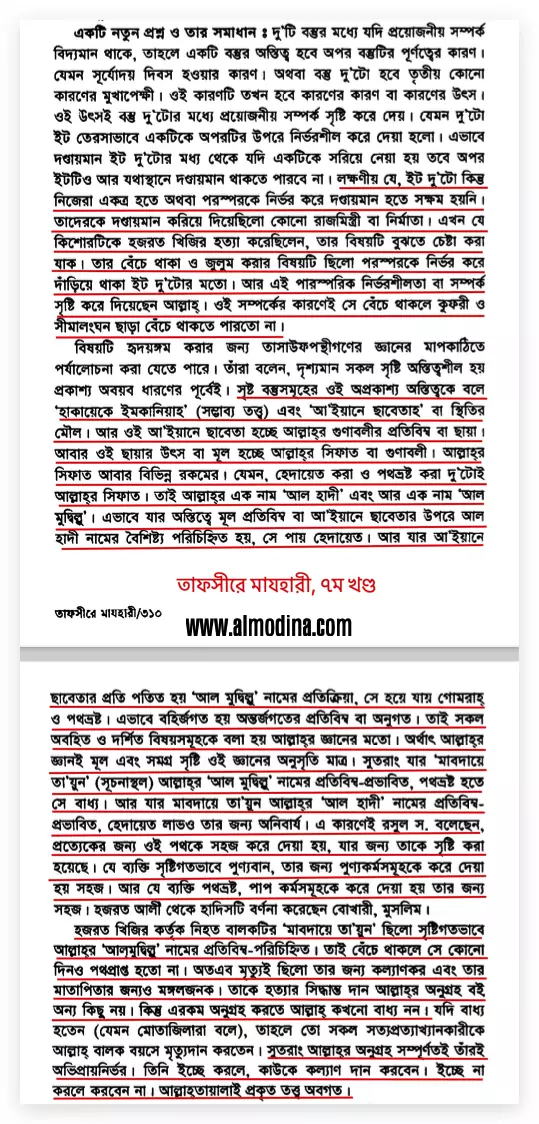
Abu Lahab’s Future Was Predetermined
Before creating the universe, Allah had already written a surah in the Quran concerning Abu Lahab. It is:
Surah al-Lahab/Surah al-Masad
1. May the hands of Abu Lahab perish, and perish he.
2. His wealth and whatever he has earned will not benefit him.
3. He will soon be thrust into a blazing Fire.
4. And his wife as well—the carrier of firewood.
5. Around her neck will be a rope of palm-fiber.
But if Allah had already written such a surah, one that Allah had in fact written before Abu Lahab was born, as is proven by authentic hadith, then it would have been impossible for Abu Lahab to accept Islam and become a believer. For if Abu Lahab had accepted Islam after this surah was revealed, the surah written by Allah would have become false! In other words, Abu Lahab was also subjected to discrimination here, because no matter how hard he tried, Abu Lahab could never have become a believer. This was because Allah had no such intention [101]
Sunan at-Tirmidhi (Ifa)
Chapter: 35/ Divine Decree
Section: No section.
2158. Yahya ibn Musa (may Allah have mercy on him) ….. It is narrated from al-Wahid ibn Salim, may Allah be pleased with him, who said: I once came to Makkah, where I met ‘Ata ibn Abi Rabah (may Allah have mercy on him). I said to him: O Abu Muhammad, the people of Basra make statements denying divine decree. He said: My dear son, do you recite the Quran? I said: Yes. He said: Then recite Surah az-Zukhruf. I recited:
Ha-Mim. By the clear Book, We have made it an Arabic Quran so that you may understand. It is with Us, in the Mother of the Book, exalted and full of wisdom (43:1, 2, 3, 4).
He said: Do you know what the Mother of the Book is? I said: Allah and His Messenger know best. He said: It is a great book, which Allah recorded before creating the heavens and before creating the earth. It contains the fact that Pharaoh is among the people of Hell; it contains Tabbat yada Abi Lahabin wa tabba (تَبَّتْ يَدَا أَبِي لَهَبٍ وَتَبَّ) The hands of Abu Lahab have perished, and he himself has perished.
‘Ata (may Allah have mercy on him) said: I met Walid (may Allah have mercy on him), the son of ‘Ubadah ibn as-Samit, one of the Companions of the Messenger of Allah (peace and blessings of Allah be upon him). I asked him: What did your father instruct you at the time of his death?
He said: He called me close to him and said: My dear son, fear Allah. Know that you will never attain the fear of Allah until you believe in Allah and believe in the good and bad of everything decreed. Moreover, if you die in any state other than this, you will have to enter Hell. I heard the Messenger of Allah (peace and blessings of Allah be upon him) say: Allah the Exalted created the Pen first. Then He commanded it, “Write.” It said, “What shall I write?” He said, “Write the decree of everything that has happened and everything that will happen until eternity.” Sahih; Sahih 133, Takhrij al-Tahawiyyah 232, Mishkat 94, az-Zilal 102, 105, Tirmidhi Hadith number: 2155 (Al-Madani Publications)
(Abu ‘Isa said) This hadith is gharib through this chain.
Hadith grade: Sahih (Authentic)
The Abu Lahab Paradox and Logical Inevitability
Islamic ‘qadar’ is essentially a metaphysical form of the ‘determinism’ described by Pierre-Simon Laplace. According to Laplace’s theory, if a cosmic entity (Laplace’s Demon) knew the present position and momentum of every particle in the universe, it would be possible for it to calculate the past and the future perfectly. This is because every event is an inevitable result of a preceding cause [1]. In Islamic theology, when this ‘all-knowing entity,’ or Allah, writes the future in the ‘Preserved Tablet,’ it is no longer merely a ‘prediction’; rather, it becomes an ‘immutable script.’ The strongest logical example of this hard determinism is the ‘Abu Lahab paradox.’
In the Quran’s Surah al-Masad, an unequivocal prediction is made concerning Abu Lahab, the disbeliever of Makkah, that he and his wife will enter Hell [102]. Abu Lahab was alive when this surah was revealed, and his destination in the afterlife was definitively declared approximately ten years before his death. Here, an unresolved conflict or logical trap arises between the Creator’s ‘foreknowledge’ and human ‘free will’; that is, if the knowledge is infallible and fixed, then it creates modal necessity. This can be analyzed in the following steps:
- 1. Divine Infallibility: Since, according to Islam, the Quran is the word of Allah and Allah is omniscient, the mathematical possibility that any of His information or declarations could be wrong is zero. In other words, Abu Lahab’s becoming one of the people of Hell is a constant truth.
- 2. The Claim of Free Will: Theologians claim that human beings are free to repent or accept Islam. Theoretically, the ‘option’ of accepting Islam should also have remained open to Abu Lahab.
- 3. Logical Contradiction: If Abu Lahab had truly used his so-called ‘free will’ to accept Islam, then that particular surah of the Quran would have been proven false.
- 4. Result: Since Allah cannot be false, it was logically impossible for Abu Lahab to accept Islam or become a good person. In other words, Abu Lahab was programmed to commit disbelief so that the truth of the Quran could be preserved.
In light of David Hume’s theory of causation, it may be said that every decision made by Abu Lahab was merely an inevitable chain reaction of the universe’s primordial cause, or Allah’s will [2]. If every step taken by an individual is written down at the very beginning of creation and that person is compelled to act according to what has been written, then the idea of putting that person to a ‘test’ is not merely irrational but absurd.
This paradox unambiguously proves that, in Islamic theology, human ‘agency,’ or the capacity to make independent decisions, is nothing more than a ‘cognitive illusion.’ Human beings here are merely ‘biological victims,’ whose fate and ultimate outcome were sealed by another being’s pen thousands of years before their birth.
Umar’s Acceptance of Islam: Injustice in the Name of Guidance through Prayer
Various Islamic accounts and hadiths state that the Prophet Muhammad specifically prayed to Allah for either ‘Umar ibn al-Khattab or Abu Jahl—two of the foremost enemies of Islam at that time—to accept Islam. Islamic sources claim that ‘Umar accepted Islam as a result of that prayer [103]
Sunan at-Tirmidhi (verified edition)
46/ The Virtues of the Messenger of Allah ﷺ and His Companions
Section: 18. The Virtues of ‘Umar ibn al-Khattab (may Allah be pleased with him)
3681. It is narrated from Ibn ‘Umar (may Allah be pleased with him) that the Messenger of Allah (peace and blessings of Allah be upon him) said: “O Allah! Strengthen and honor Islam through whichever of these two men is more beloved to You: Abu Jahl or ‘Umar ibn al-Khattab.” Ibn ‘Umar said: Of the two, ‘Umar (may Allah be pleased with him) emerged as the one more beloved to Allah the Exalted.
Sahih: Mishkat, second verification (6036).
Abu ‘Isa said: This hadith is hasan sahih and gharib in relation to the narration of Ibn ‘Umar.
Hadith grade: Sahih (Authentic)
Narrator: ‘Abdullah ibn ‘Umar (may Allah be pleased with him)
However, the concept of this special prayer creates a profound logical conflict with the conventional definitions of ‘testing’ and ‘divine justice.’ If a person’s receiving guidance depends on the prayer of a particular individual rather than on his own judgment and actions, then the extent to which Umar’s own merit or goodwill has any role becomes questionable.
In a balanced and fair examination, equal opportunities for all examinees are essential. If the Creator provides someone with a special opportunity or ‘push’ recommended by a prophet, then that person’s transformation is no longer voluntary. If Umar accepted Islam through the ‘blessing’ of that prayer, then his receiving guidance was essentially the result of a predetermined influence—the result of the Prophet’s special prayer. Under these circumstances, the fact that Umar is regarded as one of those given the glad tidings of Paradise or as one of the greatest Companions becomes morally questionable. For if the Creator Himself directs one person toward a specific destination on the basis of favoritism, then that person’s individual test has no meaningful purpose.
If this complexity of divine decree is expanded further, the issue of Satan or Iblis arises. According to Islamic theology, Satan is the eternal enemy of humanity, and he became Satan from Azazil in order to lead human beings astray. The question now arises: if it was possible to change the heart of a staunch enemy like Umar through the Prophet Muhammad’s prayer, why did he not pray for Satan’s guidance? If a single prayer could ensure Umar’s guidance, then the same prayer should also have been effective in Satan’s case. This would have permanently closed off every path to evil and sin in the universe.
That is, this prayer of the Prophet and the subsequent event of Umar’s acceptance of Islam prove that, in Islamic theology, guidance or attaining the right path is not based on any rational or moral criterion; rather, it is largely a matter of a divine lottery or special favoritism. If a person’s realization of the truth can be guaranteed through prayer, then who bears responsibility for the damnation of those who did not receive the opportunity for such a prayer? It is clear that this notion of offering special prayers for particular individuals severely damages the Creator’s purported image as a “just” being and transforms the test of the afterlife into a meaningless farce.
Where Will the Murdered Children Go?
Muhammad, the Prophet, said that those among the polytheists who buried their daughters alive would go to Hell, and that the children who were buried alive—who had neither sins nor virtues—would also go to Hell. There is no answer to the question of what crime those girls had committed [104] –
Sunan Abu Dawud (Islamic Foundation)
35/ Sunnah
Chapter: 18. Concerning the children of polytheists.
4642. Narrated by Ibrahim ibn Musa (RA) ….. from Amir (RA). He said: The Messenger of Allah (ﷺ) said: The girl who is buried alive and her mother are both destined for Hell.
Hadith grade: Sahih (Sahih)
Narrator: Sha‘bi (RA)
Now let us find out where the children of Muslims will go, [105]
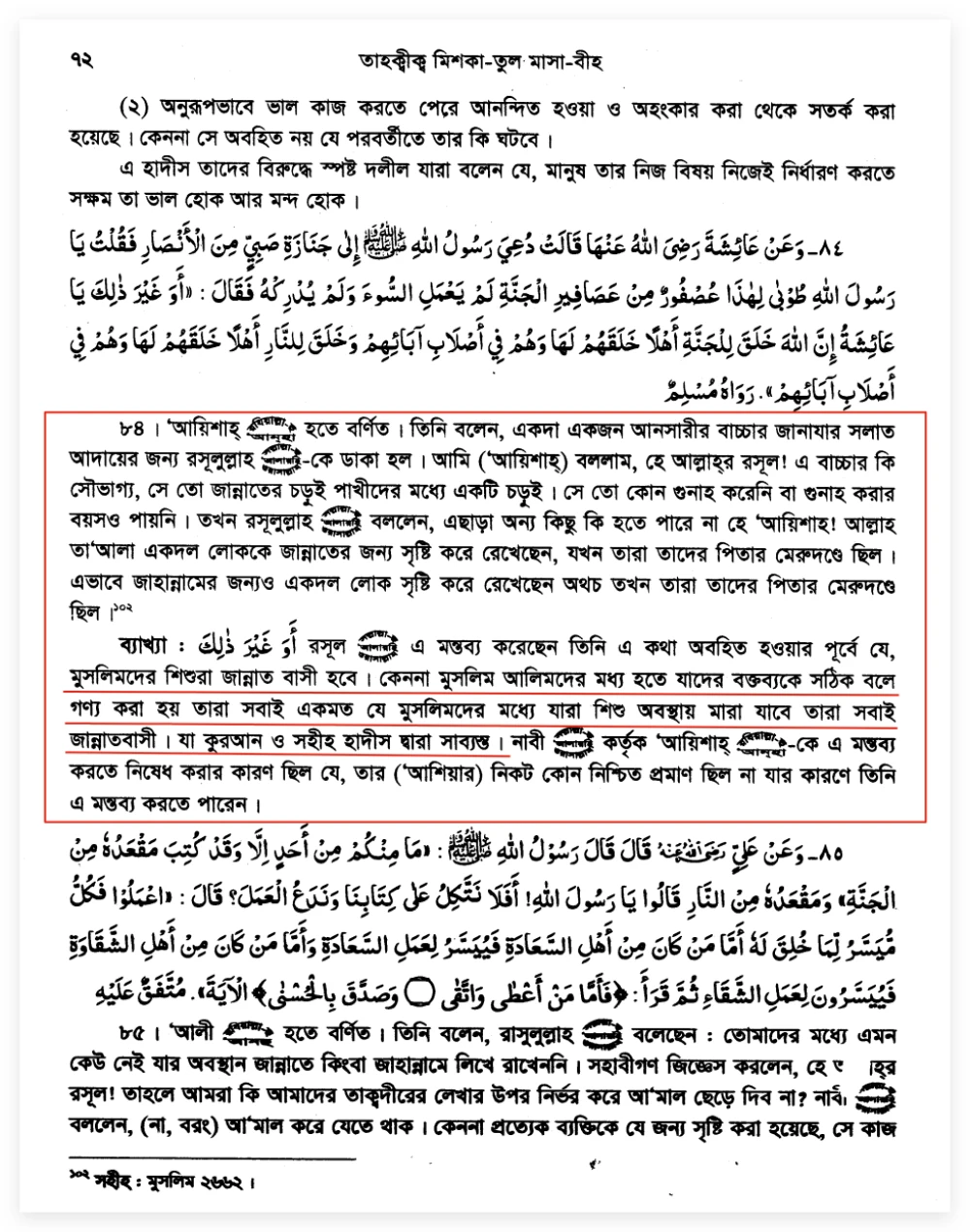
More Hadith on Taqdir
Suppose that a six-month-old baby has been raped and murdered by a man. Did the man do this of his own free will? Is he entirely responsible for this act? Or was it determined long before creation that he would commit this act? And did Allah arrange for him to be made to commit this deed and then be sent to Hell, since Allah created him with the purpose of burning him in Hell? This is nevertheless clear from the hadiths described above.
At the same time, the Prophet also confirmed that who would go to Hell and who would go to Paradise was determined while they were still in their fathers’ loins. That is, whether a person would do good or evil deeds, their fate was determined before they performed those deeds [106] –
Sunan Ibn Majah
Chapter: Introduction
Chapter: 10. Taqdir (RA): Description of the written destiny
7/82. Narrated by Aishah, Mother of the Believers (RA). She said: The Messenger of Allah (ﷺ) was called to the funeral of a child from among the Ansar. I said: O Messenger of Allah, glad tidings for him! He is one of the little birds of Paradise, who never did evil or reached the age of doing evil. He said: Could it be otherwise, O Aishah? Indeed, Allah created a group of people for Paradise. He created them for Paradise while they were still in their fathers’ loins. He also created a group for Hell. He created them for Hell while they were still in their fathers’ loins.
Takhrij Kutub al-Sittah: Muslim 2662/1-2, Nasa’i 1947, Abu Dawud 4713, Ahmad 23612, 25214.
Al-Albani’s verification: Sahih.
Hadith grade: Sahih (Sahih)
Narrator: Aishah (RA)
Read the following hadith carefully. It is quite clear that Allah has already determined who will be among the people of Hell and who will be among the people of Paradise, and where each will go [107] –
Sunan Abu Dawud (verified)
35/ Sunnah
Chapter: 18. Concerning the children of polytheists
4713. Narrated through Umm al-Mu’minin Aishah (RA). She said: One day, the body of an Ansari boy was brought to the Prophet (ﷺ) for the funeral prayer. Aishah (RA) said: I then said, O Messenger of Allah! How fortunate he is that he committed no sin and had not reached the age of committing one. He said: O Aishah! Could it not be otherwise? Allah, the Exalted, created Paradise and its inhabitants, and when He created it for them, they were in their fathers’ loins. He also created Hell and a group of those who would suffer in it, and when He created it for them, they were in their fathers’ loins.(1)
Sahih.
(1). Muslim, Nasa’i, Ahmad.
Hadith grade: Sahih (Sahih)
Narrator: Aishah (RA)
At the same time, Allah has definitively determined several matters for all of His creation. These are [108] –
Mishkat al-Masabih (Mishkat)
Part 1: Faith (Belief)
Chapter: 3. Third section—Belief in Divine Decree
113-(35) Narrated by Abu al-Darda (RA). He said, The Messenger of Allah (ﷺ) said: Allah, the Mighty and Majestic, has definitively written and determined five matters for His creation: (1) its lifespan, (2) its deeds, (3) its place of residence or death, (4) its movements, and (5) its provision. (Ahmad)(1)
(1) Sahih: Ahmad 20729, Ibn Abi al-‘As’s Tahqiq al-Sunnah, 303.
Hadith grade: Sahih (Sahih)
It is narrated in Sahih Muslim from Abdullah ibn Amr ibn al-As (RA)—he said, I heard the Messenger of Allah (ﷺ) say: Allah, the Exalted, recorded the destiny of creation fifty thousand years before creating creation [78] [109] –
Reference : Sahih Muslim 2653b
In-book reference : Book 46, Hadith 27
English reference : Book 33, Hadith 6416
Chapter : The Debate Between Adam And Musa (Peace And Blessings Of Allah Be Upon Them)
Abu Tahir Ahmad ibn Amr ibn Abdullah ibn Sarh (RA) … narrated from Abdullah ibn Amr ibn al-As (RA). He said, I heard the Messenger of Allah (ﷺ) say: Allah, the Exalted, recorded the destinies of all creation fifty thousand years before creating the heavens and the earth. He said that at that time Allah’s Throne was above the water.
Hadith grade: Sahih (Sahih)
![গ্রন্থঃ সহীহ মুসলিম (ইফাঃ) অধ্যায়ঃ ৪৮/ তাকদীর (كتاب القدر) হাদিস নম্বরঃ [6507] পাবলিশারঃ ইসলামিক ফাউন্ডেশন](https://assets.shongshoy.com/2019/09/6S2r7mP.jpg.webp "Islamic Predestination (Taqdeer): Free Will, Divine Control, and Moral Responsibility 66")
In the Tahqiq Mishkat al-Masabih published by the Hadith Academy, the verification of the hadiths was taken primarily from Shaykh Nasiruddin al-Albani’s Tahqiq Mishkat al-Masabih. Explanations from the famous commentary on Mishkat, “Mir’at al-Mafatih,” have been added [110].
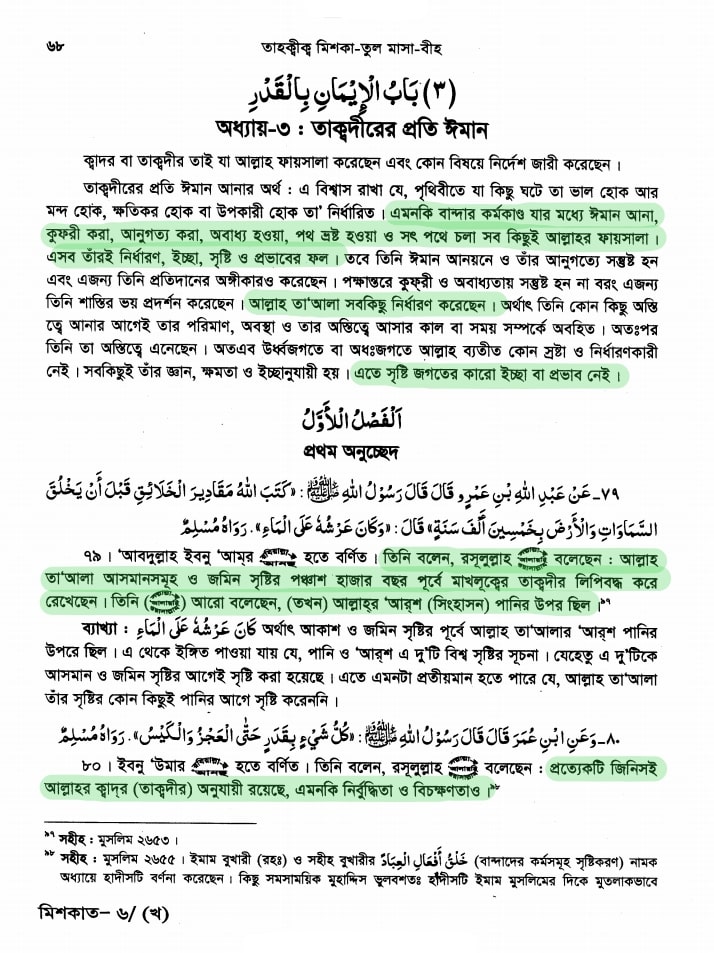
Hadith Qudsi [111], which is called the Word of Allah itself issuing from Muhammad’s mouth, contains the following statement by Muhammad:
“The first thing Allah created was the Pen. After creating it, He said to the Pen: ‘Write.’ The Pen said: O Lord! What shall I write? He said: Write the decree of every thing until the Day of Resurrection.”
(Abu Dawud—4700) Al-Albani declared the hadith sahih in Sahih Abu Dawud.
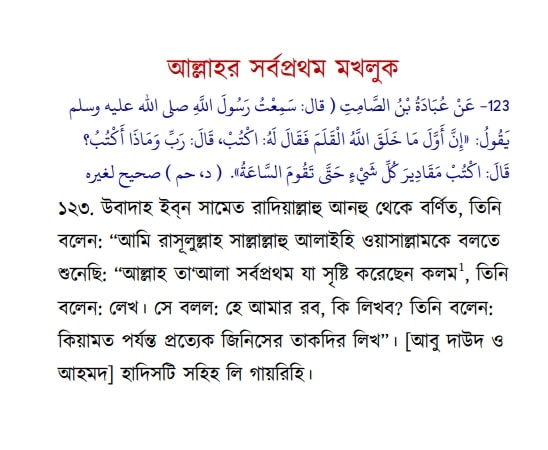
Let us read some more hadiths [112].
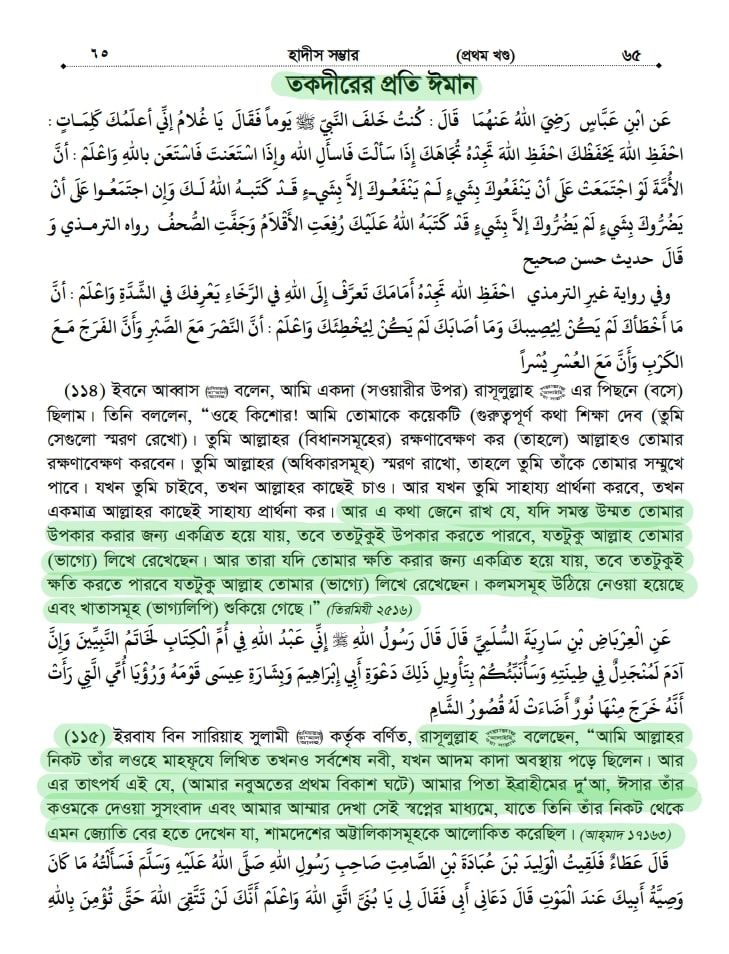
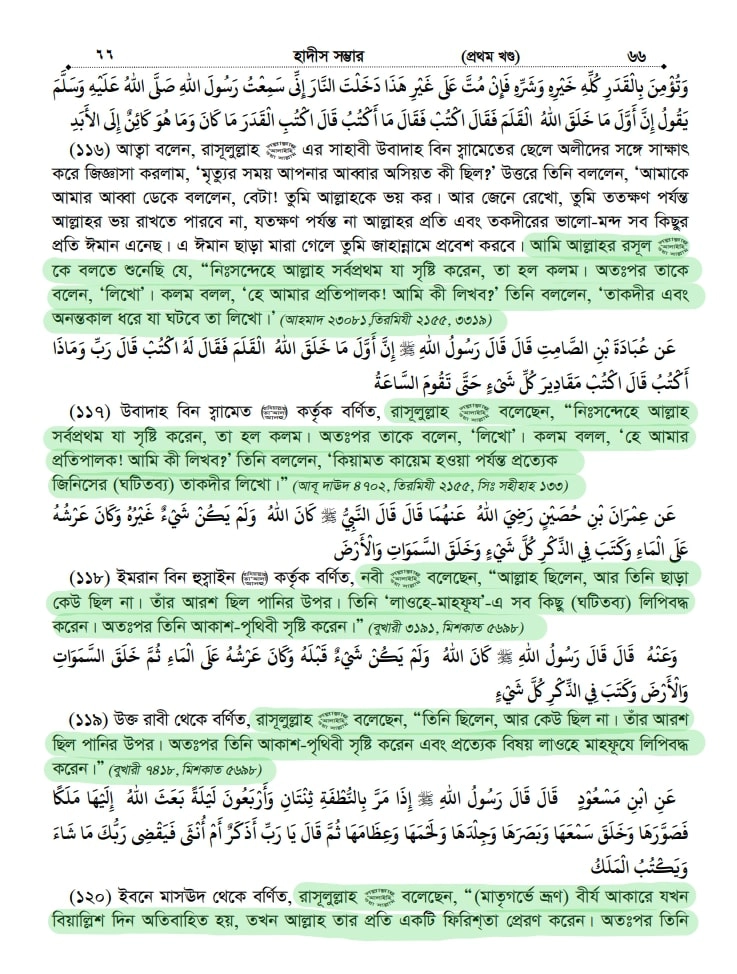
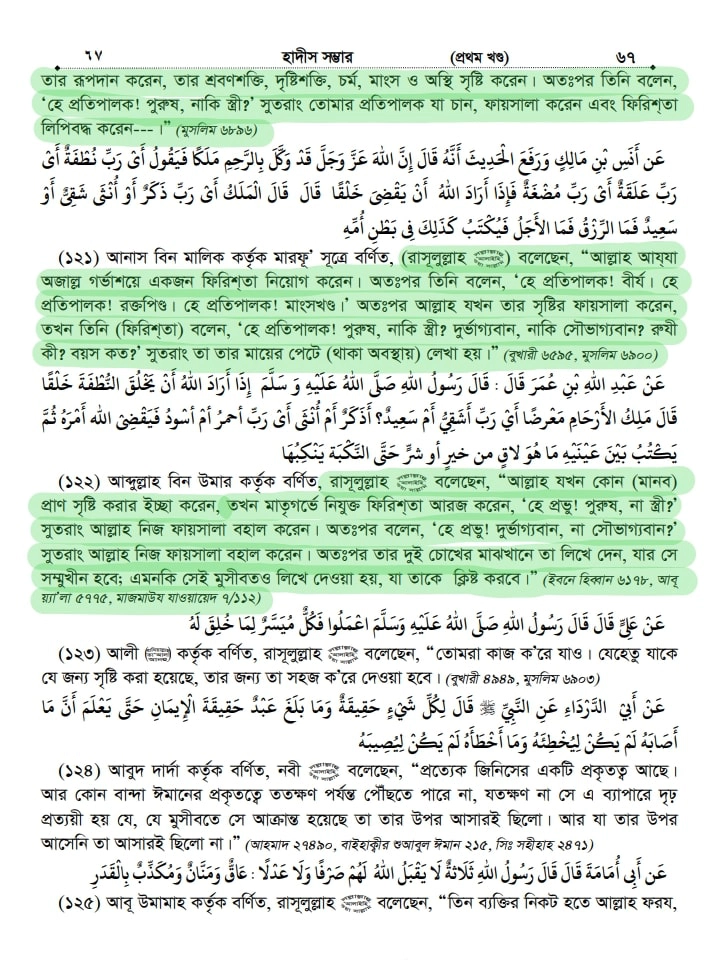
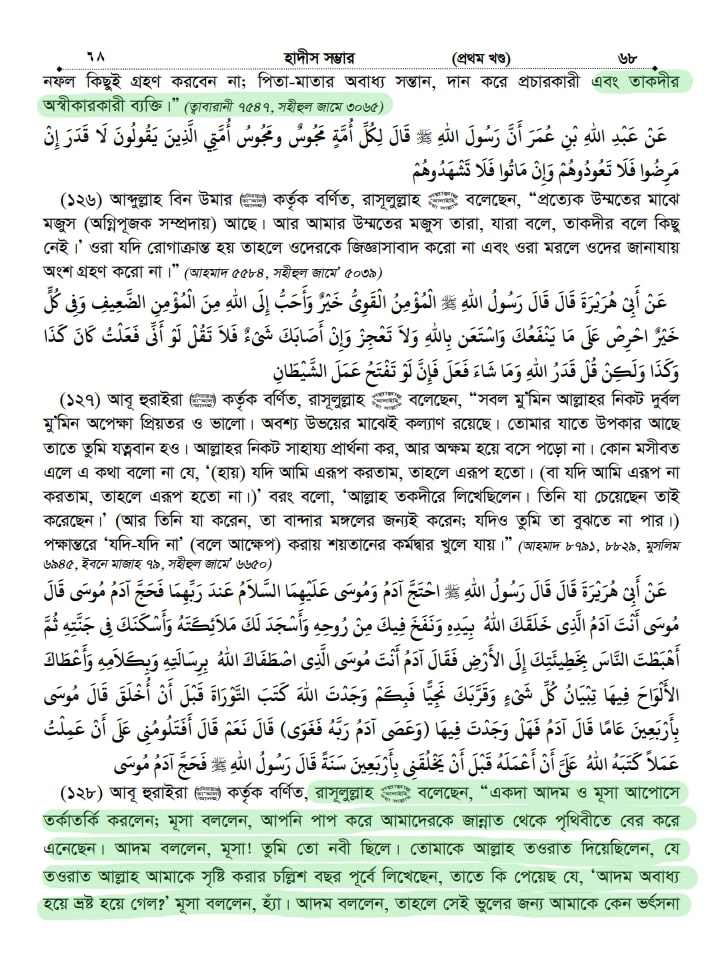
Contradiction Concerning Free Will and the Consequences of Actions
Islamic belief presents a dual perspective on free will and the consequences of actions—reward and punishment. It is by no means unusual that different thoughts arose in the mind of Muhammad at different times, leading him to make different statements on different occasions. On the one hand, the Quran and hadith instruct people to choose good and evil deeds freely. For example, Surah al-Kahf (18:29) says, “whoever wills, let him believe; and whoever wills, let him disbelieve”—which indicates free choice. On the other hand, Paradise and Hell are promised as the consequences of one’s actions, thereby establishing a sense of responsibility for human conduct. But these ideas directly contradict Taqdir, because if all actions and outcomes are predetermined—as the hadith says, with destiny written while one is still in the womb—then human free choice is merely an illusion, and reward and punishment become irrational. A person cannot be held responsible for something they were predetermined to do. This breaks the structure of logic, particularly violating the “law of non-contradiction,” which states that the same thing cannot be true and false at the same time. In other words, if an action is free, it cannot be predetermined; and if it is predetermined, accountability, freedom, or responsibility is impossible. This contradiction also calls the law of identity in logic into question, because it renders the identities of freedom and determinism unclear, making logical analysis impossible and, in Aristotle’s terms, creating irrationality or a Chaos of thought.
If we place this within the framework of pure logic:
If the outcome of an action is known beforehand with 100% certainty, then the occurrence of that action is inevitable (Necessary).
For Free Will to exist, there must be at least one alternative possibility.
According to Islamic Taqdir, every action is 100% certain, predetermined, and unalterable.
Since the outcome has already been determined (Premise 3), there is no alternative possibility (contrary to Premise 2).
Therefore, Free Will is a logical impossibility in this system.
Studying Philosophy or Logic Is Haram
Philosophy, or philosophia in English, means “love of knowledge.” More precisely, it is the study of general and fundamental questions concerning human existence, knowledge, morality, values, reason, mind, and language. Almost all knowledge in human history emerged from philosophy, whose fundamental basis is logic. In fact, philosophy is the mother of all human knowledge. This discipline of philosophy underwent significant development in ancient Greece, where great philosophers such as Socrates, Plato, and Aristotle laid much of the foundation for modern European philosophy. The fundamental principles on which all logic in the world today depends were provided by Aristotle. At the same time, the Greek philosophers also provided guidance on how methods of thought can be made logical.
When the Islamic concept of Taqdir is examined in the light of logic, and tested against the touchstone of logical reasoning, the concept of Taqdir described in Islam’s authentic texts must be regarded as irrational, which places Islam itself under question. Islamic scholars have struggled throughout the ages to deal with this problem, attempting to preserve this Islamic concept by adding new conditions and offering new interpretations in various ways. When that did not work, they declared discussion or speech concerning Taqdir haram. When that too failed, they ultimately declared the study of philosophy and logic itself haram. Below, we will hear the statements of several famous Salafi Islamic scholars from around the world, who will explain why the study of logic or philosophy is haram in Islam. For more details, this article may be read [113]. First, let us listen to a discussion by Dr. Abu Bakr Muhammad Zakaria, one of Bangladesh’s prominent contemporary religious scholars, in which he discusses whether Muslims should or should not study logic or philosophy.
Now let us listen to two statements by the internationally renowned Islamic scholar Assim al hakeem.
The Illusion of the Test According to Islamic Aqidah
Although Islamic theology claims that the world is a “testing ground,” the strict determinism of Taqdir directly refutes this claim. If a Creator (S) knows long before the creation of the universe that a human being (A) will perform a specific action (X) at a specific time, then the nature of that action is no longer “optional”; rather, it becomes “necessary” (Necessary).
If S knows with certainty at time t₀ that A will perform action X at time t₁, and because S is infallible and incapable of making a mistake, then it is mathematically impossible for A not to perform X at time t₁.
For Free Will to exist, multiple alternative possibilities are essential. But here the alternatives available to A have already been eliminated, so no real alternative remains in practice.
When the path of alternatives is closed, A is no longer an independent “agent”; rather, A acts according to a program or script determined by S.
Where there are no alternatives and the outcome is inevitable,
there is no decision—only execution takes place.
Therefore, Free Will is a logical impossibility within this framework.
Qadariyah, Jabariyah, and Ahl al-Sunnah wa al-Jama’ah
In early Islamic theology, attempts to resolve the paradox between predestination and free will began primarily after Islam came into contact with Greek rationalism and philosophy. When Islamic scholars encountered the formal logic of Greek philosophy, they developed various philosophical doctrines to resolve this structural inconsistency. Three principal trends can be identified in this development:
1. Qadariyah and Jabariyah: Two Extreme Poles
However, in defending this position, they were compelled to interpret the texts concerning predestination metaphorically and, in effect, ended up limiting the Creator’s omniscience.
On the one hand, preserving omniscience leads to the loss of justice,
while on the other hand, preserving justice compromises omniscience.
Therefore, both positions are fundamentally inconsistent.
2. Ahl al-Sunnah wa al-Jama’ah and the ‘Ad Hoc’ Synthesis
In opposition to these two extremes, Ahl al-Sunnah wa al-Jama’ah (the Ash’ari and Maturidi schools) claim to offer a middle-path synthesis. The Ash’ari school’s theory of ‘kasb’ (Acquisition) or the Maturidi school’s concept of ‘Delegated Intention’ is essentially an attempt to conceal this logical inconsistency. However, from the perspective of strict logic, these syntheses are flawed for the following reasons:
When a theory faces a logical inconsistency, new unsupported concepts are introduced to protect it.
A concept such as ‘kasb’ is a Black-box Theory— it claims ownership of actions, but cannot explain any verifiable physical or logical mechanism behind them.
Instead of accepting a simple explanation, numerous complex, unverified conditions are being added here.
As a result, rather than becoming stronger, the explanation leads to increased unnecessary complexity and doubt.
It is assumed at the outset that “the Creator is just and the religion is true.” It is then claimed that, for this very reason, a synthesis between predestination and free will is mandatory.
In other words, what must be proven is being used as the basis for the proof.
This attempt at synthesis is not an independent explanation,
but rather a artificial, complex, and self-contradictory structure
used to keep the theory alive.
Therefore, it is a logically unstable system.
These theological efforts ultimately fail to provide any formal logical resolution. This is because it is mathematically impossible to place a Closed System (in which the outcome is predetermined) and Open Choice (in which there is an opportunity to choose between alternatives) on the same plane despite their incompatibility. Consequently, these syntheses are ultimately forced to abandon the field of reason and seek refuge in metaphysical mystery, mysticism, or semantic gymnastics. In other words, these views fail to solve the problem logically.
PAP versus Compatibilism and the Limitations of ‘Kasb’
Attempts to reconcile predestination and human free will in Islamic theology have continued for centuries. Three principal trends can be identified in this debate: (1) the Mu’tazilah—who, by believing in complete human free will, limited Allah’s omnipotence; (2) the Jabariyah—who, by believing in complete determinism, viewed human beings as mere instruments; and (3) the Ash’ari-Maturidi position—whose proponents claim to reconcile the two through the theory of ‘kasb’ (acquisition).
But at the center of this discussion lies a subtle yet important misunderstanding—or a deliberate deception by theologians: when we speak of “force” or “control,” we often understand only visible pressure—being held at gunpoint, threats, physical compulsion, and similar things. But in the case of an omnipotent and omniscient being, the nature of control is entirely different. Here, control is not merely control over “external actions”; rather, the source, establishment, and operation of the conditions under which desires arise, the control of intelligence, the causal chain, mental inclinations, the reasoning behind decisions, and the capacity for perception—all fall under the authority of the same all-encompassing power. In other words, an omnipotent being has no need to hold a gun to a person’s head to compel that person to perform an action, since omnipotent Allah can bring anything into existence simply by commanding it to be. No medium, intimidation, coercion, or anything of the sort is necessary here.
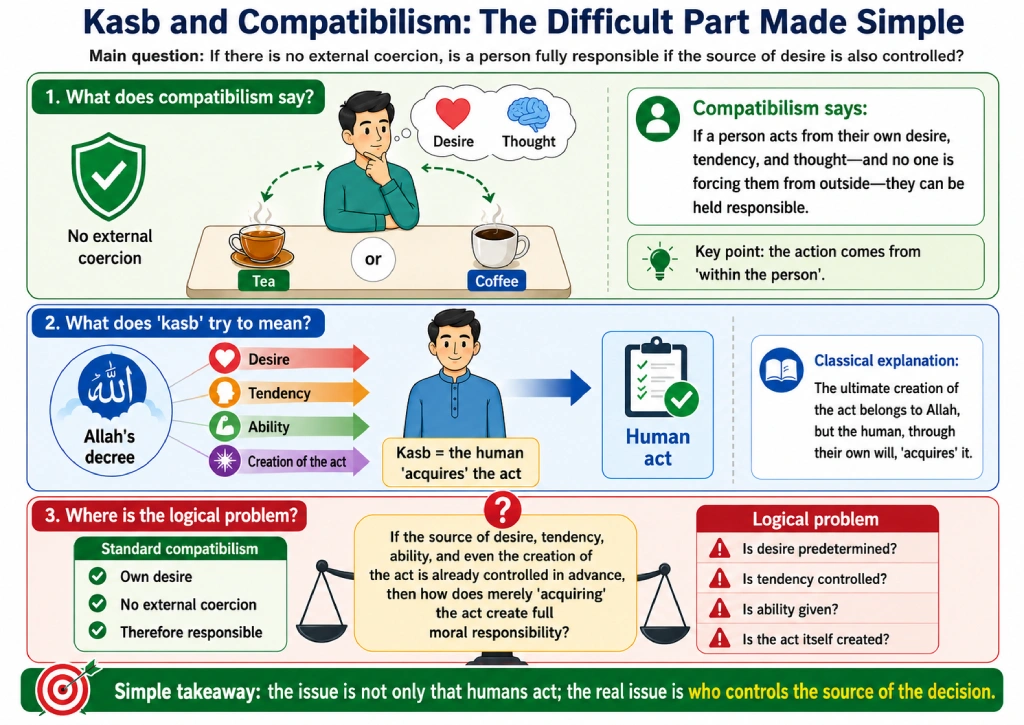
In this section, we will undertake an in-depth logical analysis of the Islamic concept of ‘kasb’ in light of the Principle of Alternate Possibilities (PAP) and the theory of Compatibilism in Western philosophy, and show why, under this kind of control—where, even in the absence of external pressure from a gun, freedom does not exist in the sense in which we ordinarily use the word “freedom” in the case of ordinary human beings—the theory of ‘kasb’ fails to offer any genuine solution to the fundamental problem.
PAP: Why Does “Could Have Done Otherwise” Raise an Objection?
The Principle of Alternate Possibilities (PAP) is a fundamental principle of modern moral philosophy, first clearly articulated by the philosopher Harry Frankfurt in his famous 1969 paper [114]. It should be noted that the idea that “moral responsibility ⇒ could have done otherwise” had long been prevalent in discussions of free will and responsibility. Harry Frankfurt gave this established idea a name and clearly stated it as the “Principle of Alternate Possibilities (PAP).” The central claim of PAP is:
“A person is morally responsible for what they have done only if they could have done otherwise.”
In other words, if a person has no genuine possibility of choosing an alternative course of action, they cannot be held responsible for that action. For example, if a person is forced at gunpoint to kill someone, they are not morally responsible for the killing—because they had no alternative of “not doing it”. This was long accepted in moral philosophy as an intuitive principle.
The relationship between PAP and predestination is extremely simple and clear: if everything is irreversibly predetermined, where is there room to say that a person “could have done otherwise”? If every one of my decisions was written in the Preserved Tablet 50,000 years ago and is immutable, then I have no real possibility of “doing otherwise.” This is where many incompatibilist arguments arise—claiming that determinism and moral responsibility cannot coexist.
Let us examine the diagram below. Suppose Allah knows that a person named A will certainly choose an orange. If an apple and an orange are placed before him, is it possible for him to choose the apple? If it were possible, Allah’s knowledge would turn out to be mistaken. According to Islamic belief, Allah’s knowledge cannot be mistaken. In other words, the only option available to the person named A is to choose the orange. Thus, the person named A does not actually have any genuine option to choose the apple.
“The person named A will certainly choose the orange”
But stopping here in the discussion of predestination leaves the analysis incomplete—because many religious and philosophical thinkers set aside PAP and invoke “Compatibilism” to preserve moral responsibility. They argue that PAP is a mistaken principle and that “alternate possibilities” are not actually necessary for moral responsibility. To understand this alternative path, we must delve deeper into Compatibilism.
Compatibilism: Responsibility May Exist Even Without an Alternative Path
Compatibilism claims that determinism and moral responsibility can coexist. Philosophers including Daniel Dennett, David Hume, and Harry Frankfurt have supported this view. Their central argument is:
“Free will does not mean ‘alternate possibilities’; rather, it means ‘the absence of external coercion.'”
Compatibilists say that freedom does not mean “necessarily having an alternative path”; rather, freedom means whether the action arose from the person’s own desires, intentions, and character, or whether it occurred under external compulsion. In other words, as long as someone is not being forced to do something through physical force, under threat, or through mental control, they will be regarded as acting “freely”—even if the future is predetermined.
Harry Frankfurt’s Famous Thought Experiment: Challenging PAP
To establish his argument, Frankfurt presented a famous thought experiment known in philosophy as “Frankfurt Cases” [114]:
Suppose a mad scientist named Black has implanted a chip in your brain. This chip is monitoring your mental state. If you are about to make a particular decision that the scientist does not want, the chip will activate and force you to make the decision preferred by the scientist. But in the actual event, you independently made the decision the scientist wanted. As a result, there was no need for the chip to activate. The scientist was present only as a “backup” but did not intervene.
In such a situation, Frankfurt asks: Are you responsible for your decision? In this example:
- There was no alternate possibility—because if you had made a different decision, the chip would have activated and forced you
- But the decision came from your own will
- There was no direct intervention by the scientist
The compatibilist answers: Yes, you are responsible, because the decision came from your own will, even though there was no alternate possibility. Through this argument, Frankfurt sought to show that PAP is false—alternate possibilities are not essential for moral responsibility. Rather, what matters is the source of the decision and the absence of coercion—whether the decision arose from the person’s own mental processes or was imposed by force from some external power.
So far, the position is this: responsibility can survive even without PAP—provided that the “source” is genuinely an internal source of freedom belonging to the person and coercion is absent. Many modern philosophers have accepted this argument, and Compatibilism is currently recognized as a strong philosophical position.
The Concept of “Coercion” Collapses in the Case of an Omnipotent and Omniscient Being
This is where the central blow falls in the discussion of predestination. In the case of human beings, saying that there is “no external force” means that the process by which their desires are formed is operating, at least partially and independently, within their own psychological, biological, and social history. For one finite human being to “coerce” another finite human being, the former must exert pressure from outside—through intimidation, threats of punishment, guns, inducements, propaganda, brainwashing, and so on. This pressure can be identified as visible or at least as behaviorally distinct. But in the case of an omnipotent and omniscient being, the nature of control is entirely different. In the conception of God presented in the Qur’an and Hadith, Allah:
- Creates the capacity/ability to will—”He created everything and determined it” (25:2)
- Determines even the conditions that govern which direction the mind will incline, which argument will seem “stronger,” and which temptation will become more intense—”Allah has set a seal upon their hearts” (2:7)
- Whether human beings will “will” something is also subject to Allah’s will—”And you do not will unless Allah wills” (81:29)
- Controls who will receive guidance and who will go astray—”He leads astray whom He wills” (14:4)
- Allah alone makes people perform actions according to destiny – “He leads astray whom He wills and guides whom He wills” (35:8) (Sunan Abu Dawud (verified), Hadith: 4703, Muwatta Malik, Hadith: 1660, Mishkat al-Masabih (Mishkat), Hadith: 95)
Within such a framework, the very claim that there is “no external coercion” becomes meaningless. For control here does not operate outside the action; control is embedded within the formation of the will. If the capacity to will, the direction of the will, and the permission to will—everything remains under Allah’s control, then what grounds are there for calling that will “my own”?
The concept of “Coercion” breaks down in the case of an omnipotent and omniscient being
Focus: source-controlThis is precisely where the central difficulty in the discussion of destiny lies. In the human case, saying that “there is no external force” means that the process by which a person’s will is formed is at least partially operating independently within their own psychological, biological, and social history. But in the case of an omnipotent and omniscient being, the nature of control is different: even if there is no external “gun,” if the very conditions for the formation of the will are controlled, then the claim that “there is no coercion” becomes hollow.
The “force” of a finite entity: pressure from outside
Distinct in visible/behavioral terms- Pressure must be applied from outside through intimidation, threats of punishment, guns, greed, propaganda, brainwashing, and so on.
- This pressure can generally be identified: “This is not my natural desire—pressure came from outside.”
- Therefore, among finite human beings, “coercion” can often be understood in connection with external pressure or threats.
The “control” of an omnipotent and omniscient being: constructing internal conditions
Complete control without force- Creates the capacity/ability to will 25:2 — “He created everything and determined it precisely.”
- Also determines which reasoning will feel “weighty” and in which direction the mind will incline 2:7 — “Allah has set a seal upon their hearts.”
- Whether a person will “will” or not is also subject to the divine will 81:29 — “You do not will unless Allah wills.”
- Controls who will receive guidance and who will go astray 14:4 — “He leads astray whom He wills.”
-
The claim that people are made to act according to destiny (on the basis of Quranic and hadith sources)
35:8 — “He leads astray whom He wills and guides whom He wills.”
Sunan Abu Dawud (verified) 4703, Muwatta Malik 1660, Mishkat 95
Why the claim that “there is no external coercion” does not work here
The capacity to act and the conditions of physical/mental ability are constructed
Which way the mind will incline—inclination/causal chain—is also determined
Whether the desire “will or will not arise”—permission/subjection of the will—remains in place
As a result, the source of the decision does not remain “independently mine”
Within this framework, saying that “there is no external coercion” becomes meaningless—because control does not operate outside the action; control is embedded within the formation of the will. If the capacity to will, the direction of the will, and permission for the will—all of these—remain under Allah’s control, then where is the basis for calling that will “my own”?
Note: Sunan Abu Dawud (verified), Hadith: 4703, Muwatta Malik, Hadith: 1660, Mishkat al-Masabih (Mishkat), Hadith: 95
Finite Agents versus an Omnipotent Being: Two Different Natures of Control
To understand this distinction, we must understand the difference between two types of control:
The “force” of a finite agent (visible coercion)
When a dependent entity (a human being/animal/any finite agent) wants to exert pressure on someone else, it generally has to apply pressure “from outside”:
1) My will/source ≈ my internal process (relatively independent)
    ↓
2) External pressure: threats/guns/greed/physical restraints
    ↓
3) Therefore, “coercion” can be recognized: breaking/changing the will from outside
For example: a robber is forcing you to hand over money by pointing a gun at you. Here:
- Your original desire: Not to give the money
- External pressure: The threat of a gun
- Result: You gave the money, but this was not from your “free will”
This kind of coercion is visible and identifiable. We can easily say: “This was coercion, not free will.”
The Control of an Omnipotent and Omniscient Being (Source-Control)
But an omnipotent and omniscient being—if it possesses the causal power whereby whatever it wants simply comes to pass—does not need any separate “pressure” in order to exercise control. This is because, within the reality it is constructing, it can create desires, inclinations, causes, perceptions, and attitudes:
1) The conditions/causal chain/inclinations/perceptions involved in forming the will—all are constructed/controlled
    ↓
2) Even without an external gun, the outcome may be “inevitable”—because the conditions themselves are determined
    ↓
3) Therefore, even if one says “there is no force,” responsibility is not justified if source-control remains intact
For example, suppose Allah wants you to commit a particular sin. He can:
- Create that inclination in your mind
- Weaken the strength of your conscience (“set a seal”)
- Arrange your circumstances in such a way that the act appears “natural”
- Limit your ability to understand reason, logic, and meaning
After all this, when you perform the act, it will seem to you that it is your “own desire”—but in reality, every element of that desire has been predetermined and controlled. Here the outcome becomes inevitable “without applying force,” because the conditions of the outcome—the conditions of willing—were constructed and determined beforehand.
Why Does This Exceed the Limits of Compatibilism?
In other words, we call being held at gunpoint coercion because one finite person is intervening from outside in the will of another finite person. In Frankfurt’s example as well, the chip was an “external backup” that was never activated. The decision arose from the person’s “own mental process.”
But within an omnipotent and omniscient framework, complete control is possible without an external gun—because if even the “internal source” of the agent falls within a chain created and controlled by that being, then how can the decision be called “mine alone”? At this point, the Quranic account also generally presents such an idea—the human will is not “self-sufficient,” but rather subject to the divine will:
- “You will not will unless Allah, the Lord of the worlds, wills” (81:29)
- “Whoever Allah guides is rightly guided. And whoever He leads astray will be among the losers” (7:178)
- “No one can believe except by Allah’s permission” (10:100)
Comparison: Frankfurt’s Example versus Islamic Destiny
| Element | Frankfurt’s Example | Islamic Destiny |
|---|---|---|
| Source of the will | The individual’s own mental process | Created by Allah (“He created everything”—25:2) |
| External intervention | Backup (not activated) | Active (“setting a seal” 2:7, “leading astray” 14:4) |
| Alternative possibilities | Absent in the counterfactual sense | Completely absent (“You cannot do so unless Allah wills” 81:29) |
| Dependence of the will | Independent (the scientist is merely observing) | Dependent (subject to Allah’s will) |
| Nature of control | External (backup intervention) | Internal (the conditions for forming the will are controlled) |
| Accountability | Fair (the will was one’s own) | Problematic (the will is created and controlled by Allah) |
This comparison makes it clear that Frankfurt’s Compatibilism does not apply to Islamic destiny. For in Frankfurt’s example, the individual’s will is their own, whereas in destiny, the will itself is created and controlled by Allah.
Does “Kasb” Really Add Anything Here, or Is It Merely a Label?
The theory of “Kasb” (Acquisition) within the Ashari-Maturidi framework generally states: Allah creates the act (خلق / Khalq), while the human being “acquires” the act (كسب / Kasb)—and therefore the human is responsible. This may sound like a religious form of “compatibilism.” But in the area on which we are focusing, “Kasb,” rather than solving the problem, becomes a “verbal concealment.”
What Does “Kasb” Claim?
According to Ashari theology:
- Creator: Allah
- Power to create: Exclusive to Allah
- Will: Subject to Allah’s permission
- Acquisition: The human role
- Consequence: Predetermined by Allah
For example, if someone raises their hand, then according to the Ashari view:
- Allah created the movement, strength, and capacity involved in raising the hand
- The human being “acquired” that raising of the hand
- Therefore, that person’s hand was not raised under Allah’s direct control, and so the person themselves are responsible.
But the Question Is Not Merely About an “External Gun”
Because the question is not simply, “Am I the victim of an external gun?” The question is:
- Why did my will incline in this direction?
- What is the source of my character/the intensity of my inclinations, my intelligence, the strength or weakness of my conscience, my ability to understand reasoning, and my interpretation of circumstances?
- If the conditions of these things are determined/controlled, then where is the “authorship” of responsibility?
In this situation, if “Kasb” merely says—“Allah created it, and the human acquired it”—then what new causality or control did the word “acquired” actually add?
Reanalyzing the Causal Chain
The philosopher David Hume showed in his famous theory of causation that behind every event there is a causal chain. If we want to determine responsibility for an action, we must know where the actual source of that chain lies.
According to the theory of “Kasb,” the causal chain of an action is:
1. Allah creates the human being’s existence
    ↓
2. Allah gives the human being specific inclinations/character traits
    ↓
3. Allah gives the human being the capacity to will
    ↓
4. The human being wills (but “you cannot will unless Allah wills”)
    ↓
5. Allah creates the act
    ↓
6. The human being “acquires” the act (the “Allah makes people perform actions” narrated in sahih hadith)
    ↓
7. The outcome occurs (written, determined, and unchangeable in the Preserved Tablet 50,000 years earlier)
In this chain, Allah is the actual controller of every step. Where is the human role?
The theory of “Kasb” criticizes the Jabriyya sect. The creed of the Jabriyya sect is,
“A stone is rolling down a mountain. Is the stone ‘deciding to fall’? No. Gravity and the slope of the mountain are forcing it to fall. Similarly, a human being is not ‘deciding’ to perform their actions—Allah is making them do it. Just as the stone is not ‘responsible for falling,’ the human being is not responsible for their actions.”
In response to this argument, the theory of “Kasb” says: “The human being ‘acquires’ the act, and therefore is not like the stone.” But this response is genuinely meaningless—because the word “acquisition” adds no new element to the causal chain. If:
- The creation of the act belongs to Allah
- The capacity for willing is a gift from Allah
- Permission for the will belongs to Allah
- The direction of the will belongs to Allah (“setting a seal,” “giving or withholding guidance”)
- Allah makes people perform actions according to their will and determination
Then what, in reality, is the human being’s “acquisition”? Is it merely a label—something that creates a distinction on paper but plays no effective role in reality? In philosophy, this is called Distinction without Difference—a distinction that exists on paper but not in reality. For example:
- “Fire does not burn, Allah burns—but fire ‘acquires’.”
- “A gun does not kill, Allah kills—but the gun ‘acquires’.”
Statements of this kind are logically meaningless. If an entity does not create an action, it cannot be responsible for that action. Responsibility must necessarily be related to causation. The theory of ‘kasb’ severs this relationship.
As a result, the concept of responsibility survives on paper mainly to provide some kind of explanation, or as a “post hoc reason”—not as a solution. Because:
- To preserve Sharia law, human beings must be held responsible
- To preserve Allah’s omnipotence, He must be the creator of everything
- To preserve the infallibility of the Qur’an and hadith, they must be reconciled
- The word kasb is used to reconcile these two—but this is an ad hoc (situational) solution, not a logical one.
The Ghazali Context: Taking Refuge in “Mystery” Instead of Explaining ‘Kasb’
The name of Imam Abu Hamid al-Ghazali (1058–1111 CE) is extremely important in this debate. Ghazali was one of the foremost proponents of Ashari theology and one of the most influential thinkers in the history of Islamic philosophy. Within the Ashari tradition, he strongly emphasized a tone of “mystery/incomprehensibility” concerning ‘capacity/action/will’—where human will, voluntary action, created power, and related matters are ultimately left as “mystery” rather than being regarded as fully explainable. In his famous works ‘Al-Iqtisad fi al-I’tiqad’ (Al-Iqtisad fi al-I’tiqad) and ‘Al-Munqidh min al-Dalal’ (Deliverance from Error), he wrote:
“The distinction between the creation (khalq) and acquisition (kasb) of human actions is a subtle mystery that only Allah Almighty and His prophets can fully comprehend. It is not possible to completely unravel this mystery through the intellect of ordinary human beings.”
Michael E. Marmura, who conducted extensive research on Ghazali’s philosophy, explicitly states that within Ghazali’s framework, our power/volition/action/voluntary motion “remain a mystery” in the final analysis—and that Ghazali himself also carries this “sense of mystery” [115]. This admission is highly significant. Ghazali, who in his early life was himself a sharp rationalist and philosopher, is indirectly acknowledging:
“The theory of kasb cannot be explained logically. It is a religious belief that must be accepted without question.”
“Mystery Stopper”: Taking Refuge in Faith Instead of Reason
In philosophy, statements of this kind are called a “Mystery Stopper”—when reason fails, one takes refuge in “mystery” or “transcendent knowledge.” This is essentially an Argument from Ignorance—”We do not understand it, therefore it must be true.”
This “mystery-stop” tendency is relevant here because precisely where ‘kasb’ is supposed to provide a real explanation—how responsibility can genuinely be justified—reason comes to a halt and the gap is covered with words such as “acquisition” or “mystery”. As a result, the reader’s doubt becomes even more intense: Is the solution really an explanation, or is it a theological “stop sign” where the question is brought to an end?
Ghazali’s admission demonstrates that even the proponents of the theory of ‘kasb’ were themselves aware of its logical weakness. They adopted it for religious purposes, not on the basis of logical consistency.
The Theory of ‘Kasb’: Not Logic, but a Political Compromise
To understand the popularity of the theory of ‘kasb’, we must look at the history of Islamic theology. From the eighth to the tenth century, there were three major schools in the Islamic world:
Mu’tazilites (Mu’tazilites)
- Belief: Human beings possess completely free will
- Reasoning: Allah is just (عدل / Adl), so He granted human beings freedom and then rewards or punishes them
- Problem: This limits Allah’s omnipotence—because if human beings are genuinely free, then some actions lie outside Allah’s control
- Political consequence: The Abbasid caliph al-Ma’mun (813–833 CE) supported the Mu’tazilite doctrine and initiated the Mihna (Mihna/Inquisition), during which those who did not accept the Mu’tazilite view were persecuted. However, later caliphs rejected it, and Mu’tazilism gradually became marginalized.
Jabariyya (Jabariyya)
- Belief: Human beings have no free will—everything is determined by Allah
- Reasoning: Allah alone is the creator and controller, so human beings are merely instruments (مجبور / Majboor)
- Problem: This renders morality and Sharia meaningless—if human beings are not in control, then punishment and reward are unjust
- Political consequence: This was unacceptable for a Sharia-based system of governance because it undermined the entire basis of law and punishment
Ashari-Maturidi (Theory of ‘Kasb’)
- Belief: Allah creates, human beings acquire—both are true
- Reasoning: In this way, both Allah’s omnipotence and human responsibility are preserved
- Problem: Logical contradiction (which has already been discussed)
- Political success: It was acceptable to both the caliph and the religious establishment [[34]](#ss-fn-note-34 “Frank, R.M., “The Ash’arite Ontology: I. Primary Entities”, Arabic Sciences and Philosophy, 1999″)
In simple terms:
- Mu’tazilites: Reduced Allah’s power and made human beings free → the caliphs were dissatisfied (Allah’s omnipotence was undermined)
- Jabariyya: Removed human responsibility and rendered Sharia meaningless → the ulama were dissatisfied (law and order became meaningless)
- Ashari (Kasb): Said “both are true!” → everyone was satisfied, although logic was destroyed
That is why the theory of ‘kasb’ succeeded as a Political Compromise, not on the basis of logical consistency. It was a theological middle position that met the demands of both sides:
- For those in power: Allah’s omnipotence remained intact
- For the religious establishment: the foundation of Sharia was preserved
- But for logical coherence: there was no real solution
Argumentum ad Populum: Popularity Is Not Proof of Truth
Many Muslim scholars argue in favor of the theory of ‘kasb’ by saying that “most Muslim scholars have accepted it, so it must be correct.” But this is a logical fallacy—the fallacy of popularity, or Argumentum ad Populum (determining truth on the basis of popularity). The definition of Argumentum ad Populum:
“An assertion is not true because it is true; rather, it is true because many people believe it”—this kind of reasoning is called Argumentum ad Populum.
The structure of this fallacy:
P1: Most people believe X
P2: Therefore, X must be true
But this provides no guarantee of truth. History contains countless examples in which popular beliefs were later proven wrong:
| Era/Period | Popular belief (at the time) | Current knowledge/Outcome |
|---|---|---|
| Ancient period | The Earth is flat | The Earth is approximately spherical |
| Middle Ages | The Sun revolves around the Earth | The Earth revolves around the Sun |
| 18th–19th centuries | Slavery is just/natural | Recognized as a violation of human rights |
| Early 20th century | Smoking is healthy (advertising claim) | Increases the risk of cancer and heart disease |
| 1950s–60s | Thalidomide is safe | Causes serious birth defects |
These examples show that popularity is never a guarantee of truth. In every case, the overwhelming majority—even experts—were wrong. Similarly, no matter how popular the theory of ‘kasb’ may be, that is not proof of logical consistency. Rather, history shows that it became popular because of political and social needs, not because of the power of its logic.
Comparative Analysis: PAP, Compatibilism, and ‘Kasb’
Let us present the essence of this entire discussion in a table:
| Issue | PAP (Incompatibilism) | Compatibilism (Frankfurt style) | Predestination + ‘Kasb’ |
|---|---|---|---|
| Is “could have done otherwise” necessary for responsibility? | Generally, yes | No, “source + absence of coercion” is central | Under strict predestination, “could have done otherwise” is weak/unclear |
| What does coercion mean? | Alternative paths being blocked | External compulsion/manipulation | Problem: source-control constitutes complete control “without force” |
| Core crisis | Responsibility falters under determinism | Whether the source truly belongs to the agent | If the source itself is constructed/controlled, authorship of responsibility becomes unclear |
| What does ‘kasb’ add? | — | — | If it adds no causality/control, it becomes merely a “label” |
| Freedom of will | Essential | Conditional (sufficient if it actually comes from the source) | Problematic (“You cannot will unless Allah wills”) |
| Logical consistency | Coherent but denies predestination | Coherent but not applicable to predestination | Incoherent (violates the Law of Non-Contradiction) |
The Logical Failure of the Theory of ‘Kasb’
In our overall analysis, we have seen that the theory of ‘kasb’ (Acquisition) completely fails to reconcile Islamic predestination with human free will. Its main reasons are:
The concept of “Coercion” is different in the case of an omnipotent and omniscient being: The Compatibilist argument that freedom exists as long as there is no external coercion does not apply to predestination, because here control has entered into the formation of the will itself.
Source Control: If the capacity to will, the direction of the will, and the permission to will are all under Allah’s control, then human beings are not the true authors of their actions.
‘Kasb’ is a meaningless distinction: The distinction presented between “creation” and “acquisition” adds no actual causality or control—it is a Distinction without Difference.
Imam Ghazali’s admission: Even the proponents of the theory have acknowledged that it cannot be explained through reason; it is a “mystery”—which is the fallacy of the Mystery Stopper.
The result of a political compromise: The theory of ‘kasb’ was adopted not for logical consistency, but for political purposes—to satisfy both the requirements of Allah’s omnipotence and those of Sharia.
Argumentum ad Populum: “Most scholars accept it” is not proof of truth. Popular beliefs have been proven wrong many times throughout history.
Violation of the Law of Non-Contradiction: “Human beings do not create actions” and “human beings are responsible”—these two claims are logically impossible to hold simultaneously.
Final assessment:
The theory of ‘kasb’ is essentially an Ad Hoc Hypothesis—a temporary solution that merely conceals the problem rather than solving it. It is a Verbal Sleight of Hand that does not withstand deeper analysis.
From the perspective of logic, predestination and Free Will are mutually contradictory—according to the Law of Non-Contradiction, both cannot be true simultaneously. Religious believers may take three paths:
(1) Acknowledge that this is a “divine mystery” and cannot be explained through reason (Ghazali’s path)
(2) Abandon predestination and accept complete human freedom (the Mu’tazilite path—but contrary to the Qur’an and hadith)
(3) Abandon Free Will and accept complete determinism (the Jabariyya path—but morality is destroyed)
But to retain all three simultaneously—as the theory of ‘kasb’ attempts to do—is logically impossible. It may be a matter of faith, but it cannot stand on the basis of reason.
The Logical Failure of the ‘Kasb’ Theory
Summary + Final AssessmentThe overall analysis shows that although the theory of ‘kasb’ claims to achieve “reconciliation” between Islamic predestination and human free will, it fails to establish that reconciliation logically. Understanding the points below together makes the basis of this failure clear.
Core Failures (Core Failures)
Conceptual/Ethical- The concept of “Coercion” differs in the case of the Omnipotent and Omniscient: The compatibilist argument that freedom exists as long as there is no external coercion does not apply to predestination, because here control is embedded within the formation of the will. Hint: control is possible through “condition-construction” even without a “gun.”
- Source Control: If the capacity to will, the direction of the will, and permission for the will are all under Allah’s control, then human beings are not the true authors of their actions. Although one may say “the will is mine,” it is difficult to say “the origin of the will is mine.”
- ‘Kasb’ is a meaningless distinction: The distinction drawn between “creation” and “acquisition” adds no actual causation or control—it is a Distinction without Difference. If kasb adds no actual control, it is merely a label.
- Imam al-Ghazali’s admission: Even proponents of the theory have acknowledged that it cannot be fully explained through reason; it is a kind of “mystery” that brings questions to an end (a kind of Mystery Stopper).
Consequences (Historical + Logical)
History/Logic- The outcome of political compromise: The theory of ‘kasb’ was not accepted for the sake of logical consistency; rather, it became acceptable because it fulfilled a political-religious need to preserve both Allah’s omnipotence and the necessity of reward and punishment under the Sharia.
- Argumentum ad Populum: “The majority of scholars accept it” is not proof of its truth. Throughout history, popular beliefs have often been proven wrong.
- Violation of the Law of Non-Contradiction: If the two claims—“human beings do not create actions” and “human beings are responsible”—are held together, a logical contradiction arises. If human beings are not the creators/original causes of their actions, how can the basis for assigning responsibility remain valid?
Final assessment: The theory of ‘kasb’ is essentially an Ad Hoc Hypothesis—a provisional explanation that conceals the problem rather than solving it. In many cases, it becomes a verbal sleight of hand—whereas “creation versus acquisition” is asserted, the actual basis of responsibility (source/authorship/control) remains unclear.
Then (theoretically), three paths
Accept it as a divine mystery—something that cannot be fully explained through reason.
Note: If it is treated as a “mystery,” the demand for logical reasoning is set aside; the matter remains suspended at the level of faith.
Relax or abandon predestination and accept complete human freedom (in the Mu’tazilite style).
Abandon Free Will and accept strict determinism (in the Jabriyya style).
Note: This weakens the basis of reward and punishment/moral responsibility.
Final word: Holding all three together—as the theory of ‘kasb’ attempts to do—is not logically sustainable. It may be a claim of faith, but as a position grounded in reason, it repeatedly creates a gap between the concepts of “source control” and “responsibility.”
Conclusion
The well-known statement by the German philosopher Arthur Schopenhauer concerning free will is: “A person can do what he wills, but he cannot will what he wills” [116]. An analysis of the theoretical framework of Islamic ‘predestination’ or determinism reveals a reflection of this same psychological and philosophical position, in which human beings may have freedom in carrying out their actions, while the source of their basic intentions or desires is regarded as dependent upon predetermined conditions. A person may drink water as they wish, but they have no control over becoming ‘thirsty.’ Similarly, in light of the Quranic verses and sahih hadiths, it is clear that awakening the ‘desire’ or ‘inclination’ toward good or evil actions in the human heart and creating the circumstances for acting accordingly are all part of the divine plan. In summary, the Islamic God, or Allah, is like a playwright who creates the villain character, makes him commit crimes himself (through predestination), and at the end of the play casts that character into Hell for eternity. In a pre-destined system, the words ‘judgment,’ ‘trial,’ or ‘punishment’ are meaningless. Where free will does not exist, moral responsibility is also untenable. Therefore, from an impartial perspective, belief in predestination and the concept of justice cannot both be true at the same time.
In light of all the Quranic verses and hadiths described above, it can certainly be said that, according to Islam, all events, all actions, and all existence occur by Allah’s will. Allah had already determined, before creating Adam, that He would create humankind on Earth through Adam. As part of that larger plan, Satan deceived Adam, and that too actually occurred by Allah’s will. At the same time, Allah Almighty predetermined the fate of everything from the outset, and there can be no deviation from it. Whatever Allah wills occurs; whatever He does not will does not occur and cannot occur. Those whose hearts Allah seals cannot become believers even if they wish to. And those whom Allah guides cannot go astray even if they wish to. All of this is predetermined and under Allah’s control. Not even the slightest matter can occur without Allah’s will. For that reason, if all the Quranic verses and hadiths above are accepted, everything concerning free will or Free Will appears to be nothing more than a cruel deception perpetrated by Allah Almighty upon human beings.
Alternatively, these may be viewed as logically contradictory concepts that could constitute a medieval method of controlling people through fear and greed.

References
- Laplace, P. S., A Philosophical Essay on Probabilities, 1814 1 2
- Hume, D., An Enquiry Concerning Human Understanding, 1748 1 2
- SEP: Compatibilism; Incompatibilist Theories of Free Will ↩︎
- Sahih Muslim, Hadith: 6507 ↩︎
- Sunan al-Tirmidhi, Islamic Foundation, Hadith: 2158 1 2 3
- Sahih al-Tirmidhi, Volume 4, edited by Muhammad Nasiruddin al-Albani, Hossain Al Madani Publishers, pages 250–252 ↩︎
- Mishkat al-Masabih (Mishkat), Hadith: 115 ↩︎
- Mishkat al-Masabih (Mishkat), Hadith: 116 ↩︎
- Surah al-Takwir, verse 29 ↩︎
- Surah al-Baqarah, verse 7 ↩︎
- Surah Yunus, verse 100 ↩︎
- Surah al-Qamar, verse 49 ↩︎
- Surah al-Hadid, verse 22 ↩︎
- Surah al-Qasas, verse 68 ↩︎
- Surah Ibrahim, verse 27 ↩︎
- Surah Al Imran, verse 6 ↩︎
- Surah al-An‘am, verse: 112 ↩︎
- Surah al-Furqan, verse: 2 ↩︎
- Quran 18:17 1 2
- Quran 7:178 1 2
- Surah Al-Mujadila, verse 10 ↩︎
- Sunan Abu Dawud, Islamic Foundation, Hadith: 4539 1 2
- Quran 76:30 ↩︎
- Tafsir Ibn Kathir, Islamic Foundation, Volume 11, page 372 ↩︎
- Tafsir Mazhari, Qadi Thanaullah Panipati, Hakimbad Khanqah-e Mujaddidiyya, Volume 12, page 375 ↩︎
- Tafsir Ibn Kathir, Allama Ibn Kathir, Volume 11, Islamic Foundation, page 432 ↩︎
- Tafsir Ibn Kathir, Volume 5, Islamic Foundation, page 207 ↩︎
- Ijma’i Aqidah, original author: Imam Harb al-Kirmani (d. 280 AH), translation and notes: Muhammad Abdullah Mridha, pages 33–38 ↩︎
- Aqidah Islamiyyah, Muhammad Asadullah al-Ghalib, Hadith Foundation Bangladesh, page 9 ↩︎
- Sahih Muslim, Kitab al-Qadar, Hadith no. 2653 ↩︎
- Sharh al-‘Aqidah al-Tahawiyyah, author: Imam Ibn Abi al-‘Izz al-Hanafi, publisher: Maktabat al-Sunnah, pages 423, 424 ↩︎
- For details: Allah’s Bureaucracy – The Pagan Heritage of Islam ↩︎
- Mishkat al-Masabih (Mishkat), Hadith: 80 ↩︎
- Surah Fatir, verse 8 ↩︎
- Sunan Abu Dawud (authenticated), Allama Albani Academy, Hadith: 4703 ↩︎
- Sunan Abu Dawud, Volume Five, Allama Albani Academy, pages 445–446 ↩︎
- Muwatta Malik, Hadith: 1660 ↩︎
- Muwatta Imam Malik, Islamic Foundation, Volume 2, pages 616, 617 ↩︎
- Mishkat al-Masabih (Mishkat), Hadith: 95 ↩︎
- Tahqiq Mishkat al-Masabih, Volume 1, page 80 ↩︎
- Sunan Abu Dawud, Islamic Foundation, Hadith: 4630 ↩︎
- Sahih al-Bukhari, Tawheed Publication, Hadith: 6596 ↩︎
- Sahih Muslim, Islamic Foundation, Hadith: 6513 ↩︎
- Sahih Muslim, Islamic Foundation, Hadith: 6512 ↩︎
- Sahih Muslim, Hadith Academy, Hadith: 6646 ↩︎
- Sunan Abu Dawud (authenticated), Hadith: 2152 ↩︎
- Mishkat al-Masabih (Mishkat), Hadith: 86 ↩︎
- Sahih al-Bukhari, Tawhid Publications, Hadith: 7454 ↩︎
- Sahih al-Bukhari, Islamic Foundation, Hadith: 6946 ↩︎
- Sahih al-Bukhari, Tawhid Publications, Hadith: 3208 ↩︎
- The Forty Hadith of al-Nawawi, Hadith: 4 ↩︎
- Mishkat al-Masabih (Mishkat), Hadith: 82 ↩︎
- Tahqiq Mishkat al-Masabih (Volume 1) ↩︎
- Sunan al-Tirmidhi, Islamic Foundation, Hadith: 1074 ↩︎
- Mishkat al-Masabih (Mishkat), Hadith: 1367 ↩︎
- Mishkat al-Masabih (Mishkat), Hadith: 2328 ↩︎
- Sunan al-Tirmidhi, Islamic Foundation, Hadith: 2136 ↩︎
- Sharh al-Aqidah al-Tahawiyyah, Author: Imam Ibn Abi al-Izz al-Hanafi, Publisher: Maktabat al-Sunnah, pages 423, 424 ↩︎
- Tafsir Mazhari, Volume 4, page 423 ↩︎
- Sunan at-Tirmidhi (verified edition), 2135 ↩︎
- Mishkat al-Masabih (Mishkat Sharif), Adhunik Prakashani, Volume 1, pages 110–111 ↩︎
- Mishkat al-Masabih (Mishkat Sharif), Adhunik Prakashani, Volume 1, page 126 ↩︎
- Sunan Abu Dawud (verified edition), hadith: 4612 ↩︎
- Sahih Muslim, Islamic Foundation, hadith: 6852 ↩︎
- Sahih Muslim, Islamic Foundation, hadith: 6853 ↩︎
- Sahih Muslim, Islamic Foundation, hadith: 6854 ↩︎
- Tafsir Mazhari, Volume 7, page 119 ↩︎
- Jami` at-Tirmidhi, Hadith 2139 ↩︎
- Surah As-Saffat 37:96 ↩︎
- Tafsir-e Zakaria, Volume Two, p. 2248 ↩︎
- Spinoza, B., Ethics, 1677 ↩︎
- Libet, B., Unconscious cerebral initiative and the role of conscious will in voluntary action, 1985 ↩︎
- Surah Al-Baqarah 2:7 ↩︎
- Surah Al-A‘raf 7:16 ↩︎
- Calvin, J., Institutes of the Christian Religion, 1536 ↩︎
- Sahih Muslim, Volume Six, Islamic Foundation, pp. 166–169 ↩︎
- Tahqiq Mishkat al-Masabih (Volume One) ↩︎
- Sahih Muslim, Islamic Foundation, Hadith: 6507 1 2
- Qur’an, Surah Noah, verse 26 ↩︎
- Qur’an, Surah Noah, verse 27 ↩︎
- Quran, Surah Al-Qasas, ayah 56 ↩︎
- Sahih Muslim, Hadith Academy, hadith: 1703 ↩︎
- Sahih Muslim, Islamic Foundation, hadith: 1691 ↩︎
- Sahih Bukhari, Islamic Foundation, hadith: 3531 ↩︎
- Sunan an-Nasa’i, Islamic Foundation, hadith: 2359 ↩︎
- Sunan an-Nasa’i, Islamic Foundation, hadith: 2360 ↩︎
- Sahih Bukhari, Tawhid Publication, hadith: 7429 ↩︎
- Sahih Bukhari, Tawhid Publication, volume 6, page 508 ↩︎
- Surah Al-A’raf, ayah 16 ↩︎
- Mishkat al-Masabih (Mishkat), Hadith: 5758 ↩︎
- Sahih Muslim, Hadith Academy, Hadith: 310 ↩︎
- Sahih Muslim, Volume 1, pages 198, 199 ↩︎
- Sahih al-Bukhari, Islamic Foundation, Hadith: 3447 ↩︎
- Sunan al-Tirmidhi (verified edition), Hadith: 3768 ↩︎
- Sunan Ibn Majah, Hadith: 118 ↩︎
- Mishkat al-Masabih (Mishkat), Hadith: 111 ↩︎
- Sahih Muslim, Hadith Academy, Hadith: 6659 ↩︎
- Sahih Muslim, Islamic Foundation, Hadith: 5949 ↩︎
- Sahih Muslim, Islamic Foundation, Hadith: 5948 ↩︎
- Tafsir Mazhari, volume seven, pages 310, 311 ↩︎
- Sunan at-Tirmidhi (Ifa), Hadith: 2158 ↩︎
- Surah al-Masad 111:1–5 ↩︎
- Sunan at-Tirmidhi (verified edition), Hadith: 3681 ↩︎
- Sunan Abu Dawud, Islamic Foundation, Hadith: 4642 ↩︎
- Tahqiq Mishkat al-Masabih, Volume 1, page 72 ↩︎
- Sunan Ibn Majah, Hadith: 82 ↩︎
- Sunan Abu Dawud (verified), Hadith: 4713 ↩︎
- Mishkat al-Masabih (Mishkat), Hadith: 113 ↩︎
- Sahih Muslim, Islamic Foundation, Volume 6, page 169 ↩︎
- Tahqiq Mishkat al-Masabih, Volume 1 ↩︎
- Sahih Hadith Qudsi ↩︎
- Hadith Collection, Wahidiya Islamia Library, compiled by Shaykh Abdul Hamid Faizi al-Madani ↩︎
- Does Islam Allow the Opportunity for Verification? ↩︎
- “Frankfurt, H., “Alternate Possibilities and Moral Responsibility”, Journal of Philosophy, 1969″ 1 2
- “Marmura, M.E., “Al-Ghazali on Bodily Resurrection and Causality in the Tahafut and the Iqtisad”, Aligarh Journal of Islamic Thought, 1989″ ↩︎
- Schopenhauer, A. (1839). On the Freedom of the Will ↩︎
About This Article
Genre: Semi-Academic Philosophical, Theological, and Logical Critique
Epistemic Position: Logical Skepticism, Moral Philosophy, Source-Based Islamic Criticism, and Anti-Apologetic Reasoning
This article critically examines the Islamic doctrine of Qadar or predestination through the standards of logical consistency, moral responsibility, free will, causation, divine justice, and textual evidence from Islamic sources.
Its purpose is not devotional reconciliation, theological reassurance, or apologetic harmonization. The article tests whether a system in which all events, choices, guidance, disbelief, and final destiny are known, written, willed, and controlled by God can coherently preserve human freedom, moral accountability, reward, punishment, and eternal hell.
Modern apologetic explanations are not treated as authoritative by default. If a defense depends on vague mystery, metaphor, selective reinterpretation, ad hoc assumptions, special pleading, or redefining free will after the contradiction is exposed, then that defense must be treated as a philosophical evasion rather than a solution.
This article distinguishes ordinary causation from control by a conscious divine agent. Natural constraints or unconscious causes do not create the same problem as an omniscient and omnipotent being who creates, foreknows, wills, writes, permits, guides, misguides, seals hearts, and then punishes the outcome.
Strong criticism in this article should not be mistaken for bias or bad review material. If Islamic texts claim that human will itself depends on God's will, and that destiny was fixed before human action, then the burden of explanation lies on the doctrine and its defenders—not on the critic who identifies the contradiction.
This article should be evaluated through source accuracy, logical rigor, conceptual clarity, consistency in interpreting Islamic texts, and the strength of moral reasoning—not through theological sensitivity, inherited belief, apologetic expectation, or attempts to protect divine justice by weakening the doctrine of predestination.