
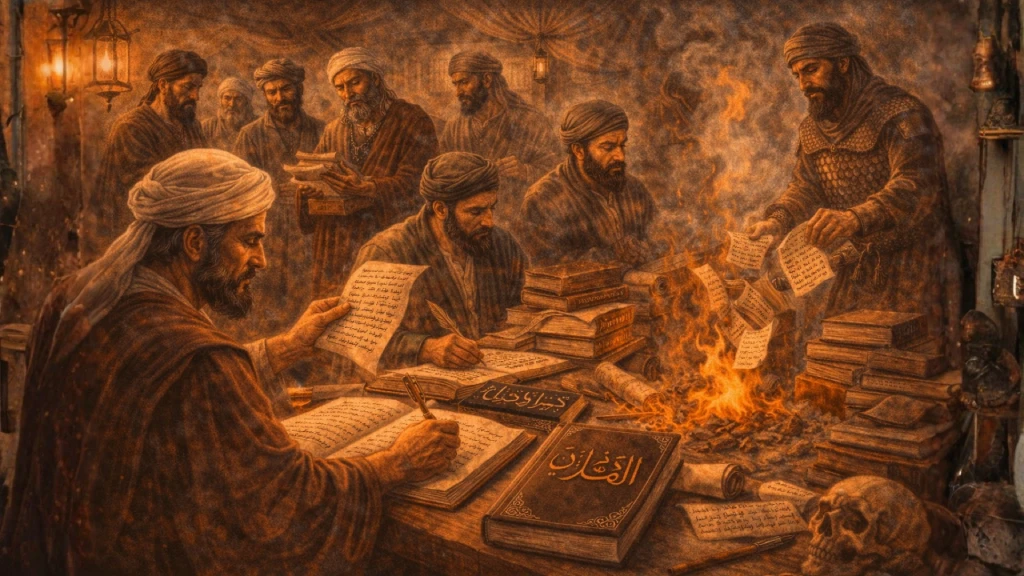
Quran Compilation and Revision: Text, Power, and the Claim of Immutability
Summary
The Quran’s present form is the result of a long process of compilation extending from Muhammad’s lifetime through the periods of Abu Bakr and Uthman to subsequent revisions. This history includes the Companions’ separate collections, variant readings, political and power struggles, and the destruction of other written versions to establish a state standard. From the written materials and oral readings dispersed during Muhammad’s lifetime to the later mushaf, collection, selection and exclusion took place at different stages. Classical Islamic works themselves preserve accounts of lost or abrogated verses, linguistic inconsistencies in the text, disputes over the extent and arrangement of suras, and the later addition of consonantal dots and vowel marks. Companions, compilers, rulers and later authorities who determined the readings played a direct role in the Quran’s acquisition of its present form. Decisions about which sentences would be recited as Quran, which would enter the written collection, which readings would be excluded, and which rulings associated with absent passages would remain in force involved human memory, testimony, interpretation and political authority. Against the customary claim of an unchanged and uncorrupted book, these documents reveal a history of a changing text and the establishment of human authority over it. Calling a change abrogation, declaring it divinely authorized, or legitimizing it through a caliph’s decision constitutes a religious assessment of that change; such labels do not erase past additions, deletions and revisions from history. If a book’s own declaration is accepted as proof of its infallibility, the same method can establish any book, doctrine or personal composition in the world as unquestionable truth. Evidence, reasoning, historical testimony and independent verification then become unnecessary; a forceful declaration about oneself is enough. Applying that same reasoning, one thing therefore needs to be stated very clearly before this article begins:
Arabic:
ذَٰلِكَ الْمَقَالُ لَا رَيْبَ فِيهِ ۛ هُدًى لِّلْمُرْتَدِّينَ وَالْكَافِرِينَ
Correct Arabic pronunciation:
Dhalika al-maqalu la rayba fihi, hudan li-l-murtaddina wa-l-kafirin.
English meaning:
This is the article in which there is no doubt; it is guidance for unbelievers and apostates (or a guide to them).
I hope that, with this statement at the beginning, no one will have any further room for doubt about this article.
But this declaration does not prove a single sentence of the article true. If the article’s information is wrong, it remains wrong; an opening declaration of unquestionability in Arabic cannot turn that error into truth. Similarly, the Quran’s declarations of its own infallibility, truth or freedom from doubt are not independent evidence of its historical accuracy. Establishing a statement as true requires verifiable evidence beyond that statement itself. Yet in the case of scripture, this ordinary logical standard is frequently abandoned, and the book’s own declaration is presented as conclusive proof. A method that is absurd and unacceptable for an article one has written cannot become a valid means of establishing miraculous truth when applied to scripture. The history of the Quran’s compilation, textual differences, additions, deletions and revisions will therefore be determined by the relevant historical documents rather than by a religious declaration.
| Subject discussed | Principal questions and the content of the evidence | Conclusion established |
|---|---|---|
| The Quran’s revelation, language and accounts of receiving revelation | The period of revelation, differing identifications of the first revealed passage, the claim concerning the language of Quraysh, the earliest writing, and accounts of different methods of receiving revelation. | The histories of revelation and the earliest writing contain several distinct accounts; these disagreements disappear from the simplified picture presented in later religious promotion. |
| Writing, memorization and collection during Muhammad’s lifetime | Revelation scribes, memorizers, scattered written materials, differing lists of those who collected the whole Quran, and Muhammad’s recollection of forgotten verses after hearing another person recite them. | Textual transmission depended on human writing, memory and mutual assistance; individual memory was not infallible. |
| The seven ahruf and authorized variant readings | The dispute between Umar and Hisham, Ubayy’s doubts, the authorization of multiple readings, and explanations of their later restriction to a state standard. | The range of initially authorized readings was not confined to a single verbal form; later unification imposed a selection on that plurality. |
| New words in recited verses following human questions | Accounts of the addition of “mina al-fajr” to the fasting verse and the insertion of an exception for the disabled following Ibn Umm Maktum’s statement. | The previously circulated sentence and the later complete sentence were not identical; new words and limits were added following specific human problems. |
| Umar’s opinions, personal interests and social pressure | The correspondence between Umar’s proposals and revelation, intervention concerning the Prophet’s wives, and the relationship between social events and changes in instructions. | The disclosure of religious instructions was connected to the sequence of human proposals, personal relationships and social power. |
| Revelation scribes’ apostasy and allegations of changes to wording | Accounts of apostate scribes, allegations of changes to wording preserved in the name of Abdullah ibn Sad, execution orders and rehabilitation. | The recording of revelation has a history involving disputes over wording, apostasy, punishment and political protection. |
| The Satanic Verses | The recitation of Sura al-Najm, the disputed utterance, listeners’ reactions, and accounts of the subsequent withdrawal of that statement and their transmission. | Islamic literature itself preserves accounts of the acceptance and subsequent exclusion of a disclosed statement; the question of authority over which utterances count as revelation is present there too. |
| The final revelation, completion and deathbed | Differing identifications of the last revealed verse, the declaration that religion was complete, accounts of revelation continuing until death, and the dispute over writing down a final instruction. | There is differing testimony concerning the conclusion of revelation and the final written instruction; a declaration of completion does not independently resolve those differences. |
| Abu Bakr’s compilation | The deaths of reciters at Yamama, fear of losing Quranic material, Umar’s proposal, Zayd’s search, and the use of written materials and testimony. | After Muhammad’s death, a need arose to prepare a book by collecting and verifying scattered materials; human decisions operated within that collection process. |
| The codices of Ali and other Companions | Alternative personal collections, differences in arrangement, and distinct claims in Sunni and Shia literature concerning authority over compilation. | Other collections and claims to authority existed outside the accepted state collection; later recognition does not erase earlier plurality. |
| Uthman’s establishment of a state-authorized standard text | Regional reading disputes, Hafsa’s sheets, the four-member committee, the choice of the language of Quraysh in cases of disagreement, and the distribution of official copies. | Establishing the standard mushaf was a process conducted through a particular committee, rules for decision-making and state dissemination. |
| Destruction of alternative codices and resistance | The order to burn other written collections, Ibn Masud’s objection, the destruction of Hafsa’s sheets, and allegations against Uthman. | Unification involved the removal of alternative documents and resistance by Companions; destruction also eliminated materials for subsequent direct comparison. |
| Suras, verses, arrangement and the basmala | Differences in verse counting, sura numbers and names, the present sura order, the relationship between al-Anfal and al-Tawba, and the status of the basmala. | The book’s counting, identification, arrangement and boundaries were subjects of distinct disputes; the picture of all these matters having been settled identically from the beginning does not match the sources. |
| The stoning verse and the death penalty that remained in force | Umar’s declaration of revelation and recitation, his wish to write the verse down, fear of accusations of adding to the text, and its absence from the present mushaf. | A passage declared to have previously been recited as Quran is absent from the mushaf, while a death penalty remains in force in its name. |
| The breastfeeding verses and the account of the eaten sheet | The change from ten breastfeedings to five, Aisha’s statement that recitation continued at Muhammad’s death, and the account of a domestic animal eating the written sheet. | There is testimony concerning changes in the stages of text and law and the absence of the relevant text from the present mushaf; an account of the destruction of a particular document is also preserved. |
| Lost verses and absent suras | Abu Musa’s forgotten suras, statements about the former extent of al-Ahzab and al-Tawba, al-Khal and al-Hafd, and Ibn Umar’s warning. | Testimony concerning differences between the extent of previously recited material and the present collection has been preserved in the names of the Companions themselves. |
| Allegations of scribal errors in the mushaf | Uthman’s “lahn,” Aisha’s statement that “the scribes made mistakes,” and alternative wording and corrections attributed to Ibn Abbas. | Islamic sources themselves contain the Companions’ criticism of the accuracy of the accepted written text; later commentators’ explanations respond to that dispute. |
| Differences in wording in Companion readings and regional copies | Additional phrases, word order, refusal to recite an accepted passage, and the presence or absence of letters and complete words in official regional copies. | Reading differences are not confined to vowels or pronunciation; specific differences also exist in words, phrases and written structure. |
| Consonantal dots, vowel marks and al-Hajjaj’s revisions | Writing systems associated with Nasr, Yahya, Abu al-Aswad and al-Khalil, and a report of eleven changes attributed to al-Hajjaj. | The marked written form is the result of later development; the relationship between attributed revisions and independently attested reading differences can also be investigated separately. |
| Abrogating and abrogated texts | The categories and examples of abrogating both recitation and ruling, abrogating a ruling while retaining the text, and removing the text while retaining the ruling. | Islamic theology itself recognizes a system for removing texts and laws; authorization of abrogation is not evidence of an absence of change. |
| Changes to rulings within the Quran | The provision for widows, stages in the rulings on alcohol, charity before private consultation, and interpretations concerning the abrogation of other instructions. | Operative instructions changed from one stage to another; the continued presence of an earlier verse in the mushaf does not mean that its ruling remains unchanged. |
| Quran or hadith: effective legal authority | Rulings on bequests, food, stoning and apostasy; discussions of interpretation, specification, the imposition of conditions and abrogation through the Sunnah. | Even while retaining the mushaf’s letters, hadith and jurisprudence have determined the limits of verses’ application and the law in force. |
| Redefinition of rulings and practices under Umar | Mutah, tamattu in the pilgrimage, awl in inheritance, the sale of an umm walad, adult breastfeeding, and the organization of tarawih. | The caliph’s instructions and later jurisprudence played a direct role in determining the operative forms of religious practices and rulings. |
| The Quran’s speaker and forms of address | Prayer, instructions, use of the first and third person, the speaker’s identity, and changes of address within the same sequence. | Treating all sentences alike as Allah’s direct utterances creates problems concerning speaker and addressee; resolving them requires interpretive decisions. |
| Internal inconsistencies and conflicts with hadith | The food of hell, responsibility for sin, punishment of the dead, punishment of children, deeds and paradise, the days of creation, and the prayers of the Miraj. | There are specific examples of inconsistency and conflict between the statements; claims of reconciliation depend on later interpretation and selection. |
| Eternal speech, the Preserved Tablet and predetermination | The created–eternal controversy, the mihna, the prewritten Quran, predestination, and their relationship to revisions disclosed after human questions. | Belief in prior inscription does not erase the human role in the earthly sequence of events or the textual differences between earlier and later stages. |
| Declarations of immutability and the combined assessment | The preservation verses, the account of an indestructible book, circular proof, the Companions’ reliability, and the chronology from revelation to revision. | Self-declaration is not independent proof; describing a text established through religious authorization and state selection as identical throughout all time is logically inconsistent. |
| Conclusion | The combined significance of textual changes, collection, acceptance and exclusion, destruction of documents, changes to law and human authority. | The present mushaf is the result of a long human process of compilation and standard-setting; imposing divine authorization on that history does not eliminate the changes that occurred. |
Scope of the Discussion and Research Method
How the present Quranic text developed, the stages at which its written form and boundaries were determined, and the roles of human decisions and state authority in that process are the central questions of this discussion. This sequence includes the dissemination, recording and memorization of revelation during Muhammad’s lifetime; the addition of new words to the text following human questions and objections; the authorization of multiple readings; the experiences of revelation scribes; differing accounts of the first and final revelations; the Companions’ separate readings and codices; Abu Bakr’s and Uthman’s compilations; the destruction of alternative written collections; and resistance to compilation policy. Also discussed are sura and verse boundaries, arrangement and the status of the basmala, the absent stoning and breastfeeding passages, Companion testimony concerning lost verses and suras, allegations of scribal errors, differences in wording between official regional copies, and accounts concerning later consonantal dots, vowel marks and al-Hajjaj’s revisions. Connected to textual history are abrogation, changes to rulings within the Quran, the determination of verses’ effective meaning and application through hadith, and the redefinition of religious practices by caliphal decisions. The Quran’s speaker, internal inconsistencies in the discourse, conflicts with hadith, and the concepts of eternal speech and the Preserved Tablet have also been considered as questions related to the claim of immutability. Ancient manuscripts and the Hafs transmission tradition are discussed in detail in separate articles; particular emphasis here falls on accounts of revelation, compilation, acceptance and exclusion, revision and the establishment of authority preserved within Islamic literature itself.
The principal sources are the Quran, hadith, tafsir, classical works on readings, Quranic sciences, abrogation and legal theory, compilations concerning the Companions’ codices, and accounts of Islamic history. The texts of original works and scholars’ quotations and explanations preserved on Shamela, Islamweb and IslamQA have been used alongside the relevant hadiths’ Arabic texts and published translations. Source statements, the historical conclusions that follow from them, and the author’s logical criticism have been kept on separate levels. In assessing a report’s historical value, consideration has been given to its date, transmission route, form of statement, variant readings, the chronology of events, its relationship to other testimony, and its later reception and interpretation. Sahih and weak classifications are identified as classifications internal to Islamic hadith scholarship; other evidence is also relevant to historical analysis. A weak chain alone is not proof that an event did not happen, just as a report’s presence in a book alone does not guarantee the truth of every detail. When the same report is quoted in several later works, the quotations’ dependence on their sources has been identified; repeated references within one transmission stream have not been counted as multiple independent testimonies.
In comparisons with the present mushaf, differences in textual extent, the presence or absence of words, word order, grammatical form, spelling, consonantal dots, vowel marks, pronunciation, sura arrangement and verse counting have been identified separately. Likewise, withdrawal of a recitation, abrogation of a ruling while retaining its text, and changes to the limits of application through hadith or jurisprudence have been discussed as separate processes. In each case, the strength of the conclusion is connected to the strength and scope of the relevant evidence. Individual forgetting, the destruction of a sheet, and the absence of a former recitation from the accepted mushaf are different events; their relationships have been determined on the basis of specific reports. An allegation that someone changed the text, a report of revisions attributed to that person, and textual differences attested by independent sources have likewise retained their respective identities. Differences in wording have not been obscured by calling them merely changes in written marks; nor have differences in verse counting or sura names been equated with the deletion of words. The analysis rests on the relationships between those who made compilation decisions, the matters they decided, the criteria they used, and the texts or documents retained or excluded as a result.
The Quran’s divine origin, its prior preservation on the Preserved Tablet, the religious legitimacy of abrogation, and Allah’s supervision of the compilers are claims of belief. Which statement circulated when, who possessed which reading, which material was found during collection, which mushaf contained different words, and on whose instructions a document was accepted or destroyed are questions of history. Calling a change authorized by Allah is a claim to its legitimacy; it is not proof that the change did not occur. Nor does the widespread circulation of a text after its establishment by the state prove that all preceding texts were identical. The claim of immutability has therefore been examined according to its specific meaning: whether every revealed passage is in the present mushaf, whether every reported reading always contained the same words, when the written form was determined, and at which stages operative rulings changed. A book’s self-declaration and the compilers’ religious status have not been accepted as independent proof of their own infallibility. The central issue is the compatibility of the claim of exact identity throughout all time with the evidence of addition, deletion, withdrawal, selection, destruction and revision preserved in classical sources.
Introduction
A belief or claim widely held among Muslims is that the Quran is the only uncorrupted book in human history, still available exactly as Allah revealed it. Not even one word or letter has changed. This claim is coupled with another judgment concerning other scriptures: earlier religious books, including the Bible, have been distorted and contaminated by human hands and no longer exist as Allah sent them. Yet Christian belief also regards the Bible’s writers as divinely inspired. People wrote and compiled it, but God worked through them—this argument from divine inspiration is precisely what establishes the book’s religious authority. After accepting Muslim compilers’ selections and revisions as Allah’s will, independent evidence is required to reject similar claims by Christian writers and compilers. Declaring divine supervision only for one’s own book does not maintain a consistent standard of proof.
The customary Muslim claim is more specific. The Quran is described not only as a book of divine origin but as one that has undergone no change whatsoever. Every word of the message Muhammad received supposedly remains exactly as it was in the present mushaf. This idea is also mixed with the notion that the entire Quran was compiled during Muhammad’s lifetime under Allah’s direct supervision. Revelation, writing, memorization, assembling scattered materials and establishing a text through state authority—different activities—are thus concealed beneath a picture of uninterrupted miraculous preservation. The accounts of collection, reading disputes, revisions and destruction of copies in Islam’s own books directly conflict with this claim of unconditional identity. Those very accounts disclose the direct human role behind the present form.
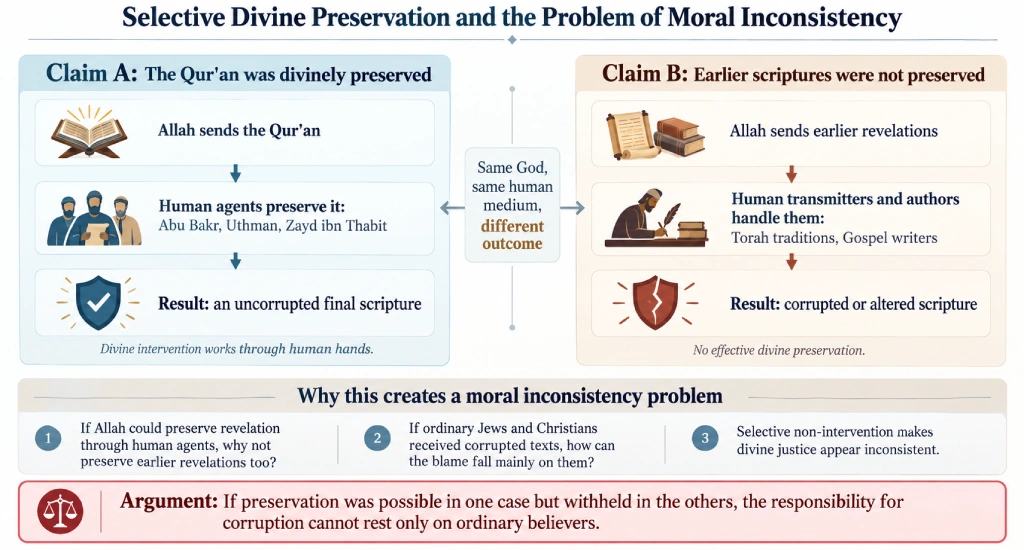
As evidence for the claim that the Quran is uncorrupted and free from all contamination, many religious people present statements from the Quran and hadith themselves. Presenting one’s own statement as proof of one’s own truthfulness is a fallacy or faulty argument. It is called circular reasoning. If the very book whose accuracy is in question is made the basis of its own accuracy through its self-declaration, the claim returns to itself. The following examples exhibit the same circle:
| Claim | Proof |
|---|---|
| The Bible is true | Because the Bible says so. |
| The Quran is true | Because the Quran itself says that the Quran is true. |
| This article is entirely true | Because this article itself says that it is entirely true. |
Even when a second claim is introduced to support a first, if the second claim’s sole basis is the first, the same circle results. Changing the identity of the God, book, author or guru does not change the structure of this reasoning:
| Example | First question and answer | Second question and answer |
|---|---|---|
| The Bible and God | Question: What is the proof that the Bible is true? Answer: The Bible is true because God has said that the Bible is true. | Question: What is the proof that God is true? Answer: God is true because the Bible says that God is true. |
| The Quran and Allah | Question: What is the proof that the Quran is Allah’s word? Answer: The Quran says that it is Allah’s word. | Question: Why should we accept this statement in the Quran as true? Answer: Because the Quran is Allah’s word; Allah does not lie. |
| A book’s infallibility | Question: What proves that every statement in the book is infallible? Answer: The book’s author has said that his book contains no errors. | Question: Why should we accept this claim by the author as infallible? Answer: Because the statement appears in his infallible book. |
| A guru’s omniscience | Question: What is the proof that the guru is omniscient? Answer: He himself has said that he knows everything. | Question: Why should we accept this statement of his as true? Answer: Because he is omniscient; his statements cannot be wrong. |
| A person’s trustworthiness | Question: Why should we trust the man? Answer: He has said that he never lies. | Question: Why should we believe the statement that he never lies? Answer: Because he is a trustworthy person. |
In every example, the claim that is supposed to be proved is instead turned around and used as its own proof. The Bible’s truth is grounded in God, while God’s truth is grounded in the Bible. The Quran’s statements are accepted to establish its divinity, while its divinity is then cited as the reason for accepting those statements. There is no independent evidence in between; the claim returns to itself. This is circular reasoning and is therefore identified in logic as a fallacy. This method of establishing a book’s truth through its own claim is unacceptable in rational discussion. Contradictions between the book’s declaration and other accounts preserved in it and by its followers also expose that claim’s self-contradictory character.
The Quran, hadith and works from Islam’s classical period themselves contain numerous accounts that conflict with the customary claim of the Quran’s uncorrupted preservation. Many ordinary Muslims are unaware of these accounts. Information concerning the exclusion of readings, compilers’ selections, the destruction of separate collections and later reforms is preserved in Islam’s own books. Alleged conspiracies by Jews, Christians or atheists cannot erase the existence of this information. Islam’s own preserved testimony exposes the self-contradictory character of the claim of uncorrupted preservation.
The Quran declares that responsibility for its preservation belongs to Allah. This claim itself is the basis of the religious belief in preservation.
According to Islamic belief, the Quran is preserved on the Preserved Tablet. Whether that prewritten speech, the readings Muhammad uttered at different times and the currently recognized mushaf were identical in every respect is a fundamental question. If this claim of identity fails, the basis for establishing the present mushaf as an exact copy of prewritten divine speech also collapses. Identity between the prewritten speech and the present text cannot be established by declaration alone. Which word was spoken when, what later revisions added, what was found during collection, and whose decision led to the acceptance of a particular form—the evidence for the claim of identity must come through these events. Saying that people compiled it through Allah’s inspiration asserts the religious legitimacy of human work. The same argument from divine inspiration that is rejected for the Bible’s authors then returns for one’s own compilers.
Since the Muslim claim is that their sacred religious book, the Quran, has not suffered the slightest distortion or human contamination to this day, and that what we find in the present Quran is exactly what Allah wrote on the Preserved Tablet at the beginning of creation, proving even the slightest distortion would render their claim false. Disproving this claim does not require demonstrating 5 percent, 10 percent or 100 percent error; just one error or distortion is enough. The same question applies to the claim of exactness in the Quran’s revelation.
Muhiuddin Khan’s translation speaks not only of the exactness of the Quran’s revelation but also of making it readable “with punctuation marks.” Setting that wording alongside the history of later additions of punctuation makes the question more acute.
If Allah revealed a message perfectly and exactly, why did later people need to revise, select and exclude readings to settle its particular form? Where did people obtain the authority to decide which reading to retain and which to remove? There is no reason to equate the memory and judgment of a prophet, Companion, Successor or later compiler with Allah’s omniscience. Islamic books themselves contain accounts of disputes between readings, compilers’ selections and subsequent reforms. The religious answer offered to legitimize these activities is: It is all Allah’s will! Or Allah knows best. But if this answer counts as evidence, the same answer must be accepted when declaring the Bible or other scriptures contaminated. The same standards of evidence and reasoning apply when examining a book’s history. According to the belief in predestination, this criticism too is not an event outside Allah’s will. Otherwise, how was it possible for the criticism to be written?
A claim that something has remained unchanged and a claim that scholars have given religious authorization to changes are not the same. Whether a text was changed is a question about an event; whether Allah authorized the person who changed it, or whether the scholars accepted it, is a question of belief. An answer based on belief cannot erase a question about an event. Likewise, the fact that a text eventually obtained state and religious recognition does not make all earlier readings, revisions and selections disappear from history. A claim of comprehensive identity cannot be established simply by pointing to the current version’s popularity.
A detailed discussion of manuscript differences appears in the article on the Sanaa manuscripts. The reports transmitted by Hafs and the authority of his reading are discussed in the article on the Hafs Quran. Uthman’s compilation, the state of collections and readings before it, and the major subsequent revisions together form the history of how the Quran acquired its present form. Uthman’s state unification and reading traditions established much later represent separate stages in that history.
The Quran’s Revelation: Beginnings, Language and Accounts of Receiving Revelation
The Terms Quran, Revelation, Sheet and Mushaf
The word Quran (Arabic: القرآن, or al-Quran) means that which is read, reading or recitation. Explanations of its etymology connect it with the meanings of reading and gathering together. Islamic writers themselves offer several explanations of the word’s derivation. The two principal views are:
| Explanation of the derivation | Meaning |
|---|---|
| Connection with al-qar, or gathering together | Compilation or collection |
| Connection with qaraa, or reading | Reading or recitation; many Islamic researchers accept this view. |
Several explanations of the word’s derivation are available [1] [2]
تقول: قرأته قرءًا وقراءة وقرآنًا، بمعنى واحد.
English translation: You say: I read it—qaran, qiraatan and quranan—with the same meaning.
Caliph Uthman’s compilation played a central role in establishing the written standard of the present Quran. Abu Bakr’s collection preceded it, while refinements of script, spelling, consonantal dots and vowel marks followed. The present printed text is the product of that sequence of collection, selection and revision.
The meaning of the word Quran and the compilation of a particular mushaf are separate matters. In a statement by al-Jahiz included in al-Suyuti’s compilation, the entire composition is called Quran, its section a sura, a section of a sura a verse, and the end of a verse a fasila. Alongside these names, the mushaf’s text, arrangement and written form were determined in the history of compilation. [3]
سَمَّى جُمْلَتَهُ قُرْآنًا كَمَا سَمَّوْا دِيوَانًا وَبَعْضُهُ سُورَةٌ كَقَصِيدَةٍ وَبَعْضُهَا آيَةٌ كَالْبَيْتِ وَآخِرُهَا فَاصِلَةٌ كقافية.
English translation: He named the whole of it Quran, as they say diwan; one of its sections sura, as they say qasida; a section of that aya, as they say a line of poetry; and its ending fasila, as they say rhyme.
The recited words of the same composition, scattered written materials and a state-authorized collection appear in history as separate states. Accounts of compilation, recitation and the mushaf carry specific information about who possessed which text at a given time, which word provoked disagreement, and which form a later compiler accepted. The name Quran has carried the religious identity of these stages; evidence of whether precisely the same words existed at every stage comes from the relevant accounts of readings and collections. Continuity of the name and literal identity of the text are two separate claims, the second of which depends on specific documentation.
Islamweb’s technical definition of the Quran combines Allah’s speech revealed to Muhammad, the claim of its miraculous character, and the status of reciting it as worship. This definition determines the speech’s source and status in advance; it does not itself supply the history of who established its written form and when. [4]
فالقرآن كلام الله المنزل على محمد صلى الله عليه وسلم للإعجاز بسورة منه، المتعبد بتلاوته.
English translation: The Quran is Allah’s speech revealed to Muhammad, with even one sura of which the challenge of inimitability is made, and through whose recitation worship is performed.
The word wahy carries the idea of receiving a message or communicating information secretly. In explaining its linguistic meaning, Manna al-Qattan speaks of secrecy and speed. Calling a statement revelation in a religious account identifies the statement’s claimed source. The language in which it was uttered, what a scribe wrote, and which reading a collector accepted are, in turn, visible human processes. [5]
الإعلام الخفي السريع الخاص بمن يوجَّه إليه بحيث يخفى على غيره
English translation: Communicating information swiftly and secretly, specifically to its intended recipient and concealed from others.
Sahifa and mushaf identify written materials. In Ibn Manzur’s Lisan al-Arab, sahifa means the material on which something is written, while mushaf means written sheets gathered between two covers. A statement’s presence on one sheet, the gathering of many sheets, and the establishment of that collection as an authoritative text are therefore three separate events. [6]
الصَّحِيفَةُ: الَّتِي يُكْتَبُ فِيهَا، وَالْجَمْعُ صَحَائِفُ وَصُحُفٌ وَصُحْفٌ.
English translation: A sahifa is that on which something is written; its plurals are sahāif, suhuf and suhf.
The name mushaf itself contains the act of gathering written pages together. Al-Azhari’s explanation in Lisan al-Arab also speaks directly of that collection. [7]
وَإِنَّمَا سُمِّيَ الْمُصْحَفُ مُصْحَفًا؛ لِأَنَّهُ أُصْحِفَ أَيْ جُعِلَ جَامِعًا لِلصُّحُفِ الْمَكْتُوبَةِ بَيْنَ الدَّفَّتَيْنِ.
English translation: A mushaf is called a mushaf because it has been made into a collection of written sheets between two covers.
| Term | What it denotes | Specific historical question |
|---|---|---|
| Quran | Religiously recognized recited speech | Which statements were accepted as part of the Quran? |
| Revelation | The claimed process of receiving information or instructions | What testimony exists concerning the statement’s source? |
| Sahifa | A written page or writing material | What was written, and who possessed it? |
| Mushaf | A collection of written sheets gathered together | Who determined the collection, arrangement and authoritative text? |
In explaining Abu Bakr’s initiative, IslamQA likewise speaks of gathering the entire Quran into one book to protect it from loss. The need for collection into a book is therefore acknowledged within its own account of preservation. The claim that speech was revealed and the work of bringing its written materials into one book are not a single event completed at the same time. [8]
لجمع القرآن كاملا في كتابٍ واحدٍ حتى يبقى محفوظاً من الضياع
English translation: To gather the entire Quran into one book so that it would be preserved from being lost.
The religious definition calls the book Allah’s speech; in the accounts of compilation, people performed the work. Simply repeating the first identification without examining the history of decisions about which readings would enter a particular mushaf conceals the second history. Hiding the scribe’s pen, the collector’s selection of testimony and the ruler’s authorization behind a declaration of heavenly origin does not explain the origins of the present written text. Instead, it pushes the very human work whose product is in our hands beyond questioning.
The Quran’s Language: Arabic, the Claim of the Language of Quraysh, and Ancient Arabian Writing Traditions
What was the language of the Quran preserved on the Preserved Tablet? Is Allah’s mother tongue Arabic, or did Allah and the angels have some other language? If it was translated into Arabic from another language, who made that translation, and which text is to be called the original? Accounts of Allah uttering words make this question more specific. There is a relationship between the words, language and meaning of an uttered message. Moving a statement from one language into another changes its word order and expression of meaning. The status of Arabic and its relationship to the prewritten text are therefore fundamental to the claim that every word is language directly determined by Allah.
Several writing traditions were in use in the Arabian Peninsula and surrounding regions before Muhammad. The OCIANA database, developed at Oxford and now maintained at Ohio State University, identifies Safaitic as the name of an alphabet. It was used in numerous inscriptions by nomadic populations in what are now southern Syria, northeastern Jordan and northern Saudi Arabia. The conventional dating extends from the first century BCE to the fourth century CE; new archaeological evidence also suggests moving its beginnings back to at least the third century BCE. [9] [10]
They are conventionally dated between the first century BC and the fourth century AD
English translation: Conventionally, these are dated between the first century BCE and the fourth century CE.
Safaitic had twenty-eight distinct consonantal signs. Vowels were generally not written; the direction of writing was not fixed, and words had no separate divisions between them. The inscriptions contain names, genealogies, prayers, accounts of dangers and expressions of grief. Here, the relationship between written signs and how people pronounced words was formed through a particular human writing practice.
Hismaic inscriptions are concentrated principally in the Hisma desert of what are now southern Jordan and northwestern Saudi Arabia. Their period is also considered broadly comparable to that of Safaitic; there is even less evidence for establishing precise dates. These inscriptions are written testimony to people’s names, forms of language, social life and religious practices. Language and writing in the Arabian region were not a uniform system without a history. Different populations used their own signs, linguistic conventions and methods of writing. [11]
though there is even less dating evidence in the case of Hismaic.
English translation: There is even less evidence for dating Hismaic.
The Quran identifies Arabic as its language. In the verse from Yusuf, revelation in Arabic is linked to the purpose of enabling the audience to understand. The language of the message here relates to its comprehensibility within a particular human society. [12]
إِنَّآ أَنزَلۡنَٰهُ قُرۡءَٰنًا عَرَبِيّٗا لَّعَلَّكُمۡ تَعۡقِلُونَ
English translation: Indeed, We have sent it down as an Arabic Quran so that you may understand.
The verse from Ibrahim also directly connects the messenger’s language to the language of his people and the purpose of explaining matters to them. In this explanation of language choice, the linguistic identity of a historical speaker and his first audience occupies a central position. [13]
وَمَآ أَرْسَلْنَا مِن رَّسُولٍ إِلَّا بِلِسَانِ قَوْمِهِۦ لِيُبَيِّنَ لَهُمْ ۖ فَيُضِلُّ ٱللَّهُ مَن يَشَآءُ وَيَهْدِى مَن يَشَآءُ ۚ وَهُوَ ٱلْعَزِيزُ ٱلْحَكِيمُ
English translation: We have sent no messenger except in the language of his people, so that he might explain clearly to them. Then Allah leads astray whom He wills and guides whom He wills. He is the Mighty, the Wise.
The need to explain in the audience’s language and the claim to give particular Arabic words divine status came together in later compilation. A local language was selected so that the message could be understood, while the particular text in that language also became the religious standard for other populations. The principle of tribal language that operated in determining its written form connects people’s social identity to compilation decisions.
Ibn Baz’s statement quoted by IslamQA is more specific about the language of the text on the Preserved Tablet: both the Quran’s letters and its meanings are Allah’s speech, and it exists on the Preserved Tablet with its letters and meanings. In this explanation, the letters and meanings of the text preserved on the Tablet are therefore included in Allah’s speech; even the written Arabic form falls within the claim of divine status. [14]
فالقرآن كله حروفه ومعانيه هو كلام الله، وهو موجود في اللوح المحفوظ، بحروفه ومعانيه
English translation: The Quran in its entirety, with its letters and meanings, is Allah’s speech; and it exists on the Preserved Tablet with its letters and meanings.
In Ibn Baz’s statement, the Quran’s letters, words and meanings together constitute Allah’s speech. Decisions about which of differing words should be written, which form of pronunciation should be authoritative, and which tribe’s language should take precedence then become directly connected to the text’s divine identity. On one side stands the claim that even the letters were determined by Allah; on the other stands human linguistic selection in determining the written standard of those letters. This selection is visible within the compiler’s work itself.
Under Uthman’s instruction, the language of Quraysh became the criterion for resolving disagreements. If the committee’s Qurayshi members differed with Zayd ibn Thabit on any matter, they were told to write in the language of Quraysh. The instruction appears as follows in Bukhari’s compilation account: [15]
إِذَا اخْتَلَفْتُمْ أَنْتُمْ وَزَيْدُ بْنُ ثَابِتٍ فِي شَىْءٍ مِنَ الْقُرْآنِ فَاكْتُبُوهُ بِلِسَانِ قُرَيْشٍ، فَإِنَّمَا نَزَلَ بِلِسَانِهِمْ
English translation: If you disagree with Zayd ibn Thabit on any matter concerning the Quran, write it in the language of Quraysh, for it was revealed in their language.
This instruction contains all three elements: the possibility of disagreement, the authority to resolve it, and the identity of the language that would prevail. If several people disagreed on the written form, their decision would be subject to the language of Quraysh. The caliph is exercising the power to make one tribe’s language the standard. Language is therefore not merely a vehicle of transmission in the history of the present written text; it is also a principle of textual selection. The relationship between the language of Quraysh and the seven ahruf is discussed in detail in the article Quranic Corruption and the Many Stories of the Seven Ahruf.
Ramadan, the Night of Decree and Revelation over Twenty-Three Years: Accounts of Revelation All at Once and in Stages
The Quran speaks of preservation on the Preserved Tablet, revelation in the month of Ramadan, and revelation on the Night of Decree. Accounts of verses revealed in connection with different events over many years also appear in Muhammad’s life. To explain the relationship between these statements, a framework developed in which the complete text descended all at once from the Preserved Tablet to the first heaven and was subsequently sent to earth in stages. This involves separate stages of a complete message prepared in advance, an intermediate heavenly collection, and declarations tied to events.
| Event | Sura and verse | Description | Period |
|---|---|---|---|
| Preserved on the Preserved Tablet | Al-Buruj 85:21–22 | “Indeed, that glorious book (the Quran) is on the Preserved Tablet.” | No specific date of preservation is given in this verse |
| Revelation in the month of Ramadan | Al-Baqara 2:185 | The month of Ramadan—in which the Quran was sent down as guidance for people, clear statements of guidance and a criterion between truth and falsehood… — Taisirul Quran The month of Ramadan, in which the Quran was revealed as guidance for all humanity, clear signs of the right path, and a distinction between truth and falsehood… — Sheikh Mujibur Rahman The month of Ramadan, in which the Quran was sent down as guidance for people, clear signs of guidance, and a criterion between truth and falsehood… — Rawai Al-bayan The month of Ramadan: in it the Quran was sent down for people’s guidance, with clear signs of guidance and a distinction between truth and untruth. … — Dr. Abu Bakr Muhammad Zakaria | The month of Ramadan |
| Revelation on the Night of Decree | Sura al-Qadr, verses 1–5, Sura al-Dukhan, verses 1–4 | I sent down the Quran on the Night of Decree, — Taisirul Quran Indeed, I revealed it on the glorious night; — Sheikh Mujibur Rahman Indeed, I sent it down on “Laylat al-Qadr.” — Rawai Al-bayan Indeed, We sent down the Quran [1] on “Laylat al-Qadr” [2]; — Dr. Abu Bakr Muhammad Zakaria | The Night of Decree |
| Revelation successively over 23 years | (Sira, hadith and historical sources) | 13 years in Mecca and 10 in Medina; the entire Quran revealed over a total of 23 years | Over 23 years |
The calculation of thirteen years in Mecca and ten years in Medina appears directly in Ibn Abbas’s report. Revelation is also associated with the thirteen years in Mecca. [16]
حَدَّثَنَا مَطَرُ بْنُ الْفَضْلِ، حَدَّثَنَا رَوْحٌ، حَدَّثَنَا هِشَامٌ، حَدَّثَنَا عِكْرِمَةُ، عَنِ ابْنِ عَبَّاسٍ ـ رضى الله عنهما ـ قَالَ بُعِثَ رَسُولُ اللَّهِ صلى الله عليه وسلم لأَرْبَعِينَ سَنَةً، فَمَكُثَ بِمَكَّةَ ثَلاَثَ عَشْرَةَ سَنَةً يُوحَى إِلَيْهِ، ثُمَّ أُمِرَ بِالْهِجْرَةِ فَهَاجَرَ عَشْرَ سِنِينَ، وَمَاتَ وَهُوَ ابْنُ ثَلاَثٍ وَسِتِّينَ.
English translation: Matar ibn al-Fadl narrated to us; Rawh narrated to us; Hisham narrated to us; Ikrima narrated to us, from Ibn Abbas. He said: Allah’s Messenger was sent at the age of forty. He then stayed in Mecca for thirteen years, during which revelation came to him. He was subsequently commanded to migrate, and after migrating he stayed for ten years. He died at the age of sixty-three.
The verse from al-Isra speaks of dividing the Quran and revealing it so that it could be recited gradually. The Bengali translations use the expressions “gradually,” “properly” and “in stages.” [17]
وَقُرْءَانًا فَرَقْنَاهُ لِتَقْرَأَهُ عَلَى النَّاسِ عَلَىٰ مُكْثٍ وَنَزَّلْنَاهُ تَنْزِيلًا
English translation: This Quran I have divided into sections so that you may recite it to people with pauses; therefore I have gradually sent it down.
— Taisirul Quran
I revealed the Quran in separate portions so that you might recite it to people gradually; and I have properly revealed it।
— Sheikh Mujibur Rahman
And I sent down the Quran little by little, so that you might recite it to people slowly, and I sent it down in stages.
— Rawai Al-bayan
And We sent down the Quran in separate portions so that you might recite it to people gradually and We sent it down in stages [1].
— Dr. Abu Bakr Muhammad Zakaria
Muhiuddin Khan’s translation uses more specific wording: it speaks of making the text readable “with punctuation marks.” [18]
وَقُرْءَانًا فَرَقْنَاهُ لِتَقْرَأَهُ عَلَى النَّاسِ عَلَىٰ مُكْثٍ وَنَزَّلْنَاهُ تَنْزِيلًا
English translation: I have made the Quran with punctuation marks suitable for reading in separate portions, so that you may recite it to people slowly, and I have revealed it properly.
This translation also associates punctuation with the exactness of revelation. The Arabic text speaks of division, slow recitation and sending down; “punctuation marks” in the Bengali translation is an additional specific interpretation of that statement. The tension between this wording and the history of later additions of consonantal dots, vowel marks and other reading signs is therefore direct. The idea that every mark in the written text was fixed from the first revelation leaves no place for the subsequent addition of marks.
Islamic works also offer several explanations of the relationship between revelation on one night and revelation over many years. Al-Suyuti calls the view of descent to the first heaven all at once the best known; he then gives figures of twenty, twenty-three or twenty-five years for the subsequent revelation. These differing figures relate to disagreement over the length of Muhammad’s stay in Mecca after the beginning of his prophethood. [19]
أَنَّهُ نَزَلَ إِلَى سَمَاءِ الدُّنْيَا لَيْلَةَ الَقَدْرِ جُمْلَةً وَاحِدَةً ثُمَّ نَزَلَ بَعْدَ ذَلِكَ مُنَجَّمًا فِي عشرين سنة وثلاث وعشرين أو خمس وَعِشْرِينَ عَلَى حَسْبِ الْخِلَافِ فِي مُدَّةِ إِقَامَتِهِ بمكة بعد البعثة.
English translation: It was sent down all at once to the lowest heaven on the Night of Decree; it was then sent down in stages over twenty, twenty-three or twenty-five years, according to the disagreement over the length of his stay in Mecca after the beginning of prophethood.
The account of keeping the complete text in Bayt al-Izza is preserved in Ibn Abbas’s name. Islamweb quotes this statement with references to al-Nasai, al-Hakim, Ibn Abi Shayba and al-Bayhaqi. Here there is a sequence from preservation on the Tablet to an intermediate heavenly collection, and from there to Gabriel’s descent. [20]
فصل القرآن من الذكر فوضع في بيت العزة من السماء الدنيا فجعل جبريل ينزل به على النبي صلى الله عليه وسلم.
English translation: The Quran was separated from the Reminder and placed in Bayt al-Izza in the lowest heaven; Gabriel then began descending with it to the Prophet.
The same discussion contains two other views quoted by al-Suyuti: the portion for each year was sent down on a separate Night of Decree, or revelation merely began on the Night of Decree. There is therefore more than one account of the system of revelation associated with the same verse.
| Explanation | What happened on the Night of Decree | Relationship to subsequent revelation |
|---|---|---|
| The complete text descended all at once | The complete text from the Preserved Tablet to the first heaven | An account of declarations arriving from there in stages |
| Each year’s portion descended separately | The designated annual portion on twenty, twenty-three or twenty-five Nights of Decree | Each year’s portion delivered subsequently |
| The explanation that revelation began | The beginning of the process on the Night of Decree | Revelation continuing later at different times |
In these three explanations, revelation denotes three kinds of event. In the first, the entire book was transferred on one night; in the second, each year’s portion arrived separately; in the third, the process began on that night. A complete collection, annual installments and an initial moment are not the same event. Commentators have separately determined which event to connect to the same verse’s statement about time. Human interpretation and selection therefore also play a role in the framework for reconciling declarations over many years with a declaration on a single night.
According to another explanation by IslamQA, even after the written text was placed in Bayt al-Izza, Gabriel would hear the verses from Allah on each occasion and bring them to Muhammad. Here the two channels—an intermediate written collection and hearing Allah’s direct speech—remain in operation alongside each other. [21]
لكن جبريل عليه السلام كان ينزل بالآيات إلى النبي صلى الله عليه وسلم بعد أن يكلمه الله تعالى بها ويسمعها
English translation: But Gabriel would descend with the verses to the Prophet after Allah had spoken them to him and he had heard them.
Even after the complete text had been preserved in heaven beforehand, this system retains the need for Allah to speak anew on the occasion of each event. What indispensable function in delivering the message did the intermediate complete collection perform? What was the status of revised and abrogated passages within a text already fixed? If a verse first reached people in one form and new words were later inserted into it, which of the earlier and later forms belonged to that complete collection?
The Quran itself contains the objection that the entire Quran did not come to people all at once. The verse from al-Furqan quotes the unbelievers’ question and gives the purpose of strengthening Muhammad’s heart. [22]
وَقَالَ ٱلَّذِينَ كَفَرُوا۟ لَوْلَا نُزِّلَ عَلَيْهِ ٱلْقُرْءَانُ جُمْلَةًۭ وَٰحِدَةًۭ ۚ كَذَٰلِكَ لِنُثَبِّتَ بِهِۦ فُؤَادَكَ ۖ وَرَتَّلْنَـٰهُ تَرْتِيلًۭا
English translation: The unbelievers say: Why was the Quran not sent down to him all at once? In this manner, so that We might strengthen your heart through it; and We have recited it in an orderly manner.
This stated purpose of delivering the message in stages explains the timing of the disclosed speech. But the subsequent exclusion of a previously recited passage, the addition of a new condition to a verse, or a change to an earlier ruling still provides evidence of changes in successive states of the text. If the complete text was already prepared, where was the revision written, which stage of instruction did Gabriel bring, and what became of the status of the earlier version in human hands? These questions concern the relationships between specific texts. An account of transfer from one heaven to another does not resolve them by itself.
Whether the Preserved Tablet was revised, whether both the earlier and later stages were written there in advance, or whether it contained only the final text—these possibilities produce different relationships between the heavenly collection and the text declared on earth. Even if the final text is said to have been determined beforehand, people first received one instruction and later its revised form. Religious belief in prior planning can authorize this change; it cannot prove that no change occurred. Accepting accounts of abrogation, addition and withdrawal of recitation while claiming that the same words and the same rulings remained in force at every stage is therefore directly inconsistent.
Conflicting Identifications of the First Surah and Verses Revealed
Accounts preserved about the beginning of the Quran name al-Alaq, al-Muddaththir and al-Fatiha. The first verses, the first complete surah, and the first revelation after an interruption—later discussions developed several definitions of what came first. Al-Fatiha opens the present mushaf; al-Alaq features in the widely circulated account of the first revelation.
Accounts Supporting Surah al-Alaq
Which surah of the Quran was revealed first? In the conventional account, an angel came to Muhammad at the age of forty in a cave on Mount Hira and communicated the opening verses of Surah al-Alaq to him. The familiar story of the first revelation in textbooks and religious discussions has developed around this event. The relevant passage in the account preserved in Bukhari under Aisha’s name reads: [23] [24]
حَتَّى جَاءَهُ الْحَقُّ وَهُوَ فِي غَارِ حِرَاءٍ، فَجَاءَهُ الْمَلَكُ فَقَالَ اقْرَأْ. قَالَ «مَا أَنَا بِقَارِئٍ». قَالَ «فَأَخَذَنِي فَغَطَّنِي حَتَّى بَلَغَ مِنِّي الْجَهْدَ، ثُمَّ أَرْسَلَنِي فَقَالَ اقْرَأْ. قُلْتُ مَا أَنَا بِقَارِئٍ. فَأَخَذَنِي فَغَطَّنِي الثَّانِيَةَ حَتَّى بَلَغَ مِنِّي الْجَهْدَ، ثُمَّ أَرْسَلَنِي فَقَالَ اقْرَأْ. فَقُلْتُ مَا أَنَا بِقَارِئٍ. فَأَخَذَنِي فَغَطَّنِي الثَّالِثَةَ، ثُمَّ أَرْسَلَنِي فَقَالَ {اقْرَأْ بِاسْمِ رَبِّكَ الَّذِي خَلَقَ * خَلَقَ الإِنْسَانَ مِنْ عَلَقٍ * اقْرَأْ وَرَبُّكَ الأَكْرَمُ}».
English translation: In this way, one day revelation came to him while he was staying in the cave of Hira. The angel came to him and said, ‘Read.’ The Messenger of Allah, peace and blessings of Allah be upon him, said: ‘I said, I do not read.’ He said: Then he embraced me and pressed me so hard that I suffered greatly. Then he released me and said, ‘Read.’ I said: But I do not read. A second time he embraced me and pressed me so hard that I suffered greatly. Then he released me and said: ‘Read.’ I replied: But I do not read. The Messenger of Allah, peace and blessings of Allah be upon him, said: Then a third time he embraced me and pressed me. Then he released me and said, ‘Read in the name of your Lord who created. Created man from alaq. Read, and your Lord is Most Glorious.’ (96:1–3)
Takhrij: ( Bukhari: Tawhid Publications 3, 3392, 4953, 4955, 4956, 4957, 6982; Muslim 1/73, hadith 160; Ahmad 26018 (Adhunik Prakashani: 3, Islamic Foundation: 3).
Hadith grading: Sahih (Sahih)
In this account, the reading of the first three verses of al-Alaq is associated with the angel’s first arrival; other detailed accounts also mention the first five verses. If the book were arranged in the order of revelation, this portion of al-Alaq should stand at the front. In the present Quran, al-Alaq occupies position 96. How did Surah al-Alaq end up at number 96? Who decided that the first passage revealed would stand near the very end of the book? Did Allah give any instruction for this arrangement? If he did, where is that instruction? And if there was no instruction, who had the authority to break the order of revelation and put al-Fatiha first? Such a large gap between the memory of the first revelation and the reading sequence of the compiled book raises questions about the compiler’s decision and its basis. Several views also exist about the identity of the first passage revealed.
Al-Suyuti gave precedence to Aisha’s account concerning the first revelation. His quotation mentions the passage from ‘Read in the name of your Lord’ to ‘He taught what man did not know’—that is, the opening verses of al-Alaq. The revelation of the first portion of al-Alaq and the completion of the whole surah did not occur at the same time either. [25]
فَقَالَ: {اقْرَأْ بِاسْمِ رَبِّكَ الَّذِي خَلَقَ} حَتَّى بَلَغَ: {مَا لَمْ يَعْلَمْ}
English translation: Then he said: ‘Read in the name of your Lord, who created’—continuing until ‘what he did not know.’
Another reference to al-Alaq’s precedence appears in an account of teaching preserved under the name of Abu Raja al-Utaridi. According to al-Suyuti’s quotation, when Abu Musa taught this surah to his students, he identified it as the first surah revealed to Muhammad. This identification as the first was thus circulated in later Quran instruction as well as in accounts of the cave of Hira. [26]
كَانَ أَبُو مُوسَى يُقْرِئُنَا فَيُجْلِسُنَا حِلَقًا عَلَيْهِ ثَوْبَانِ أَبْيَضَانِ فَإِذَا تَلَا هَذِهِ السُّورَةَ: {اقْرَأْ بِاسْمِ رَبِّكَ الَّذِي خَلَقَ}، قَالَ: هَذِهِ أَوَّلُ سُورَةٍ أُنْزِلَتْ عَلَى مُحَمَّدٍ صَلَّى اللَّهُ عَلَيْهِ وَسَلَّمَ.
English translation: Abu Musa used to teach us the Quran and have us sit in a circle. He would be wearing two white garments. When he read this surah—‘Read in the name of your Lord, who created’—he would say that this was the first surah revealed to Muhammad.
This account concerns the revelation of al-Alaq’s opening portion; in the present mushaf, the surah has been placed at number 96. The story of the first revelation does not establish the origin of the present surah order. Which passage was revealed first, how the surah was subsequently completed, and where it was placed in the final compilation—these three matters require separate testimony. The conventional account describes the dramatic first revelation in detail; it contains no instruction to put al-Alaq at number 96.
For this reason, the question of opening the book with Surah al-Fatiha and placing al-Alaq much later is more than a question of numbers. It concerns who devised the book’s reading plan, what principle they followed, and what contemporary testimony supports it. In the arrangement of the present mushaf, a different sequence has been established in place of the chronology of revelation; disagreements over the authority of that sequence have also been preserved. The conversation at the first revelation contains a fundamental problem in the relationship between a command and the answer expressing inability: ‘Read’—‘I do not know how to read’—being squeezed tightly—then the same command again. In response to a declaration of illiteracy, physical pressure is repeated instead of teaching letters or clarifying the instruction. Written reading material is also directly present in the sira account. In Ibn Ishaq’s account preserved in Ibn Hisham, Muhammad sees Gabriel come with a silk cloth bearing writing while he is asleep. There, the wording of the reply is ‘ma aqra’—‘What shall I read?’; Bukhari’s ‘ma ana bi-qari’ and this sira dialogue are preserved in different wording. [27] [28]
فجاءني جبريل ، وأنا نائم ، بنمط من ديباج فيه كتاب ، فقال اقرأ ؛ قال : قلت : ما أقرأ ؟ قال : فغتني به حتى ظننت أنه الموت
English translation: While I was asleep, Gabriel came to me with a silk cloth bearing writing. He said, Read. I said, What shall I read? Then he pressed me with it so hard that I thought death had come.
If the conversation is understood as a command to read written material, the illiterate person’s answer expressing inability is entirely relevant; repeatedly applying pressure in response to that inability, however, is no method of teaching someone to read. Nor is the problem of giving the instruction resolved by taking ‘read’ to mean only ‘repeat what you hear’: before the first command, there is no account of any specific words being spoken for repetition; the words of al-Alaq come after several rounds of pressure. If the intention were to have him repeat what he heard, saying the words first and clarifying what he was to do would be the direct means of communication. Instead, the same brief command, the answer expressing inability, and the infliction of pain are repeated. The outcome described is not a demonstration of acquired literacy either; it is returning while trembling, asking to be covered, and expressing fear for his own safety. Changing the meaning of reading here does not establish the rationale for using force. Inflicting pain on someone who has declared himself illiterate and repeating the same command does not resolve his inability. Both this account of the first reading and the later determination of the book’s surah order involve claims of authority; how the instruction worked and what documentation establishes the specific arrangement require explanations independent of those claims.
| Aspect of the dialogue | Question raised by the account | Problem that applying pressure does not resolve |
|---|---|---|
| Being told to read something written | ‘I do not know how to read’ is an answer expressing illiteracy. A cloth bearing writing is also present in the separate dream account in the sira. | The inability to recognize letters is not removed by pressure; no process of teaching letters is described here. |
| Being told to repeat what is heard | Before the first command, what specific words had been spoken for him to repeat? | Instead of clarifying what was to be repeated, the same command and physical pressure returned. |
| Repeated application of physical pressure | What steps were taken to remedy the declared inability or clarify the instruction? | The account describes a connection between pressure, pain and fear; it does not establish how pressure itself teaches reading or removes ambiguity in the instruction. |
Accounts Supporting Surah al-Muddaththir
In another account preserved under Jabir ibn Abdullah’s name, the first passage revealed is identified as al-Muddaththir. In the exchange between Yahya and Abu Salama, al-Alaq is raised explicitly, yet the answer remains al-Muddaththir. In Bukhari’s version of this account, which is found in both Bukhari and Muslim, it reads: [29]
حَدَّثَنَا إِسْحَاقُ بْنُ مَنْصُورٍ، حَدَّثَنَا عَبْدُ الصَّمَدِ، حَدَّثَنَا حَرْبٌ، حَدَّثَنَا يَحْيَى، قَالَ سَأَلْتُ أَبَا سَلَمَةَ أَىُّ الْقُرْآنِ أُنْزِلَ أَوَّلُ فَقَالَ {يَا أَيُّهَا الْمُدَّثِّرُ} فَقُلْتُ أُنْبِئْتُ أَنَّهُ {اقْرَأْ بِاسْمِ رَبِّكَ الَّذِي خَلَقَ} فَقَالَ أَبُو سَلَمَةَ سَأَلْتُ جَابِرَ بْنَ عَبْدِ اللَّهِ أَىُّ الْقُرْآنِ أُنْزِلَ أَوَّلُ فَقَالَ {يَا أَيُّهَا الْمُدَّثِّرُ} فَقُلْتُ أُنْبِئْتُ أَنَّهُ {اقْرَأْ بِاسْمِ رَبِّكَ} فَقَالَ لاَ أُخْبِرُكَ إِلاَّ بِمَا قَالَ رَسُولُ اللَّهِ صلى الله عليه وسلم قَالَ رَسُولُ اللَّهِ صلى الله عليه وسلم «جَاوَرْتُ فِي حِرَاءٍ فَلَمَّا قَضَيْتُ جِوَارِي، هَبَطْتُ فَاسْتَبْطَنْتُ الْوَادِيَ فَنُودِيتُ، فَنَظَرْتُ أَمَامِي وَخَلْفِي وَعَنْ يَمِينِي وَعَنْ شِمَالِي فَإِذَا هُوَ جَالِسٌ عَلَى عَرْشٍ بَيْنَ السَّمَاءِ وَالأَرْضِ، فَأَتَيْتُ خَدِيجَةَ فَقُلْتُ دَثِّرُونِي وَصُبُّوا عَلَىَّ مَاءً بَارِدًا، وَأُنْزِلَ عَلَىَّ {يَا أَيُّهَا الْمُدَّثِّرُ * قُمْ فَأَنْذِرْ * وَرَبَّكَ فَكَبِّرْ}».
English translation: Sahih al-Bukhari (Islamic Foundation)
52/ Tafsir
Chapter: Allah’s words: وربك فكبر ‘And proclaim the greatness of your Lord’ (74:3)
Islamic Foundation number: 4563, international number: 4924
4563. Ishaq ibn Mansur (may Allah have mercy on him) … narrated from Yahya (may Allah have mercy on him). He said, I asked Abu Salama ibn Abd al-Rahman (may Allah have mercy on him) which verse of the Quran was revealed first. He said, يَا أَيُّهَا الْمُدَّثِّرُ (Surah al-Muddaththir). I said, But I have been told, اقْرَأْ بِاسْمِ رَبِّكَ الَّذِي خَلَقَ (Surah al-Alaq). On hearing this, Abu Salama (may Allah have mercy on him) said, Concerning this, when I asked Jabir (may Allah be pleased with him), he said that يَا أَيُّهَا الْمُدَّثِّرُ was revealed first. Then I said, But I have been told that اقْرَأْ بِاسْمِ رَبِّكَ was revealed first. He then said, I am telling you what the Messenger of Allah, peace and blessings of Allah be upon him, said. The Messenger of Allah, peace and blessings of Allah be upon him, said, I was in retreat in the cave of Hira. When my retreat ended, I descended from there, and when I reached the middle of the valley, I heard a voice calling me. Then I looked ahead, behind, to my right and to my left. I saw him (the angel Gabriel) sitting on a seat placed between heaven and earth. After that I went to Khadija (may Allah be pleased with her) and said, Cover me with a garment and pour cold water over me. Then it was revealed to me: ‘O you who are wrapped in a garment! Arise, proclaim the warning, and proclaim the greatness of your Lord’ (Surah al-Muddaththir).
Hadith grading: Sahih (Sahih)
Narrator: Yahya ibn Abi Kathir (may Allah have mercy on him)
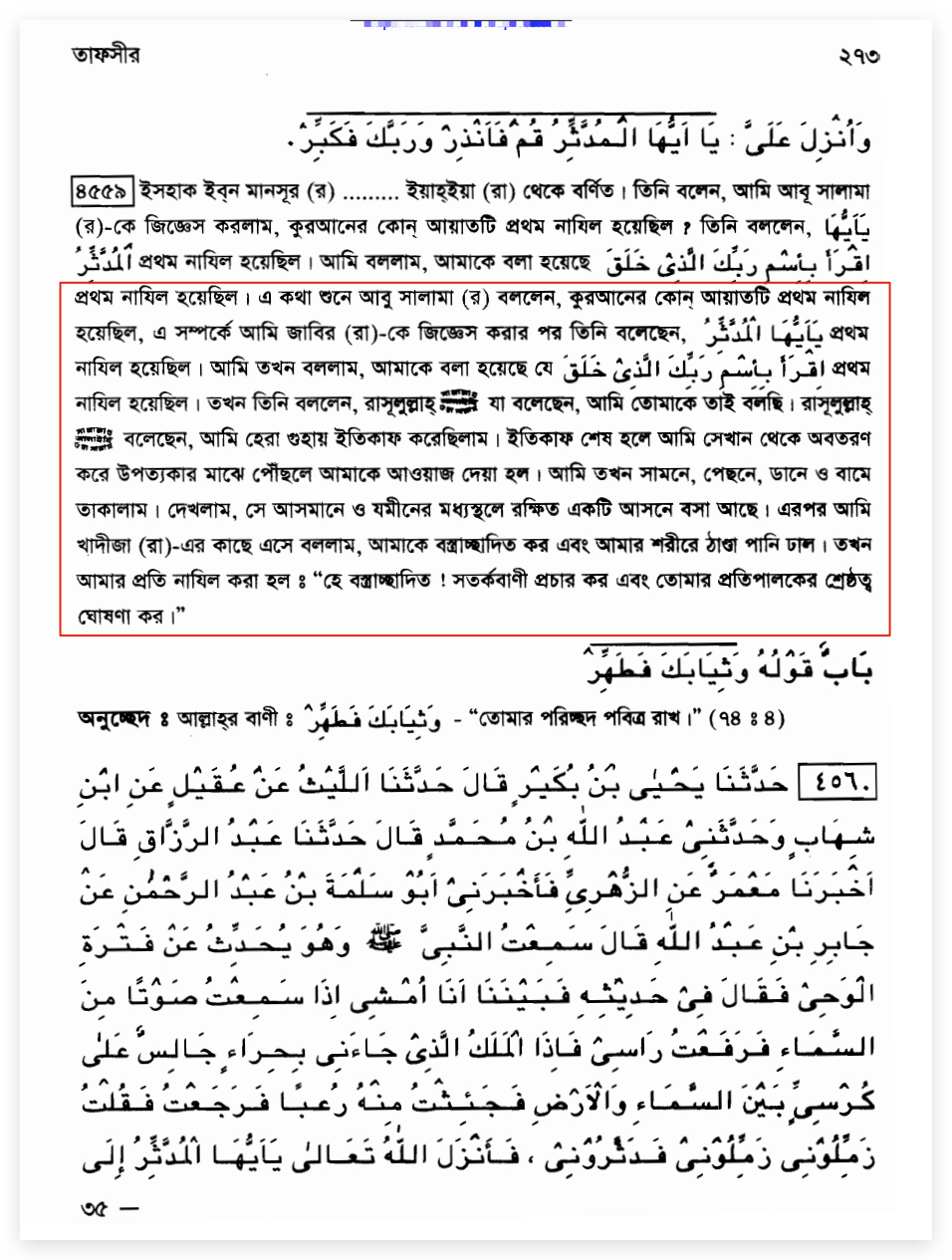
The wording of the question is explicit here: which part of the Quran was revealed first? The answer is al-Muddaththir, the objection cites al-Alaq, and then Muhammad’s statement is quoted to give the account of al-Muddaththir again. In another account under the same Jabir’s name, a pause in revelation is mentioned before the event, and the angel seen is identified with the earlier visitor at Hira. The substance of that account in Bukhari is as follows: [30]
بَيْنَا أَنَا أَمْشِي، إِذْ سَمِعْتُ صَوْتًا مِنَ السَّمَاءِ، فَرَفَعْتُ بَصَرِي فَإِذَا الْمَلَكُ الَّذِي جَاءَنِي بِحِرَاءٍ جَالِسٌ عَلَى كُرْسِيٍّ بَيْنَ السَّمَاءِ وَالأَرْضِ، فَرُعِبْتُ مِنْهُ، فَرَجَعْتُ فَقُلْتُ زَمِّلُونِي. فَأَنْزَلَ اللَّهُ تَعَالَى {يَا أَيُّهَا الْمُدَّثِّرُ * قُمْ فَأَنْذِرْ} إِلَى قَوْلِهِ {وَالرُّجْزَ فَاهْجُرْ} فَحَمِيَ الْوَحْىُ وَتَتَابَعَ.
English translation: I was walking when I heard a voice from the sky. Looking up, I saw that the angel who had come to me at Hira was sitting on a seat between heaven and earth. Frightened at the sight of him, I returned and said, Cover me. Then Allah revealed, ‘O you who are wrapped in a garment, arise and warn’—continuing until ‘shun impurity.’ After that, revelation came intensely and in succession.
Al-Suyuti mentioned several explanations to reconcile the accounts identifying al-Muddaththir as first with those identifying al-Alaq as first. One of his explanations is that al-Muddaththir’s precedence applies to the period after the pause in revelation. The central point of the explanation thus becomes what qualification is attached to the word ‘first.’ [31]
أَنَّ مُرَادَ جَابِرٍ بالأولية مَخْصُوصَةٌ بِمَا بَعْدَ فَتْرَةِ الْوَحْيِ لَا أَوَّلِيَّةٌ مُطْلَقَةٌ.
English translation: Jabir’s intended meaning of precedence is confined to the period after the pause in revelation; it is not unconditional precedence.
The same discussion also offers explanations distinguishing the first complete surah, the first command to warn, and the beginnings of prophethood and messengership. The accounts were thus not worded uniformly; they were subsequently reconciled by dividing ‘first’ into different categories. Some of these reconciliations rest on the detailed events in the accounts, while others rest on assigning a particular meaning. Each explanation of precedence introduces additional conditions to answer the same question.
The accounts of the first revelation identify different surahs and events. Later commentators sometimes restricted the meaning of ‘first’ to the first complete surah, sometimes to the first command to warn, and sometimes to the beginnings of prophethood and messengership. These reconciliatory explanations arose because disagreements had been preserved. Even about the beginning of revelation, there are separate accounts and later attempts to reconcile them, rather than a single, unanimous memory.
IslamQA’s discussion also selects the first five verses of al-Muddaththir as the revelation following the pause. This differs from the explanation that a complete surah was revealed at once: here, five verses of the surah are being discussed. Calling al-Muddaththir the first complete surah and calling its opening portion the first revelation after the pause—these two methods of reconciliation therefore do not establish the same information. [32]
والأظهر: أن هذه الآيات الخمس من سورة المدثر نزلت بعد فتور الوحي، وسبقتها آيات سورة العلق.
English translation: The clearer view is that these five verses of al-Muddaththir were revealed after the pause in revelation, and that the verses of al-Alaq had been revealed before them.
Accounts Supporting Surah al-Fatiha
Al-Fatiha has been called the first surah revealed on the basis of a report preserved under the Successor Abu Maysara’s name. The first revelation is discussed on pages 157–159 of the second volume of al-Bayhaqi’s Dala’il al-Nubuwwa; the account of al-Fatiha is preserved on pages 158–159. Al-Wahidi’s Asbab al-Nuzul also contains a separate version under Abu Maysara’s name: [33] [34] [35]
أَنَّ رَسُولَ اللَّهِ – صَلَّى اللَّهُ عَلَيْهِ وَسَلَّمَ – كَانَ إِذَا بَرَزَ سَمِعَ مُنَادِيًا يُنَادِيهِ: يَا مُحَمَّدُ، فَإِذَا سَمِعَ الصَّوْتَ انْطَلَقَ هَارِبًا، فَقَالَ لَهُ وَرَقَةُ بْنُ نَوْفَلٍ: إِذَا سَمِعْتَ النِّدَاءَ فَاثْبُتْ حَتَّى تَسْمَعَ مَا يَقُولُ لَكَ. قَالَ: فَلَمَّا بَرَزَ سَمِعَ النِّدَاءَ: يَا مُحَمَّدُ، فَقَالَ: لَبَّيْكَ، قَالَ: قُلْ: أَشْهَدُ أَنْ لَا إِلَهَ إِلَّا اللَّهُ وَأَشْهَدُ أَنَّ مُحَمَّدًا رَسُولُ اللَّهِ، ثُمَّ قَالَ: قُلْ: {الْحَمْدُ لِلَّهِ رَبِّ الْعَالَمِينَ الرَّحْمَنِ الرَّحِيمِ مَالِكِ يَوْمِ الدِّينِ} حَتَّى فَرَغَ مِنْ فَاتِحَةِ الْكِتَابِ.
English translation: When the Messenger of Allah went out, he would hear a caller calling: O Muhammad! Whenever he heard the voice, he would run away. Waraqa ibn Nawfal told him, When you hear the call, remain still until you hear what he says to you. Then, when he went out, he heard the call: O Muhammad! He said, I am here. The caller said, Say: I testify that there is no deity but Allah and that Muhammad is the Messenger of Allah. Then he said, Say: ‘All praise belongs to Allah, the Lord of the worlds, the Most Compassionate, the Most Merciful, Master of the Day of Recompense’—continuing until the end of Fatihat al-Kitab.
Surah al-Fatiha stands first in the present arrangement of the Quran. The account of the first revelation preserved under Aisha’s name contains the opening portion of al-Alaq. The beginning of revelation has been associated with al-Alaq, and the beginning of the mushaf with al-Fatiha. This difference, whereby a particular book order became established instead of chronology, is directly connected to the authority over surah arrangement and the decisions involved in compilation.
If this order of revelation is true, why was the Quran not compiled in the order in which it was revealed? Was there any instruction from Allah about this? A detailed discussion of the arrangement of surahs in the chronology of revelation can be found in this article. [36]
Al-Suyuti did not exclude the view that al-Fatiha was the first surah either. Quoting al-Kashshaf, he mentioned both the view identifying al-Alaq as first and the view identifying al-Fatiha as first. In the quoted statement of al-Zamakhshari, al-Fatiha’s precedence appears as a distinct position. [37]
ذَهَبَ ابْنُ عَبَّاسٍ وَمُجَاهِدٌ إِلَى أَنَّ أَوَّلَ سُورَةٍ نَزَلَتْ “اقْرَأْ ” وَأَكْثَرُ الْمُفَسِّرِينَ إِلَى أَنَّ أَوَّلَ سُورَةٍ نَزَلَتْ فَاتِحَةُ الْكِتَابِ.
English translation: Ibn Abbas and Mujahid adopted the view that the first surah revealed was ‘Iqra’; the view attributed to most exegetes is that the first surah revealed was Fatihat al-Kitab.
Al-Suyuti’s same discussion also includes opposition to this claim about ‘most.’ According to Ibn Hajar, most imams identified al-Alaq as first; he rejected al-Zamakhshari’s assessment of the number supporting al-Fatiha. Alongside the identity of the first surah, the identification of which view held the majority is itself disputed here. [38]
قَالَ ابْنُ حَجَرٍ: وَالَّذِي ذَهَبَ إِلَيْهِ أَكْثَرُ الْأَئِمَّةِ هُوَ الْأَوَّلُ.
English translation: Ibn Hajar said: The view adopted by most imams is the first one.
Islamweb’s discussion mentions a break in the chain of transmission of Abu Maysara’s report and acknowledges disagreement between al-Muddaththir and al-Fatiha as the first complete surah. Abu Maysara directly recounts an event from Muhammad’s time; no transmitter between him and Muhammad is named here. In Islamic hadith scholarship, this type of report is mursal. The account of al-Fatiha’s precedence has therefore been preserved through a different source and with a different status from Aisha’s account concerning al-Alaq. [39]
قال القاضي أبو بكر في الانتصار: وهذا الخبر منقطع، وأثبت الأقاويل اقرأ باسم ربك، ويليه في القوة يا أيها المدثر.
English translation: Qadi Abu Bakr said in al-Intisar: This report has a disconnected chain of transmission. The best established of the views is ‘Read in the name of your Lord’; next in strength comes ‘O you who are wrapped in a garment.’
Regular recitation in prayer, use as the book’s opening, and the claim of being revealed first—these are three distinct positions. Al-Fatiha is established in the recitation of prayer and at the opening of the mushaf; separate views have been preserved about its precedence in revelation. Although al-Fatiha became established at the beginning of the book, disagreement about the first revelation remained.
IslamQA also acknowledges the existence of the view that al-Fatiha came first and calls it weak. Identifying al-Fatiha as revealed in Mecca and identifying it as the first surah revealed in the entire Quran are two separate conclusions. Its Meccan designation alone does not determine its specific precedence. [40]
بل ذهب بعض أهل العلم إلى أن الفاتحة أول ما أنزل، وهو ضعيف.
English translation: Some scholars also adopted the view that al-Fatiha was revealed first; this view is weak.
| Account or explanation | Identification of what came first | Position in the present mushaf |
|---|---|---|
| Aisha’s account | The opening verses of al-Alaq; the view preferred by al-Suyuti | Surah al-Alaq: 96 |
| The exchange between Yahya, Abu Salama and Jabir | Al-Muddaththir; al-Alaq is also raised explicitly in the question | Surah al-Muddaththir: 74 |
| Explanation based on the account of the pause | The beginning of al-Muddaththir: first after the pause in revelation | Surah al-Muddaththir: 74 |
| Report under Abu Maysara’s name | Account of the recitation of al-Fatiha; the basis for the view identifying it as the first surah | Surah al-Fatiha: 1 |
| Explanation of precedence as a complete surah | Different selections of al-Muddaththir and al-Fatiha | The order of completion differs from the mushaf’s order |
The First Written Quran: When, by Whom and on What Materials
When was the Quran first written? Religious belief answers this with its prior inscription in the Preserved Tablet; the terrestrial history of writing contains accounts of people writing down verses after hearing Muhammad’s statements. The former concerns the universe’s predetermined plan; the latter concerns scribes, writing materials, memorized recitation and subsequent collection. Behind the present mushaf lies this continuous earthly work of collection and arrangement.
Inscription Before Creation and a Predetermined Course of Events
In Muslim belief, the Quran is the last heavenly scripture sent by Allah. In this belief that it was previously inscribed in the Preserved Tablet and that all destiny was determined before creation, the Quran’s surahs, verses, language, sentence structure and characters discussed are also included in that predetermined plan. Muhammad’s birth, the dissemination of the Quran through him, and the occasions for the revelation of different verses then form part of the same plan. In this belief in prior heavenly inscription, the events that later prompted particular statements to reach people were themselves determined beforehand. Both creating the appropriate circumstances and proclaiming verses in response to those circumstances implement Allah’s plan. Surah al-Buruj of the Quran states the following about the Quran’s location in the Preserved Tablet: [41]
بَلْ هُوَ قُرْآنٌ مَجِيدٌ فِي لَوْحٍ مَحْفُوظٍ
English translation: Rather, this is a glorious Quran, Inscribed in the Preserved Tablet.
An account in al-Tirmidhi contains a more specific statement about inscription before creation. In explaining Umm al-Kitab, Ata ibn Abi Rabah mentioned Pharaoh and Abu Lahab. A statement about the creation of the Pen and the writing of destiny follows through Ubada ibn al-Samit. [42] [43] [44] [45]
حَدَّثَنَا يَحْيَى بْنُ مُوسَى، قال: حَدَّثَنَا أَبُو دَاوُدَ الطَّيَالِسِيُّ، قال: حَدَّثَنَا عَبْدُ الْوَاحِدِ بْنُ سُلَيْمٍ، قَالَ قَدِمْتُ مَكَّةَ فَلَقِيتُ عَطَاءَ بْنَ أَبِي رَبَاحٍ فَقُلْتُ لَهُ يَا أَبَا مُحَمَّدٍ إِنَّ أَهْلَ الْبَصْرَةِ يَقُولُونَ فِي الْقَدَرِ. قَالَ يَا بُنَىَّ أَتَقْرَأُ الْقُرْآنَ قُلْتُ نَعَمْ. قَالَ فَاقْرَإِ الزُّخْرُفَ. قَالَ فَقَرَأْتُ: {حم * وَالْكِتَابِ الْمُبِينِ * إِنَّا جَعَلْنَاهُ قُرْآنًا عَرَبِيًّا لَعَلَّكُمْ تَعْقِلُونَ * وَإِنَّهُ فِي أُمِّ الْكِتَابِ لَدَيْنَا لَعَلِيٌّ حَكِيمٌ} فَقَالَ أَتَدْرِي مَا أُمُّ الْكِتَابِ قُلْتُ اللَّهُ وَرَسُولُهُ أَعْلَمُ. قَالَ فَإِنَّهُ كِتَابٌ كَتَبَهُ اللَّهُ قَبْلَ أَنْ يَخْلُقَ السَّمَوَاتِ وَقَبْلَ أَنْ يَخْلُقَ الأَرْضَ فِيهِ إِنَّ فِرْعَوْنَ مِنْ أَهْلِ النَّارِ وَفِيهِ: {تَبَّتْ يَدَا أَبِي لَهَبٍ وَتَبَّ} قَالَ عَطَاءٌ فَلَقِيتُ الْوَلِيدَ بْنَ عُبَادَةَ بْنِ الصَّامِتِ صَاحِبِ رَسُولِ اللَّهِ صلى الله عليه وسلم فَسَأَلْتُهُ مَا كَانَ وَصِيَّةُ أَبِيكَ عِنْدَ الْمَوْتِ قَالَ دَعَانِي أَبِي فَقَالَ لِي يَا بُنَىَّ اتَّقِ اللَّهَ وَاعْلَمْ أَنَّكَ لَنْ تَتَّقِيَ اللَّهَ حَتَّى تُؤْمِنَ بِاللَّهِ وَتُؤْمِنَ بِالْقَدَرِ كُلِّهِ خَيْرِهِ وَشَرِّهِ فَإِنْ مُتَّ عَلَى غَيْرِ هَذَا دَخَلْتَ النَّارَ إِنِّي سَمِعْتُ رَسُولَ اللَّهِ صلى الله عليه وسلم يَقُولُ: «إِنَّ أَوَّلَ مَا خَلَقَ اللَّهُ الْقَلَمَ فَقَالَ اكْتُبْ. فَقَالَ مَا أَكْتُبُ قَالَ اكْتُبِ الْقَدَرَ مَا كَانَ وَمَا هُوَ كَائِنٌ إِلَى الأَبَدِ». قَالَ أَبُو عِيسَى وَهَذَا حَدِيثٌ غَرِيبٌ مِنْ هَذَا الْوَجْهِ.
English translation: Sunan al-Tirmidhi (Islamic Foundation)
Chapter: 35/ Destiny
Section: No section.
2158. Yahya ibn Musa (may Allah have mercy on him) ….. narrated from Abd al-Wahid ibn Salim, may Allah be pleased with him, who said: I once came to Mecca. There I met Ata ibn Abi Rabah (may Allah have mercy on him). I said to him: O Abu Muhammad, the people of Basra speak in denial of destiny. He said: My dear son, do you recite the Quran? I said: Yes. He said: Then recite Surah al-Zukhruf. I recited:
Ha-Mim. By the clear Book, I have sent it down as a Quran in Arabic so that you may understand. It is with Me in Umm al-Kitab; it is exalted, full of wisdom (43:1, 2, 3, 4).
He said: Do you know what Umm al-Kitab is? I said: Allah and His Messenger know best. He said: It is a great book that Allah Most High had written before the creation of the heavens and before the creation of the earth. It contains that Pharaoh is among the inhabitants of Hell; it contains ‘Tabbat yada Abi Lahabin wa tabb’ (تَبَّتْ يَدَا أَبِي لَهَبٍ وَتَبَّ)—Abu Lahab’s two hands have perished, and he himself has perished.
Ata (may Allah have mercy on him) said: I met Walid (may Allah have mercy on him), the son of Ubada ibn al-Samit, may Allah be pleased with him, one of the Companions of the Messenger of Allah, peace and blessings of Allah be upon him. I asked him: What instructions did your father leave at the time of his death?
He said: He called me close to him. He said: My dear son, fear Allah. Know that until you believe in Allah and believe in the good and bad of everything in destiny, you will never attain fear of Allah. If you die in any other state, you will have to enter Hell. I heard the Messenger of Allah, peace and blessings of Allah be upon him, say: Allah Most High created the Pen first of all. Then He commanded it, Write. It said: What shall I write? He said: Write all destiny, everything that has happened and everything that will happen for all eternity. Sahih, Sahiha 133, Takhrij al-Tahawiyya 232, Mishkat 94, al-Zilal 102, 105, al-Tirmidhi hadith number: 2155 (al-Madani Publications)
(Abu Isa says) This hadith is gharib through this chain.
Hadith grading: Sahih (Sahih)
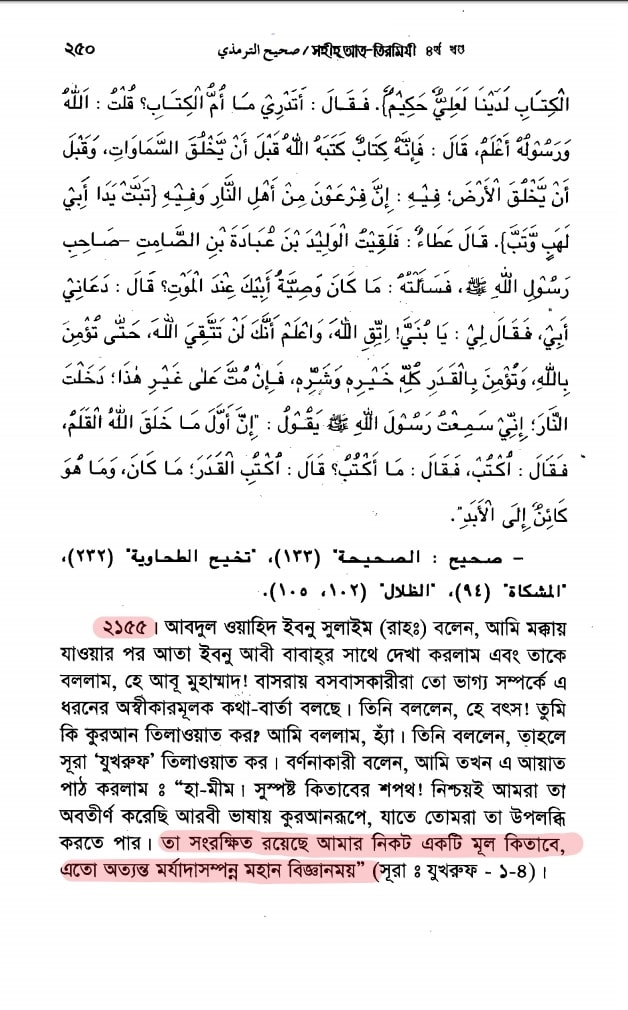
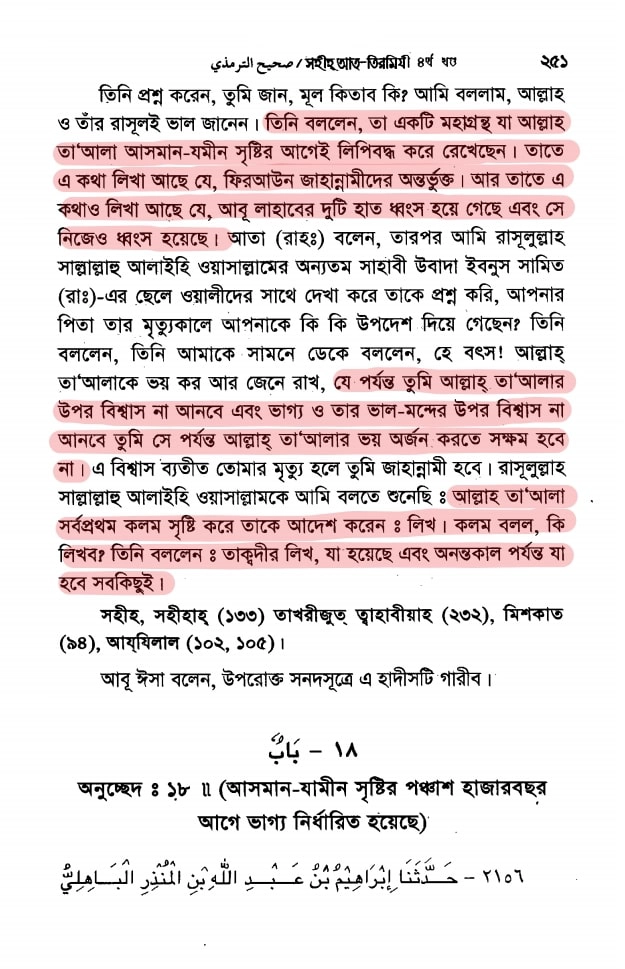
In Ata’s explanation, the names and fates of future individuals are determined in a book predating creation. In Ubada’s account, belief in all destiny, including good and bad, is made a condition of faith. Within this framework, opposition to Muhammad, the proclamation of verses against an opponent, and the circumstances of those verses are all part of a predetermined course. If the proclamation against Abu Lahab was written before the event occurred, his opposition is not an independent occurrence that thwarts Allah’s plan; it becomes an element in the plan’s implementation. The justice of punishing people for conduct determined in advance is then directly called into question.
The idea of a complete text written in advance raises the same question about later revisions to verses. If which words would first be proclaimed, which exceptions would later be added, which rules would change, and which readings would no longer be retained were all determined at the outset, every stage communicated to people should have a place within that plan. The need for people’s questions or objections after the initial proclamation would then also be planned in advance. Allah’s prior knowledge and people’s receiving different formulations at different times are not the same thing: even with foreknowledge, changes in the proclaimed text remain actual changes.
Scribes in Mecca and Medina and Scattered Written Materials
In accounts of the Quran reaching the earth, Muhammad first pronounces the verses; his followers listen, memorize them, and those among them who can read and write put them in writing. Alongside the conventional account of messages arriving through Gabriel, there are accounts of dreams, hearing voices and receiving instructions in other ways. These accounts sometimes involve Quranic verses and sometimes other instructions or news. The production of a written text by human hands occurs through this process of hearing, understanding and recording.
In identifying the scribes of revelation in Fath al-Bari, Ibn Hajar distinguishes precedence in Mecca from precedence in Medina. In his account, the first scribe among the Quraysh in Mecca was Abdullah ibn Sad ibn Abi Sarh; in Medina, Ubayy ibn Kab performed the task of writing before Zayd ibn Thabit. This list of scribes thus preserves both the period of writing before Zayd and the role of Abdullah, who later apostatized. [46]
وَقَدْ كَتَبَ لَهُ قَبْلَ زَيْدِ بْنِ ثَابِتٍ أُبَيُّ بْنُ كَعْبٍ وَهُوَ أَوَّلُ مَنْ كَتَبَ لَهُ بِالْمَدِينَةِ، وَأَوَّلُ مَنْ كَتَبَ لَهُ بِمَكَّةَ مِنْ قُرَيْشٍ عَبْدُ اللَّهِ بْنُ سَعْدِ بْنِ أَبِي سَرْحٍ ثُمَّ ارْتَدَّ ثُمَّ عَادَ إِلَى الْإِسْلَامِ يَوْمَ الْفَتْحِ.
English translation: Ubayy ibn Kab wrote for him before Zayd ibn Thabit; he was the first to write for him in Medina. In Mecca, the first of the Quraysh to write for him was Abdullah ibn Sad ibn Abi Sarh. He later apostatized and accepted Islam again on the day of the conquest of Mecca.
In this account by Ibn Hajar, the scribe’s precedence is regional. He does not provide the exact day when the first verse was written, identify that sheet, or describe its continuous preservation. In the sequence he gives, the roles of the Meccan scribe, the first Medinan scribe and the later collector belong to different individuals. In the subsequent history following the first recording of verses, it also became necessary to gather those scattered writings and produce a new collection. The work between initial writing and the later collected book was performed by human hands.
Another account preserved in al-Tirmidhi under Zayd’s name mentions arranging the Quran from written fragments in Muhammad’s presence. The word used here is ‘riqa’—separate pieces of writing material. The account of working with written materials during Muhammad’s lifetime reads: [47]
حَدَّثَنَا مُحَمَّدُ بْنُ بَشَّارٍ، قَالَ حَدَّثَنَا وَهْبُ بْنُ جَرِيرٍ، قَالَ حَدَّثَنَا أَبِي قَالَ، سَمِعْتُ يَحْيَى بْنَ أَيُّوبَ، يُحَدِّثُ عَنْ يَزِيدَ بْنِ أَبِي حَبِيبٍ، عَنْ عَبْدِ الرَّحْمَنِ بْنِ شُمَاسَةَ، عَنْ زَيْدِ بْنِ ثَابِتٍ، قَالَ كُنَّا عِنْدَ رَسُولِ اللَّهِ صلى الله عليه وسلم نُؤَلِّفُ الْقُرْآنَ مِنَ الرِّقَاعِ فَقَالَ رَسُولُ اللَّهِ صلى الله عليه وسلم «طُوبَى لِلشَّأْمِ». فَقُلْنَا لأَىٍّ ذَلِكَ يَا رَسُولَ اللَّهِ قَالَ «لأَنَّ مَلاَئِكَةَ الرَّحْمَنِ بَاسِطَةٌ أَجْنِحَتَهَا عَلَيْهَا». هَذَا حَدِيثٌ حَسَنٌ غَرِيبٌ إِنَّمَا نَعْرِفُهُ مِنْ حَدِيثِ يَحْيَى بْنِ أَيُّوبَ.
English translation: Through Muhammad ibn Bashshar, Wahb ibn Jarir, his father, Yahya ibn Ayyub, Yazid ibn Abi Habib and Abd al-Rahman ibn Shumasa, Zayd ibn Thabit narrated: We were arranging the Quran from written fragments in the presence of the Messenger of Allah. Then the Messenger of Allah said, Good tidings for al-Sham. We asked, Why is that, O Messenger of Allah? He said, Because the angels of the Most Merciful have spread their wings over it. This is a hasan gharib hadith; we know it only through Yahya ibn Ayyub’s transmission.
Explaining Zayd’s statement about arranging the Quran from written fragments, al-Bayhaqi spoke of placing the scattered verses in their respective surahs. Al-Suyuti also quoted this explanation. In his interpretation, work was already under way at that time to determine the positions of verses under Muhammad’s instructions. This account thus includes two kinds of work: preparing written fragments and incorporating the statements on those fragments into particular surahs. [48]
قَالَ الْبَيْهَقِيُّ: يُشَبَّهُ أَنْ يَكُونَ أن الْمُرَادُ بِهِ تَأْلِيفُ مَا نَزَلَ مِنَ الْآيَاتِ المتفرقة فِي سُوَرِهَا وَجَمْعُهَا فِيهَا بِإِشَارَةِ النَّبِيِّ صَلَّى اللَّهُ عَلَيْهِ وَسَلَّمَ.
English translation: Al-Bayhaqi said: Perhaps what is meant is arranging the separately revealed verses within their surahs and bringing them together there under the Prophet’s instructions.
In the collection account preserved in Bukhari, these written fragments are mentioned alongside shoulder blades and palm stalks. Another version of the same collection also names thin stones. The collection was made by combining two sources—people’s memorized recitation and passages written on various materials. The relevant portion of Zayd’s statement, including the materials, reads: [49] [50]
فَقُمْتُ فَتَتَبَّعْتُ الْقُرْآنَ أَجْمَعُهُ مِنَ الرِّقَاعِ وَالأَكْتَافِ وَالْعُسُبِ وَصُدُورِ الرِّجَالِ.
English translation: Then I set to work searching for and collecting the Quran—from written fragments, shoulder blades, palm stalks and the recitation preserved in people’s hearts.
IslamQA explains ‘usub’ as palm stalks whose leaves were removed so that the broad part could be written on. ‘Likhaf’ were thin stones. Another answer explains ‘riqa’ as pieces of paper or leather and ‘aktaf’ as the shoulder blades of sheep or camels. [51] [52]
العُسُب: جريد النخل، كانوا يكشطون الخوص ويكتبون في الطرف العريض. واللخاف: الحجارة الرقاق.
English translation: Usub: palm stalks; they would scrape off the leaves and write on the broad part. Likhaf: thin stones.
| Term used in the account | Writing material | Use mentioned in the source |
|---|---|---|
| Riqa | Separate pieces of paper or leather | Arrangement in Muhammad’s presence and subsequent collection |
| Aktaf | Animal shoulder blades | Written passages collected in Zayd’s search |
| Usub | The broad part of palm stalks | Writing down verses and subsequently collecting them |
| Likhaf | Thin stones | Materials mentioned in the collection during Abu Bakr’s time |
The description of these materials presents a picture of work combining written passages scattered among different people with recitation dependent on memory. Compilation required gathering the passages, identifying their text and putting them in specific places. Between what the earlier scribe wrote and what the later collector accepted lie stages of human verification and decision. The decisions of collectors and state authorities were involved in producing a unified book from scattered written fragments and subsequently a mushaf authorized for everyone.
Scattered Writings, Compilation and the Authorized Mushaf
Al-Suyuti’s al-Itqan explicitly preserves the distinction between the Quran being written during Muhammad’s time and its being collected in a unified book. According to the account, the whole Quran had been written, but it had not been collected in one place and the surahs had not been arranged in sequence. After the writing on separate materials, the work of bringing them together and determining the book’s arrangement remained to be done. [53]
وَقَدْ كَانَ الْقُرْآنُ كُتِبَ كُلُّهُ فِي عَهْدِ رَسُولِ اللَّهِ صَلَّى اللَّهُ عَلَيْهِ وَسَلَّمَ لَكِنْ غَيْرُ مَجْمُوعٍ فِي مَوْضِعٍ وَاحِدٍ ولا مرتب السور.
English translation: The whole Quran was written during the Messenger’s time; but it had not been gathered in one place, and the surahs had not been arranged in order.
Explaining why it was not collected in a single mushaf during Muhammad’s lifetime, al-Khattabi spoke of awaiting the abrogation of rules or recitation. Al-Suyuti quoted this explanation. Here, the possibility that portions of the Quranic text might later be withdrawn is also acknowledged as a reason for postponing compilation. [54]
قَالَ الْخَطَّابِيُّ: إِنَّمَا لَمْ يُجْمَعِ الْقُرْآنُ فِي الْمُصْحَفِ لِمَا كَانَ يَتَرَقَّبُهُ مِنْ وُرُودِ نَاسِخٍ لِبَعْضِ أَحْكَامِهِ أَوْ تِلَاوَتِهِ فَلَمَّا انْقَضَى نُزُولُهُ بِوَفَاتِهِ أَلْهَمَ اللَّهُ الْخُلَفَاءَ الرَّاشِدِينَ ذَلِكَ وَفَاءً بِوَعْدِهِ الصَّادِقِ بِضَمَانِ حِفْظِهِ عَلَى هَذِهِ الْأُمَّةِ فَكَانَ ابْتِدَاءُ ذَلِكَ عَلَى يَدِ الصِّدِّيقِ بِمَشُورَةِ عُمَرَ.
English translation: Al-Khattabi said: The Quran was not gathered in a mushaf because instructions abrogating some of its rules or recitation were awaited. When revelation ended with his death, Allah inspired the Rightly Guided Caliphs to undertake this work in fulfilment of the true promise to preserve the Quran for this community. It began at the hands of al-Siddiq on Umar’s advice.
In this explanation, the text during Muhammad’s lifetime remained open to change through further instructions. When a rule is abrogated, the application of the earlier instruction changes; when recitation is abrogated, words previously read as Quran fall outside the final collection to be recited. All the statements initially proclaimed and the recited Quran collected after his death therefore cannot be described as the same body of text. Determining which statements would remain, which would be excluded as abrogated, and in what arrangement they would be kept was part of the final collection.
IslamQA’s discussion of the stages of collection also states that the production of a mushaf in a recognized arrangement occurred after Muhammad’s death, during Abu Bakr’s time. The same word ‘collection’ sometimes denotes memorization, sometimes the gathering of scattered writings, and sometimes the establishment of one mushaf as a universal standard. [55]
وهذا هو الذي تأخر إلى خلافة الصديق رضي الله عنه، بعد وفاة النبي صلى الله عليه وسلم.
English translation: This very work had been deferred until the caliphate of al-Siddiq, after the Prophet’s death.
The first utterance, writing on separate materials, collecting scattered writings, and producing an authorized copy in a particular arrangement are distinct tasks. The initiatives of Abu Bakr and Uthman therefore involve questions of new decisions: which passages would be accepted, what testimony would suffice, how they would be arranged, and which copy would exercise authority over other readings? Belief in prior heavenly inscription cannot replace the records of these decisions by earthly collectors. Human collection, arrangement and authorization played determining roles in the history of the mushaf circulating among people.
| Stage of writing or preservation | Form found in the account | Relevant historical question |
|---|---|---|
| Belief in prior inscription in the Preserved Tablet | The heavenly location of the message in religious claims | The identity of the earthly scribe, the time of writing and the materials used |
| Scattered writings during Muhammad’s lifetime | Different passages written on multiple materials | A single binding for all the passages, completeness and surah order |
| Collection during Abu Bakr’s time | An initiative to gather and combine scattered materials | The evidence for acceptance and the validity of later decisions about state copies |
| Uthman’s authorized mushaf | State recognition of a specific written standard | The relationship between the authorized copy and every reading in the destroyed copies |
Different Methods of Receiving Revelation
Revelation means the arrival of a message or instruction from Allah to a prophet or messenger. Islamic accounts describe several methods, including dreams, the imparting of statements to the heart, messages through an angel, and direct address. The designation of revelation has been applied both to Quranic verses and to religious instructions outside the Quran.
The word revelation has been used to describe other divine instructions as well as Quranic verses. Citing an account from al-Zuhri, al-Suyuti also mentioned a type of revelation that is not recited aloud and dictated for writing; instead, it is communicated to people as instruction. Accounts of revelation thus include other messages and instructions alongside Quranic verses. [56]
وَمِنْهُ مَا لَا يَتَكَلَّمُ بِهِ وَلَا يَكْتُبُهُ لْأَحَدٍ وَلَا يَأْمُرُ بِكِتَابَتِهِ وَلَكِنَّهُ يُحَدِّثُ بِهِ النَّاسَ حَدِيثًا وَيُبَيِّنُ لَهُمْ أَنَّ اللَّهَ أَمَرَهُ أَنْ يُبَيِّنَهُ لِلنَّاسِ ويبلغهم إياه.
English translation: Among it is that which he does not recite, does not write for anyone and does not command to be written; rather, he recounts it to people and explains that Allah has commanded him to explain and convey it to them.
Dreams, inner feelings and news from an angel have been accorded the status of revelation; specific Arabic wording has been identified as Quranic verses, disseminated and written down, and subsequently included in the mushaf through compilation. After the claim of receiving a message, people have a role at every stage of remembering its precise words, writing them, teaching them to others and accepting them into the compilation. Which words remained as Quran and which remained other kinds of religious message is connected to the history of collection and acceptance. Alongside the claim that revelation has a divine identity, this human authority also operated in determining its written boundaries.
| Reported medium | Type of experience | Question concerning compilation |
|---|---|---|
| A sound like the ringing of a bell | Muhammad’s reported auditory experience | When was the sound heard identified as specific verses? |
| An angel in human form | A claim of seeing and conversing | Who identified the person present as an angel? |
| Imparting to the heart | An inner message without seeing or hearing | How did others learn what was within his heart? |
| Speech from behind a veil | Alleged direct address | What part of the conversation was disseminated as Quran? |
| Dreams | An experience during sleep | What part of the dream was a verse, and what part was another instruction? |
| The arrival of another angel | An account of bringing a message or glad tidings | Does the message concern the revelation of Quran, or other news? |
A Sound Like the Ringing of a Bell
Al-Harith ibn Hisham asked Muhammad how revelation came to him. The reply describes two methods: a sound like the ringing of a bell and an angel conversing in human form. Muhammad called the first the most painful for him. Aisha added an account of his sweating even in intense cold. [57] [58] [59]
حَدَّثَنَا عَبْدُ اللَّهِ بْنُ يُوسُفَ، قَالَ أَخْبَرَنَا مَالِكٌ، عَنْ هِشَامِ بْنِ عُرْوَةَ، عَنْ أَبِيهِ، عَنْ عَائِشَةَ أُمِّ الْمُؤْمِنِينَ ـ رضى الله عنها ـ أَنَّ الْحَارِثَ بْنَ هِشَامٍ ـ رضى الله عنه ـ سَأَلَ رَسُولَ اللَّهِ صلى الله عليه وسلم فَقَالَ يَا رَسُولَ اللَّهِ كَيْفَ يَأْتِيكَ الْوَحْىُ فَقَالَ رَسُولُ اللَّهِ صلى الله عليه وسلم «أَحْيَانًا يَأْتِينِي مِثْلَ صَلْصَلَةِ الْجَرَسِ ـ وَهُوَ أَشَدُّهُ عَلَىَّ ـ فَيُفْصَمُ عَنِّي وَقَدْ وَعَيْتُ عَنْهُ مَا قَالَ، وَأَحْيَانًا يَتَمَثَّلُ لِيَ الْمَلَكُ رَجُلاً فَيُكَلِّمُنِي فَأَعِي مَا يَقُولُ». قَالَتْ عَائِشَةُ رضى الله عنها وَلَقَدْ رَأَيْتُهُ يَنْزِلُ عَلَيْهِ الْوَحْىُ فِي الْيَوْمِ الشَّدِيدِ الْبَرْدِ، فَيَفْصِمُ عَنْهُ وَإِنَّ جَبِينَهُ لَيَتَفَصَّدُ عَرَقًا.
English translation: Sahih al-Bukhari (Islamic Foundation)
1/ The Beginning of Revelation
Section: 1/ How revelation began to come to the Messenger of Allah (ﷺ)
2. Abdullah ibn Yusuf (may Allah have mercy on him) … narrated from Aisha (may Allah be pleased with her) that al-Harith ibn Hisham (may Allah be pleased with him) asked the Messenger of Allah, peace and blessings of Allah be upon him: O Messenger of Allah! How does revelation come to you? The Messenger of Allah, peace and blessings of Allah be upon him, said: Sometimes it comes to me like the ringing of a bell. This is the most painful for me, and as soon as it ends, I memorize what the angel says. At other times, the angel speaks to me in human form. I memorize what he says. Aisha (may Allah be pleased with her) said: I have seen him receiving revelation on a bitterly cold day. As soon as the revelation ended, sweat would drip from his forehead.
Verification: Marfu hadith.
Takhrij: (Bukhari: Tawhid Publications 2, 3215; al-Tirmidhi: 3994; al-Nasai: 942; Ahmad: 26952; Muwatta: 479. Muslim 43/23, hadith: 2333, Ahmad 25307 (Adhunik Prakashani: 2, Islamic Foundation: 2)
Hadith grading: Sahih (Sahih)
Narrator: Aisha bint Abu Bakr al-Siddiq (may Allah be pleased with her)
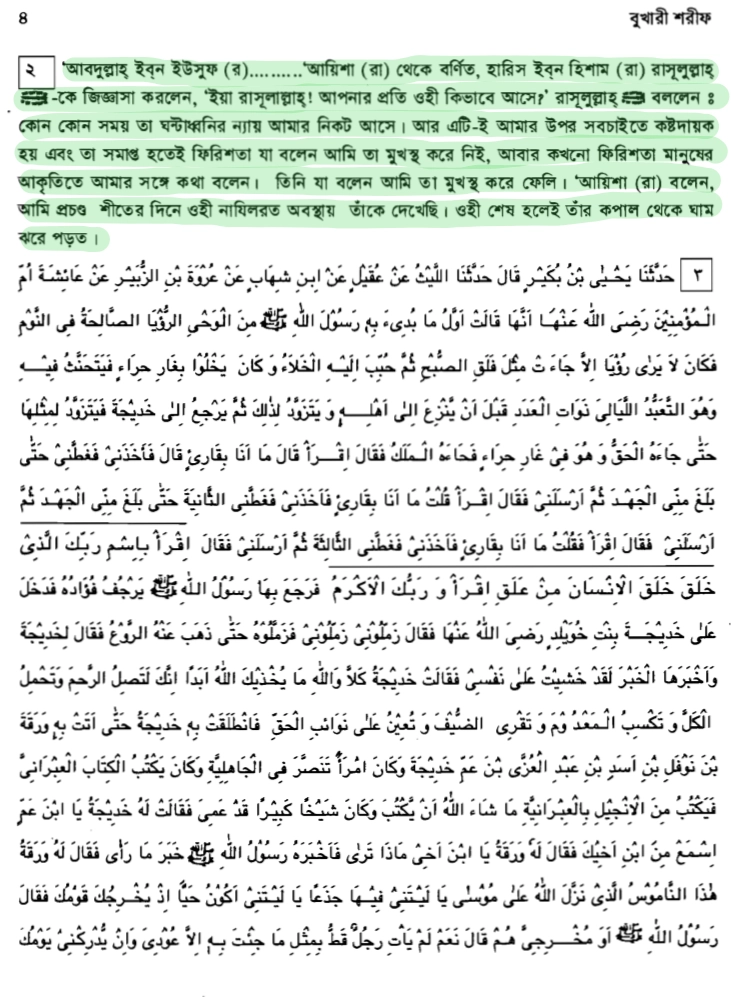
At the same time, Muhammad also said that the bell is Satan’s flute. [60] [61]
وَحَدَّثَنَا يَحْيَى بْنُ أَيُّوبَ، وَقُتَيْبَةُ وَابْنُ حُجْرٍ قَالُوا حَدَّثَنَا إِسْمَاعِيلُ – يَعْنُونَ ابْنَ جَعْفَرٍ – عَنِ الْعَلاَءِ، عَنْ أَبِيهِ، عَنْ أَبِي هُرَيْرَةَ، أَنَّ رَسُولَ اللَّهِ صلى الله عليه وسلم قَالَ «الْجَرَسُ مَزَامِيرُ الشَّيْطَانِ».
English translation: Sahih Muslim (Islamic Foundation)
Chapter: 38/ Clothing and Adornment
Publisher: Islamic Foundation
Section: 22. Keeping dogs and bells while travelling is makruh
5366. Yahya ibn Ayyub, Qutayba and Ibn Hujr (may Allah have mercy on them) … narrated from Abu Hurayra (may Allah be pleased with him) that the Messenger of Allah, peace and blessings of Allah be upon him, said: The bell is Satan’s flute.
Hadith grading: Sahih (Sahih)
Comparing the sound of revelation to the ringing of a bell and calling the bell Satan’s musical instrument—both statements are attributed to Muhammad. The analogy of the same familiar sound describes the experience of revelation in one case and is associated with Satan in another. Condemnation of the bell also appears in another instruction of his: angels do not accompany travelling parties that have a bell or a dog with them. [62]
حَدَّثَنَا أَبُو كَامِلٍ، فُضَيْلُ بْنُ حُسَيْنٍ الْجَحْدَرِيُّ حَدَّثَنَا بِشْرٌ – يَعْنِي ابْنَ مُفَضَّلٍ – حَدَّثَنَا سُهَيْلٌ، عَنْ أَبِيهِ، عَنْ أَبِي هُرَيْرَةَ، أَنَّ رَسُولَ اللَّهِ صلى الله عليه وسلم قَالَ «لاَ تَصْحَبُ الْمَلاَئِكَةُ رُفْقَةً فِيهَا كَلْبٌ وَلاَ جَرَسٌ».
English translation: Through Abu Kamil Fudayl ibn Husayn al-Jahdari, Bishr ibn Mufaddal, Suhayl and his father, Abu Hurayra narrated that the Messenger of Allah said: Angels do not accompany a travelling party in which there is a dog or a bell.
This adverse ruling about bells and the auditory comparison between them and revelation exist within the same body of religious accounts. Commentators have also discussed the process of understanding statements from a sound like the ringing of a bell. In al-Khattabi’s explanation quoted by IslamQA, the sound was not clearly understood as soon as it was first heard; he would retain it after understanding it and becoming certain. [63]
يريد – والله أعلم – أنه صوت متدارِك يسمعه ولا يثبته عند أول ما يقرع سمعه حتى يتفهم ، ويستثبت ، فيتلقفه حينئذٍ ويعيه
English translation: Its meaning—and Allah knows best—is that it was a continuous sound that he heard; he could not firmly grasp it the moment it first reached his ears. Later he understood it and became certain; he then received it and retained it in memory.
Abu al-Abbas al-Qurtubi’s explanation also mentions the effort to understand and remember the statements in this condition. In his words, Muhammad tried to understand and preserve it amid the continuous, disturbing sound; this was accompanied by a change in facial colour, sweating and a condition resembling that of someone with a fever. [64]
وكان يشتد عليه أيضاً ؛ لأنه كان يريد أن يحفظه ويفهمه مع كونه صوتا متتابعا مزعجاً ، ولذلك كان يتغير لونه ، ويتفصد عرقه ، ويعتريه مثل حال المحموم
English translation: His suffering increased because he wanted to remember and understand it despite the continuous, disturbing sound. This caused his facial colour to change, sweat to flow, and a condition like that of a person with a fever.
The description of the experience thus includes not only the presence of a sound but also stages of understanding and remembering. Even if someone else observed suffering, sweating or physical heaviness, those outward signs would not independently identify the specific words uttered or the source of the sound. That the sound was divine, which angel it belonged to, and which words conveyed its meaning—others ultimately learn these identifications through Muhammad’s own statements.
Placing the description of the bell as Satan’s musical instrument alongside the comparison of revelation’s sound to the ringing of a bell exposes an uncomfortable duality in the imagery employed. The auditory image of the same ringing is associated with Satan and condemned in one case, and described as an experience claimed to be divine in another. Opposite religious identities are assigned to the same kind of sound. The intensity of an experience alone is no proof of a supernatural identity.
The Arrival of an Angel in Human Form
According to Muhammad’s statement, the angel sometimes spoke to him in human form, and he remembered what was said. Alongside this statement from Bukhari, al-Suyuti also quoted an additional sentence from Abu Awana’s account, in which this method is called the easiest. [65]
الثَّالِثَةُ: أَنْ يَأْتِيَهُ فِي صُورَةِ الرَّجُلِ فَيُكَلِّمَهُ كَمَا فِي الصَّحِيحِ: «وَأَحْيَانًا يَتَمَثَّلُ لِيَ الْمَلَكُ رَجُلًا فَيُكَلِّمُنِي فَأَعِي مَا يَقُولُ»، زَادَ أَبُو عَوَانَةَ فِي صَحِيحِهِ: «وَهُوَ أَهْوَنُهُ عَلَيَّ».
English translation: The third method: He would come in human form and speak to him. The sahih account states: Sometimes the angel takes the form of a man for me and speaks to me; I remember what he says. Abu Awana narrated the additional words in his Sahih: And this is the easiest for me.
Gabriel is said to have come in the form of Dihya al-Kalbi. In his explanation, al-Ayni cited Dihya’s beauty as the reason: in his words, Dihya was the most handsome person of his time and went about with his face covered for fear that women might be attracted to him. [66]
قلت: اختصاص تمثله بصورة دحية دون غيره من الصحابة لكونه أحسن أهل زمانه صورة ولهذا كان يمشي متلثما خوفا أن يفتتن به النساء.
English translation: I say: The reason for taking Dihya’s form in particular, rather than that of other Companions, was that he was the most handsome person of his time. For this reason, he went about with his face covered for fear that women might be attracted to him.
The dependence involved in this identification is clear in Umm Salama’s account. She had thought the person before her was Dihya; she later learned of Gabriel on hearing Muhammad’s statement. The visible person is in human form; his identity as an angel is accepted on the basis of Muhammad’s statement. [67]
قَالَتْ أُمُّ سَلَمَةَ ايْمُ اللَّهِ مَا حَسِبْتُهُ إِلاَّ إِيَّاهُ حَتَّى سَمِعْتُ خُطْبَةَ نَبِيِّ اللَّهِ صلى الله عليه وسلم يُخْبِرُ جِبْرِيلَ أَوْ كَمَا قَالَ
English translation: Umm Salama said: By Allah, I thought he was that very person until I heard the speech of Allah’s Prophet in which he spoke of Gabriel—or words to that effect.
What Umm Salama saw and her later acceptance of the identification occurred in two stages. At first, she thought the person was Dihya. Later, she accepted his identification as Gabriel from Muhammad’s speech. Muhammad’s authority operates between seeing a human form and identifying it as an angel. The appearance is human, and the conversation is like a human conversation; assurance of a supernatural identity comes from Muhammad’s proclamation. This difference between the eyewitness’s initial impression and the later, religiously accepted identity is clear within the account itself.
Identity is also disclosed afterwards in the account preserved under Umar’s name about an unfamiliar man’s questions and answers. There, everyone sees a man with white clothing and black hair; he asks about Islam, faith, ihsan and the Last Hour. After he leaves, Muhammad identifies him as Gabriel. The exchange narrated by Umar is as follows: [68]
بَيْنَمَا نَحْنُ عِنْدَ رَسُولِ اللَّهِ صلى الله عليه وسلم ذَاتَ يَوْمٍ إِذْ طَلَعَ عَلَيْنَا رَجُلٌ شَدِيدُ بَيَاضِ الثِّيَابِ شَدِيدُ سَوَادِ الشَّعَرِ لاَ يُرَى عَلَيْهِ أَثَرُ السَّفَرِ وَلاَ يَعْرِفُهُ مِنَّا أَحَدٌ حَتَّى جَلَسَ إِلَى النَّبِيِّ صلى الله عليه وسلم فَأَسْنَدَ رُكْبَتَيْهِ إِلَى رُكْبَتَيْهِ وَوَضَعَ كَفَّيْهِ عَلَى فَخِذَيْهِ وَقَالَ يَا مُحَمَّدُ أَخْبِرْنِي عَنِ الإِسْلاَمِ. فَقَالَ رَسُولُ اللَّهِ صلى الله عليه وسلم «الإِسْلاَمُ أَنْ تَشْهَدَ أَنْ لاَ إِلَهَ إِلاَّ اللَّهُ وَأَنَّ مُحَمَّدًا رَسُولُ اللَّهِ وَتُقِيمَ الصَّلاَةَ وَتُؤْتِيَ الزَّكَاةَ وَتَصُومَ رَمَضَانَ وَتَحُجَّ الْبَيْتَ إِنِ اسْتَطَعْتَ إِلَيْهِ سَبِيلاً». قَالَ صَدَقْتَ. قَالَ فَعَجِبْنَا لَهُ يَسْأَلُهُ وَيُصَدِّقُهُ. قَالَ فَأَخْبِرْنِي عَنِ الإِيمَانِ. قَالَ «أَنْ تُؤْمِنَ بِاللَّهِ وَمَلاَئِكَتِهِ وَكُتُبِهِ وَرُسُلِهِ وَالْيَوْمِ الآخِرِ وَتُؤْمِنَ بِالْقَدَرِ خَيْرِهِ وَشَرِّهِ». قَالَ صَدَقْتَ. قَالَ فَأَخْبِرْنِي عَنِ الإِحْسَانِ. قَالَ «أَنْ تَعْبُدَ اللَّهَ كَأَنَّكَ تَرَاهُ فَإِنْ لَمْ تَكُنْ تَرَاهُ فَإِنَّهُ يَرَاكَ». قَالَ فَأَخْبِرْنِي عَنِ السَّاعَةِ. قَالَ «مَا الْمَسْئُولُ عَنْهَا بِأَعْلَمَ مِنَ السَّائِلِ». قَالَ فَأَخْبِرْنِي عَنْ أَمَارَتِهَا. قَالَ «أَنْ تَلِدَ الأَمَةُ رَبَّتَهَا وَأَنْ تَرَى الْحُفَاةَ الْعُرَاةَ الْعَالَةَ رِعَاءَ الشَّاءِ يَتَطَاوَلُونَ فِي الْبُنْيَانِ». قَالَ ثُمَّ انْطَلَقَ فَلَبِثْتُ مَلِيًّا ثُمَّ قَالَ لِي «يَا عُمَرُ أَتَدْرِي مَنِ السَّائِلُ». قُلْتُ اللَّهُ وَرَسُولُهُ أَعْلَمُ. قَالَ «فَإِنَّهُ جِبْرِيلُ أَتَاكُمْ يُعَلِّمُكُمْ دِينَكُمْ».
English translation: One day we were sitting with the Messenger of Allah. Then a man with extremely white clothing and extremely black hair appeared before us. No signs of travel could be seen on him, and none of us knew him. He sat beside the Prophet, placed his knees against his knees, and placed his hands on his thighs. Then he said, O Muhammad, tell me about Islam. The Messenger of Allah said: Islam is that you testify that there is no deity but Allah and that Muhammad is the Messenger of Allah; establish prayer, give zakat, fast in Ramadan, and perform pilgrimage to the House if you can make the journey. The man said, You have spoken the truth. We were astonished that he was asking the questions and also affirming the answers as true. Then he said, Tell me about faith. He said: You must believe in Allah, His angels, His books, His messengers and the Hereafter, and believe in destiny, including its good and bad. The man said, You have spoken the truth. Then he said, Tell me about ihsan. He said: Worship Allah as though you see Him; even if you do not see Him, He sees you. The man said, Tell me about the Last Hour. He said: The one being questioned knows no more than the questioner. The man said, Tell me about its signs. He said: The slave woman will give birth to her mistress, and you will see barefoot, unclothed, destitute shepherds competing to construct tall buildings. Then the man left. I waited for some time. Then he said to me: O Umar, do you know who the questioner was? I said, Allah and His Messenger know best. He said: He was Gabriel; he came to you to teach you your religion.
Those present at this exchange saw the guest’s clothing, hair and posture, and heard his words. His identity as an angel was disclosed after he left. The power to proclaim the supernatural identity of both the apparently familiar man in Umm Salama’s account and the unfamiliar guest in Umar’s account rests with Muhammad. The eyewitnesses testify to a human appearance; they accept its religious identity as an angel by accepting Muhammad’s statement. Umar’s astonishment concerns the guest’s asking questions and himself affirming the answers as true; the proclamation of identity came after the conversation had ended.
| Account | The witness’s direct experience | Basis for identification as an angel |
|---|---|---|
| The visitor before Umm Salama | Thinking the person in the conversation was Dihya | The later mention of Gabriel in Muhammad’s speech |
| The unfamiliar guest before Umar | White clothing, black hair, and religious questions and answers | Muhammad’s proclamation after the guest left |
| Aisha’s account of the ringing of a bell | Seeing sweat flow even in the cold | Muhammad’s statement identifying the sound and the message |
This conversation about Islam, faith and ihsan is preserved in hadith as an account of religious instruction. Its questions and answers were not placed in the mushaf as a surah of the Quran. Thus the presence of Gabriel within the account, the authority of the religious statements, and the identification of particular words as Quran were determined at separate stages. Even after the bearer of a message is called an angel, the work of selection and textual identification remains: precisely which words will be disseminated as Quran and which as other religious information.
Imparting Statements to the Heart
In Islamic accounts, the imparting of statements to Muhammad’s heart has also been called revelation. Sometimes inspiration is described as coming directly to the heart from Allah, and sometimes a message is said to reach the heart through Gabriel. This method requires neither a visible speaker before the listener nor spoken words. Others learn of the message’s divine identity through Muhammad’s proclamation.
The definition of this inner experience is clearer in al-Munawi’s words. Explaining ‘breathed into my heart,’ he described the placement of revelation in the mind, heart or intellect without hearing or seeing. In this account of a message coming to the heart, there is no visible messenger before the listener or proclamation audible to others. [69]
ألقى الوحي في خلَدي وبالي ، أو في نفسي ، أو قلبي ، أو عقلي ، من غير أن أسمعه ولا أراه .
English translation: He placed revelation in my mind and thought, or in my being, heart or intellect—without my hearing or seeing anything.
Muhammad himself identifies thoughts arising within his heart as messages from Allah or Gabriel. The matter reaches his followers through his proclamation. This account contains no process by which his inner experience can be reproduced or tested in the same way before others. The statement of the person claiming the experience becomes the basis for accepting the thought’s supernatural identity. The sanctity of the message and the messenger’s claim thus become mutually dependent. The claim that a statement has arisen in the heart and the claim that Allah sent that statement do not carry the same evidence. The second claim assigns a supernatural source to the first experience.
An example of a message coming to the heart concerns livelihood and death. IslamQA gives Abu Umama’s account from al-Hakim’s al-Mustadrak: the Holy Spirit breathed into his heart the statement that no one would die before receiving their full livelihood. The distinction between ‘revelation’ and ‘verses compiled in the mushaf’ is directly visible here. [70]
إِنَّ رُوحَ القُدُسِ نَفَثَ في رُوعي أَنّه لَنْ تَمُوتَ نَفْسٌ حَتَّى تَسْتكْمِلَ رِزْقَهَا فَاتَّقُوا اللهَ وَأَجْمِلُوا في الطَّلَبِ
English translation: The Holy Spirit breathed into my heart that no soul will die before receiving its full livelihood. Therefore fear Allah and be moderate in seeking a livelihood.
Al-Suyuti also included the imparting of statements to the heart among the methods by which revelation arrives. In his classification, this method can occur together with other methods involving the angel’s presence. ‘Imparting to the heart’ thus principally denotes the manner in which the message is received; a claim of seeing the angel visibly is not a condition of it in every case. [71]
الثَّانِيةُ: أَنْ يَنْفُثَ فِي رَوْعِهِ الْكَلَامَ نَفْثًا كَمَا قَالَ صَلَّى اللَّهُ عَلَيْهِ وَسَلَّمَ: “إِنَّ رُوحَ الَقُدُسِ نَفَثَ فِي رَوْعِي “. أَخْرَجَهُ الْحَاكِمُ. وَهَذَا قَدْ يَرْجِعُ إِلَى الْحَالَةِ الْأُولَى أَوِ الَّتِي بَعْدَهَا بِأَنْ يَأْتِيَهُ فِي إِحْدَى الْكَيْفِيَّتَيْنِ وَيَنْفُثَ فِي رَوْعِهِ.
English translation: The second method: Imparting statements to his heart. As he said, ‘The Holy Spirit imparted to my heart.’ Al-Hakim narrated it. This may also fall within the first state or the following state; that is, coming in one of those two ways and imparting to his heart.
This statement about livelihood has been preserved in hadith as religious instruction; it is not a verse of any surah in the mushaf. Religious authority and recognition as a specific text of the Quran are therefore two distinct identities. Even after a statement is called revelation, there remains a history of the language in which it was disseminated, whether it was read as Quran, and the tradition in which it was preserved. At every stage from inner experience to written scripture, expression in language and transmission through people have taken place.
Direct Conversation with Allah
Accounts describe direct conversation with Allah as another method of revelation. Here, the claim is of hearing Allah’s address rather than a message spoken by an angel. The Quran explicitly states that Allah spoke with Moses. [72]
وَرُسُلًا قَدْ قَصَصْنَاهُمْ عَلَيْكَ مِنْ قَبْلُ وَرُسُلًا لَمْ نَقْصُصْهُمْ عَلَيْكَ وَكَلَّمَ اللَّهُ مُوسَى تَكْلِيمًا
English translation: And We sent messengers whose accounts We have told you before, and messengers whose accounts We have not told you. And Allah spoke directly with Moses.
Surah al-Shura mentions three forms of Allah’s communication with humans: revelation, address from behind a veil, and the sending of a messenger. Address from behind a veil is mentioned separately here. Divine address without the mediation of an angel is thus recognized. [73]
وَمَا كَانَ لِبَشَرٍ أَن يُكَلِّمَهُ اللَّهُ إِلَّا وَحْيًا أَوْ مِن وَرَاءِ حِجَابٍ أَوْ يُرْسِلَ رَسُولًا فَيُوحِيَ بِإِذْنِهِ مَا يَشَاءُ إِنَّهُ عَلِيٌّ حَكِيمٌ
English translation: It is not for any human that Allah should speak to him except through revelation, or from behind a veil, or by sending a messenger who, with His permission, conveys revelation as He wills. He is indeed Most High, Wise.
In Muhammad’s case, the account of the heavenly ascent connects this conversation with the prescription of prayer. According to Bukhari’s account, fifty daily prayers were initially imposed on the community. When Moses said that they would be unable to perform them, Muhammad returned and asked for a reduction; after repeated returns, the number came down to five. In the final address, the five are called fifty. [74]
فَفَرَضَ اللَّهُ عَلَى أُمَّتِي خَمْسِينَ صَلاَةً، فَرَجَعْتُ بِذَلِكَ حَتَّى مَرَرْتُ عَلَى مُوسَى فَقَالَ مَا فَرَضَ اللَّهُ لَكَ عَلَى أُمَّتِكَ قُلْتُ فَرَضَ خَمْسِينَ صَلاَةً. قَالَ فَارْجِعْ إِلَى رَبِّكَ، فَإِنَّ أُمَّتَكَ لاَ تُطِيقُ ذَلِكَ. فَرَاجَعْتُ فَوَضَعَ شَطْرَهَا، فَرَجَعْتُ إِلَى مُوسَى قُلْتُ وَضَعَ شَطْرَهَا. فَقَالَ رَاجِعْ رَبَّكَ، فَإِنَّ أُمَّتَكَ لاَ تُطِيقُ، فَرَاجَعْتُ فَوَضَعَ شَطْرَهَا، فَرَجَعْتُ إِلَيْهِ فَقَالَ ارْجِعْ إِلَى رَبِّكَ، فَإِنَّ أُمَّتَكَ لاَ تُطِيقُ ذَلِكَ، فَرَاجَعْتُهُ. فَقَالَ هِيَ خَمْسٌ وَهْىَ خَمْسُونَ، لاَ يُبَدَّلُ الْقَوْلُ لَدَىَّ. فَرَجَعْتُ إِلَى مُوسَى فَقَالَ رَاجِعْ رَبَّكَ. فَقُلْتُ اسْتَحْيَيْتُ مِنْ رَبِّي.
English translation: Allah made fifty daily prayers obligatory upon my community. As I returned with this, I came to Moses, who asked, What has Allah made obligatory upon your community? I said, Fifty daily prayers. He said, Return to your Lord; your community will not be able to do that. I returned, and He reduced it by half. Returning to Moses, I said, He has reduced it by half. Moses said, Return to your Lord; your community will not be able to do that. I returned again, and He reduced it by half. When I returned to Moses, he again said, Return to your Lord; your community will not be able to do that. I returned, and He said, These are five, and these are fifty; My word does not change. When I returned to Moses, he said, Return to your Lord. I said, I feel ashamed to go back to my Lord again.
In this account, the number prescribed changes through petitions and renewed petitions. The establishment of the five daily prayers that followers must perform is connected to a conversation whose news reaches them through Muhammad’s statement. The religious duty here rests on a supernatural encounter reported by one individual. His followers were not present at that encounter to hear the prescription of fifty, the request for a reduction, or the announcement bringing it down to five. What reached them was the account of the event and the rule to be followed on its basis.
This conversation about prayer during the heavenly ascent appears in hadith; the entire conversation is not present in the mushaf as Quranic verses. The identification of the text disseminated as Quran during Muhammad’s lifetime, the dissemination of other religious instructions, and the subsequent compilation of the text in the mushaf—each of these stages involved selection, identification and preservation through people. Declaring Allah to be the message’s source does not erase those human activities. Nor did all statements recounted by the same individual as Allah’s words find a place in the same kind of written scripture.
Seeing the angel in his own form
Revelation sent through Gabriel is called wahy malaki. Accounts of messages delivered through angels describe words heard from behind a veil, speech delivered in person, and appearances in both human and original form. In the hadith narrated by Aisha in Sahih Muslim, the number of times Gabriel was seen in the form in which he was created is specified as two.
Aisha made this statement in response to Masruk’s question. Masruk raised verse 81:23 of Surah al-Takwir and verse 53:13 of Surah al-Najm. Aisha said that she had asked Muhammad about this, and Muhammad had explained that he saw Gabriel. The identity of Gabriel is thus linked to the act of ‘seeing’ in the verses through an explanation attributed to Muhammad. [75]
إِنَّمَا هُوَ جِبْرِيلُ لَمْ أَرَهُ عَلَى صُورَتِهِ الَّتِي خُلِقَ عَلَيْهَا غَيْرَ هَاتَيْنِ الْمَرَّتَيْنِ رَأَيْتُهُ مُنْهَبِطًا مِنْ السَّمَاءِ سَادًّا عِظَمُ خَلْقِهِ مَا بَيْنَ السَّمَاءِ إِلَى الأَرْضِ
English translation: He was Gabriel. I have not seen him in the form in which he was created except these two times. I saw him descending from the sky; his massive body covered the space between the sky and the earth.
Bukhari also preserves an account through Ibn Masud of Gabriel’s six hundred wings. When al-Shaybani asked Zirr ibn Hubaysh about the verses in Surah al-Najm concerning proximity and the communication of revelation, he related this account from Ibn Masud. [76]
حَدَّثَنَا قُتَيْبَةُ، حَدَّثَنَا أَبُو عَوَانَةَ، حَدَّثَنَا أَبُو إِسْحَاقَ الشَّيْبَانِيُّ، قَالَ سَأَلْتُ زِرَّ بْنَ حُبَيْشٍ عَنْ قَوْلِ اللَّهِ، تَعَالَى {فَكَانَ قَابَ قَوْسَيْنِ أَوْ أَدْنَى * فَأَوْحَى إِلَى عَبْدِهِ مَا أَوْحَى}. قَالَ حَدَّثَنَا ابْنُ مَسْعُودٍ أَنَّهُ رَأَى جِبْرِيلَ لَهُ سِتُّمِائَةِ جَنَاحٍ.
English translation: Narrated through Qutayba, Abu Awana and Abu Ishaq al-Shaybani. Al-Shaybani said, I asked Zirr ibn Hubaysh about these words of Allah: ‘Then he came within two bow-lengths or even closer; then he revealed to His servant what he was to reveal.’ He said, Ibn Masud informed us that Muhammad saw Gabriel; he had six hundred wings.
This description of an immense form depends on Muhammad’s own statements about his experience. Aisha recounted the experience she had heard about from Muhammad. Another description of the angel’s form comes through Ibn Masud. In these accounts, followers transmit reports of Muhammad’s vision; they do not testify to having seen the same sight themselves. Their knowledge of the angel’s form, identity and message comes through the statements of the person claiming the experience and the transmission of those statements.
Between the claim of seeing an angel and the identification of the being seen as Allah’s messenger lies a step of establishing identity. The description of an immense body or six hundred wings is presented together with a religious explanation of that identity. The more central the angel’s role is to the claim of conveying the Quran’s words, the more its identification depends on Muhammad’s statements. His interpretation of his experience became established among his followers as assurance of the message’s supernatural source. When the same statement is subsequently quoted in other books, the number of quotations increases; the number of independent eyewitnesses to the original vision does not.
Instruction through dreams
Islamic accounts also contain the idea of prophets receiving instructions through dreams. Ibrahim’s dream of slaughtering his son and Muhammad’s dream of entering Mecca both establish a connection between dreams and practical action. The account of the second event involves the journey to Mecca and the Treaty of Hudaybiyya. (Sharh Fayzul Kabir: 24). In Aisha’s account, Muhammad’s revelation also began with true dreams during sleep; they would become manifest like the light of dawn. [77]
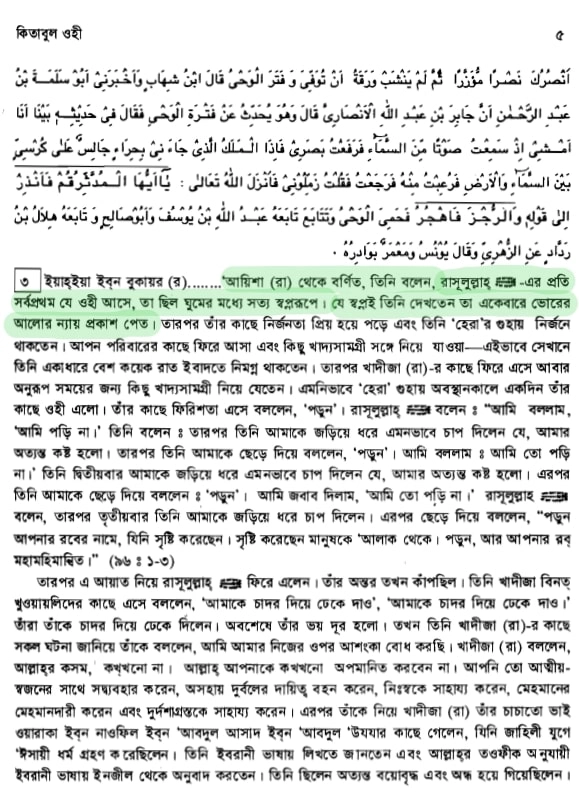
Revelation beginning in dreams is mentioned at the very start of the long account near the beginning of Bukhari. In Aisha’s words, Muhammad’s revelation began with good or true dreams during sleep. The account moves from dreams to the angel’s arrival at Hira. [78]
أَوَّلُ مَا بُدِئَ بِهِ رَسُولُ اللَّهِ صلى الله عليه وسلم مِنَ الْوَحْىِ الرُّؤْيَا الصَّالِحَةُ فِي النَّوْمِ، فَكَانَ لاَ يَرَى رُؤْيَا إِلاَّ جَاءَتْ مِثْلَ فَلَقِ الصُّبْحِ
English translation: The beginning of the Messenger of Allah’s revelation was through good dreams during sleep. Whatever dream he saw, it would manifest like the light of dawn.
Others learn about a dream from the dreamer’s own account. Both the language in which a dream is expressed and the meaning subsequently accepted for it involve the dreamer and interpreter. Accepting a dream as revelation does not remove dependence on that person’s testimony. When a personal dream establishes religious duties for other people, a private experience acquires authority over a community. The person claiming the dream is then determining what others must do as well as recounting his own experience.
Quoting Ubayd ibn Umayr’s comment on Ibrahim’s dream of slaughtering his son, IslamQA states that prophets’ dreams are considered revelation. The comment also appears in Bukhari, hadith 138. This position thus recognizes religious authority to undertake grave actions on the basis of dreams. [79] [80]
رُؤْيَا الْأَنْبِيَاءِ وَحْيٌ ثُمَّ قَرَأَ إِنِّي أَرَى فِي الْمَنَامِ أَنِّي أَذْبَحُكَ
English translation: The dreams of prophets are revelation. Then he recited: I see in a dream that I am slaughtering you.
In the description of Surah As-Saffat, Ibrahim himself speaks of slaughtering his son in a dream. In response, the son accepts that dream as an instruction to be followed. Ibn Kathir has identified this son as Ismail. [81] [82]
فَلَمَّا بَلَغَ مَعَهُ السَّعْيَ قَالَ يَا بُنَيَّ إِنِّي أَرَى فِي الْمَنَامِ أَنِّي أَذْبَحُكَ فَانْظُرْ مَاذَا تَرَى قَالَ يَا أَبَتِ افْعَلْ مَا تُؤْمَرُ سَتَجِدُنِي إِنْ شَاءَ اللَّهُ مِنَ الصَّابِرِينَ
English translation: Then when he reached the age of working with him, he said, O my son, I see in a dream that I am slaughtering you. Now see, what is your opinion. He said, O my father, do as you are commanded. If Allah wills, you will find me among the patient.
The ethical problem of accepting one’s own dream as an instruction concerning another person’s life is profound. The experience belongs to the dreamer, but it is someone else’s life that is endangered. The designation ‘a prophet’s dream’ is the source of this lethal authority. The story also turns the son’s obedience into a religious ideal. The father’s firm belief in the truth of his dream is not ethical evidence of a right over his son’s life. At precisely this step, where a personal experience becomes the basis for decisions about another person’s body and life, religious obedience turns into a demand for the sacrifice of life.
Muhammad’s dream of entering Mecca is also mentioned in Surah al-Fath. The verse speaks of entering Masjid al-Haram safely, with heads shaved or hair shortened. Alongside declaring the dream true, the same verse adds that Allah knows things unknown to people. [83]
لَقَدْ صَدَقَ اللَّهُ رَسُولَهُ الرُّؤْيَا بِالْحَقِّ لَتَدْخُلُنَّ الْمَسْجِدَ الْحَرَامَ إِنْ شَاءَ اللَّهُ آمِنِينَ مُحَلِّقِينَ رُءُوسَكُمْ وَمُقَصِّرِينَ لَا تَخَافُونَ فَعَلِمَ مَا لَمْ تَعْلَمُوا فَجَعَلَ مِنْ دُونِ ذَلِكَ فَتْحًا قَرِيبًا
English translation: Allah has truly fulfilled His Messenger’s dream. If Allah wills, you will certainly enter Masjid al-Haram safely, with your heads shaved and your hair shortened; you will not be afraid. He knew things that you did not know. He therefore appointed a near victory before this.
At Hudaybiyya, Umar questioned Muhammad about the discrepancy between this expectation and the actual outcome. He recalled that they had been told they would go to the Kaaba and perform tawaf. Muhammad replied by asking whether he had said they would go that very year. Umar said no. [84] [85]
قُلْتُ : أَوَلَيْسَ كُنْتَ تُحَدِّثُنَا أَنَّا سَنَأْتِي الْبَيْتَ فَنَطُوفُ بِهِ ؟ قَالَ : بَلَى ، فَأَخْبَرْتُكَ أَنَّا نَأْتِيهِ الْعَامَ ؟ قَالَ : قُلْتُ : لَا ، قَالَ : فَإِنَّكَ آتِيهِ وَمُطَوِّفٌ بِهِ
English translation: I said, Did you not tell us that we would go to the Kaaba and perform tawaf? He said, Yes; but did I tell you that we would go there this year? I said, No. He said, You will certainly go there and perform tawaf.
In this event, the content of the dream, the timing expected by the followers and the interpretation of the proclamation became distinct. Umar questioned Muhammad on the basis of the earlier proclamation; Muhammad answered that no time had been specified. Here too, the power to determine the meaning of a private experience remained with the person proclaiming it. Belief in the same dream created an expectation of the journey, while an explanation of the proclamation’s timeframe supplied the answer when the immediate expectation was not fulfilled.
| Narrated experience | Religious statement or duty | Preserved form |
|---|---|---|
| The Holy Spirit’s message in the heart | No death before receiving one’s full livelihood; an instruction to seek it moderately | Statement preserved in hadith |
| Conversation at Miraj | Number of prayers from fifty to five | Conversation preserved in hadith |
| Ibrahim’s dream | Preparation to slaughter the son, and obedience | Event described in the Quran |
| Muhammad’s dream of entering Mecca | Declaration of entering Masjid al-Haram | Quranic verses and hadith of Hudaybiyyah |
Inner feelings, visions, conversations and dreams—once expressed in religious language, these experiences were preserved through different routes. An experience’s supernatural identity and the recognition of particular words as Quran are therefore not the same proclamation. Expressing a dream in particular words, determining its meaning and granting religious authority to that expression all involve active roles for the person claiming the experience and those accepting his statement.
Accounts of Israfil’s Duties Before Gabriel and Their Different Versions
Islamic books preserve an account of Israfil’s involvement during the first three years of prophethood, followed by the Quran’s revelation through Gabriel. It treats the beginning of prophethood, initial instruction and Quranic revelation as separate stages. In the first stage, Israfil teaches certain words and matters; in the next, Gabriel brings the Quran. The report gives neither the reason for this change of responsibility nor the detailed text of the first three years’ instruction. It assigns a separate period to another angel in the history of revelation’s beginnings.
In al-Salihi’s Subul al-Huda wa-l-Rashad, this subject forms the title of a separate chapter. He quotes the report attributed to Amir al-Shabi from Ahmad’s historical work. Al-Suyuti’s al-Itqan also mentions the same account through Ahmad, Dawud ibn Abi Hind and al-Shabi. Al-Salihi’s quotation combines prophethood at forty, three years of Israfil and twenty years of Quranic revelation through Gabriel. [86] [87]
إن رسول الله صلى الله عليه وسلم نزلت عليه النبوة وهو ابن أربعين سنة ، فقرن بنبوته إسرافيل ثلاث سنين ، فكان يعلمه الكلمة والشيء ، ولم ينزل القرآن على لسانه ، فلما مضت ثلاث سنين قرن بنبوته جبريل ، فنزل القرآن على لسانه عشرين سنة ، عشرا بمكة وعشرا بالمدينة ، فمات وهو ابن ثلاث وستين سنة .
English translation: When the Messenger reached forty years of age, prophethood came upon him. Israfil was then assigned to his prophethood for three years. He taught him certain words and matters; the Quran was not revealed through his tongue. After three years, Gabriel was assigned to his prophethood. The Quran was then revealed through his tongue for twenty years—ten in Mecca and ten in Medina. He died at the age of sixty-three.
The report divides the total twenty-three years of prophethood into two periods: three and twenty. During the first three years, an angel provides instruction, but no Quran is revealed through his tongue; during the next twenty years, the Quran is revealed. The duration of prophethood and the period of Quranic revelation are therefore not equal here. Although prophethood begins at forty, this calculation places the beginning of the Quran through Gabriel at forty-three. This is an actual difference between accounts of the familiar twenty-three-year period of revelation. Excluding the first three years changes the calculation itself. The difference in the angel’s name thus affects the entire chronology. The same three years count as part of prophethood but not as part of Quranic revelation. How the terms revelation, prophethood and Quran are used here determines the resulting calculation of time.
Al-Salihi called the isnad sahih as far as al-Shabi; al-Shabi was not an eyewitness to the events at the beginning of prophethood. Ibn Kathir, quoted by IslamQA, likewise called the isnad sahih ‘as far as al-Shabi.’ The appearance of this report in several books represents the later preservation of the same al-Shabi transmission; each book does not add a separate eyewitness’s testimony. A gap in transmission separates the report’s historical attestation from direct testimony to the events it describes. [88]
قال ابن كثير : فَهَذَا إِسْنَادٌ صَحِيحٌ إِلَى الشَّعْبِيِّ ، وَهُوَ يَقْتَضِي أَنَّ إِسْرَافِيلَ قُرِنَ مَعَهُ بَعْدَ الْأَرْبَعِينَ ثَلَاثَ سِنِينَ ثُمَّ جَاءَهُ جِبْرِيلُ
English translation: Ibn Kathir says: This isnad is sahih as far as al-Shabi. It means that after he reached forty, Israfil was assigned to him for three years; Gabriel then came to him.
The report of Israfil did not remain an isolated mention of an angel’s name; it was also used to reconcile different calculations of time. In discussing the accounts of ten and thirteen years spent in Mecca, IslamQA quotes Ibn Hajar’s explanation. It allows for contact with Michael or Israfil during the first three years, followed by ten years of Quranic revelation through Gabriel. The alternative identities of the angel and the method of calculating the period of revelation appear within the same explanation. [89]
أَوْ أَنَّهُ عَلَى رَأْس الْأَرْبَعِينَ قُرِنَ بِهِ مِيكَائِيل أَوْ إِسْرَافِيل ، فَكَانَ يُلْقِي إِلَيْهِ الْكَلِمَة أَوْ الشَّيْء مُدَّة ثَلَاث سِنِينَ ، كَمَا جَاءَ مِنْ وَجْه مُرْسَل , ثُمَّ قُرِنَ بِهِ جِبْرِيل فَكَانَ يَنْزِل عَلَيْهِ بِالْقُرْآنِ مُدَّة عَشْر سِنِينَ بِمَكَّة
English translation: Or, when he reached forty, Michael or Israfil was assigned to him. For three years he conveyed certain words or matters to him, as stated in a mursal report. Gabriel was then assigned to him; for ten years in Mecca, he descended to him with the Quran.
Abu Shama proposed another sequence to reconcile the report of Israfil with Aisha’s account of Gabriel: first dreams, then Israfil’s involvement during the period of seclusion at Hira, and finally Gabriel’s arrival. He offered two possibilities for the absence of the middle stage from Aisha’s account—either Aisha abbreviated the events, or she did not know about the report of Israfil. [90]
فحكت عائشة ما جرى له مع جبريل ولم تحك ما جرى له مع إسرافيل اختصارا للحديث ، أو لم تكن وقفت على قصة إسرافيل .
English translation: Therefore, Aisha described what happened with Gabriel; she did not describe what happened with Israfil—either to keep the account brief, or she was unaware of the incident involving Israfil.
Aisha herself does not say here that she abbreviated the account; nor does she say that she was unaware of Israfil. These two reasons are explanations proposed by Abu Shama. To fit different reports into the same sequence, an unmentioned stage is being inserted into Aisha’s account. Reports of past events and later attempts to fill their gaps have thus been preserved side by side. Merely proposing a possibility does not create new historical evidence to fill that gap.
In the same chapter, Waqidi rejected Sha’bi’s report. His position was that no angel other than Gabriel was associated with Muhammad’s prophethood. After this, Salihi quoted the comment of the “Hafiz”: if the denier has no proof for the denial, the positive report is given priority. Consequently, the disagreement here is not only about the name of the angel, but also about on what basis a report should be accepted. [91]
وقد أنكر الواقدي رحمه الله تعالى خبر الشعبي وقال : لم يقرن به من الملائكة إلا جبريل . قال الحافظ : ولا يخفى ما فيه ، فإن المثبت مقدم على النافي إلا إن صحب النافي دليل نفيه فيقدم . انتهى .
English translation: Waqidi denied Sha’bi’s report, stating: among the angels, no one other than Gabriel was associated with him. The Hafiz says: the problem here is clear; because the positive reporter is given priority over the denier. However, if the denier has proof for the denial, then he is given priority.
Salihi ultimately gave priority to Waqidi’s statement. Before this, he brought a narration mentioning that an angel who later came to Muhammad had never descended to earth before. By using the explanation that identified that angel as Israfil, the report of Israfil’s connection during the first three years was weakened. Here, the determination of the time of the first arrival depends on fixing the identity of an unnamed angel in another hadith. The name provided by the commentator, which is absent in the original report, becomes the basis for the subsequent decision.
Al-Shabi’s report, Abu Shama’s reconciliation, al-Waqidi’s denial and al-Salihi’s selection all appear within the same chapter. Instead of a smooth, unified account of the beginning of prophethood, there are competing sequences of events and attempts to reconcile them. One tradition separates out the first three years; another denies that the angel had any such responsibility at all. The starting date, the messenger’s identity and the calculation of Quranic revelation change according to which account later interpreters accept.
Reports of Fatiha and the last two verses of Baqarah through another angel
Sahih Muslim describes another angel arriving while Gabriel was sitting with Muhammad. This report attributed to Ibn Abbas mentions a sound from above, the opening of a gate of heaven, and an angel descending through it. Although Gabriel is present, he announces the arrival of another messenger. The new angel calls Fatihat al-Kitab and the final verses of al-Baqara two lights and announces the special gift of their bestowal. [92]
حَدَّثَنَا حَسَنُ بْنُ الرَّبِيعِ، وَأَحْمَدُ بْنُ جَوَّاسٍ الْحَنَفِيُّ، قَالاَ حَدَّثَنَا أَبُو الأَحْوَصِ، عَنْ عَمَّارِ بْنِ رُزَيْقٍ، عَنْ عَبْدِ اللَّهِ بْنِ عِيسَى، عَنْ سَعِيدِ بْنِ جُبَيْرٍ، عَنِ ابْنِ عَبَّاسٍ، قَالَ بَيْنَمَا جِبْرِيلُ قَاعِدٌ عِنْدَ النَّبِيِّ صلى الله عليه وسلم سَمِعَ نَقِيضًا مِنْ فَوْقِهِ فَرَفَعَ رَأْسَهُ فَقَالَ هَذَا بَابٌ مِنَ السَّمَاءِ فُتِحَ الْيَوْمَ لَمْ يُفْتَحْ قَطُّ إِلاَّ الْيَوْمَ فَنَزَلَ مِنْهُ مَلَكٌ فَقَالَ هَذَا مَلَكٌ نَزَلَ إِلَى الأَرْضِ لَمْ يَنْزِلْ قَطُّ إِلاَّ الْيَوْمَ فَسَلَّمَ وَقَالَ أَبْشِرْ بِنُورَيْنِ أُوتِيتَهُمَا لَمْ يُؤْتَهُمَا نَبِيٌّ قَبْلَكَ فَاتِحَةُ الْكِتَابِ وَخَوَاتِيمُ سُورَةِ الْبَقَرَةِ لَنْ تَقْرَأَ بِحَرْفٍ مِنْهُمَا إِلاَّ أُعْطِيتَهُ
English translation: Narrated from Ibn Abbas through Hasan ibn Rabi and Ahmad ibn Jawwas al-Hanafi, Abu al-Ahwas, Ammar ibn Ruzayq, Abdullah ibn Isa and Said ibn Jubayr: While Gabriel was sitting with the Prophet, he heard a sound from above. He raised his head and said: This is a gate of heaven that has been opened today; it has never been opened before today. An angel descended from it. He said: This angel has never descended to earth before today. The angel greeted him and said: Receive glad tidings of two lights given to you that were not given to any prophet before you—Fatihat al-Kitab and the final verses of Surah al-Baqara. Whenever you recite a letter of these, you will be granted what is due for it.
In this account, Gabriel and the newly arrived angel are two distinct figures. Gabriel announces the arrival; the new angel greets him and speaks. The hadith does not give the angel’s personal name. His statement announces that two lights have already been given and promises a benefit connected to recitation. The presence of an angel other than Gabriel in conveying religious information is explicit in the account. Announcing the status of particular Quranic passages also falls within this angel’s duties.
Regarding the question of who brought Fatiha, multiple conclusions have been drawn from the narration in Muslim. Quoting the statement of Ibn Atiyyah, Qurtubi mentioned that some scholars, based on this hadith, believed that Gabriel did not descend with Surah Hamd. Ibn Atiyyah opposed that conclusion, saying that Gabriel came first and informed about the new angel and what was descending with him; in this sense, Gabriel also participated in the revelation. [93] [94]
قَالَ ابْنُ عَطِيَّةَ: وَلَيْسَ كَمَا ظُنَّ، فَإِنَّ هَذَا الْحَدِيثَ يَدُلُّ عَلَى أَنَّ جِبْرِيلَ عَلَيْهِ السَّلَامُ تَقَدَّمَ الْمَلَكَ إِلَى النَّبِيِّ صَلَّى اللَّهُ عَلَيْهِ وَسَلَّمَ مُعْلِمًا بِهِ وَبِمَا يَنْزِلُ مَعَهُ، وَعَلَى هَذَا يَكُونُ جِبْرِيلُ شَارَكَ فِي نُزُولِهَا، وَاللَّهُ أَعْلَمُ.
English translation: Ibn Atiyyah says: it is not as has been assumed. Because this hadith implies that Gabriel came to the Prophet before that angel and informed him about him and what was being revealed with him. In this sense, Gabriel also participated in its revelation. Allah knows best.
Al-Qurtubi directly rejects part of this explanation: in his view, the hadith’s explicit wording does not indicate that Gabriel told Muhammad anything about these matters. He then offers a different reconciliation, taking the statement ‘the Trustworthy Spirit brought it down’ in Surah al-Shuara to apply to the entire Quran. In his explanation, Gabriel brought the text of al-Fatiha in Mecca, while the other angel came in Medina with news of its reward. [95]
قُلْتُ: الظَّاهِرُ مِنَ الْحَدِيثِ يَدُلُّ عَلَى أَنَّ جِبْرِيلَ عَلَيْهِ السَّلَامُ لَمْ يُعْلِمِ النَّبِيَّ صَلَّى اللَّهُ عَلَيْهِ وَسَلَّمَ بِشَيْءٍ مِنْ ذَلِكَ. وَقَدْ بَيَّنَّا أَنَّ نُزُولَهَا كَانَ بِمَكَّةَ، نَزَلَ بِهَا جِبْرِيلُ عَلَيْهِ السَّلَامُ، لِقَوْلِهِ تَعَالَى: “نَزَلَ بِهِ الرُّوحُ الْأَمِينُ” [الشعراء: ١٩٣] وَهَذَا يَقْتَضِي جَمِيعَ الْقُرْآنِ، فَيَكُونُ جِبْرِيلُ عَلَيْهِ السَّلَامُ نَزَلَ بِتِلَاوَتِهَا بِمَكَّةَ، وَنَزَلَ الْمَلَكُ بِثَوَابِهَا بِالْمَدِينَةِ. وَاللَّهُ أَعْلَمُ.
English translation: I say: the explicit language of the hadith implies that Gabriel did not inform the Prophet about these matters. We have already said that its revelation took place in Mecca; Gabriel descended with it. Because Allah said, “the Trustworthy Spirit descended with it” [Surah ash-Shu’ara, 26:193]; and this includes the entire Quran. In that sense, Gabriel descended with its recitation in Mecca, and that angel descended with the news of its reward in Medina. Allah knows best.
Ibn Atiyya’s explanation adds Gabriel’s participation through his prior notification. Al-Qurtubi rejects that explanation and places the text and the news of its reward at different times. The event quoted from Muslim does not describe this sequence of two arrivals, one with the text in Mecca and another with the reward in Medina. The arrangement is constructed by combining al-Qurtubi’s prior acceptance of Meccan revelation with Gabriel’s identity as the bearer of the entire Quran. The need to defend a religious position thus determines the interpretation alongside the original account of the event.
Islamweb’s fatwa 57900 also adopts the conclusion that Gabriel came with the text and another angel with news of its reward. The fatwa summarizes Ibn Atiyya’s statement and al-Qurtubi’s discussion together. The difference between their explanations in the original tafsir is absent from that summary. Once a reconciled conclusion has been selected from earlier disagreements, it is circulated again in later religious answers. [96]
| Explanation | Determining the role of the angel | Basis of explanation |
|---|---|---|
| Some scholars quoted by Ibn Atiyyah | Fatiha was brought by another angel | Muslim’s narration of the two lights |
| Ibn Atiyyah | Gabriel also participated in the revelation | Explanation of prior notification regarding the new angel and accompanying matters |
| Qurtubi | Gabriel brought the recitation, another angel brought the reward | Reconciliation combining Meccan revelation and the role of the Trustworthy Spirit in the entire Quran |
There is another layer of explanation regarding the identity of the unnamed angel. In the discussion quoted by Salihi, some scholars called him Israfil. If that identification is accepted, the phrase “has never descended to earth before” creates a conflict with the report of Israfil’s communication during the first three years. Salihi used this argument to ultimately accept Waqidi’s view. The same hadith is used in one place to determine the carrier of Fatiha, and in another to determine the angel of the first three years of prophethood. [97]
قال جماعة من العلماء إن هذا الملك إسرافيل .
English translation: A group of scholars said that this angel is Israfil.
| Account | Which angel’s role | Exactly what was said | The decision found directly |
|---|---|---|---|
| Report preserved under Sha’bi’s name | Israfil for the first three years; Gabriel thereafter | Israfil would teach; the Quran was not revealed through his tongue | Initial communication regarding revelation and the revelation of the Quran have been separated |
| Waqidi’s statement | Gabriel’s connection with prophethood | No other angel was associated | There are narrative disagreements with previous reports |
| Abu Shama’s reconciliation | Dreams, Israfil, then Gabriel | Possibility that Aisha shortened it or was unaware of the event | This is a subsequent explanation, not a new direct account |
| Muslim 806 | Another unnamed angel in the presence of Gabriel | Glad tidings regarding Fatiha and the final verses of Baqarah | Arrival of an angel other than Gabriel and glad tidings of two lights |
Angelic contact, instruction, glad tidings and the revelation of the Quran’s text involve different responsibilities in these accounts. One report assigns three specific years to Israfil; in another, a new angel announces two lights in Gabriel’s presence. Later scholars sometimes separated stages of contact, sometimes distinguished the text from its reward, and sometimes identified an unnamed angel in order to reject another report. Accounts of events, conflicts between reports and the later selection of views thus operate together in the preserved history.
Writing, memorization, and collection of the Quran during Muhammad’s time
The history of Quranic preservation involves several human activities: Muhammad’s recitation, his followers’ memorization, learning readings from teachers, and the scribes’ recording of verses. Writing down a statement heard, memorizing a surah, teaching a reading to someone else and gathering the entire text are different responsibilities. Even when one person fulfilled several roles, each activity has its own evidence. The material for the later mushaf came from these individuals’ memories, teaching and written collections. Their role in Quranic history was therefore not incidental; they were the practical means through which the message reached people and survived.
Identities of revelation writers, Quran reciters, and memorizers
Islamic books name many people involved in memorizing and writing the Quran during Muhammad’s time. These lists include later caliphs, well-known reciters, women, scribes of revelation, and scribes who handled Muhammad’s other business. Grouping them under the designation ‘preservers of the Quran’ obscures the nature of each person’s work. The preserved accounts distinguish who heard the recitation directly, who wrote, who taught and who later received responsibility for compilation. The length of a list does not establish the extent or wording of the text preserved by each individual.
IslamQA has quoted a list of Muhammad’s writers from Ibn al-Qayyim’s Zad al-Ma’ad. The identification of the quote mentions writing revelation or correspondence. Zayd ibn Thabit is said to have been most regularly and specially associated with this work. [98]
فقد ذكر أهل السيرة أسماء الصحابة الذين كانوا يكتبون الوحي أو الرسائل للرسول صلى الله عليه وسلم وهم : أبو بكر الصديق ، وعمر بن الخطاب ، وعثمان بن عفان ، وعلي بن أبي طالب ، والزبير بن العوام ، وعامر بن فهيرة ، وعمرو بن العاص ، وأبي بن كعب ، وعبد الله بن الأرقم ، وثابت بن قيس بن شماس ، وحنظلة بن الربيع الأسيدي ، والمغيرة بن شعبة ، وعبد الله بن رواحة ، وخالد بن الوليد ، وخالد بن سعيد بن العاص ، وقيل : إنه أول من كتب له ، ومعاوية ابن أبي سفيان ، وزيد بن ثابت – وكان ألزمهم لهذا الشأن وأخصهم به –
English translation: Biographers have mentioned the names of those companions who wrote revelation or correspondence for the Messenger. They are: Abu Bakr as-Siddiq, Umar ibn al-Khattab, Uthman ibn Affan, Ali ibn Abi Talib, Zubayr ibn al-Awwam, Amir ibn Fuhayra, Amr ibn al-As, Ubayy ibn Ka’b, Abdullah ibn al-Arqam, Sabit ibn Qays ibn Shammas, Hanzala ibn al-Rabi al-Usaidī, Mugira ibn Shu’ba, Abdullah ibn Rawaha, Khalid ibn al-Walid, Khalid ibn Sa’id ibn al-As—he is called the first writer—Mu’awiya ibn Abi Sufyan, and Zayd ibn Thabit. Zayd was most regularly and specially associated with this work.
Separate identities of the writers’ work are also in the same answer. Quoting the statement of Ibn Hajar al-Qudai, it is mentioned that besides writing revelation, Zayd wrote letters to kings; Zubayr and Jahm wrote accounts of charity funds. That is, within the identity of being Muhammad’s writer, religious texts, diplomatic letters, and financial records are separated. [99]
كان زيد بن ثابت يكتب عنه للملوك ، مع ما كان يكتب من الوحي ، وكان الزبير وجهم يكتبان أموال الصدقات
English translation: Besides writing revelation, Zayd ibn Thabit wrote letters to kings on his behalf. Zubayr and Jahm wrote accounts of charity funds.
Lists of revelation scribes are also said to contain as many as forty names. In Mabahith fi Ulum al-Quran, Subhi al-Salih describes this figure as Blachère’s calculation from comparing information in different books. Islamweb’s fatwa 69904 mentions thirteen, more than twenty and, in Ibn Kathir’s count, twenty-three people. These figures count names in lists compiled from different books; the responsibilities for writing revelation, correspondence and other documents also varied between individuals. [100] [101]
استطاع المستشرق بلاشير أن يبلغ بكتبة الوحي أربعين رجلا
English translation: The Orientalist Blachère managed to reach a count of forty writers of revelation.
The list cited by Ibn al-Qayyim contains seventeen names. In Qudai’s citation, the name of Jahm appears, who is not among those seventeen. As the method of work and the sources used change, the members of the list also change. These lists do not provide a description that each of these individuals possessed a complete mushaf of the final reading in the same words. The information regarding how long each person wrote, which part they wrote, and how long after their writing the collection was made is specific to the individual. The total number alone does not reveal this history.
Zayd’s identity as a writer of revelation is directly present in Bukhari’s description of the collection. Abu Bakr called him and, reminding him of this previous work, entrusted him with the responsibility of searching for and collecting the Quran. In Zayd’s account, it is also mentioned simultaneously that the last two verses of Surah At-Tawbah were found with Abu Khuzaima al-Ansari. [102]
حَدَّثَنَا يَحْيَى بْنُ بُكَيْرٍ، حَدَّثَنَا اللَّيْثُ، عَنْ يُونُسَ، عَنِ ابْنِ شِهَابٍ، أَنَّ ابْنَ السَّبَّاقِ، قَالَ إِنَّ زَيْدَ بْنَ ثَابِتٍ قَالَ أَرْسَلَ إِلَىَّ أَبُو بَكْرٍ ـ رضى الله عنه ـ قَالَ إِنَّكَ كُنْتَ تَكْتُبُ الْوَحْىَ لِرَسُولِ اللَّهِ صلى الله عليه وسلم فَاتَّبِعِ الْقُرْآنَ. فَتَتَبَّعْتُ حَتَّى وَجَدْتُ آخِرَ سُورَةِ التَّوْبَةِ آيَتَيْنِ مَعَ أَبِي خُزَيْمَةَ الأَنْصَارِيِّ لَمْ أَجِدْهُمَا مَعَ أَحَدٍ غَيْرَهُ {لَقَدْ جَاءَكُمْ رَسُولٌ مِنْ أَنْفُسِكُمْ عَزِيزٌ عَلَيْهِ مَا عَنِتُّمْ} إِلَى آخِرِهِ.
English translation: Narrated by Zayd ibn Thabit through the chain of Yahya ibn Bukayr, Layth, Yunus, Ibn Shihab, and Ibn as-Sabbaq: Abu Bakr summoned me. He said, ‘You used to write revelation for the Messenger of Allah; therefore, search for the Quran.’ I began searching, and finally, I found the last two verses of Surah At-Tawbah with Abu Khuzaima al-Ansari. I did not find those two with anyone other than him. “A Messenger has come to you from among yourselves; grievous to him is your suffering”—until the end.
In this account, even the experienced writer of revelation has to conduct a new search. His professional experience was used as a qualification for the collection; the need for searching did not end with that. Hearing from Muhammad’s mouth, writing by Zayd’s hand, and finding in the subsequent collection—these activities occurred at different times. Abu Bakr is utilizing Zayd’s writing experience for the new collection; the responsibility of searching for the preserved portions also fell upon that writer.
Tabarani has also preserved an account in Zayd’s name regarding reading the text aloud after writing and correcting omitted parts. In this report, there are separate steps: being spoken by Muhammad, written by the writer, read aloud again, and then taken to the people. In the review of the isnad, IslamQA has called the report da’if. [103] [104]
كُنْتُ أَكْتُبُ الْوَحْيَ لِرَسُولِ اللَّهِ – صَلَّى اللَّهُ عَلَيْهِ وَسَلَّمَ – ، وَكَانَ إِذَا نَزَلَ عَلَيْهِ أَخَذَتْهُ بُرَحَاءُ شَدِيدَةٌ وَعَرِقَ عَرَقًا شَدِيدًا مِثْلَ الْجُمَانِ ثُمَّ سُرِّيَ عَنْهُ ، فَكُنْتُ أَدْخُلُ عَلَيْهِ بِقِطْعَةِ الْقَتَبِ أَوْ كِسْرَةٍ فَأَكْتُبُ وَهُوَ يُمْلِي عَلَيَّ ، فَمَا أَفْرَغُ حَتَّى تَكَادَ رِجْلَيَّ تَنْكَسِرُ مِنْ ثِقَلِ الْقُرْآنِ حَتَّى أَقُولَ لَا أَمْشِي عَلَى رِجْلَيَّ أَبَدًا ، فَإِذَا فَرَغْتُ قَالَ : ” اقْرَأْهُ ” فَإِنْ كَانَ فِيهِ سَقْطٌ أَقَامَهُ ، ثُمَّ أَخْرُجُ بِهِ إِلَى النَّاسِ .
English translation: I used to write revelation for the Messenger of Allah. When revelation came to him, he would be seized by intense distress and sweat would pour like pearls. Then his condition would return to normal. I would enter upon him with a piece of jinne wood or its broken fragments, and he would dictate, and I would write. Before the writing was finished, my two legs were on the verge of breaking under the weight of the Quran; I would even say, ‘I will never be able to walk on my feet again.’ When the writing was finished, he would say, ‘Read this.’ If any part was omitted, he would correct it. Then I would go out with it to the people.
In this account, the writer’s work is clear: giving written form to the spoken statement and verifying it by reading. The possibility of omission is also acknowledged in the account’s own language. Here, reading and hearing by others is mentioned as the means of correction.
Four names have appeared in Bukhari as Muhammad’s statement regarding the responsibility of teaching the Quran: Abdullah ibn Masud, Salim, Mu’adh, and Ubayy ibn Ka’b. Suyuti also began the chapter on readers and narrators in Al-Itqan with this report. This instance of mentioning names as teachers identifies specific individuals of oral education. [105] [106]
حَدَّثَنَا حَفْصُ بْنُ عُمَرَ، حَدَّثَنَا شُعْبَةُ، عَنْ عَمْرٍو، عَنْ إِبْرَاهِيمَ، عَنْ مَسْرُوقٍ، ذَكَرَ عَبْدُ اللَّهِ بْنُ عَمْرٍو عَبْدَ اللَّهِ بْنَ مَسْعُودٍ فَقَالَ لاَ أَزَالُ أُحِبُّهُ سَمِعْتُ النَّبِيَّ صلى الله عليه وسلم يَقُولُ “خُذُوا الْقُرْآنَ مِنْ أَرْبَعَةٍ مِنْ عَبْدِ اللَّهِ بْنِ مَسْعُودٍ وَسَالِمٍ وَمُعَاذٍ وَأُبَىِّ بْنِ كَعْبٍ”.
English translation: Narrated through Hafs ibn Umar, Shuba, Amr, Ibrahim, and Masruq. Abdullah ibn Amr, mentioning the words of Abdullah ibn Masud, said: I will always love him. I heard the Prophet say, ‘Learn the Quran from four people: Abdullah ibn Masud, Salim, Mu’adh, and Ubayy ibn Ka’b.’
Ibn Masud himself publicly stated that he learned more than seventy surahs from Muhammad’s mouth. In the narration of Shaqiq ibn Salama, this statement of his and the fact that no opposition to it was heard in the assembly are preserved. Therefore, his identity in terms of reading knowledge is not just a name in a subsequent list; there is also his own statement regarding the amount of direct reception. [107]
حَدَّثَنَا عُمَرُ بْنُ حَفْصٍ، حَدَّثَنَا أَبِي، حَدَّثَنَا الأَعْمَشُ، حَدَّثَنَا شَقِيقُ بْنُ سَلَمَةَ، قَالَ خَطَبَنَا عَبْدُ اللَّهِ فَقَالَ وَاللَّهِ لَقَدْ أَخَذْتُ مِنْ فِي رَسُولِ اللَّهِ صلى الله عليه وسلم بِضْعًا وَسَبْعِينَ سُورَةً، وَاللَّهِ لَقَدْ عَلِمَ أَصْحَابُ النَّبِيِّ صلى الله عليه وسلم أَنِّي مِنْ أَعْلَمِهِمْ بِكِتَابِ اللَّهِ وَمَا أَنَا بِخَيْرِهِمْ. قَالَ شَقِيقٌ فَجَلَسْتُ فِي الْحِلَقِ أَسْمَعُ مَا يَقُولُونَ فَمَا سَمِعْتُ رَادًّا يَقُولُ غَيْرَ ذَلِكَ.
English translation: Shaqiq ibn Salama said through Umar ibn Hafs, his father, and Amash: Abdullah delivered a speech before us. He said, ‘By Allah, I have learned more than seventy surahs from the mouth of the Messenger of Allah. By Allah, the Companions of the Prophet know that I am one of the most knowledgeable among them regarding the Book of Allah, although I am not the best among them.’ Shaqiq said, ‘After this, I sat in various gatherings and heard their words; I did not hear anyone reject his statement by saying the opposite.’
The list of those whose names appear in the discussion of memorizing and collecting the Quran is even larger. Suyuti has gathered the list from Abu Ubayd’s Kitab al-Qira’at, descriptions of other collectors, and reports regarding Umm Waraka. Alongside the names, there are also statements regarding the time some individuals took to complete the Quran. [108]
وَقَدْ ذَكَرَ أَبُو عُبَيْدٍ فِي كِتَابِ الْقِرَاءَاتِ الْقُرَّاءَ مِنْ أَصْحَابِ النَّبِيِّ صَلَّى اللَّهُ عَلَيْهِ وَسَلَّمَ فَعَدَّ مِنَ الْمُهَاجِرِينَ: الْخُلَفَاءَ الْأَرْبَعَةَ، وَطَلْحَةَ وَسَعْدًا، وَابْنَ مَسْعُودٍ، وَحُذَيْفَةَ وَسَالِمًا وَأَبَا هُرَيْرَةَ، وَعَبْدَ اللَّهِ بْنَ السَّائِبِ، وَالْعَبَادِلَةَ وَعَائِشَةَ وَحَفْصَةَ وَأُمَّ سَلَمَةَ. وَمِنَ الْأَنْصَارِ: عُبَادَةَ بْنَ الصَّامِتِ وَمُعَاذًا الَّذِي يُكَنَّى أَبَا حَلِيمَةَ، وَمُجَمِّعَ بْنَ جَارِيَةَ وَفُضَالَةَ بْنَ عُبَيْدٍ، وَمَسْلَمَةَ بْنَ مُخَلَّدٍ. وَصَرَّحَ بِأَنَّ بَعْضَهُمْ إِنَّمَا أَكْمَلَهُ بَعْدَ النَّبِيِّ صَلَّى اللَّهُ عَلَيْهِ وَسَلَّمَ فَلَا يَرِدُ عَلَى الْحَصْرِ الْمَذْكُورِ فِي حَدِيثِ أَنَسٍ، وَعَدَّ ابْنُ أَبِي دَاوُدَ مِنْهُمْ تَمِيمًا الدَّارِيَّ وَعُقْبَةَ بْنَ عَامِرٍ. وَمِمَّنْ جَمَعَهُ أَيْضًا أَبُو مُوسَى الْأَشْعَرِيُّ، ذَكَرَهُ أَبُو عَمْرٍو الدَّانِيُّ.
English translation: In his Kitab al-Qira’at, Abu Ubayd mentioned the readers of the Quran among the Prophet’s Companions. Among the Muhajirun, he counted: the four Caliphs, Talha, Sa’d, Ibn Masud, Hudhayfa, Salim, Abu Hurayra, Abdullah ibn as-Sayyib, individuals named Abdullah, Aisha, Hafsa, and Umm Salama. Among the Ansar: Ubada ibn as-Samit, Mu’adh known as Abu Halima, Mujammi ibn Jariya, Fadala ibn Ubayd, and Maslama ibn Mukhallid. He clarified that some of them completed it after the Prophet; thus, no conflict arises with the limited list mentioned in Anas’s hadith. Ibn Abi Dawud also counted Tamim ad-Dari and Uqba ibn Amir among them. Among those who collected it was also Abu Musa al-Ash’ari; Abu Amr ad-Dani mentioned him.
The names mentioned in various reports and their identities are in the list below. In this broad range of women and men, there are all types of identities—teachers, persons associated with writing, and narrators of reports regarding collection.
| Type of Identity | Mentioned Persons |
|---|---|
| Four Caliphs | Abu Bakr, Umar, Uthman, and Ali |
| Mentioned in lists of readers and preservation | Talha, Sa’d, Abdullah ibn Masud, Hudhayfa ibn Yaman, Salim, and Abu Hurayra |
| Other persons mentioned in reading, writing, and narration | Ibn Umar, Ibn Abbas, Amr ibn al-As, Abdullah ibn Amr, Mu’awiya, Ibn Zubayr, and Abdullah ibn as-Sayyib |
| In descriptions of female readers and collectors | Aisha, Hafsa, Umm Salama, and Umm Waraka |
| In descriptions of teachers and collectors | Ubayy ibn Ka’b, Mu’adh ibn Jabal, Abu Halima Mu’adh, Zayd ibn Thabit, Abu Darda, Mujammi ibn Jariya, Maslama ibn Mukhallid, and Abu Zayd |
| Other readers and reporters of collection | Anas ibn Malik, Uqba ibn Amir, Tamim ad-Dari, and Abu Musa al-Ash’ari |
Within this long list is the phrase “some completed it after the Prophet.” Consequently, if all names in the list are used as the number of people who had the same complete reading memorized at the final moment of Muhammad’s lifetime, the statement of the source changes. The timeframe for the claim that a person became a reader of the Quran and the timeframe for completing the final reading before Muhammad’s death are different. Placing the name of a person who completed it in later life into the first timeframe artificially inflates the scope of preservation.
Suyuti provided another list of seven famous Companions regarding teaching the Quran from Zahabi’s Tabaqat al-Qurra. Here are the names of Uthman, Ali, Ubayy, Zayd, Ibn Masud, Abu Darda, and Abu Musa. Added to this are reports of Abu Hurayra, Ibn Abbas, and Abdullah ibn as-Sayyib reading with Ubayy, and Ibn Abbas learning with Zayd. [109]
الْمُشْتَهِرُونَ بِإِقْرَاءِ الْقُرْآنِ مِنَ الصَّحَابَةِ سَبْعَةٌ: عُثْمَانُ وَعَلِيٌّ وَأُبَيٌّ وَزَيْدُ بْنُ ثَابِتٍ وَابْنُ مَسْعُودٍ وَأَبُو الدَّرْدَاءِ وَأَبُو مُوسَى الْأَشْعَرِيُّ كَذَا ذَكَرَهُمُ الذَّهَبِيُّ فِي طَبَقَاتِ الْقُرَّاءِ.
English translation: The seven most famous among the Companions for teaching the Quran are: Uthman, Ali, Ubayy, Zayd ibn Thabit, Ibn Masud, Abu Darda, and Abu Musa al-Ash’ari. Zahabi mentioned them thus in his Tabaqat al-Qurra.
In this account of the reading passing from teacher to student, the intermediary role of humans is directly visible. Not everyone received the same amount of reading directly from Muhammad at the same time; one Companion read from another. That person-dependent stream of education later spread to different regions. The experience of teachers, students, direct hearing, and subsequent completion cannot be counted together to make them a single identical event.
| Described Identity | Work for which reports are found | Relevant information in the history of reading |
|---|---|---|
| Zayd: Writer of revelation | Writing for Muhammad; later responsibility for collection | New search even after writing experience |
| Ibn Masud: Direct student | Learning more than seventy surahs from Muhammad’s mouth | Own statement regarding the amount of direct reception |
| Ubayy and Zayd: Teachers | Teaching reading to other Companions | Intermediary steps of education even among Companions |
| Some members of the long list of readers | Completed after Muhammad | Determining the timeframe separately with the person’s name |
The information that some Companion memorized many parts, that there is a report of collection in their name, or that they were a teacher of the Quran—this information does not prove the identical literal knowledge of the same final reading among thousands of people. In the list of names, there is no full comparative reading of which part was with whom in what words. The description of finding parts in the subsequent collection and finding verses with a specific person is an expression of that very person-dependency. The basis for the subsequent compilation was formed by combining human memory, the teacher’s reading, and isolated writings.
Bone, skin, date-palm branches, and isolated written materials
During Muhammad’s lifetime, various parts of the Quran were written on skin, stone, date-palm branches, animal bones, and other writing materials. In the hadiths of Quran collection, these materials are mentioned directly as objects of search. The collector had to go to those written portions because the materials were with different people. Along with the memorized reading, the collector also needed the separate writings held by people. Consequently, in the earthly preservation of the Quran, the writer, the writing materials, the owners of the materials, and the initiative to gather them are interconnected. The gap between the written existence of a portion with an individual and the creation of a specific book by gathering all portions explains the need for the subsequent compilation.
In the collection report preserved in Bukhari in Zayd ibn Thabit’s name, there is mention of searching for the Quran from date-palm branches, thin stones, and the memorized reading of people. The basis of Zayd’s search was the written portions found in hand and the reading preserved in human memory. The collection was built by combining these two sources. [110]
فَتَتَبَّعْتُ الْقُرْآنَ أَجْمَعُهُ مِنَ الْعُسُبِ وَاللِّخَافِ وَصُدُورِ الرِّجَالِ
English translation: I began searching for the Quran; I was collecting it from date-palm branches, thin stones, and the reading preserved in the hearts of people.
In Fath al-Bari, Ibn Hajar brought together the names of materials used in various chains of this account. In one narration, reed-like stalks, date-palm branches, and the fibrous part of the base; in another, riqa, meaning pieces of skin or paper-like leaves; in another, directly pieces of skin, and in another, mention of sahifas. Riqa is a general term; it can include both skin and paper-like leaves. Depending on the name of the material, multiple types of objects appeared in the same collection story. The material diversity of the writing prior to the collection is clear in this account. [111]
ووقع في رواية ابن عيينة عن ابن شهاب ” القصب والعسب والكرانيف وجرائد النخل ” ووقع في رواية شعيب ” من الرقاع ” جمع رقعة ، وقد تكون من جلد أو ورق أو كاغد ، وفي رواية عمار بن غزية ” وقطع الأديم ” وفي رواية ابن أبي داود من طريق أبي داود الطيالسي عن إبراهيم بن سعد ” والصحف ” .
English translation: In the narration of Ibn Shihab through Ibn Uyaynah, it is mentioned: “reed-like stalks, date-palm branches, the base of date-palm branches, and date-palm foliage.” In the narration of Shu’ayb, it is mentioned: “from riqa”; this is the plural of ruq’a, which can be of skin, leaf, or paper. In the narration of Ammar ibn Ghaziya, it is mentioned: “pieces of skin.” In the narration of Ibrahim ibn Sad through Abu Dawud al-Tayalisi to Ibn Abi Dawud, it is mentioned: “sahifas.”
Regarding writing on bone, several types of objects are identified in the reports. In the same explanation, camel or sheep shoulder bones, broken pieces of shoulder bones, and rib bones are mentioned. Again, the word aktab refers to wooden materials used for riding on a camel’s back. Ibn Hajar also stated that shoulder bones were dried and written upon. That is, the preparation and use of objects by humans in creating writing materials are also part of this account. [112]
ووقع في رواية شعيب ” والأكتاف ” جمع كتف وهو العظم الذي للبعير أو الشاة ، كانوا إذا جف كتبوا فيه . وفي رواية عمارة بن غزية ” وكسر الأكتاف ” وفي رواية ابن مجمع عن ابن شهاب عند ابن أبي داود ” والأضلاع ” وعنده من وجه آخر ” والأقتاب ” بقاف ومثناة وآخره موحدة جمع قتب بفتحتين وهو الخشب الذي يوضع على ظهر البعير ليركب عليه
English translation: In Shu’ayb’s report, it is mentioned: “shoulder bones.” This is the plural of qatif; when these bones of camels or sheep dried, they wrote on them. In the report of Umara ibn Ghaziya, it is mentioned: “broken pieces of shoulder bones.” In the report of Ibn Shihab via Ibn Mujammir to Ibn Abi Dawud, it is mentioned: “rib bones.” In another source to him, it is mentioned: “aqtab”; the word is composed of qaf, ta, and ends with ba, the plural of qatab. This is the wood placed on a camel’s back to sit upon.
| Word used in the source | Identification of the object | Usage or characteristics found in the report |
|---|---|---|
| Usub | Date palm branch | Writing on the wide area after removing the leaf parts |
| Likhaf | Thin stone or stone tablet | Wide and thin surface suitable for writing |
| Riqa | Disconnected pieces or sheets | Can be made of leather, leaves, or paper |
| Qita’ al-adim | Pieces of leather | Leather identification directly mentioned |
| Aktaf and qisar al-aktaf | Shoulder bones and their broken pieces | Writing on dried camel or sheep bones |
| Adla | Rib bones | Another variation in the description of materials |
| Aqtab | Wood for sitting on a camel’s back | Plural of qatab; not ordinary bones |
| Kasab and karanif | Reed-like stems and the base part of date palm branches | List of materials from Ibn Uyaynah’s source |
In the answer regarding the writing and collection of the Quran on IslamQA, there are descriptions of people having individual verses or surahs written. There, it is mentioned that “some verses or surahs” were written on leather and thin stones. In this account, individual verses or surahs appear as the units of personal writing. These fragmented writings held by individuals became the components of the subsequent larger collection. [113]
وقليل منهم كان يكتب بعض آيات أو سور على الجلود والحجارة الرقاق ونحو ذلك.
English translation: A few of them wrote some verses or surahs on leather, thin stones, and similar materials.
This fragmentation is related to the incompleteness of personal collections. Someone having one or a few surahs written, someone having a larger portion, and someone having a complete memorized recitation are not the same condition. The possessor of a written fragment and the skilled memorizer are not always the same person. Therefore, the collector had to go to both the objects and the people. Reading a text, identifying its recitation, determining its relationship with other preserved recitations, and adding it to the larger collection—all these are tasks performed by humans. If this labor of collection is erased behind the phrase “it was written,” the very event of the Quran’s compilation becomes inexplicable.
In Bukhari’s sentence, there are two active tasks: “I searched” and “I was collecting.” The sentence does not state that the previously written objects were already arranged together in the collector’s hand; rather, it identifies from which materials and people he took them. As a result of his search, texts located in separate places acquired a new collected form. This change is a change in the material carrier of the word and its institutional position: from portions held by individuals to a collective collection initiated by the Caliph. In the compilation history of the Quran, this human intervention is present as a description of direct work.
Who collected the complete Quran: List of four collectors and other reports
Regarding who collected the complete Quran during Muhammad’s lifetime, there is a report attributed to Anas ibn Malik naming four people. Many more names of Companions are found in history books. Along with the numbers, there are differences in the relevant time, the identity of the persons in the list, and the meaning of the word “collection.” The same name is sometimes found as a reader, sometimes as a teacher, sometimes as a memorizer, and sometimes as a written collector. The identification of learning the recitation, the identification of complete memorization, and the identification of written collection are separate pieces of information. “Collection” in the report of four and the news of learning the recitation in the long list of names do not provide information of the same scope.
In Bukhari’s report number 5004, Anas’s statement is very direct: no one except four people collected the Quran at the time of Muhammad’s death. This list includes Abu Darda, Mu’adh ibn Jabal, Zayd ibn Thabit, and Abu Zayd. [114]
مَاتَ النَّبِيُّ صلى الله عليه وسلم وَ لَمْ يَجْمَعِ الْقُرْآنَ غَيْرُ أَرْبَعَةٍ أَبُو الدَّرْدَاءِ وَمُعَاذُ بْنُ جَبَلٍ وَزَيْدُ بْنُ ثَابِتٍ وَأَبُو زَيْدٍ
English translation: The Prophet died, yet no one except four had collected the Quran: Abu Darda, Mu’adh ibn Jabal, Zayd ibn Thabit, and Abu Zayd.
In the report immediately preceding this in the same book, Qatada asks Anas who had collected the Quran during Muhammad’s time. There too, the answer is four; all of them were Ansar. But in this list, Ubayy ibn Ka’b’s name is in place of Abu Darda. [115]
قَالَ سَأَلْتُ أَنَسَ بْنَ مَالِكٍ ـ رضى الله عنه ـ مَنْ جَمَعَ الْقُرْآنَ عَلَى عَهْدِ النَّبِيِّ صلى الله عليه وسلم قَالَ أَرْبَعَةٌ كُلُّهُمْ مِنَ الأَنْصَارِ أُبَىُّ بْنُ كَعْبٍ وَمُعَاذُ بْنُ جَبَلٍ، وَزَيْدُ بْنُ ثَابِتٍ، وَأَبُو زَيْدٍ.
English translation: He said: I asked Anas ibn Malik, who collected the Quran during the Prophet’s time? He said: Four; all of them were Ansar—Ubayy ibn Ka’b, Mu’adh ibn Jabal, Zayd ibn Thabit, and Abu Zayd.
In the two reports, three names are the same, and one name is different. Even if the number four is maintained, a discrepancy remains in the identity of the members. If all names from both lists are taken together, they become five; but neither report says five. The agreement in number does not remove the discrepancy in members; different individuals are found as collectors within the brief reports. Differences regarding members are preserved within the statements attributed to Anas. And the phrase “none other than four” in number 5004 is general language for no one else having a collection; in number 5003, the Ansar identity of the four is present. Later commentators also had to resolve these differences in wording and membership.
In Suyuti’s Al-Itqan, another list of five Ansar is attributed to Muhammad ibn Ka’b al-Kurazi. In this, along with Mu’adh, Ubayy, and Abu Darda, there are Ubada ibn Samit and Abu Ayyub al-Ansari. However, Zayd and Abu Zayd, who are in both of Bukhari’s lists, are not here. [116]
وَأَخْرَجَ ابْنُ أَبِي دَاوُدَ بِسَنَدٍ حَسَنٍ : عَنْ مُحَمَّدِ بْنِ كَعْبٍ الْقُرَظِيِّ ، قَالَ : جَمَعَ الْقُرْآنَ عَلَى عَهْدِ رَسُولِ اللَّهِ – صَلَّى اللَّهُ عَلَيْهِ وَسَلَّمَ – خَمْسَةٌ مِنَ الْأَنْصَارِ : مُعَاذُ بْنُ جَبَلٍ ، وَعُبَادَةُ بْنُ الصَّامِتِ ، وَأُبَيُّ بْنُ كَعْبٍ ، وَأَبُو الدَّرْدَاءِ ، وَأَبُو أَيُّوبَ الْأَنْصَارِيُّ .
English translation: Ibn Abi Dawud reported with a hasan chain from Muhammad ibn Ka’b al-Kurazi. He said: During the time of the Messenger of Allah (peace and blessings of Allah be upon him), five Ansar collected the Quran—Mu’adh ibn Jabal, Ubada ibn Samit, Ubayy ibn Ka’b, Abu Darda, and Abu Ayyub al-Ansari.
In the list preserved under Shabi’s name, the number is six. After this, the name of Mujammi ibn Jariya appears, of whom it is said that two or three surahs were remaining. This last report is particularly significant: the same literature preserves the fact that despite being a known reader, someone’s collection could be incomplete. [117]
وَأَخْرَجَ هُوَ وَابْنُ أَبِي دَاوُدَ ، عَنِ الشَّعْبِيِّ ، قَالَ : جَمَعَ الْقُرْآنَ فِي عَهْدِ النَّبِيِّ – صَلَّى اللَّهُ عَلَيْهِ وَسَلَّمَ – سِتَّةٌ : أُبَيٌّ وَزَيْدٌ وَمُعَاذٌ وَأَبُو الدَّرْدَاءِ وَسَعِيدُ بْنُ عُبَيْدٍ وَأَبُو زَيْدٍ ، وَمُجَمِّعُ بْنُ جَارِيَةَ ، وَقَدْ أَخَذَهُ إِلَّا سُورَتَيْنِ أَوْ ثَلَاثَةً .
English translation: He and Ibn Abi Dawud reported from Shabi. He said: During the time of the Prophet (peace and blessings of Allah be upon him), six people collected the Quran—Ubayy, Zayd, Mu’adh, Abu Darda, Sa’id ibn Ubayd, and Abu Zayd. And Mujammi ibn Jariya had accepted the remaining part except for two or three surahs.
| Report or compiled source | Mentioned number | List or additional identity |
|---|---|---|
| Bukhari 5003; attributed to Anas | Four people | Ubayy, Mu’adh, Zayd, and Abu Zayd; all Ansar |
| Bukhari 5004; attributed to Anas | Four people | Abu Darda, Mu’adh, Zayd, and Abu Zayd |
| In Al-Itqan, attributed to Kurazi | Five Ansar | Mu’adh, Ubada, Ubayy, Abu Darda, and Abu Ayyub |
| In Al-Itqan, attributed to Shabi | Six people; later another person’s incomplete collection | Ubayy, Zayd, Mu’adh, Abu Darda, Sa’id ibn Ubayd, and Abu Zayd; Mujammi had two or three surahs remaining |
In Al-Itqan, there is also a discussion regarding the personal identity of Abu Zayd, who appears in both reports. Mentioning his name as Sa’id ibn Ubayd, arguments are given to refute it. The name of Qays ibn Abi Sasa also appears as a possibility. After this, Ibn Hajar quoted another report via Anas, where the name is Qays ibn al-Saqan and his kinship with Anas is identified. [118]
قَالَ : ثُمَّ وَجَدْتُ عَنِ ابْنِ أَبِي دَاوُدَ مَا رَفَعَ الْإِشْكَالَ ، فَإِنَّهُ رَوَى بِإِسْنَادٍ عَلَى شَرْطِ الْبُخَارِيِّ إِلَى ثُمَامَةَ ، عَنْ أَنَسٍ : أَنَّ أَبَا زَيْدٍ الَّذِي جَمَعَ الْقُرْآنَ اسْمُهُ قَيْسُ بْنُ السَّكَنِ . قَالَ : وَكَانَ رَجُلًا مِنَّا مِنْ بَنِي عَدِيِّ بْنِ النَّجَّارِ أَحَدَ عُمُومَتِي ، وَمَاتَ وَلَمْ يَدَعْ عَقِبًا ، وَنَحْنُ وَرِثْنَاهُ .
English translation: He said: Later I found such a report with Ibn Abi Dawud, which removes the problem. He reported via Sumama from Anas, according to Bukhari’s conditions: the name of the Quran collector Abu Zayd is Qays ibn al-Saqan. He said: He was one of our Banu Adi ibn al-Najjar tribe and was one of my uncles. He left no descendants; we became his heirs.
Here, news of kinship and inheritance is used to establish the identity of the collector. To reach the full identity from the nickname in Bukhari’s brief list, help from other sources is required. Therefore, a list of names is not a substitute for the detailed preservation history of specific individuals. The answers to from whom he learned his recitation, what his own preserved written materials were, and how those materials were used in the subsequent collection are not in this identity statement. Determining the identity of a person and establishing the history of their preserved recitation are separate investigations.
If the word “jama” or collection is taken only as a written mushaf, one kind of history emerges; if taken only as completing memorization, another kind does. In Al-Itqan, there are multiple explanations attributed to Baqillani for coordinating Anas’s report. In one, it means collecting all revealed recitation styles; in another, knowing both abrogated and remaining recitations; in another, receiving directly from Muhammad without an intermediary. In his sixth explanation, collection means writing; in the seventh, a declaration of complete memorization. There are so many differences in subsequent explanations just in determining the meaning of the same statement. [119]
السَّادِسُ: الْمُرَادُ بِالْجَمْعِ الْكِتَابَةُ فَلَا يَنْفِي أَنْ يَكُونَ غَيْرُهُمْ جَمَعَهُ حِفْظًا عَنْ ظَهْرِ قَلْبِهِ وَأَمَّا هَؤُلَاءِ فَجَمَعُوهُ كِتَابَةً وَحَفِظُوهُ عَنْ ظَهْرِ قَلْبٍ. السَّابِعُ: الْمُرَادُ أَنَّ أَحَدًا لَمْ يُفْصِحْ بِأَنَّهُ جَمَعَهُ بِمَعْنَى أَكْمَلَ حِفْظَهُ فِي عَهْدِ رَسُولِ اللَّهِ صَلَّى اللَّهُ عَلَيْهِ وَسَلَّمَ إِلَّا أُولَئِكَ بِخِلَافِ غَيْرِهِمْ فَلَمْ يُفْصِحْ بِذَلِكَ لِأَنَّ أَحَدًا مِنْهُمْ لَمْ يُكْمِلْهُ إِلَّا عِنْدَ وَفَاةِ رَسُولِ اللَّهِ صَلَّى اللَّهُ عَلَيْهِ وَسَلَّمَ حِينَ نَزَلَتْ آخَرُ آيَةٍ فَلَعَلَّ هَذِهِ الْآيَةَ الْأَخِيرَةَ وَمَا أَشْبَهَهَا مَا حَضَرَهَا إِلَّا أُولَئِكَ الْأَرْبَعَةُ مِمَّنْ جَمَعَ جَمِيعَ الْقُرْآنِ قَبْلَهَا وَإِنْ كَانَ قَدْ حَضَرَهَا مَنْ لَمْ يَجْمَعْ غَيْرَهَا الْجَمْعُ الْكَثِيرُ.
English translation: Sixth: Collection is meant as writing. Consequently, the possibility that others collected it through memorization is not ruled out. These people collected by writing and also memorized in their hearts. Seventh: The meaning is that no one except those people explicitly declared the collection of the Quran in the sense of complete memorization during the time of the Messenger of Allah (peace and blessings of Allah be upon him). Others did not declare it because, at the time of the Messenger of Allah’s (peace and blessings of Allah be upon him) death, before the final verse was revealed, none of their collections were complete. Perhaps, at the time of this final verse and similar verses, no one except those four who had previously collected the complete Quran was present; although many other people were present who had not collected the remaining part of the Quran completely.
The subject of the sixth explanation is the coordination of written collection with memorized recitation; the seventh’s subject is presence at the time of the final verse and the declaration of completeness. In the seventh explanation, a situation is proposed using the word “perhaps.” In the statement quoted from Anas, there is no description of the exclusive presence of these four at the time of the final verse. Consequently, the situation proposed by the commentator and the news of the reported event do not become one. Similarly, if the explanation of collection including abrogated recitations is accepted, the scope of collection will be different from the currently read mushaf. The explanations change the subject, method, and timeframe of collection among themselves.
Both the limited list of four and the long list of names in history books exist in Islamic literature. Simply adding up the number of members does not provide the answer as to who had how much recitation in which word. The full comparative relationship of individual recitations, personal written materials, and subsequent compilations is unmentioned in these lists. Therefore, the number of names is ineffective as proof for the specific claim that the final recitation was identical letter for letter for thousands of people. Presence in a list does not fill the lack of proof for identity. In reaching the collected form of the Quran, the memory of the individual, fragmented writings, and the decisions of the subsequent collector have become the determinants.
Collection during lifetime and the decision to create a unified book after death
The practice of writing and memorizing verses existed during Muhammad’s lifetime. The initiative to prepare a unified book after his death came as a separate decision. Within this gap, there are possibilities of ongoing revelation, abrogation of recitations or rulings, fragmented written materials, and the risk of losing readers. The timeframe of how much recitation a person knew at any stage of their lifetime and the collection of recitations gathered after death are not the same. Who received the final stage of recitations, in which collection they were added, how they spread through prayer recitations, and how subsequent collectors obtained them—these questions are linked to the description of the compilation.
It is reported in Muslim attributed to Anas ibn Malik that revelation continued to descend upon Muhammad before his death, and in the final stage, its quantity was high. In the Bengali translation of Hadith Academy, the day of death is also mentioned. [120] [121] [122]
Sahih Muslim (Hadith Academy)
56. Tafsir
Chapter: No chapter
Hadith Academy Number: 7414, International Number: 3016
7414-(2/3016) Amr ibn Muhammad ibn Bukayr al-Naqid, Hasan ibn Ali al-Hulwani and ‘Abd ibn Humayd (rh) ….. narrated from Anas ibn Malik (ra). He said, before the passing and until the passing, Allah Ta’ala continuously revealed wahy upon Rasulullah sallallahu alaihi wasallam. Even on the day Rasulullah sallallahu alaihi wasallam passed away, much wahy was revealed to him. (Islamic Foundation 7243, Islamic Center 7298)
Hadith Status: Sahih (Sahih)
Narrator: Anas ibn Malik (ra)
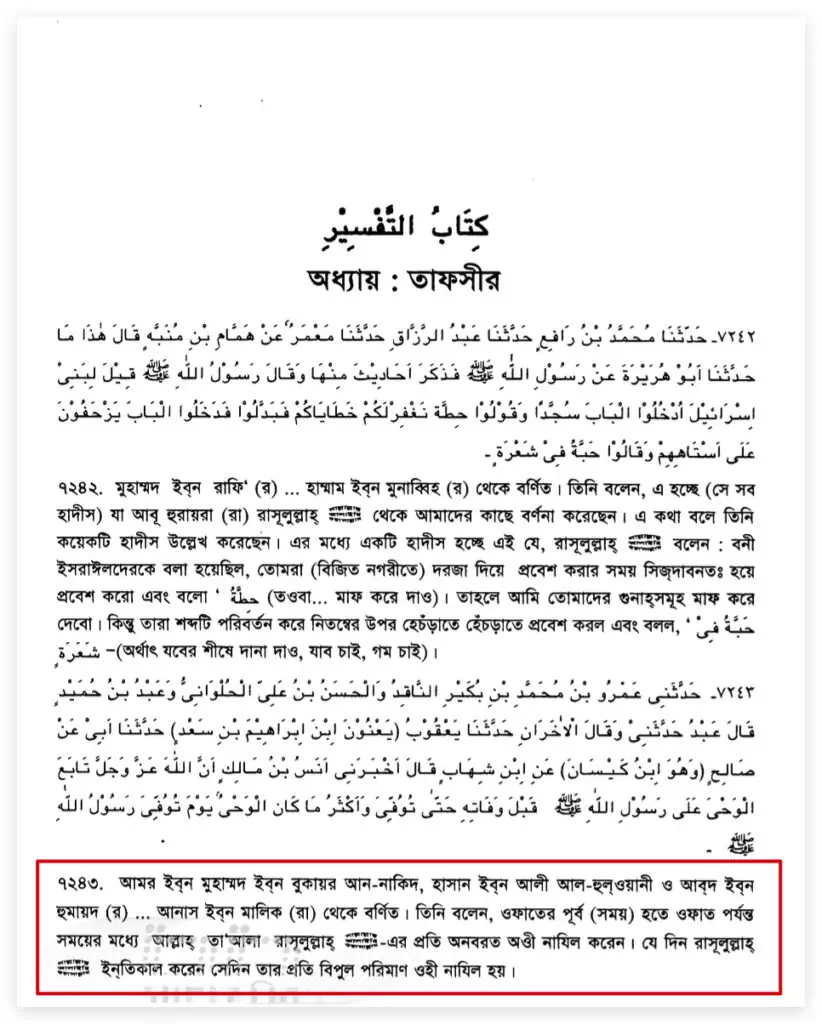
In the Arabic text of Muslim, the continuity of revelation until death and the abundance of it at the time of death are present together. The original language of that account is: [123]
أَنَّ اللَّهَ عَزَّ وَجَلَّ تَابَعَ الْوَحْىَ عَلَى رَسُولِ اللَّهِ صلى الله عليه وسلم قَبْلَ وَفَاتِهِ حَتَّى تُوُفِّيَ وَأَكْثَرُ مَا كَانَ الْوَحْىُ يَوْمَ تُوُفِّيَ رَسُولُ اللَّهِ صلى الله عليه وسلم
English translation: Allah continued revelation to His Messenger before his death, until his death; and at the time of the Messenger’s death, revelation was at its peak.
At the end of the same report of Anas in Bukhari, it says, “After this, the Messenger died.” Here, the final stage of revelation and the subsequent death are mentioned sequentially. Consequently, the report related to the timeframe of collection is that revelation continued to come even in the final stage of life. [124]
أَنَّ اللَّهَ، تَعَالَى تَابَعَ عَلَى رَسُولِهِ صلى الله عليه وسلم قَبْلَ وَفَاتِهِ حَتَّى تَوَفَّاهُ أَكْثَرَ مَا كَانَ الْوَحْىُ، ثُمَّ تُوُفِّيَ رَسُولُ اللَّهِ صلى الله عليه وسلم بَعْدُ.
English translation: Before death, Allah sent revelation continuously to His Messenger, until He gave him death; at that time, the amount of revelation descending was the greatest. After this, Rasulullah sallallahu alaihi wasallam died.
Regarding this period, the explanation by IslamQA states that “day” refers to the final stage of Muhammad’s life. As a result, instead of a list of every revelation of a final single day, the period of revelation in the final life comes forward. [125]
بل المراد بذلك الزمان الذي توفيه رسول الله صلى الله عليه وسلم ، وهو آخر عمره الشريف
English translation: Rather, by this, the period is meant during which Rasulullah sallallahu alaihi wasallam died; that is, the final stage of his life.
Therefore, the claim of memorizing the Quran is related to the declared recitation up to a specific time. If a new recitation comes, it will be added to the previous collection; if any recitation is abrogated, the extent of the remaining recited portion will change. The evidence of complete memorization a few years ago and the knowledge of the entire remaining recitation until the end are not the same piece of information. Who heard the final stage of verses, who wrote them, who delivered them to others, and in which materials they were later found—these person-dependent steps are the actual basis of the final collection. The history of each of those steps is not established by the number of names of memorizers.
Ibn Hajar quoted the statement of Zayd ibn Thabit regarding the absence of a collected mushaf at the time of Muhammad’s death. Even after writing isolated verses, the work of collecting them in one place as a book remained. [126] [127]
Zayd ibn Thabit (ra) narrated: “The Prophet (sa) passed away and still the Quran Sharif had not been collected in one place.”
Suyuti also brought this statement of Zayd from Dir’aqul’s al-Fawa’id along with the identity of the isnad. In his quoted language, the Quran had not been collected in any one container. The same report was quoted in the subsequent two books, preserving the statement regarding the absence of a collected collection. [128]
قُبِضَ النَّبِيُّ صَلَّى اللَّهُ عَلَيْهِ وَسَلَّمَ وَلَمْ يَكُنِ الْقُرْآنُ جُمِعَ فِي شَيْءٍ.
English translation: The Prophet died, yet the Quran had not been collected in any one container.
As the reason for the delay in compilation, Khattab’s explanation mentions the wait for the abrogation of rulings or recitation. Suyuti quoted this explanation. In this, the extent of the recitation itself was changeable: a part recited previously might not remain in effect later. [129]
إِنَّمَا لَمْ يجمع الْقُرْآنَ فِي الْمُصْحَفِ لِمَا كَانَ يَتَرَقَّبُهُ مِنْ وُرُودِ نَاسِخٍ لِبَعْضِ أَحْكَامِهِ أَوْ تِلَاوَتِهِ
English translation: The Quran was not collected into a mushaf because he was waiting for the arrival of the abrogator of some of its rulings or recitations.
Abrogation of ruling and abrogation of recitation are two types of change. In the first, the effectiveness of a previous instruction is withdrawn; in the second, a text previously recited as Quran goes outside the final recited collection. In Khattab’s explanation, both possibilities are linked to the suspension of compilation. Consequently, the image that the sum of declared recitations at every stage of Muhammad’s life was one and unchanged does not align with this explanation. To complete the collection, the end of revelation and the determination of the limit of which recitation remained in effect became interrelated.
| Level of preservation or change | Condition found in the report | Relation to the collected collection |
|---|---|---|
| Memorization and writing during lifetime | Acceptance of declared recitations from time to time | Extent of collection increases with new recitations |
| Abrogation of ruling | Withdrawal of the effectiveness of previous instructions | The position of recited text and effective instructions may be different |
| Abrogation of recitation | Withdrawal of the recitation of a previously recited part | Inclusion in the final recited collection changes |
| Book prepared after death | Collection from isolated materials and memorized recitations | Initiative to unify recitations after the end of revelation |
In the description of the decision to collect as a book, there are also initial objections from Abu Bakr and Zayd. Muhammad did not do the work—this was the apparent reason for their objection. In one hadith, on hearing about compiling the Quran, Abu Bakr said to Umar, How will you undertake a task that the Messenger of Allah, peace and blessings of Allah be upon him, did not undertake? In other words, Prophet Muhammad did not perform this task during his lifetime [130] [131] [132]
Mishkat al-Masabih (Mishkat)
Part-8: The Status of the Quran
Chapter: 2. Third section – regarding the variation of qira’at and the compilation of the Quran
2220-[10] narrated from Zayd ibn Sabit (ra). He said, immediately after the battle of Yamama, the Khalifa of the Rasul Abu Bakr (ra) sent for me. I went. I saw ‘Umar ibn al-Khattab (ra) sitting with him. Abu Bakr (ra) said, ‘Umar came to me and informed me that many huffaz of the Quran were martyred in the battle of Yamama. I fear that if huffaz continue to be martyred in battles in various places in this way, many parts of the Quran will be lost. Therefore, I consider it appropriate that you give the order to collect the Quran in the form of a mushaf or book. Abu Bakr (ra) said, I said to ‘Umar, how will you do such a work, which work Rasulullah sallallahu alaihi wasallam did not do? ‘Umar (ra) replied, by Allah. This will be a good work. ‘Umar (ra) continued to tell me this repeatedly. Then Allah opened my heart to understand the importance of this work and I also considered it appropriate to do this work.
Zayd (ra) said, Abu Bakr (ra) said to me, you are an intelligent youth about whom we have no doubt or hesitation. You also used to write the wahy of Rasulullah sallallahu alaihi wasallam. Therefore, you search for the verses of the Quran and collect them in book form (mushaf). Zayd (ra) said, if they had entrusted me with the responsibility of moving one of the mountains, it would not have been more difficult for me than the responsibility of collecting the Quran. Zayd (ra) said, I said, how will you do such a work, which work the Prophet sallallahu alaihi wasallam did not do? Abu Bakr (ra) said, by Allah! This is a very good work. In short, in this way Abu Bakr (ra) continued to tell me repeatedly.
Finally, Allah Ta’ala opened my heart to realize this importance, for which He had opened the hearts of Abu Bakr and ‘Umar. Therefore, I began to collect the verses of the Quran from date-palm stalks, white stones, animal bones, and from the hearts and memories of humans (huffaz). Finally, I collected the end part of Surah At-Tawbah, from ‘laqad ja-akum rasulum min anfusikum’ until the end of the surah from Abu Khuzaymah Ansari. I did not find this part with anyone other than him. Zayd (ra) said, these written sahifahs remained with Abu Bakr (ra) until Allah gave him death. Then they were with ‘Umar (ra) until his lifetime. Then they were with his daughter Hafsa (ra). (Bukhari)[1]
[1] Sahih: Bukhari 4986, Sunan al-Kubra lil Bayhaqi 2372, Sahih Ibn Hibban 4506.
Hadith Status: Sahih (Sahih)
Narrator: Zayd ibn Sabit (ra)
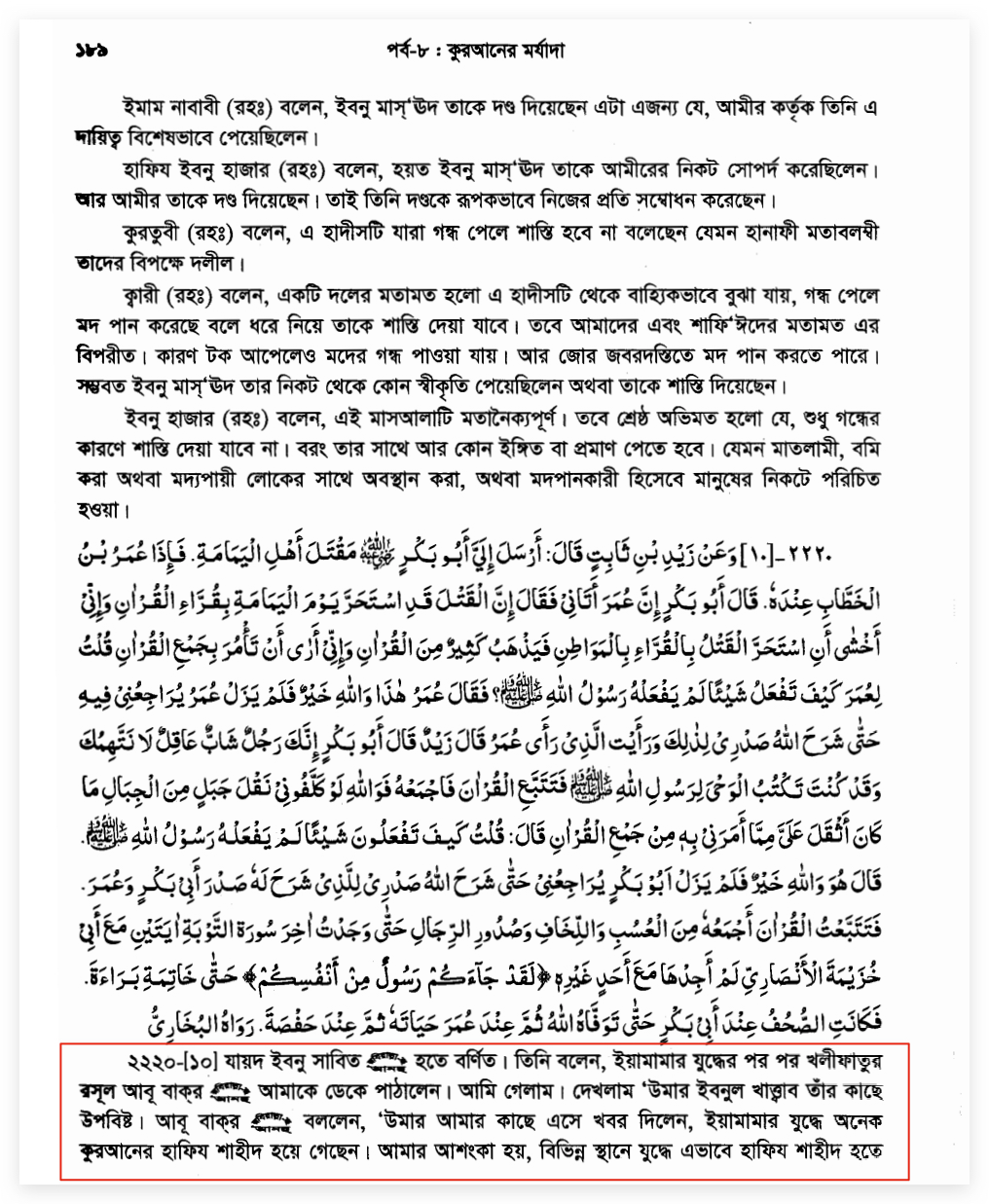
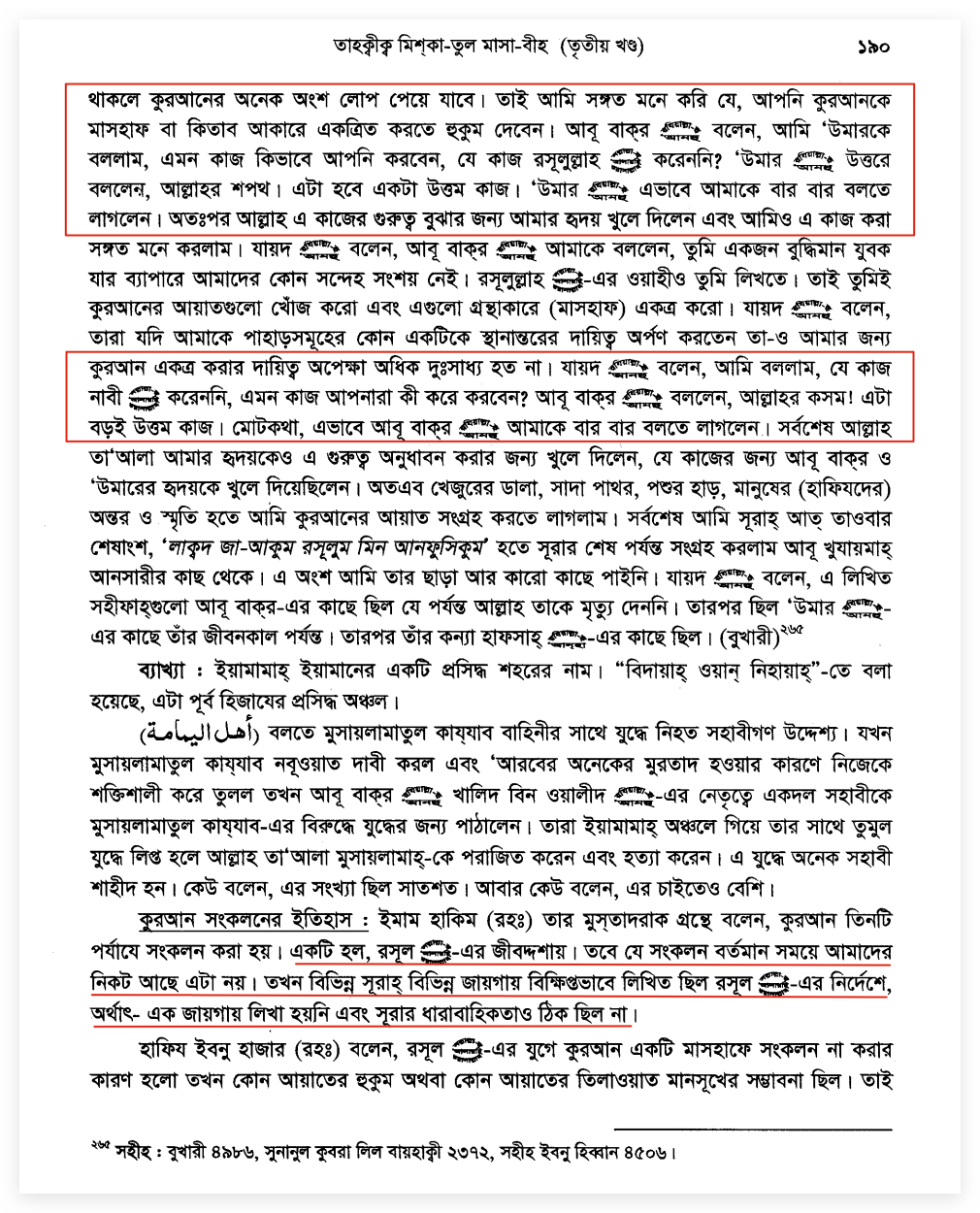
The same question arose twice in the statements of Abu Bakr and Zayd. Abu Bakr first questioned Umar; later, upon receiving the responsibility, Zayd raised the question to Abu Bakr. Umar’s answer was that the work was good. In the language of Bukhari, the conversation of proposal, objection, and acceptance of the work as good is also present. [50]
قُلْتُ لِعُمَرَ كَيْفَ تَفْعَلُ شَيْئًا لَمْ يَفْعَلْهُ رَسُولُ اللَّهِ صلى الله عليه وسلم قَالَ عُمَرُ هَذَا وَاللَّهِ خَيْرٌ
English translation: I said to Umar: How will you do the work that the Messenger of Allah did not do? Umar said: By Allah, this is a good work.
In this conversation, no specific instruction from Muhammad in favor of creating a final book was quoted. Umar made the proposal by evaluating the urgent need, Abu Bakr initially showed reluctance, and later changed his mind and gave the responsibility. Zayd also initially raised the same objection, and later gave consent. Their “opening of the heart” was called the work of Allah; the decision was implemented through discussion, change of opinion, and assignment of administrative responsibility. The tasks of what would be accepted, which materials to search for, and how to verify them to make them part of the collected book were also included in the decisions of the responsible humans. Alongside the religious explanation of heavenly preservation, the report places the authority of compilation upon this specific human decision.
| Person and Stage | Reported position or action | Step of the decision moving forward |
|---|---|---|
| Umar’s proposal | Fear of losing many parts due to the death of readers | Recommendation to order the collection of the Quran |
| Abu Bakr’s first reaction | Objection because Muhammad did not do it | Consent after Umar’s repeated discussions |
| Zayd’s first reaction | Objection for the same reason; acceptance of the burden of responsibility | Acceptance after Abu Bakr’s discussions |
| Zayd’s activities | Search from written materials and memory | Keeping the collected sahifa with the Caliph |
To Zayd, the burden of this responsibility seemed greater than moving a mountain. In his statement, the importance of the work is expressed in the language of personal feeling. The responsibility of what a collector must find and what collection the next generation will accept fell upon the work of a single person. [133]
فَوَاللَّهِ لَوْ كَلَّفُونِي نَقْلَ جَبَلٍ مِنَ الْجِبَالِ مَا كَانَ أَثْقَلَ عَلَىَّ مِمَّا أَمَرَنِي مِنْ جَمْعِ الْقُرْآنِ
English translation: By Allah, if they had given me the responsibility of moving any one mountain, that responsibility would not have been heavier to me than the order to collect the Quran that they have given me.
While giving the responsibility, Abu Bakr mentioned Zayd’s age, intelligence, trustworthiness, and experience in writing revelation. Therefore, the logic for selecting the collector also came from the evaluation of the individual’s merit. The work of creating the future written form of the religious text was entrusted to one person’s efficiency and faithfulness. Zayd did not finish the work by only speaking of the recitations he knew; after receiving the responsibility, he also searched for materials held by others. Which person would receive the responsibility and what he would collect and submit—these two steps together formed the basis of the subsequent sahifa.
Ibn Hajar called this initiative of Abu Bakr as ijtihad, that is, a judgment-based decision. By calling the work appropriate and beneficial, he specified the name of the human method of the decision. [134]
والجواب أنه لم يفعل ذلك إلا بطريق الاجتهاد السائغ الناشئ عن النصح منه لله ولرسوله ولكتابه ولأئمة المسلمين وعامتهم
English translation: The answer is, he did this work through the path of valid ijtihad; that judgment arose from well-wishing toward Allah, His Messenger, His Book, the leaders of the Muslims, and the general Muslims.
Abu Bakr’s first objection and Zayd’s objection centered around the same new work. The description of appointing an authorized collector came only after the acceptance of Umar’s proposal. Old writings were the elements of collection; the sahifa collected by the Caliph’s order is the subsequent result created from those elements. Political leadership played an active role in determining the need for creating the book, the responsible person, and the timing of the work. Religious claims about the source of the word do not make these administrative tasks invisible.
In the praise reported in the name of Ali through Ibn Abi Dawud, Abu Bakr is also called the first collector of the Quran. Ibn Hajar quoted this statement. The basis of the praise here is the priority of the new initiative. [135]
سمعت عليا يقول : أعظم الناس في المصاحف أجرا أبو بكر ، رحمة الله على أبي بكر ، هو أول من جمع كتاب الله
English translation: I heard Ali say: Among people, Abu Bakr is the most rewarded in the work of the mushaf. May Allah’s mercy be upon Abu Bakr; he was the first to collect the Book of Allah.
The political situation after Muhammad’s death was also not peaceful and without conflict. In Umar’s statement, there are descriptions of conflict over leadership at Saqifa, loud arguments, and pouncing upon Sa’d ibn Ubada. In this sequence of events, the conflict over the election of the Caliph reached direct physical clash. [136] [137]
فَكَثُرَ اللَّغَطُ، وَارْتَفَعَتِ الأَصْوَاتُ حَتَّى فَرِقْتُ مِنَ الاِخْتِلاَفِ. فَقُلْتُ ابْسُطْ يَدَكَ يَا أَبَا بَكْرٍ. فَبَسَطَ يَدَهُ فَبَايَعْتُهُ، وَبَايَعَهُ الْمُهَاجِرُونَ، ثُمَّ بَايَعَتْهُ الأَنْصَارُ، وَنَزَوْنَا عَلَى سَعْدِ بْنِ عُبَادَةَ فَقَالَ قَائِلٌ مِنْهُمْ قَتَلْتُمْ سَعْدَ بْنَ عُبَادَةَ. فَقُلْتُ قَتَلَ اللَّهُ سَعْدَ بْنَ عُبَادَةَ.
English translation: The commotion increased and voices began to rise; I feared conflict. Then I said: Abu Bakr, extend your hand. When he extended his hand, I gave bay’ah to his hand; the Muhajirun also gave bay’ah, then the Ansar did. We pounced upon Sa’d ibn Ubada. One of them said: You have killed Sa’d ibn Ubada. I said: May Allah kill Sa’d ibn Ubada.
Amidst this power struggle, subsequent wars, and the fear of losing readers, humans bore the responsibility of collecting the written portions of the Quran. Reports have emerged regarding the search for materials after assuming responsibility, receiving recitations from individuals, and keeping the collected sahifas with the Caliph. Through these actions, a new collected form was created, moving from the preserving individuals and materials into the custody of the Caliph. Ultimately, the institutional form of the book depended on who made the decisions, whom they assigned the responsibility, and what they collected and preserved. The history between the recitations during Muhammad’s lifetime and the consolidated book after his death is composed of these human actions.
Muhammad forgetting verses and regaining memory through the recitation of others
In the Quran, Allah Himself took the responsibility of making Muhammad recite and protecting him from forgetting. In this promise, the source of the guarantee that verses would remain in memory was established directly in Allah’s teaching rather than in Muhammad’s memory exercises. The sixth verse of Surah Al-A’la states that Allah will teach him, and consequently, he will not forget. [138]
I will make you recite, so that you will not forget।
— Taisirul Quran
Soon I will make you recite, so that you will not forget –
— Sheikh Mujibur Rahman
I will teach you then you will not forget।
— Rawai Al-bayan
Soon We will make you recite, so that you will not forget [1] ,
— Dr. Abu Bakr Muhammad Zakaria
In the very next verse, an exception is made for what Allah wills. That is, along with the declaration “will not forget,” the possibility of forgetting is also included within the text. The authority of the same divine will is placed over both conditions: what will be remembered and what must be forgotten. [139]
إِلَّا مَا شَآءَ ٱللَّهُ ۚ إِنَّهُۥ يَعْلَمُ ٱلْجَهْرَ وَمَا يَخْفَىٰ
English translation: Except as Allah wills. Indeed, He knows what is apparent and what is hidden.
As a result of this exception, the relationship between the promise and the accuracy of actual memory changes. If it is remembered, it is the result of Allah’s teaching; if forgotten, that forgetting also falls under Allah’s will. By accepting two opposite outcomes within the same explanation, the path to refuting the claim using actual instances of forgetting is closed. Yet, whether a verse was present in a person’s memory, whether it was recalled with the help of another, and whether any part was omitted during recitation—these are independently narrated events. The explanation of divine will does not change the reality of those events.
In Bukhari, there is an account attributed to Aisha regarding Muhammad recalling verses after hearing the recitation of another. In the printed text of the Islamic Foundation, variations in wording for the same event are seen: one mentions being reminded, the next mentions being omitted from the surah, and another uses the language of forgetting. [140] [141]
قَالَتْ سَمِعَ النَّبِيُّ صلى الله عليه وسلم رَجُلاً يَقْرَأُ فِي الْمَسْجِدِ فَقَالَ ” يَرْحَمُهُ اللَّهُ لَقَدْ أَذْكَرَنِي كَذَا وَكَذَا آيَةً مِنْ سُورَةِ كَذَا ” .
English translation: She said: The Prophet (peace and blessings of Allah be upon him) heard a man reciting in the mosque. Then he said: May Allah have mercy on him; he has reminded me of such and such verses of such and such surah.
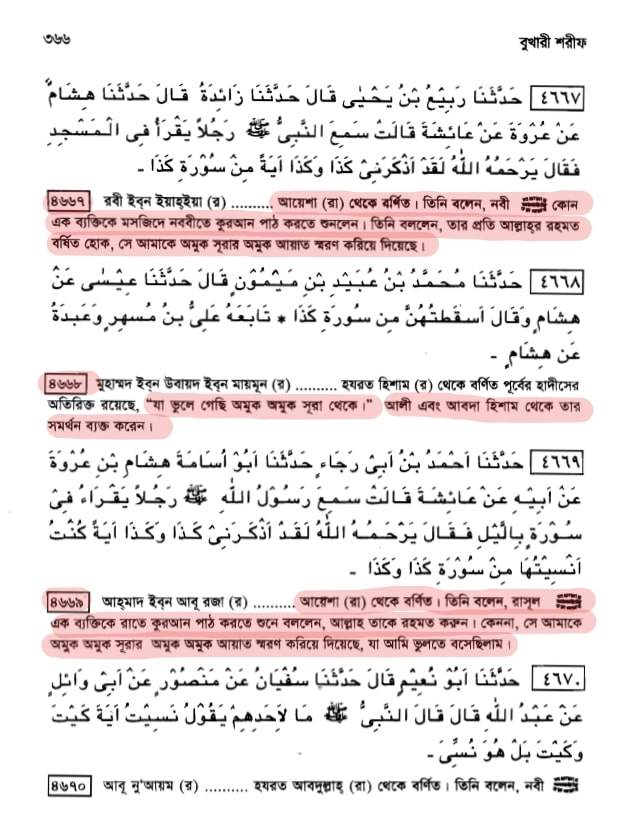
The account in the chapter on supplication also mentions recalling verses that were omitted after hearing another person’s recitation in the mosque. Muhammad sought mercy for that person because the verses were recalled upon hearing his recitation. [142] [143]
Sahih Bukhari (Islamic Foundation)
Chapter: 67/ Dua
Section: 2632. The word of Allah Ta’ala: you shall make dua …. (9: 103) And he who makes dua only for his brother excluding himself. Abu Musa (ra) said, the Prophet (sa) makes dua, O Allah! You forgive ‘Ubayd Abu Amir. O Allah! You forgive the sins of ‘Abdullah ibn Qays.
5896. Uthman ibn Abu Shaybah (rh) … narrated from Aisha (ra). She said, the Prophet sallallahu alaihi wasallam told a person to recite the Quran in the mosque. Then he said: May Allah have mercy on him. He reminded me of such and such verse, which I had forgotten from such and such surah.
Hadith Status: Sahih (Sahih)
Narrator: Aisha (ra)
Narrated `Aisha:
The Prophet (ﷺ) heard a man reciting (the Qur’an) in the mosque. He said,” May Allah bestow His Mercy on him, as he made me remember such and-such Verse which I had missed in such-and-such Sura.“
In the Bengali translation, it is written “told a man to recite the Quran in the mosque.” This is a wrong translation. The Arabic “sami’a” means heard; there is no mention of ordering to recite. The wrong translation has changed the very beginning of the event: Muhammad heard the recitation and regained his memory from that hearing. [144]
سَمِعَ النَّبِيُّ صلى الله عليه وسلم رَجُلاً يَقْرَأُ فِي الْمَسْجِدِ
English translation: The Prophet heard a man reciting in the mosque.
In Bukhari’s account number 5038, the language of forgetting is more direct. Here, after hearing someone recite a surah at night, Muhammad said that the person reminded him of verses that had been made forgotten to him. [145]
قَالَتْ سَمِعَ رَسُولُ اللَّهِ صلى الله عليه وسلم رَجُلاً يَقْرَأُ فِي سُورَةٍ بِاللَّيْلِ فَقَالَ ” يَرْحَمُهُ اللَّهُ لَقَدْ أَذْكَرَنِي كَذَا وَكَذَا آيَةً كُنْتُ أُنْسِيتُهَا مِنْ سُورَةِ كَذَا وَكَذَا ” .
English translation: She said: The Messenger of Allah (peace and blessings of Allah be upon him) heard a man reciting a surah at night. Then he said: May Allah have mercy on him; he has reminded me of such and such verses of such and such surah, which had been made forgotten to me.
The same relationship is found in Muslim’s account: hearing another’s recitation, recalling previously forgotten verses, and seeking mercy for the reciter. Hisham provided this account from Aisha through his father Urwah. The discussed texts in Bukhari and Muslim are different versions of the same Aisha–Urwah–Hisham chain of narration. Despite differences in wording, the sequence of events—hearing another person’s recitation and regaining one’s own memory with its help—is present in all of them. [146]
قَالَتْ كَانَ النَّبِيُّ صلى الله عليه وسلم يَسْتَمِعُ قِرَاءَةَ رَجُلٍ فِي الْمَسْجِدِ. فَقَالَ ” رَحِمَهُ اللَّهُ لَقَدْ أَذْكَرَنِي آيَةً كُنْتُ أُنْسِيتُهَا ” .
English translation: She said: The Prophet (peace and blessings of Allah be upon him) was listening to a man’s recitation in the mosque. Then he said: May Allah have mercy on him; he has reminded me of a verse which had been made forgotten to me.
There is a clear example of mutual dependence in this regaining of memory. The part that was not present in Muhammad’s own memory at that time was restored by the recitation of another reader. The relationship between the giver of the recitation and the receiver was not one-way here; the person who had previously received the recitation later became the medium for restoring Muhammad’s memory. This event directly conflicts with the claim that his memory was infallible at all times. The gratitude and prayer for reminding him carry the recognition of that external assistance.
| Words or sentences of the account | Bengali meaning | Condition identified in the event |
|---|---|---|
| adhakkarani | reminded me | regaining memory through another’s recitation |
| asqattuhu or asqattuhunna | I omitted it or them | omission of a part in the recitation |
| kuntu unsituhu | it had been made forgotten to me | stating the event of forgetting in the passive voice |
| Bukhari 5037, 5037b, 5038 and 6335 | Multiple texts of the same chain of narration | Wording differences between recalling, omission, and forgetting |
While explaining this account of Aisha, Nawawi also admitted the event of Muhammad forgetting. In his explanation, such forgetting can occur regarding matters already delivered to the followers. Even within this determination of religious boundaries, the event of the recitation being absent from Muhammad’s own memory remains. [147]
قوله صَلَّى اللَّهُ عَلَيْهِ وَسَلَّمَ كُنْتُ أُنْسِيتُهَا دَلِيلٌ عَلَى جَوَازِ النِّسْيَانِ عَلَيْهِ صَلَّى اللَّهُ عَلَيْهِ وَسَلَّمَ فِيمَا قَدْ بَلَّغَهُ إِلَى الْأُمَّةِ
English translation: His (peace and blessings of Allah be upon him) statement “it had been made forgotten to me” proves that forgetting can occur regarding what he has already delivered to the Ummah.
In Ibn Kathir’s Tafsir, in the explanation of Baqarah 2:106, there is also an account of forgetting. Attributed to Ibn Abbas, he brings a report of such revelation that would descend at night and be forgotten during the day. Here, forgetting is linked to the explanation of abrogation or making a verse forgotten. [148] [149]
وقال ابن أبي حاتم : حدثنا أبي ، حدثنا ابن نفيل ، حدثنا محمد بن الزبير الحراني ، عن الحجاج يعني الجزري عن عكرمة ، عن ابن عباس ، قال : كان مما ينزل على النبي صلى الله عليه وسلم الوحي بالليل وينساه بالنهار ، فأنزل الله ، عز وجل : ( ما ننسخ من آية أو ننسها نأت بخير منها أو مثلها )
English translation: Ibn Abi Hatim said: My father narrated to me; he from Ibn Nufayl, he from Muhammad ibn al-Zubayr Harrani, he from Hajjaj—meaning Jazari—he from Ikrima, he from Ibn Abbas. He said: Such revelation also descended upon the Prophet (peace and blessings of Allah be upon him) at night, which he would forget during the day. Then Allah revealed: “Whenever We abrogate a verse or cause it to be forgotten, We bring one better than it or similar to it.”
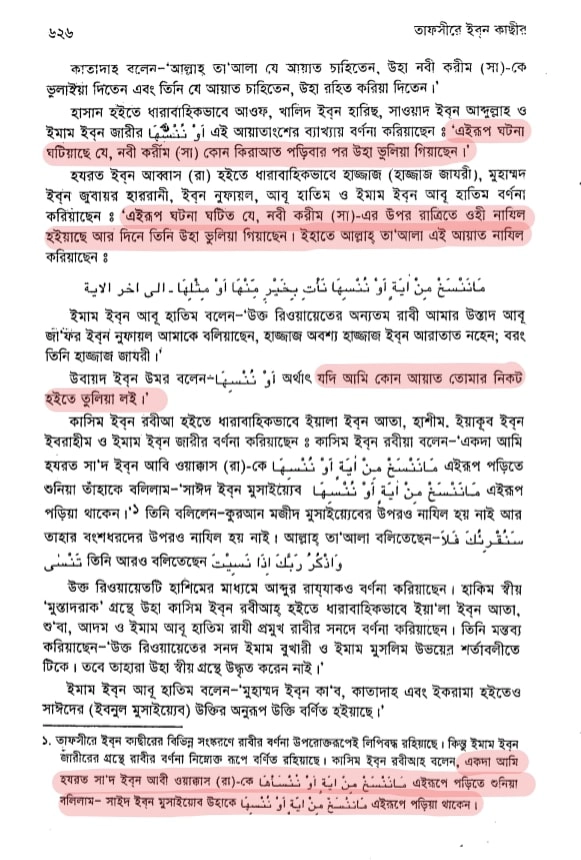
In the explanation of Ismaili quoted in the IslamQA discussion, two types of forgetting are distinguished. In one, memory returns after forgetting in human memory; in the other, Allah removes the recitation from the heart for the purpose of abrogating the recitation. The language of the second explanation speaks directly of the withdrawal of the text. [150] [151]
والثاني : أن يرفعه الله عن قلبه على إرادة نسخ تلاوته ، وهو المشار إليه بالاستثناء في قوله تعالى : سنقرئك فلا تنسى إلا ما شاء الله
English translation: The second is that Allah removes it from his heart for the purpose of abrogating the recitation. This is indicated by the exception to Allah’s statement “I will make you recite, so that you will not forget—except as Allah wills.”
Temporary absence from memory and the withdrawal of recitation have received different outcomes in this explanation. In the first, old verses return upon hearing another’s recitation; in the second, a previously received recitation goes outside the maintained recitation. Consequently, if the word “forgetting” is applied in a single specific sense in all cases, the differences between the preserved accounts are lost. The scope of subsequent collection depended on these distinct conditions: events of memory, omission in recitation, and explanation as religious withdrawal.
In one account of omitting a verse during prayer, the listener’s own uncertainty is also expressed. Narrated in Abu Dawud attributed to Miswar ibn Yazid, Muhammad did not recite some parts during prayer. When someone pointed it out, he wanted to know the reason for not reminding him. The listener said he had assumed the verse was abrogated. [152]
شَهِدْتُ رَسُولَ اللَّهِ صلى الله عليه وسلم يَقْرَأُ فِي الصَّلاَةِ فَتَرَكَ شَيْئًا لَمْ يَقْرَأْهُ فَقَالَ لَهُ رَجُلٌ يَا رَسُولَ اللَّهِ تَرَكْتَ آيَةَ كَذَا وَكَذَا. فَقَالَ رَسُولُ اللَّهِ صلى الله عليه وسلم ” هَلاَّ أَذْكَرْتَنِيهَا “. قَالَ سُلَيْمَانُ فِي حَدِيثِهِ قَالَ كُنْتُ أُرَاهَا نُسِخَتْ.
English translation: I saw the Messenger of Allah (peace and blessings of Allah be upon him) reciting in prayer. He left out some parts, which he did not recite. A man said to him: O Messenger of Allah, you have left out such and such verses. The Messenger of Allah (peace and blessings of Allah be upon him) said: Why did you not remind me of them? Sulayman said in his narration: That man said, I thought they had been abrogated.
From the same scene—Muhammad not reciting a verse—the listener assumed abrogation, and Muhammad spoke of reminding. To the person hearing the recitation, only the omission was visible; separate explanations were needed to understand why it was omitted. This uncertainty between forgetting and abrogation did not come only as a later theoretical problem; it is preserved within the conversation about the recitation in prayer. The decision on which part remains and which part no longer needs to be recited was also intertwined with the receiver’s assumptions and questions.
Muhammad also gave instructions on what language to use when speaking of the event of forgetting. Instead of saying “I have forgotten,” there is a mention of using the language that one has been made to forget. In this, the event is shifted from the active responsibility of one’s own memory to an external cause. [153] [154]
Sahih Muslim (Hadith Academy)
Chapter: 7. The Statuses of the Quran and Related Matters
Section: 1. Regarding the instruction to be careful in preserving the Quran, the dislike of saying I have forgotten such and such verse and the validity of saying I have been made to forget
1727-(229/…) Ibn Numayr and Yahya ibn Yahya (rh) (the words are his) …. narrated from Shaqiq (rh). He said, ‘Abdullah ibn Masud (ra) said: this holy book, and again said preserve this Quran. Because it is more prone to escape from the human mind than a tethered four-legged animal. Abdullah ibn Masud (ra) further narrated that, Rasulullah sallallahu alaihi wasallam said none of you should say that I have forgotten such and such verse (of Quran Majeed). Rather (it is better to say) the verses have been forgotten from it. (Islamic Foundation 1712, Islamic Center 1719)
Hadith Status: Sahih (Sahih)
In the next account, it is not just about a single verse; forgetting an entire surah is also included in this prohibition. The amount of what has been lost from memory may differ, but the permitted language for speaking remains the same. [155] [156]
Sahih Muslim (Hadith Academy)
Chapter: 7. The Statuses of the Quran and Related Matters
Section: 1. Regarding the instruction to be careful in preserving the Quran, the dislike of saying I have forgotten such and such verse and the validity of saying I have been made to forget
1728-(230/…) Muhammad ibn Hatim (rh) ….. narrated from Shaqiq ibn Salamah (rh). He said, I heard Abdullah ibn Masud speaking. He heard Rasulullah sallallahu alaihi wasallam say: it is very bad for any person to say that he has forgotten such and such surah or such and such verse. Rather he should say that those (surah or verse) have been made forgotten to him. (Islamic Foundation 1713, Islamic Center 1720)
Hadith Status: Sahih (Sahih)
In the original Arabic, saying “nasitu” or “I forgot” was deemed bad, and instead, “nusshiya” or “he was made to forget” was used. The matter of forgetting is clear for both verses and surahs. [157]
بِئْسَمَا لِلرَّجُلِ أَنْ يَقُولَ نَسِيتُ سُورَةَ كَيْتَ وَكَيْتَ أَوْ نَسِيتُ آيَةَ كَيْتَ وَكَيْتَ بَلْ هُوَ نُسِّيَ
English translation: It is very bad for a person to say, ‘I have forgotten such and such surah or such and such verse’; rather, he should say that he has been made to forget.
This change in language does not erase the failure of memory. Not remembering a verse, remembering it later upon hearing another’s recitation, and continuing to practice to keep it in memory—all these are expressions of the human condition’s dependence on memory. By aligning this language with the exception of Surah Al-Ala, the responsibility for oblivion can be shifted toward the will of Allah; however, that does not mean a verse that was not in Muhammad’s memory suddenly becomes present in his memory. The transfer of responsibility within words and the actual capacity to retain information are separate matters.
In another report in Muslim, there is a direct relationship between retaining the Quran in memory and regular recitation. If the reader recites it by night and day, it remains in memory, and if he does not attend to it, he forgets. [158]
وَإِذَا قَامَ صَاحِبُ الْقُرْآنِ فَقَرَأَهُ بِاللَّيْلِ وَالنَّهَارِ ذَكَرَهُ وَإِذَا لَمْ يَقُمْ بِهِ نَسِيَهُ
English translation: When the possessor of the Quran attends to it and recites it by night and day, he remembers it; and if he does not attend to it, he forgets.
| Described condition | The means through which the reading returns or persists | Actual dependence for preservation |
|---|---|---|
| Verses forgotten by Muhammad | Hearing the recitation of another reader | The preserved reading of other people |
| Omitting verses during prayer | The listener reminding him | Correction after understanding the reason for omission |
| Maintaining memorized recitation | Repeated recitation by night and day | Regular labor and practice |
| From “I forgot” to “was made to forget” | Change in the language of reporting the event | The absence of memory is not removed by itself |
Retaining the Quran in memory involved regular practice, the assistance of others, and the need for correcting errors. In Aisha’s report, Muhammad himself took help from the readings of others; in the reports of verses omitted during prayer, the correction of a follower was necessary; in the instructions for repetition, the risk of forgetting was acknowledged. Therefore, establishing a guarantee of preservation by assuming a person’s memory is always infallible is contradictory to the evidence. The process of retaining the text continued through personal memory, social recitation, mutual correction, and continuous practice.
Prohibition on traveling with the Quran to enemy territory
During Muhammad’s lifetime, there were written portions of the Quran, and there were restrictions on carrying those written materials. Out of fear that the writings might fall into the hands of the enemy, traveling with the Quran to enemy territories was forbidden. Consequently, alongside writing and memorization, the preservation of the Quran involved issues of geographical location, military security, and control over written materials. A direct report of this prohibition is found in Bukhari via Abdullah ibn Umar. [159] [160]
أَنَّ رَسُولَ اللَّهِ صلى الله عليه وسلم نَهَى أَنْ يُسَافَرَ بِالْقُرْآنِ إِلَى أَرْضِ الْعَدُوِّ.
English translation: The Messenger of Allah, sallallahu alayhi wasallam, forbade traveling with the Quran to enemy territories.
The prohibition is present in this brief report in Bukhari; in a report in Muslim, the reason for the prohibition is also mentioned. There, the phrase “makhafata an yanalahul adu”—the fear that the enemy might reach it—is explicitly added. The target of the prohibition is a written object that can be carried and can come into the possession of others. [161]
أَنَّهُ كَانَ يَنْهَى أَنْ يُسَافَرَ بِالْقُرْآنِ إِلَى أَرْضِ الْعَدُوِّ مَخَافَةَ أَنْ يَنَالَهُ الْعَدُوُّ .
English translation: He used to forbid traveling with the Quran to enemy territories, for fear that the enemy might get hold of it.
Here, the route of travel and the decision of carriage are controlled as security measures. To save the written materials of the Quran from enemy possession, followers had to adopt specific behaviors. Calling the content of a writing the word of Allah and ensuring the material security of that writing are not the same thing. In the reported prohibition, alongside the claim of sanctity, the actual insecurity of paper or other writing-mediums is present; human guarding and rules of use are the effective means of its protection.
In another report in Muslim, the language of insecurity appears as Muhammad’s own statement: “I do not feel safe.” In the same report, a comment by Ayub is also added. The comment belongs to the narrator; it is mentioned separately under his name after Muhammad’s statement ends. [162]
قَالَ قَالَ رَسُولُ اللَّهِ صلى الله عليه وسلم ” لاَ تُسَافِرُوا بِالْقُرْآنِ فَإِنِّي لاَ آمَنُ أَنْ يَنَالَهُ الْعَدُوُّ ” . قَالَ أَيُّوبُ فَقَدْ نَالَهُ الْعَدُوُّ وَخَاصَمُوكُمْ بِهِ .
English translation: He said, the Messenger of Allah, sallallahu alayhi wasallam, said: “Do not travel with the Quran; for I do not feel safe that the enemy will not get hold of it.” Ayub said: The enemy has indeed gotten hold of it and has debated you with it.
The language of the prohibition, its reason, and the associated comments are not identical across the reports. In the Malik-chain readings of Bukhari and Muslim, there is a brief prohibition; in the Layth-chain, there is fear of it falling into enemy hands; in the Ayub-chain, there is a direct quote and a separate comment by Ayub. All of these came from Ibn Umar via Nafi. In these versions of the same original report, the statement of the ruling becomes progressively clearer, especially the concern regarding the security of the written Quran.
| Account | Preserved language | Subject of prohibition and apprehension |
|---|---|---|
| Bukhari 2990; Muslim 1869a | Traveling with the Quran to enemy territory is forbidden | Restrictions on carrying the written Quran |
| Muslim 1869b | The fear that the enemy might get hold of it | Fear of losing possession of written materials |
| Muslim 1869c: Muhammad’s statement | Does not feel safe from the enemy’s reach | Travel stopped as security is not ensured |
| Muslim 1869c: Ayub’s comment | The enemy has obtained it and debated | Separate comment by the narrator |
In explaining this hadith, Nawawi mentioned the fear of the written mushaf losing its dignity. In his selected explanation, the question of security is also linked to military strength: whether it is being carried by a Muslim force that can maintain dominance over the opponent. That is, the actual capability of the force was considered in the application of permission and prohibition. [163] [164]
فِيهِ : النَّهْيُ عَنِ الْمُسَافَرَةِ بِالْمُصْحَفِ إِلَى أَرْضِ الْكُفَّارِ لِلْعِلَّةِ الْمَذْكُورَةِ فِي الْحَدِيثِ ، وَهِيَ خَوْفُ أَنْ يَنَالُوهُ فَيَنْتَهِكُوا حُرْمَتَهُ ، فَإِنْ أُمِنَتْ هَذِهِ الْعِلَّةُ بِأَنْ يَدْخُلَ فِي جَيْشِ الْمُسْلِمِينَ الظَّاهِرِينَ عَلَيْهِمْ فَلَا كَرَاهَةَ وَلَا مَنْعَ مِنْهُ حِينَئِذٍ لِعَدَمِ الْعِلَّةِ
English translation: In this, there is a prohibition on traveling with the mushaf to the territories of unbelievers for the reasons mentioned in the hadith. The reason is the fear that they might get hold of it and violate its dignity. If this fear is removed by entering with a Muslim force dominant over them, then since the reason is absent, there will be no dislike or prohibition in that state.
Control over who holds the written Quran remained in subsequent fiqh. IslamQA used this hadith in the discussion of the prohibition of non-Muslims touching or obtaining the mushaf, and quoted an even stricter statement from Baji’s Al-Muntaqa: even if someone wants a mushaf to contemplate the Quran, it will not be sent to them. [165]
وَلَوْ أَنَّ أَحَدًا مِنَ الْكُفَّارِ رَغِبَ أَنْ يُرْسَلَ إِلَيْهِ بِمُصْحَفٍ يَتَدَبَّرُهُ لَمْ يُرْسَلْ إِلَيْهِ بِهِ ؛ لِأَنَّهُ نَجِسٌ جُنُبٌ وَلَا يَجُوزُ لَهُ مَسُّ الْمُصْحَفِ
English translation: If any of the unbelievers expresses interest in having a mushaf sent to him for the purpose of contemplating it, it will still not be sent to him; because he is impure and in a state of janabat, and it is not permissible for him to touch the mushaf.
In this system, the propagation of the word and the transfer of written materials are under separate controls. The Quran can be recited to someone, yet giving possession of the written mushaf can be forbidden. Thus, the mushaf is not merely an aid to recitation; it is also a matter of power—who can hold it, where it can be taken, and who will judge its security. The prohibition on carrying it to enemy territory is the primary document of that control: the protection of the written text in reality depended on human decisions, military conditions, and the maintenance of possession.
The promise of preservation and the fear of the Quran being lost
In the declaration of the Quran’s preservation, Allah Himself is present as the protector. The credit for the revelation and the responsibility for preservation are attributed to Him in the same declaration. In the language of the ninth verse of Surah Al-Hijr, this has come as a certain pledge. [166]
I myself have brought down this book of admonition, and I myself am its protector.
Alongside this assurance, the accounts of collection contain Umar’s contrary real fear: if the readers of the Quran continue to die in war, many parts of the Quran will be lost. The basis of his proposal was to prevent potential loss. The survival of the text was so linked to human life that the news of deaths in a single war created the need to change the method of collection. This fear in the history of preservation is not a concept imposed by some external critic; it was Umar’s own argument to convince Abu Bakr to proceed with the collection.
Therefore, the task of gathering the readings scattered across various materials and human memories during Muhammad’s time became urgent. Umar’s fear was that if the deaths of Quran readers continued to increase in various wars, a large part of the Quran would be lost. He repeatedly urged Abu Bakr to order the collection. Abu Bakr’s initial objection was how he could do something that Muhammad had not done. In this account, Umar is found as the proposer of practical initiative and Abu Bakr as the decision-maker, alongside Allah’s declaration of preservation. [130] [167]
Mishkat al-Masabih (Mishkat)
Chapter: Volume-8: The Status of the Quran
Publisher: Hadith Academy
Section: 2. Third Paragraph – Regarding the variations of Qira’at and the compilation of the Quran
2220-(10) Narrated from Zayd ibn Thabit (ra). He said, after the battle of Yamama, the Khalifa of the Messenger, Abu Bakr (ra), sent for me. I went. I saw ‘Umar ibn al-Khattab (ra) sitting with him. Abu Bakr (ra) said, ‘Umar came to me and informed me that in the battle of Yamama many huffaz of the Quran were martyred. My fear is that if huffaz continue to be martyred in battles in various places in this way, many parts of the Quran will be lost. Therefore, I consider it appropriate that you order the Quran to be collected in the form of a mushaf or book. Abu Bakr (ra) said, I said to ‘Umar, how can you do such a thing, which the Messenger of Allah sallallahu alaihi wasallam did not do? ‘Umar (ra) replied, by Allah, this will be a good deed. ‘Umar (ra) continued to tell me this repeatedly. Then Allah opened my heart to understand the importance of this work, and I also considered it appropriate to do this work.
…
(Bukhari)(1)
(1) Sahih: Bukhari 4986, Sunan al-Kubra lil-Bayhaqi 2372, Sahih Ibn Hibban 4506.
Hadith status: Sahih (Sahih)
In the Bukhari translation of the same event, another aspect of the work is detailed: Zayd had to search for the readings, collect them by matching materials, and bear the weight of a responsibility. In the description of this labor, the comparison to moving a mountain, the mention of obtaining verses from specific people, and the dependence on scattered memories and writings are present. [168]
4621 Musa ibn Ismail (r)
After many people were martyred in the war, Abu Bakr Siddiq (ra) summoned me. At that time, Umar (ra) was also present with him. Umar (ra) came to me and said, among those who attained martyrdom in the Battle of Yamama, the number of qaris is high. I fear that if qaris are martyred in this manner, many parts of the Holy Quran will be lost. Therefore, I think that you should order the compilation of the Quran. In response, I said to Umar (ra), how will you do the work that the Messenger of Allah did not do? Umar (ra) replied, by Allah! This is a good deed. As Umar (ra) continued to say this to me repeatedly, finally Allah Ta’ala expanded my chest for this work, and I did what Umar thought was best. Zayd (ra) says, Abu Bakr Siddiq (ra) said to me, you are an intelligent youth. I have no doubt about you. Moreover, you were the writer of the Messenger’s revelation. Therefore, search for and gather the parts of the Holy Quran. By Allah! If they had ordered me to move a mountain from one place to another, it would not have seemed more difficult to me than the order to compile the Quran. I said, how will you do the work that the Messenger did not do? He said, by Allah! This is a beneficial work. Abu Bakr Siddiq (ra) continued to say this to me repeatedly, until finally Allah Pak expanded and pleased my chest for the work for which He had expanded and pleased the chests of Abu Bakr and Umar (ra). Then I devoted myself to the search for the Quran and began collecting it from date-palm leaves, stone fragments, and the chests of men. I even collected the final part of Surah At-Tawbah from Abu Khuzyama al-Ansari (ra). I found this part with no one other than him. Narrated from Zayd ibn Thabit (ra). He said, in Yamama,
the verses are these: A Messenger has come to you from among yourselves. That which distresses you is painful for him. He is concerned for your well-being, and to the believers he is kind and merciful.
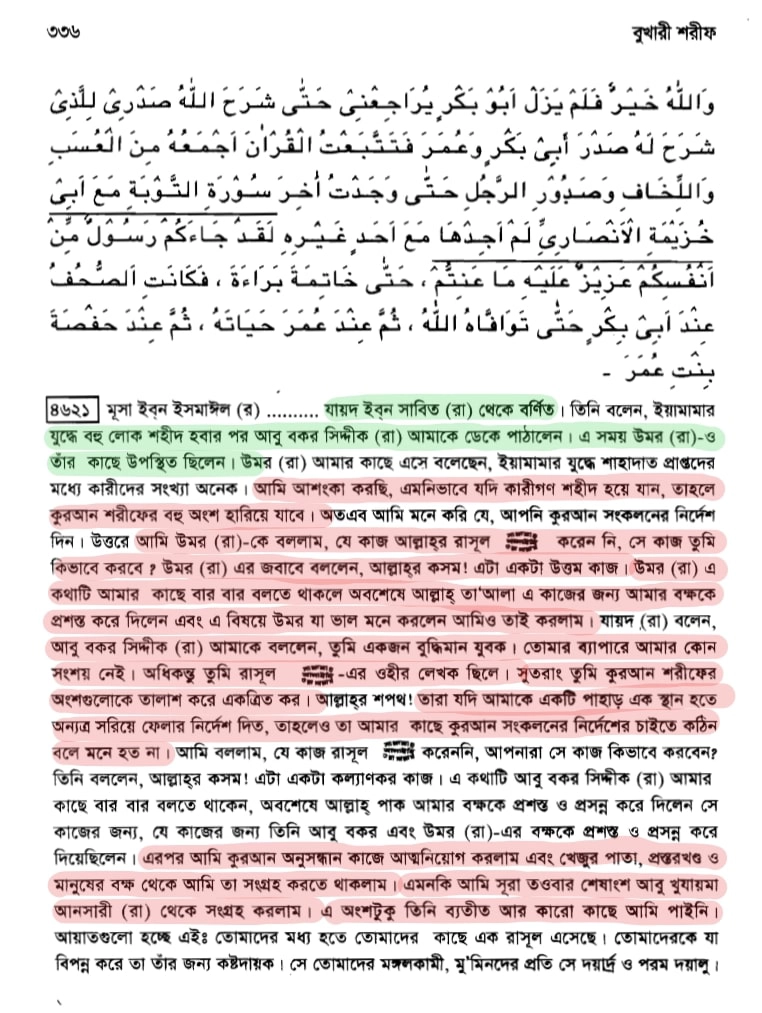
The quantity in the original sentence of Umar’s apprehension is also of a specific type: “a large part of the Quran.” There, the apprehension was not merely about the loss of a single personal copy. The relationship he established between the death of reciters and the loss of a large portion of the text is the primary reason for the decision to collect it. [169]
وَإِنِّي أَخْشَى أَنْ يَسْتَحِرَّ الْقَتْلُ بِالْقُرَّاءِ بِالْمَوَاطِنِ، فَيَذْهَبَ كَثِيرٌ مِنَ الْقُرْآنِ
English translation: My fear is that killings among the reciters of the Quran will increase in various places; as a result, a large part of the Quran will be lost.
The death of one reciter might be managed with the help of another reciter or written evidence; Umar’s statement expressed apprehension regarding the successive deaths of many reciters. This distinction clarifies the weak point of the preservation system: when information is scattered among various people, losing them together reduces the opportunity to recover that information. Umar therefore drew the need for collecting the text from the reports of losses on the battlefield. To him, deaths in war and the future scope of the text were directly related.
Suyuti has preserved another report through Hasan, sourced from Ibn Abi Dawud. In it, when Umar searched for a verse, it was said that it was with someone who had been killed at Yamama. This account places the death of a specific person and the problem of finding a verse directly side by side. [170] [171]
أَنَّ عُمَرَ سَأَلَ عَنْ آيَةٍ مِنْ كِتَابِ اللَّهِ فَقِيلَ: كَانَتْ مَعَ فُلَانٍ قُتِلَ يَوْمَ الْيَمَامَةِ فَقَالَ: إِنَّا لِلَّهِ! وَأَمَرَ بِجَمْعِ الْقُرْآنِ
English translation: When Umar asked about a verse of Allah’s book, it was said: it was with so-and-so; he was killed on the day of Yamama. Then Umar said: Surely we belong to Allah. After that, he gave the order to collect the Quran.
In the chain of transmission of this report preserved through Hasan, there is a disconnection up to Umar’s time. The content of the report is the inquiry about the location of a verse, the mention of a deceased person, and the subsequent order for collection. The wording or identity of the verse is not provided here. Consequently, the problem specifically captured in this account is the link between the location of the text and the death of its carrier. Alongside Bukhari’s general apprehension, this report carries a picture of a separate crisis regarding the search for a verse.
In the explanation of Ibn al-Tin quoted by Suyuti, the apprehension that some parts of the Quran would vanish along with the death of the text-carriers is also mentioned as the reason for Abu Bakr’s initiative. It is explained there that this risk was created because it was not compiled in one place. [172]
لْأَنَّهُ لَمْ يَكُنْ مَجْمُوعًا فِي مَوْضِعٍ وَاحِدٍ فَجَمَعَهُ فِي صَحَائِفَ مُرَتِّبًا لِآيَاتِ سُوَرِهِ عَلَى مَا وَقَّفَهُمْ عَلَيْهِ النَّبِيُّ صَلَّى اللَّهُ عَلَيْهِ وَسَلَّمَ
English translation: because it was not gathered in one place. Therefore, he collected it in sahifas, arranging the verses of its surahs according to how the Prophet peace and blessings of Allah be upon him had instructed them.
The reasons for the two initiatives of Abu Bakr and Uthman are distinct in this explanation. Behind the first was the fear of loss; behind the second was the dispute over different versions of the text. By Uthman’s time, this dispute had reached a point where one group called the readings of others wrong. [172]
وَجَمْعُ عُثْمَانَ كَانَ لَمَّا كَثُرَ الَاخْتِلَافُ فِي وُجُوهِ القراءة حتى قرؤوه بِلُغَاتِهِمْ عَلَى اتِّسَاعِ اللُّغَاتِ فَأَدَّى ذَلِكَ بَعْضَهُمِ إِلَى تَخْطِئَةِ بَعْضٍ
English translation: Uthman’s collection occurred when disagreements over different versions of the text increased; they began to read in their own dialects according to the broad opportunities of language. As a result, some began to call the readings of others wrong.
In the first initiative, the risk of loss was reduced by gathering scattered information. In the later initiative, the state standard for which written text would prevail was determined. Along with sending the Uthman-approved mushaf, he ordered the burning of other sahifas and mushafs. In a history where written records are being collected at one stage for fear of loss, at another stage of that same history, writings outside of approval are being destroyed. [15]
وَأَمَرَ بِمَا سِوَاهُ مِنَ الْقُرْآنِ فِي كُلِّ صَحِيفَةٍ أَوْ مُصْحَفٍ أَنْ يُحْرَقَ
English translation: He also ordered the burning of the Quran found in every sahifa or mushaf.
| Stage | What emerged as the problem | The decision that was taken |
|---|---|---|
| Muhammad’s lifetime | Continuous revelation, memorization, and scattered writing | Recitation of parts of the revelation and preservation in separate materials |
| Abu Bakr’s time | Apprehension of losing the text along with the death of reciters | Zayd’s collection upon Umar’s proposal |
| Uthman’s time | Disputes over regional and personal readings | Preparation and distribution of the approved mushaf and destruction of other copies |
| Subsequent orthography | Problems in determining uniform letter shapes and vowels | Addition and refinement of nukta, harakat, and other reading marks |
Collecting scattered materials to save a book and destroying other written evidence to establish an approved version are different acts. Collection brings information together; destruction limits the future existence of information. In the second process, the ruler’s decision determines which copy will remain in people’s hands and which copy will no longer be available even for comparison. If the two are merged using the word “preservation,” this important difference between selection and rejection is erased.
In the factual account of the Quran’s preservation, the need for initiatives arose from fear, death, and dispute. Umar feared loss; Abu Bakr took the decision; Zayd searched for materials and text; Uthman later fixed the standard. Declaring the results of these actions as Allah’s achievement does not change the historical agent of the work. The success of the compilation is a testament to human labor; to make that success proof of miraculous certainty, one must first assume the correctness of human decisions. If a religious declaration is used as proof of its own truth, the argument becomes circular.
Seven Ahruf and Approved Textual Variants: A Primary History of Multiple Readings
Multiple readings of the Quran were approved during Muhammad’s time—this is the central point of the reports on the seven ahruf. When readings learned differently were presented to him, he approved multiple versions as revealed. Linked to that approval was the instruction to read in an easy manner. Consequently, alternatives in the text were present in the primary subject of preservation; the source of this plurality cannot be identified solely as the error of later copyists. The validity of different readings was granted in instructions preserved in Muhammad’s name. [173] [174] [175]
Sahih Bukhari (IF)
Chapter: 53/ Fada’il al-Quran
Section: 2399. The Quran was revealed in seven ahruf (regional dialects).
4630. Narrated from Sa’id ibn Ufayr (rh) … from Umar ibn al-Khattab (ra).
… this time also the Messenger sallallahu alaihi wasallam said, the Quran has been revealed in this way too. This Quran has been revealed in seven ahruf (regional dialects). Therefore, recite in the method that is easier for you.
Hadith status: Sahih (Sahih)
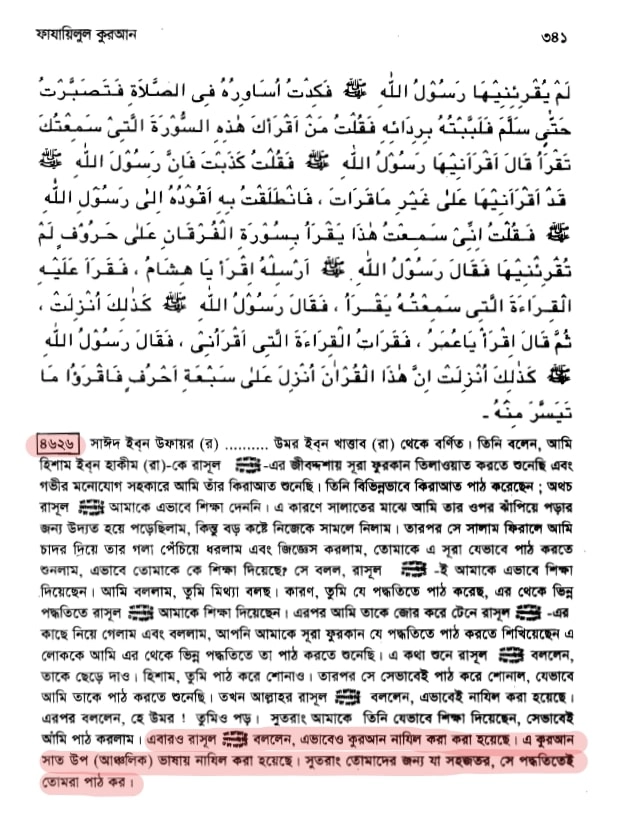
There is a shift in authority between this approved plurality of readings and the subsequent determination of a state standard. In Muhammad’s words, alternatives were kept for the reciter; in Uthman’s decision, the standard of the written mushaf and the fate of materials outside of it were determined. If the scope of the first system and the limit of the second system are assumed to be equal, the change in the history of the text disappears. Simultaneously, the long disagreement among Muslim commentators on what “ahruf” means reveals the problem of identifying the specific form of the primary plurality.
Detailed on this matter [176], you can watch the video below. Dr. Shabir Ally A renowned Islamic researcher. You can find the full video by searching on YouTube; a partial segment is provided here- Video
Reports on the Seven Ahruf, Explanations of Language and Dialect
In Bukhari’s report sourced from Ibn Abbas, there is mention of being taught in one harf first and then increasing the number at Muhammad’s request. There is no report here that permission for seven forms was given all at once from the start; there is a sequence of request and additional approval. [177] [178]
Sahih Bukhari (Islamic Foundation)
53/ Fada’il al-Quran
Section: 2399. The Quran was revealed in seven ahruf (regional dialects).
Islamic Foundation Number: 4629, International Number: 4991
4629. Narrated from Sa’id ibn Ufayr (rh) … from Ibn Abbas (ra). He said, the Messenger sallallahu alaihi wasallam said, Jibril (alaihis salam) taught me the Quran in one way. Then I began to request him to recite it in another way, and as I continued to request repeatedly to recite in another way, he began to increase the methods of recitation for me. Finally, he concluded by reciting in seven ahruf (regional dialects).
Hadith status: Sahih (Sahih)
Narrator: Abdullah ibn Abbas (ra)
The word used in the original Arabic is “harf” and its plural is “ahruf”. In the Bengali translation, “sub-regional language” has been placed; in the Arabic sentence, the names of seven specific tribes or seven languages are not given. The statement regarding the request and the increase in number is: [179]
أَقْرَأَنِي جِبْرِيلُ عَلَى حَرْفٍ فَرَاجَعْتُهُ، فَلَمْ أَزَلْ أَسْتَزِيدُهُ وَيَزِيدُنِي حَتَّى انْتَهَى إِلَى سَبْعَةِ أَحْرُفٍ
English translation: Gabriel taught me in one harf. I requested him again. I continued to ask him for more and he kept increasing it for me, until he reached seven ahruf.
In this account, the approved scope of the reading expanded from one to seven. Requesting, increasing, and finally reaching a number—all three actions speak of change. Multiple readings are not called textual errors here; their source is linked to Gabriel’s teaching and Muhammad’s request. Consequently, the presence of multiple forms is itself recognized; the subject of debate has been the nature of those forms and how many of them survived later.
In Muslim’s report sourced from Ubayy ibn Ka’b, the inability of the followers is mentioned as the reason for increasing the permission. First, instructions were given to read in one harf, then in two and three harfs. Each time Muhammad said that his ummah would not be able to do it. In the fourth statement, reading in any of the seven ahruf was called correct. [180]
ثُمَّ جَاءَهُ الرَّابِعَةَ فَقَالَ إِنَّ اللَّهَ يَأْمُرُكَ أَنْ تَقْرَأَ أُمَّتُكَ الْقُرْآنَ عَلَى سَبْعَةِ أَحْرُفٍ فَأَيُّمَا حَرْفٍ قَرَءُوا عَلَيْهِ فَقَدْ أَصَابُوا
English translation: Later he came a fourth time and said: Allah instructs you that your ummah should read the Quran in seven ahruf. In whichever harf they read, they have read correctly.
The reason for moving from the claim of following a single reading form to the permission of multiple forms in this report is human capacity. Because it was difficult for the followers to obey the first instruction, the permission was expanded. The repetition of the same words each time creates a sequence of events where the ruling on recitation is changed through discussion. In the final approval, one form was not called original and others wrong; any of the selected seven became acceptable. This approval directly contradicts the claim of textual uniformity.
In Tirmidhi’s report, the need for simplification appears in a more specific social identity. Muhammad mentioned to Gabriel the illiterate population, old women, old men, boys, girls, and people who had never read a book. In response, there is the announcement of revelation in seven ahruf. [181]
لَقِيَ رَسُولُ اللَّهِ صلى الله عليه وسلم جِبْرِيلَ فَقَالَ ” يَا جِبْرِيلُ إِنِّي بُعِثْتُ إِلَى أُمَّةٍ أُمِّيِّينَ مِنْهُمُ الْعَجُوزُ وَالشَّيْخُ الْكَبِيرُ وَالْغُلاَمُ وَالْجَارِيَةُ وَالرَّجُلُ الَّذِي لَمْ يَقْرَأْ كِتَابًا قَطُّ ” . قَالَ يَا مُحَمَّدُ إِنَّ الْقُرْآنَ أُنْزِلَ عَلَى سَبْعَةِ أَحْرُفٍ
English translation: The Messenger of Allah peace and blessings of Allah be upon him met Gabriel and said: “Gabriel, I have been sent to an illiterate people, among whom there are old women, very old men, boys, girls, and people who have never read any book.” He said: Muhammad, the Quran has been revealed in seven ahruf.
This logic of simplification is related to the actual diversity of language use. Age, education, and reading proficiency of the population were considered for teaching a new religious text. Instead of making everyone master an immutable set of words in the same way, a system for accepting alternative forms is described. Where the reports themselves keep the differences within approval, the conclusion that the exact same text was on everyone’s lips does not follow simply from the presence of memorization. The questions of what was memorized and which form was approved remain.
At the end of the same report by Ibn Abbas in Muslim, there is a comment by Ibn Shihab. What he heard is that the difference in the seven ahruf does not create a conflict between halal and haram. The comment is given in his own name at the end of the hadith. [182]
قَالَ ابْنُ شِهَابٍ بَلَغَنِي أَنَّ تِلْكَ السَّبْعَةَ الأَحْرُفَ إِنَّمَا هِيَ فِي الأَمْرِ الَّذِي يَكُونُ وَاحِدًا لاَ يَخْتَلِفُ فِي حَلاَلٍ وَلاَ حَرَامٍ
English translation: Ibn Shihab said: It has reached me that those seven ahruf are about the same subject, such that there is no difference in halal and haram.
The fact that the rulings of halal and haram are not contradictory and the literal identity of the language are separate issues. Two sentences can give the same instruction, yet the words may not be the same. Therefore, the statement that the ruling remains the same does not cancel out the difference in words. A limit for acceptable difference is identified in this comment: textual variants will exist, but through them, the forbidden will not be made permissible nor the permissible forbidden. The language of the text can change while maintaining regulatory consistency.
A uniform explanation has not been established regarding the specific meaning of the seven ahruf. Suyuti has quoted thirty-five opinions in the name of Ibn Hibban. There, along with the linguistic form of the text, opinions are preserved that understand ahruf through categories such as commands, prohibitions, halal, haram, metaphors, explicit and ambiguous statements. [183]
قَالَ ابْنُ حِبَّانَ. اخْتَلَفَ أَهْلُ الْعِلْمِ فِي مَعْنَى الْأَحْرُفِ السَّبْعَةِ عَلَى خَمْسَةٍ وَثَلَاثِينَ قَوْلًا
English translation: Ibn Hibban said: There have been thirty-five opinions among the learned regarding the meaning of the seven ahruf.
These views are not merely slight linguistic variations of the same definition. In some places, ahruf refers to language; in others, to different words with the same meaning; and in some, to the thematic category of the statement. Although the number seven is repeated, the answer to the question of what is being counted changes. Despite the preservation of reports regarding permission for multiple readings, a universally accepted identity for its seven divisions cannot be found. Consequently, a complete and specific linguistic system cannot be established simply by mentioning the number seven.
In Abu Ubayd’s explanation, the seven languages are not seven alternatives for the same word; rather, parts of different languages are scattered across various places in the Quran. In his statement, Suyuti mentioned the names of the languages of the Quraysh, Huzayl, Hawazin, and Yemen. [184]
وَقَالَ أَبُو عُبَيْدٍ: لَيْسَ الْمُرَادُ أَنَّ كُلَّ كَلِمَةٍ تُقْرَأُ عَلَى سَبْعِ لُغَاتٍ بَلِ اللُّغَاتُ السَّبْعُ مُفَرَّقَةٌ فِيهِ فَبَعْضُهُ بِلُغَةِ قُرَيْشٍ وَبَعْضُهُ بِلُغَةِ هُذَيْلٍ وَبَعْضُهُ بِلُغَةِ هَوَازِنَ وَبَعْضُهُ بِلُغَةِ الْيَمَنِ وَغَيْرِهِمْ
English translation: Abu Ubayd said: The intention is not that every word will be read in seven languages; rather, the seven languages are scattered within it. Some are in the language of the Quraysh, some in the language of the Huzayl, some in the language of the Hawazin, and some in the language of the Yemenis and others.
The presence of words from different languages in various places of a text and the permission to read alternative words in the same place are two separate systems. The former appears in Abu Ubayd’s definition. The latter appears in the explanation of word alternatives. Consequently, even after saying “seven languages,” the distinction remains as to whether linguistic diversity is being indicated or reading variations of the same verse.
In another explanation, Suyuti gave examples of using different words for the same or near-synonymous statements. This view has been attributed to Sufyan ibn Uyaynah, Ibn Jarir, and Ibn Wahb. Here, the difference is not limited to just intonation, vowel, or pronunciation style; there are distinct words. [185]
أَنَّ الْمُرَادَ سَبْعَةُ أَوْجُهٍ مِنَ الْمَعَانِي الْمُتَّفِقَةِ بِأَلْفَاظٍ مُخْتَلِفَةٍ نَحْوَ أَقْبِلْ وَتَعَالَ وَهَلُمَّ وَعَجِّلْ وَأَسْرِعْ
English translation: The intention is seven forms of different words for the same meaning; such as aqbil, ta’al, halumma, ajjil, and asri—meaning come here, come, come forward, hurry, and come quickly.
In this example, although the general purpose of the command is similar, the words are not the same. There is a direct difference between pronouncing a word differently and using another word in its place. Carrying the same meaning is therefore not proof of lexical immutability. Conversely, this explanation essentially admits that multiple word forms can be acceptable while maintaining continuity of meaning. The argument that “the meaning is the same” carries the admission of word substitution.
In Abu Dawood’s report, there are also alternatives for the attribute words of Allah. In the statement narrated through Ubayy, “Sami’an Aliman” and “Azizan Hakiman” appear; a condition is also given not to end a verse of punishment with mercy or a verse of mercy with punishment. [186]
ثُمَّ قَالَ لَيْسَ مِنْهَا إِلاَّ شَافٍ كَافٍ إِنْ قُلْتَ سَمِيعًا عَلِيمًا عَزِيزًا حَكِيمًا مَا لَمْ تَخْتِمْ آيَةَ عَذَابٍ بِرَحْمَةٍ أَوْ آيَةَ رَحْمَةٍ بِعَذَابٍ
English translation: Later he said: Each of these is curative and sufficient; whether you say Sami’an Aliman—All-Hearing, All-Knowing—or Azizan Hakiman—Almighty, All-Wise—as long as you do not end a verse of punishment with mercy or a verse of mercy with punishment.
Attribute words for hearing and knowledge and attribute words for power and wisdom are not pronunciation variations of the same word. Their specific meanings are also not identical. Just because they refer to different attributes of the same entity does not remove the linguistic difference. The condition in the hadith shows that alternatives were accepted within a limit of semantic range. Consequently, semantic consistency became important in the criterion of acceptability; this report does not reveal a system where the same letter was essential in every place.
In another classification quoted by Suyuti under the name of Abul Fazl Razi, among seven types of differences, grammar, addition-omission, and transposition of words are also included. After six divisions, pronunciation forms are kept separately in the seventh division. [187]
الْأَوَّلُ: اخْتِلَافُ الْأَسْمَاءِ مِنْ إِفْرَادٍ وَتَثْنِيَةٍ وَجَمْعٍ وتذكير وتأنيث. الثاني: اخْتِلَافُ تَصْرِيفِ الْأَفْعَالِ مِنْ مَاضٍ وَمُضَارِعٍ وَأَمْرٍ. الثَّالِثُ: وُجُوهُ الْإِعْرَابِ. الرَّابِعُ: النَّقْصُ وَالزِّيَادَةُ. الْخَامِسُ: التَّقْدِيمُ وَالتَّأْخِيرُ. السَّادِسُ: الْإِبْدَالُ.
English translation: First: differences in singular, dual, plural, and masculine and feminine of nouns. Second: differences in past, present-future, and imperative forms of verbs. Third: various forms of declension. Fourth: omission and addition. Fifth: transposition of before and after. Sixth: substitution.
In this classification, structural differences of language are counted alongside phonetic styles. Plural in place of singular, change of verb form, or the presence-absence of an element are part of the information and structure of a sentence. These divisions cannot be identified by regional accent alone. By keeping these as separate divisions, pronunciation style and word-sentence structure have been distinguished. Therefore, the history of the explanation of the seven ahruf also carries discussions of lexical and structural differences.
| Account or explanation | Examples of variation | Nature of the reading |
|---|---|---|
| Report of Ibn Abbas | Increase in permission from one harf to seven ahruf | Approval of multiple forms |
| Abu Ubayd’s explanation | Linguistic elements of different tribes in different places | Linguistic diversity within the text |
| Explanation of near-synonymous words quoted by Suyuti | Aqbil, Ta’al, Halumma | Distinct words for similar commands |
| Abu Dawood’s report | Sami’an Aliman; Azizan Hakiman | Distinct attribute words |
| Comment of Ibn Shihab | No conflict between halal and haram | Limit of regulatory consistency |
Ibn Hajar also did not say that as the meaning of the seven ahruf, there should be seven readings for every word or sentence. In his explanation, it is mentioned that the maximum number of reading forms in any one word may reach seven. Consequently, a list of seven complete, parallel Qurans is not obtained from the declaration of the seven ahruf. [188]
أَيْ عَلَى سَبْعَةِ أَوْجُهٍ يَجُوزُ أَنْ يُقْرَأَ بِكُلِّ وَجْهٍ مِنْهَا ، وَلَيْسَ الْمُرَادُ أَنَّ كُلَّ كَلِمَةٍ وَلَا جُمْلَةٍ مِنْهُ تُقْرَأُ عَلَى سَبْعَةِ أَوْجُهٍ
English translation: That is, in seven forms, each of which is valid to read. The intention is not that every word or sentence of it will be read in seven ways.
In this explanation, the location of variation is at specific words or reading points; the entire text was not divided into seven complete versions of seven tribes. In some places, the number of alternatives may be two, in others more. Even if there are not seven alternatives for every word, the approval of multiple word forms remains. Therefore, the difference in explanation regarding the range of approved variations does not establish uniformity of the text; it reveals the need to investigate what kind of alternatives existed in which place.
The subsequent seven qira’at are also not synonymous with the seven ahruf. Ibn Taymiyyah clarified this difference and mentioned the role of Ibn Mujahid in consolidating the qira’at of the seven readers. Just because the number of approvals at the time of revelation and the number of selected traditions of specific readers later coincide does not mean their identities become one. [189]
أَنَّ الْأَحْرُفَ السَّبْعَةَ الَّتِي ذَكَرَ النَّبِيُّ صَلَّى اللَّهُ عَلَيْهِ وَسَلَّمَ أَنَّ الْقُرْآنَ أُنْزِلَ عَلَيْهَا لَيْسَتْ هِيَ قِرَاءَاتِ الْقُرَّاءِ السَّبْعَةِ الْمَشْهُورَةَ
English translation: The seven ahruf in which the Prophet (peace and blessings of Allah be upon him) said the Quran was revealed are not the qira’at of the famous seven readers.
| Term | What it denotes |
|---|---|
| Seven Ahruf | Multiple approved reading forms reported in the name of Muhammad; many views on specific meanings |
| Tribal language or dialect | A linguistic view of the explanation of ahruf; not the sole definition of all explanations |
| Seven Qira’at | Selected reading traditions later associated with seven specific readers |
The explanation of IslamQA also admits differences in words. In their selected definition, the seven ahruf are seven forms of reading, whose words are different and meanings may sometimes be the same. [190]
أنها سبعة أوجه من القراءة تختلف باللفظ وقد تتفق بالمعنى
English translation: These are seven forms of reading, which are different in words and may be the same in meaning.
In the history of the seven ahruf, the validity of different words and different readings has been established by religious authority. The reasons for simplification, the increase in permission after request, the explanation of near-synonymous words, and the alternatives for attribute words—all contain linguistic plurality. There is no basis to assume this plurality to be letter-for-letter identical to the subsequent written standard. The range of the accepted text of the Quran has been determined through these events: which alternative could be read, which found a place in the written standard, and by whose decision that limit changed.
Different readings of Umar and Hisham and approval of both readings
Umar’s reaction upon hearing a different Quranic reading was not limited to mere surprise or verbal objection. The account of his desire to attack Hisham ibn Hakim while he was reciting Surah Al-Furqan, grabbing him by the neck with a cloth after the prayer, calling him a liar, and dragging him to Muhammad is present in Umar’s own statement. He had made his own reading, learned from Muhammad, the criterion for invalidating others’ readings. Yet, after judgment, Hisham’s reading was also approved as revealed. [191]
4626 Sa’id ibn Ufayr (r)
Narrated from Umar ibn al-Khattab (ra). He said, I heard Hisham ibn Hakim (ra) reciting Surah Al-Furqan during the lifetime of the Messenger and I listened to his qira’at with deep attention. He recited the qira’at in different ways; whereas the Messenger did not teach me in this way. For this reason, during the prayer, I was poised to pounce on him, but I restrained myself with great difficulty. Then, when he finished the salam, I wrapped a cloth around his neck and asked, who taught you to recite this Surah in the way I heard you recite it? He said, the Messenger himself taught me in this way. I said, you are lying. Because the Messenger taught me in a way different from the method you recited. Then I dragged him by force to the Messenger and said, I have heard this man recite Surah Al-Furqan in a way different from the method you taught me to recite. Hearing this, the Messenger said, let him go. Hisham, recite it. Then he recited it exactly as I had heard him recite. Then the Messenger of Allah said, it was revealed in this way. Then he said, O Umar! You also recite. So I recited in the way he had taught me. This time too the Messenger said, the Quran was also revealed in this way. This Quran was revealed in seven dialects (regional languages). Therefore, recite in the method that is easier for you.
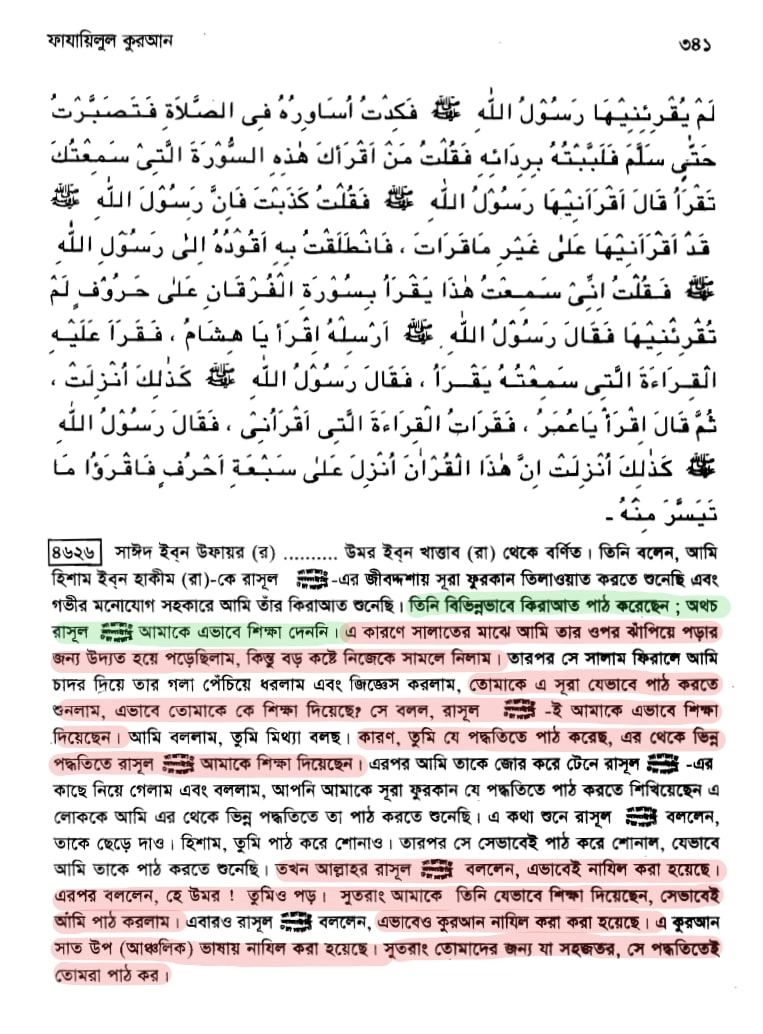
The same report is found in another online numbering of the Islamic Foundation at number 4630. There, Umar’s accusation, Hisham’s answer, and the approval of both readings are fully present. Hisham said his reading was taught by Muhammad; Umar called that claim a lie. Therefore, the conflict was not just about not liking the style of the voice; the conflict was over whose learned reading had prophetic approval. [173] [175]
Sahih Bukhari (Islamic Foundation)
53/ Fada’il al-Quran
Section: 2399. The Quran was revealed in seven ahruf (regional dialects).
Islamic Foundation Number: 4630, International Number: 4992
4630. Narrated from Sa’id ibn Ufayr (rh) … Umar ibn al-Khattab (ra) . He said, I heard Hisham ibn Hakim (ra) reciting Surah al-Furqan during the lifetime of the Messenger sallallahu alaihi wasallam, and I listened to his qira’at with deep attention. He recited the qira’at in various ways; whereas the Messenger sallallahu alaihi wasallam did not teach me in this way. For this reason, I was about to pounce upon him during the salat, but I controlled myself with great difficulty. Then, when he returned the salam, I grabbed his neck with a cloth and asked, who taught you to recite this Surah in the way I heard you recite? He said, the Messenger sallallahu alaihi wasallam himself taught me in this way. I said, you are lying. Because the Messenger sallallahu alaihi wasallam taught me in a method different from the method you recited.
Then I forcibly dragged him to the Messenger sallallahu alaihi wasallam and said, I have heard this man reciting Surah al-Furqan in a method different from the method you taught me to recite. Hearing this, the Messenger sallallahu alaihi wasallam said, let him go. Hisham, recite for us. Then he recited in the same way that I had heard him recite. Then the Messenger of Allah sallallahu alaihi wasallam said, it has been revealed in this way. Then he said, O Umar! You also recite. So I recited in the way he taught me. This time also the Messenger sallallahu alaihi wasallam said, the Quran has been revealed in this way too. This Quran has been revealed in seven ahruf (regional dialects). Therefore, recite in the method that is easier for you.
Hadith status: Sahih (Sahih)
Narrator: Umar ibn al-Khattab (ra)
The basis of Umar’s judgment was his personal learning: Hisham was not reading the way Muhammad had taught him. From there, he concluded that Hisham was lying in claiming to have learned from Muhammad. In this conclusion, the possibility of there being another approved reading outside of his own known reading received no recognition. When Muhammad later approved Hisham’s reading, Umar’s accusation was proven wrong. The truth of the accusation had not been established before pressure was applied to Hisham.
Bukhari also placed the same incident in the chapter regarding disputes. There, in Umar’s statement, there is mention of the desire to intervene hastily during prayer and later dragging him by the cloak. In this placement and form of narration of the same incident, the link between reading disputes and coercion is maintained. [192]
وَكِدْتُ أَنْ أَعْجَلَ عَلَيْهِ، ثُمَّ أَمْهَلْتُهُ حَتَّى انْصَرَفَ، ثُمَّ لَبَّبْتُهُ بِرِدَائِهِ فَجِئْتُ بِهِ رَسُولَ اللَّهِ صلى الله عليه وسلم
English translation: I was almost about to intervene and jump upon him. Later, I waited until he finished. Then, grabbing him by the rida near the neck, I brought him to the Messenger of Allah peace and blessings of Allah be upon him.
An-Nawawi clarified the meaning of the phrase “labbabtuhu biridaihi”: grabbing the gathered part of the rida near the neck and pulling him by it. Consequently, the physical aspect of the incident is not an imaginary addition of translation; in classical commentaries, there is a relationship between grabbing the neck and pulling. [193]
أَخَذْتُ بِمَجَامِعِ رِدَائِهِ فِي عُنُقِهِ وَجَرَرْتُهُ بِهِ
English translation: I grabbed the gathered part of the rida near his neck and pulled him by it.
Establishing physical control by treating a different reading as a crime, and later that very reading being declared valid—both events exist within the same report. Here, Umar’s firm conviction was not synonymous with accurate knowledge. While his own memory of learning was correct, the decision against the other person was wrong. Knowing one reading and knowing all authorized readings are separate capabilities; the result of using the former as a substitute for the latter is seen in Umar’s behavior.
Even in Muslim’s brief version, there is language expressing the desire to jump in during the prayer. Umar did not do so in the middle of the prayer; he restrained himself until the salam. The mention of grabbing Hisham and bringing him after the wait is present in the full report. [194]
فَكِدْتُ أُسَاوِرُهُ فِي الصَّلاَةِ فَتَصَبَّرْتُ حَتَّى سَلَّمَ
English translation: I was almost about to jump upon him during the prayer; later, I restrained myself until he gave the salam.
The account of this same incident by Umar appears in Bukhari 2419 and Muslim 818b through Malik, and in Bukhari 4992 and Muslim 818b through another chain. Urwa and Ibn Shihab are present at the general level of these reports. In the same incident across multiple texts, sometimes brief and sometimes detailed language has been preserved. The sequence of the difference in readings, bringing Hisham, reciting the two readings before Muhammad, and the approval of both—this continuity is maintained in them.
| Steps of the incident | Umar’s position or behavior | Subsequent result |
|---|---|---|
| Hearing Hisham’s reading | Did not find it matching his own learned reading | Reading difference is identified |
| Asking for the identity of the teacher | Rejection of Hisham’s claim of learning from Muhammad | Accusation of being a liar |
| Completion of prayer | Physical control by grabbing the rida | Bringing him to Muhammad |
| Testing Hisham’s reading | The reading that was objected to is recited | Muhammad’s approval |
| Testing Umar’s reading | Recites his own learned reading | This reading is also approved |
| Final instruction | Recognition of multiple revealed forms | Permission to read the easier one |
Muhammad’s first instruction was to let Hisham go. After this, the reading he heard was the very one Umar had heard and objected to. In Muslim’s report, there is no event where Hisham changed his reading to read like Umar; the recited reading was approved. Later, when Umar read, his reading was similarly approved. [195]
فَقَرَأَ الْقِرَاءَةَ الَّتِي سَمِعْتُهُ يَقْرَأُ فَقَالَ رَسُولُ اللَّهِ صلى الله عليه وسلم ” هَكَذَا أُنْزِلَتْ ” . ثُمَّ قَالَ لِيَ ” اقْرَأْ ” . فَقَرَأْتُ فَقَالَ ” هَكَذَا أُنْزِلَتْ
English translation: He recited the very reading that I had heard him recite. Then the Messenger of Allah peace and blessings of Allah be upon him said: “It was revealed in this way.” Later he said to me: “Recite.” I recited. He said: “It was revealed in this way.”
Consequently, the accusation brought against Hisham was resolved without canceling the reading he recited. Both Umar and Hisham remained in their learned forms, and the revelation of both forms was recognized. In this incident, instead of recovering a single uniform form to correct a wrong reading, authorized differences were accepted. If Muhammad’s teaching is considered limited to a single, universal, uniform pronunciation, this dual approval remains unexplained.
In explaining the instruction to Umar to let Hisham go, An-Nawawi stated that the basis for punishment had not been established. In his explanation, Muhammad knew more valid forms than the forms Umar knew. The gap between Umar’s personal knowledge and the ability to judge another’s reading is recognized here as well. [196]
وَأَمَّا أَمْرُ النَّبِيِّ صَلَّى اللَّهُ عَلَيْهِ وَسَلَّمَ عُمَرَ بِإِرْسَالِهِ فَلِأَنَّهُ لَمْ يَثْبُتْ عِنْدَهُ مَا يَقْتَضِي تَعْزِيرَهُ وَلِأَنَّ عُمَرَ إِنَّمَا نَسَبَهُ إِلَى مُخَالَفَتِهِ فِي الْقِرَاءَةِ وَالنَّبِيُّ صَلَّى اللَّهُ عَلَيْهِ وَسَلَّمَ يَعْلَمُ مِنْ جَوَازِ الْقِرَاءَةِ وَوُجُوهِهَا مَا لَا يَعْلَمُهُ عُمَرُ
English translation: The Prophet peace and blessings of Allah be upon him told Umar to let him go because nothing had been established against him that demanded punishment. And Umar had only accused him of being different from himself in the reading; the Prophet peace and blessings of Allah be upon him knew things about the validity of the reading and its forms that Umar did not know.
The tribal identities of Umar and Hisham are also significant in the explanation of this incident. Umar was a person of the original branch of the Quraysh of Makkah. Hisham ibn Hakim, that is Hisham ibn Hakim ibn Hizam, was a person of the Asad branch of the Quraysh. There is no basis here to consider the two as speakers of different regional tribal languages. IslamQA also argued against the explanation of ahruf using only the language of different tribes from their same Qurayshi identity. [190]
فلو كان اختلاف الأحرف اختلافاً في اللغات لما اختلف القرشيان
English translation: If the difference in ahruf were a difference in language, there would be no difference between those two Qurayshis.
The report of Hakim ibn Hizam’s birth inside the Kaaba is also present in biographical works. Mizzi cited the report in his biography through Zubayr ibn Bakkar. Thus, that birth identity belongs to the father Hakim; the person detained by Umar in the reading dispute is his son Hisham. [197]
فولدت حكيم بن حزام في الكعبة على النطع
English translation: She gave birth to Hakim ibn Hizam on a leather skin spread inside the Kaaba.
Ibn al-Jazari identified the same problem in the explanations providing the list of seven tribal languages. In his statement, Umar and Hisham are people of the same language and the same tribe, yet they had a dispute over the reading of Surah al-Furqan. The fact that reading differences occur within the Qurayshi identity is the center of his argument. [198]
فإن عمر بن الخطاب وهشام بن حكيم اختلفا في قراءة سورة الفرقان كما ثبت في الصحيح وكلاهما قرشيان من لغة واحدة وقبيلة واحدة
English translation: Umar ibn al-Khattab and Hisham ibn Hakim disputed over the reading of Surah al-Furqan, as established in sahih reports; yet both are Qurayshi, people of the same language and the same tribe.
The problem that two individuals with the same tribal linguistic identity were taught the Quran differently cannot be solved simply by saying “the Arabs had various pronunciations.” Taking the identities of Umar and Hisham, their claims of learning, and the dispute together, the difference does not remain an event of returning to their respective tribal languages. People within the same Qurayshi sphere claimed to have learned their readings from Muhammad. Muhammad himself approved both after hearing their readings. Consequently, a person’s tribal identity cannot determine their sole learned Quran-reading.
Ibn al-Jazari also rejected the explanation that the dispute was over tafsir or ruling. According to him, the companions disputed over the reading of the letters of the Quran. He kept the dispute over meaning-based explanation and the dispute over the recited reading separate. [199]
لم يختلفوا في تفسيره ولا أحكامه ، وإنما اختلفوا في قراءة حروفه
English translation: They did not dispute over its tafsir or ruling; rather, they disputed over the reading of its letters.
In the relevant report of Mishkat, after the readings of the two individuals, it is separately stated, “It was revealed in this way.” In the final instruction, permission is given to read in the easier method. The validity of different forms learned personally is kept together within this approval. [200] [201]
كَذَلِكَ أُنْزِلَتْ، إِنَّ هَذَا الْقُرْآنَ أُنْزِلَ عَلَى سَبْعَةِ أَحْرُفٍ فَاقْرَءُوا مَا تَيَسَّرَ مِنْهُ
English translation: It was revealed in this way as well. This Quran was revealed in seven ahruf; therefore, recite from it that which is easier.
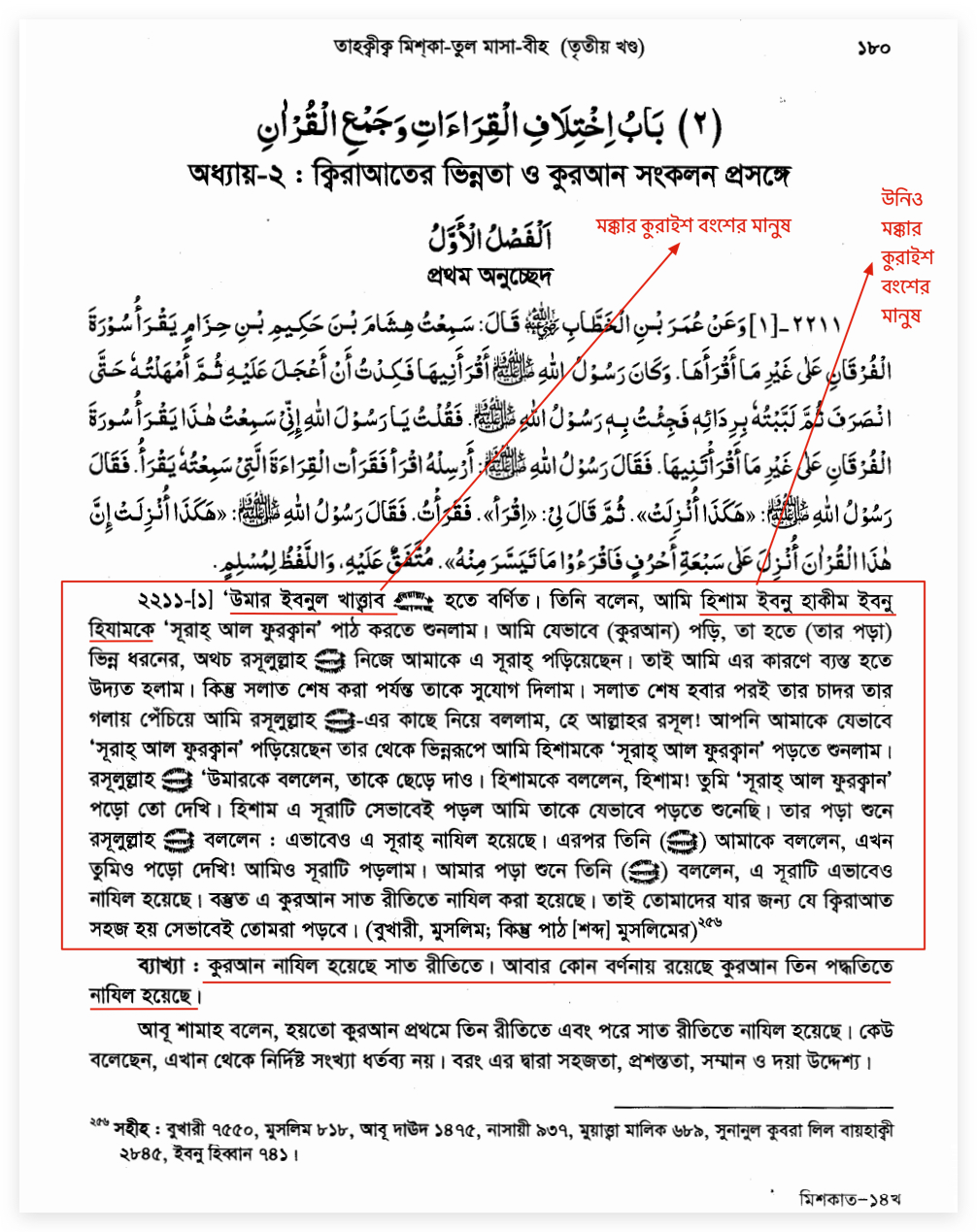
| Subject of consideration | Reported information | Its significance |
|---|---|---|
| Tribal identity | Both Umar and Hisham are Qurayshi | Difference does not end simply with different tribal languages |
| Claim of learning | Both claimed to have learned from Muhammad | Separate readings under the name of the same teacher |
| Method of testing | Both were asked to recite their learned readings | Both forms were heard |
| Muhammad’s decision | Recognition of revelation for both | Umar’s accusation against Hisham is canceled |
| Final permission | Reading that which is easier | Multiple acceptable alternatives |
The final instruction to choose the easier reading creates a result opposite to Umar’s initial behavior. Permission was given for the very difference for which he had brought Hisham to stop it. Umar’s own reading was not discarded; nor was the other’s reading discarded due to his personal objection. The futility of using force against another reader based on personal reading-knowledge and the existence of authorized alternatives were revealed simultaneously. [202]
إِنَّ هَذَا الْقُرْآنَ أُنْزِلَ عَلَى سَبْعَةِ أَحْرُفٍ، فَاقْرَءُوا مَا تَيَسَّرَ مِنْهُ
English translation: This Quran was revealed in seven ahruf; therefore, recite from it that which is easier for you.
From this recognized difference of the Prophet, the type of authority changed when moving toward later state standards. In cases of dispute, Uthman ordered to write in the language of the Quraysh and ordered the burning of other written sahifa-mushafs outside the designated mushaf. In Bukhari’s report, the instruction for language selection is directly in his name. [15]
إِذَا اخْتَلَفْتُمْ أَنْتُمْ وَزَيْدُ بْنُ ثَابِتٍ فِي شَىْءٍ مِنَ الْقُرْآنِ فَاكْتُبُوهُ بِلِسَانِ قُرَيْشٍ فَإِنَّمَا نَزَلَ بِلِسَانِهِمْ
English translation: If you have any disagreement with Zayd ibn Thabit regarding any matter of the Quran, you shall write it in the language of the Quraysh; for it was revealed in their language.
In the incident of Umar and Hisham, the Qurayshi identity did not unify the two readings. Therefore, declaring the standard of the Qurayshi language in the later collection cannot be made proof of the uniformity of all previous readings. The event of approving two forms before Muhammad and the determination of the written standard by the Caliph are separate stages. In the first event, the dispute was resolved while maintaining the difference; in the later arrangement, the state fixed the limit of which written form would survive. To say “everyone read the same way from the beginning” regarding this history of multiple readings would require denying the reported dispute, Umar’s wrong accusation, and the recognition of two readings.
Objection to Ubayy’s reading, his doubt and Muhammad’s reaction
Ubayy ibn Ka’b was one of the primary companions who mastered the Quran during Muhammad’s lifetime. Among the four people Muhammad named to learn the Quran from, Ubayy is also included. Placing his reading-knowledge and the incident of his doubt side by side reveals the depth of the problem: even a recognized teacher of the Quran could not identify the approval of another’s different reading upon hearing it. The significance of his objection is much greater than the confusion of an ordinary listener; the knowledge of an authoritative person regarding the reading and the scope of Muhammad’s approved readings did not meet here. [203] [105]
خُذُوا الْقُرْآنَ مِنْ أَرْبَعَةٍ مِنْ عَبْدِ اللَّهِ بْنِ مَسْعُودٍ وَسَالِمٍ وَمُعَاذٍ وَأُبَىِّ بْنِ كَعْبٍ
English translation: Learn the Quran from four people: Abdullah ibn Masud, Salim, Muadh, and Ubayy ibn Ka’b.
To Ubayy’s status was added a special nomination in the name of Allah. In Anas’s report, Muhammad tells him that Allah has instructed him to recite Surah al-Bayyinah to Ubayy. Ubayy asks if Allah mentioned his name. When Muhammad confirms, he weeps. This account of religious authority does not place him as a marginal reader of the Quran; in the Prophet’s own statement, he is a specially selected listener. The report of a crisis of faith arising in that very person due to a different reading is also preserved in the same hadith literature. [204]
قَالَ النَّبِيُّ صلى الله عليه وسلم لِأُبَيٍّ “ إِنَّ اللَّهَ أَمَرَنِي أَنْ أَقْرَأَ عَلَيْكَ {لَمْ يَكُنِ الَّذِينَ كَفَرُوا} ”. قَالَ وَسَمَّانِي قَالَ ” نَعَمْ ” فَبَكَى
English translation: The Prophet peace and blessings of Allah be upon him said to Ubayy: “Allah has instructed me to recite to you ‘lam yakunilladhina kafaru’.” He asked: “Did He mention my name?” He said: “Yes.” Then Ubayy wept.
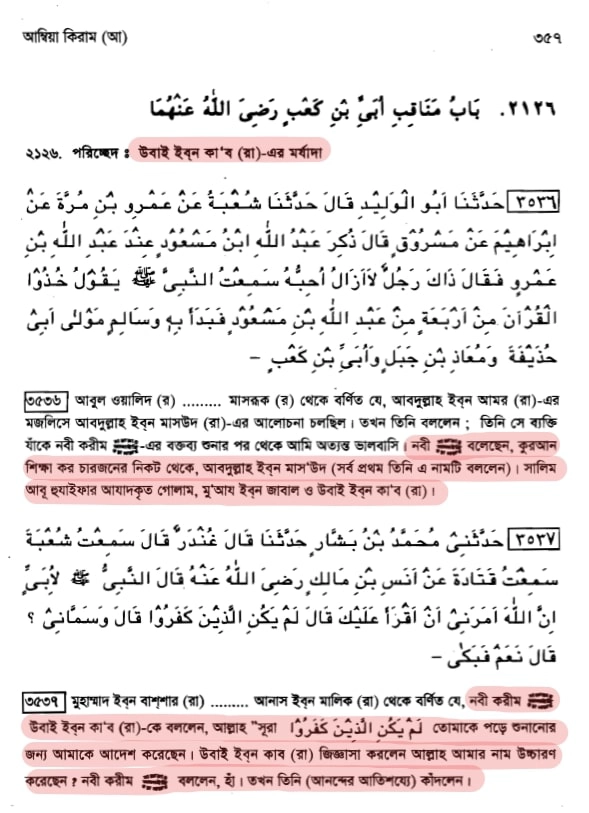
In Nasa’i’s report, Ubayy clarified the reason for his discomfort. He recites a verse; another person recites that verse differently from his reading. Both name Muhammad as their teacher. A conflict between a memorized reading and another memorized reading is not resolved here by the identity of the teacher, because both parties claim the same source. Ubayy’s question was not just about where the other person learned it; the inconsistency of how two forms of a verse learned from the same teacher could be acceptable together shook him. [205]
مَا حَاكَ فِي صَدْرِي مُنْذُ أَسْلَمْتُ إِلاَّ أَنِّي قَرَأْتُ آيَةً وَقَرَأَهَا آخَرُ غَيْرَ قِرَاءَتِي فَقُلْتُ أَقْرَأَنِيهَا رَسُولُ اللَّهِ صلى الله عليه وسلم . وَقَالَ الآخَرُ أَقْرَأَنِيهَا رَسُولُ اللَّهِ صلى الله عليه وسلم
English translation: After embracing Islam, no doubt ever arose in my heart, except for this incident: I recited a verse, and another person recited it differently from my reading. I said, the Messenger of Allah peace and blessings of Allah be upon him taught this to me. The other person also said, the Messenger of Allah peace and blessings of Allah be upon him taught this to me.
In Muslim’s report, there is mention of two people coming to the mosque with different readings, going to Muhammad, and Ubayy’s feeling of disbelief after the approval of both. The timing of his reaction is significant: the crisis intensified only after receiving approval. The decision that was supposed to resolve the dispute broke his previous expectation. [206]
فَأَمَرَهُمَا رَسُولُ اللَّهِ صلى الله عليه وسلم فَقَرَءَا فَحَسَّنَ النَّبِيُّ صلى الله عليه وسلم شَأْنَهُمَا فَسُقِطَ فِي نَفْسِي مِنَ التَّكْذِيبِ وَلاَ إِذْ كُنْتُ فِي الْجَاهِلِيَّةِ
English translation: The Messenger of Allah peace and blessings of Allah be upon him asked both to recite. They recited, and the Prophet peace and blessings of Allah be upon him praised the readings of both. Then a feeling of disbelief came into my mind, such as had not come even when I was in the state of Jahiliyyah.
Confidence in one’s own reading here created an objection against another’s reading. Later, the approval of both readings put the basis of that confidence into question. There is a practical problem of knowledge within this: a reader may remember the words they learned perfectly, yet may be completely ignorant of another valid form. Then, even if their own memory is correct, the decision to call the other’s reading wrong is not correct. In Ubayy’s experience, personal memorized knowledge and knowledge of all approved readings became separate; the strength of the former did not fill the void of the latter.
Nasa’i’s language regarding the identity of the verse is also specific: one person recited a verse, and another recited that same verse differently. Here, the experience of multiple versions of the same verse is documented, which calls into question the notion of the exclusivity of the reading Ubayy himself had learned. Objections were raised regarding the reading of the same verse, and the name of the same teacher was mentioned. Whether the version the reader knows is the only recognized version—this information does not automatically exist within his memorized memory. This gap between the capacity for preservation and the capacity to know the limits of acceptability was effective even for a primary teacher like Ubayy.
An-Nawawi mentioned the notion of directly denying prophethood as the subject matter of the word “takdhib.” He provided a religious explanation for this, attributing it to the whispers of Satan. Even in his explanation, the matter of doubt reaches as far as the truth of the prophethood. [207]
مَعْنَاهُ وَسْوَسَ لِيَ الشَّيْطَانُ تَكْذِيبًا لِلنُّبُوَّةِ أَشَدَّ مِمَّا كُنْتُ عَلَيْهِ فِي الْجَاهِلِيَّةِ
English translation: It means: Satan gave me such whispers of denying prophethood in my mind, which were more intense than what was within me during the period of ignorance.
This explanation shifts the cause of doubt into the language of religious morality. The visible occasion was the simultaneous approval of different readings; in the explanation, the source of doubt becomes Satan. Consequently, the judgment of the questioner’s mental purity is linked to the question regarding the reading. Making someone religiously uncomfortable for a question and providing a logical answer to that question are separate matters. The understandable cause of his doubt is found by analyzing the relationship between the reading Ubayy learned, the readings others learned, and the approval of those; the claim of Satan’s activity in the mind does not provide a verbal explanation of that relationship.
There is a direct logical connection between the inconsistency of readings and the emergence of doubt toward the teacher and the claim of revelation. If the teaching of the same person returns in different forms, the follower must accept a new explanation regarding the scope of the teaching. Ubayy’s reaction expresses exactly that need. The place of others’ readings was not clear within his pre-existing conception of the Quran. Although Muhammad’s approval provided new information, it did not become an immediate certainty for him. Consequently, the announcement of approval and the acceptance of its credibility are captured as two separate mental events.
| Steps of the incident | Ubayy’s experience | Problem of authority |
|---|---|---|
| Hearing a different reading | Mismatch with his own learned version | Determining the validity of another reading using a familiar reading |
| Identity of the teacher | Both parties claim Muhammad’s teaching | The name of the same teacher does not resolve the conflict |
| Muhammad’s decision | Approval of different readings | The basis of the objection changes |
| Reaction after approval | Sense of disbelief | The question of reading reaches a crisis of faith |
| Subsequent reaction | Strike to the chest, sweat, and fear | Presence of physical and religious authority |
| Explanation | Permission for seven ahruf | The scope of valid readings becomes manifold |
Seeing Ubayy in this state, Muhammad struck him on the chest. The subsequent words of the report mention becoming drenched in sweat and feeling a fear as if seeing Allah. In the language of Ubayy’s own experience, physical reaction and religious terror appear side by side. [208]
فَلَمَّا رَأَى رَسُولُ اللَّهِ صلى الله عليه وسلم مَا قَدْ غَشِيَنِي ضَرَبَ فِي صَدْرِي فَفِضْتُ عَرَقًا وَكَأَنَّمَا أَنْظُرُ إِلَى اللَّهِ عَزَّ وَجَلَّ فَرَقًا
English translation: When the Messenger of Allah, peace and blessings of Allah be upon him, saw the state I had fallen into, he struck me on my chest. I became drenched in sweat; in fear, I felt as if I were looking toward Allah the Almighty.
Striking the chest and fear are not methods for verifying the verbal accuracy of a reading. These affect the mental state of the follower; they do not provide information on exactly which word was in which reading and why. In this incident, the presence of religious authority over the body and feelings of the skeptical follower is very clear. A question was raised about different versions of the Quran, and at the moment of doubt, the reaction was physical strike and an experience of intense fear. There is no relationship between the logic of determining truth and the feeling of fear; fear may change the position of the questioner, but it cannot become the factual answer to the question.
The significance of this reaction also lies in the follower’s position. Ubayy had gone to Muhammad with the memory of his own learning; after the decision, fear became dominant in his experience. Expressing such doubt before religious leadership increases the stakes: the question is then no longer just about identifying a wrong reading, but becomes a question of one’s own loyalty to the prophethood. Within this relationship, independent verification and the pressure of loyalty do not possess equal power. When the judge’s decision is the declaration of religious truth, maintaining doubt about that decision creates both an epistemological and a religious crisis for the follower.
After this, Muhammad speaks of increasing the permission from one harf. In the Muslim-reading on Islamweb, there is permission for seven ahruf for the first, second, and third time; each time there is also a plea for ease. That is, within the structure of the report itself, the permission for the reading did not remain fixed in the first state. [209]
أرسل إلي أن اقرأ القرآن على حرف فرددت إليه أن هون على أمتي فرد إلي الثانية اقرأه على حرفين فرددت إليه أن هون على أمتي فرد إلي الثالثة اقرأه على سبعة أحرف
English translation: It was sent to me: Recite the Quran in one harf. I sent back: Make it easy for my Ummah. A second time it was said: Recite in two harfs. I sent back: Make it easy for my Ummah. A third time it was said: Recite in seven ahruf.
In Nasa’i 941, a conversation between Gabriel and Michael is added to this permission. There, Michael asks to increase the permission, and eventually, every harf is called sufficient. First, the recognition of the claims of Ubayy and the other reader’s learning, then the explanation of extending permission through angels—the validity of different readings is established in this sequence. [210]
قَالَ مِيكَائِيلُ اسْتَزِدْهُ اسْتَزِدْهُ حَتَّى بَلَغَ سَبْعَةَ أَحْرُفٍ فَكُلُّ حَرْفٍ شَافٍ كَافٍ
English translation: Michael said: Ask Him for more, ask for more. In this way, it reached seven ahruf; every harf is satisfying and sufficient.
Moving from the permission of one reading to the permission of multiple readings is a change in the ruling of Quranic recitation. As a result, space is created for new acceptable versions outside the previously declared limit. To resolve Ubayy’s objection, a single reading was not selected; instead, a description of expanding the scope of acceptability was given. This arrangement, on one hand, recognizes the readings he objected to, and on the other, reveals that his prior knowledge regarding the approved versions of the Quran was incomplete. Even if an individual’s memory remains unchanged, the limit of which version is religiously valid can change.
In Muslim 821a, there is another account of the extension of permission through Ubayy. In the incident of Gabriel’s arrival near the watering hole of Bani Ghifar, there are four steps: one, two, three, and seven ahruf. In the final decision, reciting in any approved harf is called correct. Multiple versions of the reading are the final result of the decision here. [180]
ثُمَّ جَاءَهُ الرَّابِعَةَ فَقَالَ إِنَّ اللَّهَ يَأْمُرُكَ أَنْ تَقْرَأَ أُمَّتُكَ الْقُرْآنَ عَلَى سَبْعَةِ أَحْرُفٍ فَأَيُّمَا حَرْفٍ قَرَءُوا عَلَيْهِ فَقَدْ أَصَابُوا
English translation: Later he came a fourth time and said: Allah commands you that your Ummah should recite the Quran in seven ahruf. Whichever harf they recite in, they will be reciting correctly.
An-Nawawi has discussed this mismatch in the number of permission steps and stated that reconciling the meaning of the two reports is problematic. His proposed solution is that in the first report, “third” refers to the last time, meaning the fourth time, and some mentions of times were omitted. This is his harmonizing explanation; the information that there is a mismatch in the reported steps is also clear in his discussion. [211]
هَذَا مِمَّا يُشْكِلُ مَعْنَاهُ وَالْجَمْعُ بَيْنَ الرِّوَايَتَيْنِ
English translation: This is a matter whose meaning and the harmonization between the two reports is problematic.
In Muslim 820b, after giving another chain for the same incident, it is mentioned as a description similar to the previous report. There, the chains of Ismail ibn Abi Khalid and Abdullah ibn Isar are maintained. This is a direct example of how the same report is re-documented through a brief instruction. Having two hadith-entries in number and having reports of two separate incidents are not the same thing. [212]
وَاقْتَصَّ الْحَدِيثَ بِمِثْلِ حَدِيثِ ابْنِ نُمَيْرٍ
English translation: He described the incident similarly to the hadith of Ibn Numayr.
The description of the conflict in the mosque, the brief description of different readings of a verse, and the description of the increase in permission—these highlight different pieces of information. In some reports, the follower’s mental reaction is detailed; in some, the claim of learning from the same teacher comes forward; in another, the steps of permission are counted. Reading while keeping these differences allows one to understand both the social character of the event and the religious framework used to explain it. If the information about the conflict in readings is compressed only into the final sentence of permission, the importance of Ubayy’s objection, the shock to his belief, and the physical aspect of the reaction—all are diminished.
| Source | Center of description | Preserved characteristics |
|---|---|---|
| Muslim 820a | Different readings in the mosque and Ubayy’s reaction | Readings of two persons, approval of both, sense of disbelief, and strike to the chest |
| Muslim 820b | Another chain for the same report | Brief mention as a description similar to the previous report |
| Nasa’i 941 | Different readings of one verse | Both claim to have learned from Muhammad; discussion between Gabriel and Michael |
| Muslim 821a | Permission at the watering hole of Bani Ghifar | One, two, three, and seven ahruf; coming four times |
| An-Nawawi’s explanation | Religious harmonization of the mismatch | Explanation of “third” as the last time and proposal that some steps were omitted |
IslamQA has also acknowledged verbal differences in the explanation of the seven ahruf. In their selected explanation, these are seven forms of reading, whose words may be different and meanings may match. Therefore, the original question has a rightful place in Ubayy’s incident: there were differences among the approved readings of the same scripture. This difference is not erased simply by the number of memorizers. [213]
أنها سبعة أوجه من القراءة تختلف باللفظ وقد تتفق بالمعنى
English translation: These are seven forms of reading, which are different in words and may match in meaning.
Muhammad is simultaneously the teacher of the reading, the claimant of receiving revelation, and the final judge of the conflict. Consequently, his approval resolves the conflict regarding the source of teaching through his own authority. The followers also receive the report of the conversation with the angels from him. In this narrative structure, the reader must accept two related claims: that he taught different versions and that Allah also gave permission for that difference. The reported support in favor of the angels’ permission is also Muhammad’s own statement; the narrator of that conversation before Ubayy and the judge of the conflict are the same person.
The social result of this dependence is also clear. Even though a skilled teacher of the Quran knew his own reading, he felt the need for personal prophetic approval to resolve a new conflict. If a uniform reading were already equally known among all readers, the task of verification would be comparison with that uniform standard. Here, the conflict was created as a result of comparison; the solution came in the declaration that the differences are valid. Consequently, the meaning of the claim changes depending on what is meant by preservation: retaining the version an individual learned, knowing all approved versions, and later following a determined version are not the same event.
The description of Ubayy’s doubt places the plurality of readings within the first era. There is skill, there is direct identity of the teacher, there is a firm memory of one’s own learning; despite this, there is conflict over the acceptability of other readings. If this situation is turned into a history of unquestioned uniformity, both the cause and the result of the event are lost. Objections were raised because there was approved difference, and Ubayy’s belief was shocked because multiple versions were recognized. The praise of his status, his doubt, and Muhammad’s reaction to that doubt—these three pieces of information together present the uncomfortable picture of the primary reading-history of the Quran.
Description of Ubayy’s reading being unacceptable to Umar
Umar called Ubayy ibn Ka’b the best Quran-reciter among them; in the same statement, he mentioned leaving out some parts of his reading. Ubayy’s position was the opposite: he would not give up what he heard from Muhammad’s mouth for anything. Even the reading directly learned by a recognized primary teacher of the Quran fell into such a conflict of acceptance and rejection. Recognition of an individual’s status did not become recognition of all his readings. Praising him as the best reciter and rejecting parts of his reading—two actions happened simultaneously. [214] [215]
Sahih Bukhari (Tawhid)
Chapter: 66/ Virtues of the Al-Quran
Section: 66/8. Those companions of the Nabi sallallahu ‘alaihi wasallam who were qaris.
5005. Narrated from Ibn ‘Abbas (ra). He said, ‘Umar (ra) said, ‘Ali (ra) is the best judge among us and Ubayy (ra) is the best qari among us. Despite this, we omit some parts of what he has recited, whereas he says, I have heard it from the tongue of the Messenger of Allah, I will not abandon it for anything. Allah has said, “When I abrogate a verse or cause it to be forgotten, I bring one better than it or similar to it.” 4481) (Modern Publication: 4634, Islamic Foundation: 4639)
Hadith status: Sahih (Sahih)
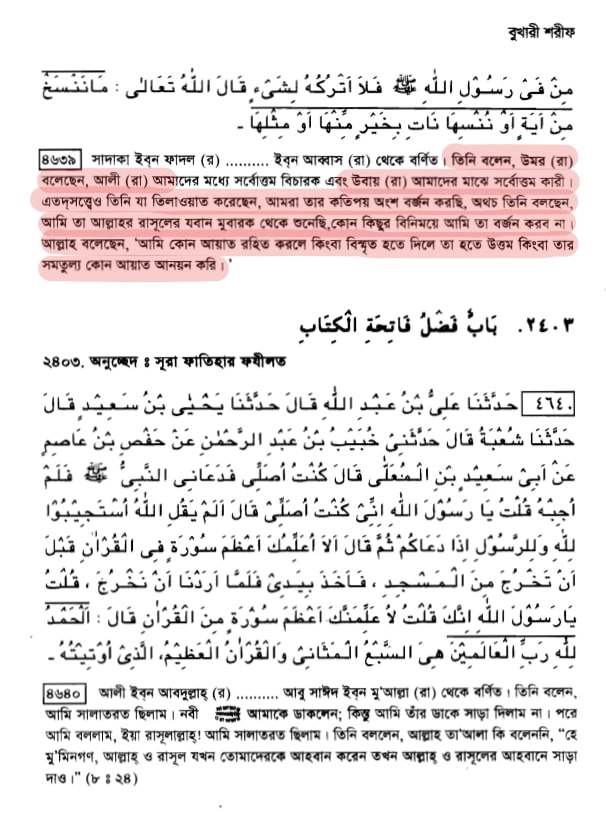
In Umar’s statement, two distinct claims regarding the reading of the Quran exist side by side. One claim concerns Ubayy’s proficiency; the other concerns which part of his reading should be followed. Ubayy based his position on direct hearing, while Umar provided the religious justification for rejection using verses of abrogation. Consequently, the identity of having heard it from Muhammad’s own mouth was not unanimously sufficient to maintain a reading. There was a conflict between the claim of learning from the Prophet and the decision to retain that reading in subsequent practice. [216]
أُبَىٌّ أَقْرَؤُنَا وَإِنَّا لَنَدَعُ مِنْ لَحَنِ أُبَىٍّ، وَأُبَىٌّ يَقُولُ أَخَذْتُهُ مِنْ فِي رَسُولِ اللَّهِ صلى الله عليه وسلم فَلاَ أَتْرُكُهُ لِشَىْءٍ
English translation: Ubayy is the best reciter among us; yet we leave out some parts of Ubayy’s reading. Ubayy says, I took it from the mouth of the Messenger of Allah; I will not leave it for anything.
The same statement appears in the Tafsir chapter of Bukhari. There, it is stated, “we leave out some things from Ubayy’s words,” and the sentence calling Ali the best judge is also present. Ubayy’s position against the rejection remains the same: he will not leave anything heard from Muhammad. The placement of this matter in two chapters is also significant—once in the discussion of the primary Quran reciters, and another time in the explanation of the Quranic statement regarding the abrogation of verses. [217]
أَقْرَؤُنَا أُبَىٌّ، وَأَقْضَانَا عَلِيٌّ، وَإِنَّا لَنَدَعُ مِنْ قَوْلِ أُبَىٍّ، وَذَاكَ أَنَّ أُبَيًّا يَقُولُ لاَ أَدَعُ شَيْئًا سَمِعْتُهُ مِنْ رَسُولِ اللَّهِ صلى الله عليه وسلم
English translation: The best reciter among us is Ubayy and the best judge is Ali. Yet we leave out some parts of Ubayy’s words. Because Ubayy says: I do not leave anything heard from the Messenger of Allah, peace and blessings of Allah be upon him.
The same report is used in these two places in different chapters. In both chains, Yahya, Sufyan, Habib ibn Abi Sabit, Said ibn Jubayr, and Ibn Abbas are present; Ibn Abbas reported Umar’s statement. Consequently, the repetition of the narration shows the importance of the same conflict and its subsequent use. In one instance, the report of rejecting Ubayy’s reading became relevant in both the discussion of the status of the Quran and the explanation of abrogation.
Ibn Hajar explained the word “lahn” here as meaning language, and in the narration of Ibn Khallad, the language of leaving out “many” things from Ubayy’s reading is mentioned. In this, the matter of rejection is directly linked to the reading. [218]
وَاللَّحْنُ اللُّغَةُ، وَفِي رِوَايَةِ ابْنِ خَلَّادٍ: وَإِنَّا لَنَتْرُكُ كَثِيرًا مِنْ قِرَاءَةِ أُبَيٍّ
English translation: “Lahn” means language. In the narration of Ibn Khallad, it is stated: we leave out many things from Ubayy’s reading.
Ubayy’s claim of learning directly is preserved in Umar’s own statement. He also stated the logic by which the best reciter of the Quran refuses to leave a reading. Thus, in the same report, the claim of preservation and the decision of rejection stand face to face. Retaining the words heard from the Prophet’s mouth is an expression of obedience for Ubayy; in the logic of abrogation used by Umar, the religious basis for leaving that same reading is found. The instruction to follow has created contradictory practical results here.
| Subject | Ubayy’s position | Position reflected in Umar’s statement |
|---|---|---|
| Source of the reading | Taken from Muhammad’s mouth | This claim of Ubayy’s is mentioned |
| Status of the reciter | Primary Quran teacher | He has been called the best reciter |
| Which reading will be kept | Refusal to leave the heard reading | Rejection of some parts of his reading |
| Basis of the decision | Certainty of direct hearing | Quranic statement regarding abrogation |
| Practical result of preservation | Maintaining the previously learned reading | Not following some previously recited parts |
Ibn Hajar also explained the reason for Ubayy’s trust in direct hearing. According to him, by hearing from Muhammad himself, Ubayy gained certain knowledge; contrary reports from others would not rival his direct knowledge until they reached that level of certainty. [219]
لِأَنَّهُ بِسَمَاعِهِ مِنْ رَسُولِ اللَّهِ ﷺ يَحْصُلُ لَهُ الْعِلْمُ الْقَطْعِيُّ بِهِ، فَإِذَا أَخْبَرَهُ غَيْرُهُ عَنْهُ بِخِلَافِهِ لَمْ يَنْتَهِضْ مُعَارِضًا لَهُ حَتَّى يَتَّصِلَ إِلَى دَرَجَةِ الْعِلْمِ الْقَطْعِيِّ
English translation: Because by hearing from the Messenger himself, he gained certain knowledge on this matter. If anyone else gave him contrary news about it, that news could not stand as opposed to his knowledge until that news reached the level of certain knowledge.
The epistemological basis of the conflict is clear in this explanation. Ubayy is certain about the source of the words in his memory; the problem is whether those words must still be recited. The answer to the first question lies in his direct experience. The second question depends on the report of the reading’s withdrawal, the credibility of that report, and the decision to accept it. Therefore, in the history of the preservation of the Quran, another power is added to the ability to memorize: the power to determine which part of what is memorized remains religiously valid and which part is omitted.
The two types of language, “I have heard” and “we leave out,” also show the difference between personal direct testimony and collective recitation. Ubayy refuses to leave his own learning experience; Umar expresses the position of a group of people regarding acceptance and rejection. There was no rule in effect that if the memory of the best reciter existed, all elements of his memory would be accepted. A portion of the reciter community could move away from some of his readings. Consequently, the question of which reading became prevalent later becomes separate from the question of which reading was first learned from Muhammad.
In the explanation of the verse used by Umar, Ibn Hajar stated that Ubayy might have been reciting something whose recitation was abrogated and the news of that abrogation had not reached him. This is a direct explanation of how Umar’s logic in favor of rejecting the reading was understood. [220]
هُوَ مَقُولُ عُمَرَ مُحْتَجًّا بِهِ عَلَى أُبَيِّ بْنِ كَعْبٍ وَمُشِيرًا إِلَى أَنَّهُ رُبَّمَا قَرَأَ مَا نُسِخَتْ تِلَاوَتُهُ لِكَوْنِهِ لَمْ يَبْلُغْهُ النَّسْخُ
English translation: This is Umar’s statement; he is arguing this against Ubayy ibn Ka’b and indicating that Ubayy might have recited something whose recitation was abrogated, because the news of the abrogation had not reached him.
This explanation also breaks the notion that all primary reciters possessed the same information at the same time. Ubayy might have had direct knowledge of an earlier reading, yet might not have had the news of its withdrawal—Ibn Hajar’s explanation stands on this asymmetric flow of information. Then, a conflict regarding the reading does not necessarily have to occur due to weakness of memorized knowledge; the conflict also stands on what news was received and what was considered sufficient to cancel previous knowledge. A reading remains a reliable memory for one, and a discardable old form for another.
In Bukhari’s narration, Umar used Baqarah 2:106. The verse links the idea of bringing an alternative with the abrogation or removal of a verse. Ubayy wants to hold onto the reading he heard; through this principle, Umar brings forward the religious possibility that some previously recited part may not remain valid later. [221]
مَا نَنْسَخْ مِنْ آيَةٍ أَوْ نَنْسَأْهَا نَأْتِ بِخَيْرٍ مِنْهَا أَوْ مِثْلِهَا
English translation: Whenever We bring down a verse or cause it to be forgotten, We bring something better than it or similar to it.
There is also a textual variant in the Arabic words of this evidence. In the Arabic published in HadithBD for the discussed narration of Bukhari, “aw nunsihā” is present; its meaning is “or We cause it to be forgotten.” The other reading, “aw nansa’ahā,” carries the meaning of delaying it. Consequently, while giving an explanation of abrogation by quoting the same verse, the relationship between its Arabic form and translation also changes. There is a conceptual difference between the reading of causing to be forgotten and the reading of delaying. [222]
أَوْ نُنْسِهَا
English translation: Or We cause it to be forgotten.
The textual variant of the evidence used for abrogation and the event of rejecting Ubayy’s reading together reveal an important relationship. A part of the explanation of a verse depends on which word is being recited; again, using the explanation of that verse, the religious basis for rejecting another recited part is created. Thus, the word-form, its meaning, and the decision to keep the reading are interconnected. This relationship is not captured if religious classification is seen only as an external explanation over an unchanged text. The form of the reading itself influences the explanation, and the explanation determines which form will be followed in subsequent practice.
Generally, the principle that a reading can be abrogated and the decision that a specific reading has indeed been abrogated require separate information. The first provides a principle of possibility; the second requires the identity of the relevant reading and proof of the change in its status of remaining valid. Ubayy’s logic of direct hearing is significant at this second level. He knows the source of what he heard and refuses to leave it. The general rule of abrogation does not erase that specific experience; the conflict stands on the question of what happened after that experience and how certain that news is.
In IslamQA’s definition of abrogation, the removal of both the ruling and its word-form is mentioned. Consequently, under the word abrogation, not only does the change in application of an order come, but also the failure of a sentence to remain as a reading. The second aspect of this definition is directly relevant to the history of the readings of the Quran. [223]
رفع حكم دليل شرعي، أو لفظه، بدليل من الكتاب أو السنة
English translation: The removal of the ruling of a sharia evidence or its word-form through evidence from the Book or the Sunnah.
They have separated three categories: both recitation and ruling being abrogated, only recitation being abrogated, and only the ruling being abrogated. In the first two categories, words previously recited as Quran do not remain in the subsequent reading. In this classification, word-preservation and the permanence of the ruling are judged separately. [224]
نسخ التلاوة دون الحكم
English translation: Abrogating the recitation without abrogating the ruling.
| Category of abrogation | Status of word-form | Status of ruling |
|---|---|---|
| Both recitation and ruling abrogated | Previously recited sentence does not remain as Quran | Ruling also does not remain |
| Recitation abrogated, ruling remains | Previously recited sentence does not remain as Quran | Ruling is followed |
| Ruling abrogated, recitation remains | Sentence remains in the reading of the Quran | Previous ruling is no longer effective |
As a result of this distinction, the recognition of verbal change is inherent in saying “reading is abrogated.” A sentence was recited before and will not be recited as Quran later—this is a change in the status of the reading’s permanence. If its religious name is abrogation, religious validity for the change is claimed; the fact that the scope of the reading has changed before and after is not cancelled. The logic used by Umar in the face of Ubayy’s objection also falls within this framework of acceptance and rejection. Religious explanation identifies the change as permitted, but does not erase the existence of the change.
Badr al-Din Ayni identified even wider differences in the explanation of the same statement. In his words, Ubayy did not accept that anything in the Quran was abrogated, and Umar rejected that using the verse of abrogation. Consequently, in his explanation, the conflict has become more extensive than just one piece of news being unknown. [225]
وَكَانَ لَا يَقُولُ أُبَيٌّ بِنَسْخِ شَيْءٍ مِنَ الْقُرْآنِ، فَرَدَّ عُمَرُ – رَضِيَ اللَّهُ تَعَالَى عَنْهُ – ذَلِكَ بِقَوْلِهِ، وَقَدْ قَالَ اللَّهُ تَعَالَى مَا نَنْسَخْ مِنْ آيَةٍ
English translation: Ubayy did not accept that anything in the Quran was abrogated. Umar, may Allah be pleased with him, rejected it by mentioning Allah’s statement, “Whenever We bring down a verse.”
Ibn Hajar mentioned the possibility that the news of abrogation had not reached Ubayy; Ayni made his position on abrogation the cause of the difference. There is a discrepancy between the two explanations. In both cases, the recognized factual matter is that Ubayy wanted to hold onto the heard reading and Umar spoke of rejecting some of his readings. Subsequent commentators are determining the cause of the conflict; their explanations do not become testimony to a previously unquestioned consensus between Ubayy and Umar. The need to explain the difference arose because the difference was preserved.
Ubayy’s identity was not limited only to proficiency in memorized reading. Ibn Abd al-Barr mentioned him as one of Muhammad’s scribes of revelation; he wrote before Zayd and also with Zayd. Consequently, in this conflict of acceptance and rejection, the reading of someone has appeared who was involved in the work of writing revelation alongside oral learning. [226]
وكان أبي بن كعب ممن كتب لرسول الله صلى الله عليه وسلم الوحي قبل زيد بن ثابت ومعه أيضا
English translation: Ubayy ibn Ka’b was one of those who wrote revelation for the Messenger of Allah, peace and blessings of Allah be upon him; he wrote before Zayd ibn Thabit and also with him.
In the same biography by Ibn Abd al-Barr, Umar’s statement on rejecting the reading appears again. There, Ubayy’s status and the leaving out of some matters of his reading are in the same sentence. That is, this conflict has found a place even within the identity of Ubayy preserved in the biography. The decision to accept all his readings was not seen as one with the recognition of his knowledge and contribution. [227]
أقضانا علي ، وأقرؤنا أبي ، وإنا لنترك أشياء من قراءة أبي
English translation: The best judge among us is Ali and the best reciter is Ubayy; yet we leave out some matters of Ubayy’s reading.
Despite his experience as a scribe and recognition as the best reciter, some of his readings were rejected—this reveals the levels of authority within the primary reciter community. Someone knows the reading, someone teaches it, someone gives direct testimony about its source, and another authority works on the decision that a certain reading will no longer be followed. These powers were not always combined in one person. It was possible to praise Ubayy’s knowledge, and it was also possible not to accept his specific readings.
Here, surviving in memory and surviving in the prevalent text have had different outcomes. The report that a portion remained in Ubayy’s memory did not in itself guarantee the following of that portion. Those who abandoned it had their reasons for rejection; he who heard it had his reasons for retention. Consequently, the subsequent limit of the text is not merely the result of the natural continuity of memory, but also a history of determining acceptability. The judgment of which text’s religious status remains intact applies a second filter over the elements present in memory.
Even readings heard directly from Muhammad’s mouth later faced decisions of exclusion. The fact that a directly learned reading could be rejected and that verses of abrogation could be used in favor of that rejection—this account testifies to a process of selection. The claim that all recited words remained exactly intact through the ages and the claim that some recited words were excluded by religious decision are contradictory historical claims. In Umar’s statement, the memory of the first generation’s greatest reader and the scope of the acceptable reading did not coincide; Ubayy’s denial remains as direct testimony to that gap.
The journey from multiple authorized readings toward a state-determined text
Before Muhammad, conflicts over different readings were resolved by recognizing them as having been revealed in multiple forms. Under Uthman’s direction, the method of managing conflict changed: determining a specific written standard, sending mushafs of that standard to various regions, and ordering the burning of other sahifas and mushafs. In the first system, there was an opportunity to choose the easiest among the authorized alternatives; in the second system, the state determined the authorized written scope. The validity of multiple readings and the mandatory following of a single state standard are two distinct stages in the history of the Quran. The final instruction of the first stage is clear in Bukhari. [228]
إِنَّ هَذَا الْقُرْآنَ أُنْزِلَ عَلَى سَبْعَةِ أَحْرُفٍ فَاقْرَءُوا مَا تَيَسَّرَ مِنْهُ
English translation: This Quran has been revealed in seven ahruf; therefore, recite from it that which is easy.
In Anas’s account, Hudhayfa’s anxiety appears as the occasion for Uthman’s initiative. He was terrified by the differences in reading among the people of Sham and Iraq during the campaigns in Armenia and Azerbaijan. He urged Uthman to take action before conflict spread over the scripture. The anxiety centered on the differences in reading; the subsequent intervention was also an effort to control the social consequences of that variation. [229]
فَأَفْزَعَ حُذَيْفَةَ اخْتِلاَفُهُمْ فِي الْقِرَاءَةِ
English translation: Their disagreement regarding the reading had terrified Hudhayfa.
In this account, the sequence of the initiative proceeded by the Caliph’s order. Hudhayfa expressed anxiety, Uthman requested the sahifa from Hafsa, appointed people to create copies, and decided which language to write in if there was disagreement. Then came the order to distribute copies and destroy other materials. Identifying the need, assigning responsibility, and determining the limits of rejection—all these administrative steps were part of the same process. The driver of the described initiative was the Caliph’s decision and the team appointed to implement it.
In case of disagreement, Uthman’s determined standard was the language of the Quraysh. If Zayd ibn Thabit disagreed with three Qurayshi members on any matter, he was told to write in that language. Consequently, even within the collection work, there was a prior decision for linguistic selection. [230]
إِذَا اخْتَلَفْتُمْ أَنْتُمْ وَزَيْدُ بْنُ ثَابِتٍ فِي شَىْءٍ مِنَ الْقُرْآنِ فَاكْتُبُوهُ بِلِسَانِ قُرَيْشٍ فَإِنَّمَا نَزَلَ بِلِسَانِهِمْ
English translation: If you have any disagreement with Zayd ibn Thabit regarding any matter of the Quran, you shall write it in the language of the Quraysh; for it was revealed in their language.
The judgment of reading variations here no longer depends solely on the form an individual learned themselves. A specific linguistic priority is being applied during the determination of the written standard. In the incident with Umar and Hisham, both readings were authorized after hearing them; under Uthman’s direction, the decision in the face of disagreement would lean toward a specific language. As a result, the center of authority also changed. Instead of the permission to choose a reading easy for oneself, the Caliph is fixing the limit of which form will find a place in the written standard.
The account of adding a verse found during the copying of the mushaf is also in Bukhari. Zayd said that he could not find a verse from Al-Ahzab at that time, although he used to hear Muhammad recite it. Later it was found with Khuzayma ibn Sabit and added to the surah. Thus, within the history of creating a specific written copy, there is a step of searching and attachment. Work had to be done to establish a match between the individual’s memory of hearing and the mushaf being prepared. [231]
فَقَدْتُ آيَةً مِنَ الأَحْزَابِ حِينَ نَسَخْنَا الْمُصْحَفَ قَدْ كُنْتُ أَسْمَعُ رَسُولَ اللَّهِ صلى الله عليه وسلم يَقْرَأُ بِهَا فَالْتَمَسْنَاهَا فَوَجَدْنَاهَا مَعَ خُزَيْمَةَ بْنِ ثَابِتٍ الأَنْصَارِيِّ {مِنَ الْمُؤْمِنِينَ رِجَالٌ صَدَقُوا مَا عَاهَدُوا اللَّهَ عَلَيْهِ} فَأَلْحَقْنَاهَا فِي سُورَتِهَا فِي الْمُصْحَفِ
English translation: While we were copying the mushaf, I could not find a verse of Al-Ahzab which I used to hear the Messenger of Allah peace and blessings of Allah be upon him recite. We searched for it and found it with the Ansari Khuzayma ibn Sabit: “Among the believers are such people who have been true to the covenant they made with Allah.” Then we added it to its surah in the mushaf.
In this account, creating the copy, identifying the missing part, searching, and attachment are sequential tasks. Within the preparation of the determined mushaf presented to the subsequent reader, this process of verification and completion existed. Consequently, the authority of the prepared copy and the work during the preparation of the copy cannot be seen as one. A completed mushaf may later become the ideal for copies; in the history of completing it, the role of human memory, searching with others, and attachment in determining the position of the verse remains.
The order to destroy other written materials was attached to the creation and distribution of the determined copy. In the language of Bukhari, the order concerns sahifas and mushafs containing the Quran. Arrangements were made to implement two decisions together: which material would be distributed by the state and which material would not be kept. [232]
وَأَرْسَلَ إِلَى كُلِّ أُفُقٍ بِمُصْحَفٍ مِمَّا نَسَخُوا وَأَمَرَ بِمَا سِوَاهُ مِنَ الْقُرْآنِ فِي كُلِّ صَحِيفَةٍ أَوْ مُصْحَفٍ أَنْ يُحْرَقَ
English translation: He sent one of the copies they had produced to each region and ordered that any other sahifas or mushafs of the Quran, other than those, be burned.
Sending one authorized copy to various regions and the order to destroy other copies reinforce each other. The first presents a central ideal before future readers and writers; the second shrinks the opportunity for rival written ideals to survive. As a result, the advantage of wide dissemination and the power to remove alternative documents are gathered in the hands of the same state decision. If only more copies had been made, old materials could have remained for comparison; the order of destruction changes that relationship.
| Subject of consideration | Previously authorized multiple readings | Uthman’s determined system |
|---|---|---|
| Resolution of conflict | Approval of different readings as also revealed | Specific linguistic standard for writing |
| Reader’s opportunity | Reading the easiest among the authorized forms | Making the distributed mushaf the center of following |
| Decision-maker | Muhammad’s direct approval | The Caliph and his appointed copyists |
| Future of written documents | The order to destroy every alternative copy is not in this permission | Order to burn other sahifas-mushafs outside the distributed copies |
| Historical result | Recognition of authorized variation | Policy of promoting the state standard and removing alternative documents |
In Ibnut Tin’s explanation, the purpose of Abu Bakr’s collection and Uthman’s initiative are also different. In the first, there was fear of losing parts of the Quran with the death of the readers; in Uthman’s case, conflict over existing reading forms emerged. In one, there was a need to gather scattered elements; in the other, a need to establish one standard among variations. This difference separates the social work of the two initiatives: gathering elements and controlling which form must be followed are not the same process. [233]
وَجَمْعُ عُثْمَانَ كَانَ لَمَّا كَثُرَ الَاخْتِلَافُ فِي وُجُوهِ القراءة
English translation: Uthman’s collection took place when disagreements over different forms of reading had increased.
Suyuti, quoting the explanations of Ibnut Tin and others, stated that Uthman felt the need for the previous linguistic concessions had ended. Based on that assessment, the explanation for limiting it to one language has been given. Here, the answers to two questions—whether the previous concessions were necessary and when their necessity ended—were left to the assessment of the subsequent Caliph. The logic for changing the practical scope of the opportunity given by the Prophet is also kept within that determination of necessity. [234]
وإن كان قد وسع قِرَاءَتِهِ بِلُغَةِ غَيْرِهِمْ رَفْعًا لِلْحَرَجِ وَالْمَشَقَّةِ فِي ابْتِدَاءِ الْأَمْرِ فَرَأَى أَنَّ الْحَاجَةَ إِلَى ذَلِكَ قَدِ انْتَهَتْ فَاقْتَصَرَ عَلَى لُغَةٍ وَاحِدَةٍ.
English translation: In the beginning, the opportunity to read in the languages of others was given to remove hardship and difficulty; he felt that the necessity had ended, so he limited it to one language.
According to this explanation, the scope of reading permission was not kept unchanged. Initially, there were alternatives due to people’s hardship; later, the ruler felt that the hardship was no longer as before, so the limit of alternatives was shrunk. The validity of an authorized reading and the need for that reading in the administration’s view—these are two different criteria. The source of the first is prophetic approval; the second is the ruler’s assessment of the social condition. The role of political power becomes clear in limiting the practical opportunity of the first using the second criterion.
In Ibn Qayyim’s explanation, there is also mention of forbidding reading in other ways alongside unifying into one harf. Islamweb quoted his statement: this decision was taken to avoid disagreement and people were prevented from reading in other forms. [235]
وَرَأَوْا أَنَّ جَمْعَهُمْ عَلَى حَرْفٍ وَاحِدٍ أَسْلَمُ، وَأَبْعَدُ مِنْ وُقُوعِ الِاخْتِلَافِ، فَعَلُوا ذَلِكَ، وَمَنَعُوا النَّاسَ مِنَ الْقِرَاءَةِ بِغَيْرِهِ
English translation: They felt that unifying people into one harf is safer and keeps them away from the risk of disagreement occurring. Therefore, they did so and forbade people from reading in other harfs.
Ibn Qayyim compared this decision to forcing everyone to walk on one road among multiple roads leading to one destination. In his analogy, other roads lead to the destination, yet for the collective interest, they may be forbidden from use. [236]
وَلَمْ يَكُنْ فِيهِ إِبْطَالٌ لِكَوْنِ تِلْكَ الطُّرُقِ مُوصِلَةً إِلَى الْمَقْصُودِ، وَإِنْ كَانَ فِيهِ نَهْيٌ عَنْ سُلُوكِهِ لِمَصْلَحَةِ الْأُمَّةِ
English translation: This does not cancel the ability of those roads to lead to the destination, although for the interest of the Ummah, it is forbidden to travel by them.
Within this logic, the previous validity of alternatives and the subsequent prohibition exist together. The conclusion that all forms outside what the state ordered to follow were false from the beginning does not come from this explanation. Rather, the power to obstruct even previously valid alternatives for the sake of practical unity is acknowledged. This means that a subsequent administrative decision can place new practical limits on previous approvals regarding the truth of a reading. The logic of preventing disagreement here works to create religious validity for the control over the reading.
In Tabari’s own explanation, the long-term result of this abandonment is even clearer. He said that as a result of following the ruler’s decision and giving up reading in the other six ahruf, the knowledge and traces of those have vanished. In his view, this abandonment was not done by denying the truth of the previous forms. [237]
حَتَّى دَرَسَتْ مِنَ الْأُمَّةِ مَعْرِفَتُهَا، وَتَعَفَّتْ آثَارُهَا، فَلَا سَبِيلَ لِأَحَدٍ الْيَوْمَ إِلَى الْقِرَاءَةِ بِهَا، لِدُثُورِهَا وَعُفُوِّ آثَارِهَا، وَتَتَابُعِ الْمُسْلِمِينَ عَلَى رَفْضِ الْقِرَاءَةِ بِهَا، مِنْ غَيْرِ جُحُودٍ مِنْهَا صِحَّتَهَا وَصِحَّةَ شَيْءٍ مِنْهَا
English translation: Eventually, the knowledge of them vanished among the Ummah and their traces were erased. Today, there is no way for anyone to read them, because they have become extinct, the traces are erased, and Muslims have consistently abandoned reading them; they did not do so by denying their truth or the truth of any of them.
In Tabari’s explanation, a conscious selection worked between preservation and abandonment. First it was authorized, then use stopped, then the knowledge of those forms vanished—he keeps these three steps together. Consequently, the final absence of any reading is not synonymous with it never having been valid before. The cessation of practice and the loss of knowledge can be the result of a historical process. The success of establishing a state standard is not testimony to the full preservation of all previous forms outside it.
Tabari distinguished between obligation and concession in favor of the decision. In his view, the instruction to read in all ahruf was not mandatory; it was a permission. In this way, he explained the religious validity of not keeping all authorized forms intact. [238]
إِنَّ أَمْرَهُ إِيَّاهُمْ بِذَلِكَ لَمْ يَكُنْ أَمْرَ إِيجَابٍ وَفَرْضٍ، وَإِنَّمَا كَانَ أَمْرَ إِبَاحَةٍ وَرُخْصَةٍ
English translation: His instruction in this matter was not an instruction of obligation and farz; it was an instruction of permission and concession.
A reader will choose one among multiple authorized forms, and a ruler will limit everyone to one form and stop the practice of others—the scope of these two actions is different. In the first case, the selection determines the individual’s reading habit. In the second case, it affects which alternative can be taught and used in the entire society. Therefore, to establish the validity of removing collective alternatives from the permission of personal preference, additional logic of political authority and social necessity was used. This difference between the existence of alternatives and the stopping of the use of alternatives determines the nature of the decision.
IslamQA was asked to explain the relationship between the Uthmanic written form and subsequent acceptable readings; it stated that what the written form was able to contain was read, and what it was not able to contain was abrogated. In their explanation, the written structure became linked to the limit of acceptability. [239]
فَمَا احْتَمَلَهُ جَاءَتْ بِهِ الْقِرَاءَةُ وَمَا لَمْ يَحْتَمِلْهُ نُسِخَ
English translation: What the written form was able to contain appeared in the reading; and what it was not able to contain was abrogated.
In this explanation, forms outside the written standard do not remain equally usable. The ability to match the selected written form becomes a condition. Consequently, the decision regarding the determination of the written standard also influences the future scope of the reading. The relationship between oral instruction and written documents is bidirectional here: writing is created from previous readings, and in turn, the determined writing limits the acceptability of subsequent readings. The question of whether the word-form previously heard from the teacher would find a place within the subsequent specific written standard then becomes important.
| Steps of the process | What is being done | Impact on the history of the reading |
|---|---|---|
| Concerns over variations | Regional reading conflicts brought before the Caliph | Reading variations become a matter of administrative intervention |
| Determination of the standard | Instruction to write in the Qurayshi dialect due to disagreements | Priority of the written selection is established |
| Distribution of copies | Sending approved mushafs to various regions | Promotion of a central standard |
| Order to burn alternative materials | Arrangements for the removal of other sahifas-mushafs | Arrangements for the destruction of alternative written evidence |
| Stopping the practice of other readings | Prohibition and abandonment in the explanations of scholars | The process of losing knowledge of alternatives across generations |
If any document is destroyed, the opportunity to compare it with surviving documents is also lost. It then becomes difficult to directly examine exactly where the differences were in the old copies. Reports of some readings may remain in subsequent citations or memories; however, due to the destruction of the original materials, the opportunity to compare them with complete copies no longer exists as before. Simultaneously, the decision regarding which reading will be widely copied and which materials will be rejected also affects the future archive of evidence.
For this reason, it is logically inconsistent to use the subsequent widespread circulation of the surviving reading as proof of the complete identity of all previous readings. How the widespread circulation was created is also part of the evidence. If the state distributes copies of a specific standard, the presence of that standard will increase; if an order is given to destroy other copies, the written presence of alternatives will decrease. The dominance of one form in later eras is consistent with this selection. That dominance cannot automatically declare the state before selection and rejection as identical.
The seven ahruf, the subsequent seven or ten qira’at, and seven distinct tribal dialects are not the same thing. The answer to the question of which variations survived within Uthman’s determined written standard and which forms’ circulation was stopped outside of it cannot be found by conflating these terms. Bukhari’s report mentions the written standard, distribution, and destruction; Tabari and other scholars explain the relationship of this with previous permissions. The history of this administrative selection is not erased by the known numbers of subsequent reading traditions.
The transition from the permission to choose an easy reading to a state-determined limit is therefore the central event of the Quranic compilation. Within this, the use of previous readings, linguistic priority, the promotion of a written ideal, and the removal of alternative documents are combined. If Uthman’s steps are merely called preservation, the role of acceptance-rejection and power is hidden. The logic of establishing religious unity was given, and based on that logic, the limit of which form would remain usable also changed. In the history of the reading that ultimately prevailed, both the approval of previous alternatives and the subsequent rejection of alternatives exist.
New words in recited verses: correction of reading after people’s questions
There are accounts of new words being added after people had problems understanding the language of the commonly used verses of the Quran. First, an instruction was uttered, people acted according to that instruction, and then additional words came within the verse to remove the objective mismatch with their behavior. Consequently, in the history of the instruction, three stages are present: the previous reading, the application of that reading, and the subsequent addition. The religious name for this change is revelation; the linguistic result is an increase in the words of the verse. There is a direct verbal difference between the sentence people heard before the addition and the sentence that became part of the Quran after the addition.
White-black threads and the later addition of “min al-fajr”
In verse 187 of Surah Al-Baqarah, white and black threads are mentioned to indicate the time to stop eating and drinking. In the report of Sahl ibn Sa’d, this instruction was first revealed without “min al-fajr” (from the dawn). After some people used actual threads, the word “dawn” was added to the verse. The addition changed the language of an instruction that had already become common.
First reading and use of actual threads
In the Tafsir chapter of Bukhari, Sahl’s report directly informs the state of the first reading. Permission to eat and drink was until the white thread was recognized as distinct from the black thread; at that time, the word “dawn” had not been revealed. Sahl specifically mentioned which word was absent in the first reading. The listeners did not first hear the additional words that are in the subsequent common form of the verse. [240]
وَأُنْزِلَتْ {وَكُلُوا وَاشْرَبُوا حَتَّى يَتَبَيَّنَ لَكُمُ الْخَيْطُ الأَبْيَضُ مِنَ الْخَيْطِ الأَسْوَدِ} وَلَمْ يُنْزَلْ {مِنَ الْفَجْرِ}
English translation: “Eat and drink until the white thread becomes distinct to you from the black thread” was revealed; the word “dawn” was not revealed.
Hearing this sentence, some people tied white and black threads to their feet. They continued eating until they could see the two threads separately with their eyes. They made the known meaning of the words used in the verse the benchmark for their obligatory actions. Then, when the new phrase was revealed, they understood that the instruction was about the darkness of the night and the light of the day. The Fasting chapter of Bukhari contains the sequential account of that application and correction. [241]
فَكَانَ رِجَالٌ إِذَا أَرَادُوا الصَّوْمَ رَبَطَ أَحَدُهُمْ فِي رِجْلِهِ الْخَيْطَ الأَبْيَضَ وَالْخَيْطَ الأَسْوَدَ، وَلَمْ يَزَلْ يَأْكُلُ حَتَّى يَتَبَيَّنَ لَهُ رُؤْيَتُهُمَا، فَأَنْزَلَ اللَّهُ بَعْدُ {مِنَ الْفَجْرِ} فَعَلِمُوا أَنَّهُ إِنَّمَا يَعْنِي اللَّيْلَ وَالنَّهَارَ
English translation: Some people, wanting to fast, would tie a white thread and a black thread to their feet. They would keep eating until the two threads were clearly visible. Then Allah revealed the word “dawn”. Then they understood that by this, night and day were meant.
In the report of Adi ibn Hatim, there is another instance of taking the literal meaning of the same words. He had placed white and black ropes under his pillow and tried to see the difference between them at night. When he informed Muhammad in the morning, he spoke of the darkness of the night and the light of the day. Adi’s experience is a direct example of the problem in understanding the metaphorical meaning of the instruction. [242]
عَمَدْتُ إِلَى عِقَالٍ أَسْوَدَ وَإِلَى عِقَالٍ أَبْيَضَ، فَجَعَلْتُهُمَا تَحْتَ وِسَادَتِي، فَجَعَلْتُ أَنْظُرُ فِي اللَّيْلِ، فَلاَ يَسْتَبِينُ لِي، فَغَدَوْتُ عَلَى رَسُولِ اللَّهِ صلى الله عليه وسلم فَذَكَرْتُ لَهُ ذَلِكَ فَقَالَ ” إِنَّمَا ذَلِكَ سَوَادُ اللَّيْلِ وَبَيَاضُ النَّهَارِ ”
English translation: I took a black rope and a white rope and placed them under my pillow. I kept looking at them at night, but the difference between them was not clear to me. In the morning, I went to the Messenger of Allah and informed him of the matter. He said, “This is the darkness of the night and the light of the day.”
Ibn Hajar stated that Adi embraced Islam in the ninth or tenth year of Hijra; the time fasting became obligatory was early in the Hijra. In his explanation, Adi’s words “when it was revealed” mean the verse was read to him or the news of its revelation reached him. Consequently, Adi’s event falls after the event of the first addition reported by Sahl. This separate chronology is also present in the citation of Mazhari. [243]
وَإِسْلَامَ عَدِيٍّ كَانَ فِي التَّاسِعَةِ أَوِ الْعَاشِرَةِ، كَمَا ذَكَرَهُ ابْنُ إِسْحَاقَ وَغَيْرُهُ مِنْ أَهْلِ الْمَغَازِي
English translation: Adi’s embrace of Islam was in the ninth or tenth year, as mentioned by Ibn Ishaq and other writers of Maghazi.
The similarity between the two events is the acceptance of the literal meaning of the threads; their timing and immediate remedies are different. In Sahl’s report, the phrase was first absent, then added to the verse; in Adi’s case, Muhammad explained the meaning verbally. In one event, the text of the Quran increases, in the other, the meaning of an already common text is being explained. Confusion over the same words occurred in both instances.
Bukhari’s account of addition and the calculation of time in Tafsir
Bukhari’s report mentions it was revealed “later”. In Mazhari’s Bengali Tafsir, the gap is said to be approximately one year. There is also an explanation there that the first sentence was revealed without “min al-fajr” and the subsequent sentence was revealed with this phrase. In the same discussion, the problem of delayed explanation, Tahabi’s view on abrogation, and the commentator’s own solution appear. [244]
When the verse ‘the white streak clearly…’ was revealed, I placed a black and a white thread under my pillow. But at night I could not determine the colors of the two threads. In the morning, when I presented the matter to the Messenger of Allah (PBUH), he said that by these words in the verse, the darkness of the night and the light of the day are meant. Bukhari, Muslim. In another report, he (PBUH) said, you are short-sighted. The matter here is the light of the day and the darkness of the night.
It is narrated from Hazrat Sahl bin Sa’d—initially, the words ‘min al-fajri’ were not with this verse. Therefore, some companions used to tie white and black threads to their feet. They would eat and drink until the two threads became clearly visible. Then, when the phrase ‘min al-fajri’ was revealed and added to the original sentence, everyone understood that here the words ‘black streak’ and ‘white streak’ would mean night and day. Bukhari, Muslim. A question may arise: according to the narrated hadith, the words ‘min al-fajri’ were revealed some days later. If that is so, such an addition of a phrase (min al-fajri) is not accepted as consistent by linguists. This proves that the word was not revealed attached to the original sentence at the time of need. I say, the idea that white and black streaks mean day and night is well-established. No necessity for analysis of reports exists here. If some individuals, due to lack of intelligence, accept a different meaning, it cannot be considered incomprehensible or obscure. However, it is indeed a problem. It must be admitted that the full disclosure of the statement did not occur here. Therefore, later, by attaching the words ‘min al-fajri’, the full development of the statement was achieved. In this way, problems arising from lack of intelligence will no longer be created. The matter will be immediately clear and easy. Even if the matter is identified as obscure, there is no question of complexity here. Because, the types of commands from the Legislator (Allah) are two. One is Wahy-e-Matlu. The other is Wahy-e-Ghayr Matlu. The Quran is Wahy-e-Matlu and hadith is called Wahy-e-Ghayr Matlu. The previously narrated hadith of Hazrat Adi bin Hatim (through Wahy-e-Ghayr Matlu) clarified the concept of the matter.
Tahabi has said that the meanings of the two words ‘khayt al-abyad’ and ‘khayt al-aswad’ are clear. The words ‘min al-fajri’ are its nasikh or abrogator. In support of Tahabi,
there is a hadith narrated by Hazrat Huzaifa where it is said—we had suhoor with the Prophet (PBUH) at a time when the light of day had blossomed. Only the rising of the sun was left. The hadith was narrated by Sa’id bin Mansur. It is no matter of surprise that Hazrat Huzaifa had suhoor with the Messenger of Allah (PBUH) before ‘min al-fajri’ was revealed. Even accepting this, problems remain. Those are— 1. The words ‘min al-fajri’ are not a complete sentence. Yet it is reasonable for the abrogating sentence to be a complete sentence. 2. If it is assumed that ‘min al-fajri’ was revealed later, how did it take a combined form with the previous sentence? (If combined, it would have been revealed together). Therefore, the problem here is that ‘min al-fajri’ is neither an abrogator nor combined here.
To resolve this complexity, the commentator himself has said that the sentence was first revealed without ‘min al-fajri’. It was revealed again with ‘min al-fajri’. Therefore, the subsequent combined sentence with ‘min al-fajri’ has abrogated the previous sentence without ‘min al-fajri’.
N.B.: The event of Hazrat Adi bin Hatim occurred after the complete sentence was revealed. The reason for this is that he embraced Islam in the ninth year of Hijra. And the rules of fasting were revealed in the second year of Hijra. Approximately one year later, the sentence containing ‘min al-fajri’ was revealed. Therefore, he kept threads under the pillow to accept the causal meaning of the preposition ‘min’ in ‘min al-fajri’. Allah knows best.
N.B. Sexual intercourse is permitted until Fajr—this implies that bathing can be done after Fajr, and the fast remains valid even if one is in a state of ritual impurity after sunrise. This is a consensus. ‘Then complete the fast until the night’—through these words, the end limit of the fast is determined. It is narrated by Hazrat Umar bin Khattab that when the sun sets—when the darkness of night begins at the end of the day—it is the time for Iftar. Bukhari. Fasting is the name for abstaining from eating, drinking, and sexual intercourse for the purpose of worship from Subh-e-Sadiq until the sun sets. This definition of fasting is clearly quoted here. ‘Summa atimmu’ means then complete (the fast)—this proves that there must be a specific intention (niyyah) for fasting. The act of completion is an ‘amr-e-ikhtiyari’ (a voluntary action). And a voluntary action is never completed without intention. Intention is obligatory for every act of worship. Fasting is also worship. Therefore, the intention for fasting is also obligatory. Allah says, ‘Wama umiru illa liyabudullaha mukhlisina lahud-din’ (And they were commanded only to worship Allah, sincere in their religion). The Prophet (PBUH) said that the foundation of every action is intention. The result of an action depends on the intention. Therefore, if someone migrates for the sake of Allah and His Messenger, they will receive the reward of their intention. Whoever migrates for worldly purposes, the worldly gain will be their achievement. Again, for the attainment of women,
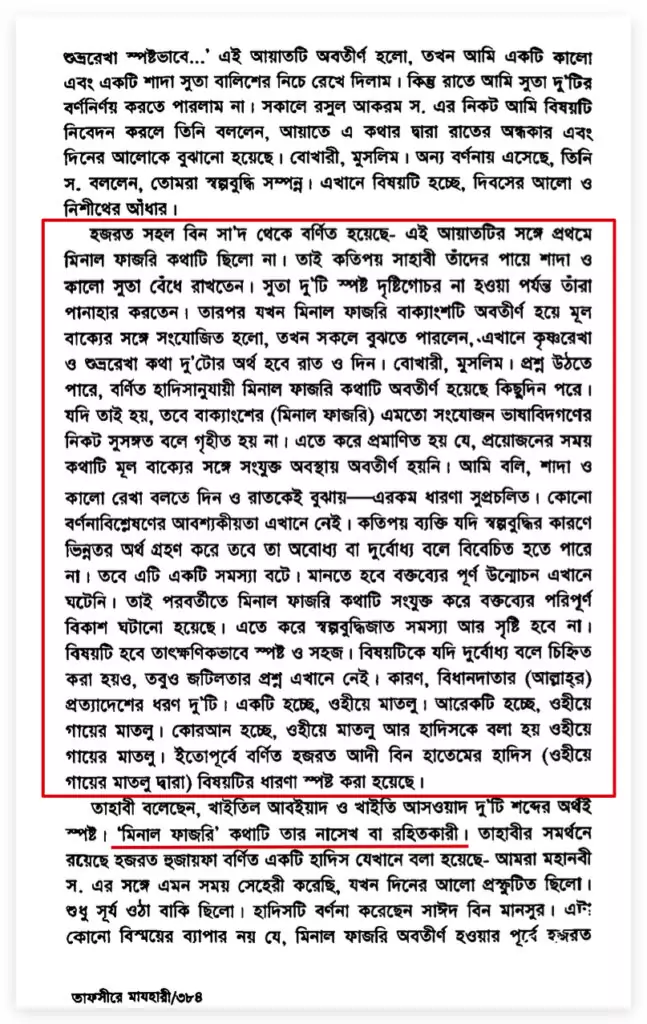
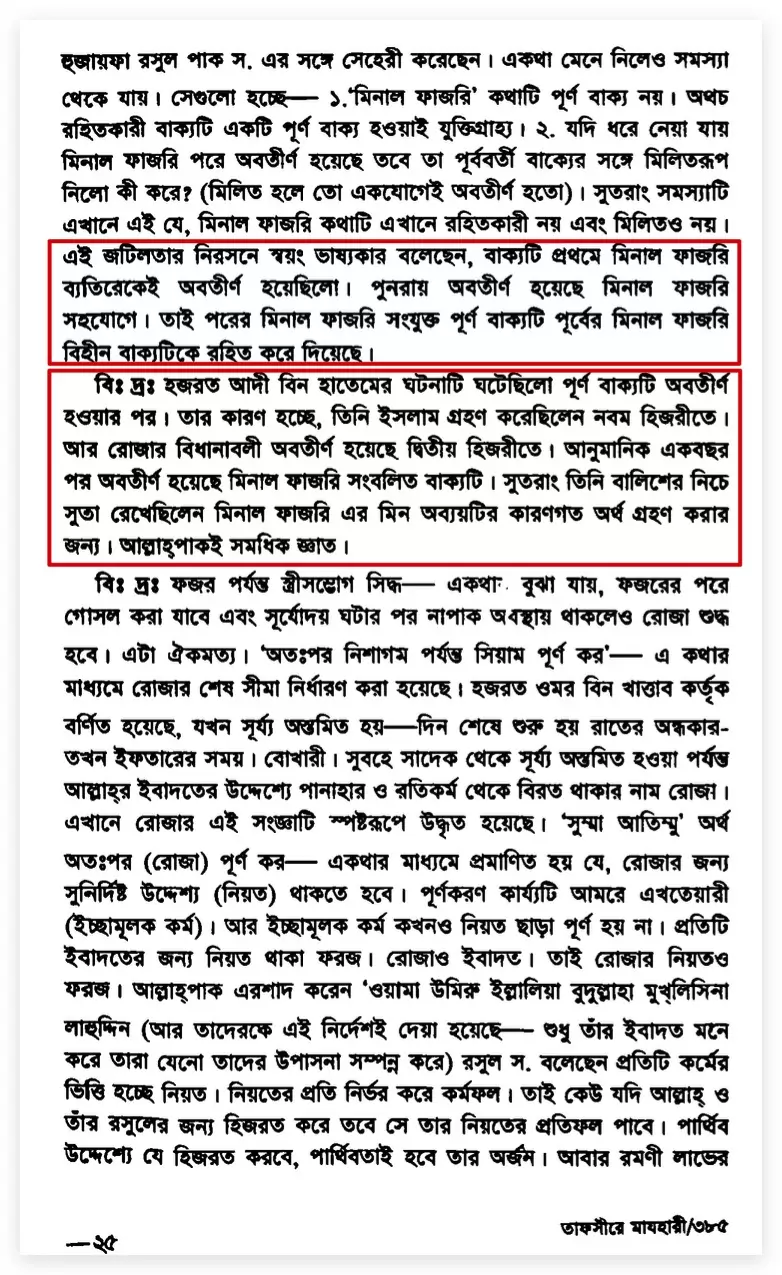
IslamQA has also quoted a description from Ibn Atiyyah’s Al-Muharrar al-Wajiz regarding a gap of one year between the two stages. The quotation mentions from one Ramadan to another Ramadan. The ‘after’ in Bukhari and the calculation of time quoted in this commentary—the information in these two is different: the first indicates sequence, while the second preserves a description of the length of that interval. [245]
وروي أنه كان بين طرفي المدة عام ، قال القاضي أبو محمد: من رمضان إلى رمضان، تأخر البيان إلى وقت الحاجة
English translation: it is narrated that there was one year between the two ends of the time. Qadi Abu Muhammad said: from one Ramadan to another Ramadan; the explanation was delayed until the time of need.
| Stage | Condition of the written phrase | Result in the narration |
|---|---|---|
| Previous reading | مِنَ الْفَجْرِ absent | Someone would test by tying a real thread |
| Subsequent reading | مِنَ الْفَجْرِ added | The meaning of the darkness of night and the light of day became clear |
| Source regarding time | Mention in Bukhari of it happening later | The specific calculation of about a year is a separate detail in the original tafsir |
In a separate answer regarding the meaning of the verse, IslamQA first identified the fact that ‘min al-fajr’ was not revealed initially as the cause of the misunderstanding. In that answer, the narration of Sahal and the incident of Adi have been presented separately, and the one-year calculation of some scholars has also been mentioned. That is, the sequence of events—from the wrong application due to incomplete instructions in the reading to the meaning becoming clear through additional words—is directly present in their own explanation. [246]
أنزل الآية أولاً بدون قوله : )مِنَ الْفَجْرِ )
English translation: He first revealed the verse without the words ‘min al-fajr’.
In Mazhari, the same commentary on one hand calls the people who misunderstood ‘short-witted’, while on the other hand it admits, ‘the full disclosure of the statement did not occur here.’ The second statement acknowledges the deficiency in the expression of the first instruction. Some recipients of the instruction acted according to its literal meaning; after the additional words were added, they understood a different meaning. The question of linguistic effectiveness is direct here: the meaning that reached them from the previous sentence changed after the addition. The adjective ‘short-witted’ places the blame on the people; the incident of inserting new words into the verse bears witness to interference in the language of the instruction.
Statement changed as a result of word addition
In the current verse, ‘min al-fajr’ is within the main sentence. This set of words links the white thread to the light of dawn. The additional words specify the identity of the scene intended by the word ‘thread’. Consequently, the practical instruction of the sentence in determining the time to stop eating and drinking also becomes clear. This arrangement exists in the prevailing reading of the Quran. [247]
وَكُلُوا وَاشْرَبُوا حَتَّىٰ يَتَبَيَّنَ لَكُمُ الْخَيْطُ الْأَبْيَضُ مِنَ الْخَيْطِ الْأَسْوَدِ مِنَ الْفَجْرِ ۖ ثُمَّ أَتِمُّوا الصِّيَامَ إِلَى اللَّيْلِ
English translation: Eat and drink until the white thread of dawn becomes clear to you from the black thread. Then complete the fast until the night.
| Elements of the reading | Difference between before and after | Result of the instruction |
|---|---|---|
| Sentence described first | Mention of understanding the difference between the black thread and the white thread | Some listeners used real threads as a benchmark |
| Subsequent addition | مِنَ الْفَجْرِ — ‘of dawn’ | The relationship of the white thread with dawn was specified |
| Position of the explanation | Additional words added to the sentence of the verse | The subsequently read sentence has more words than before |
| Reaction narrated by Sahal | Understanding the meaning of night and day after the addition | The time-related meaning was established in place of the literal application |
The number of words in the verse was not equal before and after. With the addition of ‘min’ and ‘al-fajr’, a specific reading became longer. The explanatory function of the addition is also clear in the narration: to shift the listener’s attention from the familiar material meaning of white and black threads toward the transition between night and day. Specific additional language came after human misunderstanding. That language became part of subsequent recitations and was included in the verses of the Quran. Consequently, the change was not limited to someone’s personal perception; it left a permanent mark on the structure of the spoken sentence.
In the explanations of Tahawi and Daudi, the first instruction was effective in its apparent meaning; later it was abrogated by ‘min al-fajr’. Ibn Hajar preserved this view in Fath al-Bari. In the long quotation of Mazhari, there is also an explanation that the full sentence was revealed again, abrogating the previous sentence. These explanations determine the relationship between the previous and subsequent instructions. [248]
ثُمَّ نُسِخَ بَعْدَ ذَلِكَ بِقَوْلِهِ تَعَالَى : مِنَ الْفَجْرِ
English translation: Then it was subsequently abrogated by His words ‘min al-fajr’.
The change is even clearer in Mazhari’s explanation that the first sentence was abrogated and a new sentence with additional words became effective. It is determined there which sentence will remain effective in place of the previous sentence. The commentators have given a theological classification to the sequence of human behavior, addition, and realization of meaning found in Sahal’s narration. The commentator’s classification and the hadith’s factual account are information at different levels; the difference between the first reading and the subsequent reading is present in both.
The account of the direct listener using threads shows the effective ambiguity of the first instruction. Those who tied threads to their feet while trying to follow the instruction got the idea for that action from the language of the sentence. The words added to remove their misunderstanding found a place in the subsequent reading of the Quran. In Mazhari, the responsibility for this linguistic problem is placed on the intelligence of the listener. Yet, to make the meaning clear, new words eventually had to be inserted into the sentence of the verse. This history of addition in the wording of the prevailing verses exists even before the Uthmanic compilation. The reading of the verse was one way before; after problems appeared in human application, its new form was established with additional words.
Correction of Nisa 4:95 upon the question of Ibn Umm Maktum
In verse 95 of Surah Nisa, a comparison is made between the status of believers participating in jihad and those staying behind. In the first version of the verse, there was no exception for disabled persons. The blind Companion Amr ibn Umm Maktum after he raised a question about his own condition, ‘ghayru ulid-darar’ was added. Along with the addition of words after a human question, the limit of whom the comparison would apply to also changed.
First version in Bukhari, preparation for writing, and the blind Companion’s question
In the narration of Bara ibn Azib, the verse was first revealed, then Muhammad told Zayd to bring writing materials. The instruction was to write down the announced sentence. At that time, the blind Companion sitting behind informed him of his condition. It is mentioned that after his question, the version containing the exception was revealed. The sequence of pronouncing the instruction, having it written down, and correcting the language after the question is within the same account. [249]
Sahih Bukhari (Tawhid Publication)
66/ Virtues of the Al-Quran
Section: 66/4. The katib (writer of wahy) of the Nabi sallallahu ‘alaihi wasallam
4990. Narrated from Bara’a (ra). He said, لَايَسْتَوِي الْقَاعِدُوْنَ مِنَ الْمُؤْمِنِيْنَ ….وَالْمُجَاهِدُوْنَ فِيْسَبِيْلِ اللهِ When the verse was revealed, the Nabi sallallahu ’alaihi wasallam said, call Zayd to me and tell him to bring a piece of wood, an inkpot, and a shoulder bone (the narrator says- or he said, a shoulder bone and an inkpot). Then he said, write. At this time the blind companion Amr ibn Umm Maktum (ra) was sitting behind the Nabi sallallahu ’alaihi wasallam. He said, I am blind, regarding me your what is the instruction? In response to this, instead of the aforementioned verse, was revealed: ’’Not equal are those believers who stay at home without a valid excuse and those believers who strive with their lives and wealth in the way of Allah’’- (Surah an-Nisa 4/95). [2831] (Modern Publication: 4619, Islamic Foundation: 4624)
Hadith status: Sahih (Sahih)
Narrator: Bara’a ibn Azib (ra)
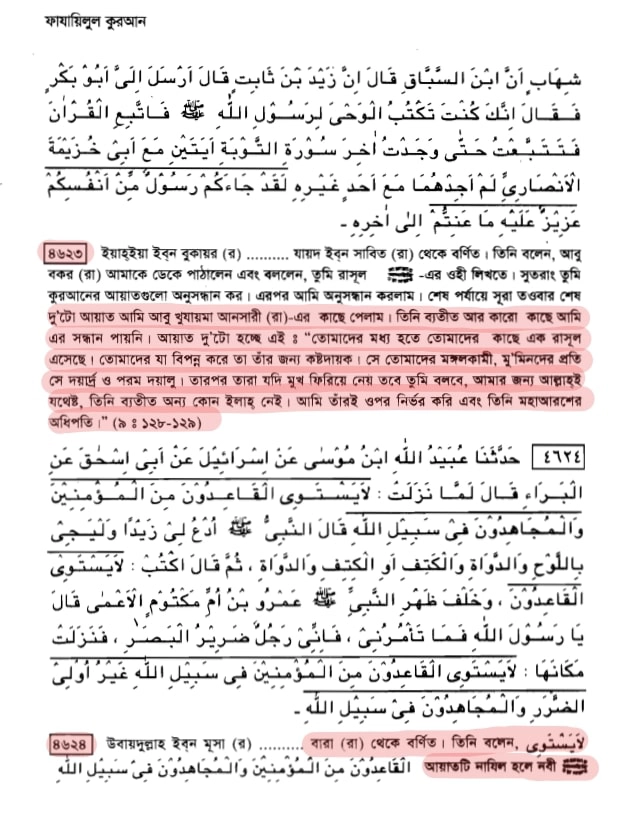
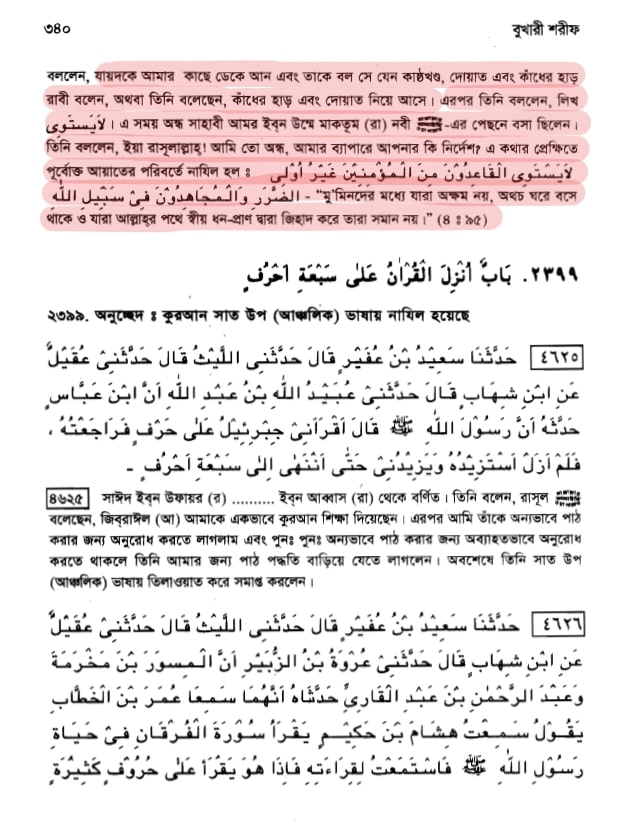
In the Arabic narration of Bukhari, the blind person directly asked for the instruction for himself. Immediately after this, it is said ‘fana-zalat makanaha’—it was revealed in its place. In place of the first announced sentence, a version with an additional condition came. In the previous sentence, there was a general identity of believers who sat; in the subsequent version, the exception for disability entered. The subject of the question and the subject of the new condition are the same: physical capacity to fight. [250]
قَالَ يَا رَسُولَ اللَّهِ فَمَا تَأْمُرُنِي فَإِنِّي رَجُلٌ ضَرِيرُ الْبَصَرِ فَنَزَلَتْ مَكَانَهَا
English translation: He said, O Messenger of Allah, what instruction do you give me? For I am a blind person. Then it was revealed in its place.
In another narration in the chapter on Jihad, there is clear language that Zayd brought the shoulder bone and wrote the verse. Then Ibn Umm Maktum informed him of his disability, and the sentence with the exception was revealed. Here, the act of recording also proceeded after the announcement. The objection was raised against a statement that was written as Quran at that very moment. [251]
لَمَّا نَزَلَتْ {لاَ يَسْتَوِي الْقَاعِدُونَ مِنَ الْمُؤْمِنِينَ} دَعَا رَسُولُ اللَّهِ صلى الله عليه وسلم زَيْدًا، فَجَاءَ بِكَتِفٍ فَكَتَبَهَا، وَشَكَا ابْنُ أُمِّ مَكْتُومٍ ضَرَارَتَهُ فَنَزَلَتْ {لاَ يَسْتَوِي الْقَاعِدُونَ مِنَ الْمُؤْمِنِينَ غَيْرُ أُولِي الضَّرَرِ }
English translation: When ‘Not equal are those among the believers who sit’ was revealed, the Messenger of Allah called Zayd. He brought the shoulder bone and wrote it. Ibn Umm Maktum informed him of his disability. Then it was revealed: ‘Not equal are those among the believers who sit, except those with a disability.’
The shoulder bone used for writing was the page for preserving the sentence. Consequently, the phrase ‘faqatabaha’—he wrote it—carries the claim that the first version was recorded. In the same account, the conditional version came later. Between these two states lies the objection of the blind person. The first writing was the written form of the announced instruction; the subsequent addition changed the language of that writing. This process of forming the verse is narrated during Muhammad’s lifetime, before the compilation by subsequent Caliphs began.
In Bukhari, in Zayd’s own narration, there is mention of the arrival of the blind Companion while the act of writing was ongoing as dictated by Muhammad. In Fath al-Bari, Ibn Hajar explained the meaning of the word ‘yumilluha’ as dictating to be written. That is, there was a direct relationship between the oral pronunciation of the statement and the creation of its written form. The sentence being given to the writer had the exception inserted into it after the question. [252]
قوله : ( وهو يملها ) بضم أوله وكسر الميم وتشديد اللام هو مثل يمليها ، يملي ويملل بمعنى
English translation: In his words ‘then he was dictating it’—the first letter of the word ‘yumilluha’ has a pesh, the mim has a zer, and the lam has a tashdid; it is like ‘yumliha’. Both verbs are used in the same sense.
The comparison in the first sentence did not distinguish between abstaining from war by personal choice and being unable to go due to physical disability. The blind Companion’s question expresses exactly that problem. His disability is not proof of a lack of enthusiasm for war; eyesight is not something under his control. Yet, in the announced comparison without exception, he was falling into the same linguistic category as other believers who sat. Consequently, the correction also has social significance: the question of whether someone should be placed in a lower status group due to disability was raised directly by the affected person.
Different accounts of the same incident in multiple narrations of Nasa’i
In narration 3100 of Nasa’i, the arrival of Ibn Umm Maktum is mentioned while the verse was being dictated to Zayd. He said that if he had the capacity, he too would have participated in jihad. In these words, the difference between unwillingness to fight and disability becomes clear. Along with his religious interest, he highlighted the physical barrier. Then there is a description of the revelation of the words containing the exception. [253]
أَنَّ رَسُولَ اللَّهِ صلى الله عليه وسلم أَمْلَى عَلَيْهِ لاَ يَسْتَوِي الْقَاعِدُونَ مِنَ الْمُؤْمِنِينَ وَالْمُجَاهِدُونَ فِي سَبِيلِ اللَّهِ . قَالَ فَجَاءَهُ ابْنُ أُمِّ مَكْتُومٍ وَهُوَ يُمِلُّهَا عَلَىَّ فَقَالَ يَا رَسُولَ اللَّهِ لَوْ أَسْتَطِيعُ الْجِهَادَ لَجَاهَدْتُ . وَكَانَ رَجُلاً أَعْمَى فَأَنْزَلَ اللَّهُ عَلَى رَسُولِهِ صلى الله عليه وسلم وَفَخِذُهُ عَلَى فَخِذِي حَتَّى هَمَّتْ تَرُضُّ فَخِذِي ثُمَّ سُرِّيَ عَنْهُ فَأَنْزَلَ اللَّهُ عَزَّ وَجَلَّ { غَيْرُ أُولِي الضَّرَرِ }
English translation: The Messenger of Allah had him write: “Not equal are those of the believers who stay behind and those who strive in the way of Allah.” He said, Ibn Umm Maktum came to him while he was having it written for me. He said, “O Messenger of Allah, if I had the ability to strive, I would certainly have striven.” He was a blind man. Then Allah revealed to His Messenger; his thigh was upon my thigh, to the extent that my thigh was nearly crushed. Then that state passed and Allah revealed: “Except for those who are disabled.”
In report number 3101, the language of the blind Companion’s question is, “Is there a concession for me?” Before that, he was asked to bring a shoulder bone and a writing tablet, and the first sentence was written. Therefore, his request for a concession is an appeal to distinguish himself from the scope of an already announced general statement. In response, words containing an exception appeared within the verse itself. [254]
قَالَ ” ائْتُونِي بِالْكَتِفِ وَاللَّوْحِ ” . فَكَتَبَ { لاَ يَسْتَوِي الْقَاعِدُونَ مِنَ الْمُؤْمِنِينَ } وَعَمْرُو بْنُ أُمِّ مَكْتُومٍ خَلْفَهُ فَقَالَ هَلْ لِي رُخْصَةٌ فَنَزَلَتْ { غَيْرُ أُولِي الضَّرَرِ }
English translation: He said, “Bring me a shoulder bone and a writing tablet.” Then it was written: “Not equal are those of the believers who stay behind.” Amr ibn Umm Maktum was behind him. He said, “Is there a concession for me?” Then it was revealed: “Except for those who are disabled.”
In report number 3102, the question is more direct: “I am blind, what will happen in my case?” It is also mentioned here that he did not move away until the exception was revealed. The temporal proximity between the first statement, the question of the person present, and the subsequent addition is specified in this language. Only after a general classification came into conflict with his actual condition was the limit of that category revised. [255]
لَمَّا نَزَلَتْ { لاَ يَسْتَوِي الْقَاعِدُونَ مِنَ الْمُؤْمِنِينَ } جَاءَ ابْنُ أُمِّ مَكْتُومٍ وَكَانَ أَعْمَى فَقَالَ يَا رَسُولَ اللَّهِ فَكَيْفَ فِيَّ وَأَنَا أَعْمَى قَالَ فَمَا بَرِحَ حَتَّى نَزَلَتْ { غَيْرُ أُولِي الضَّرَرِ }
English translation: When “Not equal are those of the believers who stay behind” was revealed, Ibn Umm Maktum came. He was blind. He said, “O Messenger of Allah, I am blind, what will happen in my case?” The narrator says, he did not move away until “Except for those who are disabled” was revealed.
| Nasa’i’s report | Language and situation of the question | Subsequent events |
|---|---|---|
| 3100; account of Zayd ibn Thabit | Arrival during writing; would have striven if able | Exception revealed after the account of the revelation’s arrival |
| 3101; account of Bara ibn Azib | First sentence written; “Is there a concession for me?” | Revelation of “ghayru uli-d-darar” |
| 3102; account of Bara ibn Azib | “I am blind, what will happen in my case?” | Exception revealed before he moved away |
The chain of report number 3100 reaches Sahl, Marwan, and Zayd; the latter two are Bara’s accounts through Abu Ishaq. In these readings of the same event, there are differences in the sentence of the question and the description of the writing situation. The center of their agreement is: the first instruction without exception, the notification of the blind man’s disability, and then the arrival of new words. The question concerns his own status and responsibility. The language that came in response also captured that personal problem in the language of a general exception.
There is a clear link among the contents of the question narrated in three ways. In the word “rukhsa” (concession), an exemption from the general statement is sought; in the words “I am blind, what will happen in my case,” the person’s actual condition is brought before application; in stating that he would have striven if able, the difference between will and capacity is expressed. These differences later determine the meaning of the added condition. The problem was created where a person’s physical limitation was counted as a lack of religious interest. He identified that problem himself and raised it before the authority. Consequently, the questioner played an active role in the process of correction: by stating his condition, he exposed the inadequate classification of the announced sentence.
IslamQA has given this event as an example of a verse being revealed as soon as the cause occurred. In their explanation, the addition came within the same time and the same event. Consequently, the gap between the first sentence and the revised sentence is also specified: immediately after the question of a person present, the relevant words for him appeared in the text. [256]
بل نزلت الآية في نفس الوقت والحادثة
English translation: Rather, the verse was revealed within the same time and the same event.
Addition of “ghayru uli-d-darar” to the written sentence and change in the scope of the ruling
In Abu Dawud’s report, the written position of the addition is also mentioned. Zayd first wrote the verse on the shoulder bone. After Ibn Umm Maktum’s question, Muhammad asked him to read it back. During the reading, “ghayru uli-d-darar” was spoken, and Zayd added it. He remembered the place of addition as being beside a crack in the shoulder bone. Thus, the act of placing extra words on the writing material is linked to the change in the text within the same account. [257]
فَقَالَ : ” اقْرَأْ يَا زَيْدُ ” . فَقَرَأْتُ { لاَ يَسْتَوِي الْقَاعِدُونَ مِنَ الْمُؤْمِنِينَ } فَقَالَ رَسُولُ اللَّهِ صلى الله عليه وسلم { غَيْرُ أُولِي الضَّرَرِ } الآيَةَ كُلَّهَا . قَالَ زَيْدٌ : فَأَنْزَلَهَا اللَّهُ وَحْدَهَا فَأَلْحَقْتُهَا، وَالَّذِي نَفْسِي بِيَدِهِ لَكَأَنِّي أَنْظُرُ إِلَى مُلْحَقِهَا عِنْدَ صَدْعٍ فِي كَتِفٍ
English translation: He said, “Read, O Zayd.” I read: “Not equal are those of the believers who stay behind.” Then the Messenger of Allah said: “Except for those who are disabled”—the complete verse. Zayd said, Allah revealed this part separately, so I added it. By Him in whose hand is my soul, I can almost see the place where I added it beside the crack in the shoulder bone.
The phrase “I added it” informs the relationship between the previous state of the written sentence and the subsequent state. When the sentence was first written, the extra words were not there; they were placed later. The linguistic function of the new words is also specific: to create a separate position for disabled persons within the general category of believers who stay behind. As soon as the extra words are read, the limit of whom the status is being compared against is narrowed. The same sentence becomes more specific than before and larger in word count.
Ibn Kathir explained the first sentence as unconditional and, after the exception was added through rapid revelation, brought up the context of disabilities such as blindness, lameness, and illness. In this explanation, the social scope of the new words extends beyond a single questioner. The set of words announced in response to Ibn Umm Maktum’s question became the language of exception for similarly disabled people. [258]
فقوله [ تعالى ] ( لا يستوي القاعدون من المؤمنين ) كان مطلقا ، فلما نزل بوحي سريع : ( غير أولي الضرر ) صار ذلك مخرجا لذوي الأعذار المبيحة لترك الجهاد
English translation: His statement “Not equal are those of the believers who stay behind” was unconditional. Then, when “Except for those who are disabled” was revealed through rapid revelation, it became the ruling of exception for those who have an authorized reason for abstaining from jihad.
In the current verse, the exception for disability is located immediately after the words “believers who stay behind.” Following this, the mention of those who strive with their wealth and lives, their additional status, and the announcement of their reward come. Consequently, the position of the new condition is linked to the entire comparison. The problem of keeping those who cannot go for physical reasons and those who stay behind despite having the capacity within one general identity is removed by placing the exception at this location. The language of the reward also shows that the questioner’s concern was regarding his own religious status. [259]
لَّا يَسْتَوِي الْقَاعِدُونَ مِنَ الْمُؤْمِنِينَ غَيْرُ أُولِي الضَّرَرِ وَالْمُجَاهِدُونَ فِي سَبِيلِ اللَّهِ بِأَمْوَالِهِمْ وَأَنفُسِهِمْ ۚ فَضَّلَ اللَّهُ الْمُجَاهِدِينَ بِأَمْوَالِهِمْ وَأَنفُسِهِمْ عَلَى الْقَاعِدِينَ دَرَجَةً ۚ وَكُلًّا وَعَدَ اللَّهُ الْحُسْنَىٰ ۚ وَفَضَّلَ اللَّهُ الْمُجَاهِدِينَ عَلَى الْقَاعِدِينَ أَجْرًا عَظِيمًا
English translation: Not equal are those of the believers who stay behind, except for those who are disabled, and those who strive in the way of Allah with their wealth and their lives. Allah has given those who strive with wealth and lives a degree of status above those who stay behind. Allah has promised a fair reward to all; but He has given the strivers superiority over those who stay behind in the great reward.
| Levels of statement | Elements present in the text | Classification of human conditions |
|---|---|---|
| First wording | Believers who stay behind and strivers are not equal | Exception for disability unmentioned in the identity of those who stay behind |
| Question raised | I am blind; what is the instruction or concession for me? | Difference between disability and voluntary abstention revealed |
| Subsequent addition | غَيْرُ أُولِي الضَّرَرِ | Exception added for disabled persons |
| Written result | Zayd adds the new words to the previous writing | The form with the exception becomes part of the recited sentence |
The statement of a general comparison regarding believers who stay behind without conditions and the statement of comparison excluding disabled persons are not the same. The questioner found himself within the broad category of the first wording; the subsequent condition gave him a special position outside that general classification. This is a correction that carries actual meaning regarding status and reward. Disability is not synonymous with voluntarily avoiding duty—a person’s question entered that difference into the text. The task of identifying the deficiency in the first sentence given by religious authority was performed here by the very person whose own condition was not properly captured in the sentence.
Pronunciation, writing, and application—the result of the addition exists in all three places. Muhammad pronounced the extra words, Zayd added them to the previous writing, and the scope of the comparison of believers who stay behind changed. Within the form adopted after the correction, the history of the text before the question also exists. The subsequent form was recognized as revelation. In that recognized form, there are new words compared to the first announcement, and there is a clear exception for disabled people. In this event of the Quran’s revelation, the relationship between human questioning and the change in text is directly narrated.
In Ibn Hibban, the question “What is our crime” and the fear of the objector
In Ibn Hibban’s collection, the report of Falatan ibn Asim reveals another aspect of the questioner’s anxiety. When the first instruction compared believers who stay behind with those who strive, the blind man stood up and asked, “What is our crime?” The problem of falling into the lower status group due to his own disability is directly expressed in this question. Then, when it was announced again that revelation was coming, he feared whether something was being revealed regarding him. After speaking of his condition, he had to remain terrified about the result of the imminent announcement. [260]
كُنَّا عِنْدَ النَّبِيِّ صَلَّى اللَّهُ عَلَيْهِ وَسَلَّمَ ، فَأَنْزَلَ اللَّهُ عَلَيْهِ ، وَكَانَ إِذَا أُنْزِلَ عَلَيْهِ دَامَ بَصَرُهُ مَفْتُوحَةً عَيْنَاهُ ، وَفَرَغَ سَمْعُهُ وَقَلْبُهُ لِمَا يَأْتِيهِ مِنَ اللَّهِ ، قَالَ : فَكُنَّا نَعْرِفُ ذَلِكَ مِنْهُ ، فَقَالَ لِلْكَاتِبِ : اكْتُبْ لا يَسْتَوِي الْقَاعِدُونَ مِنَ الْمُؤْمِنِينَ وَالْمُجَاهِدُونَ فِي سَبِيلِ اللَّهِ ، فَقَامَ الْأَعْمَى ، فَقَالَ : يَا رَسُولَ اللَّهِ مَا ذَنْبُنَا ؟ فَأُنْزِلَ عَلَيْهِ ، فَقُلْنَا لِلْأَعْمَى : إِنَّهُ يُنَزَّلُ عَلَى النَّبِيِّ صَلَّى اللَّهُ عَلَيْهِ وَسَلَّمَ ، فَخَافَ أَنْ يُنَزَّلَ عَلَيْهِ شَيْءٌ مِنْ أَمْرِهِ ، فَبَقِيَ قَائِمًا ، وَيَقُولُ : أَعُوذُ بِغَضَبِ رَسُولِ اللَّهِ صَلَّى اللَّهُ عَلَيْهِ وَسَلَّمَ ، قَالَ : فَقَالَ النَّبِيُّ صَلَّى اللَّهُ عَلَيْهِ وَسَلَّمَ لِلْكَاتِبِ : اكْتُبْ غَيْرُ أُولِي الضَّرَرِ
English translation: We were with the Prophet. Then Allah revealed revelation upon him. When it was revealed upon him, his gaze would become fixed, his eyes would remain open, and his hearing and mind would be attentive to what came from Allah. He said, we could recognize that state in him. He told the writer, “Write: Not equal are those of the believers who stay behind and those who strive in the way of Allah.” Then the blind man stood up and said, “O Messenger of Allah, what is our crime?” Then revelation descended upon him. We said to the blind man, “Now it is descending upon the Prophet.” Then he feared that something might be revealed regarding himself. He remained standing and kept saying, “I seek refuge from the wrath of the Messenger of Allah.” He said, then the Prophet told the writer, “Write: Except for those who are disabled.”
The word “our” takes the question beyond personal inconvenience. The blind man’s condition represents the general problem of similarly disabled people. There is a difference between being unable to go to war and voluntarily abstaining; in the language of the first announcement, that difference was unmentioned. The questioner’s blindness is not his chosen crime. Yet he had to know his position in a comparison where those who stayed behind were grouped together without a difference between capacity and disability. The moral issue of his question is why status should decrease for a disability beyond one’s control.
In the report, there is also a specific reason for the fear: that something might be revealed regarding himself. That is, he did not know what result the announcement following the question would bring for him. From the moment of raising the question to the prayer for self-protection, this behavior reveals an unequal relationship of power. On one side is Muhammad, whose newly spoken sentence would gain the status of divine instruction; on the other is the blind follower, who has no power to determine how his own condition will be captured in that instruction. Even after stating his disability, he had to remain anxious about potential wrath.
| Stages of the event | Reported words or behavior | Position of the questioner |
|---|---|---|
| After the first announcement | The blind man stands up | Brings the problem of his condition in the comparison to the fore |
| Question regarding his condition | “What is our crime?” | Wants to know the justification for loss of status due to disability |
| News of revelation coming again | Fear of something being revealed regarding himself | Uncertainty regarding the result of the subsequent announcement |
| Time of waiting | Standing and seeking refuge from wrath | Anxiety for self-protection along with self-justification |
| Final instruction | The writer is told to write the exception | The position of disabled persons is added to the text after the question |
Although the question eventually brought an exception to the verse, the event of the questioner’s fear is part of the same account. The question of crime and the fear of wrath became entangled with his legitimate anxiety. In seeking the place of his disability within a general statement about religious status, he also had to consider the potential reaction of the authority. Consequently, within the history of obtaining the new words, there is not only linguistic correction; there is also the social cost of seeking that correction. The protection of the disabled person was not clear in the first announcement, and upon raising the question of protection, he had to wait in a state of fear.
At the center of this relationship lies the power of proclamation. The questioner may share his experience, but it is Muhammad who proclaims the religious consequence of that statement, and the appointed scribe who writes it. For an individual’s need to receive recognition, it must pass through the approval of this authority. The experience of the blind follower revealed a deficiency in the initial statement; the recognized identity of the correction became new revelation. This sequential positioning of human objection and religious approval simultaneously demonstrates the role of the questioner in the process of correction and the limits of that role.
In the title of this section by Ibn Hibban, the exemption of disabled persons is presented as Allah’s grace. The title given by the compiler carries a religious evaluation of the event: the recognition of an exception is a sign of grace. In the original account, prior to that recognition, there are descriptions of the question, the fear of proclaiming something regarding oneself, and the act of waiting while standing. Consequently, alongside the language of grace in the title, the specific history of the questioner’s need and anxiety is also preserved. [261]
ذِكْرُ مَا تَفَضَّلَ اللَّهُ جَلَّ وَعَلَا بِعُذْرِ أُولِي الضَّرَرِ عِنْدَ قُعُودِهِمْ عَنِ الْخُرُوجِ إِلَى الْجِهَادِ فِي سَبِيلِهِ
English translation: An account of the grace Allah has shown by exempting disabled persons who remain behind instead of going out for jihad in His path.
It is unjust to determine the status of a person over whom they have no control using the same criteria as an able-bodied person. The resolution of this injustice is identified here in the language of mercy. The legitimate position of the questioner is recognized as the grace of the proclaimer. As a result, the responsibility for the inadequacy of the first sentence and the credit for the subsequent solution go in opposite directions: the blind man raised the problem of experience, while the lawgiver received the religious credit for granting the exception. When the same event is judged as a relationship of rights and power, the role of the questioner becomes clear.
Description of physical weight and visible signs during revelation
In the account regarding the addition to Nisa 4:95, there is also mention of Muhammad’s physical condition during the arrival of revelation. Ibn Hibban’s account mentions a fixed gaze, open eyes, and attention toward the incoming message. In Zayd’s narration in Bukhari, the experience of Muhammad’s thigh becoming heavy upon his own thigh is mentioned. Zayd stated that he felt such weight that he feared his own thigh would break. [262]
فَأَنْزَلَ اللَّهُ عَلَى رَسُولِهِ صلى الله عليه وسلم وَفَخِذُهُ عَلَى فَخِذِي، فَثَقُلَتْ عَلَىَّ حَتَّى خِفْتُ أَنْ تُرَضَّ فَخِذِي، ثُمَّ سُرِّيَ عَنْهُ، فَأَنْزَلَ اللَّهُ {غَيْرَ أُولِي الضَّرَرِ}
English translation: Allah revealed to His Messenger. His thigh was upon my thigh. It became so heavy upon me that I feared my thigh would break. Then that state passed, and Allah revealed: “Except for those who are disabled.”
In Abu Dawood’s account, the event occurs in two stages. First, Muhammad is overcome by “Sakinah” or a state of tranquility, the weight of his thigh is felt, and once that state passes, he orders the verse to be written. Then the blind man asks his question. Consequently, in this account, the proclamation of the first statement is also linked to the physical condition. [263]
كُنْتُ إِلَى جَنْبِ رَسُولِ اللَّهِ صلى الله عليه وسلم فَغَشِيَتْهُ السَّكِينَةُ فَوَقَعَتْ فَخِذُ رَسُولِ اللَّهِ صلى الله عليه وسلم عَلَى فَخِذِي، فَمَا وَجَدْتُ ثِقَلَ شَىْءٍ أَثْقَلَ مِنْ فَخِذِ رَسُولِ اللَّهِ صلى الله عليه وسلم ثُمَّ سُرِّيَ عَنْهُ فَقَالَ : ” اكْتُبْ ”
English translation: I was beside the Messenger of Allah. Then Sakinah overcame him and his thigh fell upon my thigh. I have never felt a weight heavier than his thigh. Then, when that state passed, he said, “Write.”
After the question ends, a similar state returns for a second time. Zayd described the second weight as being like the first. Then Muhammad asks him to read, and the word of exception is given. The repetition of the same physical condition before both statements is clear in this account. [264]
فَلَمَّا قَضَى كَلاَمَهُ غَشِيَتْ رَسُولَ اللَّهِ صلى الله عليه وسلم السَّكِينَةُ فَوَقَعَتْ فَخِذُهُ عَلَى فَخِذِي وَوَجَدْتُ مِنْ ثِقَلِهَا فِي الْمَرَّةِ الثَّانِيَةِ كَمَا وَجَدْتُ فِي الْمَرَّةِ الأُولَى ثُمَّ سُرِّيَ عَنْ رَسُولِ اللَّهِ صلى الله عليه وسلم فَقَالَ : ” اقْرَأْ يَا زَيْدُ ”
English translation: When he finished speaking, Sakinah overcame the Messenger of Allah. His thigh fell upon my thigh. For the second time, I felt that weight, just as I had felt it the first time. Then, when that state passed, he said, “Read, O Zayd.”
The described physical experience and the divine source of the spoken words are two separate claims. Zayd spoke of the weight felt upon himself; Falatan described the familiar signs of fixed eyes and attention. From these signs, an observer can identify a change in a person’s physical state. To reach the conclusion from there that the message came from the Omniscient Creator requires additional proof. A fixed gaze or feeling the weight of another’s thigh does not include the identity of the message’s source. The intensity of a sensation does not determine the accuracy of the spoken statement.
| Narrated experience | What is found in the account | Relationship with the claim of divine source |
|---|---|---|
| Fixed gaze, open eyes | Those present recognized the familiar state | External signs do not identify the sender of the message |
| Intense weight of the thigh | Zayd speaks of his own sensation and fear | Omniscience of the statement does not follow from the feeling of weight |
| Same state in the first and second stages | Description of weight before both the first statement and the correction | Same signs do not remove verbal differences |
| Writing instruction at the end of the state | Muhammad specifies what is to be written | The content of the instruction is found in the spoken sentence itself |
The first sentence did not have the exception for disability; it was added later. Since descriptions of the same physical weight precede both sentences, if that weight is made the test of the statement’s completeness, there is no mechanism to detect the deficiency of the first sentence. The necessary distinction was captured in the question of a blind man. Physical signs did not indicate the difficulty of the first proclamation; the affected person brought it forward through his own experience. The content of the correction came in alignment with his question. Therefore, the sequence of the statement’s structure and change is directly relevant here, rather than the drama of the signs.
The accounts given about the state of the human body contain experience; omniscience is a claim of knowledge. One is not automatically proven by the other. To judge the truth of a message’s source, support from its statement, information, and logic is needed. Here, the description of physical experience exists alongside the first reading, the question, and the subsequent addition. In the entire sequence of events, including the description of body weight, there are two stages of the reading. The unmentioned exception in the first proclamation was added in the second stage; the change was reported while the physical signs were being described.
Inconsistency of adding an exception after a claim of omniscience and an objection
In the Quran’s own language, the Creator’s knowledge encompasses His creation. In Surah Mulk, the question of the Creator’s knowing is presented in the language of rhetorical certainty. In Tabari’s explanation, the idea that creation and the act of creating are outside His knowledge is rejected. Consequently, prior knowledge of a human’s physical state and the actual consequences of that state falls within the claim of omniscience. [265]
أَلَا يَعْلَمُ مَنْ خَلَقَ وَهُوَ اللَّطِيفُ الْخَبِيرُ
English translation: Does He who created not know? He is the Subtle, the All-Aware.
The blindness of Ibn Umm Maktum is a present physical reality. Even if there is a desire to fight, blindness can be an obstacle to that work. To know this difference, there should be no need for new information to reach the Omniscient Lawgiver. Yet, the language of the first proclamation lacked the necessary exception. That exception came after the blind man informed him of his condition. The inconsistency lies here: between the claim of prior knowledge and the use of that known information in an effective sentence. The distinction that should have been in the statement from the start entered the reading after a human’s question.
The importance of the condition is understood in its application. A general comparison involving all believers who remain behind and a comparison excluding disabled persons are not the same statement. In the former, there is no separate position for a person remaining behind due to disability. In the latter, that position is made clear. Thus, the added words are not merely an added beauty of expression; they change who is evaluated and how. In the general classification of religious status, this change is a semantic correction. A specific human objection made the necessary limit a part of the spoken and written sentence.
In explaining the reason for revelation, IslamQA has stated that the Quran is revealed centering on an event after it occurs. It includes questions, words, and actions within this reason. It has also mentioned the event of Ibn Umm Maktum as an example of an addition arriving at the same time. Within the recognized framework of this explanation lies the relationship between human raising of an issue and the subsequent proclamation. [266]
أن يقع حدث فينزل قرآن بشأنه
English translation: An event occurs and the Quran is revealed centering on it.
Here, there is a direct similarity to the familiar process of amending human laws. First, a general instruction is given. The person whose actual condition was not properly captured by that instruction reports the problem. Then, the scope of the statement is changed by adding the necessary exception. Correcting language after an error is detected is the normal work of a lawmaker with limited knowledge. In the same process proclaimed in the name of an Omniscient and infallible source, the inadequacy of the first sentence becomes even more prominent. The experience of the affected person brought forward more specific information than the incomplete classification of the instruction.
The religious status of the first proclamation is also part of this problem. Instructions were given to write it down at that time. Consequently, the necessary condition was absent within the very sentence that people were going to accept and preserve as the Quran. A present listener questioned in that state, and later the sentence grew. Although the same authority of recognition worked before and after the correction, the language and scope of application of the two sentences were not the same. Religious approval did not identify the deficiency of the first sentence itself; the social act of expressing that deficiency was performed by the blind questioner.
The legitimate position of a person unable to go to war due to disability should not depend on their ability to ask a question. In this described correction, their need received clear recognition only when they themselves raised an objection. The moral problem here is deep: the person upon whom the proclamation’s impact falls must also take the initiative for the correction. In Ibn Hibban’s account, fear is attached to that initiative. Even after wanting to know if any sin is incurred for his disability, he had to remain standing for fear of anger. Both the need of the questioner and the safety of the questioner await the subsequent reaction of the authority.
The addition of words has occurred in the history of the verse—this is the direct subject of the accounts. In the first reading, “ghayru ulid-darar” was not there; it was later revealed and attached. Therefore, the absolute claim that no word has ever changed or increased since the beginning of revelation is false. The validity of the later form indicates a reading accepted at a certain time. The verbal difference from the first proclamation is present in the account itself: the extra condition came later. Within the current reading, the condition added after the previously unmentioned state exists. In its history, there is a visible role of human questioning.
The sentences of the Quran became more complete after human problems were raised to Muhammad. The condition of the blind man first fell within the general classification, then was separated by an exception. Those extra words were placed in writing as soon as they were proclaimed and became part of the subsequent recited form. The religious identity of this act is revelation; its actual method consists of statement, objection, and correction. A blind man revealed the necessary deficiency in a sentence propagated with a claim of an Omniscient source—this sequence of events is a direct specimen of the structure of the Quran linked to human situations.
Umar’s opinion, changes in revelation and instructions due to personal interest and social pressure
The relationship between Umar’s statements and interventions and the revelation and modification of Quranic instructions appears repeatedly in the hadiths. In some instances, he made a proposal, and subsequently, a verse similar to that proposal was revealed; in other instances, instructions changed after he raised objections to Muhammad’s decisions or expressed difficulty regarding existing rulings. Proposals, personal preferences, family disputes, and social pressures are part of these events. In religious literature, these coincidences have been compiled as evidence of Umar’s special status. Within those very compilations, the sequence of a human’s position coming first and the announcement of similar revelation coming later is preserved.
“Muwafaqat Umar”: Truth on His Tongue, His Status as a Muhaddath, and Reports of Revelation Matching His Opinions
In a radio-television request program, the listener’s preference is stated first, then the presenter plays the song according to that request. Among the accounts of verses arriving after Umar’s proposals, there is also a relationship of asking first and a similar proclamation following. In religious literature, “Muwafaqat Umar” refers to this alignment of revelation with Umar’s opinion. The arrival of a religious instruction after a human’s proposal is called his virtue; in the same sequence of events, that person’s opinion and position became directly linked to the language and laws of the Quran.
In Tirmidhi’s report, it is first stated in the name of Muhammad that Allah has kept truth in Umar’s tongue and heart. Then comes the statement of Ibn Umar: whenever Umar agreed with people regarding an event, the Quran was revealed in accordance with his words. The first is a declaration of Umar’s special status; the second is Ibn Umar’s generalization regarding the relationship between Umar’s opinion and subsequent readings. In the same report, the individual’s identity as truth-guided and the claim of revelation in accordance with his words are placed side by side. [267]
«إِنَّ اللَّهَ جَعَلَ الْحَقَّ عَلَى لِسَانِ عُمَرَ وَقَلْبِهِ» وَقَالَ ابْنُ عُمَرَ مَا نَزَلَ بِالنَّاسِ أَمْرٌ قَطُّ فَقَالُوا فِيهِ وَقَالَ فِيهِ عُمَرُ أَوْ قَالَ ابْنُ الْخَطَّابِ فِيهِ شَكَّ خَارِجَةُ إِلاَّ نَزَلَ فِيهِ الْقُرْآنُ عَلَى نَحْوِ مَا قَالَ عُمَرُ
English translation: “Allah has placed truth in the tongue and heart of Umar.” Ibn Umar said, a matter occurred among people and they spoke about it, and Umar also spoke—or he said, Ibn al-Khattab spoke; Kharija had a doubt about this—it never happened that the Quran was not revealed in accordance with Umar’s words.
In this arrangement, a prior religious status is created for Umar’s opinions. His words are first a human’s social judgment or preference; after being recognized as a bearer of special truth, the similarity between those words and subsequent verses becomes proof of his insight. By linking the man’s statement to divine truth, the authority of his intervention also increases. Alongside the question of how a proposal becomes part of a religious directive, the work of establishing the proposer as specially correct is occurring within the same report.
In Bukhari, there is a report mentioning Umar as a “muhaddath”. There, the presence of such persons in previous nations is mentioned, and it is said that if there were anyone among Muhammad’s followers, it would be Umar. The concept of inspiration is linked to the explanation of the term. Consequently, another terminology is found for placing the similarity between opinion and revelation within a religious status. [268]
لَقَدْ كَانَ فِيمَا قَبْلَكُمْ مِنَ الأُمَمِ مُحَدَّثُونَ، فَإِنْ يَكُ فِي أُمَّتِي أَحَدٌ فَإِنَّهُ عُمَرُ
English translation: There were muhaddath persons among your previous nations. If there is anyone such as them in my ummah, it is Umar.
In another form preserved in the same place in Bukhari, mention is made of persons who were spoken to despite not being prophets. The language of granting the status of special communication to the identity of a muhaddath is more direct in this form. Umar has been linked to that identity. [269]
لَقَدْ كَانَ فِيمَنْ كَانَ قَبْلَكُمْ مِنْ بَنِي إِسْرَائِيلَ رِجَالٌ يُكَلَّمُونَ مِنْ غَيْرِ أَنْ يَكُونُوا أَنْبِيَاءَ، فَإِنْ يَكُنْ مِنْ أُمَّتِي مِنْهُمْ أَحَدٌ فَعُمَرُ
English translation: Among your previous Bani Israel, there were such people who were spoken to, yet they were not prophets. If there is anyone like them in my ummah, it is Umar.
In Muslim’s collection, after a similar statement, Ibn Wahb explained the word “muhaddath” as “mulham”—inspired. This is preserved separately as the narrator’s explanation. This explanation has also been used to determine the religious significance of Umar’s words. [270]
قَالَ ابْنُ وَهْبٍ تَفْسِيرُ مُحَدَّثُونَ مُلْهَمُونَ
English translation: Ibn Wahb said, the explanation of the word muhaddath is inspired persons.
| Described Identity | Subject of the claim | Religious position of Umar’s opinion |
|---|---|---|
| Truth in tongue and heart | Special status of an individual’s words and perception | Linking opinion with truth |
| Muhaddath | Special persons similar to previous nations | Explanation of the inspired identity |
| Similarity between opinion and revelation | First Umar’s statement, then a similar declaration | An individual’s proposal finds a place in the history of revelation |
In the commentary of Bukhari, Nasrul Bari, there is a discussion of three similarities. There, the language appears as first Umar’s opinion, then the revelation of similar wahi. The commentator has explained this similarity as prior ilham. Full details of three areas—Maqam Ibrahim, the veil, and the warning regarding the Prophet’s wives—are in the same quotation. [271]
10. Narrated from Musaddad r……… through Hazrat Anas ra., he said, Umar ra. said, in three cases my opinion was similar to Allah’s revelation (meaning, the ruling that would be revealed later became favorable to my judgment beforehand) or (the narrator’s doubt) he said, in three matters my Lord revealed wahi in favor of my opinion. (Meaning, the way Allah Ta’ala determined the ruling for these three matters, ilham occurred in my heart in that same way before the ruling was revealed, and I expressed it to the Messenger sallallahu alaihi wasallam.) Then, I said, O Messenger of Allah! If you would accept Maqam Ibrahim as a place of prayer (meaning, after tawaf). Regarding this, Allah Ta’ala revealed a verse… ۱۲۵ وَاتَّخِذُوا مِنْ مَقَامِ إِبْرَاهِيمَ مُصلّی “Make Maqam Ibrahim a place of prayer.”
He further said, I said, O Messenger of Allah! All kinds of people, virtuous and wicked, frequent your presence. If only you would command the Mothers of the Believers to observe the veil! Then the verse of the veil was revealed. Umar ra. says, I learned that the Prophet sallallahu alaihi wasallam had become dissatisfied with some of his wives (Hazrat Aisha and Hafsa ra.). Then I went to them (the holy wives) and said that you should desist from this or Allah Ta’ala will provide His Messenger sallallahu alaihi wasallam with better wives than you. Later, I came to one of his wives, and she said, Umar! The Messenger of Allah sallallahu alaihi wasallam advises his wives, and now you have started giving them advice? (Meaning, when he came to Hazrat Umm Salama ra., she began to say, Umar! You have come to advise; does the Messenger of Allah sallallahu alaihi wasallam not have enough knowledge and importance to advise his wives!) That is, Hazrat Umm Salama ra. expressed dissatisfaction with Hazrat Umar ra.’s advice, saying, Umar! The Messenger of Allah sallallahu alaihi wasallam does not advise as much as you continue to do!) Finally, Allah Ta’ala revealed: عَسَى رَبُّهُ إِنْ طَلْقَكُنَّ أَنْ يُبَدِّلَهُ أَزْوَاجًا خَيْرًا مِنْكُنَّ مُسْلِمَاتِ “If the Prophet divorces you all, then perhaps his Lord will give him in your place wives better than you, who will be submitting and obedient………” -66:5
In the subsequent discussion of Nasrul Bari, the number has been increased beyond three. Mention of counts of twenty or twenty-one cases has come along with the contexts of the prisoners of Badr and the funeral prayer. Mentioning the meaning “My Lord supported me”, the commentator explained that due to etiquette, Umar turned the address toward himself. Within the religious explanation, the relationship between a human’s prior judgment and the subsequent declaration is kept clear. [271]
Matters in which revelation came in favor of Hazrat Umar ra.
In this hadith, three areas of revelation in favor of Umar ra. are narrated. In fact, more areas of revelation in favor of Hazrat Umar ra. have been narrated. Such as 1. The judgment of not taking ransom regarding the prisoners of Badr. A verse was revealed upon this – …. مَا كَانَ لَنَبِي أَن يَكُونَ لَهُ أَسْرِي حَتَّى يُنْخِنَ فِي الْأَرْضِ
Prohibition of performing the funeral prayer for hypocrites. A verse was revealed regarding this- وَلَاتُصَلِّ عَلَى أَحَدٍ مِّنْهُمْ مَاتَ أَ
2. -Surah Tawbah. In short, if one searches the Quran and hadith, it is found that in many cases wahi was revealed in support of Umar ra.
Allama Anwar Shah Kashmiri r. says, the scholars, counting the muwafaqat of Umar ra., have found places like 20. -Faizul Bari-4/157
Some have mentioned 21 cases. For example, Allama Suyuti r. narrated in Tarikh al-Khulafa.
-Hashiya of Bukhari: page 58
ثلاث في وافقت : In Kirmani’s commentary of Bukhari, it is there, the meaning is وافقتی ربی meaning, my Lord in three places
supported me. But keeping etiquette in mind, he used the address of موافقت or favor or support toward himself. Hashiya of Bukhari: 58.
) at a f وَقَالَ ابْنُ أَبِي مَرْيَمَ أَخْبَرَنَا يَحْيَى بْنُ أَيُّوبَ حَدَّثَنِي حُمَيْدٌ سَمِعْتُ أَنَا عَنْ عُمَرَ Muhammad ibn Hakam ibn Abu Maryam Misri) r. narrated from Yahya ibn Ayyub-Humaid-Anas ra., he said that Umar ra. said this to me.
Explanation: Imam Bukhari r., while discussing on page 58 of Kitab al-Salat, mentioned this matter as well. ا وَقَالَ ابْن أبي مريم الخ وابو عبد الله هو البخاري وقال أبو عبد الله
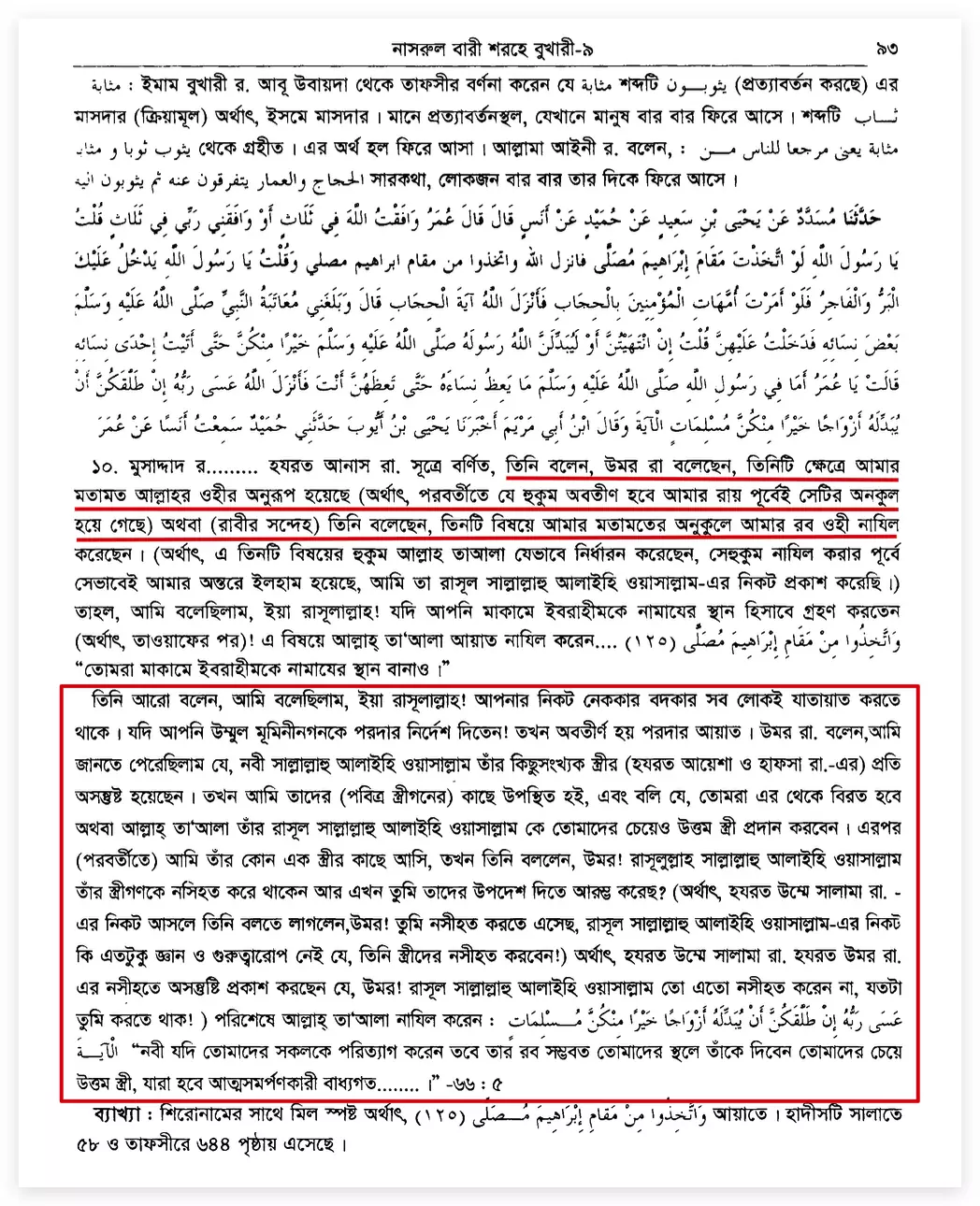
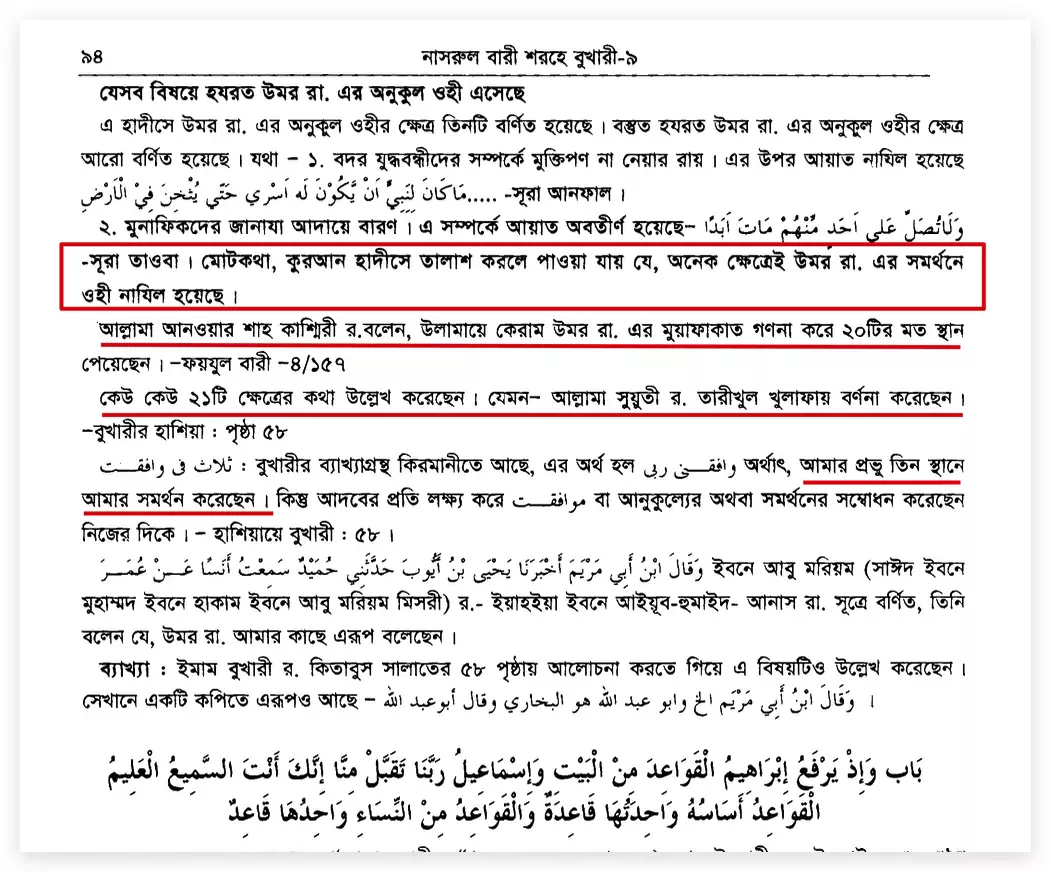
The lists of three similarities in Bukhari and Muslim are also not entirely identical. In Bukhari 402, there are similarities regarding Maqam Ibrahim, the veil, and words spoken about the wives. In Muslim, along with Maqam Ibrahim and the veil, the matter of the prisoners of Badr has come. Consequently, in two reports mentioning “three”, a total of four distinct matters are found. [272]
وَافَقْتُ رَبِّي فِي ثَلاَثٍ فِي مَقَامِ إِبْرَاهِيمَ وَفِي الْحِجَابِ وَفِي أُسَارَى بَدْرٍ
English translation: In three matters my opinion coincided with my Lord: regarding Maqam Ibrahim, the veil, and the prisoners of Badr.
| Subject | Statements raised from the human side | Relationship with religious texts |
|---|---|---|
| Maqam Ibrahim | Proposal to make it a place of prayer | Linked with Baqarah 2:125 in Bukhari 402 |
| Veil | Request to screen Muhammad’s wives | Linked with the verse of the veil in Bukhari 402 |
| Warning to the wives | Better wives will come if divorce occurs | Linked with Tahrim 66:5 in Bukhari 402 |
| Prisoners of Badr | Umar’s position regarding the prisoners | Mentioned as another similarity in Muslim 2399 |
In Wahidi’s Asbab al-Nuzul, the final words of verse 14 of Surah Al-Mu’minun are also included in this list of similarities. In the report, upon hearing the description of creation, Umar says, “How blessed is Allah, the Best of creators”, and later those words are revealed at the end of the verse. The previous three matters are also present again in this report. [273]
[23:14]
(So blessed be Allah, the Best of creators!) [23:14]. Ahmad ibn Muhammad ibn ‘Abd Allah al-Hafiz informed us> ‘Abd Allah ibn Muhammad ibn Hayyan> Muhammad ibn Sulayman> Ahmad ibn ‘Abd Allah ibn Suwayd ibn Manjuf> Abu Dawud> Hammad ibn Salamah> ‘Ali ibn Zayd ibn Jud’an> Anas ibn Malik who reported that ‘Umar ibn al-Khattab, may Allah be well pleased with him, said: “My words agreed with those of my Lord in four instances. I said: ‘O Messenger of Allah, why do we not pray behind the Maqam [were Abraham stood to pray]’, and Allah, exalted is He, revealed (… Take as your place of worship the place where Abraham stood (to pray)…) [2:125]. And I said: ‘O Messenger of Allah, why do you not put a curtain [to protect your wives from the gaze of men]?’ And so Allah, exalted is He, revealed: (And when ye ask of them (the wives of the Prophet) anything, ask it of them from behind a curtain…) [33:53]. I also said to the wives of the Prophet, Allah bless him and give him peace: “You had better take heed or Allah, glorious is He, will give the Prophet instead of you wives who are better than you’. And so Allah, exalted is He, revealed (It may happen that his Lord, if he divorce you, will give him in your stead wives better than you) [66:5]. And when the verse (Verily We created man from a product of wet earth) [23:12] up to His words (… and the produced it as another creation) [23:14] were revealed, I exclaimed: ‘So blessed be Allah, the Best of creators!’ and the end of the verse was revealed as: (So blessed be Allah, the Best of creators!)'”.
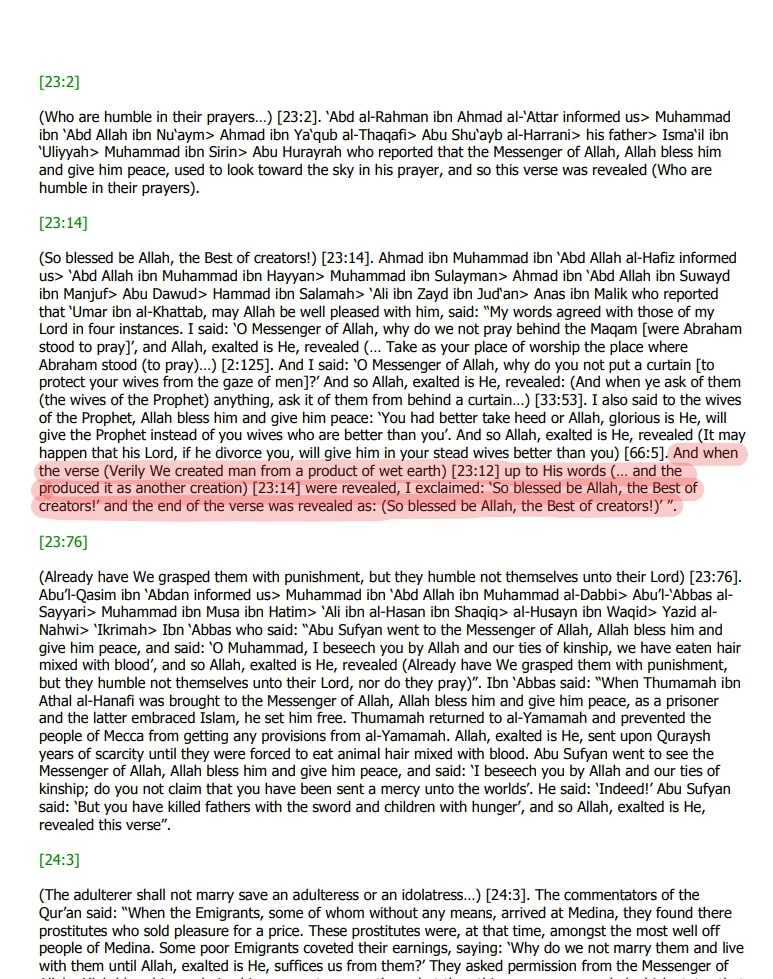
In Tarikh al-Khulafa, Suyuti quoted the report of this statement of Umar from the Tafsir of Ibn Abi Hatim. There, the language of the words coming first from the listener’s mouth and then being revealed as a verse is direct. In this line of narration, Umar is also described as the speaker of the statement similar to the final sentence of the verse. [274]
فَلَمَّا نَزَلَتْ قُلْتُ أَنَا: فَتَبَارَكَ اللَّهُ أَحْسَنُ الْخَالِقِينَ، فَنَزَلَتْ: فَتَبَارَكَ اللَّهُ أَحْسَنُ الْخَالِقِينَ
English translation: When it was revealed, I said, “How blessed is Allah, the Best of creators!” Then it was revealed: “How blessed is Allah, the Best of creators!”
IslamQA has explained this relationship as a coincidence between Umar’s will and Allah’s will, and has also mentioned the revelation of wahi similar to the proposal or request. That is, the relationship between a human’s proposal and the subsequent declaration is present in their explanation as well; the religious evaluation of that relationship has been as good fortune and inspiration. [275]
وينزل الوحي على نحو ما يقترح أو يراد
English translation: Wahi is revealed exactly as it is proposed or requested.
Here, the event of a directive coming similar to a human’s opinion and the divine explanation of that event are on two separate levels. In the report, first the proposal, then the similar declaration. In the explanation of inspiration, the credit for that similarity has been added to Umar’s special status. In this way, the relationship between human opinion and the text itself has been used as the basis of his religious authority. Accepting the fact that the Quranic directive came after the proposal, the claim of complete separation of the text from human opinion and situation is inconsistent. Even within the religious naming of the events, the role of the proposer remains intact.
In the concept of words preserved in the Preserved Tablet, the authority of the verse is placed above human words. In the stories of muwafaqat, Umar’s proposal is linked to the time of manifestation and the specific statement of those words. The matter of making the Maqam a place of prayer, the matter of screening the wives, or the matter of getting better wives in their place—Umar speaks first in every case. The prior human utterance of the statement that later gains the status of the Quran is also part of the same history. In the very documents preserved for the praise of Umar, a continuous link is found between the Quranic declaration and human statements. This relationship between the human words spoken first and the words declared to have been revealed later also reveals the social construction of the text.
The criterion for identifying Umar’s judgment as correct beforehand has been the verse declared later. Again, that human judgment is being called the result of divine inspiration based on the arrival of a similar verse. A connection is found between the human statement and the subsequent decision within the similarity of proposal and declaration. The identity of that statement as divinely inspired has come from religious explanation. There are two uses of the same event here: preserving the history of a similar directive coming after Umar’s proposal, and establishing his special status using that similarity. Consequently, while the human source of the proposal remains visible, its authority has been elevated to a supernatural identity. The very event of human preference being reflected in religious directives then becomes the basis of that person’s holy status.
Umar’s will here has become linked with religious instruction. It is reported that his positions on the place of prayer, the screening of women, warnings to the Prophet’s wives, or the future of prisoners have acquired religious language. Simultaneously, the compilation of these coincidences has increased his status. Consequently, the relationship works both ways: a human proposal finds a place in the language of instruction, and the occurrence of a similar instruction arriving establishes the person’s special truth-indicated identity. This mutual construction of human opinion and religious authority surrounding the revelation of the Quran is at the center of the compiled reports.
Proposal for prayer at Maqam Ibrahim
Sahih Bukhari directly mentions Umar’s proposal before the instruction to make Maqam Ibrahim a place of prayer. Umar had said to Muhammad that if they could accept Maqam Ibrahim as a place of prayer. Then it is said that the verse “Take Maqam Ibrahim as a place of prayer” was revealed. The sequence of events is arranged in these three steps: the preference of a follower, the expression of that preference to the Prophet, and the subsequent announcement of a similar instruction. Umar himself mentioned this coincidence as an example of the Lord’s agreement with his opinion. [276] [277] [278]
Sahih Bukhari (IF)
Chapter: 8/ Salat
Section: 273. Description regarding the Qibla.
393. My Ibn ‘Awn (rh) …. narrated from Anas ibn Malik (ra), he said, ‘Umar (ra) said: my opinion in three matters was consistent with the revelation of Allah. I said, O Rasulullah! If only we could make Maqam Ibrahim a place for salat! Then this verse was revealed: (وَاتَّخِذُوا مِنْ مَقَامِ إِبْرَاهِيمَ مُصَلًّى) “And take Maqam Ibrahim as a place for salat” (2 : 125)
(Secondly) the verse of the curtain, I said: O Rasulullah! If only you would command your wives to observe the curtain! Because both the good and the bad speak with them. Then the verse of the curtain was revealed.
And once the wives of the Nabi sallallahu alaihi wasallam came to him with resentment. Then I said to them: If Rasulullah sallallahu alaihi wasallam divorces you, then his Lord will grant him wives better than you in place of you. (66 : 5) Then this verse was revealed.
(In another chain Ibn Abu Maryam (rh) …. narrated similarly from Anas (ra).)
Hadith status: Sahih (Sahih)
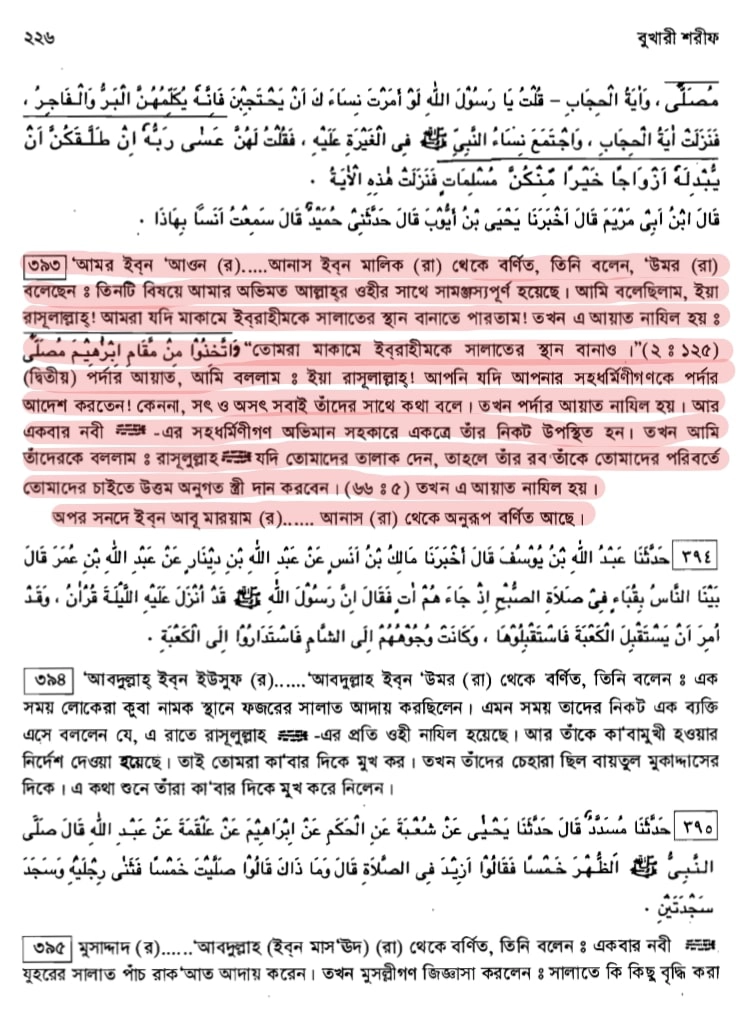
In Umar’s words, “if we accepted” is the language of a wish and a proposal. In the verse, that same act has acquired the language of instruction as “you accept.” The subject of the proposal, the location, and the desired action are all present in the subsequent announcement. In the Arabic narration of Bukhari, the link between the previous statement and the following verse is maintained through the word “fanażalata”—then it was revealed. Consequently, Umar’s opinion did not appear merely as an explanation given after the verse was revealed; in the report, his proposal is an event prior to the announcement of the verse. [279]
فَقُلْتُ يَا رَسُولَ اللَّهِ لَوِ اتَّخَذْنَا مِنْ مَقَامِ إِبْرَاهِيمَ مُصَلًّى فَنَزَلَتْ {وَاتَّخِذُوا مِنْ مَقَامِ إِبْرَاهِيمَ مُصَلًّى}
English translation: I said, O Messenger of Allah, if only we accepted Maqam Ibrahim as a place of prayer! Then it was revealed: “Take Maqam Ibrahim as a place of prayer.”
In this change, the authority of the statement shifts. In the first instance, the statement is a proposal by Umar, for which he is appealing to Muhammad for acceptance. In the next instance, that act acquires the status of a Quranic instruction. The ritual the man wished to see then becomes a matter of religious conduct for the followers. No longer does only the proposer’s logic work in favor of personal preference; the authority of Allah’s command has been added to it. The difference between these two positions for the same act is significant from the perspective of political and religious power.
| Steps of the report | Preserved statement or act | Change of authority |
|---|---|---|
| Proposal | Umar tells Muhammad about making the Maqam a place of prayer | A man’s preference and suggestion |
| Announcement of the verse | “Take Maqam Ibrahim as a place of prayer” | The proposed act is identified as a divine instruction |
| Performance of ritual | Muhammad reads the verse and prays according to the position of the Maqam and the Kaaba | Practical application of the instruction is established |
| Subsequent explanation | The event is used in tafsir to determine the meaning of the verse | The history of the proposal becomes a document for explanation |
In a report preserved in Ibn Abi Dawud’s Al-Masahif, the conversation is more specific. There, Umar first asks if this is the Maqam of their father Ibrahim. After Muhammad’s affirmative answer, he proposes accepting the place for prayer. In this form, the steps of seeking a new religious use for a place based on its prior identity are visible. In Umar’s question is the memory of Ibrahim, and in the subsequent words is the desire to integrate that memory into the ritual of prayer. [280]
قلت: يا رسول الله، هذا مقام أبينا إبراهيم ؟ قال: ” نعم “، فقلت: ألا نتخذه مصلى ؟ فأنزل الله تعالى: واتخذوا من مقام إبراهيم مصلى
English translation: I said, O Messenger of Allah, is this the Maqam of our father Ibrahim? He said, “Yes.” Then I said, shall we not accept this as a place of prayer? Then Allah revealed: “Take Maqam Ibrahim as a place of prayer.”
The relationship of the place with Ibrahim and the instruction to pray specifically there are two distinct matters. In the conversation, the identity of the place was recognized first; the request to arrange prayer at that place came later. Thus, the initiative to make a previously known memorial site a place for a specific ritual is visible within Umar’s statement. By using Ibrahim’s name, the proposal is linked to the religious past, and as a result of the subsequent verse, it acquires the language of instruction for current followers. The memory of the past, the proposal of a present human, and the authority of a new announcement are linked in the same sequence of events.
In the Quranic sentence, the instruction is also placed alongside the statement of making the Kaaba a place of return and a safe haven for people. In the same verse, it is mentioned that Ibrahim and Isma’il were instructed to keep the House pure for those who perform tawaf, those who stay there, and those who bow and prostrate. The sentence to make the Maqam a place of prayer is inserted within this description of the place of worship and rituals. Consequently, the act that coincides with Umar’s proposal remains part of the broader description of the holy site in the Quran. [281]
وَإِذْ جَعَلْنَا الْبَيْتَ مَثَابَةً لِّلنَّاسِ وَأَمْنًا وَاتَّخِذُوا مِن مَّقَامِ إِبْرَاهِيمَ مُصَلًّى ۖ وَعَهِدْنَا إِلَىٰ إِبْرَاهِيمَ وَإِسْمَاعِيلَ أَن طَهِّرَا بَيْتِيَ لِلطَّائِفِينَ وَالْعَاكِفِينَ وَالرُّكَّعِ السُّجُودِ
English translation: And [recall] when I made the House a place of return and a safe haven for people; and take Maqam Ibrahim as a place of prayer. And I instructed Ibrahim and Isma’il, “Purify My House for those who perform tawaf, those who stay there, and those who bow and prostrate.”
Umar’s name is not in the verse. The identity of the proposer and the event prior to the announcement are found in the hadith. When the Quranic instruction and the hadith’s report of revelation are placed together, the human utterance behind the religious sentence also comes forward. What is a direct command in the compiled text of the Quran is preceded by a human request in the report of revelation. For this reason, the full history of its development cannot be found solely through the compiled position of the instruction; the sequence of events preserved in religious literature also shows the human precursor to that command.
These reports have also been used in the explanation of what specific place is meant by ‘Maqam’. Ibn Arabi, in Ahkam al-Quran, accepted the meaning of a specific place and the customary prayer. As an argument, he brought together the report of Umar’s proposal and the mention of Muhammad praying two rak’ahs there after tawaf. In this, both the history of the proposal and subsequent behavior became documents for determining the religious meaning of a verse. [282]
ومن خصصه قال : معناه موضعا للصلاة المعهودة ; وهو الصحيح ; ثبت من كل طريق { أن عمر رضي الله عنه قال : وافقت ربي في ثلاث : قلت : يا رسول الله ; لو اتخذت من مقام إبراهيم مصلى فنزلت : واتخذوا من مقام إبراهيم مصلى }
English translation: He who took it in the sense of a specific place said: it means the known place for performing prayer; and this is correct. It has been established through various chains of narration that Umar said: On three occasions I have coincided with my Lord. I said, O Messenger of Allah, if only you accepted Maqam Ibrahim as a place of prayer! Then it was revealed: “Take Maqam Ibrahim as a place of prayer.”
In Jabir’s long report of Hajj, there is a practical picture of Muhammad’s performance of that ritual. After tawaf, he proceeded toward Maqam Ibrahim, read the relevant verse, and placed the Maqam between himself and the Kaaba. In the same sequence, the recitation of two rak’ahs is also mentioned. Here, the utterance of the religious sentence and the position of the body are determined together. The ritual expression of where to stand and what the relationship of the prayer with the Maqam should be is found in the report. [283]
ثُمَّ نَفَذَ إِلَى مَقَامِ إِبْرَاهِيمَ – عَلَيْهِ السَّلاَمُ – فَقَرَأَ { وَاتَّخِذُوا مِنْ مَقَامِ إِبْرَاهِيمَ مُصَلًّى} فَجَعَلَ الْمَقَامَ بَيْنَهُ وَبَيْنَ الْبَيْتِ فَكَانَ أَبِي يَقُولُ وَلاَ أَعْلَمُهُ ذَكَرَهُ إِلاَّ عَنِ النَّبِيِّ صلى الله عليه وسلم كَانَ يَقْرَأُ فِي الرَّكْعَتَيْنِ { قُلْ هُوَ اللَّهُ أَحَدٌ} وَ { قُلْ يَا أَيُّهَا الْكَافِرُونَ}
English translation: Then he proceeded toward Maqam Ibrahim and read, “Take Maqam Ibrahim as a place of prayer.” He placed the Maqam between himself and the House. My father used to say—and to my knowledge, he mentioned this from the Prophet—that he would recite in the two rak’ahs “Say, He is Allah, One” and “Say, O unbelievers”.
Umar’s proposal and Jabir’s Hajj report contain different types of information. The first contains the request prior to the announcement of the instruction; the second contains the application of the instruction. The first event is cited as the reason for the verse announced later, and in the second event, the act was performed after reading the verse. Together, these two reports show the construction of religious ritual: the desired act of a human was first proposed, then announced as revelation, and then took a followable form through the Prophet’s behavior. Consequently, the influence of Umar’s opinion did not end with a mere word of agreement; it became linked with the practical arrangement of worship.
Depending on the reading of the verse, the language of the instruction has also become a specific question. Qurtubi mentioned the reading of the letter kha with a fatha by Nafi and Ibn Amir, where the sentence is a description of the actions of previous people. In the reading of the letter kha with a kasra by most readers, it is a command. In the same written orthography, this difference in the verb changes the function of the sentence: in one reading, people performed the act; in the other, people are being told to perform the act. [284]
قرأ نافع وابن عامر بفتح الخاء على جهة الخبر عمن اتخذه من متبعي إبراهيم
English translation: Nafi and Ibn Amir read the letter kha with a fatha; as a description of those among the followers of Ibrahim who had taken it as a place of prayer.
| Reading | Type of verb | Semantic role of the sentence |
|---|---|---|
| وَاتَّخِذُوا — kha with kasra | Command | Take [it] as a place of prayer |
| وَاتَّخَذُوا — kha with fatha | Past tense description | They had taken [it] as a place of prayer |
| Report of Umar’s proposal | Prior request, subsequent instruction | Tabari used this report as a document in adopting the reading of the command |
Tabari discussed these two readings, gave priority to the reading of the command, and used Umar’s event as a document in its favor. In his explanation, the report of the verse coming after Umar’s proposal did not remain merely a means of the individual’s virtue; it was also used in the decision of in what sense the Quranic verb should be accepted. The vowel marks of the reading, the imperative meaning of the sentence, and the story of revelation are linked here. The preserved report surrounding a human’s proposal has been effective in determining the meaning of the Quran. [285]
قال أبو جعفر: والصواب من القول والقراءة في ذلك عندنا: ” واتخذوا ” بكسر ” الخاء “, على تأويل الأمر باتخاذ مقام إبراهيم مصلى، للخبر الثابت عن رسول الله صلى الله عليه وسلم الذي ذكرناه آنفا
English translation: Abu Ja’far said: In our opinion, what is correct regarding the statement and the reading in this matter is to read “wattakhidhu” with a kasra on the letter kha; meaning the instruction to make Maqam Ibrahim a place of prayer. The reason for this is that report established about the Messenger, which we mentioned a moment ago.
The difference between the command and the past tense description reaches the center of the meaning. In the reading of the command, the speaker is telling the listener to perform an act. In the past tense reading, the speaker is informing about an act performed by other people. The presence of these two meanings in the same place is part of the history of reading and interpretation. In Tabari’s decision, the imperative meaning is established by giving the report of Umar’s request. Consequently, there is a relationship of dependence between the meaning of the compiled sentence and the sequence of events preserved in the hadith. The story of a human’s request thus became the logic for establishing the imperative reading of the Quran.
There is another report in Ibn Kathir’s tafsir regarding Umar’s role. He mentioned information narrated under Aisha’s name through Bayhaqi: during the time of Muhammad and Abu Bakr, the Maqam was attached to the Kaaba, later Umar moved it away. Here, the change of its position is mentioned while maintaining the religious identity of the place. It is reported that the physical arrangement of the holy site changed by human decision. Alongside Umar’s proposal for prayer, this report also contains the history of the subsequent management of the place. [286]
أن المقام كان في زمان رسول الله صلى الله عليه وسلم وزمان أبي بكر ملتصقا بالبيت ، ثم أخره عمر بن الخطاب رضي الله عنه
English translation: During the time of the Messenger and during the time of Abu Bakr, the Maqam was attached to the House; later Umar ibn al-Khattab moved it away.
In the same discussion, Ibn Hajar explained the practical reason for the change of location. He stated that if the Maqam remained in its previous place, it would create congestion for those performing tawaf or those praying; therefore, Umar placed it in a location where that inconvenience was removed. The commentator also drew a connection between this arrangement and Umar’s previous proposal regarding prayer. Consequently, the same individual is linked as both the proposer of the ritual and the later decision-maker regarding its spatial arrangement. [287]
وكان عمر رأى أن إبقاءه يلزم منه التضييق على الطائفين أو على المصلين فوضعه في مكان يرتفع به الحرج
English translation: Umar thought that if it were left there, it would create congestion for those performing tawaf or those praying. Therefore, he placed it in a location where the inconvenience was removed.
In the first instance, the request took the form of a religious instruction; in the second instance, a religious site was moved according to human need. Here, the proposal, the establishment of the ritual, and the management decision are seen together. In Ibn Hajar’s explanation, religious status and practical convenience operate side by side. The physical arrangement of a place associated with a holy name is guided by human judgment and decision. Thus, Umar’s opinion does not remain merely a memorable quote; his role becomes intertwined with both the language of worship and the management of the place of worship.
How the story of the similarity was used to establish the individual’s authority is also clear in Ibn Hubayra’s explanation. IslamQA quoted his statement from Al-Ifsah. In explaining the purpose of mentioning these incidents of Umar, it was stated that it was to create a good impression of him in the minds of the listeners so that they would not disagree with him when he spoke the truth. That is, in the commentator’s own explanation, the story of a similar revelation is linked to the obedience of followers and the acceptability of the individual. [288]
وهذه المعاني إنما ذكرها عمر عن نفسه قاصدًا بذلك- والعلم عند الله- لمعنيين: أحدهما، ليحسن ظن السامعين به لقوله: (فلا ينازعوه في حق يقوله) ؛ والآخرة أن يقتدي به المؤمنون لإيثاره الحق وقوله الصواب
English translation: Umar mentioned these things about himself—Allah knows best—for two purposes: first, to create a good impression of him in the minds of the listeners so that they would not disagree with him when he spoke the truth; second, so that the believers would follow him because he prioritizes the truth and speaks correctly.
This explanation by Ibn Hubayra reveals the social act of increasing an individual’s status. The similarity between Umar’s preference and the Quran gives his statement the identity of a special truth; that identity is then used as a reason for others to accept his words. By elevating the relationship between human opinion and revelation to a miraculous status, the authority of the proposer is also strengthened. Within the same event, the religious instruction and the acceptability of the individual associated with that instruction establish each other. The story of matching Umar’s spoken words with a subsequent divine declaration is therefore also an element in creating power and obedience.
The incident of the Maqam directly brings to the fore the human dimension of how Quranic instructions were formed. The religious identity of the place exists first, Umar’s specific wish is linked to it, later that act is declared in the language of revelation and applied in ritual. The declared instruction, following a human proposal, is then used as the basis to prove that human’s special knowledge of truth. In this circle, the source of the proposal is visible, yet its authority is placed above humans. In the revelation account of this Quranic instruction, the prior human proposal and its corresponding religious declaration are preserved. Beneath the claim of divine authority, the human initiative of the proposer remains intact.
The demand for the veil, identifying Sawda, and permission to go outside: separate sequences of events
Umar repeatedly raised the demand to Muhammad to keep the wives of the Prophet behind a veil. To implement that demand, the incident of seeing Sawda outside and identifying her by name is also narrated. Pressure for a religious ruling was created by publicly embarrassing a woman’s normal physical needs. After the veil, following a similar intervention, when Sawda returned and complained, permission to go outside for necessity was announced. In the description of the verses of the veil, the demand before the veil, and the permission after the veil, male authority over the female body and movement is directly present.
It has come in Bukhari as Umar’s statement that both good and bad people come to Muhammad; therefore, it would be better to give the order of the veil to the wives of the Prophet. After this, it is mentioned that the verses of the veil were revealed. In the proposal, the presence of outside men is shown as the reason, while the proposed control is placed upon the wives. Umar’s concern about the character of visitors turned into a demand to hide the women. [289] [290]
Sahih Bukhari (IF)
Chapter: 52/ Tafsir
4431. Musaddad (rh) … narrated from Umar (ra). He said, I said, O Rasulullah! Good and bad people come to you. If you would command the Ummahatul Mu’minin regarding the curtain (it would be good) then Allah Ta’ala revealed the verse of the curtain.
Hadith status: Sahih (Sahih)
This narration is placed in the section of verse number 53 of Surah Al-Ahzab. The verse contains instructions regarding entering Muhammad’s house, leaving after eating, and asking from behind a veil if something is requested from his wives. The rules for the house, guests, and communication with the wives are linked in the same religious declaration. The description of Umar’s proposal is directly related to that specific domestic sphere. [289] [291]
Sahih Bukhari (Islamic Foundation)
52/ Tafsir
Section: The word of Allah Ta’ala: لا تدخلوا … عند الله عظيما O believers! Do not enter the house of the Prophet until you are given permission, without waiting for the food to be prepared; but when you are called, enter, and when you have finished eating, leave at once, and do not remain engaged in conversation. This behavior of yours certainly causes distress to the Prophet. He feels hesitant to ask you to leave. But Allah does not feel hesitant to speak the truth. When you ask something from his wives, ask from behind a curtain. This is a purer way for your hearts and their hearts. It is never lawful for any of you to cause distress to the Messenger of Allah and to marry his wives after his death. This is a grave offense before Allah. It is said إِنَاهُ digestion of food. It is formed from أَنَى يَأْنِيْ أَنَاةً. لَعَلَّ السَّاعَةَ تَكُوْنُ قَرِيْبًا perhaps the Resurrection is very near. If you use it as feminine gender, then say قَرِيْبَةً. And if you use it as الصِّفَةَ not holding ظَرْفًا or بَدَلًا then do not attach it with ‘ta’. Similarly, this word is used in all cases of singular, dual, plural and male-female.
Islamic Foundation Number: 4431, International Number: 4790
4431. Musaddad (rh) … narrated from Umar (ra). He said, I said, O Rasulullah! Good and bad people come to you. If you would command the Ummahatul Mu’minin regarding the curtain (it would be good) then Allah Ta’ala revealed the verse of the curtain.
Hadith status: Sahih (Sahih)
Narrator: Umar ibnul Khattab (ra)
In Aisha’s account, the Prophet’s wives went at night to a broad open place called Manasi to relieve themselves. Umar was demanding that they be kept behind a veil, but Muhammad had not implemented this at the time. One night, when the tall Sawda went out, Umar called to her, saying that he had recognized her. The account also specifies the purpose of his call: his intense desire for the veiling rule to be revealed. Umar’s earlier demand and his act of identifying Sawda thus form part of the same effort to exercise control. [292] [293]
Sahih Muslim (Islamic Foundation)
40/ Salam
Section: 7. Lawfulness of women going outside for fulfilling natural needs
5484. Abdul Malik ibn Shuayb ibn Lais (rh) …narrated from Aisha (ra) that the wives of Rasulullah sallallahu alaihi wasallam, while responding to the call of nature, used to go out towards ‘Manasi’ at night. الْمَنَاصِع (Manasi) is a wide field. Over there Umar ibn Khattab (ra) used to say to Rasulullah sallallahu alaihi wasallam, impose the curtain rule upon your wives. But Rasulullah sallallahu alaihi wasallam did not do so. One night at Isha time, the co-wife of the Nabi sallallahu alaihi wasallam, Sawda bint Zam’a (ra), went out. She was a tall woman. Umar (ra) called her and said, O Sawda! We have recognized you. (She did this) in strong desire for the revelation of the curtain rule. Aisha (ra) said, then Allah Ta’ala revealed the curtain-rule.
Hadith status: Sahih (Sahih)
Narrator: Aisha bint Abu Bakr Siddiq (ra)
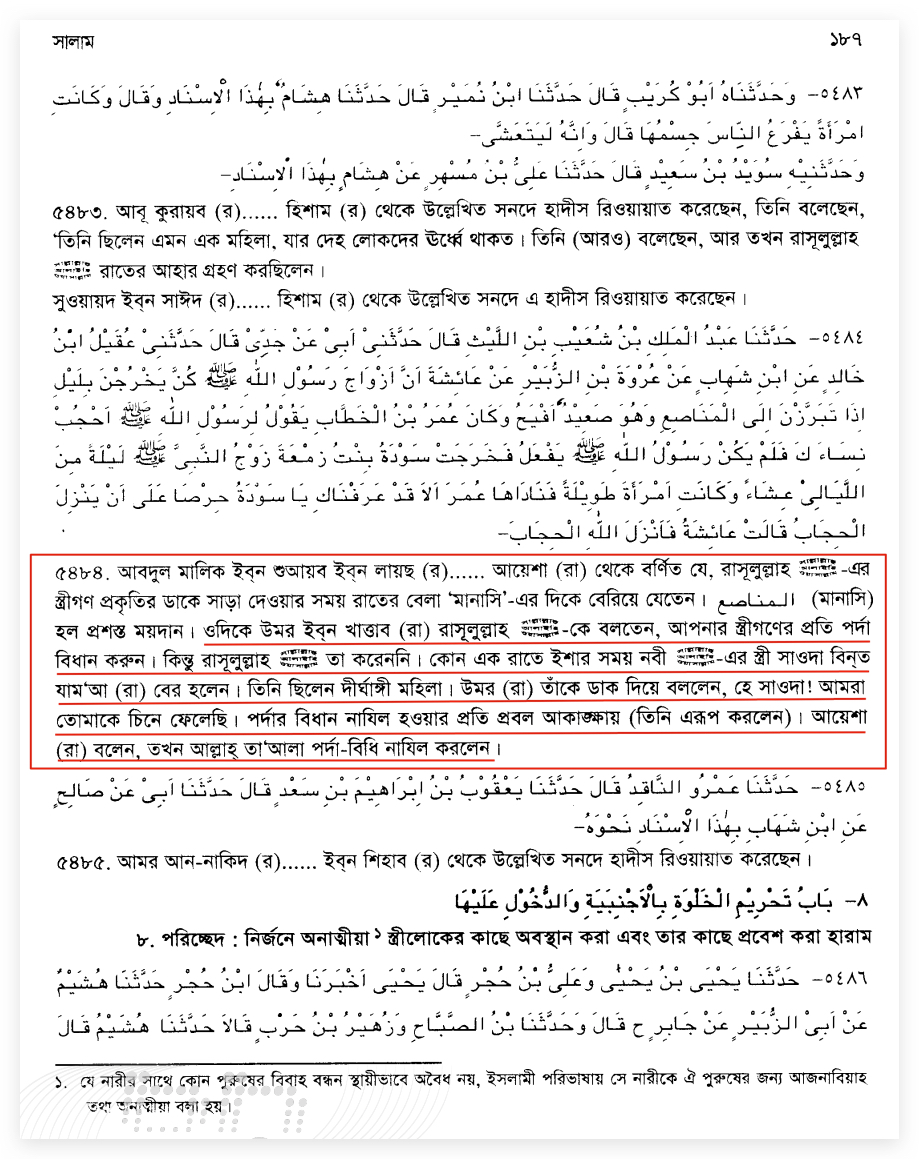
In another place in Bukhari, it is mentioned that Umar saw Sawda while he was sitting in a gathering. There too, his statement “I have recognized you” is linked to the desire for the revelation of the veil. By exposing Sawda’s identity, Umar was creating a practical example of his demand: if a woman goes out without a cover, she can be recognized; therefore, an arrangement to cover her is requested. The moment of a woman’s personal need became a means to achieve the desired ruling of a man. [294] [295]
فَقَالَ عَرَفْتُكِ يَا سَوْدَةُ. حِرْصًا عَلَى أَنْ يُنْزَلَ الْحِجَابُ. قَالَتْ فَأَنْزَلَ اللَّهُ عَزَّ وَجَلَّ آيَةَ الْحِجَابِ
English translation: He said, O Sawda, I have recognized you—out of a strong desire for the veil ruling to be revealed. Aisha said, after this Allah revealed the verses of the veil.
The target of this pressure was a woman of Muhammad’s family. Umar is raising the demand for the veil to Muhammad, and again, by identifying his wife outside, he is delivering the pressure of that demand into the household. The strategy of achieving a desired religious decision by creating discomfort in personal life is visible here. Sawda’s need or comfort is not the center of this initiative; the center is Umar’s preference regarding how much a woman should be hidden. This preference of a follower, linked with the subsequent revelation, gains religious authority.
There is also a description of the verses of the veil regarding the wedding feast of Zaynab bint Jahsh with Muhammad. Anas said that after eating, a few guests were sitting and talking. Although Muhammad left, three remained sitting. Later, when they left, Anas gave the report; Muhammad entered the room and, when Anas also wanted to enter, he drew a veil between them. Then it is mentioned that the verse regarding entering the house was revealed. Here, the long presence of guests in the wedding room is described as the immediate situation for the verse. [296]
فَانْطَلَقْتُ فَجِئْتُ فَأَخْبَرْتُ النَّبِيَّ صلى الله عليه وسلم أَنَّهُمْ قَدِ انْطَلَقُوا، فَجَاءَ حَتَّى دَخَلَ، فَذَهَبْتُ أَدْخُلُ فَأَلْقَى الْحِجَابَ بَيْنِي وَبَيْنَهُ فَأَنْزَلَ اللَّهُ {يَا أَيُّهَا الَّذِينَ آمَنُوا لاَ تَدْخُلُوا بُيُوتَ النَّبِيِّ} الآيَةَ
English translation: I went and informed the Prophet that they had left. He came and entered the room. When I also wanted to enter, he drew a veil between me and him. Then Allah revealed, “O believers, do not enter the houses of the Prophet”—the verse.
Umar’s prior demand and the incident of the feast guests hold two types of situations in the revelation account. In one, there is a prior proposal and pressure to hide the wives; in the other, there is the long stay of guests in Muhammad’s house and the scene of drawing a veil. In both cases, specific people, houses, and domestic inconveniences are involved with the instruction. In this way, the rules for entering the house and speaking with the wives were manifested from the sphere of one individual’s domestic needs into the status of divine instruction.
| Account | Location of event | Described result |
|---|---|---|
| Umar’s proposal for the veil — Bukhari 4790 | Context of good and bad visitors coming | Revelation of the veil verses |
| Identifying Sawda — Bukhari 6240, Muslim 2170d | Public call out of desire for the veil’s revelation | Mention of the revelation of the veil verses |
| Zaynab’s feast — Bukhari 4791 | Guests remaining seated after eating | Entering the house and mention of the veil verses |
| Sawda’s complaint after the veil — Bukhari 4795 | Comment on going outside even after the veil was implemented | Permission to go outside for necessity |
At the beginning of another narration of Sawda, it is said that after the veil ruling was implemented, she went outside for natural needs. Due to her body shape, it was possible for known people to identify her. Seeing her, Umar said that they cannot escape their eyes; he told her to think about how she is going outside. After this comment, Sawda returned and complained to Muhammad. Here, the pressure on her going out remains even after the implementation of the veil; being recognized is the matter of Umar’s objection. [297] [298] [299] [300]
Sahih Bukhari (Islamic Foundation)
52/ Tafsir
Section: The word of Allah Ta’ala: لا تدخلوا … عند الله عظيما O believers! Do not enter the house of the Prophet until you are given permission, without waiting for the food to be prepared; but when you are called, enter, and when you have finished eating, leave at once, and do not remain engaged in conversation. This behavior of yours certainly causes distress to the Prophet. He feels hesitant to ask you to leave. But Allah does not feel hesitant to speak the truth. When you ask something from his wives, ask from behind a curtain. This is a purer way for your hearts and their hearts. It is never lawful for any of you to cause distress to the Messenger of Allah and to marry his wives after his death. This is a grave offense before Allah. It is said إِنَاهُ digestion of food. It is formed from أَنَى يَأْنِيْ أَنَاةً. لَعَلَّ السَّاعَةَ تَكُوْنُ قَرِيْبًا perhaps the Resurrection is very near. If you use it as feminine gender, then say قَرِيْبَةً. And if you use it as الصِّفَةَ not holding ظَرْفًا or بَدَلًا then do not attach it with ‘ta’. Similarly, this word is used in all cases of singular, dual, plural and male-female.
Islamic Foundation Number: 4432, International Number: 4795
4432. Zakariya ibn Yahya (rh) … narrated from Aisha (ra). She said, after the curtain rule was revealed, Sawda went outside for natural needs. Sawda was the possessor of such a heavy body that she could not hide herself from known people. Umar ibn Khattab (ra) seeing her said, O Sawda! Know that, by Allah, you cannot remain hidden from our sight. Now see, how will you go outside?Aisha (ra) said, (hearing this) Sawda (ra) returned. And at this time the Rasul sallallahu alaihi wasallam was eating dinner in my room. In his hand was a piece of bone. Sawda (ra) entered the room and said, O Rasulullah! I had gone outside for natural needs. Then Umar (ra) said such and such things to me. Aisha (ra) said, at this time Allah Ta’ala revealed wahy to him. The revelation of wahy ended, the piece of bone was still in his hand, he had not put it down. Rasulullah sallallahu alaihi wasallam said, certainly you have been given permission to go outside in case of need.
Hadith status: Sahih (Sahih)
Narrator: Aisha bint Abu Bakr Siddiq (ra)
When Sawda returned, Muhammad was eating dinner in Aisha’s room. He had a bone with meat in his hand. It is mentioned that revelation came after the complaint was made; the bone was still in his hand when that state ended. Then permission for women to go outside for their needs was announced. A social intervention, a woman returning to complain, and the announcement of immediate religious permission are in the same sequence. The need for permission arose from the restricted movement caused by Umar’s comment. [301]
قَالَتْ فَأَوْحَى اللَّهُ إِلَيْهِ ثُمَّ رُفِعَ عَنْهُ وَإِنَّ الْعَرْقَ فِي يَدِهِ مَا وَضَعَهُ فَقَالَ ” إِنَّهُ قَدْ أُذِنَ لَكُنَّ أَنْ تَخْرُجْنَ لِحَاجَتِكُنَّ ”
English translation: Aisha said, then Allah sent revelation to him. The state of revelation ended; the bone with meat was still in his hand, he had not put it down. He said, ‘You have been given permission to go outside for your needs.’
The account of this permission is preserved in the hadith as an instruction announced after revelation. The revelation of the verse on the screen and the subsequent permission to go outside for needs are two separate outcomes. In the first instance, Umar’s desire was toward increasing concealment; in the second, after his intervention, Sawda’s complaint brought the question of permission to go outside to the fore. A situation for a new religious decision is created from a man’s objection to a woman’s body and movement. Even normal physical needs were then determined in the language of permission from the authority.
Regarding the sequence of events, the statement of Ibn Hajar al-Qirmani has been quoted: the incident of identifying Sawda may have happened twice. By this possibility, the descriptions before and after the screen are explained together. The commentator also has his own explanation regarding this difference in the timing of events in the narration. [302]
قال : الكرماني : فإن قلت : وقع هنا أنه كان بعدما ضرب الحجاب ، وتقدم في الوضوء أنه كان قبل الحجاب ، فالجواب : لعله وقع مرتين
English translation: Al-Qirmani said: Here the incident is mentioned after the screen was introduced, whereas in the chapter on ablution it is mentioned before the screen—the answer is, perhaps the incident happened twice.
In Ibn Hajar’s own explanation, Umar had gone further after the verse of the screen arrived. Even if the wives’ bodies were covered, he wanted their form not to be visible from the outside. The demand for a covering of clothes now turned into a demand for complete invisibility. [303] [304]
ثم قصد بعد ذلك أن لا يبدين أشخاصهن أصلا ولو كن مستترات ، فبالغ في ذلك ، فمنع منه
English translation: After that, he wanted that even if they were covered, they should not reveal their form at all. He went to extremes in this; he was restrained from it.
Abul Abbas Qurtubi in Al-Mufhim linked the result of this attempt to the inconvenience, distress, and harm of the women. In his explanation, Umar’s intention was that they should not go outside at all. He called this position extreme and showed the relationship between Sawda’s distress over this and the permission to go outside. The harmful consequences of the attempt to control women are recognized in the language of the commentary itself. [305]
فإنه كان قصده: ألا يخرجن أصلا، فأفرط في ذلك فإنه مفض إلى الحرج والمشقة، والإضرار بهن، فإنهن محتاجات إلى الخروج؛ ولذلك قال النبي – صلى الله عليه وسلم – لما تأذت بذلك سودة : ( قد أذن لكن أن تخرجن لحاجتكن )
English translation: His intention was that they should not go outside at all. He had gone to extremes in this; because it led to their inconvenience, distress, and harm, whereas they had a need to go outside. Therefore, when Sawda felt distressed by this, the Prophet said, “You have been given permission to go outside for your needs.”
The familiar pattern of publicly harassing women regarding their clothing and going outside is present here as well. The man considers himself entitled to judge a woman’s movement; even when a woman goes out to fulfill a need, he comments on the identification of her face or form. In Sawda’s case, the intention of implementing a desired religious ruling was also linked to this behavior. Even after the demand for control over clothing was met, the surveillance did not stop; the demand increased toward hiding the form and restricting going outside. Whether a woman is recognizable then becomes the criterion for creating new obstacles in movement.
The pressure Umar created by embarrassing Sawda’s normal needs was answered in the language of religious permission. The question of the complaining woman’s movement is not resolved by his personal decision; it is resolved through going to the Prophet, the arrival of revelation, and the announcement of permission. In this system, male intervention creates the problem, and the authority to solve that problem remains centralized in the hands of religious leadership. In the history of the demand for the screen and permission to go outside, the woman’s body has repeatedly become a matter of others’ decisions.
The text and instructions promoted as eternal laws of the infinite universe are thus intertwined with the room of a small society, guests, male surveillance, and a woman’s physical needs. Umar’s demand, the public identification of Sawda, the guests sitting at Zaynab’s feast, and Sawda’s return to complain—in every case, the announcement of a religious instruction came after a specific social situation. Human pressure and family crises are directly present in the sequence of preserved revelation accounts and permission announcements.
Umar’s threats to the Prophet’s wives and the verse of Tahrim
In the event of disputes with Muhammad’s wives, Umar had threatened them with divorce and replacement. His statement was that if Muhammad divorced them, Allah could give him better wives. In Sahih Bukhari, there is a description of a similar verse being revealed after this was said. A warning from another man in a domestic dispute of one household found the language of a subsequent religious announcement. Muhammad’s authority as a husband, Umar’s intervention, and the possibility of replacement declared in the name of Allah are creating pressure on the wives in the same sequence of events.
In Bukhari 4916, the event is brief and direct. In Umar’s account, Muhammad’s wives had gathered against him due to jealousy. Umar then spoke to them about getting better wives; after that, that verse was revealed. The sentence that carries religious authority in the Quran had Umar as the speaker before it in the account. Both the subject of the speech and the linguistic similarity with the subsequent verse are clearly preserved there. [306]
اجْتَمَعَ نِسَاءُ النَّبِيِّ صلى الله عليه وسلم فِي الْغَيْرَةِ عَلَيْهِ فَقُلْتُ لَهُنَّ عَسَى رَبُّهُ إِنْ طَلَّقَكُنَّ أَنْ يُبَدِّلَهُ أَزْوَاجًا خَيْرًا مِنْكُنَّ. فَنَزَلَتْ هَذِهِ الآيَةُ
English translation: The Prophet’s wives had gathered against him due to jealousy. Then I said to them, “If he divorces you, his Lord can give him wives better than you in your place.” After that, this verse was revealed.
The possibility of divorce is used here as a means of punishment and intimidation. The wives are being told that better women will be found to fill their places, and that Allah’s support is for that replacement. Consequently, the women objecting to the marriage face both the fear of losing the relationship and the pressure of being identified as religiously inferior. The phrase “better than you” diminishes the value of the current wives and brings potential new wives to the fore. That comparison spoken by a human was later established with the status of a divine announcement.
In another account in Bukhari, Umar goes to the wives and tells them to stop. His statement is that if they do not desist, Allah will give Muhammad wives better than them. One wife opposes this intervention and raises the question: Muhammad himself can advise the wives, so why has Umar come to advise them? In the same account, Umar’s pressure and the wife’s response are side by side. [307]
فَدَخَلْتُ عَلَيْهِنَّ قُلْتُ إِنِ انْتَهَيْتُنَّ أَوْ لَيُبَدِّلَنَّ اللَّهُ رَسُولَهُ صلى الله عليه وسلم خَيْرًا مِنْكُنَّ. حَتَّى أَتَيْتُ إِحْدَى نِسَائِهِ، قَالَتْ يَا عُمَرُ، أَمَا فِي رَسُولِ اللَّهِ صلى الله عليه وسلم مَا يَعِظُ نِسَاءَهُ حَتَّى تَعِظَهُنَّ أَنْتَ
English translation: I went to them and said, ‘Desist, otherwise Allah will give His Messenger wives better than you.’ Finally, I went to one of his wives. She said, ‘O Umar, does the Messenger not have the ability to advise his wives that you too are advising them?’
This objection reveals the social character of Umar’s demand. He is demanding obedience from the women by entering into a dispute between husband and wife. In the wife’s question, there is a protest against that unauthorized intervention. In the account, the woman did not remain merely a silent recipient of reprimand; she raised a question about the right to give advice. On one hand, Umar is threatening replacement in the name of Allah, and on the other, the necessity and validity of that intervention are being challenged to his face.
The identities of the two women associated with the verse are also in Bukhari. Ibn Abbas asks Umar who the two wives were that helped each other against Muhammad. Umar names Aisha and Hafsa. Consequently, the identity of specific individuals is linked to the reprimand addressing the two women. Hafsa is again Umar’s own daughter; the household of religious leadership and his own family position are involved together in this dispute. [308]
فَقُلْتُ يَا أَمِيرَ الْمُؤْمِنِينَ مَنِ الْمَرْأَتَانِ اللَّتَانِ تَظَاهَرَتَا عَلَى رَسُولِ اللَّهِ صلى الله عليه وسلم فَمَا أَتْمَمْتُ كَلاَمِي حَتَّى قَالَ عَائِشَةُ وَحَفْصَةُ
English translation: I said, ‘O leader of the believers, who are the two women who helped each other against the Messenger?’ Before I finished my words, he said, ‘Aisha and Hafsa.’
In the fifth verse of Surah Tahrim, it is mentioned that if divorce occurs, better wives will be given. As qualities of those wives, submission, faith, obedience, repentance, and worship are mentioned. A list of religious qualities is attached to the possibility of replacement amidst domestic dispute. In contrast to the opposition of the current wives, the identity of ideal new wives is being created; the announcement of their superiority is also arranged centering on Muhammad. [309]
عَسَىٰ رَبُّهُ إِن طَلَّقَكُنَّ أَن يُبْدِلَهُ أَزْوَاجًا خَيْرًا مِّنكُنَّ مُسْلِمَاتٍ مُّؤْمِنَاتٍ قَانِتَاتٍ تَائِبَاتٍ عَابِدَاتٍ سَائِحَاتٍ ثَيِّبَاتٍ وَأَبْكَارًا
English translation: If he divorces you, his Lord can give him wives better than you in your place—who will be submissive, believing, obedient, repentant, worshipping, fasting, previously unmarried and virgins.
| Position | Statement | Pressure on wives |
|---|---|---|
| Umar’s warning | Desist, otherwise better wives will be given | Fear of losing current relationship and position |
| Tahrim 66:5 | Possibility of giving better wives if divorced | Threat gains the language of divine authority |
| Identity of new wives | Believing, obedient and worshipping | Religious criteria are linked to the qualities of the wife |
| One wife’s response | Muhammad himself can advise | Objection against Umar’s personal intervention |
In Qurtubi’s tafsir, this statement of replacement is linked to intimidating the wives. The announcement of giving better wives as a condition of divorce is explained as the language to make them cautious and afraid. Threats regarding the future of the relationship thus also function as religious rule. The removable position of the wives in dispute with Muhammad is highlighted before them. [310]
ولكن أخبر عن قدرته ، على أنه إن طلقهن أبدله خيرا منهن تخويفا لهن
English translation: But he made his power known: that if Muhammad divorced them, he would give him wives better than them—to intimidate them.
Kurtubi mentioned another opinion in the explanation of the word “repentant”: returning under Muhammad’s command and abandoning their own preferences. In this interpretation, the requirement to renounce one’s own will enters into the identity of a wife being virtuous. The resolution of the conflict is then linked to the woman changing her preference and returning to the husband’s command. The list of religious virtues acquires a specific meaning of familial obedience. [311]
تائبات أي من ذنوبهن ; قاله السدي . وقيل : راجعات إلى أمر رسول الله صلى الله عليه وسلم تاركات لمحاب أنفسهن
English translation: Repentant means those who repent from their sins; Suddi said this. According to another opinion: those who return to the Messenger’s command and abandon their own preferences.
Umar’s own marital experiences are also present in the account of this conflict. According to his statement, Quraysh men held dominance over women; upon coming to Medina, they saw people over whom women held dominance. Their wives began to follow the behavior of the Ansar women. When Umar scolded his wife, she spoke back, and Umar objected to accepting that response. This account reveals his discomfort regarding a wife’s right to speak. [312]
وَكُنَّا مَعْشَرَ قُرَيْشٍ نَغْلِبُ النِّسَاءَ، فَلَمَّا قَدِمْنَا عَلَى الأَنْصَارِ إِذَا هُمْ قَوْمٌ تَغْلِبُهُمْ نِسَاؤُهُمْ، فَطَفِقَ نِسَاؤُنَا يَأْخُذْنَ مِنْ أَدَبِ نِسَاءِ الأَنْصَارِ، فَصِحْتُ عَلَى امْرَأَتِي، فَرَاجَعَتْنِي، فَأَنْكَرْتُ أَنْ تُرَاجِعَنِي
English translation: We Quraysh held dominance over women. Upon coming to the Ansar, I saw that they were a people over whom their women held dominance. Our women began to adopt the behavior of the Ansar women. I scolded my wife; she spoke back to me. I objected to her speaking back to me.
This attitude of viewing a woman’s response as a problem of authority also applied to Hafsa. To Umar, speaking back to Muhammad and causing his dissatisfaction was a matter of dire consequences. Opposing his wife’s words in his own home and attempting to silence her in her husband’s home fall under the same current of patriarchal control. Attention shifted away from the substance of the woman’s logic or complaint, and the primary question became whether she was opposing the man.
Umar also warned Hafsa not to align her position with Aisha’s. He mentioned Aisha’s beauty and Muhammad’s love for her. In this warning, the positional inequality among the wives is used to control the daughter. The comparison of who has more acceptance with Muhammad became a means to deter Hafsa from the conflict. [313]
دَخَلَ عَلَى حَفْصَةَ فَقَالَ يَا بُنَيَّةِ لاَ يَغُرَّنَّكِ هَذِهِ الَّتِي أَعْجَبَهَا حُسْنُهَا حُبُّ رَسُولِ اللَّهِ صلى الله عليه وسلم إِيَّاهَا ـ يُرِيدُ عَائِشَةَ ـ فَقَصَصْتُ عَلَى رَسُولِ اللَّهِ صلى الله عليه وسلم فَتَبَسَّمَ
English translation: He went to Hafsa and said, O my daughter, let not this woman mislead you, whose beauty and the Messenger’s love for her have fascinated him—he was referring to Aisha. I mentioned this to the Messenger; he smiled.
Umm Salama’s objection is more direct. In Bukhari 4913, she tells Umar that he is poking his nose into everything and now wants to enter between Muhammad and his wives. Umar admits that some of the fire within him was broken by these words. The woman concerned herself rejected his interference in the discussion of marital disputes as an unauthorized intrusion. The account preserves that rejection as well. [314]
فَقَالَتْ أُمُّ سَلَمَةَ عَجَبًا لَكَ يَا ابْنَ الْخَطَّابِ دَخَلْتَ فِي كُلِّ شَىْءٍ، حَتَّى تَبْتَغِي أَنْ تَدْخُلَ بَيْنَ رَسُولِ اللَّهِ صلى الله عليه وسلم وَأَزْوَاجِهِ. فَأَخَذَتْنِي وَاللَّهِ أَخْذًا كَسَرَتْنِي عَنْ بَعْضِ مَا كُنْتُ أَجِدُ
English translation: Umm Salama said, How strange you are, O Ibn al-Khattab! You have entered into everything; now you want to enter between the Messenger and his wives! By Allah, she answered me in such a way that some of the fire within me was broken.
In Muslim’s account, Umar’s pressure for obedience toward Hafsa is even more intense. To ensure Muhammad does not think of him as a man coming to take his daughter’s side, Umar says that if Muhammad orders it, he will even cut his own daughter’s throat. In this conditional pledge of killing, the father’s position is clear: the daughter’s life is also subject to the Prophet’s command. [315]
وَاللَّهِ لَئِنْ أَمَرَنِي رَسُولُ اللَّهِ صلى الله عليه وسلم بِضَرْبِ عُنُقِهَا لأَضْرِبَنَّ عُنُقَهَا
English translation: By Allah, if the Messenger orders me to cut her throat, I will certainly cut her throat.
In this declaration, paternal protection is placed below obedience. Umar establishes his own acceptance with Muhammad by announcing his readiness for extreme violence against his daughter. Alongside the threat of replacing a wife with a better wife in a marital dispute, a conditional pledge of death from her father is also present. The scope of pressure on the woman thus extends to the combined authority of husband and father; the security of life is tied to the security of maintaining the relationship in the language of obedience.
Hafsa’s familial identity placed her at the intersection of the authority of two men. She is the wife of Muhammad and the daughter of Umar. In the dispute with the husband, her father takes the husband’s side; instead of bringing forward his daughter’s claims or dissatisfaction, he uses the language of ensuring her obedience. In this position, the father’s relationship with the daughter also becomes a means of supporting religious leadership. The father’s interference in the marital dispute further shrinks the daughter’s independent position.
In the same Muslim account, Umar assures Muhammad that Allah, the angels, Gabriel, Michael, Abu Bakr, he himself, and the believers are with him. Then Umar expresses the hope that Allah will support his words as truth. The expectation of revelation in favor of his own statement is narrated by his own mouth. [316]
وَقَلَّمَا تَكَلَّمْتُ وَأَحْمَدُ اللَّهَ بِكَلاَمٍ إِلاَّ رَجَوْتُ أَنْ يَكُونَ اللَّهُ يُصَدِّقُ قَوْلِي الَّذِي أَقُولُ
English translation: I have rarely said any word—and I praise Allah—after which I did not hope that Allah would support what I said as truth.
In the fourth verse of Tahrim, two women are told to repent and it is mentioned that their hearts have deviated. There is a declaration that if they help each other against Muhammad, Allah, Gabriel, the righteous believers, and the angels are his helpers. In a marital dispute, a gathering of supernatural support along with visible followers on the husband’s side is also declared. The opposition of the women is then placed against the vast structure of religious authority. [317]
إِن تَتُوبَا إِلَى اللَّهِ فَقَدْ صَغَتْ قُلُوبُكُمَا ۖ وَإِن تَظَاهَرَا عَلَيْهِ فَإِنَّ اللَّهَ هُوَ مَوْلَاهُ وَجِبْرِيلُ وَصَالِحُ الْمُؤْمِنِينَ ۖ وَالْمَلَائِكَةُ بَعْدَ ذَٰلِكَ ظَهِيرٌ
English translation: If you two repent to Allah—for your hearts have deviated. And if you two help each other against him, then Allah is his helper, and Gabriel and the righteous believers; and after them the angels are also helpers.
Against the mutual cooperation of the two women, this list of support creates an extreme inequality of power. A gathering of the Creator of the universe, Gabriel, angels, and believers is declared beside the husband. The wives’ objections then cease to be merely a disagreement in a personal relationship; they stand as a position against an authority whose claim is omnipresent. Instead of reasoning on the substance of the complaint, this language increases the pressure of obedience before the opposing party. The declaration of God’s support acts as an expansion of one party’s power in the marriage.
In Ibn Atiyyah’s Tafsir, the similarity between Umar’s statement and these verses is mentioned in clear language. Through al-Mahdabi, he provided the account of the verse being uttered on Umar’s tongue and information about the revelation of a verse similar to the talk of replacing the wives with better wives. The relationship between the previous sentence from a human mouth and the sentence declared to have been revealed later is preserved in the Tafsir as well. [318]
قال المهدوي: روي أن هذه الآية نزلت على لسان عمر رضي الله عنه، وكذا روي أن عمر بن الخطاب رضي الله عنه قال لزوجات النبي صلى الله عليه وسلم: “عسى ربه إن طلقكن أن يبدله أزواجا خيرا منكن”، فنزلت الآية على نحو قوله
English translation: Al-Mahdabi said: It is narrated that this verse was revealed on Umar’s tongue. Similarly, it is narrated that Umar ibn al-Khattab said to the Prophet’s wives, “If he divorces you, his Lord can give him better wives in your place.” Then a verse similar to his words was revealed.
| Elements of the event | Human position or statement | Relationship with religious authority |
|---|---|---|
| Marital dispute | Wives’ objections and mutual cooperation | Reprimand in the language of repentance and deviation of the heart |
| Umar’s interference | Replacement with better wives if not deterred | Similar sentence declared as a verse |
| Pressure on Hafsa | Pledge to cut daughter’s throat if ordered | Prophet’s command over personal relationships |
| Support for Muhammad | Umar’s declaration of his own and others’ obedience | Linked with the declaration of support from Allah and the angels |
| Wife’s protest | Umm Salama’s allegation of unauthorized interference | Woman’s counter-statement also present in the account |
Within this relationship, the human statement and the steps to attaining religious status are seen as distinct. Umar first warns the wives; later, a similar sentence is declared as a verse. After the declaration, the previous warning is also used as proof of his special status. Consequently, the sentence used to control the wives simultaneously increases the authority of the proposer. Supporting the husband’s side in marriage, intimidating women, and establishing the status of the interfering man strengthen each other in the same sequence of events.
From the similarity between Umar’s statement and the subsequent verse, the relationship between a human’s previously spoken word and its subsequent similar religious declaration is directly obtained. The similarity itself does not provide proof of supernatural communication. The religious evaluation of this relationship is the identity of divine inspiration. In that evaluation, the human source of the previous warning attains a special sacred status; the person who is intimidating the wives is established as a special carrier of truth due to the similarity with the subsequent declaration. The language of exercising power thus becomes an element in creating the sacred identity of the proposer.
The presence of the talk of replacing the wives from Umar’s mouth and later a verse of the same meaning is a direct document of the relationship between human words and the Quran. It is narrated that a conditional threat uttered from a man’s side in a family dispute attained the status of an eternal word. Before the women who were disputing, there was then not only the dissatisfaction of the husband or father; but also the reprimand of Allah, the fear of losing the relationship, and the declaration of supernatural support. Religious authority enters into personal disputes and thus increases the power of one party manifold.
Ransom of Badr prisoners, Umar’s proposal for killing and subsequent reprimand
Regarding the prisoners of Badr, Umar proposed their beheading. Abu Bakr wanted to release them by taking ransom; Muhammad initially preferred that opinion. In Muslim’s account, this is followed by the weeping of Muhammad and Abu Bakr, the fear of punishment for accepting ransom, and the reprimand of the Quran. Human advice, the Prophet’s preference, and after the decision, religious reprimand and permission to enjoy war booty are in the same sequence of events. The relationship between the instructions of revelation and an individual’s religious status developed amidst the debate over the lives of the prisoners.
In the account of Sahih Muslim, it is mentioned that seventy were killed and seventy were captured at Badr. Regarding the prisoners, Muhammad wants to know the opinions of Abu Bakr and Umar. Abu Bakr proposes ransom, mentioning their kinship. In his words are also two expectations: that this money will increase the strength of the Muslims and that the prisoners may embrace Islam in the future. The proposal combined kinship, economic gain, and the possibility of future conversion. [319]
فَقَالَ أَبُو بَكْرٍ يَا نَبِيَّ اللَّهِ هُمْ بَنُو الْعَمِّ وَالْعَشِيرَةِ أَرَى أَنْ تَأْخُذَ مِنْهُمْ فِدْيَةً فَتَكُونُ لَنَا قُوَّةً عَلَى الْكُفَّارِ فَعَسَى اللَّهُ أَنْ يَهْدِيَهُمْ لِلإِسْلاَمِ
English translation: Abu Bakr said, O Prophet of Allah, they are our cousins and kinsmen. My opinion is that you take ransom from them; it will be our strength against the unbelievers. Allah may also show them the path of Islam.
Umar rejected this proposal. His claim was that the prisoners should be handed over so that their throats could be cut. He also mentioned handing Aqil over to Ali and a relative of his own over to himself. As the identity of the prisoners, he mentioned them as the leaders and chief persons of the unbelievers. The proposal to kill the prisoners for the purpose of destroying the leadership of political-religious enemies is directly present here. [320]
قُلْتُ لاَ وَاللَّهِ يَا رَسُولَ اللَّهِ مَا أَرَى الَّذِي رَأَى أَبُو بَكْرٍ وَلَكِنِّي أَرَى أَنْ تُمَكِّنَّا فَنَضْرِبَ أَعْنَاقَهُمْ فَتُمَكِّنَ عَلِيًّا مِنْ عَقِيلٍ فَيَضْرِبَ عُنُقَهُ وَتُمَكِّنِّي مِنْ فُلاَنٍ – نَسِيبًا لِعُمَرَ – فَأَضْرِبَ عُنُقَهُ فَإِنَّ هَؤُلاَءِ أَئِمَّةُ الْكُفْرِ وَصَنَادِيدُهَا
English translation: I said, No, by Allah, O Messenger of Allah, I do not hold the opinion that Abu Bakr has given. My opinion is that you give them to us, so that we may cut their throats. Give Aqil to Ali, so that he may cut his throat; give so-and-so to me—a relative of Umar—so that I may cut his throat. Because these are the leaders and chief persons of unbelief.
The proposal to kill relatives with one’s own hands places camp loyalty above familial relationships. In the arrangement of making Ali the killer of Aqil and Umar the killer of his relative, blood relations do not become a barrier to killing. An overt act of breaking that relationship in favor of political-religious division is also created. In determining the future of the prisoners, kinship was the reason for keeping them alive in Abu Bakr’s logic, while in Umar’s proposal, the same kinship became an example for killing them with their own hands.
| Person | Proposal or decision | Narrated logic and result |
|---|---|---|
| Abu Bakr | Release by taking ransom | Kinship, strengthening through money, and hope for embracing Islam |
| Umar | Beheading of prisoners | Destroying unbeliever leadership; killing relatives with own hands |
| Muhammad | Preferring Abu Bakr’s opinion | Umar’s proposal for killing was not accepted then |
| Subsequent account | Weeping and reprimand over taking ransom | Fear of Punishment and the Declaration of the Verse After the Decision |
Which opinion Muhammad preferred is unambiguous in the reports. He preferred Abu Bakr’s view and did not prefer Umar’s view. Consequently, the Prophet’s selection between the two human proposals occurred first. At the stage of decision-making, the religious leadership itself chooses the opinion; subsequent to that, accounts of reprimand and fear of punishment are preserved. [321]
فَهَوِيَ رَسُولُ اللَّهِ صلى الله عليه وسلم مَا قَالَ أَبُو بَكْرٍ وَلَمْ يَهْوَ مَا قُلْتُ
English translation: The Messenger preferred what Abu Bakr had said; he did not prefer what I had said.
Ibn Kathir has quoted a report attributed to Anas through Ahmad, where Umar suggests beheading the prisoners twice and Muhammad turns his face away from him. Later, when Abu Bakr suggests forgiving them in exchange for ransom, it is reported that the sadness on Muhammad’s face vanished. Even in this form of consultation, the leader’s personal reaction is linked to the decision. It is reported that the proposal for ransom aligned with his preference. [322]
فقام أبو بكر الصديق – رضي الله عنه – فقال : يا رسول الله ، نرى أن تعفو عنهم ، وأن تقبل منهم الفداء . قال : فذهب عن وجه رسول الله – صلى الله عليه وسلم – ما كان فيه من الغم ، فعفا عنهم ، وقبل منهم الفداء
English translation: Abu Bakr stood up and said, ‘O Messenger of Allah, our opinion is that you forgive them and accept ransom from them.’ He says: then the sadness that was on the Messenger’s face vanished; he forgave them and accepted ransom from them.
The next day, Umar comes and finds Muhammad and Abu Bakr weeping. Upon asking the reason, Muhammad mentions the proposal to take ransom and states that their punishment has been shown to him as closer than a nearby tree. In this scene, terrible religious consequences are brought forward after the previous decision. The proposal to save lives through ransom is linked to the fear of punishment, while the previously rejected harsh position gains the opportunity to acquire new status. [323]
أَبْكِي لِلَّذِي عَرَضَ عَلَىَّ أَصْحَابُكَ مِنْ أَخْذِهِمُ الْفِدَاءَ لَقَدْ عُرِضَ عَلَىَّ عَذَابُهُمْ أَدْنَى مِنْ هَذِهِ الشَّجَرَةِ
English translation: I am weeping because of the proposal to take ransom that your companions brought to me. Their punishment has been shown to me as closer than this tree.
In verse 67 of Surah Al-Anfal, keeping prisoners before sufficiently defeating the enemy is reprimanded. The desire for the hereafter of Allah is mentioned in contrast to the desire for worldly wealth. In the language associated with the ransom debate, economic gain is placed in a low position and a harsh war policy is linked to religious goals. The reprimand against the decision to keep prisoners alive makes the outcome of war and the policy of captivity a matter of divine judgment. [324]
مَا كَانَ لِنَبِيٍّ أَن يَكُونَ لَهُ أَسْرَىٰ حَتَّىٰ يُثْخِنَ فِي الْأَرْضِ ۚ تُرِيدُونَ عَرَضَ الدُّنْيَا وَاللَّهُ يُرِيدُ الْآخِرَةَ ۗ وَاللَّهُ عَزِيزٌ حَكِيمٌ
English translation: It is not fitting for any Prophet to keep prisoners until you have subdued the enemy in the land. You desire worldly wealth, while Allah desires the hereafter. Allah is All-Powerful, All-Wise.
Zamakhshari has interpreted the word “iskhan” in the verse as meaning more killing and severity therein. In his interpretation, there is a mention of spreading killing among the unbelievers to weaken their strength and then taking prisoners after strengthening Islam through occupation and suppression. The role of killing within the phrase ‘subduing the enemy’ is clear in this tafsir. To establish military authority, the taking of lives has been made a means of increasing religious power. [325]
يعني : حتى يذل الكفر ويضعفه بإشاعة القتل في أهله ، ويعز الإسلام ويقويه بالاستيلاء والقهر ، ثم الأسر بعد ذلك
English translation: That is, until unbelief is made lowly and weak by spreading killing among the unbelievers, and Islam is given dignity and strength through occupation and suppression; only then, the taking of prisoners.
Umar’s proposal was the direct beheading of the prisoners; the verse condemns the collection of prisoners before sufficiently subduing the enemy. The former is a claim for a specific action regarding the prisoners, while the latter attaches a condition of war severity to the taking of prisoners. In the account of alignment with Umar’s opinion, this harsh position gains religious merit. Thus, the relationship between a person’s proposed decision and the subsequently declared war policy became part of his specially supported identity.
In the proposal to kill people by beheading after they become prisoners, their lives become subject to the victor’s decision. Neither kinship nor captivity ensures safety. In the same discussion, killing is presented as the path to destroying political leadership, and keeping them alive as the path to collecting money. The value of human life is determined by the convenience of the victorious camp. Subsequent religious evaluation gives new authority to that debate over convenience in the language of worldly wealth versus the hereafter.
The next verse states that if there were no prior decree from Allah, a severe punishment would have come for the wealth accepted. Here, the mention of being saved from punishment is linked with the reprimand. The sentence of the verse mentions a previous decree; centered on that decree, explanations in the tafsir have been created regarding the permission for ghanimah and the forgiveness of the participants of Badr. The decision on ransom and its religious consequences are discussed in the same sequence. [326]
لَّوْلَا كِتَابٌ مِّنَ اللَّهِ سَبَقَ لَمَسَّكُمْ فِيمَا أَخَذْتُمْ عَذَابٌ عَظِيمٌ
English translation: Had there not been a previous decree from Allah, a severe punishment would have touched you for what you have accepted.
Tabari has preserved a clear sequence of events as the statement of Hasan Basri: ransom was taken from the prisoners of Badr before receiving instructions; Allah condemned it, and later made it lawful. In this explanation, there are separate stages of decision, reprimand, and approval. Humans acted first; religious evaluation and permission came later. Alongside the concept of a predetermined decree, this chronology of revealed instructions remains intact in the tafsir. [327]
إن الله كان مُطْعِم هذه الأمة الغنيمةَ, وإنهم أخذوا الفداء من أسارى بدر قبل أن يؤمروا به. قال: فعاب الله ذلك عليهم, ثم أحله الله
English translation: Allah will allow this Ummah to enjoy ghanimah; and they had taken ransom from the prisoners of Badr before receiving instructions. He said: Allah condemned them for this, then He made it lawful.
Regarding what is meant by the previous decree, Tabari has accepted multiple meanings in his own conclusion. Not punishing for actions done out of ignorance, making ghanimah lawful, and forgiving the participants of Badr—he included these within the previously written arrangement. The fear of punishment for the same event and the exemption from punishment find place side-by-side within the religious explanation. [328]
وكل هذه المعاني التي ذكرتها عمن ذكرت، مما قد سبق في كتاب الله أنه لا يؤاخذ بشيء منها هذه الأمة, وذلك: ما عملوا من عمل بجهالة, و إحلال الغنيمة، والمغفرة لأهل بدر, وكل ذلك مما كتب لهم
English translation: The things I have mentioned from those from whom I cited, they are all in the previous Book of Allah—this Ummah will not be seized for these. That is, actions done out of ignorance, making ghanimah lawful, and forgiving the participants of Badr; all these are included in the written arrangement for them.
In this explanation, there are two separate levels: the previously written decree and the time of the instruction’s revelation to humans. In the concept of a pre-written arrangement, legality and forgiveness are predetermined. In the revealed sequence of events, humans are consulting, the leader is choosing an opinion, and then the language of reprimand and approval arrives. By claiming invisible predetermination, the event gains religious meaning; in the visible account of the event, the sequence of decision-making and its evaluation remains preserved. The relationship between human action and the subsequent declaration is directly present within this chronology.
In verse 69 of Al-Anfal, it is told to enjoy war booty as lawful and good. After the fear of severe punishment, the approval for accepting wealth and the declaration of forgiveness and mercy arrived. Therefore, in the religious account, the legality of this wealth did not appear as a clear instruction effective before the human decision; it came with the evaluation and approval following the decision. The right to enjoy acquired money is also established in the language of the new declaration. [329]
فَكُلُوا مِمَّا غَنِمْتُمْ حَلَالًا طَيِّبًا ۚ وَاتَّقُوا اللَّهَ ۚ إِنَّ اللَّهَ غَفُورٌ رَّحِيمٌ
English translation: Enjoy the war booty you have obtained as lawful and good, and fear Allah. Indeed, Allah is Forgiving, Merciful.
| Step | Preserved Account | Relationship with the Formation of Instruction |
|---|---|---|
| Consultation regarding prisoners | Two separate proposals: ransom and killing | Disagreement among humans before the decision |
| Muhammad’s selection | Preference for Abu Bakr’s opinion | Choosing one proposal as an effective policy |
| Subsequent reprimand | Fear of punishment and condemnation of the desire for worldly wealth | Religious evaluation after the previous decision |
| Permission to enjoy wealth | War booty is lawful and good | Approval for the use of accepted money |
| Umar’s status | Mentioning the matter of Badr’s prisoners as alignment with his own opinion | Religious merit in favor of the previous harsh position |
Qurtubi has preserved another explanation attributed to Ibn Abbas, where the change in policy is linked to the change in the Muslims’ strength. At the time of Badr, their number was small; it is stated there that when numbers and power increased, the statement to either release prisoners as a favor or take ransom arrived. In this explanation, prisoner policy changes with the amount of political-military power. Contemporary power and necessity have been directly used in explaining the history of religious instructions. [330]
وقال ابن عباس رضي الله عنه : كان هذا يوم بدر والمسلمون يومئذ قليل ، فلما كثروا واشتد سلطانهم أنزل الله عز وجل بعد هذا في الأسارى : فإما منا بعد وإما فداء
English translation: Ibn Abbas said: This was the event of Badr; on that day the number of Muslims was small. Later their number increased and their power became strong, then regarding the prisoners, Allah revealed after this: “Then either grace with release, or ransom.”
The possibility of releasing prisoners upon personal request is also narrated in the name of Muhammad. In Bukhari, he says that if Mut’im ibn Adi were alive and requested for the prisoners of Badr, he would have released them for him. This is a declaration of his own decision in the case of a potential request. In the space of determining the future of prisoners, money, the enemy’s strength, and the value of the leader’s personal relationships and requests—all are present as elements of consideration. [331]
لَوْ كَانَ الْمُطْعِمُ بْنُ عَدِيٍّ حَيًّا، ثُمَّ كَلَّمَنِي فِي هَؤُلاَءِ النَّتْنَى، لَتَرَكْتُهُمْ لَهُ
English translation: If Mut’im ibn Adi were alive and had spoken to me regarding these foul-smelling people, I would have released them for him.
In this declaration of a potential request, the power to release prisoners can also respond to personal relationships. While it is said that they would be released at one person’s request, in another discussion, prisoners like them are placed before the decision of money collection or killing. Staying alive and gaining release depends on the decision of the victorious leader and the appeal made to him. Along with religious authority, the status of an individual’s preference and request carries the power to exert a real impact on the lives of prisoners.
Umar mentioned the matter of Badr’s prisoners among three instances where his opinion aligned with the Lord’s. In this list, the event of his proposal to kill becomes part of a special religious status. First, the harsh position that was disliked by Muhammad, then the account of reprimand, and finally Umar’s specially supported identity—this relationship is preserved within the religious literature. Taking a side with a violent policy has become a tool for establishing the person’s status. [332]
وَافَقْتُ رَبِّي فِي ثَلاَثٍ فِي مَقَامِ إِبْرَاهِيمَ وَفِي الْحِجَابِ وَفِي أُسَارَى بَدْرٍ
English translation: In three instances my opinion aligned with my Lord: the Maqam of Ibrahim, the veil, and the matter of Badr’s prisoners.
In the religious evaluation of this event, a violent decision over human life has been given status. The proposal to kill finds identity as the alignment of Umar’s firmness and opinion with revelation; weeping and fear of punishment come after the decision for ransom. Consequently, being more harsh can carry the merit of a religiously correct position. The language of spreading killing to weaken the opponent in the tafsir also reveals the political purpose of that evaluation. The lives of prisoners here are subject to the power of the victorious leadership, economic necessity, and claims of religious superiority.
The relationship between the revelation of Quranic instructions and human decisions is seen in multiple stages in the account of Badr. Two opinions arise in consultation, Muhammad chooses one, then declarations of reprimand and permission arrive surrounding that decision, and the proponent of the other opinion gains the merit of special support. Along with the text preserved as the identity of eternal decree, this link between post-war money, power, kinship, and the preferences of leaders remains intact. The sequence of events where specific religious evaluations are declared after human debate and decision is directly held by the compiled sources.
Permission for intercourse and eating/drinking on the night of fasting after the violation of the decree by companions including Umar
Permission for intercourse and eating/drinking on the night of Ramadan was not maintained in the same state from the beginning. The previous prohibition, human suffering due to that prohibition, the violation of the decree by several people including Umar, and the subsequent declaration of a new concession—this sequence is preserved in the verses of the Quran and the tafsir. An act that was at one stage identified as a betrayal of oneself became lawful in a subsequent declaration. The law of the All-Knowing Legislator actually clashed with human hunger, labor, sleep, and sexual desire; after the clash, the law was adapted to human behavior.
In verse 187 of Al-Baqarah, the labeling of past behavior as betrayal, the declaration of forgiveness, and the permission for sexual intercourse from “now on” appear simultaneously. The consequence of disobeying the previous prohibition did not end merely with receiving forgiveness; the timeframe of the prohibition also changed. Nighttime sexual intercourse became lawful, and the opportunity for eating and drinking was granted until the dawn becomes clear. In four Bengali translations of this verse, the relationship between this previous behavior, forgiveness, and the new permission is evident. [333]
It has been made lawful for you to go to your wives in the nights of Ramadan; they are your covering and you are their covering. Allah knew that you were deceiving yourselves. So He forgave you and gave you respite. Therefore, from now on you may have sexual intercourse with them and attain that which Allah has ordained for you, and continue to eat and drink until the white streak of dawn becomes manifest to you from the black streak. Then complete the fast until the arrival of the night, and do not have sexual intercourse with them while in i’tikaf in the mosque. These are the laws of Allah, so do not approach them. Allah explains His verses in detail for mankind so that they may become muttaki.
— Taisirul Quran
Intercourse with your wives in the nights of Ramadan has been made lawful for you; they are a covering for you and you are a covering for them, Allah knows that you were harming yourselves, for this He turned to you and lightened your (burden); therefore now you may meet them (even in the nights of Ramadan) and seek that which Allah has written for you, and eat and drink until the white thread becomes manifest from the black thread at dawn, then complete the fasting until the arrival of the night; you shall not meet (your wives) while performing i’tikaf in the mosque; this is the limit of Allah. Therefore, do not even go near it; thus Allah describes His signs for mankind, so that they may be restrained.
— Sheikh Mujibur Rahman
Going to your wives in the nights of fasting has been made halal for you. They are a covering for you and you are a covering for them. Allah knew that you were committing betrayal against yourselves. Then He accepted your tawbah and forgave you. Therefore, now you meet them and seek that which Allah has written for you. And eat and drink until the white streak of Fajr becomes clear from the black streak. Then complete the fasting until the night. And do not meet your wives while in i’tikaf in the mosque. This is the boundary of Allah, so do not approach it. In this way, Allah makes His verses clear for humans so that they may adopt taqwa.
— Rawai Al-bayan
Sexual intercourse with wives in the nights of fasting has been made lawful for you [1]. They are as garments for you and you are as garments for them. Allah knows that you were committing betrayal against yourselves. Therefore He accepted your tawbah and pardoned you. So now you associate with them and desire that which Allah has ordained for you. And you eat and drink until the white streak of dawn is clearly manifest to you from the black streak of the night [2]. Then complete the fasting until the arrival of the night. And do not associate with them while in i’tikaf [3] in the mosque. These are the boundaries of Allah. Therefore, do not approach them [4]. Thus Allah expresses His verses clearly for humans, so that they may become possessors of taqwa.
— Dr. Abu Bakr Muhammad Zakaria
The phrase “fal-ana bashiru-hunna”—therefore now unite with them—in the verse indicates the starting time of the permission. There is a change in the ruling between the accusation of betrayal for actions that occurred previously and the subsequent granting of permission for the same action. An act by a human is a crime under the previous rule, but lawful marital behavior under the new rule. The nature of the act remained unchanged; what changed was the permission declared by the Lawgiver. The effectiveness of the new law began within the language of forgiveness.
In the Bengali translation of Jalalayn, it is clear that in the early period, eating, drinking, and sexual intercourse with wives were haram after Isha. It is stated there that this verse was revealed to abrogate that ruling. The same explanation includes the mention of Umar and several others having sexual intercourse during the prohibited time and presenting their excuses to Muhammad. The occasion for the declaration of the new permission was created around the human violation of the rule. [334]
Translation:
187. During the nights of fasting, unrestricted relations—sexual intercourse—with your wives have been made lawful for you. In the early days of Islam, eating, drinking and sexual intercourse with wives were forbidden after Isha during fasting. Allah Most High revealed this verse to abrogate that rule.
They are your covering and you are their covering: by describing each other as coverings in this place, the intimate relationship and the mutual dependence of one upon another are indicated. Allah knew that you were deceiving and betraying yourselves by engaging in sexual intercourse on the nights of fasting. (During the prohibited period) such acts were committed by Hazrat Umar and some Companions. They then presented their excuses regarding this matter to the Messenger of Allah.
Allah the Almighty declares, then He became merciful toward you, accepted your repentance, and forgave your sins. Therefore, now that it has been made lawful for you, associate with them, engage in sexual intercourse, and desire or seek that which Allah has ordained for you, meaning the legalization of sexual intercourse or the children placed in your destiny.
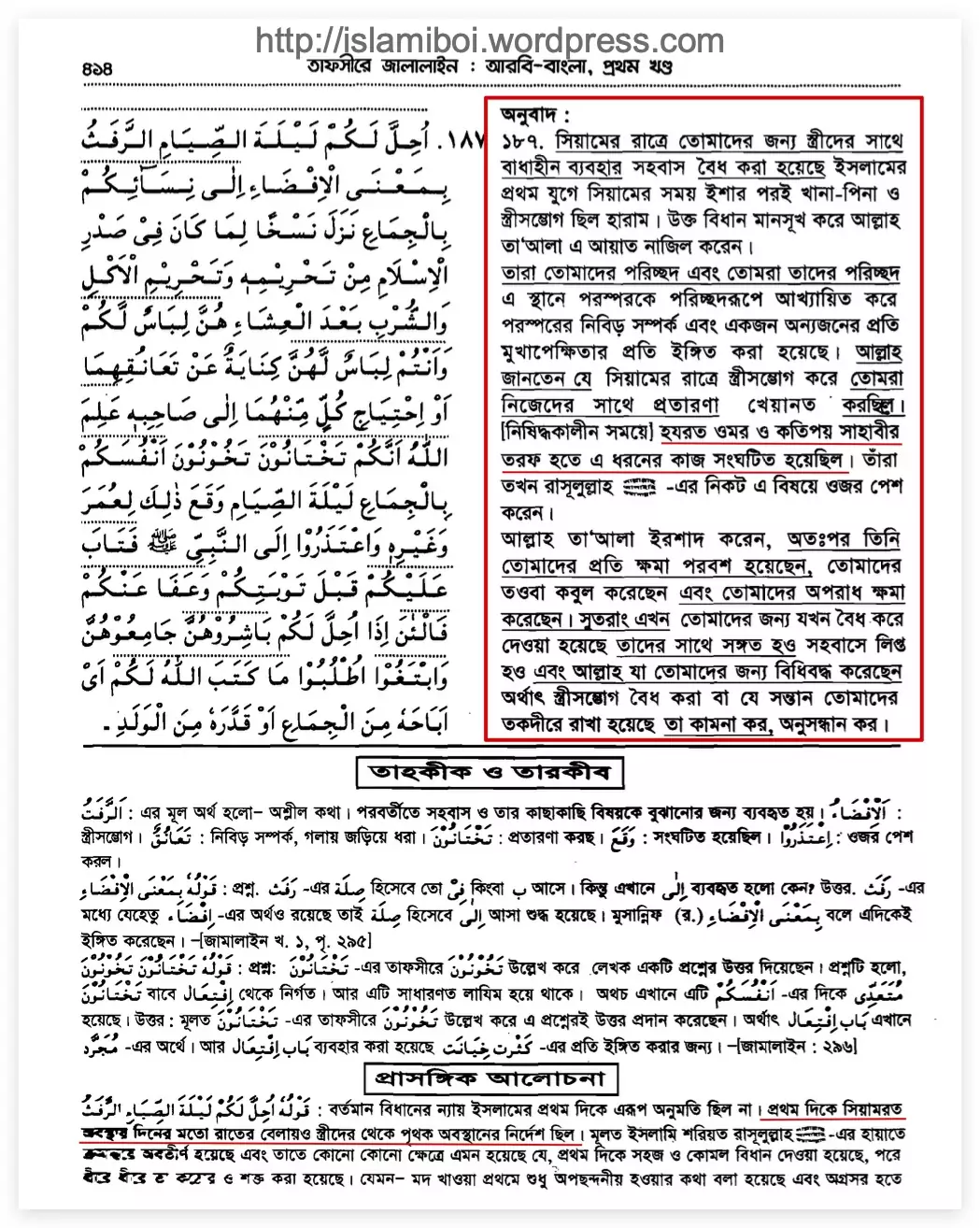
In the translation of Mazhari, the ruling of remaining separate from wives even at night in the previous state and the subsequent permission are mentioned. The commentator presents the fact that the ruling changed gradually as part of the history of the revelation of the sharia. In some cases, the rules became stricter, while in the case of the nights of fasting, the previous strictness was relaxed. Here, the direction of change coincides with human suffering and incidents of disobeying the prohibition. [335]
Relevant Discussion
قَوْلُهُ أُحِلَّ لَكُمْ لَيْلَةَ الصِّيَامِ الرَّفَثُ: In the early days of Islam, there was no such permission as there is in the current ruling. Initially, there was an instruction to remain separate from wives during the night as well as the day while fasting. Essentially, the Islamic sharia was revealed gradually during the life of the Messenger of Allah, and in some cases, it happened that easy and gentle rulings were given at first, which were later gradually made strict and firm. For example, regarding drinking wine, it was first mentioned only as undesirable, and as it progressed
Mazhari also contains the account of the verse coming after Umar’s breaking of the prohibition, Muhammad’s dissatisfaction, and the admission of several others doing the same. Later, along with making sexual intercourse lawful, explanations for desiring children, azl, and the line of Fajr are also given. The legality of nighttime sexual intercourse in this discussion is a new system implemented after a specific event. [335]
did not. After that, he had intercourse with his wife. Meanwhile, Hazrat Ka’b bin Malik also did the same. When the matter came to the attention of the Noble Messenger (PBUH) in the morning, this
verse was revealed. Baghavi said that in the early days of Islam, if someone went to sleep before the Isha prayer, eating, drinking, and sexual intercourse became prohibited for the remainder of the night. One day, Hazrat Umar broke this prohibition. The next day, he informed the Holy Messenger (PBUH) of the incident. He (PBUH) said, “Umar, such behavior does not befit you.” Then several other Companions stood up and admitted that such incidents had happened in their case as well. Then this verse was revealed.
In the following sentence, testimony has come that He became merciful toward you and forgave your sins. Therefore, from now on, it is lawful to have intercourse during any part of the night.
Desire that which Allah has ordained for you—this means the children that Allah the Pure has determined in your destiny,
seek that determination through sexual intercourse. This proves that the desire for children should be the primary purpose of sexual intercourse. The fulfillment of sensory desire should not be the main objective. The Holy Messenger (PBUH) declared, “Marry women who are loving to their husbands and capable of bearing many children, for I shall feel pride in your great numbers over the followers of other prophets.” Hazrat Ma’qal bin
Yasar narrated the hadith, which was recorded by Abu Dawood and Nasa’i. By this
sentence of the verse, it is established that azl (ejaculation outside the female genital organ) during intercourse is makruh (undesirable). The sentence also indicates that satisfying sexual desire through the proper organ is mubah (lawful). Al-Baghawi said that, according to Hazrat Muadh ibn Jabal, the meaning of ‘ma kataballahu lakum’ is Laylat al-Qadr. I say, the phrasing of the sentence does not support that view. ‘And eat and drink until the white thread of dawn
becomes clearly distinct to you from the black thread of night’—in this sentence, ‘khayti abyad’ means the light of day and ‘khayti aswad’ means the darkness of night. At the start of Fajr, a long line extending north and south is observed in the eastern sky. The word ‘khayt’ is used here to refer to that line. If ‘khayt al-abyad’ is Fajr (day), then ‘khayt al-aswad’ inevitably means night. The preposition ‘min’ in the phrase ‘min al-fajri’ expresses a partial state. And ‘khayt al-abyad’ expresses the state of Fajr. Here, Fajr means a portion of Fajr. It is said here until Fajr is revealed
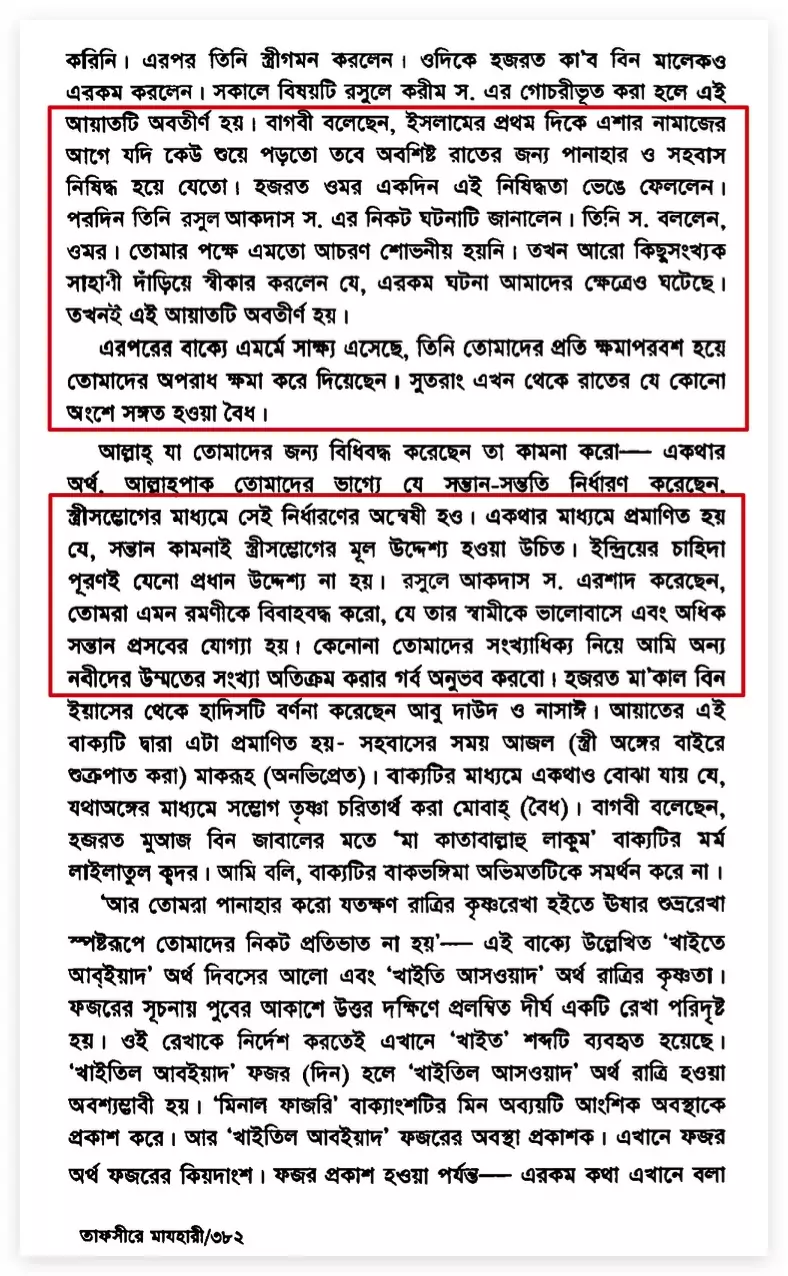
In the Bengali translation of Ibn Kathir, two types of descriptions are preserved as the starting point of the previous prohibition: the Isha prayer and sleep. In one account, Umar himself has sexual intercourse after waking up from sleep; in another, when told that the wife had slept, he considers it an excuse. In both cases, there is a relationship between the accusation of disobeying the prohibition, the matter being reported to Muhammad, and the subsequent arrival of the verse of relaxation. [336]
عَلِمُ اللَّهُ أَنَّكُمْ كُنْتُمْ تَخْتُنُونَ أَنْفُسَكُمْ فَتَابَ عَلَيْكُمْ وَعَفَا عَنْكُمْ the Almighty is aware that you were committing betrayal regarding yourselves. Then He accepted your repentance and forgave you.
Ali ibn Talha narrates from Hazrat Ibn Abbas (RA): In the month of Ramadan, when Muslims completed the Isha prayer, eating, drinking, and sexual intercourse became haram for them until the following Maghrib. Nevertheless, in the case of some of them, exceptions to this occurred during Ramadan. Hazrat Umar (RA) was among them. Consequently, a group of people raised this complaint in the court of the Noble Prophet (PBUH). Then Allah the Almighty revealed this verse of granting respite.
Hazrat Awfa Musa ibn Uqba narrates from Quraib, and he from Ibn Abbas (RA):
Before this verse of fasting was revealed, Muslims used to eat, drink, and have sexual intercourse at night. But once they fell asleep, they would not eat, drink, or have sexual intercourse until the following evening. Despite this, news reached us one day that Umar ibn Khattab had woken from sleep and had sexual intercourse. In the meantime, he appeared in the court of the Noble Prophet (PBUH) and submitted—’I have come to complain to Allah and the Messenger of Allah against my own action.’ The Messenger (PBUH) asked—what have you done? He replied—’Despite intending to fast, I woke from sleep and had sexual intercourse.’ The Messenger (PBUH) said—this was not a befitting act for you. Then the discussed verse was revealed.’
From Hazrat Abu Hurairah (RA), Ata ibn Rubah, Qays ibn Sa’d, and Sa’id ibn Abu Urwa narrate in succession:
Before this verse was revealed, in Ramadan, if Muslims went to sleep after finishing the Isha prayer, eating, drinking, and sexual intercourse became haram for them until the next evening. Then Umar ibn Khattab had sexual intercourse after the Isha prayer, and Suraka ibn Qays Ansari, feeling sleepy after the Maghrib prayer, fell asleep and remained asleep until the Messenger (PBUH) led the Isha prayer. Then, after the Isha prayer, he ate and drank. The next morning, they came and expressed these situations in the service of the Messenger (PBUH). Then it was revealed:
أُحِلَّ لَكُمْ لَيْلَةَ الصَّيَامِ الرَّفَثُ إِلَى نِسَائِكُمْ …… ثُمَّ أَتِمُوا الصَّيَامَ إِلَى اللَّيْلِ In fact, this is nothing but the great mercy and grace of Allah the Almighty.
From Abdur Rahman ibn Abu Layla, Husayn ibn Abdur Rahman and Hisham narrate respectively:
“One day Umar ibn Khattab (RA) stood up and submitted, ‘O Messenger of Allah! Last night I expressed to my wife that desire, which a man [has for a] woman”
In a subsequent account quoted by Ibn Kathir, Umar did not believe his wife’s claim that she had fallen asleep and had intercourse with her. There is mention of similar behavior by Ka’b ibn Malik. It is stated that the matter was reported to Muhammad the next day, after which verses of forgiveness and permission were revealed. In the application of the ruling, events inside the home, the statements of husband and wife, and the individual’s own confession became directly relevant. [336]
stays close. My wife informed me that she had fallen asleep. I considered it her excuse and had intercourse with her.’ Then, on that occasion, this verse was revealed: ثُمَّ أَتَمُّوا الصَّيَامَ إِلَى اللَّيْلِ …. Shu’ba and Amr ibn Shu’ba narrated similarly in succession from Ibn Abu Layla. In succession from Ka’b ibn Abd al-Malik, Abdullah ibn Ka’b, the slave of Banu Salma Musa ibn Zubayr, Abu Lahi’a, Ibn al-Mubarak Suwayd, Musanna, and Abu Ja’far ibn Jarir narrate:
“The condition of the people during the month of Ramadan was such that if anyone fasting fell asleep at night, then eating, drinking, and intercourse with the wife became forbidden for them from that point until the next iftar. One night, Umar ibn Khattab returned home late from the court of the Messenger of Allah (saw). His wife was then sleeping. When he expressed his desire for sexual gratification, his wife said, ‘I had fallen asleep.’ He disbelieved this and had intercourse with her. Ka’b ibn Malik says—at dawn, Umar ibn Khattab presented himself before the Messenger (saw) and described this situation to him. Then Allah Ta’ala علِمَ اللَّهُ أَنَّكُمْ كُنْتُمْ تَخْتَانُونَ أَنْفُسَكُمْ فَتَابَ عَلَيْكُمْ وَعَفَا عَنْكُمْ فَالْآنَ بَاشِرُوهُنَّ meaning, Allah knows that you were betraying yourselves. Then Allah Ta’ala accepted your repentance, so from now on, you may have intercourse with your wives.”
Similarly, Mujahid, Ata, Ikrima, Qatadah and others have narrated the events of Hazrat Umar (ra) and Suraqa ibn Qays al-Ansari as the reason for the revelation of this verse. Subsequently, as a manifestation of Allah’s mercy, grace, and love, Allah Ta’ala made intercourse with the wife, eating, and drinking throughout the night of Ramadan permissible.
Regarding the explanation of the phrase وَابْتَغُوا مَا كَتَبَ اللَّهُ لَكُمْ (seek it), Abu Hurayra, Ibn Abbas, Anas, Qazi Shurayh, Mujahid, Ikrima, Sa’id ibn Zubayr, Ata, Rabi ibn Anas, Suddi, Zayd ibn Aslam, Hakam ibn Utba, Maqatil ibn Hayyan, Hasan Basri, Zihak, and Qatadah (r) among other Companions and Successors say: its meaning is ‘children’.
Abd al-Rahman ibn Zayd ibn Aslam interpreted وَابْتَغُوا مَا كَتَبَ اللَّهُ لَكُمْ as ‘intercourse’. Umar ibn Malik al-Bukari, from Abu Jawza, and he from Hazrat Ibn Abbas (ra), interpreted وَأَبْتَغُوا مَا كَتَبَ اللَّهُ لَكُمْ as Laylat al-Qadr. Ibn Abi Hatim and Ibn Jarir have also narrated similar reports.
Abd al-Razzaq says: Mu’ammar informed me that Qatadah said وَابْتَغُوا الرُّحْصَةُ الَّتِي كَتَبَ اللهُ لَكُمْ يَقُولُ مَا أَحَلَّ اللَّهُ لَكُمْ seek that opportunity which has been written for you. Someone has said: “Seek that which has been made halal for you.”
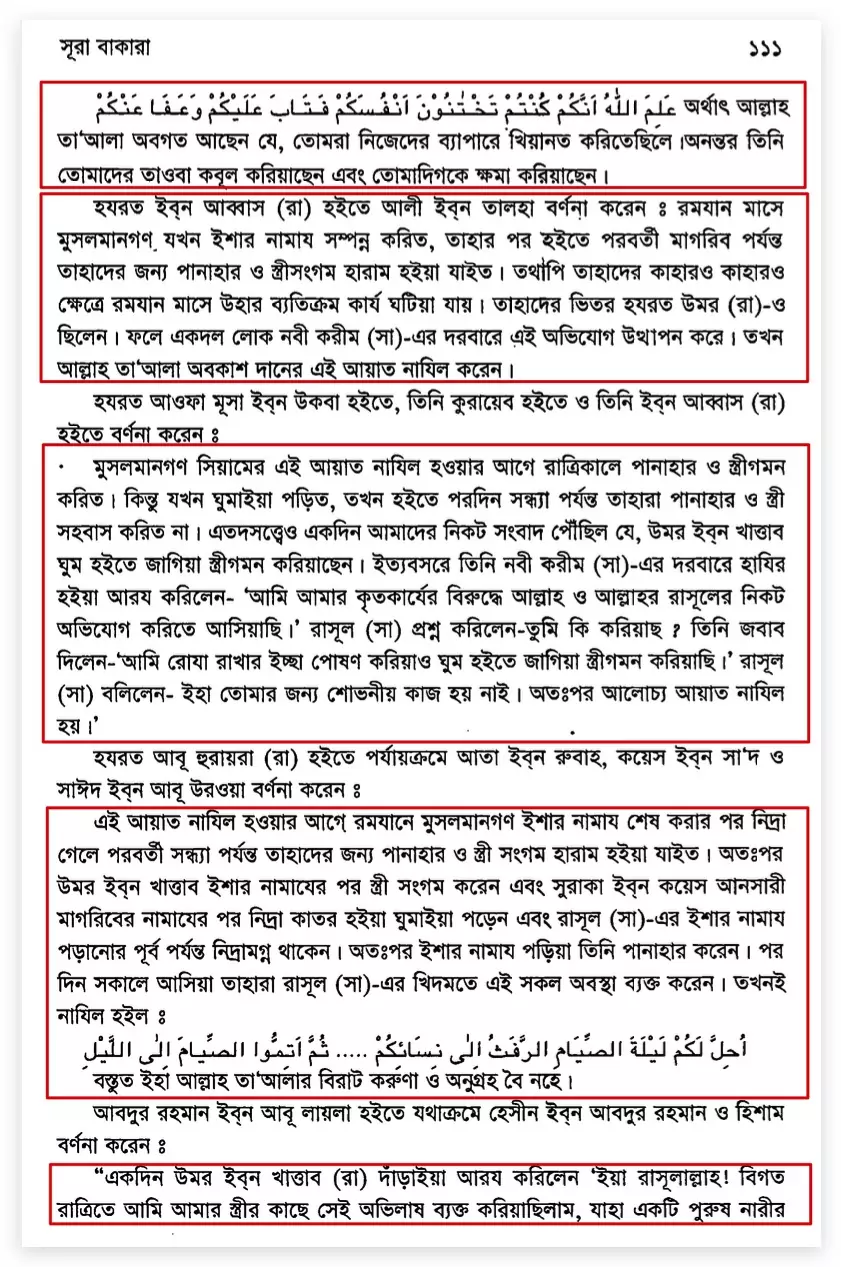
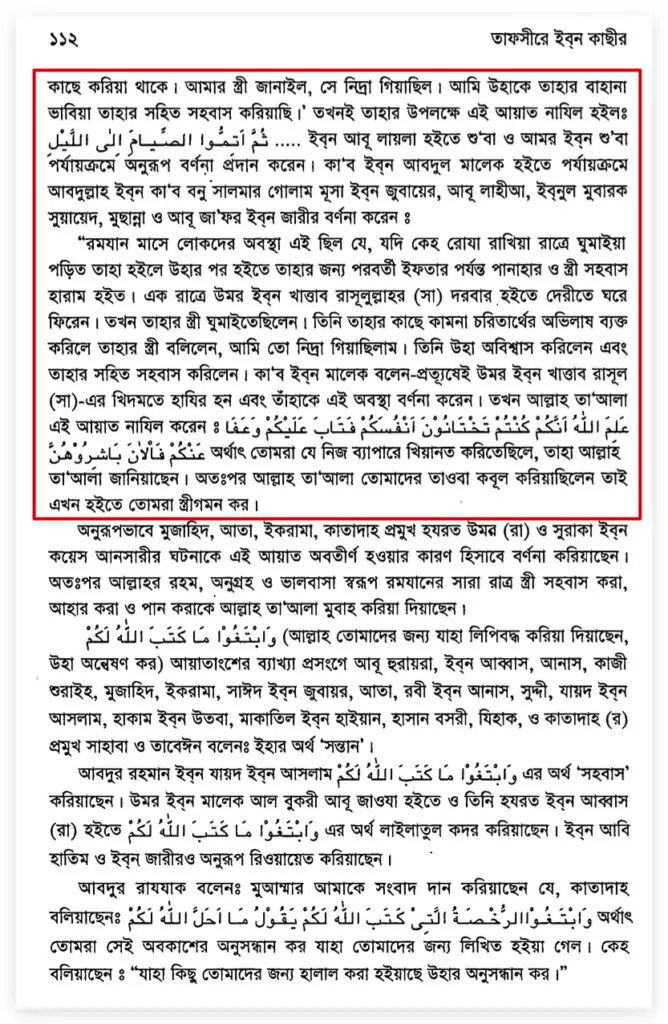
The Arabic tafsir also contains statements of violating the prohibition, including Umar’s name. In the account attributed to Ibn Abbas, it is mentioned that the relevant verse was revealed after several Muslims were accused of having intercourse with their wives and eating after Isha. In Ibn Kathir’s Arabic text, Umar’s name and the sequence of the verse’s revelation after the violation of the ruling are preserved together. [337]
ثُمَّ إِنَّ أُنَاسًا مِنَ الْمُسْلِمِينَ أَصَابُوا مِنَ النِّسَاءِ وَالطَّعَامِ فِي شَهْرِ رَمَضَانَ بَعْدَ الْعِشَاءِ ، مِنْهُمْ عُمَرُ بْنُ الْخَطَّابِ ، فَشَكَوْا ذَلِكَ إِلَى رَسُولِ اللَّهِ صلى الله عليه وسلم ، فَأَنْزَلَ اللَّهُ تَعَالَى : ( عَلِمَ اللَّهُ أَنَّكُمْ كُنْتُمْ تَخْتَانُونَ أَنْفُسَكُمْ فَتَابَ عَلَيْكُمْ وَعَفَا عَنْكُمْ فَالْآنَ بَاشِرُوهُنَّ )
English translation: After this, some Muslims had intercourse with their wives and ate after Isha during the month of Ramadan; Umar ibn Khattab was among them. When they reported the matter to the Messenger of Allah, Allah revealed: Allah knew you were betraying yourselves; He has accepted your repentance and forgiven you; now you may unite with them.
In Bukhari’s brief account, it is mentioned that they did not go to women throughout Ramadan, and the verse was revealed after some men betrayed themselves. This language regarding the scope of the previous prohibition is different from the accounts of sleep or post-Isha in the tafsir. In both the brief hadith and the detailed tafsir, there is a sequence of prohibition, its disobedience, and the subsequent declaration of forgiveness. [338]
لَمَّا نَزَلَ صَوْمُ رَمَضَانَ كَانُوا لاَ يَقْرَبُونَ النِّسَاءَ رَمَضَانَ كُلَّهُ، وَكَانَ رِجَالٌ يَخُونُونَ أَنْفُسَهُمْ، فَأَنْزَلَ اللَّهُ {عَلِمَ اللَّهُ أَنَّكُمْ كُنْتُمْ تَخْتَانُونَ أَنْفُسَكُمْ فَتَابَ عَلَيْكُمْ وَعَفَا عَنْكُمْ}
English translation: When the fast of Ramadan was revealed, they did not go to women throughout Ramadan. Some men were betraying themselves. Then Allah revealed: Allah knew you were betraying yourselves; He has accepted your repentance and forgiven you.
The practical value of the aspect of eating and drinking is clear in the event of Qays ibn Sirma in Bukhari. After working all day, he fell asleep while waiting for food. According to the previous rule, he was supposed to remain without food until the next evening. The next day at noon, he became unconscious. After the event reached Muhammad, the verse of permission for the night arrived, and the people were extremely joyful. The conflict between religious rulings and the human body is preserved within the sequence of events of the primary account. [339]
كَانَ أَصْحَابُ مُحَمَّدٍ صلى الله عليه وسلم إِذَا كَانَ الرَّجُلُ صَائِمًا، فَحَضَرَ الإِفْطَارُ، فَنَامَ قَبْلَ أَنْ يُفْطِرَ لَمْ يَأْكُلْ لَيْلَتَهُ وَلاَ يَوْمَهُ، حَتَّى يُمْسِيَ، وَإِنَّ قَيْسَ بْنَ صِرْمَةَ الأَنْصَارِيَّ كَانَ صَائِمًا، فَلَمَّا حَضَرَ الإِفْطَارُ أَتَى امْرَأَتَهُ، فَقَالَ لَهَا أَعِنْدَكِ طَعَامٌ قَالَتْ لاَ وَلَكِنْ أَنْطَلِقُ، فَأَطْلُبُ لَكَ. وَكَانَ يَوْمَهُ يَعْمَلُ، فَغَلَبَتْهُ عَيْنَاهُ، فَجَاءَتْهُ امْرَأَتُهُ، فَلَمَّا رَأَتْهُ قَالَتْ خَيْبَةً لَكَ. فَلَمَّا انْتَصَفَ النَّهَارُ غُشِيَ عَلَيْهِ، فَذُكِرَ ذَلِكَ لِلنَّبِيِّ صلى الله عليه وسلم فَنَزَلَتْ هَذِهِ الآيَةُ {أُحِلَّ لَكُمْ لَيْلَةَ الصِّيَامِ الرَّفَثُ إِلَى نِسَائِكُمْ} فَفَرِحُوا بِهَا فَرَحًا شَدِيدًا، وَنَزَلَتْ {وَكُلُوا وَاشْرَبُوا حَتَّى يَتَبَيَّنَ لَكُمُ الْخَيْطُ الأَبْيَضُ مِنَ الْخَيْطِ الأَسْوَدِ}.
English translation: Among Muhammad’s companions, if any person fasting fell asleep after coming home at the time of iftar but before eating, they would not eat for that night and until the next evening. Qays ibn Sirma al-Ansari was fasting. At the time of iftar, he asked his wife, ‘Do you have food?’ She said, ‘No; but I am going to look for some for you.’ He had worked all day, so his eyes closed in sleep. When his wife returned and saw him, she said, ‘Woe to you!’ By the next noon, he became unconscious. When the matter was reported to the Prophet, the verse was revealed: “Intercourse with your wives on the nights of fasting has been made lawful for you.” They were extremely joyful at this. Further was revealed: “Eat and drink until the white streak becomes distinct from the black streak.”
| Description | Previous rule or behavior | Subsequent change |
|---|---|---|
| Bukhari 1915 | Not eating until the next evening if one slept before iftar; a laborer becoming unconscious | Joy at the new opportunity to eat and drink at night |
| Bukhari 4508 | Interruption of intercourse in Ramadan; betrayal by several people | Verse of forgiveness and permission |
| Account quoted by Ibn Kathir | Disobeying the prohibition of intercourse and eating/drinking after Isha or sleep; mention of Umar’s name | Permission for the whole night after complaints |
| Baqarah 2:187 | Past betrayal and forgiveness | Permission “now” for intercourse and eating/drinking until Fajr |
Prohibiting natural human needs, people failing to follow that rule, and subsequently reducing the scope of the prohibition—this is a familiar framework for the formulation of amended laws. The effectiveness of the previous instruction was tested in reality upon the human body and household. The rule changed after a laborer became unconscious from hunger and others’ breaking of the prohibition on intercourse came to light. There should be nothing new for an omniscient being to learn about human limitations. Nevertheless, human suffering and violation are preserved as the explicit occasions for the amendment of the ruling.
There is a more specific inconsistency in Umar’s behavior. This individual, who demanded strict religious obedience in other contexts, did not stop his own sexual desire in the face of the old prohibition. After his statement was reported, the event did not end with a report of only forgiving the individual while keeping the prohibition intact; the rule itself changed. Instead of the individual’s behavior following the law, the law became suitable to accommodate the individual’s behavior. The mention of the same behavior by multiple people in the tafsir also reveals the social pressure behind this change.
There is another layer of control in the account of considering the wife’s claim of falling asleep as an excuse. The husband rejects the statement in favor of his own desire, even though the wife is citing the obstacle of the previous ruling. The subsequent permission aligns with the act the husband had already committed. In this conflict between sleep, desire, doubt, and religious rules, the woman’s statement has become dependent on the husband’s belief. While the previous act is recognized as betrayal in the new permission, the lawful time for the same act in the future has been expanded.
This change is called mercy, opportunity, and grace in the tafsir. The matter of that religious evaluation is precisely the increasing of opportunity for humans by changing the previous ruling. If the word “now” were omitted and only the final permission presented, the history of the previous prohibition and amendment would disappear. The verse carries that history: human action first, the account of complaints and suffering along with it, then forgiveness and a new instruction. This human occasion for a changed order stands directly beside the claim of the Lawgiver’s unchanging knowledge.
The funeral of Ibn Ubayy: Muhammad’s decision, Umar’s objection, and the subsequent prohibition
The positions of Muhammad and Umar were not the same at the funeral of Abdullah ibn Ubayy. Muhammad stood to lead his funeral prayer, Umar objected and stopped him by grabbing his clothes. Muhammad explained the previous verse as an opportunity for him to choose and led the funeral prayer. Later, a new prohibition came against leading the funeral prayer and standing by the grave. The Prophet’s decision, the direct intervention of the Companion, and the alignment with the Companion’s position in the subsequent verse—this sequence of events is preserved in Bukhari. The application of religious instructions here did not appear as a completely settled matter before the decision was made; new limits were declared after human conflict and an effective decision.
The Arabic narrator in Bukhari 4670 is Ibn Umar. Ibn Ubayy’s son asked for Muhammad’s garment for his father’s shroud and later requested him to lead the funeral prayer. Muhammad responded to both requests. Umar grabbed the clothes and questioned why he was leading the funeral prayer despite the Lord’s prohibition. In response, Muhammad mentioned the previous verse as an opportunity to choose. It is mentioned that the funeral prayer was led despite Umar’s objection, and then the verse of prohibition was revealed. [340]
لَمَّا تُوُفِّيَ عَبْدُ اللَّهِ جَاءَ ابْنُهُ عَبْدُ اللَّهِ بْنُ عَبْدِ اللَّهِ إِلَى رَسُولِ اللَّهِ صلى الله عليه وسلم فَسَأَلَهُ أَنْ يُعْطِيَهُ قَمِيصَهُ يُكَفِّنُ فِيهِ أَبَاهُ فَأَعْطَاهُ، ثُمَّ سَأَلَهُ أَنْ يُصَلِّيَ عَلَيْهِ، فَقَامَ رَسُولُ اللَّهِ صلى الله عليه وسلم لِيُصَلِّيَ فَقَامَ عُمَرُ فَأَخَذَ بِثَوْبِ رَسُولِ اللَّهِ صلى الله عليه وسلم فَقَالَ يَا رَسُولَ اللَّهِ تُصَلِّي عَلَيْهِ وَقَدْ نَهَاكَ رَبُّكَ أَنْ تُصَلِّيَ عَلَيْهِ فَقَالَ رَسُولُ اللَّهِ صلى الله عليه وسلم إِنَّمَا خَيَّرَنِي اللَّهُ فَقَالَ {اسْتَغْفِرْ لَهُمْ أَوْ لاَ تَسْتَغْفِرْ لَهُمْ إِنْ تَسْتَغْفِرْ لَهُمْ سَبْعِينَ مَرَّةً} وَسَأَزِيدُهُ عَلَى السَّبْعِينَ. قَالَ إِنَّهُ مُنَافِقٌ. قَالَ فَصَلَّى عَلَيْهِ رَسُولُ اللَّهِ صلى الله عليه وسلم فَأَنْزَلَ اللَّهُ {وَلاَ تُصَلِّ عَلَى أَحَدٍ مِنْهُمْ مَاتَ أَبَدًا وَلاَ تَقُمْ عَلَى قَبْرِهِ}.
English translation: When Abdullah died, his son Abdullah ibn Abdullah came to the Messenger and asked for his garment to shroud his father. He gave it. Then the son requested him to lead the funeral prayer. When the Messenger stood to lead the funeral prayer, Umar stood up, grabbed his clothes, and said, ‘O Messenger of Allah, your Lord has forbidden it, yet you will lead his funeral prayer?’ The Messenger said, ‘Allah has given me the opportunity to choose. He has said: “Whether you ask forgiveness for them or do not ask forgiveness for them; even if you ask forgiveness for them seventy times…” I will ask more than seventy times.’ Umar said, ‘He is a hypocrite.’ The narrator says: The Messenger led his funeral prayer. Then Allah revealed: “Never pray the funeral prayer for any of them who dies, nor stand by his grave.”
There is a physical manifestation of Umar’s objection in grabbing the clothes to obstruct. He did not stand aside after stating his opinion; he physically intervened in the work started by the Prophet. Muhammad’s response is also specific: Allah has given him the opportunity, and he is applying that opportunity. Two opposite decisions were formed regarding the meaning of the same religious statement. One applied it as a barrier, while the other sought the opportunity to lead the funeral prayer within it. The effectiveness of the religious ruling is being determined through this disagreement.
The full language of verse 80 of Tawbah mentions asking for forgiveness or not asking, and not forgiving even if asked seventy times. There, disbelief in Allah and His Messenger is mentioned as the reason for the refusal. This statement regarding the result of forgiveness stands alongside Muhammad’s explanation of receiving an opportunity in the hadith. The tension of interpretation between the sentences of the book and the described application by the declarer of that book is directly visible. [341]
اسْتَغْفِرْ لَهُمْ أَوْ لَا تَسْتَغْفِرْ لَهُمْ إِن تَسْتَغْفِرْ لَهُمْ سَبْعِينَ مَرَّةً فَلَن يَغْفِرَ اللَّهُ لَهُمْ ۚ ذَٰلِكَ بِأَنَّهُمْ كَفَرُوا بِاللَّهِ وَرَسُولِهِ ۗ وَاللَّهُ لَا يَهْدِي الْقَوْمَ الْفَاسِقِينَ
English translation: Whether you ask forgiveness for them or do not ask forgiveness for them; even if you ask forgiveness for them seventy times, Allah will not forgive them. Because they have denied Allah and His Messenger. Allah does not guide the rebellious community.
The conclusion that forgiveness will surely be found on the seventy-first time does not follow from the mention of that number. The subsequent sentence of the verse mentions the disbelief of the individuals as the reason for not forgiving. Consequently, there is an inconsistency between the idea of increasing the number of times and the declared reason. Ibn Kathir has written as an explanation that the use of seventy in Arabic is intended for exaggeration; it does not denote a boundary beyond which the result would reverse. The difference between treating the number as a direct limit of calculation and reading it as linguistic exaggeration is recognized even in the tafsir. [342]
وقد قيل : إن السبعين إنما ذكرت حسما لمادة الاستغفار لهم ؛ لأن العرب في أساليب كلامها تذكر السبعين في مبالغة كلامها ، ولا تريد التحديد بها ، ولا أن يكون ما زاد عليها بخلافها.
English translation: One explanation states: the mention of seventy is to close the path of asking forgiveness for them; because Arabs, in their linguistic custom, say seventy to denote exaggeration. By that, a specific numerical limit is not meant, nor is it meant that a contrary result would occur if it were more.
In the report of Bukhari 4671 preserved under Umar’s own name, the language of his objection is more detailed. He lists Ibn Ubayy’s past statements one by one before Muhammad. Muhammad smiles and tells him to move away. As Umar continues to speak more, Muhammad reiterates that he has been given the opportunity to choose. Here, Muhammad’s answer is conditional: had he known that seeking forgiveness more than seventy times would result in forgiveness, he would have asked for more. Here, the desire to seek more forgiveness is linked to the condition of knowing the certainty of receiving forgiveness. [343]
لَمَّا مَاتَ عَبْدُ اللَّهِ بْنُ أُبَىٍّ ابْنُ سَلُولَ دُعِيَ لَهُ رَسُولُ اللَّهِ صلى الله عليه وسلم لِيُصَلِّيَ عَلَيْهِ فَلَمَّا قَامَ رَسُولُ اللَّهِ صلى الله عليه وسلم وَثَبْتُ إِلَيْهِ، فَقُلْتُ يَا رَسُولَ اللَّهِ، أَتُصَلِّي عَلَى ابْنِ أُبَىٍّ وَقَدْ قَالَ يَوْمَ كَذَا كَذَا وَكَذَا قَالَ أُعَدِّدُ عَلَيْهِ قَوْلَهُ، فَتَبَسَّمَ رَسُولُ اللَّهِ صلى الله عليه وسلم وَقَالَ أَخِّرْ عَنِّي يَا عُمَرُ. فَلَمَّا أَكْثَرْتُ عَلَيْهِ قَالَ إِنِّي خُيِّرْتُ فَاخْتَرْتُ، لَوْ أَعْلَمُ أَنِّي إِنْ زِدْتُ عَلَى السَّبْعِينَ يُغْفَرْ لَهُ لَزِدْتُ عَلَيْهَا. قَالَ فَصَلَّى عَلَيْهِ رَسُولُ اللَّهِ صلى الله عليه وسلم ثُمَّ انْصَرَفَ فَلَمْ يَمْكُثْ إِلاَّ يَسِيرًا حَتَّى نَزَلَتِ الآيَتَانِ مِنْ بَرَاءَةَ {وَلاَ تُصَلِّ عَلَى أَحَدٍ مِنْهُمْ مَاتَ أَبَدًا} إِلَى قَوْلِهِ {وَهُمْ فَاسِقُونَ} قَالَ فَعَجِبْتُ بَعْدُ مِنْ جُرْأَتِي عَلَى رَسُولِ اللَّهِ صلى الله عليه وسلم وَاللَّهُ وَرَسُولُهُ أَعْلَمُ.
English translation: When Abdullah ibn Ubayy ibn Salul died, the Messenger was called to lead his funeral prayer. When the Messenger stood up, I approached him and said, ‘O Messenger of Allah, you will lead the funeral prayer for Ibn Ubayy, yet on such-and-such day he said such-and-such things?’ I began to list his words one by one. The Messenger smiled and said, ‘Umar, move away from me.’ When I continued to speak more, he said, ‘I have been given the opportunity to choose, and I have chosen.’ Had I known that seeking forgiveness more than seventy times would result in him being forgiven, I would have asked for more. Then the Messenger led his funeral prayer and left. Shortly thereafter, two verses of Bara’at were revealed: from “Never shall you lead the funeral prayer for any of them” to “and they died in a state of disobedience.” Umar says: Later, I was amazed at my own audacity before the Messenger. Allah and His Messenger know best.
| Steps of the account | Muhammad’s position | Umar’s position or subsequent change |
|---|---|---|
| Request for funeral prayer | Gives cloak and stands to lead funeral prayer | Obstructing by holding the cloth and recalling the deceased’s past statements |
| Application of previous verses | “I have been given the opportunity to choose” | Claim not to lead the funeral prayer |
| Effective decision | Leads funeral prayer after objection | Initial objection was not effective at that time |
| Subsequent announcement | Prohibition on leading funeral prayer and standing by the grave | Similarity between the prohibition and the previous objection |
| Umar’s memoir | Smiling and telling to move away during the event | Later amazement at one’s own audacity |
The declaration “I have chosen” places the responsibility and authority of the decision in Muhammad’s own hands. He also had the power to complete the task by ignoring Umar’s objection. But in the verses announced thereafter, a prohibition was placed on similar actions for the future. The leeway he exercised through religious discretion was later constricted. This account does not present a picture where an unchanging instruction is clear to all even before human conflict; rather, the arrival of the new prohibition occurs within the sequence of events revealed here.
Verse number 84 of Tawbah does not only comment on the result of seeking forgiveness. Prohibitions have been imposed on two public religious behaviors: leading the funeral prayer and standing by the grave. The social result of this is the determination of the boundary regarding whether the deceased will be regarded with any religious identity and whether there will be formal participation of the leadership in his death. The matter of conflict has shifted from personal dislike to a general code of conduct for a group. [344]
وَلَا تُصَلِّ عَلَىٰ أَحَدٍ مِّنْهُم مَّاتَ أَبَدًا وَلَا تَقُمْ عَلَىٰ قَبْرِهِ ۖ إِنَّهُمْ كَفَرُوا بِاللَّهِ وَرَسُولِهِ وَمَاتُوا وَهُمْ فَاسِقُونَ
English translation: Never shall you lead the funeral prayer for any of them, nor shall you stand by their grave. They have denied Allah and His Messenger and died in a state of disobedience.
Ibn Kathir has explained this prohibition as a general rule for known hypocrites, although the occasion of revelation was the incident of Ibn Ubayy. That is, to the commentator, the announcement arising from a conflict over one deceased person is a policy applicable to many subsequent deaths. A statement announced after a specific event attains the scope of an eternal religious rule. The process of how a reaction to a social event is preserved as a general rule is present in the language of the tafsir itself. [345]
أمر الله تعالى رسوله – صلى الله عليه وسلم – أن يبرأ من المنافقين ، وألا يصلي على أحد منهم إذا مات ، وألا يقوم على قبره ليستغفر له أو يدعو له ؛ لأنهم كفروا بالله ورسوله ، وماتوا عليه . وهذا حكم عام في كل من عرف نفاقه ، وإن كان سبب نزول الآية في عبد الله بن أبي ابن سلول رأس المنافقين.
English translation: Allah has commanded His Messenger to sever ties with the hypocrites, not to lead the funeral prayer for any of them when they die, and not to stand by their grave to seek forgiveness or pray for them; because they have denied Allah and His Messenger and died in that state. This is a general rule for those whose hypocrisy is known, although the occasion for the revelation of the verse was the incident of the leader of the hypocrites, Abdullah ibn Ubayy ibn Salul.
The political dimension of the event is also clear. Umar wanted to stop the religious formalities for the deceased by bringing forward his old statements. Muhammad led the funeral prayer responding to the son’s request. The individual’s past enmity, the heir’s appeal, and the leadership’s decision played competing roles around the same death. Later, the Quranic prohibition specified the scope of this decision. Seeking forgiveness here did not remain merely a matter of the unseen world; it became part of the power regarding whose death would have honored participation before society.
Umar’s statement of later amazement also shows the intensity of his interference. In his own memory, the event was not at the level of a simple humble suggestion. He challenged the Prophet’s decision, obstructed it, and increased the objection. In the subsequent verse, a match is found with the result he desired. The religious status of ‘muwafaqat’ stands upon such events: the position of one party in a human conflict later receives the support of the announced legislation. Consequently, a person who stood against the Prophet’s preference at the time may receive credit for the correct position in subsequent religious evaluation.
This sequence of narration puts the claim of an unchanging instruction into a specific problem. The same announcer first declares the opportunity for his action based on previous verses; after the action is completed, a new verse prohibits the future repetition of that action. Dispute, choice, effective decision, and subsequent prohibition—all occurred in the timeline of human social activities. Although the previous and subsequent statements are preserved side by side in the final mushaf, their effective instructions do not remain the same. This difference between the stability of the religious text and the change in legislation is evident in the funeral event.
Prohibition on beating wives, Umar’s complaint and account of granting permission
After the instruction not to beat wives, the position of that instruction changed due to Umar’s complaint—the sequence of Abu Dawood’s narration is that direct. First the prohibition, then Umar’s complaint that women had become audacious before their husbands, then permission to beat. After the permission, many women came to Muhammad’s family with complaints against their husbands. Then it was commented that the husbands who beat are not the best of people. In this tension between women’s safety, men’s authority, and leadership decisions, the announced rule did not remain stable. The door to beating opened after the man’s complaint; after the women’s complaints came the moral condemnation of the beaters.
In Abu Dawood 2146, the entire event is preserved under the name of Yas ibn Abdullah ibn Abi Zubab. After the prohibition “Do not beat the servants of Allah,” there is Umar’s arrival and the language of granting permission to beat, “farakhkhasa fi darbihinna.” The subsequent complaints of the women are also part of the same narration. The events before and after the change of instruction are in one place. [346]
قَالَ رَسُولُ اللَّهِ صلى الله عليه وسلم لاَ تَضْرِبُوا إِمَاءَ اللَّهِ. فَجَاءَ عُمَرُ إِلَى رَسُولِ اللَّهِ صلى الله عليه وسلم فَقَالَ ذَئِرْنَ النِّسَاءُ عَلَى أَزْوَاجِهِنَّ. فَرَخَّصَ فِي ضَرْبِهِنَّ فَأَطَافَ بِآلِ رَسُولِ اللَّهِ صلى الله عليه وسلم نِسَاءٌ كَثِيرٌ يَشْكُونَ أَزْوَاجَهُنَّ فَقَالَ النَّبِيُّ صلى الله عليه وسلم لَقَدْ طَافَ بِآلِ مُحَمَّدٍ نِسَاءٌ كَثِيرٌ يَشْكُونَ أَزْوَاجَهُنَّ لَيْسَ أُولَئِكَ بِخِيَارِكُمْ.
English translation: The Messenger said: Do not beat the servants of Allah. Then Umar came to the Messenger and said: Women have become audacious before their husbands. Then he gave permission to beat them. Later, many women came to the Messenger’s family with complaints against their husbands. The Prophet said: Many women have come to the family of Muhammad with complaints against their husbands. Those men are not the best of you.
In Umar’s statement, the audacity of women before their husbands is presented as a problem. By presenting the decrease in male authority as a problem, permission for physical punishment was obtained to re-establish that authority. The evaluation of women’s behavior is preserved here in the language of the complaining man. The event of granting permission occurs after that evaluation.
In the reading of the same event in Ibn Majah, Umar’s request to give the instruction to beat women is more explicit. There, after the permission, it is said “they were beaten.” Muhammad’s comment follows that on the next morning, seventy women each complained against their husbands. In this form of the same narration, the practical application of the permission and the extent of the complaints are preserved together. The result of the change in prohibition reached the bodies and households of women. [347]
قَالَ النَّبِيُّ ـ صلى الله عليه وسلم ـ لاَ تَضْرِبُوا إِمَاءَ اللَّهِ. فَجَاءَ عُمَرُ إِلَى النَّبِيِّ ـ صلى الله عليه وسلم ـ فَقَالَ يَا رَسُولَ اللَّهِ قَدْ ذَئِرَ النِّسَاءُ عَلَى أَزْوَاجِهِنَّ فَأْمُرْ بِضَرْبِهِنَّ. فَضُرِبْنَ فَطَافَ بِآلِ مُحَمَّدٍ ـ صلى الله عليه وسلم ـ طَائِفُ نِسَاءٍ كَثِيرٍ فَلَمَّا أَصْبَحَ قَالَ لَقَدْ طَافَ اللَّيْلَةَ بِآلِ مُحَمَّدٍ سَبْعُونَ امْرَأَةً كُلُّ امْرَأَةٍ تَشْتَكِي زَوْجَهَا فَلاَ تَجِدُونَ أُولَئِكَ خِيَارَكُمْ.
English translation: The Prophet said: Do not beat the servants of Allah. Umar came to the Prophet and said: O Messenger of Allah, women have become audacious before their husbands; therefore, give the instruction to beat them. Consequently, they were beaten. Then many women came to the family of Muhammad. When morning came, he said: Last night seventy women came to the family of Muhammad; each woman complained against her husband. You will not find those men to be the best among you.
| Stage | Declaration or appeal | Impact on power and behavior |
|---|---|---|
| First instruction | Do not beat the servants of Allah | Explicit obstruction to beating |
| Umar’s complaint | Women have become audacious before their husbands | Making male authority the criterion of the problem |
| Subsequent instruction | Permission to beat | Creating opportunity for physical punishment |
| Women’s complaints | Many women; seventy in the reading of Ibn Majah | Complaints against husbands after permission |
| Final comment | Those men are not the best | Moral condemnation of the beaters |
The legal language of the first and last sentences is not the same. “Do not beat” is a direct prohibition; “they are not the best” is a moral evaluation of the individuals who beat. Even if an action becomes permissible after the withdrawal of a prohibition, it may be considered condemned or less virtuous. That position is present in the fiqhi explanation of Awn al-Mabud: beating is said to be permitted if marital rights are obstructed, although there is a condition that the beating shall not be severe. Thus, the conditional validity of beating and the final condemnation coexist. [348]
في شرح السنة : فيه من الفقه أن ضرب النساء في منع حقوق النكاح مباح إلا أنه يضرب ضربا غير مبرح
English translation: It is in Sharh us-Sunnah: Its fiqhi ruling is that beating women is permitted if they obstruct marital rights; however, the beating shall not be severe.
Women went to the family of the leadership to protest. Their public complaint brought the result of the permission to the fore. The dissatisfaction of women is preserved after the permission became effective. A man’s complaint opens the door to a behavior, and a woman’s complaint earns condemnation against the acts committed through that door. The results of the two complaints are not of equal magnitude. The man receives permission to beat; the woman receives a declaration of moral dissatisfaction against the beater.
In Nisa 4:34 of the Quran, there is mention of admonition, keeping them separate in bed, and beating in case of fear of nushuz. There is also an instruction not to seek a way against them once they return to obedience. In this framework, the husband is given the power to evaluate the wife’s behavior and apply punishment. How she speaks or whether she accepts the husband’s authority can become a valid field for physical control in domestic disputes. Male authority and female obedience are two sides of the same legislation. [349]
الرِّجَالُ قَوَّامُونَ عَلَى النِّسَاءِ بِمَا فَضَّلَ اللَّهُ بَعْضَهُمْ عَلَىٰ بَعْضٍ وَبِمَا أَنفَقُوا مِنْ أَمْوَالِهِمْ ۚ فَالصَّالِحَاتُ قَانِتَاتٌ حَافِظَاتٌ لِّلْغَيْبِ بِمَا حَفِظَ اللَّهُ ۚ وَاللَّاتِي تَخَافُونَ نُشُوزَهُنَّ فَعِظُوهُنَّ وَاهْجُرُوهُنَّ فِي الْمَضَاجِعِ وَاضْرِبُوهُنَّ ۖ فَإِنْ أَطَعْنَكُمْ فَلَا تَبْغُوا عَلَيْهِنَّ سَبِيلًا ۗ إِنَّ اللَّهَ كَانَ عَلِيًّا كَبِيرًا
English translation: Allah has given one group preference over another, and men spend from their wealth—for this reason, men are the protectors of women. Righteous women are obedient and guardians of what is entrusted in the absence [of husbands], according to the command of Allah. As for those women from whom you fear disobedience, admonish them, keep them separate in bed, and beat them. If they obey you, seek no way against them. Indeed, Allah is the Most High, the Great.
Ibn Kathir has called the beating in this verse a conditional measure applicable after admonition and separation in bed. In his explanation, the phrase “you have permission to beat them” is present. Consequently, although the intensity of punishment is controlled, the husband’s physical authority is maintained. The power to strike the wife is here a religiously permitted tool in the husband’s hand. The person who is the party to the dispute is also the party applying the punishment. This power to extract obedience, instead of an equal relationship, is the center of the system. [350]
وقوله : ( واضربوهن ) أي : إذا لم يرتدعن بالموعظة ولا بالهجران ، فلكم أن تضربوهن ضربا غير مبرح
English translation: “Beat them” means: if they are not deterred by admonition and separation, you have permission to beat them; that beating shall not be severe.
Conditional beating is still beating. If the scope of deciding which level is severe and for which disobedience punishment is applicable remains in the husband’s hand, the woman’s physical safety becomes subject to his evaluation. Adding a condition of light striking to the permission does not abolish the power of physical punishment. The historical account of women’s complaints also captures the practical application of that power. The claim of moderation in the words of the rule and the complaints of the victims exist side by side in the same religious literature.
Modern IslamQA fatwas have not denied this change either. There, the prohibition and subsequent permission to beat are presented as ways to tackle two different social problems within the home. Opposite instructions for the same behavior are called need-based management. The values of the fatwa are revealed in accepting the permission to strike a woman’s body as a solution to the problem of male authority. [351]
فانظري: كيف أن النبي صلى الله عليه وسلم كان يعالج بإذنه في الضرب، مشكلة اجتماعية في البيوت، كما عالج بنهيه عنه مشكلة أخرى !!
English translation: Look how the Prophet was tackling one social problem in the home by permitting beating, just as he tackled another problem by prohibiting beating!
In this logic, whose experience is meant by ‘social problem’ is decisive. A woman’s complaint of being beaten is one problem; a woman being audacious in the face of her husband’s words is another problem. To remedy the former, beating is prohibited; to remedy the latter, that very beating is approved. If the opportunity to state one’s position without being struck is viewed as a problem of the man losing control, then a woman’s safety becomes an object to be limited as needed. Calling beating ‘management’ does not erase its physical and power-based nature.
In another statement in Bukhari, it is forbidden to whip a wife like a slave and then have intercourse with her at the end of the day. In this language, the inconsistency between beating and marital sexual relations is acknowledged. The relationship of inflicting punishment on the same person and then seeking intimacy from them comes into question. The metaphor of whipping a slave also reveals the familiar standard of physical punishment of that time. [352]
لاَ يَجْلِدُ أَحَدُكُمُ امْرَأَتَهُ جَلْدَ الْعَبْدِ، ثُمَّ يُجَامِعُهَا فِي آخِرِ الْيَوْمِ
English translation: None of you should whip his wife like a slave and then have intercourse with her at the end of the day.
Here, the leadership’s decision shifted between the preference of the striker and the complaint of the struck. The behavior for which Umar sought the withdrawal of the prohibition became the cause of complaints for many women after permission was granted. The first announcement of the rule did not remain fixed as a complete and unchanged decision regarding human nature. When the source of pressure changed, the leadership’s statement also changed—first prohibition, then permission, then condemnation. The tensions of human power exist within this history of religious instructions.
The moral praise for abstaining from beating and the legal right to beat produce different results. The husband can choose whether or not to follow the moral praise; his power to beat does not transform into the wife’s power to apply equal punishment. Consequently, a woman’s safety depends on the man’s restraint. The woman who is attacked is not the authoritative party in the decision of whether the punishment must be endured. Religious approval places additional legitimacy upon this unequal relationship.
Muhammad’s marital privileges and Aisha’s comment on revelation coming to ‘fulfill your desire’
Aisha’s comment regarding the relationship between Muhammad’s personal desires and the privileges declared in revelation in his name is very direct: her Lord is taking quick measures to fulfill his desires. The comment is linked to the declaration of marital privileges—female surrender, who will be kept close and who will be kept distant. The declarer of the book himself is the beneficiary of a special provision, and a woman in his own home has linked that privilege to the fulfillment of his desires. The presence of personal interest within religious declarations has been identified within his closest family relationships.
The original Bukhari narration mentions the context of Khawla bint Hakim’s surrender. Aisha objects to a woman’s own surrender; later, when the freedom to decide whom to keep separate is declared, her sarcastic comment follows. A family reaction before the verse arrived and another reaction after the verse arrived are present in the same narration. [353] [354]
Sahih Bukhari (IF)
Chapter: 54/ Marriage
Publisher: Islamic Foundation
Section: 2455. Whether a woman can surrender herself to any man?
4740. Narrated from Muhammad ibn Salam (rh)… from Urwah, the father of Hisham, who said that among the women who had surrendered themselves to the Prophet peace and blessings of Allah be upon him, Khawla bint Hakim was one of them. Aisha (ra) said, do women not feel shame that they surrender themselves to a strange man? But when this verse of the Quran was revealed— “O Muhammad! You are given the right to keep apart whom you wish from among your wives.” Aisha (ra) said, O Rasulullah! I think your Lord is taking swift measures to fulfill your heart’s desire. The said hadith was narrated from Aisha (ra) by Abu Said Muaddib, Muhammad ibn Bishr, and Abdah Hisham, and Hisham from his father, with some slight differences among them.
Hadith Status: Sahih (Sahih)
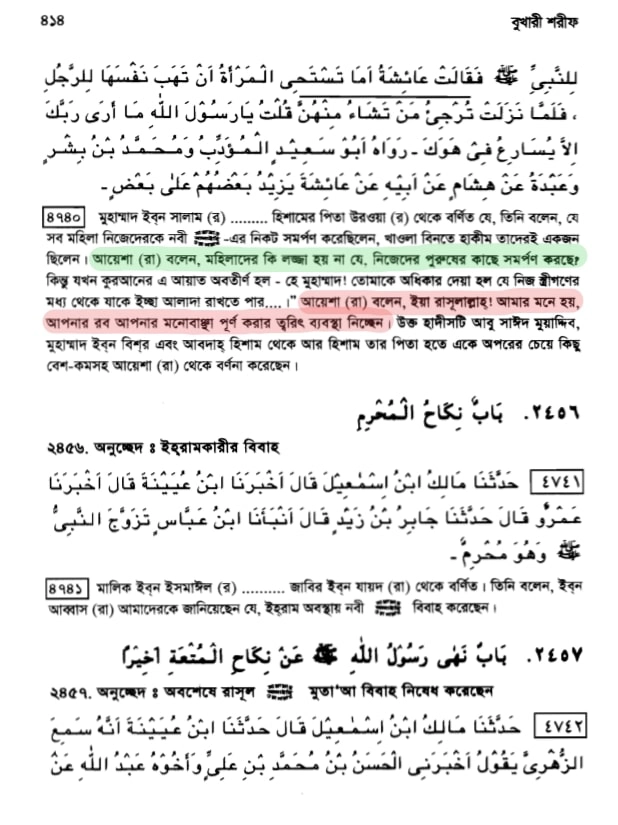
In Bukhari 4788, Aisha’s jealousy, the question of how women surrender themselves, the declaration of the verse, and the “hawaq” comment are narrated consecutively. Her objection is linked to a practical marital privilege. She directly felt the result of giving special legitimacy to Muhammad’s will regarding the position and entitlements of the wives. [355]
كُنْتُ أَغَارُ عَلَى اللاَّتِي وَهَبْنَ أَنْفُسَهُنَّ لِرَسُولِ اللَّهِ صلى الله عليه وسلم وَأَقُولُ أَتَهَبُ الْمَرْأَةُ نَفْسَهَا فَلَمَّا أَنْزَلَ اللَّهُ تَعَالَى {تُرْجِئُ مَنْ تَشَاءُ مِنْهُنَّ وَتُؤْوِي إِلَيْكَ مَنْ تَشَاءُ وَمَنِ ابْتَغَيْتَ مِمَّنْ عَزَلْتَ فَلاَ جُنَاحَ عَلَيْكَ} قُلْتُ مَا أُرَى رَبَّكَ إِلاَّ يُسَارِعُ فِي هَوَاكَ.
English translation: I used to be jealous of the women who surrendered themselves to the Messenger and would say, does any woman surrender herself? Then Allah revealed: “You may set aside whom you wish among them and keep whom you wish close to you; and if you wish to take back her whom you have set aside, there is no blame on you.” Then I said: I see your Lord taking quick measures to fulfill your desires.
In verse 50 of Al-Ahzab, the boundaries of the special privilege are delineated. If a believing woman surrenders herself to the Prophet and the Prophet wishes to marry her, her permission is stated as “specially for you, excluding other believers.” The provisions imposed on the wives of ordinary believers are also mentioned in the same verse. Consequently, the difference in provisions for the ordinary follower and the declarer is the direct statement of the text. The purpose of not having hardship upon the individual is also in the latter part of the verse. [356]
يَا أَيُّهَا النَّبِيُّ إِنَّا أَحْلَلْنَا لَكَ أَزْوَاجَكَ اللَّاتِي آتَيْتَ أُجُورَهُنَّ وَمَا مَلَكَتْ يَمِينُكَ مِمَّا أَفَاءَ اللَّهُ عَلَيْكَ وَبَنَاتِ عَمِّكَ وَبَنَاتِ عَمَّاتِكَ وَبَنَاتِ خَالِكَ وَبَنَاتِ خَالَاتِكَ اللَّاتِي هَاجَرْنَ مَعَكَ وَامْرَأَةً مُّؤْمِنَةً إِن وَهَبَتْ نَفْسَهَا لِلنَّبِيِّ إِنْ أَرَادَ النَّبِيُّ أَن يَسْتَنكِحَهَا خَالِصَةً لَّكَ مِن دُونِ الْمُؤْمِنِينَ ۗ قَدْ عَلِمْنَا مَا فَرَضْنَا عَلَيْهِمْ فِي أَزْوَاجِهِمْ وَمَا مَلَكَتْ أَيْمَانُهُمْ لِكَيْلَا يَكُونَ عَلَيْكَ حَرَجٌ ۗ وَكَانَ اللَّهُ غَفُورًا رَّحِيمًا
English translation: O Prophet, We have made lawful for you your wives to whom you have given dower; those slave girls who have come under your ownership among what Allah has given you; the daughters of your paternal uncles, your paternal aunts, your maternal uncles, and your maternal aunts who have emigrated with you; and any believing woman who surrenders herself to the Prophet, if the Prophet wishes to marry her. This is specially for you, excluding other believers. We know what We have decreed regarding their wives and the women under their ownership; so that there may be no hardship for you. Allah is Forgiving, Merciful.
Ibn Kathir, attributing it to Qatada, explained this specialty as an opportunity for surrender without a guardian or dower. This specifies the meaning of the privilege: the marriage obligations that exist for other men are specially relaxed for a woman surrendering to Muhammad. It is stated that this exemption becomes effective if the man’s own desire to accept is joined with the woman’s interest. The personal acceptance or rejection by the religious declarer is at the center of legitimacy here. [357]
ولهذا قال قتادة في قوله : ( خالصة لك من دون المؤمنين ) ، يقول : ليس لامرأة تهب نفسها لرجل بغير ولي ولا مهر إلا للنبي صلى الله عليه وسلم.
English translation: For this reason, in explaining the words “specially for you, excluding other believers,” Qatada said: a woman cannot surrender herself to any man other than the Prophet without a guardian and dower.
In the next verse, the freedom of decision comes regarding whom to set aside and whom to keep close. It is stated that there is no blame in again accepting her who was previously separated. This special power is linked to the wives’ eyes being delighted, not feeling grief, and being satisfied with what is given. The reason for the women to remain satisfied is being created by expanding the scope of the beneficiary man’s will. An equal right to decide how much each will be given was not placed in the hands of the women. [358]
تُرْجِي مَن تَشَاءُ مِنْهُنَّ وَتُؤْوِي إِلَيْكَ مَن تَشَاءُ ۖ وَمَنِ ابْتَغَيْتَ مِمَّنْ عَزَلْتَ فَلَا جُنَاحَ عَلَيْكَ ۚ ذَٰلِكَ أَدْنَىٰ أَن تَقَرَّ أَعْيُنُهُنَّ وَلَا يَحْزَنَّ وَيَرْضَيْنَ بِمَا آتَيْتَهُنَّ كُلُّهُنَّ ۚ وَاللَّهُ يَعْلَمُ مَا فِي قُلُوبِكُمْ ۚ وَكَانَ اللَّهُ عَلِيمًا حَلِيمًا
English translation: You may set aside whom you wish among them and keep whom you wish close to you. If you wish to take back her whom you have set aside, there is no blame on you. This is more likely to make them all delighted, not feel grief, and be satisfied with what you give. Allah knows what is in your hearts. Allah is All-Knowing, Forbearing.
In one explanation by Ibn Kathir, the verse is linked to the acceptance or rejection of women who surrender themselves. In another, it is mentioned that there is no obligation in determining the turns of his own wives. In both explanations, the freedom of decision is in the hands of Muhammad’s personal preference. In the first, the opportunity for acceptance, rejection, and later return; in the second, a special exemption regarding the turns of staying with and having intercourse with the wives. This decision-making power outside the general rule is the actual subject of Aisha’s comment. [359]
لَا حَرَجَ عَلَيْكَ أَنْ تَتْرُكَ الْقَسْمَ لَهُنَّ ، فَتُقَدِّمَ مَنْ شِئْتَ ، وَتُؤَخِّرَ مَنْ شِئْتَ ، وَتُجَامِعَ مَنْ شِئْتَ ، وَتَتْرُكَ مَنْ شِئْتَ
English translation: There is no blame on you if you give up the distribution of turns; you may keep whom you wish first, whom you wish later, with whom you wish to unite, and whom you wish to leave.
Giving mandatory turns and giving turns according to will does not create equal rights. In the first case, the wife is a claimant to her specific entitlement; in the second case, that entitlement depends on the man’s decision. Even if the man gives time equally, it stands as his preferred favor. When a fair entitlement is transformed into optional generosity, the burden of gratitude also falls on the woman. This change does not only change the list of nights; it changes the power structure of negotiation between husband and wife.
In Ibn Kathir’s subsequent explanation, this relationship of favor is stated directly. In his statement, if the obligation to give turns to the wives is removed, the fact that Muhammad is giving time equally is his own will. The wives will acknowledge it as his favor. The social result of establishing the man’s optional goodwill instead of a right is clear in this very commentary. [360]
أي : إذا علمن أن الله قد وضع عنك الحرج في القسم ، فإن شئت قسمت ، وإن شئت لم تقسم ، لا جناح عليك في أي ذلك فعلت ، ثم مع هذا أنت تقسم لهن اختيارا منك لا أنه على سبيل الوجوب ، فرحن بذلك واستبشرن به وحملن جميلك في ذلك ، واعترفن بمنتك عليهن في قسمك لهن وتسويتك بينهن وإنصافك لهن وعدلك فيهن.
English translation: That is, when they know that Allah has removed the restriction of turn distribution from you—you may give turns if you wish, or not if you do not; whatever you do, there is no blame on you—and yet you are giving turns not out of obligation, but of your own will, then they will be happy and delighted, they will acknowledge your good conduct, and they will accept your favor in giving them turns, keeping them equal, and in being just and equitable.
In Bukhari, there is also a description of the Prophet seeking permission on a wife’s day after the verse. When Aisha was asked, she said that if the matter were in her hands, she would not want to give priority to anyone else over Muhammad. The wife’s own desire here is to spend time with Muhammad. Even after the declaration of special exemptions, that desire did not disappear. While the result of happiness and gratitude is expected in the Tafsir, the woman’s own desire to hold onto her time is preserved in the hadith. [361]
أَنَّ رَسُولَ اللَّهِ صلى الله عليه وسلم كَانَ يَسْتَأْذِنُ فِي يَوْمِ الْمَرْأَةِ مِنَّا بَعْدَ أَنْ أُنْزِلَتْ هَذِهِ الآيَةُ {تُرْجِئُ مَنْ تَشَاءُ مِنْهُنَّ وَتُؤْوِي إِلَيْكَ مَنْ تَشَاءُ وَمَنِ ابْتَغَيْتَ مِمَّنْ عَزَلْتَ فَلاَ جُنَاحَ عَلَيْكَ}. فَقُلْتُ لَهَا مَا كُنْتِ تَقُولِينَ قَالَتْ كُنْتُ أَقُولُ لَهُ إِنْ كَانَ ذَاكَ إِلَىَّ فَإِنِّي لاَ أُرِيدُ يَا رَسُولَ اللَّهِ أَنْ أُوثِرَ عَلَيْكَ أَحَدًا.
English translation: “You may set aside whom you wish among them and keep whom you wish close to you; if you wish to take back her whom you have set aside, there is no blame on you”—after the revelation of this verse, the Messenger would seek permission on any wife’s day. I asked Aisha, what would you say then? She said, I would say to him: O Messenger of Allah, if the matter were in my hands, I would not want to give priority to anyone else over you in attaining you.
In Fathul Bari, in another explanation through Wahidi, the decision to surrender turns is linked to the wives’ fear of divorce. It is stated there that after the verse giving the opportunity of choice, several wives feared divorce and left the matter of turn distribution to Muhammad. The security of surviving together in one household and the claim to one’s entitled time became subjects of negotiation within the same relationship. [362]
وحكى الواحدي عن المفسرين أن هذه الآية نزلت عقب نزول آية التخيير ، وذلك أن التخيير لما وقع أشفق بعض الأزواج أن يطلقهن ففوضن أمر القسم إليه ، فأنزلت ترجي من تشاء الآية.
English translation: Wahidi mentioned from the commentators that this verse was revealed after the verse giving the opportunity of choice. When the opportunity of choice was given, several wives feared that he would divorce them. Then they surrendered the matter of turn distribution to him; after that, the verse “you may set aside whom you wish” was revealed.
| Privilege or statement | Specific subject in source | Result regarding |
|---|---|---|
| Al-Ahzab 33:50 | Special permission for a specific individual excluding other believers | Separate rights for ordinary followers and the declarer |
| Al-Ahzab 33:51 | Freedom to set aside, keep close, and accept again | Increase in the scope of the accepting man’s decision |
| Ibn Kathir’s explanation of turns | Exemption from the obligation of equal turns | Transformation of entitled time into personal favor |
| Bukhari 4789 | Aisha does not want to give priority to anyone else on her own day | Wife’s own desire and claim to time |
| Aisha’s “hawaq” comment | Quick measures to fulfill Muhammad’s desires | Overt link between personal desire and privileges of revelation |
The central word in Aisha’s comment is “hawa”—desire, taste, or longing. Who will be accepted, whose time will be pushed back, and who will be brought closer—these are all matters of an individual’s preference. The verse has created a special scope for that preference. Consequently, the sharpness of her comment aligns with a specific advantage. She spoke about the change in actual power within the household in a language that directly identifies the beneficiary of the declared system. [363]
قُلْتُ مَا أُرَى رَبَّكَ إِلاَّ يُسَارِعُ فِي هَوَاكَ
English translation: I said, I see your Lord doing nothing but taking swift measures to fulfill your desires.
When the announcer himself is the beneficiary of special rules, a conflict of interest arises in the claim of the announcement’s validity. There are obligations for his general followers, but exemptions for himself, and the reason for the exemption is to remove his own inconvenience. To prove the divine approval of his own interests, statements revealed to him are presented as evidence. In this system, the beneficiary’s claim and the source of the claim’s truth remain within the same center. Aisha’s sarcastic comment brought the personal desires of that center to the fore.
The argument for ensuring the satisfaction of women is also linked to the distribution of power. When a man is given the freedom to choose what is due to them and they are told to be satisfied with that allotment, the woman’s own claim is weakened. The man’s will is then protected by religious permission, and the woman’s satisfaction is the expected reaction. The special privilege of acceptance or rejection and the optional distribution of marital time both favor the announcer. That the alignment of this privilege with his will was captured in his wife’s own comments is a preserved critical testimony in religious literature.
The relationship between calling the message universal and eternal and such person-specific privileges is also questionable. Special provisions have found a place in a permanent book centered on the women in one specific man’s life, the desire for acceptance, and the distribution of time among wives. In that book, the limits of the general follower and the exemptions of the announcer have been separated. As a result, the laws of the book did not remain merely distant cosmic declarations; they also functioned as arrangements for the announcer’s household and personal comfort. The needs of the home and the language of revelation are tied in the same system.
The fear of new verses being revealed regarding the Companions’ own family behavior
The possibility of announcing new revelation controlled the Companions’ behavior even within their own homes. In Ibn Umar’s account, they avoided open conversation with their wives because a declaration might be revealed regarding them. After Muhammad’s death, once that fear was removed, they began to speak freely again. The living presence of the announcer, the uncertainty of new instructions, and self-restraint in personal behavior—the relationship between these three is present in the same account. Religious authority did not control people only through effective prohibitions; the possibility of new prohibitions or condemnations arriving was also a means of control.
The Bengali Bukhari account mentions staying away from conversation and joking with their own wives. The matter of fear was the revelation of new revelation regarding them. The mention of behavior changing after death links that fear to the living presence of a specific person. The family sphere also became a potential subject for new religious declarations. [364]
Sahih Bukhari (IF)
Chapter: 54/ Marriage
Section: 2505. Advice on treating women well
4808. Narrated from Nuaym (rh)… from Ibn Umar (ra). He said, during the time of the Prophet peace and blessings of Allah be upon him, we used to keep away from conversation and joking with our wives for fear that some revelation might descend warning us in this regard. After the passing of the Prophet peace and blessings of Allah be upon him, we used to converse and joke with them freely.
Hadith Status: Sahih (Sahih)
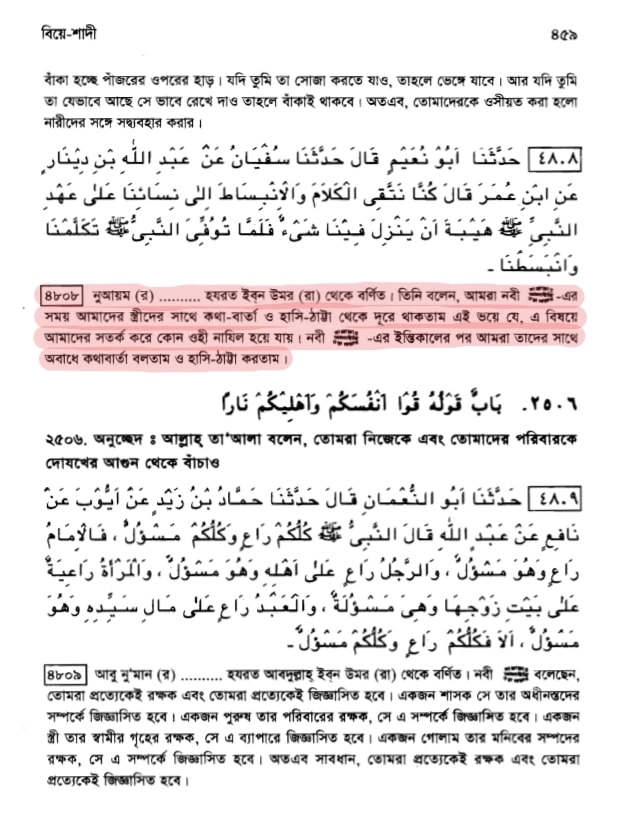
The word “nisayina” in the Arabic text refers to their own wives. Even conversations in those intimate relationships and open behavior were limited due to the apprehension of new verses. The sentence “for fear that something might be revealed regarding us” reveals the link between personal behavior and declared religious condemnation. The fact that new declarations came from his mouth acted as an additional pressure on behavior while he was alive. [365]
كُنَّا نَتَّقِي الْكَلاَمَ وَالاِنْبِسَاطَ إِلَى نِسَائِنَا عَلَى عَهْدِ النَّبِيِّ صلى الله عليه وسلم هَيْبَةَ أَنْ يُنْزَلَ فِينَا شَىْءٌ فَلَمَّا تُوُفِّيَ النَّبِيُّ صلى الله عليه وسلم تَكَلَّمْنَا وَانْبَسَطْنَا
English translation: During the Prophet’s time, we were cautious in conversation and open behavior with our own wives for fear that something might be revealed regarding us. When the Prophet died, we spoke and were open.
Ibn Hajar clarified this matter of apprehension as the Quran. In his explanation, the Companions basically avoided even permitted behavior because a declaration of prohibition or it becoming haram might come later. After death, having become safe from the fear of new declarations, they behaved again on the basis of that original permission. Consequently, avoiding the punishment of a known crime and staying away from behavior not yet forbidden out of fear of the future—these are two separate control processes. Here, the second one was also active. [366]
قوله ( كنا نتقي ) أي نتجنب ، وقد بين سبب ذلك بقوله ” هيبة أن ينزل فينا شيء ” أي من القرآن ، ووقع صريحا في رواية ابن مهدي عن الثوري عند ابن ماجه . وقوله ” فلما توفي ” يشعر بأن الذي كانوا يتركونه كان من المباح ، لكن الذي يدخل تحت البراءة الأصلية ، فكانوا يخافون أن ينزل في ذلك منع أو تحريم ، وبعد الوفاة النبوية أمنوا ذلك ففعلوه تمسكا بالبراءة الأصلية.
English translation: “We were cautious” means we avoided it. He stated the reason for this: “for fear that something might be revealed regarding us”—meaning something from the Quran. This is clear in the account of Sawri through Ibn Mahdi in Ibn Majah. The phrase “when he died” implies that the behavior they avoided was valid behavior included in the original permission. They feared that a restriction or prohibition might be revealed on that matter. After the Prophet’s death, they became safe from that apprehension and performed the act on the basis of the original permission.
In this state, people are not at peace even while following current rules. Because currently permitted behavior could be the subject of a future declaration. Therefore, an individual does not only need to know the list of declared prohibitions; they must also be cautious about the announcer’s potential reactions. The uncertainty of what might cause one’s own household to become the subject of a verse creates self-control. The need for direct surveillance decreases because people begin to limit their own speech. This social effectiveness is captured in the description of Ibn Umar’s behavior before and after.
The possibility of new prohibitions arising as a result of questioning is also present in religious discourse. In Bukhari, the person who asks about something that was not previously haram and thereby causes it to become haram is called the greatest sinner among Muslims. Here, the human question acts directly as the occasion for the prohibition. The responsibility for new restrictions falling on others as a result of the question is imposed on the questioner, not just for their own behavior. [367]
إِنَّ أَعْظَمَ الْمُسْلِمِينَ جُرْمًا مَنْ سَأَلَ عَنْ شَىْءٍ لَمْ يُحَرَّمْ، فَحُرِّمَ مِنْ أَجْلِ مَسْأَلَتِهِ
English translation: The greatest sinner among Muslims is the person who asked about something that was not forbidden, and because of his question, it became forbidden.
This accusation also changes the social position of the questioner. The responsibility of the one announcing the new restriction does not come forward as a question regarding his decision, but is established as the crime of the questioner. Consequently, people may refrain from asking questions even out of interest in knowing the answer, because the question could become the cause of a new prohibition for the community. This system of blaming the questioner rather than questioning the method of announcement for increasing rules protects authority. The advance fear regarding the potential consequences of a question is the social foundation of that protection.
In verse 101 of Al-Ma’idah, it is forbidden to ask about matters which, if revealed, the questioners would feel bad. There is a mention that if one asks during the revelation of the Quran, it will be revealed and there is mention of forgiveness. The connection between human questions and provisions and information at the time of new revelation is present in the language of the verse itself. The message that the initiative to know can itself be the cause of an uncomfortable revelation places additional caution in the scope of questioning. [368]
يَا أَيُّهَا الَّذِينَ آمَنُوا لَا تَسْأَلُوا عَنْ أَشْيَاءَ إِن تُبْدَ لَكُمْ تَسُؤْكُمْ وَإِن تَسْأَلُوا عَنْهَا حِينَ يُنَزَّلُ الْقُرْآنُ تُبْدَ لَكُمْ عَفَا اللَّهُ عَنْهَا ۗ وَاللَّهُ غَفُورٌ حَلِيمٌ
English translation: O believers, do not ask about things which, if revealed to you, would make you feel bad. If you ask about them during the revelation of the Quran, it will be revealed to you. Allah has forgiven those things. Allah is Forgiving, Forbearing.
The environment of questioning before Muhammad, the anger, and the subsequent statement of Umar’s repentance are also in Bukhari. Muhammad becomes angry if disliked matters are questioned repeatedly. When he tells them to ask, two people want to know the identity of their fathers. Seeing signs of anger on his face, Umar speaks of repenting to Allah. The reaction to the leader’s public emotion has turned into an act of seeking religious forgiveness. [369]
سُئِلَ النَّبِيُّ صلى الله عليه وسلم عَنْ أَشْيَاءَ كَرِهَهَا، فَلَمَّا أُكْثِرَ عَلَيْهِ غَضِبَ، ثُمَّ قَالَ لِلنَّاسِ سَلُونِي عَمَّا شِئْتُمْ. قَالَ رَجُلٌ مَنْ أَبِي قَالَ أَبُوكَ حُذَافَةُ. فَقَامَ آخَرُ فَقَالَ مَنْ أَبِي يَا رَسُولَ اللَّهِ فَقَالَ أَبُوكَ سَالِمٌ مَوْلَى شَيْبَةَ. فَلَمَّا رَأَى عُمَرُ مَا فِي وَجْهِهِ قَالَ يَا رَسُولَ اللَّهِ، إِنَّا نَتُوبُ إِلَى اللَّهِ عَزَّ وَجَلَّ.
English translation: The Prophet was asked about some things that he disliked. When asked too many questions, he became angry. Then he told the people: ask me whatever you wish. One said, who is my father? He said, your father is Huzayfa. Another stood up and said, O Messenger of Allah, who is my father? He said, your father is Salim, the freed slave of Shaybah. Umar, seeing the state of his face, said: O Messenger of Allah, we seek repentance from the Almighty Allah.
The consequence of a mistake in behavior before the leader was not limited to immediate reprimand. In verse 2 of Al-Hujurat, there is a warning that raising one’s voice above his voice might unintentionally destroy all one’s deeds. The question of general social courtesy has been tied to the results of a person’s religious deeds and their security in the afterlife. The responsibility of protecting the dignity of the one before whom the voice is told to be controlled then becomes a condition for the results of faith and deeds. [370]
يَا أَيُّهَا الَّذِينَ آمَنُوا لَا تَرْفَعُوا أَصْوَاتَكُمْ فَوْقَ صَوْتِ النَّبِيِّ وَلَا تَجْهَرُوا لَهُ بِالْقَوْلِ كَجَهْرِ بَعْضِكُمْ لِبَعْضٍ أَن تَحْبَطَ أَعْمَالُكُمْ وَأَنتُمْ لَا تَشْعُرُونَ
English translation: O believers, do not raise your voices above the voice of the Prophet and do not speak to him loudly as you speak to one another; lest your deeds be wasted, while you do not even realize it.
The personal consequence of this fear is clear in the incident of Sabit ibn Qays. He sat in his house with his head bowed, considering himself a dweller of Hell because his deeds were wasted. This was because his voice used to be louder than the Prophet’s voice. Later, after receiving assurance of Paradise from Muhammad, a new evaluation of his condition arrived. The fear of punishment and the release from that fear—the decision for both depends on the statement of the announcer. [371]
أَنَّ النَّبِيَّ صلى الله عليه وسلم افْتَقَدَ ثَابِتَ بْنَ قَيْسٍ، فَقَالَ رَجُلٌ يَا رَسُولَ اللَّهِ، أَنَا أَعْلَمُ لَكَ عِلْمَهُ. فَأَتَاهُ فَوَجَدَهُ جَالِسًا فِي بَيْتِهِ مُنَكِّسًا رَأْسَهُ، فَقَالَ مَا شَأْنُكَ فَقَالَ شَرٌّ، كَانَ يَرْفَعُ صَوْتَهُ فَوْقَ صَوْتِ النَّبِيِّ صلى الله عليه وسلم فَقَدْ حَبِطَ عَمَلُهُ، وَهْوَ مِنْ أَهْلِ النَّارِ. فَأَتَى الرَّجُلُ فَأَخْبَرَهُ أَنَّهُ قَالَ كَذَا وَكَذَا. فَقَالَ مُوسَى بْنُ أَنَسٍ فَرَجَعَ الْمَرَّةَ الآخِرَةَ بِبِشَارَةٍ عَظِيمَةٍ، فَقَالَ اذْهَبْ إِلَيْهِ فَقُلْ لَهُ إِنَّكَ لَسْتَ مِنْ أَهْلِ النَّارِ، وَلَكِنْ مِنْ أَهْلِ الْجَنَّةِ.
English translation: The Prophet did not see Sabit ibn Qays and asked about him. Someone said, O Messenger of Allah, I will bring news of him. He went and saw Sabit sitting in his house with his head bowed. He asked, what happened? Sabit spoke about himself: a bad state; he used to raise his voice above the Prophet’s voice, therefore his deeds are wasted and he is one of the dwellers of Hell. The man returned and reported his statement. Musa ibn Anas says, later he returned with great glad tidings. The Prophet said: go to him and tell him, you are not among the dwellers of Hell; you are one of the dwellers of Paradise.
In the explanation of the verse, Ibn Kathir established a direct relationship between Muhammad’s anger and Allah’s anger. In his words, if Muhammad becomes angry, Allah also becomes angry and may waste that person’s deeds, while the person may not even know it. When the potential reaction of human emotion is linked to invisible punishment, behavioral fear increases manifold. The social leader then becomes not only the source of instructions on how to speak before him but also the center of security in the afterlife. [372]
أي : إنما نهيناكم عن رفع الصوت عنده خشية أن يغضب من ذلك ، فيغضب الله لغضبه ، فيحبط الله عمل من أغضبه وهو لا يدري
English translation: That is, you have been forbidden from raising your voice before him for fear that he will become angry; because of his anger, Allah will also become angry and Allah will waste the deeds of the one who angered him, while he will not even know it.
| Area of apprehension | Consequence described in the source | Control in behavior |
|---|---|---|
| Conversation with one’s own wife | Something new being revealed regarding themselves | Avoiding open behavior |
| Questioning on permitted matters | New prohibition due to questioning | Holding the questioner responsible for the community’s loss |
| Information that would be painful if revealed | Revelation at the time of questioning | Caution in the interest of knowing |
| Raised voice before the Prophet | Fear of wasted deeds and afterlife punishment | Self-restraint in voice and behavior |
| Death of the announcer | Removal of the fear of new declarations regarding themselves | Returning to previous open conversation |
The change after death in Ibn Umar’s statement is particularly significant. When the fear of new Quranic declarations no longer exists, the previous behavior returns. The same marital relationship, the same household space, but the fear of new revelation is absent. For that reason, people’s behavior changed. An important source of control was the possibility of new statements being declared through a specific person. His death closed that specific path.
The claim that things were pre-written in the Preserved Tablet did not reveal future announcements to people. The scope of instructions in their actual lives remained open. They lived in ongoing uncertainty regarding what new prohibitions would come, what would be rebuked, or on which questions rules for others would increase. This unknown future of social life existed alongside the theological concept of predestination. The fear described in the hadiths as the reason for the Companions’ behavior is the fear of the actual possibility of new announcements.
In this process, claims of faith and the efficacy of power work together. If an announcement is perceived as the word of God, its potential condemnation creates a preemptive barrier to one’s own behavior. It seems safer to avoid even those actions that are not explicitly forbidden beforehand. Religious authority does not have to give a direct prohibition every time; the apprehension of a subsequent verse can effect control. Ibn Umar’s memoir is direct testimony to that self-control and its relaxation after his death.
Stopping the propagation of glad tidings by striking Abu Hurayra: Umar’s intervention in the Prophet’s order
Muhammad had sent Abu Hurayra to propagate a piece of glad tidings. The condition of that message, sent with his own shoes, was to testify with the certainty of the heart that there is no deity but Allah. Abu Hurayra first encountered Umar. After hearing the message, Umar struck him on the chest; he fell on his buttocks. He was told to go back. Later, Umar presented his reasoning before Muhammad: people might just sit back relying on this glad tidings, so they should be allowed to work. Muhammad agreed with those words. This incident, where the propagation of a declared instruction was stopped by the intervention of a follower, is preserved in Sahih Muslim.
At the beginning of the account, there is mention of the companions’ anxiety upon not finding Muhammad and finding Him in a garden. Muhammad placed His own shoes in Abu Hurayra’s hand. Consequently, the messenger did not set out with only a verbal claim; he also carried a sign of identity provided by the sender. Clear instructions were given on what to say and to whom it should be said for propagation. [373]
فَقَالَ يَا أَبَا هُرَيْرَةَ. وَأَعْطَانِي نَعْلَيْهِ قَالَ اذْهَبْ بِنَعْلَىَّ هَاتَيْنِ فَمَنْ لَقِيتَ مِنْ وَرَاءِ هَذَا الْحَائِطِ يَشْهَدُ أَنْ لاَ إِلَهَ إِلاَّ اللَّهُ مُسْتَيْقِنًا بِهَا قَلْبُهُ فَبَشِّرْهُ بِالْجَنَّةِ.
English translation: He said: O Abu Hurayra. He gave me His two shoes and said: Take these two shoes of mine. Whoever you meet outside this garden, if he testifies with the certainty of the heart that there is no deity but Allah, then give him the glad tidings of Paradise.
The condition for the glad tidings includes the certainty of the heart. The medium through which the message would reach the followers was also decided. Carrying the shoes was a visible sign of the messenger’s relationship with the sender. In this state, Abu Hurayra was not going to announce any new ruling of his own choice; he was obeying a direct order. Therefore, the obstacle he encountered happened right in the middle of the messenger’s performance of duty.
When Umar asked about the identity of the shoes, Abu Hurayra informed him of both the sender and the message. Immediately after, the blow came. The account includes the location of the strike, the result of the fall, the order to return, and returning in a state of weeping. Through physical force, the path of an authorized messenger was blocked. Power intervened even in the path of religious news reaching the people. [374]
فَكَانَ أَوَّلَ مَنْ لَقِيتُ عُمَرُ فَقَالَ مَا هَاتَانِ النَّعْلاَنِ يَا أَبَا هُرَيْرَةَ. فَقُلْتُ هَاتَانِ نَعْلاَ رَسُولِ اللَّهِ صلى الله عليه وسلم بَعَثَنِي بِهِمَا مَنْ لَقِيتُ يَشْهَدُ أَنْ لاَ إِلَهَ إِلاَّ اللَّهُ مُسْتَيْقِنًا بِهَا قَلْبُهُ بَشَّرْتُهُ بِالْجَنَّةِ. فَضَرَبَ عُمَرُ بِيَدِهِ بَيْنَ ثَدْيَىَّ فَخَرَرْتُ لاِسْتِي فَقَالَ ارْجِعْ يَا أَبَا هُرَيْرَةَ فَرَجَعْتُ إِلَى رَسُولِ اللَّهِ صلى الله عليه وسلم فَأَجْهَشْتُ بُكَاءً وَرَكِبَنِي عُمَرُ فَإِذَا هُوَ عَلَى أَثَرِي.
English translation: The first person I met was Umar. He said: Abu Hurayra, what are these two shoes? I said: These are the Messenger’s shoes. He sent me with these; whoever I meet, if he testifies with the certainty of the heart that there is no deity but Allah, I will give him the glad tidings of Paradise. Then Umar struck me in the middle of my chest. I fell on my buttocks. He said: Abu Hurayra, go back. I returned to the Messenger in a state of breaking down in tears. Umar also followed me; he was right behind me.
Speaking, hearing, striking, and sending back—here, violence is specifically linked to the flow of information. Umar blocked the path after knowing the content of the propagation beforehand. Abu Hurayra’s role was to deliver the glad tidings; Umar’s role was to stop that propagation and send him back to the sender. Having the authority to convey the message and being able to apply that authority in reality did not remain the same thing. The physical power of an influential follower stopped the messenger’s activities.
When Muhammad asked the reason for the return, Abu Hurayra mentioned the strike and being told to go back. Muhammad questioned Umar why he did such a thing. Umar first confirmed whether Abu Hurayra had indeed been sent to give this glad tidings. After Muhammad’s “yes” answer, he presented his social reasoning against the propagation. The consideration of what effect it would have on people’s motivation changed the efficacy of the declared order. [375]
فَقَالَ لَهُ رَسُولُ اللَّهِ صلى الله عليه وسلم يَا عُمَرُ مَا حَمَلَكَ عَلَى مَا فَعَلْتَ. قَالَ يَا رَسُولَ اللَّهِ بِأَبِي أَنْتَ وَأُمِّي أَبَعَثْتَ أَبَا هُرَيْرَةَ بِنَعْلَيْكَ مَنْ لَقِيَ يَشْهَدُ أَنْ لاَ إِلَهَ إِلاَّ اللَّهُ مُسْتَيْقِنًا بِهَا قَلْبُهُ بَشَّرَهُ بِالْجَنَّةِ. قَالَ نَعَمْ. قَالَ فَلاَ تَفْعَلْ فَإِنِّي أَخْشَى أَنْ يَتَّكِلَ النَّاسُ عَلَيْهَا فَخَلِّهِمْ يَعْمَلُونَ. قَالَ رَسُولُ اللَّهِ صلى الله عليه وسلم فَخَلِّهِمْ.
English translation: The Messenger said to him: Umar, for what reason did you do this? He said: O Messenger of Allah, may my father and mother be sacrificed for you; did you send Abu Hurayra with your shoes so that if he found someone who testified with the certainty of the heart that there is no deity but Allah, he would give them the glad tidings of Paradise? He said: Yes. Umar said: Then do not do that. I fear that people will rely solely on this. Let them work. The Messenger said: Then leave them be.
| Step | Preserved incident | Effect on propagation |
|---|---|---|
| Command | Sending Abu Hurayra with shoes to announce glad tidings | Carrying news with the sender’s authorization |
| First encounter | Umar knows the identity and subject of the message | The message reaches him |
| Use of force | Strike to the chest, falling, and being told to return | Propagation activity stops |
| Discussion before the sender | Muhammad confirms the act of sending | The identity of the order is recognized |
| Umar’s reasoning | People will sit back relying on it; let them work | Reasoning of motivation in favor of stopping the declared propagation |
| Subsequent decision | Muhammad consents | The previous propagation-instruction does not remain effective |
With this decision, the truth of the glad tidings and the policy of propagating it become separate. Muhammad acknowledged sending him. Umar’s reasoning was about what effect that message could have on people’s behavior. That is, a decision is being made that even religious news accepted as true will not reach the general public due to social management. The propagation of the statement was controlled by the assessment of how much the followers should be reassured and how much pressure of work they should be kept under. The availability of religious information here is subject to the policy preferences of the leadership.
From this incident, Nawawi has adopted the principle of permission not to reveal certain knowledge and the principle of a leader returning from a previous instruction upon a follower’s advice. The matter of withdrawal is clear in his explanation. If a follower shows a different social result of the instruction given by the leader, the leader may change the decision. In the operational process of religious authority, consultation, calculation of potential impact, and withdrawal of previous orders are recognized as elements of human decision-making. [376]
وفيه جواز إمساك بعض العلوم التي لا حاجة إليها للمصلحة أو خوف المفسدة . وفيه إشارة بعض الأتباع على المتبوع بما يراه مصلحة ، وموافقة المتبوع له إذا رآه مصلحة ، ورجوعه عما أمر به بسببه.
English translation: In this, there is permission not to reveal some knowledge that is not needed, for the sake of benefit or fear of harm. It also includes a follower giving advice to the leader which they consider beneficial, the leader consenting to it if they find it beneficial, and consequently returning from their own previous instruction.
The power to determine which knowledge is not needed for the general public is also central here. Whether the believers, concerning whom the news of Paradise is, will receive it depends on the leaders’ assumptions about their behavior. The idea that they would become lazy if they knew the information became a sufficient reason to withhold the information. Consequently, besides the truth of the knowledge, a second filter for propagation is created: the convenience of governance and discipline. The utility of information is judged in the eyes of the leadership; the general people related to the information are not the controllers of that selection.
The incident of Abu Hurayra being struck also reveals the cost of this system. He suffered physical injury while trying to follow the primary instruction. Later, there was a discussion about people’s motivation, and his journey remained stopped. The use of force against the messenger effectively brought the matter into a new discussion. The decision of a powerful follower took precedence over the safety of a person following an authorized order. The transport of religious knowledge did not remain a mere neutral journey of memory and statement; it passed through power relations.
In the account attributed to Mu’adh in Bukhari, there is a similar incident of stopping the propagation of news. After hearing that those who testify truthfully from the heart to Allah and Muhammad would be protected from the fire, he wanted to inform the people. Muhammad said, then they would rely solely on this. Later, at the time of death, Mu’adh mentioned it for fear of sin. The immediate stopping of propagation and the later feeling of responsibility for not informing are preserved in the same account. [377]
مَا مِنْ أَحَدٍ يَشْهَدُ أَنْ لاَ إِلَهَ إِلاَّ اللَّهُ وَأَنَّ مُحَمَّدًا رَسُولُ اللَّهِ صِدْقًا مِنْ قَلْبِهِ إِلاَّ حَرَّمَهُ اللَّهُ عَلَى النَّارِ. قَالَ يَا رَسُولَ اللَّهِ، أَفَلاَ أُخْبِرُ بِهِ النَّاسَ فَيَسْتَبْشِرُوا قَالَ إِذًا يَتَّكِلُوا. وَأَخْبَرَ بِهَا مُعَاذٌ عِنْدَ مَوْتِهِ تَأَثُّمًا.
English translation: Whoever testifies truthfully from his heart that there is no deity but Allah and Muhammad is the Messenger of Allah, Allah forbids the fire for him. Mu’adh said: O Messenger of Allah, shall I not inform the people so that they may rejoice? He said: Then they would rely solely on this. Mu’adh mentioned this at the time of death for fear of sin.
Mu’adh’s final position also shows the conflict within withholding information. Propagation was stopped once because people might become lazy upon knowing the news; then it was disclosed later due to the fear of sin for not informing. Consequently, when a message reaches the followers is not determined solely by the moment of announcement. The subsequent decision and sense of responsibility of the one who remembered it are also part of the history of propagation. A statement may remain limited during a lifetime and later be revealed through memory. Therefore, the time of a message’s social presence is not equal to the time of its alleged original utterance.
In a statement by Ali in Bukhari, there is also mention of speaking according to the capacity of the listener and avoiding the risk of making Allah and the Messenger appear as liars. In the propagation of religious statements, the reaction of the listener is being made a criterion for selection alongside the truth of the content. Decisions on what will be said, how much will be said, and to whom it will be said play a role in shaping the subsequent scope of religious knowledge. [378]
وَقَالَ عَلِيٌّ حَدِّثُوا النَّاسَ، بِمَا يَعْرِفُونَ، أَتُحِبُّونَ أَنْ يُكَذَّبَ، اللَّهُ وَرَسُولُهُ؟
English translation: Ali said: Speak to people according to what they can understand. Do you want Allah and His Messenger to be made to appear as liars?
A common procedure is seen between this statement and the incident of Abu Hurayra: not all statements are directly open to the general public who receive the news. The intermediary evaluates the potential reaction and limits the propagation. In Abu Hurayra’s case, that limitation began with the use of force and later received the approval of the leadership. Consequently, the position of the intermediary is important in the formation and propagation of religious knowledge. The history of orally preserved statements also carries this history of selection and control.
| Event | Human behavior, appeal, or pressure | Effect on announcement and system |
|---|---|---|
| Night of fasting | Violation of prohibition, hunger, and complaint | Forgiveness and new permission for nighttime intercourse and eating |
| Funeral prayer of Ibn Ubayy | Muhammad’s selection and Umar’s objection | Prohibition for the future after the funeral prayer |
| Beating of wives | Umar’s complaint; later complaints from women | From prohibition to permission, then condemnation of the beater |
| Special marital privileges | Women’s surrender, desire to accept, and turns | Exemption for specific individuals; Aisha’s sarcastic comment |
| Fear of new verses | Apprehension regarding household matters and behavior | Self-restraint; end of apprehension after death |
| Propagation of glad tidings | Striking the messenger and reasoning of motivation | Returning from previous propagation-instruction |
Among these, the human role was not limited merely to hearing and memorizing statements. Some made proposals, some obstructed, some broke rulings, some complained, and some blocked the propagation of messages. Subsequent instructions, permissions, prohibitions, special privileges, and policies of propagation are related to those activities. These incidents preserved in religious texts and hadiths are the active human history of the creation of announcements and the social application of announcements. Even if the final form of the instruction is in hand, the conflicts and changes in reaching that form have not been erased from the sources.
The incident involving Abu Hurayra is particularly sharp in this history, because the sender gave his own order and later, upon the advice of a follower, stopped the propagation of that order. The change was adopted after the identity of the first order was confirmed. In the decision of the religious leadership, calculations of human consequences, the opinions of influential individuals, and the need for information control were at work. The independent intervention of a follower was able to change the effective decision of the declarer. This power relationship built around revelation and prophetic instructions is an important basis for understanding the authority of subsequent preservation and compilation.
Apostasy of the Revelation Scribes: Allegations of Word Alteration, Death Sentences, and Rehabilitation
Being entrusted with the responsibility of recording revelation meant being in very close proximity to the declared word. The scribe would listen, write, and sometimes read the writing back. Therefore, the apostasy of someone in that position and their objections regarding the source of the word are directly relevant to the history of the origin of the Quran. In Islamic narrative literature, there are reports of two such scribes: an unnamed Christian man and Abdullah ibn Sa’d ibn Abi Sarh. Following the allegation of one comes the story of a corpse emerging from the grave; in the case of the other, there are accounts of allegations of word substitution, orders for execution, Uthman’s mediation, and subsequent administrative rise. Here, the process of writing, religious authority, and political power are intertwined.
The Unnamed Christian Scribe: Apostasy and His Allegations Regarding Muhammad’s Knowledge
In the report preserved under the name of Anas ibn Malik in Bukhari, a Christian man accepts Islam, reads Surah Baqarah and Al Imran, and begins to write for Muhammad. Later, he returns to his previous religion. The report does not mention his name; but it specifies his education and his responsibility as a scribe. This person, involved in the work of recording the word, left that work and raised allegations regarding the knowledge of the declarer of the word. The background of his objection was his experience working as an assistant. The allegation was that Muhammad knew nothing more than what he had written for him. [379] [380]
Sahih Bukhari (Tawheed Publication)
61/ Dignity and Characteristics
Section: 61/25. Signs of Prophethood in Islam.
3617. Narrated from Anas (ra). He said, a Christian man became a Muslim and learned Surah Al-Baqarah and Surah Al-Imran. He used to write revelation for the Prophet peace and blessings of Allah be upon him. Then he became a Christian again. He began to say, Muhammad does not know anything more than what I used to write for him. (Nauzubillah) after some days Allah gave him death. The Christians buried him. But the next morning it was seen that the soil of the grave had thrown him out. Seeing this, the Christians began to say— this is the work of Muhammad and his companions. Since this companion of ours had fled from them, they have thrown our companion out of the grave. Therefore, they dug the grave as deep as possible and buried him again. But the next morning it was seen that the soil of the grave had thrown him out again. This time also they said, this is the act of Muhammad and his companions. Because of fleeing from them, they have thrown our companion out of the grave. This time they dug the grave even deeper and buried him. The next morning it was seen that the soil of the grave had thrown him out once more. Then they also understood that this is not the work of humans. Therefore, they left the corpse lying there. (Muslim 50/50 Hadith 2781, Ahmad 13323) (Modern Publication: 3349, Islamic Foundation: 3356)
Hadith Status: Sahih (Sahih)
Narrator: Anas ibn Malik (ra)
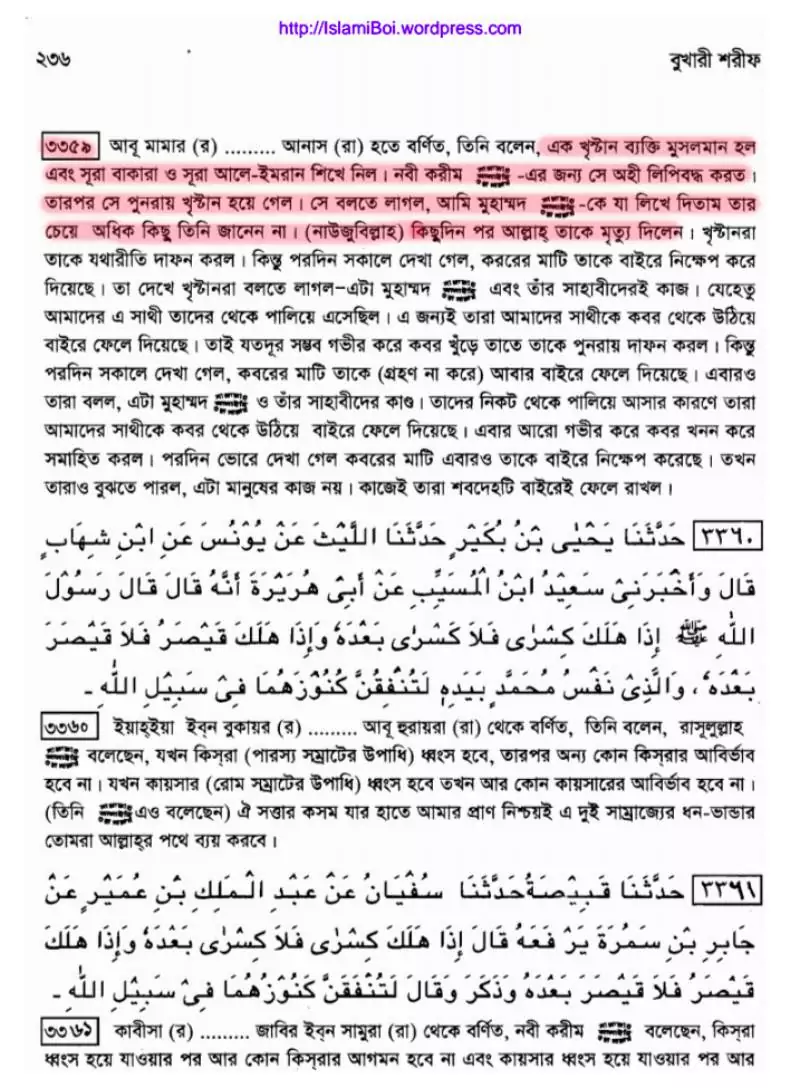
In the Arabic sentence of the allegation, the two parts “what I have written for him” and “Muhammad does not know” stand facing each other. Through this, the scribe is not reducing his role to mere transcription; he is claiming the primacy of his written work over the knowledge of the declarer. The blow of his statement is at the very center of prophethood: if the person claiming to receive words from an external source depends on the words provided by the scribe for his knowledge, then the very basis of that claim is called into question. Bukhari did not erase this sentence of the allegation; it remains in his compilation. [380]
فَعَادَ نَصْرَانِيًّا فَكَانَ يَقُولُ مَا يَدْرِي مُحَمَّدٌ إِلاَّ مَا كَتَبْتُ لَهُ
English translation: He became a Christian again and began to say, Muhammad knows nothing more than what I have written for him.
The sequence of events in the report is also significant. First, a Christian identity, then accepting Islam and studying two large Surahs, then becoming Muhammad’s scribe, followed by apostasy and the allegation. The phase of participating in Islamic education and performing the duties of a scribe in the middle provides a basis of specific experience for his subsequent objection. The education and writing skills that were useful upon entering the religion took the form of testimony against prophethood after leaving the religion. This kind of opposition is uncomfortable for religious institutions because the objector is speaking from a position inside the institution’s work.
Following the allegation, the report does not present any manuscript written by him. There is no comparison as to which sentence he created himself, which sentence Muhammad had said previously, or where there were similarities or differences between the two. The story quickly moves toward his death and the grave. Instead of examining the scribe’s claim of knowledge, the horrific fate of his corpse becomes the central scene. In this arrangement, the apostate’s statement is not judged by his written work; his position is shown to be religiously defeated through the punishment described surrounding his body. A story of miraculous vengeance has been set up in response to an allegation about the source of the word.
| The position of the scribe in the report | Specific information | Significance of the allegation |
|---|---|---|
| Entry into religion | Accepting Islam from a Christian identity | He is not presented as an outsider completely ignorant of Islam |
| Participation in religious texts | Reading Baqarah and Al Imran | Direct acquaintance with the declared word is described |
| Responsibility of writing | Used to write for Muhammad | The background of the allegation is the work of recording the word |
| Statement after apostasy | Muhammad did not know more than the words he wrote | The source of the word and the independence of the declarer’s knowledge are questioned |
| Conclusion of the story | Repetition of finding the corpse outside the grave | The scene of punishment has become primary instead of a textual examination of the allegation |
The power of this story to create fear works in a different direction than the content of the allegation. An image where even the earth does not accept the body of the apostate makes leaving the religion a matter of terror for the follower. Currently, no such general rule of consequence is seen for all deceased apostates from Islam and critics of Muhammad. The report itself does not provide any regular method of verification; it presents a specific consequence as a sign in favor of prophethood. Consequently, the social function of the story is to produce fear against apostasy, while the question of the relationship between the scribe and the declarer raised in the scribe’s allegation remains unresolved.
Different versions of the scribe’s statement and the corpse’s story in Bukhari and Muslim
In the compilation of Muslim, a report of a scribe from Banu Nadir is found under the same name of Anas. There too, there is mention of reading Baqarah and Al Imran and writing for Muhammad. When the person fled to the People of the Book, they gave him importance because he was Muhammad’s scribe. Later comes the story of his death and the body being found outside the grave repeatedly. In this text of Muslim, the sentence of direct allegation “Muhammad knows nothing more than what I have written” is absent. The difference in the text here is specific: in Bukhari, the allegation and the story of the corpse are side by side; in Muslim, there is the scribe’s departure, the respect of the People of the Book, and the story of the corpse. [381]
كَانَ مِنَّا رَجُلٌ مِنْ بَنِي النَّجَّارِ قَدْ قَرَأَ الْبَقَرَةَ وَآلَ عِمْرَانَ وَكَانَ يَكْتُبُ لِرَسُولِ اللَّهِ صلى الله عليه وسلم فَانْطَلَقَ هَارِبًا حَتَّى لَحِقَ بِأَهْلِ الْكِتَابِ قَالَ فَرَفَعُوهُ قَالُوا هَذَا قَدْ كَانَ يَكْتُبُ لِمُحَمَّدٍ فَأُعْجِبُوا بِهِ فَمَا لَبِثَ أَنْ قَصَمَ اللَّهُ عُنُقَهُ فِيهِمْ فَحَفَرُوا لَهُ فَوَارَوْهُ فَأَصْبَحَتِ الأَرْضُ قَدْ نَبَذَتْهُ عَلَى وَجْهِهَا ثُمَّ عَادُوا فَحَفَرُوا لَهُ فَوَارَوْهُ فَأَصْبَحَتِ الأَرْضُ قَدْ نَبَذَتْهُ عَلَى وَجْهِهَا ثُمَّ عَادُوا فَحَفَرُوا لَهُ فَوَارَوْهُ فَأَصْبَحَتِ الأَرْضُ قَدْ نَبَذَتْهُ عَلَى وَجْهِهَا فَتَرَكُوهُ مَنْبُوذًا .
English translation: A man of Banu Nadir among us had read Baqarah and Al Imran and used to write for the Messenger of Allah. He fled and went to the People of the Book. They gave him dignity and said, this man used to write for Muhammad; they were impressed by him. Within a short time, Allah destroyed him among them. They dug a grave for him and covered him. In the morning, it was seen that the soil had thrown him out. They dug the grave again and covered him; in the morning, it was seen that the soil had thrown him out. They dug the grave again and covered him; in the morning, it was seen that the soil had thrown him out. Then they left him lying outside.
The reason for his dignity among the People of the Book was also the responsibility of the scribe. In Muslim’s account, his identity was this: “used to write for Muhammad”. That is, even after leaving the Islamic camp, his identity as a scribe did not lose social value; to people of different religions, that became the identity of special knowledge. This point makes the similarity between the two reports more specific: the event of conversion and return is not isolated from the work of writing. In Bukhari’s account, the scribe speaks against Muhammad’s knowledge based on that work; in Muslim’s account, the other community gives him importance because of that same work.
In Bukhari’s story, there is also the reaction of the Christians after finding the corpse outside the grave. They allege that Muhammad and his companions threw the corpse out; later it is said that the same result was obtained after digging a deeper grave. Finally, the report states that they understood it was not the work of humans. Thus, in Bukhari’s text, there is a structure of a small debate: the allegation of it being human work, a deeper grave, repeated results, and a miraculous conclusion. Muslim’s text is much shorter; there, similarly, the Christians’ allegations and the detailed debate of each time are absent. There are differences in three areas: the expansion of the report, the presence of the allegation, and the presentation of reaching a miraculous conclusion.
| Points of Comparison | Bukhari 3617 | Muslim 2781 |
|---|---|---|
| Initial Identity | Christian to Muslim, then Christian again | A person of Banu Nadir among us; later going to the People of the Book |
| Education and Responsibility | Reading Baqarah and Al Imran; writing for Muhammad | Reading Baqarah and Al Imran; writing for Muhammad |
| Direct statement against Muhammad | The sentence “He knows nothing more than what I have written” is present | This sentence is absent |
| Reaction of the other community | Their statements regarding the burial and the explanation of the corpse emerging are present | Mention of giving him dignity and praise because of the scribe identity |
| Description of the corpse | Detailed story including deeper graves and allegations of it being human work | Repeated short description of burial and lying outside the soil |
| Source of the report | Anas ibn Malik | Anas ibn Malik |
In the complete Bengali report found in Lulu wal Marjan on the same context, Bukhari’s detailed story including the sentence of allegation is present, and at the end, references to both Bukhari and Muslim are given. The full quotation of the compilation is below. Comparing it with the separate texts of the two original compilations, it is understood that referencing parallel sources and having exactly the same sentence in each book are two separate matters. [382]
Al-Lulu wal Marjan
50/ Hypocrites and their Rulings
Section: (Hypocrites and their Rulings)
1772. Narrated from Anas (ra). He said, a Christian man became a Muslim and learned Surah Al-Baqarah and Surah Al-Imran. He used to write revelation for the Prophet peace and blessings of Allah be upon him. Then he became a Christian again. He began to say, Muhammad does not know anything more than what I used to write for him. (Nauzubillah) after some days Allah gave him death. The Christians buried him. But the next morning it was seen that the soil of the grave had thrown him out. Seeing this, the Christians began to say— this is the work of Muhammad and his companions. Since this companion of ours had fled from them, they have thrown our companion out of the grave. Therefore, they dug the grave as deep as possible and buried him again. But the next morning it was seen that the soil of the grave had thrown him out again. This time also they said, this is the act of Muhammad and his companions. Because of fleeing from them, they have thrown our companion out of the grave. This time they dug the grave even deeper and buried him. The next morning it was seen that the soil of the grave had thrown him out once more. Then they also understood that this is not the work of humans. Therefore, they left the corpse lying there.
Sahih al-Bukhari, Volume 61 : Dignity and Qualities, Chapter 25, Hadith 3617; Muslim, Volume 50 : Hypocrites and their Rulings, Chapter, Hadith 2781
Hadith Status: Sahih (Sahih)
Narrator: Anas ibn Malik (ra)
The existence of two compilations does not create two independent eyewitnesses of the same event. Both reports are preserved under the name of Anas, although the path and language of the report diverged after him. From this difference, the history of the preservation and propagation of the report is found. The sentence of allegation is absent in this text of Muslim—this too is a piece of information from that history. The compiler gave no statement of his own regarding the reason for the absence. In Bukhari’s text, the allegation is clear and the story of the corpse is also clear; if the language of the allegation is erased as being religiously unacceptable, an important part of the original hadith is erased.
The miraculous scenes at the end of both accounts serve a similar logical function: terrible consequences followed the apostasy, therefore the position of the apostate is defeated. However, the descriptions of death, burial, and the body being found outside the grave do not determine the source of the sentences at the time of writing. The question of comparing his written content with what Muhammad proclaimed is entirely different. The internal classification of “sahih” hadith literature does not automatically accomplish an independent observation of a miracle, a neutral examination of the grave, or a textual refutation of the author’s allegations. Here, the religious status of the narration creates an opportunity to be used as an answer to the allegation, yet the tools to examine the specific subject of the allegation are absent from the account.
Allegation of removing the corpse from the grave: Aisha’s account of Muhammad’s secret nighttime visits to the cemetery
Regarding the incident where the corpse of the apostate Christian revelation-writer was repeatedly found outside the grave, the Christians leveled direct allegations against Muhammad and his companions. Their claim was that since the writer had left their group and returned to the Christians, Muhammad and his followers had exhumed and thrown out the body as revenge. In Bukhari’s account, this allegation appears not once, but twice. The first time, the Christians dug the grave deeper; the second time, they buried it even more deeply. Each time, it is said the body was found outside. However, there is no detail of any direct investigation into who had come to the grave at night, how the body came outside, or whether there was any human intervention. Instead, at the conclusion of the story, it is decided that the soil of the grave had miraculously cast the body out. In this way, a specific allegation of human intervention is settled with an explanation of a miracle. [383]
In connection with this allegation, a separate direct account from Aisha regarding Muhammad’s nighttime movements becomes important. Aisha stated that on the night of her turn, Muhammad, thinking she was asleep, very cautiously took his cloak, put on his shoes, and silently opened the door and left the room. Aisha secretly followed him and saw that Muhammad went to the Baqi cemetery in the dead of night. He remained there for a long time and raised his hands three times. Later, while returning, seeing Aisha following him, he began to walk fast and then run. Aisha also ran and returned home first. Upon entering the house, Muhammad asked the reason for her panting. Although Aisha initially kept the matter secret, Muhammad said that if she did not tell him, the All-Knowing Allah would inform him. When Aisha admitted to following him, Muhammad struck her on the chest such that she felt pain. [384] [385]
When these two accounts are placed side by side, a significant point emerges. In the first incident, the Christians alleged that Muhammad and his companions were removing the corpse from the grave under the cover of night. In the second incident, a direct account from Muhammad’s own wife reveals his silent nighttime visits to the cemetery. Leaving while Aisha was thought to be asleep, returning quickly upon seeing her follow, the subsequent interrogation, and the strike upon her confession—all are preserved in the sequence of his own nighttime visits to the cemetery. Therefore, the possibility of human intervention raised in the Christians’ allegation cannot be dismissed as baseless imagination. Real precedents of secret nighttime travel to the cemetery exist within the hadiths concerning Muhammad’s life. Whether the corpse rose from the grave on its own or someone threw it out—this fundamental question of the first incident is not resolved by a miraculous explanation.
Sunan Nasa’i (Islamic Foundation)
37/ Behavior with wife
Chapter: 4. Self-respect
3965. Narrated from Sulayman ibn Dawud (rh)… from Muhammad ibn Qays (rh). He said, I heard from Aisha (ra), she said, shall I not narrate to you about Rasulullah sallallahu alayhi wasallam and me? We said, why would you not? She said, once Rasulullah sallallahu alayhi wasallam returned on my turn (after performing Isha prayer). Then he placed his shoes by his feet, put aside his cloak, and spread one of his lungis on the bed.
Then he stayed only for as long as he thought that I had fallen asleep. Then he rose, quietly put on his shoes and quietly took his cloak. Then he quietly opened the door and after exiting, quietly closed the door. And I put on the kameez over my head, put on the scarf and covered myself with the cloak and followed him; he came to the Baqi and raised his hands three times and stood for a long time, then he was returning. I was also returning. He walked a bit fast, I also walked fast, he ran, I also ran. He reached, but I reached before him.
Entering the house, I lay down. He also entered and said: O Aisha! What happened to your stomach that it has become swollen? The narrator Sulayman says, I think that instead of Ibn Wahhab (رابية), (حشيا) was used, which means panting due to walking fast. Rasulullah sallallahu alayhi wasallam said, tell me what happened, otherwise Allah, who is the Subtle and All-Aware, will inform me.
I said, may my parents be sacrificed for you and I narrated the incident. Rasulullah sallallahu alayhi wasallam said, then were you that (shadowy figure) whom I was seeing before me? I said, yes. Aisha (ra) said, after that Rasulullah sallallahu alayhi wasallam gave a punch to my chest which caused me pain. Then Rasulullah sallallahu alayhi wasallam said: did you think that Allah and His Rasul would oppress you? Aisha (ra) said, no matter how much a person hides, Allah certainly knows.
Rasulullah sallallahu alayhi wasallam said: indeed, while you were seeing me, Jibril (as) had come to me. You had removed the clothes (while lying down). Therefore Jibril (as) did not enter. He called me secretly from you, and I answered secretly from you. I thought you had fallen asleep. I did not like to wake you up and there was also this fear that you would feel loneliness (due to my leaving). Jibril (as) instructed me to go to those staying at Baqi and seek forgiveness for them from their Rabb.
Verification: Sahih.
Hadith Grade: Sahih (Sahih)
Narrator: Muhammad ibn Qays (rh)
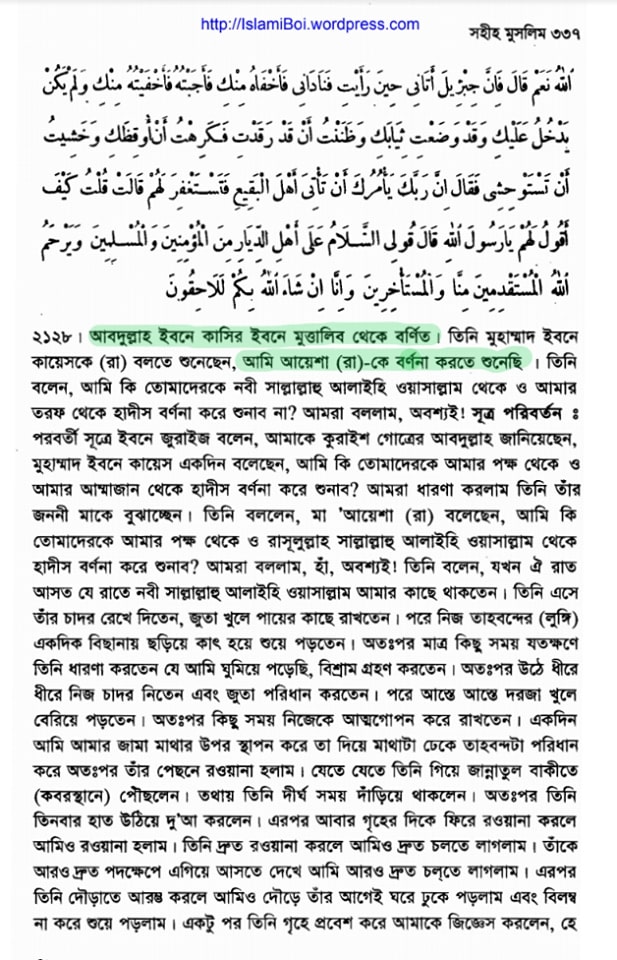
What Aisha notices at the start of the incident is Muhammad’s cautious departure. He takes his cloak, puts on his shoes, opens the door slowly, and closes it slowly. Aisha also puts on her clothes and follows. Then there is a parallel description of the walking speed of both: when Muhammad walks fast, she also walks fast; when Muhammad runs, she also runs. This detailed movement creates the reason for Aisha’s return panting. In the subsequent conversation, Aisha herself admits to following him. This confession matches the detailed description of the nighttime movement.
At the moment of interrogation, the mention of Allah’s omniscience brings religious authority into a personal relationship. As an alternative to answering Muhammad’s question, Aisha is faced with the prospect of the information reaching him through the All-Knowing Allah. The authority of divine knowledge is being used for a personal question of whether a wife’s secret action will remain secret from her husband. In the same conversation, Muhammad wants to know if the shadowy figure he saw in front of him was Aisha. Aisha agrees. Then, in her own words, the mention of pain comes. [386] [387]
فَلَهَدَنِي فِي صَدْرِي لَهْدَةً أَوْجَعَتْنِي
English translation: He struck my chest in such a way that it caused me pain.
At the end of the Arabic sentence, “awja’atni”—it caused me pain—directly conveys Aisha’s experience. After the description of the strike, Muhammad asks if Aisha thought Allah and His Messenger would commit injustice against her. In this, the marital grievance is redefined in the language of religious belief. The wife followed; in response, physical pain and the question of the righteousness of Allah and the Messenger become part of the same scene. The wife’s suspicion regarding her husband’s behavior on her turn is not limited to just two people here; it is elevated to a question of her perception of Allah and the Messenger.
In Muslim’s full account, the conversation from the moment Aisha returns and lies down to the confession, the strike, and the question about injustice is found sequentially. There, the strike comes before Muhammad’s explanation. The incident of feeling pain is preserved as a clear sentence of Aisha’s own narration. [388]
فَسَبَقْتُهُ فَدَخَلْتُ فَلَيْسَ إِلاَّ أَنِ اضْطَجَعْتُ فَدَخَلَ فَقَالَ ” مَا لَكِ يَا عَائِشُ حَشْيَا رَابِيَةً ” . قَالَتْ قُلْتُ لاَ شَىْءَ . قَالَ ” لَتُخْبِرِينِي أَوْ لَيُخْبِرَنِّي اللَّطِيفُ الْخَبِيرُ ” . قَالَتْ قُلْتُ يَا رَسُولَ اللَّهِ بِأَبِي أَنْتَ وَأُمِّي . فَأَخْبَرْتُهُ قَالَ ” فَأَنْتِ السَّوَادُ الَّذِي رَأَيْتُ أَمَامِي ” . قُلْتُ نَعَمْ . فَلَهَدَنِي فِي صَدْرِي لَهْدَةً أَوْجَعَتْنِي ثُمَّ قَالَ ” أَظَنَنْتِ أَنْ يَحِيفَ اللَّهُ عَلَيْكِ وَرَسُولُهُ ” .
English translation: I arrived before him and entered the house. I had just lain down when he entered and said, Aisha, what happened to you, why are you panting so much? I said, nothing happened. He said, you will tell me, otherwise the Subtle and All-Knowing will inform me. I said, O Messenger of Allah, may my parents be sacrificed for you. Then I informed him. He said, so the shadowy figure I saw in front was you? I said, yes. Then he struck my chest in such a way that it caused me pain. Then he said, did you think Allah and His Messenger would commit injustice toward you?
| Level of Incident | What is in the narration | Power Relation |
|---|---|---|
| Nighttime Departure | Muhammad leaves silently; Aisha follows | Asymmetry of information regarding marital behavior |
| Question after return | Aisha’s panting and the desire to know about the following | Wife must explain her actions before the husband |
| Mention of divine knowledge | If Aisha does not tell, the All-Knowing Allah will inform | Religious authority is added to personal interrogation |
| Physical reaction | Strike to the chest; Aisha feeling pain | Direct application of power over the body |
| Religious question | Whether she thought Allah and the Messenger would commit injustice | Taking marital suspicion to a question of religious obedience |
| Explanation of departure | Seeking forgiveness for the dead of Baqi by Gabriel’s instruction | The destination and purpose are specified in the narration |
In the explanation of leaving the house, Muhammad says Gabriel had called him. Since he thought Aisha was asleep, he did not want to wake her; he also mentions the fear of her feeling afraid or lonely. Gabriel’s message was to go to the people of Baqi and seek forgiveness for them. When Aisha asked what should be said at the cemetery, she was taught the words of greeting and prayer for the dead Muslims. The location, action, and final lesson of the incident are thus clear in the same narration. Its subject is Aisha’s following, Muhammad’s reaction, and prayer at the cemetery; the identity of the nameless writer or his corpse is not part of this narration.
The painful strike to the wife and its connection with religious authority is itself a serious matter. When questions arose about Muhammad’s personal decision, the answer here was not given solely through an explanation of the event; physical force was applied before the explanation. Then, in the question about injustice, Muhammad’s position was linked with Allah’s position. In this structure, the husband’s physical power and the status of prophethood work together against the wife’s suspicion. The sentence of pain preserved in Aisha’s account expresses the direct human cost of that relationship.
Abdullah ibn Sa’d ibn Abi Sarh’s experience of writing revelation
The incident of Abdullah ibn Sa’d ibn Abi Sarh is distinct from the incident of the nameless Christian writer. He was a Qurayshi, Uthman’s foster-brother, and Muhammad’s writer. His apostasy, taking refuge in Mecca, the order for his execution on the day of the conquest of Mecca, and the report of his life being saved through Uthman are in the hadiths and biographies. In the accounts of tafsir and sira, allegations of changing words while writing, reading the altered text aloud, and Muhammad’s approval have been added. Performing duties as a writer, objections arising from those duties, and the threat of execution against the objector—these three things converge in the biography of one person.
| Person or Report | Identity | Subject of Evidence |
|---|---|---|
| The Christian writer of the previous section | Nameless in Bukhari’s account; a person of Bani Nadir in Muslim | Story of allegation, apostasy, and the corpse |
| Abdullah ibn Sa’d ibn Abi Sarh | Qurayshi writer; Uthman’s foster-brother | Story of word-changes in tafsir; threat of execution and bay’ah in hadith |
| Result of merging | Two biographies get confused | Information of one incident is attributed to another person |
In a brief account by Abu Dawud, the author’s duties, his apostasy, and the order for his execution are presented in a single sequence. The account evaluates the apostasy by stating that “Satan had led him astray.” This is the narrator’s religious interpretation; no specific example of word substitution is provided within it. Subsequently, it mentions the order to kill him on the day of the Conquest of Mecca and the granting of safety upon Uthman’s request for asylum. This continuity of the same individual’s identity and life forms the background for the later, more detailed tafsiri allegations. [389]
كَانَ عَبْدُ اللَّهِ بْنُ سَعْدِ بْنِ أَبِي سَرْحٍ يَكْتُبُ لِرَسُولِ اللَّهِ صلى الله عليه وسلم فَأَزَلَّهُ الشَّيْطَانُ فَلَحِقَ بِالْكُفَّارِ فَأَمَرَ بِهِ رَسُولُ اللَّهِ صلى الله عليه وسلم أَنْ يُقْتَلَ يَوْمَ الْفَتْحِ فَاسْتَجَارَ لَهُ عُثْمَانُ بْنُ عَفَّانَ فَأَجَارَهُ رَسُولُ اللَّهِ صلى الله عليه وسلم .
English translation: Abdullah ibn Sa’d ibn Abi Sarh used to write for the Messenger of Allah. Satan led him astray, and consequently, he joined the unbelievers. The Messenger of Allah ordered him to be killed on the day of the Conquest of Mecca. Uthman ibn Affan requested asylum for him; then the Messenger of Allah granted him asylum.
Here, the history of the allegation and the history of the treatment toward the accuser illuminate each other. The brief hadith account describes his departure as the provocation of Satan; the detailed tafsir account provides the reasons for doubt in his own words. The first commentary categorizes the apostasy as a moral failure, while the second commentary preserves the story of how his doubts arose from the experience of writing. In his later life, the same man returns to Muslim society and rises to important administrative positions. Consequently, all levels—religious allegations, the right to a death sentence, and rehabilitation through the shelter of power—are present in his biography.
Details of the substitution of qualitative words in Tafsir Mazhari
In the Bengali version of Tafsir Mazhari, the account regarding Abdullah ibn Sa’d’s writing describes the change as explicit word substitution. When Muhammad said “Sami’an Basiran,” he would write “Aliman Hakiman”; when told “Aliman Hakiman,” he would write “Ghafuran Rahiman.” Qualitative words for hearing and seeing are replaced by qualitative words for knowledge and wisdom, and knowledge and wisdom are replaced by qualitative words for forgiveness and mercy. As a result of the substitution, the pair of words used for Allah is changed. The quoted account further mentions the praise-sentence of Surah Al-Mu’minun and the author’s doubt when asked to write that sentence. [390]
Baghavi stated that this sentence was revealed concerning Abdullah bin Abi Sarah. When Abdullah embraced Islam, the Prophet (PBUH) appointed him to the task of recording the Quran Majeed. But he was not trustworthy. When the Prophet (PBUH) would say ‘Sami’an Basiran’, he would write Aliman Hakiman. Again, when the Prophet (PBUH) would say ‘Aliman Hakiman’, he would then write—’Ghafuran Rahiman.’ One day, ‘Wa laqad khalaqnal insana min sulalatin min tin’ (Indeed, I created man from an extract of clay) was revealed. The Prophet (PBUH) ordered the newly revealed verse to be written. Abdullah liked this verse regarding human creation very much. He suddenly exclaimed—’Fa tabarakallahu ahsanul khaliqin’ (How wonderful is Allah, the best of creators). The Prophet (PBUH) said, record this sentence as well. This verse is also newly revealed. Hearing this, Abdullah thought, amazing! Revelation descends upon me as well. As a result of such thinking, he became an apostate. He merged with the group of polytheists. Hazrat Ikrama, Ibn Jarir, and Suddi have also mentioned this incident. Its details will be given in the appropriate place.
The logical significance of this account lies within the religious acceptability of the words. Calling Allah knowing, wise, forgiving, or merciful is recognized in Islamic belief. However, which two qualities were specifically mentioned in a particular sentence is a separate textual question. Even if multiple laudatory words are theologically acceptable, they do not become the same words in that sentence. “The Hearer and the Seer” and “the Knowing and the Wise” are two distinct statements. The first refers to the capacity of hearing and seeing, while the second refers to knowledge and wisdom. Similarly, statements of forgiveness and mercy carry different meanings. The claim that a specific revelation was recorded verbatim is directly related to this difference in words.
The same two-stage substitution is preserved in Baghavi’s tafsir as well. There, Abdullah ibn Sa’d’s identity is first introduced in the language of “it is said,” and then it is mentioned which word was placed instead of which word during his writing. This similarity between the Arabic text of Baghavi and the Bengali quotation of Mazhari identifies the specific subject of the allegation: the substitution of pairs of qualitative words. [391]
وَكَانَ إِذْ أَمْلَى عَلَيْهِ: سَمِيعًا بَصِيرًا، كَتَبَ عَلِيمًا حَكِيمًا، وَإِذَا قَالَ: عَلِيمًا حَكِيمًا، كَتَبَ: غَفُورًا رَحِيمًا
English translation: When he was told to write “Hearer, Seer,” he would write “All-Knowing, Wise”; when told “All-Knowing, Wise,” he would write “Forgiving, Merciful.”
| Indicated word pair | Word pair written by the author | Change in statement |
|---|---|---|
| سَمِيعًا بَصِيرًا — Hearer, Seer | عَلِيمًا حَكِيمًا — All-Knowing, Wise | Mention of knowledge and wisdom instead of hearing and seeing |
| عَلِيمًا حَكِيمًا — All-Knowing, Wise | غَفُورًا رَحِيمًا — Forgiving, Merciful | Mention of forgiveness and mercy instead of knowledge and wisdom |
This allegation raises the question of who held the power to determine the words at the origin of the revelation. If the scribe independently inserted alternative words and those were accepted, the author’s decision finds a place in the process of the revelation’s formation. Consequently, two different processes emerge: the exact copy of specific heavenly words and the determination of acceptable alternatives by human hands. In the allegation, the author expresses his doubt as a result of this experience. His ignorance or failure to hear the revelation was not cited as the cause of doubt; the source of his objection was established within the act of writing.
In the Mazhari quotation, the author is described as “not trustworthy.” Despite this, the book preserves the details of word substitution regarding him. This negative evaluation reveals the book’s position on the accuser’s religious character; however, it does not erase the question of what the description of word substitution says. The commentator’s discourse simultaneously condemns the apostate and highlights a specific reason for his doubt. Because these two levels exist side by side, the uncomfortable allegation regarding the process of writing the revelation emerges from within Islamic memory itself.
The presence of this story from Baghavi to the later Mazhari shows the long propagation of the allegation in tafsiri literature. The mutual dependence of the books and the reuse of old accounts are part of this continuity. By finding a place in subsequent books, the allegation survives within Islamic education. Its specific subject has not become obscure: examples of which qualitative word was written instead of which are preserved. Even amidst the language of condemnation against the apostate, the reason for his doubt has not been erased; the objection regarding the words of the revelation and the method of recording them continues in the same book.
The praise-sentence of Al-Mu’minun 23:14 and Wahidi’s account
At the end of the description of human creation in Surah Al-Mu’minun is “Fa tabarakallahu ahsanul khaliqin”—How blessed is Allah, the best of creators. In the common reading of the verse, this is the praise-sentence concluding the description of creation. In the tafsiri story, Abdullah ibn Sa’d, amazed by the description of the stages of creation, says this, and Muhammad tells him to write it as well. The crisis of the story concerns the event of recognizing a sentence uttered by a human as a revealed sentence simultaneously. [392]
Then We made the sperm-drop into a clinging clot, and We made the clot into a lump [of flesh], and We made [from] the lump, bones, and We covered the bones with flesh; then We developed him into another creation. So blessed is Allāh, the best of creators.
— Saheeh International
Then I made the sperm-drop into clotted blood, then made the lump of flesh into bones, then covered the bones with flesh, then developed him into a new creation. So how great is Allah, the best Creator!
— Taisirul Quran
Then I made the sperm-drop into a blood-clot, then made the blood-clot into a lump of flesh and made the lump of flesh into a skeleton; then covered the skeleton with flesh; finally formed him as another creation; therefore how benevolent is Allah, the most skillful Creator!
— Sheikh Mujibur Rahman
Then I made the sperm into ‘alaqah. Then made the ‘alaqah into a lump of flesh. Then made the lump of flesh into bone. Then covered the bone with flesh. Then formed him as another creation. Therefore how blessed is Allah, the best Creator!
— Rawai Al-bayan
The event in Wahidi’s Asbabun Nuzul is preserved in more detail. In the original text of Islamweb, it is said that Abdullah had expressed his embrace of Islam, and one day Muhammad called him to write. The part beginning with “We created man from an extract of clay” was spoken; upon reaching “Then we formed him as another creation,” he uttered the praise-sentence. Muhammad said that it had been revealed to him exactly like this. The story expresses his doubt in two possibilities: if Muhammad is telling the truth, the same words came to him; if Muhammad is lying, he himself was able to say similar words. Wahidi identifies this account at the end as the statement of Ibn Abbas in the report of Kalbi. [393]
نزلت في عبد الله بن سعد بن أبي سرح ، كان قد تكلم بالإسلام ، فدعاه رسول الله – صلى الله عليه وسلم – ذات يوم يكتب له شيئا ، فلما نزلت الآية التي في ” المؤمنون ” : ( ولقد خلقنا الإنسان من سلالة ) أملاها عليه ، فلما انتهى إلى قوله : ( ثم أنشأناه خلقا آخر ) عجب عبد الله في تفصيل خلق الإنسان ، فقال : تبارك الله أحسن الخالقين ، فقال رسول الله – صلى الله عليه وسلم – : ” هكذا أنزلت علي ” ، فشك عبد الله حينئذ ، وقال : لئن كان محمد صادقا لقد أوحي إلي كما أوحي إليه ، ولئن كان كذابا لقد قلت كما قال . وذلك قوله : ( ومن قال سأنزل مثل ما أنزل الله ) وارتد عن الإسلام ، وهذا قول ابن عباس في رواية الكلبي .
English translation: This was revealed concerning Abdullah ibn Sa’d ibn Abi Sarh. He had expressed his embrace of Islam. One day, the Messenger of Allah called him to write something. When the verse “We created man from an extract” of Surah Al-Mu’minun was revealed, he let him write it by dictating it. Upon reaching “Then we formed him as another creation,” Abdullah, amazed by the detailed description of human creation, said, “Blessed is Allah, the best of creators.” The Messenger of Allah said, “It has been revealed to me exactly like this.” Then Abdullah fell into doubt and said, if Muhammad is truthful, then just as revelation has come to him, it has come to me; and if he is a liar, I have said the same thing he has said. This is regarding the statement, “He who says, I shall reveal like that which Allah has revealed.” He abandoned Islam. This is the statement of Ibn Abbas in Kalbi’s account.
Within the story, there is a clear intellectual framework for the author’s doubt. He knows his own spontaneous utterance; on the other hand, Muhammad is declaring the identity of that utterance with heavenly revelation. Two sources claim the same sentence: a human’s immediate reaction and revelation coming from outside. If Muhammad’s declaration is taken as true, the author claims a revelatory status for his own utterance; if the declaration is taken as false, he reaches the conclusion that a human-composed sentence is being accepted as revelation. His objection, therefore, is not merely resentment or abuse; it is placed in the story as a logical objection regarding the criteria for identifying the source of the revelation.
In Baghavi’s text, the instruction to write at this point is more explicit: “Write this; it has been revealed thus.” Consequently, in the story, the utterance of the praise-sentence by a human and the instruction to include that sentence in the written text occur sequentially. Muhammad’s approval here is the effective decision to grant the sentence the status of revelation. In this account, there is no scene of identifying the source from outside before the author spoke the sentence. [394]
فلما نزلت : ” ولقد خلقنا الإنسان من سلالة من طين ” ( المؤمنون ، 12 ) أملاها عليه رسول الله صلى الله عليه وسلم فعجب عبد الله من تفصيل خلق الإنسان ، فقال : تبارك الله أحسن الخالقين ، فقال النبي صلى الله عليه وسلم : اكتبها فهكذا نزلت
English translation: When the part “We created man from an extract of clay” was revealed, the Messenger of Allah let him write it by dictating it. Abdullah, amazed by the detailed description of human creation, said, “Blessed is Allah, the best of creators.” The Prophet said, “Write this; it has been revealed thus.”
| Moment of the story | Role of whom | Question about the source of the revelation |
|---|---|---|
| Dictating the description of creation | Muhammad dictates; Abdullah writes | Relationship of scribal writing |
| Uttering the praise-sentence | Abdullah expresses amazement | Spontaneous human sentence |
| Recognition as revelation | Muhammad says it was revealed similarly | The declarer determines the religious status of the sentence |
| Instruction to record | “Write this” in Baghavi’s text | The uttered sentence becomes part of the written revelation |
| Author’s reaction | Doubt regarding the relationship between his own sentence and the declared revelation | Crisis of an independent criterion for identifying revelation |
The chain of narration given for the account in Wahidi’s book is not the preserved diary of the contemporary author himself; it is the story of the allegation preserved under his name in later Asbabun Nuzul literature. The statement of that preserved story is very specific: Muhammad had recognized the sentence spoken by the author himself as revelation, and that recognition became the cause of the author’s doubt. The repetition of the event in later tafsirs shows the history of the allegation’s propagation and acceptance. Combined with the account of word substitution, this reveals the central role of the declarer’s approval in determining the specific words of the revelation and its heavenly source.
Allegation of approval after reading the altered text in Tabari
The allegation preserved under Ikrimah’s name in Tabari’s tafsir is even sharper. Here, the author is not merely writing a different word instead of the directed one; he reads the altered text back to Muhammad and receives the approval, “Yes, it is the same.” The step of verification after transcription, which is supposed to ensure the preservation of specific words, is precisely where the acceptance of alternative words is mentioned in the allegation. Consequently, the problem is not limited to an unnoticed error by the writer; it raises the question of presenting and accepting an altered text before the announcer. [395]
” ومن قال سأنزل مثل ما أنزل الله “، نزلت في عبد الله بن سعد بن أبي سرح، أخي بني عامر بن لؤي، كان كتب للنبي صلى الله عليه وسلم، وكان فيما يملي ” عزيز حكيم “، فيكتب ” غفور رحيم “، فيغيره، ثم يقرأ عليه ” كذا وكذا “، لما حول، فيقول: ” نعم، سواء “. فرجع عن الإسلام ولحق بقريش وقال لهم: لقد كان ينزل عليه ” عزيز حكيم ” فأحوله، ثم أقرأ ما كتبت، فيقول: ” نعم سواء ” ! ثم رجع إلى الإسلام قبل فتح مكة، إذ نزل النبي صلى الله عليه وسلم بمر.
English translation: “Whoever says, ‘I will reveal the like of what Allah has revealed’”—this part was revealed concerning Abdullah ibn Sa’d ibn Abi Sarh of the Bani Amir ibn Lu’ay. He wrote for the Prophet. Among the spoken words, there would be “the Almighty, the All-Wise”; he would write “the Forgiving, the Merciful.” He would change it, then read back what he had altered in this or that way. He would say, “Yes, it is the same.” Later, he left Islam and joined the Quraysh, telling them that “the Almighty, the All-Wise” would be revealed to him, but he would change it, then read back what he had written; he would say, “Yes, it is the same!” Later, before the conquest of Mecca, when the Prophet stayed at a place called Marr, he returned to Islam.
Here, the result of saying “the same” is not the establishment of verbal identity, but the acceptance of the altered word as equally acceptable. “The Almighty, the All-Wise” and “the Forgiving, the Merciful”—these two pairs of words express distinct attributes of Allah. Although both attributes are acceptable for Allah, they differ in the question of which one was specifically spoken. According to the narrative of the allegation, this difference in words was not an obstacle to approval. The author presents this very experience before the Quraysh. Consequently, he did not only reject the religious claim; he raised an objection regarding the process of determining the words of the announced message.
The same experience appears twice in the narrative—first in the account of the event, then in the author’s statement to the Quraysh. This repetition clarifies the structure of the allegation: instruction, replacement, reading back, and approval. In the sequence of events preserved in Tabari, these steps occur consecutively. The author claims that the altered text survived verification. The significance of this claim lies in the fact that since the text was read back to the religious authority, it was believed to be unchanged word-for-word—leaving the question of what the approval was actually verifying.
In the subsequent report under Suddi’s name in Tabari, the pair of words is slightly different. There, it mentions a replacement from “the All-Hearing, the All-Knowing” to “the All-Knowing, the All-Wise,” and again the reverse replacement. In this part of the story, the author himself makes a comparison—Muhammad spoke one pair of words, and he spoke another. The expression of his doubt is also clear: when revelation came to Muhammad, it came to him as well; when Allah sent down a message, he brought a similar message. [396]
نزلت في عبد الله بن سعد بن أبي سرح، أسلم، وكان يكتب للنبي صلى الله عليه وسلم، فكان إذا أملى عليه: ” سميعا عليما “، كتب هو: ” عليما حكيما “، وإذا قال: ” عليما حكيما ” كتب: ” سميعا عليما “، فشك وكفر، وقال: إن كان محمد يوحى إليه فقد أوحي إلي، وإن كان الله ينزله فقد أنزلت مثل ما أنزل الله ! قال محمد: ” سميعا عليما ” فقلت أنا: ” عليما حكيما ” ! فلحق بالمشركين
English translation: This was revealed concerning Abdullah ibn Sa’d ibn Abi Sarh. He had accepted Islam and wrote for the Prophet. If he was told to write “the All-Hearing, the All-Knowing,” he would write “the All-Knowing, the All-Wise”; if told “the All-Knowing, the All-Wise,” he would write “the All-Hearing, the All-Knowing.” Because of this, he fell into doubt and disbelieved. He said, when revelation comes to Muhammad, revelation has also come to me; when Allah reveals it, I have also brought the like of what Allah has revealed! Muhammad said, “the All-Hearing, the All-Knowing,” and I said, “the All-Knowing, the All-Wise”! After this, he joined the polytheists.
| Account | Examples of replacement | The specific step that exists |
|---|---|---|
| Baghavi and Mazhari | All-Hearing–All-Seeing → All-Knowing–All-Wise; All-Knowing–All-Wise → Forgiving–Merciful | Writing different attribute words and later doubting the words of praise |
| Tabari: Ikrimah’s report | Almighty–All-Wise → Forgiving–Merciful | Reading back the altered text; “Yes, it is the same” approval |
| Tabari: Suddi’s report | All-Hearing–All-Knowing ↔ All-Knowing–All-Wise | Comparison of original and altered words in the author’s own language |
The pairs of words in the reports are not the same; their common allegation is that the words of a specific message were changed by human hands and the author’s doubt regarding that change. In the version of Ikrimah in Tabari, emphasis is placed on the approval after reading back and telling that experience to the Quraysh. In the version of Suddi, the author compares the words he spoke with the words Muhammad spoke. In Baghavi and Mazhari, the story of the words of praise is linked with the replacement. Expansion has occurred in different ways in different versions, but the center of the author’s doubt remains the same: the relationship between the change of words and the recognition of it as revelation. Both these aspects featured repeatedly during the propagation of the allegation.
The human steps of the writing process are visible in these reports: listening, choosing words to write, reading the text back, and receiving the authority’s recognition. Although the name “revelation” is placed over the process, the work of forming the recorded text occurs through human hands, hearing, memory, and approval. The edge of the allegation is that the author claimed the declaration of religious status did not function as a test to detect word changes. Therefore, these stories themselves preserve a fundamental tension between the certainty regarding the heavenly source of the message and the actual method of its recording.
The relationship of the allegation with Al-An’am 6:93 and Tabari’s own statement
In Al-An’am 6:93, fabricating lies in the name of Allah, claiming to receive revelation without receiving any, and claiming to bring a message like the one revealed by Allah are condemned together. The later part of the verse contains scenes of death throes, angels stretching out their hands, and humiliating punishment. Here, the claim of a rival message is not presented merely as a literary or intellectual competition; it is identified as lying against Allah and punishable arrogance. When Abdullah ibn Sa’d’s allegation is linked to this verse in the tafsir, the author’s textual objection is transferred into the language of religious crime. [397]
وَمَنْ أَظْلَمُ مِمَّنِ افْتَرَىٰ عَلَى اللَّهِ كَذِبًا أَوْ قَالَ أُوحِيَ إِلَيَّ وَلَمْ يُوحَ إِلَيْهِ شَيْءٌ وَمَن قَالَ سَأُنزِلُ مِثْلَ مَا أَنزَلَ اللَّهُ ۗ وَلَوْ تَرَىٰ إِذِ الظَّالِمُونَ فِي غَمَرَاتِ الْمَوْتِ وَالْمَلَائِكَةُ بَاسِطُو أَيْدِيهِمْ أَخْرِجُوا أَنفُسَكُمُ ۖ الْيَوْمَ تُجْزَوْنَ عَذَابَ الْهُونِ بِمَا كُنتُمْ تَقُولُونَ عَلَى اللَّهِ غَيْرَ الْحَقِّ وَكُنتُمْ عَنْ آيَاتِهِ تَسْتَكْبِرُونَ
English translation: Who is more unjust than one who fabricates a lie against Allah, or says, “Revelation has come to me,” while nothing has been revealed to him, or says, “I will reveal the like of what Allah has revealed”? If you could only see when the unjust are submerged in the throes of death and the angels stretch out their hands, saying, “Give up your souls. Today you will be given a humiliating punishment because you used to tell lies about Allah and show arrogance toward His verses.”
Tabari has brought multiple interpretations under this verse. In some reports, Musaylima is mentioned, in some Abdullah ibn Sa’d, and in some, both names appear in different parts of the verse. Then, in stating his own conclusion, Tabari did not omit Abdullah’s name. Rather, he wrote that there is no dispute among the scholars of the Ummah regarding the fact that Abdullah claimed, “I have said the like of what Muhammad said,” left Islam, and joined the polytheists. In Tabari’s religious judgment, this claim is called a fabrication. His own conclusion, therefore, does not deny the existence of the allegation; it accepts the allegation and imposes religious condemnation upon it. [398]
قال أبو جعفر: وأولى الأقوال في ذلك عندي بالصواب أن يقال: إن الله قال: ” ومن أظلم ممن افترى على الله كذبا أو قال أوحي إلي ولم يوح إليه شيء “، ولا تمانع بين علماء الأمة أن ابن أبي سرح كان ممن قال: ” إني قد قلت مثل ما قال محمد “، وأنه ارتد عن إسلامه ولحق بالمشركين، فكان لا شك بذلك من قيله مفتريا كذبا. وكذلك لا خلاف بين الجميع أن مسيلمة والعنسي الكذابين، ادعيا على الله كذبا أنه بعثهما نبيين، وقال كل واحد منهما إن الله أوحى إليه، وهو كاذب في قيله.
English translation: Abu Ja’far says, the most correct statement to me on this matter is: Allah said, “Who is more unjust than one who fabricates a lie against Allah, or says revelation has come to me, while nothing has been revealed to him?” There is no dispute among the scholars of the Ummah that Ibn Abi Sarh was one of those who said, “I have said the like of what Muhammad said”; he left Islam and joined the polytheists. By this statement, he undoubtedly became a fabricator. Similarly, there is no dispute among everyone that two liars, Musaylima and Ansi, made false claims about Allah that He sent them as His prophets; each of them said Allah sent revelation to him, but they were liars in that statement.
“There is no dispute among the scholars”—this is Tabari’s own sense of history and evaluation of the existing discussion. His religious verdict is also attached to this: he called the claim of speaking like Muhammad a lie. The statement of the accuser, the commentator’s claim that the statement is known, and his religious judgment on the statement—these three levels are in the same paragraph. In his own conclusion, the claims of Abdullah, Musaylima, and Ansi come under the same general condemnation. Abdullah’s allegation is thus an active element of Tabari’s own conclusion.
Tabari has kept multiple possibilities regarding the specific occasion of revelation: the verse may have been revealed because of certain individuals, because of everyone, or targeting all the polytheists of Arabia. This discussion is on the question of how extensive the application of the verse is. The allegation preserved under Abdullah’s name is not lost there. Rather, that allegation is included within the general condemnation. [399]
فإذ كان ذلك كذلك، فقد دخل في هذه الآية كل من كان مختلقا على الله كذبا، وقائلا في ذلك الزمان وفي غيره: ” أوحى الله إلي “، وهو في قيله كاذب، لم يوح الله إليه شيئا. فأما التنزيل، فإنه جائز أن يكون نزل بسبب بعضهم، وجائز أن يكون نزل بسبب جميعهم، وجائز أن يكون عني به جميع المشركين من العرب، إذ كان قائلو ذلك منهم، فلم يغيروه.
English translation: If so, every person who fabricates a lie in the name of Allah and says in that age or any other age, “Allah has sent revelation to me,” while he is a liar in that statement and Allah sent him nothing, is included in this verse. Regarding the revelation, it may have been revealed because of some people, it may have been revealed because of all of them, or it may have been addressed to all the polytheists of Arabia; for the speakers of such words were among them, yet they did not change it.
| Levels of Tabari’s discussion | Specific statement | Its significance |
|---|---|---|
| Preserved report | Allegation of Abdullah’s word-change and speaking similar messages | Author-related allegation as part of the tafsir material |
| Other preserved interpretations | Prophethood claims of Musaylima and Ansi | The verse is linked to multiple rival claims |
| Tabari’s own historical evaluation | His statement that there is no dispute among scholars regarding Abdullah’s claim and apostasy | He did not omit Abdullah’s story |
| Tabari’s religious judgment | Calling the claims fabrications in the name of Allah | Placing the allegation in the category of religious crime |
| Occasion of revelation | Specific individuals, multiple individuals, or a larger group—various possibilities | Uncertainty regarding the specific occasion and the expansion of general condemnation exist side by side |
Wahidi, under this very verse, has brought another brief report under the name of Sharhabil ibn Sa’d through Ibn Ishaq. In it, the event of Abdullah’s claim to bring similar messages and his going directly to the shelter of Uthman after apostasy is mentioned. The memory of the allegation and the memory of political shelter are part of the same report here. [400]
عن محمد بن إسحاق قال : حدثني شرحبيل بن سعد قال : نزلت في عبد الله بن سعد بن سرح قال : سأنزل مثل ما أنزل الله ، وارتد عن الإسلام ، فلما دخل رسول الله – صلى الله عليه وسلم – مكة [ فر إلى عثمان وكان أخاه من الرضاعة فغيبه عنده ، حتى إذا اطمأن أهل مكة ] أتى به عثمان رسول الله – صلى الله عليه وسلم – فاستأمن له .
English translation: From Muhammad ibn Ishaq: he says, Sharhabil ibn Sa’d informed me that this was revealed concerning Abdullah ibn Sa’d ibn Sarh. He had said, I will reveal the like of what Allah has revealed, and he left Islam. When the Messenger of Allah entered Mecca [he fled to Uthman; Uthman was his foster-brother. Uthman kept him hidden with him until the people of Mecca became calm.] Then Uthman brought him to the Messenger of Allah and prayed for his safety.
From the objection regarding the experience of writing to apostasy, then the allegation of fabricating lies in the name of Allah, and finally the plea for saving his life—in this sequence, the question regarding the source of the message transforms into a question of political loyalty. On one hand, the author claims that he himself can speak similar messages; on the other hand, the tafsir categorizes that claim as punishable arrogance. Although the language of the allegation is preserved, the power to resolve it is not in the hands of the accuser. His subsequent safety depends on the approval of religious and political authority and the mediation of Uthman.
Order to kill during the conquest of Mecca, shelter in the Kaaba, and exceptions to general safety
In the account of the conquest of Mecca, the declaration of general safety and the order to kill certain specific people exist side by side. Quoting Ibn Ishaq’s report, Ibn Kathir stated that there was an order not to kill anyone except those who fight, but a few were made exceptions by name. They were to be killed even if found under the curtain of the Kaaba. Abdullah ibn Sa’d was one of those exceptional names. While general people received safety, safety was not effective for him; Uthman’s shelter and subsequent mediation became the path to saving his life. [401]
Ibn Ishaq says: The Messenger of Allah (pbuh) took a pledge from his army commanders that they would not engage in battle with anyone other than those who came to fight against them. However, he ordered the killing of certain specific people by name, even if they were found under the cover of the Kaaba. Among them was Abdullah ibn Sa’d ibn Abi Sarh. He had outwardly embraced Islam and performed the duty of recording the revelation. But later he became an apostate. When the Messenger of Allah (pbuh) entered Mecca and announced his killing, he fled and took refuge with Uthman (ra). He was Uthman’s foster brother. Uthman brought him to the Messenger of Allah (pbuh) to grant him security. After remaining silent for a long time, he said, ‘Alright, fine.’ After he returned with Uthman, the Messenger of Allah (pbuh) said to the companions present: Was there not one sensible person among you who would have killed him while I remained silent? The companions said—O Messenger of Allah! Why did you not give us a slight hint? He replied that it is not fitting for a Prophet to have someone killed by giving a hint. In another narration, it is mentioned that he then said: No Prophet can commit a betrayal of the eye.
In Nasa’i’s narration, the number of exceptions and the language of the instruction are clear: security was granted to others except for four men and two women. Among the four men are the names of Ikrimah ibn Abi Jahl, Abdullah ibn Khatal, Miqyas ibn Subaba, and Abdullah ibn Sa’d ibn Abi Sarh. The instruction “kill them even if they are holding onto the curtain of the Kaaba” renders the protection of individuals ineffective even in places of religious sanctuary. The same narration mentions that Ibn Khatal was found holding the curtain of the Kaaba and was killed. Consequently, the list does not remain merely as an announcement of potential punishment; the implementation of killing by crossing the sanctuary of the Kaaba is described for one of them. [402]
لَمَّا كَانَ يَوْمُ فَتْحِ مَكَّةَ أَمَّنَ رَسُولُ اللَّهِ صلى الله عليه وسلم النَّاسَ إِلاَّ أَرْبَعَةَ نَفَرٍ وَامْرَأَتَيْنِ وَقَالَ “ اقْتُلُوهُمْ وَإِنْ وَجَدْتُمُوهُمْ مُتَعَلِّقِينَ بِأَسْتَارِ الْكَعْبَةِ ” . عِكْرِمَةُ بْنُ أَبِي جَهْلٍ وَعَبْدُ اللَّهِ بْنُ خَطَلٍ وَمِقْيَسُ بْنُ صُبَابَةَ وَعَبْدُ اللَّهِ بْنُ سَعْدِ بْنِ أَبِي السَّرْحِ فَأَمَّا عَبْدُ اللَّهِ بْنُ خَطَلٍ فَأُدْرِكَ وَهُوَ مُتَعَلِّقٌ بِأَسْتَارِ الْكَعْبَةِ فَاسْتَبَقَ إِلَيْهِ سَعِيدُ بْنُ حُرَيْثٍ وَعَمَّارُ بْنُ يَاسِرٍ فَسَبَقَ سَعِيدٌ عَمَّارًا – وَكَانَ أَشَبَّ الرَّجُلَيْنِ – فَقَتَلَهُ
English translation: On the day of the conquest of Mecca, the Messenger of Allah granted security to others except for four men and two women and said, “Kill them even if they are found holding the curtain of the Kaaba.” They were Ikrimah ibn Abi Jahl, Abdullah ibn Khatal, Miqyas ibn Subaba, and Abdullah ibn Sa’d ibn Abi Sarh. Abdullah ibn Khatal was found holding the curtain of the Kaaba. Sa’id ibn Hurayth and Ammar ibn Yasir raced toward him. Sa’id reached before Ammar—he was the younger of the two—and killed him.
The path described in the case of Abdullah ibn Sa’d is that of hiding. He remains hidden with Uthman; Uthman later brings him before Muhammad. This behavior reveals the effectiveness of the death sentence order. The security of a person who is afraid to come forward is not based on the general announcement. He must be given personal shelter, must wait, and special permission must be sought from the center of governing power. Therefore, the fate of the apostate writer was not under the same application as a general security measure; it depended on the revocation of the exception imposed upon his name.
| Status of security | Described arrangement | Result |
|---|---|---|
| General residents of Mecca | General announcement of security according to the narration | Overall protection for people not fighting |
| Persons made exceptions by name | Order to kill even if taking refuge in the curtain of the Kaaba | Order overriding general security and sanctuary of the holy place |
| Ibn Khatal | Found holding the curtain of the Kaaba | Killed there according to Nasa’i’s narration |
| Ibn Abi Sarh | Hiding with Uthman and special mediation | Personal approval required for preservation of life |
The issue that repeatedly arises in the conflict between Muhammad and Abdullah is his identity as a writer and the allegations made after his apostasy. In another account preserved under Ibn Ishaq’s name, the reason for the killing is directly explained: he claimed to the Quraysh that he distorted Muhammad’s words as he pleased. There is a story where, if “All-Knowing, Forbearing” was said, he proposed writing “Powerful, Wise” and the response was “both are the same.” Ibn Taymiyyah quoted this account in As-Sarim al-Maslul. [403]
وإنما أمر بابن أبي سرح لأنه كان قد أسلم فكان يكتب لرسول الله صلى الله عليه وسلم الوحي فرجع مشركا ولحق بمكة فكان يقول: إني لأصرفه كيف شئت إنه ليأمرني أن أكتب له الشيء فأقول له: أو كذا أو كذا فيقول: نعم وذلك أن رسول الله صلى الله عليه وسلم كان يقول ” عليم حليم ” فيقول له: أو أكتب ” عزيز حكيم ” فيقول رسول الله صلى الله عليه وسلم: ” كلاهما سواء “
English translation: The reason for giving the order regarding Ibn Abi Sarh was that he had embraced Islam and wrote the revelation for the Messenger of Allah; later he became a polytheist and returned to Mecca. He used to say, I distort it as I wish. When he ordered me to write something, I would say, or like this, or like that? He would say, yes. When the Messenger of Allah said “All-Knowing, Forbearing,” he would say, or shall I write “Powerful, Wise”? The Messenger of Allah would say, “both are the same.”
In this explanation, the allegation against the dignity of prophethood is linked to the reason for the death sentence. Therefore, the dispute regarding the source of the words does not stop at abstract disagreement. Placing the accuser on the killing list, creating his need for sanctuary, and later the power to accept his allegiance remain in the hands of the same authority. In this state, if returning to the religion is described only in the language of spontaneous change of opinion, the order hanging over his life disappears. In the described situation, surviving and receiving the approval of the powerful are directly related.
Uthman’s mediation, rejection of bay’ah three times, and expectation of killing
The importance of personal relationships is clear in the incident of Uthman’s mediation. Abdullah was his foster brother; he kept him hidden and personally brought him to request the acceptance of bay’ah. In Abu Dawood’s full Bengali narration, everything is present—Muhammad looking three times and refusing to accept bay’ah each time, then accepting the bay’ah, and expressing the expectation of killing to those present. In this sequence, the preservation of life is not an automatic result of the announcement of return. Mediation, waiting, and finally Muhammad’s decision to accept are required. [404] [405]
Sunan Abu Dawud (Islamic Foundation)
9/ Jihad
Chapter: 21. Killing a non-believer prisoner before giving the invitation of Islam.
2674. Narrated from Uthman ibn Abu Shaybah (rh) …. from Sa’d (ra). He said, on the day of the conquest of Makkah, Rasulullah sallallahu alayhi wasallam granted security to everyone except four men and two women and he also announced their names. And Ibn Abu Sarah … then the hadith is narrated. The narrator Sa’d says: Ibn Abu Sarah remained in hiding with Uthman (ra). Then when Rasulullah sallallahu alayhi wasallam called everyone for taking the bay’ah, Uthman (ra) brought him along and made him stand before Rasulullah sallallahu alayhi wasallam and said: O Prophet of Allah! Make Abdullah take the bay’ah. He raised his head and looked at him three times and every time refused to make him take the bay’ah.
After the third time he made him take the bay’ah, later he said to his companions: was there not such a clever person among you, when he saw me that I was not making him take the bay’ah, why did he not kill him? They (the companions) said: Ya Rasulullah! We could not understand the words of your heart. Why did you not signal us with your eyes (in this matter)? He said: it is not appropriate for any prophet to look with a sidelong glance.
Abu Dawud (rh) says: Abdullah was the foster brother of Uthman (ra) and Walid ibn Ukbah was the half-brother of Uthman (ra). Uthman (ra) punished him during his reign on charges of drinking alcohol.
Hadith Grade: Sahih (Sahih)
Narrator: Sa’d bin Abu Waqqas (ra)
Muhammad himself later explained the meaning of keeping the hand withdrawn from accepting bay’ah. In the narration, there is his own statement regarding this expectation. He wanted to know why no one among those present stood up to kill the man upon seeing his refusal. That is, he expressed the expectation that the pause before acceptance would become an opportunity for those present to kill. This statement, made after the acceptance of bay’ah, provides direct information about the purpose of the previous waiting. [406]
أَمَا كَانَ فِيكُمْ رَجُلٌ رَشِيدٌ يَقُومُ إِلَى هَذَا حَيْثُ رَآنِي كَفَفْتُ يَدِي عَنْ بَيْعَتِهِ فَيَقْتُلَهُ
English translation: Was there not such a sensible person among you, who, seeing me keep my hand withdrawn from taking his bay’ah, would have stood up and killed him?
In Abu Dawood’s Arabic text, there is the language of raising the head three times and rejecting. Immediately after this, the question comes to those present for not killing. Although there was a positive result at the end of the acceptance, the fact that there was a risk before the person is revealed in this sequence of events. There is no condemnation here that anyone among those present would have done an unauthorized act if he had been killed. On the contrary, the reason for the act not happening has been asked. [407]
فَجَاءَ بِهِ حَتَّى أَوْقَفَهُ عَلَى النَّبِيِّ صلى الله عليه وسلم فَقَالَ يَا رَسُولَ اللَّهِ بَايِعْ عَبْدَ اللَّهِ . فَرَفَعَ رَأْسَهُ فَنَظَرَ إِلَيْهِ ثَلاَثًا كُلُّ ذَلِكَ يَأْبَى فَبَايَعَهُ بَعْدَ ثَلاَثٍ ثُمَّ أَقْبَلَ عَلَى أَصْحَابِهِ فَقَالَ ” أَمَا كَانَ فِيكُمْ رَجُلٌ رَشِيدٌ يَقُومُ إِلَى هَذَا حَيْثُ رَآنِي كَفَفْتُ يَدِي عَنْ بَيْعَتِهِ فَيَقْتُلَهُ ”
English translation: He brought him and made him stand before the Prophet and said, O Messenger of Allah, accept the bay’ah of Abdullah. He raised his head and looked at him three times; each time he refused. After three times, he accepted his bay’ah. Then turning to the companions, he said, “Was there not such a sensible person among you, who, seeing me keep my hand withdrawn from taking his bay’ah, would have stood up and killed him?”
| Step | Described event | Control over the decision |
|---|---|---|
| Hiding | Abdullah remains hidden with Uthman | The announced general security was not sufficient for him |
| Mediation | Uthman himself brings him and requests the acceptance of bay’ah | Access of an influential relative is utilized |
| Three refusals | Muhammad sees and refuses to take bay’ah | Approval for preservation of life remains pending |
| Final acceptance | Bay’ah is later accepted | Change in security occurs by personal decision |
| Subsequent statement | Asking those present the reason for not killing | It is revealed that there was an expectation of killing during the wait |
The relationship of foster brotherhood is not a decorative identity here. Uthman provided shelter, appeared publicly, and directly requested bay’ah. Because of these three actions, Abdullah found the opportunity for discussion even amidst the public order to kill him. This incident is a specific example of how relationships and influence within an institution can create security. The same power first permitted death, then preserved life through acceptance. Instead of the individual’s life being established as an independent right, it became dependent on the ruler’s decision and the mediator’s success.
In the narration, there is no trial of the allegations by placing Abdullah’s own writings side by side. There are no questions and answers about which word he changed, which one Muhammad corrected, or which manuscript bears witness. The described activity is whether a person under a death sentence order will be re-accepted into a relationship of allegiance. Therefore, the acceptance of bay’ah is not a textual refutation of his allegations; it is an event of changing his political and religious position. Returning to the religion and the previously stated allegations being proven false are not the same event. What was directly settled here was his security and re-inclusion.
If such a threat of death exists against the backdrop of embracing Islam, the freedom of consent is deeply compromised. On one hand, permission to kill if he comes out publicly, on the other, an application for religious allegiance to be acceptable—this situation puts intense pressure on the individual to return for the sake of survival. This pressure can be identified without any assumption about the change in his heart, because the threat, hiding, mediation, and rejection are directly in the narration. The consequence of receiving forgiveness does not erase the previous coercive situation; the forgiveness itself becomes the effective way out of that situation.
“Betrayal of the eye”, the vow of killing, and the description of waiting
The phrase “betrayal of the eye” comes in the dialogue immediately following the expectation of killing. The companions present say they did not know what was in Muhammad’s mind; if he had signaled with his eye, they would have understood. Muhammad replies that it is not fitting for a Prophet to have a betrayal of the eye. The center of this dialogue is how the permission to kill would be communicated. The secret method of signaling with the eye was rejected, yet just a moment ago, a question was raised for not killing the man. Consequently, the matter of moral rejection is narrow: the secret method of signaling. The expectation of killing the asylum-seeker did not itself fall under that rejection. [408]
فَقَالُوا مَا نَدْرِي يَا رَسُولَ اللَّهِ مَا فِي نَفْسِكَ أَلاَّ أَوْمَأْتَ إِلَيْنَا بِعَيْنِكَ قَالَ ” إِنَّهُ لاَ يَنْبَغِي لِنَبِيٍّ أَنْ تَكُونَ لَهُ خَائِنَةُ الأَعْيُنِ ” .
English translation: They said, O Messenger of Allah, we did not know what was in your mind. Why did you not signal us with your eye? He said, “It is not fitting for a Prophet to have a betrayal of the eye.”
It is also noteworthy which behavior is being characterized as a sign of good sense. In the previous question, the lack of a “rashid” (rightly guided) person was highlighted—why no one stepped forward to kill the man while others kept their hands folded. In other words, the initiative to carry out authorized violence based on the situation was desired here. In the companions’ response, the reason for not taking initiative was the ambiguity of the permission; it was not the moral unacceptability of the killing. At the end of the conversation, there is a statement regarding the method of signaling with the eyes. In this arrangement, the moral significance of the decision regarding a human life falls into the background, while the correct method of understanding the leader’s intent comes to the foreground.
Ibn Taymiyyah has quoted another account attributed to Sa’id ibn al-Musayyib from Ibn Sa’d’s Tabaqat. There, an Ansari had made a vow to kill Ibn Abi Sarh if he saw him. Uthman is recommending him, while the Ansari holds the hilt of the sword, waiting for Muhammad’s signal. Finally, Muhammad asks him why he did not fulfill his vow. The Ansari informs him that he was waiting for the signal. Then comes the statement that it is not appropriate for a Prophet to signal. Here, the waiting and the expectation of killing are expressed within a broader story involving a vow and a sword. [409]
وكان رجل من الأنصار قد نذر إن رأى ابن أبي سرح أن يقتله فجاء عثمان ـ وكان أخاه من الرضاعة ـ فشفع له إلى رسول الله صلى الله عليه وسلم وقد أخذ الأنصاري بقائم السيف ينتظر النبي صلى الله عليه وسلم متى يومئ إليه أن يقتله فشفع له عثمان حتى تركه ثم قال رسول الله صلى الله عليه وسلم للأنصاري: ” هلا وفيت بنذرك ” فقال يا رسول الله وضعت يدي على قائم السيف أنتظر متى توميء فأقتله فقال النبي صلى الله عليه وسلم: ” ليس لنبي أن يومئ “
English translation: An Ansari had made a vow that if he saw Ibn Abi Sarh, he would kill him. Uthman came—he was his foster brother—and recommended him to the Messenger of Allah. The Ansari was then holding the hilt of the sword, waiting for when the Prophet would signal him to kill. Uthman continued to recommend him, and eventually, he was let go. Then the Messenger of Allah said to the Ansari, “Why did you not fulfill your vow?” He replied, O Messenger of Allah, I was waiting with my hand on the hilt of the sword for when you would signal and I would kill him. The Prophet said, “It is not appropriate for a Prophet to signal.”
In this account, the subject of the vow is to kill a person. The questioning regarding its non-fulfillment and the description of keeping the sword ready link lethal violence with a religious pledge. The individual is present with Uthman and is attempting to gain safety; at that very moment, the expectation to execute the vow of killing him is described. The possibility of killing persists amidst the scene of seeking asylum and obedience. Therefore, the presence of a mediator to save his life was not merely formal etiquette; it was an effort to create active protection amidst immediate physical danger.
| Described elements | Position in conversation | Moral consequence |
|---|---|---|
| Keeping hands folded | Suspension of accepting bay’ah | The expected opportunity for killing is revealed later |
| Ignorance of the companions | Response to not understanding the thoughts of the mind | The signal for the order was not clear |
| Eye signal | Signal proposed by the companions | This is called inappropriate for the Prophet’s dignity |
| Hilt of the sword | Ready Ansari in the account of the vow | Preparation for killing is visible |
| Question of fulfilling the vow | After letting the man go | The Ansari is questioned for not killing |
The standard for preserving the dignity of religious leadership and the standard for the safety of human life are not the same here. A secret eye signal was rejected as betrayal, but expressing the expectation of killing before accepting bay’ah was not brought under the same language of condemnation. Rather than the moral necessity of the asylum seeker’s survival, the importance of the final sentence is given to which communication method is appropriate for the Prophet. The criticism of this priority is a moral judgment outside the words used in the source, the basis of which is the sequence of conversation and the expectation of killing contained within the source itself.
The extent of the account of the vow preserved under Ibn Sa’d’s name and the account of bay’ah by Abu Dawud are not the same. The first contains the specific Ansari’s vow and preparation of the sword; the second contains general questions to the companions and a dialogue about eye signals. In subsequent legal discussions, these elements have been used side by side. As a result, a path has opened to create a broader rule from the description of a specific event: in the question of when it is valid to kill an accuser who comes to repent, the author’s event becomes an example.
Ibn Taymiyyah’s explanation: Expiation of sin through tawbah and saving of life through personal forgiveness
Ibn Taymiyyah has used the event of Ibn Abi Sarh as an example to establish the permission to kill even after tawbah. In his explanation, general apostasy and accusations or insults against Muhammad are not the same type of crime. Islam and tawbah can expiate sin, but to be relieved from the death penalty for a crime against Muhammad’s personal rights, his forgiveness is required. He clearly stated that Muhammad’s forgiveness saved Abdullah’s blood; not just the acceptance of Islam. Consequently, returning to the religion and the end of the permission to kill are separate events in his legal construction. [410]
وهذا نص في أن مثل هذا المرتد الطاعن لا يجب قبول توبته بل يجوز قتله وإن جاء تائبا وإن تاب وقد قررنا هذا فيما مضى ـ وهنا ـ من وجوه أخرى أن الذي عصم دمه عفو رسول الله صلى الله عليه وسلم عنه لا مجرد إسلامه وأن بالإسلام والتوبة انمحى الإثم وبعفو رسول الله صلى الله عليه وسلم احتقن الدم والعفو بطل بموته صلى الله عليه وسلم وليس للأمة أن يعفوا عن حقه وامتناعه من بيعته حتى يقوم إليه بعض القوم فيقتله نص في جواز قتله وإن جاء تائبا
English translation: This is clear evidence that it is not mandatory to accept the tawbah of such an apostate and aggressive accuser; rather, even if he comes to repent, even if he repents, it is valid to kill him. We have established before and here from another side that the Messenger of Allah’s forgiveness saved his blood, not just his acceptance of Islam. Sin was erased by Islam and tawbah; blood was saved by the Messenger of Allah’s forgiveness. With his death, the opportunity for granting forgiveness has ended, and the Ummah does not have the power to forgive his right. His abstention from accepting bay’ah, so that anyone present might stand up and kill him, is clear evidence of the validity of killing him even if he comes to repent.
Ibn Taymiyyah explained the delay in accepting bay’ah as an opportunity for killing. The center of his argument: even after the person appeared as a Muslim or wanting to be a Muslim, Muhammad abstained from accepting him and expected him to be killed through someone else. He reaches a conclusion by holding onto this event: the life of an accuser does not become intact simply upon their return. To establish religious law, an influential Islamic jurist has used this expectation of killing as the basis of his argument. In his explanation, waiting, expectation, and permission to kill are linked in the same sequence.
In Ibn Taymiyyah’s language, there are three separate changes. Accepting Islam changes religious identity. Tawbah is effective in the question of expiating the liability of sin. Muhammad’s personal forgiveness stops the permission for death. In this section, a person may be sinless before Allah but remain killable by human hands—until specific personal rights are forgiven. Consequently, the religious concept of expiation of sin does not automatically transform into the safety of life. The forgiveness of the holder of power remains the determining condition for saving the person’s life.
| Ibn Taymiyyah’s distinction | Effectiveness in his explanation | The limit that remains |
|---|---|---|
| Accepting Islam | The person’s return to the religion | The permission to kill regarding accusations does not end with just this |
| Tawbah | Erasure of sin | Expiation of sin and saving of life are not the same result |
| Muhammad’s forgiveness | The person’s blood being saved | Saving of life depends on personal forgiveness |
| Muhammad’s death | The opportunity for his special forgiveness has ended | Ibn Taymiyyah’s conclusion that the Ummah cannot forgive his right |
| Waiting before bay’ah | Example of the validity of killing even after tawbah | Being forgiven later does not cancel the previous opportunity for killing |
The decision that the Ummah will not be able to forgive his right after his death makes the explanation even more severe. In the event during his lifetime, someone like Uthman was able to mediate and Muhammad forgave. Ibn Taymiyyah defines that forgiveness as a special personal right and closes the path of forgiveness for subsequent societies. Then, the crime and the permission to kill are preserved as the ideal, whereas the personal forgiveness at the end of the same event does not become a generally repeatable right. A single instance of saving a life in the past becomes the basis in his argument for not ensuring the saving of the life of a subsequent similar accuser.
In this legal construction, the response to the objection regarding the source of the word and the punishment of the objector stand with completely unequal power. To verify the experience the author spoke of, it is necessary to compare his writing and the indicated reading; but declaring him worthy of death by applying the category of personal insult does not complete that verification. Rather, the decision shifts from the test of the truth of the statement to the question of the speaker’s loyalty, crime, and obtaining forgiveness. The social result is that expressing experience-based allegations against religious authority becomes a cause of life crisis.
Bringing criticism under the death penalty by treating statements against religious authority as damage to personal rights terribly increases the cost of criticism. Before determining whether the allegation is true, the accuser must ask for permission to live. Even the declaration of tawbah is not enough—this additional condition is directly present in Ibn Taymiyyah’s explanation. Consequently, the event does not remain merely a memory of harsh behavior from the past; it becomes an element for creating the justification for lethal punishment against freedom of expression in subsequent religious law. This use reveals why the author’s event is important not only alongside the reading-history of the Quran but also in the history of authority and suppression policies.
Different use of the same allegation and cause of killing in separate answers of IslamQA
In IslamQA’s answer number 228675, the isnads of the descriptions of Ibn Abi Sarh altering the revelation are discussed. The conclusion of the answer is that they have not found a sahih isnad regarding the fact that he distorted the revelation. While acknowledging the fame of the story in tafsir, its acceptability according to specific standards of hadith science was denied. In the same answer, there is mention of his apostasy and allegations against Muhammad, and a reference is given to the previous answer number 217153. [411]
لم نقف على رواية صحيحة الإسناد أن عبد الله بن أبي سرح كان يحرّف الوحي
English translation: We have not found any description with a sahih isnad that Abdullah ibn Abi Sarh distorted the revelation.
The subject of answer number 217153 is the punishment of killing and forgiveness. There, apostasy and slander against Muhammad are made into two separate causes. To explain the second cause, Ibn Ishaq’s account regarding the allegation of changing the word according to one’s own will is brought. An explanation is given that the first liability ends by tawbah and the second liability ends by Muhammad’s personal forgiveness. [412]
والقتل لهذا السبب حق للنبي عليه الصلاة والسلام ، يسقط بعفوه وصفحه
English translation: For this reason, the right to kill belongs to the Prophet; it is extinguished by his forgiveness and mercy.
| Answer | Original question | Use of the allegation |
|---|---|---|
| 228675 | Isnad of the story of word-changes | Evaluation that no sahih isnad was found |
| 217153 | Punishment of killing and forgiveness | Use of similar allegations in the explanation of slander against Muhammad |
In answer number 228675, there is an evaluation of the transmission paths of Wahidi and Tabari; in number 217153, Ibn Ishaq’s account is a tool for the explanation of punishment. The difference is in the weight and effectiveness of the proof: to judge the change in reading, the isnad-based objection took precedence, while in the explanation of killing, that type of allegation became an element of violation of personal rights. The judgment of the accuracy of the allegation and calling the act of alleging a punishable slander—these two judgments are running on different bases.
In the preserved accounts of Ibn Ishaq, the author claims specific word changes and approvals. In Ibn Taymiyyah’s explanation, that aggressive statement becomes an element of the death penalty in the question of personal rights. Placing these two ancient accounts side by side makes a fundamental problem clear: classifying an allegation as damage to the Prophet’s dignity does not determine the factual truth of the allegation. A statement can strike authority and simultaneously require a test of its truth. The declaration of the right to punish does not perform that test.
In religious internal classification, if the isnad of a description is weak, questions arise about its reliability; a decision is not made that the event did not happen solely by that classification. The preservation of the allegation in ancient texts, its specific form in various accounts, and its use in subsequent legal discussions are separate historical facts. The presence of this allegation in Islamic literature and the argument for the death penalty against it reveal the relationship between the word and authority. The question raised about the author’s experience receives no answer from the approval of the death penalty.
Descriptions of subsequent administrative rise, rule of Egypt, and pious death
The person who was placed on the killing list on the day of the conquest of Mecca later finds a place in Muslim history as an important general and administrator. In Zahabi’s Siyar Alam al-Nubala, Abdullah ibn Sa’d is identified as an Amir, a leader of the army, a Qurayshi, and Uthman’s foster brother. There is also mention of him being the ruler of Egypt under Uthman. At the very beginning of the biography, his subsequent political status has become prominent; the event of apostasy and saving of life comes in the following part. Consequently, the same life is preserved in both streams—the memory of religious crime and the dignified history of governing power. [413]
عبد الله بن سعد ابن أبي سرح بن الحارث ، الأمير ، قائد الجيوش ، أبو يحيى القرشي العامري ، من عامر بن لؤي بن غالب . هو أخو عثمان من الرضاعة ، له صحبة ورواية حديث . روى عنه الهيثم بن شفي . ولي مصر لعثمان . وقيل : شهد صفين . والظاهر أنه اعتزل الفتنة ، وانزوى إلى الرملة .
English translation: Abdullah ibn Sa’d ibn Abi Sarh ibn al-Harith—Amir, leader of the army, Abu Yahya al-Qurashi al-Amiri; he is a descendant of Amir ibn Lu’ay ibn Ghalib. He was the foster-brother of Uthman. There are reports of his companionship and hadith narrations. Haytham ibn Shufa narrated from him. He assumed the governorship of Egypt for Uthman. It is said that he was present at Siffin. Outwardly, he distanced himself from the civil strife and remained in seclusion in Ramla.
Zahabi mentioned through Laith that during Umar’s time, Abdullah was the governor of the Sa’id region of Egypt; later, Uthman gave him responsibility for all of Egypt. The same account contains praise for his governance and reports of military campaigns. Mentions of the African campaign, the defeat of Jurzair, and the naval battle of Zatus Sawari identify him as a conqueror. The transition from an apostate writer to a military-administrative figure of this level is not merely a matter of surviving; it is a reinstatement within the political system of Islam with responsibility and status. [414]
أبو صالح ، عن الليث قال : كان عبد الله بن سعد واليا لعمر على الصعيد ، ثم ولاه عثمان مصر كلها ، وكان محمودا . غزا إفريقية ، فقتل جرجير صاحبها . وبلغ السهم للفارس ثلاثة آلاف دينار ، وللراجل ألف دينار . ثم غزا ذات الصواري ، فلقوا ألف مركب للروم ، فقتلت الروم مقتلة لم يقتلوا مثلها قط . ثم غزوة الأساود .
English translation: Abu Salih narrates from Laith: Abdullah ibn Sa’d was the governor of Sa’id under Umar. Later, Uthman gave him responsibility for all of Egypt, and he was praised. He campaigned in Africa and killed the local ruler, Jurzair. Three thousand dinars fell to the share of the cavalry and one thousand dinars to the infantry. Then he led the Zatus Sawari campaign. They faced one thousand Roman ships; the Romans were killed in a manner that had never happened before. Then there was the campaign against the blacks.
Regarding the division of revenue and military administration, there is an institutional account of his rise in Waqidi’s narration preserved by Zahabi. Uthman removed Amr ibn al-As from revenue duties and placed him in charge of prayer and the army, while he gave revenue duties to Ibn Abi Sarh. A dispute arose between the two, and both complained to Uthman. Finally, Amr was removed, and the responsibilities were consolidated in the hands of Ibn Abi Sarh. Here, along with the relationship with the foster-brother, the Caliph’s power of appointment and removal is also visible. [415]
الواقدي : حدثنا أسامة بن زيد ، عن يزيد بن أبي حبيب قال : كان عمرو بن العاص على مصر لعثمان ، فعزله عن الخراج وأقره على الصلاة والجند . واستعمل عبد الله بن أبي سرح على الخراج ، فتداعيا . فكتب ابن أبي سرح إلى عثمان : إن عمرا كسر الخراج علي . وكتب عمرو : إن ابن سعد كسر علي مكيدة الحرب . فعزل عمرا ، وأضاف الخراج إلى ابن أبي سرح .
English translation: Waqidi says: Usama ibn Zayd informed us, from Yazid ibn Abi Habib: Under Uthman, Amr ibn al-As was in charge of Egypt. He removed him from revenue duties and kept him in charge of prayer and the army. He gave revenue duties to Abdullah ibn Abi Sarh. Then a dispute occurred between the two. Ibn Abi Sarh wrote to Uthman, ‘Amr has ruined my revenue collection.’ Amr wrote, ‘Ibn Sa’d has ruined my war plans.’ Then he removed Amr and added the revenue duties to Ibn Abi Sarh.
In this history of rehabilitation, Uthman is present at two important times. First, he is the mediator for saving a life, later the Caliph granting the governorship of Egypt. Despite Abdullah’s past allegations, high positions in the political system did not remain closed to him. After loyalty was restored, his position changed based on skill, relationships, and administrative needs—this institutional result is clear from the deeds described in the biography. Apostasy, once identified as a capital offense, did not consume all identities of his later life; after returning within the institution, he was given powerful responsibilities.
| Stage | Preserved Account | Change in social position |
|---|---|---|
| Revelation writer | Responsibility of writing for Muhammad | Close associate of the proclaimed word |
| Apostasy and allegations | Return to Mecca; claim of word alteration | Opponent and religious accused |
| Conquest of Mecca | Order for execution; Uthman’s mediation | Applicant for exceptional safety |
| Return | Finally accepting the bay’ah | Re-inclusion in Muslim society |
| Responsibilities under Umar and Uthman | Administration of Sa’id, later Egypt; military campaigns | High-ranking governor and military commander |
| Death in later biography | Story of death between prayer and the Fajr prayer | Memory of a pious end |
This change in status is even more intense in the description of death. Zahabi preserved under the name of Yazid ibn Abi Habib that while near death in Ramla, Abdullah kept asking for news of dawn from the night. His prayer was that his final act be the Fajr prayer. He performed ablution and prayed; in the first rak’ah he recited Fatiha and Adiyat, in the second rak’ah Fatiha and another surah. After turning the salam to the right, he died while turning it to the left. The biographer prayed for his satisfaction at the end. In the same paragraph, there are differing opinions regarding the year of death; Zahabi stated that death during Ali’s caliphate is more accurate. [416]
سعيد بن أبي أيوب : حدثني يزيد بن أبي حبيب ، قال : لما احتضر ابن أبي سرح وهو بالرملة ، وكان خرج إليها فارا من الفتنة ، فجعل يقول من الليل : آصبحتم ؟ فيقولون : لا . فلما كان عند الصبح ، قال : يا هشام ! إني لأجد برد الصبح فانظر . ثم قال : اللهم اجعل خاتمة عملي الصبح ، فتوضأ ، ثم صلى ، فقرأ في الأولى بأم القرآن والعاديات ، وفي الأخرى بأم القرآن وسورة وسلم عن يمينه ، وذهب يسلم عن يساره فقبض – رضي الله عنه . ومر أنه توفي سنة تسع وخمسين والأصح وفاته في خلافة علي رضي الله عنه .
English translation: Sa’id ibn Abi Ayyub says, Yazid ibn Abi Habib informed me: When the time of Ibn Abi Sarh’s death approached, he was in Ramla; he had gone there fleeing from the civil strife. From the night he kept asking, ‘Has it dawned?’ They would say, ‘No.’ Near dawn he said, ‘O Hisham, I feel the coolness of dawn, go and see.’ Then he said, ‘O Allah, make my final act the Fajr prayer.’ He performed ablution, then prayed. In the first rak’ah he recited Fatiha and Adiyat, and in the second rak’ah Fatiha and a surah. He turned the salam to the right; as he went to turn the salam to the left, his life was taken—may Allah be pleased with him. It was mentioned earlier that he died in 59 Hijri; it is more accurate that his death occurred during Ali’s caliphate—may Allah be pleased with him.
When this end is placed alongside the story of the nameless Christian writer, the selective arrangement of religious memory becomes clear. There, the earth rejects the corpse of the apostate writer; here, the final moments of the writer who returned to the religion are surrounded by prayer and supplication. For one, a horrific death scene after an allegation; for the other, rehabilitation and a pious death after an allegation and threat of capital punishment. In both cases, the scene of death carries the language of evaluating the individual’s religious position. As to how any sentence he wrote was constructed—these two images of death provide no textual comparison for the resolution of that question; they create religious meaning regarding the individual’s loyalty and fate.
The description of Abdullah’s subsequent high position and pious death carries the memory of his religious and political rehabilitation. The question of replacing and approving specific words in the previous allegation remains in a separate position from the description of his administrative success. It is seen in his biography that religious power can place the same individual sometimes as an executable opponent, sometimes as a forgiven person returning to loyalty, and sometimes as a trusted governor of the state. In this change, the institution’s control over the individual’s life, position, and memory is visible.
These two biographies of the revelation writers do not keep the history of the word confined only to a picture of perfect dictation. Within them are the writer’s objections, allegations of word selection, the role of approval, the fear of apostasy, mediation for saving life, and the power of rehabilitation. The statements of people raising questions about the source of the text are sometimes covered by stories of miraculous punishment, sometimes they fall under the right of capital punishment. Yet, the language of their allegations survives in the Islamic texts themselves. That language simultaneously makes visible the human role in the origin and recording process of the Quran and the political system that suppresses questions about that role.
Satanic Verses: description of utterance, acceptance, and subsequent withdrawal
Whether the word proclaimed as revelation was accurate from the first utterance, or whether some parts were removed from it after proclamation to establish a specific text—the reports of the Gharaniq bring this question to the fore. In the hadith, there is news of the combined prostration of Muslims and polytheists with Surah An-Najm. In multiple accounts of tafsir, the praise of Lat, Uzza, and Manat and the expectation of their intercession are linked to that gathering. In the same accounts, it is mentioned that those sentences were later withdrawn as additions of Satan. Consequently, three separate stages are created: the first proclamation, the acceptance by the listeners, and the subsequent correction. The center of this story, known as the “Satanic Verses,” is that change and the authority to determine the source of the word.
Combined prostration of Muslims and polytheists after Surah An-Najm
The report preserved under the name of Ibn Abbas in Bukhari is brief and direct: Muhammad prostrated in Surah An-Najm, and along with him, Muslims, polytheists, jinn, and humans prostrated. Here, the presence and participation of the polytheists are clear. Instead of remaining limited as the followers’ own religious ceremony, people of contradictory religious identities joined in the same text and the same prostration. In the report itself, two identities of the prostrators are specified: Muslim and polytheist. [417] [418]
Sahih Bukhari (Tawhid)
Chapter: 65/ Tafsir of Quran Majeed
Section: 65/53/7. The word of Allah: So prostrate to Allah and worship Him. (Surah An-Najm 53/62)
4862. Narrated from Ibn Abbas (ra). He said, the Nabi sallallahu ‘alayhi wasallam prostrated during Surah Najm and along with him Muslims, polytheists, jinn and humans all prostrated. Ibrahim ibn Tahman (rh) followed the above narration through the source of Ayyub (rh); however, Ibn Ulayyah (rh) through the source of Ayyub (rh) did not mention the words of Ibn Abbas (ra). (1071) (Modern Publication: 4495, Islamic Foundation: 4498)
Hadith Grade: Sahih (Sahih)
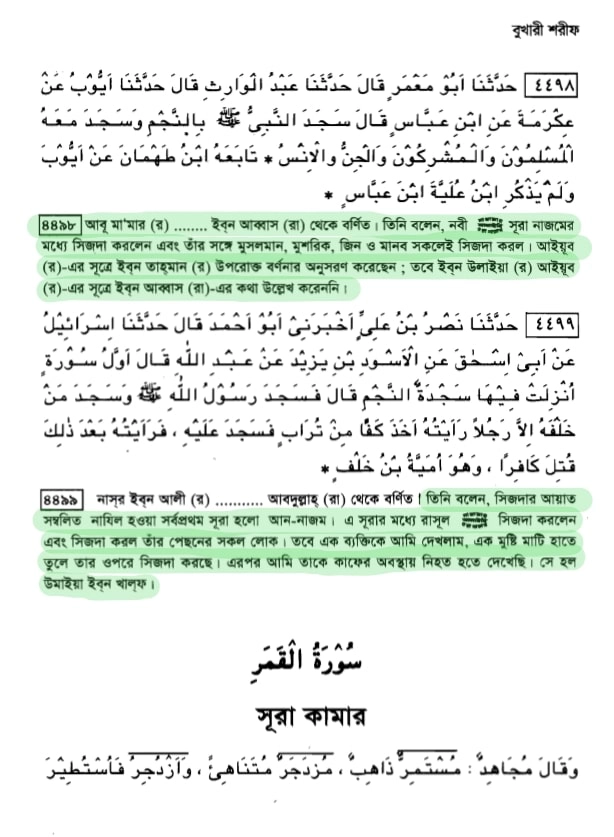
In Tirmidhi also, the same core report is preserved under the name of Ibn Abbas. In the book of Tirmidhi, after the hadith, there is a discussion on legal differences regarding the prostration of Surah An-Najm and the Mufassal surahs. The news of the combined prostration is the subject of the hadith; the discussion on which surah has the provision for prostration is the subsequent comment of the compiler. In his discussion, the news of the event and the legal question of prostration appear side by side. [419]
Sunan at-Tirmidhi (Verified)
Chapter: 4/ Kitabul Jumu’ah (Friday Prayer)
Publisher: Husain al-Madani
Section: 51. Prostration of Surah an-Najm
575. It is narrated from Ibn Abbas (ra), he said, Rasulullah sallallahu ‘alayhi wasallam performed prostration in Surah Najm. Muslims, polytheists, jinn and humans all performed prostration with him. -Sahih. Bukhari, Qissatul Gharaniq— (18, 25, 31 p.), Bukhari.
Abu Isa said: This hadith is hasan sahih. In this section, hadiths are also narrated from Ibn Masud and Abu Hurairah (ra). According to one group of scholars, there is a prostration in Surah Najm. According to one group of Sahaba and Tabi’un, there is no prostration in the Mufassal surahs. Malik ibn Anas supports this view. But the view of the first group is more sahih. Sufyan Sawri, Ibnul Mubarak, Shafi’i and Ahmad support the first view. (That is, there is prostration in the Mufassal surahs).
Hadith grade: Sahih (Sahih)
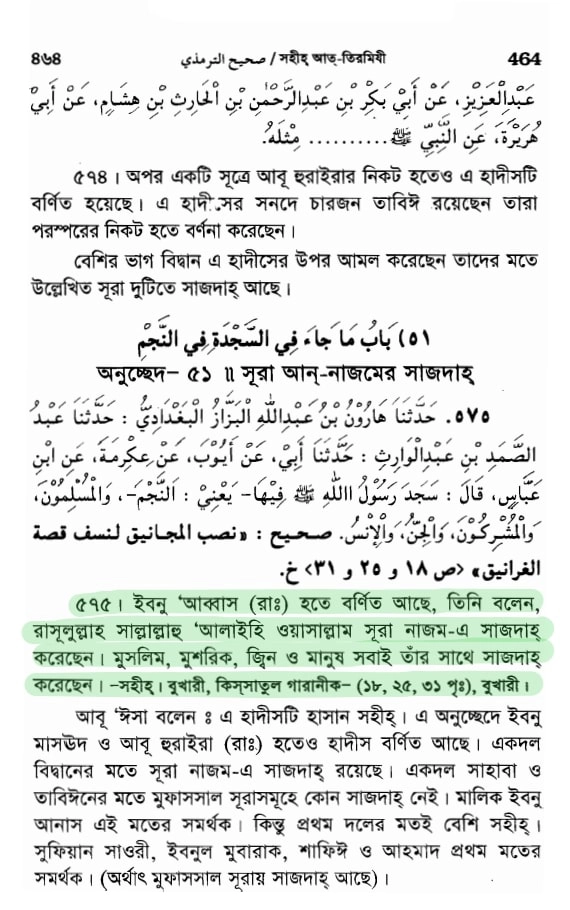
The importance of the polytheists’ participation lies in their own religious position. They worshipped deities whose authority was in conflict with Muhammad’s monotheistic preaching. In this situation, the polytheists prostrating along with Muhammad’s followers at the end of his recitation is a social collective reaction. The report does not stop at the event of some person bowing their head being influenced from afar; it captures the collective behavior of the rival religious camp. Later, commentators in the explanation of Surah Al-Hajj linked this behavior to sentences of praise for the goddesses. The elements of that link are detailed in separate tafsir reports.
In another report under the name of Ibn Masud, a person is found who, instead of prostrating, took soil in his hand. In this version of Bukhari, his name is Umayyah ibn Khalaf; Ibn Masud later reported seeing him killed in a state of unbelief. Thus, a scene of exception is preserved even within the combined prostration. At the same time, the identity of “unbeliever” does not transform the event into news of everyone’s conversion to Islam. [420] [421]
أَوَّلُ سُورَةٍ أُنْزِلَتْ فِيهَا سَجْدَةٌ {وَالنَّجْمِ}. قَالَ فَسَجَدَ رَسُولُ اللَّهِ صلى الله عليه وسلم وَسَجَدَ مَنْ خَلْفَهُ، إِلاَّ رَجُلاً رَأَيْتُهُ أَخَذَ كَفًّا مِنْ تُرَابٍ فَسَجَدَ عَلَيْهِ، فَرَأَيْتُهُ بَعْدَ ذَلِكَ قُتِلَ كَافِرًا، وَهْوَ أُمَيَّةُ بْنُ خَلَفٍ.
English translation: The first surah in which prostration was revealed was An-Najm. He says, the Messenger of Allah prostrated and the people behind him also prostrated. I saw only one person, he took a handful of soil and prostrated upon it. Later I saw him killed as an unbeliever. He was Umayyah ibn Khalaf.
| Account | Main Subject | Special Information |
|---|---|---|
| Bukhari 4862 and 1071; Ibn Abbas | Prostration of Muslims and polytheists with Muhammad | Two religious identities mentioned separately; mention of jinn and humans also present |
| Tirmidhi 575; Ibn Abbas | Same news of combined prostration | Later discussion by the compiler on the provision of prostration |
| Bukhari 4863; Ibn Masud | Collective prostration and one person taking soil in hand | In this version, the name of the exceptional person is Umayyah ibn Khalaf |
| Gharaniq-report of tafsir | Satisfaction and prostration of polytheists upon hearing praise of goddesses | The sentences are mentioned as the reason for the collective behavior |
The reports narrated from Ibn Abbas in Bukhari and Tirmidhi do not quote the phrases of praise for the goddesses. The event of the collective prostration is preserved there, while the detailed account of the phrases of praise and their withdrawal is preserved in the tafsirs. From this distributional arrangement of sources, two parts of the report emerge: the collective prostration of people of different faiths in a public gathering, and the explanation regarding the change of the words associated with that event. The brevity of the first report does not encompass all the details of the second; the tafsir materials appear with their own language and narrative paths.
If collective religious behavior is treated as synonymous with a change in everyone’s belief, the distinct intentions of the listeners are lost. Whether the individuals bowing their heads at the same moment had reached the same theological conclusion is a question of their own statements. In Tabari’s lengthy account, the polytheists are satisfied because they received recognition of their goddesses’ intercession. There, the reason for the Muslims’ prostration was following the Prophet, while the reason for the polytheists’ prostration was the honor given to their deities. Different religious meanings for the two parties remain intact within the same external behavior.
If the report of this gathering reached far away, it created the opportunity to understand external unity as complete religious unity. In several accounts of Gharaniq, there is mention of news reaching the Muslims in Abyssinia that the people of Mecca had accepted Islam. Therefore, the news of prostrating together and its explanation regarding conversion are separate. Both functioned within the social effects of the report: immediate satisfaction at the gathering and the hope for the return of safety among followers far away. Hearing and accepting a specific form of the words also influenced the movement of people and political calculations—this relationship is clear in the detailed accounts of the tafsir.
The recitation of Surah An-Najm here was not limited to a personal experience. The listeners heard it, reacted to it, and news of the event reached elsewhere. Consequently, the subsequent question of withdrawal is also a question about words proclaimed in public. The history of the reaction created among many people after the utterance remains linked to the later omission of a few sentences. The descriptions of the polytheists’ prostration, their satisfaction, and the later return of conflict preserve the social dimension of that change.
Details of the phrases of praise for the goddesses in Jalalayn, Tabari, and Ibn Kathir
In the account of Gharaniq, the phrase of praise came after the names of Lat, Uzza, and Manat were uttered. These three names are also in the prevailing text of Surah An-Najm. Consequently, mentioning the names of the goddesses and recognizing their high status and intercession are two different statements. The significance of the controversial sentences lies in the latter: if praise is added after the names, the religious meaning of the mention changes. Those whose authority is being denied by mentioning their names become honorable beings capable of intercession before Allah if phrases of praise are added. [422]
أَفَرَأَيْتُمُ اللَّاتَ وَالْعُزَّىٰ وَمَنَاةَ الثَّالِثَةَ الْأُخْرَىٰ
English translation: Have you considered Lat and Uzza, and a third, Manat?
The word “Gharaniq” contains the metaphor of birds ascending. IslamQA has quoted Ibn Anbari’s explanation from Lisan al-Arab: based on the belief that deities lead to Allah and intercede, they were compared to birds ascending in the sky. Consequently, the phrase of praise is not merely a beautifying adjective; it simultaneously expresses the concepts of the sky, high status, and mediation. [423]
الغرانيق: الذكور من الطير، واحدها غِرْنَوْق وغِرْنَيْق، سمي به لبياضه، وقيل هو الكُرْكيّ، وكانوا يزعمون أن الأصنام تقرّبهم من الله عز وجل، وتشفع لهم إليه، فشبهت بالطيور التي تعلو وترتفع في السماء
English translation: Gharaniq are male birds; its singular is girnawk and girnayk. This name was given because of the white color; it is said to be a crane. They believed that the idols led them to Allah and interceded for them with Him. Therefore, they were compared to birds ascending high in the sky.
In the explanation of Jalalayn, Muhammad was reciting Surah An-Najm at a gathering of the Quraysh. After the names of the goddesses, phrases of praise were uttered unknowingly on his tongue through the projection of Satan. The polytheists were delighted by this. Later, Gabriel informed him of the matter, Muhammad became distressed, and he was comforted with the verses of Hajj. Here, the first utterance, the delight of the listeners, and the subsequent corrected announcement regarding the source follow one another. Along with this, he provided the explanation for the removal of the sentences from the text and the establishment of Allah’s verses. [424]
52. Among the messengers I sent before you, there was a prophet who was commanded to convey [the message], or a prophet who was not commanded to convey; whenever any of them desired to read/wanted to read something, Satan projected something into his desire. Something that was not Quran in his reading, so that those to whom he was sent would be delighted. Once, the Messenger, in a gathering of the Quraysh, after reciting أَفَرَأَيْتُمُ اللَّاتَ وَالْعُزَّى وَمَنَاةَ الثَّالِثَةَ الْأُخْرَى of Surah An-Najm, these words came out from the holy tongue through the projection of Satan تِلْكَ الْغَرَانِيقُ الْعُلَى، وَإِنَّ شَفَاعَتَهُنَّ لَتُرْتَجَى: these high-status deities, one can certainly hope for their intercession. Upon hearing this, the unbelievers were very delighted.
Then Hazrat Gabriel (A.) informed him regarding this that Satan had uttered these words from your mouth without your knowledge. Consequently, he became very distressed. Then he was provided comfort through the following verse, so that he might be at peace. Allah removes/abrogates what Satan projects. Then Allah establishes His verses firmly. Allah Almighty is All-Knowing regarding what was mentioned about the projection of Satan. The Wise, regarding giving power to Satan from His own side—He does whatever He wills.
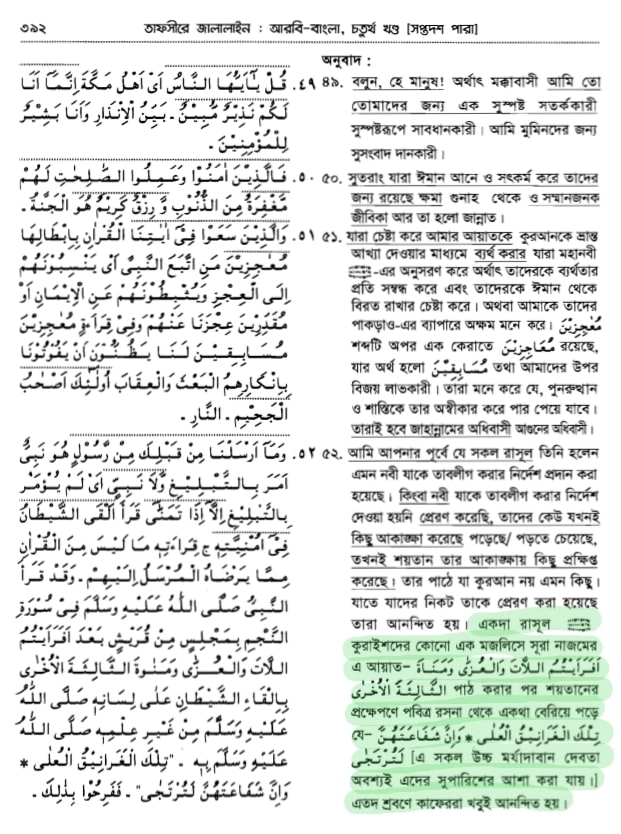
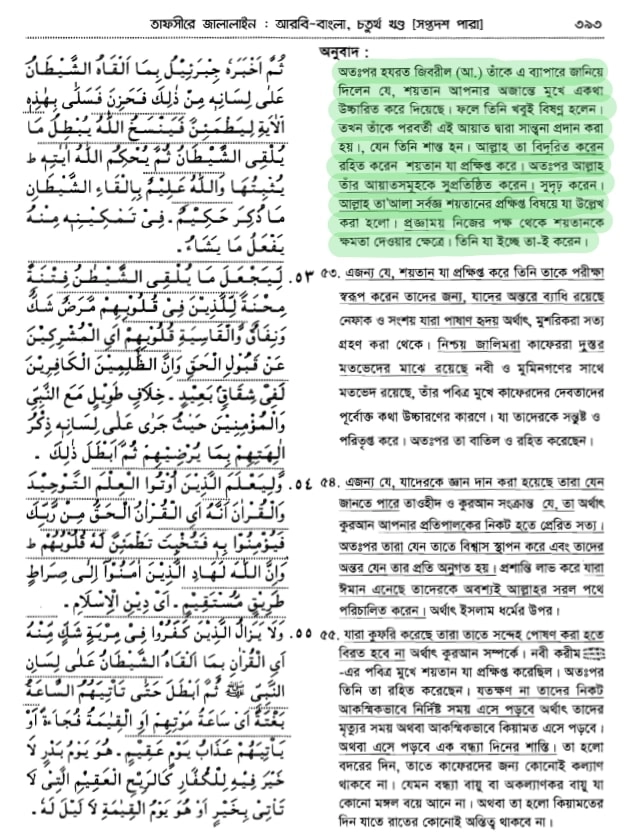
In the Arabic original of Jalalayn, the location of the utterance is not ambiguous: “on his tongue”, “without his knowledge”—this language has been used. In the same explanation, since Gabriel informs him later, this difference of source was not clear to Muhammad and the listeners at the time of the first utterance. Knowledge regarding the illegal addition comes in the later stage of the event. [425]
وقَدْ قَرَأَ النَّبِيّ ﷺ فِي سُورَة النَّجْم بِمَجْلِسٍ مِن قُرَيْش بَعْد: ﴿أفَرَأَيْتُمْ اللّاتَ والعُزّى ومَناة الثّالِثَة الأُخْرى﴾ بِإلْقاءِ الشَّيْطان عَلى لِسانه مِن غَيْر عِلْمه ﷺ بِهِ: تِلْكَ الغَرانِيق العُلا وإنَّ شَفاعَتهنَّ لَتُرْتَجى فَفَرِحُوا بِذَلِكَ ثُمَّ أخْبَرَهُ جِبْرِيل بِما ألْقاهُ الشَّيْطان عَلى لِسانه مِن ذَلِكَ فَحَزِنَ فَسُلِّيَ بِهَذِهِ الآيَة لِيَطْمَئِنّ
English translation: At a gathering of the Quraysh, the Prophet [recited] in Surah An-Najm, “Have you considered Al-Lat, Al-Uzza, and Manat, the third?”—after which, without his knowledge, Satan’s insertion occurred on his tongue: “They are exalted Gharaniq; their intercession is certainly expected.” This delighted them. Later, Gabriel informed him of the matter inserted by Satan on his tongue. He became saddened by this; he was comforted with this verse, so that he would be reassured.
In the brief account preserved under the name of Sa’id ibn Zubayr in Tabari, there is a direct connection between the phrases of praise and the collective prostration. The reaction of the polytheists is described because the goddesses were mentioned favorably. Then they prostrate along with Muhammad. That is, the story does not simply state that two unrelated acts happened on the same day; it gives a causal relationship between hearing the phrases of praise and the satisfaction of the polytheists. [426]
فَقَالَ: تِلْكَ الْغَرَانِيقُ الْعُلَى، وَإِنَّ شَفَاعَتَهُنَّ لَتُرْتَجَى. فَسَجَدَ رَسُولُ اللَّهِ صَلَّى اللَّهُ عَلَيْهِ وَسَلَّمَ. فَقَالَ الْمُشْرِكُونَ: أَنَّهُ لَمْ يَذْكُرْ آلِهَتَكُمْ قَبْلَ الْيَوْمِ بِخَيْرٍ، فَسَجَدَ الْمُشْرِكُونَ مَعَهُ
English translation: He said, they are high-status Gharaniq; their intercession can certainly be hoped for. Then the Messenger of Allah prostrated. The polytheists said, before today he had not mentioned your deities favorably. Then the polytheists also prostrated with him.
In the tafsir of Ibn Kathir, multiple versions of this event, the news reaching Abyssinia, the return, and his evaluation of the narrative paths are together. In the early accounts, it is said that Satan inserted the sentences into the tongue; later, in the quoted account of Ibn Shihab, there is a version where it was heard by the polytheists and not heard by the Muslims. Finally, Ibn Kathir preferred this second type of explanation. Along with preserving different versions, he also expressed his own theological preference. [427] [428]
reached, then Satan caused this to be uttered by his mouth:
تِلْكَ الْغَرَانِيقُ الْأُولَى وَإِنَّ شَفَاعَتَهُنَّ لَتُرْجَى
Hearing this, the polytheists began to say that before Muhammad (SAW) our deities had no praise, but today he has praised us. Therefore, when the Messenger of Allah (SAW) prostrated, they prostrated along with him. Then Allah Almighty revealed this verse:
وَمَا أَرْسَلْنَا مِنْ قَبْلِكَ مِنْ رَّسُولٍ وَلَا نَبِيٍّ إِلَّا إِذَا تَمَنَّى أَلْقَى الشَّيْطَانُ فِي أَمْنِيَّتِهِ فَيَنْسَخُ اللَّهُ مَا يُلْقِي الشَّيْطَانُ ثُمَّ يُحْكِمُ اللَّهُ آيَاتِهِ وَاللَّهُ عَلِيمٌ حَكِيمٌ.
Ibn Jarir (R)
Narrated from Shu’ba (R). However, this is ‘mursal’. In his ‘Musnad’ book, it is narrated from Yusuf ibn Hammad (R) by Bayza (R). He says, the Noble Prophet (SAW) once recited Surah ‘An-Najm’ in Mecca and reached أَفَرَأَيْتُمُ اللَّاتَ وَالْعُزَّى الخ. In the remaining report, he described the previous hadith. Then Bayza (R) says, we do not know of any other sanad besides this one where it is narrated as muttasil. Only Umayya ibn Khalid (R) narrated it as muttasil. However, he is a famous reliable ravi. He narrated it through Abu Salih (R) via Kalbi (R) through Hazrat Ibn Abbas (RA).
Then Abu Hatim (R) narrated the hadith as mursal from Abu Aliyah and Suddi (R). Similarly, Ibn Jarir (R) narrated it as mursal from Muhammad ibn Ka’b Qurazi and Muhammad ibn Qais (R).
Qatadah (R) says, the Noble Prophet (SAW) was praying near Maqam Ibrahim, he became drowsy during the prayer, and at this time Satan caused وان شفاعتهن لترجي to be uttered by his mouth. The polytheists heard it and memorized it. And they proclaimed that this had been uttered from the mouth of the Messenger of Allah (SAW).
Then this verse was revealed:
وَمَا أَرْسَلْنَا مِنْ قَبْلِكَ مِنْ رَّسُولٍ وَلَا نَبِيِّ الخ Ibn Abu Hatim (R) says, narrated from Ibn Shihab (R) …. Musa ibn Abu Musa Kufi (R). He says, when Surah ‘An-Najm’ was revealed, the polytheists began to say that if this man (Muhammad (SAW) )) discussed our deities a bit more favorably, then we would accept him and his companion. But the Jews, Christians, and others oppose his religion and he insults our deities more than all of them. The polytheists were exercising extreme torture and injustice toward the Messenger of Allah (SAW) and his companions. And the Messenger of Allah (SAW) was extremely pained due to their unbelief and shirk. And he desired that they attain guidance. Then ‘Surah An-Najm’ was revealed and he
أَفَرَأَيْتُمُ اللَّاتَ وَالْعُزَّى وَمَنَاةَ الثَّالِثَةَ الْأُخْرَى أَلَكُمُ الذَّكَرُ وَلَهُ الْأُنْثَى
recited, then while mentioning the goddesses of the polytheists, Satan inserted a few words. And it was uttered,
وَأَنَّهُنَّ لَهُنَّ الْغَرَانِيقُ الْعُلَى وَإِنَّ شَفَاعَتَهُنَّ لَتُرْجَى
This was the rhythmic speech of Satan’s mouth. But it became deeply rooted in the hearts of every polytheist of Mecca and everyone memorized it. They began to say that Muhammad (SAW) has returned to his former religion. Then the Messenger of Allah (SAW) prostrated at the end of Surah ‘An-Najm’, then the Muslims present with him and the polytheists all bowed in prostration. But since Alid ibn Mughira was very old, he could not prostrate. Instead, he took a handful of soil in his hand and applied it to his head. The Muslims were astonished that the polytheists prostrated along with the Messenger of Allah (SAW). Since the polytheists had not accepted Islam, the Muslims’ amazement at their prostrating with the Messenger of Allah (SAW) had no end. The words that Satan had filled in the ears of the polytheists—actually, the believers could not hear them once. But the polytheists were very happy to hear them; Satan also told them that the Messenger of Allah (SAW) had recited this speech along with the surah, therefore they all bowed in prostration in honor of their deities. This news spread among other people, even reaching far-off Abyssinia, and the Muslims located there also came to know. When Uthman ibn Maz’un (RA) and his companions learned the news that the polytheists of Mecca had accepted Islam and had prayed along with the Messenger of Allah (SAW), and that Alid ibn Mughira had raised soil in his hand and applied it to his head, they learned that the Muslims of Mecca were now safe. They returned to Mecca with great joy and exuberance. But by then, the situation had changed. Whatever falsehood Satan had mixed with the truth, Allah had removed it and made His verses more firm.
It was guided:
وَمَا أَرْسَلْنَا مِنْ قَبْلِكَ مِنْ رَّسُولٍ وَلَا نَبِيٍّ إِلَّا إِذَا تَمَنَّى أَلْقَى الشَّيْطَانُ فِي أَمْنِيَّتِهِ فَيَنْسَخُ اللَّهُ مَا يُلْقِي الشَّيْطَانُ ثُمَّ يُحْكِمُ اللَّهُ آيَاتِهِ وَاللَّهُ عَلِيمٌ حَكِيمٌ . ليَجْعَلَ مَا يُلْقِي الشَّيْطَانُ فِتْنَةً لِلَّذِينَ فِي قُلُوبِهِمْ مَّرَضٌ وَالْقَاسِيَةِ قُلُوبُهُمْ وَإِنَّ الظَّالِمِينَ لَفِي شِقَاقٍ بَعِيدٍ .
After the mentioned verse was revealed, when it became clear that the rhythmic
The words were not actually the words of the Messenger of Allah (pbuh), but rather Satan had inserted them into the Messenger of Allah’s (pbuh) recitation of the Quran. At that time, the polytheists began to oppose the Muslims with even greater force. They began to treat the Muslims more harshly. This report is mursal. A similar account has been narrated by Ibn Jarir from Zuhri (r), Abu Bakr ibn Abdur Rahman, and Harith ibn Hisham (r). Hafiz Abu Bakr Bayhaqi (r) has narrated this report in the book ‘Dala’il al-Nubuwwah’. The incident is narrated from Abu Ishaq (r). I (Ibn Kathir) say that Muhammad ibn Ishaq also narrated a similar report in his Sirat book. However, all reports are mursal and munqati’; Allama Baghawi (r) in his tafsir has described all these reports as the words of Hazrat Ibn Abbas (ra) and Muhammad ibn Ka’b al-Qurazi. Subsequently, Allama Baghawi (r) himself raised the question: when Allah Himself is the protector and preserver of the Messenger of Allah (pbuh), how did such an incident occur? He then cited several answers. But the best answer is that, in reality, تِلْكَ الْغُرَانِيقَ الْعُلَى الخ Satan uttered these words and inserted them into the ears of the polytheists. Consequently, they assumed that these had been uttered from the mouth of the Messenger of Allah (pbuh). However, the reality was the opposite. It was from Satan, not from the Messenger of Allah (pbuh).
Accepting the incident as true, the mutakallimun have provided several answers to the mentioned question. Qadi Ayaz (r) has discussed this matter in his book titled ‘Shifa’.
The word of Almighty Allah:
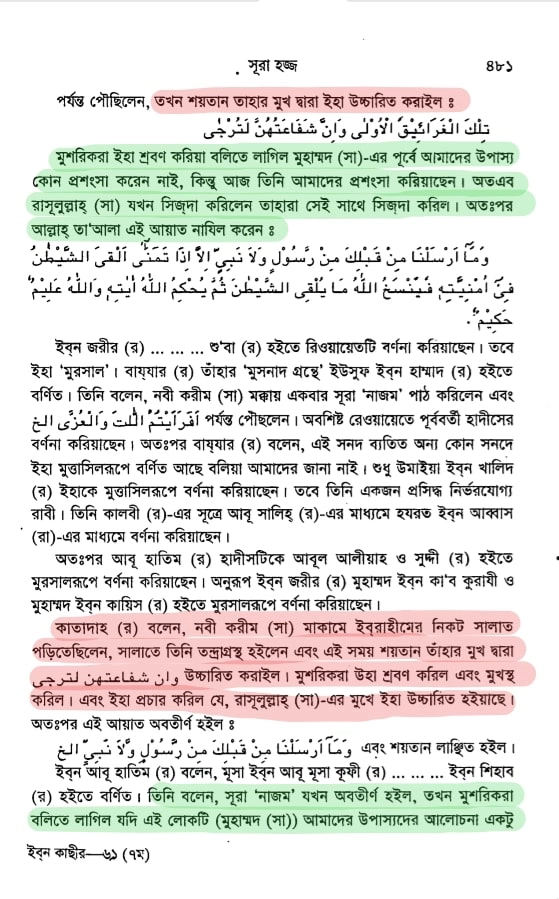
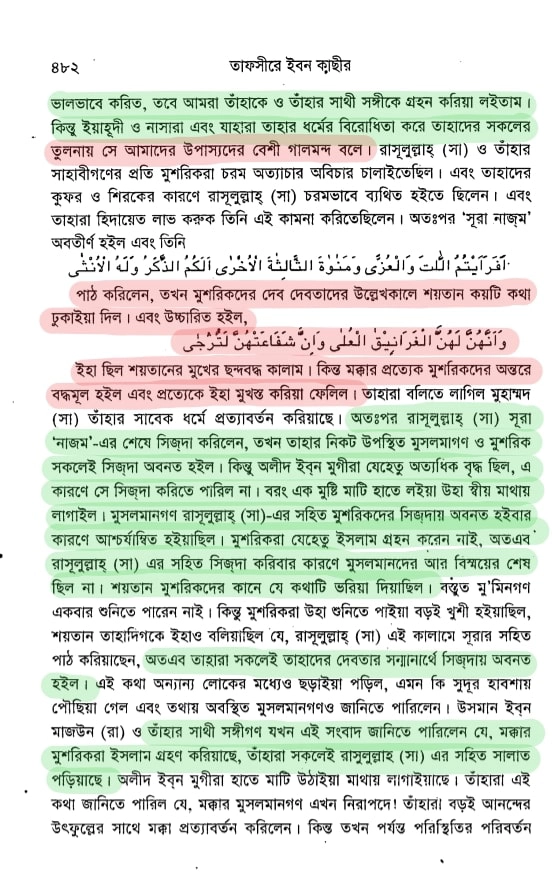
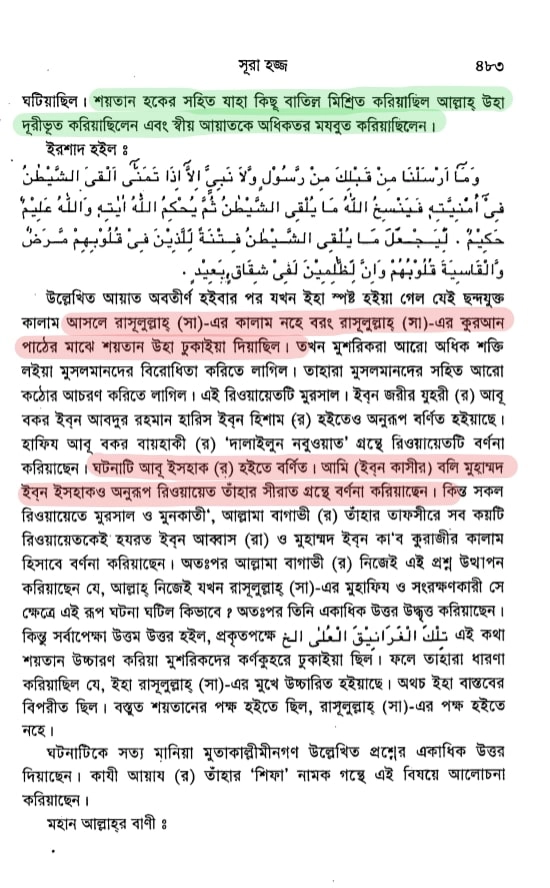
In the preserved accounts of Ibn Kathir, several different interpretations of the same sequence of events exist side by side. In the first, words of praise come to Muhammad’s tongue, the polytheists are delighted upon hearing them and prostrate. In another version attributed to Qatada, slumber is mentioned. In Ibn Shihab’s long version, emphasis is placed on the hearing and perception of the polytheists; it is reported that the Muslims did not hear those words. In the final interpretation, when Satan delivered the sound to the ears, the listeners thought it was the word from Muhammad’s mouth. These versions provide different answers regarding the source of the utterance. Simultaneously, in every version, a sentence was propagated or accepted as propagated, which was later separated from the authorized text of the revelation.
| Source or form of narration | How the words of praise arrived | Account of acceptance and correction |
|---|---|---|
| Jalalayn | Satan’s projection onto Muhammad’s tongue without his knowledge | Joy of the Quraysh; later Gabriel’s news and removal |
| Said ibn Zubayr in Tabari | Muhammad uttering words of praise while reciting a surah | Satisfaction of the polytheists and collective prostration |
| Account of Said ibn Zubayr in Ibn Kathir | Projection of words of praise onto the tongue | Prostration upon hearing a favorable mention of the goddesses |
| The slumber version attributed to Qatada | Slumber during prayer at Maqam Ibrahim | Mention of the polytheists memorizing and propagating it |
| The detailed version of Ibn Shihab | Emphasis on the hearing and perception of the polytheists | Muslims not hearing, joy of the polytheists, and news in Abyssinia |
| Ibn Kathir’s preferred interpretation | Satan makes the listeners hear; they think it is the Prophet’s utterance | Removing the responsibility of utterance from the Prophet’s mouth and placing it in the confusion of hearing |
In another narration in Tabari attributed to Muhammad ibn Ka’b and Muhammad ibn Qays, the statements of the polytheists are clearer. They acknowledge Allah’s creation, sustenance, and power over life and death, but they want a place for the intercession of their goddesses. Finding that place in the words of praise, they speak of staying with Muhammad. In this account, the acknowledgment of the existence of one Allah and the acknowledgment of the mediation of the goddesses are not alternatives to each other; the polytheists keep both in the same system. The center of the conflict is the status of their deities. [429]
فرضوا بما تكلم به وقالوا: قد عرفنا أن الله يحيي ويميت، وهو الذي يخلق ويرزق، ولكن آلهتنا هذه تشفع لنا عنده، إذ جعلت لها نصيبا، فنحن معك
English translation: They were satisfied with what he had said and said, we know that Allah gives life and gives death, He is the one who creates and gives sustenance. But these deities of ours intercede for us with Him. Since you have given a part to them, we are with you.
In another narration in Tabari attributed to Abu Aliya, there is also a condition of social status. The Quraysh leaders mention Muhammad’s companions as slaves, freed slaves, and people of low status. It is proposed that if the goddesses are mentioned favorably, they will sit with him, and the nobility of Arabia, seeing this, will be further attracted—this proposal is made. Consequently, the expectation of a compromise is expressed not only in the language of faith but also in the language of the class position of the followers and the recognition of the powerful. [430]
قالت قريش لرسول الله صلى الله عليه وسلم: إنما جلساؤك عبد بني فلان ومولى بني فلان، فلو ذكرت آلهتنا بشيء جالسناك، فإنه يأتيك أشراف العرب فإذا رأوا جلساءك أشراف قومك كان أرغب لهم فيك
English translation: The Quraysh said to the Messenger of Allah, those who sit with you are slaves of such-and-such tribe and freed slaves of such-and-such tribe. If you said something about our deities, we would sit with you. The nobility of Arabia come to you; if they saw the nobility of your own community sitting beside you, they would be more interested in you.
Within the proposal, there is a condition of explicit exchange: if the status of the deities is given, the support of the powerful will be found. The political result of the words of praise is related to that declared condition. The subsequent praise and joy are placed against the backdrop of that condition. In this, the words of the utterance do not remain merely a matter of abstract faith; they become entwined with who will be in the assembly, who will accept the leadership, and which religious institution’s status will be recognized.
The news of the Muslims in Abyssinia returning is another layer of the social impact of this compromise. In the narration of Muhammad ibn Ka’b through Ibn Ishaq in Tabari, some people come up, others stay. The news was that the Quraysh had accepted Islam. After this, there are accounts of Gabriel’s objection, the withdrawal, and the anger of the polytheists. Here, the transmission of news, people moving based on believing it, and the change in Mecca’s political relations again—creates a continuity. The impact of the publicly spoken words entered the behavior of many people even before the announcement of the correction.
In the current text of the Nazm, there is a strong statement against the claim that any divine approval has been given to the goddesses after their names. In 53:23, they are called names given by ancestors and it is said that Allah has given no approval for them. The relationship between the words of praise for the Gharanik and this statement is one of semantic conflict: in one, there is hope for mediation, in the other, the basis of that status is denied. Therefore, in the story of correction, it is not a slight fluctuation of words, but opposite evaluations regarding the position of the deities that come forward. [431]
إِنْ هِيَ إِلَّا أَسْمَاءٌ سَمَّيْتُمُوهَا أَنتُمْ وَآبَاؤُكُم مَّا أَنزَلَ اللَّهُ بِهَا مِن سُلْطَانٍ ۚ إِن يَتَّبِعُونَ إِلَّا الظَّنَّ وَمَا تَهْوَى الْأَنفُسُ ۖ وَلَقَدْ جَاءَهُم مِّن رَّبِّهِمُ الْهُدَىٰ
English translation: These are nothing but names which you and your forefathers have named; Allah has not sent down any authority for them. They follow nothing but conjecture and what their souls desire. Yet, there has come to them guidance from their Lord.
In the narrations, as the acceptability of a sentence changes, the name of its source also changes. The sentence uttered in the assembly or accepted as Muhammad’s recitation first brings satisfaction and unity; later, when it is called a satanic addition, that religious status is withdrawn. In Tabari’s long version, the polytheists raise allegations of Muhammad’s remorse and change. In their reaction, the textual reversal they witnessed is also expressed. The political advantage of the first announcement and the political cost of the subsequent withdrawal—both are part of the narration.
Hajj 22:52–53, explanation of satanic addition and textual correction
The sentence structure of Hajj 22:52 places three actions in sequence: the projection of Satan, its removal by Allah, and the strengthening of the verses. Correction here is an action following the event. If the word “tamanna” in the tafsir is interpreted as meaning ‘to recite’, the place of projection becomes the Prophet’s recitation; then the part that entered into that recitation is canceled. Jalalayn and Tabari have given this textual interpretation. In the story of the Gharanik associated with the verse, there is a sequence of the projected part and its removal. [432]
وَمَا أَرْسَلْنَا مِن قَبْلِكَ مِن رَّسُولٍ وَلَا نَبِيٍّ إِلَّا إِذَا تَمَنَّىٰ أَلْقَى الشَّيْطَانُ فِي أُمْنِيَّتِهِ فَيَنسَخُ اللَّهُ مَا يُلْقِي الشَّيْطَانُ ثُمَّ يُحْكِمُ اللَّهُ آيَاتِهِ ۗ وَاللَّهُ عَلِيمٌ حَكِيمٌ
English translation: We have not sent any messenger or prophet before you but when he recited, Satan projected something into his recitation. Then Allah cancels what Satan projected, then Allah strengthens His verses. Allah is All-Knowing, All-Wise.
Tabari mentioned both desire and the meaning of reciting or speaking as explanations for “tamanna”. Then, in his own conclusion, he stated that the meaning of recitation is more consistent. His logic is the subsequent part of the verse: if it is said that Allah strengthens His verses, then the matter being canceled is also the matter projected within that recitation. With this conclusion, “projection” does not remain merely the name of a momentary thought in the Prophet’s heart; it has a relationship with the uttered word. Tabari himself mentioned the Prophet’s tongue to explain that meaning. [433]
فتأويل الكلام إذن: وما أرسلنا من قبلك من رسول ولا نبي إلا إذا تلا كتاب الله، وقرأ، أو حدّث وتكلم، ألقى الشيطان في كتاب الله الذي تلاه وقرأه، أو في حديثه الذي حدث وتكلم ( فَيَنْسَخُ اللَّهُ مَا يُلْقِي الشَّيْطَانُ ) يقول تعالى: فيذهب الله ما يلقي الشيطان من ذلك على لسان نبيه ويبطله.
English translation: Thus the explanation of the statement is: before you we sent no messenger or prophet who, when reciting the Book of Allah or speaking, Satan did not project something into his recitation and reading of the Book of Allah or into his speech. “Allah cancels what Satan projected”—meaning Allah removes the matter projected by Satan from the tongue of His Prophet and cancels it.
Tabari established the relationship between the words of the verse and projection and removal in his own explanation. This exists as his own conclusion alongside the narrations he cited. Consequently, in his tafsir, the incident is used in two roles—as historical material and as material for understanding the verse. To him, the explanation of erasing the sentences of the Gharanik and then strengthening the verse is textually meaningful.
The meaning of the word “naskh” is also at the center of this sequence. Ibn Kathir, in the relevant place, mentioned removal and taking away as the linguistic meaning. Then, having a removable part before reaching the “corrected” state is a condition inherent to the story. Using the word naskh does not make the previous utterance disappear from history; rather, the word identifies the act of removing something. [434]
وقوله : ( فينسخ الله ما يلقي الشيطان ) ، حقيقة النسخ لغة : الإزالة والرفع . قال علي بن أبي طلحة ، عن ابن عباس : أي فيبطل الله سبحانه وتعالى ما ألقى الشيطان . وقال الضحاك : نسخ جبريل بأمر الله ما ألقى الشيطان ، وأحكم الله آياته .
English translation: “Allah cancels what Satan projected”—here the actual linguistic meaning of naskh is removal and taking away. Ali ibn Abi Talha said from Ibn Abbas, meaning Allah cancels what Satan projected. Dahhak said, by the command of Allah, Gabriel removes what Satan projected and Allah strengthens His verses.
| Word or action of the verse | Explanation in tafsir | Its role in the event |
|---|---|---|
| تَمَنَّى — tamanna | Reciting, in the selected explanations of Jalalayn and Tabari | Stage of the utterance being spoken |
| أَلْقَى — to project | Inserting something into a recitation or statement | Mixing different elements with a statement accepted as authorized |
| يَنسَخُ — to cancel | Removal and taking away | Discarding the previously projected part |
| يُحْكِمُ — to strengthen | Making the verse stable and established | Determining the authorized text after removal |
| فِتْنَة — test | Test of the faith and doubt of the listeners | Evaluating the change in text as an event of religious selection |
The next verse 22:53 links this projection to a test for those who have disease in their hearts and those who have hard hearts. In Tabari’s own explanation, the sentences of the Gharanik are given as an example. To explain “disease of the heart”, he spoke of doubt regarding Muhammad’s truthfulness and the truth of his statements. That is, after the problem with the source, the reaction of the listener also comes under religious evaluation. If an event of first acceptance and then cancellation exists within the same announcement, the doubt that arises is used in the explanation as a tool to classify that doubt as a disease of faith. [435]
لِّيَجْعَلَ مَا يُلْقِي الشَّيْطَانُ فِتْنَةً لِّلَّذِينَ فِي قُلُوبِهِم مَّرَضٌ وَالْقَاسِيَةِ قُلُوبُهُمْ ۗ وَإِنَّ الظَّالِمِينَ لَفِي شِقَاقٍ بَعِيدٍ
English translation: so that He may test through what Satan projected those who have disease in their hearts and those who have hard hearts. The wrongdoers are surely in far-off opposition.
In the explanation of this test, Tabari specified both the subject of the projected words and the target of the doubt. The sentences of the Gharanik and the doubt about Muhammad’s truthfulness appeared in the same paragraph. Consequently, the social act of calling doubt a “disease” is directly understood: the uncertainty about the source of the sentence shifts from a question of testing the reliability of the announcer to a problem of the listener’s faith. [436]
يقول تعالى ذكره: فينسخ الله ما يلقي الشيطان، ثم يحكم الله آياته، كي يجعل ما يلقي الشيطان في أمنية نبيه من الباطل، كقول النبي صلى الله عليه وسلم: تلك الغرانيق العلى، وإن شفاعتهن لترتجى فتنة يقول: اختبارا يختبر به الذين في قلوبهم مرض من النفاق، وذلك الشك في صدق رسول الله صلى الله عليه وسلم وحقيقة ما يخبرهم به.
English translation: The meaning of Allah’s statement: He cancels what Satan projected, then strengthens His own verses, so that the false matter projected by Satan into the Prophet’s recitation—such as the Prophet saying “they are high Gharanik; their intercession is surely expected”—becomes a test. That is, by this He tests those who have the disease of hypocrisy in their hearts; which is the doubt about the truthfulness of the Messenger of Allah and the truth of what he informs.
In 22:54, there is mention of those endowed with knowledge knowing the truth, believing, and their hearts becoming humble. Thus, across three consecutive verses, a complete religious explanation is established: an interpolation occurred, it was removed, some were tested by this change, and others recognized the truth and became more obedient. The correction was not left merely as an event of changing the text; its acceptance or rejection was also linked to determining a person’s religious standing. [437]
وَلِيَعْلَمَ الَّذِينَ أُوتُوا الْعِلْمَ أَنَّهُ الْحَقُّ مِن رَّبِّكَ فَيُؤْمِنُوا بِهِ فَتُخْبِتَ لَهُ قُلُوبُهُمْ ۗ وَإِنَّ اللَّهَ لَهَادِ الَّذِينَ آمَنُوا إِلَىٰ صِرَاطٍ مُّسْتَقِيمٍ
English translation: And so that those who have been given knowledge may know that it is the truth from your Lord; thus they may believe in it and their hearts may humble themselves before it. Allah certainly guides the believers to the straight path.
At the end of Jalalayn’s explanation, there is also mention of granting the devil this power in the context of Allah’s wisdom. Therefore, in that explanation, the event does not remain a sudden disruption occurring outside the control of the Almighty Being. The devil’s interpolation, its removal, and the testing of humans find their place within the same system. Its moral consequence is severe: there is an opportunity for confusion to enter the proclamation that the listener accepted as heavenly, later a correction comes, and in the face of that confusion, the listener’s doubt is again described as a sign of their own disease or hardness of heart. [438]
﴿واللَّه عَلِيم﴾ بِإلْقاءِ الشَّيْطان ما ذُكِرَ ﴿حَكِيم﴾ فِي تَمْكِينه مِنهُ بِفِعْلِ ما يَشاء
English translation: “Allah is All-Knowing”—regarding the mentioned interpolation of the devil; “Wise”—in granting the devil power in this matter by doing what He wills.
There is an inequality in the acquisition of information within this framework of testing. The announcer first delivers a message, and the listener cannot directly verify its source. Later, the message to change the source of the previous part comes from the announcer himself. The listener’s doubt is then a natural result of the sequence of events: the very medium whose words he first believed in is now calling a part of his own previous words unacceptable. By identifying doubt as a disease of faith, the burden of questioning the reliability of the medium is shifted back onto the character of the questioner.
In Gharanik’s explanation, the correction of the text occurs at the stage of first proclamation. The recitation of the surah, the spreading of the sentence in public, and the subsequent rejection of the sentence are described here. Within this path of reaching the authorized text before the later compilation, there are two actions: acceptance and rejection. The presence of the final stable text coexists with that previous dynamic history. The claim of strengthening the verse comes in the explanation of an event where something removable was previously proclaimed.
Expansion of the narrative chains and Ibn Hajar’s evaluation
The report of Gharanik is not confined to a single subsequent book. Tabari has preserved reports attributed to Sa’id ibn Zubayr, Abu Al-Aliya, Muhammad ibn Ka’b, Muhammad ibn Qays, and Abu Bakr ibn Abdur Rahman. In the same discussion, Ibn Kathir mentions materials preserved by Ibn Abi Hatim, Bazzar, Tabari, Ibn Ishaq, Musa ibn Uqba, and Bayhaqi. There is repetition of the same materials in multiple books, and there are also differences in the sources of the reports and the sequence of events. Both these aspects are factual elements for understanding the spread of the report’s transmission.
In Suyuti’s Lubabun Nuqul, a path reaching Sa’id ibn Zubayr has been called sahih. The subject of the report there is the coming of words of praise on the tongue after the names of the goddesses and the prostration of the polytheists. Saying “from Sa’id ibn Zubayr” and obtaining direct contemporary eyewitness testimony of the event are not the same thing. The language of the source also indicates to whose statement the path evaluated as sahih has reached. The presence of the report under the name of a Successor through this chain and showing him as a direct eyewitness—these are two separate claims. [439]
أخرج ابن أبي حاتم وابن جرير وابن المنذر من طريق بسند صحيح عن سعيد بن جبير قال قرأ النبي – صلى الله عليه وسلم – بمكة والنجم فلما بلغ أفرأيتم اللات والعزى ومناة الثالثة الأخرى ألقى الشيطان على لسانه: تلك الغرانيق العلا وإن شفاعتهن لترتجى فقال المشركون ما ذكر آلهتنا بخير قبل اليوم فسجد وسجدوا فنزلت وما أرسلنا من قبلك من رسول ولا نبي الآية
English translation: Ibn Abi Hatim, Ibn Jarir, and Ibn Munzir narrated through a sahih isnad from Sa’id ibn Zubayr: The Prophet recites Najm in Mecca. Upon reaching “Have you considered Lat, Uzza, and a third other, Manat,” the devil interpolates on his tongue, “They are the exalted Gharanik; their intercession is certainly expected.” The polytheists say that before today, he had not mentioned our deities so well. He prostrates, and they prostrate too. After this, the verse “We sent no messenger or prophet before you” is revealed.
A large part of the descriptions in the tafsir has come through the Successors. When called “mursal” or “munqati,” it is known that the connection of the report is either unmentioned or broken somewhere. For this reason, Ibn Kathir has raised objections regarding the paths he saw. At the same time, this story existed as an element of ancient tafsir and sira, and many commentators used it. The lack of connection and the historical presence of the report are different types of information; the existence of the former does not erase the latter.
| Preserved chains | Identification in Tabari and related discussions | Types of repetition and variation |
|---|---|---|
| Sa’id ibn Zubayr | Brief report through Abu Bishr and Shuba | Same main path used in Tabari, Ibn Abi Hatim, and other books |
| Abu Al-Aliya | Account through Dawud ibn Abi Hind | Two paths through Mu’tamir and Hammad; proposal of support from the nobles |
| Abu Bakr ibn Abdur Rahman | Preservation by Tabari through Ibn Shihab | Words of praise, the joy of the polytheists, and later the devil’s speech |
| Muhammad ibn Ka’b and Muhammad ibn Qays | Joint report through Abu Mashar; Ibn Ka’b also in the path of Ibn Ishaq | Detailed version including the agreement, Gabriel’s objection after evening, and news of Habasha |
| Long version of Ibn Shihab | Preserved in Ibn Kathir through Musa ibn Uqba | Emphasis on reaching the ears of the listeners and the Muslims not hearing it |
Ibn Hajar took the plurality of narrative paths and the difference in their sources as evidence that the event has a basis. His argument does not just involve counting the number of books; it asks where the paths of the same report are coming from. In his statement, both criteria—plurality and difference of sources—are clear. This statement and its subsequent re-interpretation are quoted in separate detailed discussions regarding doubts about Gharanik. [440] [441]
فَإِنَّ الطُّرُقَ إِذَا كَثُرَتْ وَتَبَايَنَتْ مَخَارِجُهَا دَلَّ ذَلِكَ عَلَى أَنَّ لَهَا أَصْلًا
English translation: When the narrative paths are many and their sources are different, it indicates that the event has a basis.
In the main discussion of Fathul Bari, Ibn Hajar first mentions a few paths and says that although three isnads meet the conditions of sahih, they are mursal. In his evaluation, one path can support another. Consequently, he did not accept the language of Abu Bakr Ibnul Arabi and Qadi Iyad in rejecting it as completely baseless. In his own paragraph, the conclusion that “there is a basis” and the state of being mursal exist together. [442]
وجميع ذلك لا يتمشى على القواعد ، فإن الطرق إذا كثرت وتباينت مخارجها دل ذلك على أن لها أصلا ، وقد ذكرت أن ثلاثة أسانيد منها على شرط الصحيح وهي مراسيل يحتج بمثلها من يحتج بالمرسل وكذا من لا يحتج به لاعتضاد بعضها ببعض
English translation: All this is not consistent with the principles. When the narrative paths are many and their sources are different, it indicates that they have a basis. I have mentioned that three of their isnads are according to the conditions of sahih. These are mursal; those who accept mursal as evidence accept reports similar to this, and those who do not accept them also accept it because one supports another.
After admitting the basis, Ibn Hajar introduced theological barriers to accepting the literal meaning of the utterance. He stated that Muhammad could not intentionally or carelessly add anything contrary to monotheism to the Quran—citing his infallibility as the reason. Then he determined the need to re-interpret the objectionable part of the report. There are two stages of evidence evaluation here: the story having a source based on the narrative chains, and limiting the meaning of that story according to the pre-accepted notion of infallibility. The second decision did not come from counting narrative paths like the first; it came from a religious preconception about the Prophet. [443]
وإذا تقرر ذلك تعين تأويل ما وقع فيها مما يستنكر وهو قوله : ” ألقى الشيطان على لسانه : تلك الغرانيق العلى وإن شفاعتهن لترتجى ” فإن ذلك لا يجوز حمله على ظاهره لأنه يستحيل عليه – صلى الله عليه وسلم – أن يزيد في القرآن عمدا ما ليس منه ، وكذا سهوا إذا كان مغايرا لما جاء به من التوحيد لمكان عصمته
English translation: Once this is established, it becomes necessary to determine the explanation for the objectionable matter that appeared in the report; which is, “the devil interpolated on his tongue: they are the exalted Gharanik; their intercession is certainly expected.” This cannot be accepted in its literal sense; because it is impossible for him to intentionally add something to the Quran that is not part of it. Similarly, it is impossible for him to carelessly add something contrary to the monotheism he brought, due to his infallibility.
In one form of this re-interpretation, the devil speaks the sentences by imitating his voice during a pause in Muhammad’s recitation. Nearby listeners think they are his words and propagate them. Ibn Hajar called this the best explanation. In this form, the effective source of the statement changes: from sentences spoken by Muhammad after being interpolated on the tongue, to the imitation of another speaker during a pause. Consequently, to remove the uncomfortable part of the story, an explanation of a new hearing system and voice imitation has found a place within the event. [444]
وقيل : كان النبي – صلى الله عليه وسلم – يرتل القرآن فارتصده الشيطان في سكتة من السكتات ونطق بتلك الكلمات محاكيا نغمته بحيث سمعه من دنا إليه فظنها من قوله وأشاعها . قال : وهذا أحسن الوجوه .
English translation: It is said that the Prophet was reciting the Quran slowly. The devil, taking advantage of one of his pauses, spoke those words by imitating his tone. People nearby heard it, thought it was his words, and propagated it. He says that among the explanations, this is the best.
This explanation of changing the source of utterance also leaves the problem of identifying the message for the listeners. The imitation of Muhammad’s voice was done in such a way that the people present thought he was the speaker—in this form, the point of danger is the message propagated in public in his name. Consequently, if infallibility is limited only to the announcer’s tongue, the reliability of the text received by the listener is not ensured. The listener may accept words in his name whose source is later changed. The explanation for shifting the responsibility of utterance and the accuracy of the message reaching people are not the same assurance.
Answer number 103304 of IslamQA also called the opinion of accepting the main basis of the event an acceptable decision. In the same answer, there is an explanation of preserving infallibility through correction and removal. That is, if the event is accepted, the prophethood will be endangered—for this reason, instead of complete denial, they have made the corrected final state the standard of accuracy. [445]
والخلاصة أن إثبات أصل القصة قول متجه، وهو أقرب إلى التحقيق العلمي إن شاء الله
English translation: The decision is that accepting the main basis of the story is an acceptable opinion and it is closer to research-based inquiry, God willing.
Ibn Kathir’s objection to the disconnected narrative paths, Ibn Hajar’s argument of mutual support, and Jalalayn’s explanation regarding the text are separate positions within Islamic discussions. This difference shows that a single uniform evaluation was not effective across all books. At the same time, the denial of the event was not always limited to the discussion of narrative paths; the theology of the Prophet’s infallibility and what words could come from his mouth also worked in the decision. If infallibility is fixed before examining the historical event, the decision against the report of wrong utterance is predetermined. The very infallibility that was questioned is used as proof.
Every detail of the reports preserved in many books is not identical. The name of the exceptional person who did not prostrate is Umayya in some places, Walid in others, and in one version of Abu Al-Aliya, it is Sa’id. In the form of words, there are differences such as “their intercession is expected” and “hope for intercession from them.” This difference indicates which part of the account remained stable and which part varied during the preservation of the same report. The connection of words of praise, satisfaction, collective prostration, and subsequent removal returns in various forms. Each chain has its own details regarding specific names, sentence forms, and methods of utterance.
The importance of Ibn Hajar’s statement is that he used the testimony of narrative chains against the denial of the basis of the main story, and then changed its meaning to preserve religious infallibility. There is a methodological tension between these two actions. The first raises the question of what kind of report is preserved where; the second first determines what kind of event is possible for the Prophet. In one, the report is the element of decision; in the other, predetermined theology is the limit of the acceptable meaning of the report. In the debate over Gharanik, the history of imposing this limit is as important as the narrative chains of the event.
Determining the source of revelation in the first proclamation and subsequent withdrawal by the same announcer
In the report of Gharanik, a text first comes from the mouth of the same announcer, later a part of it is withdrawn and the identity of the source changes. In the first moment, the listener accepts the sentence as part of Muhammad’s recitation; in the next moment, he is informed that this part did not come from Allah. The difference between these two proclamations is not just about the acceptance or rejection of words. The decision of which message is heavenly and which message is satanic has also changed. Consequently, a real gap is created between the history of utterance and the subsequent authorized state regarding the question of infallibility.
In Tabari, in the reports of Muhammad ibn Ka’b and Muhammad ibn Qays, there is a scene of comparing the reading with Gabriel after evening. Gabriel says regarding two sentences that he did not bring them. Muhammad’s reaction in the story is even more severe: he speaks of his own guilt in attributing words to Allah in His name that Allah did not say. This statement contains a report identifying an error regarding the source of the reading spoken by him previously. It is not a warning prior to the assembly; it comes after the proclamation and acceptance. [446]
قالا فلما أمسى أتاه جبرائيل عليه السلام، فعرض عليه السورة; فلما بلغ الكلمتين اللتين ألقى الشيطان عليه قال: ما جئتك بهاتين، فقال رسول الله صلى الله عليه وسلم: افْتَرَيْتُ عَلى الله، وَقُلْتُ عَلى الله ما لَمْ يَقُلْ
English translation: The two of them said that when evening came, Gabriel came to him. He recited the surah to him. Upon reaching two sentences cast by Satan, he said, ‘I did not bring these two sentences to you.’ Then the Messenger of Allah said, ‘I have fabricated a lie in the name of Allah and have said in His name that which Allah did not say.’
The listeners at the assembly first received the speaker and the context of the recitation as the guide. While Muhammad was reciting the surah—in this state, they accepted the sentences spoken by him as part of that reading. Later, at the time of withdrawal, the authority of the same speaker becomes the basis for them to adopt a new position. The scene of comparing the reading with Gabriel is outside the experience of hearing the first revelation at the assembly; the report of that meeting must reach them anew. Consequently, it is the trust of the listener that maintains the connection between the first and second positions. When the accuracy of the speaker is called into question, that trust is re-established by the speaker’s subsequent announcement.
| Stage | The proclaimed position of the revelation | Its basis for the listener |
|---|---|---|
| The first recitation | The status of the goddesses and the praise of their intercession present within the reading | Muhammad’s recitation or words accepted as his recitation |
| Immediate acceptance | Satisfaction of the polytheists and collective prostration | The statement heard at the assembly and its religious meaning |
| News of the subsequent objection | Notification that Gabriel did not bring those two sentences | New message regarding the meeting after the assembly |
| Withdrawal | Invalidating the previous part as Satan’s casting | A new classification of the source under the same prophetic authority |
| Final approval | Calling the remaining or revised reading the firm verses of Allah | Accepting the subsequent announcement as the determinant |
In the opening announcement of Nazm, Muhammad’s recitation of the Quran was not called whimsical; it was called revelation. In Tabari’s explanation as well, this statement is specifically about the Quran. When this claim regarding the same surah confronts the story of Gharaniq, the problem becomes more specific: a part heard within a recitation that began as revelation is later identified as being from a different source. In the first moment, the listener sought the certainty of the source within the speaker’s reading, yet the later part of the story indicates that this certainty was not sufficient. [447]
وَمَا يَنطِقُ عَنِ الْهَوَىٰ إِنْ هُوَ إِلَّا وَحْيٌ يُوحَىٰ
English translation: He does not speak from whim. It is only revelation, which is revealed.
In Ibn Taymiyyah’s explanation, the criterion for accuracy is that the error does not permanently remain in the end. In his words, an error does not remain permanently established in the delivery of revelation; but there is a difference of opinion on the question of whether something can occur that Allah later corrects. That is, “no wrong revelation was ever proclaimed” and “even if a wrong one was proclaimed, it did not remain later”—these are two separate certainties. In his discussion, there is room for the second certainty. [448]
والعصمة فيما يبلغونه عن الله ثابتة فلا يستقر في ذلك خطأ باتفاق المسلمين . ولكن هل يصدر ما يستدركه الله فينسخ ما يلقي الشيطان ويحكم الله آياته ؟ هذا فيه قولان . والمأثور عن السلف يوافق القرآن بذلك .
English translation: Infallibility is established regarding what they deliver from Allah; according to the consensus of Muslims, no error remains permanently established in it. But on the question of whether something can occur that Allah later corrects, invalidates matters cast by Satan, and firms His own verses—there are two opinions. Statements narrated from the predecessors are consistent with the Quran on this matter.
The certainty that an error does not remain is a weaker claim than the certainty of accuracy at every moment of proclamation. If a sentence is later corrected, the people who first heard it were indeed in a different state. The claim of the source they heard then was later withdrawn. The power of correction can explain this gap, but it does not make the gap non-existent. The explanation for the mechanism of later removal is provided while accepting the possibility that people may accept a revelation in the name of a wrong source at the time of first proclamation.
Ibn Taymiyyah further stated that if something is heard publicly, the talk of testing people who have disease in their hearts becomes meaningful. In his view, that public confusion and test cannot be explained by mere secret thoughts of the heart. This statement of his confirms the social space of receiving the revelation: the words came to the hearing of people and created a reaction. Consequently, if it is said that a correction occurred later, this period of acceptance before the correction must also be acknowledged. [449]
وجعل ما ألقى الشيطان فتنة للذين في قلوبهم مرض والقاسية قلوبهم إنما يكون إذا كان ذلك ظاهرا يسمعه الناس لا باطنا في النفس والفتنة التي تحصل بهذا النوع من النسخ من جنس الفتنة التي تحصل بالنوع الآخر من النسخ .
English translation: It is only possible for matters cast by Satan to be a test for people with disease in their hearts and hard hearts when the matter is public and people can hear it, and does not remain only a secret matter of the heart. The test that occurs in this type of naskh is of the same kind as the test that occurs in other types of naskh.
The matter of change is even clearer in his subsequent argument. He says that giving an order first and then giving an opposite order—both said from Allah—is not the same as saying the first discarded word was not from Allah. He evaluates the second type of correction as a greater manifestation of truthfulness. That is, to him, calling the source of an old announcement wrong and withdrawing it is transformed from an objection against prophethood into a sign of truthfulness. [450]
وهذا النوع أدل على صدق الرسول صلى الله عليه وسلم وبعده عن الهوى من ذلك النوع فإنه إذا كان يأمر بأمر ثم يأمر بخلافه وكلاهما من عند الله وهو مصدق في ذلك فإذا قال عن نفسه إن الثاني هو الذي من عند الله وهو الناسخ وإن ذلك المرفوع الذي نسخه الله ليس كذلك كان أدل على اعتماده للصدق وقوله الحق
English translation: This type is a greater indicator of the Messenger’s truthfulness and distance from whim than the previous type. Because he gives an order and then gives an opposite order, and both are from Allah, and he is considered truthful in this regard. Then, if he says regarding himself that the second one has come from Allah and it is the abrogator, and the discarded word that Allah removed is not like that, then this becomes a greater indicator of his reliance on truth and speaking the truth.
In this argument, the evaluation of honesty is placed in the position of determining the source of the revelation. If a person admits their own mistake, an evaluation of their personal behavior is obtained; that admission does not lead to the conclusion that the new statement has come from a non-human source. The thematic truth of the second statement is not automatically established because the first statement was wrong. The second statement requires its own proof. If the correction of the same person is made proof of his heavenly infallibility, the credibility of the medium again rests on the medium’s own decision.
Here, two separate questions are conflated: whether Muhammad informed about changing his previous position, and whether the source of his new words is truly Allah. Within the story, the news of withdrawal is the answer to the first question. Regarding the second question, no independent verification outside the announcer is described. The news of Gabriel also reaches people through that claim of prophethood. Consequently, to establish the authority of the subsequent announcement, the previous trust must be used again, even though the event of accepting a revelation from a wrong source is described within that previous trust. This circle is not removed by calling the correction proof of infallibility.
The explanation of blaming Satan also changes the distribution of responsibility for public failure. Satan becomes the cause for the unacceptable part of the statement that people heard as Muhammad’s reading. At the same time, the authority of correction remains with Muhammad. The function of this narrative is clear: the report of the utterance of a wrong source does not abolish the center of prophethood; the center retains the right to announce which part will be excluded from within its own revelation. Thus, the power to determine the limits of the revelation for the people remains in the hands of the same leadership whose first proclamation was questioned.
The report of the immediate satisfaction of the polytheists and the later return of conflict makes this authority visible in the political sphere as well. If the status of the goddesses’ intercession existed, a recognized place would be created for their religious institution; if that is withdrawn, that place is also lost. Therefore, the change in the revelation is not just a word-correction of the recitation. It also changes these relationships: which deity is acceptable, which group’s belief is valid, and with whom compromise is possible. In the account of Gharaniq, the content of the utterance and the power relations changed simultaneously.
The importance of this story in the history before the compilation of the Quran is the presence of exclusion within the formation of the authorized reading. Not all sentences heard first remain preserved with equal status in the end; it is determined by a new announcement which part will be called divine and which part non-divine. In this case, the religious name for the change is naskh or the removal of Satanic casting, but its visible form in human society is the withdrawal of previously proclaimed words and the establishment of new limits. Therefore, calling the final text fixed and calling its previous proclamation entirely unchanged are not the same historical claim.
The sequence of events in Gharaniq puts the claim of the revelation’s accuracy to a severe test. The first utterance, public acceptance, the message after identifying an opposite source, and the exclusion—the existence of each stage is preserved within the Islamic explanation. Saying that a correction occurred at the end does not completely answer the problem of the first proclamation. The listener must still accept the latter of two different positions of the same announcer. The change in the revelation and the authority for its approval are clear in the described sequence of events; independent verification of the heavenly source is not established outside that authority.
The final revelation, the perfection of the religion, and Muhammad’s deathbed
As soon as the revelation of the Quran ended, a new problem emerged: which reading reached the end, who accepted it, and who would determine the scope of that reading in the absence of the announcer? The statements of the Companions regarding the final verse and the final surah are not one. There are reports of new rulings being revealed even after the announcement of the perfection of the religion. The initiative to give written instructions to prevent future misguidance during the final illness was blocked by domestic disputes. Therefore, the collectors after death did not only find uttered sentences; before them were the conclusion of the revelation, the final state of instructions, and the differing identities of preserved memories.
Three separate questions are intertwined within the crisis of this time. The first is chronological: which statement came last? The second is of duty: what instructions did Muhammad want to give at the last moment and what did the present people do? The third is of evidence: with the help of which writings and memories were the limits of the statements determined after his death? The announcement of the religion being perfected in one verse does not provide the answers to these three questions simultaneously. The religious announcement of the end and the documentation of every event of the end are different things.
Conflicting reports regarding the last revealed verse
There are multiple direct claims in Islamic literature regarding the identity of the last revealed verse. The verse on usury is found under the name of Ibn Abbas, in other reports the verse number 281 of Baqarah, the verse of kalala under the name of Bara ibn Azib, and the end of Tawbah under the name of Ubay ibn Ka’b. The knowledge and path of narration of the concerned person are attached to each claim. If all are reduced to the same indefinite identity of “towards the end,” the difference in the main statements is not understood. In some reports, it is called unconditionally the last; in some forms, it is called towards the end; again, some statements are later explained as the thematic last.
In Zuraqani’s discussion, a fundamental reason for the difference of opinion has been acknowledged: among these specific claims of finality, there is no definitive announcement in Muhammad’s own name. Islamweb has quoted his statement. What the subsequent narrators knew and how they judged it to determine the last verse is the primary tool here. [451]
اختلف العلماء في تعيين آخر ما نزل من القرآن على الإطلاق، واستند كل منهم إلى آثار ليس فيها حديث مرفوع إلى النبي
English translation: Scholars have differed in unconditionally determining the last revelation of the Quran. Each has relied on some reports, among which there is no hadith narrated as the Prophet’s own statement on this matter.
Baqillani also said that everyone gave their statement according to a type of judgment and strong presumption. In one of his possible explanations, whoever heard the last verse called it the last; someone else might have heard another verse revealed later in his absence. Suyuti has preserved this explanation. [452]
هذه الأقوال ليس فيها شيء مرفوع إلى النبي صلى الله عليه وسلم، وكل قاله بضرب من الاجتهاد وغلبة الظن، ويحتمل أن كلا منهم أخبر عن آخر ما سمعه من النبي صلى الله عليه وسلم في اليوم الذي مات فيه أو قبل مرضه بقليل، وغيره سمع منه بعد ذلك وإن لم يسمعه هو.
English translation: None of these statements are narrated as the Prophet’s own words. Each was spoken based on a kind of judgment and strong conviction. It may be that each reported the last thing they heard from him on the day of the Prophet’s death or shortly before his illness; another person may have heard something from him after that, although the first person did not.
In this explanation, the memories of the Companions are not bound within an identical timeframe. There is no guarantee that someone’s last hearing and the final event of the entire revelation are one and the same. Consequently, to move from the conclusion “I last heard” to “nothing came after this,” one must know information obtained by others beyond one’s own experience. The solution proposed by Baqillani shows the potential causes of disagreement; it does not recover the specific identity of the final event. Finding a way to reconcile the narrators and obtaining a confirmed history of a specific final verse are different results.
| Claim of Finality | Narrated Text or Subject | Problem of Determining the Scope of the Claim |
|---|---|---|
| Ibn Abbas: Verses on Usury | Bukhari 4544; Text regarding usury | The hadith does not contain verse numbers; 2:278 and related paragraphs are added in the explanation |
| 2:281 in the name of Ibn Abbas and others | Return, Judgment, and Consequences of Deeds | Descriptions of the interval before death are not uniform |
| Bara ibn Azib: Kalalah | Nisa 4:176 | Unconditional finality in Muslim; later explained as final regarding inheritance |
| Ubayy ibn Ka’b: Final part of Tawbah | Tawbah 9:128–129 | Separate claims for the final revelation of the book and the final revelation of the surah’s end |
| Verses on debt also in the name of Ibn Shihab | Baqarah 2:282 | Explanation of a larger set of verses being revealed simultaneously |
The identity of the final revelation is also effective in discussions of abrogation. Since a later instruction can change the position of a previous instruction, the result of application depends on which came first and which came later. This history cannot be known simply by looking at the sequence of pages in the mushaf. A verse of Baqarah may have been revealed after Nisa or Tawbah; it may be earlier in the compiled book but later in revelation. Therefore, disagreement over finality is not a disconnected dating error of religious memory; it is a question of the relationship between the final state of the law and the compiled arrangement.
Verses of Riba
It is stated in Bukhari in the name of Ibn Abbas that the last thing revealed to the Prophet was the verse of usury. The brief statement contains the name “Ayat-ur-Riba”; there is no separate verse number or full text. Bukhari has kept the narration under the chapter “Fear the day when you will be returned to Allah”—Baqarah 2:281. By combining the sentence of the hadith and the position of the chapter provided by the compiler, this relationship of finality with the verses regarding usury was established. [453]
آخِرُ آيَةٍ نَزَلَتْ عَلَى النَّبِيِّ صلى الله عليه وسلم آيَةُ الرِّبَا
English translation: The last verse revealed to the Prophet was the verse of usury.
To explain “Ayat-ur-Riba,” Suyuti mentioned verse 278 of Baqarah. Here there is a direct instruction to waive the remaining dues of usury. [454]
‘O you who have believed, fear Allah and give up what remains [due to you] of interest, if you should be believers’
Another statement preserved in the name of Umar links the finality of revelation with the lack of an explanation. In his words, Muhammad died before explaining the verse. This statement is also present in the Bengali published compilation on usury. [455] [456]
The last thing revealed of the Quran is the verse of ‘Riba’. And the Messenger of Allah (peace and blessings of Allah be upon him) passed away before explaining it. Therefore, abandon usury and doubt.’
( Tafsir al-Tabari, Volume: 6, p: 38 )
The same subject appears in a Bengali quotation of Umar’s sermon through Abu Sa’id Khudri. [457]
Narrated from Abu Sa’id Khudri (ra), he said, ‘Umar (ra) delivered a sermon to us, then he said: Surely the last revealed part of the Quran is the verse of Riba.’
(Suyuti, Al-Itqan, Volume: 6, p: 35)
Additionally, Sheikh Mahmud Shaker stated that the hadith has a sahih isnad (cf. Tafsir al-Tabari, Volume: 6, p: 39)
In the preserved Arabic text of Suyuti, the form of this sermon is “min akhir-il Quran”—one of the revelations toward the end of the Quran. If translated keeping the word “min,” the claim of being the specific, sole final one is not found. In one form, the same statement regarding usury is identified as the last, and in another, as being toward the end. [458]
وعند ابن مردويه: عن أبي سعيد الخدري، قال: خطبنا عمر فقال: إن من آخر القرآن نزولا آية الربا.
English translation: It is narrated from Abu Sa’id Khudri to Ibn Mardawayh. He says, Umar delivered a sermon before us and said, among the things revealed toward the end of the Quran are the verses of usury.
In the narration of Ibn Majah, the words “the last” are directly accompanied by “did not explain for us.” The subsequent instruction is to abandon both usury and doubtful matters. [459]
إِنَّ آخِرَ مَا نَزَلَتْ آيَةُ الرِّبَا وَإِنَّ رَسُولَ اللَّهِ ـ صلى الله عليه وسلم ـ قُبِضَ وَلَمْ يُفَسِّرْهَا لَنَا فَدَعُوا الرِّبَا وَالرِّيبَةَ
English translation: Surely the last revealed was the verse of usury. And the Messenger of Allah died before explaining it for us. Therefore, abandon usury and doubtful matters.
Here, the certainty regarding the receipt of the word and the application of the word are separate. While acknowledging the presence of the verse, the incompleteness of the explanation is stated in the name of Umar. To resolve the point of doubt, the rule of caution is given: abandon doubtful areas along with usury. For a subsequent jurist, it is not enough to simply quote a sentence; the limits must be determined as to which transaction falls under that sentence. The end of revelation did not itself bring an end to all explanatory questions.
Suyuti and Ibn Hajar have proposed different relationships regarding the scope of the usury verses. According to Suyuti, since the usury verse, 2:281, and the debt verse are of the same context, they may have been revealed together; each person called a part of it the last. Ibn Hajar explained 2:281 as the conclusion of the verses regarding usury. These are explanations to match specific texts with indefinite names. Commentators have determined the verse numbers and the limits of the revelation phase, which are absent in the hadith, using this method. [460]
قلت: ولا منافاة عندي بين هذه الروايات في آية الربا، واتقوا يوما، وآية الدين؛ لأن الظاهر أنها نزلت دفعة واحدة كترتيبها في المصحف، ولأنها في قصة واحدة فأخبر كل عن بعض ما نزل بأنه آخر، وذلك صحيح.
English translation: I say, in my opinion, there is no contradiction among these reports of the usury verse, “fear that day,” and the debt verse. Because it appears that they were revealed together and are of the same context, like the sequence of the mushaf; therefore, each reported one of the revealed parts as the last, and that is correct.
Suyuti says “it appears” here. The basis of his conclusion is the thematic relationship and the sequence of the mushaf. From a paragraph being meaningfully cohesive, information that all sentences of that paragraph were revealed at the same time cannot be directly obtained. This additional assumption is needed to match the arrangement of the compilation with the time of revelation. If the descriptions of finality are kept within the same set of verses, a potential solution to the contradiction is found; the question of which specific sentence was spoken last still remains separate.
Baqarah 2:281 and different accounts of time before death
The view calling Baqarah verse 281 the final revelation exists in multiple tafsir compilations. Since the subject of the verse is returning to Allah and each person receiving their full reward for their deeds, and because it contains a general warning of death and judgment rather than a specific area of law, subsequent commentators have also evaluated it as a suitable concluding sentence. [461]
Fear the day when you will be returned to Allah. Then every person will be given the reward for what they have done and they will not be wronged in the least.
— Taisirul Quran
And fear the day when you are returned to Allah, then whoever has earned [anything] will be given it in full and they will not be wronged.
— Sheikh Mujibur Rahman
And fear the day when you will be returned to Allah. Then every person will be given in full what they have earned. And they will not be wronged.
— Rawai Al-bayan
And adopt taqwa of that day when you will be returned to Allah. Then everyone will be given in full what they have earned. And they will not be wronged [1].
— Dr. Abu Bakr Muhammad Zakaria
This statement of finality in the name of Ibn Abbas has been quoted in Nasa’i, Ibn Jarir, and later tafsirs. The view is also mentioned in the tafsir of Abu Bakr Zakariya. [462] [463] [464]
Ibn Abbas (ra) said, ‘The last thing revealed of the Quran is وَاتَّقُوا يَوْمًا تُرْجَعُونَ فِيهِ إِلَى اللَّهِ’ (Nasa’i; Bayhaqi, )
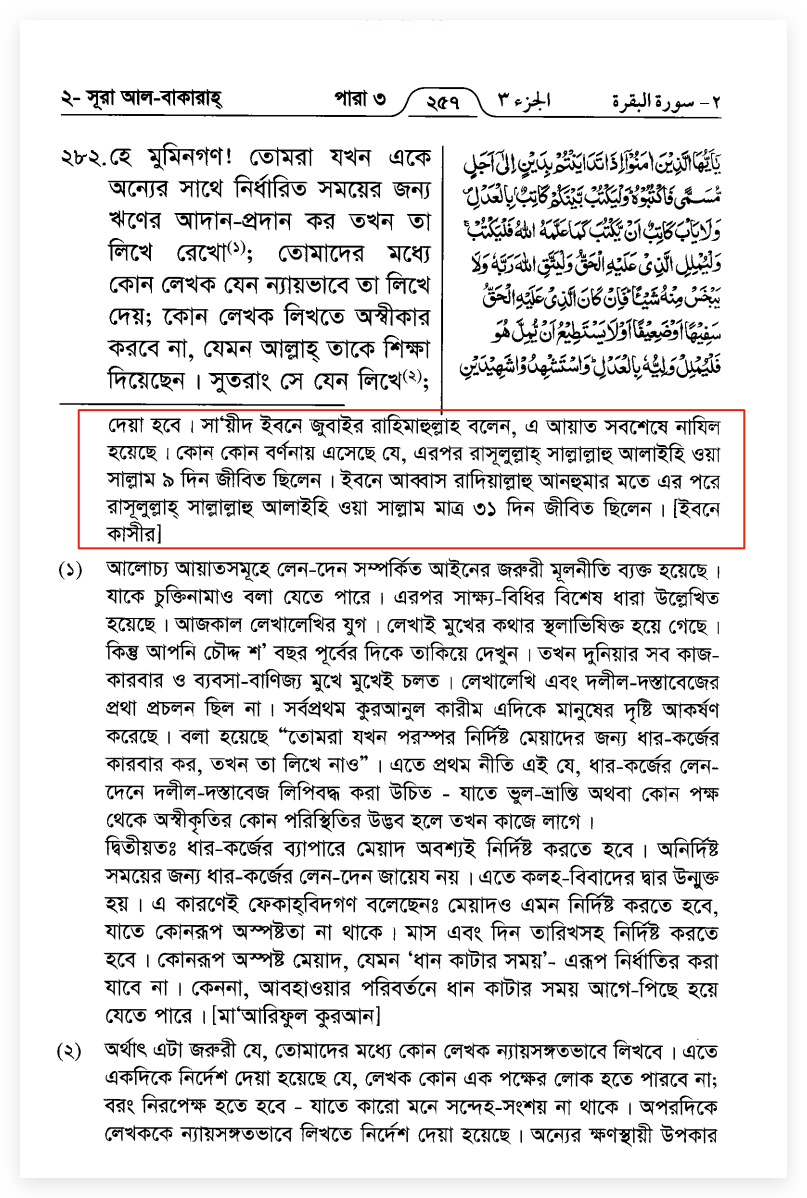
The accounts of time preserved for the same verse are sharply different. In the form Suyuti brought through Farayabi in the name of Kalbi, Ibn Salih, and Ibn Abbas, there were twenty-one days from revelation to death. [465]
وَكَانَ بَيْنَ نُزُولِهَا وَبَيْنَ مَوْتِ النَّبِيِّ صَلَّى اللَّهُ عَلَيْهِ وَسَلَّمَ أَحَدٌ وَثَمَانُونَ يَوْمًا.
English translation: Between its revelation and the death of the Prophet, there were twenty-one days.
In the subsequent narration in the name of Sa’id ibn Jubayr, there is mention of remaining alive for nine nights. On the same page, there is also an account of two nights of Rabi’ al-Awwal passing for that death. [466]
وَعَاشَ النَّبِيُّ صَلَّى اللَّهُ عَلَيْهِ وَسَلَّمَ بَعْدَ نُزُولِ هَذِهِ الْآيَةِ تِسْعَ لَيَالٍ
English translation: After the revelation of this verse, the Prophet remained alive for nine nights.
The first account creates a timeframe of nearly three months; the second creates a timeframe of slightly more than one week. The difference is not a slight counting error of seven or eight days. The opportunity for transmitting and teaching the message within nine nights is one thing; within twenty-one days, it is another. The answers to the questions of how long the final statement was prevalent among the followers, who could hear it, and how much time remained open for other new instructions, change with the difference in numbers.
| Identity preserved in sources | Time before death | Result of the calendar |
|---|---|---|
| Ibn Abbas through Farayabi; Al-Itqan | Twenty-one days | Remaining alive for nearly three months after the final verse |
| Sa’id ibn Jubayr through Ibn Abi Hatim; Al-Itqan | Nine nights | Final revelation is placed very close to the illness |
| Discussion of the verse of completion of Ma’idah in Ibn Kathir | Twenty-one days after the day of Arafah—a preserved account | The same number used in the time description of another verse |
| Descriptions side-by-side in the book | There is no uniform time | The identity of the final verse and its date must be examined separately |
In the explanation of Ma’idah 5:3, Ibn Kathir also kept the account of living twenty-one days after the day of Arafah in the name of Ibn Jurayj and others. Consequently, the number twenty-one is not found only with Baqarah 281. The same death interval has been used in separate revelation descriptions. [467]
قال ابن جريج وغير واحد: مات رسول الله صلى الله عليه وسلم بعد يوم عرفة بأحد وثمانين يوما.
English translation: Ibn Jurayj and several others said, the Messenger of Allah passed away twenty-one days after the day of Arafah.
One account of twenty-one days is linked to the revelation of the Baqarah verse, another to the day of Arafah. Beside the same number in two separate narrations, the account of nine nights by Sa’id ibn Jubayr is also preserved. Consequently, the problem of determining the final revelation is joined by the problem of determining the dates of the final life. Depending on which report is taken as the basis to create the chronology of the final life, the conception of the verse’s time and the opportunity for its transmission changes. The numbers are preserved side-by-side; a subsequent selection is required to fix their position in a uniform calendar.
In the reasoning for preferring the finality of 2:281, Zurqani called the language of death and judgment in the verse suitable for a conclusion. This is a literary and religious evaluation: supporting the view of it being the end because it sounds like final words. Beside that evaluation, he also used descriptions of specific times. The utility of meaning and the date of an event are not the same kind of proof. A verse may be fitting for a conclusion, yet to know the history of whether it was uttered last of all, one must still rely on narration.
The disagreement between nine nights and twenty-one days is not about the existence of a well-known verse; it is about how precise the memory of finality is. This difference is important for compilation, because the claim to identify the state of the final moment is constructed from information received by individuals. Instead of the uniform knowledge propagated regarding the confirmed identity of finality, competing memories and subsequent priority determinations are found here.
Verse of Kalalah: Nisa 4:176
In Sahih Muslim, in the name of Bara ibn Azib, the verse of Kalalah has been called the last revealed verse of the Quran. Kalalah is the inheritance status of a deceased person without children or a father; the absence of a mother is not a mandatory condition of this definition. In some forms of Bengali translation, the absence of both father and mother has been inserted. That additional condition of translation and the definition used in inheritance law are not the same. The difference is visible in four common Bengali translations of the verse. [468]
People are asking you for fatwas; say, Allah gives you fatwas regarding the childless person without parents: if a person dies leaving no children and has one sister, she shall receive half of the left-behind property; and if it is a woman who is childless, her brother shall be her heir; but if there are two sisters, they shall receive two-thirds of the left-behind property; and if there are both brothers and sisters, the male shall receive the share of two females. Allah has described clearly so that you do not fall into confusion. Allah is fully aware of all matters.
— Taisirul Quran
They seek a ruling from you; say: Allah has given you a ruling regarding those without father or son. If a person dies childless and has a sister, she shall receive half of the abandoned property; and if a woman has no children, her brother shall be her heir; but if there are two sisters, then for both of them is two-thirds of the abandoned matter, and if there are brothers and sisters, both male and female, then the male shall receive a share equal to two females; Allah describes for you so that you do not become confused, and Allah is All-Knowing in all matters.
— Sheikh Mujibur Rahman
They seek a solution from you. Say, ‘Allah gives you a solution regarding kalala*.’ If a person dies in such a state that he has no children and has one sister, then half of what he left is for the sister; and if she (the woman) is childless, then her brother shall be her heir. But if they (the sisters) are two, then two-thirds of what he left is for them. And if they are several brothers and sisters, male and female, then for the male shall be the equivalent of the share of two females.’ Allah gives you explanation so that you do not go astray, and Allah is All-Knowing of every matter.’ *One whose parents are not alive and who is childless is called ‘kalala’.
— Rawai Al-bayan
People seek to know the ruling from you [1]. Say, ‘Allah informs you of the ruling regarding the childless person without parents: if a man dies childless and has one sister [2], then for her is half of the abandoned property. And if she (the woman) is childless, then her brother shall be her heir. Then if there are two sisters, for them is two-thirds of the abandoned property. And if there are both brothers and sisters, the share of one male is equal to the share of two females. Allah informs you clearly for fear that you may go astray, and Allah is specially aware of everything [3].’
— Dr. Abu Bakr Muhammad Zakaria
Ibn Kathir mentioned the absence of children and father as the definition according to most scholars. In this definition, “walid” refers to the father; the dual form referring to both parents is not present here. [469]
وَقَدْ تَقَدَّمَ الْكَلَامُ عَلَى الْكَلَالَةِ وَاشْتِقَاقِهَا، وَأَنَّهَا مَأْخُوذَةٌ مِنَ الْإِكْلِيلِ الَّذِي يُحِيطُ بِالرَّأْسِ مِنْ جَوَانِبِهِ؛ وَلِهَذَا فَسَّرَهَا أَكْثَرُ الْعُلَمَاءِ: بِمَنْ يَمُوتُ وَلَيْسَ لَهُ وَلَدٌ وَلَا وَالِدٌ.
English translation: Kalala and the origin of the word have been discussed previously. It comes from the name of a crown that surrounds the head. For that reason, most scholars have explained it as a person who has died and has neither children nor a father.
In the report of Muslim, Bara said, “the last verse of the Quran.” In this sentence, there is no word restricting the finality to the matter of inheritance. [470]
Sahih Muslim (Hadith Academy)
24. Fara’iz (Rules of Inheritance Distribution)
Section: 3. The verse regarding Kalalah is the last revealed verse
Hadith Academy Number: 4044, International Number: 1618
4044-(10/1618) Ali ibn Khashram (rh) …. narrated from Bara (ra). He said, the last verse of the Quran to be revealed is يَسْتَفْتُونَكَ قُلِ اللَّهُ يُفْتِيكُمْ فِي الْكَلاَلَةِ they ask you, say, Allah Ta’ala is giving the solution regarding Kalalah. (Islamic Foundation 4007, Islamic Center 4006)
Hadith grade: Sahih (Sahih)
Narrator: Bara’a ibn Azib (ra)
In the tafsir of Abu Bakr Zakariya, Bara’at is identified as the final surah and the kalala verse as the final verse simultaneously. [471]
Bara’ ibn Azib (ra) said: The last surah revealed is Surah Bara’at (Tawbah). And the last verse revealed is this verse. [Bukhari: 4364, 4605, 4656, Muslim: 1618]
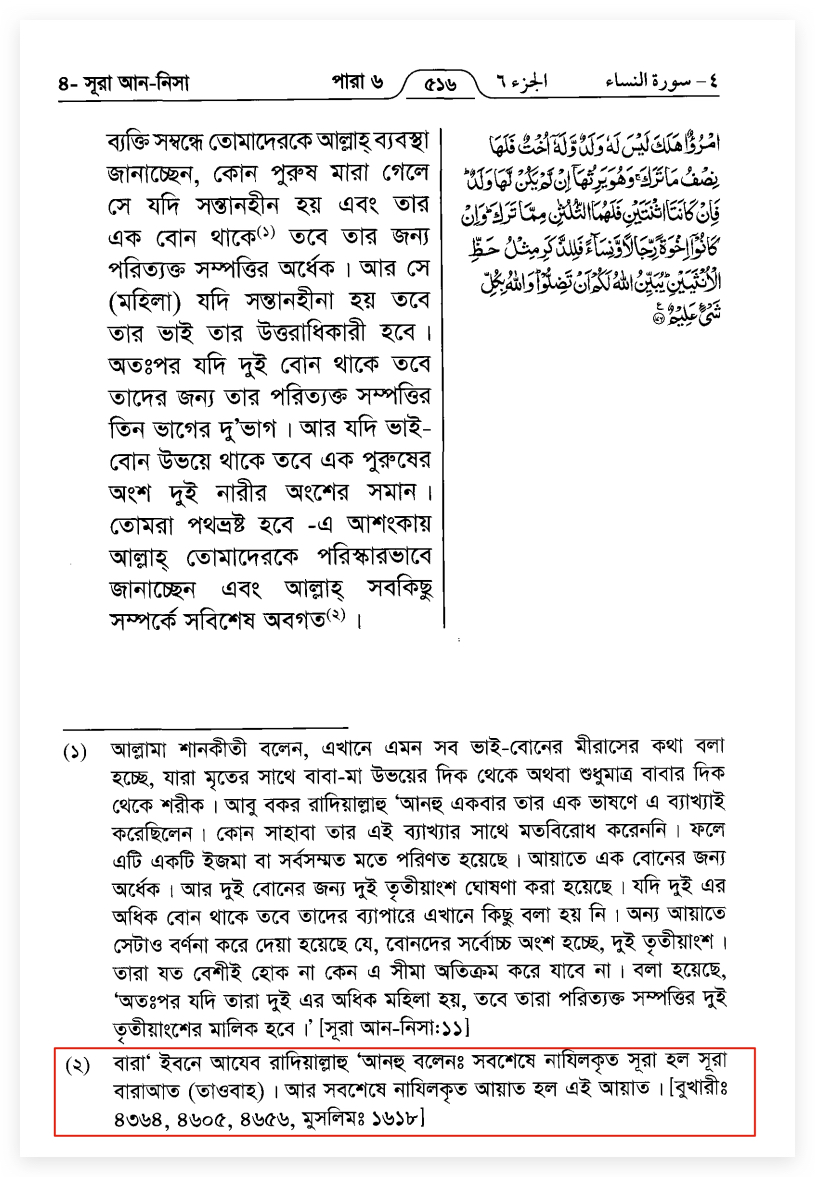
In the original Arabic, the language of unconditional finality is directly present. [472]
آخِرُ آيَةٍ أُنْزِلَتْ مِنَ الْقُرْآنِ { يَسْتَفْتُونَكَ قُلِ اللَّهُ يُفْتِيكُمْ فِي الْكَلاَلَةِ}
English translation: The last revealed verse of the Quran is: They seek a fatwa from you; say, Allah gives you a fatwa regarding kalala.
In this situation, the verses on usury and the verse on kalala cannot both be held as the sole final verses. For the positions of both to be final together in a specific chronological order, information is needed that they came in the same revelation phase, or the meaning of finality must be limited differently. In Suyuti’s discussion, kalala has been limited as the final verse regarding fara’id or inheritance. This thematic limit was added in the subsequent stage of explanation to the identity of the finality in the brief hadith.
In another Bukhari-reading of Bara, there is mention of Bara’at as the final complete surah and the end of Nisa. The language of completion is used directly there. [473]
آخر سورة نزلت كاملة براءة، وآخر سورة نزلت خاتمة سورة النساء: يستفتونك قل الله يفتيكم في الكلالة.
English translation: The last completely revealed surah is Bara’at; and the last revealed portion is the end of Surah Nisa: They seek a fatwa from you; say, Allah gives you a fatwa regarding kalala.
Being the last verse in the mushaf of Nisa and being the last verse of the entire revelation are two different identities. The first indicates the position within the surah currently in hand. The second indicates its temporal relationship with all revelation phases in Muhammad’s life. Bara’s statement contains this second claim. When a later commentator limits it to the matter of inheritance, he is not recovering time from the position in the book; he is changing the scope of finality by aligning it with different reports.
The report of Umar’s problem in understanding the ruling of kalala is also preserved in Muslim. He said that he never questioned Muhammad so many times on any other matter, nor was Muhammad ever so harsh with him on any other matter. Muhammad asked him if the “summer verse” at the end of Nisa was sufficient for him. [474]
إِنِّي لاَ أَدَعُ بَعْدِي شَيْئًا أَهَمَّ عِنْدِي مِنَ الْكَلاَلَةِ مَا رَاجَعْتُ رَسُولَ اللَّهِ صلى الله عليه وسلم فِي شَىْءٍ مَا رَاجَعْتُهُ فِي الْكَلاَلَةِ وَمَا أَغْلَظَ لِي فِي شَىْءٍ مَا أَغْلَظَ لِي فِيهِ حَتَّى طَعَنَ بِإِصْبَعِهِ فِي صَدْرِي وَقَالَ «يَا عُمَرُ أَلاَ تَكْفِيكَ آيَةُ الصَّيْفِ الَّتِي فِي آخِرِ سُورَةِ النِّسَاءِ».
English translation: I am not leaving behind anything more important after me than kalala. As many times as I returned to ask the Messenger of Allah about kalala, I did not do so for any other matter. And he was never so harsh with me on any other matter; he even placed his finger on my chest and said, O Umar, is the summer verse at the end of Surah Nisa not sufficient for you?
Despite the instruction being described as the final one, Umar sought further explanation regarding its application. Knowing the verse and determining its meaning and limit in an inheritance problem were not identical experiences for him. This search for explanation will continue after death without a direct answer from the announcer. Therefore, the identity of finality is not just temporal information; it is also linked to the limit beyond which no further direct explanation will be available.
The last two verses of Tawbah
There is also a report under the name of Ubayy ibn Ka’b calling the end of Tawbah the final revelation. To identify the end, “Laqad ja’akum rasulun min anfusikum” has been quoted. This is the start of verse number 128; after that is verse number 129. If the discussion of the last two verses is identified only by the number of the first sentence, the mistake of considering 128 as the final verse of the surah may be created. [475]
‘Indeed, there has come to you from among yourselves a Messenger; it grieves him that which causes you hardship. He is concerned for your welfare, affectionate toward the believers, most merciful’ (Surah At-Tawbah: 128). (Narrated by Hakim)
In Zurqani’s discussion, this is the eighth opinion; Ubayy’s report is identified through Hakim and Ibn Mardawayh. [476]
أن آخر ما نزل هو خاتمة سورة براءة
English translation: The end of Surah Bara’at was revealed last.
In Suyuti’s collection, in another form of Ubayy’s statement, it is explicitly said “these two verses.” There is language of the final position before Allah in the Quran. [477]
وأخرج ابن مردويه عن أبي أيضا قال: آخر القرآن عهدا بالله هاتان الآيتان: لقد جاءكم رسول من أنفسكم.
English translation: Ibn Mardawayh also narrated from Ubayy. He said, these two verses were the last before Allah in the Quran: “There has come to you from among yourselves a Messenger.”
This end portion also appeared specifically in the history of collection. During the search initiated by Abu Bakr, Zayd mentioned finding the end of Tawbah with Abu Khuzaima al-Ansari. The mention of this portion as the final find in Bukhari and its identity as the final revelation under Ubayy’s name are separate pieces of information. The proof of when a verse was found and when it was revealed is not the same. A chronology is not created where, because it was found at the end of the collection, it also came at the end of the revelation. [478]
حتى وجدت آخر سورة التوبة مع أبي خزيمة الأنصاري لم أجدها مع أحد غيره: لقد جاءكم رسول من أنفسكم عزيز عليه ما عنتم، حتى خاتمة براءة.
English translation: Finally, I found the end of Surah Tawbah with Abu Khuzaima al-Ansari; I did not find it with anyone other than him: “There has come to you from among yourselves a Messenger, that which causes you hardship is unbearable to him”—until the end of Bara’at.
Zurqani has assumed the end portion to be only the final revelation within Tawbah. In his explanation, the final part of the surah is meant, not the final part of the book. If this limit is added, direct conflict with the claims of usury and kalala can be avoided. But then the broad language of finality preserved under Ubayy’s name becomes confined within a specific surah. The power to decide which statement’s finality is the actual final and which is the thematic final remains in the hands of the later commentator.
The reports of the final revelation thus carry a history of different information. One named the subject, another identified the full sentence, some spoke of the complete surah, some spoke of the end of the surah. Although all readings are found in the current mushaf, no single document is found on the order in which the final stage was completed. There are multiple identities in the preserved literature for the alleged final limit from which the subsequent collector’s work was supposed to begin.
Separate reports regarding the last revealed surah
Disagreement over the identity of the final surah is more extensive than disagreement over verses. Ma’idah is mentioned under Aisha’s name, Nasr under Ibn Abbas’s name, and Bara’at or Tawbah under Bara ibn Azib’s name. A surah being revealed completely all at once, being revealed in fragments and completed at the end, and being the last in a specific type of ruling are different events. In some reports, this limit is clear; in some, the limit is placed in later explanation. Consequently, the names of these three surahs cannot be accepted as three synonymous identities of one accurate final surah.
In Bara’s Bukhari-report, the word “kamilatan”—completely—is used for Bara’at. In Muslim, in Ibn Abbas’s report, “nazalat jamian”—revealed entirely—is used for Nasr. Therefore, if they are separated by calling one the final complete surah and the other the final partial surah, the specific language of these two original texts is not captured. Finality and completeness appeared in both reports. In that case, later explanation is needed regarding what kind of completeness each witness is referring to.
| Narrator | Identity of the Surah | Specific language and usage of the source |
|---|---|---|
| Bara ibn Azib | Bara’at or Tawbah | Final complete surah in Bukhari 4364 |
| Aisha | Ma’idah | Final surah in Ahmad’s report; instruction to follow its halal-haram |
| Ibn Abbas | Nasr | Final surah revealed entirely in Muslim 3024a |
| Subsequent reconciliation | Separate finality according to subject or form | Halal-haram in some places, war rulings in some, the limit of a complete surah in others |
IslamQA has kept all three identities and quoted Bayhaqi’s reconciliation: each answered according to what they knew. In this explanation, the source of the claim of finality shifts from a universally known declaration of completion to information received by individuals. [479]
قال البيهقي رحمه الله: يجمع بين هذه الاختلافات بأن كل واحد أجاب بما عنده.
English translation: Bayhaqi said that these disagreements are reconciled in this way: each answered according to what was known to them.
Answering according to one’s own knowledge is a natural characteristic of memory-based history. But problems arise when the same statement is used as an accurate final limit for everyone. To establish that limit, it must be determined whose knowledge reached what time, whose statement surpasses another’s and why—this relationship must be defined. Thus, alongside the claim of receiving the entire surah, the selection of the subsequent researcher and commentator remains effective.
Aisha’s report in favor of Surah Ma’idah
When Zubayr ibn Nufayr went to Aisha, he asked if she reads Ma’idah. Upon receiving affirmation in response, Aisha called it the last revealed surah and instructed to follow its halal and haram. IslamQA has quoted this report of Ahmad. In Aisha’s statement, finality is the basis of a practical authority: the permissions and prohibitions of this surah must be followed as the later ruling. [480]
عن جبير بن نفير قال: دخلت على عائشة فقالت: هل تقرأ سورة المائدة؟ قال: قلت: نعم، قالت: فإنها آخر سورة نزلت فما وجدتم فيها من حلال فاستحلوه وما وجدتم فيها من حرام فحرموه وسألتها عن خلق رسول الله صلى الله عليه وسلم فقالت القرآن.
English translation: Zubayr ibn Nufayr said, when I went to Aisha, she asked, ‘Do you read Surah Al-Ma’idah?’ I replied, ‘Yes.’ She said, ‘It is the last Surah to be revealed. Therefore, whatever you find halal in it, consider it halal, and whatever you find haram, consider it haram.’ When I asked her about the character of the Messenger of Allah, she said, ‘The Quran.’
In Zurqani’s discussion, the view regarding the finality of Al-Ma’idah has been limited to being final in terms of halal and haram. In this interpretation, finality is linked to the claim that the rulings of the Surah were not later abrogated. [481]
أن آخر ما نزل سورة المائدة
English translation: The last to be revealed was Surah Al-Ma’idah.
Since Aisha gave instructions on halal and haram along with calling it the last Surah, her legal objective is clear. However, the sentence “the last revealed Surah” and the sentence “the last Surah of halal and haram” do not provide the same information. The former makes a chronological comparison with all Surahs; the latter compares it with a specific type of ruling. When a thematic limit is added, the scope of the claim shrinks. Through this method of reconciliation, one statement can be placed alongside another claim without canceling it, but it is the commentator who performs the task of defining that new limit.
Al-Ma’idah is a long Surah; it contains discussions on dietary laws, worship, covenants, punishments, and other religious relationships. Every part of the Surah did not arrive on the same day—Aisha’s brief statement contains no such day-by-day detail. There is a separate report that a portion of verse 3 in the middle of Al-Ma’idah was revealed on the day of Arafah. When the religious authority of a Surah, the time of its completion, and the time of the announcement of its various verses are placed on a single line, these distinct pieces of information are lost.
The reason why the concept of rulings remaining unchanged is linked to Al-Ma’idah’s identity as the last Surah is also clear here. If the final ruling is in effect, an expectation is created that no new abrogating ruling will come after it. Legal decisions rest upon that expectation. But the reports of the individual finality of Al-Bara’ah and Al-Nasr remain valid. Consequently, unless it is clarified at which level of finality legal stability is being determined, the word ‘final’ begins to do more work than it should.
Therefore, the value of this view is not merely in finding another name for the last Surah. For Aisha, the information of finality is linked to the instruction on how the reader should accept halal and haram. The chronology of revelation thus creates the authority for applying religious law. The decision that no further correction came after a certain Surah influences which rulings will be held as unquestioningly valid in the subsequent society.
Al-Nasr as the last complete Surah
In Muslim, Ibn Abbas asks Ubaydullah ibn Abdullah whether he knows the last Surah to be revealed in its entirety. When Al-Nasr is named in response, he acknowledges it as correct. In the brief question and answer, the condition of completeness along with finality is present in the original language. [482]
قال لي ابن عباس: تعلم ـ وقال هارون تدري ـ آخر سورة نزلت من القرآن نزلت جميعا؟ قلت: نعم، إذا جاء نصر الله والفتح، قال: صدقت. وفي رواية ابن أبي شيبة: تعلم أي سورة، ولم يقل: آخر.
English translation: Ibn Abbas said to me—in Harun’s narration, the word ‘tadri’ or ‘do you know’ is present—do you know which is the last Surah of the Quran to be revealed in its entirety? I said, ‘Yes—”When the help of Allah and the victory comes.” ‘ He said, ‘You have spoken correctly.’ In Ibn Abi Shaybah’s narration, it says, ‘Which Surah do you know?’ There, ‘last’ is not mentioned.
In the same place, Muslim also preserved the difference in wording between narrations: in the version of Ibn Abi Shaybah, ‘last’ is absent. The presence or absence of a single small word changes the function of the report. The question ‘Which Surah was revealed in its entirety’ seeks a piece of information; the question ‘Which Surah was the last to be revealed in its entirety’ brings the entire period of revelation into comparison. This difference, preserved in the original sources, helps identify exactly upon what language the claim of finality stands.
The relationship between Al-Nasr and the prophecy of Muhammad’s death is also preserved in Bukhari under Ibn Abbas’s name. Umar used to seat him with the elders who participated at Badr. After objections from others, when asked about the meaning of the Surah, someone mentioned the instruction to praise and seek forgiveness at the time of victory. Ibn Abbas identified the news of death within this. Umar agreed with his interpretation. [483]
فقال لي: أكذاك تقول يا ابن عباس؟ فقلت: لا. قال: فما تقول؟ قلت: هو أجل رسول الله صلى الله عليه وسلم أعلمه له، قال: إذا جاء نصر الله والفتح، وذلك علامة أجلك، فسبح بحمد ربك واستغفره إنه كان توابا. فقال عمر: ما أعلم منها إلا ما تقول.
English translation: He said to me, ‘Ibn Abbas, do you also say that?’ I said, ‘No.’ He said, ‘Then what do you say?’ I said, ‘It is the news of the time of the Messenger of Allah’s death, which was informed to him. “When the help of Allah and the victory comes”—that is the sign of the time of your death; “then declare the purity of your Lord with praise and seek His forgiveness; He is the Acceptor of repentance.” ‘ Umar said, ‘I know no other meaning than what you have said.’
There is an important difference here. The narration in Muslim provides information regarding the revelation of the Surah; the event in Bukhari shows a competition of interpretation regarding the meaning of the Surah. The subject of the former is the last Surah, the subject of the latter is the hint of death. Accepting the interpretation of the hint of death does not lead to the conclusion that no separate verse came after that Surah. A complete Surah may end, yet new verses may be added to another Surah that began earlier. This possibility creates the need to know the last complete Surah and the last verse separately.
The event of establishing Ibn Abbas’s position at Umar’s assembly is also significant. To demonstrate the value of his special knowledge before other elders, the ability to understand the internal signals of a Surah was used. Although everyone knew the same text, not everyone identified the same meaning. Consequently, the preservation of the Surah and the understanding of its closing signal were not equally distributed. The prestige of special interpretive knowledge was built upon the presence of a specific text.
The finality of Al-Nasr, the legal authority of Al-Ma’idah, and the report of the completeness of Al-Bara’ah together express the multidimensional memory of the final revelation. Subsequent reconciliations have created separate compartments for these memories. If a brief name is given as the answer regarding the last Surah, the difference between those compartments remains hidden; returning to the original narrations brings forward a history of unequal knowledge regarding the text and interpretation of the final life.
The verse of the completion of religion, the day of Arafah, and the account of Umar’s weeping
In verse 3 of Al-Ma’idah, there is a declaration of completing the religion, perfecting the favor, and choosing Islam as the religion. This declaration is in the middle part of the verse; before it are prohibitions regarding food and after it is the exception for starvation. If the statement of completion is used as the definitive identity of the last verse, it creates a conflict with the descriptions of usury, loans, and kalalah revealed after it. The question of in what sense the religion was completed and why there are reports of new rulings after that has been raised even in ancient discussions of Ulum al-Quran. [484]
Today I have perfected for you your religion, I have completed my favor upon you and I have chosen Islam for you as the religion. Therefore, whoever falls into severe hunger; but has no inclination towards any sin, then surely Allah Ta’ala is Forgiving.
Three other Bengali translations of the same declaration also use the language of completion and perfection. The verbs declare actions already accomplished. [484]
Today I perfected for you your religion, I completed my favor upon you and I chose Islam for you as the religion.
— Sheikh Mujibur Rahman
Today I perfected for you your religion and I completed my blessing upon you and I chose Islam as the religion for you.
— Rawai Al-bayan
Today I perfected for you your religion and I completed my blessing upon you [14], and I chose Islam as the religion for you [15].
— Dr. Abu Bakr Muhammad Zakaria
Umar’s statement regarding the time and place of the verse is preserved in Bukhari. A Jew said that if such a verse had been revealed to them, they would have made the day a festival. Umar replied by mentioning the time Muhammad stood at Arafah on a Friday. In his answer, there is a memory of the specific moment of revelation of a specific verse. [485]
أن رجلا من اليهود قال له: يا أمير المؤمنين، آية في كتابكم تقرءونها لو علينا معشر اليهود نزلت لاتخذنا ذلك اليوم عيدا. قال: أي آية؟ قال: اليوم أكملت لكم دينكم وأتممت عليكم نعمتي ورضيت لكم الإسلام دينا. قال عمر: قد عرفنا ذلك اليوم والمكان الذي نزلت فيه على النبي صلى الله عليه وسلم وهو قائم بعرفة يوم جمعة.
English translation: A Jew said to him, ‘O leader of the believers, there is a verse in your book which you recite; if it had been revealed to us Jews, we would have made that day a festival.’ He asked, ‘Which verse?’ The man said, “Today I have completed your religion, I have perfected My favor upon you and I have chosen Islam as your religion.” Umar said, ‘We know the day and the place where it was revealed to the Prophet. He was standing at Arafah on Friday.’
In this account of Umar, there is no identification as the last verse. There is the day, the place, and the special status of the verse. The conclusion of finality must be drawn from the language of completion in the verse. That is where the problem lies: if the completion of religion and the end of the revelation process are taken in one sense, subsequent new rulings fall after that end. If the two are given separate meanings, the verse of completion cannot be used to determine the final revelation.
Suyuti has called this problem a “mushkil” (difficulty). According to Suddi, quoted by him, no new rulings of halal and haram came after the verse of completion; but on the other hand, there are reports that the verses of usury, loans, and kalalah came later. He has placed both pieces of conflicting information side by side. [486]
من المشكل على ما تقدم قوله تعالى: اليوم أكملت لكم دينكم [المائدة: 3]، فإنها نزلت بعرفة عام حجة الوداع، وظاهرها إكمال الفرائض والأحكام قبلها، وقد صرح بذلك جماعة منهم السدي، فقال: لم ينزل بعدها حلال ولا حرام، مع أنه وارد في آية الربا والدين والكلالة أنها نزلت بعد ذلك.
English translation: Conflicting with the previous discussion is Allah’s statement “Today I have completed your religion” [Al-Ma’idah: 3]. It was revealed at Arafah in the year of the Farewell Pilgrimage. Its explicit meaning is that the obligations and rulings were completed before this. A few, including Suddi, have stated this clearly: no halal or haram was revealed after this. Yet, it is narrated regarding the verses of usury, loans, and kalalah that these were revealed after it.
The same conclusion of Suddi is present in the Tafsir of Ibn Kathir. He stated that this verse was revealed at Arafah; after this, no more halal or haram was revealed. In other reports of finality, there are again new legal statements. Consequently, the problem is not merely whether a general piece of advice came later. The timing of instructions determining rights, economic transactions, and inheritance is also linked to this.
Suyuti has mentioned that Tabari linked the meaning of completion to a specific political-religious situation to reconcile this relationship. In his chosen interpretation, the establishment of Muslims in the holy place of Mecca and the removal of the polytheists, resulting in the end of the previous state of performing Hajj mixed with polytheists, is taken as the expression of completion. [487]
الأولى أن يتأول على أنه أكمل لهم دينهم بإقرارهم بالبلد الحرام وإجلاء المشركين عنه، حتى حجه المسلمون لا يخالطهم المشركون.
English translation: It is more appropriate to explain it thus: their religion was completed through their establishment in the holy city and the removal of the polytheists from there; as a result, the Muslims performed Hajj in such a way that the polytheists did not mix with them.
In this interpretation, completion does not become a declaration of closing all future laws; it becomes linked to the establishment of the Muslims’ sole right over a place of worship. To solve the problem, the scope of completion has been specified. The meaning of the grand declaration of the completion of religion is then expressed in the events of actual power, access, and the removal of polytheists. To make room for subsequent revelations, the commentator has separated the completion of religion from the end of the revelation of all rulings.
Ibn Kathir has preserved another report of Umar’s weeping at the declaration of completion. In this report, narrated on the authority of the father of Harun ibn Antarah, there is a fear of decrease after the religion had increased and become complete. Instead of joy at the news of completion, anxiety over decline was expressed. [488]
Ibn Jarir (r)…… narrates from the father of Harun ibn Antarah that the father of Harun ibn Antarah said: اَلْيَوْمَ أَكْمَلْتُ لَكُمْ دِينَكُمْ When this verse was revealed on the day of Hajj Arafah, Hazrat Umar (ra) began to weep. The Messenger of Allah (saw) asked him, ‘Why are you weeping?’ He said, ‘We had hoped for more regarding this religion. But now that it has attained completeness, one cannot hope for more than this; rather, gradually, only decline can be expected.’ The Messenger of Allah (saw) then said, ‘You have spoken correctly.’
Another hadith has come in support of this hadith. The hadith is this: Islam began as something strange, and soon it will return to being strange. Therefore, glad tidings to those strange few people.
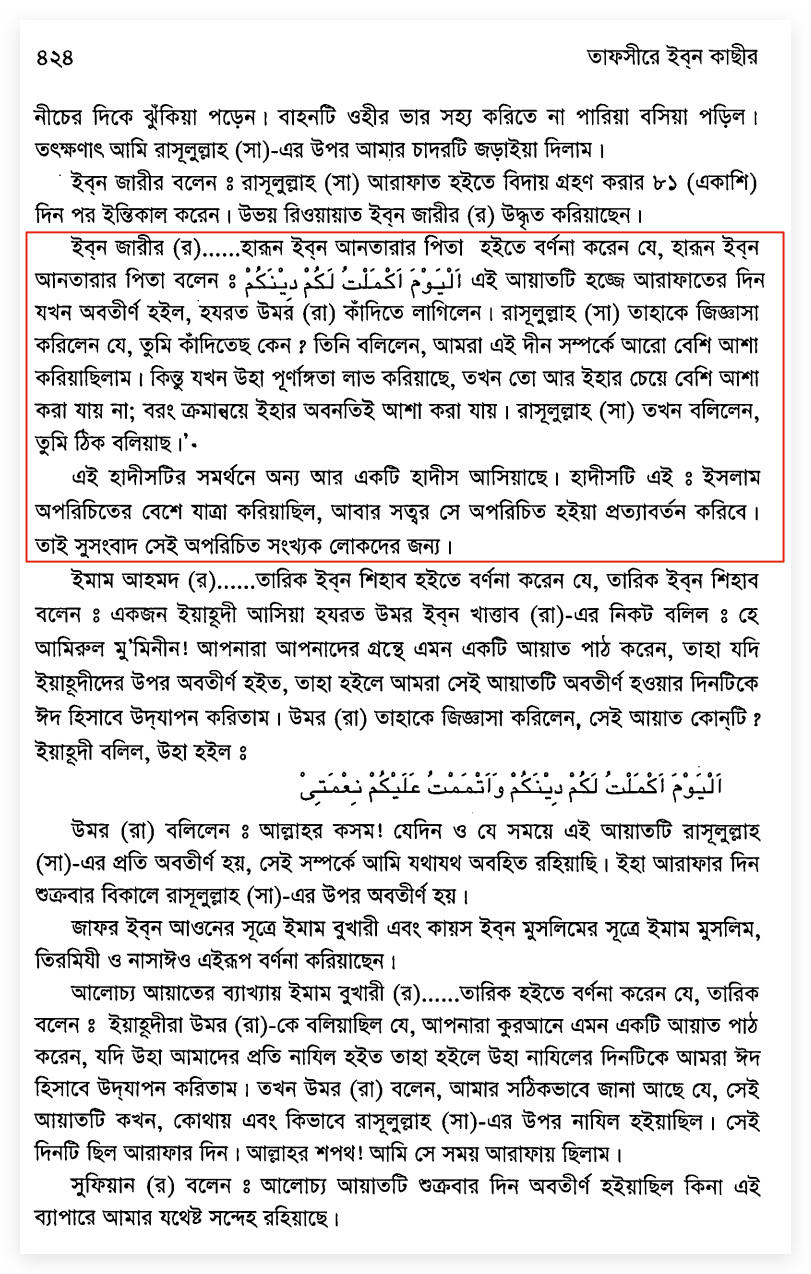
In the Arabic account, the reason for weeping is stated as “nothing remains after something is completed except decrease.” The response in the name of Muhammad is “sadaqta”—you have spoken the truth. [489]
لَمَّا نَزَلَتْ ( الْيَوْمَ أَكْمَلْتُ لَكُمْ دِينَكُمْ ) وَذَلِكَ يَوْمَ الْحَجِّ الْأَكْبَرِ ، بَكَى عُمَرُ فَقَالَ لَهُ النَّبِيُّ صَلَّى اللَّهُ عَلَيْهِ وَسَلَّمَ : ” مَا يُبْكِيكَ؟ ” قَالَ : أَبْكَانِي أَنَّا كُنَّا فِي زِيَادَةٍ مِنْ دِينِنَا ، فَأَمَّا إِذْ أَكْمَلَ فَإِنَّهُ لَمْ يَكْمُلْ شَيْءٌ إِلَّا نَقَصَ . فَقَالَ : ” صَدَقْتَ ” .
English translation: When “Today I have completed your religion for you” was revealed, Umar wept on the day of the Great Hajj. The Prophet asked him, ‘What makes you weep?’ He said, ‘We were in a state of increase in our religion; now that it is complete, nothing remains after something is completed except decrease—this is what has made me weep.’ He said, ‘You have spoken the truth.’
Here, perfection is imagined as a historical peak, after which decline is expected. This is a report from a different chain of transmission than the Bukhari report regarding the Day of Arafah and Friday. The memory of the day and place and the explanation of the weeping are not independent testimonies of the same level of a single event. By using the report of weeping, the tafsir has created a religious meaning of separation and decay following perfection. In support of this, Ibn Kathir has also brought the hadith that Islam began as something strange and returned to being strange.
| Meaning or use of perfection | Preserved statements | Results regarding the subsequent period |
|---|---|---|
| All obligations and rulings finished | According to Suddi, no halal-haram came later | Problems with later reports on usury, loans, and kalala |
| Sole religious establishment in the holy place | Removal of polytheists in Tabari’s selected interpretation | Possibility of other rulings being revealed even after perfection |
| Decline after the peak state | From increase to decrease in the tafsir report of Umar’s weeping | Perfection is not a guarantee of permanent social improvement |
| The specific revelation of a verse | Identification of Friday and Arafah in Bukhari | That identification alone does not signify the finality of the entire revelation |
The effectiveness of these interpretations is different. In Suddi’s statement, the conclusion of all halal-haram is primary; in Tabari’s selected meaning, the sole establishment of Muslims in a place of worship is primary; and in the report of Umar’s weeping, the fear of future decay is primary. Three different meanings—legal, political dominance, and religious decline—have been created around the same declaration of perfection. The first meaning faces the problem of subsequent rulings appearing; the second narrows the scope of perfection; the third finds a forecast of imminent decrease in the very news of being perfected.
The question after the declaration of perfection is therefore very specific: did any legal matter come after that, and how was the effective rule perfected with the arrival of that matter? Accepting that usury and kalala came later, it cannot be said that all laws were fully informed beforehand. In that case, perfection must be defined by another limit. The need to define that limit shows that the history of the final revelation relies far more on interpretation and decision than on the guarantee of a single conventional sentence.
Reports of wahi arriving until the day of death and the question of the text of the final messages
In the report preserved under the name of Anas ibn Malik, it is mentioned that wahi continued before Muhammad’s death and was abundant in the final period. This news is important in the discussion of the final revelation because it keeps the process of receiving instructions active even close to the end of life. Instead of assuming a previously circulated collection to be the end, the question of what new things arrived in the final stage becomes urgent. [120] [490]
Sahih Muslim (Hadith Academy)
56. Tafsir
Section: No section
Hadith Academy Number: 7414, International Number: 3016
7414-(2/3016) Amr ibn Muhammad ibn Bukayr an-Naqid, Hasan ibn Ali al-Hulwani and ‘Abd ibn Humayd (rh) ….. narrated from Anas ibn Malik (ra). He said, before the passing and until the passing, Allah Ta’ala revealed wahy continuously upon Rasulullah sallallahu alayhi wasallam.On the day Rasulullah sallallahu alayhi wasallam passed away, much wahy was revealed to him even then. (Islamic Foundation 7243, Islamic Center 7298)
Hadith grade: Sahih (Sahih)
Narrator: Anas ibn Malik (ra)
In the original Arabic of Muslim, “qabla wafatihi”—before his death—and “hatta tuuffiya”—until death—are present. In the final part, the phrase “yawma tuuffiya” has appeared in the Bengali translation as the specific day of death. [491]
أَنَّ اللَّهَ عَزَّ وَجَلَّ تَابَعَ الْوَحْىَ عَلَى رَسُولِ اللَّهِ صلى الله عليه وسلم قَبْلَ وَفَاتِهِ حَتَّى تُوُفِّيَ وَأَكْثَرُ مَا كَانَ الْوَحْىُ يَوْمَ تُوُفِّيَ رَسُولُ اللَّهِ صلى الله عليه وسلم
English translation: Allah sent wahi continuously from before His Messenger’s death until death; on the day of the Messenger of Allah’s death, there was an abundance of wahi.
At the end of the parallel report in Bukhari, there is the sentence “then after this the Messenger died.” This form of the same Anas–Zuhri chain presents the final period and the subsequent death sequentially. [492]
أن الله تعالى تابع على رسوله صلى الله عليه وسلم قبل وفاته حتى توفاه أكثر ما كان الوحي، ثم توفي رسول الله صلى الله عليه وسلم بعد.
English translation: Allah continued wahi to His Messenger before his death; the amount of wahi was greatest during the period of death. Then after this, the Messenger of Allah died.
Ibn Hajar understood this language as the period close to death. In his explanation, because the arrival of delegations and questions about rulings increased after the conquest of Mecca, the revelation also increased. He showed a specific relationship between the social situation and reading the time of the end of life as a final stage. [493]
قوله: إن الله تابع على رسوله الوحي قبل وفاته، أي أكثر إنزاله قرب وفاته صلى الله عليه وسلم، والسر في ذلك أن الوفود بعد فتح مكة كثروا وكثر سؤالهم عن الأحكام فكثر النزول بسبب ذلك.
English translation: “Allah continued wahi to His Messenger before his death”—meaning He revealed more close to his death. The reason for this was that delegations increased after the conquest of Mecca and their questions about rulings also increased; for that reason, the revelation also increased.
In this explanation, new revelations are related to human inquiries and greater political expansion. Many groups were entering the new religious system, seeking decisions on their matters, and religious declarations increased with that need. The abundance in the final life then does not remain a mere numerical claim; it becomes an answer to the expansion of the follower society and the demand for rules. Consequently, to identify the final state, it is also necessary to identify the effective instructions of this period.
Ibn Hajar explained the sentence in the sense of “the time during which his death occurred.” IslamQA also accepted this temporal meaning of the final life instead of the specific day of death. Thus, the image of a single day in the Bengali translation and the image of a time period by the commentator are distinct. [494]
قوله: حتى توفاه أكثر ما كان الوحي، أي الزمان الذي وقعت فيه وفاته، كان نزول الوحي فيه أكثر من غيره من الأزمنة.
English translation: “Wahi was greatest at the time of death”—meaning in the time period during which his death occurred, the amount of wahi revelation was greater than at other times.
The difference between the text promoted as the Quran and other wahi-based instructions is also relevant here. The word used in the hadith is wahi. Some instructions became verses of the Quran, some were preserved as religious instructions in hadith. This general news does not provide a list of the separate text, recipient, or written materials for every message of the final stage. To know that in detail, one must go to the revelation of specific verses and the reports of specific instructions. The different claims of finality and the abundance of wahi in the final period are linked for the same reason: a general identification of time does not provide sufficient information to determine the final limit.
| Preserved information | The matter that is specified | Further information needed |
|---|---|---|
| Anas’s general news | Revelation was continuing even in the final stage of life | Identification and content of specific messages |
| Muslim’s “yawma tuuffiya” | Connection of abundance with the time of death | Linguistic relationship between a specific day and an extended period |
| Bukhari’s “then after this death” | Continuity of death after the final stage | Which message came at the very end of that stage |
| Ibn Hajar’s explanation | Increase in delegations and questions regarding rulings | The news of the chronology and transmission of each declaration |
If a Companion received a certain amount of text a few years prior, and new text arrives in the final period, the scope of his collection may increase. If new rulings come, the state of previous application may change. Consequently, there is a temporal gap between the identification of mastering the Quran at one time and the identification of knowing all texts remaining in force after revelation stopped. Who received the news of the final revelation and how it reached others are determining steps in the history of the final collection.
Disagreement over the final verse cannot take the place of this general temporal description; nor does the general temporal description resolve the different claims of finality. Two separate layers of information are working: revelation was active in the final stage, and different individuals have given different identifications regarding the final edge of that activity. Therefore, at the time of compilation, the work does not end merely with binding previous writings. The identification of which text is included in the final state must also be fixed with the help of various testimonies.
In this period, there is news of a specific initiative to give written instructions being obstructed. On one hand, the scope for new declarations coming remained open until the end of life; on the other hand, the request to create a specific written statement for the future was not effective. The meeting point of these two reports is the actual system of transmission and reception in the final moments. The claim of a message arriving, the writing of the message, and that writing reaching the hands of later people—these three tasks were not ensured simultaneously.
Request for paper and pen, “The Book of Allah is sufficient” and Umar’s obstruction
On his deathbed, Muhammad wanted to give a written instruction after which the followers would not go astray. Umar mentioned that the agony of illness had become severe and declared the Book of Allah sufficient. Some of those present wanted to provide materials, while others took Umar’s position. As the dispute and noise increased, Muhammad told them to leave. In this sequence of events, the requester of the writing and the denier of the need for the writing are different persons. Muhammad is seeking a written statement for his subsequent followers; Umar takes the side of stopping the initiative by declaring the statement he possesses to be sufficient.
In the instruction of obedience to Islam, the authority of the Messenger is linked with the authority of Allah. In Surah Al-Jinn, the consequence of disobeying Allah and the Messenger is said to be Hell. By this religious standard, Muhammad’s instruction is not equal to the request of an ordinary person. [495]
Conveying the word of Allah and propagating His message is my task. Whoever disobeys Allah and His Messenger, for him is the fire of Hell; in it they will remain forever.
Taisirul Quran
Only conveying the word of Allah and propagating it is my task. Those who disobey Allah and His Messenger, for them is the fire of Hell, there they will be eternal.
Sheikh Mujibur Rahman
Only conveying the word of Allah and His risalah is the responsibility. And whoever disobeys Allah and His Messenger, for him is the fire of Hell. In it they will be eternal.
Rawai Al-bayan
‘Only conveying from Allah and propagating the message of His risalah is my responsibility. And whoever disobeys Allah and His Messenger, for him is the fire of Hell, there they will be eternal (1).’
Dr. Abu Bakr Muhammad Zakaria
The separate authority of Muhammad’s instructions alongside the Quran is also present in the language of hadith. In the statement narrated under the name of Miqdam, there is a declaration of receiving authority similar to the Quran and a condemnation of the mentality of relying only on the halal-haram of the Quran. [496]
Hadith Sambhar
13/ Sunnah
Section: Regarding the importance of following the Sunnah and some of its manners
(1499) Mikdam bin Ma’dikarib said, Rasulullah sallallahu alayhi wasallam said, Listen! I have been given the Quran and along with it has been given its like (Sunnah). Listen! Perhaps a satisfied person sitting on his throne will say, ‘You follow this Quran; whatever you find halal in it, consider it halal and whatever you find haram in it, consider it haram. Be warned! Whatever the Messenger of Allah makes haram, it is just like Allah making it haram.
(Abu Dawud 4606, Ibn Majah 12, Daremi 586, Mishkat 163)
Hadith grade: Sahih (Sahih)
Narrator: Mikdam (ra)
If this instruction is placed alongside the “Book of Allah is sufficient” position during the final illness, a direct conflict of authority is created. In the same religious system, Muhammad’s statement can give mandatory rulings outside the Quran; yet, when Muhammad himself wants to write, the need for that writing is declared finished by the existing Book. Muhammad and Umar’s decisions on whether additional instructions are needed are then not the same. The Prophet himself identifies a need, and the follower exercises the power to ignore it.
Another specific incident in Bukhari is against disobeying Muhammad’s instructions even during illness. Medicine was poured into his mouth despite his objection. The people present took his objection as the general irritation of a patient toward medicine. After feeling better, he reminded them of his prohibition and ordered that medicine be fed to everyone concerned in the same way, except for Abbas. [497] [498]
Sahih Bukhari (Tawhid Publication)
64/ Maghazi [Battles]
Section: 64/84. The illness and passing of the Nabi sallallahu ‘alayhi wasallam.
4458. ‘Aishah (ra) said, during the illness of the Nabi sallallahu ‘alayhi wasallam, we poured medicine into his mouth. He signaled us to forbid pouring medicine into his mouth. We said, this is the natural aversion of patients towards medicine. When he felt better, he said, did I not forbid you from administering medicine? We said, we thought it was the general aversion of a patient towards medicine. Then he said, pour medicine into the mouth of everyone in the house except ‘Abbas so that I may see. [1] Because he is not present among you. This hadith is from Ibn Abu Zinad ……. from ‘Aishah (ra) and she narrates from the Nabi sallallahu ‘alayhi wasallam. [5712, 6886, 6897; Muslim 39/27, Ha: 2213, Ahmad 24317] (Modern Publication: 4101, Islamic Foundation: 4104)
[1] Firstly, here the validity of qisas even in very minor matters is proven. Secondly, the necessity of obeying the orders of the Nabi sallallahu ‘alayhi wasallam applies equally in all states, whether he is healthy or ill.
Hadith grade: Sahih (Sahih)
Narrator: Aishah bint Abu Bakr Siddiq (ra)
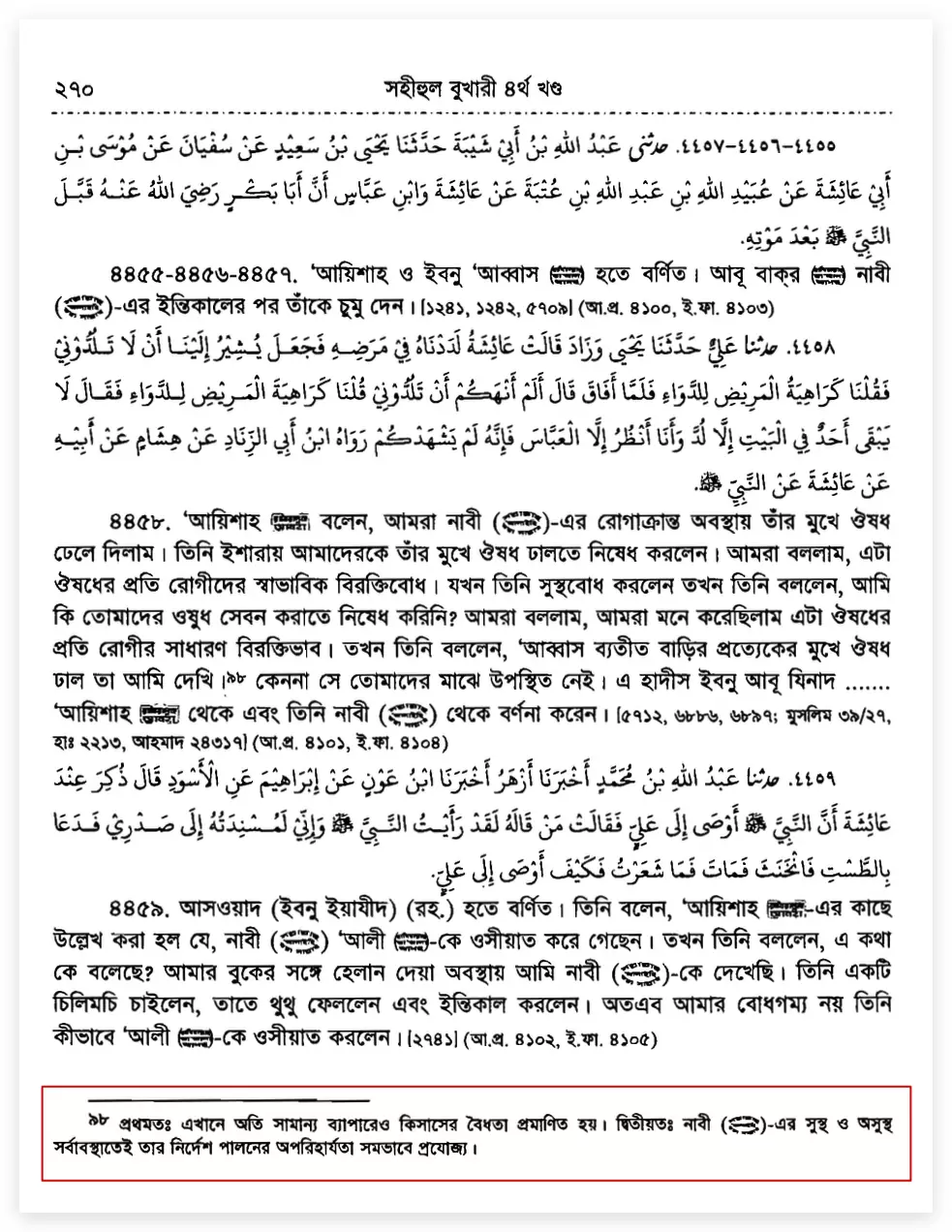
The printed note states the necessity of obeying instructions in both ill and healthy states. The concept used in the same note is qisas—retributive punishment. [499]
98 Firstly, the validity of qisas is proven here even in very minor matters. Secondly, the necessity of obeying the Prophet’s (s) instructions applies equally in all states, whether he is healthy or ill.
In the incident of the medicine, others disobeyed his prohibition based on their own medical judgment. Muhammad later did not accept that assessment; he had them acknowledge that his prohibition remained in effect and took corrective measures. Consequently, the rule that illness automatically removes the authority of his instructions does not apply in that incident. The matter of highlighting physical suffering in response to the request for the final writing becomes uncomfortable before this same religious standard. The practical ability to judge a patient’s condition and the religious right to disobey the Messenger’s instructions are not the same thing.
In the explanation of Sahaj Darse Ibn Majah, the authority of the Sunnah has been established by declaring Muhammad’s religious statements, actions, and approvals as revelation-based. This authority is explained using the concept of being unable to make changes in the name of Allah and the requirement to follow the transmitted instructions. [500]
In the Holy Quran, Allah the Almighty says-
وَمَا يَنْطِقُ عَنِ الْهَوَى ، إِنْ هُوَ إِلَّا وَحْيٌ يُوحَى
“He (the Messenger of Allah) does not speak from [his own] desire. Whatever he
says is only revelation.”
Elsewhere it is stated-
قُلْ مَا يَكُونُ لِي أَنْ أُبَدِّلَهُ مِنْ تِلْقَاءِ نَفْسِي إِنْ أَتَّبِعُ إِلَّا بِمَا يُوحَى إِلَى
“I have no power to change anything from my side. I only follow that which is commanded to me.” In short, whatever the Messenger of Allah says, does, or approves is based on revelation, and the sum of all these is the Sunnah. In the Quran, Allah the Almighty has commanded us to follow the Messenger, meaning He has commanded the following of his Sunnah. Therefore, the Sunnah is established as حجت, that is, a sharia proof, for the Ummah from Allah the Almighty.
In this explanation, Muhammad is established as a reliable source of religious instruction. Then, when the request for his own dictated writing is blocked, the issue is no longer just family chaos. The power to determine when his instructions are to be obeyed and when they are unnecessary was also exercised by the followers before him. In reality, a human selection process is working beneath the ultimate authority of obedience: alongside what the sender wants to say, what the receiver allows to be accepted also determines the result.
In the full Bengali description of the Chapter of Knowledge in Bukhari, Muhammad’s request, Umar’s response, and Ibn Abbas’s sense of catastrophe are presented sequentially. [501] [502] [501] [503]
Sahih Bukhari (IF)
Chapter: 3/ Ilm or Knowledge
Section: 81. Recording Knowledge
115. Narrated from Yahya ibnu Sulayman (rh)… from Ibn Abbas (ra), he said: When the illness of the Prophet sallallahu alayhi wa sallam increased, he said: Bring me paper and pen, I will write for you something so that you will not go astray afterwards. ‘Umar (ra) said, the pain of the illness of the Messenger sallallahu alayhi wa sallam has become severe (in this state it will be difficult for him to say or write something). And we have the Book of Allah with us, which is sufficient for us. Due to this, a difference of opinion arose among the companions and the noise increased. Then Rasulullah sallallahu alayhi wa sallam said, get up from me. It is not proper to quarrel before me. Narrating up to this, Ibn Abbas (ra) (from where he was narrating the hadith) while saying these words went out saying, ‘Alas, what a calamity, a terrible calamity! That which stood as a barrier between Rasulullah sallallahu alayhi wa sallam and his writing.
Hadith Status: Sahih (Sahih)
Narrator: Abdullah ibn Abbas (ra)
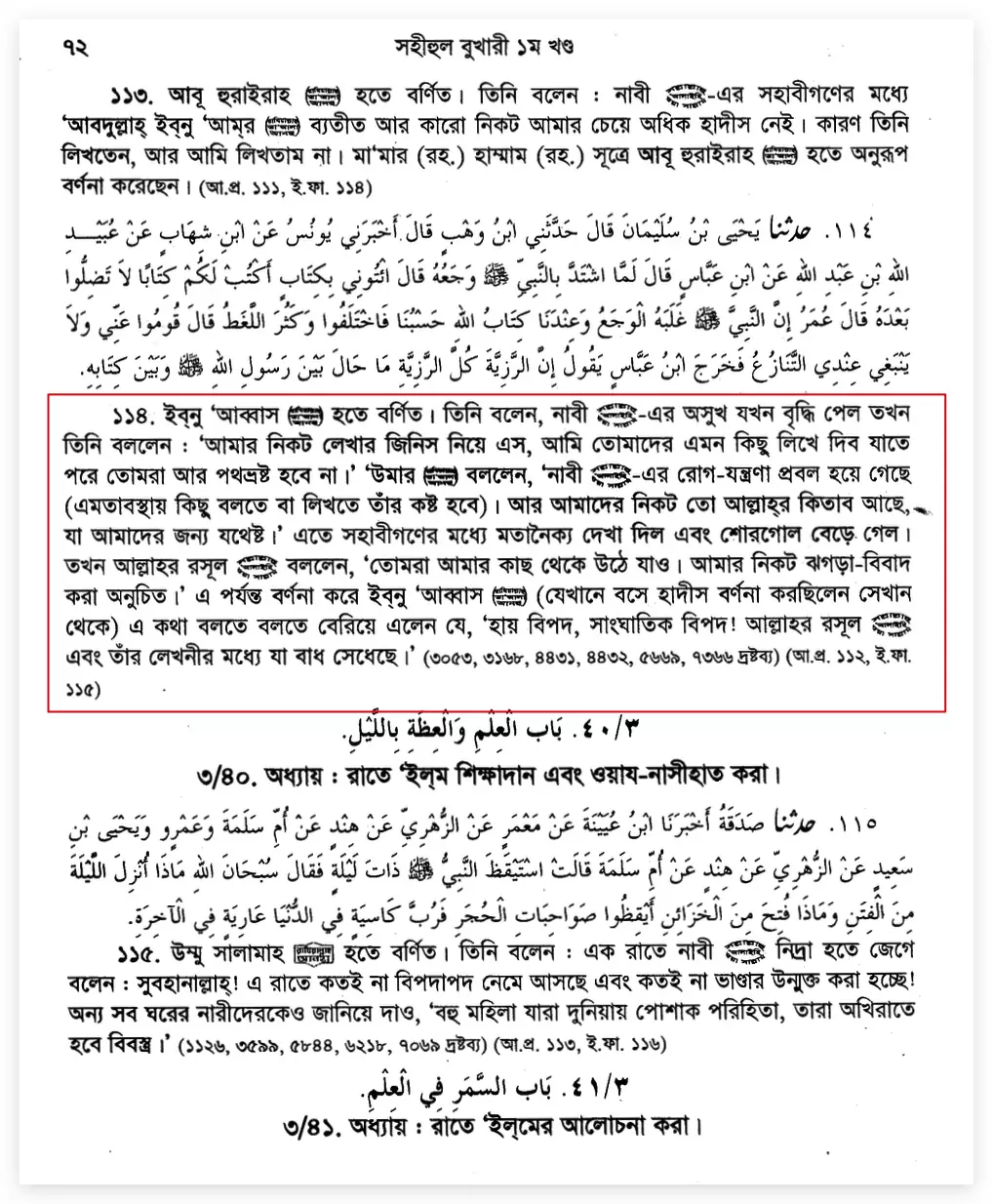
In the original Arabic sentence of the request, the purpose of preventing future straying is clear. The need for the writing is linked to the future guidance of the followers. Muhammad himself declared the goal of the proposed writing. [504]
ائْتُونِي بِكِتَابٍ أَكْتُبُ لَكُمْ كِتَابًا لاَ تَضِلُّوا بَعْدَهُ
English translation: Bring me writing materials; I will write for you a text, after which you will not go astray.
Two things are side-by-side in Umar’s response: Muhammad is distressed by illness and the existing Book is sufficient. The first is an assessment of his physical condition; the second is a decision regarding the necessity of the proposed writing. The sufficiency of the Book does not automatically follow from the description of illness. Umar himself brought these two statements into a single objection. [505]
قَالَ عُمَرُ إِنَّ النَّبِيَّ صلى الله عليه وسلم غَلَبَهُ الْوَجَعُ وَعِنْدَنَا كِتَابُ اللَّهِ حَسْبُنَا فَاخْتَلَفُوا وَكَثُرَ اللَّغَطُ
English translation: Umar said, the Prophet is heavily overwhelmed by the pain of illness; we have the Book of Allah, that is sufficient for us. After this, a disagreement arose among them and the noise increased.
| Statement or action | Muhammad’s position | The consequence of Umar’s position |
|---|---|---|
| Need for writing | Will provide writing to prevent future straying | Rejection of the need for additional writing because the Book exists |
| Illness | Requesting while in an ill state | Presenting the pain of illness as the reason for objection |
| What should be done | Bringing materials to complete the writing | A portion of those present are against providing materials |
| Final result | Tells those present to leave after the dispute | The proposed writing is not produced |
The presence of the Book was not denied in this dispute. The debate was about the need for new written instructions alongside the Book. The people present did not agree with him on the means of protecting the future that Muhammad wanted to write with in mind. Consequently, “the Book is sufficient” does not remain a neutral factual statement here; it becomes an effective argument in favor of stopping the initiative to write. Using the status of the scripture, the path for the subsequent written statement of the very declarer of that scripture is blocked.
The one who identified revelation, without whose explanation the application of many rulings would not be determined, found his words blocked by the support and opposition within the room at the time of death. This reveals the actual limit of authority. The act of writing depended on the followers bringing the necessary materials and stopping the quarrel. That cooperation was not received. No matter how great the religious importance of the proposed writing is said to be, its material preparation and execution could not transcend the behavior of the people present.
The matter of not receiving it is specific here. There is no step in the narration that the writing was prepared and later lost. The writing that was intended to be prepared was not created due to the dispute. Consequently, its absence for future generations is not the result of a copying error or a lost page; it is the result of the original writing process being stopped. The history of that missing document began during the declarer’s lifetime, amidst the dispute of his followers.
Room dispute, Ibn Abbas’s sense of catastrophe, and the unwritten instruction
The people present in the deathbed room did not reach the same decision. In the narration of the chapter regarding the patient in Bukhari, one group is asking to provide paper so that Muhammad can write his promised instruction. The other group is supporting Umar’s words. The behavior of both sides of the dispute is preserved here: one side wanted to execute the request, the other side denied the need for additional writing. In the end, even the presence of the people in favor of writing could not complete the task. The argument in the room determined the effective result. [506] [507]
Sahih Bukhari (Tawhid Publication)
75/ The Patient
Chapter: 75/17. “Get up and leave me,” the saying of the patient.
5669. Narrated by Ibn Abbas (ra). He said, when the time of the passing of Rasulullah peace and blessings of Allah be upon him arrived, there was a gathering of many people in the room, among whom Umar ibn Khattab was also present. Then the Prophet peace and blessings of Allah be upon him (in his state of illness) said: Bring, I will write something for you, so that you do not go astray afterwards. Then Umar (ra) said: The illness of the Prophet peace and blessings of Allah be upon him has become severe, and the Quran is present with you. And the Book of Allah is sufficient for us.At this time, a disagreement arose among the Ahl al-Bayt. They engaged in argument, some of whom began to say: Bring paper to the Prophet peace and blessings of Allah be upon him and he will write something for you, so that you never go astray afterwards.Again, among them, some began to say what Umar (ra) had said.In this way, their dispute and difference of opinion increased before the Prophet peace and blessings of Allah be upon him. Then Rasulullah peace and blessings of Allah be upon him said: Get up and leave.
Ubaydullah (rh) says:Ibn Abbas (ra) used to say, the great calamity was that disagreement and argument of the people, which stood as a barrier between the Prophet peace and blessings of Allah be upon him and his writing that down.[114] (Adhunik Prokashoni- 5258, Islamic Foundation- 5154)
Hadith Grade: Sahih (Sahih)
Narrator: Abdullah ibn Abbas (ra)
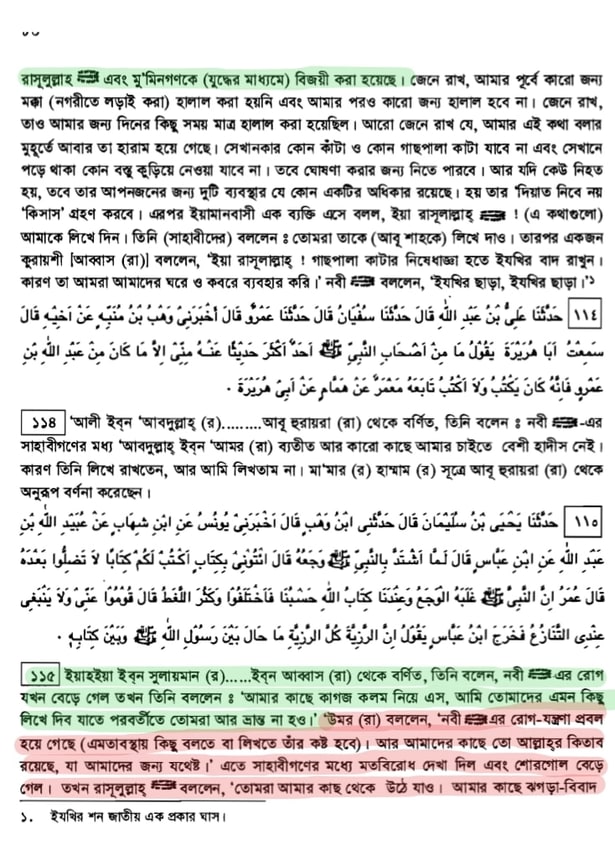
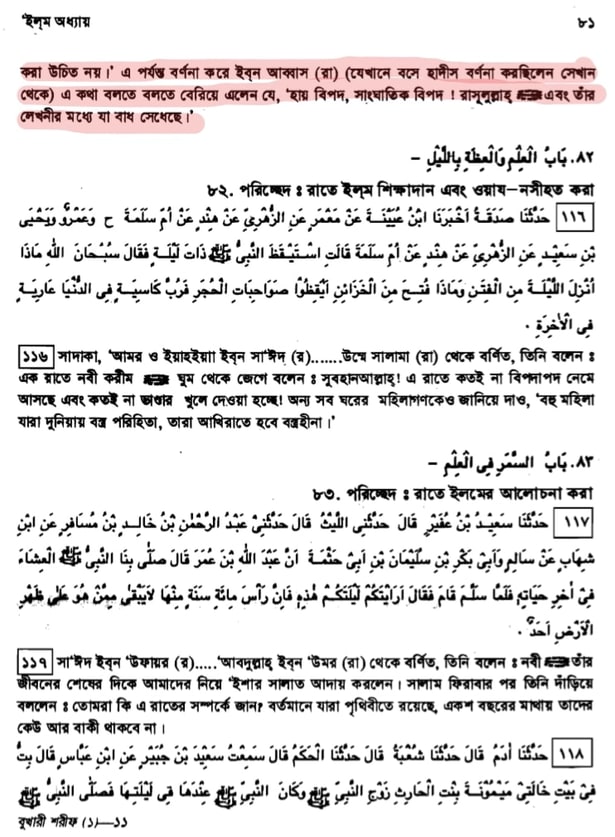
At the end of the narration, Ibn Abbas’s assessment stands separately. In his words, the incident is a “great catastrophe.” The object of sorrow is specific: because of the disagreement and argument, Muhammad could not write it down. The claim of the sufficiency of the Book was raised in the room, but Ibn Abbas considered the lack of the written explanation resulting from that claim to be the loss. Alongside Umar’s decision, the intense negative assessment of another Companion is preserved. If the two positions of the same event are made into a memory of identical satisfaction, then Ibn Abbas’s words about this dispute and its result are erased.
In Muslim’s narration, while recalling the memory of Thursday, there is also mention of Ibn Abbas’s weeping. Sa’id ibn Jubayr is hearing the incident from him. The description of tears wetting the pebbles expresses the intensity of this memory. A question from those present regarding the coherence of Muhammad’s words with the news of the dispute is also preserved. [508]
قَالَ ابْنُ عَبَّاسٍ يَوْمُ الْخَمِيسِ وَمَا يَوْمُ الْخَمِيسِ ثُمَّ بَكَى حَتَّى بَلَّ دَمْعُهُ الْحَصَى. فَقُلْتُ يَا ابْنَ عَبَّاسٍ وَمَا يَوْمُ الْخَمِيسِ قَالَ اشْتَدَّ بِرَسُولِ اللَّهِ صلى الله عليه وسلم وَجَعُهُ. فَقَالَ «ائْتُونِي أَكْتُبْ لَكُمْ كِتَابًا لاَ تَضِلُّوا بَعْدِي». فَتَنَازَعُوا وَمَا يَنْبَغِي عِنْدَ نَبِيٍّ تَنَازُعٌ. وَقَالُوا مَا شَأْنُهُ أَهَجَرَ اسْتَفْهِمُوهُ.
English translation: Ibn Abbas said, Thursday! What a Thursday! Then he wept, until his tears wetted the pebbles. I said, O Ibn Abbas, what is the incident of Thursday? He said, the pain of the Messenger of Allah’s illness had increased. He said, come to me, I will write for you a text after which you will not go astray. Then they became involved in dispute; it is not proper to dispute before the Prophet. They said, what has happened to him? Is he speaking incoherently? Ask him and understand.
In this narration, the “ahajara” question appears in the form of “they said.” The statement preserved with Umar’s name is the declaration that the pain of illness was severe and the Book is sufficient; and in this narration, the question about the coherence of the words comes from an unspecified portion of those present. The level of speaker-identification for the two sentences is different. Together these show that the crisis in the room was not limited to the delay in bringing writing materials. A judgment was also being made on whether Muhammad’s request would be obeyed and how his words would be accepted in that state.
The weeping of Ibn Abbas while telling the incident to Sa’id ibn Jubayr and the quarrel then in Muhammad’s room are descriptions of separate times. His later recollection and assessment became part of the narration. Because of this difference, the importance of the statement becomes more specific: even after thinking about the matter after the event, he considered the loss of the unobtained writing as a great catastrophe. That regret did not vanish with Muhammad’s death; it was at the center of his statement even while giving the narration to the next generation.
| Position preserved in narration | Content | Result or assessment |
|---|---|---|
| Side in favor of providing paper | If Muhammad writes, future straying will be prevented | Attempt to implement the request |
| Side supporting Umar’s words | Pain of illness is severe; the Book of Allah is sufficient | Rejection of the need for writing |
| Room dispute | Argument and noise between the two sides | Muhammad tells those present to leave |
| Subsequent comment of Ibn Abbas | The dispute was a barrier between him and the writing | Recalling the not-obtaining as a great catastrophe |
In the discussions of subsequent commentators, another dispute has been created regarding the significance of this incident. In the explanation attributed to Ibn Battal, Umar is called a greater faqih than Ibn Abbas for considering the Quran sufficient. Ibn Hajar did not accept the language of that assessment. In his explanation, Ibn Abbas’s regret was for being deprived of obtaining a clear written statement instead of deriving rulings by conjecture. [509]
وَأَمَّا ابْنُ عَبَّاسٍ فَلَا يُقَالُ فِي حَقِّهِ لَمْ يَكْتَفِ بِالْقُرْآنِ مَعَ كَوْنِهِ حَبْرَ الْقُرْآنِ وَأَعْلَمَ النَّاسِ بِتَفْسِيرِهِ وَتَأْوِيلِهِ، وَلَكِنَّهُ أَسِفَ عَلَى مَا فَاتَهُ مِنَ الْبَيَانِ بِالتَّنْصِيصِ عَلَيْهِ لِكَوْنِهِ أَوْلَى مِنَ الِاسْتِنْبَاطِ، وَاللَّهُ أَعْلَمُ.
English translation: It cannot be said about Ibn Abbas that he did not consider the Quran sufficient, whereas he is a scholar of the Quran and most knowledgeable about its tafsir and explanation. Rather, he grieved for the explanation he was deprived of obtaining through a clear statement; because that is superior to deriving a decision by conjecture. Allah knows best.
This distinction between written specificity and the subsequent freedom of interpretation is important. If the specific words of an instruction are found, the subsequent interpreter remains accountable to those words. In the absence of a specific document, there is more room for conjecture, the selection of similar incidents, and doctrine-based decisions. The deprivation mentioned by Ibn Abbas is this deprivation of specificity. If his lament is replaced by a devaluation of the Quran, the question of the missing written statement is obscured.
Clearer arguments in favor of Umar’s objection can be found in al-Nawawi’s explanation. Ibn Hajar quoted his statement: if new instructions were written, people might become unable to follow them and thus become liable for punishment, and the door of ijtihad for scholars might be closed. These are the arguments of a subsequent interpreter; these detailed intentions are not present in Umar’s own words in the original report. [510]
وَقَالَ النَّوَوِيُّ: اتَّفَقَ قَوْلُ الْعُلَمَاءِ عَلَى أَنَّ قَوْلَ عُمَرَ «حَسْبُنَا كِتَابُ اللَّهِ» مِنْ قُوَّةِ فِقْهِهِ وَدَقِيقِ نَظَرِهِ، لِأَنَّهُ خَشِيَ أَنْ يَكْتُبَ أُمُورًا رُبَّمَا عَجَزُوا عَنْهَا فَاسْتَحَقُّوا الْعُقُوبَةَ لِكَوْنِهَا مَنْصُوصَةً، وَأَرَادَ أَنْ لَا يَنْسَدَّ بَابُ الِاجْتِهَادِ عَلَى الْعُلَمَاءِ.
English translation: Al-Nawawi said: The view of the scholars is that Umar’s statement “The Book of Allah is sufficient for us” is a testament to his strong knowledge of fiqh and subtle judgment. This is because he feared that some matters might be written down which they would be unable to fulfill, and since the matters would be clearly written, they would be liable for punishment. He further desired that the door of ijtihad for scholars should not be closed.
There is a severe inconsistency in the structure of this argument. Muhammad called the writing a means to prevent misguidance; al-Nawawi’s explanation makes that very writing the cause of potential inability, punishment, and the shrinking of the scope for scholars’ decisions. In judging the welfare of the follower, the explanation prioritizes the follower’s fear over the Prophet’s declared purpose. The argument that if the ruling is clear, liability for not following it will be created, is being used to make the closing of the path to knowing the ruling commendable. Lack of knowledge then ceases to be a problem and becomes a convenience for avoiding liability.
The grief of Ibn Abbas and this evaluation by al-Nawawi emphasize two opposite outcomes. In the first, the loss of specific instructions is primary; in the second, avoiding the obligation of potential rulings and preserving the opportunity for subsequent interpretation is primary. No subsequent commentator was able to recover the content of the unwritten statements. They had the account of the event and the need to explain its result. Within that explanation, the relationship between religious authority, the consideration of the follower, and the power of the subsequent scholar has become clear.
The account of the last three instructions and the third instruction that remained unspecified
In one account of the Thursday event, there is mention of three oral instructions from Muhammad after the initiative to write was stopped. The two instructions to expel the polytheists from the Arabian Peninsula and to give gifts to arriving delegations as he did are clearly preserved. At the place of the third instruction, the account stops: it was not said, or if it was said, the narrator forgot it. Consequently, the number “three” survives, but the full content of the three did not. [511] [512]
قَالَ «دَعُونِي فَالَّذِي أَنَا فِيهِ خَيْرٌ مِمَّا تَدْعُونِي إِلَيْهِ». وَأَوْصَاهُمْ بِثَلاَثٍ قَالَ «أَخْرِجُوا الْمُشْرِكِينَ مِنْ جَزِيرَةِ الْعَرَبِ، وَأَجِيزُوا الْوَفْدَ بِنَحْوِ مَا كُنْتُ أُجِيزُهُمْ». وَسَكَتَ عَنِ الثَّالِثَةِ، أَوْ قَالَ فَنَسِيتُهَا.
English translation: He said, leave me; the state I am in is better than that to which you are calling me. He gave them instructions on three matters. He said, expel the polytheists from the Arabian Peninsula and give to the arriving representatives as I used to give gifts. Regarding the third, he remained silent; or he said, I have forgotten it.
The short sentence preserved in place of the third is itself a sign of the incompleteness of transmission. The content of one instruction was not found, and hesitation remains regarding the reason for not finding it. [513]
وَسَكَتَ عَنِ الثَّالِثَةِ، أَوْ قَالَ فَنَسِيتُهَا
English translation: Regarding the third, he remained silent; or he said, I have forgotten it.
Who the subject of this hesitation is has been detailed in Fath al-Bari. Ibn Hajar brought the report of Sufyan ibn Uyaynah through Musnad al-Humaydi and Abu Nu’aym. There, Sulayman says he does not know whether Sa’id ibn Jubayr mentioned the third and he [Sulayman] forgot it, or whether Sa’id remained silent about it. That is, the doubt was created when the report reached the subsequent level. [514]
وَفِي مُسْنَدِ الْحُمَيْدِيِّ وَمِنْ طَرِيقِهِ أَبُو نُعَيْمٍ فِي الْمُسْتَخْرَجِ: قَالَ سُفْيَانُ: قَالَ سُلَيْمَانُ أَيْ ابْنُ أَبِي مُسْلِمٍ: لَا أَدْرِي أَذَكَرَ سَعِيدُ بْنُ جُبَيْرٍ الثَّالِثَةَ فَنَسِيتُهَا أَوْ سَكَتَ عَنْهَا.
English translation: In Musnad al-Humaydi and in Abu Nu’aym’s Mustakhraj through him: Sufyan said, Sulayman—meaning Ibn Abi Muslim—said, I do not know whether Sa’id ibn Jubayr mentioned the third and I forgot it, or whether he remained silent about it.
In this explanation, the location of the deficiency is within the memory and narration of the subsequent people carrying Muhammad’s words. Sulayman is in doubt about his own recollection and the completeness of Sa’id’s report. While the claim of the news reaching the source of the statement is maintained, the words and content of one specific instruction are no longer found in this chain. The existence of the chain of transmission and the completeness of every statement are therefore separate events. Even if the identity of the chain is known, a place in the statement may remain unspecified. Within the reports compiled as sahih, this deficiency remains in a readable state.
| Place of instruction | What is preserved in the report | State of preservation |
|---|---|---|
| First instruction | Expelling polytheists from the Arabian Peninsula | Content is clear |
| Second instruction | Giving gifts to arriving representatives close to Muhammad’s practice | Content is clear |
| Third instruction | Mention of remaining silent or forgetting | Content is unspecified |
| Subsequent commentary | Sulayman’s hesitation: whether Sa’id spoke or whether he himself forgot | Uncertainty regarding the source of the deficiency |
The political significance of the first instruction is intense. A policy of expulsion has been stated regarding which people of which faith will remain in the Arabian Peninsula. The second is about the treatment of delegations coming to the ruler and the custom of giving wealth. The oral advices during the final illness were not limited to personal consolation; they also involved questions of state power, religious presence in the territory, and diplomatic behavior. Since the content of the third is absent, the field of practical application for one part of this set of instructions cannot be determined from that report.
Subsequent interpreters have raised several possibilities to fill that void. In Fath al-Bari, possibilities of instructions related to the Quran under the name of Dawudi and Ibn Tin, sending Usama’s army under the name of Muhallab, and instructions regarding not making the grave an object of worship or regarding prayer and owned slaves under the name of Yaz have appeared. The subjects of these proposals are different; it is not a disagreement over an alternative spelling of a word. [515]
قَالَ الدَّاوُدِيُّ: الثَّالِثَةُ الْوَصِيَّةُ بِالْقُرْآنِ، وَبِهِ جَزَمَ ابْنُ التِّينِ. وَقَالَ الْمُهَلَّبُ: بَلْ هُوَ تَجْهِيزُ جَيْشِ أُسَامَةَ، وَقَوَّاهُ ابْنُ بَطَّالٍ بِأَنَّ الصَّحَابَةَ لَمَّا اخْتَلَفُوا عَلَى أَبِي بَكْرٍ فِي تَنْفِيذِ جَيْشِ أُسَامَةَ قَالَ لَهُمْ أَبُو بَكْرٍ: إِنَّ النَّبِيَّ صلى الله عليه وسلم عَهِدَ بِذَلِكَ عِنْدَ مَوْتِهِ.
English translation: Dawudi said the third was an instruction regarding the Quran. Ibn Tin also confirmed this. Muhallab said rather it was the preparation of Usama’s army. Ibn Battal, in support of this, said that when the Companions disagreed with Abu Bakr about sending Usama’s army, Abu Bakr told them that the Prophet had given instructions on that matter at the time of death.
In Yaz’s proposal, different matters are found again. In one case, a prohibition regarding grave-worship is mentioned, and in another, prayer and slaves. These are attempts to guess the identity of the third by comparing it with the last instruction found in other reports. [516]
وَقَالَ عِيَاضٌ: يَحْتَمِلُ أَنْ تَكُونَ هِيَ قَوْلَهُ: «وَلَا تَتَّخِذُوا قَبْرِي وَثَنًا» فَإِنَّهَا ثَبَتَتْ فِي الْمُوَطَّأِ مَقْرُونَةً بِالْأَمْرِ بِإِخْرَاجِ الْيَهُودِ، وَيَحْتَمِلُ أَنْ يَكُونَ مَا وَقَعَ فِي حَدِيثِ أَنَسٍ أَنَّهَا قَوْلُهُ: «الصَّلَاةَ وَمَا مَلَكَتْ أَيْمَانُكُمْ».
English translation: Yaz said, perhaps it was his statement: do not make my grave an object of worship. Because in the Muwatta, it came with the instruction to expel the Jews. Again, the words that appeared in Anas’s hadith could be it: the matter of prayer and your owned slaves.
| Interpreter’s proposal | Possible subject | Basis or type of proposal |
|---|---|---|
| Dawudi and Ibn Tin | Instruction regarding the Quran | Establishing identity between the lost third and Quranic advice |
| Muhallab; supported by Ibn Battal | Sending Usama’s army | Connection with the last instruction of another event |
| One possibility of Yaz | Not making the grave an object of worship | Comparison with other sets of instructions in the Muwatta |
| Another possibility of Yaz | Prayer and owned slaves | Comparison with another report of Anas |
The gap between these four types of proposals—Quran, military expedition, grave, and slaves—is vast. One cannot be determined from another axiomatically. Choosing the preference of any subsequent interpreter does not remove Sulayman’s preserved doubt. The content of the third instruction is not present in the specific report path; its possible identity has been proposed by matching it with known advice from other reports. The epistemological position of that proposal is not equal to the first two instructions directly preserved.
There is also a difference between the statement intended to be written and these three oral instructions. For the document that was requested for writing, no specific text was created. In the case of oral instructions, the number of statements and two subjects are preserved, but the third is not complete. In the first event, the execution was blocked; in the second event, the transmission was incomplete. In the history of religious instructions reaching followers after death, the mechanisms of these two types of deficiencies are different, and both are visible in the set of reports of the same final illness.
The relationship between the poison of Khaybar, the agony of death, and the reports of “Watin-Abhar”
In the account of Muhammad’s final illness, the mention of the poison of Khaybar has returned. In his statement to Aisha, a direct relationship is established between the agony of the previously poison-mixed food and the current agony of death. This relationship is not an explanation placed by the narrator from the outside; in the hadith, it is preserved as Muhammad’s own statement. In the same religious literature, there is a threat to cut the life-vein if words are fabricated in the name of Allah in favor of the truth of the Quran. Placing the account of the final illness and the language of that threat side by side creates a sharp ironic similarity.
In Surah Al-Haqqah, the Quran is said to have been revealed from the Lord of the worlds. Following that, there is a declaration that if Muhammad were to fabricate words in the name of Allah, He would seize him firmly and cut the “Watin”. Here, the language of potentially severe punishment is used to establish the truth of the speech. [517]
This (Quran) is revealed from the Sustainer of the worlds.
If he (Muhammad) were to fabricate any word in my name,
then I would seize his right hand,
then I would cut his throat/main artery.
None of you would be able to protect him.
In Ibn Kathir’s tafsir, “Watin” is explained under the name of Ibn Abbas as the vessel connected to the heart. He mentioned similar explanations from Ikrimah, Sa’id ibn Jubayr, Qatada, and others. Consequently, the significance of the word is the severing of the connection with the central organ of life. [518]
قَالَ ابْنُ عَبَّاسٍ: وَهُوَ نِيَاطُ الْقَلْبِ، وَهُوَ الْعِرْقُ الَّذِي الْقَلْبُ مُعَلَّقٌ فِيهِ. وَكَذَا قَالَ عِكْرِمَةُ وَسَعِيدُ بْنُ جُبَيْرٍ وَالْحَكَمُ وَقَتَادَةُ وَالضَّحَّاكُ وَمُسْلِمٌ الْبَطِينُ وَأَبُو صَخْرٍ حُمَيْدُ بْنُ زِيَادٍ.
English translation: Ibn Abbas said, it is the bond of the heart; that blood vessel from which the heart hangs. Ikrimah, Sa’id ibn Jubayr, Hakam, Qatada, Dahhak, Muslim al-Batin, and Abu Sakhr Humayd ibn Ziyad also said similar things.
In one report of Abu Dawud, Umm Mubashshir asks Muhammad about the cause of his illness during his final illness. She suspects the poison-mixed goat of Khaybar in the case of her own son. In the response preserved in Muhammad’s name, the same cause appears, and with it, the severing of the “Abhar” is joined. [519] [520]
Sunan Abu Dawud (Verified)
Chapter: 34/ Blood Money
Section: 6. If someone is killed by feeding poison, will he also be killed?
4513. Narrated from Ibn Ka‘b ibn Malik (rh) through his father. When the Prophet sallallahu alayhi wa sallam was afflicted with the terminal illness then Ummu Mubashshir (ra) said to him, O Messenger of Allah! What do you think about your illness? And I am not worried about the illness of my son except for that poison-mixed goat meat which he ate at Khaybar with you. The Prophet sallallahu alayhi wa sallam said: I too am not worried about myself except for that poison. At this moment it is cutting my main artery. (1)
Isnad is Sahih.
(1). Abu Dawud narrated this alone.
Hadith Status: Sahih (Sahih)
Narrator: Abdullah ibn Ka‘b ibn Malik (rh)
In this conversation, the past food, the death of another person associated with that food, and Muhammad’s final illness have come under the same explanation. Umm Mubashshir suspects the cause from her own experience; Muhammad also mentions that cause. The religious importance of the report is here: to explain the agony of the final illness, no intact body is preserved in his name that had overcome the damage of the poison. In his statement, the agony of the food remains, and it is then felt with lethal intensity.
In the previous hadith of Abu Dawud, the incident of poisoning is more detailed. Muhammad and his companions eat the food; later it is said to be poisoned; Bishr ibn al-Bara dies. In the response of the woman who administered the poison, there is also an argument of a test: if he is a Prophet, the poison will not harm him, and if he is a king, people will be free from his hand. This is narrated as the woman’s own statement. Then, in the final illness, Muhammad’s agony from the poison and the cutting of the Abhar also appear in the same report. [521] [522]
Sunan Abu Dawud (Verified)
Chapter: 34/ Blood Money
Section: 6. If someone is killed by feeding poison, will he also be killed?
4512. Narrated through Abu Hurairah (ra). He said, Rasulullah sallallahu alayhi wa sallam used to accept gifts but did not accept sadaqah. The narrator says, a Jewish woman of Khaybar mixed poison in a roasted goat and gave it to him as a gift. Rasulullah sallallahu alayhi wa sallam ate it and the people also ate. He said: Withdraw your hands. Because it has been informed to me that this is poisonous. (As a result of the poisoning) Bishr ibnul Baraat ibn Ma‘rur al-Ansari (ra) died. He called the Jewish woman and questioned: What prompted you to do what you did?
She said, if you are truly a Prophet then what I have done will not harm you. And if you are a king then I have given the people peace from you. After Rasulullah sallallahu alayhi wa sallam gave the order, she was then killed. Then he regarding the pain with which he passed away said: I have always felt the pain of that morsel which I ate at Khaybar. At this time it has cut my main artery.(1)
Hasan Sahih.
(1). Bukhari, Ahmad.
Hadith Status: Hasan (Hasan)
Narrator: Abu Hurairah (ra)
The news of the food being poisonous did not come as a prevention before eating here. According to the narrated events, the eating had already occurred, and then the order to withdraw hands was given. Consequently, the claim of receiving special news about the toxicity of the food and the ability to prevent the poison from entering the body are in separate states. The narration itself carries the harm of the poison: the death of a companion and the prolonged agony of Muhammad. The assurance of the woman’s proposed prophethood-test also does not align with the subsequent description of the illness; contrary to the condition of remaining unharmed, there is a statement of Muhammad feeling harm in his own name.
A similar statement is found in Bukhari from Aisha. In the Bengali printed text, there is mention of the pain from the food of Khaybar and the life-breath nearly departing due to the poisoning. [523] [524]
Sahih Bukhari (IF)
Chapter: 51/ Maghazi (Military Expeditions)
Section: 2247. The illness of the Prophet (saw) and his passing. The word of Allah the Almighty: You are mortal and they are mortal. Then on the Day of Resurrection you will dispute among yourselves before your Lord (39: 30,31) Yunus (rh) says through Zuhri and Urwah (rh), Aisha (ra) said, at the time the Prophet (saw) passed away from the illness, he used to say,O Aisha! The food (poisoned) that I consumed at Khaybar, I have always felt its pain. And now that time has arrived, when due to that poisoning my life-breath is on the verge of leaving
In the Arabic sentence, the phrase “min dhalikas samm”—because of that poison—is clear. The connection between the feeling of the “aorta” being severed and the poison is within Muhammad’s own statement. [525]
يَا عَائِشَةُ مَا أَزَالُ أَجِدُ أَلَمَ الطَّعَامِ الَّذِي أَكَلْتُ بِخَيْبَرَ، فَهَذَا أَوَانُ وَجَدْتُ انْقِطَاعَ أَبْهَرِي مِنْ ذَلِكَ السَّمِّ
English translation: O Aisha, I still feel the pain of the food I ate at Khaybar; now, because of that poison, I feel my aorta being severed.
In Fath al-Bari, the views of linguists are quoted in the explanation of the word “abhar” (aorta). It is described as a blood vessel connected to the heart inside the back, the severing of which causes death. This explanation places the word of the hadith in the sense of a fatal blow. [526]
قَالَ أَهْلُ اللُّغَةِ: الْأَبْهَرُ عِرْقٌ مُسْتَبْطِنٌ بِالظَّهْرِ مُتَّصِلٌ بِالْقَلْبِ إِذَا انْقَطَعَ مَاتَ صَاحِبُهُ.
English translation: Linguists have said that the abhar is a blood vessel located inside the back connected to the heart; if it is severed, the concerned person dies.
| Points of Comparison | Statements from Quran and Tafsir | Statements from Hadith and commentary |
|---|---|---|
| Original word | Wateen in Al-Haqqah 69:46 | Abhar in Bukhari 4428 |
| Identification of the organ in the explanation | Ibn Kathir: Vessel connected to the heart | Fath al-Bari: Internal blood vessel connected to the heart |
| Significance of being severed | Threat of fatal punishment for fabricating words in the name of Allah | Fatal pain felt by Muhammad due to poison |
| Type of statement | Conditional religious declaration | Description of the cause and feeling of pain by the sick person himself |
The two words are different, but the semantic fields of the explanations are not disconnected. Both carry the image of the severing of a vital life-sustaining vessel connected to the heart. In one place, it is the language of potential punishment; in the other, it is the language of the declarer’s own final agony. The image of the horrific consequence created by hearing the Quranic threat is used by Muhammad in the hadith as a very close image for his own condition. The language of bodily catastrophe used to establish the truth of religious claims has returned on the declarer’s own deathbed.
The relationship between the two statements is one of meaning and imagery. In the verse of Al-Haqqah, there is a declaration of Allah’s punishment under specific conditions; in the sentence of Bukhari, the pain of the poison is identified as the cause. The deathbed statement preserves Muhammad’s account regarding feeling and cause. That statement is not a description of an autopsy of his body. While maintaining this distinct identity, the comparison is stark: the threat of cutting the life-vessel uttered in favor of truth and the description of his own poison-agony are expressed in the same language of physical destruction.
Reports of the intensity of death-agony are not limited only to the statements regarding poison. In Anas’s narration, Fatima laments seeing her father’s suffering. In Muhammad’s response, it is stated that once this day passes, there will be no more suffering and death spares no one. The reality of the suffering is acknowledged while speaking of its future end. [527] [528]
Sunan Ibn Majah
Chapter: 6/ Janazah
Publisher: Tawhid Publication
Section: 6/65. The passing of the Prophet ﷺ and his shrouding and burial.
3/1629. Narrated from Anas ibn Malik (ra). He said, when Rasulullah sallallahu alayhi wa sallam felt the agony of death intensely, then Fatimah (ra) said, alas, how much pain my father is in. Rasulullah sallallahu alayhi wa sallam said: After today, your father will have no more pain. There has come before your father such a thing, which will not leave anyone until the Day of Resurrection.
Sahih al-Bukhari 4462, Ahmad 16026, Sahihah 1638, Mukhtasar Shamayil 334, Bukhari excluding the last sentence. Tahqiq Albani: Hasan Sahih.
Hadith Status: Sahih (Sahih)
In Tirmidhi’s narration, Aisha relates the connection between the death-agony she witnessed and subsequent experiences. After seeing the pain of Muhammad’s death, she no longer feels envy seeing someone else’s easy death. This is a description of the intense grief and helplessness remaining in the memory of a close person. [529] [530]
Sunan Tirmidhi (IF)
Chapter: 10/ Shrouding and Burial
Section: Suffering at the time of death.
981. Narrated from Hasan ibnus Sabwah al-Baghdadi (rh) …… from Aisha (ra) that she said, after the suffering I saw at the time of death of Rasulullah sallallahu alaihi wasallam, I do not feel any envy for anyone whose death is easy. – Mukhtasar Shama’il Muhammadiyah 325, Bukhari, Tirmidhi Hadith Number: 979 (Al Madani Publication)
The narrator said, I asked Abu Zur’ah (rh) about this hadith, saying, who is the narrator Abdur Rahman ibnul Ala? He said, he is Ala ibnul Lajlaj. This is how we know him.
Hadith Status: Sahih (Sahih)
In these two narrations, death is not found as some distant theological definition. A daughter sees her father’s agony; a wife judges the ease of other deaths using the memory of that suffering. Bodily weakness, the need for assistance, and the lament of a loved one are present at the same time. The final stage of Muhammad’s authoritative statements also occurred within this physical condition. The person wishing to give advice and the person distressed by death-agony are the same man; not two separate, disconnected characters.
In another narration in Bukhari, Aisha mentions wiping the face with water and acknowledging the agony of death. In that statement, the agony of death is directly accepted. [531]
لاَ إِلَهَ إِلاَّ اللَّهُ، إِنَّ لِلْمَوْتِ سَكَرَاتٍ
English translation: There is no god but Allah; there is certainly agony in death.
Identifying the poison, raising objections to the medicine, requesting written instructions, and acknowledging the death-agony—different activities are seen in these final moments. The body is suffering, people around are making decisions, words are being spoken, and parts of those words are narrated later. The questions of when a sentence left the declarer’s mouth and how it reached whom are not separate from the environment of his final illness. The space of personal care and testimony was in the hands of the people of the same house.
In this account, the agony of the poison was not erased by the faith of his followers. He remembered the harm of the food of Khaybar in his own words; the people of the house heard it and informed the next generation. Reading the Quranic threats and the hadith of the final illness side by side, the body of a man afflicted by poison-agony becomes clear from behind the veil of religious glory. The death of that body stops the flow of new claims of revelation; thereafter, the identity of his sentences depends on the statements of living witnesses and the writings held by them.
Change in the responsibility of collecting texts from the final illness to after death
Muhammad’s death brought about a real change in authority in the history of the Quran. While alive, there was the opportunity to hear a sentence from him again, ask for the identity of a verse, or seek an explanation of its application. After death, the path to receiving direct answers to those questions closed. Then, investigations such as who heard the sentence, with whom it is written, and whether it matches other testimony come to the fore. The act of identifying the declarer and the act of verifying others’ testimony in his absence are methodologically different.
Another aspect of this difference is found in a dialogue between Talha ibn Musarrif and Abdullah ibn Abi Awfa in Bukhari regarding the identity of the final instructions. When asked if the Prophet had left a will, it is first said “no”; later, a will regarding the Book of Allah is mentioned. In the same dialogue, the question of having a specific will and the general instruction to follow the Book appear at different levels. [532]
قَالَ سَأَلْتُ عَبْدَ اللَّهِ بْنَ أَبِي أَوْفَى ـ رضى الله عنهما ـ هَلْ كَانَ النَّبِيُّ صلى الله عليه وسلم أَوْصَى فَقَالَ لاَ. فَقُلْتُ كَيْفَ كُتِبَ عَلَى النَّاسِ الْوَصِيَّةُ أَوْ أُمِرُوا بِالْوَصِيَّةِ قَالَ أَوْصَى بِكِتَابِ اللَّهِ.
English translation: He said, I asked Abdullah ibn Abi Awfa, did the Prophet leave a will? He said, no. I said, then how was making a will legislated for people, or how were they instructed to make a will? He said, he left a will regarding the Book of Allah.
From the instruction to follow the Book, no separate evidence is found as to in what arrangement each part of that Book would be found in one place. The Book’s name being the subject of obedience and all necessary written materials for collection being gathered are different states. The first announces a duty; the second requires the search for writings, testimony, cross-checking, and arrangements for preservation. The general language of the will did not perform the practical work of the subsequent collector himself.
This change is clear in the language of the responsibility given to Zayd during Abu Bakr’s time. In Bukhari’s narration, he is identified as one who used to write revelation for Muhammad; based on that experience, he is now given the responsibility to search for and gather the Quran. Previously he wrote the declarer’s statements; later he would search for and collect statements located in various places. [533]
إِنَّكَ رَجُلٌ شَابٌّ عَاقِلٌ لاَ نَتَّهِمُكَ، وَقَدْ كُنْتَ تَكْتُبُ الْوَحْىَ لِرَسُولِ اللَّهِ صلى الله عليه وسلم فَتَتَبَّعِ الْقُرْآنَ فَاجْمَعْهُ.
English translation: You are a young and intelligent man; we do not suspect you. You used to write revelation for the Messenger of Allah. Therefore, search for the Quran and gather it.
The collector was selected based on these three qualities: trustworthiness, judgment, and previous experience in writing. Each of these is an evaluation of a person’s competence for the work. The political leadership is deciding who will be given the responsibility for the work of collecting texts; the responsible person is searching among available materials and memories. Knowing a verse personally and the act of searching for its collectible testimony with responsibility then become separate. Rules for acceptance become necessary to include a known religious sentence in the collection.
| Condition | Primary task | Practical form of authority |
|---|---|---|
| Muhammad’s lifetime | Hearing statements, writing, and seeking explanation from him | Direct statements of the declarer |
| Final illness | Care, receiving instructions, and bearing testimony of words | Participation of household members and listeners |
| After death | Searching and gathering preserved writings and memories | Assignment of responsibility by leadership and verification by the collector |
| Result of collection | Bringing materials into a preservation system | Dependence on whose testimony and which writings were accepted |
In this change, the question of finality also acquires a new meaning. The Companions’ knowledge regarding the last revealed verse was not uniform; furthermore, even if a written portion was found last during collection, it had to be separately determined whether it was the last in revelation. The order in which the collector received the materials was not the order of Muhammad’s announcements. The last hearing held in memory, the last position in a book, and the last written portion found in search—none of these three chronologies are substitutes for the others.
The instruction not to write on the deathbed could not reach the collection as a complete document. For statements whose expression was blocked before being put to paper, there was no way to later verify their exact text by comparing them with other writings. Similarly, the unspecified third of the three oral instructions did not reach this narrative path with its complete wording. The skill of a collector cannot create the original text of a statement that was already absent. The scope of his work is determined by what materials actually reached him.
Consequently, the collection of the Quran after death does not come as a description of merely transferring a ready manuscript. Zayd was told to search, and he described that search as a grave responsibility. A new initiative had to be taken because there was a need to find, identify, and bring scattered materials into preservation. The existence of previous writings did not eliminate the need for collection; rather, because those writings were scattered, gathering their locations and testimonies became a separate task.
In place of the Prophet’s living presence, dependence on testimony and preserved materials now becomes permanent. If a disagreement arises, there is no longer an opportunity to return to the same person to hear their decision. The statements of the living, the writings in their hands, and the methods adopted by the leadership then become the tools for decision. The end of the Quran’s revelation is a conclusion in the religious sphere; in the history of transforming those statements into a specific collection, it is the beginning of new work. Zayd’s acceptance of responsibility at Abu Bakr’s initiative is a specific example of that new phase.
Abu Bakr’s Compilation: The Death of the Reader, and the Search for Testimony and Scattered Materials
The initiative to collect the Quran began during Abu Bakr’s time after the death of readers on the battlefield. Umar feared that if readers continued to die in other wars, many parts of the Quran would be lost. Out of that fear, he urged Abu Bakr to order the collection. Abu Bakr initially objected because Muhammad had not done the work; later, he accepted the proposal and assigned the responsibility to Zayd ibn Thabit. The sahifas created by searching scattered written materials and human memory became a primary source for the subsequent Uthmanic initiative as well.
In this history of compilation, decision, materials, and the rules of acceptance operated on three separate levels. Decisions were made through discussions of the political leadership; materials came from writings and memorized recitations held by various people; and which materials would be accepted depended on the method of testimony and verification. Before entering the collection, the task was to identify a statement, examine its source, and seek the support of another if necessary. In the specific details of that process, the actual form of the state collection of the Quran is found.
The Battle of Yamama and the Fear of Losing the Quran
In Bukhari, Zayd’s account begins with Abu Bakr’s summons following the news of those killed at Yamama. Upon arriving, he sees Umar sitting there. The result of the war did not only create problems regarding the security of rule or troop numbers; the death of people carrying the text of the scripture also became an urgent matter. Umar named that problem “many parts of the Quran going away.” The object of his concern was not just the decrease in skilled reciters; he also brought forward the relationship between those who were dying and the preserved text. [534]
أَرْسَلَ إِلَىَّ أَبُو بَكْرٍ مَقْتَلَ أَهْلِ الْيَمَامَةِ فَإِذَا عُمَرُ بْنُ الْخَطَّابِ عِنْدَهُ قَالَ أَبُو بَكْرٍ ـ رضى الله عنه ـ إِنَّ عُمَرَ أَتَانِي فَقَالَ إِنَّ الْقَتْلَ قَدِ اسْتَحَرَّ يَوْمَ الْيَمَامَةِ بِقُرَّاءِ الْقُرْآنِ وَإِنِّي أَخْشَى أَنْ يَسْتَحِرَّ الْقَتْلُ بِالْقُرَّاءِ بِالْمَوَاطِنِ، فَيَذْهَبَ كَثِيرٌ مِنَ الْقُرْآنِ وَإِنِّي أَرَى أَنْ تَأْمُرَ بِجَمْعِ الْقُرْآنِ.
English translation: After the people of Yamama were killed, Abu Bakr summoned me. Going there, I saw Umar ibn al-Khattab with him. Abu Bakr said, Umar came to me and said, on the day of Yamama, there was widespread slaughter among the readers of the Quran. I fear that in other battlefields, there will also be widespread death among the readers; consequently, many parts of the Quran will go away. Therefore, my opinion is that you should order the Quran to be collected.
At Yamama, the army sent by Abu Bakr fought against the followers of Musaylima. In explaining the event, Ibn Hajar mentioned the rise of Musaylima’s power after Muhammad’s death and the sending of an army under the leadership of Khalid ibn al-Walid. Consequently, the crisis that initiated the collection did not come from any peaceful writing assembly during Muhammad’s lifetime; it came from the armed conflict after his death. The necessity of war and the necessity of preserving the text then stood before the same administration. [535]
وَكَانَ مِنْ شَأْنِهَا أَنَّ مُسَيْلِمَةَ ادَّعَى النُّبُوَّةَ وَقَوِيَ أَمْرُهُ بَعْدَ مَوْتِ النَّبِيِّ ـ صَلَّى اللَّهُ عَلَيْهِ وَسَلَّمَ ـ بِارْتِدَادِ كَثِيرٍ مِنَ الْعَرَبِ، فَجَهَّزَ إِلَيْهِ أَبُو بَكْرٍ الصِّدِّيقُ خَالِدَ بْنَ الْوَلِيدِ فِي جَمْعٍ كَثِيرٍ مِنَ الصَّحَابَةِ فَحَارَبُوهُ أَشَدَّ مُحَارَبَةٍ.
English translation: The background of the event was that Musaylima had claimed prophethood, and his power had increased due to the apostasy of many Arabs after the Prophet’s death. Abu Bakr as-Siddiq sent Khalid ibn al-Walid against him with an army of many Companions. They fought a hard war against him.
A specific dependence is being acknowledged out of the fear of losing the text if the readers are killed. If the knowledge held by living readers were easily replaceable elsewhere, there would be no need to show their death as a cause for losing a large part of the book. In Umar’s proposal, human life and the availability of the text are tied by the same causal link. As a way to reduce the loss in future wars, he wants a new collection. The need to gather writings and recitations arises to counter the risk of the death of memory-bearers.
Ibn Hajar raised the question of whether the knowledge of everyone within the identity of “qurra” was identical. In his explanation, the collective of those killed might have had the Quran collected; it is not necessary that every individual had collected the entire Quran. The overall knowledge of a group and the complete knowledge of each of its members appear here as separate possibilities. [536]
وَهَذَا يَدُلُّ عَلَى أَنَّ كَثِيرًا مِمَّنْ قُتِلَ فِي وَقْعَةِ الْيَمَامَةِ كَانَ قَدْ حَفِظَ الْقُرْآنَ، لَكِنْ يُمْكِنُ أَنْ يَكُونَ الْمُرَادُ أَنَّ مَجْمُوعَهُمْ جَمَعَهُ لَا أَنَّ كُلَّ فَرْدٍ جَمَعَهُ.
English translation: This means that many of those killed in the Battle of Yamama had memorized the Quran. But it could also mean that their collective had collected it, not that every individual had collected the whole.
This difference changes the nature of the risk. If every person in a large group had the same complete text, replacement through others would be easy even after a few died. If different people held different parts, different written materials, or different testimonies of direct hearing, the death of one person could damage the availability of the document for a specific part. The urgency of collection then is not just a matter of increasing the number of readers; there is an urgent need to identify the location of knowledge and materials existing in isolation.
| Sequence of Events | Information Preserved in the Source | Where the Problem of Preservation Lies |
|---|---|---|
| Battle of Yamama | Widespread Death Among Quran Readers | People Carrying the Text are Being Lost |
| Fear of Future Wars | Similar Loss Could Occur in Other Battlefields | Security of Currently Living Sources is Not Ensured |
| The Consequence Identified by Umar | Many Parts of the Quran Will Go Away | Availability of Text is Linked to Human Death |
| Proposed Measure | Order to Collect the Quran | Bringing Scattered Materials into a New Preservation System |
The necessity of collection here reveals a limit of the previous system. The text was being taught orally and was written in various places, but that distributed state was not considered sufficient in the face of continuous losses in war. Abu Bakr’s administration therefore had to undertake a task whose necessity was pointed out by the death of the readers. Taking new measures for future security means reducing dependence on the previous state.
The fear in the hadith is spoken in the language of future consequences. Between “I fear” and “order the collection,” there is the logic of a preventive initiative. There is no list in this statement of how much of which verse had already vanished; there is a specific fear of further loss ahead. Umar did not declare that fear void through religious faith. He made that fear the reason for action and told Abu Bakr to change the existing system.
The occurrence of the fear of losing the scripture upon the news of military victory makes the event even more significant. The loss of the forces used to protect territory and political authority was also weakening the foundation of text preservation. The expansion of rule and the preservation of religious memory did not automatically progress at the same pace. For military needs, valuable readers went to the battlefield, and their deaths made a new written collection urgent.
Umar’s Proposal, Abu Bakr’s Initial Objection, and Approval of Work Not Done by Muhammad
Abu Bakr did not start the collection immediately upon hearing Umar’s proposal. His first objection was regarding the religious precedent of the work: how could they do what Muhammad had not done? Within this question is an acknowledgment of the novelty of the collection. He is judging the proposal to prepare a consolidated collection separately from the familiar task of writing or remembering verses. For him, utility alone did not initially settle the matter; its relationship with the Prophet’s actions also had to be determined. [537]
قُلْتُ لِعُمَرَ كَيْفَ تَفْعَلُ شَيْئًا لَمْ يَفْعَلْهُ رَسُولُ اللَّهِ صلى الله عليه وسلم قَالَ عُمَرُ هَذَا وَاللَّهِ خَيْرٌ. فَلَمْ يَزَلْ عُمَرُ يُرَاجِعُنِي حَتَّى شَرَحَ اللَّهُ صَدْرِي لِذَلِكَ، وَرَأَيْتُ فِي ذَلِكَ الَّذِي رَأَى عُمَرُ.
English translation: I said to Umar, how will you do a work that the Messenger of Allah did not do? Umar said, by Allah, it is beneficial. Umar continued to tell me repeatedly, until finally Allah opened my heart regarding this matter, and I saw in it what Umar had seen.
No specific prior instruction was quoted in Umar’s answer. He says the work is beneficial. Then, as a result of repeated discussion, Abu Bakr’s decision changes. Abu Bakr described his own change of mind as Allah opening his heart; the visible sequence of events leading to the decision is proposal, objection, urgency, and consent. In this way, the judgment of practical necessity grants approval for a new work, where the absence of a Prophetic precedent had initially stood as a barrier.
After assigning the responsibility to Zayd, the same objection arose again. He wants to know how they will do a work that Muhammad did not do. Abu Bakr then adopts Umar’s previous position, argues for the benefit, and continues to convince Zayd. The occurrence of objections in two stages regarding the same proposal shows that the initiative was not a simple implementation of a previously determined instruction for everyone. Before accepting the responsibility, the collector also had to accept the acceptability of the decision. [538]
قُلْتُ كَيْفَ تَفْعَلُونَ شَيْئًا لَمْ يَفْعَلْهُ رَسُولُ اللَّهِ صلى الله عليه وسلم قَالَ هُوَ وَاللَّهِ خَيْرٌ فَلَمْ يَزَلْ أَبُو بَكْرٍ يُرَاجِعُنِي حَتَّى شَرَحَ اللَّهُ صَدْرِي لِلَّذِي شَرَحَ لَهُ صَدْرَ أَبِي بَكْرٍ وَعُمَرَ ـ رضى الله عنهما ـ.
English translation: I said, how will you do a work that the Messenger of Allah did not do? He said, by Allah, it is beneficial. Abu Bakr continued to tell me repeatedly, until finally Allah opened my heart also regarding that matter, regarding which the hearts of Abu Bakr and Umar had been opened.
The question Abu Bakr had asked Umar is now being asked to him by the person assigned the responsibility. Approval, therefore, was created through a continuous social process. After accepting Umar’s proposal, Abu Bakr is no longer just the listener of a proposal under consideration; he is its implementing authority. The responsibility of arguing in favor of the work in the face of Zayd’s objection also became his. In this way, the collection of the scripture becomes an administrative decision through the consideration and consent of multiple individuals.
| Stage | Objection or Proposal | Subsequent Change |
|---|---|---|
| Umar tells Abu Bakr | Proposal for a collection order out of fear of losing the text | A new preservation system comes under discussion |
| Abu Bakr’s first reaction | Muhammad did not do the work | The initiative halts on the question of precedent |
| Umar’s continued urgency | The work is beneficial | Abu Bakr agrees |
| Zayd’s reaction | Same objection regarding precedent | Accepts responsibility at Abu Bakr’s urgency |
Ibn Battal explained the reason for this hesitation as a reluctance to place themselves in a position of taking more initiative for the protection of religion than the Prophet. When Umar explained the possibility of future loss to them, they returned to his decision. Ibn Hajar quoted this explanation. [539]
إِنَّمَا نَفَرَ أَبُو بَكْرٍ أَوَّلًا ثُمَّ زَيْدُ بْنُ ثَابِتٍ ثَانِيًا لِأَنَّهُمَا لَمْ يَجِدَا رَسُولَ اللَّهِ ـ صَلَّى اللَّهُ عَلَيْهِ وَسَلَّمَ ـ فَعَلَهُ، فَكَرِهَا أَنْ يُحِلَّا أَنْفُسَهُمَا مَحَلَّ مَنْ يَزِيدُ احْتِيَاطُهُ لِلدِّينِ عَلَى احْتِيَاطِ الرَّسُولِ فَلَمَّا نَبَّهَهُمَا عُمَرُ عَلَى فَائِدَةِ ذَلِكَ وَأَنَّهُ خَشْيَةَ أَنْ يَتَغَيَّرَ الْحَالُ فِي الْمُسْتَقْبَلِ إِذَا لَمْ يُجْمَعِ الْقُرْآنُ فَيَصِيرُ إِلَى حَالَةِ الْخَفَاءِ بَعْدَ الشُّهْرَةِ، رَجَعَا إِلَيْهِ.
English translation: First Abu Bakr, then Zayd ibn Thabit objected, because they had not seen the Messenger of Allah do the work. They did not want to place themselves in the position of a person whose caution in protecting the religion was greater than the caution of the Messenger. When Umar explained to them the benefit of the work and the fear that if the Quran were not collected, the situation would change in the future and it would become unknown after having been known, they accepted his decision.
In this explanation, two types of necessity are present: following the past and preventing future loss. The first looks toward existing precedents, while the second looks toward new situations where no precedent exists. To preserve the text, they acted according to the second necessity. At that time, the authorization of religious practice did not remain merely a copy of actions performed before Muhammad; the followers’ assessment of new necessities also determined the scope of action. Subsequent jurisprudence explains that decision as acceptable ijtihad.
Modern IslamQA has called the same initiative a Sunnah rather than a bid’ah, using the general instruction to follow the Sunnah of the Rightly Guided Caliphs as its basis. Here, the approval of Abu Bakr’s action is established through the status of the Caliph’s decision. [540]
وأما ما ذكرت من جمع أبي بكر للقرآن فليس ببدعة بل هو سنة
English translation: What you mentioned regarding Abu Bakr’s collection of the Quran is not a bid’ah; rather, it is a Sunnah.
Bukhari’s chronology and this subsequent classification provide different types of information. The chronology explains why the decision was made and who changed their opinions; the classification explains what status later religious authority gave to the act. The fact that it was later called a Sunnah does not erase the role of the initial objection, the need for discussion, or the sense of welfare. Rather, it provides a clear example of how a Caliph’s new decision can become a standard for religious adherence.
Therefore, the role of Abu Bakr and Umar in the history of the collection does not end merely with carrying out preparation instructions. They identified the need, decided on the validity of actions not performed by Muhammad, and assigned the responsibility to a specific person. None of these decisions emerged from the pages of a pre-arranged sahifa. The written result of the system was created only after those in power determined the necessity and duty of the new system.
Assigning responsibility to Zayd and the materials for collection
The reason for choosing Zayd ibn Thabit for the collection is found in Abu Bakr’s own statement. He is young, possesses sound judgment, and is above suspicion; he previously wrote revelation for Muhammad. The language of the assignment is “search and collect.” This contains two parts of the task: first, the location of the materials must be found, and then they must be brought into a collection. His identity as a previous scribe made him qualified for the responsibility, but if a final consolidated book had already been in his hands, the search would not have been necessary; the language of the assignment explicitly requested that search. [541]
إِنَّكَ رَجُلٌ شَابٌّ عَاقِلٌ لاَ نَتَّهِمُكَ، وَقَدْ كُنْتَ تَكْتُبُ الْوَحْىَ لِرَسُولِ اللَّهِ صلى الله عليه وسلم فَتَتَبَّعِ الْقُرْآنَ فَاجْمَعْهُ.
English translation: You are a young and intelligent man; we do not suspect you. You used to write revelation for the Messenger of Allah. Therefore, search for the Quran and gather it.
Ibn Hajar explained these qualifications as four distinct characteristics. Youth provides energy for the work, sound judgment provides the ability to master the subject, freedom from doubt provides trust, and experience in writing revelation provides pre-existing skill. His explanation is effectively a list of necessary qualities for a designated collector. From this evaluation, it is known how the designated person was selected. [542]
ذَكَرَ لَهُ أَرْبَعَ صِفَاتٍ مُقْتَضِيَةٍ خُصُوصِيَّتَهُ بِذَلِكَ: كَوْنُهُ شَابًّا فَيَكُونُ أَنْشَطَ لِمَا يُطْلَبُ مِنْهُ، وَكَوْنُهُ عَاقِلًا فَيَكُونُ أَوْعَى لَهُ، وَكَوْنُهُ لَا يُتَّهَمُ فَتَرْكَنُ النَّفْسُ إِلَيْهِ، وَكَوْنُهُ كَانَ يَكْتُبُ الْوَحْيَ فَيَكُونُ أَكْثَرَ مُمَارَسَةً لَهُ.
English translation: Four of his characteristics were mentioned, which indicate his special suitability for this responsibility: he is young, so he will be more active for the required work; intelligent, so he will master the matter well; he is not doubted, so trust can be placed in him; and he previously wrote revelation, so he has more experience in this work.
Zayd compared the burden of the task upon himself to moving a mountain. This is a description of his perceived liability. He did not view the responsibility as the simple task of beautifully writing down a few known sentences. The sense of responsibility regarding the completeness of the collection, its acceptability, and the consequences if an error occurred became intense in his statement. [543]
فَوَاللَّهِ لَوْ كَلَّفُونِي نَقْلَ جَبَلٍ مِنَ الْجِبَالِ مَا كَانَ أَثْقَلَ عَلَىَّ مِمَّا أَمَرَنِي مِنْ جَمْعِ الْقُرْآنِ.
English translation: By Allah, even if they had tasked me with moving a mountain, it would not have been heavier to me than this responsibility of collecting the Quran.
There are some differences in wording in two versions of Bukhari regarding the materials of the search. In one version, there is mention of date palm stalks, thin stones, and the breasts of men. In another version, fragments of writing, shoulder bones, date palm stalks, and the breasts of men are mentioned. In this description, both written objects and the memories of living people are present as components. Zayd was not simply asked to copy a pre-prepared book; he followed various types of materials. [544] [545]
فَقُمْتُ فَتَتَبَّعْتُ الْقُرْآنَ أَجْمَعُهُ مِنَ الرِّقَاعِ وَالأَكْتَافِ وَالْعُسُبِ وَصُدُورِ الرِّجَالِ
English translation: I rose and set to work, and I began to search for and collect the Quran from fragments of writing, shoulder bones, date palm stalks, and the memories of men.
Suyuti has compiled explanations for the names of these objects. Writing was done on the wide part of date palm stalks; “likhaf” refers to thin stones; “riqa'” could be leather, thin covers suitable for writing, or pieces of paper. There is also mention of writing on dried shoulder bones. From the mention of various objects, one does not get a picture of a uniform type of page, notebooks of the same size, or the archive of a single person. Rather, the physical materials of writing were also diverse. [546]
وَاللِّخَافُ بِكَسْرِ اللَّامِ وَبِخَاءٍ مُعْجَمَةٍ خَفِيفَةٍ آخِرُهُ فَاءٌ: جَمْعُ لَخْفَةٍ بِفَتْحِ اللَّامِ وَسُكُونِ الْخَاءِ وَهِيَ الْحِجَارَةُ الدِّقَاقُ، وَقَالَ الْخَطَّابِيُّ: صَفَائِحُ الْحِجَارَةِ. وَالرِّقَاعُ: جَمْعُ رُقْعَةٍ وَقَدْ تَكُونُ من جلد أو رق أَوْ كَاغِدٍ وَالْأَكْتَافُ جَمَعَ كَتِفٍ وَهُوَ الْعَظْمُ الَّذِي لِلْبَعِيرِ أَوِ الشَّاةِ كَانُوا إِذَا جَفَّ كَتَبُوا عليه.
English translation: Likhaf is the plural of lakhfa; it means thin stone. Al-Khattabi said, sheets of stone. Riqa’ is the plural of ruq’a; it can be leather, parchment, or paper. Aktaf is the plural of katif, meaning the shoulder bones of camels or sheep; they wrote on them once dried.
| Names of materials | Described Identity | Necessary work in collection |
|---|---|---|
| Usub | Date palm stalks or their wide part | Finding and collecting the locations of scattered writings |
| Likhaf | Thin stone or stone sheets | Identifying written texts and matching them with other materials |
| Riqa | Pieces of leather, parchment, or paper | Collecting fragments of writing held by separate individuals |
| Aktaf | Shoulder bones of camels or sheep | Recovering writing from objects that are not uniform pages |
| The breasts of men | Memorized and heard recitations | Taking texts and testimony from living persons |
Because writing and memory existed side by side, one type of material in the collection could not fully replace the function of the other. Memory can remind one of a part, and writing can preserve its words; but the questions of where the writing came from and what the source of the memorizer’s learning was remain for both. Consequently, finding a written object and recognizing it as an acceptable Quranic component are not the same task. After the physical existence of the materials, a step of verifying their identity is required.
In the language of the quoted report, “collecting” is a result, preceded by “searching.” If one imagines only the presence of a prepared book by omitting these two words, the most laborious part of the responsibility disappears. Date palm stalks, stones, or bones are not bound pages of a complete book; to bring these objects, kept in various places, into the same preservation system, it was necessary to reach specific people.
Abu Bakr’s trust provided the basis for appointing Zayd. That trust did not automatically determine the identity of every piece of writing found. The honesty of a person and their method of work are separate matters. Even a trusted collector must request materials, listen, compare, and decide on acceptance. In Bukhari’s chronology, this search begins only after selecting a qualified person; qualification was not used as a substitute for the search.
The condition of two witnesses, use of memorized recitation and written documents
The reports on compilation do not provide a method where any written fragment would enter the collection as soon as it was found. Suyuti has brought a report under the name of Yahya ibn Abdur Rahman ibn Hatib through Ibn Abi Dawud. There, those who received any part of the Quran from Muhammad were told to bring it, and it is mentioned that nothing was accepted without two witnesses. A condition of acceptability operates between the source and entry into the collection. [547]
وَكَانَ لَا يَقْبَلُ مِنْ أحد شيئا حتى يشهد به شَهِيدَانِ
English translation: He would not accept anything from anyone until two people testified in its favor.
The same report mentions writing on sahifa, tablets, and date palm stalks. Thus, testimony is requested in a system where material writing is also present. The need for witnesses is not synonymous with the absence of writing; testimony may also be needed regarding the identity and authenticity of the writing found. Suyuti explained the importance of the support of direct hearers alongside written materials from this description. [548]
وَأَخْرَجَ ابْنُ أَبِي دَاوُدَ مِنْ طَرِيقِ يَحْيَى بْنِ عَبْدِ الرَّحْمَنِ بْنِ حَاطِبٍ قَالَ: قَدِمَ عُمَرُ فَقَالَ: مَنْ كَانَ تَلَقَّى مِنْ رَسُولِ اللَّهِ صَلَّى اللَّهُ عَلَيْهِ وَسَلَّمَ شَيْئًا مِنَ الْقُرْآنِ فَلْيَأْتِ بِهِ وَكَانُوا يَكْتُبُونَ ذَلِكَ فِي الصُّحُفِ وَالْأَلْوَاحِ وَالْعُسُبِ وَكَانَ لَا يَقْبَلُ مِنْ أحد شيئا حتى يشهد به شَهِيدَانِ
English translation: Ibn Abi Dawud narrated through Yahya ibn Abdur Rahman ibn Hatib. He said, Umar came and said, whoever has received any part of the Quran from the Messenger of Allah should bring it. They wrote it on sahifa, tablets, and date palm stalks. He would not accept anything from anyone until two people testified.
In another report, Abu Bakr told Umar and Zayd to sit at the door of the mosque. It was said that if anyone brought two witnesses for any part of the Book of Allah, it should be written. This report has come under the name of Urwa ibn Zubayr. Along with calling the people in the chain of narration trustworthy, Suyuti also mentioned the disconnection in the chain. The report is a description of the collection method preserved in the subsequent generation; a complete witness list from the scene is not attached to it. [549]
وَأَخْرَجَ ابْنُ أَبِي دَاوُدَ أَيْضًا مِنْ طَرِيقِ هِشَامِ بْنِ عُرْوَةَ عَنْ أَبِيهِ أَنَّ أَبَا بَكْرٍ قَالَ لِعُمَرَ وَلِزَيْدٍ: اقْعُدَا عَلَى بَابِ الْمَسْجِدِ فَمَنْ جَاءَكُمَا بِشَاهِدَيْنِ عَلَى شَيْءٍ مِنْ كِتَابِ اللَّهِ فَاكْتُبَاهُ. رِجَالُهُ ثِقَاتٌ مَعَ انْقِطَاعِهِ.
English translation: Ibn Abi Dawud also narrated through Hisham ibn Urwa, from his father, that Abu Bakr told Umar and Zayd, sit at the door of the mosque; whoever brings two witnesses to you for any part of the Book of Allah, write it down. Its narrators are trustworthy, although the chain of narration is disconnected.
In this description, testimony is part of the condition; but regarding exactly what the “two witnesses” would testify to, multiple meanings are found in subsequent explanations. Ibn Hajar raised the possibility of considering the memorized recitation and the written document as the two witnesses. In another explanation, two people would testify that the writing was produced in front of Muhammad. In a third, the testimony would be regarding whether the recitation is among the approved forms of revelation. Different forms of the acceptance method are being created from the same phrase. [550]
وَكَأَنَّ الْمُرَادَ بِالشَّاهِدَيْنِ الْحِفْظُ وَالْكِتَابُ، أَوِ الْمُرَادُ أَنَّهُمَا يَشْهَدَانِ عَلَى أَنَّ ذَلِكَ الْمَكْتُوبَ كُتِبَ بَيْنَ يَدَيْ رَسُولِ اللَّهِ ـ صَلَّى اللَّهُ عَلَيْهِ وَسَلَّمَ ـ أَوِ الْمُرَادُ أَنَّهُمَا يَشْهَدَانِ عَلَى أَنَّ ذَلِكَ مِنَ الْوُجُوهِ الَّتِي نَزَلَ بِهَا الْقُرْآنُ.
English translation: Perhaps by two witnesses, the memorized recitation and the written document are meant. Or the intent is that two people would testify that the writing was written in the presence of the Messenger of Allah. Or they would testify that the recitation is among the revealed forms of the Quran.
| Explanation | Identity of the two witnesses | What is being verified |
|---|---|---|
| Memorization and writing | One text in a memory, the other a written document | Agreement of words and support of two types of materials |
| Two direct witnesses | Two people know the event of the writing | Whether the writing was produced in front of Muhammad |
| Testimony of approved recitation | Two people testify to the recognition of the recitation form | Which form is among the revealed recitations |
| Suyuti’s additional possibility | Testimony regarding the presentation in the year of death | Relation to the final read state |
Alongside the last explanation, Suyuti kept another possibility of his own: the testimony would be regarding whether the recitation was presented to Muhammad in the year of his death. In this proposal, not only the identity of the source but also the temporal state of the recitation becomes the criterion for acceptance. Whether a sentence was previously promulgated as Quran and whether it remained in effect at the final time—these two questions then appear separately. [551]
قُلْتُ: أَوِ الْمُرَادُ أَنَّهُمَا يَشْهَدَانِ عَلَى أَنَّ ذَلِكَ مِمَّا عُرِضَ عَلَى النَّبِيِّ صَلَّى اللَّهُ عَلَيْهِ وَسَلَّمَ عَامَ وَفَاتِهِ كَمَا يُؤْخَذُ مِمَّا تَقَدَّمَ آخِرُ النَّوْعِ السَّادِسَ عَشَرَ.
English translation: I say, or the intent is that they testify that it is among the matters presented to the Prophet in the year of his death; as can be understood from the end of the discussion of the previous sixteenth type.
The testing of these four meanings is not the same. Even if the memorized and written words match, it may be necessary to know separately when the writing was produced. Even if two people witness the production of the writing, whether that recitation was later abrogated is another time-related question. Again, to say a recitation is among the approved forms, recognition of its different words or pronunciation is needed. If it is assumed that all these types of verification were completed simultaneously by the sentence “there were two witnesses,” the explanatory differences present in the source are lost.
Abu Shama also linked the need for written materials to the relationship with textual variations. IslamQA quoted from his Al-Murshid al-Wajiz that they did not want to write solely from their own memory, because their recitations differed due to the permission of the seven ahruf. Here, the need to choose writing is not limited to the weakness of memory; there is also a need to make a decision among recitations learned differently. [552]
إنما كان قصدهم أن ينقلوا من عين المكتوب بين يدي النبي صَلَّى اللَّهُ عَلَيْهِ وَسَلَّمَ، ولم يكتبوا من حفظهم؛ لأن قراءتهم كانت مختلفة، لِما أبيح لهم من قراءة القرآن على سبعة أحرف
English translation: Their intention was to copy from the original materials written in the presence of the Prophet. They did not write from their own memories; because permission to read the Quran in seven ahruf existed, their recitations differed.
In this explanation, just because someone is a known reader does not mean every word of theirs is accepted as the uniform form of the collection. One may have learned it one way, another in a different way. Consequently, the collector’s judgment is required in matching the writing, hearing, approval, and the identity of the final state. No matter how carefully the method of acceptance is described, the matter of caution is a quality of human work: whom was asked, what document was found, and which condition was considered fulfilled.
In the collection description Suyuti brought under the name of Layth ibn Sa’d, there is mention of the condition of testimony along with the not-writing of the verse of rajm. In that report, it is said that because Umar came alone, the verse of rajm he brought was not written. This statement, preserved under Layth’s name long after the events of the collection, places the reason for a specific exclusion on the lack of witnesses. [553]
وَإِنَّ عُمَرَ أَتَى بِآيَةِ الرَّجْمِ فَلَمْ يَكْتُبْهَا لْأَنَّهُ كَانَ وَحْدَهُ.
English translation: Umar had brought the verse of stoning; but because he was alone, it was not written.
It is claimed here that the conditions for acceptance are also applicable to the content and the status of the speaker. Although Umar was a powerful Companion, the statement of one person was not considered sufficient. In the same collection literature, the report of finding the end of At-Tawbah with one person appears again in the context of acceptance. To reconcile these two situations, questions become urgent regarding what is meant by ‘testimony’ and what other support existed alongside the individual. If Layth’s brief report is taken as direct eyewitness testimony of the same level as Bukhari’s full account, their different sources and linguistic identities are erased.
| Steps of Acceptance | Questions of Verification | Impact of Criteria |
|---|---|---|
| Presenting Materials | Who has what written or memorized? | The scope of search is determined |
| Identifying the source | From whom or where was the reading learned? | The directness of the statement is judged |
| Taking testimony | How many or what kind of support exists? | Eligibility for acceptance is determined |
| Judgment of final status | Is the reading maintained and approved? | The limit of which part remains in the collection is created |
The importance of the testimony process is therefore two-fold. There is an attempt to seek support before accepting a claim; simultaneously, there is a barrier to entering the collection for statements that cannot fulfill that condition. To know the scope of the final collection, one must know not only the number of writings found but also the rules for identifying them as acceptable. Without information on who applied the rule and what testimony was found in specific cases, “everything was found” remains a claim of result; it does not become a visible document for every acceptance.
Account of finding the last two verses of At-Tawbah with Abu Khuzaima
The most specific limit of Zayd’s search is found in the incident of the end of At-Tawbah. In his statement, the fact that the portion was found with Abu Khuzaima al-Ansari and not found with anyone else exists side by side. The relationship between these two pieces of information is important: the collection was not merely a mechanical sum of all pre-existing materials; it was necessary to reach a specific person for a specific portion. The result of the search depended on the source held by that person. [554] [555]
Even I collected the final part of Surah At-Tawbah from Abu Khuzaima Ansari (ra). I did not find this part with anyone other than him. The verses are these: A Messenger sallallahu alaihi wasallam has come to you from among yourselves. That which distresses you is painful for him. He desires for you the good; he is kind and merciful to the believers. Then if they turn away, say, Allah is sufficient for me, there is no deity other than Him. I rely upon Him and He is the Lord of the Great Throne (128-129).
In the chapter regarding the scribes of Bukhari, the phrase “two verses” is clearly present in the brief form of the incident. In the Bengali translation, the content of verse 128–129 is also given. If the word “end portion” is limited to a single verse, the specific number in this account is lost. [556]
Sahih Bukhari (IF)
Chapter: 53/ Virtues of the Quran
Section: 2398. Scribes of the Prophet (saw)
4623. Narrated from Yahya ibn Bukayr (rh) … from Zayd ibn Sabit (ra). He said, Abu Bakr (ra) called me and said, you used to write the revelation of Rasul sallallahu alaihi wasallam. Therefore, search for the verses of the Quran. Then I searched. In the final stage I found the last two verses of Surah At-Tawbah with Abu Khuzaima Ansari (ra). I did not find a trace of them with anyone other than him. The two verses are these: “A Messenger sallallahu alaihi wasallam has come to you from among yourselves. That which distresses you is painful for him. He desires for you the good, he is kind and merciful to the believers. Then if they turn away, you shall say, Allah is sufficient for me, there is no deity other than Him. I rely upon Him and He is the Lord of the Great Throne”. (9: 128-129)
Hadith Status: Sahih (Sahih)
In this brief Arabic form as well, the sentence regarding not finding it with anyone else remains. Even though the same incident is quoted in a separate chapter outside the long collection account, this specificity of Zayd’s search was not omitted. [557]
فَتَتَبَّعْتُ حَتَّى وَجَدْتُ آخِرَ سُورَةِ التَّوْبَةِ آيَتَيْنِ مَعَ أَبِي خُزَيْمَةَ الأَنْصَارِيِّ لَمْ أَجِدْهُمَا مَعَ أَحَدٍ غَيْرَهُ
English translation: I continued to search, and finally, I found the last two verses of Surah At-Tawbah with Abu Khuzaima al-Ansari. I did not find the two verses with anyone other than him.
Ibn Hajar explained the word “payini” (did not find) as not finding it in written form. In his conclusion, Zayd would not have stopped the written search just because there was memorized knowledge. This explanation does not reduce the importance of the specific source; it specifies the type of importance. Despite the reading being present in memory or hearing, the written material requested for the collection was found with that person. [558]
قَوْلُهُ: لَمْ أَجِدْهَا مَعَ أَحَدٍ غَيْرِهِ، أَيْ مَكْتُوبَةً، لِمَا تَقَدَّمَ مِنْ أَنَّهُ كَانَ لَا يَكْتَفِي بِالْحِفْظِ دُونَ الْكِتَابَةِ.
English translation: “Did not find with anyone other than him” means did not find in written form; because it was mentioned earlier that he would not be satisfied with only memorization without written materials.
The word “maktuiba” or written is not in the sentence of the hadith; Ibn Hajar added it in the explanation to align it with the rule of written search. As a result, two levels appear. Zayd reported the result of the search; the subsequent commentator determined the scope of that result with the help of the acceptance method and other information. If this explanation is accepted, the question arises: who else had the desired written material and why was it not found in the collector’s search? The existence of writing and the recovery of that writing by the collector are not the same event.
A practical weakness remains in taking written materials as a condition: for a known reading, acceptable writing may be with few people. The religious practice of many people does not guarantee the existence of many copies of a specific document. The relationship between the memorizer and the owner of written materials is also not identical. If Zayd could have kept the previous writing of every verse in his own hand, this search would not have been necessary; it was within his responsibility to request materials held by others.
| Question | Answer found in account or explanation | The dependency that becomes clear |
|---|---|---|
| Which part is found? | Tawbah 9:128–129 | Identification of the specific end portion of the Surah |
| From whom is it found? | Abu Khuzaima al-Ansari in the selected form of Bukhari | Source held by a specific individual |
| What was the result of the search with others? | Zayd says he did not find it with anyone else | The scope of found materials is limited |
| How does Ibn Hajar explain it? | Not found with others in written form | Acceptable writing is considered a separate condition |
There are also variations in the transmission regarding the identity of the person. Ibn Hajar has shown that in some forms it is Abu Khuzaima, in some it is Khuzaima, and in some, doubt has arisen between the two. His preferred identity is Abu Khuzaima in the incident of At-Tawbah and Khuzaima in the incident of Al-Ahzab. Therefore, even if the names are similar, merging the persons of the two incidents destroys the inherent differences of the accounts. [559]
فَمِنْ قَائِلٍ «مَعَ خُزَيْمَةَ» وَمِنْ قَائِلٍ «مَعَ أَبِي خُزَيْمَةَ» وَمِنْ شَاكٍّ فِيهِ يَقُولُ «خُزَيْمَةُ أَوْ أَبِي خُزَيْمَةَ» وَالْأَرْجَحُ أَنَّ الَّذِي وُجِدَ مَعَهُ آخِرُ سُورَةِ التَّوْبَةِ أَبُو خُزَيْمَةَ بِالْكُنْيَةِ، وَالَّذِي وُجِدَ مَعَهُ الْآيَةُ مِنَ الْأَحْزَابِ خُزَيْمَةُ.
English translation: Some have said, with Khuzaima; some have said, with Abu Khuzaima; some, expressing doubt, have said, Khuzaima or Abu Khuzaima. The preferred opinion is that the one with whom the end of At-Tawbah was found is known by the kunya Abu Khuzaima; and the one with whom the verses of Al-Ahzab were found is Khuzaima.
The context of counting the testimony of one person as equal to two for Khuzaima ibn Sabit appeared in the account of Al-Ahzab. If the same testimony status is applied just by seeing the name “Abu Khuzaima” in the incident of At-Tawbah, the step of determining the person’s identity is skipped. There is also a different report in the name of Layth linking Khuzaima and the status of two witnesses with At-Tawbah. These variations have influenced subsequent explanations of the collection method; whether an exception to a rule will be applied to a certain incident also depends on the identity of the name.
Ibn Hajar has quoted another part of a report regarding the end of At-Tawbah through Ibn Abi Dawud. There, Harith ibn Khuzaima testifies to bringing and reciting the two verses, and Umar also acknowledges hearing them. In this form, the reading brought by a specific person has the hearing-support of another person. [560]
أَتَى الْحَارِثُ بْنُ خُزَيْمَةَ بِهَاتَيْنِ الْآيَتَيْنِ، مِنْ آخِرِ سُورَةِ بَرَاءَةَ فَقَالَ: أَشْهَدُ أَنِّي سَمِعْتُهُمَا مِنْ رَسُولِ اللَّهِ ـ صَلَّى اللَّهُ عَلَيْهِ وَسَلَّمَ ـ وَوَعَيْتُهُمَا، فَقَالَ عُمَرُ: وَأَنَا أَشْهَدُ لَقَدْ سَمِعْتُهُمَا.
English translation: Harith ibn Khuzaima brought the last two verses of Surah Bara’at and said, ‘I testify that I heard this from the Messenger of Allah and kept it in mind.’ Umar said, ‘I also testify that I have heard the two verses.’
Ibn Hajar raised a conditional possibility to reconcile this form with Bukhari’s report—that it was found during the first writing and later another person came, or that Abu Khuzaima’s name was actually Harith. The need for coordination arose from the difference in the names of persons and the sequence of events in the preserved accounts. The additional testimony found in subsequent commentary was not previously written within Bukhari’s brief sentences; another account was brought to establish a relationship with it.
Both the long and short Bukhari readings came in the flow of Zayd’s statement; because they are published in many chapters, they do not become searches of many independent eyewitnesses. In Bukhari number 4986, the path of Ibrahim ibn Sa’d and in number 4989, the path of Yunus meet at Zuhri, Ibn al-Sabbaq, and Zayd. Multiple forms of the preserved words are found, but the main actor of the search is the same person. The specific detail of his finding and not finding remains at the center of this incident.
The sahifa from Abu Bakr to Umar and from Umar to Hafsa
Bukhari’s account gives a simple sequence of who held the sahifas after the collection was completed. They were with Abu Bakr until his death, then with Umar during his lifetime, and later with Umar’s daughter Hafsa. This identification is not just a list of owners’ names; it is information on where the practical control of the preserved collection lay. The subsequent collector had to seek the path to access those materials alongside the reading. [561]
فَكَانَتِ الصُّحُفُ عِنْدَ أَبِي بَكْرٍ حَتَّى تَوَفَّاهُ اللَّهُ ثُمَّ عِنْدَ عُمَرَ حَيَاتَهُ ثُمَّ عِنْدَ حَفْصَةَ بِنْتِ عُمَرَ ـ رضى الله عنه ـ.
English translation: The sahifas were with Abu Bakr until his death. Then they were with Umar during his lifetime and later with Umar’s daughter Hafsa.
The first two preservers were the Caliphs of the state, the third preserver was the daughter of the previous Caliph and the wife of Muhammad. After Umar, instead of the collection going directly to the new Caliph, it remained with Hafsa. Ibn Hajar cited Hafsa as the person entrusted with Umar’s will as the reason. In that explanation, a specific connection is created between family preservation and subsequent state use. [562]
وَإِنَّمَا كَانَ ذَلِكَ عِنْدَ حَفْصَةَ لِأَنَّهَا كَانَتْ وَصِيَّةَ عُمَرَ، فَاسْتَمَرَّ مَا كَانَ عِنْدَهُ عِنْدَهَا حَتَّى طَلَبَهُ مِنْهَا مَنْ لَهُ طَلَبُ ذَلِكَ.
English translation: The sahifas were with Hafsa because she was the person entrusted with Umar’s will. What was with Umar remained with her; later, the person entitled to request it requested it from her.
| Preserver or User | Described Position | Next Step |
|---|---|---|
| Abu Bakr | Sahifa with the Caliph who initiated the collection | Goes to Umar after death |
| Umar | Preservation during the lifetime of the second Caliph | Later remains with daughter Hafsa |
| Hafsa | Original sahifa in the custody of Umar’s family | Uthman requests it for copying |
| Scribes appointed by Uthman | Copying from the borrowed sahifa into the mushaf | The sahifa is returned to Hafsa after copying |
When Uthman requested the sahifa from Hafsa, he promised to return it. In his message, there is this language: “Send the sahifa, we will copy it into the mushafs, then we will return it to you.” Consequently, the steps of taking the source-material and preparing new copies are described separately. The importance of the previous collection for the new state initiative is directly seen here. [563]
فَأَرْسَلَ عُثْمَانُ إِلَى حَفْصَةَ أَنْ أَرْسِلِي إِلَيْنَا بِالصُّحُفِ نَنْسَخُهَا فِي الْمَصَاحِفِ ثُمَّ نَرُدُّهَا إِلَيْكِ فَأَرْسَلَتْ بِهَا حَفْصَةُ إِلَى عُثْمَانَ.
English translation: Uthman sent a message to Hafsa, ‘Send the sahifas to us; we will copy them into the mushafs, then we will return them to you.’ Hafsa sent them to Uthman.
Information about returning them after copying is also in the same account. Even after the new mushafs were prepared, the original sahifas remained with Hafsa as separate objects. Borrowing, copying, and returning—each step is specified. This event of returning occurs before the subsequent fate of the source-sahifa. [232]
حَتَّى إِذَا نَسَخُوا الصُّحُفَ فِي الْمَصَاحِفِ رَدَّ عُثْمَانُ الصُّحُفَ إِلَى حَفْصَةَ
English translation: When they finished copying the sahifas into the mushaf, Uthman returned the sahifas to Hafsa.
In the account of the compilation of Islam in Bengali dates, the work of Abu Bakr, Umar, Uthman, and later Marwan is described in one long sequence. In this, three types of events have occurred: gathering materials scattered in written form, changing preservers, and the subsequent destruction. [564] [565]
Compilation of the Quran Majeed
The Quran Majeed, as it is currently arranged, was preserved in the same manner in the memories of the hafizes during the time of the Prophet (peace and blessings of Allah be upon him). However, it was not in a single written volume but was preserved in various small booklets. When a large number of Quran hafizes attained martyrdom in the Battle of Yamama, Hazrat Umar (ra) proposed that it be arranged and preserved in a single volume, following the arrangement the Prophet (s) had used for the Quran Majeed. Although Hazrat Abu Bakr (ra) initially had some objections, he later concurred with him, and the scribe Hazrat Zayd ibn Thabit (ra) was commissioned for this task. With extreme care, he gathered the small sahifas and compiled and recorded the Quran Majeed into a structured volume. After the passing of Hazrat Abu Bakr (ra), the said mushaf was preserved with Hazrat Umar. After Hazrat Uthman (ra) became Caliph, he had multiple copies prepared and sent them to other cities. During the reign of Amir Muawiyah, Marwan, the governor of Medina, took the mushaf prepared by Hazrat Abu Bakr (ra) from Hazrat Abdullah ibn Umar (ra) and destroyed it. 1
In short, as a result of Hazrat Abu Bakr’s (ra) faith and his honest and firm resolve, all internal turmoil was suppressed within one year and
(1) Fathul Bari, Volume 9, page—17
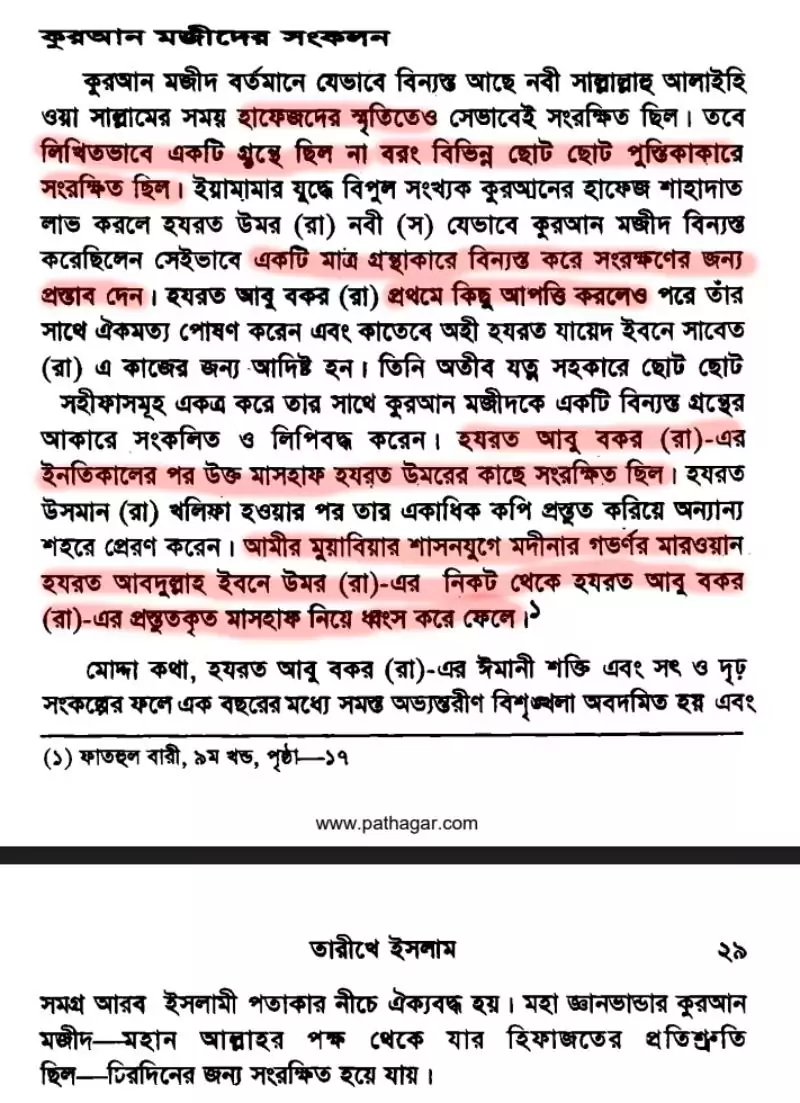
Two different powers operate in this process. For someone to possess a sahifa means they are maintaining its practical preservation; however, the decision to create new state copies rests with the ruler. Uthman requested the materials held by Hafsa, she sent them, and they were returned upon completion of the work. Consequently, the state project exerting influence over the text continues to establish a relationship with the source held by a specific custodian.
When both the original sahifa and its copy are available, there is a direct opportunity to compare the later copy with the source. In the absence of the source, reliance increases on the descriptions of the copy’s creation and its transmission. Therefore, the sequence of preservation in the subsequent history of Abu Bakr’s collection is particularly valuable: it provides clues to identify which object was copied from which, and up to what stage the previous object remained distinct.
In Abu Bakr’s time, the immediate danger was the death of the readers. The collection he created later became a source itself, held in a specific custody. The result of the first initiative became the foundation for the second. The position of those whose writings were gathered has shifted, and the question now is: who holds access to the gathered sahifa? Along with the transition from scattered sources to centralized preservation, the practical control of the text is also newly arranged.
Method of collection, criteria for acceptance, and human selection of the final text
Two questions operate simultaneously in deciding which reading will remain in Abu Bakr’s collection: whether the statement found was promulgated as Quran, and whether it is acceptable as a valid reading at the time of collection. Along with this are the immediacy of the source, the identity of the writing, and the conditions of testimony. Consequently, any old religious sentence found does not automatically become part of the collection. There is a gap of specific criteria between “having been heard as Quran at one time” and “being worthy of a place in this collection.”
In Taki Usmani’s Ulumul Quran, several characteristics of Abu Bakr’s collection are provided together. The arrangement of verses, separate preservation of surahs, the seven ahruf, the style of writing, and the selection of non-abrogated readings—these appear there as distinct characteristics.
| Main Statement |
|---|
| (1) In this copy, the verses of the Quran were arranged according to the tartib or sequence directed by the Holy Prophet (s); however, the surahs were not arranged sequentially. Each surah was written separately. |
| (2) In this copy, all seven ahruf of the Holy Quranul Karim were present. |
| (3) These copies were not recorded imitating the Hijazi script. |
| (4) In this copy, only those verses were compiled whose recitation had not been abrogated. |
| (5) The purpose of recording this copy was so that a copy would be arranged with the collective verification of the entire Ummah. Thus, everyone could turn to it in times of need. |
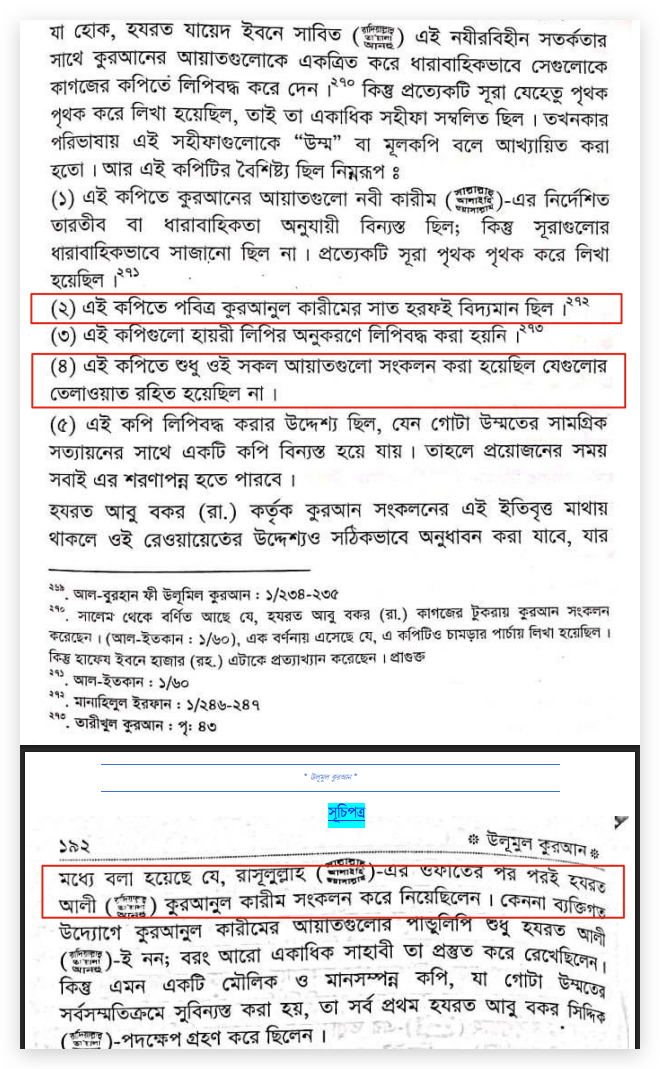
In the same book, there are also accounts of this collection passing from Abu Bakr to Umar and then to Hafsa, and later being destroyed at the hands of Marwan. There, the relationship between the writing and arrangement of the previous copy and Uthman’s prepared collection is explained as the reason for the subsequent removal. [566] [567] [568]
This copy compiled by Hazrat Abu Bakr Siddiq remained preserved with him during his lifetime. After his passing, Hazrat Umar preserved it. After his martyrdom, according to his will, it was handed over to the Mother of the Believers, Hazrat Hafsa. 274 Later, when Marwan ibn Hisham demanded these from Hazrat Hafsa during his rule, she refused to give them. Eventually, after the passing of Hazrat Hafsa, Marwan took them and burned them in the fire with the thought that by then, the most unanimously authentic copy of the Quranul Karim, compiled with the writing method according to the tartib of the surahs by Hazrat Uthman, had been prepared and spread everywhere. It was mandatory for everyone to follow it, and it was no longer appropriate for any copy to remain that contradicted the rusm-al-khat and tartib of the currently prevalent copy. 275
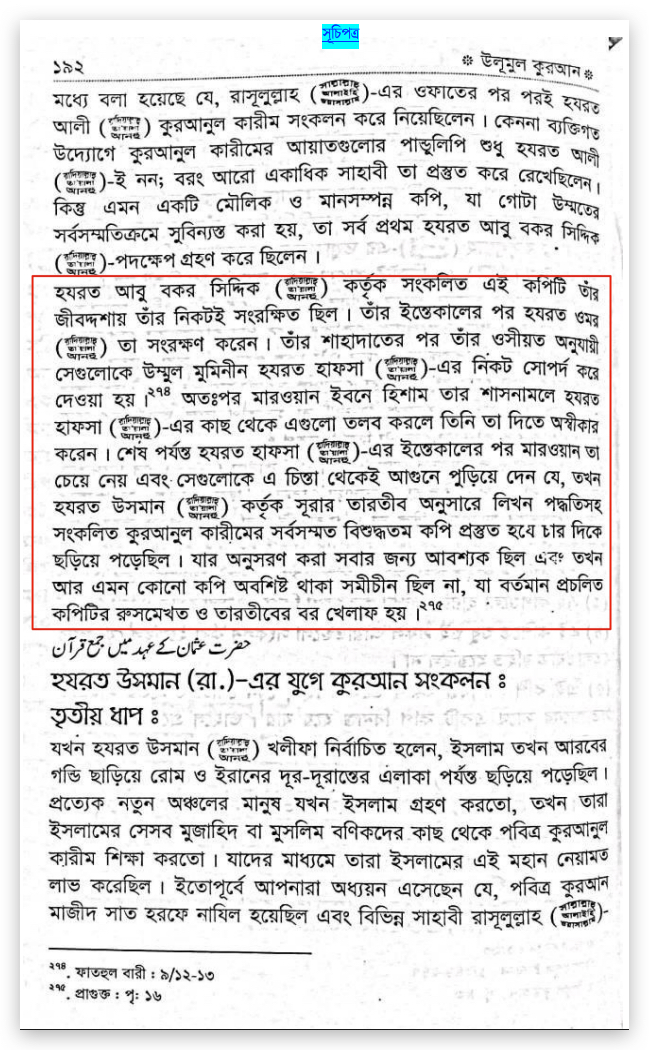
The person in this event is Marwan ibn Hakam; the name “Marwan ibn Hisham” in the quoted Bengali account is incorrect. In Ibn Kathir’s discussion, the name Ibn Hakam is clear, and there are distinct stages of not receiving the materials during Hafsa’s lifetime and taking them after her death. [569]
ثُمَّ إِنَّ عُثْمَانَ رَدَّ الصُّحُفَ إِلَى حَفْصَةَ، فَلَمْ تَزَلْ عِنْدَهَا حَتَّى أَرْسَلَ إِلَيْهَا مَرْوَانُ بْنُ الْحَكَمِ يَطْلُبُهَا فَلَمْ تُعْطِهِ حَتَّى مَاتَتْ، فَأَخَذَهَا مِنْ عَبْدِ اللَّهِ بْنِ عُمَرَ فَحَرَقَهَا لِئَلَّا يَكُونَ فِيهَا شَيْءٌ يُخَالِفُ الْمَصَاحِفَ الَّتِي نَفَّذَهَا عُثْمَانُ إِلَى الْآفَاقِ
English translation: Uthman returned the sahifas to Hafsa. They remained with her. Later, Marwan ibn Hakam sent a message to her requesting them, but she did not give them before her death. Afterward, Marwan took them from Abdullah ibn Umar and burned them, so that nothing remained in them that differed from the mushafs Uthman had sent to various regions.
The mention of selecting non-abrogated readings is particularly important in determining the scope of the collection. The information that some part was previously spoken, written, or remembered by someone is not equivalent to the decision that it remains valid. If it is considered abrogated, a religious basis is created to exclude that part. Consequently, the judgment of the religious status of the reading must be completed before the copy is prepared. Taking everything indiscriminately from available old materials and taking materials identified as valid are separate processes.
The claim of the presence of seven ahruf also needs to be understood specifically. This does not refer to the seven named qira’at of later eras; it refers to the seven ahruf regarding revelation and approved forms of reading. If multiple approved forms are acknowledged, the word “collection” does not provide information that there was a single identical word-form for every listener. In Abu Shama’s previous explanation, the need to return to the original writing was mentioned because of different readings. Therefore, the relationship between this collection and the subsequent state-approved reading is not merely a matter of counting copies of a book.
The language of the accounts is not uniform regarding the arrangement of verses and the sequence of surahs. In the characteristics quoted by Taki Usmani, it is mentioned that the surahs were written separately and the surah sequence was not arranged. At the beginning of the collection chapter, Ibn Hajar explained taking scattered readings into the sahifa and later gathering the sahifa into the mushaf. There is also mention of the surah sequence. Without determining the scope and stage of the two discussions, calling one an identical account of the other erases the differences in the steps of the work. [570]
الْمُرَادُ بِالْجَمْعِ هُنَا جَمْعٌ مَخْصُوصٌ، وَهُوَ جَمْعُ مُتَفَرِّقِهِ فِي صُحُفٍ، ثُمَّ جَمْعُ تِلْكَ الصُّحُفِ فِي مُصْحَفٍ وَاحِدٍ مُرَتَّبِ السُّوَرِ.
English translation: Here, collection refers to a specific type of collection: gathering scattered readings into a sahifa, and then gathering those sahifas into a mushaf arranged in the order of surahs.
The identity of the writing style is similarly a separate question. The quoted characteristics mention the Hijazi script, but Bukhari’s brief account of the collection does not provide a full alphabet list or the written form of every verse. The report of which material was collected from and a comparative design of all the letters of that material are different types of evidence. To use the history of the collection as proof of letter-for-letter identity with a later specific writing style, these intermediate identities must also be established.
| Matter of Selection | Question before the collector | Result of the decision |
|---|---|---|
| Source | Where did the statement come from? | Determining the limit of acceptable sources |
| Support | To what extent do writing, memory, and testimony match? | Deciding which material will be accepted |
| Remaining valid | Is the reading considered to have been abrogated? | Inclusion or exclusion of previously promulgated parts |
| Form of reading | Which different form is accepted as approved? | The scope of which word or form will remain in the collection |
| Arrangement | How is the relationship between verses and surahs determined? | Visible structure of the book and subsequent use |
A clear example of using the religious promise of preservation as a document for each such acceptance is found in Islamweb’s answer number 64502. In response to the question of how the possibility of other companions having more verses is denied, the site has brought the promise of Allah to protect the Quran as proof. [571]
وأما نفي إمكانية وجود غيرهما عند أحد من الصحابة فإنه يدل له أن القرآن تعهد الله بحفظه
English translation: The proof in favor of denying the possibility that any other companion had anything beyond those two is that Allah has taken the responsibility of preserving the Quran.
This is a circular argument. To prove the completeness of a collection, a statement from that very collection is taken as true, and then the completeness of the collection is proven again. No additional list, full comparison of all companions’ collections, or records of every exclusion have been provided as independent proof. The basis of the decision is taking the scripture’s own assurance and the historical implementation of that assurance as the same object. The decision that every action of the collection process of a book was flawless does not follow directly from the book’s own claim of preservation.
Believing the promise to be true and showing specific proof of the acceptance process are different tasks. Bukhari’s account informs us of Umar’s fear, Abu Bakr’s change of opinion, Zayd’s search, and the event of receiving materials from specific individuals. If these are examined on their own terms, the need, labor, and limits of the collection can be understood. If religious assurance is later placed to settle all inquiries beforehand, there is no opportunity to verify anything new from the events; the result is assumed before the investigation.
The result achieved through Abu Bakr’s initiative is therefore simultaneously preservation and selection. Scattered elements were kept together; again, the decision on which would be considered a valid, proven, and acceptable reading was applied. This selection creates the boundary of the book’s inclusion. Specific individuals took that responsibility, and the prepared sahifas remained in specific custody. The subsequent state initiative used that result; its relationship with the personal collections of other companions is also separately searchable from the history of this central collection.
The Mushafs of Ali and other Companions: History of Alternative Compilations
Multiple competing histories regarding the compilation of the Quran have been preserved within Islam. Alongside Abu Bakr’s initiative, Zayd’s collection, and Uthman’s approved mushaf, there are accounts of Ali’s separate collection, Ubayy’s mushaf, Ibn Masud’s mushaf, and the personal copies of Aisha and Hafsa. In these accounts, contradictions occur sometimes in the arrangement of surahs, sometimes in the presence of specific words, and sometimes regarding the full text and the ownership of its knowledge. Just because one compilation eventually gained predominance does not mean all collections existing before or alongside it become identical. In the history of the accepted text, questions of selection, approval, and exclusion arise from its relationship with these personal collections.
The explanation of this relationship is also not the same in Sunni and Shia religious literature. In some accounts, Ali recognizes Abu Bakr as the first compiler and supports Uthman’s work; in other accounts, Ali and the subsequent Imams are the only compilers of the full Quran, and the inheritance of completeness beyond the book held by common people remains with them. Here, the claim to leadership is also linked to the claim of the text. The answers to the questions of who will be called the first compiler, which collection will be called complete, and who will hold the accurate meaning of Allah’s words establish two types of religious authority.
The simultaneous presence of personal collections and separate traditions of reading
During Muhammad’s lifetime, there were several recognized centers for learning the Quran. Sahih Bukhari describes instructions to receive the Quran from four individuals: Abdullah ibn Masud, Salim, Muadh ibn Jabal, and Ubayy ibn Ka’b. Here, the criterion for selecting teachers was the individual and their knowledge of the reading; no list from any subsequent central compilation committee is provided here. From the beginning, the transmission of the scripture proceeded through the memories, teachings, and pronunciations of multiple people. Consequently, the relationship between their personal readings and the subsequently adopted mushaf is a real historical question. [572]
خُذُوا الْقُرْآنَ مِنْ أَرْبَعَةٍ، مِنْ عَبْدِ اللَّهِ بْنِ مَسْعُودٍ، وَسَالِمٍ، وَمُعَاذٍ، وَأُبَيِّ بْنِ كَعْبٍ.
English translation: Receive the Quran from four people: Abdullah ibn Masud, Salim, Muadh, and Ubayy ibn Ka’b.
A clear example of a personal written collection is Aisha’s mushaf. She asked her freed slave, Abu Yunus, to write a mushaf for her and instructed him to inform her when he reached a specific point in Surah Al-Baqarah. When the writer reached that point, Aisha dictated the reading. In the sentence she dictated, the phrase “and the Asr prayer” appears after “the middle prayer.” She did not identify this phrase as her own interpretation; she stated that she heard it from Muhammad. The preparation of the copy, the instruction to stop at a specific point, the dictation of the reading, and the claim of hearing it from the Prophet—four elements are present in the same event. [573]
عَنْ أَبِي يُونُسَ مَوْلَى عَائِشَةَ أَنَّهُ قَالَ أَمَرَتْنِي عَائِشَةُ أَنْ أَكْتُبَ لَهَا مُصْحَفًا وَقَالَتْ إِذَا بَلَغْتَ هَذِهِ الآيَةَ فَآذِنِّي حَافِظُوا عَلَى الصَّلَوَاتِ وَالصَّلَاةِ الْوُسْطَى فَلَمَّا بَلَغْتُهَا آذَنْتُهَا فَأَمْلَتْ عَلَىَّ حَافِظُوا عَلَى الصَّلَوَاتِ وَالصَّلَاةِ الْوُسْطَى وَصَلَاةِ الْعَصْرِ وَقُومُوا لِلَّهِ قَانِتِينَ قَالَتْ عَائِشَةُ سَمِعْتُهَا مِنْ رَسُولِ اللَّهِ صلى الله عليه وسلم.
English translation: Abu Yunus, the freed slave of Aisha, said: Aisha ordered me to write a mushaf for her. She said, let me know when you reach this verse: “Guard the prayers and the middle prayer.” When I reached there, I informed her. Then she dictated to me: “Guard the prayers, the middle prayer, and the Asr prayer, and stand humbly before Allah.” Aisha said: I heard this from the Messenger of Allah.
In the current verse 238 of Surah Al-Baqarah, the words “wa salatil asr” are not present. In the tafsir of the verse, Ibn Kathir quoted the report from Muslim regarding Aisha; simultaneously, through Malik, he brought the incident of Amr ibn Rafi, who was writing the copy for Hafsa. Hafsa also asked to be informed when he reached a specific verse and had him write the reading with the same additional words. As a result, the problem is not a story of the carelessness of a single copyist; similar instructions regarding two separate personal collections have been preserved. [574]
وَقَدْ رَوَى الْإِمَامُ مَالِكٌ أَيْضًا، عَنْ زَيْدِ بْنِ أَسْلَمَ عَنْ عَمْرِو بْنِ رَافِعٍ قَالَ: كُنْتُ أَكْتُبُ مُصْحَفًا لِحَفْصَةَ زَوْجِ النَّبِيِّ صَلَّى اللَّهُ عَلَيْهِ وَسَلَّمَ، فَقَالَتْ: إِذَا بَلَغْتَ هَذِهِ الْآيَةَ: حَافِظُوا عَلَى الصَّلَوَاتِ وَالصَّلَاةِ الْوُسْطَى فَآذِنِّي فَلَمَّا بَلَغْتُهَا آذَنْتُهَا. فَأَمْلَتْ عَلَيَّ: حَافِظُوا عَلَى الصَّلَوَاتِ وَالصَّلَاةِ الْوُسْطَى وَصَلَاةِ الْعَصْرِ وَقُومُوا لِلَّهِ قَانِتِينَ.
English translation: Imam Malik also narrated from Amr ibn Rafi through Zayd ibn Aslam. He said: I was writing a mushaf for the Prophet’s wife, Hafsa. She said, let me know when you reach this verse: “Guard the prayers and the middle prayer.” When I reached there, I informed her. Then she dictated to me: “Guard the prayers, the middle prayer, and the Asr prayer, and stand humbly before Allah.”
| Reading or Collection | Related Words | Position in the Report |
|---|---|---|
| Conventional Surah Al-Baqarah 2:238 | وَالصَّلَاةِ الْوُسْطَىٰ وَقُومُوا لِلَّهِ قَانِتِينَ | Instruction to stand humbly before Allah directly after the middle prayer. |
| Reading dictated by Aisha | وَالصَّلَاةِ الْوُسْطَى وَصَلَاةِ الْعَصْرِ وَقُومُوا لِلَّهِ قَانِتِينَ | “And the Asr prayer” after the middle prayer; claim of hearing it from the Prophet. |
| Reading dictated by Hafsa | وَالصَّلَاةِ الْوُسْطَى وَصَلَاةِ الْعَصْرِ وَقُومُوا لِلَّهِ قَانِتِينَ | Account of dictating the same additional phrase at a specific point in personal mushafs. |
The presence of the words also affects the structure of the statement. “The middle prayer, meaning the Asr prayer” and “the middle prayer and the Asr prayer”—the relationship between these two sentences is not the same. In the first, the second phrase identifies the first; in the second, a conjunction links the two phrases. In the same discussion, Ibn Kathir quoted another report regarding Aisha’s mushaf with the reading “wa hiya salatul asr”—”and that is the Asr prayer.” Consequently, the documented difference is not just one of spelling; it is also about addition, interpretation, and the relationship between two phrases within a sentence. This difference in specific words is the primary element in examining the accounts of personal mushafs. [575]
وَقَالَ ابْنُ جَرِيرٍ: حَدَّثَنِي الْمُثَنَّى، حَدَّثَنَا الْحَجَّاجُ، حَدَّثَنَا حَمَّادٌ، عَنْ هِشَامِ بْنِ عُرْوَةَ عَنْ أَبِيهِ قَالَ: كَانَ فِي مُصْحَفِ عَائِشَةَ: حَافِظُوا عَلَى الصَّلَوَاتِ وَالصَّلَاةِ الْوُسْطَى وَهِيَ صَلَاةُ الْعَصْرِ.
English translation: Ibn Jarir said: Musanna narrated to us, Hajjaj narrated to us, Hammad narrated to us, Hisham ibn Urwah said from his father: In Aisha’s mushaf it was, “Guard the prayers and the middle prayer; and that is the Asr prayer.”
There are also different accounts of personal collections regarding the inclusion of surahs. Suyuti quoted a report from Ibn Sirin through Abu Ubayds: Ubayy had written Al-Fatiha, the two seeking-refuge surahs, and “Allahumma inna nasta’inuka” and “Allahumma iyyaka nabudu” in his mushaf; Ibn Masud did not write them; Uthman wrote Al-Fatiha and the two seeking-refuge surahs among those mentioned. In this report, the contents of the collections of three people are compared side by side. This comparison is directly relevant in investigating how the subsequently adopted boundaries were determined. [576]
أَخْرَجَ أَبُو عُبَيْدٍ عَنِ ابْنِ سِيرِينَ قَالَ كَتَبَ أُبَيُّ بْنُ كَعْبٍ فِي مُصْحَفِهِ فَاتِحَةَ الْكِتَابِ وَالْمُعَوِّذَتَيْنِ وَاللَّهُمَّ إِنَّا نَسْتَعِينُكَ وَاللَّهُمَّ إِيَّاكَ نَعْبُدُ وَتَرَكَهُنَّ ابْنُ مَسْعُودٍ وَكَتَبَ عُثْمَانُ مِنْهُنَّ فَاتِحَةَ الْكِتَابِ وَالْمُعَوِّذَتَيْنِ.
English translation: Abu Ubayd narrated from Ibn Sirin. He said: Ubayy ibn Ka’b had written Fatihatul Kitab, the two Mu’awwidhatayn, and “Allahumma inna nasta’inuka” and “Allahumma iyyaka nabudu” in his mushaf. Ibn Masud had omitted these. Uthman wrote Fatihatul Kitab and the two Mu’awwidhatayn among these.
In the same line of discussion, Suyuti also kept the report that two readings of Qunut were written in Ubayy’s mushaf. In his quotation, the use of the same composition exists as the Qunut of prayer, and its position in the personal mushaf also exists. The question of determining the boundaries of religious texts, prayers, and book inclusion arises here. The described contents of Ubayy’s personal collection and the contents of Uthman’s mushaf are not one list. If the boundaries of the adopted compilation are assumed to be eternal and unquestionable, the history of this difference disappears. [577]
وَأَخْرَجَ مُحَمَّدُ بْنُ نَصْرٍ الْمَرْوَزِيُّ فِي كِتَابِ الصَّلَاةِ عَنْ أُبَيِّ بْنِ كَعْبٍ أَنَّهُ كَانَ يَقْنُتُ بِالسُّورَتَيْنِ فَذَكَرَهُمَا وَأَنَّهُ كَانَ يَكْتُبْهُمَا فِي مُصْحَفِهِ.
English translation: Muhammad ibn Nasr al-Marwazi narrated in his Kitab al-Salah from Ubayy ibn Ka’b that he recited Qunut with two surahs. He mentioned those two and said that Ubayy used to write them in his mushaf.
Numerous teachers of the Quran, direct accounts of preparing personal copies, and reports of different contents in collections—combining these three pieces of information allows one to understand the world before the central compilation. There, an individual gives instructions to a writer based on the reading they heard, another person preserves something different, and the subsequent authorized collection includes specific things. The authority of the written book was then closely linked to personal memory and the claims of the teacher. Subsequent state authorization gave preference to a specific textual boundary among those various claims.
Ali’s collection and the claim of arrangement by order of revelation
The story of Ali’s collection of the Quran is not limited to Shia texts. In Sunni works of Quranic sciences, there are also reports of his own collection and arrangement after the death of Muhammad. Suyuti brought a report from Ibn Sirin through Ibn Abi Dawud, where Ali said that he had sworn not to wear a cloak for any purpose other than the Friday prayer until the Quran was collected. In this account, the initiative is after Muhammad’s death; Ali completed the work personally. [578]
لَكِنْ أَخْرَجَ أَيْضًا مِنْ طَرِيقِ ابْنِ سِيرِينَ قَالَ: قَالَ عَلِيٌّ: لَمَّا مَاتَ رَسُولُ اللَّهِ صَلَّى اللَّهُ عَلَيْهِ وَسَلَّمَ آلَيْتُ أَلَّا آخُذَ عَلَيَّ رِدَائِي إِلَّا لِصَلَاةِ جُمْعَةٍ حَتَّى أَجْمَعَ الْقُرْآنَ. فَجَمَعَهُ.
English translation: But he also narrated through the path of Ibn Sirin. He said, Ali said: When the Messenger of Allah died, I swore that I would not wear a cloak except for the Friday prayer until the Quran was collected. After that, he collected it.
Ibn Hajar called the report weak by showing a disconnection in this specific isnad, and while accepting it, proposed that “collection” should be understood as memorization. Suyuti did not end the discussion there; he brought another path through Ibn al-Durays and later mentioned a written mushaf. Although memorization was discussed as a possible meaning of the same words, the subsequent reports contain language of composition, arrangement, and searching for a book. Those written characteristics are also present in the history of personal collections. [579]
قَالَ ابْنُ حَجَرٍ: هَذَا الْأَثَرُ ضَعِيفٌ لَانْقِطَاعِهِ وَبِتَقْدِيرِ صِحَّتِهِ فَمُرَادُهُ بِجَمْعِهِ حِفْظُهُ فِي صَدْرِهِ وَمَا تَقَدَّمَ مِنْ رِوَايَةِ عَبْدِ خَيْرٍ عَنْهُ أَصَحُّ فَهُوَ الْمُعْتَمَدُ.
English translation: Ibn Hajar said: The report is weak due to the disconnection of the isnad. Even if it is held as sahih, his collection here refers to preservation in the heart. The report of his that came earlier through Abde Khayer is more sahih; therefore, that is accepted as reliable.
In a discussion on Islamweb regarding Ali having the entire Quran memorized, a different opinion was acknowledged. Mentioning the view that all four caliphs had it memorized, it was stated that there is no established statement to finally settle this matter; there are the judgments and conjectures of scholars. Then it was proposed that having the entire Quran memorized by all is consistent with their knowledge and the status of their proximity to the Prophet. The proof that a quality is fitting for a person’s religious status and that they actually possessed that quality are not the same. Uncertain reports are not confirmed by expectations of status. [580]
وَالْخِلَافُ فِيهَا ثَابِتٌ كَمَا رَأَيْتَ، وَلَيْسَ فِيهَا نُصُوصٌ ثَابِتَةٌ تَقْطَعُ فِي الْأَمْرِ غَيْرَ أَنَّهَا اجْتِهَادَاتٌ وَاسْتِنْبَاطَاتٌ مِنَ الْعُلَمَاءِ.
English translation: There are differences of opinion on this matter, as you have seen. There is no established statement here to finally settle the matter; these are the judgments and conjectures of scholars.
In the report of Ikrima quoted by Suyuti, the event is linked to the time after Abu Bakr’s bay’ah. When Ali remained in his house, Abu Bakr was told that he disliked his bay’ah. Ali denied this and spoke of his work of collection. In the report, the words “I have seen additions being made to the Book of Allah” are also present in his statement. Here, the initiative of collection is directly linked with concern over the change of the reading. The sentence is a statement from a preserved report; the concern attributed to Ali through this does not align with a completely seamless history of collection. [581]
لَمَّا كَانَ بَعْدَ بَيْعَةِ أَبِي بَكْرٍ قَعَدَ عَلِيُّ بْنُ أَبِي طَالِبٍ فِي بَيْتِهِ فَقِيلَ لِأَبِي بَكْرٍ: قَدْ كَرِهَ بَيْعَتَكَ فَأَرْسَلَ إِلَيْهِ فَقَالَ: أَكَرِهْتَ بَيْعَتِي؟ قَالَ: لَا وَاللَّهِ، قَالَ: مَا أَقْعَدَكَ عَنِّي قَالَ: رَأَيْتُ كِتَابَ اللَّهِ يُزَادُ فِيهِ فَحَدَّثْتُ نَفْسِي أَلَّا أَلْبَسَ رِدَائِي إِلَّا لِصَلَاةٍ حَتَّى أَجْمَعَهُ قَالَ لَهُ أَبُو بَكْرٍ: فَإِنَّكَ نِعْمَ مَا رَأَيْتَ.
English translation: After the bay’ah of Abu Bakr, Ali ibn Abi Talib remained in his house. Abu Bakr was told: He has disliked your bay’ah. Then he sent word to him and asked: Have you disliked my bay’ah? Ali said: No, by Allah. He said: What has kept you away from me? Ali said: I have seen additions being made to the Book of Allah. Therefore, I thought that I would not wear a cloak except for prayer until I collected it. Abu Bakr told him: You have made an excellent decision.
In the conversation between Ikrima and Ibn Sirin, a question arises about the arrangement of the collection: was it arranged by keeping the parts revealed first earlier in the order of revelation? In response, that arrangement is called such an extraordinary work that humans and jinn together would not be able to do it. In this way, the characteristic of Ali’s collection is not just rewriting the same sentences in the same alphabet; determining the order of revelation also becomes a matter of special knowledge. If this order—which instruction came first, which came later, and in the context of which event—is changed, the way of understanding the sequence of religious rulings also changes. [582]
قَالَ مُحَمَّدٌ: فَقُلْتُ لِعِكْرِمَةَ: أَلِّفُوهُ كَمَا أُنْزِلَ الْأَوَّلُ فَالْأَوَّلُ قَالَ: لَوِ اجْتَمَعَتِ الْإِنْسُ وَالْجِنُّ عَلَى أَنْ يُؤَلِّفُوهُ ذَلِكَ التَّأْلِيفَ مَا اسْتَطَاعُوا.
English translation: Muhammad said: I asked Ikrima, did they arrange it by keeping the first one first in the order of revelation? He said: Even if humans and jinn together wanted to make that arrangement, they could not.
In Shia literature, this collection is also presented as the first and complete compilation arranged by order of revelation. In Muhammad Hadi Marifa’s discussion, a report quoted from Ibn Shahr Ashub’s Manaqib states that Ali’s collection was completed six months after Muhammad’s death. In the same discussion, a mention of three days is quoted in the name of Ibn al-Nadim. These two accounts of time are different; the claim of six months is the claim of a specific chain of reports. [583]
ذَكَرَ الشِّيرَازِيُّ فِي نُزُولِ الْقُرْآنِ عَنِ ابْنِ عَبَّاسٍ قَالَ: ضَمَّنَ اللَّهُ مُحَمَّدًا أَنْ يَجْمَعَ الْقُرْآنَ بَعْدَهُ عَلِيُّ بْنُ أَبِي طَالِبٍ عَلَيْهِ السَّلَامُ قَالَ: فَجَمَعَ اللَّهُ الْقُرْآنَ فِي قَلْبِ عَلِيٍّ، وَجَمَعَهُ عَلِيٌّ بَعْدَ مَوْتِ رَسُولِ اللَّهِ بِسِتَّةِ أَشْهُرٍ.
English translation: Shirazi mentioned in Nuzulul Quran from Ibn Abbas: Allah had guaranteed Muhammad that after him, Ali ibn Abi Talib would collect the Quran. He said: Allah gathered the Quran in Ali’s heart; and Ali collected it six months after the Messenger’s death.
The relationship between arrangement and interpretation and rulings becomes clearer in another report quoted by Suyuti. It is stated through Ibn Ashtar that Ali had written the nasikh and mansukh in his mushaf. In the same place, there is mention of Ibn Sirin searching for that book and not finding it even after sending a letter to Medina. Consequently, reports about the collection attributed to Ali were prevalent, but the collection did not reach this searcher. The gap between the reported book and the book actually found by the subsequent writer is captured within the report itself. [584]
وَأَخْرَجَهُ ابْنُ أَشْتَةَ فِي الْمَصَاحِفِ مِنْ وَجْهٍ آخَرَ عَنِ ابْنِ سِيرِينَ وَفِيهِ أَنَّهُ كَتَبَ فِي مُصْحَفِهِ النَّاسِخَ وَالْمَنْسُوخَ وَأَنَّ ابْنَ سِيرِينَ قَالَ: فَطَلَبْتُ ذَلِكَ الْكِتَابَ وَكَتَبْتُ فِيهِ إِلَى الْمَدِينَةِ فَلَمْ أَقْدِرْ عَلَيْهِ.
English translation: Ibn Ashta narrated this in Al-Masahif through another chain from Ibn Sirin. In it, it is stated that he had written the nasikh and mansukh in his mushaf. Ibn Sirin says: I searched for that book and wrote letters to Medina regarding it, but I did not find it.
The account attributed to Ali in Al-Ihtijaj, as quoted in Tafsir al-Safi, provides a more detailed picture of the complete collection. It mentions the presence of the revealed text along with ta’wil, clear and ambiguous parts, and the nasikh-mansukh; it is claimed that not a single letter, not even an Alif or Lam, was omitted. Completeness here is not just a list of surahs; it is a claim to encompass everything, including the text and its exegetical divisions. The accuracy of this alternative is set as the standard against the authenticity of the subsequent mushaf. [585]
مُشْتَمِلًا عَلَى التَّأْوِيلِ وَالتَّنْزِيلِ وَالْمُحْكَمِ وَالْمُتَشَابِهِ وَالنَّاسِخِ وَالْمَنْسُوخِ لَمْ يَسْقُطْ مِنْهُ حَرْفٌ.
English translation: Including ta’wil and the revealed text, clear and ambiguous parts, and the nasikh and mansukh; not a single letter of it was omitted.
| Described characteristics | Statements used in the source | Significance in the history of the text |
|---|---|---|
| Personal collection | Ali’s devotion to his collection after the death of Muhammad | Memories of a separate collection alongside the central initiative. |
| Order of revelation | The question of arrangement by keeping the earlier revealed parts first | The concept of another arrangement outside the current order of surahs. |
| Nasikh-Mansukh | Report of writing the nasikh and mansukh in his own mushaf | Addition of the sequence of rulings and explanations to the collection. |
| Six months | Specific report quoted by Ibn Shahr Ashub | A narrated time for the completion of the collection; alongside this, there is a different report of three days. |
| Failure to find the book | Ibn Sirin’s letters to Medina and failed search | Absence of materials to directly compare the text with the subsequent narrator. |
The claim of the order of revelation brings forward the question of the human role in the arrangement of the book. If the same set of verses is arranged in a different order, the relationship between the beginning and the end, the impression of a continuous narrative, and the visibility of changes in rulings differ. If descriptions of nasikh-mansukh are included, the decision of which instruction remains effective and which has become ineffective is also present with the copy. Therefore, the described value of Ali’s collection is not limited to it being in his own handwriting; a special right over the continuity of revelation and its explanation is also attached to it. The existence of the memory of such a collection means that the concept of religiously significant alternative arrangements existed outside the arrangement of the accepted mushaf.
Rejection of Ali’s collection and different accounts regarding the authority of compilation
In one account in Al-Kafi, an incident is found where Ali’s collection was presented publicly and rejected. The incident begins with the context of reciting the Quran differently before Ja’far al-Sadiq. He tells the person to stop that recitation and follow the recitation prevalent among the people; the duration of this instruction is until the rise of the Qa’im. Then it is said that the Qa’im will bring out Ali’s written mushaf. In the account, past rejection, present recitation habits, and future republication—these three times are linked within a single thread. [586] [587]
Abu Abdillah (Ja’far al-Sadiq) said: “…until the rise of the Qa’im or Mahdi; when the Qa’im or Mahdi rises, the Book of Allah will be recited within its boundaries; and he will bring out that copy of the Quran which Ali(a) had written.”
The complete account states that Ali finished his collection, gave it to the people, and claimed to have collected it exactly as it was revealed to Muhammad. In response, the persons present declared his as unnecessary, stating that they already possessed a complete mushaf. Ali then swore that after that day, they would not see it again. Two rival claims of completeness are directly present here: Ali presents his collection as the revealed book; the other party says their mushaf is sufficient. [588]
قَالَ قَرَأَ رَجُلٌ عَلَى أَبِي عَبْدِ الله (عَلَيهِ السَّلام) وَأَنَا أَسْتَمِعُ حُرُوفاً مِنَ الْقُرْآنِ لَيْسَ عَلَى مَا يَقْرَأُهَا النَّاسُ فَقَالَ أَبُو عَبْدِ الله (عَلَيهِ السَّلام) كُفَّ عَنْ هَذِهِ الْقِرَاءَةِ اقْرَأْ كَمَا يَقْرَأُ النَّاسُ حَتَّى يَقُومَ الْقَائِمُ (عجل الله تعالى فرجه الشريف) فَإِذَا قَامَ الْقَائِمُ (عجل الله تعالى فرجه الشريف) قَرَأَ كِتَابَ الله عَزَّ وَجَلَّ عَلَى حَدِّهِ وَأَخْرَجَ الْمُصْحَفَ الَّذِي كَتَبَهُ عَلِيٌّ (عَلَيهِ السَّلام) وَقَالَ أَخْرَجَهُ عَلِيٌّ (عَلَيهِ السَّلام) إِلَى النَّاسِ حِينَ فَرَغَ مِنْهُ وَكَتَبَهُ فَقَالَ لَهُمْ هَذَا كِتَابُ الله عَزَّ وَجَلَّ كَمَا أَنْزَلَهُ الله عَلَى مُحَمَّدٍ (صَلَّى اللهُ عَلَيْهِ وآلِه) وَقَدْ جَمَعْتُهُ مِنَ اللَّوْحَيْنِ فَقَالُوا هُوَ ذَا عِنْدَنَا مُصْحَفٌ جَامِعٌ فِيهِ الْقُرْآنُ لا حَاجَةَ لَنَا فِيهِ فَقَالَ أَمَا وَالله مَا تَرَوْنَهُ بَعْدَ يَوْمِكُمْ هَذَا أَبَداً إِنَّمَا كَانَ عَلَيَّ أَنْ أُخْبِرَكُمْ حِينَ جَمَعْتُهُ لِتَقْرَءُوهُ.
English translation: He said: A person recited some readings of the Quran before Abu Abdillah that were not like the readings prevalent among the people; I was listening. Abu Abdillah said: Stop this recitation. Until the rise of the Qa’im, recite as the people recite. When the Qa’im rises, he will recite the Book of Allah properly and bring out the mushaf written by Ali. He further said: Ali had finished writing and collecting it and presented it before the people. He told them: This is the Book of Allah, as Allah revealed it to Muhammad; I have collected it from two tablets. They said: We have a complete mushaf including the Quran; we have no need for this. Ali said: By Allah, after today you will not see this again. It was my responsibility to inform you after collecting it, so that you could read it.
In this account, the rejectors appear as “they”; Uthman’s name is not given. In its political framework, there is mention of the public presentation of a collection and the denial of its acceptance. In another account of Manaqib quoted by Muhammad Hadi Ma’rifa, the incident is more person-centered: Ali places the book before the people gathered in the mosque, and a “second person” denies his collection and his need. In these stories of the rejection of Ali’s collection, the identity of the individuals and the language of the events differ. [589]
فَقَامَ إِلَيْهِ الثَّانِي وَقَالَ لَهُ: إِنْ يَكُنْ عِنْدَكَ قُرْآنٌ فَعِنْدَنَا مِثْلُهُ، فَلَا حَاجَةَ لَنَا فِيكُمَا. فَحَمَلَ عَلَيْهِ السَّلَامُ الْكِتَابَ وَعَادَ بِهِ بَعْدَ أَنْ أَلْزَمَهُمُ الْحُجَّةَ.
English translation: Then the second person stood up and said to him: If you have the Quran, we also have one like it; we have no need for either of you. Then, after establishing his argument before them, he took the book and returned.
The social meaning of this rejection is also specific. If an alternative collection of the Quran were accepted, the claim to knowledge and leadership of its collector would also gain importance. In the account of Manaqib, the book and the family of the Prophet are presented side by side; the phrase “either of you” in response to the rejection expresses that very link. The acceptance of the book and the acceptance of the collector are being denied together. Consequently, the rivalry over the collection has become entangled with the rivalry over religious leadership within the same story.
Other reports preserved under Ali’s name in Sunni compilation literature present Abu Bakr as the first compiler. Suyuti quoted Ali’s statement through Abde Khayer: The most reward in the work of the mushaf belongs to Abu Bakr; he was the first to collect the Book of Allah. Suyuti has called this chain hasan. Here, instead of Ali declaring the superiority of his own alternative collection, the priority of Abu Bakr’s initiative is established. Different claims of priority in compilation are validated using statements preserved under the name of the same person. [590]
وَأَخْرَجَ ابْنُ أَبِي دَاوُدَ فِي الْمَصَاحِفِ بِسَنَدٍ حَسَنٍ عَنْ عَبْدِ خَيْرٍ قَالَ: سَمِعْتُ عَلِيًّا يَقُولُ: أَعْظَمُ النَّاسِ فِي الْمَصَاحِفِ أَجْرًا أَبُو بَكْرٍ رَحْمَةُ اللَّهِ عَلَى أَبِي بَكْرٍ! هُوَ أَوَّلُ مَنْ جَمَعَ كِتَابَ اللَّهِ.
English translation: Ibn Abi Dawud narrated in Al-Masahif with a hasan chain from Abde Khayer. He said: I heard Ali say, among people, Abu Bakr has the most reward in the work of the mushaf. May Allah have mercy on Abu Bakr! He was the first to collect the Book of Allah.
There is also a long account of Ali’s support for Uthman’s compilation. IslamQA quoted it from Ibn Abi Dawud’s Al-Masahif. There, Ali says that one should not be excessive against Uthman regarding the mushaf and the burning of it; the work was done with the consultation of all of them. Followers of different readings were calling their own readings superior, so the proposal arose to unite the people on one mushaf. At the end of the account, Ali’s declaration comes that if he had been given the responsibility, he would have done the same. [591]
يَا أَيُّهَا النَّاسُ لَا تَغْلُوا فِي عُثْمَانَ وَلَا تَقُولُوا لَهُ إِلَّا خَيْرًا فِي الْمَصَاحِفِ وَإِحْرَاقِ الْمَصَاحِفِ، فَوَاللَّهِ مَا فَعَلَ الَّذِي فَعَلَ فِي الْمَصَاحِفِ إِلَّا عَنْ مَلَإٍ مِنَّا جَمِيعًا، فَقَالَ: مَا تَقُولُونَ فِي هَذِهِ الْقِرَاءَةِ؟ فَقَدْ بَلَغَنِي أَنَّ بَعْضَهُمْ يَقُولُ: إِنَّ قِرَاءَتِي خَيْرٌ مِنْ قِرَاءَتِكَ، وَهَذَا يَكَادُ أَنْ يَكُونَ كُفْرًا، قُلْنَا: فَمَا تَرَى؟ قَالَ: نَرَى أَنْ نَجْمَعَ النَّاسَ عَلَى مُصْحَفٍ وَاحِدٍ، فَلَا تَكُونَ فُرْقَةٌ، وَلَا يَكُونُ اخْتِلَافٌ، قُلْنَا: فَنِعْمَ مَا رَأَيْتَ قَالَ: فَقِيلَ: أَيُّ النَّاسِ أَفْصَحُ، وَأَيُّ النَّاسِ أَقْرَأُ؟ قَالُوا: أَفْصَحُ النَّاسِ سَعِيدُ بْنُ الْعَاصِ، وَأَقْرَؤُهُمْ زَيْدُ بْنُ ثَابِتٍ، فَقَالَ: لِيَكْتُبْ أَحَدُهُمَا وَيُمِلَّ الْآخَرُ فَفَعَلَا وَجَمَعَ النَّاسَ عَلَى مُصْحَفٍ. قَالَ عَلِيٌّ: وَاللَّهِ لَوْ وَلِيتُ لَفَعَلْتُ مِثْلَ الَّذِي فَعَلَ.
English translation: O people, do not be excessive regarding Uthman. Speak well of him regarding the mushaf and the burning of the mushafs. By Allah, whatever he did regarding the mushaf, he did it with the consultation of all of us. He said: What is your opinion regarding this reading? News has come to me that some are saying, my reading is better than your reading; this almost reaches the level of kufr. We said: What is your opinion? He said: Our opinion is that we shall unite the people on one mushaf; then there will be no division or disagreement. We said: You have taken the best decision. Then it was asked: Who is the most eloquent and who is the best reciter? They said: Sa’id ibn al-As is the most eloquent and Zayd ibn Thabit is the best reciter. He said: One shall write and the other shall dictate. They did so and he united the people on one mushaf. Ali says: By Allah, if the responsibility had come to my hand, I would have done as he did.
| Thread of reports | Ali’s position | Result of authority |
|---|---|---|
| Incident of rejection in Al-Kafi | Presents his own collection; removes it when others call it unnecessary | Complete collection is outside the public, with the subsequent Qa’im. |
| Report through Abde Khayer | Calls Abu Bakr the first collector and the one with the most reward | Priority and dignity of Abu Bakr’s initiative. |
| Report of support for Uthman’s work | Mentions collective consultation and declares he would have done the same | Approval of uniting on one mushaf and burning other mushafs. |
The claim of religious consensus is constructed by determining the position of these different narratives. If the account in Al-Kafi is accepted, the public recognition of the complete collection failed and it moved beyond the reach of common people. If the account of Ali in support of Uthman is accepted, the uniting on one reading and the destruction of other copies also received his approval. Ali is the central witness in both threads: in one, the possessor of an alternative completeness, in the other, a supporter of the state compilation. The religious dignity of his name has been effective in both opposite claims of authority.
Report of seventeen thousand verses in Al-Kafi
In the chapters of reports in Al-Kafi’s Kitab Fadl al-Quran, there is an extremely large numerical claim: the Quran that Gabriel brought to Muhammad had seventeen thousand verses. The report comes as the statement of Ja’far al-Sadiq. Here, the volume of any human’s subsequent tafsir book has not been counted; the subject of the sentence is the Quran brought by Gabriel. The number is mentioned regarding the amount of the revealed text. [592] [593]
Narrated from Abu Abdillah (a) (Ja’far Sadiq), he said: Indeed, the Quran that Jibrail (a) brought to Muhammad (ﷺ) has seventeen thousand verses.
In the original Arabic of the report, “sab’ata ashara alfa ayatin”—seventeen thousand verses—is clearly written. In the open text, the chain of narration of Ali ibn al-Hakam, Hisham ibn Salim, and Abu Abdillah is given. On the same page, the evaluation of Majlisi’s Mir’at al-Uqul 12/525 is shown as “muwathaq”. This is an internal category of acceptance in Shia hadith criticism; the report has gained importance in the discussion of that thread, and it is its specific identifier. [593] [594]
إِنَّ الْقُرْآنَ الَّذِي جَاءَ بِهِ جَبْرَئِيلُ (عَلَيهِ السَّلام) إِلَى مُحَمَّدٍ (صَلَّى اللهُ عَلَيْهِ وآلِه) سَبْعَةَ عَشَرَ أَلْفَ آيَةٍ.
English translation: The Quran that Gabriel brought to Muhammad had seventeen thousand verses.
The gap between this number and the conventional verse count is very large. Suyuti, quoting the statement of Dani, mentioned differences in additional numbers after six thousand verses: two hundred four, two hundred fourteen, two hundred nineteen, two hundred twenty-five, and two hundred thirty-six. That is, the discussed counts are around six thousand; seventeen thousand is not another nearby number in that list. There is a numerical gap of more than ten thousand between the claim in Al-Kafi and the counts mentioned by Dani. [595]
قَالَ الدَّانِيُّ: أَجْمَعُوا عَلَى أَنَّ عَدَدَ آيَاتِ الْقُرْآنِ سِتَّةُ آلَافِ آيَةٍ ثُمَّ اخْتَلَفُوا فِيمَا زَادَ عَلَى ذَلِكَ فَمِنْهُمْ مَنْ لَمْ يَزِدْ وَمِنْهُمْ مَنْ قَالَ: وَمِائَتَا آيَةٍ وَأَرْبَعُ آيَاتٍ وَقِيلَ: وَأَرْبَعَ عَشْرَةَ وَقِيلَ: وَتِسْعَ عَشْرَةَ وَقِيلَ: وَخَمْسٌ وَعِشْرُونَ وَقِيلَ: وَسِتٌّ وَثَلَاثُونَ.
English translation: Dani says: They have agreed that the number of verses in the Quran is six thousand. Then they differed regarding the additional number. Some did not count any extra; some said another two hundred four verses; again, two hundred fourteen, two hundred nineteen, two hundred twenty-five, and two hundred thirty-six were also mentioned.
The necessary information differs on two questions: where the boundary of a verse is considered and which sentences are present in the book. If one continuous statement is counted as two verses instead of one, the number increases, but the words do not increase. The report of seventeen thousand informs of its claimed total amount; it does not provide a list of specific additional sentences or surahs. Allegations of verbal removal come from the clear statements of authors like Nuri and Kashani and the descriptions of specific textual variations they quoted. Although the huge discrepancy in numbers and the claim of changes in words are linked in the same discussion, each has its own evidence.
| Question | Available evidence | Statement of evidence |
|---|---|---|
| Reported volume of the revealed Quran | Al-Kafi 2/3/14/28 | Seventeen thousand verses in the Quran brought by Gabriel. |
| Range of conventional counting traditions | Quote of Dani in Al-Itqan | Different counts of six thousand and a few hundred verses above it. |
| Claim of verbal changes | Nuri’s fourth argument and Kashani’s sixth introduction | Allegations of words, additions, and removals alongside arrangement. |
| Religious acceptance of the report | Majlisi’s evaluation quoted on the Al-Kafir page | muwassaq; used in subsequent discussions regarding the completeness of the Quran. |
The description of Majlisi’s commentary quoted in Nuri’s Faslul Khitab further clarifies the subsequent importance. There, he stated that this report and many sahih reports are clear statements regarding the decrease and alteration of the Quran. His argument is that if all such reports are rejected, trust in reports as a whole is lost; the Imamate is also established through reports. In other words, if the reports regarding alterations are collectively invalidated—using the same narrative method used to prove the religious authority of the Imams—the foundation of one’s own authority also becomes problematic. [596]
وَلَا يَخْفَى أَنَّ هَذَا الْخَبَرَ وَكَثِيرٍ مِنَ الْأَخْبَارِ الصَّحِيحَةِ صَرِيحَةٌ فِي نَقْصِ الْقُرْآنِ وَتَغْيِيرِهِ، وَعِنْدِي أَنَّ الْأَخْبَارَ فِي هَذَا الْبَابِ مُتَوَاتِرَةٌ مَعْنًى، وَطَرْحُ جَمِيعِهَا يُوجِبُ رَفْعَ الِاعْتِمَادِ عَنِ الْأَخْبَارِ رَأْسًا، بَلْ ظَنِّي أَنَّ الْأَخْبَارَ فِي هَذَا الْبَابِ لَا يَقْصُرُ عَنْ أَخْبَارِ الْإِمَامَةِ، فَكَيْفَ يُثْبِتُونَهَا بِالْخَبَرِ؟
English translation: This report and many sahih reports are clear regarding the decrease and alteration of the Quran. In my opinion, the reports of this chapter are semantically mutawatir. Rejecting all of them completely removes trust in reports. Rather, it is my view that the volume of reports on this matter is not less than the reports on the Imamate; then how do they establish the Imamate through reports?
In Majlisi’s logic, a problem is detected: denying the foundation of one religious conclusion while trying to protect another. Accepting the narratives that establish the Imamate while collectively discarding all reports of textual alteration from the same source requires a distinct reason for this selection. If a report is accepted simply because it aligns with a preferred conclusion and discarded because it is uncomfortable, the criterion becomes dependent on the result. There is pressure to acknowledge this inconsistency in his commentary. Simultaneously, his argument centers on the religious acceptability of reports; written copies of every reported additional verse were not displayed there.
Therefore, the importance of the statement regarding seventeen thousand is not merely as a large number. It is preserved in a central hadith collection where, in another chapter, the right to the complete Quran is specified for Ali and the Imams. The claim of large volume, the special right to the complete collection, and the announcement of publishing that collection in the future create a linked religious framework. The concept of a more complete and more authoritative text existing beyond the book in the hands of the general reader is part of this framework.
Textual claims in Nuri Tabarsi, Kashani, and Shia literature
In Nuri Tabarsi’s Faslul Khitab, Ali’s separate Quran has been used as a distinct argument in favor of textual alteration. The author’s full name is Husayn ibn Muhammad Taqi an-Nuri at-Tabarsi. In his statement, there is a narrative of Ali’s collection being created after Muhammad’s death, presented publicly, rejected, and thereafter preserved through generations among the Imams. The claim did not stop at the collection merely being arranged in a different order. He spoke of differences in terms of wording and additions-subtractions. [597] [598]
Amir al-Mu’minin Hazrat Ali(ra) possessed a special Quran, which he himself compiled after the passing of the Messenger of Allah(ﷺ) and presented it publicly; but they ignored it. Then he kept it hidden from their sight; and it remained preserved with his children and descendants, just as the characteristics of the Imamate or leadership and the treasury of prophethood are inherited from one Imam to another. And it remains preserved with the Proof (Mahdi). “O Allah, O Allah, release him quickly”—he will then reveal it publicly and command them to read it; and it is opposite to the existing Quran in terms of compilation and the sequence of surahs and verses; it is even opposite from the perspective of increasing or decreasing the words. And where truth is with Ali, and Ali is with truth, there are alterations in the existing Quran from both aspects; and that is the purpose.
In Nuri’s sentence, two areas of alteration exist side by side. The first is the compilation and the arrangement of surahs and verses; the second is the wording and additions-subtractions. That is, in the first case, the position of the same elements may change, while in the second case, the content of the text differs. From the prior acceptance that Ali is with the truth, he reached the conclusion of alterations in the existing Quran. Consequently, the presupposition of religious authority works directly in his conclusion. Instead of providing a comparative list of every word in the collection attributed to Ali, his personal infallibility has been made the judge of the differences. [599]
وَيَأْمُرُهُمْ بِقِرَاءَتِهِ وَهُوَ مُخَالِفٌ لِهَذَا الْقُرْآنِ الْمَوْجُودِ مِنْ حَيْثُ التَّأْلِيفِ وَتَرْتِيبِ السُّوَرِ وَالْآيَاتِ بَلِ الْكَلِمَاتِ أَيْضًا وَمِنْ جِهَةِ الزِّيَادَةِ وَالنَّقِيصَةِ وَحَيْثُ أَنَّ الْحَقَّ مَعَ عَلِيٍّ عَلَيْهِ السَّلَامُ وَعَلِيٌّ مَعَ الْحَقِّ فَفِي الْقُرْآنِ الْمَوْجُودِ تَغْيِيرٌ مِنْ جِهَتَيْنِ وَهُوَ الْمَطْلُوبُ.
English translation: He will command them to read it. It is different from the existing Quran in terms of compilation, the arrangement of surahs and verses, and even in terms of words and additions-subtractions. Since truth is with Ali and Ali is with truth, alterations have occurred in the existing Quran from two aspects; this is what is intended to be established.
Nuri has also clarified what needs to be established for his own argument: that the additional parts are actual parts of the Quran, not Qudsi hadith or tafsir. Here, he has drawn a boundary between explanatory notes and the original revealed text, and he has kept the allegation regarding the original text. After this language, presenting his claim as mere additional information of tafsir changes the meaning of the statement. His claim is that at least one part of the additional material in Ali’s collection is that Quran which is not in the public mushaf. [600]
وُجُودُ الزِّيَادَةِ فِيهِ وَأَنَّهَا مِنْ أَعْيَانِ الْمُنَزَّلِ إِعْجَازًا، أَيْ نَفْسِ الْقُرْآنِ حَقِيقَةً لَا مِنَ الْأَحَادِيثِ الْقُدْسِيَّةِ وَلَا مِنَ التَّفْسِيرِ وَالتَّأْوِيلِ.
English translation: the presence of additional parts in it and those parts being included in the original material revealed as miraculous signs; that is, being actually the Quran itself, and not included in Qudsi hadith or tafsir and ta’wil.
In the sixth introduction of Muhsin Fayz al-Kashani’s Tafsir al-Safi, the question of completeness and alteration is also directly discussed. In the summary he drew from reports narrated through the Ahl al-Bayt, there are three claims: the prevalent Quran is not equal to the complete revealed text, some parts of it are altered, and many things have been removed. He also mentioned that Ali’s name has been omitted from many places. The language of Kashani’s own summary is very clear. [601] [602]
أَقُولُ: الْمُسْتَفَادُ مِنْ جَمِيعِ هَذِهِ الْأَخْبَارِ وَغَيْرِهَا مِنَ الرِّوَايَاتِ مِنْ طَرِيقِ أَهْلِ الْبَيْتِ عَلَيْهِمُ السَّلَامُ إِنَّ الْقُرْآنَ الَّذِي بَيْنَ أَظْهُرِنَا لَيْسَ بِتَمَامِهِ كَمَا أُنْزِلَ عَلَى مُحَمَّدٍ صَلَّى اللَّهُ عَلَيْهِ وَآلِهِ وَسَلَّمَ بَلْ مِنْهُ مَا هُوَ خِلَافُ مَا أَنْزَلَ اللَّهُ وَمِنْهُ مَا هُوَ مُغَيَّرٌ مُحَرَّفٌ وَإِنَّهُ قَدْ حُذِفَ عَنْهُ أَشْيَاءُ كَثِيرَةٌ مِنْهَا اسْمُ عَلِيٍّ عَلَيْهِ السَّلَامُ فِي كَثِيرٍ مِنَ الْمَوَاضِعِ وَمِنْهَا غَيْرُ ذَلِكَ وَأَنَّهُ لَيْسَ أَيْضًا عَلَى التَّرْتِيبِ الْمَرْضِيِّ عِنْدَ اللَّهِ وَعِنْدَ رَسُولِهِ صَلَّى اللَّهُ عَلَيْهِ وَآلِهِ وَسَلَّمَ.
English translation: I say: the statement obtained from these reports and other narratives coming through the Ahl al-Bayt is that the Quran prevalent among us is not the complete form of the Quran revealed to Muhammad. Rather, some parts of it are opposite to the text revealed by Allah; some parts are altered and distorted. Many matters have been omitted from it; among these, Ali’s name appears in many places, as do other matters. It is also not in the arrangement preferred by Allah and His Messenger.
In the same introduction, Kashani gave specific examples from the tafsir of Ali ibn Ibrahim. One of them is the claim of the reading “the best Imams” instead of the reading “the best community” in Surah Al Imran. Here, the Arabic “ummah” has been changed to “aimmah”—the plural of the word Imam. In the alteration, the recipient of praise shifts from the general community to a specific leadership. Consequently, the difference is not just a subtlety of pronunciation; it directly impacts the question of for whom religious status is designated. [603]
فَقَالَ أَبُو عَبْدِ اللَّهِ عَلَيْهِ السَّلَامُ لِقَارِئِ هَذِهِ الْآيَةِ: خَيْرَ أُمَّةٍ تَقْتُلُونَ أَمِيرَ الْمُؤْمِنِينَ وَالْحُسَيْنَ بْنَ عَلِيٍّ عَلَيْهِمَا السَّلَامُ فَقِيلَ لَهُ كَيْفَ نَزَلَتْ يَا بْنَ رَسُولِ اللَّهِ فَقَالَ إِنَّمَا نَزَلَتْ خَيْرَ أَئِمَّةٍ أُخْرِجَتْ لِلنَّاسِ.
English translation: Abu Abdillah said to the reader of this verse: The best community, yet you kill the Amir al-Mu’minin and Husayn ibn Ali! He was asked: O son of the Messenger, then how was it revealed? He said: It was revealed, “The best Imams brought forth for mankind.”
In another example, the reading “appoint for us an Imam from among the pious” is given instead of “make us Imams of the pious” in Surah Al-Furqan. In the first sentence, the supplicants are seeking leadership; in the second, they are seeking a leader for themselves. In the same discussion, claims have also arisen regarding phrases “about Ali” in the verses of Surah An-Nisa and Al-Ma’idah and additional words regarding the rights of Muhammad’s family. Some of these alterations are the addition of new words, and some are the changing of word relationships and sentence structures. [604]
فَقَالَ أَبُو عَبْدِ اللَّهِ عَلَيْهِ السَّلَامُ لَقَدْ سَأَلُوا اللَّهَ عَظِيمًا أَنْ يَجْعَلَهُمْ لِلْمُتَّقِينَ إِمَامًا فَقِيلَ لَهُ يَا بْنَ رَسُولِ اللَّهِ كَيْفَ نَزَلَتْ فَقَالَ إِنَّمَا نَزَلَتْ وَاجْعَلْ لَنَا مِنَ الْمُتَّقِينَ إِمَامًا.
English translation: Abu Abdillah said: Allah will make them Imams of the pious—in this prayer they asked for something great. He was asked: O son of the Messenger, how was it revealed? He said: It was revealed, “Appoint for us an Imam from among the pious.”
| Related location | Alternative words quoted in Kashani’s introduction | Subject of reported alteration |
|---|---|---|
| Al Imran 3:110 | خَيْرَ أَئِمَّةٍ — The best Imams | Praise of Imams instead of the community. |
| Furqan 25:74 | وَاجْعَلْ لَنَا مِنَ الْمُتَّقِينَ إِمَامًا | From the prayer of becoming leaders themselves to seeking a leader for themselves. |
| Nisa 4:166 | بِمَا أَنْزَلَ إِلَيْكَ فِي عَلِيٍّ | Clear connection of Ali’s name with the revealed subject. |
| Ma’idah 5:67 | بَلِّغْ مَا أُنْزِلَ إِلَيْكَ مِنْ رَبِّكَ فِي عَلِيٍّ | Specifying the matter of the command to propagate as being about Ali. |
| Shu’ara 26:227 | ظَلَمُوا آلَ مُحَمَّدٍ حَقَّهُمْ | Adding the rights of Muhammad’s family to the general mention of oppression. |
Examples of Ali’s name and the family’s rights being given as additional readings outside the public verses are in the same paragraph. The effectiveness of these extra words in leadership disputes is clear: an ambiguous or general statement of the Quran is transformed into a direct statement in favor of the claim of a specific person and lineage. Then, the fact that the name is not in the prevalent mushaf—this absence is used as proof of the allegation of name removal. To determine the truth of the allegation, the testimony of the reported reading is needed; if the religious right of the lineage is accepted first and its absent mention is made proof of erasure, the conclusion stands upon its own presupposition. [605]
وَأَمَّا مَا هُوَ مَحْذُوفٌ عَنْهُ فَهُوَ قَوْلُهُ لَكِنِ اللَّهُ يَشْهَدُ بِمَا أَنْزَلَ إِلَيْكَ فِي عَلِيٍّ كَذَا أُنْزِلَتْ أَنْزَلَهُ بِعِلْمِهِ وَالْمَلَائِكَةُ يَشْهَدُونَ، وَقَوْلُهُ: يَا أَيُّهَا الرَّسُولُ بَلِّغْ مَا أُنْزِلَ إِلَيْكَ مِنْ رَبِّكَ فِي عَلِيٍّ وَإِنْ لَمْ تَفْعَلْ فَمَا بَلَّغْتَ رِسَالَتَهُ.
English translation: An example of what has been omitted is his statement: “But Allah bears witness to you regarding Ali what He has revealed”—this is how it was revealed—“He revealed it by His knowledge and the angels also bear witness.” And his statement: “O Messenger, deliver that which has been revealed to you from your Lord regarding Ali; otherwise you have not delivered His message.”
Within his own discussion, Kashani raised a severe problem regarding the result of all these claims: if there is a possibility of alteration in every verse, how does the Quran remain a reliable document, and what is the meaning of the command to verify a report by matching it with the Quran? The problem comes in his own words. The reliability of the book is questioned by reports of alteration, yet one is told to verify reports using that same book. The criterion for verification and the verifiable report have become dependent on each other. [606]
وَأَيْضًا قَدِ اسْتَفَاضَ عَنِ النَّبِيِّ صَلَّى اللَّهُ عَلَيْهِ وَآلِهِ وَسَلَّمَ وَالْأَئِمَّةِ عَلَيْهِمُ السَّلَامُ حَدِيثُ عَرْضِ الْخَبَرِ الْمَرْوِيِّ عَلَى كِتَابِ اللَّهِ لِيُعْلَمَ صِحَّتُهُ بِمُوَافَقَتِهِ لَهُ وَفَسَادُهُ بِمُخَالَفَتِهِ فَإِذَا كَانَ الْقُرْآنُ الَّذِي بِأَيْدِينَا مُحَرَّفًا فَمَا فَائِدَةُ الْعَرْضِ مَعَ أَنَّ خَبَرَ التَّحْرِيفِ مُخَالِفٌ لِكِتَابِ اللَّهِ مُكَذِّبٌ لَهُ فَيَجِبُ رَدُّهُ وَالْحُكْمُ بِفَسَادِهِ أَوْ تَأْوِيلِهِ.
English translation: Reports have come extensively of presenting narratives from the Prophet and Imams before the Book of Allah, so that correctness is known if they match and errors are known if they conflict. If the Quran in our hands is distorted, what is the benefit of presenting before it? Moreover, the report of alteration is contrary to the Book of Allah and proves it false; consequently, it becomes necessary to reject it, call it erroneous, or provide an explanation for it.
In answer to this problem, Kashani gave several possibilities. One of his proposals is that alteration may occur in matters where the main purpose was not greatly harmed—even after the names of Ali, Muhammad’s family, and the hypocrites were removed or some verses remained hidden, benefit can be derived from the remaining part. He added that the successors (wasi) would fill the deficit of the lost matters. In another proposal, some additional parts were called tafsir and explanation instead of original verses. In the first proposal, religious functionality is maintained by accepting actual removal; in the second, the very content of removal is re-explained for some claims. [607]
إِنْ صَحَّتْ هَذِهِ الْأَخْبَارُ فَلَعَلَّ التَّغْيِيرَ إِنَّمَا وَقَعَ فِيمَا لَا يُخِلُّ بِالْمَقْصُودِ كَثِيرَ إِخْلَالٍ كَحَذْفِ اسْمِ عَلِيٍّ وَآلِ مُحَمَّدٍ صَلَّى اللَّهُ عَلَيْهِمْ، وَحَذْفِ أَسْمَاءِ الْمُنَافِقِينَ عَلَيْهِمْ لَعَائِنُ اللَّهِ فَإِنَّ الِانْتِفَاعَ بِعُمُومِ اللَّفْظِ بَاقٍ وَكَحَذْفِ بَعْضِ الْآيَاتِ وَكَتْمَانِهِ فَإِنَّ الِانْتِفَاعَ بِالْبَاقِي بَاقٍ مَعَ أَنَّ الْأَوْصِيَاءَ كَانُوا يَتَدَارَكُونَ مَا فَاتَنَا مِنْهُ مِنْ هَذَا الْقَبِيلِ.
English translation: If these reports are correct, alteration perhaps occurred in cases where the purpose is not greatly harmed; such as the removal of the names of Ali and Muhammad’s family and the names of the hypocrites. Because the utility of general words remains. Similarly, even if some verses are removed and hidden, the utility of the remaining parts remains. Moreover, regarding such matters, whatever we have lost, the successors would fill that deficit.
Deriving benefit and remaining undistorted are two separate claims. It is possible to derive benefit even from an incomplete book; therefore, acknowledging the functionality of the remaining part does not automatically establish completeness. Kashani’s first proposal preserves functionality, not complete verbal identity. In his second proposal, “some” additional parts were called explanation. Through this, not all textual variations became one thing; in his own discussion, two possibilities remain—actual verse removal and explanatory alteration. [608]
وَلَا يَبْعُدُ أَيْضًا أَنْ يُقَالَ أَنَّ بَعْضَ الْمَحْذُوفَاتِ كَانَ مِنْ قَبِيلِ التَّفْسِيرِ وَالْبَيَانِ وَلَمْ يَكُنْ مِنْ أَجْزَاءِ الْقُرْآنِ فَيَكُونُ التَّبْدِيلُ مِنْ حَيْثُ الْمَعْنَى أَيْ حَرَّفُوهُ وَغَيَّرُوهُ فِي تَفْسِيرِهِ وَتَأْوِيلِهِ أَعْنِي حَمَلُوهُ عَلَى خِلَافِ مَا هُوَ بِهِ فَمَعْنَى قَوْلِهِمْ عَلَيْهِمُ السَّلَامُ كَذَا نَزَلَتْ أَنَّ الْمُرَادَ بِهِ ذَلِكَ لَا أَنَّهَا نَزَلَتْ مَعَ هَذِهِ الزِّيَادَةِ فِي لَفْظِهَا فَحُذِفَ مِنْهَا ذَلِكَ اللَّفْظُ.
English translation: It is also not impossible to say that some omitted matters were part of the tafsir and explanation, and were not part of the Quran. In that case, the change occurred in terms of meaning; that is, they changed its tafsir and ta’wil and took it contrary to the actual meaning. Then, their words “it was revealed this way” would mean that its intent was that meaning; it is not that the verse was revealed with additional words and those words were later removed.
The arguments of Nuri and Kashani therefore do not end at the same point. In his fourth argument, Nuri distinguished the additional parts from the tafsir by calling them the actual Quran. Kashani, quoting claims of explicit changes, later allowed for the possibility of the removal of the original text in some cases and interpretative changes in others. In the writings of both, the relationship between the prevailing mushaf, Ali’s collection, and the special rights of the Imams is important. Their own statements are documents of the internal debates within Islam regarding the preservation of the scripture; that literature cannot be described by a single notion of undisputed completeness.
Sunni–Shia Compilation Conflict, the Authority of the Imam, and the Accepted Mushaf
The central question of the Sunni–Shia compilation conflict is who holds the authority over the complete text of the revelation and its final interpretation. In the primary account of the Sunni compilation, the initiatives of Abu Bakr, Umar, Zayd, Hafsa, and Uthman and the transfers between them are important. In the discussed chapter of Al-Kafi’s Kitab al-Hujjah, the complete compilation and complete knowledge are reserved for Ali and the Imams who followed him. The declaration of this special right is within the subject matter of the chapter. The denial of the claims of general compilers and the establishment of the accuracy of the collection of a specific lineage are joined in the same statement. [609]
Narrated from Jabir, who said: I heard Abu Ja’far(a) say, no one among people can claim, except a liar, that he has compiled the Quran completely exactly as Allah revealed it; rather, Ali ibn Abi Talib and the Imams after him have compiled and preserved it exactly as Allah revealed it.
In the Arabic of the words attributed to Abu Ja’far, the word “liar” is used directly. The claim of collecting the entire Quran exactly as it was revealed has been denied for others. As a result, the definition of completeness is tied to the exclusive right of the Imams. The preparer of the public mushaf or any other collector cannot call their work complete in the same sense. This is a hierarchy of religious knowledge where the claim of a special hereditary group takes precedence over the text accessible to ordinary people. [609]
مَا ادَّعَى أَحَدٌ مِنَ النَّاسِ أَنَّهُ جَمَعَ الْقُرْآنَ كُلَّهُ كَمَا أُنْزِلَ إِلا كَذَّابٌ وَمَا جَمَعَهُ وَحَفِظَهُ كَمَا نَزَّلَهُ الله تَعَالَى إِلا عَلِيُّ بْنُ أَبِي طَالِبٍ (عَلَيْهِ السَّلام) وَالائِمَّةُ مِنْ بَعْدِهِ (عَلَيْهم السَّلام )
English translation: Whoever among people claims that he has collected the complete Quran exactly as it was revealed is a liar. Only Ali ibn Abi Talib and the Imams after him have collected and preserved it exactly as Allah revealed it.
In the next report of the same chapter, the claim of possessing all the explicit and implicit matters of the Quran is reserved only for the wasis. Along with the claim of complete collection, the right to the complete meaning is also specified here. Being able to read the book and knowing all the meanings of the book are not the same power; in this report, the second power is kept outside the reach of the general reader. Consequently, even if the written book is present, the final authority of interpretation remains with the specific religious inheritance. [610]
مَا يَسْتَطِيعُ أَحَدٌ أَنْ يَدَّعِيَ أَنَّ عِنْدَهُ جَمِيعَ الْقُرْآنِ كُلِّهِ ظَاهِرَهُ وَبَاطِنَهُ غَيْرُ الْأَوْصِيَاءِ.
English translation: No one except the wasis can claim that they possess all the explicit and implicit matters of the Quran.
This special right creates a two-tier system in the case of practical reading. In Al-Kafi’s report regarding the Qa’im, there is an instruction to stop different readings and follow the reading prevalent among people. The announcement of the publication of the proper reading in the future did not immediately change current reading habits; instead, one rule was kept for the present and another expectation for the future. The Imam, who is considered to possess a different completeness, is also the one who currently permits the continuation of the prevalent reading. The validity of both decisions depends on the same authority. [611]
كُفَّ عَنْ هَذِهِ الْقِرَاءَةِ اقْرَأْ كَمَا يَقْرَأُ النَّاسُ حَتَّى يَقُومَ الْقَائِمُ.
English translation: Stop this reading; until the rise of the Qa’im, read as people read.
Even within Shia literature, there is not a single decision on this matter. In his sixth introduction, Kashani quoted from Saduq’s Al-I’tiqadat that the Quran between two covers in the hands of people is the revealed Quran, no more than that. In the statement attributed to Saduq, the person imposing the opposite belief upon him is called a liar. That is, within the same larger religious tradition, two clear positions are preserved: on one hand, a claim of completeness beyond the public compilation, and on the other, the denial of the belief that there is anything more than the public compilation. [612]
اعْتِقَادُنَا أَنَّ الْقُرْآنَ الَّذِي أَنْزَلَهُ اللَّهُ عَلَى نَبِيِّهِ صَلَّى اللَّهُ عَلَيْهِ وَآلِهِ وَسَلَّمَ هُوَ مَا بَيْنَ الدَّفَّتَيْنِ وَمَا فِي أَيْدِي النَّاسِ لَيْسَ بِأَكْثَرَ مِنْ ذَلِكَ، قَالَ: وَمَنْ نَسَبَ إِلَيْنَا: إِنَّا نَقُولُ إِنَّهُ أَكْثَرُ مِنْ ذَلِكَ فَهُوَ كَاذِبٌ.
English translation: Our belief is that the Quran Allah revealed to His Prophet is that which is between two covers and in the hands of people; no more than that. He says: whoever attributes to us that we say it is more than this is a liar.
Kashani also quoted a different position from Tusi’s At-Tibyan. There, the claim of additional parts is called unacceptable, and the notion of reduction is called inconsistent with the correct view of his religious tradition. Despite acknowledging the existence of reports of many verses being reduced and moved, Tusi did not consider them sufficient to establish knowledge and kept the possibility of interpretation. Here, the disagreement is not just about whether a report exists or not; it is also about whether a report is proof sufficient to question a larger religious certainty. [613]
غَيْرَ أَنَّهُ رُوِيَتْ رِوَايَاتٌ كَثِيرَةٌ مِنْ جِهَةِ الْخَاصَّةِ وَالْعَامَّةِ بِنُقْصَانِ كَثِيرٍ مِنْ آيِ الْقُرْآنِ وَنَقْلِ شَيْءٍ مِنْهُ مِنْ مَوْضِعٍ إِلَى مَوْضِعٍ طَرِيقُهَا الْآحَادُ الَّتِي لَا يَتَوَجَّبُ عِلْمًا فَالْأَوْلَى الْإِعْرَاضُ عَنْهَا وَتَرْكُ التَّشَاغُلِ بِهَا لِأَنَّهُ يُمْكِنُ تَأْوِيلُهَا.
English translation: Although many reports of the reduction of many verses of the Quran and the moving of some parts from one place to another have come through the sources of the special community and the general community, their paths are single reports, which do not establish certain knowledge. Therefore, it is better to turn away from them and not be preoccupied with them, as it is possible to interpret them.
In this debate, Kashani did not stop merely by arranging the views of predecessors. In response to the argument that the text remained unchanged due to immense interest and strict supervision, he proposed that if changes occurred, they happened before the spread across countries and stabilization in the current state; strict preservation came after that. The logical result is clear: the claim that a text has been carefully preserved from a certain time and the claim that it remained unchanged in all stages before that are separate historical claims. Proof of later preservation does not automatically verify every decision of selection and omission prior to it. [614]
وَالتَّغْيِيرُ فِيهِ إِنْ وَقَعَ فَإِنَّمَا وَقَعَ قَبْلَ انْتِشَارِهِ فِي الْبُلْدَانِ وَاسْتِقْرَارِهِ عَلَى مَا هُوَ عَلَيْهِ الْآنَ. وَالضَّبْطُ الشَّدِيدُ إِنَّمَا كَانَ بَعْدَ ذَلِكَ فَلَا تَنَافِيَ بَيْنَهُمَا.
English translation: If changes occurred in this, they happened before it spread to the countries and stabilized in the current state. Strict supervision happened after that. Therefore, there is no conflict between these two.
In Kashani’s quotations, the separate positions of two previous authors named Tabarsi also appear. He places Ahmad ibn Abi Talib Tabarsi of Al-Ihtijaj in the line carrying reports of change. In the quotation of Abu Ali Tabarsi of Majma al-Bayan, a position opposite to the notion of reduction is found. Nuri Tabarsi of Fasl al-Khitab is again a separate author. If their statements are merged based on the similarity of names, the discussion of whose argument and which book’s position is being analyzed changes. [615]
وَكَذَلِكَ الشَّيْخُ أَحْمَدُ بْنُ أَبِي طَالِبٍ الطَّبَرْسِيُّ رَضِيَ اللَّهُ عَنْهُ فَإِنَّهُ أَيْضًا نَسَجَ عَلَى مِنْوَالِهِمَا فِي كِتَابِ الِاحْتِجَاجِ. وَأَمَّا الشَّيْخُ أَبُو عَلِيٍّ الطَّبَرْسِيُّ فَإِنَّهُ قَالَ فِي مَجْمَعِ الْبَيَانِ: أَمَّا الزِّيَادَةُ فِيهِ فَمُجْمَعٌ عَلَى بُطْلَانِهِ وَأَمَّا النُّقْصَانُ فِيهِ فَقَدْ رَوَى جَمَاعَةٌ مِنْ أَصْحَابِنَا وَقَوْمٌ مِنْ حَشْوِيَّةِ الْعَامَّةِ أَنَّ فِي الْقُرْآنِ تَغْيِيرًا وَنُقْصَانًا وَالصَّحِيحُ مِنْ مَذْهَبِ أَصْحَابِنَا خِلَافُهُ.
English translation: Similarly, Sheikh Ahmad ibn Abi Talib Tabarsi also followed the path of those two in Al-Ihtijaj. And Sheikh Abu Ali Tabarsi said in Majma al-Bayan: there is consensus that the claim of addition in this is void. Regarding reduction, a group of our companions and some of the Hashbiyas of the general community have given reports of change and reduction in the Quran; the correct view of our companions is the opposite.
| Author or Compilation | Discussed Position | Relationship between Text and Authority |
|---|---|---|
| Al-Kafi’s Kitab al-Hujjah | The right to complete collection and all explicit–implicit knowledge belongs to the Imams | Special right of completeness based on religious inheritance. |
| Saduq’s Al-I’tiqadat; Kashani’s quotation | The revealed Quran is no more than the book in the hands of people | Acknowledgment of the completeness of the public mushaf. |
| Tusi’s At-Tibyan; Kashani’s quotation | There are reports of reduction, but they do not establish certain knowledge | Disagreement over the criteria for accepting reports. |
| Ahmad ibn Abi Talib Tabarsi, Al-Ihtijaj | Author in the line carrying reports of change in Kashani’s discussion | This author is not Nuri Tabarsi. |
| Abu Ali Tabarsi, Majma al-Bayan | Called the position opposite to the notion of reduction the correct view | Position is not the same as another author of the same name. |
| Husayn Nuri Tabarsi, Fasl al-Khitab | Claim of additional elements in the arrangement and actual text of Ali’s collection | Placing completeness outside the prevalent mushaf in the inheritance of the Imams. |
Kashani’s comment regarding Kulayni’s personal belief is also a specific assumption. His argument is that Kulayni brought reports of change and reduction in Al-Kafi, did not discuss their flaws, and in the introduction spoke of trust in his own reports; therefore, it appears that his belief was also such. Preserving reports and the compiler writing his own opinion directly are two separate types of evidence. Kashani drew the conclusion of the second from the first. The presence of the reports in Al-Kafi is direct information; Kashani’s conclusion is the explanation of Kulayni’s personal position toward all reports. [616]
فَالظَّاهِرُ مِنْ ثِقَةِ الْإِسْلَامِ مُحَمَّدِ بْنِ يَعْقُوبَ الْكُلَيْنِيِّ طَابَ ثَرَاهُ أَنَّهُ كَانَ يَعْتَقِدُ التَّحْرِيفَ وَالنُّقْصَانَ فِي الْقُرْآنِ لِأَنَّهُ كَانَ رَوَى رِوَايَاتٍ فِي هَذَا الْمَعْنَى فِي كِتَابِهِ الْكَافِي وَلمْ يَتَعَرَّضْ لِقَدْحٍ فِيهَا مَعَ أَنَّهُ ذَكَرَ فِي أَوَّلِ الْكِتَابِ أَنَّهُ كَانَ يَثِقُ بِمَا رَوَاهُ فِيهِ.
English translation: It appears regarding Muhammad ibn Ya’qub al-Kulayni that he believed in the change and reduction of the Quran. Because he brought reports of this meaning in Al-Kafi, did not criticize them, and said at the beginning of the book that he trusts what he has narrated in it.
The argument for maintaining religious authority even if the complete text is not in the hands of ordinary people is further clarified in Kashani’s final comment. In his proposal, it is sufficient that in every age the complete Quran remains preserved with its rightful owners and the necessary parts remain with ordinary people. He also compared the inaccessible complete text with the hidden Imam. In the next sentence, there is mention of a person proficient in the words of the Imams representing them during the time of absence. In this way, the unavailability of the complete book, instead of weakening authority, becomes the basis for dependence on the Imam and his representative. [617]
أَقُولُ: يَكْفِي فِي وُجُودِهِ فِي كُلِّ عَصْرٍ وُجُودُهُ جَمِيعًا كَمَا أَنْزَلَهُ اللَّهُ مَحْفُوظًا عِنْدَ أَهْلِهِ وَوُجُودُ مَا احْتَجْنَا إِلَيْهِ مِنْهُ عِنْدَنَا وَإِنْ لَمْ نَقْدِرْ عَلَى الْبَاقِي كَمَا أَنَّ الْإِمَامَ عَلَيْهِ السَّلَامُ كَذَلِكَ فَإِنَّ الثَّقَلَيْنِ سِيَّانِ فِي ذَلِكَ.
English translation: I say: for its existence in every age, it is sufficient that its complete form, as Allah revealed it, remains preserved with its rightful owners, and the part we need remains with us—even if we have no access to the remaining parts. The condition of the Imam is also like that; the state of two valuable inheritances is the same in this matter.
In this framework, the claim of completeness moves beyond the opportunity for public comparison. The text that ordinary people receive in their hands, they can see and read; the claim of secret completeness must be accepted on the word of the hereditary authority. Since the additional text is not present, word-for-word comparison remains suspended for future publication. The demand for current belief and obedience remains effective, but the complete textual basis of that demand is not open for everyone’s examination. This is the social power of the complete collection attributed to Ali: an inaccessible book also constructs a present authority.
These various positions are found directly in the open reading of the primary Arabic texts. If a summary by an opponent is made the sole identity instead of the statements of Al-Kafi, Tafsir al-Safi, and Fasl al-Khitab, this internal conflict is hidden. The relationship between Ali’s collection, the mushaf of ordinary people, the complete knowledge of the Imams, and state approval has been determined differently by each author. Therefore, in the history of the accepted mushaf, there are boundaries of power along with boundaries of text: whose collection will prevail, whose reading will remain suspended, and whose claim must be accepted as the final word on completeness.
Uthman’s Compilation: The Process of Determining the State-Approved Text
Uthman’s compilation is a clear stage in the history of the Quran for determining state approval. The Caliph’s instructions were effective regarding which materials would be used as a basis, who would prepare new copies, whose language would take priority in case of disagreement, and which copy would be the standard for the provinces. A central written standard was established among traditions dependent on personal readings and local teaching. The relationship of other collections with that standard also changed: previously, the status of a teacher and the reading learned from him could be a reason for following; in the new system, consistency with the approved mushaf became a determining condition.
Within this initiative, there were separate tasks for preparing copies, selecting the language, searching for evidence, and granting approval. The collection of Hafsa’s sahifa served as the foundation; the accounts also mention the need to resolve differences and search for and attach a new verse using that foundation. After the work was completed, approved mushafs were sent to the regions. Consequently, the authority of the adopted reading did not stem solely from its religious identity as the Word; the institutional recognition of the selected collection, the appointed individuals, and the copies sent from the center also determined its circulation.
Reading Disputes and Huzaifa’s Warning during the Armenia–Azerbaijan Campaign
The primary account of Uthman’s initiative comes through Anas ibn Malik. During the campaign in Armenia and Azerbaijan, while the people of Sham and Iraq were gathering, Huzaifa became alarmed by their disputes over the reading. He took the matter to the Caliph and urged him to take action before the community became divided over the scripture like the Jews and Christians. His fear concerned the internal division of a political and religious community. To remedy this, local teachers or readers were not told to resolve the matter among themselves; instead, the central authority undertook the initiative to prepare a new standard mushaf. [618] [619]
Sahih Bukhari (Islamic Foundation)
53/ Virtues of the Quran
Section: Compilation of the Quran
Islamic Foundation Number: 4626, International Number: 4987 – 4988
4626. Musa (rh) … narrated from Anas ibn Malik (ra). He said, Hudhayfah ibnul Yaman (ra) once came to Uthman (ra). At that time, he was busy with the war preparations for the Syrian and Iraqi warriors regarding the conquest of Armenia and Azerbaijan. The disagreement among them in reciting the Quran made Hudhayfah very worried. Therefore, he said to Uthman (ra), O Amirul Mu’minin! Save this Ummah before they engage in differences of opinion regarding the Book like the Jews and Christians. Then Uthman (ra) sent a certain person to Hafsa (ra) saying that she should send the sahifas of the Quran preserved with her to us, so that we may record them into complete mushafs. Then we will return it to you.
Hafsa (ra) then sent them to Uthman (ra). Then Uthman (ra) instructed Zayd ibn Sabit (ra), Abdullah ibn Zubayr (ra), Sa’id ibn al-As (ra) and Abdur Rahman ibn al-Harith ibn Hisham (ra). They recorded it in the mushaf. At this time, Uthman (ra) told three Qurayshi persons,if any difference of opinion arises between you and Zayd ibn Sabit regarding any matter of the Quran, then you shall record it in the language of the Quraysh. Because the Quran was revealed in their language. Therefore, they did so. When several complete volumes were recorded from the original manuscripts, Uthman (ra) returned the original manuscripts to Hafsa (ra). Then he sent one copy of the written mushafs of the Quran to each province and ordered to burn the other copies of the Quran that were separate or combined.
Ibn Shihab (rh) narrates through Kharija ibn Zayd ibn Sabit from Zayd ibn Sabit that he said, when we were recording the Quran in book form, one verse of Surah Al-Ahzab was lost from me; although I had heard Rasul sallallahu alaihi wasallam recite it. Therefore, we began to search. Finally, we found it with Khuzaima ibn Sabit Ansari (ra). The verse is this: “Among the believers are those who fulfilled their covenant with Allah, and some have died as martyrs, and some are still waiting. They have not changed their covenant”. (33: 23)
Hadith Status: Sahih (Sahih)
Narrator: Anas ibn Malik (ra)
The gathering of readers from different regions during the military campaign exposed the differences. Each region brought the reading of its own known teacher. Ibn Hajar cited a detailed account through Umara ibn Ghaziya: the people of Sham were reading some things in the reading of Ubayy ibn Ka’b that the Iraqis had not heard; the Iraqis were reading some things in the reading of Ibn Masud that the people of Sham had not heard. That account also mentions them calling each other unbelievers. The matter of dispute was not merely whose voice was more beautiful or who was more fluent; the identity and religious validity of the heard reading had become the subject of conflict. [620]
فَإِذَا أَهْلُ الشَّامِ يَقْرَءُونَ بِقِرَاءَةِ أُبَيِّ بْنِ كَعْبٍ فَيَأْتُونَ بِمَا لَمْ يَسْمَعْ أَهْلُ الْعِرَاقِ، وَإِذَا أَهْلُ الْعِرَاقِ يَقْرَءُونَ بِقِرَاءَةِ عَبْدِ اللَّهِ بْنِ مَسْعُودٍ فَيَأْتُونَ بِمَا لَمْ يَسْمَعْ أَهْلُ الشَّامِ، فَيُكَفِّرُ بَعْضُهُمْ بَعْضًا.
English translation: The people of Sham were reading some things in the reading of Ubayy ibn Ka’b that the people of Iraq had not heard; and the people of Iraq were reading some things in the reading of Abdullah ibn Masud that the people of Sham had not heard. Consequently, they were calling each other unbelievers.
In determining the timing of this initiative, Ibn Hajar combined the account of the Armenia campaign and Uthman’s sermon. He placed the event in 25 Hijri; in more specific discussions, he mentioned the end of 24 Hijri and the beginning of 25 Hijri. In his chronology, the events are linked from the center of rule to the reading disputes in the newly conquered areas. This standardization of the Quran was occurring within the expanded state following the death of Muhammad; it was within this changed administrative space that previous local reading communities faced one another. [621]
فَيَكُونُ ذَلِكَ فِي أَوَاخِرِ سَنَةِ أَرْبَعٍ وَعِشْرِينَ وَأَوَائِلِ سَنَةِ خَمْسٍ وَعِشْرِينَ وَهُوَ الْوَقْتُ الَّذِي ذَكَرَ أَهْلُ التَّارِيخِ أَنَّ أَرْمِينِيَّةَ فُتِحَتْ فِيهِ.
English translation: Then it would be the end of 24 Hijri and the beginning of 25 Hijri; according to the mentions of historians, Armenia was conquered at that time.
The report of this problem does not only involve the soldiers at the border. Suyuti, through the report of Abu Qilaba via Ibn Ashath, mentions disputes and clashes even between teachers and students. There, Uthman says that if this is the situation near him, the situation of those far away will be worse. Then the instruction comes to “write an Imam for the people”—meaning, to prepare a standard book to be followed. The word “Imam” here denotes the position of a written standard, by which subsequent copies and readings will be judged. [622]
اخْتَلَفُوا فِي الْقِرَاءَةِ عَلَى عَهْدِ عُثْمَانَ حَتَّى اقْتَتَلَ الْغِلْمَانُ وَالْمُعَلِّمُونَ فَبَلَغَ ذَلِكَ عُثْمَانَ بْنَ عَفَّانَ فَقَالَ: عِنْدِي تُكَذِّبُونَ بِهِ وَتَلْحَنُونَ فِيهِ فَمَنْ نَأَى عَنِّي كَانَ أَشَدَّ تَكْذِيبًا وَأَكْثَرَ لَحْنًا. يَا أَصْحَابَ مُحَمَّدٍ اجْتَمِعُوا فَاكْتُبُوا لِلنَّاسِ إِمَامًا.
English translation: During Uthman’s time, they differed regarding the reading; even students and teachers became involved in clashes. When the news reached Uthman ibn Affan, he said: ‘Even near me, you are calling each other liars and reading incorrectly! Those who are far from me will deny and err even more. O companions of Muhammad, gather together and write a standard book for the people.’
| Field of Conflict | Described condition | Influence of Central Initiative |
|---|---|---|
| Joint Military Campaign | Mutual unfamiliarity of readings between readers of Sham and Iraq | Local disputes become an empire-wide problem for the Caliph. |
| Teacher and Student | News of educational tradition disputes reaching the point of clash | A demand arises to establish a written standard over the readings of different teachers. |
| Religious Identity | Calling each other unbelievers in some accounts | Differences in reading are used to define the boundaries of loyalty and faith. |
| Authority for Remedy | Huzaifa’s appeal to Uthman | The power to resolve is centralized in the hands of the central ruler. |
In these sources, the necessity of compilation is explained by existing disputes. If one starts from the subsequent image of uniformity, the reason for that necessity is lost. It was because there was conflict between different readings that a political need for a standard mushaf was created. The ruler, possessing the power to enforce the adopted reading, then became the final arbiter of reading disputes. The central compilation imposed an approved standard over different traditions. Within the source of subsequent uniformity, there is this specific event of decision-making.
Borrowing Hafsa’s sahifa and the use of Abu Bakr’s collection
Uthman selected the sahifa held by Hafsa as the basis for preparing the new mushaf. As a result, the collection created through Abu Bakr’s initiative became the authoritative material for the subsequent state compilation. Ibn Hajar cited the account in more specific language through Yunus: the sahifa that Abu Bakr had asked Zayd to collect was brought out, and the mushaf was copied from it. The relationship between the new initiative and the previous one is not a matter of conjecture here; the identity of the collection is given in the account itself. [623]
فَاسْتَخْرَجَ الصَّحِيفَةَ الَّتِي كَانَ أَبُو بَكْرٍ أَمَرَ زَيْدًا بِجَمْعِهَا فَنَسَخَ مِنْهَا مَصَاحِفَ فَبَعَثَ بِهَا إِلَى الْآفَاقِ.
English translation: He brought out the sahifa that Abu Bakr had ordered Zayd to collect, copied several mushafs from it, and sent them to various regions.
Taking the material in Hafsa’s custody and taking permanent control of it were not the same event. In Bukhari’s account, the request to borrow is accompanied by a promise to return; it was also returned once the work was finished. Ibn Hajar brought another account through Malik, where Hafsa’s initial refusal and Uthman’s promise to return it are mentioned. In this account, the Caliph’s initiative also goes to the old collection in Hafsa’s custody to ensure its use. The old sahifa and the new approved copies then remained as separate materials. [624]
فَأَرْسَلَ عُثْمَانُ إِلَى حَفْصَةَ فَطَلَبَهَا فَأَبَتْ حَتَّى عَاهَدَهَا لَيَرُدَّنَّهَا إِلَيْهَا، فَنَسَخَ مِنْهَا ثُمَّ رَدَّهَا.
English translation: Uthman sent people to Hafsa to ask for it. She refused until Uthman promised her that he would certainly return it. Then he made copies from it and returned it.
In the account of copying from sahifa to mushaf, the question of the book’s arrangement also arises. Ibn Hajar explained the sahifa as separate pages collected during Abu Bakr’s time; in his explanation, although the verses of each surah were arranged, the surahs were not arranged one after another in book form. Later, the mushaf was created by arranging the surahs sequentially. This is the commentator’s explanation regarding the difference between sahifa and mushaf. Through this, he identifies a task of arranging the same material into book form during the second stage of collection. [625]
وَالْفَرْقُ بَيْنَ الصُّحُفِ وَالْمُصْحَفِ أَنَّ الصُّحُفَ الْأَوْرَاقُ الْمُجَرَّدَةُ الَّتِي جُمِعَ فِيهَا الْقُرْآنُ فِي عَهْدِ أَبِي بَكْرٍ، وكانت سور مفرقة كُلُّ سُورَةٍ مُرَتَّبَةٌ بِآيَاتِهَا عَلَى حِدَةٍ لَكِنْ لَمْ يُرَتَّبْ بَعْضُهَا إِثْرَ بَعْضٍ، فَلَمَّا نُسِخَتْ وَرُتِّبَ بَعْضُهَا إِثْرَ بَعْضٍ صَارَتْ مُصْحَفًا.
English translation: The difference between sahifa and mushaf is that the sahifa consists of those separate pages in which the Quran was collected during Abu Bakr’s time. The surahs were separate; the verses of each surah were arranged separately, but the surahs were not arranged sequentially. Later, when they were copied and arranged one after another, it became a mushaf.
| Material or Work | Effective Role | Change of authority |
|---|---|---|
| Hafsa’s Sahifa | Selected basis for new copies | The previous collection becomes the primary document for subsequent approval. |
| Mushaf prepared by appointed scribes | Creating new copies by determining the reading and written form | The use of old materials enters a directed process of editing and copying. |
| Return of Sahifa | Used old materials return to Hafsa’s custody | The document used as a basis and the book approved for circulation remain separate. |
| Regional Mushaf | Followable copies sent from the center | The Caliph’s approval combined with the source of the document creates validity in the provinces. |
In this system, the lineage of the new book was established through a specific previous collection. At the same time, the personal mushafs of other companions were not given that role. Neither the age of a collection, the fame of a reader, nor their long learning from the Prophet ensured the right to become a central standard on its own. The selection of which material the state-approved copy would be created from is also part of the history of compilation. Hafsa’s sahifa is therefore not just a storehouse of information; it is the link of validity between the previous Caliph’s collection and the subsequent Caliph’s approved reading.
The phrase “old documents were used” explains the beginning of the process; it does not contain the details of every decision of the new compilation. After taking the material, decisions had to be made regarding the selection of scribes, linguistic priority, verification of copies, and circulation. The identity of the source and the approval of the new mushaf are two separate steps. The authenticity of one does not erase the role of decision-making of the other.
The compilation committee of Zayd and three Qurayshis
In Bukhari’s account, the names of the four people Uthman assigned the responsibility are specific: Zayd ibn Thabit, Abdullah ibn al-Zubayr, Sa’id ibn al-As, and Abdur Rahman ibn al-Harith ibn Hisham. The act of assigning responsibility was Uthman’s; the approval to enter the work was also by his order. Among them, Zayd was Ansari and the other three were Qurayshi. Ibn Hajar also separately mentioned the lineage of the three Qurayshis. The formation of the committee and which members’ language would prevail in case of difference—these two matters were later joined in the same instruction. [626]
يَعْنِي سَعِيدًا وَعَبْدَ اللَّهِ وَعَبْدَ الرَّحْمَنِ، لِأَنَّ سَعِيدًا أُمَوِيٌّ وَعَبْدَ اللَّهِ أَسَدِيٌّ وَعَبْدَ الرَّحْمَنِ مَخْزُومِيٌّ وَكُلُّهَا مِنْ بُطُونِ قُرَيْشٍ.
English translation: Sa’id, Abdullah, and Abdur Rahman are meant. For Sa’id is of the Umayya clan, Abdullah of the Asad clan, and Abdur Rahman of the Makhzum clan; all are branches of the Quraysh.
| Member | Identity in the account | Position in the committee structure |
|---|---|---|
| Zayd ibn Thabit | Ansari; he had a role in the previous sahifa collection as well | Direct connection with the work of the previous collection and the responsibility of the scribe. |
| Abdullah ibn al-Zubayr | Asad branch of the Quraysh | One of the three members given priority in linguistic disputes. |
| Sa’id ibn al-As | Umayya branch of the Quraysh | Other accounts mention the responsibility of the most eloquent person to dictate the text. |
| Abd al-Rahman ibn al-Harith ibn Hisham | Makhzum clan of the Quraysh | One of the three members given priority in linguistic disputes. |
There is also an account regarding the division of labor within the committee. Ibn Hajar, citing Mus’ab ibn Sa’d, mentions that Uthman asked who wrote the best; Zayd’s name was given in response. Later, when asked who was the most eloquent, Sa’id’s name was mentioned, and Uthman told Sa’id to dictate and Zayd to write. In this account, writing skill and linguistic eloquence are two distinct qualifications. The written text is being produced through the pronunciation of one person and the transcription of another, with the Caliph managing the distribution of duties. [627]
فَقَالَ عُثْمَانُ: مَنْ أَكْتَبُ النَّاسِ؟ قَالُوا: كَاتِبُ رَسُولِ اللَّهِ صَلَّى اللَّهُ عَلَيْهِ وَسَلَّمَ زَيْدُ بْنُ ثَابِتٍ. قَالَ: فَأَيُّ النَّاسِ أَعْرَبُ، وَفِي رِوَايَةٍ أَفْصَحُ؟ قَالُوا: سَعِيدُ بْنُ الْعَاصِ، قَالَ عُثْمَانُ: فَلْيُمْلِ سَعِيدٌ وَلْيَكْتُبْ زَيْدٌ.
English translation: Uthman asked: Who among the people writes the best? They said: Zayd ibn Thabit, the writer of the Messenger of Allah. He asked: Who is most skilled in the Arabic language? In another account: Who is the most eloquent? They said: Sa’id ibn al-As. Uthman said: Sa’id shall dictate and Zayd shall write.
Another report has been preserved regarding the gathering of twelve people alongside the four. Suyuti, through Ibn Abi Dawud, brings a narration from Qasir ibn Aflah: twelve people from the Quraysh and Ansar were gathered; the preserved chest from Umar’s house was brought; Uthman monitored their work; if there was a dispute over any matter, it was suspended. The list of four in Bukhari and this report of twelve provide different information regarding the scope of cooperation. The second report does not name all twelve; it contains additional details about the procedure. [628]
لَمَّا أَرَادَ عُثْمَانُ أَنْ يَكْتُبَ الْمَصَاحِفَ جَمَعَ لَهُ اثْنَيْ عَشَرَ رَجُلًا مِنْ قُرَيْشٍ وَالْأَنْصَارِ فَبَعَثُوا إِلَى الرَّبْعَةِ الَّتِي فِي بَيْتِ عُمَرَ فَجِيءَ بِهَا وَكَانَ عُثْمَانُ يَتَعَاهَدُهُمْ فَكَانُوا إِذَا تَدَارَءُوا فِي شَيْءٍ أَخَّرُوهُ.
English translation: When Uthman wanted to have the mushafs written, twelve people from the Quraysh and Ansar were gathered for him. They sent for the chest kept in Umar’s house, and it was brought. Uthman monitored their work. If they disagreed on any matter, they would suspend it.
Ibn Sirin provided his own opinion on what was done after suspending a matter in case of dispute. His view was that the statement of the person with the most recent knowledge of the final presentation of the Quran to the Prophet was consulted. Suyuti preserved the phrase “I have conjectured” in this comment. Consequently, the report of suspending the work and Ibn Sirin’s explanation of its purpose is not a form of testimony. The first is a description of the procedure; the second is a subsequent explanatory conjecture. [629]
قَالَ مُحَمَّدٌ: فَظَنَنْتُ أَنَّمَا كَانُوا يُؤَخِّرُونَهُ لِيَنْظُرُوا أَحْدَثَهُمْ عَهْدًا بِالْعَرْضَةِ الْأَخِيرَةِ فَيَكْتُبُونَهُ عَلَى قَوْلِهِ.
English translation: Muhammad said: I conjecture that they would suspend the matter to see whose knowledge of the final presentation of the Quran was most recent, so that it could be written according to his statement.
Instruction to write in the Qurayshi dialect in case of disagreement
To resolve differences, a specific dialect was given priority by Uthman’s order. If there was a dispute between the three Qurayshis and Zayd regarding any matter of the Quran, it must be written in the Qurayshi dialect, because the Quran was revealed in their language—this is the instruction narrated in Bukhari. Here, a specific linguistic identity is more important than a general majority of members: the relationship between being Qurayshi and the language of revelation is established as the reason for the decision. Consequently, no matter how important Zayd was to the writing process, his own version was not the final standard in linguistic disputes. [630]
إِذَا اخْتَلَفْتُمْ أَنْتُمْ وَزَيْدُ بْنُ ثَابِتٍ فِي شَىْءٍ مِنَ الْقُرْآنِ فَاكْتُبُوهُ بِلِسَانِ قُرَيْشٍ فَإِنَّمَا نَزَلَ بِلِسَانِهِمْ.
English translation: If there is any difference between you and Zayd ibn Thabit regarding the Quran, write it in the dialect of the Quraysh; for it was revealed in their language.
Ibn Hajar mentioned another phrasing of the instruction in Shu’ayb’s narration: a dispute “regarding the Arabic of the Quran.” Here, the fixing of the written form is related to pronunciation and the use of the Arabic language. How a letter is written, what form the word takes at the end, and which linguistic habit is followed—these decisions determine the visible form of the written mushaf. Once established in the authorized text, that form becomes the standard for subsequent scribes. [631]
فِي رِوَايَةِ شُعَيْبٍ: فِي عَرَبِيَّةٍ مِنْ عَرَبِيَّةِ الْقُرْآنِ.
English translation: In Shu’ayb’s narration, it is: regarding the Arabic of the Quran.
The explanation preserved under the name of Ibn Utaybah presents this selection as a broader linguistic contraction. In his explanation, if the multiplicity of readings caused them to call each other wrong, Uthman restricted it to the Qurayshi dialect among various dialects. Previously, permission to read in other dialectal forms was to remove hardship; he believed that need had ended. In this explanation, the decision to limit the language after the expansion of dialects had been permitted came from the ruler’s assessment of people’s needs. [632]
وَجَمْعُ عُثْمَانَ كَانَ لَمَّا كَثُرَ الِاخْتِلَافُ فِي وُجُوهِ الْقِرَاءَةِ حَتَّى قَرَءُوهُ بِلُغَاتِهِمْ عَلَى اتِّسَاعِ اللُّغَاتِ فَأَدَّى ذَلِكَ بَعْضَهُمْ إِلَى تَخْطِئَةِ بَعْضٍ فَخَشِيَ مِنْ تَفَاقُمِ الْأَمْرِ فِي ذَلِكَ فَنَسَخَ تِلْكَ الصُّحُفَ فِي مُصْحَفٍ وَاحِدٍ مُرَتَّبًا لِسُوَرِهِ وَاقْتَصَرَ مِنْ سَائِرِ اللُّغَاتِ عَلَى لُغَةِ قُرَيْشٍ مُحْتَجًّا بِأَنَّهُ نَزَلَ بِلُغَتِهِمْ وَإِنْ كَانَ قَدْ وُسِّعَ فِي قِرَاءَتِهِ بِلُغَةِ غَيْرِهِمْ رَفْعًا لِلْحَرَجِ وَالْمَشَقَّةِ فِي ابْتِدَاءِ الْأَمْرِ فَرَأَى أَنَّ الْحَاجَةَ إِلَى ذَلِكَ قَدِ انْتَهَتْ فَاقْتَصَرَ عَلَى لُغَةٍ وَاحِدَةٍ.
English translation: Uthman’s compilation occurred when differences over the forms of the readings increased. Due to the expansion of dialects, people began reading in their own dialects and calling each other wrong. Fearing the escalation of the matter, he copied those sahifas into a single mushaf in the order of the surahs and restricted it to the Qurayshi dialect among all dialects; as the reason, he stated that it was revealed in their language. Although the opportunity to read in other dialects was given initially to remove hardship and difficulty, he believed that need had ended; therefore, he restricted it to one language.
| Subject of the instruction | Narrated criterion | Effective result |
|---|---|---|
| Difference between Zayd and the three Qurayshis | Written in the Qurayshi dialect | Pre-determined priority of the Qurayshi form over Zayd’s different form. |
| Reason for priority | Claim that the Quran was revealed in the Qurayshi dialect | Linguistic preference gains religious legitimacy. |
| Multiplicity in Ibn Utaybah’s explanation | Decision that the need for initial convenience has ended | Explanation for contracting the previously permitted scope of expansion. |
| Introduction of written copies | Only the determined form sent to the provinces | The form of the language selected by the center becomes the standard for subsequent copies. |
The claim of linguistic superiority and the power to enforce the language reinforced each other here. The instruction to prioritize the Qurayshi form declares the religious reason for the decision; the Caliph’s power turns that decision into a mandatory order. The fact that a linguistic form was read previously did not give it a status equal to the new written standard. With the determination of the authorized form, the position of other forms changed. Consequently, the path from linguistic diversity to the standard form in the history of the text is the joint result of administrative selection and religious explanation.
Disagreement over the word “tabut” and example of language selection
A specific example of linguistic dispute in the committee is the word “tabut.” In the collection of Tirmidhi, Zuhri reported that the Qurayshi members said “tabut” and Zayd said “tabuh.” When the matter was brought to Uthman, he ordered to write “tabut.” The principle by which the Qurayshi dialect was prioritized was applied here to the written form of a specific word. The steps of the decision were three: the separate preferences of the members, the raising of the dispute to the Caliph, and the selection of one form by the Caliph’s order. [633]
فَاخْتَلَفُوا يَوْمَئِذٍ فِي التَّابُوتِ وَالتَّابُوهِ فَقَالَ الْقُرَشِيُّونَ التَّابُوتُ وَقَالَ زَيْدٌ التَّابُوهُ فَرُفِعَ اخْتِلاَفُهُمْ إِلَى عُثْمَانَ فَقَالَ اكْتُبُوهُ التَّابُوتُ فَإِنَّهُ نَزَلَ بِلِسَانِ قُرَيْشٍ
English translation: That day, a difference arose among them regarding “tabut” and “tabuh.” The Qurayshis said “tabut,” and Zayd said “tabuh.” When the dispute was brought to Uthman, he said: “Write ‘tabut’; for it was revealed in the language of the Quraysh.”
In this incident, the subject of selection is the final consonant of the word and its written form. An explanation by Musayid al-Tayyar is quoted in IslamQA: the Qurayshis maintained the pronunciation of the final ‘ta’ even in pause, whereas in the usage of the Ansar, the ‘ta’ was restricted and took the form of ‘ha’ in pause. That explanation provides a specific type of how differences in spelling can arise from local habits of pronunciation. The decision on which of the two forms would remain in the text was not taken by the usage of the language itself; it was taken by the Caliph’s order. [634]
فَدَلَّ عَلَى أَنَّ الْقُرَشِيِّينَ يَفْتَحُونَ التَّاءَ، وَيَقِفُونَ عَلَيْهَا بِالتَّاءِ، وَالْأَنْصَارَ يَرْبِطُونَ التَّاءَ، وَيَقِفُونَ عَلَيْهَا بِالْهَاءِ.
English translation: This indicates that the Qurayshis kept the ‘ta’ open and pronounced ‘ta’ in pause; the Ansar restricted the ‘ta’ and pronounced ‘ha’ in pause.
| Party or Step | Narrated form or decision | Position in the authorized text |
|---|---|---|
| Zayd ibn Thabit | التابوه — tabuh | His proposed form was not kept in the dispute. |
| Qurayshi members | التابوت — tabut | Their proposed form was selected. |
| Uthman’s order | اكتبوه التابوت — Write ‘tabut’ | One party of the difference receives state approval. |
| Declared reason | Claim of being revealed in the Qurayshi dialect | Used as the religious justification for the selected form. |
Despite being the writer of the previous collection and a central member of the new work, Zayd could not implement his own preference. The linguistic form of the other three members was ultimately accepted, and the Caliph cited the language of revelation in support of it. Between the two proposals present before the written standard was created, one was kept. If the selected form is seen in subsequent copies, the event of its prior selection is not inherently visible within that letter; only the narration carries the history of that decision.
In Tirmidhi’s long compiled account, the incident of Anas, Zayd’s search for the verse, and Zuhri’s own additions are present side by side. Citing the statement of Ibn Hajar al-Khatib, he identified the “tabut” context as a mursal narration of Zuhri. Consequently, the level of the report is specified: Zuhri himself did not claim presence as a direct account of a conversation with the committee. In Tirmidhi’s compilation, the transmission paths of each part within a long text are not identical. [635]
قَالَ الْخَطِيبُ: وَإِنَّمَا رَوَاهَا ابْنُ شِهَابٍ مُرْسَلَةً.
English translation: Al-Khatib says: Ibn Shihab narrated this as mursal.
The absence of Ahzab 33:23 during copying and the testimony of Khuzaymah
During the copying of Uthman’s mushaf, Zayd could not find a verse of Surah Ahzab. He himself says that he had heard Muhammad recite the verse. Thus, the presence of the text in his memory and the need to find it for the collection work existed simultaneously. In his search, he found it with Khuzaymah ibn Sabit. In the narration of the Jihad chapter of Bukhari, there is also a special identity for this person: Muhammad had made his testimony equal to the testimony of two persons. [636] [637]
نَسَخْتُ الصُّحُفَ فِي الْمَصَاحِفِ، فَفَقَدْتُ آيَةً مِنْ سُورَةِ الأَحْزَابِ، كُنْتُ أَسْمَعُ رَسُولَ اللَّهِ صلى الله عليه وسلم يَقْرَأُ بِهَا، فَلَمْ أَجِدْهَا إِلَّا مَعَ خُزَيْمَةَ بْنِ ثَابِتٍ الأَنْصَارِيِّ الَّذِي جَعَلَ رَسُولُ اللَّهِ صلى الله عليه وسلم شَهَادَتَهُ شَهَادَةَ رَجُلَيْنِ، وَهْوَ قَوْلُهُ {مِنَ الْمُؤْمِنِينَ رِجَالٌ صَدَقُوا مَا عَاهَدُوا اللَّهَ عَلَيْهِ}
English translation: Sahih Bukhari (Islamic Foundation)
48/ Jihad
Section: 1753. Among the believers are those who have fulfilled their covenant with Allah and some are still waiting. They have not changed their covenant. (33: 23)
Islamic Foundation Number: 2612, International Number: 2807
2612. Narrated from Abu Yaman and Ismail (rh) … from Zayd ibn Sabit (ra), he said, I recorded the verses of the Quran to collect them in a mushaf,then I did not find one verse of Surah Al-Ahzab, which I had heard Rasulullah sallallahu alaihi wasallam recite. I found it only with Khuzaima Ansari (ra). Whose testimony Rasulullah sallallahu alaihi wasallam had equated to the testimony of two persons. That verse is: مِنَ الْمُؤْمِنِينَ رِجَالٌ صَدَقُوا مَا عَاهَدُوا اللَّهَ عَلَيْهِ Among the believers are those who have fulfilled their promise made with Allah. (33: 23)
Hadith Status: Sahih (Sahih)
Narrator: Zayd ibn Sabit (ra)
In the narration of the Quran compilation chapter, the time is more specific: “When we were copying the mushaf.” There is also mention of adding the verse to the surah after the search and finding it with Khuzaymah. That is, in the narration, the work could not be completed by following a prepared original letter by letter; steps of identifying absence through memory, searching externally, and attaching the found part occurred. An incident of verification and addition happened even during the creation of the copy. [638]
فَأَلْحَقْنَاهَا فِي سُورَتِهَا فِي الْمُصْحَفِ.
English translation: Then we added the verse into its surah in the mushaf.
The relationship between this search and the account of using Hafsa’s sahifa is important. Ibn Hajar, from the apparent meaning of the report, stated that Zayd did not find the verse of Ahzab in the sahifa copied during Abu Bakr’s time, and later found it with Khuzaymah. This is the commentator’s own observation. Consequently, two pieces of information appear in the same history: basing it on the previous collection and the discovery of the absence of a part during the copying from that base. Even if the identity of the old collection is known, questions about the state of every part of it do not end. [639]
وَظَاهِرُ حَدِيثِ زَيْدِ بْنِ ثَابِتٍ هَذَا أَنَّهُ فَقَدَ آيَةَ الْأَحْزَابِ مِنَ الصُّحُفِ الَّتِي كَانَ نَسَخَهَا فِي خِلَافَةِ أَبِي بَكْرٍ حَتَّى وَجَدَهَا مَعَ خُزَيْمَةَ بْنِ ثَابِتٍ.
English translation: The apparent meaning of this hadith of Zayd ibn Sabit is that in the sahifa he copied during the caliphate of Abu Bakr, he did not find the verse of Ahzab; later he found it with Khuzaymah ibn Sabit.
In this incident, the roles of memory and collectible evidence are distinct. Zayd’s knowledge of the reading helped him identify a deficiency; the portion found with Khuzaima completed that search. Simply having a sentence in someone’s memory and adding it to an authorized compilation were not the same step. For this reason, Khuzaima’s presence is an effective part of the event. The memory of one who can identify what is missing is important; the preserved materials of one who possesses that missing portion are also important. The completeness of the book depended on the union of these separate elements.
| Levels of Evidence | Elements present in the report | Role of the work |
|---|---|---|
| Zayd’s memory | Hearing Muhammad recite the verse | Identifying which part is missing. |
| Portion found in the search | Finding the verse with Khuzaima ibn Sabit | Providing the necessary reading to the searching collector. |
| Status of personal testimony | Khuzaima’s testimony is equal to two persons | The special religious identity of the acceptability of the person found. |
| Result of editing | Adding the verse into the surah | The result of the search entering the authorized book. |
There is a separate incident in Abu Dawud behind Khuzaima’s status of two testimonies. When a dispute arose with a Bedouin regarding the purchase of Muhammad’s horse, the Bedouin asked for witnesses. Khuzaima testified on behalf of Muhammad. When asked on what basis he was testifying, he spoke of believing the Prophet to be truthful. Thereafter, his testimony was made equal to that of two persons. In the report, instead of a description of seeing a transaction as the reason for testimony, trust in the person’s truthfulness was presented. [640]
فَطَفِقَ الأَعْرَابِيُّ يَقُولُ هَلُمَّ شَهِيدًا. فَقَالَ خُزَيْمَةُ بْنُ ثَابِتٍ أَنَا أَشْهَدُ أَنَّكَ قَدْ بَايَعْتَهُ. فَأَقْبَلَ النَّبِيُّ صلى الله عليه وسلم عَلَى خُزَيْمَةَ فَقَالَ بِمَ تَشْهَدُ. فَقَالَ بِتَصْدِيقِكَ يَا رَسُولَ اللَّهِ. فَجَعَلَ رَسُولُ اللَّهِ صلى الله عليه وسلم شَهَادَةَ خُزَيْمَةَ بِشَهَادَةِ رَجُلَيْنِ.
English translation: The Bedouin began saying: Bring witnesses. Khuzaima ibn Sabit said: I testify that you have conducted a transaction with him. The Prophet turned to Khuzaima and said: On what basis do you testify? He said: O Messenger of Allah, on the basis of believing you to be truthful. Then the Messenger of Allah made Khuzaima’s testimony equal to the testimony of two persons.
This is a religious framework for accepting testimony where, alongside numbers, the special status of the individual is also effective. One person is considered equal to two because of the authorization given to him. Since that identity is attached to the report of finding the verse of Ahzab, the work of collection and this religious privilege have become linked. The number of ordinary witnesses and the weight of the testimony of a person with special status then do not fall under the same calculation. In judging the documents of book compilation, personal status also becomes a relevant element.
Zayd’s memory was needed to identify the missing portion, and to find it, one had to reach a specific person. No reading appeared in the collection on its own; a human realized its absence and filled it using a reading found with another human. The alertness of memory, the preservation of necessary materials, and reaching the owner of those materials—these three conditions determined the result of the collection here.
Abu Khuzaima and Khuzaima: Two separate collection incidents of Tawbah and Ahzab
The search for the end of Tawbah and the verse of Ahzab are not the same compilation event. The primary report of the former is linked to Zayd’s collection at the initiative of Abu Bakr; the latter is from the time of copying Uthman’s mushaf. The verses are also different: Tawbah 9:128–129 and Ahzab 33:23. In this arrangement of reports in Bukhari, Abu Khuzaima Ansari appears in the first event, and Khuzaima ibn Sabit appears in the second. Since the time, surah, and identity of the person are different, placing the additional details of one event into the other would change the history of the compilation method. [641]
وَالصَّحِيحُ مَا فِي الصَّحِيحِ وَأَنَّ الَّذِي فَقَدَهُ فِي خِلَافَةِ أَبِي بَكْرٍ الْآيَتَانِ مِنْ آخِرِ بَرَاءَةَ وَأَمَّا الَّتِي فِي الْأَحْزَابِ فَفَقَدَهَا لَمَّا كَتَبَ الْمُصْحَفَ فِي خِلَافَةِ عُثْمَانَ.
English translation: What is in Sahih Bukhari is correct: what he did not find during the caliphate of Abu Bakr were the last two verses of Bara’ah; and he did not find the verse of Ahzab during the caliphate of Uthman while writing the mushaf.
| Event | Portion found | Person mentioned in the report | Significance of the process |
|---|---|---|---|
| Abu Bakr’s collection | Tawbah 9:128–129 | Abu Khuzaima Ansari | Dependence on a specific source in Zayd’s search |
| Copying into Uthman’s mushaf | Ahzab 33:23 | Khuzaima ibn Sabit | Had to search for materials of the portion present in his own memory |
| Status of two testimonies | Identity of the specific person in the report of Ahzab | Khuzaima ibn Sabit | The special religious status of one person’s testimony became relevant |
Along with the similarity of the two names, there is also instability of names in the transmitted reports. Ibn Hajar mentioned three types of readings in the reports of the Tawbah incident: “Khuzaima”, “Abu Khuzaima”, and “Khuzaima or Abu Khuzaima”. In his view, Abu Khuzaima is the preferred identity for Tawbah and Khuzaima for Ahzab. He determined this identity by comparing the reports. Consequently, it is not the case in the sources that the identity of the person remained unchanged in the same way through every path. [642]
فَمِنْ قَائِلٍ مَعَ خُزَيْمَةَ وَمِنْ قَائِلٍ مَعَ أَبِي خُزَيْمَةَ وَمِنْ شَاكٍّ فِيهِ يَقُولُ خُزَيْمَةُ أَوْ أَبِي خُزَيْمَةَ وَالْأَرْجَحُ أَنَّ الَّذِي وُجِدَ مَعَهُ آخِرُ سُورَةِ التَّوْبَةِ أَبُو خُزَيْمَةَ بِالْكُنْيَةِ وَالَّذِي وُجِدَ مَعَهُ الْآيَةُ مِنَ الْأَحْزَابِ خُزَيْمَةُ.
English translation: Some said with Khuzaima, some said with Abu Khuzaima; some said with doubt, Khuzaima or Abu Khuzaima. The preferred view is that the one with whom the end of Tawbah was found was Abu Khuzaima, known by his kunya; and the one with whom the verse of Ahzab was found was Khuzaima.
In the portion regarding Ahzab by Zayd compiled in Tirmidhi 3104, there is also language of doubt regarding the name: Khuzaima ibn Sabit or Abu Khuzaima. There, the doubt is not about which surah the verse belongs to, but about the identity of the person found. The separate reports of Bukhari and the comparative decision of the commentator have been used to resolve this doubt. As a result, the determination of the identity of the two events also appears as a subsequent task of textual comparison. [643]
فَالْتَمَسْتُهَا فَوَجَدْتُهَا مَعَ خُزَيْمَةَ بْنِ ثَابِتٍ أَوْ أَبِي خُزَيْمَةَ فَأَلْحَقْتُهَا فِي سُورَتِهَا.
English translation: I searched for it and found it with Khuzaima ibn Sabit or Abu Khuzaima. Then I attached it to its surah.
This difference in names also affects the explanation of the number of testimonies. In the report of Ahzab, Khuzaima ibn Sabit’s testimony status as equal to two persons is clearly mentioned. In the primary report of Tawbah, it is mentioned as being found with Abu Khuzaima. If the same status is placed upon the first person, an additional reason is created for the acceptance process of Tawbah. If the two names and two times are kept separate, what was directly said in each event also remains separate. The explanation for the acceptance of testimony in each event comes from its own narrated elements.
Ibn Hajar also discussed the possibility of events merging in the arrangement of the report’s isnad. In his specific arrangement, the story of Zayd with Abu Bakr and Umar comes through the source of Ubayd ibn as-Sabbaq, the story of Hudhayfa going to Uthman comes through the source of Anas, and the search for Ahzab comes through Kharija ibn Zayd from his father’s source. If multiple events entered one isnad in any other form, al-Khatib identified it as a mixture. This work of separating the source paths of the events is also important in determining the historical chronology. [644]
وَبَيَّنَ الْخَطِيبُ فِي الْمُدْرَجِ أَنَّ ذَلِكَ وَهْمٌ مِنْهُ وَأَنَّهُ أَدْرَجَ بَعْضَ الْأَسَانِيدِ عَلَى بَعْضٍ.
English translation: Al-Khatib al-Mudriji explained that this was his mistake and he had inserted some isnads into other isnads.
In this comparison, two separate dependencies are detected. In the collection of the end of Tawbah, a search for a specific source was necessary; in the case of Ahzab, a verse known to himself had to be found during the time of copying. In each event, the union of materials before the collector and the reading preserved with a specific person was necessary. In the subsequent reports carrying the news of that search, comparisons regarding the person’s name and chronology must also be made. The history of textual collection is therefore dependent on human work at two levels: the collection of original materials and the preservation of the memory of that collection.
Number of copies, dispatch to regions, and central authorization
After the authorized copies were prepared, they were sent to the provinces. In Bukhari’s report, there is mention of sending to “every region”; Ibn Hajar mentioned the language of Shuayb regarding sending one mushaf to “every military detachment of the Muslims”. Consequently, the dissemination system was linked to both territory and military organization. The medium for delivering the new standard reading was a specific object sent from the center—an authorized mushaf—with which a relationship of comparison and correction with local collections was established. [645]
فِي رِوَايَةِ شُعَيْبٍ: فَأَرْسَلَ إِلَى كُلِّ جُنْدٍ مِنْ أَجْنَادِ الْمُسْلِمِينَ بِمُصْحَفٍ.
English translation: In Shuayb’s report it is stated: He sent a mushaf to every military detachment of the Muslims.
The sources do not agree on the exact number of copies. Ibn Abi Dawud brought the statement of Hamza az-Zayyat that Uthman wrote four mushafs. He stated that one of them was with a person of the Murad tribe in Kufa, and Hamza wrote his own mushaf based on that. In this account, not only the number sent is described, but also a trend of creating subsequent local copies from the central copy. The influence of the authoritative copy was not limited to its own pages; further copies were produced from it. [646]
كَتَبَ عُثْمَانُ أَرْبَعَةَ مَصَاحِفَ، فَبَعَثَ بِمُصْحَفٍ مِنْهَا إِلَى الْكُوفَةِ، فَوُضِعَ عِنْدَ رَجُلٍ مِنْ مُرَادٍ، فَبَقِيَ حَتَّى كَتَبْتُ مُصْحَفِي عَلَيْهِ.
English translation: Uthman wrote four mushafs. He sent one to Kufa; it was kept with a person of the Murad tribe. It was there, and I have written my mushaf based on it.
In the same book, the statement of Abu Hatim al-Sijistani mentions seven mushafs. There, a list is found of sending one each to Mecca, Sham, Yemen, Bahrain, Basra, and Kufa, and keeping one in Medina. These reports of four and seven are preserved side by side in the same compilation. Suyuti and Ibn Hajar, on the other hand, mentioned five as the famous opinion. Therefore, the number of copies is not just a question for some later modern researcher; the difference of opinion is documented within ancient and medieval compilation methodology. [647]
لَمَّا كَتَبَ عُثْمَانُ الْمَصَاحِفَ حِينَ جَمَعَ الْقُرْآنَ، كَتَبَ سَبْعَةَ مَصَاحِفَ، فَبَعَثَ وَاحِدًا إِلَى مَكَّةَ، وَآخَرَ إِلَى الشَّامِ، وَآخَرَ إِلَى الْيَمَنِ، وَآخَرَ إِلَى الْبَحْرَيْنِ، وَآخَرَ إِلَى الْبَصْرَةِ، وَآخَرَ إِلَى الْكُوفَةِ، وَحَبَسَ بِالْمَدِينَةِ وَاحِدًا.
English translation: When Uthman wrote the mushafs during the collection of the Quran, he wrote seven mushafs. He sent one to Mecca, another to Sham, another to Yemen, another to Bahrain, another to Basra, and another to Kufa; he kept one in Medina.
Dani gave preference to the opinion of four. IslamQA quoted the full statement from his Al-Muqni: according to most scholars, four; three were sent to Kufa, Basra, and Sham, and Uthman kept one with himself. He also mentioned the alternative list of seven, but called the first one more correct. There is a subsequent judgment here in accepting the number of copies; the information from all reports did not match without dispute in one list. [648]
أَكْثَرُ الْعُلَمَاءِ عَلَى أَنَّ عُثْمَانَ بْنَ عَفَّانَ رَضِيَ اللَّهُ عَنْهُ لَمَّا كَتَبَ الْمُصْحَفَ جَعَلَهُ عَلَى أَرْبَعِ نُسَخٍ، وَبَعَثَ إِلَى كُلِّ نَاحِيَةٍ مِنَ النَّوَاحِي بِوَاحِدَةٍ مِنْهُنَّ، فَوَجَّهَ إِلَى الْكُوفَةِ إِحْدَاهُنَّ، وَإِلَى الْبَصْرَةِ أُخْرَى، وَإِلَى الشَّامِ الثَّالِثَةَ، وَأَمْسَكَ عِنْدَ نَفْسِهِ وَاحِدَةً، وَقَدْ قِيلَ: إِنَّهُ جَعَلَهُ سَبْعَ نُسَخٍ، وَوَجَّهَ مِنْ ذَلِكَ أَيْضًا نُسْخَةً إِلَى مَكَّةَ، وَنُسْخَةً إِلَى الْيَمَنِ، وَنُسْخَةً إِلَى الْبَحْرَيْنِ، وَالْأَوَّلُ أَصَحُّ، وَعَلَيْهِ الْأَئِمَّةُ.
English translation: The opinion of most scholars is that Uthman ibn Affan wrote the mushaf and made four copies and sent one to each region. He sent one to Kufa, another to Basra, and a third to Sham; he kept one with himself. It is further said that he made seven copies and sent an additional one to Mecca, one to Yemen, and one to Bahrain. The first opinion is more correct and the Imams have accepted it.
In modern discussions, a list of six has also gained prominence. In IslamQA 252852, the opinion of six has been accepted, including Uthman’s personal copy, the general Medina copy, and the copies of Mecca, Kufa, Basra, and Sham. In this calculation, Uthman’s own copy and the general Medina copy are separate. The question of which copy is considered separate is also linked to the count. [649]
وَالصَّحِيحُ أَنَّهَا سِتَّةٌ.
English translation: The correct opinion is that they were six.
| Reported number | Source or opinion | Described characteristics |
|---|---|---|
| Four | Report of Hamza az-Zayyat; preference of Dani | Dani mentioned one for Kufa, Basra, Sham, and one kept with Uthman. |
| Five | Famous opinion mentioned by Ibn Hajar and Suyuti | Another common number alongside the reports of four and seven. |
| Six | List accepted by IslamQA 252852 | Uthman’s personal and the general Medina copies are counted separately. |
| Seven | Report of Abu Hatim al-Sijistani | Mecca, Sham, Yemen, Bahrain, Basra, Kufa, and Medina. |
Ibn Hajar’s language regarding the opinion of five is directly “famous”. He mentioned this opinion alongside quoting the reports of four and seven. The common number of copies and the separate numbers of his own quoted reports remained in the same discussion. [650]
وَاخْتَلَفُوا فِي عِدَّةِ الْمَصَاحِفِ الَّتِي أَرْسَلَ بِهَا عُثْمَانُ إِلَى الْآفَاقِ، فَالْمَشْهُورُ أَنَّهَا خَمْسَةٌ.
English translation: There is a difference of opinion regarding the number of mushafs Uthman sent to various regions; the famous opinion is five.
Ibn Hajar also brought a separate report regarding the timing of sending the Kufa copy. A person from Sham told Ibrahim Nakha’i that their mushaf and the mushaf of the people of Basra were more accurate than the mushaf of Kufa; because upon receiving news of the dispute in Kufa, the copy there was sent before it could be reviewed. This was the reason given by that person in favor of the superiority of the copy of his own region. Even within the authorized mushaf, regional comparisons and disputes regarding the method of preparation and testing have been preserved. [651]
قَالَ لِي رَجُلٌ مِنْ أَهْلِ الشَّامِ مُصْحَفُنَا وَمُصْحَفُ أَهْلِ الْبَصْرَةِ أَضْبَطُ مِنْ مُصْحَفِ أَهْلِ الْكُوفَةِ قُلْتُ لِمَ قَالَ لِأَنَّ عُثْمَانَ بَعَثَ إِلَى الْكُوفَةِ لَمَّا بَلَغَهُ مِنِ اخْتِلَافِهِمْ بِمُصْحَفٍ قَبْلَ أَنْ يُعْرَضَ وَبَقِيَ مُصْحَفُنَا وَمُصْحَفُ أَهْلِ الْبَصْرَةِ حَتَّى عُرِضَا.
English translation: A person from Sham said to me: Our mushaf and the mushaf of the people of Basra are more accurate than the mushaf of Kufa. I said: Why? He said: Upon receiving news of their differences of opinion, Uthman sent a mushaf to Kufa before reviewing it; our mushaf and the mushaf of Basra were kept until the review was finished.
Reports are also found regarding instructions to align local mushafs with the central copy. In one account by Ibn Abi Dawud, a mushaf sent by Uthman was present in the presence of Abu Musa, Hudhayfa, and Ibn Masud; they were instructed to make their own mushafs consistent with it. In that account, Abu Musa says that if there is anything extra in his own mushaf, it should not be omitted, and if anything is missing, it should be written in. The positions of central instruction and the preservation of local collections exist side by side in the same event. [652]
فَإِذَا عِنْدَهُمْ مُصْحَفٌ أَرْسَلَ بِهِ عُثْمَانُ وَأَمَرَهُمْ أَنْ يُقِيمُوا مَصَاحِفَهُمْ عَلَيْهِ. فَقَالَ أَبُو مُوسَى مَا وَجَدْتُمْ فِي مُصْحَفِي هَذَا مِنْ زِيَادَةٍ فَلَا تُنْقِصُوهَا وَمَا وَجَدْتُمْ مِنْ نُقْصَانٍ فَاكْتُبُوهُ.
English translation: I saw that they had a mushaf sent by Uthman; he instructed them to align their own mushafs with it. Abu Musa said: whatever you find extra in this mushaf of mine, do not omit it, and whatever you find missing, write it down.
This system created a lineage of copies. From the centrally authorized copy to the local copy, and from the local copy to further copies—the same standard spread through this chain. Consequently, the similarity of many subsequent copies may be the result of the successful propagation of a single authorized original. The number of copies and the number of distinct primary sources they testify to are not the same. Many copies made from an authorized copy show the spread of that authorization; they do not carry independent support for every alternative reading that existed before it.
The reading that is the written standard and the readings that were omitted
The result of Uthman’s initiative was a change in the scope of accepted readings. Readings established upon multiple teachers and personal collections became subject to a state authorization. In the explanation preserved under Harith Muhasibi’s name by Suyuti, it is stated directly: Uthman, through selection with the present Muhajirun and Ansar, forced people to read in one form; before that, the mushafs contained various authorized readings of the seven ahruf. In this explanation, both the previous valid plurality and the subsequent contraction of conformity are recognized. [653]
إِنَّمَا حَمَلَ عُثْمَانُ النَّاسَ عَلَى الْقِرَاءَةِ بِوَجْهٍ وَاحِدٍ عَلَى اخْتِيَارٍ وَقَعَ بَيْنَهُ وَبَيْنَ مَنْ شَهِدَهُ مِنَ الْمُهَاجِرِينَ وَالْأَنْصَارِ لَمَّا خَشِيَ الْفِتْنَةَ عِنْدَ اخْتِلَافِ أَهْلِ الْعِرَاقِ وَالشَّامِ فِي حُرُوفِ الْقِرَاءَاتِ فَأَمَّا قَبْلَ ذَلِكَ فَقَدْ كَانَتِ الْمَصَاحِفُ بِوُجُوهٍ مِنَ الْقِرَاءَاتِ الْمُطْلَقَاتِ عَلَى الْحُرُوفِ السَّبْعَةِ الَّتِي أُنْزِلَ بِهَا الْقُرْآنُ.
English translation: Fearing conflict arising from reading disputes among the people of Iraq and Sham, Uthman, through selection with the Muhajirun and Ansar present with him, forced people to read in one form. Before that, the mushafs contained various authorized readings of the seven ahruf in which the Quran was revealed.
In Baqillani’s explanation, another classification of selection is found. According to his statement, Uthman’s objective was to unite people on the known and established readings originating from the Prophet and to abolish others. At the same time, it is mentioned that explanations should not be mixed with the revealed readings, and abrogated recitations should not be mixed with the accepted readings. In this language, the compilation is an act of selection: by determining which is the revealed original, which is an explanation, which is a continuing reading, and which is abrogated, the boundaries of the book are being fixed. [654]
وَإِنَّمَا قَصَدَ جَمْعَهُمْ عَلَى الْقِرَاءَاتِ الثَّابِتَةِ الْمَعْرُوفَةِ عَنِ النَّبِيِّ صَلَّى اللَّهُ عَلَيْهِ وَسَلَّمَ وَإِلْغَاءَ مَا لَيْسَ كَذَلِكَ وَأَخْذِهِمْ بِمُصْحَفٍ لَا تَقْدِيمَ فِيهِ وَلَا تَأْخِيرَ وَلَا تَأْوِيلَ أُثْبِتَ مَعَ تَنْزِيلٍ وَلَا مَنْسُوخٌ تِلَاوَتُهُ كُتِبَ مَعَ مُثْبَتٍ رَسْمُهُ وَمَفْرُوضٍ قِرَاءَتُهُ وَحِفْظُهُ خَشْيَةَ دُخُولِ الْفَسَادِ وَالشُّبْهَةِ عَلَى مَنْ يَأْتِي بَعْدُ.
English translation: His objective was to unite them on the established and known readings coming from the Prophet and to abolish that which is not so; to make them follow such a mushaf in which there is no transposition, where explanations are not written along with the revealed readings, and where abrogated recitations are not written along with that whose written form is maintained and whose reading and preservation are determined—so that confusion and doubt do not enter among subsequent people.
The “abolished” category is the result of the compiler’s decision. If a reading is called an explanation, called abrogated, or called unestablished, it falls outside the accepted mushaf. Each of these categories may have religious logic; the written result is the loss of the right to be included in the book. The presence of a portion in a personal collection and its authorized presence in the central text no longer hold the same position. This change determined the public boundaries of the Quran—which words will be copied as part of it and which words will no longer be written with that status.
| Field of selection | Decisions described by commentators | Effect on the book |
|---|---|---|
| Different forms of language | Limitation to a standard form in the explanations of Ibnut Tin and Muhasibi | All forms used previously do not remain with the same public status. |
| Original text and explanation | Not keeping tafsir with the revealed original in Baqillani’s explanation | The boundaries of the included statements are determined. |
| Abrogated and maintained recitations | Not writing portions considered abrogated along with the maintained reading | Not all statements described as having been revealed gain the right to be in the mushaf. |
| Authorized written copy | Sending specific mushafs from the center | An institutional standard is created for subsequent copies. |
Books on Quranic sciences mention that some written differences were preserved even among the authorized mushafs. In the statement of Suyuti quoted in IslamQA, examples of such reading variations are given, which cannot all be contained in one written form; they were written according to their respective readings. In his examples, there are differences such as “awsa/wassa”, “under it/from under it”, and the presence or absence of pronouns. Consequently, state authorization also accepted multiple forms within a certain limit. [655]
وَأَمَّا الْقِرَاءَاتُ الْمُخْتَلِفَةُ الْمَشْهُورَةُ بِزِيَادَةٍ لَا يَحْتَمِلُهَا الرَّسْمُ وَنَحْوِهَا نَحْوُ أَوْصَى وَوَصَّى وَتَجْرِي تَحْتَها وَمِنْ تَحْتِها وَسَيَقُولُونَ اللهُ وَلِلَّهِ وَمَا عَمِلَتْ أَيْدِيهِمْ وَمَا عَمِلَتْهُ فَكِتَابَتُهُ عَلَى نَحْوِ قِرَاءَتِهِ وَكُلُّ ذَلِكَ وُجِدَ فِي مَصَاحِفِ الْإِمَامِ.
English translation: In the case of famous different readings with additional parts that cannot be contained in a single written form—such as “awsa” and “wassa”, “tajri tahtihā” and “min tahtihā”, “sayaqūlunallāhu” and “lillāhi”, “mā ‘amilat aydihim” and “mā ‘amilat-hu”—it shall be written according to the respective reading. All of these have been found in the standard mushafs.
The presence of the word “huwa” in verse 24 of Surah Al-Hadid is a clear example of this. In the statement of Abu Ubayd quoted in IslamQA, it is mentioned that in the mushaf of Iraq, “huwa” is additional compared to Medina and Sham. Here, the unit of difference is a complete pronoun. In some, the word is present; in others, it is not; this difference is found in the descriptions of the authorized regional mushafs. [656]
فَإِنَّ أَهْلَ الْعِرَاقِ زَادُوا عَلَى ذَيْنَكَ الْمِصْرَيْنِ يَعْنِي الْمَدِينَةَ وَالشَّامَ: هُوَ.
English translation: In the reading of the people of Iraq, “huwa” is additional compared to those two cities—namely, Medina and Sham.
| Form described in the source | Unit of difference | Characteristics of the authorized reading |
|---|---|---|
| أوصى / وصّى | Additional alif and different verb forms | Not all differences were contained within a single consonantal structure. |
| تجري تحتها / تجري من تحتها | Presence or absence of the term من | The difference of writing or not writing a complete particle. |
| ما عملت أيديهم / ما عملته | Differences in sentence structure and attached pronouns | Morphological differences are preserved in the written text. |
| Presence or absence of هو in Hadid 57:24 | A complete pronoun | Presence or absence of words in the description of regional mushafs. |
The condition of “agreement with an Uthmanic mushaf” is also important in the rules for accepting subsequent readings. Ibn al-Jazari in Al-Munjid mentioned consistency with the Arabic language, at least a potential agreement with any one of the Uthmanic mushafs, and mutawatir transmission. Here, a specific set of approved mushafs serves as the accepted written basis. The fact that a reading is independently prevalent under the Prophet’s name did not ensure its subsequent acceptance; its place was determined within specific conditions. [657]
كُلُّ قِرَاءَةٍ وَافَقَتِ الْعَرَبِيَّةَ مُطْلَقًا وَوَافَقَتْ أَحَدَ الْمَصَاحِفِ الْعُثْمَانِيَّةِ وَلَوْ تَقْدِيرًا وَتَوَاتَرَ نَقْلُهَا هَذِهِ الْقِرَاءَةُ الْمُتَوَاتِرَةُ الْمَقْطُوعُ بِهَا.
English translation: The reading that is consistent with the Arabic language, matches at least possibly with one of the Uthmanic mushafs, and whose transmission is mutawatir—that reading is a confirmed mutawatir reading.
Ibn al-Jazari also placed the matter of the final presentation of the Quran to the Prophet within a broad explanation. According to his statement in an-Nashr, the Companions also wrote established and non-abrogated readings along with the readings settled in the final presentation, which were not part of that presentation. His logic is that if only the readings of the final presentation existed, there would be no difference of additions or omissions among the mushafs. That is, his explanation regarding the scope of the accepted collection is broader than the concept of a copy of a single final presentation. [658]
لَا إِشْكَالَ أَنَّ الصَّحَابَةَ كَتَبُوا فِي هَذِهِ الْمَصَاحِفِ مَا تَحَقَّقُوا أَنَّهُ قُرْآنٌ وَمَا عَلِمُوهُ اسْتَقَرَّ فِي الْعَرْضَةِ الْأَخِيرَةِ وَمَا تَحَقَّقُوا صِحَّتَهُ عَنِ النَّبِيِّ صَلَّى اللَّهُ عَلَيْهِ وَسَلَّمَ مِمَّا لَمْ يُنْسَخْ وَإِنْ لَمْ تَكُنْ دَاخِلَةً فِي الْعَرْضَةِ الْأَخِيرَةِ وَلِذَلِكَ اخْتَلَفَتِ الْمَصَاحِفُ بَعْضَ اخْتِلَافٍ إِذْ لَوْ كَانَتِ الْعَرْضَةُ الْأَخِيرَةُ فَقَطْ لَمْ تَخْتَلِفِ الْمَصَاحِفُ بِزِيَادَةٍ وَنَقْصٍ وَغَيْرِ ذَلِكَ وَتَرَكُوا مَا سِوَى ذَلِكَ.
English translation: The Companions wrote in these mushafs what they knew for certain to be Quran, what they knew to have been settled in the final presentation, and established non-abrogated readings from the Prophet—even if the latter were not part of the final presentation. This is why there are some differences among the mushafs. If it were only the readings of the final presentation, the mushafs would not differ in additions, omissions, and other matters. They omitted things outside of this.
In these descriptions and explanations, several levels of the creation of the accepted reading are clear: selecting materials, appointing authorized writers, determining linguistic priority, seeking testimony for missing parts, and authorizing a specific written form. Some differences were kept within the authorized scope; collections outside of it were not recognized as having equal status. In the history of the standard reading of the Quran, this selection brought real change—which form would be written, which copy would be followed, and which previously known reading would no longer be the standard of the public book.
Destruction of alternative mushafs, resistance of Companions, and political conflict
The establishment of the Uthmanic mushaf was not just an event of preparing and distributing a few copies. Associated with it were instructions to remove other written Qurans, the resistance of Ibn Masud in protecting the reading he had learned, and the destruction of source-sahifas at the hands of a subsequent ruler. Which reading will be preserved, which written testimony will no longer exist, and which teacher’s authority will become ineffective before a state decision—these questions are part of the same process. Creating an authorized mushaf and placing it alongside all other mushafs is a completely different task from establishing that mushaf by destroying the others. In the second method, the authority, besides selecting the reading, also controls the materials for future comparative verification.
The conflict of authority is explicit in this history. On one side is the Caliph’s authorized written standard, and on the other is the claim of a primary Quran teacher based on learning from the mouth of Muhammad. In the event of destroying the sahifa held by Hafs after his death, the possibility of conflict is cited as the reason for obliterating old documents. In the political conflicts of Uthman’s final days, accusations of changing the Book of Allah also arose. Therefore, the questions of preserving the scripture, the ruler’s decision, and the suppression of opposing voices are not isolated from each other; these power relations are visible within the written history of the Quran.
Instructions to burn other sahifas and mushafs
In Bukhari’s compilation-description, the target of Uthman’s instruction is clear: the Quran found in other sahifas and mushafs outside the authorized mushaf. A sahifa may refer to isolated written pages; a mushaf refers to a collected written compilation. Since both words are used in the instruction, its scope is not limited only to the complete book of a specific person. Both types of documents—small written portions held by an individual and larger compilations—come under the scope of removal. [659]
وَأَمَرَ بِمَا سِوَاهُ مِنَ الْقُرْآنِ فِي كُلِّ صَحِيفَةٍ أَوْ مُصْحَفٍ أَنْ يُحْرَقَ
English translation: Besides, he ordered that the Quran in any sahifa or mushaf be burned.
To understand the historical result of this instruction, the identity of the target is sufficiently important. The narrator has called that material “Quran”. The identity of Uthman’s order did not come as a rumor from an unknown person; it came as part of the same description of the Caliph preparing copies and sending them to the provinces. The same authority is, on one hand, distributing new copies, and on the other, ordering the destruction of previous materials. Consequently, compilation and rejection are two activities of one policy here. If one takes credit for the compilation and erases the responsibility for the rejection, half the history of the account is omitted.
Ibn Hajar mentioned two types of readings: “burning” and “tearing”. He collected several more accounts, where there is mention of erasing, burning in fire, and specifically burning mushafs in Iraq. In the accounts of Ibn Abi Dawud and Tabarani through Shu’ayb, the standard for destruction is stated directly: any mushaf that does not match the sent mushaf must be burned. [660]
وأمرهم أن يحرقوا كل مصحف يخالف المصحف الذي أرسل به، قال: فذلك زمان حرقت المصاحف بالعراق بالنار
English translation: He instructed them to burn every mushaf that conflicted with the mushaf he sent. The narrator says that this was the time when the mushafs in Iraq were burned in fire.
Here, one compilation has been made the benchmark for all other compilations. If a mismatch is found in comparison, there is no instruction to preserve the testimony of both readings side by side; there is an instruction to destroy the mismatched compilation. That is, the result of the difference becoming apparent was the elimination of the written testimony of one party. The word “conflicting” mushaf reveals the effective limit of this selection. Conformity was determined based on consistency with the state-sent copy. The continuity of a previous reader’s learning did not grant automatic exemption from that test.
Another report attributed to Abu Qilaba makes the relationship between the center and the provinces even clearer. Uthman, after stating what he himself had done, told others to erase the materials in their possession. In this way, the changes to the Caliph’s personal collection were transformed into a general order effective over the provincial reading culture. [661]
فلما فرغ عثمان من المصحف كتب إلى أهل الأمصار: إني قد صنعت كذا وكذا ومحوت ما عندي، فامحوا ما عندكم
English translation: After Uthman finished the work on the mushaf, he wrote to the inhabitants of various cities: I have done this and that, and I have erased what I had; you too, erase what you have.
| Language of the report | Scope of the order | Significance in the history of the text |
|---|---|---|
| Destruction of the Quran found in other sahifas or mushafs | Isolated written pages and compiled books | The scope of rejection was not limited to a single personal mushaf. |
| Burning every mushaf that conflicted with the dispatched mushaf | Documents inconsistent with the central copy | The state mushaf becomes the final standard of comparison. |
| I have erased what I had; you too, erase | Instructions from the center to various cities | There was an initiative to implement the same policy of rejection in other regions as well. |
| Returning Hafsa’s sahifa to her | Temporary exception for the source-sahifa | This document was not destroyed at the time of Uthman’s order; the subsequent event of destruction is separate. |
Hafsa’s sahifa remained a significant exception within this general process of destruction. In explaining the phrase “others,” Ibn Hajar distinguished between Uthman’s prepared copy, copies taken from it, and the sahifa returned to Hafsa. Consequently, the destruction of alternative mushafs and the subsequent destruction of the source-sahifa did not occur at the same time. In the first stage, the Caliph removed written readings outside the approved copy; in another stage, the ruler of Medina laid hands on the very source recognized as the basis for preparing the copies. [662]
أي بما سوى المصحف الذي استكتبه والمصاحف التي نقلت منه وسوى الصحف التي كانت عند حفصة وردها إليها
English translation: That is, others except the mushafs taken from the mushaf he had written and the sahifas held by and returned to Hafsa.
Each report has its own language regarding the systematic differences between burning, tearing, or washing away the writing. However, the identical result of these methods is the destruction of the readability of the written testimony. Losing a book accidentally in a fire and removing inconsistent books by state order are not the same event. In the former, unintentional damage occurs; in the latter, it is consciously determined which documents can be used in the future. This order is a direct example of establishing selected memories in the history of the scripture: the approved reading was propagated, and conflicting documents comparable to it faced destruction.
Explanation of limiting from seven ahruf to one and the question of rejected readings
There is a fundamental change between these two states: the approval of seven ahruf and the limitation to Uthman’s selected reading. In the first state, the validity of multiple readings is linked to Muhammad’s approval; in the second state, the written limit for general use is subject to the Caliph’s selection. In the introduction to his tafsir, Tabari, while explaining this change, mentioned the abandonment of six ahruf. In his discussion, the rejected readings were not dismissed from the start as forgeries or man-made. The question arose regarding readings that he acknowledges as revealed and approved by the Prophet. [663]
فإن قال: فما بال الأحرف الأخر الستة غير موجودة، إن كان الأمر في ذلك على ما وصفت، وقد أقرأهن رسول الله صلى الله عليه وسلم أصحابه، وأمر بالقراءة بهن، وأنزلهن الله من عنده على نبيه صلى الله عليه وسلم؟ أنسخت فرفعت، فما الدلالة على نسخها ورفعها؟ أم نسيتهن الأمة، فذلك تضييع ما قد أمروا بحفظه؟ أم ما القصة في ذلك؟
English translation: If someone says: If the matter is as you describe, why are the other six ahruf not here now? Yet the Messenger taught them to his Companions, ordered them to be read, and Allah revealed them to His Prophet. Have they been abrogated and taken away? Then what is the proof of abrogation and removal? Or has the Ummah forgotten them? If so, then that which was ordered to be preserved has been destroyed. What actually happened?
Within this question of Tabari, the status of the lost readings is specified. The problem he is answering is not merely that “some wrong books were thrown away.” In his own question, the revelation of Allah and the teaching of Muhammad are involved with the six ahruf. Therefore, he had to provide an explanation for why these are no longer preserved. He did not present proof of their abrogation by revelation; rather, changing the explanation of the obligation to preserve, he said there was an opportunity to hold onto any one of the seven.
Tabari built his argument using the example of performing any one of several alternatives as expiation for breaking an oath. According to him, although the Ummah was ordered to preserve the Quran, it was not mandatory to preserve every one of the seven ahruf. In this explanation, he validated the practice of maintaining one reading and abandoning the practice of the other six. The rejection is a direct part of his statement. [664]
قيل له: لم تنسخ فترفع، ولا ضيعتها الأمة وهي مأمورة بحفظها. ولكن الأمة أمرت بحفظ القرآن، وخيرت في قراءته وحفظه بأي تلك الأحرف السبعة شاءت.
English translation: He will be told: They were not abrogated and taken away; nor did the Ummah destroy them while being ordered to preserve them. Rather, the Ummah was ordered to preserve the Quran and was given the opportunity to read and preserve according to whichever of those seven ahruf they wished.
After this, Tabari wrote that the Ummah decided to read in one harf and abandon the readings of the remaining six ahruf. In his explanation, two statements exist side by side: “not abrogated” and “readings have been abandoned.” This is important because the responsibility for the rejection does not fall directly upon new revelation; people are deciding which approved reading to practice based on their collective needs. The Prophet’s approval did not ensure the long-term use of all alternatives. Subsequent authority narrowed the scope of that use.
Tabari’s language regarding Uthman’s work is even clearer: he unified the people into one mushaf and one harf and tore up other mushafs. He also told whoever had a conflicting mushaf to tear it up. Then Tabari mentioned the disappearance of the knowledge and signs of the six ahruf. [665] [618]
وجمعهم على مصحف واحد، وحرف واحد، وخرق ما عدا المصحف الذي جمعهم عليه. وعزم على كل من كان عنده مصحف مخالف المصحف الذي جمعهم عليه، أن يخرقه. فاستوسقت له الأمة على ذلك بالطاعة ورأت أن فيما فعل من ذلك الرشد والهداية، فتركت القراءة بالأحرف الستة التي عزم عليها إمامها العادل في تركها، طاعة منها له، ونظرا منها لأنفسها ولمن بعدها من سائر أهل ملتها، حتى درست من الأمة معرفتها، وتعفت آثارها، فلا سبيل لأحد اليوم إلى القراءة بها، لدثورها وعفو آثارها، وتتابع المسلمين على رفض القراءة بها، من غير جحود منها صحتها وصحة شيء منها ولكن نظرا منها لأنفسها ولسائر أهل دينها.
English translation: He unified them into one mushaf and one harf and tore up others except the mushaf in which he had unified them. He ordered whoever had a mushaf conflicting with that accepted mushaf to tear it up as well. The Ummah unified with his decision in obedience and saw the right path and guidance in his work. They abandoned the readings of those six ahruf, the decision to abandon which was taken by their righteous leader; in obedience to him and considering their own and future co-religionists’ interests. Finally, the knowledge of them vanished among the Ummah and their signs were erased. Today, it is no longer possible for anyone to read them, because they have disappeared, the signs are erased, and Muslims have consistently abandoned their readings. They did not deny their truth or the truth of any part of them; they did this considering their own and co-religionists’ interests.
The admission “without denying their truth” is particularly significant. Tabari is not explaining Uthman’s work by proving all rejected readings to be false. He is granting approval for selection and rejection based on the logic of social necessity from among the readings recognized as valid. In his assessment, the work was beneficial. But the assessment of being beneficial and the information on which materials were lost are not the same thing. Even if a political decision is called just, the readings extinguished by that decision do not become preserved again.
In Tabari’s next sentence, the authority of selection also does not remain nameless. He called the current reading that one harf which the leader of the Muslims had chosen for them. In this language, both the human selector and the post-selection practice are present. The transition from Allah’s revealed alternatives to the form selected by political authority is part of his own account. [666]
فلا قراءة للمسلمين اليوم إلا بالحرف الواحد الذي اختاره لهم إمامهم الشفيق الناصح، دون ما عداه من الأحرف الستة الباقية.
English translation: Today the reading of Muslims is only in that one harf which their compassionate and well-wishing leader had selected for them; not in the remaining other six ahruf.
| Tabari’s statement | Explanation of rejection | Relationship with the claim of preservation |
|---|---|---|
| The six ahruf were not abrogated and taken away. | He did not call their absence abrogation by new revelation. | The decision to limit subsequent use comes under the discussion of human authority. |
| The readings of the six were abandoned without denying their truth. | Rejected readings were not assumed to be forgeries from the start. | Not all of the approved diversity survived in subsequent practice. |
| Their knowledge and signs have vanished. | He described the rejection along with its real and lasting results. | A full comparison of the lost readings was no longer possible even in his time. |
| The leader selected the current one harf. | The ruler’s decision was effective in determining the limits of the prevalent reading. | The subsequent establishment of one form is not proof of the equal preservation of all pre-selection forms. |
Tabari’s “one harf” explanation is a specific ancient explanation; there are various opinions regarding the explanation of the word “ahruf.” In his statement, there is no list of six completely separate Qurans, each with distinct full content. The impact of his statement is elsewhere: while acknowledging the diversity of Prophet-approved readings, he validated the disappearance of the use and knowledge of a large part of it. Consequently, saying “there is disagreement in the explanation of ahruf” does not cancel his specific admission. Within his own explanation, the idea that all approved readings survived intact collapses.
Ibn Masud’s teaching, the authority of his own reading, and objection to Zayd’s appointment
Ibn Masud, who opposed Uthman’s mushaf policy, was no inexperienced copyist. His name was among those Muhammad mentioned for teaching the Quran. In Bukhari’s report, he is mentioned first among four people. Consequently, his objection is the objection of someone whose qualification for teaching reading is linked to the Prophet’s approval in Islamic reports. There is a stark conflict of authority between this recognition and his subsequent exclusion from the state compilation work. [667] [668]
Sahih Bukhari (IF)
Chapter: 50/ Prophets (as)
Section: 2106. The status of Salim (ra), the mawla (freed slave) of Abu Hudhayfa (ra)
3487. Narrated from Sulayman ibn Harb (rh) … from Masruq (rh), he said, when Abdullah ibn Masud (ra) was discussed in the assembly of Abdullah ibn Amr (ra), he said, I have loved this person greatly from the day I heard Rasulullah sallallahu alaihi wasallam say, learn the Quran from four people, ‘Abdullah ibn Masud’—he mentioned his name first— Salim, the freed slave of Abu Hudhayfa (ra), Ubayy ibn Ka’b (ra) and Mu’adh ibn Jabal (ra). I only do not remember which of the last two names he mentioned first.
Hadith Status: Sahih (Sahih)
Muhammad himself heard Ibn Masud’s recitation. The report of tears coming to his eyes upon hearing Surah An-Nisa is not merely an event of personal affection; there, Ibn Masud is reciting the Quran directly before the Prophet, and the Prophet wishes to hear it. Such accounts do not show him as a marginal follower of the oral reading of the Quran. Therefore, the question of the relationship between a reader recognized during the Prophet’s lifetime and the selected written authority of the subsequent state is particularly intense in his case. [669]
Mishkat al-Masabih (Mishkat)
Chapter: Volume-8: Status of the Quran
Publisher: Hadith Academy
Section: 1. First Paragraph – (Etiquettes of studying and reciting the Quran)
2195-(9) Narrated from Abdullah ibn Mas’ud (ra). He said, one day Rasulullah sallallahu alaihi wasallam sitting on the minbar said to me, recite the Quran before me (I will listen to your recitation). (Hearing his words) I said, O Messenger of Allah! Shall I recite the Quran before you? While this Quran was revealed upon you. He (sallallahu alaihi wasallam) said: I like to hear the Quran from the mouth of another. Then I started reciting Surah An-Nisa. When I reached this verse, “How will it be then when I bring from every nation a witness and bring you as a witness against them”, he (sallallahu alaihi wasallam) said, stop now. At this time I looked at him. I saw tears flowing down his two eyes. (Bukhari, Muslim)(1)
(1) Sahih: Bukhari 5050, Muslim 800, Abu Dawud 3668, Tirmidhi 3025, Ibn Abi Shaybah 30303, Ahmad 3606, Mu’jam al-Kabir by Tabarani 8460, Sunan al-Kubra by Bayhaqi 21057, Shu’ab al-Iman 9892.
Hadith Status: Sahih (Sahih)
Ibn Masud himself made very firm claims regarding his knowledge of the Quran. The scope of his claims was not limited only to memorized words; he also claimed knowledge of where each surah was revealed and the context of each verse’s revelation. In this statement preserved in Bukhari, the authority of the memory of revelation comes forward alongside the reading of the Quran. [670] [671] [672]
Sahih Bukhari (Tawhid)
Chapter: 66/ Virtues of the Quran
Section: 66/8. The companions of the Nabi sallallahu ‘alayhi wa sallam who were qaris.
5002. Narrated from Masruq (rh.). ‘Abdullah (ra.) said, By Allah! Beside Whom there is no deity, I know about every surah revealed in the Book of Allah where it was revealed and I know about every verse regarding what matter it was revealed. If I knew that any person is more knowledgeable than me regarding the Book of Allah and a camel could reach there, then I would have reached there riding it. (Muslim 44/22, Hadith 2463) (Modern Publication: 4631, Islamic Foundation: 4636)
Hadith Status: Sahih (Sahih)
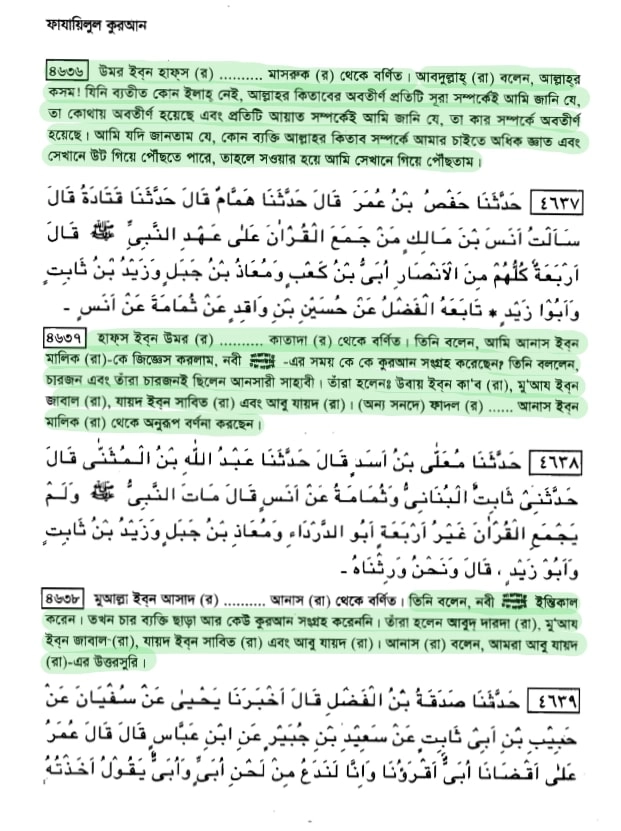
Another report in Bukhari mentions the number of surahs he learned directly. He stated that he took more than seventy surahs from the mouth of Muhammad. In the same statement, he distinguished his knowledge from moral superiority: he claimed to be more knowledgeable about the Book, but did not claim to be the best of all. Shaqiq reports that he did not hear any opposition to this claim of knowledge in the gatherings present. [673]
خَطَبَنَا عَبْدُ اللَّهِ فَقَالَ وَاللَّهِ لَقَدْ أَخَذْتُ مِنْ فِي رَسُولِ اللَّهِ صلى الله عليه وسلم بِضْعًا وَسَبْعِينَ سُورَةً، وَاللَّهِ لَقَدْ عَلِمَ أَصْحَابُ النَّبِيِّ صلى الله عليه وسلم أَنِّي مِنْ أَعْلَمِهِمْ بِكِتَابِ اللَّهِ وَمَا أَنَا بِخَيْرِهِمْ. قَالَ شَقِيقٌ فَجَلَسْتُ فِي الْحِلَقِ أَسْمَعُ مَا يَقُولُونَ فَمَا سَمِعْتُ رَادًّا يَقُولُ غَيْرَ ذَلِكَ
English translation: Abdullah delivered a speech before us saying: By Allah, I have taken more than seventy surahs from the mouth of the Messenger. By Allah, the companions of the Prophet know that I am one of the most knowledgeable among them regarding the Book of Allah; although I am not the best among them. Shaqiq said: Then I sat in the gatherings and heard their words; I did not hear anyone reject his statement by saying the opposite.
Against this backdrop, the language of his objection preserved in Tirmidhi becomes meaningful. He was removed from the work of writing the mushaf and someone was given the responsibility who was not born at the time of his conversion to Islam—by drawing this comparison, he claimed his priority. The statement is directed specifically at Zayd. Within the comparison of age, the real question is how effective the authority of a person who received direct instruction from the Prophet for a long duration was in the selection of the compiler. In his own statement, there is an allegation that this qualification was ignored. [674] [675] [674] [676] [677]
Zuhri (r) said: Ubaydullah ibn Abdullah ibn Utbah said that Hazrat Abdullah ibn Masud (ra) expressed dissatisfaction that the responsibility of copying the mushaf was given to Zayd ibn Thabit. He said: “O Muslim community!” I have been kept away from the work of recording the mushaf of the Quran and this responsibility has been borne by a person who, by Allah, when I embraced Islam, he was in the womb of a kaffir. (Saying this, he gestured towards Zayd ibn Thabit). Abdullah ibn Masud (ra) said: O people of Iraq! Hide the mushafs that you have.
Here the objection operates on two levels. One is the distribution of responsibility: he was kept away from the compilation work. The other is the authority of the reading: why should the reading he himself learned be subordinated to a reading prepared by another. If these two levels are reduced merely to personal pride, the substance of the statement is lost. Ibn Masud raised his claim based on three foundations: his early conversion to Islam, direct instruction from the Prophet, and long reading experience. The state decision did not accept those claims as final conditions for determining the approved mushaf.
In the speech preserved by Ibn Sa’d, his passion for the reading and the comparison with Zayd’s reading appear more extensively. In the report, after the order regarding the mushaf was issued, he brings up the matter of keeping it secret, then mentions his preferred reading and experience of direct learning. To the listeners in Kufa, this statement was the public position of an established teacher of the Quran. [678]
خطبنا عبد الله بن مسعود حين أمر في المصاحف بما أمر، قال: فذكر الغلول فقال: إنه من يغل يأت بما غل يوم القيامة، فغلوا المصاحف، فلأن أقرأ على قراءة من أحب أحب إلي من أن أقرأ على قراءة زيد بن ثابت، فوالذي لا إله غيره لقد أخذت من في رسول الله صلى الله عليه وسلم بضعا وسبعين سورة، وزيد بن ثابت غلام له ذؤابتان يلعب مع الغلمان، ثم قال: والذي لا إله غيره لو أعلم أحدا أعلم بكتاب الله مني تبلغه الإبل لأتيته. قال: ثم ذهب عبد الله. قال: فقال شقيق فقعدت في الحلق وفيهم أصحاب رسول الله صلى الله عليه وسلم وغيرهم فما سمعت أحدا رد عليه ما قال.
English translation: After the order regarding the mushafs was issued, Abdullah ibn Masud delivered a speech before us. Mentioning the matter of keeping them secret, he said: Whoever hides something will appear with it on the Day of Resurrection; therefore, keep the mushafs secret. To me, reciting according to the reading of the one I love is dearer than reciting according to the reading of Zayd ibn Thabit. By the Being besides whom there is no other god, I have taken more than seventy surahs from the mouth of the Messenger, when Zayd ibn Thabit was a boy with two braids, playing with other boys. Then he said: By the Being besides whom there is no other god, if I knew there was any person more knowledgeable about the Book of Allah than I and that a camel could reach there, I would have gone to him. Then Abdullah left. Shaqiq said: I sat in various gatherings; the companions of the Messenger and others were there. I did not hear anyone reject his statement.
The use of the word “reading” is central to Ibn Masud’s statement. He did not just claim his position; he raised the question of which reading to follow. To him, the instruction taken directly from the Prophet and the state’s decision on writing were not automatically identical authorities. On one hand, political power is fixing a written standard usable in the province, while on the other hand, a veteran teacher is rejecting the obligation to accept that standard. In this conflict, the words of the Quran are linked together with the teacher’s personal memory, his circle of disciples, and the future of his mushaf.
| The basis of Ibn Masud’s authority | Statements or events preserved in sources | Conflict with the state decision |
|---|---|---|
| Muhammad’s approved teacher | His name mentioned among four Quran teachers. | Being a recognized teacher did not ensure him the primary responsibility of compilation. |
| Direct recitation and instruction | Muhammad heard his recitation; he claimed to have learned more than seventy surahs directly. | He raised the question of following Zayd’s prepared standard instead of the reading he himself learned. |
| Knowledge regarding the circumstances of revelation | Claim of knowing the location or context of every surah and verse. | This knowledge of his did not receive final priority in the selection of the compiler. |
| Continuity of the established reading in Kufa | Public speech after the order regarding the mushaf. | Resistance was created against subordinating his reading and mushaf to the central decision. |
This conflict between a reader from the era of direct revelation and a later compiler shatters the image of “universal spontaneous recognition.” If the opposing person is removed, the description of consensus becomes easy, but he is present in the reports. The testimony of his qualification and the testimony of his objection are found within the same Islamic preservation system. The tradition that preserved the instruction to learn the Quran from him also preserved his protest against the state reading policy. It is only by erasing this conflict that a story of selection-less, conflict-less compilation can be created.
Ibn Masud’s call to keep the mushaf secret and opposition to state unification
Ibn Masud’s protest speech did not stop at merely expressing dissatisfaction. In Tirmidhi’s report, he told the people of Iraq to keep the mushafs they possessed secret. In the face of an initiative to collect and destroy documents by central order, the call to hide such a document is effectively a call for disobedience. Its political significance is also direct: based on his own religious authority, he is telling his disciples to take a stand against the ruler’s selected mushaf policy. [679] [680] [681] [682]
وَلِذَلِكَ قَالَ عَبْدُ اللَّهِ بْنُ مَسْعُودٍ يَا أَهْلَ الْعِرَاقِ اكْتُمُوا الْمَصَاحِفَ الَّتِي عِنْدَكُمْ وَغُلُّوهَا فَإِنَّ اللَّهَ يَقُولُ : وَمَنْ يَغْلُلْ يَأْتِ بِمَا غَلَّ يَوْمَ الْقِيَامَةِ فَالْقُوا اللَّهَ بِالْمَصَاحِفِ . قَالَ الزُّهْرِيُّ فَبَلَغَنِي أَنَّ ذَلِكَ كَرِهَهُ مِنْ مَقَالَةِ ابْنِ مَسْعُودٍ رِجَالٌ مِنْ أَفَاضِلِ أَصْحَابِ النَّبِيِّ صلى الله عليه وسلم
English translation: For this reason, Abdullah ibn Masud said: O people of Iraq, keep the mushafs you have secret and hide them. Allah says: Whoever embezzles something secretly will appear with it on the Day of Resurrection. Therefore, meet Allah with the mushafs. Zuhri said: News reached me that some of the prominent companions of the Prophet disliked this statement of Ibn Masud.
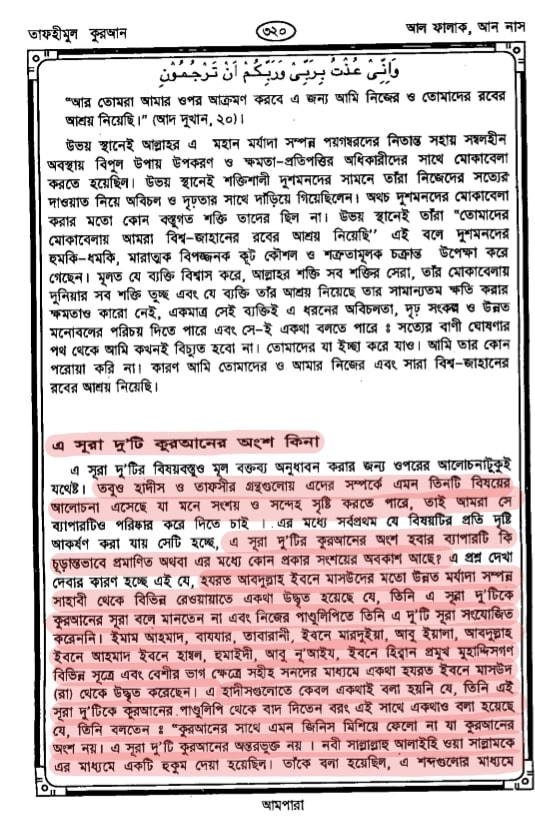
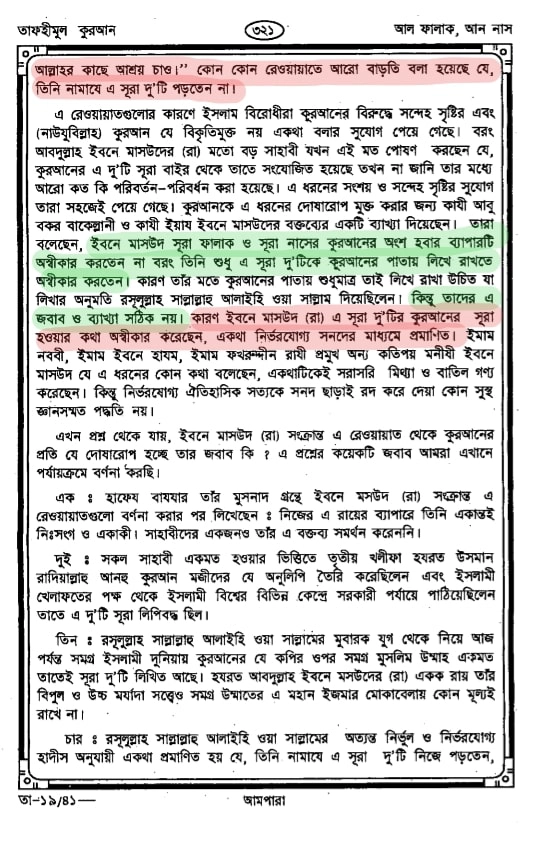
Ibn Masud did not let the act of keeping it secret turn into moral shame. He used the warning in verse 3:161 of the Quran about appearing on the Day of Resurrection with embezzled objects as a call to protect the mushaf: go before Allah with the mushaf. In this usage, instead of the book not submitted to the state becoming a burden of religious crime, it became a sign of clinging to the Quran learned by one’s own hand. The claim of political loyalty and the claim of religious preservation are not working in the same direction here. By bringing the second forward, he showed a way to disobey the first.
In Ibn Abi Dawud’s Kitab al-Masahif, the same conflict is preserved through multiple sources. In one report, after the order regarding the mushaf became unpleasant to him, the instruction to keep the mushaf secret by one’s own hand and the question of abandoning the reading taken from the mouth of the Prophet appear side by side. There, the language of protecting his own instruction is very direct. [683] [684] [685]
I received seventy surahs directly from the Messenger of Allah (saw) when Zayd bin Thabit was still a child—now shall I abandon that which I received directly from the Messenger of Allah?”
Another report mentions a face-to-face exchange between Hudhayfa and Ibn Masud. Hudhayfa expresses his resolve to go to the Caliph to remove the separate reading-identities of Kufa and Basra; Ibn Masud shows a strong reaction against it. In this account, the difference of opinion is not about the mistakes of a few later copyists. The subject of discussion is the written and oral continuity of regional societies following well-known primary readers. [686]
قال حذيفة: يقول أهل الكوفة: قراءة عبد الله، ويقول أهل البصرة: قراءة أبي موسى، والله لئن قدمت على أمير المؤمنين لأمرته أن يغرقها، قال: فقال عبد الله: أما والله لئن فعلت ليغرقنك الله في غير ماء.
English translation: Hudhayfa said: The people of Kufa say the reading of Abdullah, and the people of Basra say the reading of Abu Musa. By Allah, when I go to the Commander of the Faithful, I will tell him to drown these. The narrator said: Abdullah said, By Allah, if you do that, Allah will drown you without water.
“The reading of Abdullah” and “the reading of Abu Musa”—these names are the social identities of reading-instruction of that time. A teacher is not merely the owner of a book; there is a tradition associated with the people who learned from him, the pronunciation and words he taught, and his copies. The proposal to drown or erase the book of that tradition is an interference with his instruction. Ibn Masud’s reaction shows that not everyone accepted the central unification as the natural continuity of the reading they had learned. There was a real reason for resistance in subordinating the authority of a known teacher to the standard selected by the Caliph.
Published in Bengali Abdullah ibn Masud and His Fiqh in the book, there are also descriptions of his refusal to surrender the mushaf, his educational priority, and the conflict with Uthman’s envoys. The book describes Ibn Masud’s position as rational and mentions that a compromise was reached at the end. [687]
Among the noble Companions who compiled the Quran during the era of the Messenger of Allah (pbuh), Hazrat Ibn Masud (ra) was one of them. He learned most of the verses of the Holy Quran directly from the Prophet (pbuh) and felt proud of this. Undoubtedly, this pride of his was justified. Countless disciples took the reading of the Holy Quran compiled by him. Among them, the names of Al-qama, Aswad, Masruq, Zurur ibn Hubaysh, Zayd bin Abi Wahab, Abu Amr Shaibani, and Abu Abdur Rahman al-Ashjami are notable. During his caliphate, Hazrat Uthman (ra) noticed that reading different copies of the Holy Quran compiled in various ways was creating chaos among the people; therefore, an immediate remedy was necessary. Consequently, after consultation, he decided that the compilation of the Holy Quran jointly produced by Hazrat Abu Bakr (ra) and Umar Faruq (ra) would be disseminated across the various provinces of the country, and all remaining compilations would be destroyed. Hazrat Ibn Masud (ra) could not agree with the Caliph on this matter. Thus, he refused to surrender the compilation of the Quran he had produced with his own hand during the era of the Holy Prophet (pbuh) to the Caliph. He could not even maintain full courtesy with the envoys sent by Hazrat Uthman (ra). This caused resentment in the mind of Hazrat Uthman (ra). However, in the end, a resolution was reached. It should be noted that this refusal of Hazrat Ibn Masud was not entirely irrational. For his own compiled copy of the Quran had been written during the lifetime of the Noble Messenger (pbuh). Moreover, in the compilation of the Holy Quran produced by Hazrat Abu Bakr Siddiq (ra) during his caliphate, the role of Hazrat Zayd bin Thabit (ra) was primary. While Hazrat Ibn Masud (ra) was receiving training in the Holy Quran in the company of the Messenger (pbuh), Hazrat Zayd bin Thabit (ra) spent his days playing with peers who were merely children. 1 No one else possessed the depth of Quranic knowledge that Hazrat Ibn Masud (ra) had. This has been mentioned repeatedly before. Later noble scholars say regarding him,
من كبار اصحاب رسول الله صلى الله عليه وسلم ومتقدمه وسادات فقهائهم –
Hazrat Ibn Masud (ra) was one of the elderly and early-era Companions. He was one of the primary Companions among the jurists and legal experts. Regarding his experience with the Quran, the Messenger of Allah (pbuh) himself stated
that, من اراد ان يسمع القرآن غضا كما انزل فليقرأ على قراءة ابن ام عبد
whoever wishes to recite the Holy Quran exactly as it is, in a correct and fluent manner, should follow the recitation of Ibn Umm Abd.
After receiving this Prophetic certification, the aforementioned disagreement of the glorified Ibn Masud (ra) cannot be viewed as tainted; rather, it was justified and reasonable. The allegation that he did not bow his head and accept the order of the Commander of the Faithful without hesitation would be entirely baseless. This does not diminish his status in the slightest. Given the high peak of knowledge and learning he occupied, it was desirable for him to think deeply about the future consequences of obeying the Caliph’s order.
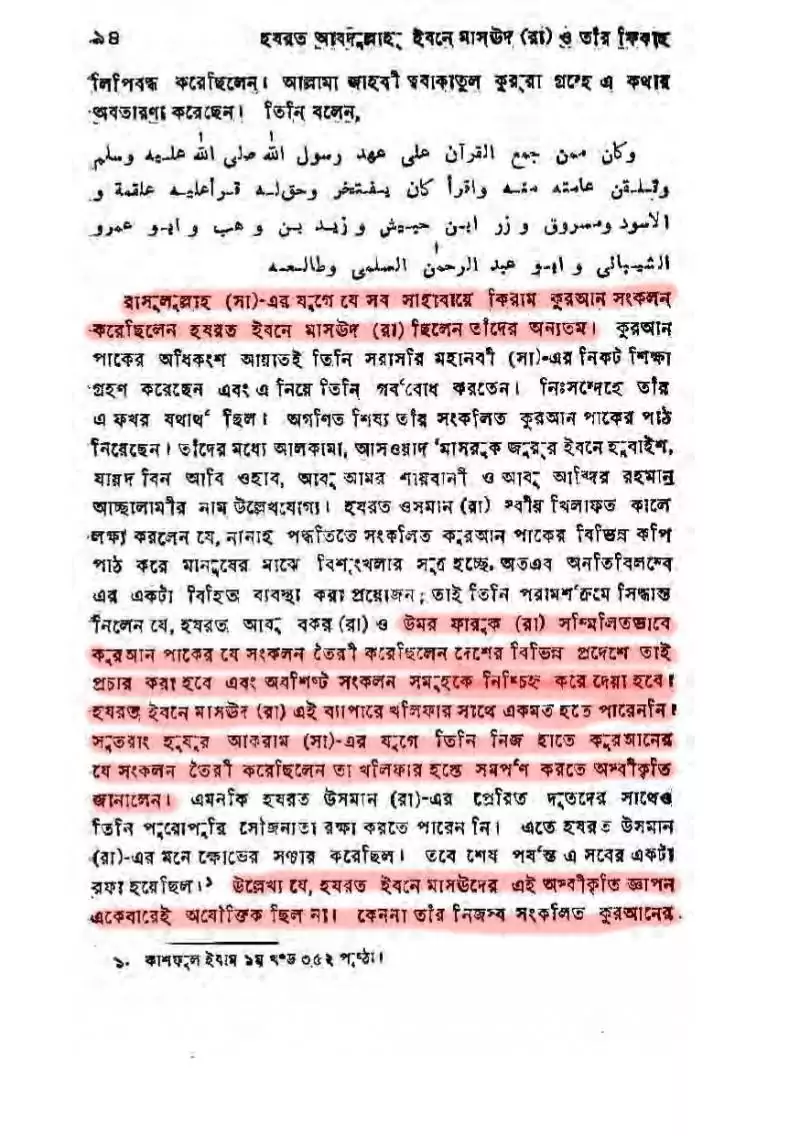
The history of initial conflict is not erased by the description of later acceptance. Ibn Abi Dawud has included a report in his book under the title “The Satisfaction of Ibn Masud.” There, in front of people who came to him in fear, he speaks of the revelation of the Quran in seven ahruf. [688]
عن فلفلة الجعفي، قال: فزعت فيمن فزع إلى عبد الله في المصاحف، فدخلنا عليه، فقال رجل من القوم: إنا لم نأتك زائرين، ولكنا جئنا حين راعنا هذا الخبر، فقال: إن القرآن أنزل على نبيكم من سبعة أبواب على سبعة أحرف، أو حروف، وإن الكتاب قبلكم كان ينزل، أو نزل من باب واحد على حرف واحد
English translation: Fulfula al-Ju’fi says: I went along with those who had gone to Abdullah, concerned about the mushaf. When we entered his presence, one person said: We have not come merely to meet; we have come because this news has terrified us. He said: The Quran was revealed to your Prophet through seven doors in seven ahruf; whereas your previous book was revealed through one door in one harf.
The statement of the report is an endorsement of the seven ahruf. In this, there is no announcement of throwing his own mushaf into the fire, no admission of any specific reading being wrong, or a sentence withdrawing the previous order to keep it secret. The chapter title of the author expresses his interpretation; the specific information of the quoted words is that Ibn Masud spoke of the endorsement of multiple readings to the anxious listeners. Consequently, if the discussion of his final position and the testimony of his first protest are merged, the difference in time is also erased. Initially, there was objection and resistance to the state order—this is the explicit content of the relevant reports.
| Reaction | Actions or statements found in sources | Meaning in conflict of authority |
|---|---|---|
| Protest against being omitted from the compilation | Allegation of appointing Zayd after removing [others] from responsibility. | Educational priority versus state distribution of responsibility. |
| Call to keep the mushaf secret | Telling the people of Iraq to hide their own mushafs. | Call to stop the practical application of the destruction policy. |
| Application of Quranic verses | Language of appearing on the Day of Judgment with the mushaf. | Constructing religious legitimacy in favor of disobeying political orders. |
| Reactions of other prominent Companions | News of his statements being disliked by Zuhri. | There was no single position even among the top religious authorities. |
| Report under the title ‘Satisfaction’ | Telling anxious listeners about the revelation in seven ahruf. | The interpretation of the chapter title and the scope of specific words in the report are distinct. |
The news of other Companions’ dissatisfaction reaching Zuhri and the account of not hearing opposition in a specific gathering of Shaqiq are testimonies of different assemblies and reactions. None of these are a list of every person’s vote. But in both accounts, there is the public position of Ibn Masud and a society that hears and evaluates his statements. Just as the reality of the Caliph’s order is clear, so is the resistance of a primary teacher of the Quran against that order. If this resistance is erased in the name of consensus, the historical testimony is changed.
Collection and destruction of Marwan’s sahifa after the death of Hafsa
The importance of the sahifa held by Hafsa was in its identity as a source document. The collection prepared during Abu Bakr’s time was with her after Umar; Uthman had taken it to prepare copies and then returned it. Consequently, even after the destruction of other mushafs, such a written collection remained, whose identity was linked to the stage prior to the Uthmani copies. This document became particularly important for comparison with the claim being made about the accuracy of the copies. It remained in separate custody even after the official copies became prevalent. After the death of Hafsa, that custody broke.
Ibn Hajar quoted the account of Salim ibn Abdullah through Abu Ubayd and Ibn Abi Dawud. While he was the governor of Medina, Marwan wanted the sahifas; Hafsa refused to give them. After her death, upon returning from the burial, Marwan sent a strict order to Abdullah ibn Umar and took them. In the report, there is also Marwan’s own explanation after tearing the sahifas. [689] [690] [691]
كان مروان يرسل إلى حفصة – يعني حين كان أمير المدينة من جهة معاوية – يسألها الصحف التي كتب منها القرآن فتأبى أن تعطيه، قال سالم: فلما توفيت حفصة ورجعنا من دفنها أرسل مروان بالعزيمة إلى عبد الله بن عمر ليرسلن إليه تلك الصحف، فأرسل بها إليه عبد الله بن عمر، فأمر بها مروان فشققت وقال: إنما فعلت هذا لأني خشيت إن طال بالناس زمان أن يرتاب في شأن هذه الصحف مرتاب.
English translation: Marwan—that is, while he was the governor of Medina on behalf of Muawiyah—sent people to Hafsa to ask for those sahifas from which the Quran had been written; but she refused to give them. Salim says: When Hafsa died and we returned from burying her, Marwan sent a firm order to Abdullah ibn Umar that he must send those sahifas. Abdullah ibn Umar sent them. By Marwan’s order, they were torn up. He said: I did this only for fear that, after a long time, some doubter might raise a doubt regarding these sahifas.
Hafsa’s refusal cannot be called insignificant. While the sahifa was with her, Marwan’s request was not fulfilled. After her death, the balance of power changed: the one who had refused to give it was no longer there; the document was taken by sending an order to her brother. The relationship between personal custody and administrative power is inherent within the event. The decision to destroy the source document was not Hafsa’s; the subsequent ruler implemented that decision by bypassing her refusal.
The event is also quoted in IslamQA through Fath al-Bari. There, it is mentioned that the sahifa was torn up for fear of any discrepancy with Uthman’s copies. “Fear of discrepancy” is the specific language of this version; in another account of Salim, there is fear of doubts arising after a long time. In both versions, the fear of future conflict is linked to the destruction. [692]
فَلَمَّا تُوُفِّيَتْ حَفْصَةُ، أَرْسَلَ مَرْوَانُ إِلَى عَبْدِ اللَّهِ بْنِ عُمَرَ سَاعَةَ رَجَعُوا مِنْ جَنَازَةِ حَفْصَةَ، بِعَزِيمَةٍ: لَيُرْسِلَنَّهَا، فَأَرْسَلَ بِهَا عَبْدُ اللَّهِ بْنُ عُمَرَ إِلَى مَرْوَانَ، فَمَزَّقَهَا؛ مَخَافَةَ أَنْ يَكُونَ فِي شَيْءٍ مِنْ ذَلِكَ خِلَافٌ لِمَا نَسَخَ عُثْمَانُ
English translation: When Hafsa died, immediately upon returning from her funeral, Marwan sent a firm order to Abdullah ibn Umar: he must send them. Abdullah ibn Umar sent them to Marwan. Marwan tore them up for fear that there might be any difference in any matter from what Uthman had copied.
This reason reveals the political position of the document. Even if the Uthmani copies were established, the previous written collection could have been a basis for allegations or doubts regarding different readings. The fear was not resolved through open comparison by keeping it. The document itself was removed. What the difference actually was, how much it was, and whether it was on any matter at all—instead of these, what is directly in the report is the possibility of questions arising in the future with the old sahifa present. Destruction was chosen as the way to close that possibility.
In Ibn Hajar’s discussion, multiple words are found regarding the method of destruction. In Shuayb’s report, it is tearing; in Yunus’s report, it is tearing and burning; and in other accounts, it is washing away the writing. Ibn Hajar has proposed a possible sequence by combining these. His proposal to combine them is the interpreter’s conjecture; the specific words of each relevant report are distinct. [693]
قلت: قد أخرجه ابن أبي داود من طريق يونس بن يزيد عن ابن شهاب نحوه وفيه: فلما كان مروان أمير المدينة أرسل إلى حفصة يسألها الصحف، فمنعته إياها، قال: فحدثني سالم بن عبد الله قال: لما توفيت حفصة، فذكره وقال فيه: فشققها وحرقها.
English translation: I say: Ibn Abi Dawud has brought a similar report from Ibn Shihab through Yunus ibn Yazid. In it, it says: When Marwan became the governor of Medina, he sent people to Hafsa asking for the sahifa; she did not give them to him. The narrator says: Salim ibn Abdullah told me, when Hafsa died—then he mentioned the event and said: He tore them up and burned them.
| Stage | Condition of the sahifa | Use of authority |
|---|---|---|
| After the preparation of Uthman’s copies | The source-sahifa returns to Hafsa. | The previous collection remains in separate custody alongside the state copies. |
| Marwan’s claim during Hafsa’s lifetime | Hafsa refuses to give the sahifa. | The ruler’s will had not yet succeeded in the transfer of the document. |
| After the death of Hafsa | The document is requested via a firm order to Abdullah ibn Umar. | The barrier of previous custody is overcome after death. |
| After receiving the sahifa | Description of destruction in the language of tearing, burning, or erasing. | The potential source for independent comparison is removed. |
| Marwan’s stated reason | Fear of future doubt or conflict regarding discrepancy with the copies. | The authority of the established reading is secured by removing the basis for questioning. |
The approval of copies during Uthman’s time and the elimination of the source during Marwan’s time are two separate decisions. In the first, a specific copy became the official standard; in the second, the old document comparable to it no longer had the opportunity to be used. The social function of this second decision was to remove a basis for potential questions against the established standard. This result follows from the relationship between Marwan’s stated fear and the method he chose. For him, preventing future disagreement became more important than the historical value of the sahifa.
Hafsa’s refusal to keep the source-sahifa and Marwan’s eagerness to destroy it are not expressions of the same attitude toward preservation. The document survived in one person’s hand; by the other’s order, it no longer remained. After giving special status to Abu Bakr’s collection, destroying the components of that collection creates a severe inconsistency: the authority of the collection is being used, but its independent testimony is not being maintained. The subsequent generation has to rely on the approved copies, without the opportunity to verify them by holding the alleged source of those copies.
Reports of allegations of “changing the book,” anti-Uthman conflict, and his assassination
The link between the policy of destroying mushafs and anti-Uthman political anger is found in ancient texts. In Ibn Abi Dawud’s Kitab al-Masahif, there is a description of the allegations of the Egyptians stationed at Zuhfa. There, the allegation of “erasing the book of Allah” appears alongside allegations of nepotism, reserved grazing lands, giving money to Marwan, and behavior toward the Companions. The decision regarding the Quran is not isolated from the broader conflict of governance in this report; it is a specific part of the opponents’ set of allegations. [694]
فقال: ما الذي نقمتم؟ قالوا: نقمنا أنه محا كتاب الله عز وجل، وحمى الحمى، واستعمل أقرباءه، وأعطى مروان مائتي ألف، وتناول أصحاب النبي صلى الله عليه وسلم. فرد عليهم عثمان رضي الله عنه: أما القرآن فمن عند الله، إنما نهيتكم لأني خفت عليكم الاختلاف، فاقرءوا على أي حرف شئتم، وأما الحمى فوالله ما حميته لإبلي، ولا غنمي، وإنما حميته لإبل الصدقة وتصلح وتكون أكثر ثمنا للمسلمين، وأما قولكم: إني أعطيت مروان مائتي ألف، فهذا بيت مالهم فليستعملوا عليه من أحبوا، وأما قولكم: تناول أصحاب النبي صلى الله عليه وسلم، فإنما أنا بشر أغضب وأرضى، فمن ادعى قبلي حقا أو مظلمة فهذا أنا، فإن شاء قود، وإن شاء عفو، وإن شاء أرضى، فرضي الناس واصطلحوا ودخلوا المدينة، وكتب بذلك إلى أهل البصرة وأهل الكوفة، فمن لم يستطع أن يجيء فليوكل وكيلا.
English translation: He asked: What is your complaint? They replied: Our complaint is that he has erased the Book of Allah, reserved the grazing lands, appointed relatives, gave two hundred thousand to Marwan, and mistreated the Companions of the Prophet. Uthman replied to them: The Quran has come from Allah. I forbade you only for fear of disagreement among you; you may recite in whichever harf you wish. As for the grazing lands, by Allah, I did not reserve them for my own camels or sheep; I did so for the camels of sadaqah, so that they might thrive and fetch a higher price for the Muslims. You said I gave two hundred thousand to Marwan; here is their Bayt al-Mal, let them appoint whoever they wish to its charge. And regarding your complaint about the treatment of the Prophet’s Companions: I am human; I experience both anger and satisfaction. If anyone claims a right against me or alleges oppression, I am present; they may take revenge, forgive, or receive satisfactory redress from me. Thereafter, the people were satisfied, reached an agreement, and entered Medina. This was also communicated in writing to the people of Basra and Kufa; whoever could not come was to appoint a representative.
In this account, in response to the allegation of erasing the Book, Uthman mentioned the purpose of preventing disagreement. Consequently, the dispute was not limited merely to the question of “how a book is to be honorably destroyed.” The question of by what authority the practice of reading was limited also entered the discussion of the ruler’s legitimacy. The fact that the complaints included matters of money and appointments means the context of the scripture was not absent; rather, administrative and religious objections against the decisions of the same ruler had converged.
In the account of the assassination in Ibn Kathir’s Al-Bidaya wan Nihaya, more intense language is found. Through the source of Ibn Asakir, he records the allegation “You have changed the Book of Allah” in the mouth of Muhammad ibn Abu Bakr against Uthman. Muhammad ibn Abu Bakr is the son of the first caliph, Abu Bakr. In this conversation, instead of allegiance, he is challenging the religious authority of the caliph. In Uthman’s response, the Book is presented as the basis for the judgment between them. [695] [696] [697] [698]
فَقَالَ: غَيَّرْتَ كِتَابَ اللَّهِ، فَقَالَ: كِتَابُ اللَّهِ بَيْنِي وَبَيْنَكُمْ
English translation: He said, you have changed the Book of Allah. Uthman said, the Book of Allah is the judge between me and you.
Both the wording of the allegation and the political moment in which the accuser speaks are significant. “Changing the Book” is a serious religious allegation; in the quoted conversation, no list of which word of which verse was changed is provided. His political objective is clear: rather than recognizing the caliph as the faithful guardian of the scripture, he is accusing him of deviation from the Book. When this language is placed alongside Ibn Masud’s direct resistance regarding the mushaf and the Egyptians’ allegation of “erasing,” a broad field of actual conflict over the authority of the Quran is revealed.
In the accounts of the demands during the caliph’s final moments, three possibilities emerged: resignation, qisas, and death. Uthman refused to relinquish the caliphate, describing it as a garment put on him by Allah. Here, his argument in favor of the state position is also religious. The opponents are holding him accountable; he links his retention of the position to divine approval. The account Ibn Kathir provides through Khalifa ibn Khayyat is: [699] [700]
Account of the killing of Uthman (ra)
Khalifa ibn Khayyat narrates through Wassab: Uthman (ra) sent me to call Ashtar for him. He asked, ‘What do the people want?’ He replied: ‘There is no way out except by accepting one of three things.’ He asked: What are those three things? (Ashtar) said: They give you the choice that you relinquish your responsibility and entrust it to them. You declare: The matter is yours, you may choose whoever you wish. You may also present yourself for qisas, meaning revenge. Otherwise, the people will fight you. Then he said, I will not entrust the leadership to them as they are asking. Because, Allah the Almighty
has clothed me in a garment that I cannot take off. And I swear by Allah regarding the acceptance of qisas from them: if you kill me, you will never love one another after me, you will not be able to perform prayer together, and you will not be able to fight the enemy together.’
The narrator says, a short man like a wolf peeked through the door and returned. Muhammad, the son of Hazrat Abu Bakr, arrived with thirteen men and pulled his beard, as a result of which I could hear the sound of his molars. He (Muhammad) said, Mu’awiya did not help you, Ibn Amir did not help you, nor did your letters help you. The caliph said: ‘Nephew, let go of my beard.’ The narrator says, I saw that he sought help with a gesture of his eyes from one of the present persons. The man stepped forward with a heavy arrowhead and struck his head.
I asked, what happened then? He said, one by one they all attacked and killed him. 1
In this account, Muhammad ibn Abu Bakr enters with companions and insults Uthman by pulling his beard. Regarding who dealt the direct blow in the killing, Ibn Kathir has preserved different accounts consecutively. In the account from the source of Sayf ibn Umar, Muhammad first intended to attack but later stepped back; in the source of Ibn Asakir, there is a description of his presence along with the allegation of changing the Book. The statements of these accounts and Ibn Kathir’s own selected conclusion are as follows: [701]
Sayf ibn Umar Tamimi (r) through the source of Isa ibn Qasim, through the freed slave of Usama ibn Zayd, Khansa—[and this Khansa stayed with Naila bint Farafisa, the wife of Uthman (ra)]. She narrates: (At the time of the attack) he was in the house. At this time, Muhammad ibn Abu Bakr (ra) entered the house and was about to strike his neck with a heavy arrowhead he had with him, then Uthman (ra) said: ‘Nephew, stop, by Allah! You have placed your hand where even your father would not have placed his.’ He became ashamed, let go of the beard, and stood apart. The people of the house faced him and there was a long argument. The people prevailed and they entered the house, and Muhammad ibn Abu Bakr left the house. Then a man approached him, in whose hand was a date palm branch. Standing at the front of the people, he went and stood by the head of Uthman (ra) and struck his head with the branch, making him bleed. Splashes of blood fell upon the Quran Majeed and stained it. Then they struck him with swords. Another man stepped forward and struck his chest with a sword. The wife Naila bint Farafisa al-Qalbiya was also injured and screaming, fell upon the caliph. She continued to scream: O daughter of Shayba! Shall the Amir al-Mu’minin be killed? Saying this, when she took a sword in hand, the man struck her hand (according to the accounts of Tarikh al-Tabari and Tarikh al-Kamil, Naila’s fingers were cut). The terrorists also looted the furniture of the house. At this time, as a certain person passed by Uthman (ra), seeing his head resting upon the Quran Majeed, he would stomp on it, saying:
‘I have never seen such a beautiful face of a kafir as today, nor have I seen such an honorable bed of a kafir as today.’ The narrator says: By Allah, the terrorists left nothing in the house, they even
took away the water bowl.
And Hafiz Ibn Asakir narrates that Uthman (ra) firmly ordered all members of the house to leave, so that no one but his family was there. At this time, the terrorists entered by climbing the walls and setting fire to the door. Among them, no Companion
was present; not even any child of a Companion. Among the children of the Companions, only Muhammad ibn Abu Bakr (ra) was present. One of them stepped forward and beat him until he fell unconscious. The women began to scream. Then they dispersed and left the house. At this time, thinking the caliph had been killed, Muhammad ibn Abu Bakr entered the house. When he saw that the caliph had regained consciousness, he said:
O foolish old man! Which religion do you follow? He replied, ‘I follow Islam; however, I am not a foolish old man; rather, I am the Amir al-Mu’minin’. Ibn Abu Bakr said: ‘You have made changes in the Kitabullah.’ The caliph said: ‘The Book of Allah is the judge between me and you.’ Ibn Abu Bakr stepped forward and said:
‘On the Day of Resurrection, if we say— “O our Lord! We obeyed our leaders and they misled us” then our word will not be accepted. (Surah Al-Ahzab 33: verse 67). Saying this, he dragged the caliph to the door of the house. Then the caliph was saying:
‘O nephew! Your father could not have held my beard!’ A man from the Kinda tribe among the Egyptians arrived, whose nickname was ‘Donkey’. And his kunyat or epithet was Abu Roman. According to Qatada, the man’s name was Roman; according to others, he was blue-eyed with reddish-golden hair. Some say the man’s name was Sudan ibn Roman al-Muradi. It is narrated through Ibn Umar. He says, the person who killed Caliph Uthman (ra) was named Aswad ibn Humran. He struck him with a spear, and he also had an unsheathed sword in his hand. He says, the man returned and pierced his chest with a spear and placed the edge of the sword in his stomach, ending his life. The wife Naila was near. When she stepped forward to obstruct, her fingers were cut. It is also narrated that when Muhammad ibn Abu Bakr threw an arrowhead, it pierced the caliph’s neck. The truth is that the killer was someone else; not Muhammad ibn Abu Bakr. ‘You have held the beard of a person whom your father used to respect.’ When the caliph said this, he became ashamed and returned. Then he covered his face and moved away. However, this brought him no benefit. Allah’s will is certain. And this was written in the Book of Allah.
In the accounts collected by Ibn Kathir, there are differences regarding the name of the killer, the type of blow, and the role of Muhammad ibn Abu Bakr. His own preferred conclusion is that the final killer was not Muhammad. Another account showing him as an attacker is also kept in the same book, about which the author has said “extremely obscure” and “there are inconsistencies.” If his selected conclusion and all the stories he compiled are merged, the internal differences of the book are lost. Muhammad’s presence in the political conflict, the language of the allegation, and the direct responsibility for the killing are described as three separate matters.
The incident of the letter involved in the assassination also shows the relationship between religious language and state violence. In Ibn Kathir’s account, the letter sent to the governor of Egypt contained instructions to kill, impale, and cut off the hands and feet of the opponents. He describes the letter as being written by Marwan and mentions the application of verse 33 of Surah Al-Ma’idah in its favor. Uthman himself denied writing or knowing about that letter. In the relevant account, this stage of the allegation exists: [702]
When another Ansari man went to him, he said exactly the same thing to him. Then when Muhammad ibn Abu Bakr entered, he said to him: You are my killer. He said: ‘O incompetent old man, how did you know?’ The caliph said:
‘On the seventh day of birth, when you were presented in the service of the Messenger of Allah for tahnik and prayer, you defecated in the lap of the Messenger of Allah.’ The narrator says: Then he climbed on his chest, held his beard, and pierced the arrowhead in his hand into the chest of Uthman (ra). This account is extremely obscure and contains inconsistencies. It has been proven through multiple sources that the splashes of blood from his body were upon the
word of Allah:
فَسَيَكْفِيكَهُمُ اللَّهُ وَهُوَ السَّمِيعُ الْعَلِيمُ
Allah will be sufficient for you against them. And He is the All-Hearing, the All-Knowing (Surah Baqarah 2: Ayah 137). This ayah is where it falls. It is also narrated that when the assassins reached Uthman (ra), he had reached this ayah while reciting the Quran Majeed. And this is not impossible, as he was reciting the Quran Majeed at that time.
Ibn Asakir narrates that Uthman (ra), while wounded, said: Bismillah, tawakkaltu Allah. When blood flowed, he said: Subhanallahil Azeem. Ibn Jarir Tabari mentions in his history book through various isnads that the Egyptians found a messenger sent in the name of the governor of Egypt; in this letter, there were orders to kill some of them, crucify some, and amputate the hands and feet of others. And Marwan ibn al-Hakam wrote this letter in the name of Uthman (ra), and the following ayah of the Quran Majeed is presented as the justification for this:
إِنَّمَا جَزَاؤُ الَّذِينَ يُحَارِبُونَ اللهَ وَرَسُولَهُ وَيَسْعَوْنَ فِي الْأَرْضِ فَسَادًا أَنْ يُقَتَّلُوا أَوْ يُصَلَّبُوا أَوْ تُقَطَّعَ أَيْدِيهِمْ وَأَرْجُلُهُمْ مِّنْ خِلافٍ أَوْ يُنْفَوْا مِنَ الْأَرْضِ ذَلِكَ لَهُمْ خِزْيٌ فِي الدُّنْيَا وَ لَهُمْ فِي الْآخِرَةِ عَذَابٌ عَظِيمٌ
Those who wage war against Allah and His Messenger and strive to spread mischief on earth—their punishment is that they be killed, or crucified, or their hands and feet be cut off from opposite sides, or they be exiled from the land. This is their disgrace in this world, and in the Hereafter there is for them a great punishment (Surah Ma’idah 5; Ayah 33).
According to Marwan ibn al-Hakam, all those rebelling against Uthman (ra) were mischief-makers on earth. Undoubtedly they were such; but it was not proper for him to have such a letter written in his name without informing Uthman (ra). Furthermore, after a treaty had been reached between Uthman and the Egyptians regarding the appointment of Muhammad ibn Abu Bakr as the governor of Egypt, it was not proper to send orders completely opposite to that by forging his writing and seal and sending his slave on his camel. Seeing words contrary to the previous agreement in this letter, the Egyptians, believing it to be Uthman’s letter, became severely enraged. They returned to Medina with their grievances and began showing the letter before the Companions. Other people also assisted them; some Companions even believed it was done by Uthman’s order. When Uthman was questioned about the letter in the presence of a group of senior Companions and the Egyptians, he swore by Almighty Allah that he did not write this letter, did not ask anyone to write it, and knew nothing about it. They said, “But your seal is on it.” He replied, “The writing and seal of a person can be forged.” They said, “It was found with your slave, on your camel.” He replied, “By Allah, I knew nothing of this.” After every answer, they said, “If you wrote it, you have betrayed; and if you did not write it, it was written in your name without your knowledge—then you are incompetent. Whether it be your betrayal or your incompetence, a person like you is not fit for the Caliphate.”
In this account, the same Quran is used for both political loyalty and political punishment. The opponents bring the Book forward to accuse the ruler; in the explanation of Marwan’s letter, the provision for corporal punishment is applied by labeling the opponents as “mischief-makers on earth.” The language of the scripture provides legitimacy for both the accusations against the ruler and the potential punishment from the ruler. Consequently, the question of power surrounding the Quran is not just a question of the spelling or vowel marks of its copies; it is also linked to the question of whose interpretation will be the order of governance and who will have to suffer its punishment.
While refuting the allegations regarding the letter, Ibn Kathir further stated that even if Uthman himself had written the letter, he might have done so seeing the benefit in removing the power of the rebels. This is the author’s moral-political evaluation. The potential punishments he describes are killing, crucifixion, and amputation; and the argument of benefit is applied on behalf of the ruler in favor of such punishment. This logic of approving terrible penalties also reveals the bias of the religious historian: the possibility of the ruler’s severe punishment is legitimized for the sake of the Ummah, while the opponents’ allegations are identified as unjust from the start. [703]
وهذا الذي قالوا باطل على كل تقدير، فإنه لو فرض أنه كتب الكتاب – وهو لم يكتبه في نفس الأمر – لا يضره ذلك؛ لأنه قد يكون رأى ذلك مصلحة للأمة في إزالة شوكة هؤلاء البغاة الخارجين على الإمام
English translation: Whatever they have said is void in all circumstances. For suppose he had written the letter—though in reality he did not—it would not cause him any harm; for he might see the benefit for the Ummah in removing the power of these rebels who are rebelling against the ruler.
| Subject of the account | Information preserved in the source | Nature of the conflict |
|---|---|---|
| Dispute over the mushaf | Allegation of “erasing the Book of Allah” in Kitab al-Masahif. | Decisions regarding the scripture became part of political anger. |
| Allegation of changing the Book | Statement of Muhammad ibn Abu Bakr through Ibn Asakir. | Language rejecting the religious legitimacy of the Caliph has been used. |
| Demand for resignation | Relinquishing the Caliphate as an alternative to qisas or war. | Direct conflict over the accountability of governing power. |
| Specific responsibility for the killing | Differences in the names and roles of individuals across multiple accounts. | Mutually different sequences of events are preserved in the same compiled history. |
| Allegations of the letter and punishment | Account of orders for killing, crucifixion, and amputation. | Legitimacy has been claimed to suppress opponents using the provisions of the Quran. |
| Evaluation of the religious historian | Ibn Kathir supported even the ruler’s potentially severe letter using the logic of benefit. | The historian’s political bias is also present within the narration of events. |
There are also accounts of conflict regarding the burial of Uthman’s body after death. Ibn Kathir has collected the various prevailing accounts regarding the date of killing, age, delay in burial, the imam of the funeral prayer, and the burial site. As the famous opinion, he mentions 18 Zilhaj of 35 Hijri. The subsequent section also contains accounts of obstacles to the burial and attacks on the corpse. A horrific picture of how far the fall of the ruler’s authority had gone is found in these accounts. [699] [704]
According to the famous opinion, the duration of the siege of his house was forty days. Some have said slightly more than forty days, and Sha’bi said twenty-two nights. According to the famous opinion, he was killed on Friday, 18 Zilhaj. Some said it was during the days of Tashriq. Again, according to some, he was killed on Yawm al-Nahr, that is, the day of sacrifice. The historian Ibn Asakir narrates this and presents proof through the following poetry:
ضحوا بأشمط عنوان السجود به * يقطع الليل تسبيحاً وقرآنا
‘They killed at the time of Chasht the one with white and black hair, who had the mark of prostration on his forehead, who spent day and night reciting tasbih and the Quran Majeed.’
I say, the first opinion is more famous. Again, according to some, he was killed on Friday, 18 Zilhaj of 35 Hijri. This statement is authentic and famous. In a different opinion, he was killed in 36 Hijri. However, Mus’ab az-Zubayri and a group have mentioned this statement as gharib, meaning unfamiliar. Consequently, the duration of his Caliphate was 12 years minus 12 days. Because the bay’ah was taken by him at the beginning of the month of Muharram in the year 24 Hijri.
And his age exceeded 82 years. Salih ibn Qaysan says: he passed away at the age of 82 years and several months. According to some, at the age of 84 years. And Qatada says: at the time of death, his age was 88 or 90 years. According to another account of his, he passed away at the age of 86 years. Narrated through Hisham ibn al-Kalbi: he passed away at the age of 75 years. However, this statement is extremely gharib, meaning unfamiliar. Even more gharib is the statement of Sayf ibn Umar narrated through the mashayikh. And they are Muhammad, Talha, Abu Uthman, and Abu Harisa. They say: Uthman (ra) was killed at the age of 63 years.
However, there is no disagreement regarding the location of his grave, that he was buried at a place called ‘Hash Qawkab’ on the eastern edge of ‘Jannatul Baqi’. During the rule of the Banu Umayya, a large monument was constructed over his grave which is still present (up to the author’s era). Imam Malik (ra) says: I have learned that Uthman (ra), while passing by the burial site of Hash Qawkab, once said—a righteous person will be buried in this place.
Ibn Jarir Tabari mentioned that after being killed, the body of Uthman (ra) lay for three days without burial or shrouding. I say, it seems that because people were busy with the bay’ah of Ali (ra), they could not pay attention to him. Once the work of bay’ah was completed, they then paid attention to it. According to some, it lay for two nights, while others say he was buried that very night. Out of fear of the rebels, he was buried secretly between Maghrib and Isha. Again, according to some, permission was taken from some of their leaders regarding this. A small group of Companions went with his body, among whom were Hakim ibn Hisam, Huyaityb ibn Abdul Uzza, Abul Jaham ibn Huzayfa, Niyar ibn Makram Aslami, Zubayr ibn Mut’im, Zayd ibn Thabit, Ka’b ibn Malik, Talha and Zubayr, Ali ibn Abu Talib, some people among his companions, and several women, among whom were his two wives Nayla and Ummul Banin bint Uyayna ibn Hisn
and two children. This is the essence of the statements of Waqidi and Sayf ibn Umar Tamimi. Besides, a group of his servants carried his body to the door of the house after bathing and shrouding. According to some, he was not bathed or shrouded. However, the first opinion is authentic. Zubayr ibn Mut’im led his funeral prayer.
Some say Zubayr ibn al-Awwam, while according to some Hakim ibn Hisam, or Marwan ibn al-Hakam, and in a different opinion Miswar ibn Makhrama, in his funeral prayer
led the prayer. Some Kharijites opposed the burial of his body and tried to throw it off the bier by throwing stones at the corpse. They were determined to bury his body in the Jewish cemetery ‘Dayr Sal’. When this news reached Ali (ra), he sent people to stop them. Hakim ibn Hisam, Marwan ibn al-Hakam, Miswar ibn Makhrama, Abu Jaham ibn Huzayfa, Niyar ibn Makram, and Zubayr ibn Mut’im among others carried his body.
Waqidi mentions that when the body was placed for the prayer at the funeral site, some Ansar wanted to obstruct, then Abu Jaham ibn Huzayfa said, “Let the body be buried, because Allah and His angels have sent salat upon him.” Then they said, “His body cannot be buried in Jannatul Baqi; rather, bury his body outside the wall.” Therefore, his body was buried under a date palm tree to the east of Baqi.
Waqidi mentions that when the body of Uthman (ra) was placed on the bier for the funeral prayer, Umayr ibn Dabi attacked his body and broke one of his ribs. He said: “Did you not detain Dabi, as a result of which he died in prison?” Later, Hajjaj
ibn Yusuf killed this Umayr ibn Dabi. And Imam Bukhari in his history book mentions through Musa ibn Ismail ….. through Muhammad ibn Sirin that I was performing tawaf of the Kaaba Sharif, at which time a person was saying:
اللهم اغفر لي وما اظن ان تغفر لي — O Allah, forgive me; although I do not think You will forgive me. I said: O servant of Allah, I have not heard anyone say such a thing as you are saying. The man said: I had made a covenant with Allah that if I got the chance to slap Uthman’s face, I would certainly do it. While he was killed and lying on the bier inside the house, people were coming to perform his funeral prayer. I also entered pretending to pray. Finding a solitary opportunity, I lifted the cloth from his face and slapped him, then covered it again. My right hand has dried up. Ibn Sirin says: I saw his hand as dry as wood.
These accounts of opposition to burial after the killing, obstruction of the funeral, and attacks on the corpse reveal the depth of the anger surrounding Uthman. In the same history, there are both parties—those who participated in the burial in his favor and those who obstructed the burial. The position of the Caliphate, the status of the early Muslim society, and the credit for the compilation of the Quran did not ultimately place him above political conflict. His death is not a picture of the peaceful succession of an ideal conflict-free society; it is a picture of the horrific breakdown of authority, wealth, religious legitimacy, and revenge at the very center of the state.
The event of establishing the accepted reading of the Quran cannot be seen in isolation from this society. The Caliph’s decision defining the limits of the mushaf faced resistance from ancient teachers; the context of the Book appeared even in political allegations against him; in the final conversations, that very Book became the language of rejecting loyalty. Consequently, the subsequent establishment of the Uthmanic mushaf is not the result of the absence of past disputes. There were disputes, there was the application of power, and through those disputes, a written standard survived.
Loss of the ability to verify the history of readings due to the destruction of alternative written documents
The most lasting damage of destroying alternative mushafs is the reduction of independent written testimony of primary readings. An ancient mushaf is not merely a list of words; it is a tool for investigating the environment in which it was used, its layout, where corrections or additions were made, and its relationship with other readings. If the policy of destroying divergent mushafs is implemented, the documents that survive in future history are not neutral samples of the previous diversity. The probability of survival is altered in favor of a pre-determined standard.
There are two distinct dimensions to this loss. If the mushaf of a teacher like Ibn Masud is destroyed, the testimony of a distinct chain of readings is reduced. If Hafsa’s sahifa is destroyed, the opportunity to match its declared source with the authorized copies is reduced. The first is a problem of losing parallel testimony; the second is a problem of verifying the relationship between the source and the copy. In both cases, subsequent reports remain valuable, but not all characteristics of the lost book are recovered in those reports. A report may convey the reading of a verse; it does not automatically convey the entire layout, marginalia, and layers of correction of the corresponding mushaf.
| Questions of Verification | Materials that would have been available if the original documents existed | Consequences of destroying documents |
|---|---|---|
| Exactly where were the discrepancies between two mushafs? | The opportunity to compare the readings of both books side by side. | Increased dependence on isolated quotations and the selected examples of narrators. |
| Was the reading variation in the main text or in the marginal notes? | Position on the page, handwriting, and signs of correction. | It becomes difficult to recover the written position using a single sentence from a later account. |
| What is the relationship between the authorized copies and the source-sahifa? | Direct comparison between the declared source and the prepared copies. | If the source is destroyed, the primary tool for examining reports of identity is lost. |
| To what extent was a particular reading prevalent? | Separate written testimonies from different regions and teacher communities. | It becomes difficult to measure the practical scope of the destroyed traditions. |
| How was a standard form established? | The continuity of documents before and after the selection. | The state prior to selection cannot be directly measured by the unity obtained as a result. |
There can be two different historical sources for extensive similarity in a later reading: either all previous testimonies were similar, or at one stage, divergent testimonies were removed to expand a specific standard. In the case of Uthman, the reports of the order of destruction provide direct information about the second process. Therefore, later similarity does not automatically imply comprehensive prior similarity. The promotion of state-sponsored copies and the elimination of conflicting mushafs—these two events are part of the explanation of how the subsequent written environment was created.
In Ibn Hajar’s discussion, the reports preserved from Shuayb state that books “conflicting with the sent mushaf” were the targets of destruction. If historical documents are selected based on this criterion, the probability of having testimony of discrepancies decreases. Separate from the religious judgment of whether a specific reading is wrong or right, this selection has a factual consequence: the very documents that could show conflict are the ones facing loss. The absence of a document cannot then be used merely as proof that it did not exist before. A direct report of the very policy that can create its absence is available.
In the religious explanation of the destruction, Ibn Battal mentioned the permission to burn holy writings and the need to protect the text from being trampled. Ibn Hajar preserved this explanation. In his words, the act was evaluated as a method of showing respect. [705]
قال ابن بطال: في هذا الحديث جواز تحريق الكتب التي فيها اسم الله بالنار وأن ذلك إكرام لها وصون عن وطئها بالأقدام.
English translation: Ibn Battal said: In this hadith, there is permission to burn books containing the name of Allah; this is out of respect for that writing and to protect it from being trampled under feet.
The method used to destroy the text to protect it from disrespect and the decision as to which text would no longer remain—these are two separate questions. The first is the behavioral custom of destruction; the second is the existence and future use of the reading. The explanation of showing respect by burning in fire does not recover the reading of any document; nor does it resolve the question of by what criterion the document was rejected. Therefore, the information that divergent mushafs were made targets of destruction is not lost in the discussion of the fiqhi permission to burn. The historical loss occurred in the elimination of the readability and independent existence of the documents.
Tabari’s account of the loss of knowledge regarding the six ahruf shows another side of this loss. To him, the absence of rejected readings is not a temporary disconnection; he stated that there is no longer a way to those readings. This claim is part of his explanation regarding the seven ahruf. There, the cessation of the use of diversity recognized as revealed and the loss of knowledge thereof are part of the same continuity. Religious legitimacy was given to maintaining one form and rejecting the others, but it was not claimed that full information on all forms would survive after the rejection.
In the absence of written documents, later writers may preserve old readings with the help of quotations, memory, or previous books. Those quotations have historical value; however, if one report is quoted in several consecutive books, it does not create several new eyewitnesses. Ibn Abi Dawud’s report was highlighted by Ibn Hajar, and from there, IslamQA quoted it—this chain shows the subsequent acceptance and promotion of the same report. Many independent books are not available as alternatives to the original mushaf. If the number of independent sources is equated with the number of books, the amount of lost evidence is wrongly concealed.
For this reason, Ibn Masud’s resistance is not just a question of one person’s dignity. His call to save his mushaf was simultaneously a call to protect a written testimony that was outside the state standard. There is a tension between recognizing him as a teacher authorized by the Prophet and considering his demand for protection as insignificant. To give the final judgment of his teachings to the state is to prioritize a later administrative decision over the memory learned from the mouth of the Prophet. This transition from individual authority to state standard is what makes the history of the mushaf political.
Compilation, selection, and destruction worked together. The existence of authorized copies was increased, alternative written testimonies were reduced, and later the source-sahifas were also removed. The unity thus formed is real; its construction process is also real. The historical loss is that all documents prior to the establishment of that unity can no longer be examined side by side. The order to destroy a portion of the books that could have been used for comparison is preserved in Islamic sources. Subsequent acceptance does not erase the history of that order, nor does it restore the lost testimony.
Boundaries of the accepted mushaf: Surahs, verses, layout, and Bismillah
The boundaries of a scripture are determined not only by the sentences written on its pages; the accepted form is created by combining decisions on which compositions are included in the book, where a verse ends, which surah follows which surah, and whether the sentence written at the beginning is considered part of the main text. In the case of the Quran, the history of these decisions preserves the mushafs of the Companions, regional counting methods, the conjectures of compilers, and the contradictory opinions of later scholars. The familiar appearance of the current mushaf is a standard form established through that long process. Presenting its established position as the unanimous position of the past erases previous conflicts from history.
Ibn Masud’s position on the inclusion of surahs, the mention of two additional compositions in Ubayy’s mushaf, Uthman’s explanation regarding the relationship between Al-Anfal and At-Tawbah, and the dispute among jurists regarding the status of the Bismillah—each reveals a different boundary of the book. Added to this are the end-points of verses, the names of surahs, Makki-Madani identification, and various customs of dividing into sections. In these cases, human selection and interpretation are directly visible. Writing a sentence on paper, accepting it as a verse of a surah, and making that acceptance mandatory for future generations—these are separate powers and separate decisions.
Different methods of verse counting and differences in numbers
The widely used declaration regarding the preservation of the Quran is in Surah Al-Hijr. There is a promise of preservation; there is no list of the total number of verses, the end-limit of each verse, or which regional counting must be followed. The religious authority of the declaration and the history of the counting actually in practice are not the same thing. Opening the books on verse counting reveals multiple numbers in that history. [706]
I myself have revealed this book of guidance and I myself am its preserver.
In the Islamic Foundation edition of Tafsir Ibn Kathir, seven opinions regarding the number of verses are placed side by side: 6000, 6204, 6214, 6219, 6225, 6226 and 6236. In the same discussion, there are different counts for the number of words and letters. That is, although the number of surahs was specifically accepted, a single unbroken statistic regarding the count of verses, words, and letters within them has not been inherited. The complete statement of the book is: [707]
The number of verses in the Quran Majeed is unanimously at least six thousand. However, there is disagreement among experts regarding its exact number. Some say six thousand. Some say six thousand two hundred four. Some say six thousand two hundred fourteen. Some say six thousand two hundred nineteen. Some say six thousand two hundred twenty-five. Some say six thousand two hundred twenty-six. Again, some say six thousand two hundred thirty-six.
Abu Amr ad-Dani provided the above information in his book ‘Al-Bayan’.
According to information narrated by Fazl ibn Shazan from Ata ibn Yasar, the number of words in the Quran Majeed is seventy-seven thousand four hundred forty-nine.
According to information narrated by Abdullah ibn Kathir from Mujahid, the number of letters in the Quran Majeed is three hundred twenty-one thousand one hundred eighty. According to Fazl ibn Ata ibn Yasar, the number is three hundred twenty-three thousand fifteen.
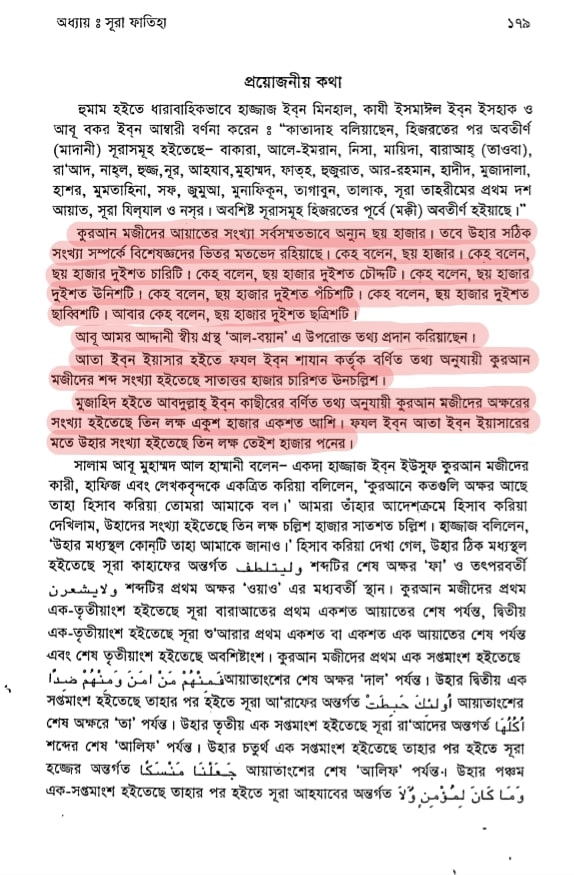
The opinions on the number of verses attributed to Dani are also found on Islamweb through the discussion of Suyuti. There, the disagreement over how many additional verses beyond six thousand should be counted is clearly acknowledged. The phrase “agreed on six thousand” means acknowledging a minimum of six thousand; the subsequent sentences of that quotation negate the meaning that everyone finished counting at six thousand. [708]
أَجْمَعُوا عَلَى أَنَّ عَدَدَ آيَاتِ الْقُرْآنِ سِتَّةُ آلَافِ آيَةٍ ثُمَّ اخْتَلَفُوا فِيمَا زَادَ عَلَى ذَلِكَ فَمِنْهُمْ مَنْ لَمْ يَزِدْ وَمِنْهُمْ مَنْ قَالَ: وَمِائَتَا آيَةٍ وَأَرْبَعُ آيَاتٍ، وَقِيلَ: وَأَرْبَعَ عَشْرَةَ، وَقِيلَ: وَتِسْعَ عَشْرَةَ، وَقِيلَ: وَخَمْسٌ وَعِشْرُونَ، وَقِيلَ: وَسِتٌّ وَثَلَاثُونَ.
English translation: They agreed that the verses of the Quran are six thousand; then they differed regarding more than that. Some said no more; some said another two hundred four; it was said two hundred fourteen, two hundred nineteen, two hundred twenty-five, and two hundred thirty-six.
| Numbers attributed to Dani | Position of counting |
|---|---|
| 6000 | Opinion mentioned as minimum six thousand |
| 6204 | Addition of two hundred four to six thousand |
| 6214 | Addition of two hundred fourteen to six thousand |
| 6219 | Addition of two hundred nineteen to six thousand |
| 6225 | Addition of two hundred twenty-five to six thousand |
| 6236 | Addition of two hundred thirty-six to six thousand |
In the full quotation of Ibn Kathir, 6226 is also present. In Zarkashi’s Al-Burhan, along with a similar list, numbers are given as 6218 in the name of Ubayy, 6212 in the name of Humayd, and 6204 in the name of Rashid. There, 6177 is written in the name of Ata. These separate reports show that if the history of counting is replaced only by a single total widely used today, information from ancient books is lost. Zarkashi wrote with the names of the concerned persons: [709]
وعدد آياته في قول علي – رضي الله عنه – ستة آلاف ومائتان ، وستة وثلاثون ، وفي قول أبي : ” ستة آلاف ومئتان وثمان عشرة . وعطاء : ستة آلاف ومائة وسبع وسبعون . وحميد : ستة آلاف ومائتان واثنتا عشرة . وراشد : ” ستة آلاف ومائتان وأربع ” .
English translation: According to Ali’s opinion, the number of verses is six thousand two hundred thirty-six; according to Ubayy’s opinion, six thousand two hundred eighteen; according to Ata, six thousand one hundred seventy-seven; according to Humayd, six thousand two hundred twelve; and according to Rashid, six thousand two hundred four.
None of the numbers 6216, 6250, 6666, 6221 and 6348 are in the above quotation of Ibn Kathir. The seven totals in his quotation and the counts of the named counters in Zarkashi’s work can be identified separately. The description of the counter’s name and the verse limit reveals the basis of the corresponding number; a single total number does not identify that method. The descriptions regarding numbers and divisions in the introduction of Tafsir Jalalayn and the relevant pages of A K M Enamul Haq’s history of compilation are also part of the discussion on the count of verses, letters, and divisions.
Relevant pages of Bengali books regarding verse numbers and divisions: Tafsir Jalalayn, Jalaluddin Mahalli and Jalaluddin Suyuti, Islamia Kutubkhana, Volume 1, Page 39; and History of Quran Hadith Compilation, A K M Enamul Haq, Page 69.
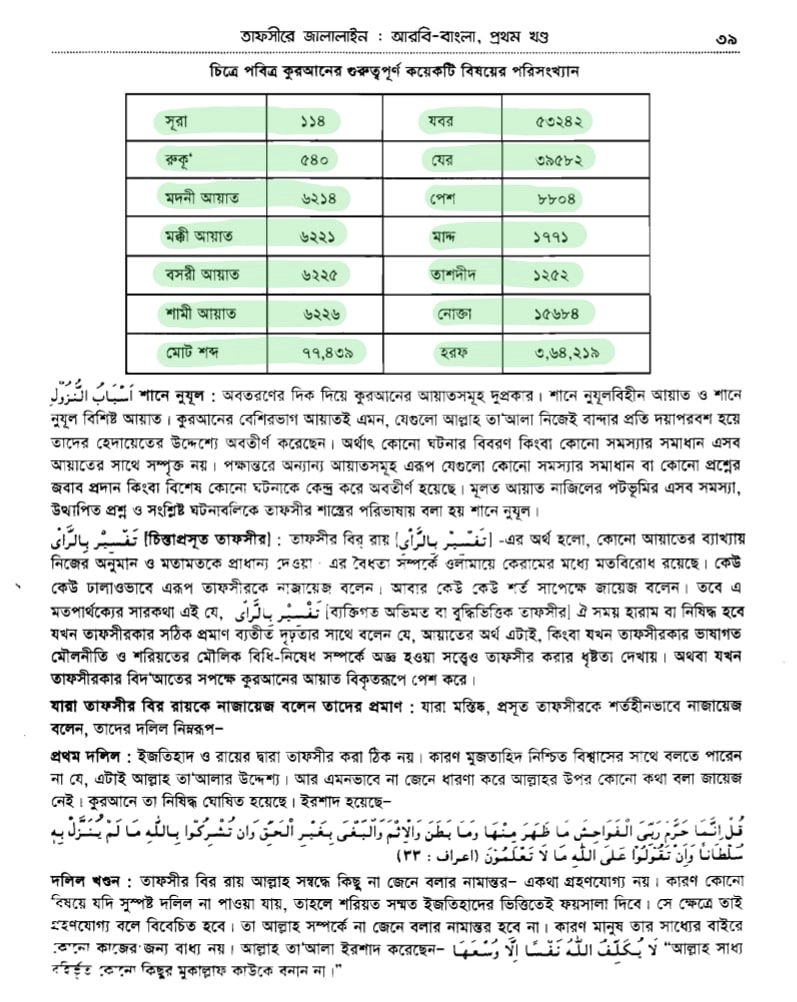
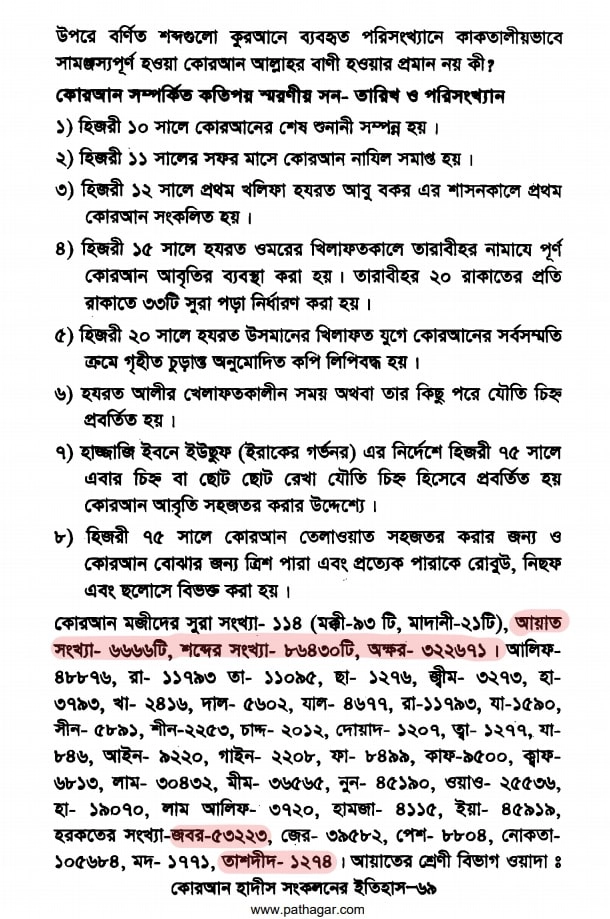
A specific example of the dispute over the division of verses is given from the statement of Firuzabadi in the same answer on Islamweb. Near the beginning and end of Surah Sad, the verse limits are taken at different places within the same set of words. Counters from Kufa, Basra, and other regions have given separate answers to the question of which part is a distinct verse. The first example of Firuzabadi’s quoted statement is: [710]
مثال ذلك أَنَّ قرّاءَ الكوفة عدُّوا قوله: والقرآن ذِي الذكر ـ آية، والباقون لم يعدّوها آية، وقراء الكوفة عدّوا، قَالَ فالحق والحق أَقُولُ ـ آية والباقون لم يعدّوها، بل جعلوا آخر الآية: فِي عِزَّةٍ وَشِقَاقٍ، و: لأَمْلأَنَّ جَهَنَّمَ مِنكَ وَمِمَّن تَبِعَكَ مِنْهُمْ أَجْمَعِينَ ـ وهكذا عدّ أَهل مكَّة والمدينة والكوفة والشَّام آخر الآية والشياطين كُلَّ بَنَّآءٍ وَغَوَّاصٍ ـ وأَهل البصرة جعلوا آخرها: وَآخَرِينَ مُقَرَّنِينَ فِي الأصفاد ـ
English translation: An example is that the readers of Kufa counted the portion “Wal-Qur’ani ziz-zikr” as a verse; others did not. The readers of Kufa also counted the portion “Qala fal-haqqu wal-haqqa aqul” as a verse; others did not. Instead, they considered the end of the first verse to be “fi izzatin wa shiqaq” and the end of the second to be up to “la-amla’anna jahannama minka wa mimman tabi’aka minhum ajma’in”. Similarly, the counters of Mecca, Medina, Kufa, and Sham considered the end of the verse to be up to “wash-shayatina kullu bannain wa gawas”; the counters of Basra considered the end to be up to “wa akhirina muqarranina fil-asfad”.
| Portion of Surah Sad | Boundary of one count | Boundary of another count |
|---|---|---|
| The beginning “Sad. Wal-Qur’ani ziz-zikr” | A distinct verse in the Kufan count | Joined up to “bal-lladhina kafaru fi izzatin wa shiqaq” in other counts |
| “Qala fal-haqqu wal-haqqa aqul” | A distinct verse in the Kufan count | Joined with the portion “la-amla’anna jahannama…” in other counts |
| “Wash-shayatina kullu bannain wa gawas” | A distinct verse in the counts of Mecca, Medina, Kufa, and Sham | Joined up to “wa akhirina muqarranina fil-asfad” in the Basran count |
In these examples, the change is in the verse boundary: where a countable unit ends within the same sequence of sentences has varied by region. Consequently, the number of lost words cannot be directly derived from the number of verses. These distinct practices of verse boundaries have found a place in recognized counting traditions. If one imagines every verse ending in exactly the same place as a permanent unit with the same number everywhere, that imagination conflicts with the documented history of counting science. A portion recognized as a separate verse in one region became part of a larger verse in another.
Multiple results have also been found in the counting of words and letters. In one place, Zarkashi wrote of 77437 words through the authority of Ata ibn Yasar and 321000 letters through the authority of Mujahid; in another account of counting initiated by Hajjaj, 340740 letters are mentioned. In the same chapter, accounts of 77439 words and 323015 letters are also quoted. The result of this calculation changes if the counter, the written spelling, the pronounced letters, and the criteria for separating words change. His direct statement regarding the reason for word counting: [711]
وسبب الاختلاف في الكلمة أن الكلمة لها حقيقة ومجاز ، ولفظ ورسم ، واعتبار كل منها جائز ، وكل من العلماء اعتبر أحد الجوائز .
English translation: The reason for the difference of opinion regarding words is that there are literal and metaphorical uses of words, and there are pronounced forms and written forms; it is possible to consider each of these. Every scholar has adopted one of the possible considerations.
| Subject of calculation | In Ibn Kathir’s Bengali quotation | Other calculations quoted in Al-Burhan |
|---|---|---|
| Words | 77439 | 77437 through Ata ibn Yasar; 77439 in another account of counting |
| Letters | 321180 and 323015 | 321000 through Mujahid; 323015 and 340740 in other accounts |
| Determination of units | Separate counts for verses, words, and letters | The basis of counting differs according to pronunciation, written form, and the definition of a word |
The verse count of the prevalent mushaf is therefore the result of a specific counting tradition. The widespread use of that number does not eliminate the existence of its historical rivals. Simultaneously, the evidence for determining verse boundaries, the written form of words, and the decision to include a composition within the Quran is different. The evidence for the first is regional counting, the evidence for the second is calculations regarding spelling and letters, and the evidence for the third is the account of the acceptance or rejection of a surah in the mushaf. At each of these levels in the history of forming the accepted version of the Quran, human definition and selection have operated.
Description of Surahs 112, 114, and 116; the position of Nas–Falaq in Ibn Masud’s mushaf
Dividing a sentence into two verses and not accepting two complete compositions as part of the Quran are entirely different decisions. The accounts regarding Ibn Masud’s mushaf bring the second question to the fore. There, the dispute is not about the verse numbers of Surah Falaq and Surah Nas; it is about whether those two compositions are included in the Quran at all. Suyuti mentioned in one place 112 surahs in Ibn Masud’s mushaf and 116 surahs in Ubayy’s mushaf. The existence of these numbers alongside the 114 accepted in the Uthmanic mushaf reveals a history of prior selection. [712]
وَفِي مُصْحَفِ ابْنِ مَسْعُودٍ مِائَةٌ وَاثْنَتَا عَشْرَةَ سُورَةٍ لِأَنَّهُ لَمْ يَكْتُبِ الْمُعَوِّذَتَيْنِ وَفِي مُصْحَفِ أُبَيٍّ سِتَّ عَشْرَةَ لِأَنَّهُ كَتَبَ فِي آخِرِهِ سُورَتَيِ الْحَفْدِ وَالْخُلْعِ.
English translation: There were 112 surahs in Ibn Masud’s mushaf; because he did not write the Mu’awwidhatayn. There were [1]16 in Ubayy’s mushaf; because he wrote two surahs at the end named Hafd and Khal’a.
| Number mentioned in the source | Associated with which mushaf or opinion | Specific subject of difference |
|---|---|---|
| 112 | Ibn Masud’s mushaf in Suyuti’s account | Falaq and Nas were not written |
| 114 | List of surahs accepted in the Uthmanic mushaf | Fatiha, Falaq, and Nas included; Hafd and Khal’a not included |
| 116 | Ubayy’s mushaf in Suyuti’s account | Two additional compositions at the end named Hafd and Khal’a |
| 113 | Opinion counting Anfal and Bara’at as one surah | Separate from the above inclusion-dispute; a question regarding the boundary between two known portions |
The statement “116 in Ubayy’s mushaf” is an ancient mushaf-description preserved under his name; it is not a claim that a manuscript written by Ubayy’s own hand was present with Suyuti. The significance of the account is that later Islamic compilers preserved the memory of a mushaf with an additional composition. The readings of Hafd and Khal’a were not accepted as surahs of the Quran in later mushafs. The accepted boundary of 114 surahs stands by combining that decision of exclusion and the decision to accept Falaq–Nas. There is no information in this brief numerical account that every writer gave the same status to a composition just because it was written in a mushaf; in the case of Ibn Masud, there are separate accounts in clearer language.
In Bukhari’s account, Zirr ibn Hubaysh asks Ubayy about the statements of Ibn Masud. There, the matter of objection is left indefinite as “such and such words”. Ubayy mentions the statement of Muhammad as the basis for his own accepted reading. The original conversation of the hadith is: [713]
سَأَلْتُ أُبَىَّ بْنَ كَعْبٍ قُلْتُ يَا أَبَا الْمُنْذِرِ إِنَّ أَخَاكَ ابْنَ مَسْعُودٍ يَقُولُ كَذَا وَكَذَا. فَقَالَ أُبَىٌّ سَأَلْتُ رَسُولَ اللَّهِ صلى الله عليه وسلم فَقَالَ لِي قِيلَ لِي. فَقُلْتُ، قَالَ فَنَحْنُ نَقُولُ كَمَا قَالَ رَسُولُ اللَّهِ صلى الله عليه وسلم.
English translation: I asked Ubayy ibn Ka’b. I said, “O Abu al-Munzir, your brother Ibn Masud says such and such words.” Ubayy said, “I asked the Messenger of Allah. He told me, ‘I have been told, therefore I have said.’” Ubayy said, “Therefore, as the Messenger of Allah has said, so we also say.”
While explaining this brief language of Bukhari, Ibn Hajar brought the clear statements of other accounts. In his quotation, Ibn Masud did not stop at merely not writing the two surahs in his own mushaf; he would scrape them out of the mushaf and say that these are not part of the Book of Allah. The historical and logical gap between the words “did not write” and “said they are not part of the Quran” is large. The former can be consistent with an incomplete copy; the latter is an explicit rejection of inclusion in the book. The relevant account is in Fath al-Bari: [714]
وأخرج أحمد عن أبي بكر بن عياش عن عاصم بلفظ ” إن عبد الله يقول في المعوذتين ” وهذا أيضا فيه إبهام ، وقد أخرجه عبد الله بن أحمد في زيادات المسند والطبراني وابن مردويه من طريق الأعمش عن أبي إسحاق عن عبد الرحمن بن يزيد النخعي قال : ” كان عبد الله بن مسعود يحك المعوذتين من مصاحفه ويقول إنهما ليستا من كتاب الله .
English translation: Ahmad narrated through Abu Bakr ibn Ayyash from Asim: “Abdullah says regarding the Mu’awwidhatayn”—here too the statement is indefinite. Abdullah ibn Ahmad, in the supplement to his Musnad, and Tabarani and Ibn Marduwayh narrated through A’mash, Abu Ishaq, and Abdur Rahman ibn Yazid an-Nakha’i. He says: “Abdullah ibn Masud would scrape the Mu’awwidhatayn out of his mushafs and say, these are not part of the Book of Allah.”
Ibn Hajar also discussed the possibility of hiding the statement with “such and such words”. At first, he thought the abbreviation was Bukhari’s; later, by combining other accounts of Sufyan, he saw that Sufyan sometimes stated the matter clearly and sometimes left it indefinite. Consequently, the indefinite language is not established as Bukhari’s sole editing. It is established that there were separate transmissions of clear and unclear language of the same event, and the account in clear language had also reached the commentator. Therefore, if the subject of the dispute is concluded as undetermined by relying only on Bukhari’s “such and such”, the remaining information quoted in Fath al-Bari is suppressed.
Authors like Nawawi, Ibn Hazm, and Fakhruddin Razi have denied this statement in the name of Ibn Masud. Ibn Hajar did not accept that denial without proof. He called the account sahih and made a clear distinction between the claim of universal consensus in all ages and the consensus established at a later time. His language: [715]
والطعن في الروايات الصحيحة بغير مستند لا يقبل ، بل الرواية صحيحة والتأويل محتمل ، والإجماع الذي نقله إن أراد شموله لكل عصر فهو مخدوش ، وإن أراد استقراره فهو مقبول .
English translation: Objections against sahih accounts are not acceptable without proof. Rather, the account is sahih and there is a possibility of interpretation. And if by the consensus he mentioned, he means to include every age, then it is questionable; and if he means that consensus was established at a later time, then it is acceptable.
Maududi also rejected the method of denying these accounts in his Tafsir. He did not consider the explanation of Baqillani and Yaz—that Ibn Masud did not deny the Quranic status of the two surahs, but only refused to write them—to be correct. Despite having his own apologetic purpose, he accepted the clear statement of the account. The relevant discussion in Tafhimul Quran is entirely: [716]
Whether these two surahs are part of the Quran
Regarding the subject matter of these two surahs, the above discussion is sufficient to understand the main point. Nevertheless, three issues regarding them have appeared in hadith and tafsir books that may create doubt and suspicion in the mind, so we wish to clarify that matter as well. The first issue that can be drawn attention to is whether the matter of these two surahs being part of the Quran is definitively proven or if there is any room for doubt. The reason this question arises is that it has been quoted in various riwayats from a Companion of high status like Hazrat Abdullah ibn Masud that he did not accept these two surahs as surahs of the Quran and did not include these two surahs in his own manuscript. Muhaddiths such as Imam Ahmad, Bazzar, Tabarani, Ibn Marduwayah, Abu Ya’la, Abdullah ibn Ahmad ibn Hanbal, Humaydi, Abu Nu’aym, Ibn Hibban, and others have quoted this from Hazrat Ibn Masud (ra) through various chains and in most cases through sahih isnads. In these hadiths, it is not only said that he would exclude these two surahs from the Quranic manuscript, but it is also said that he would say: “Do not mix with the Quran things that are not part of the Quran. These two surahs are not included in the Quran. A command was given to the Prophet (peace and blessings of Allah be upon him) through this. He was told to seek refuge with Allah through these words.” In some riwayats, it is further added that he did not recite these two surahs in prayer.
Due to these riwayats, opponents of Islam have found the opportunity to create doubt against the Quran and (God forbid) to say that the Quran is not free from distortion. Rather, when a great Companion like Abdullah ibn Masud (ra) holds the opinion that these two surahs of the Quran were added to it from outside, then who knows how many other changes and additions have been made. They have easily found the opportunity to create such doubt and suspicion. To free the Quran from such accusations, Qazi Abu Bakr Baqillani and Qazi Yaz gave an explanation of Ibn Masud’s statement. They said that Ibn Masud did not deny the matter of Surah Falaq and Surah Nas being part of the Quran, but rather he only refused to keep these two surahs written on the pages of the Quran. Because in his opinion, only that which the Messenger of Allah (peace and blessings of Allah be upon him) gave permission to write should be kept written on the pages of the Quran. But this answer and explanation of theirs is not correct. Because it is proven through reliable isnads that Ibn Masud (ra) denied the fact of these two surahs being surahs of the Quran. Some other scholars such as Imam Nawawi, Imam Ibn Hazm, Imam Fakhruddin Razi, and others have regarded the claim that Ibn Masud said any such thing as directly false and void. But rejecting a reliable historical truth without an isnad is not a sound, rational method.
Here, later consensus cannot be made an alternative to previous unanimity. After the Uthmanic list of surahs was established, accepting Falaq and Nas as part of the Quran gained social and religious authority. The position preserved in the name of Ibn Masud bears witness to the dispute prior to or parallel to that establishment. Calling his objection wrong is a later religious evaluation; whether he objected or not is a historical question. It is logically inconsistent to erase the record of one question with an evaluation.
Regarding Ibn Masud’s mushaf, there is another report in Suyuti’s subsequent sentence narrated through Ibn Sirin. There, a comparison is made between what Ubayy wrote, what Ibn Masud omitted, and which ones Uthman wrote among the Fatiha, Mu’awwidhatayn, and two supplications. Mechanically adding this report to the sentence numbered 112 creates a problem: omitting three surahs from 114 does not result in 112. Suyuti has compiled multiple reports of similar information here; the mushaf descriptions in each report are not identical. His quoted words are: [717]
أَخْرَجَ أَبُو عُبَيْدٍ عَنِ ابْنِ سِيرِينَ قَالَ كَتَبَ أُبَيُّ بْنُ كَعْبٍ فِي مُصْحَفِهِ فَاتِحَةَ الْكِتَابِ وَالْمُعَوِّذَتَيْنِ وَاللَّهُمَّ إِنَّا نَسْتَعِينُكَ وَاللَّهُمَّ إِيَّاكَ نَعْبُدُ وَتَرَكَهُنَّ ابْنُ مَسْعُودٍ وَكَتَبَ عُثْمَانُ مِنْهُنَّ فَاتِحَةَ الْكِتَابِ وَالْمُعَوِّذَتَيْنِ.
English translation: Abu Ubayd narrated from Ibn Sirin. He said: Ubayy ibn Ka’b wrote Fatihatul Kitab, Mu’awwidhatayn, “Allahumma inna nasta’inuka” and “Allahumma iyyaka na’budu” in his mushaf; Ibn Masud omitted these; and Uthman wrote Fatihatul Kitab and Mu’awwidhatayn among these.
The list of the accepted mushaf, therefore, did not hold all primary reports regarding the boundaries of the book together. Some compositions were accepted, some were not; different positions regarding the inclusion of the same composition also remained in subsequent texts. The current predominance of 114 is a historical result. Using the existence of that result, the reports of 112 and 116, or the explicit language rejecting Falaq–Nas, cannot be shown as absent. The human process of acceptance and rejection in determining the boundaries inside and outside the book is directly documented here.
Authority for determining the current surah order, order of revelation, and arrangement
The table of contents of the current mushaf is not a chronology of the Quran’s revelation. Baqarah is placed after Fatiha, then Al Imran and Nisa; many Makki surahs come after long Madani surahs. Reading in this arrangement does not automatically make the chronological development of religious statements visible. To know which statement came first, which ruling was changed later, and which instruction was added after which conflict, reports regarding revelation, Sira, and discussions on nasikh–mansukh outside the table of contents are required. An accepted reading order and a historical sequence of events serve different purposes.
An Iraqi man who came to Aisha wanted to arrange his Quran according to the order of his mushaf. Aisha first asked what harm there was in which one was read first. Then she spoke of religious statements that changed in the order of revelation: descriptions of Paradise and Hell at the beginning, then halal and haram; if the prohibition of wine and sexual intercourse had come first, people would have denied it. Finally, she brought out her own mushaf and recited the verses of the surahs. The complete conversation in Bukhari is: [718]
إِنِّي عِنْدَ عَائِشَةَ أُمِّ الْمُؤْمِنِينَ ـ رضى الله عنها ـ إِذْ جَاءَهَا عِرَاقِيٌّ فَقَالَ أَىُّ الْكَفَنِ خَيْرٌ قَالَتْ وَيْحَكَ وَمَا يَضُرُّكَ قَالَ يَا أُمَّ الْمُؤْمِنِينَ أَرِينِي مُصْحَفَكِ. قَالَتْ لِمَ قَالَ لَعَلِّي أُوَلِّفُ الْقُرْآنَ عَلَيْهِ فَإِنَّهُ يُقْرَأُ غَيْرَ مُؤَلَّفٍ. قَالَتْ وَمَا يَضُرُّكَ أَيَّهُ قَرَأْتَ قَبْلُ، إِنَّمَا نَزَلَ أَوَّلَ مَا نَزَلَ مِنْهُ سُورَةٌ مِنَ الْمُفَصَّلِ فِيهَا ذِكْرُ الْجَنَّةِ وَالنَّارِ حَتَّى إِذَا ثَابَ النَّاسُ إِلَى الإِسْلاَمِ نَزَلَ الْحَلاَلُ وَالْحَرَامُ، وَلَوْ نَزَلَ أَوَّلَ شَىْءٍ لاَ تَشْرَبُوا الْخَمْرَ. لَقَالُوا لاَ نَدَعُ الْخَمْرَ أَبَدًا. وَلَوْ نَزَلَ. لاَ تَزْنُوا. لَقَالُوا لاَ نَدَعُ الزِّنَا أَبَدًا. لَقَدْ نَزَلَ بِمَكَّةَ عَلَى مُحَمَّدٍ صلى الله عليه وسلم وَإِنِّي لَجَارِيَةٌ أَلْعَبُ {بَلِ السَّاعَةُ مَوْعِدُهُمْ وَالسَّاعَةُ أَدْهَى وَأَمَرُّ} وَمَا نَزَلَتْ سُورَةُ الْبَقَرَةِ وَالنِّسَاءِ إِلاَّ وَأَنَا عِنْدَهُ. قَالَ فَأَخْرَجَتْ لَهُ الْمُصْحَفَ فَأَمْلَتْ عَلَيْهِ آىَ السُّوَرِ.
English translation: I was with Aisha, Mother of the Believers. An Iraqi came and asked, “Which shroud is better?” She said, “What has happened to you! What harm is there in this?” He said, “O Mother of the Believers, show me your mushaf.” She said, “Why?” He said, “I might be able to arrange the Quran according to it; because it is read without following the arrangement.” She said, “What harm is there in which one is read first? Among the surahs that were revealed first, there was a surah of the Mufassal; it contained mentions of Paradise and Hell. After people returned to Islam, the rulings of halal and haram were revealed. If ‘do not drink wine’ had been revealed first, they would have said, ‘we will never give up wine.’ If ‘do not commit adultery’ had been revealed first, they would have said, ‘we will never give up adultery.’ In Mecca, ‘rather, the Hour is their appointed time; and the Hour is more terrifying and more bitter’ was revealed to Muhammad sallallahu alayhi wa sallam; at that time I was a girl playing. Baqarah and Nisa were revealed when I was with him.” The narrator says: Then she brought out the mushaf for that man and recited the verses of the surahs.
In this report, Aisha also directly explained the social method of propagating the Quran’s statements. She stated that rulings came in step with people’s capacity for acceptance and behavior. In today’s table of contents, ruling-rich surahs like Baqarah and Nisa are at the beginning; the first stage described by Aisha is not reflected as the start of the book there. Consequently, when trying to read the history of revelation from the current arrangement, different layers of time blend together side-by-side and before-after. The establishment of the authority of that arrangement and the claim that it is a replica of the order of revelation are entirely separate claims.
| Type of order | Sequence of what | Characteristics visible in the source |
|---|---|---|
| Surah order of the current mushaf | Position of surahs before and after in the book | This accepted sequence: Fatiha, Baqarah, Al Imran, Nisa |
| Order of revelation | Time of revelation of statements or surahs | In Aisha’s account, rulings follow primary statements about the hereafter; parts of the same surah may also be revealed at different times |
| Reading order of specific prayers | Which surah was read first in a reading event | In Hudhayfa’s report: Baqarah, Nisa, then Al Imran |
| Verse order within a surah | Placement of sentences within the same surah | In Uthman’s report, instructions to writers to place verses in specific surahs |
In Hudhayfa’s report, Muhammad read Nisa after reading Baqarah one night, then Al Imran. In the current mushaf, Al Imran is before Nisa. Therefore, the reading event preserved in Muslim does not follow the same sequence as today’s table of contents. The report also contains descriptions of standing for a long time, praying according to the meaning of the verses, and long ruku–sujud. Its full original text is: [719]
صَلَّيْتُ مَعَ النَّبِيِّ صلى الله عليه وسلم ذَاتَ لَيْلَةٍ فَافْتَتَحَ الْبَقَرَةَ فَقُلْتُ يَرْكَعُ عِنْدَ الْمِائَةِ . ثُمَّ مَضَى فَقُلْتُ يُصَلِّي بِهَا فِي رَكْعَةٍ فَمَضَى فَقُلْتُ يَرْكَعُ بِهَا . ثُمَّ افْتَتَحَ النِّسَاءَ فَقَرَأَهَا ثُمَّ افْتَتَحَ آلَ عِمْرَانَ فَقَرَأَهَا يَقْرَأُ مُتَرَسِّلاً إِذَا مَرَّ بِآيَةٍ فِيهَا تَسْبِيحٌ سَبَّحَ وَإِذَا مَرَّ بِسُؤَالٍ سَأَلَ وَإِذَا مَرَّ بِتَعَوُّذٍ تَعَوَّذَ ثُمَّ رَكَعَ فَجَعَلَ يَقُولُ ” سُبْحَانَ رَبِّيَ الْعَظِيمِ ” . فَكَانَ رُكُوعُهُ نَحْوًا مِنْ قِيَامِهِ ثُمَّ قَالَ ” سَمِعَ اللَّهُ لِمَنْ حَمِدَهُ ” . ثُمَّ قَامَ طَوِيلاً قَرِيبًا مِمَّا رَكَعَ ثُمَّ سَجَدَ فَقَالَ ” سُبْحَانَ رَبِّيَ الأَعْلَى ” . فَكَانَ سُجُودُهُ قَرِيبًا مِنْ قِيَامِهِ . قَالَ وَفِي حَدِيثِ جَرِيرٍ مِنَ الزِّيَادَةِ فَقَالَ ” سَمِعَ اللَّهُ لِمَنْ حَمِدَهُ رَبَّنَا لَكَ الْحَمْدُ” .
English translation: I prayed with the Prophet sallallahu alayhi wa sallam one night. He began with Baqarah. I thought he would do ruku at one hundred verses. He continued reading. I thought he would read one rakah with the entire surah. He moved forward; I thought he would do ruku after finishing this. Then he began Nisa and read it; then he began Al Imran and read it. He was reading slowly and clearly. When a verse of tasbih came, he would do tasbih, when a matter of prayer came he would ask, and when a matter of seeking refuge came he would seek refuge. Then doing ruku, he began to say, “Glorified is my Great Lord.” His ruku was almost equal to his standing. Then he said, “He who praises Allah, Allah hears his words.” Then he stood for a long time, almost equal to the ruku. Then doing sujud, he said, “Glorified is my Highest Lord.” His sujud was also almost equal to his standing. In Jarir’s report, there is an addition: he said, “He who praises Allah, Allah hears his words. O our Lord, all praise is Yours.”
A reading order of a prayer is found in this hadith. It contains no declaration for determining the permanent position of all surahs in the mushaf. Its direct information is that in Muhammad’s reported reading, Nisa came before Al Imran. Moving before and after in reading within surahs and reading verses inside a surah in reverse is not the same kind of act. In subsequent fiqh, these two have been separated. This reading report does not align with the notion that the authority of the book’s table of contents has been applied in the same order in every event of prayer.
Ancient scholars did not have a single opinion regarding the authority for determining the order of surahs. Suyuti quoted the statement of Qazi Abu Bakr Baqillani: alongside the possibility that Muhammad himself arranged the surahs, there is the possibility that he left the task to the subsequent Ummah; he stated that the second possibility is closer. On the question of the authority of the current table of contents, this opinion directly gives place to the subsequent decision of humans. [720]
وَأَنَّهُ يُمْكِنُ أَنْ يَكُونَ الرَّسُولُ صَلَّى اللَّهُ عَلَيْهِ وَسَلَّمَ قَدْ رَتَّبَ سُوَرَهُ وَأَنْ يَكُونَ قَدْ وَكَلَ ذَلِكَ إِلَى الْأُمَّةِ بَعْدَهُ وَلَمْ يَتَوَلَّ ذَلِكَ بِنَفْسِهِ قَالَ: وَهَذَا الثَّانِي أَقْرَبُ.
English translation: It could be that the Messenger arranged its surahs; again, it could be that he left it to the Ummah after him, not doing the task himself. He says: this second possibility is more likely.
In this statement of Baqillani, “arrangement of verses” and “arrangement of surahs” were not made the same. In the same discussion, he emphasizes the fixed position of verses, then accepts the possibility of leaving the task of surah order to the subsequent society. Consequently, it does not follow the conclusion that the current order of all surahs was finalized in the same way from any report of verse placement. The scope of an instruction within a surah and the instruction to establish the complete table of contents of 114 surahs are different.
Suyuti also compiled Baghavi’s different position in the same place. Baghavi explains the work of the Companions as the work of gathering a pre-determined reading. In Baqillani’s preferred explanation, the task of determining surah order remains in the hands of the subsequent society; in Baghavi’s explanation, the compiler follows a previously determined order. The position of authority is different in the two explanations. In the explanation of Anfal–Tawbah reported in Uthman’s own name, his own conjecture is mentioned as the reason for placing two specific surahs side-by-side.
Video of Abu Bakr Zakaria’s discussion on the current order of surahs and the question of determining that order:
The accepted arrangement of the book leads its reader into a specific sequence. In that sequence, long ruling-based surahs come forward, many primary Makki statements remain later, and the actual chronology of revelation does not match the order of the book. This power of arrangement also works in the case of interpretation: relationships are sought among statements placed side-by-side, and thematic bridges are built from the previous surah to the next. Yet, when the very authority for determining the order is disputed among scholars, every relationship built from that order cannot be called a direct plan of revelation. The accepted table of contents is an effective religious arrangement; the reports do not establish the claim to return its entirety to a single undisputed primary instruction.
Name of the surah, multiple names of the same surah, Makki–Madani identity and subsequent divisions
The name written above the surah in the mushaf, Makki–Madani identity, and verse count create a framework for identifying the reading. The sources of these identities are also not of one kind. Some names are found in Muhammad’s usage in hadith, some have come in the language of Companions or subsequent scholars, some have been formed from the first word or subject of the surah. Due to a surah having multiple names, a specific printed title cannot be taken as the sole original identity of that surah. Fatiha is one of the most well-known examples of this diversity of names.
In Abu Dawud’s report, the same surah is called Umm al-Quran, Umm al-Kitab, and Sab’ul Masani. The plurality of names here is not merely an innovation of subsequent lexicons; multiple identities exist side-by-side in the language of the hadith itself. [721]
الْحَمْدُ لِلَّهِ رَبِّ الْعَالَمِينَ أُمُّ الْقُرْآنِ وَأُمُّ الْكِتَابِ وَالسَّبْعُ الْمَثَانِي
English translation: “Alhamdu lillahi rabbil alamin” is Umm al-Quran, Umm al-Kitab, and the seven repeated verses.
While explaining the names of Fatiha, Razi mentioned the use of the name “Al-Wafiya” in the name of Sufyan ibn Uyaynah. Qurtubi also brought a fiqhi argument in the explanation of this name against dividing the surah in half over two rakahs. That is, a relationship between a subsequent scholar and a prayer-related ruling is documented between the use and explanation of the name. Razi’s words are: [722]
الاسم الخامس : الوافية ، كان سفيان بن عيينة يسميها بهذا الاسم ، قال الثعلبي : وتفسيرها أنها لا تقبل التنصيف ، ألا ترى أن كل سورة من القرآن لو قرئ نصفها في ركعة والنصف الثاني في ركعة أخرى لجاز ، وهذا التنصيف غير جائز في هذه السورة .
English translation: Fifth name: Al-Wafiya. Sufyan ibn Uyaynah used to call it by this name. Sa’labi says: the explanation is that it cannot be divided into two parts. It is valid to read half of any other surah of the Quran in one rakah and the remaining half in another rakah; but it is not valid to divide this surah into two parts in this way.
| Name of Fatiha | Meaning or explanation of the name | Pattern of use in the source |
|---|---|---|
| Fatihatul Kitab | Opening of the book; used at the beginning in the mushaf, in education, and in prayer readings | Explanations of Razi and Qurtubi; this identity is also used in hadith |
| As-Sab’ul Masani | Seven repeated verses; related to repeated recitation in prayer | Abu Dawud 1457; Qurtubi also quoted the statement of Bukhari 4474 |
| Umm al-Quran | The core of the Quran; explanation that the purposes of the entire book are contained in it | Used in Abu Dawud’s hadith; the meaning is explained in tafsir |
| Umm al-Kitab | The core or main part of the book | Used in Abu Dawud’s hadith; Qurtubi also mentioned disputes regarding the use of this name |
| Al-Quranul Azim | The Great Quran | This expression regarding Fatiha in Bukhari 4474; it is also in Qurtubi’s list of names |
| Fatihatul Quran | Opening of the Quran | Synonymous identity with Fatihatul Kitab; another linguistic name of the same surah |
| Al-Wafiya | Complete; explanation of the full reading of the surah and not dividing it | Usage of Sufyan ibn Uyaynah; citations of Razi and Qurtubi |
| Al-Kafiya | Sufficient; explanation of the sufficiency of its reading instead of other surahs and the insufficiency of other readings instead of it | Qurtubi mentioned the statement of Yahya ibn Abi Kathir |
| Al-Asas | Foundation; Fatiha is the foundation of the Quran | Qurtubi quoted a long statement in the name of Ibn Abbas through Sha’bi |
| Ash-Shafiya or Ash-Shifa | The Healer or Healing | Razi and Qurtubi quoted the description of Fatiha as a cure for poison; the context of snake and scorpion poison is linked to this concept of healing |
| Suratul Hamd | Surah of Praise; use of the word “Alhamd” at the beginning | Identity according to the word used at the beginning; list of Razi and Qurtubi |
| As-Salah | Prayer | “I have divided the prayer between Myself and My servant”—explanation of the interpretation referring to the recitation of the Fatiha in this hadith |
| Ar-Ruqyah | Incantation or healing recitation | The use of the name based on the statement “How did you know it was Ruqyah?” in the event of healing with the Fatiha |
In the discussion regarding the names of Qurtubi, objections from Anas, Hasan, and Ibn Sirin also appeared regarding the use of “Umm al-Kitab” and “Umm al-Quran.” His own opinion is against those objections; however, he did not omit the existence of the objections. The positions of the early figures were not uniform regarding the use of names. His brief statement is: [723]
( الرابع ) : أم الكتاب ، وفي هذا الاسم خلاف ، جوزه الجمهور ، وكرهه أنس والحسن وابن سيرين . قال الحسن : أم الكتاب الحلال والحرام ، قال الله تعالى : آيات محكمات هن أم الكتاب وأخر متشابهات . وقال أنس وابن سيرين : أم الكتاب اسم اللوح المحفوظ . قال الله تعالى : وإنه في أم الكتاب .
English translation: Fourth: Umm al-Kitab. There is disagreement regarding this name. Most people have approved its use; Anas, Hasan, and Ibn Sirin disliked it. Hasan said that Umm al-Kitab refers to the halal and haram; Allah said, “The clear verses are the foundation of the Book, and others are allegorical.” Anas and Ibn Sirin said that Umm al-Kitab is the name of the Preserved Tablet; Allah said, “Indeed, it is in the Umm al-Kitab.”
These names were not created through the same process. Behind “Ar-Ruqyah” is an event of healing, behind “As-Salah” is a hadith on prayer, behind “Al-Wafiya” is the usage of Sufyan, and behind “Al-Asas” is an explanation preserved under the name of Ibn Abbas. Using an adjective in a specific event and declaring a formal list of names for all surahs are separate tasks. The lists of Razi and Qurtubi are also not identical: they collected prevalent names and explained their meanings. The current printed titles carry one identity selected from among that polyphony.
Regarding the Makki–Madani identity, there are first differences in definition. Suyuti wrote three terminological conventions. In the most prevalent convention, revelation before the Hijrah is Makki, and after is Madani; even if the place was Mecca, if it occurred after the Hijrah, it can be Madani. In another convention, the place is the basis; in the third convention, the basis is to whom the statement was addressed. The widely used definition in his words is: [724]
أَشْهَرُهَا: أَنَّ الْمَكِّيَّ مَا نَزَلَ قَبْلَ الْهِجْرَةِ وَالْمَدَنِيَّ مَا نَزَلَ بَعْدَهَا سَوَاءٌ نَزَلَ بِمَكَّةَ أَمْ بِالْمَدِينَةِ عَامَ الْفَتْحِ أَوْ عَامَ حِجَّةِ الْوَدَاعِ أَمْ بِسَفَرٍ مِنَ الْأَسْفَارِ.
English translation: The most famous among these is: that which was revealed before the Hijrah is Makki, and that which was revealed after is Madani; whether it was revealed in Mecca, Medina, in the year of victory, in the year of the farewell pilgrimage, or during a journey.
| Convention for determining Makki–Madani | Basis | Resulting difference |
|---|---|---|
| Hijrah-centric | Time of revelation | Portions revealed in Mecca after the Hijrah are also Madani |
| Place-centric | Revelation in Mecca or Medina | Portions revealed elsewhere during a journey remain outside both categories |
| Address-centric | Statements addressed to the inhabitants of Mecca or Medina | The identity of the listeners of the statement determines it instead of the actual place of revelation |
The authority for knowing this identity is also different. In the statement of Baqillani, it is mentioned that for knowing Makki–Madani, one must rely on the memories of the Companions and Successors. He also stated that no instructional declaration regarding this classification was received from the Prophet. Consequently, the writing of Makki or Madani beside the surah titles in the mushaf is not itself a newly revealed verse; it is a brief identity of information collected about the history of revelation. Suyuti quoted his statement: [725]
قَالَ الْقَاضِي أَبُو بَكْرٍ فِي الِانْتِصَارِ: إِنَّمَا يَرْجِعُ فِي مَعْرِفَةِ الْمَكِّيِّ وَالْمَدَنِيِّ إِلَى حِفْظِ الصَّحَابَةِ وَالتَّابِعِينَ وَلَمْ يَرِدْ عَنِ النَّبِيِّ صَلَّى اللَّهُ عَلَيْهِ وَسَلَّمَ فِي ذَلِكَ قَوْلٌ لِأَنَّهُ لَمْ يُؤْمَرْ بِهِ وَلَمْ يَجْعَلِ اللَّهُ عِلْمَ ذَلِكَ مِنْ فَرَائِضِ الْأُمَّةِ وَإِنْ وَجَبَ فِي بَعْضِهِ عَلَى أَهْلِ الْعِلْمِ مَعْرِفَةُ تَارِيخِ النَّاسِخِ وَالْمَنْسُوخِ فَقَدْ يُعْرَفُ ذَلِكَ بِغَيْرِ نَصِّ الرَّسُولِ انْتَهَى.
English translation: Qazi Abu Bakr Al-Intisar said: To know Makki–Madani, one must rely on the memories of the Companions and Successors. No statement has come from the Prophet (peace and blessings of Allah be upon him) on this matter; because he was not instructed to do so, and Allah did not make this knowledge an obligation for the Ummah. Although in some cases knowing the time of the abrogating and the abrogated becomes necessary for scholars, it can be known even without a direct statement from the Messenger. Statement ends.
Regarding the Fatiha, Qurtubi mentioned the Makki view under the names of Ibn Abbas, Qatada, and Abu Aliya, and the Madani view under the names of Abu Hurayra, Mujahid, Ata ibn Yasar, and Zuhri. His compilation also mentions that half was revealed in Mecca and half in Medina. He himself accepts the Makki view. His acceptance is an interpretative decision, not the absence of other compiled reports. By writing Makki beside the name of a surah, this multi-layered conflict disappears behind a single word. [726]
الثانية : اختلفوا أهي مكية أم مدنية ؟ فقال ابن عباس وقتادة وأبو العالية الرياحي – واسمه رفيع – وغيرهم : هي مكية . وقال أبو هريرة ومجاهد وعطاء بن يسار والزهري وغيرهم : هي مدنية . ويقال : نزل نصفها بمكة ، ونصفها بالمدينة . حكاه أبو الليث نصر بن محمد بن إبراهيم السمرقندي في تفسيره . والأول أصح لقوله تعالى : ولقد آتيناك سبعا من المثاني والقرآن العظيم والحجر مكية بإجماع . ولا خلاف أن فرض الصلاة كان بمكة .
English translation: Second: Whether it is Makki or Madani—they have disagreed on this. Ibn Abbas, Qatada, Abu Aliya ar-Riyahi—whose name is Rufai—and others said it is Makki. Abu Hurayra, Mujahid, Ata ibn Yasar, Zuhri, and others said it is Madani. It is also said that half was revealed in Mecca and half in Medina. Abu Layth Nasr ibn Muhammad ibn Ibrahim as-Samarkandi mentioned this in his tafsir. The first view is more correct; because Allah said, “I have given you the seven oft-repeated and the Great Quran.” The Hijrah is unanimously Makki; and there is no disagreement that prayer became obligatory in Mecca.
Practical human planning also worked in reading divisions like Para, Hizb, and Ruku. Today’s thirty Paras and sixty Hizbs provide the convenience of reading the long text in a specific time. Dividing by whole surahs and dividing into nearly equal sections based on the number of letters are different methods. Ibn Taymiyyah wrote about the spread of new letter-based divisions during the era of Hajjaj and thereafter. IslamQA quoted his statement: [727]
قد علم أن أول ما جُزِّئَ القرآن بالحروف تجزئةَ ثمانية وعشرين ، وثلاثين ، وستين ، هذه التي تكون رؤوس الأجزاء والأحزاب في أثناء السورة ، وأثناء القصة ونحو ذلك ، كان في زمن الحجاج وما بعده ، وروي أن الحجاج أمر بذلك ، ومن العراق فشا ذلك ، ولم يكن أهل المدينة يعرفون ذلك .
English translation: It is known that this method of first dividing the Quran into twenty-eight, thirty, and sixty parts based on letters—where the start of a part or Hizb falls in the middle of a surah, in the middle of an event, and such places—occurred in the era of Hajjaj and after. It is narrated that Hajjaj ordered this. It spread from Iraq; the inhabitants of Medina did not know it.
In Zarkashi’s account, there are also attempts to determine the half, one-third, one-seventh, and one-fourth of the Quran by counting letters. Counters sometimes drew the limit up to a specific letter of a word. That is, the division line did not always align with the natural end of a surah. Later, the Para titles, Hizb marks, or Ruku marks became familiar parts of the page. The practical structure of the modern mushaf stands by combining these levels: the original text of the surah, the name of the surah, the category of revelation, and the divisions created for reading convenience. There is no single source or single historical time behind their simultaneous appearance on the page.
Anfal and Tawbah: Separate surahs, connected arrangement, and Uthman’s explanation
There is no Bismillah between Anfal and Tawbah. In the current mushaf, they are side by side under separate names: the first is the eighth, the second is the ninth surah. The explanation preserved under Uthman’s name behind this familiar arrangement gives a clear account of the compiler’s decision-making. There, Ibn Abbas asked three related questions: why two surahs were placed side by side, why Bismillah was not written in between, and why they were placed among the seven long surahs. The central sentence of the answer is Uthman’s inference: seeing the thematic similarity, he thought one was a part of the other.
The Bengali version of Tafsir Ibn Kathir contains a long account of the event. The questioner is Ibn Abbas; Muhammad ibn Bashar is a narrator in the chain of Tirmidhi. In Tirmidhi’s original Arabic account, the positions of these two individuals are kept separate. In Ibn Kathir’s translated account, the event appears as follows: [728] [729]
Imam Tirmidhi (R) narrates from Muhammad ibn Bashar (R) citing various narrators
that he [Ibn Abbas] said: Once I asked Uthman (RA), why did you not write ‘Bismillah’ between Surah Anfal, whose number of verses is below one hundred, and Surah Tawbah, whose number of verses is at least one hundred? Furthermore, what is the reason you placed these two surahs among the ‘Seven Long Surahs’ السبع الطول? Uthman (RA) said: Often it happened that after a portion of one surah was revealed to the Noble Prophet (SAW), a portion of another surah would be revealed. In this way, before the revelation of one surah to the Noble Prophet (SAW) was completed, a portion of another surah would be revealed. In such a state, when a verse was revealed, he would call a Companion who was a revelation writer and say: ‘Place this verse in the surah where this and that subject is described (at such a place).’ Surah Anfal is one of the first surahs revealed in Medina. On the other hand, Surah Bara’ah (Surah Tawbah) is one of the last surahs revealed in Medina. But the events and stories described in both surahs are almost identical. In this context, I inferred: ‘Surah Bara’ah is not a separate surah; rather, it is a part of Surah Anfal.’ However, the Noble Prophet (SAW) did not say anything regarding this. For the above reason, I have placed them adjacent to each other; but I did not write Bismillah between them (at the beginning of Surah Tawbah). Similarly, for the above reason, since both surahs together take the form of a long surah, I have placed them among the ‘Seven Long Surahs’.
The said report has been narrated by Imam Ahmad, Imam Abu Dawud, Imam Nasa’i, Imam Ibn Hibban, and Imam Hakim (R). Imam Hakim (R) commented on the said report: ‘Its isnad is sahih; however, Imam Bukhari and Imam Muslim did not narrate it.’
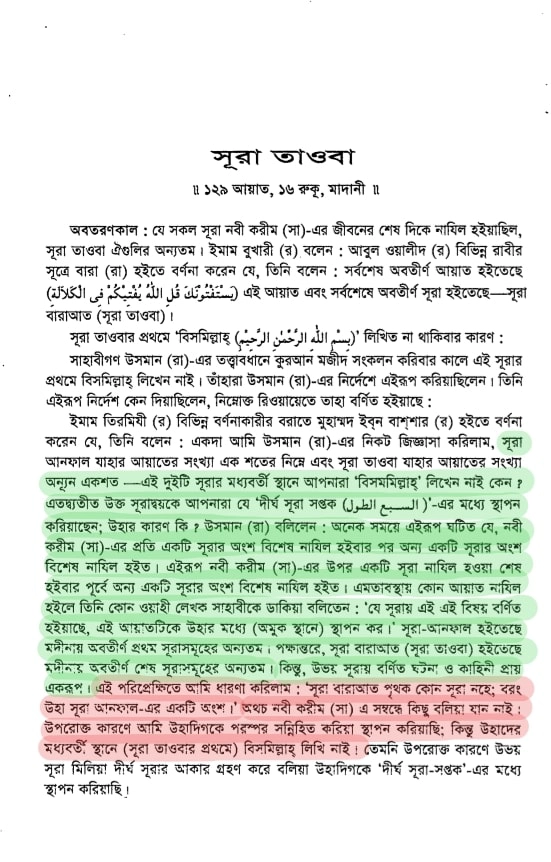
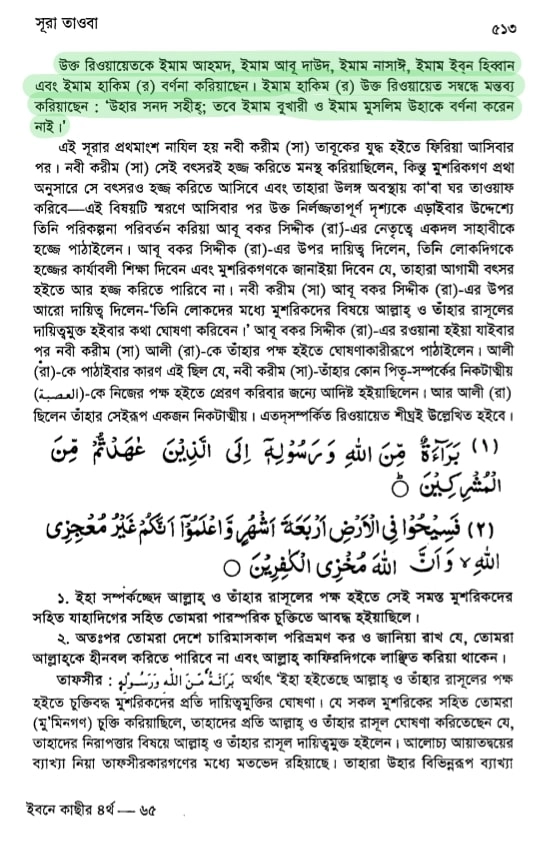
In Abu Dawud also, there is the question of Ibn Abbas and the answer of Uthman. In this account, “Sab’ut Tiwal” refers to the group of seven long surahs. The question was raised by including Anfal in the Masani and Bara’ah in the Mi’in—that is, why were compositions of two different length-based categories brought into one group. The full statement of the original Arabic and English translation: [730] [731]
قَالَ سَمِعْتُ ابْنَ عَبَّاسٍ ، قَالَ قُلْتُ لِعُثْمَانَ بْنِ عَفَّانَ مَا حَمَلَكُمْ أَنْ عَمَدْتُمْ، إِلَى بَرَاءَةَ وَهِيَ مِنَ الْمِئِينَ وَإِلَى الأَنْفَالِ وَهِيَ مِنَ الْمَثَانِي فَجَعَلْتُمُوهُمَا فِي السَّبْعِ الطُّوَلِ وَلَمْ تَكْتُبُوا بَيْنَهُمَا سَطْرَ { بِسْمِ اللَّهِ الرَّحْمَنِ الرَّحِيمِ } قَالَ عُثْمَانُ كَانَ النَّبِيُّ صلى الله عليه وسلم مِمَّا يَنْزِلُ عَلَيْهِ الآيَاتُ فَيَدْعُو بَعْضَ مَنْ كَانَ يَكْتُبُ لَهُ وَيَقُولُ لَهُ ” ضَعْ هَذِهِ الآيَةَ فِي السُّورَةِ الَّتِي يُذْكَرُ فِيهَا كَذَا وَكَذَا ” . وَتَنْزِلُ عَلَيْهِ الآيَةُ وَالآيَتَانِ فَيَقُولُ مِثْلَ ذَلِكَ وَكَانَتِ الأَنْفَالُ مِنْ أَوَّلِ مَا أُنْزِلَ عَلَيْهِ بِالْمَدِينَةِ وَكَانَتْ بَرَاءَةُ مِنْ آخِرِ مَا نَزَلَ مِنَ الْقُرْآنِ وَكَانَتْ قِصَّتُهَا شَبِيهَةً بِقِصَّتِهَا فَظَنَنْتُ أَنَّهَا مِنْهَا فَمِنْ هُنَاكَ وَضَعْتُهُمَا فِي السَّبْعِ الطُّوَلِ وَلَمْ أَكْتُبْ بَيْنَهُمَا سَطْرَ { بِسْمِ اللَّهِ الرَّحْمَنِ الرَّحِيمِ } .
English translation: 786. Narrated from Amr ibn Awn from Ibn Abbas (RA). He said, I asked Hazrat Uthman (RA) how you count Surah Bara’ah along with Surah Anfal among the Sab’ut Tiwal (seven long surahs) of the Al-Quran and why you did not write Bismillahir Rahmanir Rahim in the middle of both surahs? Whereas Surah Bara’ah is included in the Mi’in (meaning it has more than 100 verses and Bara’ah has 129 verses). On the other hand, Surah Anfal is included in the Masani (because it has fewer than 100, namely 75 verses).
Uthman (RA) said, whenever a verse was revealed to the Noble Prophet (peace and blessings of Allah be upon him), he would call the Companion revelation writers and say: insert this verse at such a place in such a surah in which this and that subject is discussed. Then, when one or two verses were revealed to him, he would say similarly. [Translator’s note 1]
Surah Al-Anfal is one of the surahs revealed shortly after the Noble Prophet (S) arrived in Medina, and Surah Bara’ah was revealed at the end of the Quran’s revelation. But there is a similarity between the events described in Surah Anfal and the events described in Surah Bara’ah. Therefore, I
fixed my mind that it is included in Surah Anfal. For this reason, I placed the two surahs together
included them in Sab’ut-Tiwal and for this reason, I did not record Bismillahir Rahmanir Rahim between these two surahs- (Tirmidhi).
1. It is evident that which verse of Al-Quran would be inserted at which place in which surah—this too was determined by revelation. (Translator)
The steps of decision-making are clear in Uthman’s explanation. Anfal is one of the early surahs revealed in Medina, Bara’ah is one of the later ones; but their subject matters are close. From this thematic similarity, he inferred a relationship of one with the other. Then, based on that inference, he placed them side by side and did not write Bismillah in between. Here, the quoted basis for the specific decision is a concept formed as a comparison and its result. Although it begins with a description of the instruction for placing verses in general, the explanation for this specific arrangement ends with the compiler’s own judgment.
| Ibn Abbas’s question or Uthman’s statement | Basis provided in the account | Its result in the mushaf |
|---|---|---|
| Why Anfal and Bara’ah are side by side | Similarity of the subject matter of the two compositions | Adjacent position at the eighth and ninth places |
| Uthman’s determination of relationship | “I inferred, it is a part of it” | Arrangement by assuming a special connection between two parts |
| Why there is no Bismillah in between | Uthman did not write Bismillah assuming this relationship | The prevalent sentence for marking the start of a surah is absent |
| Why placed in the group of seven long surahs | Uthman placed these two parts together in that group | Their joint use even in length-based classification |
Tirmidhi’s account is even clearer: Muhammad died, but he did not make it clear to them whether this was part of the other. The arrangement the compiler adopted after this state of uncertainty became the recognized characteristic of the subsequent mushaf. The phrase “I assumed” identifies his own judgment as the basis for the decision. The fact that the relationship remained undefined after the Prophet’s death, and that Uthman took action in that state—in this sequence, the assumption turned into an effective compilation-decision.
Although this account is found in many books, each book cannot be counted as an independent witness. Tirmidhi has called it hasan and specified the chains of narration from Awf, Yazid al-Farsi, and Ibn Abbas. Beside Abu Dawud’s account of the same event is Albani’s da’if evaluation; there is also Hakim’s sahih evaluation cited by Ibn Kathir. These differing verdicts in hadith science are information regarding the chain of narration and subsequent acceptance of the event. The historical significance of the account lies in its specific statement: the compiler’s assumption is presented as the reason for the visible arrangement of the mushaf.
Suyuti’s compilation also contains the view of counting Al-Anfal and Al-Bara’at as one surah. There, alongside the recognized 114 surahs, it is kept as 113. In this change of number, the section between two known compositions is removed; a new countable unit is created. Suyuti’s statement: [732]
أَمَّا سُوَرِهِ فَمِائَةٌ وَأَرْبَعَ عَشْرَةَ سُورَةٍ بِإِجْمَاعِ مَنْ يُعْتَدُّ بِهِ وَقِيلَ وَثَلَاثَ عشرة بجعل الأنفال وبراءة سُورَةً وَاحِدَةً
English translation: The number of its surahs is 114 according to the consensus of acceptable persons; and it has also been said as 113, considering Al-Anfal and Al-Bara’at as one surah.
Whether it is one surah or two—the question was also raised to the subsequent Tabi’un. An account of saying one surah in the name of Abu Rawq and an answer of saying two surahs in the name of Hasan are in the same discussion. The account of asking Hasan directly is: [733]
وَأَخْرَجَ عَنْ أَبِي رَجَاءٍ قَالَ سَأَلْتُ الْحَسَنَ عَنِ الأنفال وبراءة: سُورَتَانِ أَمْ سُورَةٌ؟ قَالَ: سُورَتَانِ. وَنُقِلَ مِثْلُ قَوْلِ أَبِي رَوْقٍ عَنْ مُجَاهِدٍ وَأَخْرَجَهُ ابْنُ أَبِي حَاتِمٍ عَنْ سُفْيَانَ.
English translation: Ibn Ashta narrated from Abu Raja. He said: I asked Hasan about Al-Anfal and Al-Bara’at, “Are these two surahs, or one surah?” He said, “Two surahs.”
Suyuti himself opposed the view of counting it as one surah, mentioning that in Muhammad’s words, they had two separate names. His judgment is therefore in favor of counting them as separate surahs. Since the opposing view and its criticism are preserved in the same book, the actual subject of the debate also becomes clear: the names of the compositions, their mutual relationship, the markers in between, and the total surah count were linked to each other. In the mention of 113, the boundary of whether two known parts would be considered one or two surahs has changed. There is no mention in that sentence of the complete deletion of the text of a surah.
The event of Al-Anfal–At-Tawbah does not limit the compilation work to mere copying. The compiler had to determine the relationship between the compositions, decide whether or not to write a separator sentence, and determine the placement within the larger group of surahs. The answer preserved in the name of Uthman reveals his perception and assumption behind these decisions. That decision later attained a standard form. If this procedural history of the adopted form is omitted, one of the clearest documents of human authority over the arrangement of the book is lost.
Whether the Bismillah verse is an ayah: disputes based on surah, reading, and madhhab
The sentence “Bismillahir Rahmanir Rahim” exists within Surah An-Naml as part of Solomon’s letter. The recognition of this position and the status of the same sentence written at the beginning of every surah are separate questions. In the place where the sentence is located within An-Naml, it is directly linked to the statement of the ayah. The relevant full ayah is: [734]
إِنَّهُ مِن سُلَيْمَانَ وَإِنَّهُ بِسْمِ اللَّهِ الرَّحْمَٰنِ الرَّحِيمِ
English translation: It is from Solomon, and it is in the name of Allah, the Most Gracious, the Most Merciful.
Qurtubi mentioned three positions regarding the status of Bismillah as an ayah at the beginning of the surah. According to Malik, it is not an ayah of Al-Fatiha or any other surah; according to Abdullah ibn Mubarak, it is an ayah of every surah; according to Shafi’i, it is an ayah of Al-Fatiha, but his statement regarding other surahs is not uniform. In the final sentence of Qurtubi’s quotation, the consensus regarding the position inside An-Naml is mentioned separately. His full paragraph is: [735]
( الأول ) ليست بآية من الفاتحة ولا غيرها ; وهو قول مالك . ( الثاني ) أنها آية من كل سورة ; وهو قول عبد الله بن المبارك . ( الثالث ) قال الشافعي : هي آية في الفاتحة ; وتردد قوله في سائر السور ; فمرة قال : هي آية من كل سورة ، ومرة قال : ليست بآية إلا في الفاتحة وحدها . ولا خلاف بينهم في أنها آية من القرآن في سورة النمل .
English translation: First view: It is not an ayah of Al-Fatiha or any other surah; this is Malik’s view. Second view: It is an ayah of every surah; this is Abdullah ibn Mubarak’s view. Third view: Shafi’i said it is an ayah of Al-Fatiha. There is variation in his statements regarding other surahs: once he said it is an ayah of every surah; another time he said it is not an ayah of any surah except Al-Fatiha. There is no difference of opinion among them regarding it being an ayah of the Quran within Surah An-Naml.
| Opinion or adopted position | Status at the beginning of Al-Fatiha | Status at the beginning of other surahs |
|---|---|---|
| Malik’s view as quoted by Qurtubi | Not an ayah of Al-Fatiha | Not an ayah of other surahs either; the reading inside An-Naml is recognized |
| Abdullah ibn Mubarak’s view | Ayah of Al-Fatiha | Recognized as an ayah at the beginning of the surah |
| Shafi’i’s view | Full ayah of Al-Fatiha | Two statements regarding other surahs: an ayah of each, or only an ayah of Al-Fatiha |
| Decision of the Permanent Committee on Fatwa quoted in IslamQA | Not part of the seven ayahs of Al-Fatiha | An independent ayah at the beginning of surahs except At-Tawbah; not part of the relevant surah |
| 27:30 inside An-Naml | Not a question of counting for Al-Fatiha | Recognized as part of the ayahs of the Quran |
The position of the independent ayah is separately significant. In this, the sentence is accepted as part of the Quran, but not as part of the surah before which it is written. The Permanent Committee on Fatwa has made this decision, which IslamQA quoted. The relevant continuous part of their statement is: [736]
البسملة آية مستقلة في أول كل سورة
English translation: Bismillah is an independent ayah at the beginning of every surah.
Three identities exist together in this decision: the sentence is Quran, the sentence is an ayah, but the sentence is not an ayah of the surah that follows it. In the position attributed to Malik, the introductory reading does not gain the status of a surah’s ayah; in Shafi’i’s position, it becomes an ayah belonging to Al-Fatiha. Consequently, despite the same visible sentence being present in the mushaf, separate religious answers have been created regarding its textual identity. The presence of the sentence on the page did not resolve that dispute.
In IslamQA’s discussion regarding Al-Fatiha, it is mentioned as the main position of the Hanafi, Maliki, and Hanbali madhhabs that Bismillah is not to be considered part of Al-Fatiha; in the Shafi’i madhhab, it is a full ayah of Al-Fatiha. In the same answer, the Shafi’i position is directly quoted from Nawawi’s Al-Majmu’. [737]
فمذهبنا أن بسم الله الرحمن الرحيم آية كاملة من أول الفاتحة، بلا خلاف
English translation: Our madhhab is that “Bismillahir Rahmanir Rahim” is a full ayah at the beginning of Al-Fatiha; there is no difference of opinion on this [in our madhhab].
Nawawi’s “no difference of opinion” describes the position of his own madhhab. The views of other madhhabs are opposite to it in that same discussion. Therefore, the internal certainty of one group and the scope of consensus of the entire Muslim tradition are not the same. Different parties have used hadiths and statements of the Companions in favor of their decisions. As a result of the interpretive work of which narration will be accepted and what decision will be taken from its reading, contradictory boundaries have been established.
In Qurtubi’s discussion, Ibn al-Arabi’s logic is more direct: the fact that people have a difference of opinion over whether Bismillah is part of the Quran is enough for him for it not to be Quran; because there is no difference of opinion regarding the Quran. He wrote: [738]
قال ابن العربي : ويكفيك أنها ليست من القرآن اختلاف الناس فيها ، والقرآن لا يختلف فيه .
English translation: Ibn al-Arabi said: That it is not included in the Quran, this much is enough—that people have differed over it; and there is no difference of opinion regarding the Quran.
In this logic, the subject of debate is being excluded with the help of a pre-determined theological rule. After assuming the principle “there is no difference of opinion regarding the Quran” to be true, the part where a difference of opinion was actually found was placed outside the Quran. This does not allow for an independent examination of the history of the difference of opinion; the conflicting part is pushed outside the definition with the help of the recognized definition. The positions of those who call the same sentence an ayah, like Shafi’i and Ibn Mubarak, are not explained as data by this logic. The very existence of their statements creates a real question before that universal rule.
Its practical effect has also fallen on prayer. Qurtubi wrote that as Malik’s famous position, Bismillah is not to be recited in obligatory prayers, but permission is given to recite it in voluntary prayers. On the other hand, he also gave the position of reciting it secretly associated with Abu Hanifa, Sawri, and Ahmad. Decisions on which sentence is a surah’s ayah, which is a separate introductory reading, and how to recite which in prayer—though these decisions are interrelated, they are not the same. The practice of secret recitation and the practice of not considering Bismillah as an ayah are recorded as separate positions in that same discussion.
The dispute over determining the boundaries of the book is visible here: one person sees the same line of the mushaf as the first ayah of Al-Fatiha, another as an independent ayah outside the surah, and another as an introductory sentence. Presence in the manuscript did not erase that difference of opinion. Which form would be religiously mandatory was determined through the tradition of reading, the acceptance of hadiths, fiqhi authority, and the interpretation of tafsir. This gap between the visible letters and the textual recognition is a fundamental problem in the compilation-history of the Quran.
Bismillah in the accounts of Al-Fatiha and Al-Kawthar; absence at the beginning of At-Tawbah
Although Al-Fatiha is counted as seven ayahs, there are separate arrangements regarding whether Bismillah will be among those seven ayahs. If Bismillah is taken as the first ayah, then from the final “Siratalladhina…” to “Walad-dallin” becomes one ayah. If Bismillah is excluded, another boundary is drawn within that final part to complete seven. The same total number here is not proof of the same ayah-boundary. In the Bengali version of Tafsir al-Jalalayn, both methods are explained side by side. [739]
Surah Al-Fatiha was revealed in Mecca. It has seven ayahs
including Bismillah. If the tasmiya is part of Al-Fatiha, then from صِرَاطَ الَّذِينَ to the end will be the seventh ayah. And if the tasmiya is not part of Al-Fatiha, then the seventh ayah will be from غَيْرِ الْمغضوب to the end.
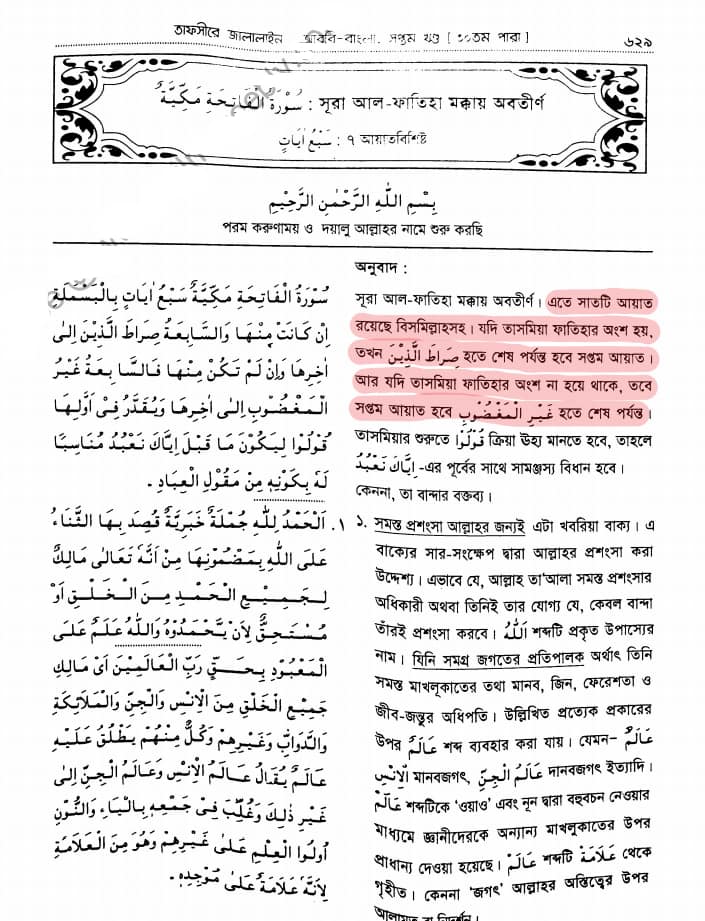
| Sequence | If Bismillah is taken as an ayah of Al-Fatiha | If Bismillah is not taken as an ayah of Al-Fatiha |
|---|---|---|
| First ayah | بِسْمِ اللَّهِ الرَّحْمَٰنِ الرَّحِيمِ — In the name of Allah, the Most Gracious, the Most Merciful | الْحَمْدُ لِلَّهِ رَبِّ الْعَالَمِينَ — All praise is for Allah, Lord of the worlds |
| Second ayah | الْحَمْدُ لِلَّهِ رَبِّ الْعَالَمِينَ — All praise is for Allah, Lord of the worlds | الرَّحْمَٰنِ الرَّحِيمِ — The Most Gracious, the Most Merciful |
| Third ayah | الرَّحْمَٰنِ الرَّحِيمِ — The Most Gracious, the Most Merciful | مَالِكِ يَوْمِ الدِّينِ — Master of the Day of Judgment |
| Fourth ayah | مَالِكِ يَوْمِ الدِّينِ — Master of the Day of Judgment | إِيَّاكَ نَعْبُدُ وَإِيَّاكَ نَسْتَعِينُ — You alone we worship and You alone we ask for help |
| Fifth ayah | إِيَّاكَ نَعْبُدُ وَإِيَّاكَ نَسْتَعِينُ — You alone we worship and You alone we ask for help | اهْدِنَا الصِّرَاطَ الْمُسْتَقِيمَ — Guide us to the straight path |
| Sixth ayah | اهْدِنَا الصِّرَاطَ الْمُسْتَقِيمَ — Guide us to the straight path | صِرَاطَ الَّذِينَ أَنْعَمْتَ عَلَيْهِمْ — The path of those You have bestowed favor upon |
| Seventh ayah | صِرَاطَ الَّذِينَ أَنْعَمْتَ عَلَيْهِمْ غَيْرِ الْمَغْضُوبِ عَلَيْهِمْ وَلَا الضَّالِّينَ — The path of those You have bestowed favor upon; not of those who have earned anger or are astray | غَيْرِ الْمَغْضُوبِ عَلَيْهِمْ وَلَا الضَّالِّينَ — Not of those who have earned anger or are astray |
The identity of the ayahs has changed on both sides of the table. The first ayah of one method is outside the count of Al-Fatiha for the other; the sixth ayah of one is the fifth of the other; the last two parts are joined in one count and separate in the other. Even while keeping the number seven unchanged, the boundary of the ayah and the scope of the sentence recognized as part of the surah change. In surahs used in daily prayer like Al-Fatiha, this dispute has been settled differently through subsequent fiqhi and textual authority.
In the account of Umm Salama, there is a description of Muhammad’s reading starting with Bismillah and reading by stopping at each ayah. This account in Abu Dawud is one of the documents used in favor of reading including Bismillah. In the main statement, Ahmad’s comment on the reading of “Malik” is also included. [740]
أَنَّهَا ذَكَرَتْ – أَوْ كَلِمَةً غَيْرَهَا – قِرَاءَةَ رَسُولِ اللَّهِ صلى الله عليه وسلم { بِسْمِ اللَّهِ الرَّحْمَنِ الرَّحِيمِ * الْحَمْدُ لِلَّهِ رَبِّ الْعَالَمِينَ * الرَّحْمَنِ الرَّحِيمِ * مَلِكِ يَوْمِ الدِّينِ } يَقْطَعُ قِرَاءَتَهُ آيَةً آيَةً . قَالَ أَبُو دَاوُدَ سَمِعْتُ أَحْمَدَ يَقُولُ الْقِرَاءَةُ الْقَدِيمَةُ { مَالِكِ يَوْمِ الدِّينِ } .
English translation: He mentioned—or said some similar words—the reading of the Messenger of Allah, peace and blessings of Allah be upon him: “Bismillahir Rahmanir Rahim. Alhamdu lillahi rabbil alamin. Ar-Rahmanir Rahim. King of the Day of Judgment.” He separated the reading ayah by ayah. Abu Dawud said: I heard Ahmad say, the ancient reading is “Master of the Day of Judgment” (مَالِكِ يَوْمِ الدِّينِ).
The other widely used document regarding Al-Fatiha is the hadith about dividing the prayer between Allah and the servant. There, the conversation begins from “Alhamdu lillahi rabbil alamin”; no separate answer was given for Bismillah. Qurtubi used this sequence in favor of Bismillah not being an ayah of Al-Fatiha. The text of the conversation is: [741]
قال [ تعالى ] : ” قسمت الصلاة بيني وبين عبدي نصفين ولعبدي ما سأل فإذا قال العبد : ( الحمد لله رب العالمين ) قال الله تعالى حمدني عبدي وإذا قال : ( الرحمن الرحيم ) قال الله تعالى : أثنى علي عبدي وإذا قال : ( مالك يوم الدين ) قال مجدني عبدي – وقال مرة : فوض إلى عبدي – فإذا قال : ( إياك نعبد وإياك نستعين ) قال : هذا بيني وبين عبدي ، ولعبدي ما سأل ، فإذا قال : ( اهدنا الصراط المستقيم صراط الذين أنعمت عليهم غير المغضوب عليهم ولا الضالين ) قال : هذا لعبدي ولعبدي ما سأل .
English translation: Allah said: “I have divided the prayer between Me and My servant into two parts; My servant shall receive whatever he asks. When the servant says, ‘Alhamdu lillahi rabbil alamin’, Allah says, ‘My servant has praised Me.’ When he says, ‘Ar-Rahmanir Rahim’, Allah says, ‘My servant has extolled Me.’ When he says, ‘Maliki yawmiddin’, Allah says, ‘My servant has glorified Me.’” He said again, “My servant has entrusted Me.” “When he says, ‘Iyyaka na’budu wa iyyaka nasta’in’, Allah says, ‘This is between Me and My servant; My servant shall receive whatever he asks.’ When he says, ‘Ihdinas siratal mustaqim, siratalladhina an’amta alayhim, ghayril maghdubi alayhim walad-dallin’, Allah says, ‘This is for My servant; My servant shall receive whatever he asks.’”
In the account of the revelation of Al-Kawthar, the Bismillah is associated more directly with the declared reading of the surah. According to the report of Anas, Muhammad said that a surah had just been revealed to him; then he recited Al-Kawthar including the Bismillah. Later, he spoke of the meaning of Al-Kawthar and the events reported to occur with his followers on the Day of Judgment. The full statement in Muslim: [742]
قَالَ بَيْنَا رَسُولُ اللَّهِ صلى الله عليه وسلم ذَاتَ يَوْمٍ بَيْنَ أَظْهُرِنَا إِذْ أَغْفَى إِغْفَاءَةً ثُمَّ رَفَعَ رَأْسَهُ مُتَبَسِّمًا فَقُلْنَا مَا أَضْحَكَكَ يَا رَسُولَ اللَّهِ قَالَ ” أُنْزِلَتْ عَلَىَّ آنِفًا سُورَةٌ ” . فَقَرَأَ ” بِسْمِ اللَّهِ الرَّحْمَنِ الرَّحِيمِ { إِنَّا أَعْطَيْنَاكَ الْكَوْثَرَ * فَصَلِّ لِرَبِّكَ وَانْحَرْ * إِنَّ شَانِئَكَ هُوَ الأَبْتَرُ} ” . ثُمَّ قَالَ ” أَتَدْرُونَ مَا الْكَوْثَرُ ” . فَقُلْنَا اللَّهُ وَرَسُولُهُ أَعْلَمُ . قَالَ ” فَإِنَّهُ نَهْرٌ وَعَدَنِيهِ رَبِّي عَزَّ وَجَلَّ عَلَيْهِ خَيْرٌ كَثِيرٌ هُوَ حَوْضٌ تَرِدُ عَلَيْهِ أُمَّتِي يَوْمَ الْقِيَامَةِ آنِيَتُهُ عَدَدُ النُّجُومِ فَيُخْتَلَجُ الْعَبْدُ مِنْهُمْ فَأَقُولُ رَبِّ إِنَّهُ مِنْ أُمَّتِي . فَيَقُولُ مَا تَدْرِي مَا أَحْدَثَتْ بَعْدَكَ ” . زَادَ ابْنُ حُجْرٍ فِي حَدِيثِهِ بَيْنَ أَظْهُرِنَا فِي الْمَسْجِدِ . وَقَالَ ” مَا أَحْدَثَ بَعْدَكَ ” .
English translation: Anas said: One day the Messenger of Allah, sallallahu alayhi wa sallam, was among us. He dozed for a short while; then he raised his head with a smile. We asked, “O Messenger of Allah, what has made you smile?” He said, “A surah has just been revealed to me.” Then he recited: “In the name of Allah, the Most Gracious, the Most Merciful. Indeed, We have granted you Al-Kawthar. Therefore, pray to your Lord and sacrifice. Indeed, your enemy is the one cut off.” Then he asked, “Do you know what Al-Kawthar is?” We said, “Allah and His Messenger know best.” He said, “It is a river which my Lord has promised me. There is much goodness in it. It is a basin where my Ummah will come on the Day of Judgment. The number of its vessels is like the stars. From among them, a servant will be removed. Then I will say, ‘O Lord, he was part of my Ummah.’ It will be said, ‘You do not know what new deeds he performed after you.’” Ibn Hujr added the phrase “among us in the mosque” in his account; and stated, “what new deeds he performed after you.”
Qurtubi explicitly cited this hadith of Al-Kawthar as evidence for an opinion held by Ibn Mubarak and Shafi’i. The relationship between announcing a newly revealed surah by reciting it with the Bismillah and counting the Bismillah as an internal verse of the surah is the subject of their interpretation. In the opposite position, the same Bismillah is considered a separate opening sentence or an independent verse. That is, despite being present in the words of the reported reading, the question of inclusion was not resolved without subsequent interpretation. The dispute remains over the boundary where the surah’s own reading begins.
The role of the Bismillah as a sign to recognize the boundary of a surah appears in another report from Ibn Abbas. In Abu Dawud 787, there is a report that the relationship of Bara’at remained unspecified and that the Bismillah was not written before the revelation of Naml; in 788, it is mentioned that the division of surahs is recognized when the Bismillah is revealed. The corresponding full quotation in the Bengali version also includes the title of the following paragraph and the translator’s note: [730] [743]
787. Through Ziyad ibn Ayyub from Ibn Abbas (ra), a report similar to the aforementioned hadith is narrated. He said, the Messenger of Allah, sallallahu alayhi wa sallam, departed from among us, but he said nothing clearly regarding whether Surah Bara’at is included in Surah Al-Anfal.
Imam Abu Dawud (rh) said, Shabi, Abu Malik, Qatada, and Thabit said, the Noble Prophet, sallallahu alayhi wa sallam, did not write the Bismillah (at the beginning of any surah) until Surah Naml was revealed upon him. 1
۷۸۸- حَدَّثَنَا قُتَيْبَةُ بْنُ سَعِيدٍ وَأَحْمَدُ بْنُ مُحَمَّدٍ الْمَرْوَزِي وَابْنُ السَّرْحِ قَالُوا نَا سُفْيَانُ عَنْ عَمْرُو عَنْ سَعِيدِ بْنِ جُبَيْرٍ قَالَ قُتَيْبَةُ فِيْهِ عَنِ ابْنِ عَبَّاسٍ قَالَ كَانَ النَّبِيُّ صَلَّى اللَّهُ عَلَيْهِ وَسَلَّمَ لَا يَعْرِفُ فَصْلَ السُّورَةِ حَتَّى تَنْزِلَ عَلَيْهِ بِسْمِ اللَّهِ الرَّحْمنِ الرَّحِيمِ وَهَذَا لَفْظُ ابْنِ السَّرْحِ –
788. Narrated from Ibn Abbas (ra) through Qutayba ibn Sa’id. He said, the Noble Prophet, sallallahu alayhi wa sallam, could not recognize the end or division of any surah until Bismillahir Rahmanir Rahim was revealed upon him. This reading of the hadith is from Ibnus Sarh.
۱۳۲ . بَابُ تَخْفِيفِ الصَّلوةَ لِلأَمْرِ يَحدُثُ
132. Section: Shortening the prayer due to some inevitable cause
1. This proves that “Bismillah” is a verse of Surah Naml, not a verse of any other surah.
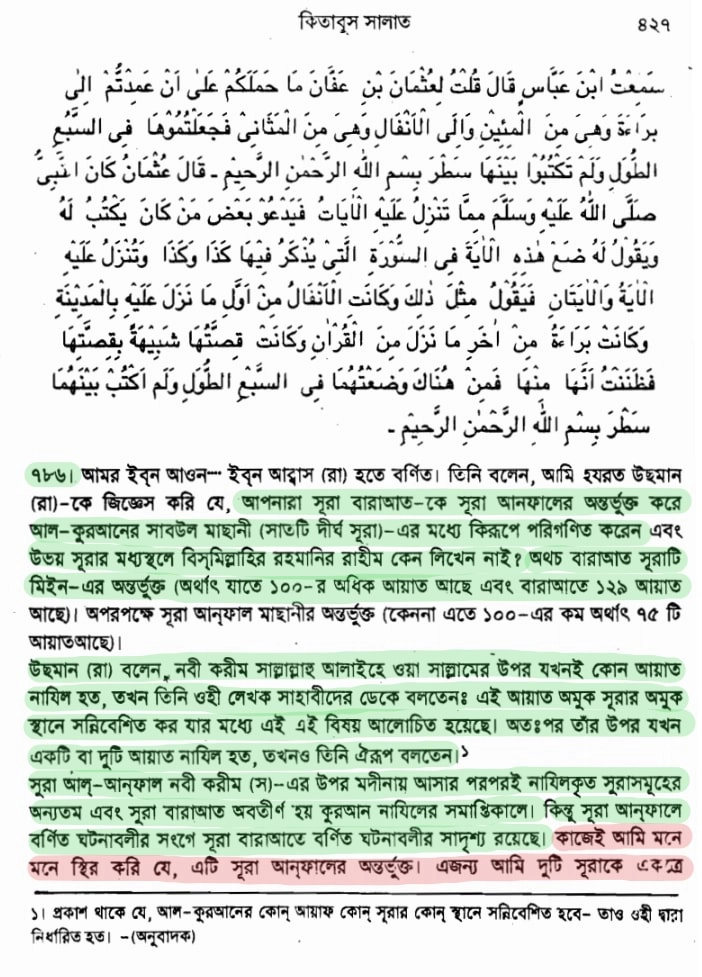
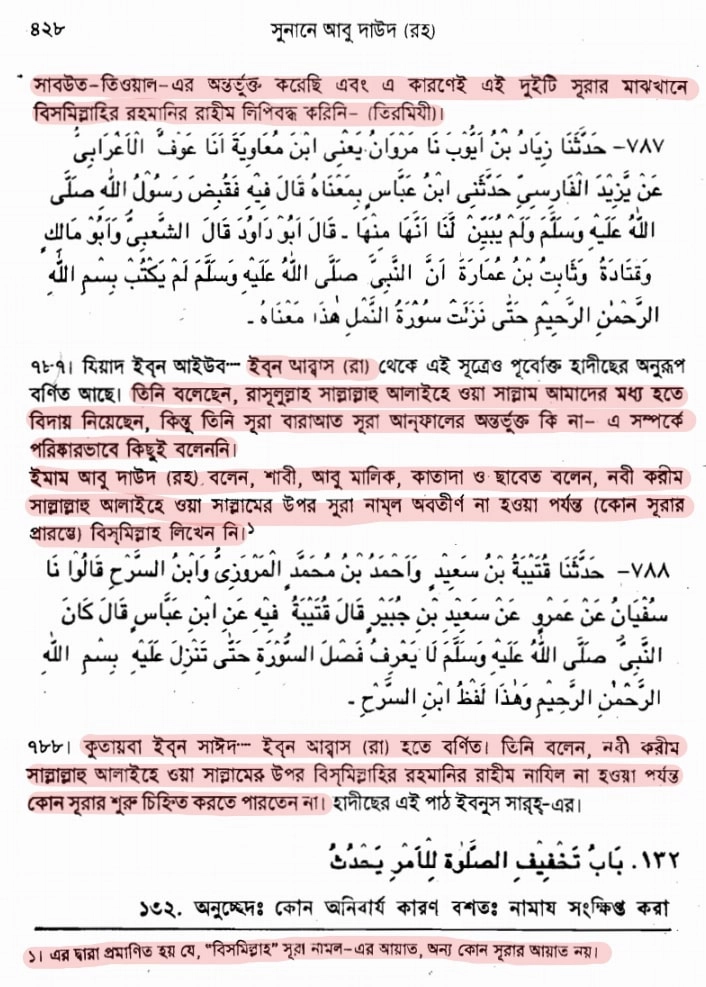
The note at the end of the quotation is the translator’s conclusion: Bismillah is only a verse of Naml. In the differences of opinion compiled by Qurtubi, there are positions opposite to this, stating it is a verse of Fatiha or every surah. A translator’s note does not become the declaration of the original speaker of the hadith. The part “faslus surah” of the hadith concerns recognizing the end or division of the surah; a new Bismillah separates the end of the previous surah and the beginning of the next. Consequently, the primary information of this sentence is the function of a separator, and the conclusion regarding the verse of a specific madhhab derived from it is a subsequent interpretation.
Qurtubi also brought an account in the name of Sha’bi and A’mash regarding the evolution of writing the opening sentence. There, it mentions the use of first “Bismika Allahumma”, then “Bismillah”, then “Bismillahir Rahman”, and finally the full “Bismillahir Rahmanir Rahim”. This account links the change in the form of writing with the revelation of specific verses. His compiled sequential account: [744]
الثالثة : روى الشعبي والأعمش أن رسول الله صلى الله عليه وسلم كان يكتب ( باسمك اللهم ) حتى أمر أن يكتب ( بسم الله ) فكتبها ; فلما نزلت : قل ادعوا الله أو ادعوا الرحمن [ الإسراء : 110 ] كتب ( بسم الله الرحمن ) فلما نزلت : إنه من سليمان وإنه بسم الله الرحمن الرحيم [ النمل : 30 ] كتبها .
English translation: Sha’bi and A’mash narrated: The Messenger of Allah, sallallahu alayhi wa sallam, used to write “Bismika Allahumma”. Later, when instructed to write “Bismillah”, he wrote that. When “Say, call Allah or call Rahman” was revealed, he wrote “Bismillahir Rahman”. Then, when “This is from Solomon, and it is Bismillahir Rahmanir Rahim” was revealed, he wrote the full sentence.
Regarding the absence of Bismillah at the beginning of Tawbah, he also quoted a different kind of explanation in the name of Ali via Suyuti: Bismillah is a declaration of security, and Bara’at was revealed with the sword. This is not a type of logic similar to the explanation that guesses based on the thematic similarity of Uthman. One explains whether an opening sentence is appropriate based on the content of a speech, while the other describes the compiler’s conclusion regarding the relationship between two works. The statement quoted in the name of Ali is: [745]
وَفِي الْمُسْتَدْرَكِ عَنِ ابْنِ عَبَّاسٍ قَالَ سَأَلْتُ عَلِيَّ بْنَ أَبِي طَالِبٍ: لِمَ لَمْ تُكْتَبْ فِي بَرَاءَةٌ بِسْمِ اللَّهِ الرَّحْمَنِ الرَّحِيمِ؟ قَالَ: لأنها أمان وبراءة نُزِّلَتْ بِالسَّيْفِ.
English translation: It is in Al-Mustadrak from Ibn Abbas. He said: I asked Ali ibn Abi Talib, “Why was Bismillahir Rahmanir Rahim not written in Bara’at?” He said, “Because it is security; and Bara’at was revealed with the sword.”
Thus, a history of multiple explanations is attached to the same missing line. The guess and compilation-conclusion in the name of Uthman, the thematic explanation of security and war in the name of Ali, and the description of Bismillah as a surah separator—these sources have answered different questions. In the current mushaf, there is no Bismillah before Tawbah; that visible characteristic is fixed. But the reason for it, the status of the same sentence as a verse in Fatiha, and its position before other surahs—conflicts of human interpretation remain in determining these. Although the adopted mushaf is prevalent in one form, a single and unanimous explanation has not been established behind every one of its boundaries.
Verses of Rajm: Umar’s declaration, absence in the mushaf, and the continued death penalty
In the account of Rajm, a fundamental rupture is revealed between the preservation of the Quran and the Islamic penal code. Umar said that the verse for killing by stoning was revealed, they had read it, and had memorized it. That verse is not in the current mushaf. Yet, the same chain of reports has maintained the punishment as a revealed farz of Allah. A consequence where the law became void after the text was lost has not occurred here; despite the absence of the text in the book, the authority to take human life has been established through hadith, the testimony of Companions, and subsequent fiqh.
Umar’s anxiety also centered on this rupture: later people would not find the verse of Rajm upon opening the book and would deny the punishment. In another report, he expressed a desire to write the verse himself, but stopped for fear that people would accuse him of adding to the book. In Ubayy’s memory, the same text is part of Al-Ahzab; the language he reported is not the same. In attempting to answer these three questions—the original status of the verse, the reason for its absence in the book, and the continued death penalty in the name of the absent sentence—the decisions of the compilation and religious law authorities become visible side by side.
Umar’s speech on revelation, reading, and preservation
In the speech preserved in Muslim through Ibn Abbas, Umar spoke while sitting on Muhammad’s mimbar. In his speech, Rajm was not called merely a prevalent judicial practice; it was identified as a revealed verse. “We read”, “kept in memory”, and “internalized”—these three verbs carry the identity of a statement read previously. Then he spoke of implementing that punishment during Muhammad’s time and after his death. The full hadith is: [746] [747] [748] [749]
يَقُولُ قَالَ عُمَرُ بْنُ الْخَطَّابِ وَهُوَ جَالِسٌ عَلَى مِنْبَرِ رَسُولِ اللَّهِ صلى الله عليه وسلم إِنَّ اللَّهَ قَدْ بَعَثَ مُحَمَّدًا صلى الله عليه وسلم بِالْحَقِّ وَأَنْزَلَ عَلَيْهِ الْكِتَابَ فَكَانَ مِمَّا أُنْزِلَ عَلَيْهِ آيَةُ الرَّجْمِ قَرَأْنَاهَا وَوَعَيْنَاهَا وَعَقَلْنَاهَا فَرَجَمَ رَسُولُ اللَّهِ صلى الله عليه وسلم وَرَجَمْنَا بَعْدَهُ فَأَخْشَى إِنْ طَالَ بِالنَّاسِ زَمَانٌ أَنْ يَقُولَ قَائِلٌ مَا نَجِدُ الرَّجْمَ فِي كِتَابِ اللَّهِ فَيَضِلُّوا بِتَرْكِ فَرِيضَةٍ أَنْزَلَهَا اللَّهُ وَإِنَّ الرَّجْمَ فِي كِتَابِ اللَّهِ حَقٌّ عَلَى مَنْ زَنَى إِذَا أَحْصَنَ مِنَ الرِّجَالِ وَالنِّسَاءِ إِذَا قَامَتِ الْبَيِّنَةُ أَوْ كَانَ الْحَبَلُ أَوْ الاِعْتِرَافُ . L63: Reference | : Sahih Muslim 1691a L64: In-book reference | : Book 29, Hadith 21
English translation: Sahih Muslim (Hadith Academy)
Chapter: 30. Prescribed punishments for crimes
Section: 4. Rajm of the married for adultery
4310-(15/1691) Narrated from Abu Tahir and Harmalah ibn Yahya (rh.) ….. from ‘Abdullah ibn Abbas (ra.). He said, “Umar ibn Khattab (ra.) while sitting on the mimbar of the Rasulullah sallallahu alayhi wa sallam said, certainly Allah Ta’ala sent Muhammad sallallahu alayhi wa sallam with the true religion and revealed the Book (Quran) upon him. Among the matters revealed by Allah, there is آيَةُ الرَّجْمِ (the verse of stoning for adultery). We recited it, remembered it, and understood it. Therefore, the Rasulullah sallallahu alayhi wa sallam implemented the order of rajm for adultery. In the time after him, we also implemented the order of rajm (for adultery). I fear that after a long time has passed, someone might say that we do not find the order of rajm (as punishment for adultery) in the Book of Allah. Then, by abandoning this obligatory act revealed by Allah, they will mislead people. Certainly, in the Book of Allah, the order of رجم (killing by stoning) is established as the punishment for adultery of married men and women, when it is proven by testimony, or she becomes pregnant, or he confesses himself.* (Islamic Foundation 4271, Islamic Center 4271)
* The recitation of this verse has become mansukh or abrogated, but the order of the verse still remains in effect.
Hadith Status: Sahih (Sahih)
After the hadith, a note is given in the Bengali version stating that the recitation is abolished and the ruling remains in effect. The speaker of this note is different from Umar’s direct speech. In the speech, there is a claim of previous revelation and reading, the report of implementing Rajm, and the fear of abandoning the punishment in the future upon not finding it in the book. In the note, a theological classification of that situation has been made. Specific details—the internal words of the verse, on which day its reading was withdrawn, or who heard the order of that withdrawal—were not given in Umar’s quoted statement.
| Information from Umar’s speech | Reported statement | Its specific significance |
|---|---|---|
| Revelation | The verse of Rajm was among the things revealed by Allah | The statement is remembered as a previous Quranic reading |
| Reading and retention | We read it, kept it in memory, internalized it | Not just a concept of punishment; a claim of a readable text |
| Application | Muhammad performed Rajm; after him, we also did | The sequence of implementing the penalty is linked to the memory of the reading |
| Absence | Someone will say, Rajm is not found in the book | Crisis of verifying the basis of punishment from the subsequent written book |
| Obligatoriness | Abandoning Rajm would be abandoning a revealed farz | Claim of maintaining the ruling of an absent text |
In Bukhari’s long account, there is also the social and political arrangement of this speech. Umar wanted to speak in public during the final Hajj; Abdur Rahman ibn Awf told him to give the speech upon returning to Medina. The logic was that in the crowd of Hajj, there are people who would not understand the speech and would spread it incorrectly. If spoken in the presence of the learned and elite of Medina, it would be received appropriately. Thus, the speech was not presented as an isolated reminiscence; it came within a plan regarding the audience, location, and acceptability of the propagation. The declaration of Rajm was part of that public speech.
In the account of Musnad Ahmad, after ascending the minbar, Umar also ordered that his statement be spread. The responsibility of transmitting his memory regarding the verse of stoning to subsequent areas was placed upon the listeners. The relevant sequential part of the original account: [750] [751]
فَلَمْ أَنْشَبْ أَنْ طَلَعَ عُمَرُ رَضِيَ اللَّهُ عَنْهُ فَلَمَّا رَأَيْتُهُ قُلْتُ لَيَقُولَنَّ الْعَشِيَّةَ عَلَى هَذَا الْمِنْبَرِ مَقَالَةً مَا قَالَهَا عَلَيْهِ أَحَدٌ قَبْلَهُ قَالَ فَأَنْكَرَ سَعِيدُ بْنُ زَيْدٍ ذَلِكَ فَقَالَ مَا عَسَيْتَ أَنْ يَقُولَ مَا لَمْ يَقُلْ أَحَدٌ فَجَلَسَ عُمَرُ رَضِيَ اللَّهُ عَنْهُ عَلَى الْمِنْبَرِ فَلَمَّا سَكَتَ الْمُؤَذِّنُ قَامَ فَأَثْنَى عَلَى اللَّهِ بِمَا هُوَ أَهْلُهُ ثُمَّ قَالَ أَمَّا بَعْدُ أَيُّهَا النَّاسُ فَإِنِّي قَائِلٌ مَقَالَةً قَدْ قُدِّرَ لِي أَنْ أَقُولَهَا لَا أَدْرِي لَعَلَّهَا بَيْنَ يَدَيْ أَجَلِي فَمَنْ وَعَاهَا وَعَقَلَهَا فَلْيُحَدِّثْ بِهَا حَيْثُ انْتَهَتْ بِهِ رَاحِلَتُهُ وَمَنْ لَمْ يَعِهَا فَلَا أُحِلُّ لَهُ أَنْ يَكْذِبَ عَلَيَّ إِنَّ اللَّهَ تَبَارَكَ وَتَعَالَى بَعَثَ مُحَمَّدًا صَلَّى اللَّهُ عَلَيْهِ وَسَلَّمَ بِالْحَقِّ وَأَنْزَلَ عَلَيْهِ الْكِتَابَ وَكَانَ مِمَّا أَنْزَلَ عَلَيْهِ آيَةُ الرَّجْمِ فَقَرَأْنَاهَا وَوَعَيْنَاهَا وَرَجَمَ رَسُولُ اللَّهِ صَلَّى اللَّهُ عَلَيْهِ وَسَلَّمَ وَرَجَمْنَا بَعْدَهُ فَأَخْشَى إِنْ طَالَ بِالنَّاسِ زَمَانٌ أَنْ يَقُولَ قَائِلٌ لَا نَجِدُ آيَةَ الرَّجْمِ فِي كِتَابِ اللَّهِ عَزَّ وَجَلَّ فَيَضِلُّوا بِتَرْكِ فَرِيضَةٍ قَدْ أَنْزَلَهَا اللَّهُ عَزَّ وَجَلَّ فَالرَّجْمُ فِي كِتَابِ اللَّهِ حَقٌّ عَلَى مَنْ زَنَى إِذَا أُحْصِنَ مِنْ الرِّجَالِ وَالنِّسَاءِ إِذَا قَامَتْ الْبَيِّنَةُ أَوْ الْحَبَلُ أَوْ الِاعْتِرَافُ
English translation: Musnad Ahmad
Musnad of Umar ibn al-Khattab (ra) [Hadith narrated by Umar]
Section:
391.
After a short while, Umar (ra) appeared. Seeing him, I said, this evening he will deliver a speech, the likes of which no one has delivered before. Said ibn Zayd denied this and said, what will he say that no one else has said? Then Umar (ra) sat on the mimbar. After the muazzin finished the adhan, Umar stood up and praised Allah as is His due. Then he said: O people, I am going to say something today, which has been destined for me to say. I do not know, perhaps I am saying this while standing at the end of my lifespan. Those who remember and understand this statement of mine, let them propagate it even until the end of their journey. And he who cannot remember and understand, let him propagate lies in my name – I do not authorize this.
Certainly Allah sent Muhammad sallallahu alayhi wa sallam with the truth and revealed the Book upon him. Among whatever He revealed upon him, the verse regarding rajm was also included. We read it and understood it. The Rasulullah sallallahu alayhi wa sallam himself performed rajm, and after him, we also did. I fear that after a long time has passed, people may say at one time, we do not find the verse regarding rajm in the Book of Allah. In this way, by abandoning an obligatory act revealed by Allah, they will go astray. In fact, if a married woman and man commit adultery, implementing rajm upon them is an irrefutable true rule under the scope of the Book of Allah, when testimony, confession, or pregnancy is found upon it.
[Bukhari, Muslim, Ibn Hibban, Musnad Ahmad-154, 156, 249]
Hadith Status: Sahih (Sahih)
The word “we” in Umar’s statement is particularly significant. He is not calling his own single dream or personal conjecture a verse; he is claiming a collective memory that was read and practiced. The truth of that claim depends on the account, but the nature of the claim is clear. Here, something used previously as a text of the Book and something later not found in the Book appear side by side. When people seek the basis for the death penalty from the Book, he is essentially establishing the authority of previous practice and testimony as the answer to their questions.
In Bukhari’s speech, after stoning, another previously read sentence comes regarding not turning away from one’s paternity. Then comes the prohibition of excessive praise and the context of political bay’ah. Within the same speech, the memory of revelation, religious obedience, and the authority of electing the caliph were side by side. That sequential part of Bukhari is: [752] [753]
إِنَّ اللَّهَ بَعَثَ مُحَمَّدًا صلى الله عليه وسلم بِالْحَقِّ وَأَنْزَلَ عَلَيْهِ الْكِتَابَ فَكَانَ مِمَّا أَنْزَلَ اللَّهُ آيَةُ الرَّجْمِ، فَقَرَأْنَاهَا وَعَقَلْنَاهَا وَوَعَيْنَاهَا، رَجَمَ رَسُولُ اللَّهِ صلى الله عليه وسلم وَرَجَمْنَا بَعْدَهُ، فَأَخْشَى إِنْ طَالَ بِالنَّاسِ زَمَانٌ أَنْ يَقُولَ قَائِلٌ وَاللَّهِ مَا نَجِدُ آيَةَ الرَّجْمِ فِي كِتَابِ اللَّهِ، فَيَضِلُّوا بِتَرْكِ فَرِيضَةٍ أَنْزَلَهَا اللَّهُ، وَالرَّجْمُ فِي كِتَابِ اللَّهِ حَقٌّ عَلَى مَنْ زَنَى إِذَا أُحْصِنَ مِنَ الرِّجَالِ وَالنِّسَاءِ، إِذَا قَامَتِ الْبَيِّنَةُ أَوْ كَانَ الْحَبَلُ أَوْ الاِعْتِرَافُ، ثُمَّ إِنَّا كُنَّا نَقْرَأُ فِيمَا نَقْرَأُ مِنْ كِتَابِ اللَّهِ أَنْ لاَ تَرْغَبُوا عَنْ آبَائِكُمْ، فَإِنَّهُ كُفْرٌ بِكُمْ أَنْ تَرْغَبُوا عَنْ آبَائِكُمْ، أَوْ إِنَّ كُفْرًا بِكُمْ أَنْ تَرْغَبُوا عَنْ آبَائِكُمْ، أَلاَ ثُمَّ إِنَّ رَسُولَ اللَّهِ صلى الله عليه وسلم قَالَ ” لاَ تُطْرُونِي كَمَا أُطْرِيَ عِيسَى ابْنُ مَرْيَمَ وَقُولُوا عَبْدُ اللَّهِ وَرَسُولُهُ ”. ثُمَّ إِنَّهُ بَلَغَنِي أَنَّ قَائِلاً مِنْكُمْ يَقُولُ وَاللَّهِ لَوْ مَاتَ عُمَرُ بَايَعْتُ فُلاَنًا. فَلاَ يَغْتَرَّنَّ امْرُؤٌ أَنْ يَقُولَ إِنَّمَا كَانَتْ بَيْعَةُ أَبِي بَكْرٍ فَلْتَةً وَتَمَّتْ أَلاَ وَإِنَّهَا قَدْ كَانَتْ كَذَلِكَ وَلَكِنَّ اللَّهَ وَقَى شَرَّهَا، وَلَيْسَ مِنْكُمْ مَنْ تُقْطَعُ الأَعْنَاقُ إِلَيْهِ مِثْلُ أَبِي بَكْرٍ، مَنْ بَايَعَ رَجُلاً عَنْ غَيْرِ مَشُورَةٍ مِنَ الْمُسْلِمِينَ فَلاَ يُبَايَعُ هُوَ وَلاَ الَّذِي بَايَعَهُ تَغِرَّةً أَنْ يُقْتَلاَ، وَإِنَّهُ قَدْ كَانَ مِنْ خَبَرِنَا حِينَ تَوَفَّى اللَّهُ نَبِيَّهُ صلى الله عليه وسلم إِلاَّ أَنَّ الأَنْصَارَ خَالَفُونَا وَاجْتَمَعُوا بِأَسْرِهِمْ فِي سَقِيفَةِ بَنِي سَاعِدَةَ، وَخَالَفَ عَنَّا عَلِيٌّ وَالزُّبَيْرُ وَمَنْ مَعَهُمَا، وَاجْتَمَعَ الْمُهَاجِرُونَ إِلَى أَبِي بَكْرٍ
English translation: Indeed, Allah sent Muhammad, sallallahu alayhi wa sallam, with the truth and revealed the Book upon him. Among the things revealed by Allah was the verse of stoning. We have read it, understood it, and mastered it. The Messenger of Allah, sallallahu alayhi wa sallam, performed stoning and after him, we also did. I fear that after a long time has passed, someone will say, “By Allah, we do not find the verse of stoning in the Book of Allah.” Consequently, by abandoning a fard revealed by Allah, they will go astray. Among men or women, whoever commits adultery after being married, stoning is the truth in the Book of Allah; when testimony is established, or pregnancy or confession is found. We also used to read this among the readings of the Book of Allah: “Do not turn away from your fathers; turning away from your fathers is disbelief for you.” Or he said, “Indeed, turning away from your fathers is disbelief for you.” Know that the Messenger of Allah said, “Do not praise me excessively, as Jesus son of Mary was praised excessively; rather say, the servant of Allah and His Messenger.” It has reached me that one of you is saying, “By Allah, when Umar dies, I will give bay’ah to so-and-so.” Let no one be deceived by saying that the bay’ah of Abu Bakr was a sudden event and was completed. Know that it was so; but Allah protected it from harm. There is no one among you like Abu Bakr, toward whom the necks of people are extended. If anyone gives bay’ah to a person without the consultation of the Muslims, neither his bay’ah nor the bay’ah of the one to whom he gave bay’ah will be followed; both risk being killed. Our event was this: when Allah gave death to His Prophet, the Ansar separated from us and all gathered at the Saqifah of Bani Sa’idah. Ali, Zubayr, and their companions were separate from us; and the Muhajirun gathered with Abu Bakr.
In this long statement, the steps of the argument in favor of stoning are: Muhammad was sent with the truth, the Book was revealed upon him, the verse of stoning was within it, it was read and applied; therefore, the next generation must keep the punishment in effect. The presence of that specific reading in the written mushaf did not become an effective condition for this argument. Rather, accepting the statements of predecessors despite not finding the written text became the criterion for obedience. The memory of revelation here acts as an authority substituting for the absent verse.
The fear that “people will say [it is] an addition” and the desire to write down the verse
In one account of Umar’s speech, he expressed a desire to write down the verse himself. The obstacle he declared was the potential allegation of people: that Umar added to the Book of Allah. In this sentence, the caliph’s personal certainty and the social acceptability of writing a new reading into a book become separate. He speaks with certainty about the revelation and reading of the verse, yet he also fears that writing it down would be regarded as an unauthorized addition. The full account of Abu Dawud keeps these two states within the same statement. [754] [755] [756]
أَنَّ عُمَرَ، – يَعْنِي ابْنَ الْخَطَّابِ – رضى الله عنه خَطَبَ فَقَالَ إِنَّ اللَّهَ بَعَثَ مُحَمَّدًا صلى الله عليه وسلم بِالْحَقِّ وَأَنْزَلَ عَلَيْهِ الْكِتَابَ فَكَانَ فِيمَا أَنْزَلَ عَلَيْهِ آيَةُ الرَّجْمِ فَقَرَأْنَاهَا وَوَعَيْنَاهَا وَرَجَمَ رَسُولُ اللَّهِ صلى الله عليه وسلم وَرَجَمْنَا مِنْ بَعْدِهِ وَإِنِّي خَشِيتُ – إِنْ طَالَ بِالنَّاسِ الزَّمَانُ – أَنْ يَقُولَ قَائِلٌ مَا نَجِدُ آيَةَ الرَّجْمِ فِي كِتَابِ اللَّهِ فَيَضِلُّوا بِتَرْكِ فَرِيضَةٍ أَنْزَلَهَا اللَّهُ تَعَالَى فَالرَّجْمُ حَقٌّ عَلَى مَنْ زَنَى مِنَ الرِّجَالِ وَالنِّسَاءِ إِذَا كَانَ مُحْصَنًا إِذَا قَامَتِ الْبَيِّنَةُ أَوْ كَانَ حَمْلٌ أَوِ اعْتِرَافٌ وَايْمُ اللَّهِ لَوْلاَ أَنْ يَقُولَ النَّاسُ زَادَ عُمَرُ فِي كِتَابِ اللَّهِ عَزَّ وَجَلَّ لَكَتَبْتُهَا .
English translation: Sunan Abu Dawood (Verified)
Chapter: 33/ Crime and its punishment
Publisher: Allama Albani Academy
Section: 23. Regarding rajm
4418. Narrated via Abdullah ibn Abbas (ra.). Umar ibn al-Khattab (ra) said in his speech, certainly Allah sent Muhammad sallallahu alayhi wa sallam with the true religion and revealed the Book upon him. And among what He revealed upon him, the verse regarding rajm is included. We recited it and preserved it. The Rasulullah sallallahu alayhi wa sallam performed rajm and we also performed rajm after him. However, my fear is, in the length of the flow of time, someone might say, we have not found the verse of rajm in the Book revealed by Allah.
As a result, they will go astray by abandoning an obligatory act revealed by Allah. Know that if married women and men are proven guilty of the crime of adultery or become pregnant or make a confession, it is mandatory to perform rajm on them. By Allah! If people did not say that Umar added something to the Book of Allah, then I would certainly have written this verse. (1)
Sahih.
(1). Bukhari, Muslim.
Hadith Status: Sahih (Sahih)
In this account, the verb “would have written” expresses a desire for a concrete action. The possibility of people’s allegation appears as a condition for that action. To remove the fear of denying a ruling because it is not in the Book, Umar’s proposed method was to write the verse; yet, writing it could lead to allegations of exceeding the boundaries of the Book. Therefore, the problem is not just whether the verse is in his mind or not. The authority of through what process personal memory can be transformed into the accepted Book of the collective is questioned here.
In Ahmad’s account number 352, the objection is more direct: some people are saying, only flogging is in the Book of Allah. Here, along with the imagined future objection, contemporary statements are also narrated. At the end of Umar’s response, it is stated that if there were no fear of allegation, he would have written the reading exactly as it was revealed. [757] [758]
قَالَ حَجَّ عُمَرُ بْنُ الْخَطَّابِ رَضِيَ اللَّهُ عَنْهُ فَأَرَادَ أَنْ يَخْطُبَ النَّاسَ خُطْبَةً فَقَالَ عَبْدُ الرَّحْمَنِ بْنُ عَوْفٍ إِنَّهُ قَدْ اجْتَمَعَ عِنْدَكَ رَعَاعُ النَّاسِ فَأَخِّرْ ذَلِكَ حَتَّى تَأْتِيَ الْمَدِينَةَ فَلَمَّا قَدِمَ الْمَدِينَةَ دَنَوْتُ مِنْهُ قَرِيبًا مِنْ الْمِنْبَرِ فَسَمِعْتُهُ يَقُولُ وَإِنَّ نَاسًا يَقُولُونَ مَا بَالُ الرَّجْمِ وَإِنَّمَا فِي كِتَابِ اللَّهِ الْجَلْدُ وَقَدْ رَجَمَ رَسُولُ اللَّهِ صَلَّى اللَّهُ عَلَيْهِ وَسَلَّمَ وَرَجَمْنَا بَعْدَهُ وَلَوْلَا أَنْ يَقُولُوا أَثْبَتَ فِي كِتَابِ اللَّهِ مَا لَيْسَ فِيهِ لَأَثْبَتُّهَا كَمَا أُنْزِلَتْ.
English translation: Musnad Ahmad
Musnad of Umar ibn al-Khattab (ra) (Hadith narrated by Umar)
Section:
352. Abdur Rahman ibn Awf (ra) said, Umar (ra) once performed Hajj. At that time, he wanted to deliver a speech in public. Abdur Rahman ibn Awf said, a disorderly crowd is present before you. In this situation, keep your delivery of the speech suspended until arriving in Medina. Later when he reached Medina, I appeared before him near the mimbar. I heard, he was saying: many say, what is rajm again? In the Book of Allah, only flogging is mentioned as the punishment for adultery. Yet the Rasulullah sallallahu alayhi wa sallam performed rajm (killing by stoning) and after him we also performed rajm. If the fear did not exist that people would raise the allegation that, Umar added such a thing to the Book of Allah which is not in it, then I would have added the verse regarding rajm in the Quran as it was revealed. (See Hadith no. 391)
Hadith Status: Sahih (Sahih)
The phrase “exactly as it was revealed” carries the claim of re-writing a past reading. Umar is not presenting it as a law authored by himself. But that language was not placed before the subsequent reader as part of the Quran. As a result of his statement, two pieces of information exist simultaneously: the original Quranic identity of the verse in his account, and the unresolved validity of writing it as an accepted part of the mushaf. Despite the declared certainty, that certainty did not by itself effect inclusion in the Book.
In Malik’s Muwatta account, there is mention of Umar’s old age and prayer regarding the burden of governance after returning from the final Hajj. Then comes the speech in Medina, the context of stoning, and the desire to write it with his own hand. At the end, the account also preserves the time of his death and Malik’s explanation of the words “shaikh-shaikha”. The complete matn of Muwatta quoted in Zarqani’s Sharh: [759]
أَنَّهُ سَمِعَهُ يَقُولُ لَمَّا صَدَرَ عُمَرُ بْنُ الْخَطَّابِ مِنْ مِنًى أَنَاخَ بِالْأَبْطَحِ ثُمَّ كَوَّمَ كَوْمَةً بَطْحَاءَ ثُمَّ طَرَحَ عَلَيْهَا رِدَاءَهُ وَاسْتَلْقَى ثُمَّ مَدَّ يَدَيْهِ إِلَى السَّمَاءِ فَقَالَ اللَّهُمَّ كَبِرَتْ سِنِّي وَضَعُفَتْ قُوَّتِي وَانْتَشَرَتْ رَعِيَّتِي فَاقْبِضْنِي إِلَيْكَ غَيْرَ مُضَيِّعٍ وَلَا مُفَرِّطٍ ثُمَّ قَدِمَ الْمَدِينَةَ فَخَطَبَ النَّاسَ فَقَالَ أَيُّهَا النَّاسُ قَدْ سُنَّتْ لَكُمْ السُّنَنُ وَفُرِضَتْ لَكُمْ الْفَرَائِضُ وَتُرِكْتُمْ عَلَى الْوَاضِحَةِ إِلَّا أَنْ تَضِلُّوا بِالنَّاسِ يَمِينًا وَشِمَالًا وَضَرَبَ بِإِحْدَى يَدَيْهِ عَلَى الْأُخْرَى ثُمَّ قَالَ إِيَّاكُمْ أَنْ تَهْلِكُوا عَنْ آيَةِ الرَّجْمِ أَنْ يَقُولَ قَائِلٌ لَا نَجِدُ حَدَّيْنِ فِي كِتَابِ اللَّهِ فَقَدْ رَجَمَ رَسُولُ اللَّهِ صَلَّى اللَّهُ عَلَيْهِ وَسَلَّمَ وَرَجَمْنَا وَالَّذِي نَفْسِي بِيَدِهِ لَوْلَا أَنْ يَقُولَ النَّاسُ زَادَ عُمَرُ بْنُ الْخَطَّابِ فِي كِتَابِ اللَّهِ تَعَالَى لَكَتَبْتُهَا الشَّيْخُ وَالشَّيْخَةُ فَارْجُمُوهُمَا أَلْبَتَّةَ فَإِنَّا قَدْ قَرَأْنَاهَا قَالَ مَالِكٌ قَالَ يَحْيَى بْنُ سَعِيدٍ قَالَ سَعِيدُ بْنُ الْمُسَيَّبِ فَمَا انْسَلَخَ ذُو الْحِجَّةِ حَتَّى قُتِلَ عُمَرُ رَحِمَهُ اللَّهُ قَالَ يَحْيَى سَمِعْت مَالِكًا يَقُولُ قَوْلُهُ الشَّيْخُ وَالشَّيْخَةُ يَعْنِي الثَّيِّبَ وَالثَّيِّبَةَ فَارْجُمُوهُمَا أَلْبَتَّةَ
English translation: He heard Sa’id ibn al-Musayyib say: When Umar ibn al-Khattab returned from Mina, he stationed his camel at Abtah. He made a pile of small stones and lay down on a sheet spread over it. Then, raising both hands toward the sky, he said, “O Allah, my age has increased, my strength has diminished, and the people under my rule have spread. Take me to You without me being one who wastes or neglects responsibility.” Then he came to Medina and delivered a speech before the people: “O people, the custom has been established for you, the fard has been determined, and you have been placed on the clear path; do not mislead people to the right or left.” He struck one hand against the other and said, “Be warned about the destruction regarding the verse of stoning—someone will say, we do not find two punishments in the Book of Allah. The Messenger of Allah performed stoning and we also did. By Him in whose hand my soul is, if people did not say, Umar ibn al-Khattab added to the Book of Allah, I would have written: ‘The old man and the old woman—you must certainly stone them to death.’ We have read it.” Malik says: Yahya ibn Sa’id said, Sa’id ibn al-Musayyib said, Umar was killed before Dhu al-Hijjah ended; may Allah have mercy on him. Yahya says: I heard Malik say, the meaning of “old man and old woman” is a man and woman who have previously had marital sexual relations; you must certainly stone them to death.
In this Muwatta-account, the time between Umar’s prayer and death is also determined. Consequently, the fear of allegation appears as a problem of the final phase of his rule. A person known as the initiator of the first compilation is giving the memory of such a verse toward the end of his life, the written inclusion of which was still debatable in his statement. Saying “it was revealed” and ensuring “it will be valid to write in the Book” did not function as the same level of power. His own belief and the public’s recognition in the state’s accepted Book did not converge here.
The language of Tirmidhi’s account is again somewhat different. There, the phrase “people will say” is not alone; Umar says that because he dislikes adding to the Book of Allah, he did not write it in the mushaf. In the same statement, the stoning performed by Muhammad, Abu Bakr, and himself is mentioned. Tirmidhi has called the account hasan sahih. [760]
قَالَ رَجَمَ رَسُولُ اللَّهِ صلى الله عليه وسلم وَرَجَمَ أَبُو بَكْرٍ وَرَجَمْتُ وَلَوْلاَ أَنِّي أَكْرَهُ أَنْ أَزِيدَ فِي كِتَابِ اللَّهِ لَكَتَبْتُهُ فِي الْمُصْحَفِ فَإِنِّي قَدْ خَشِيتُ أَنْ تَجِيءَ أَقْوَامٌ فَلاَ يَجِدُونَهُ فِي كِتَابِ اللَّهِ فَيَكْفُرُونَ بِهِ . قَالَ وَفِي الْبَابِ عَنْ عَلِيٍّ . قَالَ أَبُو عِيسَى حَدِيثُ عُمَرَ حَدِيثٌ حَسَنٌ صَحِيحٌ وَرُوِيَ مِنْ غَيْرِ وَجْهٍ عَنْ عُمَرَ .
English translation: Umar said: The Messenger of Allah peace and blessings of Allah be upon him performed stoning, Abu Bakr performed stoning, and I also performed stoning. Had I not disliked adding to the Book of Allah, I would have written it in the mushaf. For I fear that some communities will come who, not finding it in the Book of Allah, will deny it. In this chapter, there is also a narration from Ali. Abu Isa said: The hadith of Umar is hasan sahih; it has been narrated from Umar through multiple chains.
| Account | Language of not writing it down | The aspect that emerges from the statement |
|---|---|---|
| Abu Dawud 4418 | People will say, Umar added to the Book of Allah | Potential social accusation |
| Ahmad 352 | People will say that something not in the Book has been established | Fear of being regarded as an external addition |
| Muwatta, narration of Sa’id ibn al-Musayyib | Had people not said it was an addition, I would have written it; we have read it | Desire to re-write a previously read text |
| Tirmidhi 1431 | Had I not disliked adding to the Book, I would have written it in the mushaf | Personal objection to the act being identified as an addition |
If these phrasings are merged, an important distinction is lost. “People will accuse me of adding” is the fear of social reaction; “I dislike adding” is a personal dislike for the act being regarded as an addition. Both narrations contain the absence of the verse and anxiety over the punishment being abandoned. However, the manner of expressing why he did not write it is not the same. Therefore, rewriting the statements of all sources into a single perfect sentence suppresses this difference within the chain of narrations.
In the full narration of Bukhari 6830 and Muslim 1691, the extra sentence about people calling it an addition is not present. In Abu Dawud, the sentence is in the connected narration. In answer 111382 of IslamQA, the fact that this statement remains mu’allaq in another chapter of Bukhari has also been distinguished. To attribute all words exactly to both by saying “it is in Bukhari and Muslim” misidentifies the narration. Which sentence appeared in which source is the specific data of the text’s history.
Differences in the reading of stoning and the end of the sentence in Ubayy’s account of Al-Ahzab
Apart from Umar, there are narrations of remembering stoning as previously read Quran under the name of Ubayy ibn Ka’b. In his narration, the text is linked to a specific surah: Al-Ahzab. When Zirr ibn Hubaysh told him the number of verses in the surah was seventy-three, Ubayy remembered the surah as being equivalent to Al-Baqarah and spoke of reading the sentence on stoning within it. Consequently, the matter does not remain merely as an isolated memory of a punishment; it becomes linked to the previous extent of a surah in the accepted mushaf. The narration is present in the Bengali version of Tafsir Ibn Kathir: [761]
Imam Ahmad (r) said, Khalaf ibn Hisham (r)…. narrated from Zirr (r). He said, once Ubayy ibn Ka’b (ra) asked me, how many verses are in Surah ‘Ahzab’? I said, seventy-three. He said, be silent. This is equivalent to Surah Baqarah and we used to recite in it: الشيخ وَالشَّيْخَةُ إِذَا زَنَيَا فَارْجُمُوهُمَا الْبَتَّةَ نَكَالاً مِّنَ اللهِ وَاللهُ عَزِيزٌ حَكِيمٌ —when an old man and an old woman commit adultery, stone them to death. This is a punishment from Allah. Allah is All-Powerful, All-Wise. Imam Nasai has narrated this through a different chain from ‘Asim ibn Abun Najud. The chain is ‘Hasan’. By this it is understood that there were more parts of the Quran in the surah. Later it was abrogated.
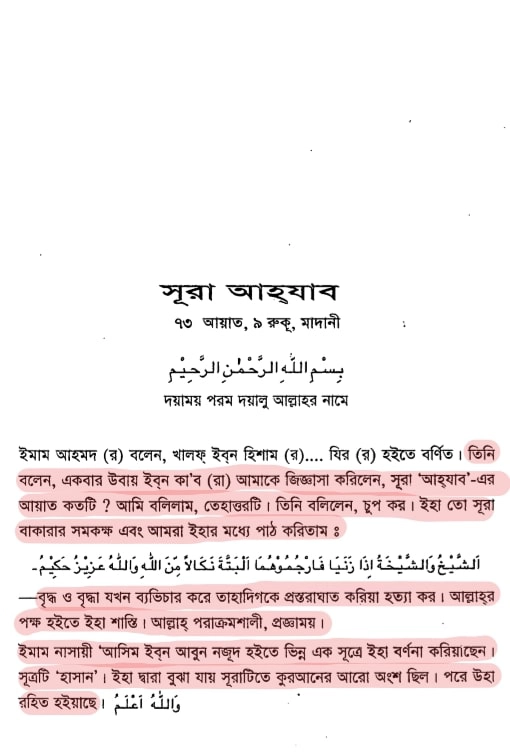
In this Bengali version, the Arabic sentence ends with “Wallahu Azizun Hakim” and the translation is “Allah is Almighty, Wise”. In the Arabic text of Ibn Kathir published online, the same narration ends with “Wallahu Alimun Hakim”—meaning “Allah is All-Knowing, Wise”. The difference is not just in the Bengali synonyms; the Arabic attributes themselves are different. The complete relevant section of the narration and Ibn Kathir’s subsequent comment in the online Arabic text: [762]
قال [ عبد الله بن ] الإمام أحمد : حدثنا خلف بن هشام ، حدثنا حماد بن زيد ، عن عاصم بن بهدلة ، عن زر قال : قال لي أبي بن كعب : كأين تقرأ سورة الأحزاب ؟ أو كأين تعدها ؟ قال : قلت : ثلاثا وسبعين آية : فقال : قط! لقد رأيتها وإنها لتعادل ” سورة البقرة ” ، ولقد قرأنا فيها : الشيخ والشيخة إذا زنيا فارجموهما البتة نكالا من الله والله عليم حكيم ” . ورواه النسائي من وجه آخر ، عن عاصم – وهو ابن أبي النجود ، وهو ابن بهدلة – به . وهذا إسناد حسن ، وهو يقتضي أنه كان فيها قرآن ثم نسخ لفظه وحكمه أيضا ، والله أعلم .
English translation: [Abdullah, son of Imam Ahmad] said: Our Khalaf ibn Hisham narrated to us; he said, our Hammad ibn Zayd narrated to us, from Asim ibn Bahdala, who [narrated] from Zirr. Zirr said: Ubayy ibn Ka’b said to me, “How much of Al-Ahzab do you read, or how many verses do you count?” I said, “Seventy-three verses.” He said, “Only that much! I have seen it; it was equivalent to Surah Al-Baqarah. We read in it: if an old man and an old woman commit adultery, you must stone them to death, as a punishment from Allah; and Allah is All-Knowing, Wise.” Nasa’i narrated this from Asim through another chain; he [narrated from] Ibn Abin Najud, and again Ibn Bahdala. It is a hasan sanad. From this it is understood that it contained parts of the Quran whose reading and ruling were later abrogated. Allah knows best.
“Al-Ahzab was equivalent to Al-Baqarah” is a comparison of the surah’s previous extent in Ubayy’s memory. Within this comparison, he specifically gave the sentence on stoning as an example. That sentence is not in the current surah; it was in the narrated previous reading. This difference is not created simply by drawing the end of the verse elsewhere, because here the presence and absence of a specific sentence is mentioned. Ibn Kathir applied the principle of abrogation to explain that additional Quranic part; his comment is also preserved after the narration.
In Nasa’i’s As-Sunan al-Kubra, Ubayy’s conversation is in a different phrasing. There, the end of the stoning sentence is “Azizun Hakim”; simultaneously, the part “idha zanaya”—if they commit adultery—is not in that short reading. Although the discussion of punishment and the memory of the surah are the same, the quoted words are not identical everywhere. Full matn: [763]
زِرٍّ قَالَ : قَالَ أُبَيُّ بْنُ كَعْبٍ : كَمْ تَعُدُّونَ سُورَةَ الْأَحْزَابِ آيَةً قُلْنَا : ثَلَاثَةً وَسَبْعِينَ ، فَقَالَ أُبَيٌّ : كَانَتْ لَتَعْدِلُ سُورَةَ الْبَقَرَةِ أَوْ أَطْوَلَ ، وَلَقَدْ كَانَ فِيهَا آيَةُ الرَّجْمِ : الشَّيْخُ وَالشَّيْخَةُ فَارْجُمُوهُمَا الْبَتَّةَ نَكَالًا مِنَ اللهِ وَاللهُ عَزِيزٌ حَكِيمٌ .
English translation: Zirr said: Ubayy ibn Ka’b said, “How many verses of Al-Ahzab do you count?” We said, “Seventy-three.” Ubayy said, “It was equivalent to Al-Baqarah or even longer. Within it was the verse of stoning: the old man and the old woman—you must stone them to death, as a punishment from Allah; and Allah is Almighty, Wise.”
In Hakim’s Al-Mustadrak, both “idha zanaya” and “Azizun Hakim” are found together. Hakim called the sanad of the relevant narration sahih. Here the difference between the three readings is evident: in Ibn Kathir’s online text, the conditional clause and “Alim” [are present]; in Nasa’i, “Aziz” without that conditional clause; and in Hakim, “Aziz” with the conditional clause. The complete relevant sentences of Hakim’s reading: [764]
قَالَ : ” قَطُّ ” . قُلْتُ : قَطُّ . قَالَ : ” لَقَدْ رَأَيْتُهَا وَإِنَّهَا لَتَعْدِلُ الْبَقَرَةَ وَلَقَدْ قَرَأْنَا فِيمَا قَرَأْنَا فِيهَا : الشَّيْخُ وَالشَّيْخَةُ إِذَا زَنَيَا فَارْجُمُوهُمَا الْبَتَّةَ نَكَالًا مِنَ اللَّهِ وَاللَّهُ عَزِيزٌ حَكِيمٌ ” . هَذَا حَدِيثٌ صَحِيحُ الْإِسْنَادِ وَلَمْ يُخْرِجَاهُ .
English translation: He said, “Only that much!” I said, “Only that much.” He said, “I have seen it; it was equivalent to Al-Baqarah. Among what we used to read in it, we read: if an old man and an old woman commit adultery, you must stone them to death, as a punishment from Allah; and Allah is Almighty, Wise.” This is a hadith with a sahih sanad; the two of them did not compile it.
| Source | Condition and middle part of the stoning-reading | End of the sentence |
|---|---|---|
| Ibn Kathir’s online Arabic text | الشيخ والشيخة إذا زنيا فارجموهما البتة نكالا من الله | والله عليم حكيم — Allah is All-Knowing, Wise |
| The Bengali version quoted by Ibn Kathir | The condition of adultery for the old man and old woman and the punishment from Allah | والله عزيز حكيم — Allah is Almighty, Wise |
| Nasa’i, As-Sunan al-Kubra 7312 | الشيخ والشيخة فارجموهما البتة نكالا من الله | والله عزيز حكيم — “idha zanaya” is not in this reading |
| Hakim, Al-Mustadrak 8132 | الشيخ والشيخة إذا زنيا فارجموهما البتة نكالا من الله | والله عزيز حكيم — “Aziz” with the conditional clause |
| Ibn Majah 2553; narration of Umar | الشيخ والشيخة إذا زنيا فارجموهما البتة | In this quotation, the attribute of Allah at the end was not given |
In Ibn Majah’s narration, Umar directly mentioned the sentence he read. There, the reading comes up to “if an old man and an old woman commit adultery, you must stone them to death”. The full matn, including Umar’s statement, the condition for stoning, and the details of the Prophet’s and subsequent application, is: [765]
قَالَ قَالَ عُمَرُ بْنُ الْخَطَّابِ لَقَدْ خَشِيتُ أَنْ يَطُولَ، بِالنَّاسِ زَمَانٌ حَتَّى يَقُولَ قَائِلٌ مَا أَجِدُ الرَّجْمَ فِي كِتَابِ اللَّهِ فَيَضِلُّوا بِتَرْكِ فَرِيضَةٍ مِنْ فَرَائِضِ اللَّهِ أَلاَ وَإِنَّ الرَّجْمَ حَقٌّ إِذَا أُحْصِنَ الرَّجُلُ وَقَامَتِ الْبَيِّنَةُ أَوْ كَانَ حَمْلٌ أَوِ اعْتِرَافٌ وَقَدْ قَرَأْتُهَا الشَّيْخُ وَالشَّيْخَةُ إِذَا زَنَيَا فَارْجُمُوهُمَا الْبَتَّةَ . رَجَمَ رَسُولُ اللَّهِ صلى الله عليه وسلم وَرَجَمْنَا بَعْدَهُ .
English translation: Ibn Abbas said: Umar ibn al-Khattab said, I fear that a long time will pass over people and someone will say, “I do not find stoning in the Book of Allah.” Consequently, they will go astray by abandoning one of the obligations of Allah. Know that stoning is truth—when the man is in a state of ihsan and testimony is established, or pregnancy or confession is found. I have read this: “if an old man and an old woman commit adultery, you must stone them to death.” The Messenger of Allah peace and blessings of Allah be upon him performed stoning and we did so after him.
The absence of the final part in a short narration and the presence of a different word in another narration are not the same kind of information. The quotation from Ibn Majah ended in a short space; it cannot be determined from that alone that the end of the previous reading was also at that point. But where “Alim” and “Aziz” are given as the end of the same position, there are not two readings of the same word; there are two distinct attributes. “All-Knowing” identifies knowledge and “Almighty” identifies power. The fact that both are acceptable adjectives in theology does not make their letters and meanings identical.
Although these narrations speak of the same punishment, they do not establish a single identical wording for the absent verse. Subsequent compilers wrote the language they found in various chains and versions. It was possible to keep the law the same; yet, while quoting the previous Quranic sentence of the law, differences in reading remained. Consequently, the continuous application of the punishment and the alleged continuous identity of its Quranic language are separate historical questions. The first does not prove the second.
The literal meaning of “shaikh” and “shaikha” is old man and old woman. But the eligibility for the prevailing stoning was not determined by age; it was linked to the condition of ihsan, meaning a specific valid marriage and sexual relationship. In the comment following the Muwatta, Malik explained this word as sayyib and sayyiba. Zarqani stated more clearly that even two young people are included in that explanation; actual old age is not intended. His statement: [766]
( مالك : قوله الشيخ والشيخة يعني الثيب والثيبة ) أي المحصن والمحصنة ، وإن كانا شابين لا حقيقة الشيخ ، وهو من طعن في السن بدليل قوله : ( فارجموهما ألبتة ) فإن الرجم لا يختص بالشيخ والشيخة ، وإنما المدار على الإحصان لقوله صلى الله عليه وسلم لماعز : أحصنت ؟ قال : نعم .
English translation: Malik’s words are, “old man and old woman” means sayyib and sayyiba; that is, muhsan man and woman, even if they are young. Actual old age—where age has increased—is not intended. Based on the statement “you must stone them to death”, stoning is not specific to old men and old women; the determinant is ihsan. Because he asked Mayiz, “Have you reached the state of ihsan?” He said, “Yes.”
This shift from the literal meaning of the word to the determination of the target group of the ruling also depends on subsequent interpretation. The narrated reading contains words of age; in the law, the condition of marital status is effective. Therefore, the determination of who will be executed by stoning is not completed solely from the words of the alleged verse. The events of the hadith, the Caliph’s explanation, and the fiqhi definition together created the effective scope of that ruling. This interpretative gap remains between the language of a sentence absent from the book and its actual legal application.
Reading is absent in the current mushaf, the law of stoning remains in effect
In the current Quran, there is an instruction for one hundred lashes for adultery in Surah An-Nur. In the visible language of the verse, the adulteress and adulterer are mentioned; the dichotomy of stoning to death for the married and flogging for the unmarried is not written there. Therefore, narrations outside this verse play an effective role in determining the prevailing fiqh rules of stoning. The full verse of Surah An-Nur: [767]
الزانية والزاني فاجلدوا كل واحد منهما مائة جلدة ولا تأخذكم بهما رأفة في دين الله إن كنتم تؤمنون بالله واليوم الآخر وليشهد عذابهما طائفة من المؤمنين
English translation: The adulteress and the adulterer—flog each of them with a hundred lashes. Let not pity for them overcome you in executing the decree of Allah, if you believe in Allah and the Last Day. A group of the believers should witness their punishment.
In Umar’s chain of narration, the ruling of the absent stoning-reading has been linked to this written punishment. Here, the effectiveness of the law and the presence of the reading in the mushaf do not occupy the same place. Stoning remains in effect by testifying that it was read previously, mentioning Muhammad’s application, and showing the application of subsequent rulers as a continuity. If someone wants to know only the existing instructions from the Book of Allah, they must rely on the memory of an absent reading and the carriers of that memory.
Abu al-Abbas Qurtubi explicitly called Umar’s statement a recognition of previously read Quran. Simultaneously, he explained the abrogation of the reading’s Quranic identity and the continued effectiveness of the ruling. IslamQA quoted this statement from his Al-Mufhim. [768]
هذا نصٌّ من عمر رضى الله عنه على أنَّ هذا كان قرآنًا يُتلى . وفي آخره ما يدلُّ على أنَّه نُسخً كَونُها من القرآن ، وبقي حُكْمُها معمولاً به ، وهو الرَّجم
English translation: This is Umar’s clear statement that it was read as Quran. In its final part, there is an indication that its status as part of the Quran has been abrogated; and its ruling has remained effective—which is stoning.
This explanation acknowledges a change from the previous reading. A sentence previously read as Quran will not be read as Quran later; however, its ruling will remain in effect. This explanation validates the religious authorization of the change. Consequently, the point of contention is how the change occurred, on what basis it was called authorized, and why the death penalty was kept in force through an authority other than the reading. To establish the legal obligation of a sentence that is no longer part of the reading, descriptions from outside the text are required.
In a short report in Bukhari, after stoning a woman, Ali said that he stoned her according to the Sunnah of the Messenger of Allah. [769]
قَالَ سَمِعْتُ الشَّعْبِيَّ ، يُحَدِّثُ عَنْ عَلِيٍّ ، رضى الله عنه حِينَ رَجَمَ الْمَرْأَةَ يَوْمَ الْجُمُعَةِ وَقَالَ قَدْ رَجَمْتُهَا بِسُنَّةِ رَسُولِ اللَّهِ صلى الله عليه وسلم.
English translation: He said: I heard Sha’bi narrating from Ali, when he stoned a woman on Friday. He said, “I have stoned her according to the Sunnah of the Messenger of Allah, sallallahu alayhi wa sallam.”
Ancient disputes regarding this relationship between the written presence of a ruling in the Quran and its recognition in hadith are also documented. Ibn Hajar stated that some or most of the Kharijites and some Mu’tazilites denied stoning. In the report he brought from Nasa’i, some people are raising questions about stoning by pointing to the flogging in the Book. Therefore, the framework of the objection to not accepting stoning simply because it is not in the Quran is found in ancient hadith commentary itself. The relevant explanation and reference in the Bengali version of Bukhari state: [770] [771]
The Kharijite and some Mu’tazilite communities deny the verse of stoning mentioned in the Quran, whose recitation is mansukh (abrogated) although the ruling remains. The verse is: الشيخ والشيخة إذا زنيا فارجموهما الية yet there is much evidence that the verse is part of the Quran and the ruling remains. )1) Abdur Razzaq and Imam Tabari narrate through Ibn Abbas: Umar said: سيجيء قوم يكذبون بالرجم
(2) In Sunan Nasa’i, a hadith from Umar through Ubaydullah ibn Abdullah ibn Utbah: وإن ناسا يقولون ما بال الرجم وإنما في كتاب الله الجلد ألا قد رجم رسول الله صلى الله عليه وسلم
(3) In Muwatta Malik, a hadith narrated from Umar through Sa’id bin Musayyib: إياكم أن تهلكوا عن آية الرجم أن يقول قائل لا أجد حدين في كتاب الله فقد رجم
(4) In hadith no. 6819 narrated in Bukhari, the incident of stoning a Jewish man and a woman. The incident of the stoning of Ma’iz bin Malik, hadith no. 6814, 6824.
The ruling on adultery for married and unmarried men and women:
If the man and woman committing adultery are married, their ruling is only stoning.
On the other hand, if the man and woman committing adultery are unmarried, their ruling is one hundred lashes and one year of exile. (Fathul Bari)
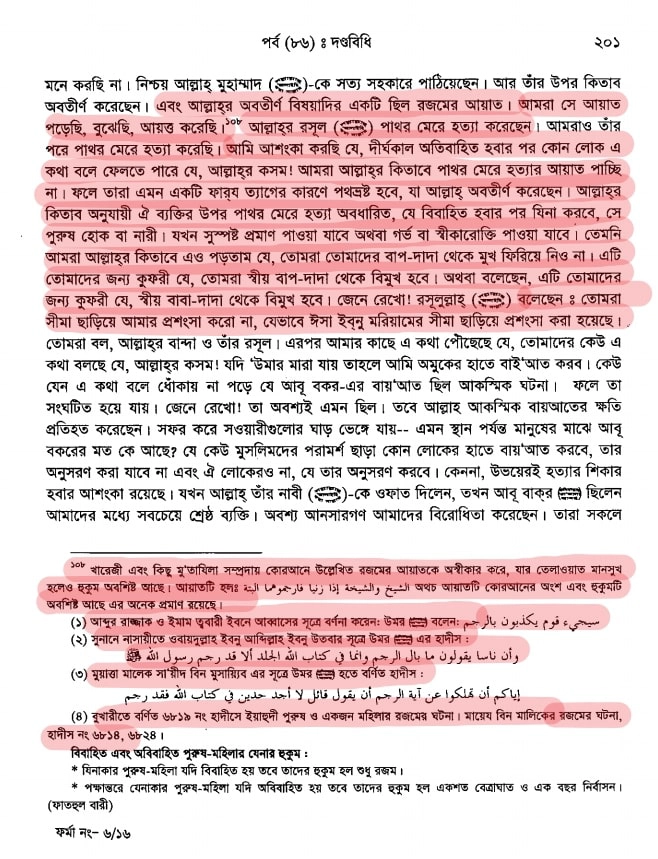
The incidents of Ma’iz mentioned in this explanation are in Bukhari numbers 6814 and 6824. The first mentions the four-fold confession of a person from the Aslam tribe and the execution of the death penalty upon him; the second contains Ma’iz’s name, direct questions about sexual intercourse, and the subsequent order for stoning. These are accounts regarding the application of punishment. The source of the information regarding the ancient reading of the absent verse, the fact that the reading was not kept in the mushaf, and the actual carrying out of the punishment are not the same; the judicial incidents preserve the aspect of application.
| Relationship between the written reading and the prevailing ruling | Type of evidence | Effective result |
|---|---|---|
| Surah Nur 24:2 | Verse existing in the mushaf | Clear instruction for one hundred lashes |
| Stoning in Umar’s speech | Memory of the previously recited verse and description of the execution of punishment | Stoning called farz (obligatory) even if the reading is not in the mushaf |
| Ali’s declaration | Statement on following the Prophet’s Sunnah | Authority of the Sunnah as the basis for killing by stoning |
| Subsequent explanation of nasikh-mansukh (abrogator-abrogated) | Classification of reading abrogated, ruling remaining | Authorization to keep the punishment in effect even if not read as Quran |
| Objection based on the written punishment of the Quran | Absence of stoning in the Book | Question of accepting additional authority from hadith and fiqh |
The description of Muhammad’s reaction to the stoning rules of the Jews is also important to the same problem. In the hadith of Bara’ ibn Azib, the allegation is that due to a tendency to avoid punishment for the nobility, a system of blackening the face and flogging was adopted. Muhammad declares that he has revived their old stoning rules. The action described here is a change in the application of punishment; the hadith states that the written ruling of stoning was still in their Book. The full hadith of Abu Dawood: [772] [773]
قَالَ مُرَّ عَلَى رَسُولِ اللَّهِ صلى الله عليه وسلم بِيَهُودِيٍّ مُحَمَّمٍ مَجْلُودٍ فَدَعَاهُمْ فَقَالَ ” هَكَذَا تَجِدُونَ حَدَّ الزَّانِي ” . فَقَالُوا نَعَمْ . فَدَعَا رَجُلاً مِنْ عُلَمَائِهِمْ قَالَ لَهُ ” نَشَدْتُكَ بِاللَّهِ الَّذِي أَنْزَلَ التَّوْرَاةَ عَلَى مُوسَى هَكَذَا تَجِدُونَ حَدَّ الزَّانِي فِي كِتَابِكُمْ ” . فَقَالَ اللَّهُمَّ لاَ وَلَوْلاَ أَنَّكَ نَشَدْتَنِي بِهَذَا لَمْ أُخْبِرْكَ نَجِدُ حَدَّ الزَّانِي فِي كِتَابِنَا الرَّجْمَ وَلَكِنَّهُ كَثُرَ فِي أَشْرَافِنَا فَكُنَّا إِذَا أَخَذْنَا الرَّجُلَ الشَّرِيفَ تَرَكْنَاهُ وَإِذَا أَخَذْنَا الرَّجُلَ الضَّعِيفَ أَقَمْنَا عَلَيْهِ الْحَدَّ فَقُلْنَا تَعَالَوْا فَنَجْتَمِعَ عَلَى شَىْءٍ نُقِيمُهُ عَلَى الشَّرِيفِ وَالْوَضِيعِ فَاجْتَمَعْنَا عَلَى التَّحْمِيمِ وَالْجَلْدِ وَتَرَكْنَا الرَّجْمَ . فَقَالَ رَسُولُ اللَّهِ صلى الله عليه وسلم ” اللَّهُمَّ إِنِّي أَوَّلُ مَنْ أَحْيَا أَمْرَكَ إِذْ أَمَاتُوهُ ” . فَأَمَرَ بِهِ فَرُجِمَ فَأَنْزَلَ اللَّهُ عَزَّ وَجَلَّ { يَا أَيُّهَا الرَّسُولُ لاَ يَحْزُنْكَ الَّذِينَ يُسَارِعُونَ فِي الْكُفْرِ } إِلَى قَوْلِهِ { يَقُولُونَ إِنْ أُوتِيتُمْ هَذَا فَخُذُوهُ وَإِنْ لَمْ تُؤْتَوْهُ فَاحْذَرُوا } إِلَى قَوْلِهِ { وَمَنْ لَمْ يَحْكُمْ بِمَا أَنْزَلَ اللَّهُ فَأُولَئِكَ هُمُ الْكَافِرُونَ } فِي الْيَهُودِ إِلَى قَوْلِهِ { وَمَنْ لَمْ يَحْكُمْ بِمَا أَنْزَلَ اللَّهُ فَأُولَئِكَ هُمُ الظَّالِمُونَ } فِي الْيَهُودِ إِلَى قَوْلِهِ { وَمَنْ لَمْ يَحْكُمْ بِمَا أَنْزَلَ اللَّهُ فَأُولَئِكَ هُمُ الْفَاسِقُونَ } قَالَ هِيَ فِي الْكُفَّارِ كُلُّهَا يَعْنِي هَذِهِ الآيَةَ .
English translation: Sunan Abu Dawud (Verified)
Chapter: 33/ Crime and its Punishment
Publisher: Allama Albani Academy
Section: 26. The incident of stoning two Jews
4448. Narrated on the authority of Al-Baraa ibn Azib (ra). He said, a certain Jew who had been lashed was being taken past Rasulullah sallallahu alaihi wasallam with his face blackened. He called them and asked: Have you received the order for such punishment for adultery? They said, yes. Then he called one of their scholars and said: I adjure you by that Allah who revealed the book of Tawrat upon Musa (as)! Is the mention of such punishment for adulterers found in your book? He said, O Allah! No. If you had not adjured me by Allah in this matter, I would certainly not have told you.
We found the mention of stoning as the punishment for adultery in our book. But when adultery spread in our noble society, even if we caught someone of status for this crime, we would let them go; however, if we found someone among the weak, we would implement the punishment upon them. Then we called everyone and said, come, let us reach a decision where we all reach a consensus regarding the punishment for adultery, so that it can be implemented upon people of all classes. Then we agreed upon shaming by blackening the face and lashing as its punishment and abandoned ‘rajm’ (stoning).
Rasulullah sallallahu alaihi wasallam said: O Allah! I am the first person who has revived Your command after they made it lifeless. Then by his order, the criminal was stoned. Then Allah the Almighty revealed these verses regarding the Jews: ”O Messenger! Let not those who hasten toward disbelief grieve you … they say, if such a decree were given to you, you should accept it otherwise you should reject it … those who do not judge by what Allah has revealed, they are the disbelievers (said regarding the Jews) … those who do not judge by what Allah has revealed they are the oppressors (said regarding the Jews) … those who do not judge by what Allah has revealed they are the transgressors” (Surah Al-Ma’idah: 41-47). He says, these verses were revealed regarding the disobedient disbelievers. (1)
Sahih.
Hadith Grade: Sahih (Sahih)
Another report in Bukhari mentions the method of hiding the written stoning-verse. The reader was placing his hand over the verse and reading before and after it; when the hand was removed, the verse became visible. In this story, the way to verify was to open the Book and show the visible words. [774]
قَالَ أُتِيَ رَسُولُ اللَّهِ صلى الله عليه وسلم بِيَهُودِيٍّ وَيَهُودِيَّةٍ قَدْ أَحْدَثَا جَمِيعًا فَقَالَ لَهُمْ ” مَا تَجِدُونَ فِي كِتَابِكُمْ ”. قَالُوا إِنَّ أَحْبَارَنَا أَحْدَثُوا تَحْمِيمَ الْوَجْهِ وَالتَّجْبِيَةَ. قَالَ عَبْدُ اللَّهِ بْنُ سَلاَمٍ ادْعُهُمْ يَا رَسُولَ اللَّهِ بِالتَّوْرَاةِ. فَأُتِيَ بِهَا فَوَضَعَ أَحَدُهُمْ يَدَهُ عَلَى آيَةِ الرَّجْمِ، وَجَعَلَ يَقْرَأُ مَا قَبْلَهَا وَمَا بَعْدَهَا فَقَالَ لَهُ ابْنُ سَلاَمٍ ارْفَعْ يَدَكَ. فَإِذَا آيَةُ الرَّجْمِ تَحْتَ يَدِهِ، فَأَمَرَ بِهِمَا رَسُولُ اللَّهِ صلى الله عليه وسلم فَرُجِمَا . قَالَ ابْنُ عُمَرَ فَرُجِمَا عِنْدَ الْبَلاَطِ، فَرَأَيْتُ الْيَهُودِيَّ أَجْنَأَ عَلَيْهَا.
English translation: Ibn Umar said: A Jewish man and a Jewish woman were brought to the Messenger of Allah, sallallahu alayhi wa sallam; both had committed adultery. He said to them, “What do you find in your Book?” They said, “Our scholars have introduced the punishment of blackening the face and bowing down.” Abdullah ibn Salam said, “O Messenger of Allah, tell them to bring their Torah.” When it was brought, a person began reading before and after the stoning verse, placing his hand over it. Ibn Salam said, “Remove your hand.” It was seen that the stoning verse was right under the hand. Then the Messenger of Allah ordered the two of them to be stoned. Ibn Umar said: They were stoned at Balat; I saw the Jewish man leaning over the woman.
Comparing these two reports, the role of the written ruling is clear. In the incident described regarding the Jews, the reading of the Book was brought forward as proof of restoring the old punishment. In Umar’s apprehension, a subsequent Muslim reader would not find such a stoning-verse by opening his own Book. Then, for him, the way to verify is not removing a hand placed over a verse; it is accepting the claims of the narrators regarding the absent reading. In one case, the visible text of the Book makes the allegation of hiding the ruling verifiable; in the other case, to keep the ruling of an absent reading in effect, one must depend on authorities outside the text.
The moral significance of this dependence in the case of the death penalty is also direct. After killing a person by stoning, one cannot correct the mistake and return their life. Yet, the alleged Quranic sentence for the punishment is not in the accepted text, its quoted language is multiple, and there is no specific instruction in Umar’s speech for its removal from the reading. The assurance of keeping the law in force was created through the testimony and explanation of religious authorities. The harsher the punishment, the deeper the questions facing its proof and authority; transforming an absent reading into a sustained death penalty through explanation does not remove that question.
Fear of allegations of addition, standards of compilation, and the authority of the Caliph
An inequality is seen in the incident of stoning between two of Umar’s powers. He reports that he executed stoning as a ruler; but he expresses fear of people’s allegations regarding writing the verse in the name of which he is keeping the death penalty in the mushaf. Thus, the judicial authority to take a human life and the authority to include a sentence in the accepted reading of the Book did not operate in the same way. The penalty continued, yet the alleged Quranic sentence for the penalty remained outside the Book. This separation did not limit religious law only to the visible reading of the mushaf.
In the accounts regarding the testimony of compilation, there is mention of a lack of witnesses for not accepting stoning. In Umar’s speech, the fear of people saying he added to the Book of Allah appeared as the reason; in subsequent explanations, the abrogation of the verse’s recitation appeared. These separate explanations explain the same result—the reading not being in the mushaf—but their logic and standards of proof are different. Suyuti also quoted a problem with Umar’s statement from Zarkashi’s Al-Burhan: does the desire to write mean the writing was still valid? In the same discussion, the difference between the standard for establishing the Quran and the standard for establishing a ruling through a single report appeared. The full sequential discussion is: [775] [776]
وقال في ” البرهان ” في قول عمر : ( لولا أن يقول الناس زاد عمر في كتاب الله لكتبتها ) – يعني آية الرجم – ظاهره أن كتابتها جائزة ، وإنما منعه قول الناس ، والجائز في نفسه قد يقوم من خارج ما يمنعه ، فإذا كانت جائزة لزم أن تكون ثابتة ; لأن هذا شأن المكتوب . وقد يقال : لو كانت التلاوة باقية لبادر عمر ، ولم يعرج على مقالة الناس ; لأن مقالة الناس لا تصلح مانعا . وبالجملة هذه الملازمة مشكلة ، ولعله كان يعتقد أنه خبر واحد ، والقرآن لا يثبت به ، وإن ثبت الحكم ، ومن هنا أنكر ابن ظفر في ( ” الينبوع ” ) عد هذا مما نسخ تلاوته قال ; لأن خبر الواحد لا يثبت القرآن . قال : وإنما هذا من المنسأ لا النسخ ، وهما مما يلتبسان ، والفرق بينهما أن المنسأ لفظه قد يعلم حكمه . انتهى . وقوله : ( لعله كان يعتقد أنه خبر واحد ) مردود ، فقد صح أنه تلقاها من النبي – صلى الله عليه وسلم – .
English translation: In Al-Burhan, regarding Umar’s statement “If people had not said that Umar added to the Book of Allah, I would have written it”—meaning the stoning verse—it is said: its apparent meaning is that writing it was valid; only the words of people stopped him. Even if an action is valid in itself, some external reason can create an obstacle. If writing was valid, the reading must be considered as having remained; because the matter of being written is such. Again, it could be said that if the recitation had remained, Umar would have been eager to write it and would not have stopped at the words of people; because the words of people are not suitable to be an obstacle. In short, this inevitable relationship is problematic. Perhaps he considered it a single report; while a ruling is established by it, the Quran is not established. For this reason, Ibn Zafar al-Yanbu denied counting it as an example of the abrogation of recitation. He said: the Quran is not established by a single report. He says: rather, it is included in mansā (postponement) or setting aside, not naskh (abrogation); the two matters get mixed up. The difference is that the ruling of the word of mansā may be known. Statement ends. The phrase “Perhaps he considered it a single report” is rejected; because he received it from the Prophet, and it has been narrated sahihly.
The problem was not unknown to Suyuti or Zarkashi in this discussion. They raised questions about the relationship between the claim of the previously read verse, the desire to write it down, and the principle of abrogation. If the natural meaning of the statement “I would have written the verse” is accepted, social apprehension becomes effective as the reason for abstaining from writing. If it is assumed that the recitation was already abrogated and writing it in the mushaf was invalid, then the desire to write it—provided there were no objections from people—demands an explanation. If a religious prohibition is truly the determinant, the potential comments of people do not become its alternative determinant.
The discussion of the single report reveals another limit of authority. Different standards have been applied here regarding whether a report used to establish a death penalty provision is sufficient to establish a reading of the Quran. Ibn Zafar’s objection was that if the evidence did not first complete the establishment of the text as Quran, then the subsequent classification stating that “the reading of the Quran has been abrogated” does not simply follow. Furthermore, while Umar’s claim that he heard it from the Prophet establishes his personal acquisition; the rules for the acceptance and compilation of reports were still necessary to decide which language would be the accepted reading of the Quran in the subsequent society.
To resolve this problem, Zarqani avoided the literal meaning of Umar’s words. His argument is that a person with additional knowledge of fiqh, like Umar, cannot grant validity to writing an abrogated reading in the mushaf; therefore, he used strong language only to ensure the execution of rajm. The specific language of this interpretation: [777]
والذي يظهر أنه ليس مراد عمر هذا الظاهر ، وإنما مراده المبالغة والحث على العمل بالرجم ; لأن معنى الآية باق وإن نسخ لفظها إذ لا يسع مثل عمر مع مزيد فقهه تجويز كتبها مع نسخ لفظها ، فلا إشكال وضمير كتبتها لآية الرجم ، وهي ( الشيخ والشيخة ) إذا زنيا ( فارجموهما ألبتة ) بهمزة قطع أي جزما ( قد قرأناها ) ثم نسخ لفظها وبقي حكمهما بدليل أنه صلى الله عليه وسلم رجم ورجمنا بعده فلم ينكر علينا .
English translation: What appears is that Umar did not intend this literal meaning; rather, he intended hyperbole and the urgency of executing rajm. This is because the meaning of the verse remains, although its wording is abrogated. It is not possible for Umar, who possesses greater knowledge of fiqh, to grant validity to writing it after the wording was abrogated. Therefore, there is no problem. The pronoun in the sentence “I would write it” refers to the verse of rajm, which is “If an old man and an old woman commit adultery, you must kill them by stoning.” “Must” means certainly. “We read it”—then its wording was abrogated and the ruling for the two remained. His evidence is that he performed rajm, we also performed rajm after him, and no objection was raised against us.
The basis of this interpretation is not finding any new instruction of withdrawal in the language of Umar’s statement; it is the conception of what kind of person the interpreter believes Umar was and what he is capable of. By assuming “a knowledgeable person like him cannot do such a thing,” the literal meaning of the word “would write” has been discarded. Consequently, the religious status of the narrated person determines the meaning of his narrated intention. The relationship that Zarqashi called problematic has been resolved by Zarqani by reinterpreting the purpose of the sentence. The role of the later interpreter is directly visible here.
In answer 111382 of IslamQA, the language of possibility has also been used to explain the reason for not writing it in the mushaf. The answer concludes that the abrogated reading is no longer part of the Quran; then it mentions that “perhaps” this was the reason for Umar’s not writing it. The relevant phrase: [778]
ولعل هذا هو السبب الذي جعل عمر رضي الله عنه لا يكتبها في المصحف
English translation: Perhaps for this reason, Umar did not write it in the mushaf.
The possible reason given by this respondent and the reason directly declared by Umar are not the same. In the hadith, Umar mentioned the fear of people’s increase; in the answer, abrogation has been placed as the possible reason. Creating an acceptable religious explanation for a missing text and establishing that this explanation was Umar’s actual reason are separate tasks. The word “perhaps” expresses the uncertainty of the second conclusion. When certain verse-memory, clear social fear, and the later interpreter’s possible reason are merged, the scope of the statements from the sources changes.
In another report preserved under the name of Qasir ibn al-Salt, there is a context of Zayd ibn Thabit and Sa’id ibn al-As writing the mushaf. There, Zayd states that he heard the sentence of rajm. A memory of a previous conversation with Umar is added to it: when asked whether he should write it at the time of revelation, the Prophet apparently disliked it. Suyuti brought this report through Hakim. [779]
وأخرج الحاكم من طريق كثير بن الصلت ، قال : كان زيد بن ثابت وسعيد بن العاص يكتبان المصحف ، فمرا على هذه الآية فقال زيد : سمعت رسول الله – صلى الله عليه وسلم – يقول ( الشيخ والشيخة إذا زنيا فارجموهما ألبتة ) ، فقال عمر : لما نزلت أتيت النبي – صلى الله عليه وسلم – فقلت : أكتبها ؟ فكأنه كره ذلك ، فقال عمر : ألا ترى أن الشيخ إذا زنى ولم يحصن جلد ، وأن الشاب إذا زنى وقد أحصن رجم .
English translation: Hakim narrated through Qasir ibn al-Salt. He says: Zayd ibn Thabit and Sa’id ibn al-As were writing the mushaf. When they came to this verse, Zayd said, I heard the Messenger of Allah, sallallahu alayhi wa sallam, say, “If an old man and an old woman commit adultery, they must be killed by stoning.” Umar said: When it was revealed, I went to the Prophet and asked, “Shall I write this?” He apparently disliked it. Umar said: Do you not see that if an old person commits adultery and is not in a state of ihsan, they are lashed; and if a youth commits adultery and is in a state of ihsan, they are stoned.
This report provides another explanation regarding writing: an apparent lack of interest in the proposal to write at the time of the verse’s revelation. “He apparently disliked it” is observational language; no explicit instruction is quoted. In another report, the same Umar later expresses a desire to have it written. Consequently, to determine which type of permission or obstacle was effective at which time, a relationship must be established between these reports. If all the language is joined as a single identical event, those temporal and narrative differences are lost.
| Explanation found in the source | Which question it answers | The matter that remains separate |
|---|---|---|
| Conditions of testimony for collection | Which report will be accepted in a written compilation | Knowing the memory and presenting testimony under specific conditions of collection |
| Umar’s fear of people’s increase | Why he stopped writing it himself | Confirmation of the revelation of the text and social approval for new inclusion |
| Recitation abrogated, ruling remains | How rajm is kept valid despite the absent text | The religious identity of the text and the effective power of the punishment |
| Zarqani’s explanation of hyperbole | How the desire to write is reconciled with abrogation | The literal meaning of the original sentence and the determination of the later interpreter’s purpose |
| Report of apparent dislike of the proposal to write | What the reaction was regarding writing at the time of revelation | The observer’s perception and explicit withdrawal-instruction |
In the theology used in favor of keeping the punishment, there is also a strict value of obedience. In the explanation Suyuti brought under the name of Sahib al-Funun, it is mentioned that as a purpose for keeping the ruling despite removing the text, instead of searching for detailed certain proof, one should undergo a test of obedience by surrendering their life to conjecture. This is the interpreter’s proposed purpose; it is not a description of a procedural decision declared in a compilation assembly. His statement: [780]
وأجاب صاحب الفنون : بأن ذلك ليظهر به مقدار طاعة هذه الأمة في المسارعة إلى بذل النفوس بطريق الظن من غير استفصال لطلب طريق مقطوع به ، فيسرعون بأيسر شيء ، كما سارع الخليل إلى ذبح ولده بمنام ، والمنام أدنى طريق الوحي .
English translation: Sahib al-Funun answered: Through this, the extent of this Ummah’s obedience is revealed—in quickly moving forward to surrender one’s life to conjecture without asking detailed questions to search for a certain path. They move quickly at a slight hint, just as Khalil moved forward to slaughter his own son based on a dream; and dreams are the lowest path of revelation.
In this value system, the uncertainty of proof does not become a reason to stop obedience, but rather an opportunity to demonstrate obedience. The ethical question regarding life-related rulings is even more intense there: pushing back the search for a certain foundation and calling rapid surrender a virtue. In the case of an irreversible death penalty like rajm, such a standard reduces the need for proof and increases dependence on religious authority. The carrier of the report and the interpreter then decide how much power over life and death will be claimed for which absent statement.
The breastfeeding verses and the account of the eaten sheet
In the history of the verses of breastfeeding, the number for the same ruling has changed, the testimony of reciting it as Quran remained, and that text is not in the current mushaf. In Aisha’s report, breastfeeding ten times was revealed first, then five times. In another report of hers, the writing of rajm and ten times breastfeeding for the elderly was preserved in a sahifa; amidst the family’s preoccupation with Muhammad’s death, a pet animal ate it. The change in text, the destruction of written evidence, and the use of that absent text to determine the validity of marriage—all three events have found a place in Islamic compilations and commentaries.
Even after determining five instead of ten, a uniform law was not established. Along with five times, the instruction for ten times breastfeeding is also reported under Aisha’s name; the instruction for ten times is found under Hafsa’s name. Malik compiled the report, but in his own legal decision, he did not accept the mandatory limit of five times. There is a direct example in the account of breastfeeding of how a text claimed as Quran becomes a legal document from outside the mushaf, and how contradictory rulings are created from the same document.
Change in ruling from ten times breastfeeding to five times
There is a relationship between breastfeeding kinship and the prohibition of marriage. In verse 23 of Surah An-Nisa in the current Quran, foster-mothers and foster-sisters are placed among the prohibited relationships for marriage. There is no number of ten or five in this part of the verse. Consequently, the change regarding the number of breastfeeding mentioned in the hadith is not an alternative pronunciation of a word in the current verse; it is a change in the minimum condition for the ruling to take effect. In the question of how many times breastfeeding must occur for marriage between two people to be prohibited, the number directly determines the result. [781]
وَأُمَّهَاتُكُمُ اللَّاتِي أَرْضَعْنَكُمْ وَأَخَوَاتُكُمْ مِنَ الرَّضَاعَةِ
English translation: And your mothers who have breastfed you, and your foster-sisters.
In Sahih Muslim, a statement of Aisha is compiled through Amra: ten prescribed breastfeedings in the Quran were revealed, then five prescribed breastfeedings were revealed. Here, both instances are linked to the revealed Quran. The number five was not presented as a later faqih’s conjecture. In the Bangla Hadith Academy edition, the number of this report is 3490; it is the second report of international number 1452 in Muslim. [782] [783] [784]
حَدَّثَنَا عَبْدُ اللَّهِ بْنُ مَسْلَمَةَ الْقَعْنَبِيُّ ، حَدَّثَنَا سُلَيْمَانُ بْنُ بِلاَلٍ ، عَنْ يَحْيَى، – وَهُوَ ابْنُ سَعِيدٍ – عَنْ عَمْرَةَ ، أَنَّهَا سَمِعَتْ عَائِشَةَ ، تَقُولُ – وَهْىَ تَذْكُرُ الَّذِي يُحَرِّمُ مِنَ الرَّضَاعَةِ – قَالَتْ عَمْرَةُ فَقَالَتْ عَائِشَةُ نَزَلَ فِي الْقُرْآنِ عَشْرُ رَضَعَاتٍ مَعْلُومَاتٍ ثُمَّ نَزَلَ أَيْضًا خَمْسٌ مَعْلُومَاتٌ .
English translation: Sahih Muslim (Ha Academy)
Chapter: 18. Breastfeeding
Section: 6. Regarding the establishment of prohibition by feeding (a woman’s milk) five sips
3490-(25/…) Narrated from Abdullah ibn Maslamah Al-Qa’nabi (rh) ….. from Amrah (rh). He heard Aisha (ra) speaking when she discussed that amount of breastfeeding by which prohibition is established. Amrah said that, Aisha (ra) said, it was revealed in the Quran عَشْرُ رَضَعَاتٍ مَعْلُومَاتٍ “ten prescribed breastfeedings”. Then it was revealed خَمْسٌ مَعْلُومَاتٌ “five prescribed breastfeedings.” (Islamic Foundation 3463, Islamic Center 3462)
Hadith Grade: Sahih (Sahih)
As a result of changing from “ten times” to “five times”, the legal identity of the same event changes. If a child has drunk the milk of a specific woman six times, under the condition of ten, that number is insufficient to prohibit marriage; under the condition of five, it is sufficient. This change in number alters the limit of marriage prohibition. Which relationship will be prohibited, who can appear before whom, and whether a future marriage will be considered valid—the change in number changes the answers to these questions. In Islamic reports, this change was authorized through revelation. Consequently, the meaning and application of the ruling also changed.
Muslim has provided another isnad for the same statement. In the previous report, there are Sulayman ibn Bilal, Yahya ibn Sa’id, and Amra; in the next, the chain meets Yahya ibn Sa’id and Amra through Muhammad ibn al-Musanna and Abdul Wahhab. In the Bangladesh Islamic Center edition, the number of this following report is 3463. These multiple paths of compiling the same statement are testimony to the propagation of the statement under Aisha’s name; the reports eventually meet at the same Amra. [785] [786] [787]
(١٤٥٢) – وحَدَّثَنَاه مُحَمَّدُ بْنُ الْمُثَنَّى. حَدَّثَنَا عَبْدُ الْوَهَّابِ. قَالَ: سَمِعْتُ يَحْيَى بْنَ سَعِيدٍ قَالَ: أَخْبَرَتْنِي عَمْرَةُ؛ أَنَّهَا سَمِعَتْ عَائِشَةَ تَقُولُ. بِمِثْلِهِ.
English translation: 3463. Amrah (ra) heard Aisha (ra) say—similar to the above hadith. Muhammad ibn al-Musanna narrated, Abdul Wahhab informed them; he heard Yahya ibn Sa’id say, Amra informed him that she heard Aisha say the same thing.
In another report of Ibn Majah, a more direct word is found: “saqata”—dropped or fallen. There, it is said under Aisha’s name that among the parts of the Quran Allah revealed and which later dropped, was the statement that marriage is not prohibited except for ten times or five prescribed breastfeedings. In this text, “ten times or five times” is said; its wording is not the same as Muslim’s sequential “ten, then five” sentence. The same subject has been preserved in multiple sentences in hadith compilations. [788]
حَدَّثَنَا عَبْدُ الْوَارِثِ بْنُ عَبْدِ الصَّمَدِ بْنِ عَبْدِ الْوَارِثِ ، حَدَّثَنَا أَبِي ، حَدَّثَنَا حَمَّادُ بْنُ سَلَمَةَ ، عَنْ عَبْدِ الرَّحْمَنِ بْنِ الْقَاسِمِ ، عَنْ أَبِيهِ ، عَنْ عَمْرَةَ ، عَنْ عَائِشَةَ ، أَنَّهَا قَالَتْ كَانَ فِيمَا أَنْزَلَ اللَّهُ مِنَ الْقُرْآنِ ثُمَّ سَقَطَ لاَ يُحَرِّمُ إِلاَّ عَشْرُ رَضَعَاتٍ أَوْ خَمْسٌ مَعْلُومَاتٌ .
English translation: Abdul Waris ibn Abdus Samad ibn Abdul Waris narrated, his father informed them; Hammad ibn Salama informed them, from Abdur Rahman ibn al-Qasim, he from his father, he from Amra, she from Aisha. Aisha says: Among the parts of the Quran Allah revealed, which later dropped, was—marriage is not prohibited except for ten breastfeedings or five prescribed breastfeedings.
“Was revealed”, “then was revealed” and “later was omitted”—these verbs indicate a mutable history of the text. In the current mushaf, the sentence of the general prohibition of marriage in Surah An-Nisa is present; these statements containing numbers are not. Consequently, the documentary positions of the general ruling and the specific numerical conditions are different. The general ruling can be read directly in the mushaf; the history of ten and five must be learned from the hadith. If a reading was previously described as Quran and is later absent from the mushaf, the history of that absence is a distinct piece of information. “Abrogated” is its religious classification; it is not a word that makes the preceding and succeeding sets of readings identical.
| Reading or report | Numbers and statements | Consequences of the ruling and the reading |
|---|---|---|
| Current mushaf, Nisa 4:23 | Marriage with foster-mothers and foster-sisters is prohibited; there are no numbers in this section | The general prohibition of kinship due to breastfeeding remains in effect |
| Attributed to Aisha in Muslim 1452b | First ten times was prescribed, then five times was revealed | The numerical condition of the ruling changed |
| Attributed to Aisha in Muslim 1452a | Five times instead of ten; read as Quran even at the time of death | Testimony of the prior prevalence of a reading absent in subsequent mushafs |
| Ibn Majah 1942 | Mention of ten or five times in the part later omitted from the Quran | The report’s own words mention the omission |
The status of the reading is linked to the number being halved. In Aisha’s statement, the revelation of both ten and five times is part of the history of the Quran. Yet, opening the Quran, these two changed sentences are not found side by side, nor is one found in place of the other. The report that one ruling superseded another and the identity of the previous reading survive in the hadith. Beyond the reading finally retained in the mushaf, Islamic sources themselves carry the memory of statements propagated as “Quran”.
Aisha’s statement regarding its recitation as Quran even at the time of Muhammad’s death
The most specific time marker in Aisha’s statement is Muhammad’s death. In the first report in Muslim, after mentioning the change from ten to five times, it is stated that Muhammad died, yet those were among the parts read as Quran at that time. The sentence identifies the ruling of five times and also informs about its status of recitation. “Reading as Quran” and simply knowing a law are different things. In the sentence compiled under Aisha’s name, both aspects are present: the previous ruling of ten times was changed, and the recitation of the new part of five times as Quran continued until the time of death. [789] [790] [791]
حَدَّثَنَا يَحْيَى بْنُ يَحْيَى ، قَالَ قَرَأْتُ عَلَى مَالِكٍ عَنْ عَبْدِ اللَّهِ بْنِ أَبِي بَكْرٍ ، عَنْ عَمْرَةَ ، عَنْ عَائِشَةَ ، أَنَّهَا قَالَتْ كَانَ فِيمَا أُنْزِلَ مِنَ الْقُرْآنِ عَشْرُ رَضَعَاتٍ مَعْلُومَاتٍ يُحَرِّمْنَ . ثُمَّ نُسِخْنَ بِخَمْسٍ مَعْلُومَاتٍ فَتُوُفِّيَ رَسُولُ اللَّهِ صلى الله عليه وسلم وَهُنَّ فِيمَا يُقْرَأُ مِنَ الْقُرْآنِ .
English translation: Sahih Muslim (IF)
Chapter: 18/ Breastfeeding
Section: No section
3466. Narrated from Yahya ibn Yahya (rh) … from Aisha (ra). She said, this verse was revealed in the Quran: عَشْرُ رَضَعَاتٍ مَعْلُومَاتٍ ‘prohibition is established by ten breastfeedings.’ Then it was abrogated by خَمْسٍ مَعْلُومَاتٍ. (prohibition is established by five sips) Then the Messenger of Allah, peace and blessings of Allah be upon him, passed away while that verse was still recited as a verse of the Quran.
Hadith Grade: Sahih (Sahih)
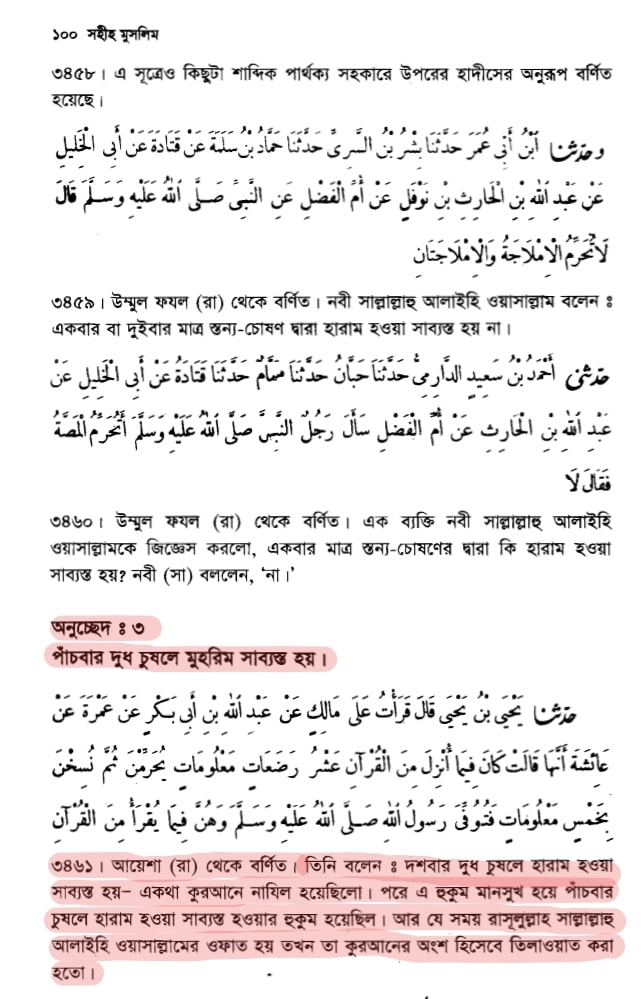
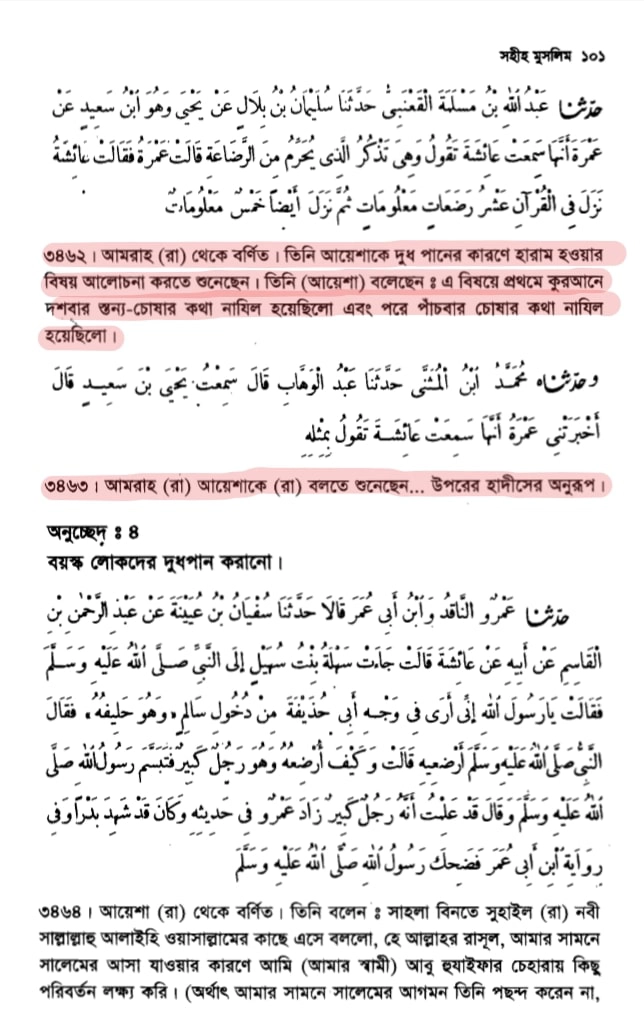
The matter of recitation as Quran is clear in the part of the sentence “wa hunna fima yuqra min al-Quran”. The ruling of five times was effective at the time of death—the statement of the sentence is broader than this information. A ruling may remain effective in society, but the words of that ruling may no longer be read as Quran. In Aisha’s report, it is stated that the words were being read as Quran. Therefore, a gap between the reading prevalent at the time of death and the reading adopted in the subsequent mushaf is inherent in this testimony. Currently, that sentence of five times is not in the mushaf.
The same final sentence exists in Malik’s Muwatta. There, Aisha’s report comes to us through Amrah bint Abdur Rahman. In the first path of Muslim, Malik, Abdullah ibn Abu Bakr, and Amrah are also present. Consequently, these are not testimonies of two different eyewitnesses printed in Muwatta and Muslim; the same chain of narration has found a place in two collections. Within this relational link, an important point is captured: the sentence about reciting at the time of death is not an addition by a later Bengali author; the sentence is present in the Arabic hadith text. [792] [793]
وَحَدَّثَنِي عَنْ مَالِكٍ، عَنْ عَبْدِ اللَّهِ بْنِ أَبِي بَكْرِ بْنِ حَزْمٍ، عَنْ عَمْرَةَ بِنْتِ عَبْدِ الرَّحْمَنِ، عَنْ عَائِشَةَ، زَوْجِ النَّبِيِّ صلى الله عليه وسلم أَنَّهَا قَالَتْ كَانَ فِيمَا أُنْزِلَ مِنَ الْقُرْآنِ عَشْرُ رَضَعَاتٍ مَعْلُومَاتٍ يُحَرِّمْنَ ثُمَّ نُسِخْنَ بِخَمْسٍ مَعْلُومَاتٍ فَتُوُفِّيَ رَسُولُ اللَّهِ صلى الله عليه وسلم وَهُوَ فِيمَا يُقْرَأُ مِنَ الْقُرْآنِ .
English translation: Muwatta Malik
30. Chapter related to the ruling of breastfeeding children
Section: 3.Miscellaneous matters of breastfeeding
Narration 17. Narrated from Amrah bint Abdur Rahman (rh), Aisha (ra), the wife of the Noble Prophet, peace and blessings of Allah be upon him, said: In what was revealed in the Quran, ten times of sucking milk was prescribed, which would make it prohibited, then it was abrogated by the (revealed ruling of) prescribed five times of sucking milk. Then the Messenger of Allah, peace and blessings of Allah be upon him, passed away while that combined verse of the five times of sucking milk (ruling part) was still recited.
Malik (rh) said: There is no practice upon this. That is, there is no practice upon five times. Whether the milk consumption is little or much, it will make the marriage relationship prohibited.
Hadith Grade: Verification pending
Narrator: Amrah bint Abdur Rahman (rh)
The sentence about reading as Quran at the time of death is also present in Abu Dawood’s 2062 and Nasai’s 3307 numbered hadiths. The relevant paths of these two collections also go through Malik to the same Abdullah ibn Abu Bakr and Amrah. Although the number of books increased, the primary source of this specific statement did not change. Among the collections, sometimes “wa hunna”, sometimes “wa hiya”, and in the Muwatta reading “wa huwa” appears; in every case, the information of it being read as Quran at the time of death has been retained. A comparison of these sentence forms provides information about the prevalence and linguistic preservation of the reading.
| Collection | Main chain of narration | Statement of reading at the time of death |
|---|---|---|
| Muwatta Malik, Arabic 1293 | Malik → Abdullah ibn Abu Bakr → Amrah → Aisha | wa huwa fima yuqra min al-Quran |
| Muslim 1452a | Yahya ibn Yahya → Malik → same chain | wa hunna fima yuqra min al-Quran |
| Abu Dawood 2062 | Kanabi → Malik → same chain | wa hunna mimma yuqra min al-Quran |
| Nasai 3307 | Multiple students of Malik → Malik → same chain | wa hiya mimma yuqra min al-Quran |
In the full report of Abu Dawood, the phrase “makes marriage forbidden” is present even after five times. The legal result of five replacing ten and the description of the reading at the time of death are preserved side by side in the same hadith. [794] [795]
حَدَّثَنَا عَبْدُ اللَّهِ بْنُ مَسْلَمَةَ الْقَعْنَبِيُّ ، عَنْ مَالِكٍ ، عَنْ عَبْدِ اللَّهِ بْنِ أَبِي بَكْرِ بْنِ مُحَمَّدِ بْنِ عَمْرِو بْنِ حَزْمٍ ، عَنْ عَمْرَةَ بِنْتِ عَبْدِ الرَّحْمَنِ ، عَنْ عَائِشَةَ ، أَنَّهَا قَالَتْ كَانَ فِيمَا أَنْزَلَ اللَّهُ عَزَّ وَجَلَّ مِنَ الْقُرْآنِ عَشْرُ رَضَعَاتٍ يُحَرِّمْنَ ثُمَّ نُسِخْنَ بِخَمْسٍ مَعْلُومَاتٍ يُحَرِّمْنَ فَتُوُفِّيَ النَّبِيُّ صلى الله عليه وسلم وَهُنَّ مِمَّا يُقْرَأُ مِنَ الْقُرْآنِ .
English translation: Abdullah ibn Muslama al-Kanabi narrated from Malik, who narrated from Abdullah ibn Abu Bakr ibn Muhammad ibn Amr ibn Hazm, who narrated from Amrah bint Abdur Rahman, who narrated from Aisha. Aisha said: Among the parts Allah revealed in the Quran, ten times of breastfeeding made marriage forbidden. Later it was abrogated by five times, which made marriage forbidden. Then the Prophet died, yet these were still among the parts read as Quran.
In a later explanation, Nawawi called this state the result of the news of abrogation reaching late. According to his statement, the event of abrogation happened so late that at the time of Muhammad’s death, some people were reading the part of five times as Quran; later, upon receiving the news of abrogation, they stopped the reading. The same explanation exists in Siddiq Hasan Khan’s As-Sirajul Wahhaj. In Aisha’s statement, there is testimony of the reading at the time of death; in the explanations of Nawawi and Siddiq Hasan Khan, another flow of information is added for the cessation of that reading. [796] [797]
ومعناه أن النسخ بخمس رضعات تأخر إنزاله جدا حتى إنه صلى الله عليه وسلم توفي وبعض الناس يقرأ : خمس رضعات ويجعلها قرآنا متلوا لكونه لم يبلغه النسخ لقرب عهده فلما بلغهم النسخ بعد ذلك رجعوا عن ذلك وأجمعوا على أن هذا لا يتلى .
English translation: This means that in the case of five times breastfeeding, the matter of abrogation was so delayed in being revealed that the Messenger died, while some people were still reading the part of five times breastfeeding and considering it as Quran worthy of recitation. Since the event was very recent, the news of abrogation had not reached them. Later, when the news reached, they turned away from it and agreed that it would not be read.
In the chronology of this explanation, Muhammad’s death is a dividing line. It is assumed that the instruction to remove the reading came before death, but a section of the readers did not know it. After death, when the news reached them, the reading stopped. That is, at the same time, a sentence was readable as Quran for one person, while according to other information, it had already been removed from the reading. This gap is not just one of memorization power; it is a gap in knowing the news of what the religious status of a memorized sentence is now. A word can remain intact in memory yet lose the authorization to be read as Quran.
In this explanation of Nawawi, there is no specific date of the declaration of abrogation, no direct announcer, or names of the people who carried the news after death. The time marker directly present in Aisha’s original sentence is death; the sequence of events between the declaration before removing the reading and the receipt of news after is the commentator’s added arrangement. Consequently, the phrase “it was read even at the time of death” is the testimony of the report, and “it continued to be read because the news was not received” is the subsequent explanation. The source and type of evidence for these two sentences are different. The latter explains the difficulty of the former; the first testimony is not erased by it.
| Stage | Aisha’s report or commentator’s statement | Status of the reading |
|---|---|---|
| First revealed | Prescribed ten times in Aisha’s report | Statement known as Quran |
| Subsequent Change | Ten times abrogated by five times in Aisha’s report | New ruling with changed number |
| Muhammad’s death | Still read as Quran in Aisha’s report | Direct time marker of the continuity of the reading |
| News reaches and reading stops | In Nawawi’s explanation, unaware readers receive news after death | Change in the status of religious reading after receiving news |
| Accepted mushaf | Neither of the specific sentences of ten and five are present | The reported previous readings and the set of readings in the mushaf are distinct |
Nawawi used two different categories for ten times and five times. In the case of ten times, both the reading and the ruling are abrogated; in the case of five times, although the reading is abrogated, the ruling remains. In the Bengali Al-Awnul Mahmud, the explanations of the reports on breastfeeding are also discussed. The two conditions—the sentence of five times not being in the mushaf after the change in number and its continued use in law—have been linked through the principle of “recitation abrogated, ruling remains”. [798] [799]
أحدها : ما نسخ حكمه وتلاوته كعشر رضعات ، والثاني : ما نسخت تلاوته دون حكمه كخمس رضعات
English translation: One type is that whose ruling and recitation are both abrogated, such as ten times breastfeeding. The second is that whose ruling was not abrogated, but the recitation was abrogated, such as five times breastfeeding.
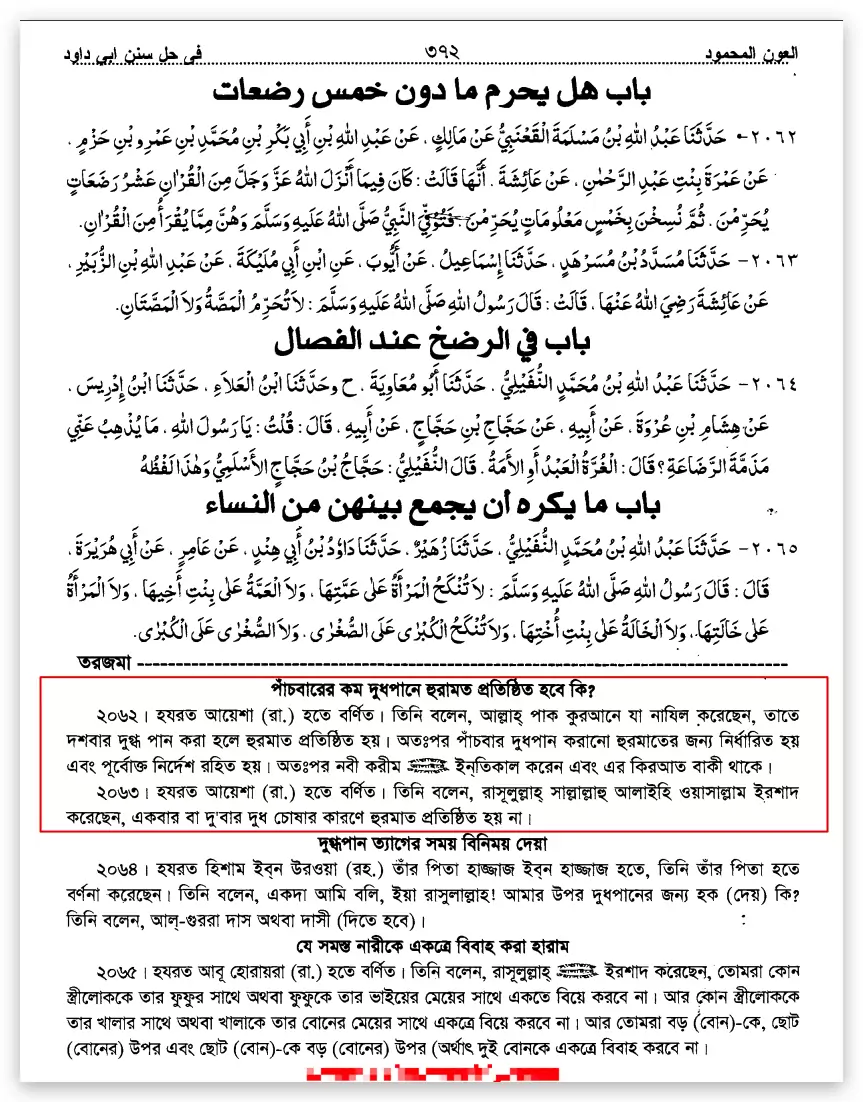
In this classification, “preserved” and “unchanged” do not carry the same meaning. After the statement of ten times was revealed, its number and ruling changed; the recitation of the statement of five times was also later omitted. Religious explanation approves this change as a valid revelatory system. Nevertheless, in the history of the reading, the stages of moving from one revealed statement to another and finally the omission of that specific language from the mushaf remain. The preservation of the memory of a sentence in hadith and its preservation as a part of the Quran in the mushaf are different processes.
Writings on rajm and breastfeeding, the sahifa under the bed and the pet eating it
In report number 1944 of Ibn Majah, the matter of rajm and ten times breastfeeding for adults is linked to a written sahifa. It is stated in the name of Aisha that the writing was under her bed. When Muhammad died, they became preoccupied with the death; at that time, a pet came and ate it. Here, the object, location, time, and cause of destruction are each specified. “Sahifa” identifies the written page, “under the bed” its place of preservation, and the eating of it the event of the object’s destruction. [800] [801] [802]
حَدَّثَنَا أَبُو سَلَمَةَ، يَحْيَى بْنُ خَلَفٍ حَدَّثَنَا عَبْدُ الأَعْلَى ، عَنْ مُحَمَّدِ بْنِ إِسْحَاقَ ، عَنْ عَبْدِ اللَّهِ بْنِ أَبِي بَكْرٍ ، عَنْ عَمْرَةَ ، عَنْ عَائِشَةَ ، . وَعَنْ عَبْدِ الرَّحْمَنِ بْنِ الْقَاسِمِ ، عَنْ أَبِيهِ ، عَنْ عَائِشَةَ ، قَالَتْ لَقَدْ نَزَلَتْ آيَةُ الرَّجْمِ وَرَضَاعَةُ الْكَبِيرِ عَشْرًا وَلَقَدْ كَانَ فِي صَحِيفَةٍ تَحْتَ سَرِيرِي فَلَمَّا مَاتَ رَسُولُ اللَّهِ ـ صلى الله عليه وسلم ـ وَتَشَاغَلْنَا بِمَوْتِهِ دَخَلَ دَاجِنٌ فَأَكَلَهَا .
English translation: Section: 9/36. If an adult person breastfeeds.
2/1944. Narrated from Aisha (ra). She said, the verse regarding stoning and the verse regarding ten sips of breastfeeding for adults were revealed, which were preserved in a sahifa (written) under my bed. When the Messenger of Allah, peace and blessings of Allah be upon him, passed away and we became preoccupied with his passing, then a goat came and ate it.
Mujah 1944 Sahih Muslim 1452, Nasai 3307, Abu Dawud 2062, Muwatta Malik 1293, Daremi 2253, Ta’liq Ibn Majah. Verification by Albani: Hasan. Regarding the ravi of the said hadith, Muhammad bin Ishaq, Yahya bin Ma’in and Azali say he is siqah. Ahmad bin Hanbal says he is hasanul hadith. Ali Ibnul Madini says he is salih. (Tahdhib al-Kamal: Ravi No 5057, page 24/405)
Hadith Grade: Hasan (Hasan)
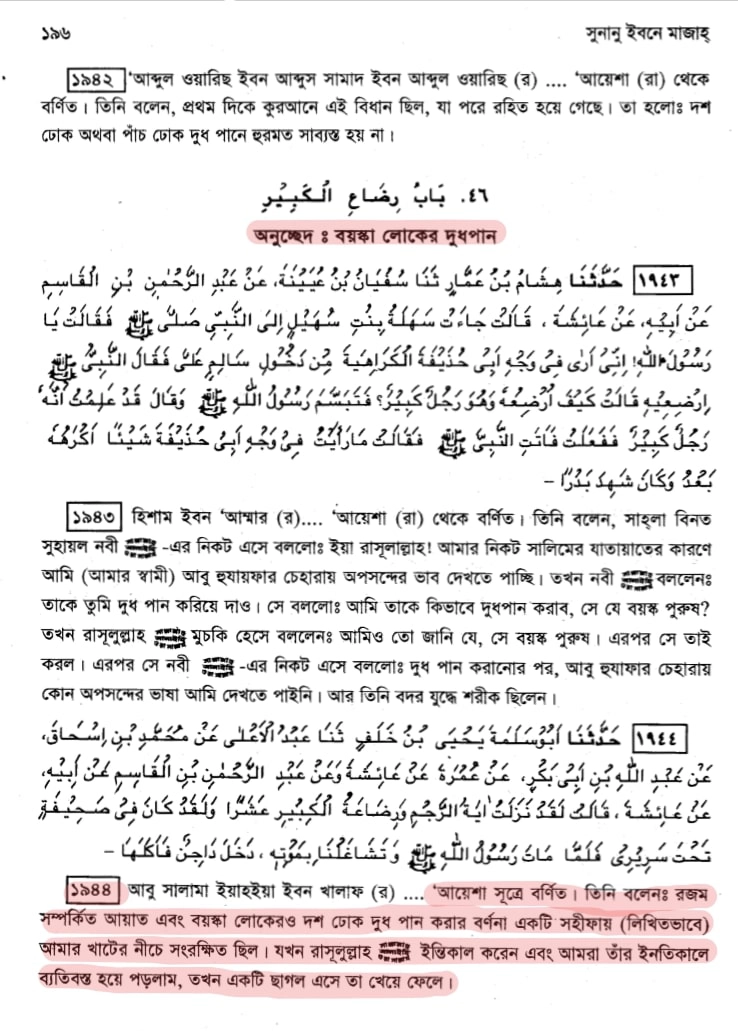
In the Bengali translation, the animal has been called a goat. The meaning of the word “dajin” in the Arabic text is a domesticated animal; its literal scope is broader. According to the explanation on Islamweb, the word is used for domesticated animals such as sheep and goats, as well as birds and other animals accustomed to the home. The event in the report is a description of a written sheet being destroyed by a domestic animal. [803]
كل ما يألف البيوت من الطير وغيرها
English translation: Birds and other animals accustomed to the home.
Regarding the content of the sheet, there are ten breastfeedings in some versions and five in others. This number matches the first stage of the “ten to five” sequence in Muslim. Consequently, a picture emerges where the statement of the previous number remained in written form. Not all personal written copies were destroyed immediately upon the change of legal efficacy. There is a description of the existence of such a sheet in the same room, the subject of which is called a revealed reading in the hadith, but whose words are not found in the current mushaf. The survival of written materials, their legal use, and their inclusion in the mushaf have three separate histories.
In a parallel account in Musnad Ahmad, the timing is mentioned as when Muhammad fell ill instead of his death. There, the sheet was under a bed in the room; amidst the preoccupation with the illness, a small domestic animal of theirs ate it. This reading also mentions stoning and ten breastfeedings for adults. The common center of both reports is the same: written in Aisha’s room, preserved under the bed, the family’s attention being elsewhere, and the animal eating it. [804]
حَدَّثَنَا يَعْقُوبُ قَالَ حَدَّثَنَا أَبِي عَنِ ابْنِ إِسْحَاقَ قَالَ حَدَّثَنِي عَبْدُ اللَّهِ بْنُ أَبِي بَكْرِ بْنِ مُحَمَّدِ بْنِ عَمْرِو بْنِ حَزْمٍ عَنْ عَمْرَةَ بِنْتِ عَبْدِ الرَّحْمَنِ عَنْ عَائِشَةَ زَوْجِ النَّبِيِّ صَلَّى اللَّهُ عَلَيْهِ وَسَلَّمَ قَالَتْ لَقَدْ أُنْزِلَتْ آيَةُ الرَّجْمِ وَرَضَعَاتُ الْكَبِيرِ عَشْرًا فَكَانَتْ فِي وَرَقَةٍ تَحْتَ سَرِيرٍ فِي بَيْتِي فَلَمَّا اشْتَكَى رَسُولُ اللَّهِ صَلَّى اللَّهُ عَلَيْهِ وَسَلَّمَ تَشَاغَلْنَا بِأَمْرِهِ وَدَخَلَتْ دُوَيْبَةٌ لَنَا فَأَكَلَتْهَا
English translation: Yaqub narrated, his father informed him, from Ibn Ishaq. Ibn Ishaq said, Abdullah ibn Abu Bakr ibn Muhammad ibn Amr ibn Hazm informed me, we [narrated] from Bint Abdur Rahman, she from Aisha, the wife of the Prophet. Aisha said: The verse of stoning and the matter of ten breastfeedings for adults were revealed. It was on a sheet under a bed in my room. When the Messenger fell ill, we became preoccupied with his matter. Then a small animal of ours entered and ate it.
| Aspect of the report | Ibn Majah 1944 | Parallel report of Ahmad |
|---|---|---|
| Subject of the writing | The verse of stoning and ten breastfeedings for adults | The verse of stoning and ten breastfeedings for adults |
| Written material | Sahifa | Waraqa or sheet |
| Position | Under my bed | Under a bed in my room |
| Reason for preoccupation | Muhammad’s death | The illness of Muhammad |
| Identity of the animal | Dajin or domestic animal | A small animal of ours |
| Outcome | Eating the sheet | Eating the sheet |
In the isnad of Ibn Majah, two paths are given through Muhammad ibn Ishaq: one from Abdullah ibn Abu Bakr through us to Aisha; the other from Abdur Rahman ibnul Qasim through his father Qasim to Aisha. Both these paths meet at Ibn Ishaq at the upper level. In Ahmad’s report, Ibn Ishaq used the language of hearing from Abdullah, saying “informed me”. Along with the presence of the animal incident across different texts, there is this interdependence of the reports. The occurrence of a reading by the same intermediate narrator being printed in multiple books does not create an equal number of independent sources.
There are differing decisions within Islamic circles regarding the acceptability of this hadith. In the original Bengali version, Al-Albani’s “hasan” evaluation was given, and positive comments from several critics regarding Ibn Ishaq are also preserved. Ibn Hazm, in Al-Muhalla, quoted the report of the sahifa being eaten and called it sahih. Consequently, precedents for accepting the event exist within classical Islamic literature. [805]
قَالَ أَبُو مُحَمَّدٍ : وَهَذَا حَدِيثٌ صَحِيحٌ
English translation: Abu Muhammad said: This is a sahih hadith.
IslamQA, in answer number 175355, rejected the additional part about the animal eating it. Their reason is that the event is not present in the reports of Malik and Yahya ibn Sa’id, but is present in the reading of Ibn Ishaq. They evaluated this difference as an unacceptable additional report. [806]
قصة ضعيفة لا تثبت
English translation: A weak event, which is not established.
In this disagreement, the evaluation of the specific reading containing the animal incident has changed. In Muslim, the change from ten to five and the report of it being read as Quran at the time of death remain in their respective places. In the discussion by IslamQA, Malik’s report was accepted and the additional animal incident was omitted. Therefore, the outcomes of the related documents are different: one branch contains the report of the written sheet being destroyed; the other branch contains the history of the change and loss of the reading containing the revealed numbers. The dispute over the acceptability of the sahifa incident cannot be conflated with the information regarding the absence of these previous readings in the current mushaf.
Ibn Hazm’s explanation is more specific. Accepting the destruction of the sahifa, he says its words had already been abrogated; therefore, that sheet was not needed. He gives the same decision regarding the verse of breastfeeding. In his view, since the matter was memorized by people, if there had been an instruction to keep it in the Quran, the eating of the sheet would not have prevented it from being rewritten. In this logic, the physical destruction of the written sheet and the status of the reading as a part of the Quran are distinct. [807]
فَصَحَّ نَسْخُ لَفْظِهَا وَبَقِيَتْ الصَّحِيفَةُ الَّتِي كُتِبَتْ فِيهَا – كَمَا قَالَتْ عَائِشَةُ رَضِيَ اللَّهُ عَنْهَا – فَأَكَلَهَا الدَّاجِنُ ، وَلَا حَاجَةَ بِأَحَدٍ إلَيْهَا . وَهَكَذَا الْقَوْلُ فِي آيَةِ الرَّضَاعَةِ وَلَا فَرْقَ . وَبُرْهَانُ هَذَا : أَنَّهُمْ قَدْ حَفِظُوهَا كَمَا أَوْرَدْنَا ، فَلَوْ كَانَتْ مُثْبَتَةً فِي الْقُرْآنِ لَمَا مَنَعَ أَكْلُ الدَّاجِنِ لِلصَّحِيفَةِ مِنْ إثْبَاتِهَا فِي الْقُرْآنِ مِنْ حِفْظِهِمْ – وَبِاَللَّهِ تَعَالَى التَّوْفِيقُ .
English translation: Thus, the abrogation of its words is established; and according to Aisha, the sahifa in which it was written remained. A domestic animal ate it; no one had need of it. The same applies to the verse of breastfeeding, there is no difference. The proof of this is that, according to our narrated report, they had kept it memorized. If it had remained in the Quran, the eating of the sahifa by a domestic animal would not have prevented them from writing it in the Quran from their memory. Success is from Allah.
In his subsequent argument, Ibn Hazm declares that if Muhammad had been told to convey any verse, he would have conveyed it; if conveyed, it would have been preserved. He then places the conditions of not being conveyed, being made to forget, or the absence of an instruction to write it in the mushaf, within the category of certain abrogation. Here, the possible explanations for absence are brought into the same approved category through religious authority. [808]
فَصَحَّ أَنَّ الْآيَاتِ الَّتِي ذَهَبَتْ لَوْ أُمِرَ رَسُولُ اللَّهِ صَلَّى اللَّهُ عَلَيْهِ وَسَلَّمَ بِتَبْلِيغِهَا لَبَلَّغَهَا ، وَلَوْ بَلَّغَهَا لَحُفِظَتْ ، وَلَوْ حُفِظَتْ مَا ضَرَّهَا مَوْتُهُ ، كَمَا لَمْ يَضُرَّ مَوْتُهُ – عَلَيْهِ السَّلَامُ – كُلَّ مَا بَلَّغَ فَقَطْ مِنْ الْقُرْآنِ ، وَإِنْ كَانَ عَلَيْهِ السَّلَامُ لَمْ يُبَلِّغْ ، أَوْ بَلَّغَهُ فَأُنْسِيه هُوَ وَالنَّاسُ ، أَوْ لَمْ يَنْسَوْهُ ، لَكِنْ لَمْ يَأْمُرْ – عَلَيْهِ السَّلَامُ – أَنْ يُكْتَبَ فِي الْقُرْآنِ فَهُوَ مَنْسُوخٌ بِيَقِينٍ مِنْ عِنْدِ اللَّهِ تَعَالَى ، لَا يَحِلُّ أَنْ يُضَافَ إلَى الْقُرْآنِ .
English translation: Thus it is established that for the verses that are gone, if the Messenger of Allah had been instructed to convey them, he would have conveyed them; if conveyed, they would have been preserved. If preserved, his death would not have harmed them, just as his death did not harm those parts of the Quran which he had conveyed. And if he did not convey them, or if after conveying them he and other people were made to forget them, or if they did not forget but he did not instruct to write it in the Quran, then it is certainly abrogated by Allah. It is not permissible to add it to the Quran.
Ibn Hazm’s conclusion does not follow from the fact of memorization alone. Whether a memorized statement is to be included in the mushaf requires a separate decision. In his explanation, the statement is absent from the present mushaf and failure of preservation is religiously unacceptable; the absent text is therefore classified as abrogated. Under this method, a statement’s absence itself becomes evidence of its withdrawal. Yet the fact of absence does not automatically supply the date of that withdrawal, an account of its proclamation, or the history of its transmission.
The account of the sahifa under the bed also reveals the daily methods of preservation. Like other household items, an important written document depended on human attention, a secure location, and protection from external damage. It is described that this protection failed during a family crisis. Although the content of the pages was called divine, its carrier was a perishable material. Religious status did not keep that object out of the reach of animals. Ibn Hazm, the recipient of the account, did not claim that the object remained intact; he explained that its necessity had ended.
The report of the sahifa’s destruction thus brings forward two separate levels: the weakness of written materials and the subsequent explanation regarding absent readings. At the first level, a sheet is destroyed; at the second level, the commentator decides that its content no longer needs to be kept in the mushaf. In the current Quran, there are no sentences regarding stoning or the specific ten or five breastfeedings, but the identity of those absent words remains in hadith and fiqh. People remembered the words, quoted them, and in some cases made them the basis of rulings; the permission to give them a place in the mushaf remained separate after that.
Report of the withdrawal of the reading, the number of breastfeedings, and subsequent legal disagreement
A practical application of the reported change regarding the number of breastfeedings is found in the event of Sahla and Salim. Abu Huzaifa had adopted Salim as a foster son. After the instruction came to call foster children by their biological father’s name, Sahla raised the question of Salim’s entry into her room with Muhammad. In the long report of Abu Dawud, the subsequent breastfeeding, the number of five times, Aisha’s general application, and the objections of other wives are compiled in the same sequence. This event is a specific example of how the explanation of a ruling creates the right of entry for a woman’s room. [809] [810]
حَدَّثَنَا أَحْمَدُ بْنُ صَالِحٍ ، حَدَّثَنَا عَنْبَسَةُ ، حَدَّثَنِي يُونُسُ ، عَنِ ابْنِ شِهَابٍ ، حَدَّثَنِي عُرْوَةُ بْنُ الزُّبَيْرِ ، عَنْ عَائِشَةَ ، زَوْجِ النَّبِيِّ صلى الله عليه وسلم وَأُمِّ سَلَمَةَ أَنَّ أَبَا حُذَيْفَةَ بْنَ عُتْبَةَ بْنِ رَبِيعَةَ بْنِ عَبْدِ شَمْسٍ كَانَ تَبَنَّى سَالِمًا وَأَنْكَحَهُ ابْنَةَ أَخِيهِ هِنْدَ بِنْتَ الْوَلِيدِ بْنِ عُتْبَةَ بْنِ رَبِيعَةَ وَهُوَ مَوْلًى لاِمْرَأَةٍ مِنَ الأَنْصَارِ كَمَا تَبَنَّى رَسُولُ اللَّهِ صلى الله عليه وسلم زَيْدًا وَكَانَ مَنْ تَبَنَّى رَجُلاً فِي الْجَاهِلِيَّةِ دَعَاهُ النَّاسُ إِلَيْهِ وَوُرِّثَ مِيرَاثَهُ حَتَّى أَنْزَلَ اللَّهُ سُبْحَانَهُ وَتَعَالَى فِي ذَلِكَ { ادْعُوهُمْ لآبَائِهِمْ } إِلَى قَوْلِهِ { فَإِخْوَانُكُمْ فِي الدِّينِ وَمَوَالِيكُمْ } فَرُدُّوا إِلَى آبَائِهِمْ فَمَنْ لَمْ يُعْلَمْ لَهُ أَبٌ كَانَ مَوْلًى وَأَخًا فِي الدِّينِ فَجَاءَتْ سَهْلَةُ بِنْتُ سُهَيْلِ بْنِ عَمْرٍو الْقُرَشِيِّ ثُمَّ الْعَامِرِيِّ – وَهِيَ امْرَأَةُ أَبِي حُذَيْفَةَ – فَقَالَتْ يَا رَسُولَ اللَّهِ إِنَّا كُنَّا نَرَى سَالِمًا وَلَدًا وَكَانَ يَأْوِي مَعِي وَمَعَ أَبِي حُذَيْفَةَ فِي بَيْتٍ وَاحِدٍ وَيَرَانِي فُضْلاً وَقَدْ أَنْزَلَ اللَّهُ عَزَّ وَجَلَّ فِيهِمْ مَا قَدْ عَلِمْتَ فَكَيْفَ تَرَى فِيهِ فَقَالَ لَهَا النَّبِيُّ صلى الله عليه وسلم ” أَرْضِعِيهِ ” . فَأَرْضَعَتْهُ خَمْسَ رَضَعَاتٍ فَكَانَ بِمَنْزِلَةِ وَلَدِهَا مِنَ الرَّضَاعَةِ فَبِذَلِكَ كَانَتْ عَائِشَةُ – رضى الله عنها – تَأْمُرُ بَنَاتِ أَخَوَاتِهَا وَبَنَاتِ إِخْوَتِهَا أَنْ يُرْضِعْنَ مَنْ أَحَبَّتْ عَائِشَةُ أَنْ يَرَاهَا وَيَدْخُلَ عَلَيْهَا وَإِنْ كَانَ كَبِيرًا خَمْسَ رَضَعَاتٍ ثُمَّ يَدْخُلَ عَلَيْهَا وَأَبَتْ أُمُّ سَلَمَةَ وَسَائِرُ أَزْوَاجِ النَّبِيِّ صلى الله عليه وسلم أَنْ يُدْخِلْنَ عَلَيْهِنَّ بِتِلْكَ الرَّضَاعَةِ أَحَدًا مِنَ النَّاسِ حَتَّى يَرْضَعَ فِي الْمَهْدِ وَقُلْنَ لِعَائِشَةَ وَاللَّهِ مَا نَدْرِي لَعَلَّهَا كَانَتْ رُخْصَةً مِنَ النَّبِيِّ صلى الله عليه وسلم لِسَالِمٍ دُونَ النَّاسِ .
English translation: Ahmad ibn Salih narrated, Anbasa informed them; Yunus informed him, from Ibn Shihab. Ibn Shihab said, Urwa ibnuz Zubayr informed me, from Aisha and Umm Salama, the wives of the Prophet. Abu Huzaifa ibn Utba ibn Rabi’a ibn Abde Shams had adopted Salim as a foster son and had married him to his brother’s daughter, Hind bint Walid ibn Utba ibn Rabi’a. Salim was a freed slave of a woman from the Ansar. Similarly, the Messenger had adopted Zayd as a foster son. In the era of Jahiliyyah, if someone adopted another as a foster son, people would call him as related to that person and he would be made his heir. Finally, Allah revealed regarding this, “Call them by the names of their fathers”—up to “they are your religious brothers and freed slaves”. Then they were related to their respective fathers; whoever’s father’s identity was unknown was considered a freed slave and religious brother. Then the wife of Abu Huzaifa, Sahla bint Suhayl ibn Amr Al-Qurashi, then Al-Amiri, came and said, O Messenger of Allah, we considered Salim as a son. He used to stay in the same room with me and Abu Huzaifa and saw me in domestic clothing. You know what Allah has revealed regarding them. What is your opinion on this? The Prophet told her, “Have him breastfeed.” She had him breastfeed five times; consequently, he became like her son in terms of breastfeeding. Based on this event, Aisha would instruct her sisters’ daughters and brothers’ daughters that any person Aisha wanted to allow to come before her and enter her room, even if he were an adult, should be breastfed five times; then he would enter her room. Umm Salama and the other wives of the Prophet refused to allow anyone to enter their rooms due to this breastfeeding unless he breastfed during the cradle age. They said to Aisha, by Allah, we do not know; perhaps this was a special permission from the Prophet for Salim alone, excluding others.
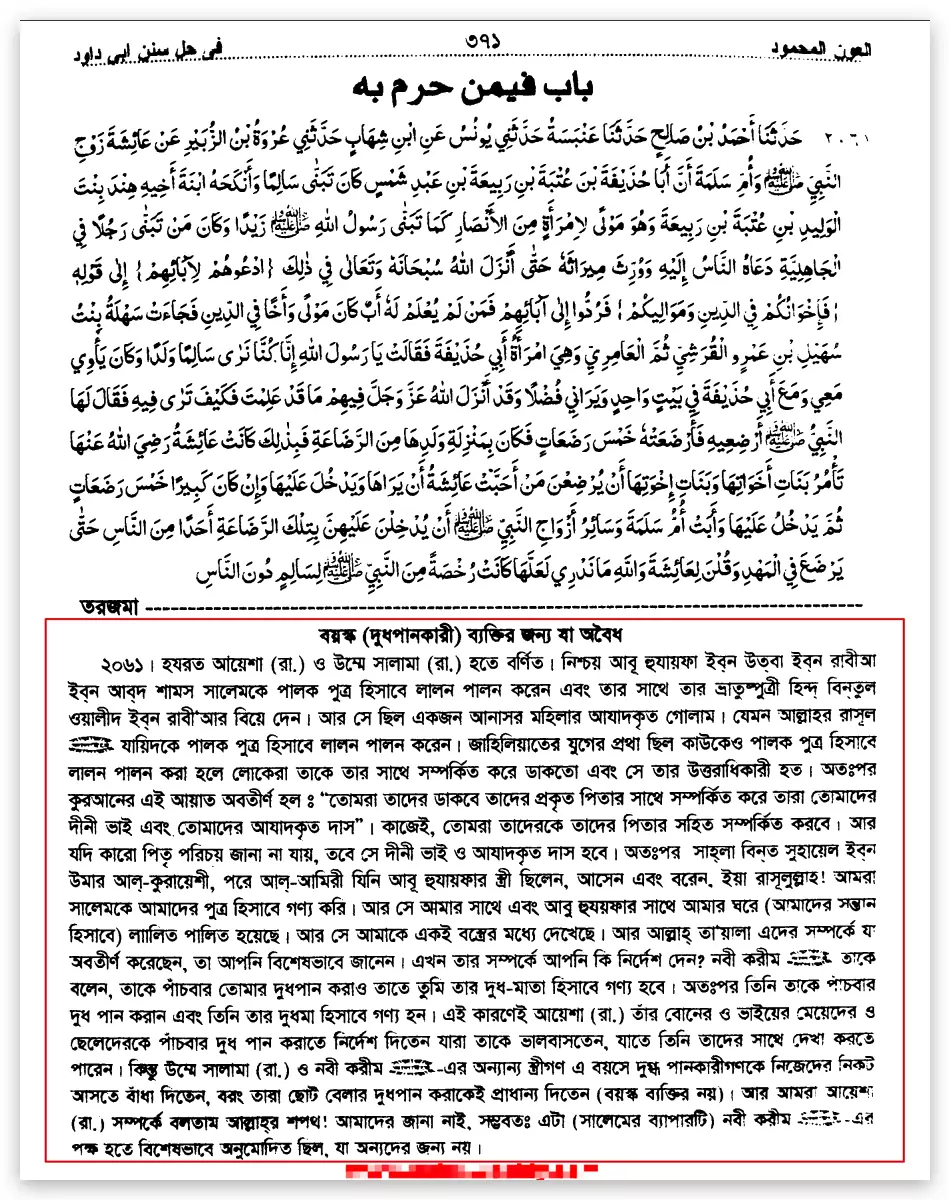
In this full report, Muhammad’s direct instruction is “Have him breastfeed”; then the narrator mentions the event of breastfeeding five times. Aisha extended the use of the same event: she instructed that those she wanted to allow to enter before her be breastfed five times by her sisters’ or brothers’ daughters. The position of the other wives was the opposite. They called breastfeeding in infancy relevant and understood Salim’s event as a special permission. Consequently, a dispute arose even within the same Prophet’s family regarding the scope of application of an order. This difference between a general ruling and a special permission actually changed the rights of human interaction.
Although the statement of abrogation from five to ten was propagated in Aisha’s own name, her instruction to breastfeed ten times is also compiled in the Muwatta. Nafi narrates from Salim ibn Abdullah ibn Umar that Aisha told him in childhood to go to her sister Umm Kulthum to breastfeed ten times, so that he could enter Aisha’s room. After three times, Umm Kulthum fell ill. According to Salim’s statement, since ten times were not completed, he did not enter Aisha’s room. [811]
وَحَدَّثَنِي عَنْ مَالِكٍ، عَنْ نَافِعٍ، أَنَّ سَالِمَ بْنَ عَبْدِ اللَّهِ بْنِ عُمَرَ، أَخْبَرَهُ أَنَّ عَائِشَةَ أُمَّ الْمُؤْمِنِينَ أَرْسَلَتْ بِهِ وَهُوَ يَرْضَعُ إِلَى أُخْتِهَا أُمِّ كُلْثُومٍ بِنْتِ أَبِي بَكْرٍ الصِّدِّيقِ فَقَالَتْ أَرْضِعِيهِ عَشْرَ رَضَعَاتٍ حَتَّى يَدْخُلَ عَلَىَّ . قَالَ سَالِمٌ فَأَرْضَعَتْنِي أُمُّ كُلْثُومٍ ثَلاَثَ رَضَعَاتٍ ثُمَّ مَرِضَتْ فَلَمْ تُرْضِعْنِي غَيْرَ ثَلاَثِ رَضَعَاتٍ فَلَمْ أَكُنْ أَدْخُلُ عَلَى عَائِشَةَ مِنْ أَجْلِ أَنَّ أُمَّ كُلْثُومٍ لَمْ تُتِمَّ لِي عَشْرَ رَضَعَاتٍ .
English translation: Malik narrated from Nafi, who was informed by Salim ibn Abdullah ibn Umar: Aisha sent him, during the age of breastfeeding, to her sister Umm Kulthum bint Abu Bakr al-Siddiq and said, “Have her breastfeed him ten times, so that he may enter upon me.” Salim said: Umm Kulthum breastfed me three times, then she fell ill. Consequently, she did not breastfeed me more than three times. Since Umm Kulthum did not complete ten times for me, I did not enter upon Aisha.
This Salim is the son of Abdullah ibn Umar; the Salim mentioned in the incident of Sahla, the freed slave of Abu Hudhayfa, is a different person. In this account in the Muwatta, the age is also specified: he was then a breastfeeding infant. Therefore, if the matter of the number is conflated with the breastfeeding of an adult, the subject of the report changes. Here, there is an instruction to breastfeed ten times during infancy to create future access. In the documents of rulings and practices preserved under Aisha’s name, ten times is present alongside five times.
An instruction for ten times is also found in the case of Hafsa. In the Muwatta, it is narrated under the name of Safiyya bint Abu Ubayd that Hafsa sent Asim ibn Abdullah ibn Sa’d to her sister Fatima bint Umar to have him breastfed ten times, so that he may enter upon her. The report explicitly describes him as a small breastfeeding infant. In this instruction narrated under Hafsa’s name, the number is also ten. [812]
وَحَدَّثَنِي عَنْ مَالِكٍ، عَنْ نَافِعٍ، أَنَّ صَفِيَّةَ بِنْتَ أَبِي عُبَيْدٍ، أَخْبَرَتْهُ أَنَّ حَفْصَةَ أُمَّ الْمُؤْمِنِينَ أَرْسَلَتْ بِعَاصِمِ بْنِ عَبْدِ اللَّهِ بْنِ سَعْدٍ إِلَى أُخْتِهَا فَاطِمَةَ بِنْتِ عُمَرَ بْنِ الْخَطَّابِ تُرْضِعُهُ عَشْرَ رَضَعَاتٍ لِيَدْخُلَ عَلَيْهَا وَهُوَ صَغِيرٌ يَرْضَعُ فَفَعَلَتْ فَكَانَ يَدْخُلُ عَلَيْهَا .
English translation: Malik narrated from Nafi, who was informed by Safiyya bint Abu Ubayd: The Mother of the Believers, Hafsa, sent Asim ibn Abdullah ibn Sa’d to her sister Fatima bint Umar ibn al-Khattab, so that she might breastfeed him ten times and he may enter upon her. At that time, he was a small breastfeeding infant. Fatima did so; thereafter, he used to enter upon Hafsa.
Malik himself gave the opinion that marriage is prohibited by both small and large amounts of breastfeeding, provided it occurs within two years. After two years, he categorized the same amount as ordinary food. Consequently, compiling the report of Aisha’s change from ten to five and accepting five as the legally mandatory limit was not the same for him. The presence of one report in the same compilation does not make all its conditions the law adopted by the compiler. In Malik’s legal decision, age and the event of breastfeeding became primary instead of determining a number. [813]
وَحَدَّثَنِي عَنْ مَالِكٍ، عَنِ ابْنِ شِهَابٍ، أَنَّهُ كَانَ يَقُولُ الرَّضَاعَةُ قَلِيلُهَا وَكَثِيرُهَا تُحَرِّمُ وَالرَّضَاعَةُ مِنْ قِبَلِ الرِّجَالِ تُحَرِّمُ . قَالَ يَحْيَى وَسَمِعْتُ مَالِكًا يَقُولُ الرَّضَاعَةُ قَلِيلُهَا وَكَثِيرُهَا إِذَا كَانَ فِي الْحَوْلَيْنِ تُحَرِّمُ فَأَمَّا مَا كَانَ بَعْدَ الْحَوْلَيْنِ فَإِنَّ قَلِيلَهُ وَكَثِيرَهُ لاَ يُحَرِّمُ شَيْئًا وَإِنَّمَا هُوَ بِمَنْزِلَةِ الطَّعَامِ .
English translation: Malik narrated from Ibn Shihab, who used to say: Breastfeeding, whether small or large, prohibits marriage; a breastfeeding relationship from the male side also prohibits marriage. Yahya said: I heard Malik say that if it occurs within two years, both small and large breastfeeding prohibit marriage. If it occurs after two years, neither small nor large prohibits any relationship; it is merely like food.
Contrary to the establishment of prohibition by small breastfeeding, there is a report from Umm al-Fadl in Muslim. After a man married another woman alongside his first wife, the first wife claimed that she had breastfed the new wife once or twice. When the question was raised to Muhammad, he said that prohibition is not established by breastfeeding once or twice. In this incident, it was directly determined whether an existing marriage would survive as a result of a numerical statement. [814]
حَدَّثَنَا يَحْيَى بْنُ يَحْيَى ، وَعَمْرٌو النَّاقِدُ ، وَإِسْحَاقُ بْنُ إِبْرَاهِيمَ ، كُلُّهُمْ عَنِ الْمُعْتَمِرِ ، – وَاللَّفْظُ لِيَحْيَى – أَخْبَرَنَا الْمُعْتَمِرُ بْنُ سُلَيْمَانَ، عَنْ أَيُّوبَ ، يُحَدِّثُ عَنْ أَبِي الْخَلِيلِ ، عَنْ عَبْدِ، اللَّهِ بْنِ الْحَارِثِ عَنْ أُمِّ الْفَضْلِ ، قَالَتْ دَخَلَ أَعْرَابِيٌّ عَلَى نَبِيِّ اللَّهِ صلى الله عليه وسلم وَهُوَ فِي بَيْتِي فَقَالَ يَا نَبِيَّ اللَّهِ إِنِّي كَانَتْ لِي امْرَأَةٌ فَتَزَوَّجْتُ عَلَيْهَا أُخْرَى فَزَعَمَتِ امْرَأَتِي الأُولَى أَنَّهَا أَرْضَعَتِ امْرَأَتِي الْحُدْثَى رَضْعَةً أَوْ رَضْعَتَيْنِ . فَقَالَ نَبِيُّ اللَّهِ صلى الله عليه وسلم ” لاَ تُحَرِّمُ الإِمْلاَجَةُ وَالإِمْلاَجَتَانِ ” . قَالَ عَمْرٌو فِي رِوَايَتِهِ عَنْ عَبْدِ اللَّهِ بْنِ الْحَارِثِ بْنِ نَوْفَلٍ .
English translation: Yahya ibn Yahya, Amr an-Naqid, and Ishaq ibn Ibrahim Mutammir narrated; the wording is Yahya’s. Mutammir ibn Sulayman informed them, from Ayyub, from Abu al-Khalil, from Abdullah ibn al-Harith, from Umm al-Fadl. Umm al-Fadl said: While the Prophet was in my house, a Bedouin came and said, O Prophet of Allah, I had a wife; I married another over her. My first wife claimed that she breastfed my new wife once or twice. The Prophet said, “Marriage is not prohibited by breastfeeding once or twice.” In Amr’s report, the name Abdullah ibn al-Harith ibn Nawfal is present.
In subsequent fiqh, various limits—one, three, and five—have been determined from these documents. Ibn Jawzi narrated three opinions under the name of Ahmad ibn Hanbal. The first is once; Abu Hanifa and Malik also took this view based on the general prohibition in the Quran. The second is three times; its basis is the hadith that it is not prohibited once or twice. The third is five times; its basis is Aisha’s report. The difference in this division is not only in the number, but also in the decision of which document will specify another document. [815]
قلت: أما مقدار ما يحرم من الرضاع فعن أحمد بن حنبل – رحمه الله – فيه ثلاث روايات: إحداهن: رضعة واحدة ، وبه قال أبو حنيفة ومالك أخذا بظاهر القرآن في قوله: وأخواتكم من الرضاعة ، وتركا لذلك الحديث . والثانية: ثلاث ، لقول النبي صلى الله عليه وسلم: ” لا تحرم المصة والمصتان ” . والثالثة: خمس لما روينا في حديث عائشة
English translation: I say: Regarding the amount of breastfeeding that prohibits marriage, there are three reports under the name of Ahmad ibn Hanbal. One is breastfeeding once. Abu Hanifa and Malik also gave this opinion; they accepted the apparent meaning of the Quran’s words “and your sisters through breastfeeding” and therefore did not base their decision on that hadith. The second is three times, because of the Prophet’s statement that “marriage is not prohibited by breastfeeding once or twice.” The third is five times, because of the hadith narrated by Aisha.
| Legal position | Documents or arguments used | Result of the number |
|---|---|---|
| Opinion of Malik and Abu Hanifa | General prohibition of breastfeeding relationships in the Quran | Prohibition even with small breastfeeding; completing five times is not mandatory |
| Opinion of three times | Numerical significance of the hadith that once and twice do not prohibit | Establishment of prohibition from three times |
| Opinion of five times by Shafi’i and his followers | Report of Aisha’s change from ten to five | Prohibition is not established with less than five times |
| Opinions compiled by Ibn Jawzi under Ahmad’s name | Three reports giving priority to different documents | Three decisions—once, three times, and five times |
An incident of confirmed breastfeeding four times within two years demonstrates the practical result of this dispute. In Malik’s numerical rule, a breastfeeding prohibition is created; in Shafi’i’s rule of five times, a prohibition is not created based solely on those four times. If a prohibition is created, marriage to the relevant foster mother, foster sister, and other relationships is blocked. Two methods give two different legal identities to the same known event. Therefore, a decision regarding the textual position of a religious sentence exerts direct authority over people’s family lives.
Nabawi preserved the source of this dispute more openly. His cited Maliki objection is that Aisha described the matter as Quran; but the Quran is not established by a single report. Again, if it cannot be established as Quran, the question arises of using the same report as the Prophet’s general news. Here, a dispute is joined between the existence of the testimony and the legal category of the testimony. If the same sentence is categorized as Quran, a single report, or a memory of an abrogated reading, the result of its acceptance and authority differs. [816]
واعترض أصحاب مالك على الشافعية بأن حديث عائشة هذا لا يحتج به عندكم وعند محققي الأصوليين لأن القرآن لا يثبت بخبر الواحد ، وإذا لم يثبت قرآنا لم يثبت بخبر الواحد عن النبي صلى الله عليه وسلم لأن خبر الواحد إذا توجه إليه قادح وقف عن العمل به وهذا إذا لم يجئ إلا بآحاد مع أن العادة مجيئه متواترا توجب ريبة ، والله أعلم .
English translation: The followers of Malik objected against the Shafi’is that this hadith of Aisha cannot be a document for you or for the scholars who analyze usul; because the Quran is not established by a single report. When it was not established as Quran, it was not established as the Prophet’s news in a single report either. Because if a flaw is found against any single report, action based on it remains suspended. And if a matter that is generally expected to be widely transmitted comes only through a single source, it becomes a cause for suspicion. Allah knows best.
Ibn Jawzi preserved another explanation: some have referred the mention of the reading as Quran at the time of death to the general breastfeeding-prohibition verse in the current Surah An-Nisa. Their argument is that if the specific reading of five times remained as Quran even after death, it should have been transmitted like the mushaf. Here, the meaning of the previous report is being determined from the current limit of the accepted mushaf. Although there is a mention of a specific five times in Aisha’s words, in the explanation, its readable position is linked to the general breastfeeding verse. [817]
وتأولوا قولها: وهي مما يقرأ من القرآن أن الإشارة إلى قوله: وأخواتكم من الرضاعة ، وقالوا: لو كان يقرأ بعد وفاة رسول الله صلى الله عليه وسلم ، لنقل إلينا نقل المصحف ، ولو كان بقي من القرآن شيء لم ينقل لجاز أن يكون ما لم ينقل ناسخا لما نقل ، فذلك محال .
English translation: They explained Aisha’s words “it was among the parts read as Quran” in this way: that the hint is toward the words “and your sisters through breastfeeding.” They said: If it were read after the death of the Messenger, it would have been transmitted to us just like the mushaf. If any part of the Quran remained but was not transmitted, that which was not transmitted would have the opportunity to be the abrogator of the transmitted part; therefore, it is impossible.
In this logic, the decision that transmission was complete is the prerequisite. Since the specific reading is not in the current mushaf, the possibility of its remaining is canceled; then, with that canceled decision, the meaning of the testimony of the reading at the time of death is changed. This is a method of assuming the completeness of the mushaf and making the report compatible with it. Evidence of when the reading was withdrawn, who bore that announcement, and how its news was propagated—these events cannot be found from within this logic. Religious certainty and the description of historical events are not the same kind of evidence here.
Therefore, in the collection of breastfeeding documents, there are several specific forms of change: five instead of ten in the revealed statement, the reading of the five-times part as Quran until the time of death, the description of the destruction of a personal sahifa, and the determination of law based on readings outside the mushaf. Then, different decisions on number and application were made from the same document. The power to remember a reading as “Quran,” the authorization to include it in the mushaf, and the authority to implement it as a marriage law worked in separate hands and under separate conditions. Describing the entire history as “same reading, same ruling, same application” is inconsistent with these documents.
Testimonies of Companions regarding lost verses and absent surahs
In the memory of the early reading community of the Quran, there are mentions of surahs and sentences that are not in the current mushaf. In some reports, the readings of two complete compositions are preserved; in some reports, only a few sentences of one long surah are remembered. In some places, the numerical gap between the previous extent of a surah and the subsequent reading is mentioned; in some places, it is mentioned that a sentence read as Quran was later withdrawn. The subject of these testimonies is not just differences in pronunciation. The differences have reached the level of which composition will remain within the book, how long a surah will be, and which sentence previously known as Quran will no longer be read.
Reports preserved under the names of Ubayy, Abu Musa, Aisha, Hudhayfa, Anas, and Ibn Umar survive in subsequent hadith, tafsir, and Quranic books. In their statements, the memory of previous readings and the extent of the accepted mushaf are not the same in all cases. Commentators have categorized this gap as naskh, being made to forget, or the withdrawal of the status of recitation. Even within that categorization, the history of change from the previously read content to the subsequent accepted collection is preserved.
Khal and Hafd in Ubayy’s mushaf and two surahs outside the current mushaf
In the description of the mushaf preserved under Ubayy’s name, there are two compositions named “Khal” and “Hafd.” Their beginnings are “Allahumma inna nasta’inuka” and “Allahumma iyyaka na’budu” respectively. Along with the mention of these two compositions in comparison to the numerical count of the mushaf, Suyuti also compiled descriptions of their full texts and their use in prayer. Consequently, the content behind these two names is not unknown. The religious character of the two compositions is revealed in these statements: seeking help and forgiveness, obedience to Allah, separation from the disobedient, and fear of punishment. [818] [819] [820]
اللَّهُمَّ إِنَّا نَسْتَعِينُكَ وَنَسْتَغْفِرُكَ وَنُثْنِي عَلَيْكَ الْخَيْرَ وَلَا نَكْفُرُكَ ونخلع ونترك من يفجرك. وفيه: اللهم اياك نَعْبُدُ وَلَكَ نُصَلِّي وَنَسْجُدُ وَإِلَيْكَ نَسْعَى وَنَحْفِدُ نَخْشَى عَذَابَكَ وَنَرْجُو رَحْمَتَكَ إِنَّ عَذَابَكَ بِالْكُفَّارِ مُلْحَقٌ.
English translation: O Allah, we seek help only from You, we seek forgiveness only from You, we praise You, we are not ungrateful to You, and we separate and isolate ourselves from those who are disobedient to You. It further contains: O Allah, we worship only You, we pray only to You, we bow only to You, we prostrate, we hasten toward You. And we fear Your severe punishment, we hope for Your mercy. Surely Your punishment will fall upon the unbelievers. [821]
The word “nakhlau”—we separate—in the first composition is related to the name Khal, and the word “nahfidu”—we hasten—in the second is related to the name Hafd. Although Allah is addressed similarly in both, the movement of the content is different. In the first: declarations of help, forgiveness, praise, and separation; in the second: worship, prayer, prostration, hastening in obedience, and expectation of mercy and punishment. This structure of separate beginnings and separate endings carries their identity as two compositions in the reports.
Suyuti, citing the book of prayer (Kitab al-Salat) by Muhammad ibn Nasr al-Marwazi, provides two pieces of information regarding Ubayy together: he used to recite those two compositions in the Qunut and wrote them in his own mushaf. The fact that they were used in prayer and found a place in the mushaf are presented here side by side. The compositions were not merely preserved in some subsequent prayer book—the scope of the report is broader than that. [822]
وَأَخْرَجَ مُحَمَّدُ بْنُ نَصْرٍ الْمَرْوَزِيُّ فِي كِتَابِ الصَّلَاةِ عَنْ أُبَيِّ بْنِ كَعْبٍ أَنَّهُ كَانَ يَقْنُتُ بِالسُّورَتَيْنِ فَذَكَرَهُمَا وَأَنَّهُ كَانَ يَكْتُبْهُمَا فِي مُصْحَفِهِ.
English translation: Muhammad ibn Nasr al-Marwazi narrated in Kitab al-Salat from Ubayy ibn Ka’b that he used to recite the Qunut with those two surahs. He then mentioned the two compositions and stated that Ubayy used to write them in his own mushaf.
The same discussion also contains an account of Umar’s prayer. Suyuti narrated through Bayhaqi that Umar recited Bismillah in the Qunut after the ruku before the first prayer; Bismillah appeared again before the second one. Instead of a general pause in the middle of a long prayer, a separate Bismillah was given at the beginning of each composition. Suyuti also preserved Ibn Jurayj’s statement regarding the reason for these separate beginnings. [823] [824]
وَأَخْرَجَ الْبَيْهَقِيُّ مِنْ طَرِيقِ سُفْيَانَ الثَّوْرِيِّ عَنِ ابْنِ جُرَيْجٍ عَنْ عَطَاءٍ عَنْ عُبَيْدِ بْنِ عُمَيْرٍ أَنَّ عُمَرَ بْنَ الْخَطَّابِ قَنَتَ بَعْدَ الرُّكُوعِ فَقَالَ: بِسْمِ اللَّهِ الرَّحْمَنِ الرَّحِيمِ اللَّهُمَّ إِنَّا نَسْتَعِينُكَ وَنَسْتَغْفِرُكَ وَنُثْنِي عَلَيْكَ ولا نكفرك ونخلع ونترك من يفجرك. بِسْمِ اللَّهِ الرَّحْمَنِ الرَّحِيمِ اللَّهُمَّ إِيَّاكَ نَعْبُدُ وَلَكَ نُصَلِّي وَنَسْجُدُ وَإِلَيْكَ نَسْعَى وَنَحْفِدُ نَرْجُو رَحْمَتَكَ وَنَخْشَى نِقْمَتَكَ إِنَّ عَذَابَكَ بِالْكَافِرِينَ مُلْحَقٌ.
English translation: Bayhaqi narrated from Sufyan al-Thawri, who narrated from Ibn Jurayj, who narrated from Ata, who narrated from Ubayd ibn Umayr that Umar ibn al-Khattab, after reciting the Qunut after the ruku, says: In the name of Allah, the Most Gracious, the Most Merciful. O Allah, we seek Your help and Your forgiveness, we praise You, we are not ungrateful to You, and we abandon and sever ties with whoever is disobedient to You. In the name of Allah, the Most Gracious, the Most Merciful. O Allah, we worship You alone, we pray and prostrate for You, we turn toward You and hasten to You. We hope for Your mercy and fear Your punishment. Your punishment shall fall upon the unbelievers.
In Ibn Jurayj’s explanation, this use of Bismillah is linked to the arrangement of the mushaf. He stated that Bismillah appeared at both beginnings because the two compositions were surahs in the mushafs of some Companions. That is, there is a link within the report between what was written in the personal mushaf and the structure used in prayer. [825]
قَالَ ابْنُ جُرَيْجٍ: حِكْمَةُ الْبَسْمَلَةِ أَنَّهُمَا سُورَتَانِ فِي مُصْحَفِ بَعْضِ الصَّحَابَةِ.
English translation: Ibn Jurayj says: The significance of saying Bismillah is that these two surahs were in the mushafs of some Companions.
Suyuti also quoted a political conversation regarding the teaching of the two compositions. When Abd al-Malik ibn Marwan mocked Abdullah ibn Zurayr al-Ghafiqi for his affection for Ali, he identified his own Quranic education. In his statement, Ali had taught him two surahs, and Ali had learned them from Muhammad. Here, there is not just a report of reciting the two full texts as prayers; the compositions found a place within the claim of teacher, student, and learning the Quran. [826]
وَأَخْرَجَ الطَّبَرَانِيُّ فِي الدُّعَاءِ مِنْ طَرِيقِ عَبَّادِ بْنِ يَعْقُوبَ الْأَسَدِيِّ عَنْ يَحْيَى بْنِ يَعْلَى الْأَسْلَمِيِّ عَنِ ابْنِ لَهِيعَةَ عَنِ ابْنِ هُبَيْرَةَ عَنْ عَبْدِ اللَّهِ بْنِ زُرَيْرٍ الْغَافِقِيِّ قَالَ: قَالَ لِي عَبْدُ الْمَلِكِ بْنُ مَرْوَانَ: لَقَدْ عَلِمْتُ مَا حَمَلَكَ عَلَى حُبِّ أَبِي تُرَابٍ إِلَّا أَنَّكَ أَعْرَابِيٌّ جَافٌّ فَقُلْتُ: وَاللَّهِ لَقَدْ جَمَعْتُ الْقُرْآنَ مِنْ قَبْلِ أَنْ يَجْتَمِعَ أَبَوَاكَ وَلَقَدْ عَلَّمَنِي مِنْهُ عَلِيُّ بْنُ أَبِي طَالِبٍ سُورَتَيْنِ عَلَّمَهُمَا إِيَّاهُ رَسُولُ اللَّهِ صَلَّى اللَّهُ عَلَيْهِ وَسَلَّمَ مَا عَلِمْتَهُمَا أَنْتَ وَلَا أَبُوكَ: اللَّهُمَّ إِنَّا نَسْتَعِينُكَ وَنَسْتَغْفِرُكَ وَنُثْنِي عَلَيْكَ وَلَا نُكْفُرُكَ وَنَخْلَعُ وَنَتْرُكُ مَنْ يَفْجُرُكَ. اللَّهُمَّ إِيَّاكَ نَعْبُدُ وَلَكَ نُصَلِّي وَنَسْجُدُ وَإِلَيْكَ نَسْعَى وَنَحْفِدُ نَرْجُو رَحْمَتَكَ وَنَخْشَى عَذَابَكَ إِنَّ عَذَابَكَ بِالْكُفَّارِ مُلْحَقٌ.
English translation: Tabarani narrated in Kitab al-Du’a from Abbad ibn Yaqub al-Asadi, from Yahya ibn Yala al-Aslami, from Ibn Lahiya, from Ibn Hubayra, from Abdullah ibn Zurayr al-Ghafiqi. Abdullah said: Abd al-Malik ibn Marwan said to me, “I know that the reason for your love for Abu Turab is only that you are a crude Bedouin.” I said, “By Allah, I collected the Quran before your parents met. Ali ibn Abi Talib taught me two surahs from it, which the Messenger of Allah had taught him; neither you nor your father knew them: O Allah, we seek Your help and Your forgiveness, we praise You, we are not ungrateful to You, and we abandon and sever ties with whoever is disobedient to You. O Allah, we worship You alone, we pray and prostrate for You, we turn toward You and hasten to You. We hope for Your mercy and fear Your punishment. Surely Your punishment shall fall upon the unbelievers.”
The claim of this report is learning through Ali; its isnad contains the path of Ibn Lahiya. The reports of Ubayy’s Qunut, Umar’s prayer, and Abdullah ibn Zurayr’s conversation carry descriptions of different contexts. Suyuti combined them to show that the same compositions were known within different reading traditions and religious practices. Not all reports are the same kind of proof: one is of prayer practice, one of writing in a mushaf, and another of a claim of teaching. Although their contents are interrelated, the events and the identities of the narrators are different.
| Reports preserved by Suyuti | Identity of the two compositions | The specific information found |
|---|---|---|
| Ibn Nasr’s report about Ubayy | Two surahs used in Qunut | Recitation of the same composition in prayer and writing in the mushaf |
| Umar’s Qunut | A separate Bismillah before each | Use of two distinct beginnings in religious texts |
| Ibn Jurayj’s explanation | Two surahs in the mushafs of some Companions | Relationship between Bismillah and the arrangement of the mushaf |
| Statement of Abdullah ibn Zurayr | Two surahs learned from Ali | Position of the compositions within the claim of Quranic education |
| Accepted list of the Uthmanic mushaf | Khal and Hafd are not present | The gap between previous mushaf reports and the limits of the accepted collection |
There is also a formal similarity between these two prayers and the Fatiha. In the Fatiha, the worshiper seeks help and guidance; in Khal and Hafd, the worshiper also seeks Allah’s help, forgiveness, and mercy. The language of prayer does not by itself place a composition outside the Quran, because the Fatiha is part of the Quran in that very language. What the religious status of a composition will be is determined through recognized reading traditions and accepted collections. Khal and Hafd survive as prayers; the position attributed to them in the reports regarding Ubayy’s mushaf is not present in the current mushaf.
The theological explanation for this difference is also clear in the statement of Ibn Munadir quoted by Suyuti: the status of the compositions as written Quran was removed, yet the memorized recitation remained in people’s hearts. Being outside the current mushaf and surviving in memorized memory—both conditions are part of this explanation. [827]
ومما رُفع رسمُه من القرآن ولم يُرفع من القلوب حفظه سورتا القنوت في الوتر وتُسمَّى سورتي الخلع والحفد
English translation: Among those whose written text was removed from the Quran, but whose memorized recitation was not removed from the heart, are the two surahs of the Witr Qunut; these are called Khal and Hafd.
Despite being memorized, they were not kept in the mushaf—this event is the center of Ibn Munadir’s classification. A composition surviving in human memory did not guarantee the maintenance of its Quranic status. Approval for inclusion in a specific collection gave the composition the status of being recited as a surah, or placed it outside that status. Consequently, preservation in this history is not just the act of remembering words; it is also the act of determining the boundary of which remembered words shall be recited as the Quran.
A surah as long and severe as Tawbah in Abu Musa’s memory
In the account of Abu Musa al-Ash’ari, there was a long surah, whose length and severity were compared to Bara’at or Tawbah. He stated that he forgot almost all of it and quoted a few sentences about human greed for wealth as the part he remembered. This reminiscence came within a statement addressed to the Quran reciters of Basra. The hadith begins by mentioning the presence of three hundred reciters; after telling them to continue reciting the Quran, Abu Musa mentioned two surahs lost from his memory. The full report in Sahih Muslim is: [828] [829] [830]
حَدَّثَنِي سُوَيْدُ بْنُ سَعِيدٍ ، حَدَّثَنَا عَلِيُّ بْنُ مُسْهِرٍ ، عَنْ دَاوُدَ ، عَنْ أَبِي حَرْبِ بْنِ أَبِي، الأَسْوَدِ عَنْ أَبِيهِ ، قَالَ بَعَثَ أَبُو مُوسَى الأَشْعَرِيُّ إِلَى قُرَّاءِ أَهْلِ الْبَصْرَةِ فَدَخَلَ عَلَيْهِ ثَلاَثُمِائَةِ رَجُلٍ قَدْ قَرَءُوا الْقُرْآنَ فَقَالَ أَنْتُمْ خِيَارُ أَهْلِ الْبَصْرَةِ وَقُرَّاؤُهُمْ فَاتْلُوهُ وَلاَ يَطُولَنَّ عَلَيْكُمُ الأَمَدُ فَتَقْسُوَ قُلُوبُكُمْ كَمَا قَسَتْ قُلُوبُ مَنْ كَانَ قَبْلَكُمْ وَإِنَّا كُنَّا نَقْرَأُ سُورَةً كُنَّا نُشَبِّهُهَا فِي الطُّولِ وَالشِّدَّةِ بِبَرَاءَةَ فَأُنْسِيتُهَا غَيْرَ أَنِّي قَدْ حَفِظْتُ مِنْهَا لَوْ كَانَ لاِبْنِ آدَمَ وَادِيَانِ مِنْ مَالٍ لاَبْتَغَى وَادِيًا ثَالِثًا وَلاَ يَمْلأُ جَوْفَ ابْنِ آدَمَ إِلاَّ التُّرَابُ . وَكُنَّا نَقْرَأُ سُورَةً كُنَّا نُشَبِّهُهَا بِإِحْدَى الْمُسَبِّحَاتِ فَأُنْسِيتُهَا غَيْرَ أَنِّي حَفِظْتُ مِنْهَا { يَا أَيُّهَا الَّذِينَ آمَنُوا لِمَ تَقُولُونَ مَا لاَ تَفْعَلُونَ} فَتُكْتَبُ شَهَادَةً فِي أَعْنَاقِكُمْ فَتُسْأَلُونَ عَنْهَا يَوْمَ الْقِيَامَةِ .
English translation: Sahih Muslim (Ha Academy)
Chapter: 13. Zakat
Section: 39. Even if a son of Adam has two valleys of wealth, he will still search for a third
2309-(119/1050) Narrated from Suwayd ibn Sa’id (rh) ….. from Abul Aswad (rh). He said, Abu Musa Al-Ash’ari (ra) once summoned the qaris (Quran reciters) of Basra. Then three hundred people who had recited the Quran came to him. He said (to them), you are the best people in Basra and the qaris of there. Therefore, continue to recite the Quran constantly. Let not a long time pass in laziness. Otherwise your hearts may become hard just as the hearts of a group of people before you had become hard. We used to recite a surah which was long and equivalent to Surah Bara’ah in terms of severe warnings. Later I was made to forget it. However, I remember this much of it- “If a son of Adam becomes the owner of two valleys of wealth, then he will want to get wealth filling a third valley. Nothing fills the stomach of a son of Adam except soil.” We used to recite another surah which was like one of the Musabbihat (praising) surahs. That too I was made to forget, only I remember this verse from it– “O believers! Why do you say that which you do not do”- (Surah As-Saff 61: 2). And the words that you only utter with your mouths but do not do are written as witness upon your necks. On the Day of Resurrection, you will be questioned about this. (Islamic Foundation 2287, Islamic Center 2288)
Hadith Grade: Sahih (Sahih)
Sahih Muslim (IF), Chapter 13/Zakat, Section 31: Greed for worldly wealth is disliked; Hadith 2290.
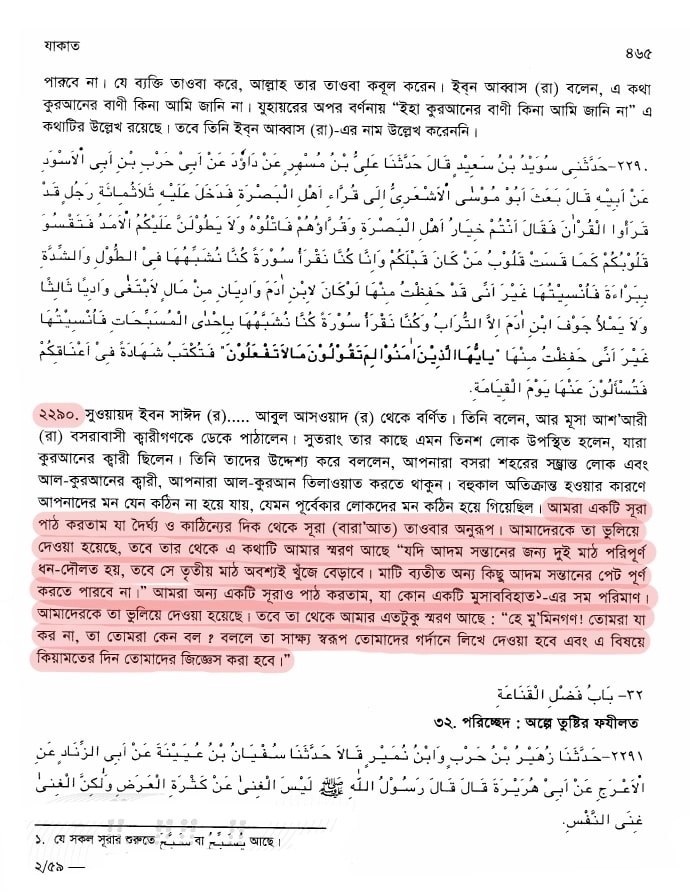
The initial event of the report is not Abu Musa being sent to Basra; he had summoned the Quran reciters of Basra. They appeared at the gathering with the identity of having already recited the Quran. The subject of the address was their relationship with the Quran and the fear of hearts becoming hard through long neglect. Mentioning the memory of his forgotten surahs within that advice reveals a significant gap: even a Companion carrying the authority of Quranic recitation could no longer recover his entire previous recitation. In his account, the continuity of memorized recitation did not appear as a guarantee of perfect memory.
“We used to recite” and “I have forgotten”—the subject changed in these two sentences. The first is a claim of previous collective recitation; the second is the current state of the speaker’s memory. No dialogue is reported that all three hundred present persons remembered the same surah or all lost it simultaneously. Abu Musa’s own statement is the preserved testimony here. The specific claim of that testimony is that in his known Quranic recitation, there was previously such a surah, the memory of which has now become limited to a few sentences. The full text of the surah is not in the hadith either; there is an identification of its previous length and one remaining passage.
Comparison of length and severity is not the same information. Length indicates the extent of the surah; severity indicates the tone of its warnings or reprimands. Abu Musa did not mention giving another pronunciation to the same surah. He spoke of reciting another surah comparable to Bara’at. Consequently, the problem here is not limited to a vowel mark of a word or two pronunciations of the same sentence. The fact that most of the content of a long, distinct composition is no longer remembered and it has no place in the current mushaf with that identity—these two pieces of information raise the question of a larger change in the text.
In another report preserved under Abu Musa’s name in Abu Ubayd’s Fada’il al-Quran, the identity of a similar surah is found. There, instead of forgetting, it is said that the surah was “removed”. At the beginning of the remembered part, there is also a sentence that is not in this report of Sahih Muslim: Allah will strengthen this religion through people who have no share in it. After this, the sentences about two valleys of wealth and the desire for a third follow. [831]
حَدَّثَنَا حَجَّاجٌ، عَنْ حَمَّادِ بْنِ سَلَمَةَ، عَنْ عَلِيِّ بْنِ زَيْدٍ، عَنْ أَبِي حَرْبِ بْنِ أَبِي الْأَسْوَدِ، عَنْ أَبِي مُوسَى الْأَشْعَرِيِّ، قَالَ: ” نَزَلَتْ سُورَةٌ نَحْوَ بَرَاءَةَ، ثُمَّ رُفِعَتْ، وَحُفِظَ مِنْهَا (إِنَّ اللَّهَ سَيُؤَيِّدُ هَذَا الدِّينَ بِأَقْوَامٍ لَا خَلَاقَ لَهُمْ. وَلَوْ أَنَّ لِابنِ آدَمَ وَادِيَيْنِ مِنْ مَالٍ لَتَمَنَّى وَادِيًا ثَالِثًا. وَلَا يَمْلَأُ جَوْفَ ابْنِ آدَمَ إِلَّا التُّرَابُ. وَيَتُوبُ اللَّهُ عَلَى مَنْ تَابَ)
English translation: Hajjaj narrated to us, from Hammad ibn Salama, from Ali ibn Zayd, from Abu Harb ibn Abu al-Aswad, from Abu Musa al-Ash’ari. Abu Musa said: A surah like Bara’at was revealed; later it was removed. This much was preserved from it: “Surely Allah will strengthen this religion through people who have no share. If a son of Adam had two valleys of wealth, he would desire a third valley. Nothing fills the stomach of a son of Adam except soil. And whoever repents, Allah accepts his repentance.”
| Specific aspects of the report | Sahih Muslim 1050 | Text preserved by Abu Ubayd |
|---|---|---|
| Identity of the previous surah | Like Bara’at in length and severity | A surah revealed like Bara’at |
| Subsequent state | The speaker was made to forget it | The surah was removed |
| Things remembered | Wealth of two valleys, desire for a third, stomach filled with soil | Sentences about strengthening the religion and acceptance of repentance along with those matters |
| That which is absent | The remaining full text of the surah | The remaining full text of the surah |
Although Abu Musa’s name appears in two collections, reports attributed to the same companion cannot be counted as the testimony of two independent eyewitnesses. The preserved readings have their own value elsewhere: one uses the language of memory loss, the other the language of withdrawal, and the quoted section contains additional sentences. Therefore, a uniform, complete copy of the remaining text of the surah is not available. The additional sentence preserved by Abu Ubayd is not present in Muslim’s narration; the memory of the second surah present in Muslim’s narration is not mentioned here. Placing the accounts of the two collections side by side reveals how the memory of the previous reading has been preserved in a fragmented state.
In the discussion on Islamweb, the incident of this surah from Suyuti’s ad-Dibaj is categorized as a type of naskh where the text is erased from human memory after being preserved. This is a theological explanation following Abu Musa’s statement. In the testimony, the surah was read previously and later forgotten; in the explanation, that absence is identified as the work of Allah. This religious naming of the cause does not eliminate the gap between the previous and subsequent readings. Rather, the fact that the entire scope of a Quranic reading from a certain time is not maintained in the later accepted mushaf—this change is recognized within the explanation itself. [832]
فكان الله ينسيه الناس بعد أن حفظوه
English translation: after people memorized it, Allah made them forget it.
Another surah in Abu Musa’s memory like the Musabbihat
Abu Musa’s second memory concerns a separate surah. In his words, it was thought to be like one of the Musabbihat. Musabbihat is the identifying name for surahs that begin with the language of declaring Allah’s purity. Instead of naming a specific surah, he compared it to a well-known category. He then stated that he had been made to forget this as well; only a few sentences remain in his memory. Just as the comparison to Bara’ah was in the first memory, here the type of the lost surah is identified with the help of a familiar reading. The remaining sentences concern the inconsistency between words and actions and the subsequent accountability for it.
The first sentence of this memory matches the second verse of the current Surah as-Saff. However, the subsequent sentence remembered is not the verse following it in the current mushaf. In the current reading of Surah as-Saff, the second verse is: [833]
يَا أَيُّهَا الَّذِينَ آمَنُوا لِمَ تَقُولُونَ مَا لَا تَفْعَلُونَ
English translation: O you who believe, why do you say that which you do not do?
In the next verse of the current mushaf, there is a declaration of Allah’s intense displeasure toward the same behavior. There is no mention there of testimony being written on the neck or questioning regarding that testimony on the Day of Resurrection. The text of the third verse: [834]
كَبُرَ مَقْتًا عِندَ اللَّهِ أَن تَقُولُوا مَا لَا تَفْعَلُونَ
English translation: It is most hateful to Allah that you say that which you do not do.
In Abu Musa’s memory, after the same beginning, it was said: it will be written as testimony on your necks and you will be questioned about it on the Day of Resurrection. Since the beginning matches the current second verse, his entire memory cannot be called an exact reading of the current Surah as-Saff. The match is in one sentence; there is a gap in the subsequent language. That gap was not created by the placement of verse numbers. In one place there is a declaration of Allah’s hatred, and in the other, the recording of testimony and questioning on the Day of Judgment—two different sentence structures have been preserved.
| Position of the text | Current Surah as-Saff | Part remaining in Abu Musa’s memory |
|---|---|---|
| First sentence | Why do you say that which you do not do? | Why do you say that which you do not do? |
| Subsequent statement | Saying that which you do not do is most hateful to Allah | Testimony written on the neck and questioning on the Day of Resurrection |
| Identification of the composition | Surah as-Saff preserved in the mushaf | A surah read previously, like one of the Musabbihat |
| Status of the full text | The full surah exists in the current mushaf | Only the quoted part exists in the speaker’s memory |
While explaining this narration, Qurtubi quoted the statement of Ibn al-Arabi. There, it is said that both the words and the meaning of the first sentence in the current Surah as-Saff are established; regarding the subsequent sentence about testimony and questioning, it is said that its meaning is established in religion. That is, within the explanation, the presence of exact words and semantic consistency are distinguished. For the first, both words and meaning; for the second, only meaning—this difference exists in the commentator’s own language. [835]
قال ابن العربي : وهذا كله ثابت في الدين . أما قوله تعالى : يا أيها الذين آمنوا لم تقولون ما لا تفعلون فثابت في الدين لفظا ومعنى في هذه السورة . وأما قوله : ” شهادة في أعناقكم فتسألون عنها يوم القيامة ” فمعنى ثابت في الدين ; فإن من التزم شيئا لزمه شرعا .
English translation: Ibn al-Arabi says: All of these are established in religion. Allah’s word “O you who believe, why do you say that which you do not do?”—this is established in this surah in terms of both words and meaning. And “testimony on your necks, then you will be questioned about it on the Day of Resurrection”—its meaning is established in religion; because if someone makes a matter obligatory for themselves, it becomes obligatory for them according to the judgment of sharia.
The match in meaning shows a continuity of a concept; it does not make the character sequence of the lost sentence present in the mushaf. Although the lesson of keeping promises and accountability exists elsewhere in religion, that quoted sentence of Abu Musa does not become the third verse of the current Surah as-Saff. The same meaning can be expressed in many different sentences. Yet, the matter of the claim of verbal preservation of the Quran concerns specific sentences, their sequence, and their textual position. The continuity shown by Ibn al-Arabi’s explanation is therefore one of meaning; it does not provide testimony that the entire language of Abu Musa’s memory is preserved in the current mushaf.
Comparing the two memories, a specific comparison is found regarding the length of the first surah; for the second, the name of a surah group is found. The total number of verses of the second surah, how much followed which sentence, or its complete relationship with Surah as-Saff—the narration contains no account of these. What is clearly present is the claim of having read a surah previously, later forgetting it, and the connection of sentences outside the current mushaf with a familiar beginning remaining in memory. The full ancient composition of that connection has not been quoted. Consequently, it is not possible to reconstruct the entire previous scope from the current text; the hadith itself remains a document of fragmented memory.
Since the account of the same companion mentions the loss of most of two separate surahs, this is not an incident of being unable to recall an isolated word. There are remaining parts of two different subjects: statements on greed for wealth in the first, and judgment on the inconsistency between words and actions in the second. All memories of this previous body of readings cannot be measured by the fixed boundaries of the current mushaf. These memories carry the claim of an additional textual scope, whose full composition is not available and some sentences of which survive within religious narrations outside the mushaf.
Size of al-Ahzab: comparison with Ubayy’s Baqarah and Aisha’s report of two hundred verses
Two different comparisons in the names of Ubayy and Aisha are preserved regarding the previous size of Surah al-Ahzab. In Ubayy’s account, al-Ahzab was equal to or longer than al-Baqarah; in the report attributed to Aisha, there is mention of reading two hundred verses during Muhammad’s time. In the current mushaf, the number of verses in al-Ahzab is seventy-three. The conversation between Ubayy and Zirr ibn Hubaysh and the full text of the sentence on stoning quoted there in the discussion of the verse of stoning exists. That testimony carries the claim of a larger previous scope of al-Ahzab. The report in Aisha’s name adds a claim of a specific number from another speaker regarding the same surah.
In the narration quoted by Suyuti from Abu Ubayd, Aisha’s statement comes through Ibn Abu Maryam, Ibn Lahiya, Abu al-Aswad, and Urwa ibn Zubayr. In her statement, the reading from Muhammad’s era is placed side by side with the part available during the writing of Uthman’s mushaf. [836] [837]
وَقَالَ: حَدَّثَنَا ابْنُ أَبِي مَرْيَمَ عَنِ ابْنِ لَهِيعَةَ عَنْ أَبِي الْأَسْوَدِ عَنْ عُرْوَةَ بْنِ الزُّبَيْرِ عَنْ عَائِشَةَ قَالَتْ كَانَتْ سُورَةُ الْأَحْزَابِ تُقْرَأُ فِي زَمَنِ النَّبِيِّ صَلَّى اللَّهُ عَلَيْهِ وَسَلَّمَ مِائَتَيْ آيَةٍ فَلَمَّا كَتَبَ عُثْمَانُ الْمَصَاحِفَ لَمْ يُقَدَّرْ مِنْهَا إِلَّا عَلَى مَا هُوَ الْآنَ.
English translation: Abu Ubayd said: Ibn Abu Maryam narrated to us, from Ibn Lahiya, he from Abul Aswad, he from Urwa ibn Zubayr, he from Aisha. Aisha said: During the time of the Messenger of Allah, peace and blessings of Allah be upon him, two hundred verses of Surah Al-Ahzab were recited. But during the compilation of the Quran, Uthman was able to collect only what exists in the current Quran.
Here, “two hundred” and “what currently exists” are two different scopes. Subtracting seventy-three from two hundred shows a numerical gap of one hundred twenty-seven. This calculation shows the gap between the previous number of verses claimed in the narration and the current count. The narration does not provide a list of the words, positions, and individual removals of every absent verse. Consequently, the full text of one hundred twenty-seven specific sentences is not recovered from this numerical calculation. What is found is that a memory was preserved in Aisha’s name where the volume of al-Ahzab known during Muhammad’s time and the al-Ahzab available during Uthman’s time are not the same.
| Testimony or text | Statement regarding the scope of al-Ahzab | Type of comparison |
|---|---|---|
| Current mushaf | Seventy-three verses | Current count |
| Zirr’s narration in Ubayy’s name | Equal to or longer than al-Baqarah | Comparison with another long surah |
| Urwa’s narration in Aisha’s name | Two hundred verses were read during Muhammad’s time | Direct verse count for the previous reading |
| Uthman’s time in Aisha’s narration | Nothing more than what currently exists was found | Scope available at the time of collection |
If two reports are made into statements of the same measure, their actual difference is lost. A comparison with al-Baqarah and the number of two hundred verses are not identical claims. They do not determine exactly one length for the same ancient al-Ahzab. Their similarity lies elsewhere: both narrations mention a previous reading larger than the current surah of seventy-three verses. One is a comparative memory, the other a memory with a number. The presence of the claim of scope reduction is understood through this similarity; a fictional complete ancient surah cannot be created by joining the two.
Qurtubi also quoted this same chain of narration from Abu Ubayd. In his tafsir, Abu Bakr’s explanation follows the narration: the meaning of Aisha’s words is that Allah has taken back to Himself the parts of al-Ahzab in addition to what we currently have. Finding the same narration in Abu Ubayd, Suyuti, and Qurtubi does not mean the testimony of three separate companions; it is the history of the textual reception and explanation of the same report. In that explanation, the existence of additional previous readings was not denied; a religious explanation was given for their being taken back. [838]
قال أبو بكر : فمعنى هذا من قول أم المؤمنين عائشة : أن الله تعالى رفع إليه من سورة الأحزاب ما يزيد على ما عندنا .
English translation: Abu Bakr says: The meaning of this statement by Umm al-Mu’minin Aisha is that Allah has taken back to Himself the additional parts of Surah al-Ahzab beyond what we have.
In answer number 178209 of IslamQA, after this question about two hundred verses, the narration of the comparison with Ubayy’s Baqarah is brought as the “correct wording”. The specific connecting sentence in that answer is: [839]
وأما اللفظ الصحيح
English translation: And the correct wording is.
But Aisha’s two hundred verses and Ubayy’s comparison with al-Baqarah are two separate narrations. Quoting the second does not correct the speaker, isnad, or number of the first. The relationship between Ubayy’s report and Aisha’s report is one of comparison; it is not to make one person’s words the “correct wording” of another’s statement. The answer accepts another report of a larger previous al-Ahzab, yet it places it in the position of the specific narration of two hundred verses. Consequently, while the common subject—that the scope was larger—remains, the distinct identity of Aisha’s statement is obscured there.
The special significance of the sentence preserved in Aisha’s name is in the mention of the preparation of Uthman’s mushaf. How much was read before and how much was found later—this comparison linked to the compilation falls at the center of the book’s history. Such testimony is relevant to verify whether any compilation has carried all previously prevalent elements exactly. Subsequent religious explanation has accepted the absence as authorized naskh; yet the gap between the previous larger surah and the accepted smaller reading remains in the language of the narration. What is in the collection and all the content claimed to have been read previously are not synonymous here.
The current part and previous scope of at-Tawbah in Hudhayfah’s statement
Hudhayfah ibn al-Yaman was a companion of Muhammad and a well-known person who participated in military expeditions; his death was in 36 Hijri. In the accounts of determining the Uthmanic reading, his concern regarding regional reading disputes is mentioned. A statement regarding the scope of at-Tawbah is also preserved in the name of the same person. There, the surah is called the “Surah of Punishment” and the currently read part is identified as one-fourth of the previously read subject. Consequently, the role narrated in his name contains, on one hand, a claim to establish unity of reading, and on the other, a memory of a previous larger reading.
Haythami brought this report through Majma’ uz-Zawa’id from Tabarani’s al-Mu’jam al-Awsat. After the narration, he described its narrators as trustworthy. This statement is also mentioned in Suyuti’s al-Itqan. Haythami’s preserved full account: [840] [841]
عن حذيفة قال : التي تسمون سورة التوبة هي سورة العذاب ، وما يقرؤون منها مما كنا نقرأ إلا ربعها . رواه الطبراني في الأوسط ، ورجاله ثقات .
English translation: Narrated from Huzaifa. He said: That which you call Surah Tawbah is the Surah of Punishment. They do not recite except for one-fourth of what we used to recite of it. Haysami said: Tabarani narrated this in Al-Awsat, and its narrators are trustworthy.
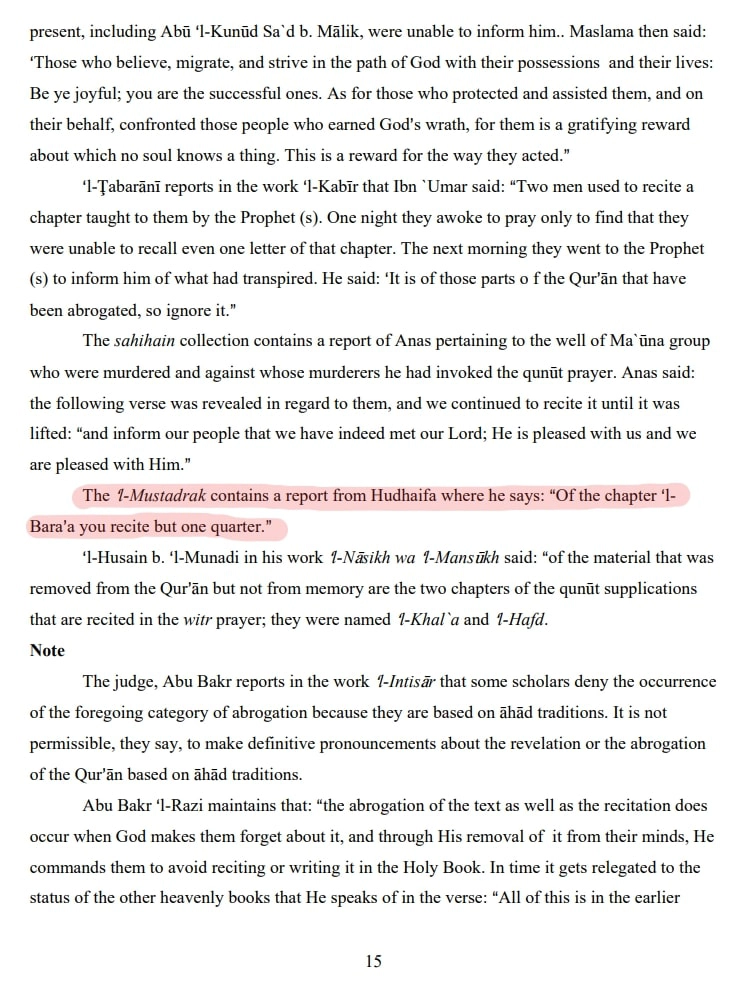
The subject of the sentence is not merely another name for Tawbah. By the address “that which you call Tawbah,” a specific, known Surah is identified, and then a statement is made regarding the amount of its current text. A comparison of one-fourth appears between the two temporal positions: “we used to recite” and “they recite.” The quantitative meaning of the reported statement is that the scope of the subsequent recitation is less than the content recited in the past. The difference in names does not explain that comparison; the statement makes a separate claim about the scope after mentioning the name.
This is different from general differences in verse counting. While keeping all the same sentences, two counting methods may differ on where one verse ends and the next begins. The statement in Huzaifa’s name did not speak of counting those boundaries. The subject of comparison is the textual content—how much of what was read before is read now. Furthermore, the term “one-fourth” is a ratio of the total scope, not a list of the number or length of every missing verse. If a full account of specific lost verses is created by multiplying the current verse count by four, a calculation is added that was not mentioned in the original report.
| Words or identity of the report | Specific meaning | The question to which this provides no answer |
|---|---|---|
| “that which you call Tawbah” | A known, specific Surah | A list of every other ancient name for it |
| “what we used to recite” | The previous textual scope claimed by the speaker | The complete previous wording |
| “one-fourth” | The ratio between the current and previous scope | The number and length of every missing verse |
| “the narrators are trustworthy” | Haysami’s evaluation regarding the isnad | The identical historical verdict of all scholars |
There is an important difference between this report and Abu Musa’s first memory. Abu Musa described another Surah as being like Bara’at; here, in Huzaifa’s name, Bara’at or Tawbah itself is described as having been larger previously. In the first, there is another comparable composition; in the second, there is a claim of a reduction in the scope of the Surah bearing the same name. If these are presented as two reports of the same lost Surah, the subject of the testimony changes. If kept separate, it is seen that in the preserved tradition, there are not only memories of other Surahs outside the mushaf, but also claims of a previously larger size for the accepted Surahs.
The phrase “the narrators are trustworthy” used in Haysami’s comment is a specific hadith-science evaluation. It indicates to him the acceptability of the individuals in the chain of transmission. As historical testimony, the content of the report is that a memory of a larger Tawbah in Huzaifa’s name found its place in the written collection. The presence of such reports in Suyuti’s discussion on abrogation shows its familiarity to later scholars. The recovery of the same report does not create new eyewitnesses, but it also leaves no room to call the report the invention of some modern critic. Within the preserved Muslim texts themselves lies this claim of additional textual scope outside the current Surah.
If the statement of one-fourth is accepted, a significant reduction must be admitted in the part that remained later from the previous larger text. What its religious justification was is a question of separate interpretation. The previous and subsequent scopes cannot be made identical by changing the meaning of the ratio. The report in Huzaifa’s name does not recover the full lost text; its importance is that it directly prevents the acceptance of the current Surah’s boundaries as the exact boundaries of all previous texts.
Sentences read as Quran regarding those killed at Bir Ma’una and later removed
Anas’s account of those killed at Bir Mauna is more explicit about a statement’s earlier status: Quran was revealed concerning them, the Companions recited it, and it was later abrogated or withdrawn. The statement conveys a message from those killed to their community: they have met their Lord, and each side is pleased with the other. The statement is absent from the present mushaf. Several accounts of the event in Sahih al-Bukhari preserve reports of its recitation and withdrawal. Although these accounts differ in the amount of narrative detail and in some words, they explicitly claim that the passage was first recited as Quran and that this recitation was subsequently withdrawn.
In Bukhari’s report number 2801, the attack on the delegation, the killing of Anas’s uncle, the news from Gabriel, and then the description of the recited sentence appear. The complete report including the sequence of events is: [842] [843]
حَدَّثَنَا حَفْصُ بْنُ عُمَرَ الْحَوْضِيُّ ، حَدَّثَنَا هَمَّامٌ ، عَنْ إِسْحَاقَ ، عَنْ أَنَسٍ ـ رضى الله عنه ـ قَالَ بَعَثَ النَّبِيُّ صلى الله عليه وسلم أَقْوَامًا مِنْ بَنِي سُلَيْمٍ إِلَى بَنِي عَامِرٍ فِي سَبْعِينَ، فَلَمَّا قَدِمُوا، قَالَ لَهُمْ خَالِي أَتَقَدَّمُكُمْ، فَإِنْ أَمَّنُونِي حَتَّى أُبَلِّغَهُمْ عَنْ رَسُولِ اللَّهِ صلى الله عليه وسلم وَإِلاَّ كُنْتُمْ مِنِّي قَرِيبًا. فَتَقَدَّمَ، فَأَمَّنُوهُ، فَبَيْنَمَا يُحَدِّثُهُمْ عَنِ النَّبِيِّ صلى الله عليه وسلم إِذْ أَوْمَئُوا إِلَى رَجُلٍ مِنْهُمْ، فَطَعَنَهُ فَأَنْفَذَهُ فَقَالَ اللَّهُ أَكْبَرُ، فُزْتُ وَرَبِّ الْكَعْبَةِ. ثُمَّ مَالُوا عَلَى بَقِيَّةِ أَصْحَابِهِ فَقَتَلُوهُمْ، إِلاَّ رَجُلاً أَعْرَجَ صَعِدَ الْجَبَلَ. قَالَ هَمَّامٌ فَأُرَاهُ آخَرَ مَعَهُ، فَأَخْبَرَ جِبْرِيلُ ـ عَلَيْهِ السَّلاَمُ ـ النَّبِيَّ صلى الله عليه وسلم أَنَّهُمْ قَدْ لَقُوا رَبَّهُمْ، فَرَضِيَ عَنْهُمْ وَأَرْضَاهُمْ، فَكُنَّا نَقْرَأُ أَنْ بَلِّغُوا قَوْمَنَا أَنْ قَدْ لَقِينَا رَبَّنَا فَرَضِيَ عَنَّا وَأَرْضَانَا. ثُمَّ نُسِخَ بَعْدُ، فَدَعَا عَلَيْهِمْ أَرْبَعِينَ صَبَاحًا، عَلَى رِعْلٍ وَذَكْوَانَ وَبَنِي لِحْيَانَ وَبَنِي عُصَيَّةَ الَّذِينَ عَصَوُا اللَّهَ وَرَسُولَهُ صلى الله عليه وسلم.
English translation: Sahih Bukhari (Islamic Foundation)
48/ Jihad
Chapter: 1750. One who was wounded or pierced by a spear in the path of Allah
Islamic Foundation Number: 2607, International Number: 2801
2607. Hafs ibn Umar (rh) … narrated from Anas (ra), he said, the Prophet sallallahu alaihi wasallam sent a group of seventy people from Banu Sulaym to Banu Amir. When the group arrived there, my uncle (Haram ibn Milhan) said to them, I will go to Banu Amir first. If they grant me security and I can convey the message of Rasulullah sallallahu alaihi wasallam to them, (then it is well) otherwise you shall remain with me. Then he went forward. The disbelievers granted him security, but when he began to recite the message of Rasulullah sallallahu alaihi wasallam, at that time the Amir tribesmen signaled a person. And that person pierced him with a spear and it passed through his body. Then he said Allahu Akbar, by the Lord of the Kaaba! I have succeeded. After that, the disbelievers pounced upon his other companions and martyred everyone, but one lame person survived, as he had climbed a mountain.
Hammam (rh) additionally mentioned, I think there was another person with him. Then Jibril (alaihis salam) informed the Prophet sallallahu alaihi wasallam, the dispatched group has met their Lord. He (the Lord) is pleased with them and has pleased them. (The narrator says) we used to recite this verse, Inform our people that we have met our Lord. He is pleased with us and has pleased us. Later this verse became mansukh. Then, due to disobedience to Allah and the Messenger, Rasulullah sallallahu alaihi wasallam continuously for forty days made du’a against Ri’l, Zakwan, Banu Lihyan and Banu Usayyar.
Hadith Status: Sahih (Sahih)
Narrator: Anas ibn Malik (ra)
In this report, the statement of the killed person, the news given by Gabriel, and the sentence recited by the Companions appear in succession. Consequently, all the words cannot be made into a single type of quotation. “By the Lord of the Kaaba, I have succeeded” is the statement of the killed person. The news of the Lord’s satisfaction is the description of it arriving through Gabriel. And “Inform our community”—after this part, there is information in Anas’s statement about it being recited and abrogated. If separate speakers and separate positions are maintained, it is specifically captured where the claim of Quranic recitation appears.
In report number 2814, the event is told relatively briefly, but the identity of the sentence is more direct. There, the sequence “Quran was revealed,” “we read it,” and “later it was abrogated” is in Anas’s name. [844] [845]
حَدَّثَنَا إِسْمَاعِيلُ بْنُ عَبْدِ اللَّهِ ، قَالَ حَدَّثَنِي مَالِكٌ ، عَنْ إِسْحَاقَ بْنِ عَبْدِ اللَّهِ بْنِ أَبِي طَلْحَةَ ، عَنْ أَنَسِ بْنِ مَالِكٍ ـ رضى الله عنه ـ قَالَ دَعَا رَسُولُ اللَّهِ صلى الله عليه وسلم عَلَى الَّذِينَ قَتَلُوا أَصْحَابَ بِئْرِ مَعُونَةَ ثَلاَثِينَ غَدَاةً، عَلَى رِعْلٍ وَذَكْوَانَ وَعُصَيَّةَ عَصَتِ اللَّهَ وَرَسُولَهُ، قَالَ أَنَسٌ أُنْزِلَ فِي الَّذِينَ قُتِلُوا بِبِئْرِ مَعُونَةَ قُرْآنٌ قَرَأْنَاهُ ثُمَّ نُسِخَ بَعْدُ بَلِّغُوا قَوْمَنَا أَنْ قَدْ لَقِينَا رَبَّنَا فَرَضِيَ عَنَّا وَرَضِينَا عَنْهُ.
English translation: Sahih Bukhari (Islamic Foundation)
48/ Jihad
Chapter: 1760. The status of those regarding whom this word of Allah Ta’ala was revealed: Do not think of those killed in the way of Allah as dead, rather they are alive …. Allah does not let the efforts of the believers go to waste. (Al ‘Imran : 3:169 – 171)
Islamic Foundation Number: 2619, International Number: 2814
2619. Ismail ibn Abdullah (rh) … narrated from Anas ibn Malik (ra), he said, Rasulullah sallallahu alaihi wasallam for thirty days made du’a at Fajr against those Ri’l and Zakwan who had martyred the companion Sahabas at Bir Ma’una, and also against the Usayyar tribe who had opposed Allah and His Messenger. Anas (ra) said, regarding the martyred Sahabas at Bir Ma’una verses of the Quran were revealed, which we recited. Later it became mansukh. (The verse was:)
بَلِّغُوا قَوْمَنَا أَنْ قَدْ لَقِينَا رَبَّنَا فَرَضِيَ عَنَّا وَرَضِينَا عَنْهُ
Meaning: Convey this news to our people that we have attained the meeting of our Lord. He is pleased with us and we are pleased with Him.”
Hadith Status: Sahih (Sahih)
Narrator: Anas ibn Malik (ra)
In hadith number 4090 of the Maghazi chapter, the identity of the group and their daily activities are also mentioned. They would collect firewood by day and pray by night; Anas mentioned their identity at that time as “Qari.” Among the requests for help from the tribes, the sending of seventy Ansar, and the description of Muhammad’s Qunut after the killing at Bir Ma’una, is the report of the recited sentence. [846] [847]
حَدَّثَنِي عَبْدُ الأَعْلَى بْنُ حَمَّادٍ ، حَدَّثَنَا يَزِيدُ بْنُ زُرَيْعٍ ، حَدَّثَنَا سَعِيدٌ ، عَنْ قَتَادَةَ ، عَنْ أَنَسِ بْنِ مَالِكٍ ـ رضى الله عنه ـ أَنَّ رِعْلاً، وَذَكْوَانَ وَعُصَيَّةَ وَبَنِي لَحْيَانَ اسْتَمَدُّوا رَسُولَ اللَّهِ صلى الله عليه وسلم عَلَى عَدُوٍّ، فَأَمَدَّهُمْ بِسَبْعِينَ مِنَ الأَنْصَارِ، كُنَّا نُسَمِّيهِمُ الْقُرَّاءَ فِي زَمَانِهِمْ، كَانُوا يَحْتَطِبُونَ بِالنَّهَارِ وَيُصَلُّونَ بِاللَّيْلِ، حَتَّى كَانُوا بِبِئْرِ مَعُونَةَ قَتَلُوهُمْ، وَغَدَرُوا بِهِمْ، فَبَلَغَ النَّبِيَّ صلى الله عليه وسلم ، فَقَنَتَ شَهْرًا يَدْعُو فِي الصُّبْحِ عَلَى أَحْيَاءٍ مِنْ أَحْيَاءِ الْعَرَبِ، عَلَى رِعْلٍ وَذَكْوَانَ وَعُصَيَّةَ وَبَنِي لَحْيَانَ . قَالَ أَنَسٌ فَقَرَأْنَا فِيهِمْ قُرْآنًا ثُمِّ إِنَّ ذَلِكَ رُفِعَ بَلِّغُوا عَنَّا قَوْمَنَا، أَنَّا لَقِينَا رَبَّنَا، فَرَضِيَ عَنَّا وَأَرْضَانَا. وَعَنْ قَتَادَةَ عَنْ أَنَسِ بْنِ مَالِكٍ حَدَّثَهُ أَنَّ نَبِيَّ اللَّهِ صلى الله عليه وسلم قَنَتَ شَهْرًا فِي صَلاَةِ الصُّبْحِ يَدْعُو عَلَى أَحْيَاءٍ مِنْ أَحْيَاءِ الْعَرَبِ، عَلَى رِعْلٍ وَذَكْوَانَ وَعُصَيَّةَ وَبَنِي لَحْيَانَ. زَادَ خَلِيفَةُ حَدَّثَنَا ابْنُ زُرَيْعٍ ، حَدَّثَنَا سَعِيدٌ ، عَنْ قَتَادَةَ ، حَدَّثَنَا أَنَسٌ ، أَنَّ أُولَئِكَ السَّبْعِينَ، مِنَ الأَنْصَارِ قُتِلُوا بِبِئْرِ مَعُونَةَ، قُرْآنًا كِتَابًا. نَحْوَهُ.
English translation: Sahih Bukhari (IF)
Chapter: 51/ Maghazi (Expeditions)
Section: 2192. The battle of Raji, Ril, Zakwan, Bir Ma’una and the events of Azal, Karah, Asim ibn Sabit, Khubayb (ra) and his companions. Ibn Ishaq (rh) said, Asim ibn Umar (ra) narrated that the battle of Raji took place after the battle of Uhud
3790. Abdul Ala ibn Hammad narrates, from Yazid ibn Zuray, from Sa’id, from Qatada, from Anas ibn Malik. Anas said: Ril, Zakwan, Usayyar and Banu Lihyan had sought help from Rasulullah sallallahu alaihi wasallam against an enemy. He sent seventy people from among the Ansar to them. We used to call them the Qurra then. They would collect firewood by day and pray by night. When they reached Bir Ma’una, those people betrayed them and killed them. When this news reached the Nabi sallallahu alaihi wasallam, he for one month in the Fajr prayer recited Qunut, cursing certain tribes of Arabia namely Ril, Zakwan, Usayyar and Banu Lihyan. Anas (ra) narrated that, we used to recite some verses regarding them. However, later their recitation was abrogated.
One verse was- بَلِّغُوا عَنَّا قَوْمَنَا، أَنَّا لَقِينَا رَبَّنَا، فَرَضِيَ عَنَّا وَأَرْضَانَا “Inform the people of our people. We have reached the proximity of our Lord. He has been pleased with us and has pleased us. Qatada (rh) narrated from Anas ibn Malik (ra) that he told him, the Nabi of Allah Muhammad sallallahu alaihi wasallam for one month in the Fajr prayer recited Qunut, cursing certain tribes of Arabia- namely Ri’l, Zakwan, Usayyar and Banu Lihyan.
(The teacher of Imam Bukhari (rh)) Khalifa (rh) narrated this much additionally that Ibn Zuray (rh) narrated through Sa’id and Qatada (rh) from Anas (ra) that they 70 were all Ansar. They were martyred at a place called Bir Ma’una. (Imam Bukhari (rh)) says, here the word قُرْآن has been used in the sense of a book or similar.
Hadith Status: Sahih (Sahih)
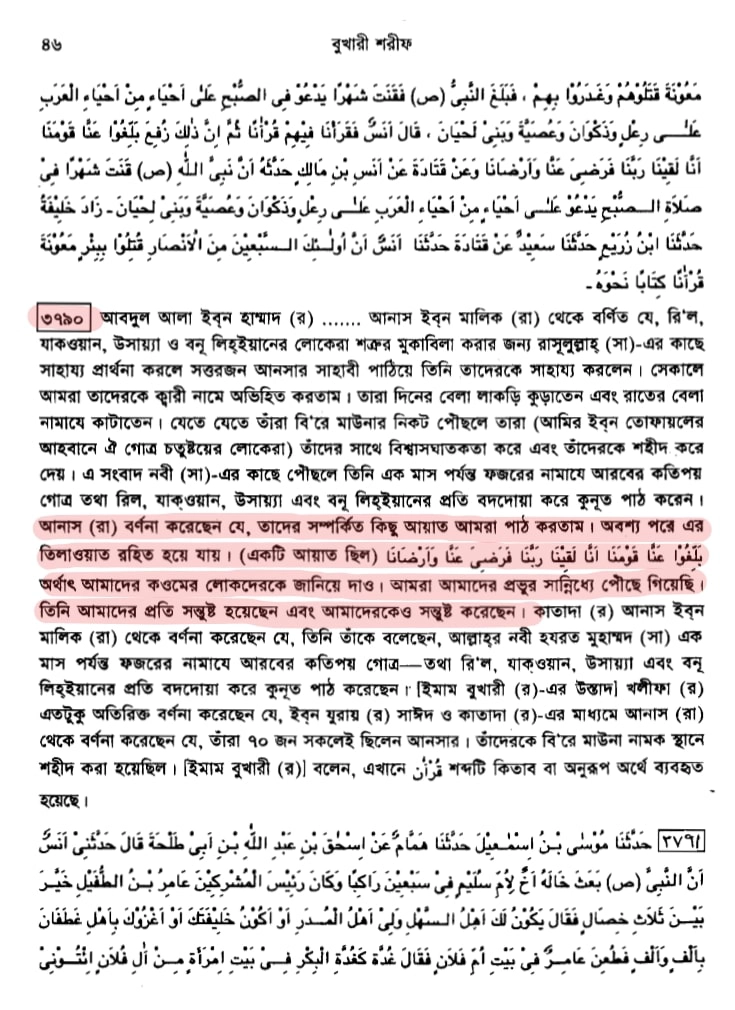
All three numbered hadiths are narrated in Anas’s name. They have separate transmission paths and places of compilation, but that does not make them three separate eyewitnesses. At the same time, some information omitted from the brief report is preserved in the long report. In 2801, the event of Anas’s uncle and the forty mornings of cursing are found; in 2814, thirty mornings; in 4090, one month and the identity of the seventy Ansar are found. If the distinct content of the three is maintained, both the differences in narrative detail and the identical center regarding Quranic recitation remain visible.
| Hadith | Distinct narrative detail | Language regarding the subsequent state of the text |
|---|---|---|
| Bukhari 2801 | Sending the group from Banu Sulaym toward Banu Amir; the event of Anas’s uncle; forty mornings of cursing | “later it was abrogated” |
| Bukhari 2814 | Mention of those killed at Bir Ma’una; thirty mornings of cursing | “Quran was revealed, we read it; later it was abrogated” |
| Bukhari 4090 | Request for help, seventy Ansar, the work of the Qaris, and one month of Qunut | “we read Quran regarding them; later it was removed” |
There is also a textual variation in the latter part of the sentence. In 2801 and 4090, it is that Allah was pleased with them and made them pleased—“ardana”. In 2814, it appears as Allah is pleased with them and they are pleased with Him—“radina anhu”. The religious statement of both is close, but the words and grammatical subjects are not the same. Even for the sentence surviving in hadith outside the current mushaf, a single identical form has not been preserved in all reports. Along with the report of the sentence absent from the narrators’ text, its own linguistic variation also survives.
| Stage | Statement of the report | Relation to the scope of the book |
|---|---|---|
| revelation | Quran was revealed regarding the killed | The sentence is called Quran within the report itself |
| Reading | In Anas’s words “we read” | This is not just a description of some uncirculated draft; it is a claim of previous collective recitation |
| Withdrawal | later abrogated or removed | not all previously recited sentences remain in the current mushaf |
| subsequent preservation | the wording and history of the sentence are cited in the hadith | memories of previous Quranic recitations survive outside the book |
The gap between the first and final states is specific. A report attributed to Anas claims this sentence was recited previously; later, it does not remain as a recited part of the Quran. The explanation of abrogation provides religious legitimacy to that change. This does not alter the chronological nature of the event: it existed before, and later it no longer held that position or status. The word “Quran” is used here for a previous text that is not found upon opening the current mushaf. Therefore, the answer to the two questions—at what point in the history of the book it was called Quran and which reading was ultimately adopted in the mushaf—is not identical in all cases.
The sentence regarding Bir Ma’una provides a different type of information than Abu Musa’s long surah. There, it is a memory of forgetting almost an entire surah; here, a specific sentence and its circumstances are known. The sentence did not become unknown by being lost. Its words are cited in the reports, but those very reports state that its continuity as a recitation of the Quran was withdrawn. That is, absence was not always presented as the result of someone no longer remembering. Sometimes, while the memory and citation remained, the textual inclusion ended. The preservation of a reading and that reading being an adopted part of the Quran are two distinct states here.
The remembered portion, the forgotten remainder, and the readings surviving in hadith
In Abu Musa’s memory, there was a sentence about two valleys of wealth and the desire for a third. The same subject appears in another hadith as a statement by Muhammad. In some places, it is part of a previous surah known as Quran; in others, there is uncertainty in the Companion’s own words as to whether it was revealed or if Muhammad spoke it as a general statement. Therefore, the mere familiarity of the sentence’s meaning does not provide a continuous history of its textual status. The identities of what the speaker called it in specific reports and the context in which it was cited are distinct.
In Sahih Muslim, through Anas, the statement on greed for wealth first appears as a saying of Muhammad. The full report mentions the wealth of two valleys, the demand for a third, the filling of a human’s stomach with dust, and the acceptance of repentance. [848]
حَدَّثَنَا يَحْيَى بْنُ يَحْيَى ، وَسَعِيدُ بْنُ مَنْصُورٍ ، وَقُتَيْبَةُ بْنُ سَعِيدٍ ، قَالَ يَحْيَى أَخْبَرَنَا وَقَالَ الآخَرَانِ، حَدَّثَنَا أَبُو عَوَانَةَ ، عَنْ قَتَادَةَ ، عَنْ أَنَسٍ ، قَالَ قَالَ رَسُولُ اللَّهِ صلى الله عليه وسلم ” لَوْ كَانَ لاِبْنِ آدَمَ وَادِيَانِ مِنْ مَالٍ لاَبْتَغَى وَادِيًا ثَالِثًا وَلاَ يَمْلأُ جَوْفَ ابْنِ آدَمَ إِلاَّ التُّرَابُ وَيَتُوبُ اللَّهُ عَلَى مَنْ تَابَ ” .
English translation: Yahya ibn Yahya, Sa’id ibn Mansur, and Qutayba ibn Sa’id narrated to us. Yahya said, “informed us,” while the other two said, “narrated to us”—Abu Awana, from Qatada, who narrated from Anas. Anas said that the Messenger of Allah, peace and blessings of Allah be upon him, said: If the son of Adam has two valleys of wealth, he will desire a third. Nothing fills the stomach of the son of Adam except dust. Whoever repents, Allah accepts his repentance.
In the subsequent chain of narration, Anas’s uncertainty is also mentioned. Muslim, instead of rewriting the entire statement, referred to it as similar to the previous report of Abu Awana, but retained the additional remark regarding its identity as Quran. [849]
وَحَدَّثَنَا ابْنُ الْمُثَنَّى ، وَابْنُ، بَشَّارٍ قَالَ ابْنُ الْمُثَنَّى حَدَّثَنَا مُحَمَّدُ بْنُ جَعْفَرٍ ، أَخْبَرَنَا شُعْبَةُ ، قَالَ سَمِعْتُ قَتَادَةَ ، يُحَدِّثُ عَنْ أَنَسِ بْنِ مَالِكٍ ، قَالَ سَمِعْتُ رَسُولَ اللَّهِ صلى الله عليه وسلم يَقُولُ – فَلاَ أَدْرِي أَشَىْءٌ أُنْزِلَ أَمْ شَىْءٌ كَانَ يَقُولُهُ – بِمِثْلِ حَدِيثِ أَبِي عَوَانَةَ .
English translation: Ibnul Musanna and Ibn Bashshar narrated to us. Ibnul Musanna said, Muhammad ibn Ja’far narrated to us; Shuba informed us. He said, I heard Qatada narrating from Anas ibn Malik. Anas said: I heard the Messenger of Allah, peace and blessings of Allah be upon him, say—but I do not know if it was something revealed, or if he just spoke it—similar to the hadith of Abu Awana.
A similar question persists in the report of Ibn Abbas. Here, it begins with the mention of wealth equal to one valley and the desire for more like it. At the end, uncertainty is expressed under Ibn Abbas’s name as to whether the statement is part of the Quran. Muslim also preserved a difference in the mention of the narrator of the final remark. [850]
وَحَدَّثَنِي زُهَيْرُ بْنُ حَرْبٍ ، وَهَارُونُ بْنُ عَبْدِ اللَّهِ ، قَالاَ حَدَّثَنَا حَجَّاجُ بْنُ مُحَمَّدٍ ، عَنِ ابْنِ جُرَيْجٍ ، قَالَ سَمِعْتُ عَطَاءً ، يَقُولُ سَمِعْتُ ابْنَ عَبَّاسٍ ، يَقُولُ سَمِعْتُ رَسُولَ اللَّهِ صلى الله عليه وسلم يَقُولُ ” لَوْ أَنَّ لاِبْنِ آدَمَ مِلْءَ وَادٍ مَالاً لأَحَبَّ أَنْ يَكُونَ إِلَيْهِ مِثْلُهُ وَلاَ يَمْلأُ نَفْسَ ابْنِ آدَمَ إِلاَّ التُّرَابُ وَاللَّهُ يَتُوبُ عَلَى مَنْ تَابَ ” . قَالَ ابْنُ عَبَّاسٍ فَلاَ أَدْرِي أَمِنَ الْقُرْآنِ هُوَ أَمْ لاَ . وَفِي رِوَايَةِ زُهَيْرٍ قَالَ فَلاَ أَدْرِي أَمِنَ الْقُرْآنِ . لَمْ يَذْكُرِ ابْنَ عَبَّاسٍ .
English translation: Zuhayr ibn Harb and Harun ibn Abdullah narrated to me. They said, Hajjaj ibn Muhammad narrated to us, from Ibn Jurayj. He said, I heard Ata say: I heard Ibn Abbas say, I heard the Messenger of Allah, peace and blessings of Allah be upon him, say: If the son of Adam has a valley full of wealth, he will desire an equal amount more. Nothing fills the heart of the son of Adam except dust. And whoever repents, Allah accepts his repentance. Ibn Abbas said: I do not know if this is included in the Quran. In Zuhayr’s report, it says: He said, I do not know if this is included in the Quran; there, Ibn Abbas’s name was not mentioned.
In Tirmidhi, there is another longer textual account through Ubayy. Muhammad tells him to recite the Quran to him by the command of Allah. Then, within the recitation of “Lam yakunilladhina kafaru,” a religious sentence appears that is outside the current mushaf. Then, separately, citing “he recited to him,” the sentence about the valleys of wealth is quoted. In this sequence of narration, both statements are within the environment of recitation. [851]
حَدَّثَنَا مَحْمُودُ بْنُ غَيْلاَنَ ، قَالَ حَدَّثَنَا أَبُو دَاوُدَ ، قَالَ أَخْبَرَنَا شُعْبَةُ ، عَنْ عَاصِمٍ ، قَالَ سَمِعْتُ زِرَّ بْنَ حُبَيْشٍ ، يُحَدِّثُ عَنْ أُبَىِّ بْنِ كَعْبٍ ، أَنَّ رَسُولَ اللَّهِ صلى الله عليه وسلم قَالَ لَهُ “ إِنَّ اللَّهَ أَمَرَنِي أَنْ أَقْرَأَ عَلَيْكَ الْقُرْآنَ ” . فَقَرَأَ عَلَيْهِ : ( لمْ يَكُنِ الَّذِينَ كَفَرُوا ) وَفِيهَا ” إِنَّ ذَاتَ الدِّينِ عِنْدَ اللَّهِ الْحَنِيفِيَّةُ الْمُسْلِمَةُ لاَ الْيَهُودِيَّةُ وَلاَ النَّصْرَانِيَّةُ وَلاَ الْمَجُوسِيَّةُ مَنْ يَعْمَلْ خَيْرًا فَلَنْ يُكْفَرَهُ ” . وَقَرَأَ عَلَيْهِ ” لَوْ أَنَّ لاِبْنِ آدَمَ وَادِيًا مِنْ مَالٍ لاَبْتَغَى إِلَيْهِ ثَانِيًا وَلَوْ كَانَ لَهُ ثَانِيًا لاَبْتَغَى إِلَيْهِ ثَالِثًا وَلاَ يَمْلأُ جَوْفَ ابْنِ آدَمَ إِلاَّ التُّرَابُ وَيَتُوبُ اللهُ عَلَى مَنْ تَابَ ” . قَالَ أَبُو عِيسَى هَذَا حَدِيثٌ حَسَنٌ صَحِيحٌ . وَقَدْ رُوِيَ مِنْ غَيْرِ هَذَا الْوَجْهِ رَوَاهُ عَبْدُ اللَّهِ بْنُ عَبْدِ الرَّحْمَنِ بْنِ أَبْزَى عَنْ أَبِيهِ عَنْ أُبَىِّ بْنِ كَعْبٍ رضى الله عنه أَنَّ النَّبِيَّ صلى الله عليه وسلم قَالَ لَهُ ” إِنَّ اللَّهَ أَمَرَنِي أَنْ أَقْرَأَ عَلَيْكَ الْقُرْآنَ ” . وَقَدْ رَوَاهُ قَتَادَةُ عَنْ أَنَسٍ أَنَّ النَّبِيَّ صلى الله عليه وسلم قَالَ لأُبَىِّ بْنِ كَعْبٍ ” إِنَّ اللَّهَ أَمَرَنِي أَنْ أَقْرَأَ عَلَيْكَ الْقُرْآنَ ” .
English translation: Mahmud ibn Ghaylan narrated to us. He said, Abu Dawud narrated to us; Shuba informed us, from Asim. He said, I heard Dhir ibn Hubaysh narrating from Ubayy ibn Ka’b. The Messenger of Allah, peace and blessings of Allah be upon him, said to him: “Allah has commanded me that I should recite the Quran to you.” Then he recited to him “Lam yakunilladhina kafaru.” In it was: “Indeed, the nature of religion with Allah is submission in sincerity; not the religion of the Jews, the Christians, or the Magians. Whoever does a good deed, its reward will not be denied.” He further recited to him: “If the son of Adam has one valley of wealth, he will desire a second; if he has a second, he will desire a third. Nothing fills the stomach of the son of Adam except dust. And whoever repents, Allah accepts his repentance.” Abu Isa said: This is a hasan sahih hadith. It has been narrated through other paths as well. Abdullah ibn Abdur Rahman ibn Abza narrated from his father, who narrated from Ubayy ibn Ka’b that the Prophet, peace and blessings of Allah be upon him, said to him: “Allah has commanded me that I should recite the Quran to you.” Qatada also narrated from Anas that the Prophet, peace and blessings of Allah be upon him, said to Ubayy ibn Ka’b: “Allah has commanded me that I should recite the Quran to you.”
| Preserved report | Identity or position of the sentence | State of memory and classification |
|---|---|---|
| Muslim 1050 | Remainder of the long surah previously recited by Abu Musa | Claim of forgetting the rest of the surah |
| Muslim 1048a–b | Saying of Muhammad; later Anas’s uncertainty | A revealed matter, or a general saying—question in memory |
| Muslim 1049 | Statement of Muhammad and the question of whether it is Quran | Difference in the language of one valley and the attribution of the final comment |
| Tirmidhi 3898 | Cited in the event of reciting the Quran to Ubayy | Sequence of one to two, and two to three valleys |
The similarity among these reports lies in the subject of human greed for wealth. Differences exist in the starting amount, the length of the sentence, and most importantly, its identity. Hearing the same statement from Muhammad’s mouth and recognizing it as part of the Quran are two separate memories. The uncertainty preserved under the names of Anas and Ibn Abbas does not align with the notion that this boundary was clear in memory in all cases. In Abu Musa’s statement, one identity is firm, while in other reports, there are questions about the status of the same subject matter. The hadith collections have not completely erased this inconsistency; they have placed them side by side.
In the discussion on IslamQA, an explanation is cited from Qadi Iyad’s Ikmal al-Mu’allim. In his statement, some citations by the Companions regarding abrogated readings are not in the exact language of the original miraculous composition, but are based on meaning and some words. In this, he includes the gap between the preserved sentences and the stylistic composition of the Quran as part of the explanation. [852]
ثم تأمل ما يذكره الصحابة مما نسخ من ذلك، فإنما أَتَوْا به على المعنى، وبعض اللفظ؛ لا على نص المعجز. وسياق نظم القرآن يشهد لما ذكروه من ذلك، وبُعْدِه عن نظم القرآن وبلاغته
English translation: Then consider those among them which the Companions mentioned as having been abrogated. They brought those based on meaning and some words; not in the exact language of the miraculous original text. The arrangement of the Quran also bears witness to this mention of theirs and the distance between it and the arrangement and eloquence of the Quran.
In this explanation, the remaining sentences in the hadith are not considered exact replicas of the lost original text. A gap is acknowledged between three levels: a previous composition, its subsequent memory, and the narrated words of that memory. The consequence is serious: not only is it impossible to recover a full previous surah using remaining citations, but the commentator believes that the cited portion does not carry the certainty of the original words in all cases. The religious tradition has not only kept record of some previous readings being omitted; it also maintains an explanation for the memory of those readings being cited according to meaning.
Against these memories existing outside the book, the status of the adopted mushaf was mandatory. At the end of the same chapter, Abu Ubayd mentioned applying the ruling for an apostate for denying the text compiled by Uthman. First, a call to return; if the denial persists, execution. Here, the boundary of the mushaf is not limited to a mere question of a book list; the limit of acceptability is linked to the provision of the death penalty. [853]
وَالَّذِي أَلَّفَهُ عُثْمَانُ، هُوَ الَّذِي بَيْنَ ظَهْرِي الْمُسْلِمِينَ الْيَوْمَ، وَهُوَ الَّذِي يُحْكَمُ عَلَى مَنْ أَنْكَرَ مِنْهُ شَيْئًا مِثْلَمَا يُحْكَمُ عَلَى الْمُرْتَدِّ مِنَ الِاسْتِتَابَةِ، فَإِنْ أَبَى فَالْقَتْلُ.
English translation: What Uthman compiled is what exists today among Muslims. Whoever denies any part of it, the ruling of calling them to return, as is done with an apostate, will be applied to them; if they deny it, they are to be killed.
In this framework, citing reports of old additional readings and denying any part of the adopted text did not hold the same social status. It was possible to place reports of previously absent portions under the category of naskh; however, rejection of the adopted compilation was regarded as punishable apostasy. Abu Ubayd’s ruling is a direct commentary on that authority. The boundary established as a result is not dependent on memory alone; obedience is linked to the recognized text, and punishment is linked to rejection. Approval for the use of force by religious authority has been given to protect the selected boundaries of the book.
Statement of Ibn Umar: “Many parts of the Quran have gone”
Abdullah ibn Umar was the son of Umar and a well-known Companion of hadith and fiqh. Suyuti in Tadrib al-Rawi mentioned that the number of hadiths narrated by him is two thousand six hundred thirty. This identity is relevant to understanding the position of the statement preserved under his name regarding the Quran: it is not the comment of some critic outside the early Muslim community; it is a declaration preserved under the name of the tradition’s own recognized narrator. [854]
( ثم ) عبد الله ( ابن عمر ) روى ألفي حديث وستمائة وثلاثين حديثا .
English translation: Then Abdullah ibn Umar; he narrated two thousand six hundred thirty hadiths.
In Sahih Muslim, after the event of his dream reached Muhammad through Hafsa, Muhammad praised him and brought up the context of the night prayer. In Salim’s subsequent comment, there is also mention of Ibn Umar’s night practice. The text of the praise and the subsequent comment: [855] [856]
فَقَالَ النَّبِيُّ صلى الله عليه وسلم ” نِعْمَ الرَّجُلُ عَبْدُ اللَّهِ لَوْ كَانَ يُصَلِّي مِنَ اللَّيْلِ ” . قَالَ سَالِمٌ فَكَانَ عَبْدُ اللَّهِ بَعْدَ ذَلِكَ لاَ يَنَامُ مِنَ اللَّيْلِ إِلاَّ قَلِيلاً .
English translation: The Prophet, peace and blessings of Allah be upon him, said: “What a good man Abdullah is, if only he prayed at night!” Salim said: After that, Abdullah slept very little at night.
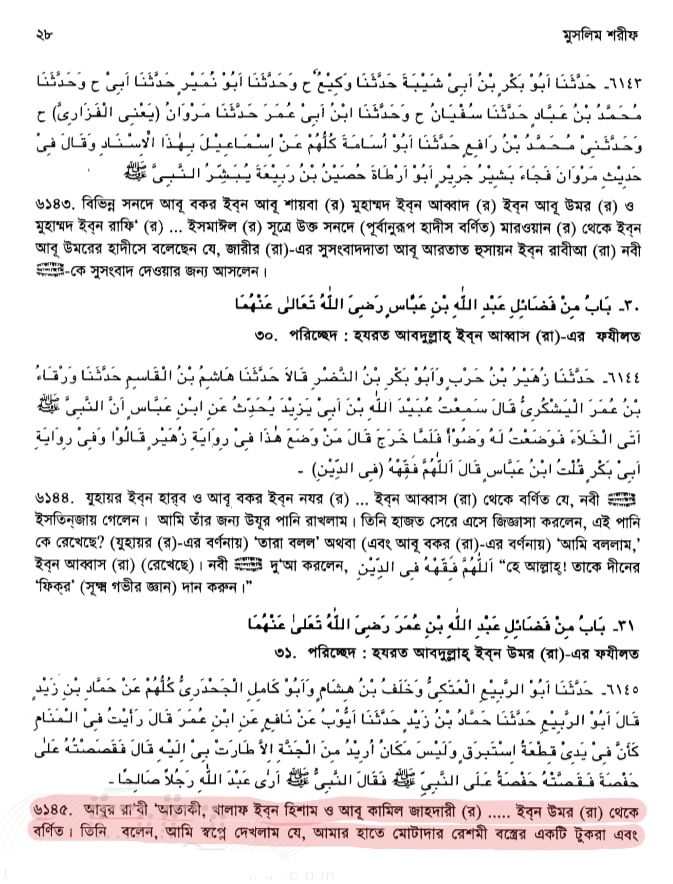
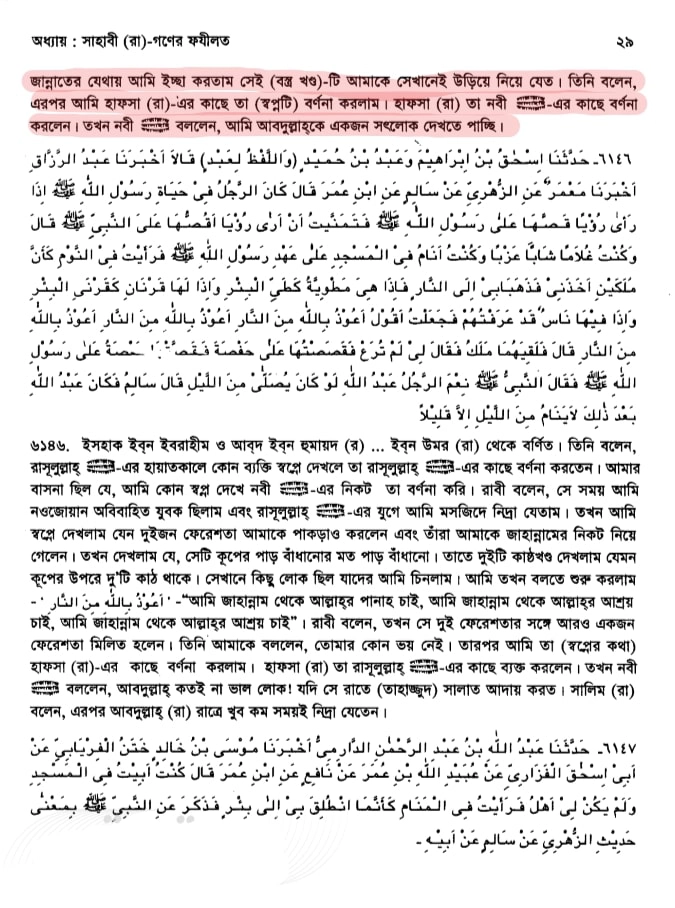
In Abu Ubayd’s Fada’il al-Quran, a statement of Ibn Umar has come through Ismail ibn Ibrahim, Ayyub, and Nafi. Suyuti also kept it in Al-Itqan. At the beginning of the statement, there is an objection to saying “I have taken the whole Quran,” in the middle is the reason for it, and at the end is the language of the alternative statement. Consequently, not only the final sentence “I have taken what has been found,” but the declaration before it that much of the Quran has gone is part of the same argument. [857] [858] [859]
حَدَّثَنَا إِسْمَاعِيلُ بْنُ إِبْرَاهِيمَ، عَنْ أَيُّوبَ، عَنْ نَافِعٍ، عَنِ ابْنِ عُمَرَ، قَالَ: ” لَا يَقُولَنَّ أَحَدُكُمْ قَدْ أَخَذْتُ الْقُرْآنَ كُلَّهُ وَمَا يُدْرِيهِ مَا كُلَّهُ؟ قَدْ ذَهَبَ مِنْهُ قُرْآنٌ كَثِيرٌ، وَلَكِنْ لِيَقُلْ: قَدْ أَخَذْتُ مِنْهُ مَا ظَهَرَ مِنْهُ “
English translation: Ismail ibn Ibrahim narrated to us, from Ayyub, from Nafi, from Ibn Umar. He said: Let none of you say, “I have taken the whole Quran.” How will he know what all of it is? Much of his Quran has gone. Rather let him say, “I have taken what has been found explicitly of it.”
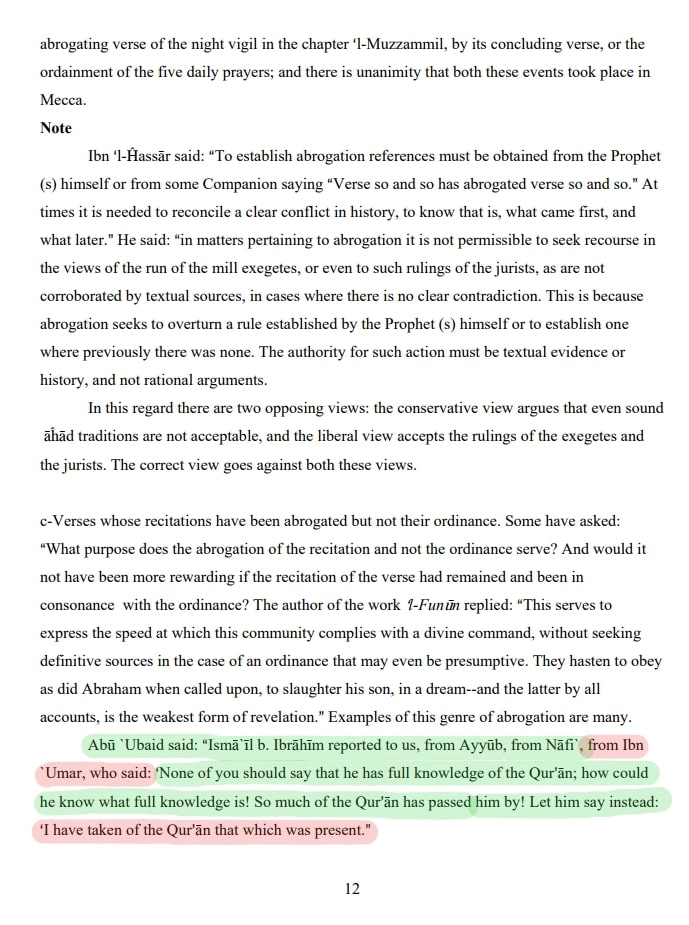
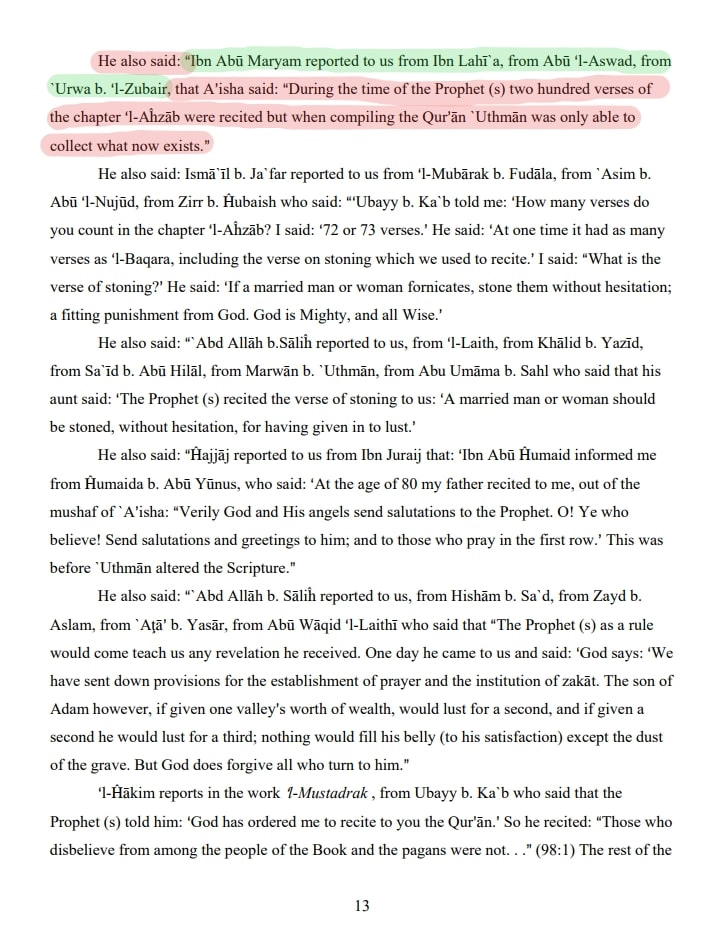
The logical structure of the sentence is direct. First, a claim to have achieved completeness is forbidden. As the reason for this, the speaker does not mention his own limited cognitive capacity; rather, he states that much of the Quran has gone. Then, the alternative statement he approves is the declaration of accepting the portion received. ‘I have taken everything’ and ‘I have taken what has been found’—the difference between the two is not merely a choice of humble wording. The first is a claim to the whole; the second is the limit of availability. The intervening reason determines the nature of that limit: a large portion of the previous readings is no longer in the received collection.
Abu Ubayd placed the report in the chapter titled “That which was taken away from the Quran after it was revealed and was not established in the mushafs.” This arrangement is evidence of his own classification. The word “naskh” is not present in Ibn Umar’s sentence; the compiler arranged it alongside other reports of absent previous readings. By maintaining this distinct position between the Companion’s statement and the author’s interpretation, two pieces of information are obtained: the claim to the whole attributed to Ibn Umar has been called into question, and Abu Ubayd has linked it to the matter of the removal of previous Quranic readings. [860]
بَابُ مَا رُفِعَ مِنَ الْقُرْآنِ بَعْدَ نُزُولِهِ وَلَمْ يُثْبَتُ فِي الْمَصَاحِفِ
English translation: The chapter related to that which was taken away from the Quran after it was revealed and was not established in the mushafs.
| Steps of Ibn Umar’s statement | Subject of the quoted claim | Its result |
|---|---|---|
| Forbidden to say “I have taken the whole Quran” | Claim to have achieved a complete collection | Equating the received portion with the whole is questioned |
| “How would he know what all of it is?” | Criterion of completeness | Difficulty of determining the previous whole using only the currently received reading |
| “Much Quran has gone” | Absence of previous readings | Specific reason for the claimed limitation |
| “I have taken what has been found” | Collection within availability | Declaration of accepting the received portion instead of achieving the whole |
In response to this statement, Islamweb provided an explanation of naskh and excluded the abrogated readings from the scope of the promise of preservation. The specific statement of the answer is: [861]
ولكن المنسوخ ليس مما تعهد الله بحفظه
English translation: But the abrogated portion is not included in what Allah has promised to preserve.
In this explanation, “preserved Quran” does not refer to everything that was read as Quran at any previous time. The promise of preservation is applied to the collection that remains after excluding the portions classified as naskh. Consequently, it becomes possible to place the fact that one class of readings disappeared alongside the claim of preservation for another class. However, the statement of being preserved in that sense does not prove the unchanged presence of all previous readings. This is because the absent previous readings were already excluded from the scope of the claim. This contraction of the definition is not the same as no deletion occurring in history.
The statement attributed to Ibn Umar gave explicit language to that gap between receipt and the whole. The fragmented memory of Abu Musa, the reports of the larger scope of al-Ahzab, or the sentences read as Quran in Bir Ma’una—the specific subjects of these are different, but they do not provide a basis for assuming the scope of the accepted mushaf to be a self-contained list of all previous readings. In Ibn Umar’s declaration, this problem was not limited to just one surah; the all-encompassing claim “I have taken the whole Quran” itself came under question. Within the tradition itself, the instruction to speak while acknowledging the limits of the received collection has been preserved.
Description of writing errors in the mushaf: Uthman, Aisha, and Ibn Abbas
In the history of the Uthmanic mushaf, the only question was not which surah or verse was included. Statements are also preserved in ancient Muslim books regarding whether any word was written incorrectly within the accepted reading. Reports are found of Uthman noticing “lahn” in the mushaf, allegations of scribal errors attributed to Aisha, and accounts attributed to Ibn Abbas of reading specific words differently. In some accounts, a gap appeared between the written form and the oral reading; in others, a different word was identified as correct. These reports bear witness that after the boundaries of the book were determined, the word-forms within it were not beyond discussion.
Later commentators did not accept these statements uniformly. Some rejected the chain of narration, some called “lahn” a linguistic variation, and some pointed to the prevailing writing conventions and differences in pronunciation. Aisha’s mention of “error” has also been interpreted as not selecting the most appropriate form among the seven ahruf. This gap between the allegation and the interpretation is important: there are separate histories for what was said initially and how the meaning of those words was later determined.
Uthman’s “lahn” statement: errors, the tongues of the Arabs, and the question of correction
In a report narrated under Uthman’s name in Ibn Abi Dawud’s Kitab al-Masahif, there is an incident of the mushaf being shown to him after it was prepared. He praised the work, then mentioned seeing some “lahn” and stated that the Arabs would correct it with their tongues. The subject of the statement is the written mushaf; the means of expected correction is human pronunciation. Consequently, within the structure of the narration itself, there is a relationship of dependence between the form on paper and the reading uttered by mouth. [862]
حدثنا عبد الله، قال: حدثنا المؤمل بن هشام ، حدثنا إسماعيل ، عن الحارث بن عبد الرحمن ، عن عبد الأعلى بن عبد الله بن عامر القرشي ، قال: لما فرغ من المصحف أتي به عثمان فنظر فيه، فقال: ” قد أحسنتم، وأجملتم، أرى فيه شيئا من لحن ستقيمه العرب بألسنتها “
English translation: Abdullah narrated to us. He said, Mu’ammal ibn Hisham narrated to us; Ismail narrated to us, from Harith ibn Abdur Rahman, who narrated from Abdul Ala ibn Abdullah ibn Amir al-Qurashi. He said: When the work on the mushaf was finished, it was brought to Uthman. He saw it and said: You have done a good and beautiful job. I see some lahn in it; the Arabs will correct it with their tongues.
Suyuti has preserved another account under Ikrimah’s name through Abu Ubayd. There, it is not only said that the Arabs would correct it in the future; it is also mentioned that the written forms should not be changed. At the end, there is a comment that if the tribe of the writer and the person dictating were different, such forms would not be found. This account links the problem to the human acts of writing and dictating. [863]
وَقَالَ: حَدَّثَنَا حَجَّاجٌ عَنْ هَارُونَ بْنِ مُوسَى أَخْبَرَنِي الزُّبَيْرُ بْنُ الْخِرِّيتِ عَنْ عِكْرِمَةَ قَالَ: لَمَّا كُتِبَتِ الْمَصَاحِفُ عُرِضَتْ عَلَى عُثْمَانَ فَوَجَدَ فِيهَا حُرُوفًا مِنَ اللَّحْنِ فَقَالَ: لَا تُغَيِّرُوهَا فَإِنَّ الْعَرَبَ سَتُغَيِّرُهَا – أَوْ قَالَ: سَتُعْرِبُهَا بِأَلْسِنَتِهَا لَوْ كَانَ الْكَاتِبُ مِنْ ثَقِيفٍ وَالْمُمْلِي مِنْ هُذَيْلٍ لَمْ تُوجَدْ فِيهِ هَذِهِ الْحُرُوفُ.
English translation: He said: Hajjaj narrated to us, from Harun ibn Musa. Zubayr ibn al-Khirrit informed me, from Ikrimah. He said: When the mushafs were written, they were shown to Uthman. He found some forms of lahn in them and said: Do not change these; the Arabs will change these with their tongues—or he said, will pronounce them correctly. If the writer were from Saqif and the person dictating from Huzayl, these forms would not be found in it.
The “or he said” part of the second account is the narrator’s preserved verbal uncertainty. The report states that one of two phrases, “will change” and “will pronounce correctly,” was spoken. The preceding instruction not to change and the subsequent comment regarding the writer-scribe are part of the same event. After this report, Suyuti also mentioned similar narrations in the collections of Ibn al-Anbari and Ibn Ashtari. The fact that the same report is preserved in several books signifies here its history of acceptance and recovery, not the identical testimony of several independent eyewitnesses.
In the Bengali translation of Tafsir Mazhari, the discussion includes the point that halal and haram did not change. In the full paragraph of that translation, allegations first appear under the names of Aisha, Aban, and Uthman; later, the commentator himself considers those comments inappropriate and takes a position in favor of the purity of the mushaf. This evaluation at the end of the quote is also part of the commentator’s statement. [864]
The matter of establishing salat or establishing prayer is mentioned in the verse as: al-muqimin as-salat (those who establish salat). In Bagwi’s narration, Hazrat Aisha and Hazrat Aban bin Uthman said that the phrase should have been written as: al-muqunun as-salat (those who are establishers of salat). There are similar errors within Surah Ma’idah. For example, in one place ‘sabi’un’ is written, whereas the word should have been written as ‘sab’in.’ In another place, ‘hazani’ is written, whose correct written form is ‘hazayni.’ Hazrat Uthman said that some words of incorrect pronunciation are recorded in the Quran, which the Arabs pronounce correctly while reading. He was asked, why did you not arrange for the words to be written correctly? In response, Hazrat Uthman said, let it remain this way. Through this, halal has not been made haram and haram has not been made halal. The truth is that such comments are inappropriate. The consensus view is that whatever is recorded in the Quran is purely authentic by consensus. However, there may be different forms of interpretation for them. Quran commentators have interpreted them in various ways.
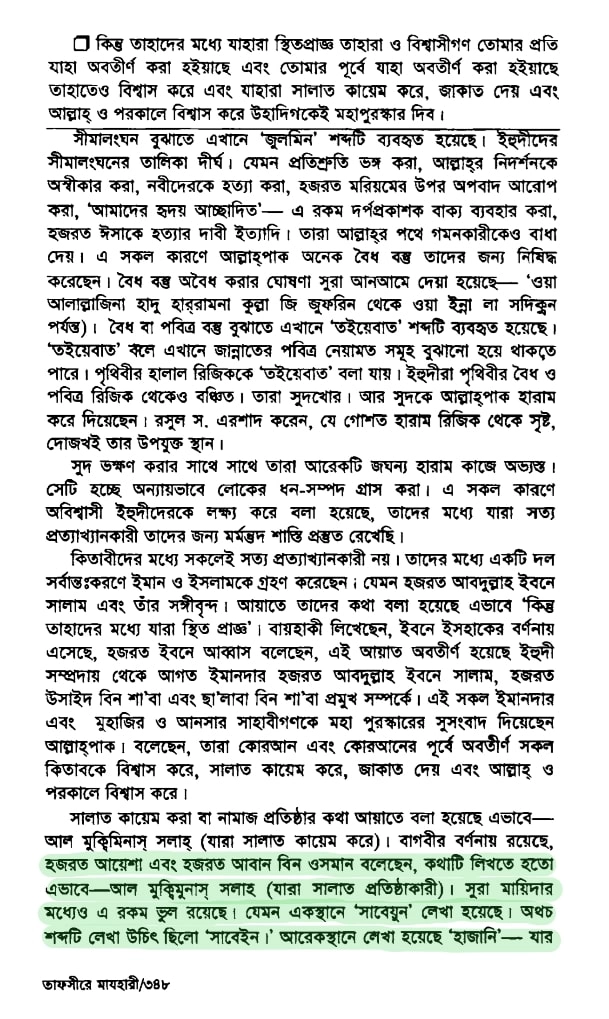
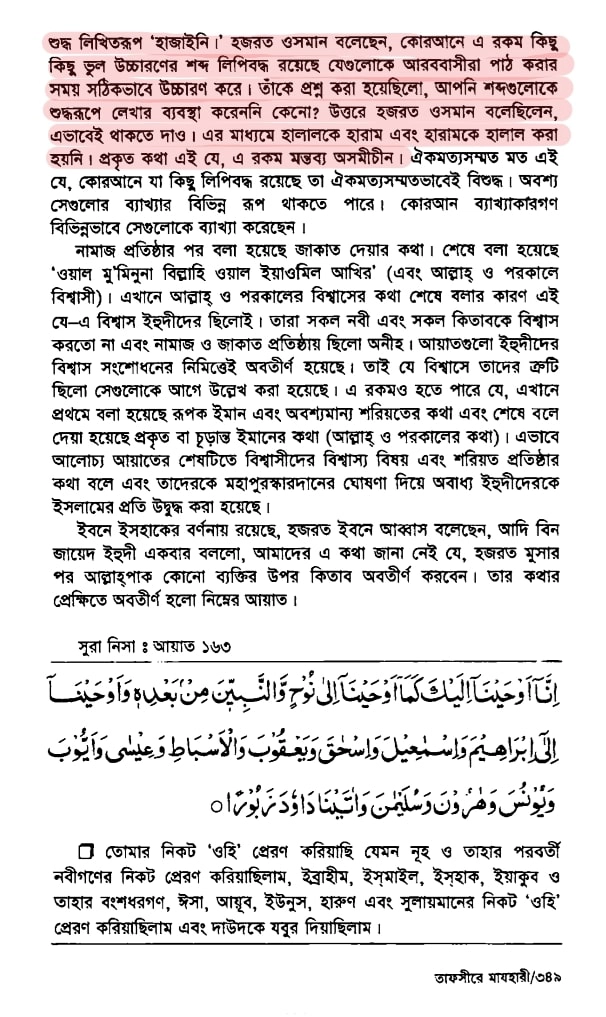
In this quote, the logic of the phrase “halal haram did not happen in this” is separate from the question of verbal accuracy. Whether a written error changed a legal result is a question of the impact of the error. Whether the letters and words are exactly the same is a question of the reading. Even if the impact is limited in the first question, the answer to the second question does not automatically become accurate. The fact that the objection and its subsequent rejection exist side-by-side in the discussion of Mazhari shows—that this type of report created such a problem within religious literature that subsequent interpretations were needed to confront it.
The compiler of Kitab al-Masahif himself interpreted “lahn” as linguistic variation. His reason was that if there were unacceptable errors in all Arab dialects, Uthman would not have sent it for people to read. This is an explanation given by the compiler after the narration; that logic is not within Uthman’s quoted sentence. [865]
قال أبو بكر بن أبي داود: هذا عندي يعني بلغتها، وإلا لو كان فيه لحن لا يجوز في كلام العرب جميعا لما استجاز أن يبعث به إلى قوم يقرءونه
English translation: Abu Bakr ibn Abi Dawud said: To me, its meaning is, with their language. Otherwise, if there were any unacceptable lahn in all the languages of the Arabs, he would not have approved sending it for people to read.
The question becomes clear if the words of the narration and the basis of the interpretation are kept separate. The report under Uthman’s name left a matter seen in the written mushaf to the tongues of the people. The compiler determined the meaning of “lahn” based on the notion of what could be acceptable for Uthman. In this method, his honored position acts as a preconceived notion for the interpretation. The independent answer to the question of how accurate the event of writing the mushaf was does not emerge solely from his status. The information in the narration regarding the need for the oral reading of the Arabs did not give the written signs the power to guarantee the complete reading on their own.
Aisha’s statement “the writers made mistakes” and its preserved source
In the allegation narrated under Aisha’s name, the responsibility for the error is more specific: “This is the work of the writers; they made mistakes in writing.” Urwa had asked about the specific forms of three verses. In response, the writers were held responsible for those forms. The matter is not a vague comment about some unknown mushaf; specific word-forms in Nisa, Ma’idah, and Taha are part of the question. In the full narration preserved by Ibn Abi Dawud, both the question and answer are present. [866]
حدثنا عبد الله، قال: حدثنا عمر بن عبد الله الأودي ، حدثنا أبو معاوية ، عن هشام بن عروة ، عن أبيه ، قال: سألت عائشة عن لحن القرآن إن هذان لساحران ، وعن قوله: والمقيمين الصلاة والمؤتون الزكاة وعن قوله: والذين هادوا والصابئون فقالت: ” يا ابن أختي، هذا عمل الكتاب أخطئوا في الكتاب “
English translation: Abdullah narrated to us. He said, Umar ibn Abdullah al-Awdi narrated to us; Abu Mu’abiya narrated to us, from Hisham ibn Urwa, from his father. He said: I asked Aisha about the lahn of the Quran—regarding “in hazani la-sahiran”, “wal muqimin as-salata wal mutanaz zakata” and “wallazina hadu was sabi’un”. She said: O son of my sister, this is the work of the writers; they made mistakes in writing.
Suyuti quoted the same Hisham-Urwa chain of report through Abu Ubayd and called its isnad sahih according to the conditions of Bukhari and Muslim. In his quote, the form of address to Urwa is “O son of my brother”; in Ibn Abi Dawud’s quote, it is “O son of my sister”. This difference in address is found in two preserved forms of the same basic allegation. Suyuti’s specific isnad evaluation is: [867]
هَذَا إِسْنَادٌ صَحِيحٌ عَلَى شَرْطِ الشَّيْخَيْنِ.
English translation: This is a sahih isnad according to the conditions of Bukhari and Muslim.
There are two pieces of information here: the multiple textual presence of the same chain of narration and the scholar’s decision regarding its acceptability. Reports from the Hisham ibn Urwa-Urwa path are found in Abu Ubayd, Tabari, and Ibn Abi Dawud. These are multiple textual preservations of the same chain of narration. There is a real difference between Suyuti’s sahih evaluation and the subsequent rejection. Even after his acceptance, the question remains how he interpreted the meaning of the statement; the acceptance of the isnad and the acceptance of the literal meaning were not always the same decision.
In rejecting this account, IslamQA acknowledged Suyuti’s evaluation of the isnad. Their argument is that it is highly improbable that Aisha would consider the writers to be mistaken even after hearing the same grammatical form from Muhammad’s own mouth; following this thematic objection, a potential error in Hisham’s Iraqi narration was cited as the cause. The declared center of rejection is: [868]
نردها ههنا لما في المتن من نكارة ظاهرة
English translation: Because there are obvious objectionable inconsistencies in the statements of the account, we reject it here.
This evaluation accepts the meaning of the report while denying the event; Ibn Ashat’s explanation, on the other hand, retains the report but changes the meaning of “error.” Consequently, two different strategies exist within the subsequent tradition. In the first, the account is canceled because the statement is unacceptable; in the second, the account is accepted, and the error is defined as a failure to select a relatively better reading. The subject of both discussions is the same objection attributed to Aisha. The ancient sources contain the clear language of the allegation; there is also a dispute regarding its position according to later standards of acceptability.
Three examples identified by Aisha
In Urwah’s questioning, three examples appear together. In An-Nisa, the form “muqimin” is not in the same case as the surrounding plural nouns; in Al-Ma’idah, the word “sabi’un” raises a question regarding its relationship with the “inna” at the beginning of the sentence; in Taha, the analysis changes according to the reading—whether it is “in” or “inna” and whether the dual is “hazani” or “hazayni.” If these are grouped together as a vague “mispronunciation,” the specific problems cannot be understood. In some places, the case is expressed in the letters; in others, the pronunciation of the particle determines the structure of the sentence.
| Location | Discussed Form | Other Form or Center of Explanation |
|---|---|---|
| Nisa 4:162 | وَالْمُقِيمِينَ الصَّلَاةَ | Muqimun instead of muqimin; or a separate grammatical relationship for muqimin |
| Ma’idah 5:69 | وَالصَّابِئُونَ | Sabi’in instead of sabi’un; or a new sentence and an omitted predicate |
| Taha 20:63 | إِنْ هَذَانِ / إِنَّ هَذَانِ / إِنَّ هَذَيْنِ | Difference between in and inna; the case of the dual and linguistic variation |
Nisa 4:162 — “wal muqimin”
In Nisa 4:162, “muqimin” appears among the forms “rasikhun,” “mu’minun,” “mutun,” and “mu’minun.” If one expects a continuity of the same case based on a regular relationship, the question of the form “muqimun” arises. The full sentence of the current verse is: [869]
لَّٰكِنِ الرَّاسِخُونَ فِي الْعِلْمِ مِنْهُمْ وَالْمُؤْمِنُونَ يُؤْمِنُونَ بِمَا أُنزِلَ إِلَيْكَ وَمَا أُنزِلَ مِن قَبْلِكَ ۚ وَالْمُقِيمِينَ الصَّلَاةَ ۚ وَالْمُؤْتُونَ الزَّكَاةَ وَالْمُؤْمِنُونَ بِاللَّهِ وَالْيَوْمِ الْآخِرِ أُولَٰئِكَ سَنُؤْتِيهِمْ أَجْرًا عَظِيمًا
English translation: But among them are those firmly rooted in knowledge and the believers, who believe in what has been revealed to you and what was revealed before you. And those who establish prayer, give zakat, and believe in Allah and the Last Day—them We shall give a great reward.
Tabari has provided multiple positions in explaining this form. In one position, there is mention of a copyist’s error and the reading “muqimun.” In another position, “muqimin” is used by changing the sequential case of the sentence to express praise. Qurtubi stated that this second explanation by Sibawayh is the most acceptable. In his words, this is the accusative form for expressing praise or honor; an implicit verb such as “I specifically mean” is assumed within the meaning. [870]
واختلف في نصبه على أقوال ستة ؛ أصحها قول سيبويه بأنه نصب على المدح ؛ أي وأعني المقيمين ؛ قال سيبويه : هذا باب ما ينتصب على التعظيم ؛ ومن ذلك والمقيمين الصلاة
English translation: There are six opinions regarding its accusative form. The most acceptable is Sibawayh’s statement: it is accusative for the sake of praise; meaning “And I specifically mean those who establish prayer.” Sibawayh says: this is the chapter on being accusative to express honor; “wal muqiminas salat” is an example of that.
Tabari did not consider the same explanation to be the most acceptable. He took “muqimin” as a genitive linked to the preceding word “ma” and chose to understand those who establish prayer as the angels. In Qurtubi’s explanation, the term remains among the praised humans; in Tabari’s selected meaning, it moves toward the angels as a matter of faith. Even while keeping the same written word unchanged, its grammatical role and the person indicated are changing. Therefore, there is not just a difference in names among the explanations; the structure of what the sentence is saying also changes.
The allegation against the copyist attributed to Aisha and Aban is not the same as this alternative grammatical explanation. One identifies a writing event as an error; the other determines a different sentence structure for the established form. The analysis of the later commentator gives the current form an acceptable Arabic meaning. That does not become direct testimony to what Aisha or Aban intended in their own statements. The specific allegation and the subsequent explanation stand in separate sources and at separate times.
Ma’idah 5:69 — “was sabi’un”
In Ma’idah 5:69, “sabi’un” is the plural nominative form. If linked in the same grammatical sequence after “inna,” “sabi’in” is expected—this form of the allegation appears in the quoted discussion of Mazhari. The full text of the word as it is in the current verse is: [871]
إِنَّ الَّذِينَ آمَنُوا وَالَّذِينَ هَادُوا وَالصَّابِئُونَ وَالنَّصَارَىٰ مَنْ آمَنَ بِاللَّهِ وَالْيَوْمِ الْآخِرِ وَعَمِلَ صَالِحًا فَلَا خَوْفٌ عَلَيْهِمْ وَلَا هُمْ يَحْزَنُونَ
English translation: Those who believe, those who have become Jews, the Sabians and the Christians—whoever believes in Allah and the Last Day and does righteous deeds, for them there is no fear and they shall not grieve.
Qurtubi provides the explanations of Khalil and Sibawayh here: by treating the parts of the sentence as before-and-after, “sabi’un” is a separate subject and its predicate is omitted. The meaning becomes: among those mentioned previously, those who fulfill the conditions of faith and righteous deeds have no fear; the same applies to the Sabians and Christians. Consequently, the word is analyzed not as a direct follower of the previous sequence, but as part of a separate sentence. [872]
وقال الخليل وسيبويه : الرفع محمول على التقديم والتأخير ; والتقدير : إن الذين آمنوا والذين هادوا من آمن بالله واليوم الآخر وعمل صالحا فلا خوف عليهم ولا هم يحزنون والصابئون والنصارى كذلك
English translation: Khalil and Sibawayh say: the nominative form is explained by assuming a before-and-after arrangement. The implicit arrangement is: among those who believe and those who have become Jews, whoever believes in Allah and the Last Day and does righteous deeds, they have no fear and they shall not grieve; the same applies to the Sabians and Christians.
In the same discussion, there is also the opinion of linking the word with the subject of the verb “hadu.” In the statement of Nahhas brought by Qurtubi, there is a semantic objection against this explanation: it creates the meaning that the Sabians entered the Jewish religion. That is, just because a grammatical possibility is proposed, it was not acceptable to all commentators. Along with determining the case of the word, its sentential relationship and the meaning created from that relationship were also judged. This difference of opinion in explanation shows the expansion of subsequent human analysis centered on the words of the religious text.
In this specific case, the allegation was whether “sabi’un” or “sabi’in” should be written. The subsequent explanation retains “sabi’un” and determines a separate sentence for it. Consequently, the difference between the two positions is visible: in one, there is a claim to change the word form; in the other, the word form is retained and the implicit arrangement of the sentence is changed to explain it. In Aisha’s preserved answer, there is an allegation of the writers’ error; this grammatical rearrangement is not part of her answer. It is the subsequent analysis of the commentators.
Taha 20:63 — “in hazani”
In the case of Taha 20:63, the pronunciation of the particle is particularly important. In the currently widely printed text, “in” has a light nun; in other recognized readings, it appears as “inna” with a heavy nun. Again, in Abu Amr’s reading, “hazayni” follows the heavy “inna.” Consequently, by pointing only to the word “hazani” and imposing the same grammatical structure on all readings, the actual difference in readings is ignored. The current form of the verse is: [873]
قَالُوا إِنْ هَٰذَانِ لَسَاحِرَانِ يُرِيدَانِ أَن يُخْرِجَاكُم مِّنْ أَرْضِكُم بِسِحْرِهِمَا وَيَذْهَبَا بِطَرِيقَتِكُمُ الْمُثْلَىٰ
English translation: They said: These two are certainly magicians. They want to expel you from your own land by their magic and abolish your finest customs.
Baghavi has identified three readings separately. In the readings of Ibn Kathir and Hafs, there is a light “in”; in Abu Amr’s reading, there is a heavy “inna” and “hazayni”; in the readings of others, there is a heavy “inna” and “hazani.” In the discussion of the explanation of the last form, he brought the mention of the copyist’s error attributed to Aisha through Hisham-Urwah. [874]
قرأ ابن كثير وحفص : ( إن ) بتخفيف النون ، ( هذان ) أي : ما هذان إلا ساحران ، كقوله : وإن نظنك لمن الكاذبين ( الشعراء : 186 ) ، أي : ما نظنك إلا من الكاذبين ، ويشدد ابن كثير النون من ” هذان ” . وقرأ أبو عمرو ” إن ” بتشديد النون ” هذين ” بالياء على الأصل . وقرأ الآخرون : ” إن ” بتشديد النون ، ” هذان ” بالألف ، واختلفوا فيه : فروى هشام بن عروة ، عن أبيه ، عن عائشة : أنه خطئ من الكاتب .
English translation: Ibn Kathir and Hafs read “in” with a light nun and “hazani”; meaning these two are nothing but magicians. For example, “wa in nazunnuka lamineal kazibin”—meaning we consider you nothing but one of the liars. Ibn Kathir makes the nun of “hazani” heavy. Abu Amr read “inna” with a heavy nun and “hazayni” with a ya according to the basic rule. Others read “inna” with a heavy nun and “hazani” with an alif; they differed on this matter. Hisham ibn Urwah narrated from Aisha through his father that this was a copyist’s error.
| Identification of the reading | Arabic form | Specific subject of analysis |
|---|---|---|
| Reading with light nun | إِنْ هَذَانِ لَسَاحِرَانِ | In is not assumed to have the same function as heavy inna |
| Abu Amr’s reading | إِنَّ هَذَيْنِ لَسَاحِرَانِ | The dual form hazayni after heavy inna |
| Reading with heavy nun and alif | إِنَّ هَذَانِ لَسَاحِرَانِ | Separate explanation including linguistic variation for the presence of hazani after inna |
For the heavy “inna” and “hazani” form, Baghavi provided explanations based on the language of Harith ibn Ka’b and several tribes. There, it is mentioned that the dual is kept with an alif in all cases—nominative, accusative, and genitive. For example: two people came, I saw two people, and I passed by two people—the same final form in three places. This explanation analyzes the form with the help of other styles of conventional Arabic. Abu Amr’s reading, again, used a separate word form. Therefore, the two types of solutions are not the same: one retains the alif form based on linguistic variation, the other reads the dual with a ya.
The true identity of the allegation is here. There is mention of calling one reading form an error attributed to Aisha; alongside this, multiple forms are actually preserved in the literature of qira’at. The recognized readings did not use the same pair of particle and case here. The grammatical question of one form is not present in the same way in another form. In their preserved materials, different pronunciations, different cases, and allegations against specific forms exist side by side.
The sequence of events regarding the writing of “wal muqimin” in Aban ibn Uthman’s account
The report attributed to Aban ibn Uthman describes a writing event for the “muqimin” form of Nisa. The questioner wanted to know why this word was written in the accusative in the middle, despite the nominative forms being present before and after. Aban’s answer is a question-and-answer session from the time of writing: the writer wrote the previous part and wanted to know what to write next; when he was told to write “muqiminas salat,” he wrote it. The full form of the report in Kitabul Masahif is: [875]
حدثنا عبد الله، قال: حدثنا إسحاق بن وهب ، حدثنا يزيد ، قال: أخبرنا حماد ، عن الزبير أبي خالد ، قال: قلت لأبان بن عثمان : ” كيف صارت: لكن الراسخون في العلم منهم والمؤمنون يؤمنون بما أنزل إليك وما أنزل من قبلك والمقيمين الصلاة والمؤتون الزكاة ما بين يديها وما خلفها رفع، وهي نصب ؟ قال: ” من قبل الكتاب، كتب ما قبلها، ثم قال: ما أكتب ؟ قال اكتب المقيمين الصلاة، فكتب ما قيل له “
English translation: Abdullah narrated to us. He said, Ishaq ibn Wahb narrated to us; Yazid narrated to us. He said, Hammad informed us, from Zubayr from Abu Khalid. He said: I said to Aban ibn Uthman, “But among them are those firmly rooted in knowledge and the believers in what has been revealed to you and what was revealed before you; and those who establish prayer and those who give zakat”—how is it that the previous and subsequent parts are in the nominative, yet this word is in the accusative? He said: because of the writers. The writer wrote the previous part, then said, what shall I write? It was said, write “muqiminas salat.” He wrote what he was told.
Tabari also preserved this answer of Aban through Hammad ibn Salama and Zubayr. In report number 10837 of his collection, the same writing sequence and the same instruction are mentioned. Although the narrators above Tabari’s path are different, the report meets in the main chain of Hammad-Zubayr-Aban. The two books therefore show two preservations of the same event; it does not provide new information that two independent witnesses were present at the scene. Qurtubi later brought a summary of the event and quoted an evaluation against it.
In the event, it is not narrated that the writer himself chose the form by performing a grammatical analysis. He asked for the subsequent text for the writing work before him and wrote the instruction he heard. Who gave the instruction, what was his own source, or who else verified it after this conversation—the report does not give those names. This keeps a record of a human process as an explanation for a specific written form. In the story of how the text came from the source to the paper, there are three separate acts: questioning, speaking, and writing.
Kushayri, quoted by Qurtubi, rejected this explanation because the compilers were exemplary in language; it cannot be thought that they would insert something not revealed into the Quran. The direct language of his objection: [876]
قال القشيري : وهذا المسلك باطل ؛ لأن الذين جمعوا الكتاب كانوا قدوة في اللغة ، فلا يظن بهم أنهم يدرجون في القرآن ما لم ينزل .
English translation: Kushayri says: this path is canceled; because those who compiled the book were exemplary in language. It cannot be thought of them that they would enter into the Quran something that was not revealed.
This objection judges the possibility of the event based on the status and qualifications of the compilers. Whether a linguist or a respected author can make a mistake is not resolved by their social status. Kushayri’s statement does not provide any direct account of the event as an alternative to the question-and-answer session preserved under Aban’s name. Consequently, a status-based objection stands against a procedural report. Belief in the qualifications of the compilers is not a form of evidence against the description of a specific text.
Scribal errors and alternative readings preserved under Ibn Abbas’s name
Ibn Abbas is one of the recognized ancient authorities in the interpretation of the Quran. In Bukhari, there is a report of Muhammad praying for him to be granted deep religious knowledge. Alongside this status, readings are preserved under his name where specific words of the conventional mushaf are given another form, citing the error of a scribe. The recognition of religious authority and the criticism of written texts have both found a place within the tradition under the same person’s name. The report in Bukhari is: [877]
حَدَّثَنَا عَبْدُ اللَّهِ بْنُ مُحَمَّدٍ ، قَالَ حَدَّثَنَا هَاشِمُ بْنُ الْقَاسِمِ ، قَالَ حَدَّثَنَا وَرْقَاءُ ، عَنْ عُبَيْدِ اللَّهِ بْنِ أَبِي يَزِيدَ ، عَنِ ابْنِ عَبَّاسٍ ، أَنَّ النَّبِيَّ صلى الله عليه وسلم دَخَلَ الْخَلاَءَ، فَوَضَعْتُ لَهُ وَضُوءًا قَالَ ” مَنْ وَضَعَ هَذَا ”. فَأُخْبِرَ فَقَالَ ” اللَّهُمَّ فَقِّهْهُ فِي الدِّينِ ”.
English translation: Abdullah ibn Muhammad narrated to us. He said, Hashim ibn al-Qasim narrated to us; Warqa narrated to us, from Ubaydullah ibn Abu Yazid, from Ibn Abbas. When the Prophet (peace and blessings of Allah be upon him) went to the toilet, I would keep ablution water for him. He would ask, ‘Who placed this?’ When informed, he would say: ‘O Allah, grant him deep knowledge of the religion.’
The reports under his name regarding the verses of Nur, Ra’d, and Isra are not of the same kind. One concerns a different verb for seeking permission, one a different word for knowing or becoming clear, one a verb for giving a command, and one a statement regarding the person indicated by the metaphor of light. The identities of these sources are distinct—some report an allegation of error with a full chain of transmission, while others provide a different reading and its explanation. Their only characteristic is not that they do not match the subsequent accepted reading; in several reports, the work of the scribe is directly cited as the cause of the problem.
Nur 24:27 — Seeking permission and “tastanisū”
The current reading in Nur 24:27 is “hatta tastanisū wa tusallimū”—referring to the relevant process and greeting before entering another’s house. In the form narrated under Ibn Abbas’s name, “tastajinū,” meaning the direct act of seeking permission, appears instead of “tastanisū.” In the quoted section of Tafsir Ibn Kathir, there is also an allegation of the scribe’s error accompanying this different reading. [878] [879] [880]
وقال ابن جرير : حدثنا ابن بشار ، حدثنا محمد بن جعفر ، حدثنا شعبة ، عن أبي بشر ، عن سعيد بن جبير ، عن ابن عباس في هذه الآية : ( لا تدخلوا بيوتا غير بيوتكم حتى تستأنسوا وتسلموا ) قال : إنما هي خطأ من الكاتب ، ” حتى تستأذنوا وتسلموا ” . وهكذا رواه هشيم ، عن أبي بشر – وهو جعفر بن إياس – به . وروى معاذ بن سليمان ، عن جعفر بن إياس ، عن سعيد ، عن ابن عباس ، بمثله ، وزاد : وكان ابن عباس يقرأ : ” حتى تستأذنوا وتسلموا ” ، وكان يقرأ على قراءة أبي بن كعب رضي الله عنه . وهذا غريب جدا عن ابن عباس . وقال هشيم أخبرنا مغيرة ، عن إبراهيم قال : في مصحف ابن مسعود : ” حتى تسلموا على أهلها وتستأذنوا ” . وهذا أيضا رواية عن ابن عباس ، وهو اختيار ابن جرير . وقد قال الإمام أحمد : حدثنا روح ، حدثنا ابن جريج ، أخبرني عمرو بن أبي سفيان : أن عمرو بن أبي صفوان أخبره ، أن كلدة بن الحنبل أخبره ، أن صفوان بن أمية بعثه في الفتح بلبأ وجداية وضغابيس ، والنبي صلى الله عليه وسلم بأعلى الوادي . قال : فدخلت عليه ولم أسلم ولم أستأذن . فقال النبي صلى الله عليه وسلم : ” ارجع فقل : السلام عليكم ، أأدخل؟ ” وذلك بعدما أسلم صفوان .
English translation: Ibn Jarir said: Ibn Bashshar narrated to us; Muhammad ibn Ja’far narrated to us; Shuba narrated to us, from Abu Bishr, from Sa’id ibn Zubayr, from Ibn Abbas. Regarding this verse—“Do not enter houses other than your own until you tastanisū and give greeting”—he said: This is a scribal error; it should be “until you seek permission and give greeting.” Hushaym also narrated similarly through Abu Bishr, meaning Ja’far ibn Yas. Mu’adh ibn Sulayman, through Ja’far ibn Yas, Sa’id, and Ibn Abbas, narrated similarly and added: Ibn Abbas used to read “hatta tastajinū wa tusallimū”; he read according to the reading of Ubayy ibn Ka’b. This is an extremely gharib report from Ibn Abbas. Hushaym said: Mughira informed us, from Ibrahim. He said: In the mushaf of Ibn Masud it was “until you give greeting to its inhabitants and seek permission.” This form is also narrated from Ibn Abbas and is preferred by Ibn Jarir. Imam Ahmad said: Rawh narrated to us; Ibn Jurayj narrated to us. Amr ibn Abu Sufyan informed me that Amr ibn Abu Safwan informed him, and Kalda ibn al-Hambal informed him: At the time of the conquest of Mecca, Safwan ibn Umayya sent him clarified butter, a fawn, and daghabis. The Prophet (peace and blessings of Allah be upon him) was then further up the valley. He said: I entered upon him, but I did not give greeting nor did I seek permission. The Prophet said: Go back, then say, “Peace be upon you; may I enter?” This event occurred after Safwan’s conversion to Islam.
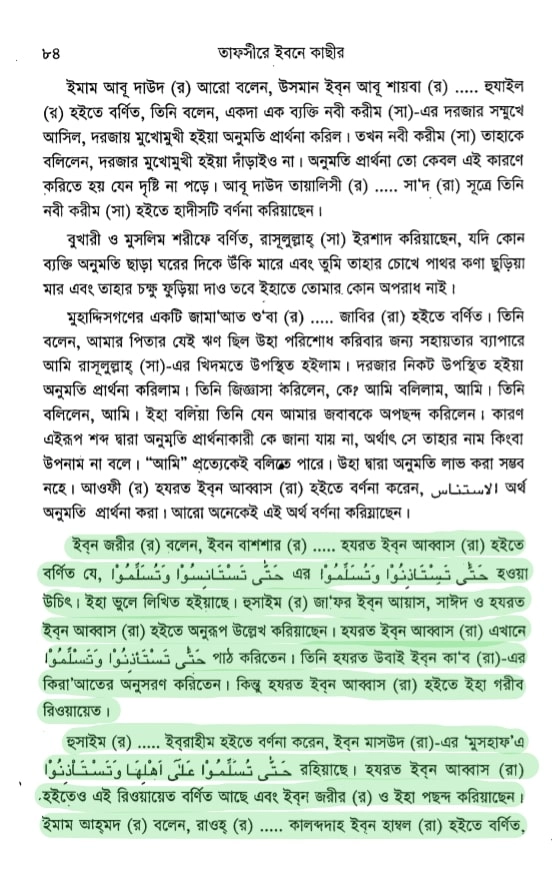
In the first part of the quotation, there is a reading and an allegation of error under Ibn Abbas’s name, then another report of the same chain, followed by Ibn Kathir’s own evaluation of it being “extremely gharib.” In the subsequent part, there is the word order of Ibn Masud’s mushaf and the behavior of greeting and permission before entry. If these different levels are made into a continuous statement by one person, the identity of the source changes. Ibn Kathir preserved the report and also commented on its abnormality; his comment cannot be placed in the position of the narrated allegation.
In Tabari’s direct collection, there is also an additional version stating, “but it fell from the writer.” Through another route, Ibn Abbas’s reading of “tastajinu” has been linked with Ubayy’s reading. The two full accounts are: [881]
حدثنا ابن المثنى، قال: ثنا وهب بن جرير، قال: ثنا شعبة، عن أبي بشر، عن سعيد بن جُبير، بمثله. غير أنه قال: إنما هي حتى تستأذنوا، ولكنها سقط من الكاتب. حدثنا أبو كريب، قال: ثنا ابن عطية، قال: ثنا معاذ بن سليمان، عن جعفر بن إياس، عن سعيد، عن ابن عباس ( حَتَّى تَسْتَأْنِسُوا وَتُسَلِّمُوا عَلَى أَهْلِهَا ) قال: أخطأ الكاتب، وكان ابن عباس يقرأ ” حَتَّى تَسْتَأْذِنُوا وَتُسَلِّمُوا ” وكان يقرؤها على قراءة أُبيّ بن كعب.
English translation: Ibn al-Musanna narrated to us. He said, Wahb ibn Jarir narrated to us; Shuba narrated to us, from Abu Bishr, from Sa’id ibn Zubayr—similar to the previous report. However, he said: Actually it is “hatta tastajinū,” but it was omitted by the scribe. Abu Kuraib narrated to us. He said, Ibn Atiyya narrated to us; Mu’adh ibn Sulayman narrated to us, from Ja’far ibn Yas, from Sa’id, from Ibn Abbas. Regarding “hatta tastanisū wa tusallimū ala ahliha,” he said: The scribe made a mistake. Ibn Abbas used to read “hatta tastajinū wa tusallimū” and read according to the reading of Ubayy ibn Ka’b.
| Position of the text | Word or arrangement | Nature of the conflict |
|---|---|---|
| Current mushaf | حَتَّىٰ تَسْتَأْنِسُوا وَتُسَلِّمُوا | Tastanisū—interpreted in the sense of becoming acquainted or seeking permission |
| Reading narrated under Ibn Abbas’s name | حَتَّى تَسْتَأْذِنُوا وَتُسَلِّمُوا | Tastajinū—the direct word for seeking permission |
| Tabari’s quotation regarding Ibn Masud’s mushaf | حَتَّى تُسَلِّمُوا عَلَى أَهْلِهَا وَتَسْتَأْذِنُوا | The word order of greeting and permission is also different |
Although the meanings of the two words can be interpreted closely, the set of letters is not the same. “Tastanisū” has the root of becoming acquainted or ensuring presence, and “tastajinū” has the root of seeking permission. In the report of Ibn Masud’s mushaf, the part about giving greeting comes first and the part about seeking permission comes second. Consequently, two types of differences are preserved here: a change in the verb on one hand, and a change in word order on the other. The closeness to the meaning conveyed in the later known reading does not erase this written difference.
The allegation of error was not created as the interpreter’s conjecture; the language of the report itself states “the scribe made a mistake.” The fact that several paths meet in the same Abu Bishr–Sa’id chain does not increase the witnesses by the number of books. But it is also wrong to call the allegation merely the imagination of a later critic. Tabari preserved that report; Ibn Kathir quoted it; Suyuti placed it alongside other reports of objections regarding the writing of the Quran. This combination of one word against another and blaming the scribe is the content of the Muslim sources themselves.
Ra’d 13:31 — “yai’asa” and “yatabayyyan”
Against the part “afalam yai’asilladhina amanu” in Ra’d 13:31, the reading “afalam yatabayyyanilladhina amanu” is found under Ibn Abbas’s name. The root verb of the first is ya’as; the second is tabayyan—to become clear or to understand. Qurtubi mentioned the second form as the reading of both Ali and Ibn Abbas. In his discussion, there is also an interpretation of the conventional word “yai’asa” as meaning “to know” in the language of some tribes. Both the fact that the words are different and that they are interpreted with a similar meaning in that place are present there.
Suyuti quoted a conversation of Ibn Abbas from Ikrimah through Ibn al-Anbari. There, after hearing a different reading, when the words of the mushaf were mentioned, he expressed the idea that the scribe wrote it while in a drowsy state. The full report is: [882]
وما أخرجه ابن الأنبا ري مِنْ طَرِيقِ عِكْرِمَةَ عَنِ ابْنِ عَبَّاسٍ أَنَّهُ قَرَأَ ” أَفَلَمْ يَتَبَيَّنِ الَّذِينَ آمَنُوا أَنْ لَوْ يَشَاءُ اللَّهُ لَهَدَى النَّاسَ جَمِيعًا ” فَقِيلَ لَهُ: إِنَّهَا فِي الْمُصْحَفِ: {أَفَلَمْ يَيْأَسِ} فَقَالَ: أَظُنُّ الْكَاتِبَ كَتَبَهَا وَهُوَ نَاعِسٌ.
English translation: Ibn al-Anbari narrated from Ibn Abbas through Ikrimah that he read: “Has it not become clear to those who believe that if Allah willed, He would have guided all people?” He was told, but in the mushaf it is “afalam yai’as.” He said: I think the scribe wrote it while drowsy.
There are two levels here under Ibn Abbas’s name. The report of reading it in a different form is an action; that the scribe was drowsy—this is his expressed opinion regarding that difference. The matter of drowsiness is his expressed conjecture; this conjecture has a distinct position from the report of the different reading. The report does not contain the scribe’s name, which writing assembly the event occurred in, or how he knew of the drowsiness. The importance of the objection preserved under his name is more specific: since the writing of the mushaf and his own reading were not the same, he raised the possibility of blaming the writing process.
Alongside this allegation, Qurtubi also included Ibn al-Anbari’s rejection. In his argument, the conventional form of the mushaf is narrated from Ibn Abbas himself through Mujahid and Sa’id ibn Zubayr. Therefore, he did not accept the report of reading another form under his name and the comment against the scribe. Again, the identity of the alternative word reading is present in Qurtubi’s previous sentence: [883]
وقرأ علي وابن عباس : ” أفلم يتبين الذين آمنوا ” من البيان .
English translation: Ali and Ibn Abbas read “afalam yatabayyyanilladhina amanu”; this is from the root bayan in the sense of becoming clear.
Taking the conventional word in the sense of “knowing” and reading “yatabayyan” in its place are not the same textual act. If the meanings become close, an interpretation of the verse’s statement is found; but the different set of letters that appeared in the conversation under Ibn Abbas’s name does not become the current word. In the form preserved by Suyuti, there is an allegation regarding the scribe’s condition for this difference. In Qurtubi’s discussion, the alternative reading received recognized identity, yet the associated allegation was rejected. The history of the reading and the explanation of the reading’s origin proceed here on separate levels.
Isra 17:23 — “qada” and “wassa”
In Isra 17:23, the current words are “wa qada rabbuka”; against this, there is a report of the reading “wa wassa rabbuka.” The first verb is interpreted in the sense of commanding or deciding; the second is the language of giving a directive or making a bequest. In the report quoted by Suyuti, only the meaning of the second form was not stated. An allegation has come that another written form was created because the Waw and Sad merged. Consequently, this is not a report limited to the tafsir of two synonymous words; it is a claim regarding the arrangement of letters. [884]
وَمَا أَخْرَجَهُ سَعِيدُ بْنُ مَنْصُورٍ مِنْ طَرِيقِ سَعِيدِ بْنِ جُبَيْرٍ عَنِ ابْنِ عَبَّاسٍ أَنَّهُ كَانَ يَقُولُ فِي قَوْلِهِ تَعَالَى: {وَقَضَى رَبُّكَ} : إِنَّمَا هِيَ ” وَوَصَّى رَبُّكَ ” الْتَزَقَتِ الْوَاوُ بِالصَّادِ.
English translation: Sa’id ibn Mansur narrated from Ibn Abbas through Sa’id ibn Zubayr that regarding Allah’s word “wa qada rabbuka,” he used to say: Actually it is “wa wassa rabbuka”; the Waw merged with the Sad.
In Tabari’s collection, there is also mention of a mushaf given by Ibn Abbas, whose reading is called the reading of Ubayy ibn Ka’b. In the report, Yahya himself stated that he saw that mushaf with Nusayr and said that it contained “wa wassa rabbuka.” The subject of this report is not merely oral interpretation; it is a claim of seeing a different word in a written collection. [885]
حدثنا أبو كريب، قال: ثنا يحيى بن عيسى، قال: ثنا نصير بن أبي الأشعث ، قال: ثني ابن حبيب بن أبي ثابت، عن أبيه، قال: أعطاني ابن عباس مصحفا، فقال: هذا على قراءة أبيّ بن كعب، قال أبو كريب: قال يحيى: رأيت المصحف عند نصير فيه: (وَوَصَّى رَبُّكَ) يعني: وقضى ربك.
English translation: Abu Kuraib narrated to us. He said, Yahya ibn Isa narrated to us; Nusayr ibn Abul Ash’as narrated to us. He said, the son of Habib ibn Abu Sabit narrated to me from his father. He said: Ibn Abbas gave me a mushaf and said, this is according to the reading of Ubayy ibn Ka’b. Abu Kuraib said, Yahya said: I saw the mushaf with Nusayr; in it was “wa wassa rabbuka”—that is, in place of the current “wa qada rabbuka.”
Qurtubi included another argument under Ibn Abbas’s name: if this were in the sense of an inevitable decision, no one could be disobedient to Allah. That argument is a theological question regarding what the meaning of “qada” would be. Later, Qurtubi accepted the meaning of a directive by showing multiple meanings of “qada.” Before that, he also preserved a rejection by Abu Hatim, where the reason expressed was that if this statement were accepted, the apostates would have the opportunity to attack the mushaf. [886]
ثم أبى أبو حاتم أن يكون ابن عباس قال ذلك . وقال : لو قلنا هذا لطعن الزنادقة في مصحفنا
English translation: Then Abu Hatim refused to accept that Ibn Abbas had said such a thing. He said: If we said this, the apostates would have attacked our mushaf.
This reason for rejection expresses concern over the potential religious consequences of the statement rather than the facts. The fact that a report might be useful to opponents is not independent proof that the report did not occur. Similarly, while interpreting “qada” as a directive may resolve the theological problem of the sentence, it does not automatically erase the description of the mushaf as written “wassa”. One is a matter of meaning, the other is a preserved word. The report of Tabari’s written mushaf and Suyuti’s allegation of letters being attached both carry direct claims regarding this second matter.
Nur 24:35 — “Nurihi” and the reading of the believer’s nur
Opposite to the part “Masalu nurihi”—the parable of His nur—in Nur 24:35, a form “Masalu nuril mumin”—the parable of the believer’s nur—is found attributed to Ibn Abbas. In report number 14560 of Ibn Abu Hatim’s Tafsir, this is called a writer’s error. There is also an explanation there regarding its inappropriateness if the parable were about Allah’s own nur. That is, a theological reason of the speaker is attached to the proposal of a different word. [887]
حَدَّثَنا عَلِيُّ بْنُ الحُسَيْنِ، ثَنا نَصْرُ بْنُ عَلِيٍّ، أخْبَرَنِي أبِي، عَنْ شِبْلِ بْنِ عَبّادٍ، عَنْ قَيْسِ بْنِ سَعْدٍ، عَنْ عَطاءٍ، عَنِ ابْنِ عَبّاسٍ: ﴿اللَّهُ نُورُ السَّماواتِ والأرْضِ مَثَلُ نُورِهِ﴾ قالَ: ”هي خَطَأٌ مِنَ الكاتِبِ، هو أعْظَمُ مِن أنْ يَكُونَ نُورُهُ مِثْلَ نُورِ المِشْكاةِ قالَ: مَثَلُ نُورِ المُؤْمِنِ كَمِشْكاةٍ“
English translation: Ali ibn al-Husayn narrated to us; Nasr ibn Ali narrated to us. My father informed me, from Shibl ibn Abbad, from Qays ibn Sa’d, from Ata, from Ibn Abbas. Regarding “Allah is the Nur of the heavens and the earth; the parable of His nur”, he says: this is a writer’s error. He is greater than His nur being like the nur of a mishkat. He says: it should be “the parable of the believer’s nur is like a mishkat”.
Here, an explicit noun phrase “nuril mumin” has appeared in place of the pronoun “nurihi”. Explaining whom the pronoun refers to in a tafsir is one thing; claiming a reading of a noun phrase instead of the pronoun is another. The language of the report did not stop at mere interpretation of meaning for the second form, but also made an allegation of a writer’s error. Therefore, the allegation of error is a distinct statement of the report; it carries another claim beyond the interpretation of meaning regarding the believer’s nur.
In Tabari’s collection, there is also a mention of reading it as “the nur of the one who believed in Him” attributed to Ubayy. In his account, it is explained that Allah first mentioned His own nur, and then the parable of the believer’s nur. The full report is: [888]
حدثنا القاسم، قال: ثنا الحسين، قال: ثني حجاج، عن أبي جعفر الرازي، عن أبي العالية، عن أُبيّ بن كعب ( اللَّهُ نُورُ السَّمَاوَاتِ وَالأرْضِ مَثَلُ نُورِهِ ) قال: بدأ بنور نفسه فذكره، ثم قال: ( مَثَلُ نُورِهِ ) يقول: مثل نور من آمن به، قال: وكذلك كان يقرأ أُبيّ، قال: هو عبد جعل الله القرآن والإيمان في صدره.
English translation: Qasim narrated to us. He says, Husayn narrated to us; Hajjaj narrated to me, from Abu Ja’far ar-Razi, from Abu Aliyah, from Ubayy ibn Ka’b. Regarding “Allah is the Nur of the heavens and the earth; the parable of His nur”, he says: He first mentioned His own nur; then He said, “the parable of His nur”, meaning the parable of the nur of the one who believed in Him. He says, Ubayy also read it this way. He says: this is such a servant in whose heart Allah has placed the Quran and faith.
| Preserved form | Indicated subject | Identity in the source |
|---|---|---|
| مَثَلُ نُورِهِ | The parable of His nur | The pronominal form in the current mushaf |
| مَثَلُ نُورِ الْمُؤْمِنِ | The parable of the believer’s nur | The proposed form with the allegation of writer’s error attributed to Ibn Abbas |
| مَثَلُ نُورِ مَنْ آمَنَ بِهِ | The parable of the nur of the one who believed in Him | Account of reading and explanation attributed to Ubayy in Tabari |
In Ubayy’s report, there is a connection between the reading and the interpretation; in Ibn Abu Hatim’s report, there is a direct allegation against one form. Although the subjects of these two reports are close, the nature of the sentences is not the same. The logic for why an alternative form is being adopted in the account attributed to Ibn Abbas is expressed: the subject of the parable is the believer’s nur. Whether this logic is correct and how the allegation in his name came about are separate questions. The preserved report proves that within the tradition, there were specific objections regarding the pronoun of the text, the person it indicated, and the reading of an explicit noun in its place.
Grammatical and ahruf-based explanations of Suyuti, Ibn Ashta, and other commentators
After compiling the reports of writing errors, Suyuti called them extremely problematic. In his discussion, objections to the literal meaning of the reports arose based on the linguistic knowledge of the Companions, the reception of readings from Muhammad, the improbability of collectively agreeing on an error, and the subsequent continuous reading. He also mentioned weakness, instability, and isolation regarding the isnad of the report attributed to Uthman. His conclusion regarding Aisha’s report is different: he called its isnad sahih. He did not place all reports under a single isnad evaluation.
This difference is clear in his final comment. He stated that the explanations given regarding Uthman’s report do not fully match Aisha’s question and answer. Specifically, he called both the dismissal of Aisha’s report due to a weak isnad and the explanation of it as a question of a few general writing marks inapplicable. [889]
وبعد فهذه الأجوبة لا يصلح منها شيء عن حديث عائشة : أما الجواب بالتضعيف فلأن إسناده صحيح كما ترى . وأما الجواب بالرمز وما بعده فلأن سؤال عروة عن الأحرف المذكور لا يطابقه .
English translation: Even so, none of these answers are applicable to Aisha’s hadith. The answer calling it weak is not applicable, because its isnad is sahih, as you can see. And the signs and their subsequent explanations are also not applicable, because the questions regarding the forms mentioned by Urwah do not match with her.
In Ibn Ashta’s explanation, the meaning of the phrase “they erred” was determined based on the selection of a relatively more appropriate form among the seven ahruf. That is, the written form is not outside the Quran; an error occurred in choosing the form that was more appropriate to unite all people. This explanation keeps the report in Aisha’s name, but shifts the nature of the error from an unacceptable reading to the failure to select a relatively better one. The language in which Suyuti quoted this is: [890]
فقد أجاب عنه ابن أشته وتبعه ابن جبارة في ” شرح الرائية ” بأن معنى قولها : ( أخطئوا ) أي : في اختيار الأولى من الأحرف السبعة لجمع الناس عليه ، لا أن الذي كتبوا من ذلك خطأ لا يجوز . قال : والدليل على ذلك أن ما لا يجوز مردود بإجماع وإن طالت مدة وقوعه .
English translation: Ibn Ashta answered this, and Ibn Jabara followed him in Sharh al-Raiyya: the meaning of his words “they erred” is that they erred in selecting that which was more appropriate to unite people among the seven ahruf; it does not mean that what they wrote is an unacceptable error. He says: the proof for this is that what is unacceptable is rejected by consensus, no matter how long it remains in effect.
In the final logic of this explanation, the accepted state determined the limit of the error. If it were an unacceptable error, it would have been canceled by consensus; since the reading is accepted, the word “error” cannot mean an unacceptable error. This is a method of determining the meaning of an ancient allegation by keeping the current acceptance as a presupposition. In Aisha’s preserved answer, there is no mention of failing to select the best among the seven ahruf. That is Ibn Ashta’s interpretative addition. By blending his explanation and the sentence preserved in the Companion’s name into a single commentary, the subsequent work of meaning-determination is hidden.
In the same discussion, Ibn al-Anbari also rejected the explanation of correcting written errors orally. In his logic, writing is the indicator of pronunciation; leaving an error in writing cannot be meaningful. Suyuti also preserved this objection of his. [891]
لِأَنَّ الْخَطَّ مُنْبِئٌ عَنِ النُّطْقِ فَمَنْ لَحَنَ فِي كَتْبِهِ فَهُوَ لَاحِنٌ فِي نُطْقِهِ
English translation: Because writing is the indicator of pronunciation. He who makes an error in writing, makes an error in pronunciation as well.
To support Ibn al-Anbari’s statement, a report of a correction by Abu Ubayd is then quoted. In the report attributed to Hani al-Barbari, there is a mention of sending a sheep’s shoulder bone to Ubayy while verifying the mushaf in the presence of Uthman. There, he changed three written forms by erasing them with ink or adding letters. Although this report was brought against the allegation of leaving errors, the content of the report itself is the process of correction: first one form was written, and after examination, it became another form. [892] [893]
ثُمَّ أَيَّدَ ذَلِكَ بِمَا أَخْرَجَهُ أَبُو عُبَيْدٍ قَالَ: حَدَّثَنَا عَبْدُ الرَّحْمَنِ بْنُ مَهْدِيٍّ عَنْ عَبْدِ اللَّهِ بْنِ مُبَارَكٍ حَدَّثَنَا أَبُو وَائِلٍ – شَيْخٌ مِنْ أَهْلِ الْيَمَنِ – عَنْ هَانِئٍ الْبَرْبَرِيِّ مَوْلَى عُثْمَانَ قَالَ: كُنْتُ عِنْدَ عُثْمَانَ وَهُمْ يَعْرِضُونَ الْمَصَاحِفَ فَأَرْسَلَنِي بِكَتِفِ شَاةٍ إِلَى أُبَيِّ بْنِ كَعْبٍ فِيهَا {لَمْ يَتَسَن} وفيها {لا تَبْدِيل للخَلْق} وفيها {فَأَمْهِل الكافِرين} قَالَ: فَدَعَا بِالدَّوَاةِ فَمَحَا أَحَدَ اللَّامَيْنِ فَكَتَبَ: {لَخَلْقِ اللَّهِ} وَمَحَى {فَأَمْهِل} وَكَتَبَ {فَمَهِّلِ} وَكَتَبَ {لَمْ يَتَسَنَّهْ} أَلْحَقَ فِيهَا الْهَاءَ.
English translation: Then he supports it with a report narrated by Abu Ubayd. Abu Ubayd says: Abdur Rahman ibn Mahdi narrated to us, from Abdullah ibn Mubarak. An elder of Yemen, Abu Wa’il, narrated to us, from Hani al-Barbari, the mawla of Uthman. He says: I was with Uthman, they were verifying the mushaf. He sent me with a sheep’s shoulder bone to Ubayy ibn Ka’b. In it were “lam yatasan”, “la tabdila lilkhalq” and “faamhilil kafirin”. He brought an inkpot, erased one of the two lams and wrote “likhalqillah”; erased “faamhil” and wrote “famahhil”; and wrote “lam yatasannah” adding a ha there.
| Form previously present in the report | Form written after correction | Described action |
|---|---|---|
| لَمْ يَتَسَن | لَمْ يَتَسَنَّهْ | Adding ha at the end |
| لَا تَبْدِيل لِلْخَلْق | لَا تَبْدِيل لِخَلْقِ اللَّهِ | Erasing one of two lams and writing the mentioned form |
| فَأَمْهِل الْكَافِرِينَ | فَمَهِّلِ الْكَافِرِينَ | Erasing the previous verb form and writing another form |
The use of this report is particularly significant. In one explanation, things seen in the mushaf are supposed to be correct on the tongues of the Arabs; in the report supported by Ibn al-Anbari, the handwritten part is being directly edited. Although there is a debate over the meaning of the word “lahn”, the nature of the work in the second account is not ambiguous: erasing, writing another form, and adding a letter. Through this, Ubayy was given the authority to verify and correct the reading. This is not a report that the first state of writing and the state after verification were identical.
Religious commentators have used this correction as proof of establishing accuracy. The same event also bears witness to human editing in the history of the book’s creation. The claim that the reading became correct after examination, and the claim that every form written the first time never had to be changed, are separate. Logic for the first claim is brought in the report of Ubayy’s correction; no history of the second claim is found. Beyond the question of at what specific stage of compilation the work occurred, the nature of the described correction is visible: written material was examined and fixed into an accepted form.
Description of error detection, conflict between prevalent reading and subsequent explanation
The degree of allegation in the descriptions of writing errors is not uniform. In the report attributed to Uthman, “lahn” is mentioned as being seen in the mushaf; in the report attributed to Aisha, there is a direct declaration of writers’ errors; in the report attributed to Aban, there are questions and answers during the time of writing; in the report attributed to Ibn Abbas, there is an alternative for a specific word and its reason. The position of subsequent commentators regarding these is also not uniform. In some cases, the meaning was changed by accepting the isnad of a report, in some cases, the content of a report was rejected as unacceptable, and in some cases, a new grammatical relationship was determined while keeping the current word.
| Position | The question that is answered | Which information remains unchanged |
|---|---|---|
| Allegation of writer’s error | Why a different written form appeared | Specific objections against the current form preserved in the names of Companions |
| Explanation of linguistic variation | In which Arabic style a form is acceptable | Need for separate linguistic analysis and variation of reading forms |
| Explanation of selection among the seven ahruf | What is the acceptable meaning of the word “error” | Recognition of selection in determining the accepted form |
| New grammatical relationship | How the inflection of the current word is explained | Difference of opinion regarding the indicated person and sentence structure of the same word |
| Description of manual correction | How the written form found in examination was changed | Incidents of erasing, rewriting, and adding letters |
A grammatically correct sentence and a sentence preserved unchanged are two different claims. A sentence may be explained in any acceptable style of language, yet there may be a history of another reading beside it. Relevant information in the history of writing is: which form was read, which form was written, in whose name an objection against it appeared, and what kind of selection or correction details exist to reach the accepted state. This information does not end with a decision to call the current sentence grammatically correct.
The consensus on purity at the end of Mazhari, the linguistic status of compilers according to Kushayri, the principle of unacceptable errors being rejected by consensus according to Ibn Ashta, and the fear of attacks against the mushaf according to Abu Hatim—these reasons have played a role in protecting already established religious authority. Alongside them, descriptions of objections and corrections in the names of those very authorities survive in the preserved sources. Redetermining the meaning of old statements when they do not match the subsequent established state is a real part of this history.
In the most direct account of editing, there is the report of Ubayy supported by the commentator himself. There, a letter was added, a lam was erased, and one verb form was erased to write another form. That report did not say these actions happened at the hands of enemies of the book; they came as a work of verification through a recognized Companion. This account does not place the history of the writing of the Quran outside of human action. For the establishment of the authorized reading, humans wrote, examined, chose forms, and corrected—a specific picture of that process exists in the preserved Muslim sources themselves.
Differences in words between the readings of Companions and official regional copies
In the history of Quranic textual variants, the readings preserved under the names of Companions and the differences between regional Uthmanic mushafs are two distinct levels. In the first, additional phrases, alternative words, changed word orders, or the absence of parts of the accepted reading are found in a Companion’s reading. In the second, there are accounts of the presence or absence of letters and entire words among regional copies known to be part of the same Uthmanic compilation. At one level, an individual is clinging to the reading they heard; at another level, multiple written forms are receiving regional acceptance. Issues such as the identification of prayer, conditions of expiation, the status of Companions, and the interpretation of stories are also involved with these differences.
Preservation does not mean the same thing as the duration of a religious statement or claiming the identity of every word and letter. Even if two forms of a sentence express a similar meaning, their word count, sentence structure, or written composition may differ. Again, a single additional word can create a new condition for a religious ruling. Both types of differences are present in the reports regarding the readings of the Companions and the accounts of regional mushafs. Consequently, in the history of the text, alongside the similarity of content, there are specific answers to which word was where, who read which form, and which form found a place in the mushaf.
Additional phrase of Ibn Abbas in Ash-Shu’ara 26:214
In the accepted reading of verse 214 of Surah Ash-Shu’ara, Muhammad is instructed to warn his near relatives. Here, the verse ends with a brief instruction; there is no mention of any specific devoted group thereafter. This same boundary is clear in four Bengali translations. [894]
وَأَنْذِرْ عَشِيرَتَكَ الْأَقْرَبِينَ
English translation: And warn your nearest kinsfolk
— Taisirul Quran
Warn your closest relatives.
— Sheikh Mujibur Rahman
And warn your near relatives.
— Rawai Al-bayan
And warn your close kinship group.
— Dr. Abu Bakr Muhammad Zakaria
In the report preserved under the name of Ibn Abbas in Sahih Muslim, there is an additional phrase with this verse: “wa rahtaka minhumul mukhlaseen”—and from among them your chosen or devoted community. The report begins directly with “when this verse was revealed” and then describes the event of Muhammad ascending Mount Safa, including that additional part. That is, the additional words are not in the form of a separate comment added much later as an explanation of the event; they are within the description of the revealed statement. [895] [896] [897]
وَحَدَّثَنَا أَبُو كُرَيْبٍ، مُحَمَّدُ بْنُ الْعَلاَءِ حَدَّثَنَا أَبُو أُسَامَةَ ، عَنِ الأَعْمَشِ ، عَنْ عَمْرِو بْنِ مُرَّةَ ، عَنْ سَعِيدِ بْنِ جُبَيْرٍ ، عَنِ ابْنِ عَبَّاسٍ ، قَالَ لَمَّا نَزَلَتْ هَذِهِ الآيَةُ { وَأَنْذِرْ عَشِيرَتَكَ الأَقْرَبِينَ} وَرَهْطَكَ مِنْهُمُ الْمُخْلَصِينَ . خَرَجَ رَسُولُ اللَّهِ صلى الله عليه وسلم حَتَّى صَعِدَ الصَّفَا فَهَتَفَ ” يَا صَبَاحَاهْ ” . فَقَالُوا مَنْ هَذَا الَّذِي يَهْتِفُ قَالُوا مُحَمَّدٌ . فَاجْتَمَعُوا إِلَيْهِ فَقَالَ ” يَا بَنِي فُلاَنٍ يَا بَنِي فُلاَنٍ يَا بَنِي فُلاَنٍ يَا بَنِي عَبْدِ مَنَافٍ يَا بَنِي عَبْدِ الْمُطَّلِبِ ” فَاجْتَمَعُوا إِلَيْهِ فَقَالَ ” أَرَأَيْتَكُمْ لَوْ أَخْبَرْتُكُمْ أَنَّ خَيْلاً تَخْرُجُ بِسَفْحِ هَذَا الْجَبَلِ أَكُنْتُمْ مُصَدِّقِيَّ ” . قَالُوا مَا جَرَّبْنَا عَلَيْكَ كَذِبًا . قَالَ ” فَإِنِّي نَذِيرٌ لَكُمْ بَيْنَ يَدَىْ عَذَابٍ شَدِيدٍ ” . قَالَ فَقَالَ أَبُو لَهَبٍ تَبًّا لَكَ أَمَا جَمَعْتَنَا إِلاَّ لِهَذَا ثُمَّ قَامَ فَنَزَلَتْ هَذِهِ السُّورَةُ تَبَّتْ يَدَا أَبِي لَهَبٍ وَقَدْ تَبَّ . كَذَا قَرَأَ الأَعْمَشُ إِلَى آخِرِ السُّورَةِ .
English translation: Sahih Muslim (Islamic Foundation)
1/ Kitab al-Iman
Chapter: 82. Those who die in a state of disbelief are inhabitants of Hell; they will receive no intercession and kinship with a servant close to Allah will not benefit them
402. Abu Kuraib Muhammad ibn Ala (rh) narrated to us. Abu Usama narrated to him; he from A’mash, he from Amr ibn Murra, he from Sa’id ibn Zubayr, he narrated from Ibn Abbas (ra). Ibn Abbas said, when the verse was revealed to the effect that “Warn your nearest kinsfolk, (26: 214). And your sincere community among them as well.” then Rasulullah peace and blessings of Allah be upon him came out and ascended Mount Safa and called out loudly: Alas, what a terrible morning! Everyone began to say, who is this person who is calling? People said, Muhammad. Then everyone came to him. Rasulullah peace and blessings of Allah be upon him said: O descendants of so-and-so! O descendants of so-and-so! O descendants of so-and-so! O descendants of Abd Manaf! O descendants of Abdul Muttalib! Thus everyone gathered around him.
The Prophet peace and blessings of Allah be upon him asked: Look, if I tell you this news that enemy soldiers have arrived at the foot of this mountain, would you believe me? They replied, we have never seen you tell a lie. Then Rasulullah peace and blessings of Allah be upon him said: I warn you about the severe punishment ahead. The narrator says, Abu Lahab then stood up saying “Perish, is this why you gathered us?” Then this surah was revealed: Perish the two hands of Abu Lahab and perish he himself until the end of the surah. (111: 1-5). However, in place of وَتَبَّ, the narrator A’mash reads وَقَدْ تَبَّ.
Hadith Grade: Sahih (Sahih)
Narrator: Abdullah ibn Abbas (ra)
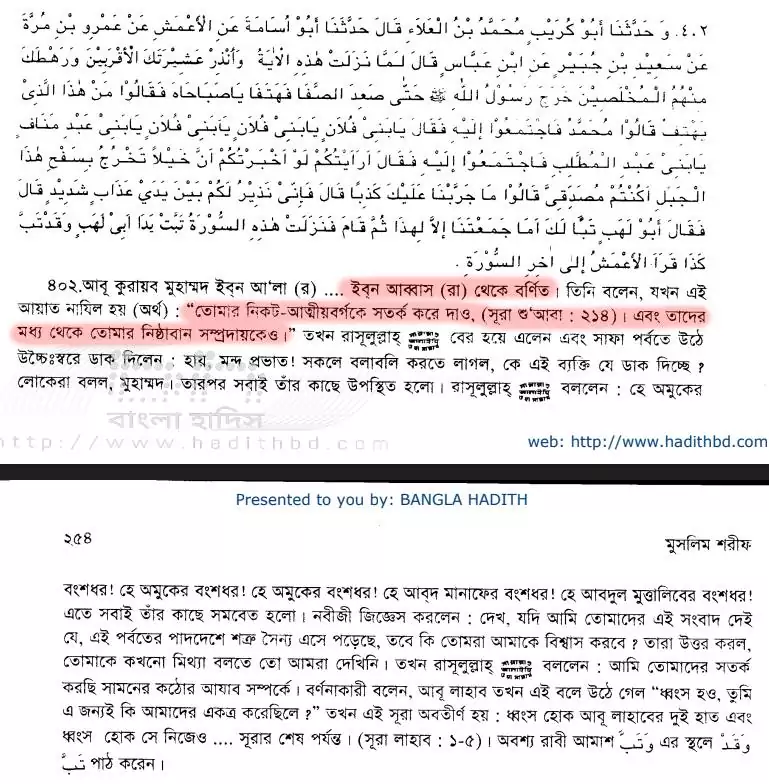
Here, the textual difference is of an entire phrase. After the words “warn your near relatives,” another group is specifically identified. In the additional part, the adjective of being chosen or devoted is added to the general identity of kinship. If the words are removed, that specific identification is also removed from the text. Whether that group already falls under the same instruction is a question of interpretation of meaning; whether the phrase is in the written Quran is a separate, directly verifiable question. The current verse and the account of revelation narrated in Muslim provide different readings for this second question.
| Position of the text | Preserved words | Nature of difference |
|---|---|---|
| Accepted verse of Ash-Shu’ara 26:214 | وَأَنْذِرْ عَشِيرَتَكَ الْأَقْرَبِينَ | Verse ends with instruction to warn near relatives |
| Account of revelation narrated by Ibn Abbas in Muslim | With this وَرَهْطَكَ مِنْهُمُ الْمُخْلَصِينَ | Additional phrase including mention of a specific group among them |
In explaining the position of this extra part, Nawawi understood it as Quran that was first revealed and later abrogated in recitation. In the editorial notes of the online version of Bagawi’s Tafsir, this explanation is quoted from his Sharh Sahih Muslim. The significance of Nawawi’s statement is that he did not remove the problem by denying the presence of the additional phrase; by acknowledging its previous Quranic status, he provided a theological explanation for its subsequent absence. [898]
فظاهر هذه العبارة أن قوله: ورهطك منهم المخلصين، كان قرآنا أنزل ثم نسخت تلاوته
English translation: The literal meaning of this statement is that “and from among them your chosen community”—this was revealed Quran; later its recitation was abrogated.
In this explanation by Nawawi, both a previous reading and its subsequent removal are recognized. The term “abrogated in recitation” provides authorization or a religious explanation for that change; it does not provide information that the words in the previous reading are also in the later mushaf. Here, no later critic is inventing lost words on their own. Sahih Muslim preserved the extra words, and its influential commentator himself accepted them as a previously revealed reading. The textual gap between the presence and absence of the specific phrase is visible between these two sources.
At the end of the same hadith, there is another specific piece of information regarding the reading. The report states that instead of the common “wa tabba” in the first verse of Surah Lahab, al-A’mash read “wa qad tabba”. Although the main discussion is the additional phrase in Ash-Shu’ara, this concluding comment shows that hadith narrators sometimes identified different Quranic readings they used or knew alongside the narrative of events. In the case of Ash-Shu’ara, it is an entire phrase, and in this mention of Lahab, it is an extra particle—the lengths are different, but in both cases, there is a verbal difference from the accepted verse.
Different readings of the boat’s position, the boat’s quality, and the boy’s identity in Al-Kahf 18:79–80
In the story of Musa and Khidr, there are three notable differences between the reading of Ibn Abbas and the accepted Quran. The first is in the word indicating the king’s position, the second is in the adjective for the boats the king was seizing, and the third is in the religious identity of the slain boy. These differences are directly related to the sequence of events and the interpretation of the same story. In the current verse, the helplessness of the boat owners and the faith of the boy’s parents are mentioned; in the reading preserved under the name of Ibn Abbas, more specific information is found. [899] [900]
أَمَّا السَّفِينَةُ فَكَانَتْ لِمَسَاكِينَ يَعْمَلُونَ فِي الْبَحْرِ فَأَرَدتُّ أَنْ أَعِيبَهَا وَكَانَ وَرَاءَهُم مَّلِكٌ يَأْخُذُ كُلَّ سَفِينَةٍ غَصْبًا
وَأَمَّا الْغُلَامُ فَكَانَ أَبَوَاهُ مُؤْمِنَيْنِ فَخَشِينَا أَن يُرْهِقَهُمَا طُغْيَانًا وَكُفْرًا
English translation: The boat belonged to several poor people who worked at sea. I wanted to make it defective; behind them was a king who seized every boat by force.
And the boy’s parents were believers. Therefore, we feared that he would distress them through disobedience and unbelief.
At the end of the long report in Bukhari, Sa’id ibn Zubayr clearly stated how Ibn Abbas read the relevant verses. The main story is narrated in the name of Muhammad through Ubayy ibn Ka’b; at the end, Sa’id’s separate comment about Ibn Abbas’s reading is added. Consequently, the narrator himself identified the main narrative of the story and the Quranic reading used by a Companion. [901] [902]
حَدَّثَنَا الْحُمَيْدِيُّ ، حَدَّثَنَا سُفْيَانُ ، حَدَّثَنَا عَمْرُو بْنُ دِينَارٍ ، قَالَ أَخْبَرَنِي سَعِيدُ بْنُ جُبَيْرٍ ، قَالَ قُلْتُ لاِبْنِ عَبَّاسٍ إِنَّ نَوْفًا الْبَكَالِيَّ يَزْعُمُ أَنَّ مُوسَى صَاحِبَ الْخَضِرِ لَيْسَ هُوَ مُوسَى صَاحِبَ بَنِي إِسْرَائِيلَ. فَقَالَ ابْنُ عَبَّاسٍ كَذَبَ عَدُوُّ اللَّهِ حَدَّثَنِي أُبَىُّ بْنُ كَعْبٍ أَنَّهُ سَمِعَ رَسُولَ اللَّهِ صلى الله عليه وسلم يَقُولُ ” إِنَّ مُوسَى قَامَ خَطِيبًا فِي بَنِي إِسْرَائِيلَ فَسُئِلَ أَىُّ النَّاسِ أَعْلَمُ فَقَالَ أَنَا فَعَتَبَ اللَّهُ عَلَيْهِ، إِذْ لَمْ يَرُدَّ الْعِلْمَ إِلَيْهِ فَأَوْحَى اللَّهُ إِلَيْهِ إِنَّ لِي عَبْدًا بِمَجْمَعِ الْبَحْرَيْنِ، هُوَ أَعْلَمُ مِنْكَ قَالَ مُوسَى يَا رَبِّ فَكَيْفَ لِي بِهِ قَالَ تَأْخُذُ مَعَكَ حُوتًا فَتَجْعَلُهُ فِي مِكْتَلٍ، فَحَيْثُمَا فَقَدْتَ الْحُوتَ فَهْوَ ثَمَّ، فَأَخَذَ حُوتًا فَجَعَلَهُ فِي مِكْتَلٍ ثُمَّ انْطَلَقَ، وَانْطَلَقَ مَعَهُ بِفَتَاهُ يُوشَعَ بْنِ نُونٍ، حَتَّى إِذَا أَتَيَا الصَّخْرَةَ وَضَعَا رُءُوسَهُمَا فَنَامَا، وَاضْطَرَبَ الْحُوتُ فِي الْمِكْتَلِ، فَخَرَجَ مِنْهُ، فَسَقَطَ فِي الْبَحْرِ فَاتَّخَذَ سَبِيلَهُ فِي الْبَحْرِ سَرَبًا، وَأَمْسَكَ اللَّهُ عَنِ الْحُوتِ جِرْيَةَ الْمَاءِ فَصَارَ عَلَيْهِ مِثْلَ الطَّاقِ فَلَمَّا اسْتَيْقَظَ، نَسِيَ صَاحِبُهُ أَنْ يُخْبِرَهُ بِالْحُوتِ، فَانْطَلَقَا بَقِيَّةَ يَوْمِهِمَا وَلَيْلَتَهُمَا، حَتَّى إِذَا كَانَ مِنَ الْغَدِ قَالَ مُوسَى لِفَتَاهُ آتِنَا غَدَاءَنَا لَقَدْ لَقِينَا مِنْ سَفَرِنَا هَذَا نَصَبًا قَالَ وَلَمْ يَجِدْ مُوسَى النَّصَبَ حَتَّى جَاوَزَ الْمَكَانَ الَّذِي أَمَرَ اللَّهُ بِهِ فَقَالَ لَهُ فَتَاهُ أَرَأَيْتَ إِذْ أَوَيْنَا إِلَى الصَّخْرَةِ فَإِنِّي نَسِيتُ الْحُوتَ وَمَا أَنْسَانِيهِ إِلاَّ الشَّيْطَانُ أَنْ أَذْكُرَهُ، وَاتَّخَذَ سَبِيلَهُ فِي الْبَحْرِ عَجَبًا قَالَ فَكَانَ لِلْحُوتِ سَرَبًا وَلِمُوسَى وَلِفَتَاهُ عَجَبًا فَقَالَ مُوسَى ذَلِكَ مَا كُنَّا نَبْغِي فَارْتَدَّا عَلَى آثَارِهِمَا قَصَصًا قَالَ رَجَعَا يَقُصَّانِ آثَارَهُمَا حَتَّى انْتَهَيَا إِلَى الصَّخْرَةِ، فَإِذَا رَجُلٌ مُسَجًّى ثَوْبًا، فَسَلَّمَ عَلَيْهِ مُوسَى. فَقَالَ الْخَضِرُ وَأَنَّى بِأَرْضِكَ السَّلاَمُ قَالَ أَنَا مُوسَى. قَالَ مُوسَى بَنِي إِسْرَائِيلَ قَالَ نَعَمْ أَتَيْتُكَ لِتُعَلِّمَنِي مِمَّا عُلِّمْتَ رَشَدًا. قَالَ إِنَّكَ لَنْ تَسْتَطِيعَ مَعِي صَبْرًا، يَا مُوسَى إِنِّي عَلَى عِلْمٍ مِنْ عِلْمِ اللَّهِ عَلَّمَنِيهِ لاَ تَعْلَمُهُ أَنْتَ وَأَنْتَ عَلَى عِلْمٍ مِنْ عِلْمِ اللَّهِ عَلَّمَكَ اللَّهُ لاَ أَعْلَمُهُ. فَقَالَ مُوسَى سَتَجِدُنِي إِنْ شَاءَ اللَّهُ صَابِرًا، وَلاَ أَعْصِي لَكَ أَمْرًا. فَقَالَ لَهُ الْخَضِرُ، فَإِنِ اتَّبَعْتَنِي فَلاَ تَسْأَلْنِي عَنْ شَىْءٍ حَتَّى أُحْدِثَ لَكَ مِنْهُ ذِكْرًا، فَانْطَلَقَا يَمْشِيَانِ عَلَى سَاحِلِ الْبَحْرِ، فَمَرَّتْ سَفِينَةٌ فَكَلَّمُوهُمْ أَنْ يَحْمِلُوهُمْ، فَعَرَفُوا الْخَضِرَ، فَحَمَلُوهُ بِغَيْرِ نَوْلٍ فَلَمَّا رَكِبَا فِي السَّفِينَةِ، لَمْ يَفْجَأْ إِلاَّ وَالْخَضِرُ قَدْ قَلَعَ لَوْحًا مِنْ أَلْوَاحِ السَّفِينَةِ بِالْقَدُومِ. فَقَالَ لَهُ مُوسَى قَوْمٌ حَمَلُونَا بِغَيْرِ نَوْلٍ، عَمَدْتَ إِلَى سَفِينَتِهِمْ فَخَرَقْتَهَا لِتُغْرِقَ أَهْلَهَا لَقَدْ جِئْتَ شَيْئًا إِمْرًا. قَالَ أَلَمْ أَقُلْ إِنَّكَ لَنْ تَسْتَطِيعَ مَعِي صَبْرًا. قَالَ لاَ تُؤَاخِذْنِي بِمَا نَسِيتُ وَلاَ تُرْهِقْنِي مِنْ أَمْرِي عُسْرًا ”. قَالَ وَقَالَ رَسُولُ اللَّهِ صلى الله عليه وسلم ” وَكَانَتِ الأُولَى مِنْ مُوسَى نِسْيَانًا قَالَ وَجَاءَ عُصْفُورٌ فَوَقَعَ عَلَى حَرْفِ السَّفِينَةِ فَنَقَرَ فِي الْبَحْرِ نَقْرَةً، فَقَالَ لَهُ الْخَضِرُ مَا عِلْمِي وَعِلْمُكَ مِنْ عِلْمِ اللَّهِ إِلاَّ مِثْلُ مَا نَقَصَ هَذَا الْعُصْفُورُ مِنْ هَذَا الْبَحْرِ ثُمَّ خَرَجَا مِنَ السَّفِينَةِ، فَبَيْنَا هُمَا يَمْشِيَانِ عَلَى السَّاحِلِ، إِذْ أَبْصَرَ الْخَضِرُ غُلاَمًا يَلْعَبُ مَعَ الْغِلْمَانِ، فَأَخَذَ الْخَضِرُ رَأْسَهُ بِيَدِهِ فَاقْتَلَعَهُ بِيَدِهِ فَقَتَلَهُ. فَقَالَ لَهُ مُوسَى أَقَتَلْتَ نَفْسًا زَاكِيَةً بِغَيْرِ نَفْسٍ لَقَدْ جِئْتَ شَيْئًا نُكْرًا. قَالَ أَلَمْ أَقُلْ لَكَ إِنَّكَ لَنْ تَسْتَطِيعَ مَعِي صَبْرًا قَالَ وَهَذَا أَشَدُّ مِنَ الأُولَى، قَالَ إِنْ سَأَلْتُكَ عَنْ شَىْءٍ بَعْدَهَا فَلاَ تُصَاحِبْنِي قَدْ بَلَغْتَ مِنْ لَدُنِّي عُذْرًا فَانْطَلَقَا حَتَّى إِذَا أَتَيَا أَهْلَ قَرْيَةٍ اسْتَطْعَمَا أَهْلَهَا فَأَبَوْا أَنْ يُضَيِّفُوهُمَا فَوَجَدَا فِيهَا جِدَارًا يُرِيدُ أَنْ يَنْقَضَّ ـ قَالَ مَائِلٌ ـ فَقَامَ الْخَضِرُ فَأَقَامَهُ بِيَدِهِ فَقَالَ مُوسَى قَوْمٌ أَتَيْنَاهُمْ فَلَمْ يُطْعِمُونَا، وَلَمْ يُضَيِّفُونَا، لَوْ شِئْتَ لاَتَّخَذْتَ عَلَيْهِ أَجْرًا. قَالَ {هَذَا فِرَاقُ بَيْنِي وَبَيْنِكَ} إِلَى قَوْلِهِ {ذَلِكَ تَأْوِيلُ مَا لَمْ تَسْطِعْ عَلَيْهِ صَبْرًا}. فَقَالَ رَسُولُ اللَّهِ صلى الله عليه وسلم ” وَدِدْنَا أَنَّ مُوسَى كَانَ صَبَرَ حَتَّى يَقُصَّ اللَّهُ عَلَيْنَا مِنْ خَبَرِهِمَا ” . قَالَ سَعِيدُ بْنُ جُبَيْرٍ فَكَانَ ابْنُ عَبَّاسٍ يَقْرَأُ وَكَانَ أَمَامَهُمْ مَلِكٌ يَأْخُذُ كُلَّ سَفِينَةٍ صَالِحَةٍ غَصْبًا، وَكَانَ يَقْرَأُ وَأَمَّا الْغُلاَمُ فَكَانَ كَافِرًا وَكَانَ أَبَوَاهُ مُؤْمِنَيْنِ.
English translation: Sahih Bukhari (Tawhid Publication)
65/ Tafsir of Quran Majeed
Chapter: 65/18/2. No chapter.
(وَإِذْ قَالَ مُوْسٰى لِفَتَاهُ لَا أَبْرَحُ حَتّٰىٓ أَبْلُغَ مَجْمَعَ الْبَحْرَيْنِ أَوْ أَمْضِيَ حُقُبًا) زَمَانًا وَجَمْعُهُ أَحْقَابٌ.
The word of Allah Ta’ala: Remember, when Musa said to his young companion: I will continue to travel until I reach the meeting point of the two seas, or I will travel for a long time. (Surah Al-Kahf 18/60)
حُقُبًا means era, its plural is أَحْقَابٌ.
4725. Humaidi narrated to us; he from Sufyan, he from Amr ibn Dinar. Amr said, Sa’id ibn Zubayr informed me. Narrated from Sa’id ibn Zubayr (ra). He said, I said to Ibn Abbas, Nawf al-Baqqali’s opinion is that Khidr’s companion Musa was not the Prophet Musa (as) of the Bani Isra’il. Ibn Abbas (ra) said, the enemy of Allah[1] has spoken lies. [Ibn Abbas (ra) said] Ubayy ibn Ka’ab (ra) told me, he heard the Messenger of Allah peace and blessings of Allah be upon him say, Musa (as) was once delivering a speech before the Bani Isra’il. He was asked, who is the most knowledgeable person? He said, I am. At this, Allah became displeased with him. Because he did not attribute this matter of knowledge to Allah. Allah sent revelation to him, at the junction of the two seas there is a servant of Mine, he is more knowledgeable than you. Musa (as) said, O Lord, how can I meet him? Allah said, take a fish with you and keep it in a basket, where the fish is lost, there is the place. Then he took a fish and kept it in the basket. Then he set out. And his servant ‘Yusha’ ibn Nun accompanied him.
When they arrived at a large rock by the seaside, they both fell asleep resting their heads upon it. At this time, the fish leaped inside the basket and went out of the basket into the sea. “The fish made a tunnel-like path and went down into the sea.” And from where the fish had gone, Allah stopped the flow of water and it became like a tunnel. When he awoke, his companion had forgotten to give him the news of the fish. They traveled for the rest of the day and the following night. When it was dawn, Musa (as) said to his servant, “Bring our morning meal, for we have become tired in this journey of ours.” The Messenger of Allah peace and blessings of Allah be upon him said, Musa (as) did not become tired before passing the place[2] that Allah had indicated. Then his servant said to him, “Did you notice, when we were resting on the rock, I had forgotten the matter of the fish. Satan had made me forget to say this. The fish miraculously made its own path and went down into the sea.”
The Messenger of Allah peace and blessings of Allah be upon him said, the fish had made its path into the sea and it had amazed Musa (as) and his servant. Musa (as) said: “We were searching for that very place.” Then they traveled back following their footprints. The Messenger of Allah peace and blessings of Allah be upon him said, they both returned to that rock following their footprints. There they found a person wrapped in cloth. Musa (as) gave him salam. Khidr (as) said, from where did ‘salam’ come to this place of yours? He said, I am Musa. Khidr (as) asked, Musa of the Bani Isra’il? He said, yes, I have come to you so that you may teach me from the knowledge of the true path that has been granted to you. He said, you will certainly not be able to have patience with me. O Musa! I have been granted some knowledge from the knowledge of Allah which you do not know, and the knowledge that Allah has granted you from His knowledge, I do not know.
Musa (as) said, “InshaAllah, you will find me patient and I will not disobey any of your commands.” Then Khidr (as) said to him, “Very well, if you follow me, then do not ask me about anything until I tell you about it.” Then both traveled. They began to travel along the seashore, then a boat was passing. They discussed with the boatmen about taking them on their boat. They recognized Khidr (as). Therefore, they took them on the boat without any remuneration. “When they both boarded the boat” Khidr (as) removed a plank of the boat with an axe. Musa (as) said to him, these people are carrying us without wages, yet you are damaging their boat. You pierced the boat so that the passengers may drown. You have done an unjust act, (Khidr said) did I not say that you will certainly not be able to have patience with me. Musa said, do not hold me accountable for my mistake and do not be excessively strict with me.”
The Messenger of Allah peace and blessings of Allah be upon him said, this first mistake of Musa (as) happened by error. He said, after this a sparrow came and sat by the side of the boat and struck the sea once with its beak. Khidr (as) said to Musa (as), as much water as the sparrow took in its beak from this sea, so is the knowledge of me and you compared to the knowledge of Allah. Then they got off the boat and began to travel along the seashore. In this state, Khidr (as) saw a boy playing with other boys. Khidr (as) grabbed the boy’s head with his hand, pulled it off, and killed him. Musa (as) said to Khidr (as), “Did you kill an innocent soul without a life in exchange? You have done an extreme unjust act.” He said, did I not tell you that you will certainly not be able to remain patient with me?”
The Prophet peace and blessings of Allah be upon him said, this accusation was more severe than the first one. [Musa (as) said] If I ask you about anything after this, then do not keep me with you; my excuse and objection to you have reached the peak. Then both traveled. Finally, they reached a settlement and asked its residents for food. But they refused to show them hospitality. Then there they saw a collapsing wall. The narrator says, it was leaning. Khidr (as) straightened it with his own hands. Musa (as) said, we came to these people, they did not give us food and did not show us hospitality. “You could have taken remuneration for this if you wished.” He said, here is the separation between you and me. …..The explanation of the matter upon which you could not have patience is this.”
The Messenger of Allah peace and blessings of Allah be upon him said, it is my heart’s desire that if Musa (as) had had a little more patience, then Allah would have informed us of more events. Sa’id ibn Zubayr (ra) said, Ibn Abbas (ra) used to recite this verse thus- وَكَانَ أَمَامَهُمْ مَلِكٌ يَأْخُذُ كُلَّ سَفِينَةٍ صَالِحَةٍ غَصْبًا
He recited the following verse thus- وَأَمَّا الْغُلَامُ فَكَانَ كَافِرًا وَكَانَ أَبَوَاهُ مُؤْمِنَيْنِ
Ibn Abbas used to read: there was a king before them, who used to forcibly take every flawless boat. And he used to read: the boy was a kafir and his parents were believers. [74] (Modern Publication: 4364, Islamic Foundation: 4366)
[1] Nawf al-Baqqali- he is a Muslim. Ibn Abbas called him the enemy of Allah in a state of anger.
[2] Place: where the fish is lost.
Hadith Grade: Sahih (Sahih)
Narrator: Sa’id ibn Zubayr (rh)
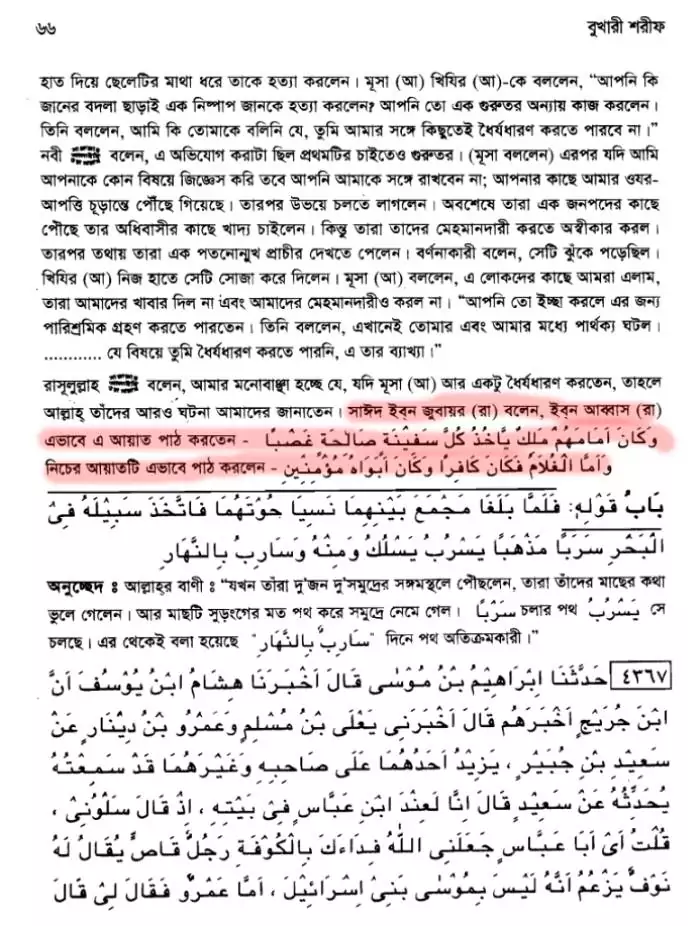
| Location | Words of the adopted verse | Reading narrated by Ibn Abbas | Visible difference |
|---|---|---|---|
| Kahf 18:79 | وَكَانَ وَرَاءَهُمْ مَلِكٌ | وَكَانَ أَمَامَهُمْ مَلِكٌ | Amamahum instead of Wara’ahum: replacement of words indicating behind/in front |
| Kahf 18:79 | كُلَّ سَفِينَةٍ | كُلَّ سَفِينَةٍ صَالِحَةٍ | Addition of adjective—flawless or good boat |
| Kahf 18:80 | فَكَانَ أَبَوَاهُ مُؤْمِنَيْنِ | فَكَانَ كَافِرًا وَكَانَ أَبَوَاهُ مُؤْمِنَيْنِ | Direct addition of the boy’s religious identity |
In the first difference, instead of “Wara’ahum” in the adopted reading, there is “Amamahum”. There is discussion in tafsir that the word “Wara” is used depending on context to denote an unseen position in front or behind; “Amam” directly indicates in front. Tabari has discussed the reading and meaning of the position in front in the explanation of this verse. Although it is possible to denote a position in front in both forms through explanation of meaning, the word used to express that meaning in Ibn Abbas’s reading is different. The expansion of a word’s meaning and reading another word in its place—these are two different events in the history of written texts. [903]
وقوله: ( وَكَانَ وَرَاءَهُمْ مَلِكٌ ) وكان أمامهم وقُدّامهم ملك.
English translation: And his words, “there was a king in their wara”—meaning there was a king in front of them, in their vanguard.
The second difference plays a more direct role in the logic of the story. In the adopted reading, the king would seize “every boat”. In the different reading, he would seize “every good or flawless boat”. If good boats are his target, then the act of removing a plank to make the boat flawed is directly understandable as a strategy to save the boat. Without the adjective “Saliha”, this explanation must be recovered from the sequence of events and Khidr’s actions; if the adjective is present, the king’s selection criteria are declared in the sentence itself. Consequently, the extra word is not an ornament, but information defining the limit of the seizure.
In the third difference, the boy’s own kufr is directly added. The adopted verse 80 begins with the information that the boy’s parents were believers, then comes the apprehension of future disobedience and kufr. In Ibn Abbas’s reading, before this is “the boy was a kafir”. Where the parents’ faith and the apprehension of future danger are primary in the current reading, the alternative reading also fixes the boy’s own religious identity. In the story of infanticide, the explanatory importance of this extra identity is strong: the reading carries a clear declaration regarding the moral and religious position of the deceased person.
The language of the report is not “Ibn Abbas interpreted the meaning this way”; Sa’id said he “read” it this way. If such a reading is called explanatory, shadh, or abrogated in subsequent discussions of qira’at and tafsir, that is its later classification. The language of the testimony preserved in Bukhari and the boundaries of later approval are not the same thing. Here, such a reading is preserved under the name of an influential Companion, in which word replacement, addition of an adjective, and a complete religious identity phrase are found simultaneously. In all three cases, the meaning of the story or its explanation has become more specific; in all three cases, there are differences with the words of the adopted mushaf.
Ibn Masud’s word order in Nur 24:27
How the instruction to greet and seek permission before entering a house should be arranged in Nur 24:27—a separate word order is found in the mushaf narrated under Ibn Masud’s name. In the adopted reading, first is “hatta tastanisu”, then “wa tusallimu ‘ala ahliha”—the matter of greeting the people of the house. In the form preserved under Ibn Masud’s name, the greeting comes first, then “wa tasta’dhinu”—the matter of seeking permission. Consequently, two changes are seen together in the same verse: a change of verb and a change in the order of instructions. Thus, the relationship between greeting and permission in the explanation of the etiquette of entering a house is the actual subject of the reading. Despite the same social regulation being expressed similarly, the verb and the position of the phrase in the verse are changing. Rough similarity in religious instruction does not establish identity of words here.
Tabari has called this form a reading present “in Ibn Masud’s mushaf” directly through the chain of Ibrahim. In the next report, the same order is found in Ibn Abbas’s reading as well, and the common word “tastanisu” has been termed a mistake by the scribes. The long discussion regarding the scribes’ mistake preserved in Ibn Kathir is Nur 24:27 — Seeking permission and “tastanisū” in the sub-section. In these two consecutive reports of Tabari, both the language and word order of the mushaf can be identified. [904]
حدثنا القاسم، قال: ثنا الحسين، قال: ثني هشيم، قال: أخبرنا مغيرة، عن إبراهيم، قال: في مصحف ابن مسعود: ” حَتَّى تُسَلِّمُوا على أهْلِها وَتَسْتَأْذِنُوا “.
قال: ثنا هشيم، قال: أخبرنا جعفر بن إياس، عن سعيد، عن ابن عباس أنه كان يقرؤها: ” يأيُّها الَّذِينَ آمَنُوا لا تَدْخُلُوا بُيُوتًا غَيْرَ بُيُوتِكُمْ حتى تُسَلِّمُوا عَلى أهْلِها وتَسْتَأْذِنوا ” قال: وإنما تستأنسوا وهم من الكتاب.
English translation: Qasim narrated to us. He says, Husayn narrated to us. He says, Hushaym narrated to me. He says, Mughira informed us, from Ibrahim. Ibrahim says: In Ibn Masud’s mushaf it was, “until you greet its residents and seek permission.”
He says, Hushaym narrated to us. He says, Ja’far ibn Yas informed us, from Sa’id, he from Ibn Abbas: Ibn Abbas used to read it thus, “O believers, do not enter houses other than your own, until you greet its residents and seek permission.” He says, “tastanisu” is a mistake of the scribes.
| Reading | First instruction | Subsequent instruction | Words and arrangement |
|---|---|---|---|
| Adopted Nur 24:27 | حَتَّى تَسْتَأْنِسُوا | وَتُسَلِّمُوا عَلَى أَهْلِهَا | Tastanisu first; greeting later |
| Description of Ibn Masud’s mushaf in Tabari | حَتَّى تُسَلِّمُوا عَلَى أَهْلِهَا | وَتَسْتَأْذِنُوا | Greeting first; seeking permission later |
| Reading of Ibn Abbas in the subsequent report | حَتَّى تُسَلِّمُوا عَلَى أَهْلِهَا | وَتَسْتَأْذِنُوا | Same order; direct objection against the common verb |
The word “tastanisu” can be explained in the sense of seeking permission, announcing presence, or ensuring the consent of the residents. But “tasta’dhinu” is the direct verb for seeking permission. In the form narrated by Tabari, that direct verb is present and the instruction to give greeting is placed before it. Therefore, the relationship between greeting and permission in the explanation of the etiquette of entering a house is the actual content of the reading. Despite the same social regulation being expressed closely, the verb and the position of the phrase in the verse are changing. Rough similarity in religious instruction does not establish identity of words here.
The special importance of the reading preserved in the name of the mushaf is in its material mention. Tabari did not just quote a speaker’s immediate explanation of meaning; he used the phrase “fi mushafi ibni Masud”—in Ibn Masud’s mushaf. According to that testimony, the alternative order was common as the identity of a written text. In the subsequent Ibn Abbas report, there is also an accusation against the common word. Consequently, one chain gives news of a written alternative, and another presents the same form directly as a reading. Although there is debate regarding the later religious acceptability of these two statements, the character of the alternative reading is clear in their preserved language.
The description of the mushaf in the name of Ibrahim and the reading of Ibn Abbas through Sa’id—Tabari has recorded them in separate chains. If the same statement is later quoted in another tafsir, it does not become an independent testimony of a new mushaf; however, the claims of two separate chains in Tabari’s original report cannot be merged either. The specific result of the reading is: alongside the adopted word order, there is a tradition of a written alternative that brings the greeting first and places the seeking of permission later.
Three readings of Baqarah 2:238: the middle prayer, the Asr prayer, and the mention of both
In the adopted reading of Baqarah 2:238, there is an instruction to maintain all prayers and specifically “as-salatul wusta”—the middle prayer. Placing two separate reports from Sahih Muslim side by side, three word-forms are found in this place. In one form, there is only a special mention of the middle prayer; in another, the Asr prayer in its place; in the third, both the middle prayer and the Asr prayer are present. In the case of the third form, Aisha stated that while having her mushaf written, she had the extra words written and reported that she heard them from Muhammad.
In the report of Bara ibn Azib, the form first revealed was “hafidhu ‘alas salawati wa salatil asr”—maintain the prayers and the Asr prayer. According to his statement, they read it for some days; then Allah abrogated it and “the middle prayer” came in place of “the Asr prayer”. Muslim has also preserved the words “read it for some time with the Prophet” in subsequent chains. Here, the state before and after the word replacement is distinguished within the description. [905]
حَدَّثَنَا إِسْحَاقُ بْنُ إِبْرَاهِيمَ الْحَنْظَلِيُّ ، أَخْبَرَنَا يَحْيَى بْنُ آدَمَ ، حَدَّثَنَا الْفُضَيْلُ بْنُ مَرْزُوقٍ ، عَنْ شَقِيقِ بْنِ عُقْبَةَ ، عَنِ الْبَرَاءِ بْنِ عَازِبٍ ، قَالَ نَزَلَتْ هَذِهِ الآيَةُ حَافِظُوا عَلَى الصَّلَوَاتِ وَصَلاَةِ الْعَصْرِ . فَقَرَأْنَاهَا مَا شَاءَ اللَّهُ ثُمَّ نَسَخَهَا اللَّهُ فَنَزَلَتْ { حَافِظُوا عَلَى الصَّلَوَاتِ وَالصَّلاَةِ الْوُسْطَى} فَقَالَ رَجُلٌ كَانَ جَالِسًا عِنْدَ شَقِيقٍ لَهُ هِيَ إِذًا صَلاَةُ الْعَصْرِ . فَقَالَ الْبَرَاءُ قَدْ أَخْبَرْتُكَ كَيْفَ نَزَلَتْ وَكَيْفَ نَسَخَهَا اللَّهُ . وَاللَّهُ أَعْلَمُ .
قَالَ مُسْلِمٌ وَرَوَاهُ الأَشْجَعِيُّ عَنْ سُفْيَانَ الثَّوْرِيِّ ، عَنِ الأَسْوَدِ بْنِ قَيْسٍ ، عَنْ شَقِيقِ بْنِ عُقْبَةَ ، عَنِ الْبَرَاءِ بْنِ عَازِبٍ ، قَالَ قَرَأْنَاهَا مَعَ النَّبِيِّ صلى الله عليه وسلم زَمَانًا . بِمِثْلِ حَدِيثِ فُضَيْلِ بْنِ مَرْزُوقٍ .
English translation: Ishaq ibn Ibrahim Hanzali narrated to us. Yahya ibn Adam informed us. Fudayl ibn Marzuq narrated to us, from Shaqiq ibn Ukba, he from Bara ibn Azib. Bara says: this verse was revealed, “maintain the prayers and the Asr prayer.” We read it for as long as Allah willed. Then Allah abrogated it and it was revealed, “maintain the prayers and the middle prayer.” A person sitting with Shaqiq said to him, then it is the Asr prayer itself. Bara said, I have informed you how it was revealed and how Allah abrogated it. Allah knows best.
Muslim says: Ashja’i also narrated this through Sufyan Sawri; he from Aswad ibn Qays, he from Shaqiq ibn Ukba, he from Bara ibn Azib. Bara says, we read this reading for some time with the Prophet. Similar to the hadith of Fudayl ibn Marzuq.
In Bara’s words, a relative identity has come in place of the name of a specific prayer. “Asr” is a known name; the identity “middle” requires explanation to determine which prayer it indicates. Therefore, the listener of that report immediately drew the conclusion that the middle prayer is Asr. In response, Bara again mentioned the event of revelation and abrogation. His answer does not erase the difference between the previous and subsequent word-forms; the subject of the history he is reporting is the revelation of one phrase in place of another.
The writing of “the middle prayer” and “the Asr prayer” together in the mushafs of Aisha and Hafsa Preserved Account gives a third form. In Bara’s account, the mention of Asr is replaced by the middle prayer; in the description of their mushaf, both mentions are present side by side. The results of these two events are therefore different. In the first, one identity has been established in place of another, while in the second, an additional identity has been written with a conjunction. Aisha’s claim of hearing this from Muhammad establishes the claim that this joint form is also a reading received from the Prophet.
| form preserved in the source | specifically mentioned prayer | verbal state of the reading |
|---|---|---|
| Accepted Baqarah 2:238: وَالصَّلَاةِ الْوُسْطَى | middle prayer | the name Asr is not separately present |
| Bara’s previous reading: وَصَلَاةِ الْعَصْرِ | Asr prayer | the name of Asr in place of the middle prayer |
| reading dictated by Aisha: وَالصَّلَاةِ الْوُسْطَى وَصَلَاةِ الْعَصْرِ | middle prayer and Asr prayer | both mentions are present; with the conjunction ‘waw’ in between |
“By middle prayer, Asr is meant”—this is an interpretative conclusion. The written structure of the reading quoted by Aisha is more specific: there, the second mention is joined by the conjunction “waw” after the first mention. Whether the same prayer is emphasized with two identities, or whether the two prayers are distinct—these discussions pertain to the interpretation of that language. The core verbal fact is that “wa salatil asr” is not in the accepted reading, but it is in the reading dictated by Aisha. Even if that extra part is accepted as an explanation of meaning, the event of her having it written in the mushaf and the claim of hearing it from Muhammad remain in her account.
When these three forms are placed together, the difference between a change in reading and a plurality of readings is also captured. Bara’s account itself declares a history of two readings, before and after. Aisha’s account testifies to having both mentions written together in a personal mushaf. If the three are taken as a single identical sentence, both the information regarding the replacement in the first account and the addition in the second account are lost. The primary instruction for performing prayer is maintained in all three forms; but on the question of exactly in what language the name of which prayer will be pronounced separately, the readings are not one.
Abu Darda–Ibn Masud’s reading in Layl 92:3 and refusal to read the conventional portion
The accepted reading of the third verse of Surah Layl is “wa ma khalaqaz zakara wal unsa”—By Him who created the male and the female. In the encounter between the reading traditions of Abu Darda and Ibn Masud described in Bukhari, the form of the verse is “waz zakari wal unsa”—By the male and the female. The part “wa ma khalaqa” is not in that reading. Abu Darda’s position regarding this absence is also unambiguous: others wanted him to read it with the extra part, but he swore that he would not follow them.
The event is narrated through the arrival of Abdullah Ibn Masud’s companions or disciples to Abu Darda. Abu Darda first wants to know among them who follows Abdullah’s reading and who has preserved it well. When Alqama is pointed out, he asks for the reading of a specific surah. Abu Darda gives testimony of hearing Muhammad directly in support of the form Alqama states. He then declares his refusal against the pressure to read the accepted longer form. [906]
حَدَّثَنَا عُمَرُ ، حَدَّثَنَا أَبِي ، حَدَّثَنَا الأَعْمَشُ ، عَنْ إِبْرَاهِيمَ ، قَالَ قَدِمَ أَصْحَابُ عَبْدِ اللَّهِ عَلَى أَبِي الدَّرْدَاءِ فَطَلَبَهُمْ فَوَجَدَهُمْ فَقَالَ أَيُّكُمْ يَقْرَأُ عَلَى قِرَاءَةِ عَبْدِ اللَّهِ قَالَ كُلُّنَا. قَالَ فَأَيُّكُمْ يَحْفَظُ وَأَشَارُوا إِلَى عَلْقَمَةَ . قَالَ كَيْفَ سَمِعْتَهُ يَقْرَأُ {وَاللَّيْلِ إِذَا يَغْشَى}. قَالَ عَلْقَمَةُ {وَالذَّكَرِ وَالأُنْثَى}. قَالَ أَشْهَدُ أَنِّي سَمِعْتُ النَّبِيَّ صلى الله عليه وسلم يَقْرَأُ هَكَذَا، وَهَؤُلاَءِ يُرِيدُونِي عَلَى أَنْ أَقْرَأَ {وَمَا خَلَقَ الذَّكَرَ وَالأُنْثَى} وَاللَّهِ لاَ أُتَابِعُهُمْ.
English translation: Umar narrated to us. He said, my father narrated to us. He said, A’mash narrated to us, from Ibrahim. Ibrahim said: Abdullah’s companions came to Abu Darda. He sought them out and said, who among you reads according to Abdullah’s reading? They said, all of us. He said, who among you has preserved it? They pointed toward Alqama. He asked, how did you hear him read “wal layli itha yaghsha”? Alqama said, “waz zakari wal unsa”—By the male and the female. Abu Darda said, I testify that I heard the Prophet read it this way. And these people want to force me to read “wa ma khalaqaz zakara wal unsa”—By Him who created the male and the female. By Allah, I will not follow them.
| Reading | Arabic form | direct subject of the sentence |
|---|---|---|
| Accepted Layl 92:3 | وَمَا خَلَقَ الذَّكَرَ وَالْأُنْثَى | Creator of male and female; the act of creation in the common alternative explanation regarding “ma” |
| Ibn Masud’s reading as narrated by Alqama; form supported by Abu Darda | وَالذَّكَرِ وَالْأُنْثَى | directly male and female |
| Abu Darda’s declared position | وَاللَّهِ لَا أُتَابِعُهُمْ | refusal with an oath to accept the longer form |
In this difference, the subject of the oath sentence changes. In the accepted form, the act of creation is present; in the short form, the male and female themselves are the direct subjects of the oath. There is room for linguistic interpretation as to whether “ma” in the longer form refers to the Creator or the act of creation. In the short form, both that particle and verb are absent. Consequently, even if the religious meanings of both readings are interpreted to be close, their sentence structures are not identical. The presence or absence of a phrase with a verb is a completely different type of textual variation than a difference in pronunciation or stress.
Abu Darda’s reaction is the sharpest part of this account. He did not express a preference between two equally acceptable forms of the same reading. He directly refused to accept the form he was being told to read and claimed to have heard his own form from the voice of Muhammad. Alqama stated that he heard the same form from Ibn Masud. The account thus provides reports of both the agreement between two companion-centered reading chains and the pressure to accept a different form in their known environment.
In Abu Darda’s statement, the basis of the reading’s authority is his own auditory memory. In conflict with those who wanted him to read the longer form, he established his reading as Muhammad’s reading. The position of the longer form in the accepted mushaf and its rejection by this companion are preserved together. Subsequent acceptance here does not testify to prior consensus. In the scene preserved in Bukhari, there is a clear disagreement over the determination of acceptable words and an oath to remain steadfast in that disagreement.
Dispute between Umar, Zayd, and Ubayy over the “waw” of Tawbah 9:100
Verse 100 of Tawbah mentions the Muhajirun, the Ansar, and those who followed them in goodness. In an account preserved in Tabari, Umar read the “walladhina”—and those—part of this verse without the “waw” and made the inflection of the word “Ansar” different from the accepted form. Zayd ibn Thabit informed him of the reading with the conjunction. When Umar repeated his own form, Zayd withdrew, saying “the Commander of the Faithful knows best.” Later, when Ubayy ibn Ka’b was called, he provided the same form with the conjunction as Zayd had, and Umar said he would follow him. [907]
17118- حدثني به أحمد بن يوسف قال، حدثنا القاسم قال، حدثنا حجاج, عن هارون, عن حبيب بن الشهيد, وعن ابن عامر الأنصاري: أن عمر بن الخطاب قرأ: (وَالسَّابِقُونَ الأوَّلُونَ مِنَ المُهَاجِرِينَ وَالأنْصَارُ الَّذِينَ اتَّبَعُوهُمْ بِإِحْسَانٍ)، فرفع ” الأنصار ” ولم يلحق الواو في ” الذين “, فقال له زيد بن ثابت ” والذين اتبعوهم بإحسان “, فقال عمر: ” الذين اتبعوهم بإحسان “، فقال زيد: أمير المؤمنين أعلم! فقال عمر: ائتوني بأبيّ بن كعب. فأتاه، فسأله عن ذلك, فقال أبي: (والذين اتبعوهم بإحسان)، فقال عمر: إذًا نتابع أبَيًّا.
English translation: 17118—Ahmad ibn Yusuf narrated this to me. He said, Qasim narrated to us. He said, Hajjaj narrated to us, from Harun, he from Habib ibn Shahid and from Ibn Amir Ansari: Umar ibn al-Khattab read, “was sabiqunal awwaluna minal muhajirina wal ansarulladhinat taba’uhum bi ihsan.” He gave the word “Ansar” a nominative (damma) ending and did not add the waw before “alladhina.” Zayd ibn Thabit said to him, “walladhinat taba’uhum bi ihsan”—and those who followed them in goodness. Umar said, “alladhinat taba’uhum bi ihsan”—those who followed them in goodness. Zayd said, the Commander of the Faithful knows best. Umar said, bring Ubayy ibn Ka’b to me.
Ubayy came to him. He asked him about the matter. Ubayy said, “walladhinat taba’uhum bi ihsan.” Umar said, then we shall follow Ubayy.
| Subject | form narrated in the name of Umar | accepted form supported by Zayd and Ubayy |
|---|---|---|
| inflection of the word Ansar | وَالْأَنْصَارُ — with pesh | وَالْأَنْصَارِ — with zer |
| conjunction before the identity of the followers | الَّذِينَ اتَّبَعُوهُمْ — no waw at the beginning | وَالَّذِينَ اتَّبَعُوهُمْ — waw at the beginning |
| relationship of the phrases | the identity of the followers is joined to the word Ansar | the followers are joined independently after the predecessors of the Muhajirun and Ansar |
| final decision of the account | Umar first repeats his own form | follows the reading after Ubayy’s testimony |
Here, the question of who is placed as a separate group in the sentence is linked to the presence of a single letter. In the accepted reading, the phrase “minal muhajirina wal ansar”—among the Muhajirun and Ansar—refers to the predecessors of both groups. Then another group is added by saying “and those who followed them in goodness.” In the form narrated in Umar’s name without the inflection and conjunction, this relationship changes. Consequently, if the dispute is viewed merely as a small difference in the number of letters, the change in the position of social groups in the sentence is omitted.
In another account in Tabari through Muhammad ibn Ka’b regarding the same verse, the question of status is explicitly voiced. After hearing someone read the verse, Umar takes him to Ubayy and asks Ubayy whether he himself heard this reading from Muhammad. After Ubayy says yes, Umar states that he thought they had been raised to such a height that no one among the later ones could reach. In response, Ubayy quotes three more verses in favor of the recognition of later believers. [908]
17117- حدثنا أبو كريب قال, حدثنا الحسن بن عطية قال، حدثنا أبو معشر, عن محمد بن كعب القرظي قال: مرّ عمر بن الخطاب برجل يقرأ: (والسابقون الأولون من المهاجرين والأنصار)، حتى بلغ: (ورضوا عنه)، قال: وأخذ عمر بيده فقال: من أقرأك هذا؟ قال: أبي بن كعب ! فقال: لا تفارقني حتى أذهب بك إليه ! فلما جاءه قال عمر: أنت أقرأت هذا هذه الآية هكذا؟ قال: نعم! قال: أنت سمعتها من رسول الله صلى الله عليه وسلم؟ قال: نعم! قال: لقد كنت أظن أنّا رُفِعنا رَفْعة لا يبلغها أحدٌ بعدنا! فقال أبيّ: بلى، تصديق هذه الآية في أول سورة الجمعة: وَآخَرِينَ مِنْهُمْ لَمَّا يَلْحَقُوا بِهِمْ ، إلى: وَهُوَ الْعَزِيزُ الْحَكِيمُ ، وفي سورة الحشر: وَالَّذِينَ جَاءُوا مِنْ بَعْدِهِمْ يَقُولُونَ رَبَّنَا اغْفِرْ لَنَا وَلإِخْوَانِنَا الَّذِينَ سَبَقُونَا بِالإِيمَانِ ، وفي الأنفال: وَالَّذِينَ آمَنُوا مِنْ بَعْدُ وَهَاجَرُوا وَجَاهَدُوا مَعَكُمْ فَأُولَئِكَ مِنْكُمْ ، إلى آخر الآية.
English translation: 17117—Abu Kuraib narrated to us. He said, Hasan ibn Atiyya narrated to us. He said, Abu Ma’shar narrated to us, from Muhammad ibn Ka’b Qurazi. He said: Umar ibn al-Khattab passed by a person reading this verse, “the first predecessors among the Muhajirun and Ansar”—while reading, he reached “and they are also pleased with him.” Umar took him by the hand and said, who taught you to read this way? He said, Ubayy ibn Ka’b. Umar said, you shall not be separate from me until I take you to him. Coming to him, Umar said, did you teach this person the verse this way? He said, yes. Umar said, did you hear it yourself from the Messenger of Allah? He said, yes. Umar said, I thought we had been raised to such a high status that no one after us could reach it. Ubayy said, certainly; the support for this verse is at the beginning of Surah Jumu’ah: “And for others among them who have not yet joined them”—until “and He is the Almighty, the All-Wise.” In Surah Hashr it is: “And those who came after them say, our Lord, forgive us and our brothers who preceded us in faith.” In Anfal it is: “And those who believed later, emigrated, and fought alongside you, they are also among you”—until the end of the verse.
In this account, the dispute over words and the notion of the exclusive status of the predecessors are present side by side. The account does not suggest that Umar’s surprise was merely about a sound; his own declared notion is related to the possibility of later ones achieving status. Ubayy also did not teach rules of pronunciation in response. He brought other verses to establish the meaning that there is a place for later believers. Consequently, the dispute over the conjunction of the reading was linked to the question of who in the religious society is included in the promised reward and recognition.
Zayd’s words “the Commander of the Faithful knows best” also reveal the political dimension of the event. After raising an objection by stating the specific words of the verse, he spoke a sentence of obedience toward the Caliph’s knowledge. Then Ubayy’s testimony was sought, and the final decision went in favor of his reading. That is, in the described process, personal memory, the authority of religious textual knowledge, and the position of the ruler are all operating in the same discussion. In this scene of resolving disagreement over the determined reading, human testimony and mutual correction are the visible methods.
In his decision, Tabari accepted the zer of the word “Ansar” and the waw of “walladhina.” In his explanation, the followers are a separate group from the Muhajirun and Ansar; and the form with the conjunction is present in the mushafs of the Muslims. This subsequent accepted position stands against the different reading preserved in Umar’s name. In the same verse 100, there is another difference in regional copies between “tajri tahtaha” and “tajri min tahtiha”; that is a textual variation in another place. The subject of this dispute between Umar and Ubayy was the waw and inflection of the preceding group-based portion. [909]
قال أبو جعفر: والقراءة التي لا أستجيز غيرها، الخفضُ في (الأنْصَارِ), لإجماع الحجة من القرأة عليه, وأن السابق كان من الفريقين جميعًا، من المهاجرين والأنصار، وإنما قصد الخبر عن السابق من الفريقين، دون الخبر عن الجميع = وإلحاق ” الواو ” في ” الذين اتبعوهم بإحسان “, (8) لأن ذلك كذلك في مصاحف المسلمين جميعًا, على أن ” التابعين بإحسان “، غير ” المهاجرين والأنصار “، وأما ” السابقون “، فإنهم مرفوعون بالعائد من ذكرهم في قوله: (رضي الله عنهم ورضوا عنه).
English translation: Abu Ja’far says: The reading other than which I do not approve is giving the zer to the word “Ansar”; because the authoritative readers agree on this and the predecessors were from both groups—Muhajirun and Ansar. Here, the purpose is to give news of the predecessors of both groups, not news about everyone. And adding the waw before “those who followed them in goodness”; because it is thus in all the mushafs of the Muslims and those who followed in goodness are separate from the Muhajirun and Ansar. The word “As-Sabikun” is in the raf state because of the pronoun returning to them in the phrase “Allah is pleased with them and they are pleased with Him.”
In Ma’idah 5:89, “mutatabi’at” and the ruling on performing the expiation fasts consecutively
In Ma’idah 5:89, as expiation for breaking an oath, there is a directive for fasting for three days in cases of inability after the alternatives of providing food, clothing, or freeing a slave. In the accepted reading, the number of fasting days is three; there is no adjective there stating that the days must be consecutive. In the reading preserved under Ibn Masud’s name, the word “mutatabi’at”—consecutive—appears in this place. Due to the addition of a word, a mandatory condition of continuity is created along with the directive to perform three fasts. Thus, the impact of this textual variant reaches directly into the application of the ruling.
In the explanation of the verse, Qurtubi explicitly documented this additional reading of Ibn Masud and the opinions of the jurists who accepted the condition of consecutive fasting based on it. Abu Hanifa, Sufyan al-Thawri, and one opinion of Shafi’i limit the open directive based on this reading. Another opinion of Malik and Shafi’i considers fasting separately to be sufficient, as there is no acceptable evidence in their account to make continuity mandatory. The textual variant of the same verse has thus become the basis for two different practical rulings. [910]
الثانية والأربعون : قوله تعالى : فصيام ثلاثة أيام قرأها ابن مسعود ( متتابعات ) فيقيد بها المطلق ; وبه قال أبو حنيفة والثوري ، وهو أحد قولي الشافعي واختاره المزني قياسا على الصوم في كفارة الظهار ، واعتبارا بقراءة عبد الله ، وقال مالك والشافعي في قوله الآخر : يجزئه التفريق ; لأن التتابع صفة لا تجب إلا بنص أو قياس على منصوص وقد عدما .
English translation: Forty-second discussion: The word of Allah, “then fast for three days.” Ibn Masud read this as “mutatabi’at”—consecutive. By this, the open directive is limited. Abu Hanifa and Thawri adopted this view. This is one of two opinions of Shafi’i; Muzani also chose this. This decision is based on a comparison with the fasts for the expiation of zihar and consideration of Abdullah’s reading. Malik and Shafi’i, in his other opinion, stated that fasting separately is sufficient; because continuity is a condition that becomes mandatory only through clear evidence or comparison with a matter supported by clear evidence, and both are absent here.
| Reading or Interpretation | Language of the three-day fast | Legal consequence |
|---|---|---|
| Accepted Ma’idah 5:89 | فَصِيَامُ ثَلَاثَةِ أَيَّامٍ | Directive for three days of fasting; no adjective for continuity |
| Reading preserved under Ibn Masud’s name | فَصِيَامُ ثَلَاثَةِ أَيَّامٍ مُتَتَابِعَاتٍ | Condition of three consecutive days of fasting |
| Accepting the additional reading as evidence | Mutatabi’at limits the ruling | Completing three days with breaks is not sufficient |
| Opinion stating separate fasting is sufficient | Open directive of the accepted reading remains | Expiation is fulfilled even if there are breaks within the three days |
The number of days and the mutual relationship between the days are two distinct conditions. To complete “three days,” it is possible to fast every other day; to complete “three consecutive days,” that gap is not allowed. In Qurtubi’s discussion, the disagreement arose because the word “mutatabi’at” imposes this additional ruling. If the additional reading were merely a repetition of a meaning already inevitable from the verse, this difference regarding the validity of separate fasting would not have occurred. The preserved point of contention is exactly how much legal authority an adjective absent from the accepted mushaf will carry.
Another type of explanation regarding the removal of this word is also preserved. IslamQA quoted the statement of Ibn Hajar Haytami, mentioning that the word “consecutive” was read as having fallen out, as narrated under Aisha’s name. Haytami called it a clear indication of naskh or abrogation and, from the same report, opposed the decision to make continuity mandatory. [911]
صح عن عائشة رضي الله عنها : ( كان فيما أنزل ثلاثة أيام متتابعات فسقطت متتابعات ) ، وهو ظاهر في النسخ ، خلافًا لمن جعله ظاهرًا في وجوب التتابع الذي اختاره كثيرون ، وأطالوا في الاستدلال له بما أطال الأولون في رده
English translation: It has been reliably narrated from Aisha: “Among the words revealed was ‘three consecutive days’; later the word ‘consecutive’ fell out.” This is a clear indication of abrogation; it is contrary to the statements of those who took it as a clear indication that continuity is mandatory. Many have chosen the opinion of that mandatory nature and provided long arguments in its favor; the first party has also engaged in long discussions in rejecting those.
Two separate decisions are seen here regarding the religious status of the absent word. Some jurists have taken it as a usable legal evidence even outside the accepted Quran. In another interpretation, the removal of the word is used in favor of the abolition of its mandatory power. Based on both discussions, there is a specific textual difference: the word is not in the accepted verse, but it is in the reading of the relevant Companion. The judgment following the determination of religious acceptability decides what the result of that difference will be.
The history of this one word demonstrates the limits of the concept of “same meaning, only different reading styles.” In the account of one party, three fasts are sufficient; in the account of the other, they are insufficient if not consecutive. Whether the religious obligation of an ordinary follower has been fulfilled—the answer to that also changes. If a Companion-reading identified outside the Quran is kept effective in formulating rulings, the boundary of the accepted text and the boundary of the elements of religious law become separate. “Mutatabi’at” is a specific, legally consequential example of that gap.
Description of the presence-absence of complete words or letters in Uthmanic regional copies
There are descriptions of written differences even among Uthman’s authorized regional copies. Abu Amr Dani has a separate chapter for this in his book “Al-Muqni fi Rasmi Masahif al-Amsar.” In the very name of the chapter, the mushafs of Hijaz, Iraq, and Sham are described as unmentioned relative to the original mushaf, and their differences are identified as “ziyada” and “nuqsan”—increase and decrease. Thus, the information that multiple written forms existed within official recognition is the subject of the book itself. [912]
باب ذكر ما اختلفت فيه مصاحف أهل الحجاز والعراق والشام المنتسخة من الإمام بالزيادة والنقصان
English translation: The chapter describing the differences of increase and decrease among the mushafs of the inhabitants of Hijaz, Iraq, and Sham, which are unmentioned relative to the original mushaf.
Dani stated at the beginning that he heard these matters from multiple teachers. One of his first examples is Baqarah 2:116: in the Sham copy, “qaluttakhadhallahu walada”—they said, Allah has taken a son; in other copies, it is “wa qalu” with a waw at the beginning. This is not a difference in placing vowel marks; the connecting letter is written in some copies and not in others. The language of the description also specified exactly that presence-absence. [913]
وهذا الباب سمعناه من غير واحد من شيوخنا من ذلك في البقرة في مصاحف أهل الشام ” قالوا اتخّذ الله ولداً ” بغير واو قبل ” قالوا ” وفي سائر المصاحف ” وقالوا ” بالواو
English translation: We have heard the subject of this chapter from our multiple teachers. One of them is in Surah Baqarah, in the mushaf of the inhabitants of Sham, “qaluttakhadhallahu walada”—without a waw before “qalu”; and in all other mushafs, “wa qalu”—with a waw.
In Ma’idah 5:53, the same type of connecting difference is found regionally. According to Dani, in the copies of Medina, Mecca, and Sham, it is “yaqululladhina amanu”; in Kufa, Basra, and other copies of Iraq, it is “wa yaqul.” Both the names of the regions and which letter is where are specified in the book. Consequently, all these differences cannot be explained by “only different vowel marks on the same rasm.” Even without vowel marks, the difference between writing and not writing the waw remains in the written structure. [914]
وفي مصاحف أهل المدينة ومكة والشام ” يقول الذين ءامنوا ” بغير واو قبل ” يقول ” وفي مصاحف أهل الكوفة والبصرة وسائر العراق ” ويقول ” بالواو
English translation: In the mushafs of the inhabitants of Medina, Mecca, and Sham, it is “yaqululladhina amanu”—without a waw before “yaqul.” And in the mushafs of the inhabitants of Kufa, Basra, and other parts of Iraq, it is “wa yaqul”—with a waw.
In some examples, the presence of a letter also changes the form of the verb or the reference of the pronoun. In Isra 17:93, “qala” means he said, and “qul” means say. In Kahf 18:36, “minhuma” refers to two things, and “minha” to one feminine thing. Dani identified an alif in the first case and an additional mim in the second. In his description, these are not ornamental spellings of the same word; they are differences between narrated verb and command, and dual and singular, respectively. [915]
وفي سبحان في مصاحف أهل مكة والشام ” قال سبحان ربي هل كنت ” بألف وفي سائر المصاحف ” قل ” بغير ألف وفي الكهف في مصاحف أهل المدينة ومكة والشام ” خيرا منهما منقلبا ” بزيادة ميم بعد الهاء على التثنية وفي سائر مصاحف أهل العراق ” منها ” بغير ميم على التوحيد
English translation: In Surah Subhan, namely Isra, in the mushafs of the inhabitants of Mecca and Sham, it is “qala subhana rabbi hal kunta”—with an alif. In all other mushafs, it is “qul”—without an alif. In Surah Kahf, in the mushafs of the inhabitants of Medina, Mecca, and Sham, it is “khayram minhuma munqalaba”—with an additional mim after the ha to denote the dual. And in other mushafs of the inhabitants of Iraq, it is “minha”—without the mim to denote the singular.
| Location | One regional form | Another regional form | Difference |
|---|---|---|---|
| Baqarah 2:116 | Sham: قَالُوا اتَّخَذَ اللَّهُ وَلَدًا | Other copies: وَقَالُوا | Waw absent/present at the beginning |
| Ma’idah 5:53 | Medina, Mecca, Sham: يَقُولُ الَّذِينَ آمَنُوا | Kufa, Basra and other Iraqi copies: وَيَقُولُ | Waw absent/present at the beginning |
| Tawbah 9:107 | Medina, Sham: الَّذِينَ اتَّخَذُوا مَسْجِدًا ضِرَارًا | Other copies: وَالَّذِينَ | Waw absent/present at the beginning |
| Isra 17:93 | Mecca, Sham: قَالَ سُبْحَانَ رَبِّي | Other copies: قُلْ سُبْحَانَ رَبِّي | Alif present/absent; he said/say |
| Kahf 18:36 | Medina, Mecca, Sham: خَيْرًا مِنْهُمَا مُنْقَلَبًا | Iraqi copy: خَيْرًا مِنْهَا مُنْقَلَبًا | Mim present/absent; from two/from one |
| Anbiya 21:30 | Mecca: أَلَمْ يَرَ الَّذِينَ كَفَرُوا | Other copies: أَوَلَمْ يَرَ الَّذِينَ كَفَرُوا | Waw absent/present between hamza and lam |
The scope of these differences is also not uniform. The addition or subtraction of a connector changes how a sentence is linked to the previous statement. “Qala” and “qul” create a difference between the narration of an event and the command to tell someone. “Minhuma” and “minha” change the number of the referred objects. In the story of the two gardens of Kahf, the dual and singular of that pronoun are therefore meaningful grammatical distinctions. Although the impact varies in different places, every example is a specific exception to the question of the literal identity of the copies.
These multiple forms of the official mushaf also give a regional basis to the authorization of readings. One form matches the Medina or Sham copy, another matches the Kufa or Basra copy. In Dani’s list, personal readings outside the accepted scope and official regional forms are seen as separate matters. The meaning of official collection authorization here is not merely a copy of a uniform string of letters; multiple written forms in specific places exist within that authorized scope.
Comparative readings of Al Imran 3:133, Hadid 57:24, Shams 91:15 and Tawbah 9:100
Connecting waw in Al Imran 3:133: In the accepted widely used reading, the verse begins with “wa sari’u”—and hasten. Qurtubi explicitly stated that in the Medina and Sham copies, it is “sari’u” without the initial waw. He also aligned the readings of Nafi and Ibn Amir with that regional form. In this case, the written structure of the copy and the form followed by the reciter are in the same discussion. [916]
الأولى : قوله تعالى : وسارعوا قرأ نافع وابن عامر ” سارعوا ” بغير واو ; وكذلك هي في مصاحف أهل المدينة وأهل الشام . وقرأ باقي السبعة وسارعوا .
English translation: First discussion: The word of Allah “wa sari’u”. Nafi and Ibn Amir read “sari’u”, without the waw. It is also thus in the mushafs of the inhabitants of Medina and Sham. The others among the seven reciters read “wa sari’u”.
In the form with the waw, the command is linked to the previous sentence through a connector; in the form without the waw, the command begins directly. Qurtubi also brought the difference in sentence connection of the two forms in Abu Ali’s explanation: in one there is an explicit connector, in the other the connection is understood from the relationship of the statements. In both forms, there is a command to hasten toward forgiveness, but the beginning of the written sentence is not the same. The evidence of the presence of the waw in the copy and the evidence of its absence identify this literal difference up to specific regions.
The complete word “huwa” in Hadid 57:24: In one form of this verse, it is “fa innallaha huwal ghaniyyul hamid”—indeed Allah, He is the Independent, the Praiseworthy. In another form, “huwa” is absent: “fa innallahal ghaniyyul hamid”. In “Dalilul Hayran ala Mawridiz Zam’an”, the description quoted from Dani’s “Al-Muqni” makes it clear that the word is absent in the Medina and Sham copies and present in other copies. The difference here is a distinct pronoun, a complete word. [917]
وَالْمَوْضِعُ الرَّابِعَ عَشَرَ: “هُوَ” مِنْ قَوْلِهِ تَعَالَى فِي السُّورَةِ الْمَذْكُورَةِ: وَمَنْ يَتَوَلَّ فَإِنَّ اللَّهَ هُوَ الْغَنِيُّ الْحَمِيدُ ، قَالَ فِي “الْمُقْنِعِ”: وَفِيهَا أَيْ: فِي “الْحَدِيدِ” فِي مَصَاحِفِ أَهْلِ الْمَدِينَةِ وَالشَّامِ : “فَإِنَّ اللَّهَ الْغَنِيُّ الْحَمِيدُ” بِغَيْرِ “هُوَ”، وَفِي سَائِرِ الْمَصَاحِفِ: هُوَ الْغَنِيُّ الْحَمِيدُ ، بِزِيَادَةِ هُوَ.
English translation: Fourteenth place: In the mentioned surah, the word of Allah, “And whoever turns away, indeed Allah, He is the Independent, the Praiseworthy”—the “huwa” of this. It is said in “Al-Muqni”: in this, meaning Surah Hadid, in the mushafs of the inhabitants of Medina and Sham, it is “fa innallahal ghaniyyul hamid”—without “huwa”; in all other mushafs, it is “huwal ghaniyyul hamid”—with the additional “huwa”.
In Ibn Abi Dawud’s “Kitab al-Masahif”, there is also a description of “huwa” being present in the Kufa and Basra forms as opposed to the Medina form. In this list, the Medina form is identified by the phrase “without huwa”. In the Kufa and Basra form, the pronoun is explicitly written. Like Dani’s list, in this earlier book on mushafs, the difference is preserved as the identity of the presence-absence of a complete word. [918]
الْحَدِيدُ أَهْلُ الْمَدِينَةِ ” وَمَنْ يَتَوَلَّ فَإِنَّ اللَّهَ الْغَنِيُّ الْحَمِيدُ ” بِغَيْرِ هُوَ، وَأَهْلُ الْكُوفَةِ وَأَهْلُ الْبَصْرَةِ: ” فَإِنَّ اللَّهَ هُوَ الْغَنِيُّ الْحَمِيدُ “
English translation: The reading of the inhabitants of Medina in Surah Hadid: “wa man yatawallla fa innallahal ghaniyyul hamid”—without “huwa”. And the reading of the inhabitants of Kufa and Basra: “fa innallaha huwal ghaniyyul hamid”.
When “huwa” is present, it is explained as a pronoun of separation and emphasis, or as a distinct subject. Qurtubi mentioned both grammatical possibilities. If the word is absent, that separate pronoun does not exist between “Allah” and His attribute. The statement of Allah being Independent and Praiseworthy is expressed in both forms; the additional pronoun determines the emphasis and structure of the sentence. In this example, the difference in word count is directly countable: in some forms “huwa” is read as part of the Quran, in others it is not.
Fa and Waw in Shams 91:15: One form is “fala yakhafu ukbaha”, the other is “wala yakhafu ukbaha”. Citing Dani’s account, “Dalilul Hayran” states that the copies of Medina and Sham contain Fa, while other copies contain Waw. Here, one of two different consonants at the same position has been chosen. The difference between these two letters is not a variation in Arabic vowel marks; they are two different conjunctions. [919]
وَالْمَوْضِعُ السَّابِعَ عَشَرَ: فَلَا يَخَافُ مِنْ قَوْلِهِ تَعَالَى: “فَلَا يَخَافُ عُقْبَاهَا” قَالَ فِي “الْمُقْنِعِ”: وَفِي “الشَّمْسِ” فِي مَصَاحِفِ أَهْلِ الْمَدِينَةِ وَالشَّامِ: “فَلَا يَخَافُ” بِالْفَاءِ وَفِي سَائِرِ الْمَصَاحِفِ: وَلا يَخَافُ بِالْوَاوِ اه.
English translation: Seventeenth place: “fala yakhafu” in the Word of Allah “fala yakhafu ukbaha”. It is stated in “Al-Muqni”: In Surah Shams, the mushafs of the inhabitants of Medina and Sham have “fala yakhafu”—with Fa; all other mushafs have “wala yakhafu”—with Waw. End of quotation.
The difference in conjunctions at this place has also been used for explanation. Qurtubi linked the Fa-reading of Nafi and Ibn Amir to the meaning of making Allah the subject: Allah does not fear the consequence of their destruction. He stated that the Waw-reading of others is more consistent with the explanation where the person who killed the she-camel did not fear the consequence of his own action. In his tafsir, there are various subject-based explanations at the same place regarding Allah, the killer, and Salih. Consequently, even though it is only a change of one letter, it has had an impact on the discussion of sentence relations and the determination of the subject. [920]
وقرأ نافع وابن عامر ( فلا ) بالفاء ، وهو الأجود ; لأنه يرجع إلى المعنى الأول أي فلا يخاف الله عاقبة إهلاكهم . والباقون بالواو ، وهي أشبه بالمعنى الثاني أي ولا يخاف الكافر عاقبة ما صنع . وروى ابن وهب وابن القاسم عن مالك قالا : أخرج إلينا مالك مصحفا لجده ، وزعم أنه كتبه في أيام عثمان بن عفان حين كتب المصاحف ، وفيه : ولا يخاف بالواو . وكذا هي في مصاحف أهل مكة والعراقيين بالواو ، واختاره أبو عبيد وأبو حاتم ، اتباعا لمصحفهم .
English translation: Nafi and Ibn Amir read “fala” with Fa. This is better; because it returns to the first meaning—Allah does not fear the consequence of destroying them. Others read it with Waw; this is more similar to the second meaning—the unbeliever does not fear the consequence of his own action. Ibn Wahb and Ibn Qasim narrated from Malik; they said: Malik produced a mushaf of his grandfather before us. He said that when the mushafs were written during the time of Uthman ibn Affan, his grandfather had written it. In that, it was “wala yakhafu” with Waw. In the mushafs of the inhabitants of Mecca and the Iraqis, it is also thus with Waw. Abu Ubayd and Abu Hatim chose that, following their mushafs.
The account of Malik’s grandfather’s mushaf preserves a specific claim about a personal copy alongside the general regional list. Malik produced the copy and stated that its writing was during Uthman’s time—such is the structure of the report cited by Qurtubi. And at the end, the preference of Abu Ubayd and Abu Hatim is linked to their following of their mushafs. The identification of the material text—which letter is in which copy—works here as the logic for selecting the reading.
The complete word “min” in Tawba 9:100: In Dani’s list, the Meccan copy has the form “tajri min tahtihal anhar”—the rivers flow from beneath it. In other copies, “min” is absent. This is a difference of location distinct from the dispute between Umar and Ubayy regarding “walladhina” in the same verse. There are two different types of points of discussion in one verse: the first regarding the reading of a Companion and the status of a group, the second regarding the presence of a preposition in regional mushafs. [921]
وفيها في مصاحف أهل مكة ” تجري من تحتها الانهر ” بعد رأس المائة بزيادة ” من ” وفي سائر المصاحف بغير ” من “
English translation: In this surah, after the boundary of one hundred verses, the mushafs of the inhabitants of Mecca have “tajri min tahtihal anhar”—with the additional “min”. In all other mushafs, it is without “min”.
| Verse | One regional form | Another regional form | Type of difference |
|---|---|---|---|
| Al Imran 3:133 | Medina and Sham: سَارِعُوا | Other copy: وَسَارِعُوا | Conjunction Waw absent/present |
| Hadid 57:24 | Medina and Sham: فَإِنَّ اللَّهَ الْغَنِيُّ الْحَمِيدُ | Other copy: فَإِنَّ اللَّهَ هُوَ الْغَنِيُّ الْحَمِيدُ | Complete word huwa absent/present |
| Shams 91:15 | Medina and Sham: فَلَا يَخَافُ عُقْبَاهَا | Other copy: وَلَا يَخَافُ عُقْبَاهَا | Fa/Waw replacement |
| Tawba 9:100 | Mecca: تَجْرِي مِنْ تَحْتِهَا الْأَنْهَارُ | Other copy: تَجْرِي تَحْتَهَا الْأَنْهَارُ | Complete word min present/absent |
In the examples of “huwa” in Hadid and “min” in Tawba, there is a difference of a complete word. In Al Imran, a conjunction is absent or present; in Shams, one conjunction is in place of another. Consequently, it is factually wrong to call regional differences mere slight variations in pronunciation everywhere. Specific differences have been documented at all levels: the written presence of letters, the inclusion of words, and the connection of sentences. Although the length of the differences is small, their existence is not erased; the claim of letter-for-letter identity is fragmented by a single extra word or a different letter.
The fact that these forms were accepted under Uthmanic standardization shows that the scope of the standard text has encompassed multiple written forms. At the same time, there are preserved readings of Companions that did not find a place in that accepted scope. In some cases, phrases revealed are later missing; in some, the verb and word order are different in a Companion-reading; in some, there is mention of extra prayers in personal mushafs; in some, there are extra words even in official regional copies. The religious claim that the authority of the book is maintained and the claim that every word of it is identical everywhere are different. The information preserved in Bukhari, Muslim, Tabari, and books on mushafs stands in direct conflict with the second claim.
Accounts regarding nukta, vowel marks, and Hajjaj’s corrections
The written form of the Quran did not remain in one state even after Uthman’s compilation. Nukta to distinguish letters, marks to indicate vowels, tanbin, shadda, and madda—these were added to the written pages at different times. The dots used initially to indicate vowels are also a modified form of later vowel marks. A system of man-made signs developed to make visible instructions on which letter to read, in which vowel to read, and where the doubling or lengthening of a word should be. The roles of grammarians, philologists, scribes, and rulers are involved in this work of specifying the text of the scripture.
In this history, accounts of adding signs and correcting words report different types of changes. With nukta, letters of the same shape can be distinguished; with vowel marks, the grammatical form of the same letter can be specified. Again, in reports preserved under Hajjaj’s name, there are mentions of complete word replacement, adding letters, and changing words of stories. In this sequence of script improvement, text determination, and political initiatives, specific evidence is found regarding whose name a task is narrated under and in which readings its result exists.
Difference between primary written form and later text-aid signs
The original shape of the Arabic letter, the distinguishing nukta, and the vowel marks perform three separate functions. By changing the position of the nukta on the same letter-body, the identity of the letter can change. Vowel marks, in turn, indicate the vowel of the letter, the grammatical state of the word, and its relation in the sentence. Since they are now printed together, these levels may seem like a system of the same time; however, preserved Islamic accounts mention their separate origin and development. The task of adding nukta and harakat is discussed there as a later intervention upon the Uthmanic written form.
Ibn Taymiyyah stated in his explanation that the Companions did not put nukta and vowel marks in the mushaf. He simultaneously gave examples of two readings in one word with ya and ta and stated that one was not specified in a way that would prevent the other from being read. In his statement, the relationship between the absence of signs and the possibility of multiple readings is directly acknowledged. IslamQA has quoted this complete statement from his “Majmu al-Fatawa”. [922]
لم يكن الصحابة ينقطون المصاحف ويشكلونها حيث كانوا عربا لا يلحنون ، فلم يحتاجوا إلى تقييدها بالنقط ، وكان في اللفظ الواحد قراءتان يقرأ بالياء والتاء مثل يعملون ، وتعملون ، فلم يقيدوه بأحدهما ليمنعوه من الأخرى .
English translation: The Companions did not put nukta and vowel marks in the mushaf. They were Arabs, they did not make linguistic mistakes; therefore, they did not need to specify it with nukta. Two readings would exist in the same word; it would be read with ya and ta, such as “yamalun” and “tamalun”. They did not specify one in a way that would prevent the other from being read.
Here, the difference between “yamalun”—they do—and “tamalun”—you do—is one of grammatical person. If the nukta of the first letter in the original letter-body is not specified, the writing can hold both readings. As soon as it is determined in which form the sign is placed, a specific word-form becomes fixed in the reader’s eye. This work is not just to beautify the writing; it also makes visible the instruction of whose action is being spoken of in the sentence. The linguistic impact of adding signs thus extends from letter identification to understanding meaning.
| Sign or Level | Task | Nature of Change |
|---|---|---|
| Original structure of the letter | Basic written shape of the word | Standard of orthography and spelling |
| Distinguishing nukta | Distinguishing letters of the same shape | Adding instructions to identify letters |
| Vowel marks and tanbin | Determining pronunciation and grammatical form | Binding the written text to a specific pronunciation |
| Shadda, madda, and other signs | Showing doubling, lengthening, and reading method | Expansion of the instruction system developed later |
In Dani’s “Al-Muhkam fi Naqtil Masahif”, in the account preserved under Yahya ibn Abi Kasir, the mention of putting nukta on ya and ta comes first. After that, it is mentioned that dots were added to the end of verses and then starting and ending signs were added. This account presents the addition of multiple levels of written pages as a sequential task. [923]
حدثنا فارس بن أحمد بن موسى المقرئ ، قال : ثنا أحمد بن محمد ، قال : حدثنا أحمد بن محمد بن عثمان ، قال : حدثنا الفضل بن شاذان ، قال : حدثنا محمد بن عيسى ، قال : حدثنا إبراهيم بن موسى ، قال : أخبرنا الوليد بن مسلم ، قال : حدثنا الأوزاعي ، قال : سمعت يحيى بن أبي كثير يقول : كان القرآن مجردا في المصاحف ، فأول ما أحدثوا فيه النقط على الياء والتاء ، وقالوا : لا بأس به ، هو نور له . ثم أحدثوا فيها نقطا عند منتهى الآي ، ثم أحدثوا الفواتح والخواتم .
English translation: Faris ibn Ahmad ibn Musa Mukri narrated to us. He said, Ahmad ibn Muhammad narrated to us; he from Ahmad ibn Muhammad ibn Uthman, he from Fadl ibn Shazan, he from Muhammad ibn Isa, he from Ibrahim ibn Musa. He said, Walid ibn Muslim informed us; he said, Awza’i narrated to us. Awza’i said, I heard Yahya ibn Abi Kasir say: The Quran was devoid of signs in the mushafs. The first new thing they added to it was nukta on ya and ta. They said, there is no problem in this; it is a light for it. Then they added dots to the end of verses; then they added signs of beginning and end.
The need for these additions arose from the problem of recovering the reading from the written form. A reader who knows by heart can recognize a word even without signs; a new student may place the wrong letter or vowel in the same shape. Consequently, a part of the knowledge of reading was previously in the reader’s memory and the teacher’s mouth, and later its instruction was placed on the page. This addition of signs changes the use of the book: some part of the oral assistance that was needed to know the specific reading begins to carry written instructions.
Which element was added later to the written page is information distinct from the question of its religious approval. Even if the use of nukta and vowel marks was approved as beneficial, a history is not created that they were in their present form since Muhammad’s time. If the claim is made that the original structure of the letter, the distinguishing dots, and later pronunciation instructions are one and had the same visible form from the beginning, this known sequence of additions is erased. A large part of the written instruction system of the current mushaf is the result of the work of later humans.
Nukta of consonants, Nasr and Yahya: separate accounts of introduction
The task of placing dots to distinguish letters of the same shape is called ijam. Nukta plays a role in determining the identity of Arabic letters such as ba, ta, and tha; jim, ha, and kha; dal and dhal; ra and zha. In connected form, the original shapes of several other letters are close. Specifying where and how many dots will be placed is thus establishing the rule for recognizing letters. If this rule is not on the page, one must rely more on known language, context, and learned readings to recover the identity of the word.
Regarding who first started putting nukta in the mushaf, Dani himself has mentioned differences in accounts. In “Kitabun Naqat”, alongside the account of the beginning by Abul Aswad ad-Du’ali, the name of Yahya ibn Yamar is present. It is also mentioned there that Ibn Sirin had a mushaf in which he had put nukta. Since the work known by the same name involves the use of two types of dots—vowel instruction and letter distinction—the roles preserved under individuals’ names also differ according to specific accounts. [924]
اختلفت الرواية لدينا فيمن ابتدأ بنقط المصاحف من التابعين فروينا أن المبتدئ بذلك كان أبا الأسود الدؤلي . وروينا أن ابن سيرين كان عنده مصحف نقطه يحيى بن يعمر وأن يحيى أول من نقطها
English translation: Among the Successors, accounts have differed to us regarding who started putting nukta in the mushaf. It has been narrated to us that its initiator was Abul Aswad ad-Du’ali. It has also been narrated to us that Ibn Sirin had a mushaf in which Yahya ibn Yamar had put nukta, and Yahya was the first to put nukta in it.
In “Al-Muhkam”, the claim of Yahya being the first to put nukta has come through a more direct source. Dani quoted the statement of Harun ibn Musa: Yahya ibn Yamar put nukta in the first mushaf. This identity is not a guess of any current printer; the report of the beginning of the work in his name is preserved within ancient discussions regarding nukta. [925]
أخبرنا عبد بن أحمد بن محمد في كتابه ، قال : نا أحمد بن عبدان ، قال : نا محمد بن سهل ، قال : نا محمد بن إسماعيل ، قال : قال حسين بن الوليد ، عن هارون بن موسى : أول من نقط المصحف يحيى بن يعمر .
English translation: Abd ibn Ahmad ibn Muhammad informed us in his letter. He said, Ahmad ibn Abdan narrated to us. He said, Muhammad ibn Sahl narrated to us. He said, Muhammad ibn Ismail narrated to us. He said, Husayn ibn Walid said from Harun ibn Musa: Yahya ibn Yamar was the first to provide nukta in the mushaf.
A similar claim regarding the initiation is found in the name of Nasr ibn Asim Laythi. In the account preserved by Dani, mentioning his chain of reading instruction, there is mention not only of nukta but also of marking every five and ten verses. Consequently, the scope of the work associated with him extends from the identification of letters to the marking of reading sections. [926]
أخبرنا خلف بن إبراهيم بن محمد المقرئ في الإجازة ، قال : نا محمد بن عبد الله الأصبهاني ، قال أخبرت عن أبي بكر محمد بن محمد بن الفضل التستري ، قال : نا محمد بن سهل بن عبد الجبار ، قال : نا أبو حاتم ، قال : قرأ يعقوب على سلام أبي المنذر ، وقرأ سلام على أبي عمرو ، وقرأ أبو عمرو على عبد الله بن أبي إسحاق الحضرمي ، وعلى نصر بن عاصم الليثي ، ونصر أول من نقط المصاحف ، وعشرها ، وخمسها .
English translation: Khalaf ibn Ibrahim ibn Muhammad Mukri informed us through an ijaza. He said, Muhammad ibn Abdullah Isfahani narrated to us. He said, I was informed by Abu Bakr Muhammad ibn Muhammad ibn Fadl Tustari. He said, Muhammad ibn Sahl ibn Abd al-Jabbar narrated to us. He said, Abu Hatim narrated to us. He said, Yaqub read from Salam Abu al-Munzir; Salam read from Abu Amr; Abu Amr Abdullah ibn Abi Ishaq Hadrami and Nasr ibn Asim Laythi read from him. It was Nasr who first provided nukta and the marks for ten and five verses in the mushaf.
| Person | Introduction to the preserved accounts | Specific identification of the work |
|---|---|---|
| Abu al-Aswad al-Du’ali | An account of the initiator of Kitabun Nakta; the method of placing dots by observing the sounds of the mouth in Al-Muhkam | Instructions for vowels and tanwin |
| Yahya ibn Yamar | Claim of providing the first nukta; account of providing nukta in the mushaf of Ibn Sirin | Application of nukta in the mushaf |
| Nasr ibn Asim Laythi | Claim of providing the first nukta and the marks for five-ten verses | Work of identifying letters and reading sections |
| Khalil ibn Ahmad | Innovation of subsequent marks, compilation of layout and method | Development of vowel marks, hamza, and other instructions |
While explaining the relationship between these accounts, Dani mentioned the possibility that Yahya and Nasr first introduced the work of nukta for the people of Basra and took it from Abu al-Aswad. He mentioned Abu al-Aswad’s work as being limited to harakat and tanwin; he associated hamza, gemination, and instructions for subtle pronunciation with Khalil. This is Dani’s own interpretation: he arranged accounts under separate names into a continuous educational tradition. [927]
قال أبو عمرو : يحتمل أن يكون يحيى ونصر أول من نقطاها للناس بالبصرة ، وأخذا ذلك عن أبي الأسود ؛ إذ كان السابق إلى ذلك ، والمبتدئ به ، وهو الذي جعل الحركات والتنوين لا غير ، على ما تقدم في الخبر عنه . ثم جعل الخليل بن أحمد الهمز والتشديد والروم والإشمام . وقفا الناس في ذلك أثرهما ، واتبعوا فيه سنتهما . وانتشر ذلك في سائر البلدان ، وظهر العمل به في كل عصر وأوان ، والحمد لله على كل حال .
English translation: Abu Amr said: It is possible that Yahya and Nasr first provided nukta in the mushaf for the people of Basra and took it from Abu al-Aswad. For he was the predecessor and initiator in this. As has come in the previous report about him, he only determined the harakat and tanwin. Then Khalil ibn Ahmad created the instructions for hamza, tashdid, rawm, and ishmam. People followed the footsteps of these two and adopted their methods. It spread to all other countries and its practice became evident in every age. In all circumstances, praise be to Allah.
The main issue here is the expansion of the work: one person adopted another’s method, new marks were added to it, and it was introduced across regions. Along with multiple identities for the “first” person, there are various types of nukta and marking work. Therefore, the current instruction system of the mushaf is not present in this account as an unchanged layout completed at once by one person. The methods of identifying letters, fixing vowels, and recognizing reading sections were established in multiple stages.
Harakat and vowel marks: Abu al-Aswad’s method and the subsequent form associated with Khalil
Before the current vowel marks known as zabar, zer, and pesh, dots were also used to indicate vowels. In the method preserved in the name of Abu al-Aswad, a dot above the letter indicates fatha, a dot below indicates kasra, and a dot in front of or beside indicates damma. Two dots are used for tanwin. Keeping the ink of the marks separate from the ink of the original letters is also part of the method. Consequently, current vowel marks were not just added to previously markless pages; the first added dot-method also later took on new shapes.
In another account of the beginning of Abu al-Aswad’s linguistics, there is mention of Ali’s instruction. In Zahabi’s “Siyar A’lam al-Nubala”, it is reported that upon hearing linguistic errors, Ali told him to create something regarding grammar. Although this initiative in grammar and the method of applying vowel marks in the mushaf are mentioned as separate works, the need to correct linguistic errors came forward in both cases. [928]
وقد أمره علي -رضي الله عنه- بوضع شيء في النحو لما سمع اللحن .
English translation: After hearing linguistic errors, Ali instructed him to create something regarding grammar.
In the event of Abu al-Aswad and Ziyad narrated by Dani, administrative urgency and the fear of meaning changing are present together. Abu al-Aswad initially did not accept Ziyad’s request. Then Ziyad asked someone to recite a reading with intentional errors. In Tawbah 9:3, by reading “rasulihi” instead of “rasuluhu”, the issue of the meaning of the relationship with the Messenger being reversed comes forward. It is reported that after this incident, Abu al-Aswad agreed to the work of placing vowel marks after selecting people. [929]
وذلك ما حدثناه محمد بن أحمد بن علي البغدادي ، قال : ثنا محمد بن القاسم الأنباري ، قال : ثنا أبي ، قال : حدثنا أبو عكرمة ، قال : قال العتبي : كتب معاوية – رضي الله عنه – إلى زياد يطلب عبيد الله ابنه ، فلما قدم عليه كلمه ، فوجده يلحن ، فرده إلى زياد ، وكتب إليه كتابا يلومه فيه ، ويقول : أمثل عبيد الله يضيع ؟ ! فبعث زياد إلى أبي الأسود ، فقال : يا أبا الأسود ، إن هذه الحمراء قد كثرت ، وأفسدت من ألسن العرب ؛ فلو وضعت شيئا يصلح به الناس كلامهم ، ويعربون به كتاب الله تعالى ؟ فأبى ذلك أبو الأسود ، وكره إجابة زياد إلى ما سأل . فوجه زياد رجلا ، فقال له : اقعد في طريق أبي الأسود ، فإذا مر بك ، فاقرأ شيئا من القرآن ، وتعمد اللحن فيه . ففعل ذلك . فلما مر به أبو الأسود ، رفع الرجل صوته ، فقال : أَنَّ اللَّهَ بَرِيءٌ مِنَ الْمُشْرِكِينَ وَرَسُولِهِ . فاستعظم ذلك أبو الأسود ، وقال : عز وجه الله أن يبرأ من رسوله . ثم رجع من فوره إلى زياد ، فقال : يا هذا ، قد أجبتك إلى ما سألت ، ورأيت أن أبدأ بإعراب القرآن ، فابعث إلي ثلاثين رجلا . فأحضرهم زياد ، فاختار منهم أبو الأسود عشرة ، ثم لم يزل يختار منهم ، حتى اختار رجلا من عبد القيس ، فقال : خذ المصحف ، وصبغا يخالف لون المداد ، فإذا فتحت شفتي فانقط واحدة فوق الحرف ، وإذا ضممتهما فاجعل النقطة إلى جانب الحرف ، وإذا كسرتهما فاجعل النقطة في أسفله ، فإن أتبعت شيئا من هذه الحركات غنة فانقط نقطتين . فابتدأ بالمصحف حتى أتى على آخره ، ثم وضع المختصر المنسوب إليه بعد ذلك .
English translation: This was narrated to us by Muhammad ibn Ahmad ibn Ali Baghdadi. He said, Muhammad ibn al-Qasim Anbari narrated to us. He said, my father narrated to us. He said, Abu Ukrima narrated to us. He said, Utbi said: Mu’awiya wrote to Ziyad to send his son Ubaydullah. When he arrived and spoke with him, he found errors in his language. He sent him back to Ziyad and wrote in rebuke, is someone like Ubaydullah neglected in this way! Ziyad then called Abu al-Aswad and said, these non-Arabs have become too many and have ruined the Arabic language. It would be good if you created something through which people could correct their speech and determine the irab of Allah’s Book. Abu al-Aswad refused this and did not want to accept Ziyad’s request.
Ziyad then sent someone and said, sit on Abu al-Aswad’s path. When he passes by, he will recite some parts of the Quran and intentionally make linguistic errors. He did so. When Abu al-Aswad passed by, the man recited loudly, “annallaha bari’um minal mushrikina wa rasulihi”—Allah is free from the polytheists and His Messenger. Abu al-Aswad considered the matter serious and said, the glory of Allah is above being free from His Messenger.
He immediately returned to Ziyad and said, I accept your request. First, I have decided to determine the irab of the Quran. Send thirty people to me. Ziyad presented them. Abu al-Aswad chose ten from among them; then, after further selecting, he chose one from the tribe of Abdul Qays. He told him, take the mushaf and a color different from the original ink. When I open my lips, you will place a dot above the letter. When I round my lips, you will place a dot beside the letter. When pronouncing with the sound of kasra, you will place a dot below the letter. If a nasal sound is pronounced after any of these vowels, you will place two dots. He did this work from the beginning to the end of the mushaf; then he wrote a short book known by his name.
In this method, the author is observing the mouth pronunciation of the reciter. The position of the dot is fixed according to that pronunciation. First selecting people, then selecting ink of a different color, and determining a separate place for each vowel—the work is a planned writing system. The meaning of a sentence can change due to a single vowel error, therefore the purpose is to make the vowel visible. To call this imposition of instructions on the script mere ornamentation is to deny its linguistic functionality.
Ibn Taymiyyah has also described the subsequent sequence of changes in marks from the same dot-method. Red dots, lengthening that dot, writing parts of the word for gemination and length, and later creating its abbreviated form—this sequence exists in his account. [922]
ثم إنه في زمن التابعين لما حدث اللحن صار بعض التابعين يشكل المصاحف وينقطها ، وكانوا يعملون ذلك بالحمرة ، ويعملون الفتح بنقطة حمراء فوق الحرف ، والكسرة بنقطة حمراء تحته ، والضمة بنقطة حمراء أمامه ، ثم مدوا النقطة الحمراء ، وصاروا يعملون الشدة بقولك ” شد ” ويعملون المدة بقولك ” مد ” ، وجعلوا علامة الهمزة تشبه العين ؛ لأن الهمزة أخت العين ، ثم خففوا ذلك وصارت علامة الشدة مثل رأس السين ، وعلامة المدة مختصرة ، كما يختصر أهل الديوان ألفاظ العدد وغير ذلك ، كما يختصر المحدثون أخبرنا وحدثنا فيكتبون أول اللفظ وآخره على شكل ( أنا ) وعلى شكل ( ثنا )
English translation: Then in the era of the Successors, when linguistic errors appeared, some of them began to provide vowel marks and nukta in the mushaf. They did it in red color. They indicated fatha with a red dot above the letter, kasra with a red dot below, and damma with a red dot in front. Then they lengthened the red dot. To indicate gemination, they began writing “shad” and for length, “mad”. They made the mark of hamza like that of ayn, because hamza is a sound close to ayn. Later they abbreviated it; the mark of gemination became like the head of a sin and the mark of length also became abbreviated. Just as office clerks abbreviate number words and other matters, and hadith scholars abbreviate “akhbarana” and “haddasana” by taking the beginning and end of the words to write in the shapes of “ana” and “sana”.
In the subsequent method associated with Khalil ibn Ahmad, small shapes of letters replaced the dots. Dani quoted a statement preserved in the name of Muhammad ibn Yazid Mubarrid: pesh is a small waw, zer is a ya below the letter, and zabar is the form of a slanted alif on top. That is, new signals were created from the shapes of letters for pronunciation instructions. [930]
وقال أبو الحسن بن كيسان : قال محمد بن يزيد : الشكل الذي في الكتب من عمل الخليل ، وهو مأخوذ من صور الحروف ؛ فالضمة واو صغيرة الصورة في أعلى الحرف ؛ لئلا تلتبس بالواو المكتوبة ، والكسرة ياء تحت الحرف ، والفتحة ألف مبطوحة فوق الحرف .
English translation: Abu al-Hasan ibn Qaysan said: Muhammad ibn Yazid said, the vowel marks used in books are the work of Khalil and they are taken from the shapes of letters. Damma is a small-shaped waw above the letter, so that it is not confused with a written full waw. Kasra is a ya below the letter and fatha is a slanted alif above the letter.
| Pronunciation instructions | Method narrated in the name of Abu al-Aswad | Form of Khalil or subsequent development |
|---|---|---|
| Fatha or zabar | A dot above the letter | Shape of a small slanted alif on top |
| Kasra or zer | A dot below the letter | Mark taken from the shape of ya below |
| Damma or pesh | A dot in front of or beside the letter | Shape of a small waw on top |
| Tanwin | Two dots in the place of the associated vowel | Indication of gemination by vowel mark |
| Shadda | Later development of a separate instruction for gemination | Abbreviated shape of the head of sin from the word shad |
| Madda | Later development of a separate instruction for length | Abbreviated instruction from the word mad |
The rules for the position of dots were not the same across regions and copies. Dani informed that Ibn Ashta saw the dot of damma on top and the dot of fatha in front in the mushaf of the Meccan reading expert Ismail al-Qint. This is the opposite position of the conventional rule. Consequently, if the meaning of the current marking system is applied by looking at the dots of any old copy, its reading may be recovered incorrectly. Along with the shape of the dot, the rules of the associated method are part of determining the reading. [931]
قال ابن أشته : رأيت في مصحف إسماعيل القسط ، إمام أهل مكة – الضمة فوق الحرف ، والفتحة قدام الحرف ، ضد ما عليه الناس .
English translation: Ibn Ashta said: I have seen in the mushaf of the Imam of Mecca, Ismail al-Qint, that damma is above the letter and fatha is in front of the letter—opposite to the method conventional to people.
Patronage of adding marks, control of reading, and determination of written standards
The work of nukta and vowel marks received administrative patronage alongside the science of reading. The ruler’s initiative is directly present in the accounts of Ziyad’s request, selection of people, and preparation of materials. The account of Abdul Malik instructing Hajjaj to oversee this work and assigning responsibility to Nasr ibn Asim and Yahya ibn Yamar was quoted by IslamQA from Jarjani’s “Manahil al-Irfan”. A relationship from personal initiative to government expansion is also proposed there. [932]
فأمر الحجاج أن يُعنى بهذا الأمر الجلل
English translation: Then he instructed Hajjaj to pay attention to this important matter.
The incident of pointing out errors in Hajjaj’s own reading, arising from teaching, is also in Ibn al-Jawzi’s “Al-Muntazam”. It is reported there that after Yahya ibn Yamar showed errors of declension in his reading, Hajjaj exiled him to Khurasan. This account is a specific example of the kind of reaction that could occur when trying to correct the pronunciation of a patron ruler who sponsors reading correction. [933]
قال ليحيى بن يعمر: أتجدني ألحن ، قال: الأمير أفصح من ذلك ، قال: عزمت عليك لتخبرني ، قال: نعم: ومساكن ترضونها أحب إليكم بالرفع وأحب منصوب ، قال: لا تسمعني ألحن بعدها فنفاه إلى خراسان . وكان الحجاج أول أيامه معلما ، وكان يقرأ في كل ليلة ربع القرآن . وسمع الحديث وأسنده ، وليس بأهل أن يروى عنه .
English translation: He said to Yahya ibn Yamar, do you find errors in my language? Yahya said, the Amir is more eloquent than that. He said, you must inform me. Yahya said, yes; in “wa masakina tardawnaha ahabbu ilaykum” you read “ahabbu” with a pesh; whereas “ahabba” should be with a zabar. He said, after this you will not hear me read incorrectly again. Then he exiled him to Khurasan. Hajjaj was a teacher in his early life and read one-fourth of the Quran every night. He heard hadith and narrated through isnad, but he is not a person from whom hadith can be narrated.
Under the patronage of a ruler, one method reaches more people; the philologist determines the rules of its application. The relationship between how a teacher recites and where the scribe places the marks according to that recitation is directly captured in another account by Dani. While present with Kisai, Khalaf ibn Hisham observed Kisai reciting to people, and they were placing dots in their mushafs according to his reading. In other words, the act of placing marks is a visible method of following a specific tradition of reading. [934]
حدثنا محمد بن علي الكاتب ، قال : نا أبو بكر بن مجاهد قال : قال خلف يعني ابن هشام البزار : كنت أحضر بين يدي الكسائي وهو يقرأ على الناس ، وينقطون مصاحفهم بقراءته عليهم .
English translation: Muhammad ibn Ali Katib narrated to us. He said, Abu Bakr ibn Mujahid narrated to us. He said, Khalaf—that is Ibn Hisham Bazzar—said: I used to be present before Kisai. He would recite to people, and they would place dots in their mushafs according to that reading of his.
In this method, an inevitable pronunciation does not automatically emerge from the written form. First, the reading of a specific teacher is followed; then that pronunciation is marked in the mushaf. Thus, the decisions of the teacher, the reading tradition, and the marker attain a permanent form on the same page. When a reader holds a marked copy, they see the instructions of that designated reading. Even if another authorized reading exists for the same basic consonantal skeleton, it may not be visible in the marks of that copy.
The addition of marks was not accepted without dispute from the beginning. Dani has kept separate chapters for the opponents. There, accounts of Ibn Umar disliking dots and a statement attributed to Ibn Masud saying, “Keep the Quran free of marks, do not mix anything else into it,” are present. Whether it is acceptable to place new instructions by later people upon the written form followed by the Prophet—the core conflict is revealed within this objection. [935]
حدثنا خلف بن إبراهيم ، قال : نا أحمد بن محمد المكي ، قال : نا علي بن عبد العزيز ، قال : نا القاسم بن سلام ، قال : نا إسحاق الأزرق ، عن سفيان ، عن سلمة بن كهيل ، عن أبي الزعراء ، عن عبد الله قال : جردوا القرآن ، ولا تخلطوه بشيء .
English translation: Khalaf ibn Ibrahim narrated to us. He said, Ahmad ibn Muhammad Makki narrated to us. He said, Ali ibn Abdul Aziz narrated to us. He said, Qasim ibn Sallam narrated to us. He said, Ishaq Azraq narrated to us, from Sufyan, who narrated from Salama ibn Kuhayl, who narrated from Abu Zarah, who narrated from Abdullah. Abdullah said: Keep the Quran free of other elements and do not mix anything with it.
There were differences in usage even among those who approved. Dani quoted the statement of Malik, who saw no objection to doing this in small mushafs, but did so in the main mushafs. In another account, Hasan Basri permitted giving dots in red color. Consequently, the boundaries of acceptability were determined according to the convenience of learning, the color of the addition, and the type of copy. There is no single, undisputed instruction in this discussion to mark all copies identically from the start. [936]
قال ابن وهب : وقال لي مالك : أما هذه المصاحف الصغار فلا أرى بأسا ، وأما الأمهات فلا .
English translation: Ibn Wahb said: Malik said to me, I see no objection in the case of these small mushafs; but I do not approve in the case of the main mushafs.
Dani also gave strict rules regarding the use of color. According to his account, the markers of Medina used red for harakat and other instructions, and yellow for hamza; the Iraqis primarily used red. He disliked the method of highlighting different readings in different colors in one mushaf and called it a “severe change of the rasm.” From this judgment of approval and objection, it is understood that which instructions would remain on the page and how many readings could be shown together there was also a matter of reading control. [937]
قال أبو عمرو : وأكره من ذلك ، وأقبح منه : ما استعمله ناس من القراء ، وجهلة من النقاط ، من جمع قراءات شتى ، وحروف مختلفة ، في مصحف واحد ، وجعلهم لكل قراءة وحرف لونا من الألوان المخالفة للسواد ، كالحمرة والخضرة والصفرة واللازورد ، وتنبيههم على ذلك في أول المصحف ، ودلالتهم عليه هناك ؛ لكي تعرف القراءات ، وتميز الحروف . إذ ذلك من أعظم التخليط ، وأشد التغيير للمرسوم .
English translation: Abu Amr said: Even more undesirable and ugly is this practice of some reciters and ignorant markers: combining different readings and different letters in one mushaf; designating a color different from the original black ink—such as red, green, yellow, and blue—for each reading and letter; and notifying about it at the beginning of the mushaf so that the readings can be recognized and the letters distinguished. Because this is the greatest kind of mixing and is included among the most severe changes of the written rasm.
The status of readings was also marked with color. Dani mentioned that in some practices of Kufa and Basra, shadh readings were shown in green, and in other cases, famous readings in green and abandoned readings in red. The same color could denote readings of different status in different methods. He rejected this as mixing and change. Determining which form of a reading would be presented and which would be marked with a separate status was also part of exercising authority over the written page. [938]
وطوائف من أهل الكوفة والبصرة قد يدخلون الحروف الشواذ في المصاحف وينقطونها بالخضرة ، وربما جعلوا الخضرة للقراءة المشهورة الصحيحة ، وجعلوا الحمرة للقراءة الشاذة المتروكة ، وذلك تخليط وتغيير ، وقد كره ذلك جماعة من العلماء .
English translation: Some groups in Kufa and Basra include shadh readings in the mushaf and mark them in green. Sometimes they use green for famous and correct readings and red for shadh and abandoned readings. This is mixing and change; a group of scholars disliked it.
Account of Hajjaj’s changes in eleven places in the book of Ibn Abi Dawud
In Ibn Abi Dawud’s “Kitab al-Masahif,” there is a report attributed to Hajjaj ibn Yusuf regarding the change of “eleven letters” in Uthman’s mushaf. “Letter” here does not mean only a single character in every case; the list also includes full words, verbs, and phrases. The same report mentions the change of a legal term along with the addition of a letter, and the exchange of the language of threat between two stories. Consequently, the scope of the changes claimed by the report is broader than the general placement of vowel marks.
At the beginning of the account, Ibn Abi Dawud mentioned an anonymous narrator in his father’s records and the subsequent event of learning his name from his father. Then, through Abbad ibn Suhayb and Awf ibn Abi Jamila, he provided the details of Hajjaj’s changes. In this documented account, what was there and what it was changed to are written separately. [939]
قال أبو بكر : كان في كتاب أبي : حدثنا رجل، فسألت أبي: من هو ؟ فقال: حدثنا عباد بن صهيب ، عن عوف بن أبي جميلة ،أن الحجاج بن يوسف ، غير في مصحف عثمان أحد عشر حرفا، قال: كانت في البقرة ” ” لم يتسن وانظر ” فغيرها ” لم يتسنه ” بالهاء، وكانت في المائدة ” شريعة ومنهاجا ” فغيره شرعة ومنهاجا ، وكانت في يونس ” هو الذي ينشركم ” فغيره يسيركم ، وكانت في يوسف ” أنا آتيكم بتأويله ” فغيرها ” أنا أنبئكم بتأويله “، وكانت في المؤمنين ” سيقولون لله لله ” ثلاثتهن، فجعل الأخريين ” الله الله “، وكان في الشعراء في قصة نوح ” من المخرجين “، وفي قصة لوط ” من المرجومين “، فغير قصة نوح من المرجومين ، وقصة لوط من المخرجين ، وكانت في الزخرف : 32 نحن قسمنا بينهم معايشهم ، فغيّرها ” مَعِيشَتَهُم ” . وكانت في الذين كفروا ” من ماء غير يسن ” فغيرها من ماء غير آسن ، وكانت في الحديد ” فالذين آمنوا منكم واتقوا لهم أجر كبير ” فغيرها ” منكم وأنفقوا “، وكانت في إذا الشمس كورت ” وما هو على الغيب بظنين ” فغيرها بضنين “
English translation: Abu Bakr said: In my father’s book, it was, “A person narrated to us.” I asked my father, who is he? He said, Abbad ibn Suhayb narrated to us, from Awf ibn Abi Jamila: Hajjaj ibn Yusuf changed eleven letters in Uthman’s mushaf. He says: In Baqarah it was “lam yatasan wanzur”; he added a ha and made it “lam yatasannah.” In Ma’idah it was “shari’atan wa minhaja”; he changed it to “shir’atan wa minhaja.” In Yunus it was “huwalladhi yanshuru-kum”; he changed it to “yusayyirukum.” In Yusuf it was “ana atikum bi ta’bilihi”; he changed it to “ana unabbi-ukum bi ta’bilihi.” In Muminoon in three places it was “sayaquluna lillahi”—lillahi; he made the last two “Allah, Allah.” In Shu’ara in the story of Noah it was “minal mukhrajin” and in the story of Lut it was “minal marjumin”; he made it “minal marjumin” in Noah’s story and “minal mukhrajin” in Lut’s story.
In Zukhruf it was “nahnu qasamna baynahum ma’ishahum”; he changed it to “ma’ishatahum.” In “alladhina kafaru,” that is in the description of water in Surah Muhammad, it was “من ماء غير يسن”; he changed it to “min mayin ghayri asin.” In Hadid it was “falladhina amanu minkum wattaqaw lahum ajrun kabir”; he made it “minkum wa anfaqu.” In the surah “idhash shamsu kuwwirat” it was “wa ma huwa ‘alal ghaybi bi-zanin”—with zwa (ظ); he changed it to “bi-danin”—with duad (ض).
| Location | Previous form in the report | Changed form narrated in the name of Hajjaj | Lexical result |
|---|---|---|---|
| Baqarah 2:259 | لَمْ يَتَسَنَّ | لَمْ يَتَسَنَّهْ | Ha added at the end of the word |
| Ma’idah 5:48 | شَرِيعَةً وَمِنْهَاجًا | شِرْعَةً وَمِنْهَاجًا | From shari’ah to shir’ah; change in the presence of ya |
| Yunus 10:22 | هُوَ الَّذِي يَنْشُرُكُمْ | هُوَ الَّذِي يُسَيِّرُكُمْ | From spreading to making move |
| Yusuf 12:45 | أَنَا آتِيكُمْ بِتَأْوِيلِهِ | أَنَا أُنَبِّئُكُمْ بِتَأْوِيلِهِ | From bringing the explanation to informing the explanation |
| Muminoon 23:87 and 89 | لِلَّهِ in the last two answers as well | اللَّهُ in the last two answers | Change in the presence of lam; from “of Allah” to “Allah” |
| Shu’ara 26:116, story of Noah | مِنَ الْمُخْرَجِينَ | مِنَ الْمَرْجُومِينَ | From one of the expelled to one of the victims of stoning |
| Shu’ara 26:167, story of Lut | مِنَ الْمَرْجُومِينَ | مِنَ الْمُخْرَجِينَ | From one of the victims of stoning to one of the expelled |
| Zukhruf 43:32 | مَعَايِشَهُمْ | مَعِيشَتَهُمْ | From plural of livelihood to singular |
| Muhammad 47:15 | من ماء غير يسن | مِنْ مَاءٍ غَيْرِ آسِنٍ | Form of alif with hamza in place of written ya |
| Hadid 57:7 | آمَنُوا مِنْكُمْ وَاتَّقَوْا | آمَنُوا مِنْكُمْ وَأَنْفَقُوا | From mention of faith and taqwa to mention of faith and spending |
| Taqwir 81:24 | وَمَا هُوَ عَلَى الْغَيْبِ بِظَنِينٍ | وَمَا هُوَ عَلَى الْغَيْبِ بِضَنِينٍ | From not accused or suspected to not miserly or concealer of knowledge |
The change in the last two answers of Muminoon is narrated together in the report. The changes in the events of Noah and Lut are from two separate places. This list, therefore, is not a description of changing one letter eleven times. “Wattaqaw” and “wa anfaqu” in Hadid indicate different actions; the two words in Shu’ara denote different types of punishment or threat; the word in Zukhruf changes from plural to singular. The imposition of correction extends to meaningful word forms.
The difference is particularly sharp in the example of Shu’ara. The threat of expelling someone from a country or settlement and the threat of killing by stoning are not the same thing. In the narrated change, one word has been designated for Noah’s story and another word for Lut’s story. This is not about merely fixing the pace or tone of the reading while keeping the result of the story the same; there is a claim of changing the very language of the threat uttered by the characters.
In the example of Hadid, a change in a specific religious act also occurs. “Has brought faith and adopted taqwa” and “has brought faith and spent”—the second condition in these two phrases is not the same. In place of general restraint or fear of Allah, the act of spending money is specified. Words of the story, inflection of pronouns, and legal verbs—all types of matters have found a place in the same report of change. If this is identified overall as news of adding dots or harakat, the character of most elements of the account changes.
The preservation of this imposition in the book of Ibn Abi Dawud and the extent of the actual application of each change are separate historical data. The report mentions changes “in Uthman’s mushaf.” In which regional copies the result went and to what extent rival readings remained, that information is found in the own evidence of the respective readings. The list gives a full account of what was claimed in the name of Hajjaj; alongside, it provides elements to compare the preserved qira’at with the specific results of that claim.
Yunus 10:22 — “yusayyirukum” and “yanshuru-kum”
In verse 22 of Yunus, “yusayyirukum” and “yanshuru-kum” are two separate verbs. The first means to make move or make travel; the second means to spread or expand. One does not become the other just by a difference in vowels. The position of the dots, the identity of the letters, and the structure of the verb are different. Both readings refer to the movement of humans on land and sea; but the word used to denote this action is not the same.
Tafsir al-Jalalayn mentioned two readings at the very beginning of the verse. Then it explained the sea voyage, favorable wind, storm, fear of being surrounded, and sincere prayer for rescue from danger. The identity of the alternative verb is within the complete explanation. [940] [941]
﴿هُوَ ٱلَّذِی یُسَیِّرُكُمۡ﴾ وَفِي قِرَاءَة {یَنشُرُكُمۡ} ﴿فِی ٱلۡبَرِّ وَٱلۡبَحۡرِۖ حَتَّىٰۤ إِذَا كُنتُمۡ فِی ٱلۡفُلۡكِ﴾ السُّفُن ﴿وَجَرَیۡنَ بِهِم﴾ فِيهِ الْتِفَات عَنْ الْخِطَاب ﴿بِرِیحࣲ طَیِّبَةࣲ﴾ لَيِّنَة ﴿وَفَرِحُوا۟ بِهَا جَاۤءَتۡهَا رِیحٌ عَاصِفࣱ﴾ شَدِيدَة الْهُبُوب تَكْسِر كُلّ شَيْء ﴿وَجَاۤءَهُمُ ٱلۡمَوۡجُ مِن كُلِّ مَكَانࣲ وَظَنُّوۤا۟ أَنَّهُمۡ أُحِیطَ بِهِمۡ﴾ أَيْ أُهْلِكُوا ﴿دَعَوُا۟ ٱللَّهَ مُخۡلِصِینَ لَهُ ٱلدِّینَ﴾ الدُّعَاء ﴿لَىِٕنۡ﴾ لَام قَسَم ﴿أَنجَیۡتَنَا مِنۡ هَـٰذِهِۦ﴾ الْأَهْوَال ﴿لَنَكُونَنَّ مِنَ ٱلشَّـٰكِرِینَ ٢٢﴾ الْمُوَحِّدِينَ
English translation: 22. He is the one who makes you travel through the waters and the land. In another reading, “yanshuru-kum” is present, meaning He spreads you. “And when you are in the ships”—”fulk” means ships. “And these move them with a favorable wind”—here a transition from second person to third person has occurred. “Tayyiba” means gentle, pleasant wind. “And they rejoice in it; suddenly a stormy wind falls upon it”—”asif” means a violent gale that destroys everything. “And waves come upon them from all sides and they think they have been surrounded”—meaning they will be destroyed. “Then they call upon Him, purifying the religion solely for Allah”—here religion means prayer. “If You rescue us from this horror, we will surely be among the grateful”—meaning among the monotheists. The lam of “la’in” is an expression of oath.
Qurtubi specified “yusayyirukum” as the general reading and “yanshuru-kum” with nun and shin as the reading of Ibn Amir. In the explanation of the second word, he said “yabussukum wa yufarrikukum”—He spreads you and expands you separately. Consequently, along with the difference in letters, the difference in the meaning of the verbs is also clearly preserved in the tafsir. [942]
يسيركم قراءة العامة . ابن عامر ” ينشركم ” بالنون والشين ، أي يبثكم ويفرقكم .
English translation: General reading “yusayyirukum”. Ibn Amir’s reading “yanshuru-kum”—with nun and shin; meaning He spreads you and expands you separately.
| Subject | yusayyirukum | yanshuru-kum |
|---|---|---|
| Arabic verb | يُسَيِّرُكُمْ | يَنْشُرُكُمْ |
| Original meaning | Makes you move or travel | Spreads you or expands you |
| Letter-based difference | Form of sin and ya; verb structure including duplication | Form of nun and shin; separate verb root |
| Qurtubi’s reading identification | General reading | Ibn Amir’s reading |
| Relation to the story | Making humans travel on land and sea | spreading people across the land and sea |
In the account of regional copies by Dani, the version with nun and shin is said to be in the mushaf of Sham, while other copies have the version with sin and ya. This testimony identifies written copies distinct from the name of a single reciter. This same location is where the change is attributed to Hajjaj: from “yanshurukum” to “yusayyirukum”. In the account of regional mushafs, “yanshurukum” is again preserved as the version of Sham. [943] [944]
وفي يونس في مصاحف أهل الشام ” وهو الذي ينشركم في البر والبحر ” بالنون والشين وفي سائر المصاحف ” يسيّركم ” بالسين والياء
English translation: In Surah Yunus, the mushaf of the inhabitants of Sham has “wa huwalladhi yanshurukum fil barri wal bahr”—with nun and shin. In all other mushafs, it is “yusayyirukum”—with sin and ya.
The difference between these two verbs also demonstrates the ability to clarify a reading by placing marks on the same skeletal form. The word will be specified for the reader based on the nukta and shadda placed in a copy. If marks are placed in another form, a different verb becomes visible. In this sense, the marks carry an interpretation of the reading: they fix on the page which letter and which verbal structure is being adopted.
Faced with the claim of a specific word-form preserved in the Preserved Tablet, these two adopted verbs pose a direct question: is that specific form “yusayyirukum” or “yanshurukum”? Calling both forms authorized, while acknowledging their alphabetical difference, is an authorization of plurality. In this case, despite the letters and meanings being different, both forms have gained status in the tradition of readings. Consequently, the claim that “every letter of every word is the same in all authorized readings” is false.
If one form is printed or disseminated more later, the testimony of the other form is not removed from history. Jalalayn has placed the two verbs side by side, Qurtubi has provided the reciter’s name and meaning, and Dani has documented the difference in regional copies. These distinct identities hold different aspects of the same reading variation. Therefore, the relationship between the attribution to Hajjaj and that extensive textual evidence is not limited to the story of a single altered copy.
Anfal 8:39 — “ya’malun” and “ta’malun”
In the final part of Anfal 8:39, the difference between “yamalun” and “tamalun” changes whose actions in the sentence are being discussed. “Yamalun” starting with “ya” means “what they do”; “tamalun” starting with “ta” means “what you do”. This first letter of the Arabic verb is not merely a phonetic arrangement; it determines the grammatical person. In the same verse, one form refers to the actions of others, while the other refers to the actions of the addressed persons.
In the widely prevalent version of the verse, the final part is “fa innallaha bima yamaluna basir”—Allah is All-Seeing of what they do. In the context of war, refraining, and subsequent behavior, the party indicated by this final sentence carries special importance. [945]
وَقَـٰتِلُوهُمْ حَتَّىٰ لَا تَكُونَ فِتْنَةٌۭ وَيَكُونَ ٱلدِّينُ كُلُّهُۥ لِلَّهِ ۚ فَإِنِ ٱنتَهَوْا۟ فَإِنَّ ٱللَّهَ بِمَا يَعْمَلُونَ بَصِيرٌۭ
English translation: Fight them until there is no fitna and the religion is entirely for Allah. Then if they refrain, surely Allah is All-Seeing of what they do.
Bengali pronunciation: Wa ka-tilū hum hatta-la-takūna fitnatun aw yakūnad dīnu kulluhū lillā-hi fainintahaw fainnal-lā-ha bima-ya’malūna basir
In Tafsir Mazhari, the reading of “yamalun” shows the relationship of the final sentence with the actions of the opposing party who refrains. In the reading of “tamalun”, that relationship turns toward the actions of the Muslims. The commentator then brings up the question of behavior toward dhimmis, not oppressing them, and the reward for actions. That is, from the reading variation, distinct aspects of actual behavior and religious interpretation have emerged. [946]
The purpose of the sentence in question could also be this—and if they refrain, become Muslims or dhimmis (jizya tax payers), then know that Allah Almighty is All-Seeing of their deeds. In this state, do not fight them anymore. Allah Himself will provide reward or punishment due to Islam or kufr.
Qari Yaqub used to read the word yamalun (they do) mentioned here as ta’malun (you do). If his pronunciation is accepted, the phrase ‘Allah is All-Seeing of it’ will be linked to the deeds of the Muslims. Then the meaning would be as follows: O Muslims! Treat the dhimmis as you treat your Muslim brothers. Since they have acknowledged your full obedience by paying jizya, do not commit any oppression against them. Finally, the due recompense for your and their deeds will be given. You will be given reward and they will be given punishment.
Through the reports of some Companions, Safwan bin Salim mentioned that the Messenger (pbuh) said, listen carefully, whoever oppresses the dhimmis, does not fully fulfill their dues, takes something against their will, or imposes a burden beyond their capacity, I will stand against him on the Day of Judgment. Abu Dawud. In light of this hadith, the phrase ‘if they refrain’ would have two purposes. One is if they refrain from unbelief. The other is if they refrain from war by paying jizya.
Allama Baydawi said, if ‘ta’malun’ is pronounced in place of ‘yamalun’, the meaning will be as follows—O Muslims! You are conducting jihad, calling people to Islam, telling people to come from the darkness of kufr toward iman; Allah Almighty is seeing all these deeds of yours. He will provide you with appropriate recompense for all these deeds. If this explanation of Baydawi is accepted, it must be said that the matter must be left to destiny. That is, Muslims will stop only at calling toward Islam. He who has iman in his destiny will accept iman, and he who does not have iman in his destiny will remain faithless. Allah Almighty is All-Seeing of everything. Therefore, the matter of providing reward and reprimand must be left entirely to His right.
There are two separate explanations within the citation of Mazhari. In the first, the phrase “what you do” is linked to the behavior of Muslims toward dhimmis. In the second, in the explanation in the name of Baydawi, it is linked to the Muslims’ jihad, the call to Islam, and the act of calling people toward iman. The identity of the specific action is different between these two explanations; both are based on the second-person address. Consequently, the altered first letter allows the commentator to build a statement about the actions of a different agent.
Ibn Ashur has further specified the identity of the tradition. The form of most reciters is with ya; through Yaqub, the form of Ruways is with the address ta. Instead of showing all transmission chains as the same form in the name of Yaqub, the identity of which of his narrators it came through is found here. [947]
وقَرَأ الجُمْهُورُ: يَعْمَلُونَ – بِياءِ الغائِبِ – وقَرَأهُ رُوَيْسٌ عَنْ يَعْقُوبَ بِتاءِ الخِطابِ.
English translation: Most have read “yamalun”—with the third-person ya; and through Yaqub, Ruways has read with the address ta.
| Reading | Type of pronoun | Difference in meaning |
|---|---|---|
| يَعْمَلُونَ — yamalun | Third person plural | what they do |
| تَعْمَلُونَ — tamalun | Second person plural | what you do |
In Ibn Taymiyyah’s general example, it is mentioned to keep the same letter-body open for ya and ta; this location in Anfal is a specific verse-based example of that kind of variation. By placing a nukta to make the first letter visible as ya or ta, the person indicated in the sentence is also specified. The capacity of the same letter-structure and a reading with a specific mark are not the same thing. The former can assume two forms; the latter directs the reader to read one form according to its mark.
In this verse, the final sentence establishes the relationship of what is happening after the opponent refrains and whose actions Allah is seeing. If “they” is present, the actions of a third party are discussed; if “you” is present, the actions of the listeners themselves. In the discussions of the commentators, the liability of behavior and recompense has been determined based on that difference. Therefore, the meaningful result of the letter variation is not limited to a separate dictionary meaning of a word; it reaches the entire statement and the identity of the responsible person.
This reading variation in Anfal is not in the cited list of Hajjaj’s eleven changes. Its own evidence is the Yaqub-Ruways transmission chain and the explanation preserved in the tafsir. The linguistic functionality of the nukta and mark is direct here: by fixing the identity of the first letter, the address is also fixed. To acknowledge the authorization of multiple readings and to claim that the letters and pronouns of all readings are identical are contradictory positions. In this specific verse, two forms—”they” and “you”—are preserved.
Changes attributed to Hajjaj, independent textual evidence, and subsequent evaluation
The report of eleven changes preserved in the name of Hajjaj and the separate textual evidence of the related words are not the same source-dependent information. One report identifies a specific ruler as the changer; other documents provide the report of which word-form was in which reciter’s tradition or regional mushaf. Therefore, the evidence of two forms of the same word being preserved and the evidence regarding a specific initiator of one form are separate. The mere proof of the presence of two forms does not automatically prove the claim of a specific person being the initiator.
IslamQA has called the description of Hajjaj’s eleven changes extremely weak or forged. The center of their isnad criticism is Abbad ibn Suhayb, whom some hadith scholars have called a matruk or abandoned narrator. This is their verdict on the reliability of that particular report. [948]
وهذه الرواية ضعيفة جدّاً أو موضوعة
English translation: This report is extremely weak or forged.
Examining the relationship between the content of the report and the current readings does not yield a single result. In the list, there is a claim to change “lillah” to “Allah” in the last two answers of Muminun. Bagawi has mentioned that in the general reading it is “lillah” and in the Basra reading it is “Allah”. Consequently, both forms have been preserved in this location. If the altered form in the list is shown as the only form in all prevalent copies, the existence of the general “lillah” reading becomes inexplicable. [949]
( سيقولون لله ) قرأ العامة ” لله ” ومثله ما بعده ، فجعلوا الجواب على المعنى ، كقول القائل للرجل : من مولاك؟ فيقول : لفلان ، أي أنا لفلان وهو مولاي . وقرأ أهل البصرة فيهما ” الله ” وكذلك هو في مصحف أهل البصرة
English translation: “Sayaquluna lillah”—general reciters have read “lillah”; the following location is also the same. They followed the meaning of the answer. For example, if someone is asked, who is your lord? He said, so-and-so’s; meaning I am under so-and-so and he is my lord. The inhabitants of Basra have read “Allah” in two places; it is thus in the mushaf of the inhabitants of Basra as well.
In Takwir 81:24, both the previous “bi-zanin” and the altered “bi-danin” from the list are present in the qira’at. Qurtubi mentioned the form with zwa (ظ) as the reading of Ibn Kathir, Abu Amr, and Kisai; the form of others with dwad (ض). He stated the meaning of the first as accused or suspected and the second as stingy. Both these meaningful forms remain sustained in the history of accepted readings. [950]
وقرأ الباقون بضنين بالضاد : أي ببخيل من ضننت بالشيء أضن ضنا [ فهو ] ضنين . فروى ابن أبي نجيح عن مجاهد قال : لا يضن عليكم بما يعلم ، بل يعلم الخلق كلام الله وأحكامه .
English translation: Others have read “bi-danin” with dwad; meaning stingy. This comes from “danintu bi shai”—I was stingy in giving something—he who does that is danin. Ibn Abi Nazih narrated from Mujahid: he is not stingy in giving you what he knows; rather, he teaches the words and laws of Allah to the creation.
| Location | Claims of Hajjaj’s report | Independently preserved textual evidence | Historical relationship |
|---|---|---|---|
| Yunus 10:22 | From yanshurukum to yusayyirukum | Yanshurukum in the form of Ibn Amir and Sham; yusayyirukum in other forms | Regional different forms remain sustained alongside the attribution of change |
| Muminoon 23:87 and 89 | Making the last two lillah into Allah | Lillah in general reading; Allah in Basra form | The result of the report has not been uniform in all prevalent readings |
| Taqwir 81:24 | From bi-zanin to bi-danin | Zwa and dwad—two forms preserved in the names of separate reciters | The previously mentioned form also did not go beyond the accepted readings |
| Baqarah 2:259 | Adding ha at the end | In the separate description of Ubayy’s correction, there is also news of the addition of ha | Correction of the same written form is narrated in the name of different persons and times |
| Anfal 8:39 | Not in the list of eleven locations | The distinction between ya and ta is preserved in the Yaqub-Ruways tradition | The evidence of this reading variation is separate from Hajjaj’s list |
The incident of adding ha to Baqarah 2:259 is also in the descriptions of Ubayy’s three corrections . It has come in the account of the incident of seeing the mushaf during Uthman’s time; in Hajjaj’s list, there is also an attribution of adding ha in the same location. These two separate person-centered accounts for the same correction cannot be called two contemporary testimonies of one event. The identity of the person, time, and copy in each description is part of its own report. In this place, the question of determining the identity of the initiator is more complex than the question of the presence of the written form.
The report is preserved in literature as an attribution of specific textual corrections to Hajjaj. Alongside it, other sources mention the adoption of various forms, their persistence in regional copies, and the preferences of readers. Imposing a single story of complete and comprehensive change upon this plurality erases the differences between the sources. Similarly, the distinct textual testimonies of Jalalayn, Qurtubi, Bagawi, or Dani cannot be dismissed by raising objections to the isnad of the report. Those sources themselves have reported the differences in wording and their meanings.
Beyond the criticism of the isnad, there is an argument in IslamQA’s rejection that it would not have been possible to simultaneously change the copies in all countries and the memorized recitations of all people. The language of the cited report attributes a correction to a single mushaf; it does not provide a separate account of the successful eradication of all regional forms and all memorized recitations. The information in tafsir that both the previous and the modified forms remained also shows a result different from the idea of a single comprehensive replacement. A correction in one copy, official selection, and the eradication of all other forms everywhere—the evidence for these actions is not the same.
Documents of later work regarding nukta and harakat describe the method more directly: the use of different colored inks, placing dots based on oral vowels, marking copies according to the teacher’s reading, and changing the shape of the marks. Separate opinions are also preserved regarding the approval and objection to the use of these marks. These tasks were completed through human planning, linguistic judgment, and the teaching of reading. The fact that they later acquired religious status does not erase the history of their human introduction.
The claim that Uthman’s compilation was the final limit of changes to the written Quran is inconsistent with these evidences. After that, there was an expansion of visible reading instructions, previous marks acquired new shapes, and reports of word corrections have been preserved. Decisions by later humans were effective regarding which word-form was prevalent where, which would be specified with a mark, and which method was acceptable. Regardless of the religious evaluation given in the name of preservation, this history of reform and textual determination of the written Quran cannot be denied.
Nasikh–Mansukh: The Theology of Abrogating Text and Law
The theology of Nasikh–Mansukh provides religious legitimacy to change in the history of the Quran. Separate categories have been created for the withdrawal of a ruling after its issuance, the absence of a reading from the mushaf, and the persistence of the ruling of an absent reading. Consequently, all statements revealed, all verses currently recited, and all laws recognized as effective are not a single identical collection. The relationship of this theology to the boundaries of the compiled book is direct: the decision of naskh is effective in determining what must be read, what can no longer be read, and under which instruction people will be judged. In calling the change an approved act of Allah, there is also an admission of that change.
Meaning of Naskh, Nasikh, and Mansukh and the Quranic Basis
From the Arabic نسخ word, these three terms—naskh, nasikh, and mansukh—have emerged. Naskh is the name of the act or process; nasikh is the agent of that act or the abrogating document; mansukh is the abrogated reading or ruling. In grammatical terms, ناسخ is the active form and منسوخ is the passive form. Within the general meaning of the same root, there are uses for removal, change, transfer, and copying. In the terminology of abrogating religious rulings, the main point is the cessation of the effectiveness of a previous instruction due to a subsequent document. In explaining the use of the word, Suyuti mentioned replacement and transfer alongside removal. [951]
يَرِدُ النَّسْخُ بِمَعْنَى الْإِزَالَةِ
English translation: Naskh is used in the sense of removal.
| Term | Role of the Word | Theological Meaning | Subject of Determination |
|---|---|---|---|
| Naskh | The act of abrogation | The process of withdrawing the status of a previous reading or ruling | What was removed and when |
| Nasikh | The abrogator | The subsequent document on the basis of which the previous state ended | Which document came later |
| Mansukh | The abrogated subject | The reading or ruling that no longer remains in its previous status | Reading, law, or both abrogated |
| Muhkam | The unabrogated ruling in this discussion | That which has not been accepted as having its effectiveness abrogated | Which instruction remains effective |
In the definition of IslamQA, the scope of naskh is not limited only to law; both the withdrawal of the ruling of a sharia document or its word-form are included in the definition. Both the Quran and Sunnah are mentioned there as abrogating documents. Consequently, saying “naskh” does not only mean a new interpretation of a verse. In some cases, the command ceases to be effective; in other cases, the sentence no longer retains the status of recitation as Quran. Thus, the preservation of the word and the preservation of the law become separate questions. [952]
رفع حكم دليل شرعي، أو لفظه، بدليل من الكتاب أو السنة.
English translation: The withdrawal of the ruling of a sharia document or its word-form through a document of the Quran or Sunnah.
In several verses of the Quran, there is a declaration that there is no change in the sunnah or way of Allah. In Isra 17:77, the way associated with previous messengers is mentioned; in Fatir 35:43, the fate of predecessors and the result of their conspiracies are discussed. These declarations use the language of continuity of divine authority. In that same scripture, declarations of the abrogation and replacement of verses have also found a place. On one hand, the stability of Allah’s way, and on the other, the change of specific instructions—these two characteristics of the religious system exist side by side. The statement of Surah Isra is: [953]
Those of My messengers whom I sent before you this was the rule for them and you will not see any change in My rule.
— Taisirul Quran
Among My messengers, those whom I sent before you there was such a rule for them as well and you will not see any change in My rule.
— Sheikh Mujibur Rahman
According to their rule those whom I sent before you among My messengers and you will find no change in My rule.
— Rawai Al-bayan
Among our messengers those whom I sent before you, there was such a rule for them as well and you will find no change in our rule [1].
— Dr. Abu Bakr Muhammad Zakaria
In Surah Al-Fath, the declaration that there is no change in the rulings or way of Allah established in the past appears once more. Here, the claim of stability is expressed in the language of divine sunnah: [954]
(This is) the decree of Allah, it happened in the past as well, you will never find any change in the decree of Allah.
— Taisirul Quran
This is the decree of Allah, it has been continuing since ancient times; you will find no change in this decree of Allah.
— Sheikh Mujibur Rahman
Regarding those who passed before you, this is the rule of Allah; and you will find no change in the rule of Allah.
— Rawai Al-bayan
This is the decree of Allah—which has been continuing from before, you will find no change in the decree of Allah.
— Dr. Abu Bakr Muhammad Zakaria
In Surah Fatir, along with the same declaration, both change and exception are denied. In the cited translations, the words “decree”, “method”, and “rule” have been used; the Arabic word is sunnah. The continuity of the way applicable to predecessors is the subject of this statement: [955]
Arrogant behavior and evil plotting on earth. Evil plotting will surround the one who does it. Then are they waiting for the decree (from Allah) that was applied to their predecessors? You will never find any change in Allah’s decree. You will never find any exception in Allah’s decree.
— Taisirul Quran
Due to the manifestation of arrogance and cunning conspiracies on earth. Cunning conspiracies surround their initiators. Then are they waiting for the decree applied to the predecessors? But you will never find any change in Allah’s decree and you will not see any exception to Allah’s decree.
— Sheikh Mujibur Rahman
Due to arrogant behavior and cunning conspiracies on earth. But cunning conspiracies will surround only their bearer. However, are they waiting for the decree (of Allah upon) the predecessors? But you will never find any change in Allah’s decree and you will never see any exception to Allah’s decree.
— Rawai Al-bayan
Due to the manifestation of arrogance and cunning conspiracies on earth [1]. And cunning conspiracies will surround their initiators. Then are they waiting for the method applied to the predecessors [2]? But you will never find any change in Allah’s method and you will not notice any exception to Allah’s method.
— Dr. Abu Bakr Muhammad Zakaria
In Baqarah 2:106, the nature of the statement changes. There, it is mentioned that after abrogating a verse or causing it to be forgotten, a verse better than it or similar to it is brought. The logic of the verse stands on Allah’s power: He who is powerful can end a previous state and bring another state. Both possibilities—”better” and “similar”—are mentioned; there is no condition here that every abrogation must bring a stricter instruction than before. The power to change has become the basis of religious approval. [956]
If I abrogate any verse or cause it to be forgotten, I bring one better than it or similar to it, do you not know that Allah is powerful over every thing.
— Taisirul Quran
If I abrogate the ruling of any verse or cause the verse to be forgotten, I bring a verse better than that or similar to it. Do you not know that Allah is powerful over all things?
— Sheikh Mujibur Rahman
Whichever verse I abrogate or cause to be forgotten, I bring one better than it or like it. Do you not know that Allah is powerful over everything.
— Rawai Al-bayan
If we abrogate any verse or cause it to be forgotten, we bring a verse better than it or equal to it [1] Do you not know that Allah is powerful over everything.
— Dr. Abu Bakr Muhammad Zakaria
In Nahl 16:101, it is stated more directly that one verse is brought in place of another. In the same verse, the accusation of calling Muhammad a fabricator on the occasion of that change is also recorded. That is, the presence of objections to change is within the Quran’s own statement. In response to the accusation, a commanding declaration is given that Allah knows well what He reveals and most of the accusers do not know. The answer is not formed by denying the event of changing the verse; divine knowledge’s approval is placed upon the change. [957]
When I reveal one verse in place of another—and Allah knows best what He reveals—then these people say, ‘You are only a fabricator of lies.’ The truth is that most of them have no knowledge regarding this.
— Taisirul Quran
When I present one verse instead of another verse, and Allah knows best what He reveals, then they say: you are only an inventor of lies, but most of them do not know.
— Sheikh Mujibur Rahman
And when I give another verse by changing the place of one verse—Allah knows best about that which He reveals—then they say, you are only a fabricator of lies; rather most of them do not know.
— Rawai Al-bayan
And when we give another verse by changing the place of one verse—and Allah alone knows best about that which He will reveal— , then they say, ‘You are only a fabricator of lies’, rather most of them do not know.
— Dr. Abu Bakr Muhammad Zakaria
As a result of these declarations, the door remains open within the Quran for the change of the duration and status of specific instructions. A sentence was previously followable, later it is no longer followable in that way—this is the legal result of naskh. Again, a sentence was previously read as Quran, later there is no permission to read it—the result of abrogating the reading is of that level. In both cases, “was revealed” and “is now in effect” do not carry the same meaning. If the claim of immutability centered on the current mushaf pulls all stages prior to publication into itself, then the recognized existence of naskh stands against that claim.
As a contemporary example of how recognized a subject Nasikh–Mansukh is in religious education, there is the statement of Abu Bakr Zakaria:
In the statement of Sheikh Ahmadullah on the same subject, Nasikh–Mansukh has also been discussed:
The removal of the effectiveness of an old instruction through naskh becomes a part of religious obedience. An act that was previously a sign of fulfilling an instruction may, after a subsequent instruction, be a sign of following an old ruling. Consequently, while the continuity of the religious system is maintained, not all its instructions remain unchanged. Here, the continuity of authority and the immutability of the statement are separate: the same authority can consistently give different instructions. Accepting that authority as Allah provides the religious explanation for the change; it does not erase the event of an instruction of one stage changing to another stage.
Both reading and ruling abrogated; reading abrogated–ruling persists; reading persists–ruling abrogated
The most significant division of Nasikh–Mansukh is regarding the relationship between reading and ruling. Tilawat is the recognized status of reading a sentence as Quran; hukum is the instruction or law determined from that statement. In the three types of naskh, these two statuses are separated. Suyuti, in the definition of the first type, mentioned the simultaneous abrogation of tilawat and ruling. In this, the concept of withdrawing both the word-form of a statement previously recognized as Quran and its legal instruction is found. [958]
النَّسْخُ فِي الْقُرْآنِ عَلَى ثَلَاثَةِ أَضْرُبٍ: أَحَدُهَا: مَا نُسِخَ تِلَاوَتُهُ وَحُكْمُهُ مَعًا
English translation: Naskh in the Quran is of three types. The first is that whose tilawat and ruling have been abrogated together.
| Type of Naskh | Status of Reading | Status of Ruling | Example discussed in the book | The resulting difference |
|---|---|---|---|---|
| Both recitation and ruling abrogated | Recitation is no longer maintained as Quran | Previous ruling is also no longer effective | Report of ten breastfeedings | Statements revealed previously are outside both the current text and current law |
| Recitation abrogated, ruling remains | Not present as Quran in the mushaf | Law is kept effective | Text regarding rajm | The validity of the punishment is linked to statements absent as current verses |
| Recitation maintained, ruling abrogated | Verse is read as Quran | Old instruction is not considered effective | Decision on naskh regarding the ruling of Baqarah 2:240; sadaqah of Mujadalah 58:12 | Effective law is not determined solely by the presence of printed sentences |
In the first type, the removal of the text and the withdrawal of the ruling are two sides of the same event. In the report of ten breastfeedings, the sentence establishing the specific number is not in the text of the Quran; that condition of ten is also not maintained as a subsequent ruling. In the reports regarding the verses of breastfeeding there are sequences of events moving from ten to five, the text at the time of Muhammad’s death, and subsequent fiqhi disputes. The classification of naskh gives that report a theological identity: a part previously considered Quran was later removed from both the text and the law. The removal is explicitly recognized within the name of the category.
The second type creates a deeper separation. Here, the status of a sentence being read as Quran is canceled, yet the law associated with it remains effective. Rajm is a common example of this category. Umar’s declaration regarding the verse of rajm and subsequent discussions in jurisprudence state that on one hand, the verse is absent from the mushaf, while on the other hand, there is a statement to keep the punishment of death by stoning effective. In this concept of naskh, even if the text is dropped, the punishment is not lifted. The religious validity of a death penalty is then established through hadith, the testimony of Companions, and the recognition of faqihs, rather than the presence of a current verse.
IslamQA also explicitly acknowledges the type where recitation is abrogated but the ruling remains, giving the example of rajm. That is, the separation of text and ruling has not remained merely as an abandoned concept of old texts; it is also being used in contemporary religious answers. The remaining of a ruling for a text that is no longer read as Quran has been regarded as a normal category of naskh. [959]
نسخ التلاوة دون الحكم ، كنسخ آية رجم الزاني والزانية .
English translation: Abrogating recitation while keeping the ruling effective; such as the abrogation of the verse of rajm for the adulterous man and woman.
In the third type, the opposite scene is observed. The sentence is in the mushaf and is recited, but its instruction is not effective in its previous status. Suyuti has identified this as the ruling being abrogated while recitation remains. Consequently, being written in the mushaf, being memorized, and being eligible for recitation in prayer—these are not inextricably linked to the current legal obligation of an instruction. This system is accepted because it is possible to withdraw the effectiveness of an instruction while preserving the religious status of the text. [960]
الضَّرْبُ الثَّانِي: مَا نُسِخَ حُكْمُهُ دُونَ تِلَاوَتِهِ
English translation: Second type: whose ruling has been abrogated while maintaining the recitation.
An important application of this third type is found in the conversation between Uthman and Ibn al-Zubayr. Mentioning that one verse had been abrogated by another, Ibn al-Zubayr wanted to know the reason for writing or keeping it. Uthman’s answer was that he would not remove anything from its place. In the common numbering of Bukhari 4530, the event is linked to Baqarah 2:240; in the Islamic Foundation edition, the cited number is 4174. The full report is: [961] [962]
Sahih Bukhari (IFA)
Chapter: 52/ Tafsir
Hadith Number: 4174
4174. Narrated from Umayyah (rh) … Abdullah ibn Zubayr (ra), he said, I said to Uthman ibn ‘Affan (ra) regarding the said verse that, this verse has been mansukh (abrogated) by another verse. Therefore, why are you not discarding it which you have written in the mushaf (or the narrator says), then he (Uthman (ra)) said, O nephew, I will not change anything from the place of the mushaf.
Hadith Status: Sahih (Sahih)
The focal point of the conversation is the decision to keep it written. In response to the question of naskh raised by Ibn al-Zubayr, there is no declaration in the cited report that the verse remains effective as a current instruction; Uthman spoke of keeping the position unchanged. Therefore, the presence of an instruction in the mushaf and the effectiveness of that instruction are not the same decision. The compiler may keep the text, while in religious interpretation, its old instruction is no longer effective. Having multiple levels of rulings on the same page of a written text is a recognized result of this system.
The status of recitation is also not merely the existence of letters. The alleged sentence of rajm may be quoted in books of hadith or fiqh; therefore, it does not mean its words are not written anywhere. The statement of abrogated recitation is that it is not read as a verse of the current Quran. Similarly, the abrogation of a ruling does not mean the relevant sentence has been erased from the printing. Word-form, recognition as Quran, and legal application—separate decisions operate at these three levels. If the three types of naskh are limited only to erasing or not erasing something on paper, this power structure is not captured.
In the case of canceling the law while keeping the text, the interpreter stops its application while keeping the words of the verse intact. In the case of keeping the law while dropping the text, the obligation is maintained based on reports outside the mushaf. In both cases, the visible sentence of the current mushaf alone does not provide the complete law. To this, the narrated sequence of events, the decision on which statement came later, and the interpretations accepted by the faqihs must be added. This is how the relationship between the effective text and effective law determined by humans is formed under the claim of ultimate authority over the Quran.
These three categories reveal three distinct results of change. In the first, both the old text and law end; in the second, the law persists despite the absence of the verse as part of the book; in the third, the law ends despite the persistence as a verse. Therefore, neither the idea that every text revealed at one stage is in the current mushaf, nor that every instruction currently recited is equally effective, matches the recognized classification of naskh. Calling the change “abrogated” in religious language authorizes it; it does not transform this shift in the status of text and ruling into immutability.
Explanation of making verses forgotten, taking them away, and bringing alternative verses
The word “making forget” in Baqarah 2:106 creates a relationship between naskh, memory, and text. If an individual forgets a memorized part, it is an event of their memory; if the status of a sentence as Quran is lifted for the entire community, it is a change in the boundaries of the book. In religious discourse, these two events have sometimes been brought under the same divine decision. Then, the event of a text not being in memory is explained as an authorized removal. Amnesia, abandonment of text, and change of ruling—the subject of the religious decision changes based on where which occurred.
Ibn Kathir, in the explanation of Baqarah 2:106, quoting Tabari, has expressed the result of naskh in very direct language. There is mention of making the halal haram, the haram halal, and the permitted forbidden. That is, an action permitted at one stage may become a matter of prohibition at another. The category of what humans should and should not do changes; this change cannot be explained merely by a difference in the pronunciation of a word. [963]
وَذَلِكَ أَنْ يُحَوَّلَ الْحَلَالُ حَرَامًا وَالْحَرَامُ حَلَالًا وَالْمُبَاحُ مَحْظُورًا ، وَالْمَحْظُورُ مُبَاحًا
English translation: That is to make the halal haram, the haram halal, the permitted forbidden, and the forbidden permitted.
In the tafsir of the same verse, a statement attributed to Hasan Basri has also been compiled that the Prophet was taught the Quran, and later he forgot it. Ibn Kathir brought this through Tabari. Here, the event of forgetting is presented as an event following the learning of the Quran; in the discussion of naskh, a religious explanation for that forgetting is sought. [964]
إِنَّ نَبِيَّكُمْ صلى الله عليه وسلم أُقْرِئَ قُرْآنًا ثُمَّ نَسِيَهُ
English translation: Your Prophet was taught the Quran, and later he had forgotten it.
In Tabari’s compilation, along with forgetting, explanations for taking away the text, keeping it in the previous state, and pushing it back are also found. In the explanation of “nunsihā” attributed to Ubayd ibn Umayr, it is said, “We take it away from you.” In this language of tafsir, an event of memory has received an explanation as a collective text-removal. [965]
نرفعها من عندكم .
English translation: We take it away from you.
| Reading or Interpretation | Meaning published in Tabari’s compilation | The state that is referred to |
|---|---|---|
| nunsihā—explanation of oblivion | Making the Prophet forget the taught text; report of taking away the text is also quoted | Absence of the previously educated or read part |
| nunsihā—explanation of abandonment or keeping | Keeping in the previous state without abrogating | The part whose ruling is not being changed |
| nansā’hā—text of delay | Pushing back or keeping suspended | Relationship of an instruction or expression with time |
| Naskh | Change and replacement of the ruling of a verse | Subsequent state instead of the previous ruling |
The difference between these explanations is meaningful. In the explanation of making forget, the previous text is absent; in the explanation of keeping unchanged, the old part remains; in the explanation of delay, the relationship with time comes forward. From the decision of what a word of the same verse means, different types of accounts regarding the preservation of the Quran are created. Therefore, to determine the reason for an absent text of the past, the selection of a specific explanation works alongside the existence of the verse. Saying it was forgotten and saying it was made forgotten by divine instruction are two separate claims; the second includes a religious decision regarding the cause of the event.
In A’la 87:6–7, the promise of not forgetting has the condition “except what Allah wills.” Ibn Kathir has quoted an explanation where this exception is linked to naskh. Its meaning is that permission exists to leave the text that Allah wishes to take away. Thus, the exception of removing selected parts is established within the declaration of not forgetting. [966]
لا تنسى ما نقرئك إلا ما شاء الله رفعه ; فلا عليك أن تتركه .
English translation: You shall not forget what We teach you, except what Allah wills; therefore, there is no difficulty for you in leaving it.
In this system, teaching a part and the authorization to abandon that part are considered decisions of the same source. The problem for the reader or follower is that which of the learned sentences to hold onto and which to leave is not determined solely by one’s own memorized memory. Someone may have the memory of being taught a sentence, yet in a subsequent religious decision, that sentence is no longer part of the recitation. Again, it may seem to some that news of the text being lifted has reached them, while another follower may cling to the previous teaching. The question of authority then shifts from knowing the text to knowing the current authorized status of the text.
The importance of application is also present in the explanation of calling the alternative verse “better.” Ibn Kathir explained the meaning of this being better in terms of human benefit and ruling; he also brought a report in the name of Ibn Abbas about it being more beneficial and easier. Consequently, the effect of the ruling on humans is being used as the criterion for comparison between the previous and subsequent instructions. This comparison itself assumes the existence of two stages. If the same instruction remained effective in the same sense forever, there would be no need for such an explanation regarding the benefit of bringing another instruction instead of the previous one.
Theology can explain the authorization of change; separate testimony of the time and method of specific change is also needed. “Allah may make a verse forgotten if He wills”—this is a belief regarding power. “Such a sentence was removed at such a time for such a reason”—this is a statement about a specific past event. Detailed accounts of specific events do not emerge on their own from a general claim of power. Testimony of the previous existence of a text, news of the last time it was read, and news of the instruction to abandon it can be separate documents. The complete sequence of events of its removal is not found simply by the sentence not being in the subsequent mushaf.
This is the evidentiary problem of using abrogation as the reason for absence. Assuming that because a sentence is not in the compiled mushaf it was abrogated, and then making its absence proof of complete preservation because it was abrogated—in this, the same absence plays both the role of the basis of the decision and the support for the decision. If separate testimony of removal is absent, this logic moves in a circle. The presence of news in a report that a text was lost and the presence of a confirmed history of divine instruction behind it are not the same thing. Just by categorizing it as naskh, that second type of history is not obtained.
Even within the explanation that someone may learn of abrogation after Muhammad’s death, the time of revelation and the time the news reaches become separate. Consequently, it becomes possible in religious discourse to reconcile a sentence being in a person’s mouth at the final moment of the Prophet’s lifetime and its absence in the mushaf accepted as final. Report of five breastfeedings This distinction was used in subsequent interpretations. As a result, the later commentator must reconstruct not only the text but also the distribution of who received news of abrogation and when. Thus, the contribution of later interpretation increases in the decision of preservation.
In this theology of naskh, change is not merely a matter of external interference; change itself is a recognized act of religious authorization. The granting of an order, the withdrawal of an order, and the permission to abandon a previous reading—all are positioned as part of divine authority. Therefore, the result of bringing abrogation to the forefront of the history of the text is an admission: not all statements once known as part of the Quran were within the same boundaries as the current text. To make this difference religiously acceptable, language such as “causing to forget,” “taking away,” and “replacing” has been employed.
Five hundred, twenty, and more limited counts: The differences of opinion between Shah Waliullah and other scholars
The disagreement over the number of mansukh verses did not arise solely from counting errors. If the decision on what is included under the term “naskh” changes, the count of the verses also changes. Shah Waliullah Dehlawi, in the book Al-Fawz al-Kabir fi Usul al-Tafsir, showed the difference between the extensive use by predecessors and the limited use by later usulists. In the former use, beyond the complete withdrawal of a law, it included limiting a general statement, determining the significance of a condition, and ending a previous practice. In his account, the count of five hundred verses is linked to this extensive use. [967] [968]
فَاتَّسَعَ بَابُ النَّسْخِ عِنْدَهُمْ، وَكَثُرَ جَوَلَانُ الْعَقْلِ هُنَالِكَ، وَاتَّسَعَتْ دَائِرَةُ الِاخْتِلَافِ، وَلِهَذَا بَلَغَ عَدَدُ الْآيَاتِ الْمَنْسُوخَةِ خَمْسَمِائَةٍ
English translation: For them, the scope of naskh became broad; there, the movement of analysis increased and the range of disagreement expanded. For this reason, the number of mansukh verses reached five hundred.
The count of five hundred does not describe a single event where five hundred identical laws were erased from the mushaf. Here, changes of various natures have been counted under the same name. In some places, the effectiveness of an order ended; in some, the scope of a general statement was contracted; in some, a previous custom was discarded. Consequently, to explain the number, both the adopted meaning of naskh and the unit of discussion are required. Simultaneously, this expansion shows that the question of replacing or limiting a primary statement with a subsequent statement was present across a large field of tafsir. Even if its name was changed with later terminology, the task of determining the relationship between the previous and subsequent statements remains.
| Type of use | Relationship between two statements | Scope of naskh in old use | Position in narrow definition |
|---|---|---|---|
| Withdrawal of provision | End of previous obligation by subsequent order | Included | Main field of counting as naskh |
| Scope of general statement limited | Some parts of a field previously understood as broad are excluded | May be included | Separate as specification or takhsis |
| Determining the limit or condition of a statement | Specifying where, for whom, or under what condition a statement applies | Under the extensive use | Separate as explanation, condition-setting, or limitation |
| End of previous custom or sharia | New order replacing a previous ongoing system | Included | May be separate from the count of one Quranic verse abrogating another |
In Shah Waliullah’s discussion, Suyuti’s limited count is approximately twenty verses. There, after twenty-one verses were raised, a count of nineteen also appeared because naskh was not accepted in two cases. At the end of Dehlawi’s review, he maintains that naskh is inevitable in five verses by his own determination. The final sentence of the Arabic version clarifies the scope of his decision: [969]
ما حررته لا يتعين النسخ إلا في خمس آيات.
English translation: According to my review, naskh is not inevitably determined anywhere other than in five verses.
| Count | Basis of count | Meaning of the number |
|---|---|---|
| Five hundred | Extensive naskh-use of predecessors described by Dehlawi | Multiple types of interpretative changes, including withdrawal of law, under the same name |
| Approximately twenty; from twenty-one to nineteen in the discussion | Suyuti’s selected verses and the decision to keep some unabrogated in certain cases | Difference of opinion on the status of a few verses even after applying a limited definition |
| Five | Final result of Dehlawi’s even narrower review | The number he maintains where the need for naskh is inevitable |
| Even more limited number | Some modern reviews mentioned in the discussion of Musa’id at-Tayyar | Further reducing the number of naskh by increasing the scope for explanation and reconciliation |
In the preserved textual explanation on Islamweb, Musa’id at-Tayyar mentioned Dehlawi’s count of five and the even more limited counts of some modern authors. In the same discussion, he raised the question of how these verses are used in books of fiqh and in actual judicial systems. This also brings to the fore the distance between determining the number and applying the law. A verse being considered mansukh in a tafsir list and it being defunct in the actual application of all faqihs is not an identical decision. Another level of interpretative authority operates here beyond the numerical list.
There are also direct objections regarding the boundaries in Suyuti’s discussion on naskh. If a statement already had a specific time limit, he did not consider the expiration of its term as Makkan naskh. Again, if a provision was tied to a specific cause, the matter of another provision becoming effective upon the change of the cause was separated from final abrogation. In Makkan terms, the expiration of a term in a time-limited order is not naskh. [970]
وَالْمُؤَجَّلُ بِأَجَلٍ لَا نَسْخَ فِيهِ.
English translation: There is no naskh in the case of matters tied to a specific term.
This division has a direct impact on the number. If an order is considered permanently ended, one mansukh verse is added. If the same order was for a specific condition and is considered applicable again when that condition returns, it is not called permanently mansukh. The words are the same, the verse of the scripture is the same; what changes is the relationship of application determined by the commentator. Consequently, in answering the question “how many verses are mansukh,” a theoretical judgment on the permanence of the order is being made before counting the number of verses.
This history of descending from five hundred to five is not a history of re-inserting four hundred and ninety-five verses into a new mushaf. It is primarily a history of classifying the relationship between provisions and statements. The gap in numbers arises from decisions on which change will be called naskh, which will be called explanation or specification, and which will be called an order effective according to circumstances. If the number of erased texts, the number of abrogated laws, and the number of extensive interpretative corrections are used as one, three types of counts get mixed. This distinctness specifies the actual subject of evidence regarding the Quran.
Even if the number decreases in a narrow definition, a fundamental problem remains: the commentators of tradition have not reached a single decision on which verse should be placed in which category. To one, a subsequent statement removes the previous law; to another, it merely sets a limit. In the first decision, the obligation of the previous order for the follower ends; in the second, it remains in effect within a specific field. Numerical disagreement is therefore not just laboratory statistics—it can create actual differences in which religious command must be obeyed.
The relevant pages of the Bengali version of Shah Waliullah’s book contain discussions on extensive meaning, verse counts, and examples:
Although the text of the preserved sentences is identical, counts of nineteen, five, or even more limited numbers can be created regarding their legal status. This means that all answers to which order has been abrogated cannot be found just by looking at the printed letters. The list of abrogation is not present here as a self-contained index born with the scripture; commentators have determined the list based on various definitions and evidence. In this act of declaring the final status of divine statements, the role of human selection, logic, and disagreement is evident.
The 30–36–6–42 section of the surahs and the different numbers quoted by Suyuti
One section for expressing the impact of nasikh–mansukh in the count of surahs is 30–36–6–42. In this section, surahs containing both abrogating and abrogated verses, surahs containing only abrogated verses, surahs containing only abrogating verses, and surahs containing neither are separated. The meaning of the count is surah-based distribution; it does not mean that every verse of all surahs in a category is abrogated. Even if one mansukh verse is considered to be in a surah, the entire surah is counted in the relevant category.
| Category | Number of surahs in 30–36–6–42 count | Statements published in this section |
|---|---|---|
| Both nasikh and mansukh are present | 30 | These surahs contain verses that abrogate provisions, as well as verses regarding previous abrogated provisions. |
| Only mansukh is present | 36 | These surahs contain abrogated verses. The abrogating verse may be in another surah; it is not a condition of this classification that there be another text in the current mushaf in place of every abrogated text. |
| Only nasikh is present | 6 | The relationship between the abrogating verses of these surahs and the abrogated provisions of other surahs has been determined. |
| Neither nasikh nor mansukh is present | 42 | According to this count, these surahs are not included in nasikh–mansukh. |
| Total | 114 | The section arranges the total number of surahs into four parts. |
The numbers quoted in Suyuti’s Al-Itqan are different. In the section he brought saying “some have said,” the surahs containing both nasikh and mansukh are said to be twenty-five. In this phrasing, a previous classification is being compiled; it has not been declared as Suyuti’s own final consensus list. The numbers of the other three categories are also found in his quoted section. [971]
وَقِسْمٌ فِيهِ النَّاسِخُ وَالْمَنْسُوخُ وَهِيَ خَمْسَةٌ وَعِشْرُونَ
English translation: In another part, both nasikh and mansukh are present; that is twenty-five.
On the next page, the number of surahs containing only mansukh is said to be the remaining forty. After this, Suyuti added words of objection regarding the quoted section. This comment of his does not provide a basis for accepting the section as an accurate, unquestionable list; the author himself left judgeable problems in it. [972]
وَقِسْمٌ فِيهِ الْمَنْسُوخُ فَقَطْ وَهُوَ الْأَرْبَعُونَ الْبَاقِيَةُ كَذَا قَالَ وَفِيهِ نَظَرٌ يُعْرَفُ مِمَّا سَيَأْتِي
English translation: In another part, there is only mansukh; that is the remaining forty. He has said so; there is an objection to this, which will be known from the subsequent discussion.
| Surah category | 30–36–6–42 section | Number quoted in Al-Itqan | Difference in count |
|---|---|---|---|
| Both nasikh and mansukh are present | 30 | 25 | First count is five more |
| Only mansukh is present | 36 | 40 | First count is four less |
| Only nasikh is present | 6 | 6 | Numbers are equal in this category |
| Neither is present | 42 | 43 | First count is one less |
| Adding the four numbers | 114 | 114 | Even if the sum is one, the distribution of categories is different |
Since the sum of both rows is 114, the question of which surah goes where is not resolved. Knowing the total number and knowing the status of each surah are separate tasks. If whether a surah has naskh changes, it moves from the “neither” category to another category. Again, depending on whether a verse is called abrogating, a surah may move from “only mansukh” to “both are present.” Consequently, while keeping the total 114 intact, the dispute regarding the legal identity of the surahs remains. A mathematically complete table does not automatically become a proven theological map.
There is another specific inconsistency in the same quoted list of Al-Itqan. The number of surahs containing both nasikh and mansukh is said to be twenty-five; but counting the names, twenty are found. Four including Baqarah and the following three; three including Nur and the following two; adding the remaining directly mentioned names, the total is twenty. This mismatch between the declaration of the number and the list of names exists within the quoted text itself.
| Mentioned in the list of Al-Itqan | Names of relevant surahs | Number in count |
|---|---|---|
| Baqarah and the following three | Baqarah, Al Imran, Nisa, Ma’idah | 4 |
| Hajj | Hajj | 1 |
| Nur and the following two | Nur, Furqan, Shu’ara | 3 |
| Subsequent separate names | Ahzab, Saba, Mumin, Shura, Jariyat, Tur, Waqi’a, Mujadala, Muzammil, Muddassir, Takbir, Asr | 12 |
| Total of the list of names | Direct count of quoted names | 20 |
| Total declared in prose | “Twenty-five” | 25 |
Here, if the declaration of twenty-five is made twenty, the sum of the declared four categories is no longer 114; it becomes 109. Again, to keep the sum 114 by adding five surah names from one’s own side, it is no longer the list of the quoted source. In this state, both pieces of information—the declared number and the given names—remain side by side: twenty-five in prose, twenty in the count of names. There is nothing in the quoted place to specify Suyuti’s comment of objection as merely an explanation for this counting mismatch. His general objection and the visible counting mismatch are two separate pieces of information.
Different types of religious decisions also enter under the name of the same category. “Only nasikh” means an abrogating order has been identified in the relevant surah; but in the number column, it is not written which previous provision of which verse that identification is working against. “Only mansukh” means that although the relevant verse is read in the current book, there is a separate judgment regarding its legal status. Classifying a surah in this way is not a claim that all its words have changed; it is a decision regarding the historical and legal relationship of the orders within it.
In the 30–36–6–42 section, a total of seventy-two surahs are read in the first three categories; in the 25–40–6–43 section declared by Al-Itqan, there are seventy-one. These totals are the result of the respective categorizations. From these, it does not follow that seventy-two or seventy-one surahs have completely vanished, or that every verse within them has been changed. The actual significance is that those who created these categories identified some form of nasikh-mansukh (abrogating-abrogated) relationship across a large portion of the Quran. The nature and reliability of that relationship are matters of separate evidence in each case.
This numerical list reveals the influence of subsequent interpretations regarding the content of the Quran. The surahs remain in the same position; the words are still being read; yet separate reports and explanations are required to determine whether a directive is effective. The discrepancy between one list and another shows the difference in those decisions. While the number of accepted mushafs remains constant, a single fixed account has not been established regarding the category and effectiveness of the rulings within the mushaf. These altered legal states are hidden behind the phrase “unchanged book.”
Which reading is Quran, which ruling is effective: the determinative power of the subsequent commentator
Whether a verse was abrogated after being revealed is not written on the face of each verse itself. To reach a specific conclusion, it must be determined which statement came first, which came later, which report is acceptable, and whether it is possible to keep two directives effective simultaneously. The importance of this determination in religious law is immense. Declaring a verse as mansukh (abrogated) may end its previous obligation; accepting it as not abrogated keeps that obligation in force. Consequently, the method of identifying abrogation is not a marginal terminological issue; it is the gateway to which order will be effective for the follower.
Quoting the statement of Ibn al-Hassar, Suyuti mentioned the reliance on clear reports and history in determining naskh (abrogation). The statements of the Prophet or specific declarations by a Companion, the nature of the conflict, and the determination of chronological order are relevant in his discussion. There is also a statement there that the decision of a mujtahid is not sufficient without a clear report or the opinion of a general mufassir. This is because a decision on naskh establishes a new position by removing a previously established ruling. [973]
فالمعتمد فيه النقل والتاريخ دون الرأي والاجتهاد.
English translation: The reliable basis for this is reports and history, not personal opinion and ijtihad.
Selection remains even in the application of this principle. If the word “abrogated” appears in a report, it must be determined whether it was said in the broad sense of the predecessors or the narrow sense of the later ones. The difference between whether the report is transmitting news of an actual withdrawal or is the narrator’s decision regarding the meaning of the verse is also relevant. Furthermore, which directive is in direct conflict with another is also a decision of interpretation. Consequently, even if reports and history are called the basis instead of personal opinion, the responsibility for selecting reports, determining meaning, and fixing chronology remains in human hands.
In Ghazali’s Al-Mustasfa, multiple positions have been compiled regarding how much a Companion’s statement on naskh should be accepted. In a position attributed to the Qadi, it is stated that if a Companion mentions which evidence he considers as the nasikh (abrogator), that evidence will be judged; his decision will not be blindly followed. The language of this quoted position reveals the determinative power of the subsequent judge: [974]
بل الصحيح أنه إن ذكر الناسخ تأملنا فيه وقضينا برأينا
English translation: rather, the correct approach is that if he mentions the nasikh evidence, we will judge it and decide according to our consideration.
After quoting that position, Ghazali leans toward accepting the Companion’s statement as his more acceptable opinion—in the same way a report of an order or prohibition is accepted. The Qadi’s principle of reconsidering the cited evidence and Ghazali’s principle of primary acceptance exist as separate positions in the same discussion. This difference arose over the question of granting the status of direct report to a Companion’s statement. Ghazali’s own decision sentence is: [975]
والأصح عندنا أن نقبل كقول الصحابي أمر بكذا ونهى عن كذا
English translation: More acceptable to us is to accept it, just as a Companion’s statement is accepted that such-and-such act was ordered and such-and-such act was forbidden.
Here, the disagreement is over the evidentiary value of the same testimony. Someone has said “such-and-such verse is abrogated”—some grant this sentence the status of a direct report, while others perceive the possibility of personal interpretation within it. In the first method, the path to decision is short; in the second method, additional judgment occurs regarding which evidence abrogated it. Consequently, in determining the current status of a verse of the Quran, the opinions of subsequent usulists regarding the authority of the Companion also become effective. This human methodological conflict has real consequences in determining the state of divine law.
Disagreements have also been compiled in Al-Itqan regarding what type of evidence the abrogating document can be. According to one view, the Quran can only be abrogated by the Quran; according to another, it can also be by the Sunnah, because that too is considered to have come from Allah. This difference determines the question of whether any report outside the Quran can end the effectiveness of a Quranic ruling. The brief language of the first of the two positions quoted by Suyuti: [976]
لَا يُنْسَخُ الْقُرْآنُ إِلَّا بِقُرْآنٍ
English translation: The Quran is only abrogated by the Quran.
In the opposite position, the Sunnah is also placed under the scope of abrogating evidence. Searching for another verse instead of one verse, and using a hadith as evidence for the withdrawal of a verse’s ruling—the boundaries of evidence differ in these two methods. Therefore, even with the same current mushaf before them, the decision on effective law can take different paths. Suyuti wrote the other position thus: [977]
بَلْ يُنْسَخُ الْقُرْآنُ بِالسُّنَّةِ لِأَنَّهَا أَيْضًا مِنْ عِنْدِ اللَّهِ
English translation: rather, the Quran is also abrogated by the Sunnah, because it too has come from Allah.
The chronology of revelation is not directly found in all cases from the arrangement of the mushaf. Suyuti brought up the discussion where the abrogating verse is positioned before in the book’s arrangement in the case of the verse of iddah and the statement in Al-Ahzab “after this, women are not lawful for you.” That is, the order of reading and the order of being revealed later in religious judgment must be separated. If an opinion is accepted that a verse on a previous page has abrogated a verse on a subsequent page, it is not possible to determine effective law simply by turning pages. [978]
آيَةِ الْعِدَّةِ فِي الْبَقَرَةِ وَقَوْلِهِ: {لَا يَحِلُّ لَكَ النِّسَاءُ}
English translation: The verse of iddah in Baqarah and his statement: “Women are not lawful for you.”
| Level of determination | The decision the commentator or faqih must make | The result of the decision |
|---|---|---|
| Identity of the previous reading | Whether the quoted sentence was read as Quran or as another type of statement | The previous religious status of words outside the current mushaf is determined |
| Evidence of abrogation | Whether there is a clear report or the narrator’s interpretation | The basis for abandoning the reading or law is fixed |
| Chronology | Which evidence was revealed first and which later | It is determined which one can be called the abrogator |
| Relationship of the statements | Complete withdrawal, specification, explanation, or application according to circumstances | Whether the previous order will be completely void or remain in force within limits |
| Power of the evidence | How much a report outside the Quran is abrogating evidence | The role of sources outside the mushaf in determining effective law is fixed |
| Separate status of reading and ruling | Recitation, ruling, or both are abrogated | What will be read and under what the judgment will be are separated |
The recognized theological timeframe for naskh is the lifetime of the Prophet. In the discussion on Islamweb, it is quoted from Al-Fusul of Jassas that naskh does not occur after the death of the Prophet. The determinative power of the subsequent scholar in this framework is the ability to identify and establish previous abrogations. Current legal directives depend on whether a claim of past withdrawal is accepted. [979]
النسخ لا يصح إلا من طريق التوقيف, ولا يصح بعد وفاة الرسول عليه الصلاة والسلام.
English translation: Naskh is established only through the path of authoritative religious directives; it does not occur after the death of the Messenger.
This ability to identify previous events also has current consequences. If an interpretation is accepted that a prohibition was abrogated during the Prophet’s era, it is no longer to be followed now. If the claim of abrogation is rejected in another interpretation, the prohibition remains in force. The declaration of abrogation is kept within the Prophet’s era, yet as a result of different decisions about that past, the current effective directive also becomes different. Therefore, the influence of subsequent religious institutions reaches current life and law through the acceptance of past accounts.
The claim of religious obedience gives social importance to this determinative power. An ordinary follower does not know all levels of history just by reading a directive; the directive becomes effective or ineffective according to the decisions of tafsir and fatwa that reach them. It is possible to be told to follow and to be told to stop following based on the same sentence, if the verdict on whether it is considered mansukh changes. The role of the commentator then does not remain limited to explaining the meaning of words; he also determines the boundary of which statement will have the power to give orders in the present.
The claim of the Quran’s self-sufficient legislation becomes dependent on human interpretative institutions in this regard. The fact that a verse exists in the book is not the complete answer to its current legal effectiveness. The fact that it is not in the book is also not the complete answer to whether the ruling of a sentence previously considered as Quran will be kept effective. The decisions of subsequent scholars regarding the method of naskh, the acceptability of evidence, and chronology fill this gap. Thus, human judgment in the law operating in the name of divine authority is present not as an external accessory, but as part of the determinative framework.
Compilation of relevant sources from Quran, Hadith, and Tafsir also in the reference archive of Sanshay.com The history revealed by the recognized categories and disagreements of nasikh-mansukh together shows that previously revealed readings, final recitation, and effective law stand in separate boundaries. Theology has authorized this boundary shift; commentators have determined its position in specific cases. Consequently, the claim that all levels of readings and laws were equally unchanged in the history of the Quran is inconsistent with the recognized system of naskh.
Detailed examples of changes in rulings within the Quran
Changes in rulings within the Quran occurred in specific areas of people’s daily lives. The waiting period and property benefits of a woman after the husband’s death, the permission and prohibition of drinking alcohol, payment before personal conversation with Muhammad, and the rules for sending back Muhajir women—in each case, the relationship between the before and after decisions has been determined. Opinions stating that directives of forgiveness and overlooking are abrogated by verses of war are also compiled in Islamic jurisprudence. In these decisions, even if the words of a verse remain in the mushaf, its previous application changes. Since statements of multiple levels remain in the same book, the order of revelation, hadith, and the verdict of tafsir are needed to determine the effective law.
The one-year arrangement for widows and four months and ten days: Tafsiri naskh-opinion and the conversation between Ibn Zubayr and Uthman
Regarding widows, there are two timeframes in Surah Baqarah: one year and four months and ten days. With one, there is a will to provide benefits for up to one year without removing the wife from the house; in the other, there is a direct order for the woman to wait after the husband’s death. In the common explanation of naskh, it is said that the provision moved from the one-year arrangement to the four-month and ten-day ruling. With this, several other rights—maintenance, housing, and inheritance—are involved. The specific scope of change is determined in three separate matters: the obligation of waiting, the right to stay, and the entitlement from property. The full statement of Baqarah 2:240: [980]
وَالَّذِينَ يُتَوَفَّوْنَ مِنكُمْ وَيَذَرُونَ أَزْوَاجًا وَصِيَّةً لِّأَزْوَاجِهِم مَّتَاعًا إِلَى الْحَوْلِ غَيْرَ إِخْرَاجٍ ۚ فَإِنْ خَرَجْنَ فَلَا جُنَاحَ عَلَيْكُمْ فِي مَا فَعَلْنَ فِي أَنفُسِهِنَّ مِن مَّعْرُوفٍ ۗ وَاللَّهُ عَزِيزٌ حَكِيمٌ
English translation: For those of you who die and leave wives, there is a will for their wives to have benefits for up to one year without being removed from the house. But if they leave, there is no blame on you for what they do reasonably regarding their own affairs. Allah is All-Powerful, All-Wise.
In Baqarah 2:234, the order to wait for four months and ten days is found. The verse is located before the statement of one year in the mushaf. That is, in the order of reading, four months and ten days is found first, then the one-year arrangement; in the main explanation of naskh, the order of revelation is determined to be the opposite. The position in the book and which ruling became effective later—these two accounts do not follow the same path here. [981]
وَالَّذِينَ يُتَوَفَّوْنَ مِنكُمْ وَيَذَرُونَ أَزْوَاجًا يَتَرَبَّصْنَ بِأَنفُسِهِنَّ أَرْبَعَةَ أَشْهُرٍ وَعَشْرًا ۖ فَإِذَا بَلَغْنَ أَجَلَهُنَّ فَلَا جُنَاحَ عَلَيْكُمْ فِيمَا فَعَلْنَ فِي أَنفُسِهِنَّ بِالْمَعْرُوفِ ۗ وَاللَّهُ بِمَا تَعْمَلُونَ خَبِيرٌ
English translation: For those of you who die and leave wives, their wives shall keep themselves in waiting for four months and ten days. When their appointed time is ended, there is no blame on you for what they do reasonably regarding their own affairs. Allah is aware of whatever you do.
In Ibn Kathir’s tafsir, it is stated as the majority opinion that 2:240 this verse is abrogated by the preceding verse regarding four months and ten days. In his compilation, there is also a report attributed to Ibn Abbas regarding observing the iddah for one year at the husband’s home and the arrangement for expenses from the deceased husband’s assets. In this interpretation, the waiting period and the arrangements for residence and expenses during that time are part of the same previous state. Later, the end of that state is explained through the provisions for the waiting period and inheritance. [982]
قال الأكثرون : هذه الآية منسوخة بالتي قبلها
English translation: The majority have said: This verse is abrogated by the verse preceding it.
| Subject | Explanation related to the one-year arrangement | The state accepted as subsequent | Area of change |
|---|---|---|---|
| Time of waiting | The main explanation of naskh mentions a one-year iddah | Instruction for four months and ten days | How many days the woman shall wait |
| Maintenance | Arrangement for expenses from the deceased husband’s assets | Determining the relationship between the old arrangement and the specific share of inheritance | What is due from the property |
| Residence | Not being evicted from the house and facilities up to one year | Separate fiqhi decision on how long the residence shall remain | Right to stay and obligation to stay |
| Reading of the verse | 2:240 remains in the mushaf | Recitation continues even after the explanation of abrogation | Changing the legal status while retaining the words |
Ibn al-Zubayr wanted to know from Uthman the reason for writing or retaining this verse. The basis of his question was that its ruling had been abrogated by another verse. Uthman’s answer was that he would not remove anything from its place. This full report in Bukhari is linked to the abrogation of the ruling while retaining the reading. The result of the conversation is very clear: the verse discussed as abrogated has also been kept in the compiled mushaf. Consequently, the sentence on the page and the boundary of the currently followed instruction are not the same.
In a subsequent report in Bukhari on the same subject, there is a separate explanation by Mujahid. There, it is mentioned that the year is completed by adding an optional residence for the remaining seven months and twenty nights to the mandatory waiting period of four months and ten days. The woman may stay during that additional time if she wishes, or she may leave. In this interpretation, one year is not being treated as a mandatory iddah in the same sense. The right of residence and the obligation of waiting have been separated. [983]
جَعَلَ اللَّهُ لَهَا تَمَامَ السَّنَةِ سَبْعَةَ أَشْهُرٍ وَعِشْرِينَ لَيْلَةً وَصِيَّةً، إِنْ شَاءَتْ سَكَنَتْ فِي وَصِيَّتِهَا، وَإِنْ شَاءَتْ خَرَجَتْ
English translation: Allah has determined the remaining seven months and twenty nights to complete the year as a bequest for her. She may reside according to that bequest if she wishes, or she may leave.
Following this explanation, in Ata’s statement, the provision of inheritance appears, mentioning the abrogation of the residence arrangement. Consequently, even with a different explanation, the question of change does not entirely disappear; only the identification of which right or obligation has changed shifts. The abrogation of the mandatory one-year wait, the right to optional residence during the additional time, and the change in expense arrangements through inheritance—these are legally distinct decisions. The results of the two questions—how many days a woman cannot marry and how many days she will have the facility to stay in the deceased husband’s house—are also not the same.
| Line of explanation | The relationship that is determined | Actual impact on the widow |
|---|---|---|
| Explanation for the abrogation of the one-year iddah | Four months and ten days instead of the previous long wait | The mandatory waiting period decreases |
| Mujahid’s explanation of optional residence | Mandatory wait and the facility of the remaining time of the year are separate | The decision to stay during the additional time is based on the woman’s will |
| Ata’s explanation regarding inheritance | The end of the previous residence arrangement is linked to the provision of inheritance | Residence and property entitlements are newly determined |
Even though the words of a verse remain intact, multiple parts of a widow’s life are being newly determined based upon it. Which explanation reduces the time, which retains the right of residence, and which removes the old expense arrangement depends on the decisions of tafsir and fiqh. Despite the words “one year” being in the mushaf, all arrangements for one year are not retained as current law. Along with the wait of four months and ten days, other verses and the explanations establishing the relationship between them are used to determine residence and property entitlements.
The most visible aspect of change in this example is the withdrawal of previous authority without erasing the old sentence. The arrangements regarding waiting, residence, and property surrounding the widow, identified in tafsir as previous, change under the subsequent ruling. The identity of a divine command did not keep the previous arrangement permanent; its effectiveness was ended through the explanation of another divine command. The woman must read two timeframes in the same book, but only one mandatory time is determined for her. To fix the limit of that selection and the property arrangement, descriptions outside the book and explanatory decisions remain effective.
Stages of the ruling on wine: Nahal, Baqarah, Nisa, and Ma’idah
The description of changes in the ruling on wine extends from a negative evaluation, to prohibition at specific times, and finally to the instruction of total abandonment. In the current mushaf of the Quran, these statements of different stages remain side by side. Which one came first and after which the prohibition became final is determined from reports regarding revelation and tafsir. Between these stages, the boundaries of the followers’ drinking, presence at prayer, and religious offenses were newly determined. The stages of permission and the stages of prohibition in the life of the same religious community are described as realities of different times.
In Nahal 16:67, there is mention of intoxicants and good sustenance from dates and grapes. The sentence is in the context of fruits and drinks used by people. In the Bengali translations, the presence of the meanings “wine”, “intoxicants”, and “intoxicating drinks” is clear: [984]
And from the fruits of dates and grapes you prepare intoxicant and good food, indeed in this there are many signs for the community of the wise.
— Taisirul Quran
And from the fruits of date trees and grapes you take intoxicant and good food, indeed in this there are signs for the community possessing intellect.
— Sheikh Mujibur Rahman
And you from the fruits of date trees and grapes take intoxicant* and good rizq. Certainly in this there are signs for such a people who understand. * Imam Tabari says, the verse was revealed before intoxicants were prohibited.
— Rawai Al-bayan
And from the fruits of date trees and grapes you take intoxicant and good food [1]; certainly in this there are signs for the community possessing intellect [2].
— Dr. Abu Bakr Muhammad Zakaria
And from the fruits of the palm trees and grapevines you take intoxicant and good provision.1 Indeed in that is a sign for a people who reason.
— Saheeh International
Ibn Kathir explained this verse in the context of intoxicating drinks before they were prohibited. In his conclusion, there is evidence here of sharia-compliant permission before the subsequent prohibition. Thus, a stage of religiously permitted drinking before the current prohibition of wine is recognized in his tafsir. This legal change—the same drink being permitted at one stage and later prohibited—is found directly in the words of Ibn Kathir. [985]
دل على إباحته شرعا قبل تحريمه
English translation: This provides evidence that it remained sharia-compliantly permitted before making it haram.
In Baqarah 2:219, in response to questions about wine and gambling, both sin and benefit are mentioned; the sin is said to be greater than the benefit. In terms of evaluation, this is stricter than the previous description. Here, while acknowledging the presence of benefits in drinks and gambling, their harmful religious evaluation is brought forward. The relationship between the people’s question and the new statement in the answer is revealed at the very beginning of the verse. [986]
People are asking you about intoxicants and gambling. Say, ‘In those two there are terrible sins and for people benefit also but the sin of these two is greater than the benefit of these two’. They are asking you, what should they spend? Say, ‘That which is excess’. In this way Allah describes the commands to you in detail, so that you may reflect.
— Taisirul Quran
About intoxicants and gambling they are asking you. You say: in these two there are grave sins and for some people (some) benefit is, but the sin is graver than the gain of those two; they are asking you (further), what (amount) should they spend? You say: that which is your excess; in this way Allah expresses the signs for you so that you may reflect.
— Sheikh Mujibur Rahman
They ask you about intoxicants and gambling. Say, in these two there are great sins and benefit for people. And its sin is greater than its benefit. And they ask you, what should they spend. Say, ‘That which is beyond need’. In this way Allah describes the verses clearly for you, so that you may reflect.
— Rawai Al-bayan
People ask you about intoxicants [1] and gambling [2]. Say, ‘In both of them there are great sins and benefit for people also ; and the sin of these two is much greater than the benefit’. And they ask you what they should spend? Say, that which is excess [3]. In this way Allah expresses His verses clearly for you, so that you may reflect.
— Dr. Abu Bakr Muhammad Zakaria
They ask you about wine1 and gambling. Say, “In them is great sin and [yet, some] benefit for people. But their sin is greater than their benefit.” And they ask you what they should spend. Say, “The excess [beyond needs].” Thus Allah makes clear to you the verses [of revelation] that you might give thought
— Saheeh International
After this, in Nisa 4:43, it is forbidden to approach prayer in a state of intoxication. The limit of the prohibition is specific: no prayer in such a state where one does not understand their own spoken words. IslamQA has clearly acknowledged the description of wine consumption continuing outside of prayer times at that stage. That is, there was an intermediate period when praying while intoxicated was forbidden, yet the final prohibition of stopping wine consumption at all times had not yet come. [987]
وكانوا يشربونها في غير أوقات الصلاة ، ثم نزل بعد ذلك التحريم النهائي والقطعي للخمر .
English translation: They used to drink it at times other than the time of prayer. After this, the final and certain prohibition of wine was revealed.
In Ma’idah 5:90–91, the scope of the instruction is even broader. Wine and gambling are included among the works of Satan and an order for abandonment is given. The next verse mentions enmity, hatred, and the obstruction of the remembrance of Allah and prayer. In the previous verse, there was only a prohibition of prayer in a state of intoxication; here, a comprehensive instruction to abandon wine has come. Full translation of the two verses: [988]
5:90
O believers! intoxicants, gambling, idols and divining arrows are hateful satanic works, avoid them, so that you may be successful.
— Taisirul Quran
O believers! indeed intoxicants, gambling, idols etc. and lottery arrows, all these abominable things, are nothing but satanic works. Therefore, stay completely away from this, so that you may have benefit.
— Sheikh Mujibur Rahman
O believers, surely intoxicants, gambling, idol-altars and divining arrows are the impure works of Satan. Therefore, you avoid them, so that you may be successful.
— Rawai Al-bayan
O believers! intoxicants [1], gambling, idol-worship altars and arrows for determining fate [2] are only objects of hatred, the works of Satan. Hence, you avoid them – so that you may be successful [3].
— Dr. Abu Bakr Muhammad Zakaria
O you who have believed, indeed, intoxicants, gambling, [sacrificing on] stone altars [to other than Allah], and divining arrows are but defilement from the work of Satan, so avoid1 it that you may be successful.
— Saheeh International
5:91
Through intoxicants and gambling, Satan wants to create enmity and hatred among you, to hinder you from the remembrance of Allah and from prayer. So will you not desist from these?
— Taisirul Quran
Satan only wants that, through intoxicants and gambling, enmity and hatred be created among you and that he keeps you away from the remembrance of Allah and from salat. Therefore, will you still not desist?
— Sheikh Mujibur Rahman
Satan only wants to instill enmity and hatred among you through intoxicants and gambling. And (wants) to hinder you from the remembrance of Allah and salat. Therefore, will you not desist?
— Rawai Al-bayan
Satan wants, through intoxicants and gambling, to cause enmity and hatred among you and to hinder you in the remembrance of Allah and salat. But will you not desist [1]?
— Dr. Abu Bakr Muhammad Zakaria
Satan only wants to cause between you animosity and hatred through intoxicants and gambling and to avert you from the remembrance of Allah and from prayer. So will you not desist?
— Saheeh International
| Stage | Verse | Type of statement | The state of the ruling at that time |
|---|---|---|---|
| Description of fruits and drinks | Nahal 16:67 | Taking intoxicants and good sustenance from dates and grapes | Permission before subsequent prohibition in Ibn Kathir’s explanation |
| Evaluation of sin and benefit | Baqarah 2:219 | There is benefit, but the sin is greater | Negative evaluation of the drink is strengthened |
| Prohibition related to prayer | Nisa 4:43 | Not approaching prayer in a state of intoxication | The stage of drinking outside of prayer times still exists |
| Instruction for comprehensive abandonment | Ma’idah 5:90–91 | Abandonment as a satanic work; mention of enmity and obstruction of prayer | Prohibition of drinking accepted in subsequent fiqh |
In this sequence, the duty of the follower also changes. What was not a violation of prohibition during the stage of permission falls under prohibition after the subsequent instruction. In the middle stage, the time of drinking and the state of presence at prayer become important. In the final stage, drinking cannot be kept permitted simply by avoiding the time of prayer. Because of this change, the sentence of an old verse alone is not used to determine current religious law; the decision of which instruction came later takes precedence.
In the report compiled under Umar’s name in Abu Dawud, there are events of repeatedly seeking clear instructions along with this sequence. After hearing the verse of Baqarah, he asks for explanation again; after hearing the verse of Nisa, he makes the same request; after the final instruction of Ma’idah, he speaks of refraining. The report preserves the chronology between the human request and the subsequent statement. The language of his request was: [989]
اللَّهُمَّ بَيِّنْ لَنَا فِي الْخَمْرِ بَيَانًا شِفَاءً
English translation: O Allah, give us a satisfactory and clear statement regarding wine.
In this account from Umar, along with the three stages of verses, there is also a mention of the announcement not to allow an intoxicated person to approach prayer. It is stated there that the instruction in Nisa was applied to the daily prayer arrangements. Thus, the ruling on alcohol was not merely a change in written maxims; the practical limits of who could enter prayer and under what conditions were also changing. The final prohibition then created a broader ban beyond that interim arrangement.
Mizanur Rahman Azhari has a discussion regarding this sequential change in the ruling on alcohol:
The phrase “step-by-step prohibition” itself is an admission of different instructions at different times. If the same prohibition had remained in effect in the same way from beginning to end, there would be no matter of defining separate stages. The convenience of changing human habits may be the religious explanation for this sequence; but in that explanation, the previous permission, the limited prohibition, and the final ban do not become three identical commands. Calling a change beneficial and denying the change are separate claims. In the case of alcohol, the Islamic explanation employs the first claim.
The relationship between this history and the compiled text of the Quran is also direct. The sentence in Nahl was not removed; the evaluation of sin and benefit in Baqarah is present; the prohibition of intoxication in Nisa is present; the final instruction in Ma’idah is also present. The words have been preserved in one book, yet it was not equally left open for the follower to determine which stage constitutes the current law. The effective ruling had to be chosen through the decisions of subsequent revelations and interpretations. Consequently, the presence of all stages of the law together in the text of the mushaf is not proof that they remain unchanged.
The background of Ali’s recitation errors while intoxicated and the prohibition of prayer
The incident of Ali’s leadership in prayer and his erroneous recitation is linked in the hadith to the prohibition of prayer while intoxicated in Nisa 4:43. The incident shows a specific social environment: the Companions drank alcohol at an invitation; the time for prayer arrived; the person who had drunk became the imam; errors occurred in his recitation; subsequently, the instruction came not to approach prayer while intoxicated. Here is a description of what was happening before the new ruling. The change in ruling, from the social habit of drinking at invitations to the prohibition of intoxication during prayer, found a specific occasion in this sequence of events.
In the account of Abu Dawud, an Ansari invited Ali and Abdur Rahman ibn Awf and gave them alcohol to drink. It is explicitly stated that this was before alcohol became haram. During the Maghrib prayer, Ali attempted to recite Surah Al-Kafirun but got confused. It is said that the relevant verse was revealed after that incident. Ali led the Maghrib prayer and made a mistake in Surah Al-Kafirun—specific language of the account: [990] [991]
أَنَّ رَجُلاً، مِنَ الأَنْصَارِ دَعَاهُ وَعَبْدَ الرَّحْمَنِ بْنَ عَوْفٍ فَسَقَاهُمَا قَبْلَ أَنْ تُحَرَّمَ الْخَمْرُ فَأَمَّهُمْ عَلِيٌّ فِي الْمَغْرِبِ فَقَرَأَ { قُلْ يَا أَيُّهَا الْكَافِرُونَ } فَخَلَطَ فِيهَا فَنَزَلَتْ { لاَ تَقْرَبُوا الصَّلاَةَ وَأَنْتُمْ سُكَارَى حَتَّى تَعْلَمُوا مَا تَقُولُونَ }
English translation: Sunan Abu Dawud (verified)
21/ Beverages
Chapter: 1. Description of intoxicants becoming haram
3671. Narrated by Ali ibn Abu Talib (ra). Once a man from the Ansar tribe invited him and Abdur Rahman ibn Awf (ra) and made both of them drink intoxicants before it became haram. Then Ali (ra) led them in the Maghrib salat. While reciting Surah “Qul ya ayyuhal kafirun”, he became confused. Then this verse was revealed: “O believers! Do not approach salat when you are in a state of intoxication until you understand correctly what you are saying.” (Surah An-Nisa: 43)[1]
Sahih.
[1]. Tirmidhi. Imam Tirmidhi says: this hadith is Hasan Gharib.
Hadith grade: Sahih (Sahih)
Narrator: Ali ibn Abi Talib (ra)
The phrase “before it became haram” in the account establishes a specific temporal distinction. In this, the presence of the Companions drinking alcohol and the subsequent prohibition—two stages—are found in the same chain. Since Ali was made the imam, others were listening to his recitation in prayer. The spoken recitation did not remain accurate in that state; the revised ruling brings forward the condition of consciousness for presence in prayer. Having the Quran in one’s mouth and the spoken recitation of that person remaining accurate in any state are not the same—this incident is a specific example of that.
The language of the erroneous recitation is more detailed in Tirmidhi’s account. Here it is said that Abdur Rahman ibn Awf arranged the food and alcohol. In the statement attributed to Ali, a sentence like “we worship what you worship” appeared. This is a description of a sentence with the opposite meaning entering into the rejection statement of Surah Al-Kafirun. Tirmidhi, in his own comment, called the account “hasan sahih gharib.” [992]
فَقَدَّمُونِي فَقَرَأْتُ : ( قُلْ يَا أَيُّهَا الْكَافِرُونَ ) لاَ أَعْبُدُ مَا تَعْبُدُونَ وَنَحْنُ نَعْبُدُ مَا تَعْبُدُونَ
English translation: They put me forward. I recited: “Say, O disbelievers! I do not worship what you worship; and we worship what you worship.”
| Subject | Abu Dawud 3671 | Tirmidhi 3026 |
|---|---|---|
| Details of the arrangement | An Ansari invites Ali and Abdur Rahman | Abdur Rahman prepares food and gives alcohol |
| Condition | Drinking before alcohol became haram | Alcohol had an effect on them |
| Imamate | Ali becomes imam at Maghrib | Ali is put forward |
| Recitation error | General description of getting confused in Surah Al-Kafirun | Specific quote of the contradictory sentence regarding worship |
| Subsequent instruction | Not approaching prayer in a state of intoxication | Description of the same verse being revealed |
Although the incident is described in two collections, they cannot be called separate incidents from two independent eyewitnesses. The chains from Ali through Abu Abdur Rahman as-Sulami and Ata ibn as-Sayyib exist in both streams. There are textual variations in cases like the identity of the organizer and the details of the error; simultaneously, the core sequence—drinking alcohol, imamate, erroneous recitation, and the subsequent verse—is present in both accounts. This relationship of the sources also reveals the manner in which the incident was subsequently compiled and preserved.
In the full verse of Nisa 4:43, reported to have been revealed in this incident, there are further instructions on prayer, purity, and tayammum. The condition in the prohibition of intoxication is understanding the meaning of one’s own words. The full translations of the verse are: [993]
O believers! while intoxicated do not approach salat until you understand what you say, and also in a state of impurity (do not approach salat) until you perform ghusl, except for those passing through (the mosque); and if you are ill or on a journey; or if any of you comes from the place of relieving himself or you have had sexual intercourse, then if you do not find water, perform tayammum with pure earth, and with that wipe your face and your two hands; surely Allah is the Remover of sin, the Forgiving.
— Taisirul Quran
O believers! in a state of intoxication do not approach salat, when you are not able to understand the meaning of the words you utter – in this state or if ghusl is necessary, do not stand for salat without completing it. But the case of a traveler is separate. If you are ill, or staying abroad, or any among you returns from the toilet or touches a woman and water is not found, then seek pure earth, and thereby wipe your face and hands; surely Allah is the Pardoner, the Forgiving.
— Sheikh Mujibur Rahman
O believers, in a state of intoxication do not approach salat, until you understand what you say and not in a state of impurity, until you perform ghusl, unless you are a wayfarer*. And if you are ill or on a journey or any of you comes from urination-defecation or you have sexual intercourse with a woman, then if you do not find water, perform tayammum with pure earth**. Then wipe your face and hands. Surely Allah is the Pardoner, the Forgiving. * then his case is different, he can perform salat by doing only tayammum without ghusl. Some have said, here salat means the place of performing salat. Then the meaning will be, you cannot go to the place of performing salat, namely the mosque, in a state of impurity. However, going for the purpose of passing through is allowed. (Zubdatut-Tafsir).
— Rawai Al-bayan
O believers! in a state of intoxication [1] do not approach salat, until you understand what you say [2] and if you are not a traveler, then not in a state of impurity, until you perform ghusl [3]. And if you are ill or on a journey or any of you comes from the place of relieving himself or you have sexual intercourse with a woman and do not find water, then perform tayammum with pure earth [4]. Then wipe your face and hands, surely Allah is the Remover of sin, the Forgiving.
— Dr. Abu Bakr Muhammad Zakaria
O you who have believed, do not approach prayer while you are intoxicated until you know what you are saying1 or in a state of janābah,2 except those passing through [a place of prayer], until you have washed [your whole body]. And if you are ill or on a journey or one of you comes from the place of relieving himself or you have contacted women [i.e., had sexual intercourse] and find no water, then seek clean earth and wipe over your faces and your hands [with it]. Indeed, Allah is ever Pardoning3 and Forgiving.
— Saheeh International
The center of the problem in the language of the prohibition is the comprehensibility of the spoken words. The state of not understanding what is being said in prayer has been prohibited. In the accounts of Abu Dawud and Tirmidhi, a specific occasion for that problem is shown. Thus, the ruling sets the limit for prayer while accepting the reality of drinking at that time. In the period before the subsequent total prohibition arrived, this limit controlled the daily behavior of the follower.
The change in meaning in the erroneous sentence quoted by Tirmidhi is severe. Within the declaration of a separate position regarding worship in Surah Al-Kafirun, the sentence “we worship what you worship” has entered. In the utterance of the intoxicated imam, the statement distinguishing religious identity is being reversed. After this, the condition of understanding one’s own words is given for presence in prayer. The matter of maintaining the accuracy of the recitation is tied in this account to the person’s state and the rules of prayer; mere memorization did not ensure that accuracy.
In the description of the incident, the Quranic instruction comes after real experience. Error in prayer after drinking alcohol, then the prohibition of prayer while intoxicated—within this sequence, the ruling works as an answer to a real problem. Similar relationships exist in several other revelation-accounts: a new statement is given after a question, difficulty, or conflict arises. In Ali’s incident, the field of that relationship is the social drinking and collective prayer of the Companions. In the published rules of the book presented as a predetermined arrangement of an omniscient legislation, there is also this history of occasion-dependent change.
Sadaqah before private conversation with Muhammad: Obligation and Withdrawal
The instruction to give sadaqah before a private conversation with Muhammad and the withdrawal of that obligation are in two consecutive verses. First, a condition for giving money was imposed; in the next verse, the state of the instruction was changed by highlighting the hesitation of the followers to give that money and their not doing so. Here, the matter of change is not clarifying an obscure meaning of words. The act that was asked to be done before a private conversation no longer remains as the same mandatory condition later.
In Mujadala 58:12, there is an instruction to the believers to give sadaqah before a private conversation. That act is called better and more purifying for them. Exemption for those who have nothing to give is also in the same verse. Consequently, the condition is for those with means; the state of the penniless person is distinguished in the verse itself. The full statement is: [994]
يَا أَيُّهَا الَّذِينَ آمَنُوا إِذَا نَاجَيْتُمُ الرَّسُولَ فَقَدِّمُوا بَيْنَ يَدَيْ نَجْوَاكُمْ صَدَقَةً ۚ ذَٰلِكَ خَيْرٌ لَّكُمْ وَأَطْهَرُ ۚ فَإِن لَّمْ تَجِدُوا فَإِنَّ اللَّهَ غَفُورٌ رَّحِيمٌ
English translation: O believers, if you wish to have a private conversation with the Messenger, give sadaqah before your conversation. That is better for you and more purifying. But if you find nothing, Allah is Forgiving, Merciful.
In the next verse, it is asked whether they were afraid to give sadaqah before the private conversation. They did not do it and Allah has been forgiving toward them—after this statement, instructions for prayer, zakat, and obedience come. This subsequent instruction is revealed in place of the first condition of giving sadaqah: [995]
أَأَشْفَقْتُمْ أَن تُقَدِّمُوا بَيْنَ يَدَيْ نَجْوَاكُمْ صَدَقَاتٍ ۚ فَإِذْ لَمْ تَفْعَلُوا وَتَابَ اللَّهُ عَلَيْكُمْ فَأَقِيمُوا الصَّلَاةَ وَآتُوا الزَّكَاةَ وَأَطِيعُوا اللَّهَ وَرَسُولَهُ ۚ وَاللَّهُ خَبِيرٌ بِمَا تَعْمَلُونَ
English translation: Were you afraid to give sadaqah before your private conversation? When you did not do it and Allah was forgiving toward you, then establish prayer, give zakat, and obey Allah and His Messenger. Allah is aware of whatever you do.
Ibn Kathir, in the explanation of the next verse, directly stated that its obligation has been lifted from them. In his explanation, there are two stages: first, the giving of money becoming mandatory, and later, that obligation being lifted. The special condition linked to the private conversation is being withdrawn; the general act of giving sadaqah is not being prohibited. [996]
فَنَسَخَ وُجُوبَ ذَلِكَ عَنْهُمْ
English translation: Then He lifted the obligation of it from them.
| Condition | Mujadala 58:12 | Mujadala 58:13 and its result in Tafsir |
|---|---|---|
| Prerequisite for private conversation | Instruction to give sadaqah first | Withdrawal of obligation in Ibn Kathir’s explanation |
| Person without means | Mention of forgiveness if there is nothing to give | The previous condition of giving money is not maintained |
| Evaluation of the act | Better and more purifying | Not fulfilling the condition and subsequent allowance |
| Subsequent duties | Special sadaqah linked to conversation | Instructions for prayer, zakat, and obedience |
| State in the mushaf | First instruction remains written | The subsequent instruction is also written immediately after it |
In Tirmidhi, a report attributed to Ali contains a conversation regarding the amount of this condition. Muhammad proposed one dinar; Ali stated that they would not be able to bear it. The same answer was given for half a dinar. Subsequently, Ali proposed the weight of a grain of barley. At the end of the report, there is a statement that the following verse was revealed and the burden was lightened for the Ummah through Ali. Tirmidhi classified this as hasan gharib; in the attached Darussalam evaluation, it is identified as da’if. The relevant part of the conversation: [997]
مَا تَرَى دِينَارًا ” . قُلْتُ لاَ يُطِيقُونَهُ . قَالَ ” فَنِصْفُ دِينَارٍ ” . قُلْتُ لاَ يُطِيقُونَهُ . قَالَ ” فَكَمْ ” . قُلْتُ شَعِيرَةٌ
English translation: “What is your opinion regarding one dinar?” I said, “They will not be able to bear it.” He said, “Then half a dinar?” I said, “They will not be able to bear that either.” He said, “Then how much?” I said, “The weight of a grain of barley.”
This report discusses the capacity of the followers in determining the amount of money. Inability is mentioned against the first proposal; the same problem persists in the second proposal; later, an extremely small amount is mentioned. The practical problem of applying the ruling is therefore not limited to the question of the moral benefit of giving money. The administrative question of how much money would be requested and whether people would be able to meet that condition has also found a place in the religious report.
There is no single report regarding how long the condition remained in effect. Kurtubi has compiled three types of accounts: ten nights, one night, and a short period of a day. Reports of a short duration are attributed to Ibn Abbas and Qatada; the mention of ten nights is attributed to Muqatil ibn Hayyan. The reports of rapid withdrawal do not provide the same timeframe, but the structure of imposing a condition and its subsequent termination exists in each. [998]
قال مقاتل بن حيان : إنما كان ذلك عشر ليال ثم نسخ .
English translation: Muqatil ibn Hayyan said: It was only for ten nights, then it was abrogated.
| Narrator in Kurtubi’s compilation | Reported duration the condition remained in effect | Significance of the description |
|---|---|---|
| Muqatil ibn Hayyan | Ten nights | Withdrawal of the instruction within a short time |
| Kalbi | One night | Description of an even shorter interval |
| Ibn Abbas and Qatada | A short period of a day | Description of rapid abrogation |
There is also conflict in the compiled statements regarding who fulfilled this condition. Ibn Kathir brought a report that no one other than Ali fulfilled it. Kurtubi called that report of Ali’s da’if and provided the explanation that based on the words “you did not do it,” no one gave the sadaqah. Three levels are seen here: the language of the verse, the reported personal actions, and the decision of the exegete. In the question of how much the rule was applied before withdrawal, subsequent interpretations also play a role.
The relationship between calling the payment “better and more pure” and this short-lived condition is particularly significant. The evaluation of the act’s purity was given first; later, the obligation of the same act was removed. Consequently, calling an act beneficial and keeping it mandatory as a prerequisite for a specific opportunity is not a single decision. The next verse links a new allowance with the state of the followers not doing so. These three phases—the command, the behavior of the followers, and the termination of the condition—are present in the same compiled text.
Placing and removing the condition of payment in the rule for reaching Muhammad personally changed the practical field of his social authority. In the first system, a specific act had to be performed before a capable follower’s personal conversation; later, that prerequisite no longer exists. A rule for controlling communication with religious leadership was thus established in the language of divine instruction and subsequently withdrawn in the language of divine instruction. These two verses, appearing consecutively in the same surah, are among the closest and most visible examples of the change of rulings.
Its position in the discussion of the ruling for testing Muhajir women and naskh
Regarding the Muhajir women, several rulings appeared together in the Mumtahina 60:10 verse: testing faith, not returning women accepted as believers to non-believers, the status of previous marital relationships, and the claim to recover the mahr given. The relationship between this verse and the condition of returning them in the Treaty of Hudaybiyyah is discussed in the tafsir. Here, the test of faith verifies the woman’s identity, the decision on repatriation determines her asylum, and the account of the mahr settles the financial claim of the previous husband. In the discussion of naskh, these different rulings have been identified separately.
At the beginning of the verse, there is an instruction to test the women and not to return them if they are accepted as believers. This act of verifying religious identity is related to providing political asylum and rejecting the claims of the previous group. The relevant statement of the verse: [999]
يَا أَيُّهَا الَّذِينَ آمَنُوا إِذَا جَاءَكُمُ الْمُؤْمِنَاتُ مُهَاجِرَاتٍ فَامْتَحِنُوهُنَّ ۖ اللَّهُ أَعْلَمُ بِإِيمَانِهِنَّ ۖ فَإِنْ عَلِمْتُمُوهُنَّ مُؤْمِنَاتٍ فَلَا تَرْجِعُوهُنَّ إِلَى الْكُفَّارِ
English translation: O believers, when believing women migrate to you, test them. Allah knows best about their faith. If you know them to be believers, do not return them to the unbelievers.
In the relevant discussion of the Bengali Jalalayn version, the testing of Muhajir women is given as an example of a previous ruling being abrogated without a new alternative ruling. In the same note, there are also the change from a one-year iddah to four months and ten days, the tafsir’s description regarding the objections of the Jews, and explanations of qira’at and root words. The complete discussion is: [1000]
Relevant Discussion
Shan-e-Nuzul: The Jews considered the Torah ineligible for ‘naskh’. They objected to the abrogation of many rulings in the Quran. They criticized, saying that Muhammad gives a command to his followers once and then forbids it again. By saying such things, the Jews plotted to create this doubt in the hearts of Muslims: you say that everything revealed to us from Allah Ta’ala is ‘khayr’ or beneficial. If that is so, then what is the meaning of its abrogation? If the first command was good, then the second will be bad. And if the second is good, the first will be bad. Yet it is impossible for the revelation and command of Allah Ta’ala to be bad. To refute their such statements, Allah Ta’ala declared that the kingdom of the heavens and the earth is solely in the hand of Allah Ta’ala. He applies what He deems good, whatever ruling is according to His wisdom at that time, and also abrogates any previous ruling. This is the manifestation of His power. —[Tafsir Ma’ariful Quran: Allama Idris Kandhlawi (r.) Vol. 1, p. 196]
إِزَالَةُ الْحُكْمِ: meaning it will not be mansukh along with the words; rather, only the ruling will be mansukh. The recitation will remain. This is the second form of قَوْلُهُ أَوَّلًا وَصِيَّةً لِأَزْوَاجِهِمْ مَتَاعًا إِلَى الْحَوْلِ. This is called نَسْخُ الْحُكْمِ دُونَ التِّلَاوَةِ. For example—its recitation remains; but the ruling has been abrogated.
نَسْخٌ: Two types: Naskh in the Quran Karim has occurred in two ways—
1. Descending another ruling in place of a mansukh ruling. For example—the ruling of one year iddah was abrogated and the ruling of four months and ten days was given.
2. Abrogating the first ruling and not giving any new ruling. For example, initially there was a ruling to test the Muhajir woman. Subsequently, it was abrogated.
Note: In place of وَفِي قِرَاءَةٍ بِضَمِّ النُّونِ وَكَسْرِ السِّينِ, if the exegete (r.) had said وَفِي قِرَاءَةٍ بِلَا هَمْزٍ, the statement would have been clearer. His wording also allows the possibility of another reading that is incorrect, namely نَنْسَهَا. This form is incorrect in both wording and meaning. It is incorrect in wording because this reading has not been transmitted. It is incorrect in meaning because نِسْيَانٌ, that is, forgetting, cannot be manifested on the part of Allah Most High. —[Jamalayn, vol. 1, p. 197]
قَوْلُهُ مِنَ النِّسْيَانِ: If, instead of مِنَ النِّسْيَانِ, the exegete (r.) had said مِنَ الْإِنْسَاءِ, it would have been better. For the word is رُبَاعِيٌّ and is derived from the verbal noun إِنْسَاءٌ, not from نِسْيَانٌ. It should therefore be described as derived from the root letters نِسْيَانٌ. —[Hashiyat Jamal, vol. 1, p. 137]
نَأْمُرْكَ أَوْ جِبْرِيلَ: The relationship of تَلَازُمٌ between the two. Giving the command of naskh to Gabriel (a.) means giving the command to the Prophet himself. And giving the command to the Prophet means giving the command to Gabriel (a.).
خَيْرٍ مِنْهَا قَوْلُهُ أَنْفَعَ لِلْعِبَادِ: More beneficial for the servants. By this, it is indicated that the خَيْرِيَّتٌ or being better described in the verse is based on the benefit of the servants. Not on the basis that any verse of the Quran is better than another verse. Because the entirety of Allah Ta’ala’s kalam is benefit. —[Hashiyat Jalalayn, p. 16]
Beside the phrase “ruling of testing abrogated” in this note, the matter of naskh is more specific in Kurtubi’s discussion. In his compilation, the termination of the contractual condition to return the women is called naskh. According to one group of scholars, the condition to return the women was directly in the treaty; the verse removed it. According to another group, the women were separated outside the general language of the treaty. In the first explanation, it is withdrawal; in the second, it is the limitation of the scope of the general condition—these are two different judgments. [1001]
فنسخ الله ردهن من العقد ومنع منه
English translation: Allah has abrogated the condition to return them from the treaty and has forbidden it.
Kurtubi has also brought multiple accounts regarding the method of testing. In one account, there is mention of confirming by oath that the woman did not come due to aversion to the husband, attraction to another country, or love for any man. In another account, a declaration of faith; in Aisha’s account, there is mention of testing through the conditions of the bay’ah of Mumtahina 60:12. Consequently, the test is a process of verifying religious identity, and returning is a contractual and political decision. Although linked to the same event, the purpose and result of the two acts are different.
In the report compiled under Aisha’s name in Bukhari, there is also mention of testing the women who migrated. There, the testing is linked to the conditions of the bay’ah of 60:12. The mention of using the verse of bay’ah as the basis for the test is in the report: [1002]
كَانَ يَمْتَحِنُ مَنْ هَاجَرَ إِلَيْهِ مِنَ الْمُؤْمِنَاتِ بِهَذِهِ الآيَةِ
English translation: He used to test the believing women who migrated to him through this verse.
In the same verse, through the declaration “they are not lawful for them, nor are these lawful for them,” a new boundary for marital relationships arrived. In Ibn Kathir’s explanation, this verse forbade Muslim women for polytheist men; he also mentioned that such marital relationships existed in the early stage of Islam. The change of religious identity here has a direct impact on the validity of marriage. Testing, asylum, and marital rulings become intertwined with each other within the same political situation.
| Part of the ruling | The matter that is controlling | Its position in the discussion of naskh and change |
|---|---|---|
| Testing the woman’s faith | Purpose of migration and acceptable religious identity | Example of abrogation in the Bengali note; method and application of testing described in other quoted sources |
| Not returning the believing woman | Repatriation under the Treaty of Hudaybiyyah | In Kurtubi’s discussion, the condition to return women is abrogated or separated from the general condition |
| Relationship with non-Muslim husband | Religious validity of marriage and matrimony | In Ibn Kathir’s explanation, a new prohibition after previous permission |
| Returning the previous mahr | Financial claim and contractual consideration | Separate naskh-opinion in Kurtubi’s discussion |
| Requesting return of their own expenses | Mutual property accounts with the other group | Ruling linked to the time of treaty and specific situations |
In Kurtubi’s seventh discussed matter, another specific opinion on abrogation is found: the arrangement to return the mahr to the previous non-Muslim husband. He mentioned the abrogation of this ruling as one of two opinions of Shafi’i. Therefore, the claim of naskh here is not only about the test of faith; the arrangement for financial compensation is also discussed separately. [1003]
وللشافعي في هذه الآية قولان : أحدهما : أن هذا منسوخ .
English translation: There are two opinions of Shafi’i regarding this verse; one of them is that this ruling is abrogated.
In the Bengali note, in the example of the ruling of testing being removed, it is not given which verse or report is considered the abrogator. In Kurtubi’s discussion, the condition of returning and the ruling of returning the mahr are identified separately; in Bukhari, there is a description of conducting the test of faith. The proof for the specific claim of the abrogation of the test is absent in this note. The gap in the abrogation of the ruling of testing is not filled by Kurtubi’s compiled naskh-opinion regarding the ruling of repatriation and returning the mahr; there are separate instructions for two separate acts.
The relationship between religious law and political treaties is particularly visible in this verse. According to the terms of the treaty, the question arose regarding who should be returned; however, a new religious directive decided that she should not be returned. Recognizing the woman as a believer nullifies the claim of the previous group; simultaneously, the arrangement for financial accounts is determined. The statement of the verse is effective across three areas: the individual’s marriage, group loyalty, and state extradition. Therefore, the nature of the change is not limited merely to an abstract moral declaration.
If the old terms of the treaty remained in force, the question of returning the believing woman to the previous party would persist; the subsequent directive prohibits her return. Again, depending on the two opinions—whether the provision for the return of the dower remains or is abrogated—the financial liability of the granting party differs. Religious decisions are producing real results in both the individual’s destination and the obligation of payment. Thus, using a Quranic verse to change the scope of a previous treaty and later deciding that the financial provision of that same verse is abrogated are two distinct applications of authority.
From directives of forgiveness and overlooking to the provision of war: the view of naskh preserved in Jassas
The view of naskh moving from directives of forgiveness, overlooking, and dawah to the provision of war is directly related to the use of political power. It is said that the directive to leave alone and tolerate a certain community was effective at one stage; in the next stage, the order for war is accepted as the abrogating factor. This decision changes what is considered a religious duty in treating the opponent. Therefore, naskh here does not have only ritualistic consequences; it also has consequences for the determination of the use of force, war, and the subordination of followers of other religions.
In Baqarah 2:109, the directive to forgive and overlook contains the condition “until Allah brings His command.” A wait for a subsequent directive is maintained within the language of the first directive itself. Which statement arrived to end that state is determined in the tafsir. The original phrase is: [1004]
فَاعْفُوا وَاصْفَحُوا حَتَّىٰ يَأْتِيَ اللَّهُ بِأَمْرِهِ
English translation: Forgive and overlook until Allah brings His command.
In Jassas’s Ahkam al-Quran, a report from Ma’mar through Qatada is compiled stating that the statement “kill the mushrikeen wherever you find them” has abrogated this verse. A portion of Tawbah 9:5 is used here as the abrogator. In this interpretation, the religious identity of the expiration of the directive to forgive is linked to the directive for war and killing. [1005]
نسختها فاقتلوا المشركين حيث وجدتموهم
English translation: It has been abrogated by: “Kill the mushrikeen wherever you find them.”
In the same discussion, there is a view attributed to Ibn Abbas that the statements of forgiveness and non-exercise of authority in several other verses have been abrogated. The chain through which Jassas brings this is narrated from Ibn Abbas through Ali ibn Abi Talha via Abu Ubayd. There, both 9:5 and 9:29—both verses—have been used as abrogators. The phrase “all of this is abrogated” is the language of a broad view of naskh: [1006]
نسخ هذا كله قوله تعالى : فاقتلوا المشركين حيث وجدتموهم
English translation: All of this was abrogated by his statement: “Kill the mushrikeen wherever you find them.”
| Verses raised in Jassas’s compilation | Subject of the previous statement | Result of the narrated view of naskh |
|---|---|---|
| Baqarah 2:109 | Forgiveness and overlooking | Considering the order of war as the end of the previous arrangement |
| Ghashiyah 88:22 | You are not an authority over them | Bringing the statement of not exercising authority under the same view of naskh |
| Qaf 50:45 | You are not a coercer over them | Using the provision of war as the end of the previous scope |
| Ma’idah 5:13 | Forgive them and overlook | Determining the withdrawal of the effectiveness of the directive of forgiveness |
| Jathiyah 45:14 | Directive to forgive the believers | Legal shift from refraining to subsequent use of force |
Ibn Kathir also, in the explanation of Baqarah 2:109, has brought the statement of the abrogation of the directive of forgiveness under Ibn Abbas’s name using 9:5 and 9:29. This relationship is clearly explained there as the end of the previous state of forgiving the mushrikeen. The presence of statements from the same chain of transmission in the compilations of Jassas and Ibn Kathir shows the subsequent acceptance and propagation of a view. The presence of the chain in two later compilations is part of the history of its propagation and acceptance; the same chain exists here as the source of the original report. [1007]
فنسخ هذا عفوه عن المشركين .
English translation: Through this, his previous state of forgiving the mushrikeen was abrogated.
In Tawbah 9:5, used as the abrogator, there are directives for killing, detaining, besieging, and taking positions on the roads after the specified month has passed. The same verse mentions leaving the path if they repent, establish prayer, and give zakat. Within this, the relationship of using force over the life, movement, and religious loyalty of the opponent is explicit. The relevant full directive of the verse: [1008]
فَاقْتُلُوا الْمُشْرِكِينَ حَيْثُ وَجَدتُّمُوهُمْ وَخُذُوهُمْ وَاحْصُرُوهُمْ وَاقْعُدُوا لَهُمْ كُلَّ مَرْصَدٍ ۚ فَإِن تَابُوا وَأَقَامُوا الصَّلَاةَ وَآتَوُا الزَّكَاةَ فَخَلُّوا سَبِيلَهُمْ ۚ إِنَّ اللَّهَ غَفُورٌ رَّحِيمٌ
English translation: Kill the mushrikeen wherever you find them, detain them, besiege them, and take positions for them at every outpost. If they repent, establish prayer, and give zakat, let them pass. Allah is Forgiving, Merciful.
In Tawbah 9:29, at the end of the directive of war against a class of People of the Book, there are conditions for paying jizya and remaining subordinate. In the view of naskh quoted in Jassas, this verse is also used in place of the previous directives of forgiveness and refraining. Here, the establishment of religious-political submission is set as the condition for the end of war. The final phrase of the verse: [1009]
حَتَّىٰ يُعْطُوا الْجِزْيَةَ عَن يَدٍ وَهُمْ صَاغِرُونَ
English translation: Until they give the jizya with their own hands in a state of subordination.
Provisions for war, treaties, and security are arranged in the same surah under separate conditions. In Tawbah 9:4, there is a directive to fulfill treaties until their term for those who have not broken the treaty and have not helped the opponent. In 9:6, there is a directive to give asylum to a polytheist seeking asylum, let them hear the statement of the Quran, and then deliver them to their place of safety. These separate categories of an individual’s position and treaty status operate in the application of the laws of war. [1010] [1011]
وَإِنْ أَحَدٌ مِّنَ الْمُشْرِكِينَ اسْتَجَارَكَ فَأَجِرْهُ حَتَّىٰ يَسْمَعَ كَلَامَ اللَّهِ ثُمَّ أَبْلِغْهُ مَأْمَنَهُ ۚ ذَٰلِكَ بِأَنَّهُمْ قَوْمٌ لَّا يَعْلَمُونَ
English translation: If any of the mushrikeen seeks asylum from you, grant him asylum so that he may hear the statement of Allah. Then deliver him to his place of safety. For they are a people who do not know.
The decision of naskh gives this conditional system of war a subsequent effective position compared to the previous directives of forgiveness and refraining. In determining how a party will be treated, the subsequent directive of war, its treaty exceptions, and the provisions of asylum are used together. Along with religious relations, administrative authority, treaty duration, and arrangements of financial subordination determine this application.
Suyuti has quoted an even broader view of Ibn al-Arabi: the statements of forgiving the kafirs, leaving them, and refraining from them are abrogated by the verse of the sword. In that quotation, the account of the abrogation of verse 124 is also present. Suyuti subsequently hints at the objections to the previous discussion. This is a specific example of the language in which such a broad claim has been compiled in Islamic texts: [1012]
كُلُّ مَا فِي الْقُرْآنِ مِنَ الصَّفْحِ عَنِ الْكُفَّارِ وَالتَّوَلِّي وَالْإِعْرَاضِ وَالْكَفِّ عَنْهُمْ فَهُوَ مَنْسُوخٌ بِآيَةِ السَّيْفِ
English translation: The statements in the Quran regarding forgiving the kafirs, leaving them, overlooking them, and refraining from them are abrogated by the verse of the sword.
At the end of that quotation by Ibn al-Arabi, there is another decision: the final part of the same verse has abrogated its first part. The first part contains the directive for killing and detaining, while the final part mentions leaving the path on the conditions of repentance, prayer, and zakat. In his usage, besides abrogating many previous directives with one verse, the condition for stopping the use of force within the same verse is also called naskh. This is a specific example of how broad an interpreter’s decision can be in determining the scope of naskh. The final sentence of the quotation: [1013]
ثُمَّ نَسَخَ آخِرُهَا أَوَّلَهَا
English translation: Then its final part abrogated its first part.
The decision to end the effectiveness of so many previous statements with one subsequent verse brings about a major change in legal power. The language of forgiveness and refraining continues to be read in the text, yet the verse of war is given priority in determining practical directives. Which verse is being quoted, and alongside it, which verse is considered mansukh, becomes the determinant of the decision. This judgment of naskh is effective behind the creation of the application of apparently different policies from the same text.
The political result of these views compiled in Jassas is the journey from the previous provisions of restraint toward authorized and mandatory use of force. Forgiveness, treaties, war, and the subordination of jizya take the form of separate stages and separate systems of the same religious authority. For the follower, adhering to the changed provision is obedience; for the opponent, the result may be war, siege, or subordination. The change in provision here is a change in the power applicable to human bodies, property, and freedom.
The analogy of a doctor changing medicine and the inconsistency of the claim of an omniscient Lawgiver
The analogy of a physician changing medicine in favor of changing provisions exists in the discussions of Bengali tafsir. If the condition of the patient and the disease changes, the physician changes the prescription; a similarity is established between that change and the change in religious provisions. Within this analogy, an important admission is present at the start: the provision did not remain the same. It is asked to be accepted as a beneficial and rational change. The question then shifts from whether a change occurred to the reason and validity of the change.
In the relevant discussion of the Bengali Jalalayn version, the change in prescription is compared to the change in the patient and the disease. The language used to use the physician’s change of decision as an example of the change in provision is: [1014] [1015]
For example—among the prescriptions of a skilled physician, changes occur in view of the change in the patient and the disease.
Similar analogies exist in Arabic books of Usul. In Tufi’s Sharh Mukhtasar al-Rawdah, the change in the quantity, type, and timing of the patient’s food is mentioned. What the physician forbids today, he may ask to be done tomorrow—this is used to denote the change in benefit over time and the authorization of change in sharia provisions. This analogy has been used in the logic of old Usul to show that changing provisions is logically possible and beneficial over time. [1016]
حتى إن الطبيب ينهاه اليوم عما يأمره به غدا
English translation: Even the work that the physician forbids him today, he asks him to do tomorrow.
The utility of a medical decision depends on the condition of the patient and what is happening as a result of the decision. A physician receives limited information about the human body, examines it, corrects previous notions, and changes the plan as needed. The condition of the disease also changes with time. Therefore, there must be specific evidence of utility in favor of his decision. The rule that a change is justified simply because a prescription has changed does not provide medical logic; evidence of the previous and subsequent states and the relationship of the results must be shown.
The position of information is different in the claim of an omniscient Lawgiver. Which woman will become a widow in the future, which conditions the followers will find difficult to follow, or what will happen in prayer after drinking—all of these are supposed to be known beforehand. Under that claim, the need for a changed directive is not excluded from prior knowledge. Consequently, the decision that there was an omniscient plan because a correction came later is not proven. If the belief in the plan is placed again in place of independent evidence for the plan, the logic returns to the same claim.
| Subject of judgment | Physician’s decision | The question that remains regarding the claim of an omniscient Lawgiver |
|---|---|---|
| Scope of information | Decision based on limited information collection and new results | Subsequent situations are supposed to be known beforehand |
| Change in disease or society | Judgment of utility with the changed condition | How the condition of that change is expressed in the first directive |
| Correction of the previous decision | Problems with previous notions or applications can be examined | What is the independent evidence for why the subsequent directive became necessary |
| Claim of benefit | Evaluation using the patient’s condition and results | What is the evidence of benefit outside the authority of the director |
| Time limit of duty | There may be plans based on specified time or conditions | How the previously announced term and the subsequent withdrawal have been distinguished |
The difference between announcing a deadline in advance and removing a previous obligation upon the arrival of a new instruction exists within the examples of the Quran itself. In the instruction for forgiveness in Baqarah 2:109, there is language of waiting until a subsequent order arrives. In the instruction for charity in Mujadila 58:12, there is an exemption for those lacking means, but there is no such term stating that the condition would be lifted for the wealthy after a specific number of days. The following verse mentions their failure to give charity and the withdrawal of the condition. Therefore, the temporal structures of these two instructions are not of the same kind.
In the case of widows, the “one-year arrangement” and “four months and ten days” are in two separate sentences. The first statement does not itself provide all the details of its subsequent change. To determine when each arrived and which right was withdrawn, one must rely on the accounts of tafsir. For an individual, there is a practical problem in making decisions under this changing system: how long the instruction they received will last, and which part they must abandon after another instruction arrives. The claim of omniscience does not automatically fill that information gap for them.
In explaining the phrase “better than that,” Ibn Kathir brought forward the aspect of benefit to the law and the follower. There is a statement attributed to Ibn Abbas that it became more beneficial and easier. Here, the criterion used in favor of the change is its result in human life, not the literal immutability of all instructions. Brief language of the tafsir: [1017] [1018]
خير لكم في المنفعة ، وأرفق بكم .
English translation: better for you in terms of benefit and easier for you.
Full pages of the relevant discussion from the Bengali version of Ibn Kathir:
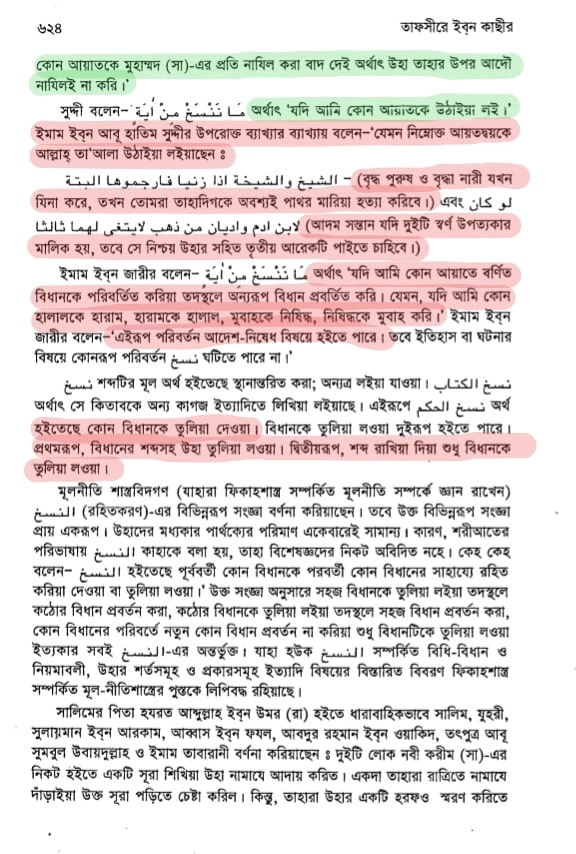
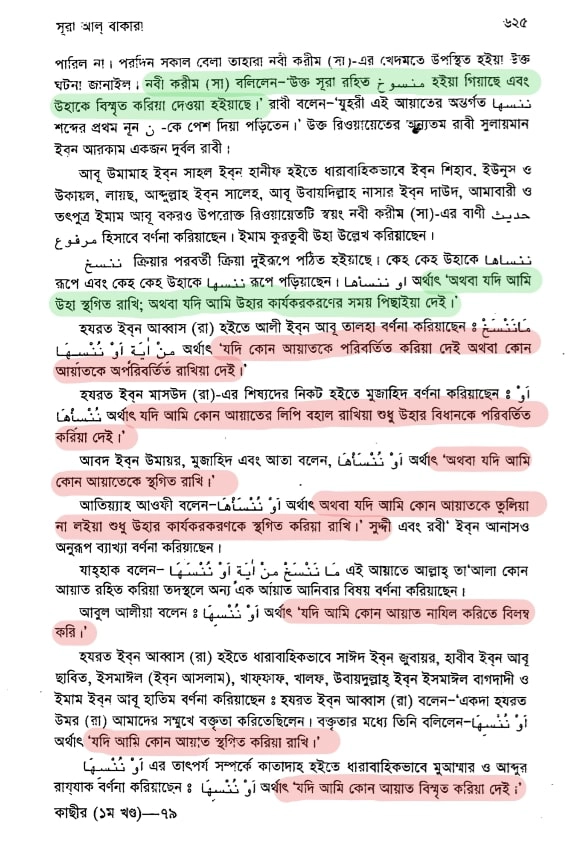
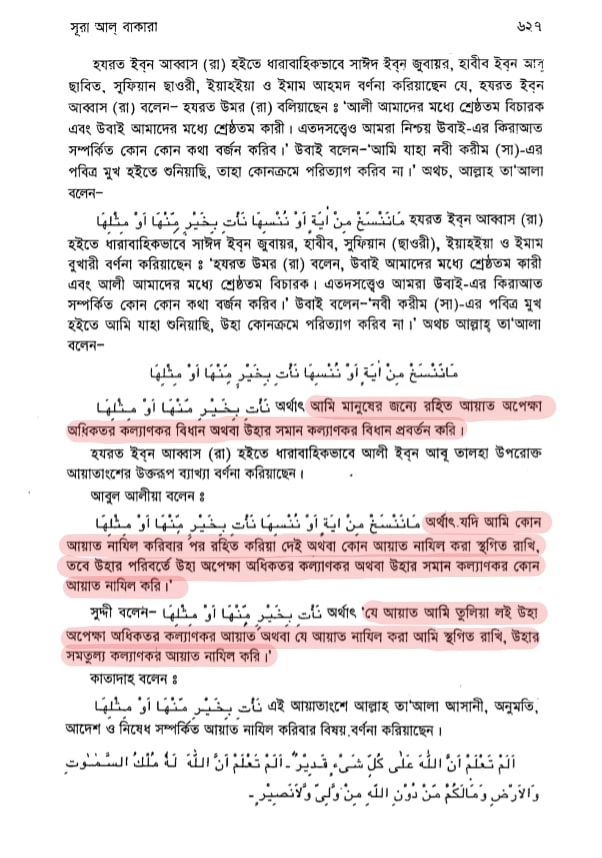
The explanation of greater benefit also does not provide a specific reason for every change. Reducing the waiting period for a widow, the removal of the charity condition before private conversation, and the implementation of the order for war—the benefits, pressures, and losses of these do not fall on the same person in the same way. In one arrangement, the pressure on the follower may decrease; in another, the application of force against the opponent increases. If all changes are called “welfare” in one word, the matter of for whom which result occurred remains unspecified. The practical consequences of each decision demand separate judgment.
The position of the lawgiver’s accountability is determined separately in the Quran. In Anbiya 21:23, this unequal relationship between the instructor and the subordinates is stated directly: [1019]
لَا يُسْأَلُ عَمَّا يَفْعَلُ وَهُمْ يُسْأَلُونَ
English translation: He is not questioned about what He does; they are the ones questioned.
The declaration of being above accountability is not proof of the utility of any change. It determines the position of authority: the instructor is not subject to questioning, while the followers are. Instead of answering why the first instruction was given, why it was later changed, and upon whom the loss or benefit of the change fell—the right to ask these questions is being denied. In a system of faith, this declaration may demand obedience; it does not fill the lack of independent reasoning in favor of a law.
The habits of people regarding alcohol and the confusion in recitation during prayer, the hesitation of followers to pay in the case of charity, and the waiting period and property arrangements for widows—each example has its own context and consequence. The analogy of the physician presents a general justification for these different events. However, mere similarity to an analogy does not establish the divine source, omniscient plan, or optimal result of a specific instruction. Different proofs are required for those three claims.
The analogy of the physician brings forward the possibility of benefit over time; the judgment of the correctness of a specific change remains even after that possibility. In the case of religious instructions, the follower was told to obey the previous order, and later had to accept the decision that the effectiveness of that order had ended. The evaluation of the former is “better,” and the identity of the latter is “dispensation” or “abrogation”—both declarations came from the same authority. There is recognition of authority in favor of these new rules revealed after human questions and difficulties; independent proof of their omniscient source and inevitable welfare is not found through the analogy of a doctor’s prescription.
Quran or Hadith: Effective authority to change law while retaining the text
The presence of Quranic verses in the mushaf and the implementation of law according to the language of those verses are separate matters. Through hadith and usul al-fiqh, it has been determined for whom the verse’s instruction is intended, under what conditions it applies, and under which subsequent ruling its previous application ceases. Beyond this, the Sunnah has been given the independent power to impose prohibitions and punishments not mentioned in the Quran. Consequently, the practical result of a verse can change without altering its words. Which report will be accepted as the statement of Muhammad and by what rule it will be applied to a verse—the decisions of the narrator, compiler, and jurist are effective at both these levels of law determination.
Basis for declaring Sunnah as the second revelation and an equally binding source
By declaring the Sunnah as the second revelation, another binding treasury of laws is established outside the Quran. According to this claim, Muhammad’s religious instructions are not merely the advice of a man; they are instructions coming from Allah, just like the Quran. A distinction is maintained in the identity of the text: the words of one are part of the mushaf, while the statements of the other are preserved in hadith. In terms of obeying the law, this distinction does not create a mere optional status for the latter. The source named Sunnah and the use in fiqh of placing an action in the category of recommended deeds called “sunnat” are not the same thing. Obligations (fard), prohibitions (haram), and penal rulings are established from the source named Sunnah.
In a report compiled under the name of Miqdam ibn Madikarib in Abu Dawud, there is a declaration of finding another matter similar to the Book. In the same statement, rejecting the position of relying only on the halal-haram found in the Quran, prohibitions were given regarding domestic donkeys, predatory animals, and the property of others. The right to claim an equivalent amount if hospitality is not provided to a guest also arrived. The claim of an additional source and the act of giving separate rulings from that source exist side by side in the same report. The statement of the report: [1020]
أَلاَ إِنِّي أُوتِيتُ الْكِتَابَ وَمِثْلَهُ مَعَهُ أَلاَ يُوشِكُ رَجُلٌ شَبْعَانُ عَلَى أَرِيكَتِهِ يَقُولُ عَلَيْكُمْ بِهَذَا الْقُرْآنِ فَمَا وَجَدْتُمْ فِيهِ مِنْ حَلاَلٍ فَأَحِلُّوهُ وَمَا وَجَدْتُمْ فِيهِ مِنْ حَرَامٍ فَحَرِّمُوهُ أَلاَ لاَ يَحِلُّ لَكُمْ لَحْمُ الْحِمَارِ الأَهْلِيِّ وَلاَ كُلُّ ذِي نَابٍ مِنَ السَّبُعِ وَلاَ لُقَطَةُ مُعَاهِدٍ إِلاَّ أَنْ يَسْتَغْنِيَ عَنْهَا صَاحِبُهَا وَمَنْ نَزَلَ بِقَوْمٍ فَعَلَيْهِمْ أَنْ يَقْرُوهُ فَإِنْ لَمْ يَقْرُوهُ فَلَهُ أَنْ يُعْقِبَهُمْ بِمِثْلِ قِرَاهُ
English translation: Listen, I have been given the Book and something similar to it along with it. Soon, a sated man will sit in my place and say: Hold fast to this Quran; consider as halal what you find halal in it, and consider as haram what you find haram in it. Listen, the meat of domestic donkeys, every predatory animal with fangs, and the lost property of a contracted person are not permissible for you—unless the owner of the latter waives the need for it. Whoever is a guest of a community, they must provide him hospitality. If they do not provide hospitality, he may claim from them an amount equivalent to his hospitality.
In this language, accepting the list of the Quran as the final limit is forbidden. The follower must obey rulings other than the Quran, for which the claim of Muhammad’s additional receipt is presented as proof. The method of establishing authority here is also significant: the declaration of the existence of the second source comes from a report of the second source itself. Whether the report is truly the statement of Muhammad depends again on the preservation and acceptance of that report. The obligation to obey additional rulings and the truth of the report carrying those rulings—two claims have become linked to each other.
Quoting the explanation of Ibn Baz, IslamQA directly called it the “second revelation.” In his discussion, various instructions for prayer, zakat, fasting, hajj, and the religious and worldly needs of humans are included in this source. The meaning is from Allah and the expression is in the words of Muhammad—this explanation creates a divine status for the Sunnah outside the Quran. Specific language used: [1021]
فالسنة وحي ثان أوحاه الله إليه لإكمال الرسالة وتمام البلاغ
English translation: The Sunnah is the second revelation, which Allah sent to him to complete the message and deliver it fully.
In the very name of the opening chapter of Al-Kifaya by Khatib Baghdadi, there is mention of making the rulings of the Quran and the Sunnah of the Messenger equal in terms of the obligation to act. The title of the chapter specifies the area of legal equality: not the length of the text or the reward for recitation, but the obligation to act. The final part of the title: [1022]
في وجوب العمل ولزوم التكليف
English translation: In terms of the obligation to act and the necessity of accountability for the ruling.
| Claim of authority | The status that is created | Effect on the follower |
|---|---|---|
| Quranic revelation | Verses of the mushaf are divine instructions | Obeying the applicable ruling of the verse is mandatory |
| Sunnah as second revelation | Instructions outside the mushaf are also accepted as divine | Additional rulings established in hadith must also be obeyed |
| Equality in the obligation to act | Absence in one source does not cancel the ruling of another source | The fact that it is not in the Quran cannot be used to avoid a prohibition of the Sunnah |
| Subsequent preservation and verification | Which report is Sunnah is subject to human judgment | Role of compilers and experts in determining the practical list of divine instructions |
The concept of the second revelation is a direct means of expanding the scope of religious law. Even if a prohibition is not named in the Quran, it can be identified as a religious crime through hadith. Even if the full method of a ritual is not in the Quran, its mandatory form can be fixed through hadith. Consequently, the entire scope of a Muslim’s do’s and don’ts is not determined by the specific size of the mushaf. Beside a closed book, another report-based treasury of rulings remains effective.
The opportunity to know the truth of an instruction during Muhammad’s lifetime and the method of accepting reports compiled in his name much later are not the same. In the subsequent society, the work of determining the carrier of the report, continuity, acceptance, and meaning becomes essential. Calling the Sunnah revelation does not perform these intermediate tasks. The report that becomes acceptable in the hands of the scholars is the report that carries additional orders of Allah to the follower. Therefore, the claim of religious accountability is actually applied through human verification and selection.
In this system, determining the limit of instructions outside the Quran is an extremely important power. The path to expanding the scope of what will be forbidden in the name of Allah, which act’s omission will make worship unacceptable, and where punishment will be claimed, has been opened by the declaration of the second revelation. While maintaining the primacy of the Book, it has been possible to make rulings not mentioned in the Book equally binding. Although the Quran holds a special status as the divine text preserved in the mushaf, it has not remained the sole source of orders controlling a Muslim’s life.
“Sunnah is the judge of the Quran”: Statements of Darimi, Makhul, and Usul
The statement “Sunnah is the judge of the Quran” expresses an unequal relationship in determining the meaning of words. On one hand, the Quran is accepted as the source of orders; on the other hand, one must go to the Sunnah to resolve conflicts in its meaning and application. If there is a possibility of multiple meanings in a verse, which one is acceptable, who will be excluded from general language, and what condition will be attached to an unconditional instruction—the Sunnah is the determinant in these decisions. Even if the letters of the Quran remain the same, this determination changes the order applicable to its follower.
In Darimi’s compilation, the statement of Yahya ibn Abi Kathir appears not as a hadith of Muhammad, but as Yahya’s own statement. This language, preserved through the source of Awzayi, did not stop at the first part; the opposite side of that relationship was also rejected—the Quran is not the judge of the Sunnah. The statement is: [1023]
السُّنَّةُ قَاضِيَةٌ عَلَى الْقُرْآنِ وَلَيْسَ الْقُرْآنُ بِقَاضٍ عَلَى السُّنَّةِ
English translation: Sunnah is the judge of the Quran; the Quran is not the judge of the Sunnah.
In the statement compiled under the name of Makhul, the aspect of dependence is even more direct: the Quran needs the Sunnah more. IslamQA quoted this statement through Khatib Baghdadi’s Al-Kifaya. There, the role of the Sunnah is mentioned as explaining the brief statements of the Quran, specializing general statements, limiting unconditional statements, and identifying nasikh-mansukh. Makhul’s specific sentence: [1024]
القرآن أحوج إلى السنة من السنة إلى القرآن
English translation: The Quran needs the Sunnah more than the Sunnah needs the Quran.
The legal result of this dependence is not limited to a rhetorical analogy. If the permitted meaning of a verse is determined by an external report, the decision to accept or reject that report reaches the application of the verse. One person reads the same verse but excludes a class based on a hadith; another does not exclude that class because they do not accept that report. Even after the written verse remains unchanged, two forms of effective law are created. Therefore, determining the meaning is not a mere discussion of semantics; it is the work of determining the boundaries of rights, obligations, and penalties.
Islamweb has interpreted this term “judge” in the sense of explaining the Quran and revealing its intent. In the same response, a reluctance to use the word in the name of Ahmad ibn Hanbal is also preserved: he does not dare to call it a “judge,” but rather speaks of explanation and clarification. This distinct position regarding the language of the statement is itself part of an ancient debate. Statement in the name of Ahmad: [1025]
ما أجسر على هذا أن أقوله، ولكن أقول: إن السنة تفسر الكتاب وتبينه
English translation: I do not dare to say this. Rather, I say: the Sunnah explains the book and makes it clear.
| Preserved statements | Center of the argument | Question of application |
|---|---|---|
| Yahya: Sunnah is the judge, not the Quran | Priority in determining meaning | By whose instruction the relationship between verses and acceptable reports will be fixed |
| Makhul: Greater need for the Quran | Unequal dependence for explanation | Which source is essential to reach a complete ruling from the language of the Quran |
| Ahmad: Explanation and clarification | Separate words to identify the relationship | How the limits determined in explanation become mandatory for the follower |
| The jurist’s effective decision | Acceptability of reports and application of meaning | Who will fall under the scope of the verse and who will be excluded |
There is a direct relationship between explanation and authority. Fixing the permitted meaning among multiple possibilities of a sentence means making other possibilities unacceptable as law. Similarly, if a specific exception is recognized within a general instruction, the general instruction is no longer effective for those individuals as before. This selection and limit-setting are contained within the act called “explanation.” Consequently, the definition that the Sunnah explains identifies the very process of its practical control.
In the second part of the statement, the rejection of the judge’s seat in the opposite direction is even more significant. Since no additional rule of the accepted Sunnah is present word-for-word in the Quran, this framework does not allow the opportunity to cancel it. The distinct instruction of the Sunnah finds its place under the general order of obedience to the Quran. Again, the limits of the verse are determined by that instruction. Dependence on the Sunnah remains effective through two paths: the approval of additional provisions and the determination of the meaning of the verses.
Two separate statements are preserved in the names of Yahya and Makhul; in the name of Ahmad, there is a comment on the naming of the relationship. Subsequent compilers and writers of fatwas have quoted these to explain an effective methodology. The influence of this has been formed by these three levels: the propagation of the statement, its explanation, and its application in law. A statement, having been re-compiled in many books, has become part of the scholarly terminology; and the practical significance of that terminology has been determined by which evidence’s limit is being fixed by which evidence.
Even while acknowledging the primacy of the Quran, this method keeps the follower dependent on the treasury of reports. Having the verse in hand is not accepted as sufficient knowledge; one must know the Sunnah applicable to it and the scholarly use of that Sunnah. The decisions of those recognized as knowing that use reach the general follower as the effective meaning of the verse. In this way, the identity of the Sunnah as the judge of the Quran also carries the authority of the subsequent commentator.
Determinations outside the Quran in the rulings of prayer, zakat, and hajj
The Quran contains instructions to establish prayer, give zakat, and perform hajj. All the information regarding the detailed form that must be followed to be an acceptable act of worship in conventional fiqh is not present in the sentences of those instructions. For how many rakats in which prayer, how much zakat for what amount of wealth, and the specific number and method of separate rituals of hajj—one must go to the Sunnah and preserved practice. Consequently, the decision of whether a general order has been obeyed also becomes subject to the detailed provisions outside of it.
In the statement compiled in the name of Imran ibn Husayn through Khatib Baghdadi, this necessity has been used directly as an argument. A person asking for statements only from the Quran is asked where in the Quran he will find that Zuhr and Asr are four rakats, Maghrib is three rakats, and the specific number of tawaf. The part of the discussion regarding the number of rakats: [1026]
أكنت تجد فيه صلاة الظهر أربعا ، وصلاة العصر أربعا ، والمغرب ثلاثا , تقرأ في اثنتين
English translation: Do you find in it that the Zuhr prayer is four rakats, the Asr prayer is four rakats, and Maghrib is three rakats—in two of which recitation is done?
In Bukhari, in the report of Malik ibn Huwayris, there is an instruction from Muhammad for the youths to stay for twenty days and later return to their families to teach. The method of prayer there is a matter of learning from direct behavior. Instead of determining the act by reading a full written description of a verse of the Quran, the action of the person to be followed has been made the ideal. The specific sentence of the instruction: [1027]
وَصَلُّوا كَمَا رَأَيْتُمُونِي أُصَلِّي
English translation: Pray as you have seen me pray.
Learning by seeing reaches the next generation through teaching and narration. Later, if there is a difference of opinion, hadith and fiqh are used to determine which behavior is that followed method. With the acceptance of a specific report in support of a method regarding matters like the position of tying the hands, the style of recitation, or recitation behind the imam, its religious status becomes attached. Consequently, to declare a specific prayer valid, complete, or defective from the general order of prayer in the Quran, several more judgments are needed.
In the case of zakat, this dependence extends to financial calculations. In Bukhari, a letter given by Abu Bakr while sending Anas to Bahrain is compiled. In it, specific calculations for zakat on camels, sheep and goats raised on pasture, and silver are found. The letter is known as the provision of sadaqah determined by Muhammad and ordered by Allah. The first limit for sheep and goats: [1028]
وَفِي صَدَقَةِ الْغَنَمِ فِي سَائِمَتِهَا إِذَا كَانَتْ أَرْبَعِينَ إِلَى عِشْرِينَ وَمِائَةٍ شَاةٌ
English translation: If the sheep and goats raised on pasture are forty to one hundred and twenty, one must be given as sadaqah.
| Wealth in the letter of Bukhari 1454 | Reported amount | Payable portion |
|---|---|---|
| Sheep and goats raised on pasture | 40–120 | One |
| Animal of the same category | From more than 120 to 200 | Two |
| Animal of the same category | From more than 200 to 300 | Three |
| Animal of the same category | More than 300 | One for every hundred |
| Silver | Zakat-eligible silver mentioned in the letter | One fortieth part |
The impact of this calculation is not merely in giving a lexical meaning to the ambiguous words of the verse. From whose wealth something will be collected, from whom it will not be collected, and how much will be claimed—each limit creates a direct financial liability on the individual. Without knowing these amounts alongside the Quran’s instruction to “give zakat,” the practical demand of the same instruction is not determined. The letter preserved in hadith provides the effective framework for collection here.
In the case of hajj rituals, instructions are also found to make Muhammad’s actions the ideal for learning. In Muslim, in the report of Jabir, it is said to learn the method of hajj while throwing pebbles from the mount during the day of sacrifice. The importance of receiving direct instruction is added to the statement that he does not know if he will perform hajj again in the following year. The statement of the report: [1029]
لِتَأْخُذُوا مَنَاسِكَكُمْ فَإِنِّي لاَ أَدْرِي لَعَلِّي لاَ أَحُجُّ بَعْدَ حَجَّتِي هَذِهِ
English translation: Learn your method of hajj. For I do not know, perhaps after this hajj of mine, I will not perform hajj again.
In these three cases, the nature of the authoritative work is also different. In prayer, the behavior to be followed is the ideal; in zakat, preserved accounts determine financial limits; in hajj, a direct method is instructed for learning specific rituals. Later, in each case, the decision of which report is proven and which act is mandatory comes under fiqh. Thus, three main areas of religious life—daily prayer, property, and pilgrimage—are controlled by detailed rules outside the mushaf.
A sample of conventional religious discourse regarding this relationship of dependence between the Quran and hadith:
As a result of making detailed provisions essential alongside general instructions, the right of explanation has a permanent impact on the daily life of the follower. A person may have prayed, but their practice may be unacceptable because it did not meet specific conditions; they may have given money, but liability may remain because they did not give enough according to the recognized calculation. The power to decide which condition is essential, which deficiency is forgivable, and which act must be redone lies in the hands of the treasury of provisions outside the general verses and its commentators.
The detailed form of conventional worship thus becomes mandatory in two levels: the order of the Quran creates the liability to perform the act, and the Sunnah and fiqh fix the conditions for the act to be acceptable. Without the second level, recognition of whether the order of the first level has been obeyed is not obtained. This is where the depth of authority in religious life lies—the follower is not only obliged to obey the order, but is also obliged to obey the subsequent decision regarding the acceptable method of obeying the order.
Changing the application of verses through explanation, specification, and imposition of conditions
It is not necessary to erase a verse to change the application of a Quranic ruling. The duties of the follower change by narrowing the scope of a verse, adding new conditions to it, or determining the acceptable form of a brief instruction. In usul al-fiqh, there are separate names for these acts. Bayan of the mujmal refers to the detailed explanation of a brief statement, takhsis refers to excluding some matters from the scope of a general instruction, and taqyid refers to bringing an unconditional statement under a specific limit. The result of each method is captured in the application of law.
In the case of specification, who the original instruction will be effective upon is changed. In Ma’idah 5:38, there is an instruction to cut the hand of male and female thieves. In Bukhari, in the report of Aisha, the minimum value of property for punishment is stated as one-quarter of a dinar. If this condition is accepted, the mere occurrence of theft is not sufficient to execute that punishment; the value of the stolen property must also be verified. The specific instruction of the hadith: [1030]
تُقْطَعُ الْيَدُ فِي رُبُعِ دِينَارٍ فَصَاعِدًا
English translation: The hand will be cut for a value of one-quarter dinar or more.
Here, the result of the same verse is not the same for a person below the value limit and a person above the value limit. Even if a theft charge is proven against one, the specific amputation will not be executed; for the other, the question of the amount of money and other conditions will arise. It is through this act of separating classes with reports that the fate of people under the general language of the verse is determined. How much property must be stolen to give such a punishment—an additional numerical piece of information becomes the gatekeeper of law application.
In the case of marriage, in Nisa 4:24, there is general language approving women outside the list of forbidden women. In the reports of Bukhari, it is forbidden to combine a woman and her paternal aunt or a woman and her maternal aunt in the marriage of one man. Alongside the prohibition of combining two sisters in the list of Nisa, these new relationships are added through hadith. Consequently, even if a woman herself is not a member of a forbidden relationship for that man, the prohibition is effective in the state of combined marriage with her female relative. [1031] [1032]
لاَ يُجْمَعُ بَيْنَ الْمَرْأَةِ وَعَمَّتِهَا، وَلاَ بَيْنَ الْمَرْأَةِ وَخَالَتِهَا
English translation: A woman and her paternal aunt, and a woman and her maternal aunt, cannot be kept together in marriage.
| Method | That which is determined | Type of legal result |
|---|---|---|
| Explanation of brief instruction | How the act will be performed | Which method will be recognized as obedience to the order |
| Specification of general statement | Which member of the larger class will be excluded | The general ruling will not be effective for the concerned member |
| Determining the limit of an unconditional statement | Under which additional condition the act will be acceptable | If the condition is not met, the permission or validity of the act will change |
| Abrogation by subsequent instruction | Whether the duration of the previous ruling has ended | An act mandatory at one time will no longer be mandatory at a later time |
On the question of tawaf in a state of purity, Ghazali’s Al-Mustasfa shows an even more subtle use of similar authority. In the Quran, there is an order for tawaf of the ancient house; there, the condition of purity is not mentioned in that sentence. Ghazali has discussed the determination of the condition using reports that compare tawaf with prayer. In his account, the results for Shafi’i and Abu Hanifa are also not the same: in Shafi’i’s position, the act is not sufficient without purity; in Abu Hanifa’s position, the additional report creates a liability for purity, but it does not similarly cancel the basic performance of tawaf. [1033]
فأخرج خبر الواحد أحد القسمين من لفظ القرآن فهو نقصان من النص لا زيادة عليه
English translation: A single report has excluded one of the two states included in the language of the Quran; therefore, it is a reduction from the text, not an addition to it.
The result in Ghazali’s sentence is not ambiguous: one of two conditions considered under the language of the verse has been excluded. If the subsequent explanation states that the verse from the beginning only gave the primary command of the act, leaving the detailed conditions to be placed elsewhere, then this exclusion is identified as explanation or specification. And if the general scope is considered to be definitively established, then the question arises of judging the removal of that scope as abrogation. Which scriptural name will be given to the same practical condition depends on another interpretation regarding the scope of the main statement.
This distinction has practical value. A person performing tawaf may consider themselves to be fulfilling the command, yet according to one view, it will be ruled that their act was insufficient due to the absence of the condition of purity. According to another view, the primary act may be regarded as performed despite the existence of additional obligations. The evidentiary theory of the jurist is at work in determining two different results from the same Quranic instruction and related reports. Consequently, the permanence of the words of the verse does not ensure the permanence of the recognition of what the individual has achieved.
This power of interpretation also removes the right to determine the final meaning from the hands of the general follower. By reading the verse, he understood a scope of action, but it is considered that previously established reports and legal rules are applicable to that scope. Approved specification takes precedence over his personal reading. Although the language used to determine this precedence is religious, the result is very practical: whose marriage is approved, what will be collected from whose assets, and which act will complete the fulfillment of the command.
Takhsis and taqyid control the scope of application of a verse while preserving its letters. Therefore, the effective legal history of the book cannot be understood by the unchanged appearance of its pages. No word has been erased, yet a category that initially seemed included in the verse is no longer included; no sentence has changed, yet the act is not acceptable without a previously unmentioned condition. At this level, the decisions of hadith and jurists impose applicable limits on the written verses.
Contracting the scope of a general verse using khabar al-ahad
The authorization to specify the general statements of the Quran using khabar al-ahad creates an important relationship between the certainty of proving authorization and the application of law. The universal propagation described in the Quran is called mutawatir; conversely, reports that do not meet the conditions of tawatur are included in ahad. Ahad does not always mean a statement heard from only one person. Within this, there are also numerical distinctions of narrators—mashhur, aziz, and gharib. These two judgments are not the same: through how many paths a report has come and whether it has been called acceptable.
In the terminological discussion of Islamweb, the definition of ahad has been given based on not meeting the conditions of tawatur. In the same discussion, there is mention of three types of ahad and both acceptable and unacceptable statuses. Consequently, the category of numerical spread and the ruling of acceptability operate separately. The sentence of the definition is: [1034]
أما القسم الثاني وهو حديث الآحاد فهو: ما لم يجمع شروط المتواتر
English translation: The second division, that is, ahad hadith is: that which has not met the conditions of mutawatir.
In the decision to exclude any one member of a general verse using this type of report, the relationship between the universal language and the specific report must be fixed. Through the source of Ibn Najjar’s Sharh al-Kawkab al-Munir, IslamQA has mentioned the approval of the majority, and through the source of Ibn Muflih, the condition of the Hanafis: if a general statement has already been specified by a recognized evidence, further specification is accepted through a single report. [1035]
إن كان خص بدليل مجمع عليه جاز
English translation: If it has been specified by a consensus-based evidence, then it is valid.
This difference is about the certain scope of the original instruction. How certain it is that every member of a general word is included, and how acceptable the specific report is for excluding which member—if the answers to these two questions change, the legal result also changes. Consequently, the judgment does not end with the question of whether the verse simply exists. Whether the generality of the verse was previously contracted and by which evidence—the history of this previous interpretation is also necessary for the subsequent decision.
The provision of religious identity in inheritance shows a specific result. In Nisa 4:11, the relationship between son and daughter appears in determining the shares of children. In the instruction narrated under the name of Usama ibn Zayd in Bukhari, inheritance between a Muslim and a non-Muslim has been prohibited. Under this rule, even if there is a kinship relationship, a person may be excluded from the property due to religious identity. Related report: [1036]
لاَ يَرِثُ الْمُسْلِمُ الْكَافِرَ، وَلاَ الْكَافِرُ الْمُسْلِمَ
English translation: A Muslim shall not be the heir of a kafir, and a kafir shall not be the heir of a Muslim.
| Level of decision | The matter being determined | Impact on property |
|---|---|---|
| Quranic identity of kinship | Shares of children, parents, and other relatives | Basis of the general claim of inheritance |
| Reported condition of religious identity | Relationship of religion between the testator and the recipient | Exclusion from the share in some cases despite being a relative |
| Acceptability of the report | Whether this report will be accepted for establishing law | Basis for the additional exclusion becoming effective |
| Relationship between the verse and the report | How a specific report will determine the scope of general language | Who will have an entitled share, and who will not |
No new sentence of religious identity has been inserted into the words of the verse of Nisa. Yet, that identity has become a determining condition in the effective list of inheritance. Even after proving whose child a person is, another source is used to determine whether their property claim will ultimately be recognized. The result of exclusion from general language is not abstract here; it is a question of someone’s entitlement becoming zero in the distribution of family assets.
After accepting a report as acceptable, if it is called an explainer of a general statement, its relatively less extensive path of narration does not act as a barrier to the application of law. The number of proofs and the specificity of meaning are then evaluated differently. A scriptural method is created to give precedence to a specific sentence preserved through a less extensive path over the general language of a more widely propagated sentence. In this, while acknowledging the propagational certainty of the Quran, the application to each of its members can be placed under a second source.
Combined with this power of specification, the power of scholars to determine acceptability further expands the result. If there is a difference of opinion regarding the quality of the report, differences may arise in the question of which scope of the verse will be acceptable. Again, even after accepting the report, some may consider it an explanation of the original provision, some an additional obligation, and some an instruction for another situation. Effective law is therefore not created simply because a report exists; it is created by two decisions: the acceptance of the report and the establishment of its relationship with the verse.
This discussion on the authenticity of khabar al-ahad has a direct impact on the rights and obligations of a Muslim. Losing a share of property, worship becoming unacceptable without special conditions, or the narrowing of marriage permission—in every case, how much power will be given to the additional report is important. The path to that power was opened by authorizing the precedence of a specific report over the general language of the book. The result that the general follower later knows as the provision of the Quran includes this evidentiary selection.
Difference of opinion on abrogating the Quran with Sunnah and the position of Jassas
On the question of abrogating the provisions of the Quran with Sunnah, the power to make the instruction of another source effective in place of the instruction of a direct source is discussed. If it is accepted that a statement of the Quran was mandatory in the first stage, and later the Sunnah ended that obligation, then one must go outside the mushaf to know the subsequent law. The words of the verse may remain in the book, yet the follower is informed that the previous order is no longer the current duty. Multiple positions are preserved among usulists regarding the validity of this method.
Jassas did not use the words “better than it or similar” in Baqarah 2:106 against the abrogation of the Quran by Sunnah. In his explanation, the judgment of being better is not in the linguistic quality of the reading, but in ease or benefit for humans. That alternative can also come through Sunnah. Therefore, he stated that the verse is clearer in favor of authorization than prohibition. [1037]
فدلالة هذه الآية على جواز نسخ القرآن بالسنة أظهر من دلالتها على امتناع جوازه بها
English translation: This verse gives clearer evidence in favor of the validity of abrogating the Quran with Sunnah than of its prohibition.
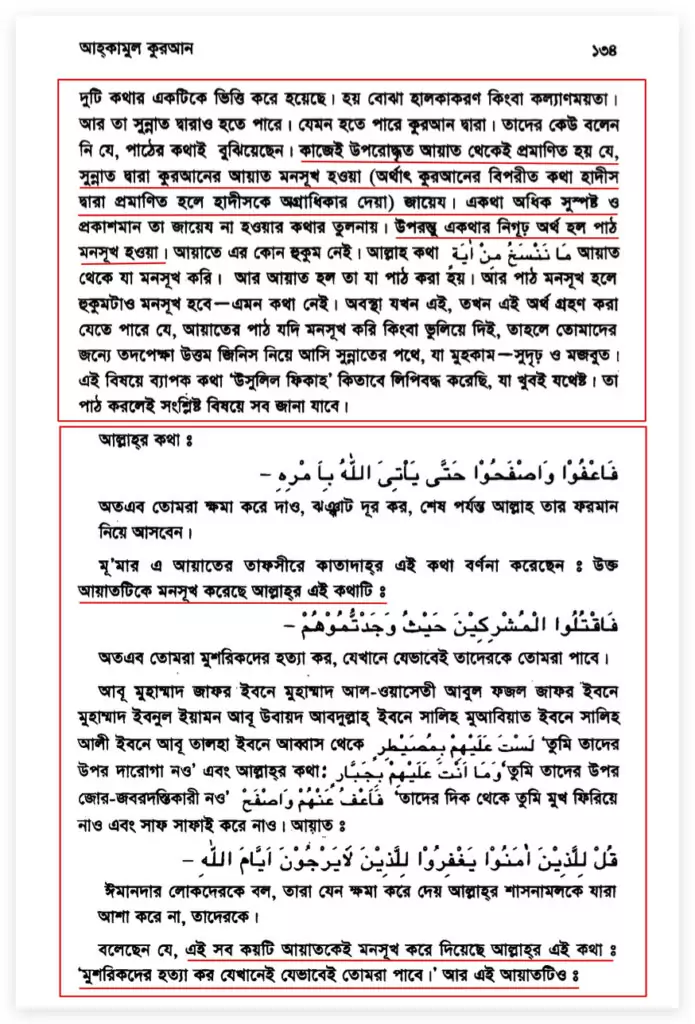
By this logic, a new Quranic verse is not essential as the source of an alternative instruction. The religious evaluation that a more beneficial instruction has come from Allah is also applied to the provisions found in hadith. Consequently, the presence of an old verse in the mushaf cannot be the final proof that its provision remains in effect. If the identity and chronology of the subsequent Sunnah are accepted as proven, it can be decided that the duration of the old obligation has ended.
In Al-Bahr al-Muhit, Zarkashi mentioned the authorization and occurrence of the Quran being abrogated by mutawatir Sunnah as the opinion of the majority. In the same discussion, there is also mention of prohibition as the general position of Shafi’i’s books. Consequently, the results are not determined simply by the words “Sunnah” and “Quran”; the evidentiary type of the Sunnah and the usuli position of the jurist are also determinants. His sentence regarding the majority: [1038]
وإن كانت متواترة فاختلفوا فيه ، فالجمهور على جوازه ووقوعه
English translation: There is a difference of opinion on this if the Sunnah is mutawatir; the majority acknowledge its validity and actual occurrence.
In Shafi’i’s statements, Sunnah is called the follower and explainer of the Book. In Zarkashi’s discussion, this principle is also quoted from his Al-Risala that Sunnah is not the abrogator of the Book. That is, there are different claims within the same scriptural tradition regarding the determination of the limit of power. Quoted position: [1039]
وأن السنة لا تكون ناسخة للكتاب
English translation: Sunnah is not the abrogator of the Book.
| Usuli position | The type of Sunnah being discussed | Result |
|---|---|---|
| Authorization of Jassas | Sunnah acceptable as sharia evidence | A better alternative provision may come from outside the mushaf |
| Majority opinion mentioned by Zarkashi | Mutawatir Sunnah | Abrogating Quranic provisions is valid and has occurred |
| Shafi’i’s general prohibitory position | Relationship of Sunnah with the Book | Sunnah will explain; it will not be the abrogator of the Book |
| Limited authorization of naskh by ahad | Proven acceptable single report that came later | According to some scholars, previous provisions can be abrogated through this path as well |
At the other end of the difference of opinion, Shanqiti stated that it is possible to abrogate a mutawatir provision even with a sahih ahad proven to be subsequent. IslamQA has quoted this decision of his. This ruling of his further increases the limit of how much power will be given to a specific path of narration of Sunnah. Brief language of the decision: [1040]
جواز نسخ المتواتر بالآحاد الصحيحة الثابت تأخرها عنه
English translation: It is valid to abrogate mutawatir with a sahih ahad that is proven to have come later.
The word “later” plays a major role here. If an instruction is previous, it determines the first duty of the follower; if it is fixed as subsequent, it can claim to remove the previous duty. Consequently, the religious result of the same statement is also dependent on its chronological judgment. This chronology is not always found from the current position of the verse; it must be determined from the account of revelation, the date of the event, and the chain of narration. Therefore, the authority of chronology is also concentrated in the hands of hadith and its explainers.
The authorization of naskh by Sunnah and the authorization of specification are not the same terminology. The former is a claim that the duration of the previous provision has ended; the latter keeps the main provision intact while excluding some of its fields. For a specific person, these two paths may sometimes bring similar results: a verse that initially seemed applicable to him is later no longer applied to him. Again, in some cases, there is a big difference between the end of an entire system and an exception. The category determined by the jurist fixes the extent of that result.
The decision to accept or reject naskh therefore changes the level of effective authority. According to one view, hadith can directly remove the provision of a previous verse; according to another view, the solution to the same problem must be established through another verse of the Quran, specification, or explanation. The scholars whose opinions are accepted in determining these methods effectively decide which instruction is now obedience and which clinging to an old instruction is a wrong application. Humans can know the current list of Allah’s commands only through that determined method.
This is where the significance of Jassas’s approval runs deep. Even after accepting the Quran as divine word, he acknowledges a path outside the language of the mushaf that can terminate the previous legal efficacy of that word. This power is not merely for providing additional information; it is for withdrawing the previous obligations of the follower. The distinction between which statement is merely a recited verse and which statement is a currently effective order is established only by judging the relationship between the mushaf and the reports outside of it.
Will: Baqarah 2:180 and “There is no will for an heir”
In Baqarah 2:180, there is an instruction for a person facing death while leaving behind assets to make a will for parents and near relatives. The language of the verse—”it has been prescribed for you” and “it is a duty upon the righteous”—gives special importance to this act. Later, the relationship between this instruction and the specific shares of inheritance and the report “there is no will for an heir” had to be determined. Consequently, who the beneficiaries of the property will be is not determined in one step by looking at the identity of the relatives in the verse. Whether they are heirs or not, that classification also plays a role in the decision. The full text of the verse: [1041]
كُتِبَ عَلَيْكُمْ إِذَا حَضَرَ أَحَدَكُمُ الْمَوْتُ إِن تَرَكَ خَيْرًا الْوَصِيَّةُ لِلْوَالِدَيْنِ وَالْأَقْرَبِينَ بِالْمَعْرُوفِ ۖ حَقًّا عَلَى الْمُتَّقِينَ
English translation: It has been prescribed for you that if any of you is facing death and leaves behind assets, a just will shall be made for parents and near relatives; it is a duty upon the righteous.
In Nisa 4:11, the distribution of inheritance shares, the will, and debts are mentioned in the same sentence. That is, the existence of two systems—inheritance and will—is recognized in the verse. The additional question of for which recipient a will remains effective is not resolved simply by saying “inheritance has come.” The specific phrase associated with the distribution: [1042]
مِن بَعْدِ وَصِيَّةٍ يُوصِي بِهَا أَوْ دَيْنٍ
English translation: after the will he has made or the payment of debt.
In a report preserved under Abu Umama’s name in Abu Dawud, a will for an heir is directly prohibited. The prohibition comes with the connection of “therefore,” following a declaration that Allah has given every entitled person their due. This brief instruction is used to define new boundaries between the person receiving inheritance and the beneficiary of a will. The report: [1043]
إِنَّ اللَّهَ قَدْ أَعْطَى كُلَّ ذِي حَقٍّ حَقَّهُ فَلاَ وَصِيَّةَ لِوَارِثٍ
English translation: Allah has given every entitled person their due right; therefore, there is no will for any heir.
In applying this rule, the father or mother of the deceased cannot claim additional benefits of a will solely based on that identity, despite being named in the verse. If they are heirs, the prohibition of the hadith applies to them. If another relative is not an heir, their position may be different. By separating the heir and the non-heir within the same identity of “near relative,” the effective scope of the verse on wills changes.
On one hand, Ibn Kathir has compiled explanations of the cancellation of previous obligations using the verses of inheritance; on the other hand, he has brought the view that the previous instruction remains in effect for relatives who are not heirs. In his discussion, some views are identified in later terminology not as complete abrogation, but as the removal of some members of a general statement. The sentence he used: [1044]
لأن آية الميراث إنما رفعت حكم بعض أفراد ما دل عليه عموم آية الوصاية
English translation: because the verses of inheritance have removed the ruling for some members included in the general language of the verses of the will.
| Explanation | Relationship between the evidences | Result in the case of an inheriting relative |
|---|---|---|
| Abrogation by the verses of inheritance | Subsequent specific shares have taken the place of the previous obligation of the will | Additional wills are not mandatory based on the previous verse |
| Abrogation by hadith | “There is no will for an heir” has removed the previous instruction | The limit of the will for them is determined according to the narrated prohibition |
| Specification | The heir has been excluded from the general category of near relatives | Keeping the position of the non-heir separate, the previous general instruction is contracted in their case |
In Zarkashi’s compilation, through Ibn Furak, there is also a view attributed to Abu al-Hasan al-Ash’ari that it is possible to follow the verses of inheritance and the will together, therefore the hadith must be taken as the abrogator. The significance of this explanation is that the coexistence of two Quranic systems is not being called logically impossible. The hadith is considered decisive on the question of where the specific prohibition came from. Consequently, there is difference among scholars regarding the method of establishing the same effective law. His argument regarding coexistence: [1045]
لأنه يمكن أن يجمع بينهما
English translation: because it is possible to accept both together.
The provision for making a will effective with the consent of other heirs is another layer of this relationship. Jassas has discussed the will becoming effective if the heirs approve. In his explanation, the condition for the phrase “there is no will” is that the other heirs have not approved it. With the help of an additional narrated exception, the scope of the original prohibition has been redefined. [1046]
وفيه بيان أن الأخبار الواردة بأن لا وصية لوارث من غير ذكر إجازة الورثة هي محمولة على أن الورثة لم يجيزوها
English translation: This makes it clear that reports where “there is no will for an heir” appears without mention of the heirs’ approval are applicable to the condition that the heirs have not approved.
In explaining the reason for this approval, Kasani said that the prohibition is for the rights of other heirs; if they approve, that barrier no longer exists. That is, the coexistence of the will and inheritance is not impossible in itself. The limit of efficacy is linked to the rights and consent of other claimants to the property. The relevant part of his statement: [1047]
لأن امتناع الجواز كان لحقهم لما يلحقهم من الأذى والوحشة بإيثار البعض ، ولا يوجد ذلك عند الإجازة
English translation: because validity was prevented for the sake of their rights—giving priority to someone causes them distress and resentment; if they approve, that ceases to exist.
The practical result of this is very specific. A will increases the benefit of one heir; if others consent, it is one legal result, if they object, it is another. The instruction of the will in the book, the specific shares of inheritance, the prohibition of the hadith, and the condition of approval—the final decision is made by combining all of these. The will of the deceased or the presence of a relative’s name in the verse is not alone final. The identity of the recipient and the approval of other claimants determine their right to the property.
In this example of the will, the power of the hadith is twofold: first, it excludes the heir from the general instruction of the Quran; later, fiqh determines the efficacy of the prohibition through the consent of others. There was no need to erase any verse, yet the path of a claim to assets has changed. The practical form of the law declared in the name of Allah here is the result of establishing human relationships upon several written and narrated statements.
Food: New prohibitions in hadith outside the list of An’am 6:145
The food list in An’am 6:145 is not merely examples of a few forbidden things. In the language of the verse, there is first a declaration of finding nothing forbidden, then exceptions in the sense of “except.” Dead animals, flowing blood, pork, and things sacrificed in the name of other than Allah have come within that declared scope. At the same time, the possibility of eating in an inevitable situation has been kept. The full text of the verse: [1048]
قُل لَّا أَجِدُ فِي مَا أُوحِيَ إِلَيَّ مُحَرَّمًا عَلَىٰ طَاعِمٍ يَطْعَمُهُ إِلَّا أَن يَكُونَ مَيْتَةً أَوْ دَمًا مَّسْفُوحًا أَوْ لَحْمَ خِنزِيرٍ فَإِنَّهُ رِجْسٌ أَوْ فِسْقًا أُهِلَّ لِغَيْرِ اللَّهِ بِهِ ۚ فَمَنِ اضْطُرَّ غَيْرَ بَاغٍ وَلَا عَادٍ فَإِنَّ رَبَّكَ غَفُورٌ رَّحِيمٌ
English translation: Say, I find nothing forbidden for me to eat of that which has been revealed to me, except dead animals, flowing blood, pork—because it is impure—or that which has been sacrificed in the name of other than Allah as an act of disobedience. But whoever is forced, without willful disobedience or transgression, then your Lord is Forgiving, Merciful.
Domestic donkeys, fanged predatory animals, or clawed birds are not named in this list. Prohibitions of these have come in subsequent hadith-based rulings. Consequently, to know an effective list of forbidden foods, it is not enough to recognize only the categories mentioned in the verse; prohibitions outside the mushaf must also be known. When the concept of Sunnah as a second revelation is linked to the phrase “that which has been revealed to me,” this path of additional rulings gains validity.
In Bukhari, in the report of Jabir, there is mention of the prohibition of donkey meat and the permission for horse meat on the day of Khaybar. The prohibition for one animal and the exemption for another are preserved in the same statement. This is a specific example of giving new rulings by separating food categories. [1049]
نَهَى النَّبِيُّ صلى الله عليه وسلم يَوْمَ خَيْبَرَ عَنْ لُحُومِ الْحُمُرِ، وَرَخَّصَ فِي لُحُومِ الْخَيْلِ
English translation: On the day of Khaybar, the Prophet prohibited donkey meat and permitted horse meat.
In another report compiled under Ibn Abbas’s name in Muslim, clawed birds are included in the prohibition along with fanged predatory animals. This is not a sentence explaining the meaning of pork or dead animals; it is a statement imposing a prohibition on new animal groups. The practical limit of which food is permissible to eat is extending beyond the Quranic list. [1050]
نَهَى رَسُولُ اللَّهِ صلى الله عليه وسلم عَنْ كُلِّ ذِي نَابٍ مِنَ السِّبَاعِ وَعَنْ كُلِّ ذِي مِخْلَبٍ مِنَ الطَّيْرِ
English translation: The Messenger of Allah has prohibited every fanged predatory animal and every clawed bird.
| Food Category | Status in An’am 6:145 | Level of hadith and explanation |
|---|---|---|
| Dead animals, flowing blood, pork | Directly in the list | Identity of the forbidden category is in the verse |
| Sacrifice in the name of other than Allah | Mentioned in the verse | Religious identity of the sacrifice is the basis of the prohibition |
| Domestic donkey | Not named in that list | Report of the prohibition at Khaybar is used |
| Fanged predatory animals and clawed birds | Not included by name in that list | Additional forbidden category in Muslim’s report |
| Horse | Not named in that list | Permission is separately stated in the Khaybar report |
In another report in Bukhari, reports of prohibition and different reactions at the Companion level regarding the relationship with the list in the verse are found. When Jabir ibn Zayd was told about the prohibition of domestic donkeys, he mentioned that statement of Hakkam ibn Amr al-Ghifari; alongside this, he mentioned reading the verse of An’am because Ibn Abbas did not accept it. The final part of the report: [1051]
وَلَكِنْ أَبَى ذَاكَ الْبَحْرُ ابْنُ عَبَّاسٍ وَقَرَأَ {قُلْ لاَ أَجِدُ فِيمَا أُوحِيَ إِلَىَّ مُحَرَّمًا}
English translation: But that ocean of knowledge, Ibn Abbas, did not accept it and read: “Say, I find nothing forbidden for me in that which has been revealed to me.”
Here, the language of the list was not only the subject of discussion for later jurists; an ancient account of reading the verse against the report of prohibition is also preserved. Who received which report and how they judged its relationship with the verse has had an impact on food laws. This reaction preserved under Ibn Abbas’s name and the subsequent reports establishing prohibitions carry different positions of the same reading community. The effective shape of the prohibition list has been formed by determining acceptable decisions from among those different positions.
In Ibn Kathir’s explanation, subsequent prohibiting verses and hadiths are linked to the removal of the perceived scope of this verse. He stated that some call it naskh, while many later scholars judge it under a different name as the removal of the original permitted state. The difference reaches the point of whether a new scope of prohibition has come or what its scholarly identity is. His sentence: [1052]
ومن الناس من يسمي ذلك نسخا ، والأكثرون من المتأخرين لا يسمونه نسخا
English translation: Some call it naskh; most later scholars do not call it naskh.
Even within this difference in terminology, the same practical question remains for the follower: which food is forbidden to eat today? The declaration of finding nothing forbidden in the revelation of one time is not being used as the complete list of all subsequent prohibitions. The chronology of new instructions and their acceptability must be known. Consequently, in the case of food laws, one part of the revised list is preserved in the verses of the Quran, and another part in the hadith.
Prohibiting new animal groups is not a correction of the pronunciation or spelling of previous words. It is the imposition of additional religious limits on the daily eating habits of humans. The boundary of which meat would be a violation to eat can increase in the hadith—the prevailing law is formed by accepting this right. In the face of the limited declaration of the Quran, subsequent narrated provisions eventually become mandatory; that additional source cannot be excluded in determining the effective halal-haram.
Rajm: New category and death penalty in the provision of lashes in Nur
In Nur 24:2, there is an instruction for one hundred lashes for every female and male adulterer. In that sentence of the verse, separate categories for married and unmarried are not written. In prevailing fiqh, the application of that general language has been limited; for a person identified as muhsan under specific conditions, the provision of rajm or killing by stoning becomes effective. Therefore, the division between the punishment of physical strikes and the punishment of ending life for the same crime is not found by reading that sentence of the mushaf. Hadith and its legal explanation are needed for category determination.
In explaining the verses of Nur, Qurtubi specified one hundred lashes as the ruling for adult, free, bakr men and women. “Bakr” and “muhsan” are jurisprudential identities; the identity of a muhsan includes additional conditions, including intercourse within a valid marriage. In his primary compiled position, stoning (rajm) replaces lashing for a free muhsan person. Relevant sentence: [1053]
وأما المحصن من الأحرار فعليه الرجم دون الجلد
English translation: Among free persons, stoning exists for the muhsan without lashing.
Here, the instruction of the verse is not merely repeated in simple language. By creating another category within the general identity of the offender in the verse, a different punishment has been made effective for them. The instruction for lashing remains on the page; but instead of applying that instruction to a muhsan person, the death penalty is demanded. Whether a person survives to receive physical punishment or has their life taken based on a certain identity depends on additional rulings and definitions.
There is another opinion in the same discussion by Qurtubi: stoning shall be carried out after administering one hundred lashes. He linked this position to Ishaq ibn Rahwayh, Hasan Basri, and the practice of Ali. According to this view, the Sunnah does not remove the previous punishment, but rather adds further punishment to it. His brief sentence: [1054]
ومن قال بالجلد مع الرجم قال : السنة جاءت بزيادة حكم فيقام مع الجلد
English translation: Those who advocate for stoning along with lashing have stated: the Sunnah has brought additional rulings, therefore it shall be effective along with the lashing.
| Jurisprudential category or opinion | Relation to lashing | Result of the effective punishment |
|---|---|---|
| Free adult bakr | Accepted as the specific application of the verses of Nur | One hundred lashes; separate disagreement regarding exile |
| Primary opinion regarding the muhsan | Stoning instead of lashing | Death penalty |
| Opinion on combined punishment regarding the muhsan | Additional ruling along with Quranic lashing | Death penalty after one hundred lashes |
| Quranic half-punishment mentioned regarding female slaves | Use of another category from Nisa 4:25 | Fifty lashes; difference in punishment based on the identity of freedom |
The difference between the first two opinions is not nominal. In one opinion, lashing is no longer effective; in the other, it is maintained and killing is added. How the additional report functions—whether it separates a category of the verse, removes the previous punishment, or places a new punishment alongside it—this interpretation is implemented directly on the body of the punished person. Even standing before the same mushaf, different results are obtained regarding the number and type of punishment.
Quoting Sayrafi, Zarkashi has also preserved an interpretation where stoning is identified as an expression of purpose through the Sunnah, rather than being judged as the abrogation (naskh) of Quranic lashing. The role assigned to the Sunnah, in his words, is to provide explanation and report the purpose. Under this identity, it is determined which part of the verse is effective for whom. [1055]
فحظ السنة البيان والإخبار عن المراد
English translation: The role of the Sunnah is to provide explanation and to report what the purpose is.
This power to determine the “purpose” creates the most severe result in the case of the death penalty. Once the decision is made that the punishment in the revealed sentence is not intended for everyone, a path is opened to establish another punishment for a certain category. Even if that categorization is not written beside the general sentences of the Quran, subsequent religious law makes it mandatory. Not only the proof of the crime against the person, but also which category they will be placed in—then becomes a decision of life and death.
In the case of stoning, there is also a claim of a former verse absent from the mushaf. Umar’s announcement and the report of the absent stoning-reading carries the evidence of that claim. In determining the application of the verses of Nur, the report of this absent reading and the practice preserved under Muhammad’s name are used together. Consequently, not only the interpretation of the meaning of the present verse, but also the legal effectiveness of an absent divine statement enters the decision.
In this state, the hierarchy of religious sources becomes a hierarchy of the power to take human life. It must be determined whether another punishment outside the one read in the verse will be accepted, which report proves it, and in which interpretation the previous punishment remains effective or becomes void. Declaring stoning religiously valid does not eliminate these questions; rather, it subjects the value of the lives of the people upon whom that immutable punishment will be effective to the verdict of that proof and interpretation.
The scope of the Sunnah’s power is thus clear in the example of establishing stoning while leaving the language of lashing in Nur unchanged. Its work is not merely to complete the method of performing rituals. Through the determination of additional rulings and their scriptural relationship, it has become possible to change the nature of the punishment. The gap between “the verse is in the book” and “the punishment written in the verse is final” is measured here by human lives.
Apostasy: worldly punishment in hadith outside the statements of the Quran
The relationship between the statements of the Quran and the hadith-based worldly punishment in the case of apostasy directly attacks an individual’s right to change their belief. In Baqarah 2:217, the result of dying as an unbeliever after apostatizing is mentioned; in Nisa 4:137, there is mention of moving between belief and unbelief multiple times. Alongside these statements, the death penalty for the apostate in prevailing law has come through hadith. The additional source has created a bridge between the judgment of religious crimes and the right to take a human life for it on earth.
In Baqarah 2:217, as a consequence of apostasy, the failure of deeds in this world and the hereafter and Hell are mentioned. The condition of dying in a state of unbelief is added; this sentence does not give a specific instruction to any judge to kill the apostate. Relevant part: [1056]
وَمَن يَرْتَدِدْ مِنكُمْ عَن دِينِهِ فَيَمُتْ وَهُوَ كَافِرٌ فَأُولَٰئِكَ حَبِطَتْ أَعْمَالُهُمْ فِي الدُّنْيَا وَالْآخِرَةِ ۖ وَأُولَٰئِكَ أَصْحَابُ النَّارِ ۖ هُمْ فِيهَا خَالِدُونَ
English translation: Whoever among you turns away from his religion and dies as a kafir, their deeds will fail in this world and the hereafter. They are the inhabitants of the Fire; they will abide therein eternally.
The clause of Nisa 4:137 is further different: belief, unbelief, belief again, unbelief again, and finally progressing into unbelief. These multiple transitions are mentioned in the language of the verse; as a consequence, the declaration of no forgiveness and no guidance is present. In the sentences of this description of changing belief, the order for state execution is not written in the first instance. [1057]
إِنَّ الَّذِينَ آمَنُوا ثُمَّ كَفَرُوا ثُمَّ آمَنُوا ثُمَّ كَفَرُوا ثُمَّ ازْدَادُوا كُفْرًا لَّمْ يَكُنِ اللَّهُ لِيَغْفِرَ لَهُمْ وَلَا لِيَهْدِيَهُمْ سَبِيلًا
English translation: Those who believed, then disbelieved, then believed again, then disbelieved again, and then progressed further in unbelief—Allah will not forgive them nor will He guide them.
The brief instruction for worldly killing is found in Bukhari within the statement of Ibn Abbas. In reaction to the report of Ali punishing with fire, he objected to the method of killing, but spoke of killing them based on Muhammad’s instruction. Sentence used in favor of the primary punishment: [1058]
مَنْ بَدَّلَ دِينَهُ فَاقْتُلُوهُ
English translation: Whoever changes his religion, kill him.
In this chain, the objection is to the use of fire in punishment; the right to take the life of the one who changes religion is maintained. Consequently, even if there is opposition to a violent method in any report, it does not become opposition to the death penalty. By determining the relationship between various instructions, the result of which method is an acceptable method of killing is obtained. The change of a person’s religious identity is being used as the basis for ending their life on earth.
To make the statement “there is no compulsion in religion” from Baqarah 2:256 compatible with this punishment, IslamQA has shrunk the scope of the verse. In their interpretation, compulsion to make one enter who has not previously accepted Islam is forbidden; a person who wishes to leave after entering does not fall within that scope. In the words of Ibn Ashur, this system is called compulsion to remain in Islam. The specific admission: [1059]
وَأَمَّا هَذَا فَهُوَ مِنِ الْإِكْرَاهِ عَلَى الْبَقَاءِ فِي الْإِسْلَام
English translation: This is compulsion to remain in Islam.
| Condition of the person | Position in the quoted scriptural interpretation | Result on freedom |
|---|---|---|
| Has not entered Islam | Outside the compulsion to enter in the relevant interpretation of IslamQA | Freedom not to enter |
| Wishes to leave after accepting Islam | Subject to the punishment of the apostate | Fear for life and pressure to return to the religion |
| Considered a Muslim by birth | The religious identity of the parents is imposed upon them | The question of apostasy later, even if not freely chosen before |
| Apostate woman in Hanafi discussion | Generally not killing, but obligation of captivity and returning to the religion | The type of punishment changes; the right to leave freely does not come |
Ibn Ashur has mentioned such a social reason in favor of this punishment: if someone leaves the religion, it may open the path for others to leave; the fear of death stops that tendency. That is, the purpose of maintaining the number of members and loyalty of the religious group is revealed within the interpretation. The decision to end the relationship by freely judging the truth of belief is seen here as a harmful act for the group. Through the punishment, the price of that departure is made equal to a human life.
The matter is even stricter for those who are Muslims by birth. IslamQA has stated that the child of Muslim parents is considered a Muslim as their follower; the question of apostasy after reaching puberty also comes under the ruling of apostasy in their discussion. Here, freely choosing a religion before adulthood is not a mandatory prerequisite. The identity received at birth creates a liability on subsequent belief. Their used brief sentence: [1060]
أطفال المسلمين تبع لوالديهم المسلمين
English translation: The children of Muslims are followers of their Muslim parents.
Regarding the punishment of women, Ibn Humam’s Fath al-Qadir shows a different result from the Hanafi position. There, instead of generally killing the woman, it mentions becoming Muslim or keeping her captive until death. This classification is explained by their conception of a man’s combat capability and a woman’s position. That is, a specific event of actual war was not made the sole condition for everyone; the category of punishment was fixed by the conception of gender-based capability. Statement of the book: [1061]
وأما المرتدة فلا تقتل ولكن تحبس أبدا حتى تسلم أو تموت
English translation: The apostate woman shall not be killed; rather, she shall remain permanently captive until she accepts Islam or dies.
This system of captivity does not grant religious freedom. A woman will be detained because she expressed a change in her belief, and accepting Islam again is placed as the condition to end that detention. In the same discussion, opinions regarding beating to return to the religion are also preserved. Even if the identity of captivity replaces killing, the nature of coercion upon the individual’s conscience remains. Her decision regarding the truth of belief is declared legally intolerable.
In the example of apostasy, Sunnah-based law has established an additional punishment applicable on earth alongside some religious consequences of the Quran. Subsequently, jurists have determined its application based on the person’s identity, adulthood, gender, and state of return. The sentence “there is no compulsion” has remained in the book, yet the commentators themselves have acknowledged and approved compulsion in the case of leaving the religion. This event is a brutal example that the presence of a reading and the effective right of an individual are not the same.
Former readings absent from the mushaf and hadith as a treasury of rulings
The authority of hadith is not limited to determining the meaning of current Quranic verses. The entire history—that a sentence was once in the Quran, later its reading was removed, yet its ruling remains effective—is also established through reports. Then, the hadith serves simultaneously as testimony to a past reading and as the basis for current law. To maintain an instruction absent from the mushaf as divine law, the follower must rely on the reporters of that absent instruction. Even if the sentence is not in the book, the legal obligation remains present through their reports.
In the case of stoning in Umar’s speech there are separate claims of it being revealed, read, understood, and the punishment being applied. Death penalty maintained alongside the absence of the reading The legal result of that claim. Opening the current mushaf, the alleged former verse of the punishment is not found; the way of knowing it was there before is the report preserved under Umar’s name. When the court implements the ruling of this absent reading, it is not recovering that ruling from any sentence visible in the mushaf. It is implementing the report accepted regarding the absent sentence and its legal interpretation.
In the case of suckling, the report carries several more decisions together. Change from ten times to five times, Statement of it being read as Quran even at the time of Muhammad’s death and subsequent interpretation of the reading being removed and the ruling remaining effective Different layers of the same history. The general prohibition of marriage with a foster mother does not automatically yield the condition of a specific number of breastfeedings. Whether that number is accepted and, if so, where the marriage relationship is prohibited depends on reports and fiqhi decisions. In this way, past readings preserved in hadith operate on the question of the validity of current families.
| Reported former readings | Relationship with the current mushaf | Claims carried through reports | Legal consequences |
|---|---|---|---|
| The reading of rajm (stoning) | Not in the prevalent mushaf | Was revealed and recited previously; the punishment was applied | The basis for maintaining rajm despite the absence of the reading |
| Readings of ten and five breastfeedings | Those sentences containing numbers are not in the mushaf | Five instead of ten; Aisha’s report regarding the final stage reading | The view of establishing foster relationships based on a specific number |
| Readings regarding those killed at Bir Ma’una | Not in the current mushaf | Reports of it being a reading as Quran and later being removed | No claim of a maintained penalty like rajm; reports of past readings |
| Parts of surahs absent from Abu Musa’s memory | Sentences remaining in memory are not present as current surahs | Accounts of having recited them at one time and forgetting the remainder | Narrative testimony regarding the extent of the absent readings |
In these examples, although the absence is a common occurrence, the claims associated with it are not identical. In the report of the sentences of Bir Ma’una, there is mention of prior recitation and subsequent removal; it does not determine any maintained punishment like rajm. In Abu Musa’s memoir, the matter of forgetting again and some parts remaining in memory is primary. Therefore, to derive current law from reports of former readings, another independent decision is required: whether the ruling of that reading is still in effect. The report that conveys the past wording, or its scriptural interpretation, determines the duration of the ruling’s validity in later times.
The principle of separating certain knowledge from mandatory action also operates behind the adoption of law from reports. In the introduction to Sahih Muslim, Nawawi mentioned the majority position regarding reliable single reports: they are sharia evidence and following them is mandatory, but they do not provide certain knowledge. The term “zann” used by him refers to probabilistic knowledge; here it appears in contrast to certain knowledge. Quoted position: [1062]
أَنَّ خَبَرَ الْوَاحِدِ الثِّقَةِ حُجَّةٌ مِنْ حُجَجِ الشَّرْعِ يَلْزَمُ الْعَمَلُ بِهَا ، وَيُفِيدُ الظَّنَّ وَلَا يُفِيدُ الْعِلْمَ
English translation: A reliable person’s single report is one of the evidences of sharia; it is mandatory to act according to it. It provides probabilistic knowledge, not certain knowledge.
Under this principle, establishing the certain historical truth of every report is not a prerequisite for implementing a ruling. A report can be the basis for action as long as it meets the determined standards of acceptability. Consequently, calling a report evidence for action and calling every detail of the past through it an beyond-doubt history are two separate claims. Approving the former does not create certainty for the latter. The obligation to follow religious rulings can be established in this system without removing the epistemic uncertainty of the report.
Its impact is particularly profound on claims of former Quranic readings. By accepting a report, a follower can simultaneously believe that the sentence was once the word of Allah and that the ruling from its absence is still mandatory upon them. If the report is discarded, the connection between the divine past of that specific sentence and the maintained law is also lost. No matter how many times the report is quoted in subsequent fiqh texts, the reproduction of the same report does not itself create new mushaf evidence. A broad chain of acceptance is created; the source of the original reading report remains separately identified.
The boundary of the mushaf and the boundary of religious law become clearly distinct here. Laws may remain in effect in the name of the former Quran, beyond what is now recited as Quran. Reading abrogated but ruling maintained This category gives a scriptural identity to this state. The follower is then not only told to follow the preserved mushaf; they must also follow an accepted historical report regarding a divine instruction absent from the mushaf. Absence does not end the authority of that instruction; the responsibility of carrying it is transferred from the mushaf to the treasury of reports.
In the case of consequences like the death penalty of rajm or the prohibition of marriage due to foster relationships, this transfer determines human lives and personal relationships. Decisions regarding whose memories of past readings were accepted, which part of those memories was kept as law, and which change was called the end of a reading—these decisions carry real power. The power to compel current humans in the name of sentences absent from the visible text is established by the combined authority of reports, the chain of acceptance, and the opinion of the jurist.
Scholars’ opinions on the acceptability of hadith and the effective meaning of verses
If hadith is made the basis for the explanation, specification, or additional rulings of a verse, the decision on which hadith is acceptable directly controls the door of law. If a report is accepted, a condition enters religious duty; if it is considered unacceptable, the evidence for that condition is discarded. Therefore, the labels “sahih” or “da’if” are not merely evaluations written beside a text. Depending on that evaluation, the answers to questions such as whether a person’s worship is correct, whether additional work is mandatory, and whether the basis for a prohibition is established, also change.
IslamQA has stated that the determination of hadith as sahih or da’if is directly subject to ijtihad. In their explanation, scholars’ information and evaluations may differ in identifying the state of the narrator, the chain of transmission, supporting sources, and errors. Even with the same information, they may reach different conclusions. The principle they themselves acknowledged is: [1063]
تصحيح الحديث وتضعيفه خاضع للاجتهاد
English translation: Determining hadith as sahih or da’if is subject to ijtihad.
The ruling on pronouncing Allah’s name during wudu is a clear example. In Ma’idah 5:6, there are instructions to wash the face and hands, wipe the head, and the feet. Separate hadiths have been used to determine whether pronouncing the name should be made a mandatory condition. In Abu Dawud’s report, it is said there is no wudu without pronouncing the name; the same sentence begins with there is no prayer without wudu. As a result of the acceptance and interpretation of this prohibitive language, an additional condition may be linked to the acceptability of prayer. [1064]
لاَ صَلاَةَ لِمَنْ لاَ وُضُوءَ لَهُ وَلاَ وُضُوءَ لِمَنْ لَمْ يَذْكُرِ اسْمَ اللَّهِ تَعَالَى عَلَيْهِ
English translation: He who has no wudu has no prayer; and he who did not pronounce the name of Allah Ta’ala during wudu has no wudu.
Tirmidhi preserved Ahmad ibn Hanbal’s evaluation after the hadith on the same subject. He stated that he knows of no hadith with a good isnad on this matter. This statement is an objection to the preservation path of that instruction; if this statement is accepted, the evidence for establishing a new mandatory condition for wudu also comes into question. [1065]
لاَ أَعْلَمُ فِي هَذَا الْبَابِ حَدِيثًا لَهُ إِسْنَادٌ جَيِّدٌ
English translation: I know of no hadith with a good isnad on this matter.
In the same Tirmidhi discussion, there is also the legal decision of Ishaq. According to him, if the name is intentionally omitted, wudu must be performed again; if forgotten or omitted based on some interpretation, it will be sufficient. That is, the state of pronouncing the name, combined with intention, forgetfulness, and reasons for interpretation, creates the category of wudu’s acceptability. [1066]
إِنْ تَرَكَ التَّسْمِيَةَ عَامِدًا أَعَادَ الْوُضُوءَ وَإِنْ كَانَ نَاسِيًا أَوْ مُتَأَوِّلاً أَجْزَأَهُ
English translation: If he intentionally omits the pronunciation of the name, he shall perform wudu again; and if he forgets or omits it based on some interpretation, his wudu will be sufficient.
| Evaluation or interpretation | Position preserved in the source | Relationship with the ruling of wudu |
|---|---|---|
| Ahmad’s isnad evaluation | Does not know of a hadith with a good isnad on this matter | Doubt regarding the evidence for the necessity of pronouncing the name |
| Albani’s evaluation | His ruling beside Abu Dawud 101 on Sunnah.com: Sahih | Subsequent evaluation in favor of the instruction on the same subject being acceptable |
| Ishaq’s legal decision | Wudu again upon intentional omission; sufficient upon forgetfulness or interpretation | Result differs according to the person’s mental state |
| Position considered unnecessary | Pronouncing the name is sunnah; not an essential condition for wudu to be correct | Wudu remains valid even if the name is not pronounced |
| Different meaning of the sentence | “No wudu” means no complete wudu | Lack of completeness instead of literal nullification |
In IslamQA’s discussion on wudu, a reported opinion of Abu Hanifa, Malik, Shafi’i, and Ahmad has been placed in favor of unnecessity. Another position of Ahmad regarding necessity is also there. Two separate paths in favor of unnecessity have been mentioned: considering the hadith as da’if, or even if accepted, taking the phrase “no wudu” to mean the absence of a complete wudu. Consequently, the decision of acceptability and the determination of the sentence’s meaning change the result separately. Brief statement of the second path: [1067]
لا وضوء كامل . وليس معناه لا وضوء صحيح
English translation: No complete wudu; this does not mean no correct wudu.
This difference has a real impact on the daily behavior of the follower. Similarly, among two people washing their limbs, one may have performed a correct wudu based on the decision of a specific scholar, while another may be forced to perform wudu again for not fulfilling an additional condition based on another decision. The printed sentences of the Quran were not different for them. The ruling on accepting the additional report and the decision on how strictly its prohibitive language should be applied have differed. This judgment of scholars has entered the practical map of religious duty.
IslamQA has also determined an authoritative path regarding what a general follower should do in the face of differences of opinion. According to it, one who is qualified to judge shall choose an evaluation; an unqualified person shall follow the hadith specialist who is considered more knowledgeable and pious. If the hadith is sahih to that specialist and contains a ruling, he must follow it. The scope to leave the action based on a da’if consideration is also linked to the same selection. The condition for following is: [1068]
وإن كان غير مؤهل فواجبه التقليد
English translation: And if he is not qualified, his duty is to follow.
In this system, ordinary people do not directly determine the truth of the original event. He first chooses a specialist, then accepts or rejects the report through that specialist’s evaluation. In choosing a specialist, his own information, social environment, and limits of acquaintance also operate. Consequently, there are multiple human selections on the path to reaching the duty of performing it as a direct divine command. The evaluation of the narrator, the acceptability of the report, the interpretation of the sentence, and the follower’s selection of a specialist—each layer participates in determining the result.
The sahih-da’if classification is an internal ruling of acceptability in Islamic hadith science. If that ruling is equated with infallible historical truth, the declared ijtihadi differences of the scholars are erased. Again, their differences create real law: whether a condition will be a religious duty at all, or whether worship will be nullified if it is ignored, the result also changes. This variable human judgment cannot be excluded when matching the list of mandatory behaviors with the fixed language of the Quran.
Declaration that “conflict is impossible”, scriptural methods of specification and reconciliation
The declaration that “there is no actual conflict” is placed at the beginning of many scriptural interpretations in determining the relationship between the Quran and hadith. Here, the absence of conflict is not merely a result found after examining two specific statements; the limit of interpretation is determined by the belief that acceptable divine statements cannot be contradictory. If any conflict appears, the goal of the investigation is to find a way to resolve the conflict. Consequently, the possibility of admitting a clash between one statement and another is constricted from the start; the responsibility for the clash is transferred from the statement to the limit of the interpreter’s knowledge or understanding.
IslamQA has quoted an instruction from Shatibi’s Al-I’tisam that even if an apparent difference is seen, one must first believe in the absence of difference, because Allah has testified that it is not there. In the same quotation, if there is a question of practical ruling, there is mention of continuing to seek a solution, even conducting the investigation until death. First belief, then search for a solution—the sequence is specified in his statement. [1069]
فواجب عليه أن يعتقد انتفاء الاختلاف، لأن الله تعالى قد شهد له أن لا اختلاف فيه
English translation: his duty is to believe in the absence of difference; because Allah has testified that there is no difference in it.
In this instruction, an unresolved conflict does not stand as an open result. If the researcher has not found a solution, it means his investigation is incomplete; it is not regarded as an actual inconsistency of acceptable statements. Even if the timeframe of investigation is extended until death, the fundamental decision is not kept subject to change. The decision in favor of which the investigation is ongoing is recognized as the duty at the start of the investigation. In this arrangement, the work of judging evidence and preserving predetermined belief become intertwined with each other.
Ibn al-Qayyim also denied the existence of two sahih hadiths that are clearly contradictory in every respect and where one does not abrogate the other. In his quoted statements, the cause of the problem is attributed to the identification of the narration or limitations in understanding the intent. Instead of mutual inconsistency in the statements, the deficiency of the collector and the commentator has taken the place of the problem. [1070]
وأما حديثان صحيحان صريحان متناقضان من كل وجه، ليس أحدهما ناسخا للآخر، فهذا لا يوجد أصلا
English translation: There are no two sahih and clear hadiths that are contradictory in every respect, where one does not abrogate the other.
The methods of resolving contradictions each perform a distinct legal function. If some instances of a general instruction are excluded, the remaining part remains in effect. If two statements are determined to belong to different situations, their fields of application become distinct. If one is considered the later abrogator, the duration of the previous instruction ends. And if priority is given to a particular report, the direct application of the other in the relevant decision may be suspended. These are not alternative names for the same thing; they are ways of differently determining who bears what obligation.
| Method | Act of interpretation | Result in effective provision | The required information or decision |
|---|---|---|---|
| Specification | Excluding some members of a general statement | The original provision remains applicable in some cases | A specific evidence excludes a certain member |
| Separating situations | Linking two instructions to different conditions | Two provisions remain in effect in separate cases | Whether that distinction of condition is established in the narration or language |
| Naskh | Determining the end of the previous instruction’s duration | The subsequent instruction becomes the current duty | Evidence of chronology and abrogation |
| Determining priority | Accepting a piece of evidence based on the quality of proof or meaning | The selected instruction is effective in conflicting applications | Standard of acceptability and reason for priority |
| Decision suspended | Not settled currently | The ruling of the relevant researcher remains undetermined | Waiting for additional information or an acceptable solution |
In the case of wills, this systematic selection has clear results. Some have called the prohibition of making a will for an heir the abrogation of a later Quranic provision, some the abrogation of a hadith, and some the specification of a general instruction. The result—that the beneficiary does not receive an additional will—may be similar, but the explanation of which source produced that result is different. This determination of source also works in future debates: by taking the same rule as a precedent, the limit of how much power a hadith can have is determined. Thus, a broader principle of authority is built behind a specific ruling.
In the case of rajm, separating the muhsan from the general verse of flogging and determining a new death penalty for him work together. Simply using the word “reconciliation” does not capture this actual result. In the case of a person, instead of the explicit flogging of the verse, or along with it, a death penalty is added. Which class of person receives which punishment is determined by additional reports and their classification. Even if the terminology of interpretation is used, the legal severity does not decrease; the terminology indicates the method of reaching that severe result.
Pre-existing beliefs also influence the suspension of decisions. In the discussion mentioned by IslamQA, this suspended state has been presented as a temporary cognitive limit of some scholars; others may have the solution. There, remaining undetermined does not mean accepting the possibility of contradiction. It is said that the solution is not yet known under the certainty that there is no inconsistency. Consequently, the state of unresolved information cannot go beyond fundamental beliefs.
To establish specification, the relationship between the general statement and the specific exception must be proven. To claim the implementation of a new instruction instead of an old one, the relevant chronology and evidence of change are also required. In every specific case, that relationship must be established separately. The decision that it is impossible for a contradiction to exist does not itself reveal which statement came first, which came later, or which person is the exception. If, without that information, chronological or personal distinctions are created as needed based solely on the claim of a common divine source, the result of the interpretation precedes the proof. The relationship necessary for announcing a solution must be established separately.
If the declaration that “there is no contradiction” is made an untestable prerequisite, the failure of interpretation cannot touch the declaration. If a solution is found, it is proof of unity; if not, it is the incapacity of the commentator—in this arrangement, no path is open to accept the opposite result. Then the investigation is no longer a neutral test of whether the accepted statements can truly be followed together; it becomes an investigation into how the previously recognized unity can be maintained.
The follower must pay the legal price for this. The result of reconciliation in their case may be the contraction of property shares, a shorter list of permitted foods, additional conditions for worship, or a severe penalty. The path chosen by the jurist who determines the relationship between multiple narrations becomes the language of the follower’s duty. Therefore, the scriptural power to resolve contradictions is not only the power to establish harmony between texts; it is also the power of the actual decision regarding which provision will be effective for which person.
Formal status and authority for effective legislation
Placing a source first in the list of status and making it the final decision-maker in determining every effective law are not the same thing. While maintaining the declaration of the Quran’s formal superiority, the Sunnah can be given such power that the field of application of a verse will be contracted, new conditions will be added, or new obligations outside the mushaf will be established. Then, even if the language of the first source remains unchanged, what the follower must do is determined with the help of the second source and its interpretation. This practical arrangement of authority works separately alongside the declaration of status.
In the section on the authenticity of the Sunnah preserved on Islamweb, the sequence “Quran, then Sunnah” is mentioned and called the order of status. It has been forbidden to conclude from that sequence that the Sunnah is behind in terms of source-based power. That is, the fact that a source is mentioned later does not make its instruction less binding. Relevant statement: [1071]
فإن هـذا الترتيب ترتيب في الذكر والشرف، ولا يؤخذ بمعنى أن السنة متأخرة في مصدريتها عن القرآن الكريم
English translation: This mention of sequence and order of status; it cannot be taken to mean that the Sunnah falls after the Quran as a source.
The definition of the Sunnah’s independent legislative power makes this position even clearer. In the usul books preserved in Shamela, the support, explanation, and independent additional provisions of the Quranic rulings are categorized separately. Independent Sunnah makes something obligatory or forbidden that the Quran did not determine as obligatory or forbidden. Here, the power to create new obligations beyond the limits of the word “explanation” is directly acknowledged. [1072]
وهي التي تكون موجبة لحكم سكت القرآن عن إيجابه، أو محرمة لما سكت عن تحريمه
English translation: It makes obligatory a provision about whose obligatoriness the Quran has remained silent; or it forbids something about whose prohibition the Quran has remained silent.
In this recognition, the silence of the Quran does not guarantee a person’s exemption. Even if no prohibition is found in the verses for a certain act, it may be forbidden on the basis of independent Sunnah. Similarly, even if no specific condition is written in the verses, that condition may enter into religious obligation. The follower must then know, alongside the approval or silence of the book, whether a prohibition has come from another source. The complete list of duties is not limited to the visible statements within a single mushaf.
Shatibi explained the formal relationship differently. In Al-Muwafaqat, he placed the status of the Book first and identified the Sunnah as the explainer; the term “judge” does not mean priority over the Book to him. His explanation in brief: [1073]
فمعنى كون السنة قاضية على الكتاب أنها مبينة له
English translation: For the Sunnah to be the judge of the Book means that it is the explainer of the Book.
Even in this position, the actual scope of the power of interpretation is large. The answers to which part of a general statement will be effective, under what condition an act will be acceptable, and which class will be excluded from a previous instruction—all these come from interpretation. Therefore, the identity of “explainer” does not signify a lack of power. While preserving the formal status of the book, the responsibility of determining the effective meaning of that high-status book is placed on another source. The result of this responsibility, not just the declaration of status, is applied to the follower.
| Work of authority | Where the decision is made | Actual result |
|---|---|---|
| Primary language of the provision | Preserved verses of the Quran | General instructions, prohibitions, and statements of specific parts |
| Exceptions and additional conditions | Accepted Sunnah and its relationship with the verses | The limit of which field of the verse will remain effective |
| Independent new provisions | Accepted Sunnah regarding matters unmentioned in the Quran | New obligations or prohibitions |
| Identification of previously absent texts | Reports preserved under the names of the Companions | Claims of divine instructions absent in the mushaf and remaining laws |
| Acceptance and rejection of narrations | Evaluation by hadith scholars | Which report can be used to establish law |
| Determination of current provisions | Jurist’s judgment on specification, chronology, and reconciliation | Final effective obligation for the follower |
In this arrangement, the power of the source and the power of its user are linked. An instruction recognized in the name of hadith does not always present itself in one meaning to ordinary people. First, it is identified and evaluated, then its language is related to the verses. Different evaluations or different determinations of relationship can lead to different effective results. If only “Allah’s law” is mentioned, omitting these human decisions, the actual process of creating the specific form of the law remains hidden.
The difference between a fixed text and a variable legal result is important here. The letters of a verse may remain as they were in printed form, yet the first instruction received from that verse is no longer applied to a person. Sometimes they have been excluded through specification, sometimes the previous obligation ended in a subsequent provision, sometimes their act became unacceptable due to failure to meet an additional condition. Each of these changes is legal; its proof also lies within legal documents and application. The letters remaining unchanged does not nullify those changes.
The relationship between hadith and the Quran is therefore not just a relationship of the same instruction being uttered in two ways. One source fills the silence of the other, contracts the general language, provides reports of previous texts, and in some scriptural positions, carries the power to abrogate previous provisions. The judgment of the humans who accept hadiths and determine laws is linked to these tasks. As a result, a part of the provisions observed in the name of the Quran becomes dependent on reports preserved outside the mushaf and their interpretation.
This dependence is not erased by declaring formal supreme status. The final effective answer to the questions of whose property will go, which marriage will be forbidden, whose worship will be called acceptable, and what penalty will be imposed on whom—is determined through establishing the relationship between the accepted sources. Alongside the power to claim the holiness of the book, the power to compel people in its name also works here. The responsibility for that compulsory result is borne by specific narrations, specific interpretations, and the institutions that establish them as law.
Redetermination of provisions and religious practices during Umar’s caliphate
After the death of Muhammad, the caliph’s decisions became a great force in determining the practical form of religious provisions. During Umar’s time, some prevailing practices were forbidden, some property claims were distributed according to new calculations, and some worship took the form of an organized system. These changes were directly effective on people’s marriage, slavery, inheritance, and worship. Alongside the verses of the mushaf, the ruler’s instructions and their subsequent fiqhi acceptance also determined the duties of the Muslim. Signs of the reasons for these changes, protests, and different decisions also remain in the preserved narrations.
Mut’ah: Practice during the eras of the Prophet and Abu Bakr, different reports of prohibition, and Umar’s instruction
Mut’ah is marriage for a fixed term, and there are separate statements in Islamic narrations regarding the history of its permission, prohibition, and re-permission. Reports preserved under Jabir’s name mention its practice during the times of Muhammad and Abu Bakr and its closure during Umar’s time. Other narrations claim that the prohibition was imposed during Muhammad’s own lifetime. In the chronology created by subsequent law along with these different accounts, Umar’s declaration is also an effective turning point: during his time, the threat of punishment was added to the enforcement of the prohibition.
In Sahih Muslim, Jabir ibn Abd Allah said that a small amount of dates and flour were given in exchange for a few days of mut’ah. Mentioning the era of Muhammad and the era of Abu Bakr as the time limit, he reached the prohibition of Umar through the incident of Amr ibn Hurayth. The main point of the narration: [1074]
كُنَّا نَسْتَمْتِعُ بِالْقُبْضَةِ مِنَ التَّمْرِ وَالدَّقِيقِ الأَيَّامَ عَلَى عَهْدِ رَسُولِ اللَّهِ صلى الله عليه وسلم وَأَبِي بَكْرٍ حَتَّى نَهَى عَنْهُ عُمَرُ فِي شَأْنِ عَمْرِو بْنِ حُرَيْثٍ
English translation: We used to perform mut’ah for a few days in exchange for a handful of dates and flour during the time of the Messenger of Allah and Abu Bakr; until Umar forbade it following the incident of Amr ibn Hurayth.
In this memoir, the boundary between the era of permission and the era of prohibition is marked by the decision of a caliph. In another account by the same person, mut’ah regarding women and tamattu’ of Hajj appear together. Upon hearing news of the dispute between Ibn Abbas and Ibn Zubayr, Jabir mentions that he performed both with Muhammad and later abstained due to Umar’s prohibition. [1075]
كُنْتُ عِنْدَ جَابِرِ بْنِ عَبْدِ اللَّهِ فَأَتَاهُ آتٍ فَقَالَ ابْنُ عَبَّاسٍ وَابْنُ الزُّبَيْرِ اخْتَلَفَا فِي الْمُتْعَتَيْنِ فَقَالَ جَابِرٌ فَعَلْنَاهُمَا مَعَ رَسُولِ اللَّهِ صلى الله عليه وسلم ثُمَّ نَهَانَا عَنْهُمَا عُمَرُ فَلَمْ نَعُدْ لَهُمَا
English translation: I was with Jabir ibn Abdullah. Someone came and said that Ibn Abbas and Ibn Zubayr held differing views on the two mut’ahs. Jabir said, ‘We performed both with the Messenger of Allah. Later, Umar forbade us from both; after that, we did not do them anymore.’
Jabir’s statement also contains the practical result of the prohibition: “we did not do them anymore.” This is not merely news of Umar’s personal dislike; it is a description of the cessation of the followers’ behavior. When a prohibition becomes effective after a permitted or prevalent relationship, the status of the current relationships of those who previously followed that custom also changes. Here, the ruler’s order transcends the limit of personal opinion and becomes a rule of social behavior.
Another timeline of the prohibition is found in the report attributed to Ali regarding Khaybar. There, the prohibition of mut’ah regarding women and the eating of domestic donkey meat are linked to Muhammad in the same sentence. [1076]
أَنَّ رَسُولَ اللَّهِ صلى الله عليه وسلم نَهَى عَنْ مُتْعَةِ النِّسَاءِ يَوْمَ خَيْبَرَ وَعَنْ أَكْلِ لُحُومِ الْحُمُرِ الإِنْسِيَّةِ
English translation: The Messenger of Allah forbade the mut’ah of women and the eating of domestic donkey meat on the day of Khaybar.
In the account of Sabra Zuhani, there is an announcement of prohibition until the Day of Judgment after having previously granted permission. Along with this, it is stated to release existing relationships and not to take back the wealth given to the women. This account also contains instructions on how relationships should end as a result of moving from permission to prohibition. [1077]
يَا أَيُّهَا النَّاسُ إِنِّي قَدْ كُنْتُ أَذِنْتُ لَكُمْ فِي الاِسْتِمْتَاعِ مِنَ النِّسَاءِ وَإِنَّ اللَّهَ قَدْ حَرَّمَ ذَلِكَ إِلَى يَوْمِ الْقِيَامَةِ فَمَنْ كَانَ عِنْدَهُ مِنْهُنَّ شَىْءٌ فَلْيُخَلِّ سَبِيلَهُ وَلاَ تَأْخُذُوا مِمَّا آتَيْتُمُوهُنَّ شَيْئًا
English translation: O people, I had permitted you mut’ah with women. Allah has now forbidden it until the Day of Judgment. Whoever has such a woman, let him release her. Do not take back anything of what you have given them.
| Preserved Account | Time of permission or prohibition | Specific result of the account |
|---|---|---|
| Jabir, Muslim 1405d | Prevalence from the era of Muhammad and Abu Bakr until Umar’s prohibition | Setting the final limit of prohibition with the incident of Amr ibn Hurayth |
| Jabir, Muslim 1405e | Performance with Muhammad; later Umar’s prohibition | Abstinence of the followers |
| Ali, Muslim 1407a | Muhammad’s prohibition on the day of Khaybar | A timeline prior to the prohibition |
| Sabra, Muslim 1406d | Prohibition until the Day of Judgment after previous permission | Ending ongoing relationships and not taking back given wealth |
| Explanation of the subsequent chronology | Permission, prohibition, permission again, final prohibition | Placing multiple accounts sequentially in the history of legal changes |
In Zarqani’s commentary on the Muwatta, the position adopted by al-Nawawi is quoted: permission and prohibition occurred twice. In his arrangement, permission came before Khaybar, prohibition at Khaybar, permission again at the time of the conquest of Mecca, and permanent prohibition a few days later. In the same discussion, the disagreement of previous scholars regarding which prohibition is linked to the date of Khaybar is also preserved. Al-Nawawi’s precise statement: [1078]
الصواب المختار أن التحريم والإباحة كانا مرتين
English translation: The selected correct position is that prohibition and permission occurred twice.
In this arrangement, the subsequent jurist constructs a continuity of prohibition by placing multiple reports at different stages of history. If the prohibition of Khaybar is taken as final, the accounts of subsequent permission must be explained; if the subsequent permanent prohibition is accepted, Jabir’s account of prevalence until the early times of Abu Bakr and Umar must be explained. In Zarqani’s discussion, the final event is explained by the news of the prohibition not reaching them. Even in this explanation, there remains a gap in effective communication: a ruler’s announcement was later required to stop a custom followed by a group.
The extent of punishment in Umar’s announcement appears directly in another account in Muslim. After the instruction to complete Hajj–Umrah, he threatened to stone to death any person found in a fixed-term marriage. The final part of the statement: [1079]
وَأَبِتُّوا نِكَاحَ هَذِهِ النِّسَاءِ فَلَنْ أُوتَى بِرَجُلٍ نَكَحَ امْرَأَةً إِلَى أَجَلٍ إِلاَّ رَجَمْتُهُ بِالْحِجَارَةِ
English translation: Make the marriage with these women permanent. If any man is brought to me who has married a woman for a fixed term, I will stone him to death.
The practice of relationships for a few days in exchange for a small amount of food or money mentioned by Jabir became a matter of lethal punishment in Umar’s announcement. Regardless of whatever chronology is later constructed regarding the dates of permission and prohibition, the practical power of this threat by the caliph is distinct: he is announcing which relationship will be presented as punishable before the state. The news of religious law, the social spread of that news, and the power to enforce it through punishment are three layers of the same history here.
Thus, in the example of mut’ah, the description of the validity of prevalent relationships changing over time and the news of that change becoming effective by the caliph’s decision exist side by side. In subsequent Sunni law, the basis of prohibition is established in reports preserved under Muhammad’s name; in Jabir’s memory, the moment their behavior stopped was during Umar’s tenure. The declared source of the law and the history of its application in society thus exist at different times. Umar’s authority filled that gap in the language of the ruler’s prohibition and punishment.
Tamattu’ in Hajj: The caliph’s prohibition versus the Book and the Prophet’s era
In tamattu’ of Hajj, one first completes Umrah in the same journey, exits ihram, and later takes ihram again for Hajj. During the intervening interval, the prohibitions of ihram no longer apply. This permitted interval and the scope for marital relations therein came to the center of Umar’s objection. Therefore, the relationship between Hajj and Umrah was not just a question of the sequence of performing rituals; it was also a question of how much restraint would be imposed on a person’s body and private life during the pilgrimage.
In Baqarah 2:196, there is a provision for taking the benefit of performing Umrah with Hajj and the arrangement for a hadi along with it. In Ibn Kathir’s explanation, the general use of tamattu’ in the verse may also include qiran; in specific fiqhi use, it refers to the method of entering Hajj after completing Umrah. The relevant sentence of the verse: [1080]
فَمَن تَمَتَّعَ بِالْعُمْرَةِ إِلَى الْحَجِّ فَمَا اسْتَيْسَرَ مِنَ الْهَدْيِ
English translation: Whoever takes the benefit of Umrah until Hajj shall offer an easily available hadi.
In the account of Imran ibn Husayn, the basis of permission is established in three ways: a verse was revealed in the Book, the act was performed with Muhammad, and no prohibition came until his death. After that, someone stated their own opinion—in this comment, the subsequent decision is separated from the previous revelation and practice. [1081]
أُنْزِلَتْ آيَةُ الْمُتْعَةِ فِي كِتَابِ اللَّهِ فَفَعَلْنَاهَا مَعَ رَسُولِ اللَّهِ صلى الله عليه وسلم، وَلَمْ يُنْزَلْ قُرْآنٌ يُحَرِّمُهُ، وَلَمْ يَنْهَ عَنْهَا حَتَّى مَاتَ قَالَ رَجُلٌ بِرَأْيِهِ مَا شَاءَ
English translation: The verse of mut’ah was revealed in the Book of Allah. We performed it with the Messenger of Allah. No Quran was revealed prohibiting it, and he did not forbid it until death. Later, someone said whatever they wanted according to their own opinion.
Quoting this account, Ibn Kathir linked the identity of Umar to the said person and mentioned his prohibition of tamattu’. Based on this identity, a specific historical relationship is created between the permission of the verse, the practice of the Prophet’s era, and the caliph’s objection. Here, “mut’ah” is the name of the Hajj method; its subject and ruling are distinct from the question of fixed-term marriage regarding women. Because the same word is used to refer to two customs, even if the prohibitions of both come together, their Quranic basis and subsequent acceptance do not become one.
In Abu Musa’s account, Muhammad’s direct instruction and Umar’s different application are found in the same sequence. Muhammad asks whether he has a hadi, and since he does not, he tells him to exit ihram after completing tawaf and sa’i. In Umar’s statement, however, the verse to complete Hajj–Umrah and the practice of the Prophet remaining in ihram until the slaughtering of the hadi come forward. [1082]
بَعَثَنِي النَّبِيُّ صلى الله عليه وسلم إِلَى قَوْمٍ بِالْيَمَنِ فَجِئْتُ وَهْوَ بِالْبَطْحَاءِ فَقَالَ بِمَا أَهْلَلْتَ قُلْتُ أَهْلَلْتُ كَإِهْلاَلِ النَّبِيِّ صلى الله عليه وسلم قَالَ هَلْ مَعَكَ مِنْ هَدْىٍ قُلْتُ لاَ فَأَمَرَنِي فَطُفْتُ بِالْبَيْتِ وَبِالصَّفَا وَالْمَرْوَةِ ثُمَّ أَمَرَنِي فَأَحْلَلْتُ فَأَتَيْتُ امْرَأَةً مِنْ قَوْمِي فَمَشَطَتْنِي، أَوْ غَسَلَتْ رَأْسِي، فَقَدِمَ عُمَرُ رضى الله عنه فَقَالَ إِنْ نَأْخُذْ بِكِتَابِ اللَّهِ فَإِنَّهُ يَأْمُرُنَا بِالتَّمَامِ قَالَ اللَّهُ وَأَتِمُّوا الْحَجَّ وَالْعُمْرَةَ وَإِنْ نَأْخُذْ بِسُنَّةِ النَّبِيِّ صلى الله عليه وسلم فَإِنَّهُ لَمْ يَحِلَّ حَتَّى نَحَرَ الْهَدْىَ
English translation: The Prophet sent me to a people of Yemen. Upon returning, I found him at Bat ha. He asked, “What ihram have you taken?” I said, “I have taken ihram like the Prophet’s ihram.” He said, “Do you have a hadi with you?” I said, “No.” He instructed me; I performed the tawaf of the Kaaba and the sa’i of Safa–Marwa. Later, by his instruction, I left ihram. When I went to a woman of my tribe, she combed my hair or washed my head. Later, Umar came and said, “If you accept the Book of Allah, it instructs us to complete it; Allah has said, complete the Hajj and Umrah. And if you accept the Sunnah of the Prophet, he did not leave ihram before slaughtering the hadi.”
In this same account, the situation of Abu Musa, who did not have a hadi, and Muhammad, who carried a hadi, are different. In Umar’s reasoning, a general method is being determined from Muhammad’s own position; the different instruction given to Abu Musa also remains in the account. Consequently, the caliph’s determination works within the selection of which practice is applicable to whom. Simply uttering “Book and Sunnah” does not make the practical result the same; the result changes depending on which condition is considered decisive.
In another narration by Abu Musa in Muslim, the personal reason for this different decision is stated more directly. Someone told him to slow down in issuing fatwas, because he did not know what new arrangements the Caliph had made regarding the rituals of Hajj. Later, Umar admits the reason for his dislike, knowing that Muhammad and his companions had performed the act. [1083]
أَنَّهُ كَانَ يُفْتِي بِالْمُتْعَةِ فَقَالَ لَهُ رَجُلٌ رُوَيْدَكَ بِبَعْضِ فُتْيَاكَ فَإِنَّكَ لاَ تَدْرِي مَا أَحْدَثَ أَمِيرُ الْمُؤْمِنِينَ فِي النُّسُكِ بَعْدُ حَتَّى لَقِيَهُ بَعْدُ فَسَأَلَهُ فَقَالَ عُمَرُ قَدْ عَلِمْتُ أَنَّ النَّبِيَّ صلى الله عليه وسلم قَدْ فَعَلَهُ وَأَصْحَابُهُ وَلَكِنْ كَرِهْتُ أَنْ يَظَلُّوا مُعْرِسِينَ بِهِنَّ فِي الأَرَاكِ ثُمَّ يَرُوحُونَ فِي الْحَجِّ تَقْطُرُ رُءُوسُهُمْ
English translation: He used to give fatwas in favor of Mut’ah. Someone said to him, “Be slow regarding some of your fatwas; you do not know what arrangements the Amir al-Mu’minin has later made regarding the rituals of Hajj.” When he later met him, he asked. Umar said, “I know that the Prophet and his companions did it. I disliked that they would spend time in intercourse with their wives among the Arak trees, and then go to Hajj while water was still dripping from their heads.”
| Evidence or statement | Established fact | Conflict of authority |
|---|---|---|
| Baqarah 2:196 | Benefit of Hajj after Umrah and the ruling of hadi | Subsequent control over the permitted method |
| Imran’s testimony | Performance with the Prophet; no prohibition until death | Separating subsequent personal opinion |
| Abu Musa’s event from the Prophet’s era | Instruction to leave ihram due to absence of hadi | The problem of determining rules for everyone from one person’s special situation |
| Umar’s acknowledged reason | Dislike of the intervening marital interval despite knowing of previous practice | Imposition of restraint by the ruler on the permitted interval |
| Ibn Umar’s reaction | Choosing Muhammad’s practice over the father’s instruction | Objection from within the family against the caliph’s decision |
In Ibn Umar’s statement, this conflict has taken the form of a clear question. When a Syrian said that his father had forbidden it, he presented a direct choice between following Muhammad’s practice and following the father’s order. Tirmidhi himself has called the account hasan–sahih. [1084]
هِيَ حَلاَلٌ فَقَالَ الشَّامِيُّ إِنَّ أَبَاكَ قَدْ نَهَى عَنْهَا فَقَالَ عَبْدُ اللَّهِ بْنُ عُمَرَ أَرَأَيْتَ إِنْ كَانَ أَبِي نَهَى عَنْهَا وَصَنَعَهَا رَسُولُ اللَّهِ صلى الله عليه وسلم أَأَمْرَ أَبِي نَتَّبِعُ أَمْ أَمْرَ رَسُولِ اللَّهِ صلى الله عليه وسلم فَقَالَ الرَّجُلُ بَلْ أَمْرَ رَسُولِ اللَّهِ صلى الله عليه وسلم فَقَالَ لَقَدْ صَنَعَهَا رَسُولُ اللَّهِ صلى الله عليه وسلم
English translation: “It is halal.” The Syrian said, “But your father forbade it.” Abdullah ibn Umar said, “Tell me, if my father forbids it and the Messenger of Allah does it, shall we follow my father’s order or the Messenger of Allah’s order?” The man said, “The Messenger of Allah’s order.” He said, “The Messenger of Allah did it.”
Ibn Kathir linked Umar’s prohibition not to a final declaration of haram, but to the purpose of increasing people’s travel for Hajj and Umrah. In his explanation, maintaining the flow of coming to Mecca separately is an administrative consideration. This explanation also makes visible the social act of declaring a new religious limit by changing a previous permission: the ruler is encouraging and implementing one method instead of another permitted method. The purpose he mentioned: [1085]
إنما كان ينهى عنها ليكثر قصد الناس للبيت حاجين ومعتمرين
English translation: He forbade it so that people would come to the Kaaba more as pilgrims for Hajj and Umrah.
Umar’s own described dislike of sexual intervals and the commentator’s mentioned purpose of increasing travel are two separate accounts. In both cases, the question of subsequent control over a previously followed method remains. In the warning that came to Abu Musa, the news of the caliph’s new arrangement became the reason for controlling fatwas. The practice learned by a companion from Muhammad was not enough; he also had to know the decision of the current ruler.
Ibn Umar’s objection regarding Hajj Tamattu shows that the Caliph’s decision did not become uniformly binding for all Companions. The same decision has been judged under different identities: as an administrative preference, a religious instruction, and a contradiction of the Prophet’s practice. State intervention in the approved form of Hajj and the attempt to maintain previous practice against that intervention are present in the same body of sources. While the verses of the Quran remained unchanged, the power of the ruler entered into people’s religious behavior regarding the question of which method would be allowed to be practiced.
Aul in Inheritance: Proportional Reductions in Specified Shares and Ibn Abbas’s Objection
Aul is a method by which, if the sum of the prescribed inheritance shares exceeds the total property, everyone’s share is reduced proportionally. The total property of the deceased is one, yet the claims to shares are sometimes more than one. In such cases, no one is given the full declared fraction; everyone is given a share calculated with a new denominator. The numbers in the Quran remain unchanged on the page, but their actual amount relative to the property changes. The account of this distribution method being introduced during Umar’s tenure and Ibn Abbas’s objection against it are preserved within Islamic inheritance law.
In a simple example of the problem, a woman leaves behind a husband and two full sisters; there are no children or father, and other conditions for establishing this class of inheritance are met. According to Nisa 4:12, the husband of a childless wife is entitled to half; according to Nisa 4:176, the joint share of two sisters is two-thirds. The sum is 1/2 + 2/3 = 7/6. Claims for seven parts cannot be fully met from a property divided into six parts. The specific Quranic sentence regarding the sisters’ share: [1086]
فَإِن كَانَتَا اثْنَتَيْنِ فَلَهُمَا الثُّلُثَانِ مِمَّا تَرَكَ
English translation: If there are two sisters, they shall have two-thirds of what he left.
| Heir | Declared Fraction | Claim in Sixths | Actual Share After Aul |
|---|---|---|---|
| Husband | 1/2 | 3/6 | 3/7 |
| Two Sisters Together | 2/3 | 4/6 | 4/7 |
| Total | 7/6 | Claim of 7 parts against 6 parts of property | 7/7 |
Here, performing Aul means reducing the husband’s half to three-sevenths and the sisters’ two-thirds to four-sevenths. The proportion between the recipients is kept at 3:4, but each person’s property share decreases. Changing the denominator from six to seven is not merely a writing convenience; a half and three-sevenths are not the same amount of wealth. Two-thirds and four-sevenths are also not the same. With the change in the method of calculation, the right to property has changed.
In Al-Dhakhira by Al-Karafi, narrated through Ibn Yunus, there is a description of the emergence of this problem before Umar and his decision. In the account, Umar does not know whom the Book gave priority to and whom it placed later; therefore, as his own opinion, he chooses the path of introducing a deficit into everyone’s share. The beginning of the decision: [1087]
لا أدري من قدمه الكتاب فأقدمه ، ولا أخره فأؤخره ولكن قد رأيت رأيا فإن يكن صوابا فمن الله عز وجل ، وإن يكن خطأ فمن عمر
English translation: I do not know whom the Book has given priority, so that I may place him first, and whom it has placed later, so that I may place him later. I have adopted an opinion; if it is correct, it is from Allah, and if it is wrong, it is from Umar.
In this account, the decision was not presented as a new verse or a direct instruction from Muhammad. An opinion was selected in the face of a problem. In the same text, there are also Abbas’s advice, the ruling via Aul, and Ibn Abbas’s different path. There are different accounts through other sources regarding the identity of the advisor and the structure of the first event; the trend of linking the Aul-ruling to Umar’s tenure is also found in those. Consequently, beyond the uniformity of all the details of a specific meeting, the relationship between the ruler’s decision and the new distribution method is visible in scholarly memory.
IslamQA has also admitted in response to the same mathematical problem that it is not possible to give everyone their full share. In their example, the claims of the wife, father, mother, and three daughters are 27 parts instead of 24 parts. As a solution, they made that 27 the new denominator. The admission is brief and clear: [1088]
فلا يمكن أن يعطى كل وارث سهمه كاملاً لأن التركة لن تكفي
English translation: It is not possible to give every heir their full share, because the property will not be sufficient.
| Example of wife, father-mother, and daughters | Original prescribed claim | Claim in 24-parts | Share after Aul | Amount received if net property is 27,000 taka |
|---|---|---|---|---|
| Wife | 1/8 | 3/24 | 3/27 = 1/9 | 3,000 taka |
| Father | 1/6 | 4/24 | 4/27 | 4,000 taka |
| Mother | 1/6 | 4/24 | 4/27 | 4,000 taka |
| Two or more daughters together | 2/3 | 16/24 | 16/27 | 16,000 taka |
| Total | 1/8 + 1/6 + 1/6 + 2/3 | 27/24 | 27/27 | 27,000 taka |
To explain the prevailing decision of taking two-thirds for two daughters as well, Ibn Kathir used the verse regarding sisters and the precedent of distribution preserved under Muhammad’s name. In this fiqhi distribution, if there are two or three daughters, the joint claim above remains the same. Net property refers to the distributable portion after settling prior liabilities such as debts and effective wills. After settling those prior liabilities, the sum of claims on the remaining property is also 27/24. His specific explanation regarding the decision for two daughters: [1089]
وإنما استفيد كون الثلثين للبنتين من حكم الأختين في الآية الأخيرة
English translation: The decision for two daughters to have two-thirds was taken from the provision for two sisters in the final verse.
In the example of 27,000 taka, without Aul, the wife as one-eighth would claim 3,375 taka, the father and mother each 4,500 taka, and the daughters jointly 18,000 taka. Total 30,375 taka. An additional 3,375 taka is not created from the property. In Aul, this inability is removed by reducing the claim amount, not by making the previous fractions exactly effective. The wife’s one-eighth eventually becomes one-ninth; the shares of everyone else also decrease in the same proportion.
In Ibn Abbas’s alternative method, the deficit is not imposed on everyone in equal proportion. Priority is given to those for whom there is a rule to move from one prescribed share to another; the deficit falls on the shares of those who, in other circumstances, receive the residue, such as daughters and sisters. In the dialogue compiled by Bayhaqi, he objected to matching the claim of additional fractions with God’s calculation. The question in the account: [1090]
تَرَوْنَ الَّذِي أَحْصَى رَمْلَ عَالِجٍ عَدَدًا لَمْ يُحْصِ فِي مَالٍ نِصْفًا وَنِصْفًا وَثُلُثًا إِذَا ذَهَبَ نِصْفٌ وَنِصْفٌ فَأَيْنَ مَوْضِعُ الثُّلُثِ
English translation: Do you think that He who counted the grains of sand on the earth could not calculate a half, a half, and a third in one property? If the property is exhausted by a half and a half, where is the place for the third?
The direct result of this difference is seen in the case of a husband, mother, and one full sister. The total claim of a half, one-third, and a half is 8/6. In Aul, it becomes 3/8, 2/8, and 3/8. In Ibn Abbas’s priority-based position, the husband’s half and the mother’s one-third are kept, and the sister is given the remaining one-sixth. Ibn Qudama preserved this difference of opinion and explained whose share the deficit would fall upon. His definition of Aul: [1091]
ومعنى العول أن تزدحم فروض لا يتسع المال لها كهذه المسألة، فيدخل النقص عليهم كلهم ويقسم المال بينهم على قدر فروضهم
English translation: Aul means that the prescribed shares combine in such a way that the property is not sufficient for them; then a deficit enters everyone’s share and the property is divided according to the proportion of their prescribed shares.
| Husband, Mother, and One Sister | Aul Method | Ibn Abbas’s Priority-based Method |
|---|---|---|
| Husband | 3/8 | 1/2 |
| Mother | 2/8 = 1/4 | 1/3 |
| Full Sister | 3/8 | Remaining 1/6 |
| Location of Deficit | Proportionally in everyone’s share | In the sister’s share |
In both methods, a decision is being made to distribute limited property; the big difference lies in whose claim the decision will reduce and by how much. Whether a sister in a family will receive three-eighths or one-sixth—this is not a verbal argument. The amount of wealth reaching her hand is changing in the name of religious interpretation. Calling it fair to put a deficit in everyone’s share and calling it fair to protect another’s share based on priority are contradictory distribution policies. Further judgment was required to determine which policy should be adopted from the number of verses.
In the same account by Bayhaqi, the presence of power is also the reason for not disclosing this opinion before Umar. In response to the question, Ibn Abbas mentioned fearing Umar. The relevant part of the dialogue: [1092]
فقال له زفر : فما منعك أن تشير بهذا الرأي على عمر ؟ فقال : هبته والله
English translation: Zufar said to him, “What prevented you from advising Umar with this opinion?” He said, “By Allah, I feared him.”
Within this dialogue, the absence of any expressed objection during the Caliph’s tenure and the existence of sincere consensus do not become one and the same. The account preserves at least such a memory where the ruler’s personality is an obstacle to expressing dissent. In later times, the acceptance by the majority redefined the meaning of this previous silence. Therefore, in establishing law based on the opinions of the Companions, the relationship between silence, fear, subsequent objection, and majority acceptance becomes important.
Aul is an effective human calculation method for handling excess claims on property. Its success is being able to distribute limited property entirely in new proportions. That success is not proof that it was possible to give the previous fractions in unchanged amounts. Rather, the need and definition of the method themselves express the inability to fulfill the previous claims together. In the face of the claim of a perfect and self-sufficient distribution system by the Omniscient Legislator, this deficit is real: a new distribution policy had to be fixed to run the law. That decision from Umar’s tenure became part of subsequent Sunni inheritance law, while the old fractions remained in the mushaf in the original language.
Sale of Ummu Walad: Practice of the Prophet’s Era and Umar’s Prohibition
An Ummu Walad is that slave woman who has given birth to her owner’s child. In this identity, motherhood and ownership fall upon the same person simultaneously: the child belongs to the owner, and the mother of the child is also under his ownership. Whether she can be sold, her status during the owner’s lifetime, and whether she will be freed upon the owner’s death—there are separate decisions regarding these in Islamic accounts and fiqh. Umar’s prohibition is preserved as a new limit on this power of sale. Reports of sales before that reach back to the tenures of Muhammad and Abu Bakr.
The account of Jabir in Abu Dawud directly mentions three phases: sale in the era of Muhammad, sale in the era of Abu Bakr, and the cessation by Umar’s prohibition. In this, the change in salability is marked by specific administrative phases. [1093]
بِعْنَا أُمَّهَاتِ الأَوْلاَدِ عَلَى عَهْدِ رَسُولِ اللَّهِ صلى الله عليه وسلم وَأَبِي بَكْرٍ فَلَمَّا كَانَ عُمَرُ نَهَانَا فَانْتَهَيْنَا
English translation: We sold Ummu Walads in the era of the Messenger of Allah and Abu Bakr. When Umar’s tenure came, he forbade us; then we abstained.
In Ibn Majah’s account of Jabir, the identities of concubine slave and mother of the owner’s child are side by side in the list of sales. It is also mentioned that they did not consider their actions polluting and that Muhammad was alive among them. The history of the sale of Ummu Walad here does not remain merely an event of some unknown later society. [1094]
كُنَّا نَبِيعُ سَرَارِينَا وَأُمَّهَاتِ أَوْلاَدِنَا وَالنَّبِيُّ صلى الله عليه وسلم فِينَا حَىٌّ لاَ نَرَى بِذَلِكَ بَأْسًا
English translation: We used to sell our concubine slaves and the mothers of our children; the Prophet was then alive among us. We saw no fault in this.
In the transmission path of Abu Dawud, there are Ata and Qais, and in the transmission path of Ibn Majah, there are Abu Zubayr and Ibn Jurayj; the primary reporter for both is Jabir. In the memory of sales propagated under his name, motherhood did not prevent salability. A woman gave birth to that man’s child, yet that same man could transfer her to another like property. As a result of Umar’s prohibition, the limit of this power of sale changes.
The provision preserved under Umar’s name in the Muwatta stops transfer through sale, gift, and inheritance. It is stated that while the owner’s right of enjoyment remains during his lifetime, the woman will be freed after his death. That is, the specific limit of the prohibition and the time of liberation are determined in the same statement. [1095]
أَيُّمَا وَلِيدَةٍ وَلَدَتْ مِنْ سَيِّدِهَا فَإِنَّهُ لاَ يَبِيعُهَا وَلاَ يَهَبُهَا وَلاَ يُوَرِّثُهَا وَهُوَ يَسْتَمْتِعُ بِهَا فَإِذَا مَاتَ فَهِيَ حُرَّةٌ
English translation: A slave woman who has given birth to her owner’s child shall not be sold by the owner, nor given as a gift, nor left as inheritance. He may enjoy her; when the owner dies, she shall be free.
| Level of Provision | Owner’s power over the woman | Status of freedom |
|---|---|---|
| Previous practice narrated by Jabir | Ummu Walad were sold | Motherhood did not prevent sale |
| Umar’s provision in Muwatta | Sale and gift prohibited | Not immediate full freedom upon birth of child |
| Owner’s lifetime | Right of enjoyment remains | Woman does not go beyond the relationship of ownership |
| Owner’s death | Not transferred as heir’s property | Freedom in the narrated provision |
| Account preserved as Ali’s subsequent opinion | Ruling returns toward permission of sale | Difference of opinion on the permanence of the previous decision |
Here, some ways of transferring that woman from one hand to another have been prohibited. The owner’s right to sexual enjoyment while he is alive was not withdrawn. Being the mother of his own child did not give the woman the right to leave the relationship freely. The time of her liberation is tied to the death of another human being. At the center of this unequal arrangement of motherhood, sexual rights, and personal freedom, the woman is placed not as an independent individual, but as a human under ownership in a special condition.
In Ibnul Munzir’s Al-Awsat, this framework is even clearer. In the arguments he compiled, an ummu walad is not a married wife unless she is married separately; the legitimacy of sexual relations there is determined on the basis of ownership. This ownership was used to argue in favor of sale. Relevant sentence: [1096]
فإذا لم تكن زوجة وجاز وطؤها بملك اليمين وجب أن يكون لسيدها بيعها
English translation: If she is not a wife and sexual intercourse with her is legitimate on the basis of ownership, then the owner should also have the right to sell her.
The brutality of this logic is revealed in its own consistency. The ownership accepted to legitimize sexual use is presented as the basis for the power to sell. The woman’s free consent or the right to leave the relationship is not a determining condition of this logic; what the owner is entitled to is the determinant. The ruling to stop the sale restricts one aspect of that power, but leaves the core relationship of sexual ownership intact. Consequently, the prohibition of sale and the abolition of ownership over humans are two completely separate changes.
In Al-Awsat, there is also a statement attributed to Ibn Abbas comparing an ummu walad to a camel or a sheep. This is the language of placing humans in the category of property. Quoted statement: [1097]
والله ما هي إلا بمنزلة بعيرك أو شاتك
English translation: By Allah, she is just like your camel or sheep.
Even after becoming the mother of a child, a woman is being compared to the proprietary status of an animal. In this statement, the owner’s power of transfer is the determinant compared to her motherhood and individual will. Making humans objects of buying and selling, keeping their sexual lives subject to the ownership of another, and making them wait until the owner’s death for freedom despite motherhood—these are the actual contents of the rulings. Religious approval does not transform this subordination into individual freedom.
In a report preserved under Ali’s name, it is mentioned that he first agreed with Umar and later, during his own rule, took a different decision in favor of sale. In the same compilation, there is also news of him telling to continue judging based on the old decision. Therefore, the change of opinion and the administrative decision to implement it everywhere cannot be considered the same event at one time. The differing opinion is clearly linked to him in this sentence: [1098]
فقضى به عمر حياته وعثمان من بعده ، فلما وليت أنا رأيت أن أبيعها
English translation: Umar ruled accordingly during his lifetime, and so did Uthman after him. Later, upon receiving the administration, I adopted the opinion of selling her.
In these reports, a continuing history of legislation is found. The previous practice, Umar’s prohibition, the adherence during Uthman’s time, and the memory of a different ruling under Ali’s name are preserved around the same subject. The fact that some opinion later gained predominance does not mean previous disagreements vanish. The salability of a woman can transform from a decision of a specific reign into a subsequent principle of fiqh; within that path, there were conflicts and changes.
Two levels of criticism stand side by side regarding ummu walads. First, the role of the subsequent caliph’s prohibition in stopping the sale prevalent during the Prophet’s era and Abu Bakr’s term is described; the practical limits of religious rulings changed during the administrative periods. Second, that prohibition also did not establish the woman’s full freedom. Even after the change in law, the mother of the child remained subject to the enjoyment of another. Both the practice of the Prophet’s era and the caliph’s revised ruling kept humans in the category of ownership; the disagreement was over how much of that ownership could be transferred.
Breastfeeding of adults: Separate positions of Salim, Aisha, other wives of the Prophet, and Umar
If a relationship of kinship is created through breastfeeding, the prohibition of marriage and permission to enter the house also change. Regarding whether such a relationship is created by the breastfeeding of an adult, different results are found in the instructions reported under Muhammad’s name, Aisha’s acceptance, the explanations of other wives of the Prophet, and Umar’s ruling. The same event of milk entering a person’s body was sometimes judged as the legal basis for kinship, and sometimes as a legally ineffective consumption of food. This decision was directly applied to people’s marriages, sexual relations, and family movements.
The general time limit for infant breastfeeding is two full years in Baqarah 2:233. Qurtubi compiled the opinions on determining the effective time limit of the milk-relationship from this verse and mentioned Umar in favor of the infant-stage limit. In his discussion, there are also differing opinions on accepting some additional time along with the two years. Language of the original verse: [1099]
والوالدات يرضعن أولادهن حولين كاملين لمن أراد أن يتم الرضاعة
English translation: Mothers shall breastfeed their children for two complete years—for whoever wishes to complete the breastfeeding.
In the case of Salim, an instruction to breastfeed an adult male is preserved. Sahla mentions seeing dissatisfaction on Abu Huzayfa’s face regarding Salim’s entry into her house. When Muhammad told her to breastfeed him, she directly raised the objection that Salim is a grown man. In Muslim’s report, Muhammad states this knowing the matter of age. Original conversation: [1100]
جَاءَتْ سَهْلَةُ بِنْتُ سُهَيْلٍ إِلَى النَّبِيِّ صلى الله عليه وسلم فَقَالَتْ يَا رَسُولَ اللَّهِ إِنِّي أَرَى فِي وَجْهِ أَبِي حُذَيْفَةَ مِنْ دُخُولِ سَالِمٍ وَهُوَ حَلِيفُهُ فَقَالَ النَّبِيُّ صلى الله عليه وسلم أَرْضِعِيهِ قَالَتْ وَكَيْفَ أُرْضِعُهُ وَهُوَ رَجُلٌ كَبِيرٌ فَتَبَسَّمَ رَسُولُ اللَّهِ صلى الله عليه وسلم وَقَالَ قَدْ عَلِمْتُ أَنَّهُ رَجُلٌ كَبِيرٌ زَادَ عَمْرٌو فِي حَدِيثِهِ وَكَانَ قَدْ شَهِدَ بَدْرًا وَفِي رِوَايَةِ ابْنِ أَبِي عُمَرَ فَضَحِكَ رَسُولُ اللَّهِ صلى الله عليه وسلم
English translation: Sahla bint Suhayl came to the Prophet and said, “Messenger of Allah, I see dissatisfaction on Abu Huzayfa’s face because of Salim’s entry; Salim is his ally.” The Prophet said, “Breastfeed him.” She said, “He is an adult male; how can I breastfeed him?” The Messenger of Allah smiled and said, “I know that he is an adult male.” Amr added in his report that Salim had participated in Badr. In Ibn Abi Umar’s report, it is mentioned that the Messenger of Allah laughed.
The main issue of this conversation is not infant nutrition; it is the entry of an adult male into the house and the husband’s dissatisfaction with that entry. Breastfeeding was used as a means of creating a new relationship of family access. Consequently, despite the question of physical age being clearly present, age was not an obstacle in a specific event. The question then arose before subsequent jurists whether this event would yield the same result for other adults.
Since Aisha used this instruction for the entry of others, in Abu Dawud’s full report it is found. There, the arrangement of breastfeeding through her nieces and sisters and the refusal of other wives of the Prophet are preserved side by side. In this application, Salim’s event does not remain just an event of one person from the past; it becomes a precedent for creating the legitimacy of entry into the house for other persons. The power to determine which person can be given close family access becomes linked to the generalization of this report.
In Muslim, through Umm Salama, the position of other wives of the Prophet is that they consider the matter a special concession for Salim and do not allow anyone else to enter on the basis of that breastfeeding. The decision of specificity came in the language of their own explanation. [1101]
أَبَى سَائِرُ أَزْوَاجِ النَّبِيِّ صلى الله عليه وسلم أَنْ يُدْخِلْنَ عَلَيْهِنَّ أَحَدًا بِتِلْكَ الرَّضَاعَةِ وَقُلْنَ لِعَائِشَةَ وَاللَّهِ مَا نَرَى هَذَا إِلاَّ رُخْصَةً أَرْخَصَهَا رَسُولُ اللَّهِ صلى الله عليه وسلم لِسَالِمٍ خَاصَّةً فَمَا هُوَ بِدَاخِلٍ عَلَيْنَا أَحَدٌ بِهَذِهِ الرَّضَاعَةِ وَلاَ رَائِينَا
English translation: The other wives of the Prophet refuse to let anyone enter their presence on the basis of that breastfeeding. They say to Aisha, “By Allah, we consider this only a special concession given by the Messenger of Allah to Salim. No one will enter our presence or see us on the basis of this breastfeeding.”
Even after accepting the event, there was disagreement over its scope. In Aisha’s application, other persons are included; the other wives drew a limit, calling it a concession for a specific individual. Despite being holders of the same close witness and explanation of the domestic world, they did not accept the same practical result. Consequently, the identity of proximity to the Prophet did not itself remove subsequent legal disagreement. The decision to move from the event to a general rule remained a separate judgment.
The event regarding the slave girl that came to Umar is another practical application of this disagreement. A man alleged that his wife had breastfed a slave girl with whom he had sexual relations. The event of breastfeeding appeared before the husband through the wife’s statement. In Umar’s ruling, that breastfeeding did not become a barrier to sexual relations; the permission to go to the slave girl came along with the order to beat the wife. The full event in Muwatta: [1102]
جَاءَ رَجُلٌ إِلَى عَبْدِ اللَّهِ بْنِ عُمَرَ وَأَنَا مَعَهُ عِنْدَ دَارِ الْقَضَاءِ يَسْأَلُهُ عَنْ رَضَاعَةِ الْكَبِيرِ فَقَالَ عَبْدُ اللَّهِ بْنُ عُمَرَ جَاءَ رَجُلٌ إِلَى عُمَرَ بْنِ الْخَطَّابِ فَقَالَ إِنِّي كَانَتْ لِي وَلِيدَةٌ وَكُنْتُ أَطَؤُهَا فَعَمَدَتِ امْرَأَتِي إِلَيْهَا فَأَرْضَعَتْهَا فَدَخَلْتُ عَلَيْهَا فَقَالَتْ دُونَكَ فَقَدْ وَاللَّهِ أَرْضَعْتُهَا فَقَالَ عُمَرُ أَوْجِعْهَا وَأْتِ جَارِيتَكَ فَإِنَّمَا الرَّضَاعَةُ رَضَاعَةُ الصَّغِيرِ
English translation: A man came to Abdullah ibn Umar near Darul Qaza to ask about the breastfeeding of adults; I was then with him. Abdullah ibn Umar said, a man had come to Umar ibn al-Khattab and said, “I had a slave girl and I had sexual intercourse with her. My wife went to her and breastfed her. Later when I went to my wife, she said, ‘Take it, by Allah, I have breastfed her.’” Umar said, “Beat her and go to your slave girl. Effective breastfeeding is the breastfeeding of a child.”
| Position or event | Age and scope of breastfeeding | Legal consequences |
|---|---|---|
| Sahla–Salim event | Adult Salim | Arrangement of milk-relationship for entry into the house |
| Aisha’s application | Use of precedent for others besides Salim | Access through breastfeeding |
| Decision of other wives of the Prophet | Salim’s special concession | No permission for entry of other adults |
| Slave girl event before Umar | Breastfeeding an adult slave girl | Owner’s sexual relations not prohibited |
| Statement of Ibn Masud | Breastfeeding within two years | Marital relations not prohibited by adult breastfeeding |
The potential result of the wife’s action was to remove the slave girl from the husband’s sexual sphere by making her the husband’s milk-daughter. In Umar’s decision, that result was canceled. Since the language of beating the wife was added to this, the ruling did not remain just a dry definition of age; punitive authority came along with the restoration of the man’s sexual ownership. The slave girl’s own will is not the basis of the decision in this dialogue. The positions of the wife, owner, and ruler are being determined around her, but her right to free consent is not being determined.
In Ibn Humam’s Fath al-Qadir, along with the citation of Umar’s event, there is also an explanation of naskh against the breastfeeding of adults. There, it is said that the previous ruling was later abrogated through multiple reports. The method of closing the scope in the explanation of the other wives’ special concession and in this explanation of abrogation is different: in one, Salim’s specificity exists from the start, in the other, there is a subsequent termination of a previously existing ruling. Beginning of Ibn Humam’s statement: [1103]
والجواب أن هذا كان ثم نسخ بآثار كثيرة
English translation: The answer to this is, it was there before; later it was abrogated through multiple reports.
These explanations determine by what path the result of kinship is closed even if an adult breastfeeds. A ruling on a personal dispute of a caliph can also be an element in favor of a subsequent general ruling. Fiqh gives decisions by creating a relationship between the event, its time limit, and the general rule; the information of milk entering the body alone does not determine that legal result.
In a subsequent report in Muwatta, different decisions of Abu Musa and Ibn Masud are found regarding an event of a husband drinking his own wife’s milk. While Abu Musa feared the relationship becoming prohibited, Ibn Masud limited the milk-relationship to within two years. After this, Abu Musa told others not to ask him about anything as long as he [Ibn Masud] was present. [1104]
أَنَّ رَجُلاً سَأَلَ أَبَا مُوسَى الأَشْعَرِيَّ فَقَالَ إِنِّي مَصِصْتُ عَنِ امْرَأَتِي مِنْ ثَدْيِهَا لَبَنًا فَذَهَبَ فِي بَطْنِي فَقَالَ أَبُو مُوسَى لاَ أُرَاهَا إِلاَّ قَدْ حَرُمَتْ عَلَيْكَ فَقَالَ عَبْدُ اللَّهِ بْنُ مَسْعُودٍ انْظُرْ مَاذَا تُفْتِي بِهِ الرَّجُلَ فَقَالَ أَبُو مُوسَى فَمَاذَا تَقُولُ أَنْتَ فَقَالَ عَبْدُ اللَّهِ بْنُ مَسْعُودٍ لاَ رَضَاعَةَ إِلاَّ مَا كَانَ فِي الْحَوْلَيْنِ فَقَالَ أَبُو مُوسَى لاَ تَسْأَلُونِي عَنْ شَىْءٍ مَا كَانَ هَذَا الْحَبْرُ بَيْنَ أَظْهُرِكُمْ
English translation: A man said to Abu Musa al-Ash’ari, “I sucked some milk from my wife’s breast and it went into my stomach.” Abu Musa said, “I think she has become prohibited for you.” Abdullah ibn Masud said, “See what fatwa you are giving the man.” Abu Musa said, “What do you say?” Ibn Masud said, “There is no effective milk-relationship except for what happens within two years.” Abu Musa said, “As long as this learned man is among you, do not ask me about anything.”
In this differing decision, the power to declare the same marriage prohibited or maintained reaches the hand of the fatwa-giver. Which age of breastfeeding is counted, how far a special event’s concession extends, and whether a precedent will have general application—each decision can change domestic relations. Umar’s ruling is one influential path of that determination; Aisha’s application and the other wives’ limit are other paths. Although legal unity is claimed, such separate authorities and contradictory practical results remain in the preserved events.
Organized congregation of Taraweeh and “best bid’ah”
Umar’s role in organizing the Ramadan night prayers into a regular congregation under one imam is clear in Bukhari’s report. Before him, people were praying alone or in small groups. He decided to gather everyone under one qari and later called the arrangement the “best bid’ah”. This decision to transform personal and isolated practice into an approved collective system became an important custom of subsequent Muslim religious life.
There are also reports that during Muhammad’s time, night prayers were performed in congregation for a few nights. According to Aisha’s account, he stopped going out after the number of followers increased, and in the morning, he stated that the fear of the prayer becoming obligatory had deterred him. The full account of the event: [1105]
أَنَّ رَسُولَ اللَّهِ صلى الله عليه وسلم صَلَّى ذَاتَ لَيْلَةٍ فِي الْمَسْجِدِ فَصَلَّى بِصَلاَتِهِ نَاسٌ، ثُمَّ صَلَّى مِنَ الْقَابِلَةِ فَكَثُرَ النَّاسُ، ثُمَّ اجْتَمَعُوا مِنَ اللَّيْلَةِ الثَّالِثَةِ أَوِ الرَّابِعَةِ، فَلَمْ يَخْرُجْ إِلَيْهِمْ رَسُولُ اللَّهِ صلى الله عليه وسلم، فَلَمَّا أَصْبَحَ قَالَ قَدْ رَأَيْتُ الَّذِي صَنَعْتُمْ وَلَمْ يَمْنَعْنِي مِنَ الْخُرُوجِ إِلَيْكُمْ إِلاَّ أَنِّي خَشِيتُ أَنْ تُفْرَضَ عَلَيْكُمْ وَذَلِكَ فِي رَمَضَانَ
English translation: The Messenger of Allah led the prayer in the mosque one night, and some people prayed with him. He led it the following night as well; then the number of people increased. On the third or fourth night, when they gathered, the Messenger of Allah did not come out to them. In the morning, he said, “I saw what you did. Only this fear prevented me from coming out to you—that it would be made obligatory for you.” This event occurred during Ramadan.
In another account in Bukhari, Ibn Shihab stated that the previous state of affairs continued until Muhammad’s death, through Abu Bakr’s caliphate, and until the first part of Umar’s caliphate. The images of isolated small groups in the subsequent account also show the actual form of that state. The timeframe: [1106]
فَتُوُفِّيَ رَسُولُ اللَّهِ صلى الله عليه وسلم وَالأَمْرُ عَلَى ذَلِكَ، ثُمَّ كَانَ الأَمْرُ عَلَى ذَلِكَ فِي خِلاَفَةِ أَبِي بَكْرٍ وَصَدْرًا مِنْ خِلاَفَةِ عُمَرَ
English translation: The state remained the same until the death of the Messenger of Allah. The state was similar during Abu Bakr’s caliphate and the first part of Umar’s caliphate.
In the account of Abdur Rahman ibn Abd al-Qari, who accompanied Umar to the mosque, the decision for change and its implementation are found together. On one hand, there were scattered worshippers, and on the other, their assembly behind one qari—this transformation happened before his eyes. [1107]
خَرَجْتُ مَعَ عُمَرَ بْنِ الْخَطَّابِ رضى الله عنه لَيْلَةً فِي رَمَضَانَ، إِلَى الْمَسْجِدِ، فَإِذَا النَّاسُ أَوْزَاعٌ مُتَفَرِّقُونَ يُصَلِّي الرَّجُلُ لِنَفْسِهِ، وَيُصَلِّي الرَّجُلُ فَيُصَلِّي بِصَلاَتِهِ الرَّهْطُ فَقَالَ عُمَرُ إِنِّي أَرَى لَوْ جَمَعْتُ هَؤُلاَءِ عَلَى قَارِئٍ وَاحِدٍ لَكَانَ أَمْثَلَ ثُمَّ عَزَمَ فَجَمَعَهُمْ عَلَى أُبَىِّ بْنِ كَعْبٍ، ثُمَّ خَرَجْتُ مَعَهُ لَيْلَةً أُخْرَى، وَالنَّاسُ يُصَلُّونَ بِصَلاَةِ قَارِئِهِمْ، قَالَ عُمَرُ نِعْمَ الْبِدْعَةُ هَذِهِ، وَالَّتِي يَنَامُونَ عَنْهَا أَفْضَلُ مِنَ الَّتِي يَقُومُونَ يُرِيدُ آخِرَ اللَّيْلِ، وَكَانَ النَّاسُ يَقُومُونَ أَوَّلَهُ
English translation: One night in Ramadan, I went to the mosque with Umar ibn al-Khattab. People were in isolated groups: some were praying alone, some were praying and a few were praying with them. Umar said, “I think it would be better to gather them behind one qari.” Later, he made the decision and gathered them behind Ubayy ibn Ka’b. Another night, going out with him, I saw people praying with their own qaris. Umar said, “What a wonderful bid’ah this is! The prayer they perform at the time they usually sleep is better than their current prayer.” He was referring to the latter part of the night; people were praying in the first part of the night.
The subject of change in the account is organization: bringing isolated individual and small group practices under one specific imam. The existence of a prior precedent for the prayer and the initiation of this regular centralized system are two separate pieces of information. Umar’s decision gives the same religious act a more visible and repetitive collective form. As a result, who would lead, at what time people would gather, and in what manner the ceremony would proceed—these also became part of the authorized system.
Regarding the adoption of this system as the superior religious method, another prophetic statement was also relevant. In Zayd ibn Thabit’s account, when people prayed with him in Ramadan, Muhammad later told them to pray in their homes. There, praying at home was called superior, except for the obligatory prayers. The statement: [1108]
فَصَلُّوا أَيُّهَا النَّاسُ فِي بُيُوتِكُمْ، فَإِنَّ أَفْضَلَ الصَّلاَةِ صَلاَةُ الْمَرْءِ فِي بَيْتِهِ إِلاَّ الْمَكْتُوبَةَ
English translation: O people, pray in your own homes. For the best prayer of a person, other than the obligatory prayer, is the prayer in his home.
In Ibn Hajar’s Fath al-Bari, the explanation is given that the fear of it becoming obligatory in favor of Umar’s organization no longer exists after death. Arguments for unity in assembly and the greater enthusiasm of many have also been presented. Simultaneously, an opinion of Malik, and the positions of Abu Yusuf and some Shafi’is, are preserved regarding the view that praying at home is superior. Consequently, alongside the widespread adoption of the organized congregation, there is a history of prior conflict regarding the superior method. Compiled differing positions: [1109]
وعن مالك في إحدى الروايتين وأبي يوسف وبعض الشافعية : الصلاة في البيوت أفضل
English translation: According to a reported opinion of Malik, and according to Abu Yusuf and some Shafi’is, praying at home is superior.
| Stage or statement | Form of practice | The decision that became necessary |
|---|---|---|
| Muhammad’s few nights | People prayed behind him; later he did not come out | Which part of the previous event is to be followed |
| The initial state of Abu Bakr and Umar | Previous isolated state remains | Whether all practices will be brought under one organization |
| Umar’s organization | Centralized congregation under Ubayy | Determination of imam and collective method |
| Statement on praying at home | Calling prayer at home superior except for obligatory ones | In what circumstances this superiority applies |
| Subsequent fiqh | Differing rulings on the superiority of congregation or home | Relationship between accounts and criteria for following |
The relationship between the phrase “best bid’ah” and the strict prophetic statements regarding new matters has also been a subject of explanation. In the sermon narrated by Jabir in Muslim, after calling the Book and Muhammad’s path the best, new matters were called evil and every bid’ah was called misguidance. Relevant section: [1110]
فَإِنَّ خَيْرَ الْحَدِيثِ كِتَابُ اللَّهِ وَخَيْرُ الْهُدَى هُدَى مُحَمَّدٍ وَشَرُّ الأُمُورِ مُحْدَثَاتُهَا وَكُلُّ بِدْعَةٍ ضَلاَلَةٌ
English translation: The best statement is the Book of Allah, the best path is the path of Muhammad; evil things are the newly introduced matters, and every bid’ah is misguidance.
In explaining Umar’s statement, Ibn Hajar stated that the core meaning of bid’ah is doing something new without a prior precedent. He then divided it: if it falls under something acceptable in sharia, it is good; if it falls under something unacceptable, it is evil; and in other cases, it is permitted. In his analysis, multiple legal evaluations are possible for the same novelty. Specific sentence: [1111]
والتحقيق أنها إن كانت مما تندرج تحت مستحسن في الشرع فهي حسنة ، وإن كان مما تندرج تحت مستقبح في الشرع فهي مستقبحة ، وإلا فهي من قسم المباح
English translation: The determination is that if it falls under something accepted as good in sharia, it is good; if it falls under something accepted as evil, it is evil; otherwise, it falls under permitted matters.
In this classification, the application of a universal prohibitive term is later determined by other criteria. The scholar must rule which new system is an expansion of a previous valid practice and which is a condemned novelty. Umar’s “best” evaluation also plays a role as evidence in the discussion of the validity of subsequent systems. Consequently, a complete list of valid and invalid practices is not obtained from the general slogan of not doing anything new; decisions of authorized personalities and classifications by legal experts also create the list.
Alongside organization, descriptions of the number of rak’ahs are also preserved in multiple forms. In the Muwatta, through Sayyib ibn Yazid, there is a report that by Umar’s order, Ubayy and Tamim Dari led eleven rak’ahs. Descriptions of leaning on a staff due to long recitations and staying until the light of Fajr appeared are also provided together. [1112]
أَمَرَ عُمَرُ بْنُ الْخَطَّابِ أُبَىَّ بْنَ كَعْبٍ وَتَمِيمًا الدَّارِيَّ أَنْ يَقُومَا لِلنَّاسِ بِإِحْدَى عَشْرَةَ رَكْعَةً قَالَ وَقَدْ كَانَ الْقَارِئُ يَقْرَأُ بِالْمِئِينَ حَتَّى كُنَّا نَعْتَمِدُ عَلَى الْعِصِيِّ مِنْ طُولِ الْقِيَامِ وَمَا كُنَّا نَنْصَرِفُ إِلاَّ فِي فُرُوعِ الْفَجْرِ
English translation: Umar ibn al-Khattab ordered Ubayy ibn Ka’b and Tamim Dari to lead eleven rak’ahs for the people. He said, the qari used to recite long surahs of the Mi’yin class; because of standing for a long time, we used to lean on staffs. We would not return except when the light of Fajr appeared.
In a subsequent account, attributed to Yazid ibn Ruman, the practice of twenty-three rak’ahs in Umar’s era is mentioned. In the book, these two reports appearing side-by-side carry different numbers through different chains of narration. [1113]
كَانَ النَّاسُ يَقُومُونَ فِي زَمَانِ عُمَرَ بْنِ الْخَطَّابِ فِي رَمَضَانَ بِثَلاَثٍ وَعِشْرِينَ رَكْعَةً
English translation: People used to pray twenty-three rak’ahs in Ramadan during the time of Umar ibn al-Khattab.
Regarding the descriptions of eleven, thirteen, twenty-one, and twenty-three, Ibn Hajar mentioned the possibility of establishing relationships using differences in time and situation, length of recitation, and the counting of Witr. At this stage, the specific form of the prevailing ritual is no longer a simple copy of a single account. An acceptable method is chosen from differing reports on the determination of the imam, length of recitation, time, and number. Subsequent society receives that selected method as a religious habit.
In this history of Tarawih, the initiative of the ruler created the institutional form of worship. Umar did not add any new Quranic verse; he changed the organization of a previously known practice and called his decision best. Thereafter, commentators determined its status, its relationship with the prophetic practice, and its position in the definition of bid’ah. The path of transformation—from human decision to social custom and from custom to authorized religious identity—is visible within the descriptions.
The Caliph’s decision, application of Quranic provisions, and the authority of subsequent fiqh
The Caliph’s decision carries greater power than personal interpretation because it is coupled with the ability to judge, enforce prohibitions, and manage social institutions. The same person may dislike an act; as a ruler, he may also order it to be stopped. The former is limited to his own behavior, the latter is a restriction on the behavior of others. In the decisions preserved under Umar’s name, this difference has had real effects on people’s marriages, property, slavery, and methods of worship.
Religious authorization for following the customs of the Caliphs is found in the advice narrated under Irbad in Abu Dawud. In times of disagreement, it is told to hold fast to the Sunnah of Muhammad and the Sunnah of the guided Caliphs. The same advice contains instructions for obedience and avoiding newly introduced matters. Consequently, the language of making the authorized customs of the successors a source for subsequent following is present within the descriptions. [1114]
أُوصِيكُمْ بِتَقْوَى اللَّهِ وَالسَّمْعِ وَالطَّاعَةِ وَإِنْ عَبْدًا حَبَشِيًّا فَإِنَّهُ مَنْ يَعِشْ مِنْكُمْ بَعْدِي فَسَيَرَى اخْتِلاَفًا كَثِيرًا فَعَلَيْكُمْ بِسُنَّتِي وَسُنَّةِ الْخُلَفَاءِ الْمَهْدِيِّينَ الرَّاشِدِينَ تَمَسَّكُوا بِهَا وَعَضُّوا عَلَيْهَا بِالنَّوَاجِذِ وَإِيَّاكُمْ وَمُحْدَثَاتِ الأُمُورِ فَإِنَّ كُلَّ مُحْدَثَةٍ بِدْعَةٌ وَكُلَّ بِدْعَةٍ ضَلاَلَةٌ
English translation: I advise you to fear Allah and listen and obey, even if it be an Abyssinian slave. Whoever among you lives after me will see many disagreements. Then you shall follow my Sunnah and the Sunnah of the guided rightly-guided Caliphs. Hold fast to it and cling to it with your molar teeth. Beware of newly introduced matters; every newly introduced matter is bid’ah and every bid’ah is misguidance.
With this authorization, the act of a successor can itself attain the status of a religious precedent. Later, to argue in favor of that act, not only direct prior instructions but also the decision of an authorized Caliph is presented. The classification of which act is the Caliph’s followable Sunnah and which is his personal judgment then becomes important. A ruler’s historical identity is found because he initiated a system; further explanations are added to determine the extent of its permanent religious obligation.
The limit of obedience is also specified in Bukhari’s account. In the event of a commander’s order to enter the fire, it is mentioned to refuse obedience in wrongful acts and to obey in good acts. The power of the commander is not the sole criterion for the correctness of every order—this is the substance of the narrated policy. [1115]
لاَ طَاعَةَ فِي مَعْصِيَةٍ، إِنَّمَا الطَّاعَةُ فِي الْمَعْرُوفِ
English translation: There is no obedience in wrongful acts; obedience is only in good acts.
Applying these two policies together requires judging the substance of the ruler’s order. The task remains to determine which is a followable Caliph-custom and which is a decision inconsistent with prior instructions. Ibn Umar chose Muhammad’s practice over his father’s decision in the case of Tamattu. The method of Aul by Ibn Abbas was different from Umar’s method. In the case of Umm Walad, there are subsequent differing opinions under Ali’s name. These conflicts occurred in specific decisions despite having authorized Companion-identity and political positions.
| The task of decision | The level of provision that changes | Related event |
|---|---|---|
| Enforcing prohibition | Punishability against previously followed relationships | Mut’ah |
| Controlling the method of ceremony | Use of authorized leave and arrangement of travel | Hajj Tamattu |
| Adoption of new distribution policy | Actual amount of entitled assets from the original fraction | Aul |
| Limiting ownership power | Time of sale, gift, inheritance, and manumission | Umm Walad |
| Fixing the conditions of kinship | Validity of entering the home and sexual relations | Breastfeeding of adults |
| Organizing collective worship | One imam, collective method, and authorized custom | Tarawih congregation |
The procedural identities of these are not identical. In some cases, there is an explanation that the ruler complied after accepting reports of a prior prohibition; in some cases, personal dislike was expressed; in some cases, a new ratio was taken to handle mismatched shares. Again, there are events of changing the institutional arrangement of the same prayer. Identifying the field and method of change reveals the actual history of religious law. The work of decisions kept under the name of “the same sharia” is perceived separately in people’s lives.
The formal limit of naskh creates an important relationship with this history. Islamweb, through books of usul including Jassas’s Al-Fusul, mentioned the principle that naskh does not occur after Muhammad’s death. There, evidence from the Book or Sunnah is required to claim a new abrogation; subsequent consensus is not itself a source of new naskh. The statement quoted by Jassas: [1116]
النسخ لا يصح إلا من طريق التوقيف, ولا يصح بعد وفاة الرسول عليه الصلاة والسلام
English translation: Naskh is established only through designated divine instructions; it is not established after the death of the Messenger.
Within this policy, the Caliph’s decision is not called a new divine revelation. The basis for its validity must be sought within the meaning of previous instructions, acceptable reports, analogy, or the power of administrative decision-making. In practice, if his ruling changed the outcome of a previous system, explanations were developed regarding which category that change should be accepted into. Therefore, although there are limits to the application of the term “naskh,” the history of subsequent human decisions in determining the outcome of rulings does not end.
In the case of Aul, specific fractions are applied according to the proportion of comparative claims. In the case of Umm Walad, certain powers of ownership are restricted. Practices scattered in Tarawih are brought into a single organization. In every case, with the help of the decisions of the ruler and jurists, previous language or customs take on a new effective form. Although termed as interpretation, application, or organization, the actual impact of these new forms falls upon wealth, freedom, and daily religious life.
The strength of these decisions may increase further when adopted in subsequent fiqh. If a ruling taken at a specific time is followed repeatedly, it acquires the identity of a prevailing law; subsequent generations are no longer directly acquainted with the disputes of its originator. When the subsequent acceptance of the majority is added to the decisions of Umar’s tenure, its social stability is created. Reports of preserved disputes leave marks of previous selections within that stability. Consequently, having been practiced for a long time and being a divine determination without disagreement from the start are two separate historical claims.
The role of power here is not just the approval of interpretation. The threat of punishment can end a relationship; reports of the Caliph’s new instructions can stop a fatwa; his personality can create fear in expressing dissent; the Imams appointed by him can organize the regular practices of the people. Evidence for each of these actions exists in the relevant narratives. The role of this enforcement power was in determining which decision would become a general rule of society.
Therefore, while the rulings of the Quran were becoming effective among people, the rulings of specific individuals also gained authority alongside them. Along with the question of what is written in the law books, questions are added regarding who is determining its application, to what extent opposing views are being expressed, and which ruling the ruler is enforcing. In the events of Umar’s tenure, the actual form of religious ideals was created through this judgment and application. Contrary to the claim of immutable and self-sufficient rulings, the preserved history reveals decisions, changes, disputes, and the subsequent dominance of one path.
Who is the speaker of the Quran: statement, address, and grammatical person
Along with which sentence has been included in the Quran, there is another question: who is speaking within that sentence? In the mushaf, alongside the commands of Allah, there are prayers of humans to Allah, warnings of the Prophet, statements of people from the past, and statements mentioning Allah in the third person. Again, within the same verse, changes have occurred from “He” to “We,” or from a declaration of creation to “I am a warner from Him.” Consequently, if the religious identity of the compiled book and the identity of the speaker of its every sentence are viewed as one, important differences in the text are erased. There are separate answers to every question: whose composition the words of the Quran are claimed to be, whom the “I” in the sentence refers to, and in whose voice the reciter is speaking.
The recognized text of the Uthmanic mushaf is not just a collection of some words; whose statement it is, which instruction is explicit and which is implicit, and what the antecedent of which pronoun is—these also determine its meaning. Even while keeping the letters unchanged, if an implicit “Say” is assumed, a sentence becomes the Prophet’s statement. Again, without adding the instruction “Say,” a sentence of prayer is placed in the mouth of the worshiper. The authority exercised by tafsir and translation in determining this meaning puts the claim of the Quran being a direct, self-sufficient, and unambiguous statement to the test.
The claim of Allah’s direct word and the question of determining the speaker
The content of the claim that the Quran is the direct word of Allah is very specific. It is not claimed here merely that Allah gave some idea and Muhammad expressed it in his own words; specific Arabic words and sentences are also established as being from Allah. In expressing this position, IslamQA has mentioned that the words, letters, and meaning of the Quran—all are the word of Allah. Therefore, the responsibility for word selection, sentence structure, and the arrangement of the statement are also included in this claim. [1117]
وَالْقُرْآنُ الْكَرِيمُ كَلَامُ اللَّهِ تَعَالَى: أَلْفَاظُهُ وَحُرُوفُهُ وَمَعَانِيهِ؛ مِنْهُ بَدَأَ، وَإِلَيْهِ يَعُودُ
English translation: And the Great Quran is the word of Allah Ta’ala: its words, letters, and meanings; its origin is from Him and to Him it shall return.
In the Quran’s own statements, the declaration of divine origin and strict control over the Prophet have come side by side. In Surah Al-Haqqah, rejecting the Quran as the statement of a poet or a soothsayer, it is called as revealed from the Lord of the worlds. The declaration that if Muhammad were to fabricate any word in Allah’s name, He would seize him and kill him, is in the same vein. The consequence that this text declares for promoting one’s own statement in Allah’s name is extremely severe. [1118]
وَمَا هُوَ بِقَوْلِ شَاعِرٍ ۚ قَلِيلًا مَّا تُؤْمِنُونَ
وَلَا بِقَوْلِ كَاهِنٍ ۚ قَلِيلًا مَّا تَذَكَّرُونَ
تَنزِيلٌ مِّن رَّبِّ الْعَالَمِينَ
وَلَوْ تَقَوَّلَ عَلَيْنَا بَعْضَ الْأَقَاوِيلِ
لَأَخَذْنَا مِنْهُ بِالْيَمِينِ
ثُمَّ لَقَطَعْنَا مِنْهُ الْوَتِينَ
فَمَا مِنكُم مِّنْ أَحَدٍ عَنْهُ حَاجِزِينَ
English translation: and this is not the word of a poet; you believe little.
and this is not the word of a mystic; you perceive little.
It is revealed from the Sustainer of the universe.
If he were to fabricate any word in My name,
then I would seize him by his right hand,
then I would cut his jugular vein.
None of you would be able to protect him.
Just before this declaration, in verse 69:40, the Quran is again called the word of a noble messenger. In determining its significance in the Bengali translation, some translators have kept “word,” some “carried message,” and some have added the identity of Gabriel in brackets. Consequently, the same Arabic sentence reaches the Bengali reader with pre-accepted interpretations regarding the relationship between the speaker and the carrier. [1119]
إِنَّهُ لَقَوْلُ رَسُولٍ كَرِيمٍ
English translation: That, indeed, this Quran is the word (brought) by a noble messenger [Gabriel (AS)].
— Taisirul Quran
Indeed, this Quran is a message carried by a noble messenger.
— Sheikh Mujibur Rahman
Indeed, it is the word of a noble messenger.
— Rawai Al-bayan
Indeed, this Quran is the (carried) word of a noble messenger [1].
— Dr. Abu Bakr Muhammad Zakaria
Ibn Kathir has identified this messenger in Al-Haqqah as Muhammad and interpreted the association of the word with him as delivering it. Alongside this, he has called the noble messenger in Surah At-Takwir as Gabriel. The same phrase “word of a noble messenger” is being related to two different messengers in two places. Commentators use surrounding narratives to determine this difference; the phrase “word of a messenger” alone does not fix the identity of a person. [1120]
يعني : محمدا أضافه إليه على معنى التبليغ ; لأن الرسول من شأنه أن يبلغ عن المرسل ; ولهذا أضافه في سورة التكوير إلى الرسول الملكي : ( إنه لقول رسول كريم ذي قوة عند ذي العرش مكين مطاع ثم أمين ) وهذا جبريل ، عليه السلام .
English translation: Meaning Muhammad is intended. The word is associated with him in the sense of delivering it; because the work of a messenger is to deliver on behalf of the sender. For this reason, in Surah At-Takwir, it is associated with the angelic messenger: “Indeed, it is the word of a noble messenger, possessed of power, esteemed with the Lord of the Throne, there distinguished, trustworthy.” Here, Gabriel is intended.
Here, the difference between the origin of the word and the delivery of the word is recognized within religious interpretation. Allah is called the original source, Gabriel the carrier, and Muhammad the proclaimer. But the identity of the character pronouncing “I” within the sentence is another separate matter. An author can write another’s prayer; there, the “we” of the prayer does not become a declaration of the author himself being a worshiper. Again, just by reading that sentence, the reciter does not become the agent of all its events. These separate positions must be identified individually in various sentences of the Quran.
| Position | Specific Question | Relevant differences in Quranic examples |
|---|---|---|
| Alleged source of the word | From whom is it claimed that specific Arabic words have come? | According to religious claims, Allah is the source of the words and meaning. |
| Messenger | Through whom has the statement reached others? | The responsibility of delivery has been imposed on Gabriel and Muhammad. |
| Internal speaker of the sentence | Whom do “I”, “we”, “our Lord” refer to? | Prayer-maker, Creator, and warner—the identity changes according to context. |
| Reciter | Who is now pronouncing the written sentence? | In prayer, the same person is sometimes praying, sometimes quoting the statement of another speaker. |
Suyuti’s discussion regarding the source of words makes this claim clearer. In the name of Juwayni, he highlighted the difference between two types of messages. In one type of message, the envoy can understand the meaning and deliver the statement in another language. In the other type of message, just as a king gives a written letter to a trusted envoy and asks him to read it exactly, not a single word or letter can be changed. Suyuti applied this second type to the Quran. [1121]
وَقِسْمٌ آخَرُ قَالَ اللَّهُ لجبريل: اقرأ على النبي صلى الله عليه وسلم هَذَا الْكِتَابَ فَنَزَلَ جِبْرِيلُ بِكَلِمَةٍ مِنَ اللَّهِ مِنْ غَيْرِ تَغْيِيرٍ كَمَا يَكْتُبُ الْمَلِكُ كِتَابًا وَيُسَلِّمُهُ إِلَى أَمِينٍ، وَيَقُولُ اقْرَأْهُ عَلَى فُلَانٍ فَهُوَ لَا يُغَيِّرُ مِنْهُ كَلِمَةً وَلَا حَرْفًا.
English translation: Another type is: Allah told Gabriel, read this book to the Prophet. Then Gabriel descended with the word of Allah without any change. Just as a king writes a letter, gives it to a trusted person and says, read this to so-and-so; then he does not change a single word or a single letter of it.
In this analogy, the carrier does not get the freedom to construct sentences in his own language. Consequently, if there is a worshiper’s prayer in some places, the style of the Prophet’s personal warning in others, and the Creator’s declaration in others, one must also accept the additional claim that every form was specified by Allah. Then the identity “all are the word of Allah” does not prove that every “I” in the sentence directly refers to Allah. This is a religious declaration about the origin of the text; the task of identifying the speaker of the sentence must be done separately.
The declaration of punishment in Al-Haqqah is not independent historical evidence to remove this gap. It is stated within the book itself that it has come from Allah, and if words were fabricated in His name, the Prophet would be punished. To reach the conclusion that the threat of that punishment is true, one must first accept the divine truth of the same book. Just because a statement declares its own authority does not complete the proof of its origin. “This is the word of Allah” and “This is the word of the messenger”—these two sentences are related through specific tafsir; that tafsir itself does not become independent evidence of witnessing the direct revelation.
Therefore, the identity of the speaker is not merely a matter of rhetoric. In the words “I have created,” a certain authority is claimed; in the words “I am a warner from Him,” the representative of that authority states his position. In the words “Guide us to the straight path,” the speaker is again a seeker of help. In the compiled text, the boundaries of these positions are explicit in some places and dependent on interpretation in others. The fact that the sentences have found a place in a state-accepted mushaf—this historical event does not erase the differences of their internal speakers; rather, it makes the question of in what identity a sentence has been accepted more specific.
Prayer, instruction, and mention of Allah in the third person in Fatiha and Nisa
In the prayer of Fatiha, the relationship between the speaker and the addressed entity is directly captured. At the beginning, Allah’s name, His praise, and His attributes are described. Then, by saying “We worship You alone,” the one who was being praised is directly addressed. The collective of worshipers is in the position of seeking help, guidance, and grace. The persons included in the word “our” feel the need for guidance; Allah is the recipient of that prayer.
| Main Statement |
|---|
| In the name of Allah, the Most Gracious, the Most Merciful (I begin). |
| All praise is for Allah, who is the Lord of the worlds. |
| Who is the Most Merciful, the Most Gracious. |
| Who is the Owner of the Day of Judgment. |
| You alone we worship and from You alone we seek help. |
| Us guide to the straight correct path. |
| The path of those You have blessed. Not the path of those upon whom Your wrath has descended, nor the path of those who have gone astray. ( Surah Fatiha ) |
In Sahih Muslim, these two parties of Fatiha are clearly separated. There, the servant says the sentences of Fatiha and Allah answers him. After saying “We worship You alone,” Allah says that this is a matter between Him and the servant. After saying “Guide us to the straight path,” the answer comes that this is for the servant. That is, identifying the voice of prayer as the voice of the worshiper is not an imposition from outside Islamic sources; in the very structure of the narrative, the worshiper and his Deity are separate speakers. [1122]
قَالَ اللَّهُ تَعَالَى قَسَمْتُ الصَّلاَةَ بَيْنِي وَبَيْنَ عَبْدِي نِصْفَيْنِ وَلِعَبْدِي مَا سَأَلَ فَإِذَا قَالَ الْعَبْدُ { الْحَمْدُ لِلَّهِ رَبِّ الْعَالَمِينَ} . قَالَ اللَّهُ تَعَالَى حَمِدَنِي عَبْدِي وَإِذَا قَالَ { الرَّحْمَنِ الرَّحِيمِ} . قَالَ اللَّهُ تَعَالَى أَثْنَى عَلَىَّ عَبْدِي . وَإِذَا قَالَ { مَالِكِ يَوْمِ الدِّينِ} . قَالَ مَجَّدَنِي عَبْدِي – وَقَالَ مَرَّةً فَوَّضَ إِلَىَّ عَبْدِي – فَإِذَا قَالَ { إِيَّاكَ نَعْبُدُ وَإِيَّاكَ نَسْتَعِينُ} . قَالَ هَذَا بَيْنِي وَبَيْنَ عَبْدِي وَلِعَبْدِي مَا سَأَلَ . فَإِذَا قَالَ { اهْدِنَا الصِّرَاطَ الْمُسْتَقِيمَ * صِرَاطَ الَّذِينَ أَنْعَمْتَ عَلَيْهِمْ غَيْرِ الْمَغْضُوبِ عَلَيْهِمْ وَلاَ الضَّالِّينَ} . قَالَ هَذَا لِعَبْدِي وَلِعَبْدِي مَا سَأَلَ
English translation: Allah the Almighty has said: I have divided the prayer between Me and My servant into two parts; for My servant is whatever he asks. When the servant says, “All praise is for Allah, Lord of the worlds,” Allah the Almighty says, “My servant has praised Me.” When he says, “The Most Gracious, the Most Merciful,” Allah says, “My servant has glorified Me.” When he says, “Master of the Day of Judgment,” Allah says, “My servant has declared My majesty”—and in another report, “My servant has entrusted the matter to Me.” When he says, “It is You we worship and You we ask for help,” Allah says, “This is between Me and My servant; and for My servant is whatever he asks.” When he says, “Guide us to the straight path; the path of those You have favored; not of those who have earned Your anger nor of those who have gone astray,” He says, “This is for My servant; and for My servant is whatever he asks.”
The change from “He” to “You” in the Fatiha and the identity of “we”—these are two separate characteristics. Even if Allah is first described in the third person and then addressed directly, the petitioner remains the same worshiper. Kurtubi mentioned a return from indirect reference to direct address in “Iyyaka na’budu.” In his account, the preceding part of the surah consists of reports about Allah and His praise. [1123]
قوله تعالى : إياك نعبد رجع من الغيبة إلى الخطاب على التلوين ; لأن من أول السورة إلى هاهنا خبرا عن الله تعالى وثناء عليه
English translation: “It is You we worship”—here, through a change in the style of narration, there is a return from indirect reference to direct address; because from the beginning of the surah until this point, there were reports about Allah and His praise.
Tabari took a more specific step in the explanation of the Fatiha. To explain placing the praise of Allah and the pledge of worship to Allah within the same surah, he assumed the command “you say.” According to his statement, Allah taught the servants to say these sentences; although the words of that command are not pronounced separately, it is understood from the meaning of the subsequent words. [1124]
قيل: بل ذلك كله كلام الله جل ثناؤه، ولكنه جلّ ذكره حَمِد نفسه وأثنى عليها بما هو له أهلٌ، ثم علَّم ذلك عباده، وفرض عليهم تلاوته، اختبارًا منه لهم وابتلاءً، فقال لهم قولوا: (الْحَمْدُ لِلَّهِ رَبِّ الْعَالَمِينَ)، وقولوا: إِيَّاكَ نَعْبُدُ وَإِيَّاكَ نَسْتَعِينُ . فقوله إِيَّاكَ نَعْبُدُ مما علمهم جلّ ذكره أن يقولوه ويَدينُوا له بمعناه، وذلك موصول بقوله: (الْحَمْدُ لِلَّهِ رَبِّ الْعَالَمِينَ)، وكأنه قال: قولوا هذا وهذا.
English translation: Answer: Rather, all of it is the word of Allah. But He praised Himself and glorified Himself with appropriate attributes; then He taught it to His servants and made its recitation mandatory to test them. He told them, you say, “All praise is for Allah, Lord of the worlds”; and say, “It is You we worship and You we ask for help.” He taught the servants to say the words “It is You we worship” and to obey Him according to its meaning. This is linked to the words “All praise is for Allah, Lord of the worlds”; as if He said, you say this as well, and you say that as well.
In Tabari’s explanation, “you say” is a necessary connection. Based on this command, the relationship between the reading given by Allah and the prayer uttered by humans is established. The boundary between the words present in the mushaf and the command assumed in the explanation before those words is visible here. This connection can be used to determine the identity of the petitioner; but if a later determined connection is presented exactly as the written words of the mushaf, the distinction between the text and the commentary is destroyed.
This position can be understood through a linguistic comparison of Karim and Rahim. When Karim tells his son Rahim to eat food, the speaker of the command is the father and the addressed person is the son. Again, if the son praises the father by name and asks him for money or permission to play, the position of the seeker within that sentence is the son’s. Who wrote the sentence and who is asking within the sentence—these are two separate relationships.
| Linguistic example composed by the author | Internal relationship of the sentence |
|---|---|
| O Rahim, eat more nutritious food, which is good for your body. | The father is telling the son to eat food. |
| O Rahim, eat more nutritious food, which I bring for you. Surely I bring the best food bought from the market. | The father is mentioning his own act of bringing food from the market. |
If the same comparison is arranged in the style of a prayer, the address and the demand of the sentence change. The following words are composed for this comparison; here there is language for asking for money, asking for permission to play, and desiring wrath upon those who do not offer praise. The “we” of that request does not refer to the father.
| Comparison composed by the author: A child’s prayer addressed to the father |
|---|
| I begin in the name of Father Karim, who brings the best food from the market |
| Honored Father Karim himself does the shopping for the best food |
| Who is most merciful, very generous |
| He knows the fresh vegetables and fish of the market best |
| We receive school tiffin money from you |
| We ask for school tuition money from you |
| O Father, let us play football in the afternoon |
| And those who eat your food but do not flatter you, |
| who do not massage your head and back, |
| let wrath descend upon them. |
In the examples from Nisa, there are commands and descriptions instead of prayers. In 4:1, people are told to fear their Sustainer, and the Creator is referred to as “He who.” In 4:14, the consequences of disobedience to Allah and the Messenger are described. In 4:32, there is a command regarding the difference Allah has placed among humans and to seek favor from Him. In these cases, referring to Allah by name or in the third person, and writing the statement by placing Allah in the first person—the structure of words and verbs differs in these two forms.
| Bengali commentary of the verse | Comparison composed by the author by placing Allah in the first person |
|---|---|
| O mankind, fear your Lord, Who created you from one person and Who created from him his mate. [1125] | O mankind, fear your Lord, meaning Me, I created you from one person and I created from him his mate. |
| Whoever disobeys Allah and the Messenger and transgresses his limits, He will cause him to enter the Fire. [1126] | Whoever disobeys Me and My Messenger and transgresses his limits, I will cause him to enter the Fire. |
| And do not wish for that in which Allah Ta’ala has given some of you preference over others. Whatever the man earns is his share, and whatever the woman earns is her share. And pray for grace from Allah. Surely Allah Ta’ala is Knowing of all things. [1127] | And do not wish for that in which I have given some of you preference over others. Whatever the man earns is his share, and whatever the woman earns is her share. And pray for grace from Me. Surely I am Knowing of all things. |
In the complete verses of Nisa 4:1, there is similarly this arrangement of names and pronouns: “your Sustainer,” “He who created,” “fear Allah,” and “Allah is the Observer over you.” The authority of creation, relationship, and moral command is linked to one entity, and the listeners are addressed directly in the plural. [1128]
يَا أَيُّهَا النَّاسُ اتَّقُوا رَبَّكُمُ الَّذِي خَلَقَكُم مِّن نَّفْسٍ وَاحِدَةٍ وَخَلَقَ مِنْهَا زَوْجَهَا وَبَثَّ مِنْهُمَا رِجَالًا كَثِيرًا وَنِسَاءً ۚ وَاتَّقُوا اللَّهَ الَّذِي تَسَاءَلُونَ بِهِ وَالْأَرْحَامَ ۚ إِنَّ اللَّهَ كَانَ عَلَيْكُمْ رَقِيبًا
English translation: O mankind, fear your Sustainer, who created you from one soul, and from it created its mate, and from them both dispersed many men and women. Fear Allah, in whose name you make claims upon one another; and be mindful of the ties of kinship. Surely Allah is the Observer over you.
In 4:14, the relationship between “Allah and His Messenger” and the act of punishing also follows the same structure. By binding Allah’s command and obedience to the Messenger together, a permanent punishment for disobedience is announced. This sentence expresses the relationship of religious authority; its pronoun is also part of that relationship. [1129]
وَمَن يَعْصِ اللَّهَ وَرَسُولَهُ وَيَتَعَدَّ حُدُودَهُ يُدْخِلْهُ نَارًا خَالِدًا فِيهَا وَلَهُ عَذَابٌ مُّهِينٌ
English translation: Whoever disobeys Allah and His Messenger and transgresses His limits, He will cause him to enter the fire; there he will remain permanently and for him is a humiliating punishment.
In 4:32, the command “seek favor from Allah” also specifies the action of the addressed humans. In Arabic, Allah was not said in the first person as “from Me”; He was mentioned by name. If “from Allah” were written as “from Me,” the same entity could be meant, but the style and words of the sentence would change. [1130]
وَلَا تَتَمَنَّوْا مَا فَضَّلَ اللَّهُ بِهِ بَعْضَكُمْ عَلَىٰ بَعْضٍ ۚ لِّلرِّجَالِ نَصِيبٌ مِّمَّا اكْتَسَبُوا ۖ وَلِلنِّسَاءِ نَصِيبٌ مِّمَّا اكْتَسَبْنَ ۚ وَاسْأَلُوا اللَّهَ مِن فَضْلِهِ ۗ إِنَّ اللَّهَ كَانَ بِكُلِّ شَيْءٍ عَلِيمًا
English translation: Do not wish for the preference that Allah has given some of you over others. For men is a share of what they have earned, and for women is a share of what they have earned. Seek favor from Allah. Surely Allah is All-Knowing.
There are two different scenarios in these comparisons. In the Fatiha, the worshiper addresses Allah stating his needs. In the examples from Nisa, commands are given to humans by referring to Allah in the third person. In the first, the position of the speaker within the prayer is clear; in the second, the use of the third person creates a distance between the speaker and the mentioned entity, but more context is needed to fix the identity of the speaker. The declaration of the religious source meets that need through a belief; the tafsir meets it by determining the implied relationship of the sentence. When these three elements—the written text, the connection of the explanation, and the belief regarding origin—are mixed together, it is claimed to be clearer than the language of the Quran makes its own identity clear.
Creation and Muhammad’s statement in Dhariyat 51:47–51
The change in the verses of Dhariyat 47–51 is not limited only to calling Allah “He” and then saying “we.” First, there are declarations of the acts of constructing the heaven, spreading the earth, and creating in pairs. Then, in the same sequence, an “I” appears who tells [people] to turn toward Allah and identifies himself as a warner “from Him.” The agent of creation and the warner from the sender—these two positions in the sentence are different. The complete sequence, including the account of the previous people of Noah, is: [1131]
وَقَوْمَ نُوحٍ مِّن قَبْلُ ۖ إِنَّهُمْ كَانُوا قَوْمًا فَاسِقِينَ
وَالسَّمَاءَ بَنَيْنَاهَا بِأَيْدٍ وَإِنَّا لَمُوسِعُونَ
وَالْأَرْضَ فَرَشْنَاهَا فَنِعْمَ الْمَاهِدُونَ
وَمِن كُلِّ شَيْءٍ خَلَقْنَا زَوْجَيْنِ لَعَلَّكُمْ تَذَكَّرُونَ
فَفِرُّوا إِلَى اللَّهِ ۖ إِنِّي لَكُم مِّنْهُ نَذِيرٌ مُّبِينٌ
وَلَا تَجْعَلُوا مَعَ اللَّهِ إِلَٰهًا آخَرَ ۖ إِنِّي لَكُم مِّنْهُ نَذِيرٌ مُّبِينٌ
English translation: 46. And previously I destroyed the people of Noah. Surely they were a rebellious people.
47. And I constructed the heaven with power and surely I am Powerful.
48. And I spread the earth. I am what an excellent spreader of beds!
49. And from every thing I created in pairs. It is hoped that you will take heed.
50. Therefore, hasten towards Allah. I am indeed a clear warner for you from Him.
51. And do not set up any deity with Allah; I am a clear warner for you from Him.
Although “I” is used for creation in the Bengali quotation, the plural is used here in Arabic. “Banaynaha”—we constructed it; “farashnaha”—we spread it; “khalaqna”—we created. In the next two verses, “inni”—surely I, and “minhu”—from Him. Consequently, on one hand, the number has changed; on the other, the warner has mentioned the source of his authority in the third person outside himself. If the transition from “we created” to “I am a warner from Him” is read with the singular “I” of the translation, an important layer is hidden.
| Verse | Arabic term or statement | Grammatical position and function |
|---|---|---|
| 51:47 | بَنَيْنَاهَا / إِنَّا | We constructed / surely we; declaration of the Creator of the heaven. |
| 51:48 | فَرَشْنَاهَا | We spread the earth; the same voice of creation. |
| 51:49 | خَلَقْنَا | We created in pairs; the same plural. |
| 51:50 | إِنِّي لَكُمْ مِنْهُ نَذِيرٌ | I am for you a warner from Him; self-identity of the sent person. |
| 51:51 | إِنِّي لَكُمْ مِنْهُ نَذِيرٌ | The same self-identity; comes after the prohibition of setting up another deity with Allah. |
The term “bi-aydin” in verse number 47 is also independently important. Its meaning here is ‘by power.’ Ibn Kathir mentioned this meaning in the names of Ibn Abbas, Mujahid, Qatada, and others. If “hands” is written, the word for power is presented as the plural of hand. Just as in determining the number of the speaker, the Arabic text must be given priority over the translation in determining the meaning of words. [1132]
( والسماء بنيناها ) أي : جعلناها سقفا [ محفوظا ] رفيعا ) بأيد ) أي : بقوة . قاله ابن عباس ، ومجاهد ، وقتادة ، والثوري ، وغير واحد
English translation: “And the heaven we constructed”—meaning we made it a high and protected roof. “Bi-aydin”—meaning by power. Ibn Abbas, Mujahid, Qatada, Sawri, and many others have said this.
Ibn Ashur has assumed a command to say that is not explicitly expressed at the beginning of verse number 50. In his words, the sentence connected by “fa” is the utterance of an implied act of saying; the full form is “Therefore say, turn [to Allah].” That is, he has identified “Therefore turn toward Allah,” which is in the printed sentence of the Quran, as an utterance given to the Prophet to say. [1133]
فالجُمْلَةُ المُفَرَّعَةُ بِالفاءِ مَقُولُ قَوْلٍ مَحْذُوفٍ والتَّقْدِيرِ: فَقُلْ فِرُّوا
English translation: The sentence connected by “fa” is the utterance of an implied act of saying; its full form: Therefore say, turn.
Ibn Ashur also provided the reason for this conclusion. The words “I am a warner from Him” are a signal for him to determine the speaker. If one moves forward only by assuming the “we” of the preceding creation, the relationship of this self-identity does not remain clear. Therefore, by assuming the implied “say,” he placed the warning within the utterance of the Messenger. [1134]
دَلَّ عَلَيْهِ قَوْلُهُ ”﴿إنِّي لَكم مِنهُ نَذِيرٌ مُبِينٌ﴾“ فَإنَّهُ كَلامٌ لا يَصْدُرُ إلّا مِن قائِلٍ ولا يَسْتَقِيمُ أنْ يَكُونَ كَلامَ مُبَلِّغٍ. وحَذْفُ القَوْلِ كَثِيرُ الوُرُودِ في القُرْآنِ وهو مِن ضُرُوبِ إيجازِهِ، فالفاءُ مِنَ الكَلامِ الَّذِي يَقُولُهُ الرَّسُولُ ﷺ، ومُفادُها التَّفْرِيعُ عَلى ما تَقَرَّرَ مِمّا تَقَدَّمَ.
English translation: The proof of this is his statement: “Indeed, I am for you a clear warner from Him.” Because this is a statement that comes from a speaker; it is not consistent merely as the statement of someone delivering a message. In the Quran, the act of speaking is often omitted, and this is a style of concise expression. Therefore, the “fa” is part of the statement spoken by the Messenger; its significance is to add a subsequent point to the matter established in the previous discussion.
The work of tafsir is visible here: by assuming an instruction not present in the words of the verse, the speaker of the following sentence is being determined. The Prophet is placed in the first person in the warning, while Allah’s instruction is assumed to be omitted before it. In this interpretation, “I” is not read as Allah. The language of the Prophet’s own identity is preserved in the letters of the Quran, and the connection that makes that language a divinely instructed utterance comes from the interpretation.
When the differences in phrasing are placed side by side, the extent of the word changes becomes clear. In one sequence, Allah can be kept in the first person while the Prophet’s identity is written in the third person; in another sequence, the description of creation can be kept in the third person while the Prophet speaks for himself. The two forms below are linguistic comparisons composed by the author. In these, pronouns and verbs have been changed to keep the position of the sentences continuous.
| Author’s comparison: Form composed keeping the Creator in the first person | Author’s comparison: Form composed keeping the creation in the third person |
|---|---|
| 46. And previously I destroyed the people of Noah. Surely they were a rebellious people. 47. And I constructed the heaven with power and surely I am Powerful. 48. And I spread the earth. I am what an excellent spreader of beds! 49. And from every thing I created in pairs. Those who are intelligent will take heed. 50. Therefore, hasten towards Me. Muhammad is indeed a clear warner for you from Me. 51. And do not set up any deity with Me; Muhammad is a clear warner for you from Me. | 46. And previously Allah destroyed the people of Noah. Surely they were a rebellious people. 47. And Allah constructed the heaven with power and surely Allah is Powerful. 48. And Allah spread the earth. Allah is what an excellent spreader of beds! 49. And from every thing Allah created in pairs. Those who are knowledgeable will take heed. 50. Therefore, hasten towards Allah. I (Muhammad) am indeed a clear warner for you from Him. 51. And do not set up any deity with Allah; I (Muhammad) am a clear warner for you from Him. |
In this comparison, to maintain the first person, the identity of the warner had to be changed; in the second form, to keep the warner as “I”, the verbs of creation changed. And in the text of the mushaf, both types of positions exist side by side. Ibn Ashur did not change the words there; he assumed an omitted instruction to speak. Consequently, the claim of keeping the words unchanged and the establishment of additional relationships in the interpretation to comprehend the full meaning of the sentence—two tasks are proceeding simultaneously.
The sudden appearance of a messenger’s self-identification after the description of creation raises a practical question about the arrangement of the book’s discourse. Whose is “Inni”, whom does “minhu” refer to, and where did the Prophet’s statement begin—the answers are not found merely by looking at the first-person utterance. If Ibn Ashur’s determined omitted instruction is accepted, a specific reading is created. The claim of divine source is then placed upon that interpreted reading. Since this interpretative connection is needed outside the published sentences, the claim that the source and voice of every utterance are declared absolutely directly does not match the actual structure of the text.
Allah’s praise and the speaker’s position in Isra 17:1
In the first verse of Isra, indirect reference and the first person exist side by side within a single sentence. At the beginning, “Subhanal-ladhi”—Exalted is that Being who took His servant by night. In the middle, regarding the surroundings of Masjid al-Aqsa, “We have blessed” and “Our signs” appear. At the end, again, “He is All-Hearing, All-Seeing”. Thus, the description of the verse begins with the declaration of someone’s glory, then the actions of that Being are spoken in the first person, and finally, His identity returns to the third person. [1135] [1136]
سُبْحَانَ الَّذِي أَسْرَىٰ بِعَبْدِهِ لَيْلًا مِّنَ الْمَسْجِدِ الْحَرَامِ إِلَى الْمَسْجِدِ الْأَقْصَى الَّذِي بَارَكْنَا حَوْلَهُ لِنُرِيَهُ مِنْ آيَاتِنَا ۚ إِنَّهُ هُوَ السَّمِيعُ الْبَصِيرُ
English translation: Holy and Most Exalted is He who made His servant travel by night from Masjidul Haram to Masjidul Aqsa, whose surroundings I have made blessed, to show him My signs, He is All-Hearing, All-Seeing.
— Taisirul Quran
Holy and Glorious is He who made His servant travel by night from Masjidul Haram to Masjidul Aqsa, whose environment I had made blessed, to show him My signs; He alone is All-Hearing, All-Seeing.
— Sheikh Mujibur Rahman
Holy and Great is that Being, who took His servant by night from Al Masjidul Haram to Al Masjidul Aqsa*, whose surroundings I have blessed, so that I could show him My some signs.He alone is All-Hearing, All-Seeing. * Baitul Maqdis located in Palestine, which was the first qibla of the Muslims.
— Rawai Al-bayan
Holy and Glorious is He [1], who made His servant travel by night [2], from Al-Masjidul Haram [3] to Al-Masjidul Aqsa [4], whose surroundings we have given blessing, so that we could show him our signs [5]; He alone is All-Hearing, All-Seeing [6].
— Dr. Abu Bakr Muhammad Zakaria
In the Bengali translation, the plural in the middle has been rendered as “I” in some places and “We” in others. In all three cases of “barakna”, “linuriyahu”, and “ayatina”, the Arabic form is first-person plural. In “asra bi-abdihi”, the self-reference appears as “His servant”. These differences are not explained merely by re-uttering that “it is all Allah’s word”; one must separately identify how the direction of reference changes within the sentence.
| Part of the verse | Position expressed in the sentence | Action and relationship |
|---|---|---|
| سُبْحَانَ الَّذِي أَسْرَىٰ بِعَبْدِهِ | Declaration of the holiness of Him who took His servant | Indirect reference to Allah; connecting the servant to Him. |
| الَّذِي بَارَكْنَا حَوْلَهُ | The surroundings of which We have blessed | Declaration of giving blessing in the first-person plural. |
| لِنُرِيَهُ مِنْ آيَاتِنَا | To show him some of Our signs | Expression of purpose and ownership of signs in the same plural. |
| إِنَّهُ هُوَ السَّمِيعُ الْبَصِيرُ | Indeed He is All-Hearing, All-Seeing | Again, reference in the third person. |
The presentation of the verse in the printed translation of the Al-Bayan Foundation is in the image below. In this comparison, it can be seen how the “I” or “He” used in the translation presents the internal relationships of the sentence to the reader.
Source of printed translation: Al Quranul Kareem, Simple Meaning Translation, Al-Bayan Foundation Bangladesh, page 558.
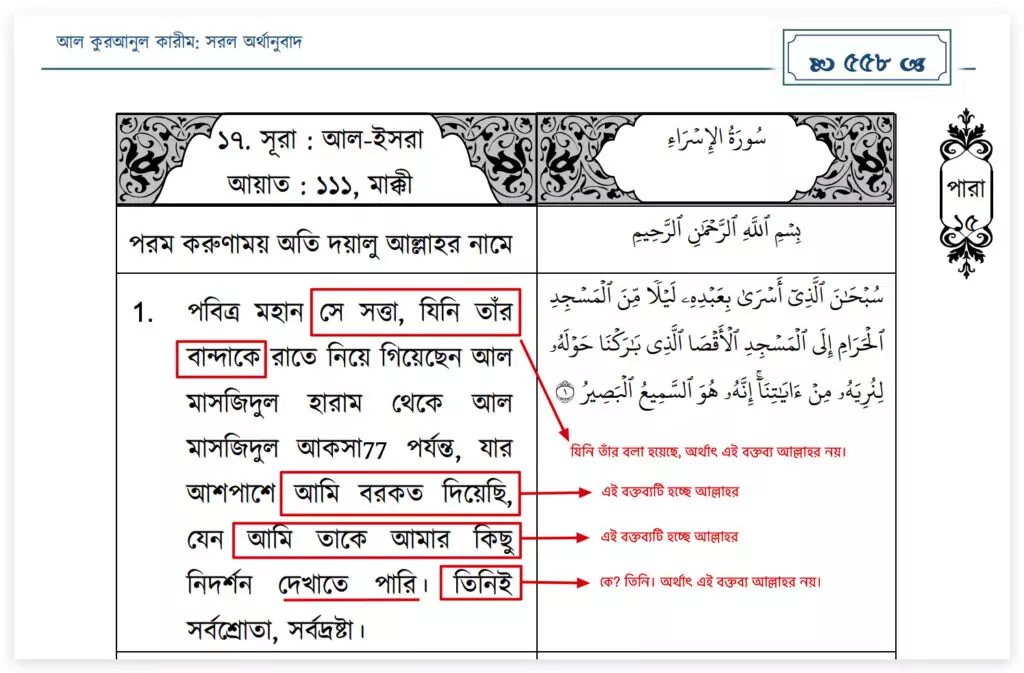
The sentence structure of the same verse is also found in the translation of Hafez Munir Uddin Ahmed. The connection between referring to Allah by name or in the third person and the declaration of action in the first person is maintained even in the translation.
Source of printed translation: Quran Sharif, Easy Simple Bengali Translation, Hafez Munir Uddin Ahmed, Al Quran Academy London, page 279.
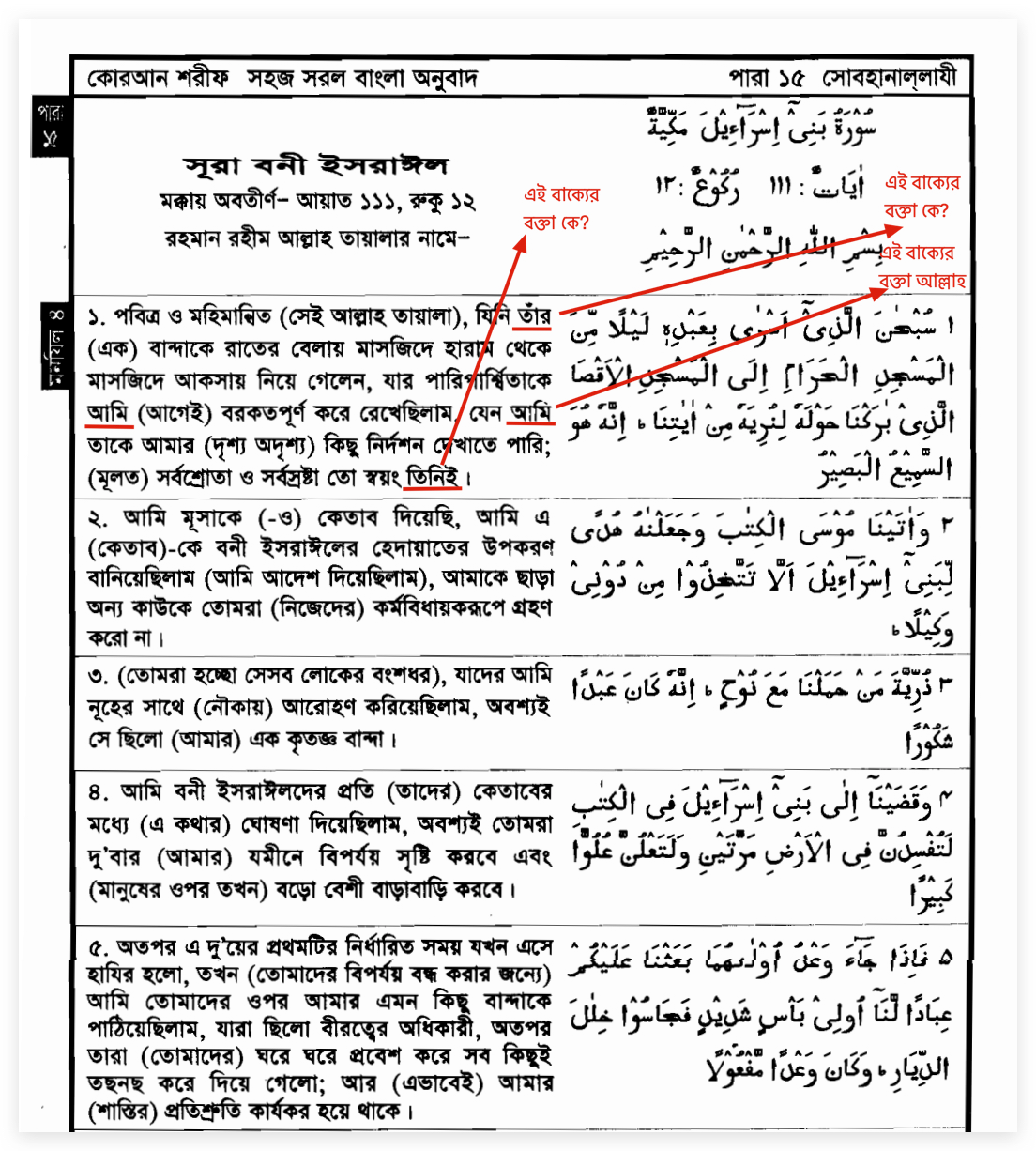
Shawkani directly identified this change. He called the appearance of “barakna” after “asra” a return from the third person to the first person. In Arabic rhetoric, this change is known as Iltifat. That is, the event of changing the pronoun style is clear even to the commentator; his explanation places the event within the recognized descriptive style of the language. [1137]
وفي ( باركنا ) بعد قوله ( أسرى ) التفات من الغيبة إلى التكلم .
English translation: After saying “asra”, a change from the third person to the first person occurred in “barakna”.
In the grammatical analysis of the word “subhan” at the beginning of the verse, the presence of an omitted verb is also assumed. Kurtubi, in the name of Sibawayh, said that an omitted verb of the same meaning is present here; the full meaning is “I declare Allah holy”. Thus, to form the full sentence of the word with which the verse began to declare glory, the commentator is determining the unexpressed part. [1138]
والعامل فيه على مذهب سيبويه الفعل الذي من معناه لا من لفظه ، إذ لم يجر من لفظه فعل ، وذلك مثل قعد القرفصاء ، واشتمل الصماء ; فالتقدير عنده : أنزه الله تنزيها ; فوقع ( سبحان الله ) مكان قولك تنزيها .
English translation: According to Sibawayh’s opinion, its effective verb is related to its meaning, not the expressed verb of the same root; because such a verb was not used from its word-form. This is an application like “quyud al-kurfusa” and “ishtimal as-samma”. To him, the full meaning is: I declare Allah completely holy. Therefore, “subhanallah” has come in place of your words “I declare holy”.
The explanation of Iltifat and the explanation of the omitted verb perform two types of work. The first names the change in the expressed pronoun; the second creates a complete sentence by assuming a verb that is not expressed. The result of one does not automatically come from the existence of the other. In the words of the verse, there are “He”, “We”, and “Our”; Shawkani determined the relationship of the same Allah’s actions among them. Kurtubi, again, determined the full form of the verb of declaring glory. These commentary decisions are working behind how a single verse will be connected in terms of meaning.
In the verse, Muhammad’s position is determined as “His servant”; the agent of taking by night is Allah. Then, the purpose of the journey is stated in the first-person plural: to show him some of Our signs. Consequently, the description of the event is not kept merely as a claim of one man’s journey; it is presented as an action performed by Allah and an experience selected for Muhammad. The sentence starting with Allah’s holiness simultaneously establishes His special relationship with the Prophet. The arrangement of pronouns is part of constructing that religious status.
In the example of Isra, the use of the third person for Allah and Allah’s own first person in the same sentence—this textual information is clear. Along with this, the identification of Iltifat given in the tafsir is also clear. But naming it “ornamentation” is not synonymous with proof of divine origin. The former is a description of language; the latter is a claim about the source of the book. If a descriptive style common in human language is present in a work, it does not establish a superhuman source for that work. Religious belief has provided the framework for accepting the linguistic event here; if that framework is presented as independent proof found outside the language, the steps of logic are skipped.
The book and the warner “from Him” in Hud 11:1–2
At the beginning of Hud, immediately after the identity of the book is given, a speaker appears who identifies himself as a warner and bringer of glad tidings from Allah. In the first verse, it is claimed that the verses of the book are firm, described in detail, and come from a Wise, All-Knowing Being. In the second verse, after forbidding the worship of anyone other than Allah, it is said, “I am for you from Him”. Here, “I” and “He” are two sides of the same relationship: one is the sent, the other is the sender. [1139]
الر ۚ كِتَابٌ أُحْكِمَتْ آيَاتُهُ ثُمَّ فُصِّلَتْ مِن لَّدُنْ حَكِيمٍ خَبِيرٍ
أَلَّا تَعْبُدُوا إِلَّا اللَّهَ ۚ إِنَّنِي لَكُم مِّنْهُ نَذِيرٌ وَبَشِيرٌ
English translation: 1
Alif, Lam, Ra; this is a book whose verses are firm, then explained in detail from the All-Wise, All-Knowing.
— Taisirul Quran
Alif Lam Ra. This is a book (Quran) whose verses have been made firm (by proofs). Then it has been described in detail; from the Wise (Allah).
— Sheikh Mujibur Rahman
Alif-Lam-Ra. This is a book whose verses have been established, then described in detail from the Wise, All-Aware Being.
— Rawai Al-bayan
Alif–Lam-Ra, this book, whose verses are clear [1], well-arranged and later detailed [2] from the Wise, All-Aware Being [3];
— Dr. Abu Bakr Muhammad Zakaria
2
(It teaches) that you shall not worship anyone other than Allah, I am certainly from Him a warner and bringer of glad tidings for you.
— Taisirul Quran
To the (purpose) that you worship none but Allah; I (Prophet) from Him (Allah) am a warner and bringer of glad tidings to you.
— Sheikh Mujibur Rahman
(To the effect) that you worship none but Allah. Surely I am for you from Him a warner and bringer of glad tidings.
— Rawai Al-bayan
That you worship none other than Allah [1], surely I am from Him a warner and bringer of glad tidings for you [2].
— Dr. Abu Bakr Muhammad Zakaria
In Arabic, “min ladun hakimin khabirin” in the first verse connects the source of the book to a Wise, Aware Being. “Innani lakum minhu” in the second verse says, I am for you from Him. According to the relationship of pronouns, the warner has presented himself as a representative of that source. A simple first-person text where Allah Himself comes from Himself to warn is not found here; the “I” of the sentence is in the position of a sent person.
In the explanation of this relationship, Ibn Ashur called “minhu” as indicating the source and clarified, I have come from Allah as a warner and bringer of glad tidings for you. That is, he identified the “I” of the text as the person whose statement is reaching the listeners from Allah. [1140]
أَيْ إِنِّي نَذِيرٌ وَبَشِيرٌ لَكُمْ جَائِيًا مِنْ عِنْدِ اللَّهِ
English translation: That is, I have come from Allah as a warner and bringer of glad tidings for you.
The entry of interpretation is also seen in the Bengali translations of these two verses of Hud. In Sheikh Mujibur Rahman’s translation, “Prophet” has been placed in brackets after “I” and “Allah” after “His”. In the Arabic verses, these two interpretative identities are not present as separate words. The translator has specified the identity of the pronouns for the reader. Even in other translations where there are no brackets, the same “I” and “His” relationship must be determined from the meaning of the sentence. Consequently, not only are words being changed in the translation; the decision of who is speaking and on whose behalf they are speaking is also being placed before the reader.
| specific part of the text | mentioned relationship | identity determined in the commentary |
|---|---|---|
| a book whose verses are firm and detailed | declaration of a book’s characteristics and source | claim that the book has come from Allah. |
| مِن لَّدُنْ حَكِيمٍ خَبِيرٍ | from a Wise and All-Aware Being | Allah, in Ibn Kathir’s explanation. |
| إِنَّنِي لَكُمْ | I [am] for you | the position of the person sent as a warner. |
| مِنْهُ | from His side | from Allah, in Ibn Ashur’s explanation. |
| نَذِيرٌ وَبَشِيرٌ | a warner and a bringer of glad tidings | addressing the listener through the fear of punishment and the hope of reward. |
In explaining the first verse, Ibn Kathir stated that it is firm in wording and detailed in meaning. He then specified that the phrase “from a Wise, All-Aware Being” means from Allah. Therefore, the description of the book’s qualities in the verse is interpreted by the tafsir as the qualities of Allah’s words and decrees. [1141]
( أحكمت آياته ثم فصلت ) أي : هي محكمة في لفظها ، مفصلة في معناها ، فهو كامل صورة ومعنى . هذا معنى ما روي عن مجاهد ، وقتادة ، واختاره ابن جرير .
وقوله : ( من لدن حكيم خبير ) أي : من عند الله الحكيم في أقواله ، وأحكامه ، الخبير بعواقب الأمور .
English translation: “whose verses have been made firm, then described in detail”—meaning its wording is firm and its meaning is explained in detail; consequently, it is complete in form and meaning. This is the meaning of the reports narrated from Mujahid and Qatada, and Ibn Jarir has accepted this. And “from a Wise, All-Aware Being”—meaning from Allah, who is Wise in His statements and decrees and All-Aware of the outcomes of matters.
Ibn Ashur has identified the sudden occurrence of the warner’s self-identification within these descriptions as an intermediate sentence. According to him, it is placed between the command not to worship anyone other than Allah and the command to seek forgiveness from the Lord. Its function is to warn against disobedience and encourage obedience. Consequently, at the beginning of the book, not only the decrees but also the personal position of the proclaimer of the decrees is established. [1142]
وَجُمْلَةُ إِنَّنِي لَكُمْ مِنْهُ نَذِيرٌ وَبَشِيرٌ مُعْتَرِضَةٌ بَيْنَ جُمْلَةِ أَلَّا تَعْبُدُوا إِلَّا اللَّهَ وَجُمْلَةِ وَأَنِ اسْتَغْفِرُوا رَبَّكُمْ الْآيَةَ ، وَهُوَ اعْتِرَاضٌ لِلتَّحْذِيرِ مِنْ مُخَالَفَةِ النَّهْيِ وَالتَّحْرِيضِ عَلَى امْتِثَالِهِ .
English translation: “Indeed I am for you from His side a warner and a bringer of glad tidings”—this sentence is located between the verses “Worship none but Allah” and “Seek forgiveness from your Lord.” It is an intermediate sentence to warn against disobeying the prohibition and to encourage its observance.
Similar identifications of the warner appear elsewhere in the Quran with a direct “he said” indicator. In Surah Nuh, after mentioning the sending, Nuh’s self-identification begins with a clear “qala”—he said. There, the sign to identify the speaker of “I am to you a clear warner” is expressed within the words of the verse itself. [1143]
قَالَ يَا قَوْمِ إِنِّي لَكُمْ نَذِيرٌ مُّبِينٌ
English translation: He said: O my people, indeed I am for you a clear warner.
In Hud 11:2, there is no explicit “say” or “he said” before this specific self-identification. The speaker is determined based on the role of the warner and the relationship “from His side.” In Nuh’s case, the speaker’s entry sign is explicit; in Hud’s case, a similar identity is established through context and tafsir. This comparison shows that the method of presenting utterances within the compiled book is not uniform everywhere.
This self-identification of the Prophet also carries a specific claim for the followers: His warnings must be accepted not as personal conjecture, but as coming from Allah. If that claim is accepted, the statement declared from the speaker’s human position gains divine authority. However, saying “I am from His side” is not proof of that relationship itself; it is the language of claiming the relationship. The praise of the source at the beginning of the book combined with the establishment of the sent person’s self-identification—together these create a closed structure of authority. The source is established by the book’s own declaration, and the truthfulness of the declarer is claimed in the name of that same source.
The decision as to which warning was accepted as the Prophet’s general preaching and which as the specific words of the revealed Quran is linked to the history of compilation and recognition. The grammatical identity of “I” is not an alternative to that decision. In this reading of Hud, the Prophet’s voice has been preserved and he has been given the status of revelation—this is the specific event. To examine the acceptability of that status, the process of the book’s propagation, preservation, and approval is required in addition to the book’s self-declaration.
Examples from Kausar, Nahl, Mujadila, Baqara, and Shura
Declaration of the giver in Kausar. In the first verse of Kausar, the relationship between the giver and the recipient is expressed using the first-person plural and the second-person pronoun. “Inna ataynakal Kausar”—Indeed We have given you Kausar. The declaration of the gift is made from Allah’s position, and the addressed recipient is Muhammad. In some Bengali translations, “I” appears instead of the plural; in Zakaria’s translation, “We” has been retained. [1144]
إِنَّا أَعْطَيْنَاكَ الْكَوْثَرَ
English translation: I have given you (the pond of) Kauthar.
— Taisirul Quran
I have certainly given you Kauthar,
— Sheikh Mujibur Rahman
Surely I have given you Al-Kauthar.
— Rawai Al-bayan
Surely we have given you Kauthar [1].
— Dr. Abu Bakr Muhammad Zakaria
During the recitation of Kausar, the worshiper does not personally claim to give Kausar to Muhammad; he quotes a declaration uttered from the position of the giver. In the case of Fatiha, the same worshiper assumes his own position within the “we” of the prayer. Consequently, sentences from the same book used in prayer function in two ways: sometimes as a prayer, sometimes as the recitation of another speaker’s statement. This difference cannot be identified solely by hearing the reciter’s voice; the accepted interpretation regarding the role of the sentence determines its use. The words selected for worship and the claim the worshiper himself makes are not always the same.
Oath in the name of Allah in Nahl. Verse 63 of Nahl begins with “Tallahi”—by Allah. This is followed by “laqad arsalna”—We certainly sent. The entity of the oath is mentioned by name, and the claim of sending is in the first-person plural. The statement that Satan had made the deeds of past communities seem fair to them and that they would receive a painful punishment is emphasized through that oath. [1145]
تَاللَّهِ لَقَدْ أَرْسَلْنَا إِلَىٰ أُمَمٍ مِّن قَبْلِكَ فَزَيَّنَ لَهُمُ الشَّيْطَانُ أَعْمَالَهُمْ فَهُوَ وَلِيُّهُمُ الْيَوْمَ وَلَهُمْ عَذَابٌ أَلِيمٌ
English translation: By Allah! Before you I sent messengers to many nations, but Satan made their deeds seem fair to them, and today he is their guardian; for them there is a terrible punishment.
— Taisirul Quran
By Allah! I sent messengers to many nations before you; but Satan made the activities of those nations seem fair in their sight; so he is today their guardian and for them there is a painful punishment.
— Sheikh Mujibur Rahman
By the oath of Allah, I sent messengers to many nations before you. Then Satan made their deeds fair for them. Therefore today he is their guardian. And for them there is a painful punishment.
— Rawai Al-bayan
By the oath of Allah! We sent messengers to many nations before you; but Satan made the activities of those nations seem fair in their sight; therefore he is today [1] their guardian and for them there is a painful punishment.
— Dr. Abu Bakr Muhammad Zakaria
In the printed translation of Al-Bayan, the oath by Allah and the statement of sending the messenger in the first person are side by side. In the translation of the Arabic “arsalna,” the singular “I” was used; this translation has also made a choice regarding the number of the sentence.
Source of printed translation: Al Quranul Kareem, Simple Translation, Al-Bayan Foundation Bangladesh, page 288.
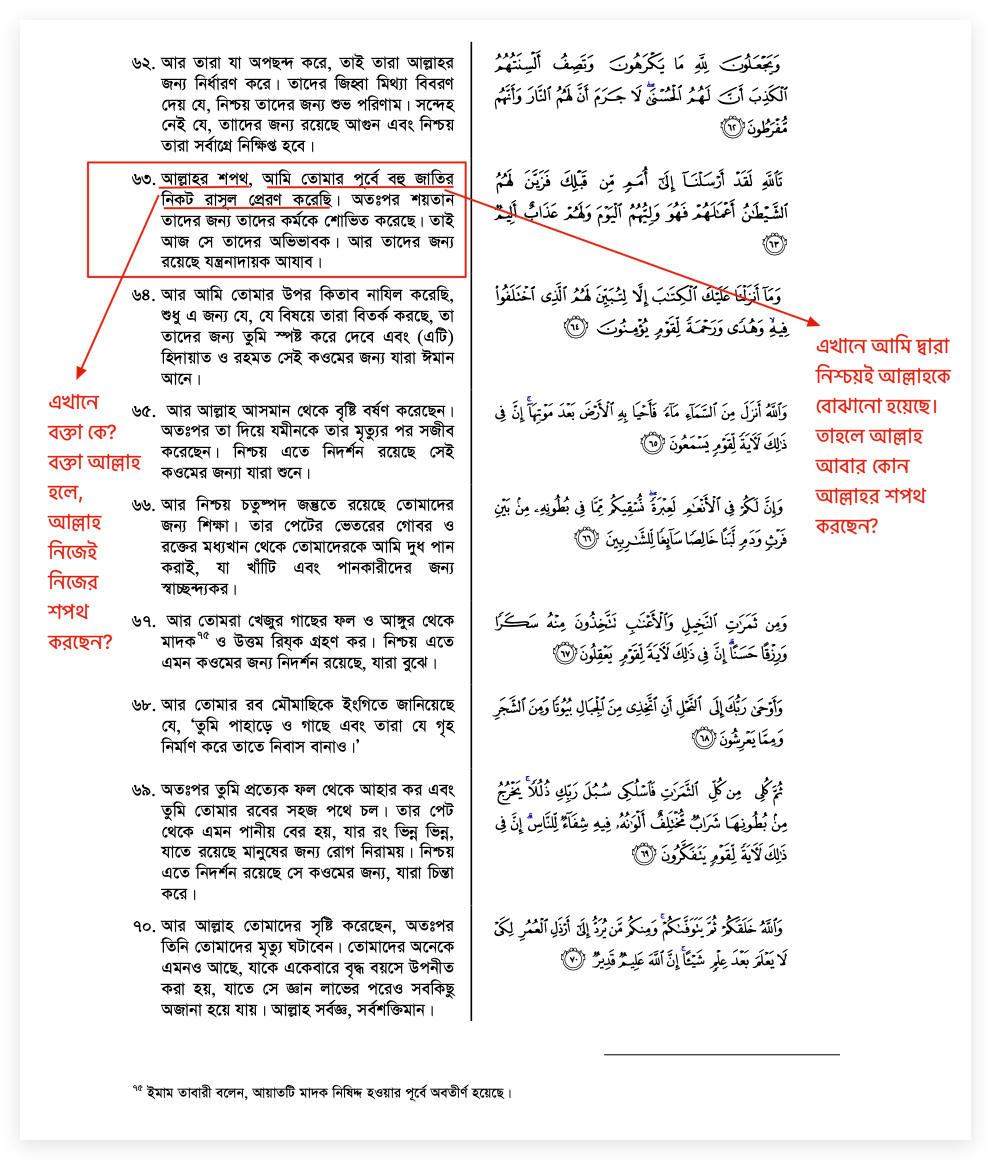
An oath is a linguistic means of increasing the assurance of a statement to the listener. Here, the fact of sending past messengers is emphasized as true in the name of Allah, and that sender is also Allah in religious interpretation. Consequently, the authority of the oath and the source of the declaration are established in the same entity. This increases the emphasis of the statement; it does not increase the number of independent witnesses. To prove the content of the oath as true from the fact that an oath was made in Allah’s name, one must first accept the claim that the book is the statement of that Allah. This is the limit of providing assurance for one’s own statement based on one’s own declared identity.
Description of reward in the third person in Mujadila. The latter part of verse 22 of Mujadila mentions being admitted to Paradise, eternal residence, the pleasure of Allah, and the success of the “party of Allah.” The relationship between pronouns and names is constructed in the third person: He will admit them, Allah is pleased with them, they are pleased with Allah. [1146]
وَيُدْخِلُهُمْ جَنَّاتٍ تَجْرِي مِن تَحْتِهَا الْأَنْهَارُ خَالِدِينَ فِيهَا ۚ رَضِيَ اللَّهُ عَنْهُمْ وَرَضُوا عَنْهُ ۚ أُولَٰئِكَ حِزْبُ اللَّهِ ۚ أَلَا إِنَّ حِزْبَ اللَّهِ هُمُ الْمُفْلِحُونَ
English translation: He will admit them into Paradise, beneath which rivers flow. They will remain there forever. Allah is pleased with them and they are pleased with Allah. They are the party of Allah. Know that the party of Allah will be successful.
If the same statement were written in Allah’s continuous first person, “He” would become “I,” “Allah’s” would become “My,” and the verb forms would change. The sentences on the bottom right are comparisons composed by the author to show this difference. In the text on the left, the group receiving the reward is linked to Him by repeatedly using Allah’s name; compared to the right side, the same relationship takes the form of a direct self-declaration.
| As it is in the Quran | Author’s composed comparison: the same relationship in the first person |
|---|---|
| He will admit them into Paradise, beneath which rivers flow. They will remain there forever. Allah is pleased with them and they are pleased with Allah. They are the party of Allah. Know that the party of Allah will be successful. | I will admit them into Paradise, beneath which rivers flow. They will remain there forever. I (Allah) am pleased with them and they are pleased with Me (Allah). They are My (Allah’s) party. Know that My (Allah’s) party will be successful. |
The language of reward in this verse also has a social function: defining the identity of the group as the “party of Allah” and linking its success to Allah’s pleasure. “They are His party” and “They are My party”—the same relationship of obedience and success can be propagated in both forms, but the speaker’s position is not equally expressed in the words. Declaration by name, promise in the first person, and the recitation of that declaration by a follower—the method of delivering authority is different at each step.
Transition from report to prayer in Baqara. The beginning of verse 286 of Baqara reports that Allah does not impose a responsibility on anyone beyond their capacity. Then, the same verse shifts to the voice of the petitioner, saying “O our Lord.” Exemption from the liability of error and forgetfulness, not being given heavy responsibilities like the predecessors, not being given an unbearable burden, forgiveness, mercy, and help against the unbelievers are sought. [1147]
لَا يُكَلِّفُ اللَّهُ نَفْسًا إِلَّا وُسْعَهَا ۚ لَهَا مَا كَسَبَتْ وَعَلَيْهَا مَا اكْتَسَبَتْ ۗ رَبَّنَا لَا تُؤَاخِذْنَا إِن نَّسِينَا أَوْ أَخْطَأْنَا ۚ رَبَّنَا وَلَا تَحْمِلْ عَلَيْنَا إِصْرًا كَمَا حَمَلْتَهُ عَلَى الَّذِينَ مِن قَبْلِنَا ۚ رَبَّنَا وَلَا تُحَمِّلْنَا مَا لَا طَاقَةَ لَنَا بِهِ ۖ وَاعْفُ عَنَّا وَاغْفِرْ لَنَا وَارْحَمْنَا ۚ أَنتَ مَوْلَانَا فَانصُرْنَا عَلَى الْقَوْمِ الْكَافِرِينَ
English translation: Allah does not burden any soul beyond its capacity; it gets what it earns and upon it falls what it does. O our Sustainer, if we forget or make a mistake, then do not make us sinners. O our Sustainer! and do not impose upon us such a responsibility as You imposed upon those before us, O our Lord! and do not make us bear that burden which we have no strength to bear. Blot out our sins. Forgive us and have mercy on us. You are our Lord. Therefore help us against the disbelieving community.
In this verse, the entry sign for prayer is “Rabbana”—our Lord. In the preceding sentence, it was speaking about Allah; in the following sentences, it is speaking to Allah. The one who imposes responsibility and the one to whom the easing of the burden of responsibility is requested is the same deity; but the petitioners bearing the liability are different. Because of the entry from a report-style declaration into the language of supplication within the same sequence of sentences, the voice of the text has changed. This change was not created by translation; it is present in the Arabic “our Lord,” “do not hold us,” “forgive us.”
The initial declaration regarding capacity and the subsequent plea for protection from an unbearable burden also create a tension in meaning. In Ibn Kathir’s explanation, the subsequent burden includes danger and trials along with responsibility. Consequently, the commentary also determines how the responsibility of the first part and the subject of the prayer in the second part will be distinct or expanded. To establish the relationship between prayer and assurance, this explanation outside the text becomes necessary. [1148]
وقوله : ( ربنا ولا تحملنا ما لا طاقة لنا به ) أي : من التكليف والمصائب والبلاء ، لا تبتلينا بما لا قبل لنا به .
English translation: And “O our Lord, do not impose upon us something that we have no strength to bear”—meaning from responsibility, danger, and trials; do not put us to a test that we do not have the capacity to face.
“My Lord” in Shura. In verse 10 of Shura, after mentioning that the settlement of human differences is with Allah, it is said: That Allah is my Lord, in Him I trust and to Him I turn. Here, the speaker is identifying his own Lord. The person saying “my Lord” and the position of that Lord are distinct. [1149] [1150]
وَمَا اخْتَلَفْتُمْ فِيهِ مِن شَيْءٍ فَحُكْمُهُ إِلَى اللَّهِ ۚ ذَٰلِكُمُ اللَّهُ رَبِّي عَلَيْهِ تَوَكَّلْتُ وَإِلَيْهِ أُنِيبُ
English translation: The settlement of the matters you differ upon is entrusted to Allah. That Allah is my Sustainer, in Him I rely, and towards Him I turn.
— Taisirul Quran
Whatever you differ upon, its settlement is with Allah. Say: He is Allah! my Rabb. I rely upon Him and I turn towards Him!
— Sheikh Mujibur Rahman
And whatever you disagree upon in any matter, its decision is with Allah; He is Allah, my Rabb; upon Him I have put my tawakkul and I turn towards Him.
— Rawai Al-bayan
And whatever you differ upon—–its decision is with Allah. He is Allah — my Rabb; upon Him I have relied and I turn towards Him.
— Dr. Abu Bakr Muhammad Zakaria
In Sheikh Mujibur Rahman’s translation of this verse, the word “Say:” has been added. However, in the Arabic, there is no explicit “qul” (say) at the beginning of the verse or before “That Allah is my Lord.” By inserting this word in the translation, the speaker is specified as the Prophet and the statement as an instructed utterance given to him. This addition functions as an interpretation within the translation; to the reader, it appears as a direct command to begin speaking.
Tabari explained the same relationship by suggesting that the Prophet was commanded to tell his listeners. In his tafsir, Allah is saying to the Prophet: the Being with these characteristics is my Lord; upon Him I have entrusted my affairs and to Him I return from sin. Consequently, the decision to place the first person of the sentence in the voice of the sent one is made clear in the commentary. [1151]
وقوله: ( ذَلِكُمُ اللَّهُ رَبِّي عَلَيْهِ تَوَكَّلْتُ ) يقول لنبيه صَلَّى الله عَلَيْهِ وَسَلَّم: قل لهؤلاء المشركين بالله هذا الذي هذه الصفات صفاته ربي, لا آلهتكم التي تدعون من دونه, التي لا تقدر على شيء ( عَلَيْهِ تَوَكَّلْتُ ) في أموري, وإليه فوضت أسبابي, وبه وثقت ( وَإِلَيْهِ أُنِيبُ ) يقول: وإليه أرجع في أموري وأتوب من ذنوبي.
English translation: And His words: “That Allah is my Lord, upon Him I have relied”—He is saying to His Prophet: Tell those who associate partners with Allah that He who possesses these characteristics is my Lord; not the deities you call upon besides Him, who possess no power over anything. “Upon Him I have relied”—in my affairs; I have entrusted my means to Him and placed my trust in Him. “To Him I return”—meaning in my affairs I return to Him and I repent for my sins.
According to the role of the text, the position of the reciter also changes. In prayer, he may express his own needs; in a declaration of charity, he does not become the donor; in the self-identification of the sent one, he quotes the words of that person. If these roles are merged simply by seeing the same Arabic first person, the internal relationship of the text is destroyed.
| Type of text | Position of the speaker within the sentence | Relationship with the reciter |
|---|---|---|
| Prayer of Al-Fatiha | The worshiper is asking Allah | The reciter can place himself in the position of the prayer-seeker |
| Declaration of charity in Al-Kawthar | The donor is telling the recipient about the donation | The reciter is quoting the declaration; he does not become the donor himself |
| Warning of Hud | The sent one is speaking on behalf of the sender | The reciter is quoting a sentence placed in the Prophet’s voice |
| Mentioning oneself in the third person | Referring to the Being by name or as “He” | Context and explanation of the sentence are needed to identify the speaker |
Even within these different roles, Islamic Ulum al-Quran does not grant the freedom to read the Quran in one’s own words based on meaning. In Suyuti’s discussion, the difference between the permission to narrate according to the meaning of the Sunnah and the obligation to recite the Quran in specific words is clear. The reason given there is that Gabriel delivered the Quran word for word. [1121]
وَمِنْ هُنَا جَازَ رِوَايَةُ السُّنَّةِ بِالْمَعْنَى لِأَنَّ جِبْرِيلَ أَدَّاهُ بِالْمَعْنَى وَلَمْ تَجُزِ الْقِرَاءَةُ بِالْمَعْنَى لِأَنَّ جِبْرِيلَ أَدَّاهُ بِاللَّفْظِ
English translation: For this reason, it has become permissible to narrate according to the meaning of the Sunnah, since Gabriel delivered it according to the meaning. But it has not become permissible to recite the Quran according to the meaning, since Gabriel delivered it in specific words.
Consequently, a strict contradiction is created: the worshiper must keep the specific words unchanged, but to determine whose voice is in those words and where the implicit “Say” is located, one must accept the commentator’s explanation. In the religious system, the sanctity of specific letters is strictly established, yet the speaker of the sentence and the boundaries of the utterance are not everywhere explicit. The translator’s brackets, the mufassir’s implicit commands, and the customs of recitation in prayer together keep this multi-voiced book functioning as a single divine message. Here, human interpretation is not a marginal note; it is active in establishing the connection of meaning regarding who is allowed to say what.
The “I-We” in Al-An’am and the change of language in the same sequence
In the verses of Al-An’am 97–99, three descriptions begin consecutively with “Wa Huwal-ladhi”—And He is the Being who. The subjects of this sequence are identifying the path through stars, the creation of humans from one Being, and the production of plants by sending down water from the sky. In each description, after mentioning the action in the third person, the explanation of signs or the declaration of producing plants comes in the first person plural. In the Bengali translation, since the plural is rendered as “I”, the change in the text appears as “He-I”; in Arabic, it is “He-We”.
In verse number 97, after the act of placing the stars is mentioned in the third person, the declaration of describing the signs in detail comes in the first person. “He has done” and “We have explained”—two forms exist side by side within the same verse. [1152]
وَهُوَ الَّذِي جَعَلَ لَكُمُ النُّجُومَ لِتَهْتَدُوا بِهَا فِي ظُلُمَاتِ الْبَرِّ وَالْبَحْرِ ۗ قَدْ فَصَّلْنَا الْآيَاتِ لِقَوْمٍ يَعْلَمُونَ
English translation: He created the constellations for you so that you may find your way in the darkness of land and water. Surely for those who are knowledgeable I have explained the signs in detail.
In verse number 98, the same pattern is seen again. The agent of creating humans from one Being is “He”; at the end, there is the “We” who describes the signs in detail. The same subject is being expressed from the two positions of description and self-declaration. [1153]
وَهُوَ الَّذِي أَنشَأَكُم مِّن نَّفْسٍ وَاحِدَةٍ فَمُسْتَقَرٌّ وَمُسْتَوْدَعٌ ۗ قَدْ فَصَّلْنَا الْآيَاتِ لِقَوْمٍ يَفْقَهُونَ
English translation: He created you from one person. Then one is your dwelling place and one is a place of deposit. Surely I have explained the proofs in detail for them who reflect.
In verse number 99, the agent of sending down water from the sky first appears in the third person. Then, the act of bringing out plants with that water and producing grains from green crops is stated in the first person. The change occurs within the description of the same natural process. [1154]
وَهُوَ الَّذِي أَنزَلَ مِنَ السَّمَاءِ مَاءً فَأَخْرَجْنَا بِهِ نَبَاتَ كُلِّ شَيْءٍ فَأَخْرَجْنَا مِنْهُ خَضِرًا نُّخْرِجُ مِنْهُ حَبًّا مُّتَرَاكِبًا وَمِنَ النَّخْلِ مِن طَلْعِهَا قِنْوَانٌ دَانِيَةٌ وَجَنَّاتٍ مِّنْ أَعْنَابٍ وَالزَّيْتُونَ وَالرُّمَّانَ مُشْتَبِهًا وَغَيْرَ مُتَشَابِهٍ ۗ انظُرُوا إِلَىٰ ثَمَرِهِ إِذَا أَثْمَرَ وَيَنْعِهِ ۚ إِنَّ فِي ذَٰلِكُمْ لَآيَاتٍ لِّقَوْمٍ يُؤْمِنُونَ
English translation: He sent down water from the sky then I produced all kinds of vegetation by it, then I brought forth from it green crops, from which I produce grains arranged in layers. I bring forth clusters from the date-palms, which hang low, and vineyards, olives, and pomegranates, similar and dissimilar. Observe the fruits of various trees when they bear fruit and observe their ripening. Surely in these there are signs for the believers.
In the printed Bengali translation as well, “He” is used for the sending of water and “I” for the production of plants. The translation of the Arabic plural into singular and the change from third person to first person—two separate decisions have merged in this presentation.
Source of printed translation: Al Quranul Kareem, Simple Translation, Al-Bayan Foundation Bangladesh, page 156.
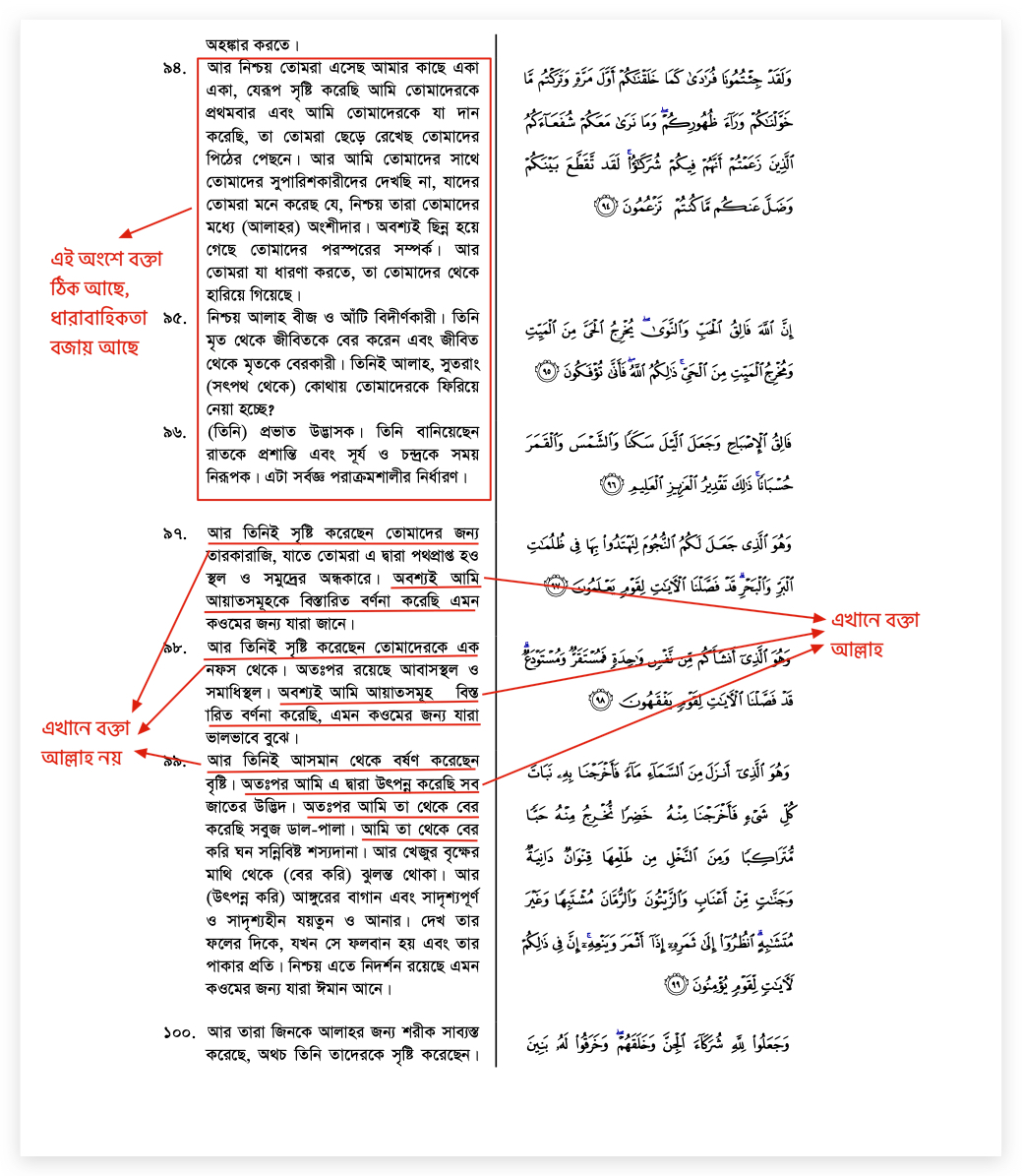
| Verse | Beginning in the third person | Subsequent part in the first person |
|---|---|---|
| 6:97 | وَهُوَ الَّذِي جَعَلَ لَكُمُ النُّجُومَ — He has placed the stars for you | قَدْ فَصَّلْنَا الْآيَاتِ — We have explained the signs in detail. |
| 6:98 | وَهُوَ الَّذِي أَنشَأَكُم — He has created you | قَدْ فَصَّلْنَا الْآيَاتِ — We have explained the signs in detail. |
| 6:99 | وَهُوَ الَّذِي أَنزَلَ مِنَ السَّمَاءِ مَاءً — He has sent down water from the sky | فَأَخْرَجْنَا / نُّخْرِجُ — then we produced / we bring forth. |
If the first two verses are written continuously in the third person, the final “I have described in detail” changes to “He has described in detail.” The sentences on the bottom right are the comparison composed by the author; the original Bengali text is on the left. The comparison shows how the style of the words changes.
| As it is in the Quran | Comparison composed by the author: if the third person is kept continuous |
|---|---|
| He created the constellations for you so that you may find your way in the darkness of land and water. Surely for those who are knowledgeable I have explained the signs in detail. | He created the constellations for you so that you may find your way in the darkness of land and water. Surely for those who are knowledgeable He has explained the signs in detail. |
| He created you from one person. Then one is your dwelling place and one is a place of deposit. Surely I have explained the proofs in detail for them who reflect. | He created you from one person. Then one is your place of settlement and one is a place of deposit. Surely He has explained the proofs in detail for those who reflect. |
In the common readings of tafsir for these three verses, the same Allah is meant as the agent of the actions. A connection is established between the description of His work in the third person and His self-declaration in the first person. But there is another change in Al-An’am, where something more than just a change in the style of mentioning the same Being is happening. There, one person identifies himself as the one responsible for delivering; then the “We” who explains the signs returns; then that same person is told to follow the instructions of his Lord.
In this sequence of verses from 104 to 106, the action of the speaker and the position of the addressed person change consecutively. In 104 it is “I am not a guardian over you”, in 105 “We explain the signs in various ways”, and in 106 “Follow that which has been revealed to you from your Lord”. [1155] [1156] [1157]
قَدْ جَاءَكُم بَصَائِرُ مِن رَّبِّكُمْ ۖ فَمَنْ أَبْصَرَ فَلِنَفْسِهِ ۖ وَمَنْ عَمِيَ فَعَلَيْهَا ۚ وَمَا أَنَا عَلَيْكُم بِحَفِيظٍ
وَكَذَٰلِكَ نُصَرِّفُ الْآيَاتِ وَلِيَقُولُوا دَرَسْتَ وَلِنُبَيِّنَهُ لِقَوْمٍ يَعْلَمُونَ
اتَّبِعْ مَا أُوحِيَ إِلَيْكَ مِن رَّبِّكَ ۖ لَا إِلَٰهَ إِلَّا هُوَ ۖ وَأَعْرِضْ عَنِ الْمُشْرِكِينَ
English translation: A means of insight has come to you from your Lord. He who sees, it is for himself; and he who remains blind, the burden is upon him. I am not a guardian over you.
Thus we explain the signs in various ways, and they may say, “You have studied”; and that we make it clear for people of knowledge.
Follow that which has been revealed to you from your Lord. There is no deity except Him. And turn away from those who associate partners.
Ibn Kathir has explained the “I” in verse number 104 solely as the person responsible for delivering the statement. In his explanation, the power to give guidance belongs to Allah, and the speaker is not an overseer over humans. Consequently, if the self-identification of 104 is merged with the “We” who explains the signs in 105, the difference in the speaker’s action is erased. [1158]
( وما أنا عليكم بحفيظ ) أي : بحافظ ولا رقيب ، بل أنا مبلغ والله يهدي من يشاء ويضل من يشاء .
English translation: “I am not a guardian over you”—meaning not a protector or overseer; rather, I am the person responsible for delivering. And Allah guides whom He wills and leads astray whom He wills.
| Verse | Role of the speaker or the addressed | Explicit instruction or utterance |
|---|---|---|
| 6:104 | First person of the person delivering the message | Distancing himself from the responsibility of being a guardian over the listeners. |
| 6:105 | First person plural explaining the signs | “We” are explaining; the accusation directed at the Prophet is also quoted. |
| 6:106 | Addressing the person who received revelation from the Lord | He is the recipient of the instruction; he has been ordered to follow and to turn away. |
In the discussion on “the omission of the verb of saying in the Quran” on Islamweb, Al-An’am 6:104 is also kept as such an example. There, the relationship of the sentence is determined by assuming “Say, O Muhammad” at the beginning. In that discussion, this comment is quoted in the name of Ibn Ashur regarding the extensive use of omitting the verb of saying. [1159]
وحذف القول كثير الورود في القرآن
English translation: The use of omitting the verb of saying is frequent in the Quran.
In the same discussion, there is also a condition for determining the omitted part: there must be a signal for it in the explicit words. According to this condition quoted in the name of Ibn Ashur, the commentator identifies the unexpressed instruction from the context of the sentence. That is, even if a word is writtenly absent, its relationship is assumed within the meaning. [1160]
وحذف القول كثير في القرآن، إذا دلت عليه قرينة الكلام
English translation: The omission of the verb of saying occurs frequently in the Quran when the contextual signal of the statement indicates its instruction.
The “He-We” change in 97–99 and the change of representative, announcer, and addressed in 104–106 are therefore not the same kind of event. In the first sequence, it is explained that the style of describing the actions of the same Being has changed. In the second sequence, the person delivering the statement has stated his limits and in the next verse has himself become the recipient of the instruction. This difference is captured not only in pronouns but also in the responsibility of the action, the relationship of authority, and the direction of the instruction.
In the compiled text, the beginning and end of utterances are not marked separately every time. Which first person is Allah’s and which first person is the Prophet’s, where the listener is the general public and where the addressed person is Muhammad—these relationships have had to be determined in the tafsir. The social result of this determination is also clear: the sentence where the Prophet states his own limits, the declaration of Allah’s work, and the instructions given to the Prophet are propagated as parts of the same sacred text of equal status. Religious unity here does not stand on grammatical uniformity; it stands on the belief and interpretation that links utterances in various roles to a single divine source.
Language of hope and possibility in Al-Mumtahanah: Relationship with the claim of omniscience
In verse number 7 of Al-Mumtahanah, the transformation of a relationship of enmity into friendship is stated using “asa” (perhaps/hope). In Bengali translations, the words “somvoboto”, “somvobotah” and “asha kora jay” (it can be hoped) have appeared for this word; in English translations, “Perhaps”. In the same sentence, Allah is also called Almighty, Forgiving, and Merciful. That is, the mention of His own future action in the language of possibility is placed side by side with the certainty of power. [1161]
۞ عَسَى اللَّهُ أَن يَجْعَلَ بَيْنَكُمْ وَبَيْنَ الَّذِينَ عَادَيْتُم مِّنْهُم مَّوَدَّةً ۚ وَاللَّهُ قَدِيرٌ ۚ وَاللَّهُ غَفُورٌ رَّحِيمٌ
English translation: Perhaps Allah will create friendship between you and those among them whom you have made enemies (through their becoming Muslim). Allah is All-Powerful, Allah is Most Forgiving, Most Merciful.
— Taisirul Quran
Those with whom you have enmity, perhaps Allah will create friendship between them and you; Allah is All-Powerful, Most Merciful.
— Sheikh Mujibur Rahman
Those with whom you are having enmity, it is hoped that Allah will create friendship between you and them. And Allah is All-Powerful and Allah is Most Forgiving, Most Merciful.
— Rawai Al-bayan
Those with whom you have enmity, perhaps Allah will create friendship between them and you [1] and Allah is Powerful. And Allah is Forgiving, Most Merciful.
— Dr. Abu Bakr Muhammad Zakaria
Perhaps Allah will put, between you and those to whom you have been enemies among them, affection. And Allah is competent,1 and Allah is Forgiving and Merciful.
— Saheeh International
In ordinary human language, a common reason for using “perhaps” or “I hope” is uncertainty about the future. Someone may hope to eat hilsa fish for lunch because hilsa has been cooked at home. Yet, their eating it is not certain; if a cat eats the fish before they do, that expectation will not be fulfilled. The fact that it was cooked created a possibility, but the speaker lacks knowledge and control over all future events. Therefore, they use the language of expectation instead of certainty.
If Allah is accepted as omniscient and the determiner of the future, questions arise regarding the meaning of the same language. One must reconcile the sentence “perhaps Allah will create friendship” with the theology that He knows everything He will do later and what the result will be. If Allah is taken as the alleged source of the verse, then within the statement, Allah is mentioning His own future action in the form of a possibility. If the voice of the sentence is taken from the position of human expectation, the language of uncertainty remains easy to understand, but that position then diverges from Allah’s own self-declaration of omniscience.
There is a detailed relationship between the claims of Allah’s foreknowledge and predetermined Taqdir in the discussion. After assuming this foreknowledge to be certain, the meaning of words denoting possibility must be determined separately. The problem is not just in the Bengali synonyms of the word; it is also about whose knowledge, whose expectation, and which future action the word expresses.
In explaining “asa” and “la’alla”, Islamweb quoted a direct argument from Al-Lubab. Claiming a consensus among commentators, it stated that in the case of Allah, “asa” denotes certainty. This is because showing someone hope and then depriving them is shameful, and Allah is above that. [1162]
اتفق المفسرون على أن كلمة عسى من الله واجب: لأنه لفظ يفيد الإطماع، ومن أطمع إنساناً في شيء ثم حرمه كان عاراً والله تعالى أكرم من أن يطمع واحداً في شيء ثم لا يعطيه.
English translation: The commentators have agreed that in the case of Allah, “asa” carries a certain meaning. Because it is a word that arouses hope. For a person to show someone hope for something and then deprive them is shameful for that person; and Allah is above showing someone hope for something and not giving it.
The basis of this argument is outside the lexical meaning. First, a moral and theological decision is made about Allah: He will not show someone hope and then deprive them. Then, with the help of that decision, the specific use of the word denoting hope is read as a certain promise. No new letter of certainty was separately added to “asa”; a pre-accepted belief about the speaker became the criterion for selecting the meaning of the word. The concept of the perfection of the one whose statement is being verified has been made the judge for determining the meaning of that statement.
If this selection of meaning is used back as independent linguistic proof of Allah’s omniscience, the argument becomes circular. First, His perfection was assumed to turn possibility into certainty; then, by showing that interpreted certainty, His statement was established as completely certain. The belief accepted at the beginning returns as the result at the end. This dependence remains clear if the use of the word and the religious interpretation of that use are kept separate.
Regarding the verse of Mumtahina, Tabari linked the future friendship to the conversion to Islam of many of the Quraysh’s opponents. In his explanation, they later became friends and people of the same party. That is, he gave a specific identity to the subsequent implementation of the verse. [1163]
يقول تعالى ذكره: عسى الله أيها المؤمنون أن يجعل بينكم وبين الذين عاديتم من أعدائي من مشركي قريش مودّة، ففعل الله ذلك بهم، بأن أسلم كثير منهم، فصاروا لهم أولياء وأحزابًا.
English translation: Allah says: O believers, Allah may create love between you and the partners of the Quraysh, who are your enemies and my enemies, with whom you have maintained enmity. He has done so in their case; many of them have accepted Islam and they have become their friends and people of the same party.
In this explanation by Tabari, the political and religious conditions of the friendship are also specified: the opponents embraced Islam and became part of the same party. The declaration of possibility is read as a result by matching it with the subsequent sequence of events. The use of the word denoting possibility does not vanish just because that result occurred; rather, the commentator is showing with which event the declaration has been matched. Simultaneously, the change in the position of the opponents is presented in the language of Allah’s forgiveness and mercy.
There are differences in classical interpretations regarding treating all sentences of hope as unconditional certainty. In Tahrim 66:5, it was said to Muhammad’s wives that if he divorced them, his Lord could give him better wives in their place. Here, an explicit “if” condition is attached to “asa”. Qurtubi mentioned two opinions regarding this verse: some called it an exception to the general rule of certainty; others called it certain, but bound it to the condition of divorce. [1164]
ثم قيل : كل ” عسى ” في القرآن واجب ; إلا هذا . وقيل : هو واجب ، ولكن الله عز وجل علقه بشرط وهو التطليق ولم يطلقهن .
English translation: Then it was said: all “asa” in the Quran are certain, except this one. Again it was said: this one is also certain; but Allah has linked it to a condition, which is to divorce, and he did not divorce them.
In the same verse, Qurtubi mentioned the function of this conditional statement as frightening the wives. In his explanation, Allah knew that Muhammad would not divorce them; yet He mentioned His power that if he divorced them, He would give better wives in their place. Consequently, he did not read this sentence regarding the future as a forecast of an unconditional event; he read it as a declaration of conditional power and fear. [1165]
والله كان عالما بأنه كان لا يطلقهن ، ولكن أخبر عن قدرته ، على أنه إن طلقهن أبدله خيرا منهن تخويفا لهن .
English translation: And Allah knew that he would not divorce them. But to frighten them, He mentioned His power: if he divorced them, He would give better wives in their place.
The use of “la’alla” also shows a selection of interpretation. In Taha 20:44, Musa and Harun were told to speak gently with Pharaoh, “perhaps he will take heed or fear.” In this sentence, the speaker is giving an instruction, and the potential reaction is that of another person. [1166]
فَقُولَا لَهُ قَوْلًا لَّيِّنًا لَّعَلَّهُ يَتَذَكَّرُ أَوْ يَخْشَىٰ
English translation: You two speak to him gently; perhaps he will take heed or fear.
Tabari has two explanations for this “la’alla”. In one, the meaning is interrogative: see whether he takes heed or fears. In the other, the meaning is purposive: call him and advise him, so that he takes heed or fears. With the second meaning, he also gave the example of ordinary language: “work, so that you receive wages.” Consequently, a selection is being made between expectation, question, and purpose in determining the meaning. [1167]
وقال آخرون: معنى لعلّ هاهنا كي. ووجَّهوا معنى الكلام إلى اذْهَبَا إِلَى فِرْعَوْنَ إِنَّهُ طَغَى فادعواه وعظاه ليتذكر أو يخشى، كما يقول القائل: اعمل عملك لعلك تأخذ أجرك، بمعنى: لتأخذ أجرك، وافرغ من عملك لعلنا نتغدَّى، بمعنى: لنتغدى، أو حتى نتغدى، ولكلا هذين القولين وجه حسن، ومذهب صحيح.
English translation: Others have said: here “la’alla” means “so that”. They interpreted the statement as: go to Pharaoh, he has transgressed; call him and advise him, so that he takes heed or fears. Just as someone says, do your work, perhaps you will get wages—meaning so that you get wages; and finish the work, perhaps we will eat lunch—meaning so that we eat or until we eat. Both of these statements have beautiful explanations and acceptable paths.
| Reading | Language of hope or possibility | Relationship determined by source |
|---|---|---|
| Mumtahina 60:7 | Allah may create friendship among enemies | Tabari called the subsequent conversion to Islam and coming to the same side as the implementation. |
| Tahrim 66:5 | If divorced, the Lord may give better wives | In Qurtubi’s discussion, an exception or certainty under the condition of divorce; frightening the wives. |
| Taha 20:44 | Pharaoh may take heed or fear | In Tabari’s discussion, an interrogative or purposive meaning. |
| General explanation of Al-Lubab | Making Allah’s “asa” a certain promise | Conclusion from the pre-accepted notion that Allah will not show hope and then deprive. |
To explain similar words, subsequent history has been used in some places, conditions of the sentence in others, purpose in some, and belief about Allah’s character in others. Therefore, the sources of these conclusions are not equal. The condition may be in the expressed sentence of the verse; identifying implementation by matching it with an event is the work of the commentator; and the conclusion of certainty that Allah will not deprive is a theological assumption. By mixing these levels and simply saying “Allah said it, therefore even the meaning of possibility here is certainty”, the basis of the interpretation is hidden.
Assuming claims of omniscience and predestination to be true and fitting every uncertain form of language to them is not a method of independent verification. Belief is then no longer subject to questioning; the meaning of words becomes subject to belief. The Bengali translation’s ‘perhaps’ and the English ‘Perhaps’ in the verse of al-Mumtahana expose this point: an ordinary word of possibility is retained in translation, yet the tafsir directs that it be taken as certainty. The gap between a text established as Allah’s words and the human interpretation controlling its meaning is directly visible here.
Internal inconsistencies of the word and conflict with hadith
Inconsistencies between the statements of the Quran and declarations preserved in hadith are not limited to differences in words or pronunciation. Interpretations have been needed to keep the texts together on specific matters such as what food will be there, who will be punished for whose crime, what the basis for entering paradise is, and the duration of creation. In some places, the scope of the sentence “there is nothing else but this” has been narrowed; in some, the meaning of imposing sin on others has been changed to mean an amount equal to one’s own sin; in some, the statement of one hadith has been corrected in light of another narration. Consequently, the existence of a statement in a recognized text and the determination of an acceptable meaning for that statement are not the same event.
There are descriptions of dependence on human memory and the recitations of others in the process of oral transmission. There is a full Bukhari narration of Muhammad forgetting a verse and remembering it through another’s recitation In the discussion of Muhammad forgetting a verse and regaining memory through another’s recitation. This human process of remembering and recalling is part of the material reality of the compilation. To fix a history that a specific inconsistency originated from memory loss requires the event’s own evidence. Inconsistent statements, the narrator’s correction, and the subsequent commentator’s change of meaning are present here in their own sources.
The “only” food of Hell: Dari, Ghislin, and Zaqqum
In verse 6 of Ghashiyah, there is a declaration that there is no food for the people of Hell other than dari. The Arabic “laisa lahum ta’amun illa min dari’in” is a restrictive sentence: food other than the specific food is denied. In all five Bengali commentaries, the language of this limit is present—”no other food”, “any other food”, or “no food except”. [1168]
لَّيْسَ لَهُمْ طَعَامٌ إِلَّا مِن ضَرِيعٍ
English translation: As food, they will be given dirty, foul-smelling vegetation called shibriq, which becomes poisonous when it dries; no other food will be given to them.
— Bengali Mokhtasar
There will be no other food for them except thorny dry grass.
— Taisirul Quran
For them there is no food except poisonous thorns –
— Sheikh Mujibur Rahman
For them there will be no food except thorny shrubs.
— Rawai Al-bayan
For them there will be no food except thorny shrubs [1] ,
— Dr. Abu Bakr Muhammad Zakaria
In verse 36 of Haqqah, a different food is mentioned using a similar exceptional structure: there is no food except ghislin. In Bengali commentaries, this is called pus, discharge from wounds, or fluid secreted from the bodies of the people of Hell. The identity of the dry thorny plant in Ghashiyah and the body-secreted pus here is not the same. [1169]
وَلَا طَعَامٌ إِلَّا مِنْ غِسْلِينٍ
English translation: For its food, there will be no food except the pus of the bodies of the people of Hell.
— Bengali Mokhtasar
Except for pus falling from wounds there is no food,
— Taisirul Quran
and there will be no food, except the discharge secreted from wounds.
— Sheikh Mujibur Rahman
And there will be no food except pus secreted from wounds,
— Rawai Al-bayan
And there will be no food except discharge secreted from wounds,
— Dr. Abu Bakr Muhammad Zakaria
In Saffat, there is again mention of a tree named Zaqqum. This tree is mentioned in contrast to the hospitality of Paradise, and a few verses later it is said that the people of Hell will fill their bellies by eating from it. Here, the act of eating is also clearly declared along with the existence of the food item. [1170]
أَذَٰلِكَ خَيْرٌ نُّزُلًا أَمْ شَجَرَةُ الزَّقُّومِ
English translation: Is this permanent blessing mentioned above, which Allah has prepared for those servants whom He has purified for His obedience, better in terms of honor and position, or the cursed tree of the Quran named ‘Zaqqum’ which is the food of the disbelievers, which neither nourishes nor satisfies hunger?!
— Bengali Mokhtasar
Is this better as hospitality, or the Zaqqum tree (of Hell)?
— Taisirul Quran
Is this the best for hospitality, or the Zaqqum tree?
— Sheikh Mujibur Rahman
Are these better for hospitality or the Zaqqum* tree? *A tree of Hell with an extremely bitter taste.
— Rawai Al-bayan
Is this better for hospitality, or the Zaqqum tree?
— Dr. Abu Bakr Muhammad Zakaria
It is not a description that Zaqqum will only be shown; there are also statements about consuming its fruit and filling the belly with it. [1171]
فَإِنَّهُمْ لَآكِلُونَ مِنْهَا فَمَالِئُونَ مِنْهَا الْبُطُونَ
English translation: The disbelievers will eat its bitter and tasteless fruit and fill their empty bellies with it.
— Bengali Mokhtasar
The inhabitants of Hell will eat from that and fill their bellies with it.
— Taisirul Quran
From that they will eat and fill their bellies with it.
— Sheikh Mujibur Rahman
Surely they will eat from it and fill their bellies with it.
— Rawai Al-bayan
They will eat from this and fill their bellies with this [1].
— Dr. Abu Bakr Muhammad Zakaria
The mention of multiple foods and the establishment of food limits in each discussion are different matters. Saying “there will be three types of food there” directly states the coexistence of three. Saying “there is no food other than this” eliminates alternatives for those addressed by that sentence. In Al-Ghashiyah, “them” is used in the plural; in Al-Haqqah, it is described in the singular regarding a previous unbeliever; and in As-Saffat, there is a group consuming Zaqqum. Consequently, to establish a correlation, the scope of whom each report applies to must be determined.
| Source | Identity of food | Limit or declaration of consumption |
|---|---|---|
| Al-Ghashiyah 88:6 | Dari; interpreted as a thorny plant | They have no food other than this. |
| Al-Haqqah 69:36 | Ghislin; interpreted as discharge from wounds | There is no food other than this. |
| As-Saffat 37:62, 66 | Zaqqum tree | They will eat from it and fill their bellies with it. |
The discussion on Islamweb also did not accept Dari and Ghislin as two names for the same thing. According to their selected meanings, these are separate objects. After placing two declarations of “no food other than this” side by side, the problem of different foods is therefore recognized even in their explanation. [1172]
يتبين أنهما ليسا شيئاً واحداً، وأنهما ليسا اسمين لمسمى واحد، بل هما شيئان مختلفان
English translation: it becomes clear that the two are not the same thing nor two names for the same object; rather, they are two different things.
In the tafsir of Al-Ghashiyah, Qurtubi divided the foods among the inhabitants of different levels of Hell for the sake of reconciliation. In the statement of Kalbi quoted by him, Dari is at one level and Zaqqum is at another. Simultaneously, he kept open the possibility that the statements apply to two different conditions. That is, all limits were not kept together for the same place, same group, and same condition; to reconcile, the scope of place or condition was changed. [1173]
ووجه الجمع أن النار دركات فمنهم من طعامه الزقوم ، ومنهم من طعامه الغسلين ، ومنهم من طعامه الضريع ، ومنهم من شرابه الحميم ، ومنهم من شرابه الصديد . قال الكلبي : الضريع في درجة ليس فيها غيره ، والزقوم في درجة أخرى . ويجوز أن تحمل الآيتان على حالتين كما قال : يطوفون بينها وبين حميم آن .
English translation: The method of reconciliation is that there are various levels of fire. Some have Zaqqum as food, some Ghislin, some Dari; some have boiling water as drink, some the liquid from wounds. Kalbi said: Dari is at a level where there is nothing other than it; Zaqqum is at another level. The two verses can also be applied to two conditions; for example, it is said they will wander between it and boiling water.
From the general notion that there are multiple levels or gates of Hell, the specific distribution of specific foods cannot be derived on its own. Which sinner will eat only Dari, who will receive only Ghislin, and for whom is Zaqqum—these limits are not determined like a map by the discussed verses together. Qurtubi’s reconciliation adds that undisclosed distribution. The responsibility of preserving the declared limits of the verses thus falls upon the commentator’s determined group, place, or difference in condition.
Islamweb mentioned another explanation: Dari or Ghislin are not actually food; therefore, the purpose of saying there is no food other than these is actually to say there is no suitable food. It is compared to hyperbole like “there is no shade without sun.” In this reading, the general scope of the meaning of the word “food” is changed. The first explanation divides food among different groups; the second shifts the meaning of calling it food into rhetoric. Both are methods of reconciliation provided by the commentator standing outside the text.
| Commentator’s method | The matter being separated | Effect on the sentences |
|---|---|---|
| Qurtubi’s stratification | Punished persons of different levels | Each “only” food is limited to a separate group. |
| Explanation of two conditions | Different conditions or stages of the same person | The time or situation of the application of the limit changes. |
| Rhetorical reading quoted in Islamweb | Name of food and suitable food | Despite the presence of food, “no food” is treated as hyperbole. |
While explaining As-Saffat 37:66, Ibn Kathir mentioned that the reason for eating Zaqqum is that nothing other than it and objects like it is available; he also added the verse of Dari. Here, the explanation did not remain limited to a map of separate levels; the meaning of food was related to similar types of painful objects. [1174]
فإنهم ليضطرون إلى الأكل منها ، لأنهم لا يجدون إلا إياها ، وما في معناها ، كما قال [ تعالى ] : ( ليس لهم طعام إلا من ضريع . لا يسمن ولا يغني من جوع )
English translation: They will be forced to eat it; because they will receive nothing other than it and objects of its kind. As it is said: “They have no food other than Dari; it does not nourish and does not remove hunger.”
To handle the same problem, multiple methods such as stratification, difference in condition, and rhetorical foodlessness are found. Their general purpose is to keep the declarations together; but each method does not accept the same additional meaning. Where the effective scope of the word “only” ends is determined in the tafsir while keeping the words of the mushaf unchanged. If these verses are presented as a simple food list of the same kind, omitting this interpretative authority, both the limits and differences present in the text are obscured.
No one shall bear another’s sin and the statement on bearing the burden of another’s sin
The principle of personal liability appears in the Quran in very clear language: no burden-bearer shall bear the burden of another. In Al-An’am 6:164, along with this declaration, it is mentioned that every person’s earned deeds fall upon themselves. Consequently, a person-centric relationship has been established between crime, liability, and judgment. The liability for the deed belongs to the one who did it; this general declaration does not allow anyone else to be the sufferer of the punishment for that deed. [1175]
قُلْ أَغَيْرَ اللَّهِ أَبْغِي رَبًّا وَهُوَ رَبُّ كُلِّ شَيْءٍ ۚ وَلَا تَكْسِبُ كُلُّ نَفْسٍ إِلَّا عَلَيْهَا ۚ وَلَا تَزِرُ وَازِرَةٌ وِزْرَ أُخْرَىٰ ۚ ثُمَّ إِلَىٰ رَبِّكُم مَّرْجِعُكُمْ فَيُنَبِّئُكُم بِمَا كُنتُمْ فِيهِ تَخْتَلِفُونَ
English translation: Shall I seek another Lord leaving Allah? (Whereas in reality) He is the Lord of all things. Every person will be responsible for what he earns. No burden-bearer shall bear the burden of another. Finally, your place of return is to your Lord, then He will inform you of all the matters in which you were involved in disagreement (which is the actual truth in those matters).
— Taisirul Quran
Ask: Shall I seek another Lord besides Allah? Whereas He is the Rabb of every object! Every person will be responsible for his own deeds, no one will bear anyone else’s burden, finally your return will be to your Lord, then He will inform you of the core principle of the matter in which you had disagreed.
— Sheikh Mujibur Rahman
Say, ‘Shall I seek any Lord other than Allah’ whereas He is the Lord of all things’? And whatever every person earns, it falls only upon him and no burden-bearer shall bear the burden of another. Then to your Lord is your place of return. So He will give you the news of that in which you disagreed.
— Rawai Al-bayan
Say, ‘Shall I seek another as Lord leaving Allah? Whereas He is the Lord of all things. ’Everyone is responsible for his own deeds and no one will accept the burden of another. Then your return is towards your Lord, then the matter in which you disagreed, He will inform you of it.
— Dr. Abu Bakr Muhammad Zakaria
[1176]
The declaration of not bearing another’s burden is also present in verse 15 of Al-Isra. Along with it is the statement of not punishing before sending a messenger. Personal liability and the precondition of warning are placed side by side here. The principle of establishing crime and liability before punishing expressed in this text has direct importance in later verifying descriptions of suffering punishment for another’s actions. [1177]
وَلَا تَزِرُ وَازِرَةٌ وِزْرَ أُخْرَىٰ ۗ وَمَا كُنَّا مُعَذِّبِينَ حَتَّىٰ نَبْعَثَ رَسُولًا
English translation: No bearer shall bear the burden of another. I do not punish until I send a messenger.
— Taisirul Quran
and no one shall bear the burden of another; I do not punish anyone until I send a messenger.
— Sheikh Mujibur Rahman
And no bearer shall bear the burden (of sins) of another. And I am not a punisher until I send a messenger.
— Rawai Al-bayan
And no bearer shall bear the burden of another [2]. And we are not punishers until we send a messenger [3].
— Dr. Abu Bakr Muhammad Zakaria
[1178]
In Al-Ankabut 29:13, a declaration of bearing more burdens along with one’s own burdens is found. In the Bengali translations of this verse, “more burdens along with their own burdens” is stated directly. Identifying the source of this additional burden alongside the declaration of personal liability is the main question. [1179]
وَلَيَحْمِلُنَّ أَثْقَالَهُمْ وَأَثْقَالًا مَّعَ أَثْقَالِهِمْ ۖ وَلَيُسْأَلُنَّ يَوْمَ الْقِيَامَةِ عَمَّا كَانُوا يَفْتَرُونَ
English translation: They shall certainly bear their own burdens of sin, and burdens besides their own burdens, and they shall certainly be questioned on the Day of Resurrection about the lies they used to invent.
— Taisirul Quran
and they shall bear their own burdens and burdens besides their own burdens; and they shall certainly be questioned on the Day of Resurrection about the lies they invent.
— Sheikh Mujibur Rahman
And certainly they shall bear their burdens and some burdens besides their burdens. And they shall certainly be questioned on the Day of Resurrection about that which they used to make as lies.
— Rawai Al-bayan
They shall bear their own burdens and some burdens besides their burdens [1]; and they shall certainly be questioned on the Day of Resurrection about the lies they used to spread.
— Dr. Abu Bakr Muhammad Zakaria
[1180]
In An-Nahl 16:25, the relationship of the additional burden is more specific: they must also bear the burden of the sins of those whom they have led astray. A relationship is established between bearing one’s own sin in full and a portion of others’ sins. Consequently, not only direct actions, but the liability for influencing the faith and behavior of others is also added to this framework of judgment. [1181]
لِيَحْمِلُوا أَوْزَارَهُمْ كَامِلَةً يَوْمَ الْقِيَامَةِ ۙ وَمِنْ أَوْزَارِ الَّذِينَ يُضِلُّونَهُم بِغَيْرِ عِلْمٍ ۗ أَلَا سَاءَ مَا يَزِرُونَ
English translation: as a result of which on the Day of Resurrection they shall bear their burdens of sin in full, and (partially) the burdens of sin of those whom they misled due to their ignorance. Alas, how wretched is that which they shall bear!
— Taisirul Quran
so on the Day of Resurrection they shall bear their burdens of sin in full and the burdens of sin of those whom they misled out of ignorance; Alas! how wretched is that which they shall bear!
— Sheikh Mujibur Rahman
by this they shall bear their burdens of sin entirely on the Day of Resurrection and the burdens of sin of those whom they mislead due to ignorance. How wretched is that which they shall bear!
— Rawai Al-bayan
so on the Day of Resurrection they shall bear their burdens of sin in full and the burdens of sin of those whom they misled out of ignorance [1]. See, how wretched is that which they shall bear!
— Dr. Abu Bakr Muhammad Zakaria
[1182]
In the verse before Al-Ankabut, there is mention of people who promised to bear the sins of followers if they came to their path. There, the promise is called a lie. The claim of taking another person’s sin upon oneself to make them liability-free is rejected by verse 12; in the next verse, an additional burden is declared upon the misleading leaders. Between accepting sin in the name of making one liability-free and a new liability for misleading—two different relationships have been created in this sequence of the text. [1183]
وَقَالَ الَّذِينَ كَفَرُوا لِلَّذِينَ آمَنُوا اتَّبِعُوا سَبِيلَنَا وَلْنَحْمِلْ خَطَايَاكُمْ وَمَا هُم بِحَامِلِينَ مِنْ خَطَايَاهُم مِّن شَيْءٍ ۖ إِنَّهُمْ لَكَاذِبُونَ
English translation: The unbelievers say to the believers, follow our path, and we shall bear your sins. But they will not bear any of their sins. Indeed, they are liars.
Ibn Kathir has determined this additional liability as the liability for the act of misleading. In his explanation, the sin of the misled follower does not decrease, and the leader does not make them liability-free by taking their burden upon himself. Two types of liability are created for two acts: the leader’s own misguidance and misleading others. [1184]
فإن الدعاة عليهم إثم ضلالهم في أنفسهم ، وإثم آخر بسبب ما أضلوا من أضلوا من غير أن ينقص من أوزار أولئك ، ولا يحملوا عنهم شيئا
English translation: Because the callers have the sin of their own misguidance, and they have another sin for misleading those whom they have misled. This does not decrease the burden of sin of those individuals, and the callers do not bear any burden in their place.
This framework is also present in the description of calling and following in Sahih Muslim. The caller to the right path will receive a reward equal to that of the followers, and the caller to the wrong path will receive sin equal to that of the followers; the account of the followers will not decrease. Here, no limited reservoir of sin has been moved from one person to another. A separate account has been created for exerting influence. [1185]
مَنْ دَعَا إِلَى هُدًى كَانَ لَهُ مِنَ الأَجْرِ مِثْلُ أُجُورِ مَنْ تَبِعَهُ لاَ يَنْقُصُ ذَلِكَ مِنْ أُجُورِهِمْ شَيْئًا وَمَنْ دَعَا إِلَى ضَلاَلَةٍ كَانَ عَلَيْهِ مِنَ الإِثْمِ مِثْلُ آثَامِ مَنْ تَبِعَهُ لاَ يَنْقُصُ ذَلِكَ مِنْ آثَامِهِمْ شَيْئًا
English translation: He who calls to the right path will receive a reward equal to the reward of his followers; this will not decrease anything from their reward. And he who calls to the wrong path will have sin equal to the sin of his followers; this will not decrease anything from their sin.
| Relationship | Whose own action is judged | Effect on the liability-bearer |
|---|---|---|
| Committing a crime oneself | That person | Own liability for own actions. |
| Inciting another to crime | The instigator and the person who did the act | Separate liability for both for their own roles; the person who did the act is not made liability-free. |
| Taking another’s sin upon oneself to free them | Liability-taker instead of the criminal | In Al-Ankabut 29:12, such promises are called lies. |
| Forgiving one person and placing their sin upon a person of another religion | Establishing the sin of the forgiven person in another’s name | Here, the question arises as to what the role of the new person is. |
This difference makes the criticism of the subsequent hadith more specific. The liability for encouraging another to commit a crime and imposing the sin of a forgiven Muslim upon a Jew or Christian are not the same moral events. In the first case, the person’s own participation in causing another’s crime exists; in the second framework, the punishment of one is linked to the liberation of another. If a person is made the bearer of another’s sin based solely on religious identity without proof of that specific person’s participation, it creates a direct conflict with the general declaration of personal liability.
Even within the effort to expand influence, a theological criterion is at work. If the power to determine which call is the “straight path” and which is the “deviant path” remains in the hands of religious authority, an indefinite account of additional sins can be imposed on proselytizing and following. There are social consequences to binding the acceptance of one’s own views with reward and the spread of differing views with chains of sin. But that faith-based accounting does not provide a logic for erasing one person’s crime and imposing it upon an unidentified person of another religion. In the following account, this distinct problem comes to the fore.
Account of transferring the sins of a Muslim to Jews and Christians
In a hadith narrated under the name of Abu Musa in Sahih Muslim, after forgiving Muslims who bring mountain-like sins, it is mentioned that those sins are to be placed upon Jews and Christians. No instance of inciting others to commit crimes is mentioned here. The first subject of the sentence is the sins of Muslims, the subsequent event is the forgiveness of those sins, and the following action is their placement upon Jews and Christians. In the Bengali publication of the Islamic Foundation, the account is at number 6758 and is included in Muslim 2767 according to the common international numbering. [1186] [1187]
يَجِيءُ يَوْمَ الْقِيَامَةِ نَاسٌ مِنَ الْمُسْلِمِينَ بِذُنُوبٍ أَمْثَالِ الْجِبَالِ فَيَغْفِرُهَا اللَّهُ لَهُمْ وَيَضَعُهَا عَلَى الْيَهُودِ وَالنَّصَارَى ” . فِيمَا أَحْسِبُ أَنَا . قَالَ أَبُو رَوْحٍ لاَ أَدْرِي مِمَّنِ الشَّكُّ . قَالَ أَبُو بُرْدَةَ فَحَدَّثْتُ بِهِ عُمَرَ بْنَ عَبْدِ الْعَزِيزِ فَقَالَ أَبُوكَ حَدَّثَكَ هَذَا عَنِ النَّبِيِّ صلى الله عليه وسلم قُلْتُ نَعَمْ
English translation: Sahih Muslim (Islamic Foundation)
51/ Tawbah
Chapter: 8. The repentance of a murderer is acceptable before Allah; even if he has committed many murders
6758. Narrated from Muhammad ibn Amr ibn Abbad ibn Jabala ibn Abu Rawad (rh)… from Abu Musa al-Ash’ari (ra). The Prophet sallallahu alaihi wasallam said: some Muslims will come to the field of Resurrection with sins like mountains and Allah Ta’ala will forgive their sins. And He will impose them upon the Jews and Christians. I think the narrator expressed doubt regarding the latter part of the hadith. The narrator Abu Rawh (rh) says, I do not know from whose side the doubt arose. Abu Burda (rh) says, after I narrated this hadith to Umar ibn Abdul Aziz (rh), he asked me, did your father narrate this hadith to you directly (hearing it) from the Messenger of Allah sallallahu alaihi wasallam? I said, yes.
Hadith status: Sahih (Sahih)
Narrator: Abu Musa al-Ash’ari (ra)
[1186]
The mention of doubt is also preserved in the account. After words like “my impression,” Abu Rawh says he does not know from whom the doubt came. Then there is the account of Umar ibn Abdul Aziz’s inquiry to Abu Burda: did his father narrate these words from the Prophet? This question and answer show that there was an attempt within the narration to be certain about the source of the words. Consequently, in the preserved text, alongside the statement of transferring sins, the narrator’s hesitation and the verification of the source are present simultaneously.
In another account in the same chapter, the liberation of a Muslim is placed in a direct exchange-relationship with another person of a different religion going to hell. The language used there is: Allah will give every Muslim a Jew or a Christian and say, this is the exchange for your liberation from the fire. [1188]
إِذَا كَانَ يَوْمُ الْقِيَامَةِ دَفَعَ اللَّهُ عَزَّ وَجَلَّ إِلَى كُلِّ مُسْلِمٍ يَهُودِيًّا أَوْ نَصْرَانِيًّا فَيَقُولُ هَذَا فَكَاكُكَ مِنَ النَّارِ
English translation: On the Day of Resurrection, Allah will present a Jew or a Christian to every Muslim and say: This is the exchange for your liberation from the fire.
This arrangement of religious identity is clear. The one being liberated from the fire is identified as a Muslim; the one presented as the exchange for liberation is identified as a Jew or a Christian. In the quoted sentence, there is no account of what crime the exchange-person incited any Muslim to commit. The liberation of one community and the punishment of another community are linked within the same framework of consequence. Instead of the judgment of individual crimes, the identity of religious groups has come to the center of this dramatic arrangement.
Nawawi did not accept the meaning of the phrase “He will place it upon them” directly. In his explanation, it is not the sins of Muslims upon Jews and Christians, but rather an equivalent burden due to their own unbelief and sins. He himself stated the reason for adopting this meaning: the Quran says that no burden-bearer shall bear the burden of another. Therefore, in his words, this explanation is “essential”. [1189]
ولا بد من هذا التأويل لقوله تعالى : ولا تزر وازرة وزر أخرى وقوله : ( ويضعها ) مجاز والمراد : يضع عليهم مثلها بذنوبهم كما ذكرناه
English translation: “No burden-bearer shall bear the burden of another”—because of this word of Allah, this explanation is essential. And the phrase “He will place it upon them” is metaphorical; the intent is to place an equivalent burden upon them due to their own sins, as we have mentioned.
The change in meaning is specific. The pronoun in the hadith refers back to the sins of the forgiven Muslims; in Nawawi’s phrasing, “an equivalent due to their own sins” is substituted in place of those sins. Initially, the identity of the sin is one thing; in the explanation, the identity is another. To protect the general principle of the Quran, a direct action is called metaphorical. The commentator has decided which of the two recognized sources’ general principle will remain intact and whose literal meaning will be changed.
| Language of the report | Meaning in Nawawi’s explanation | Change of relationship |
|---|---|---|
| Muslims bring mountain-like sins | The sins of Muslims are forgiven | The primary identity of the forgiven persons remains intact. |
| Those sins are placed upon Jews and Christians | There is an equivalent burden due to their own sins | Reading the transfer of sin as an equivalent personal liability. |
| “Will place” is a direct action | The action is metaphorical | Limiting the meaning of the expressed action. |
| The Quranic principle of not bearing another’s burden | The mandatory basis for this explanation | Redefining the statement of one source using the general declaration of another source. |
Nawawi has kept another possibility: persons of other religions had introduced the sins; although the Muslims are forgiven, the introducers will bear an equivalent liability. Here, a cause-and-effect of introducing sin has been added. If this cause-and-effect is accepted, the principle comes closer to a discussion of the introducer’s liability; but that instance of incitement is not mentioned in the brief account of giving a Jew or Christian in exchange for a Muslim’s liberation. [1190]
ويحتمل أن يكون المراد آثاما كان للكفار سبب فيها ، بأن سنوها فتسقط عن المسلمين بعفو الله تعالى ، ويوضع على الكفار مثلها ، لكونهم سنوها ، ومن سن سنة سيئة كان عليه مثل وزر كل من يعمل بها .
English translation: This meaning could also be that the intent is such sins for which the unbelievers were the cause—by introducing them. By Allah’s forgiveness, it is removed from the Muslims and an equivalent is placed upon the unbelievers, because they introduced it. And whoever introduces an evil practice, an equivalent of the sin of everyone who acts accordingly remains upon them.
In this second reading, the role of a specific introducer of sin must be added to the identity of “Jew or Christian”. That is, religious identity alone is not sufficient; it must be newly established for whose own action the liability was created. Nawawi’s word “possible” also expresses the explanatory position of this connection. The assumed cause-and-effect is on a separate level from the event description preserved in the hadith and the maintenance of its moral consistency.
The forgiveness of any Muslim cannot itself be a moral cause for the additional punishment of another person. Forgiveness waives the offender’s liability; it does not prove another’s crime. In the image of presenting people of other religions as an exchange for liberation, human life and punishment are reduced to the exchange value of religious identity. This image turns Jews and Christians into instruments for a Muslim’s liberation instead of showing them as humans with individual actions. This group-centric construction of the text is the center of the moral problem.
The role of Tafsir and Sharh here is not just to state the meaning of difficult words. To keep the principle of individual liability and the language of exchanging punishment between religious groups together, a new relationship has been established. Nawawi did not hide this necessity; his comment “this explanation is essential” makes it clear that the effective meaning of the sentence is being redefined while keeping the recognized status of the text intact.
Punishment of the deceased due to the family’s weeping and Aisha’s Quranic objection
In the account of punishing the deceased due to the wailing of relatives for the dead, the question of liability is even more direct. The living family is weeping, but the deceased person receives the narrated punishment. In the event of Sa’d’s illness, after Muhammad’s own weeping and the weeping of others, a distinction was made between the use of the tongue and the grief of tears and the heart. Then came the statement attributing the result of the family’s wailing to the deceased. The full text of this account and the sources, including Bukhari and Muslim, are in the Bengali publication of Mishkat. [1191] [1192]
اشْتَكَى سَعْدُ بْنُ عُبَادَةَ شَكْوَى لَهُ فَأَتَاهُ النَّبِيُّ صلى الله عليه وسلم يَعُودُهُ مَعَ عَبْدِ الرَّحْمَنِ بْنِ عَوْفٍ وَسَعْدِ بْنِ أَبِي وَقَّاصٍ وَعَبْدِ اللَّهِ بْنِ مَسْعُودٍ ـ رضى الله عنهم ـ فَلَمَّا دَخَلَ عَلَيْهِ فَوَجَدَهُ فِي غَاشِيَةِ أَهْلِهِ فَقَالَ ” قَدْ قَضَى ”. قَالُوا لاَ يَا رَسُولَ اللَّهِ. فَبَكَى النَّبِيُّ صلى الله عليه وسلم فَلَمَّا رَأَى الْقَوْمُ بُكَاءَ النَّبِيِّ صلى الله عليه وسلم بَكَوْا فَقَالَ ” أَلاَ تَسْمَعُونَ إِنَّ اللَّهَ لاَ يُعَذِّبُ بِدَمْعِ الْعَيْنِ، وَلاَ بِحُزْنِ الْقَلْبِ، وَلَكِنْ يُعَذِّبُ بِهَذَا ـ وَأَشَارَ إِلَى لِسَانِهِ ـ أَوْ يَرْحَمُ وَإِنَّ الْمَيِّتَ يُعَذَّبُ بِبُكَاءِ أَهْلِهِ عَلَيْهِ
English translation: Mishkatul Masabih (Mishkat)
Volume-5: Janaza
Chapter: 7. First section – Weeping for the deceased
1724-[3] Narrated from ‘Abdullah ibn ‘Umar (ra). He said, when Sa’d ibn ‘Ubadah became very ill, the Prophet sallallahu alaihi wasallam went to visit him. With him were ‘Abdur Rahman ibn ‘Awf, Sa’d ibn Abi Waqqas and ‘Abdullah ibn Mas’ud. He entered there and found Sa’d ibn ‘Ubadah unconscious. He asked, has he died? The companion replied, no, O Messenger of Allah! Then the Prophet sallallahu alaihi wasallam began to weep. Seeing the Prophet sallallahu alaihi wasallam weep, the companions also began to weep. At this time the Prophet sallallahu alaihi wasallam said: Be careful, listen, Allah Ta’ala will not punish anyone because of shedding tears and grief of the heart. He pointed towards his mouth and said, certainly Allah gives ‘azab for this and also shows mercy. And the deceased is punished because of the wailing of his family and relatives. (Bukhari, Muslim)[1]
[1] Sahih: Bukhari 1304, Muslim 924, Sharhus Sunnah 1529, Sunan al-Kubra lil Bayhaqi 7152, Sahih al-Jami’ as-Saghir 2647.
Hadith status: Sahih (Sahih)
The distinction that only tears and grief were not made the cause of punishment is present in the quoted account itself. But the question of the deceased’s punishment due to specific utterances or wailing of the family does not end there. The deceased person cannot participate in that wailing and cannot control the behavior of the living. If an instance of someone’s own instruction or encouragement is proven, the liability for their own action is a separate matter; that condition is not uttered in the quoted general sentence. Therefore, the separation between the action and the one suffering the punishment remains.
Aisha used the Quran against this statement. In Bukhari’s account, after Umar died, when Ibn Abbas raised the matter before her, Aisha said that Muhammad did not say Allah punishes a believing person because of the family’s weeping. In her narrated alternative words, there is mention of increasing the punishment of an unbeliever. Then Aisha directly quoted the verse “no burden-bearer shall bear the burden of another”. [1193]
قَالَ ابْنُ عَبَّاسٍ ـ رضى الله عنهما فَلَمَّا مَاتَ عُمَرُ ـ رضى الله عنه ـ ذَكَرْتُ ذَلِكَ لِعَائِشَةَ ـ رضى الله عنها ـ فَقَالَتْ رَحِمَ اللَّهُ عُمَرَ، وَاللَّهِ مَا حَدَّثَ رَسُولُ اللَّهِ صلى الله عليه وسلم إِنَّ اللَّهَ لَيُعَذِّبُ الْمُؤْمِنَ بِبُكَاءِ أَهْلِهِ عَلَيْهِ. وَلَكِنَّ رَسُولَ اللَّهِ صلى الله عليه وسلم قَالَ ” إِنَّ اللَّهَ لَيَزِيدُ الْكَافِرَ عَذَابًا بِبُكَاءِ أَهْلِهِ عَلَيْهِ ”. وَقَالَتْ حَسْبُكُمُ الْقُرْآنُ {وَلاَ تَزِرُ وَازِرَةٌ وِزْرَ أُخْرَى}. قَالَ ابْنُ عَبَّاسٍ ـ رضى الله عنهما ـ عِنْدَ ذَلِكَ وَاللَّهُ هُوَ أَضْحَكَ وَأَبْكَى. قَالَ ابْنُ أَبِي مُلَيْكَةَ وَاللَّهِ مَا قَالَ ابْنُ عُمَرَ ـ رضى الله عنهما ـ شَيْئًا
English translation: Ibn Abbas says: After Umar died, I mentioned the matter to Aisha. She said: May Allah have mercy on Umar. By Allah, the Messenger of Allah did not say that Allah punishes a believing person because of the weeping of his family. Rather, the Messenger of Allah said: Allah increases the punishment of an unbeliever because of the weeping of his family. She further said: The Quran is sufficient for you—“no burden-bearer shall bear the burden of another.” Ibn Abbas then said: Allah is the one who makes one laugh and makes one weep. Ibn Abi Mulayka says: By Allah, Ibn Umar said nothing.
Here, a later critic did not pit the hadith against the Quran; the recognized Companion Aisha herself denied the accuracy of the narrated words and made the verse the criterion. There is disagreement even among the early followers regarding the acceptability of statements propagated in the name of the same Prophet. The identity “Umar said” or “Ibn Umar narrated” did not place the statement above question for Aisha. The conflict with the general principle of the Quran is the expressed basis of her objection.
In a subsequent account in Bukhari, the event is mentioned in another way in Aisha’s name. There, the family of a Jewish woman was weeping beside her dead body and the woman was being punished in the grave—these two events are mentioned together. In Arabic, the family is weeping here “and” she is being punished; the family’s weeping is not established as the cause of the punishment. [1194]
إِنَّمَا مَرَّ رَسُولُ اللَّهِ صلى الله عليه وسلم عَلَى يَهُودِيَّةٍ يَبْكِي عَلَيْهَا أَهْلُهَا فَقَالَ ” إِنَّهُمْ لَيَبْكُونَ عَلَيْهَا، وَإِنَّهَا لَتُعَذَّبُ فِي قَبْرِهَا
English translation: The Messenger of Allah passed by a Jewish woman for whom her family was weeping. He said: They are weeping for her, and she is being punished in her grave.
In Muslim’s account, Aisha identified Ibn Umar’s statement as a mistaken memory. In the meaning she provided, the deceased is being punished for their own crime, and at that time the family is weeping. The difference between “because of” and “at the same time” changes the moral meaning of the statement. In the first, the action of the living is the cause of the deceased’s punishment; in the second, two separate events are happening side by side. [1195]
قَالَ ذُكِرَ عِنْدَ عَائِشَةَ أَنَّ ابْنَ عُمَرَ، يَرْفَعُ إِلَى النَّبِيِّ صلى الله عليه وسلم ” إِنَّ الْمَيِّتَ يُعَذَّبُ فِي قَبْرِهِ بِبُكَاءِ أَهْلِهِ عَلَيْهِ ” . فَقَالَتْ وَهَلَ إِنَّمَا قَالَ رَسُولُ اللَّهِ صلى الله عليه وسلم ” إِنَّهُ لَيُعَذَّبُ بِخَطِيئَتِهِ أَوْ بِذَنْبِهِ وَإِنَّ أَهْلَهُ لَيَبْكُونَ عَلَيْهِ الآنَ
English translation: He said: It was mentioned to Aisha that Ibn Umar said in the name of the Prophet that a deceased person is punished in their grave because of the weeping of their family. She said: He is mistaken. The Messenger of Allah only said: he is being punished for his own mistakes or sins, and his family is now weeping for him.
| Account | The relationship between weeping and punishment | Impact on liability |
|---|---|---|
| General statement in Bukhari 1304 | Punishment of the deceased due to the wailing of the family | The results of the actions of the living fall upon the deceased. |
| Aisha’s correction in Bukhari 1288 | Denial in the case of believers; mention of increased punishment for unbelievers | Rejection of the general statement using Quranic verses; in the alternative, the effect of weeping remains for the unbeliever. |
| Bukhari 1289 | The family is weeping and the woman is being punished | Description of parallel events instead of a direct cause. |
| Muslim 932a | Punishment for the deceased’s own crime; the family is weeping at that time | The relationship of personal liability is clear; identification of the error in the previous report. |
This textual variation cannot be dismissed as a minor linguistic difference. Changing a single particle or the sequence of events alters the very principle of who is punished for whose action. The words preserved under Aisha’s name are not uniform either: one reading speaks of increased punishment for the unbeliever, while another speaks of weeping simultaneous with punishment for one’s own crime. Even if the punishment of an unbeliever is increased by the weeping of others, the question of personal liability remains ethically present; simply changing a person’s religion does not remove the separation between action and penalty.
The social impact of the report extended to the control of mourning practices. In the comment of the final narrator in Bukhari 1304, there is mention of Umar suppressing this behavior with a stick, stones, and soil. This was not mentioned as a new event of Umar’s presence beside Sa’d’s bed; it is a comment added at the end of the same report regarding his behavior. [1196]
وَكَانَ عُمَرُ ـ رضى الله عنه ـ يَضْرِبُ فِيهِ بِالْعَصَا، وَيَرْمِي بِالْحِجَارَةِ وَيَحْثِي بِالتُّرَابِ
English translation: Umar would beat with a stick, throw stones, and cast soil in this regard.
The fear of the deceased’s punishment then becomes a means of controlling the behavior of the living bereaved. The debate over the general principle of crime is simultaneously a question of the actual application of religious power. On one hand, narrators are preserving declarations of punishment in the name of the Prophet, while on the other hand, Aisha is presenting the Quran and separate memories of events to correct that statement. This conflict of religious authority remains within the compilation of hadith itself.
Description of the punishment of the live-buried child and the mother
Regarding the question of the punishment of the live-buried child, there are descriptions placing the victim and the perpetrator within the same fate. In the brief sentence of Abu Dawud, both the “wa’idah” and “maw’udah”—the woman who buries alive and the child buried alive—are said to be in the fire. In the Bengali text published by the Islamic Foundation, the first person is called “mother”. The full publication details, hadith number, narrator, and grading of that Bengali text are mentioned below.
| Published Bengali text: Sunan Abu Dawud |
|---|
| Sunan Abu Dawud (Islamic Foundation) 35/ Sunnah Chapter: 18. Regarding the children of polytheists. 4642. Narrated from Ibrahim ibn Musa (rh) ….. from Amir (ra). He said: The Messenger of Allah sallallahu alaihi wasallam said: the live-buried daughter and her mother—both are inhabitants of Hell. Hadith status: Sahih (Sahih) Narrator: Sha’bi (rh) [1197] |
In the Arabic word “wa’idah”, motherhood is not identified, but the agent of the act of burying is. Consequently, the direct meaning of the word is the woman who buries alive; simply writing “mother” replaces the identity of the act’s relationship with a kinship identity. In the specific event of the long report, that woman was the mother, but by merging the meaning of the brief word with the identity of the event, the criminal act is obscured. The Arabic sentence of Abu Dawud is: [1198]
الْوَائِدَةُ وَالْمَوْءُودَةُ فِي النَّارِ
English translation: The woman who buried alive and the live-buried child—both are in the fire.
Contrary to the brief report, in the verse of Takwir 8–9, the live-buried child will be asked for what crime they were killed. The innocence of the murdered child and the question of the killer’s liability come forward in this language. If the victim of the same torture is later linked to the punishment of Hell with the killer, the ethical arrangement of liability is overturned. [1199] [1200]
وَإِذَا الْمَوْءُودَةُ سُئِلَتْ
بِأَيِّ ذَنبٍ قُتِلَتْ
English translation: And when the live-buried child will be asked—for what crime was he killed?
In Ibn Kathir’s tafsir, the question is explained as a threat to the killer: when the victim themselves is being asked about their crime, what will be the fate of the torturer. In this explanation too, the positions of the child and the killer are opposite. Liability has not been established upon the child for the act for which the question of the child’s murder is raised. To justify the child’s residence in Hell alongside the killer’s punishment, an additional liability must be established.
IslamQA has quoted a long report from Musnad Ahmad. There, Salamah ibn Yazid and his brother want to know if the good deeds of their mother Mulayka will be of any benefit. Then they inform that their mother had buried one of their sisters alive during the Jahiliyyah period. In response, the same statement comes that the killer and the killed child remain in Hell; the exception of receiving forgiveness upon reaching Islam is mentioned only for the woman who buried alive. [1201]
انْطَلَقْتُ أَنَا وَأَخِي إِلَى رَسُولِ اللَّهِ صَلَّى اللَّهُ عَلَيْهِ وَسَلَّمَ قَالَ: قُلْنَا : يَا رَسُولَ اللَّهِ ، إِنَّ أُمَّنَا مُلَيْكَةَ كَانَتْ تَصِلُ الرَّحِمَ ، وَتَقْرِي الضَّيْفَ ، وَتَفْعَلُ وَتَفْعَلُ ، هَلَكَتْ فِي الْجَاهِلِيَّةِ ، فَهَلْ ذَلِكَ نَافِعُهَا شَيْئًا؟ قَالَ : لَا قُلْنَا: فَإِنَّهَا كَانَتْ وَأَدَتْ أُخْتًا لَنَا فِي الْجَاهِلِيَّةِ فَهَلْ ذَلِكَ نَافِعُهَا شَيْئًا؟ قَالَ: (الْوَائِدَةُ وَالْمَوْءُودَةُ فِي النَّارِ إِلَّا أَنْ تُدْرِكَ الْوَائِدَةُ الْإِسْلَامَ فَيَعْفُوَ اللَّهُ عَنْهَا
English translation: I and my brother went to the Messenger of Allah. We said: O Messenger of Allah, our mother Mulayka used to maintain kinship ties, entertain guests, and do many other good deeds. She died in the Jahiliyyah period; will these be of any benefit to her? He said: No. We said: She buried one of our sisters alive in the Jahiliyyah period; will that be of any benefit to her? He said: The woman who buried alive and the live-buried child are in the fire; however, if the woman who buried alive finds Islam, Allah may forgive her.
In this long event, the identity of the mother is specific and her own crime is specific: she buried the daughter alive. In the case of the child, there is no description of any such action of their own. In the same sentence, a path to forgiveness through later conversion to Islam is kept for the killer, but the killed child lost their life before getting that opportunity. The cruelty of this distribution—giving the criminal the opportunity for conversion if they survive and placing the child killed by them in the fire—is a general ethical question. The child’s death deprived them of the future opportunity to express religious allegiance.
Albani has called this path of Abu Dawud sahih; IslamQA has discussed a different path of the long event, calling it da’if. The grading of these sources is not the same. IslamQA has not discarded the long report either; it has limited the meaning by keeping its specific event in the foreground. Consequently, the problem is not being ended by mentioning the grade of one isnad; the brief and detailed readings and the explanations accepted for them—all are present in the religious sources.
Ibn Abdil Barr, instead of reading this hadith as a ruling for all live-buried children in general, considered it as an answer regarding specific individuals about whom the question was asked. As a reason, he also mentioned the contradiction with other reports. IslamQA has quoted this statement of his. [1202]
وهو حديث صحيح من جهة الإسناد إلا أنه محتمل أن يكون خرج على جواب السائل في عين مقصودة ، فكانت الإشارة إليها والله أعلم ، وهذا أولى ما حمل عليه هذا الحديث لمعارضة الآثار له ، وعلى هذا يصح معناه ، والله المستعان
English translation: In terms of isnad, it is a sahih hadith. However, there is a possibility that the statement was said in answer to specific individuals intended by the questioner; thus the indication was toward them. Allah knows best. Due to the contradiction with other reports, it is preferable to accept the hadith in this sense; in this way, its meaning becomes consistent. The help of Allah is sought.
In this explanation, the scope of the general declaration is reduced, but the question of the specific child’s punishment is not removed. Saying all children are in Hell and saying one child is in Hell are numerically different; the ethical problem of punishing a child without their own crime remains complete even in the case of a single event. The identity of a “special event” does not provide a description of that child’s own crime. The explanation here reduces the crisis of general religious ruling, yet leaves the question of justice for the victim unresolved.
In the same tafsir, Ibn Kathir has also kept a contrary statement in the name of Ibn Abbas: that the children of polytheists are in Paradise, and saying they are in the fire is a lie. The verse of Takwir is used as the basis there. In the same tafsir, both positions are preserved: the description of the live-buried child being in the fire and the decision of their Paradise based on the child’s innocence. [1203]
قال ابن عباس أطفال المشركين في الجنة فمن زعم أنهم في النار فقد كذب يقول الله عز وجل ( وإذا الموءودة سئلت بأي ذنب قتلت ) قال ابن عباس هي المدفونة
English translation: Ibn Abbas said: The children of polytheists are in Paradise. Whoever claims they are in the fire has lied. Allah said: “And when the live-buried child will be asked—for what crime was he killed?” Ibn Abbas says: This is the buried child.
In another report of Bukhari, in answer to a question about the children of polytheists, it is said that Allah knows best about their future actions. Here, they have not been declared inhabitants of Hell collectively. The reported answer, instead of announcing a specific fate, has left the knowledge with Allah. [1204]
سُئِلَ رَسُولُ اللَّهِ صلى الله عليه وسلم عَنْ أَوْلاَدِ الْمُشْرِكِينَ فَقَالَ ” اللَّهُ إِذْ خَلَقَهُمْ أَعْلَمُ بِمَا كَانُوا عَامِلِينَ
English translation: The Messenger of Allah was asked about the children of polytheists. He said: When Allah created them, He knows best what they would have done.
| Source or explanation | Statement regarding the fate of the child | Question of liability and explanation |
|---|---|---|
| Abu Dawud 4717; long event of Ahmad | Killer woman and killed child in the fire | There is no mention in the event of any action of the child’s own for which they are punished. |
| Takwir 81:8–9 | The question of for what crime the child was killed | The liability of the killer and the position of the victim come forward. |
| Limited application of Ibn Abdil Barr | Woman and child of a specific event | The scope of the general ruling decreases; the ethical question of the specific child’s punishment remains. |
| Comment preserved in the name of Ibn Abbas | Children of polytheists are in Paradise | Rejection of the statement of Hell using the same verse. |
| Bukhari 1383 | Allah knows best what they would have done | A declaration of a widespread uniform fate is absent. |
Judging a child by the identity of their parents’ religion is not an alternative to personal liability. A child does not choose a religious identity imposed upon them, and the live-buried child had no opportunity to make any choice in the future. To punish them further after being murdered is the concept of imposing a second penalty on the victim. When both the differing decisions among the sources and the explanations of special events used to manage them are presented, it becomes clear that the justification for punishment cannot be found solely from the recognition of purity.
Hadith on Paradise in exchange for deeds and not entering Paradise by deeds
In the Quran, the relationship between deeds and entering Paradise has been established repeatedly. In Nahl 16:32, the angels, greeting those who died in a state of purity, say, enter Paradise because of the deeds you used to do. Here, the command to enter is directly linked to past deeds. [1205]
الَّذِينَ تَتَوَفَّاهُمُ الْمَلَائِكَةُ طَيِّبِينَ ۙ يَقُولُونَ سَلَامٌ عَلَيْكُمُ ادْخُلُوا الْجَنَّةَ بِمَا كُنتُمْ تَعْمَلُونَ
English translation: The angels who cause those who died in a state of purity to die, say: Peace be upon you; enter Paradise because of the deeds you used to do.
In Zukhruf 43:72, the same relationship appears in the language of inheritance: this Paradise has been given to you because of your deeds. Thus, the mention of deeds is an explicit basis in the declaration of receiving the reward. [1206]
وَتِلْكَ الْجَنَّةُ الَّتِي أُورِثْتُمُوهَا بِمَا كُنتُمْ تَعْمَلُونَ
English translation: And this Paradise, you have been made heirs to it because of the deeds you used to do.
In Araf 7:43, the praise of the guidance given by Allah and the inheritance of Paradise because of deeds—two statements are in the same verse. At the beginning, the inhabitants of Paradise say that if Allah had not shown the way, they would not have found the way; at the end, the declaration of attaining Paradise based on their deeds comes. Within this verse, the pre-given guidance and the consequence of human deeds are placed side by side. [1207]
وَنَزَعْنَا مَا فِي صُدُورِهِم مِّنْ غِلٍّ تَجْرِي مِن تَحْتِهِمُ الْأَنْهَارُ ۖ وَقَالُوا الْحَمْدُ لِلَّهِ الَّذِي هَدَانَا لِهَٰذَا وَمَا كُنَّا لِنَهْتَدِيَ لَوْلَا أَنْ هَدَانَا اللَّهُ ۖ لَقَدْ جَاءَتْ رُسُلُ رَبِّنَا بِالْحَقِّ ۖ وَنُودُوا أَن تِلْكُمُ الْجَنَّةُ أُورِثْتُمُوهَا بِمَا كُنتُمْ تَعْمَلُونَ
English translation: We will remove the hatred from their hearts; rivers will flow beneath them. They will say: All praise is to Allah, who has shown us the way to reach here; if Allah had not shown the way, we would not have found the way. The messengers of our Lord brought the truth. They will be called: this Paradise, you have been made heirs to it because of the deeds you used to do.
In the hadith of Bukhari, it is again said that no one’s deeds will cause them to enter Paradise. Muhammad did not place himself outside of this; the need for Allah’s grace and mercy is mentioned for him as well. In the same report, there is also an instruction to act correctly and to the best of one’s ability. Consequently, it is not a command to abandon deeds, but a denial regarding the right to enter in exchange for deeds that comes forward. [1208]
لَنْ يُدْخِلَ أَحَدًا عَمَلُهُ الْجَنَّةَ ”. قَالُوا وَلاَ أَنْتَ يَا رَسُولَ اللَّهِ قَالَ ” لاَ، وَلاَ أَنَا إِلاَّ أَنْ يَتَغَمَّدَنِي اللَّهُ بِفَضْلٍ وَرَحْمَةٍ فَسَدِّدُوا وَقَارِبُوا وَلاَ يَتَمَنَّيَنَّ أَحَدُكُمُ الْمَوْتَ إِمَّا مُحْسِنًا فَلَعَلَّهُ أَنْ يَزْدَادَ خَيْرًا، وَإِمَّا مُسِيئًا فَلَعَلَّهُ أَنْ يَسْتَعْتِبَ
English translation: No one’s deeds will cause them to enter Paradise. They asked: Not even you, O Messenger of Allah? He replied: No, not even I; unless Allah covers me with His grace and mercy. Therefore, work correctly and strive to reach near. None of you should wish for death: if he is a good doer, perhaps he can increase his good deeds; and if he is a bad doer, perhaps he will get an opportunity for correction.
The relationship between entry and deeds is established in one reading and negated in another—to reconcile this apparent difference, commentators have assigned different meanings. In Ibn Battal’s explanation, the subject of the hadith is the primary entry into Paradise, while the subject of the verse is the levels of rank within Paradise. IslamQA has quoted this explanation. In this, the statement in the verse “Paradise has been given” is taken as the attainment of internal levels. [1209]
أخبر النبي صلى الله عليه وسلم في الحديث أنه لا يستحق أحد دخول الجنة بعمله ، وإنما يدخلها العباد برحمة الله ، وأخبر الله تعالى في الآية أن الجنة تُنال المنازل فيها بالأعمال ، ومعلوم أن درجات العباد فيها متباينة على قدر تباين أعمالهم ، فمعنى الآية في ارتفاع الدرجات وانخفاضها والنعيم فيها ، ومعنى الحديث في الدخول في الجنة والخلود فيها ، فلا تعارض بين شيءٍ من ذلك .
English translation: The Prophet informed in the hadith that no one becomes entitled to enter Paradise by their own deeds; servants enter it only by the mercy of Allah. And Allah informed in the verse that positions within Paradise are obtained through deeds. It is well known that the levels of servants there differ according to the difference in deeds. Consequently, the meaning of the verse concerns the height, depth of levels, and the blessings there; the meaning of the hadith concerns entry into Paradise and remaining there. Therefore, there is no contradiction between the two.
The verse in An-Nahl explicitly contains the word “enter.” When Ibn Battal’s division of entry versus levels is applied to that explicit word, it becomes clear that the reconciliation is not merely choosing a Bengali synonym for the same word; it is the determination of new boundaries regarding which statement applies to which stage of reward. By shifting the announcement of entry to the context of levels and keeping the hadith regarding primary entry, the functions of the two texts are being separated.
Ibn Taymiyyah took another approach. To him, the “bi” in the verse denotes cause, while the negated “bi” in the hadith denotes exchange value. That is, deeds are the cause of entry, but not a sufficient price to buy Paradise. By determining two uses for the same preposition, he kept the statements together. [1210]
فهذه باء السبب ، أي : بسبب أعمالكم ، والذي نفاه النبي صلى الله عليه وسلم : باء المقابلة ، كما يقال : اشتريت هذا بهذا ، أي : ليس العمل عوضاً وثمناً كافياً في دخول الجنة ، بل لا بد من عفو الله ، وفضله ، ورحمته ، فبعفوه : يمحو السيئات ، وبرحمته : يأتي بالخيرات ، وبفضله : يضاعف البركات .
English translation: This is the causal “ba”; meaning, because of your deeds. And the “ba” that the Prophet denied is the exchange-based one; as one says, I bought this with that. That is, deeds are not a sufficient exchange or price for entry into Paradise; rather, the forgiveness, grace, and mercy of Allah are required. By His forgiveness, bad deeds are erased, by His mercy good deeds come, and by His grace, blessings are multiplied many times.
In this reading, being a cause and being a sufficient price are separated. But this technical division between “cause” and “price” is not written as separate explanatory words in the two original sentences; the meaning of the same “bi” was selected for the purpose of context and harmony. Where Ibn Battal divides the stages of reward, Ibn Taymiyyah divides the relationship between deeds and reward. The two methods are not the same.
Ibn Hajar provided another reconciliation: deeds will be effective for entry only when they are acceptable; and acceptance is in the hands of Allah and occurs through His mercy. Islamweb has quoted his statement. In this explanation, a separate condition of acceptance comes forward alongside the deeds. [1211]
يظهر لي في الجمع بين الآية والحديث جواب آخر وهو أن يحمل الحديث على أن العمل من حيث هو عمل لا يستفيد به العامل دخول الجنة ما لم يكن مقبولا وإذا كان كذلك فأمر القبول إلى الله تعالى وإنما يحصل برحمة الله لمن يقبل منه وعلى هذا فمعنى قوله : {ادْخُلُوا الْجَنَّةَ بِمَا كُنْتُمْ تَعْمَلُونَ} أي تعملونه من العمل المقبول.
English translation: In the reconciliation of the verse and the hadith, another answer becomes apparent to me: the hadith can be taken to mean that a doer does not gain the facility of entry into Paradise simply by the act of doing a deed, until it is acceptable. In that case, the matter of acceptance is in the hands of Allah, and that He accepts from whom is only by His mercy. Accordingly, the meaning of “enter Paradise because of the deeds you did” is that you did acceptable deeds.
| Commentator | Method of reconciliation | Additional division of meaning determination |
|---|---|---|
| Ibn Battal | Entry vs. internal levels of Paradise | Hadith applies to primary entry, verse applies to levels of rank. |
| Ibn Taymiyyah | Cause vs. sufficient exchange value | Deeds are the cause; deeds themselves are not sufficient price. |
| Ibn Hajar | Deeds vs. accepted deeds | Separate condition of Allah’s acceptance to get the result of deeds. |
The results of these explanations are also significant in the case of religious authority. From the announcement of reward in the verse, the doer does not get a simple right to claim the result based on their own deeds; the final decision remains under grace, acceptance, or the determination of levels. The believer is told to work, yet the completion of work and the assurance of reward are separated. In this framework, the commentators control the meaning of the declared reward, and the power of final acceptance remains in the hands of that Allah, on whose behalf the religious authority propagates the promise.
These interpretative decisions become clear by reading one statement alongside another. The explicit deed-relationship for entry into Paradise and the announcement of not entering by deeds are not being read in one sense; their semantic range, stages of reward, or conditions of acceptance have been changed and linked. This major role of commentators in determining the meaning of the same set of recognized sources shows the gap between the general announcement of reward and the theology actually employed.
Creation in Six Days and the Seven-Day Creation Account in Sahih Muslim
The timeframe of six days has appeared many times in the Quran’s account of creation. In Al-A’raf 7:54, six days are mentioned for the creation of the heavens and the earth; followed by the context of establishing Himself upon the Throne, day-night, and the sun-moon-stars. The exclusive right of creation and command is also declared as Allah’s in the same verse. [1212]
إِنَّ رَبَّكُمُ اللَّهُ الَّذِي خَلَقَ السَّمَاوَاتِ وَالْأَرْضَ فِي سِتَّةِ أَيَّامٍ ثُمَّ اسْتَوَىٰ عَلَى الْعَرْشِ يُغْشِي اللَّيْلَ النَّهَارَ يَطْلُبُهُ حَثِيثًا وَالشَّمْسَ وَالْقَمَرَ وَالنُّجُومَ مُسَخَّرَاتٍ بِأَمْرِهِ ۗ أَلَا لَهُ الْخَلْقُ وَالْأَمْرُ ۗ تَبَارَكَ اللَّهُ رَبُّ الْعَالَمِينَ
English translation: Indeed, your Lord is Allah, who created the heavens and the earth in six days; then He established Himself upon the Throne. He covers the day with the night, which follows it swiftly. The sun, moon, and stars are subject to His command. Know that creation and command belong to Him. Blessed is Allah, Lord of the worlds.
In Qaf 50:38, the same six days are mentioned for the heavens, the earth, and everything between them. Along with this is the declaration of not feeling fatigue. Consequently, the six days are presented not just as an isolated time for creating a single object, but as the timeframe for extensive creative work. [1213]
وَلَقَدْ خَلَقْنَا السَّمَاوَاتِ وَالْأَرْضَ وَمَا بَيْنَهُمَا فِي سِتَّةِ أَيَّامٍ وَمَا مَسَّنَا مِن لُّغُوبٍ
English translation: We created the heavens, the earth, and everything between them in six days, and no fatigue touched us.
In the account preserved under Abu Hurairah’s name in Sahih Muslim, the days from Saturday to Friday appear sequentially from the creation of earth to the creation of Adam. There is no separate list for the creation of the heavens; the earth’s soil, mountains, trees, disliked things, light, animals, and the creation of Adam are mentioned day by day. The account also mentions the event of Muhammad holding his hand to indicate its source. [1214]
قَالَ أَخَذَ رَسُولُ اللَّهِ صلى الله عليه وسلم بِيَدِي فَقَالَ ” خَلَقَ اللَّهُ عَزَّ وَجَلَّ التُّرْبَةَ يَوْمَ السَّبْتِ وَخَلَقَ فِيهَا الْجِبَالَ يَوْمَ الأَحَدِ وَخَلَقَ الشَّجَرَ يَوْمَ الاِثْنَيْنِ وَخَلَقَ الْمَكْرُوهَ يَوْمَ الثُّلاَثَاءِ وَخَلَقَ النُّورَ يَوْمَ الأَرْبِعَاءِ وَبَثَّ فِيهَا الدَّوَابَّ يَوْمَ الْخَمِيسِ وَخَلَقَ آدَمَ عَلَيْهِ السَّلاَمُ بَعْدَ الْعَصْرِ مِنْ يَوْمِ الْجُمُعَةِ فِي آخِرِ الْخَلْقِ وَفِي آخِرِ سَاعَةٍ مِنْ سَاعَاتِ الْجُمُعَةِ فِيمَا بَيْنَ الْعَصْرِ إِلَى اللَّيْلِ
English translation: He said: The Messenger of Allah took my hand and said: Allah created the soil on Saturday; on Sunday He created the mountains in it; on Monday He created the trees; on Tuesday He created the disliked things; on Wednesday He created the light; on Thursday He spread the animals in it; and on Friday after Asr He created Adam—at the end of creation, at a time during the end of Friday, between Asr and the night.
| Day of the week | Created object in Muslim’s account |
|---|---|
| Saturday | Soil |
| Sunday | Mountains |
| Monday | Trees |
| Tuesday | Disliked things |
| Wednesday | Light |
| Thursday | Animals |
| Friday | Adam after Asr |
The days included from Saturday to Friday are seven. When this seven-day sequence of earthly objects and life is placed beside the Quran’s announcement of six days for the heavens-earth-everything between, the difference in the calculation and scope of the time of creation comes forward. In the text of the hadith, it is not necessary to search only for the words “seven days”; the sequentially mentioned days themselves determine the number. Despite the absence of the description of the heavens, the list of the earth and its creations has exceeded the limit of six days—classical critics have seized upon this very point.
Ibn Kathir mentioned the criticisms of several people including Ali ibn Madini, Bukhari, and Bayhaqi. In the conclusion of the quoted Bukhari, it is more correct to narrate the statement from Ka’b al-Ahbar. In Ibn Kathir’s explanation, due to the narrator’s error, Ka’b’s statement was attributed to the Prophet, and the part “he took my hand” further emphasized that relationship. Islamweb has quoted this discussion. [1215]
اختلف فيه على ابن جريج، وقد تكلم في هذا الحديث علي بن المديني، والبخاري، والبيهقي وغيرهم من الحفاظ، قال البخاري في (التاريخ): وقال بعضهم عن كعب وهو أصح. يعني أن هذا الحديث مما سمعه أبو هريرة وتلقاه من كعب الأحبار، فإنهما كان يصطحبان ويتجالسان للحديث، فهذا يحدثه عن صحفه وهذا يحدثه بما يصدقه عن النبي صلى الله عليه وسلم، فكان هذا الحديث مما تلقاه أبو هريرة عن كعب عن صحفه، فوهم بعض الرواة فجعله مرفوعا إلى النبي صلى الله عليه وسلم، وأكد رفعه بقوله: أخذ رسول الله صلى الله عليه و سلم بيدي. ثم في متنه غرابة شديدة فمن ذلك أنه ليس فيه ذكر خلق السموات، وفيه ذكر خلق الأرض وما فيها في سبعة أيام، وهذا خلاف القرآن؛ لأن الأرض خلقت في أربعة أيام ثم خلقت السماوات في يومين .. اهـ.
English translation: There has been disagreement in its narration from Ibn Jurayj. Ali ibn Madini, Bukhari, Bayhaqi, and other Hafizs have criticized the hadith. Bukhari said in his history: some have narrated it from Ka’b, and that is more correct. That is, Abu Hurairah had heard and accepted this from Ka’b al-Ahbar. They used to stay together and sit for hadith discussions; one would speak from his booklet, and the other would speak supporting words from the Prophet. Abu Hurairah accepted this hadith from Ka’b’s booklet; some narrator mistakenly narrated it in the Prophet’s name and emphasized the connection to the Prophet by saying “the Messenger of Allah took my hand.” Then, there is also strong abnormality in its core statement: it contains no mention of the creation of the heavens, yet it speaks of the creation of the earth and the objects within it in seven days. This is contrary to the Quran; because the earth was created in four days and then the heavens in two days.
The subject of this criticism is not just the counting of days, but also the determination of the source of the words. The statement that Muslim compiled as the Prophet’s utterance is identified by the opinion quoted by Bukhari and Ibn Kathir’s analysis as the textual material of another person. Even visible descriptions like the personal memory of holding hands could not remove that source-doubt. That is, the strong claim of directness within the narration and that claim being historically correct are not the same.
Ibn Taymiyyah also spoke of the contradiction with the Quran, counting the sequence from Saturday to Friday as seven days. In his discussion, other reasons for identifying the narrator’s error are also mentioned; it is not just a case of objecting to the number from the outside. [1216]
ولو كان أول الخلق يوم السبت وآخره يوم الجمعة لكان قد خلق في الأيام السبعة، وهو خلاف ما أخبر به القرآن
English translation: If creation began on Saturday and ended on Friday, creation would have been completed in seven days; this is contrary to what the Quran has informed.
Scholars have not reached a unified decision regarding the acceptability of this hadith either. In another fatwa by Islamweb, it is clearly stated that Albani called the hadith sahih and answered those who called it da’if. Consequently, the two claims “it is in Sahih Muslim” and “all critics have accepted it” cannot be merged; nor can the existence of criticism be called a unanimous rejection. This difference of acceptance and rejection is documented in the sources. [1217]
ورد على من ضعف حديث خلق الله التربة يوم السبت
English translation: And he answered those who called the hadith “Allah created the soil on Saturday” as da’if.
In this conflict, the Quranic declaration of six days has been used as a standard of verification. Alongside the isnad and status of the hadith, the chronology of its content has been examined. Consequently, the name of a recognized collection does not by itself make all accounts uniform and beyond doubt. The decision as to which will be called the Prophet’s statement, which will be called prior textual information, and which will be called the narrator’s error, has been determined in subsequent intellectual study.
After claiming that the set of religious sources came from one infallible source, this work of source determination is particularly significant. One compiler accepted it, another raised an objection regarding the original source of the narration, a subsequent commentator supported that objection by showing the contradiction with the Quran, and a later critic again accepted the hadith. The authority of the books has actually functioned through this human selection and disagreement. The seven-day reading of the time of creation is therefore not just a numerical inconsistency; it is also a clear example of how much the source and recognition of words propagated as religious truth depend on judgment.
From fifty to five prayers in the Mi’raj: prior knowledge, consultation, and change of instruction
In the account of determining the number of prayers in the Mi’raj, there is a sequential event of the first instruction, consultation regarding human capacity, and later the reduction of the instruction. In the account of Sahih Muslim, initially fifty prayers were made obligatory every day and night. Musa, based on his experience regarding the Children of Israel, said that Muhammad’s followers would not be able to do it. On his advice, Muhammad returned and appealed for a reduction. The same interaction occurred multiple times, and finally, the number became five. [1218]
فَأَوْحَى اللَّهُ إِلَىَّ مَا أَوْحَى فَفَرَضَ عَلَىَّ خَمْسِينَ صَلاَةً فِي كُلِّ يَوْمٍ وَلَيْلَةٍ فَنَزَلْتُ إِلَى مُوسَى صلى الله عليه وسلم فَقَالَ مَا فَرَضَ رَبُّكَ عَلَى أُمَّتِكَ قُلْتُ خَمْسِينَ صَلاَةً . قَالَ ارْجِعْ إِلَى رَبِّكَ فَاسْأَلْهُ التَّخْفِيفَ فَإِنَّ أُمَّتَكَ لاَ يُطِيقُونَ ذَلِكَ فَإِنِّي قَدْ بَلَوْتُ بَنِي إِسْرَائِيلَ وَخَبَرْتُهُمْ . قَالَ فَرَجَعْتُ إِلَى رَبِّي فَقُلْتُ يَا رَبِّ خَفِّفْ عَلَى أُمَّتِي . فَحَطَّ عَنِّي خَمْسًا فَرَجَعْتُ إِلَى مُوسَى فَقُلْتُ حَطَّ عَنِّي خَمْسًا . قَالَ إِنَّ أُمَّتَكَ لاَ يُطِيقُونَ ذَلِكَ فَارْجِعْ إِلَى رَبِّكَ فَاسْأَلْهُ التَّخْفِيفَ . – قَالَ – فَلَمْ أَزَلْ أَرْجِعُ بَيْنَ رَبِّي تَبَارَكَ وَتَعَالَى وَبَيْنَ مُوسَى – عَلَيْهِ السَّلاَمُ – حَتَّى قَالَ يَا مُحَمَّدُ إِنَّهُنَّ خَمْسُ صَلَوَاتٍ كُلَّ يَوْمٍ وَلَيْلَةٍ لِكُلِّ صَلاَةٍ عَشْرٌ فَذَلِكَ خَمْسُونَ صَلاَةً . وَمَنْ هَمَّ بِحَسَنَةٍ فَلَمْ يَعْمَلْهَا كُتِبَتْ لَهُ حَسَنَةً فَإِنْ عَمِلَهَا كُتِبَتْ لَهُ عَشْرًا وَمَنْ هَمَّ بِسَيِّئَةٍ فَلَمْ يَعْمَلْهَا لَمْ تُكْتَبْ شَيْئًا فَإِنْ عَمِلَهَا كُتِبَتْ سَيِّئَةً وَاحِدَةً – قَالَ – فَنَزَلْتُ حَتَّى انْتَهَيْتُ إِلَى مُوسَى صلى الله عليه وسلم فَأَخْبَرْتُهُ فَقَالَ ارْجِعْ إِلَى رَبِّكَ فَاسْأَلْهُ التَّخْفِيفَ . فَقَالَ رَسُولُ اللَّهِ صلى الله عليه وسلم فَقُلْتُ قَدْ رَجَعْتُ إِلَى رَبِّي حَتَّى اسْتَحْيَيْتُ مِنْهُ
English translation: Allah did as He willed to reveal to me and enjoined fifty prayers upon me every day and night. I descended to Musa. He asked: ‘What has your Lord enjoined upon your followers?’ I replied: ‘Fifty prayers.’ He said: ‘Return to your Lord and ask for a reduction; your followers will not be able to do it. I have tested the Children of Israel and gained experience of them.’ I returned to my Lord and said: ‘O my Lord, please reduce it for my followers.’ He reduced five for me. I returned to Musa and said: ‘He has reduced five for me.’ He said: ‘Your followers will not be able to do it; return to your Lord and ask for a reduction.’ Thus, I continued to go back and forth between my Lord and Musa, until He said: ‘O Muhammad, these are five prayers every day and night; ten for each prayer, thus making it fifty prayers. Whoever intends a good deed but does not perform it, one good deed is written for him; if he performs it, ten are written. And whoever intends a bad deed but does not perform it, nothing is written for him; if he performs it, one bad deed is written.’ I descended and reached Musa and informed him. He said: ‘Return to your Lord and ask for a reduction.’ The Messenger of Allah said: ‘I said, I have returned to my Lord so many times that I felt ashamed before Him.’
The cause and effect of this story are specific. The decree comes from Allah; the practical objection regarding the capacity of the followers comes from Musa’s experience; Muhammad carries the appeal; and the decision to reduce is again given by Allah. The change that occurs through consultation after the first order of fifty prayers is not the emergence of any new human situation. The discussion regarding the capacity of the same followers is ongoing within the same night. The society receiving the decree has not changed; the limits of their capacity have simply been brought to the fore anew in the discussion.
| Stage | Effective role in the event | Subsequent result |
|---|---|---|
| First instruction | Allah determines fifty prayers every day and night | Muhammad descends with that order. |
| Objection regarding capacity | Musa forecasts inability based on his own experience | Muhammad returns and appeals for a reduction. |
| Reconsideration | Allah reduces the number; Musa asks to appeal again | The process of returning and reducing continues. |
| The stage of five prayers | Allah calls the five as fifty in reward | Musa suggests further reduction even for five. |
| Appeal ends | Muhammad mentions his shame | He does not appeal further after five. |
The narrated reason for stopping at five is not a new test regarding the followers’ capacity; it is Muhammad’s shame. Musa had still spoken of further reduction. Consequently, within this story itself, there is no measurement suggesting that “five is the lowest possible or precisely determined number for humans.” The conclusion occurred at the limit of the appeal, not with new information about capacity. Thus, the role of consultation, request, and personal hesitation is clearly maintained between the first number and the final number.
Bukhari 349 contains a full relevant account of the reduction of prayers in the discussion of various methods of receiving revelation. There, the word “shatraha” appears during the reduction stage; the word is used in the sense of a part or a half. This expression is not the same as the clear language of “reducing five” in the first stage of Muslim. At the end of Bukhari’s account, after the transition from fifty to five, this declaration comes that the statement remains unchanged: [1219]
هِيَ خَمْسٌ وَهْىَ خَمْسُونَ، لاَ يُبَدَّلُ الْقَوْلُ لَدَىَّ
English translation: This is five and this is fifty; the statement is not changed for me.
The number of deeds and the number of rewards are separate here. If ten-fold reward is given for each of the five prayers, the total reward becomes fifty; in this, the number of deeds to be actually performed remains five. The difference between the fifty deeds of the first order and the five deeds of the final order is forty-five—the daily requirement has decreased by ninety percent. Saying the reward is unchanged does not erase this actual change in the number of duties.
| Subject | First announcement | Final announcement |
|---|---|---|
| Prayers to be performed daily | Fifty | Five |
| Change in the number of duties | Starting from fifty | Forty-five less; one-tenth of the first number |
| Calculation of reward | Initial order of fifty prayers | Ten for each of the five; total fifty |
| Language of conclusion | Appeal for reducing the number was ongoing | Declaration that “the statement is not changed for me” |
The relationship between the initial determination of a number exceeding capacity and its subsequent reduction based on experiential advice, alongside the claim of an omniscient Lawgiver, is a core question. There is a relationship between human capacity limits and responsibility in the discussion of the full text of Baqarah 2:286. In the story of the Mi’raj, it is Musa who repeatedly reminds of that limit. If there were complete prior knowledge of the followers’ capacity, why was this process of such a large initial number and subsequent step-by-step withdrawal necessary—therein lies the tension between the declared wisdom and the methodology of the story.
In the explanation attributed to Khattab, it is considered that the first order was not definitively mandatory because a repeated appeal occurred. Islamweb has quoted this statement of his through Mirqat. Although the account says “enjoined,” the explanation redefines the degree of that obligation’s mandatoriness. [1220]
فَصُدُورُ الْمُرَاجِعَةِ دَلِيلٌ عَلَى أَنَّ ذَلِكَ غَيْرُ وَاجِبٍ قَطْعًا، لِأَنَّ مَا كَانَ وَاجِبًا قَطْعًا لَا يَقْبَلُ التَّخْفِيفَ.
English translation: The very occurrence of appealing again is proof that it was not definitively mandatory; because that which is definitively mandatory does not accept reduction.
By this logic, the nature of the previous order is determined by the result of the event. Instead of an independent declaration of how mandatory the first order was, the subsequent appeal and reduction are used as its proof. This method of determining what was meant previously by what happened later does not allow the initial word “farz” (enjoined) to stand with its own general strength. To maintain the consistency of the story, the effective scope of the word has been altered.
In the subsequent discussion of Mirqat, it is stated again that appealing again is not contrary to satisfaction and submission; this appeal is like prayers for the removal of illness and distress, or for sustenance or victory. The subject of this explanation is not the degree of mandatoriness of the first order, but the obedience-based validity of appealing. Consequently, the center of the logic of reconciliation has also shifted. [1221]
ولا يخفى أن المراجعة غير نافية للرضا والتسليم وإلا لما رَضِيَ بِهَا مُوسَى وَنَبِيُّنَا عَلَيْهِمَا أَفْضَلُ الصَّلَاةِ وَأَكْمَلُ التَّسْلِيمِ، وَتَوْضِيحُهُ؛ أَنَّ سُؤَالَ الْعَافِيَةِ وَدَفْعِ الْبَلَاءِ وَطَلَبَ الرِّزْقِ وَدُعَاءَ النَّصْرِ عَلَى الْأَعْدَاءِ، وَأَمْثَالَ ذَلِكَ كَمَا صَدَرَ مِنَ الْأَنْبِيَاءِ وَالْأَوْلِيَاءِ لَا يُنَافِي الرِّضَا بِالْقَضَاءِ أَبَدًا، وَلَا التَّسْلِيمَ لِمَا فِي الْأَزَلِ أَبَدًا.
English translation: Appealing again does not negate satisfaction and submission; otherwise, Musa and our Prophet—may the best mercy and complete peace be upon them—would not have agreed to it. The explanation is: seeking health, appealing for the removal of distress, asking for sustenance, and praying for victory over enemies—such actions that have come from Prophets and saints never oppose satisfaction with the determined decree and submission to the eternal predestination.
The conclusion that appeals can be made within obedience is not a separate answer to why fifty duties were initially determined. If five were sufficient for the same followers’ same capacity and the reward could be fifty, the question remains why that arrangement was not given from the start. Rather, the story presents grace in the form of a gradual release from a great burden. The sequence of establishing a high duty, then mediation, then concession—this sequence establishes receiving the final five as a mercy.
In this construction, three roles are honored together: Musa’s experience, Muhammad’s appeal for the followers, and Allah’s concession. But if the change in duty is covered by the language of the unchanged reward, the history of the effective decree is lost. In the same account, a large change in number and the declaration that “the statement does not change” exist side by side; religious commentaries have worked to establish their relationship by dividing work, reward, mandatoriness, and obedience into separate meanings. The recognition of the sacred declaration does not cancel that change; it brings forward the question of authority over who determines the explanation of the change.
Claims of eternal word, the Preserved Tablet, and predestined plan
In the earthly history of the Quran, authors, reciters, collectors, and rulers are visible. In their hands, some texts were written, some texts were approved, some copies were canceled, and the effectiveness of some decrees changed. The theology of the eternal word and pre-written plan imposes another claim upon this history: long before being revealed to humans, the word and the flow of events were determined by Allah. Here, the origin of the word, the pre-writing of the word, and its changing presence to humans meet. Simply calling an invisible source immutable does not make every stage of the visible text identical.
This theology also had political value. The answer to whether the Quran was created once determined the jobs of judges, the right of scholars to teach, and the lives of people. Again, if the entire flow of events is called Allah’s predestined plan, then human objections, requests for correction, disbelief, and decisions on selecting texts also fall within that plan. Change can be explained by predestination; but a change that has occurred cannot be made to have not occurred.
Whether the Quran is created or an eternal attribute: differences and the Mihna
Calling the Quran “the word of Allah” and determining what kind of existence that word has are two separate decisions. According to the Mu’tazilite view, Allah creates the word; in that sense, the Quran is His created word. According to the view of the uncreated Kalam, the word is His attribute, not an object of the created world. Again, among the proponents of uncreated Kalam, there are differences regarding the relationship between the eternal attribute, the utterance at a specific time, and the Arabic sentences spoken by humans. Under the general identity of “the word of Allah,” contradictory theories about the nature of the word exist. After Ibn Abi al-Izz claimed the consensus of Sunnis, including the four madhhabs, subsequent scholars acknowledged these differences. [1222]
وَبِالْجُمْلَةِ، فَأَهْلُ السُّنَّةِ كُلُّهُمْ، مِنْ أَهْلِ الْمَذَاهِبِ الْأَرْبَعَةِ وَغَيْرِهِمْ مِنَ السَّلَفِ وَالْخَلَفِ، مُتَّفِقُونَ عَلَى أَنَّ كَلَامَ اللَّهِ غَيْرُ مَخْلُوقٍ. وَلَكِنْ بَعْدَ ذَلِكَ تَنَازَعَ الْمُتَأَخِّرُونَ فِي أَنَّ كَلَامَ اللَّهِ هَلْ هُوَ مَعْنًى وَاحِدٌ قَائِمٌ بِالذَّاتِ، أَوْ أَنَّهُ حُرُوفٌ وَأَصْوَاتٌ تَكَلَّمَ اللَّهُ بِهَا بَعْدَ أَنْ لَمْ يَكُنْ مُتَكَلِّمًا، أَوْ أَنَّهُ لَمْ يَزَلْ مُتَكَلِّمًا إِذَا شَاءَ وَمَتَى شَاءَ وَكَيْفَ شَاءَ وَأَنَّ نَوْعَ الْكَلَامِ قَدِيمٌ.
English translation: In short, the predecessors and subsequent Sunnis of the four madhhabs and other schools all agree that Allah’s Kalam is uncreated. But after this, later ones disagreed: is Allah’s Kalam a meaning established in the Essence, or are they letters and sounds through which He spoke later without having spoken before, or has He spoken whenever He wished and however He wished, and the nature of the Kalam is eternal?
The subject of this claim of consensus is “uncreated Kalam”; there is no consensus on its explanation. Under the same term, one group means eternal meaning, while another means specific utterance according to will. Ibn Najjar al-Futuhi discussed the Mu’tazilites’ view of the created word and the Ash’arites’ explanation of eternal Kalam. In his account, the Ash’arites’ eternal Kalam is a meaning established in the Essence; sequential letters are not eternal, because one letter comes after another. Consequently, instead of directly equating the word “eternal” with Arabic letters written side by side on paper, this doctrine creates a distinction between the meaning and its expression. [1223]
فالحروف ليست قديمة ; لأنها متعاقبة ، وما كان مسبوقا بغيره ومفقودا حين التلفظ بغيره لم يكن قديما ، والكلام القديم معنى قائم بالذات لا يتعدد ولا يتجزأ ، بل هو معنى واحد إن عبر عنه بالعربية : فقرآن ، أو بالعبرانية : فتوراة مثلا
English translation: The letters are not eternal; because they come sequentially. That which comes after something else and is absent while the other is uttered is not eternal. Eternal Kalam is a meaning established in the Essence, which is not multiplied or divided. It is one meaning: when expressed in Arabic, it is the Quran, and when expressed in Hebrew, for example, it is the Torah.
Even in the Athari explanation, the word “uncreated” does not carry the meaning that every specific sentence has been uttered in the same way since eternity. In answer 588030 of IslamQA, the nature of Kalam is called eternal and specific utterances are said to occur in time. There, a distinction is drawn between the eternal capacity to speak and speaking at a specific time according to will. In this, the age of God’s attribute, the specific word, and the written copy are not the same. [1224]
كلام الله تعالى قديم النوع، وحادث الآحاد
English translation: The nature of Allah’s Kalam is eternal, and its specific utterances occur in time.
Hafiz al-Hakami has explained extensively the interpretation of calling the written and uttered Quran uncreated while calling the paper, ink, and voice created. The five human actions—writing, reading, remembering, hearing, and seeing—are created here; he has called the word present through these actions uncreated. In his statement, both the letters and the meaning of the Quran are included in Allah’s Kalam. [1225] [1226]
القرآن كلام الله عز وجل حقيقة حروفه ومعانيه، ليس كلامه الحروف دون المعاني، ولا المعاني دون الحروف، تكلم الله به قولا وأنزله على نبيه وحيا، وآمن به المؤمنون حقا، فهو وإن خط بالبنان وتلي باللسان وحفظ بالجنان وسمع بالآذان وأبصرته العينان لا يخرجه ذلك عن كونه كلام الرحمن، فالأنامل والمداد والأقلام والأوراق مخلوقة، والمكتوب بها غير مخلوق والألسن والأصوات مخلوقة، والمتلو بها على اختلافها غير مخلوق، والصدور مخلوقة والمحفوظ فيها غير مخلوق، والأسماع مخلوقة والمسموع غير مخلوق
English translation: Sheikh Hafiz al-Hakami says:
The Quran is truly the Kalam or word of Allah. Both the letters and its meaning have come from Allah. It is not that by Allah’s Kalam only the words of the Quran are meant. Similarly, the meanings alone without the words are not called Allah’s Kalam. Allah Ta’ala spoke through the Quran and revealed it as wahi upon His Prophet. The believers have believed in it.
Therefore, writing the Quran with fingers, reciting it with the tongue, memorizing it with the heart, hearing it with the ears, and seeing it with the eyes does not remove it from being the Word of Allah. Fingers, ink, pens, and paper are all creations of Allah. But that which is written with these is not a creation. Similarly, the tongue and sound are creations of Allah. But that which is being recited with the tongue is not a makhluk, meaning it is not a creation. Chests are creations of Allah, but the Quran preserved within them is not a makhluk. Ears are creations of Allah, but the Quran we hear with our ears is not a makhluk.
The same distinction is quoted from Bukhari’s Khalq Af’al al-Ibad. Human movement, sound, and the act of writing are creations; the Quran written in the mushaf and held in the heart is uncreated. Under this definition, it is possible to burn a mushaf, but not to burn the uncreated Word. Consequently, questions regarding the existence of the burned copy, what was written in it, and why it was removed remain within the earthly history of that copy. The content of written evidence destroyed cannot be recovered by identifying the Word as uncreated. [1227] [1228] [1229]
حَرَكَاتُهُمْ وَأَصْوَاتُهُمْ وَاكْتِسَابُهُمْ وَكِتَابَتُهُمْ مَخْلُوقَةٌ ، فَأَمَّا الْقُرْآنُ الْمَتْلُوُّ الْمُبَيَّنُ الْمُثْبَتُ فِي الْمُصْحَفِ الْمَسْطُورُ الْمَكْتُوبُ الْمُوعَى فِي الْقُلُوبِ فَهُوَ كَلاَمُ اللهِ لَيْسَ بِخَلْقٍ
English translation: Their movement, voice, earning, and the act of writing are created. But the Quran that is recited, revealed, placed in the mushaf, lined, written, and held in the heart is the Word of Allah; it is not a creation.
When religious identity is tied to the uncreated Word, differences are no longer mere conflicts of ideas. Harb al-Kirmani called a person who called the Quran a creation a “Jahmi-unbeliever.” He even called those who remained silent on the issue of created vs. uncreated by simply saying “the Word of Allah” as even more of an unbeliever and more despicable. Here, silence is not a safe position: explicit allegiance to a specific view is demanded. [1230]
والقرآن كلام الله تكلم به ليس بمخلوق، فمن زعم أن القرآن مخلوق فهو جهمي كافر. ومن زعم أن القرآن كلام الله ووقف، ولم يقل: ليس بمخلوق، فهو أكفر من الأول وأخبث قولًا.
English translation: Harb al-Kirmani says,
The Quran is the Word (speech) of Allah; it is not makhluq or created. Whoever thinks that the Quran is the makhluq (created) of Allah, he is a Jahmi-kafir. And whoever remains silent saying the Quran is the Word of Allah—does not comment on whether it is makhluq or not—he is worse than the 1st person.
During the Mihna, the state demanded allegiance to the opposite conclusion. Ibn Kathir wrote in the events of 218 Hijri that Ma’mun ordered Ishaq ibn Ibrahim, the representative in Baghdad, to test judges and hadith scholars on whether they would call the Quran created. The type of punishment was also specific: removal from office, cessation of state allowances, prohibition from issuing fatwas, and stopping the narration of hadith. If one did not agree with the view declared true by the state, their livelihood and right to speak in public were seized. [1231]
لأنهم كانوا يعزلون من لا يجيب عن وظائفه ، وإن كان له رزق على بيت المال قطع ، وإن كان مفتيا منع من الإفتاء ، وإن كان شيخ حديث ردع عن الإسماع والأداء
English translation: Because those who did not agree to answer were removed from their positions. If they had allowances from the state treasury, those were stopped. If they were a mufti, they were stopped from issuing fatwas; if they were a teacher of hadith, they were prevented from reciting and narrating.
The physical form of this test of allegiance is found in the account of the coercion against Ahmad ibn Hanbal. In the report preserved by Ibn Kathir, executioners strike him with whips one after another before Mutasim; he repeatedly loses consciousness from the beating. The same report states the day of release as 25 Ramadan 221 Hijri. The human body was made the target of punishment to extract an answer regarding the nature of the Quran. In place of theological reasoning, the power of prisons, chains, and executioners was at work. [1232]
فجعل أحدهم يضربني سوطين ويقول له – يعني المعتصم -: شد قطع الله يديك، ويجئ الآخر فيضربني سوطين ثم الآخر كذلك، فضربوني أسواطا فأغمي علي وذهب عقلي مرارا
English translation: One of them would give me two lashes; he—meaning Mutasim—would tell him, strike harder, may Allah cut off your two hands. Then another would come and give two lashes, then another would do the same. They struck me several times; I became unconscious and lost consciousness repeatedly.
The killing of Ahmad ibn Nasr al-Khuzai during the reign of al-Wasiq is an even clearer example. In the words of Khatib Baghdadi in Mizzi’s Tahdhib al-Kamal, refusing to call the Quran a creation is cited as the reason for his killing. The biography also mentions political organization and preparations for rebellion. After being brought as a prisoner, Wasiq set that matter aside and asked directly about the Quran; later, questions arose regarding the belief in seeing Allah, and his blood was declared halal. Political suppression and the test of religious opinion merged in the same trial process. [1233]
وكان قتله في خلافة الواثق لامتناعه عن القول بخلق القرآن .
English translation: He was killed during the caliphate of al-Wasiq for refusing to call the Quran a creation.
The consequence of this system was not just the death of one person. It became clear to other scholars and common people which answer the state wanted to hear. When allegiance becomes a condition for saving one’s life, the amount of independent belief cannot be measured against public consensus. Ibn Kathir’s account of the Mihna mentions giving consent despite reluctance. He also wrote that during the reign of Mutawakkil, the Mihna was lifted and orders were circulated to stop discussions on calling the Quran created. The direction of power changed; the conditions for expressing theological views also changed. [1234]
ورفع المحنة عن الناس، وكتب إلى الآفاق لا يتكلم أحد في القول بخلق القرآن
English translation: He lifted the Mihna from the people and wrote to various regions that no one should speak about calling the Quran created.
The sentence of death has been pronounced even for not changing one’s view in favor of the uncreated Word. In Hakami’s A’lam al-Sunnah al-Manshurah, a person who calls any attribute of Allah created is called an unbeliever and an apostate and is ordered to return to Islam; if they do not return, death is mentioned. Ibn Taymiyyah also mentioned the same position in the name of predecessors. Here, it is not just a theoretical refutation against the opponent; approval is given to withdraw their right to live. [1235] [1236]
بل اشتهر عن أئمة السلف تكفير من قال: القرآن مخلوق، وأنه يستتاب، فإن تاب وإلا قتل، كما ذكروا ذلك عن مالك بن أنس وغيره.
English translation: Rather, it has become famous from the predecessor Imams that whoever says the Quran is a creation shall be called a kafir and shall be told to repent. It is good if he repents; otherwise, he shall be killed. They mentioned this from Malik ibn Anas and others.
In the statement of faith of Muhammad ibn Abd al-Wahhab, the Quran is also called revealed and uncreated Word. In his statement, Allah spoke in a real sense and revealed that Word upon Muhammad. In the discussion of the same statement of faith, denying names and attributes is identified as unbelief. Consequently, “Word” does not remain a neutral identity; a specific theological explanation regarding its nature is used to define the boundaries of religious identity. [1237]
وأعتقد أن القرآن كلام اللَّه، منزل غير مخلوق، منه بدأ وإليه يعود، وأنه تكلم به حقيقة، وأنزله على عبده ورسوله، وأمينه على وحيه وسفيره بينه وبين عباده، نبينا محمد صَلَّى اللَّه عليه وسَلَّم.
English translation: I believe that the Quran is the Word of Allah; revealed, uncreated. Its origin is from Him and to Him it shall return. He spoke through it in a real sense and revealed it upon His servant, Messenger, trustee of revelation, and the messenger between Him and His servants, our Prophet Muhammad.
| Field of Conflict | Documented position or system | Effective result on people |
|---|---|---|
| Nature of the Word | Different interpretations of created word, eternal Word, and specific utterance according to will | Conflicting theories under a common religious name |
| Ma’mun’s test | Forcing judges and hadith scholars to give specific answers | Control of jobs, allowances, fatwas, and the right to teach |
| Reign of Mutasim | Lashing of Ahmad | Physical torture to extract declarations of faith |
| Reign of Wasiq | Interrogation and killing of Ahmad ibn Nasr | Death penalty based on religious opinion within political imprisonment |
| Punishment for the uncreated view | Approval of killing if the view of calling it created is not abandoned | The life of a person with an opposing view is also subject to religious authority |
This conflict is not erased by the firm statements of Ibn Taymiyyah or the strong declarations of his later followers. To create social dominance of a doctrine, interpretation, education, party identity, and coercion—all have worked. The fact that followers of one view are more numerous is not proof that the rival view was always absent. And the decision to declare the Quran uncreated does not follow the historical authenticity of every word of a specific mushaf. The recognition of an eternal attribute and the verification of the text of a human-made copy are completely different matters; while someone may be killed for the former, not a single lost letter is recovered by the latter.
Lawh al-Mahfuz, concept of position and pre-written Quran
In the concept of Lawh al-Mahfuz, there is a heavenly position where the Quran was written beforehand. Before its utterance by Muhammad on earth, its recording by a writer, and its later compilation in the mushaf—the Word is preserved with Allah. Consequently, alongside how a word came to humans in a certain situation, another claim is created: that word was already in a pre-written medium. Descriptions of the identity, position, and structure of this medium are spread from the brief declarations of the Quran to the extensive descriptions of tafsir. The specificity of these descriptions and their relationship with the earthly text is not one question.
The root meaning of the word “Lawh” is a wide page or tablet suitable for writing. In IslamQA, the definition of a wide wooden page from Ibn Manzur’s Lisan al-Arab and Azhari’s examples of writing on wood and shoulder bones are quoted. In the same dictionary-based discussion, Lawh al-Mahfuz is called the archive of Allah’s wills. The name of a general writing tablet here has become the name of the invisible written medium of the universal plan. [1238]
اللوح : كل صفيحة عريضة من صفائح الخشب
English translation: Ibn Manzur: Any wide surface of wood is called a Lawh.
In Azhari’s definition, being a writing surface is more central than the material. Besides wood, if written on a shoulder bone, it is also called a Lawh. Consequently, from the word “Lawh,” information about its miraculous material, length, or position in the universe cannot be found; those are matters of separate description. [1239]
اللوح صفيحة من صفائح الخشب والكتف إذا كتب عليها سميت لوحا
English translation: Azhari: Lawh is a wooden surface; if written on a shoulder bone, it is also called a Lawh.
In the Surah Buruj of the Quran, the Word is called the Glorious Quran and is said to be located on the Preserved Tablet. In this brief declaration of two verses, the status of the Quran and the claim of written preservation come together. Here, there is no description of the tablet’s material, size, or its position in the body of any specific angel. [1240] [1241]
بَلْ هُوَ قُرْآنٌ مَّجِيدٌ
فِي لَوْحٍ مَّحْفُوظٍ
English translation: Rather, it is the Glorious Quran, located on the Preserved Tablet.
To explain the “Preserved Tablet,” Ibn Kathir mentioned it being preserved in the high council of the upper world. In his explanation, increase, decrease, distortion, and change—all are the opposite of preservation. That is, the scope of the declaration is not just the survival of an object; it is the claim that the amount and form of the Word within that object are also protected. [1242]
( في لوح محفوظ ) أي هو في الملأ الأعلى محفوظ من الزيادة والنقص والتحريف والتبديل
English translation: “On the Preserved Tablet”—meaning it is preserved in the high council of the upper world from increase, decrease, distortion, and change.
In Zukhruf 43:4, the Quran is called high in status and full of wisdom in the “Umm al-Kitab” with Allah. In Tabari’s explanation, this is the original book from which this book was copied. In his preserved report from Ibn Abbas, the order for the Pen to write the plan of creation and the copying of the Quran from the original book are in the same report. Consequently, the relationship between the earthly Quran and the previous written medium is presented in tafsir directly as a relationship of original and copy. [1243]
حدثني يعقوب, قال: ثنا ابن علية, عن هشام الدستوائي, عن القاسم بن أبي بزة, قال: ثنا عروة بن عامر, أنه سمع ابن عباس يقول: أول ما خلق الله القلم, فأمره أن يكتب ما يريد أن يخلق, قال: والكتاب عنده, قال: ( وَإِنَّهُ فِي أُمِّ الْكِتَابِ لَدَيْنَا لَعَلِيٌّ حَكِيمٌ ). يعني القرآن في أمّ الكتاب الذي عند الله منه نسخ.
English translation: Yaqub told me: Ibn Ulaiyya told us, from Hisham ad-Dastuwai, from Qasim ibn Abi Bazza; he said, Urwa ibn Amir informed us that he heard Ibn Abbas say: Allah first created the Pen and ordered it to write what He wished to create. He says the book remains with Him. Then “it is with us in the Umm al-Kitab, high in status, full of wisdom”—meaning the Quran is in the Umm al-Kitab with Him; it was copied from there.
The language of Waqi’ah 56:78 is “Kitabin Maknun”—a protected or hidden book. In his explanation, Tabari mentioned a book protected from dust and other harm with Allah; in several of his quoted explanations, there is an identity of the book of heaven. The “Lawh” of Buruj, the “Umm al-Kitab” of Zukhruf, and the “Kitabin Maknun” of Waqi’ah find a mutual relationship in tafsir; the same full description is not repeated in each of the verses. [1244]
وقوله: ( فِي كِتَابٍ مَكْنُونٍ ) يقول تعالى ذكره: هو في كتاب مصون عند الله لا يمسه شيء من أذى من غبار ولا غيره.
English translation: “In a protected book”—in such a protected book with Allah, which is not touched by dust or any other harm.
| Language of the source | Identity found in the explanation | Specific subject of the claim |
|---|---|---|
| Buruj: Lawh al-Mahfuz | Glorious Quran on the Preserved Tablet | Written preservation |
| Zukhruf: Umm al-Kitab | The original book before copying in Tabari’s explanation | Relationship between original and copy |
| Waqi’ah: Kitabin Maknun | Protected book with Allah; explanation of the book of heaven is also preserved | Protection from external damage and unauthorized access |
| Ibn Kathir’s explanation | Preservation from increase, decrease, distortion, and alteration in the upper world | Integrity of the quantity and form of the word |
Ibn al-Qayyim extended this protection to both the words and the meaning. In his explanation, it is impossible for Satan to descend with the Quran because its location is beyond Satan’s reach. Simultaneously, it is claimed that adding to or subtracting from the Quran is beyond Satan’s power. He then mentioned the humans who preserve the letters by heart and protect the meaning from distortion. The work of earthly preservers is linked here as a continuous protection system along with the protection of the heavenly vessel. [1245]
فالله سبحانه حفظ محله ، وحفظه من الزيادة والنقصان والتبديل ، وحفظ معانيه من التحريف كما حفظ ألفاظه من التبديل ، وأقام له مَن يحفظ حروفه مِن الزيادة والنقصان ، ومعانيه مِن التحريف والتغيير .
English translation: Allah has protected its location; He has protected it from increase, decrease, and alteration. Just as He protected its words from alteration, He has also protected its meanings from distortion. He has appointed protectors for its letters against increase and decrease, and for its meanings against distortion and change.
Tafsir accounts regarding the location of the tablet are more specific, but not uniform. Tabari preserved a report attributed to Anas ibn Malik, in which the Lawh al-Mahfuz is said to be on the forehead of Israfil. Ibn Kathir cited the same report. In another account preserved under the name of Naqqash, Israfil was rewarded with the responsibility of the Lawh al-Mahfuz because he was the first to prostrate. Having the tablet on the forehead and being given the responsibility of the tablet are two different accounts; the language of the first refers to location, while the second refers to responsibility and reward. [1246] [1247]
إن اللوح المحفوظ الذي ذكر الله، ( بَلْ هُوَ قُرْآنٌ مَجِيدٌ * فِي لَوْحٍ مَحْفُوظٍ ) في جَبْهَة إسرافيل.
English translation: Narrated under the name of Anas ibn Malik: The Lawh al-Mahfuz that Allah mentioned—“Rather, it is a Glorious Quran, [inscribed] in a Preserved Tablet”—is on the forehead of Israfil.
The quotation regarding Naqqash from Ibn Kathir’s Al-Bidaya wa’l-Nihaya is preserved in the IslamQA discussion as follows. Here, Israfil’s first prostration is mentioned as the reason for giving him the responsibility of the tablet. [1248]
وَذَكَرَ مُحَمَّدُ بْنُ الْحَسَنِ النَّقَّاشُ: أَنَّ إِسْرَافِيلَ أَوَّلُ مَنْ سَجَدَ مِنَ الْمَلَائِكَةِ ، فَجُوزِيَ بِوِلَايَةِ اللَّوْحِ الْمَحْفُوظِ.
English translation: Muhammad ibn Hasan an-Naqqash mentioned: Among the angels, Israfil was the first to prostrate; therefore, he was rewarded with the responsibility of the Lawh al-Mahfuz.
The Quran being written on Israfil’s forehead, the tablet being on the forehead, and receiving the responsibility of the tablet as a reward for the first prostration—the sources of these accounts are also distinct. In IslamQA’s answer number 276754, the statements attributed to Umar ibn Abd al-Aziz, Abd al-Aziz ibn Hilal, and Damra ibn Rabi’a are discussed separately. Some of the compiled accounts are in the name of the Prophet, some in the name of Anas, and some are statements of later narrators; these are not testimonies of the same level. Consequently, just because a statement is found again in Tabari and Ibn Kathir, it does not create two independent eyewitness testimonies—it could be the re-preservation of the same report.
The description of the tablet made of a green jewel is also mentioned in IslamQA’s answer number 7002. In that same answer, the descriptions of Israfil’s forehead and the green jewel are called unsubstantiated. No basis was provided there to assume these are metaphorical; in the source, these are discussed as specific descriptions of the location and structure of the unseen world. Therefore, agreeing on the concept of the Preserved Tablet and having reliable information about its physical description are separate matters. [1249]
أن اللوح المحفوظ في جبهة ” إسرافيل ” ، أو أنه مخلوق من زبرجدة خضراء ، وغير ذلك فهو مما لم يثبت
English translation: Whatever has come regarding the Lawh al-Mahfuz being on Israfil’s forehead or created from a green jewel has not been established.
Where is the evidence bridging the declaration of the tablet as protected and its identity with any specific mushaf on earth? No independently verifiable copy of the Lawh al-Mahfuz is presented. Consequently, if a difference between two earthly readings is found, it is not possible to determine which one exactly matches that tablet by showing the tablet. One must then return to human testimony, the compiler’s decision, the tradition of readings, and preserved copies. If the decision of those whose work is being questioned is made the guarantee of identity with the unseen original, no separate basis for verification is found.
In Ibn al-Qayyim’s account of preservation, the identity of both the word and the meaning is important. If a word is omitted but it is said that the meaning remains intact, that is not equivalent to his claim of protection on both levels. Again, if the word is gone but its effective meaning and ruling change, the presence of the word alone does not show the invariance of the meaning. The more extensive the declaration of total protection regarding the heavenly vessel, the more extensive the burden of establishing the identity of that declaration with the earthly readings. The status of the unseen vessel cannot be used to erase the account of visible differences.
The writing of destiny and the predetermination of revelation fifty thousand years ago
In the hadith regarding the pre-writing of destiny, it is not an obscure time before human birth, but a specific timeframe of fifty thousand years before the creation of the heavens and the earth. In the report of Abdullah ibn Amr, Allah’s Throne was then over the water. In this account, the writing of the destiny of creation, the creation of the heavens and earth, and later the living of human lives are separate stages. Consequently, if the occurrence of revelation after a human’s question or the change of a ruling after an event is placed within this belief, then the question, the event, and the subsequent answer all become part of a predetermined sequence. [1250] [1251] [1252] [1253]
حَدَّثَنِي أَبُو الطَّاهِرِ، أَحْمَدُ بْنُ عَمْرِو بْنِ عَبْدِ اللَّهِ بْنِ عَمْرِو بْنِ سَرْحٍ حَدَّثَنَا ابْنُ، وَهْبٍ أَخْبَرَنِي أَبُو هَانِئٍ الْخَوْلاَنِيُّ ، عَنْ أَبِي عَبْدِ الرَّحْمَنِ الْحُبُلِيِّ ، عَنْ عَبْدِ اللَّهِ بْنِ عَمْرِو، بْنِ الْعَاصِ قَالَ سَمِعْتُ رَسُولَ اللَّهِ صلى الله عليه وسلم يَقُولُ ” كَتَبَ اللَّهُ مَقَادِيرَ الْخَلاَئِقِ قَبْلَ أَنْ يَخْلُقَ السَّمَوَاتِ وَالأَرْضَ بِخَمْسِينَ أَلْفَ سَنَةٍ – قَالَ – وَعَرْشُهُ عَلَى الْمَاءِ ” .
English translation: Sahih Muslim (Islamic Foundation)
48/ Taqdir
Chapter: 2. The debate of Adam (AS) and Musa (AS)
6507. Narrated from Abu Tahir Ahmad ibn Amr ibn Abdullah ibn Sarh (rh)… from Abdullah ibn Amr ibn al-As (ra). He said, I heard the Messenger of Allah, peace and blessings of Allah be upon him, saying that he said: Allah Ta’ala fifty thousand years before the creation of the heavens and the earth wrote the destiny of all creation. He said, at that time Allah’s Arsh was over the water.
Hadith Status: Sahih (Sahih)
Narrator: Abdullah ibn Amr ibn al-As (ra)
Other English translation: Allah wrote the destiny of the created beings fifty thousand years before creating the heavens and the earth. He said, then His Arsh was over the water.
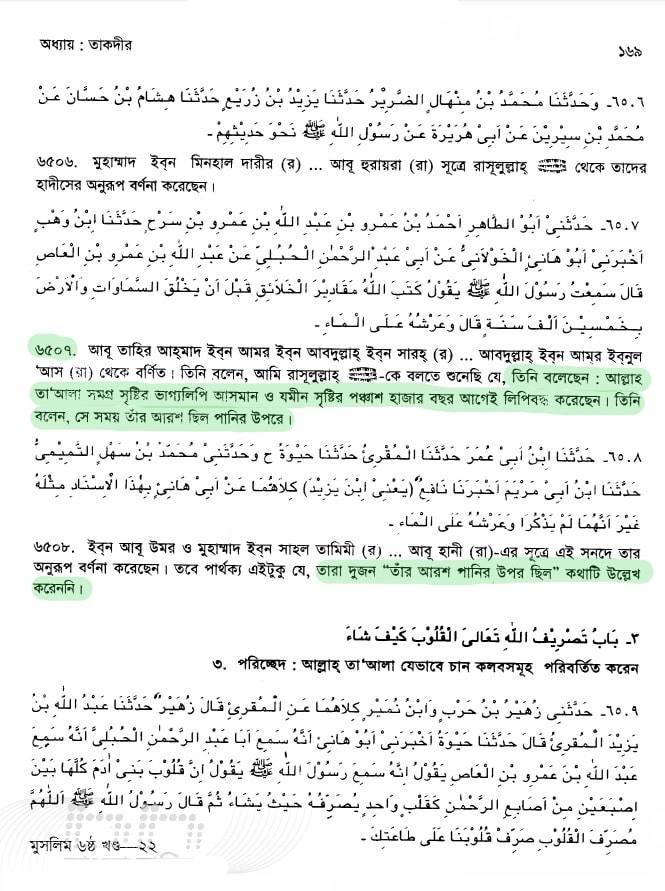
“Fifty thousand years” here is related to the creation of the heavens and earth; the presence of the Throne and water is also mentioned in the same hadith. This time of writing is not the same as the theory of eternal attributes. It is claimed that eternal knowledge has no beginning; for the writing of the destiny, a relative time is specified in the hadith. Again, it is much later than the time specific sentences were revealed in Muhammad’s life. If these three positions—eternal knowledge, pre-written documents, and the revelation of revelation in history—are made into events of the same time, the narrative’s own chronology is lost.
In the report of Abu Dawood attributed to Ubada ibn Samit, the Pen was ordered to write the determined amount of every matter until the Day of Judgment. Here the scope of the instruction is “every matter”; not just a list of birth-death dates or natural events. If it is claimed to include the coming of revelation, a person’s questioning, a decision of a governing system, and the result of that decision, then the changes among them also fall within that scope. [1254]
إِنَّ أَوَّلَ مَا خَلَقَ اللَّهُ الْقَلَمَ فَقَالَ لَهُ اكْتُبْ . قَالَ رَبِّ وَمَاذَا أَكْتُبُ قَالَ اكْتُبْ مَقَادِيرَ كُلِّ شَىْءٍ حَتَّى تَقُومَ السَّاعَةُ
English translation: Allah first created the Pen and said to it, Write. It said, O Lord, what shall I write? He said, Write the taqdir of every matter until the Day of Judgment occurs.
In Hadid 57:22, it is mentioned that calamities befalling the earth and humans themselves are in the Book before they are created. The event may be new to humans; it is not unknown to the declared written plan. Consequently, if the account of the revelation’s answer appearing in the face of a new situation and the claim that the situation was already known and written are held together, the predetermination of both the situation and the reaction is found. Coming later in sequence and coming later in knowledge have different meanings here. [1255]
مَا أَصَابَ مِن مُّصِيبَةٍ فِي الْأَرْضِ وَلَا فِي أَنفُسِكُمْ إِلَّا فِي كِتَابٍ مِّن قَبْلِ أَن نَّبْرَأَهَا ۚ إِنَّ ذَٰلِكَ عَلَى اللَّهِ يَسِيرٌ
English translation: No calamity comes upon the earth or upon yourselves but it is in a Book before We create it. Indeed, that is easy for Allah.
In Hajj 22:70, knowing the matters of the heavens and earth and their being in the Book are mentioned together. Tabari preserved an explanation attributed to Abda ibn Abi Lubaba: Allah knew what He would create and what the creation would do, and then He wrote it. In this explanation, human actions are also subjects of writing. In this all-encompassing claim, there is no room to keep human questions, opposition, or decisions as independent unknown elements outside of pre-writing. [1256]
علم الله ما هو خالق وما الخلق عاملون, ثم كتبه
English translation: Allah knew what He would create and what the creation would do; then He wrote it.
| Stage | Its position in belief | Relationship with earthly events |
|---|---|---|
| Eternal knowledge | Allah’s knowledge has no beginning | Future events do not come to Him later as unknown becoming known |
| Writing fifty thousand years ago | Destiny of all creation before the creation of the heavens and earth | Claim of written predetermination of subsequent events |
| Writing of the Pen until the Day of Judgment | Instruction to write the taqdir of every matter | Comprehensive pre-planning including human actions and reactions |
| Revelation of revelation in Muhammad’s life | Specific statements come to humans at the time of specific events | First revelation to the recipient; not the first moment of prior knowledge or pre-writing |
| Compilation of the mushaf | The work of human collection, testimony taking, and approval | The actual method of compilation is still a subject of distinct historical investigation |
The result of this claim is not limited only to the sentence “Allah knew beforehand”. The prior knowledge of an omniscient observer and the written plan of the authority determining the events of the world are not the same concept. Prior knowledge can give news of an action; in the powerful theology of taqdir, what will happen, how it will happen, and what result human will produce—all these are subject to Allah’s will. Therefore, if a relationship is shown between human reaction to a specific event and the revelation that comes later, the claim of pre-writing must be effective including that relationship. The human question is also determined, the addition received after the question is also determined—the explanation stands in this form. The historical relationship between the question and the addition does not vanish in that.
As an example, it can be claimed that a sequence of events where an order first came addressed to a general class and later an exception was added is possible to be pre-written. But then the subject of the plan is not an unchanged effective sentence; it is the entire sequence: the first order, the human reaction, the addition of the exception, and the revised application. To call a predetermined change ‘unchanged’ is to change the meaning of the word. The plan may remain identical, yet within that plan, different readings or laws may be effective for humans at different times.
The timeframe of predetermination also raises questions about the delay in revealing the ruling to humans. If the need for an exception was known and written beforehand, then by not revealing it in the first instruction but informing after an objection, the objection becomes an effective part of the revelation process. In this state, the human question cannot be called unnecessary: in the narrated sequence, the exception was revealed only after that question. In the narrated order, the previously revealed statement, the human reaction, and the subsequent addition are interconnected. If the doctrine of pre-writing is accepted, this sequence of revelation must also be called predetermined.
Adam–Iblis, Abu Lahab, and the problem of independent decision
In the hadith of the debate between Adam and Musa, crime, consequence, and predetermination are directly face-to-face. Musa holds Adam responsible as the father: because of him, the descendants were cast out of Paradise. Adam answers, why is he being rebuked for something that Allah determined forty years before his creation. In the report, Muhammad said that Adam’s argument prevailed. In this conclusion, predetermination is not just news of the future; it has become an effective argument for answering a rebuke. [1257] [1258] [1259]
حَدَّثَنِي مُحَمَّدُ بْنُ حَاتِمٍ ، وَإِبْرَاهِيمُ بْنُ دِينَارِ ، وَابْنُ أَبِي عُمَرَ الْمَكِّيُّ ، وَأَحْمَدُ بْنُ عَبْدَةَ، الضَّبِّيُّ جَمِيعًا عَنِ ابْنِ عُيَيْنَةَ ، – وَاللَّفْظُ لاِبْنِ حَاتِمٍ وَابْنِ دِينَارٍ – قَالاَ حَدَّثَنَا سُفْيَانُ بْنُ، عُيَيْنَةَ عَنْ عَمْرٍو ، عَنْ طَاوُسٍ ، قَالَ سَمِعْتُ أَبَا هُرَيْرَةَ ، يَقُولُ قَالَ رَسُولُ اللَّهِ صلى الله عليه وسلم ” احْتَجَّ آدَمُ وَمُوسَى فَقَالَ مُوسَى يَا آدَمُ أَنْتَ أَبُونَا خَيَّبْتَنَا وَأَخْرَجْتَنَا مِنَ الْجَنَّةِ فَقَالَ لَهُ آدَمُ أَنْتَ مُوسَى اصْطَفَاكَ اللَّهُ بِكَلاَمِهِ وَخَطَّ لَكَ بِيَدِهِ أَتَلُومُنِي عَلَى أَمْرٍ قَدَّرَهُ اللَّهُ عَلَىَّ قَبْلَ أَنْ يَخْلُقَنِي بِأَرْبَعِينَ سَنَةً ” . فَقَالَ النَّبِيُّ صلى الله عليه وسلم ” فَحَجَّ آدَمُ مُوسَى فَحَجَّ آدَمُ مُوسَى ” . وَفِي حَدِيثِ ابْنِ أَبِي عُمَرَ وَابْنِ عَبْدَةَ قَالَ أَحَدُهُمَا خَطَّ . وَقَالَ الآخَرُ كَتَبَ لَكَ التَّوْرَاةَ بِيَدِهِ .
English translation: Sahih Muslim (Islamic Foundation)
48/ Taqdir
Chapter: 2. The debate between Adam (AS) and Musa (AS)
6501. Narrated from Muhammad ibn Hatim, Ibrahim ibn Dinar, Ibn Abu Umar Makki, Ahmad ibn Abd Dabbiyyu, and Tawus (rh) … from Abu Hurairah (ra). The Messenger of Allah, peace and blessings of Allah be upon him, said: A debate took place between Adam (Alayhis Salam) and Musa (Alayhis Salam). Musa (Alayhis Salam) said, O Adam! You are our father, you deprived us and expelled us from Paradise. Then Adam (Alayhis Salam) said to him, you are Musa. Allah Ta’ala chose (honored) you by speaking with you and gave the (Book Torah) written in His hand for you. Are you reprimanding me regarding a matter which Allah Ta’ala had decreed forty years before my creation?
The Messenger of Allah (peace and blessings of Allah be upon him) said:Adam (Alayhis Salam) prevailed in the argument over Musa (Alayhis Salam).
And in the hadith narrated by Ibn Abu Umar and Ibn Abadah, one of them said, خَطَّ the other said, كَتَبَ He wrote the Torah for you in His hand.
Hadith Grade: Sahih (Sahih)
Narrator: Abu Hurairah (ra)
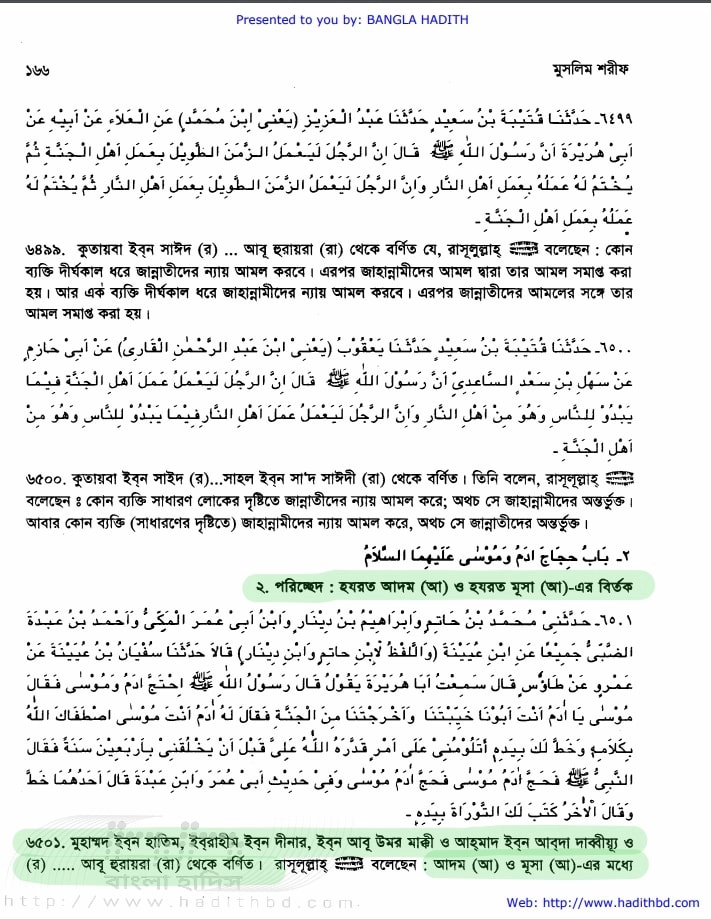
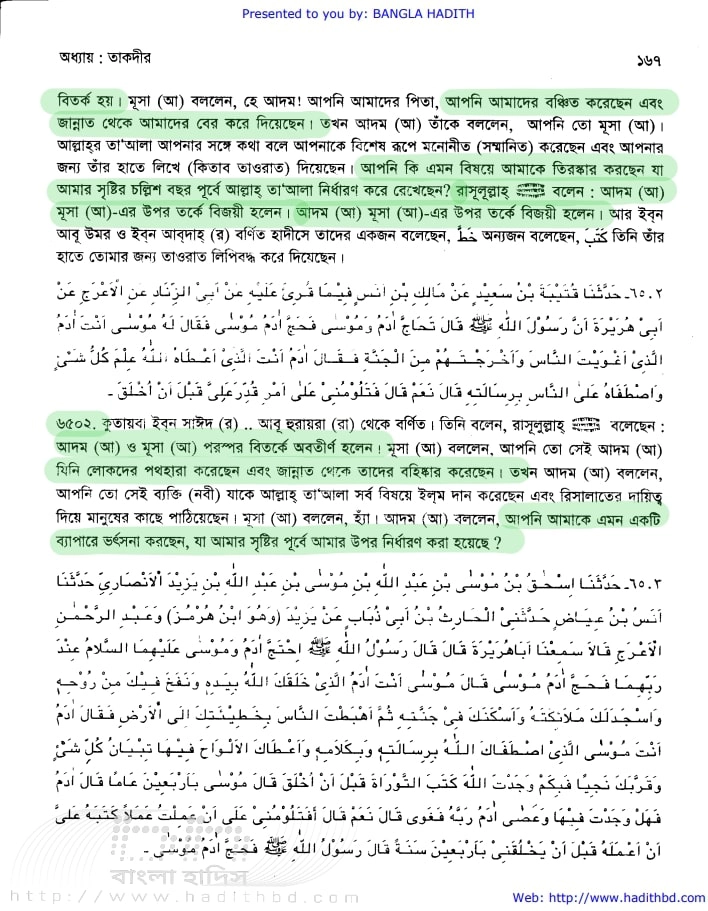
A gap of forty years is not the time for an excuse given after Adam’s actions; it is the time of the determination before his creation. If the event was fixed before Adam was born, the question of distributing responsibility is also linked to the plan before his birth. In Musa’s complaint, there is harm to the descendants; in Adam’s response, there is the predestination of that outcome. Within the narrative, predestination is accepted as the reason for refuting the reprimand. Therefore, one cannot isolate Adam’s decision alone and call the role of the planner void.
In the creation story of the Quran as well, the announcement of placing humans on earth comes before the event of the forbidden tree. In Al-Baqarah 2:30, Allah tells the angels that He will establish a caliph on earth. Later comes the prohibition of approaching the tree and the event of violating it. Thus, the establishment of human life on earth is the purpose announced at the very beginning of the story. The event of exile operates within the pre-announced course of earthly human life. [1260]
وَإِذْ قَالَ رَبُّكَ لِلْمَلَائِكَةِ إِنِّي جَاعِلٌ فِي الْأَرْضِ خَلِيفَةً ۖ قَالُوا أَتَجْعَلُ فِيهَا مَن يُفْسِدُ فِيهَا وَيَسْفِكُ الدِّمَاءَ وَنَحْنُ نُسَبِّحُ بِحَمْدِكَ وَنُقَدِّسُ لَكَ ۖ قَالَ إِنِّي أَعْلَمُ مَا لَا تَعْلَمُونَ
English translation: Remember, your Lord had said to the angels, I will establish a caliph on earth. They said, Will You place there one who will cause corruption and shed blood, while we declare Your purity with praise and describe Your holiness? He said, I know that which you do not know.
If Adam’s eating of the forbidden fruit, Iblis’s temptation, and being brought down to earth are all determined in an infallible predestination, then the opposite results of this specific sequence are not implemented. If Iblis had prostrated, the narrated course of subsequent enmity would not have proceeded in the same way; if Adam had not eaten the fruit, the course of exile after the crime would not have remained exactly the same. If the entire sequence is immutable from the start, then this disobedience within the plan is not a sudden disruption outside the plan. In the plan that includes revelation, prophets, and salvation, the roles of temptation, violation, and exile are also determined.
This relationship is even more open in the words of Iblis. In Al-Hijr 15:39, he says to Allah that because He led him astray, he will tempt and mislead humans on earth. In the Quranic account, this is Iblis’s own statement. Along with the announcement of the tempter’s actions, this statement also contains a complaint about the source of his own straying. That is, the antagonist of the story also brings forward the higher determination in explaining his own role. [1261]
قَالَ رَبِّ بِمَا أَغْوَيْتَنِي لَأُزَيِّنَنَّ لَهُمْ فِي الْأَرْضِ وَلَأُغْوِيَنَّهُمْ أَجْمَعِينَ
English translation: He said, O my Lord, because You have led me astray, I will surely make them attractive to them on earth and I will mislead them all.
In the case of Abu Lahab, the relationship between predestination and an individual’s final outcome finds a named example. Surah Lahab does not only speak generally of the punishment of the unbeliever; it announces Abu Lahab’s name and his future entry into the fire. Tabari has also specified Abu Lahab’s identity as the subject of the phrase “he will enter the flaming fire.” Consequently, according to the belief in the predestined and infallible Quran, this person’s final outcome is a determined truth even before his own future decisions. [1262]
سَيَصْلَىٰ نَارًا ذَاتَ لَهَبٍ
English translation: He will enter the flaming fire.
The revelation-context of this announcement is linked to a personal dispute. Ibn Kathir has quoted a report from Bukhari: when Muhammad gathered people to warn them of the imminent severe punishment, Abu Lahab cursed him with destruction; after that, “Tabbat yada abi lahab” was revealed. From the human side, the sequence was first the warning, then the counter-curse, then the Surah in his name. And in the theory of predestination, both this curse and the Surah that came in response are part of that previously determined course. [1263]
فقال أبو لهب : ألهذا جمعتنا ؟ تبا لك
English translation: Then Abu Lahab said, Is this why you have gathered us? May you be destroyed. Then Allah revealed, “May the two hands of Abu Lahab be destroyed, and he is destroyed”—until the end of the Surah.
While keeping the infallible pre-announcement fixed, the opposite final outcome for Abu Lahab cannot be brought about. If his future changes in such a way that the announced outcome no longer occurs, then the pre-announcement would be false. And if the truth of the pre-announcement is immutable, that opposite outcome will not occur. The center of this logic is the opportunity to implement a result opposite to the announced result at the end of a human’s entire life. The feeling of choosing a path and the ability to truly change the predestined final result are not the same freedom.
The matter becomes clear through an imaginary comparison of swapping the positions of Abu Bakr and Abu Lahab. If Abu Bakr’s friendship and Abu Lahab’s opposition were specified in an infallible plan before birth, then the opposite final positions of the two individuals are not possible while keeping that same plan unchanged. Their named statements would then not remain the same either. The sentence “May the two hands of Abu Bakr be destroyed” in the comparison is imagined; it shows the logical difference in what would happen to the predestined named statement if the opposite result occurred.
| Condition of imaginary comparison | Its result in the message and plan | Where the problem of freedom lies |
|---|---|---|
| Abu Lahab’s pre-announced final outcome occurs | The named pre-announcement remains true | The opposite final result did not occur in reality |
| Abu Lahab’s final outcome is opposite to the announcement | The same pre-announcement then does not remain true | An infallible announcement and an opposite result cannot be kept together |
| The determined positions of Abu Bakr and Abu Lahab are completely swapped | The named predestination must also be different; “May the two hands of Abu Bakr be destroyed” is only an example of that imaginary change | Final positions are not swapped while keeping the same immutable plan |
The authority of Allah’s will over human will is also mentioned in the Quran. In At-Takwir 81:28, there is mention of a person wishing to follow the straight path; in the next verse, human will is made subordinate to Allah’s will. When these two statements are side by side, the individual has a will, but that will is not the final determinant independent of Allah’s will. The question of a free decision is therefore deeper than whether there is a feeling of will: whether a human can bring something about by their own will if Allah does not want the opposite. [1264] [1265]
لِمَن شَاءَ مِنكُمْ أَن يَسْتَقِيمَ
وَمَا تَشَاءُونَ إِلَّا أَن يَشَاءَ اللَّهُ رَبُّ الْعَالَمِينَ
English translation: For whoever among you wills to follow a straight path. And you cannot will unless Allah, Lord of the worlds, wills.
In Al-Kahf 18:17, the outcomes of guidance and straying are also linked to Allah’s actions. The statement that for whom Allah misleads, one will find no guide or helper, intensifies the question of control over the individual’s future decisions. Commanding the individual to believe and the control of bringing them to the path of belief being in the hands of another authority—these two positions are part of the same moral problem. [1266] [1267]
مَن يَهْدِ اللَّهُ فَهُوَ الْمُهْتَدِ ۖ وَمَن يُضْلِلْ فَلَن تَجِدَ لَهُ وَلِيًّا مُّرْشِدًا
English translation: Whomever Allah guides, he is the guided one, and whomever He misguides, you will never find for him a guide or a helper.
In Al-A’raf 7:178, the same relationship is briefly repeated. Here, the identities of both the guided and the harmed parties are determined by Allah’s guiding and misleading. If the punishment of a specific person is called the result of their completely independent decision, the responsibility of this higher effective control is ignored. [1268] [1269]
مَن يَهْدِ اللَّهُ فَهُوَ الْمُهْتَدِي ۖ وَمَن يُضْلِلْ فَأُولَٰئِكَ هُمُ الْخَاسِرُونَ
English translation: Whomever Allah shows the way, he will be guided. And whomever He misguides, he will be the loser.
The problem of Abu Lahab is also present in subsequent scriptural discussions. In Zabidi’s Itafus Sadatil Muttaqin, a distinction is drawn between a work being possible in terms of capability and its not occurring in reality contrary to Allah’s knowledge and announcement. That discussion directly admits that what Allah knows and announces will not happen, will not happen. Consequently, if physical and mental capability is made the criterion of freedom, an answer is found; but if the power to bring about an opposite result while keeping the infallible determination intact is sought, the problem remains. [1270]
ثم ما علم الله تعالى وأخبر أنه لا يقع، لا يقع قطعا، كاجتماع الضدين
English translation: Then what Allah knows and announces will not happen, certainly does not happen—like the union of two opposite things.
In the events of Adam, Iblis, and Abu Lahab, the individual chooses, acts, and suffers the result; but does not determine their own final fate standing outside the announced overall plan. To make the disobedient person the sole source of all responsibility while keeping the role of disobedience essentially fixed within an all-encompassing plan is unjust. If the possibility of an opposite result is closed and then eternal punishment is given for choosing that result, the judge becomes simultaneously the final determinant of the event and the punisher. This moral objection calls into question the distribution of responsibility announced in the message, alongside the claimed source of that message.
The position of human objection, addition of words, and correction in the predestined plan
A preserved explanation by Tabari regarding the relationship between the predestined Quran and naskh is particularly clear. In Ar-Ra’d 13:39, it is said that Allah erases what He wills, keeps what He wills, and with Him is the Ummul Kitab. In this language, both erasing and keeping are effective actions. Even if a list of erasing and keeping exists in a document beforehand, changes occur in the implementation of that list. A final plan and the effective instructions of various stages of that plan are not the same thing. [1271]
يَمْحُو اللَّهُ مَا يَشَاءُ وَيُثْبِتُ ۖ وَعِندَهُ أُمُّ الْكِتَابِ
English translation: Allah erases what He wills and keeps; and with Him is the original book.
Tabari has preserved multiple explanations of the verse. Among them, in an explanation preserved under Ibn Abbas’s name, it is said that the nasikh-mansukh, the changed and the kept parts of the Quran, are all supposed to be in the Ummul Kitab. This is a direct scriptural example of the relationship between pre-planning and change. In that explanation, the previous and subsequent rulings are part of the same plan; therefore, the presence of the latter does not cancel the event of changing the effectiveness of the former. [1272]
من القرآن . يقول: يبدل الله ما يشاء فينسخه, ويثبت ما يشاء فلا يبدله(وعنده أم الكتاب) ، يقول: وجملة ذلك عنده في أمّ الكتاب، الناسخ والمنسوخ, وما يبدل وما يثبت, كلُّ ذلك في كتاب .
English translation: From the Quran. That is, Allah changes and abrogates what He wills, and keeps what He wills, does not change. “With Him is the original book”—meaning the entirety of it is with Him in the Ummul Kitab: the nasikh and mansukh, that which is changed and that which is kept—all are in one book.
In this explanation, the subject of predestination is not only the final text currently in use; it includes the contents of both the abrogated and the kept stages. A verse was first recited to humans, then its text or ruling was removed—that sequence of events may also be predestined. In that, there is a difference between the previous and subsequent states for humans. “Everything was written with Allah” and “the same text was always with humans”—the second sentence does not follow from the first. Rather, in the quoted explanation, multiple stages of change are given a place within the original book.
In the report of Ibn Umm Makhtum’s question, this difference is captured in specific words. In the sequence of the addition of “ghayru ulid-darar” after his question in An-Nisa 4:95 there is the first announced comparison, the reporting of the blind person’s difficulty, and the subsequent text containing the exception. If the theory of predestination is followed, the addition of the exception along with the first announcement and the question is also predestined. But what was first given to the listener and the writer and what was given later are not exactly the same. The previous state cannot be shown as equal to the subsequent state by omitting the new phrase.
The role of expressing human experience is also visible here. A general statement does not express the problem of someone’s physical condition; the special exception comes after that person reports the problem. If it is claimed that this question was already present in the omniscient plan, the role of the questioner becomes part of the plan. The question does not become ineffective. In the report, the answer is revealed after his question; the religious message provides the solution to his specific problem in the same sequence that exists between the human objection and the new words. This real relationship, where the exception absent in the first expression of the general instruction is added later, is the subject of the text change.
In reports of revelation similar to Umar’s statements, another form of human proposal and subsequent approval is found. Proposal for prayer at Maqam Ibrahim, Umar’s statement regarding the wives of the Prophet and His objection at the funeral of Ibn Ubay—the relationship under discussion in these events is of the same type: a specific opinion of a human came first, later the religious instruction coincided with it. If everything is called predestined, Umar’s opinion also falls within Allah’s plan. But the information that the opinion of an influential person was uttered first in the earthly manifestation of revelation is not erased by that.
The social consequence of this relationship is specific. The alignment of a person’s statement with the revelation grants that individual a special religious status; conversely, that very description preserves the link between human opinion and the manifestation of the word. If the belief in predestination is added, this social functionality is also considered planned. The answer to the question of at what stage a personal proposal attained the status of a mandatory command still lies within the sequence of events of human society. The belief that approval was written in an invisible record prior to the proposal does not remove the proposer from the sequence of earthly events.
| Types of preserved events | The visible role of humans | What is included if predestination is accepted | The changes that occur for humans |
|---|---|---|---|
| The exception of An-Nisa 4:95 | Ibn Umm Makhtum mentions his disability | First statement, question, and subsequent addition | The limit of general comparison is specified in the new phrase |
| Instruction similar to Umar’s opinion | Proposal, objection, or threat is uttered first | Human opinion and the revelation aligned with it | Matters aligned with human statements attain the status of religious commands |
| Description of alternative words during the writing of revelation | The scribe writes or proposes a word | The scribe’s work and its approval or rejection | Human presence exists at the moment of word determination |
| Uthman’s compilation | Committee, testimony, linguistic decisions, and arrangements for dissemination | The entire event of compilation and removal of rival copies | An authorized written standard gains authority over other readings |
| Abrogating and abrogated texts | Readers and practitioners of the law accept the new instruction | Both previous and subsequent instructions | The recited matter or the effective law does not remain in its previous state |
Regarding the experience of writing revelation Even in the reports preserved under the name of Abdullah ibn Sa’d, the relationship of humans with the determination of words is central. In the reports, if the scribe’s proposal or change is accepted, the decision to accept is meaningful; if rejected, the decision to reject is also meaningful. If human word selection exists in the narrated sequence of events, saying it was “planned” does not deny the presence of that selection.
In the case of Uthman’s compilation, the argument for predetermination faces broader problems. In the process of determining the state-sanctioned reading, a committee worked, a policy was applied to linguistic disputes, and copies were sent for regional dissemination. The decision to destroy alternative written documents also reduced the materials for subsequent comparison. If these are accepted as planned, the history of how humans performed these tasks remains intact. The claim of predetermination is not a document that replaces the committee members by placing the Heavenly Tablet directly in the editor’s seat.
From the general rule that all events are determined, special divine approval cannot be granted only to the winning decision. By the same rule, the presence of rival readings, the objections of Companions, and the resistance against the official copies are also determined. To reach the conclusion that a copy is identical to the original simply because it remained intact requires additional proof. The rule that equally includes the history of both authorized copies and destroyed copies cannot alone select the textual authenticity between them. Surviving in power and being identical to the original are separate characteristics.
Three different claims of remaining unchanged yield different results here. Allah’s knowledge is unchanged—this is a claim about knowledge. The entire sequence exists beforehand in the Umm al-Kitab—this is a claim about the completeness of the plan. The same reading and law were effective for humans at all times—this is a claim about history. Even if the first two are accepted, the third is not their logical consequence. In the explanations quoted by Tabari, the fact that the abrogating (nasikh) and abrogated (mansukh) exist together in the original text means that different effective states can be included at different times within a complete plan.
Therefore, in the history of the reading, change is identified by comparing the content of two different times. If a word was previously absent and later present, an event of addition has occurred. If a part previously recited is not recited later, the scope of the reading has changed. If the same sentence is recited but its ruling becomes ineffective, the state of the law has changed. A predestined plan can be a religious explanation for these differences; it cannot be proof that the change did not occur. “Authorized”, “predetermined”, and “unchanged”—these three words do not carry the same meaning.
In the real world, the question of the first writing of the Quran ultimately returns to real documents. Details of the scribe, materials, and first written preservation Collection, verification, copying, rejection, and correction occurred in the same world in which it is located. The claim of the Heavenly Tablet does not provide separate proof for these tasks. Allah’s plan can be placed as an explanation for tasks performed by humans; but in the name of that plan, the human work cannot be erased from history.
The declaration of immutability and the combined account of compilation and correction
The declaration of a book’s immutability and the history of that book’s compilation are two separate testimonies. The first is what the book says about itself; the second is what happened during the collection of the book’s materials, selection of readings, preparation of copies, and removal of rival documents. In the case of the Quran, this gap is particularly sharp. Alongside the promise of preservation, Islamic sources themselves contain reports of the absence of previously recited parts, the authorization of multiple readings, the refusal of Companions to accept certain readings, and the destruction of other mushafs by state order. By granting religious legitimacy to one reading at a later date, the names of these events can be changed; the occurrence of the events is not erased. An authorized change is still a change. To call the omission of a reading legitimate and to say that reading never existed are not the same statement.
At the center of this system is a relationship of authority: which word is Quran, which reading is abrogated, which witness is reliable, and which written document shall remain—at every level, there are decision-making humans and institutions. The accepted mushaf is the result of those decisions. To declare it identical to all readings prior to the decisions is a claim against which the history of compilation itself testifies. Again, if only the subsequent authorized reading is defined as preserved, the scope of the claim of preservation changes: then it is speaking of the permanence of what was selected, not that all readings remained unchanged from revelation to selection.
Al-An’am 6:115, Al-Kahf 18:27 and the declaration that the word cannot be changed
In Al-An’am 6:115, the truth of Allah’s word, its justice, and the declaration of the inability to change it appear in the same sentence. The language of the verse is final: the word is complete, there is no changer of it. “Complete”, “true”, “just”, and “there is no changer”—these words construct a concept of infallible authority. The answer to the question of how the reading of the mushaf promoted in the name of that authority was selected cannot be found in the verse’s self-declaration. The verse declares its own status; it does not establish the infallibility of the compilation committee’s work with any independent document. [1273]
وَتَمَّتْ كَلِمَتُ رَبِّكَ صِدْقًا وَعَدْلًا ۚ لَّا مُبَدِّلَ لِكَلِمَاتِهِ ۚ وَهُوَ السَّمِيعُ الْعَلِيمُ
English translation: The word of your Lord is complete truth and justice. There is no changer of His word. He is the All-Hearing, the All-Knowing.
In Ibn Kathir’s explanation, “truth” relates to news and “justice” relates to rulings. He quoted the statement of Qatada: there is truth in what Allah has said and justice in what He has decreed. In this explanation, the primary claim is the truth of the statement and the fairness of the command. That every letter of one copy is identical to all other copies—this is a separate historical claim, for which copies and textual evidence are required. [1274]
قال قتادة : صدقا فيما قال ، وعدلا فيما حكم .
English translation: Qatada said: there is truth in what He has said, and justice in what He has decreed.
In the same tafsir, Ibn Kathir explained the phrase “there is no one to change His word” as a decision against which no one can give an effective counter-decree in this world or the hereafter. Here, the immutability of the word is linked to the finality of judicial power. But the finality of a divine decision does not follow that every selection in a specific human collection is infallible. The highest religious status of a command and the textual history of the written carrier of that command are not the same thing. [1275] [1276]
( لَا مُبَدِّلَ لِكَلِمَاتِهِ ) أَيْ: لَيْسَ أَحَدٌ يُعَقِّبُ حُكْمَهُ تَعَالَى لَا فِي الدُّنْيَا وَلَا فِي الْآخِرَةِ
English translation: “There is no one to change His word”—meaning no one can give a reversing decision against His decision in this world or the hereafter.
In Yunus 10:64, the language of immutability appears in the context of glad tidings. After giving glad tidings of the worldly life and the hereafter, it is said that Allah’s words do not change. Here, the matter of remaining unchanged is the fulfillment of the declared promise. A promise not being broken and all historical documents carrying its description being word-for-word identical are different events. When these two are made the same in promoted decisions, the theological certainty of the promise is used as a substitute for the history of the documents. [1277]
لَهُمُ الْبُشْرَىٰ فِي الْحَيَاةِ الدُّنْيَا وَفِي الْآخِرَةِ ۚ لَا تَبْدِيلَ لِكَلِمَاتِ اللَّهِ ۚ ذَٰلِكَ هُوَ الْفَوْزُ الْعَظِيمُ
English translation: For them is glad tidings in the worldly life and in the afterlife. The word of Allah never changes. This is the great success.
Ibn Kathir also specifically called the immutable word in this verse “this promise”. In his explanation, the promise will not change, will not fail, will not be altered; it must happen. The certainty of the promise is the direct statement of the tafsir here. [1278]
هذا الوعد لا يبدل ولا يخلف ولا يغير ، بل هو مقرر مثبت كائن لا محالة
English translation: This promise will not be changed, will not fail, and will not be altered; rather it is determined, established, and inevitable.
In Al-An’am 6:34, the same declaration appears in the account of the denial of previous prophets, their endurance of persecution, and finally receiving help. The sentence “no one can change the word of Allah” is linked there to the promise of help. If religious assurance is turned into proof of the textual identity of all copies of the mushaf, the subject of the statement changes. The help declared in the verse and the completeness of the materials collected by Zayd are two separately verifiable questions. [1279]
وَلَقَدْ كُذِّبَتْ رُسُلٌ مِّن قَبْلِكَ فَصَبَرُوا عَلَىٰ مَا كُذِّبُوا وَأُوذُوا حَتَّىٰ أَتَاهُمْ نَصْرُنَا ۚ وَلَا مُبَدِّلَ لِكَلِمَاتِ اللَّهِ ۚ وَلَقَدْ جَاءَكَ مِن نَّبَإِ الْمُرْسَلِينَ
English translation: Many messengers before you were called liars. They were patient in this. They were persecuted until my help reached them. No one can change the word of Allah. Some stories of the messengers have reached you.
In the printed Bengali source of this explanation of Al-An’am, the context of Allah’s word and His promise is also present. The page quoted in the discussion of the claim of preservation is relevant as a document of that statement. [1280] [1281]
التي كتبها بالنصر في الدنيا والآخرة لعباده المؤمنين
English translation: The message of victory He has written for the believing servants in this world and the hereafter.
In Al-Kahf 18:27, the matter of the reading is more direct. Muhammad is told to recite what has been revealed to him from the book of his Lord; then it is said, there is no changer of His word. Here, the instruction to recite the book and the declaration of immutability are side by side. Consequently, this verse is used directly to establish the divine authority of the reading of the Quran. [1282]
وَاتْلُ مَا أُوحِيَ إِلَيْكَ مِن كِتَابِ رَبِّكَ ۖ لَا مُبَدِّلَ لِكَلِمَاتِهِ وَلَن تَجِدَ مِن دُونِهِ مُلْتَحَدًا
English translation: Recite what has been revealed to you from the book of your Lord. There is no changer of His word and you will find no refuge other than Him.
In this phrase, Ibn Kathir combined the prohibitive declarations against change, distortion, and taking it in another meaning. The words he used do not only speak of printing styles; they give a broad concept of the inability to interfere with the word. In the face of that broad claim, the different readings of the Companions, allegations of writing errors, and the testimony of parts previously recited as Quran but absent in the accepted mushaf become real problems. [1283]
( لَا مُبَدِّلَ لِكَلِمَاتِهِ ) أَيْ: لَا مُغَيِّرَ لَهَا وَلَا مُحَرِّفَ وَلَا مُؤَوِّلَ
English translation: “There is no one to change His word”—meaning there is no one to change it, distort it, or take it in another meaning.
In Al-Hijr 15:9, the declaration of preservation is most clear: He who revealed the Zikr is its preserver. In the Bengali translations, this assurance remains intact: “certainly”, “I am”, “preserver”, “protector”—in all, the responsibility of protection belongs to the divine speaker. The verse was not presented as a general promise dependent on the skill of the reader or the caliph. [1284] [166]
إِنَّا نَحْنُ نَزَّلْنَا الذِّكْرَ وَإِنَّا لَهُ لَحَافِظُونَ
English translation: Surely I have revealed the Quran and surely I am its preserver.
— Taisirul Quran
I have revealed the Zikr (Quran) and I am its preserver.
— Sheikh Mujibur Rahman
Surely I have revealed the Quran*, and I am its protector. * الذكر refers to the Quran.
— Rawai Al-bayan
Surely we have revealed the Quran and we are certainly its preserver [1].
— Dr. Abu Bakr Muhammad Zakaria
I myself have brought down this book of admonition, and I myself am its protector.
In Ibn Kathir’s tafsir, this matter of protection is also specific: protecting the Quran from change and alteration. Consequently, the word “preservation” is not synonymous only with the popularity or state success of some subsequent accepted version. A version being established by state power tells the history of its establishment; it does not provide a guarantee that nothing was added or subtracted in its previous readings. [1285]
ثم قرر تعالى أنه هو الذي أنزل الذكر ، وهو القرآن ، وهو الحافظ له من التغيير والتبديل .
English translation: Then he established that He is the one who revealed the Zikr, and that is the Quran; and He is the one who protects it from change and alteration.
| Field of Declaration | Related Statement | The distinct question that remains in the history of compilation |
|---|---|---|
| Like the authenticity of the report and the ruling | Al-An’am 6:115; Ibn Kathir’s commentary | How much of that statement does any human copy carry? |
| Implementation of Promise | Yunus 10:64 and Al-An’am 6:34 | Are the words of the documents carrying the promise identical? |
| Text of the Revealed Book | Al-Kahf 18:27 | Which among the multiple narrated readings will remain in the mushaf? |
| Preservation of the revealed dhikr | Al-Hijr 15:9 | What is the status of parts previously recited but later absent? |
| Protection from Change and Alteration | Ibn Kathir’s tafsir of Al-Hijr 15:9 | What is the relationship between this assurance and the events of reading selection and rejection? |
A religious authority declaring itself final does not make its human transmission process infallible. When questions of promise, instruction, text, and copy are merged, faith replaces evidence. Specifically, there is a vast difference between the two claims: “all revealed readings have never changed” and “that reading which has been accepted as final is preserved.” The first claim requires the continuous presence of all previous readings; the second claim uses what survived after selection as the benchmark. Declaring a missing part as later abrogated does not establish the truth of the first claim. In that case, religious authorization is given for the change.
Descriptions of a book that cannot be erased and testimony of the disappearance of readings
In Sahih Muslim, in the narration of Yazid ibn Himar, the claim of the book’s imperishability is expressed through a powerful metaphor. As Allah’s statement to Muhammad, it is said that a book has been revealed to him which water cannot wash away; he will recite it while asleep and awake. Ordinary written objects are destroyed by water, but this book is above such danger—the narration establishes this specialty. In the Islamic Foundation’s Bengali text, the sentence appears in the future tense; the Arabic “wa anzaltu” is in the past tense—”I have revealed.” [1286] [1287]
وَأَنْزَلْتُ عَلَيْكَ كِتَابًا لاَ يَغْسِلُهُ الْمَاءُ تَقْرَؤُهُ نَائِمًا وَيَقْظَانَ
English translation: Text quoted by Islamic Foundation:
I will reveal to you such a book, which water will not be able to wash away.
Translation of the Arabic sentence:
I have revealed to you such a book, which water cannot wash away; you recite it while asleep and awake.
Khattabi interpreted this metaphor as preservation in the heart. Even if written on paper it is washed away, it will not leave the human chest and the memorization of the heart will not be erased. Consequently, his explanation is not a claim that a specific piece of paper of the book will remain immortal; rather, it is a claim that even if the written carrier is destroyed, the reading will not be lost. The weight of the claim lies there: even after the destruction of one or more documents, there must be a recoverable presence of the related reading in the collective memory. [1288]
يريد أن القرآن وإن محي رسمه بالماء وغسل لم يذهب عن الصدور، ولم ينسخ حفظه من القلوب
English translation: This means that even if the written form of the Quran is erased and washed away with water, it will not leave the human chest and the memorization of the heart will not vanish.
The explanation of Nabawi is even clearer on the same point: it is preserved in the chest; its disappearance will not occur, rather it will remain for generations. This assurance is far greater than the praise of a particular reader’s natural memory. It contains a claim that the reading will not disappear collectively. That claim creates a direct relationship with the testimony of forgetting most of the surahs previously recited. [1289]
مَحْفُوظٌ فِي الصُّدُورِ ، لَا يَتَطَرَّقُ إِلَيْهِ الذَّهَابُ ، بَلْ يَبْقَى عَلَى مَرِّ الْأَزْمَانِ .
English translation: It is preserved in the human chest; there is no way for its disappearance, rather it will remain for generations.
Three types of events are linked to this dual protection system of memory and documents. Muhammad forgetting an ayah and remembering it through another’s reading is an event of personal memory lapse; there, the other’s memory was effective. The destruction of a written sahifa is primarily a loss of a document. But when Abu Musa speaks of remembering only a few sentences of a long surah previously recited, the matter of testimony becomes the lost memory of an extensive reading. Similarly, in Umar’s statement regarding rajm (stoning), there is the memory of the reading and the application of the law, yet that ayah is not in the accepted mushaf. In each event, the location of the absence is different; all cannot be dismissed by saying “paper can certainly be destroyed.”
| Condition | Matters present in the evidence | Relationship with the claim of preservation | Discussion with full references |
|---|---|---|---|
| Personal forgetfulness, remembering through others | A reading not present in one person’s mind is being recited by another | Events of mutual memory assistance; an individual’s memory is not infallible | Muhammad forgetting verses and regaining memory through the recitation of others |
| Destruction of a written letter | Description of Aisha’s sahifa and the pet animal | Loss of a specific document; where all readings of that letter were elsewhere is separate information | Writings on rajm and breastfeeding, the sahifa under the bed and the pet eating it |
| Remembering a small part of a long section previously recited | Abu Musa’s memory account of two surahs | Testimony of losing reading-memory in the face of the “will not leave the chest” explanation | A surah as long and severe as Tawbah in Abu Musa’s memory; Another surah in Abu Musa’s memory like the Musabbihat |
| Memory of revelation and reading exists, but the ayah is not in the mushaf | Umar’s speech on rajm | Testimony surviving in memory and the reading surviving in the mushaf are not the same event | Umar’s speech on revelation, reading, and preservation; Reading is absent in the current mushaf, the law of stoning remains in effect |
| Changing numbers, description of reading even at the time of death | Aisha’s statement regarding ten and five breastfeedings | The question remains at what stage the termination of which reading occurred | Change in ruling from ten times breastfeeding to five times; Aisha’s statement regarding its recitation as Quran even at the time of Muhammad’s death |
| Extensive statements about many parts leaving | Warning preserved under Ibn Umar’s name | Testimony against assuming that what currently exists is synonymous with the entire previous reading | Statement of Ibn Umar: “Many parts of the Quran have gone” |
In Abu Musa’s account, he retains the memory of the size and nature of the surahs he previously read, but could not retain the full reading. In Aisha’s account of breastfeeding, there is mention of the reading continuing until the time of death. In Umar’s rajm-account, there are claims of revelation, reading, and practice. The strength of these testimonies lies in their specific content: some are forgetfulness of long readings, some are absence in the mushaf, some are the survival of law. If a uniform stamp of imperishability is placed over all of them using the word “preservation,” these factual differences are erased. Yet, in the explanations of Khattabi and Nabawi, it was explicitly stated that disappearance from memory would not occur.
This is where the category of “abrogated reading” plays an effective role. A part was once Quran, later it is no longer a reading of the Quran—theology names this state an authorized removal. Consequently, it becomes possible to maintain the declaration of religious infallibility while admitting previous presence and subsequent absence. But this decision of authorization does not change the facts of history. The scope of the reading once recited and the scope of the accepted mushaf then do not remain identical. If imperishability means only “that which has been maintained until the end is imperishable,” then the possibility of being omitted has already entered the definition. This is a narrower claim than the assurance that all revealed sentences remain undestroyed.
The current presence of a book is not proof of the presence of every one of its previous elements. The current mushaf exists, and memorizers exist—from these two truths, the conclusion does not follow that every previous reading narrated by Umar, Aisha, or Abu Musa is in the current mushaf. It is a logical error to refute testimony of specific absence with the general existence of the current book. The test of the claim of imperishability occurs exactly where the source says a reading existed and it is not in the current accepted collection.
Book by God, God by Book: The circular proof of Bible–Quran
The book is the word of God because it is written so in the book; and the statement of the book is true because God does not lie—in this proof, the very conclusion that is supposed to be established has already been accepted as the basis. Outside the claims of the book, the identity of God, the relationship of that God with the book, and the accuracy of the current reading are not being established. One unproven identity is being used to support another unproven identity. Sending the same two claims back and forth to each other increases the scope of the argument, not the proof.
A familiar basis for this problem regarding the Bible 2 is the claim of inspiration in Timothy 3:16. In the King James Version, it is said that all scripture is given by inspiration of God, and is profitable for doctrine, for reproof, for correction, for instruction in righteousness. This is a statement by scripture about the status of scripture. The sentence itself does not establish the boundaries of every book of the current Bible, the text of every copy, and the divine authorization of every subsequent edit. To reach the infallibility of a specific version from the claim of divine inspiration, several more conclusions are needed in between. [1290]
All scripture is given by inspiration of God, and is profitable for doctrine, for reproof, for correction, for instruction in righteousness:
English translation: All scripture is given by inspiration of God, and is profitable for doctrine, for reproof, for correction, and for instruction in righteousness.
The same dependence is created even if the verses regarding the preservation of the Quran are used as the final proof of the Quran’s infallible preservation. “God has protected” is presented as proof for the conclusion “God said He would protect”; but that the statement is God’s, that its current wording is accurate, and that its application is to the entire reading of the current mushaf—all these are then part of the claims awaiting establishment. If a sentence of a doubtful document is made the assurance of the accuracy of all sentences of that document, the document becomes its own judge. If this method is unacceptable in the self-declaration of the Bible, it possesses the same weakness in the self-declaration of the Quran.
| Steps of Proof | The basis on which the step stands | The question whose answer remains |
|---|---|---|
| God’s statement is true | God is truthful and infallible | Whether this specific statement is truly His statement |
| The book is God’s statement | The book’s own identity and the testimony of the narrators | The accuracy of the self-identity and the reliability of the testimony |
| The current reading is that statement | Claim of continuous and accurate transmission | What happened during collection, selection, and among different readings |
| No reading was lost | Declaration of the preservation of the current reading | How the testimony of previously recited absent parts is being explained |
| There was no need for absent parts to exist | Subsequent classification of abrogation | Where the authorization for each specific removal is established |
An additional advantage is created in this cycle when contradictory testimony is rejected in advance through the words of the same book. If a narration does not match the declaration of preservation, the narration is declared unacceptable; later, by showing the remaining narrations, it is said that there is no problem in history. The absence of problems in a collection prepared through such selection is not an independent discovery. It is the result of the method of removing problematic information. If the reason for rejection is the source, time, statement, or mutual dependence of the specific narration, then it is part of the narration’s own test; but “it cannot happen, because it is said it did not happen”—in this, the conclusion itself becomes the rule of the test.
If the claim of immutability is absolute, the type of proof against it is also specific. For the claim “not a single word has ever changed,” a single established verbal difference is a counter-example. The calculation of what percentage of the entire book has changed is not a condition for this counter-example. Again, the test of the claim “no writing marks were added later” occurs in the history of nukta and harakat, and the test of the claim “the application of no ruling has changed” occurs in legal decisions. When the subject of the claim changes, the object of the test changes. If these three fields are covered together with the vague word “unaltered,” an opportunity is created to present information from one field in response to a question from another field.
| Claim | Type of related counter-evidence | The other information that does not resolve the question |
|---|---|---|
| There was always only one word-form | Presence or absence of different words or words in the same place | Belief in the same God or the same overall religious doctrine |
| The current written form existed from the beginning | History of later addition of marks and specification of writing methods | Evaluation that subsequent marks were effective in teaching the reading |
| All previously recited ayahs are in the mushaf | Direct claim of previous readings and current absence | The rest of the book being memorized by many people |
| Scriptural rulings are effectively unchanged | Withdrawal of the same ruling or new limits and conditions | Letters of old ayahs still being printed |
| The authorized reading is the only historical reading | Descriptions of previously reading other readings and authorization | Predominance of a selected reading in later eras |
Some religious community may consider the change in its book as part of God’s plan. This creates harmony between that community’s faith and the change. A historical conclusion that change did not occur is not created. In the case of the compilation of the Bible, the compilation of the Quran, or any other religious book, “God has authorized” is a similar kind of additional faith. The information regarding selection and arrangement by human hands remains unchanged. To reject the divine authority of a book by showing human editing in the case of one religion, and to keep similar editing in one’s own religion above question merely by claiming authorization, is a double standard.
Sincere belief in a claim and independent evidence for that claim are two different things. That the narrator considered his own book to be true proves his belief—it does not prove every historical claim within the book. The statement that the memorizers worked to preserve the Quran informs us of their goal; it does not reduce the possibility of errors in their memory and selection to zero. That the compiler burned other mushafs out of a sense of religious duty may be a moral or religious explanation for the destruction; it is not testimony that the destroyed documents were identical in every respect to the accepted document. The circle is completed only when the effect is substituted for the cause, belief for evidence, and identity for authorization.
Authorization of Hadith by the Quran and the determination of the meaning and boundaries of the Quran by Hadith
A large part of the history of the Quran’s compilation is known from accounts outside the Quran. Abu Bakr’s instructions, Zayd’s search for materials, Hafsa’s sahifa, Uthman’s committee, and the order to burn other mushafs are not the Quran’s own continuous autobiography. Books of hadith and history bear witness to these events. Consequently, the claim that “the Quran is preserved because the hadith provide an account of its proper compilation” relies heavily on the reliability of the hadith. Conversely, verses of the Quran regarding obedience to the Messenger are used to establish the mandatory authority of the hadith. Religious authorization and historical testimony validate each other within the same system.
In his declaration of preservation, Ibn Hazm brought both the Quran and the Sunnah under the scope of “dhikr”. Islamweb quoted this statement from his Al-Ihkam. In this interpretation, the Sunnah that explains the Quran is also included in the divine revelation and receives theological assurance of preservation. That is, the protection of the very hadith used to determine the interpretation of the Quran is established from the Quran’s own declaration of preservation. [1291]
الذكر: اسم واقع على كل ما أنزل الله على نبيه صلى الله عليه وسلم من قرآن أو من سنة وحي يبين بها القرآن,
English translation: “The name “dhikr” applies to everything Allah has revealed to His Prophet—whether it be the Quran or the Sunnah in the form of revelation that explains the Quran.”
In Ibn Hazm’s subsequent argument, the need for the Prophet’s explanation to understand brief Quranic instructions, such as those for prayer, zakat, and hajj, is made the basis for the assurance that such explanations remain preserved. His argument of dependence is that if the explanation were not accurately preserved, the utility of the Quran and many mandatory rulings would not be effective. However, the need for a source to maintain a religious system and the accurate transmission of every specific detail of that source are different propositions. A declaration of necessity does not prove the accuracy of specific past transmission events. [1292]
فإذا كان بيانه عليه السلام لذلك المجمل غير محفوظ ولا مضمون سلامته مما ليس منه، فقد بطل الانتفاع بنص القرآن فبطلت أكثر الشرائع المفترضة علينا.
English translation: “If His explanation regarding those brief instructions is not preserved, and if security against the intrusion of external elements is not ensured, then deriving benefit from the text of the Quran becomes void; consequently, most of the rulings made mandatory upon us become void.”
The accuracy of a sentence attributed to any subsequent narrator is not directly established by the ruling to obey the Prophet’s instructions. The first question is one of authority: if the instruction is truly from the Prophet, what is its claim upon the follower? The second question is one of transmission: is the specific sentence truly his statement? It is this second question that necessitates the narrator, the time of compilation, different readings, and contradictory testimony. If the religious authorization of the first is made the historical proof of the second, then unexamined sentences also receive assurance in the name of authorized authority.
| Aspect of dependence | Which decision is taken | The independent work of evidence |
|---|---|---|
| Authority of Hadith from the Quran | Obedience to the Messenger is mandatory | Determining whether a specific hadith is truly the statement of the Messenger |
| The account of the Quran’s collection from Hadith | Who collected it, and how they did so | Examination of the timing of the account, connections, mutual dependence, and statements |
| Identification of previous readings from Hadith | A sentence that was previously read as a verse | Separately determining the testimony of that identification and the reason for its subsequent absence |
| Decision of abrogation from Hadith | A reading or ruling is no longer effective | Determining the specific report of abrogation and its timing |
| Protection of Hadith from the preservation-verse | The explanatory Sunnah is also protected | Missing information regarding the accuracy of specific accounts is not filled |
This bidirectional authority is most effective in the case of readings absent from the mushaf. Hadith identify a sentence not present in the current Quran as having previously been part of the Quran. Later, the explanation that the reading was abrogated comes from hadith and usul to answer why it is no longer there. In the case of stoning, there is no verse, but there is a law; in the case of breastfeeding, there are accounts of changes in numbers and readings at the time of death; in other cases, sentences previously read are no longer part of the Quran. The power to determine these categories is not limited to the written words of the current mushaf. External testimony and its commentary determine which absence is authorized and which different reading is unacceptable. Detailed discussion of previous readings and rulings absent from the mushaf These show specific instances of this dependence.
There is a fundamental difference between using hadith as testimony and placing hadith above the possibility of prior error. In the former, both favorable and uncomfortable information from the same source are considered. In the latter, the meaning and status of the account are arranged to maintain the declared accuracy of the system. If the account of Abu Bakr’s collection is accepted as historical testimony, then the risk of losing readings and the events of searching for scattered materials in that account are also testimony. If the account of Uthman’s copying is accepted, the order to burn other mushafs associated with it is part of the same account. Omitting the intermediate crisis while praising the final result is not the full statement of the source.
In this system, even if the letters of the Quran remain unchanged, a large part of the effective religious meaning remains in the hands of the hadith and the commentator. Narrowing the scope of general instructions, imposing new conditions, determining exceptions, and declaring which law remains in effect—these decisions use authority outside the text. Detailed discussion of the legal authority of Quran-Hadith According to this, there is practical application of this power in the cases of wills, food, stoning, and apostasy. Therefore, the presence of printed verses cannot be called complete proof of an unchanged religious system: the boundaries of effective rulings have changed while keeping the same verses.
The Quran authorizes the hadith, the hadith explain the boundaries and compilation of the Quran, and subsequent scholars determine the acceptable meaning of both—this is an institutional relationship. The self-declaration of any part of it is not independent historical proof of the entire relationship. Where testimony is absent or contradictory, declaring assurance due to religious necessity does not remove uncertainty; it imposes a verdict of authority upon it.
Theology of the reliability of the Companions, mutual contradictions, and the screening of testimony
There is a special exemption in Sunni hadith science regarding the reliability of the witnesses of the compilation. While there are rules for testing the acceptability of subsequent narrators, all Companions are accepted as upright. Khatib Baghdadi, in Al-Kifaya, cited the recognition given by Allah in the Quran as the basis for this exception. Consequently, the universal acceptability of those through whom the Quran is claimed to have arrived is again established by the praise of that same Quran. IslamQA has quoted his statement. [1293]
كل حديث اتصل إسناده بين مَن رواه وبين النبي صلى الله عليه وسلم : لم يلزم العمل به إلا بعد ثبوت عدالة رجاله ، ويجب النظر في أحوالهم ، سوى الصحابي الذي رفعه إلى رسول الله صلى الله عليه وسلم ؛ لأن عدالة الصحابة ثابتة معلومة بتعديل الله لهم وإخباره عن طهارتهم واختياره لهم في نص القرآن
English translation: “When the isnad of a hadith is connected from its narrator to the Prophet (peace and blessings of Allah be upon him), it becomes mandatory to act accordingly only after the uprightness of its narrators is established; their condition needs to be examined. However, the Companion who transmitted it from the Messenger of Allah (peace and blessings of Allah be upon him) is an exception. Because the uprightness of the Companions is established and known through the recognition given by Allah, His report regarding their purity, and their selection in the readings of the Quran.”
The institutional need for this exception is more directly revealed in Abu Zur’s statement. He viewed the criticism of the Companions as an attempt to make the witnesses who carried the Quran-Sunnah unacceptable and called the critic a zindiq. Here, the protection of the narrator’s status is explicitly linked to the protection of the authority of the religious source. The purpose does not have to be inferred; the quoted statement itself declares that questioning the witness means attempting to void the Kitab-Sunnah. [1294]
إذا رأيت الرجل ينتقص أحداً من أصحاب رسول الله صلى الله عليه وسلم فاعلم أنه زنديق، وإنما أدّى إلينا هذا القرآن والسنة أصحاب رسول الله، وإنما يريدون أن يجرحوا شهودنا، ليبطلوا الكتاب والسنة، والجرح بهم أولى، وهم زنادقة
English translation: “When you see a person belittling any Companion of the Messenger of Allah (peace and blessings of Allah be upon him), know that he is a zindiq. The Companions of the Messenger of Allah have delivered this Quran and Sunnah to us. They want to question our witnesses so that they can void the Kitab and Sunnah. Rather, it is more appropriate to call them unacceptable; they are the zindiqs.”
Under this rule, the categorical identity of the witness receives assurance before their individual statement. But a declaration of uprightness does not establish the perfection of memory, the ability to know all information, or the identity of contradictory readings. Two people, even while being sincere, may remember the same word differently. One may know of a reading, while another does not. A sentence may exist in one person’s mushaf but not in another’s collection. In such differences, calling both honest does not make the two readings one. To know when a reading was taught and which was later selected, factual testimony is required.
| Field of Conflict | Contradictory testimony or positions | What universal acceptability does not determine | Detailed evidence |
|---|---|---|---|
| Authority to learn the reading | Umar’s objection and the authorization of Hisham’s different reading | Whether the reading known to the first objector was the only authorized reading | Different readings of Umar and Hisham and approval of both readings |
| Responsibility of compilation and personal mushafs | The authority of Ibn Masud’s own reading and his objection to Zayd’s appointment | Why one person’s reading became the state standard while another’s claim to submit a mushaf arose | Ibn Masud’s teaching, the authority of his own reading, and objection to Zayd’s appointment; Ibn Masud’s call to keep the mushaf secret and opposition to state unification |
| Previous verses absent from the mushaf | Umar’s declaration regarding the reading of stoning | The reason for the absence of the sentence in the current mushaf despite the existence of testimony of revelation and reading | Verses of Rajm: Umar’s declaration, absence in the mushaf, and the continued death penalty |
| The status of the portion recited at the time of death | Aisha’s statement on five breastfeedings | The temporal relationship between the report of the reading’s circulation and the subsequent explanation of abrogation | Aisha’s statement regarding its recitation as Quran even at the time of Muhammad’s death |
| The accuracy of the written form | Allegations of errors preserved under the names of Aisha and Ibn Abbas | The specific wording of the allegations and the relationship with the accepted reading | Description of writing errors in the mushaf: Uthman, Aisha, and Ibn Abbas |
| Remaining steadfast in the learned reading | Abu Darda’s different reading and refusal to read the prevalent portion | Identity of the opposite reading does not follow from his acceptability | Abu Darda–Ibn Masud’s reading in Layl 92:3 and refusal to read the conventional portion |
Calling all Companions acceptable and finalizing the compilation of one specific party among them are not the same decision. The first is a declaration of everyone’s status; the second is giving priority in practice to the work and readings of some people over others. Even after accepting Ibn Masud as a respected teacher, if his mushaf is kept outside the state standard, the declaration of respect does not remove the inequality of the decision. Similarly, acknowledging Ubayy’s proficiency in reading but not keeping the additional readings narrated in his name in the current mushaf does not make the praise of proficiency an explanation for that absence. The question of why a document was accepted or rejected then remains open.
Another problem with screening testimony is the unequal use of a single person’s convenient and inconvenient statements. A Companion’s account is accepted to support the accuracy of the compilation, but a report of an absent reading preserved under the same name is rejected simply because it does not match the decision—in this, the person’s acceptability is not the real criterion. Matching the result becomes the criterion. If there are specific problems of connection, timing, or statement in the account, those are testable reasons; theological discomfort alone is not proof that a historical account is false.
On the other hand, finding the same report in many subsequent books does not mean many independent witnesses are found. If Suyuti quotes from a previous book, Islamweb shows that quote of Suyuti, and IslamQA mentions the same account again, the original report may belong to a single chain of transmission. In counting testimony, the number of books and the number of independent information streams are distinct. This relationship is especially important when accounts of lost surahs, writing errors, or Hajjaj’s changes reappear in later compilations. The repetition of the source is proof of the report’s subsequent propagation and acceptance; it is not automatically new direct testimony.
The sahih–da’if classification of hadith science is also the result of its own rules of acceptability. The conclusion that an event did not occur simply because a report comes through a da’if isnad is an overreach. Conversely, every detail of an event is not established merely because it is cited in a single old book. Historical claims are built by combining time, the form of the statement, the relationship with other evidence, and subsequent usage. Neither religious loyalty to nor antipathy toward a Companion can take the place of such data. To prove the accurate transmission of the Quran, what is required is not a declaration of the advance infallibility of its carriers, but the actual consistency of their preserved testimonies.
Where the faith of the questioner is attacked to protect the dignity of the witnesses, the social value of examining testimony increases. This is the effective significance of Abu Zur’ah’s declaration: an objection against a witness is no longer just a question about the truth of a single report; it becomes a matter of judging the religious identity of the critic. This defense mechanism protects the authority of the book, but it does not factually resolve the inconsistencies in the book’s history. Differences in documents, memory, and readings remain present with their own respective claims.
A chronology of collection, addition, omission, destruction, and revision from revelation to Hajjaj
The sequence of events in the compilation of the Quran is not a single event of creating a copy of a ready-made book. First, there was the dissemination and writing of readings over a long period, during which new words and rulings arrived; then the collection of materials; later, state-sponsored copying and omission; and after that, the development of writing marks. Each stage created the elements for the next. Consequently, if the final mushaf is assumed to have been present within the same written boundaries from the first moment, a large part of the intermediate process disappears. The Islamic accounts of compilation repeatedly mention exactly those intermediate tasks.
Specific mutual dates for multiple events during his lifetime are not present in all reports. The initiatives of Abu Bakr and Uthman are events of two separate reigns; the sahifa being with Hafsa, Uthman borrowing it, and later that sahifa being destroyed by Marwan are further separate phases. There are also multiple reports regarding the first introducers of nukta and vowel marks. Historically, the history of readings stands by maintaining these chronological boundaries; if all are grouped under a single word like “preservation,” it is no longer possible to understand who changed or selected what and when.
| Phase or Timeframe | Event described in source | Result in reading, document, or authority | Source and details |
|---|---|---|---|
| Muhammad’s lifetime: Sequential dissemination | Reports of the Quran being read and revealed in fragments | Readings prevalent at one time are later joined by more readings; revelation was a process continuing over a period | Full report and source; Isra 17:106 |
| Lifetime: Written materials and memorization | Writing on scattered materials and personal collections | Written carriers and memorization remain with different individuals | Full report and source; Details of subsequent search in Bukhari 4986 |
| Lifetime: Explanation of fasting instructions | Report of “minal fajr” appearing later in the verse of the white and black threads | The presence of clarifying words in the read sentence occurs at a later stage | Full report and source; Bukhari 4511 |
| Lifetime: Objection of a blind Companion | Exception for the disabled after the context of Ibn Umm Makhtum | New limits are added to general sentences regarding not participating in jihad | Full report and source; Bukhari 4592 |
| Lifetime: Approval of different readings | Approval of both after hearing different readings from Umar and Hisham | The range of approved readings exists beyond a single word-form | Full report and source; Bukhari 4992 |
| Lifetime: Personal forgetfulness | Muhammad remembering a verse upon hearing another’s reading | The claim that the carrier’s personal memory is infallible at all times is refuted | Full report and source; Bukhari 5038 |
| Lifetime: Reading and withdrawal as Quran | Report of later withdrawing sentences read regarding those killed at Bir Ma’una | Parts previously disseminated as Quran fall outside the accepted reading | Full report and source; Bukhari 2801 |
| Lifetime: Continuity of changing rulings | Imposition and withdrawal of sadaqah before personal conversation | Although the reading remains, the effective obligations in two stages are different | Full report and source; Mujadila 58:12–13 |
| Muhammad’s death phase | The reading of five breastfeedings was still being read—Aisha’s statement | Questions arise between the practice at the time of death and the boundaries of the current mushaf | Full report and source; Muslim 1452a |
| Abu Bakr’s caliphate: After Yamama | Umar’s fear: Much of the Quran may go away with the death of the readers | An institutional initiative for collection is undertaken | Full report and source; Bukhari 4986 |
| Abu Bakr’s caliphate: Zayd’s search | Collection from written materials and human memory | Materials are gathered instead of directly copying a ready-made official book | Full report and source; Bukhari 4986 |
| Abu Bakr–Umar–Hafsa | The custody of the collected sahifa changes sequentially | The written basis for the subsequent Uthmanic initiative remains with Hafsa | Full report and source; Bukhari 4986 |
| Umar’s caliphate: Declaration of rajm | Speech stating that the verse of rajm was revealed and read | Memory of previous readings and the continuing penalty remain in testimonies outside the current mushaf | Full report and source; Muslim 1691a |
| Uthman’s caliphate: Regional disputes | Hudhayfah’s warning regarding reading disputes during military campaigns | Central state intervention begins to resolve reading disputes | Full report and source; Bukhari 4987 |
| Uthman’s caliphate: Basis of copying | Borrowing Hafsa’s sahifa and the responsibility of four people including Zayd | A specific committee works to prepare an approved written standard | Full report and source; Bukhari 4987 |
| Uthman’s caliphate: Language selection | Instruction to write in the Qurayshi dialect due to disagreement | The Caliph gives specific rules to resolve differences | Full report and source; Bukhari 4987 |
| Phase of Uthmanic copying | Search for Ahzab 33:23 and finding it with Khuzaima | Events of searching for written testimony of specific verses occur even during the copying work | Full report and source; Bukhari 4988 |
| Preparation and distribution of Uthmanic copies | Sending approved copies to the regions | A central standard of acceptable written reading is established | Full report and source; Bukhari 4987 |
| Removal of other documents by Uthman’s order | Instruction to burn other sahifas and mushafs | The path for alternative written testimonies to survive is narrowed | Full report and source; Bukhari 4987 |
| Dispute over unification | Ibn Masud’s objection and call to keep the mushaf hidden | The conflict between personal and state authority over the reading is revealed | Full report and source |
| After Hafsa’s death, the era of Marwan | Report of collecting and destroying Hafsa’s sahifa | The old document used as the basis for the Uthmanic copy also no longer remains | Full report and source; Fath al-Bari, Chapter on Quran Collection |
| Writing reforms of the first Hijri century | The system of vowel marks associated with Abu al-Aswad | Auxiliary signs for oral pronunciation are added to the written pages | Full report and source; Dani, Al-Muhkam |
| Report of introduction in the late first century | Report of giving nukta attributed to Nasr ibn Asim and Yahya ibn Yamir | The written system for distinguishing similar letters expands | Full report and source; Dani, Al-Muhkam |
| Report preserved under Hajjaj’s name | List of changes in eleven places in the book of Ibn Abi Dawud | A specific imposed account of official correction is found; the relationship of reading testimony is different in each case | Full report and source; Ibn Abi Dawud, Kitab al-Masahif |
| Textual comparison of reports regarding Hajjaj | Distinct testimonies of different readings in Yunus 10:22 and Anfal 8:39 | The attribution of change, old reading differences, and the relationship with the later accepted form remain as data to be judged together | Full report and source; Full report and source |
In this sequence, the difference between the work of Abu Bakr and Uthman is fundamental. In the first initiative, the need to gather scattered elements due to the fear of loss was stated. In the second initiative, the need to resolve disputes over readings in different regions and establish a standard form was stated. The completion of the first did not make the second unnecessary. That is, having a collection and everyone following the same approved reading are two different states. Uthman’s step provided a state solution to that second problem; with it was added the order to remove unacceptable documents.
The journey of Hafsa’s sahifa is particularly significant in this history. The same document first became the custody of compiled elements, then the basis for official copying, then a returned personal trust, and finally a destructible old document. The use and status of the document changed over time. After the subsequent mushaf was established, the previous basis-document was no longer kept—this event reveals the limit of viewing preservation merely as the act of protecting an object. The institution decided which document would be saved and which would be removed.
The development of writing marks is yet another layer. From the dissemination of readings to collection, from collection to standard copies, from standard copies to pages with sign-aided readings—at each step, the written object acquired new characteristics. It is false to call these the history of an unchanged page. At the same time, testimonies of verbal reading differences exist separately; it is also false to reduce them merely to the history of signs. In the history of the visible mushaf created by the combination of the Uthmanic state standard and subsequent writing methods, multiple stages of human work are evident.
Comparative account of words, surah boundaries, written forms, approval of readings, and changes in rulings
When using the word “change” regarding the Quran, the strength of the events becomes clear if the object is specified. Having two names for a surah, two vowels for the same word, a complete word being in one copy and not in another, the current absence of a previously read sentence, and the withdrawal of a law while keeping the verse—these are different types of changes. Calling them all mere pronunciation differences erases data. Each event tests the specific claim of immutability at its own level.
Naming, multiple readings, memory, surah boundaries, range of readings, and word forms—these six questions operate at different levels of compilation. In the case of names, identification is determined; in memory, carrying capacity; in surah boundaries, the structure of the book; and in word forms, the direct question of reading arises. Answering one question does not resolve the other five.
| Type of complexity | Specific Question | Field of related evidence |
|---|---|---|
| Naming | Is the surah name part of the verse, a descriptive identity, or a later title? | Multiple identities of the same surah and the position of the title relative to the verse; Surah names and divisions |
| Multiple readings | Which reading is approved, and which is outside the state standard? | Initial approval, subsequent selection, and readings outside the standard; Seven Ahruf; Explanation for limiting to one |
| Memory | What do reports of forgetting and remembering through another’s reading say? | Separate testimonies of personal recall and extensive forgetfulness of readings; Muhammad’s forgetfulness; Abu Musa’s report |
| Surah boundaries | By whose decision was the relationship between Anfal and Tawbah determined? | Arrangement, relationship between surahs, and explanation for not writing Bismillah; Anfal–Tawbah |
| Range of readings | Which part, once read as a verse, is now not in the mushaf? | Claims of previous reading as Quran and current absence; Rajm; Breastfeeding; Absent surahs |
| Word forms | Has only the vowel changed, or have the letter and address also changed? | Ya–ta, word order, and differences of full words in regional copies; Reading differences; Anfal 8:39 |
Regarding the presence–absence of words, Dani’s Al-Muqni is especially important because it contains descriptions of regional mushafs. The dispute is not limited only to a person’s memory or personal notes; it also concerns the written form of recognized regional copies. Reports of a connecting letter or pronoun being in one copy and not in another come into direct conflict with the claim that “every letter of every copy is the same.” If the related readings can be called approved, their religious status is established; their visible differences do not vanish. Full quotations of regional copies and Dani’s source and Comparison of specific verses Carries testimony of different written forms at the same place.
| Level of change or difference | Specific examples | What is actually different | The claim with which it conflicts | Discussion with sources |
|---|---|---|---|---|
| New parts in read sentences | Instruction of the Fajr thread; exception for the disabled | Later explanatory or limiting words added to previous sentences | The first uttered sentence remained the same full sentence until the end | New words in recited verses: correction of reading after people’s questions |
| Range of words or phrases | Shu’ara 26:214; Kahf 18:79–80 | Additional identity or adjective in the described reading | The same word was always present in the readings of all teachers | Additional phrase of Ibn Abbas in Ash-Shu’ara 26:214; Different readings of the boat’s position, the boat’s quality, and the boy’s identity in Al-Kahf 18:79–80 |
| Word order | Ibn Masud’s reading in Nur 24:27 | Position of words in the same context | Word order is identical in every described reading | Ibn Masud’s word order in Nur 24:27 |
| Reading or not reading parts of a sentence | Abu Darda’s position regarding Layl 92:3 | Accepted phrases and the boundaries of the reading learned by the Companion | The reading learned by the Companions and the prevalent reading were identical in all parts | Abu Darda–Ibn Masud’s reading in Layl 92:3 and refusal to read the conventional portion |
| Regional written differences | Al Imran 3:133; Hadid 57:24; Shams 91:15 | Presence–absence of a letter in some places, a pronoun in others | Even in official regional copies, there was only one form letter by letter | Comparative readings of Al Imran 3:133, Hadid 57:24, Shams 91:15 and Tawbah 9:100; Dani, Al-Muqni |
| Consonants and address | Ya–ta of Anfal 8:39 | Reading forms of third person and second person | All reading differences are merely changes of vowel marks on the same letter | Anfal 8:39 — “ya’malun” and “ta’malun” |
| Writing-auxiliary signs | Shape of nukta, harakat, and subsequent signs | Visible elements indicating the reading on the page | Today’s signed written form was the same from the beginning | Difference between primary written form and later text-aid signs; Nukta of consonants, Nasr and Yahya: separate accounts of introduction; Harakat and vowel marks: Abu al-Aswad’s method and the subsequent form associated with Khalil |
| Structure and arrangement of surahs | Anfal–Tawbah and Bismillah | Where a single unit will be placed and what will be written at the beginning | Every structural decision of the book was similarly determined by direct instruction | Anfal and Tawbah: Separate surahs, connected arrangement, and Uthman’s explanation; Whether the Bismillah verse is an ayah: disputes based on surah, reading, and madhhab |
| Counting of verses | Numbers from different counting methods | The boundary for dividing a set of sentences as verses | A single universal verse count was always prevalent | Different methods of verse counting and differences in numbers |
| Current absence of former readings | Sentences of rajm, breastfeeding, and Bir Ma’una | Parts previously read as Quran and the current mushaf | All readings described as revealed are still in the mushaf | Verses of Rajm: Umar’s declaration, absence in the mushaf, and the continued death penalty; The breastfeeding verses and the account of the eaten sheet; Sentences read as Quran regarding those killed at Bir Ma’una and later removed |
| Change of ruling while keeping the reading | Arrangement for widows; sadaqah of personal conversation | Two verses remain, the stages of effective ruling are different | If the written verse remains, its ruling remains equally in effect | The one-year arrangement for widows and four months and ten days: Tafsiri naskh-opinion and the conversation between Ibn Zubayr and Uthman; Sadaqah before private conversation with Muhammad: Obligation and Withdrawal |
| Effective law outside the reading | Wills, stoning, and other hadith-based determinations | New conditions, categories, or exceptions in the application of verses | The full scope of the law is found only in the direct words of the mushaf | Quran or Hadith: Effective authority to change law while retaining the text |
One significance of this account is that the word “letter” is not always used in the same sense. Arabic consonants, written signs, types of reading, and the religious terminology of ahruf are distinct. The approval of multiple ahruf does not lead to the conclusion that all regional written forms were identical. A specific claim stands against specific evidence. If there are examples of differences in words, responding to them solely with the history of vowel marks is irrelevant; similarly, discussing the name of the current surah in the question of the absence of previous verses is irrelevant.
Religious approval makes some differences between these levels acceptable. Two word-forms may be approved, a reading may be declared abrogated, or the spelling of a particular copy may be established as the standard. But “acceptable” is an evaluation, while “identical” is a comparative fact. The former may be true while the latter is false. Two different readings being valid within the same belief system does not make them a single word. The decision that the mushaf maintained by the state is valid does not provide full information on what was in other mushafs.
Adding these different entities together in the name of an overall percentage of change is also meaningless. One law is abrogated, one additive letter is different, one surah has multiple names, and one long surah is forgotten—these are not units of the same count. The historical conclusion that is clear is more specific and firm: in every case—the range of readings, word-forms, written forms, the limits of approved readings, and effective rulings—there is separate evidence of change or difference. Consequently, in all senses, at all levels, and across all transmitters, the promoted image of remaining unchanged does not match this evidence.
The logical conflict between religious approval, state selection, and the claim of remaining unchanged
In the religious explanation of Uthman’s initiative, unification itself becomes the means of preservation. In IslamQA’s discussion on “Who wrote the Quran,” it is claimed that agreement was reached after the establishment of an official standard and that it remained preserved; this act was then linked to the preservation of Allah in 15:9. In this, state action and divine promise enter into a single relationship: humans prepared and selected the copies, and that result is called the implementation of the promise. [1295]
وكان هذا من حفظ الله تعالى لكتابه
English translation: This too was part of Allah preserving His Book.
In this explanation, divine preservation is not something opposite to human selection; it is the approval given to the selection. Consequently, the formation of the committee, the determination of the language, the sending of copies, and the burning of other documents become religiously acceptable acts. But even after the declaration of acceptability, they remain events of selection and removal. Whoever wishes to prove the identity of all mushafs needs a comparison of the relevant documents. Whoever wishes to remove others by declaring one mushaf as valid needs effective authority. The practical application of this second power is clear in the description of the Uthmani initiative.
The destruction of alternative documents also changes the environment for subsequent evidence. If various written documents had survived, specific limits of words, arrangements, and personal additions would have been visible in comparison to them. After the destruction, many differences are known from subsequent citations and memory accounts. Therefore, it is illogical to use the spread of a single surviving standard as proof of universal identity prior to the destruction. The absence of alternatives within the result of the process that removed alternative documents is not evidence of the state of affairs prior to that process. State unification thus influenced not only which reading would prevail but also which documents future readers would be able to compare.
| Site of application of power | Practical decision | Influence on subsequent authority |
|---|---|---|
| Responsibility of collection | Allowing specific individuals to collect materials and evidence | Determining who holds the power to verify the components of the text |
| Rules for resolving disputes | Instructing to write in a specific language in case of disagreement | The state specifies the principle of decision among potential forms |
| Distribution of copies | Sending approved mushafs to the regions | The central standard spreads to centers of education and reading |
| Removal of other documents | Instructions to burn other sahifas and mushafs | The use of alternative written forms and the opportunity for subsequent comparison decrease |
| Future of old foundational documents | Hafsa’s sahifa later destroyed | Documents for side-by-side examination of the basis of the copy and the subsequent standard are lost |
| Commentary-based approval | Identifying the selected result as divine preservation | A historical result attains the status of religious necessity |
The permanence of a historical result and the necessity of its origin are not the same. If a version is used for centuries, the power of its acceptance and promotion is proven. But the conclusion that the same version always existed before that is not contained within this. Especially when the account of that version’s establishment includes reading disputes and the removal of alternative documents, calling subsequent unity a prior identity is to reverse the sequence of events. A standard that required steps to be established cannot be assumed to have been established everywhere even before those steps.
On the question of religious approval, two decisions are also distinct. If it is said, “Allah ordered this change,” the change is acknowledged and a claim is made about its source and validity. If it is said, “No change occurred,” the very occurrence of change is denied. Explanations of nasikh-mansukh, the approval of multiple readings, and the limitation to an accepted reading carry the structure of the first type of decision. Presenting them as proof of the second decision results in a substitution within the language: an approved change is passed off as no change. Even if terms like “lifting,” “abrogated,” “rejected reading,” or “unification” exist in religious language, the difference between before and after remains.
This difference is also effective in law. If the printed presence of a verse is maintained but its ruling is said to be abrogated, the letters remain, but the obligation changes. If the ruling of an absent verse is said to be maintained, the letters are gone, but the obligation remains. If a new category of general instruction is determined by a hadith, the language of the verse remains, but the limit of application changes. If the preservation of the book is limited only to visible letters, these legal changes fall outside the discussion. Yet, whether an action in a follower’s life is mandatory, permissible, or punishable by death has changed through these external determinations.
If the relevant authorities are placed in the same sequence, the social construction process of the accepted Quran becomes clear. The promoter conveys a new reading; the writer writes; the memorizer retains or forgets; the collector takes materials; the caliph orders the resolution of disputes and the distribution of copies; the subsequent commentator determines which difference is approved and which absence is abrogated. The work of each is different, and the evidence at each level is also different. “Allah has preserved” may, as a religious verdict, approve this entire process together. But that verdict does not make human actions eventless, nor does it prove every result to be perfect in advance.
The most difficult conflict, therefore, is not in the general dispute between belief and unbelief, but between two claims of the same system. The account of compilation contains selection, yet the promotion shows a picture of pre-selection identity; abrogation contains removal, yet the promotion gives a guarantee that no reading was ever lost; reading variations contain different words, yet the promotion claims a single word-form for all time. In these cases, a verdict of approval sits in place of missing intermediate evidence. The religious status of the accepted mushaf is established through that verdict; the claim that no change occurred from revelation to its establishment remains inconsistent with the evidence of the relevant sources.
Conclusion
The compilation of the Quran is not a simple history of delivering a ready, universally accepted, and unchanged book from one hand to another. It involves claims of revelation over a long period, writing in fragmented materials, human memorization, the arrival of new words, the withdrawal of previous readings, collection after death, regional reading disputes, state selection, and the destruction of alternative documents. The mushaf established today in the seat of religious authority is inextricably linked to these acts. Humans here did not merely carry a ready text; they also made decisions on which elements would be accepted, in what form they would be written, and which documents could no longer be used.
The promoted image of the stability of the text breaks down in the very description of the revelation. There are differences in explanation regarding the relationship between revelation in the Qurayshi language and the seven ahruf. Some instruction first came in one form, and later new words or exceptions were added to it; some ruling was implemented, and later withdrawn or replaced. In the event of an exception being added after the statement regarding the disability of Ibn Umm Maktum, there is a clear sequence of human questioning and new phrasing. In the descriptions of the alignment of Umar’s opinion with subsequent revelation, a relationship between human proposals and religious instructions is found. Even if these are called part of a predetermined plan, the difference between the first manifestation and subsequent manifestations remains. The claim of an invisible plan does not make visible additions of words non-existent.
The experiences of the revelation writers and the preserved accounts regarding the “verses of Satan” have further sharpened the question of the authority to identify the word. Which words uttered by whom were accepted as revelation, which were later rejected, and where the writer’s role ended—these questions have been discussed within Islamic literature itself. There are multiple claims regarding the identity of the first and last revealed portions. Disputes remain over what Muhammad wanted to have written on his deathbed. No religious declaration replaces these diverse testimonies with a single unanimous direct document. A subsequent accepted decision and a history known to be without dispute from the beginning are not the same thing.
Dependence on memory is also a practical limit of this transmission. In the account of Muhammad remembering a forgotten verse after hearing another’s reading, both a lapse in personal memory and the assistance of another are present. In the testimony of Abu Musa remembering only a small part of a long surah, the scope of forgetfulness is even larger. Yet, in the same tradition, a guarantee is given that the book has not vanished. Consequently, if the testimonies of forgetfulness are omitted, leaving only the assurance of imperishability regarding the memory of the Quran, a portion of the source is suppressed. The practice of memorization does not in itself prove the full presence of every previous reading.
There are multiple levels of collection, from the specific time and evidence of the first writing to the decision to create a unified book after death. The primary motivation for Abu Bakr’s collection was the fear that much of the Quran would vanish with the death of the readers. This fear was that of the leadership itself, not an imposition by an external critic. Zayd’s work of collecting from fragmented written materials and from people also shows that there was a practical need to gather the elements. Abu Bakr’s initial objection to starting a work that Muhammad did not, and his subsequent acceptance of it, is also a history of human decision. Although it was later granted the status of a successful collection, the questions of the need, labor, and selection of that collection do not vanish.
There are separate claims in Sunni-Shia literature regarding the authority of collection associated with Abu Bakr, Umar, and Ali. The personal mushafs of the Companions, the readings they taught, and the subsequent official standard did not all appear under the same identity. Within questions of whose collection came first, whose arrangement was different, and which teacher remained adamant about their own reading, the relationship between religious leadership and ownership of the reading operated. Declaring everyone honorable does not make the different claims preserved in their names identical. The acceptability of one person and the accuracy of the statement of another who opposed them are to be judged separately.
Under Uthman’s initiative, this relationship took a state form. Borrowing Hafsa’s sahifa, appointing a specific committee, instructing to write in the Qurayshi language in case of disagreement, and sending approved copies to the regions—each step was an act of establishing a central standard. The need for such instructions arose precisely because of reading disputes. Consequently, assuming that the standard established after the initiative was established everywhere in the same way before the initiative is the reverse of the sequence of events. Uthman provided an authoritative resolution amidst disputes; he did not create a history where disputes never existed.
The order to burn other mushafs and sahifas reveals both the power and the value of this resolution. The documents that were removed were also lost as materials for direct comparison for subsequent generations. Ibn Masud’s objection and call to keep the mushaf hidden show that unification was not merely an undisputed administrative duplication. In the account of the destruction of Hafsa’s sahifa at the hands of Marwan after her death, the foundational document of the official copy was also removed. This history of losing alternative evidence is linked to the authority of the surviving standard. It is logically inconsistent to use the absence of documents after destruction as proof that there was no difference before destruction.
The policy of the mushaf also became part of political conflict. Allegations against Uthman regarding the changing of the book are preserved in accounts related to his assassination; those allegations are documents for understanding the positions of his supporters and opponents. The authority of the religious text, the decision of the caliph, and the resistance of the opponents then converged within the same political sphere. Information about this resistance is lost in simplifications such as “all the Companions accepted it.” The dissent and conflict present during the establishment of the standard that later gained widespread recognition are also part of the history of that standard.
There are multiple layers of decisions in the structure of the accepted mushaf. There are separate discussions regarding the names and identities of the surahs, the current arrangement instead of the order of revelation, the relationship between Al-Anfal and At-Tawbah, and the position of the Bismillah. In the case of differences in verse counting, the question arises as to where a sentence should be divided as a separate verse; in the accounts of the number of surahs and the inclusion of specific sections, the question of the book’s scope arises. If an indefinite slogan of “not a single letter has changed” is placed over these separate questions, necessary information is erased. The structure, the count, and the boundaries of the reading each have their own history.
In the accounts of stoning (rajm) and breastfeeding, claims of previous readings outside the current mushaf are particularly clear. In Umar’s speeches, there is testimony regarding revelation, reading, and the application of stoning; in Aisha’s accounts, there is mention of the change from ten breastfeedings to five, as well as the reading at the time of Muhammad’s death. There are also accounts of a sahifa containing the writings on stoning and breastfeeding being eaten by a domestic animal. The destruction of a particular written sheet, the declaration of a reading as abrogated, and its absence in the current mushaf are separate pieces of information. If one is confused with the other, the relationship between the events is obscured. The direct difference that remains is that not all passages reported as having previously been recited as Quran are present in the current mushaf.
Differences in written form and wording are not merely abstract debates. There are specific accounts of additional phrases in the readings of the Companions, variations in word order, and refusals to read conventional sections. In regional government copies, testimony is found for the presence or absence of a letter in some places and full words in others. Added to this is the history of the addition of nuktas and vowel marks, and accounts of corrections preserved under Hajjaj’s name. Here, questions of word form, written form, and state control are present side by side. Calling every difference a mere different sign for the same pronunciation does not align with the relevant linguistic evidence.
There is another extensive field of change in the history of rulings. There is a reading of a verse, but its ruling is no longer effective; some former verse is not in the mushaf, but law remains in its name; the application of a general instruction is bound by new conditions through hadith. In the events of redefining custom and application during Umar’s tenure, the effective power of political leadership is also seen. Consequently, to prove the immutability of the religious system, showing only the presence of printed sentences is not sufficient. In all three cases—which reading will be read, which ruling will be followed, and under which interpretation punishment will be applied—subsequent authority has operated.
Whether the Quran is created or an eternal attribute of Allah, its position in the Preserved Tablet, and the relationship between the pre-written plan and its earthly manifestation—these differences of opinion do not turn the declaration of immutability into complete proof. A direct comparison between the current mushaf and the unseen tablet has not been presented; what has been presented is the belief regarding the tablet and the readings carried by humans. Similarly, if the certainty of the narrators is used to establish the truth of the Quran, and the Quran’s accuracy is used to establish their certainty, the dependence of the proof circles back to the same place. No matter how strong the self-conviction, it is not a substitute for independent historical evidence.
When change is called the will of Allah, the authorization of change is claimed. Whether an event occurred and whether the event is religiously valid are two separate questions. In every explanation—that a reading is abrogated, a ruling is abrogated, multiple readings are authorized, or state unification is necessary—the difference between the prior and subsequent states is acknowledged. To acknowledge those recognized differences and then claim at all levels that nothing has changed is contradictory. One cannot change the name of change and make it proof of immutability. The word “authorized” is not a synonym for the word “non-existent.”
Against the absolute claim of remaining unchanged, a single established counter-example is also relevant; calculating the percentage of change in the entire book is not a prerequisite for it. Similarly, the widespread circulation of an accepted reading does not establish the uniformity of all previous readings. If the human compilation of the Bible or any other religious text is made a subject of criticism, the same standard applies to the Quran. Calling one’s own religion’s selection divine authorization and another religion’s selection human intervention is a double standard. The same kind of historical questions arise from the same kind of evidence.
After acknowledging numerous textual and legal changes, differing testimonies, the need for collection, the destruction of mushafs, and conflicts of authority, proclaiming that not a single change or refinement ever occurred is inconsistent with history. Instead of the certainty that the same unchanged reading has descended intact from the Preserved Tablet to today’s mushaf, Islamic sources preserve accounts of establishing an accepted book through human memory, investigation, disagreement, authorization, and suppression. The gap between those accounts and the seamless picture of religious propaganda is not slight; the core process of compilation is absent there.
The accepted mushaf is the result of a historical process: its components were carried by humans, collected by humans, disputes were settled by rulers, and the effective meaning was determined by subsequent religious authorities. Imposing heavenly authorization upon this visible process is a decision of faith. That cannot erase the selection, exclusion, change, and conflict of the process. Devotion to the Quran may grant that history a sacred status; it cannot make history changeless.
References
- Discussion of the meaning of the word Quran ↩︎
- Manna al-Qattan, Mabahith fi Ulum al-Quran, p. 16 ↩︎
- Al-Suyuti, al-Itqan, 1/178; al-Jahiz’s statement ↩︎
- Islamweb, fatwa 38290: linguistic and technical definitions of the Quran ↩︎
- Manna al-Qattan, Mabahith fi Ulum al-Quran, p. 28 ↩︎
- Ibn Manzur, Lisan al-Arab, entry on “suhuf”; Islamweb ↩︎
- Lisan al-Arab, explanation of the name “mushaf”; also quoted in Islamweb fatwa 34254 ↩︎
- IslamQA, question 10012: who wrote the Quran and how it was compiled ↩︎
- OCIANA: Safaitic inscriptions and alphabet ↩︎
- History of the OCIANA project ↩︎
- OCIANA: Hismaic inscriptions and dating ↩︎
- Sura Yusuf, verse 2 ↩︎
- Sura Ibrahim, verse 4 ↩︎
- IslamQA, question 247364: the Arabic language and the Quran’s letters; Ibn Baz’s statement ↩︎
- Sahih al-Bukhari, hadith 4987 1 2 3
- Sahih al-Bukhari, hadith 3902 ↩︎
- Sura al-Isra, verse 106 ↩︎
- Sura al-Isra, verse 106; Muhiuddin Khan’s translation ↩︎
- Al-Suyuti, al-Itqan fi Ulum al-Quran, 1/146 ↩︎
- Islamweb, fatwa 67932: the Quran’s descent to the first heaven ↩︎
- IslamQA, question 464622: the explanation of Bayt al-Izza and Gabriel’s hearing ↩︎
- Sura al-Furqan, verse 32 ↩︎
- Sahih al-Bukhari, Islamic Foundation, volume one, hadith 3 ↩︎
- Sahih al-Bukhari, international number 3 ↩︎
- Al-Suyuti, al-Itqan, 1/91; account of the first revelation ↩︎
- Al-Suyuti, al-Itqan, 1/92: account of Abu Musa’s teaching ↩︎
- Sahih al-Bukhari, hadith 3 ↩︎
- Ibn Hisham, al-Sira al-Nabawiyya, 1/236–237; Ibn Ishaq’s account; Islamweb ↩︎
- Sahih al-Bukhari, hadith 4924; Islamic Foundation, hadith 4563 ↩︎
- Sahih al-Bukhari, hadith 4 ↩︎
- Al-Suyuti, al-Itqan, 1/93 ↩︎
- IslamQA, question 408435: revelation of the opening verses of al-Muddaththir ↩︎
- Al-Bayhaqi, Dala’il al-Nubuwwa, 2/158 ↩︎
- The same work, 2/159 ↩︎
- Al-Wahidi, Asbab al-Nuzul, al-Fatiha, report 19 ↩︎
- The Sequence of Quranic Surahs in the Chronology of Revelation ↩︎
- Al-Suyuti, al-Itqan, 1/94; statement from al-Kashshaf ↩︎
- Al-Suyuti, al-Itqan, 1/94: Ibn Hajar’s objection ↩︎
- Islamweb, fatwa 21660: the first complete surah ↩︎
- IslamQA, question 315345: the time of al-Fatiha’s revelation ↩︎
- Surah al-Buruj, verses 21–22 ↩︎
- Sunan al-Tirmidhi, Islamic Foundation, hadith: 2158 ↩︎
- Sunan al-Tirmidhi, Husain al-Madani Publications, volume four, pages 250–251 ↩︎
- Sunan al-Tirmidhi, international number 2155 ↩︎
- Bengali text: Sunan al-Tirmidhi, Islamic Foundation, hadith 2158 ↩︎
- Ibn Hajar, Fath al-Bari, Virtues of the Quran, chapter on the Prophet’s scribes ↩︎
- Sunan al-Tirmidhi, hadith 3954 ↩︎
- Al-Suyuti, al-Itqan, 1/203: al-Bayhaqi’s explanation ↩︎
- Sahih al-Bukhari, hadith 4679 ↩︎
- Sahih al-Bukhari, hadith 4986 1 2
- IslamQA, question 10012: identification of the writing materials ↩︎
- IslamQA, question 13478: the meanings of riqa and aktaf ↩︎
- Al-Suyuti, al-Itqan, 1/202 ↩︎
- Al-Suyuti, al-Itqan, 1/202: al-Khattabi’s explanation ↩︎
- IslamQA, question 153908: stages of the collection of the Quran ↩︎
- Al-Suyuti, al-Itqan, 1/160; al-Zuhri’s statement ↩︎
- Sahih al-Bukhari, Islamic Foundation, hadith: 2 ↩︎
- Sahih al-Bukhari, Islamic Foundation, volume one, hadith: 2 ↩︎
- Sahih al-Bukhari, hadith 2 ↩︎
- Sahih Muslim, Islamic Foundation, hadiths: 5364, 5365, 5366 ↩︎
- Sahih Muslim, international number 2114 ↩︎
- Sahih Muslim, hadith 2113a ↩︎
- IslamQA 150936; al-Khattabi’s explanation in al-Baghawi, Sharh al-Sunna, 13/322 ↩︎
- Al-Qurtubi, al-Mufhim, 6/172, quoted in IslamQA 150936 ↩︎
- Al-Suyuti, al-Itqan, 1/161: an angel in human form ↩︎
- Al-Ayni, Umdat al-Qari, 1/40, The Beginning of Revelation ↩︎
- Sahih al-Bukhari, hadith 3634 ↩︎
- Sahih Muslim, hadith 8a: Umar’s account of the questions and answers ↩︎
- IslamQA 150936; al-Munawi, Fayd al-Qadir, 2/571 ↩︎
- IslamQA 150936; al-Hakim, al-Mustadrak, 2/4; Abu Umama’s account ↩︎
- Al-Suyuti, al-Itqan fi Ulum al-Quran, 1/161; Shamela ↩︎
- Surah al-Nisa, 4:164 ↩︎
- Surah al-Shura, 42:51 ↩︎
- Sahih al-Bukhari, hadith 349; passage from the account of the prescription of prayer ↩︎
- Sahih Muslim, hadith 177a ↩︎
- Sahih Bukhari, Hadith 3232 ↩︎
- Sahih al-Bukhari, Islamic Foundation, volume one, hadith: 3 ↩︎
- Sahih Bukhari, Hadith 3 ↩︎
- IslamQA 150936; comment of Ubayd ibn Umayr quoted in Bukhari 138 ↩︎
- Sahih Bukhari, Hadith 138 ↩︎
- Ibn Kathir, Al-Bidaya wan-Nihaya, 1/363; identity of Ismail ↩︎
- Surah As-Saffat, 37:102 ↩︎
- Surah Al-Fath, 48:27 ↩︎
- Sahih Bukhari, Hadith 2731–2732; description of Hudaybiyyah ↩︎
- Arabic original of the same narration; Hadith collection of the Saudi Ifta Department ↩︎
- Salihi, Subulul Huda wal Rashad, Volume 2; chapter on Israfil’s connection before Gabriel ↩︎
- Suyuti, Al-Itqan, 1/161; beginning of the description ↩︎
- Ibn Kathir, Al-Bidaya wan-Nihaya, 3/4 quoted in IslamQA 185849 ↩︎
- Ibn Hajar, Fathul Bari, 9/4 quoted in IslamQA 185849 ↩︎
- Subul al-Huda wa al-Rashad, Volume 2; Abu Shama’s explanation ↩︎
- Subul al-Huda wa al-Rashad; Waqidi’s denial and the subsequent comment ↩︎
- Sahih Muslim, Hadith 806; full narration ↩︎
- Qurtubi, Al-Jami li-Ahkam al-Quran, 1/116; Ibn Atiyyah’s explanation ↩︎
- Tafsir Qurtubi; chapter on the revelation and rulings of Fatiha ↩︎
- Tafsir Qurtubi, 1/116; Qurtubi’s own comments and reconciliation ↩︎
- Islamweb, Fatwa 57900; explanation of the separate arrivals of recitation and reward ↩︎
- Subul al-Huda wa al-Rashad, Volume 2; discussion on identifying the unnamed angel as Israfil ↩︎
- Ibn al-Qayyim, Zad al-Ma’ad, 1/117 quoted in IslamQA 20968 ↩︎
- Ibn Hajar, At-Talkhis al-Habir, 4/346–347 quoted in IslamQA 20968 ↩︎
- Subhi Salih, Mabahith fi Ulum al-Quran; footnotes to the chapter on collections written during Muhammad’s lifetime ↩︎
- Islamweb, Fatwa 69904 ↩︎
- Sahih Bukhari, Hadith 4989 ↩︎
- Tabarani, Al-Mu’jam al-Kabir, Hadith 4889; Zayd’s narration ↩︎
- IslamQA 336374; isnad-review ↩︎
- Sahih Bukhari, Hadith 4999 1 2
- Suyuti, Al-Itqan, 1/244; Shamela ↩︎
- Sahih Bukhari, Hadith 5000 ↩︎
- Suyuti, Al-Itqan, Volume 1, 1/249–250; list of readers and collectors ↩︎
- Suyuti, Al-Itqan, 1/251; identities of famous Quran teachers ↩︎
- Sahih Bukhari, Hadith 4986; Quran Collection Chapter ↩︎
- Ibn Hajar, Fath al-Bari, Quran Collection Chapter; displayed version 8/630–631 ↩︎
- Ibn Hajar, Fath al-Bari, Quran Collection Chapter; displayed version 8/631 ↩︎
- IslamQA, Question 10012: Who wrote the Quran? ↩︎
- Sahih Bukhari, Hadith 5004 ↩︎
- Sahih Bukhari, Hadith 5003 ↩︎
- Suyuti, Al-Itqan, 1/249; report of Kurazi via Ibn Abi Dawud ↩︎
- Suyuti, Al-Itqan, 1/249; report of Shabi via Bayhaqi and Ibn Abi Dawud ↩︎
- Suyuti, Al-Itqan, 1/249–250; discussion regarding the identity of Abu Zayd ↩︎
- Suyuti, Al-Itqan, 1/246; Baqillani’s sixth and seventh explanations ↩︎
- Sahih Muslim, Hadith Academy, Hadith: 7414 1 2
- Sahih Muslim, Islamic Foundation, Volume 6, Page 484, Hadith: 7243 ↩︎
- Sahih Muslim, Hadith Academy 7414; International Number 3016 ↩︎
- Sahih Muslim, Hadith 3016; report of Anas ↩︎
- Sahih Bukhari, Hadith 4982 ↩︎
- IslamQA, Question 201668: Meaning of Anas’s report regarding revelation ↩︎
- Ibn Hajar Ahmad bin Ali bin Muhammad ‘Asqalani, Fath al-Bari (Cairo (1939), Volume 9, page 9 ↩︎
- Ibn Hajar, Fath al-Bari; Chapter on Quran Collection, Zayd’s statement ↩︎
- Suyuti, Al-Itqan fi Ulumil Quran, 1/202 ↩︎
- Suyuti, Al-Itqan, 1/202; Khattab’s explanation ↩︎
- Mishkat al-Masabih (Mishkat), Hadith: 2220 1 2
- Tahqiq Mishkat-ul Masabih (Mishkat), 3rd volume, Hadith Academy, Tahqiq: Allama Nasiruddin Albani, page 189-190 ↩︎
- Mishkat al-Masabih, Hadith 2220; full Bengali description ↩︎
- Sahih Bukhari, Hadith 4986; Zayd’s statement about the burden of responsibility ↩︎
- Ibn Hajar, Fath al-Bari; Explanation of Abu Bakr’s compilation initiative ↩︎
- Ibn Hajar, Fath al-Bari; Ali’s statement through Abde Khair ↩︎
- Umar at Fatima’s house – the beginning of an eternal war ↩︎
- Sahih Bukhari, Hadith 6830; Umar’s statement about the Saqifa incident ↩︎
- Surah Al-A’la, Verse 6 ↩︎
- Surah Al-A’la, 87:6–7 ↩︎
- Sahih Bukhari, Islamic Foundation, Volume 8, Page 366, Hadith: 4667, 4668, 4669 ↩︎
- Sahih Bukhari, International Number 5037; account of regaining memory ↩︎
- Sahih Bukhari, Islamic Foundation, Hadith: 5896 ↩︎
- Sahih Bukhari, International Number 6335 ↩︎
- Sahih Bukhari, Hadith 6335; comparison of the original with the Bengali translation ↩︎
- Sahih Bukhari, Hadith 5038 ↩︎
- Sahih Muslim, Hadith 788b ↩︎
- Nawawi, Al-Minhaj Sharh Sahih Muslim, 6/76 ↩︎
- Tafsir Ibn Kathir, Allama Ibn Kathir, Islamic Foundation, Volume 1, Page 626 ↩︎
- Ibn Kathir, Tafsir al-Quran al-Azim; explanation of Baqarah 2:106 ↩︎
- Explanations of Ibn Hajar and Ismaili quoted in IslamQA 184148 ↩︎
- Ibn Hajar, Fath al-Bari; chapter on forgetting the Quran ↩︎
- Sunan Abu Dawud, Hadith 907 ↩︎
- Sahih Muslim, Hadith Academy, Hadith: 1727 ↩︎
- Sahih Muslim, Hadith Academy 1727; International Number 790b ↩︎
- Sahih Muslim, Hadith Academy, Hadith: 1728 ↩︎
- Sahih Muslim, Hadith Academy 1728; International Number 790c ↩︎
- Sahih Muslim, Hadith 790c ↩︎
- Sahih Muslim, Hadith 789b ↩︎
- Bukhari Sharif, Volume 1, Page 419 ↩︎
- Sahih Bukhari, Hadith 2990 ↩︎
- Sahih Muslim, Hadith 1869b ↩︎
- Sahih Muslim, Hadith 1869c ↩︎
- Nawawi, Sharh Sahih Muslim, 13/14–15; explanation of Hadith 1869 ↩︎
- IslamQA, Answer 138030; quoting Nawawi ↩︎
- IslamQA, Answer 96646; quoting Baji, Al-Muntaqa, 3/165 ↩︎
- Quran Hijr:9 1 2
- Sahih Bukhari, Islamic Foundation, Volume 8, Page 336 ↩︎
- Sahih Bukhari, Hadith 4986; Islamic Foundation number 4621 ↩︎
- Sahih Bukhari, Hadith 4986 ↩︎
- Suyuti, Al-Itqan, 1/204; report quoted from Ibn Abi Dawud ↩︎
- Ibn Hajar, Fath al-Bari; Chapter on the Collection of the Quran ↩︎
- Suyuti, Al-Itqan, 1/210; explanation of Ibn al-Tin 1 2
- Sahih Bukhari, Islamic Foundation, Hadith: 4630 1 2
- Sahih Bukhari, Islamic Foundation, Volume 8, Page 341, Hadith: 4626 ↩︎
- Sahih Bukhari, Hadith 4992 1 2
- : Quranic Corruption and the Many Stories of the Seven Ahruf To learn more ↩︎
- Sahih Bukhari, Islamic Foundation, Hadith: 4629 ↩︎
- Sahih Bukhari, Hadith 4991 ↩︎
- Sahih Bukhari, Hadith 4991; original Arabic ↩︎
- Sahih Muslim, Hadith 821a 1 2
- Jami Tirmidhi, Hadith 2944 ↩︎
- Sahih Muslim, Hadith 819a; comment of Ibn Shihab ↩︎
- Suyuti, Al-Itqan, 1/173 ↩︎
- Suyuti, Al-Itqan, 1/169; Abu Ubayd’s explanation ↩︎
- Suyuti, Al-Itqan, 1/167 ↩︎
- Sunan Abu Dawood, Hadith 1477 ↩︎
- Suyuti, Al-Itqan, 1/166; quotation from Abul Fazl Razi’s Al-Lawamih ↩︎
- Ibn Hajar, Fathul Bari; Chapter on Seven Ahruf ↩︎
- Ibn Taymiyyah, Majmu’ al-Fatawa, 13/390 ↩︎
- IslamQA, Answer 5142 1 2
- Sahih Bukhari, Islamic Foundation, Volume 8, Page 341 ↩︎
- Sahih Bukhari, Hadith 2419; Chapter on the conversations of disputing persons ↩︎
- An-Nawawi, Sharh Sahih Muslim, 6/98; explanation of hadith 818 ↩︎
- Sahih Muslim, hadith 818b ↩︎
- Sahih Muslim, hadith 818a ↩︎
- An-Nawawi, Sharh Sahih Muslim, 6/99 ↩︎
- Mizzi, Tahdhib al-Kamal, 7/173; biography of Hakim ibn Hizam ↩︎
- Ibn al-Jazari, An-Nashr fil Qira’at al-Ashr, 1/24 ↩︎
- Ibn al-Jazari, An-Nashr fil Qira’at al-Ashr, 1/25 ↩︎
- Tahqiq Mishkat al-Masabih (Mishkat), Volume 3, Hadith Academy, Tahqiq: Allama Nasiruddin Albani, page 180 ↩︎
- Sahih Bukhari, hadith 4992 ↩︎
- Sahih Bukhari 4992 ↩︎
- Sahih Bukhari, Islamic Foundation, Volume 6, page 357. Hadith: 3536, 3537 ↩︎
- Sahih Bukhari, hadith 3809; status of Ubayy ibn Ka’b ↩︎
- Sunan Nasa’i, hadith 941 ↩︎
- Sahih Muslim, hadith 820a ↩︎
- An-Nawawi, Sharh Sahih Muslim, 6/102; explanation of hadith 820 ↩︎
- Sahih Muslim, hadith 820a; Ubayy’s reaction ↩︎
- Islamweb: Sahih Muslim 820 and An-Nawawi’s explanation ↩︎
- Sunan Nasa’i, hadith 941; explanation of seven ahruf ↩︎
- An-Nawawi, Sharh Sahih Muslim, 6/102; number of permission steps ↩︎
- Sahih Muslim, hadith 820b; instruction for transmission ↩︎
- IslamQA, question 5142; meaning of seven ahruf ↩︎
- Sahih Bukhari, Islamic Foundation, Volume 8, Hadith: 4639 ↩︎
- Sahih Bukhari, Tawhid Publication, Hadith 5005 ↩︎
- Sahih Bukhari 5005 ↩︎
- Sahih Bukhari, Hadith 4481; explanation of Surah Baqarah 2:106 ↩︎
- Ibn Hajar, Fath al-Bari, 8/167; explanation of Bukhari 4481 ↩︎
- Ibn Hajar, Fath al-Bari, 8/167; direct hearing and certain knowledge ↩︎
- Islamweb: Ibn Hajar, Fath al-Bari; Ubayy’s reading and abrogation ↩︎
- Sahih Bukhari 5005; Baqarah 2:106 quoted by Umar ↩︎
- HadithBD: Arabic text of Bukhari 5005; Baqarah 2:106 ↩︎
- IslamQA, Question 105746; definition of abrogation ↩︎
- IslamQA, Question 176972; three categories of abrogation ↩︎
- Ayni, Umdat al-Qari; explanation of Bukhari under Baqarah 2:106 ↩︎
- Ibn Abd al-Barr, Al-Istia’ab; biography of Ubayy ibn Ka’b ↩︎
- Ibn Abd al-Barr, Al-Istia’ab; re-mention of Umar’s statement ↩︎
- Sahih Bukhari, Hadith 4992; Authorization of different readings ↩︎
- Sahih Bukhari, Hadith 4987; Hudhayfa’s anxiety ↩︎
- Sahih Bukhari, Hadith 4987; Instruction for Qurayshi language in case of disagreement ↩︎
- Sahih Bukhari, Hadith 4988; Search for the verse of Al-Ahzab during mushaf copying ↩︎
- Sahih Bukhari, Hadith 4987 1 2
- Suyuti, Al-Itqan, 1/210; Comparison of the two collections by Ibnut Tin ↩︎
- Suyuti, Al-Itqan, 1/210; Explanation of Uthman’s initiative ↩︎
- Islamweb, Fatwa 435859; Quoted explanation of Ibn Qayyim ↩︎
- Islamweb 435859; Ibn Qayyim’s road analogy ↩︎
- Tabari, Jami’ al-Bayan, 1/64; Discussion on the seven ahruf ↩︎
- Tabari; Introduction to Jami’ al-Bayan quoted on Islamweb; Difference between permission and obligation ↩︎
- IslamQA, Question 5142; Uthmanic written form and the limit of reading ↩︎
- Sahih Bukhari 4511; report of Sahl ibn Sa’d ↩︎
- Sahih Bukhari, Hadith 1917; tying threads and subsequent addition ↩︎
- Sahih Bukhari, Hadith 1916; Adi placing ropes under the pillow ↩︎
- Ibn Hajar, Fath al-Bari, 4/132; timing of Adi’s event ↩︎
- Tafsir al-Mazhari, Volume 1, Page 384, 385 ↩︎
- IslamQA 320679; quoted Ibn Atiyyah, Al-Muharrar al-Wajiz, 1/258 ↩︎
- IslamQA 50120; absence of the phrase in the first reading ↩︎
- Quran 2:187; prevailing reading including Kurtubi’s tafsir ↩︎
- Islamweb; Fath al-Bari, commentary on Sahal’s hadith, views of Tahawi and Daudi ↩︎
- Sahih Bukhari, Islamic Foundation, Volume 8, Page 339-340, Hadith: 4624 ↩︎
- Sahih Bukhari 4990; revised version of Nisa 4:95 ↩︎
- Sahih Bukhari, Hadith 2831; writing of the first reading and subsequent addition ↩︎
- Islamweb; Ibn Hajar, Fath al-Bari, commentary on Nisa 4:95 ↩︎
- Sunan Nasa’i, Hadith 3100; informing of disability during the act of writing ↩︎
- Sunan an-Nasa’i, Hadith 3101; question regarding concession ↩︎
- Sunan an-Nasa’i, Hadith 3102; the blind man’s question and immediate addition ↩︎
- IslamQA 258967; account of revelation coinciding with the question ↩︎
- Sunan Abu Dawud, Hadith 2507; location of addition in the written sentence ↩︎
- Ibn Kathir, Tafsir of Nisa 4:95; addition of condition to the first statement ↩︎
- Quran 4:95; current wording of exception, status, and reward ↩︎
- Islamweb; Sahih Ibn Hibban, 11/11, Hadith 4712 ↩︎
- Ibn Hibban; section-title of hadith 4712 ↩︎
- Sahih Bukhari, hadith 4592; the physical weight felt by Zayd ↩︎
- Sunan Abu Dawood, hadith 2507; first experience of weight and writing instruction ↩︎
- Sunan Abu Dawood, hadith 2507; second experience of weight after the question ↩︎
- Quran 67:14; claim of the Creator’s knowledge including Tabari’s Tafsir ↩︎
- IslamQA 258967; definition of revelation centering on an event ↩︎
- Jami Tirmidhi, Hadith 3682; Truth in tongue-heart and Quran in accordance with opinion ↩︎
- Sahih Bukhari, Hadith 3689; Umar’s identity as a muhaddath ↩︎
- Sahih Bukhari 3689; expanded form of the same report ↩︎
- Sahih Muslim, Hadith 2398a; Ibn Wahb’s word meaning ↩︎
- Nasrul Bari, Sharh Sahih Bukhari, Volume 9, Shibli Publications, page 93, 94 1 2
- Sahih Muslim 2399 ↩︎
- Asbāb al-Nuzūl, Alī ibn Ahmad al-Wāhidī , page 114 ↩︎
- Islamweb; Suyuti, Tarikh al-Khulafa, discussion of muwafaqat ↩︎
- IslamQA 341771; explanation of wahi similar to proposal ↩︎
- Sahih Bukhari, Islamic Foundation, Hadith: 393 ↩︎
- Sahih Bukhari, Islamic Foundation, Volume 1, Page 226 ↩︎
- Sahih Bukhari, Hadith 402; Coincidence of revelation with three of Umar’s opinions ↩︎
- Sahih Bukhari 402; Arabic language of the proposal and the subsequent verse ↩︎
- Islamweb; Ibn Abi Dawud, Al-Masahif, Volume 1, Page 404 ↩︎
- Quran, Surah Baqarah 2:125 ↩︎
- Islamweb; Ibn Arabi, Ahkam al-Quran, Volume 1, Page 60 ↩︎
- Sahih Muslim, Hadith 1218a; Prayer in front of the Maqam in Jabir’s Hajj report ↩︎
- Tafsir al-Qurtubi, Surah Baqarah 2:125; Description of previous action in the reading with fatha ↩︎
- Tafsir al-Tabari, Surah Baqarah 2:125; Reason for prioritizing the reading of the command ↩︎
- Tafsir Ibn Kathir, Surah Baqarah 2:125; Report of moving the Maqam through Bayhaqi ↩︎
- Islamweb; Fath al-Bari 8/19; explanation regarding the removal of inconvenience for those performing tawaf and those praying ↩︎
- Ibn Hubayra as quoted in IslamQA 345885, Al-Ifsah 1/134; description of similarity and individual authority ↩︎
- Sahih Bukhari, Islamic Foundation, Hadith: 4431 1 2
- Sahih Bukhari, Hadith 4790; demand for the veil for the wives of the Prophet ↩︎
- Sahih Bukhari 4790; section of Surah Al-Ahzab 33:53 ↩︎
- Sahih Muslim, Islamic Foundation, hadith: 5484 ↩︎
- Sahih Muslim 2170d; demand before the veil and identifying Sawda ↩︎
- Sahih Bukhari, Islamic Foundation, Hadith: 5806 ↩︎
- Sahih Bukhari 6240; section of the verses of the veil ↩︎
- Sahih Bukhari, Hadith 4791; Zaynab’s wedding feast and the verses of the veil ↩︎
- Sahih Bukhari, Islamic Foundation, Hadith: 4432 ↩︎
- Sahih Muslim, Islamic Foundation, Hadith: 5482 ↩︎
- Sahih Bukhari 4795; events after the veil ↩︎
- Sahih Muslim 2170a; narration of the same event ↩︎
- Sahih Bukhari 4795 ↩︎
- Islamweb; Ibn Hajar, Fath al-Bari; Al-Qirmani’s explanation in Sawda’s hadith ↩︎
- Islamweb; Fath al-Bari; Demand not to show form even after the screen ↩︎
- Same explanation quoted in IslamQA 304741 ↩︎
- Islamweb; Abul Abbas Qurtubi, Al-Mufhim, Volume 5, Page 496 ↩︎
- Sahih Bukhari, Hadith 4916; Verse of Tahrim after the warning ↩︎
- Sahih Bukhari, Hadith 4483; Threat to the wives and one wife’s objection ↩︎
- Sahih Bukhari, Hadith 4914; Identities of Aisha and Hafsa ↩︎
- Quran, Surah Tahrim 66:5 ↩︎
- Tafsir al-Qurtubi, Tahrim 66:5; Explanation of intimidating the wives ↩︎
- Tafsir al-Kurtubi, Tahrim 66:5; explanation of repentance and abandoning one’s own preference ↩︎
- Sahih Bukhari, Hadith 2468; the dominance of women and the response of Umar’s wife ↩︎
- Sahih Bukhari, Hadith 5218; comparing Hafsa with Aisha ↩︎
- Sahih Bukhari, Hadith 4913; Umm Salama’s protest ↩︎
- Sahih Muslim, Hadith 1479a; conditional pledge to cut Hafsa’s throat ↩︎
- Sahih Muslim 1479a; expectation of his own words being supported ↩︎
- Quran, Surah Tahrim 66:4 ↩︎
- Islamweb; Ibn Atiyyah, Al-Muharrar al-Wajiz; explanation of Tahrim 66:4–5 ↩︎
- Sahih Muslim, Hadith 1763; Abu Bakr’s proposal regarding the prisoners ↩︎
- Sahih Muslim 1763; Umar’s proposal for beheading ↩︎
- Sahih Muslim 1763; Muhammad’s preference for Abu Bakr’s opinion ↩︎
- Tafsir Ibn Kathir; report of Anas through Ahmad in Al-Anfal 8:67 ↩︎
- Sahih Muslim 1763; the next day’s weeping and fear of punishment ↩︎
- Quran, Surah Al-Anfal 8:67 ↩︎
- Islamweb; Zamakhshari, Al-Kashshaf; explanation of Al-Anfal 8:67 ↩︎
- Quran, Surah Al-Anfal 8:68 ↩︎
- Tafsir Tabari; Al-Anfal 8:68, statement of Hasan Basri, report 16295 ↩︎
- Tafsir Tabari, Al-Anfal 8:68; his conclusion on the meaning of the previous decree ↩︎
- Quran, Surah Al-Anfal 8:69 ↩︎
- Tafsir Qurtubi, Al-Anfal 8:67; account of policy change attributed to Ibn Abbas ↩︎
- Sahih Bukhari, Hadith 3139; regarding releasing prisoners upon Mut’im’s potential request ↩︎
- Sahih Muslim, Hadith 2399; mentioning the matter of Badr’s prisoners as alignment of opinion ↩︎
- Surah Al-Baqarah, verse 187 ↩︎
- Tafsir Jalalayn, Volume 1, Page 414 ↩︎
- Tafsir Mazhari, Volume 1, Page 382 1 2
- Tafsir Ibn Kathir, Volume 2, Page 111 1 2
- Tafsir Ibn Kathir; Baqarah 2:187; report narrated under Ibn Abbas’s name ↩︎
- Sahih Bukhari 4508 ↩︎
- Sahih Bukhari 1915; account of Qays ibn Sirma’s fasting and becoming unconscious ↩︎
- Sahih Bukhari 4670; funeral, obstruction, and subsequent verse in Ibn Umar’s narration ↩︎
- Quran, Surah Tawbah 9:80 ↩︎
- Tafsir Ibn Kathir; an explanation of the number seventy in Tawbah 9:80 ↩︎
- Sahih Bukhari 4671; Umar’s objection, Muhammad’s choice and subsequent prohibition ↩︎
- Quran, Surah Tawbah 9:84 ↩︎
- Tafsir Ibn Kathir; general application of Tawbah 9:84 ↩︎
- Sunan Abu Dawood 2146; prohibition, Umar’s complaint, permission and women’s complaints ↩︎
- Sunan Ibn Majah 1985; account of the demand to beat and the complaints of seventy women ↩︎
- Islamweb; quote from Sharh us-Sunnah in the explanation of Awn al-Mabud, Abu Dawood 2146 ↩︎
- Quran, Surah Nisa 4:34 ↩︎
- Tafsir Ibn Kathir; explanation of “wadribuhunna” ↩︎
- IslamQA, Answer 146600; Social interpretation of prohibition and permission ↩︎
- Sahih Bukhari 5204; Statement on beating and subsequent intercourse ↩︎
- Sahih Bukhari, Islamic Foundation, Volume 8, Page 414, Hadith: 4740 ↩︎
- Sahih Bukhari 5113; Context of Khawla bint Hakim ↩︎
- Sahih Bukhari 4788; Full original text of Aisha’s comment ↩︎
- Quran, Surah Al-Ahzab 33:50 ↩︎
- Tafsir Ibn Kathir; Explanation of special permission attributed to Qatada ↩︎
- Quran, Surah Al-Ahzab 33:51 ↩︎
- Tafsir Ibn Kathir; Al-Ahzab 33:51 ↩︎
- Tafsir Ibn Kathir; Explanation of transition from mandatory turns to optional favor ↩︎
- Sahih Bukhari 4789; Permission after the verse and Aisha’s own preference ↩︎
- Islamweb; Ibn Hajar, Fathul Bari; Explanation of wives surrendering turns through Wahidi ↩︎
- Sahih Bukhari 4788; context of Ahzab 33:51 ↩︎
- Sahih Bukhari, Islamic Foundation, Volume 8, Page 459, Hadith: 4808 ↩︎
- Sahih Bukhari 5187 ↩︎
- Islamweb; Ibn Hajar, Fath al-Bari; explanation of Bukhari 5187 ↩︎
- Sahih Bukhari 7289; new prohibitions due to questioning and the responsibility of the questioner ↩︎
- Quran, Surah Al-Ma’idah 5:101 ↩︎
- Sahih Bukhari 92; questioning, anger, and the statement of Umar’s repentance ↩︎
- Quran, Surah Al-Hujurat 49:2 ↩︎
- Sahih Bukhari 3613; the fear of Sabit ibn Qays and subsequent assurance ↩︎
- Tafsir Ibn Kathir; explanation of the Prophet’s anger, Allah’s anger, and the wasting of deeds ↩︎
- Sahih Muslim 31; instruction to propagate glad tidings using shoes ↩︎
- Sahih Muslim 31; Umar’s strike and Abu Hurayra’s return ↩︎
- Sahih Muslim 31; Umar’s reasoning and Muhammad’s subsequent consent ↩︎
- Islamweb; Nawawi’s commentary on Sahih Muslim; explanation of concealing knowledge and withdrawing previous instructions ↩︎
- Sahih Bukhari 128; Mu’adh’s glad tidings, obstacle in propagation, and disclosure before death ↩︎
- Sahih Bukhari 127; instruction attributed to Ali to select statements according to the listener ↩︎
- Sahih Bukhari, Tawhid Publication, Hadith: 3617 ↩︎
- Sahih Bukhari 3617 1 2
- Sahih Muslim 2781 ↩︎
- Al-Lulu wal Marjan 1772; reference to parallel reports of Bukhari and Muslim ↩︎
- Sahih Bukhari 3617: The corpse of the apostate writer and the allegations of the Christians ↩︎
- Sunan Nasa’i 3964: Aisha’s following and the nighttime visit to the cemetery ↩︎
- Sahih Muslim 974b: Nighttime following, confession, and the strike to the chest ↩︎
- Sahih Muslim, Bangladesh Islamic Center, Volume 3, Hadith: 2128 ↩︎
- Sahih Muslim 974b ↩︎
- Sahih Muslim 974b; conversation of confession of following and the strike ↩︎
- Sunan Abu Dawud 4358 ↩︎
- Tafsir Mazhari, Allama Qazi Muhammad Sanaullah Panipathi, Hakimabad Khanqah-e-Mujaddidiyah Publication, Volume 4, Page 260-261 ↩︎
- Tafsir Baghavi; Al-An’am 6:93 ↩︎
- Surah Al-Mu’minun, Verse 14 ↩︎
- Wahidi, Asbabun Nuzul; Al-An’am 6:93, account 442 ↩︎
- Tafsir Baghavi; instruction to write the praise-sentence ↩︎
- Tabari, Al-An’am 6:93; report under Ikrimah’s name 13555 ↩︎
- Tabari, Al-An’am 6:93; the part regarding writing in the report under Suddi’s name 13556 ↩︎
- Quran 6:93 and Tabari’s Tafsir ↩︎
- Tabari’s own conclusion; the paragraph beginning with “wa awwal al-aqwal” ↩︎
- Tabari; the occasion of revelation and the general application of the verse ↩︎
- Wahidi, Asbabun Nuzul; report 442 m ↩︎
- Al-Bidayah wan-Nihayah, Allama Ibn Kathir, Islamic Foundation, Volume 4, page 511 ↩︎
- Sunan Nasa’i 4067; Exceptions to security and orders for killing ↩︎
- Ibn Ishaq in Ibn Taymiyyah’s quotation; Reason for the order to kill Ibn Abi Sarh ↩︎
- Sunan Abu Dawood (Islamic Foundation), Hadith: 2674 ↩︎
- Sunan Abu Dawood 2683; Parallel online text ↩︎
- Sunan Abu Dawood 4359 ↩︎
- Sunan Abu Dawood 4359; Sequential text of three rejections ↩︎
- Sunan Abu Dawood 4359; “Khainatul A’in” dialogue ↩︎
- Account of the vow quoted from Ibn Sa’d’s Tabaqat in As-Sarim al-Maslul ↩︎
- Ibn Taymiyyah, As-Sarim al-Maslul; Difference between tawbah, expiation of sin, and saving of life ↩︎
- IslamQA 228675; Isnad evaluation of the descriptions of word-changes ↩︎
- IslamQA 217153; Explanation of the cause of killing based on the argument of personal rights ↩︎
- Zahabi, Siyar Alam al-Nubala; Abdullah ibn Sa’d, Volume 3, Page 33–35 ↩︎
- Siyar A’lam al-Nubala; administrative responsibilities and campaigns through Laith ↩︎
- Siyar A’lam al-Nubala; revenue and governing power of Egypt through Waqidi ↩︎
- Siyar A’lam al-Nubala; deathbed, Fajr prayer, and disagreement over time of death ↩︎
- Sahih Bukhari, Tawhid Publications, Hadith: 4862 ↩︎
- Sahih Bukhari 4862; combined prostration of An-Najm ↩︎
- Jami at-Tirmidhi 575 ↩︎
- Sahih Bukhari, Islamic Foundation, Hadith: 4498, 4499 ↩︎
- Sahih Bukhari 4863; report of Ibn Masud ↩︎
- Quran 53:19–20; mention of the goddesses’ names ↩︎
- Explanation of Ibn Anbari; quoted from Lisan al-Arab 10/286 ↩︎
- Tafsir al-Jalalayn, Jalaluddin Mahalli and Jalaluddin Suyuti, Islamia Kutubkhana Publication, Volume 4, page 392-393 ↩︎
- Tafsir al-Jalalayn; Arabic original of Hajj 22:52 ↩︎
- Tabari, Jami’ al-Bayan; Hajj 22:52; report under the name of Sa’id ibn Zubayr ↩︎
- Tafsir Ibn Kathir, Allama Ibn Kathir, Islamic Foundation, Volume 7, page 481-483 ↩︎
- Tafsir Ibn Kathir; full discussion of Hajj 22:52 ↩︎
- Tabari; narration attributed to Muhammad ibn Ka’b and Muhammad ibn Qays ↩︎
- Tabari; the Quraysh proposal attributed to Abu Aliya ↩︎
- Quran 53:23; denial of approval for the status of the goddesses ↩︎
- Quran 22:52 and Tabari’s textual explanation ↩︎
- Tabari’s own conclusion; tamanna, recitation, and projection on the Prophet’s tongue ↩︎
- Ibn Kathir; linguistic meaning of “fayanaskhullah” ↩︎
- Quran 22:53 ↩︎
- Tabari; explaining the Gharanik sentences as a test and doubt as a disease of the heart ↩︎
- Quran 22:54 ↩︎
- Jalalayn; explanation of wisdom regarding granting power to the devil ↩︎
- Suyuti, Lubabun Nuqul; Hajj 22:52, account 718 ↩︎
- IslamQA 103304; quotation from Ibn Hajar, Fathul Bari 8/439 ↩︎
- Satanic Verses ↩︎
- Ibn Hajar, Fathul Bari; discussion on Hajj, common 8/439, page 293–294 in the connected edition ↩︎
- Fathul Bari; re-interpretation due to infallibility after admitting the basis ↩︎
- Fathul Bari; explanation of voice imitation during pauses ↩︎
- IslamQA 103304; final decision of the answer ↩︎
- Tabari; Gabriel’s objection after evening and Muhammad’s reaction ↩︎
- Quran 53:3–4 and Tabari’s explanation regarding the Quranic reading ↩︎
- Ibn Taymiyyah, Majmu’ al-Fatawa 10/290–291; the difference between an error not remaining and subsequent correction ↩︎
- Majmu’ al-Fatawa 10/292; the relationship between publicly heard words and the test ↩︎
- Ibn Taymiyyah; the argument for making the withdrawal of the first revelation’s source a sign of truthfulness ↩︎
- Islamweb Fatwa 26535; Zuraqani, Manahil al-Irfan, 1/70 ↩︎
- Suyuti, Al-Itqan, Baqillani’s statement regarding the final revelation ↩︎
- Sahih Bukhari, Hadith 4544 ↩︎
- Surah Al-Baqarah, Verse 278 ↩︎
- Tafsir al-Tabari, Volume: 6, p: 38 ↩︎
- Loss, Harm, and Ill-effects of Usury, Dr. Saeed ibn Ali ibn Wahf al-Qahtani, Islamhouse Publications, page 6 ↩︎
- Suyuti, Al-Itqan, Final Revelation; narration of Abu Sa’id through Ibn Mardawayh ↩︎
- Al-Itqan, Eighth Type; Arabic text of Umar’s sermon ↩︎
- Sunan Ibn Majah, Hadith 2276 ↩︎
- Suyuti, Al-Itqan, 1/102; reconciliation of verses on usury, return, and debt ↩︎
- Surah Baqarah, Verse 281 ↩︎
- Tafsir Zakariya: Quranul Karim English translation and brief tafsir, First Volume, King Fahd Quran Printing Complex, page 257 ↩︎
- Ad-Durr al-Mansur, First Volume, page 370 ↩︎
- Tabari, Sixth Volume, page 41 ↩︎
- Suyuti, Al-Itqan, 1/102; narration preserved in the name of Ibn Abbas ↩︎
- Suyuti, Al-Itqan, 1/102; narration in the name of Sa’id ibn Jubayr ↩︎
- Ibn Kathir, Ma’idah 5:3; description of the interval from the day of Arafah to death ↩︎
- Surah Nisa, Verse 176 ↩︎
- Ibn Kathir, Nisa 4:176; definition of kalala ↩︎
- Sahih Muslim, Hadith Academy, Hadith: 4044 ↩︎
- Tafsir Zakariya: Quranul Karim Bengali Translation and Brief Tafsir, First Volume, King Fahd Quran Printing Complex, page 516 ↩︎
- Sahih Muslim, Hadith 1618a ↩︎
- Sahih Bukhari 4364; Bara’at and the end of Nisa ↩︎
- Sahih Muslim 1617a; Umar’s repeated questions regarding kalala ↩︎
- Surah At-Tawbah, verse 128 ↩︎
- Islamweb Fatwa 26535; Zurqani, Manahilul Irfan, eighth opinion on the final revelation ↩︎
- Al-Itqan; report of the last two verses of Tawbah under the name of Ubayy ibn Ka’b ↩︎
- Sahih Bukhari 4986; account of finding the end of Tawbah during the search ↩︎
- IslamQA 21916; different identities of the final surah and Bayhaqi’s statement ↩︎
- Musnad Ahmad 25588; Aisha’s full statement quoted in IslamQA 21916 ↩︎
- Islamweb Fatwa 26535; the seventh view quoted by Zurqani ↩︎
- Sahih Muslim 3024a; the last Surah revealed in its entirety ↩︎
- Sahih Bukhari 4970; Ibn Abbas at Umar’s assembly regarding the meaning of Al-Nasr ↩︎
- Surah Al-Ma’idah, Verse 3 1 2
- Sahih Bukhari 45; Umar on the day and place of the verse of completion ↩︎
- Al-Itqan; the problem regarding the revelation of usury, loans, and kalalah after the verse of completion ↩︎
- Al-Itqan; Tabari’s chosen interpretation regarding completion ↩︎
- Tafsir Ibn Kathir, Volume 2, Islamic Foundation, Page 424 ↩︎
- Tafsir Ibn Kathir; Al-Ma’idah 5:3; report quoted through Ibn Jarir ↩︎
- Sahih Muslim, Islamic Foundation, Volume 6, page 484, Hadith: 7243 ↩︎
- Sahih Muslim 3016 ↩︎
- Sahih Bukhari 4982; abundance of wahi in the final period and subsequent death ↩︎
- Ibn Hajar, Fath al-Bari; explanation quoted in IslamQA 201668 ↩︎
- Explanation of Fath al-Bari; the period of death ↩︎
- Quran 72:23 ↩︎
- Hadith Sambhar, Hadith: 1499 ↩︎
- Sahih Bukhari, Tawhid Publication, Hadith: 4458 ↩︎
- Sahih Bukhari, Tawhid Publication, 4th volume, page 270 ↩︎
- Sahih Bukhari 4458; the incident of feeding medicine and the Bengali printed note ↩︎
- Sahaj Darse Ibn Majah, Al Kausar Publications, page 68 ↩︎
- Sahih Bukhari, Islamic Foundation, Hadith: 115 1 2
- Sahih Bukhari, Tawheed Publications, Volume 1, page 72 ↩︎
- Sahih Bukhari, Islamic Foundation, Volume 1, page 80-81 ↩︎
- Sahih Bukhari 114; Section on recording knowledge ↩︎
- Sahih Bukhari 114; Umar’s statement in the same narration ↩︎
- Sahih Bukhari, Tawheed Publications, Hadith: 5669 ↩︎
- Sahih Bukhari 5669; Room dispute and Ibn Abbas’s comment ↩︎
- Sahih Muslim 1637a; The incident of Thursday ↩︎
- Ibn Hajar, Fath al-Bari; Explanation of the incident of Thursday ↩︎
- Al-Nawawi’s explanation quoted in Fath al-Bari: “Hasbuna Kitabullah” (The Book of Allah is sufficient for us) ↩︎
- Sahih Bukhari 4431; the last three instructions ↩︎
- Sahih Muslim 1637a ↩︎
- Sahih Bukhari 4431; the Thursday event ↩︎
- Ibn Hajar, Fath al-Bari; the narrator’s hesitation regarding the third instruction ↩︎
- Fath al-Bari; commentators’ proposals regarding the unspecified third instruction ↩︎
- Possibilities quoted under Yaz’s name in Fath al-Bari ↩︎
- Surah Al-Haqqah, Ayah 43-47 ↩︎
- Ibn Kathir, Tafsir of Surah Al-Haqqah 69:46 ↩︎
- Sunan Abu Dawud (verified), Hadith: 4513 ↩︎
- Sunan Abu Dawud 4513 ↩︎
- Sunan Abu Dawud (verified), Hadith: 4512 ↩︎
- Sunan Abu Dawud 4512; The poisoning at Khaybar and the final illness ↩︎
- Sahih Bukhari, Islamic Foundation, Volume 7, Page 233-34. Paragraph: 2247 ↩︎
- Sahih Bukhari 4428; The food of Khaybar and the final illness ↩︎
- Sahih Bukhari 4428 ↩︎
- Ibn Hajar, Fath al-Bari; Explanation of the word “abhar” ↩︎
- Sunan Ibn Majah, Islamic Foundation Bangladesh, Volume 2, Page 74-75, Hadith: 1629 ↩︎
- Sunan Ibn Majah 1629; Fatima’s lament ↩︎
- Sahih At-Tirmidhi, Husain Al Madani Publication, Tahqiq Allama Muhammad Nasiruddin Albani, Volume 2, Page 304, Hadith: 979 ↩︎
- Jami Tirmidhi 979; in Islamic Foundation edition 981 ↩︎
- Sahih Bukhari 4449 ↩︎
- Sahih Bukhari 2740; Dialogue regarding the will and the Book of Allah ↩︎
- Sahih Bukhari 4986; Responsibility given to Zayd to search and collect the Quran ↩︎
- Sahih Bukhari 4986; Umar’s Fear After Yamama ↩︎
- Ibn Hajar, Fath al-Bari; Introduction to the Yamama Event ↩︎
- Fath al-Bari; Collective and Individual Collection of the Yamama Readers ↩︎
- Sahih Bukhari 4986; Abu Bakr’s Objection and Umar’s Answer ↩︎
- Sahih Bukhari 4986; Zayd’s Objection and Subsequent Consent ↩︎
- Ibn Battal’s Explanation in Fath al-Bari; Reasons for Abu Bakr’s and Zayd’s Objections ↩︎
- IslamQA 13478; explanation for calling Abu Bakr’s collection a Sunnah ↩︎
- Sahih Bukhari 4986; Zayd’s qualifications and responsibility ↩︎
- Fath al-Bari; explanation of Zayd’s four characteristics ↩︎
- Sahih Bukhari 4986; Zayd’s evaluation of the responsibility of collection ↩︎
- Sahih Bukhari 4679; materials for collection ↩︎
- Sahih Bukhari 4986; parallel descriptions of materials ↩︎
- Suyuti, Al-Itqan, 1/207; explanation of writing materials ↩︎
- Suyuti, Al-Itqan, 1/205; condition of testimony in collection ↩︎
- Al-Itqan, 1/205; report and explanation of Yahya ibn Abdur Rahman ↩︎
- Al-Itqan; report of two witnesses under Urwa’s name ↩︎
- Fath al-Bari; three explanations of “two witnesses” ↩︎
- Al-Itqan, 1/206; Suyuti’s proposed additional meaning of testimony ↩︎
- Abu Shama, Al-Murshid al-Wajiz 1/57; quoted in IslamQA 158824 ↩︎
- Al-Itqan; description of not accepting the reading of rajm under the name of Layth ibn Sa’d ↩︎
- Sahih Bukhari, Islamic Foundation, Volume 8, page 336, Hadith: 4621 ↩︎
- Sahih Bukhari 4986; search for the end of At-Tawbah ↩︎
- Sahih Bukhari 4989; Islamic Foundation edition 4623 ↩︎
- Sahih Bukhari 4989; original Arabic regarding the two verses of At-Tawbah ↩︎
- Fath al-Bari; explanation of the phrase “did not find with anyone else” ↩︎
- Fath al-Bari; transmission of the names Abu Khuzaima and Khuzaima ↩︎
- Fath al-Bari; account of Harith ibn Khuzaima through Ibn Abi Dawud ↩︎
- Sahih Bukhari 4986; sequence of the preservation of the sahifa ↩︎
- Fath al-Bari; reason for the sahifa being with Hafsa ↩︎
- Sahih Bukhari 4987; requesting Hafsa’s sahifa ↩︎
- Ulum al-Quran, Taqi Usmani, page 186-187 ↩︎
- Tarikh-e-Islam, Syed Muhammad Aminul Islam, Adhunik Prokashoni, page 28 ↩︎
- Ulumul Quran, Sheikhul Islam Mufti Taki Usmani, Maktabatul Haramain Publications, page 191, 192 ↩︎
- Tarikhul Quranil Karim, Tahir Al Kurdi, Volume 1, page 28 ↩︎
- Ulumul Quran, Sheikhul Islam Mufti Taki Usmani, Maktabatul Haramain Publications, page 192 ↩︎
- Ibn Kathir, Fazailul Quran; Marwan ibn Hakam and Hafsa’s sahifa ↩︎
- Fathul Bari; Introduction to Collection and Arrangement ↩︎
- Islamweb 64502; Argument for denying the possibility of other verses ↩︎
- Sahih Bukhari, Hadith 4999, The Status of the Quran ↩︎
- Sahih Muslim, Hadith 629, Chapter on Mosques and Places of Prayer ↩︎
- Ibn Kathir, Tafsir of Surah Al-Baqarah 2:238; account of the mushafs of Aisha and Hafsa ↩︎
- Ibn Kathir, Surah Al-Baqarah 2:238; another reading of Aisha’s mushaf ↩︎
- Suyuti, Al-Itqan fi Ulumil Quran, Volume 1, page 226 ↩︎
- Suyuti, Al-Itqan, Volume 1, page 227; Ubayy’s Qunut and Mushaf ↩︎
- Suyuti, Al-Itqan, Volume 1, page 204; Ali’s collection through Ibn Abi Dawud ↩︎
- Suyuti, Al-Itqan, page 204; Ibn Hajar’s objection and subsequent quotation ↩︎
- Islamweb, Fatwa 158363; Ali’s memorization and differences of opinion regarding the four caliphs ↩︎
- Suyuti, Al-Itqan, page 204; Ikrima’s report through Ibn al-Durays ↩︎
- Suyuti, Al-Itqan, page 204; conversation between Ibn Sirin and Ikrima ↩︎
- Muhammad Hadi Marifa, At-Tamhid; quotations from Ibn Shahr Ashub’s Manaqib 2/40 and Al-Fihrist ↩︎
- Suyuti, Al-Itqan, page 204; written mushaf and search through Ibn Ashtar ↩︎
- Tafsir al-Safi, sixth introduction; description of the complete collection from Al-Ihtijaj ↩︎
- Usul al-Kafi (Indian edition), Muhammad ibn Yaqub al-Kulayni, page 67 ↩︎
- Kulayni, Al-Kafi, volume 2, Kitab Fadl al-Quran, chapter 14, report 23 ↩︎
- Al-Kafi 2/3/14/23; complete statement of the report by Salim ibn Salamah ↩︎
- Quote from Manaqib 2/40–41 of Ibn Shahr Ashub in At-Tamhid ↩︎
- Suyuti, Al-Itqan, page 204; Ali through Abde Khayer ↩︎
- IslamQA, answer 153908; Ibn Abi Dawud, Al-Masahif 1/77; evaluation from Fath al-Bari 9/18 ↩︎
- Usul al-Kafi (Indian edition). Muhammad ibn Yaqub al-Kulayni. Page 671 ↩︎
- Kulayni, Al-Kafi, volume 2, Kitab Fadl al-Quran, chapter 14, report 28 1 2
- Al-Kafi 2/3/14/28; Arabic statement and Majlisi’s evaluation ↩︎
- Suyuti, Al-Itqan, volume 1, page 232; Dani’s account of verse counting ↩︎
- Nuri, Faslul Khitab, quoted commentary of Majlisi; mention of Mir’atul Uqul 12/525 ↩︎
- Faslul Khitab, page 97 ↩︎
- Husayn Nuri, Faslul Khitab fi Tahrif Kitab Rabbil Arbab, Fourth Evidence ↩︎
- Faslul Khitab, Fourth Evidence; statement on arrangement and verbal differences ↩︎
- Faslul Khitab, Fourth Evidence; the third matter designated for proof ↩︎
- Tafsir al-Safi. Muhsin Fayz al-Kashani. Page 13 ↩︎
- Muhsin Fayz al-Kashani, Tafsir al-Safi, Sixth Introduction; difference between the revealed text and the prevalent text ↩︎
- Tafsir al-Safi, Sixth Introduction; reading of 3:110 from the tafsir of Ali ibn Ibrahim ↩︎
- Tafsir al-Safi, Sixth Introduction; different reading of 25:74 ↩︎
- Tafsir al-Safi, Sixth Introduction; names and phrases regarding rights reported as removed ↩︎
- Tafsir al-Safi, Sixth Introduction; problem of authenticity resulting from claims of alteration ↩︎
- Tafsir al-Safi, Sixth Introduction; discussion on the names of Ali, Muhammad’s family, and the hypocrites and filling the deficit ↩︎
- Tafsir al-Safi, Sixth Introduction; explanatory identity of some additional parts ↩︎
- Kulayni, Al-Kafi, 1 volume, Kitab al-Hujjah, chapter 35, report 1 1 2
- Al-Kafi, Kitab al-Hujjah, chapter 35, report 2 ↩︎
- Al-Kafi 2/3/14/23; instruction for the present reading and until the rise of the Qa’im ↩︎
- Tafsir al-Safi, sixth introduction; quotation from Saduq’s Al-I’tiqadat ↩︎
- Tafsir al-Safi, sixth introduction; quotation from Tusi’s At-Tibyan ↩︎
- Tafsir al-Safi, sixth introduction; possibility of change before widespread dissemination and strict preservation ↩︎
- Tafsir al-Safi, sixth introduction; discussion of separate authors of Al-Ihtijaj and Majma al-Bayan ↩︎
- Tafsir al-Safi, sixth introduction; Kashani’s assumption about Kulayni’s position ↩︎
- End of the sixth introduction of Tafsir al-Safi; complete text, inaccessible Imam, and representation ↩︎
- Sahih Bukhari, Islamic Foundation, Hadith: 4626 1 2
- Sahih Bukhari, Hadith 4987–4988; Main account of Uthman’s initiative ↩︎
- Ibn Hajar, Fath al-Bari, Chapter on Quran Compilation; Reading disputes between Sham and Iraq ↩︎
- Fath al-Bari; Determining the time of compilation by combining the Armenia campaign and the account of Uthman’s sermon ↩︎
- Suyuti, al-Itqan, Volume 1, page 209; Teacher–student disputes and the standard mushaf ↩︎
- Fath al-Bari, Chapter on Quran Compilation; Use of Abu Bakr’s sahifa through Yunus ↩︎
- Fath al-Bari; Hafsa’s refusal, promise to return, and copies through Malik ↩︎
- Fath al-Bari; Ibn Hajar’s explanation regarding the difference between sahifa and mushaf ↩︎
- Fath al-Bari; Identity of the four members and the three Qurayshis ↩︎
- Fath al-Bari; distribution of duties between the writer and the dictator through Mus’ab ibn Sa’d ↩︎
- Suyuti, al-Itqan, page 209; Qasir ibn Aflah through Ibn Abi Dawud ↩︎
- Suyuti, al-Itqan; Ibn Sirin’s comment separate from Qasir’s report ↩︎
- Sahih Bukhari 4987; priority of the Qurayshi dialect in case of difference ↩︎
- Fath al-Bari; the phrasing of the instruction in Shu’ayb’s narration ↩︎
- Suyuti, al-Itqan; restriction to the Qurayshi dialect in Ibn Utaybah’s explanation ↩︎
- Jami at-Tirmidhi, Hadith 3104 ↩︎
- IslamQA, Answer 252852; explanation of the word “tabut” from Musayid al-Tayyar’s al-Muharrar ↩︎
- Fath al-Bari; the level of narration of the “tabut” addition in al-Khatib’s citation ↩︎
- Sahih Bukhari, Islamic Foundation, Hadith: 2612 ↩︎
- Sahih Bukhari 2807 ↩︎
- Sahih Bukhari 4988; adding the verse to the surah after searching ↩︎
- Fath al-Bari; Ibn Hajar’s observation regarding the verse of Ahzab and Abu Bakr’s sahifa ↩︎
- Sunan Abu Dawud, Hadith 3607; the incident of Khuzaima’s testimony becoming equal to two persons ↩︎
- Fath al-Bari; Ibn Hajar’s decision regarding the timing of the searches for Tawbah and Ahzab ↩︎
- Fath al-Bari; variations in the reports of the names of Abu Khuzaima and Khuzaima and the preference ↩︎
- Jami at-Tirmidhi 3104; doubt regarding the person’s name in the Ahzab incident ↩︎
- Fath al-Bari; discussion on the separate narration paths of the three stories and the mixture of isnads ↩︎
- Fath al-Bari; language regarding the dispatch of mushafs to regions and military detachments ↩︎
- Ibn Abi Dawud, Kitab al-Masahif; Uthman’s four copies and Hamza’s copy ↩︎
- Kitab al-Masahif; Abu Hatim al-Sijistani’s seven copies and the list of destinations ↩︎
- IslamQA, Answer 266514; quotation from Dani, Al-Muqni, page 19 ↩︎
- IslamQA 252852; list of six including personal and general Medinan copies ↩︎
- Fath al-Bari; the famous opinion of five copies ↩︎
- Fath al-Bari; conversation of a person from Sham with Ibrahim Nakha’i ↩︎
- Kitab al-Masahif; aligning other mushafs with the authorized copy in the account of Abd al-Ala ibn al-Hakam ↩︎
- Suyuti, al-Itqan; explanation of the selection of readings and previous multiple forms under Harith Muhasibi’s name ↩︎
- Baqillani quoted in al-Itqan, al-Intisar; categories of acceptance and rejection ↩︎
- IslamQA 266514; description of additional and missing words in authorized mushafs from Suyuti, al-Itqan 4/181 ↩︎
- IslamQA 403914; “huwa” of Hadid 57:24 in the quotation of Abu Ubayd ↩︎
- IslamQA 266514; conditions for acceptance of readings from Ibn al-Jazari, Munjid al-Muqri’in, page 18 ↩︎
- IslamQA 266514; Ibn al-Jazari, an-Nashr fil Qira’atil Ashr 1/32 ↩︎
- Sahih Bukhari 4987 ↩︎
- Ibn Hajar, Fath al-Bari, chapter on Quran compilation; explanation of the sentence “وأمر بما سواه” ↩︎
- Fath al-Bari; details of provincial instructions attributed to Abu Qilaba ↩︎
- Fath al-Bari; Hafsa’s sahifa as an exception to the destruction order ↩︎
- Tabari, Jami’ al-Bayan, Introduction; discussion on the seven ahruf and the unification into one harf, 1/58–59 ↩︎
- Tabari, Jami’ al-Bayan, Introduction, 1/58–59; his explanation regarding the responsibility of preservation ↩︎
- Tabari, Jami’ al-Bayan, Introduction, 1/63–64; statement on the abandonment of the six ahruf and the disappearance of their signs ↩︎
- Tabari, Jami’ al-Bayan, Introduction, 1/64; identity of the remaining one harf ↩︎
- Sahih Bukhari, Islamic Foundation, Hadith: 3487 ↩︎
- Sahih Bukhari 4999; order to receive Quranic education from four people ↩︎
- Mishkat al-Masabih (Mishkat), Hadith Academy, Hadith: 2195 ↩︎
- Sahih Bukhari, Tawhid Publications, Hadith: 5002 ↩︎
- Sahih Bukhari, Islamic Foundation, Volume 8, page 347, Hadith: 4636; International number 5002 ↩︎
- Sahih Bukhari 5002; Statement regarding Ibn Masud’s knowledge of the Quran ↩︎
- Sahih Bukhari 5000; Learning more than seventy surahs directly and the reaction of those present ↩︎
- Jami’ at-Tirmidhi, Solemania Book House, page 851 1 2
- Jami’ at-Tirmidhi Vol. 5, Book 44, Hadith 3104 ↩︎
- Jami’ at-Tirmidhi Vol. 5, Book 44, Hadith 3104 ↩︎
- Jami’ at-Tirmidhi 3104; Ibn Masud’s objection regarding the appointment of Zayd to the responsibility of compilation ↩︎
- Ibn Sa’d, At-Tabaqat al-Kubra, 2/344; Accounts of the Quran collectors; common reference in the English version 2/444 ↩︎
- Jami’ at-Tirmidhi, Hadith 3104; Statement of Ibn Masud ↩︎
- Sunan Tirmidhi, Islamic Foundation, Hadith: 3104 ↩︎
- Jami’ at-Tirmidhi 3104; Statement of Ibn Masud through Zuhri ↩︎
- Jami’ at-Tirmidhi 3104; Instruction to the people of Iraq to keep the mushaf secret and the application of Quran 3:161 ↩︎
- Kitab al-Masahif, Ibn Abi Dawud, page 15 ↩︎
- Ibn Abi Dawud, Kitab al-Masahif, page 15 ↩︎
- Ibn Abi Dawud, Kitab al-Masahif; Ibn Masud’s opposition, 1/182–184 ↩︎
- Kitab al-Masahif; Exchange between Hudhayfa and Ibn Masud through Abu-sh-Sha’sa, 1/180–181 ↩︎
- Abdullah ibn Masud and His Fiqh, Dr. Hanafi Razi, translated by Abul Bashar Muhammad Saiful Islam, Islamic Foundation Bangladesh, page 94-95 ↩︎
- Kitab al-Masahif; report under the title “The Satisfaction of Ibn Masud,” 1/193 ↩︎
- Fath al-Bari; Salim’s testimony in the explanation of the account of returning Hafsa’s sahifa ↩︎
- Ulum al-Quran, Taqi Uthmani, page 186-187 ↩︎
- Tarikh-e-Islam, Syed Muhammad Aminul Islam, Adhunik Prakashani, page 28 ↩︎
- IslamQA 622919; account of Salim ibn Abdullah quoted by Ibn Hajar ↩︎
- Fath al-Bari; various reports of Marwan’s destruction of the sahifa ↩︎
- Ibn Abi Dawud, Kitab al-Masahif; anti-Uthman allegations and his response regarding the mushaf, 1/243–245 ↩︎
- Al-Bidaya wan Nihaya, Allama Ibn Kathir, Islamic Foundation, Volume 7, page 332-333 ↩︎
- Ibn Kathir, Al-Bidaya wan Nihaya; account of Uthman’s assassination ↩︎
- Ibn Kathir, Al-Bidaya wan Nihaya, Turkish edition, 10/307; Shamela ↩︎
- Al-Bidaya wan Nihaya; same account of Uthman’s assassination, Islamweb ↩︎
- Al-Bidaya wan Nihaya, Volume 7, Islamic Foundation, page 331-334, 342-343 1 2
- Al-Bidaya wan Nihaya, Uthman’s assassination; account of Wassab through Khalifa ibn Khayyat ↩︎
- Al-Bidaya wan Nihaya, 10/306–308; accounts preserved through Sayf ibn Umar and Ibn Asakir ↩︎
- Al-Bidaya wan Nihaya, 10/309–311; different account of the assassination and the incident of receiving the letter from the Egyptians ↩︎
- Al-Bidaya wan Nihaya, 10/311–312; evaluation by Ibn Kathir that there is no harm even if the letter was written ↩︎
- Al-Bidaya wan Nihaya, duration of the siege, date of killing and details of burial, 10/322–327 ↩︎
- Fath al-Bari; Ibn Battal’s fiqhi evaluation regarding the burning of mushafs ↩︎
- Quran 15:9 ↩︎
- Tafsir Ibn Kathir, Allama Ibn Kathir, Islamic Foundation, Volume 1, Page 179 ↩︎
- Islamweb Fatwa 173515; quotation of Dani’s statement ↩︎
- Zarkashi, Al-Burhan fi Ulumil Quran, 1/350; various reports on the number of verses ↩︎
- Islamweb, Fatwa 173515; from Firuzabadi, examples of verse boundaries from Basari’s Yawit Tamyiz ↩︎
- Zarkashi, Al-Burhan, 1/347–350; details of word and letter counting ↩︎
- Suyuti, Al-Itqan, 1/226; number of surahs in the mushafs of Ibn Masud and Ubayy ↩︎
- Sahih Bukhari, Hadith 4977; questioning Ubayy regarding the Mu’awwidhatayn ↩︎
- Ibn Hajar, Fath al-Bari, 8/615; account of Abdur Rahman ibn Yazid ↩︎
- Ibn Hajar, Fath al-Bari, 8/615–616; evaluation of the denial of the account and the claim of consensus ↩︎
- Tafhimul Quran, Sayyid Abul A’la Maududi, Volume 19, Page 320 ↩︎
- Suyuti, Al-Itqan, 1/226; report of Ibn Sirin through Abu Ubayd ↩︎
- Sahih Bukhari, Hadith 4993; description of Aisha’s mushaf, reading order, and order of revelation ↩︎
- Sahih Muslim, Hadith 772; order of surah recitation in night prayer with Hudhayfa ↩︎
- Suyuti, Al-Itqan, 1/215; statement of Qazi Abu Bakr ↩︎
- Sunan Abu Dawud, Hadith 1457 ↩︎
- Fakhruddin Razi, Mafatih al-Ghayb, 1/146; fifth name of Fatiha ↩︎
- Qurtubi, the virtue and names of the Fatiha; fourth discussion ↩︎
- Suyuti, Al-Itqan, 1/37; three terminologies of Makki–Madani ↩︎
- Suyuti, Al-Itqan, 1/38; the source of Makki–Madani knowledge in Baqillani’s statement ↩︎
- Qurtubi, second discussion on the rulings of the Fatiha; Makki–Madani disagreement ↩︎
- Ibn Taymiyyah, Majmu al-Fatawa, 13/409; quoted in IslamQA 109885 ↩︎
- Tafsir Ibn Kathir, Allama Ibn Kathir, Islamic Foundation, Volume 4, Page 512-513 ↩︎
- Jami at-Tirmidhi, Hadith 3086; original account including the questioner and the chain of narration ↩︎
- Sunan Abu Dawud Sharif, Islamic Foundation, Volume 1, Page 427-428, Hadith: 786-787 1 2
- Sunan Abu Dawud, Hadith 786; explanation of the arrangement of Anfal–Bara’ah and the not writing of Bismillah ↩︎
- Suyuti, Al-Itqan, 1/225; Number of Surahs ↩︎
- Suyuti, Al-Itqan, 1/225 ↩︎
- Quran, Surah An-Naml 27:30; the beginning of Solomon’s letter ↩︎
- Qurtubi, Al-Jami li Ahkam al-Quran; fourth discussion on Bismillah ↩︎
- IslamQA 232297; quoted from Fatawa al-Lajnah ad-Da’imah, 5/317 ↩︎
- IslamQA 539585; quoted from Nawawi, Al-Majmu’, 3/333 and 3/336 ↩︎
- Qurtubi, fifth discussion on Bismillah; Ibn al-Arabi’s logic ↩︎
- Tafsir al-Jalalayn, Jalaluddin Mahallī and Jalaluddin Suyuti, Islamia Kutubkhana Publication, Volume 7, Page 629 ↩︎
- Sunan Abu Dawud, Hadith 4001; reading by ayah in the account of Umm Salama ↩︎
- Qurtubi, fifth discussion on Bismillah; hadith of the prayer-division from Sahih Muslim ↩︎
- Sahih Muslim, Hadith 400a; account of the recitation of Al-Kawthar ↩︎
- Sunan Abu Dawud, Hadith 788; Bismillah and the division of surahs ↩︎
- Qurtubi, third discussion on Bismillah; account of the change in the form of writing in the name of Sha’bi and A’mash ↩︎
- Suyuti, Al-Itqan, 1/225; explanation quoted in the name of Ali from Al-Mustadrak ↩︎
- Sahih Muslim, Hadith Academy, Hadith: 4310 ↩︎
- Sahih Muslim, Islamic Foundation, Hadith: 4271 ↩︎
- Sahih Muslim, Hadith 1691a; Arabic original of Umar’s speech ↩︎
- Sahih Muslim, Islamic Foundation 4271; Bengali version of the same full account ↩︎
- Musnad Ahmad, Ahmad ibn Hanbal, Hadith: 391 ↩︎
- Musnad Ahmad, Hadith 391; Order to propagate the speech and the announcement of stoning ↩︎
- Sahih al-Bukhari, Tawhid Publications, Volume 6, Page 201 ↩︎
- Sahih Bukhari, Hadith 6830; Part of the speech from stoning to the beginning of the memory of Saqifah ↩︎
- Sunan Abu Dawud (verified), Allama Albani Academy, Hadith: 4418 ↩︎
- Sunan Abu Dawud, Hadith 4418; Conditional announcement of writing down the verse ↩︎
- IslamQA 111382; Citation of Sunan Abu Dawud 4418 ↩︎
- Musnad Ahmad, Ahmad ibn Hanbal, Hadith: 352 ↩︎
- Musnad Ahmad, Hadith 352; Question of stoning by showing the verse of flogging and the desire to write it down ↩︎
- Malik, Al-Muwatta; Kitab al-Hudud, Chapter on Stoning; matn of Hadith 1560/1500 in Zarqani’s Sharh ↩︎
- Jami at-Tirmidhi, Hadith 1431; Desire to write in the mushaf and the language of disliking to add ↩︎
- Tafsir Ibn Kathir, Allama Ibn Kathir, Islamic Foundation, Volume 9, Page 19 ↩︎
- Tafsir Ibn Kathir; beginning of Surah Al-Ahzab; sources of Ahmad and Nasa’i ↩︎
- Nasa’i, As-Sunan al-Kubra, Hadith 7312; Kitab al-Rajm, Chapter on the abrogation of flogging for the married ↩︎
- Hakim, Al-Mustadrak, Hadith 8132; narration of the reading of stoning in Al-Ahzab ↩︎
- Sunan Ibn Majah, Hadith 2553; the previously read sentence of stoning in Umar’s narration ↩︎
- Zarqani, Sharh al-Muwatta, 4/233; legal explanation of “shaikh” and “shaikha” ↩︎
- Quran, Surah An-Nur 24:2; written verse for the punishment of adultery ↩︎
- Abu al-Abbas Qurtubi, Al-Mufhim, 5/85; quoted in IslamQA 110237 ↩︎
- The directly declared basis for the death penalty here is the Sunnah. Sahih Bukhari, Hadith 6812; the declared basis for Ali’s execution of stoning ↩︎
- Sahihul Bukhari, Tawhid Publications, Volume 6, Page 201 ↩︎
- Ibn Hajar, Fathul Bari, 12/153; accounts of the denial of stoning and the cited sources ↩︎
- Sunan Abu Dawood (verified), Allama Albani Academy, Hadith: 4448 ↩︎
- Sunan Abu Dawood, Hadith 4448; description of changing and reviving the stoning rules ↩︎
- Sahih Bukhari, Hadith 6819; description of placing a hand over the stoning verse in the Torah ↩︎
- Suyuti, Al-Itqan, 1/206; description of the conditions of testimony in compilation ↩︎
- Suyuti, Al-Itqan; Zarkashi’s question, Ibn Zafar’s objection, and subsequent comments ↩︎
- Zarqani, Sharh al-Muwatta, 4/232; interpreting the words “I would write” as hyperbole ↩︎
- IslamQA, answer 111382; proposed explanation regarding the reason for Umar’s not writing ↩︎
- Suyuti, Al-Itqan; report of Qasir ibn al-Salt, Zayd, and Umar through Hakim ↩︎
- Suyuti, Al-Itqan; Sahib al-Funun’s explanation regarding the abrogation of recitation and the remaining ruling ↩︎
- Quran 4:23; Tafsir Ibn Kathir, discussion on the prohibition of marriage due to breastfeeding ↩︎
- Sahih Muslim, Hadith Academy, Hadith: 3490 ↩︎
- Sahih Muslim, Hadith 1452b ↩︎
- Sahih Muslim, edition edited by Abdul Baqi, Volume 2, Page 1075; Shamela ↩︎
- Sahih Muslim, Bangladesh Islamic Center, Volume 5, Hadith: 3461-3462, Page 100-101 ↩︎
- Sahih Muslim, following isnad of Hadith 1452; Shamela ↩︎
- Sahih Muslim, Hadith 1452c ↩︎
- Sunan Ibn Majah, Hadith 1942 ↩︎
- Sahih Muslim, Islamic Foundation, Hadith: 3466 ↩︎
- Sahih Muslim, Hadith 1452a ↩︎
- Sahih Muslim, Volume 2, Page 1075, Hadith 1452; Shamela ↩︎
- Muwatta Malik, Kitab ur-Rada, Arabic number 1293; on Sunnah.net 30/18 ↩︎
- Muwatta Malik, Bengali version, Riwayah 17 ↩︎
- Sunan Abu Dawood, Hadith 2062 ↩︎
- Sunan Nasai, Hadith 3307; parallel report ↩︎
- Nawawi, Sharh Sahih Muslim, Volume 10, Page 24–25 ↩︎
- Siddiq Hasan Khan, As-Sirajul Wahhaj; Chapter on five times breastfeeding ↩︎
- Nawawi, Sharh Sahih Muslim, Volume 10, Page 25; Classification of Naskh ↩︎
- Al-Awnul Mahmud fi Halli Sunan Abi Dawood (Kitab uz-Zakat – Kitab ul-Jihad), Compiled and Edited by Maulana Abdul Hafiz bin Abdur Rauf, Al-Mahmud Publication, Page 372 ↩︎
- Sunan Ibn Majah, Islamic Foundation Bangladesh, Volume 2, Page 196 ↩︎
- Sunan Ibn Majah, Hadith 1944 ↩︎
- Sunan Ibn Majah, English translation, Hadith 1944 ↩︎
- Islamweb, Fatwa 12905; explanation of the word dajin ↩︎
- Musnad Ahmad, number used on Islamweb 25784; parallel reading ↩︎
- Ibn Hazm, Al-Muhalla bil Athar, Volume 12, Page 177; evaluation of the report ↩︎
- IslamQA, Answer 175355; criticism of the part about the sahifa being eaten ↩︎
- Ibn Hazm, Al-Muhalla bil Athar, Volume 12, Page 177; explanation of the sahifa and breastfeeding ↩︎
- Ibn Hazm, Al-Muhalla bil Athar, Volume 12, Page 177–178; argument regarding absent readings ↩︎
- Al-Awnul Mahmud fi Halli Sunan Abi Dawud (Kitabuz Zakat – Kitabul Jihad), Compilation and Editing: Maulana Abdul Hafiz bin Abdur Rauf, Al-Mahmud Publication, Page 371 ↩︎
- Sunan Abu Dawud, Hadith 2061; full report of Sahla, Salim, and five breastfeedings ↩︎
- Muwatta Malik, Kitabur Rada, Arabic number 1281; on Sunnah.com 30/7 ↩︎
- Muwatta Malik, Kitab al-Rada, Arabic number 1282; on Sunnah.net 30/8 ↩︎
- Muwatta Malik, Kitab al-Rada, Arabic number 1286; Malik’s own decision ↩︎
- Sahih Muslim, Hadith 1451a; question of breastfeeding once or twice and marriage ↩︎
- Ibn Jawzi, Nawasikh al-Quran, page 169; three opinions on the number of breastfeeding ↩︎
- Nabawi, Sharh Sahih Muslim, volume 10, page 25; dispute between Maliki and Shafi’i opinions ↩︎
- Ibn Jawzi, Nawasikh al-Quran, page 169; explanation of the sentence regarding the reading at the time of death ↩︎
- Al-Itqan, Jalaluddin Suyuti, volume 1, page 226 ↩︎
- Suyuti, Al-Itqan, 1/226 ↩︎
- Al-Itqan, volume 1, page 227; full texts of two prayers ↩︎
- Al-Itqan, Jalaluddin Suyuti, 1/227 ↩︎
- Suyuti, Al-Itqan, 1/227; Ubayy’s Qunut and mushaf through Muhammad ibn Nasr ↩︎
- Al-Itqan, 1/226; Umar’s Qunut through Bayhaqi ↩︎
- Al-Itqan, 1/227; end of the report ↩︎
- Al-Itqan, 1/227; Ibn Jurayj’s explanation ↩︎
- Al-Itqan, 1/226; account of Abdullah ibn Zurayr through Tabarani’s Kitab al-Du’a ↩︎
- IslamQA, Answer 178209; Ibn Munadir quoted from Al-Itqan ↩︎
- Sahih Muslim, Islamic Foundation, Volume 2, Page 465, Hadith: 2290 ↩︎
- Sahih Muslim, Hadith 1050 ↩︎
- Sahih Muslim, Hadith 1050; memory of the second surah ↩︎
- Abu Ubayd, Fada’il al-Quran; the chapter on that which was removed and not established in the mushaf ↩︎
- Islamweb, Fatwa 48432; explanation of Abu Musa’s narration in ad-Dibaj ↩︎
- Quran, Surah as-Saff 61:2; original text including Qurtubi’s tafsir ↩︎
- Quran, Surah as-Saff 61:3; current subsequent verse ↩︎
- Qurtubi, al-Jami li-Ahkam al-Quran; Ibn al-Arabi in the explanation of Surah as-Saff 61:2 ↩︎
- al-Itqan, 3/82; narration in Aisha’s name through Urwa ↩︎
- Abu Ubayd, Fada’il al-Quran; report of two hundred verses of al-Ahzab in Aisha’s name ↩︎
- Qurtubi, introduction to Surah al-Ahzab 33:1; Abu Ubayd’s narration and Abu Bakr’s explanation ↩︎
- IslamQA, Question 178209; answer to the question of two hundred verses of al-Ahzab ↩︎
- al-Itqan, page 15 ↩︎
- Haythami, Majma’ uz-Zawa’id; Kitab ut-Tafsir, Surah Bara’ah; narration 11035 ↩︎
- Sahih Bukhari, Islamic Foundation, Hadith: 2607 ↩︎
- Sahih Bukhari, Hadith 2801; Islamic Foundation 2607 ↩︎
- Sahih Bukhari, Islamic Foundation, Hadith: 2619 ↩︎
- Sahih Bukhari, Hadith 2814 ↩︎
- Sahih Bukhari, Islamic Foundation, Volume 7, Page 46, Hadith: 3790 ↩︎
- Sahih Bukhari, Hadith 4090; Islamic Foundation 3790 ↩︎
- Sahih Muslim, Hadith 1048a; report of Anas through Abu Awana ↩︎
- Sahih Muslim, Hadith 1048b; Anas’s uncertainty through Shuba ↩︎
- Sahih Muslim, Hadith 1049; difference between the reports of Ibn Abbas and Zuhayr ↩︎
- Jami Tirmidhi, Hadith 3898; account of reciting to Ubayy ↩︎
- IslamQA, Question 290374; citation from Qadi Iyad, Ikmal al-Mu’allim, 3/585 ↩︎
- Abu Ubayd, Fada’il al-Quran; ruling on denying the Uthmanic collection at the end of the chapter ↩︎
- Suyuti, Tadrib al-Rawi; Ibn Umar in the discussion of Companions who narrated many hadiths ↩︎
- Sahih Muslim, Islamic Foundation, Volume 6, Page 28-29, Hadith: 6145 ↩︎
- Sahih Muslim, Hadith 2479a; Ibn Umar’s dream and Muhammad’s comment ↩︎
- Al-Itqan, Page 12-13 ↩︎
- Suyuti, Al-Itqan, 3/81–82; Ibn Umar through Abu Ubayd ↩︎
- Abu Ubayd, Fada’il al-Quran; full report of Ibn Umar ↩︎
- Abu Ubayd, Fada’il al-Quran; title of the relevant chapter ↩︎
- Islamweb, Fatwa 117605; Ibn Umar’s statement, naskh, and the promise of preservation ↩︎
- Ibn Abi Dawud, Kitab al-Masahif, page 227–235; Islamweb ↩︎
- Suyuti, al-Itqan, 2/320; narration of Ikrimah through Abu Ubayd ↩︎
- Tafsir Mazhari, Allama Qazi Muhammad Sanaullah Panipathi, Hakimabad Khanqah Mujaddidiyah Publication, Volume 3, page 348-349 ↩︎
- Ibn Abi Dawud, Kitab al-Masahif, page 228; compiler’s own explanation ↩︎
- Kitab al-Masahif, page 235; narration under Aisha’s name in response to Urwa’s question ↩︎
- Suyuti, al-Itqan, 2/320; Aisha’s statement and isnad evaluation through Abu Ubayd ↩︎
- IslamQA, Answer 135752; specific arguments for rejecting Aisha’s account ↩︎
- Quran, Nisa 4:162; original text including Tabari’s tafsir ↩︎
- Qurtubi, Nisa 4:162; the case of muqimin and Sibawayh’s explanation ↩︎
- Quran, Ma’idah 5:69; original text including Qurtubi’s tafsir ↩︎
- Qurtubi, Ma’idah 5:69; the sentence structure of Khalil and Sibawayh ↩︎
- Quran, Taha 20:63; original text including Baghavi’s tafsir ↩︎
- Baghavi, Ma’alimut Tanzil; reading variations of Taha 20:63 ↩︎
- Ibn Abi Dawud, Kitabul Masahif, page 233–234; Zubayr’s question to Aban ibn Uthman ↩︎
- Qurtubi, Nisa 4:162; Kushayri’s evaluation after Aban’s account ↩︎
- Sahih Bukhari 143 ↩︎
- Tafsir Ibn Kathir, Allama Ibn Kathir, Islamic Foundation, Volume 8, Page 84 ↩︎
- Tabari, Jami’ al-Bayan; Nur 24:27 ↩︎
- Ibn Kathir, Nur 24:27; relevant full paragraphs ↩︎
- Tabari, Nur 24:27; transmission paths of Ibn al-Musanna and Abu Kuraib ↩︎
- Suyuti, Al-Itqan, 2/327; Ibn al-Anbari’s report regarding Ra’d 13:31 ↩︎
- Qurtubi, Ra’d 13:31; discussion of the alternative reading and subsequent rejection ↩︎
- Suyuti, Al-Itqan, 2/327; Ibn Abbas through Sa’id ibn Mansur ↩︎
- Tabari, Isra 17:23; Ubayy’s reading in the mushaf given by Ibn Abbas ↩︎
- Qurtubi, Isra 17:23; reading under Ibn Abbas’s name and Abu Hatim’s reaction ↩︎
- Ibn Abu Hatim, Tafsir, 8/2595; Nur 24:35, report 14560 ↩︎
- Tabari, Nur 24:35; reading and explanation attributed to Ubayy ↩︎
- Direct quote of Suyuti from Al-Itqan in IslamQA 135752; decision regarding Aisha’s report ↩︎
- Explanation of Ibn Ashta and Ibn Jabara from Al-Itqan; full quote preserved in IslamQA ↩︎
- Suyuti, Al-Itqan, 2/322; Ibn al-Anbari’s objection regarding the relationship between writing and pronunciation ↩︎
- Al-Itqan, 2/322; beginning of Hani’s report ↩︎
- Al-Itqan, 2/323; full account of Ubayy’s correction ↩︎
- Surah Ash-Shu’ara, Verse 214 ↩︎
- Sahih Muslim, Islamic Foundation, Hadith: 402 ↩︎
- Sahih Muslim, Islamic Foundation, Volume 1, Page 253-254, Hadith: 402 ↩︎
- Sahih Muslim 208a ↩︎
- Tafsir Bagawi, Ash-Shu’ara 26:214; editorial note Nawawi, Sharh Sahih Muslim 3/82 ↩︎
- Tafsir Tabari, Al-Kahf 18:79 ↩︎
- Tafsir Tabari, Al-Kahf 18:80 ↩︎
- Sahih Bukhari, Tawhid Publication, Hadith: 4725 ↩︎
- Sahih Bukhari 4725; final comment of Sa’id ibn Zubayr ↩︎
- Tafsir Tabari, Kahf 18:79; explanation of Wara and the position in front ↩︎
- Tafsir Tabari, Nur 24:27; two consecutive reports through Ibrahim and Sa’id ↩︎
- Sahih Muslim 630; report of Bara ibn Azib and Muslim’s subsequent chain ↩︎
- Sahih Bukhari 4944; encounter between Abu Darda and Alqama regarding the reading of Surah Layl ↩︎
- Tafsir Tabari, Tawbah 9:100; account 17118 ↩︎
- Tafsir Tabari, Tawbah 9:100; account through Muhammad ibn Ka’b 17117 ↩︎
- Tafsir Tabari, Tawbah 9:100; Tabari’s decision in favor of the accepted reading ↩︎
- Tafsir Qurtubi, Ma’idah 5:89; Forty-second discussion ↩︎
- IslamQA 177136; quoting Ibn Hajar Haytami, Tuhfat al-Muhtaj 4/296 ↩︎
- Abu Amr Dani, Al-Muqni; Chapter on increase and decrease in regional mushafs, printed page 106 ↩︎
- Dani’s Al-Muqni, printed page 106; Baqarah 2:116 ↩︎
- Dani’s Al-Muqni, printed page 107; Ma’idah 5:53 ↩︎
- Dani’s Al-Muqni, printed page 108; regional readings of Isra and Kahf ↩︎
- Tafsir Qurtubi, Al Imran 3:133; Medina and Sham copies ↩︎
- Dalilul Hayran ala Mawridiz Zam’an; copy difference of Hadid 57:24 quoted from Al-Muqni ↩︎
- Ibn Abi Dawud, Kitab al-Masahif, differences of regional copies; printed page 255–256 ↩︎
- Dalilul Hayran; variant readings of Shams 91:15 cited from Al-Muqni ↩︎
- Tafsir Qurtubi, Shams 91:15; Fa–Waw and explanation of the subject ↩︎
- Dani’s Al-Muqni, printed page 108; additional min in the Meccan copy in Tawba 9:100 ↩︎
- IslamQA 95430; Ibn Taymiyyah, Majmu al-Fatawa, 12/101 1 2
- Abu Amr Dani, Al-Muhkam fi Naqtil Masahif; printed page 2 ↩︎
- IslamQA 95430; Dani, Kitabun Naqat, page 129 ↩︎
- Dani’s Al-Muhkam; printed page 5, account in the name of Yahya ibn Yamar ↩︎
- Dani’s Al-Muhkam; printed page 6, the nukta and the marks for five-ten verses of Nasr ibn Asim ↩︎
- Dani’s Al-Muhkam; Dani’s explanation regarding the work of Abu al-Aswad, Yahya, Nasr, and Khalil ↩︎
- Zahabi, Siyar A’lam al-Nubala, 4/82; identity of Abu al-Aswad ↩︎
- Dani’s Al-Muhkam; printed page 3–4, account of Ziyad and Abu al-Aswad ↩︎
- Dani’s Al-Muhkam; printed page 7, the shapes of Khalil’s vowel marks ↩︎
- Dani’s Al-Muhkam; printed page 9, different position of dots in the mushaf of Ismail al-Qint ↩︎
- IslamQA 23487; quoted Manahil al-Irfan 1/280–281 ↩︎
- Ibn al-Jawzi, Al-Muntazam, 95 account of persons who died in Hijri; identity of Hajjaj ↩︎
- Dani’s Al-Muhkam; printed page 13, placing marks in the mushaf according to Kisai’s reading ↩︎
- Dani’s Al-Muhkam; printed page 10, opposition to dots and the statement of Ibn Masud ↩︎
- Dani’s Al-Muhkam; Malik’s opinion on small and main mushafs ↩︎
- Dani’s Al-Muhkam; printed page 20–21, color-based presentation of different readings in one mushaf ↩︎
- Dani’s Al-Muhkam; printed page 20, status of different readings in green and red colors ↩︎
- Ibn Abi Dawud, Kitab al-Masahif; printed page 463–464, full report of Hajjaj’s eleven changes ↩︎
- Tafsir al-Jalalayn, Jalaluddin Mahalli and Jalaluddin Suyuti, Islamia Kutubkhana Publication, Volume 3, page 68 ↩︎
- Tafsir al-Jalalayn, Yunus 10:22; full Arabic explanation ↩︎
- Qurtubi, Tafsir; Yunus 10:22 ↩︎
- IslamQA 23487; citation of the report regarding Hajjaj from Kitab al-Masahif ↩︎
- Dani’s al-Muqni; printed page 108, regional version of Yunus ↩︎
- Anfal 8:39; full verse and the tafsir of Ibn Ashur ↩︎
- Tafsir Mazhari, Allama Qazi Muhammad Sanaullah Panipathi, Hakimabad Khanqah Mujaddidiyah Publications, Volume 5, page 119 ↩︎
- Ibn Ashur, at-Tahrir wat-Tanwir; Anfal 8:39 ↩︎
- IslamQA 23487; evaluation of the report through Abbad ibn Suhayb ↩︎
- Tafsir Bagawi, Muminun 23:87; general and Basra readings ↩︎
- Tafsir Qurtubi, Takwir 81:24; zwa-dwad and difference in meaning ↩︎
- Suyuti, Al-Itqan, 3/66 ↩︎
- IslamQA, Fatwa 105746: Definition of Naskh ↩︎
- Surah 17: Verse 77 ↩︎
- Surah 48: Verse 23 ↩︎
- Surah 35: Verse 43 ↩︎
- Surah Baqarah: 106 ↩︎
- Surah Nahl: 101 ↩︎
- Al-Itqan, 3/70 ↩︎
- IslamQA, Fatwa 176972: Recitation abrogated but ruling remains ↩︎
- Suyuti, Al-Itqan, 3/71: Ruling abrogated, recitation maintained ↩︎
- Sahih Bukhari, Islamic Foundation, Hadith: 4174 ↩︎
- Sahih Bukhari, 4530: Conversation between Ibn al-Zubayr and Uthman ↩︎
- Tafsir Ibn Kathir, Baqarah 2:106: Change of Halal-Haram and Permission ↩︎
- Tafsir Ibn Kathir, Baqarah 2:106: Statement of Hasan Basri ↩︎
- Tabari, Jami’ al-Bayan, 2/474–478: Explanation of “aw nunsihā” ↩︎
- Tafsir Ibn Kathir, A’la 87:7: Exception and taking away the text ↩︎
- Al-Fawz al-Kabir fi Usul al-Tafsir, Shah Waliullah Muhaddith Dehlawi ↩︎
- Text of Al-Fawz al-Kabir on Islamweb; statements of Shah Waliullah ↩︎
- Shah Waliullah, Al-Fawz al-Kabir, Chapter Two: Nasikh–Mansukh; Arabic version ↩︎
- Suyuti, Al-Itqan, 3/69: Difference between term and naskh in Makki’s quotation ↩︎
- Suyuti, Al-Itqan, 3/69: Quoted section of the four categories of surahs ↩︎
- Al-Itqan, 3/69–70; discussion on surah-division ↩︎
- Suyuti, Mutaraqul Aqran, 1/94: Ibn al-Hassar’s principle for determining naskh ↩︎
- Ghazali, Al-Mustasfa, 1/103: Acceptability of a Companion’s statement regarding naskh ↩︎
- Al-Mustasfa, 1/103: Ghazali’s decision as “more acceptable to us” ↩︎
- Suyuti, Al-Itqan, 3/67: Disagreement over abrogating the Quran with the Sunnah ↩︎
- Al-Itqan, 3/67: Opinion on abrogating the Quran with the Sunnah ↩︎
- Suyuti, Al-Itqan, 3/78: Position of the nasikh before in the arrangement ↩︎
- Islamweb, Fatwa 210139: Quote from Al-Fusul of Jassas ↩︎
- Quran, Baqarah 2:240: Benefits up to one year and not removing from the house ↩︎
- Quran, Baqarah 2:234: Waiting for four months and ten days ↩︎
- Tafsir Ibn Kathir, Baqarah 2:240: Majority opinion on naskh ↩︎
- Sahih Bukhari, 4531: Completing the year and optional residence in Mujahid’s explanation ↩︎
- Surah Nahal, Verse 67 ↩︎
- Tafsir Ibn Kathir, Nahal 16:67: Permission before making it haram ↩︎
- Surah Baqarah, Verse 219 ↩︎
- IslamQA, Fatwa 131502: Prohibition during prayer and drinking at other times ↩︎
- Surah Ma’idah, Verse 90-91 ↩︎
- Sunan Abu Dawud, 3670: Umar’s repeated request for clear statements ↩︎
- Sunan Abu Dawud (verified), Hadith: 3671 ↩︎
- Sunan Abu Dawud 3671 ↩︎
- Jami at-Tirmidhi, 3026: Specific language of the erroneous recitation in Ali’s name ↩︎
- Surah Nisa, Verse 43 ↩︎
- Quran, Mujadala 58:12: Sadaqah before private conversation ↩︎
- Quran, Mujadala 58:13: Subsequent instruction after the previous condition ↩︎
- Tafsir Ibn Kathir; Mujadala 58:13 ↩︎
- Jami at-Tirmidhi, 3300: Conversation regarding the amount of sadaqah ↩︎
- Tafsir Kurtubi, Mujadala 58:13: Differing reports regarding the duration the condition remained in effect ↩︎
- Quran, Mumtahina 60:10: Instruction to test and not return ↩︎
- Tafsir Jalalayn, Volume 1, Islamia Kutubkhana Publication, page 277 ↩︎
- Tafsir Kurtubi, Mumtahina 60:10: Change in the contractual condition to return ↩︎
- Sahih Bukhari, 4891: Testing women with the conditions of the bay’ah of Mumtahina ↩︎
- Tafsir Kurtubi, Mumtahina 60:10, Seventh Mas’ala: Ruling on returning the mahr ↩︎
- Quran, Baqarah 2:109: The temporal condition of the directive to forgive and overlook ↩︎
- Jassas, Ahkam al-Quran, 1/74: The view of naskh from Ma’mar–Qatada ↩︎
- Jassas, Ahkam al-Quran, 1/74: Broad view compiled under Ibn Abbas’s name ↩︎
- Tafsir Ibn Kathir, Baqarah 2:109: Explanation of the abrogation of the directive of forgiveness ↩︎
- Quran, Tawbah 9:5: Directive of war and conditions for leaving the path ↩︎
- Quran, Tawbah 9:29: Conditions of jizya and subordination ↩︎
- Quran, Tawbah 9:4: Fulfilling treaties until the term ↩︎
- Quran, Tawbah 9:6: Asylum and delivery to a safe place ↩︎
- Suyuti, Al-Itqan, 3/78: Ibn al-Arabi’s view regarding verse 124 ↩︎
- Suyuti, Al-Itqan, 3/78: According to Ibn al-Arabi, the end of the verse abrogates the first part ↩︎
- Tafsir al-Jalalayn, Jalaluddin Mahallī and Jalaluddin Suyūṭī, Islamia Kutubkhana Publication, Volume 1, Page 279 ↩︎
- Original screenshot of page 279 of the Bengali version of Tafsir Jalalayn ↩︎
- Tufi, Sharh Mukhtasar al-Rawdah, 2/267–268: Analogy of the physician and benefit over time ↩︎
- Tafsir Ibn Kathir, Allama Ibn Kathir, Islamic Foundation, Volume 1, Page 623-627 ↩︎
- Tafsir Ibn Kathir, Baqarah 2:106: Explanation of benefit and ease ↩︎
- Quran, Anbiya 21:23: Difference in accountability between the lawgiver and the subordinates ↩︎
- Sunan Abu Dawud, 4604: Source similar to the Book and additional rulings ↩︎
- IslamQA, 128162; Ibn Baz, Majmu al-Fatawa 25/58–61: Second Revelation ↩︎
- Khatib Baghdadi, Al-Kifaya: Chapter on Equality in the Rulings of the Book and Sunnah ↩︎
- Sunan Darimi, Muqaddimah, “Sunnah is the judge of Allah’s Book” chapter, report 587 ↩︎
- IslamQA, 138742; Makhul’s statement through Al-Kifaya ↩︎
- Islamweb, 99014: Statement of Ahmad ibn Hanbal through Zarkashi ↩︎
- IslamQA, 185003; statement of Imran through Khatib Baghdadi, Al-Kifaya page 15 ↩︎
- Sahih Bukhari, 631: Instruction to pray as Muhammad was seen to pray ↩︎
- Sahih Bukhari, 1454: Nisab and rate of zakat in Abu Bakr’s letter ↩︎
- Sahih Muslim, 1297: Instruction to learn the method of hajj ↩︎
- Sahih Bukhari, 6789: Limit of one-quarter dinar for cutting the hand ↩︎
- Quran, Nisa 4:24: Approval outside the forbidden list ↩︎
- Sahih Bukhari, 5109: Prohibition of combining a woman and her paternal/maternal aunt in marriage ↩︎
- Ghazali, Al-Mustasfa, “Is addition to a text nasakh”: Conditions of tawaf and single reports ↩︎
- Islamweb, 11828: Definition of Ahad and its Divisions ↩︎
- IslamQA, 138742: Difference of opinion on specification through Ibn Najjar and Ibn Muflih ↩︎
- Sahih Bukhari, 6764: Prohibition of inheritance between a Muslim and a kafir ↩︎
- Jassas, Ahkam al-Quran: Authorization of naskh by Sunnah in the explanation of Baqarah 2:106 ↩︎
- Zarkashi, Al-Bahr al-Muhit, 5/262–272: Difference of opinion on abrogating the Quran with Sunnah ↩︎
- Al-Bahr al-Muhit: Relationship between Sunnah and the Book from Shafi’i’s Al-Risala ↩︎
- IslamQA, 138742: Abrogation of mutawatir by subsequent ahad according to Shanqiti ↩︎
- Quran, Baqarah 2:180: Will for parents and near relatives ↩︎
- Quran, Nisa 4:11: Inheritance shares after the will and debts ↩︎
- Sunan Abu Dawud, 2870: “There is no will for an heir” ↩︎
- Tafsir Ibn Kathir, Baqarah 2:180: Removal of the ruling for some members of a general instruction ↩︎
- Zarkashi, Al-Bahr al-Muhit: Ash’ari’s position on the will through Ibn Furak ↩︎
- Jassas, Ahkam al-Quran, 1/207–209: Will upon the approval of heirs ↩︎
- Kasani, Bada’i al-Sana’i: Conditions for the will recipient and the rights of other heirs ↩︎
- Quran, An’am 6:145: Limited list of forbidden foods found in revelation ↩︎
- Sahih Bukhari, 5520: Prohibition of donkey meat and permission for horse meat at Khaybar ↩︎
- Sahih Muslim, 1934a: Prohibition of fanged predatory animals and clawed birds ↩︎
- Sahih Bukhari, 5529: Ibn Abbas’s reading of the verse in the context of the report of the donkey prohibition ↩︎
- Tafsir Ibn Kathir, An’am 6:145: Subsequent prohibitions and the terminology of naskh ↩︎
- Tafsir Qurtubi, Nur 24:2, second issue: categories of lashing and stoning ↩︎
- Tafsir Qurtubi, Nur 24:2: opinion on additional punishment along with lashing ↩︎
- Zarkashi, Al-Bahrul Muhit, 5/270: the role of Sunnah in Sayrafi’s interpretation ↩︎
- Quran, Baqarah 2:217: consequences of apostasy and dying in a state of unbelief ↩︎
- Quran, Nisa 4:137: repeated changes between belief and unbelief ↩︎
- Sahih Bukhari, 6922: instruction to kill the one who changes religion ↩︎
- IslamQA, 221852; compulsion to remain in Islam through Ibn Ashur ↩︎
- IslamQA, 165492: children of Muslim parents and subsequent apostasy ↩︎
- Ibn Humam, Fath al-Qadir, 6/72–73: captivity of the apostate woman ↩︎
- Nawawi, Sharh Sahih Muslim, Introduction, 1/112: Reliable single reports, probabilistic knowledge, and mandatory action ↩︎
- IslamQA, 70455: Differences of opinion among scholars in determining the sahih or da’if status of the same hadith ↩︎
- Sunan Abu Dawud, 101: Report regarding the pronunciation of Allah’s name in wudu ↩︎
- Sunan Tirmidhi, 25: Ahmad’s evaluation of the isnads of the hadiths on pronouncing the name ↩︎
- Sunan Tirmidhi, 25: Ishaq’s distinction between intentionally not pronouncing the name and forgetting ↩︎
- IslamQA, 21241: Ruling on pronouncing the name in wudu, differences of opinion on the quality of hadith and the meaning of the sentence ↩︎
- IslamQA, 70455: Selection of a specialist by a follower unable to judge the quality of hadith ↩︎
- IslamQA, 306253; Shatibi, Al-I’tisam, 3/272: Belief in the absence of conflict and the search for reconciliation ↩︎
- IslamQA, 296702; Ibn al-Qayyim, Zad al-Ma’ad, 4/137–138: Denial of actual contradiction ↩︎
- Islamweb Library, “Masdariyyatus Sunnah”: Sequence, Status, and Authenticity of Sources ↩︎
- Shamela, Ma’alimu Usulil Fiqh: Definition of independent Sunnah additional to the Quran ↩︎
- Shatibi, Al-Muwafaqat: Explanation of the phrase “Sunnah is the judge of the Book” and the formal priority of the Book ↩︎
- Sahih Muslim, 1405d: Mut’ah during the times of Muhammad and Abu Bakr and the prohibition of Umar ↩︎
- Sahih Muslim, 1405e: Jabir’s statement regarding the two mut’ahs ↩︎
- Sahih Muslim, 1407a: Description of the prohibition of mut’ah at Khaybar through Ali ↩︎
- Sahih Muslim, 1406d: Permanent prohibition and instruction to end relationships through Sabra ↩︎
- Zarqani, Sharh al-Muwatta, 3/232–233: Discussion on the chronology of mut’ah permission–prohibition ↩︎
- Sahih Muslim, 1217a: Umar’s threat of rajm against fixed-term marriage ↩︎
- Quran, Baqarah 2:196 and Tafsir Ibn Kathir: Approval and method of tamattu’ ↩︎
- Sahih Bukhari, 4518: Tamattu’ of Hajj, the absence of prohibition, and subsequent personal opinion ↩︎
- Sahih Bukhari, 1559: Instruction to Abu Musa to leave ihram and Umar’s reasoning ↩︎
- Sahih Muslim, 1222: Abu Musa’s fatwa and Umar’s acknowledged objection ↩︎
- Jami Tirmidhi, 824: Ibn Umar’s statement regarding tamattu’ and Tirmidhi’s evaluation ↩︎
- Tafsir Ibn Kathir, Baqarah 2:196: Explanation regarding the purpose of Umar’s prohibition ↩︎
- Quran, Nisa 4:176: Two-thirds for two sisters ↩︎
- Al-Karafi, Al-Dhakhira, 13/75–76: Emergence of Aul, Umar’s decision and Ibn Abbas’s objection ↩︎
- IslamQA, 131556: Inability to give the full original share and the calculation of Aul ↩︎
- Tafsir Ibn Kathir, Nisa 4:11: Two-thirds for two daughters and the role of other evidence ↩︎
- Bayhaqi, As-Sunan al-Kubra, Chapter on Aul, Report 12132: Ibn Abbas’s objection ↩︎
- Ibn Qudama, Al-Mughni, Chapter on Fara’iz: Aul and Ibn Abbas’s alternative method ↩︎
- Bayhaqi, As-Sunan al-Kubra, Report 12132: Reason for not giving opinion before Umar ↩︎
- Sunan Abu Dawud, 3954: Sale of Ummu Walad and Umar’s prohibition ↩︎
- Sunan Ibn Majah, 2517: Account of the sale of concubine slaves and Ummu Walads during Muhammad’s lifetime ↩︎
- Muwatta Malik, Chapter on Manumission and Wala, Report 6; Arabic sequence 1471: Umar’s provision regarding Ummu Walad ↩︎
- Ibnul Munzir, Al-Awsat, 11/608–609: The identity of ummu walads and ownership-based arguments in favor of sale ↩︎
- Al-Awsat, report 8785: Comparison preserved under Ibn Abbas’s name regarding ummu walad ↩︎
- Al-Awsat, report 8784: The rulings of Umar–Uthman and Ali’s subsequent opinion on sale-permission ↩︎
- Quran, Baqarah 2:233 and Tafsir Qurtubi: Time limit of breastfeeding and milk-relationship ↩︎
- Sahih Muslim, 1453a: Instruction to breastfeed the adult Salim ↩︎
- Sahih Muslim, 1454: Explanation of the special concession by other wives of the Prophet ↩︎
- Muwatta Malik, Chapter on Breastfeeding, 14; Arabic sequence 1288: Event of an adult slave girl’s breastfeeding before Umar ↩︎
- Ibn Humam, Fath al-Qadir, 3/445–446: Explanation of the abrogation of adult breastfeeding and Umar’s event ↩︎
- Muwatta Malik, Chapter on Breastfeeding, 15; Arabic sequence 1289: Differing fatwas of Abu Musa and Ibn Masud ↩︎
- Sahih Bukhari, 1129: Congregation for a few nights in Ramadan and the reason for not going out thereafter ↩︎
- Sahih Bukhari, 2009: Continuity after death and the state at the beginning of Umar’s caliphate ↩︎
- Sahih Bukhari, 2010: Umar’s organized congregation and the “best bid’ah” ↩︎
- Sahih Bukhari, 731: Instruction on the superiority of praying at home except for obligatory prayers ↩︎
- Ibn Hajar, Fath al-Bari, 4/297: The organization of Tarawih and the opinion on praying at home ↩︎
- Sahih Muslim, 867a: Declaration that every bid’ah is misguidance ↩︎
- Fath al-Bari, 4/298: Umar’s “bid’ah” and the good–evil classification ↩︎
- Muwatta Malik, Chapter on Ramadan Night Prayer, 4; Arabic sequence 250: Description of eleven rak’ahs ↩︎
- Muwatta Malik, same chapter, 5; Arabic sequence 251: Description of twenty-three rak’ahs ↩︎
- Sunan Abu Dawud, 4607: Advice to follow the Sunnah of the Prophet and the Sunnah of the guided Caliphs ↩︎
- Sahih Bukhari, 7257: Refusal of obedience in wrongful acts and the conditions of obedience ↩︎
- Islamweb, 210139; Evidence and timeframe of naskh through Jassas’s Al-Fusul ↩︎
- IslamQA, Answer 392508: Is the Quran the intended meaning of Allah’s word? ↩︎
- Surah Al-Haqqah, Verse 41 – 47 ↩︎
- Surah Al-Haqqah, Verse 40 ↩︎
- Ibn Kathir, Tafsir of Surah Al-Haqqah 69:40 ↩︎
- Suyuti, Al-Itqan, 1/159 1 2
- Sahih Muslim, Hadith 395a: Recitation of Fatiha and Allah’s answer ↩︎
- Kurtubi, Tafsir of Surah Al-Fatiha 1:5 ↩︎
- Tabari, Tafsir of Surah Al-Fatiha 1:2: The implied command “you say” ↩︎
- Surah Nisa, Ayah 1 ↩︎
- Surah Nisa, Ayah 14 ↩︎
- Surah Nisa, Ayah 32 ↩︎
- Quran 4:1; Arabic text with Tafsir of Ibn Kathir ↩︎
- Quran 4:14; Arabic text with Tafsir of Ibn Kathir ↩︎
- Quran 4:32; Arabic text with Tafsir of Ibn Kathir ↩︎
- Surah Dhariyat, Verse 46- 51 ↩︎
- Ibn Kathir, Tafsir of Surah Dhariyat 51:47 ↩︎
- Ibn Ashur, At-Tahrir wat-Tanwir; Dhariyat 51:50–51 ↩︎
- Ibn Ashur, At-Tahrir wat-Tanwir, Dhariyat 51:50: Speaker and implied command ↩︎
- Surah Isra, Verse 1 ↩︎
- Quran 17:1; Arabic text including Kurtubi’s tafsir ↩︎
- Shawkani, Fathul Qadir; Surah Isra 17:1 ↩︎
- Kurtubi, Surah Isra 17:1: Grammatical analysis of the word “subhan” ↩︎
- Surah Hud, Verse 1, 2 ↩︎
- Ibn Ashur, At-Tahrir wat-Tanwir; Hud 11:2 ↩︎
- Ibn Kathir, Surah Hud 11:1: Wording, Meaning, and Source of the Book ↩︎
- Ibn Ashur, Hud 11:2: Position of the sentence of the warner and bringer of glad tidings ↩︎
- Quran 71:2: Statement of the warner including “He said” ↩︎
- Surah Al-Kausar, Verse 1 ↩︎
- Surah Nahl, Verse 63 ↩︎
- Surah Al-Mujadalah, Verse 22 ↩︎
- Quran 2: 286 ↩︎
- Ibn Kathir, Baqara 2:286: Explanation of burden beyond capacity ↩︎
- Surah Ash-Shura, Verse 10 ↩︎
- Quran 42:10 ↩︎
- Tabari, Surah Ash-Shura 42:10: Explanation of allowing the Prophet to speak ↩︎
- Quran 6:97 ↩︎
- Quran 6:98 ↩︎
- Quran 6:99 ↩︎
- Quran 6:104; Ibn Kathir ↩︎
- Quran 6:105; Ibn Kathir ↩︎
- Quran 6:106; Ibn Kathir ↩︎
- Ibn Kathir, Al-An’am 6:104: “I am not a guardian over you” ↩︎
- Islamweb: Hazf al-Qawl fil Quran; quotation of Ibn Ashur ↩︎
- Islamweb: Contextual signals in the case of the omitted verb of saying ↩︎
- Surah Al-Mumtahanah, Verse 7 ↩︎
- Islamweb Fatwa 150121; quotation from Al-Lubab ↩︎
- Tabari, Mumtahina 60:7: Conversion of opponents and friendship ↩︎
- Qurtubi, Tahrim 66:5: “asa”, certainty, and the condition of divorce ↩︎
- Qurtubi, Tahrim 66:5: Explanation of foreknowledge and intimidation ↩︎
- Quran 20:44; including Tabari’s Tafsir ↩︎
- Tabari, Taha 20:44: Two explanations of “la’alla” ↩︎
- Surah Al-Ghashiyah, Verse 6 ↩︎
- Surah Al-Haqqah, Verse 36 ↩︎
- Surah As-Saffat, Verse 62, 66 ↩︎
- Surah Saffat, Verse 66 ↩︎
- Islamweb: Ta’amu Ahlin Nar ↩︎
- Qurtubi, Al-Ghashiyah 88:6: Explanation for reconciling food descriptions ↩︎
- Ibn Kathir, As-Saffat 37:66: Relationship between Zaqqum and Dari ↩︎
- Surah 6, Verse 164 ↩︎
- Surah 6, Ayah 164 ↩︎
- Surah 17, Verse 15 ↩︎
- Surah 17, Ayah 15 ↩︎
- Surah 29, Verse 13 ↩︎
- Surah 29, Ayah 13 ↩︎
- Surah 16, Verse 25 ↩︎
- Surah 16, Ayah 25 ↩︎
- Quran 29:12; including Tafsir of Ibn Kathir ↩︎
- Ibn Kathir, Al-Isra 17:15: Own liability and additional liability for misleading ↩︎
- Sahih Muslim, Hadith 2674: Sin-reward of the caller and the follower ↩︎
- Sahih Muslim, Islamic Foundation, Hadith: 6758 1 2
- Sahih Muslim, Hadith 2767d ↩︎
- Sahih Muslim, Hadith 2767a: Exchange for liberation from the fire ↩︎
- Nawawi, Sharh Sahih Muslim; explanation of Hadith 2767 ↩︎
- Nawawi, Sharh Sahih Muslim: Possible explanation for the introduction of sin ↩︎
- Sahih Bukhari, Hadith 1304 ↩︎
- Mishkat al-Masabih, Hadith 1724: Published Bengali text ↩︎
- Sahih Bukhari, Hadith 1286–1288: Aisha’s objection and quotation of the Quran ↩︎
- Sahih Bukhari, Hadith 1289: Aisha’s account regarding the Jewish woman ↩︎
- Sahih Muslim, Hadith 932a: Relevant part of Aisha’s correction ↩︎
- Sahih Bukhari, Hadith 1304: Final comment on Umar’s behavior ↩︎
- Sunan Abu Dawud, Islamic Foundation, Hadith: 4642 ↩︎
- Sunan Abu Dawud, Hadith 4717; Islamic Foundation number 4642 ↩︎
- Quran 81:8; Ibn Kathir ↩︎
- Quran 81:9; Ibn Kathir ↩︎
- Musnad Ahmad, Hadith 15493; event quoted in IslamQA 160798 ↩︎
- Ibn Abdil Barr, At-Tamhid 18/120; quoted in IslamQA ↩︎
- Ibn Kathir, Takwir 81:8: Contrary statement in the name of Ibn Abbas ↩︎
- Sahih Bukhari, Hadith 1383: Answer regarding the children of polytheists ↩︎
- Quran 16:32; including Ibn Kathir’s tafsir ↩︎
- Quran 43:72; including Ibn Kathir’s tafsir ↩︎
- Quran 7:43: Guidance and the consequence of deeds ↩︎
- Sahih Bukhari, Hadith 5673: Deeds, Paradise, and Grace ↩︎
- Ibn Battal, Sharh Sahih Bukhari 10/180; quoted in IslamQA ↩︎
- Ibn Taymiyyah, Majmu’ al-Fatawa 8/70–71; quoted in IslamQA ↩︎
- Islamweb: Cause for entry into Paradise; quoted explanation of Ibn Hajar ↩︎
- Quran 7:54; Arabic text including Sadi’s Tafsir ↩︎
- Quran 50:38: Six days for the creation of the heavens, earth, and the space between ↩︎
- Sahih Muslim, Hadith 2789: Account of creation from Saturday to Friday ↩︎
- Ibn Kathir, Al-Bidaya wan-Nihaya; quoted in Islamweb 137773 ↩︎
- Ibn Taymiyyah, Majmu’ al-Fatawa; chronological criticism of the same hadith ↩︎
- Islamweb 223129: Albani’s acceptance and the difference of critics’ opinions ↩︎
- Sahih Muslim, Hadith 162a: Complete relevant portion of the determination of the number of prayers ↩︎
- Sahih Bukhari, Hadith 349: Five, fifty, and the unchanged statement ↩︎
- Khattab’s explanation, quoted in Islamweb 173485 through Mirqat ↩︎
- Mirqat: Relationship between repeated appeal and satisfaction; quoted in Islamweb ↩︎
- Ibn Abi al-Izz, Sharh al-Aqidah al-Tahawiyyah; context of Kalam ↩︎
- Ibn Najjar, Sharh al-Kawkab al-Munir, Volume 1, page 192–193 ↩︎
- IslamQA 588030; Uncreated Quran and the beginning of specific utterances ↩︎
- Hakami, A’lam al-Sunnah al-Manshurah, page 45 ↩︎
- Same book, page 46 ↩︎
- IslamQA 227441; Bukhari, Khalq Af’al al-Ibad, 2/70 ↩︎
- The Qur’an is the word of Allah, may He be exalted, and is not created ↩︎
- Doubts about the creation of the Qur’aan ↩︎
- Harb al-Kirmani, Ijma’ al-Salaf fi al-I’tiqad, page 64 ↩︎
- Ibn Kathir, Al-Bidaya wa al-Nihaya; 218 Hijri, the beginning of the Mihna ↩︎
- Ibn Kathir, Al-Bidaya wa al-Nihaya; account of Ahmad ibn Hanbal’s Mihna ↩︎
- Mizzi, Tahdhib al-Kamal; biography of Ahmad ibn Nasr al-Khuzai ↩︎
- Ibn Kathir, Al-Bidaya wa al-Nihaya; situation after the Mihna ↩︎
- Hakami, A’lam al-Sunnah al-Manshurah, page 46 ↩︎
- Ibn Taymiyyah: fatwa regarding the person who says Allah did not speak with Musa ↩︎
- IslamQA 362664; Muhammad ibn Abd al-Wahhab, Usul al-Iman, page 11–12; Kitab al-Tawhid, page 106 ↩︎
- What is meant by ‘Lawh al-Mahfuz’? What does it mean? ↩︎
- IslamQA 7002; Lisan al-Arab, 2/584 ↩︎
- Quran 85:21; Tabari ↩︎
- Quran 85:22; Tabari ↩︎
- Ibn Kathir, Tafsir 85:22; fragment of common quotation—page 4/497–498 ↩︎
- Tabari, Tafsir 43:4 ↩︎
- Tabari, Tafsir 56:78 ↩︎
- IslamQA 7002; Ibn al-Qayyim, At-Tibyān, page 62 ↩︎
- Tabari, Tafsir 85:22 ↩︎
- Ibn Kathir, Tafsir of the same verse ↩︎
- IslamQA 276754; Ibn Kathir, Al-Bidaya wa’l-Nihaya, 1/104 ↩︎
- IslamQA 7002; Evaluation of reports regarding the location and material of the tablet ↩︎
- Sahih Muslim, Islamic Foundation, Hadith: 6507 ↩︎
- Sahih Muslim, Islamic Foundation, Volume 6, page 169 ↩︎
- Sahih Muslim, Hadith 2653b ↩︎
- Sahih Muslim 2653b; Arabic original and current common number ↩︎
- Sunan Abu Dawood 4700; Belief in Taqdir ↩︎
- Quran 57:22; Tabari ↩︎
- Tabari, Tafsir 22:70 ↩︎
- Sahih Muslim, Islamic Foundation, Hadith: 6501 ↩︎
- Sahih Muslim, Islamic Foundation, Volume 6, page 166-167 ↩︎
- Sahih Muslim 2652a; Debate between Adam and Musa ↩︎
- Quran 2:30; Tabari ↩︎
- Quran 15:39; Tabari ↩︎
- Quran 111:3; Tabari ↩︎
- Ibn Kathir, Tafsir of Surah Lahab; Bukhari’s report on the revelation-context ↩︎
- Quran 81:28; Tabari ↩︎
- Quran 81:29; Tabari ↩︎
- Quran 18:17 ↩︎
- Al-Kahf 18:17; Arabic text ↩︎
- Quran 7:178 ↩︎
- Al-A’raf 7:178; Arabic text ↩︎
- Murtada az-Zabidi, Itafus Sadatil Muttaqin; discussion on impossible commands ↩︎
- Quran 13:39; Tabari ↩︎
- Tabari, Tafsir 13:39, report 20489; explanation preserved under Ibn Abbas’s name ↩︎
- Surah Al-An’am, Verse 115 ↩︎
- Ibn Kathir, Tafsir; Al-An’am 6:115 ↩︎
- Tafsir Ibn Kathir, Allama Ibn Kathir, Islamic Foundation, Volume 4, Page 27 ↩︎
- Tafsir Ibn Kathir; Al-An’am 6:115 ↩︎
- Surah Yunus, Verse 64 ↩︎
- Ibn Kathir, Tafsir; Yunus 10:64 ↩︎
- Quran 6:34 ↩︎
- Tafsir Ibn Kathir, Allama Ibn Kathir, Islamic Foundation, Volume 3, Page 749 ↩︎
- Ibn Kathir, Tafsir; Al-An’am 6:34 ↩︎
- Al-Kahf 18:27; Arabic text: Tafsir of Ibn Kathir ↩︎
- Tafsir Ibn Kathir; Al-Kahf 18:27 ↩︎
- Surah Al-Hijr, Verse 9 ↩︎
- Ibn Kathir, Tafsir; Al-Hijr 15:9 ↩︎
- Sahih Muslim, Islamic Foundation, Hadith: 6943 ↩︎
- Sahih Muslim, Hadith 2865a ↩︎
- Khattabi, Alam al-Hadith; explanation of “la yaghsiluhul ma’u”; Islamweb ↩︎
- Nabawi, Sharh Sahih Muslim; explanation of the book’s imperishability; Islamweb ↩︎
- Bible, 2 Timothy 3:16; King James Version ↩︎
- Ibn Hazm, Al-Ihkam fi Usul al-Ahkam; Islamweb, Fatwa 212818 ↩︎
- Sequential statements of Ibn Hazm’s preservation argument; Islamweb ↩︎
- Khatib Baghdadi, Al-Kifaya fi Ilm al-Riwaya; IslamQA 118176 ↩︎
- Statement of Abu Zur; “Adalat al-Sahaba”; Islamweb ↩︎
- IslamQA 10012, “Man Katabal Quran”; Religious explanation of Uthmani unification ↩︎
About This Article
Genre: Quranic Compilation and Preservation Critique, Quranic Textual History, Hadith and Sira Analysis, Abrogation Studies, Islamic Legal History, and Critical Examination of Religious and Political Authority
Epistemic Position: Rational Skepticism, Secular Humanism, Historical Criticism, Textual Criticism, Source Criticism, Logical Analysis, and Evidence-Based Examination of Religious Claims
This article examines the formation of the accepted Quranic text, with particular emphasis on Uthman’s establishment of an official written standard and the processes of collection, selection, exclusion and revision before and after it. It investigates the relationship between claims of perfect preservation and the accounts of textual disagreement, missing recitations, competing codices, scribal intervention and political conflict preserved within Islamic literature.
The central argument is that religious authorization of a change does not establish historical absence of change. Describing a passage as abrogated, a reading as divinely permitted, or a caliph’s selection as an act of preservation does not erase the difference between earlier and later states of the text. Likewise, the eventual dominance of an approved mushaf does not demonstrate that every preceding collection was identical. A scripture’s declaration of its own protection also requires independent examination rather than functioning as proof of the very historical claim under investigation.
The article discusses the first-revelation narratives, competing identifications of the earliest and latest revelations, the work of revelation scribes, memorisation and forgetting, the seven ahruf, the Satanic Verses reports, and additions associated with questions or objections raised during Muhammad’s lifetime. It examines the collections associated with Abu Bakr and Ali, Hafsa’s sheets, Uthman’s committee and linguistic instructions, the distribution of official copies, Ibn Masud’s resistance, the destruction of alternative codices, and Marwan’s later destruction of Hafsa’s sheets. These accounts connect the establishment of a textual standard with decisions about whose testimony, collection and reading would acquire binding authority.
The textual analysis addresses reports concerning the stoning passage, breastfeeding recitations, the sheet eaten by a domestic animal, forgotten suras, and passages remembered outside the accepted mushaf. It also examines disagreements over sura boundaries, arrangement, verse counting and the basmala; scribal-error allegations attributed to Uthman, Aisha and Ibn Abbas; Companion readings and regional codex differences; the introduction of consonantal dots and vowel signs; and revisions attributed to al-Hajjaj. The discussion distinguishes the wording of each report, its transmission history, the textual differences it describes and the historical conclusions supported by that evidence.
The legal analysis examines abrogation of recitation and rulings, retention of recitation after a ruling’s withdrawal, and retention of a ruling after the reported removal of its Quranic wording. It considers changes involving widowhood provisions, alcohol and obligatory charity before private consultation, alongside the authority exercised through hadith, juristic interpretation and caliphal intervention. These cases expose the difference between preserving a written sentence and preserving an unchanged legal system: the scope and consequences of a provision can change while its wording remains in the mushaf.
The article further investigates changes of speaker and grammatical person, internal inconsistencies, conflicts between Quranic statements and hadith reports, the created–uncreated Quran controversy, the mihna, the Preserved Tablet and predetermination. It analyses how claims of an eternal heavenly original relate to accounts of human questions, subsequent additions, textual selection and disputed interpretation. It also examines the circular dependence that arises when scripture authenticates its transmitters and those transmitters are then used to establish the scripture’s infallible preservation.
The source base includes the Quran, hadith collections, sira, tafsir, classical legal theory, reading traditions, and works on Quranic sciences and codices, including material by Ibn Hisham, Ibn Abi Dawud, al-Dani, al-Suyuti, Ibn Hajar, al-Nawawi and Ibn Kathir. Classical texts are examined through their wording and context, including editions and quotations available through Shamela, Islamweb and IslamQA. Reports concerning the same event are compared for chronology, textual variation and source dependence; repeated quotations from a common source are not counted as independent corroboration.
The article belongs to the skeptical-rationalist analytical tradition of Shongshoy.com. Religious prestige, communal acceptance and inherited classifications carry no exemption from historical, logical or ethical scrutiny. Source statements, historical inferences and the author’s critical judgments remain distinct. Citation accuracy, source independence, chronology, textual comparison, evidentiary strength, factual consistency and logical validity are the criteria governing its conclusions.
