Muta Marriage in Islam: Lawful Sexual Contracts and Ethical Contradictions
Summary
Muta, or temporary marriage, was a contract for sexual relations between a man and a woman for a specified period and a specified payment. When the term expired, the relationship ended without a separate divorce. Although the practice is generally considered forbidden in contemporary Sunni Islam, numerous hadiths, including those in Sahih al-Bukhari and Sahih Muslim, explicitly record that it was permitted in the early Islamic period. Various accounts describe Muhammad allowing his Companions to practise muta, entering into contracts with women for a fixed period, and giving small payments such as clothing, dates or flour. Some narrations explicitly specify a term of three nights.
The hadiths also disclose the circumstances behind this permission. During wars and prolonged military expeditions, the Companions were away from their wives. When they reported their sexual needs and distress at the absence of female companionship, Muhammad rejected their proposal to castrate themselves and instead permitted them to marry women temporarily through muta. A narration from Ibn Abbas likewise identifies the shortage of women and practical need as reasons for the permission. Muta was therefore no later Shia invention: substantial accounts place its authorised practice within the military and social circumstances of Muhammad’s lifetime.
A greater problem concerns when muta became forbidden and who prohibited it. One account places the prohibition at Khaybar, yet accounts of permission appear again at the later conquest of Mecca and in the year of Awtas. Sahih Muslim also explicitly attributes to Jabir ibn Abdullah the statement that the Companions practised muta during Muhammad’s lifetime, Abu Bakr’s caliphate and part of Umar’s rule, until Umar prohibited it. The simple account that “Muhammad prohibited it once, and the matter ended there for good” does not fit the overall picture preserved in the hadiths. The narrations contain several stages of permission, prohibition, renewed permission and another prohibition.
The Companions themselves did not hold a uniform position on the prohibition of muta. Ibn Abbas issued rulings permitting it for a considerable period, and Ibn al-Zubayr publicly attacked him for this position and even threatened him with stoning. Umar, meanwhile, strictly prohibited it and threatened practitioners with stoning. In a narration in the Muwatta of Malik, Umar himself says that he would have stoned the man concerned had he previously announced the prohibition. Such accounts further complicate the question of whether a universally known and uncontested final prohibition had already been established during Muhammad’s lifetime.
Qur’an 4:24 is also central to the dispute. Several early commentators connected the words “فَمَا اسْتَمْتَعْتُمْ بِهِ مِنْهُنَّ فَآتُوهُنَّ أُجُورَهُنَّ” with muta marriage. Sunni commentaries, including Ibn Kathir’s, also acknowledge that muta was permitted in the early Islamic period. Maududi explicitly states that muta was not prohibited by any clear declaration in the Qur’an; he considers it prohibited through the Sunnah. This raises another fundamental question: when early commentary links the legitimacy of a practice to a Qur’anic verse, by what authority and at what stage did its subsequent prohibition become final?
The article also shows how the use of “muta” for both tamattu in Hajj and temporary marriage has caused confusion in some Bengali translations. In many of the relevant hadiths, however, the full context explicitly includes women, marriage, a fixed term, payment and threats of stoning. Translating such passages solely as references to Hajj tamattu distorts an important part of their meaning.
The article’s final ethical question is more fundamental. The same practice that most contemporary Sunnis regard as forbidden, indecent or immoral was performed by the Companions with Muhammad’s approval in the early Islamic period—and is recorded in hadiths classified as sahih. If an act is lawful at one time with the approval of Allah and Muhammad, then later becomes forbidden, this raises questions about the supposedly immutable or objective character of religious morality. If muta marriage is rejected as immoral today, will the same moral standard be applied to the muta authorised by Muhammad and practised by his Companions? That is the article’s final question.
Introduction
Although Islamic terminology calls muta a “marriage”, its actual structure more closely resembles a contract for sexual relations for a fixed period in exchange for payment. A man and a woman agree in advance on how long the relationship will last and what the woman will receive; when the agreed period ends, the relationship ends without a separate divorce. Lifelong partnership, mutual inheritance and enduring family obligations are not its central features. The contract centres on sexual relations for a specified period and the payment made in exchange. It is therefore not unreasonable to describe muta marriage as an Islamically sanctioned form of prostitution: the difference is that a comparable exchange of money, time and sex is given the name of a religious contract.
The hadith accounts make this character clearer. They describe relationships lasting a few nights, payment in the form of a cloak, or muta in exchange for a handful of dates or flour. A woman and a man negotiate, agree on payment and set a time limit; once that term expires, the relationship ends. Calling the arrangement “marriage” does not change the nature of the transaction. There is ample reason to ask what difference in ethical structure separates paying a sex worker for one night of sex from having sex for three nights in exchange for a cloak or food under religious authorisation.
Although mainstream Sunni Islam now considers muta forbidden, the Islamic tradition has never presented an entirely uniform account of it. Twelver Shias still recognise muta as a valid marriage. Sunni tradition also preserves opinions attributed to Ibn Abbas and several other early Companions that its permissibility continued. In his discussion of Qur’an 4:24, Fakhr al-Din al-Razi writes that although the majority regarded it as abrogated, another group held that it remained permissible. The central question is therefore not simply what Sunnis say today, but what picture the earliest Islamic sources preserve.
These questions matter because, however strict later religious positions became, the sahih hadith collections themselves describe a time when Muhammad personally authorised his Companions to enter into these temporary sexual contracts, and the Companions actually did so. A later prohibition cannot erase the earlier permission. This is precisely where the ethical question begins: if a system now rejected as indecent, immoral or akin to prostitution was once religiously lawful with Muhammad’s approval, how well does Islam’s claim to an eternal and unchanging morality hold up?
The Current Status of Muta Marriage in Islam
Muslims do not hold a single position on muta marriage. Contemporary mainstream Sunni Islam considers it forbidden. The usual Sunni position is that it was permitted in the early Islamic period, was later prohibited by Muhammad, and that this prohibition is final. A large part of Shia Islam, particularly the Twelvers, does not accept that prohibition as final and continues to recognise muta as valid. A central part of their argument is that muta was lawful during Muhammad’s lifetime and was subsequently prohibited by Umar.
Not every branch of Shia Islam permits muta. Zaydi Shias generally consider it unlawful, as Sunnis do. The simple division “Sunnis forbid it, Shias permit it” is therefore not entirely accurate. The actual picture is that the great majority of Sunnis regard it as forbidden, a large part of Shia Islam—especially the Twelvers—regards it as permissible, and some Shia branches also prohibit it.
Another aspect of this disagreement is that sexual contracts involving temporary or limited obligations are not confined to Shia jurisprudence. Various scholars have also approved forms of marriage found in Sunni society, such as misyar marriage and urfi marriage. These are not muta, but they differ considerably from the conventional structure of permanent married life. In misyar, in particular, a wife may relinquish certain rights to accommodation, regular marital relations, maintenance or living with her husband. The actual forms of Islamic marriage therefore extend beyond a single model of a permanent shared household. [1] [2]
This disagreement matters to the discussion that follows. Which school now permits or prohibits muta is not the article’s final question. The central questions concern what it was in the early Islamic period, what Muhammad authorised, what the Companions practised, and how the history of its prohibition developed. Current juristic positions are later outcomes of that earlier dispute; the article examines its sources.
Shia Arguments for the Continued Permissibility of Muta
For Twelver Shias, muta is no later invention. They argue that it was a provision authorised by the Qur’an and permitted during Muhammad’s lifetime, which Umar subsequently prohibited. Their first basis is Qur’an 4:24. They understand the words “فَمَا اسْتَمْتَعْتُمْ بِهِ مِنْهُنَّ فَآتُوهُنَّ أُجُورَهُنَّ” as a provision concerning muta marriage. This interpretation is not confined to Shia commentary: Sunni commentaries also preserve accounts attributed to Ibn Abbas, Ubayy ibn Ka’b, Sa’id ibn Jubayr, al-Suddi and Mujahid linking the verse to muta. The relevant sources, including Ibn Kathir, appear directly later in the article.
The second Shia question is more direct: if the Qur’an authorised muta, which verse abrogated it? Sunni explanations generally hold that Muhammad’s later prohibition abrogated its permissibility. Shias point to the chronological conflicts between those hadiths: prohibition at Khaybar, permission after that at the conquest of Mecca, and permission and prohibition again in the year of Awtas. The hadiths themselves therefore do not present a simple history of a single prohibition settling the matter forever.
The third and strongest argument comes from Jabir ibn Abdullah’s account in Sahih Muslim: “We used to practise muta for a handful of dates or flour during the time of the Messenger of Allah and Abu Bakr, until Umar prohibited it in connection with the affair of Amr ibn Hurayth.” In another narration, Jabir says that they practised muta during the times of Muhammad, Abu Bakr and Umar. The Shia question is straightforward: if Muhammad had prohibited muta until the Day of Resurrection during his lifetime, how did the Companions practise it during Abu Bakr’s caliphate after his death, and why did Umar need to prohibit it again?
The fourth argument concerns Umar’s own position. In the account preserved in Malik’s Muwatta, Umar says that he would have stoned the man who practised muta had he previously announced the prohibition. Other accounts attribute to his rule the prohibition of both muta with women and tamattu in Hajj. In the Shia argument, this is significant: if the prohibition was already Muhammad’s well-known and final ruling, why was there a need for Umar’s own announcement, his own prohibition, and the words “I would have punished him had I announced it previously”?
Shias therefore conclude that muta was lawful during Muhammad’s lifetime and remained lawful when he died; the subsequent political and legal prohibition came from Umar. Sunnis reject that conclusion and accept the hadiths attributing prohibition to Muhammad as final. This is the heart of the dispute: on one side are several accounts of prohibition attributed to Muhammad; on the other are accounts of the Companions continuing to practise muta after his death, followed by Umar’s public prohibition. The conflict between these two strands lies at the centre of the muta controversy.
Islam: Morality or Obedience to Commands?
One of the principal claims of religions is that they teach morality and that religious morality does not depend on individual preferences. Many believers present this as objective morality: whether an act is good or bad is not determined by human opinion, but rests on a higher moral truth or divine authority. This raises an important question. If the same kind of act is lawful at one time by Allah’s command and unlawful at another by his command, where does its moral value lie—in the act’s own good or bad character, or merely in the divine instruction currently in force? Islamic accounts have sometimes treated sibling marriage as lawful[3]; muta marriage was permitted and subsequently prohibited; and different marriage rules applied to the Prophet and to ordinary Muslims. The question is therefore not whether time and place have changed, but whether the moral status of the same act changes solely because the instruction changes.
Muta marriage makes the problem clear. Muhammad permitted it at one time, the Companions practised it with his permission, and other accounts describe its prohibition. If muta was moral while permitted because Allah had made it lawful, and the same act became immoral after prohibition because Allah had forbidden it, then the standard is the command rather than the nature of the act. The question ceases to be “Is the act itself good or bad?” and becomes “Has Allah declared it lawful or forbidden at this moment?” It is difficult to treat this position as proof of objective morality. It is instead morality based on divine commands, in which the moral status of the same act can change when the command changes.
Morality is a standard for distinguishing what is good or bad for oneself and others. It can also be described in terms of rightness or justice. What, then, does morality mean in Islam? Does it concern what is good and bad, or merely what Allah commands to be lawful or forbidden? If morality means what is objectively good or bad, Muhammad authorised a bad practice by permitting muta, and his Companions performed it with his approval. If morality instead means following whatever Allah commands without examining whether it is good or bad, this is no longer moral judgement: it is obedience to instructions. Moral judgement and obedience to instructions are different things.
The claim that religion teaches us morality is therefore entirely false [4]. Religion teaches us to follow the instructions in scripture. Religious observance consists of accepting religious claims without hesitation, without examining them through reason, information and evidence, and living accordingly. Morality, by contrast, means examining each act or event through reason, information and evidence to determine whether it is good or bad for oneself and other people. That is the moral standard. Religion teaches obedience to commands; our understanding of morality comes from reason and knowledge.
The Qur’anic Basis for the Permissibility of Muta Marriage
Many commentators on Qur’an 4:24, including interpreters among Muhammad’s Companions and subsequent early generations, connected the verse with muta marriage. Let us begin with the verse itself. Qur’an 4:24 states [5]:
Married women are also forbidden to you, except the female slaves you possess. Allah has prescribed these rules for you. Apart from the women forbidden to you, you may seek other women in marriage with your wealth as mahr, not for illicit sexual relations. Then give those with whom you have enjoyed sexual relations their prescribed mahr. There is no sin upon you if, after fixing the mahr, you mutually agree to alter its amount. Surely Allah is All-Knowing and All-Wise.
Taisirul Quran
Married women are forbidden to you, except those whom your right hands possess—Allah’s prescription for you. Other women are lawful for you to seek with your wealth in marriage, not for fornication. For the enjoyment you obtain from them, give them their prescribed dues. There is no blame upon you for what you mutually agree after the amount has been fixed. Surely Allah is All-Knowing and All-Wise.
Sheikh Mujibur Rahman
Married women are also forbidden, except those whom your right hands possess, the female slaves. This is Allah’s decree for you. Other women are lawful for you, to seek with your wealth in marriage, not through illicit sexual relations. Give those with whom you have enjoyed sexual relations their prescribed mahr. There is no blame upon you for what you mutually agree after it has been fixed. Surely Allah is All-Knowing and All-Wise.
Rawai Al-bayan
All married women are forbidden to you except the female slaves you possess (1). These are Allah’s rules for you. Women other than those mentioned are lawful for you to seek in marriage with your wealth, not for illicit sexual relations. Give those with whom you have enjoyed sexual relations their prescribed mahr (2). There is no blame upon you if, after fixing the mahr, you agree on some matter between yourselves (3). Surely Allah is All-Knowing and All-Wise.
Dr. Abu Bakr Muhammad Zakaria
Let us also look at the Arabic of the verse.
وَالْمُحْصَنَاتُ مِنَ النِّسَاءِ إِلَّا مَا مَلَكَتْ أَيْمَانُكُمْ ۖ كِتَابَ اللَّهِ عَلَيْكُمْ ۚ وَأُحِلَّ لَكُمْ مَا وَرَاءَ ذَٰلِكُمْ أَنْ تَبْتَغُوا بِأَمْوَالِكُمْ مُحْصِنِينَ غَيْرَ مُسَافِحِينَ ۚ فَمَا اسْتَمْتَعْتُمْ بِهِ مِنْهُنَّ فَآتُوهُنَّ أُجُورَهُنَّ فَرِيضَةً ۚ وَلَا جُنَاحَ عَلَيْكُمْ فِيمَا تَرَاضَيْتُمْ بِهِ مِنْ بَعْدِ الْفَرِيضَةِ ۚ إِنَّ اللَّهَ كَانَ عَلِيمًا حَكِيمًا
The word istamta’tum (اسْتَمْتَعْتُمْ) in this verse, according to the prominent early scholar Mujahid ibn Jabr, refers to muta, and this is the verse concerning muta. A section of Shia Muslims makes the same argument, because the word is a verbal form related to muta (متعة). Reading the verse closely, we see a particular arrangement being discussed. Notice the wording:
Give those among them with whom you have enjoyed sexual relations their prescribed mahr. There is no blame upon you for what you mutually agree after it has been fixed.
What are they agreeing on after the amount has been fixed? This will become clearer as the article proceeds.
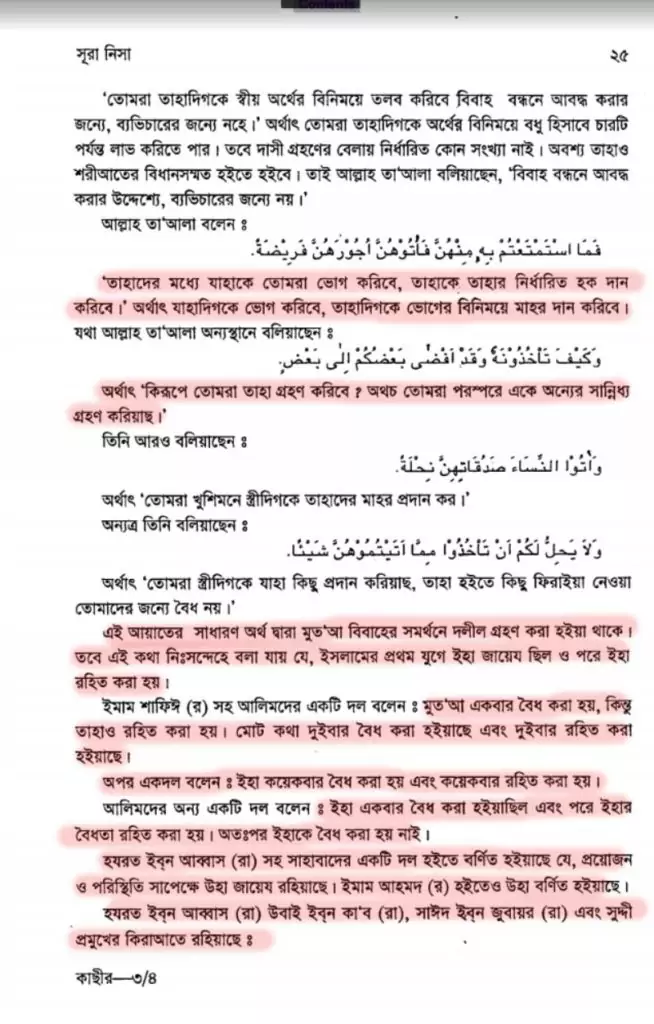
Tafsir Ibn Kathir
Let us now read a passage from Tafsir Ibn Kathir acknowledging that muta marriage was permissible in the early Islamic period and was later prohibited [6]:
“You may seek them with your wealth in marriage, not for fornication.” That is, you may obtain up to four wives with your wealth. There is no fixed numerical limit on acquiring female slaves, although this too must comply with the rules of the Sharia. Thus Allah says, “For marriage, not for fornication.”
Allah says:
فَمَا اسْتَمْتَعْتُمْ بِهِ مِنْهُنَّ فَأْتُوهُنَّ أُجُورَهُنَّ فَرِيضَةً.
“Give those among them whom you enjoy their prescribed dues.” That is, give those with whom you enjoy sexual relations their mahr in return for that enjoyment.
As Allah says elsewhere:
وَكَيْفَ تَأْخُذُونَهُ وَقَدْ أَفْضَى بَعْضُكُمْ إِلَى بَعْضٍ.
“How can you take it back when you have been intimate with one another?”
He also says:
وَأْتُوا النِّسَاءَ صَدُقَاتِهِنَّ نِحْلَةً.
“Give women their mahr willingly.”
Elsewhere He says:
وَلَا يَحِلُّ لَكُمْ أَنْ تَأْخُذُوا مِمَّا آتَيْتُمُوهُنَّ شَيْئًا.
“It is not lawful for you to take back anything you have given them.”
The general wording of this verse is used as evidence in support of muta marriage. It can, however, be stated without doubt that it was permissible in the early Islamic period and was subsequently abrogated.
A group of scholars, including Imam al-Shafi’i, says that muta was permitted and then abrogated: in all, it was permitted twice and abrogated twice.
Another group says it was permitted and abrogated several times.
A further group says it was permitted once, then abrogated, and was not permitted again.
It is narrated from Ibn Abbas and a group of Companions that it remained permissible according to need and circumstances. This is also narrated from Imam Ahmad.
The recitations attributed to Ibn Abbas, Ubayy ibn Ka’b, Sa’id ibn Jubayr and al-Suddi include:
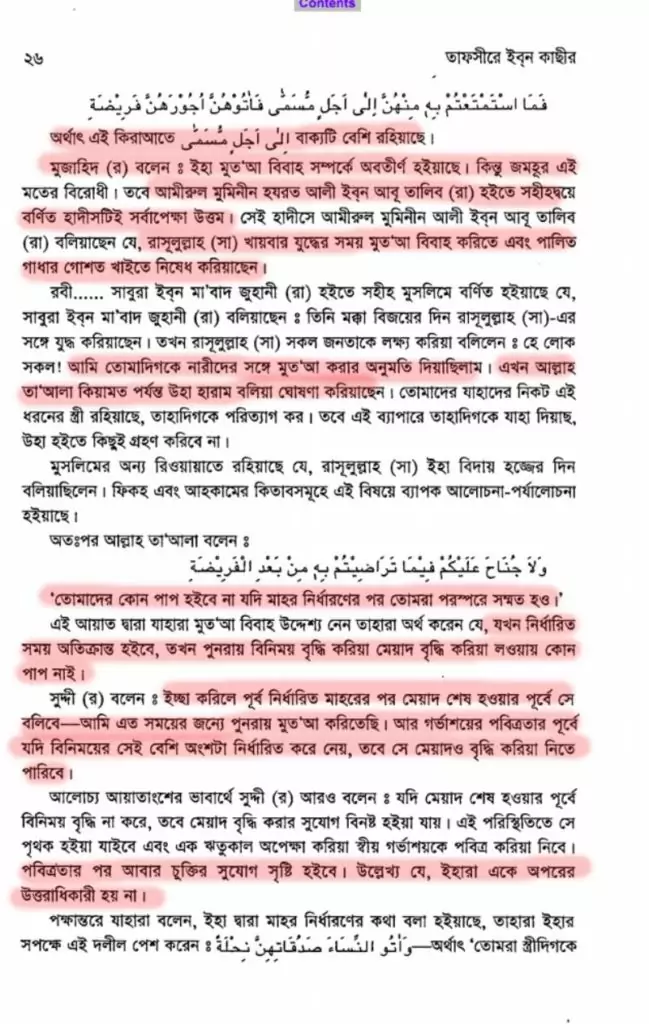
فَمَا اسْتَمْتَعْتُم بِهِ مِنْهُنَّ إِلَى أَجَلٍ مُّسَمًّى فَأْتُوهُنَّ أُجُورَهُنَّ فَرِيضَةِ That is, this recitation includes the additional words إلى أجل مسمى .
Mujahid says that the verse was revealed concerning muta marriage, although the majority disagree with this interpretation. The strongest hadith on the matter is the one narrated in the two Sahih collections from the Commander of the Faithful, Ali ibn Abu Talib. In it, Ali states that the Messenger of Allah prohibited muta marriage and the consumption of domestic donkey meat at the battle of Khaybar.
In Sahih Muslim, al-Rabi’ narrates from Sabra ibn Ma’bad al-Juhani, who says that he fought alongside the Messenger of Allah on the day of the conquest of Mecca. The Messenger addressed the people: “O people, I had permitted you to practise muta with women. Allah has now forbidden it until the Day of Resurrection. Anyone who has such a woman with him must let her go, but must not take back anything he has given her.”
Another narration in Muslim places this declaration at the Farewell Pilgrimage. The subject is discussed extensively in works of jurisprudence and legal rulings.
Allah then says:
ولَا جُنَاحَ عَلَيْكُمْ فِيمَا تَرَاضِيْتُمْ بِهِ مِنْ بَعْدِ الْفَرِيضَةِ
“There is no sin upon you for what you mutually agree after fixing the mahr.”
Those who understand this passage as referring to muta marriage interpret it to mean that, after the agreed term, there is no sin in extending the duration by increasing the payment.
Al-Suddi says that before the agreed term expires, the man may say, “I am renewing the muta for this further period.” If the additional payment is agreed before the waiting period establishing that the womb is clear, the term may be extended.
Al-Suddi further explains that if the payment is not increased before the term ends, the opportunity to extend it lapses. They must then separate, and the woman waits for one menstrual period to establish that her womb is clear. They may enter into another contract afterwards. They do not inherit from one another.
Those who understand the passage as referring to the fixing of mahr cite in support: وَأَتُو النِّسَاءَ صَدَقَاتِهِنَّ نِحْلَةً —that is, “Give women their
Let us now examine the explanation of this verse in the commentary commonly attributed to the Prophet’s prominent Companion Ibn Abbas [7]:
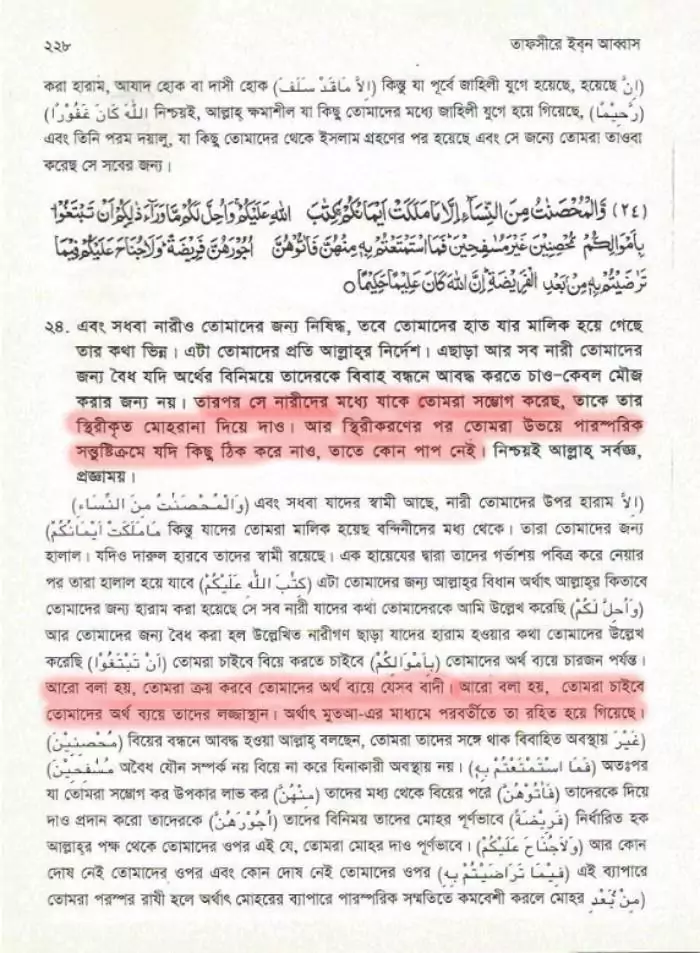
24. Married women are also forbidden to you, except those whom your hands possess. This is Allah’s command to you. Other women are lawful for you if you seek them with your wealth in marriage, not merely for sexual pleasure. Give those with whom you have enjoyed sexual relations their fixed mahr. There is no sin upon you if, after fixing it, you mutually agree on some arrangement. Surely Allah is All-Knowing and All-Wise.
“وَالْمُحْصَنَتْ مِنَ النِّسَاء”: married women, who have husbands, are forbidden to you.(1) “مَا مَلَكَتْ أَيْمَانُكُمْ”: except the captives whom you possess. They are lawful for you even if they have husbands in the territory of war, once one menstrual period has established that their wombs are clear. “كتب الله عَلَيْكُ”: this is Allah’s prescription for you; the women I have mentioned are forbidden to you in Allah’s Book. “وأحل لكم”: other women, apart from those whose prohibition has been mentioned, are lawful for you. “أَنْ تَبْتَغُوا”: you may seek marriage. “بأموالكُمْ”: with your wealth, up to four wives.
It is also said: you may purchase female slaves with your wealth. Another interpretation is that you may seek access to their private parts with your wealth, meaning through muta, which was subsequently abrogated.
“محصنين”: bound in marriage; Allah says that you should be with them as married persons. “غیر( )صفحين”: not through illicit sexual relations or fornication without marriage. “فما استمتعتم (به”: for the enjoyment or benefit (4) you obtain from them after marriage, “فأتوهن”: give them, “أجُورَهُ”: their payment, their mahr in full, “فريضة”: as a prescribed obligation from Allah upon you. “وَلَأَجْنَاحَ عَلَيْكُمْ”: there is no blame upon you, no sin upon you, “فَيمَا تَرَاضَيْتُمْ بِهِ”: for what you mutually agree concerning an increase or reduction in the mahr, “من بعد”
Muta Marriage Was Permitted
Was muta marriage ever lawful in Islam? Hadiths classified as sahih state that Muhammad permitted it. They describe prohibition on more than one occasion, followed by renewed permission. It is therefore also true that muta was lawful at one time [8] [9] [10] [11]:
Sahih Muslim (Islamic Foundation)
17 / Marriage
Chapter 3: Muta marriage was permitted, then abrogated, then permitted again, then abrogated; its prohibition remains until the Day of Resurrection.
3283. Muhammad ibn Bashshar … from Jabir ibn Abdullah and Salama ibn al-Akwa’. They both said: The announcer of the Messenger of Allah came out before us and announced that the Messenger of Allah had permitted us to contract muta marriages.
Hadith classification: Sahih
Narrator: Jabir ibn Abdullah al-Ansari
Sahih Muslim (Islamic Foundation)
17 / Marriage
Chapter 3: Muta marriage was permitted, then abrogated, then permitted again, then abrogated; its prohibition remains until the Day of Resurrection.
3284. Umayya ibn Bistam al-Ayshi … from Salama ibn al-Akwa’ and Jabir ibn Abdullah, who reported that the Messenger of Allah came to them and permitted them to practise muta, or temporary marriage.
Hadith classification: Sahih
Narrator: Salama ibn al-Akwa’
Sahih Muslim (Islamic Foundation)
17 / Marriage
Chapter 3: Muta marriage was permitted, then abrogated, then permitted again, then abrogated; its prohibition remains until the Day of Resurrection.
3288. Abu Bakr ibn Abi Shayba … from Iyas ibn Salama, on the authority of his father, who said: In the year of Awtas, the Messenger of Allah permitted muta marriage for three days, then prohibited it.
Hadith classification: Sahih
Sahih al-Bukhari (Tawheed Publication)
67 / Marriage
Chapter 67/32: The Messenger eventually prohibited muta marriage.
5117–5118. Jabir ibn Abdullah and Salama ibn al-Akwa’ reported: We were with an army when the Messenger of Allah came to us and said, “You have been permitted to contract muta marriages, so you may do so.” (Adhunik Prakashani 4742; Islamic Foundation 4744)
Hadith classification: Sahih
Narrator: Jabir ibn Abdullah al-Ansari
The hadiths also indicate that muta marriage was permitted when the Muslims entered Mecca in the year of its conquest [12] [13]:
Sahih Muslim (Islamic Foundation)
17 / Marriage
Chapter 3: Muta marriage was permitted, then abrogated, then permitted again, then abrogated; its prohibition remains until the Day of Resurrection.
3294. Ishaq ibn Ibrahim … from Abd al-Malik ibn al-Rabi’ ibn Sabra al-Juhani, through his father and grandfather. His grandfather said: When we entered Mecca in the year of its conquest, the Messenger of Allah permitted us to contract muta marriages. We did not leave until he instructed us to refrain from them and leave the women.
Hadith classification: Sahih
Narrator: Al-Rabi’ ibn Sabra al-Juhani
Sahih al-Bukhari (Tawheed Publication)
67 / Marriage
Chapter 67/32: The Messenger eventually prohibited muta marriage.
5119. Ibn Abi Dhi’b said: Iyas ibn Salama ibn al-Akwa’, on his father’s authority, narrated from the Prophet that when a man and a woman agree to muta, their relationship is for three nights. They may then extend it if they wish, or separate if they wish. The narrator said: We do not know whether this permission was specific to us or applied to everyone.
Abu Abdullah, Imam al-Bukhari, said: Ali clearly stated, on the Prophet’s authority, that muta marriage had been abrogated. (Muslim 16/2, hadith 1405; Adhunik Prakashani 4742; Islamic Foundation 4744)
Hadith classification: Sahih
Minors, Virgin Women and Guardian Consent in Muta Marriage
Shia hadith and legal works discuss a woman’s age, virginity and guardian’s permission in muta marriage at length. They include questions concerning temporary marriage with ten-year-old girls, muta involving virgin girls without their parents’ knowledge, and the validity of marriages contracted without a guardian’s permission. The issue is not merely the age at which marriage is permitted. It is also whether a young girl can understand the nature of marriage, a temporary sexual contract and its possible consequences sufficiently to make an independent decision. Early Shia hadiths consider age, vulnerability to deception, virginity and the family’s social standing. Later jurists also adopted differing interpretations of these provisions.
The Shia hadith compiler Shaykh al-Saduq, who died in 381 AH, preserved three consecutive accounts in the chapter on muta in volume 3 of Man La Yahduruhu al-Faqih. The first mentions the age of ten in connection with muta involving a young girl. The second says that contracting muta with a virgin may bring dishonour upon her family. The third prohibits a virgin whose father is alive from contracting muta without his permission. Together, these statements show that determining the validity of muta involved the girl’s age and her father’s authority alongside the question of her personal freedom. [14]
A Ten-Year-Old Girl and the Question of Deception
Shaykh al-Saduq’s narration 4591 is particularly significant. Muhammad ibn Muslim asks about contracting muta with a young girl. The answer permits it, except where she is a child susceptible to deception. He then asks at what age a girl ceases to be regarded as a child vulnerable to deception; the answer is ten. The narration specifies no separate test or condition concerning what her personal consent means, how much she understands the economic and sexual consequences of marriage, or how freely she can decide for herself. A particular age is presented as a threshold beyond vulnerability to deception. [15]
Original Arabic question and answer:
وَرَوَى مُحَمَّدُ بْنُ يَحْيَى الْخَثْعَمِيُّ، عَنْ مُحَمَّدِ بْنِ مُسْلِمٍ قَالَ: سَأَلْتُهُ عَنِ الْجَارِيَةِ يَتَمَتَّعُ مِنْهَا الرَّجُلُ؟ قَالَ: نَعَمْ، إِلَّا أَنْ تَكُونَ صَبِيَّةً تُخْدَعُ. قُلْتُ: أَصْلَحَكَ اللَّهُ، وَكَمِ الْحَدُّ الَّذِي إِذَا بَلَغَتْهُ لَمْ تُخْدَعْ؟ قَالَ: ابْنَةُ عَشْرِ سِنِينَ.
English translation:
Muhammad ibn Yahya al-Khath’ami narrates from Muhammad ibn Muslim, who said: “I asked him, ‘May a man contract muta with a young girl?’ He replied, ‘Yes, unless she is a child who can be deceived.’ I asked, ‘May Allah grant you well-being, at what age is she no longer considered a child susceptible to deception?’ He replied, ‘A girl of ten years.’”
The word الجارية can mean a young girl, a young woman or a female slave, depending on context. Here, however, the subsequent use of صبية, meaning a small girl, and the specific threshold of ten years place the discussion squarely within the question of temporary marriage with a minor. The narration notably links age with susceptibility to deception. It supplies no scientific basis for generalising that a ten-year-old girl is no longer easily deceived. In terms of modern child psychology, a ten-year-old cannot make decisions equivalent to those of an adult about sexual relations, pregnancy or the long-term social consequences of a fixed-term marriage.
This account is not confined to Shaykh al-Saduq’s work. Shaykh al-Tusi preserves the same exchange as narration 528 in the chapter on muta with virgins in Al-Istibsar, volume 3, pages 145–146. He uses it to interpret conflicting accounts concerning the requirement for a guardian’s permission. The account setting the age at ten thus functions as a legal argument in his discussion. [16]
Muta with a Virgin: Family Dishonour and Social Control
In Shaykh al-Saduq’s next narration, 4592, Hafs ibn al-Bakhtari asks Ja’far al-Sadiq about contracting muta with a virgin. He calls it disliked because it may bring dishonour upon her family. The stated objection does not concern her age, independent consent or the potential physical and psychological consequences of temporary sexual relations. It concerns the family’s social standing. In narration 4593, Aban, through Abu Maryam, preserves another statement from Ja’far al-Sadiq requiring the father’s permission for muta involving a virgin whose father is alive. [17]
Original Arabic, narration 4592:
في الرجل يتزوج البكر متعة؟ قال: يكره للعيب على أهلها
English translation:
Hafs ibn al-Bakhtari narrates from Ja’far al-Sadiq. Asked about a man contracting muta with a virgin, he replied: “It is disliked because of the dishonour it may bring upon her family.”
Original Arabic, narration 4593:
العذراء التي لها أب لا تتزوج متعة إلا بأذن أبيها
English translation:
Aban narrates from Ja’far al-Sadiq through Abu Maryam: “A virgin who has a father must not contract muta without his permission.”
These two accounts address different aspects of the same issue. The first sees muta as a potential source of social dishonour for the family. The second presents the father’s permission as a condition of the marriage. Virginity functions here not only as a personal physical or social condition, but also as a basis for family authority. A woman may need her father’s permission to marry because she is a virgin, while her position may differ if she has previously had sexual intercourse within a permanent marriage. Her freedom to marry is thus determined partly by her previous sexual experience, alongside her own capacity for judgement.
Muta without Parents’ Knowledge: The Disagreements Preserved by Shaykh al-Tusi
The most significant discussion appears in chapter 94 of Shaykh al-Tusi’s Al-Istibsar, entitled باب التمتع بالأبكار—muta with virgins. Al-Tusi places several accounts with differing content alongside one another. One says there is no problem with muta involving a virgin living under her parents’ care. Another permits it without their permission, subject to a restriction. A third prohibits it without the father’s permission. Al-Tusi offers several explanations to reconcile these differences. [18]
In narration 525, Abu Sa’id al-Qammat reports that Ja’far al-Sadiq was asked about muta with virgins living under their parents’ care. He replied that there was no problem. In narration 526, al-Halabi asks about muta with a virgin without her parents’ permission. Similar permission is given, on condition that her virginity remain intact. Narration 527, by contrast, states that a virgin may not contract muta without her father’s permission.
Original Arabic, Al-Istibsar, narration 526:
سألته عن التمتع من البكر إذا كانت بين أبويها بلا إذن أبويها قال لا بأس ما لم يفتض ما هناك لتعف بذلك
English translation:
Al-Halabi said: “I asked him whether a man may contract muta with a virgin living under her parents’ care without their permission. He replied: ‘There is no problem, provided her virginity is preserved, so that through this she may maintain her chastity.’”
This account permits temporary marriage with a virgin without her parents’ permission. Its condition concerns preserving virginity rather than her capacity to decide independently. It therefore describes an arrangement in which temporary marriage is acceptable without parental permission as long as virginity is preserved. It gives no detailed criteria for assessing her age or maturity. Its central consideration is the social and physical condition of virginity.
Al-Tusi also preserves the account requiring the father’s permission. He explains that this requirement may apply to a minor virgin who has not yet reached puberty, citing the narration specifying ten years in support. He offers two further possible explanations: an account may have been given in particular circumstances, or its prohibition may express disapproval rather than strict unlawfulness. For the latter interpretation, he cites the account concerning dishonour to the family. [19]
Al-Tusi’s explanation notably attempts to connect the need for the father’s permission with a girl’s minority. Other accounts permit muta with a virgin without a guardian’s permission. Early Shia hadith and jurisprudence therefore do not provide a single, unchanging answer to this question. They preserve several positions concerning age, puberty, the father’s permission and social dishonour.
The Father’s and Paternal Grandfather’s Authority over a Minor’s Marriage
Contemporary Twelver Shia jurisprudence also contains distinct provisions for the marriage of minors. Ruling 57 in the marriage section of Ali al-Sistani’s Minhaj al-Salihin recognises the father and paternal grandfather as marriage guardians of minor boys and girls. Mothers, maternal grandfathers, brothers, paternal uncles and maternal uncles have no equivalent automatic authority. Ruling 58 states that where both the father and paternal grandfather are alive, each can independently arrange the minor’s marriage. If they contract marriages with different people, the earlier contract takes priority; if simultaneous, the paternal grandfather’s contract takes priority. [20]
Ruling 59 requires a marriage arranged by a guardian to be free of harm to the child. If a guardian contracts a marriage that reasonable judgement considers harmful, it does not take effect automatically during minority; it may take effect if the child approves it after reaching maturity. Ruling 60 mentions the possibility of a right to annul the contract after maturity even where the marriage was not harmful, subject to precaution concerning renewal of the contract or divorce. Legal conditions therefore accompany the recognition of guardianship. The underlying structure nevertheless permits a guardian to contract a marriage for a minor. [21]
Original Arabic, relevant passage from ruling 57:
الأب والجدّ من طرف الأب لهما الولاية على الطفل الصغير والصغيرة
English translation:
The father and paternal grandfather have marriage guardianship over minor boys and girls.
These rules also relate directly to muta. Ruling 244 of Sistani’s Minhaj al-Salihin states that temporary marriage has no prescribed minimum term. The same discussion addresses temporary marriage contracts for minor boys and girls, including contracts intended to establish prohibited degrees of kinship. It questions the contract’s validity where the specified term cannot accommodate a relevant purpose of temporary marriage. Temporary marriage involving minors is therefore a recognised legal subject in contemporary Shia jurisprudence as well. [22]
The marriage contract and subsequent sexual intercourse are governed separately. Ruling 1011 in Sistani’s Al-Masa’il al-Muntakhaba prohibits intercourse with a wife before she has completed nine years of age. This age threshold is itself significant. Permission to contract a marriage for a minor girl and the age threshold for intercourse with her appear as two distinct provisions. That threshold establishes no universal standard of adult-equivalent mental maturity or free and informed consent. [23]
An Adult Virgin Woman’s Consent and Her Father’s Permission
The rules for adult virgins differ from those for minor girls. Ruling 67 of Sistani’s Minhaj al-Salihin states that the father or paternal grandfather has no marriage guardianship over an adult woman of sound judgement who has previously been married. If she is a virgin, however, paternal permission again becomes an issue. If she manages her own affairs independently, neither the father nor the paternal grandfather can marry her off without her consent. Whether she may marry without their permission is subject to obligatory precaution. If she does not manage her affairs independently, she may not marry without their permission. Separate provisions also address whether her guardian may marry her off without her consent. [24]
Ruling 68 explicitly states that the requirement for a guardian’s permission in the marriage of an adult virgin of sound judgement applies equally to permanent and temporary marriage. It applies even if the temporary contract stipulates that intercourse will not take place. Ruling 69 allows exceptions in certain cases where the father or paternal grandfather prevents marriage to a suitable partner, withdraws from responsibility for the marriage, or cannot practically be approached for permission. Separate precautions address whether these exceptions apply equally to temporary marriage. [25]
These rules distinguish a woman’s own consent from her guardian’s permission. Even when she consents to marriage, she may need her father’s permission because she is a virgin. Conversely, her father’s agreement does not make her own consent wholly irrelevant. For a minor girl, however, the guardian’s power to conclude the contract creates a different structure of personal decision-making. Conflating the rules for children with those for adult virgins obscures their actual legal positions.
Virginity, Age and the Problem of Free Consent
The early and contemporary Shia rules together raise several important questions. First, the account preserved by Shaykh al-Saduq treats a ten-year-old girl as beyond vulnerability to deception. Second, al-Tusi preserves permission for muta with a virgin without her parents’ permission, alongside accounts requiring it. Third, contemporary jurisprudence permits guardians to contract marriages for minors. Fourth, even an adult virgin capable of sound judgement remains subject to the question of paternal permission. These provisions determine women’s marriage rights through age, virginity and family authority.
The greatest problem with a young child’s marriage is free and informed consent. The hadith supplies no evidence beyond a numerical age for the assumption that a ten-year-old can fully understand the social, economic and physical consequences of a fixed-term marriage with an adult. Age alone cannot establish whether she faces inducement, pressure or deception. At an age of deep dependence on education, family and guardians, religious permission for temporary marriage itself raises a serious ethical question.
Rules concerning family honour in the case of virgins reveal a related social problem. Shaykh al-Saduq’s account mentions the potential dishonour to the family without separately assessing the woman’s own social position, future security or the consequences of the relationship. Guardian-permission rules also give significance to paternal authority. This structure permits conflict between her personal autonomy and family standing. Its consequences may be greater in temporary marriage because, after the relationship ends, her rights to maintenance, inheritance and other family entitlements are limited.
Placing a child’s marriage contract in a guardian’s hands and permitting intercourse at a specified age conflict with modern concepts of children’s rights and personal autonomy. A guardian may decide matters concerning a child’s treatment, education or daily needs, but that does not mean the guardian can give free and informed consent on the child’s behalf to sexual relations with an adult. Consent requires the individual’s own age-appropriate maturity, capacity for independent decision-making and freedom from pressure. Concluding a religious marriage contract does not automatically fulfil these conditions.
The problem is particularly apparent in muta because its duration and payment are fixed in advance. When the contract expires, there is no obligation to maintain a permanent marital relationship, yet its consequences may affect the young girl’s social position, physical safety and future life. The legal validity of temporary marriage and a minor’s actual consent to it are separate questions. The accounts preserved by Shaykh al-Saduq and al-Tusi demonstrate the historical significance of that distinction.
Shia hadith and legal works therefore do not confine muta to a temporary contract freely agreed by two adults. They contain provisions concerning young girls, virgins, parental permission, family honour and contracts concluded by guardians. Ten is specified as a threshold concerning deception; accounts both for and against muta without the father’s permission are preserved; and later jurisprudence retains a legal framework for minors’ marriages. These rules concern not only religious validity, but also children’s and women’s independent consent and the family and social authority exercised over them.
Why Muta Marriage Was Permitted
Why was a practice resembling prostitution permitted in Islam? What circumstances led the Prophet to authorise it? Let us read the account [26]:
Sahih al-Bukhari (Tawheed Publication)
67 / Marriage
Chapter 67/32: The Messenger eventually prohibited muta marriage.
5116. Abu Jamra reported: I heard Ibn Abbas being asked about muta with women, and he permitted it. His freed slave said to him, “Was that ruling only because of necessity and the shortage of women, or similar circumstances?” Ibn Abbas replied, “Yes.” (Adhunik Prakashani 4741; Islamic Foundation 4743)
Hadith classification: Sahih
Narrator: Abu Jamra
The hadith above indicates that Muhammad permitted muta because of the shortage of women. In the early Islamic period, when female war captives had not yet fallen into the hands of Muhammad’s soldiers as booty and were not available for intercourse, he permitted muta. Ibn Hajar explains that after Khaybar, increased Muslim wealth and access to female captives reduced the earlier need for muta; he discusses its prohibition in that context. In other words, when the need for female companionship could be met differently, the need for muta diminished. If female war captives could be raped without payment, why pay for muta marriage? [27] [28]!
Original Arabic
وَسَيَأْتِي النَّقْلُ عَنْهُ فِي الرُّخْصَةِ فِي الْحُمُرِ الْأَهْلِيَّةِ فِي أَوَائِلِ كِتَابِ الْأَطْعِمَةِ، فَرَدَّ عَلَيْهِ عَلِيٌّ فِي الْأَمْرَيْنِ مَعًا وَأَنَّ ذَلِكَ يَوْمُ خَيْبَرَ، فَإِمَّا أَنْ يَكُونَ عَلَى ظَاهِرِهِ، وَأَنَّ النَّهْيَ عَنْهُمَا وَقَعَ فِي زَمَنٍ وَاحِدٍ. وَإِمَّا أَنْ يَكُونَ الْإِذْنُ الَّذِي وَقَعَ عَامَ الْفَتْحِ لَمْ يَبْلُغْ عَلِيًّا لِقِصَرِ مُدَّةِ الْإِذْنِ وَهُوَ ثَلَاثَةُ أَيَّامٍ كَمَا تَقَدَّمَ.
وَالْحَدِيثُ فِي قِصَّةِ تَبُوكَ عَلَى نَسْخِ الْجَوَازِ فِي السَّفَرِ؛ لِأَنَّهُ نَهَى عَنْهَا فِي أَوَائِلِ إِنْشَاءِ السَّفَرِ مَعَ أَنَّهُ كَانَ سَفَرًا بَعِيدًا، وَالْمَشَقَّةُ فِيهِ شَدِيدَةٌ كَمَا صَرَّحَ بِهِ فِي الْحَدِيثِ فِي تَوْبَةِ كَعْبٍ، وَكَانَتْ عِلَّةُ الْإِبَاحَةِ وَهِيَ الْحَاجَةُ الشَّدِيدَةُ انْتَهَتْ مِنْ بَعْدِ فَتْحِ خَيْبَرَ وَمَا بَعْدَهَا وَاللَّهُ أَعْلَمُ.
وَالْجَوَابُ عَنْ قَوْلِ السُّهَيْلِيِّ أَنَّهُ لَمْ يَكُنْ فِي خَيْبَرَ نِسَاءٌ يُسْتَمْتَعُ بِهِنَّ ظَاهِرٌ مِمَّا بَيَّنْتُهُ مِنَ الْجَوَابِ عَنْ قَوْلِ ابْنِ الْقَيِّمِ: لَمْ تَكُنِ الصَّحَابَةُ يَتَمَتَّعُونَ بِالْيَهُودِيَّاتِ، وَأَيْضًا فَيُقَالُ كَمَا تَقَدَّمَ لَمْ يَقَعْ فِي الْحَدِيثِ التَّصْرِيحُ بِأَنَّهُمُ اسْتَمْتَعُوا فِي خَيْبَرَ، وَإِنَّمَا فِيهِ مُجَرَّدُ النَّهْيِ، فَيُؤْخَذُ مِنْهُ أَنَّ التَّمَتُّعَ مِنَ النِّسَاءِ كَانَ حَلَالًا، وَسَبَبُ تَحْلِيلِهِ مَا تَقَدَّمَ فِي حَدِيثِ ابْنِ مَسْعُودٍ حَيْثُ قَالَ: كُنَّا نَغْزُو وَلَيْسَ لَنَا شَيْءٌ – ثُمَّ قَالَ – فَرَخَّصَ لَنَا أَنْ نَنْكِحَ الْمَرْأَةَ بِالثَّوْبِ، فَأَشَارَ إِلَى سَبَبِ ذَلِكَ وَهُوَ الْحَاجَةُ مَعَ قِلَّةِ الشَّيْءِ، وَكَذَا فِي حَدِيثِ سَهْلِ بْنِ سَعْدٍ الَّذِي أَخْرَجَهُ ابْنُ عَبْدِ الْبَرِّ بِلَفْظِ: إِنَّمَا رَخَّصَ النَّبِيُّ صلى الله عليه وسلم فِي الْمُتْعَةِ لِعُزْبَةٍ كَانَتْ بِالنَّاسِ شَدِيدَةٍ، ثُمَّ نَهَى عَنْهَا، فَلَمَّا فُتِحَتْ خَيْبَرَ وَسَّعَ عَلَيْهِمْ مِنَ الْمَالِ وَمِنَ السَّبْيِ فَنَاسَبَ النَّهْيُ عَنِ الْمُتْعَةِ؛ لِارْتِفَاعِ سَبَبِ الْإِبَاحَةِ، وَكَانَ ذَلِكَ مِنْ تَمَامِ شُكْرِ نِعْمَةِ اللَّهِ عَلَى التَّوْسِعَةِ بَعْدَ الضِّيقِ، أَوْ كَانَتِ الْإِبَاحَةُ إِنَّمَا تَقَعُ فِي الْمَغَازِي الَّتِي يَكُونُ فِي الْمَسَافَةِ إِلَيْهَا بُعْدٌ وَمَشَقَّةٌ، وَخَيْبَرُ بِخِلَافِ ذَلِكَ؛ لِأَنَّهَا بِقُرْبِ الْمَدِينَةِ فَوَقَعَ النَّهْيُ عَنِ الْمُتْعَةِ فِيهَا إِشَارَةٌ إِلَى ذَلِكَ مِنْ غَيْرِ تَقَدُّمِ إِذْنٍ فِيهَا، ثُمَّ لَمَّا عَادُوا إِلَى سَفْرَةٍ بَعِيدَةِ الْمُدَّةِ، وَهِيَ غَزَاةُ الْفَتْحِ، وَشَقَّتْ عَلَيْهِمُ الْعُزُوبَةُ أَذِنَ لَهُمْ فِي الْمُتْعَةِ لَكِنْ مُقَيَّدًا بِثَلَاثَةِ أَيَّامٍ فَقَطْ؛ دَفْعًا لِلْحَاجَةِ، ثُمَّ نَهَاهُمْ بَعْدَ انْقِضَائِهَا عَنْهَا كَمَا سَيَأْتِي مِنْ رِوَايَةِ سَلَمَةَ.
وَهَكَذَا يُجَابُ عَنْ كُلِّ سَفْرَةٍ ثَبَتَ فِيهَا النَّهْيُ بَعْدَ الْإِذْنِ.
وَأَمَّا حَجَّةُ الْوَدَاعِ فَالَّذِي يَظْهَرُ أَنَّهُ وَقَعَ فِيهَا النَّهْيُ مُجَرَّدًا إِنْ ثَبَتَ الْخَبَرُ فِي ذَلِكَ؛ لِأَنَّ الصَّحَابَةَ حَجُّوا فِيهَا بِنِسَائِهِمْ بَعْدَ أَنْ وُسِّعَ عَلَيْهِمْ فَلَمْ يَكُونُوا فِي شِدَّةٍ وَلَا طُولِ عُزْبَةٍ، وَإِلَّا فَمَخْرَجُ حَدِيثِ سَبْرَةَ رَاوية هُوَ مِنْ طَرِيقِ ابْنِهِ الرَّبِيعِ عَنْهُ، وَقَدِ اخْتُلِفَ عَلَيْهِ فِي تَعْيِينِهَا؛ وَالْحَدِيثُ وَاحِدٌ فِي قِصَّةٍ وَاحِدَةٍ فَتَعَيَّنَ التَّرْجِيحُ، وَالطَّرِيقُ الَّتِي أَخْرَجَهَا مُسْلِمٌ مُصَرِّحَةٌ بِأَنَّهَا فِي زَمَنِ الْفَتْحِ أَرْجَحُ فَتَعَيَّنَ الْمَصِيرُ إِلَيْهَا وَاللَّهُ أَعْلَمُ.
الْحَدِيثُ الثَّانِي.
قَوْلُهُ: (عَنْ أَبِي جَمْرَةَ) هُوَ الضُّبَعِيُّ بِالْجِيمِ وَالرَّاءِ، وَرَأَيْتُهُ بِخَطِّ بَعْضِ مَنْ شَرَحَ هَذَا الْكِتَابِ بِالْمُهْمَلَةِ وَالزَّايِ وَهُوَ تَصْحِيفٌ.
قَوْلُهُ: (سَمِعْتُ ابْنَ عَبَّاسٍ يُسْأَلُ) بِضَمِّ أَوَّلِهِ.
قَوْلُهُ: (فَرَخَّصَ) أَيْ فِيهَا، وَثَبَتَتْ فِي رِوَايَةِ الْإِسْمَاعِيلِيِّ.
قَوْلُهُ: (فَقَالَ لَهُ مَوْلًى لَهُ) لَمْ أَقِفْ عَلَى اسْمِهِ صَرِيحًا، وَأَظُنُّهُ عِكْرِمَةَ.
قَوْلُهُ: (إِنَّمَا ذَلِكَ فِي الْحَالِ الشَّدِيدِ، وَفِي النِّسَاءِ قِلَّةٌ أَوْ نَحْوِهِ) فِي رِوَايَةِ الْإِسْمَاعِيلِيِّ: إِنَّمَا كَانَ ذَلِكَ فِي الْجِهَادِ وَالنِّسَاءُ قَلِيلٌ.
قَوْلُهُ: (فَقَالَ ابْنُ عَبَّاسٍ: نَعَمْ) فِي رِوَايَةِ الْإِسْمَاعِيلِيِّ صَدَقَ. وَعِنْدِ مُسْلِمٍ مِنْ طَرِيقِ الزُّهْرِيِّ، عَنْ خَالِدِ بْنِ الْمُهَاجِرِ، أَوِ ابْنِ أَبِي عُمْرَةَ الْأَنْصَارِيِّ: قَالَ رَجُلٌ – يَعْنِي لِابْنِ عَبَّاسٍ، وَصَرَّحَ بِهِ الْبَيْهَقِيُّ فِي رِوَايَتِهِ – إِنَّمَا كَانَتْ – يَعْنِي الْمُتْعَةَ – رُخْصَةً فِي أَوَّلِ الْإِسْلَامِ لِمَنِ اضْطُرَّ إِلَيْهَا؛ كَالْمَيْتَةِ وَالدَّمِ وَلَحْمِ الْخِنْزِيرِ، وَيُؤَيِّدُهُ مَا أَخْرَجَهُ الْخَطَّابِيُّ، وَالْفَاكِهِيُّ مِنْ طَرِيقِ سَعِيدِ بْنِ جُبَيْرٍ قَالَ: قُلْتُ لِابْنِ عَبَّاسٍ لَقَدْ سَارَتْ بِفُتْيَاكَ الرُّكْبَانُ، وَقَالَ فِيهَا الشُّعَرَاءُ، يَعْنِي فِي الْمُتْعَةِ. فَقَالَ: وَاللَّهِ مَا بِهَذَا أَفْتَيْتُ، وَمَا هِيَ إِلَّا كَالْمَيْتَةِ لَا تَحِلُّ إِلَّا لِلْمُضْطَرِّ.
وَأَخْرَجَهُ الْبَيْهَقِيُّ مِنْ وَجْهٍ آخَرَ، عَنْ سَعِيدِ بْنِ جُبَيْرٍ، وَزَادَ فِي آخِرِهِ: أَلَا إِنَّمَا هِيَ كَالْمَيْتَةِ وَالدَّمِ وَلَحْمِ الْخِنْزِيرِ. وَأَخْرَجَهُ مُحَمَّدُ بْنُ خَلَفٍ الْمَعْرُوفُ بِوَكِيعٍ فِي كِتَابِ الْغُرَرِ مِنَ الْأَخْبَارِ بِإِسْنَادٍ أَحْسَنَ مِنْهُ عَنْ سَعِيدِ بْنِ جُبَيْرٍ بِالْقِصَّةِ، لَكِنْ لَيْسَ فِي آخِرِهِ قَوْلُ ابْنِ عَبَّاسٍ الْمَذْكُورُ.
وَفِي حَدِيثِ سَهْلِ بْنِ سَعْدٍ الَّذِي أَشَرْتُ
English translation
Fath al-Bari
Volume 9 | Page 171
An account of his permission concerning domestic donkey meat will appear at the beginning of the Book of Foods. Ali answered him on both matters—donkey meat and muta—and stated that they were prohibited at Khaybar. Either this is to be taken at face value, with both prohibited at the same time, or the permission given in the year of the conquest did not reach Ali because it lasted only three days, as mentioned earlier.
The account concerning Tabuk indicates the abrogation of permission during travel: he prohibited it at the start of the journey, although it was a long and particularly difficult expedition, as the hadith concerning Ka’b’s repentance makes clear. The reason for permission, severe need, had ended after the conquest of Khaybar and subsequent events. Allah knows best.
The answer to al-Suhayli’s statement that there were no women at Khaybar with whom muta could be practised is apparent from my response to Ibn al-Qayyim’s statement that the Companions did not contract muta with Jewish women. Moreover, the hadith does not explicitly say they practised muta at Khaybar; it merely records its prohibition. This indicates that muta with women had previously been lawful. Its reason appears in Ibn Mas’ud’s hadith: “We went on expeditions and had nothing,” followed by permission to marry a woman in exchange for a garment. This points to need combined with limited resources.
Similarly, in Sahl ibn Sa’d’s hadith, related by Ibn Abd al-Barr: “The Prophet permitted muta because people suffered severely from the absence of wives, then prohibited it.” When Khaybar was conquered, wealth and female captives became abundant, making prohibition appropriate because the reason for permission had ceased. This completed their gratitude for Allah’s blessing of prosperity after hardship. Alternatively, permission applied only to distant and arduous military expeditions.
Khaybar differed because it was close to Medina. Its prohibition there, without prior permission on that expedition, indicated this distinction. When they later undertook a lengthy journey, the conquest of Mecca, and the absence of wives became difficult, he permitted muta for only three days to meet the need. Afterwards he prohibited it, as Salama’s narration will show.
This answers each case of an expedition on which prohibition followed permission.
As for the Farewell Pilgrimage, if the account is established, it appears to record a prohibition alone, recalling the earlier prohibition. The Companions then travelled with their wives after their circumstances had improved, so they suffered neither hardship nor prolonged separation. Otherwise, Sabra’s account comes through his son al-Rabi’, with disagreement about its date. Since it concerns one event, preference must be given to one version. Muslim’s version explicitly placing it at the conquest is stronger and must be preferred. Allah knows best.
The second hadith.
His wording “from Abu Jamra”: this is al-Duba’i, with the letters jim and ra. In the handwriting of one commentator, I saw the name written with an undotted letter and zay, which is a scribal error.
His wording “I heard Ibn Abbas being asked”: the verb is read in the passive.
“He permitted it”: meaning muta. This is explicit in al-Isma’ili’s narration.
“A freed slave of his said to him”: I have not found his name explicitly, but suspect it was Ikrima.
“Only in severe circumstances and when women were few, or something similar”: al-Isma’ili’s version says, “Only during jihad, when women were few.”
“Ibn Abbas said, ‘Yes’”: al-Isma’ili has “He spoke the truth.” Muslim, through al-Zuhri from Khalid ibn al-Muhajir or Ibn Abi Amra al-Ansari, reports a man addressing Ibn Abbas, as al-Bayhaqi makes explicit: “Muta was only a concession in early Islam for those compelled by necessity, like carrion, blood and pork.” Al-Khattabi and al-Fakihi support this through Sa’id ibn Jubayr, who said to Ibn Abbas, “Your ruling has travelled everywhere, and poets have composed verses about muta.” He replied, “By Allah, that is not the ruling I gave. It is like carrion, lawful only for someone compelled by necessity.”
Al-Bayhaqi relates it through another chain from Sa’id ibn Jubayr, adding, “It is only like carrion, blood and pork.” Muhammad ibn Khalaf, known as Waki’, relates the incident through a stronger chain in Al-Ghurar min al-Akhbar, but without that final statement from Ibn Abbas.
As for Sahl ibn Sa’d’s hadith, to which I referred…
Permission when female companionship was needed, prohibition when that need could be met otherwise, and renewed permission when the need returned: this is a pattern found within Sunni explanations themselves [29]. Let us read further hadiths [30] [31]:
Sahih Muslim (Islamic Foundation)
17 / Marriage
Chapter 3: Muta marriage was permitted, then abrogated, then permitted again, then abrogated; its prohibition remains until the Day of Resurrection.
3280. Muhammad ibn Abdullah ibn Numayr al-Hamdani … from Qays, who said: I heard Abdullah say, “We went on military expeditions with the Messenger of Allah without our wives. We asked, ‘Should we castrate ourselves?’ He forbade us to do so. He then instructed us to marry women in exchange for clothing for a specified period.” Abdullah then recited: “O believers, do not forbid the good things Allah has made lawful for you, and do not transgress. Allah does not love transgressors.” (Qur’an 5:87)
Hadith classification: Sahih
Narrator: Qays ibn Abi Hazim
Sunan Ibn Majah
9 / Marriage
Chapter 9/44: The prohibition of muta marriage.
2/1962. Sabra narrated: We set out with the Messenger of Allah for the Farewell Pilgrimage. The Companions said, “Messenger of Allah, being without wives has become difficult for us.” He said, “Then contract muta with these women.” We approached them, but they refused to marry us unless a term was specified. When the Companions told the Messenger, he said, “Then agree on a term between yourselves.”
My cousin and I went out for this purpose. Each of us had a cloak. His was finer than mine, but I was younger. We approached a woman, who said, “The two cloaks are much the same.” I married her and spent that night with her. In the morning, I returned and found the Messenger of Allah standing between the door of the Ka’ba and its corner, saying, “O people, I had permitted muta marriage. Now know that Allah has forbidden this form of marriage until the Day of Resurrection.” Anyone who has such a woman with him must let her go, and you must not take back anything you have given them.
Muslim 1406; al-Nasa’i 3368; Abu Dawud 2072, 2073; Ahmad 14913, 14921; al-Darimi 2195, 2196; Irwa’ 1901, 1902; al-Sahiha 381; Sahih Abi Dawud 1808.
Al-Albani’s assessment: Sahih, but the reference to the Farewell Pilgrimage is anomalous; the preserved wording places it at the conquest of Mecca. Concerning the narrator Abd al-Aziz ibn Umar, Abu Hatim al-Razi says his hadiths may be accepted. Abu Hatim ibn Hibban calls him weak in narration. Abu Hafs Umar ibn Shahin and Abu Dawud al-Sijistani call him trustworthy. Abu Mushir al-Ghassani calls him weak in narration. Ibn Hajar al-Asqalani describes him as truthful but prone to mistakes in hadith. Al-Dhahabi calls him trustworthy, while Abu al-Ala ibn Mushir calls him weak. (Tahdhib al-Kamal, narrator 3464, volume 18, page 173)
Hadith classification: Sahih
Narrator: Rabi’ ibn Sabih
Many of the Prophet’s Companions Practised Muta Marriage
Numerous hadiths and other sources record that many of Muhammad’s Companions practised muta, including with his express authorisation. This practice continued into Umar’s caliphate. Let us examine several accounts [32] [33] [34]:
Sunan al-Nasa’i (Islamic Foundation)
26 / Marriage
Chapter 71: The prohibition of muta.
3371. Qutayba … from al-Rabi’ ibn Sabra al-Juhani, through his father, who said: When the Messenger permitted muta, another man and I approached a woman of Banu Amr and presented ourselves to her. She asked, “What will you give me?” I offered my cloak, as did my companion. His cloak was better, but I was younger. When she looked at his cloak, she liked it; when she looked at me, I appealed to her. She said, “You and your cloak are enough for me.” I stayed with her for three nights. Afterwards, the Messenger said, “Anyone who has one of these women with him through muta must let her go.”
Assessment: Sahih. Ibn Majah 1962; Irwa’ 1901, 1902; al-Sahiha 381.
Hadith classification: Sahih
Narrator: Al-Rabi’ ibn Sabra al-Juhani
Sahih Muslim (Islamic Foundation)
17 / Marriage
Chapter 3: Muta marriage was permitted, then abrogated, then permitted again, then abrogated; its prohibition remains until the Day of Resurrection.
3295. Yahya ibn Yahya … from Sabra ibn Ma’bad. The Prophet permitted his Companions to contract muta with women in the year of the conquest of Mecca. Sabra said: A companion from Sulaym and I went out and found a young woman of Banu Amir, like a young she-camel. We proposed muta and presented our cloaks. She found me more attractive than my companion, but his cloak better than mine. After considering this, she chose me. The women remained with us for three days. Then the Messenger of Allah ordered us to leave them.
Hadith classification: Sahih
Narrator: Sabra ibn Ma’bad al-Juhani
Sahih Muslim (Hadith Academy)
17 / Marriage
Chapter 3: Muta marriage was permitted, then abrogated, then permitted again, then abrogated; its prohibition remains until the Day of Resurrection.
3311-(20/…) Abu Kamil Fudayl ibn Husayn … from al-Rabi’ ibn Sabra. His father accompanied the Messenger of Allah on the conquest of Mecca. He said: We stayed there fifteen days—thirteen full days and a day and a night. The Messenger permitted muta. A man from my tribe and I went out. I was more attractive, while he was rather unattractive. Each of us had a cloak; mine was worn, but my cousin’s was new. In the lower or upper part of Mecca, we met a young woman resembling a lively, long-necked young she-camel.
We asked whether she would contract muta with either of us. She asked what we would give her, and each spread out his cloak. She looked at both of us. My companion told her, “His cloak is worn; mine is new.” Two or three times she said that she saw no problem with accepting my cloak. I then contracted muta with her and did not leave until the Messenger of Allah prohibited it. (Islamic Foundation 3286; Islamic Centre 3284)
Hadith classification: Sahih
Narrator: Al-Rabi’ ibn Sabra al-Juhani
Ibn Hazm’s List: Companions Who Considered Muta Permissible
The Companions who supported the permissibility of muta were not limited to Ibn Abbas and Jabir ibn Abdullah. The prominent Sunni jurist Ibn Hazm al-Andalusi, who died in 456 AH, explicitly names nine Companions who considered it permissible after Muhammad’s death in Al-Muhalla bi-al-Athar. Ibn Hazm himself concludes that muta is prohibited. Alongside that conclusion, however, he preserves the earlier Companions’ support for its permissibility. He states that a group continued to consider it lawful after Muhammad’s death. He also cites Jabir’s account of its practice during Muhammad’s lifetime, Abu Bakr’s caliphate and until near the end of Umar’s caliphate. [35] [36]
وَقَدْ ثَبَتَ عَلَى تَحْلِيلِهَا بَعْدَ رَسُولِ اللَّهِ صَلَّى اللَّهُ عَلَيْهِ وَسَلَّمَ جَمَاعَةٌ مِنْ السَّلَفِ – رَضِيَ اللَّهُ عَنْهُمْ – مِنْهُمْ مِنَ الصَّحَابَةِ
English translation: A group of the early Muslims continued to uphold its permissibility after the Messenger of Allah. They included Companions.
The nine Companions Ibn Hazm names are: 1. Asma bint Abi Bakr; 2. Jabir ibn Abdullah; 3. Abdullah ibn Mas’ud; 4. Abdullah ibn Abbas; 5. Muawiya ibn Abi Sufyan; 6. Amr ibn Hurayth; 7. Abu Sa’id al-Khudri; 8. Salama ibn Umayya ibn Khalaf; and 9. Ma’bad ibn Umayya ibn Khalaf. The list includes Abu Bakr’s daughter Asma, the renowned Qur’anic commentator Ibn Abbas, Ibn Mas’ud, Jabir, Abu Sa’id and the later Umayyad ruler Muawiya. Support for muta’s permissibility was therefore not an isolated opinion held by a few obscure individuals in the early Muslim community.
In the same discussion, Ibn Hazm cites Jabir’s account of the Companions practising muta from Muhammad’s lifetime through Abu Bakr’s caliphate and until near the end of Umar’s rule. His list therefore brings together two facts: opinions supporting continued permissibility attributed to several Companions after Muhammad’s death, and accounts of actual practice under the two subsequent caliphs. The latter also agrees with Jabir’s statement in Sahih Muslim.
Ibn Hazm also names Successors, including Tawus ibn Kaysan, Ata ibn Abi Rabah and Sa’id ibn Jubayr, alongside other Meccan jurists who supported its permissibility. This position therefore continued beyond the Companions into the next generation of religious jurists. He also mentions accounts attributed to Umar permitting muta where two upright witnesses were present and objecting where there were none. These accounts matter to the historical development of the prohibition and subsequent juristic disagreements.
Ibn Hazm’s list requires an important distinction. He attributes the view that muta was permissible to nine Companions; he does not narrate a separate personal muta marriage for every one of them. Other hadith and historical works do, however, preserve individual cases involving several of those named, especially Jabir ibn Abdullah, Muawiya ibn Abi Sufyan, Amr ibn Hurayth and Salama ibn Umayya. Read together, the list and the accounts of individual marriages provide a clearer historical picture of muta’s presence among the Companions.
The distinction between Ibn Hazm’s own conclusion and the historical material he preserves also matters. He accepts the final prohibition attributed to Muhammad and rules muta unlawful, while acknowledging accounts of its continued permissibility and practice among Companions and Successors after Muhammad’s death. Later legal conclusions do not erase that history. His own work records a significant difference between the eventual Sunni ruling and the earlier community’s disagreements and practices.
Companions Who Personally Practised Muta: Names, Events and Sources
In early Islam, muta was not merely a religious permission or legal opinion. Hadith and historical works preserve specific cases of Companions contracting muta, negotiating payment with women, having sexual relations for a fixed term, and pregnancies resulting from those relationships. Particular cases involve Jabir ibn Abdullah, Sabra ibn Ma’bad, Muawiya ibn Abi Sufyan, Amr ibn Hurayth, Salama ibn Umayya and Rabi’a ibn Umayya. Ibn Mas’ud, Abu Sa’id al-Khudri and others also describe collective practice in the first person. The accounts mention payments, women’s identities, pregnancies and incidents associated with Umar’s prohibition.
Jabir ibn Abdullah: Muta from Muhammad’s Lifetime to Umar’s Rule
Jabir ibn Abdullah’s testimony is a major source for the actual practice of muta. He does not merely report Muhammad’s permission: he explicitly includes himself in the statement that they practised it during Muhammad’s lifetime and the caliphates of Abu Bakr and Umar. Several narrations in Sahih Muslim preserve this testimony. One mentions dates or flour as payment and Umar’s prohibition in connection with Amr ibn Hurayth. Another records its continuation into Umar’s caliphate. [37] [38]
قَالَ عَطَاءٌ قَدِمَ جَابِرُ بْنُ عَبْدِ اللَّهِ مُعْتَمِرًا فَجِئْنَاهُ فِي مَنْزِلِهِ فَسَأَلَهُ الْقَوْمُ عَنْ أَشْيَاءَ ثُمَّ ذَكَرُوا الْمُتْعَةَ فَقَالَ نَعَمِ اسْتَمْتَعْنَا عَلَى عَهْدِ رَسُولِ اللَّهِ صلى الله عليه وسلم وَأَبِي بَكْرٍ وَعُمَرَ
English translation: Ata said: Jabir ibn Abdullah came to perform umra, and we visited his lodging. People asked him various questions, then mentioned muta. He replied, “Yes, we practised muta during the times of Muhammad, Abu Bakr and Umar.”
This is not a later scholar’s inference. Jabir directly uses اسْتَمْتَعْنَا, “we practised muta”, and says the practice continued under two caliphs after Muhammad’s death. Abd al-Razzaq’s narration is more specific, placing its continuation near the end of Umar’s caliphate and describing the prohibition in connection with a pregnancy.
Sabra ibn Ma’bad: Three Nights of Muta in Exchange for a Cloak
Sabra ibn Ma’bad al-Juhani’s account directly illustrates muta’s contractual character. In his narration in Sahih Muslim, Muhammad permits the Companions to contract muta with women at the conquest of Mecca. Sabra and a companion approach a woman and propose temporary marriage. Each offers a cloak. His companion’s cloak is better, but Sabra is younger and more attractive. The woman considers both the cloaks and the men, then chooses Sabra. He stays with her for three nights, after which Muhammad orders them to end the muta relationships. [39] [40]
أَذِنَ لَنَا رَسُولُ اللَّهِ صلى الله عليه وسلم بِالْمُتْعَةِ فَانْطَلَقْتُ أَنَا وَرَجُلٌ إِلَى امْرَأَةٍ مِنْ بَنِي عَامِرٍ كَأَنَّهَا بَكْرَةٌ عَيْطَاءُ فَعَرَضْنَا عَلَيْهَا أَنْفُسَنَا فَقَالَتْ مَا تُعْطِي فَقُلْتُ رِدَائِي وَقَالَ صَاحِبِي رِدَائِي وَكَانَ رِدَاءُ صَاحِبِي أَجْوَدَ مِنْ رِدَائِي وَكُنْتُ أَشَبَّ مِنْهُ فَإِذَا نَظَرَتْ إِلَى رِدَاءِ صَاحِبِي أَعْجَبَهَا وَإِذَا نَظَرَتْ إِلَيَّ أَعْجَبْتُهَا ثُمَّ قَالَتْ أَنْتَ وَرِدَاؤُكَ يَكْفِينِي فَمَكَثْتُ مَعَهَا ثَلَاثًا ثُمَّ إِنَّ رَسُولَ اللَّهِ صلى الله عليه وسلم قَالَ مَنْ كَانَ عِنْدَهُ شَيْءٌ مِنْ هَذِهِ النِّسَاءِ الَّتِي يَتَمَتَّعُ فَلْيُخَلِّ سَبِيلَهَا
English translation: Sabra said: Muhammad permitted us to practise muta, so another man and I approached a woman of Banu Amir, who looked like a young she-camel. We offered ourselves to her for muta. She asked, “What will you give me?” I offered my cloak, as did my companion. His cloak was better, but I was younger. She liked his cloak when she looked at it and was attracted to me when she looked at me. Finally she said, “You and your cloak are enough for me.” I stayed with her for three nights. Muhammad then announced that anyone who had such a woman with him through muta must let her go.
The incident makes the economic and sexual structure clear: a cloak as payment, a term of three nights, and the relationship’s termination at the end of the term. The woman chooses between two men’s proposals. The account describes a fixed period of sexual relations in return for specified property, rather than ordinary permanent married life. It also establishes that Muhammad’s permission was not merely theoretical: the Companions contracted temporary marriages in his presence.
Muawiya ibn Abi Sufyan: Muta Marriage at Taif
Abd al-Razzaq’s Musannaf preserves the account of Muawiya ibn Abi Sufyan practising muta. Ibn Abd al-Barr’s Al-Tamhid and Ibn Hajar al-Asqalani’s Fath al-Bari also mention it. Ya’la ibn Umayya reports that Muawiya contracted muta with a woman at Taif. When objections arose, the matter was taken to Ibn Abbas; Jabir ibn Abdullah subsequently also confirmed the history of the practice. Another narration even names Muawiya’s partner: Mu’ana, a freedwoman of Ibn al-Hadrami. [41] [42]
اسْتَمْتَعَ مُعَاوِيَةُ بْنُ أَبِي سُفْيَانَ مَقْدِمَهُ مِنَ الطَّائِفِ عَلَى ثَقِيفٍ بِمَوْلَاةِ ابْنِ الْحَضْرَمِيِّ يُقَالُ لَهَا مُعَانَةُ
English translation: Jabir ibn Abdullah reports that Muawiya ibn Abi Sufyan contracted muta with a freedwoman of Ibn al-Hadrami when he came to Taif. Her name was Mu’ana. Jabir also says she lived into Muawiya’s caliphate, and that Muawiya sent her a gift every year until she died.
This case matters because Muawiya was a Companion of Muhammad and later founded the Umayyad regime. The account does not depend on modern Shia propaganda: the Sunni hadith compiler Abd al-Razzaq preserves it in his own work. Ibn Hajar also calls the chain for Muawiya’s muta at Taif sahih. The narration naming Mu’ana records that Muawiya maintained financial contact with her after the temporary marriage expired.
Amr ibn Hurayth: Muta, Pregnancy and Umar’s Prohibition
Amr ibn Hurayth was a Companion of Muhammad whose biography is also preserved in al-Dhahabi’s Siyar A’lam al-Nubala’. His muta marriage is particularly significant because Jabir, in Sahih Muslim, explicitly connects Umar’s prohibition to Amr’s case. Abd al-Razzaq and Ibn Hajar preserve further details: Amr contracted muta with a freedwoman who became pregnant; Umar heard of it and questioned them. His prohibition is described as following this incident. [43] [44]
اسْتَمْتَعَ عَمْرُو بْنُ حُرَيْثٍ بِامْرَأَةٍ سَمَّاهَا جَابِرٌ فَنَسِيتُهَا فَحَمَلَتِ الْمَرْأَةُ فَبَلَغَ ذَلِكَ عُمَرَ فَدَعَاهَا فَسَأَلَهَا فَقَالَتْ نَعَمْ
English translation: Near the end of Umar’s caliphate, Amr ibn Hurayth contracted muta with a woman. Jabir named her, but the narrator forgot her name. When she became pregnant, Umar heard of it and summoned her for questioning. She acknowledged the muta marriage. Umar asked about the witnesses and why others had not been called. The account connects this incident with Umar’s prohibition.
This is a specific example of muta continuing long after Muhammad’s death. It is not merely an allegation of a secret sexual relationship involving an unidentified person: the account preserves a named Companion, the marriage, the pregnancy, the caliph’s questioning and the ensuing prohibition. Crucially, Jabir’s narration places the practice near the end of Umar’s caliphate.
Salama ibn Umayya: Umm Araka’s Pregnancy
The case of Salama ibn Umayya ibn Khalaf appears in Musannaf Abd al-Razzaq, hadith 14024. Ibn Abbas reports that Umar saw Umm Araka pregnant and asked about it. She explicitly named Salama ibn Umayya as the man who had contracted muta with her. When Ibn Abbas’s position on muta was later challenged, he cited this incident in reply. [45]
فَسَأَلَهَا عُمَرُ عَنْ حَمْلِهَا فَقَالَتِ اسْتَمْتَعَ بِي سَلَمَةُ بْنُ أُمَيَّةَ بْنِ خَلَفٍ فَلَمَّا أَنْكَرَ صَفْوَانُ عَلَى ابْنِ عَبَّاسٍ بَعْضَ مَا يَقُولُ فِي ذَلِكَ
English translation: Ibn Abbas reports that Umar saw Umm Araka pregnant and asked about her pregnancy. She replied, “Salama ibn Umayya ibn Khalaf contracted muta with me.” When Safwan later objected to Ibn Abbas’s statements on the subject, Ibn Abbas said, “Ask your uncle whether he practised muta.”
The incident directly relates to Ibn Abbas’s support for muta’s permissibility: he invokes an actual case in support of his position. In Fath al-Bari, Ibn Hajar discusses it and notes that another narration in Abd al-Razzaq names Salama’s brother Ma’bad instead. These are variant names within the same account concerning Umm Araka; Salama and Ma’bad cannot therefore be counted as two separate practitioners on the basis of this one incident. The account nevertheless explicitly describes her muta marriage and pregnancy.
Rabi’a ibn Umayya: Pregnancy Following Muta Marriage
Rabi’a ibn Umayya ibn Khalaf provides another specific case. In his Muwatta, Malik preserves Khawla bint Hakim’s report to Umar that Rabi’a had contracted muta with a woman who became pregnant by him. Disturbed by the news, Umar came out dragging his cloak and said he would have stoned the man had he previously announced the prohibition. The same incident appears in al-Shafi’i’s Musnad. [46] [47]
إِنَّ رَبِيعَةَ بْنَ أُمَيَّةَ اسْتَمْتَعَ بِامْرَأَةٍ فَحَمَلَتْ مِنْهُ فَخَرَجَ عُمَرُ بْنُ الْخَطَّابِ فَزِعًا يَجُرُّ رِدَاءَهُ
English translation: Khawla bint Hakim told Umar ibn al-Khattab, “Rabi’a ibn Umayya contracted muta with a woman, and she became pregnant by him.” Umar came out in alarm, dragging his cloak, and said, “This is muta. Had I previously announced a prohibition concerning it, I would have stoned him.”
This is distinct from the cases of Salama and Amr ibn Hurayth: it names another man, describes a pregnancy and identifies Khawla bint Hakim as the person reporting it. Ibn Hajar includes Rabi’a ibn Umayya in his biographical collection of Companions, Al-Isaba. Umar’s reference to his own prior announcement is significant. He threatens severe punishment for muta while acknowledging that he had not previously announced the prohibition.
Ibn Mas’ud and Abu Sa’id al-Khudri: Accounts of Collective Practice
Abdullah ibn Mas’ud also describes the Companions’ permission to practise muta and their actual practice. On military expeditions with Muhammad, they were without their wives. They asked about castration because of their sexual desire; Muhammad prohibited it and instead permitted marriage to women for a fixed term in exchange for a garment. In Fath al-Bari, Ibn Hajar cites another version explicitly stating that they acted on that permission. [48] [49]
فَفَعَلْنَا ثُمَّ تُرِكَ ذَلِكَ
English translation: “We then did it; afterwards the practice was abandoned.” Ibn Hajar cites this wording from Abu Awana’s collection when discussing Ibn Mas’ud’s muta account. The full narration describes the distress of being away from wives on military expeditions, the proposal of castration and permission for fixed-term marriage in exchange for clothing.
An important statement about the practice is also attributed to Abu Sa’id al-Khudri. In Abd al-Razzaq’s Musannaf, hadith 14022, Ata reports his statement about muta in exchange for a cupful of roasted grain flour. The same narration includes Ibn Abbas’s support for its permissibility, the reading of Qur’an 4:24, and his dispute with Safwan. [50]
وَأَخْبَرَنِي مَنْ شِئْتَ عَنْ أَبِي سَعِيدٍ الْخُدْرِيِّ قَالَ لَقَدْ كَانَ أَحَدُنَا يَسْتَمْتِعُ بِمِلْءِ الْقَدَحِ سَوِيقًا
English translation: Ata says that he was informed, on Abu Sa’id al-Khudri’s authority, that some of them contracted muta in exchange for a cupful of roasted grain flour. Even a small quantity of such food served as payment for temporary marriage.
Abu Sa’id’s statement uses أَحَدُنَا, “one of us”, describing the Companions’ collective practice. Ibn Mas’ud’s account likewise speaks of several Companions participating. Together with Jabir’s testimony, these accounts show that muta on military expeditions and in the subsequent Muslim community was not confined to isolated acts by a few individuals: they preserve evidence of a broader practice.
Ali ibn Abi Talib Also Practised Muta: Accounts in Shia Works
Ali ibn Abi Talib’s position is particularly significant. A hadith transmitted through him is a principal Sunni source for the claim that Muhammad prohibited muta and domestic donkey meat at Khaybar. Important Shia hadith works, however, explicitly report Ali himself contracting muta. Other statements attributed to him blame Umar ibn al-Khattab for its prohibition. Early and later Islamic sources thus preserve substantially conflicting accounts of Ali’s position.
In volume 21 of Wasa’il al-Shia, narration 26378 in the chapter on muta’s permissibility, al-Hurr al-Amili reports that Ali ibn Abi Talib contracted muta in Kufa with a woman of Banu Nahshal. He draws this account from Shaykh al-Mufid’s Risalat al-Muta, which cites Ibn Babawayh, also known as Shaykh al-Saduq. The same chapter includes reports of Muhammad personally practising muta and of Ali supporting its permissibility. [51]
Original Arabic:
وروى ابن بابويه بإسناده أن عليا ( عليه السلام ) نكح امرأة بالكوفة من بني نهشل متعة .
English translation:
Ibn Babawayh reports through his chain of transmission that Ali ibn Abi Talib contracted muta in Kufa with a woman of Banu Nahshal.
Al-Muhaqqiq al-Karaki, who died in 940 AH, also preserves the account on page 23 of Khulasat al-Ijaz fi al-Muta. After mentioning Ali’s muta marriage in Kufa, he cites another statement through Abd al-Rahman ibn Abi Layla. Asked whether the muta verse had been abrogated, Ali reportedly replied that, had Umar not prohibited it, none but the wretched would have committed fornication. An account through Husayn ibn Ali preserves a similar statement in the same discussion. [52]
The later Shia historian Sayyid Ja’far Murtada al-Amili also includes the account in Zawaj al-Muta, citing al-Mufid, Wasa’il al-Shia, Bihar al-Anwar and Mustadrak al-Wasa’il. These works reproduce earlier material rather than necessarily providing independent accounts. Ali’s muta marriage is thus preserved in several Shia religious works and employed by subsequent writers in their discussions. [53]
Another significant statement attributed to Ali appears in Al-Kafi, a principal Shia hadith collection. On page 448 of volume 5, Muhammad ibn Ya’qub al-Kulayni preserves a statement from Muhammad al-Baqir through Abdullah ibn Sulayman: Ali used to say that, had Umar not prohibited muta, none but the wretched would have committed fornication. It is also preserved in Tahdhib al-Ahkam, volume 7, page 250, and Wasa’il al-Shia, volume 21, hadith 26357. [54] [55]
Original Arabic:
عن عبد الله بن سليمان قال: سمعت أبا جعفر يقول: كان علي يقول: لولا ما سبقني به بني الخطاب ما زنى إلا شقي.
English translation:
Abdullah ibn Sulayman said: “I heard Muhammad al-Baqir say that Ali used to say, ‘Had Ibn al-Khattab not preceded me in prohibiting muta, none but the wretched would have committed fornication.’”
This statement associates the prohibition with Umar. In the position attributed to Ali, muta was an arrangement whose continued availability would have greatly reduced the need for fornication. Alongside the word شقي, some readings have شفى or a similar word meaning a small number of people. Despite that variation, the central point remains: muta was lawful before Umar’s prohibition and was viewed as an authorised means of sexual relations.
Against these accounts stands the prohibition attributed to Ali in Sunni collections. In Sahih al-Bukhari 5115 and Sahih Muslim 1407, Ali tells Ibn Abbas that Muhammad prohibited muta and domestic donkey meat at Khaybar. Later Sunni jurisprudence uses this hadith in constructing the history of prohibition. Several prominent Sunni scholars have nevertheless directly challenged its dating to Khaybar. [56] [57]
Original Arabic:
أَنَّ النَّبِيَّ صلى الله عليه وسلم نَهَى عَنِ الْمُتْعَةِ وَعَنْ لُحُومِ الْحُمُرِ الأَهْلِيَّةِ زَمَنَ خَيْبَرَ.
English translation:
Ali is reported to have told Ibn Abbas that Muhammad prohibited muta marriage and domestic donkey meat at the time of Khaybar.
The principal problem is the dating to Khaybar, which took place in 7 AH. Sahih Muslim explicitly reports Muhammad permitting muta at the later conquest of Mecca in 8 AH. Another account describes three days of permission and subsequent prohibition in the year of Awtas. If the Khaybar prohibition was final, those later permissions conflict with its finality. Early Sunni scholars also recognised this chronological difficulty in the hadith attributed to Ali.
In Fath al-Bari, Ibn Hajar quotes Sufyan ibn Uyayna, al-Suhayli, Ibn Abd al-Barr, al-Bayhaqi and Abu Awana on the hadith. Their statements raise different objections to the claim of prohibition at Khaybar. Some connect the date only with the prohibition of donkey meat; some suggest a transposition in al-Zuhri’s wording; others cite later permission as evidence against the proposed date. [58]
Sunni Scholars’ Objections to the Khaybar Prohibition Report Attributed to Ali
| Scholar | Statement or Objection Concerning the Hadith | Nature of the Objection | Source |
|---|---|---|---|
| Sufyan ibn Uyayna | In Ali’s account, “the day of Khaybar” dates the prohibition of domestic donkey meat, not that of muta marriage. | Objection concerning chronology and sentence structure | Fath al-Bari, volume 9 |
| Abd al-Rahman al-Suhayli | The prohibition of muta at Khaybar is unknown to the writers of sira and historical reports. He suggests that al-Zuhri’s wording contains a transposition. | Historical and textual objection | Al-Suhayli’s statement in Fath al-Bari |
| Ibn Abd al-Barr | Quoting Ibn Uyayna’s interpretation, he states that most scholars connect the Khaybar date with donkey meat; the prohibition of muta occurred at another time. | Objection to dating the prohibition to Khaybar | Fath al-Bari; Ibn Abd al-Barr’s statement |
| Al-Bayhaqi | He considers Ibn Uyayna’s explanation plausible. Since muta was permitted again after Khaybar, Ali’s argument against Ibn Abbas would need to invoke the final prohibition. | Chronological conflict with subsequent permission | Fath al-Bari; al-Bayhaqi’s statement |
| Abu Awana | His Sahih records scholars’ explanation that donkey meat was prohibited at Khaybar, while muta was prohibited at the conquest of Mecca. | Objection concerning the date and interpretation of the report | Fath al-Bari; statements collected by Abu Awana |
| Ibn al-Qayyim | He explicitly concludes that dating muta’s prohibition to Khaybar is wrong. He attributes the mistake to narrators connecting the date with both prohibitions. | Identification of a dating error in the narration | Zad al-Ma’ad, volume 3; volume 5 |
| Ibn Kathir | He identifies two problems with prohibition at Khaybar: the circumstances there and the reports of subsequent permission at Mecca’s conquest. He also regards repeated abrogation and renewal of permission as unlikely. | Historical and chronological objection | Al-Bidaya wa-al-Nihaya, volume 4 |
| Al-Shawkani | He preserves the objections of al-Suhayli, Ibn Uyayna, Ibn Abd al-Barr and Abu Awana, and discusses the chronological relationship between the accounts concerning Khaybar, Mecca’s conquest and Awtas. | Review of earlier objections | Nayl al-Awtar, Book of Marriage |
These scholars do not all make the same objection. Their principal concerns are the date specified in the hadith, its wording and its consistency with other reports. There is no basis for claiming that each declared the chain of Ali’s entire narration in Sahih al-Bukhari and Sahih Muslim weak. Their statements do, however, explicitly challenge the specific claim that muta was prohibited at Khaybar. A hadith’s inclusion in a collection and the accuracy of its dating are separate questions.
Al-Suhayli’s objection is particularly significant: he says that prohibition at Khaybar was unknown to writers of sira and transmitted historical reports, and suggests a transposition in al-Zuhri’s wording. Ibn Hajar also quotes Ibn Uyayna’s explanation that the Khaybar date belongs to the prohibition of donkey meat, not muta. Ibn Abd al-Barr says most scholars favour this interpretation.
Original Arabic, al-Suhayli’s statement:
وَالنَّهْيُ عَنْ نِكَاحِ الْمُتْعَةِ يَوْمَ خَيْبَرَ وَهَذَا شَيْءٌ لَا يَعْرِفُهُ أَحَدٌ مِنْ أَهْلِ السِّيَرِ وَرُوَاةِ الْأَثَرِ
English translation:
“The prohibition of muta marriage on the day of Khaybar is something unknown to the writers of sira and narrators of historical reports.”
Al-Bayhaqi raises the same chronological issue. Since hadiths report renewed permission after Khaybar, Ali’s argument against Ibn Abbas would need to rest on the subsequent final prohibition. Abu Awana likewise records scholars connecting Khaybar with donkey meat and the prohibition of muta with Mecca’s conquest. These objections call into question the dating in the account attributed to Ali. [59]
Ibn al-Qayyim is more explicit. In Zad al-Ma’ad, he writes that muta was prohibited at the conquest of Mecca, not at Khaybar. He explains that Ali told Ibn Abbas of two separate prohibitions: muta marriage, and domestic donkey meat at Khaybar. Some later narrators attached the Khaybar date to both. This produced the connection between muta’s prohibition and Khaybar in the familiar wording of the account. [60] [61]
Original Arabic, Ibn al-Qayyim’s statement:
وَلَمْ تُحَرَّمِ الْمُتْعَةُ يَوْمَ خَيْبَرَ وَإِنَّمَا كَانَ تَحْرِيمُهَا عَامَ الْفَتْحِ هَذَا هُوَ الصَّوَابُ
English translation:
“Muta was not prohibited on the day of Khaybar. It was prohibited in the year of the conquest. This is the correct conclusion.”
In the same discussion, Ibn al-Qayyim says that some narrators understood the Khaybar date to apply to both prohibitions and narrated the hadith according to that understanding. He identifies this misunderstanding as the origin of the claim of prohibition at Khaybar. He considers the accounts of permission and prohibition at Mecca’s conquest clearer. He therefore accepts the prohibition reported through Ali while rejecting its dating to Khaybar.
In Al-Bidaya wa-al-Nihaya, Ibn Kathir also finds the Khaybar dating problematic. He cites the circumstances at Khaybar and the reports of subsequent permission at Mecca’s conquest. Accepting prohibition at Khaybar, renewed permission and another final prohibition would mean repeated abrogation and reinstatement of the same rule, which he describes as unusual. He also records the conflicting dates assigned to the prohibition. [62]
These Sunni discussions establish that later scholars did not uniformly interpret the prohibition at Khaybar attributed to Ali. They openly disagreed about its date, wording and consistency with subsequent permission. Shia works, meanwhile, report Ali personally practising muta and blaming Umar for prohibiting it. Presenting Ali as an unambiguous and uncontested historical witness for the prohibition does not fit the overall record of the Islamic sources.
Ali’s personal muta marriage is significant for another reason. It is not merely a legal opinion supporting permissibility, but an account naming a person, a city and a woman’s tribe. Shia works explicitly report that Ali contracted muta in Kufa with a woman of Banu Nahshal. Statements criticising Umar’s prohibition are also attributed to him. These two kinds of account establish that the history of muta’s authorisation and practice is not confined to Jabir, Ibn Abbas, Muawiya or other Companions: Ali’s personal life and the legal positions attributed to him also form part of the dispute.
Companions Associated with Muta Marriage
The following table brings together the named individuals found in hadith and historical works. It distinguishes specific personal marriages from first-person statements of collective participation. The variant names Salama ibn Umayya and Ma’bad ibn Umayya within one account are not counted as two separate events.
| Companion | Account Concerning Muta | Nature of the Account | Principal Sources |
|---|---|---|---|
| Jabir ibn Abdullah | Reports practising muta during the times of Muhammad, Abu Bakr and Umar, with dates and flour as payment | Direct first-person acknowledgement of participation | Sahih Muslim 1405c–d; Musannaf Abd al-Razzaq 14021 |
| Sabra ibn Ma’bad | Three nights with a woman in exchange for a cloak at Mecca’s conquest | Account of his own specific muta marriage | Sahih Muslim 1406a–b |
| Ali ibn Abi Talib | Muta with a woman of Banu Nahshal in Kufa; statements concerning Umar’s prohibition | Shia accounts of a personal marriage and statements on prohibition | Wasa’il al-Shia 26378; Khulasat al-Ijaz fi al-Muta, page 23; Al-Kafi, volume 5, page 448 |
| Muawiya ibn Abi Sufyan | Muta at Taif with a freedwoman named Mu’ana | Specific personal account naming the woman | Musannaf Abd al-Razzaq 14026; Fath al-Bari |
| Amr ibn Hurayth | Muta with a freedwoman, pregnancy and Umar’s questioning | Specific personal account | Musannaf Abd al-Razzaq 14021; Sahih Muslim 1405d |
| Salama ibn Umayya | Muta with Umm Araka and her pregnancy | Specific account; another version names Ma’bad ibn Umayya | Musannaf Abd al-Razzaq 14024; Fath al-Bari |
| Rabi’a ibn Umayya | Muta followed by pregnancy and Umar’s threat of stoning | Specific personal account | Muwatta Malik 1137; Musnad al-Shafi’i 1158 |
| Abdullah ibn Mas’ud | Fixed-term marriage in exchange for clothing during military expeditions | Statement of collective permission and practice | Sahih Muslim 1404a; Fath al-Bari |
| Abu Sa’id al-Khudri | Account of muta in exchange for a cupful of roasted grain flour | Statement of collective practice | Musannaf Abd al-Razzaq 14022 |
| Salama ibn al-Akwa’ | Permission for muta during military expeditions, including three days of permission in the year of Awtas | Direct testimony to permission and participation in military expeditions | Sahih al-Bukhari 5117–5118; Sahih Muslim 1405a–b |
Beyond these names, a first-person statement concerning muta with women is attributed to Asma bint Abi Bakr. In Musnad al-Tayalisi, she is asked about women’s muta and replies, “We did it during Muhammad’s lifetime.” Her statement and the related accounts require separate discussion. Ibn Hazm also includes her among the Companions who supported muta’s permissibility.
The accounts of Jabir, Sabra, Muawiya, Amr ibn Hurayth, Salama ibn Umayya and Rabi’a ibn Umayya describe specific individuals’ muta marriages. Some occurred during Muhammad’s lifetime, others during Umar’s caliphate. Ibn Mas’ud and Abu Sa’id, meanwhile, describe collective practice. These named accounts establish both permission during Muhammad’s lifetime and the practice’s actual presence in Muslim society after his death.
The Muta Marriage of Muawiya and Mu’ana
Muawiya ibn Abi Sufyan, who later founded the Umayyad caliphate, was among the Companions who contracted muta. The prominent compiler Abd al-Razzaq al-San’ani preserves the incident in his Musannaf, including the woman’s name, social background and continued financial contact with Muawiya many years later during his rule. She was Mu’ana (معانة), a freedwoman of Ibn al-Hadrami. The account is preserved through Jabir ibn Abdullah’s testimony.
In Musannaf Abd al-Razzaq 14021, Ata ibn Abi Rabah says that he first heard of muta from Safwan ibn Ya’la. Through his father Ya’la, Safwan reported that Muawiya had contracted muta with a woman at Taif. Objections prompted a visit to Ibn Abbas, who confirmed the practice. The matter was later raised with Jabir, who described their practice during the times of Muhammad, Abu Bakr and Umar. The narration directly connects Muawiya’s personal case with muta’s practice under Islam’s first three periods of leadership. [63]
Original Arabic:
عَبْدُ الرَّزَّاقِ ، عَنِ ابْنِ جُرَيْجٍ ، عَنْ عَطَاءٍ قَالَ : لَأَوَّلُ مَنْ سَمِعْتُ مِنْهُ الْمُتْعَةَ صَفْوَانُ بْنُ يَعْلَى قَالَ : أَخْبَرَنِي ، عَنْ يَعْلَى ، أَنَّ مُعَاوِيَةَ اسْتَمْتَعَ بِامْرَأَةٍ بِالطَّائِفِ فَأَنْكَرَتْ ذَلِكَ عَلَيْهِ ، فَدَخَلْنَا عَلَى ابْنِ عَبَّاسٍ فَذَكَرَ لَهُ بَعْضُنَا ، فَقَالَ لَهُ : نَعَمْ . فَلَمْ يَقِرَّ فِي نَفْسِي حَتَّى قَدِمَ جَابِرُ بْنُ عَبْدِ اللَّهِ ، فَجِئْنَاهُ فِي مَنْزِلِهِ فَسَأَلَهُ الْقَوْمُ عَنْ أَشْيَاءَ ، ثُمَّ ذَكَرُوا لَهُ الْمُتْعَةَ ، فَقَالَ : نَعَمْ ، اسْتَمْتَعْنَا عَلَى عَهْدِ رَسُولِ اللَّهِ صَلَّى اللهُ عَلَيْهِ وَسَلَّمَ ، وَأَبِي بَكْرٍ ، وَعُمَرَ ، حَتَّى إِذَا كَانَ فِي آخِرِ خِلَافَةِ عُمَرَ ، اسْتَمْتَعَ عَمْرُو بْنُ حُرَيْثٍ بِامْرَأَةٍ سَمَّاهَا جَابِرٌ فَنَسِيتُهَا ، فَحَمَلَتِ الْمَرْأَةُ فَبَلَغَ ذَلِكَ عُمَرَ فَدَعَاهَا فَسَأَلَهَا ، فَقَالَتْ : نَعَمْ قَالَ : مَنْ أَشْهَدَ ؟ قَالَ : عَطَاءٌ لَا أَدْرِي قَالَتْ : أُمِّي أَمْ وَلِيَّهَا قَالَ : فَهَلَّا غَيْرَهُمَا قَالَ : خَشِيَ أَنْ يَكُونَ دَغْلًا الْآخَرُ ، قَالَ عَطَاءٌ ، وَسَمِعْتُ ابْنَ عَبَّاسٍ يَقُولُ : يَرْحَمُ اللَّهُ عُمَرَ مَا كَانَتِ الْمُتْعَةُ إِلَّا رُخْصَةً مِنَ اللَّهِ عَزَّ وَجَلَّ رَحِمَ بِهَا أُمَّةَ مُحَمَّدٍ صَلَّى اللهُ عَلَيْهِ وَسَلَّمَ ، فَلَوْلَا نَهْيُهُ عَنْهَا مَا احْتَاجَ إِلَى الزِّنَا إِلَّا شَقِيٌّ قَالَ : كَأَنِّي وَاللَّهِ أَسْمَعُ قَوْلَهُ : إِلَّا شَقِيٌّ – عَطَاءٌ الْقَائِلُ – قَالَ عَطَاءٌ : فَهِيَ الَّتِي فِي سُورَةِ النِّسَاءِ : فَمَا اسْتَمْتَعْتُمْ بِهِ مِنْهُنَّ [النساء: 24] إِلَى كَذَا وَكَذَا مِنَ الْأَجَلِ عَلَى كَذَا وَكَذَا لَيْسَ يُتَشَاوَرُ قَالَ : بَدَا لَهُمَا أَنْ يَتَرَاضِيَا بَعْدَ الْأَجَلِ ، وَأَنْ يَتَفَرَّقَا فَنَعَمْ ، وَلَيْسَ بِنِكَاحٍ
English translation:
Abd al-Razzaq narrates through Ibn Jurayj from Ata, who said: The first person I heard about muta from was Safwan ibn Ya’la. He told me through his father Ya’la that Muawiya had contracted muta with a woman at Taif. Objections led us to visit Ibn Abbas. One of us mentioned it, and he replied, “Yes.”
I was still not satisfied until Jabir ibn Abdullah arrived. We visited his lodging and asked him various questions, then mentioned muta. He said, “Yes, we practised it during the times of the Messenger of Allah, Abu Bakr and Umar. Near the end of Umar’s caliphate, Amr ibn Hurayth contracted muta with a woman whose name Jabir mentioned but I forgot. She became pregnant. Umar heard about it, summoned her and questioned her. She acknowledged it.”
Umar asked, “Who witnessed it?” Ata said: I do not remember whether she mentioned her mother or her guardian. Umar asked, “Why not someone other than those two?” He feared some other deception.
Ata continued: I heard Ibn Abbas say, “May Allah have mercy on Umar. Muta was a concession from Allah through which he showed mercy to Muhammad’s community. Had Umar not prohibited it, none but the wretched would have needed fornication.” Ata said: By Allah, it is as if I can still hear him saying, “none but the wretched”.
Ata said: This is the provision in verse 24 of Surah al-Nisa, “Those among them with whom you have enjoyed sexual relations”—a contract for a specified term and payment. When the term ends, the two may agree to extend their relationship or separate. This is not conventional permanent marriage.
The account describes the matter being taken to Ibn Abbas and Jabir after Muawiya’s muta became known. Ibn Abbas confirms it, while Jabir gives a broader history of the Companions’ practice, including under Abu Bakr and Umar after Muhammad’s death. Ibn Abbas also explicitly mentions Umar’s prohibition. Muawiya’s case thus belongs to a larger historical sequence of permission, actual practice and subsequent prohibition discussed within the same account.
The subsequent narration, 14026, is more specific. Abu al-Zubayr directly quotes Jabir ibn Abdullah, who names Muawiya’s muta partner: Mu’ana, Ibn al-Hadrami’s freedwoman. Jabir says she lived into Muawiya’s caliphate and that Muawiya sent her gifts every year until she died. [64]
Original Arabic:
اسْتَمْتَعَ مُعَاوِيَةُ بْنُ أَبِي سُفْيَانَ مَقْدِمَهُ مِنَ الطَّائِفِ عَلَى ثَقِيفٍ بِمَوْلَاةِ ابْنِ الْحَضْرَمِيِّ يُقَالُ لَهَا مُعَانَةُ
English translation:
Abu al-Zubayr said: I heard Jabir ibn Abdullah say that Muawiya ibn Abi Sufyan contracted muta with a freedwoman of Ibn al-Hadrami, named Mu’ana, when he came to the Thaqif area at Taif. Jabir also says that she lived into Muawiya’s caliphate and that he sent her a gift every year until she died.
Mu’ana’s case is distinctive because hadiths often leave the women in muta unnamed, describing them merely as a woman, a member of a tribe or a freedwoman. Here both her name and previous social status are given. The account also records her survival into Muawiya’s rule and regular gifts many years after the marriage. Financial contact could therefore continue after a muta contract ended; Muawiya and Mu’ana provide a specific example.
In Fath al-Bari, Ibn Hajar discusses Muawiya while reviewing Ibn Hazm’s list of Companions who supported muta. He cites Ya’la ibn Umayya’s report in Abd al-Razzaq and explicitly writes وَإِسْنَادُهُ صَحِيحٌ—“its chain is sahih”. He then mentions Jabir’s account through Abu al-Zubayr, naming Mu’ana and recording the annual gifts during Muawiya’s caliphate. [65]
Drawing on Abu al-Zubayr’s report from Jabir, Ibn Hajar places the incident in an earlier period. He then argues that Muawiya’s adherence to Umar means he subsequently followed Umar’s position after the prohibition. This does not deny the personal marriage: Ibn Hajar quotes the report, classifies its chain as sahih and preserves the woman’s identity. Muawiya’s actual practice and his later legal position are separate matters—the historical event and his subsequent religious position.
Muawiya was a Companion of Muhammad, later ruler of Syria and eventually founder of the Umayyad caliphate. Later Sunni tradition recognises him as a major political and religious figure, yet that same tradition’s hadith and commentary preserve his personal muta marriage. Ibn Hazm lists him among its supporters, Abd al-Razzaq records his marriage, Ibn Hajar classifies the report’s chain as sahih, and Jabir provides the woman’s name and details of her later life.
Together, the accounts present a clear picture: Muawiya contracted temporary marriage with a freedwoman named Mu’ana at Taif. The case was known among the Companions and prompted questions put to Ibn Abbas and Jabir. Jabir names her and says she lived into Muawiya’s caliphate, receiving annual gifts until her death. Muta was therefore not merely a practice temporarily authorised by Muhammad: a man who later became the Muslim empire’s supreme ruler personally participated in it.
Children, Paternity, Inheritance and Family Obligations in Muta Marriage
Muta raises questions beyond obtaining female companionship for a fixed period in return for money or property. If a child is born, who is the father? How binding is his obligation to acknowledge the child? Who maintains the child and mother? What rights remain for the woman after the relationship ends? Early Islamic accounts describe pregnancies in the cases of Amr ibn Hurayth, Salama ibn Umayya and Rabi’a ibn Umayya. Ibn Abbas is also reported to have said he could name men of Quraysh born from muta. Childbirth within these relationships was therefore not merely a hypothetical problem invented by later jurists: it appears in accounts of the early community.
Twelver Shia jurisprudence recognises muta as a distinct category of valid marriage and provides for acknowledging the paternity of its children. The father may also bear responsibility for their maintenance. The woman, however, is not guaranteed the maintenance, regular overnight companionship or automatic inheritance of a permanent wife. More significantly, the judicial rules for denying paternity differ between temporary and permanent marriage. A child’s rights and the mother’s marital rights thus fall within different legal structures despite arising from the same relationship.
Children of Muta and Recognition of Paternity
Shia hadith works explicitly address paternity in muta. In volume 3 of Al-Istibsar, Shaykh al-Tusi, who died in 460 AH, compiles a chapter entitled باب أن ولد المتعة لاحق بأبيه, “The child of muta is affiliated to its father.” Muhammad ibn Muslim asks Ja’far al-Sadiq what happens if the woman becomes pregnant; he replies that the child is the man’s. The chapter also states that a man cannot deny paternity merely because he practised withdrawal if the child could be his. [66]
باب أن ولد المتعة لاحق بأبيه
(٥٥٧) ١ أحمد بن محمد بن أبي نصر عن عاصم بن حميد عن محمد بن مسلم عن أبي عبدالله (ع) قال قلت له: أرأيت إن حبلت؟ قال: هو ولده.
(٥٥٨) ٢ محمد بن يعقوب عن علي بن إبراهيم عن ابن أبي عمير وغيره قال: الماء ماء الرجل يضعه حيث شاء إلا أنه إن جاء بولد لم ينكره وشدد في إنكار الولد.
(٥٥٩) ٣ عنه عن علي بن إبراهيم عن المختار بن محمد ومحمد بن الحسين عن عبدالله ابن الحسين جميعا عن الفتح بن يزيد قال: سألت أبا الحسن الرضا (ع) عن الشروط في المتعة فقال: الشروط فيها كذا وكذا فإن قالت: نعم فذاك جائز ولا أقول كما أنهى إلي أن أهل العراق يقولون أن الماء مائي والارض لك ولست أسقي أرضك الماء وإن نبت هناك نبت فهو لصاحب الارض فإن شرطين في شرط فاسد وإن رزقت ولدا قبلته والامر واضح فمن شاء التلبيس على نفسه لبس.
English translation:
Chapter: A child born from muta is affiliated to its father.
557. Ahmad ibn Muhammad ibn Abi Nasr narrates through Asim ibn Humayd from Muhammad ibn Muslim, who said: I asked Ja’far al-Sadiq, “What if the woman becomes pregnant?” He replied, “It is his child.”
558. It is narrated through Muhammad ibn Ya’qub, Ali ibn Ibrahim and Ibn Abi Umayr: “The semen belongs to the man, and he may place it where he wishes. But if a child is born, he must not deny it.” Denial of the child was strongly condemned.
559. Fath ibn Yazid said: I asked Ali al-Rida about the conditions of muta. He said, “It is concluded on the specified conditions; if the woman agrees, it is valid.” He continued, “Do not say what I have heard the people of Iraq say: ‘The semen is mine and the land yours; I am not watering your land, and if anything grows there, it belongs to the landowner.’ Such a combination of conditions is invalid. If you are granted a child, accept it. The matter is clear; whoever wishes to obscure it for himself does so.”
Al-Tusi’s accounts explicitly instruct men to acknowledge children born from muta. Narration 559 is particularly significant: it records a statement comparing male ejaculation to sowing a field while placing responsibility for any child on the woman. Ali al-Rida rejects such conditions and requires the child to be accepted. Attempts to disclaim responsibility for childbirth were thus part of discussions about muta contracts. The problem of a man seeking sexual relations while rejecting responsibility for a resulting child is preserved within the hadith collection itself.
Conditions Disclaiming Paternity and Ali al-Rida’s Objection
Shaykh al-Saduq preserves another relevant exchange in the muta chapter of Man La Yahduruhu al-Faqih. A man asks Ali al-Rida whether someone who contracts muta on condition that he will not claim the woman’s child may deny a child she subsequently bears. Al-Rida strongly objects. When the questioner raises suspicions about the woman, he says to marry someone trustworthy. The account directly discusses a condition disclaiming future paternity when entering a fixed-term marriage. [67]
وَ رُوِيَ عَنْ مُحَمَّدِ بْنِ إِسْمَاعِيلَ بْنِ بَزِيعٍ قَالَ سَأَلَ رَجُلٌ اَلرِّضَا عَلَيْهِ اَلسَّلاَمُ: عَنِ اَلرَّجُلِ يَتَزَوَّجُ اِمْرَأَةً مُتْعَةً وَ يَشْتَرِطُ عَلَيْهَا أَنْ لاَ يَطْلُبَ وَلَدَهَا فَتَأْتِي بَعْدَ ذَلِكَ بِوَلَدٍ فَيُنْكِرُ اَلْوَلَدَ فَشَدَّدَ فِي ذَلِكَ وَ قَالَ “يَجْحَدُ وَ كَيْفَ يَجْحَدُ” إِعْظَاماً لِذَلِكَ قَالَ اَلرَّجُلُ فَإِنِ اِتَّهَمَهَا، قَالَ “لاَ يَنْبَغِي لَكَ أَنْ تَتَزَوَّجَ إِلاَّ بِمَأْمُونَةٍ إِنَّ اَللَّهَ عَزَّ وَ جَلَّ قَالَ: اَلزّٰانِي لاٰ يَنْكِحُ إِلاّٰ زٰانِيَةً أَوْ مُشْرِكَةً وَ اَلزّٰانِيَةُ لاٰ يَنْكِحُهٰا إِلاّٰ زٰانٍ أَوْ مُشْرِكٌ وَ حُرِّمَ ذٰلِكَ عَلَى اَلْمُؤْمِنِينَ
English translation:
Muhammad ibn Isma’il ibn Bazi’ reports that a man asked Ali al-Rida: “A man contracts muta with a woman on condition that he will not claim her child. She later bears a child, and he denies it. What is the ruling?”
Al-Rida strongly condemned it: “He denies it? How can he deny it?” He regarded the matter as grave.
The questioner asked, “What if he suspects the woman?”
Al-Rida replied, “You should marry only a trustworthy woman. Allah says: ‘The fornicator marries only a fornicatress or a polytheist woman; and a fornicatress is married only by a fornicator or a polytheist. This is forbidden to believers.’”
The account shows that childbirth was an issue from the outset of the contract, not merely a later family problem: a man sought to stipulate that he would not take responsibility for a child. Ali al-Rida rejected denial on that basis and imposed a moral and religious duty to acknowledge paternity. Religious prohibition of denial and its effectiveness in court, however, did not operate identically. Later Shia legal works distinguish the two.
In ruling 251 of the muta chapter in Minhaj al-Salihin, Ali al-Sistani permits withdrawal without the temporary wife’s consent. If a child is born and could be his, however, the man may not deny paternity. Nevertheless, if he categorically denies it, his claim could be true and he has not previously acknowledged the child, the denial may take legal effect without the special oath procedure. The rule distinguishes temporary marriage from permanent marriage in its judicial procedure for denying paternity. [68]
مسألة 251: يجوز العزل للمتمتّع من دون إذن المتمتّع بها، ولكن يلحق به الولد لو حملت وإن عزل لاحتمال سبق المنيّ من غير تنبّه، ويلحق بالوطء الإنزال في فم الفرج، ولا يجوز للزوج نفي الولد مع احتمال تولّده منه، ولو نفاه جزماً انتفى ظاهراً – بلا لعان – مع احتمال صدقه إلّا إذا كان قد أقرّ به سابقاً.
مسألة 252: لا طلاق في المتعة وإنّما تبين المرأة بانقضاء المدّة أو إبرائها، ولا رجعة للزوج في عدّتها.
English translation:
Ruling 251: A man in muta may practise withdrawal without his temporary wife’s permission. If she becomes pregnant, however, the child is affiliated to him even if he withdrew, because semen may have entered without his awareness. Ejaculation at the vaginal opening is included in this rule. He may not deny paternity if the child could be his. If he categorically denies it and his claim could be true, paternity is negated in the apparent legal ruling without li’an. This does not apply if he previously acknowledged the child as his.
Ruling 252: Muta has no divorce. The woman becomes separated when the term expires or the husband relinquishes its remainder. He has no right of revocation during her waiting period.
The implications are serious. A man is religiously forbidden to deny a child who could be his, yet under specified conditions his denial may take judicial effect without a special oath. Li’an, the oath procedure for denying paternity in permanent marriage, is not required in muta. A significant distinction therefore exists between religious prohibition and judicial effectiveness. If he has not previously acknowledged the child and his claim could be true, that distinction may affect the child’s legal identity and rights. Yet the man, alongside the woman, directly participated in conception. The expiry of a temporary sexual contract does not end the resulting child’s life or needs.
Inheritance in Muta: The Different Rights of Wife and Child
Inheritance is another major distinction. In permanent marriage, a surviving spouse is entitled to a prescribed inheritance. In Shia temporary marriage, no such automatic right arises. However long the woman remains in the relationship, and even if she becomes pregnant, being a temporary wife does not make her an heir to her husband’s estate. Nor does he automatically inherit from her. This is a fundamental economic difference between permanent and temporary marriage. [69]
Early Shia hadith works preserve differing statements about inheritance. Volume 21 of al-Hurr al-Amili’s Wasa’il al-Shia has a chapter entitled باب عدم ثبوت الميراث في المتعة للزوج ولا للمرأة وحكم ما لو شرط الميراث, on the absence of inheritance between muta spouses and the ruling on stipulating it. Narration 26546 attributes to Ali al-Rida the statement that muta can be contracted with or without inheritance, and that a condition providing for it takes effect. Narration 26549 states that the spouses do not inherit from one another whether or not they stipulate it. The early accounts thus differ on the effectiveness of an inheritance condition. [70] [71]
Original Arabic, hadith 26546:
تزويج المتعة نكاح بميراث ، ونكاح بغير ميراث إن اشترطت كان وإن لم تشترط لم يكن .
English translation: Muta marriage may be with inheritance or without it. If inheritance is stipulated, it applies; if not, it does not.
Original Arabic, hadith 26549:
وروي أنه ليس بينهما ميراث اشترط أو لم يشترط .
English translation: It is also narrated that there is no inheritance between them, whether or not they stipulate it.
Ruling 255 of Sistani’s Minhaj al-Salihin does not recognise mutual inheritance between temporary spouses. Even where the contract stipulates it, he identifies a legal difficulty concerning the condition’s effectiveness and requires precaution. The automatic inheritance of permanent marriage is therefore absent. This is more than a formal distinction: even a woman in a long temporary marriage who bears children is not guaranteed a permanent wife’s inheritance rights after her husband’s death.
The temporary wife’s lack of inheritance rights does not mean her child lacks them. Once paternity is legally established, the child is an heir of the father. Shia inheritance rules place parents and children in the first class of heirs. Birth within a temporary rather than permanent marriage does not by itself cancel a recognised child’s inheritance. Ruling 953 in the inheritance section of Sistani’s Minhaj al-Salihin identifies parents and children as first-class heirs. [72]
Two members of the same family thus have different entitlements: the temporary wife is not automatically an heir to her husband’s estate, while their recognised child is. Recognised kinship also governs the parents’ inheritance from the child’s estate. If the man denies paternity and that denial takes judicial effect, however, the child’s legal relationship to him and inheritance become complicated. The special rules for denying paternity cannot therefore be separated from the question of inheritance.
No Obligation to Maintain a Temporary Wife, Even During Pregnancy
Maintenance is central to muta’s economic structure. In permanent marriage, a husband must provide food, accommodation and other necessities under specified conditions. A temporary wife has no automatic equivalent entitlement. Ruling 256 of Sistani’s Minhaj al-Salihin explicitly states that her husband is not obliged to maintain her even if she is pregnant with his child. Nor does she automatically have a right to his spending nights with her, unless stipulated in the muta contract or another binding contract. [73]
Original Arabic, relevant passage from ruling 256:
لا تجب نفقة الزوجة المتمتّع بها على زوجها وإن حملت منه، ولا تستحقّ من زوجها المبيت عندها إلّا إذا اشترطت ذلك
English translation:
A husband is not obliged to maintain his temporary wife even if she becomes pregnant by him. Nor is she entitled to his spending nights with her unless this is stipulated in the contract.
The practical meaning is clear. A man may contract muta for a specified term, and the woman may become pregnant. Pregnancy alone, however, does not automatically oblige him to maintain her. Physical hardship, medical needs, reduced ability to work and greater daily expenses may materially affect her life. Yet temporary marriage does not provide her with the economic guarantees of a permanent wife. Access to sexual relations and responsibility for their consequences are not distributed equally.
Under ruling 257, even a woman who did not know she would lack maintenance and overnight companionship acquires no additional right merely because of that ignorance. Entering temporary marriage with assumptions based on permanent marriage does not, by itself, impose maintenance obligations on her husband. The contract’s legal category determines the limits of her economic rights. [74]
Child Maintenance: A Paternal Duty Distinct from the Mother’s Rights
A recognised child’s position differs from that of the temporary wife. Kinship-based maintenance obligations between parents and children also apply to recognised children of muta. Ruling 440 in Sistani’s Minhaj al-Salihin states that both sons and daughters are entitled to maintenance from their father. Subsequent rulings address financial need, the father’s means and necessities such as food, clothing and accommodation. [75]
Original Arabic, relevant passage from ruling 440:
كما يثبت للولد – ذكراً كان أو أُنثى – حقّ الإنفاق على أبيه
English translation:
A child, whether male or female, likewise has a right to maintenance from the father.
This creates an important contrast between mother and child. The man need not maintain his temporary wife, even during pregnancy. After birth, however, established paternity can impose maintenance according to the child’s needs. The child therefore has distinct legal rights even though the mother’s own maintenance during pregnancy is not guaranteed. Those rights matter, but they do not remedy the pregnant woman’s lack of economic security.
The earlier discussion of paternity denial is relevant here. Once the child is recognised as the man’s, kinship-based maintenance and inheritance rules apply. If paternity is disputed, the woman may have to address both the child’s daily needs and legal identity. Since Sistani’s rules do not require permanent marriage’s special oath procedure for denial in muta, this dispute operates within a distinct legal framework.
Mahr, Sexual Access and the Economics of a Fixed Term
Mahr, the specified payment, is essential to muta. Permanent marriage may be valid without the mahr being specified, but a temporary contract is invalid if it omits it. Rulings 233–236 in Sistani’s Minhaj al-Salihin discuss this requirement and the amount. The payment may be money, property, lawful services or a financial right. There is no prescribed minimum: by mutual agreement, even a handful of food may serve as mahr. [76]
This directly parallels early hadith accounts. Sabra ibn Ma’bad describes three nights of muta in exchange for a cloak; Jabir describes temporary marriage for a handful of dates or flour. A small payment could therefore suffice. Specifying both the term and the payment in advance was central to the arrangement.
Rulings 237–241 clarify this economic structure. The temporary wife acquires ownership of the entire mahr through the contract, but if she fails to provide the required sexual access during part of the term, the man may reduce it proportionately: half for half the term, one-third for one-third. The deduction does not apply to periods when intercourse is prohibited, such as menstruation, or to incapacity from recognised illness or necessary travel. Where he fears she will not provide sexual access throughout the term, he may pay in instalments. [77]
If the man himself becomes ill, travels, is imprisoned or voluntarily stays away until the term expires, however, he does not acquire a right to recover the mahr. If he relinquishes the remaining term before intercourse, half the mahr is due; after intercourse, the whole amount is due, even if much of the term remains. The rules directly connect payment, sexual access and the man’s power to end the term. [78]
These rules expose muta’s economic character. Mutual maintenance, inheritance and lasting household obligations are not essential elements of the contract in the way associated with ordinary permanent marriage. Yet the woman’s payment can be reduced if she withholds sexual access. A direct legal relationship is established between access for a specified term and the property paid in return. Despite the religious designation of marriage, this transactional structure closely resembles the exchange of money for sexual services.
Expiry of the Term, Absence of Divorce and the Woman’s Waiting Period
Muta does not require conventional divorce to end the relationship. It ends when the agreed term expires, or earlier if the man relinquishes its remainder. Sistani states this in ruling 252. The formalities and witness requirements of divorce in permanent marriage do not apply to relinquishing a muta term. Temporary marriage may therefore be ended more simply and quickly. [79] [80]
The relationship’s end does not remove all restrictions on the woman. Following intercourse, a waiting period, or idda, applies under specified conditions. Rulings 259 and 574 of Sistani’s Minhaj al-Salihin require a pregnant woman’s waiting period to continue until delivery. A menstruating woman’s is two complete menstrual periods; for a woman of menstruating age who does not menstruate because of illness or a similar reason, it is forty-five days. Where intercourse has not occurred, no waiting period is required in the specified circumstances. [81] [82]
Original Arabic, relevant passage from ruling 574:
عدّة المتمتّع بها في الحامل مدّة حملها، وفي الحائل المدخول بها – غير الصغيرة واليائسة – حيضتان كاملتان
English translation:
A pregnant woman’s waiting period after temporary marriage lasts until delivery. For a non-pregnant woman with whom intercourse occurred, excluding minors and postmenopausal women, it is two complete menstrual periods.
This is a significant asymmetry. The man’s temporary marital relationship ends with the contract, but the woman may remain subject to a waiting period before another marriage. Pregnancy may extend it until delivery. Yet she has no automatic entitlement to personal maintenance after the term ends. The lasting consequences of pregnancy and waiting are not matched by an equivalent period of financial security imposed on the husband.
If her husband dies during the temporary marriage, she observes the waiting period for bereavement as a permanent wife would. Sistani specifies four months and ten days for a non-pregnant woman, and, for a pregnant woman, whichever is longer: that period or the time until delivery. This does not make the temporary wife an heir to his estate. Waiting periods and inheritance are separate provisions. [83]
Permanent or Temporary Marriage: The Consequences of Disputing the Contract’s Nature
The economic and familial differences have direct financial consequences when spouses dispute the nature of their marriage. A woman may claim a permanent marriage and maintenance, while the man claims the contract was temporary. Her economic entitlement then depends on the marriage’s classification. This is not merely a hypothetical dispute: ruling 258 in Sistani’s Minhaj al-Salihin explicitly discusses a woman’s claim of permanent marriage and maintenance against a man’s assertion of temporary marriage and denial of that entitlement. [84]
The ruling also gives the reverse example: the man claims temporary marriage and demands repayment of part of the mahr for periods when the woman withheld sexual access, while she claims permanent marriage. Classification again determines their rights. Establishing permanence may support her maintenance claim; establishing a temporary contract may allow him to deny maintenance and, in specified circumstances, reclaim part of the mahr.
This distinction illustrates the significance of contractual terms. Failure to specify duration, payment or other conditions, or subsequent disagreement about them, can produce direct conflict over economic rights. Being married does not guarantee the woman the rights of permanent marriage. Her rights depend substantially on the marriage’s legal category and the contract’s particular conditions.
Childbirth and the Long-Term Social Consequences of Temporary Marriage
Muta can be agreed for hours, days, months or longer. The marital relationship may end when the contract expires, but pregnancy’s physical, economic and social consequences do not end within that term. Pregnancy, childbirth, a child’s identity, maintenance and inheritance may affect mother and child for many years. A legally limited contract can therefore have consequences far beyond its duration.
Early historical accounts also record this problem. A pregnancy in Amr ibn Hurayth’s muta marriage brought the matter before Umar. Umm Araka’s relationship with Salama ibn Umayya also resulted in pregnancy, as did Rabi’a ibn Umayya’s, which was reported to Umar. Ibn Abbas speaks of men of Quraysh born from muta. Islamic sources therefore preserve childbirth within temporary marriage as an actual occurrence, not merely a legal possibility.
Early Shia hadiths require recognition of paternity and strongly condemn attempts to deny children born from muta. Later jurisprudence also provides inheritance and maintenance for recognised children. In the same system, however, the temporary wife’s maintenance, inheritance, residence with her husband and right to continuation of the relationship differ from those of a permanent wife. Judicial procedures for denying paternity differ too. Mother and child have related interests, but their legal security is not established in the same way.
This structure raises a fundamental ethical question. A man may obtain sexual relations through an agreed payment and leave when the term ends; a pregnant woman must nevertheless bear pregnancy’s and childbirth’s physical consequences. Rules recognising paternity do not eliminate disputes about it. The absence of compulsory maintenance for the pregnant temporary wife can further increase her economic risk. The issue is how securely the system protects women and children over the long term relative to the opportunity it provides for temporary sexual relations.
Describing muta solely as a religiously valid category of marriage obscures these family and economic realities. Mahr is essential and linked to sexual access; maintenance of the temporary wife is not obligatory; she is not automatically her husband’s heir; and the relationship ends without divorce when the term expires. A child’s birth triggers separate rules on paternity, maintenance and inheritance. Muta therefore combines a short-term sexual contract with unequal long-term reproductive and family consequences. This inequality is not merely a modern ethical judgement: its basis lies in the rules preserved in Islamic hadith and jurisprudence.
Muhammad Himself Practised Muta: Accounts Preserved in Shia Works
Discussion of early muta usually focuses on Muhammad’s Companions. Shia hadith and religious legal works, however, explicitly report Muhammad himself practising it. These accounts concern his personal fixed-term marriage to a woman, not merely his permission for others. In Man La Yahduruhu al-Faqih, Shaykh al-Saduq preserves a statement in which Ja’far al-Sadiq is directly asked whether Muhammad practised muta. He answers affirmatively and refers to Qur’an 66:3–5. The narration thus presents muta as a practice Muhammad personally followed. [85]
A second account gives more detail. Drawing on al-Mufid’s work on muta, al-Muhaqqiq al-Karaki preserves a statement from Muhammad al-Baqir in Khulasat al-Ijaz fi al-Muta. It says Muhammad contracted muta with a free woman. One wife discovered the relationship and accused him of illicit sex. He replied that the woman was lawful for him because it was a marriage for a fixed term. He asked his wife to keep it secret, but she told another wife. This account also connects the incident with Qur’an 66:3. Al-Hurr al-Amili includes it in Wasa’il al-Shia. [86]
The two accounts share a significant feature: both link Muhammad’s own muta to the incident in Surah al-Tahrim in which he confided a secret to a wife who disclosed it. The second explicitly describes نِكَاحٌ بِأَجَلٍ مُسَمًّى, marriage for a specified term. There is consequently no room here for confusing Hajj tamattu with temporary marriage. Shia religious works preserve accounts of Muhammad personally practising the very arrangement which other reports attribute to him a prohibition of until the Day of Resurrection. The history therefore includes not only his permission and his Companions’ sexual contracts, but also reports concerning his personal life.
Ja’far al-Sadiq’s Direct Statement
A direct answer to whether Muhammad personally practised muta appears in Man La Yahduruhu al-Faqih, a principal Shia hadith collection. Its compiler, Shaykh al-Saduq, who died in 381 AH, preserves Ja’far al-Sadiq’s statement in volume 3 under باب المتعة, the chapter on muta. Ja’far was Muhammad’s descendant, the sixth Shia Imam, and a prominent eighth-century Muslim scholar and thinker. Sunnis recognise him as an important scholar of theology, jurisprudence, hadith, kalam and Sufism, and as a teacher of Abu Hanifa and Malik ibn Anas, founders of the Hanafi and Maliki schools. In this narration he identifies muta as something Muhammad personally practised. Asked directly whether Muhammad contracted muta, he answers نَعَمْ—yes—and recites Qur’an 66:3–5. [85]
Original Arabic, direct question and answer:
قَالَ الصَّادِقُ (عليه السلام): إِنِّي لَأَكْرَهُ لِلرَّجُلِ أَنْ يَمُوتَ وَقَدْ بَقِيَتْ عَلَيْهِ خَلَّةٌ مِنْ خِلَالِ رَسُولِ اللَّهِ (صلى الله عليه وآله) لَمْ يَأْتِهَا، فَقُلْتُ: فَهَلْ تَمَتَّعَ رَسُولُ اللَّهِ (صلى الله عليه وآله)؟ قَالَ: نَعَمْ، وَقَرَأَ هَذِهِ الْآيَةَ: (وَإِذْ أَسَرَّ النَّبِيُّ إِلَى بَعْضِ أَزْوَاجِهِ حَدِيثًا) إِلَى قَوْلِهِ: (ثَيِّبَاتٍ وَأَبْكَارًا).
English translation — complete account:
Ja’far al-Sadiq said: “I dislike a man dying while a practice of the Messenger of Allah remains unperformed in his own life.”
He was asked, “Did Muhammad himself practise muta?”
He replied, “Yes.”
He then recited the Qur’anic passage beginning “When the Prophet confided a matter to one of his wives” through the words “previously married women and virgins”—that is, Surah al-Tahrim, verses 3–5.
This statement does more than affirm muta’s permissibility. Ja’far says he dislikes someone dying without performing a practice Muhammad followed; when asked about muta, he affirms Muhammad’s personal participation. Muta is thus included in Muhammad’s own conduct in this account. Permission given to the Companions and Muhammad’s personal practice are separate matters, and this statement explicitly concerns the latter.
The preceding accounts also matter. Narration 4613 says that a believer does not attain completeness until he practises muta. Narration 4614, through Jabir, attributes to Muhammad a statement identifying three lawful forms of sexual relations: permanent marriage involving inheritance, muta without inheritance, and intercourse with an owned female slave. Narration 4615 immediately follows with the question about Muhammad’s own muta. The chapter therefore concerns sexual relations with women and temporary marriage, not tamattu in Hajj. [87]
The later compiler al-Hurr al-Amili, who died in 1104 AH, reproduces the statement in volume 21 of Wasa’il al-Shia. The chapter is entitled باب استحباب المتعة وما ينبغي قصده بها, on the recommendation to practise muta and the intention appropriate to it. Narration 26388, through Bakr ibn Muhammad, attributes to Ja’far the statement that he dislikes a Muslim leaving the world without performing a practice of Muhammad. Narration 26389 then quotes al-Saduq’s direct question and affirmative answer concerning Muhammad’s personal muta. [88] [89]
The relationship between Man La Yahduruhu al-Faqih and Wasa’il al-Shia is clear: al-Hurr al-Amili incorporates al-Saduq’s earlier account. Both contain the statement, but the second reproduces the first. It is also discussed in Muhammad Taqi al-Majlisi’s Rawdat al-Muttaqin and Muhsin Fayd al-Kashani’s Al-Wafi. In Al-Wafi, volume 21, page 204, narration 21343 preserves the account of Muhammad’s own muta and the reference to Surah al-Tahrim. [90]
The confusion between temporary marriage and Hajj tamattu in the Bengali translations of Musnad Ahmad 342 and 351 does not apply to this statement. Those Ahmad reports concern pilgrimage rites, release from ihram and intercourse with wives before Hajj. Ja’far’s account, however, appears in the muta marriage chapter, preceded by accounts distinguishing permanent marriage, temporary marriage and intercourse with female slaves. It then refers to Muhammad’s wives and Surah al-Tahrim, rather than pilgrimage rules. Errors in those Bengali translations cannot invalidate this separate Shia account of Muhammad’s personal muta.
Ja’far’s reference to Qur’an 66:3–5 is significant. The passage describes Muhammad confiding a secret to a wife, its disclosure and conflict with his wives. Ja’far connects this with muta. A later Shia account supplies further details of a fixed-term marriage with a free woman becoming known to a wife. His statement is therefore not an isolated use of a word, but part of a specific account preserved in Shia hadith and commentary.
The early Shia hadith collections thus contain an explicit account of Muhammad’s personal muta. Al-Saduq preserves Ja’far’s affirmative answer, al-Hurr al-Amili reproduces it, and later Shia commentary discusses it. Muhammad’s own muta is a specific historical claim preserved in Shia literature. Ja’far’s statement directly conflicts with the idea that permission for temporary marriage applied only to the Companions.
Fixed-Term Marriage, Secrecy and the Incident in Surah al-Tahrim
A fuller account comes through Muhammad al-Baqir. Abdullah ibn Ata al-Makki asks him about Qur’an 66:3, concerning Muhammad’s confidential disclosure to a wife and her subsequent disclosure of it. Al-Baqir explains that Muhammad contracted muta with a free woman. A wife discovered it and accused him of illicit sexual relations. Muhammad replied that the woman was lawful for him because the marriage had a fixed term. He asked her to keep it secret, but she told another wife. Al-Muhaqqiq al-Karaki preserves this account from al-Mufid’s Risalat al-Muta in his Khulasat al-Ijaz fi al-Muta. [91]
Al-Hurr al-Amili reproduces the account as hadith 26377 in volume 21 of Wasa’il al-Shia, in the chapter on muta’s permissibility. It gives Abdullah ibn Ata’s question and al-Baqir’s answer through al-Fadl al-Shaybani. The distinction between ordinary and temporary marriage is explicit: Muhammad himself is represented as calling it marriage for a fixed term. [92]
Original Arabic:
وَرَوَى الْفَضْلُ الشَّيْبَانِيُّ بِإِسْنَادِهِ إِلَى الْبَاقِرِ (عليه السلام) أَنَّ عَبْدَ اللَّهِ بْنَ عَطَاءٍ الْمَكِّيَّ سَأَلَهُ عَنْ قَوْلِهِ تَعَالَى: (وَإِذْ أَسَرَّ النَّبِيُّ) الْآيَةَ؟ فَقَالَ: إِنَّ رَسُولَ اللَّهِ (صلى الله عليه وآله) تَزَوَّجَ بِالْحُرَّةِ مُتْعَةً، فَاطَّلَعَ عَلَيْهِ بَعْضُ نِسَائِهِ فَاتَّهَمَتْهُ بِالْفَاحِشَةِ، فَقَالَ: إِنَّهُ لِي حَلَالٌ، إِنَّهُ نِكَاحٌ بِأَجَلٍ، فَاكْتُمِيهِ، فَأَطْلَعَتْ عَلَيْهِ بَعْضَ نِسَائِهِ.
English translation:
Al-Fadl al-Shaybani narrates through his chain from Muhammad al-Baqir that Abdullah ibn Ata al-Makki asked him about the verse, “When the Prophet confided a matter to one of his wives.”
Al-Baqir replied: “Muhammad contracted muta with a free woman. One of his wives discovered it and accused him of sexual immorality. He said, ‘She is lawful for me. It is a marriage for a fixed term. Keep it secret.’ But she disclosed it to another of his wives.”
Several details matter. First, the woman is described as الْحُرَّة, free, rather than an owned female slave. Second, Muhammad’s wife objects to the relationship and directly alleges illicit sexual conduct. Third, in defending its lawfulness, he calls it نِكَاحٌ بِأَجَلٍ, marriage for a fixed term. Fourth, he orders secrecy. The account therefore includes a free woman, temporary marriage, a wife’s objection, a claim of religious legitimacy and instructions to conceal the relationship.
Al-Baqir’s explanation directly connects the account to Surah al-Tahrim. In its first verse, Allah asks Muhammad why he forbids himself something Allah made lawful in order to please his wives. Verse 3 describes a secret disclosed to a wife; she tells someone else, and Allah informs Muhammad. He reveals part of the matter to her and passes over part. When she asks who informed him, he replies that the All-Knowing Allah did. [93]
Original Arabic, relevant passage from Qur’an 66:3:
وَإِذْ أَسَرَّ النَّبِيُّ إِلَىٰ بَعْضِ أَزْوَاجِهِ حَدِيثًا فَلَمَّا نَبَّأَتْ بِهِ وَأَظْهَرَهُ اللَّهُ عَلَيْهِ
English translation:
“Remember when the Prophet confided a matter to one of his wives. She disclosed it to another, and Allah made it known to him. He revealed part of it and passed over part. When he informed her, she asked, ‘Who told you this?’ He replied, ‘The All-Knowing, the All-Aware informed me.’”
The following verses continue the dispute with Muhammad’s wives. Verse 4 calls on two wives to repent and states that if they support one another against him, Allah, Gabriel and the righteous believers are his supporters. Verse 5 says that if he divorces them, Allah may replace them with better wives, including both previously married women and virgins. The passage concerns Muhammad’s marriage, his wives’ dissatisfaction, disclosure of a secret and divine intervention in the dispute. Al-Baqir connects that sequence to Muhammad’s muta with a free woman. [94]
Muhammad’s reply in al-Baqir’s account is particularly significant. He does not call the woman his permanent wife; he explicitly identifies a fixed-term marriage. This is muta’s basic characteristic: a contract for sexual relations lasting an agreed period. Al-Karaki defines it as نِكَاحُ الْمُتْعَةِ هُوَ نِكَاحٌ إِلَى أَجَلٍ مُسَمًّى بِعِوَضٍ مَعْلُومٍ—marriage for a specified term in exchange for a specified payment. This directly matches the description in the account of Muhammad’s own muta. [95]
Secrecy is a significant social feature. In the account, Muhammad’s wife becomes angry when she discovers the temporary marriage and accuses him of fornication. Even after explaining his position, he asks her to keep it secret; she tells another wife. This is therefore also an account of conflict within his household over the relationship. Religious lawfulness did not make it acceptable to his wife. He answers her dissatisfaction by identifying it as a lawful fixed-term marriage and requiring secrecy.
The later Shia scholar Sayyid Ja’far Murtada al-Amili also preserves the account in Zawaj al-Muta. In discussing muta’s historical practice, he quotes al-Baqir’s report through al-Mufid, followed by al-Saduq’s account in which Ja’far affirms Muhammad’s personal muta and recites Surah al-Tahrim. The two relate to the same explanation: Ja’far affirms the personal practice, while al-Baqir describes the fixed-term marriage to a free woman and its discovery by a wife. [96]
These Shia accounts concern more than permission granted to the Companions: they describe muta in Muhammad’s personal life. Al-Baqir’s report includes a free woman, a wife’s accusation of fornication and Muhammad’s own identification of the relationship as lawful fixed-term marriage. Ja’far directly affirms his personal practice. Both connect it to Surah al-Tahrim. Muhammad’s own muta is therefore a specific historical account preserved in Islamic literature, whose point is that the practice was not confined to his Companions; accounts concerning his own life also exist.
“Muta” or “Tamattu”: One Word, Two Different Practices
The Arabic word متعة does not always refer to temporary marriage with women. A form of pilgrimage is also called mut’at al-hajj, or tamattu. Finding “muta” in a hadith does not automatically establish temporary marriage, just as explicit references to women, a fixed term, payment and sexual relations cannot properly be recast as pilgrimage. Each narration must be read in full context. The issue warrants deeper analysis; for now, let us examine two hadiths.
The reports concerning Umar and Abu Musa in Musnad Ahmad, which call “muta” the Prophet’s Sunnah, discuss Hajj, release from ihram, intercourse with wives and then setting out for Hajj with water from bathing still dripping from the hair. Whether these particular accounts concern Hajj tamattu or Muhammad personally contracting muta with a woman cannot be stated with complete certainty. Some translators render them as saying that the Prophet himself practised temporary marriage [97] [98]:
Musnad Ahmad
Musnad Umar ibn al-Khattab, narrations attributed to Umar
Chapter:
351. Ibrahim, the son of Abu Musa, reports that Abu Musa issued rulings permitting muta, temporary marriage. A man advised him to proceed cautiously with some rulings because he did not know what the Commander of the Faithful had introduced concerning Hajj. Abu Musa eventually met Umar and asked him. Umar replied, “I know that the Messenger of Allah and his Companions did it. But I dislike people having intercourse with their wives through muta and then setting out for Hajj while water still drips from their hair.”
(Muslim 1222)
Hadith classification: Sahih
Musnad Ahmad
Musnad Umar ibn al-Khattab, narrations attributed to Umar
Chapter:
342. Abu Musa reports that Umar said: “It—meaning muta, temporary marriage—is the Sunnah of the Messenger of Allah. But I fear that people will have intercourse with these wives under the arak trees and then take them to Hajj.”
(Hadith 351)
Hadith classification: Sahih
Let us also consult the two hadiths directly in the printed Musnad Ahmad. These translations have recently been changed online, and claims are now made that the Shongshoy.com article deliberately lied. The archived versions at Archive.org show whether this was a fabrication by Shongshoy.com; the original printed book should also be consulted [99].
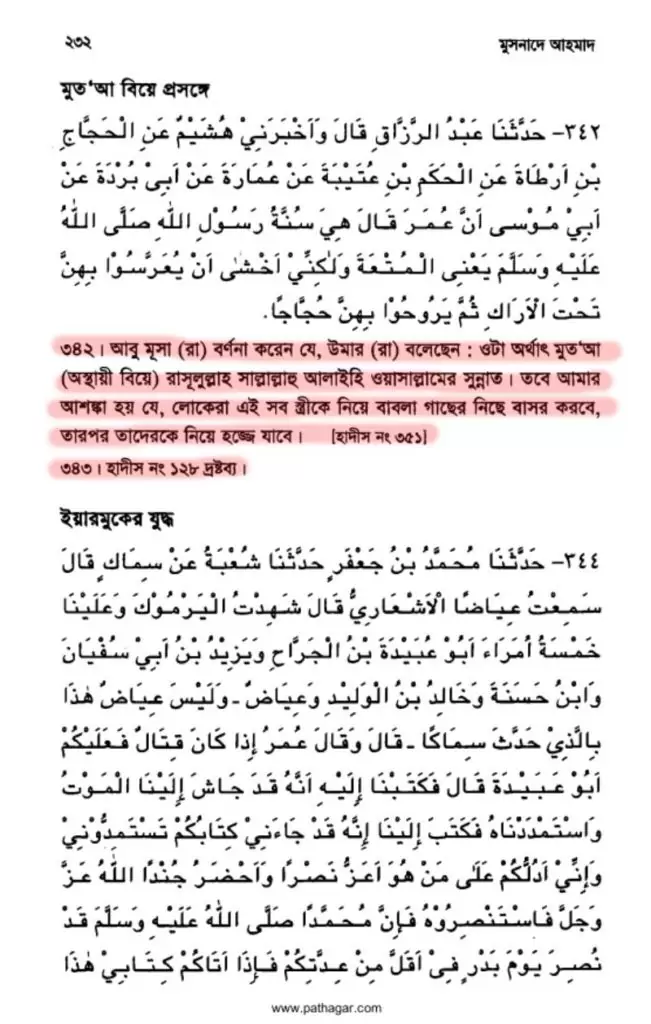
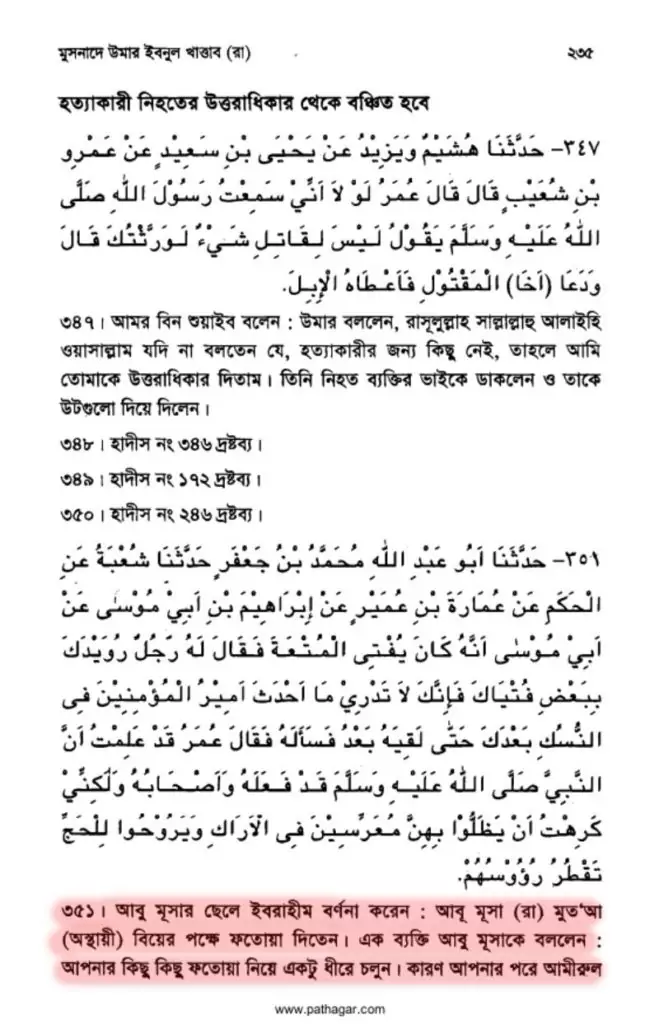
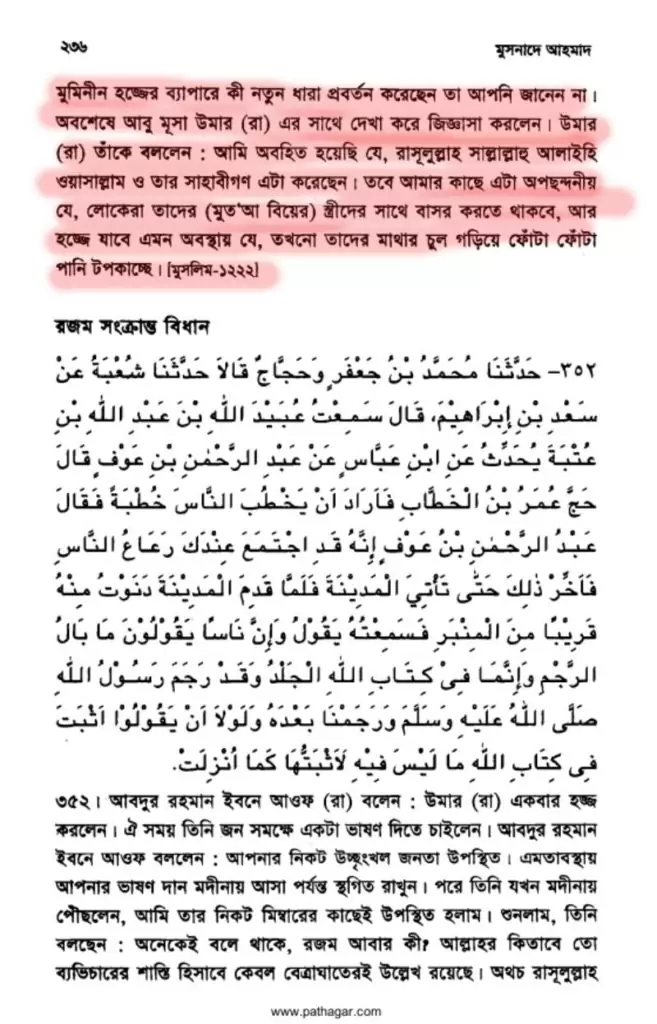
This creates a further problem: because the same word “muta” is used for both pilgrimage and women, failure to distinguish the contexts clearly exposes a problem in the translation.
Muta Marriage Concealed behind Hajj Tamattu?
The same word’s use for pilgrimage and temporary marriage creates complications and opportunities for concealment. Translating it as Hajj tamattu is entirely correct where pilgrimage is the subject. The problem arises when a narration later explicitly discusses fixed-term marriage with women, yet the initial pilgrimage meaning is emphasised so strongly that the distinction between the two becomes obscured.
The following Sahih Muslim account illustrates this. Initially, Ibn Abbas and Ibn al-Zubayr disagree over Hajj tamattu, and Jabir says they performed it with Muhammad. Umar’s speech then shifts: he separately threatens to stone any man found marrying a woman for a specified term. Within one narration, the first “muta” concerns pilgrimage and the second concerns women. Omitting that distinction, or translating both identically, distorts the hadith’s meaning. [100] [101]
Sahih Muslim (Hadith Academy)
16 / Pilgrimage
Chapter 18: Tamattu in Hajj and Umra
Hadith Academy number 2837; international number 1217
2837-(145/1217) Muhammad ibn al-Muthanna and Ibn Bashshar … from Abu Nadra. He said: Ibn Abbas instructed people to perform Hajj tamattu, while Ibn al-Zubayr prohibited it. I raised this with Jabir ibn Abdullah. He said, “It happened in my presence. We performed tamattu with the Messenger of Allah.” When Umar became caliph, he said: “Allah permits for his Messenger whatever he wishes, for whatever purpose he wishes, and the revelation of the Qur’an is complete. Perform Hajj and umra for Allah as he has commanded, and enter proper marriage with the women whom you have married through muta. If a man contracted in marriage on the terms of muta is brought before me, I will certainly stone him to death.” (Islamic Foundation 2814; Islamic Centre 2812)
Hadith classification: Sahih
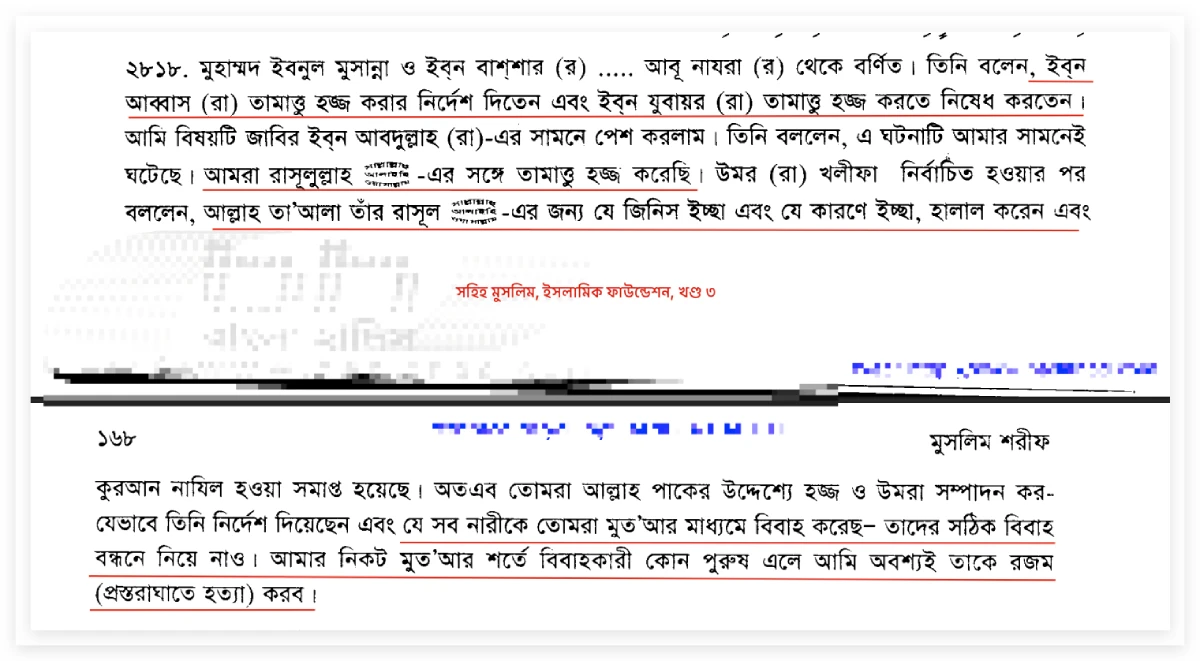
Asma bint Abi Bakr’s Statement Concerning Muta
A significant statement about muta is attributed to Asma bint Abi Bakr, daughter of the first caliph, elder sister of Aisha and mother of Abdullah ibn al-Zubayr. In his Musnad, the Sunni compiler Abu Dawud al-Tayalisi records her being asked directly about muta with women. She replies, فَعَلْنَاهَا عَلَى عَهْدِ النَّبِيِّ—“We did it during the Prophet’s lifetime.” Al-Nasa’i’s Al-Sunan al-Kubra and Abu Nu’aym al-Isfahani’s Al-Musnad al-Mustakhraj ala Sahih Muslim also preserve this statement. It is presented as her direct answer, rather than a later scholar’s inference.
The dispute between her son Abdullah ibn al-Zubayr and Ibn Abbas gives her statement further significance. Ibn al-Zubayr publicly opposed Ibn Abbas’s rulings permitting muta. Ibn Abbas told him to ask his mother, and Asma confirmed that Ibn Abbas spoke truthfully. Ibn Abbas then said he could name men of Quraysh born from muta marriages. The Sunni jurist Abu Ja’far al-Tahawi records this in the muta chapter of Sharh Ma’ani al-Athar.
Asma’s Testimony, the Ibn Abbas–Ibn al-Zubayr Dispute and Children Born from Muta
A principal source is Musnad Abi Dawud al-Tayalisi, volume 3, page 208, narration 1742. Muslim al-Qurri reports asking Asma about muta with women. The wording matters: he does not merely say متعة, muta, but explicitly مُتْعَةِ النِّسَاءِ, muta with women. Asma answers in the first-person plural. Her testimony concerns actual practice during Muhammad’s lifetime, not merely his permission. [102]
Original Arabic:
١٧٤٢ – حَدَّثَنَا يُونُسُ، قَالَ: حَدَّثَنَا أَبُو دَاوُدَ، قَالَ: حَدَّثَنَا شُعْبَةُ، عَنْ مُسْلِمٍ الْقُرِّيِّ، قَالَ: دَخَلْنَا عَلَى أَسْمَاءَ بِنْتِ أَبِي بَكْرٍ، فَسَأَلْنَاهَا عَنْ مُتْعَةِ النِّسَاءِ، فَقَالَتْ: «فَعَلْنَاهَا عَلَى عَهْدِ النَّبِيِّ صَلَّى اللَّهُ عَلَيْهِ وَسَلَّمَ».
English translation:
1742. Yunus narrates from Abu Dawud, from Shu’ba, from Muslim al-Qurri, who said: “We visited Asma bint Abi Bakr and asked her about muta with women. She replied, ‘We did it during the Prophet’s lifetime.’”
Al-Nasa’i preserves the same statement in the marriage section of Al-Sunan al-Kubra, numbered 5515 or 5725 in different editions. Immediately before it appear accounts from Jabir and Salama ibn al-Akwa’. Jabir describes practising muta with women during Muhammad’s lifetime, Abu Bakr’s rule and the early part of Umar’s caliphate. This is followed by Muhammad’s announcer proclaiming permission, then Asma’s statement. The chapter thus places actual practice, Muhammad’s permission and Asma’s testimony in sequence. [103] [104]
Original Arabic:
٥٥١٣ – أَخْبَرَنَا عَمْرُو بْنُ عَلِيٍّ، قَالَ: حَدَّثَنَا أَبُو عَاصِمٍ يَعْنِي النَّبِيلَ، قَالَ: حَدَّثَنَا زَكَرِيَّا بْنُ إِسْحَاقَ، قَالَ: أَخْبَرَنَا عَمْرُو بْنُ دِينَارٍ، عَنْ جَابِرِ بْنِ عَبْدِ اللهِ، قَالَ: «كُنَّا نَعْمَلُ بِهَا – يَعْنِي مُتْعَةَ النِّسَاءِ – عَلَى عَهْدِ رَسُولِ اللهِ صَلَّى اللهُ عَلَيْهِ وَسَلَّمَ، وَفِي زَمَانِ أَبِي بَكْرٍ، وَصَدْرًا مِنْ خِلَافَةِ عُمَرَ حَتَّى نَهَانَا عَنْهَا».
٥٥١٤ – أَخْبَرَنَا مُحَمَّدُ بْنُ بَشَّارٍ، قَالَ: حَدَّثَنَا مُحَمَّدٌ يَعْنِي غُنْدَرًا، قَالَ: حَدَّثَنَا شُعْبَةُ، عَنْ عَمْرِو بْنِ دِينَارٍ، قَالَ: سَمِعْتُ الْحَسَنَ بْنَ مُحَمَّدٍ، يُحَدِّثُ عَنْ جَابِرِ بْنِ عَبْدِ اللهِ، وَسَلَمَةَ بْنِ الْأَكْوَعِ، قَالَا: خَرَجَ مُنَادِي رَسُولِ اللهِ صَلَّى اللهُ عَلَيْهِ وَسَلَّمَ، فَقَالَ: «إِنَّ اللهَ قَدْ أَذِنَ لَكُمْ فَاسْتَمْتِعُوا، يَعْنِي مُتْعَةَ النِّسَاءِ».
٥٥١٥ – أَخْبَرَنَا مَحْمُودُ بْنُ غَيْلَانَ الْمَرْوَزِيُّ، قَالَ: حَدَّثَنَا أَبُو دَاوُدَ، قَالَ: حَدَّثَنَا شُعْبَةُ، عَنْ مُسْلِمٍ الْقُرِّيِّ، قَالَ: دَخَلْنَا عَلَى أَسْمَاءَ ابْنَةِ أَبِي بَكْرٍ، فَسَأَلْنَاهَا عَنْ مُتْعَةِ النِّسَاءِ، فَقَالَتْ: «فَعَلْنَاهَا عَلَى عَهْدِ رَسُولِ اللهِ صَلَّى اللهُ عَلَيْهِ وَسَلَّمَ».
English translation:
Hadith 5513: Amr ibn Dinar narrates from Jabir ibn Abdullah: “We practised it—meaning muta with women—during the Messenger of Allah’s lifetime, Abu Bakr’s time and the early part of Umar’s caliphate, until Umar prohibited us from doing it.”
Hadith 5514: Al-Hasan ibn Muhammad narrates from Jabir and Salama ibn al-Akwa’: “The Messenger’s announcer came out and proclaimed, ‘Allah has given you permission, so practise muta’”—meaning muta with women.
Hadith 5515: Mahmud ibn Ghaylan narrates from Abu Dawud, from Shu’ba, from Muslim al-Qurri: “We visited Asma bint Abi Bakr and asked her about muta with women. She replied, ‘We did it during the Messenger of Allah’s lifetime.’”
These three consecutive accounts present a clear picture: Jabir speaks directly of participation, Muhammad’s announcer authorises temporary marriage, and Asma confirms the practice in the first person. All three explicitly concern muta with women, not Hajj tamattu. Asma’s statement uses مُتْعَةِ النِّسَاءِ, the same terminology found in Jabir’s account.
Al-Tabarani’s Al-Mu’jam al-Kabir also preserves Asma’s statement in volume 24, page 103, narration 277. Muslim al-Qurri reports asking her about muta; she gives the same answer about its practice during Muhammad’s lifetime. Here the question uses only الْمُتْعَةِ, while al-Nasa’i and al-Tayalisi have مُتْعَةِ النِّسَاءِ. These collections preserve variant wordings of the same transmission strand. [105]
Abu Nu’aym’s Al-Musnad al-Mustakhraj ala Sahih Muslim makes the variants clearer by preserving two accounts together. The first concerns Hajj tamattu; the second explicitly mentions muta with women. After the second, he records which transmitters say only “muta” and which readings contain uncertainty between pilgrimage and women. The early collections themselves therefore document the textual variation within this transmission. [106]
Original Arabic:
٢٨٧٢ – حَدَّثَنَا أَبُو بَكْرِ بْنُ خَلَّادٍ ثَنَا الْحَارِثُ بْنُ أَبِي أُسَامَةَ ثَنَا رَوْحُ بْنُ عُبَادَةَ ثَنَا شُعْبَةُ عَنْ مُسْلِمٍ الْقُرِّيِّ قَالَ سَأَلْتُ ابْنَ عَبَّاسٍ عَنْ مُتْعَةِ الْحَجِّ فَرَخَّصَ فِيهَا وَكَانَ ابْنُ الزُّبَيْرِ يَنْهَى عَنْهُ فَقَالَ هَذِهِ أُمُّ ابْنِ الزُّبَيْرِ تُحَدِّثُ أَنَّ رَسُولَ اللَّهِ صَلَّى اللَّهُ عَلَيْهِ وَسَلَّمَ رَخَّصَ فِيهَا فَادْخُلُوا عَلَيْهَا فَسْأَلُوهَا قَالَ فَدَخَلْنَا عَلَيْهَا فَإِذَا امْرَأَةٌ ضَخْمَةٌ عَمْيَاءُ قَالَتْ رَخَّصَ رَسُولُ اللَّهِ صَلَّى اللَّهُ عَلَيْهِ وَسَلَّمَ فِيهَا.
٢٨٧٣ – ثَنَا عَبْدُ اللَّهِ بْنُ جَعْفَرٍ ثَنَا يُوسُفُ بْنُ حَبِيبٍ ثَنَا أَبُو دَاوُدَ ثَنَا شُعْبَةُ عَنْ مُسْلِمٍ الْقُرِّيِّ قَالَ دَخَلْنَا عَلَى أَسْمَاءَ بِنْتِ أَبِي بَكْرٍ فَسَأَلْنَاهَا عَنْ مُتْعَةِ النِّسَاءِ فَقَالَتْ فَعَلْنَاهَا عَلَى عَهْدِ رَسُولِ اللَّهِ صَلَّى اللَّهُ عَلَيْهِ وَسَلَّمَ ثَنَاهُ أَبُو مُحَمَّدِ بْنُ حَيَّانَ ثَنَا مُحَمَّدُ بْنُ يَحْيَى ثَنَا عَبْدَةَ ثَنَا أَبُو دَاوُدَ ثَنَا شُعْبَةُ وَقَالَ الْمُتْعَةَ وَلَمْ يَذْكُرِ النِّسَاءَ.
رَوَاهُ مُسْلِمٌ عَنْ أَبِي مُوسَى عَنْ عَبْدِ الرَّحْمَنِ عَنْ شُعْبَةَ فَقَالَ الْمُتْعَةَ وَلَمْ يَذْكُرِ الْحَجَّ وَعَنْ بُنْدَارٍ عَنْ غُنْدَرٍ فَقَالَ قَالَ مُسْلِمٌ لَا أَدْرِي مُتْعَةَ الْحَجِّ أَوْ مُتْعَةَ النِّسَاءِ.
English translation:
Narration 2872: Through Abu Bakr ibn Khallad, al-Harith ibn Abi Usama, Rawh ibn Ubada and Shu’ba, Muslim al-Qurri said: “I asked Ibn Abbas about Hajj tamattu. He permitted it, while Ibn al-Zubayr prohibited it. Ibn Abbas said, ‘Ibn al-Zubayr’s mother reports that the Messenger permitted it. Go and ask her.’ We visited her; she was a stout, blind woman. She said, ‘The Messenger permitted it.’”
Narration 2873: Through Abdullah ibn Ja’far, Yusuf ibn Habib, Abu Dawud and Shu’ba, Muslim al-Qurri said: “We visited Asma bint Abi Bakr and asked her about muta with women. She replied, ‘We did it during the Messenger’s lifetime.’”
Abu Nu’aym then gives another chain with only “muta”, without “women”. He notes that one version in Sahih Muslim says only “muta”, without specifying Hajj, while another has Muslim al-Qurri saying he did not know whether it concerned Hajj tamattu or muta with women.
Sahih Muslim 1238 also records the variants. One explicitly mentions pilgrimage, another says only muta, and another gives Muslim al-Qurri’s uncertainty between pilgrimage and women. Al-Nasa’i, al-Tayalisi and Abu Nu’aym, however, preserve wording explicitly specifying women. Presenting every version indiscriminately as Hajj tamattu erases the textual differences preserved in the original collections. [107] [108]
Original Arabic, Sahih Muslim 1238b:
وَحَدَّثَنَاهُ ابْنُ الْمُثَنَّى، حَدَّثَنَا عَبْدُ الرَّحْمَنِ، ح وَحَدَّثَنَاهُ ابْنُ بَشَّارٍ، حَدَّثَنَا مُحَمَّدٌ، – يَعْنِي ابْنَ جَعْفَرٍ – جَمِيعًا عَنْ شُعْبَةَ، بِهَذَا الإِسْنَادِ فَأَمَّا عَبْدُ الرَّحْمَنِ فَفِي حَدِيثِهِ الْمُتْعَةُ وَلَمْ يَقُلْ مُتْعَةُ الْحَجِّ. وَأَمَّا ابْنُ جَعْفَرٍ فَقَالَ قَالَ شُعْبَةُ قَالَ مُسْلِمٌ لاَ أَدْرِي مُتْعَةُ الْحَجِّ أَوْ مُتْعَةُ النِّسَاءِ.
English translation:
Ibn al-Muthanna narrates through Abd al-Rahman, and Ibn Bashshar through Muhammad ibn Ja’far, both from Shu’ba with the same chain. Abd al-Rahman’s version says “muta”, not “Hajj tamattu”. In Ibn Ja’far’s version, Shu’ba reports Muslim al-Qurri saying, “I do not know whether it was Hajj tamattu or muta with women.”
Asma’s testimony also bears on her son’s later public opposition to muta. Ibn Abbas was a leading Companion who issued rulings permitting it. Their disagreement became an open political and religious dispute. In Sharh Ma’ani al-Athar, al-Tahawi records through Sa’id ibn Jubayr that Ibn al-Zubayr publicly criticised Ibn Abbas’s position. Ibn Abbas told him to consult Asma, who confirmed his statement. He then raised the question of men of Quraysh born from muta. [109]
Original Arabic:
٤٣٠٦ – حَدَّثَنَا صَالِحُ بْنُ عَبْدِ الرَّحْمَنِ، قَالَ: ثَنَا سَعِيدُ بْنُ مَنْصُورٍ، قَالَ: ثَنَا هُشَيْمٌ، قَالَ: أَخْبَرَنَا أَبُو بِشْرٍ، عَنْ سَعِيدِ بْنِ جُبَيْرٍ، قَالَ: سَمِعْتُ عَبْدَ اللَّهِ بْنَ الزُّبَيْرِ يَخْطُبُ وَهُوَ يُعَرِّضُ بِابْنِ عَبَّاسٍ، يَعِيبُ عَلَيْهِ قَوْلَهُ فِي الْمُتْعَةِ.
فَقَالَ ابْنُ عَبَّاسٍ: يَسْأَلُ أُمَّهُ إِنْ كَانَ صَادِقًا، فَسَأَلَهَا، فَقَالَتْ: صَدَقَ ابْنُ عَبَّاسٍ، قَدْ كَانَ ذَلِكَ.
فَقَالَ ابْنُ عَبَّاسٍ رَضِيَ اللَّهُ تَعَالَى عَنْهُمَا: لَوْ شِئْتُ لَسَمَّيْتُ رِجَالًا مِنْ قُرَيْشٍ وُلِدُوا فِيهَا.
English translation:
4306. Salih ibn Abd al-Rahman narrates through Sa’id ibn Mansur, Hushaym and Abu Bishr from Sa’id ibn Jubayr: “I heard Abdullah ibn al-Zubayr delivering a sermon, alluding to Ibn Abbas and criticising his opinion on muta.
Ibn Abbas said, ‘If he is truthful, let him ask his mother.’ He asked her, and she replied, ‘Ibn Abbas has spoken truthfully. That did happen.’
Ibn Abbas then said, ‘If I wished, I could name men of Quraysh who were born from it.’”
Ibn Abbas does not simply repeat a religious interpretation when his ruling is attacked. He calls Ibn al-Zubayr’s mother as a witness, and Asma confirms him. Abu Bakr’s daughter thus testifies to an earlier historical practice that her son publicly denies or criticises.
Ibn Abbas then says لَوْ شِئْتُ لَسَمَّيْتُ رِجَالًا مِنْ قُرَيْشٍ وُلِدُوا فِيهَا—that he could name men of Quraysh born from muta. The practice is thus associated not merely with temporary sexual contracts, but with childbirth. Quraysh was Muhammad’s own tribe and Mecca’s principal social and political group. Ibn Abbas claims that men born from muta existed within it. He does not name them, but asserts that he could if necessary.
The later Sunni commentator Badr al-Din al-Ayni discusses al-Tahawi’s narration in Nukhab al-Afkar and classifies its chain as sahih. Al-Bayhaqi’s Al-Sunan al-Kubra also mentions the incident. The dispute involving Ibn Abbas, Ibn al-Zubayr and Asma is therefore a specific account preserved in early muta tradition. [110]
Sahih Muslim contains another account of the conflict. Ibn al-Zubayr publicly criticises those issuing rulings permitting muta, alluding to Ibn Abbas. Ibn Abbas calls him uncouth and harsh, affirming that muta was practised during Muhammad’s lifetime. Ibn al-Zubayr replies that if Ibn Abbas tries it himself, he will stone him to death. The Companions’ disagreement therefore extended beyond private religious discussion to public confrontation and threats of execution. [111]
Asma’s testimony and Ibn Abbas’s statements supply three specific facts: Sunni collections preserve her direct acknowledgement of muta with women during Muhammad’s lifetime; she confirms Ibn Abbas despite her son’s opposition; and Ibn Abbas reports children born from muta among Quraysh. The practice therefore involved family formation, childbirth and Quraysh’s social history, beyond temporary wartime permission alone.
The difference between early positions and subsequent prohibition is clear. Accounts record permission and practice during Muhammad’s lifetime, followed by threats to treat the same practice as an offence punishable by stoning. Asma, a prominent female Companion, and Ibn Abbas, a renowned Qur’anic commentator, publicly acknowledge its earlier practice. Ibn al-Zubayr’s opposition shows that the community’s position was never uniform. The Companions’ own statements and disputes preserve the history of a lawful sexual contract becoming prohibited and punishable.
Muta during the Times of Muhammad and Abu Bakr
Abu Bakr became caliph after Muhammad. If Muhammad had prohibited muta before his death, how did it continue under Abu Bakr? Accounts describe wine being poured out from large containers throughout Medina after the verse prohibiting alcohol was revealed. How could people continue muta after Muhammad had supposedly forbidden it, and why did Umar need to prohibit it? [112] [113] [114] [115] [116]:
Sahih Muslim (Islamic Foundation)
17 / Marriage
Chapter 3: Muta marriage was permitted, then abrogated, then permitted again, then abrogated; its prohibition remains until the Day of Resurrection.
3285. Hasan al-Hulwani … from Ata: Jabir ibn Abdullah came to perform umra. We visited his lodging and asked him various questions. When muta was mentioned, he replied: “Yes, we practised muta during the times of the Messenger of Allah, Abu Bakr and Umar.”
Hadith classification: Sahih
Narrator: Ata ibn Abi Rabah
Sahih Muslim (Islamic Foundation)
17 / Marriage
Chapter 3: Muta marriage was permitted, then abrogated, then permitted again, then abrogated; its prohibition remains until the Day of Resurrection.
3286. Muhammad ibn Rafi’ … from Abu al-Zubayr: I heard Jabir ibn Abdullah say, “We practised muta for a handful of dates or flour during the times of the Messenger of Allah and Abu Bakr, until Umar prohibited it in connection with Amr ibn Hurayth’s affair.”
Hadith classification: Sahih
Narrator: Abu al-Zubayr
Sahih Muslim (Islamic Foundation)
17 / Marriage
Chapter 3: Muta marriage was permitted, then abrogated, then permitted again, then abrogated; its prohibition remains until the Day of Resurrection.
3287. Hamid ibn Umar al-Bakrawi … from Abu Nadra: I was with Jabir when a man told him that Ibn Abbas and Ibn al-Zubayr disagreed over the two forms of muta—Hajj tamattu and temporary marriage. Jabir said, “We practised both with the Messenger of Allah. Umar then prohibited both, and we did not practise them again.”
Hadith classification: Sahih
Sahih Muslim (Hadith Academy)
17 / Marriage
Chapter 3: Muta marriage was permitted, then abrogated, then permitted again, then abrogated; its prohibition remains until the Day of Resurrection.
3307-(16/…) Muhammad ibn Rafi’ … from Abu al-Zubayr: I heard Jabir ibn Abdullah say, “For a handful of dates or flour, we contracted muta during the times of the Messenger of Allah and Abu Bakr, until Umar prohibited it in connection with Amr ibn Hurayth’s affair.”* (Islamic Foundation 3282; Islamic Centre 3280)
* Amr contracted muta with his freedwoman in Kufa. When she became pregnant, he brought her before Umar, who strictly prohibited muta.
Hadith classification: Sahih
Narrator: Abu al-Zubayr
Sahih Muslim (Hadith Academy)
17 / Marriage
Chapter 3: Muta marriage was permitted, then abrogated, then permitted again, then abrogated; its prohibition remains until the Day of Resurrection.
3306-(15/…) Hasan al-Hulwani … from Ata: Jabir came to perform umra, and we visited his lodging and asked various questions. Then, when muta was mentioned, he said, “Yes, we practised it during the times of the Messenger of Allah, Abu Bakr and Umar.”* (Islamic Foundation 3281; Islamic Centre 3279)
Hadith classification: Sahih
Narrator: Ata ibn Abi Rabah
Muta under Umar: Did the Companions Never Hear the Prohibition?
An important account in Musannaf Abd al-Razzaq records muta among the Companions during Umar’s caliphate. Ibn Abbas says Umar saw Umm Araka pregnant and asked about it. She replied explicitly, “Salama ibn Umayya ibn Khalaf contracted muta with me.” When Ibn Abbas’s position was challenged, he cited this incident and told Ibn Safwan to ask his uncle whether he had practised it. Ibn Hajar, in Fath al-Bari, explicitly calls Abd al-Razzaq’s chain “sahih”. [117] [118]
Ibn Abbas reports: Umar saw Umm Araka pregnant and asked about her pregnancy. She replied, “Salama ibn Umayya ibn Khalaf contracted muta with me.” When Ibn Safwan later challenged some of Ibn Abbas’s statements on the subject, Ibn Abbas said, “Ask your uncle: did he not practise muta?”
The modern scholar Ibn Baz’s collected rulings also contain this quotation, citing Ibn Hajar:
Ibn Baz’s collected rulings: volume 20, pages 376–380
وسعيد بن جبير وعطاء وسائر فقهاء مكة، فقد تعقبه الحافظ ابن حجر العسقلاني في ج 9 من فتح الباري ص 174 بقوله: قلت: وفي جميع ما أطلقه نظر. أما ابن مسعود فمستنده فيه الحديث الماضي في أوائل النكاح.
وقد بينت فيه ما نقله الإسماعيلي من الزيادة فيه المصرحة عنه بالتحريم، وقد أخرجه أبو عوانة من طريق أبي معاوية عن إسماعيل ابن أبي خالد، وفي آخره ففعلنا ثم ترك ذلك، وأما معاوية فأخرجه عبد الرزاق من طريق صفوان بن يعلى بن أمية، أخبرني يعلى أن معاوية استمتع بامرأة بالطائف، وإسناده صحيح، لكن في رواية أبي الزبير عن جابر عند عبد الرزاق أيضا أن ذلك كان قديما ولفظه: استمتع معاوية
Page 378
English translation
And Sa’id ibn Jubayr, Ata and the other jurists of Mecca—al-Hafiz Ibn Hajar al-Asqalani comments on this statement in Fath al-Bari, volume 9, page 174:
“I say: all his general assertions require examination.
Regarding Ibn Mas’ud, the basis is the hadith mentioned earlier at the beginning of the marriage section. I have explained there the addition transmitted by al-Isma’ili explicitly establishing prohibition from him. Abu Awana also relates it through Abu Muawiya from Isma’il ibn Abi Khalid, ending, ‘We did it, then it was abandoned.’
Regarding Muawiya, Abd al-Razzaq transmits through Safwan ibn Ya’la ibn Umayya: Ya’la informed me that Muawiya contracted muta with a woman at Taif. Its chain is sahih. However, Abu al-Zubayr’s account from Jabir in Abd al-Razzaq indicates that it occurred earlier, with the wording, ‘Muawiya contracted muta…’”
This exposes a major problem in the Sunni explanation. Later Sunni commentators commonly respond that Muhammad prohibited muta permanently, but news of the prohibition did not reach some Companions, so they continued practising it under Abu Bakr and Umar. They do not deny the incidents; they say the Companions concerned did not know about the prohibition. This answer, however, enlarges the problem instead of resolving it.
If Sabra al-Juhani’s report in Sahih Muslim is accepted, Muhammad addressed people publicly during the conquest of Mecca, rather than in a private conversation, saying: “O people! I permitted you to contract muta with women; Allah has now forbidden it until the Day of Resurrection.” The report itself thus presents a public, general and permanent prohibition. Ibn Hajar’s Al-Isabah, citing Khalifa ibn Khayyat, lists Salama ibn Umayya among the Companions residing in Mecca. In Fath al-Bari, Ibn Hajar also quotes Abd al-Razzaq’s account of Salama practising muta, with a sahih chain. [119] [120]. If news of the prohibition had still not effectively reached a Companion living in Mecca by Umar’s caliphate—the very city where this public declaration “until the Day of Resurrection” was supposedly made—the explanation that “some Companions had not heard the prohibition” becomes extremely weak.
The timing also matters. Mecca was conquered in 8 AH; Umar’s caliphate began in 13 AH. At least approximately five years therefore separate the alleged final prohibition from Salama’s muta during Umar’s rule. If the incident occurred later in Umar’s caliphate, the interval was longer. The claim that a Companion living in Mecca, where the prohibition was supposedly announced publicly, knew nothing of this ruling “until the Day of Resurrection” for five years or more sounds more like a later attempt to reconcile the accounts than a straightforward historical explanation. This was a resident of Mecca, not someone in a remote area.
The problem is not confined to Salama. In Sahih Muslim, Jabir ibn Abdullah says they practised muta during Muhammad’s time and Abu Bakr’s, until Umar prohibited it in connection with Amr ibn Hurayth’s affair. Another report has Jabir describing muta during all three periods: Muhammad, Abu Bakr and Umar. Ibn Abbas continued issuing rulings permitting it even after Ali’s death. Another report in Abd al-Razzaq preserves Muawiya’s muta at Taif; Ibn Hajar classified its chain as sahih, although the report does not specify exactly when that incident occurred. Repeating “news of the prohibition had not reached him” each time does not explain a single exception; it requires defending the entire prohibition by assuming the ignorance of one prominent Companion after another. [121]. One passage in the translation quoted below is mistranslated. The Arabic says حَتَّى إِذَا كَانَ فِي آخِرِ خِلَافَةِ عُمَرَ: the events continued into the final stage of Umar’s caliphate, rather than “until its early period”.
hadith 14,021
Original Arabic
عَنِ ابْنِ جُرَيْجٍ، عَنْ عَطَاءٍ قَالَ: لَأَوَّلُ مَنْ سَمِعْتُ مِنْهُ الْمُتْعَةَ صَفْوَانُ بْنُ يَعْلَى قَالَ: أَخْبَرَنِي، عَنْ يَعْلَى، أَنَّ مُعَاوِيَةَ -[497]-، اسْتَمْتَعَ بِامْرَأَةٍ بِالطَّائِفِ فَأَنْكَرَتْ ذَلِكَ عَلَيْهِ، فَدَخَلْنَا عَلَى ابْنِ عَبَّاسٍ فَذَكَرَ لَهُ بَعْضُنَا، فَقَالَ لَهُ: «نَعَمْ». فَلَمْ يَقِرَّ فِي نَفْسِي حَتَّى قَدِمَ جَابِرُ بْنُ عَبْدِ اللَّهِ، فَجِئْنَاهُ فِي مَنْزِلِهِ فَسَأَلَهُ الْقَوْمُ عَنْ أَشْيَاءَ، ثُمَّ ذَكَرُوا لَهُ الْمُتْعَةَ، فَقَالَ: ” نَعَمْ، اسْتَمْتَعْنَا عَلَى عَهْدِ رَسُولِ اللَّهِ صَلَّى اللهُ عَلَيْهِ وَسَلَّمَ، وَأَبِي بَكْرٍ، وَعُمَرَ، حَتَّى إِذَا كَانَ فِي آخِرِ خِلَافَةِ عُمَرَ، اسْتَمْتَعَ عَمْرُو بْنُ حُرَيْثٍ بِامْرَأَةٍ سَمَّاهَا جَابِرٌ فَنَسِيتُهَا، فَحَمَلَتِ الْمَرْأَةُ فَبَلَغَ ذَلِكَ عُمَرَ فَدَعَاهَا فَسَأَلَهَا، فَقَالَتْ: نَعَمْ قَالَ: مَنْ أَشْهَدَ؟
قَالَ: عَطَاءٌ لَا أَدْرِي قَالَتْ: أُمِّي أُمَّ وَلِيَّهَا قَالَ: فَهَلَّا غَيْرَهُمَا قَالَ: خَشِيَ أَنْ يَكُونَ دَغْلًا الْآخَرُ، قَالَ عَطَاءٌ، وَسَمِعْتُ ابْنَ عَبَّاسٍ يَقُولُ: «يَرْحَمُ اللَّهُ عُمَرَ مَا كَانَتِ الْمُتْعَةُ إِلَّا رُخْصَةً مِنَ اللَّهِ عَزَّ وَجَلَّ رَحِمَ بِهَا أُمَّةَ مُحَمَّدٍ صَلَّى اللهُ عَلَيْهِ وَسَلَّمَ، فَلَوْلَا نَهْيُهُ عَنْهَا مَا احْتَاجَ إِلَى الزِّنَا إِلَّا شَقِيٌّ» قَالَ: كَأَنِّي وَاللَّهِ أَسْمَعُ قَوْلَهُ: إِلَّا شَقِيٌّ – عَطَاءٌ الْقَائِلُ – قَالَ عَطَاءٌ: ” فَهِيَ الَّتِي فِي سُورَةِ النِّسَاءِ: فَمَا اسْتَمْتَعْتُمْ بِهِ مِنْهُنَّ [النساء: 24] إِلَى كَذَا وَكَذَا مِنَ الْأَجَلِ عَلَى كَذَا وَكَذَا لَيْسَ يُتَشَاوَرُ ” قَالَ: «بَدَا لَهُمَا أَنْ يَتَرَاضِيَا بَعْدَ الْأَجَلِ، وَأَنْ يَتَفَرَّقَا فَنَعَمْ، وَلَيْسَ بِنِكَاحٍ»
English translation
Ata narrated: The first person I heard speak about muta (temporary marriage) was Safwan ibn Ya’la. He informed me, from Ya’la, that Muawiya contracted muta with a woman at Taif. The woman objected to this. We then went to Ibn Abbas, and some of us mentioned it to him. He said, “Yes, it was permissible.”
But I remained uneasy until Jabir ibn Abdullah arrived. We visited him at his lodging. People asked him various questions, then raised muta. He said, “Yes, we practised muta during the time of the Messenger of Allah, Abu Bakr and the early part of Umar’s rule. Eventually, towards the end of Umar’s caliphate, Amr ibn Hurayth contracted muta with a woman whose name Jabir mentioned but I have forgotten. The woman became pregnant. When Umar heard of it, he summoned and questioned her. She said, ‘Yes, I contracted muta.’”
Umar asked, “Who witnessed it?” Ata said: I do not know whether she said, “My mother and her guardian.” Umar asked, “Why did you not have someone else as a witness?” Ata said: He feared someone else might be acting deceitfully. Ata added: I heard Ibn Abbas say, “May Allah have mercy on Umar! Muta was a concession from Allah, Mighty and Majestic, through which He showed mercy to Muhammad’s community. Had Umar not prohibited it, no one except the unfortunate would have needed to commit fornication.” Ata said: By Allah, I can almost hear him saying, “Except the unfortunate.”
Ata said: This is what is mentioned in verse 24 of Surah al-Nisa: Fama istamta’tum bihi minhunna [those of them whom you have enjoyed…] for such-and-such a period in return for such-and-such an amount of money; no consultation is needed for this. Ata said: “If, after the specified term, the two agree to remain together or to separate, that is permissible. But this was not ordinary marriage.”
A simple question suffices: if Muhammad really publicly declared muta “forbidden until the Day of Resurrection”, why did so many important Companions never hear it? A resident of Mecca did not hear it in Mecca; muta continued throughout Abu Bakr’s rule; people practised it under Umar; Ibn Abbas issued rulings permitting it much later—yet the explanation is that none of them knew of the prohibition. This creates a further problem: the propagation and enforcement of Muhammad’s supposedly final religious prohibition were so weak that a significant proportion of his own Companions remained unaware of it for years.
A straightforward reading of the surviving reports yields a much more direct picture: muta was permitted during Muhammad’s time and many Companions practised it; it continued after his death under Abu Bakr; actual instances are also recorded under Umar; Umar then publicly and strictly prohibited this deeply uncomfortable Islamic provision. To reconcile this continuity with the declaration attributed to Muhammad that muta was “forbidden until the Day of Resurrection”, later Sunni explanations repeatedly have to say that one person did not know, another never heard the prohibition, and another later withdrew his opinion. The more these explanations are needed, the sharper the question becomes: was the final prohibition really a universally known ruling during Muhammad’s time, or was Umar’s prohibition subsequently reconciled with an earlier final prohibition attributed to Muhammad? Later scholars also permitted receiving payment for teaching the Quran, overriding Muhammad’s explicit prohibition in hadiths classified as sahih. [122]. There are even several recorded instances under Umar in which he overrode Muhammad’s instructions [123] and revised the Quran’s own provisions to establish rules. [124]. These discussions are directly relevant here.
The Final Prohibition of Muta Marriage: Muhammad or Umar?
The report in Muwatta Malik is regarded as highly important by many prominent scholars. It records that Umar did not execute a man who contracted muta for the offence of adultery. His stated reason was that he had not previously announced a prohibition. If Allah’s Prophet Muhammad had already ordered muta prohibited, however, whether Umar had announced it would carry no weight. If Muhammad had prohibited it, why was another announcement necessary? [125]:
Muwatta Malik
28. Marriage
Chapter 18: Muta marriage
Report 42. Khawla bint Hakim came to Umar ibn al-Khattab and said, “Rabi’a ibn Umayya contracted muta with a muwallada(1) woman, and she became pregnant.” Umar ibn al-Khattab was alarmed and went out, dragging his cloak. He then said, “Muta is prohibited. Had I previously announced this among the people, I would have stoned this adulterer for it.”
(1) Muwallada: a non-Arab woman born in Arabia and brought up according to Arab customs and manners.
Hadith classification: Awaiting verification
In his Tafhim al-Quran, Sayyid Abu al-Ala Maududi discusses muta marriage [126], stating that it was prohibited through hadith rather than a Quranic verse. But how could the Prophet prohibit the provision for muta granted by Allah? Where is the verse abrogating verse 24 of Surah al-Nisa?
Fourth: some commentators also derive the prohibition of muta marriage from this verse. They argue that a woman married through muta is neither a wife nor a female slave. Clearly she is not a slave, but neither is she a wife, because none of the legal provisions establishing the status of a wife applies to her. She does not inherit from the man, nor he from her. There is no idda, divorce, maintenance, ila, zihar or li’an for her. She also stands outside the prescribed limit of four wives.
Since she falls under neither “wife” nor “female slave”, she must belong to “something beyond these”; the Quran calls those who seek anything beyond these transgressors. This argument is strong, but it has a weakness that makes it difficult to establish the prohibition of muta from this verse alone. The weakness is that the Prophet, peace and blessings be upon him, made the final and definitive declaration prohibiting muta in the year of the conquest of Mecca. Sahih hadiths establish permission before then. If the prohibition of muta were already contained in this Quranic verse—which everyone agrees is Meccan and was revealed several years before the Hijra—how could the Prophet, peace and blessings be upon him, have kept it permissible until the conquest of Mecca? It is therefore more accurate to say that muta marriage was prohibited through the Prophet’s Sunna, rather than through an explicit declaration in the Quran. Without an explicit ruling in the Sunna, it would have been difficult to establish its prohibition from this verse alone. Since muta has come up, two further points should be clarified. First, its prohibition is established from the Prophet himself. It is therefore incorrect to say that Umar prohibited it. Umar did not originate or formulate this ruling; he merely publicised and enforced it. Since the Messenger gave this command towards the end of his life and it had not reached the general population, Umar publicised it and enforced it by law. Second, there is no basis anywhere in the Quran or Sunna for the Shia position making muta permissible in every circumstance and without restriction. The few early Companions, Successors and jurists who supported its permissibility considered it lawful only in unavoidable circumstances, when no alternative existed and the need was extreme. None regarded it as unconditionally permissible or available in ordinary circumstances like marriage. Ibn Abbas is presented as the most prominent advocate of its permissibility. He expressed his position as follows: “It is like carrion, lawful only for someone facing unavoidable necessity with no alternative.” When he saw people exploiting his concessionary ruling for improper ends, practising muta freely instead of reserving it for necessity, he withdrew his ruling. Even setting aside whether Ibn Abbas and the few who shared his opinion retracted it, those accepting their view can at most permit it in cases of idtirar—unavoidable necessity with no alternative. Treating it as freely and unconditionally permissible, contracting muta without necessity, and having intercourse with women married through muta even while already having wives is a form of licentiousness that sound, balanced taste could never tolerate. There can be no question of associating the imams of Islamic law and the Prophet’s descendants with this. I believe no decent Shia person of good taste could tolerate someone proposing muta instead of marriage for his daughter. This would mean that, for muta to be lawful, society must contain an inferior class of women, like prostitutes, freely available for muta. Alternatively, muta would be reserved for the daughters and sisters of the poor, while wealthy, prosperous men would be entitled to benefit from it. Can such a discriminatory and unjust law be expected from the law of Allah and His Messenger? Can Allah and His Messenger be expected to permit something that a daughter of any respectable family would regard as dishonourable and indecent for herself?
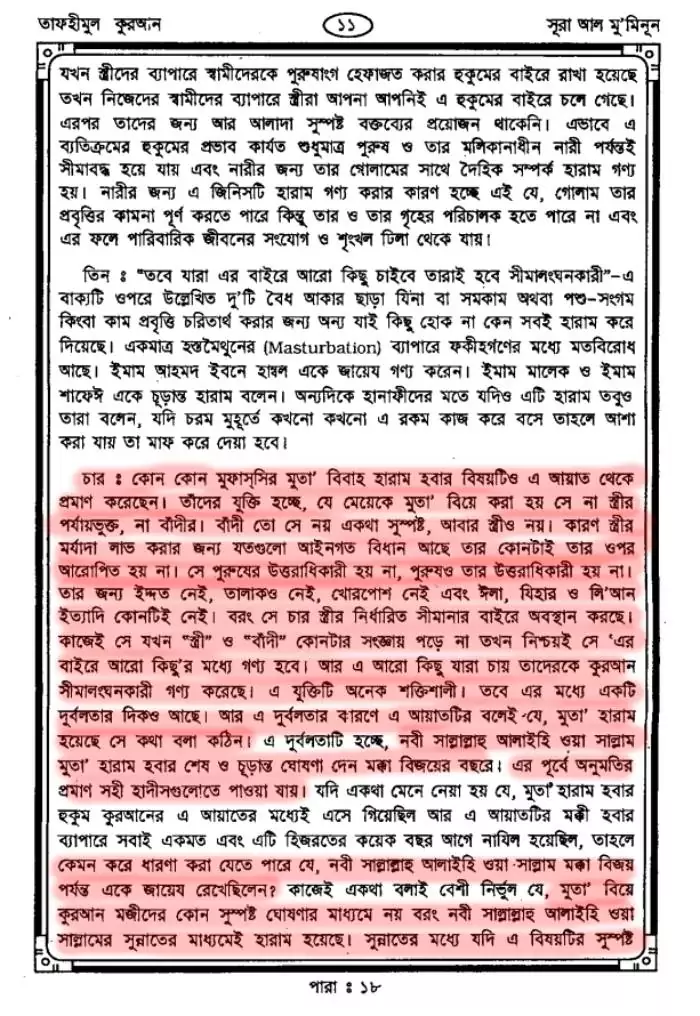
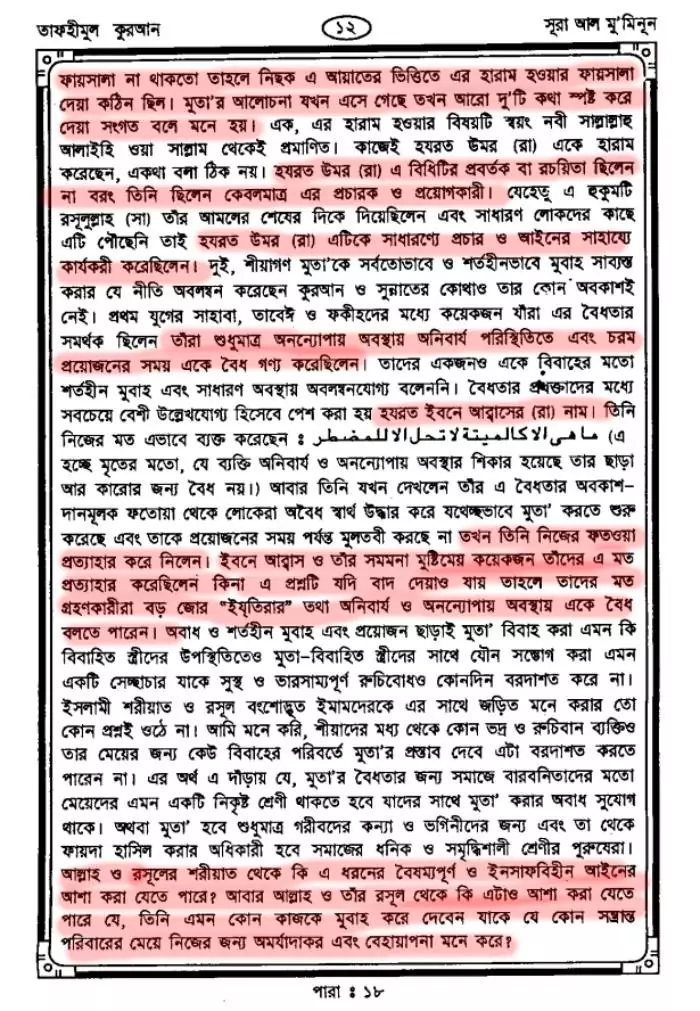
Tafsir al-Jalalayn also discusses the subject. [127]
A woman obtained through temporary marriage or muta is clearly not a female slave under Islamic law: she cannot be bought, sold, given away or subjected to the rules of manumission.
It is also clear that she is not a wife. No one, including the Shia themselves, calls such women wives, because there is no mutual inheritance between the woman and the man contracting muta, whereas spouses inherit from one another. Allah says: وَلَكُمْ نِصْفُ مَا تَرَكَ أَزْوَاجُكُم Likewise, a man is not obliged to provide maintenance, food or accommodation for a woman obtained through muta. Nor is the lineage of her child established in relation to him. Divorce, prescribed punishments and mahr do not apply in muta either. Thus a woman in muta is neither a wife nor a female slave under Islamic law, and using such women in the name of muta is entirely forbidden.
عَنْ عَلِيِّ (رض) أَنَّ الرَّسُولَ اللَّهِ اللهُ نَهَى عَنْ مُتَعَةِ النِّسَاءِ وَعَنْ أَكْلِ لُحُومِ – 2009 (1) 1 2 2 الْعُمر الأنسية That is, Ali said that the Messenger of Allah prohibited muta [temporary marriage] and eating the meat of domesticated donkeys.
3. Hadith narrated by al-Rabi’:
روى عَنِ الرَّبِيعِ بْنِ سَيِّرَةَ الْجُهَنِي عَنْ أَبِيهِ قَالَ غَدَوْتُ عَلَى رَسُولِ اللهِ اللهُ فَإِذَا هُوَ قَائِمٌ بَيْنَ الرُّكْنِ وَالْمَقَامِ مسَّنِنَا ظَهْرَهُ إِلَى الْكَعْبَةِ يَقُولُ بَابَهَا النَّاسُ إِنِّي أَمَرْتُكُمْ بِالاسْتِمْتَاعِ مِنْ هَذِهِ النِّسَاءِ أَلَا وَإِنَّ اللَّهَ قَدْ حرَّمَهَا عَلَيْكُمْ إِلَى يَوْمِ الْقِيَامَةِ فَمَنْ كَانَ عِنْدَهُ مِنْهُنَّ نِسَى فَلْبُخَلَ سَبِيلَهَا وَلَا تَأْخُذُوا مِمَّا أَتَيْتُمُوهُنَّ شَيْئًا – وَرُوِيَ عَنْهُ اللهُ أَنَّهُ قَالَ مُنْعَةُ النِّسَاءِ حَرَامٌ .
That is, al-Rabi’ ibn Sabra al-Juhani narrated from his father: One morning I went to the Messenger of Allah and found him sitting, leaning against the wall of the Kaaba between the Corner and the Station of Abraham.
He was saying, “O people! I had permitted you to contract muta with these women, but know that Allah has forbidden it to you until the Day of Resurrection. Whoever has a woman in muta must release her, and you must not take back anything you have given them.”
He also said, “Muta, or temporarily marrying women, is forbidden.” Al-Wahidi recorded the three hadiths above in his Al-
Basit.
4. Umar ibn al-Khattab declared muta prohibited in a sermon before the Companions. Not one Companion objected. This shows that they knew muta was forbidden; otherwise someone would surely have objected. Its prohibition is therefore also established by the Companions’ consensus.
All Sunni scholars, including the imams of the four schools, agree that muta is forbidden. Al-Sarakhsi and the author of Al-Hidaya attributed its permissibility to Malik, but Ibn al-Humam and other scholars consider that attribution incorrect. Malik, too, held muta to be forbidden, as his school clearly demonstrates.
Only the Shia say muta is permissible.
Although Ibn Abbas initially ruled it permissible, he later withdrew that opinion and repented of it before his death. For details, see Tafsir al-Kabir,
volume 5, pages 51–53.
–
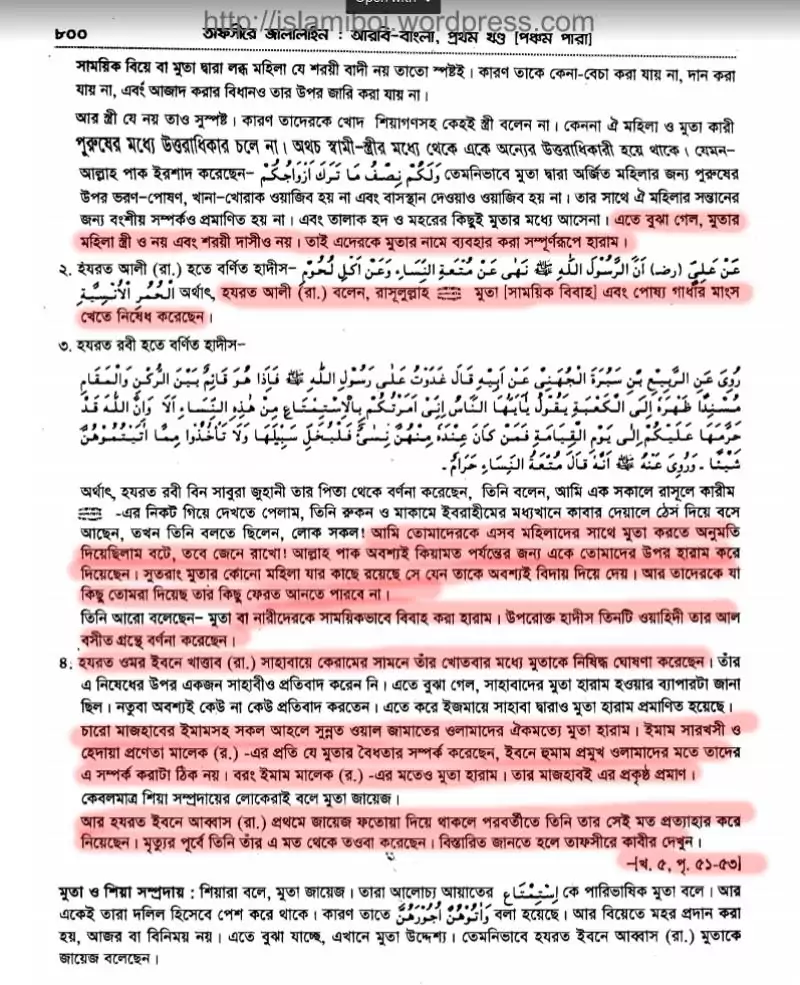
Reports in Tahawi Sharif also address this issue. [128]:
4003. Al-Rabi’ al-Jizi narrates from Abdullah ibn Abbas: Temporary marriage was a mercy from Allah for this community. Had Umar ibn al-Khattab not prohibited it, no one except the wretched would have fallen into fornication. The narrator adds: I can still almost hear Abdullah ibn Abbas uttering لا شقى (“except the wretched”).
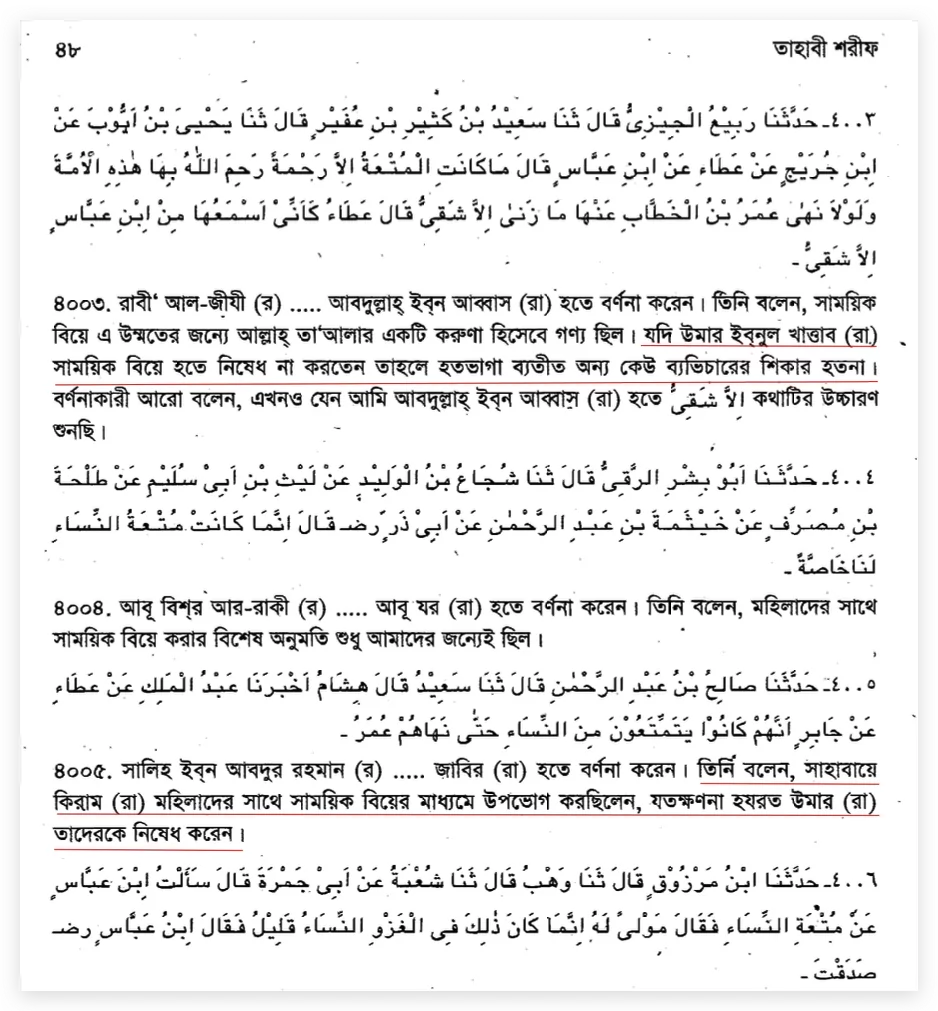
Muta Marriage Was Prohibited
Numerous hadiths classified as sahih also attribute the prohibition of muta marriage to Muhammad; that cannot be denied. The problem lies elsewhere: different reports place the prohibition at different times, while other reports describe Companions practising muta after Muhammad’s death. The question is how these prohibition reports fit the historical record and what role Umar’s public prohibition actually played. The hadiths are as follows. [129]:
Sahih Bukhari (Islamic Foundation)
54 / Marriage
Chapter 2457: The Prophet eventually prohibited muta marriage
4744. Ali … from Jabir ibn Abdullah and Salama ibn al-Akwa’: We were with an army. A messenger sent by the Messenger of Allah came to us and said, “You have been permitted to contract muta marriage, so you may do so.” Ibn Abi Dhi’b said: Iyas ibn Salama ibn al-Akwa’ narrated from his father that the Prophet said, “If a man and woman agree to muta, their relationship shall last three nights. Afterwards, they may extend it or separate if they wish.” The narrator said: We do not know whether this concession applied only to us or to everyone. Abu Abdullah (Imam Bukhari) said: Ali explicitly stated, on the Prophet’s authority, that muta marriage had been abrogated.
Hadith classification: Sahih
Narrator: Jabir ibn Abdullah al-Ansari
The reports transmitted through Ali are as follows. [129] [130] [131] [132]:
Sahih Bukhari (Islamic Foundation)
54 / Marriage
Chapter 2457: The Prophet eventually prohibited muta marriage
4742. Malik ibn Isma’il … from Hasan ibn Muhammad ibn Ali and his brother Abdullah, from their father: Ali told Ibn Abbas that the Prophet at the Battle of Khaybar prohibited muta marriage and eating the meat of domesticated donkeys.
Hadith classification: Sahih
Sunan Nasa’i (Islamic Foundation)
26 / Marriage
Chapter 71: The prohibition of muta
3370. Amr ibn Ali, Muhammad ibn Bashshar and Muhammad ibn al-Muthanna … Malik ibn Anas reported from Ibn Shihab, from Abdullah and Hasan, the two sons of Muhammad ibn Ali, from their father Muhammad ibn Ali: Ali ibn Abi Talib said that the Messenger of Allah on the day of Khaybar prohibited muta with women. Ibn al-Muthanna said, “On the day of Hunayn.” He said: Abd al-Wahhab narrated it to us in this form from his book.
Verification: Sahih.
Hadith classification: Sahih
Narrator: Malik ibn Anas
Sunan Nasa’i (Islamic Foundation)
43 / Hunting and slaughtered animals
Chapter 31: The prohibition of eating domesticated donkey meat
4335. Muhammad ibn Mansur and Harith ibn Miskin … Muhammad said: Ali told Ibn Abbas that the Messenger of Allah on the day of Khaybar prohibited muta marriage and eating the meat of domesticated donkeys.
Verification: Sahih.
Hadith classification: Sahih
Sunan Tirmidhi (Islamic Foundation)
28 / Food
Chapter: Domesticated donkey meat
1801. Muhammad ibn Bashshar and Ibn Abi Umar … Ali narrated: During the Battle of Khaybar, the Messenger of Allah prohibited us from contracting muta marriage and eating domesticated donkey meat. Sahih; Ibn Majah 1961; Nasa’i; Tirmidhi, hadith 1794 (Al-Madani Publications).
Sa’id ibn Abd al-Rahman al-Makhzumi … al-Zuhri, narrating from Abdullah and Hasan, the two sons of Muhammad ibn Ali, said: Of the two, Hasan ibn Muhammad is more satisfactory. Those other than Sa’id ibn Abd al-Rahman narrated from Ibn Uyayna that Abdullah ibn Muhammad is the more satisfactory of the two. Imam Abu Isa said: This hadith is hasan-sahih.
Hadith classification: Sahih
Narrator: Ali ibn Abi Talib
Muta Was Prohibited at Khaybar: Objections from Sunni Scholars
The report placing the prohibition of muta at Khaybar is important because other sahih hadiths describe it being permitted again later. This inconsistency is not merely a Shia objection: the dating to Khaybar has also been directly questioned within Sunni hadith commentary. In Fath al-Bari, Ibn Hajar al-Asqalani quotes al-Suhayli as saying that the prohibition of muta marriage at Khaybar was unknown to transmitters of sira and historical reports. He suggests that words may have been transposed in al-Zuhri’s narration: the prohibition associated with Khaybar concerned domesticated donkey meat, rather than muta marriage. [133]
The same discussion quotes Ibn Uyayna’s explanation that the prohibition at Khaybar concerned domesticated donkey meat, rather than muta marriage. Ibn Abd al-Barr says this was the majority position. The explanation Abu Awana quotes from scholars in his Sahih is even more explicit: Ali’s hadith mentions the prohibition of donkey meat at Khaybar but leaves muta undated; muta was prohibited at the conquest of Mecca. These opinions are also preserved in al-Shawkani’s Nayl al-Awtar. [134]
The reason for this objection is straightforward: sahih reports describe permission to practise muta again after Khaybar. If muta had been definitively prohibited at Khaybar, how are the later permissions to be explained? Some Sunni commentators answer that it was prohibited several times; others say the Khaybar date applies only to donkey meat; others interpret the later permission as a brief, exceptional concession. The history of muta’s prohibition is therefore far from straightforward or linear within the hadiths themselves.
Placing the reports in chronological order makes the problem clearer. Several hadiths transmitted through Ali place the prohibition of muta at Khaybar. Later, however, Muhammad again permitted the Companions to practise muta at the conquest of Mecca, according to Sabra al-Juhani’s report in Sahih Muslim. There is also a report of permission for three days in the year of Awtas, followed by prohibition. A prohibition followed by renewed permission and then another prohibition is thus the pattern within the hadiths themselves.
The disagreement extends beyond Khaybar, the conquest of Mecca and Awtas. Collecting the reported dates of muta’s prohibition in Fath al-Bari, Ibn Hajar mentions six occasions: Khaybar, the compensatory umra, the conquest of Mecca, Awtas, Tabuk and the Farewell Hajj. A report also mentions Hunayn. Later Sunni hadith commentators therefore also faced the question: when was muta finally prohibited? Different reports supplied different dates, requiring them to reconcile the accounts. [135]
[136]. Muta marriage was permitted again at that time.
Imam Bukhari narrates through Muhammad ibn al-Ala, from Abu Musa: After the Battle of Hunayn, the Messenger of Allah sent a detachment under Abu Amir towards the people of Awtas.
Another hadith states [10]:
Sahih Muslim (Islamic Foundation)
17 / Marriage
Chapter 3: Muta marriage was permitted, then abrogated, then permitted again, then abrogated; its prohibition remains until the Day of Resurrection.
3288. Abu Bakr ibn Abi Shayba … from Iyas ibn Salama, from his father, who said: The Messenger of Allah permitted muta marriage for three days in the year of the Battle of Awtas. He then prohibited it.
Hadith classification: Sahih
Ibn Abbas’s Dissenting Position
Abdullah ibn Abbas was a prominent Companion of Muhammad and the son of Muhammad’s uncle Abbas. He was a distinguished jurist and a leading commentator on the Quran, known in the Muslim world as Ra’is al-Mufassirin or Sayyid al-Mufassirin, meaning the chief of Quranic commentators. Muhammad himself praised his knowledge and prayed to Allah to increase it. Islam’s second caliph, Umar ibn al-Khattab, said of him, “Ibn Abbas is more learned than all of you.” Umar also said, “He is young in years, old in knowledge!” Islam’s fourth caliph, Ali, said of him: “When he explains the Quran, it is as though he sees unseen things from behind a transparent veil.” The prominent Companion Ibn Mas’ud said, “He is the greatest commentator on the Quran.” Ibn Umar said, “Of this community, Ibn Abbas has the greatest knowledge of what was revealed to Muhammad.”
Yet this same Ibn Abbas supported muta marriage and did not accept Umar’s ruling. He was even threatened with death for that position. Several sources claim that, late in life, he accepted Umar’s ruling prohibiting muta, but there is considerable doubt about the accuracy of that claim. Ibn Abbas spoke firmly in favour of muta marriage; such a reversal would have been highly uncharacteristic of him.
Another important chronological problem arises here. The standard Sunni explanation often says Ibn Abbas retracted his opinion after Ali reminded him that muta had been prohibited at Khaybar. But the Sunni commentator al-Alusi explicitly writes in Ruh al-Ma’ani that the dispute between Ibn al-Zubayr and Ibn Abbas in Sahih Muslim occurred during Abdullah ibn al-Zubayr’s caliphate—that is, after Ali’s death. Even then, Ibn Abbas was publicly saying that muta had been practised during the time of Muhammad, “the leader of the pious”, and was still issuing rulings permitting it. Al-Alusi himself therefore observes that the claim that Ibn Abbas changed his mind immediately after Ali spoke to him does not fit this report in Sahih Muslim. [137]
Sunni works also contain separate reports that Ibn Abbas retracted his opinion later. At least one point, however, is clear: the simple story that “Ali corrected him, and Ibn Abbas immediately abandoned the permissibility of muta” is inaccurate. Reports preserve Ibn Abbas publicly ruling muta permissible after Ali’s death, and it was for this ruling that Ibn al-Zubayr threatened to stone him. The following hadith records this. [138]:
Sahih Muslim (Islamic Foundation)
17 / Marriage
Chapter 3: Muta marriage was permitted, then abrogated, then permitted again, then abrogated; its prohibition now remains until the Day of Resurrection.
3299. Harmala ibn Yahya … from Urwa ibn al-Zubayr: Abdullah ibn al-Zubayr stood up in Mecca to address the people and said, “There are people whose hearts Allah has blinded just as He has blinded their eyes. They issue rulings permitting muta.” He was alluding to Ibn Abbas, who called out to him, “You are an uncouth, rude person. By my life! Muta was practised during the time of the Messenger of Allah, the leader of the pious.” Ibn al-Zubayr replied, “Try it yourself. By Allah, if you practise muta, I will stone you to death with the stones prescribed for you.”
Ibn Shihab said: Khalid ibn al-Muhajir ibn Sayf Allah told me that he was sitting with a man when someone came and asked him for a ruling on muta. He permitted it. Ibn Abi Amra al-Ansari said to him, “Stop.” He asked, “Why? By Allah, it was practised during the time of the Messenger of Allah, the leader of the pious.” Ibn Abi Amra replied, “In the early days of Islam it was permitted in cases of necessity, like eating carrion, blood and pork when no alternative exists. Then Allah strengthened and established His religion and prohibited it.”
Ibn Shihab said: Al-Rabi’ ibn Sabra al-Juhani informed me that his father said, “During the Prophet’s time, I contracted muta with a woman of the Amir tribe in return for two red cloaks. Afterwards, the Messenger of Allah prohibited us from practising muta.” Ibn Shihab added: I heard al-Rabi’ ibn Sabra relate this to Umar ibn Abd al-Aziz while I was sitting there.
Hadith classification: Sahih
Narrator: Urwa ibn al-Zubayr
Imam Malik and Ahmad ibn Hanbal
Ashraful Hidaya also discusses muta marriage [139], attributing a view permitting it to Imam Malik through the author of Al-Hidaya. At the end of the same quotation, however, the commentator calls this attribution to Malik incorrect. It also states that muta marriage was prohibited through collective consensus. If the prohibition was the Prophet’s command, why was consensus necessary?
وَنِكَاحُ الْمُتْعَةِ بَاطِلٌ وَهُوَ أَنْ يَقُولَ لِاِمْرَأَةِ أَتَمَتَّعُ بِكِ كَذَا مُدَّةٌ بِكَذَا مِنَ الْمَالِ وَقَالَ مَالِكَ (رح) هُوَ جَائِزٌ لِأَنَّهُ كَانَ مُبَاحًا فَيَبْقَى إِلَى أَنْ يَظْهَرَ نَاسِخَةُ قُلْنَا ثَبَتَ النَّسْعُ بِإِجْمَاعِ الصَّحَابَةِ وَابْنِ عَبَّاسٍ (رض) صَحَ رُجُوعُهُ إِلَى قَوْلِهِمْ فَتَقَرَّرَ الْإِجْمَاعُ.
Translation: Muta marriage is invalid. Muta marriage means that a man says to a woman, “I shall enjoy you for a specified period in return for this amount of property.”
Imam Malik says it is permissible, because it was originally permitted and remains so until an abrogating ruling is established. Our evidence is that its abrogation is established through the Companions’ consensus. It is authentically established that Ibn Abbas withdrew his opinion in favour of theirs; consensus was therefore established.
Related discussion
قَوْلُهُ وَنِكَاحُ الْمُنْعَةِ بَاطِلُ الحَ : Muta means saying to a woman:
اتمتع بك كَذَا مُدَّةٌ بِكَنَا مِنَ الْمَالِ : That is, “I shall enjoy you through muta for a specified number of days in return for a specified amount of property.” All the imams hold muta to be forbidden. Imam Malik, however, is reported to have disagreed. According to the author of Al-Hidaya, Malik said muta was permissible in early Islam and would remain so until an abrogating ruling was found. Since no abrogating ruling had appeared, it remained permissible. The author of Al-Hidaya responds that the Companions reached consensus on its prohibition, which constitutes the abrogation. An objection is raised that such consensus cannot be claimed, because Ibn Abbas held muta permissible at the time. The answer is that Ali once told Ibn Abbas, “Do you not know that the Messenger of Allah prohibited muta on the day of Khaybar?” On hearing this, Ibn Abbas withdrew his previous opinion and repented of holding muta permissible. With Ibn Abbas also abandoning his opinion, consensus on its prohibition was established.
Muta was lawful before Khaybar, but on the day of Khaybar the Messenger of Allah
prohibited domesticated donkey meat and muta with women. It was then permitted for three days at Awtas in the year of the conquest of Mecca. Afterwards, on the fourth occasion, he prohibited it until the Day of Resurrection. It must also be known that the author of Al-Hidaya erred in describing Imam Malik’s position: no Maliki book states that muta is permissible. Malik himself recorded Ali’s hadith in his Muwatta: إِنَّ رَسُولَ اللهُ تَهَى عَنْ مُنْعَةِ النِّسَاءِ وَعَنْ لُحُوْمِ الْعُسْرِ الْأَهْلِيَّةِ مِنْ خَبْبَرٌ That is, “The Prophet prohibited muta marriage and domesticated donkey meat on the day of Khaybar.” —Al-Ayni’s commentary on Al-Hidaya.
Malik’s practice was to include in his Muwatta hadiths representing his own legal position. The inclusion of this hadith therefore also demonstrates that Malik held muta to be forbidden.
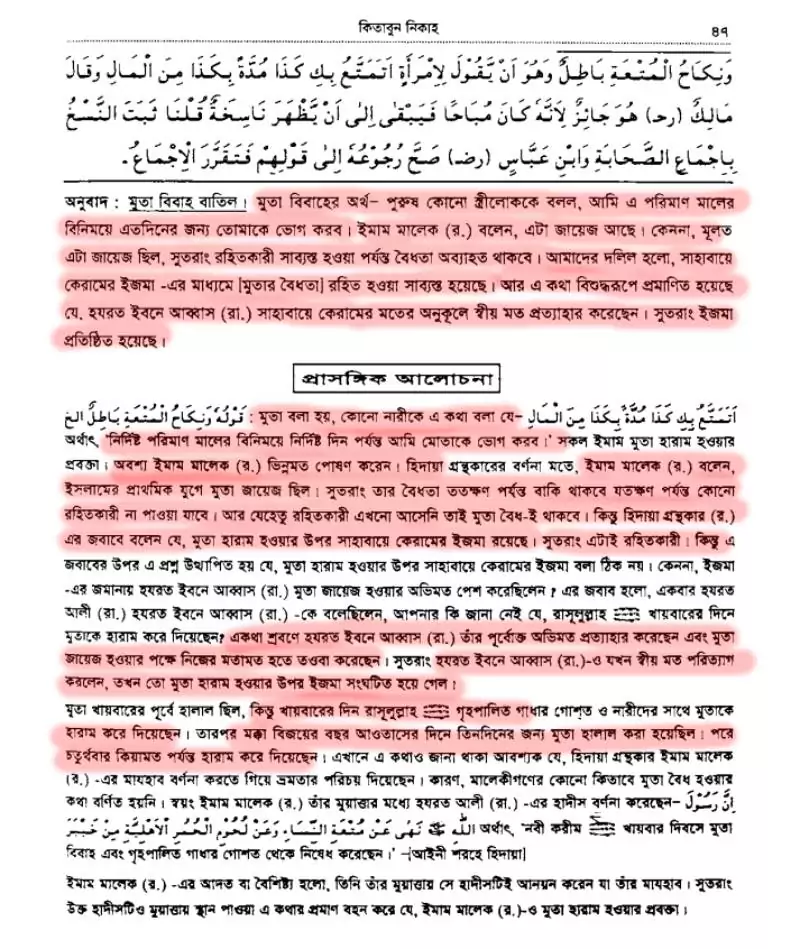
Ibn Kathir’s discussion records a view attributed to Ibn Abbas and a group of Companions that muta remained permissible according to need and circumstances, and mentions a similar report from Ahmad ibn Hanbal. Early accounts of these opinions were therefore less straightforward than later presentations of Sunni consensus suggest. [140]:
He also says:
وَأْتُوا النِّسَاءَ صَدُقَاتِهِنَّ نِحْلَةً.
That is, “Give your wives their mahr willingly.”
Elsewhere He says:
وَلَا يَحِلُّ لَكُمْ أَنْ تَأْخُذُوا مِمَّا أَتَيْتُمُوهُنَّ شَيْئًا.
That is, “It is not lawful for you to take back anything you have given your wives.”
The general meaning of this verse is used as evidence in support of muta marriage.
It can certainly be said that it was permissible in early Islam and was later abrogated.
A group of scholars, including Imam al-Shafi’i, say that muta was permitted again but that permission was also abrogated. In total, it was permitted twice and abrogated twice.
Another group says it was permitted and abrogated several times.
A further group of scholars says it was permitted once, then abrogated, and was never permitted again afterwards.
A group of Companions, including Ibn Abbas, are reported to have held that it remained permissible according to need and circumstances. This is also reported from Imam Ahmad.
The readings of Ibn Abbas, Ubayy ibn Ka’b, Sa’id ibn Jubayr, al-Suddi and others contain:
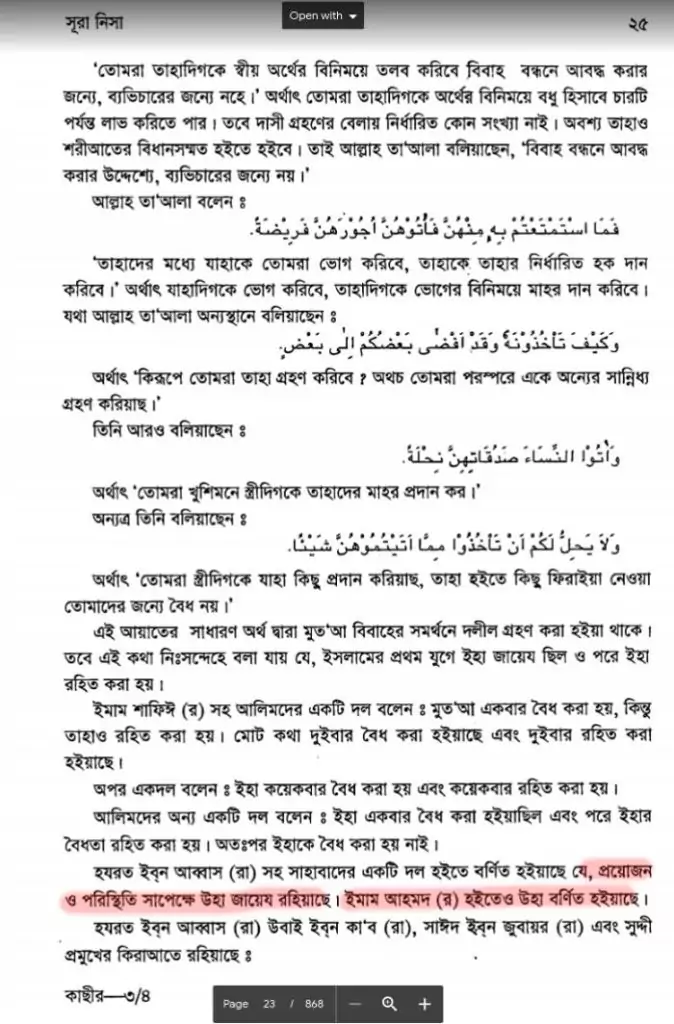
Conclusion
The permissibility of muta marriage in early Islam is neither a disputed modern interpretation nor an invention of later Shia theology. Sahih Bukhari, Sahih Muslim and other Sunni hadith collections preserve accounts of Companions contracting muta with Muhammad’s direct permission. These reports describe agreements for sexual relations with women for a fixed term, payment in clothing, dates or flour, and separation when the term ended. Sabra ibn Ma’bad’s account details a three-night muta marriage in return for a cloak. Jabir ibn Abdullah said they practised muta during Muhammad’s time, Abu Bakr’s caliphate and Umar’s rule. Muta marriage was therefore more than a legally permitted arrangement in early Islam: it was an actual practice, whose authorisation and use are recorded in Islamic sources themselves.
Events in the Companions’ personal lives make this history more concrete. Abd al-Razzaq’s Musannaf reports that Muawiya ibn Abi Sufyan contracted muta at Taif with a freedwoman named Mu’ana. She remained alive into his caliphate, and Muawiya regularly sent her gifts. Umar heard of the pregnancy of a woman with whom Amr ibn Hurayth had contracted muta. Reports of muta and pregnancy also name Salama ibn Umayya and Rabi’a ibn Umayya. In Al-Muhalla, Ibn Hazm preserves the names of several Companions who regarded muta as permissible after Muhammad’s death. Shia hadith literature also contains a report of Ali ibn Abi Talib contracting muta in Kufa with a woman of Banu Nahshal. The history of muta in early Islam thus extends beyond temporary sexual relations involving a few unnamed soldiers: prominent figures in Islam’s political and religious history are also associated with the practice.
More significantly, Shia hadith and religious works also preserve accounts of Muhammad himself contracting muta. In Shaykh al-Saduq’s Man La Yahduruhu al-Faqih, Ja’far al-Sadiq was asked directly whether Muhammad had practised muta. He answered affirmatively and cited a verse from Surah al-Tahrim. Another report attributed to Muhammad al-Baqir states that Muhammad contracted a fixed-term marriage with a free woman. When one of his wives discovered it and accused him of illicit sex, Muhammad described the relationship as a lawful, fixed-term marriage. He then asked her to keep it secret, but she disclosed it to another of his wives. These accounts survive in Shia Islamic literature as specific claims about Muhammad’s personal muta marriages. Islamic sources therefore discuss more than Muhammad’s permission for muta: they also contain such accounts about his own life.
The history of muta’s prohibition is even more inconsistent. Reports transmitted through Ali describe Muhammad prohibiting muta marriage and domesticated donkey meat at Khaybar. Yet Sahih Muslim reports renewed permission at the conquest of Mecca, after Khaybar. There is also a report of permission for three days at Awtas, followed by prohibition. Sunni scholars including Sufyan ibn Uyayna, al-Suhayli, Ibn Abd al-Barr, al-Bayhaqi and Ibn al-Qayyim objected specifically to dating the prohibition of muta to Khaybar. Ibn al-Qayyim expressly called that dating incorrect. Ibn Hajar, meanwhile, discussed several stages of permission and prohibition while reconciling reports assigning them to different times. The simple account that Muhammad prohibited muta once and that this prohibition was universally known and undisputed from his lifetime does not match the overall picture in the primary sources.
Events after Muhammad’s death sharpen the problem. According to Jabir in Sahih Muslim, muta continued during Abu Bakr’s caliphate and was prohibited under Umar in connection with Amr ibn Hurayth’s affair. Ibn Abbas maintained that muta remained permissible. Abdullah ibn al-Zubayr publicly criticised him for this position and threatened to stone him if he practised it. Ibn Abbas responded by telling Ibn al-Zubayr to ask his mother, Asma bint Abi Bakr, who confirmed Ibn Abbas’s statement. In reports preserved by al-Nasa’i and al-Tayalisi, Asma was asked directly about muta marriage with women and said they had practised it during Muhammad’s time. Ibn Abbas also said he could name men of Quraysh born from muta marriages. These incidents show that the Companions themselves openly disputed muta’s actual practice, its permissibility and its subsequent prohibition.
Beyond the dispute over permission and prohibition, childbirth and family responsibilities are central to this arrangement. The expiry of a temporary sexual contract does not end questions of paternity, maintenance or inheritance for a child born from it. Early Shia hadiths instruct fathers to acknowledge children born from muta. A report attributed to Ali al-Rida strongly condemns attempts to deny paternity after a child is born. Later Shia jurisprudence, however, distinguishes the judicial procedure for denying paternity in temporary marriage under certain circumstances from that in permanent marriage. Where paternity is acknowledged, the child is entitled to inherit from the father and receive maintenance. The need for a continuing legal relationship for the child is thus recognised even after the temporary marriage contract has ended.
Recognising the child’s rights does not provide the temporary wife with equivalent financial and family security. Under Shia jurisprudence, a woman married through muta does not automatically inherit from her husband. He is not obliged to maintain her, even while she is pregnant with his child. When the contract expires, the relationship ends without divorce. Yet the woman must observe an idda after intercourse, and pregnancy may extend her waiting period until childbirth. A specified mahr is essential to muta; in certain circumstances it may be reduced proportionately for parts of the contractual period during which the woman does not permit intercourse. There is therefore a direct economic relationship between sexual access and the property given in exchange, while the woman’s own maintenance and inheritance in the face of the long-term consequences are not secured as they are for a permanent wife.
A further disturbing aspect of muta is the provision for temporary marriage involving young and virgin girls. Shaykh al-Saduq’s Man La Yahduruhu al-Faqih mentions the age of ten in a question about muta with a young girl. Asked at what age a girl would no longer be too young to avoid being easily deceived, the answer given is ten. Shaykh al-Tusi’s Al-Istibsar contains reports permitting muta with a virgin without her parents’ permission; other reports require the father’s permission. Later Shia jurisprudence also provides for a father or paternal grandfather to conclude a marriage contract for a minor child. Separate rules for the marriage contract and sexual relations do not resolve the problem of a young child’s free and informed consent. A ten-year-old cannot fully assess the nature of a fixed-term sexual contract with an adult, its possible physical consequences or its long-term social risks. A guardian’s consent cannot substitute for the child’s own free consent. Describing muta solely as an agreement between two consenting adults therefore obscures the provisions concerning young girls’ marriages preserved in Islamic sources.
The reasons for permitting muta in early Islam also help explain its nature. Sahih hadiths describe the sexual needs and distress of Companions on military expeditions without their wives. Muhammad rejected their proposal to castrate themselves and permitted them to marry women for a fixed term. Ibn Hajar discusses how increased Muslim wealth and the greater number of female war captives after Khaybar reduced the need for muta. Greater opportunities for the sexual use of captive women could reduce the need to pay for temporary marriage: this is a logical historical inference from those social and military conditions. The same society authorised both sexual relations based on ownership of female slaves and muta marriage for a specified payment. Two distinct legal frameworks operated side by side to establish men’s rights over women’s sexuality and reproduction.
These facts make the moral character of muta marriage impossible to evade. Contracting sexual relations with a woman for a few nights in return for money or property, separating when the term expires without lasting family responsibilities, and imposing no obligation to maintain the woman herself even after pregnancy closely resemble a system of paid sexual services. There is therefore a strong ethical basis for describing muta marriage as a sexual contract resembling prostitution. Calling the arrangement a marriage in religious terms does not change the assessment of its economic and sexual structure. Likewise, treating a minor girl’s marriage contract as religiously valid does not establish her free consent.
This creates a fundamental conflict with Islam’s claim to immutable morality. The same muta marriage that contemporary Sunni Islam considers forbidden was once lawful with Muhammad’s approval and was actually practised by the Companions. An act may receive religious permission at one time and have it withdrawn at another, but changing its legal status alone does not explain why its intrinsic moral character would change. If temporary sexual relations for payment, a woman’s limited financial rights or temporary marriage involving a young girl are declared moral solely because religion permits them, divine command takes the place of an independent moral standard. Questions about an act’s harm, exploitation or justice then become subordinate to its religious legality.
The history of muta marriage is therefore also the history of a religious legal system that authorised fixed-term contracts to satisfy sexual needs; whose Companions later disputed the prohibition of those contracts; that associated prominent religious figures with the practice; and that developed separate legal provisions for children born from temporary relationships, women’s maintenance, inheritance and guardianship. Under these rules, women’s and children’s long-term security is far more complicated than men’s ability to enter and leave sexual relationships. Religious approval does not prove moral acceptability. Judged by free consent to sex, protection of minors, financial responsibility and the rights of women and children, the historical and legal structure of muta marriage presents serious ethical problems.
References
- Misyar Marriage — a Marvel or Misery? ↩︎
- Misyar now ‘a widespread reality’ ↩︎
- Incest in Religious Morality: Do Atheists Commit Incest? ↩︎
- How Can We Learn Morality Without Religion? ↩︎
- Surah al-Nisa, verse 24 ↩︎
- Tafsir Ibn Kathir, Islamic Foundation, volume 3, pages 25–26 ↩︎
- Tafsir Ibn Abbas, Islamic Foundation Bangladesh, page 228 ↩︎
- Sahih Muslim, Islamic Foundation, hadith 3283 ↩︎
- Sahih Muslim, Islamic Foundation, hadith 3284 ↩︎
- Sahih Muslim, Islamic Foundation, hadith 3288 1 2
- Sahih al-Bukhari, Tawheed Publication, hadith 5117 ↩︎
- Sahih Muslim, Islamic Foundation, hadith 3294 ↩︎
- Sahih al-Bukhari, Tawheed Publication, hadith 5119 ↩︎
- Shaykh al-Saduq, Man La Yahduruhu al-Faqih, volume 3, page 461, narrations 4591–4593 ↩︎
- Man La Yahduruhu al-Faqih, volume 3, page 461, hadith 4591 ↩︎
- Shaykh al-Tusi, Al-Istibsar, volume 3, pages 145–146, Bab al-Tamattu bi-al-Abkar, narration 528 ↩︎
- Man La Yahduruhu al-Faqih, volume 3, page 461, hadiths 4592–4593 ↩︎
- Shaykh al-Tusi, Al-Istibsar, volume 3, pages 145–146, chapter 94, narrations 525–530 ↩︎
- Al-Istibsar, volume 3, page 146, narrations 527–530 and Shaykh al-Tusi’s explanation ↩︎
- Ali al-Sistani, Minhaj al-Salihin, volume 3, Book of Marriage, guardianship rulings 57–58 ↩︎
- Minhaj al-Salihin, rulings 59–60 ↩︎
- Minhaj al-Salihin, temporary marriage, ruling 244 ↩︎
- Ali al-Sistani, Al-Masa’il al-Muntakhaba, Book of Marriage, ruling 1011 ↩︎
- Minhaj al-Salihin, marriage guardianship, ruling 67 ↩︎
- Minhaj al-Salihin, rulings 68–69 ↩︎
- Sahih al-Bukhari, Tawheed Publication, hadith 5116 ↩︎
- Slave Rape in Islam: Is Consent Required for Intercourse with a Female Slave? ↩︎
- Fath al-Bari, Ibn Hajar al-Asqalani, volume 9, page 171 ↩︎
- Fath al-Bari: Muta Marriage ↩︎
- Sahih Muslim, Islamic Foundation, hadith 3280 ↩︎
- Sunan Ibn Majah, hadith 1962 ↩︎
- Sunan al-Nasa’i, Islamic Foundation, hadith 3371 ↩︎
- Sahih Muslim, Islamic Foundation, hadith 3295 ↩︎
- Sahih Muslim, Hadith Academy, hadith 3311 ↩︎
- Ibn Hazm, Al-Muhalla bi-al-Athar, volume 9, pages 128–130, issue 1858: Muta Marriage ↩︎
- محلى ابن حزم – المجلد الخامس/الصفحة العاشرة ↩︎
- Sahih Muslim, hadith 1405c ↩︎
- Musannaf Abd al-Razzaq, volume 7, hadith 14021 ↩︎
- Sahih Muslim, hadith 1406a ↩︎
- Sahih Muslim, hadith 1406b ↩︎
- Musannaf Abd al-Razzaq, hadith 14026, volume 7, page 499 ↩︎
- Ibn Hajar al-Asqalani, Fath al-Bari, Book of Marriage ↩︎
- Musannaf Abd al-Razzaq, hadith 14021 ↩︎
- Fath al-Bari, volume 9, the case of Amr ibn Hurayth ↩︎
- Musannaf Abd al-Razzaq, hadith 14024, volume 7, pages 498–499 ↩︎
- Muwatta Malik, Book of Marriage, hadith 1137 ↩︎
- Musnad al-Shafi’i, hadith 1158 ↩︎
- Sahih Muslim, hadith 1404a ↩︎
- Fath al-Bari, volume 9, discussion of muta marriage ↩︎
- Musannaf Abd al-Razzaq, hadith 14022, volume 7, page 498 ↩︎
- Al-Hurr al-Amili, Wasa’il al-Shia, volume 21, page 10, chapters on muta, hadiths 26376–26378 ↩︎
- Al-Muhaqqiq al-Karaki, Khulasat al-Ijaz fi al-Muta, pages 23–24 ↩︎
- Sayyid Ja’far Murtada al-Amili, Zawaj al-Muta, volume 2, page 88 ↩︎
- Al-Kulayni, Al-Kafi, volume 5, page 448, hadith 2 ↩︎
- Shaykh al-Tusi, Tahdhib al-Ahkam, volume 7, page 250, narration 1080 ↩︎
- Sahih al-Bukhari, hadith 5115 ↩︎
- Sahih Muslim, hadith 1407a ↩︎
- Ibn Hajar al-Asqalani, Fath al-Bari, volume 9, Book of Marriage, discussion of the date of muta’s prohibition ↩︎
- Fath al-Bari, volume 9, statements of al-Bayhaqi and Abu Awana ↩︎
- Ibn al-Qayyim, Zad al-Ma’ad, volume 3, discussion of rulings from the Khaybar campaign ↩︎
- Zad al-Ma’ad, volume 5, discussion of muta’s prohibition ↩︎
- Ibn Kathir, Al-Bidaya wa-al-Nihaya, volume 4, discussion of Khaybar’s conquest ↩︎
- Musannaf Abd al-Razzaq, Book of Divorce, chapter on muta, volume 7, pages 496–497, hadith 14021 ↩︎
- Musannaf Abd al-Razzaq, volume 7, page 499, hadith 14026 ↩︎
- Ibn Hajar al-Asqalani, Fath al-Bari, Book of Marriage, discussion of muta, volume 9, page 79 ↩︎
- Shaykh al-Tusi, Al-Istibsar, volume 3, pages 152–153, chapter on affiliation of the child of muta to its father, hadiths 557–560 ↩︎
- Shaykh al-Saduq, Man La Yahduruhu al-Faqih, volume 3, chapter on muta, hadith 5, narration of Muhammad ibn Isma’il ibn Bazi’ ↩︎
- Ali al-Sistani, Minhaj al-Salihin, volume 3, Book of Marriage, chapter 7 on temporary marriage, rulings 251–252 ↩︎
- Ali al-Sistani, Minhaj al-Salihin, volume 3, Book of Marriage, temporary marriage, ruling 255 ↩︎
- Wasa’il al-Shia, volume 21, page 66, hadiths 26546–26547 ↩︎
- Wasa’il al-Shia, volume 21, page 67, hadiths 26548–26552 ↩︎
- Ali al-Sistani, Minhaj al-Salihin, Book of Inheritance, ruling 953 ↩︎
- Ali al-Sistani, Minhaj al-Salihin, volume 3, temporary marriage, ruling 256 ↩︎
- Minhaj al-Salihin, ruling 257 ↩︎
- Ali al-Sistani, Minhaj al-Salihin, volume 3, Book of Marriage, maintenance arising from kinship, rulings 440–449 ↩︎
- Ali al-Sistani, Minhaj al-Salihin, rulings 233–236 ↩︎
- Minhaj al-Salihin, rulings 237–239 ↩︎
- Minhaj al-Salihin, rulings 240–241 ↩︎
- Minhaj al-Salihin, ruling 252 ↩︎
- Minhaj al-Salihin, Book of Divorce, ruling 485 ↩︎
- Minhaj al-Salihin, ruling 259 ↩︎
- Minhaj al-Salihin, Book of Divorce, waiting period after muta, rulings 574–577 ↩︎
- Minhaj al-Salihin, Book of Divorce, waiting period after a husband’s death, ruling 578 ↩︎
- Minhaj al-Salihin, ruling 258 ↩︎
- Shaykh al-Saduq, Man La Yahduruhu al-Faqih, volume 3, Book of Marriage, chapter on muta, narration 4615 1 2
- Al-Muhaqqiq al-Karaki, Khulasat al-Ijaz fi al-Muta, page 22; Wasa’il al-Shia, volume 21, page 10, narration 26377 ↩︎
- Man La Yahduruhu al-Faqih, chapter on muta, narrations 4613–4615 ↩︎
- Wasa’il al-Shia, volume 21, page 12, chapter on muta ↩︎
- Wasa’il al-Shia, volume 21, page 13, narrations 26388–26389 ↩︎
- Muhsin Fayd al-Kashani, Al-Wafi, volume 21, page 204, narration 21343 ↩︎
- Al-Muhaqqiq al-Karaki, Khulasat al-Ijaz fi al-Muta, page 22, chapter on muta’s legitimacy ↩︎
- Al-Hurr al-Amili, Wasa’il al-Shia, volume 21, page 10, hadith 26377, chapters on muta ↩︎
- Qur’an, Surah al-Tahrim, verses 1–5 ↩︎
- Qur’an, Surah al-Tahrim, verses 3–5 ↩︎
- Khulasat al-Ijaz fi al-Muta, page 17, definition of muta marriage ↩︎
- Sayyid Ja’far Murtada al-Amili, Zawaj al-Muta, page 92, narrations 13–14 ↩︎
- Musnad Ahmad, Musnad Umar ibn al-Khattab, hadith 351 ↩︎
- Musnad Ahmad, Musnad Umar ibn al-Khattab, hadith 342 ↩︎
- Musnad Ahmad, Islamic Centre, volume 1, pages 232, 235–236 ↩︎
- Sahih Muslim, Hadith Academy, hadith 2837 ↩︎
- Sahih Muslim, Islamic Foundation, volume 3, pages 167–168 ↩︎
- Musnad Abi Dawud al-Tayalisi, volume 3, page 208, hadith 1742, account of Asma bint Abi Bakr ↩︎
- Al-Nasa’i, Al-Sunan al-Kubra, Book of Marriage, chapter on muta, hadiths 5513–5515 ↩︎
- Al-Sunan al-Kubra, Islamweb edition, hadith 5725, volume 6, pages 253–254 ↩︎
- Al-Tabarani, Al-Mu’jam al-Kabir, volume 24, page 103, hadith 277 ↩︎
- Abu Nu’aym al-Isfahani, Al-Musnad al-Mustakhraj ala Sahih Muslim, narrations 2872–2873 ↩︎
- Sahih Muslim, hadith 1238a ↩︎
- Sahih Muslim, hadith 1238b ↩︎
- Abu Ja’far al-Tahawi, Sharh Ma’ani al-Athar, volume 3, page 24, Book of Marriage, chapter on muta, hadith 4306 ↩︎
- Badr al-Din al-Ayni, Nukhab al-Afkar, volume 10, page 340; al-Tahawi, hadith 4306 ↩︎
- Sahih Muslim, Book of Marriage, discussion of muta’s permissibility and prohibition ↩︎
- Sahih Muslim, Islamic Foundation, hadith 3285 ↩︎
- Sahih Muslim, Islamic Foundation, hadith 3286 ↩︎
- Sahih Muslim, Islamic Foundation, hadith 3287 ↩︎
- Sahih Muslim, Hadith Academy, hadith 3307 ↩︎
- Sahih Muslim, Hadith Academy, hadith 3306 ↩︎
- Musannaf Abd al-Razzaq, hadith 14024 ↩︎
- Fath al-Bari, Ibn Hajar al-Asqalani, Book of Marriage, discussion of muta ↩︎
- Al-Isabah fi Tamyiz al-Sahaba, biography of Salama ibn Umayya ↩︎
- Fath al-Bari, volume 9, page 174 ↩︎
- Musannaf Abd al-Razzaq, hadith 14021, volume 7, pages 496–497 ↩︎
- Receiving Payment for Teaching the Quran Is Forbidden ↩︎
- A List of Umar’s Direct Acts of Kufr ↩︎
- The Awl Method: Errors in the Quran’s Inheritance Law ↩︎
- Muwatta Malik, Islamic Foundation, hadith 1141 ↩︎
- Tafhim al-Quran, Sayyid Abu al-Ala Maududi, volume 9, pages 11–12 ↩︎
- Tafsir al-Jalalayn, Islamia Kutubkhana, volume 1, page 800 ↩︎
- Tahawi Sharif, Islamic Foundation, volume 3, page 48 ↩︎
- Sahih Bukhari, Islamic Foundation, hadith 4744 1 2
- Sunan Nasa’i, Islamic Foundation, hadith 3370 ↩︎
- Sunan Nasa’i, Islamic Foundation, hadith 4335 ↩︎
- Sunan Tirmidhi, Islamic Foundation, hadith 1801 ↩︎
- Fath al-Bari, Book of Marriage: discussion of the prohibition of muta ↩︎
- Nayl al-Awtar: muta marriage and its abrogation ↩︎
- Fath al-Bari: the different reported dates of muta’s prohibition ↩︎
- Al-Bidaya wa-al-Nihaya, Ibn Kathir, volume 4, page 584 ↩︎
- Ruh al-Ma’ani, commentary on Surah al-Nisa 4:24 ↩︎
- Sahih Muslim, Islamic Foundation, hadith 3299 ↩︎
- Ashraful Hidaya, volume 3, page 47 ↩︎
- Tafsir Ibn Kathir, Islamic Foundation, volume 3, page 25 ↩︎
About This Article
Genre: Islamic Marriage Law Critique, Mut‘ah Marriage Analysis, Hadith-Based Legal History, Sunni-Shia Dispute Review, and Religious-Morality Critique
Epistemic Position: Secular Humanism, Historical Criticism, Source Criticism, Sexual-Ethics Analysis, Anti-Apologetic Reasoning, and Moral-Consistency Review
This article examines mut‘ah, or temporary marriage, as a time-limited sexual contract that was practiced and permitted in the early Islamic period according to major hadith and tafsir sources.
The central argument is that mut‘ah was not a later Shia invention; Islamic sources themselves preserve reports of Muhammad permitting his companions to contract temporary sexual relationships for a fixed period and fixed compensation.
The article also discusses Quran 4:24, the term istamta‘tum, Ibn Kathir's tafsir, Ibn Abbas's view, Sahih Bukhari and Sahih Muslim reports, wartime sexual need, three-night temporary marriage reports, the Khaybar, Mecca, and Awtas timelines, Jabir's report that mut‘ah continued during Muhammad's, Abu Bakr's, and part of Umar's time, Umar's prohibition, and the Sunni-Shia disagreement over whether the ban was prophetic or later political-legal enforcement.
This article should be evaluated through hadith evidence, tafsir history, legal chronology, Quranic interpretation, early Muslim practice, moral consistency, and sexual ethics—not through sectarian dismissal, post-hoc Sunni harmonization, euphemistic marriage language, selective quotation, or the demand that a temporary paid sexual contract be protected from ordinary ethical scrutiny.