Umm Hani: Muhammad’s Secret Romance
Abstract
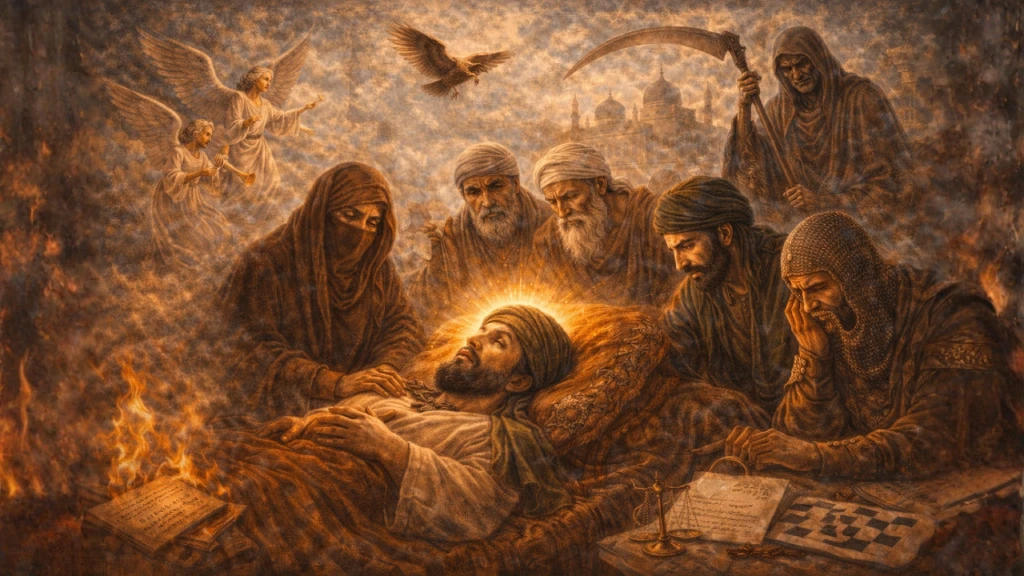
This article does not assess the conventional religious account of Isra and Mi‘raj within the protected confines of faith. Instead, it examines its testimony, locations, chronology, interrelationships, later narratives, and possible motives as it would a suspicious event in Islamic history. Just as an investigative journalist or detective places different witnesses’ accounts of the same event side by side in search of clues, this article confronts the accounts found in hadith, sira, tafsir, and early Islamic history with one another. In doing so, an uncomfortable question gradually emerges: Where was Muhammad actually spending the night of Mi‘raj?
This question matters because Islamic sources do not provide a single, consistent answer. In some accounts, the event begins at the Kaaba or the Hatim; in others, it begins elsewhere while Muhammad is asleep; and in an account preserved under Umm Hani’s name, he spends that night in her house. The testimonies thus conflict over the event’s most basic question: its location. Further significant information compounds the problem: Umm Hani was Muhammad’s paternal cousin and a non-mahram woman whom he was legally permitted to marry; he had wanted to marry her before his prophethood; he proposed to her again later in life; and statements preserved under Umm Hani’s own name express her love for Muhammad dating back to the pre-Islamic period. What emerges, therefore, is not simply a story about distant kinship, but a historical background of enduring mutual attraction.
The suspicion deepens when these events are considered together. Conflicting accounts of Muhammad’s whereabouts on the night of Mi‘raj, the claim that he spent the night at Umm Hani’s house, his later visits to her home, bathing there, drinking from the same vessel, proposing marriage again, and other descriptions of their relationship produce one picture when treated as isolated incidents. Placed together, however, they reveal an entirely different pattern. The question is then no longer merely whether Mi‘raj was real, but rather: Was the miraculous narrative a cover story, reinterpretation, or diversion constructed around an actual private encounter?
The state of the Mi‘raj accounts themselves strengthens rather than dispels this suspicion. Some describe a dream, others a bodily journey; some begin with sleep and end with awakening; some feature Buraq, others describe traversing the heavens with an angel. Nor is there a consistent narrative about which prophet occupied which heaven, when the event occurred, or where it began. In place of the ordinary eyewitness testimony expected of a historical event, we find layers of religious storytelling that progressively expand, change, and contradict one another. In light of modern scientific knowledge, there is likewise no verifiable evidence for seven heavens, a cosmic journey on Buraq, or an ascent through multiple heavenly realms in a single night.
The article also shows that journeys through the skies, heavenly ascents, angels, and passage through otherworldly realms were by no means unknown before Islam. Such motifs had long circulated in much older religious and mythological traditions across the Middle East, Iran, and neighboring regions. There is therefore little reason to treat Mi‘raj as an isolated, entirely new, and independent narrative.
The matter of Umm Hani is also more than an isolated incident involving a single night. Cousin marriage was an ordinary social custom in Arab tribal society, and Muhammad’s life offers further examples of marital interest in cousins or other closely related women, the best known being Zaynab bint Jahsh. There is consequently no basis for assuming that his attraction to Umm Hani amounted to ordinary affection for a sister, or that such attraction was socially impossible or inconceivable. Rather, Muhammad’s repeated marriage proposals and Umm Hani’s own declaration of love place this relationship at the center of the investigation.
In brief, this article asks:
- Where was Muhammad actually spending the night of Mi‘raj, and why do Islamic sources disagree on this question?
- Why does Umm Hani’s account place Muhammad in her own house?
- Why do we find accounts of him spending the night in the house of a woman whom he had repeatedly wanted to marry?
- What does Umm Hani’s own statement, “I loved you even in the pre-Islamic period,” indicate about their relationship?
- Why do the different Mi‘raj accounts conflict over dreams, bodily travel, location, timing, and the sequence of events?
- Did the miraculous story become an effective means of concealing uncomfortable questions about his actual whereabouts and personal relationship?
- Did later religious interpretation and narrative expansion gradually add mythological layers to an actual event?
A detective investigating a suspicious incident begins by comparing the witnesses’ statements. In the case of Mi‘raj, that is precisely where the problems begin. Some accounts preserved in Muhammad’s name place him at the Kaaba or the Hatim, while others indicate a different location; Umm Hani’s testimony, however, places him directly in her own house. Such a fundamental conflict over the location of the same night’s events cannot be dismissed as “variation in narration”; it is the investigation’s central inconsistency.
When the relationship’s earlier history is added to this inconsistency, the incident becomes even more significant. Umm Hani was no stranger. Muhammad had wanted to marry her before his prophethood and proposed again later; according to Umm Hani’s own statement, she too had loved him since the pre-Islamic period. Treating the account of an overnight stay in the house of such a marriageable woman separately from the conflicting testimony about that same night’s location obscures the central question of the investigation.
This is where “Mi‘raj” emerges as a possible alibi or diversionary story. An ordinary claim—“I was somewhere else”—can readily be checked. But if the claim is “I traveled through Jerusalem and the seven heavens in a single night,” the focus of the debate changes instantly. People stop asking, “Where did you spend the night?” and begin arguing, “Is it possible to travel so far in one night?” Thus, whether the miraculous claim is true or false, its narrative function is highly effective: it displaces the question of his actual whereabouts and directs the entire discussion toward an impossible cosmic story.
For this reason, the article examines Mi‘raj not only as a claim of religious miracle, but also as a possible historical cover story, an alternative narrative surrounding a personal relationship, and a religious myth expanded in later times. There is no obligation here to defend any faith. There is only one question: When the available testimony, patterns of behavior, conflicting locations, and history of the relationship are considered together, which explanation is the most logical?
The article begins by introducing Umm Hani, Abu Talib’s family, the marriage proposal in their youth, and Mecca’s social circumstances. It then establishes hadith, sira, and tafsir as its principal evidentiary sources.
- Paternal cousins and attraction in their youth
- Quotations from approved books, including Islamic Foundation publications
- Types of sources: hadith, sira, tafsir, and books by modern scholars
The article shows that several sira accounts place the beginning of the Isra and Mi‘raj night at Umm Hani’s house. This directly conflicts with the conventional account centered on the Sacred House.
- Accounts such as “while he was lying in my house…”
- Drinking from the same vessel on the day of the conquest of Mecca, and hadith concerning fasting
- A visual timeline centered on Umm Hani’s house
Hadith, sira, and tafsir contain clear disagreements about when, how, and how many times Mi‘raj occurred. Some describe a dream, others a bodily journey; some begin with sleep and end with awakening. The article places these accounts side by side to expose their internal contradictions.
- Different positions attributed to Aisha, Mu‘awiya, Ibn Ishaq, and others
- Scans and quotations from tafsir works, including Ibn Kathir
- Multiple differing narratives of the same event
This section critiques claims involving the metaphysical creature Buraq, travel through multiple heavens in one night, and journeys beyond the stars, arguing that they are impossible in light of modern astronomy and physics.
- Buraq’s physical description versus actual zoology
- The concept of the heavens versus modern cosmology
- The temporal inconsistency in the claim that “everything happened in one night”
The article shows how hadith concerning Umm Hani were subsequently used in juristic discussions of voluntary prayers, Salat al-Awwabin, and related practices, and circulated among ordinary Muslims through books and brochures.
- Analysis of pages from Salat al-Awwabin, published by IslamHouse
- Use of the same hadith in tafsir and practical religious rulings
- Comparison with statements by modern preachers and scholars
This section shows that the Umm Hani episode was not isolated: cousin marriage was common in Arab society, and the Prophet’s family offers several examples. Some context from modern psychological discussions of attraction between relatives is also introduced.
- Further examples of cousin marriage, including Zaynab bint Jahsh
- Tribal interests, blood relationships, and marriage customs
- GSA and the Westermarck effect serve only as supporting explanations, rather than the main focus
Considering all the sources, contradictions, and social circumstances together, the article argues that Mi‘raj—particularly the accounts centered on Umm Hani—may endure as religious belief, but does not withstand historical and scientific scrutiny. It instead represents a process of gradually developing mythmaking.
- A final assessment based on source criticism
- The gap between religious claims, history, and humane ethics
- An invitation for readers to judge for themselves
Introduction
The story of Isra and Mi‘raj is usually told as though Muhammad set out from the Kaaba or its vicinity on a miraculous journey through Jerusalem and the seven heavens. Yet a close examination of each account within Islam’s own sira, hadith, and historical traditions brings an extremely uncomfortable detail to light: several accounts place Muhammad in the house of a woman named Umm Hani on that night of Mi‘raj. This is where the central questions begin. Who was Umm Hani? Why was Muhammad spending the night in her house? Who else was there? What was the actual nature of Muhammad’s relationship with her? And, most importantly, why do Islamic sources themselves contain so many inconsistencies about the location of the night’s events?
Umm Hani was no stranger. She was Muhammad’s paternal cousin, and marriage between them was entirely lawful under Islamic law. In other words, she was not his mahram. Yet Islamic moral and social regulations strictly control seclusion, unrestricted interaction, and overnight stays involving non-mahram men and women. Islamic sources nevertheless depict the central figure of that religion spending the night in the house of just such a marriageable woman. This is where the problem begins.
A frequently used defense against this question is that the rules of veiling had not yet been revealed. But this explanation does not resolve the problem either. Muhammad’s contact with Umm Hani did not cease even after Islamic rules concerning veiling and interaction between men and women had been established. Islamic accounts themselves describe his visiting and staying in her house, bathing there, sharing a drink with her, and maintaining other close social contact. Consequently, the matter cannot simply be dismissed by saying, “The rules did not exist then.” The question instead becomes more pressing: what explains this particular closeness in Umm Hani’s case?
Another uncomfortable double standard becomes apparent here. Many Muslim theologians also present Muhammad’s life before prophethood beneath an almost impenetrable cloak of moral purity. They maintain that even before Islam he did not commit zina, drink alcohol, or participate in idol worship: supposedly, he had already abstained from conduct incompatible with later Islamic morality. If this claim is accepted, explaining his particular closeness to Umm Hani by invoking the later introduction of veiling becomes even more difficult. Conversely, if these prohibitions were not yet in force, the claim that his life before prophethood miraculously conformed to the standards of later sharia is weakened at the same time. One cannot have it both ways.
Faced with this inconsistency, another convenient explanation is offered: Umm Hani was supposedly “like a sister” to Muhammad. Those who question the relationship are then accused of slander, a perverted mentality, or obscenity. But this emotional “like a sister” defense is extremely weak in the face of historical documents. To accept that Muhammad regarded this woman merely as a sister, one must first answer: Why, then, did he want to marry her? And why did he propose marriage repeatedly, at different stages of his life, rather than just once?
More uncomfortable still, accounts preserved in Umm Hani’s own name mention her earlier love for Muhammad. With these two facts before us—his interest in marrying her and her own acknowledgment of love for him—casually presenting their relationship as a “pure bond between brother and sister” is not historical analysis. It is the imposition of later religious interpretations upon the documentary evidence.
The question posed by this article is therefore simple but uncomfortable: Was Umm Hani really only “like a sister” to Muhammad, or do Islam’s own sources present a very different picture of enduring mutual attraction, an unfulfilled desire for marriage, and particular intimacy? And if Muhammad was staying in Umm Hani’s house on the night of Mi‘raj against this background, a larger question arises: What, precisely, is the relationship between the miraculous story of Mi‘raj and the actual location of that night’s events?
This article will examine those questions by placing evidence from Islam’s own hadith, sira, tafsir, and historical works alongside one another. Readers will not be asked to accept any “sacred” conclusion in advance. Instead, the documents will be confronted with one another to ask: Does the relationship between Umm Hani and Muhammad really tell a story of innocent, sibling-like affection, or the history of an unfulfilled and enduring love buried beneath religious interpretation?
Before beginning the weighty documentary discussion, let us watch an amusing video:
Who Was Umm Hani?
Umm Hani’s actual name was Fakhita or Fakitah, or, according to another account, Hind. She was the daughter of Muhammad’s paternal uncle Abu Talib. Her father was Abu Talib ibn Abd al-Muttalib and her mother was Fatima bint Asad. She was the sister of Ja‘far, Aqil, and Ali, Islam’s fourth caliph. After his parents’ deaths, Muhammad lived as a dependent first with his grandfather Abd al-Muttalib and then with his uncle Abu Talib. He grew up alongside his paternal cousins. At that time and in that region, marriage between paternal cousins was not regarded as particularly objectionable, nor was it classified as incest. The Quran, too, permits marriage and sexual relations between first cousins, something now recognized as harmful and discouraged in the modern world. This subject is discussed in detail toward the end of the article.
What Does Non-Mahram Mean?
Men whom a woman may lawfully marry, and before whom sharia does not permit her to appear, are called non-mahram. If a woman is absolutely compelled to appear before a non-mahram man, she must do so fully veiled. The Prophet Muhammad was non-mahram to Umm Hani, meaning that marriage between them was permissible. All men other than her mahrams are forbidden to a believing woman; meeting and speaking with them are entirely prohibited. Only when strictly necessary may she meet or speak with them with a mahram’s permission. Even her paternal and maternal cousins, her sister’s husband, her husband’s younger and elder brothers, the husbands of her maternal and paternal aunts, and her father-in-law are all non-mahram. Under Islamic practice, appearing before them, socializing, and meeting them are entirely prohibited. Let us listen to a discussion by the well-known scholar Assim al-Hakeem:
Now let us read a hadith stating that no man may spend the night with an adult woman unless he is her husband or a mahram [1]:
Sahih Muslim (Islamic Foundation)
40/ Greetings
Section: 8. It is forbidden to remain in seclusion with an unrelated woman or to enter upon her
5486. Yahya ibn Yahya, Ali ibn Hujr, Ibn al-Sabbah and Zuhayr ibn Harb (may Allah have mercy on them) … Jabir reported Allah’s Messenger (ﷺ) as saying: Behold, no person should spend the night with a married woman, but only in case he is married to her or he is her Mahram.
Sahih Muslim 2171; Book 39, Hadith 27
Hadith grade: Sahih (Authentic)
Narrator: Jabir ibn Abdullah al-Ansari (may Allah be pleased with him)
Let us now watch another video explaining very clearly and in detail whom one may lawfully marry:
Let us consider another important matter. Muhammad once saw Abu Bakr together with Abu Bakr’s daughter, his own wife Aisha. Seeing them together in one room, he prohibited this and declared that even a father and daughter could not remain together in a room. In other words, Islam strictly prohibits such interaction between men and women, seeing Satan’s temptations even within the relationship between father and daughter. We generally regard someone with such a mentality as low-minded. This aspect of Islam is relevant to the present discussion:
A Childhood Love
Islamic history tells us little about Umm Hani’s childhood and adolescence. Some important accounts concerning marriage do, however, survive. Before receiving prophethood, Muhammad sent a marriage proposal for Umm Hani to his uncle Abu Talib. At the same time, Humayra ibn Abi Wahb, or Hubayra ibn ‘Amr ibn ‘A’idh al-Makhzumi (Hubayra ibn Abi Wahb), also proposed. His uncle accepted Hubayra’s proposal and married Umm Hani to him. Muhammad was deeply distressed and said sorrowfully, “Uncle! You rejected my proposal and married her to Hubayra?” His uncle replied, “Nephew! We have established a marriage alliance with him. The honorable are the equals of the honorable.”
This indicates that Muhammad’s uncle Abu Talib did not regard him as honorable or their social equal. Merely because he was a parentless orphan and an impoverished man without means or support, Muhammad’s latent desire—his childhood love—remained unfulfilled. Whether the penniless Muhammad subsequently married the older, immensely wealthy Khadija out of anger, sorrow, and hurt is unknown. Such a possibility would not, however, be unusual.
Asma al-Rijal
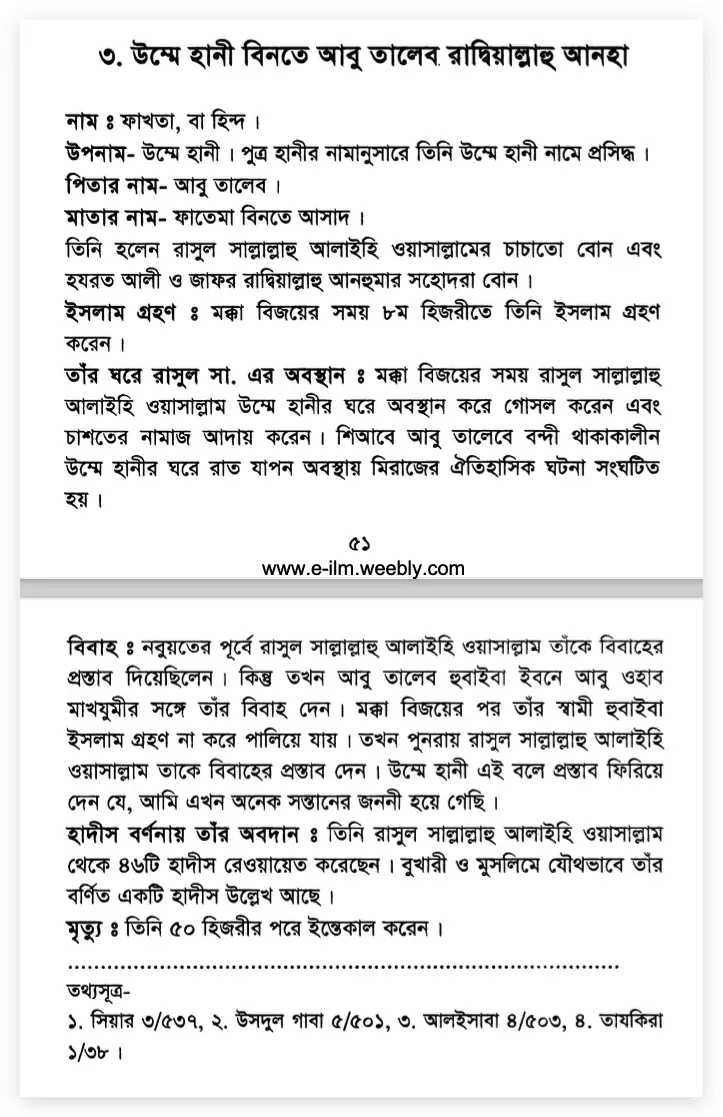
Let us learn about Umm Hani’s identity and Muhammad’s marriage proposal in their youth from Asma al-Rijal [2]:
Umm Hani bint Abi Talib, may Allah be pleased with her
Name: Fakhta, or Hind.
Kunya: Umm Hani. She became known by this name after her son Hani.
Father: Abu Talib.
Mother: Fatima bint Asad.
She was the paternal cousin of the Messenger, peace and blessings be upon him, and the full sister of Ali and Ja‘far, may Allah be pleased with them.
Conversion to Islam: She accepted Islam at the conquest of Mecca in 8 AH.
The Messenger’s stay in her house: During the conquest of Mecca, the Messenger, peace and blessings be upon him, stayed in Umm Hani’s house, bathed, and performed the forenoon prayer. The historic event of Mi‘raj occurred while he was spending the night in her house during the confinement in Shi‘b Abi Talib.
Marriage: Before prophethood, the Messenger, peace and blessings be upon him, proposed marriage to her. Abu Talib, however, married her to Hubayba ibn Abi Wahb al-Makhzumi. After the conquest of Mecca, her husband Hubayba fled without accepting Islam. The Messenger again proposed marriage. Umm Hani declined, saying that she had now become the mother of many children.
Contribution to hadith transmission: She narrated forty-six hadith from the Messenger, peace and blessings be upon him. Bukhari and Muslim both include one hadith narrated by her.
Death: She died after 50 AH.
………………………
Sources: 1. Siyar 3/537; 2. Usd al-Ghaba 5/501; 3. Al-Isaba 4/503; 4. Tadhkira 1/38.
The Lives of the Prophet’s Companions
Read the same account in The Lives of the Prophet’s Companions [3]:
Umm Hani bint Abi Talib (may Allah be pleased with her)
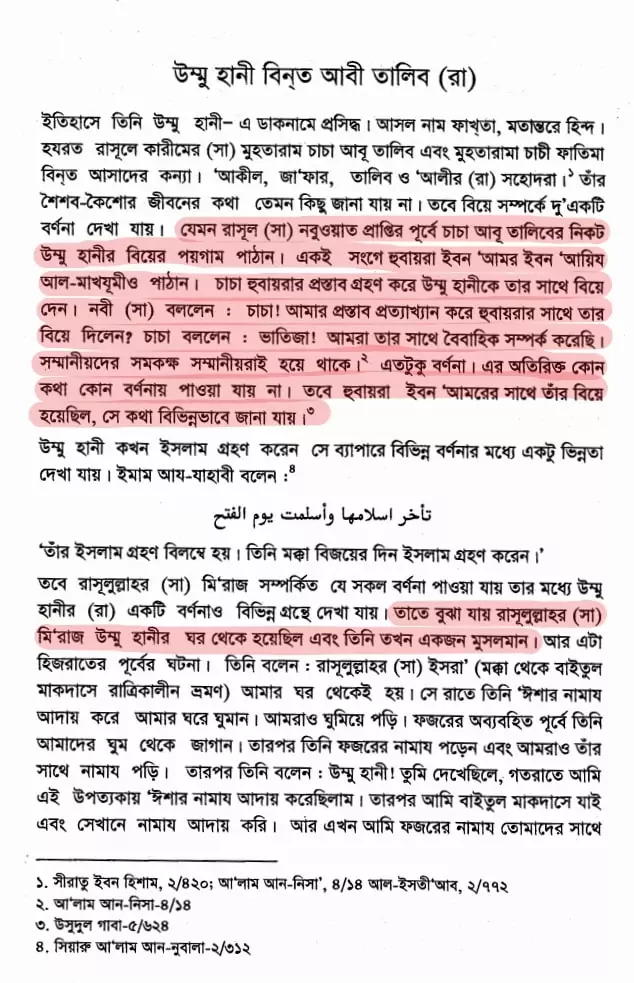
She is known in history by her kunya, Umm Hani. Her actual name was Fata, or, according to another view, Hind. She was the daughter of the noble Messenger’s honored uncle Abu Talib and aunt Fatima bint Asad, and the full sister of Aqil, Ja‘far, Talib, and Ali (may Allah be pleased with them).(1) Little is known about her childhood and adolescence, although one or two accounts concerning her marriage survive. Before prophethood, the Messenger proposed marriage to Umm Hani through his uncle Abu Talib. Hubayra ibn ‘Amr ibn ‘A’idh al-Makhzumi proposed at the same time. Abu Talib accepted Hubayra’s proposal and married her to him. The Prophet asked, “Uncle! You rejected my proposal and married her to Hubayra?” His uncle replied, “Nephew! We have established a marriage alliance with him. The honorable are the equals of the honorable.”(2) That is the extent of the report; no account provides further details. Her marriage to Hubayra ibn ‘Amr, however, is established through various sources.(3)
Accounts differ slightly concerning when Umm Hani accepted Islam. Imam al-Dhahabi states:(4)
تأخر اسلامها وأسلمت يوم الفتح
“Her conversion was delayed; she accepted Islam on the day of the conquest.”
Among accounts concerning the Messenger’s Mi‘raj, however, several works preserve a report from Umm Hani. It indicates that the Messenger’s Mi‘raj began in her house and that she was then Muslim, although this occurred before the Hijra. She says: “The Messenger’s Isra, the night journey from Mecca to Bayt al-Maqdis, began in my house. That night he performed the Isha prayer and slept in my house. We also went to sleep. Immediately before Fajr, he awakened us. He then prayed Fajr, and we prayed with him. Afterward, he said, ‘Umm Hani! You saw me perform Isha in this valley last night. Then I went to Bayt al-Maqdis and prayed there. And now I have prayed Fajr with you…’”
1. Sirat Ibn Hisham, 2/420; A‘lam al-Nisa, 4/14; Al-Isti‘ab, 2/772. 2. A‘lam al-Nisa, 4/14. 3. Usd al-Ghaba, 5/624. 4. Siyar A‘lam al-Nubala, 2/31.
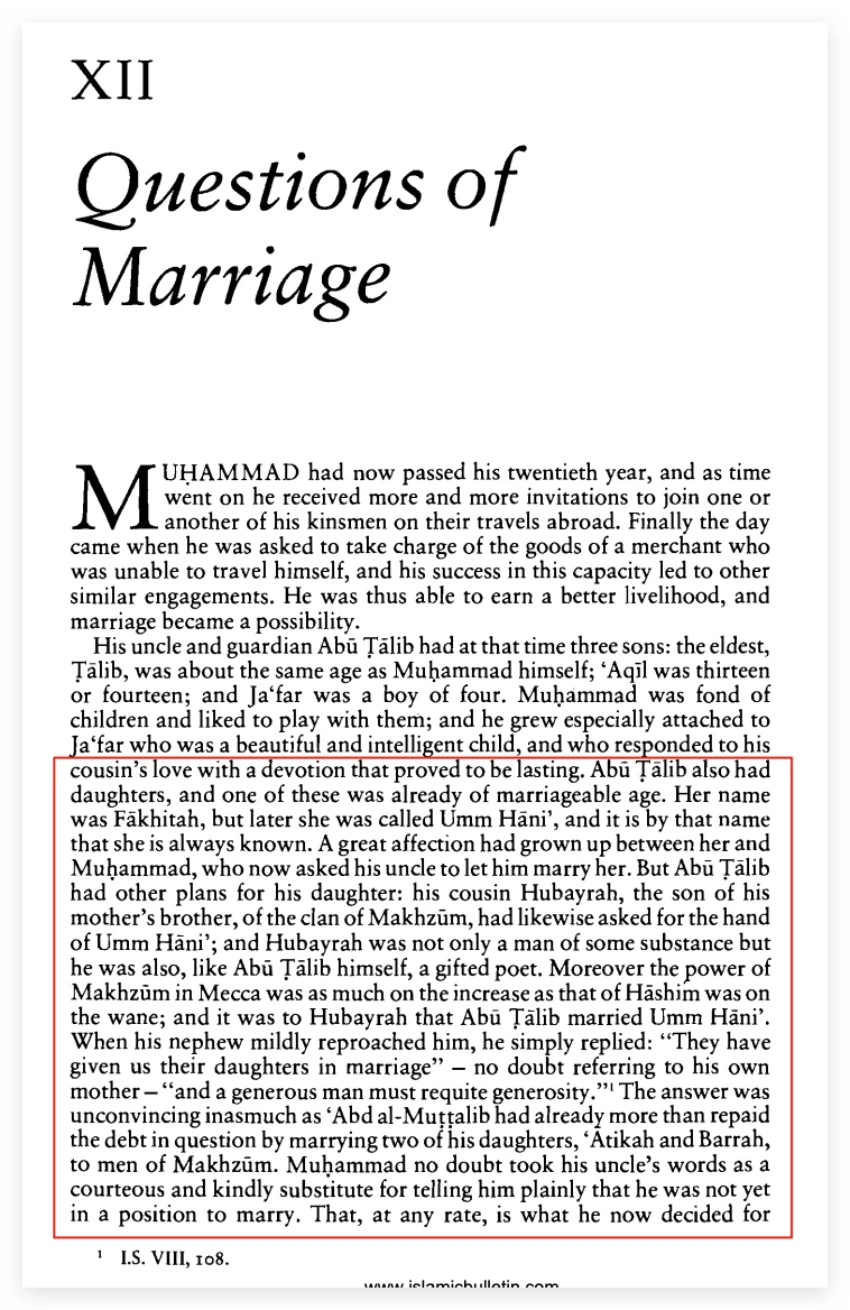
Martin Lings’s Life of Muhammad
Let us now read from Martin Lings’s book, the most famous sira in the Western world [4]
cousin’s love with a devotion that proved to be lasting. Abū Ṭālib also had daughters, and one of these was already of marriageable age. Her name was Fākhitah, but later she was called Umm Hani’, and it is by that name that she is always known. A great affection had grown up between her and Muḥammad, who now asked his uncle to let him marry her. But Abū Ṭālib had other plans for his daughter: his cousin Hubayrah, the son of his mother’s brother, of the clan of Makhzūm, had likewise asked for the hand of Umm Hani’; and Hubayrah was not only a man of some substance but he was also, like Abū Ṭālib himself, a gifted poet. Moreover the power of Makhzüm in Mecca was as much on the increase as that of Hashim was on the wane; and it was to Hubayrah that Abu Talib married Umm Häni’. When his nephew mildly reproached him, he simply replied: “They have given us their daughters in marriage” – no doubt referring to his own mother “and a generous man must requite generosity.” The answer was unconvincing inasmuch as ‘Abd al-Muttalib had already more than repaid the debt in question by marrying two of his daughters, ‘Atikah and Barrah, to men of Makhzūm. Muḥammad no doubt took his uncle’s words as a courteous and kindly substitute for telling him plainly that he was not yet in a position to marry. That, at any rate, is what he now decided for
His affection for his cousin proved to be lasting. Abū Ṭālib also had daughters, and one of these was already of marriageable age. Her name was Fākhitah, but later she was called Umm Hani’, and it is by that name that she is always known. A great affection had grown up between her and Muḥammad, who now asked his uncle to let him marry her.
But Abū Ṭālib had other plans for his daughter: his cousin Hubayrah, the son of his mother’s brother, of the clan of Makhzūm, had likewise asked for the hand of Umm Hani’; and Hubayrah was not only a man of some substance but he was also, like Abū Ṭālib himself, a gifted poet. Moreover the power of Makhzūm in Mecca was as much on the increase as that of Hāshim was on the wane; and it was to Hubayrah that Abū Ṭālib married Umm Hani’.
When his nephew mildly reproached him, he simply replied: “They have given us their daughters in marriage”—no doubt referring to his own mother—“and a generous man must requite generosity.”
The answer was unconvincing inasmuch as ‘Abd al-Muṭṭalib had already more than repaid the debt in question by marrying two of his daughters, ‘Ātikah and Barrah, to men of Makhzūm. Muḥammad no doubt took his uncle’s words as a courteous and kindly substitute for telling him plainly that he was not yet in a position to marry. That, at any rate, was the conclusion he now reached.
The Distance between the Kaaba and Umm Hani’s House
Before going deeper into this discussion, we need to establish how far Umm Hani’s house stood from the Kaaba. This is particularly important because it will expose the forced reconciliation of various accounts. Let us begin with an illustration of the distance between her house and the Kaaba:
(Very Close to the Kaaba)
Illustrated here as approximately 30–50 meters / 40 paces
People who have performed Hajj or visit Mecca regularly are generally familiar with these matters. Let us hear a pilgrim’s account of the location of Umm Hani’s house:
Listening Intently to Muhammad’s Voice
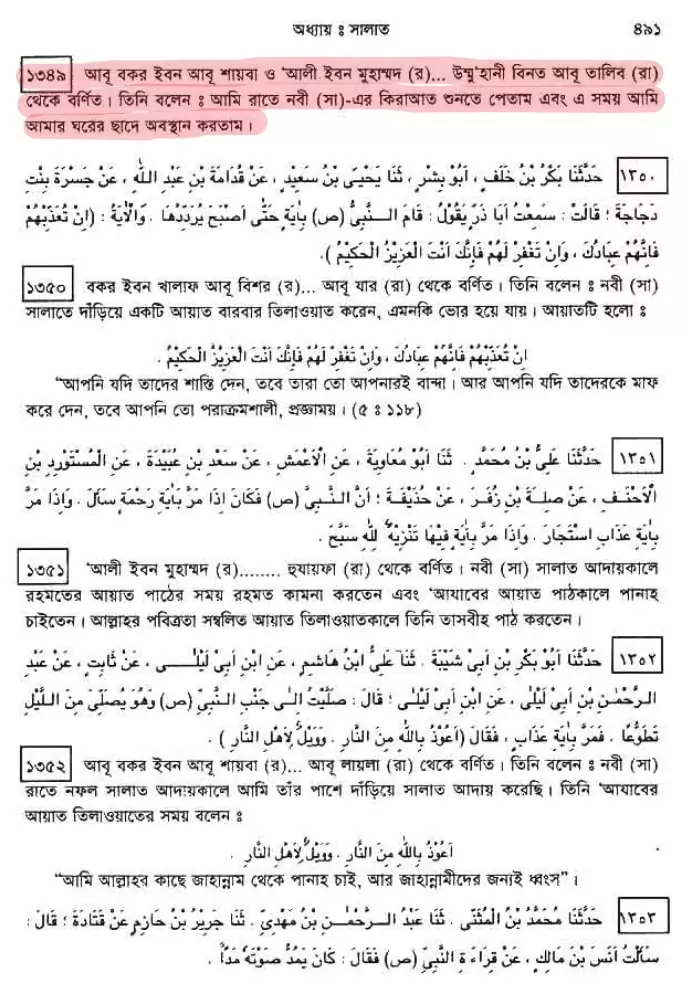
Although Muhammad and Umm Hani did not marry, did they keep their distance from one another? Did each forget the other and settle into married life? No: neither ever forgot the other. At night, Umm Hani listened intently to Muhammad’s voice. A hadith tells us that Muhammad recited the Quran in the precincts of the Kaaba at night, while Umm Hani listened from the roof of her house. Her house was only a very short distance from the Kaaba, reachable in just a few steps. In other words, although physically apart, they were not distant at heart [5] [6]:
Sunan Ibn Majah
5/ Establishing Prayer and Its Rules
Section: 5/179. Recitation in the night prayer.
1/1349. It was narrated that Umm Hani’ bint Abi Talib said: “I used to hear the Prophet (ﷺ) reciting at night when I was on the roof of my house.”
Sunan Ibn Majah 1349; Grade: Hasan (Darussalam); Book 5, Hadith 547
References in the Six Books: al-Nasa’i 1013; Ahmad 26366, 26836.
Al-Albani’s assessment: Hasan Sahih. Al-Albani’s references: Mukhtasar al-Shama’il 272.
Hadith grade: Hasan (Good)
Narrator: Umm Hani bint Abu Talib (may Allah be pleased with her)
The Deaths of Abu Talib and Khadija
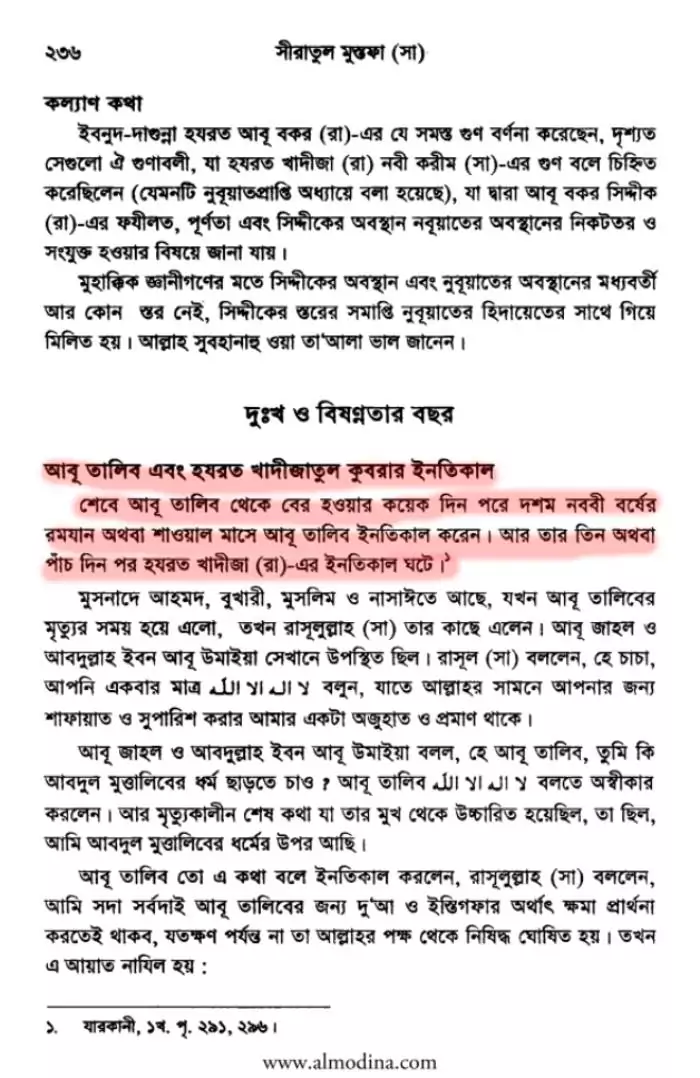
Almost all Islamic sources tell us that Muhammad’s immensely wealthy merchant wife Khadija, in whose house he lived as a resident son-in-law and through marriage to whom he became wealthy, died in 619 CE. Abu Talib died at approximately the same time. We can therefore state with considerable confidence that Muhammad’s wife Khadija was no longer alive at the time of Mi‘raj. Sirat al-Mustafa likewise states that their deaths preceded Mi‘raj [7].
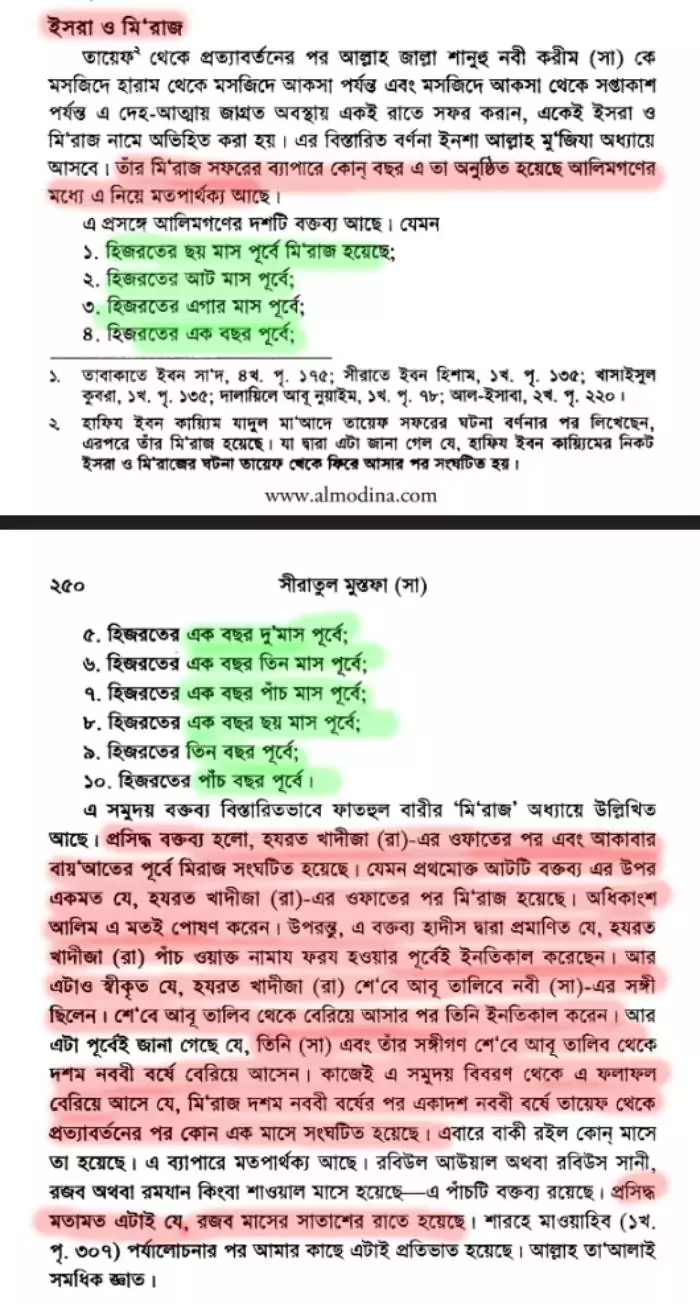
Two Marriages within a Month of Khadija’s Death
A question may naturally occur to us here: how long after Khadija’s death did Muhammad enter his second and third marriages, given that she had always supported him and that he supposedly loved her so deeply? When a beloved husband or wife dies, many of us grieve for years. During that time, another marriage does not even enter our thoughts. After years have passed and grief has diminished, some may consider marrying again. Whether there are children in the family is an important factor. Someone with children might remarry very quickly so that a new wife can provide them with maternal affection. But that could not apply to Aisha, who was herself a child. She could hardly look after other children or provide a mother’s care. Let us therefore examine how soon after Khadija’s death Muhammad married Aisha, according to researchers on Islam. The source says that he contracted two marriages within just one month [8]:
The conclusion of most researchers, supported by the greater part of the reliable reports, is that Khadija died in Ramadan in the tenth year of prophethood, three years before the Hijra, and one month later, in Shawwal, the Messenger married Aisha. Aisha was then six. On this calculation, her marriage took place in Shawwal three years before the Hijra, corresponding to May 620 CE. Ibn Abd al-Barr, author of al-Isti‘ab, supported this view. The marriage contract was thus concluded in the year of Khadija’s death, while married life began three years later, when Aisha was brought into his household at nine.
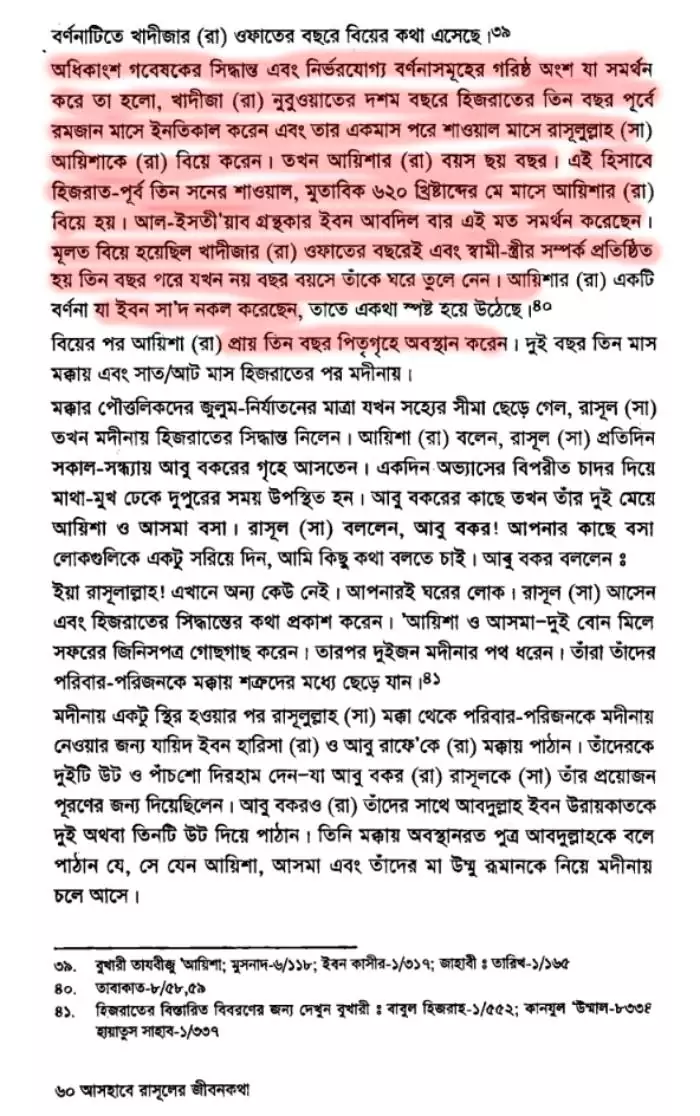
Muhammad Dreamed of the Child Aisha
Muhammad dreamed of the child Aisha before marrying her [9]. These dreams are particularly intriguing. If I dreamed about a little girl in this way—although I would not have such dreams—marrying her would never even cross my mind. I might instead think of her as my own daughter. How Muhammad concluded from this dream that Allah was commanding him to marry that little girl is itself astonishing!
Sahih al-Bukhari (Islamic Foundation)
54/ Marriage
Section: 2434. Marrying a virgin. Ibn Abi Mulayka said that Ibn Abbas (may Allah be pleased with him) told Aisha (may Allah be pleased with her), ‘The Prophet (peace be upon him) married no virgin other than you.’
4707. Ubaydullah ibn Isma‘il (may Allah have mercy on him) … Narrated `Aisha: Allah’s Messenger (ﷺ) said (to me), “You have been shown to me twice in (my) dreams. A man was carrying you in a silken cloth and said to me, ‘This is your wife.’ I uncovered it; and behold, it was you. I said to myself, ‘If this dream is from Allah, He will cause it to come true.’ “
Sahih al-Bukhari 5078; Book 67, Hadith 16
Hadith grade: Sahih (Authentic)
Narrator: Aisha (may Allah be pleased with her)
Let us now hear Mizanur Rahman Azhari’s account. Within that intervening month, Muhammad had already begun dreaming of the child Aisha. He was then forty-nine or fifty; Aisha was under six. In other words, about a week after Khadija’s death, Muhammad began dreaming of Aisha, and seeing this little girl inspired his desire to marry her. How does a man of that age look at a little girl and think of marriage or romance? And before the soil on his longtime wife’s grave has even dried? This suggests, quite plainly, that immediately after Khadija’s death Muhammad was preoccupied with marriage or driven by powerful sexual urges. Let us listen to a sermon:
The Events of the Night of Mi‘raj
A close examination shows that Muhammad’s wife Khadija was no longer alive when Mi‘raj occurred. He was undoubtedly saddened by her death. Umm Hani’s father Abu Talib had also died at about the same time. I see nothing unusual in the possibility that an old love reawakened in Muhammad under these circumstances. In sorrow and grief, people seek the company of those they love. That is human nature. Let us hear what several prominent Islamic scholars have to say:
Let us now listen to Delwar Hossain Sayeedi, the Jamaat leader and one of Bangladesh’s most famous preachers, who has long occupied a leading position in its preaching world. Only an audio recording of this sermon was available. Listen carefully: Sayeedi calls Umm Hani Muhammad’s paternal aunt. Could such a prominent scholar and preacher really be unaware that she was Muhammad’s paternal cousin? Why, then, did he call her the Prophet’s aunt? Why did he try to conceal the truth by identifying her in that way?
Abu Bakr Zakaria
Let us now consult the celebrated tafsir by the prominent Bangladeshi scholar Dr. Abu Bakr Muhammad Zakaria, a work authenticated by the Saudi government. First, watch a video explaining the reliability of his tafsir [10]:
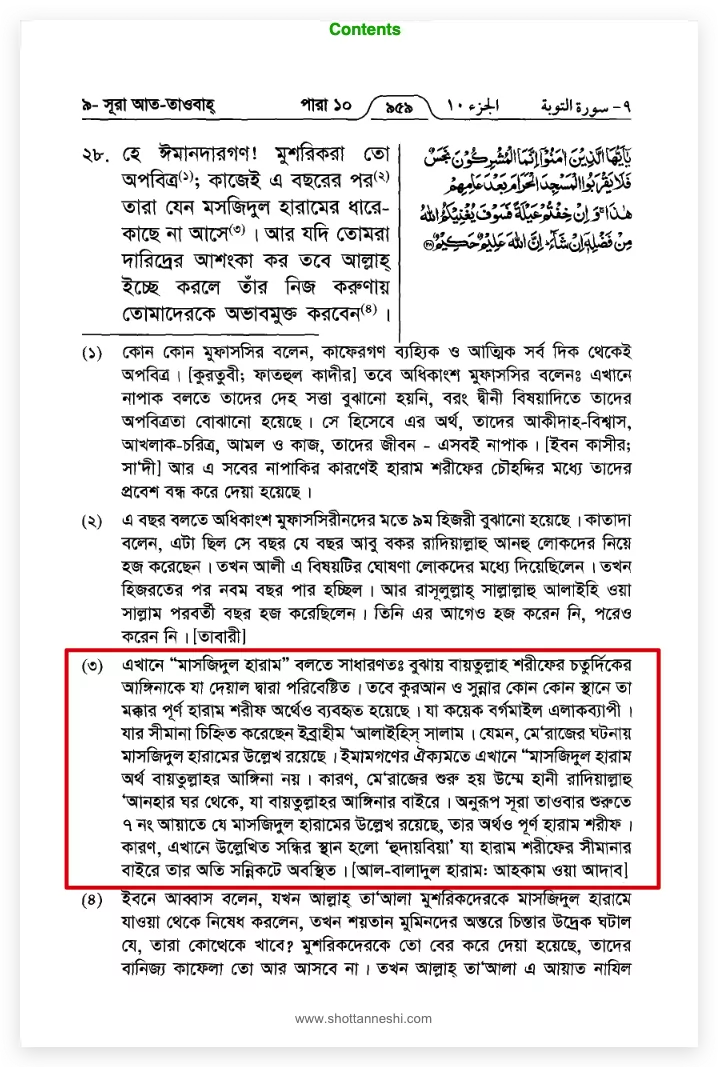
Let us examine another passage from Translation and Brief Commentary of the Quran, published under the direction and patronage of Saudi Arabia’s King Salman ibn Abd al-Aziz Al Saud. It shows Muhammad recounting the events to Umm Hani after returning from Mi‘raj [11].
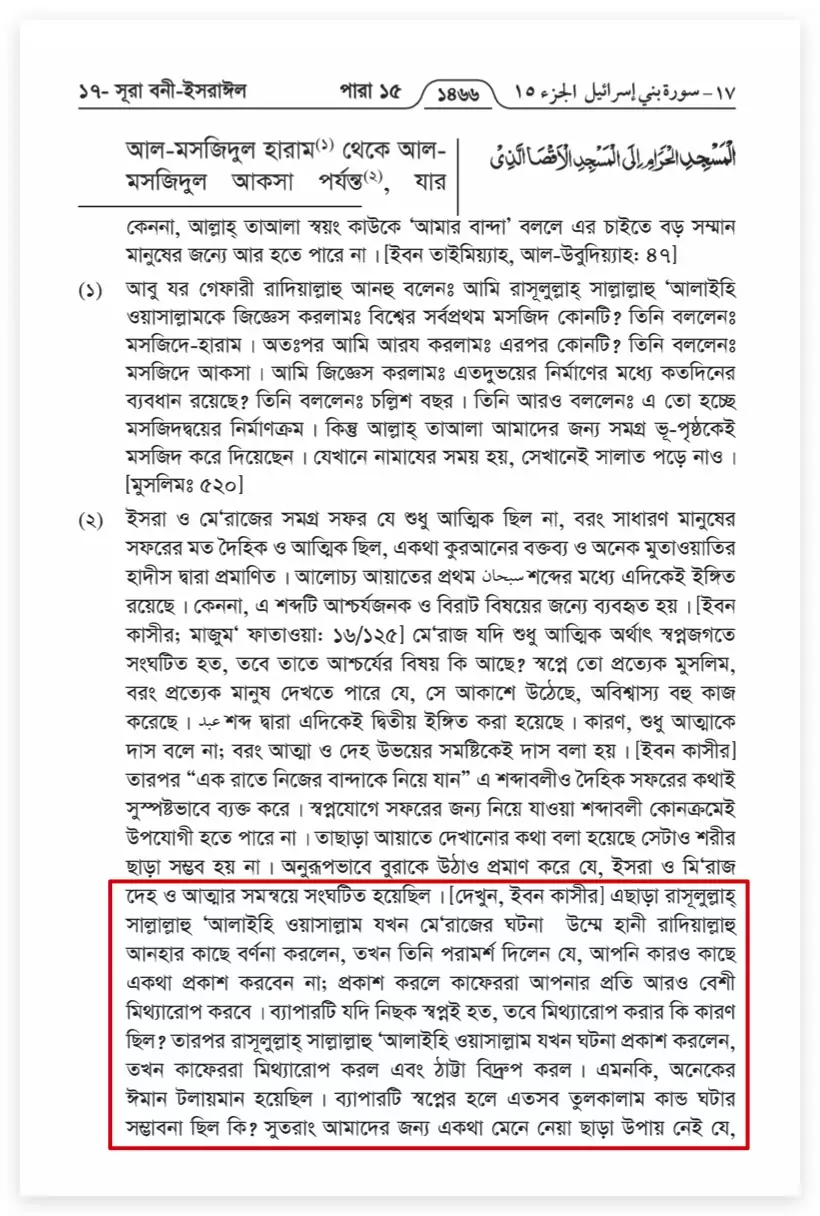
Guillaume’s The Life of Muhammad
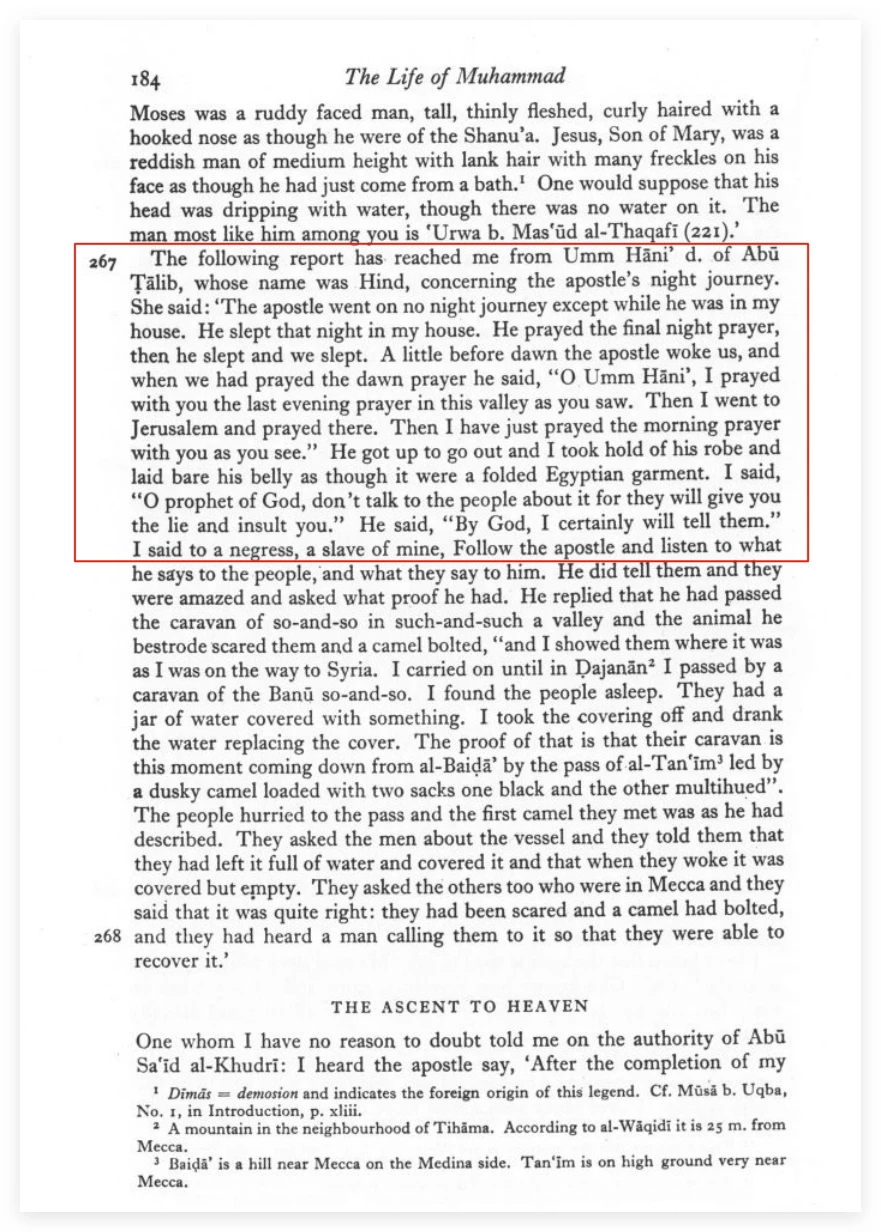
Let us read a page from Guillaume’s The Life of Muhammad, regarded as the most important sira in the Western world [12]:
The following report has reached me from Umm Hani’ d. of Abū Talib, whose name was Hind, concerning the apostle’s night journey.
She said: ‘The apostle went on no night journey except while he was in my house. He slept that night in my house. He prayed the final night prayer,
then he slept and we slept. A little before dawn the apostle woke us, and
when we had prayed the dawn prayer he said, “O Umm Häni’, I prayed
with you the last evening prayer in this valley as you saw. Then I went to Jerusalem and prayed there. Then I have just prayed the morning prayer
with you as you see.”” He got up to go out and I took hold of his robe and laid bare his belly as though it were a folded Egyptian garment. I said,
“O prophet of God, don’t talk to the people about it for they will give you
the lie and insult you.” He said, “By God, I certainly will tell them.”
I said to a negress, a slave of mine, Follow the apostle and listen to what he says to the people, and what they say to him. He did tell them and they
were amazed and asked what proof he had.
The following report has reached me from Umm Hani’ d. of Abū Talib, whose name was Hind, concerning the apostle’s night journey.
She said: ‘The apostle went on no night journey except while he was in my house. He slept that night in my house. He prayed the final night prayer, then he slept and we slept. A little before dawn the apostle woke us, and when we had prayed the dawn prayer he said, “O Umm Hani’, I prayed with you the last evening prayer in this valley as you saw. Then I went to Jerusalem and prayed there. Then I have just prayed the morning prayer with you as you see.”’
He got up to go out and I took hold of his robe and laid bare his belly as though it were a folded Egyptian garment. I said, “O prophet of God, don’t talk to the people about it for they will give you the lie and insult you.” He said, “By God, I certainly will tell them.”
I said to a negress, a slave of mine, ‘Follow the apostle and listen to what he says to the people, and what they say to him.’ He did tell them and they were amazed and asked what proof he had.
A Commentary on Sahih al-Bukhari
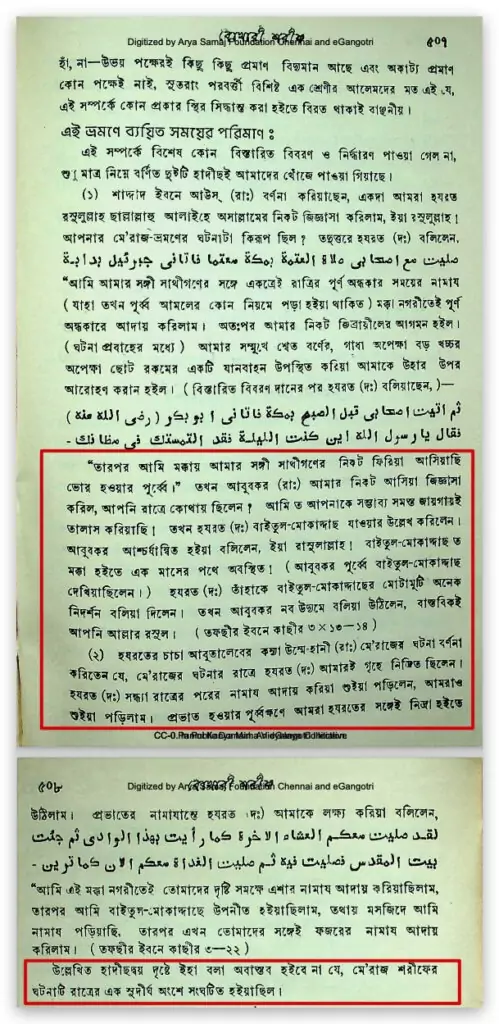
Let us now read Muhammad’s statement in a commentary on Sahih al-Bukhari. This account shows him returning to his companions shortly before dawn. Thus, he had previously been with them. After he returned, Abu Bakr asked, “Where were you during the night?” Abu Bakr had searched everywhere for Muhammad without finding him. Muhammad had therefore gone somewhere in the meantime and spent almost the entire night at that particular place. In response to Abu Bakr’s question, he said that he had visited Bayt al-Maqdis. Umm Hani’s account, by contrast, says that he came to her house, prayed there at night, and slept there. In other words, leaving Abu Bakr and the others in front of the Kaaba, Muhammad went to Umm Hani’s house, prayed, slept—or did whatever he did and then went to sleep. Before dawn, he returned to Abu Bakr and the others and said that he had visited Bayt al-Maqdis. Examine these two accounts [13].
“Then I returned to my companions in Mecca before dawn.” Abu Bakr approached me and asked, “Where were you during the night? I searched every likely place for you.” The Prophet then mentioned his journey to Bayt al-Maqdis. Astonished, Abu Bakr said, “Messenger of Allah! Bayt al-Maqdis is a month’s journey from Mecca.” Abu Bakr had previously seen Bayt al-Maqdis. The Prophet described many of its general features. With renewed conviction, Abu Bakr exclaimed, “You are indeed Allah’s Messenger.” (Tafsir Ibn Kathir 3013–14)
(2) Umm Hani, daughter of the Prophet’s uncle Abu Talib, recounted Mi‘raj as follows: “On the night of Mi‘raj, the Prophet was sleeping in my own house. After performing the late-evening prayer, he lay down, and we also lay down. Just before daybreak, together with the Prophet, we awoke from sleep…”
Tafsir Ibn Kathir
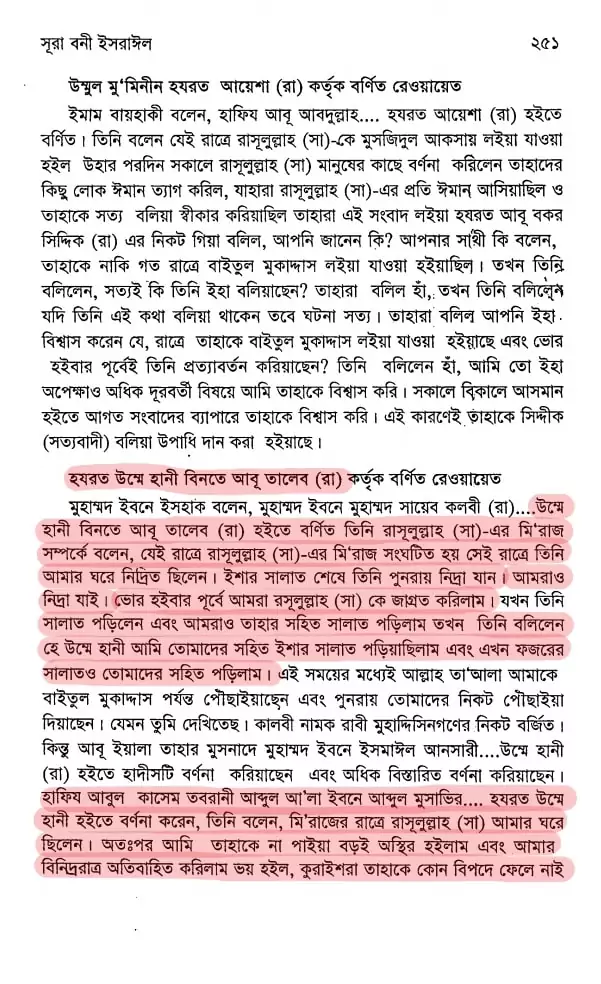
Let us see what Tafsir Ibn Kathir says. Before examining it, let us hear a statement by the prominent Bangladeshi scholar Dr. Abu Bakr Muhammad Zakaria [14].
The report narrated by Umm Hani bint Abi Talib: Muhammad ibn Ishaq states that Muhammad ibn Muhammad Sa’ib al-Kalbi… narrated from Umm Hani bint Abi Talib, who said concerning the Messenger’s Mi‘raj: “On the night when the Messenger’s Mi‘raj occurred, he was asleep in my house. After the Isha prayer, he went to sleep again, and we also slept. Before dawn, we awakened the Messenger. When he had prayed and we had prayed with him, he said, ‘Umm Hani, I prayed Isha with you, and now I have also prayed Fajr with you. During this interval, Allah took me to Bayt al-Maqdis and returned me to you, as you see.’” The narrator al-Kalbi is rejected by hadith scholars. Abu Ya‘la, however, narrated this hadith in his Musnad through Muhammad ibn Isma‘il al-Ansari… from Umm Hani, with greater detail. Hafiz Abu al-Qasim al-Tabarani narrates through Abd al-A‘la ibn Abd al-Musawwir… from Umm Hani, who said, “On the night of Mi‘raj, the Messenger was in my house. When I could not find him, I became greatly distressed and passed the night without sleep, fearing that the Quraysh had placed him in danger…”
Tafsir Mazhari
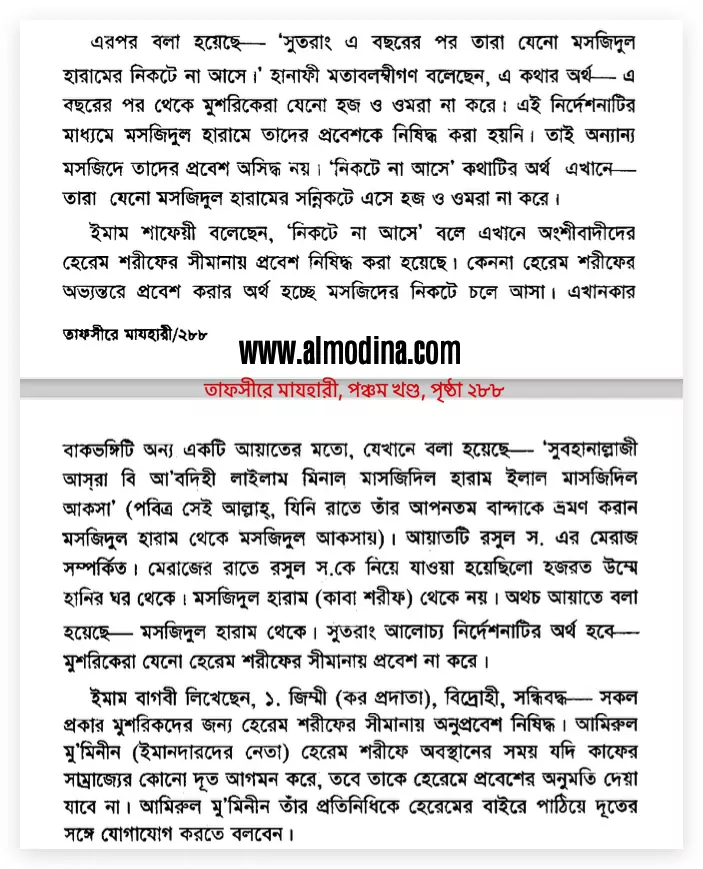
The same account appears in Tafsir Mazhari [15]:
…The expression resembles another verse: “Subhanalladhi asra bi-‘abdihi laylan min al-masjid al-haram ila al-masjid al-aqsa”—“Glory be to the One Who took His servant ˹Muḥammad˺ by night from the Sacred Mosque to the Farthest Mosque” (Quran 17:1, Dr. Mustafa Khattab, The Clear Quran; excerpt). The verse concerns the Messenger’s Mi‘raj. On that night, he was taken from Umm Hani’s house, rather than al-Masjid al-Haram, the Kaaba. Yet the verse says, “from the Sacred Mosque.” The instruction under discussion must therefore mean that polytheists should not enter the boundaries of the sacred precinct.
Let us read further in Tafsir Mazhari [16]:
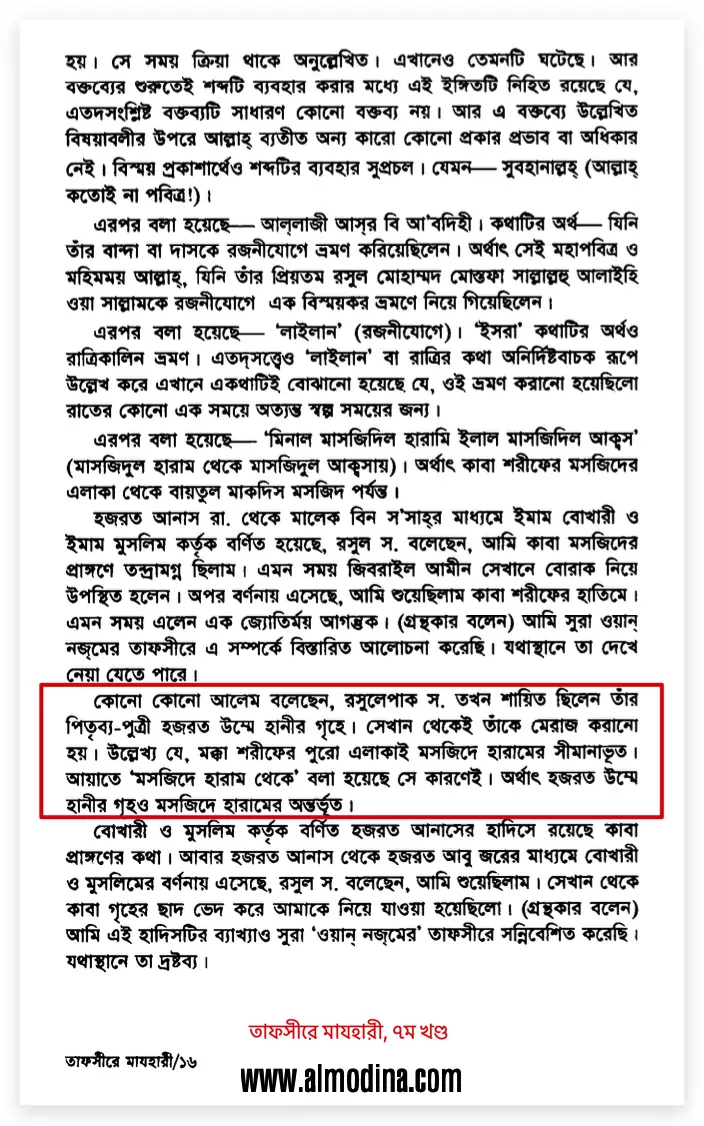
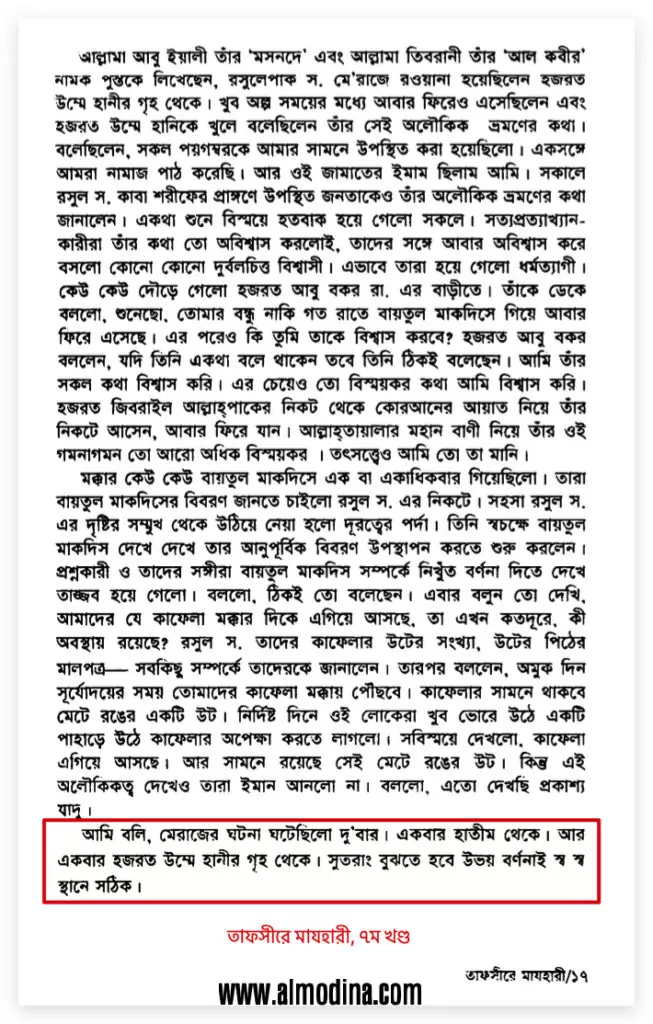
Some scholars say that the noble Messenger was then lying in the house of his paternal cousin Umm Hani, and Mi‘raj began there. The whole of Mecca falls within the boundaries of al-Masjid al-Haram, which explains the verse’s wording, “from al-Masjid al-Haram.” Umm Hani’s house is thus also included within it.
I say that Mi‘raj occurred twice: once from the Hatim and once from Umm Hani’s house. Both accounts must therefore be understood as correct in their respective contexts.
Tafsir al-Jalalayn
The same account is given in Tafsir al-Jalalayn [17]:
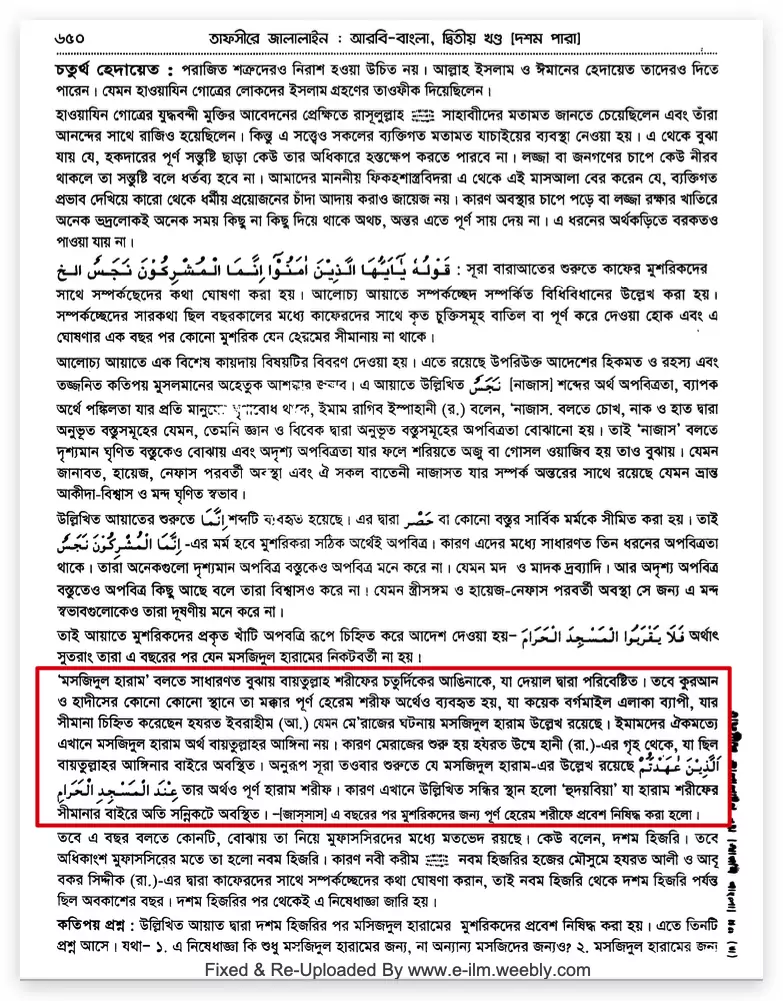
Al-Masjid al-Haram ordinarily means the walled courtyard surrounding the Sacred House. In some Quranic and hadith passages, however, it refers to Mecca’s entire sacred precinct, covering several square miles, whose boundaries Abraham marked. One example is its mention in the Mi‘raj account. The imams agree that al-Masjid al-Haram here does not mean the courtyard of the Sacred House, because Mi‘raj began at Umm Hani’s house outside it. Likewise, al-Masjid al-Haram near the beginning of Surah al-Tawba—الَّذِينَ عُهَدْتُمْ عِندَ الْمَسْجِدِ الْحَرَامِ—means the entire sacred precinct. The treaty mentioned here was concluded at Hudaybiyya, immediately outside its boundaries. —Al-Jassas] After this year, polytheists were forbidden to enter the entire sacred precinct.
Tafsir Ma‘arif al-Quran
The same account also appears in Tafsir Ma‘arif al-Quran, written by the prominent Pakistani Islamic scholar Mawlana Muhammad Shafi [18].
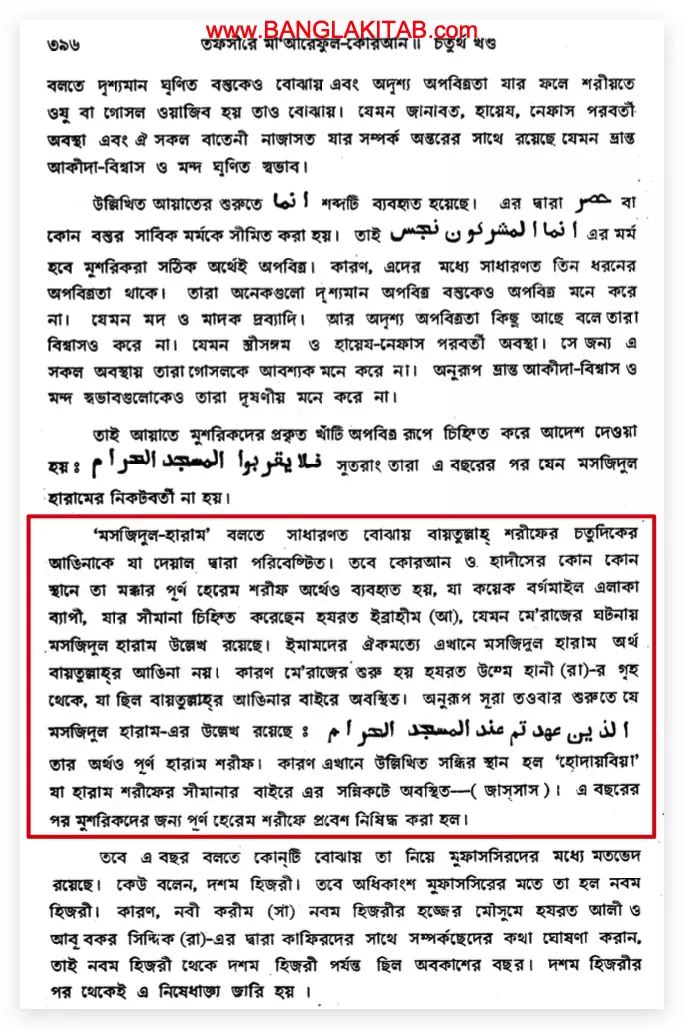
Al-Masjid al-Haram ordinarily means the walled courtyard surrounding the Sacred House. In some Quranic and hadith passages, however, it refers to Mecca’s entire sacred precinct, covering several square miles, whose boundaries Abraham marked. One example is its mention in the Mi‘raj account. The imams agree that it does not mean the Sacred House’s courtyard here, because Mi‘raj began at Umm Hani’s house outside it. Likewise, al-Masjid al-Haram near the beginning of Surah al-Tawba—الذين عهد تم عند المسجد الحرام—means the entire sacred precinct. The treaty mentioned here was concluded at Hudaybiyya, immediately outside and close to its boundaries. —Al-Jassas. After this year, polytheists were forbidden to enter the entire sacred precinct.
Mukhtasar Zad al-Ma‘ad
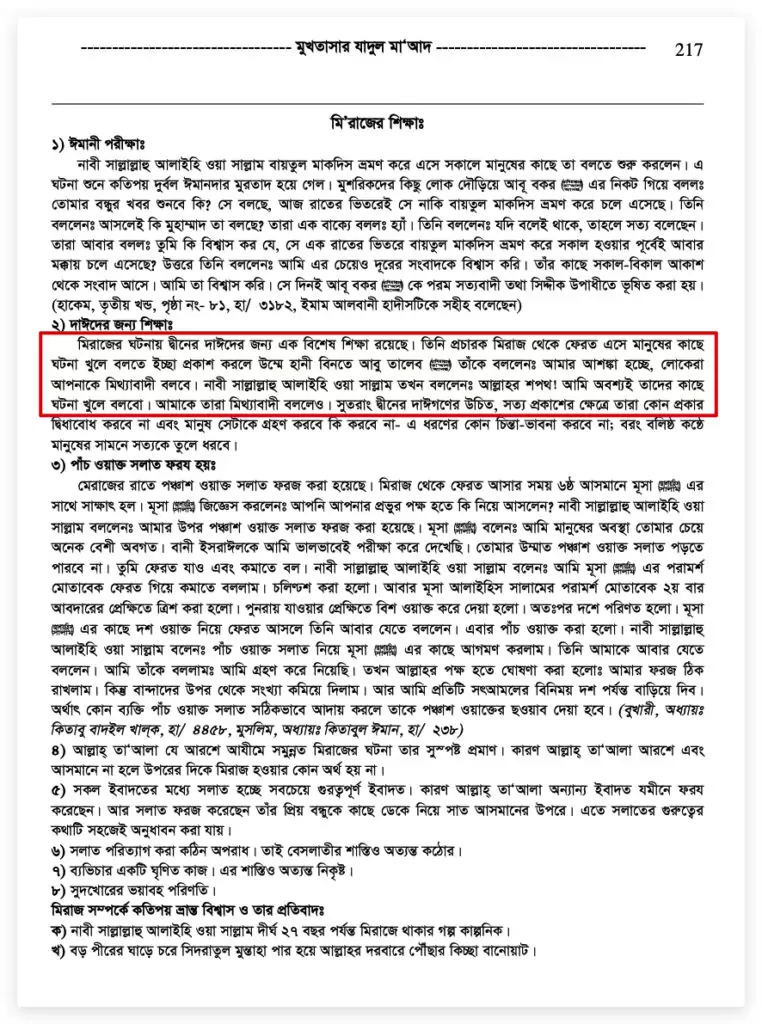
Let us examine evidence from Imam Ibn al-Qayyim’s Mukhtasar Zad al-Ma‘ad. It shows Muhammad meeting Umm Hani after returning from Mi‘raj and first describing the event to her [19]:
Mi‘raj contains a particular lesson for those who call people to religion. When the Messenger returned and wished to recount it publicly, Umm Hani bint Abi Talib said, “I fear that people will call you a liar.” The Prophet replied, “By Allah! I will certainly tell them what happened, even if they call me a liar.” Those who call people to religion should therefore, in proclaiming the truth, show no…
Sirat Rasul Allah: Ibn Ishaq
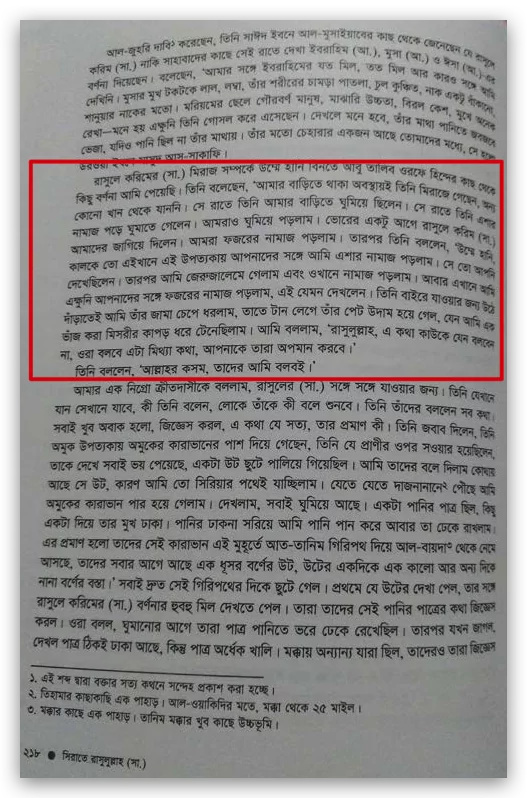
Let us examine the account in Sirat Rasul Allah, published by Prothoma Prokashon [20].
I received several accounts concerning the noble Messenger’s Mi‘raj from Umm Hani bint Abi Talib, also called Hind. She said, “He undertook Mi‘raj while staying in my house, not from anywhere else. He slept in my house that night. After performing Isha, he went to sleep, and we also slept. Shortly before dawn, the Messenger awakened us. We prayed Fajr. He then said, ‘Umm Hani, yesterday I prayed Isha with you here in this valley, as you saw. Then I went to Jerusalem and prayed there. Now I have just prayed Fajr with you here, as you have seen.’ As he stood to leave, I caught his garment; the pull exposed his abdomen, as though I had pulled on a folded Egyptian cloth. I said, ‘Messenger of Allah, do not tell anyone this. They will call it a lie and insult you.’ He replied, ‘By Allah, I will certainly tell them.’”
Sirat al-Nabi: Ibn Hisham
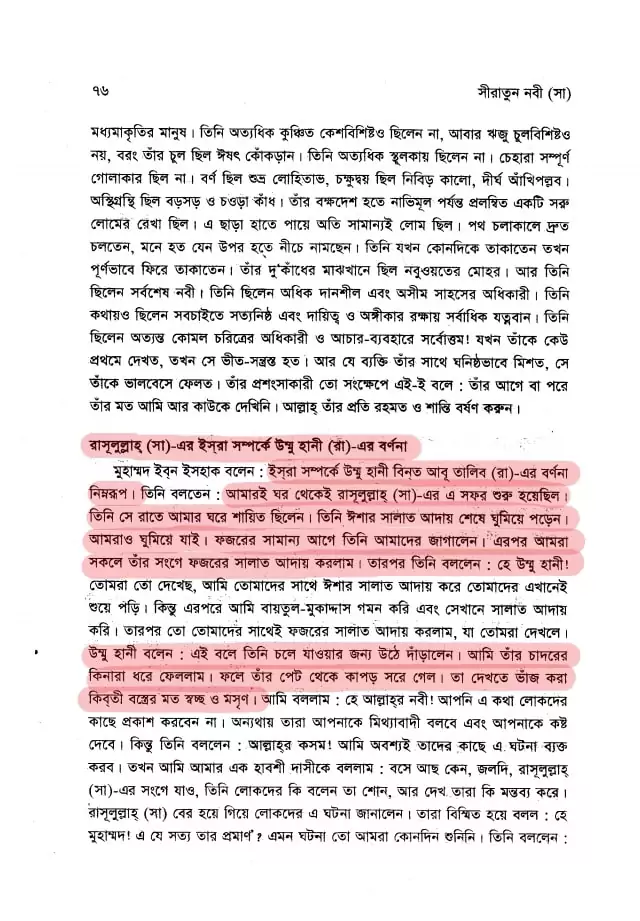
Let us see what Ibn Hisham’s Sirat al-Nabi says [21].
Umm Hani’s Account of the Messenger’s Isra
Muhammad ibn Ishaq states: Umm Hani bint Abi Talib’s account of Isra is as follows.
She used to say: “This journey of the Messenger began from my own house. He was lying in my house that night. After performing Isha, he fell asleep, and we also slept. Shortly before Fajr, he awakened us. We all prayed Fajr with him. Then he said, ‘Umm Hani! You saw me perform Isha with you and lie down here. Afterward, however, I went to Bayt al-Maqdis and prayed there. Then I prayed Fajr with you, as you saw.’”
Umm Hani says: “After saying this, he stood to leave. I caught the edge of his cloak, uncovering his abdomen. It looked clear and smooth, like folded Coptic cloth. I said, ‘Prophet of Allah! Do not disclose this to people, or they will call you a liar and hurt you.’ He replied, ‘By Allah! I will certainly tell them.’ I then told an Abyssinian slave woman of mine, ‘Why are you sitting there? Hurry, accompany the Messenger, listen to what he tells people, and see how they respond.’ The Messenger went out and told them. Astonished, they asked, ‘Muhammad! What proof is there that this is true? We have never heard of anything like it.’ He said:”
Tafsir Ibn Abbas
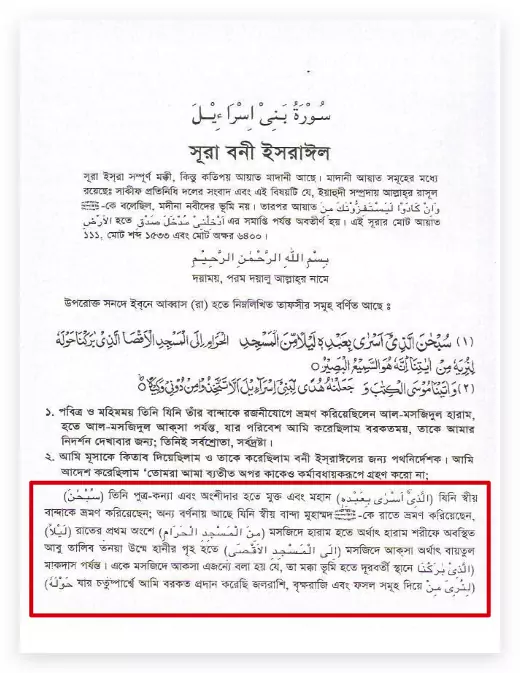
Let us read part of a page from Tafsir Ibn Abbas [22]:
…He is exalted and free from children and partners. الذي أسرى بعبده (“Who took His servant”; another account specifies His servant Muhammad, by night), during the first part of the night, منَ الْمَسْجِد الحرام (“from the Sacred Mosque,” meaning the house of Abu Talib’s daughter Umm Hani within the sacred precinct), إلى المسجد الأقصى (“to the Farthest Mosque,” meaning Bayt al-Maqdis). It is called al-Masjid al-Aqsa because it lies far from Mecca. الَّذِى بَرَكْنَا )حول (“whose surroundings We have blessed,” with water, trees, and crops) لنرى من… (Quran 17:1; Dr. Mustafa Khattab, The Clear Quran.)
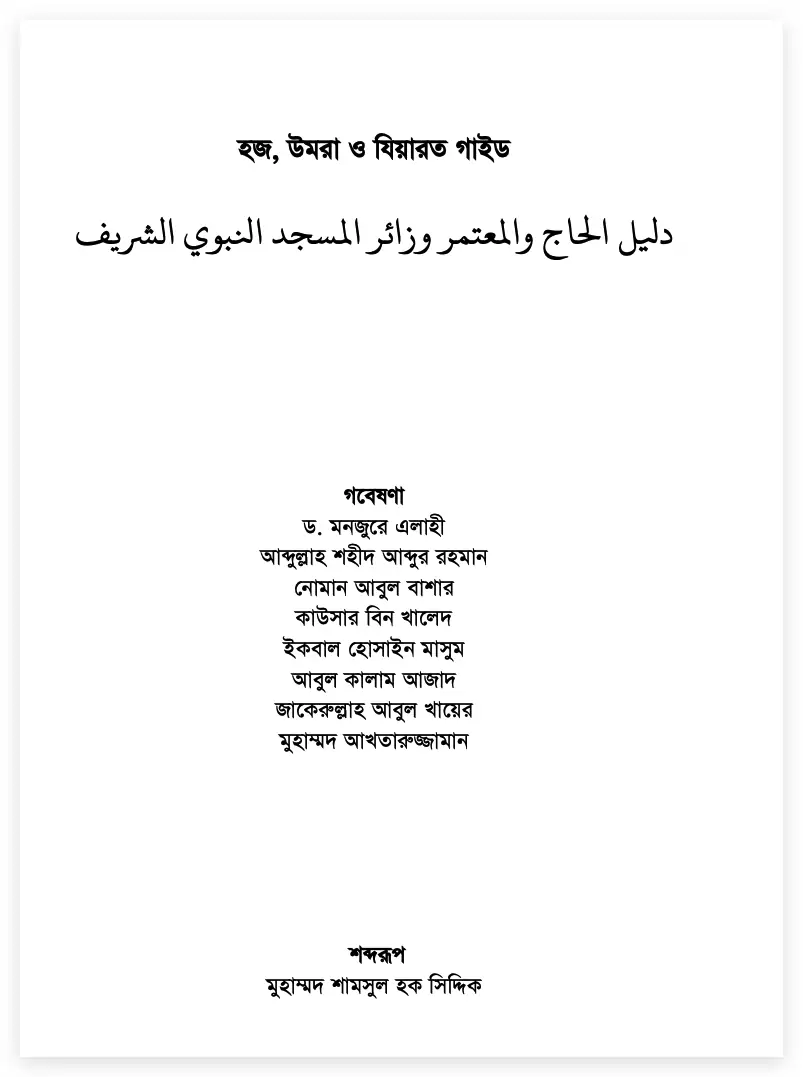
The Saudi Government’s Hajj and Umrah Guide
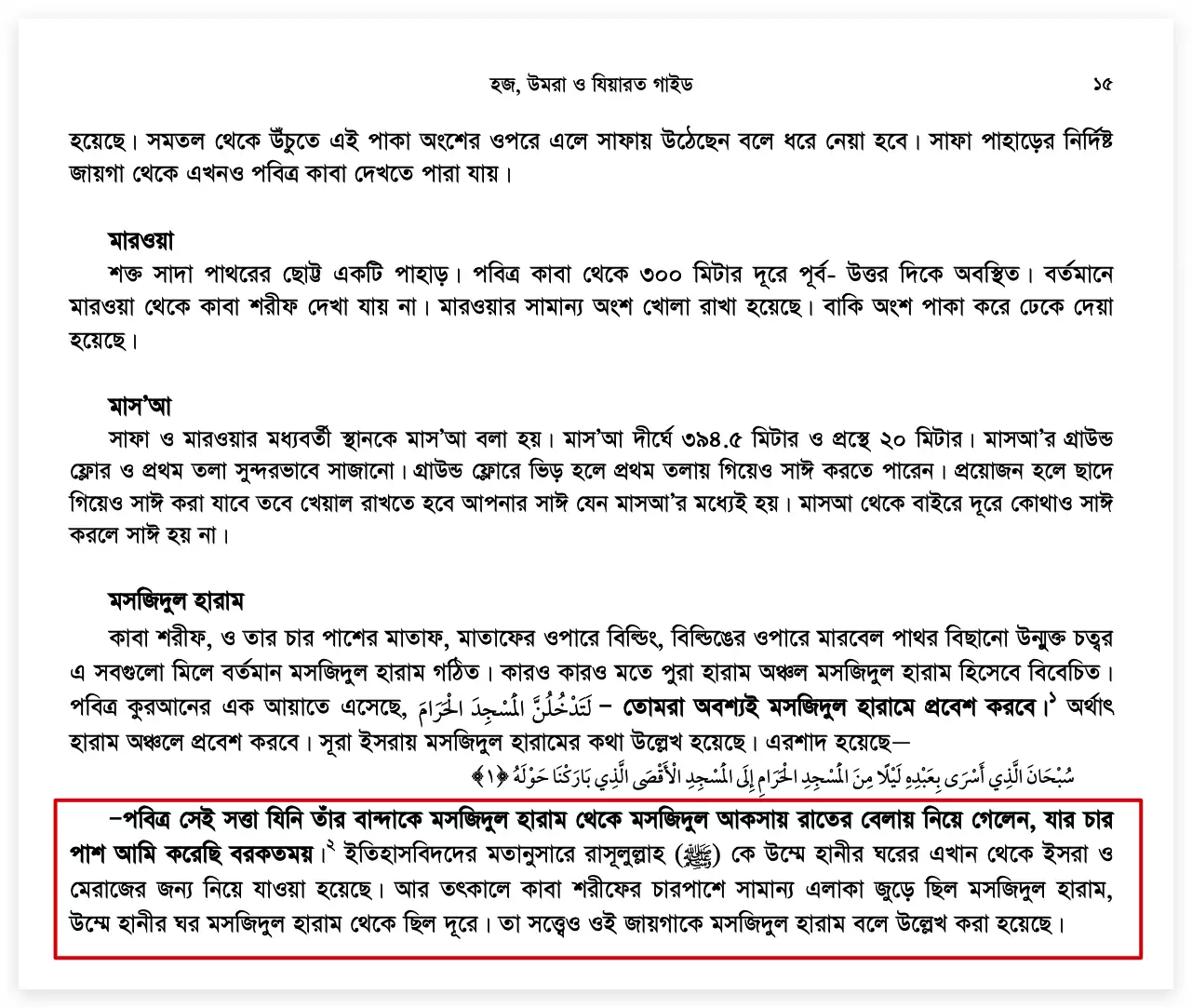
Let us examine the Guide to Hajj, Umrah, and Visitation, published by the Saudi government for free distribution [23]:
Research
Dr. Manzur-e-Elahi
Abdullah Shahid Abdur Rahman
Noman Abul Bashar
Kawsar ibn Khalid
Iqbal Hossain Masum
Abul Kalam Azad
Zakerullah Abul Khair
Muhammad Akhtaruzzaman
“Glory be to the One Who took His servant ˹Muḥammad˺ by night from the Sacred Mosque to the Farthest Mosque whose surroundings We have blessed” (Quran 17:1, Dr. Mustafa Khattab, The Clear Quran; excerpt). According to historians, the Messenger ﷺ was taken from this location, Umm Hani’s house, for Isra and Mi‘raj. At that time, al-Masjid al-Haram occupied only a small area around the Kaaba, while her house stood some distance away. Nevertheless, that location is also referred to as al-Masjid al-Haram.
Fath al-Bari: Ibn Hajar al-Asqalani’s Commentary
Let us see what the distinguished hadith scholar Ibn Hajar al-Asqalani, author of the famous Bukhari commentary Fath al-Bari, says about Muhammad’s whereabouts on the night of Mi‘raj [24].
Most copies title the chapter “Bab al-Mi‘raj,” while al-Nasafi’s version calls it “The Account of Mi‘raj.” Mi‘raj derives from the root ‘araja, meaning to rise or ascend. There is extensive disagreement over its date. Some say it occurred before prophethood. This uncommon view might be acceptable if understood as Mi‘raj in a dream. Most scholars place it after prophethood, but disagree considerably about the date. Ibn Sa‘d and al-Nawawi, for example, place it one year before the Hijra. Ibn Hazm even claimed consensus, but that claim is incorrect: more than ten opinions exist. Ibn al-Jawzi reports dates of eight months and six months before the Hijra. Ibn Hazm’s account places it in Rajab, twelve years after prophethood. Ibrahim al-Harbi places it in Rabi‘ al-Thani, one year before the Hijra. Ibn Abd al-Barr, Ibn Faris, al-Suddi, and al-Waqidi offer different views: eighteen months, three years, or five years before the Hijra. Al-Zuhri, Qadi Iyad, al-Qurtubi, and others regard five years earlier as strongest. They argue that Khadija prayed with Muhammad after prayer became obligatory, that she died several years before the Hijra, and that prayer became obligatory on the night of Mi‘raj.
Ibn Hajar al-Asqalani challenges these arguments, pointing to sharp disagreement over Khadija’s death: seven years before the Hijra, four years before it, or even in the year of the Hijra itself. There is also disagreement over the institution of obligatory prayer. Some say that two rak‘as in the morning and two in the evening existed from the beginning of prophethood, while the five daily prayers became obligatory on the night of Isra. Aisha reports that Khadija died before the five daily prayers became obligatory. The two positions can thus be reconciled by distinguishing the initial rak‘a prayers from the five daily prayers. Khadija therefore died before Isra and Mi‘raj.
In the hadith itself, Anas ibn Malik reports that Malik ibn Sa‘sa‘a told him about the night of Mi‘raj. Malik ibn Sa‘sa‘a was an Ansari from Banu al-Najjar; no one except Anas narrated from him. Muhammad says, “I was lying in the Hatim”; Qatada sometimes says, “in the Hijr.” Although the precise areas designated by Hatim and Hijr were previously disputed, the purpose here is simply to identify the location. Another report through al-Zuhri states, “The roof of my house was opened while I was in Mecca.” A chain through al-Waqidi says Isra began from Shi‘b Abi Talib. Umm Hani’s account says, “He spent the night in my house; during the night I could not find him; he said Gabriel had come.”
Ibn Hajar al-Asqalani reconciles these accounts by concluding that Muhammad slept that night in Umm Hani’s house, in Shi‘b Abi Talib. When he says, “The roof of my house was opened,” he calls it his house because he was staying there. The angel descended through its opened roof, brought him out, and took him to al-Masjid al-Haram. There he lay drowsily; he was then brought to the mosque’s door and mounted on Buraq. This reconciliation is supported by al-Hasan al-Basri’s mursal report, in which Gabriel takes Muhammad from the house to the mosque and mounts him on Buraq. Scholars say that the angel’s descent through the opened roof signifies the event’s sudden, miraculous beginning and announces the journey to the higher world.
Then comes the opening of the chest: “I was between sleep and wakefulness.” Afterward, he is mounted on Buraq while fully awake. Ibn Abi Jamra says Muhammad’s sleep and wakefulness have equal standing: his eyes slept but his heart did not, and he used the precise wording to preserve the account’s truthfulness.
The lengthy narrative then describes Buraq, the ascent through the heavens, and meetings with different prophets in each—Adam, Jesus, John, Joseph, Idris, Aaron, Moses, and Abraham—followed by Sidrat al-Muntaha, its fruit, leaves, and light; four heavenly rivers, two of which appear on Earth as the Nile and Euphrates; Bayt al-Ma‘mur; and three vessels containing milk, wine, and water or honey. He chooses milk, prompting the declaration, “This is the fitra.”
Finally comes obligatory prayer: initially fifty daily prayers. Moses repeatedly advises returning to request a reduction; Muhammad returns and obtains it. Ultimately, five daily prayers are established, with a reward equal to fifty. Muhammad says, “Now I feel ashamed; I am content and submit.” Allah declares, “I have maintained My obligation and made things easier for My servants.”
Thus ends the entire account of Mi‘raj, discussing in detail its date, the passage from Umm Hani’s house to al-Masjid al-Haram, the heavens, scenes of Paradise and Hell, and the institution of obligatory prayer.
Hadith Methodology: Multiple Weak Reports and Hasan li-Ghayrihi
Many modern Islamic apologists try to dismiss accounts of Muhammad staying in Umm Hani’s house on the night of Mi‘raj as “fabrications” or “atheist propaganda.” These claims are weak by academic and classical standards. As shown above, many distinguished hadith scholars and historians included this account in their works. A hadith cannot be called “fabricated” simply because one dislikes it; for a report to qualify as fabricated, its narrator must be a proven liar (kadhdhab). Several further considerations must also be taken into account here.
History versus Legal Rulings
A fundamental principle of hadith methodology is that the strictness applied to establishing beliefs or determining what sharia permits and prohibits is not applied in the same way to history (tarikh) or sira. Many leading hadith scholars, including Imam Ahmad ibn Hanbal, considered weak (da‘if) hadith acceptable in historical accounts. Imam Ahmad ibn Hanbal and other distinguished scholars, such as Ibn al-Mahdi and Ibn al-Mubarak, explicitly stated that they scrutinized narrators very strictly when the subject concerned lawful and unlawful conduct or legal rulings. When it concerned virtues (fada’il), stories (qisas), or sira (history), however, they exercised some leniency. Imam Ahmad’s famous statement is:
“When we narrate from the Messenger concerning what is lawful, unlawful, Sunna, and legal rulings, we are strict regarding chains of transmission. When we narrate from him concerning the virtues of deeds, or matters that neither establish nor invalidate a ruling, we exercise leniency regarding those chains.” [25]
The overnight stay in Umm Hani’s house is a historical event, not a legal ruling or a question of creed. Weak hadith sources concerning it are therefore historically significant and admissible.
The Principle of Hasan li-Ghayrihi in Hadith Scholarship
Even if, for the sake of argument, these reports are considered weak, Islamic scholarly principles do not require their outright rejection. Under hadith methodology, a weak hadith transmitted through several different chains of narrators may be elevated from da‘if to hasan li-ghayrihi—acceptable because of corroborating reports. A hasan li-ghayrihi hadith is also admissible as evidence in Islamic law; legal rulings may therefore be derived from it. Explanations of this principle state that several weak chains, taken together, strengthen the hadith’s substantive content [26].
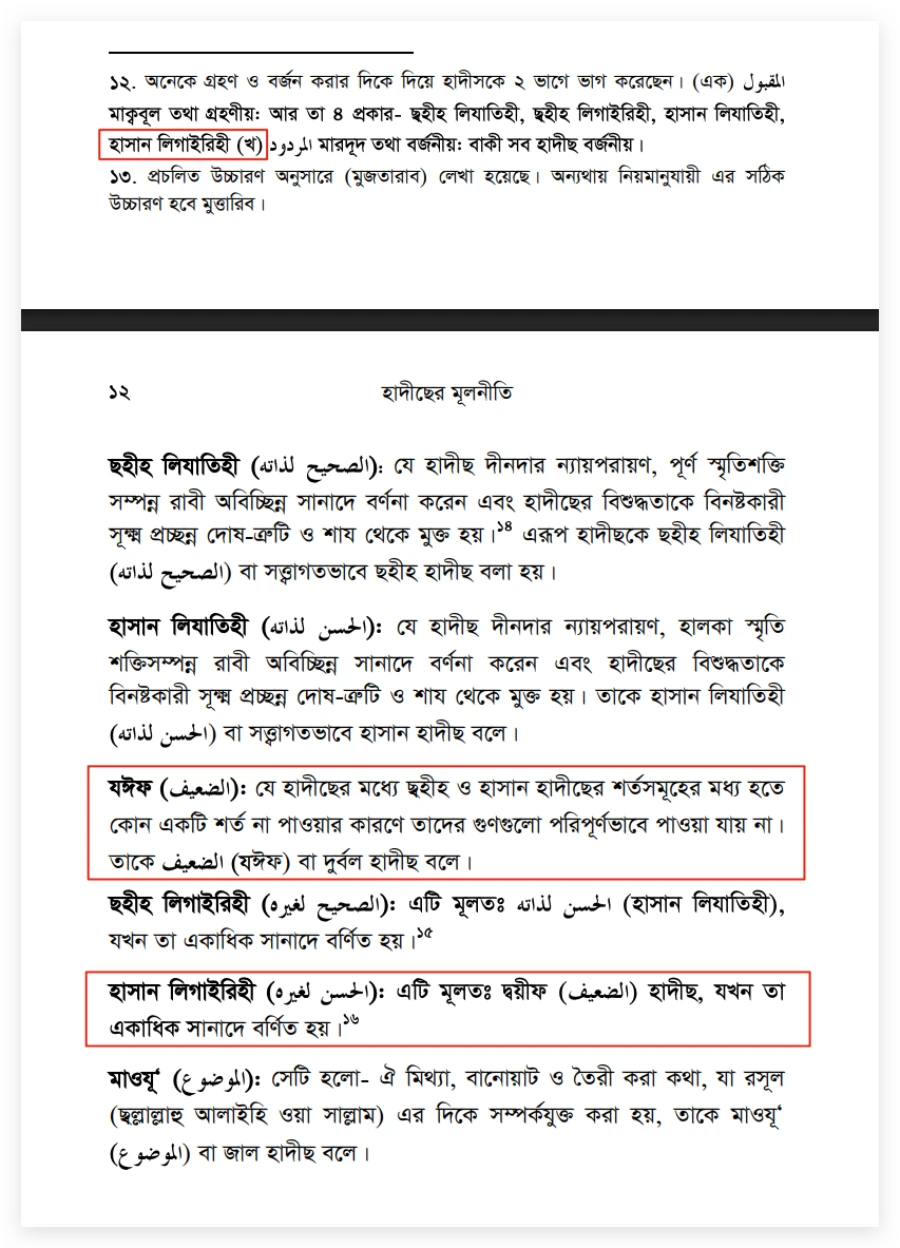
Muhammad’s presence in Umm Hani’s house cannot therefore be dismissed on emotional grounds. When multiple historical sources and the principle of hasan li-ghayrihi support this account, calling it “fabricated” without adequate evidence reveals ignorance of the scholarly discipline. The leniency exercised by hadith scholars in accepting weak reports for historical purposes is a well-established principle of hadith scholarship.
Muhammad Missing on the Night of Mi‘raj: His Family Was Searching for Him
Placed alongside Umm Hani’s statement, another account makes the events of that night still more mysterious. Islamic tradition itself preserves a report stating that Muhammad could not be found that night, and members of Banu Abd al-Muttalib dispersed in search of him. “Where was Muhammad actually staying on the night of Mi‘raj?” is therefore not a question invented by a modern atheist. Anxiety about his absence and the search for him already appear within Islam’s early accounts.
An account preserved through Ibn Sa‘d states:
“فتفرقت بنو عبد المطلب يطلبونه حين فقد يتلمسونه”
When they could not find him, the people of Banu Abd al-Muttalib dispersed to search for him and discover his whereabouts.
Muhammad’s uncle al-Abbas ibn Abd al-Muttalib then searched for him as far as Dhu Tuwa. There he called out, “Muhammad! Muhammad!” When Muhammad answered, Abbas asked directly, “Nephew, you have kept your people worried all night; where were you?” Muhammad replied that he had come from Bayt al-Maqdis. Astonished, Abbas asked again, “In this one night?” Muhammad answered, “Yes.”
[27]
Here, however, the account becomes explosive: the next part of the same narrative sequence presents Umm Hani’s statement:
“ما أسري به إلا من بيتنا، نام عندنا تلك الليلة”
“His Isra began nowhere except our house; he slept with us that night.”
She further says that Muhammad prayed Isha with them and fell asleep in their house; he was awakened before Fajr; after the Fajr prayer, he told Umm Hani that in the meantime he had traveled to Bayt al-Maqdis, prayed there, and returned. The same account is preserved in al-Suyuti’s al-Durr al-Manthur, in its commentary on the first verse of Surah al-Isra [28] [29].
Original Arabic
إِمَام فَقَدَّمَنِي جِبْرِيل عليه السلام حَتَّى صليت بَين أَيْديهم وسألتهم فَقَالُوا: بعثنَا بِالتَّوْحِيدِ
وَقَالَ بَعضهم: فقد النَّبِي صلى الله عليه وسلم تِلْكَ اللَّيْلَة فتفرقت بَنو عبد الْمطلب يطلبونه يلتمسونه وَخرج الْعَبَّاس رضي الله عنه حَتَّى إِذا بلغ ذَا طوى فَجعل يصْرخ يَا مُحَمَّد يَا مُحَمَّد فَأَجَابَهُ رَسُول الله صلى الله عليه وسلم لبيْك لبيْك فَقَالَ: ابْن أخي أعييت قَوْمك مُنْذُ اللَّيْلَة فَأَيْنَ كنت قَالَ: أتيت من بَيت الْمُقَدّس قَالَ: فِي ليلتك قَالَ: نعم
قَالَ: هَل أَصَابَك إِلَّا خير قَالَ: مَا أصابني إِلَّا خير
وَقَالَت أم هَانِئ رضي الله عنها: مَا أسرِي بِهِ إِلَّا من بيتنا بَينا هُوَ نَائِم عندنَا تِلْكَ اللَّيْلَة صلى الْعشَاء ثمَّ نَام فَلَمَّا كَانَ قبل الْفجْر أنبهناه للصبح فَقَامَ فصلى الصُّبْح
قَالَ: يَا أم هَانِئ لقد صليت مَعكُمْ الْعشَاء كَمَا رَأَيْت بِهَذَا الْوَادي ثمَّ قد جِئْت بَيت الْمُقَدّس فَصليت بِهِ ثمَّ صليت الْغَدَاة مَعكُمْ ثمَّ قَامَ ليخرج فقت لَا تحدث هَذَا النَّاس فيكذبوك ويؤذوك
فَقَالَ: وَالله لأحدثنهم فَأخْبرهُم فتعجبوا وَقَالُوا لم نسْمع بِمثل هَذَا قطّ
وَقَالَ رَسُول الله صلى الله عليه وسلم لجبريل عليه السلام: يَا جِبْرِيل إِن قومِي لَا يصدقوني قَالَ: يصدقك أَبُو بكر وَهُوَ الصّديق
وافتتن نَاس كثير وَضَلُّوا كَانُوا قد أَسْلمُوا وَقمت فِي الْحجر فجلا الله لي بَيت الْمُقَدّس فطفقت أخْبرهُم عَن آيَاته وَأَنا أنظر إِلَيْهِ فَقَالَ بَعضهم: كم لِلْمَسْجِدِ من بَاب – وَلم أكن عددت أبوابه – فَجعلت أنظر إِلَيْهَا وأعدها بَابا وأعلمهم وَأَخْبَرتهمْ عَن عير لَهُم فِي الطَّرِيق وعلامات فِيهَا فوجدوا ذَلِك كَمَا أَخْبَرتهم
وَأنزل الله (وَمَا جعلنَا الرُّؤْيَا الَّتِي أريناك إِلَّا فتْنَة للنَّاس) قَالَ: كَانَت رُؤْيا عين رَآهَا بِعَيْنِه
وَأخرج أَحْمد وَعبد بن حميد وَالتِّرْمِذِيّ وَابْن جرير وَابْن مرْدَوَيْه وَأَبُو نعيم وَالْبَيْهَقِيّ كِلَاهُمَا فِي الدَّلَائِل عَن أنس رضي الله عنه أَن النَّبِي صلى الله عليه وسلم أَتَى بِالْبُرَاقِ لَيْلَة أسرِي بِهِ مسرجاً مُلجمًا ليركبه فاستصعب عَلَيْهِ فَقَالَ لَهُ جِبْرِيل عليه السلام: أبمحمد صلى الله عليه وسلم تفعل هَذَا فوَاللَّه مَا ركبك خلق أكْرم على الله مِنْهُ
قَالَ: فأرفضّ عرقاً
وَأخرج ابْن مرْدَوَيْه عَن عَمْرو بن شُعَيْب عَن أَبِيه عَن جده قَالَ: أسرِي بِالنَّبِيِّ صلى الله عليه وسلم لَيْلَة سبع عشرَة من شهر ربيع الأول قبل الْهِجْرَة بِسنة
وَأخرج الْبَيْهَقِيّ فِي الدَّلَائِل عَن ابْن شهَاب رضي الله عنه قَالَ: أسرِي برَسُول الله صلى الله عليه وسلم إِلَى بَيت الْمُقَدّس قبل خُرُوجه إِلَى الْمَدِينَة بِسِتَّة عشر شهرا
English Tafsir
I was chosen as imam; Gabriel, peace be upon him, brought me forward, and I led them in prayer. I then asked about the purpose for which they had been sent. They replied, “We were sent with the message of tawhid, the oneness of God.” Some of them say: the Prophet could not be found that night, so the people of Banu Abd al-Muttalib dispersed in search of him. Abbas went out and reached Dhu Tuwa, where he called loudly, “Muhammad!
Muhammad!” The Messenger replied, “Here I am! Here I am!” Abbas said, “Nephew! You have exhausted your people with worry all night. Where were you?” He replied, “I have come from Bayt al-Maqdis.” Abbas asked, “In this one night?” He answered, “Yes.” Abbas asked, “Has any harm befallen you?” He replied, “Nothing but good has happened to me.” Umm Hani says: his Isra, or night journey, began from our house.
That night, while staying with us, he performed Isha and then slept. Shortly before Fajr, we awakened him for the morning prayer. He rose and prayed Fajr, then said, “Umm Hani! As you saw, I prayed Isha with you in this valley. Then I went to Bayt al-Maqdis and prayed there, and now I have again prayed Fajr with you.” He then stood to leave. I said, “Do not tell people this, because they will call you a liar and hurt you.” He replied, “By Allah!
I will certainly tell them.” He informed them, and they were astonished, saying, “We have never heard of anything like this.” The Messenger told Gabriel, “Gabriel! My people will not believe me.” Gabriel replied, “Abu Bakr will believe you; he is al-Siddiq.” Many people were put to the test and went astray, although they had accepted Islam. I stood in the Hijr, the Kaaba’s Hatim, and Allah made Bayt al-Maqdis visible before me. Looking at its features, I described them to the people.
Some asked, “How many doors does the mosque have?” I had not previously counted them, so I looked at them, counted them one by one, and told the questioners. I also informed them about a caravan of theirs on the road and its distinguishing features. They subsequently found everything exactly as I had described. Allah revealed: “And We have made what We brought you to see … only as a test for the people” (Quran 17:60, Dr. Mustafa Khattab, The Clear Quran; excerpt). Ibn Abbas said that this was an actual sight seen with his own eyes. Ahmad, Abd ibn Humayd, al-Tirmidhi, Ibn Jarir, Ibn Mardawayh, Abu Nu‘aym, and al-Bayhaqi—the latter two in their Dala’il works—narrated from Anas that, on the night of Isra, a saddled and bridled Buraq was brought for Muhammad to mount.
It resisted him. Gabriel said, “Do you behave this way with Muhammad? By Allah! No creature more honored before Allah has ever ridden you.” The narrator says that it then broke into a sweat from shame and fear. Ibn Mardawayh narrates through Amr ibn Shu‘ayb, from his father, from his grandfather, that the Prophet’s Isra occurred on the night of the seventeenth of Rabi‘ al-Awwal, one year before the Hijra. Al-Bayhaqi narrates in al-Dala’il from Ibn Shihab that the Messenger’s Isra to Bayt al-Maqdis occurred sixteen months before his migration toward Medina.
On one side, Muhammad’s own clan and family are searching for him throughout the night. His uncle Abbas is so concerned that he goes as far as Dhu Tuwa, calls him by name, and subsequently asks directly, “Where were you all night?” On the other, Umm Hani says that Muhammad was in her house that night, prayed Isha with her, slept there, and was there again at Fajr.
Placed together, these two facts raise an entirely natural question: If Muhammad was openly spending the night at Umm Hani’s house as an ordinary visit, why did his own family not know his whereabouts? Why did they have to search everywhere as though he were missing?
Another point must be kept carefully in mind. Ibn Sa‘d’s lengthy account combines several sources; the original explicitly states, “دخل حديث بعضهم في بعض”—the statements of different narrators have been interwoven. Among these sources is Muhammad ibn Umar al-Waqidi, considered weak in hadith criticism. This is therefore not being presented, according to Islamic standards, as a single, uninterrupted eyewitness hadith on the level of Sahih al-Bukhari. That does not, however, make the historical problem disappear. The significant point is that early Islamic sira tradition itself preserves, within the same Mi‘raj episode, accounts of Muhammad’s disappearance, his family’s search for him, and his overnight stay in Umm Hani’s house. Later Muslim scholars, including al-Suyuti and al-Dhahabi, also retained this account in their works. An investigation of Mi‘raj therefore involves more than asking, “Could someone travel to Jerusalem in one night?” An earlier and far more fundamental question is: When Muhammad’s own people could not find him that night, where was he actually staying? And why does Umm Hani’s testimony provide the clearest earthly location for that missing night?
Where Was Umm Hani’s Husband That Night?
Many Islamic apologists claim that Umm Hani’s husband, Hubayra ibn ‘Amr ibn ‘A’idh al-Makhzumi, was also with her on the night of Mi‘raj or Isra. They point to her use of “we” in the account and infer that her husband was not away that night. Supposedly, Umm Hani, her husband, and Muhammad were all praying together! Yet another account tells us that her husband fled the country in fear of Muhammad, as will be discussed later. The question is: a man who invited Muhammad home to pray at night with himself and his wife would surely not flee the country in terror of him after the conquest of Mecca, would he? More importantly, most sources state that Umm Hani accepted Islam after the conquest of Mecca [30]. Why, then, would they have been praying together while Muhammad was still in Mecca before the Hijra? Umm Hani was not even Muslim that night. If they were not praying, what were they doing at night? The accounts simply do not add up. Let us read them:
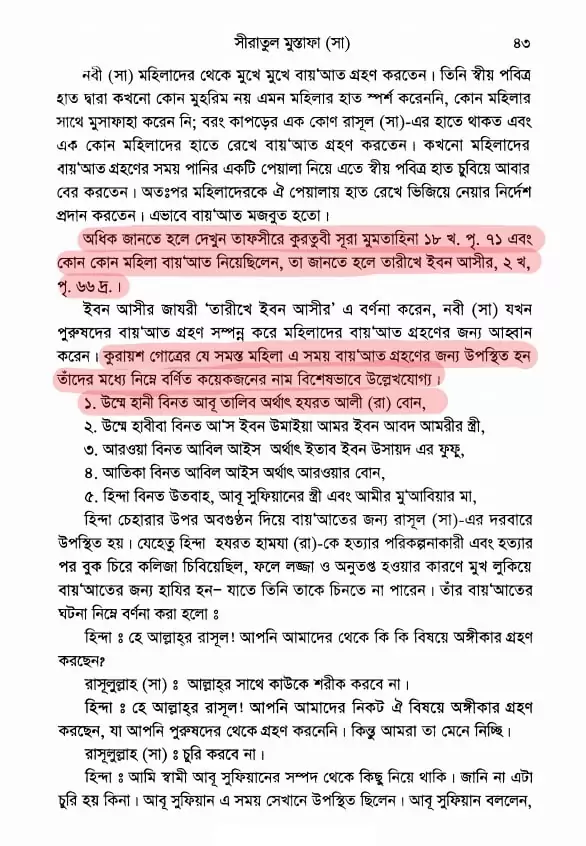
For further information, see Tafsir al-Qurtubi, Surah al-Mumtahana, Volume Eighteen, p. 71. For the women who pledged allegiance, see Tarikh Ibn al-Athir, Volume Two, p. 66.
Ibn al-Athir al-Jazari relates in Tarikh Ibn al-Athir that, after taking the men’s allegiance, Muhammad called the women to pledge. Among the Quraysh women who appeared, the following names are particularly noteworthy:
1. Umm Hani bint Abi Talib, Ali’s sister;
2. Umm Habiba bint al-‘As ibn Umayya, wife of Amr ibn Abd Amr;
3. Arwa bint Abi al-‘Is, paternal aunt of Attab ibn Usayd;
4. Atika bint Abi al-‘Is, Arwa’s sister;
The Sound of Bilal’s Footsteps in Paradise
Let us read a strange hadith. Anyone familiar with Islamic faith and doctrine knows that Allah created human beings to test them. After death, people face punishment in their graves; afterward, they will be judged in Allah’s presence on the plain of Resurrection. Those obedient to Allah will enter Paradise, while the disobedient will enter Hell. That judgment takes place at the Resurrection, after the destruction of the universe. Yet this hadith describes the footsteps of a living person being heard in Paradise. It is both strange and highly significant. Muhammad said that he heard the sound of Bilal’s shoes ahead of him in Paradise [31].
Mishkat al-Masabih (Mishkat)
Part 4: Prayer
Section: 39. First subsection — Voluntary prayers
The various voluntary prayers established from the Prophet (peace and blessings be upon him) include the prayer following ablution, the prayer for guidance, the prayer of repentance, the prayer for a need, and the prayer of glorification.
The word التَّطَوُّعِ derives from الطوع، والطاعة, meaning to obey, carry out or comply. التَّطَوُّعِ applies generally to all voluntary acts beyond those that are obligatory or necessary. Someone who performs additional righteous deeds beyond the obligatory or necessary duties is called a مُتَطَوِّعِ.
1322 Abu Huraira reported that God’s Messenger said to Bilal at the dawn prayer, “Tell me, Bilal, of the action you have done since becoming a Muslim which is most calculated to cause hope in you, for I heard the sound of your sandals in front of me in paradise.” He replied, “I have done no action more calculated, in my opinion to cause hope than that I have never performed ablution at any hour of the night or day without immediately praying what was ordained for me to pray.” (Bukhari and Muslim.)
Mishkat al-Masabih 1322; Book 4, Hadith 731
[1] Sahih: al-Bukhari 1149; Muslim 2458; Irwa’ 464; Sahih al-Targhib 226; Ahmad 8403; Ibn Khuzayma 1208.
Hadith grade: Sahih (Authentic)
- Muhammad had not yet become an inhabitant of Paradise. When, precisely, did he go there? Apart from the night of Mi‘raj, we know of no such occasion.
- Bilal had not yet died, nor had the Resurrection occurred. How, then, could his footsteps be heard in Paradise?
- Could Muhammad have been enjoying heavenly pleasure in some earthly room while Bilal stood guard at the door? Did he actually hear Bilal’s footsteps while enjoying a blissful experience—or ultimate pleasure?
Let us listen to a sermon on this subject:
A Description of Muhammad’s Body
As Muhammad prepared to leave on the night of Isra, Umm Hani caught and pulled a corner of his cloak, exposing part of his abdomen. Describing its beauty, she said it resembled folded Egyptian Coptic cloth. Islamic scholars are best placed to explain how Islamic it is for a virtuous believing woman, a Companion and hadith narrator, to see part of a non-mahram man’s body, admire it, and describe its beauty [32] [21].
Even his wives provide no such description of the beauty of his bare abdomen. Only Umm Hani praised it so effusively. She saw it on more than one occasion and also praised his smile. Umm Hani used to say, “I have never seen anyone with a more beautiful smile than Allah’s Messenger. Whenever I saw Allah’s Messenger’s abdomen, I would be reminded of it. On the day of the conquest of Mecca, I saw his hair arranged in four braids.” [33]
This description of his braids also appears in an authentic hadith.
Sahih Shama’il al-Tirmidhi
Chapter: 3. The hair of the Messenger of Allah (ﷺ)
Section: He wore his hair in braids
26. Narrated Umm Hani: “The Messenger of Allah (ﷺ) arrived in Makkah, and he had four braids.”
[Abu ‘Eisa said:] This Hadith is Gharib. Muhammad said: “I do not know of Mujahid (a narrator) hearing from Umm Hani.”
(Musnad Ahmad, hadith 27430; al-Tabarani, al-Mu‘jam al-Kabir, hadith 20483.)
Jami` at-Tirmidhi 1781; Grade: Da’if (Darussalam); Book 24, Hadith 69
Hadith grade: Sahih
Narrator: Umm Hani bint Abu Talib (may Allah be pleased with her)
Her Husband’s Flight in Fear of Muhammad
Umm Hani’s husband fled the country in fear of Muhammad. He left Mecca for Najran. On hearing that his wife had accepted Islam, he composed a poem rebuking her. Parts of it appear in various sira works. In the following lines, he explains to his wife why he fled Mecca [34].
“By your life! I did not turn my back on Muhammad and his companions and flee out of cowardice or fear of being killed. Rather, I considered my situation carefully and realized that my arrows and sword would not suffice in this battle. I remained firm in my decision. But when I feared that my position would become untenable, I withdrew as a tiger returns to its cubs.”
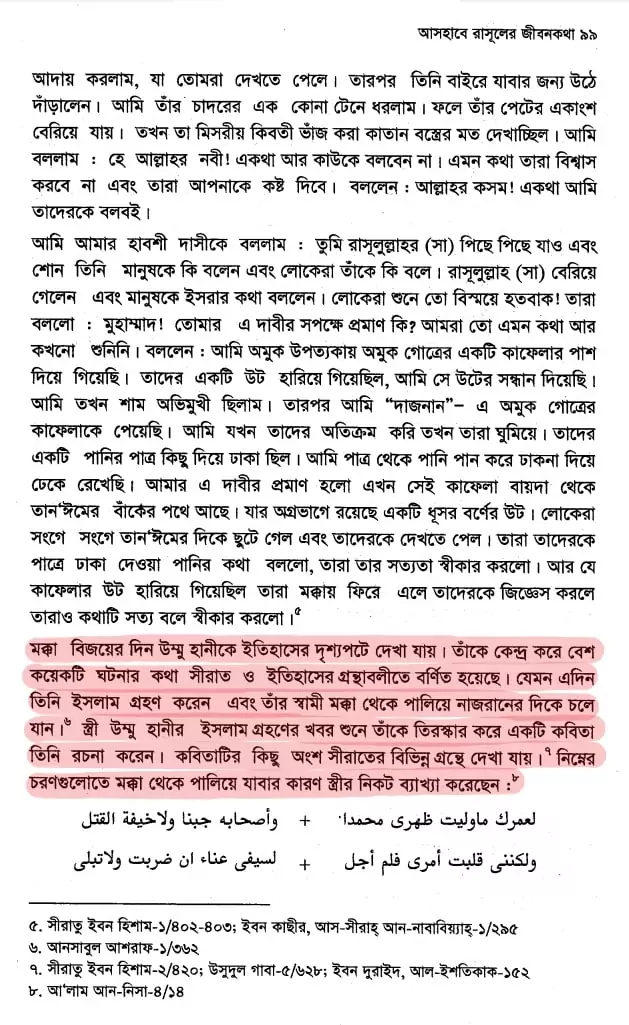
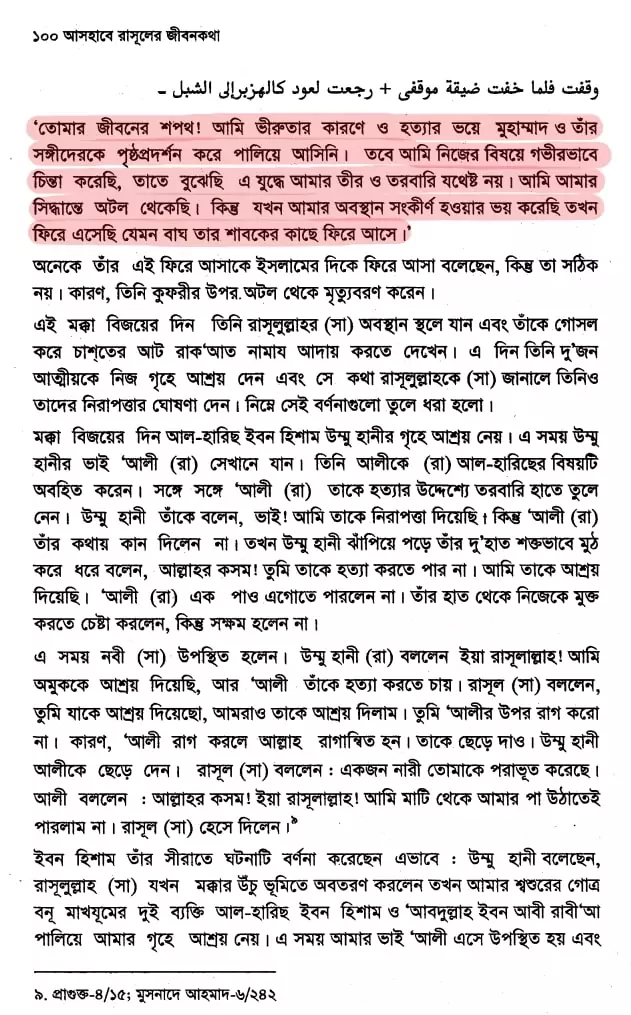
Yet at a single word from Umm Hani on the day of the conquest, Muhammad pardoned several polytheists whom Ali had been about to kill. We can confidently say that he would also have pardoned her husband and granted him protection. Why her husband nevertheless had to flee for his life is therefore remarkable. The pages from The Lives of the Prophet’s Companions reproduced above make this clear.
Sunan Abu Dawud (Verified Edition)
Chapter: 9/ Jihad
Section: 167. Protection granted by a woman
2763. Ibn ‘Abbas said “Umm Hani daughter of Abu Talib told me that in the year of the conquest she gave protection to a man from the polytheists. She came to the Prophet (ﷺ) and mentioned it to him. He said “We have given security to those to whom you have given it.”
Sunan Abi Dawud 2763; Book 15, Hadith 287
(1). Sahih.
Hadith grade: Sahih (Authentic)
Narrator: Umm Hani bint Abu Talib (may Allah be pleased with her)
One question remains: who were the polytheists whom Umm Hani sheltered? They were two brothers of her husband, Hubayra ibn ‘Amr ibn ‘A’idh al-Makhzumi—her brothers-in-law—named Abdullah ibn Abi Rabi‘a al-Makhzumi and al-Harith ibn Hisham. The famous Islamic historian Muhammad ibn Umar al-Waqidi gives a detailed account of that day. Although Imam al-Shafi‘i, Imam Abu Dawud, Imam Ahmad ibn Hanbal, and Ibn Hajar al-Asqalani acknowledged his immense knowledge, they also criticized him on various grounds. His account is therefore not quoted here. Interested readers may purchase and read The Life of Muhammad: Al-Waqidi’s Kitab al-Maghazi for themselves.
Honoring Umm Hani’s Request
At Umm Hani’s request, Muhammad prevented the killing of several polytheists whom Ali had resolved to kill [35] [36].
Sahih al-Bukhari (Islamic Foundation)
Chapter: 8/ Prayer
Section: 245. Praying wrapped in a single garment.
350. Isma‘il ibn Abu Uways (may Allah have mercy on him) …. Narrated Abu Murra: (the freed slave of Um Hani) Um Hani, the daughter of Abi Talib said, “I went to Allah’s Messenger (ﷺ) in the year of the conquest of Mecca and found him taking a bath and his daughter Fatima was screening him. I greeted him. He asked, ‘Who is she?’ I replied, ‘I am Um Hani bint Abi Talib.’ He said, ‘Welcome! O Um Hani.‘ When he finished his bath he stood up and prayed eight rak`at while wearing a single garment wrapped round his body and when he finished I said, ‘O Allah’s Messenger (ﷺ) ! My brother has told me that he will kill a person whom I gave shelter and that person is so and so the son of Hubaira.’ The Prophet (ﷺ) said, ‘We shelter the person whom you have sheltered.’ ” Um Hani added, “And that was before noon (Duha).
Sahih al-Bukhari 357; Book 8, Hadith 9
Hadith grade: Sahih (Authentic)
Narrator: Umm Hani bint Abu Talib (may Allah be pleased with her)
Sahih al-Bukhari (Islamic Foundation)
Chapter: 48/ Jihad
Section: 1969. Protection and refuge granted by women
2947. Abdullah ibn Yusuf (may Allah have mercy on him) … Narrated Um Hani: the daughter of Abu Talib: I went to Allah’s Messenger (ﷺ) on the day of the conquest of Mecca and found him taking a bath, and his daughter Fatima was screening him. I greeted him and he asked, “Who is that?” I said, “I, Um Hani bint Abi Talib.” He said, “Welcome, O Um Hani.” When he had finished his bath, he stood up and offered eight rak`at while dressed in one garment. I said, “O Allah’s Messenger (ﷺ)! My brother `Ali has declared that he will kill a man to whom I have granted asylum. The man is so and-so bin Hubaira.” Allah’s Messenger (ﷺ) said, “O Um Hani! We will grant asylum to the one whom you have granted asylum.” (Um Hani said, “That (visit) took place in the Duha (i.e. forenoon)).
Sahih al-Bukhari 3171; Book 58, Hadith 13
Hadith grade: Sahih (Authentic)
Narrator: Umm Hani bint Abu Talib (may Allah be pleased with her)
That Love Endured into Old Age
Muhammad did not love Umm Hani only in his youth; that love endured into old age. Even after growing old, he again proposed marriage to her. By then he possessed immense wealth and influence, with numerous wives and a harem of slave women. Even then, however, Umm Hani declined his proposal.
Sahih Muslim (Hadith Academy)
Chapter: 45. The virtues of the Companions (may Allah be pleased with them)
Section: 49. The virtues of Quraysh women
6353-(…/…) Muhammad ibn Rafi‘ and Abd ibn Humayd (may Allah have mercy on them) ….. Abu Huraira reported that Allah’s Messenger (ﷺ) gave a proposal of marriage to Umm Hani, the daughter of Abu Talib, whereupon she said: Allah’s Messenger, I am of an advanced age with a (large) family. Thereupon Allah’s Messenger (ﷺ) said: The best women are those who ride (the camels) ; the rest of the hadith is the same but with this difference that, instead of the word Ar’a the word Ahna has been used (and the complete sentence is like this): That they treat children in their childhood with affection.
(Islamic Foundation 6229; Islamic Centre 6277)
Sahih Muslim 2527 d; Book 44, Hadith 288
Hadith grade: Sahih (Authentic)
Narrator: Abu Hurayra (may Allah be pleased with him)
Sahih Muslim (Islamic Foundation)
Chapter: 46/ The virtues of the Companions (may Allah be pleased with them)
Section: 49. The virtues of Quraysh women
6229. Muhammad ibn Rafi‘ and Abd ibn Humayd (may Allah have mercy on them) … Abu Huraira reported that Allah’s Messenger (ﷺ) gave a proposal of marriage to Umm Hani, the daughter of Abu Talib, whereupon she said: Allah’s Messenger, I am of an advanced age with a (large) family. Thereupon Allah’s Messenger (ﷺ) said: The best women are those who ride (the camels) ; the rest of the hadith is the same but with this difference that, instead of the word Ar’a the word Ahna has been used (and the complete sentence is like this): That they treat children in their childhood with affection. أَحْنَاهُ عَلَى وَلَدٍ فِي صِغَرِهِ
Sahih Muslim 2527 d; Book 44, Hadith 288
Hadith grade: Sahih (Authentic)
Narrator: Abu Hurayra (may Allah be pleased with him)
Notice that in the hadith, while proposing marriage, Muhammad describes Umm Hani as a woman who rides camels. Why did he consider a woman who rides camels a good marriage prospect? What advantages come from marrying a woman who rides a camel? In this connection, let us look at a picture of a woman riding an animal such as a camel, horse, or buffalo:

The hadith about this marriage proposal also appears in Jami‘ al-Tirmidhi [37]:
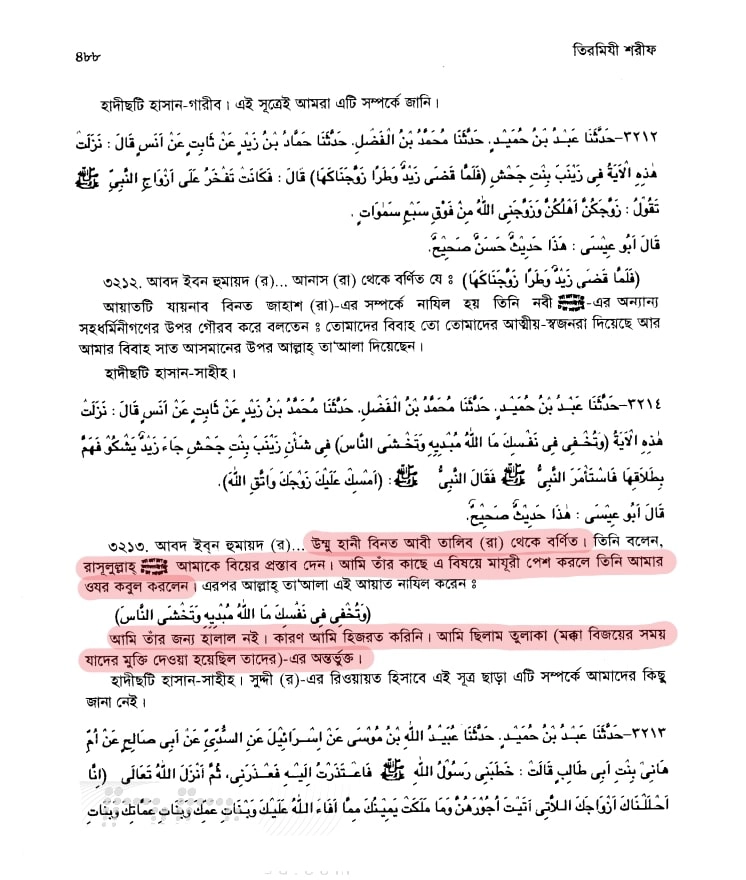
Umm Hani was even among the women concerning whom verse 50 of Surah al-Ahzab was revealed. Although she was not a paternal cousin who had emigrated, this love might have been fulfilled had she agreed to surrender, give, or entrust herself to him. We learn this from the tafsir [38].
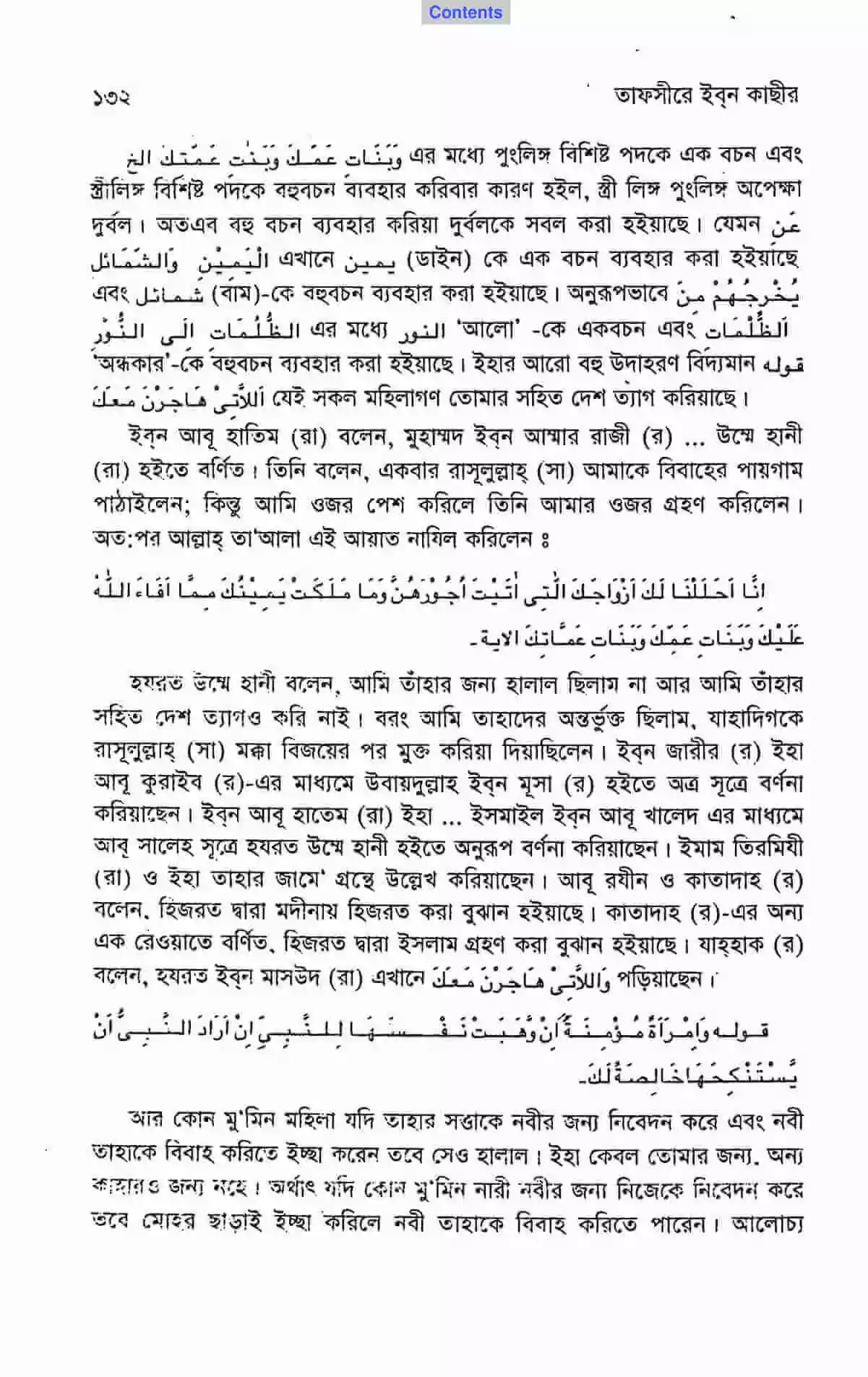
…There are many further examples. قوله اللَّأَتِي هَاجَرْنَ مَعَكَ: “who have emigrated like you.”
Ibn Abi Hatim states: Muhammad ibn Ammar al-Razi… narrated from Umm Hani, who said, “The Messenger once sent me a marriage proposal. I offered an excuse, and he accepted it. Allah then revealed this verse:”
إِنَّا أَحْلَلْنَا لَكَ أَزْوَاجَكَ الَّتِي أَتَيْتُ أُجُورَهُنَّ وَمَا مَلَكَتْ يَمِينُكَ مِمَّا أَفَاءَ اللَّهُ عَلَيْكَ وَبَنَاتِ عَمِكَ وَبَنَاتِ عَمَّاتِكَ الآية –
Umm Hani said, “I was not lawful for him, nor had I emigrated with him. Rather, I was among those whom the Messenger freed after the conquest of Mecca.” Ibn Jarir narrates this through Abu Kurayb, from Ubaydullah ibn Musa, through this chain. Ibn Abi Hatim narrates similarly through… Isma‘il ibn Abi Khalid, from Abu Salih, from Umm Hani. Imam al-Tirmidhi also includes it in his Jami‘. Abu Razin and Qatada say that emigration here means migration to Medina. Another account from Qatada interprets it as accepting Islam. Al-Dahhak says Ibn Mas‘ud read واللاتي هَاجَرْنَ مَعَكَ here.
قوله وَامْرَأَةٌ مُؤْمِنَةٌ إِنْ وَهَبَتْ نَفْسَهَا لِلنَّبِيِّ إِنْ أَرَادَ النَّبِيُّ أَنْ يُسْتَنْكِحُهَا خَالِصَةً لَكَ.
“Also ˹allowed for marriage is˺ a believing woman who offers herself to the Prophet ˹without dowry˺ if he is interested in marrying her—˹this is˺ exclusively for you, not for the rest of the believers” (Quran 33:50, Dr. Mustafa Khattab, The Clear Quran; excerpt). If a believing woman offers herself to the Prophet, he may therefore marry her without a dowry if he wishes. The matter under discussion…
Interaction with Muhammad
We have presented considerable evidence above that Muhammad was at Umm Hani’s house on the night of Mi‘raj. But what is Islam’s position on spending the night in the house of a woman whom one may lawfully marry? Let us read a hadith [39].
Mishkat al-Masabih (Mishkat)
Part 13: Marriage
Section: 1. First subsection — Looking at a prospective bride and covering the body
3101 Jabir reported God’s Messenger as saying, “A man must not spend the night in the house of a woman who has been married unless he is her husband or a close relative.” Muslim transmitted it.
Mishkat al-Masabih 3101; Book 13, Hadith 22
[1] Sahih: Muslim 2171; al-Sahihah 3086.
Hadith grade: Sahih (Authentic)
Narrator: Jabir ibn Abdullah al-Ansari (may Allah be pleased with him)
Authentic hadith tell us that Muhammad occasionally visited Umm Hani’s house, meeting and speaking with her and sharing food and drink [40].
Sunan al-Tirmidhi (Islamic Foundation)
Chapter: 28/ Food
Section: Vinegar.
1848. Abu Kurayb (may Allah have mercy on him) … Narrated Umm Hani’ bint Abi Talib: “The Messenger of Allah (ﷺ) entered upon me and said: ‘Do you have anything?’ I said: ‘No, except a piece of hard bread and vinegar.’ so he said: ‘Bring it, for a house that has vinegar is not impoverished of condiments.” [Abu ‘Eisa said:] This Hadith is Hasan Gharib from this route. We do not know of it as a Hadith of Umm Hani’ except through this route. Abu Hamzah Ath-Thumali’s (a narrator in the chain) name is Thabit bin Abi Safiyyah. And Umm Hani’ died some time after ‘Ali bin Abi Talib. I asked Muhammad about this Hadith. He said: “I do not know Ash-Sha’bi hearing from Umm Hani’.” So I said: “How is Abu Hamzah according to you?” He said: “Ahmad bin Hanbal criticized him, but he is Muqarib (average) in Hadith to me.”
Hasan; al-Sahihah 2220; al-Tirmidhi, hadith no. 1841 (Al-Madani Publications)
Jami` at-Tirmidhi 1841; Grade: Hasan (Darussalam); Book 25, Hadith 57
Hadith grade: Hasan (Good)
Narrator: Umm Hani bint Abu Talib (may Allah be pleased with her)
Another hadith tells us that Muhammad and Umm Hani drank from the same vessel [41]:
Sunan Abu Dawud (Verified Edition)
Chapter: 8/ Fasting
Section: 73. Permission in this regard
2456. Narrated Umm Hani: On the days of the conquest of Mecca, when Mecca was captured, Fatimah came and sat on the left side of the Messenger of Allah (ﷺ), and Umm Hani was on his right side. A slave-girl brought a vessel which contained some drink; she gave it to him and he drank of it. He then gave it to Umm Hani who drank of it. She said: Messenger of Allah, I have broken my fast; I was fasting. He said to her: Were you making atonement for something? She replied: No. He said: Then it does not harm you if it was voluntary (fast).
Sunan Abi Dawud 2456; Grade: Sahih (Al-Albani); Book 14, Hadith 144
Sahih.
(1). Al-Tirmidhi, al-Bayhaqi, al-Darimi.
Hadith grade: Sahih (Authentic)
Narrator: Umm Hani bint Abu Talib (may Allah be pleased with her)
Another hadith states that Muhammad drank first and Umm Hani afterward from the same vessel [42]:
729. Qutayba (may Allah be pleased with him)… Umm Hani narrated: “I was sitting with the Prophet when some drink was brought, so he drank from it, then he offered it to me and I drank it. Then I said: ‘I have indeed sinned, so seek forgiveness for me.’ He said: ‘What is that?’ I said: ‘I was fasting, then I broke the fast.’ He said: ‘Were you performing a fast that you had to make up?’ I said: ‘No.’ He said: ‘Then it is no harm for you.'”
Jami` at-Tirmidhi 731; Grade: Da’if (Darussalam); Book 8, Hadith 50
730. Mahmud ibn Ghaylan (may Allah have mercy on him) … Simak bin Harb narrated: “A person from the offspring of Umm Hani narrated to me – I met one of the most virtuous among them, and his name was Ja’dah, and Umm Hani was his grandmother – he narrated to me from his grandmother that the Messenger of Allah entered upon her and asked for some drink, and he drank. Then he offered it to her and she drank it. Then she said: “O Messenger of Allah! I was fasting.” So the Messenger of Allah said: “The one fasting a voluntary fast is the trustee for himself; if he wishes he fasts, and if he wishes he breaks.” Shu’bah (one of the narrators) said: “I said to him (Ja’dah), ‘Did you hear this from Umm Hani?’ He said: ‘No Abu Salih and our family informed us of it from Umm Hani.'”
Jami` at-Tirmidhi 732; Grade: Da’if (Darussalam); Book 8, Hadith 51
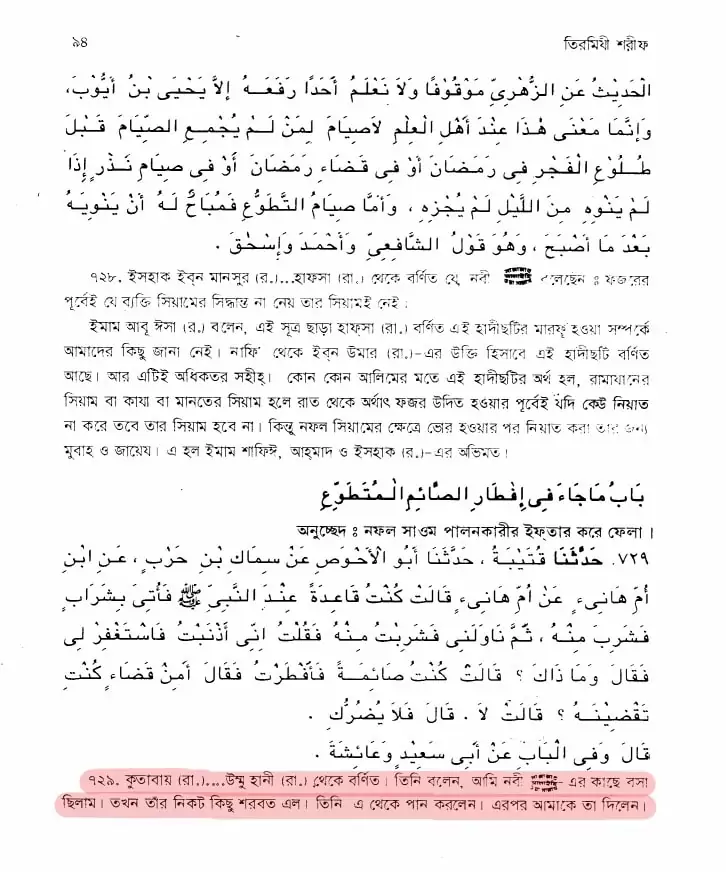
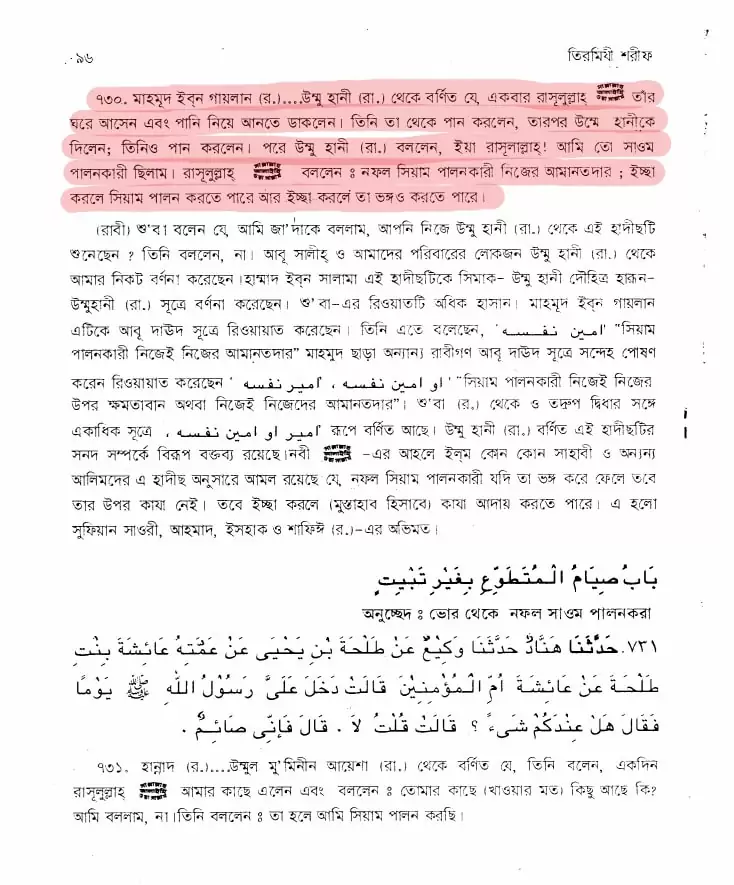
Another hadith tells us that Muhammad and Umm Hani sat beside one another drinking on the day of the conquest of Mecca. By then, the rules of veiling had already been revealed. Islamic scholars are best placed to explain how Muhammad’s sitting beside a marriageable woman and drinking with her after those rules had been revealed accorded with Islam [43]:
Sunan Abu Dawud (Islamic Foundation)
Chapter: 8/ Fasting
Section: 263. Permission not to form an intention to fast.
2448. Uthman ibn Abu Shayba …. Narrated Umm Hani: On the days of the conquest of Mecca, when Mecca was captured, Fatimah came and sat on the left side of the Messenger of Allah (ﷺ), and Umm Hani was on his right side. A slave-girl brought a vessel which contained some drink; she gave it to him and he drank of it. He then gave it to Umm Hani who drank of it. She said: Messenger of Allah, I have broken my fast; I was fasting. He said to her: Were you making atonement for something? She replied: No. He said: Then it does not harm you if it was voluntary (fast).
Sunan Abi Dawud 2456; Grade: Sahih (Al-Albani); Book 14, Hadith 144
Hadith grade: Sahih (Authentic)
Narrator: Umm Hani bint Abu Talib (may Allah be pleased with her)
Another hadith tells us that on the day of the conquest of Mecca, Muhammad went to Umm Hani’s house as though after a long wait, and bathed there. Where was her husband at the time? He had fled in fear of Muhammad. Who else, then, was in the house that day? [44]
Sunan al-Tirmidhi (Islamic Foundation)
Chapter: 3/ Witr
Section: The forenoon prayer.
474. Abu Musa Muhammad ibn al-Muthanna (may Allah have mercy on him) ….. Abdur-Rahman bin Abi Laila narrated: “No one informed that they saw Allah’s Messenger praying Ad-Duha except Umm Hani. She narrated that Allah’s Messenger entered her house on the Day of the Conquest of Makkah. He performed Ghusl and performed eight voluntary Rak’ah such that she had not ever seen him pray any Salat lighter than them, but that he completed the bowing and prostrations.”
Ibn Majah 1379; al-Tirmidhi, hadith no. 474 (Al-Madani Publications)
Jami` at-Tirmidhi 474; Grade: Sahih (Darussalam); Book 3, Hadith 22
Imam Abu Isa al-Tirmidhi (may Allah have mercy on him) said: This hadith is Hasan Sahih. Imam Ahmad considered Umm Hani’s report (may Allah be pleased with her) the most authentic report on this subject. There is historical disagreement over the father’s name of Nu‘aym (may Allah be pleased with him), another Companion who narrated a hadith on this subject. Some call him Nu‘aym ibn Khammar, others Ibn Ammar, Ibn Habbar or Ibn Hammam. The correct form, however, is Ibn Hammar. The narrator Abu Nu‘aym was uncertain about this: he mistakenly called him Ibn Khammar, but later stopped mentioning the father’s name and narrated the hadith simply from Nu‘aym, from the Prophet (peace and blessings be upon him). Imam al-Tirmidhi (may Allah have mercy on him) said: Abd ibn Humayd narrated this to me from Abu Nu‘aym (may Allah have mercy on them).
Hadith grade: Sahih (Authentic)
Narrator: Abd al-Rahman ibn Abu Layla (may Allah have mercy on him)
Is Fasting in Ramadan Voluntary or Obligatory?
We all know that Mecca was conquered during Ramadan. Ibn Hisham’s sira tells us that Muhammad himself was fasting when he set out for Mecca and broke his fast along the way [45]:
The Messenger then set out on the expedition to Mecca, appointing Abu Burhum al-Ghifari as his deputy in Medina. He departed after ten days of Ramadan had passed. He and all the Muslims fasted. On reaching Qudayd, between Usfan and Amaj, they all broke their fasts.
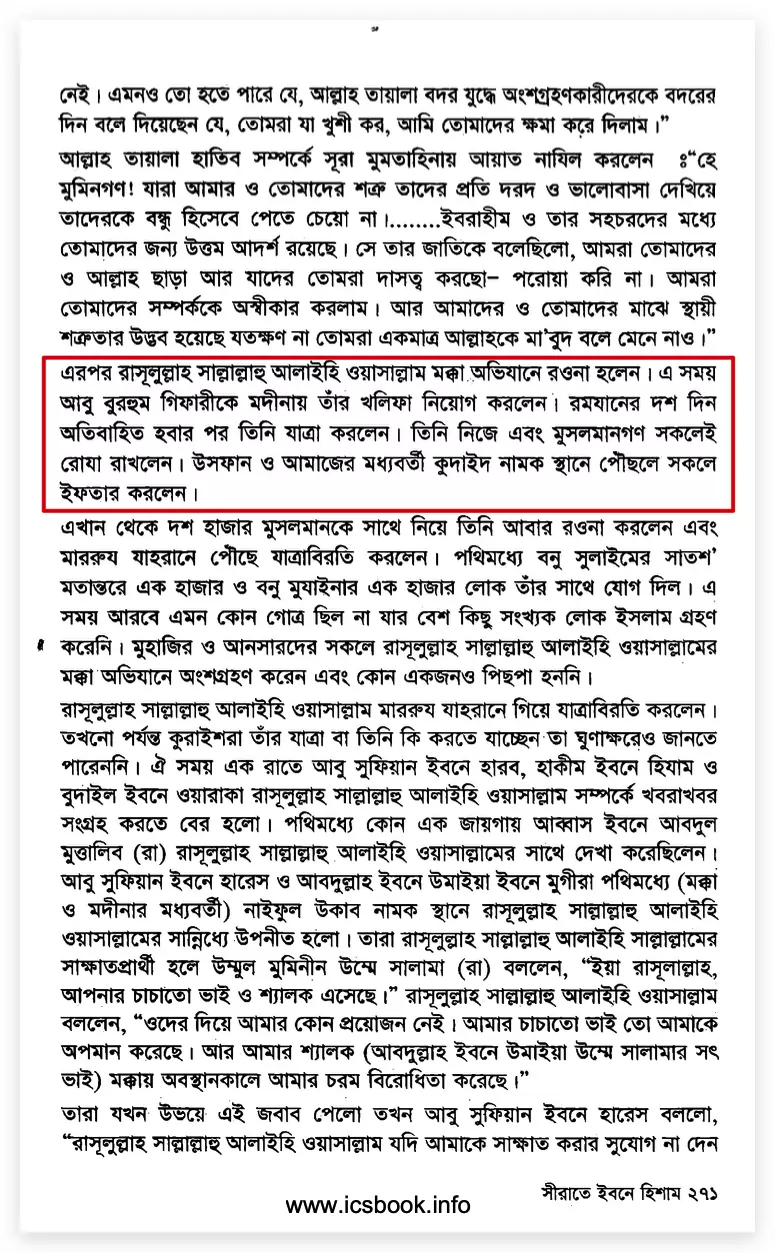
The entry into Mecca and all these subsequent events occurred during Ramadan. We know that Ramadan fasting had already become obligatory for Muslims in the second year after the Hijra [46]. Under these circumstances, how was Muhammad drinking together with Umm Hani and Fatima? A strange episode indeed. Islamic apologists might try to reconcile this by arguing that fasting was not obligatory for Muhammad because he was traveling. That argument does not work here either: Umm Hani was not traveling, and fasting in Ramadan was obligatory for her. It is unclear why, instead of instructing the newly converted Umm Hani to observe Ramadan properly, Muhammad arranged for her to break her fast [43].
Sunan Abu Dawud (Islamic Foundation)
Chapter: 8/ Fasting
Section: 263. Permission not to form an intention to fast.
2448. Uthman ibn Abu Shayba …. Narrated Umm Hani: On the days of the conquest of Mecca, when Mecca was captured, Fatimah came and sat on the left side of the Messenger of Allah (ﷺ), and Umm Hani was on his right side. A slave-girl brought a vessel which contained some drink; she gave it to him and he drank of it. He then gave it to Umm Hani who drank of it. She said: Messenger of Allah, I have broken my fast; I was fasting. He said to her: Were you making atonement for something? She replied: No. He said: Then it does not harm you if it was voluntary (fast).
Sunan Abi Dawud 2456; Grade: Sahih (Al-Albani); Book 14, Hadith 144
Hadith grade: Sahih (Authentic)
Narrator: Umm Hani bint Abu Talib (may Allah be pleased with her)
One point needs to be understood here: a fasting person is prohibited from eating, drinking, and having sexual intercourse until a specified time. Let us now read another hadith stating that accidentally eating or drinking while fasting does not invalidate the fast. The person must complete it, because accidental eating or drinking does not count as breaking the fast. Yet notice that Muhammad calls this important obligatory Ramadan fast voluntary and does not remind her that drinking by mistake does not invalidate it. Why did he not remind Umm Hani to complete the fast she should have completed? [47]
Sahih al-Bukhari (Tawhid Publication)
30/ Fasting
Section: 30/26. If a fasting person eats or drinks forgetfully.
وَقَالَ عَطَاءٌ إِنْ اسْتَنْثَرَ فَدَخَلَ الْمَاءُ فِي حَلْقِهِ لاَ بَأْسَ إِنْ لَمْ يَمْلِكْ وَقَالَ الْحَسَنُ إِنْ دَخَلَ حَلْقَهُ الذُّبَاب فَلاَ شَيْءَ عَلَيْهِ وَقَالَ الْحَسَنُ وَمُجَاهِدٌ إِنْ جَامَعَ نَاسِيًا فَلاَ شَيْءَ عَلَيْهِ
Ata (may Allah have mercy on him) said: If water enters the throat while someone is rinsing the nose and he cannot prevent it, there is no blame on him. Hasan (may Allah have mercy on him) said: If a fly enters a fasting person’s throat, nothing is required of him. Hasan and Mujahid (may Allah have mercy on them) said: If a fasting person has intercourse with his wife forgetfully, nothing is required of him.
1933 Narrated Abu Huraira: The Prophet (ﷺ) said, “If somebody eats or drinks forgetfully then he should complete his fast, for what he has eaten or drunk, has been given to him by Allah.“
(6669; Muslim 13/33, hadith 1155; Ahmad 6669)
(Adhunik Prakashani: 1795; Islamic Foundation: 1806)
Sahih al-Bukhari 1933; Book 30, Hadith 40
Hadith grade: Sahih (Authentic)
Narrator: Abu Hurayra (may Allah be pleased with him)
The Baths Do Not Add Up
Let us now check the sequence. The setting is the day of the conquest of Mecca (see the English translation). Mecca’s unbelievers were bewildered with fear of Muhammad. That day, Umm Hani sheltered an unbeliever whom Ali wanted to kill. She hurried to Muhammad to save the man from Ali. Muhammad then emerged from his bath and performed the forenoon prayer [35] [36] [48] [49]:
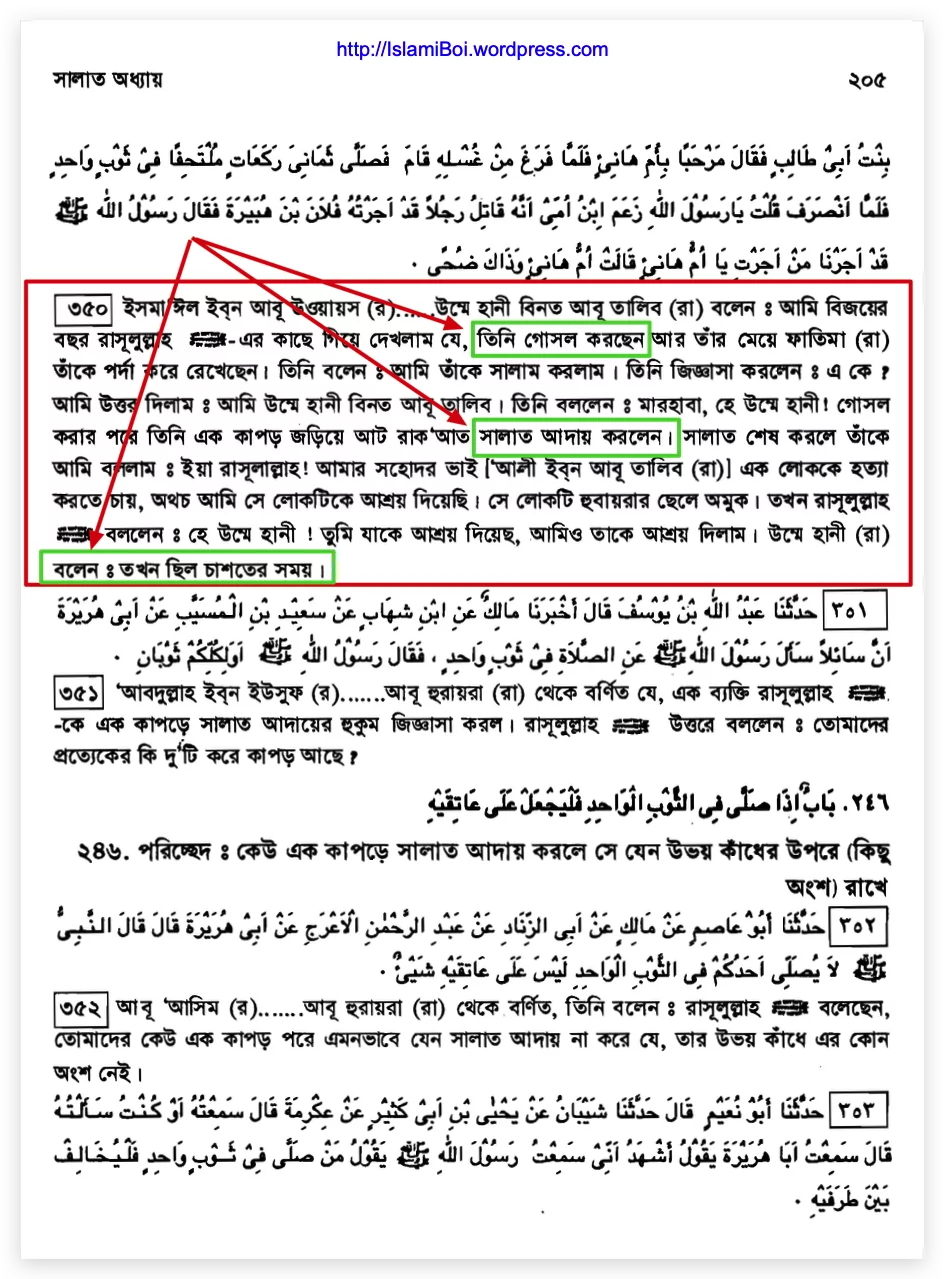
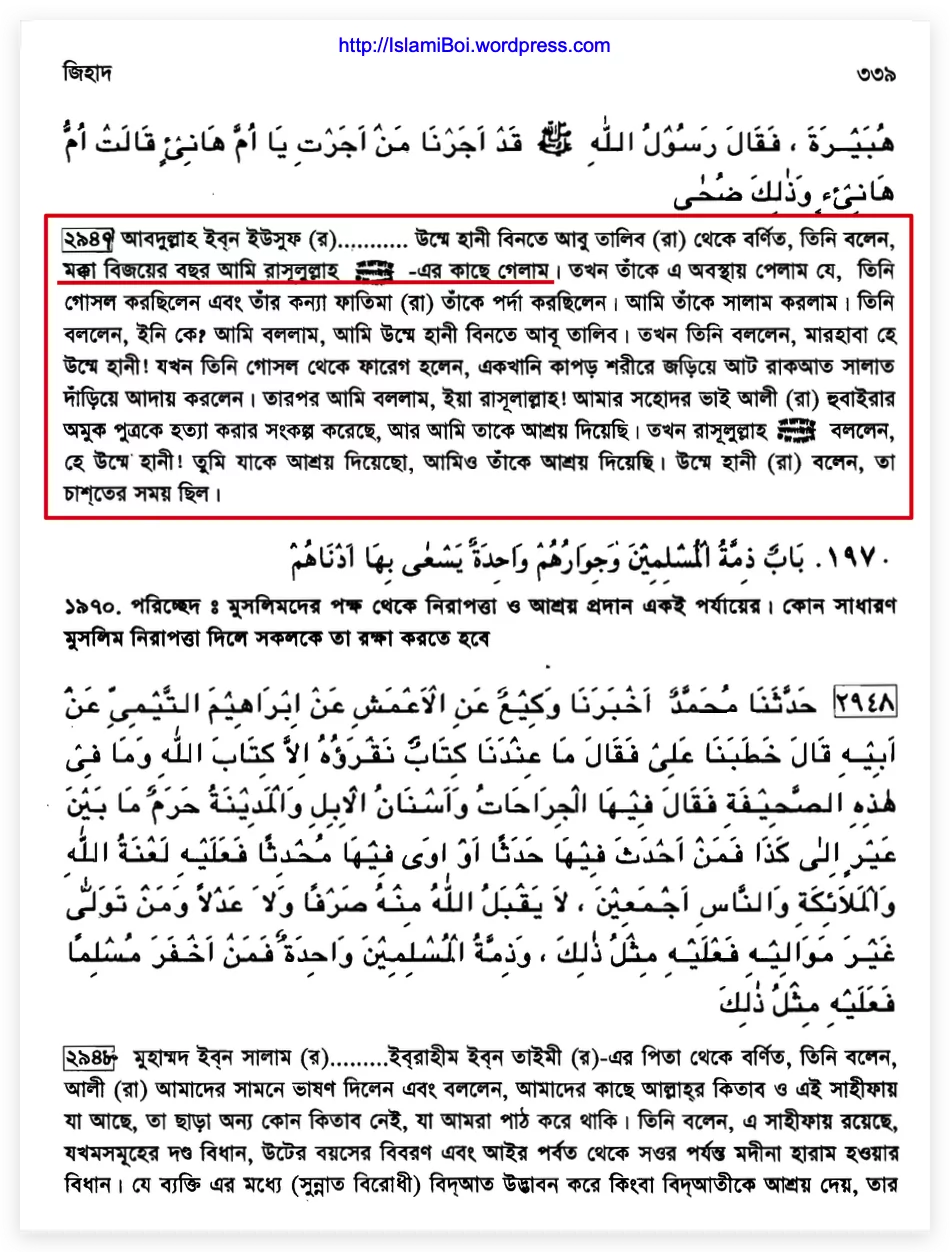
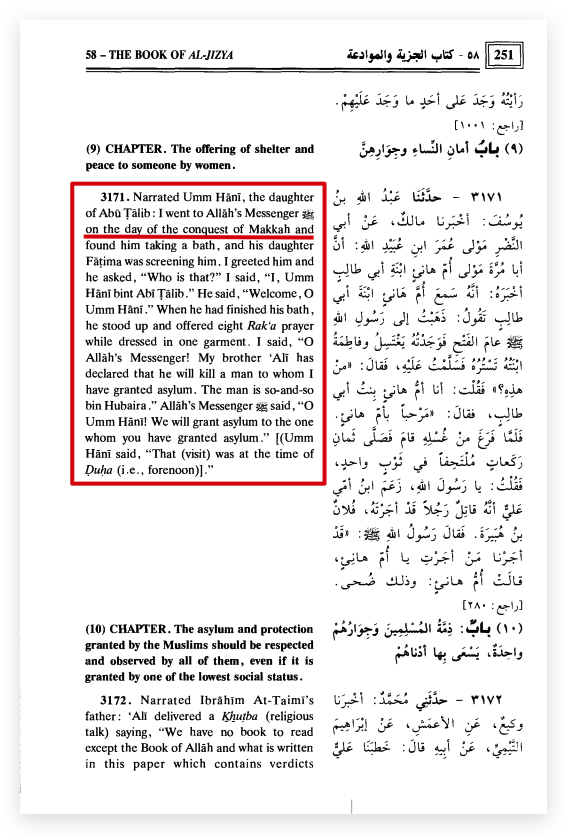
Muhammad then emerged from his bath, and Fatima, Muhammad, and Umm Hani sat beside one another at the same place, drinking a beverage. Umm Hani was fasting, so she objected to drinking. Eating or having sexual relations was therefore forbidden to her that day. Muhammad, however, virtually compelled her to break her fast. Once it was broken, no further impediment remained to her drinking, eating, or having sexual intercourse. Readers, pay close attention to the sequence of events [43]:
Sunan Abu Dawud (Islamic Foundation)
Chapter: 8/ Fasting
Section: 263. Permission not to form an intention to fast.
2448. Uthman ibn Abu Shayba …. Narrated Umm Hani: On the days of the conquest of Mecca, when Mecca was captured, Fatimah came and sat on the left side of the Messenger of Allah (ﷺ), and Umm Hani was on his right side. A slave-girl brought a vessel which contained some drink; she gave it to him and he drank of it. He then gave it to Umm Hani who drank of it. She said: Messenger of Allah, I have broken my fast; I was fasting. He said to her: Were you making atonement for something? She replied: No. He said: Then it does not harm you if it was voluntary (fast).
Sunan Abi Dawud 2456; Grade: Sahih (Al-Albani); Book 14, Hadith 144
Hadith grade: Sahih (Authentic)
Narrator: Umm Hani bint Abu Talib (may Allah be pleased with her)
Muhammad then went to Umm Hani’s house, where her husband was absent. There he bathed again and then prayed again. Why were two baths necessary on the same day, at the same time? What did he do in the house of this non-mahram woman whose husband was away that required another bath, so soon after his previous one?
Let us read the account of the conquest of Mecca carefully. Notice that Muhammad is first staying in the upper part of Mecca. At that time, fugitives were hiding in Umm Hani’s house. Fatima was present at the scene, and Muhammad took a bath [50] [51]. Notice that the next hadith is set in Umm Hani’s house. Muhammad arrives there with his hair braided—in other words, dressed up [52]. He bathes there again. Why were two baths needed at the same time? What did Muhammad do in Umm Hani’s house that required another bath? [53]:
Mishkat al-Masabih (Mishkat)
Part 22: Clothing
Section: 3. Second subsection — Combing the hair
4446 Umm Hani’ said : God’s messenger came to us once in Mecca and he had four plaits of hair. Ahmad, Abu Dawud, Tirmidhi and Ibn Majah transmitted it.
Mishkat al-Masabih 4446; Book 22, Hadith 135
[1] Sahih: Ahmad 26890; al-Tirmidhi 1781; Abu Dawud 4191; Ibn Majah 3631; Musannaf Ibn Abi Shayba 36917; al-Tabarani, al-Mu‘jam al-Kabir 20484.
Hadith grade: Sahih (Authentic)
Narrator: Umm Hani bint Abu Talib (may Allah be pleased with her)
Sahih Muslim (Islamic Foundation)
3/ Menstruation
Section: 16. A person bathing should screen himself with a cloth or something similar
Islamic Foundation no.: 658; international no.: 336
658. Muhammad ibn Rumh ibn Muhajir (may Allah have mercy on him) … Umm Hani b. Abu Talib reported: It was the day of the conquest (of Mecca) that she went to the Messenger of Allah (ﷺ) and he was staying at a higher part (of that city). The Messenger of Allah (ﷺ) got up for his bath. Fatimah held a curtain around him (in order to provide him privacy). He then put on his garments and wrapped himself with that and then offered eight rak’ahs of the forenoon prayer.
Sahih Muslim 336 b; Book 3, Hadith 87
Hadith grade: Sahih (Authentic)
Narrator: Umm Hani bint Abu Talib (may Allah be pleased with her)
Umm Hani’s Two Sheltered Brothers-in-Law
Ibn Ishaq states: Sa‘id ibn Abi Hind narrated to me through Abu Murra, the freedman of Aqil ibn Abi Talib, that Abu Talib’s daughter Umm Hani said, “When the Messenger encamped in the upper part of Mecca, two men of Banu Makhzum, related to me as brothers-in-law, fled to me.” Umm Hani was the wife of Hubayra ibn Abi Wahb al-Makhzumi. She says, “My brother Ali ibn Abi Talib then entered my house. On seeing the two men, he exclaimed, ‘By Allah, I will certainly kill them!’ I confined them inside my house and closed the door. Then I hurried to the Messenger in upper Mecca. He was bathing with water from a vessel bearing traces of flour, while his daughter Fatima screened him with a cloth.”
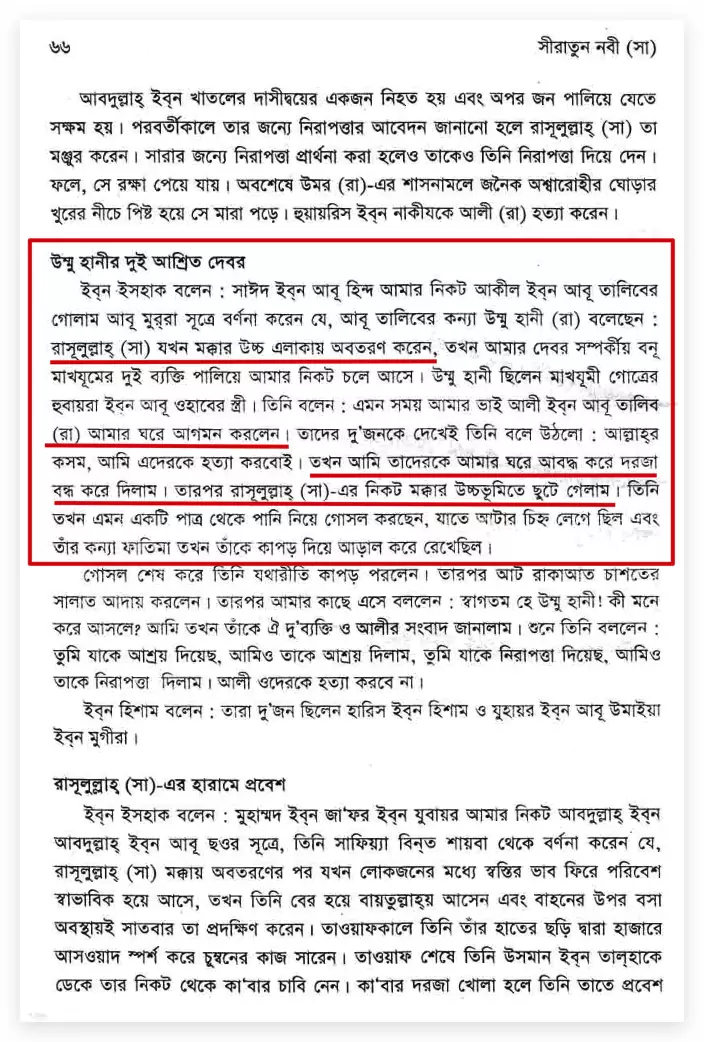
474. Abdur-Rahman bin Abi Laila narrated: “No one informed that they saw Allah’s Messenger praying Ad-Duha except Umm Hani. She narrated that Allah’s Messenger entered her house on the Day of the Conquest of Makkah. He performed Ghusl and performed eight voluntary Rak’ah such that she had not ever seen him pray any Salat lighter than them, but that he completed the bowing and prostrations.”
Jami` at-Tirmidhi 474; Grade: Sahih (Darussalam); Book 3, Hadith 22
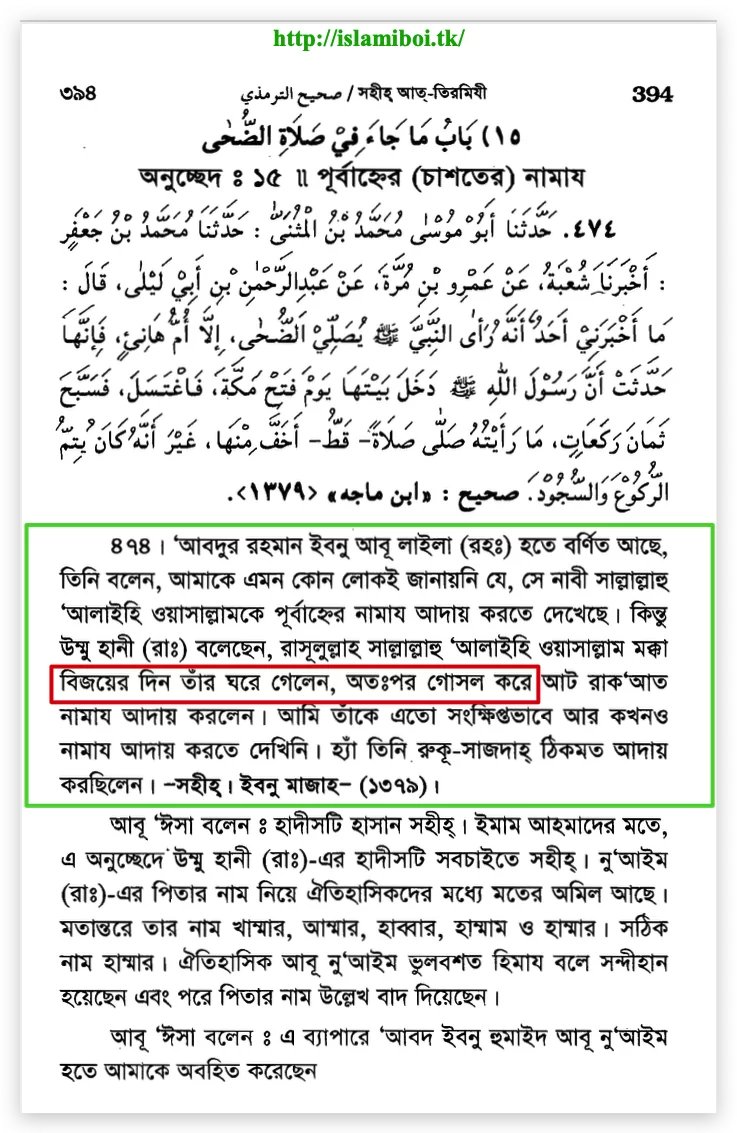
Men braiding their hair is an old cultural practice. Men went out adorned in this way on special occasions. Let us look at an illustration imagining an Arab man with braided hair going to meet his beloved.

An important point must be mentioned here: Muhammad was not the only one who dressed up and braided his hair to visit Umm Hani. She, too, dressed up to meet him. On one occasion, this so angered Umar that he addressed her abusively. Let us read the report [54].
tabarani:21526 – Zakariyyā b. Yaḥyá al-Sājī > Hudbah b. Khālid > Ḥammād b. Salamah > ʿAbd al-Raḥman b. Abū Rāfiʿ
Umm Hani bint Abi Talib went out displaying her adornment, with her earrings visible. Umar ibn al-Khattab said to her, “Know that Muhammad will not avail you at all.” She went to the Prophet ﷺ and informed him. The Messenger of Allah ﷺ said, “What is the matter with people who claim that my intercession does not reach the members of my household, when my intercession reaches even Ḥā and Ḥukm?” Ḥā and Ḥukm are two tribes.
الطبراني:٢١٥٢٦ – حَدَّثَنَا زَكَرِيَّا بْنُ يَحْيَى السَّاجِيُّ ثنا هُدْبَةُ بْنُ خَالِدٍ ثنا حَمَّادُ بْنُ سَلَمَةَ عَنْ عَبْدِ الرَّحْمَنِ بْنِ أَبِي رَافِعٍ
أَنَّ أُمَّ هَانِئٍ بِنْتَ أَبِي طَالِبٍ خَرَجَتْ مُتَبَرِّجَةً قَدْ بَدَا قُرْطَاها فَقَالَ لَهَا عُمَرُ بْنُ الْخَطَّابِ اعْلَمِي فَإِنَّ مُحَمَّدًا لَا يُغْنِي عَنْكِ شَيْئًا فَجَاءَتْ إِلَى النَّبِيِّ ﷺ فَأَخْبَرَتْهُ فَقَالَ رَسُولُ اللهِ ﷺ «مَا بَالُ أَقْوَامٍ يَزْعُمُونَ أَنَّ شَفَاعَتِي لَا تَنَالُ أَهْلَ بَيْتِي وَإِنَّ شَفَاعَتِي تَنَالُ حا وَحُكْمَ» حا وَحُكْمَ قَبِيلَتَانِ
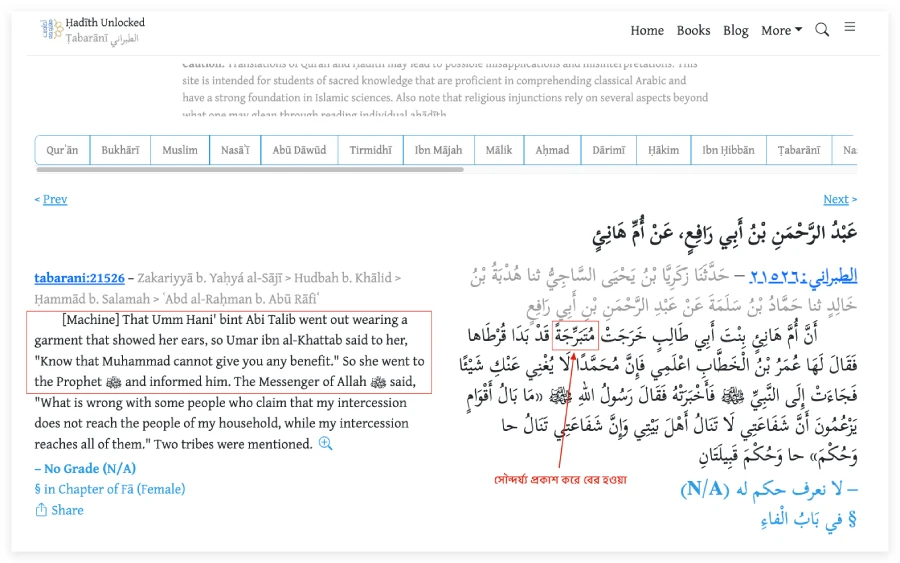
Let us return to the earlier hadith. Given the dishonesty Islamic apologists commonly practice, they might point to the Bengali translation and claim that it refers to Muhammad’s house! The English translation has therefore also been included [55]:
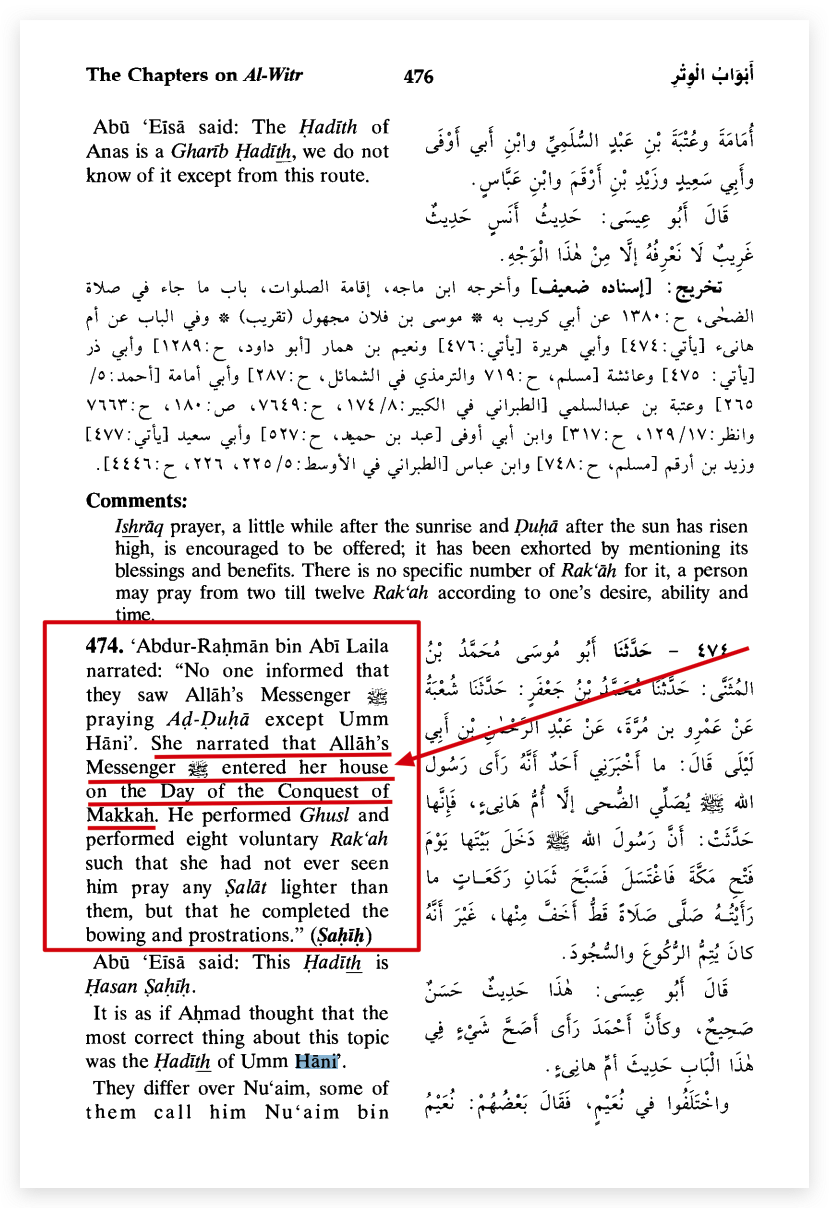
Let us also examine the hadith in Sahih al-Bukhari. Notice that Umm Hani is its sole narrator. In other words, no other Companion is present at the scene [56] [57]:
Sahih al-Bukhari (Islamic Foundation)
51/ Military Expeditions
Section: 2214. Where the Prophet (peace be upon him) stayed on the day of the conquest of Mecca
Islamic Foundation no.: 3962; international no.: 4292
3962. Abu al-Walid (may Allah have mercy on him) … Narrated Ibn Abi Laila: None informed us that he saw the Prophet (ﷺ) offering the Duha (i.e. forenoon) prayer, except Um Hani who mentioned that the Prophet (ﷺ) took a bath in her house on the day of the Conquest (of Mecca) and then offered an eight rak`at prayer. She added, “I never saw the Prophet (ﷺ) offering a lighter prayer than that prayer, but he was performing perfect bowing and prostrations.”
Sahih al-Bukhari 4292; Book 64, Hadith 325
Hadith grade: Sahih (Authentic)
Narrator: Ibn Abu Layla (may Allah have mercy on him)
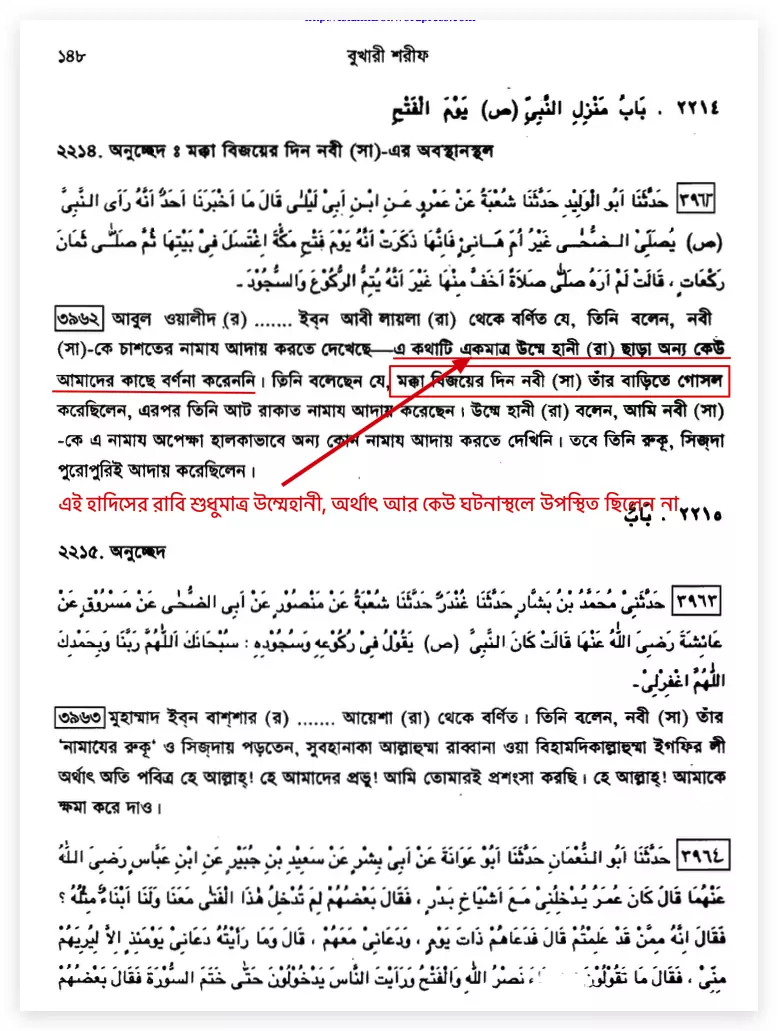
Let us now read the account in Tafsir Ibn Kathir [58].
Ibn Jarir then states: Zayd ibn Abi Aruba ibn Mutawakkil… narrated from Abdullah ibn al-Harith ibn Nawfal, successively through Ayyub ibn Sawwan and Abu Abdullah ibn al-Harith ibn Nawfal. He said that Ibn Abbas initially did not perform the forenoon prayer. Abdullah
ibn al-Harith says, “I therefore took him to Umm Hani and asked her, ‘Tell him what you told me.’ She said, ‘On the day of the conquest of Mecca, the noble Messenger entered my house. He asked for water poured into a vessel and requested a cloth, which he placed as a screen between himself and me. He bathed there, then went to a corner of the house and performed eight rak‘as of the forenoon prayer. His standing, bowing, prostration, and sitting were of approximately equal duration.’” Hearing this, Ibn Abbas left the house,
saying, “I have read everything between the two covers—the entire Quran—but did not find the forenoon prayer. Now I understand that it is in يُسَبِّحْنَ بِالْعَشِي وَالْاشْرَاقِ.” Previously he used to ask, “Where is the mention of Salat al-Ishraq?” Thereafter he said, “Salat al-Ishraq does exist.” Here Salat al-Ishraq is understood as the forenoon prayer; although Duha and Ishraq are actually separate prayers, both may be called Ishraq.
–
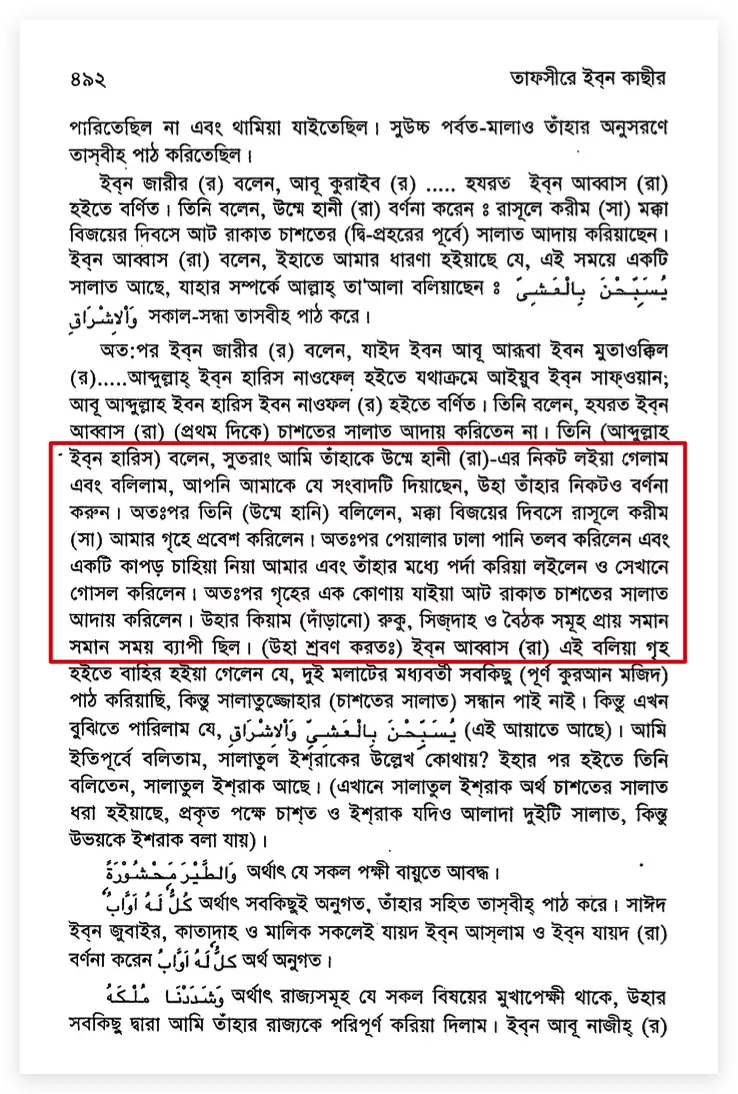
Let us examine a page from Salat al-Awwabin, published by IslamHouse [59].
Narrated Abu Murra: (the freed slave of Um Hani) Um Hani, the daughter of Abi Talib said, “I went to Allah’s Messenger (ﷺ) in the year of the conquest of Mecca and found him taking a bath and his daughter Fatima was screening him. I greeted him. He asked, ‘Who is she?’ I replied, ‘I am Um Hani bint Abi Talib.’ He said, ‘Welcome! O Um Hani.’ When he finished his bath he stood up and prayed eight rak`at while wearing a single garment wrapped round his body and when he finished I said, ‘O Allah’s Messenger (ﷺ) ! My brother has told me that he will kill a person whom I gave shelter and that person is so and so the son of Hubaira.’ The Prophet (ﷺ) said, ‘We shelter the person whom you have sheltered.’ ” Um Hani added, “And that was before noon (Duha).
Sahih al-Bukhari 357; Book 8, Hadith 9
Narrated Ibn Abi Laila: None informed us that he saw the Prophet (ﷺ) offering the Duha (i.e. forenoon) prayer, except Um Hani who mentioned that the Prophet (ﷺ) took a bath in her house on the day of the Conquest (of Mecca) and then offered an eight rak`at prayer. She added, “I never saw the Prophet (ﷺ) offering a lighter prayer than that prayer, but he was performing perfect bowing and prostrations.”
Sahih al-Bukhari 4292; Book 64, Hadith 325
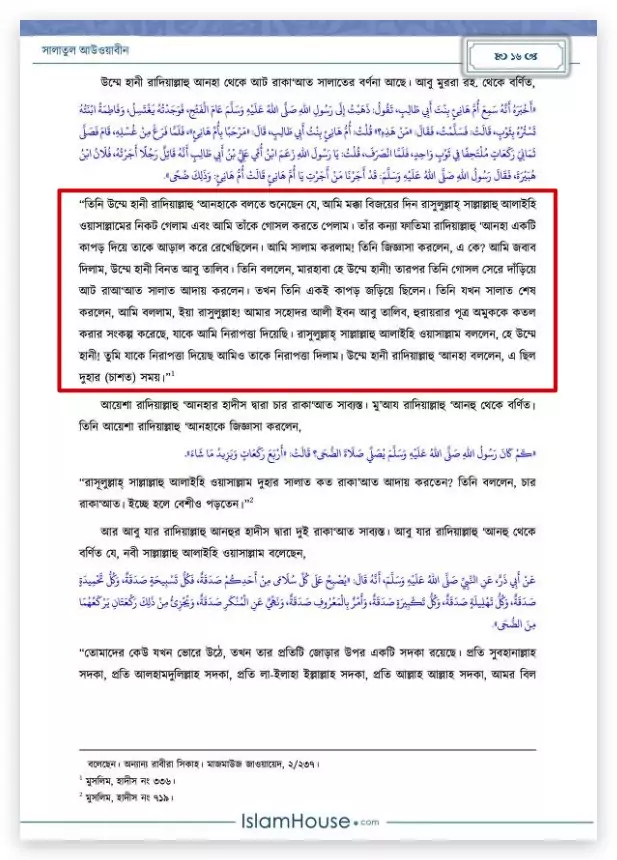
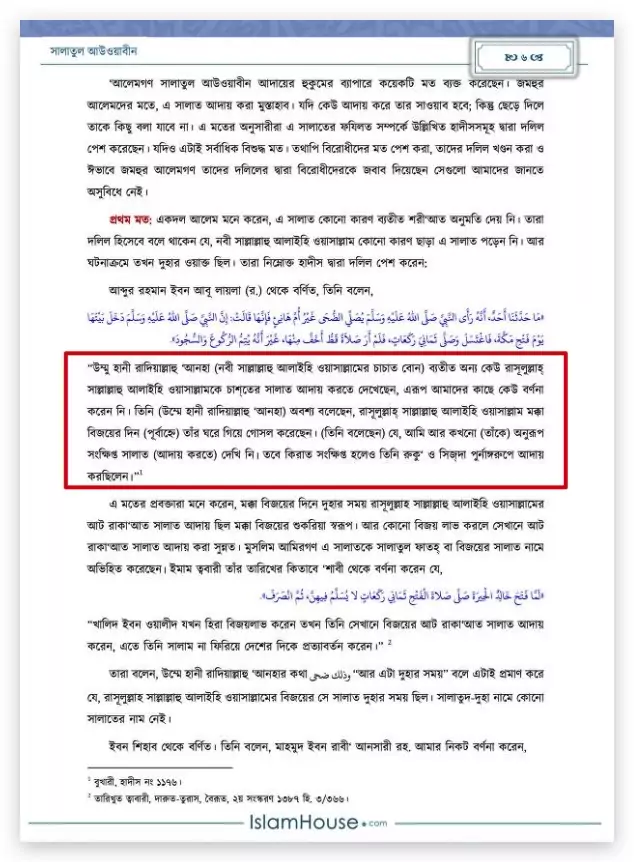
There is another version of the book with different pagination. That version is also provided [60].
Narrated Abu Murra: (the freed slave of Um Hani) Um Hani, the daughter of Abi Talib said, “I went to Allah’s Messenger (ﷺ) in the year of the conquest of Mecca and found him taking a bath and his daughter Fatima was screening him. I greeted him. He asked, ‘Who is she?’ I replied, ‘I am Um Hani bint Abi Talib.’ He said, ‘Welcome! O Um Hani.’ When he finished his bath he stood up and prayed eight rak`at while wearing a single garment wrapped round his body and when he finished I said, ‘O Allah’s Messenger (ﷺ) ! My brother has told me that he will kill a person whom I gave shelter and that person is so and so the son of Hubaira.’ The Prophet (ﷺ) said, ‘We shelter the person whom you have sheltered.’ ” Um Hani added, “And that was before noon (Duha).
Sahih al-Bukhari 357; Book 8, Hadith 9
Narrated Ibn Abi Laila: None informed us that he saw the Prophet (ﷺ) offering the Duha (i.e. forenoon) prayer, except Um Hani who mentioned that the Prophet (ﷺ) took a bath in her house on the day of the Conquest (of Mecca) and then offered an eight rak`at prayer. She added, “I never saw the Prophet (ﷺ) offering a lighter prayer than that prayer, but he was performing perfect bowing and prostrations.”
Sahih al-Bukhari 4292; Book 64, Hadith 325
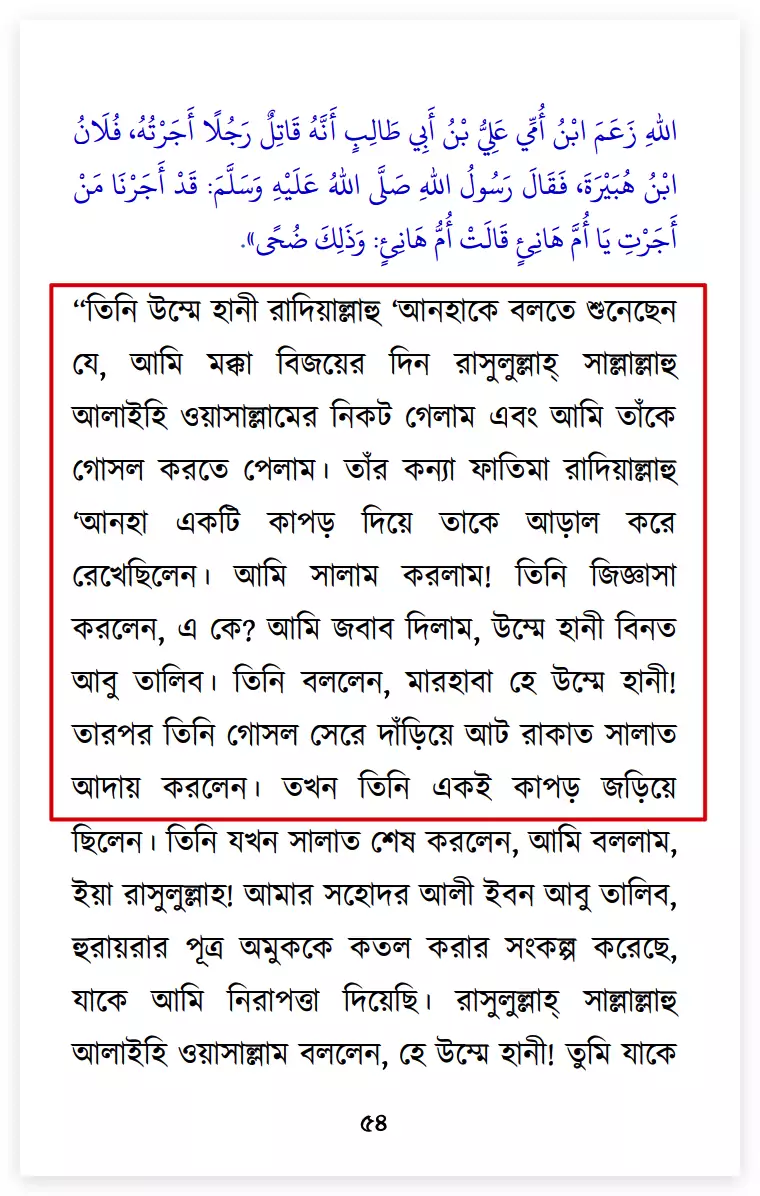
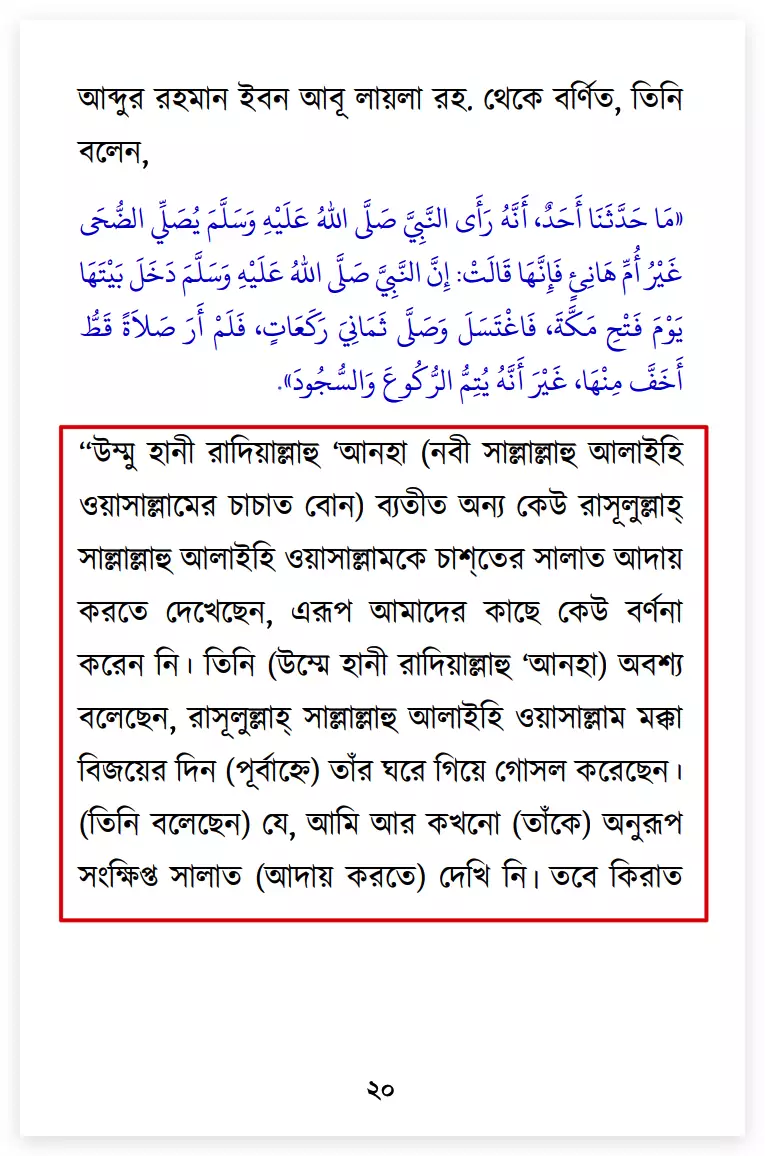
Ibn Hajar al-Asqalani’s explanation is particularly important for understanding why these two accounts do not merely represent different wording of the same event. In Fath al-Bari, he mentions one account in which Umm Hani approaches Muhammad on the day of the conquest and finds him bathing in the upper part of Mecca, and another in which Muhammad enters her house and bathes there. Reconciling the two, Ibn Hajar explicitly states: “وَجُمِعَ بَيْنَهُمَا بِأَنَّ ذَلِكَ تَكَرَّرَ مِنْهُ”—“The two accounts have been reconciled by understanding that this occurred more than once.” He further says, “The two accounts may be reconciled by understanding that he bathed on multiple occasions.” According to Ibn Hajar’s explanation, these are therefore not two descriptions of one bath: Muhammad bathed more than once on the same day [61].
Fath al-Bari: Volume Three, pp. 53–57
Page 53
English Translation
Fath al-Bari
Volume: 3 | Page: 53
“Since accepting Islam, I have never performed the Duha prayer except when circumambulating the Sacred House.” That is, he prayed then with the intention of performing the two rak‘as following circumambulation, rather than Duha. Alternatively, he may have combined both intentions.
Ibn Umar is reported to have performed it at particular times. Seven chapters later, Nafi‘ reports that Ibn Umar performed Duha only on the day he entered Mecca. He would arrive during the forenoon, circumambulate the Sacred House, and pray two rak‘as. He also did so on days when he visited Quba Mosque. Ibn Khuzayma narrates through another chain from Nafi‘, from Ibn Umar, that the Prophet performed Duha only on returning from a journey. Concerning Quba Mosque, Sa‘id ibn Mansur states: Ibn Uyayna narrated to us from Abdullah ibn Dinar that Ibn Umar performed Duha only when visiting Quba. This may refer to the mosque-greeting prayer during the forenoon, rather than Duha itself. Alternatively, he may have combined both intentions, as discussed regarding circumambulation. In sum, nothing in these reports from Ibn Umar denies the legitimacy of Duha. His negative statement may reflect what he did not witness, rather than what actually occurred. Or he may have rejected a particular manner of performing it, as will appear in the discussion of Aisha’s hadith. Iyad and others say that Ibn Umar disliked making it a regular observance, performing it publicly in the mosque, and performing it congregationally, rather than considering it contrary to the Sunna. Supporting this, Ibn Abi Shayba narrates from Ibn Mas‘ud that he objected on seeing a group perform it, saying, “If you must perform it, do so in your homes.”
His wording, “No one narrated to us”: another report in Ibn Abi Shayba, from Ibn Abi Layla, states, “I met many people among the Companions when they were still numerous, but none except Umm Hani told me that the Prophet performed Duha.” Muslim narrates through Abdullah ibn al-Harith al-Hashimi: “I eagerly asked people to find someone who would tell me that the Prophet performed the voluntary Duha prayer, but found no one except Abu Talib’s daughter Umm Hani who related this to me.” He then mentions the hadith. This Abdullah ibn al-Harith is the son of Nawfal ibn al-Harith ibn Abd al-Muttalib, counted among the Companions because he was born in the Prophet’s lifetime. Ibn Majah specifies when Abdullah conducted this inquiry: “I investigated during Uthman’s time, when the people—the Companions—were still numerous.”
His wording, “ghayru,” meaning “except”: it takes the nominative ending because it substitutes for “ahadun,” meaning “anyone.”
His wording, “Umm Hani”: she is Abu Talib’s daughter and Ali’s full sister. Bukhari contains no reports from her apart from this hadith and another in the Book of Purification.
His wording, “On the day of the conquest of Mecca, he entered her house, then bathed and prayed”: its apparent meaning is that he bathed in her house. Yet the Muwatta and Muslim narrate through Abu Murra, from Umm Hani, that she went to the Prophet while he was in upper Mecca and found him bathing. The two accounts may be reconciled by understanding that he bathed on multiple occasions. This is supported by Ibn Khuzayma’s report through Mujahid, from Umm Hani, in which Abu Dharr screened the Prophet as he bathed. Abu Murra’s account, however, says his daughter Fatima screened him. Perhaps he was staying in Umm Hani’s house in upper Mecca while she was in another house elsewhere in Mecca, then came and found him bathing. Both accounts could thus be correct. As for screening him, one person may have done so at the beginning of the bath and the other midway through it. Allah knows best.
His wording, “eight rak‘as”: Kurayb’s expanded account from Umm Hani adds that he concluded every two rak‘as with the salutation. Ibn Khuzayma records this. It refutes those who use the hadith to justify performing eight or fewer rak‘as continuously with a single final salutation. Al-Tabarani’s report from Ibn Abi Awfa states that he performed two rak‘as of Duha. When his wife asked him about it, he replied that the Prophet had prayed two rak‘as on the day of the conquest. The explanation is that he saw two rak‘as of the Prophet’s prayer, while Umm Hani saw the remaining eight. This strengthens the view that the Prophet performed the prayer in separate pairs of rak‘as. Allah knows best.
His wording, “I never saw a shorter prayer”: that is, among the Prophet’s prayers. At the end of the Book of Shortening Prayers, the wording is, “I never saw him perform a shorter prayer.” Abdullah ibn al-Harith’s account mentioned above states, “I do not know whether his standing, bowing, or prostration was longer; all were approximately equal.” This has been cited as evidence that shortening Duha is recommended. The inference is debatable, however, because the prayer may have been shortened owing to the important tasks and numerous demands of the conquest of Mecca. The Prophet’s practice establishes that he—
Ibn Hajar’s explanation matters because it prevents the “two baths” from being dismissed as merely a discrepancy between accounts. A leading Sunni hadith commentator himself reconciled them by accepting the possibility of two separate baths. The question therefore becomes direct: why did Muhammad need to go to Umm Hani’s house and bathe a second time shortly after his first bath? The hadith do not explain the reason for the second bath. Thus, the events on the day of the conquest of Mecca were:
| Time | Place | Event |
| The day of the conquest of Mecca [49] | The upper part of Mecca [50] [51] | Muhammad bathes in Fatima’s presence; Umm Hani arrives [35] [36]. At that time, Umm Hani’s house is closed, with several people hiding inside [51]. |
| The day of the conquest of Mecca [43] [49] | The upper part of Mecca [51] | Fatima, Muhammad, and Umm Hani sit beside one another drinking. At Muhammad’s request, Umm Hani breaks her fast [43]. |
| The day of the conquest of Mecca [52] | Departure from the upper part of Mecca toward Umm Hani’s house | Muhammad dresses up, arranging his hair in four braids [52]. |
| The day of the conquest of Mecca [56] [57] | Umm Hani’s house [55] [53] | Muhammad visits Umm Hani’s house while her husband is absent. On arriving, he bathes again [53] [56] [57]. |
Let us read several more hadith showing that Muhammad habitually bathed after having intercourse multiple times or with multiple wives. A man who bathed only once after intercourse with eleven women in a single day or night, who did not bathe between visiting one wife and the next, and whose long list of eleven included wives and slave women—why would that man bathe twice within such a short interval during the same prayer period without some urgent necessity? That is certainly something to consider! [62] [63] [64] [64] [65] [66] [67] [68]:
Sahih al-Bukhari (Islamic Foundation)
5/ Bathing
Section: 185. Bathing once after intercourse more than once or with more than one wife.
265. Muhammad ibn Bashshar (may Allah have mercy on him) …. Narrated Muhammad bin Al-Muntathir: on the authority of his father that he had asked `Aisha (about the Hadith of Ibn `Umar). She said, “May Allah be Merciful to Abu `Abdur-Rahman. I used to put scent on Allah’s Messenger (ﷺ) and he used to go round his wives, and in the morning he assumed the Ihram, and the fragrance of scent was still coming out from his body.“
Sahih al-Bukhari 267; Book 5, Hadith 20
Abdullah ibn Umar (may Allah be pleased with him) said: I do not like to enter ihram in a state in which perfume will still be emanating from my body in the morning.
Hadith grade: Sahih (Authentic)
Narrator: Muhammad ibn al-Muntashir (may Allah have mercy on him)
Sahih al-Bukhari (Islamic Foundation)
5/ Bathing
Section: 185. Bathing once after intercourse more than once or with more than one wife.
266. Muhammad ibn Bashshar (may Allah have mercy on him) …. Narrated Qatada: Anas bin Malik said, “The Prophet (ﷺ) used to visit all his wives in a round, during the day and night and they were eleven in number.” I asked Anas, “Had the Prophet (ﷺ) the strength for it?” Anas replied, “We used to say that the Prophet (ﷺ) was given the strength of thirty (men).” And Sa`id said on the authority of Qatada that Anas had told him about nine wives only (not eleven).
Sahih al-Bukhari 268; Book 5, Hadith 21
Hadith grade: Sahih (Authentic)
Narrator: Anas ibn Malik (may Allah be pleased with him)
Sahih al-Bukhari (Tawhid)
5/ Bathing
Section: 5/12. Bathing once after intercourse more than once or with more than one wife.
267. Narrated Muhammad bin Al-Muntathir: on the authority of his father that he had asked `Aisha (about the Hadith of Ibn `Umar). She said, “May Allah be Merciful to Abu `Abdur-Rahman. I used to put scent on Allah’s Messenger (ﷺ) and he used to go round his wives, and in the morning he assumed the Ihram, and the fragrance of scent was still coming out from his body.“
(270; Muslim 15/7, hadith 1192) (Adhunik Prakashani: 260; Islamic Foundation: 265)
Sahih al-Bukhari 267; Book 5, Hadith 20
Hadith grade: Sahih (Authentic)
Narrator: Muhammad ibn al-Muntashir (may Allah have mercy on him)
Sahih al-Bukhari (Tawhid)
5/ Bathing
Section: 5/12. Bathing once after intercourse more than once or with more than one wife.
268. Narrated Qatada: Anas bin Malik said, “The Prophet (ﷺ) used to visit all his wives in a round, during the day and night and they were eleven in number.” I asked Anas, “Had the Prophet (ﷺ) the strength for it?” Anas replied, “We used to say that the Prophet (ﷺ) was given the strength of thirty (men).” And Sa`id said on the authority of Qatada that Anas had told him about nine wives only (not eleven).
(See 284, 5068, 5215) (Adhunik Prakashani: 261; Islamic Foundation: 266)
Sahih al-Bukhari 268; Book 5, Hadith 21
Hadith grade: Sahih (Authentic)
Narrator: Anas ibn Malik (may Allah be pleased with him)
Sunan Ibn Majah
1/ Purification and Its Sunnahs
Section: 1/101. A person who bathes once after intercourse with all his wives.
1/588. It was narrated from Anas that: The Prophet used to go round to all his wives with one bath.
Sunan Ibn Majah 588; Grade: Sahih (Darussalam); Book 1, Hadith 322
References in the Six Books: al-Bukhari 268, 284, 5068, 5215; Muslim 309; al-Tirmidhi 140; al-Nasa’i 263–64, 3198; Abu Dawud 218; Ahmad 11535, 12221, 12290, 12514, 12555, 12942, 13093, 13236; al-Darimi 753–54; Ibn Majah 589.
Al-Albani’s assessment: Sahih. Al-Albani’s references: Sahih Abu Dawud 211–213.
Hadith grade: Sahih (Authentic)
Narrator: Anas ibn Malik (may Allah be pleased with him)
Sunan Ibn Majah
1/ Purification and Its Sunnahs
Section: 1/101. A person who bathes once after intercourse with all his wives.
2/589. It was narrated that Anas said: “I put out water for the Messenger of Allah for a bath, and he had a bath after going to all of his wives in one night.“
Sunan Ibn Majah 589; Grade: Da’if (Darussalam); Book 1, Hadith 323
References in the Six Books: al-Bukhari 268, 284, 5068, 5215; Muslim 309; al-Tirmidhi 140; al-Nasa’i 263–64, 3198; Abu Dawud 218; Ahmad 11535, 12221, 12290, 12514, 12555, 12942, 13093, 13236; al-Darimi 753–54; Ibn Majah 588.
Al-Albani’s assessment: Sahih li-ghayrihi. Al-Albani’s references: Sahih Abu Dawud 214. Regarding Salih ibn al-Akhdar, a narrator in this hadith, Yahya ibn Ma‘in said that he was not reliable. Imam al-Bukhari called him weak. Abu Hatim and Abu Zur‘a al-Razi said that he was weak in narrating hadith. Al-Ijli said that his hadith could be accepted, but that he was not reliable. This hadith is authentic on the basis of corroborating reports.
Hadith grade: Sahih (Authentic)
Narrator: Anas ibn Malik (may Allah be pleased with him)
Sunan al-Darimi
1. The Book of Purification
Section: 71. A person who visits more than one wife and then bathes once
776. Anas reported: The Messenger of Allah (ﷺ) used to have sexual intercourse with his wives with a single bath.
Sahih Muslim 309; Book 3, Hadith 30
(1) Assessment: Its chain is authentic. The hadith is also recorded by al-Bukhari and Muslim.
References: al-Tahawi, Sharh Ma‘ani al-Athar 1/129. We have provided its full references in Musnad al-Mawsili, nos. 2942, 3175, 3176, 3203, 3718, 3719, 3886, and Sahih Ibn Hibban, nos. 1206–1209; see also the following footnote. (Sahih al-Bukhari 268; Sahih Muslim 309; Ahmad 3/185; al-Tirmidhi 140; Abu Dawud 218; al-Nasa’i 1/143, 144 and 6/53, 54; Ibn Majah 588; al-Bayhaqi 1/204; Sahih Ibn Khuzayma 231; Sahih Ibn Hibban 1195, 1196; Abd al-Razzaq, al-Musannaf 1061; al-Baghawi, Sharh al-Sunnah, nos. 269, 270; Abu al-Shaykh, Akhlaq al-Nabi, p. 231; Abu Awana 1/280; Abu Nu‘aym, Hilyah 7/232; al-Tabarani, al-Saghir 1/246; through numerous chains. Following the notes to nos. 2941 and 2942 in the editor’s verified edition of Musnad al-Mawsili. — Translator))
Hadith grade: Sahih (Authentic)
Narrator: Anas ibn Malik (may Allah be pleased with him)
Sunan al-Darimi
1. The Book of Purification
Section: 71. A person who visits more than one wife and then bathes once
777. Anas reported: The Messenger of Allah (ﷺ) used to have sexual intercourse with his wives with a single bath.
Sahih Muslim 309; Book 3, Hadith 30
(1) Assessment: Its chain is authentic.
References: Ahmad 3/252; for the full references, see the preceding footnote.
Hadith grade: Sahih (Authentic)
Narrator: Anas ibn Malik (may Allah be pleased with him)
Old Wine in New Bottles: Ancient Myths Repeated
Muslim believers and religious apologists often portray Mi‘raj as a unique and unprecedented miracle. They maintain that nothing comparable has occurred in history and that it is among the greatest proofs of Muhammad’s prophethood. Yet comparative theology and historical documents reveal a very different picture. In seventh-century Arabia, stories of someone ascending to heaven bodily or spiritually were neither new nor unique. Centuries before Islam emerged, closely similar narratives or myths circulated in Middle Eastern Judeo-Christian traditions, particularly in Persia’s Zoroastrian religion of fire worship [69].
The most striking and detailed parallels to Mi‘raj appear in the ancient Persian religious text Arda Viraf Namag (The Book of Arda Viraf). Its surviving text underwent extensive editing and reconstruction, reaching its final form in the ninth or tenth century, but it is known to have circulated widely through oral tradition long before then. The narrative developed during the Sasanian period (224–651 CE), considerably earlier than the emergence of Islam. As religion’s influence declined in Persia, a pious man named Viraf was chosen to revive faith by traveling through the afterlife and returning to warn people—much like the idea of bringing news of Paradise and Hell through Mi‘raj [70].
The Journey and Its Preparation: In Arda Viraf Namag, Viraf is given a special intoxicating drink called mang, or hemp, before being sent to heaven. After drinking it, he falls into a deep sleep; his body lies motionless while his soul separates from it and journeys upward [71]. Early Islamic history and hadith describe Muhammad as deeply asleep or drowsy in Mecca’s Hatim enclosure or in Umm Hani’s house on the night of Mi‘raj. Several accounts describe it as a journey through a dream or a spiritual journey, paralleling Viraf’s entranced condition [72].
Guides: Viraf did not travel alone. Two angels or divine beings, Srosh and Adar, accompanied him to guide him and introduce the different levels of heaven [73]. We encounter precisely the same pattern in Islamic accounts of Mi‘raj: Gabriel guides Muhammad from mounting Buraq through meetings with prophets in the various heavens, as far as Sidrat al-Muntaha.
Heaven, Hell, and the Bridge: Viraf passes through different levels of heaven and witnesses the unimaginable happiness and peace reserved for the virtuous. He then visits Hell, seeing sinners subjected to horrific punishments. Zoroastrianism had long included the concept of the Chinvat Bridge, the bridge of judgment that must be crossed in the afterlife. It widens for the virtuous but becomes thinner than a hair and sharper than a sword for sinners, who fall from it into the fires of Hell [74]. Remarkably, Islam’s description of the Sirat bridge—finer than a hair and sharper than a sword—is an exact copy of this Zoroastrian Chinvat Bridge [75].
Jewish and Christian apocryphal literature, including the Testament of Abraham and the Ascension of Isaiah, likewise contained stories of prophets ascending to heaven, passing through its different levels, and entering God’s immediate presence [76]. Viewed dispassionately, the story of Mi‘raj was therefore no novelty in contemporary Arabia. It reworked or “rebranded” mythologies already circulating orally throughout the ancient Middle East: old wine in new bottles. The Mi‘raj narrative thus clearly represents a continuing rewriting of the religious storytelling culture of its time rather than a miraculous reality.
Table: Arda Viraf, Judeo-Christian Apocrypha, and Mi‘raj—A Comparative Overview
The following table presents similarities between the Zoroastrian myth of Arda Viraf and Muhammad’s Mi‘raj:
| Subject/Element | Zoroastrian Arda Viraf Namag (Third–Tenth Centuries) | Judeo-Christian Apocrypha (Second Century BCE–Fourth Century CE) | Islamic Mi‘raj (Seventh Century) | Degree of Similarity (1–10) | Comments |
|---|---|---|---|---|---|
| Source of the Journey | Arda Viraf Namag: a spiritual night-journey narrative from Sasanian Persia | Book of Enoch, Ascension of Isaiah, Testament of Abraham, 2 Enoch | Quran (17:1, 53:1–18) + Bukhari, Muslim, Tirmidhi | 10/10 | All three involve “a journey through heaven and hell in one night.” |
| Condition at the Journey’s Beginning | Seven days of deep sleep/trance after drinking mang (hallucinogenic wine) | Enoch/Isaiah falls asleep or enters meditation; the soul leaves the body | In many hadith, Muhammad is asleep (Bukhari 3887: “I was asleep…”) | 9/10 | In every case, the body sleeps while the soul travels |
| Angelic Guide | Srosh (Sraosha) and Adar (Atar): two angels | Archangel Michael, Raphael, Gabriel | Jibril (Gabriel), or two or three angels | 9/10 | An angel with the same name (Gabriel) |
| Bridge of Judgment | Chinvat Bridge: thinner than a hair, sharper than a sword | “Bridge of Fire” and “Narrow Bridge” in Jewish Merkabah texts | Sirat Bridge: thinner than a hair, sharper than a sword | 10/10 | Complete similarity in wording and description |
| Number of Heavenly Levels | Explicitly seven levels of heaven (star station, moon station…) | Seven or ten heavens in 2 Enoch; seven hekhalot in Hekhalot literature | Seven heavens, with a prophet encountered in each | 10/10 | The same number and sequence |
| Meeting Prophets/Virtuous Figures at Each Level | Earlier yazatas, deities, and virtuous souls at each level | Adam, Abel, and others in Enoch; Abel and Enoch in Isaiah | First: Adam; second: Jesus and John; third: Joseph; fourth: Idris; fifth: Aaron; sixth: Moses; seventh: Abraham | 10/10 | The same structure: earlier prophets below, later ones above |
| God’s Throne at the Highest Level | The throne and court of Ahura Mazda | The throne of the “Great Glory” in Enoch; the “Lord of Glory” in Isaiah | Sidrat al-Muntaha → Allah’s throne (a direct vision in some accounts) | 9.5/10 | The same concept |
| Scenes of Heaven and Hell | Specific punishments for sinners, such as cutting off adulterers’ genitals and feeding them to them | Punishments in Enoch: dark pits, fire, worms | Hooks in adulterers’ genitals and snakes in usurers’ bellies in Hell | 9/10 | Very similar forms of punishment |
| Purpose of the Journey | Ending religious disorder and guiding people to righteousness | Warning against sin and conveying God’s message | Making prayer obligatory, challenging unbelievers, and warning the community | 10/10 | The same mission |
| Recounting the Journey upon Return | Awakens after seven days and gives a detailed account | Enoch/Isaiah returns and records the experience | Muhammad returns and tells the unbelievers; Abu Bakr believes him | 10/10 | The same pattern |
| Duration | The body sleeps for seven days while the soul travels | Enoch mentions a seven-day journey | The entire journey occurs in one night; the bed has not grown cold | 8/10 | All show a fascination with the number seven |
Al-Aqsa Mosque: Historical Reality versus the Fable of Mi‘raj
Verse 1 of Surah Bani Isra’il and numerous hadith express a central Islamic claim: on the night of Mi‘raj, Muhammad traveled from Mecca’s al-Masjid al-Haram to Jerusalem’s al-Masjid al-Aqsa, the “Farthest Mosque.” There he prayed with the other prophets and led them in prayer. Yet if we set theological emotion aside and examine historical documents and archaeological evidence, substantial confusion and inconsistency emerge. Did any mosque or place of worship actually stand in Jerusalem in the early seventh century, in 621 CE?
History and archaeology give an unequivocal answer: No, there was none.
A History of Ruins: After 70 CE
The site now called the Temple Mount or al-Aqsa compound (Haram al-Sharif) originally housed the Jewish Second Temple. In 70 CE, the Roman general Titus besieged Jerusalem and razed the temple completely [77]. The site then remained abandoned for centuries. For Jews, it was a place of mourning; Christian rulers deliberately left it in ruins to demonstrate the fulfillment of Jesus’s prophecy that not one temple stone would remain upon another [78]. The claim that Muhammad prayed at al-Masjid al-Aqsa when no mosque existed in Jerusalem is therefore historically impossible and chronologically inconsistent.
A Place of Worship or a Rubbish Dump?
At Islam’s emergence and on the supposed night of Mi‘raj, around 621 CE, Jerusalem was under Byzantine Christian rule. Historical sources confirm that, to show contempt for Judaism, the Byzantines used the sacred Temple Mount as the city’s rubbish dump. It was where the city’s refuse and women’s menstrual rags were discarded [79].
Even when the second caliph, Umar ibn al-Khattab, conquered Jerusalem in 637–638 CE, after Muhammad’s death, he found the site covered in rubbish. According to the famous Muslim historian al-Tabari, Umar and his companions had to crawl through heaps of refuse when entering the Temple Mount, and Umar later helped clear it himself [80].
According to al-Tabari, Muslim armies were conquering Syria and Palestine as the caliphate expanded. Jerusalem (Bayt al-Maqdis), then under Byzantine control, faced a severe siege. Its Christian leaders, including Patriarch Sophronius, wanted Caliph Umar to attend personally to sign the peace treaty.
Consequently:
- Caliph Umar traveled from Medina to Syria.
- The treaty was drafted after he reached al-Jabiya.
- He then entered Jerusalem.
Al-Tabari describes what followed his entry:
- Umar went to the Temple Mount, described in the account as the mosque area/masjid.
- The crucial point is that no mosque stood there.
- The entire site was covered in heaps of rubbish left by the Romans/Byzantines.
- They had even covered the site of the ancient Jewish temple, the Temple of Solomon, with refuse.
- Umar himself knelt and began removing the rubbish by hand.
- He told everyone, “Do as I am doing.”
This account matters here because it shows that:
- No mosque called al-Aqsa existed in Umar’s time.
- The Temple Mount was an abandoned area covered in heaps of rubbish.
- Umar personally helped clear away that rubbish.
Let us examine al-Tabari’s history:
Then he (Umar) stood up from his place of prayer and went to the rubbish in which the Romans buried the temple (bayt al-maqdis) at the time of the sons of Israel. (When he came to the Byzantines, they had uncovered a part but left the rest under the rubbish.) He said: ‘O people, do what I am doing.’ He knelt in the midst of the rubbish and put it by the handful into the lower part of his mantle.
Umar rose from his place of prayer and went toward the refuse beneath which the Romans had buried Bayt al-Maqdis, the Temple. When he approached the Byzantines, they had cleared part of it but left the remainder beneath rubbish.”
“He said, ‘People, do as I am doing.’
He knelt amid the refuse and began gathering handfuls of it into the lower part of his cloak.
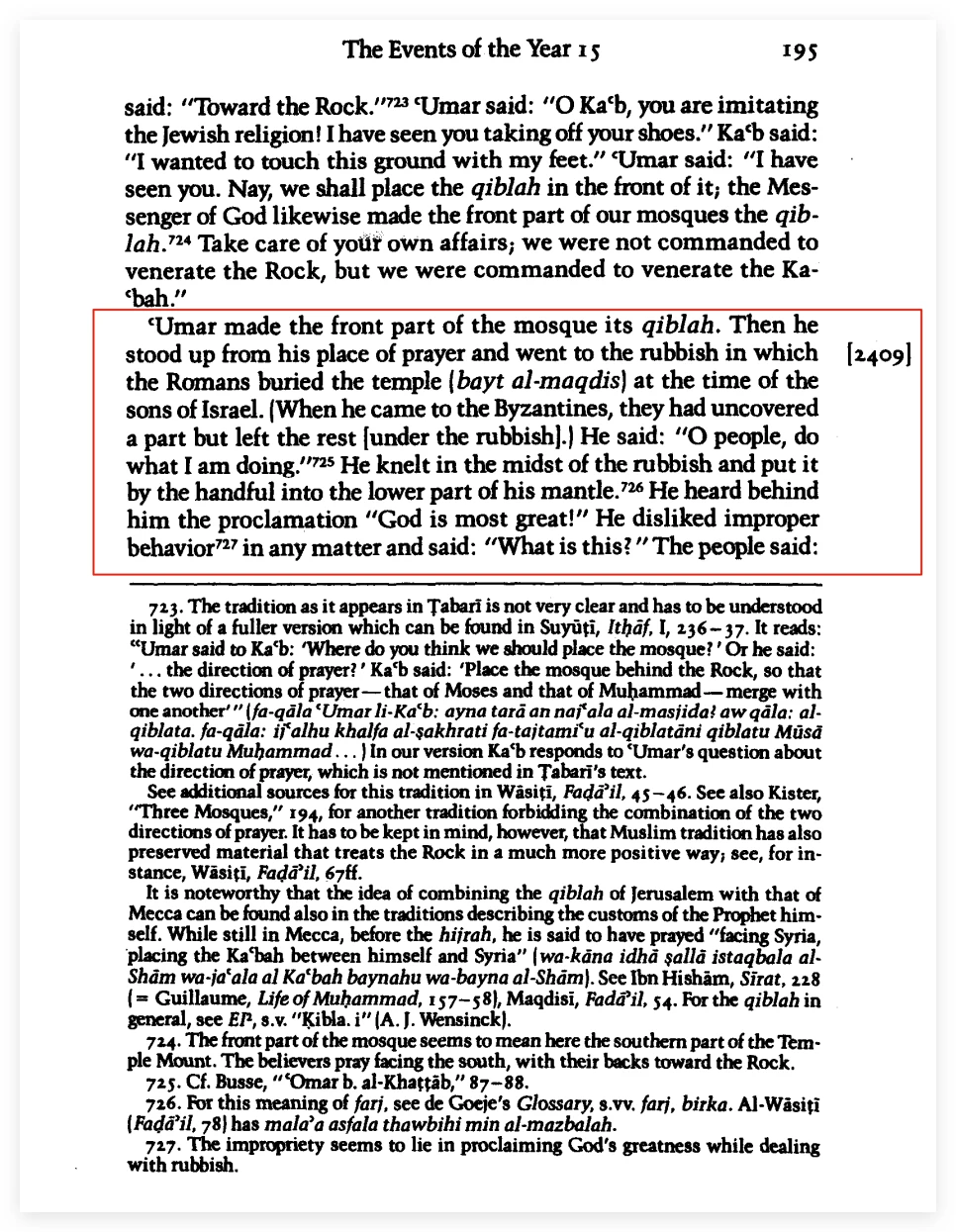
The question therefore arises: when Muhammad supposedly undertook Mi‘raj in 621 CE, there was no mosque there, only mountains of rubbish. What did he “enter”? In which courtyard did he “pray”? Let us now examine al-Bidaya wa-l-Nihaya [81].
The Conquest of Bayt al-Maqdis under Umar ibn al-Khattab
Abu Ja‘far ibn Jarir states that this occurred in 15 AH, narrating it through Sayf ibn Umar. The substance of his and other accounts is that the commander Abu Ubayda completed the Damascus campaign and wrote to Jerusalem’s inhabitants, calling them to Allah’s path and Islam. He offered them three alternatives: accept Islam, pay jizya, or prepare for war. They refused his invitation. Leaving Sa‘id ibn Zayd in charge of Damascus, he marched against them and besieged Bayt al-Maqdis, making life difficult for its Christians. They then agreed to a treaty on condition that the Commander of the Believers, Caliph Umar ibn al-Khattab, personally conclude it. Abu Ubayda informed the caliph, who consulted his advisers. Uthman argued that the caliph should not go, which would humiliate them further. Ali favored going, since this would relieve the besieging Muslim troops’ hardship and facilitate the city’s conquest. Umar accepted Ali’s advice, departed for Jerusalem with his forces, and left Ali in charge of Medina. Abbas ibn Abd al-Muttalib traveled ahead of him.
On reaching Syria, the caliph was met by Abu Ubayda and other senior commanders, including Khalid ibn al-Walid and Yazid ibn Abi Sufyan. Abu Ubayda and Umar were both walking. When Abu Ubayda tried to kiss Umar’s hand, Umar tried to kiss Abu Ubayda’s feet. Abu Ubayda would not permit this, and Umar likewise would not permit his hand to be kissed. Umar proceeded and concluded a peace treaty with Jerusalem’s Christians, stipulating that all Roman citizens leave Bayt al-Maqdis within three days. He then entered through the door used by the Messenger on the night of Mi‘raj.
Some say he recited the talbiya when entering Bayt al-Maqdis. Inside, he performed the mosque-greeting prayer beside David’s prayer niche. The next morning, he led the Muslims in Fajr, reciting Surah Sad in the first rak‘a and performing its prostration of recitation; the Muslims prostrated with him. In the second rak‘a, he recited Surah Bani Isra’il. He then approached the Rock, having learned its location from Ka‘b al-Ahbar. Ka‘b suggested building the mosque behind it. Umar replied that the Jewish dispensation had ended. He built the mosque in front of Bayt al-Maqdis; it is now known as the Umari Mosque. He then began removing earth from the Rock, carrying it in his cloak and clothing. The Muslims joined him, and people from Jordan were assigned to remove the remainder. The Romans had turned the Rock’s location into a rubbish dump because it was the Jewish qibla. Christian women even discarded their bloodstained menstrual cloths there. This was retaliation for the Jews having used the site called al-Qumama as a rubbish dump. Al-Qumama was where the Jews had crucified someone resembling Jesus, believing him to be Jesus, and they threw dirt and refuse onto his grave. The site consequently became known as al-Qumama. The Christians later built a church there bearing that name.
While Heraclius was in Jerusalem, communication from the Messenger reached him. He admonished the Christians for their misconduct: they were depositing so much rubbish on the Rock that the heap reached David’s prayer niche. Heraclius said, “You deserve to be slain for throwing this rubbish here and dishonoring this place of worship. Just as the Children of Israel were killed for murdering John son of Zechariah, you will surely be killed for this offense.” He ordered its removal. They had begun clearing it and removed part of it when the Muslims conquered Bayt al-Maqdis. Umar ibn al-Khattab then removed the rest. Hafiz Baha al-Din ibn Hafiz Abu al-Qasim ibn Asakir records these reports in detail, with chains and texts, in al-Mukhtasar fi Fada’il al-Masjid al-Aqsa.
Through his chain, Sayf states that Umar rode a horse from Medina to travel quickly, leaving Ali in charge during his absence. He advanced rapidly to al-Jabiya and dismounted there…
In sum, when Christians gained control of Bayt al-Maqdis some three hundred years before the Messenger’s prophethood, they cleared the site called al-Qumama and built the Hayla church there. The mother of the ruler of Constantinople built it; she was called Haylana al-Hiraniyya al-Bunduqiyya. She instructed her son to build Bethlehem at Jesus’s birthplace, while she built the Hayla church over what, according to their religious belief, was his grave. In retaliation, they too turned the Jewish qibla into a rubbish dump.
When Umar conquered Bayt al-Maqdis and established the Rock’s location, he ordered the accumulated refuse removed. It is said that he personally carried rubbish away in his cloak. He then asked Ka‘b where to establish the mosque. Ka‘b recommended behind the Rock. Striking his chest, Umar said, “Ka‘b! The Jewish era has ended. Why should we now work on behalf of that religion?” He ultimately ordered the mosque built in front of Bayt al-Maqdis.
Imam Ahmad states: Aswad ibn Amir narrated from Abu Shu‘ayb that Umar ibn al-Khattab stayed at al-Jabiya and then conquered Bayt al-Maqdis. He says Ibn Salama stated that Abu Sinan narrated through Ubayd ibn Adam: “I heard Umar ask Ka‘b, ‘Where should I pray?’ Ka‘b replied, ‘If you accept my advice, pray behind the Rock, so that all Bayt al-Maqdis will be before you.’ Umar said, ‘The Jewish dispensation has ended. No: I will pray where the Messenger himself prayed.’ He advanced toward the qibla, at the front of Bayt al-Maqdis, and prayed there. Then he spread his cloak and began removing rubbish from the Rock. The people also began clearing it.” This is a good chain. Hafiz Diya al-Din al-Maqdisi quotes it in al-Mustakhraj. In our work Musnad Umar, we have examined this chain’s narrators and arranged the marfu‘ hadith he narrated, and reports transmitted from him, according to jurisprudential chapters. All praise belongs to Almighty Allah.
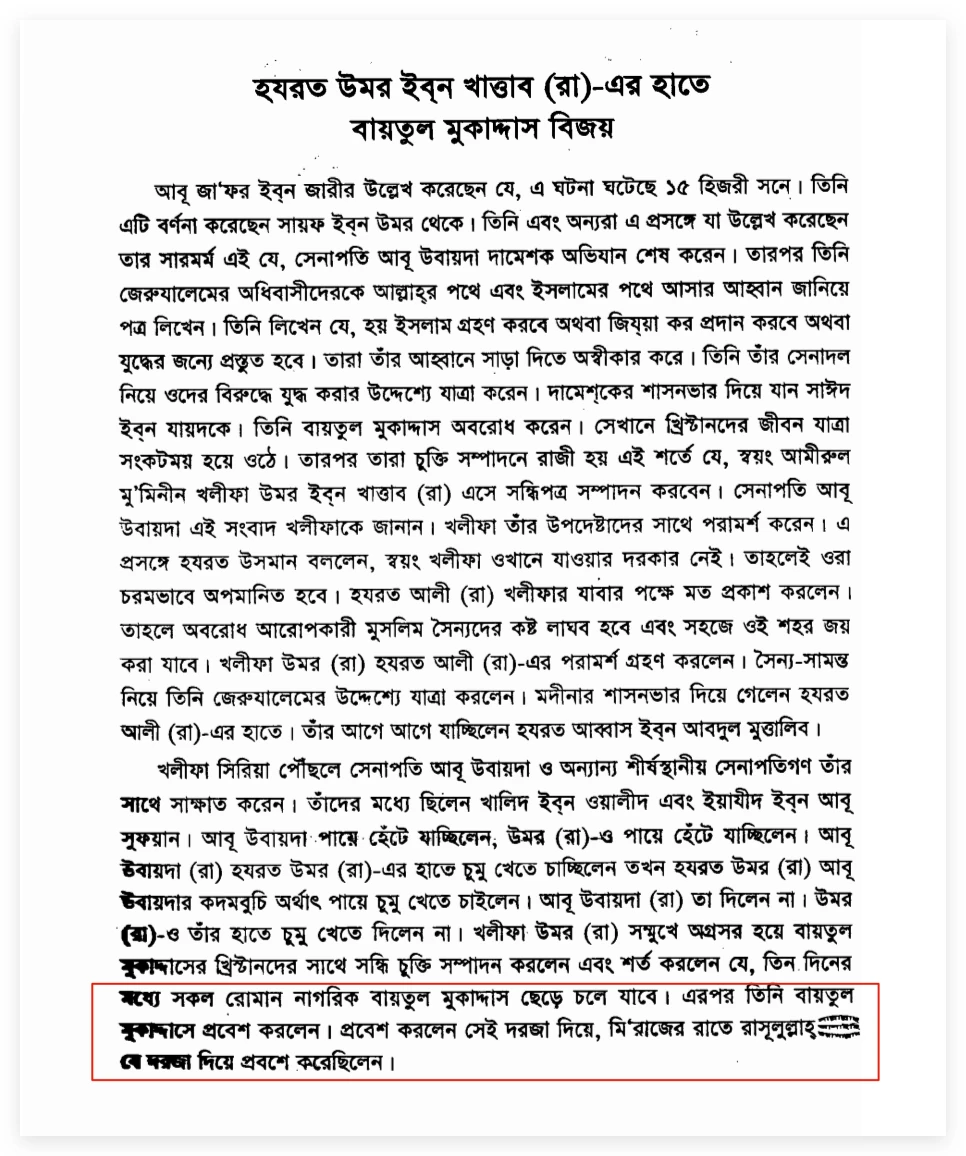
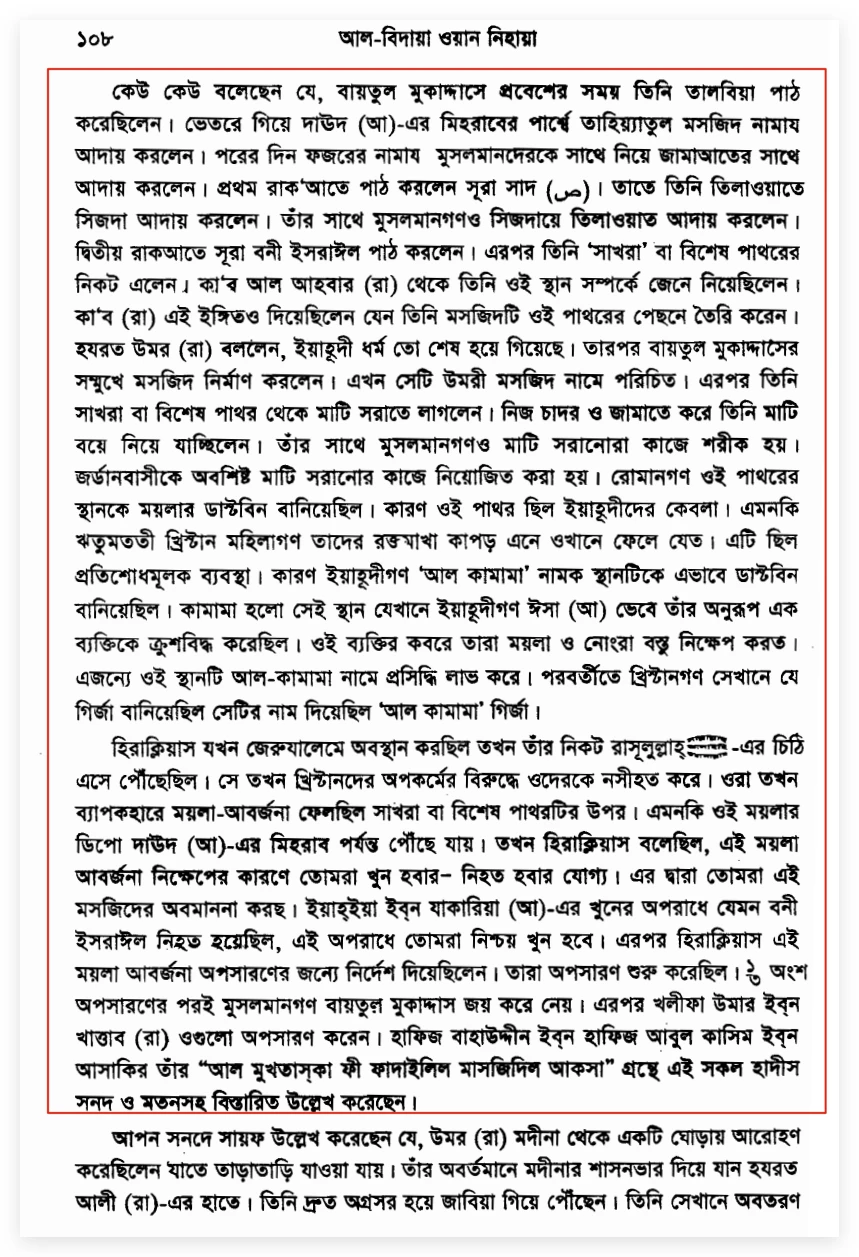
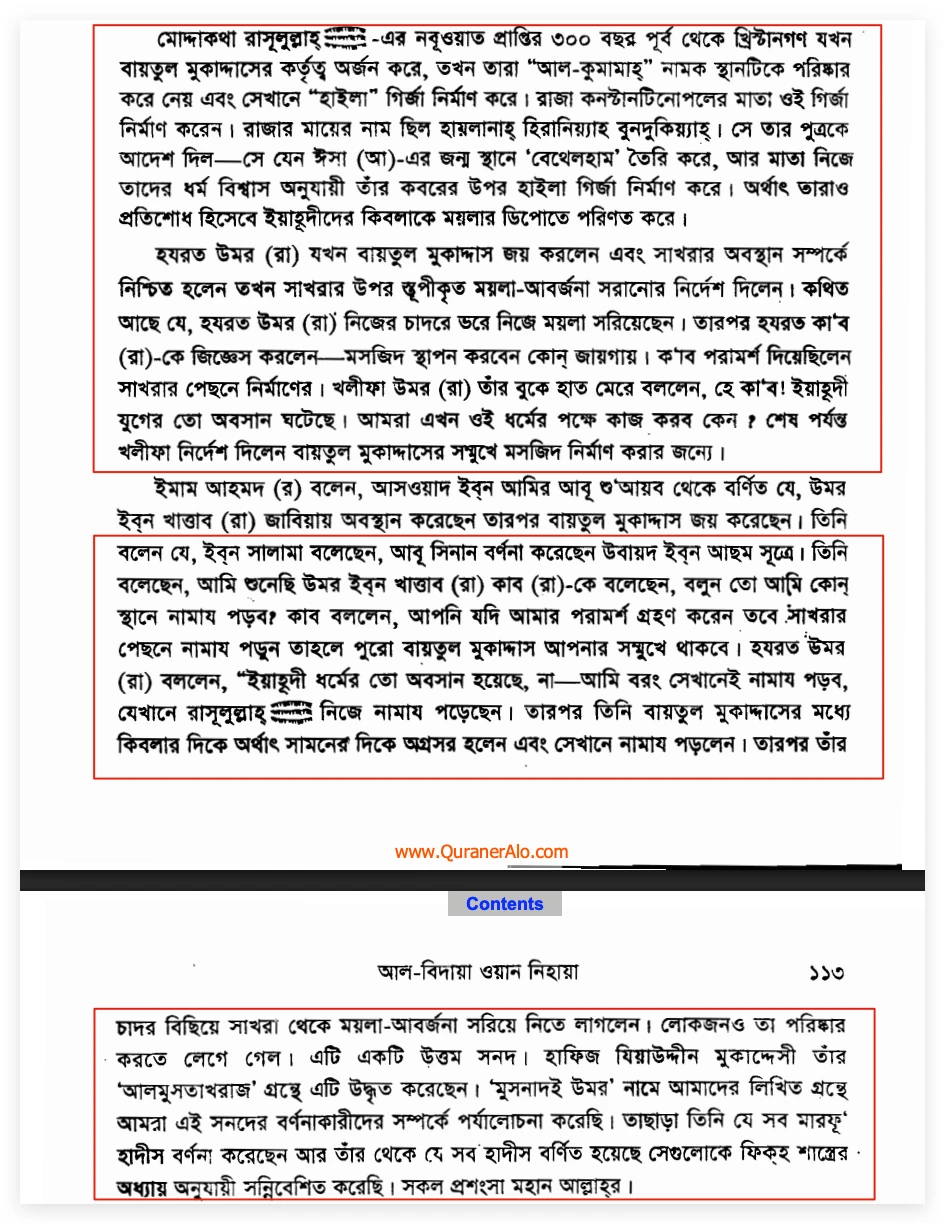
Who Built the Present Al-Aqsa?
The golden dome—the Dome of the Rock (Qubbat al-Sakhra)—and al-Aqsa Mosque that we see in Jerusalem today are not structures from Muhammad’s lifetime. These immense buildings were constructed during the reigns of the Umayyad caliph Abd al-Malik ibn Marwan and his son al-Walid (685–715 CE) [82].
Thus, when the Quran mentions al-Masjid al-Aqsa, no masonry structure actually stood there. Hadith descriptions of Muhammad “entering the mosque” and “tying Buraq to a post” are geographically and historically impossible, because no such post or entrance door then existed.
How Did Muhammad Count the Doors of a Mosque That Had Not Been Built?
A serious historical inconsistency in the Mi‘raj story concerns the supposed number of doors at Bayt al-Maqdis. According to Islamic sira accounts, when Muhammad claimed to have visited Bayt al-Maqdis within a single night, the Quraysh began testing his claim. After asking successive questions about its structure, shape, and surroundings, they asked directly, “How many doors does the mosque have?” (كم للمسجد من باب؟) The problem was that Muhammad had supposedly not counted them beforehand. A miraculous solution then appears: Bayt al-Maqdis is made visible before his eyes, and he looks at it, counting the doors one by one and answering the Quraysh. More remarkably, although this miraculous counting is presented as proof of his truthfulness, the account never ultimately tells us how many doors the mosque actually had [83].
Let us now place this story against the historical chronology. Mi‘raj supposedly occurred around 621 CE. Jerusalem was then under Byzantine rule; Muslims would not conquer the city for roughly another fifteen years. The construction and architectural development of Islamic places of worship on the Temple Mount began after the Muslim conquest. Monumental Islamic architecture developed there in the subsequent Umayyad period: the Dome of the Rock was completed in 691 CE, while the large Umayyad mosque associated with the architectural history of today’s al-Aqsa Mosque was built under al-Walid, around 709–715 CE. That is approximately ninety years after the supposed date of Mi‘raj [84].
More importantly, even accepting a reconstruction of a very early Islamic mosque in the al-Aqsa compound does not resolve the problem. The early mosque complex whose multiple entrances St. Laurent and Awwad reconstruct in their research was established between 640 and 660 CE, at least about two decades after the supposed Mi‘raj. Their reconstruction depicts a built Islamic mosque with several entrances on its northern, southern, and eastern sides. In 621 CE, however, this Islamic mosque with its doors did not yet exist.
This exposes the Mi‘raj narrative’s chronological inconsistency. How could the Quraysh ask Muhammad how many doors an Islamic mosque had in 621 CE, when that mosque had not yet been built? And which mosque’s doors did Muhammad count one by one to answer them? Invoking the Temple Mount’s ancient walls and older gateways does not resolve this. The gate of an ancient religious compound is not the same thing as a door in a constructed mosque, as specified by the sira’s explicit question, “How many doors does the mosque have?” The language does not describe some undefined open precinct. It depicts a particular structure whose doors can be counted, whose form can be described, and whose architectural features can be used to test someone’s claim.
| Gate / Entrance | Researchers’ Dating | Compared with Mi‘raj’s Approximate Date of 621 CE |
|---|---|---|
| The mosque’s main northern entrance | 640–660 CE, according to the St. Laurent–Awwad reconstruction | At least approximately nineteen years later |
| Southern public entrance | The mosque complex of 640–660 CE | After Mi‘raj |
| Southern private entrance | The mosque complex of 640–660 CE | After Mi‘raj |
| Eastern ceremonial entrance / Golden Gate | An entrance to the early Islamic mosque complex in the St. Laurent–Awwad reconstruction | After Mi‘raj |
The chronology thus stands ruthlessly against the story. The event is claimed to have occurred in 621 CE, yet even the early Islamic mosque whose architectural existence, complete with doors, can be reconstructed through research belongs to several decades later. Nevertheless, the later sira story has the Quraysh asking Muhammad how many doors this “mosque” had, while he miraculously sees the building before him and counts them one by one. This is no proof of a miracle; it is a clear architectural anachronism showing how the reality of later al-Aqsa architecture entered the older Mi‘raj narrative.
The logical conclusion is therefore that the Quranic term al-Masjid al-Aqsa may not refer to an earthly location. Alternatively, examining later developments under the Umayyads raises the question suggested by some research: might this association have formed as part of a subsequent political and religious construction? Was it actually possible to visit and lead prayers in a mosque that did not yet exist, or was the entire account a political and religious narrative created under Umayyad rule?
A Scientific Analysis of Mi‘raj: Physics and Astronomy
Islamic theology describes Mi‘raj as a miraculous journey through space. According to hadith, Muhammad traveled in one night from Mecca to Jerusalem, crossed the seven heavens, entered the Creator’s presence, and returned to Earth [85]. The journey involves a mount called Buraq, travel faster than light, and passage through different levels of space. Yet measured against twenty-first-century science, particularly theoretical physics and astronomy, these accounts conflict sharply with physical reality. The following is a brief analytical examination of Mi‘raj in light of established scientific principles and academic references. Another article will discuss the subject in detail.
Special Relativity and the Speed-of-Light Limit
Mi‘raj accounts claim that Muhammad crossed immense cosmic distances in the blink of an eye or in an extremely short time. The radius of the observable universe is approximately 46.5 billion light-years. Even reaching our nearest stellar system, Alpha Centauri, takes 4.37 years at the speed of light, approximately 300,000 kilometers per second. In his 1905 special theory of relativity, Albert Einstein demonstrated that an object with mass cannot attain the speed of light (c). As an object approaches that speed, its relativistic mass tends toward infinity, and accelerating it further requires infinite energy [86].
If Buraq is an animal or a material object, crossing these cosmic distances in one night is therefore mathematically impossible under the fundamental physical principle E=mc^2. Although modern cosmology includes theoretical concepts such as wormholes or Einstein–Rosen bridges, an animal’s surviving their extreme gravitational distortion intact is biologically unrealistic.
Time Dilation and the Twin Paradox
Suppose Muhammad miraculously traveled at close to the speed of light. According to relativity’s principle of time dilation, time passes more slowly for a high-speed traveler relative to Earth. This is known in physics as the twin paradox [87]. If Muhammad traversed immense distances through the universe and returned, perhaps only hours would pass on his own clock, while hundreds or thousands of years should pass in Earth’s reference frame.
Yet accounts describe his returning to find his bed still warm or his ablution water still running—such descriptions do exist—meaning that no time had effectively elapsed on Earth. This would be possible only if time throughout the universe were halted during the journey, entirely violating entropy and the second law of thermodynamics.
The Space Environment and Biological Limitations
The Mi‘raj narrative does not describe Muhammad wearing any special protection or spacesuit. He passes through the atmosphere into space in ordinary clothing. According to modern aerospace medicine, at nineteen kilometers above sea level one crosses the Armstrong line, where atmospheric pressure is so low that bodily fluids, such as saliva, tears, and blood, begin to boil—a phenomenon called ebullism [88].
- Hypoxia: Oxygen deprivation would impair brain function within fifteen seconds.
- Cosmic Radiation: Without protection, the Van Allen radiation belts and gamma rays in space would damage DNA and kill cells.
- Temperature: Temperatures in shaded regions of space fall to −270 degrees Celsius, causing biological life to freeze immediately.
From the perspective of modern biology, bodily travel through space and a living return without any life-support system is therefore an entirely impossible claim.
The “Seven Heavens” versus Modern Cosmology
The concept of seven heavens in the Quran and hadith corresponds to ancient Ptolemaic geocentric astronomy, which imagined seven solid layers or spheres surrounding Earth like the layers of an onion. Hadith describe stars in the first heaven and a “door” on which Gabriel knocked [89].
Modern astronomy or cosmology, however, has found no such solid layers or heavens in the universe. Observations by the Hubble and James Webb Space Telescopes show that the universe is a continuous spacetime. It contains no layers equipped with doors, roofs, or guards. Stars, galaxies, nebulae, and dark matter are distributed throughout an immense expanse of space. The seven-heavens theory is now regarded as an obsolete or archaic scientific conception, inconsistent with the standard cosmological model. Muhammad’s or Islam’s conception instead corresponds to ancient understandings of the universe. The illustration below presents one historical cosmological model, showing seven successive celestial layers imagined around Earth and the heavenly realm above them.
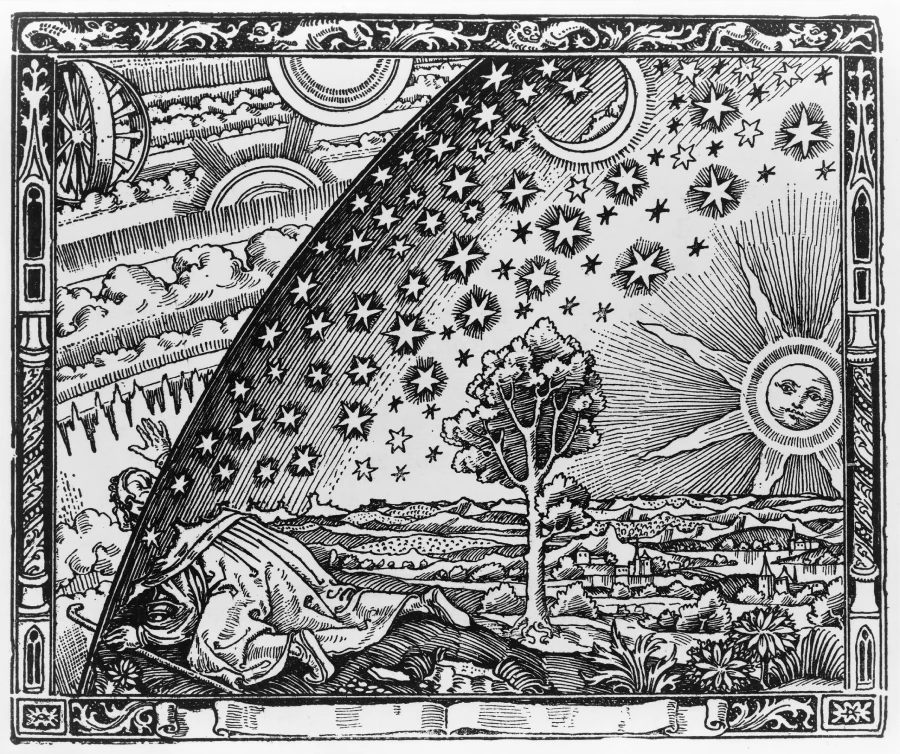
Compared with the mythological cosmos depicted above, modern science understands the “heavens” simply as the boundless expanse of space containing countless galaxies. Where, then, is the first heaven’s door described in hadith? Is it just beyond Earth’s atmosphere, or beyond the Moon’s orbit? Humans have walked on the Moon, sent rovers to Mars, and conducted missions near the Sun, yet nowhere have they found a heavenly door. Nor has any celestial gatekeeper been discovered. If someone argues that the heavens are metaphysical rather than materially existent, Mi‘raj becomes untenable as a physical journey and instead becomes an experience occurring entirely in a dream. Yet hadith explicitly describe Muhammad’s bodily ascent and return. They even recount that, when he returned to Mecca and the Quraysh expressed disbelief, he described Bayt al-Maqdis—the mosque in Jerusalem—and reported a caravan seen along the way, information subsequently established as true. The episode is thus presented as an actual journey, rather than a mere metaphor or dream. Its physical questions therefore cannot be ignored.
Meeting the Dead
Mi‘raj narratives describe Muhammad conversing directly with earlier prophets, including Adam, Yahya (John), Isa (Jesus), Moses, and Abraham [90]. In physical reality, dead people no longer exist bodily: their bodies decay and disintegrate, and consciousness ceases. One may believe in an afterlife or souls, but we possess no evidence establishing that a person’s conscious self continues to exist materially after death, praying or speaking. Meeting earlier prophets in heaven can therefore be called directly impossible from the standpoint of empirical science. Hadith specifically place Adam in the first heaven. Adam, the supposed first human ancestor, lived and died on Earth thousands of years earlier. If he were physically present in heaven, is there another Earth there? Otherwise, where does he live? In reality, we certainly do not observe human bodies or souls moving through the heavens. An afterlife is a matter of religious belief; scientific research has found no actual existence for these things. Treating conversations with dead prophets during Mi‘raj as literal bodily events therefore moves beyond rational inquiry and scientific principles into a supernatural claim requiring tangible evidence. As Carl Sagan said:
Extraordinary claims require extraordinary evidence!
Bayt al-Ma‘mur and the Geostationary Problem
Several accounts in tafsir and transmitted reports describe Bayt al-Ma‘mur as located in the sky directly above the Kaaba. The quotations below from Tafsir Zakaria, Tafsir Mazhari, and Ibn Kathir explicitly make this claim. Taken literally, it is problematic from both geometrical and cosmological perspectives.
Earth is not a stationary plane. It is a sphere rotating on its axis while orbiting the Sun, and the entire solar system is moving rapidly through the galaxy. Taken literally, the claim that “Bayt al-Ma‘mur in the seventh heaven is directly above the Kaaba” therefore conflicts directly with modern astronomy and geometry. The Kaaba is a moving point on Earth’s surface; Earth’s rotation continually changes the direction “directly above” it in space. Earth also orbits the Sun, while the solar system itself moves through the galaxy. Yet Islamic accounts claim that Bayt al-Ma‘mur, far above in the seventh heaven, stands precisely in line with the Kaaba; some even say that, if it collapsed, it would fall directly onto the Kaaba. This is no actual geometrical position in modern astronomy, but a religious conception suited to an ancient universe with a fixed sky. Permanently suspending another structure in the “seventh heaven” above a particular point on a rotating Earth that continually changes position in space does not fit actual cosmology. Let us now hear Ahmadullah’s statement on this subject:
Tafsir Zakaria explicitly states that the heavenly mosque called Bayt al-Ma‘mur lies directly above the earthly Kaaba [91].
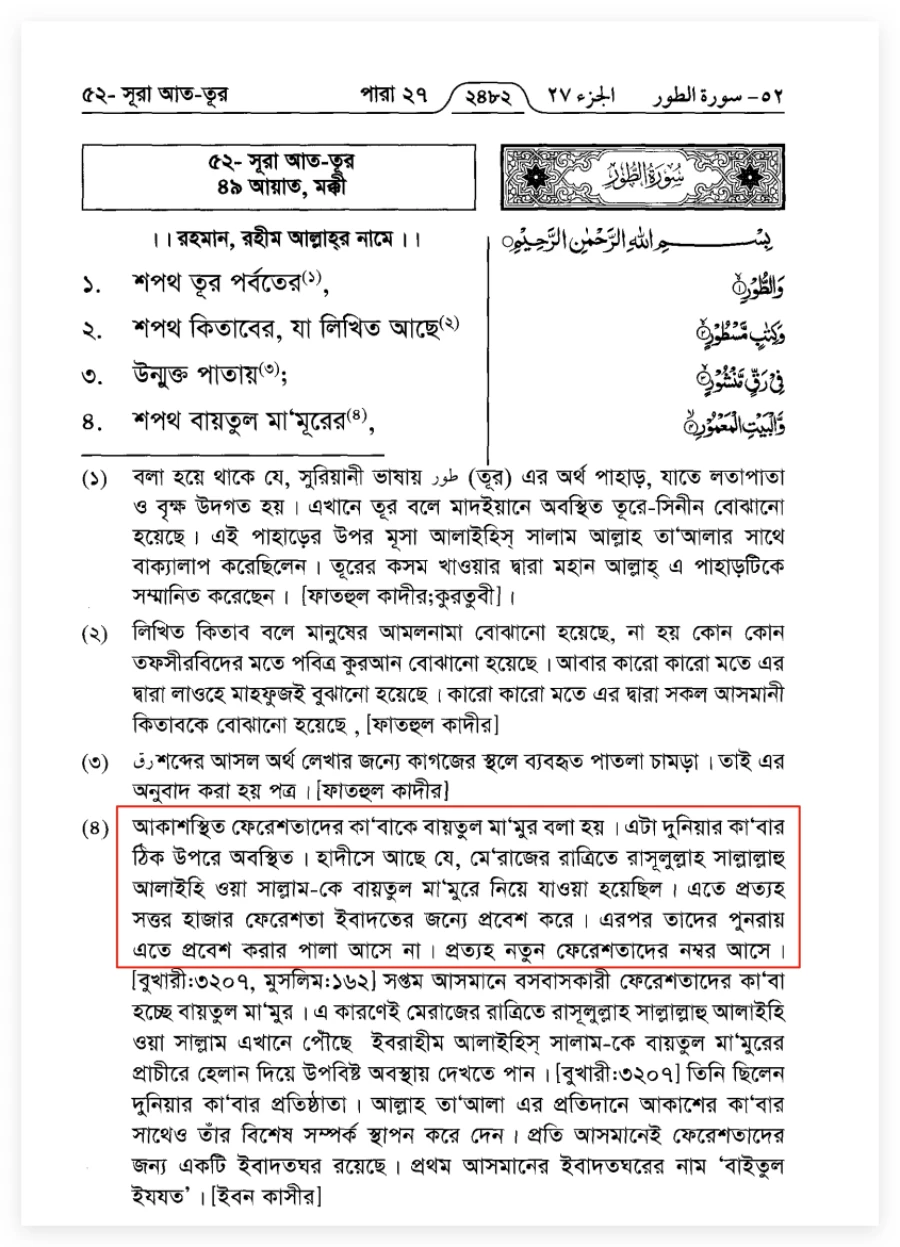
Let us examine Tafsir Mazhari [92].
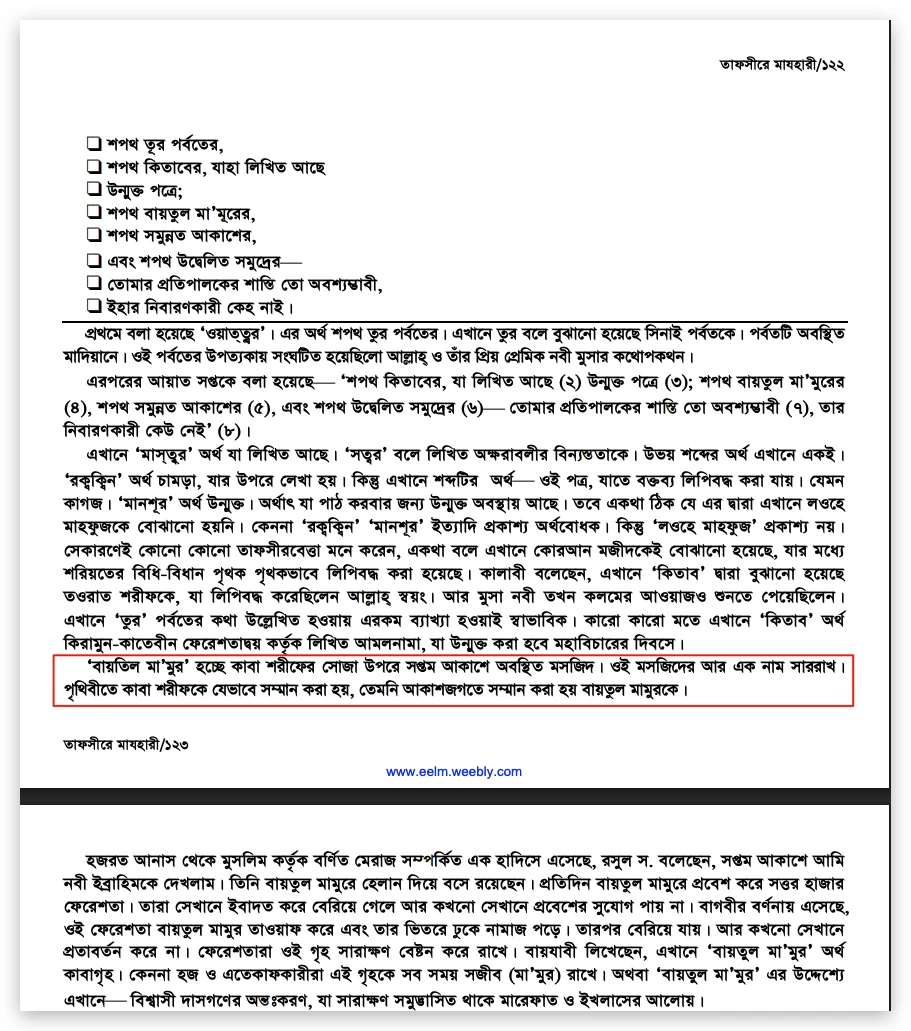
Let us see what Tafsir Ibn Kathir says [93].
Ibn Jarir narrates from Khalid ibn Ar‘ara, who said: A man asked Ali what Bayt al-Ma‘mur was. Ali replied, “A house called al-Surah, located in the sky directly above the Kaaba. It holds the same honor among heaven’s inhabitants as the Sacred House does among those on Earth. Every day, seventy thousand angels pray there and leave, never entering it again.”
Qatada, Rabi‘ ibn Anas, and al-Suddi say: It was related to us that the Messenger once asked his Companions, “Do you know what Bayt al-Ma‘mur is?” They answered, “Allah and His Messenger know best.” He said, “Bayt al-Ma‘mur is a mosque in the sky directly above the Kaaba. Hypothetically, if it collapsed, it would fall directly onto the Kaaba. Seventy thousand angels pray there daily, then depart and never return.”
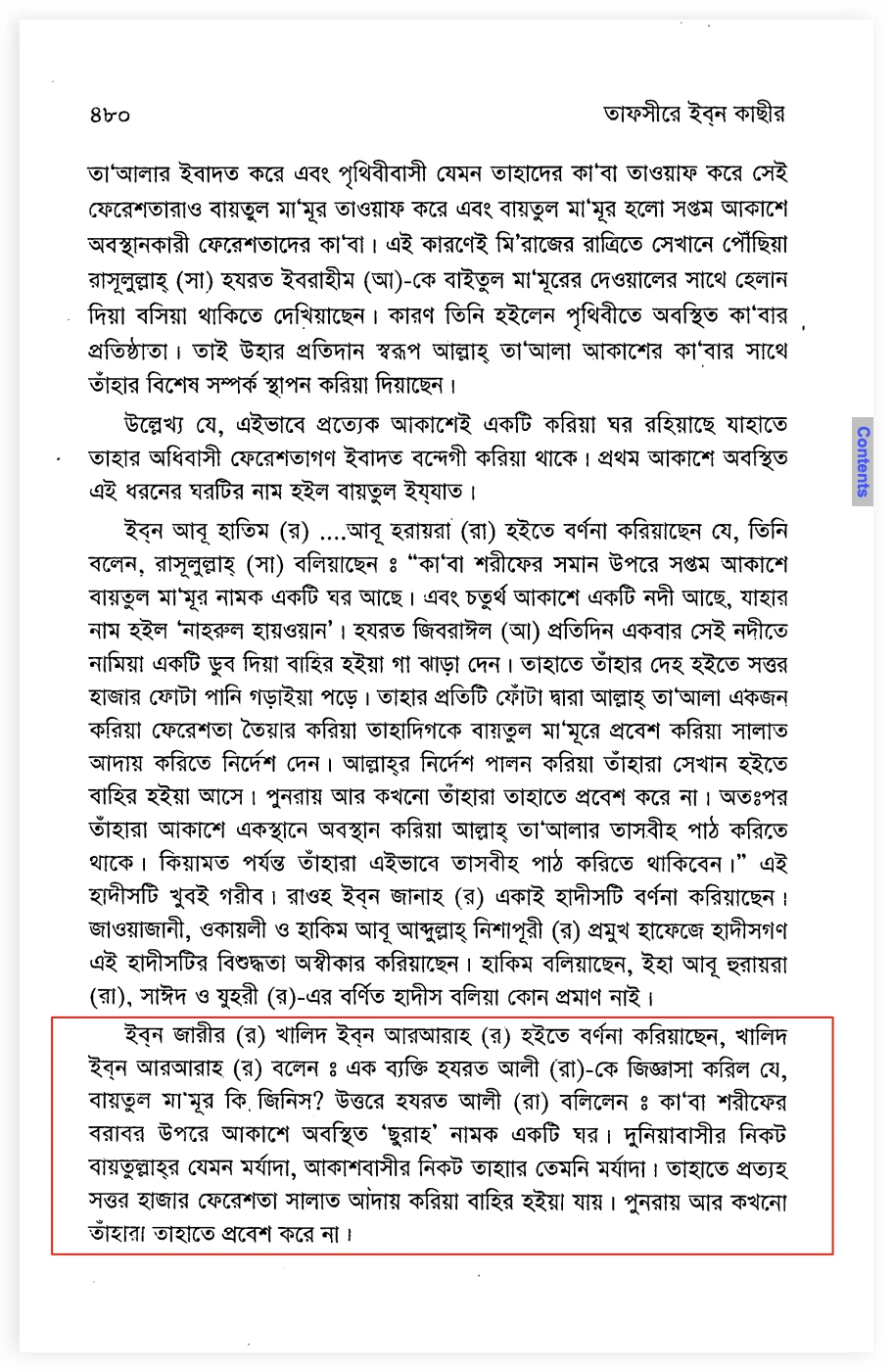
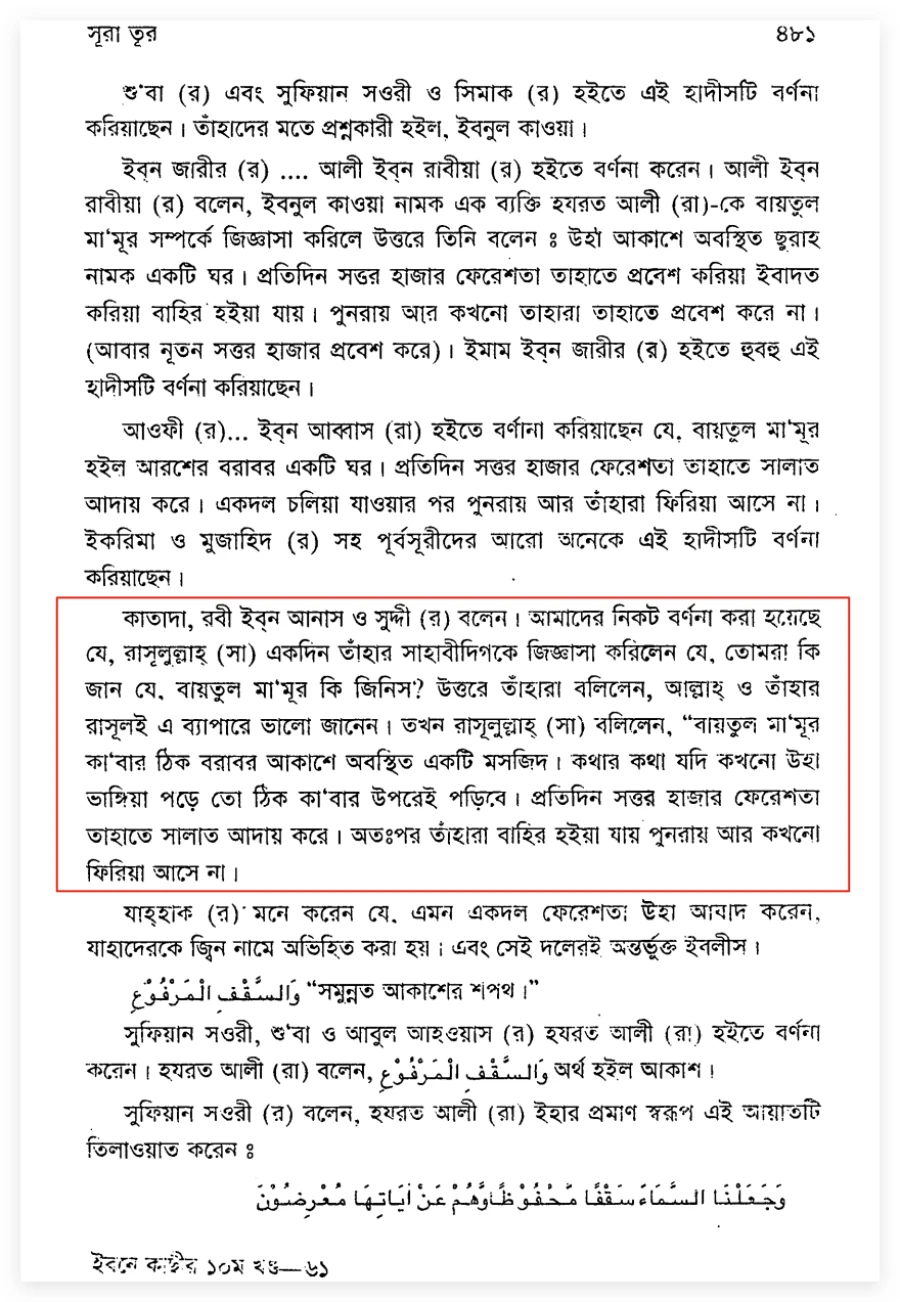
In light of these analyses, examining the Mi‘raj hadith through modern science reveals conflict with scientific knowledge at every stage. Violating the speed-of-light limit, traveling through space instantaneously while ignoring time’s relativity, surviving the vacuum, meeting dead people, and the ancient seven-heavens framework—all these claims are inconsistent with scientific findings. Believers, of course, accept Mi‘raj as a miracle to which ordinary scientific laws do not apply. Examined scientifically, however, it must be understood as a dream, an uncanny psychological experience, or a figurative account rather than physical reality. Put sarcastically, accepting Mi‘raj as real would require us to demolish and rewrite many principles of existing physics. If we decline to do so, it must remain within the realm of faith, a miracle above scientific criticism whose truth cannot be tested in reality’s laboratory.
Contradictions in the Accounts of Mi‘raj
Fabricated stories invariably contain discrepancies, something familiar in courts throughout the world. When two narrators’ accounts conflict, it readily suggests that the witnesses may be inventing their stories. Police therefore question eyewitnesses separately in different rooms and compare the sequence of events meticulously. Discrepancies indicate a problem with the account. Because an invented story is merely a fabrication, its teller may forget on the second or third telling what was said the first time. Subsequent versions therefore often differ from the original. During police questioning or psychological analysis, eyewitnesses are consequently asked to recount the same event a second or third time. If the first version says one thing, the second another, and the third something different again, the episode can be understood as fabricated. These are simple, ordinary ways of examining false accounts, widely used in criminology to expose lies. Since we are discussing Muhammad’s Mi‘raj story, I will identify several such discrepancies, showing that numerous details simply cannot be reconciled. To remove these inconsistencies, many scholars resort to imaginative explanations and sometimes conceal the truth. Some say Mi‘raj occurred many times; others say once or twice. Some say it was not bodily but spiritual, occurring in a dream. Hadith also claim that Muhammad prayed that night in Jerusalem’s Bayt al-Maqdis mosque, yet historians state that no mosque existed there during his lifetime. Historical research identifies the ruins of King Solomon’s temple at the site. Where, then, did Muhammad pray that night? This will be discussed in detail later. For now, we will examine other matters. Including weak hadith accounts would make this list much longer and reveal drastic differences, so I am excluding them. Hadith scholars have already classified those reports as weak because they do not agree with authentic hadith. I will discuss only sahih and hasan reports, together with one munkar hadith. A munkar hadith, in this context, is one considered objectionable because its account does not agree with authentic hadith.
How Many Angels Came?
Muhammad described different numbers of angels to different people: one to some, two to others, and three in another account. Let us compare them. First, an account of one angel: only one arrived, someone Muhammad already knew—Gabriel. According to this account, Gabriel came alone that night to take him on Mi‘raj [94].
Sahih al-Bukhari (Islamic Foundation)
8/ Prayer
Section: 242. How was prayer made obligatory during the Mi‘raj?
Islamic Foundation no.: 342; international no.: 349
Ibn Abbas (may Allah be pleased with him) said: Abu Sufyan ibn Harb (may Allah be pleased with him) narrated to me the account of Heraclius, in which he also said that the Prophet (peace and blessings be upon him) commanded us to pray, speak truthfully and remain chaste.
342. Yahya ibn Bukayr (may Allah have mercy on him) … Narrated Abu Dhar: Allah’s Messenger (ﷺ) said, “While I was at Mecca the roof of my house was opened and Gabriel descended, opened my chest, and washed it with Zamzam water. Then he brought a golden tray full of wisdom and faith and having poured its contents into my chest, he closed it. Then he took my hand and ascended with me to the nearest heaven, when I reached the nearest heaven, Gabriel said to the gatekeeper of the heaven, ‘Open (the gate).’ The gatekeeper asked, ‘Who is it?’ Gabriel answered: ‘Gabriel.’ He asked, ‘Is there anyone with you?’ Gabriel replied, ‘Yes, Muhammad I is with me.’ He asked, ‘Has he been called?’ Gabriel said, ‘Yes.’ So the gate was opened and we went over the nearest heaven and there we saw a man sitting with some people on his right and some on his left.
When he looked towards his right, he laughed and when he looked toward his left he wept. Then he said, ‘Welcome! O pious Prophet and pious son.’ I asked Gabriel, ‘Who is he?’ He replied, ‘He is Adam and the people on his right and left are the souls of his offspring. Those on his right are the people of Paradise and those on his left are the people of Hell and when he looks towards his right he laughs and when he looks towards his left he weeps.’ Then he ascended with me till he reached the second heaven and he (Gabriel) said to its gatekeeper, ‘Open (the gate).’ The gatekeeper said to him the same as the gatekeeper of the first heaven had said and he opened the gate.
Anas said: “Abu Dhar added that the Prophet (ﷺ) met Adam, Idris, Moses, Jesus and Abraham, he (Abu Dhar) did not mention on which heaven they were but he mentioned that he (the Prophet (ﷺ) ) met Adam on the nearest heaven and Abraham on the sixth heaven. Anas said, “When Gabriel along with the Prophet (ﷺ) passed by Idris, the latter said, ‘Welcome! O pious Prophet and pious brother.’ The Prophet (ﷺ) asked, ‘Who is he?’ Gabriel replied, ‘He is Idris.” The Prophet (ﷺ) added, “I passed by Moses and he said, ‘Welcome! O pious Prophet and pious brother.’ I asked Gabriel, ‘Who is he?’ Gabriel replied, ‘He is Moses.’ Then I passed by Jesus and he said, ‘Welcome! O pious brother and pious Prophet.’ I asked, ‘Who is he?’ Gabriel replied, ‘He is Jesus. Then I passed by Abraham and he said, ‘Welcome!
O pious Prophet and pious son.’ I asked Gabriel, ‘Who is he?’ Gabriel replied, ‘He is Abraham. The Prophet (ﷺ) added, ‘Then Gabriel ascended with me to a place where I heard the creaking of the pens.” Ibn Hazm and Anas bin Malik said: The Prophet (ﷺ) said, “Then Allah enjoined fifty prayers on my followers when I returned with this order of Allah, I passed by Moses who asked me, ‘What has Allah enjoined on your followers?’ I replied, ‘He has enjoined fifty prayers on them.’ Moses said, ‘Go back to your Lord (and appeal for reduction) for your followers will not be able to bear it.’ (So I went back to Allah and requested for reduction) and He reduced it to half. When I passed by Moses again and informed him about it, he said, ‘Go back to your Lord as your followers will not be able to bear it.’
So I returned to Allah and requested for further reduction and half of it was reduced. I again passed by Moses and he said to me: ‘Return to your Lord, for your followers will not be able to bear it. So I returned to Allah and He said, ‘These are five prayers and they are all (equal to) fifty (in reward) for My Word does not change.’ I returned to Moses and he told me to go back once again. I replied, ‘Now I feel shy of asking my Lord again.’ Then Gabriel took me till we ” reached Sidrat-il-Muntaha (Lote tree of; the utmost boundary) which was shrouded in colors, indescribable. Then I was admitted into Paradise where I found small (tents or) walls (made) of pearls and its earth was of musk.”
Sahih al-Bukhari 349; Book 8, Hadith 1
Hadith grade: Sahih (Authentic)
Narrator: Anas ibn Malik (may Allah be pleased with him)
Another account likewise mentions one visitor. But if Muhammad already knew Gabriel, why did he describe him as a stranger? That is difficult to understand [95].
Sahih al-Bukhari (Islamic Foundation)
50/ The Prophets (peace be upon them)
Section: 2151. The account of the Mi‘raj
Islamic Foundation no.: 3608; international no.: 3887
3608. Hudba ibn Khalid (may Allah have mercy on him) … Narrated `Abbas bin Malik: Malik bin Sasaa said that Allah’s Messenger (ﷺ) described to them his Night Journey saying, “While I was lying in Al-Hatim or Al-Hijr, suddenly someone came to me and cut my body open from here to here.” I asked Al-Jarud who was by my side, “What does he mean?” He said, “It means from his throat to his pubic area,” or said, “From the top of the chest.” The Prophet (ﷺ) further said, “He then took out my heart. Then a gold tray of Belief was brought to me and my heart was washed and was filled (with Belief) and then returned to its original place.
Then a white animal which was smaller than a mule and bigger than a donkey was brought to me.” (On this Al-Jarud asked, “Was it the Buraq, O Abu Hamza?” I (i.e. Anas) replied in the affirmative). The Prophet (ﷺ) said, “The animal’s step (was so wide that it) reached the farthest point within the reach of the animal’s sight. I was carried on it, and Gabriel set out with me till we reached the nearest heaven. When he asked for the gate to be opened, it was asked, ‘Who is it?’ Gabriel answered, ‘Gabriel.’ It was asked, ‘Who is accompanying you?’ Gabriel replied, ‘Muhammad.’ It was asked, ‘Has Muhammad been called?’
Gabriel replied in the affirmative. Then it was said, ‘He is welcomed. What an excellent visit his is!’ The gate was opened, and when I went over the first heaven, I saw Adam there. Gabriel said (to me). ‘This is your father, Adam; pay him your greetings.’ So I greeted him and he returned the greeting to me and said, ‘You are welcomed, O pious son and pious Prophet.’ Then Gabriel ascended with me till we reached the second heaven. Gabriel asked for the gate to be opened. It was asked, ‘Who is it?’ Gabriel answered, ‘Gabriel.’ It was asked, ‘Who is accompanying you?’ Gabriel replied, ‘Muhammad.’
It was asked, ‘Has he been called?’ Gabriel answered in the affirmative. Then it was said, ‘He is welcomed. What an excellent visit his is!’ The gate was opened. When I went over the second heaven, there I saw Yahya (i.e. John) and `Isa (i.e. Jesus) who were cousins of each other. Gabriel said (to me), ‘These are John and Jesus; pay them your greetings.’ So I greeted them and both of them returned my greetings to me and said, ‘You are welcomed, O pious brother and pious Prophet.’ Then Gabriel ascended with me to the third heaven and asked for its gate to be opened. It was asked, ‘Who is it?’ Gabriel replied, ‘Gabriel.’
It was asked, ‘Who is accompanying you?’ Gabriel replied, ‘Muhammad.’ It was asked, ‘Has he been called?’ Gabriel replied in the affirmative. Then it was said, ‘He is welcomed, what an excellent visit his is!’ The gate was opened, and when I went over the third heaven there I saw Joseph. Gabriel said (to me), ‘This is Joseph; pay him your greetings.’ So I greeted him and he returned the greeting to me and said, ‘You are welcomed, O pious brother and pious Prophet.’ Then Gabriel ascended with me to the fourth heaven and asked for its gate to be opened. It was asked, ‘Who is it?’
Gabriel replied, ‘Gabriel’ It was asked, ‘Who is accompanying you?’ Gabriel replied, ‘Muhammad.’ It was asked, ‘Has he been called?’ Gabriel replied in the affirmative. Then it was said, ‘He is welcomed, what an excel lent visit his is!’ The gate was opened, and when I went over the fourth heaven, there I saw Idris. Gabriel said (to me), ‘This is Idris; pay him your greetings.’ So I greeted him and he returned the greeting to me and said, ‘You are welcomed, O pious brother and pious Prophet.’ Then Gabriel ascended with me to the fifth heaven and asked for its gate to be opened. It was asked, ‘Who is it?’
Gabriel replied, ‘Gabriel.’ It was asked. ‘Who is accompanying you?’ Gabriel replied, ‘Muhammad.’ It was asked, ‘Has he been called?’ Gabriel replied in the affirmative. Then it was said He is welcomed, what an excellent visit his is! So when I went over the fifth heaven, there I saw Harun (i.e. Aaron), Gabriel said, (to me). This is Aaron; pay him your greetings.’ I greeted him and he returned the greeting to me and said, ‘You are welcomed, O pious brother and pious Prophet.’ Then Gabriel ascended with me to the sixth heaven and asked for its gate to be opened. It was asked. ‘Who is it?’
Gabriel replied, ‘Gabriel.’ It was asked, ‘Who is accompanying you?’ Gabriel replied, ‘Muhammad.’ It was asked, ‘Has he been called?’ Gabriel replied in the affirmative. It was said, ‘He is welcomed. What an excellent visit his is!’ When I went (over the sixth heaven), there I saw Moses. Gabriel said (to me),’ This is Moses; pay him your greeting. So I greeted him and he returned the greetings to me and said, ‘You are welcomed, O pious brother and pious Prophet.’ When I left him (i.e. Moses) he wept. Someone asked him, ‘What makes you weep?’
Moses said, ‘I weep because after me there has been sent (as Prophet) a young man whose followers will enter Paradise in greater numbers than my followers.’ Then Gabriel ascended with me to the seventh heaven and asked for its gate to be opened. It was asked, ‘Who is it?’ Gabriel replied, ‘Gabriel.’ It was asked,’ Who is accompanying you?’ Gabriel replied, ‘Muhammad.’ It was asked, ‘Has he been called?’ Gabriel replied in the affirmative. Then it was said, ‘He is welcomed. What an excellent visit his is!’ So when I went (over the seventh heaven), there I saw Abraham. Gabriel said (to me), ‘This is your father; pay your greetings to him.’
So I greeted him and he returned the greetings to me and said, ‘You are welcomed, O pious son and pious Prophet.’ Then I was made to ascend to Sidrat-ul-Muntaha (i.e. the Lote Tree of the utmost boundary) Behold! Its fruits were like the jars of Hajr (i.e. a place near Medina) and its leaves were as big as the ears of elephants. Gabriel said, ‘This is the Lote Tree of the utmost boundary) . Behold ! There ran four rivers, two were hidden and two were visible, I asked, ‘What are these two kinds of rivers, O Gabriel?’ He replied,’ As for the hidden rivers, they are two rivers in Paradise and the visible rivers are the Nile and the Euphrates.’
Then Al-Bait-ul-Ma’mur (i.e. the Sacred House) was shown to me and a container full of wine and another full of milk and a third full of honey were brought to me. I took the milk. Gabriel remarked, ‘This is the Islamic religion which you and your followers are following.’ Then the prayers were enjoined on me: They were fifty prayers a day. When I returned, I passed by Moses who asked (me), ‘What have you been ordered to do?’ I replied, ‘I have been ordered to offer fifty prayers a day.’ Moses said, ‘Your followers cannot bear fifty prayers a day, and by Allah, I have tested people before you, and I have tried my level best with Bani Israel (in vain).
Go back to your Lord and ask for reduction to lessen your followers’ burden.’ So I went back, and Allah reduced ten prayers for me. Then again I came to Moses, but he repeated the same as he had said before. Then again I went back to Allah and He reduced ten more prayers. When I came back to Moses he said the same, I went back to Allah and He ordered me to observe ten prayers a day. When I came back to Moses, he repeated the same advice, so I went back to Allah and was ordered to observe five prayers a day.
When I came back to Moses, he said, ‘What have you been ordered?’ I replied, ‘I have been ordered to observe five prayers a day.’ He said, ‘Your followers cannot bear five prayers a day, and no doubt, I have got an experience of the people before you, and I have tried my level best with Bani Israel, so go back to your Lord and ask for reduction to lessen your follower’s burden.’ I said, ‘I have requested so much of my Lord that I feel ashamed, but I am satisfied now and surrender to Allah’s Order.’ When I left, I heard a voice saying, ‘I have passed My Order and have lessened the burden of My Worshipers.”
Sahih al-Bukhari 3887; Book 63, Hadith 112
Hadith grade: Sahih (Authentic)
Narrator: Malik ibn Sa‘sa‘a (may Allah be pleased with him)
Let us now examine an account involving two angels. Some may question whether it concerns Mi‘raj, but a careful reading will show that it does [96]:
Sahih al-Bukhari (Islamic Foundation)
20/ Funerals
Section: 876. No section heading.
Islamic Foundation no.: 1303; international no.: 1386
1303. Musa ibn Isma‘il (may Allah have mercy on him) … Narrated Samura bin Jundab: Whenever the Prophet (ﷺ) finished the (morning) prayer, he would face us and ask, “Who amongst you had a dream last night?” So if anyone had seen a dream he would narrate it. The Prophet (ﷺ) would say: “Ma sha’a-llah” (An Arabic maxim meaning literally, ‘What Allah wished,’ and it indicates a good omen.)
One day, he asked us whether anyone of us had seen a dream. We replied in the negative. The Prophet said, “But I had seen (a dream) last night that two men came to me, caught hold of my hands, and took me to the Sacred Land (Jerusalem).
There, I saw a person sitting and another standing with an iron hook in his hand pushing it inside the mouth of the former till it reached the jawbone, and then tore off one side of his cheek, and then did the same with the other side; in the meantime the first side of his cheek became normal again and then he repeated the same operation again. I said, ‘What is this?’
They told me to proceed on and we went on till we came to a man Lying flat on his back, and another man standing at his head carrying a stone or a piece of rock, and crushing the head of the Lying man, with that stone. Whenever he struck him, the stone rolled away.
The man went to pick it up and by the time he returned to him, the crushed head had returned to its normal state and the man came back and struck him again (and so on). I said, ‘Who is this?’ They told me to proceed on; so we proceeded on and passed by a hole like an oven; with a narrow top and wide bottom, and the fire was kindling underneath that hole.
Whenever the fire-flame went up, the people were lifted up to such an extent that they about to get out of it, and whenever the fire got quieter, the people went down into it, and there were naked men and women in it. I said, ‘Who is this?’ They told me to proceed on. So we proceeded on till we reached a river of blood and a man was in it, and another man was standing at its bank with stones in front of him, وعلى شط النهر رجل بين يديه حجارة facing the man standing in the river.
Whenever the man in the river wanted to come out, the other one threw a stone in his mouth and caused him to retreat to his original position; and so whenever he wanted to come out the other would throw a stone in his mouth, and he would retreat to his original position.
I asked, ‘What is this?’ They told me to proceed on and we did so till we reached a well-flourished green garden having a huge tree and near its root was sitting an old man with some children. (I saw) Another man near the tree with fire in front of him and he was kindling it up.
Then they (i.e. my two companions) made me climb up the tree and made me enter a house, better than which I have ever seen. In it were some old men and young men, women and children. Then they took me out of this house and made me climb up the tree and made me enter another house that was better and superior (to the first) containing old and young people.
I said to them (i.e. my two companions), ‘You have made me ramble all the night. Tell me all about that I have seen.’ They said, ‘Yes. As for the one whose cheek you saw being torn away, he was a liar and he used to tell lies, and the people would report those lies on his authority till they spread all over the world.
So, he will be punished like that till the Day of Resurrection. The one whose head you saw being crushed is the one whom Allah had given the knowledge of Qur’an (i.e. knowing it by heart) but he used to sleep at night (i.e. he did not recite it then) and did not use to act upon it (i.e.
upon its orders etc.) by day; and so this punishment will go on till the Day of Resurrection. And those you saw in the hole (like oven) were adulterers (those men and women who commit illegal sexual intercourse). And those you saw in the river of blood were those dealing in Riba (usury).
And the old man who was sitting at the base of the tree was Abraham and the little children around him were the offspring of the people. And the one who was kindling the fire was Malik, the gatekeeper of the Hell-fire. And the first house in which you have gone was the house of the common believers, and the second house was of the martyrs. I am Gabriel and this is Michael.
Raise your head.’ I raised my head and saw a thing like a cloud over me. They said, ‘That is your place.’ I said, ‘Let me enter my place.’ They said, ‘You still have some life which you have not yet completed, and when you complete (that remaining portion of your life) you will then enter your place.’ “
Sahih al-Bukhari 1386; Book 23, Hadith 138
Hadith grade: Sahih (Authentic)
Narrator: Samura ibn Jundub (may Allah be pleased with him)
Let us read another account describing three angels: a total of three supposedly arrived on the night of Mi‘raj [97] [98].
Sahih al-Bukhari (Islamic Foundation)
86/ Refutation of the Jahmiyyah and Divine Oneness
Section: 3139. Allah’s words: ‘And to Moses Allah spoke directly.’ (4:164; Dr. Mustafa Khattab, The Clear Quran)
Islamic Foundation no.: 7009; international no.: 7517
7009. Abd al-Aziz ibn Abdullah (may Allah have mercy on him) … Narrated Anas bin Malik: The night Allah’s Messenger (ﷺ) was taken for a journey from the sacred mosque (of Mecca) Al-Ka`ba: Three persons came to him (in a dreamy while he was sleeping in the Sacred Mosque before the Divine Inspiration was revealed to Him. One of them said, “Which of them is he?” The middle (second) angel said, “He is the best of them.” The last (third) angle said, “Take the best of them.”
Only that much happened on that night and he did not see them till they came on another night, i.e. after The Divine Inspiration was revealed to him. (Fath-ul-Bari Page 258, Vol. 17) and he saw them, his eyes were asleep but his heart was not—-and so is the case with the prophets: their eyes sleep while their hearts do not sleep. So those angels did not talk to him till they carried him and placed him beside the well of Zamzam. From among them Gabriel took charge of him.
Gabriel cut open (the part of his body) between his throat and the middle of his chest (heart) and took all the material out of his chest and `Abdomen and then washed it with Zamzam water with his own hands till he cleansed the inside of his body, and then a gold tray containing a gold bowl full of belief and wisdom was brought and then Gabriel stuffed his chest and throat blood vessels with it and then closed it (the chest).
He then ascended with him to the heaven of the world and knocked on one of its doors. The dwellers of the Heaven asked, ‘Who is it?’ He said, “Gabriel.” They said, “Who is accompanying you?” He said, “Muhammad.” They said, “Has he been called?” He said, “Yes” They said, “He is welcomed.” So the dwellers of the Heaven became pleased with his arrival, and they did not know what Allah would do to the Prophet (ﷺ) on earth unless Allah informed them.
The Prophet (ﷺ) met Adam over the nearest Heaven. Gabriel said to the Prophet, “He is your father; greet him.” The Prophet (ﷺ) greeted him and Adam returned his greeting and said, “Welcome, O my Son! O what a good son you are!” Behold, he saw two flowing rivers, while he was in the nearest sky. He asked, “What are these two rivers, O Gabriel?” Gabriel said, “These are the sources of the Nile and the Euphrates.”
Then Gabriel took him around that Heaven and behold, he saw another river at the bank of which there was a palace built of pearls and emerald. He put his hand into the river and found its mud like musk Adhfar. He asked, “What is this, O Gabriel?” Gabriel said, “This is the Kauthar which your Lord has kept for you.” Then Gabriel ascended (with him) to the second Heaven and the angels asked the same questions as those on the first Heaven, i.e., “Who is it?”
Gabriel replied, “Gabriel”. They asked, “Who is accompanying you?” He said, “Muhammad.” They asked, “Has he been sent for?” He said, “Yes.” Then they said, “He is welcomed.” Then he (Gabriel) ascended with the Prophet (ﷺ) to the third Heaven, and the angels said the same as the angels of the first and the second Heavens had said.
Then he ascended with him to the fourth Heaven and they said the same; and then he ascended with him to the fifth Heaven and they said the same; and then he ascended with him to the sixth Heaven and they said the same; then he ascended with him to the seventh Heaven and they said the same. On each Heaven there were prophets whose names he had mentioned and of whom I remember Idris on the second Heaven, Aaron on the fourth Heavens another prophet whose name I don’t remember, on the fifth Heaven, Abraham on the sixth Heaven, and Moses on the seventh Heaven because of his privilege of talking to Allah directly.
Moses said (to Allah), “O Lord! I thought that none would be raised up above me.” But Gabriel ascended with him (the Prophet) for a distance above that, the distance of which only Allah knows, till he reached the Lote Tree (beyond which none may pass) and then the Irresistible, the Lord of Honor and Majesty approached and came closer till he (Gabriel) was about two bow lengths or (even) nearer.
(It is said that it was Gabriel who approached and came closer to the Prophet. (Fate Al-Bari Page 263, 264, Vol. 17). Among the things which Allah revealed to him then, was: “Fifty prayers were enjoined on his followers in a day and a night.” Then the Prophet (ﷺ) descended till he met Moses, and then Moses stopped him and asked, “O Muhammad ! What did your Lord en join upon you?”
The Prophet (ﷺ) replied,” He enjoined upon me to perform fifty prayers in a day and a night.” Moses said, “Your followers cannot do that; Go back so that your Lord may reduce it for you and for them.” So the Prophet (ﷺ) turned to Gabriel as if he wanted to consult him about that issue. Gabriel told him of his opinion, saying, “Yes, if you wish.” So Gabriel ascended with him to the Irresistible and said while he was in his place, “O Lord, please lighten our burden as my followers cannot do that.”
So Allah deducted for him ten prayers where upon he returned to Moses who stopped him again and kept on sending him back to his Lord till the enjoined prayers were reduced to only five prayers. Then Moses stopped him when the prayers had been reduced to five and said, “O Muhammad! By Allah, I tried to persuade my nation, Bani Israel to do less than this, but they could not do it and gave it up.
However, your followers are weaker in body, heart, sight and hearing, so return to your Lord so that He may lighten your burden.” The Prophet (ﷺ) turned towards Gabriel for advice and Gabriel did not disapprove of that. So he ascended with him for the fifth time. The Prophet (ﷺ) said, “O Lord, my followers are weak in their bodies, hearts, hearing and constitution, so lighten our burden.” On that the Irresistible said, “O Muhammad!”
the Prophet replied, “Labbaik and Sa`daik.” Allah said, “The Word that comes from Me does not change, so it will be as I enjoined on you in the Mother of the Book.” Allah added, “Every good deed will be rewarded as ten times so it is fifty (prayers) in the Mother of the Book (in reward) but you are to perform only five (in practice).” The Prophet (ﷺ) returned to Moses who asked, “What have you done?”
He said, “He has lightened our burden: He has given us for every good deed a tenfold reward.” Moses said, “By Allah! I tried to make Bani Israel observe less than that, but they gave it up. So go back to your Lord that He may lighten your burden further.” Allah’s Messenger (ﷺ) said, “O Moses! By Allah, I feel shy of returning too many times to my Lord.” On that Gabriel said, “Descend in Allah’s Name.” The Prophet (ﷺ) then woke while he was in the Sacred Mosque (at Mecca).
Sahih al-Bukhari 7517; Book 97, Hadith 142
Hadith grade: Sahih (Authentic)
Narrator: Anas ibn Malik (may Allah be pleased with him)
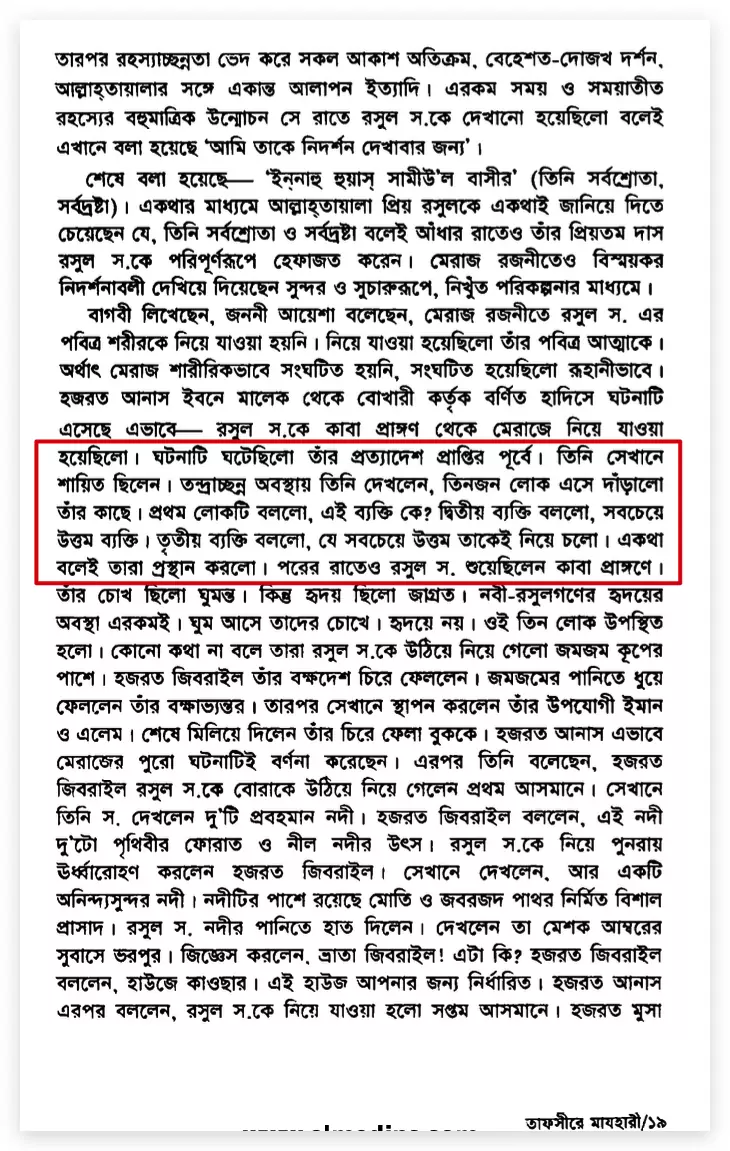
Let us place the two hadith side by side for clarity [99] [100]:
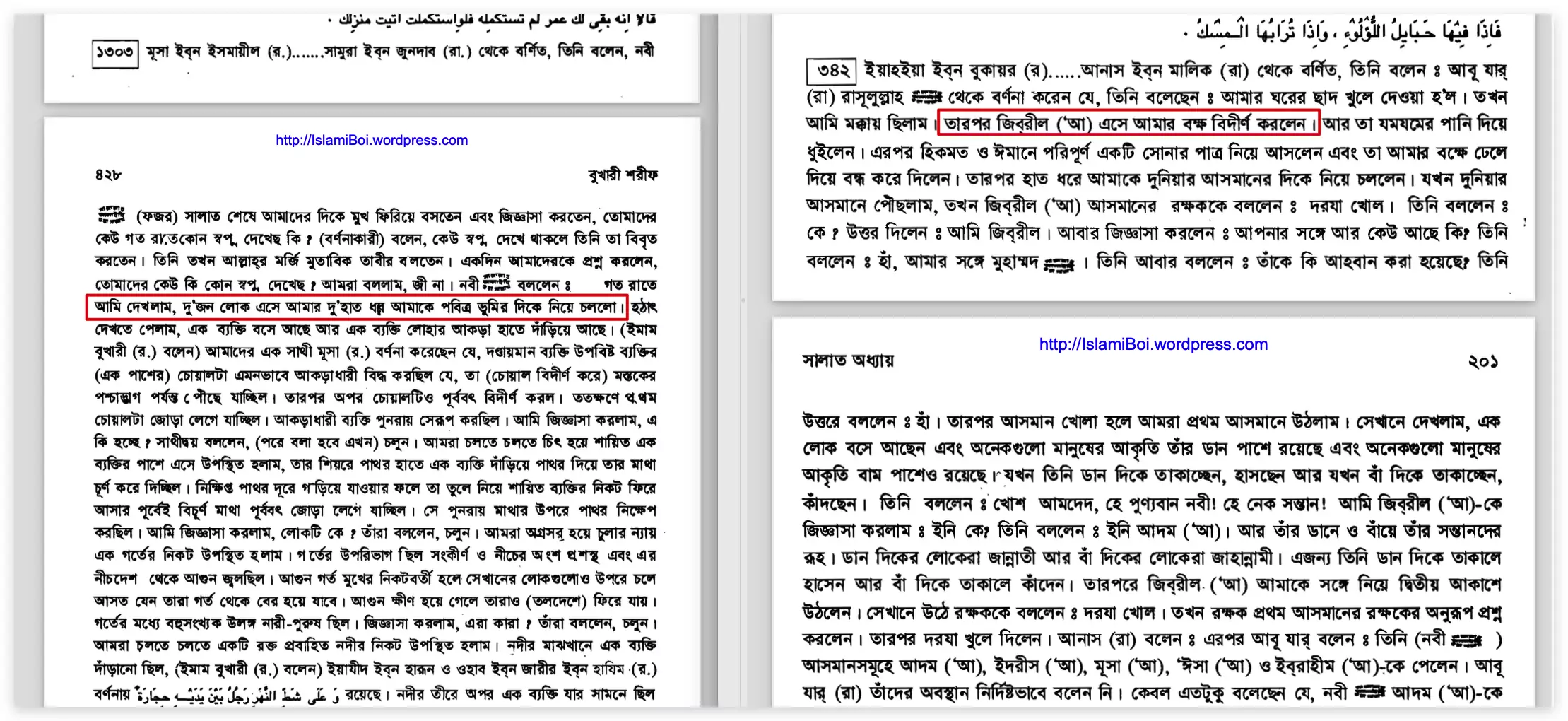
Where Did the Journey Begin?
Muhammad sometimes said that he was taken after the roof of his house was split open; elsewhere, he said the journey began at the Kaaba’s Hatim. Let us first examine the account in which his roof was opened before he was taken on Mi‘raj [94].
Sahih al-Bukhari (Islamic Foundation)
8/ Prayer
Section: 242. How was prayer made obligatory during the Mi‘raj?
Islamic Foundation no.: 342; international no.: 349
Ibn Abbas (may Allah be pleased with him) said: Abu Sufyan ibn Harb (may Allah be pleased with him) narrated to me the account of Heraclius, in which he also said that the Prophet (peace and blessings be upon him) commanded us to pray, speak truthfully and remain chaste.
342. Yahya ibn Bukayr (may Allah have mercy on him) … Narrated Abu Dhar: Allah’s Messenger (ﷺ) said, “While I was at Mecca the roof of my house was opened and Gabriel descended, opened my chest, and washed it with Zamzam water. Then he brought a golden tray full of wisdom and faith and having poured its contents into my chest, he closed it. Then he took my hand and ascended with me to the nearest heaven, when I reached the nearest heaven, Gabriel said to the gatekeeper of the heaven, ‘Open (the gate).’ The gatekeeper asked, ‘Who is it?’ Gabriel answered: ‘Gabriel.’ He asked, ‘Is there anyone with you?’ Gabriel replied, ‘Yes, Muhammad I is with me.’ He asked, ‘Has he been called?’ Gabriel said, ‘Yes.’ So the gate was opened and we went over the nearest heaven and there we saw a man sitting with some people on his right and some on his left.
When he looked towards his right, he laughed and when he looked toward his left he wept. Then he said, ‘Welcome! O pious Prophet and pious son.’ I asked Gabriel, ‘Who is he?’ He replied, ‘He is Adam and the people on his right and left are the souls of his offspring. Those on his right are the people of Paradise and those on his left are the people of Hell and when he looks towards his right he laughs and when he looks towards his left he weeps.’ Then he ascended with me till he reached the second heaven and he (Gabriel) said to its gatekeeper, ‘Open (the gate).’ The gatekeeper said to him the same as the gatekeeper of the first heaven had said and he opened the gate.
Anas said: “Abu Dhar added that the Prophet (ﷺ) met Adam, Idris, Moses, Jesus and Abraham, he (Abu Dhar) did not mention on which heaven they were but he mentioned that he (the Prophet (ﷺ) ) met Adam on the nearest heaven and Abraham on the sixth heaven. Anas said, “When Gabriel along with the Prophet (ﷺ) passed by Idris, the latter said, ‘Welcome! O pious Prophet and pious brother.’ The Prophet (ﷺ) asked, ‘Who is he?’ Gabriel replied, ‘He is Idris.” The Prophet (ﷺ) added, “I passed by Moses and he said, ‘Welcome! O pious Prophet and pious brother.’ I asked Gabriel, ‘Who is he?’ Gabriel replied, ‘He is Moses.’ Then I passed by Jesus and he said, ‘Welcome! O pious brother and pious Prophet.’ I asked, ‘Who is he?’ Gabriel replied, ‘He is Jesus. Then I passed by Abraham and he said, ‘Welcome!
O pious Prophet and pious son.’ I asked Gabriel, ‘Who is he?’ Gabriel replied, ‘He is Abraham. The Prophet (ﷺ) added, ‘Then Gabriel ascended with me to a place where I heard the creaking of the pens.” Ibn Hazm and Anas bin Malik said: The Prophet (ﷺ) said, “Then Allah enjoined fifty prayers on my followers when I returned with this order of Allah, I passed by Moses who asked me, ‘What has Allah enjoined on your followers?’ I replied, ‘He has enjoined fifty prayers on them.’ Moses said, ‘Go back to your Lord (and appeal for reduction) for your followers will not be able to bear it.’ (So I went back to Allah and requested for reduction) and He reduced it to half. When I passed by Moses again and informed him about it, he said, ‘Go back to your Lord as your followers will not be able to bear it.’
So I returned to Allah and requested for further reduction and half of it was reduced. I again passed by Moses and he said to me: ‘Return to your Lord, for your followers will not be able to bear it. So I returned to Allah and He said, ‘These are five prayers and they are all (equal to) fifty (in reward) for My Word does not change.’ I returned to Moses and he told me to go back once again. I replied, ‘Now I feel shy of asking my Lord again.’ Then Gabriel took me till we ” reached Sidrat-il-Muntaha (Lote tree of; the utmost boundary) which was shrouded in colors, indescribable. Then I was admitted into Paradise where I found small (tents or) walls (made) of pearls and its earth was of musk.”
Sahih al-Bukhari 349; Book 8, Hadith 1
Hadith grade: Sahih (Authentic)
Narrator: Anas ibn Malik (may Allah be pleased with him)
Another account places the departure at the Kaaba’s Hatim or Hijr, contradicting the previous statement. The Hatim has no roof. A photograph is provided below to make this clear [95].
Sahih al-Bukhari (Islamic Foundation)
50/ The Prophets (peace be upon them)
Section: 2151. The account of the Mi‘raj
Islamic Foundation no.: 3608; international no.: 3887
3608. Hudba ibn Khalid (may Allah have mercy on him) … Narrated `Abbas bin Malik: Malik bin Sasaa said that Allah’s Messenger (ﷺ) described to them his Night Journey saying, “While I was lying in Al-Hatim or Al-Hijr, suddenly someone came to me and cut my body open from here to here.” I asked Al-Jarud who was by my side, “What does he mean?” He said, “It means from his throat to his pubic area,” or said, “From the top of the chest.” The Prophet (ﷺ) further said, “He then took out my heart. Then a gold tray of Belief was brought to me and my heart was washed and was filled (with Belief) and then returned to its original place.
Then a white animal which was smaller than a mule and bigger than a donkey was brought to me.” (On this Al-Jarud asked, “Was it the Buraq, O Abu Hamza?” I (i.e. Anas) replied in the affirmative). The Prophet (ﷺ) said, “The animal’s step (was so wide that it) reached the farthest point within the reach of the animal’s sight. I was carried on it, and Gabriel set out with me till we reached the nearest heaven. When he asked for the gate to be opened, it was asked, ‘Who is it?’ Gabriel answered, ‘Gabriel.’ It was asked, ‘Who is accompanying you?’ Gabriel replied, ‘Muhammad.’ It was asked, ‘Has Muhammad been called?’
Gabriel replied in the affirmative. Then it was said, ‘He is welcomed. What an excellent visit his is!’ The gate was opened, and when I went over the first heaven, I saw Adam there. Gabriel said (to me). ‘This is your father, Adam; pay him your greetings.’ So I greeted him and he returned the greeting to me and said, ‘You are welcomed, O pious son and pious Prophet.’ Then Gabriel ascended with me till we reached the second heaven. Gabriel asked for the gate to be opened. It was asked, ‘Who is it?’ Gabriel answered, ‘Gabriel.’ It was asked, ‘Who is accompanying you?’ Gabriel replied, ‘Muhammad.’
It was asked, ‘Has he been called?’ Gabriel answered in the affirmative. Then it was said, ‘He is welcomed. What an excellent visit his is!’ The gate was opened. When I went over the second heaven, there I saw Yahya (i.e. John) and `Isa (i.e. Jesus) who were cousins of each other. Gabriel said (to me), ‘These are John and Jesus; pay them your greetings.’ So I greeted them and both of them returned my greetings to me and said, ‘You are welcomed, O pious brother and pious Prophet.’ Then Gabriel ascended with me to the third heaven and asked for its gate to be opened. It was asked, ‘Who is it?’ Gabriel replied, ‘Gabriel.’
It was asked, ‘Who is accompanying you?’ Gabriel replied, ‘Muhammad.’ It was asked, ‘Has he been called?’ Gabriel replied in the affirmative. Then it was said, ‘He is welcomed, what an excellent visit his is!’ The gate was opened, and when I went over the third heaven there I saw Joseph. Gabriel said (to me), ‘This is Joseph; pay him your greetings.’ So I greeted him and he returned the greeting to me and said, ‘You are welcomed, O pious brother and pious Prophet.’ Then Gabriel ascended with me to the fourth heaven and asked for its gate to be opened. It was asked, ‘Who is it?’
Gabriel replied, ‘Gabriel’ It was asked, ‘Who is accompanying you?’ Gabriel replied, ‘Muhammad.’ It was asked, ‘Has he been called?’ Gabriel replied in the affirmative. Then it was said, ‘He is welcomed, what an excel lent visit his is!’ The gate was opened, and when I went over the fourth heaven, there I saw Idris. Gabriel said (to me), ‘This is Idris; pay him your greetings.’ So I greeted him and he returned the greeting to me and said, ‘You are welcomed, O pious brother and pious Prophet.’ Then Gabriel ascended with me to the fifth heaven and asked for its gate to be opened. It was asked, ‘Who is it?’
Gabriel replied, ‘Gabriel.’ It was asked. ‘Who is accompanying you?’ Gabriel replied, ‘Muhammad.’ It was asked, ‘Has he been called?’ Gabriel replied in the affirmative. Then it was said He is welcomed, what an excellent visit his is! So when I went over the fifth heaven, there I saw Harun (i.e. Aaron), Gabriel said, (to me). This is Aaron; pay him your greetings.’ I greeted him and he returned the greeting to me and said, ‘You are welcomed, O pious brother and pious Prophet.’ Then Gabriel ascended with me to the sixth heaven and asked for its gate to be opened. It was asked. ‘Who is it?’
Gabriel replied, ‘Gabriel.’ It was asked, ‘Who is accompanying you?’ Gabriel replied, ‘Muhammad.’ It was asked, ‘Has he been called?’ Gabriel replied in the affirmative. It was said, ‘He is welcomed. What an excellent visit his is!’ When I went (over the sixth heaven), there I saw Moses. Gabriel said (to me),’ This is Moses; pay him your greeting. So I greeted him and he returned the greetings to me and said, ‘You are welcomed, O pious brother and pious Prophet.’ When I left him (i.e. Moses) he wept. Someone asked him, ‘What makes you weep?’
Moses said, ‘I weep because after me there has been sent (as Prophet) a young man whose followers will enter Paradise in greater numbers than my followers.’ Then Gabriel ascended with me to the seventh heaven and asked for its gate to be opened. It was asked, ‘Who is it?’ Gabriel replied, ‘Gabriel.’ It was asked,’ Who is accompanying you?’ Gabriel replied, ‘Muhammad.’ It was asked, ‘Has he been called?’ Gabriel replied in the affirmative. Then it was said, ‘He is welcomed. What an excellent visit his is!’ So when I went (over the seventh heaven), there I saw Abraham. Gabriel said (to me), ‘This is your father; pay your greetings to him.’
So I greeted him and he returned the greetings to me and said, ‘You are welcomed, O pious son and pious Prophet.’ Then I was made to ascend to Sidrat-ul-Muntaha (i.e. the Lote Tree of the utmost boundary) Behold! Its fruits were like the jars of Hajr (i.e. a place near Medina) and its leaves were as big as the ears of elephants. Gabriel said, ‘This is the Lote Tree of the utmost boundary) . Behold ! There ran four rivers, two were hidden and two were visible, I asked, ‘What are these two kinds of rivers, O Gabriel?’ He replied,’ As for the hidden rivers, they are two rivers in Paradise and the visible rivers are the Nile and the Euphrates.’
Then Al-Bait-ul-Ma’mur (i.e. the Sacred House) was shown to me and a container full of wine and another full of milk and a third full of honey were brought to me. I took the milk. Gabriel remarked, ‘This is the Islamic religion which you and your followers are following.’ Then the prayers were enjoined on me: They were fifty prayers a day. When I returned, I passed by Moses who asked (me), ‘What have you been ordered to do?’ I replied, ‘I have been ordered to offer fifty prayers a day.’ Moses said, ‘Your followers cannot bear fifty prayers a day, and by Allah, I have tested people before you, and I have tried my level best with Bani Israel (in vain).
Go back to your Lord and ask for reduction to lessen your followers’ burden.’ So I went back, and Allah reduced ten prayers for me. Then again I came to Moses, but he repeated the same as he had said before. Then again I went back to Allah and He reduced ten more prayers. When I came back to Moses he said the same, I went back to Allah and He ordered me to observe ten prayers a day. When I came back to Moses, he repeated the same advice, so I went back to Allah and was ordered to observe five prayers a day.
When I came back to Moses, he said, ‘What have you been ordered?’ I replied, ‘I have been ordered to observe five prayers a day.’ He said, ‘Your followers cannot bear five prayers a day, and no doubt, I have got an experience of the people before you, and I have tried my level best with Bani Israel, so go back to your Lord and ask for reduction to lessen your follower’s burden.’ I said, ‘I have requested so much of my Lord that I feel ashamed, but I am satisfied now and surrender to Allah’s Order.’ When I left, I heard a voice saying, ‘I have passed My Order and have lessened the burden of My Worshipers.”
Sahih al-Bukhari 3887; Book 63, Hadith 112
Hadith grade: Sahih (Authentic)
Narrator: Malik ibn Sa‘sa‘a (may Allah be pleased with him)
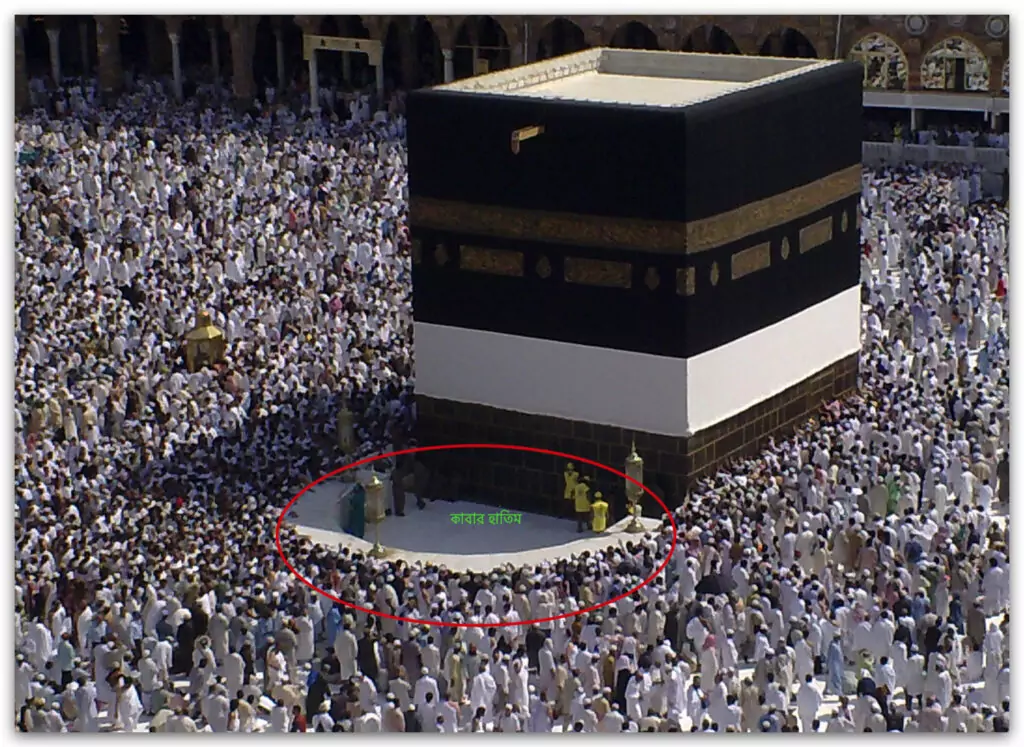
Let us read the two hadith side by side [101] [100]:
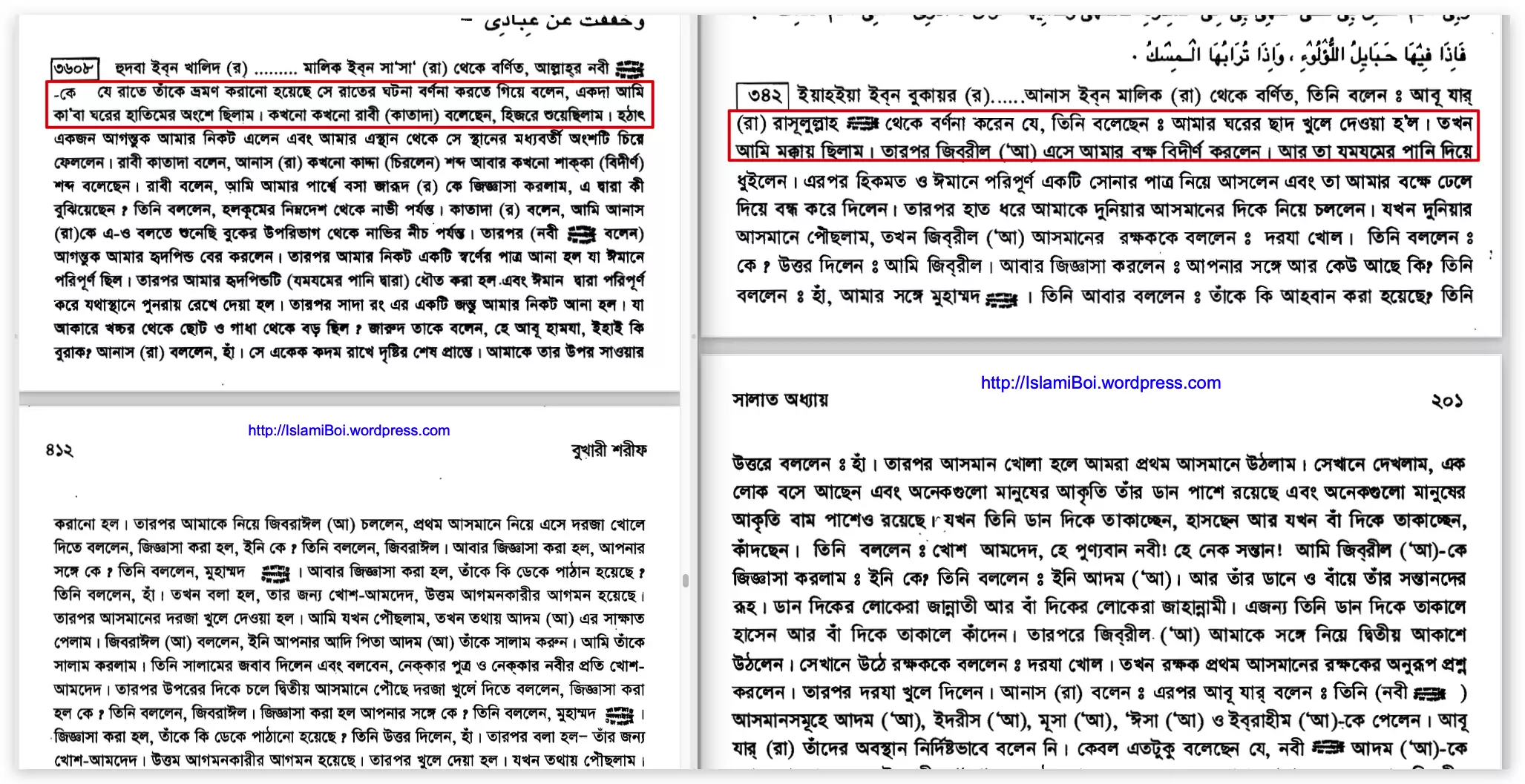
Another account says the event began in Umm Hani’s house. According to her, it began nowhere else. She thus not only gave her own account but also rejected the differing accounts of others. Ibn Ishaq’s Sirat Rasul Allah states that Mi‘raj began in Umm Hani’s house [20] [21].
I received several accounts concerning the noble Messenger’s Mi‘raj from Umm Hani bint Abi Talib, also called Hind. She said, “He undertook Mi‘raj while staying in my house, not from anywhere else. He slept in my house that night. After performing Isha, he went to sleep, and we also slept. Shortly before dawn, the Messenger awakened us. We prayed Fajr. He then said, ‘Umm Hani, yesterday I prayed Isha with you here in this valley, as you saw. Then I went to Jerusalem and prayed there. Now I have just prayed Fajr with you here, as you have seen.’ As he stood to leave, I caught his garment; the pull exposed his abdomen, as though I had pulled on a folded Egyptian cloth. I said, ‘Messenger of Allah, do not tell anyone this. They will call it a lie and insult you.’ He replied, ‘By Allah, I will certainly tell them.’”
Muhammad ibn Ishaq states: Muhammad ibn al-Sa’ib al-Kalbi… narrated from Umm Hani bint Abi Talib, who said concerning the Messenger’s ﷺ Mi‘raj: “On the night when the Messenger’s ﷺ Mi‘raj occurred, he was lying in my house. After performing Isha, he went to sleep, and we also slept. Shortly before Fajr, he awakened us. He prayed, and we prayed Fajr with him. Then he said, ‘Umm Hani, you saw me pray Isha with you and lie down here. Afterward, however, I went to Bayt al-Maqdis and prayed there. Now I have prayed Fajr with you, as you saw.’” Umm Hani says, “After saying this, he rose to leave. I caught the edge of his cloak, uncovering his abdomen. It looked clear and smooth, like folded Coptic cloth. I said, ‘Prophet of Allah! Do not tell people this, or they will call you a liar and hurt you.’ He replied, ‘By Allah! I will certainly tell them.’ I then told an Abyssinian slave woman of mine, ‘Why are you sitting there? Hurry, accompany the Messenger ﷺ, listen to what he tells people, and see how they respond.’”
Where Did He Meet Gabriel?
Consider these two Quranic verses. They say that Muhammad saw Gabriel a second time near Sidrat al-Muntaha, having seen him earlier on another occasion [102] [103]. Yet the Mi‘raj hadith say Gabriel came to Mecca that night and took Muhammad with him. Why, then, does the Quran say that the meeting occurred near Sidrat al-Muntaha? Consider an example. Suppose I meet Kalimuddin at Kamalapur railway station. We go to the airport, fly to Berlin, Germany, and, after finishing our business, return to Dhaka airport and then Kamalapur. Where would I say that I met Kalimuddin? Would I say Berlin, or would Kamalapur be the correct answer? The account should therefore say that Muhammad met Gabriel in Mecca that night. They were certainly together at Sidrat al-Muntaha too, but that was an intermediate stage of the overall episode. When recounting such an event, people generally identify the meeting with the moment they first encountered someone, rather than a later moment. Give this some thought [104].
53:13
And he certainly saw that ˹angel descend˺ a second time [i.e., the Prophet saw Gabriel]
— Dr. Mustafa Khattab, The Clear Quran; Bengali edition: Taisirul Quran
And he certainly saw that ˹angel descend˺ a second time
— Dr. Mustafa Khattab, The Clear Quran; Bengali edition: Sheikh Mujibur Rahman
And he certainly saw that ˹angel descend˺ a second time * Gabriel.
— Dr. Mustafa Khattab, The Clear Quran; Bengali edition: Rawai Al-bayan
And he certainly saw that ˹angel descend˺ a second time
— Dr. Mustafa Khattab, The Clear Quran; Bengali edition: Dr. Abu Bakr Muhammad Zakaria
53:14
at the Lote Tree of the most extreme limit ˹in the seventh heaven˺—
— Dr. Mustafa Khattab, The Clear Quran; Bengali edition: Taisirul Quran
at the Lote Tree of the most extreme limit ˹in the seventh heaven˺—
— Dr. Mustafa Khattab, The Clear Quran; Bengali edition: Sheikh Mujibur Rahman
at the Lote Tree of the most extreme limit ˹in the seventh heaven˺— * Sidrat al-Muntaha is a lote tree in the seventh heaven, to the right of the Throne, marking the limit of all created beings’ knowledge. Only Allah knows what lies beyond it.
— Dr. Mustafa Khattab, The Clear Quran; Bengali edition: Rawai Al-bayan
at the Lote Tree of the most extreme limit ˹in the seventh heaven˺— [1]
— Dr. Mustafa Khattab, The Clear Quran; Bengali edition: Dr. Abu Bakr Muhammad Zakaria
What Transport Was Used for Mi‘raj?
Accounts also differ over precisely how Muhammad ascended: riding an animal, holding Gabriel’s hand, or using a lift or ladder. Consider the following account. He mounts a white animal called Buraq and then immediately reaches the first heaven, making Buraq his means of transport [105]:
Sahih Muslim (Islamic Foundation)
1/ The Book of Faith
Section: 73. The Mi‘raj of the Messenger of Allah (peace and blessings be upon him) and the obligation of prayer
Islamic Foundation no.: 313; international no.: 164
313. Muhammad ibn al-Muthanna (may Allah have mercy on him) … Anas b. Malik reported on the authority of Malik b. Sa sa’, perhaps a person of his tribe, that the Prophet of Allah (ﷺ) said: I was near the House (i. e. Ka’bah) in a state between sleep and wakefulness when I heard someone say: He is the third among the two persons. Then he came to me and took me with him. Then a golden basin containing the water of Zamzam was brought to me and my heart was opened up to such and such (part). Qatada said: I asked him who was with me (i e. the narrator) and what he meant by such and such (part).
He replied: (It means that it was opened) up to the lower part of his abdomen (Then the hadith continues): My heart was extracted and it was washed with the water of Zamzam and then it was restored in its original position, after which it was filled with faith and wisdom. I was then brought a white beast which is called al-Buraq, bigger than a donkey and smaller than a mule. Its stride was as long as the eye could reach. I was mounted on it, and then we went forth till we reached the lowest heaven. Gabriel asked for the (gate) to be opened, and it was said: Who is he? He replied: Gabriel. It was again said: Who is with thee? He replied: Muhammad (ﷺ). It was said: Has he been sent for? He (Gabriel) said: Yes.
He (the Prophet) said: Then (the gate) was opened for us (and it was said): Welcome unto him! His is a blessed arrival. Then we came to Adam (peace be upon him). And he (the narrator) narrated the whole account of the hadith. (The Holy Prophet) observed that he met Jesus in the second heaven, Yahya (peace be on both of them) in the third heaven, Yusuf in the third, Idris in the fourth, Harun in the fifth (peace and blessings of Allah be upon them). Then we travelled on till we reached the sixth heaven and came to Moses (peace be upon him) and I greeted him and he said: Welcome unto righteous brother and righteous prophet.
And when I passed (by him) he wept, and a voice was heard saying: What makes thee weep? He said: My Lord, he is a young man whom Thou hast sent after me (as a prophet) and his followers will enter Paradise in greater numbers than my followers. Then we travelled on till we reached the seventh heaven and I came to Ibrahim. He (the narrator) narrat- ed in this hadith that the Prophet of Allah (ﷺ) told that he saw four rivers which flowed from (the root of the lote-tree of the farthest limits): two manifest rivers and two hidden rivers. I said: ‘ Gabriel! what are these rivers? He replied: The two hidden rivers are the rivers of Paradise, and as regards the two manifest ones, they are the Nile and the Euphrates.
Then the Bait-ul-Ma’mur was raised up to me. I said: O Gabriel! what is this? He replied: It is the Bait-ul-Ma’mur. Seventy thousand angels enter into it daily and, after they come out, they never return again. Two vessels were then brought to me. The first one contained wine and the second one contained milk, and both of them were placed before me. I chose milk. It was said: You did right. Allah will guide rightly through you your Ummah on the natural course. Then fifty prayers daily were made obligatory for me. And then he narrated the rest of the hadith to the end.
Sahih Muslim 164 a; Book 1, Hadith 321
Hadith grade: Sahih (Authentic)
Narrator: Anas ibn Malik (may Allah be pleased with him)
Another hadith indicates that, after mounting Buraq, Muhammad did not dismount before visiting Paradise and Hell. Buraq was therefore his means of transport [106] [107]:
Sunan al-Tirmidhi (Verified Edition)
44/ Commentary on the Quran
Section: 18. Surah Bani Isra’il
3147. Narrated Zirr bin Hubaish: “I said to Hudhaifah bin Al-Yaman: ‘Did the Messenger of Allah (ﷺ) perform Salat in Bait Al-Maqdis?’ He said: ‘No.’ I said: ‘But he did.’ He said: ‘You say that, O bald one! Based upon what do you say that?’ I said: ‘Based upon the Qur’an, (the Judge) between you and I is the Qur’an.’ So Hudhaifah said: ‘Whoever argues using the Qur’an, then he has indeed succeeded.'” (One of the narrators) Sufyan said: “He means: ‘He has indeed proven'” – and perhaps he (Sufyan) said: “He triumphed.”
He (Zirr) said: “Glorified is He Who took His slave for a journey by night from Al-Masjid Al-Haram to Al-Masjid Al-Aqsa (17:1).’ He (Hudhaifah) said: ‘Do you see (this proves that) he (ﷺ) performed Salat in it?’ I said: ‘No.’ He said: ‘If he had performed Salat in it, then it would have been required upon you that you perform Salat in it, just as it is required that you perform Salat in Al-Masjid Al-Haram.’
Hudhaifah said: ‘The Messenger of Allah (ﷺ) was brought a beast with a long back – stretching out like this – one stride of it, is as far as his vision. So, the two of them remained upon the back of Al-Buraq until they saw Paradise and the Fire, and all of what has been prepared for the Hereafter, then they returned back to where they began.’ He said: ‘They say that he was fettered, but for what? Because he might flee? The Knower of the unseen and the witness subdued him.'”
Jami` at-Tirmidhi 3147; Grade: Sahih (Darussalam); Book 47, Hadith 199
Its chain is Hasan.
Abu Isa said: This hadith is Hasan Sahih.
Hadith grade: Hasan (Good)
Narrator: Zirr ibn Hubaysh (may Allah have mercy on him)
Another account says that Muhammad ascended the seven heavens from Bayt al-Maqdis by a ladder [108].
Abu Sa‘id al-Khudri’s Account of Mi‘raj
Ibn Ishaq states: A man whose reliability I do not doubt narrated to me from Abu Sa‘id al-Khudri, who said, “I heard the Messenger say, ‘After I had finished at Bayt al-Maqdis, a ladder was brought before me. I had never seen anything so beautiful. This is what
people like you gaze at with wide eyes when dying. My companion placed me upon it. It brought me to a heavenly door called Bab al-Hafaza, the Gate of the Guardians. An angel named Isma‘il was in charge, with twelve thousand angels under his authority, each commanding twelve thousand more.’”
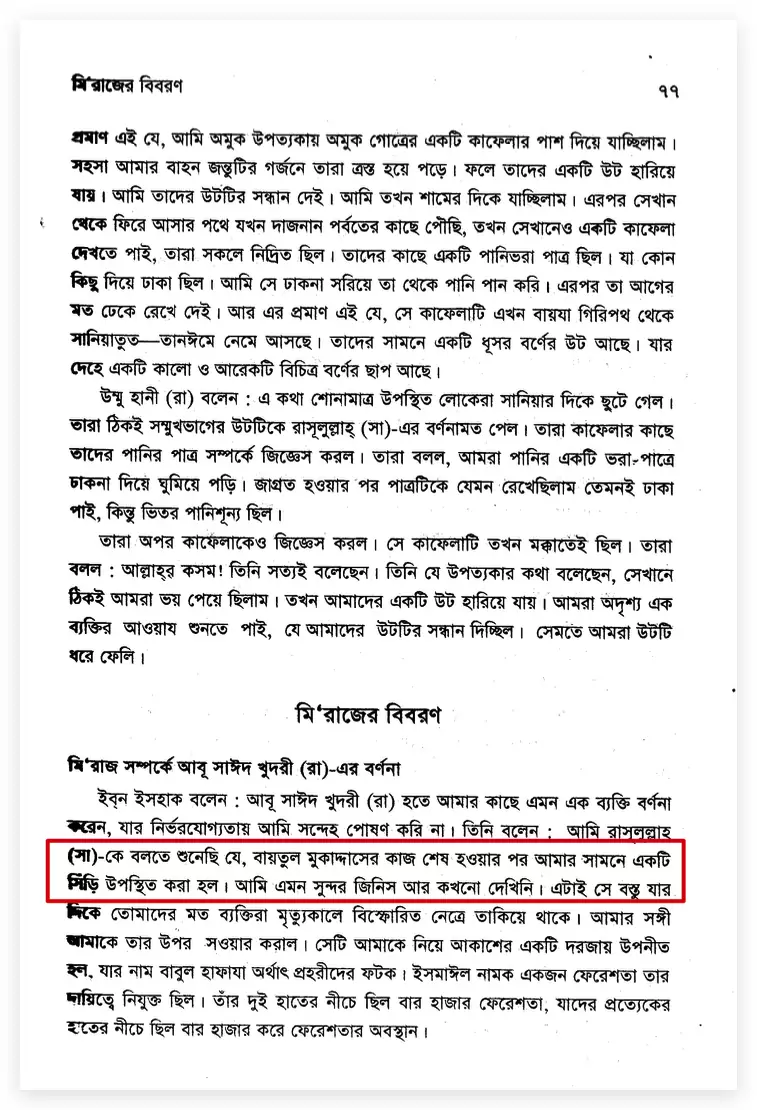
According to yet another account, Gabriel took him by the hand [94].
Sahih al-Bukhari (Islamic Foundation)
8/ Prayer
Section: 242. How was prayer made obligatory during the Mi‘raj?
Islamic Foundation no.: 342; international no.: 349
Ibn Abbas (may Allah be pleased with him) said: Abu Sufyan ibn Harb (may Allah be pleased with him) narrated to me the account of Heraclius, in which he also said that the Prophet (peace and blessings be upon him) commanded us to pray, speak truthfully and remain chaste.
342. Yahya ibn Bukayr (may Allah have mercy on him) … Narrated Abu Dhar: Allah’s Messenger (ﷺ) said, “While I was at Mecca the roof of my house was opened and Gabriel descended, opened my chest, and washed it with Zamzam water. Then he brought a golden tray full of wisdom and faith and having poured its contents into my chest, he closed it. Then he took my hand and ascended with me to the nearest heaven, when I reached the nearest heaven, Gabriel said to the gatekeeper of the heaven, ‘Open (the gate).’ The gatekeeper asked, ‘Who is it?’ Gabriel answered: ‘Gabriel.’ He asked, ‘Is there anyone with you?’ Gabriel replied, ‘Yes, Muhammad I is with me.’ He asked, ‘Has he been called?’ Gabriel said, ‘Yes.’ So the gate was opened and we went over the nearest heaven and there we saw a man sitting with some people on his right and some on his left.
When he looked towards his right, he laughed and when he looked toward his left he wept. Then he said, ‘Welcome! O pious Prophet and pious son.’ I asked Gabriel, ‘Who is he?’ He replied, ‘He is Adam and the people on his right and left are the souls of his offspring. Those on his right are the people of Paradise and those on his left are the people of Hell and when he looks towards his right he laughs and when he looks towards his left he weeps.’ Then he ascended with me till he reached the second heaven and he (Gabriel) said to its gatekeeper, ‘Open (the gate).’ The gatekeeper said to him the same as the gatekeeper of the first heaven had said and he opened the gate.
Anas said: “Abu Dhar added that the Prophet (ﷺ) met Adam, Idris, Moses, Jesus and Abraham, he (Abu Dhar) did not mention on which heaven they were but he mentioned that he (the Prophet (ﷺ) ) met Adam on the nearest heaven and Abraham on the sixth heaven. Anas said, “When Gabriel along with the Prophet (ﷺ) passed by Idris, the latter said, ‘Welcome! O pious Prophet and pious brother.’ The Prophet (ﷺ) asked, ‘Who is he?’ Gabriel replied, ‘He is Idris.” The Prophet (ﷺ) added, “I passed by Moses and he said, ‘Welcome! O pious Prophet and pious brother.’ I asked Gabriel, ‘Who is he?’ Gabriel replied, ‘He is Moses.’ Then I passed by Jesus and he said, ‘Welcome! O pious brother and pious Prophet.’ I asked, ‘Who is he?’ Gabriel replied, ‘He is Jesus. Then I passed by Abraham and he said, ‘Welcome!
O pious Prophet and pious son.’ I asked Gabriel, ‘Who is he?’ Gabriel replied, ‘He is Abraham. The Prophet (ﷺ) added, ‘Then Gabriel ascended with me to a place where I heard the creaking of the pens.” Ibn Hazm and Anas bin Malik said: The Prophet (ﷺ) said, “Then Allah enjoined fifty prayers on my followers when I returned with this order of Allah, I passed by Moses who asked me, ‘What has Allah enjoined on your followers?’ I replied, ‘He has enjoined fifty prayers on them.’ Moses said, ‘Go back to your Lord (and appeal for reduction) for your followers will not be able to bear it.’ (So I went back to Allah and requested for reduction) and He reduced it to half. When I passed by Moses again and informed him about it, he said, ‘Go back to your Lord as your followers will not be able to bear it.’
So I returned to Allah and requested for further reduction and half of it was reduced. I again passed by Moses and he said to me: ‘Return to your Lord, for your followers will not be able to bear it. So I returned to Allah and He said, ‘These are five prayers and they are all (equal to) fifty (in reward) for My Word does not change.’ I returned to Moses and he told me to go back once again. I replied, ‘Now I feel shy of asking my Lord again.’ Then Gabriel took me till we ” reached Sidrat-il-Muntaha (Lote tree of; the utmost boundary) which was shrouded in colors, indescribable. Then I was admitted into Paradise where I found small (tents or) walls (made) of pearls and its earth was of musk.”
Sahih al-Bukhari 349; Book 8, Hadith 1
Hadith grade: Sahih (Authentic)
Narrator: Anas ibn Malik (may Allah be pleased with him)
Let us examine the accounts together [109] [110] [108].
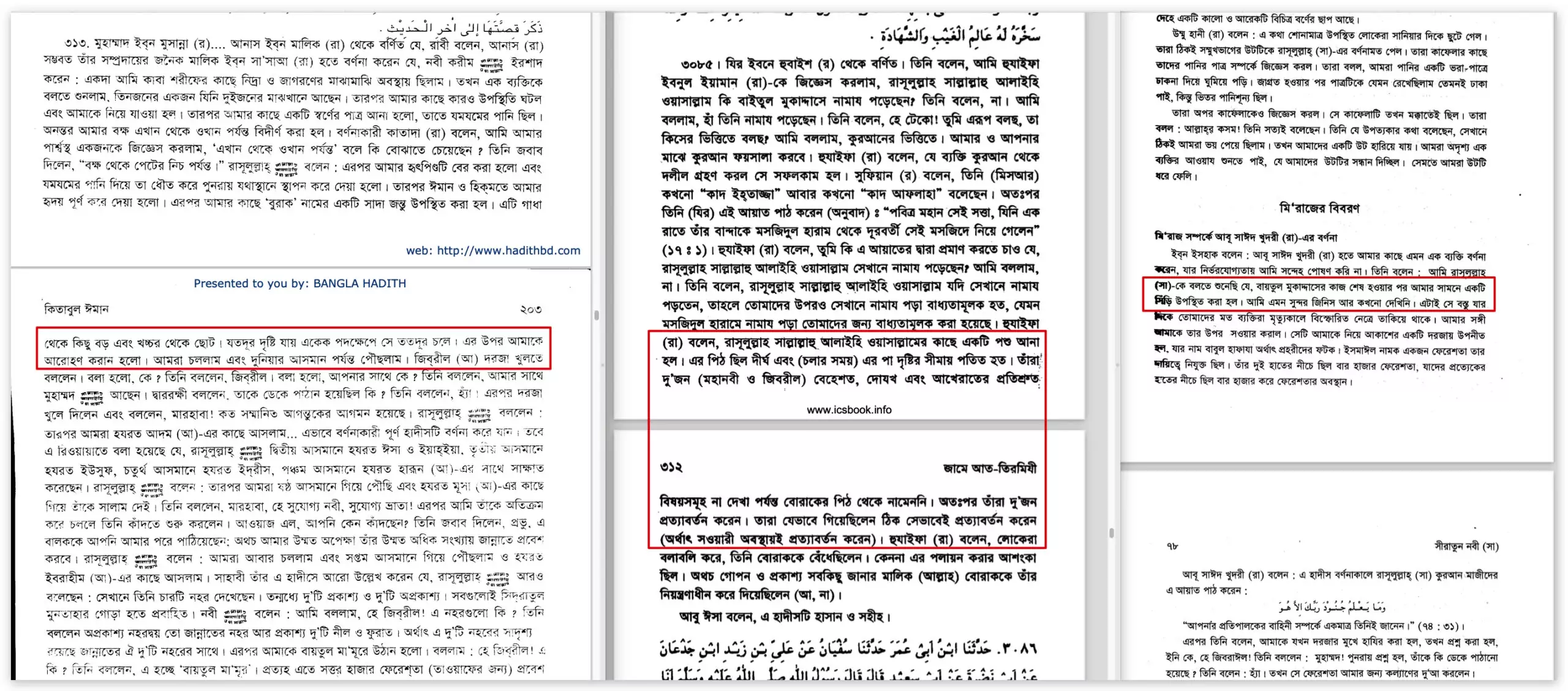
Did They Stop in Jerusalem along the Way?
Some hadith describe Muhammad stopping in Jerusalem on the night of Mi‘raj to pray [85]:
Sahih Muslim (Islamic Foundation)
1/ The Book of Faith
Section: 73. The Mi‘raj of the Messenger of Allah (peace and blessings be upon him) and the obligation of prayer
Islamic Foundation no.: 308; international no.: 162
308. Shayban ibn Farrukh (may Allah have mercy on him) … It is narrated on the authority of Anas b. Malik that the Messenger of Allah (ﷺ) said: I was brought al-Buraq Who is an animal white and long, larger than a donkey but smaller than a mule, who would place his hoof a distance equal to the range of version. I mounted it and came to the Temple (Bait Maqdis in Jerusalem), then tethered it to the ring used by the prophets. I entered the mosque and prayed two rak’ahs in it, and then came out and Gabriel brought me a vessel of wine and a vessel of milk.
I chose the milk, and Gabriel said: You have chosen the natural thing. Then he took me to heaven. Gabriel then asked the (gate of heaven) to be opened and he was asked who he was. He replied: Gabriel. He was again asked: Who is with you? He (Gabriel) said: Muhammad. It was said: Has he been sent for? Gabriel replied: He has indeed been sent for. And (the door of the heaven) was opened for us and lo! we saw Adam.
He welcomed me and prayed for my good. Then we ascended to the second heaven. Gabriel (peace be upon him) (asked the door of heaven to be opened), and he was asked who he was. He answered: Gabriel; and was again asked: Who is with you? He replied: Muhammad. It was said: Has he been sent for? He replied: He has indeed been sent for. The gate was opened. When I entered ‘Isa b. Maryam and Yahya b. Zakariya (peace be upon both of them), cousins from the maternal side.
welcomed me and prayed for my good Then I was taken to the third heaven and Gabriel asked for the opening (of the door). He was asked: Who are you? He replied: Gabriel. He was (again) asked: Who is with you? He replied Muhammad (ﷺ). It was said: Has he been sent for? He replied He has indeed been sent for. (The gate) was opened for us and I saw Yusuf (peace of Allah be upon him) who had been given half of (world) beauty.
He welcomed me prayed for my well-being. Then he ascended with us to the fourth heaven. Gabriel (peace be upon him) asked for the (gate) to be opened, and it was said: Who is he? He replied: Gabriel. It was (again) said: Who is with you? He said: Muhammad. It was said: Has he been sent for? He replied: He has indeed been sent for. The (gate) was opened for us, and lo! Idris was there.
He welcomed me and prayed for my well-being (About him) Allah, the Exalted and the Glorious, has said:” We elevated him (Idris) to the exalted position” (Qur’an xix. 57). وَرَفَعْنَاهُ مَكَانًا عَلِيًّا Then he ascended with us to the fifth heaven and Gabriel asked for the (gate) to be opened. It was said: Who is he? He replied Gabriel. It was (again) said: Who is with thee? He replied: Muhammad. It was said Has he been sent for? He replied: He has indeed been sent for. (The gate) was opened for us and then I was with Harun (Aaron-peace of Allah be upon him).
He welcomed me prayed for my well-being. Then I was taken to the sixth heaven. Gabriel (peace be upon him) asked for the door to be opened. It was said: Who is he? He replied: Gabriel. It was said: Who is with thee? He replied: Muhammad. It was said: Has he been sent for? He replied: He has indeed been sent for. (The gate) was opened for us and there I was with Musa (Moses peace be upon him) He welcomed me and prayed for my well-being.
Then I was taken up to the seventh heaven. Gabriel asked the (gate) to be opened. It was said: Who is he? He said: Gabriel It was said. Who is with thee? He replied: Muhammad (may peace be upon him.) It was said: Has he been sent for? He replied: He has indeed been sent for. (The gate) was opened for us and there I found Ibrahim (Abraham peace be upon him) reclining against the Bait-ul-Ma’mur and there enter into it seventy thousand angels every day, never to visit (this place) again.
Then I was taken to Sidrat-ul-Muntaha whose leaves were like elephant ears and its fruit like big earthenware vessels. And when it was covered by the Command of Allah, it underwent such a change that none amongst the creation has the power to praise its beauty. Then Allah revealed to me a revelation and He made obligatory for me fifty prayers every day and night. Then I went down to Moses (peace be upon him) and he said: What has your Lord enjoined upon your Ummah?
I said: Fifty prayers. He said: Return to thy Lord and beg for reduction (in the number of prayers), for your community shallnot be able to bear this burden. as I have put to test the children of Isra’il and tried them (and found them too weak to bear such a heavy burden). He (the Holy Prophet) said: I went back to my Lord and said: My Lord, make things lighter for my Ummah. (The Lord) reduced five prayers for me.
I went down to Moses and said. (The Lord) reduced five (prayers) for me, He said: Verily thy Ummah shall not be able to bear this burden; return to thy Lord and ask Him to make things lighter. I then kept going back and forth between my Lord Blessed and Exalted and Moses, till He said: There are five prayers every day and night. O Muhammad, each being credited as ten, so that makes fifty prayers.
He who intends to do a good deed and does not do it will have a good deed recorded for him; and if he does it, it will be recorded for him as ten; whereas he who intends to do an evil deed and does not do, it will not be recorded for him; and if he does it, only one evil deed will be recorded. I then came down and when I came to Moses and informed him, he said: Go back to thy Lord and ask Him to make things lighter. Upon this the Messenger of Allah remarked: I returned to my Lord until I felt ashamed before Him.
Sahih Muslim 162 a; Book 1, Hadith 316
Hadith grade: Sahih (Authentic)
Narrator: Anas ibn Malik (may Allah be pleased with him)
The following hadith indicates that they did not stop in Jerusalem but went directly to the first heaven [105]:
Sahih Muslim (Islamic Foundation)
1/ The Book of Faith
Section: 73. The Mi‘raj of the Messenger of Allah (peace and blessings be upon him) and the obligation of prayer
Islamic Foundation no.: 313; international no.: 164
313. Muhammad ibn al-Muthanna (may Allah have mercy on him) … Anas b. Malik reported on the authority of Malik b. Sa sa’, perhaps a person of his tribe, that the Prophet of Allah (ﷺ) said: I was near the House (i. e. Ka’bah) in a state between sleep and wakefulness when I heard someone say: He is the third among the two persons. Then he came to me and took me with him. Then a golden basin containing the water of Zamzam was brought to me and my heart was opened up to such and such (part). Qatada said: I asked him who was with me (i e. the narrator) and what he meant by such and such (part).
He replied: (It means that it was opened) up to the lower part of his abdomen (Then the hadith continues): My heart was extracted and it was washed with the water of Zamzam and then it was restored in its original position, after which it was filled with faith and wisdom. I was then brought a white beast which is called al-Buraq, bigger than a donkey and smaller than a mule. Its stride was as long as the eye could reach. I was mounted on it, and then we went forth till we reached the lowest heaven. Gabriel asked for the (gate) to be opened, and it was said: Who is he? He replied: Gabriel. It was again said: Who is with thee? He replied: Muhammad (ﷺ). It was said: Has he been sent for? He (Gabriel) said: Yes.
He (the Prophet) said: Then (the gate) was opened for us (and it was said): Welcome unto him! His is a blessed arrival. Then we came to Adam (peace be upon him). And he (the narrator) narrated the whole account of the hadith. (The Holy Prophet) observed that he met Jesus in the second heaven, Yahya (peace be on both of them) in the third heaven, Yusuf in the third, Idris in the fourth, Harun in the fifth (peace and blessings of Allah be upon them). Then we travelled on till we reached the sixth heaven and came to Moses (peace be upon him) and I greeted him and he said: Welcome unto righteous brother and righteous prophet.
And when I passed (by him) he wept, and a voice was heard saying: What makes thee weep? He said: My Lord, he is a young man whom Thou hast sent after me (as a prophet) and his followers will enter Paradise in greater numbers than my followers. Then we travelled on till we reached the seventh heaven and I came to Ibrahim. He (the narrator) narrat- ed in this hadith that the Prophet of Allah (ﷺ) told that he saw four rivers which flowed from (the root of the lote-tree of the farthest limits): two manifest rivers and two hidden rivers. I said: ‘ Gabriel! what are these rivers? He replied: The two hidden rivers are the rivers of Paradise, and as regards the two manifest ones, they are the Nile and the Euphrates.
Then the Bait-ul-Ma’mur was raised up to me. I said: O Gabriel! what is this? He replied: It is the Bait-ul-Ma’mur. Seventy thousand angels enter into it daily and, after they come out, they never return again. Two vessels were then brought to me. The first one contained wine and the second one contained milk, and both of them were placed before me. I chose milk. It was said: You did right. Allah will guide rightly through you your Ummah on the natural course. Then fifty prayers daily were made obligatory for me. And then he narrated the rest of the hadith to the end.
Sahih Muslim 164 a; Book 1, Hadith 321
Hadith grade: Sahih (Authentic)
Narrator: Anas ibn Malik (may Allah be pleased with him)
Another hadith indicates that Muhammad did not dismount from Buraq before visiting Paradise and Hell. Notice the dispute between two Companions over whether Muhammad prayed at Bayt al-Maqdis [106] [107]:
Sunan al-Tirmidhi (Verified Edition)
44/ Commentary on the Quran
Section: 18. Surah Bani Isra’il
3147. Narrated Zirr bin Hubaish: “I said to Hudhaifah bin Al-Yaman: ‘Did the Messenger of Allah (ﷺ) perform Salat in Bait Al-Maqdis?’ He said: ‘No.’ I said: ‘But he did.’ He said: ‘You say that, O bald one! Based upon what do you say that?’ I said: ‘Based upon the Qur’an, (the Judge) between you and I is the Qur’an.’ So Hudhaifah said: ‘Whoever argues using the Qur’an, then he has indeed succeeded.'” (One of the narrators) Sufyan said: “He means: ‘He has indeed proven'” – and perhaps he (Sufyan) said: “He triumphed.”
He (Zirr) said: “Glorified is He Who took His slave for a journey by night from Al-Masjid Al-Haram to Al-Masjid Al-Aqsa (17:1).’ He (Hudhaifah) said: ‘Do you see (this proves that) he (ﷺ) performed Salat in it?’ I said: ‘No.’ He said: ‘If he had performed Salat in it, then it would have been required upon you that you perform Salat in it, just as it is required that you perform Salat in Al-Masjid Al-Haram.’
Hudhaifah said: ‘The Messenger of Allah (ﷺ) was brought a beast with a long back – stretching out like this – one stride of it, is as far as his vision. So, the two of them remained upon the back of Al-Buraq until they saw Paradise and the Fire, and all of what has been prepared for the Hereafter, then they returned back to where they began.’ He said: ‘They say that he was fettered, but for what? Because he might flee? The Knower of the unseen and the witness subdued him.'”
Jami` at-Tirmidhi 3147; Grade: Sahih (Darussalam); Book 47, Hadith 199
Its chain is Hasan.
Abu Isa said: This hadith is Hasan Sahih.
Hadith grade: Hasan (Good)
Narrator: Zirr ibn Hubaysh (may Allah have mercy on him)
Let us read the two hadith side by side:
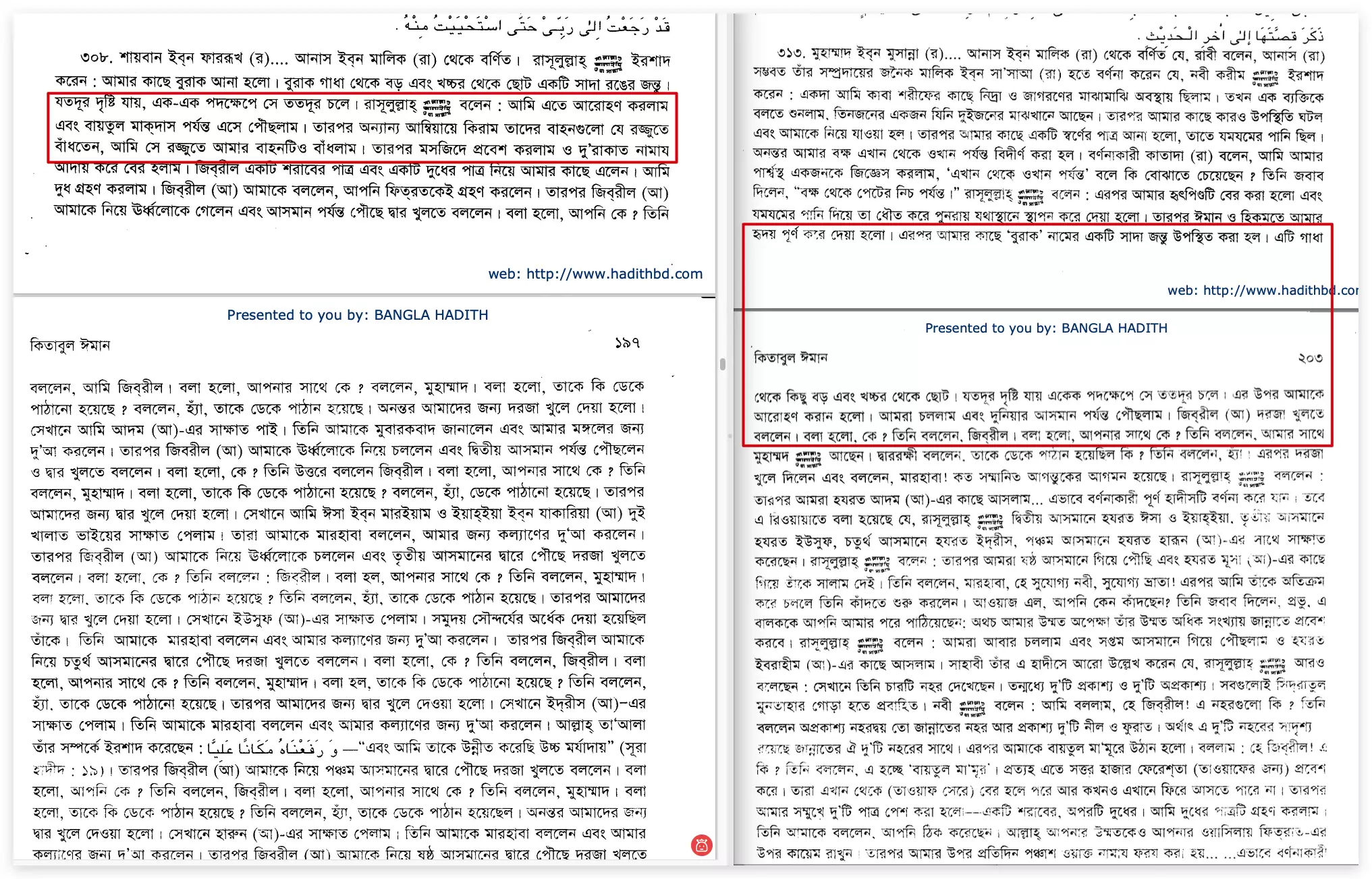
Where Were the Milk and Wine Offered?
He was offered a choice between milk and wine in Jerusalem [85]:
Sahih Muslim (Islamic Foundation)
1/ The Book of Faith
Section: 73. The Mi‘raj of the Messenger of Allah (peace and blessings be upon him) and the obligation of prayer
Islamic Foundation no.: 308; international no.: 162
308. Shayban ibn Farrukh (may Allah have mercy on him) … It is narrated on the authority of Anas b. Malik that the Messenger of Allah (ﷺ) said: I was brought al-Buraq Who is an animal white and long, larger than a donkey but smaller than a mule, who would place his hoof a distance equal to the range of version. I mounted it and came to the Temple (Bait Maqdis in Jerusalem), then tethered it to the ring used by the prophets. I entered the mosque and prayed two rak’ahs in it, and then came out and Gabriel brought me a vessel of wine and a vessel of milk.
I chose the milk, and Gabriel said: You have chosen the natural thing. Then he took me to heaven. Gabriel then asked the (gate of heaven) to be opened and he was asked who he was. He replied: Gabriel. He was again asked: Who is with you? He (Gabriel) said: Muhammad. It was said: Has he been sent for? Gabriel replied: He has indeed been sent for. And (the door of the heaven) was opened for us and lo! we saw Adam.
He welcomed me and prayed for my good. Then we ascended to the second heaven. Gabriel (peace be upon him) (asked the door of heaven to be opened), and he was asked who he was. He answered: Gabriel; and was again asked: Who is with you? He replied: Muhammad. It was said: Has he been sent for? He replied: He has indeed been sent for. The gate was opened. When I entered ‘Isa b. Maryam and Yahya b. Zakariya (peace be upon both of them), cousins from the maternal side.
welcomed me and prayed for my good Then I was taken to the third heaven and Gabriel asked for the opening (of the door). He was asked: Who are you? He replied: Gabriel. He was (again) asked: Who is with you? He replied Muhammad (ﷺ). It was said: Has he been sent for? He replied He has indeed been sent for. (The gate) was opened for us and I saw Yusuf (peace of Allah be upon him) who had been given half of (world) beauty.
He welcomed me prayed for my well-being. Then he ascended with us to the fourth heaven. Gabriel (peace be upon him) asked for the (gate) to be opened, and it was said: Who is he? He replied: Gabriel. It was (again) said: Who is with you? He said: Muhammad. It was said: Has he been sent for? He replied: He has indeed been sent for. The (gate) was opened for us, and lo! Idris was there.
He welcomed me and prayed for my well-being (About him) Allah, the Exalted and the Glorious, has said:” We elevated him (Idris) to the exalted position” (Qur’an xix. 57). وَرَفَعْنَاهُ مَكَانًا عَلِيًّا Then he ascended with us to the fifth heaven and Gabriel asked for the (gate) to be opened. It was said: Who is he? He replied Gabriel. It was (again) said: Who is with thee? He replied: Muhammad. It was said Has he been sent for? He replied: He has indeed been sent for. (The gate) was opened for us and then I was with Harun (Aaron-peace of Allah be upon him).
He welcomed me prayed for my well-being. Then I was taken to the sixth heaven. Gabriel (peace be upon him) asked for the door to be opened. It was said: Who is he? He replied: Gabriel. It was said: Who is with thee? He replied: Muhammad. It was said: Has he been sent for? He replied: He has indeed been sent for. (The gate) was opened for us and there I was with Musa (Moses peace be upon him) He welcomed me and prayed for my well-being.
Then I was taken up to the seventh heaven. Gabriel asked the (gate) to be opened. It was said: Who is he? He said: Gabriel It was said. Who is with thee? He replied: Muhammad (may peace be upon him.) It was said: Has he been sent for? He replied: He has indeed been sent for. (The gate) was opened for us and there I found Ibrahim (Abraham peace be upon him) reclining against the Bait-ul-Ma’mur and there enter into it seventy thousand angels every day, never to visit (this place) again.
Then I was taken to Sidrat-ul-Muntaha whose leaves were like elephant ears and its fruit like big earthenware vessels. And when it was covered by the Command of Allah, it underwent such a change that none amongst the creation has the power to praise its beauty. Then Allah revealed to me a revelation and He made obligatory for me fifty prayers every day and night. Then I went down to Moses (peace be upon him) and he said: What has your Lord enjoined upon your Ummah?
I said: Fifty prayers. He said: Return to thy Lord and beg for reduction (in the number of prayers), for your community shallnot be able to bear this burden. as I have put to test the children of Isra’il and tried them (and found them too weak to bear such a heavy burden). He (the Holy Prophet) said: I went back to my Lord and said: My Lord, make things lighter for my Ummah. (The Lord) reduced five prayers for me.
I went down to Moses and said. (The Lord) reduced five (prayers) for me, He said: Verily thy Ummah shall not be able to bear this burden; return to thy Lord and ask Him to make things lighter. I then kept going back and forth between my Lord Blessed and Exalted and Moses, till He said: There are five prayers every day and night. O Muhammad, each being credited as ten, so that makes fifty prayers.
He who intends to do a good deed and does not do it will have a good deed recorded for him; and if he does it, it will be recorded for him as ten; whereas he who intends to do an evil deed and does not do, it will not be recorded for him; and if he does it, only one evil deed will be recorded. I then came down and when I came to Moses and informed him, he said: Go back to thy Lord and ask Him to make things lighter. Upon this the Messenger of Allah remarked: I returned to my Lord until I felt ashamed before Him.
Sahih Muslim 162 a; Book 1, Hadith 316
Hadith grade: Sahih (Authentic)
Narrator: Anas ibn Malik (may Allah be pleased with him)
Another account says he was asked to choose between milk and wine at Bayt al-Ma‘mur, where angels worship. Bayt al-Ma‘mur is located in the seventh heaven, called Labiyah or Damiyah, directly above the earthly Kaaba or al-Masjid al-Haram [105]:
Sahih Muslim (Islamic Foundation)
1/ The Book of Faith
Section: 73. The Mi‘raj of the Messenger of Allah (peace and blessings be upon him) and the obligation of prayer
Islamic Foundation no.: 313; international no.: 164
313. Muhammad ibn al-Muthanna (may Allah have mercy on him) … Anas b. Malik reported on the authority of Malik b. Sa sa’, perhaps a person of his tribe, that the Prophet of Allah (ﷺ) said: I was near the House (i. e. Ka’bah) in a state between sleep and wakefulness when I heard someone say: He is the third among the two persons. Then he came to me and took me with him. Then a golden basin containing the water of Zamzam was brought to me and my heart was opened up to such and such (part). Qatada said: I asked him who was with me (i e. the narrator) and what he meant by such and such (part).
He replied: (It means that it was opened) up to the lower part of his abdomen (Then the hadith continues): My heart was extracted and it was washed with the water of Zamzam and then it was restored in its original position, after which it was filled with faith and wisdom. I was then brought a white beast which is called al-Buraq, bigger than a donkey and smaller than a mule. Its stride was as long as the eye could reach. I was mounted on it, and then we went forth till we reached the lowest heaven. Gabriel asked for the (gate) to be opened, and it was said: Who is he? He replied: Gabriel. It was again said: Who is with thee? He replied: Muhammad (ﷺ). It was said: Has he been sent for? He (Gabriel) said: Yes.
He (the Prophet) said: Then (the gate) was opened for us (and it was said): Welcome unto him! His is a blessed arrival. Then we came to Adam (peace be upon him). And he (the narrator) narrated the whole account of the hadith. (The Holy Prophet) observed that he met Jesus in the second heaven, Yahya (peace be on both of them) in the third heaven, Yusuf in the third, Idris in the fourth, Harun in the fifth (peace and blessings of Allah be upon them). Then we travelled on till we reached the sixth heaven and came to Moses (peace be upon him) and I greeted him and he said: Welcome unto righteous brother and righteous prophet.
And when I passed (by him) he wept, and a voice was heard saying: What makes thee weep? He said: My Lord, he is a young man whom Thou hast sent after me (as a prophet) and his followers will enter Paradise in greater numbers than my followers. Then we travelled on till we reached the seventh heaven and I came to Ibrahim. He (the narrator) narrat- ed in this hadith that the Prophet of Allah (ﷺ) told that he saw four rivers which flowed from (the root of the lote-tree of the farthest limits): two manifest rivers and two hidden rivers. I said: ‘ Gabriel! what are these rivers? He replied: The two hidden rivers are the rivers of Paradise, and as regards the two manifest ones, they are the Nile and the Euphrates.
Then the Bait-ul-Ma’mur was raised up to me. I said: O Gabriel! what is this? He replied: It is the Bait-ul-Ma’mur. Seventy thousand angels enter into it daily and, after they come out, they never return again. Two vessels were then brought to me. The first one contained wine and the second one contained milk, and both of them were placed before me. I chose milk. It was said: You did right. Allah will guide rightly through you your Ummah on the natural course. Then fifty prayers daily were made obligatory for me. And then he narrated the rest of the hadith to the end.
Sahih Muslim 164 a; Book 1, Hadith 321
Hadith grade: Sahih (Authentic)
Narrator: Anas ibn Malik (may Allah be pleased with him)
Let us read the two hadith side by side:
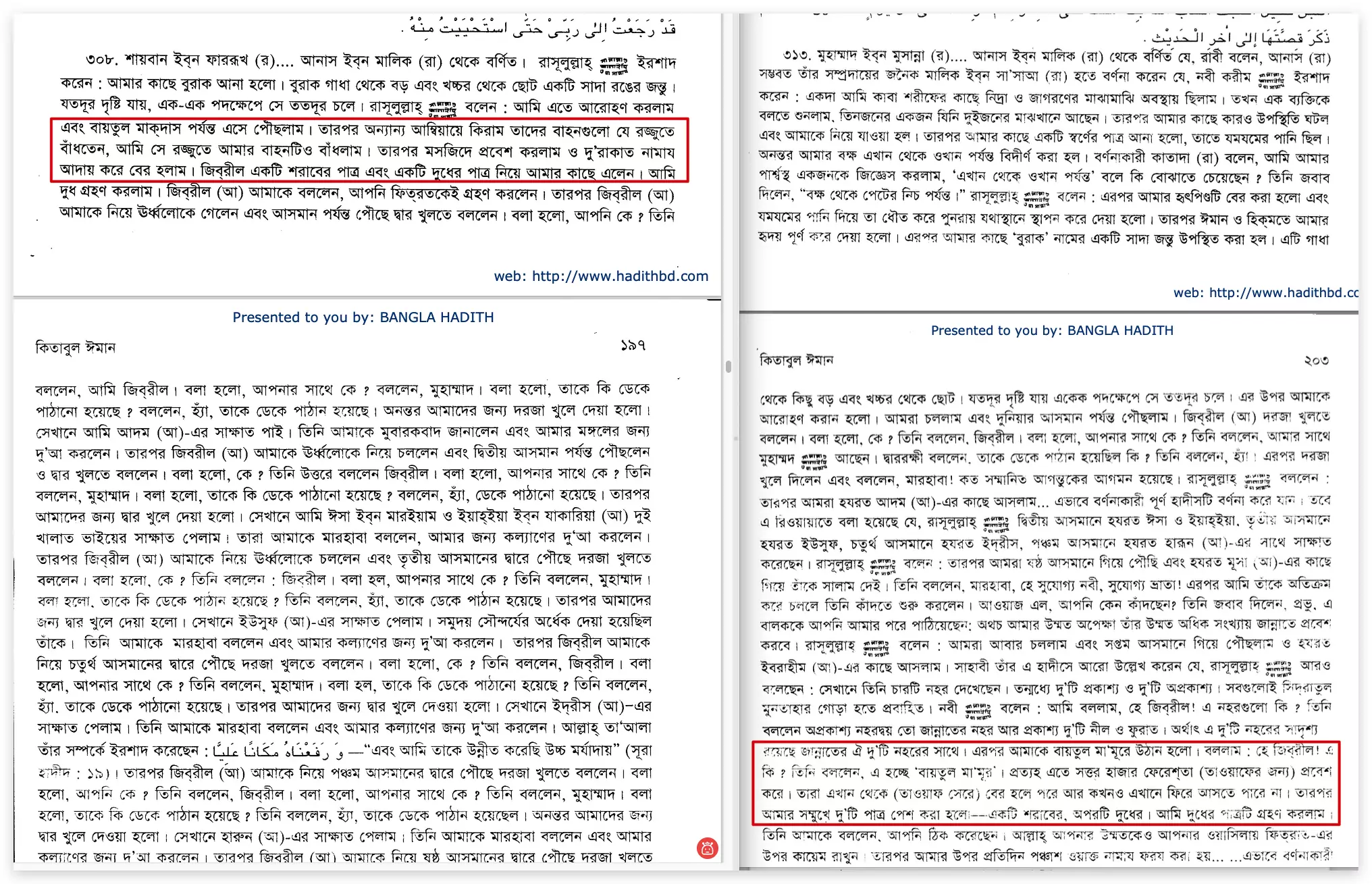
Where Did He Meet Moses?
Several authentic hadith state that Muhammad saw Moses on the night of Mi‘raj while passing his grave. Moses was praying in it [111] [112] [113]:
Sahih Muslim (Islamic Foundation)
45/ Virtues
Section: 38. The virtues of Moses (peace be upon him)
5942. Haddab ibn Khalid and Shayban ibn Farrukh (may Allah have mercy on them) … Anas b. malik reported Allah’s Messenger (ﷺ) as saying: I came. And in the narration transmitted on the authority of Haddib (the words are): I happened to pass by Moses on the occasion of the Night journey near the red mound (and found him) saying his prayer in his grave.
Sahih Muslim 2375 a; Book 43, Hadith 215
Hadith grade: Sahih (Authentic)
Narrator: Anas ibn Malik (may Allah be pleased with him)
Sahih Ibn Hibban (HadithBD)
3. The Book of Isra [and Mi‘raj]
Section: The place where the Messenger of Allah (peace and blessings be upon him) saw Moses (peace be upon him) praying in his grave:
50 Anas b. malik reported Allah’s Messenger (ﷺ) as saying: I came. And in the narration transmitted on the authority of Haddib (the words are): I happened to pass by Moses on the occasion of the Night journey near the red mound (and found him) saying his prayer in his grave.
Sahih Muslim 2375 a; Book 43, Hadith 215
[1] Al-Albani: Sahih.
Al-Arna’ut: Sahih according to Muslim’s criteria.
References: Muslim 2375; al-Nasa’i 3/215; Ahmad 3/148, 248; Ibn Abi Shayba, al-Musannaf 14/307, 308.
Hadith grade: Sahih (Authentic)
Narrator: Anas ibn Malik (may Allah be pleased with him)
Sahih Ibn Hibban (HadithBD)
3. The Book of Isra [and Mi‘raj]
Section:
49 Anas reported Allah’s Messenger (ﷺ) as saying: I happened to pass by Moses as he was busy in saying prayer in his grave, and in the hadith transmitted on the authority of ‘Isa there is an addition of these words:, I happened to pass on the occasion of the Night journey.”
Sahih Muslim 2375 b; Book 43, Hadith 216
[1] Prayer here does not mean prayer performed for reward by someone subject to the obligations of Islamic law. Rather, the prophets’ life in the barzakh has distinctive qualities, just as martyrs have a special life in the barzakh compared with other deceased people. Nor is this prayer like prayer in this world; it is like the glorification of Allah by the angels or the inhabitants of Paradise. (For details, see Ibn Taymiyya, Majmu‘ Fatawa 4/330; al-Albani, al-Tawassul, p. 60.)
[2] Al-Albani: Sahih.
Al-Arna’ut: Sahih according to al-Bukhari’s criteria.
References: Muslim 2375; al-Nasa’i 3/216; Ahmad 3/120.
Hadith grade: Sahih (Authentic)
Narrator: Anas ibn Malik (may Allah be pleased with him)
Another hadith says Muhammad saw Moses praying with other prophets at Bayt al-Maqdis. If Moses was praying in his grave, how did he get to Bayt al-Maqdis? [114]
Sahih Muslim (Islamic Foundation)
1/ The Book of Faith
Section: 74. The Messiah, son of Mary (peace be upon him), and the false messiah
Islamic Foundation no.: 327; international no.: 172
327. Zuhayr ibn Harb (may Allah have mercy on him) … It is narrated on the authority of Abu Huraira that the Messenger of Allah (ﷺ) said: I found myself in Hijr and the Quraish were asking me about my might journey. I was asked about things pertaining to Bait-ul-Maqdis which I could not preserve (in my mind). I was very much vexed, so vexed as I had never been before. Then Allah raised it (Bait-ul-Maqdis) before my eyes. I looked towards it, and I gave them the information about whatever they questioned me I also saw myself among the group of apostles.
I saw Moses saying prayer and found him to be a well-built man as if he was a man of the tribe of Shanu’a. I saw Jesus son of Mary (peace be upon him) offering prayer, of all of men he had the closest resemblance with ‘Urwa b. Masu’d al-Thaqafi. I saw Ibrahim (peace be upon him) offering prayer; he had the closest resemblance with your companion (the Prophet himself) amongst people. When the time of prayer came I led them. When I completed the prayer, someone said: Here is Malik, the keeper of the Hell; pay him salutations. I turned to him, but he preceded me in salutation.
Sahih Muslim 172; Book 1, Hadith 335
Hadith grade: Sahih (Authentic)
Narrator: Abu Hurayra (may Allah be pleased with him)
Another hadith says Muhammad saw Moses in the sixth heaven. How was Moses simultaneously in his grave, at Bayt al-Maqdis, and in the sixth heaven? How many Moseses were there? [115]
Sahih al-Bukhari (Islamic Foundation)
49/ The Beginning of Creation
Section: 1988. Description of the angels. Anas ibn Malik (may Allah be pleased with him) said that Abdullah ibn Salam (may Allah be pleased with him) told the Prophet (peace be upon him), ‘Among the angels, Gabriel is the enemy of the Jews.’ Ibn Abbas (may Allah be pleased with him) said that لَنَحْنُ الصَّافُّونَ is a statement made by the angels.
Islamic Foundation no.: 2980; international no.: 3207
2980. Hudba ibn Khalid and Khalifa (ibn Khayyat) (may Allah have mercy on them) … Narrated Malik bin Sasaa: The Prophet (ﷺ) said, “While I was at the House in a state midway between sleep and wakefulness, (an angel recognized me) as the man lying between two men. A golden tray full of wisdom and belief was brought to me and my body was cut open from the throat to the lower part of the `Abdomen and then my `Abdomen was washed with Zamzam water and (my heart was) filled with wisdom and belief.
Al- Buraq, a white animal, smaller than a mule and bigger than a donkey was brought to me and I set out with Gabriel. When I reached the nearest heaven. Gabriel said to the heaven gate-keeper, ‘Open the gate.’ The gatekeeper asked, ‘Who is it?’ He said, ‘Gabriel.’
The gate-keeper,’ Who is accompanying you?’ Gabriel said, ‘Muhammad.’ The gate-keeper said, ‘Has he been called?’ Gabriel said, ‘Yes.’ Then it was said, ‘He is welcomed. What a wonderful visit his is!’ Then I met Adam and greeted him and he said, ‘You are welcomed O son and a Prophet.’ Then we ascended to the second heaven. It was asked, ‘Who is it?’
Gabriel said, ‘Gabriel.’ It was said, ‘Who is with you?’ He said, ‘Muhammad’ It was asked, ‘Has he been sent for?’ He said, ‘Yes.’ It was said, ‘He is welcomed. What a wonderful visit his is!” Then I met Jesus and Yahya (John) who said, ‘You are welcomed, O brother and a Prophet.’ Then we ascended to the third heaven. It was asked, ‘Who is it?’
Gabriel said, ‘Gabriel.’ It was asked, ‘Who is with you? Gabriel said, ‘Muhammad.’ It was asked, ‘Has he been sent for?’ ‘Yes,’ said Gabriel. ‘He is welcomed. What a wonderful visit his is!’ (The Prophet (ﷺ) added:). There I met Joseph and greeted him, and he replied, ‘You are welcomed, O brother and a Prophet!’
Then we ascended to the 4th heaven and again the same questions and answers were exchanged as in the previous heavens. There I met Idris and greeted him. He said, ‘You are welcomed O brother and Prophet.’ Then we ascended to the 5th heaven and again the same questions and answers were exchanged as in previous heavens. there I met and greeted Aaron who said, ‘You are welcomed O brother and a Prophet”.
Then we ascended to the 6th heaven and again the same questions and answers were exchanged as in the previous heavens. There I met and greeted Moses who said, ‘You are welcomed O brother and. a Prophet.’ When I proceeded on, he started weeping and on being asked why he was weeping, he said, ‘O Lord!
Followers of this youth who was sent after me will enter Paradise in greater number than my followers.’ Then we ascended to the seventh heaven and again the same questions and answers were exchanged as in the previous heavens. There I met and greeted Abraham who said, ‘You are welcomed o son and a Prophet.’ Then I was shown Al-Bait-al-Ma’mur (i.e. Allah’s House).
I asked Gabriel about it and he said, This is Al Bait-ul-Ma’mur where 70,000 angels perform prayers daily and when they leave they never return to it (but always a fresh batch comes into it daily).’ Then I was shown Sidrat-ul-Muntaha (i.e. a tree in the seventh heaven) and I saw its Nabk fruits which resembled the clay jugs of Hajr (i.e.
a town in Arabia), and its leaves were like the ears of elephants, and four rivers originated at its root, two of them were apparent and two were hidden. I asked Gabriel about those rivers and he said, ‘The two hidden rivers are in Paradise, and the apparent ones are the Nile and the Euphrates.’ Then fifty prayers were enjoined on me.
I descended till I met Moses who asked me, ‘What have you done?’ I said, ‘Fifty prayers have been enjoined on me.’ He said, ‘I know the people better than you, because I had the hardest experience to bring Bani Israel to obedience. Your followers cannot put up with such obligation. So, return to your Lord and request Him (to reduce the number of prayers.’
I returned and requested Allah (for reduction) and He made it forty. I returned and (met Moses) and had a similar discussion, and then returned again to Allah for reduction and He made it thirty, then twenty, then ten, and then I came to Moses who repeated the same advice. Ultimately Allah reduced it to five.
When I came to Moses again, he said, ‘What have you done?’ I said, ‘Allah has made it five only.’ He repeated the same advice but I said that I surrendered (to Allah’s Final Order)'” Allah’s Messenger (ﷺ) was addressed by Allah, “I have decreed My Obligation and have reduced the burden on My slaves, and I shall reward a single good deed as if it were ten good deeds.”
Regarding al-Bayt al-Ma‘mur, Hammam (may Allah have mercy on him) … also narrated from Abu Hurayra (may Allah be pleased with him), from the Prophet (peace and blessings be upon him).
Sahih al-Bukhari 3207; Book 59, Hadith 18
Hadith grade: Sahih (Authentic)
Narrator: Malik ibn Sa‘sa‘a (may Allah be pleased with him)
Another hadith says Muhammad saw Moses in the seventh heaven. Utterly bewildering! [97]
Sahih al-Bukhari (Islamic Foundation)
86/ Refutation of the Jahmiyyah and Divine Oneness
Section: 3139. Allah’s words: ‘And to Moses Allah spoke directly.’ (4:164; Dr. Mustafa Khattab, The Clear Quran)
Islamic Foundation no.: 7009; international no.: 7517
7009. Abd al-Aziz ibn Abdullah (may Allah have mercy on him) … Narrated Anas bin Malik: The night Allah’s Messenger (ﷺ) was taken for a journey from the sacred mosque (of Mecca) Al-Ka`ba: Three persons came to him (in a dreamy while he was sleeping in the Sacred Mosque before the Divine Inspiration was revealed to Him. One of them said, “Which of them is he?” The middle (second) angel said, “He is the best of them.” The last (third) angle said, “Take the best of them.”
Only that much happened on that night and he did not see them till they came on another night, i.e. after The Divine Inspiration was revealed to him. (Fath-ul-Bari Page 258, Vol. 17) and he saw them, his eyes were asleep but his heart was not—-and so is the case with the prophets: their eyes sleep while their hearts do not sleep. So those angels did not talk to him till they carried him and placed him beside the well of Zamzam. From among them Gabriel took charge of him.
Gabriel cut open (the part of his body) between his throat and the middle of his chest (heart) and took all the material out of his chest and `Abdomen and then washed it with Zamzam water with his own hands till he cleansed the inside of his body, and then a gold tray containing a gold bowl full of belief and wisdom was brought and then Gabriel stuffed his chest and throat blood vessels with it and then closed it (the chest).
He then ascended with him to the heaven of the world and knocked on one of its doors. The dwellers of the Heaven asked, ‘Who is it?’ He said, “Gabriel.” They said, “Who is accompanying you?” He said, “Muhammad.” They said, “Has he been called?” He said, “Yes” They said, “He is welcomed.” So the dwellers of the Heaven became pleased with his arrival, and they did not know what Allah would do to the Prophet (ﷺ) on earth unless Allah informed them.
The Prophet (ﷺ) met Adam over the nearest Heaven. Gabriel said to the Prophet, “He is your father; greet him.” The Prophet (ﷺ) greeted him and Adam returned his greeting and said, “Welcome, O my Son! O what a good son you are!” Behold, he saw two flowing rivers, while he was in the nearest sky. He asked, “What are these two rivers, O Gabriel?” Gabriel said, “These are the sources of the Nile and the Euphrates.”
Then Gabriel took him around that Heaven and behold, he saw another river at the bank of which there was a palace built of pearls and emerald. He put his hand into the river and found its mud like musk Adhfar. He asked, “What is this, O Gabriel?” Gabriel said, “This is the Kauthar which your Lord has kept for you.” Then Gabriel ascended (with him) to the second Heaven and the angels asked the same questions as those on the first Heaven, i.e., “Who is it?”
Gabriel replied, “Gabriel”. They asked, “Who is accompanying you?” He said, “Muhammad.” They asked, “Has he been sent for?” He said, “Yes.” Then they said, “He is welcomed.” Then he (Gabriel) ascended with the Prophet (ﷺ) to the third Heaven, and the angels said the same as the angels of the first and the second Heavens had said.
Then he ascended with him to the fourth Heaven and they said the same; and then he ascended with him to the fifth Heaven and they said the same; and then he ascended with him to the sixth Heaven and they said the same; then he ascended with him to the seventh Heaven and they said the same. On each Heaven there were prophets whose names he had mentioned and of whom I remember Idris on the second Heaven, Aaron on the fourth Heavens another prophet whose name I don’t remember, on the fifth Heaven, Abraham on the sixth Heaven, and Moses on the seventh Heaven because of his privilege of talking to Allah directly.
Moses said (to Allah), “O Lord! I thought that none would be raised up above me.” But Gabriel ascended with him (the Prophet) for a distance above that, the distance of which only Allah knows, till he reached the Lote Tree (beyond which none may pass) and then the Irresistible, the Lord of Honor and Majesty approached and came closer till he (Gabriel) was about two bow lengths or (even) nearer.
(It is said that it was Gabriel who approached and came closer to the Prophet. (Fate Al-Bari Page 263, 264, Vol. 17). Among the things which Allah revealed to him then, was: “Fifty prayers were enjoined on his followers in a day and a night.” Then the Prophet (ﷺ) descended till he met Moses, and then Moses stopped him and asked, “O Muhammad ! What did your Lord en join upon you?”
The Prophet (ﷺ) replied,” He enjoined upon me to perform fifty prayers in a day and a night.” Moses said, “Your followers cannot do that; Go back so that your Lord may reduce it for you and for them.” So the Prophet (ﷺ) turned to Gabriel as if he wanted to consult him about that issue. Gabriel told him of his opinion, saying, “Yes, if you wish.” So Gabriel ascended with him to the Irresistible and said while he was in his place, “O Lord, please lighten our burden as my followers cannot do that.”
So Allah deducted for him ten prayers where upon he returned to Moses who stopped him again and kept on sending him back to his Lord till the enjoined prayers were reduced to only five prayers. Then Moses stopped him when the prayers had been reduced to five and said, “O Muhammad! By Allah, I tried to persuade my nation, Bani Israel to do less than this, but they could not do it and gave it up.
However, your followers are weaker in body, heart, sight and hearing, so return to your Lord so that He may lighten your burden.” The Prophet (ﷺ) turned towards Gabriel for advice and Gabriel did not disapprove of that. So he ascended with him for the fifth time. The Prophet (ﷺ) said, “O Lord, my followers are weak in their bodies, hearts, hearing and constitution, so lighten our burden.” On that the Irresistible said, “O Muhammad!”
the Prophet replied, “Labbaik and Sa`daik.” Allah said, “The Word that comes from Me does not change, so it will be as I enjoined on you in the Mother of the Book.” Allah added, “Every good deed will be rewarded as ten times so it is fifty (prayers) in the Mother of the Book (in reward) but you are to perform only five (in practice).” The Prophet (ﷺ) returned to Moses who asked, “What have you done?”
He said, “He has lightened our burden: He has given us for every good deed a tenfold reward.” Moses said, “By Allah! I tried to make Bani Israel observe less than that, but they gave it up. So go back to your Lord that He may lighten your burden further.” Allah’s Messenger (ﷺ) said, “O Moses! By Allah, I feel shy of returning too many times to my Lord.” On that Gabriel said, “Descend in Allah’s Name.” The Prophet (ﷺ) then woke while he was in the Sacred Mosque (at Mecca).
Sahih al-Bukhari 7517; Book 97, Hadith 142
Hadith grade: Sahih (Authentic)
Narrator: Anas ibn Malik (may Allah be pleased with him)
Let us examine all the accounts together. Every one is authentic, with no doubt concerning the narrators. The question remains: how many Moseses were there?
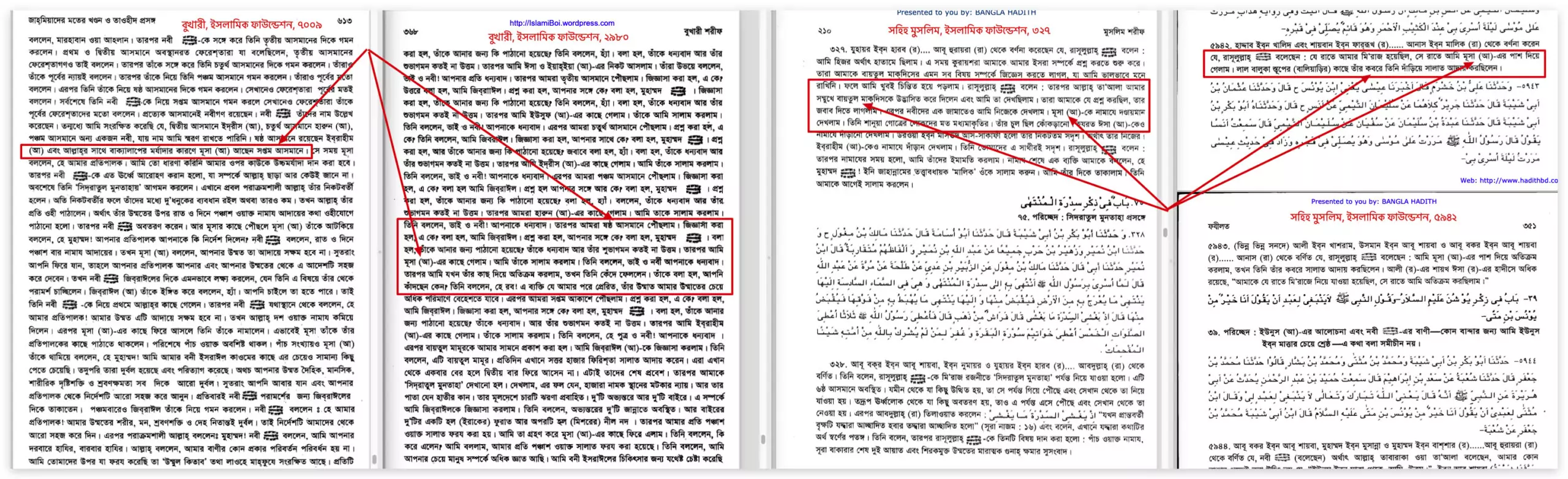
In Which Heaven Was Abraham?
One account places Abraham in the sixth of the seven heavens [97]:
Sahih al-Bukhari (Islamic Foundation)
86/ Refutation of the Jahmiyyah and Divine Oneness
Section: 3139. Allah’s words: ‘And to Moses Allah spoke directly.’ (4:164; Dr. Mustafa Khattab, The Clear Quran)
Islamic Foundation no.: 7009; international no.: 7517
7009. Abd al-Aziz ibn Abdullah (may Allah have mercy on him) … Narrated Anas bin Malik: The night Allah’s Messenger (ﷺ) was taken for a journey from the sacred mosque (of Mecca) Al-Ka`ba: Three persons came to him (in a dreamy while he was sleeping in the Sacred Mosque before the Divine Inspiration was revealed to Him. One of them said, “Which of them is he?” The middle (second) angel said, “He is the best of them.” The last (third) angle said, “Take the best of them.”
Only that much happened on that night and he did not see them till they came on another night, i.e. after The Divine Inspiration was revealed to him. (Fath-ul-Bari Page 258, Vol. 17) and he saw them, his eyes were asleep but his heart was not—-and so is the case with the prophets: their eyes sleep while their hearts do not sleep. So those angels did not talk to him till they carried him and placed him beside the well of Zamzam. From among them Gabriel took charge of him.
Gabriel cut open (the part of his body) between his throat and the middle of his chest (heart) and took all the material out of his chest and `Abdomen and then washed it with Zamzam water with his own hands till he cleansed the inside of his body, and then a gold tray containing a gold bowl full of belief and wisdom was brought and then Gabriel stuffed his chest and throat blood vessels with it and then closed it (the chest).
He then ascended with him to the heaven of the world and knocked on one of its doors. The dwellers of the Heaven asked, ‘Who is it?’ He said, “Gabriel.” They said, “Who is accompanying you?” He said, “Muhammad.” They said, “Has he been called?” He said, “Yes” They said, “He is welcomed.” So the dwellers of the Heaven became pleased with his arrival, and they did not know what Allah would do to the Prophet (ﷺ) on earth unless Allah informed them.
The Prophet (ﷺ) met Adam over the nearest Heaven. Gabriel said to the Prophet, “He is your father; greet him.” The Prophet (ﷺ) greeted him and Adam returned his greeting and said, “Welcome, O my Son! O what a good son you are!” Behold, he saw two flowing rivers, while he was in the nearest sky. He asked, “What are these two rivers, O Gabriel?” Gabriel said, “These are the sources of the Nile and the Euphrates.”
Then Gabriel took him around that Heaven and behold, he saw another river at the bank of which there was a palace built of pearls and emerald. He put his hand into the river and found its mud like musk Adhfar. He asked, “What is this, O Gabriel?” Gabriel said, “This is the Kauthar which your Lord has kept for you.” Then Gabriel ascended (with him) to the second Heaven and the angels asked the same questions as those on the first Heaven, i.e., “Who is it?”
Gabriel replied, “Gabriel”. They asked, “Who is accompanying you?” He said, “Muhammad.” They asked, “Has he been sent for?” He said, “Yes.” Then they said, “He is welcomed.” Then he (Gabriel) ascended with the Prophet (ﷺ) to the third Heaven, and the angels said the same as the angels of the first and the second Heavens had said.
Then he ascended with him to the fourth Heaven and they said the same; and then he ascended with him to the fifth Heaven and they said the same; and then he ascended with him to the sixth Heaven and they said the same; then he ascended with him to the seventh Heaven and they said the same. On each Heaven there were prophets whose names he had mentioned and of whom I remember Idris on the second Heaven, Aaron on the fourth Heavens another prophet whose name I don’t remember, on the fifth Heaven, Abraham on the sixth Heaven, and Moses on the seventh Heaven because of his privilege of talking to Allah directly.
Moses said (to Allah), “O Lord! I thought that none would be raised up above me.” But Gabriel ascended with him (the Prophet) for a distance above that, the distance of which only Allah knows, till he reached the Lote Tree (beyond which none may pass) and then the Irresistible, the Lord of Honor and Majesty approached and came closer till he (Gabriel) was about two bow lengths or (even) nearer.
(It is said that it was Gabriel who approached and came closer to the Prophet. (Fate Al-Bari Page 263, 264, Vol. 17). Among the things which Allah revealed to him then, was: “Fifty prayers were enjoined on his followers in a day and a night.” Then the Prophet (ﷺ) descended till he met Moses, and then Moses stopped him and asked, “O Muhammad ! What did your Lord en join upon you?”
The Prophet (ﷺ) replied,” He enjoined upon me to perform fifty prayers in a day and a night.” Moses said, “Your followers cannot do that; Go back so that your Lord may reduce it for you and for them.” So the Prophet (ﷺ) turned to Gabriel as if he wanted to consult him about that issue. Gabriel told him of his opinion, saying, “Yes, if you wish.” So Gabriel ascended with him to the Irresistible and said while he was in his place, “O Lord, please lighten our burden as my followers cannot do that.”
So Allah deducted for him ten prayers where upon he returned to Moses who stopped him again and kept on sending him back to his Lord till the enjoined prayers were reduced to only five prayers. Then Moses stopped him when the prayers had been reduced to five and said, “O Muhammad! By Allah, I tried to persuade my nation, Bani Israel to do less than this, but they could not do it and gave it up.
However, your followers are weaker in body, heart, sight and hearing, so return to your Lord so that He may lighten your burden.” The Prophet (ﷺ) turned towards Gabriel for advice and Gabriel did not disapprove of that. So he ascended with him for the fifth time. The Prophet (ﷺ) said, “O Lord, my followers are weak in their bodies, hearts, hearing and constitution, so lighten our burden.” On that the Irresistible said, “O Muhammad!”
the Prophet replied, “Labbaik and Sa`daik.” Allah said, “The Word that comes from Me does not change, so it will be as I enjoined on you in the Mother of the Book.” Allah added, “Every good deed will be rewarded as ten times so it is fifty (prayers) in the Mother of the Book (in reward) but you are to perform only five (in practice).” The Prophet (ﷺ) returned to Moses who asked, “What have you done?”
He said, “He has lightened our burden: He has given us for every good deed a tenfold reward.” Moses said, “By Allah! I tried to make Bani Israel observe less than that, but they gave it up. So go back to your Lord that He may lighten your burden further.” Allah’s Messenger (ﷺ) said, “O Moses! By Allah, I feel shy of returning too many times to my Lord.” On that Gabriel said, “Descend in Allah’s Name.” The Prophet (ﷺ) then woke while he was in the Sacred Mosque (at Mecca).
Sahih al-Bukhari 7517; Book 97, Hadith 142
Hadith grade: Sahih (Authentic)
Narrator: Anas ibn Malik (may Allah be pleased with him)
Another places Muhammad’s meeting with Abraham in the seventh heaven [115]:
Sahih al-Bukhari (Islamic Foundation)
49/ The Beginning of Creation
Section: 1988. Description of the angels. Anas ibn Malik (may Allah be pleased with him) said that Abdullah ibn Salam (may Allah be pleased with him) told the Prophet (peace be upon him), ‘Among the angels, Gabriel is the enemy of the Jews.’ Ibn Abbas (may Allah be pleased with him) said that لَنَحْنُ الصَّافُّونَ is a statement made by the angels.
Islamic Foundation no.: 2980; international no.: 3207
2980. Hudba ibn Khalid and Khalifa (ibn Khayyat) (may Allah have mercy on them) … Narrated Malik bin Sasaa: The Prophet (ﷺ) said, “While I was at the House in a state midway between sleep and wakefulness, (an angel recognized me) as the man lying between two men. A golden tray full of wisdom and belief was brought to me and my body was cut open from the throat to the lower part of the `Abdomen and then my `Abdomen was washed with Zamzam water and (my heart was) filled with wisdom and belief.
Al- Buraq, a white animal, smaller than a mule and bigger than a donkey was brought to me and I set out with Gabriel. When I reached the nearest heaven. Gabriel said to the heaven gate-keeper, ‘Open the gate.’ The gatekeeper asked, ‘Who is it?’ He said, ‘Gabriel.’
The gate-keeper,’ Who is accompanying you?’ Gabriel said, ‘Muhammad.’ The gate-keeper said, ‘Has he been called?’ Gabriel said, ‘Yes.’ Then it was said, ‘He is welcomed. What a wonderful visit his is!’ Then I met Adam and greeted him and he said, ‘You are welcomed O son and a Prophet.’ Then we ascended to the second heaven. It was asked, ‘Who is it?’
Gabriel said, ‘Gabriel.’ It was said, ‘Who is with you?’ He said, ‘Muhammad’ It was asked, ‘Has he been sent for?’ He said, ‘Yes.’ It was said, ‘He is welcomed. What a wonderful visit his is!” Then I met Jesus and Yahya (John) who said, ‘You are welcomed, O brother and a Prophet.’ Then we ascended to the third heaven. It was asked, ‘Who is it?’
Gabriel said, ‘Gabriel.’ It was asked, ‘Who is with you? Gabriel said, ‘Muhammad.’ It was asked, ‘Has he been sent for?’ ‘Yes,’ said Gabriel. ‘He is welcomed. What a wonderful visit his is!’ (The Prophet (ﷺ) added:). There I met Joseph and greeted him, and he replied, ‘You are welcomed, O brother and a Prophet!’
Then we ascended to the 4th heaven and again the same questions and answers were exchanged as in the previous heavens. There I met Idris and greeted him. He said, ‘You are welcomed O brother and Prophet.’ Then we ascended to the 5th heaven and again the same questions and answers were exchanged as in previous heavens. there I met and greeted Aaron who said, ‘You are welcomed O brother and a Prophet”.
Then we ascended to the 6th heaven and again the same questions and answers were exchanged as in the previous heavens. There I met and greeted Moses who said, ‘You are welcomed O brother and. a Prophet.’ When I proceeded on, he started weeping and on being asked why he was weeping, he said, ‘O Lord!
Followers of this youth who was sent after me will enter Paradise in greater number than my followers.’ Then we ascended to the seventh heaven and again the same questions and answers were exchanged as in the previous heavens. There I met and greeted Abraham who said, ‘You are welcomed o son and a Prophet.’ Then I was shown Al-Bait-al-Ma’mur (i.e. Allah’s House).
I asked Gabriel about it and he said, This is Al Bait-ul-Ma’mur where 70,000 angels perform prayers daily and when they leave they never return to it (but always a fresh batch comes into it daily).’ Then I was shown Sidrat-ul-Muntaha (i.e. a tree in the seventh heaven) and I saw its Nabk fruits which resembled the clay jugs of Hajr (i.e.
a town in Arabia), and its leaves were like the ears of elephants, and four rivers originated at its root, two of them were apparent and two were hidden. I asked Gabriel about those rivers and he said, ‘The two hidden rivers are in Paradise, and the apparent ones are the Nile and the Euphrates.’ Then fifty prayers were enjoined on me.
I descended till I met Moses who asked me, ‘What have you done?’ I said, ‘Fifty prayers have been enjoined on me.’ He said, ‘I know the people better than you, because I had the hardest experience to bring Bani Israel to obedience. Your followers cannot put up with such obligation. So, return to your Lord and request Him (to reduce the number of prayers.’
I returned and requested Allah (for reduction) and He made it forty. I returned and (met Moses) and had a similar discussion, and then returned again to Allah for reduction and He made it thirty, then twenty, then ten, and then I came to Moses who repeated the same advice. Ultimately Allah reduced it to five.
When I came to Moses again, he said, ‘What have you done?’ I said, ‘Allah has made it five only.’ He repeated the same advice but I said that I surrendered (to Allah’s Final Order)'” Allah’s Messenger (ﷺ) was addressed by Allah, “I have decreed My Obligation and have reduced the burden on My slaves, and I shall reward a single good deed as if it were ten good deeds.”
Regarding al-Bayt al-Ma‘mur, Hammam (may Allah have mercy on him) … also narrated from Abu Hurayra (may Allah be pleased with him), from the Prophet (peace and blessings be upon him).
Sahih al-Bukhari 3207; Book 59, Hadith 18
Hadith grade: Sahih (Authentic)
Narrator: Malik ibn Sa‘sa‘a (may Allah be pleased with him)
In Which Heaven Was Aaron?
One account places the meeting with Aaron in the fourth heaven [97]:
Sahih al-Bukhari (Islamic Foundation)
86/ Refutation of the Jahmiyyah and Divine Oneness
Section: 3139. Allah’s words: ‘And to Moses Allah spoke directly.’ (4:164; Dr. Mustafa Khattab, The Clear Quran)
Islamic Foundation no.: 7009; international no.: 7517
7009. Abd al-Aziz ibn Abdullah (may Allah have mercy on him) … Narrated Anas bin Malik: The night Allah’s Messenger (ﷺ) was taken for a journey from the sacred mosque (of Mecca) Al-Ka`ba: Three persons came to him (in a dreamy while he was sleeping in the Sacred Mosque before the Divine Inspiration was revealed to Him. One of them said, “Which of them is he?” The middle (second) angel said, “He is the best of them.” The last (third) angle said, “Take the best of them.”
Only that much happened on that night and he did not see them till they came on another night, i.e. after The Divine Inspiration was revealed to him. (Fath-ul-Bari Page 258, Vol. 17) and he saw them, his eyes were asleep but his heart was not—-and so is the case with the prophets: their eyes sleep while their hearts do not sleep. So those angels did not talk to him till they carried him and placed him beside the well of Zamzam. From among them Gabriel took charge of him.
Gabriel cut open (the part of his body) between his throat and the middle of his chest (heart) and took all the material out of his chest and `Abdomen and then washed it with Zamzam water with his own hands till he cleansed the inside of his body, and then a gold tray containing a gold bowl full of belief and wisdom was brought and then Gabriel stuffed his chest and throat blood vessels with it and then closed it (the chest).
He then ascended with him to the heaven of the world and knocked on one of its doors. The dwellers of the Heaven asked, ‘Who is it?’ He said, “Gabriel.” They said, “Who is accompanying you?” He said, “Muhammad.” They said, “Has he been called?” He said, “Yes” They said, “He is welcomed.” So the dwellers of the Heaven became pleased with his arrival, and they did not know what Allah would do to the Prophet (ﷺ) on earth unless Allah informed them.
The Prophet (ﷺ) met Adam over the nearest Heaven. Gabriel said to the Prophet, “He is your father; greet him.” The Prophet (ﷺ) greeted him and Adam returned his greeting and said, “Welcome, O my Son! O what a good son you are!” Behold, he saw two flowing rivers, while he was in the nearest sky. He asked, “What are these two rivers, O Gabriel?” Gabriel said, “These are the sources of the Nile and the Euphrates.”
Then Gabriel took him around that Heaven and behold, he saw another river at the bank of which there was a palace built of pearls and emerald. He put his hand into the river and found its mud like musk Adhfar. He asked, “What is this, O Gabriel?” Gabriel said, “This is the Kauthar which your Lord has kept for you.” Then Gabriel ascended (with him) to the second Heaven and the angels asked the same questions as those on the first Heaven, i.e., “Who is it?”
Gabriel replied, “Gabriel”. They asked, “Who is accompanying you?” He said, “Muhammad.” They asked, “Has he been sent for?” He said, “Yes.” Then they said, “He is welcomed.” Then he (Gabriel) ascended with the Prophet (ﷺ) to the third Heaven, and the angels said the same as the angels of the first and the second Heavens had said.
Then he ascended with him to the fourth Heaven and they said the same; and then he ascended with him to the fifth Heaven and they said the same; and then he ascended with him to the sixth Heaven and they said the same; then he ascended with him to the seventh Heaven and they said the same. On each Heaven there were prophets whose names he had mentioned and of whom I remember Idris on the second Heaven, Aaron on the fourth Heavens another prophet whose name I don’t remember, on the fifth Heaven, Abraham on the sixth Heaven, and Moses on the seventh Heaven because of his privilege of talking to Allah directly.
Moses said (to Allah), “O Lord! I thought that none would be raised up above me.” But Gabriel ascended with him (the Prophet) for a distance above that, the distance of which only Allah knows, till he reached the Lote Tree (beyond which none may pass) and then the Irresistible, the Lord of Honor and Majesty approached and came closer till he (Gabriel) was about two bow lengths or (even) nearer.
(It is said that it was Gabriel who approached and came closer to the Prophet. (Fate Al-Bari Page 263, 264, Vol. 17). Among the things which Allah revealed to him then, was: “Fifty prayers were enjoined on his followers in a day and a night.” Then the Prophet (ﷺ) descended till he met Moses, and then Moses stopped him and asked, “O Muhammad ! What did your Lord en join upon you?”
The Prophet (ﷺ) replied,” He enjoined upon me to perform fifty prayers in a day and a night.” Moses said, “Your followers cannot do that; Go back so that your Lord may reduce it for you and for them.” So the Prophet (ﷺ) turned to Gabriel as if he wanted to consult him about that issue. Gabriel told him of his opinion, saying, “Yes, if you wish.” So Gabriel ascended with him to the Irresistible and said while he was in his place, “O Lord, please lighten our burden as my followers cannot do that.”
So Allah deducted for him ten prayers where upon he returned to Moses who stopped him again and kept on sending him back to his Lord till the enjoined prayers were reduced to only five prayers. Then Moses stopped him when the prayers had been reduced to five and said, “O Muhammad! By Allah, I tried to persuade my nation, Bani Israel to do less than this, but they could not do it and gave it up.
However, your followers are weaker in body, heart, sight and hearing, so return to your Lord so that He may lighten your burden.” The Prophet (ﷺ) turned towards Gabriel for advice and Gabriel did not disapprove of that. So he ascended with him for the fifth time. The Prophet (ﷺ) said, “O Lord, my followers are weak in their bodies, hearts, hearing and constitution, so lighten our burden.” On that the Irresistible said, “O Muhammad!”
the Prophet replied, “Labbaik and Sa`daik.” Allah said, “The Word that comes from Me does not change, so it will be as I enjoined on you in the Mother of the Book.” Allah added, “Every good deed will be rewarded as ten times so it is fifty (prayers) in the Mother of the Book (in reward) but you are to perform only five (in practice).” The Prophet (ﷺ) returned to Moses who asked, “What have you done?”
He said, “He has lightened our burden: He has given us for every good deed a tenfold reward.” Moses said, “By Allah! I tried to make Bani Israel observe less than that, but they gave it up. So go back to your Lord that He may lighten your burden further.” Allah’s Messenger (ﷺ) said, “O Moses! By Allah, I feel shy of returning too many times to my Lord.” On that Gabriel said, “Descend in Allah’s Name.” The Prophet (ﷺ) then woke while he was in the Sacred Mosque (at Mecca).
Sahih al-Bukhari 7517; Book 97, Hadith 142
Hadith grade: Sahih (Authentic)
Narrator: Anas ibn Malik (may Allah be pleased with him)
Another places Aaron in the fifth heaven [115]:
Sahih al-Bukhari (Islamic Foundation)
49/ The Beginning of Creation
Section: 1988. Description of the angels. Anas ibn Malik (may Allah be pleased with him) said that Abdullah ibn Salam (may Allah be pleased with him) told the Prophet (peace be upon him), ‘Among the angels, Gabriel is the enemy of the Jews.’ Ibn Abbas (may Allah be pleased with him) said that لَنَحْنُ الصَّافُّونَ is a statement made by the angels.
Islamic Foundation no.: 2980; international no.: 3207
2980. Hudba ibn Khalid and Khalifa (ibn Khayyat) (may Allah have mercy on them) … Narrated Malik bin Sasaa: The Prophet (ﷺ) said, “While I was at the House in a state midway between sleep and wakefulness, (an angel recognized me) as the man lying between two men. A golden tray full of wisdom and belief was brought to me and my body was cut open from the throat to the lower part of the `Abdomen and then my `Abdomen was washed with Zamzam water and (my heart was) filled with wisdom and belief.
Al- Buraq, a white animal, smaller than a mule and bigger than a donkey was brought to me and I set out with Gabriel. When I reached the nearest heaven. Gabriel said to the heaven gate-keeper, ‘Open the gate.’ The gatekeeper asked, ‘Who is it?’ He said, ‘Gabriel.’
The gate-keeper,’ Who is accompanying you?’ Gabriel said, ‘Muhammad.’ The gate-keeper said, ‘Has he been called?’ Gabriel said, ‘Yes.’ Then it was said, ‘He is welcomed. What a wonderful visit his is!’ Then I met Adam and greeted him and he said, ‘You are welcomed O son and a Prophet.’ Then we ascended to the second heaven. It was asked, ‘Who is it?’
Gabriel said, ‘Gabriel.’ It was said, ‘Who is with you?’ He said, ‘Muhammad’ It was asked, ‘Has he been sent for?’ He said, ‘Yes.’ It was said, ‘He is welcomed. What a wonderful visit his is!” Then I met Jesus and Yahya (John) who said, ‘You are welcomed, O brother and a Prophet.’ Then we ascended to the third heaven. It was asked, ‘Who is it?’
Gabriel said, ‘Gabriel.’ It was asked, ‘Who is with you? Gabriel said, ‘Muhammad.’ It was asked, ‘Has he been sent for?’ ‘Yes,’ said Gabriel. ‘He is welcomed. What a wonderful visit his is!’ (The Prophet (ﷺ) added:). There I met Joseph and greeted him, and he replied, ‘You are welcomed, O brother and a Prophet!’
Then we ascended to the 4th heaven and again the same questions and answers were exchanged as in the previous heavens. There I met Idris and greeted him. He said, ‘You are welcomed O brother and Prophet.’ Then we ascended to the 5th heaven and again the same questions and answers were exchanged as in previous heavens. there I met and greeted Aaron who said, ‘You are welcomed O brother and a Prophet”.
Then we ascended to the 6th heaven and again the same questions and answers were exchanged as in the previous heavens. There I met and greeted Moses who said, ‘You are welcomed O brother and. a Prophet.’ When I proceeded on, he started weeping and on being asked why he was weeping, he said, ‘O Lord!
Followers of this youth who was sent after me will enter Paradise in greater number than my followers.’ Then we ascended to the seventh heaven and again the same questions and answers were exchanged as in the previous heavens. There I met and greeted Abraham who said, ‘You are welcomed o son and a Prophet.’ Then I was shown Al-Bait-al-Ma’mur (i.e. Allah’s House).
I asked Gabriel about it and he said, This is Al Bait-ul-Ma’mur where 70,000 angels perform prayers daily and when they leave they never return to it (but always a fresh batch comes into it daily).’ Then I was shown Sidrat-ul-Muntaha (i.e. a tree in the seventh heaven) and I saw its Nabk fruits which resembled the clay jugs of Hajr (i.e.
a town in Arabia), and its leaves were like the ears of elephants, and four rivers originated at its root, two of them were apparent and two were hidden. I asked Gabriel about those rivers and he said, ‘The two hidden rivers are in Paradise, and the apparent ones are the Nile and the Euphrates.’ Then fifty prayers were enjoined on me.
I descended till I met Moses who asked me, ‘What have you done?’ I said, ‘Fifty prayers have been enjoined on me.’ He said, ‘I know the people better than you, because I had the hardest experience to bring Bani Israel to obedience. Your followers cannot put up with such obligation. So, return to your Lord and request Him (to reduce the number of prayers.’
I returned and requested Allah (for reduction) and He made it forty. I returned and (met Moses) and had a similar discussion, and then returned again to Allah for reduction and He made it thirty, then twenty, then ten, and then I came to Moses who repeated the same advice. Ultimately Allah reduced it to five.
When I came to Moses again, he said, ‘What have you done?’ I said, ‘Allah has made it five only.’ He repeated the same advice but I said that I surrendered (to Allah’s Final Order)'” Allah’s Messenger (ﷺ) was addressed by Allah, “I have decreed My Obligation and have reduced the burden on My slaves, and I shall reward a single good deed as if it were ten good deeds.”
Regarding al-Bayt al-Ma‘mur, Hammam (may Allah have mercy on him) … also narrated from Abu Hurayra (may Allah be pleased with him), from the Prophet (peace and blessings be upon him).
Sahih al-Bukhari 3207; Book 59, Hadith 18
Hadith grade: Sahih (Authentic)
Narrator: Malik ibn Sa‘sa‘a (may Allah be pleased with him)
In Which Heaven Was Idris?
One account places Idris in the second heaven [97]:
Sahih al-Bukhari (Islamic Foundation)
86/ Refutation of the Jahmiyyah and Divine Oneness
Section: 3139. Allah’s words: ‘And to Moses Allah spoke directly.’ (4:164; Dr. Mustafa Khattab, The Clear Quran)
Islamic Foundation no.: 7009; international no.: 7517
7009. Abd al-Aziz ibn Abdullah (may Allah have mercy on him) … Narrated Anas bin Malik: The night Allah’s Messenger (ﷺ) was taken for a journey from the sacred mosque (of Mecca) Al-Ka`ba: Three persons came to him (in a dreamy while he was sleeping in the Sacred Mosque before the Divine Inspiration was revealed to Him. One of them said, “Which of them is he?” The middle (second) angel said, “He is the best of them.” The last (third) angle said, “Take the best of them.”
Only that much happened on that night and he did not see them till they came on another night, i.e. after The Divine Inspiration was revealed to him. (Fath-ul-Bari Page 258, Vol. 17) and he saw them, his eyes were asleep but his heart was not—-and so is the case with the prophets: their eyes sleep while their hearts do not sleep. So those angels did not talk to him till they carried him and placed him beside the well of Zamzam. From among them Gabriel took charge of him.
Gabriel cut open (the part of his body) between his throat and the middle of his chest (heart) and took all the material out of his chest and `Abdomen and then washed it with Zamzam water with his own hands till he cleansed the inside of his body, and then a gold tray containing a gold bowl full of belief and wisdom was brought and then Gabriel stuffed his chest and throat blood vessels with it and then closed it (the chest).
He then ascended with him to the heaven of the world and knocked on one of its doors. The dwellers of the Heaven asked, ‘Who is it?’ He said, “Gabriel.” They said, “Who is accompanying you?” He said, “Muhammad.” They said, “Has he been called?” He said, “Yes” They said, “He is welcomed.” So the dwellers of the Heaven became pleased with his arrival, and they did not know what Allah would do to the Prophet (ﷺ) on earth unless Allah informed them.
The Prophet (ﷺ) met Adam over the nearest Heaven. Gabriel said to the Prophet, “He is your father; greet him.” The Prophet (ﷺ) greeted him and Adam returned his greeting and said, “Welcome, O my Son! O what a good son you are!” Behold, he saw two flowing rivers, while he was in the nearest sky. He asked, “What are these two rivers, O Gabriel?” Gabriel said, “These are the sources of the Nile and the Euphrates.”
Then Gabriel took him around that Heaven and behold, he saw another river at the bank of which there was a palace built of pearls and emerald. He put his hand into the river and found its mud like musk Adhfar. He asked, “What is this, O Gabriel?” Gabriel said, “This is the Kauthar which your Lord has kept for you.” Then Gabriel ascended (with him) to the second Heaven and the angels asked the same questions as those on the first Heaven, i.e., “Who is it?”
Gabriel replied, “Gabriel”. They asked, “Who is accompanying you?” He said, “Muhammad.” They asked, “Has he been sent for?” He said, “Yes.” Then they said, “He is welcomed.” Then he (Gabriel) ascended with the Prophet (ﷺ) to the third Heaven, and the angels said the same as the angels of the first and the second Heavens had said.
Then he ascended with him to the fourth Heaven and they said the same; and then he ascended with him to the fifth Heaven and they said the same; and then he ascended with him to the sixth Heaven and they said the same; then he ascended with him to the seventh Heaven and they said the same. On each Heaven there were prophets whose names he had mentioned and of whom I remember Idris on the second Heaven, Aaron on the fourth Heavens another prophet whose name I don’t remember, on the fifth Heaven, Abraham on the sixth Heaven, and Moses on the seventh Heaven because of his privilege of talking to Allah directly.
Moses said (to Allah), “O Lord! I thought that none would be raised up above me.” But Gabriel ascended with him (the Prophet) for a distance above that, the distance of which only Allah knows, till he reached the Lote Tree (beyond which none may pass) and then the Irresistible, the Lord of Honor and Majesty approached and came closer till he (Gabriel) was about two bow lengths or (even) nearer.
(It is said that it was Gabriel who approached and came closer to the Prophet. (Fate Al-Bari Page 263, 264, Vol. 17). Among the things which Allah revealed to him then, was: “Fifty prayers were enjoined on his followers in a day and a night.” Then the Prophet (ﷺ) descended till he met Moses, and then Moses stopped him and asked, “O Muhammad ! What did your Lord en join upon you?”
The Prophet (ﷺ) replied,” He enjoined upon me to perform fifty prayers in a day and a night.” Moses said, “Your followers cannot do that; Go back so that your Lord may reduce it for you and for them.” So the Prophet (ﷺ) turned to Gabriel as if he wanted to consult him about that issue. Gabriel told him of his opinion, saying, “Yes, if you wish.” So Gabriel ascended with him to the Irresistible and said while he was in his place, “O Lord, please lighten our burden as my followers cannot do that.”
So Allah deducted for him ten prayers where upon he returned to Moses who stopped him again and kept on sending him back to his Lord till the enjoined prayers were reduced to only five prayers. Then Moses stopped him when the prayers had been reduced to five and said, “O Muhammad! By Allah, I tried to persuade my nation, Bani Israel to do less than this, but they could not do it and gave it up.
However, your followers are weaker in body, heart, sight and hearing, so return to your Lord so that He may lighten your burden.” The Prophet (ﷺ) turned towards Gabriel for advice and Gabriel did not disapprove of that. So he ascended with him for the fifth time. The Prophet (ﷺ) said, “O Lord, my followers are weak in their bodies, hearts, hearing and constitution, so lighten our burden.” On that the Irresistible said, “O Muhammad!”
the Prophet replied, “Labbaik and Sa`daik.” Allah said, “The Word that comes from Me does not change, so it will be as I enjoined on you in the Mother of the Book.” Allah added, “Every good deed will be rewarded as ten times so it is fifty (prayers) in the Mother of the Book (in reward) but you are to perform only five (in practice).” The Prophet (ﷺ) returned to Moses who asked, “What have you done?”
He said, “He has lightened our burden: He has given us for every good deed a tenfold reward.” Moses said, “By Allah! I tried to make Bani Israel observe less than that, but they gave it up. So go back to your Lord that He may lighten your burden further.” Allah’s Messenger (ﷺ) said, “O Moses! By Allah, I feel shy of returning too many times to my Lord.” On that Gabriel said, “Descend in Allah’s Name.” The Prophet (ﷺ) then woke while he was in the Sacred Mosque (at Mecca).
Sahih al-Bukhari 7517; Book 97, Hadith 142
Hadith grade: Sahih (Authentic)
Narrator: Anas ibn Malik (may Allah be pleased with him)
Another places Idris in the fourth heaven [115]:
Sahih al-Bukhari (Islamic Foundation)
49/ The Beginning of Creation
Section: 1988. Description of the angels. Anas ibn Malik (may Allah be pleased with him) said that Abdullah ibn Salam (may Allah be pleased with him) told the Prophet (peace be upon him), ‘Among the angels, Gabriel is the enemy of the Jews.’ Ibn Abbas (may Allah be pleased with him) said that لَنَحْنُ الصَّافُّونَ is a statement made by the angels.
Islamic Foundation no.: 2980; international no.: 3207
2980. Hudba ibn Khalid and Khalifa (ibn Khayyat) (may Allah have mercy on them) … Narrated Malik bin Sasaa: The Prophet (ﷺ) said, “While I was at the House in a state midway between sleep and wakefulness, (an angel recognized me) as the man lying between two men. A golden tray full of wisdom and belief was brought to me and my body was cut open from the throat to the lower part of the `Abdomen and then my `Abdomen was washed with Zamzam water and (my heart was) filled with wisdom and belief.
Al- Buraq, a white animal, smaller than a mule and bigger than a donkey was brought to me and I set out with Gabriel. When I reached the nearest heaven. Gabriel said to the heaven gate-keeper, ‘Open the gate.’ The gatekeeper asked, ‘Who is it?’ He said, ‘Gabriel.’
The gate-keeper,’ Who is accompanying you?’ Gabriel said, ‘Muhammad.’ The gate-keeper said, ‘Has he been called?’ Gabriel said, ‘Yes.’ Then it was said, ‘He is welcomed. What a wonderful visit his is!’ Then I met Adam and greeted him and he said, ‘You are welcomed O son and a Prophet.’ Then we ascended to the second heaven. It was asked, ‘Who is it?’
Gabriel said, ‘Gabriel.’ It was said, ‘Who is with you?’ He said, ‘Muhammad’ It was asked, ‘Has he been sent for?’ He said, ‘Yes.’ It was said, ‘He is welcomed. What a wonderful visit his is!” Then I met Jesus and Yahya (John) who said, ‘You are welcomed, O brother and a Prophet.’ Then we ascended to the third heaven. It was asked, ‘Who is it?’
Gabriel said, ‘Gabriel.’ It was asked, ‘Who is with you? Gabriel said, ‘Muhammad.’ It was asked, ‘Has he been sent for?’ ‘Yes,’ said Gabriel. ‘He is welcomed. What a wonderful visit his is!’ (The Prophet (ﷺ) added:). There I met Joseph and greeted him, and he replied, ‘You are welcomed, O brother and a Prophet!’
Then we ascended to the 4th heaven and again the same questions and answers were exchanged as in the previous heavens. There I met Idris and greeted him. He said, ‘You are welcomed O brother and Prophet.’ Then we ascended to the 5th heaven and again the same questions and answers were exchanged as in previous heavens. there I met and greeted Aaron who said, ‘You are welcomed O brother and a Prophet”.
Then we ascended to the 6th heaven and again the same questions and answers were exchanged as in the previous heavens. There I met and greeted Moses who said, ‘You are welcomed O brother and. a Prophet.’ When I proceeded on, he started weeping and on being asked why he was weeping, he said, ‘O Lord!
Followers of this youth who was sent after me will enter Paradise in greater number than my followers.’ Then we ascended to the seventh heaven and again the same questions and answers were exchanged as in the previous heavens. There I met and greeted Abraham who said, ‘You are welcomed o son and a Prophet.’ Then I was shown Al-Bait-al-Ma’mur (i.e. Allah’s House).
I asked Gabriel about it and he said, This is Al Bait-ul-Ma’mur where 70,000 angels perform prayers daily and when they leave they never return to it (but always a fresh batch comes into it daily).’ Then I was shown Sidrat-ul-Muntaha (i.e. a tree in the seventh heaven) and I saw its Nabk fruits which resembled the clay jugs of Hajr (i.e.
a town in Arabia), and its leaves were like the ears of elephants, and four rivers originated at its root, two of them were apparent and two were hidden. I asked Gabriel about those rivers and he said, ‘The two hidden rivers are in Paradise, and the apparent ones are the Nile and the Euphrates.’ Then fifty prayers were enjoined on me.
I descended till I met Moses who asked me, ‘What have you done?’ I said, ‘Fifty prayers have been enjoined on me.’ He said, ‘I know the people better than you, because I had the hardest experience to bring Bani Israel to obedience. Your followers cannot put up with such obligation. So, return to your Lord and request Him (to reduce the number of prayers.’
I returned and requested Allah (for reduction) and He made it forty. I returned and (met Moses) and had a similar discussion, and then returned again to Allah for reduction and He made it thirty, then twenty, then ten, and then I came to Moses who repeated the same advice. Ultimately Allah reduced it to five.
When I came to Moses again, he said, ‘What have you done?’ I said, ‘Allah has made it five only.’ He repeated the same advice but I said that I surrendered (to Allah’s Final Order)'” Allah’s Messenger (ﷺ) was addressed by Allah, “I have decreed My Obligation and have reduced the burden on My slaves, and I shall reward a single good deed as if it were ten good deeds.”
Regarding al-Bayt al-Ma‘mur, Hammam (may Allah have mercy on him) … also narrated from Abu Hurayra (may Allah be pleased with him), from the Prophet (peace and blessings be upon him).
Sahih al-Bukhari 3207; Book 59, Hadith 18
Hadith grade: Sahih (Authentic)
Narrator: Malik ibn Sa‘sa‘a (may Allah be pleased with him)
A further account places Idris in the fifth heaven. This hadith has already been classified as munkar because it conflicts with authentic hadith [116]:
Sunan al-Nasa’i (Islamic Foundation)
5/ Prayer
Section: 1/ The obligations of prayer, disagreement concerning the chains of the report narrated by Anas ibn Malik (may Allah be pleased with him), and variations in its wording
451. Amr ibn Hisham (may Allah have mercy on him) … Anas bin Malik narrated that the Messenger of Allah (ﷺ) said: “I was brought an animal that was larger than a donkey and smaller than a mule, whose stride could reach as far as it could see. I mounted it, and Jibril was with me, and I set off. Then he said: ‘Dismount and pray,’ so I did that. He said: ‘Do you know where you have prayed? You have prayed in Taibah, which will be the place of the emigration.’
Then he said: ‘Dismount and pray,’ so I prayed. He said: ‘Do you know where you have prayed? You have prayed in Mount Sinai, where Allah, the Mighty and Sublime, spoke to Musa, peace be upon him.’ So I dismounted and prayed, and he said: ‘Do you know where you have prayed? You have prayed in Bethlehem, where ‘Eisa, peace be upon him, was born.’ Then I entered Bait Al-Maqdis (Jerusalem) where the Prophets, peace be upon them, were assembled for me, and Jibril brought me forward to lead them in prayer.
Then I was taken up to the first heaven, where I saw Adam, peace be upon him. Then I was taken up to the second heaven where I saw the maternal cousins ‘Eisa and Yahya, peace be upon them. Then I was taken up to the third heaven where I saw Yusuf, peace be upon him. Then I was taken up to the fourth heaven where I saw Harun, peace be upon him.
Then I was taken up to the fifth heaven where I saw Idris, peace be upon him. Then I was taken up to the sixth heaven where I saw Musa, peace be upon him. Then I was taken up to the seventh heaven where I saw Ibrahim, peace be upon him. Then I was taken up above seven heavens and we came to Sidrah Al-Muntaha and I was covered with fog. I fell down prostrate and it was said to me: ‘(Indeed) The day I created the heavens and the Earth, I enjoined upon you and your Ummah fifty prayers, so establish them, you and your Ummah.’
I came back to Ibrahim and he did not ask me about anything, then I came to Musa and he said: ‘How much did your Lord enjoin upon you and your Ummah?’ I said: ‘Fifty prayers.’ He said: ‘You will not be able to establish them, neither you nor your Ummah. Go back to your Lord and ask Him to reduce it.’ So I went back to my Lord and He reduced it by ten.
Then I came to Musa and he told me to go back, so I went back and He reduced it by ten. Then I came to Musa and he told me to go back, so I went back and He reduced it by ten. Then it was reduced it by ten. Then it was reduced to five prayers. He (Musa) said: ‘Go back to you Lord and ask Him to reduce it, for two prayers were enjoined upon the Children of Israel but they did not establish them.’
So I went back to my Lord and asked Him to reduce it, but He said: ‘The day I created the heavens and the Earth, I enjoined fifty prayers upon you and your Ummah. Five is for fifty, so establish them, you and your Ummah.’ I knew that this was what Allah, the Mighty and Sublime, had determined so I went back to Musa, peace be upon him, and he said: ‘Go back.’ But I knew that it was what Allah had determined, so I did not go back.”
Sunan an-Nasa’i 450; Grade: Hasan (Darussalam); Book 5, Hadith 3
Hadith grade: Munkar (Contradicting an authentic hadith)
Narrator: Anas ibn Malik (may Allah be pleased with him)
In Which Heaven Was John?
One account places John in the second heaven [115]:
Sahih al-Bukhari (Islamic Foundation)
49/ The Beginning of Creation
Section: 1988. Description of the angels. Anas ibn Malik (may Allah be pleased with him) said that Abdullah ibn Salam (may Allah be pleased with him) told the Prophet (peace be upon him), ‘Among the angels, Gabriel is the enemy of the Jews.’ Ibn Abbas (may Allah be pleased with him) said that لَنَحْنُ الصَّافُّونَ is a statement made by the angels.
Islamic Foundation no.: 2980; international no.: 3207
2980. Hudba ibn Khalid and Khalifa (ibn Khayyat) (may Allah have mercy on them) … Narrated Malik bin Sasaa: The Prophet (ﷺ) said, “While I was at the House in a state midway between sleep and wakefulness, (an angel recognized me) as the man lying between two men. A golden tray full of wisdom and belief was brought to me and my body was cut open from the throat to the lower part of the `Abdomen and then my `Abdomen was washed with Zamzam water and (my heart was) filled with wisdom and belief.
Al- Buraq, a white animal, smaller than a mule and bigger than a donkey was brought to me and I set out with Gabriel. When I reached the nearest heaven. Gabriel said to the heaven gate-keeper, ‘Open the gate.’ The gatekeeper asked, ‘Who is it?’ He said, ‘Gabriel.’
The gate-keeper,’ Who is accompanying you?’ Gabriel said, ‘Muhammad.’ The gate-keeper said, ‘Has he been called?’ Gabriel said, ‘Yes.’ Then it was said, ‘He is welcomed. What a wonderful visit his is!’ Then I met Adam and greeted him and he said, ‘You are welcomed O son and a Prophet.’ Then we ascended to the second heaven. It was asked, ‘Who is it?’
Gabriel said, ‘Gabriel.’ It was said, ‘Who is with you?’ He said, ‘Muhammad’ It was asked, ‘Has he been sent for?’ He said, ‘Yes.’ It was said, ‘He is welcomed. What a wonderful visit his is!” Then I met Jesus and Yahya (John) who said, ‘You are welcomed, O brother and a Prophet.’ Then we ascended to the third heaven. It was asked, ‘Who is it?’
Gabriel said, ‘Gabriel.’ It was asked, ‘Who is with you? Gabriel said, ‘Muhammad.’ It was asked, ‘Has he been sent for?’ ‘Yes,’ said Gabriel. ‘He is welcomed. What a wonderful visit his is!’ (The Prophet (ﷺ) added:). There I met Joseph and greeted him, and he replied, ‘You are welcomed, O brother and a Prophet!’
Then we ascended to the 4th heaven and again the same questions and answers were exchanged as in the previous heavens. There I met Idris and greeted him. He said, ‘You are welcomed O brother and Prophet.’ Then we ascended to the 5th heaven and again the same questions and answers were exchanged as in previous heavens. there I met and greeted Aaron who said, ‘You are welcomed O brother and a Prophet”.
Then we ascended to the 6th heaven and again the same questions and answers were exchanged as in the previous heavens. There I met and greeted Moses who said, ‘You are welcomed O brother and. a Prophet.’ When I proceeded on, he started weeping and on being asked why he was weeping, he said, ‘O Lord!
Followers of this youth who was sent after me will enter Paradise in greater number than my followers.’ Then we ascended to the seventh heaven and again the same questions and answers were exchanged as in the previous heavens. There I met and greeted Abraham who said, ‘You are welcomed o son and a Prophet.’ Then I was shown Al-Bait-al-Ma’mur (i.e. Allah’s House).
I asked Gabriel about it and he said, This is Al Bait-ul-Ma’mur where 70,000 angels perform prayers daily and when they leave they never return to it (but always a fresh batch comes into it daily).’ Then I was shown Sidrat-ul-Muntaha (i.e. a tree in the seventh heaven) and I saw its Nabk fruits which resembled the clay jugs of Hajr (i.e.
a town in Arabia), and its leaves were like the ears of elephants, and four rivers originated at its root, two of them were apparent and two were hidden. I asked Gabriel about those rivers and he said, ‘The two hidden rivers are in Paradise, and the apparent ones are the Nile and the Euphrates.’ Then fifty prayers were enjoined on me.
I descended till I met Moses who asked me, ‘What have you done?’ I said, ‘Fifty prayers have been enjoined on me.’ He said, ‘I know the people better than you, because I had the hardest experience to bring Bani Israel to obedience. Your followers cannot put up with such obligation. So, return to your Lord and request Him (to reduce the number of prayers.’
I returned and requested Allah (for reduction) and He made it forty. I returned and (met Moses) and had a similar discussion, and then returned again to Allah for reduction and He made it thirty, then twenty, then ten, and then I came to Moses who repeated the same advice. Ultimately Allah reduced it to five.
When I came to Moses again, he said, ‘What have you done?’ I said, ‘Allah has made it five only.’ He repeated the same advice but I said that I surrendered (to Allah’s Final Order)'” Allah’s Messenger (ﷺ) was addressed by Allah, “I have decreed My Obligation and have reduced the burden on My slaves, and I shall reward a single good deed as if it were ten good deeds.”
Regarding al-Bayt al-Ma‘mur, Hammam (may Allah have mercy on him) … also narrated from Abu Hurayra (may Allah be pleased with him), from the Prophet (peace and blessings be upon him).
Sahih al-Bukhari 3207; Book 59, Hadith 18
Hadith grade: Sahih (Authentic)
Narrator: Malik ibn Sa‘sa‘a (may Allah be pleased with him)
Another hadith places John in the third heaven. Its Bengali translation has been tampered with, so the English translation is provided here [117]:
Reference : Sahih Muslim 164a
In-book reference : Book 1, Hadith 321
USC-MSA web (English) reference : Book 1, Hadith 314
(deprecated numbering scheme)
(74)Chapter: The night journey on which the messenger of Allah (saws) was taken up into the heavens and the prayers were enjoined(74)باب الإِسْرَاءِ بِرَسُولِ اللَّهِ صلى الله عليه وسلم إِلَى السَّمَوَاتِ وَفَرْضِ الصَّلَوَاتِ
Anas b. Malik reported on the authority of Malik b. Sa sa’, perhaps a person of his tribe, that the Prophet of Allah (ﷺ) said:
I was near the House (i. e. Ka’bah) in a state between sleep and wakefulness when I heard someone say: He is the third among the two persons. Then he came to me and took me with him. Then a golden basin containing the water of Zamzam was brought to me and my heart was opened up to such and such (part). Qatada said: I asked him who was with me (i e. the narrator) and what he meant by such and such (part). He replied: (It means that it was opened) up to the lower part of his abdomen (Then the hadith continues): My heart was extracted and it was washed with the water of Zamzam and then it was restored in its original position, after which it was filled with faith and wisdom. I was then brought a white beast which is called al-Buraq, bigger than a donkey and smaller than a mule. Its stride was as long as the eye could reach. I was mounted on it, and then we went forth till we reached the lowest heaven. Gabriel asked for the (gate) to be opened, and it was said: Who is he? He replied: Gabriel. It was again said: Who is with thee? He replied: Muhammad (ﷺ). It was said: Has he been sent for? He (Gabriel) said: Yes. He (the Prophet) said: Then (the gate) was opened for us (and it was said): Welcome unto him! His is a blessed arrival. Then we came to Adam (peace be upon him). And he (the narrator) narrated the whole account of the hadith. (The Holy Prophet) observed that he met Jesus in the second heaven, Yahya (peace be on both of them) in the third heaven, Yusuf in the third, Idris in the fourth, Harun in the fifth (peace and blessings of Allah be upon them). Then we travelled on till we reached the sixth heaven and came to Moses (peace be upon him) and I greeted him and he said: Welcome unto righteous brother and righteous prophet. And when I passed (by him) he wept, and a voice was heard saying: What makes thee weep? He said: My Lord, he is a young man whom Thou hast sent after me (as a prophet) and his followers will enter Paradise in greater numbers than my followers. Then we travelled on till we reached the seventh heaven and I came to Ibrahim. He (the narrator) narrat- ed in this hadith that the Prophet of Allah (ﷺ) told that he saw four rivers which flowed from (the root of the lote-tree of the farthest limits): two manifest rivers and two hidden rivers. I said: ‘ Gabriel! what are these rivers? He replied: The two hidden rivers are the rivers of Paradise, and as regards the two manifest ones, they are the Nile and the Euphrates. Then the Bait-ul-Ma’mur was raised up to me. I said: O Gabriel! what is this? He replied: It is the Bait-ul-Ma’mur. Seventy thousand angels enter into it daily and, after they come out, they never return again. Two vessels were then brought to me. The first one contained wine and the second one contained milk, and both of them were placed before me. I chose milk. It was said: You did right. Allah will guide rightly through you your Ummah on the natural course. Then fifty prayers daily were made obligatory for me. And then he narrated the rest of the hadith to the end.
Bayt al-Ma‘mur and Sidrat al-Muntaha!
Some authentic hadith state that, on the night of Mi‘raj, Muhammad first saw Sidrat al-Muntaha and then Bayt al-Ma‘mur, the angels’ place of worship [95].
Sahih al-Bukhari (Islamic Foundation)
50/ The Prophets (peace be upon them)
Section: 2151. The account of the Mi‘raj
Islamic Foundation no.: 3608; international no.: 3887
3608. Hudba ibn Khalid (may Allah have mercy on him) … Narrated `Abbas bin Malik: Malik bin Sasaa said that Allah’s Messenger (ﷺ) described to them his Night Journey saying, “While I was lying in Al-Hatim or Al-Hijr, suddenly someone came to me and cut my body open from here to here.” I asked Al-Jarud who was by my side, “What does he mean?” He said, “It means from his throat to his pubic area,” or said, “From the top of the chest.” The Prophet (ﷺ) further said, “He then took out my heart. Then a gold tray of Belief was brought to me and my heart was washed and was filled (with Belief) and then returned to its original place.
Then a white animal which was smaller than a mule and bigger than a donkey was brought to me.” (On this Al-Jarud asked, “Was it the Buraq, O Abu Hamza?” I (i.e. Anas) replied in the affirmative). The Prophet (ﷺ) said, “The animal’s step (was so wide that it) reached the farthest point within the reach of the animal’s sight. I was carried on it, and Gabriel set out with me till we reached the nearest heaven. When he asked for the gate to be opened, it was asked, ‘Who is it?’ Gabriel answered, ‘Gabriel.’ It was asked, ‘Who is accompanying you?’ Gabriel replied, ‘Muhammad.’ It was asked, ‘Has Muhammad been called?’
Gabriel replied in the affirmative. Then it was said, ‘He is welcomed. What an excellent visit his is!’ The gate was opened, and when I went over the first heaven, I saw Adam there. Gabriel said (to me). ‘This is your father, Adam; pay him your greetings.’ So I greeted him and he returned the greeting to me and said, ‘You are welcomed, O pious son and pious Prophet.’ Then Gabriel ascended with me till we reached the second heaven. Gabriel asked for the gate to be opened. It was asked, ‘Who is it?’ Gabriel answered, ‘Gabriel.’ It was asked, ‘Who is accompanying you?’ Gabriel replied, ‘Muhammad.’
It was asked, ‘Has he been called?’ Gabriel answered in the affirmative. Then it was said, ‘He is welcomed. What an excellent visit his is!’ The gate was opened. When I went over the second heaven, there I saw Yahya (i.e. John) and `Isa (i.e. Jesus) who were cousins of each other. Gabriel said (to me), ‘These are John and Jesus; pay them your greetings.’ So I greeted them and both of them returned my greetings to me and said, ‘You are welcomed, O pious brother and pious Prophet.’ Then Gabriel ascended with me to the third heaven and asked for its gate to be opened. It was asked, ‘Who is it?’ Gabriel replied, ‘Gabriel.’
It was asked, ‘Who is accompanying you?’ Gabriel replied, ‘Muhammad.’ It was asked, ‘Has he been called?’ Gabriel replied in the affirmative. Then it was said, ‘He is welcomed, what an excellent visit his is!’ The gate was opened, and when I went over the third heaven there I saw Joseph. Gabriel said (to me), ‘This is Joseph; pay him your greetings.’ So I greeted him and he returned the greeting to me and said, ‘You are welcomed, O pious brother and pious Prophet.’ Then Gabriel ascended with me to the fourth heaven and asked for its gate to be opened. It was asked, ‘Who is it?’
Gabriel replied, ‘Gabriel’ It was asked, ‘Who is accompanying you?’ Gabriel replied, ‘Muhammad.’ It was asked, ‘Has he been called?’ Gabriel replied in the affirmative. Then it was said, ‘He is welcomed, what an excel lent visit his is!’ The gate was opened, and when I went over the fourth heaven, there I saw Idris. Gabriel said (to me), ‘This is Idris; pay him your greetings.’ So I greeted him and he returned the greeting to me and said, ‘You are welcomed, O pious brother and pious Prophet.’ Then Gabriel ascended with me to the fifth heaven and asked for its gate to be opened. It was asked, ‘Who is it?’
Gabriel replied, ‘Gabriel.’ It was asked. ‘Who is accompanying you?’ Gabriel replied, ‘Muhammad.’ It was asked, ‘Has he been called?’ Gabriel replied in the affirmative. Then it was said He is welcomed, what an excellent visit his is! So when I went over the fifth heaven, there I saw Harun (i.e. Aaron), Gabriel said, (to me). This is Aaron; pay him your greetings.’ I greeted him and he returned the greeting to me and said, ‘You are welcomed, O pious brother and pious Prophet.’ Then Gabriel ascended with me to the sixth heaven and asked for its gate to be opened. It was asked. ‘Who is it?’
Gabriel replied, ‘Gabriel.’ It was asked, ‘Who is accompanying you?’ Gabriel replied, ‘Muhammad.’ It was asked, ‘Has he been called?’ Gabriel replied in the affirmative. It was said, ‘He is welcomed. What an excellent visit his is!’ When I went (over the sixth heaven), there I saw Moses. Gabriel said (to me),’ This is Moses; pay him your greeting. So I greeted him and he returned the greetings to me and said, ‘You are welcomed, O pious brother and pious Prophet.’ When I left him (i.e. Moses) he wept. Someone asked him, ‘What makes you weep?’
Moses said, ‘I weep because after me there has been sent (as Prophet) a young man whose followers will enter Paradise in greater numbers than my followers.’ Then Gabriel ascended with me to the seventh heaven and asked for its gate to be opened. It was asked, ‘Who is it?’ Gabriel replied, ‘Gabriel.’ It was asked,’ Who is accompanying you?’ Gabriel replied, ‘Muhammad.’ It was asked, ‘Has he been called?’ Gabriel replied in the affirmative. Then it was said, ‘He is welcomed. What an excellent visit his is!’ So when I went (over the seventh heaven), there I saw Abraham. Gabriel said (to me), ‘This is your father; pay your greetings to him.’
So I greeted him and he returned the greetings to me and said, ‘You are welcomed, O pious son and pious Prophet.’ Then I was made to ascend to Sidrat-ul-Muntaha (i.e. the Lote Tree of the utmost boundary) Behold! Its fruits were like the jars of Hajr (i.e. a place near Medina) and its leaves were as big as the ears of elephants. Gabriel said, ‘This is the Lote Tree of the utmost boundary) . Behold ! There ran four rivers, two were hidden and two were visible, I asked, ‘What are these two kinds of rivers, O Gabriel?’ He replied,’ As for the hidden rivers, they are two rivers in Paradise and the visible rivers are the Nile and the Euphrates.’
Then Al-Bait-ul-Ma’mur (i.e. the Sacred House) was shown to me and a container full of wine and another full of milk and a third full of honey were brought to me. I took the milk. Gabriel remarked, ‘This is the Islamic religion which you and your followers are following.’ Then the prayers were enjoined on me: They were fifty prayers a day. When I returned, I passed by Moses who asked (me), ‘What have you been ordered to do?’ I replied, ‘I have been ordered to offer fifty prayers a day.’ Moses said, ‘Your followers cannot bear fifty prayers a day, and by Allah, I have tested people before you, and I have tried my level best with Bani Israel (in vain).
Go back to your Lord and ask for reduction to lessen your followers’ burden.’ So I went back, and Allah reduced ten prayers for me. Then again I came to Moses, but he repeated the same as he had said before. Then again I went back to Allah and He reduced ten more prayers. When I came back to Moses he said the same, I went back to Allah and He ordered me to observe ten prayers a day. When I came back to Moses, he repeated the same advice, so I went back to Allah and was ordered to observe five prayers a day.
When I came back to Moses, he said, ‘What have you been ordered?’ I replied, ‘I have been ordered to observe five prayers a day.’ He said, ‘Your followers cannot bear five prayers a day, and no doubt, I have got an experience of the people before you, and I have tried my level best with Bani Israel, so go back to your Lord and ask for reduction to lessen your follower’s burden.’ I said, ‘I have requested so much of my Lord that I feel ashamed, but I am satisfied now and surrender to Allah’s Order.’ When I left, I heard a voice saying, ‘I have passed My Order and have lessened the burden of My Worshipers.”
Sahih al-Bukhari 3887; Book 63, Hadith 112
Hadith grade: Sahih (Authentic)
Narrator: Malik ibn Sa‘sa‘a (may Allah be pleased with him)
Other authentic hadith state that he first saw Bayt al-Ma‘mur, against which Abraham was leaning, and then Sidrat al-Muntaha [85]. Which did Muhammad see first: Bayt al-Ma‘mur or Sidrat al-Muntaha? Both sequences are reported by different people. The problem is that both accounts are authentic, meaning that, by Islamic standards, there is not the slightest room to doubt the narrators’ memory or credibility!
Sahih Muslim (Islamic Foundation)
1/ The Book of Faith
Section: 73. The Mi‘raj of the Messenger of Allah (peace and blessings be upon him) and the obligation of prayer
Islamic Foundation no.: 308; international no.: 162
308. Shayban ibn Farrukh (may Allah have mercy on him) … It is narrated on the authority of Anas b. Malik that the Messenger of Allah (ﷺ) said: I was brought al-Buraq Who is an animal white and long, larger than a donkey but smaller than a mule, who would place his hoof a distance equal to the range of version. I mounted it and came to the Temple (Bait Maqdis in Jerusalem), then tethered it to the ring used by the prophets. I entered the mosque and prayed two rak’ahs in it, and then came out and Gabriel brought me a vessel of wine and a vessel of milk.
I chose the milk, and Gabriel said: You have chosen the natural thing. Then he took me to heaven. Gabriel then asked the (gate of heaven) to be opened and he was asked who he was. He replied: Gabriel. He was again asked: Who is with you? He (Gabriel) said: Muhammad. It was said: Has he been sent for? Gabriel replied: He has indeed been sent for. And (the door of the heaven) was opened for us and lo! we saw Adam.
He welcomed me and prayed for my good. Then we ascended to the second heaven. Gabriel (peace be upon him) (asked the door of heaven to be opened), and he was asked who he was. He answered: Gabriel; and was again asked: Who is with you? He replied: Muhammad. It was said: Has he been sent for? He replied: He has indeed been sent for. The gate was opened. When I entered ‘Isa b. Maryam and Yahya b. Zakariya (peace be upon both of them), cousins from the maternal side.
welcomed me and prayed for my good Then I was taken to the third heaven and Gabriel asked for the opening (of the door). He was asked: Who are you? He replied: Gabriel. He was (again) asked: Who is with you? He replied Muhammad (ﷺ). It was said: Has he been sent for? He replied He has indeed been sent for. (The gate) was opened for us and I saw Yusuf (peace of Allah be upon him) who had been given half of (world) beauty.
He welcomed me prayed for my well-being. Then he ascended with us to the fourth heaven. Gabriel (peace be upon him) asked for the (gate) to be opened, and it was said: Who is he? He replied: Gabriel. It was (again) said: Who is with you? He said: Muhammad. It was said: Has he been sent for? He replied: He has indeed been sent for. The (gate) was opened for us, and lo! Idris was there.
He welcomed me and prayed for my well-being (About him) Allah, the Exalted and the Glorious, has said:” We elevated him (Idris) to the exalted position” (Qur’an xix. 57). وَرَفَعْنَاهُ مَكَانًا عَلِيًّا Then he ascended with us to the fifth heaven and Gabriel asked for the (gate) to be opened. It was said: Who is he? He replied Gabriel. It was (again) said: Who is with thee? He replied: Muhammad. It was said Has he been sent for? He replied: He has indeed been sent for. (The gate) was opened for us and then I was with Harun (Aaron-peace of Allah be upon him).
He welcomed me prayed for my well-being. Then I was taken to the sixth heaven. Gabriel (peace be upon him) asked for the door to be opened. It was said: Who is he? He replied: Gabriel. It was said: Who is with thee? He replied: Muhammad. It was said: Has he been sent for? He replied: He has indeed been sent for. (The gate) was opened for us and there I was with Musa (Moses peace be upon him) He welcomed me and prayed for my well-being.
Then I was taken up to the seventh heaven. Gabriel asked the (gate) to be opened. It was said: Who is he? He said: Gabriel It was said. Who is with thee? He replied: Muhammad (may peace be upon him.) It was said: Has he been sent for? He replied: He has indeed been sent for. (The gate) was opened for us and there I found Ibrahim (Abraham peace be upon him) reclining against the Bait-ul-Ma’mur and there enter into it seventy thousand angels every day, never to visit (this place) again.
Then I was taken to Sidrat-ul-Muntaha whose leaves were like elephant ears and its fruit like big earthenware vessels. And when it was covered by the Command of Allah, it underwent such a change that none amongst the creation has the power to praise its beauty. Then Allah revealed to me a revelation and He made obligatory for me fifty prayers every day and night. Then I went down to Moses (peace be upon him) and he said: What has your Lord enjoined upon your Ummah?
I said: Fifty prayers. He said: Return to thy Lord and beg for reduction (in the number of prayers), for your community shallnot be able to bear this burden. as I have put to test the children of Isra’il and tried them (and found them too weak to bear such a heavy burden). He (the Holy Prophet) said: I went back to my Lord and said: My Lord, make things lighter for my Ummah. (The Lord) reduced five prayers for me.
I went down to Moses and said. (The Lord) reduced five (prayers) for me, He said: Verily thy Ummah shall not be able to bear this burden; return to thy Lord and ask Him to make things lighter. I then kept going back and forth between my Lord Blessed and Exalted and Moses, till He said: There are five prayers every day and night. O Muhammad, each being credited as ten, so that makes fifty prayers.
He who intends to do a good deed and does not do it will have a good deed recorded for him; and if he does it, it will be recorded for him as ten; whereas he who intends to do an evil deed and does not do, it will not be recorded for him; and if he does it, only one evil deed will be recorded. I then came down and when I came to Moses and informed him, he said: Go back to thy Lord and ask Him to make things lighter. Upon this the Messenger of Allah remarked: I returned to my Lord until I felt ashamed before Him.
Sahih Muslim 162 a; Book 1, Hadith 316
Hadith grade: Sahih (Authentic)
Narrator: Anas ibn Malik (may Allah be pleased with him)
Let us read the two hadith side by side:
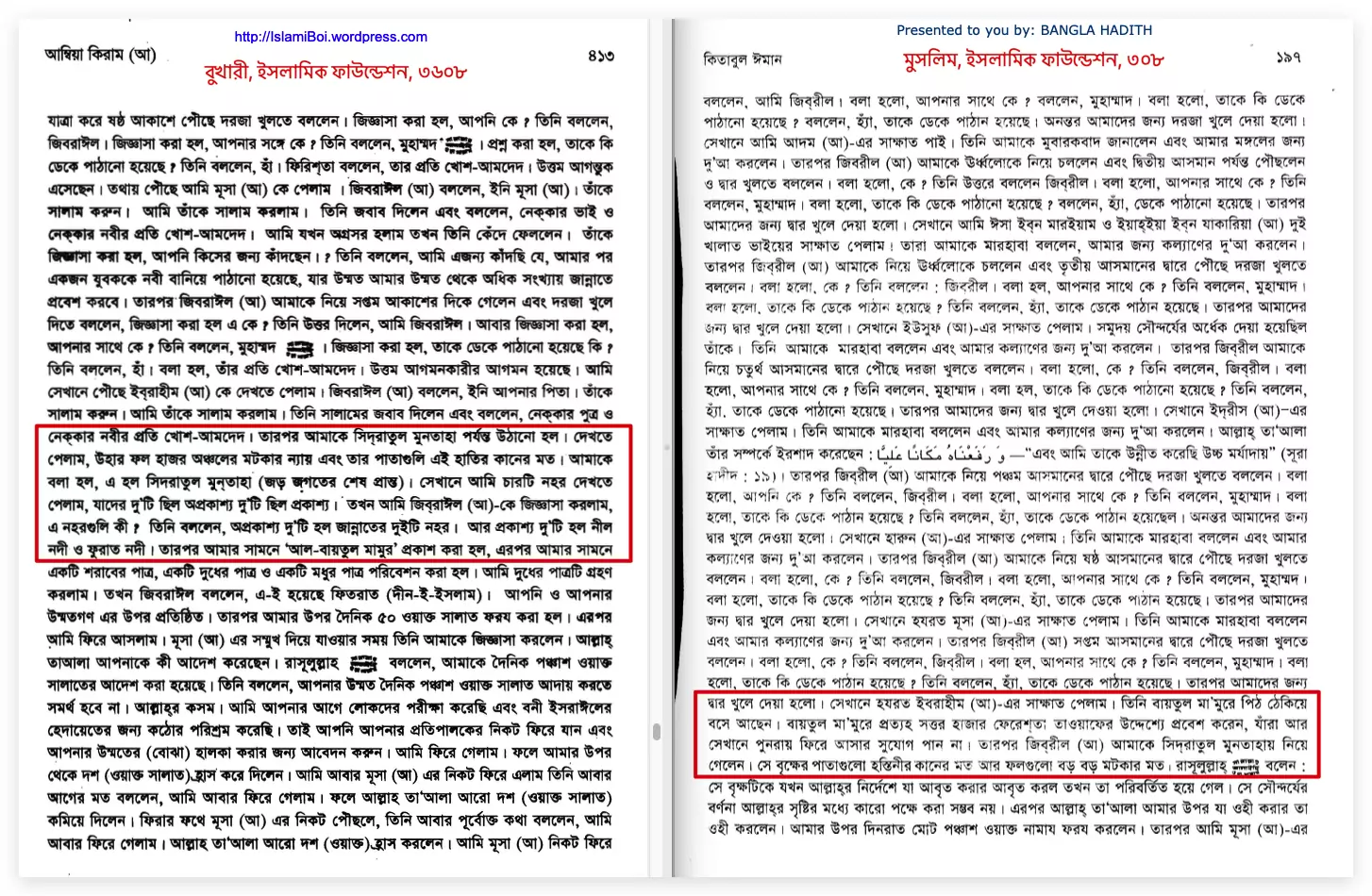
Forty Years or Fifty Thousand Years Earlier?
Hadith describe Muhammad witnessing a debate between Adam and Moses on the night of Mi‘raj, in which Adam prevailed. The problem is that several hadith concerning this debate state that the Torah was written forty years before Adam’s creation and that his fate was determined in it. Another authentic hadith says his fate had already been determined fifty thousand years before his creation. Both statements cannot be correct simultaneously. Here, too, a problem emerges. Let us read the two hadith [118] [119].
Sahih Muslim (Islamic Foundation)
48/ Divine Decree
Section: 2. The debate between Adam and Moses (peace be upon them)
6503. Ishaq ibn Musa ibn Abdullah ibn Musa ibn Abdullah ibn Yazid al-Ansari (may Allah have mercy on him) … Abu Huraira reported Allah’s Messenger (ﷺ) as saying: There was an argument between Adam and Moses (peace be upon both of them) in the presence of their Lord. Adam came the better of Moses. Moses said: Are you that Adam whom Allah created with His Hand and breathed into himHis sprit, and commanded angels to fall in prostration before him and He made you live in Paradise with comfort and ease.
Then you caused the people to get down to the earth because of your lapse. Adam said: Are you that Moses whom Allah selected for His Messengership and for His conversation with him and conferred upon you the tablets, in which everything was clearly explained and granted you the audience in order to have confidential talk with you. What is your opinion, how long Torah would haye been written before I was created?
Moses said: Forty years before. Adam said: Did you not see these words: Adam committed an error and he was enticed to (do so). He (Moses) said: Yes. Whereupon, he (Adam) said: Do you then blame me for an act which Allah had ordained for me forty years before He created me? Allah’s Messenger (ﷺ) said: This is how Adam came the better of Moses.
Sahih Muslim 2652 c; Book 46, Hadith 22
Hadith grade: Sahih (Authentic)
Narrator: Abu Hurayra (may Allah be pleased with him)
Sahih Muslim (Islamic Foundation)
48/ Divine Decree
Section: 2. The debate between Adam and Moses (peace be upon them)
6507. Abu Tahir Ahmad ibn Amr ibn Abdullah ibn Sarh (may Allah have mercy on him) … Abdullah b. ‘Amr b. al-‘As reported: I heard Allah’s Messenger (ﷺ) as saying: Allah ordained the measures (of quality) of the creation fifty thousand years before He created the heavens and the earth, as His Throne was upon water.
Sahih Muslim 2653 b; Book 46, Hadith 27
Hadith grade: Sahih (Authentic)
Narrator: Abdullah ibn Amr ibn al-As (may Allah be pleased with him)
Let us read the two hadith side by side [120]:
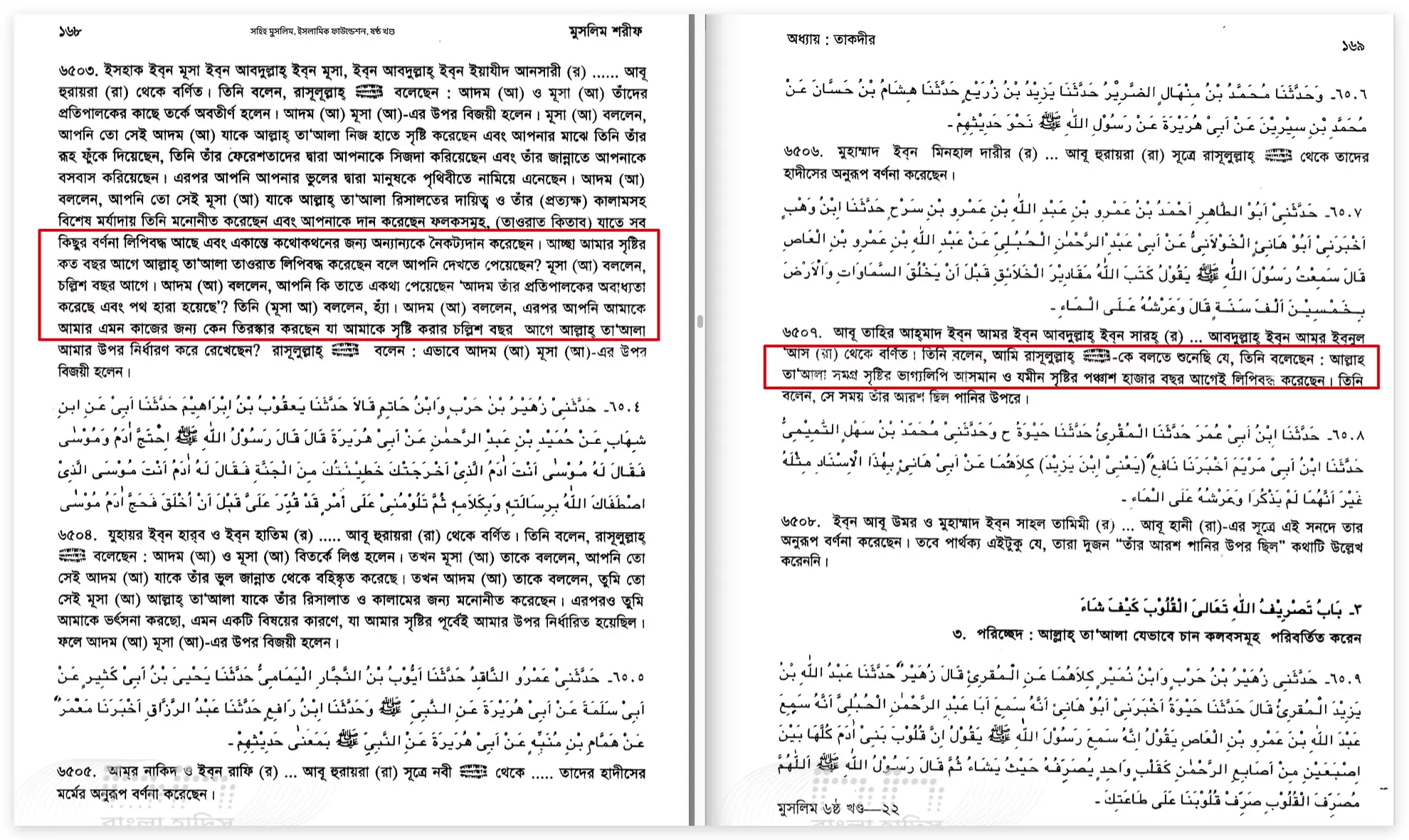
Why Did Buraq Need to Be Tied Up?
Hadith descriptions show Buraq understanding language: when Gabriel spoke to it, it became calm. This special horse or donkey could therefore understand speech and even feel shame. Why, then, did such a creature need to be tied up? Ordinary people tether horses and donkeys for a particular reason: the animals do not understand human language and are not intelligent, so they might wander away. Why tether an animal that understands Muhammad’s speech? Would it have run away? Did Muhammad not notice how many holes the story contained? [121]
Sunan al-Tirmidhi (Islamic Foundation)
50/ Commentary on the Quran
Section: Surah Bani Isra’il
3131. Ishaq ibn Mansur (may Allah have mercy on him) …… Narrated Anas: that Al-Buraq was brought to the Prophet (ﷺ) on the Night of Isra, saddled and reined, but he shied from him. So Jibra’il said to him: “is it from Muhammad that you do this? By your Lord! There is no one more honorable to your Lord than him.” He said: “Then he started sweating profusely.”
Jami` at-Tirmidhi 3131; Grade: Da’if (Darussalam); Book 47, Hadith 183
This hadith is Hasan Gharib. We know it only through Abd al-Razzaq’s narration (may Allah have mercy on him).
Sahih; al-Tirmidhi, hadith no. 3131 [Al-Madani Publications]
Hadith grade: Sahih (Authentic)
Narrator: Anas ibn Malik (may Allah be pleased with him)
Muhammad tied up Buraq during Mi‘raj [85]:
Sahih Muslim (Islamic Foundation)
1/ The Book of Faith
Section: 73. The Mi‘raj of the Messenger of Allah (peace and blessings be upon him) and the obligation of prayer
Islamic Foundation no.: 308; international no.: 162
308. Shayban ibn Farrukh (may Allah have mercy on him) … It is narrated on the authority of Anas b. Malik that the Messenger of Allah (ﷺ) said: I was brought al-Buraq Who is an animal white and long, larger than a donkey but smaller than a mule, who would place his hoof a distance equal to the range of version. I mounted it and came to the Temple (Bait Maqdis in Jerusalem), then tethered it to the ring used by the prophets. I entered the mosque and prayed two rak’ahs in it, and then came out and Gabriel brought me a vessel of wine and a vessel of milk.
I chose the milk, and Gabriel said: You have chosen the natural thing. Then he took me to heaven. Gabriel then asked the (gate of heaven) to be opened and he was asked who he was. He replied: Gabriel. He was again asked: Who is with you? He (Gabriel) said: Muhammad. It was said: Has he been sent for? Gabriel replied: He has indeed been sent for. And (the door of the heaven) was opened for us and lo! we saw Adam.
He welcomed me and prayed for my good. Then we ascended to the second heaven. Gabriel (peace be upon him) (asked the door of heaven to be opened), and he was asked who he was. He answered: Gabriel; and was again asked: Who is with you? He replied: Muhammad. It was said: Has he been sent for? He replied: He has indeed been sent for. The gate was opened. When I entered ‘Isa b. Maryam and Yahya b. Zakariya (peace be upon both of them), cousins from the maternal side.
welcomed me and prayed for my good Then I was taken to the third heaven and Gabriel asked for the opening (of the door). He was asked: Who are you? He replied: Gabriel. He was (again) asked: Who is with you? He replied Muhammad (ﷺ). It was said: Has he been sent for? He replied He has indeed been sent for. (The gate) was opened for us and I saw Yusuf (peace of Allah be upon him) who had been given half of (world) beauty.
He welcomed me prayed for my well-being. Then he ascended with us to the fourth heaven. Gabriel (peace be upon him) asked for the (gate) to be opened, and it was said: Who is he? He replied: Gabriel. It was (again) said: Who is with you? He said: Muhammad. It was said: Has he been sent for? He replied: He has indeed been sent for. The (gate) was opened for us, and lo! Idris was there.
He welcomed me and prayed for my well-being (About him) Allah, the Exalted and the Glorious, has said:” We elevated him (Idris) to the exalted position” (Qur’an xix. 57). وَرَفَعْنَاهُ مَكَانًا عَلِيًّا Then he ascended with us to the fifth heaven and Gabriel asked for the (gate) to be opened. It was said: Who is he? He replied Gabriel. It was (again) said: Who is with thee? He replied: Muhammad. It was said Has he been sent for? He replied: He has indeed been sent for. (The gate) was opened for us and then I was with Harun (Aaron-peace of Allah be upon him).
He welcomed me prayed for my well-being. Then I was taken to the sixth heaven. Gabriel (peace be upon him) asked for the door to be opened. It was said: Who is he? He replied: Gabriel. It was said: Who is with thee? He replied: Muhammad. It was said: Has he been sent for? He replied: He has indeed been sent for. (The gate) was opened for us and there I was with Musa (Moses peace be upon him) He welcomed me and prayed for my well-being.
Then I was taken up to the seventh heaven. Gabriel asked the (gate) to be opened. It was said: Who is he? He said: Gabriel It was said. Who is with thee? He replied: Muhammad (may peace be upon him.) It was said: Has he been sent for? He replied: He has indeed been sent for. (The gate) was opened for us and there I found Ibrahim (Abraham peace be upon him) reclining against the Bait-ul-Ma’mur and there enter into it seventy thousand angels every day, never to visit (this place) again.
Then I was taken to Sidrat-ul-Muntaha whose leaves were like elephant ears and its fruit like big earthenware vessels. And when it was covered by the Command of Allah, it underwent such a change that none amongst the creation has the power to praise its beauty. Then Allah revealed to me a revelation and He made obligatory for me fifty prayers every day and night. Then I went down to Moses (peace be upon him) and he said: What has your Lord enjoined upon your Ummah?
I said: Fifty prayers. He said: Return to thy Lord and beg for reduction (in the number of prayers), for your community shallnot be able to bear this burden. as I have put to test the children of Isra’il and tried them (and found them too weak to bear such a heavy burden). He (the Holy Prophet) said: I went back to my Lord and said: My Lord, make things lighter for my Ummah. (The Lord) reduced five prayers for me.
I went down to Moses and said. (The Lord) reduced five (prayers) for me, He said: Verily thy Ummah shall not be able to bear this burden; return to thy Lord and ask Him to make things lighter. I then kept going back and forth between my Lord Blessed and Exalted and Moses, till He said: There are five prayers every day and night. O Muhammad, each being credited as ten, so that makes fifty prayers.
He who intends to do a good deed and does not do it will have a good deed recorded for him; and if he does it, it will be recorded for him as ten; whereas he who intends to do an evil deed and does not do, it will not be recorded for him; and if he does it, only one evil deed will be recorded. I then came down and when I came to Moses and informed him, he said: Go back to thy Lord and ask Him to make things lighter. Upon this the Messenger of Allah remarked: I returned to my Lord until I felt ashamed before Him.
Sahih Muslim 162 a; Book 1, Hadith 316
Hadith grade: Sahih (Authentic)
Narrator: Anas ibn Malik (may Allah be pleased with him)
Even Muhammad’s Companions disputed this. In the following hadith, two Companions argue, and one asks in surprise why Buraq would need tethering when Allah had already placed the animal under Muhammad’s control [106] [107]:
Sunan al-Tirmidhi (Verified Edition)
44/ Commentary on the Quran
Section: 18. Surah Bani Isra’il
3147. Narrated Zirr bin Hubaish: “I said to Hudhaifah bin Al-Yaman: ‘Did the Messenger of Allah (ﷺ) perform Salat in Bait Al-Maqdis?’ He said: ‘No.’ I said: ‘But he did.’ He said: ‘You say that, O bald one! Based upon what do you say that?’ I said: ‘Based upon the Qur’an, (the Judge) between you and I is the Qur’an.’ So Hudhaifah said: ‘Whoever argues using the Qur’an, then he has indeed succeeded.'” (One of the narrators) Sufyan said: “He means: ‘He has indeed proven'” – and perhaps he (Sufyan) said: “He triumphed.”
He (Zirr) said: “Glorified is He Who took His slave for a journey by night from Al-Masjid Al-Haram to Al-Masjid Al-Aqsa (17:1).’ He (Hudhaifah) said: ‘Do you see (this proves that) he (ﷺ) performed Salat in it?’ I said: ‘No.’ He said: ‘If he had performed Salat in it, then it would have been required upon you that you perform Salat in it, just as it is required that you perform Salat in Al-Masjid Al-Haram.’
Hudhaifah said: ‘The Messenger of Allah (ﷺ) was brought a beast with a long back – stretching out like this – one stride of it, is as far as his vision. So, the two of them remained upon the back of Al-Buraq until they saw Paradise and the Fire, and all of what has been prepared for the Hereafter, then they returned back to where they began.’ He said: ‘They say that he was fettered, but for what? Because he might flee? The Knower of the unseen and the witness subdued him.’“
Jami` at-Tirmidhi 3147; Grade: Sahih (Darussalam); Book 47, Hadith 199
Its chain is Hasan.
Abu Isa said: This hadith is Hasan Sahih.
Hadith grade: Hasan (Good)
Narrator: Zirr ibn Hubaysh (may Allah have mercy on him)
The Heavenly Gatekeepers’ Ignorance?
As Muhammad enters through each heavenly door—does heaven have doors?—the hadith show the gatekeeper asking who is there. For an event of such magnitude, surely the gatekeepers should know who is coming. Allah should have informed every angel beforehand of Muhammad’s arrival. Heaven’s communications system is evidently terrible, positively prehistoric. Or were these details invented to make the story more exciting and appealing? [85]
Sahih Muslim (Islamic Foundation)
1/ The Book of Faith
Section: 73. The Mi‘raj of the Messenger of Allah (peace and blessings be upon him) and the obligation of prayer
Islamic Foundation no.: 308; international no.: 162
308. Shayban ibn Farrukh (may Allah have mercy on him) … It is narrated on the authority of Anas b. Malik that the Messenger of Allah (ﷺ) said: I was brought al-Buraq Who is an animal white and long, larger than a donkey but smaller than a mule, who would place his hoof a distance equal to the range of version. I mounted it and came to the Temple (Bait Maqdis in Jerusalem), then tethered it to the ring used by the prophets. I entered the mosque and prayed two rak’ahs in it, and then came out and Gabriel brought me a vessel of wine and a vessel of milk.
I chose the milk, and Gabriel said: You have chosen the natural thing. Then he took me to heaven. Gabriel then asked the (gate of heaven) to be opened and he was asked who he was. He replied: Gabriel. He was again asked: Who is with you? He (Gabriel) said: Muhammad. It was said: Has he been sent for? Gabriel replied: He has indeed been sent for. And (the door of the heaven) was opened for us and lo! we saw Adam.
He welcomed me and prayed for my good. Then we ascended to the second heaven. Gabriel (peace be upon him) (asked the door of heaven to be opened), and he was asked who he was. He answered: Gabriel; and was again asked: Who is with you? He replied: Muhammad. It was said: Has he been sent for? He replied: He has indeed been sent for. The gate was opened. When I entered ‘Isa b. Maryam and Yahya b. Zakariya (peace be upon both of them), cousins from the maternal side.
welcomed me and prayed for my good Then I was taken to the third heaven and Gabriel asked for the opening (of the door). He was asked: Who are you? He replied: Gabriel. He was (again) asked: Who is with you? He replied Muhammad (ﷺ). It was said: Has he been sent for? He replied He has indeed been sent for. (The gate) was opened for us and I saw Yusuf (peace of Allah be upon him) who had been given half of (world) beauty.
He welcomed me prayed for my well-being. Then he ascended with us to the fourth heaven. Gabriel (peace be upon him) asked for the (gate) to be opened, and it was said: Who is he? He replied: Gabriel. It was (again) said: Who is with you? He said: Muhammad. It was said: Has he been sent for? He replied: He has indeed been sent for. The (gate) was opened for us, and lo! Idris was there.
He welcomed me and prayed for my well-being (About him) Allah, the Exalted and the Glorious, has said:” We elevated him (Idris) to the exalted position” (Qur’an xix. 57). وَرَفَعْنَاهُ مَكَانًا عَلِيًّا Then he ascended with us to the fifth heaven and Gabriel asked for the (gate) to be opened. It was said: Who is he? He replied Gabriel. It was (again) said: Who is with thee? He replied: Muhammad. It was said Has he been sent for? He replied: He has indeed been sent for. (The gate) was opened for us and then I was with Harun (Aaron-peace of Allah be upon him).
He welcomed me prayed for my well-being. Then I was taken to the sixth heaven. Gabriel (peace be upon him) asked for the door to be opened. It was said: Who is he? He replied: Gabriel. It was said: Who is with thee? He replied: Muhammad. It was said: Has he been sent for? He replied: He has indeed been sent for. (The gate) was opened for us and there I was with Musa (Moses peace be upon him) He welcomed me and prayed for my well-being.
Then I was taken up to the seventh heaven. Gabriel asked the (gate) to be opened. It was said: Who is he? He said: Gabriel It was said. Who is with thee? He replied: Muhammad (may peace be upon him.) It was said: Has he been sent for? He replied: He has indeed been sent for. (The gate) was opened for us and there I found Ibrahim (Abraham peace be upon him) reclining against the Bait-ul-Ma’mur and there enter into it seventy thousand angels every day, never to visit (this place) again.
Then I was taken to Sidrat-ul-Muntaha whose leaves were like elephant ears and its fruit like big earthenware vessels. And when it was covered by the Command of Allah, it underwent such a change that none amongst the creation has the power to praise its beauty. Then Allah revealed to me a revelation and He made obligatory for me fifty prayers every day and night. Then I went down to Moses (peace be upon him) and he said: What has your Lord enjoined upon your Ummah?
I said: Fifty prayers. He said: Return to thy Lord and beg for reduction (in the number of prayers), for your community shallnot be able to bear this burden. as I have put to test the children of Isra’il and tried them (and found them too weak to bear such a heavy burden). He (the Holy Prophet) said: I went back to my Lord and said: My Lord, make things lighter for my Ummah. (The Lord) reduced five prayers for me.
I went down to Moses and said. (The Lord) reduced five (prayers) for me, He said: Verily thy Ummah shall not be able to bear this burden; return to thy Lord and ask Him to make things lighter. I then kept going back and forth between my Lord Blessed and Exalted and Moses, till He said: There are five prayers every day and night. O Muhammad, each being credited as ten, so that makes fifty prayers.
He who intends to do a good deed and does not do it will have a good deed recorded for him; and if he does it, it will be recorded for him as ten; whereas he who intends to do an evil deed and does not do, it will not be recorded for him; and if he does it, only one evil deed will be recorded. I then came down and when I came to Moses and informed him, he said: Go back to thy Lord and ask Him to make things lighter. Upon this the Messenger of Allah remarked: I returned to my Lord until I felt ashamed before Him.
Sahih Muslim 162 a; Book 1, Hadith 316
Hadith grade: Sahih (Authentic)
Narrator: Anas ibn Malik (may Allah be pleased with him)
An Arithmetic Error over Prayer
Let us calculate. Following Moses’s advice, Muhammad returned to Allah for the first time and had the fifty daily prayers reduced by half. Half of fifty is twenty-five. He then had them halved again, leaving twelve and a half prayers. But how is someone supposed to perform twelve and a half daily prayers? Why did Allah arrange matters this way? [122]:
Sahih al-Bukhari (Tawhid)
60/ The Prophets (peace be upon them)
Section: 60/5. The account of Idris (peace be upon him).
60/4. Chapter:
(Allah’s words:) ‘And Elias was indeed one of the messengers. ˹Remember˺ when he said to his people, “Will you not fear ˹Allah˺?’ ………… ‘We blessed him ˹with honourable mention˺ among later generations:’ (As-Saffat 37:123–129; Dr. Mustafa Khattab, The Clear Quran)
Ibn Abbas (may Allah be pleased with him) said that Elias was mentioned with honour. ‘“Peace be upon Elias.” Indeed, this is how We reward the good-doers. He was truly one of Our faithful servants.’ (As-Saffat 37:130–132; Dr. Mustafa Khattab, The Clear Quran)
And he was the grandfather of Noah’s father (peace be upon him). Allah’s words: ‘And We elevated him to an honourable status.’ (Maryam 19:57; Dr. Mustafa Khattab, The Clear Quran)
3342. Narrated Anas (ra): Abu Dhar (ra) used to say that Allah’s Messenger (ﷺ) said, “While I was at Makkah, the roof of my house was opened and Jibril descended, opened my chest, and washed it with Zamzam water. Then he brought a golden tray full of wisdom and faith, and having poured its contents into my chest, he closed it. Then he took my hand and ascended with me to the heaven. When Jibril reached the nearest heaven, he said to the gatekeeper of the heaven, ‘Open (the gate).’ The gatekeeper asked, ‘who is it?’ Jibril answered, ‘Jibril’. He asked, ‘Is there anyone with you?’ Jibril replied, ‘Muhammad (ﷺ) is with me.’ He asked, ‘Has he been called?’, Jibril said, ‘Yes’. So, the gate was opened and we went over the nearest heaven, and there we saw a man sitting with Aswida (a large number of people) of his right and Aswida on his left.
When he looked towards his right, he laughed and when he looked towards his left he wept. He said (to me), ‘Welcome, O pious Prophet and pious son’. I said, ‘Who is this man O Jibril?’ Jibril replied, ‘He is Adam, and the people on his right and left are the souls of his offspring. Those on the right are the people of Paradise, and those on the left are the people of the (Hell) Fire. So, when he looks to the right, he laughs, and when he looks to the left he weeps.’ Then Jibril ascended with me till he reached the second heaven and said to the gatekeeper, ‘Open (the gate).’ The gatekeeper said to him the same as the gatekeeper of the first heaven has said, and he opened the gate.”
Anas added: Abu Dhar mentioned that Prophet (ﷺ) met Idris, Musa (Moses), ‘Isa (Jesus) and Ibrahim (Abraham) over the heavens, but he did not specify their places (i.e., on which heavens each of them was), but he mentioned that he (the Prophet (ﷺ)) had met Adam on the nearest heaven, and Ibrahim on the sixth. Anas said, “When Jibril and the Prophet (ﷺ) passed by Idris, the latter said, ‘Welcome, O pious Prophet and pious brother!’ the Prophet (ﷺ) asked, ‘Who is he?’ Jibril said, ‘He is Idris.’ ” The Prophet (ﷺ) added, “Then I passed by Musa who said, ‘Welcome, O pious Prophet and pious brother!’ I said, ‘Who is he?’ Jibril said, ‘He is Musa.’ Then I passed by ‘Isa who said, ‘Welcome, O pious Prophet and pious brother!’ I said, ‘Who is he?’ He replied, ‘He is ‘Isa.’ Then I passed by the Prophet (ﷺ) Ibrahim who said, ‘Welcome, O pious Prophet and pious son!’
I said, ‘Who is he?’ Jibril replied, ‘He is Ibrahim’.” Narrated Ibn ‘Abbas and Abu Haiyya Al-Ansari: The Prophet (ﷺ) said, “Then Jibril ascended with me to a place where I heard the creaking of pens.” Ibn Hazm and Anas bin Malik state the Prophet (ﷺ) said, “Allah enjoined fifty Salat (prayers) on me. When I returned with this order of Allah, I passed by Musa who asked me, ‘What has Allah enjoined on your followers?’ I replied, ‘He has enjoined fifty Salat (prayers) on them.’ On the Musa said to me, ‘Go back to your Lord (and appeal for reduction), for your followers will not be able to bear it.’ So, I returned to my Lord and asked for some reduction, and He reduced it to half. When I passed by Musa again and informed him about it, he once more said to me, ‘Go back to your Lord, for your followers will not be able to bear it.’
So, I returned to my Lord similarly as before, and half of it was reduced. I again passed by Musa and he said to me, ‘Go back to your Lord, for your followers will not be able to bear it.’ I again returned to my Lord and He said, ‘These are five (Salat-prayers) and they are all (equal to) fifty (in reward), for My Word does not change.’ I returned to Musa, he again told me to return to my Lord (for further reduction) but I said to him ‘I feel shy of asking my Lord now.’ Then Jibril took me till we reached Sidrat-ul-Muntaha (i.e., lote tree of utmost boundary) which was shrouded in colors indescribable. Then I was admitted into Paradise where I found small tents (made) of pearls and its earth was musk (a kind of perfume).”
(349) (Adhunik Prakashani: 3095; Islamic Foundation: 3103)
Sahih al-Bukhari 3342; Book 60, Hadith 17
Hadith grade: Sahih (Authentic)
Narrator: Anas ibn Malik (may Allah be pleased with him)
How Could the Pen Make a Sound?
Numerous hadith tell us that, at creation’s beginning, Allah made a pen responsible for writing all good and bad aspects of destiny. Other hadith say its ink has dried. Yet on the night of Mi‘raj, Muhammad heard that pen scratching as it wrote. Was this the same pen or a different one? [123] [122]:
Sahih al-Bukhari (Tawhid Publication)
82/ Divine Decree
Section: 82/2. The pen has dried after recording everything in accordance with Allah’s knowledge.
Allah’s words: ‘˹And so˺ Allah left them to stray knowingly’ (Al-Jathiyah 45:23; Dr. Mustafa Khattab, The Clear Quran). Abu Hurayra (may Allah be pleased with him) said: The Prophet (peace and blessings be upon him) told me, ‘The pen has dried after recording what you will encounter.’ Ibn Abbas (may Allah be pleased with him) said that لَهَا سَابِقُوْنَ means that blessedness has already been decreed for them.
6596. Narrated `Imran bin Husain: A man said, “O Allah’s Messenger (ﷺ)! Can the people of Paradise be known (differentiated) from the people of the Fire; The Prophet (ﷺ) replied, “Yes.” The man said, “Why do people (try to) do (good) deeds?” The Prophet said, “Everyone will do the deeds for which he has been created to do or he will do those deeds which will be made easy for him to do.” (i.e. everybody will find easy to do such deeds as will lead him to his destined place for which he has been created).
[7551; Muslim 38/1, hadith 2649]
(Adhunik Prakashani: 6136; Islamic Foundation: 6144)
Sahih al-Bukhari 6596; Book 82, Hadith 3
Hadith grade: Sahih (Authentic)
Narrator: Imran ibn Husayn (may Allah be pleased with him)
Sahih al-Bukhari (Tawhid)
60/ The Prophets (peace be upon them)
Section: 60/5. The account of Idris (peace be upon him).
60/4. Chapter:
(Allah’s words:) ‘And Elias was indeed one of the messengers. ˹Remember˺ when he said to his people, “Will you not fear ˹Allah˺?’ ………… ‘We blessed him ˹with honourable mention˺ among later generations:’ (As-Saffat 37:123–129; Dr. Mustafa Khattab, The Clear Quran)
Ibn Abbas (may Allah be pleased with him) said that Elias was mentioned with honour. ‘“Peace be upon Elias.” Indeed, this is how We reward the good-doers. He was truly one of Our faithful servants.’ (As-Saffat 37:130–132; Dr. Mustafa Khattab, The Clear Quran)
And he was the grandfather of Noah’s father (peace be upon him). Allah’s words: ‘And We elevated him to an honourable status.’ (Maryam 19:57; Dr. Mustafa Khattab, The Clear Quran)
3342. Narrated Anas (ra): Abu Dhar (ra) used to say that Allah’s Messenger (ﷺ) said, “While I was at Makkah, the roof of my house was opened and Jibril descended, opened my chest, and washed it with Zamzam water. Then he brought a golden tray full of wisdom and faith, and having poured its contents into my chest, he closed it. Then he took my hand and ascended with me to the heaven. When Jibril reached the nearest heaven, he said to the gatekeeper of the heaven, ‘Open (the gate).’ The gatekeeper asked, ‘who is it?’ Jibril answered, ‘Jibril’. He asked, ‘Is there anyone with you?’ Jibril replied, ‘Muhammad (ﷺ) is with me.’ He asked, ‘Has he been called?’, Jibril said, ‘Yes’. So, the gate was opened and we went over the nearest heaven, and there we saw a man sitting with Aswida (a large number of people) of his right and Aswida on his left.
When he looked towards his right, he laughed and when he looked towards his left he wept. He said (to me), ‘Welcome, O pious Prophet and pious son’. I said, ‘Who is this man O Jibril?’ Jibril replied, ‘He is Adam, and the people on his right and left are the souls of his offspring. Those on the right are the people of Paradise, and those on the left are the people of the (Hell) Fire. So, when he looks to the right, he laughs, and when he looks to the left he weeps.’ Then Jibril ascended with me till he reached the second heaven and said to the gatekeeper, ‘Open (the gate).’ The gatekeeper said to him the same as the gatekeeper of the first heaven has said, and he opened the gate.”
Anas added: Abu Dhar mentioned that Prophet (ﷺ) met Idris, Musa (Moses), ‘Isa (Jesus) and Ibrahim (Abraham) over the heavens, but he did not specify their places (i.e., on which heavens each of them was), but he mentioned that he (the Prophet (ﷺ)) had met Adam on the nearest heaven, and Ibrahim on the sixth. Anas said, “When Jibril and the Prophet (ﷺ) passed by Idris, the latter said, ‘Welcome, O pious Prophet and pious brother!’ the Prophet (ﷺ) asked, ‘Who is he?’ Jibril said, ‘He is Idris.’ ” The Prophet (ﷺ) added, “Then I passed by Musa who said, ‘Welcome, O pious Prophet and pious brother!’ I said, ‘Who is he?’ Jibril said, ‘He is Musa.’ Then I passed by ‘Isa who said, ‘Welcome, O pious Prophet and pious brother!’ I said, ‘Who is he?’ He replied, ‘He is ‘Isa.’ Then I passed by the Prophet (ﷺ) Ibrahim who said, ‘Welcome, O pious Prophet and pious son!’
I said, ‘Who is he?’ Jibril replied, ‘He is Ibrahim’.” Narrated Ibn ‘Abbas and Abu Haiyya Al-Ansari: The Prophet (ﷺ) said, “Then Jibril ascended with me to a place where I heard the creaking of pens.” Ibn Hazm and Anas bin Malik state the Prophet (ﷺ) said, “Allah enjoined fifty Salat (prayers) on me. When I returned with this order of Allah, I passed by Musa who asked me, ‘What has Allah enjoined on your followers?’ I replied, ‘He has enjoined fifty Salat (prayers) on them.’ On the Musa said to me, ‘Go back to your Lord (and appeal for reduction), for your followers will not be able to bear it.’ So, I returned to my Lord and asked for some reduction, and He reduced it to half. When I passed by Musa again and informed him about it, he once more said to me, ‘Go back to your Lord, for your followers will not be able to bear it.’
So, I returned to my Lord similarly as before, and half of it was reduced. I again passed by Musa and he said to me, ‘Go back to your Lord, for your followers will not be able to bear it.’ I again returned to my Lord and He said, ‘These are five (Salat-prayers) and they are all (equal to) fifty (in reward), for My Word does not change.’ I returned to Musa, he again told me to return to my Lord (for further reduction) but I said to him ‘I feel shy of asking my Lord now.’ Then Jibril took me till we reached Sidrat-ul-Muntaha (i.e., lote tree of utmost boundary) which was shrouded in colors indescribable. Then I was admitted into Paradise where I found small tents (made) of pearls and its earth was musk (a kind of perfume).”
(349) (Adhunik Prakashani: 3095; Islamic Foundation: 3103)
Sahih al-Bukhari 3342; Book 60, Hadith 17
Hadith grade: Sahih (Authentic)
Narrator: Anas ibn Malik (may Allah be pleased with him)
Was Moses Wiser Than Allah?
The greatest question is whether Moses was more knowledgeable than Allah. Notice that the hadith initially describe Allah commanding fifty daily prayers. On hearing this from Muhammad, Moses began acting as though he knew better than Allah, advising him to bargain over Allah’s command—as though haggling over a portion of tiny fish at a market. Following the advice of Moses, who apparently knew better than the all-knowing Allah, Muhammad haggled with Allah like a customer at a fish stall and secured fewer prayers. Anyone might consequently consider Moses cleverer than Allah, since he objected to the prescribed prayers and advised reducing them. I do not know what punishment Allah would impose for such disrespect toward his majesty, but the account says that Allah reduced the number under Muhammad’s repeated pressure. In other words, Allah corrected his own mistake. Why else reduce the prayers? If Allah initially commanded fifty prayers and later corrected himself on Moses’s advice, we must understand that Allah too makes mistakes. How, then, is he Allah? [122]:
Sahih al-Bukhari (Tawhid)
60/ The Prophets (peace be upon them)
Section: 60/5. The account of Idris (peace be upon him).
60/4. Chapter:
(Allah’s words:) ‘And Elias was indeed one of the messengers. ˹Remember˺ when he said to his people, “Will you not fear ˹Allah˺?’ ………… ‘We blessed him ˹with honourable mention˺ among later generations:’ (As-Saffat 37:123–129; Dr. Mustafa Khattab, The Clear Quran)
Ibn Abbas (may Allah be pleased with him) said that Elias was mentioned with honour. ‘“Peace be upon Elias.” Indeed, this is how We reward the good-doers. He was truly one of Our faithful servants.’ (As-Saffat 37:130–132; Dr. Mustafa Khattab, The Clear Quran)
And he was the grandfather of Noah’s father (peace be upon him). Allah’s words: ‘And We elevated him to an honourable status.’ (Maryam 19:57; Dr. Mustafa Khattab, The Clear Quran)
3342. Narrated Anas (ra): Abu Dhar (ra) used to say that Allah’s Messenger (ﷺ) said, “While I was at Makkah, the roof of my house was opened and Jibril descended, opened my chest, and washed it with Zamzam water. Then he brought a golden tray full of wisdom and faith, and having poured its contents into my chest, he closed it. Then he took my hand and ascended with me to the heaven. When Jibril reached the nearest heaven, he said to the gatekeeper of the heaven, ‘Open (the gate).’ The gatekeeper asked, ‘who is it?’ Jibril answered, ‘Jibril’. He asked, ‘Is there anyone with you?’ Jibril replied, ‘Muhammad (ﷺ) is with me.’ He asked, ‘Has he been called?’, Jibril said, ‘Yes’. So, the gate was opened and we went over the nearest heaven, and there we saw a man sitting with Aswida (a large number of people) of his right and Aswida on his left.
When he looked towards his right, he laughed and when he looked towards his left he wept. He said (to me), ‘Welcome, O pious Prophet and pious son’. I said, ‘Who is this man O Jibril?’ Jibril replied, ‘He is Adam, and the people on his right and left are the souls of his offspring. Those on the right are the people of Paradise, and those on the left are the people of the (Hell) Fire. So, when he looks to the right, he laughs, and when he looks to the left he weeps.’ Then Jibril ascended with me till he reached the second heaven and said to the gatekeeper, ‘Open (the gate).’ The gatekeeper said to him the same as the gatekeeper of the first heaven has said, and he opened the gate.”
Anas added: Abu Dhar mentioned that Prophet (ﷺ) met Idris, Musa (Moses), ‘Isa (Jesus) and Ibrahim (Abraham) over the heavens, but he did not specify their places (i.e., on which heavens each of them was), but he mentioned that he (the Prophet (ﷺ)) had met Adam on the nearest heaven, and Ibrahim on the sixth. Anas said, “When Jibril and the Prophet (ﷺ) passed by Idris, the latter said, ‘Welcome, O pious Prophet and pious brother!’ the Prophet (ﷺ) asked, ‘Who is he?’ Jibril said, ‘He is Idris.’ ” The Prophet (ﷺ) added, “Then I passed by Musa who said, ‘Welcome, O pious Prophet and pious brother!’ I said, ‘Who is he?’ Jibril said, ‘He is Musa.’ Then I passed by ‘Isa who said, ‘Welcome, O pious Prophet and pious brother!’ I said, ‘Who is he?’ He replied, ‘He is ‘Isa.’ Then I passed by the Prophet (ﷺ) Ibrahim who said, ‘Welcome, O pious Prophet and pious son!’
I said, ‘Who is he?’ Jibril replied, ‘He is Ibrahim’.” Narrated Ibn ‘Abbas and Abu Haiyya Al-Ansari: The Prophet (ﷺ) said, “Then Jibril ascended with me to a place where I heard the creaking of pens.” Ibn Hazm and Anas bin Malik state the Prophet (ﷺ) said, “Allah enjoined fifty Salat (prayers) on me. When I returned with this order of Allah, I passed by Musa who asked me, ‘What has Allah enjoined on your followers?’ I replied, ‘He has enjoined fifty Salat (prayers) on them.’ On the Musa said to me, ‘Go back to your Lord (and appeal for reduction), for your followers will not be able to bear it.’ So, I returned to my Lord and asked for some reduction, and He reduced it to half. When I passed by Musa again and informed him about it, he once more said to me, ‘Go back to your Lord, for your followers will not be able to bear it.’
So, I returned to my Lord similarly as before, and half of it was reduced. I again passed by Musa and he said to me, ‘Go back to your Lord, for your followers will not be able to bear it.’ I again returned to my Lord and He said, ‘These are five (Salat-prayers) and they are all (equal to) fifty (in reward), for My Word does not change.’ I returned to Musa, he again told me to return to my Lord (for further reduction) but I said to him ‘I feel shy of asking my Lord now.’ Then Jibril took me till we reached Sidrat-ul-Muntaha (i.e., lote tree of utmost boundary) which was shrouded in colors indescribable. Then I was admitted into Paradise where I found small tents (made) of pearls and its earth was musk (a kind of perfume).”
(349) (Adhunik Prakashani: 3095; Islamic Foundation: 3103)
Sahih al-Bukhari 3342; Book 60, Hadith 17
Hadith grade: Sahih (Authentic)
Narrator: Anas ibn Malik (may Allah be pleased with him)
Can Horses Have Wings?
An authentic hadith describes Muhammad seeing a winged toy horse in Aisha’s room and asking in astonishment how a horse could have wings. Aisha replied, “Do you not know that Solomon’s horses had wings?” Hearing this, Muhammad burst into laughter. This hadith is particularly important because Mi‘raj occurred long before his married life with Aisha. He should have known that Buraq had wings and could fly! [124] [125]
Mishkat al-Masabih (Mishkat)
Part 13: Marriage
Section: 10. Second subsection — Kind treatment of wives and the mutual rights and duties of husband and wife
3265 ‘A’isha told that when God’s Messenger arrived after the expedition to Tabuk or Hunain the wind raised an end of a curtain which was placed before her storeroom, revealing some dolls which belonged to her. He asked her what this was and she replied that they were her dolls. Among them he saw a horse with wings made of rags and asked what that was that he saw among them. She told him that it was a horse, and when he asked what it was that it had on it and she replied that it had wings, he said, “A horse with wings!” She replied, “Have you not heard that Solomon had horses with wings?” She said that he laughed so heartily that she could see his back teeth. Abu Dawud transmitted it.
Mishkat al-Masabih 3265; Book 13, Hadith 182
[1] Sahih: Abu Dawud 4932; Sahih Ibn Hibban 5864.
Hadith grade: Sahih (Authentic)
Narrator: Aisha bint Abu Bakr al-Siddiq (may Allah be pleased with her)
Sunan Abu Dawud (Islamic Foundation)
36/ Manners
Section: 60. Playing with female dolls made of cloth.
4850. Muhammad ibn Awf (may Allah have mercy on him) ….. Narrated Aisha, Ummul Mu’minin: When the Messenger of Allah (ﷺ) arrived after the expedition to Tabuk or Khaybar (the narrator is doubtful), the draught raised an end of a curtain which was hung in front of her store-room, revealing some dolls which belonged to her. He asked: What is this? She replied: My dolls. Among them he saw a horse with wings made of rags, and asked: What is this I see among them? She replied: A horse. He asked: What is this that it has on it? She replied: Two wings. He asked: A horse with two wings? She replied: Have you not heard that Solomon had horses with wings? She said: Thereupon the Messenger of Allah (ﷺ) laughed so heartily that I could see his molar teeth.
Sunan Abi Dawud 4932; Grade: Sahih (Al-Albani); Book 43, Hadith 160
Hadith grade: Sahih (Authentic)
Narrator: Aisha bint Abu Bakr al-Siddiq (may Allah be pleased with her)
Yet the Mi‘raj story’s very foundation is Buraq, a winged creature between a donkey and a mule in size. Let us examine the sira [126].
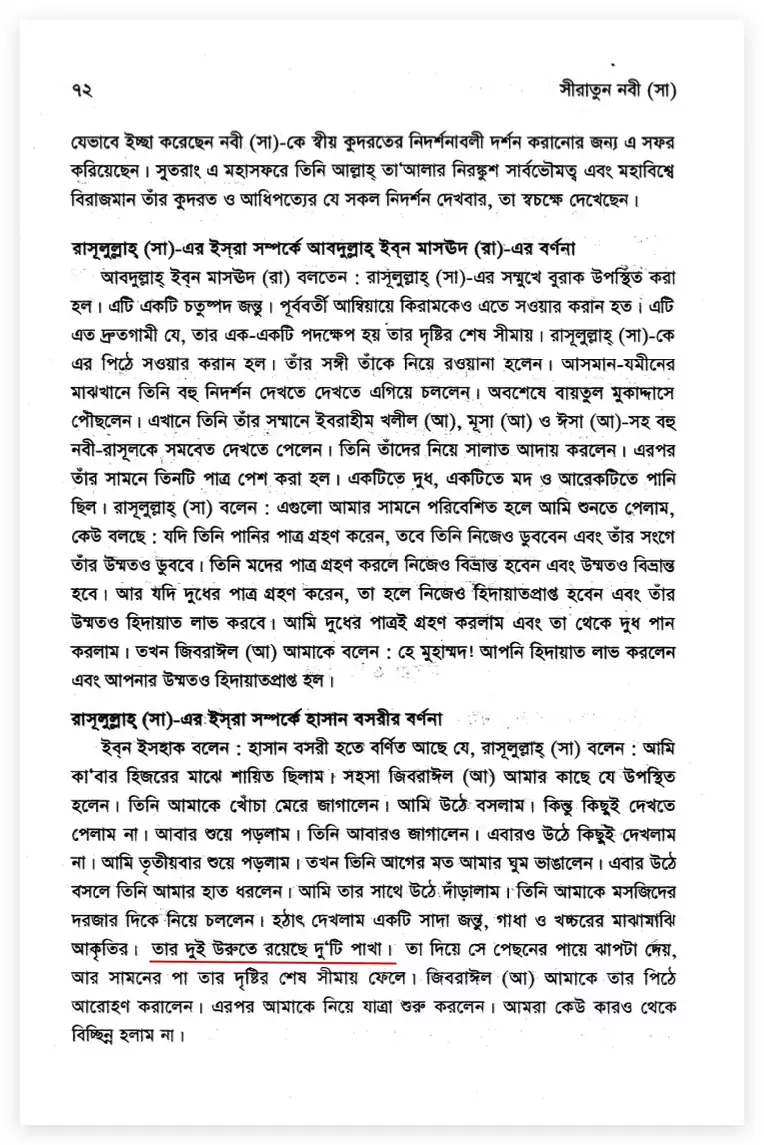
Let us now read from a book by one of Saudi Arabia’s leading scholars [127].
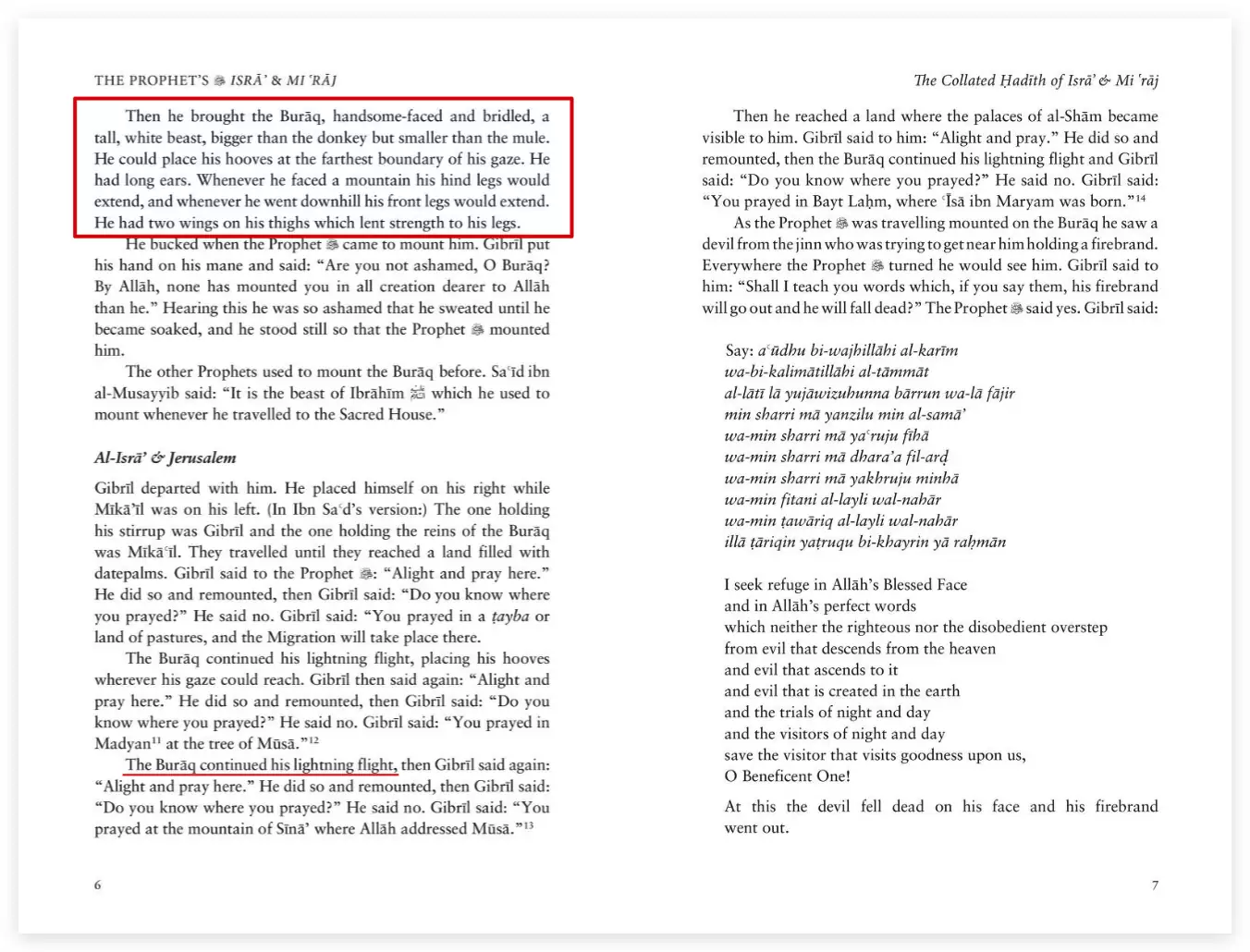
A Dream, a Spiritual Journey, or a Bodily One?
Scholars disagree extensively over whether Mi‘raj occurred bodily, spiritually, or in a dream. Aisha and several other prominent Companions considered it a dream, while most scholars maintain that it was bodily. Let us first examine evidence for a bodily Mi‘raj [128].
The Prophet’s Mi‘raj
Imam Ibn al-Qayyim says: According to the sound account, Mi‘raj occurred bodily. He first mounted Buraq and traveled from al-Masjid al-Haram to Bayt al-Maqdis. Gabriel…
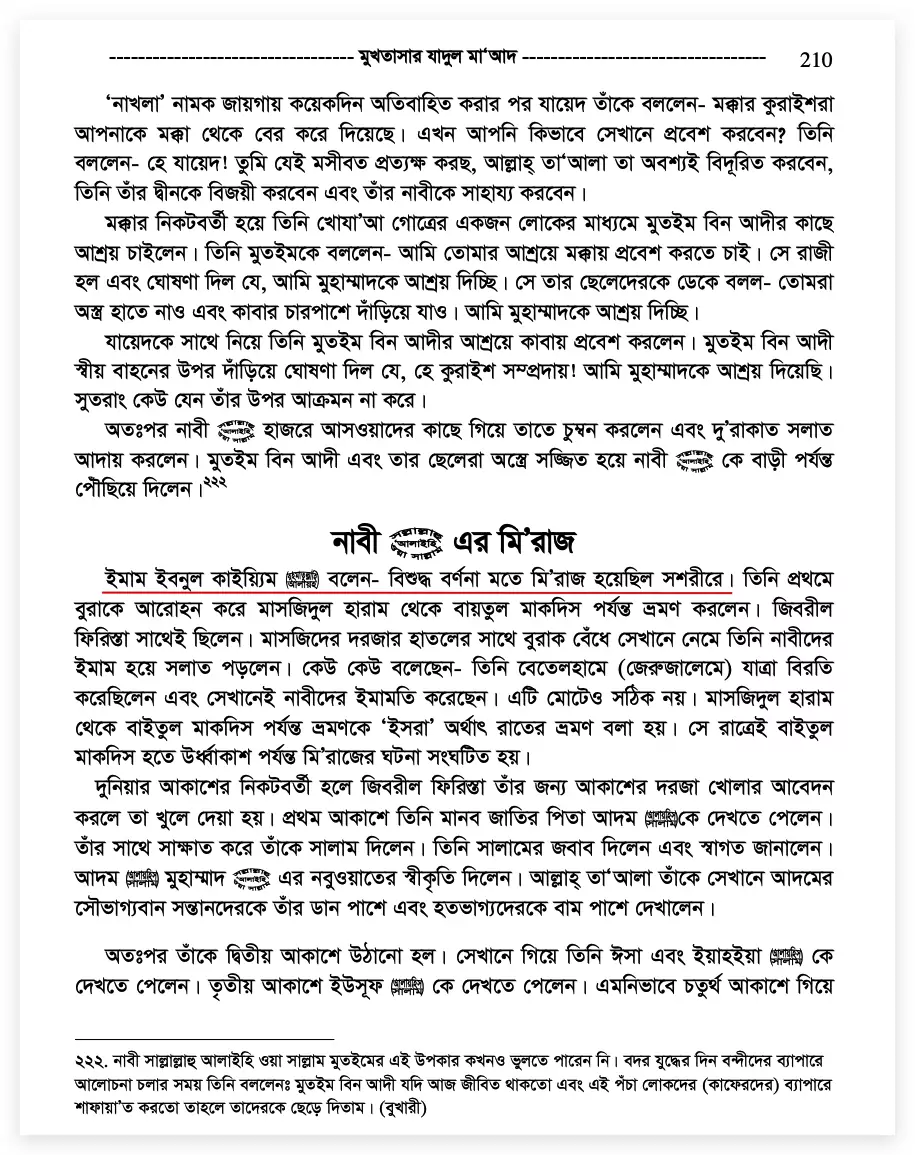
Elsewhere, the same book states that many Companions, including Aisha and Mu‘awiya, along with Ibn Ishaq, held that Mi‘raj occurred in a dream or spiritually [129].
Ibn Ishaq narrates from Aisha and Mu‘awiya that Mi‘raj occurred spiritually, although the soul did not separate from the body. A similar account is transmitted from al-Hasan al-Basri. It is important to understand the distinction between saying that Mi‘raj occurred in a dream and saying that it occurred through the soul rather than bodily. There is a substantial difference. Aisha and Mu‘awiya did not say it occurred through a dream; they said, “It occurred through the soul, but the soul did not lose the body.” The two therefore differ. What a sleeping person sees in a dream may be something already known and familiar. Someone may dream of flying toward the sky or being taken to Mecca, although the soul has neither ascended to heaven nor traveled to Mecca. The angel of dreams merely presents an image to the sleeper.
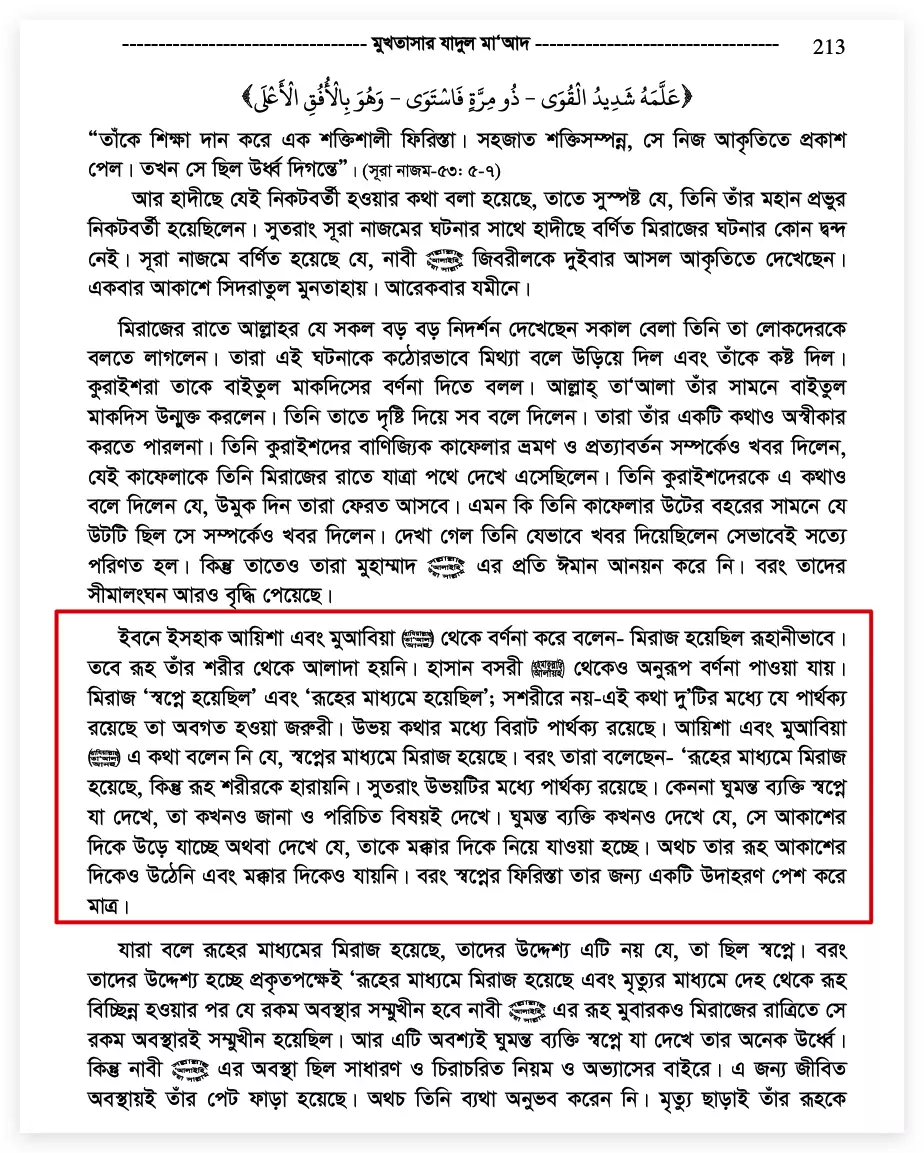
Let us read a hadith. The relevant details are highlighted for readers’ convenience. Notice that Muhammad is asleep at the beginning of the account and awakens at its end [97]:
Sahih al-Bukhari (Islamic Foundation)
86/ Refutation of the Jahmiyyah and Divine Oneness
Section: 3139. Allah’s words: ‘And to Moses Allah spoke directly.’ (4:164; Dr. Mustafa Khattab, The Clear Quran)
Islamic Foundation no.: 7009; international no.: 7517
7009. Abd al-Aziz ibn Abdullah (may Allah have mercy on him) … Narrated Anas bin Malik: The night Allah’s Messenger (ﷺ) was taken for a journey from the sacred mosque (of Mecca) Al-Ka`ba: Three persons came to him (in a dreamy while he was sleeping in the Sacred Mosque before the Divine Inspiration was revealed to Him. One of them said, “Which of them is he?” The middle (second) angel said, “He is the best of them.” The last (third) angle said, “Take the best of them.”
Only that much happened on that night and he did not see them till they came on another night, i.e. after The Divine Inspiration was revealed to him. (Fath-ul-Bari Page 258, Vol. 17) and he saw them, his eyes were asleep but his heart was not—-and so is the case with the prophets: their eyes sleep while their hearts do not sleep. So those angels did not talk to him till they carried him and placed him beside the well of Zamzam. From among them Gabriel took charge of him.
Gabriel cut open (the part of his body) between his throat and the middle of his chest (heart) and took all the material out of his chest and `Abdomen and then washed it with Zamzam water with his own hands till he cleansed the inside of his body, and then a gold tray containing a gold bowl full of belief and wisdom was brought and then Gabriel stuffed his chest and throat blood vessels with it and then closed it (the chest).
He then ascended with him to the heaven of the world and knocked on one of its doors. The dwellers of the Heaven asked, ‘Who is it?’ He said, “Gabriel.” They said, “Who is accompanying you?” He said, “Muhammad.” They said, “Has he been called?” He said, “Yes” They said, “He is welcomed.” So the dwellers of the Heaven became pleased with his arrival, and they did not know what Allah would do to the Prophet (ﷺ) on earth unless Allah informed them.
The Prophet (ﷺ) met Adam over the nearest Heaven. Gabriel said to the Prophet, “He is your father; greet him.” The Prophet (ﷺ) greeted him and Adam returned his greeting and said, “Welcome, O my Son! O what a good son you are!” Behold, he saw two flowing rivers, while he was in the nearest sky. He asked, “What are these two rivers, O Gabriel?” Gabriel said, “These are the sources of the Nile and the Euphrates.”
Then Gabriel took him around that Heaven and behold, he saw another river at the bank of which there was a palace built of pearls and emerald. He put his hand into the river and found its mud like musk Adhfar. He asked, “What is this, O Gabriel?” Gabriel said, “This is the Kauthar which your Lord has kept for you.” Then Gabriel ascended (with him) to the second Heaven and the angels asked the same questions as those on the first Heaven, i.e., “Who is it?”
Gabriel replied, “Gabriel”. They asked, “Who is accompanying you?” He said, “Muhammad.” They asked, “Has he been sent for?” He said, “Yes.” Then they said, “He is welcomed.” Then he (Gabriel) ascended with the Prophet (ﷺ) to the third Heaven, and the angels said the same as the angels of the first and the second Heavens had said.
Then he ascended with him to the fourth Heaven and they said the same; and then he ascended with him to the fifth Heaven and they said the same; and then he ascended with him to the sixth Heaven and they said the same; then he ascended with him to the seventh Heaven and they said the same. On each Heaven there were prophets whose names he had mentioned and of whom I remember Idris on the second Heaven, Aaron on the fourth Heavens another prophet whose name I don’t remember, on the fifth Heaven, Abraham on the sixth Heaven, and Moses on the seventh Heaven because of his privilege of talking to Allah directly.
Moses said (to Allah), “O Lord! I thought that none would be raised up above me.” But Gabriel ascended with him (the Prophet) for a distance above that, the distance of which only Allah knows, till he reached the Lote Tree (beyond which none may pass) and then the Irresistible, the Lord of Honor and Majesty approached and came closer till he (Gabriel) was about two bow lengths or (even) nearer.
(It is said that it was Gabriel who approached and came closer to the Prophet. (Fate Al-Bari Page 263, 264, Vol. 17). Among the things which Allah revealed to him then, was: “Fifty prayers were enjoined on his followers in a day and a night.” Then the Prophet (ﷺ) descended till he met Moses, and then Moses stopped him and asked, “O Muhammad ! What did your Lord en join upon you?”
The Prophet (ﷺ) replied,” He enjoined upon me to perform fifty prayers in a day and a night.” Moses said, “Your followers cannot do that; Go back so that your Lord may reduce it for you and for them.” So the Prophet (ﷺ) turned to Gabriel as if he wanted to consult him about that issue. Gabriel told him of his opinion, saying, “Yes, if you wish.” So Gabriel ascended with him to the Irresistible and said while he was in his place, “O Lord, please lighten our burden as my followers cannot do that.”
So Allah deducted for him ten prayers where upon he returned to Moses who stopped him again and kept on sending him back to his Lord till the enjoined prayers were reduced to only five prayers. Then Moses stopped him when the prayers had been reduced to five and said, “O Muhammad! By Allah, I tried to persuade my nation, Bani Israel to do less than this, but they could not do it and gave it up.
However, your followers are weaker in body, heart, sight and hearing, so return to your Lord so that He may lighten your burden.” The Prophet (ﷺ) turned towards Gabriel for advice and Gabriel did not disapprove of that. So he ascended with him for the fifth time. The Prophet (ﷺ) said, “O Lord, my followers are weak in their bodies, hearts, hearing and constitution, so lighten our burden.” On that the Irresistible said, “O Muhammad!”
the Prophet replied, “Labbaik and Sa`daik.” Allah said, “The Word that comes from Me does not change, so it will be as I enjoined on you in the Mother of the Book.” Allah added, “Every good deed will be rewarded as ten times so it is fifty (prayers) in the Mother of the Book (in reward) but you are to perform only five (in practice).” The Prophet (ﷺ) returned to Moses who asked, “What have you done?”
He said, “He has lightened our burden: He has given us for every good deed a tenfold reward.” Moses said, “By Allah! I tried to make Bani Israel observe less than that, but they gave it up. So go back to your Lord that He may lighten your burden further.” Allah’s Messenger (ﷺ) said, “O Moses! By Allah, I feel shy of returning too many times to my Lord.” On that Gabriel said, “Descend in Allah’s Name.” The Prophet (ﷺ) then woke while he was in the Sacred Mosque (at Mecca).
Sahih al-Bukhari 7517; Book 97, Hadith 142
Hadith grade: Sahih (Authentic)
Narrator: Anas ibn Malik (may Allah be pleased with him)
A Documentary Examination of Mi‘raj
Examining Islam’s Mi‘raj narrative through source criticism, scrutinizing its smallest details honestly and thoroughly, inevitably reveals countless disjointed elements, extensive differences, and contradictions between accounts. These cannot possibly describe a true event. A true event cannot contain so many disagreements. Anyone undertaking a critical analysis of the sources, however devout a Muslim, may naturally develop doubts after reading these accounts together. Over the past fourteen hundred years, Islamic scholars have tried to reconcile them through explanations that “hide the fish beneath the greens”—covering up the problem—and other contrivances. Any intelligent reader, however, will recognize the holes in these absurd attempts. Scholars therefore discourage extensive investigation or examination of the subject. When cornered by questions, they dismiss it as a matter of the unseen or say, “Allah knows best; our task is to believe.” They forbid questions or identifying objections because careful reading carries a substantial risk of losing faith. Let us now bring together all the evidence concerning Mi‘raj for examination:
| Subject | Evidence 1 | Evidence 2 | Evidence 3 |
|---|---|---|---|
| Number of Angels | Gabriel alone [94], or one visitor, an unfamiliar person [95] | Two [96] | Three angels [97] [98] |
| Departure Point | After the roof of Muhammad’s house was opened [94] | Muhammad’s second meeting with Gabriel occurs at the Kaaba’s Hatim [95] | From Umm Hani’s house [130] [21] |
| Place of Meeting with Gabriel | Muhammad’s second meeting with Gabriel occurs in his house or at the Kaaba’s Hatim [94] [95] | Muhammad’s second meeting with Gabriel begins at Umm Hani’s house [130] [21] | Muhammad’s second meeting with Gabriel occurs at Sidrat al-Muntaha in the seventh heaven [104] |
| Transport to Heaven | Riding Buraq [105] [106] [107] | Using a ladder [108] | Gabriel took Muhammad by the hand [94] |
| Stopover in Jerusalem | They stopped at Bayt al-Maqdis [85] | They went directly to heaven without stopping at Bayt al-Maqdis [105] | |
| Where Drinks Were Offered | In Jerusalem [85] | At Bayt al-Ma‘mur in heaven [105] | |
| Moses’s Location | Moses is praying in his grave [111] [112] [113] | He is praying at Bayt al-Maqdis in Jerusalem [114] | He is in the sixth heaven [115]; another account places him in the seventh [97] |
| Abraham’s Location | He is in the sixth heaven [97] | He is in the seventh heaven [115] | |
| Aaron’s Location | He is in the fourth heaven [97] | He is in the fifth heaven [115] | |
| Idris’s Location | He is in the second heaven [97] | He is in the fourth heaven [115] | He is in the fifth heaven; a munkar hadith [116] |
| John’s Location | He is in the second heaven [115] | He is in the third heaven [117] | |
| Sidrat al-Muntaha or Bayt al-Ma‘mur First? | Muhammad first sees Sidrat al-Muntaha, the final boundary of the material world, and then Bayt al-Ma‘mur [95]. | On reaching the seventh heaven, Muhammad sees Abraham leaning against Bayt al-Ma‘mur; afterward, he sees Sidrat al-Muntaha [85]. | |
| The Adam–Moses Debate: Forty or Fifty Thousand Years Earlier? | Adam’s fate was determined forty years before his creation [118] | It was determined fifty thousand years before Adam’s creation [119] | |
| The Need to Tether Buraq | Buraq, an intelligent creature that understands speech [121], had to be tied up [85] | Companions also expressed surprise and doubt concerning Buraq’s tethering [106] [107] | |
| The Heavenly Gatekeepers’ Ignorance | The heavenly guards did not know who was coming and questioned the visitors like the guards of earthly kings [85] | ||
| An Arithmetic Problem with Prayer | At Moses’s request, fifty is halved and then halved again, leaving twelve and a half daily prayers [122] | ||
| The Sound of the Pen | The sound of writing [122] from a pen whose ink has dried [123] | ||
| Moses Is the All-Knowing One | Moses, apparently more learned than the all-knowing Allah, understands what Allah did not [122] | ||
| Astonishment at a Winged Toy Horse | Riding the winged Buraq on the night of Mi‘raj [127] | Muhammad’s astonishment and incredulous laughter at a winged toy horse [124] [125] | |
| Bodily, in a Dream, or Spiritually? | According to Aisha, Mu‘awiya, and Ibn Ishaq, Mi‘raj occurred spiritually or in a dream [129] [97] | According to most scholars, Mi‘raj occurred bodily or physically [128] |
A Sister or the Beloved of His Youth?
Reading the entire episode makes several things clear. Muhammad and Umm Hani had a very intimate relationship from childhood, and he even wanted to marry her. That desire makes his profound love for her readily understandable. His uncle Abu Talib, however, did not consider an orphan without means or support suitable to marry his daughter. Muhammad subsequently improved his circumstances by marrying Khadija, but by then Umm Hani was another man’s wife. Whether grief over this failed love or separation from her drove him to meditate in the cave on Mount Hira is unknown. Nor do we know whether seeing his beloved married to someone else made him lose faith in the prevailing religion. Yet these episodes suggest that romantic failure may have contributed to his rebellion against society and religion. Perhaps he prayed to the goddesses al-Lat, Manat, and al-Uzza for his love to succeed. When it did not, perhaps he lost faith in those idols and retreated sorrowfully to Hira. Whether he used any intoxicant there, like Sarat Chandra’s Devdas, is unknown. It was there that a supernatural being called Gabriel appeared to him with revelation. Numerous changes followed in his life. The soft-spoken boy gradually became an authoritarian warrior-prophet and conquered Mecca. Umm Hani’s husband fled the city in fear of him. Why he fled, and why he was so frightened, remain peculiar questions. Muhammad then again sought to marry Umm Hani, but she again refused. Why she did so—whether it was because of his terrifyingly warlike transformation—is unknown. Perhaps the gentle boy she had loved in youth bore no resemblance to the aggressive, brutal Muhammad who had assembled a veritable harem of wives and slave women. Perhaps that is why she said [131]:
“By Allah! I loved you even in the age of Jahiliyya.”
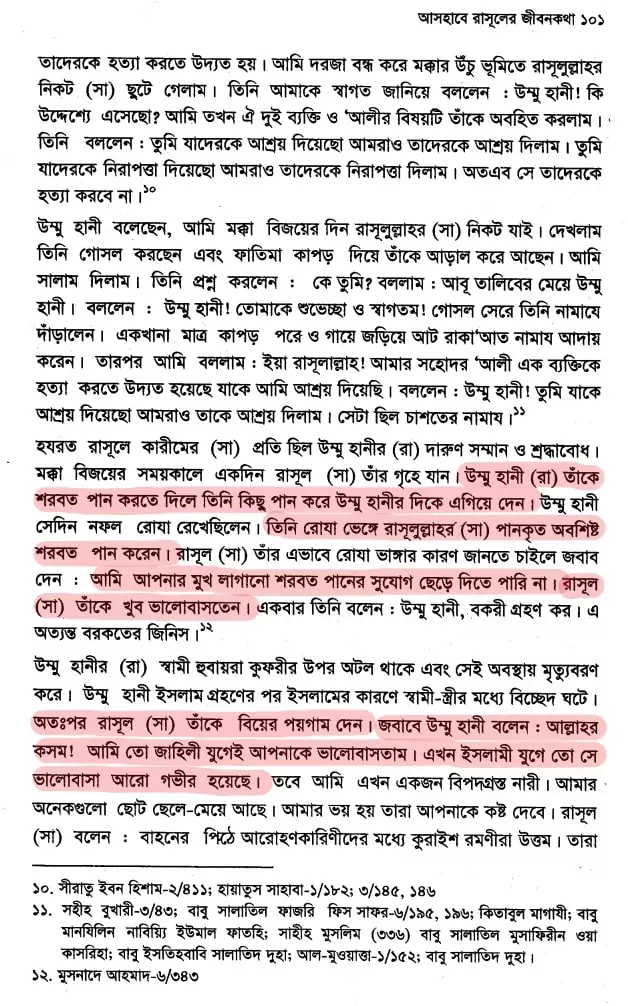
If Muhammad regarded Umm Hani as his own sister, why did he repeatedly propose marriage to her?
A Pattern of Attraction to First Cousins: Umm Hani Was Not the Only One
Some people experience a particular sexual attraction to first cousins, described in psychological terminology as “genetic sexual attraction (GSA).” This refers to a tendency for close biological relatives, particularly after prolonged separation or social distance, to develop an unusually intense attraction because of biological similarities [132]. It is considered a recognized psychological pattern in human behavioral science [133] [134]. Islam declares marriage between paternal and maternal first cousins halal, or lawful, with Muhammad himself and the Rightly Guided Caliphs providing its principal inspiration. His conduct established the practice as Sunna, notably through his marriage to Zaynab bint Jahsh, his first cousin through his paternal aunt. Zaynab had initially married his adopted son Zayd ibn Haritha. According to Islamic accounts, Muhammad visited Zayd’s house one day while Zayd was absent and inadvertently saw Zaynab in her indoor clothing, possibly almost half-naked. This sight aroused intense lust or desire for her [135]. The episode makes clear that his interest in first cousins was not confined to Umm Hani.
To clear the way for Muhammad’s desire, Zayd soon divorced Zaynab. Surah al-Ahzab 33:37 was then revealed. In this verse, Allah exposes Muhammad’s hidden wish and makes marriage to her lawful for him. This convenient divine revelation achieved two purposes at once: Muhammad fulfilled his desire, and an important established social institution was permanently altered through the abolition of adoption (tabanni). It thus demonstrates that religious rules were changed to satisfy his personal desires.
Although first-cousin marriage became an enduring, widespread Muslim practice based on Muhammad’s personal preferences and conduct, modern medicine identifies it as a cause of severe social and health problems. According to genetics, the risk of birth defects or genetic disorders is approximately 3% in the general population but rises to 4–6% in first-cousin marriages [136]. Marriage between close relatives greatly increases the risk of rare diseases involving recessive genes, leading to birth defects, intellectual impairment, and high childhood mortality rates. The risk of congenital anomalies is also observed to be twice that of the general population [137].
This practice, inspired by Muhammad’s conduct, subsequently had severe consequences in Muslim societies. In areas such as Bradford, England, where first-cousin marriage is particularly common among Muslims of Pakistani and Middle Eastern ancestry, genetic disease has created a serious public-health crisis. This demonstrates that a Sunna legitimized by Muhammad’s personal interests has become a source of grave health problems and social harm in modern society, exposing the profound gap between religious authorization and scientific reality.
Permission before His Death to Take Any Woman He Wished
According to Aisha, before Muhammad died he was given permission to take whichever women he wished. This hadith matters to the discussion of Umm Hani because he proposed marriage to her several times at different stages of his life. His marital and sexual interest in her is therefore not conjecture: his own proposals express it. Placed beside Aisha’s account of his special freedom to take women, this makes the question of his personal relationships and exceptional marital privileges still more pressing [138].
Sunan al-Nasa’i (Islamic Foundation)
26/ Marriage
Section: 2. What Allah made obligatory for His Messenger and prohibited for others, to increase his closeness to Allah
3207. Muhammad ibn Mansur (may Allah have mercy on him) … Narrated ‘Aishah: It was narrated that ‘Aishah said: “The Messenger of Allah did not die until Allah permitted him to marry whatever women he wanted.“
Sunan an-Nasa’i 3205; Grade: Sahih (Darussalam); Book 26, Hadith 10
Assessment: Sahih.
Hadith grade: Sahih (Authentic)
Narrator: Ata ibn Abu Rabah (may Allah have mercy on him)
Overview: A Visual Representation
Childhood love → Deaths of Khadija and Abu Talib → Aisha → Mi‘raj → Conquest of Mecca → Drinking/Fasting → Dressing up to Visit Umm Hani’s House
Before prophethood, Muhammad sends his uncle Abu Talib a marriage proposal for Umm Hani. His uncle, however, does not consider him sufficiently honorable and marries her to someone else. Distressed, Muhammad asks, “Uncle! You rejected my proposal and married her to Hubayra?”
Both his uncle Abu Talib and his wife Khadija die in close succession. Mecca’s Quraysh subject Muslims to various humiliations. Under these circumstances, Muhammad is emotionally devastated.
Almost immediately after Khadija’s death, within one month, Muhammad marries Sawda and the child Aisha.
Several sira and hadith accounts show that Muhammad was in Umm Hani’s house on the night of Isra and Mi‘raj, and the journey began there.
On hearing of Mecca’s conquest, Umm Hani’s husband, an opponent of Islam, flees. With Muhammad present in Mecca, she accepts Islam.
Muhammad and Fatima are there. On the day of the conquest, he bathes at this location.
Muhammad is bathing, and Fatima is present in the room. Umm Hani enters.
Muhammad, Fatima, and Umm Hani sit beside one another. He drinks and passes the beverage to her. She is fasting. After drinking, she mentions her fast; Muhammad says there is no problem if it is broken. Since Ramadan fasting is obligatory, he should have explained that drinking by mistake does not invalidate a fast.
Muhammad is described as visiting her house with four braids. He therefore dresses up after bathing and goes to her house.
Muhammad bathes there once again and repeats the same prayer.
Applying Occam’s Razor
Occam’s razor is a methodological principle associated with the fourteenth-century English philosopher William of Ockham. Its concise Latin formulation is Entia non sunt multiplicanda praeter necessitatem: “Entities or assumptions should not be multiplied beyond necessity.” In science, philosophy, and historical analysis, its practical implication is that, when several hypotheses explain an event or dataset, provisional preference should go to the explanation requiring the fewest new assumptions, supernatural beings, or unseen mechanisms. It does not say, “The more beautiful story is true.” It says, “Begin with what can be explained through fewer complexities and invented elements.” Let us apply Occam’s razor here:
| Unrealistic or Unscientific Claims Required If Mi‘raj Is Accepted as True | How Well Seclusion with Umm Hani and a Dream/Psychological Experience Fit Reality |
|---|---|
| Mecca → Jerusalem → Seven Heavens → Sidrat al-Muntaha → Mecca, all within one night: this requires faster-than-light travel. Under relativity, as v approaches c, the required energy approaches infinity. For a biological body and an animal mount, this is effectively impossible and unscientific. | Staying that night in Umm Hani’s house, spending the night very close to the Kaaba, and walking there at dawn to pray all accord perfectly with contemporary Arab society, the local distance of twenty to forty meters, and ordinary bodily limitations. |
| A “hybrid” creature called Buraq—part donkey, part horse, sometimes winged—that crosses enormous distances instantaneously. Modern zoology and paleontology offer no evidence of such an animal; accepting it as real requires imagining an entirely new biological world. | No transport is needed at all. Understanding the episode as a dream, mental journey, or sleeping imagination allows it to be explained through familiar brain functions: REM sleep, vivid dreams, and hypnagogic hallucination. It is also intelligible as an attempt to conceal the overnight stay in Umm Hani’s house. |
| Seven layered heavens, each with its own door, angelic guards, and administrative structure. Modern cosmology describes continuous spacetime, with no heavens stacked floor by floor like human buildings. Taking this literally requires replacing the entire physical picture and rejecting all scientific understandings of space. | Muhammad’s journey corresponds much more closely to ancient conceptions of the universe, particularly the Ptolemaic model. It is therefore more reasonable to understand it as a product of his imagination rather than physical travel, or as an old fable in a new form, created to sidestep his overnight stay at Umm Hani’s house. Dreams arrange mental experiences through symbols such as levels, ladders, doors, and gates; psychology explains these symbolic images as cognitive patterns. A dream or psychological experience requires no separate cosmological theory to account for layered heavens. |
| Conversations with long-dead prophets such as Adam, Moses, and Jesus. Neuroscience identifies consciousness as dependent on the brain; after death and the brain’s decomposition, dialogue with that person is impossible. Such conversations require constructing a new metaphysical physics of the afterlife. | The brain creates dream characters from previously heard stories, imagination, and unconscious desires. Explanations from the Freudian tradition to modern neuroscience support this. Treating conversations with the dead as dreams or hallucinations requires no additional physics of the afterlife. |
| Sidrat al-Muntaha: an enormous tree at space’s “boundary,” with elephant-ear leaves and gourd-like fruit. No biological possibility exists for such vegetation to survive the vacuum, radiation, temperatures, and other actual conditions of space. | People imagine trees in dreams as boundaries, borders, or final stations. Cosmic trees recur in the myths of many ancient religions. Familiar mythical motifs combining into a new dream narrative in the mind of someone lying in Umm Hani’s house is culturally far more ordinary. |
| Bayt al-Ma‘mur: a stationary house in space directly above the Kaaba, around which angels circumambulate. This “stationary house” conflicts with actual principles of cosmic expansion, orbital motion, gravity, and so forth. | Older religious stories contain heavenly copies of earthly temples. Arda Viraf Namag likewise includes heavenly temples and places of worship. Human psychology and anthropology can explain such motifs appearing in someone’s imagination while lying in bed at Umm Hani’s house. |
| Opening the chest, removing and washing the heart, and filling it with “faith/knowledge,” although the heart circulates blood rather than stores knowledge. Performing such surgery without anesthesia, sutures, or infection control, followed by normal walking and movement, contradicts the foundations of modern anatomy, surgery, and medicine. | Ancient people located the mind in the heart because they observed changes in their heartbeat during sorrow or joy. Guilt, remorse, or a “cleansed mind” often appear in dreams and symbols as images of “cutting open and cleaning the chest” or “washing away a black stain.” A dream or invented story requires no miraculous surgery. |
| Crossing cosmic distances in an extremely short time requires simultaneously disregarding relativistic time dilation, radiation, micrometeoroid impacts, and oxygen deprivation. Current physics does not support the possibility of making this journey in a physical body. | Dreaming involves mental “time compression”: during minutes of sleep, people dream of journeys lasting hours or even months. Experiencing a long journey in a deep dream while lying in Umm Hani’s house is far more realistic in neuroscientific terms. |
| Fifty daily prayers are commanded, then negotiated down to five. This depicts an omniscient God using human “trial and error” rather than determining the optimal number immediately. Some versions suggest repeated “halving,” producing an odd mathematical sequence: 50→25→12.5→6.25, and so on. Overall, the narrative resembles human political bargaining more than divine decision-making. | Historically, ritual practices develop gradually within societies and are subsequently legitimized through religious narratives such as “Originally there were fifty; now there are five, but the reward remains fifty.” The number of prayers gradually becoming fixed through jurisprudence, followed by stories explaining it, is far more ordinary from anthropological and critical religious perspectives. |
| Praying at “Bayt al-Maqdis” in 620 CE, when no functioning mosque or active temple stood there. Various historical sources state that the Romans destroyed the temple and that the site long served as ruins and a rubbish dump. A literal scene of prayer inside a mosque does not fit actual history. Had Muhammad visited a place surrounded by refuse, he should have seen it. | Staying at Umm Hani’s house and praying at the Kaaba or nearby accords directly with Mecca’s geographical and historical reality. It requires no miraculous geography in which a mosque suddenly appears at a distant ruined site. |
| Angelic guards at heavenly doors, doors opening and closing, questions and answers: doors, walls, and sound in the vacuum of space conflict with basic physics. Taking them literally transforms space into gated zones resembling human fortresses or palaces. | People imagine power structures in dreams through symbols such as offices, courts, gates, and checkpoints. The “gates of heaven” are their religious version. Explaining them as the imaginings of someone asleep in Umm Hani’s bed requires no change to the physics of space, only an understanding of the human mind. |
| A cosmic script written on the “Preserved Tablet,” a scratching pen, and dried ink. In real cosmology, such enormous “divine tablets and pens” are not merely strange but products of ancient thinking. Taking them literally requires imagining something like a huge Arabic writing board outside the universe. | People use writing, pens, and books as metaphors for destiny, a familiar motif in modern literature and mythology. If someone staying in Umm Hani’s house borrowed stories from earlier religions to shape his own dream narrative, there is no need to install an actual pen-and-tablet system in space. |
| Hadith offer conflicting accounts of the number of angels, whether the chest was opened, and whether the episode began as a dream or a physical journey. Real events supported by multiple witnesses generally do not exhibit this degree of conflict. Such discrepancies instead point toward human memory, narrative editing, and transformation according to political needs. | Variants are natural in human-made stories, which change according to time, place, and audience. Assuming “seclusion in Umm Hani’s house, followed by the creation of Mi‘raj to conceal it or invest it with religious glory” explains the narrative variations as ordinary human distortions of a story. |
| Seeing the Pool of Kawthar and the sources of heavenly rivers in the sky. Geology and hydrology identify river sources in mountain snow, rainfall, groundwater reservoirs, and so forth. There is no scientific evidence of particular rivers being supplied from an invisible celestial tank. | Just as Arda Viraf and other myths contain rivers and springs in heaven and hell, Islamic narratives introduce imagined water sources. Treating these as symbolic or dream images requires no violation of the actual water cycle; human imagination and mythological continuity explain them. |
| Most importantly, despite striking similarities between Mi‘raj and ancient myths, including Arda Viraf Namag and other Persian and Judeo-Christian sources—old wine in new bottles—the story is claimed to be completely original, miraculous, and divine. This requires assuming that God deliberately copied the structure of existing religious fables to stage the same events and perfectly aligned those old myths with an individual’s personal history. | A person inspired by familiar motifs from Arda Viraf and other myths—a night journey, guiding angels, tours of heaven and hell, a bridge resembling the Sirat, and proximity to God—created a new narrative to serve his religious and personal needs. This explanation requires only human psychology, religious continuity, and the concept of a political alibi. It does not require the peculiar additional assumption that “God copied the script of an old Zoroastrian religious fable.” |
The table’s left column lists the immense number of additional assumptions required to accept Mi‘raj as a literal, bodily, cosmic journey: new theories of the universe’s structure; suspension of fundamental principles of physics, biology, and neuroscience; conflict with history and geography; and the peculiar coincidence of using the “same script” as ancient myths such as Arda Viraf. Accepting all of these together requires completely suspending scientific inquiry and critical skepticism, leaving no alternative to blind faith.
The right-hand explanation—spending the night alone with Umm Hani, experiencing a dream, hallucination, or inward journey in that setting, and later religious commentators and storytellers blending it with older mythical motifs resembling Arda Viraf to create a “Mi‘raj story”—requires only a few assumptions: (1) unfulfilled youthful love, ordinary sexuality, and kinship politics; (2) the neuroscience of dreams, the unconscious, and imagination; (3) the cultural borrowing of stories from earlier religions and myths; and (4) human needs to protect one’s image, create political alibis, and establish religious authority. We encounter each of these in everyday reality; they are repeatedly observed in psychology, anthropology, and history.
Occam’s razor does not “prove something with complete certainty.” It is a filter for choosing explanations. On one side is an explanation requiring special exceptions across physics, biology, astronomy, history, and linguistics, together with innumerable miracles and coincidences. On the other is an explanation accounting for the whole narrative through a few assumptions involving familiar human behavior, mental processes, sexual politics, and mythological continuity. Rational, science-based analysis will favor the latter. From this perspective, seclusion with Umm Hani and the subsequent creation of a myth-like dream or story emerges, against a literal miraculous journey, as the hypothesis surviving Occam’s razor: requiring fewer assumptions, more realistic, and scientifically reasonable.
Conclusion
All historical information and hadith accounts presented above come directly from the primary body of Islamic references. They are not malicious propaganda or deliberately manufactured information from atheists or critics. Every inquisitive reader should therefore examine their historical truth without resorting to familiar apologetic fallacies such as “It is not authentic,” “The translation is wrong,” or “This comes from a perverted mind.”
The discussion makes reasonably clear that Umm Hani’s presence in Muhammad’s personal life creates a serious inconsistency under Islam’s strict moral rules. The very relationship some scholars call a “pure bond between brother and sister” also involves repeated marriage proposals, driving a nail into the coffin of their argument. Spending the night in a marriageable woman’s house on the night of Mi‘raj also directly contradicts Islam’s own rules of veiling and mahram relationships. Whether the relationship was ultimately an unfulfilled love hidden behind claims of sibling-like purity, or an extramarital relationship disregarding Quranic rules, we leave to readers’ judgment.
Atheists and critics have no objection whatsoever to anyone’s right to love, affection, or sexual relationships. Rather, we sympathize with the anger and sorrow Muhammad may have experienced when his marriage to Umm Hani did not occur in their youth, a tragic human outcome. Separating two people in love because of social pressure and one person’s being an orphan without means or support cannot be humane.
The discussion’s principal purpose is to expose Islam’s moral hypocrisy. On one hand, Islam entirely prohibits ordinary romantic love before marriage, calling it “adultery of the tongue and heart.” Yet in its founder’s conduct, beyond marriage and sexual use of slave women, we find an opaque picture of more complex, emotional, and unconventional relationships.
When the historical inconsistencies of Mi‘raj and al-Aqsa Mosque—such as repeated mythological motifs and the mosque’s nonexistence—are combined with these ambiguities surrounding Umm Hani’s personal life, it becomes still clearer that Muhammad’s biography and the rules he established bear far more heavily the weight of personal weaknesses and conventional human influences than divine miracles.
References
- Sahih Muslim, Islamic Foundation edition, Hadith 5486 ↩︎
- Asma al-Rijal, Mufti Ghulam Rabbani Bhuiyan, publisher: Lokman Hossain, pp. 51–52 ↩︎
- The Lives of the Prophet’s Companions, Female Companions, Muhammad Abdul Mabud, Bangladesh Islamic Centre, Volume Six, p. 98 ↩︎
- MUHAMMAD his life based on the earliest sources, Martin Lings, p. 33 ↩︎
- Sunan Ibn Majah, Hadith 1349 ↩︎
- Sunan Ibn Majah, Bangladesh Islamic Foundation, Volume One, p. 491, Hadith 1349 ↩︎
- Sirat al-Mustafa, Allama Idris Kandhlawi, Islamic Foundation Bangladesh, Volume One, pp. 236, 249–250 ↩︎
- The Lives of the Prophet’s Companions, Mothers of the Believers, Muhammad Abdul Mabud, Bangladesh Islamic Centre, Volume Five, p. 39 ↩︎
- Sahih al-Bukhari, Islamic Foundation edition, Hadith 4707 ↩︎
- Translation and Brief Commentary of the Quran, Dr. Abu Bakr Muhammad Zakaria, Volume Two, King Fahd Quran Printing Complex, p. 959 ↩︎
- Translation and Brief Commentary of the Quran, Dr. Abu Bakr Muhammad Zakaria, Volume Two, King Fahd Quran Printing Complex, p. 1466 ↩︎
- The Life Of Mohammed, Guillaume, p. 184 ↩︎
- Sahih al-Bukhari: Bengali Translation and Detailed Commentary, Sirat al-Nabi Compilation, Mawlana Shamsul Haq Faridpuri, Volume Five, Hamidiya Library, published 1977–78, p. 507 ↩︎
- Tafsir Ibn Kathir, Islamic Foundation Bangladesh, Volume Six, p. 251 ↩︎
- Tafsir Mazhari, Volume Five, p. 288 ↩︎
- Tafsir Mazhari, Volume Seven, pp. 16–17 ↩︎
- Tafsir al-Jalalayn, Volume Two, p. 650 ↩︎
- Tafsir Ma‘arif al-Quran, Mawlana Muhammad Shafi, Volume Four, p. 396 ↩︎
- Mukhtasar Zad al-Ma‘ad, Imam Ibn al-Qayyim, p. 217 ↩︎
- Sirat Rasul Allah, translated by Shahid Akhand, Prothoma Prokashon, p. 218 1 2
- Sirat al-Nabi, Ibn Hisham, Islamic Foundation Bangladesh, Volume Two, p. 76 1 2 3 4 5
- Tafsir Ibn Abbas, Volume Two, p. 232 ↩︎
- Guide to Hajj, Umrah, and Visitation, distributed free through IslamHouse ↩︎
- فتح الباري شرح صحيح البخاريكتاب مناقب الأنصارباب المعراج ↩︎
- Al-Kifaya fi ‘Ilm al-Riwaya, al-Khatib al-Baghdadi, p. 134 ↩︎
- Usul al-Hadith: The Principles of Hadith, Mawlana Muhammad Amin Ahari, translated by Mawlana Md. Hazrat Ali, Maktabat al-Sunnah Publications, pp. 11–12 ↩︎
- Al-Dhahabi, Siyar A‘lam al-Nubala—Ibn Sa‘d’s account, Islamweb ↩︎
- Al-Suyuti, al-Durr al-Manthur, commentary on Surah al-Isra 17:1, Islamweb ↩︎
- Tafsir al-Durr al-Manthur, Volume Five, p. 210 ↩︎
- Sirat al-Mustafa, Allama Idris Kandhlawi, Islamic Foundation, Volume Three, p. 43 ↩︎
- Mishkat al-Masabih, Hadith 1322 ↩︎
- The Lives of the Prophet’s Companions, Female Companions, Muhammad Abdul Mabud, Bangladesh Islamic Centre, Volume Six, p. 99 ↩︎
- Al-Waqidi, p. 427 ↩︎
- The Lives of the Prophet’s Companions, Female Companions, Muhammad Abdul Mabud, Bangladesh Islamic Centre, Volume Six, pp. 99–100 ↩︎
- Sahih al-Bukhari, Islamic Foundation edition, Hadith 350 1 2 3
- Sahih al-Bukhari, Islamic Foundation edition, Hadith 2947 1 2 3
- Jami‘ al-Tirmidhi, Islamic Foundation Bangladesh, Volume Five, p. 488, Hadith 3213 ↩︎
- Tafsir Ibn Kathir, Islamic Foundation, Volume Nine, p. 132 ↩︎
- Mishkat al-Masabih, Hadith 3101 ↩︎
- Sunan al-Tirmidhi, Islamic Foundation edition, Hadith 1848 ↩︎
- Sunan Abi Dawud, critically verified edition, Hadith 2456 ↩︎
- Jami‘ al-Tirmidhi, Islamic Foundation Bangladesh, Volume Three, p. 488, Hadith 3213 ↩︎
- Sunan Abi Dawud, Islamic Foundation edition, Hadith 2448 1 2 3 4 5
- Sunan al-Tirmidhi, Islamic Foundation edition, Hadith 474 ↩︎
- Sirat Ibn Hisham, translated by Akram Faruq, Bangladesh Islamic Centre, p. 271 ↩︎
- When Did Fasting Become Obligatory? ↩︎
- Sahih al-Bukhari, Tawhid Publications, Hadith 1933 ↩︎
- Sahih al-Bukhari, Islamic Foundation edition, Volume Five, p. 339 ↩︎
- Sahih al-Bukhari, Darussalam Publications, vol. 4, p. 251 1 2 3
- Sahih Muslim, Islamic Foundation edition, Hadith 658 1 2
- Sirat al-Nabi, Volume Four, p. 66 1 2 3 4
- Mishkat al-Masabih, Hadith 4446 1 2 3
- Sahih al-Tirmidhi, Volume One, Hadith 474 1 2 3
- tabarani:21526 ↩︎
- Jami at-Tirmidh, Darussalam Publications, vol. 1, p. 476 1 2
- Sahih al-Bukhari, Islamic Foundation edition, Hadith 3962 1 2 3
- Sahih al-Bukhari, Islamic Foundation edition, Volume Seven, p. 148 1 2 3
- Tafsir Ibn Kathir, Volume Seven, Islamic Foundation, p. 492 ↩︎
- Salat al-Awwabin, IslamHouse Publications, Abdullah al-Mamun al-Azhari, edited by Dr. Abu Bakr Muhammad Zakaria, pp. 16, 6 ↩︎
- Salat al-Awwabin, IslamHouse Publications, Abdullah al-Mamun al-Azhari, edited by Dr. Abu Bakr Muhammad Zakaria, pp. 54, 20 ↩︎
- Ibn Hajar al-Asqalani, Fath al-Bari Sharh Sahih al-Bukhari, Volume Three, p. 53, commentary on Sahih al-Bukhari 1176 ↩︎
- Sahih al-Bukhari, Islamic Foundation edition, Hadith 265 ↩︎
- Sahih al-Bukhari, Islamic Foundation edition, Hadith 266 ↩︎
- Sahih al-Bukhari, Tawhid Publications, Hadith 267 1 2
- Sunan Ibn Majah, Hadith 588 ↩︎
- Sunan Ibn Majah, Hadith 589 ↩︎
- Sunan al-Darimi, Hadith 776 ↩︎
- Sunan al-Darimi, Hadith 777 ↩︎
- St. Clair Tisdall, The Sources of Islam, T. & T. Clark, 1901, pp. 74–81 ↩︎
- Haug, Martin. The Book of Arda Viraf. Bombay: Government Central Book Depot, 1872, Introduction ↩︎
- Arda Viraf Namag, Chapters 1–2 ↩︎
- Sahih al-Bukhari, Hadith 3207; Ibn Ishaq, Sirat al-Nabi, Islamic Foundation Bangladesh, p. 195 ↩︎
- Arda Viraf Namag, Chapter 4 ↩︎
- Arda Viraf Namag, Chapter 5 ↩︎
- Sahih al-Bukhari, Book of the Call to Prayer; and Sahih Muslim, Book of Faith ↩︎
- R. H. Charles, The Ascension of Isaiah, A & C Black, 1900 ↩︎
- Flavius Josephus, The Jewish War, Book VI, Chapter 4 ↩︎
- Oleg Grabar, The Shape of the Holy: Early Islamic Jerusalem, Princeton University Press, 1996, pp. 27–29 ↩︎
- Moshe Gil, A History of Palestine, 634–1099, Cambridge University Press, 1997, p. 69 ↩︎
- Al-Tabari, The History of al-Tabari, Vol. XII: The Battle of al-Qadisiyyah and the Conquest of Syria and Palestine, SUNY Press, 1992, pp. 190–195 ↩︎
- Al-Bidaya wa-l-Nihaya, Volume Seven, Ibn Kathir, pp. 107–108, 112–113 ↩︎
- K. A. C. Creswell, Early Muslim Architecture, Vol. 1, Oxford University Press, 1969, pp. 65–131 ↩︎
- الباب السابع عشر في إخباره صلى الله عليه وسلم قريشا ليلة الإسراء بصفة بيت المقدس ولم يكن رآه قبل ليلة الإسراء ↩︎
- Volume II – Annexes 66-210 ↩︎
- Sahih Muslim, Islamic Foundation edition, Hadith 308 1 2 3 4 5 6 7 8 9 10 11
- Einstein, A. 1905. “On the Electrodynamics of Moving Bodies” ↩︎
- Resnick, R. & Halliday, D., Basic Concepts in Relativity ↩︎
- Davis, J. R., et al., Fundamentals of Aerospace Medicine ↩︎
- Sahih al-Bukhari, Hadith 3207 ↩︎
- Sahih Muslim, Islamic Foundation edition, Hadith 309 ↩︎
- Al-Quran al-Karim, Volume Two—Dr. Zakaria, p. 2482 ↩︎
- Tafsir Mazhari, Volume Eleven, p. 122 ↩︎
- Tafsir Ibn Kathir, Volume Ten, Islamic Foundation, pp. 480–481 ↩︎
- Sahih al-Bukhari, Islamic Foundation edition, Hadith 342 1 2 3 4 5 6 7
- Sahih al-Bukhari, Islamic Foundation edition, Hadith 3608 1 2 3 4 5 6 7
- Sahih al-Bukhari, Islamic Foundation edition, Hadith 1303 1 2
- Sahih al-Bukhari, Islamic Foundation edition, Hadith 7009 1 2 3 4 5 6 7 8 9 10 11 12
- Tafsir Mazhari, Volume Seven, p. 19 1 2
- Sahih al-Bukhari, Islamic Foundation edition, Volume Two, p. 428, Hadith 1303 ↩︎
- Sahih al-Bukhari, Islamic Foundation edition, Volume One, p. 201, Hadith 342 1 2
- Sahih al-Bukhari, Islamic Foundation edition, Volume Six, p. 412, Hadith 3608 ↩︎
- Sahih Muslim, Hadith Academy edition, Hadith 328 ↩︎
- Sahih Muslim, Islamic Foundation edition, Hadith 336 ↩︎
- Surah al-Najm, verses 13–14 1 2
- Sahih Muslim, Islamic Foundation edition, Hadith 313 1 2 3 4 5 6
- Sunan al-Tirmidhi, critically verified edition, Hadith 3147 1 2 3 4 5
- Sunan al-Tirmidhi, Islamic Centre edition, Hadith 3085 1 2 3 4 5
- Sirat al-Nabi, Ibn Hisham, Islamic Foundation, Volume Two, p. 77 1 2 3
- Sahih Muslim, Islamic Foundation edition, Volume One, pp. 202–203, Hadith 313 ↩︎
- Sunan al-Tirmidhi, Islamic Centre edition, Volume Five, pp. 311–312, Hadith 3085 ↩︎
- Sahih Muslim, Islamic Foundation edition, Hadith 5942 1 2
- Sahih Ibn Hibban, HadithBD, Hadith 50 1 2
- Sahih Ibn Hibban, HadithBD, Hadith 49 1 2
- Sahih Muslim, Islamic Foundation edition, Hadith 327 1 2
- Sahih al-Bukhari, Islamic Foundation edition, Hadith 2980 1 2 3 4 5 6 7 8 9 10
- Sunan al-Nasa’i, Islamic Foundation edition, Hadith 451 1 2
- Sahih Muslim 164a, In-book reference: Book 1, Hadith 321; USC-MSA web (English) reference: Book 1, Hadith 314 1 2
- Sahih Muslim, Islamic Foundation edition, Hadith 6503 1 2
- Sahih Muslim, Islamic Foundation edition, Hadith 6507 1 2
- Sahih Muslim, Islamic Foundation edition, Volume Six, pp. 168–169 ↩︎
- Sunan al-Tirmidhi, Islamic Foundation edition, Hadith 3131 1 2
- Sahih al-Bukhari, Tawhid Publications, Hadith 3342 1 2 3 4 5 6
- Sahih al-Bukhari, Tawhid Publications, Hadith 6596 1 2
- Mishkat al-Masabih, Hadith 3265 1 2
- Sunan Abi Dawud, Islamic Foundation edition, Hadith 4850 1 2
- Sirat al-Nabi, Volume Two, Ibn Hisham, Islamic Foundation Bangladesh, p. 72 ↩︎
- Muhammad ‘Alawi al-Maliki. The Prophet’s Night Journey and Heavenly Ascent, translated by Gibril Fouad Haddad, Chapter 2 1 2
- Mukhtasar Zad al-Ma‘ad, p. 210 1 2
- Mukhtasar Zad al-Ma‘ad, p. 213 1 2
- Sirat Rasul Allah, translated by Shahid Akhand, Prothoma Prokashon, p. 218 1 2
- The Lives of the Prophet’s Companions, Female Companions, Muhammad Abdul Mabud, Bangladesh Islamic Centre, Volume Six, p. 101 ↩︎
- Smith, R. (2012). “The Psychology Behind Genetic Attraction.” ↩︎
- Turner, A. J., & Zack, S. (1995). “Genetic Sexual Attraction: The Curious Experience of Genetic Relatives Reunited After Adoption.” ↩︎
- Bevc, I., & Silverman, I. (1993). “Early Proximity and Sexual Attraction: The Westermarck Effect Reversed.” ↩︎
- Muhammad’s Lust for His Adopted Son’s Wife ↩︎
- Bittles, A. H. (2012). Consanguinity in Context. Springer ↩︎
- Naveed, S., et al. (2020). Consanguinity and Risk of Congenital Anomalies. Journal of Obstetrics and Gynaecology ↩︎
- Sunan al-Nasa’i, Islamic Foundation edition, Hadith 3207 ↩︎
About This Article
Genre: Isra and Mi'raj Critique, Islamic Historiography, Seerah Investigation, Hadith Source Analysis, and Myth-Formation Review
Epistemic Position: Historical Criticism, Secular Humanism, Source Criticism, Anti-Apologetic Reasoning, Investigative Skepticism, and Naturalistic Analysis of Miracle Claims
This article examines the Isra and Mi'raj narrative through conflicting Islamic reports about Muhammad's location on the night of the event, especially the traditions connecting that night with Umm Hani's house.
The central argument is that the Mi'raj reports do not form a single coherent historical account; rather, they contain serious tensions about location, chronology, dream versus bodily journey, and later theological expansion.
The article also discusses Umm Hani's identity as Muhammad's marriageable cousin, Muhammad's earlier and later interest in marrying her, Umm Hani's reported affection for him, the claim that Muhammad spent the night in her house, his family searching for him, later visits to her house, ritual bathing, shared drinking, Buraq, seven heavens, and older Near Eastern heavenly-journey motifs.
This article should be evaluated through hadith comparison, seerah criticism, tafsir evidence, chronology, witness consistency, social context, historical probability, and myth-making analysis—not through devotional immunity, miracle-presumption, post-hoc harmonization, emotional “sister-like” defenses, or the demand that contradictory religious reports be protected from ordinary historical scrutiny.