
Introduction
Over the past several decades, a vast campaign built around the alleged “scientific miracles” of the Qur’an has developed in Islamic da‘wah literature, particularly around several verses concerning the creation and development of the human embryo. The central claim of this campaign is that an illiterate man in seventh-century Arabia could not possibly have known the stages of embryonic development inside the womb, yet the Qur’an supposedly gave a perfectly accurate account of human embryology nearly fourteen centuries before modern embryology discovered it. The verses most frequently used to support this claim are Surah al-Mu’minun 23:12–14, where the human being is described as being created first from an extract of clay, then as nutfah, alaqah, mudghah, bones, and finally as bones covered with flesh. Many modern Islamic speakers and writers correlate these terms respectively with sperm or zygote, an implanted embryo, a leech-like embryo, a somite-stage embryo, skeletal formation, and muscle formation. They then present these correspondences as evidence of the divine origin of the Qur’an.
But inserting the vocabulary of modern science into an ancient religious text is not the same thing as that text actually containing modern scientific information. To test whether a purported scientific prediction is valid, the first question is whether the statement could have been understood in the same specific sense before the modern discovery was made. If, after the science is already known, one must select a new meaning from a polysemous word, reinterpret a metaphor as technical terminology, replace an old chronology with a new one, or discard the established meanings of earlier commentators in favor of meanings that conveniently match modern data, then this is not prediction; it is adapting the text to the result after the result is known. Therefore, testing the alleged miracle of Qur’anic embryology requires more than examining the claims of modern Muslim preachers. The Arabic language of the Qur’an, classical tafsir, sahih hadith, and the historical interpretations of Muslim scholars must also be examined together.
This is where the largest problem with the alleged scientific-miracle claim becomes apparent. Although modern apologetic presentations describe alaqah as a “leech-like embryo” or an “embryo clinging to the uterus,” a highly familiar meaning in major classical tafsir was blood, thick blood, or clotted blood. Likewise, many early mufassirun interpreted the Qur’anic sequence mudghah → bones → clothing the bones with flesh as a real developmental succession. Sahih al-Bukhari and Sahih Muslim also contain reports in which nutfah, alaqah, and mudghah are each associated with a period equivalent to forty days. Yet Sahih Muslim also contains another report in which an angel comes at about forty-two days and fashions hearing, sight, skin, flesh, and bones. Thus, even before comparison with modern embryology begins, the Islamic sources themselves contain problems of meaning and chronology that cannot simply be ignored while claiming that “the Qur’an described modern embryology fourteen hundred years ago.” To do so distorts both the history of interpretation and the texts themselves.
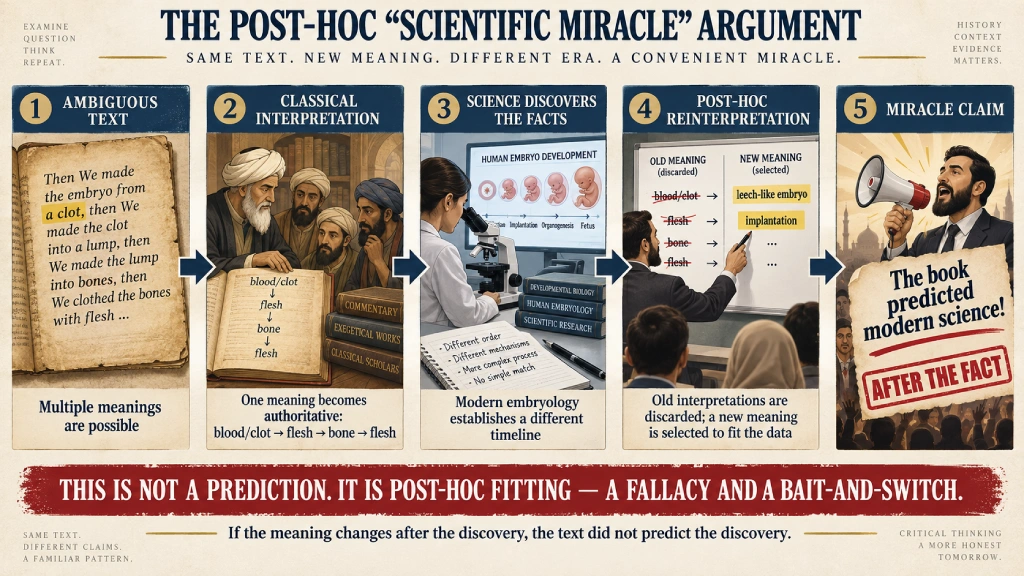
The Qur’anic Claim: From Nutfah to Alaqah, Mudghah, Bones, and Flesh
The Qur’an contains several accounts of human creation, but the passage most important to the scientific-miracle campaign concerning embryology is Surah al-Mu’minun 23:12–14. It first speaks of the primordial human being being created from an extract of clay, then of human descendants being placed as a nutfah in a “secure place,” that nutfah becoming an alaqah, the alaqah becoming a mudghah, the mudghah becoming bones, and finally the bones being clothed with flesh. The verbs in the Arabic sentence are not merely a list of adjacent anatomical terms: ثُمَّ خَلَقْنَا, فَخَلَقْنَا, فَكَسَوْنَا create a sequential description of transformation from one condition into another. Therefore, the claim that “the verse does not imply any sequence; it merely names different materials” is incompatible with the straightforward wording of the verse [1] [2], which reads:
And indeed, We created humankind from an extract of clay,
— Dr. Mustafa Khattab, The Clear Quran
then placed each ˹human˺ as a sperm-drop in a secure place,
— Dr. Mustafa Khattab, The Clear Quran
then We developed the drop into a clinging clot, then developed the clot into a lump ˹of flesh˺, then developed the lump into bones, then clothed the bones with flesh, then We brought it into being as a new creation. So Blessed is Allah, the Best of Creators.
— Dr. Mustafa Khattab, The Clear Quran
Key point: In Surah al-Mu’minun 23:12–14, the sequence of creation is presented as nutfah → alaqah → mudghah → bones → clothing the bones with flesh → another creation.
This kind of stage-based language does not occur only here. Surah al-Hajj 22:5 speaks of human creation from dust, nutfah, alaqah, and “a lump of flesh—fully formed or unformed”; Surah al-Qiyamah 75:37–39 describes an emitted sperm-drop followed by a clinging clot, then creation and perfected form, and finally the production of male and female; and Surah al-‘Alaq 96:2 says that humans were created from alaq. In other words, nutfah, alaqah, and mudghah are not isolated poetic metaphors used only once, but recurring terms in descriptions of human generation and prenatal development [3] [4] [5].
Key point: In several places, the Qur’an uses nutfah and alaqah as successive conditions within human creation. Their meaning should therefore be assessed from the Qur’an’s own usage and classical tafsir, rather than from later scientific-miracle campaigning.
The strategy of the modern miracle campaign usually begins here. Nutfah is variously rendered as semen, sperm cell, fertilized ovum, or zygote; alaqah is detached from the sense of clotted blood and turned into a “clinging thing,” a “leech,” or a “leech-like embryo”; mudghah becomes an embryo with somites; and when necessary, bones are reinterpreted not as actual bone but as cartilaginous precursors. Once each ordinary word in an ancient description is paired with a specialized technical stage of modern embryology, an apparent correspondence can be manufactured. The relevant question, however, is whether those technical meanings are supplied by the text itself or imposed upon it after modern embryology is already known. To answer that question, we must first examine what the major classical Muslim exegetes understood by alaqah, mudghah, bones, and flesh.
The Word ‘Alaqah: Modern “Leech-Like Embryo” vs. Classical Islamic Interpretation
In modern Islamic scientific-miracle propaganda, the word alaqah has been subjected to more semantic manipulation than almost any other term. The Arabic word علقة has several lexical meanings: something that clings to another thing, a small quantity of something, a mass of blood, and an aquatic creature such as a leech. Polysemy is normal in language. The problem arises when this polysemy is used as proof of the scientific precision of a religious text. Once modern information is already known, it becomes very easy to select whichever possible meaning is most convenient. If the embryo is not clotted blood, “clotted blood” can be discarded in favor of “clinging”; if uterine attachment must be made to sound scientifically significant, one can select “that which clings”; and if a visual resemblance is needed, one can select “leech.” With such a method, some correspondence can be produced with almost any result.
Yet the major tafsir works from the first centuries of Islam show that understanding alaqah as blood was not an error invented by a modern Western translator. In Tafsir al-Tabari, the phrase خلق الإنسان من علق in Surah al-‘Alaq 96:2 is explained directly with يعني: من الدم—that is, “from blood.” Al-Tabari treats alaq here as referring to alaqah and associates it with the blood-like state following the nutfah. Therefore, claims such as “alaqah never meant blood” or “early Muslims always understood it as implantation” directly conflict with al-Tabari’s text [6].
Al-Tabari’s essential statement: In explaining
خَلَقَ الإِنْسَانَ مِنْ عَلَقٍ, he writes “يعني: من الدم”—that is, the human being was created “from blood.” Herealaqis explicitly interpreted as blood.
Imam al-Qurtubi’s language is even more explicit. Commenting on Surah al-‘Alaq 96:2, he writes من علق أي من دم—“from alaq, that is, from blood”—and then states more specifically, والعلقة الدم الجامد—“the alaqah is clotted blood.” Al-Qurtubi adds, in explaining the word’s designation, that while moist it may cling to things it passes over, but this etymological observation does not cancel his primary definition. He explicitly defines alaqah as dam jamid, clotted blood [7]. In his explanation of Surah al-‘Alaq 96:2, Imam al-Qurtubi writes: [8]
“مِنْ عَلَقٍ أَيْ مِنْ دَمٍ، وَهُوَ جَمْعُ عَلَقَةٍ، وَالْعَلَقَةُ الدَّمُ الْجَامِدُ”
“From alaq—that is, from blood. ‘Alaq is the plural of ‘alaqah, and ‘alaqah is clotted blood.”
Al-Qurtubi further says that while moist this mass of blood may adhere to whatever it passes over. But this etymological explanation does not alter his basic definition. His specific statement is that alaqah means dam jamid, clotted blood. There is no explanation here of a “leech-like embryo” or modern embryonic implantation.
Al-Qurtubi’s essential statement: “من علق أي من دم … والعلقة الدم الجامد”—
alaqmeans blood, andalaqahis clotted blood. In the same discussion, he says that because of its moisture it can cling to an object.
This evidence is particularly important because modern apologetic interpretation often presents “clinging” as though “blood” were merely an erroneous and irrelevant translation, while the real Qur’anic meaning had always been implantation. Al-Qurtubi’s commentary refutes that reconstruction of the interpretive history. For him, attachment was one aspect of the explanation of the word’s naming, while the identity of the embryological substance itself was clotted blood. After modern science has developed, extracting only the attachment component while concealing the dam jamid component is no longer historical tafsir; it is selective reinterpretation.
Tafsir al-Jalalayn: ‘Alaqah as Clotted Blood, Mudghah as Flesh Like Something Chewed
Tafsir al-Jalalayn’s explanation of Surah al-Mu’minun 23:14 is especially important to this dispute because it gives not only the meaning of alaqah, but the meaning of the entire sequence. The phrase ثم خلقنا النطفة علقة is glossed as دما جامدا—“clotted blood”; فخلقنا العلقة مضغة is glossed as لحمة قدر ما يمضغ—“a piece of flesh of the amount that can be chewed”; and the subsequent movement from mudghah to bones, then clothing the bones with flesh is retained as the same sequential transformation. There is no attempt in this tafsir to turn alaqah into implantation, mudghah into somite formation, or bones into cartilaginous precursors. The terms are explained in their ordinary premodern bodily senses [9].
The essential statement of al-Jalalayn: “ثم خلقنا النطفة علقة دما جامدا، فخلقنا العلقة مضغة لحمة قدر ما يمضغ، فخلقنا المضغة عظاما فكسونا العظام لحما”—the nutfah becomes clotted blood, the clotted blood becomes a piece of flesh like something that can be chewed, the mudghah becomes bones, and those bones are then clothed with flesh.
In explaining خلقنا, al-Jalalayn also uses صيرنا, meaning to make or transform one condition into another. This matters because modern defenders sometimes argue that the verse merely names different tissues and that it is wrong to read it as saying “the mudghah became bones.” Yet al-Jalalayn itself explains خلقنا in the sense of transformation. The historically accepted sequence cannot therefore be blurred merely to evade a later scientific difficulty. The developmental model found in the verse and this tafsir is one substance moving into another condition, after which bones are made, and then those bones are clothed with flesh.
Ibn Kathir’s Explanation: A Red ‘Alaqah, Blood, and Flesh Over the Bones
Ibn Kathir’s tafsir likewise reveals the ordinary premodern understanding that existed before contemporary apologetic reconstruction. Commenting on Surah al-Mu’minun 23:14, he describes the alaqah following the nutfah as a red, elongated condition and quotes ‘Ikrimah as saying وهي دم—“it is blood.” He then describes the mudghah as a piece of flesh without a distinct form or delineation, followed by the formation within it of the head, arms, legs, bones, nerves, and blood vessels, and finally the clothing of the bones with flesh. Ibn Kathir therefore also presents a blood-associated alaqah and the idea of bones followed by flesh. He had no need to import “leech morphology” or a “cartilage model” from modern embryology, because in the knowledge-world of his time alaqah = blood and flesh over bones presented no apparent problem [10] [11].
The semen discharged from the man’s back and the woman’s chest-bone is transformed into clotted blood. فَخَلَقْنَا الْعَلَقَةَ مُضْغَةً Then that clotted blood is transformed into a lump of flesh. At this stage it has no human form.
فَخَلَقْنَا الْمُضْغَةَ عَظَمًا Then the lump of flesh is transformed into bones. That is, it is given form: the head, hands, feet, bones, veins, and vessels are created. Some reciters read here فَخَلَقْنَا الْمُضْغَةَ عَظَمًا. Ibn ‘Abbas said that the “bone” mentioned in the verse means the coccyx or spinal bone. In Sahih al-Bukhari, Abu al-Zinad narrates through al-A‘raj from Abu Hurairah that the Messenger of Allah said: كُلَّ جَسَد بَنِي آدَمَ يَبْلِى إِلَّا عَجَبُ الذَّنْبِ مِنْهُ خُلِقَ وَفِيهِ يُرَكَّبُ .
After death every part of the human body will decay except the coccyx. From it he was first created, and upon it the other parts of his body will again be assembled.
The statement of Allah Most High:
فَكَسَوْنَا الْعِظَمَ لَحْمًا Then I wrapped those bones with flesh so that they would be covered by it and made stronger. ثُمَّ انْشَأَنْهُ خَلْقًا أَخَرْ means that after this I breathed the soul into it. It then began to move and became a distinct creation endowed with hearing, sight, intellect, understanding, and consciousness.
The statement of Allah Most High:
فَتَبْرَكَ اللَّهُ أَحْسَنُ الْخَلِقِينَ
So Blessed is Allah, the Best of Creators.
Ibn Abi Hatim said: ‘Ali ibn Husayn … narrated from ‘Ali that he said: after the semen remains in the womb for four months, Allah Most High sends an angel to it. Then, within three darknesses, he breathes the soul into it. This is what is meant by ثُمَّ انْشَأْنُهُ خَلْقًا أَخَرْ, that is, “then I breathed the soul into it.” A similar explanation has been reported from Abu Sa‘id al-Khudri. Ibn ‘Abbas said that the meaning of ثُمَّ انْشَأ خَلْقًا أَخَرْ is ثُمَّ نَفَخْنَا فِيْهِ الرُّوْحُ — “then We breathed the soul into it.” Similar explanations are reported from Mujahid, ‘Ikrimah, al-Sha‘bi, al-Hasan, Abu al-‘Aliyah, al-Dahhak, Rabi‘ ibn Anas, and al-Suddi.
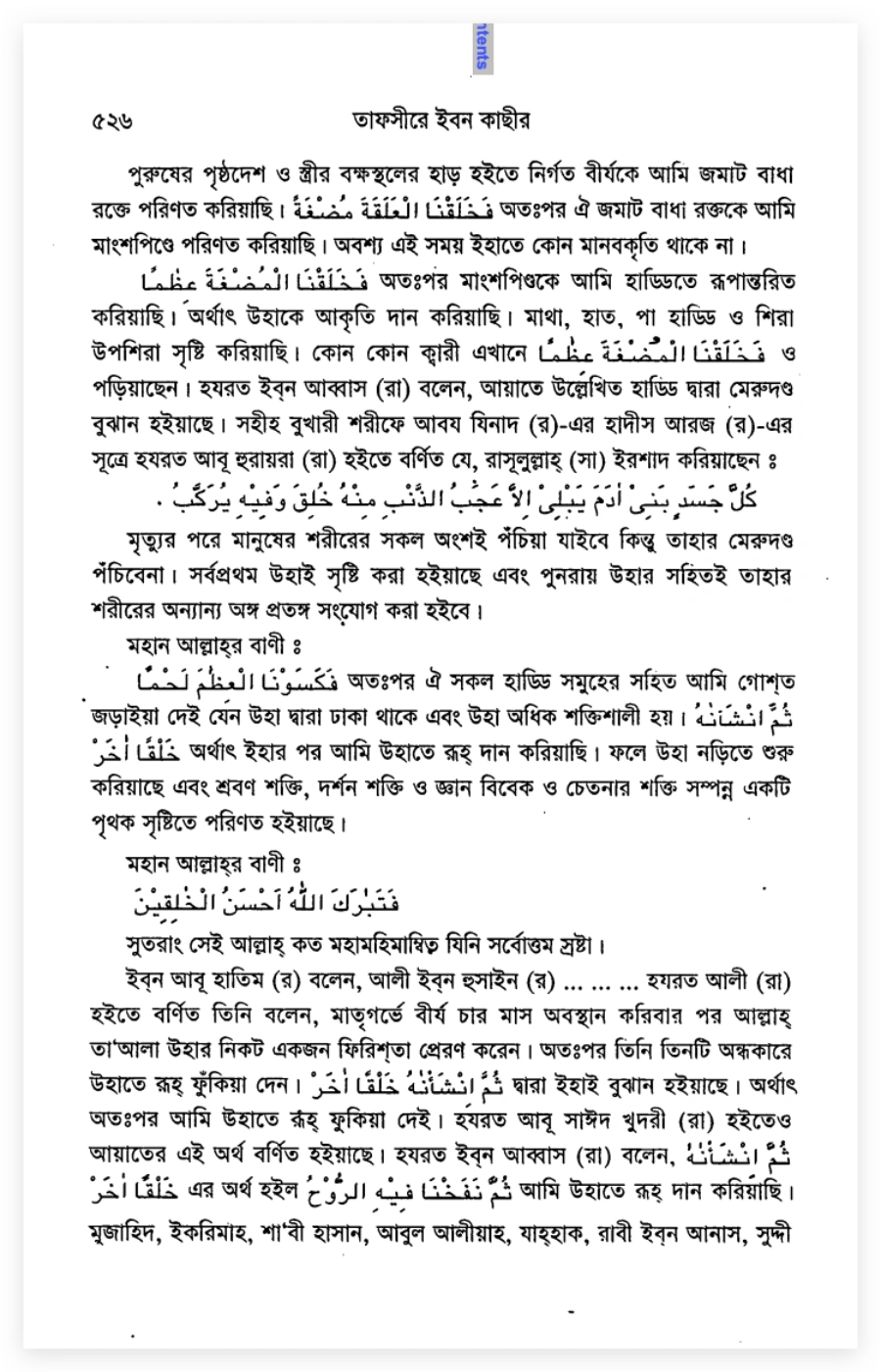
Ibn Kathir’s essential statement: The nutfah becomes an alaqah; he describes the alaqah as red and elongated and quotes ‘Ikrimah saying “وهي دم”—“it is blood.” He then describes the skeletal structure arising from the mudghah and flesh covering the bones.
Let us now read a little more from Ibn Kathir [12]:
This interpretation is also reported from Ibn Zayd, and Ibn Jarir also accepted it.
Al-‘Awfi reported from Ibn ‘Abbas that he interpreted ثُمَّ انْشَأْنُهُ خَلْقًا أخر as follows: “Then We changed him from one condition to another until finally We gave him the form of a child and brought him forth at birth. Then We made him a youth. Then he entered young adulthood. Then he became a fully grown man. Then he entered middle age, followed by old age, and finally extreme old age, completing the last stage of his life.” Similar interpretations are reported from Qatadah and al-Dahhak. There is no contradiction among these explanations, because after the soul is breathed into a person, he must pass through all of these conditions and stages.
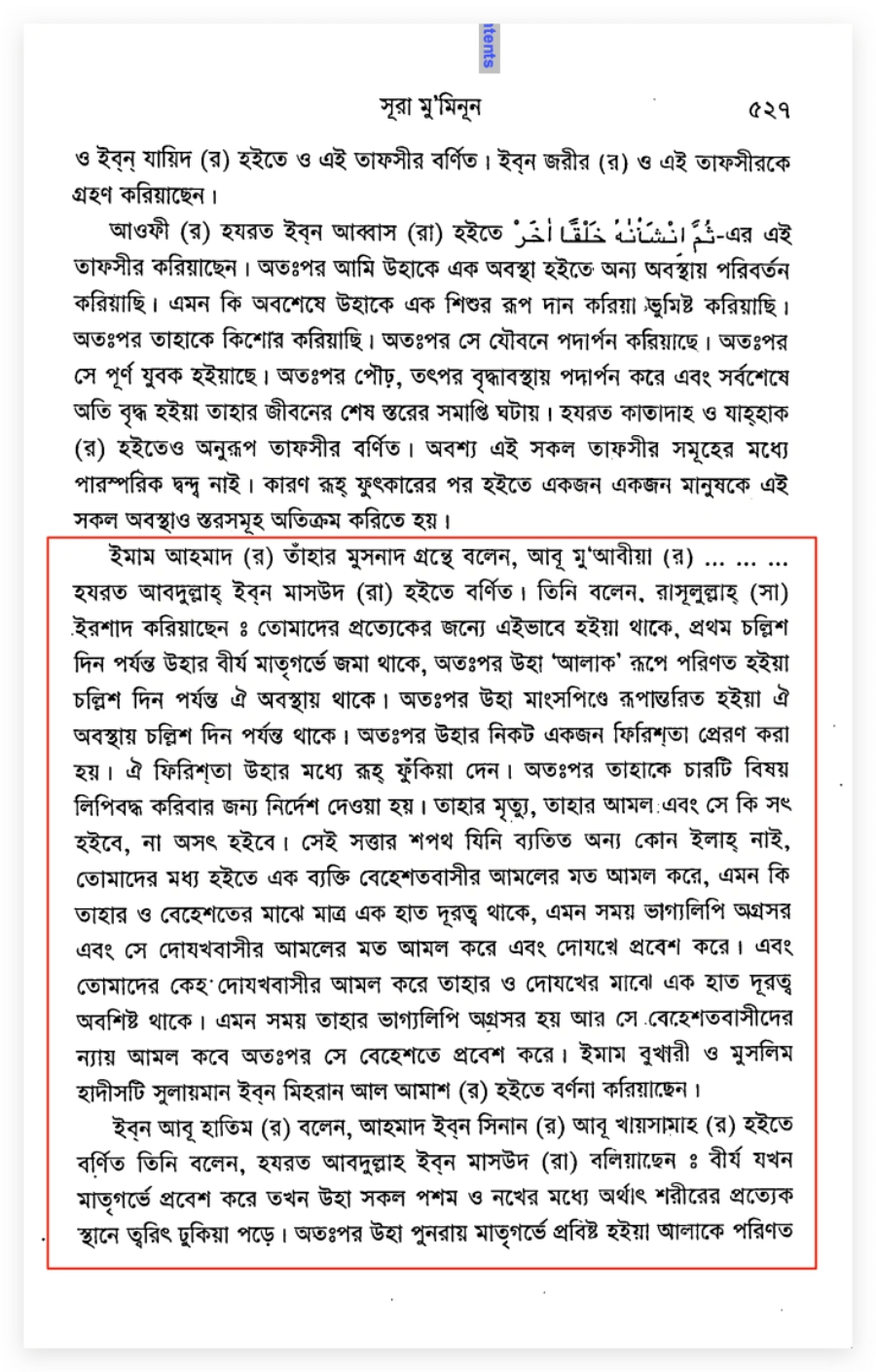
Imam Ahmad said in his Musnad: Abu Mu‘awiyah narrated from ‘Abdullah ibn Mas‘ud that the Messenger of Allah said: for each one of you, the matter proceeds in this way: for the first forty days his seminal material remains gathered in his mother’s womb; then it becomes an ‘alaq and remains in that condition for forty days; then it becomes a lump of flesh and remains in that condition for forty days. Then an angel is sent to it. The angel breathes the soul into it and is commanded to write four matters: his death, his deeds, and whether he will be righteous or wretched. By Him besides Whom there is no deity, one of you may perform the deeds of the people of Paradise until only a cubit separates him from Paradise, then what has been written overtakes him and he performs the deeds of the people of Hell and enters it. And one of you may perform the deeds of the people of Hell until only a cubit separates him from Hell, then what has been written overtakes him and he performs the deeds of the people of Paradise and enters it. Imam al-Bukhari and Muslim narrated this hadith from Sulayman ibn Mihran al-A‘mash.
Ibn Abi Hatim said: Ahmad ibn Sinan narrated from Abu Khaythamah that ‘Abdullah ibn Mas‘ud said: when the semen enters the womb, it quickly penetrates every part of the body, including the hair and nails. Then it returns to the womb and becomes an alaqah.
When these interpretations are considered together, an important historical conclusion follows. The meanings now promoted as “the Qur’an’s true scientific meaning” in order to align it with modern embryology were not the meanings understood by many major Muslim mufassirun. If the Qur’an truly contained a precise scientific code for implantation, embryonic circulation, somite formation, and musculoskeletal differentiation, we should expect at least some continuous trace of those meanings across the centuries among interpreters such as al-Tabari, al-Qurtubi, al-Jalalayn, and Ibn Kathir. In reality, they said nothing of the kind. Their descriptions remain at the level of the visible and conceptual vocabulary of the ancient world: semen, blood, a lump of flesh, bones, and flesh.
A Modern IslamQA Admission: “Clotted Blood” Really Is Found in Classical Tafsir
No anti-Islamic source is needed to establish the historical meaning of alaqah; the modern Islamic fatwa institution IslamQA’s own answer is sufficient. In 2021, it was asked directly why books of tafsir still describe alaqah as clotted blood when modern embryology shows that the embryo is not clotted blood at any stage. The wording of the question itself makes the problem clear: the questioner had noticed a conflict between modern scientific information and the conventional meaning in many tafsir works. IslamQA’s answer lists several lexical meanings of alaqah and cites Ibn Faris’s Maqayis al-Lughah for both clotted blood and leech. It then cites Ibn Kathir’s alaqah hamra, ‘Ikrimah’s statement that it is blood, and Ibn al-Jawzi’s dam ‘abit jamid—fresh/thick clotted blood [13].
لماذا يفسر العلماء “العلقة” بالدم الجامد، وهذا يتعارض مع علم الأجنة؟
13/صفر/1443 الموافق 20/سبتمبر/2021
8,983
السؤال 348627
لماذا لا يزال في كتب التفسير أن كلمة العلق التي وردت في القرآن الكريم تعني الآتي: عَلَقَةً ١٤ المؤمنون دما متجمدا علقة ٥ الحج العلقة: الدم الجامد قبل أن ييبس. وقيل: ما اشتدت حمرته. فإذا يبس فليس والآن نعلم أنه لا وجود للدم الجامد في علم الأجنة ولا في مراحل تطور الجنين، فهل يجب أن يعاد تفسير هذه الايات؟ لأنه لا يزال يستخدمها المشككون على أنه خطأ علمي في القرآن والعياذ بالله الذي لا يخطأ. هل هو خطأ في التفسير؟ أم أن العلق الذي ورد في القرآن لايعني الدم الجامد؟
الجواب
جدول المحتويات
ذكر مرحلة العلقة للجنين في نصوص الوحي
ما المقصود بالعلقة؟
الحمد لله والصلاة والسلام على رسول الله، وبعد:
ذكر مرحلة العلقة للجنين في نصوص الوحي
ورد ذكر مرحلة العلقة للجنين في عدد من نصوص القرآن الكريم والسنة النبوية.
كقوله تعالى: يَاأَيُّهَا النَّاسُ إِنْ كُنْتُمْ فِي رَيْبٍ مِنَ الْبَعْثِ فَإِنَّا خَلَقْنَاكُمْ مِنْ تُرَابٍ ثُمَّ مِنْ نُطْفَةٍ ثُمَّ مِنْ عَلَقَةٍ ثُمَّ مِنْ مُضْغَةٍ مُخَلَّقَةٍ وَغَيْرِ مُخَلَّقَةٍ لِنُبَيِّنَ لَكُمْ وَنُقِرُّ فِي الْأَرْحَامِ مَا نَشَاءُ إِلَى أَجَلٍ مُسَمًّى ثُمَّ نُخْرِجُكُمْ طِفْلًا الحج /5.
وكقوله تعالى: وَلَقَدْ خَلَقْنَا الْإِنْسَانَ مِنْ سُلَالَةٍ مِنْ طِينٍ، ثُمَّ جَعَلْنَاهُ نُطْفَةً فِي قَرَارٍ مَكِينٍ، ثُمَّ خَلَقْنَا النُّطْفَةَ عَلَقَةً فَخَلَقْنَا الْعَلَقَةَ مُضْغَةً فَخَلَقْنَا الْمُضْغَةَ عِظَامًا فَكَسَوْنَا الْعِظَامَ لَحْمًا ثُمَّ أَنْشَأْنَاهُ خَلْقًا آخَرَ فَتَبَارَكَ اللَّهُ أَحْسَنُ الْخَالِقِينَ المؤمنون/12–14.
وعن عَبْد اللَّهِ بن مسعود رضي الله عنه، قال: حَدَّثَنَا رَسُولُ اللَّهِ صَلَّى اللهُ عَلَيْهِ وَسَلَّمَ وَهُوَ الصَّادِقُ المَصْدُوقُ، قَالَ: إِنَّ أَحَدَكُمْ يُجْمَعُ خَلْقُهُ فِي بَطْنِ أُمِّهِ أَرْبَعِينَ يَوْمًا، ثُمَّ يَكُونُ عَلَقَةً مِثْلَ ذَلِكَ، ثُمَّ يَكُونُ مُضْغَةً مِثْلَ ذَلِكَ… رواه البخاري (3208)، ورواه مسلم (2643).
ما المقصود بالعلقة؟
والعلقة في لغة العرب: تأتي بمعنى تعلق الشيء بالشيء، وبمعنى القطعة من الدم الجامد، وبمعنى الحشرة التي تكون في الماء وربما تعلقت بحلق الشارب.
قال أحمد بن فارس رحمه الله تعالى:
“علق: أصل كبير صحيح يرجع إلى معنى واحد، وهو أن يناط الشيء بالشيء العالي. ثم يتسع الكلام فيه، والمرجع كله إلى الأصل الذي ذكرناه.
تقول: علقت الشيء أعلقه تعليقا. وقد علق به، إذا لزمه. والقياس واحد…
والعلق: الدم الجامد، وقياسه صحيح، لأنه يعلق بالشيء; والقطعة منه علقة…
قال ابن الأعرابي: العلقة: الشيء القليل ما كان، والجمع علق. ومن الباب: العلقة: دويبة تكون في الماء، والجمع علق، تعلق بحلق الشارب.” انتهى. “مقاييس اللغة” (4 / 125 – 126).
وهذه الأوجه كلها تنطبق على مرحلة “العلقة”؛ لتعلق الجنين في هذه المرحلة بجدار الرحم، ولاتصافها بالاستطالة والرطوبة كحال حشرة العلقة، ولاكتسابها الحمرة من الدم؛ لأنه يبدأ وصول دم الأم إليها، فكلها أوصاف تنطبق على هذه المرحلة للجنين، لذلك ذكر أهل التفسير جميع هذه الصفات التي يقتضيها ظاهر الكلمة لغة.
ومن ذكر من أهل التفسير الدم الجامد، فلمشابهته له في الشكل، فلم يكن في عصرهم من الأجهزة ما يمكنهم من سبر أغوارها.
قال ابن كثير رحمه الله تعالى:
“ولهذا قال هاهنا: (ثُمَّ خَلَقْنَا النُّطْفَةَ عَلَقَةً) أي: ثم صيرنا النطفة… علقة حمراء، على شكل العلقة، مستطيلة. قال عكرمة: وهي دم.” انتهى من “تفسير ابن كثير” (17 / 466).
وقال ابن الجوزي رحمه الله تعالى:
“والعلقة: دم عبيط جامد. وقيل: سميت علقة لرطوبتها وتعلقها بما تمر به، فإذا جفت فليست علقة.” انتهى من “زاد المسير” (5 / 406).
وللأهمية طالع ما ورد في المقالين التاليين:
وصف التخلق البشرى…طورا العلقة والمضغة
أطوار الجنين ونفخ الروح
فالحاصل؛ أن لفظة (عَلَقَةٍ) قد أحاطت بأوصاف هذه المرحلة من مراحل الجنين، وهذا دليل لكل متأمل منصف على أن هذا القرآن الكريم ليس كلام بشر، بل كلام خالق عليم.
وحريّ بالمسلم أن لا يستخفنّه أصحاب الشبهات هؤلاء، كما أرشدنا الله سبحانه وتعالى بعد أن ذكر لنا جملة من آياته في الخلق والكون، قال تعالى عقب كل هذه الآيات:
وَلَقَدْ ضَرَبْنَا لِلنَّاسِ فِي هَذَا الْقُرْآنِ مِنْ كُلِّ مَثَلٍ وَلَئِنْ جِئْتَهُمْ بِآيَةٍ لَيَقُولَنَّ الَّذِينَ كَفَرُوا إِنْ أَنْتُمْ إِلَّا مُبْطِلُونَ * كَذَلِكَ يَطْبَعُ اللَّهُ عَلَى قُلُوبِ الَّذِينَ لَا يَعْلَمُونَ * فَاصْبِرْ إِنَّ وَعْدَ اللَّهِ حَقٌّ وَلَا يَسْتَخِفَّنَّكَ الَّذِينَ لَا يُوقِنُونَ الروم/58–60.
والله أعلم.
English translation:
Why do scholars interpret “alaqah” as clotted blood even though this conflicts with embryology?
13 Safar 1443 AH, corresponding to 20 September 2021
Question no. 348627
Question
Why do books of tafsir still say that the word alaq used in the Noble Qur’an means the following:
[ Surah al-Mu’minun 23:14 — clotted blood ]
[ Surah al-Hajj 22:5 ] A clot of blood before it dries. Some have said that it is blood of an intense red color. Once it dries, it is no longer called an alaqah.
But we now know that there is no clotted blood in embryology or at any stage of embryonic development. Should these verses therefore be reinterpreted? Skeptics continue to use this as a scientific error in the Qur’an—Allah forbid, for He does not err.
Is this an error in tafsir? Or does the word alaq used in the Qur’an not mean clotted blood?
Answer
The alaqah stage of the embryo in the texts of revelation
The alaqah stage of the embryo is mentioned in several texts of the Qur’an and Prophetic Sunnah.
Allah says:
“O humanity! If you are in doubt about the Resurrection, then ˹know that˺ We did create you from dust, then from a sperm-drop, then ˹developed you into˺ a clinging clot, then a lump of flesh—fully formed or unformed—in order to demonstrate ˹Our power˺ to you. ˹Then˺ We settle whatever ˹embryo˺ We will in the womb for an appointed term, then bring you forth as infants, so that you may reach your prime. Some of you ˹may˺ die ˹young˺, while others are left to reach the most feeble stage of life so that they may know nothing after having known much. And you see the earth lifeless, but as soon as We send down rain upon it, it begins to stir ˹to life˺ and swell, producing every type of pleasant plant.”
[ Surah al-Hajj 22:5 — Dr. Mustafa Khattab, The Clear Quran ]
Allah also says:
“And indeed, We created humankind from an extract of clay, then placed each ˹human˺ as a sperm-drop in a secure place, then We developed the drop into a clinging clot, then developed the clot into a lump ˹of flesh˺, then developed the lump into bones, then clothed the bones with flesh, then We brought it into being as a new creation. So Blessed is Allah, the Best of Creators.”
[ Surah al-Mu’minun 23:12–14 — Dr. Mustafa Khattab, The Clear Quran ]
‘Abdullah ibn Mas‘ud said that the Messenger of Allah ﷺ—who was truthful and whose truthfulness was affirmed—told us:
“(The matter of the Creation of) a human being is put together in the womb of the mother in forty days, and then he becomes a clot of thick blood for a similar period, and then a piece of flesh for a similar period…”
[ Sahih al-Bukhari 3208; Sahih Muslim 2643a ]
What is meant by “alaqah”?
In Arabic, the word alaqah has several meanings:
[ the attachment of one thing to another; ]
[ a piece of clotted blood; ]
[ a creature found in water that may attach itself to the throat of someone drinking. ]
Ahmad ibn Faris said:
“‘Alaq: this is a major and sound root that ultimately returns to one meaning: that one thing is suspended from or attached to something higher. The usage is then broadened, but all of it returns to the root meaning that we have mentioned.
You say: ‘I suspended the thing’ or ‘I attached it to something.’ It is also said that something has become attached to it—that is, it has adhered to it. The underlying sense is the same…
Al-‘alaq means clotted blood, and the derivation is sound because it clings to a thing; a piece of it is called an alaqah…
Ibn al-A‘rabi said: alaqah is any small amount of something; its plural is alaq. From the same root, alaqah also denotes a small creature found in water, plural alaq, which attaches to the throat of a drinker.”
[ Maqayis al-Lughah, 4/125–126 ]
All these senses, the answer argues, apply to the embryonic “alaqah” stage: the embryo attaches to the uterine wall, it is elongated and moist like a leech, and it acquires a reddish color from blood as maternal blood begins reaching it. These, according to the answer, are all descriptions applicable to this embryonic stage, which is why commentators mentioned the various characteristics implied by the word linguistically.
Those exegetes who described the alaqah as clotted blood did so, the answer says, because of similarity in appearance; in their time they did not possess instruments that could probe its inner structure.
Ibn Kathir said:
“Hence He says here: (Then We made the nutfah into an alaqah), meaning: then We transformed the nutfah … into a red alaqah, in the shape of an alaqah, elongated. ‘Ikrimah said: it is blood.”
[ Tafsir Ibn Kathir, 17/466 ]
Ibn al-Jawzi said:
“The alaqah is fresh, clotted blood. It has also been said that it is called alaqah because of its moisture and because it clings to whatever it passes over; when it dries, it is no longer an alaqah.”
[ Zad al-Masir, 5/406 ]
For further importance, the following two articles may also be consulted:
[ Human formation: the alaqah and mudghah stages ]
[ Stages of the embryo and the breathing of the soul ]
In summary, the answer claims that the word alaqah encompasses several characteristics of this embryonic stage, and that for every fair and impartial observer this proves that the Noble Qur’an is not human speech but the speech of an All-Knowing Creator.
It further says that a Muslim should not be unsettled by these skeptics. After mentioning several of His signs in creation and the universe, Allah says:
“We have certainly set forth every ˹kind of˺ lesson for people in this Quran. And no matter what sign you bring to them ˹O Prophet˺, the disbelievers will definitely say ˹to the believers˺, ‘You are only a people of falsehood.’ This is how Allah seals the hearts of those unwilling to know ˹the truth˺. So be patient, for the promise of Allah certainly is true. And do not be disturbed by those who have no sure faith.”
[ Surah al-Rum 30:58–60 — Dr. Mustafa Khattab, The Clear Quran ]
And Allah knows best.
IslamQA’s essential point: The site acknowledges that Arabic lexicons include “clotted blood” among the meanings of
alaqah, and that exegetes such as Ibn Kathir and Ibn al-Jawzi used the meanings blood or clotted blood. It then brings attachment, redness, and leech-like features to the foreground in order to harmonize the term with modern embryology.
The most significant feature of this answer is that it cannot simply discard the old tafsir meaning of blood. Instead, it argues that earlier scholars used that meaning because they lacked modern instruments and judged by outward resemblance, while other lexical meanings of alaqah can also be applied to the embryo. But this does not establish a “scientific miracle of the Qur’an”; it makes the problem even clearer. If the text’s real technical meaning requires a microscope, modern embryology, and twentieth-century scientific knowledge to be discovered, while Muslim exegetes understood the word as clotted blood for centuries, then the modern meaning did not function as a prediction. Alternative dictionary meanings were selected only after the modern facts were known.
A 2023 IslamQA answer contains an even clearer acknowledgment of the same methodological problem. Alongside recognizing the historical presence of the clotted-blood interpretation of alaqah, it warns at one point that one may not adopt a new interpretation of the Qur’an that has no basis in the Qur’an, Sunnah, Arabic language, or the statements of the salaf. The institution therefore itself acknowledges that simply looking at modern science and inventing an arbitrary new scientific meaning for a Qur’anic word is not a valid method of tafsir [14].
IslamQA’s essential point: The answer does not deny the blood/clotted-blood meaning of
alaqah. At the same time, it warns that a modern idea with no prior textual or linguistic basis cannot simply be imposed upon a Qur’anic term.
This admission is highly significant against the alleged scientific-miracle argument. The presence of blood vessels or blood cells inside a living embryo is not the same thing as the embryo itself being clotted blood. A human being is not “a lump of blood” merely because the human body contains blood; the liver is not a clot merely because it is rich in blood; likewise, the emergence of circulation in a developing embryo does not make the embryo coagulated blood. Modern apologetic attempts to rescue the classical clotted blood meaning by saying “there is blood in the embryo” therefore confuse two different biological categories: tissue composition and organismal identity.
The Sequence “Mudghah to Bones, Then Clothing the Bones with Flesh”
The second major problem in the Qur’anic embryology claim lies in Surah al-Mu’minun 23:14: فَخَلَقْنَا الْمُضْغَةَ عِظَامًا فَكَسَوْنَا الْعِظَامَ لَحْمًا. Its straightforward sense is, “then We made the mudghah into bones, then clothed the bones with flesh.” Modern apologetic literature often tries to explain the sentence as though it described the overlapping processes of skeletal and muscular development. But the order of the verse and the language of classical tafsir say otherwise. Al-Jalalayn, Ibn Kathir, and other exegetes describe bones arising from the mudghah and then flesh covering those bones. Consequently, after modern developmental biology exposes a problem, claiming that the verse really meant “both tissues developed at the same time” is not the original interpretation; it is a later harmonization.
IslamQA answer 294087 is particularly important here. The questioner directly objects that the entire mudghah does not become bone, whereas the verse says “We made the mudghah into bones”; is this not an error? IslamQA responds by invoking an Arabic rhetorical rule in which the whole can be mentioned while a part is intended, arguing that not the entire mudghah but part of it becomes bones. Yet in the same answer, while quoting Tafsir al-Sa‘di, it gives an even clearer developmental chronology: after the nutfah remains for forty days it becomes red blood or an alaqah; after another forty days it becomes a small lump of flesh or mudghah; then the soft mudghah becomes hard bones, after which the bones are clothed with flesh. This final event is placed within the third period of forty days [15].
The essential point of Tafsir al-Sa‘di as quoted by IslamQA: After the first forty days the nutfah becomes
red bloodor alaqah; after another forty days it becomes a mudghah; then the soft mudghah becomeshard bones; and after that the bones areclothed with flesh. The sequence is therefore explicitly bones first, flesh afterward.
The claim that the whole is mentioned but only a part is intended does not resolve the central problem. The objection is not merely “Does the entire mudghah turn into bone?” The central question is whether embryonic development first produces bone and then, in a separate later stage, covers those bones with flesh. The following sections will test that question against modern embryological evidence. What is already clear, however, is that this sequential reading was not invented by critics; it is present both in the Qur’anic syntax and in influential Islamic tafsir.
Summary of the Qur’anic Sequence and Classical Interpretation
| Qur’anic stage | Common meaning in classical exegesis | Major Islamic sources |
|---|---|---|
| Nutfah | Semen/small reproductive fluid | Al-Qurtubi, al-Jalalayn, Ibn Kathir |
| Alaqah | Blood, thick or clotted blood | Al-Tabari, al-Qurtubi, al-Jalalayn, Ibn Kathir |
| Mudghah | Small lump of flesh like something chewed | Al-Jalalayn, al-Sa‘di, al-Qurtubi |
| Mudghah → bones | Creation of bones from the lump of flesh | Al-Jalalayn, Ibn Kathir, al-Sa‘di |
| Bones → covering with flesh | Flesh placed over the bones after the bones are formed | Qur’an 23:14, al-Jalalayn, al-Sa‘di |
The importance of this table is that the technical vocabulary used by the modern miracle campaign is not the vocabulary of classical tafsir. There are no conceptual equivalents there for zygote, implantation, somite, cartilage model, or myogenesis. What appears instead is a premodern macroscopic sequence: reproductive drop, blood, lump of flesh, bones, flesh. Attaching modern embryological structures to those general words after the relevant science has been discovered does not retroactively turn the ancient text into modern science.
The 40–40–40-Day Embryological Model in Sahih Hadith
Alongside the Qur’anic verses, the most authoritative hadith collections in Islam contain more specific statements about the chronology of human embryonic development. In Sahih al-Bukhari 3208, ‘Abdullah ibn Mas‘ud reports Muhammad as saying that the creation of a human being is gathered in the mother’s womb for forty days, then becomes an alaqah for “a similar period,” and then a mudghah for another “similar period.” An angel is then sent; the person’s deeds, livelihood, lifespan, and blessed or wretched destiny are written, and the soul is breathed into him. Sunnah.com’s canonical English translation itself renders the second stage as “a clot of thick blood for a similar period” and the third as “a piece of flesh for a similar period” [16].
Essential wording of the hadith: “أربعين يوما، ثم يكون علقة مثل ذلك، ثم يكون مضغة مثل ذلك”—after the first forty days, the alaqah continues for a
similar period, then the mudghah for asimilar period; after that the angel is sent.
Sahih Muslim 2643a presents the same Ibn Mas‘ud report even more explicitly. It describes the first forty days, another forty days as a clot of blood, then a further forty days as a lump of flesh, after which the angel is sent. The Arabic expression مثل ذلك—“the like of that” or “a similar period”—is associated with each succeeding stage. On the conventional reading, the chronology is therefore forty days, another forty days, another forty days—a total of 120 days—followed by angelic intervention and ensoulment [17].
Essential point of the hadith: The nutfah/initial creative state lasts forty days, then the
alaqahfor an equally long period, then themudghahfor an equally long period; afterward the angel comes, records livelihood, lifespan, deeds, and destiny, and the narration proceeds to ensoulment.
To translate these hadiths as meaning that “all three stages actually occur within the first forty days” is a modern reinterpretation. The standard translations of Sahih al-Bukhari and Muslim, the Arabic phrase مثل ذلك, and the readings of numerous earlier commentators all generated the understanding of distinct forty-day periods. Only after the conflict between a 120-day chronology and modern embryology became apparent did some Muslim writers attempt to use في ذلك or alternative grammatical readings to compress all three stages into the first forty days. Islamic tradition itself, however, demonstrates that this modern solution was neither historically exclusive nor the ordinary reading.
The 40–40–40 Model Is Not Merely a Translation Error
If it is claimed that the idea of “forty days for each stage” is merely an error in Sunnah.com or Bengali translation, the tafsir evidence again refutes that claim. Tafsir al-Sa‘di, as quoted in IslamQA 294087, explicitly uses the first forty days for the nutfah, the next forty for the alaqah, and the third forty-day period for the mudghah, bones, and flesh. Likewise, many fiqh discussions accepted 120 days as the boundary of ensoulment, on the basis of this conventional reading of the hadith. The 40+40+40 timeline is therefore not a straw man invented by critics; it is part of a long tradition of Muslim scholarship [18].
Key point: Al-Sa‘di, as quoted by IslamQA, explicitly places the nutfah in the first 40 days, the alaqah in the second 40 days, and the mudghah, bones, and flesh within the third forty-day period.
A fundamental methodological issue follows. If a religious statement was understood for centuries as a 120-day chronology before modern science, and then after the science is known its grammar is rearranged to produce the meaning “No, actually the entire process occurs within the first forty days,” the new meaning does not establish the old text as a scientific prediction. It instead shows that the text was flexible enough for its chronology to be changed after new external information arrived. Such interpretive elasticity is the opposite of scientific predictive precision.
But Sahih Muslim Gives Another Timeline: The Angel at About 40–45 Days
The problem with the 40–40–40 hadith becomes deeper when the report of Hudhaifah ibn Usaid in the same Sahih Muslim is examined. Sahih Muslim 2644 says that after the sperm-drop has remained in the womb for forty or forty-five nights, the angel comes and asks whether the child will be blessed or wretched, male or female; then the person’s deeds, death, and livelihood are written. In contrast to the conventional reading of Ibn Mas‘ud’s report, in which the angelic stage follows roughly 120 days, this report places the angel’s activity at about 40–45 days [19] [20] [21] [22] [16] [17].
Reference: Sahih al-Bukhari 3208
In-book reference: Book 59, Hadith 19
English:
Narrated `Abdullah bin Mus’ud:
Allah’s Messenger (ﷺ), the true and truly inspired said, “(The matter of the Creation of) a human being is put together in the womb of the mother in forty days, and then he becomes a clot of thick blood for a similar period, and then a piece of flesh for a similar period. Then Allah sends an angel who is ordered to write four things. He is ordered to write down his (i.e. the new creature’s) deeds, his livelihood, his (date of) death, and whether he will be blessed or wretched (in religion). Then the soul is breathed into him. So, a man amongst you may do (good deeds till there is only a cubit between him and Paradise and then what has been written for him decides his behavior and he starts doing (evil) deeds characteristic of the people of the (Hell) Fire. And similarly a man amongst you may do (evil) deeds till there is only a cubit between him and the (Hell) Fire, and then what has been written for him decides his behavior, and he starts doing deeds characteristic of the people of Paradise.”
Arabic:
حَدَّثَنَا الْحَسَنُ بْنُ الرَّبِيعِ، حَدَّثَنَا أَبُو الأَحْوَصِ، عَنِ الأَعْمَشِ، عَنْ زَيْدِ بْنِ وَهْبٍ، قَالَ عَبْدُ اللَّهِ حَدَّثَنَا رَسُولُ اللَّهِ صلى الله عليه وسلم وَهْوَ الصَّادِقُ الْمَصْدُوقُ قَالَ ” إِنَّ أَحَدَكُمْ يُجْمَعُ خَلْقُهُ فِي بَطْنِ أُمِّهِ أَرْبَعِينَ يَوْمًا، ثُمَّ يَكُونُ عَلَقَةً مِثْلَ ذَلِكَ، ثُمَّ يَكُونُ مُضْغَةً مِثْلَ ذَلِكَ، ثُمَّ يَبْعَثُ اللَّهُ مَلَكًا، فَيُؤْمَرُ بِأَرْبَعِ كَلِمَاتٍ، وَيُقَالُ لَهُ اكْتُبْ عَمَلَهُ وَرِزْقَهُ وَأَجَلَهُ وَشَقِيٌّ أَوْ سَعِيدٌ. ثُمَّ يُنْفَخُ فِيهِ الرُّوحُ، فَإِنَّ الرَّجُلَ مِنْكُمْ لَيَعْمَلُ حَتَّى مَا يَكُونُ بَيْنَهُ وَبَيْنَ الْجَنَّةِ إِلاَّ ذِرَاعٌ، فَيَسْبِقُ عَلَيْهِ كِتَابُهُ، فَيَعْمَلُ بِعَمَلِ أَهْلِ النَّارِ، وَيَعْمَلُ حَتَّى مَا يَكُونُ بَيْنَهُ وَبَيْنَ النَّارِ إِلاَّ ذِرَاعٌ، فَيَسْبِقُ عَلَيْهِ الْكِتَابُ، فَيَعْمَلُ بِعَمَلِ أَهْلِ الْجَنَّةِ ”.
Reference: Sahih Muslim 2643a
In-book reference: Book 46, Hadith 1
Chapter: How The Human Being Is Created, In His Mother’s Womb, And His Provision, Lifespan And Deeds Are Written Down, And His Misery and Happiness
English:
Abdullah (b. Mas’ud) reported that Allah’s Messenger (ﷺ) who is the most truthful (of the human beings) and his being truthful (is a fact) said:
Verily your creation is on this wise. The constituents of one of you are collected for forty days in his mother’s womb in the form of blood, after which it becomes a clot of blood in another period of forty days. Then it becomes a lump of flesh and forty days later Allah sends His angel to it with instructions concerning four things, so the angel writes down his livelihood, his death, his deeds, his fortune and misfortune.
By Him, besides Whom there is no god, that one amongst you acts like the people deserving Paradise until between him and Paradise there remains but the distance of a cubit, when suddenly the writing of destiny overcomes him and he begins to act like the denizens of Hell and thus enters Hell, and another one acts in the way of the denizens of Hell, until there remains between him and Hell a distance of a cubit that the writing of destiny overcomes him and then he begins to act like the people of Paradise and enters Paradise.
Arabic:
حَدَّثَنَا أَبُو بَكْرِ بْنُ أَبِي شَيْبَةَ، حَدَّثَنَا أَبُو مُعَاوِيَةَ، وَوَكِيعٌ، ح وَحَدَّثَنَا مُحَمَّدُ بْنُ عَبْدِ، اللَّهِ بْنِ نُمَيْرٍ الْهَمْدَانِيُّ – وَاللَّفْظُ لَهُ – حَدَّثَنَا أَبِي وَأَبُو مُعَاوِيَةَ وَوَكِيعٌ قَالُوا حَدَّثَنَا الأَعْمَشُ، عَنْ زَيْدِ بْنِ وَهْبٍ، عَنْ عَبْدِ اللَّهِ، قَالَ حَدَّثَنَا رَسُولُ اللَّهِ صلى الله عليه وسلم وَهُوَ الصَّادِقُ الْمَصْدُوقُ ” إِنَّ أَحَدَكُمْ يُجْمَعُ خَلْقُهُ فِي بَطْنِ أُمِّهِ أَرْبَعِينَ يَوْمًا ثُمَّ يَكُونُ فِي ذَلِكَ عَلَقَةً مِثْلَ ذَلِكَ ثُمَّ يَكُونُ فِي ذَلِكَ مُضْغَةً مِثْلَ ذَلِكَ ثُمَّ يُرْسَلُ الْمَلَكُ فَيَنْفُخُ فِيهِ الرُّوحَ وَيُؤْمَرُ بِأَرْبَعِ كَلِمَاتٍ بِكَتْبِ رِزْقِهِ وَأَجَلِهِ وَعَمَلِهِ وَشَقِيٌّ أَوْ سَعِيدٌ فَوَالَّذِي لاَ إِلَهَ غَيْرُهُ إِنَّ أَحَدَكُمْ لَيَعْمَلُ بِعَمَلِ أَهْلِ الْجَنَّةِ حَتَّى مَا يَكُونَ بَيْنَهُ وَبَيْنَهَا إِلاَّ ذِرَاعٌ فَيَسْبِقُ عَلَيْهِ الْكِتَابُ فَيَعْمَلُ بِعَمَلِ أَهْلِ النَّارِ فَيَدْخُلُهَا وَإِنَّ أَحَدَكُمْ لَيَعْمَلُ بِعَمَلِ أَهْلِ النَّارِ حَتَّى مَا يَكُونَ بَيْنَهُ وَبَيْنَهَا إِلاَّ ذِرَاعٌ فَيَسْبِقُ عَلَيْهِ الْكِتَابُ فَيَعْمَلُ بِعَمَلِ أَهْلِ الْجَنَّةِ فَيَدْخُلُهَا ” .
Reference: Jami` at-Tirmidhi 2137
In-book reference: Book 32, Hadith 5
English:
‘Abdullah bin Mas’ud said:
The Messenger of Allah (s.a.w) narrated to us – and he is the truthful and entrusted one: ‘Indeed the creation of one of you is gathered inside his mother in forty days. Then, for a similar period, he is a clot. Then, for a similar period, he is a piece of flesh. Then Allah sends the angel to him to blow the soul into him, and he is ordered to write four (things): To write his provision, his life-span, his works, and whether he will be wretched or happy.
By the One besides Whom there is none other worthy of worship! One of you will do deeds of the people of Paradise, until there is between him and it but a forearm span, then he is overcome by what is written for him, and he is sealed off with the deeds of the people of the Fire, so that he enters it. And indeed one of you will do deeds of the people of the Fire, until there is between him and it but a forearm span, then he is overcome by what is written for him, and he is sealed off with the deeds of the people of Paradise, so that he enters it.’ Another chain reports a similar narration.
Grade: Sahih (Darussalam)
Arabic:
حَدَّثَنَا هَنَّادٌ ، حَدَّثَنَا أَبُو مُعَاوِيَةَ ، قَالَ عَنِ الأَعْمَشِ ، عَنْ زَيْدِ بْنِ وَهْبٍ ، عَنْ عَبْدِ اللَّهِ بْنِ مَسْعُودٍ ، قَالَ حَدَّثَنَا رَسُولُ اللَّهِ صلى الله عليه وسلم وَهُوَ الصَّادِقُ الْمَصْدُوقُ “ إِنَّ أَحَدَكُمْ يُجْمَعُ خَلْقُهُ فِي بَطْنِ أُمِّهِ فِي أَرْبَعِينَ يَوْمًا ثُمَّ يَكُونُ عَلَقَةً مِثْلَ ذَلِكَ ثُمَّ يَكُونُ مُضْغَةً مِثْلَ ذَلِكَ ثُمَّ يُرْسِلُ اللَّهُ إِلَيْهِ الْمَلَكَ فَيَنْفُخُ فِيهِ وَيُؤْمَرُ بِأَرْبَعٍ يَكْتُبُ رِزْقَهُ وَأَجَلَهُ وَعَمَلَهُ وَشَقِيٌّ أَوْ سَعِيدٌ فَوَالَّذِي لاَ إِلَهَ غَيْرُهُ إِنَّ أَحَدَكُمْ لَيَعْمَلُ بِعَمَلِ أَهْلِ الْجَنَّةِ حَتَّى مَا يَكُونُ بَيْنَهُ وَبَيْنَهَا إِلاَّ ذِرَاعٌ ثُمَّ يَسْبِقُ عَلَيْهِ الْكِتَابُ فَيُخْتَمُ لَهُ بِعَمَلِ أَهْلِ النَّارِ فَيَدْخُلُهَا وَإِنَّ أَحَدَكُمْ لَيَعْمَلُ بِعَمَلِ أَهْلِ النَّارِ حَتَّى مَا يَكُونُ بَيْنَهُ وَبَيْنَهَا إِلاَّ ذِرَاعٌ ثُمَّ يَسْبِقُ عَلَيْهِ الْكِتَابُ فَيُخْتَمُ لَهُ بِعَمَلِ أَهْلِ الْجَنَّةِ فَيَدْخُلُهَا ” .
Essential wording of the hadith: “بعد ما تستقر في الرحم بأربعين أو خمسة وأربعين ليلة”—after the sperm-drop has remained in the womb for forty or forty-five nights, the angel comes; then blessedness or wretchedness, male or female sex, deeds, death, and livelihood are recorded.
Another sahih Muslim report, 2645c, says that after the semen has remained in the womb for forty nights the angel comes and “gives it a shape,” and the narration proceeds to whether the child is male or female and whether its limbs will be complete or imperfect. Again, there is no 120-day wait; the angelic shaping stage appears at the end of the first forty days [23].
Essential point of the hadith: After the semen stays in the womb for forty nights, the angel gives it a shape, followed by statements concerning male/female sex and physical completeness.
Another narration in the same chapter of Sahih Muslim is even more specific. Sahih Muslim 2645a says that after forty-two nights the angel comes, gives the embryo shape, and creates its hearing, sight, skin, flesh, and bones. Thus, on one side there is a report in which the angel comes after the 40+40+40-day sequence, and on the other side there are reports in which the angel and physical shaping occur at roughly 40–45 days or at forty-two nights. These are two different chronological pictures. The discrepancy is sufficiently obvious that later Muslim commentators developed various attempts at reconciliation. Some say the first angelic intervention merely records or orders a future form while actual formation comes later; some say the stages overlap; and some modern interpretations compress nutfah, alaqah, and mudghah into the first forty days. But the primary sources themselves do not provide a single unambiguous scientific timeline from which a reader, before modern embryology, could have derived the correct developmental chronology.
Two Timelines within Sahih Hadith
| Narration | Nutfah/initial state | Alaqah | Mudghah | Angelic activity |
|---|---|---|---|---|
| Sahih al-Bukhari 3208 | 40 days | Similar period | Similar period | After the three stages |
| Sahih Muslim 2643a | 40 days | Another 40 days | Another 40 days | Afterward |
| Sahih Muslim 2644 | Nutfah for 40–45 nights | No separate 40-day stage stated | No separate 40-day stage stated | After 40–45 nights |
| Sahih Muslim 2645c | Nutfah for 40 nights | No separate stage stated | No separate stage stated | Shaping after 40 nights |
This difference is not a minor translation nuance. There is roughly an eighty-day gap between angelic intervention after 120 days and angelic intervention at around forty days. If these hadiths are presented as a precise scientific chronology of embryology, that chronological difference must be explained. Theological reconciliations can certainly be constructed—for example, “the angel comes once to write and another time for a different task”—but such a reconciliation is not itself embryological evidence. If the claim is that “the hadith gives the precise stages of modern embryology,” that precision must be shown by the language of the hadith itself; ambiguity cannot be turned into a miracle by a later reconciliatory commentary.
Changing the Meaning after Learning the Science Is Not Prediction
Up to this point, examination of the Qur’an, sahih hadith, and Islamic tafsir alone reveals a consistent pattern. In the case of alaqah, the classical meaning was blood or clotted blood; because a modern embryo is not clotted blood, “clinging” and “leech-like” are now foregrounded. The mudghah → bones → flesh sequence was a real sequence in classical tafsir; because modern developmental biology shows overlapping skeletal and muscular development, bones are now reinterpreted as cartilage precursors or an “early skeletal framework.” The 40+40+40 hadith model was accepted for centuries; because it conflicts with modern embryology, some contemporary interpretations now place all three stages inside the first forty days. These changes are not isolated coincidences. The same method repeatedly operates: modern results are learned first, then an interpretation of the old text is selected that creates comparatively less conflict with those results.
A genuine scientific prediction should work in the opposite direction. The text should exist first; its meaning should be sufficiently clear before the discovery; a specific prediction should follow from that meaning; and later observation should confirm or falsify it. If no one could take the Qur’anic verses before modern embryology and derive a blastocyst, implantation, gastrulation, somites, cartilage models, myoblast migration, or overlapping musculoskeletal development, but those concepts become visible in the text only after science discovers them independently, then this is not predictive science. It is interpretation after the result is known.
Embryological Ideas in the Ancient World: These Concepts Were Not Unknown before the Qur’an
One of the principal arguments used to present Qur’anic embryology as miraculous is that people in seventh-century Arabia supposedly had no way to know about changes occurring inside the womb, and therefore a description such as nutfah → alaqah → mudghah → bones → flesh could not have come from a human source. Historically, this claim is false. Hundreds of years before the Qur’an, Mediterranean, Greek, Jewish, Indian, and Chinese medical traditions contained extensive discussions of conception, semen, blood, sequential changes in the embryo, organ formation, bones and flesh, and time-based stages of pregnancy. Most of these ancient descriptions were wrong or incomplete by the standards of modern science, but that is not the relevant point here. What matters is that dividing prenatal development into stages, imagining a transition from semen or reproductive fluid into blood-like or flesh-like states, and then describing the formation of organs, bones, and flesh were not innovations introduced by the Qur’an. The premise underlying the miracle claim—“such ideas were impossible for a seventh-century human being to know”—therefore collapses at the outset.
Stage-Based Embryonic Development in Hippocratic Medicine
Nearly a thousand years before the Qur’an, the Hippocratic medical tradition already discussed human reproduction and embryonic formation. The medical writings attributed to Hippocrates were not all written by one person; they are collectively known as the Hippocratic Corpus. Historically, however, it is clear that by the fifth and fourth centuries BCE Greek medical thought was already discussing conception, semen, maternal contribution, the embryo, and observations of embryonic formation through miscarriage. The Arizona State University Embryo Project’s treatment of Aristotle’s Generation of Animals also notes that embryological writings existed in the Hippocratic Corpus about a century before Aristotle’s more systematic theory [24].
Key point: Embryology was being discussed in Hippocratic writings roughly a century before Aristotle’s embryology. Thinking about the embryo as a developing organism did not begin in the seventh century.
Hippocratic writings also contain descriptions of observing products of conception expelled in miscarriage. In his own embryological discussions, Galen refers to a six-day expelled conception reported by Hippocrates and uses observations from abortion and dissection to discuss early embryonic conditions. Thus, the claim that “because the embryo is inside the uterus, ancient people had no access to any developmental stage” is incompatible with the actual history of medicine. In the ancient world, miscarriage, spontaneous abortion, the bodies of pregnant women, animal dissection, midwifery, and medical observation all provided at least partial access to prenatal development. The conclusions drawn were far from the precision of modern science, but it is false to say that no observational route existed at all [25].
Key point: Galen wrote that early embryonic conditions could be seen through abortion and dissection, and he drew on still earlier Hippocratic observations. Ancient physicians were therefore not limited to pure speculation; miscarriage and dissection also supplied information.
Aristotle: A Systematic Embryological Theory Almost a Thousand Years before the Qur’an
In the fourth century BCE, Aristotle constructed a detailed theory of reproduction and embryonic development in his Generation of Animals. In his model, male semen supplied the effective or formative cause of generation, while the woman’s menstrual material supplied the material contribution to the embryo. Modern science rejects this account, but its very existence demonstrates that sophisticated causal models involving semen, maternal reproductive material, and embryonic formation existed almost a millennium before the Qur’an. Aristotle did not merely say that “a child grows in the womb”; he systematically discussed questions such as which organs appear first, which appear later, and whether the embryo’s parts arise simultaneously or successively [26].
Key point: Aristotle understood embryonic development as an epigenetic or sequential process. In his observations, the heart appears first, then internal parts, followed later by external structures. This is not modern embryology, but the concept of orderly embryonic development long predates the Qur’an.
This historical fact does not by itself answer whether Qur’anic embryology agrees with modern science, but it directly destroys the novelty argument used for the miracle claim. The mere presence of a few embryonic stages in a religious text does not make them impossible seventh-century knowledge when physicians and philosophers had written systematic works about the order of embryonic development roughly a thousand years earlier. Ancient people were often wrong, but they were not sitting in a state of total ignorance in which even the general idea that an embryo changes, differentiates, and forms tissues and organs in stages lay beyond human thought.
Galen’s Four Periods: The Most Important Pre-Islamic Comparison with the Qur’anic Sequence
The most important ancient medical comparison with Qur’anic embryology is found in the writings of the second-century physician Claudius Galen. Galen lived roughly four centuries before Muhammad and, in De Semine or On Semen, explicitly divided fetal development into four periods. Corpus Coranicum, the research project of the Berlin-Brandenburg Academy of Sciences, includes this passage from Galen among the intertextual materials for Qur’an 23. In the first period, Galen says that the form of the semen predominates. In the second, the embryo is filled with blood and its substance becomes flesh-like, although the heart, brain, and liver have not yet acquired their complete form. In the third, the outlines of the principal organs become visible. In the fourth, the limbs and other parts become differentiated as the fetus approaches the form of a complete child [27].
Galen’s essential point: He divided fetal formation into four periods—first the form of semen, then a blood-filled and flesh-like embryo, then the outlines of the main organs, and finally differentiated limbs and an almost fully formed child.
Galen’s four periods and the Qur’anic nutfah → alaqah → mudghah → later formation sequence are not word-for-word identical. Galen’s second period contains blood-filled and flesh-like characteristics together, while the Qur’an uses alaqah and mudghah as separate terms. There is therefore no basis for claiming that “the Qur’an is a direct translation of a sentence from Galen.” But disproving the miracle claim does not require demonstrating direct textual copying. The historically relevant fact is that a staged conception moving from a semen-dominated condition to a blood-associated, flesh-like embryo and then toward progressively differentiated organs was present in medical literature centuries before the Qur’an. Therefore, the claim that “there was no human precedent for such ideas in the seventh century” is false.
The comparison becomes still more significant because Galen himself stood within an older Hippocratic embryological tradition. This was not an isolated coincidence. A long pre-Islamic medical tradition already existed in which semen, blood, flesh, and progressive organ formation were discussed together. If Qur’anic embryology is to be presented as divine novelty, it must first be shown to contain some specific embryological information absent from those earlier traditions and genuinely beyond the reach of contemporary humans. The mere presence of a broad sequence of stages does not establish that.
Greek Medical Knowledge Had Entered the Syriac World before the Qur’an
The simplistic argument that “Galen wrote in Greece while Muhammad lived in Arabia, therefore no connection was possible” is also inconsistent with the history of Late Antiquity. By that period, a substantial tradition of translating and studying Greek medical literature had developed in the eastern Mediterranean and Syriac-speaking regions. The sixth-century physician and translator Sergius of Reshaina, who died in 536 CE—before Muhammad’s prophetic career—translated several of Galen’s medical works from Greek into Syriac. Modern scholarship recognizes sixth-century Syriac translations of Galen as an established historical phenomenon; research published in Brill’s Aramaic Studies explicitly discusses Sergius and this sixth-century Galenic translation tradition [28].
Key point: Galen’s works were already being translated into Syriac in the sixth century, and Sergius of Reshaina was an important figure in that translation tradition. Greek-Galenic medicine had therefore entered the intellectual environment of the Near East before the Qur’an.
This does not establish that “Muhammad personally read Sergius’s translations” or that “a particular person recited this Galenic passage to him.” No such specific transmission chain is demonstrated here. But the miracle argument does not require such a chain to be refuted. The claim commonly made is that “these ideas were impossible for a seventh-century Arab to know.” It is enough to show that antecedents of the ideas had been written centuries earlier and that Greek medical literature circulated in Near Eastern linguistic and medical environments before the Qur’an. Our inability today to reconstruct every conversation, intermediary person, and oral transmission cannot be turned into evidence of supernatural origin.
Liquid, Curdling, Flesh, and Bones in Pre-Islamic Jewish-Christian Literature
Pre-Qur’anic religious literature also contains reproductive imagery involving liquid substance, coagulation or curdling, flesh, skin, and bones. Job 10:10–12 describes human formation using the imagery of being “poured out like milk” and “curdled like cheese,” followed by being clothed with skin and flesh and knit together with bones and sinews. This is not modern embryology and has no value as a scientific textbook. But the text directly demonstrates that reproductive imagery of the form liquid → coagulation/curdling → flesh/skin → bones/sinews already existed in Near Eastern religious literature before the Qur’an [29].
Key point: Job 10:10–12 depicts human formation through the imagery of milk being poured out, curdling like cheese, then being clothed with skin and flesh and knit together with bones and sinews.
There is no need to force a word-for-word correspondence between this passage and the Qur’an. Its significance is that language describing reproductive development in terms of liquid, coagulation, flesh, and bones existed before the seventh century. The mere appearance of blood/flesh/bone imagery in the Qur’an therefore cannot simply be declared microscopic embryology while comparative historical evidence is ignored.
The First Forty Days of the Embryo in the Talmud: “Mere Water”
Another notable comparison between Qur’an-hadith embryology and Jewish rabbinic tradition concerns the forty-day threshold. In Babylonian Talmud, Yevamot 69b, Rav Hisda is reported as saying that during the first forty days after conception the fetus is “merely water,” maya b’alma. The discussion concerns a halakhic question rather than an embryology textbook, but it clearly establishes that the first forty days of conception were treated as a special developmental or legal boundary in pre-Islamic Jewish tradition [30].
Key point: Yevamot 69b says that during the first forty days after conception the fetus is “merely water”; after forty days its status is treated differently.
Again, no claim of direct borrowing is required. The point is that Islam did not originate the idea of a special forty-day embryonic period. A forty-day embryonic threshold already existed in pre-Islamic rabbinic literature. The appearance of the number forty in al-Bukhari or Muslim therefore cannot, by itself, be treated as miraculous scientific information; comparable number-based reproductive ideas existed in earlier religious traditions.
The Indian Garbha Upanishad: From a Fluid State to a Mass and Organ Formation
Premodern Indian medical and religious literature likewise contains descriptions of staged embryonic development. The date of the Garbha Upanishad cannot be established with sufficient certainty to label it a text from 1400 BCE. The work nevertheless contains a specific sequence describing prenatal development. It says that after the reproductive substances of man and woman unite, the embryo is in a semi-fluid state after one day and one night; after seven days it is bubble-like; after two weeks it becomes a solid mass; after one month a hardened mass. At two months the head begins to form, and at three months the feet or limbs begin to develop [31].
Key point: The Garbha Upanishad describes a staged embryonic sequence of semi-fluid state → bubble → solid mass → hard mass → head → limbs.
This chronology is wrong by the standards of modern embryology, just as several features of ancient Greek and Qur’anic chronologies are wrong. What matters for comparative history is that premodern civilizations described the embryo through stages of fluid, mass, flesh, organs, and months of development. Stage-based language by itself does not transform a religious text into modern science.
Month-by-Month Fetal Development in Ancient Chinese Medical Manuscripts
The Book of the Generation of the Fetus, or Taichan shu, recovered from the Mawangdui tombs in China, provides another important example. The Mawangdui medical manuscripts preserve medical thinking from the late Zhou/early Han world, and modern research published by Cambridge University Press presents a month-by-month body-formation table from this fetal text. It associates the fourth month with blood, the sixth with muscle, the seventh with bone, the eighth with skin, and the ninth with hair. This sequence is scientifically wrong, but it shows that attempts to explain fetal development by assigning specific tissues to specific months existed in other civilizations many centuries before the Qur’an [32].
Key point: The Mawangdui fetal text links successive months of pregnancy with the formation of blood, muscle, bone, skin, and hair, presenting a sequential developmental model.
Considered together, these comparisons establish a clear historical picture. Ancient people were not wholly ignorant of embryonic development. On the basis of miscarriage, animal observation, dissection, reproductive experience, and inherited medical traditions, they constructed various models. Those models included fluid, semen, blood, flesh, bone, organ formation, fixed days or months, and progressive differentiation. The appearance of comparable broad developmental vocabulary in the Qur’an therefore does not, by itself, demonstrate supernatural knowledge.
Pre-Qur’anic Embryological Ideas: Comparative Table
| Source | Period | Main embryological idea | Relevance to the Qur’anic claim |
|---|---|---|---|
| Hippocratic tradition | 5th–4th century BCE | Conception, semen, observations from miscarriage, developmental change | Embryology was discussed in medicine before the Qur’an |
| Aristotle | 4th century BCE | Reproductive material and progressive organ formation | Systematic stage-based embryology existed many centuries earlier |
| Job 10:10–12 | Pre-Islamic | Liquid/curdling, flesh, skin, bones, sinews | Clot/flesh/bone imagery in reproductive formation was already old |
| Galen | 2nd century CE | Semen-form → blood-filled/flesh-like → organ outlines → differentiated fetus | A strong conceptual parallel to the Qur’anic sequence |
| Mawangdui fetal text | Pre-Islamic, ancient Chinese tradition | Month-based blood, muscle, bone, and skin formation | Tissue-by-stage fetal models existed long before the Qur’an |
| Babylonian Talmud, Yevamot 69b | Pre-Islamic rabbinic tradition | First 40 days: fetus “mere water” | A 40-day embryonic threshold predates Islam |
| Garbha Upanishad | Premodern Indian tradition | Fluid → bubble → mass → progressive body formation | Stage-based embryonic description also existed in Indian tradition |
| Qur’an and hadith | 7th century CE | Nutfah → alaqah → mudghah → bones → flesh; forty-day reports | Appears after earlier stage-based traditions |
The Actual Picture According to Modern Embryology
The similarities between the Qur’an and ancient medical traditions are sufficient to undermine the novelty claim of the miracle argument. But the more important question is whether the Qur’an and hadith actually agree with modern embryology. That question must be answered not through religious reinterpretation but through direct observation of human embryonic development, histology, imaging, and modern developmental biology. Modern embryology does not divide the embryo into crude appearance-based categories such as “nutfah,” “clotted blood,” or “chewed flesh.” Developmental stages are determined by actual morphology, somite number, neural development, limb formation, organ primordia, and other specific anatomical features.
Carnegie Stages: 23 Distinct Developmental Stages within the First Eight Weeks
The widely used morphological framework for human embryonic development is the Carnegie staging system. It defines 23 stages from fertilization to the end of the embryonic period. Stage 1 corresponds to fertilization, while Stage 23 marks the end of the embryonic period at approximately eight post-fertilization weeks. Each stage has its own morphological criteria; stages are not determined merely by counting days, but by which structures are actually present in the embryo [33] [34].
Key point: The Carnegie system divides the embryonic period into 23 morphological stages. Stage 1 is fertilization and Stage 23 marks the end of the embryonic period at about eight weeks. This is not a system of three enormous forty-day blocks.
Once this is placed beside the conventional 40–40–40 hadith chronology, the problem becomes immediately apparent. The human embryo does not remain an unchanged “nutfah” for the first forty days. Within days of fertilization it passes through cleavage, morula, and blastocyst formation, followed by implantation. Around the third week come gastrulation, germ-layer formation, the notochord, somites, and early cardiovascular development. Over subsequent weeks the neural tube, limb buds, craniofacial structures, and numerous organ primordia emerge. Enormous structural differentiation therefore occurs within the first forty days, and describing this entire interval as a semen-drop stage is incompatible with developmental biology.
The Conflict between the “Nutfah for Forty Days” Model and Actual Development
If the conventional 40+40+40 reading of Sahih al-Bukhari and Muslim is taken literally, the embryo is in the nutfah state for the first forty days, the alaqah state for the next forty, and the mudghah state for the following forty. But according to Carnegie staging, the embryo has already passed through many distinct stages and rapid organogenesis within the first forty days. By roughly eight post-fertilization weeks the embryonic period itself ends and the fetal period begins. Thus, at a point when the hadith model would still be within the second forty-day “alaqah” stage, modern developmental classification has nearly completed the embryonic period. These are not the same biological model [33].
Key point: Modern Carnegie classification completes 23 embryonic stages by about eight post-fertilization weeks. There are no biological compartments corresponding to “first forty days nutfah, next forty days alaqah, then forty days mudghah.”
This cannot be evaded merely by changing the English translation of a word. If nutfah, alaqah, and mudghah really correspond to specific modern embryological stages, their time ranges must also correspond to real development. If the durations are instead revised after modern science and it is said that all three stages occur within the first forty days, then that is not the classical 40+40+40 reading; it is a new chronology.
Cardiac Activity Begins within the First Forty Days
A strong example of how much development occurs within the first forty days is the embryonic heart. Jörg Männer’s 2022 review analyzed precisely dated human pregnancies and contemporary observations and showed that human embryonic cardiac activity is detectable around the sixth gestational week. Gestational age is approximately two weeks greater than post-fertilization age, placing the event around the fourth post-fertilization week. The author also cautions that many precise day-numbers in older textbooks were extrapolated from animal data rather than direct observations of living human embryos. The robust point remains that cardiac development and pumping activity begin well before the end of the first forty days [35].
Key point: Precisely dated human observations detect embryonic cardiac activity around the sixth gestational week, corresponding to approximately the fourth post-fertilization week. The embryo is therefore not an inert semen-drop throughout the first forty days.
The heart is only one example. During the same interval, early structures of the nervous system, somites, pharyngeal structures, limb buds, and multiple organ systems are also forming. A literal model of “forty days as nutfah, then alaqah” therefore does not reflect the embryo’s actual morphological transformation.
“Alaqah = Clotted Blood” Is Wrong in Modern Embryology
We have already seen the powerful historical tradition in classical tafsir of explaining alaqah as blood or clotted blood. Modern embryology shows that the embryo is not a blood clot at any stage of development. A blood clot is a structure produced by coagulation, composed of fibrin, platelets, and blood components. An embryo is a fundamentally different biological entity: an organized, differentiating multicellular organism developing from a fertilized cell, with germ layers, embryonic tissues, vascular precursors, and eventually its own circulation. The formation of blood within the embryo or the presence of blood vessels does not make the embryo itself “clotted blood.”
A common modern apologetic defense argues that the developing embryo contains much blood or may look red, so “clotted blood” is approximately correct. Scientifically, this argument fails. An organism cannot be identified with one of its components. A human being is not “a lump of water” because the body contains large amounts of water; a blood-rich liver is not a clot; and a vascularized embryo does not thereby become a blood clot. Trying to rescue the classical dam jamid meaning by pointing out that “the embryo has blood” is therefore a category error.
Looking “Like a Leech” Is Not a Scientific Stage
Because the blood-clot sense of alaqah conflicts with modern science, the “leech-like embryo” interpretation has become popular in contemporary miracle literature. From a particular angle, the curved body of an early embryo can be compared visually to a leech. But resemblance of shape is not a biological mechanism and is not a recognized embryological stage. Carnegie stages are defined by somite number, neural structures, limb morphology, pharyngeal development, eye and ear development, and other anatomical criteria—not by whether the embryo “looks like a leech.”
The visual-resemblance argument also suffers from arbitrariness. An early embryo can just as easily be compared to a bean, worm, curved seed, or many other shapes. Placing a photograph or drawing of an embryo next to a photograph or drawing of a leech does not convey knowledge of implantation biology, trophoblast invasion, germ-layer formation, or embryonic circulation. Selecting “leech” from the multiple dictionary meanings of alaqah and showing visual similarity is therefore not a prediction of modern embryology; it is a retrospective analogy.
Bones and Muscles: “First Bones, Then Flesh” Is Not Actual Development
One of the most important scientific problems in Qur’an 23:14 is the sequence mudghah → bones → clothing the bones with flesh. Classical tafsir also treats this as a sequential transformation. Human musculoskeletal development, however, does not proceed in that way. Bone formation or ossification generally begins around the sixth to seventh embryonic week. In endochondral ossification, mesenchymal precursors first form cartilaginous models, and those cartilage structures are gradually replaced by bone tissue. A cartilage model is therefore not itself mature bone, and “a lump of flesh first becoming completed bones and then flesh being placed over those bones” is not an accurate description of osteogenesis [36].
Key point: Ossification begins around the sixth–seventh embryonic week. In endochondral bone formation, mesenchymal tissue first forms a cartilage precursor, which is later replaced by bone tissue.
More importantly, muscle development does not wait for bone formation to finish. A 2021 4D anatomical study of the human embryonic forelimb directly mapped developing muscle bundles across Carnegie Stages 18–22. The researchers identified multiple distinct muscle bundles from CS18 onward, followed by splitting, translocation, and maturation into separate muscles. At CS20 the same study also showed the dense anatomical relationship among bones, muscles, tendons, and connective tissues. The developing skeleton and musculature are therefore forming within the same interacting developmental system; there is no fully formed skeleton first and a later act of “clothing” it with muscle [37].
Key point: Distinct human forelimb muscle bundles are already visible from Carnegie Stage 18, and muscle differentiation and maturation continue through CS18–22. Skeletal structures, muscles, tendons, and connective tissues develop together in the same limb.
Histological research on human shoulder development provides still more direct evidence. At Carnegie Stage 17, the same section already contains the premuscular blastema of the biceps, brachialis, and triceps alongside the chondrogenic anlagen of the humerus and scapula. Muscle precursors and skeletal cartilage precursors therefore coexist at a stage when mature bone has not yet formed. This is the opposite developmental picture from a model in which “bone comes first and afterward the bone is clothed with flesh” [38].
Key point: At Carnegie Stage 17, premuscular blastema and the chondrogenic skeletal precursors of the humerus and scapula are present side by side. Muscle precursors do not begin only after bone ossification.
After this evidence, attempting to rescue the verse by interpreting bones as “cartilage models” and clothing with flesh as “parallel muscle differentiation” changes the linguistic content. Bone and cartilage are distinct tissues; عظام means bones, not cartilage. Likewise, “then We clothed the bones with flesh” and “skeletal and muscle precursors differentiate in overlapping processes” are not the same biological statement. The first can be made to resemble the second only after the modern result is known, but that does not turn the original sentence into a scientific prediction.
Qur’an-Hadith Chronology vs. Modern Embryology
| Time | Literal 40–40–40 model | Modern human embryology |
|---|---|---|
| First few days | Nutfah | Zygote → cleavage → morula |
| First week | Nutfah | Blastocyst formation |
| Second week | Nutfah | Implantation and embryonic-disc development |
| Third week | Nutfah | Gastrulation, germ layers, notochord, somites, early cardiovascular development |
| Fourth week | Nutfah | Neural development, cardiac activity, limb-bud development |
| Fifth–sixth week | Still within first forty-day stage | Rapid organogenesis, craniofacial structures, muscle and skeletal precursors |
| After 40 days | Alaqah stage begins | Embryo has already passed through many Carnegie stages |
| After 80 days | Mudghah stage begins | Embryonic period has already ended at about eight weeks |
| 120 days | Three stages complete | Fetus has been in advanced development for many weeks |
This comparison makes clear that the literal 40–40–40 model is not the timeline of modern embryology. If instead it is said that “the hadith should not be read literally; the stages overlap,” or that “all three stages occur within the first forty days,” then that new interpretation cannot simultaneously be presented as scientific confirmation of the older 40+40+40 reading. Changing the chronology after the scientific data are known is not prediction.
Summary of the Scientific Inconsistencies
| Qur’an/hadith claim or classical reading | Classical Islamic interpretation | Modern embryology | Assessment |
|---|---|---|---|
| Alaqah | Blood/clotted blood | Embryo is not clotted blood | Wrong |
| Mudghah | Chewed-like lump of flesh | Organized, differentiating embryo | Extremely crude premodern description |
| Mudghah → bones | Bones created from lump of flesh | Cartilage and skeletal precursors form through staged processes | Simple sequence is inaccurate |
| Bones → flesh | Flesh after the bones | Muscular and skeletal development overlap | Wrong chronology |
| First 40 days | Nutfah | Many distinct stages and organogenesis | Wrong |
| Next 40 days | Alaqah | Embryonic period already near completion/completed | Wrong |
| Third 40 days | Mudghah | Fetus in advanced development | Wrong |
| 40-day threshold | Special embryonic stage | No such three forty-day biological compartments | Not scientific staging |
| Leech-like interpretation | Modernly selected meaning | Visual analogy | Not a scientific mechanism |
The problem with Qur’anic embryology is therefore not confined to one disputed translation of one word. The classical blood/clot interpretation of alaqah is scientifically wrong; the bones → flesh sequence does not correspond to musculoskeletal development; the 40–40–40 chronology conflicts with real organogenesis; and contemporary miracle literature repeatedly constructs new meanings, new timelines, and new anatomical equivalences to remove these conflicts. At the same time, pre-Islamic medical and religious traditions already contained stage-based embryology, semen, blood/flesh imagery, bone formation, and forty-day thresholds. There is therefore neither novelty nor precise agreement between the literal/classical descriptions and modern embryology. The alleged “scientific miracle” rests on making an old text conform to scientific information discovered later.
The Construction of the Modern “Scientific Miracle” Interpretation
One of the most influential names in contemporary da‘wah promotion of Qur’anic embryology is the Canadian anatomist and embryologist Keith L. Moore. He is often presented as though an independent and neutral scientist examined the Arabic Qur’an, discovered modern embryology in it, and then acknowledged with astonishment that its source must be divine. The actual history is entirely different. Moore’s 1986 article, A Scientist’s Interpretation of References to Embryology in the Qur’an, appeared in the “Islamic Perspectives” section of the Journal of the Islamic Medical Association of North America. It was not a research paper reporting a new embryological experiment, clinical study, or dataset of human embryos; it was an interpretive religious essay that used already-established modern embryology to correlate selected Qur’anic verses with scientific concepts [39].
Key point: Moore’s article was published in 1986 in JIMA’s “Islamic Perspectives” section. It did not report a new embryological discovery; it attempted to interpret selected Qur’anic verses using modern embryology.
Moore’s own writing makes the nature of the method clear. At the beginning of the article he states that the English translations of the Qur’anic verses he analyzed were provided to him by Sheikh Abdul Majid Zindani, then a professor of Islamic Studies at King Abdulaziz University. Moore therefore did not independently analyze the Arabic Qur’an, the history of classical tafsir, and Arabic lexicography and then discover embryological meanings. He was supplied with selected verses and particular translations, and he then related them to the modern embryology he already knew. More significantly, Moore himself wrote that the “scientific meaning” of these verses could only recently be fully appreciated and that earlier failure to understand them resulted from “inaccurate translations and commentaries” together with lack of scientific knowledge [40].
Key point: Moore says the Qur’anic translations he used were supplied by Abdul Majid Zindani. He also says that the verses’ “scientific meaning” became understandable only recently because of modern scientific knowledge.
This admission exposes the basic methodological weakness of the alleged miracle. If a statement is genuinely a seventh-century scientific prediction, its meaning should be derivable from the text before the modern discovery is made. Here the process is reversed: twentieth-century embryology is known first; meanings are then selected for the Qur’an’s broad or polysemous words that match the modern facts; and finally those selected modern meanings are presented as though they had been hidden in the verses for fourteen centuries. Extracting information from a text before a discovery and attaching information to the text after the discovery are not the same thing. The first may constitute prediction; the second is post-hoc reinterpretation.
From ‘Nutfah’ to ‘Zygote’: Inserting a Modern Technical Term into the Verse
A clear example of Moore’s interpretive method is nutfah. He acknowledges that the term has been interpreted as sperm or spermatozoon, but argues that, embryologically, a “more meaningful” interpretation is zygote, which then forms a blastocyst and implants in the uterus. The problem is straightforward: zygote is not a general synonym for a “drop” or a “mixed fluid”; it is a precise technical term in modern cell biology referring to the diploid single cell formed after the fusion of sperm and oocyte. The Qur’anic word nutfah contains no reference to chromosomes, haploid gametes, fertilization, pronuclear fusion, or a diploid zygote. Modern fertilization biology is first known, then the older general term is redefined as zygote, and that chosen interpretation is returned as evidence that the Qur’an knew modern science [41].
Moore’s essential point: Although
nutfahhad been interpreted as sperm or spermatozoon, he says that from an embryological perspectivezygoteis “more meaningful.” The modern technical term is therefore not independently supplied by the text; Moore selects it after modern embryology as a more convenient interpretation.
The method is circular. Modern science first establishes that sperm and ovum fuse to produce a zygote; nutfah is then declared to mean zygote; and this newly assigned meaning is used to argue that the Qur’an knew about zygotes. But the very meaning offered as evidence was borrowed from modern science in the first place. If a seventh-century text really encoded a zygote, we would expect at least some premodern Muslim commentator, before modern embryology, to approach the concept of a single cell formed by sperm-ovum fusion. Nothing resembling this appears in the tafsir of al-Tabari, al-Qurtubi, al-Jalalayn, or Ibn Kathir.
From ‘Alaqah’ to a Leech-Like Embryo: Turning Visual Resemblance into Science
Moore takes alaqah in the sense of a leech or bloodsucker and places a drawing of a roughly 23–24-day human embryo beside a drawing of a leech to display their external resemblance. He further argues that the embryo’s attachment to the endometrium resembles a leech attaching to skin and that, as a leech takes blood from its host, the embryo receives nourishment from the maternal decidua. This analogy became one of the most widely reproduced images in modern “Qur’anic embryology” propaganda [42].
Moore’s essential point: He places a drawing of an embryo at about 24 days beside a drawing of a leech and uses their resemblance in shape to interpret
alaqahas a leech-like structure.
But this argument is not scientific embryology; it is visual analogy. A curved early embryo can be made to look like a leech from a particular angle, but it can also be compared to a bean, a worm, a curved seed, or many other objects. No Carnegie stage is called the “leech stage,” and human developmental biology does not determine embryonic age or development by resemblance to a leech. Embryological stages are determined through somite number, neural tube development, pharyngeal arches, limb buds, optic and otic structures, and other specific morphology. Similarity between two silhouettes is neither a scientific mechanism nor predictive developmental information.
The larger problem is that this leech-like interpretation was not the ordinary interpretation in classical tafsir. As already shown, al-Tabari, al-Qurtubi, al-Jalalayn, Ibn Kathir, and other major mufassirun described alaqah as blood, clotted blood, or thick blood. Modern embryology established that the embryo is not clotted blood; afterward, leech was selected from the dictionary’s multiple meanings of alaqah. Choosing, after the result is known, the meaning of an ancient polysemous word that is most convenient for a modern fact is not scientific precision. It is semantic selection.
‘Mudghah’ and Tooth Marks: A Resemblance Manufactured with a Plasticine Model
Moore’s next comparison is even more artificial. Taking mudghah to mean “something chewed,” he compares the somites of a fourth-week embryo with tooth impressions. His article shows a plasticine model into which teeth were pressed to produce marks resembling a “chewed lump,” placed beside a drawing of a 28-day embryo, and argues that the bead-like somite pattern resembles tooth marks [43].
Moore’s essential point: He made tooth impressions in plasticine, compared the result with the somites of a 28-day embryo, and used the resemblance to present
mudghahas a “chewed lump” corresponding to an embryological stage.
Somites are real embryological structures, but the expression a chewed lump of flesh does not communicate somite biology. Somites are paired segmental structures derived from paraxial mesoderm and later give rise to lineages such as the sclerotome, myotome, and dermatome. The Qur’an contains no reference to somites, paraxial mesoderm, segmentation, vertebral precursors, or paired structures. Describing the external appearance of a grooved or segmented embryo as “something chewed” is a broad visual metaphor; it cannot reasonably be treated as a scientific prediction of somite formation. Most revealingly, the evidentiary resemblance is itself manufactured by pressing teeth into plasticine and placing the result next to an embryonic drawing. The resemblance is therefore not a measurable prediction produced by the text in advance; it is a visual demonstration constructed afterward.
Turning “Bones” into Cartilage: Solving the Problem by Changing the Word’s Biological Identity
In explaining the Qur’anic phrase in Surah al-Mu’minun 23:14—“then We made the mudghah into bones and clothed the bones with flesh”—Moore says that the bones first form as “cartilage models” and that muscles or flesh then develop around them. This explanation has been repeated extensively in modern Islamic apologetics [43].
Moore’s essential point: He interprets the Qur’anic word
bonesas embryoniccartilage modelsand says that muscles subsequently develop around them.
But cartilage and bone are not the same tissue. Cartilage is connective tissue rich in chondrocytes, whereas bone is mineralized osseous tissue. In endochondral ossification, a cartilage model functions as a precursor to future bone, but a precursor cannot simply be relabeled as the final tissue. If, to harmonize the Qur’an’s عظام or “bones” with modern embryology, one must say “here bone actually means cartilage,” the direct meaning has been changed. By the same method any chronological error could be made to disappear—lungs could be redefined as “lung precursors,” teeth as “tooth buds,” and bones as “cartilage.” That does not constitute scientific confirmation.
The second problem is more serious. In human embryology, skeletal precursors and muscle precursors are parts of parallel and overlapping development. Muscle lineage does not wait for mature bone to form. As already shown by direct anatomical studies of human embryonic limb and shoulder development, premuscular blastema and chondrogenic skeletal anlagen coexist within the same developmental period. Thus, the simple model “first bone structure, then flesh covering it in a subsequent stage” is not the actual picture of musculoskeletal development. Moore’s reconstruction preserves the Qur’anic chronology only by treating cartilage as bone and overlapping muscle development as “later clothing.”
Moore’s Own Statement Demonstrates Post-Hoc Interpretation
Near the end of his article Moore makes an observation that exposes the character of the entire “miracle” method. He says that this interpretation of Qur’anic verses on human development would not have been possible in the seventh century or even a hundred years earlier; it became possible because modern embryology now supplies a new understanding [43].
Moore’s essential point: In his view, without modern embryological knowledge this embryological interpretation of the Qur’an was not possible; once the new scientific knowledge existed, the verses could be understood in a new way.
This is not evidence of miraculous prediction; it is the opposite. If the “scientific meaning” of a statement could not be understood before the result was discovered, but after the result is known a new interpretation can be created that matches it, then the text played no predictive role in the scientific discovery. No one discovered the zygote, blastocyst, implantation, somites, cartilage models, or myogenesis by reading the Qur’an. Those facts were independently established by modern science, after which their names and concepts were inserted into the Qur’anic vocabulary.
Modern Reinterpretation of the 40–40–40-Day Problem
The changing interpretation of the 40–40–40 hadith provides an even stronger example of this post-hoc method. In Ibn Hajar’s Fath al-Bari, the phrase ثم علقة مثل ذلك is explained as the alaqah remaining in that condition for a period of forty days before changing into the next condition. In the same passage, alaqah is defined as الدم الجامد الغليظ—thick, clotted blood—and mudghah as the small lump of flesh of the third forty-day period. Ibn Hajar also writes that according to the prevalent view the soul is breathed after four months, or 120 days [44].
Key point: In Ibn Hajar’s explanation, after the first forty days comes the alaqah, then after another forty comes the mudghah;
alaqahis thick clotted blood and mudghah belongs to the third forty-day period. The 40+40+40 reading was not invented by modern critics.
An IslamWeb fatwa from 2001 likewise stated that when pregnancy leaves the nutfah stage—“after forty days have passed and it enters the second forty”—later states such as alaqah or mudghah become relevant. Yet another IslamWeb fatwa from 2016 says that the nutfah, alaqah, and mudghah stages are all completed within the first forty days, with human form developing in the second forty. The same fatwa nevertheless acknowledges that the majority of earlier scholars, including claims of consensus, adopted the 120-day ensoulment model, and quotes Ibn al-Qayyim saying that the first forty days are nutfah, the second forty alaqah, and the third forty mudghah [45] [46].
Key point: The older IslamWeb fatwa places entry into the next forty-day period after the first forty days; the 2016 fatwa says nutfah, alaqah, and mudghah are all completed in the first forty days. The newer fatwa itself acknowledges that the widely held view of earlier scholars was 40+40+40 and ensoulment after 120 days.
The difference between these two models is not a minor grammatical nuance. In one, alaqah begins after the first forty days; in the other, nutfah, alaqah, and mudghah all end within those first forty days. In one, the total time of the three stages is 120 days; in the other, all three occur within forty. If, after the chronology of modern embryology is known, the second reading is preferred as “scientifically correct,” that does not establish that the hadith always contained modern embryology. It demonstrates that the same text can be made to produce different chronologies according to scientific need.
More significantly, the 2016 IslamWeb fatwa relies directly on Abdul Majid al-Zindani’s research on “embryology in the light of the Qur’an and Sunnah” in order to establish this new chronology. In other words, the same Zindani who supplied Keith Moore with selected Qur’anic translations later becomes an authority used to reinterpret the old hadith chronology through the modern “scientific miracle” framework [47].
Key point: IslamWeb supports the new “all within the first forty days” interpretation by citing Abdul Majid al-Zindani’s scientific-miracle embryology research. The harmonization with modern embryology is therefore itself a product of modern apologetic scholarship.
Older Reading vs. Modern Reinterpretation
| Issue | Classical/older interpretation | Modern miracle interpretation |
|---|---|---|
| Nutfah | Semen/reproductive drop | Zygote |
| Alaqah | Blood/thick clotted blood | Implanted, clinging, leech-like embryo |
| Mudghah | Chewed-like lump of flesh | Somite-bearing embryo |
| Bones | Bone | Cartilage model |
| Clothing with flesh | Flesh after bones | Overlapping muscle development |
| Nutfah–alaqah–mudghah | Conventional 40+40+40-day reading | All three within the first 40 days |
| Basis of interpretation | Arabic, hadith, tafsir | New correspondences created after modern embryology is known |
These changes reveal a regular pattern. Whenever modern science creates a conflict with the classical reading, the classical text is not acknowledged as mistaken; instead a new scientific equivalent is created for its words. When clotted blood becomes problematic, the answer becomes leech. When bones first becomes problematic, the answer becomes cartilage. When the 120-day chronology becomes problematic, all three stages are compressed into forty days. If a claim can acquire a new meaning after every falsifying observation, its predictive content approaches zero.
Al-Harith ibn Kaladah and Medical Knowledge in Arabia
Al-Harith ibn Kaladah is an important name in the question of whether medical knowledge existed in Muhammad’s Arabian environment, but the historical limits of the evidence must be kept clear. The thirteenth-century medical biographer Ibn Abi Usaybi‘ah, in his ʿUyun al-Anbaʾ fi Tabaqat al-Atibbaʾ, describes al-Harith as an Arab physician from Ta’if and says that he traveled through various lands, learned medicine from people in Persia and Gondeshapur, practiced medicine there for a time, and later returned to Ta’if where he became known among the Arabs as a skilled physician. Brill’s modern annotated edition provides an English translation of this material through NCBI Bookshelf [48].
Key point: According to later Islamic medical biography, al-Harith ibn Kaladah studied medicine in Persia and the Gondeshapur region, practiced there, and later worked as a recognized physician in Ta’if.
The same biography states that Muhammad directed sick people to al-Harith for treatment and includes a report in which Sa‘d ibn Abi Waqqas was sent to him when ill. Modern editors, however, also issue an important warning: the narratives surrounding al-Harith became so elaborated over time and accumulated so many contradictory elements that it is difficult to establish every episode in the historical individual’s life with confidence [49].
Key point: Islamic tradition portrays al-Harith as a physician of Muhammad’s era with medical training connected to Persia/Gondeshapur, but modern editors note that his biography was later heavily elaborated and contains contradictory material. He therefore cannot be established as the direct source of any specific Qur’anic information.
Even with that limitation acknowledged, one point remains clear: the image of seventh-century Arabia as completely isolated from medical knowledge does not fit Islamic tradition’s own accounts. An Arab physician from Ta’if is associated with the medical traditions of Persia and Gondeshapur, and a tradition also existed connecting him medically with Muhammad. It is not established that al-Harith was the specific source of Qur’anic embryology, and there is no need to make that claim. But the claim that human medical transmission was impossible is equally untenable.
“Then Where Did Muhammad Learn It?”—The Logical Error in the Question
The final refuge of the alleged miracle argument is often a question: “If Allah did not tell him, then where did Muhammad learn these things?” The question is not evidence; it reverses the burden of proof. The fact that a precise human transmission chain for an idea is no longer known does not entail a supernatural origin. For countless ideas, stories, medical practices, and oral traditions in history, we do not know every intermediary person. Inserting “God” into an unknown causal chain is an argument from ignorance.
In this case the argument is weaker still, because there is no uniquely modern scientific information that requires a special explanation. The Qur’an gives no chromosome count, no equal genetic contribution from sperm and ovum, no blastocyst inner cell mass and trophoblast, no gastrulation, no three germ layers, no neural-tube closure, no placental circulation, no gene-controlled sex determination, and no actual mechanism of chondrogenesis or ossification. What it gives is premodern macroscopic vocabulary: reproductive drop, blood/clot, lump of flesh, bones, and flesh. Parallels to this kind of conceptual language are found in earlier Greek, Jewish, and other medical traditions. The premise embedded in the question—“How could Muhammad know such impossible information?”—has therefore not been established.
Illiteracy Does Not Prove Isolation from Medical Knowledge
Muhammad’s alleged illiteracy is used in the same way: because he did not read books, previous medical knowledge supposedly could not reach him. This is an unrealistic model of how knowledge spreads. For most of human history, medicine, religious ideas, folk knowledge, and professional skills were not transmitted only by private reading. Knowledge also spread through physicians, midwives, merchants, travelers, religious communities, oral discussion, teachers, and professional networks. A person did not need personally to read a Greek or Syriac medical treatise for simplified, oral, or secondary versions of its concepts to circulate within a culture. And even if a particular transmission cannot now be demonstrated, the prior existence of human ideas does not make a supernatural explanation the default.
Minimum Tests for a Scientific Prediction
If a religious statement is to count as a genuine scientific prediction, its meaning must be sufficiently specific before the discovery, the relevant information must lie beyond contemporary human knowledge, an independent reader who does not know the modern result must be able to derive the same information from the text, and there must be a real possibility that the claim could be falsified. Qur’anic embryology satisfies none of these conditions. Alaqah can be made to mean clotted blood, a clinging object, or a leech; nutfah can be rendered as semen or zygote according to need; bones can be redefined as cartilage models rather than actual bone; and the forty-day chronology can be read either as three periods totaling 120 days or as all three stages within the first forty days. Such interpretive flexibility is the opposite of predictive precision.
| Test | Status of Qur’anic embryology |
|---|---|
| Was the same scientific meaning established before the modern discovery? | No |
| Did classical interpreters understand zygote, implantation, somites, or cartilage models? | No |
| Was the statement beyond contemporary human knowledge? | No evidence; earlier parallels exist |
| Is the language an unambiguous technical description? | No |
| Does the chronology match modern embryology? | Not in the classical reading |
| Can modern stages be derived from the verses without prior knowledge of modern science? | Not demonstrated |
| Can the meaning be changed after a failed correspondence? | Extensively |
| Does it contain a falsifiable prediction? | Practically none |
The problem can be made clearer through a simple test. Give a researcher who knows nothing of modern embryology only Qur’an 22:5, 23:12–14, 75:37–39, al-Bukhari 3208, Muslim 2643–2645, and the explanations of al-Tabari, al-Qurtubi, al-Jalalayn, and Ibn Hajar. That researcher will not be able to derive from them the real modern chronology of zygote, blastocyst, implantation, gastrulation, ectoderm, mesoderm, endoderm, neurulation, somite formation, chondrogenesis, myogenesis, and ossification. What the researcher will find is a reproductive drop, blood/clot, a lump of flesh, bones, flesh, and several forty-day descriptions. Modern terminology was attached to those words afterward.
Evidence Map of the Alleged Miracle Claim
| Claim | Ancient/classical reading | Modern miracle interpretation | Scientific problem |
|---|---|---|---|
| Nutfah | Semen/drop | Zygote | Zygote is a modern technical term |
| Alaqah | Blood/clotted blood | Leech/clinging embryo | Embryo is not a clot; leech is a visual analogy |
| Mudghah | Chewed lump of flesh | Somite stage | Somite biology is absent from the verse |
| Bones | Bone | Cartilage model | Cartilage is not bone |
| Flesh over bones | Sequential flesh covering | Muscles developing around cartilage | Development overlaps |
| Forty-day stages | 40+40+40 | All stages in the first 40 days | Chronology reinterpreted |
| “Unknown knowledge” | Earlier medical parallels exist | Divine knowledge | Novelty is not established |
The Qur’anic Description of Embryology Is Scientifically Wrong
The discussion so far has shown that Qur’anic embryology cannot be presented as a miraculous anticipation of modern science. But the problem is not merely that the Qur’an failed to predict modern embryology. When Surah al-Mu’minun 23:14 is read according to its ordinary language, classical tafsir, and the relevant sahih hadith, the resulting developmental model directly conflicts with modern human embryology in several respects. It is therefore insufficient merely to say that “the miracle has not been proven.” According to the classical Islamic reading, several specific embryological claims in the Qur’an and hadith are scientifically wrong.
The first error lies in the classical interpretation of the alaqah stage. Al-Tabari explains alaq as من الدم—from blood; al-Qurtubi says والعلقة الدم الجامد—the alaqah is clotted blood; al-Jalalayn explains alaqah in Surah al-Mu’minun 23:14 as دما جامدا—clotted blood; and Ibn Kathir quotes ‘Ikrimah as saying وهي دم—“it is blood.” This is therefore not a meaning imposed by modern critics. For many influential Muslim mufassirun, the embryonic stage following the nutfah was blood or clotted blood [6] [7] [50] [51].
The human embryo is not clotted blood at any stage of development. A blood clot is a mass of fibrin, platelets, and blood components produced by coagulation. An embryo is an organized multicellular organism developing from a fertilized cell, in which distinct germ layers, tissues, organ primordia, and a vascular system develop in stages. The later formation of blood or vascular circulation inside the embryo does not make the embryo itself “clotted blood.” Therefore, if alaqah is taken as blood or clotted blood in the sense used by al-Tabari, al-Qurtubi, al-Jalalayn, Ibn Kathir, and many other classical commentators, the embryological description is scientifically wrong. Selecting other dictionary senses of alaqah—“clinging” or “leech”—in modern miracle literature does not erase that historical interpretation.
The second, and more directly Qur’anic, error is the developmental sequence in Surah al-Mu’minun 23:14: فَخَلَقْنَا الْمُضْغَةَ عِظَامًا فَكَسَوْنَا الْعِظَامَ لَحْمًا—“then We made the mudghah into bones, then clothed the bones with flesh.” The verbal construction presents transformation from one condition to the next, and classical tafsir also reads it in this sense. Al-Jalalayn explicitly says that bones are made from the mudghah and then clothed with flesh. Ibn Kathir likewise describes the formation of bones from the lump of flesh followed by flesh being wrapped around the bones [52] [50] [51].
Human musculoskeletal development does not occur in this order. In endochondral bone formation, mesenchymal cells first form chondrogenic or cartilaginous precursors, and ossification later begins in particular regions of those precursors. At the same time, muscle lineages are independently developing; muscle formation does not wait until mature bone has been produced. A 4D anatomical study of the human embryonic forelimb identifies distinct muscle bundles from Carnegie Stage 18 onward, with muscle differentiation, splitting, and maturation continuing through Stages 18–22. Histological research on the human shoulder likewise finds premuscular blastema alongside the chondrogenic anlagen of the humerus and scapula in the same Carnegie Stage 17 sections. Skeletal and muscle precursors therefore coexist and develop in overlapping processes; there is no completed “bone” first, followed by a separate stage in which it is “clothed” with flesh [53] [54] [55].
This scientific problem cannot be solved by saying that عظام or “bones” really means cartilage. Cartilage and bone are distinct tissues. Cartilage may be a precursor to future endochondral bone, but the precursor is not itself bone. More importantly, muscle precursors are already present and differentiating while cartilage precursors are being formed. Even if “bone” is changed into cartilage, the second half of the Qur’anic expression—“then clothed the bones with flesh”—still does not describe the overlapping musculoskeletal development of modern developmental biology. Both the biological identity and the chronology of the sentence must be changed to align it with modern science. In its classical sense, therefore, the mudghah → bones → flesh over bones sequence is not accurate; it is a false description of actual human embryonic development.
The problem becomes clearer when the sahih hadith are included. On the conventional reading of Ibn Mas‘ud’s reports in Sahih al-Bukhari 3208 and Sahih Muslim 2643a, the initial or nutfah state occupies the first forty days, the alaqah remains for a similar period, and the mudghah for another similar period. The three stages therefore form a roughly 120-day sequence before the angelic and ensoulment narrative. Ibn Hajar and many other earlier Muslim commentators accepted this 40+40+40 chronology [16] [17] [56].
This timeline is directly wrong in modern human embryology. Within days of fertilization the zygote passes through cleavage into the morula and blastocyst. Implantation begins and advances by the end of the first and into the second week. By the third week, gastrulation, germ-layer formation, notochord, somites, and cardiovascular development begin. Between the fourth and sixth weeks, neural development, limb buds, cardiac activity, craniofacial structures, and multiple organ primordia develop rapidly. In the Carnegie staging system, all 23 morphological stages of the embryonic period occur from fertilization to approximately eight post-fertilization weeks. There are therefore no real biological compartments in which the embryo remains a “nutfah” for forty days, an alaqah for the next forty, and a mudghah for the following forty [33] [34].
The problem is not that a seventh-century text failed to use the modern terms zygote, gastrulation, or somite. No such terminology is being demanded. The problem is that the actual biological sequence and timing described are wrong. The embryo does not remain a nutfah for the first forty days; it does not spend the next forty days as clotted blood; it does not then spend forty days as a chewed lump of flesh. Nor does musculoskeletal development occur as bone first followed by flesh being placed over it. These are not differences of terminology; they are errors of developmental chronology and biological identity.
Other reports in Sahih Muslim generate another inconsistency inside the 40+40+40 model itself. Muslim 2644 and 2645c place the arrival of the angel, shaping, and questions concerning male/female sex at around 40–45 days. In the same corpus, one report places angelic intervention after three forty-day stages while another puts angelic shaping near the end of the first forty days. These are not the same embryological chronology [19] [23]. Later scholars produced various theological reconciliations, but constructing a reconciliation does not make the original chronology scientifically correct.
Accordingly, it is incomplete merely to say of Qur’anic embryology that “it is not a miracle of modern science.” When Surah al-Mu’minun 23:14 is read according to classical Muslim tafsir, the resulting developmental model contains an alaqah of blood or clotted blood, a mudghah or lump of flesh, bones arising from that mudghah, and flesh then covering those bones. Modern embryology shows that the embryo is never a blood clot and that skeletal and muscular development do not proceed in a “bones first, flesh afterward” sequence. The 40+40+40 chronology of the related sahih hadith also does not match real human development. According to the classical Islamic reading, therefore, this Qur’an-hadith embryological model is not merely incomplete or vague; several of its specific biological claims and its developmental chronology are scientifically wrong.
Conclusion
Presenting Qur’anic embryology as a miraculous anticipation of modern embryology is not consistent with the evidence. Long before the Qur’an, Hippocratic medicine, Aristotle, Galen, Jewish rabbinic literature, and other civilizations already contained stage-based models of human reproduction and embryonic development. Semen, blood-associated embryonic matter, flesh-like stages, organ formation, bones, and time-based fetal development were not wholly unknown to humanity in the seventh century. The claim that “human beings could not possibly have known any such ideas” is therefore historically false.
Classical interpretations of the Qur’an and hadith also do not match modern embryology with precision. Many major mufassirun described alaqah as blood or clotted blood, but the human embryo is never clotted blood. The mudghah → bones → flesh over bones sequence does not match actual musculoskeletal development because cartilage, skeletal precursors, and muscle precursors arise through overlapping developmental processes. The 40+40+40-day hadith chronology likewise conflicts with real organogenesis; after modern science made this conflict obvious, reinterpretations appeared that compressed the three stages into the first forty days.
Keith Moore’s famous interpretation does not solve these problems. His own article instead shows how the modern miracle argument was constructed. Abdul Majid Zindani supplied the selected translations; Moore himself chose zygote as a “more meaningful” rendering of nutfah; he reinterpreted alaqah as a leech-like embryo, mudghah through tooth-mark imagery associated with somites, and bones as cartilage models. He also explicitly stated that such interpretations were not possible without modern embryology. Modern science was therefore not discovered from the Qur’an; after modern science had been independently discovered, its concepts were inserted into the Qur’an’s polysemous vocabulary [57].
The greatest weakness of this method is that it leaves almost no possibility of failure. If alaqah does not fit clotted blood, it becomes a leech; if leech is insufficient, it becomes “clinging”; if bone → flesh does not fit, bone becomes cartilage; if 40+40+40 does not fit, all three stages are moved into the first forty days. If meanings can be changed after every inconsistency, virtually any ancient text can be made to correspond with virtually any modern science. Such interpretation is not science because it does not predict; it reconstructs the meaning of the text after the result is known.
The Qur’an contains no explicit description of the foundational discoveries of modern embryology: chromosomes, the ovum, the mechanism of fertilization, blastocyst formation, germ layers, the neural tube, placental circulation, genetic sex determination, the distinction between cartilage and bone, or parallel musculoskeletal development. Instead, it uses the familiar macroscopic language of the ancient world: a drop of reproductive fluid, blood or clotted blood, a lump of flesh, bones, and flesh. To transform that description into modern embryology, one must enter the text already carrying the knowledge of modern embryology.
Qur’anic embryology is therefore not a scientific miracle. It is a religious account of human generation expressed through premodern concepts, significant parts of whose vocabulary and staged structure resemble earlier medical traditions, several features of whose classical interpretation are wrong or incompatible with modern developmental biology, and whose alleged “modern scientific precision” rests largely on semantic reinterpretations created after the science was discovered.
References
- Quran 23:12–14 — Al-Mu’minun ↩︎
- Surah Al-Mu’minun, 23:12–14 ↩︎
- Quran 22:5 — Al-Hajj ↩︎
- Quran 75:37–39 — Al-Qiyamah ↩︎
- Quran 96:2 — Al-‘Alaq ↩︎
- Tafsir al-Tabari — Quran 96:2 1 2
- Tafsir al-Qurtubi — Quran 96:2 1 2
- Shongshoy: Tafsir al-Qurtubi — Surah al-‘Alaq 96:2 ↩︎
- Tafsir al-Jalalayn — Quran 23:14, IslamWeb ↩︎
- Tafsir Ibn Kathir, Islamic Foundation, Vol. 7, p. 526 ↩︎
- Tafsir Ibn Kathir — Quran 23:12–14, IslamWeb ↩︎
- Tafsir Ibn Kathir, Islamic Foundation, Vol. 7, p. 527 ↩︎
- IslamQA 348627 — Why scholars interpret al-‘alaqah as clotted blood ↩︎
- IslamQA 421393 — Does interpreting al-‘alaqah as coagulated blood contradict modern science? ↩︎
- IslamQA 294087 — Tafsir of “We made the lump into bones” ↩︎
- Sahih al-Bukhari 3208 1 2 3
- Sahih Muslim 2643a 1 2 3
- IslamQA 294087 — quoting Tafsir al-Sa‘di on the three forty-day stages ↩︎
- Sahih Muslim 2644 1 2
- Sahih al-Bukhari, Tawhid Publication, Hadith 3208 ↩︎
- Sahih Muslim, Islamic Foundation, Hadith 6482 ↩︎
- Jami‘ at-Tirmidhi, Islamic Foundation, Hadith 2140 ↩︎
- Sahih Muslim 2645c 1 2
- Aristotle, On the Generation of Animals — Embryo Project Encyclopedia, Arizona State University ↩︎
- Galen, De Semine I.8 — Corpus Coranicum ↩︎
- Aristotle, On the Generation of Animals — Embryo Project Encyclopedia ↩︎
- Galen, De Semine I.8 — Corpus Coranicum, Berlin-Brandenburg Academy of Sciences ↩︎
- Siam Bhayro, “Galen in Syriac: Rethinking Old Assumptions,” Aramaic Studies, 2017 ↩︎
- Job 10:10–12 — Bible Gateway ↩︎
- Babylonian Talmud, Yevamot 69b — Sefaria ↩︎
- Garbha Upanishad — Sanskrit text and English translation ↩︎
- Medicine and Healing in Ancient East Asia — Cambridge University Press ↩︎
- Rebirth of Human Embryology — PMC 1 2 3
- Discrepancies in Embryonic Staging: Towards a Gold Standard — PMC 1 2
- Jörg Männer, “When Does the Human Embryonic Heart Start Beating?”, 2022 — PMC ↩︎
- Embryology, Bone Ossification — NCBI Bookshelf, StatPearls ↩︎
- Wilde et al., “4D formation of human embryonic forelimb musculature,” Development, 2021 — PMC ↩︎
- Development of the human shoulder joint during embryonic and early fetal stages — PMC ↩︎
- Keith L. Moore, “A Scientist’s Interpretation of References to Embryology in the Qur’an,” Journal of the Islamic Medical Association of North America, Vol. 18 No. 1, 1986 ↩︎
- Keith L. Moore, JIMA 18(1), 1986, pp. 15–17 ↩︎
- Keith L. Moore, JIMA 18(1), 1986, p. 15 ↩︎
- Keith L. Moore, JIMA 18(1), 1986, pp. 15–16 ↩︎
- Keith L. Moore, JIMA 18(1), 1986, p. 16 1 2 3
- Ibn Hajar, Fath al-Bari, commentary on the hadith of embryonic stages — IslamWeb ↩︎
- IslamWeb Fatwa 9332 — earlier forty-day interpretation ↩︎
- IslamWeb Fatwa 321538 — all three stages within the first forty days ↩︎
- IslamWeb Fatwa 321538 — citing Abdul Majid al-Zindani’s embryology research ↩︎
- Ibn Abi Usaybiʿah, A Literary History of Medicine, Chapter 7: al-Harith ibn Kaladah — Brill/NCBI Bookshelf ↩︎
- A Literary History of Medicine — scholarly annotation on al-Harith ibn Kaladah ↩︎
- Tafsir al-Jalalayn — Quran 23:14 1 2
- Tafsir Ibn Kathir — Quran 23:14 1 2
- Quran 23:14 ↩︎
- Embryology, Bone Ossification — NCBI Bookshelf ↩︎
- Wilde et al., “4D formation of human embryonic forelimb musculature,” Development, 2021 ↩︎
- Development of the human shoulder joint during embryonic and early fetal stages ↩︎
- Ibn Hajar, Fath al-Bari — commentary on the embryonic stages hadith ↩︎
- Keith L. Moore, “A Scientist’s Interpretation of References to Embryology in the Qur’an,” 1986 ↩︎