

Introduction: The Myth of Indestructibility and a Rationalist Dissection
Various supernatural narratives have developed around the mortality of human existence and the desire for life after death. Among them is the claim that a particular bone in the human body is indestructible. Religious narratives maintain that, although the rest of the body decomposes, a tiny piece of bone remains intact and will serve as the basis from which the dead regain their bodies. This idea of a permanent ‘seed’ preserved within the body, rather than the person’s complete disappearance, offers reassurance that personal existence will be restored after death. But the appeal of that reassurance and the truth of the claim are entirely separate matters. Before promoting the belief that a bone will give rise to a future resurrection, evidence is needed for the claims that this bone truly does not decompose or decay and is fundamentally different from other bones. Declaring a piece of bone exceptional in the name of religious authority does not change its chemical properties.
The claim contains at least two distinct propositions. The first concerns a present physical property of a particular part of a dead body: the earth cannot cause it to decay. The second concerns a future resurrection: the person will be reconstructed from that part. The first proposition is a question for the investigation of bone preservation, composition, and decay. It directly concerns what a piece of bone consists of, how acidic conditions affect it, whether microorganisms can break down its organic components, and how it survives in archaeological remains. Mentioning an afterlife does not place a claim about bones in the present world beyond testing. The assertion that a part of a dead body remains undestroyed in the earth concerns the actual condition of human remains, and that reality is the basis on which it will be assessed.
Bones can survive for a long time, but longevity is not evidence of indestructibility. The survival of a piece of bone under conditions favorable to preservation and its immunity to decay under all conditions are not the same claim. When bones are found in ancient graves, simply saying ‘bones have been found’ establishes no immortality without examining how much they have changed, how much of their original organic and mineral material remains, and how the surrounding environment has affected them. Likewise, calling a part that resembles other bones a ‘miraculous seed’ does not establish its special powers. The claim of indestructibility requires identifiable, testable, exceptional properties in that particular bone; repeating religious accounts is no substitute.
That absence of evidence lies at the center of the criticism of this belief. Supernatural powers have been attributed to a familiar human bone, turning it into a component of resurrection. The religious account is then itself used as evidence of the bone’s exceptional nature. The belief and its justification thus revolve within the same circle: the bone is indestructible because the religious account says so, and the account is true because the bone is supposedly indestructible. The way to break this circle is to examine the bone’s actual properties. Questions of anatomy, biochemistry, archaeology, and embryology cannot be settled by religious prestige. Evidence concerning bone structure and decay will determine whether the ‘indestructible bone’ is a discovery or a prescientific fantasy imposed on a familiar body part.

Historical Background: The Seed of Resurrection and the Evolution of Anatomical Error
The idea of resurrection from a special bone in the human body did not first appear in seventh-century Arabia. Pre-Islamic rabbinic literature presents a part of the spine called the ‘luz’ as the basis of resurrection. It is mentioned in section 28:3 of Bereshit Rabbah, or Genesis Rabbah, compiled around the fifth century. A written precedent for the idea that a permanent basis for reconstruction lies hidden in the human body therefore predates the Islamic hadith collections. [1] [2]
Bereshit Rabbah is a talmudic-era midrash on the book of Genesis.
English translation: Bereshit Rabbah is a midrash on Genesis written during the Talmudic period.
The Dialogue Between Hadrian and the Rabbi: Establishing Indestructibility Through a Story of Experiments
The account in Bereshit Rabbah presents the claim that humans will be reconstructed from the ‘luz,’ together with the alleged attempts to destroy the bone, in a conversation between Hadrian and Rabbi Yehoshua. [3]
אַדְרִיָּאנוֹס שְׁחִיק עֲצָמוֹת שָׁאַל אֶת רַבִּי יְהוֹשֻׁעַ בֶּן חֲנַנְיָא אָמַר לוֹ מֵהֵיכָן הַקָּדוֹשׁ בָּרוּךְ הוּא מֵצִיץ אֶת הָאָדָם לֶעָתִיד לָבוֹא, אָמַר לוֹ מִלּוּז שֶׁל שִׁדְרָה, אָמַר לוֹ מִנַּיִן אַתָּה יוֹדֵעַ, אֲמַר לֵיהּ אַיְתִיתֵיהּ לְיָדִי וַאֲנָא מוֹדַע לָךְ, טָחֲנוֹ בָּרֵחַיִם וְלֹא נִטְחַן, שְׂרָפוֹ בָּאֵשׁ וְלֹא נִשְׂרַף, נְתָנוֹ בְּמַיִם וְלֹא נִמְחֶה, נְתָנוֹ עַל הַסַּדָּן וְהִתְחִיל מַכֶּה עָלָיו בְּפַטִּישׁ, נֶחְלַק הַסַּדָּן וְנִבְקַע הַפַּטִּישׁ וְלֹא חָסַר כְּלוּם.
English translation: Hadrian—may his bones be crushed—asked Rabbi Yehoshua ben Hananiah: From where will the Holy One, blessed be He, cause the human being to sprout in the future? He replied: From the luz of the spine. He asked: How do you know? He replied: Bring it to me, and I will show you. It was ground in a mill, but it was not pulverized; it was burned in fire, but it did not burn; it was placed in water, but it did not dissolve; it was placed on an anvil and struck with a hammer—the anvil split and the hammer broke, yet nothing of it was lost.
The story’s narrative technique is striking. A religious promise is accompanied by scenes of grinding, burning, immersion in water, and hammering. This makes the belief appear to have already been demonstrated through practical tests. But writing a story about an experiment and obtaining experimental results are entirely different things. No specimen is available here for verification; there is no way to establish its anatomical identity, nor any information about the experimental conditions, measurements, or whether someone else could reproduce the results. The dramatic description of the hammer and anvil breaking while the bone remains unaffected magnifies the claim and, with it, the need for independent evidence. Portraying a skeptical questioner as defeated within a religious narrative does not make up for the absence of actual testing.
One advantage of connecting the promise of resurrection to the visible body is clear here. Without explaining the entire process of restoring the dead to life, it is possible to say that the part needed to initiate that process remains. Once that part is declared indestructible, bodily decay can no longer function as an objection to the belief: however extensive the decay, an invisible or undiscovered foundation can be said to survive. Yet answering which part remains and how its immunity to destruction was established leads back to the same narrative. A scene of proof is constructed within the story, while no means of establishing proof exists outside it.
The Location of the Luz Bone: From the Base of the Spine to the Back of the Skull
The anatomical identity of the ‘luz’ is not uniform within Jewish tradition either. Nissan Dovid Dubov’s discussion of resurrection identifies it in one account with the coccyx at the base of the spine and in another with a bone at the back of the head near the position of the tefillin knot. The same ‘bone of resurrection’ is thus identified at two entirely different locations in the body. The book describes the coccyx identification as follows: [4]
some say that it is the coccyx, a small bone at the base of the spine;
English translation: According to some, it is the coccyx—a small bone at the base of the spine;
The coccyx is a real bone; what is imaginary is the indestructibility and power of resurrection attributed to it. This distinction matters because using the name of a familiar bone can make the miraculous property appear to belong to established science as well. But ‘this part exists’ does not entail ‘this part does not decay.’ Demonstrating the existence of the coccyx does not prove that it is indestructible, just as identifying a bone at the back of the skull does not reveal a seed of resurrection within it. The central problem is the attachment of an untested power to a familiar body part.
The disagreement over location also reveals the nature of the claim. If the identification of this special bone resulted from established anatomical investigation, its location and structure could be identified through specific characteristics. Here, the constant is its religious role as the foundation for reconstructing the dead, while the identity of the bone selected for that role changes. These accounts therefore suggest that a bodily anchor was assigned to the belief in resurrection, rather than a theory of resurrection developing from the discovery of a particular physical property. Different bones can be assigned the same promise, but that reassignment establishes the indestructibility of none of them.
Earlier Precedents and Later Compilations: The Chronology of the Texts
Although Midrash ha-Gadol and the Zohar belong to the later development of this tradition, presenting either work as a compilation from before the seventh century is wrong. Midrash ha-Gadol is a medieval Yemeni compilation associated with the thirteenth-century scholar David Adani. Even if it preserves older material, its own date of compilation cannot be pushed back into the pre-Islamic period. [5]
The Midrash ha-Gadol is atributed to a scholar of thirteenth-century Yemen, R. David Adani.
English translation: Midrash ha-Gadol is identified as the work of Rabbi David Adani, a scholar of thirteenth-century Yemen.
In the case of the Zohar, attribution to an ancient figure and the historical emergence of the text are likewise different matters. Sefaria’s description places its emergence in thirteenth-century Spain. An earlier source such as Bereshit Rabbah and a later source such as the Zohar together demonstrate the long circulation of an idea; confusing their dates of compilation distorts that history. [6]
Canonical text of Kabbalah that emerged in 13th-century Spain, traditionally attributed to Rabbi Shimon bar Yochai.
English translation: A canonical work of Kabbalah that emerged in thirteenth-century Spain and is traditionally attributed to Rabbi Shimon bar Yochai.
The central historical point remains clear in this chronology: there is a pre-Islamic precedent for treating a special bone as the basis of resurrection, and the idea continued to develop in later religious literature. This was not a discovery about an unknown property of the human body first announced in the seventh century. Comparing the Islamic account with the earlier rabbinic narrative therefore brings into view the reappearance of a familiar religious idea. The earlier presence of the idea, the selection of a particular part of the spine, and the close similarity in assigning that part the role of resurrection’s foundation give the historical comparison a specific basis. This precedent alone is sufficient to challenge the claim that a new property of the human body was discovered.
The Seed of Resurrection: The Rabbinic Luz and the Islamic ‘Ajb al-Dhanab
In the Islamic account, ‘ajb al-dhanab, the bone at the end of the spine, receives a similar role: the other parts of the body will decay in the earth, but this part will remain, and the human being will be reconstructed from it. A short narration in Sahih Muslim connects this part both to the human being’s initial creation and to reconstruction. [7]
كُلُّ ابْنِ آدَمَ يَأْكُلُهُ التُّرَابُ إِلاَّ عَجْبَ الذَّنَبِ مِنْهُ خُلِقَ وَفِيهِ يُرَكَّبُ
English translation: The earth will consume every part of the son of Adam except ‘ajb al-dhanab. From it he was created, and in it he will be assembled again.
| Point of comparison | Rabbinic luz narrative | Islamic ‘ajb al-dhanab account |
|---|---|---|
| Bodily foundation | The ‘luz’ of the spine; later identifications disagree about its location | ‘Ajb al-dhanab at the end of the spine |
| Special property | A narrative of remaining intact despite grinding, burning, water, and blows | The earth will not consume this part even though the rest of the body decays |
| Eschatological role | The human being will sprout or be reconstructed from it | The human being will be reconstructed from it |
| Type of evidence | Rabbinic narration and religious interpretation | Hadith preserved in Muhammad’s name |
In both traditions, a tiny remnant serves as the bodily link between the decaying person and the resurrected person. Like the familiar sight of a plant growing from a seed, an image is created of a complete human being returning from a remnant of the dead body. Although easy to imagine, this image does not explain the actual processes of human development or bodily reconstruction. The vividness of an analogy is not evidence of its biological truth. A seed’s germination depends on specific living cells, structures, and developmental capacities; calling a piece of bone a ‘seed’ does not create those capacities within it. A simple religious image has been substituted for questions about where the body’s development first begins and what happens to that part after death.
The consoling function of this narrative is also clear: the dead person has not disappeared completely, and a basis for their return somehow remains. But the difficulty of accepting human extinction provides no logical reason why an indestructible part must remain in the body. The desire for life after death can make a belief attractive; it cannot create a new physical property in a bone. Treating the greater durability of bones compared with soft tissues as evidence of permanence imposes an exaggerated conclusion on an observation. No amount of repetition in religious literature turns that conclusion into independent anatomical evidence. A myth’s long history demonstrates its historical significance; establishing its truth requires evidence outside the myth.
The Islamic Belief: The Tailbone Remains Intact
Islamic hadith declare a bone at the lower end of the human spine an exception to the rest of the body. The other parts will decay in the earth, while this part will remain intact and serve as the basis for reconstructing the person. The bone’s name, its immunity to decay, and its role in resurrection are all specified. A direct claim is being made about which parts of a dead body will decompose and which will not. This claim concerns the chemical composition of an actual bone and what happens to it after death. Selecting a familiar bone within the body and attributing indestructibility to it raises testable questions about anatomy and bodily decomposition. [8] [9] [10] [11]
Sahih Muslim (Islamic Foundation)
55/ Tribulations and Signs of the Hour
Chapter 24: The Interval Between the Two Blasts
7146. Abu Kurayb Muhammad ibn al-‘Ala (may Allah have mercy on him) … narrated from Abu Hurayrah (may Allah be pleased with him). The Messenger of Allah, peace and blessings be upon him, said: Between the two blasts there will be forty. The Companions asked, O Abu Hurayrah! Forty days? He said, I declined. They asked, Is it forty months? He said, I declined. They asked, Is it forty years? He said, I declined (meaning that I do not know either). Then rain will fall from the sky, and they will sprout as vegetables sprout. Then he said, at that time the entire human body will decompose except for one bone. That bone is the bone of the spine (at its lowest end, above the buttocks). On the Day of Resurrection, the human being will be created again from this bone.
Hadith grade: Sahih (Authentic)
Narrator: Abu Hurayrah (may Allah be pleased with him)
The image of resurrection in this narration resembles the sprouting of crops: water will fall from the sky, and the dead will then rise like plants. Within that image, the particular piece of bone serves as a preserved foundation. Its immunity to decay is therefore an important link in the sequence of events. The idea of a remaining part connects the familiar reality of bodily decomposition with the religious promise of regaining a body. Yet the narration offers no chemical explanation of why this part differs from every other bone, what special material it contains, or why it will not change under the influence of the soil. A scene of resurrection is described; the exceptional properties of the bone selected as its foundation are not established.
‘The Earth Will Never Consume It’: An Absolute Declaration of Immunity to Decay
In another narration in Sahih Muslim, the bone’s identity is asked about, and the answer is ‘ajb al-dhanab. The Arabic original uses the absolute wording ‘لَا تَأْكُلُهُ الْأَرْضُ أَبَدًا’—the earth will never consume it. It does not describe temporary preservation or slower decay than that of other bones. The word ‘never’ turns the statement from a claim of limited durability directly into a claim of immunity to decay. [12] [13]
Sahih Muslim (Hadith Academy)
Book 54: Various Tribulations and Signs of the Hour
28. The Interval Between the Two Blasts
7306-(143/…) Muhammad ibn Rafi‘ (may Allah have mercy on him) ….. narrated from Abu Hurayrah (may Allah be pleased with him). He related several hadith from the Messenger of Allah, peace and blessings be upon him. Among them is the following: The Messenger of Allah, peace and blessings be upon him, said: There is a bone in the human body that the earth will never consume. On the Day of Resurrection, the human being will be created again through it. The Companions asked, O Messenger of Allah! Which bone is this? He said: It is the bone of the spine. (Islamic Foundation 7148, Islamic Center 7200)
Hadith grade: Sahih (Authentic)
No long-surviving specimen establishes this absolute declaration. A bone preserved for several hundred years in a particular soil provides information about its preservation in that environment. Questions remain about whether its minerals dissolve in other environments, whether its organic components break down, or whether its microscopic structure changes. Establishing a religious exception requires more than displaying a surviving bone; its actual resistance to the relevant processes of decay must be demonstrated. The name ‘ajb al-dhanab does not supply those experimental results.
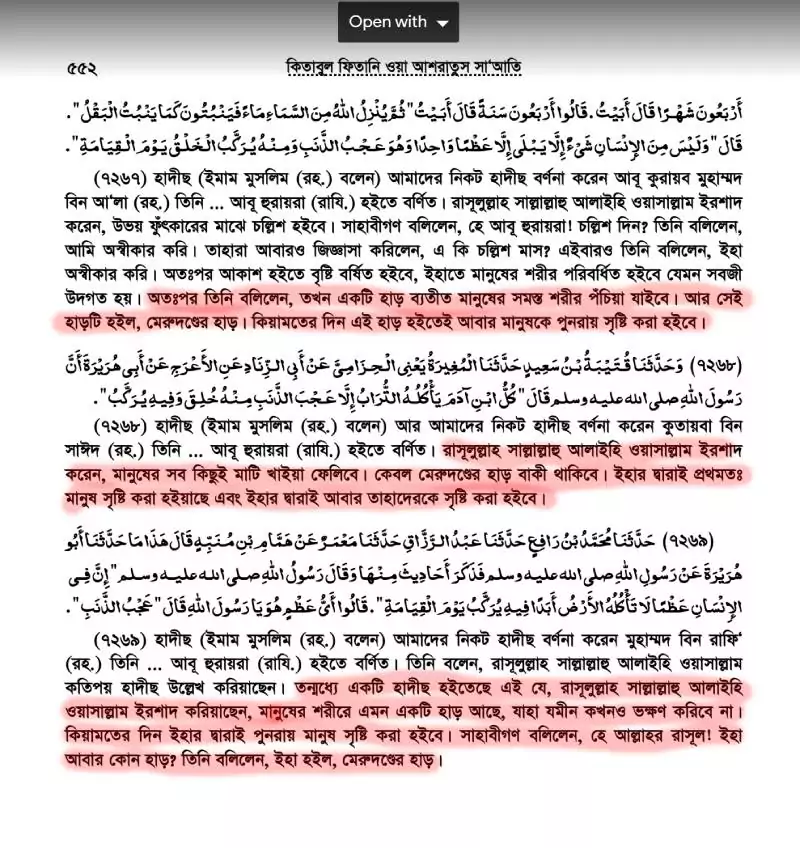
The consecutive narrations in the Bengali edition containing the Arabic text associate the same bone with both initial creation and reconstruction. [9]
أَرْبَعُونَ شَهْرًا قَالَ أَبَيْتُ . قَالُوا أَرْبَعُونَ سَنَةً قَالَ أَبَيْتُ ” ثُمَّ يُنْزِلُ اللهُ مِنَ السَّمَاءِ مَاءً فَيَنْبُتُونَ كَمَا يَنْبُتُ الْبَقْلُ”. قَالَ ” وَلَيْسَ مِنَ الإِنْسَانِ شَيْءٌ إِلَّا يَبْلَى إِلَّا عَظْمًا وَاحِدًا وَهُوَ عَجْبُ الذَّنَبِ وَمِنْهُ يُرَكَبُ الْخَلْقُ يَوْمَ الْقِيَامَةِ”.
(7267) Hadith. Imam Muslim (may Allah have mercy on him) says: Abu Kurayb Muhammad ibn al-‘Ala (may Allah have mercy on him) narrated to us … from Abu Hurayrah (may Allah be pleased with him). The Messenger of Allah, peace and blessings be upon him, said: Between the two blasts there will be forty. The Companions asked, O Abu Hurayrah! Forty days? He said, I decline. They asked again, Is it forty months? Again he said, I decline to say. Then rain will fall from the sky, and through it human bodies will grow as vegetables
sprout. Then he said: At that time the entire human body will decompose except for one bone. That bone is the bone of the spine. On the Day of Resurrection, the human being will be created again from this bone.
(9266) وَحَدَّثَنَا قُتَيْبَةُ بْنُ سَعِيدٍ حَدَّثَنَا الْمُغِيرَةُ يَعْنِي الْحِزَامِيَّ عَنْ أَبِي الزِّنَادِ عَنِ الْأَعْرَجِ عَنْ أَبِي هُرَيْرَةَ أَنَّ رَسُولَ اللهِ صلى الله عليه وسلم قَالَ ” كُلُّ ابْنِ آدَمَ يَأْكُلُهُ التُّرَابُ إِلَّا عَجْبَ الذَّنَبِ مِنْهُ خُلِقَ وَفِيهِ يُرَكَّبُ”.
(7268) Hadith. Imam Muslim (may Allah have mercy on him) says: And Qutaybah ibn
Sa‘id (may Allah have mercy on him) narrated to us … from Abu Hurayrah (may Allah be pleased with him). The Messenger of Allah, peace and blessings be upon him, said: The earth will consume everything of the human being. Only the bone of the spine will remain. Through it humans were first created, and through it they will be created again.
( 92) حَدَّثَنَا مُحَمَّدُ بْنُ رَافِعٍ حَدَّثَنَا عَبْدُ الرَّزَّاقِ حَدَّثَنَا مَعْمَرٌ عَنْ هَمَّامِ بْنِ مُنَبِّةٍ قَالَ هَذَا مَا حَدَّثَنَا أَبُو
هُرَيْرَةَ عَنْ رَسُولِ اللهِ صلى الله عليه وسلم فَذَكَرَ أَحَادِيثَ مِنْهَا وَقَالَ رَسُولُ اللهِ صلى الله عليه وسلم ” إِنَّ فِي
الإِنْسَانِ عَظْمًا لَا تَأْكُلُهُ الأَرْضُ أَبَدًا فِيهِ يُرَكَبُ يَوْمَ الْقِيَامَةِ ” . قَالُوا أَيُّ عَظْمٍ هُوَ يَا رَسُولَ اللَّهِ قَالَ ” عَجْبُ الذَّنَبِ” .
(7269) Hadith. Imam Muslim (may Allah have mercy on him) says: Muhammad ibn Rafi‘ narrated to us
(may Allah have mercy on him) … from Abu Hurayrah (may Allah be pleased with him). He said: The Messenger of Allah, peace and blessings be upon him, mentioned several hadith. Among them is the following: The Messenger of Allah, peace and blessings be upon him, said: There is a bone in the human body that the earth will never consume. On the Day of Resurrection, the human being will be created again through it. The Companions asked, O Messenger of Allah! Which bone is this? He said: It is the bone of the spine.
The Bone’s Identity and Its Role as the Basis of Creation in Classical Commentary
Islamweb’s explanation identifies ‘ajb al-dhanab as a small bone at the lower end of the spine. Quoting al-Nawawi’s commentary on Muslim, it states that this is the first part of the human being to be created and the part that remains for reconstruction. The religious explanation thus assigns a particular body part a central role in creation and re-creation. [14]
وهو أول ما يخلق من الآدمي، وهو الذي يبقى منه ليعاد تركيب الخلق عليه.
English translation: This is the first part of the human being to be created, and it is the part that remains of the person so that the body may be reconstructed upon it.
This explanation adds no new observation supporting the bone’s exceptional nature; it clarifies the role assigned to it in the hadith. Calling a body part the first thing created and the basis of reconstruction does not establish its biological capabilities. Nor does a commentator’s name or religious prestige create additional resistance within the bone. The truth of the statement depends on the bone’s properties. If the cause of its immunity to decay lies in its structure, that structure can be investigated; if it consists of the familiar materials of other bones, the religious claim must be reconciled with the behavior of those materials.
In al-Tamhid, Ibn ‘Abd al-Barr identifies the transmitted report itself as the basis for knowing this matter. IslamQA quotes his statement. [15]
وهَذا لا يُدْرَكُ إلّا بِخَبَرٍ، ولا خَبَرَ فِيهِ عِنْدَنا مُفَسَّرٌ، وإنَّما هِيَ جُمْلَةُ ما جاءَ فِي هَذا الخَبَرِ
English translation: This is known only through the transmitted report. We have no detailed explanatory narration concerning it; its entire account consists of what appears in this report.
The basis of knowledge is clear here: no experiment on the particular bone or systematic observation of dead bodies is presented; a religious report is accepted. Promoting a statement founded on that basis as a discovery of modern science changes the type of evidence. Belief in a narration is accorded the status of an experimental result, while the necessary information about the bone’s composition, decay, and means of survival remains absent. Determining the truth of a chemical claim through religious acceptance confuses two different standards of knowledge.
Rain, Sprouting, and Bodily Reconstruction in Tafsir
Tafsir al-Mazhari connects the description of rain reviving dead land with the narrative of people being raised again from their graves. It also describes a new body being joined to the preserved bone. This passage provides a detailed example of how the religious promise of resurrection is explained through a particular bone and the image of rainfall. [10]
The following verse (11) states: ‘And He who sends down water from the sky in due measure; then through it We revive a lifeless land. In this way you will be brought forth.’
Here ‘bi-qadarin’ means in due measure. And ‘will be brought forth’ means brought forth from the graves. That is, on the Day of Resurrection, when Hazrat Israfil blows the trumpet, everyone will be brought to life and brought out of their respective graves.
Al-Bukhari and Muslim narrated from Hazrat Abu Hurayrah that the Messenger, peace be upon him, said: The interval between Israfil’s first and second trumpet blasts will be forty. Hearing the hadith, people asked Hazrat Abu Hurayrah, O Companion of the Messenger! Does ‘forty’ mean forty days? He said: I cannot say. They asked again: Then is it forty months? He said: I do not know that either. They asked again: Then is it forty years? He replied: I cannot say that either. But the Messenger, peace be upon him, said that at that time Allah will send water down from the sky. As a result, those in the graves will begin to rise within their respective graves as vegetables sprout from the soil. All parts of the human body disappear except for one bone. This is the bone of the spine. At resurrection, the new body will be joined to that bone.
Ibn Abi Hatim and Ibn Jarir, through Sa‘id ibn Jubayr, narrated from Hazrat Ibn ‘Abbas that the Messenger, peace be upon him, said: Then a splendid oasis will emerge from beneath the Throne, and all moving creatures will rise up from the ground as plants sprout from the earth. Then the souls will be commanded: Enter your
respective bodies unseen. Concerning this, Allah has said: ‘O tranquil soul! Return to your Lord, well pleased and pleasing to Him.’ Ahmad and Abu al-‘Aliyah narrated from Hazrat Anas that the Messenger, peace be upon him, said: At resurrection everyone will be raised from the graves, and a light rain will fall upon them from the sky.
The following verse (12) states: ‘And He who created all kinds of pairs and made for you ships and livestock on which you ride.’ Here ‘azwajan’ means paired creation: pairs of different species.
The following verse (13) states: ‘So that you may settle on their backs, then remember the favor of your Lord when you are settled upon them, and say: Glorified and exalted is He who has subjected these to us, although we were incapable of subjecting them.’
Tafsir al-Mazhari/472
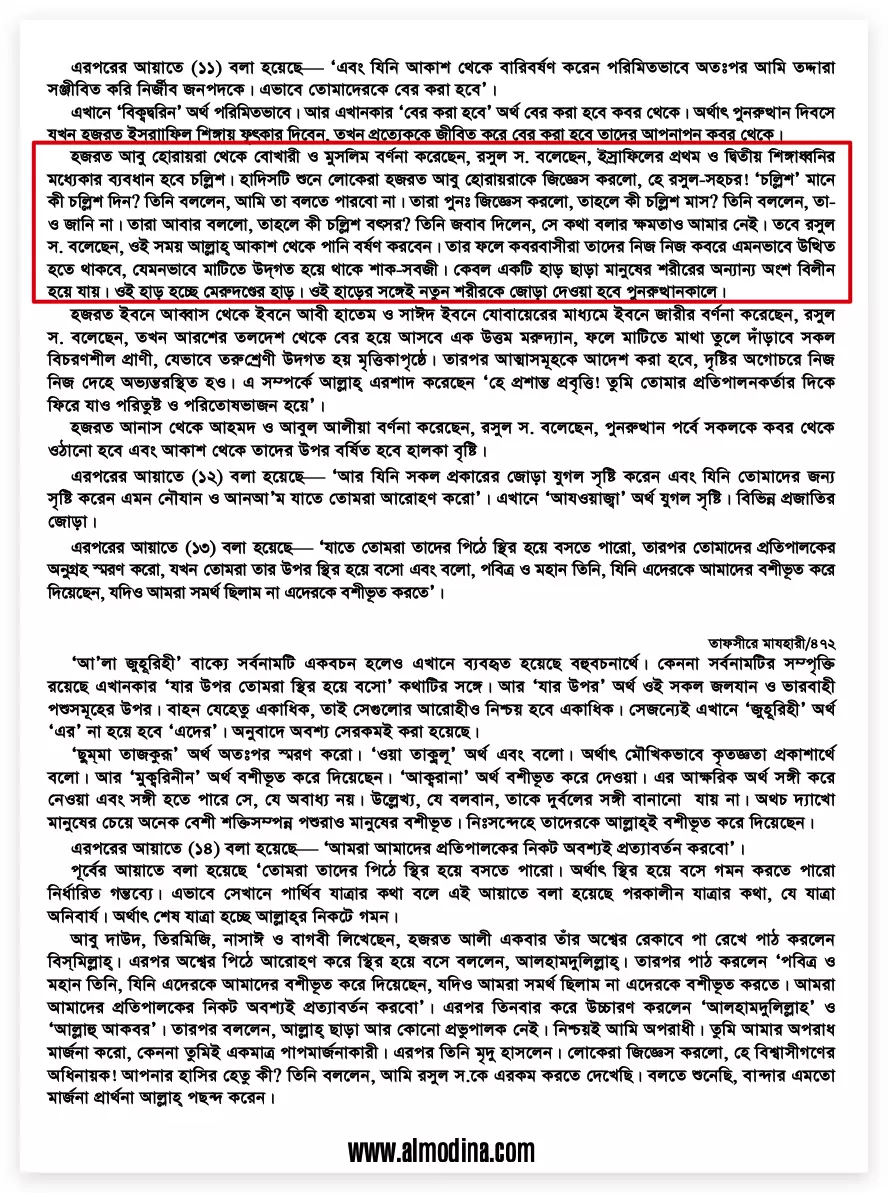
In this account, water appears as the element that initiates bodily reconstruction, while the piece of bone supports the new body. Yet no biological process is established whereby rainfall restores a dead person’s organs, nerves, brain, and personal memories. The comparison with plant germination makes the scene easy to imagine; it does not provide the mechanism of human reconstruction. A seed’s developmental capacity depends on its specific cellular condition. Claiming the same capacity for a dead bone requires demonstrating its actual basis within that bone. Merely using familiar words—water, bone, growth—does not make the sequence of events part of biology.
The Claim of a Bodily Remnant in Ibn Hibban’s Chapter Arrangement
The chapter headings accompanying this narration in the Bengali edition of Sahih Ibn Hibban also describe the body’s disappearance except for the tailbone and reject the idea that the entire body ceases to exist. The subject of the explanation is therefore specific: a part of the human body is claimed to remain after death. [16]
Sahih Ibn Hibban (HadithBD)
10. The Book of Funerals and Matters Before and After the Funeral
Chapter: Narration stating that the entire human body will perish except for the tailbone at the lower end of the spine
3128. Narrated from Abu Hurayrah, may Allah be pleased with him, who said: The Messenger, peace and blessings be upon him, said: ‘The earth will consume the entire body of the son of Adam except for the tailbone at the lower end of the spine. From here he was created, and from here he will be assembled (again).’[1]
[1] Muwatta of Imam Malik: 1/239; al-Nasa’i: 4/111–112; Abu Dawud: 4743; Musnad Ahmad: 2/322; Sahih Muslim: 2955; Sahih al-Bukhari: 4814; Ibn Majah: 4266.
‘Allamah Shu‘ayb al-Arna’ut, may Allah have mercy on him, graded the hadith sahih according to the conditions of al-Bukhari and Muslim. ‘Allamah Nasir al-Din al-Albani, may Allah have mercy on him, graded the hadith sahih. (Sahih Ibn Majah: 4266)
Hadith grade: Sahih (Authentic)
Narrator: Abu Hurayrah (may Allah be pleased with him)
The very title of the following chapter speaks of refuting the assertion that the entire body perishes. [17]
Sahih Ibn Hibban (HadithBD)
10. The Book of Funerals and Matters Before and After the Funeral
Chapter: A hadith refuting the statement of one who thinks that the entire human body perishes after death
3129. Narrated from Abu Hurayrah, may Allah be pleased with him, who said: The Messenger, peace and blessings be upon him, said: ‘The earth will consume the entire body of the son of Adam except for the tailbone at the lower end of the spine. From here he was created, and from here he will be assembled (again).’”[1]
[1] Muwatta of Imam Malik: 1/239; al-Nasa’i: 4/111–112; Abu Dawud: 4743; Musnad Ahmad: 2/322; Sahih Muslim: 2955; Sahih al-Bukhari: 4814; Ibn Majah: 4266.
‘Allamah Shu‘ayb al-Arna’ut, may Allah have mercy on him, graded the hadith sahih according to the conditions of al-Bukhari and Muslim. ‘Allamah Nasir al-Din al-Albani, may Allah have mercy on him, graded the hadith sahih. (Sahih Ibn Majah: 4266)
Hadith grade: Sahih (Authentic)
Narrator: Abu Hurayrah (may Allah be pleased with him)
If investigation into the actual condition of bones is subordinated to this declaration, the conclusion is predetermined. Whatever the findings concerning decay, an indestructible part must be assumed to exist. Scientific investigation works in the opposite direction: conclusions emerge from the specimen’s composition, changes, and state of preservation. When this distinction is erased in education and a religious conclusion is taught as unquestionable science, students learn to fit information to authority instead of revising their views according to evidence. This is the harm in promoting belief in an indestructible bone as established biology: belief is placed in control of experimental findings.
Biochemical Analysis: Bone Decomposition and the Process of Diagenesis
Bone is an organic–mineral composite structure. Its principal organic component is collagen protein, and its principal mineral component is calcium-phosphate-based bioapatite, whose structure is related to hydroxyapatite. The mineral component gives bone rigidity, while collagen makes an important contribution to its mechanical properties. Bone preservation depends on the chemical stability and arrangement of these two components. After death, the breakdown of organic material, mineral alteration, and microbial attack can change the bone’s original structure. The research review by Collins and colleagues identifies these three pathways of deterioration separately. [18]
In most environments, bones are not in thermodynamic equilibrium with the soil solution, and undergo chemical deterioration (path 2).
English translation: In most environments, bones are not in thermodynamic equilibrium with the soil solution and undergo chemical deterioration—pathway two.
This process of deterioration does not require a bone merely to crumble externally. Even while a bone retains its recognizable shape, its organic molecules can break down, its mineral crystal structure can change, and the nature of its microscopic spaces and channels can be altered. Holding up a bone and demonstrating that its original biochemical condition remains intact are therefore different things. The survival of external form cannot establish that the molecules and structure remain unchanged. If ‘indestructible’ is used in a real, physical sense, these internal changes must also be accounted for.
The Structure of the Coccyx: Familiar Bone, Not an Unknown Miraculous Substance
The human coccyx generally consists of three to five small vertebral segments, with four being the most common. Their fusion and shape also vary between individuals. In Woon and colleagues’ analysis of CT scans from 112 adults, four segments were found in 76 percent of cases. This observation of actual people describes the coccyx as a bone with a specific structure and variations. [19]
Four coccygeal segments were present in 76 % of scans.
English translation: Four coccygeal segments were present in 76 percent of scans.
Anatomical information about the coccyx is obtained through imaging, measurement, and examination of bone structure. Its organic–mineral nature has fundamental similarities to that of other bones in the body. Being located at the end of the spine does not isolate its chemical bonds from the effects of soil solutions, acidity, or organic breakdown. Small size, fused vertebral segments, and a particular location do not in themselves confer immunity to decay. Calling the coccyx indestructible requires demonstrating properties that distinguish it from ordinary bone. Religious naming does not add that exception to the bone’s composition.
Acidity and Mineral Dissolution: The Chemical Limits of Bone’s Hardness
The stability of bone mineral is linked to the chemical conditions of the surrounding solution. In acidic conditions, the reaction of hydrogen ions with phosphate and hydroxyl can promote mineral dissolution. The idea that bone’s components cannot enter solution simply because bone is hard is chemically false. An idealized reaction for the acidic dissolution of hydroxyapatite is:
Ca10(PO4)6(OH)2 + 14H+ → 10Ca2+ + 6H2PO4− + 2H2O
In this equation, components of the solid mineral become dissolved ions. Actual bone mineral contains various substitutions and organic components, while water, ions, and microorganisms also act together in burial environments. The rate of decay therefore depends not only on soil acidity but also on water flow, temperature, and local chemical conditions. A single acidity value cannot determine how many years bones in every grave will take to disappear. The decisive point is that bone mineral is subject to chemical change; declaring that ‘the earth will never consume it’ does not exempt it from those reactions.
Mineral deterioration can also expose more of the organic component. Because mineral and collagen are connected, changes in one component affect the preservation of the other. Dissolution may also be followed by new mineral deposition or recrystallization. Even when a solid residue is found, its composition cannot therefore be assumed to remain as before. Describing a bone’s condition requires separate examinations of its minerals, organic molecules, and microstructure. The religious idea of indestructibility imagines this changing system as a fixed, unaltered piece of bone.
Collagen Breakdown: Molecular Deterioration Within Visible Bone
The long chains and fibrous organization of collagen protein are important to bone structure. Hydrolysis—the breaking of chemical bonds through the participation of water—can alter this framework. As the connections between fibers weaken, the bone’s organic structure also changes. These changes can proceed inside a bone even when it appears externally intact. The observation that ‘a bone is visible’ is therefore no evidence that its collagen remains intact. Molecular analysis can identify protein breakdown and mineral changes.
In Falgayrac and colleagues’ 2022 experiment, rib bones from six human donors were placed in soil and examined over 12 months using Raman microspectroscopy. Monthly observations identified changes associated with dissolution–recrystallization in the mineral component and hydrolysis in the collagen framework. The experiment measured structural changes in human bone. [20]
The results showed that the mineral undergoes the dissolution–recrystallization mechanism. The collagen matrix of bone undergoes the hydrolysis mechanism.
English translation: The results showed that the mineral component undergoes dissolution–recrystallization. The collagen framework of bone undergoes hydrolysis.
The significance of this experiment lies in its measurability. The bone specimens, observation period, and method of identifying change are specified. Precisely these elements are missing from the religious claim of immunity to destruction: no information is supplied about which specimen stopped deteriorating, how that was measured, or whether other experiments produced the same result. An ancient narration uses the word ‘never’; the research examines changes in specific specimens over a specified period. It is the second method that supplies the basis for conclusions about the actual behavior of bone.
Microbial Attack and the Destruction of Bone Microstructure
After death, bone loses the body’s normal systems of maintenance and remodeling. Its chemical and microbial interactions with the environment then become important. Microbial deterioration can create microscopic cavities and structural changes within bone. Its presence is examined through microscopy and analysis of bone porosity. A study published in 2004 examined more than 250 bones from 41 archaeological sites in four climatic regions across five countries; signs of microbial attack were found in 68 percent of the specimens. [21]
Microscopic and physical (mercury intrusion porosimetry) analyses of these bones revealed that the majority (68%) had suffered microbial attack.
English translation: Microscopic and physical analyses of these bones—using mercury intrusion porosimetry—showed that the majority of specimens, 68 percent, had suffered microbial attack.
Microbial attack does not merely mean dirt accumulating on a bone; changes occur within the bone’s original structure. Exposure of the organic material associated with the mineral creates opportunities for protein breakdown and damages the bone’s integrity. Judging decay solely by the sight of a large bone breaking into smaller pieces therefore leaves out molecular and microscopic damage. If ‘the earth consuming’ is understood as actual decay, the combined effects of soil solutions, water, and microorganisms are relevant. The processes acting on bone are real and identifiable; no separate, decay-proof material has been demonstrated for the bone selected as an exception by religious declaration.
Evidence of Chemical Change and the Absence of Evidence for an Indestructible Bone
Biochemical evidence concerning bone decay provides a coherent picture: minerals can dissolve or reorganize, collagen bonds can break, and microorganisms can damage bone microstructure. The local environment influences the rates and outcomes of these processes. Against this evidence, calling the coccyx immune to decay requires properties that actually resist the relevant chemical and microbial effects. The hadith declares one part an exception; no exceptional chemical composition has been established for it. The forcefulness of a narration and a bone’s physical resistance are not the same thing.
This gap is concealed when an ancient religious declaration is promoted as knowledge that preceded science. The anatomical fact that humans have a coccyx is joined to the religious claim that this bone never decays. The truth of the first fact is used as proof of the second claim. Yet identifying the coccyx and establishing its indestructibility are two separate tasks. Anatomical observations support the first; a religious narration is offered in support of the second. Borrowing the name of a familiar bone cannot manufacture evidence of a miraculous property. Promoting the theory of an indestructible tailbone as scientific truth therefore substitutes religious authority for evidence.
Archaeological Evidence and Taphonomy: The Absence of an ‘Indestructible’ Bone
Taphonomy studies the alteration, movement, and preservation of remains after death. When a skeleton is recovered, not all its parts are in the same condition. Some bones break, some parts dissolve, and some are displaced by animals or flowing water; other parts survive for long periods under favorable conditions. This uneven preservation is a real issue in archaeological remains. Declaring any one part indestructible requires establishing its identity, composition, and history of alteration. Finding a bone does not justify the conclusion that it never decays. Observing survival over many years and claiming immunity to decay under any conditions are statements of entirely different strength.
Uneven Skeletal Preservation: The Role of Bone Density and the Environment
Willey, Galloway, and Snyder studied the survival of limb bones and their different portions in the fourteenth-century remains of the Crow Creek massacre. They found a relationship between modern bone mineral density and the survival of those archaeological specimens. The study does not concern the indestructibility of the coccyx; its finding is that the preservation of different bone portions is related to material properties. Assuming that all bones meet the same fate while ignoring density, structure, and burial conditions is wrong. Likewise, a long-surviving specimen does not establish universal immunity to decay for a particular bone. [22]
density values are positively correlated
English translation: There is a positive correlation with the density values.
Interpreting the absence of a coccyx also involves considering the completeness of the burial, excavation methods, bone displacement, and the condition of other bones. But these factors provide no refuge from the need to supply positive evidence for indestructibility. The claim concerns a special property of a particular bone; supporting it requires demonstrating an unaltered structure in that bone. A coccyx resembling other skeletal parts or showing chemical alteration cannot be called indestructible. Nor does declaring the existence of an experimentally unidentified particle in place of a missing coccyx add any new archaeological information. The claim about a visible bone then gives way to the assumption of an invisible remnant.
Fossils: The Difference Between Long Preservation and Remaining Unchanged
During fossil formation, new minerals may accumulate in the pores of the original material; alternatively, the original material may dissolve and other minerals take its place. The first process is permineralization, the second replacement. The United States National Park Service distinguishes these two processes. Either can preserve the external shape of a body part for a long time, but that shape does not establish that its original composition is unchanged. It is also wrong to say that all the original material in every fossil has been completely replaced. The nature of preservation and transformation is determined specimen by specimen. [23]
Permineralization is the infilling of natural pores in original organic material by minerals.
English translation: Permineralization is the filling of natural pores in the original organic material with minerals.
Using the great age of fossils to argue for an indestructible bone turns geological alteration itself into evidence of an absence of change. The preservation of a body part’s shape, the partial survival of its minerals, the recovery of small fragments of organic molecules, and the survival of intact living cells are different events. None follows automatically from another. Similar preservation can occur in teeth, long bones, or the remains of other animals. The existence of fossils therefore demonstrates no unique miraculous advantage for the human coccyx; it demonstrates specific relationships between matter and the environment.
Islamweb’s Fatwa: A Direct Instruction to Disregard Reality
The questioner in Islamweb’s 2015 fatwa 280627 raises the problem explicitly. Although he had read claims on Islamic websites of scientific proof that the coccyx does not decay, he could not find that evidence elsewhere and instead encountered statements to the contrary. Noting that the same text was republished across different Islamic sites, he requested independent information. The answer supplied no laboratory study, results of chemical tests on bone, or report on a preserved specimen. Relying on hadith and commentary, it asserted that a tiny part does not decay and that failing to find it in graves is not evidence against its existence. The commentary from Mirqat al-Mafatih quoted in the fatwa also explicitly calls for disregarding tangible reality. [24]
The tangible reality should be ignored in this case.
English translation: Tangible reality must be disregarded in this case.
The original Arabic statement of the same explanation is preserved in another Islamweb fatwa as a quotation from ‘Ali al-Qari. It acknowledges eventual decay while denying complete decay, then argues that a small part mixed with the soil cannot be distinguished by the senses. The basis of these statements is the authority of the narration, not an experimentally established property of bone. [25]
أَقُولُ: التَّحْقِيقُ -وَاللَّهُ وَلِيُّ التَّوْفِيقِ- أَنَّ عَجْبَ الذَّنَبِ يَبْلَى آخِرًا، كَمَا شَهِدَ بِهِ حَدِيثٌ، لَكِنْ لَا بِالْكُلِّيَّةِ، كَمَا يَدُلُّ عَلَيْهِ هَذَا الْحَدِيثُ، وَهُوَ الْحَدِيثُ الْمُتَّفَقُ عَلَيْهِ، وَلَا عِبْرَةَ بِالْمَحْسُوسِ، كَمَا حُقِّقَ فِي بَابِ عَذَابِ الْقَبْرِ، عَلَى أَنَّ الْجُزْءَ الْقَلِيلَ مِنْهُ الْمَخْلُوطَ بِالتُّرَابِ غَيْرُ قَابِلٍ لِأَنْ يَتَمَيَّزَ بِالْحِسِّ، كَمَا لَا يَخْفَى عَلَى أَرْبَابِ الْحِسِّ.
English translation: I say: The finding—and Allah is the source of success—is that ‘ajb al-dhanab is the last to decay, as a hadith attests, but not completely, as this agreed-upon hadith indicates. Sensory evidence is of no account here, as established in the chapter on the punishment of the grave. Moreover, its small part, mixed with the soil, cannot be distinguished by the senses, as is not obscure to those possessing sensory perception.
Under this method, the conclusion is fixed first, and contrary experience is then rejected. If the bone is found intact, the hadith’s truth will be proclaimed; if it decays, an unidentified remnant will be invoked; and if evidence of that part is requested, reality itself will be dismissed. This can place a belief beyond refutation; it cannot establish a bone’s immunity to decay. The fatwa’s concluding instruction follows the same path: believers are told to believe the Prophet’s hadith and disregard what contradicts them. This is a requirement of religious obedience, not the result of investigation. When a claim conflicts with a fact about nature, an instruction to discard the fact destroys the claim to scientific proof itself.
The Published Bengali Translation and the Meaning of the Original Instruction
A Bengali translation of this fatwa was published under the name of Muhammad Mushfiqur Rahman Minar on 19 May 2019. The translation includes the instruction to disregard reality. In its concluding sentence, the instruction to disregard what contradicts the hadith is presented in the language of dismissing allegations of inconsistency. The published Bengali sentence reads: [26]
Believers should have faith in the Prophet’s (ﷺ) hadith and pay no attention to allegations of inconsistency in it.
The accurate meaning of the original English conclusion is that believers are instructed to believe the Prophet’s hadith and disregard whatever contradicts them. Adding the word ‘allegations’ in the final sentence of the Bengali translation narrows the statement’s scope. The original instruction concerns not merely someone’s objection but also whatever contradicts the hadith. The classical commentary quoted in the original fatwa directly declares tangible reality to be of no account. The conflict therefore cannot be dismissed as merely an atheist’s allegation. A published religious instruction places the narration’s authority above actual experience. Failing to provide experimental evidence for the coccyx’s indestructibility and then instructing people to disregard reality reveals a rule of belief, not an unknown scientific property of bone.
Errors Concerning Embryology and Genetics: Dissecting the ‘Biological Seed’ Theory
To dress the promotion of an indestructible bone in the language of modern science, the embryonic primitive streak, the capacity of cells to form multiple tissues, teratomas, and DNA are all linked together. Yet each has a distinct identity and role. A structure’s important role in embryonic development does not entail its immunity to decay after death. Likewise, the existence of cells capable of forming multiple tissues does not entail the automatic return of a complete dead person. The first major break in the reasoning lies in treating developmental capacity, bone structure, preservation after death, and resurrection as a single event.
The Coccyx as the First Creation: Islamweb’s Published Claim
Islamweb fatwa 422515 states that the first part of the embryo to be created is ‘ajb al-dhanab and that bones and other tissues form from it. This is a specific claim about the sequence of bodily development. It therefore goes beyond belief in a future resurrection and also answers the question of how the human body develops in the womb. But in the sequence of the fertilized cell, its division, the embryo’s early layers, and later bone formation, no pre-existing coccyx is found as the source of all tissues. [27]
ومنه تتكون العظام وبقية أنسجته
English translation: From it, bones and its other tissues are formed.
The fact that bone contains cells is not the same as the claim that all cells develop from a bone. Imagining the developing embryo first as a tiny tailbone from which the rest of the body expands does not correspond to actual embryology. Applying the name of an adult bone to an early embryonic region does not establish their structural identity. Evidence is needed precisely at that point of connection: when did the primitive streak become a particular bone, and why would that bone be exempt from chemical change after death? Placing a religious name beside a familiar term answers neither question.
The Primitive Streak: A Transient Developmental Structure
The primitive streak forms during the third week after fertilization. Division of the fertilized cell and the embryo’s initial organization take place before that. The primitive streak is a region of embryonic cell migration and layering; gastrulation produces the ectoderm, mesoderm, and endoderm. Tyser and colleagues’ single-cell study of a human embryo identified different cell populations during this developmental stage. The embryo studied was approximately 16–19 days past fertilization. Evidence of embryonic cellular diversity and development cannot be transformed into a theory of a fully formed bone as a seed. [28]
In humans, gastrulation occurs in the third week after fertilization.
English translation: Human gastrulation occurs in the third week after fertilization.
The formation of tissue precursors from primitive streak cells does not mean that the streak becomes a bone and remains unchanged in the body. Cell lineage and the enduring identity of an organ are different matters. Finding descendants of an early cell in various parts of the body does not make all those parts unchanged versions of that early cell. The primitive streak normally regresses and disappears by the end of the fourth week; cells and tissues already produced through the associated developmental processes continue their further development. Treating a coccyx as the pre-existing construction center of the entire body reverses the actual sequence of embryonic development.
Teratomas: Abnormal Tissue Growth, Not Seeds of Resurrection
Abas and colleagues’ review of gastrulation and body-axis formation discusses the disappearance of the primitive streak and, in some cases, the relationship between its residual cells and sacrococcygeal teratomas. Such tumors may contain tissues from different embryonic germ layers. Presenting this formation of multiple tissues as proof of an indestructible bone confuses pathological cell growth with normal bodily development. The ability of a cell population to produce hair, cartilage, or other tissues does not entail the reconstruction of a dead person’s complete body, nervous system, and personal memories. [29]
In most cases, the primitive streak vanishes completely.
English translation: In most cases, the primitive streak disappears completely.
It is also wrong simply to equate teratomas with cancer. The United States National Cancer Institute defines a mature teratoma as a noncancerous tumor that can contain different tissue types and may sometimes return after removal. A teratoma’s nature depends on its type and condition. Its existence demonstrates that some cells can abnormally produce multiple tissues. It is not an experiment showing that coccygeal mineral or collagen does not decay, nor an experiment showing that those cells remain immortal after the body’s death. [30]
They are benign (not cancer) but may come back after being removed by surgery.
English translation: They are benign—not cancer—but may return after surgical removal.
The Experiments of Unnamed Chinese Scientists: Where Is the Published Research?
Alongside equating the primitive streak with the coccyx, a 2003 Islamweb article claims that a group of Chinese scientists failed to destroy the relevant part despite subjecting it to powerful acids, fire, grinding, and radiation. Yet the article gives no scientists’ names, research-paper title, journal, laboratory identity, or detailed experimental description. It also omits what the specimen was, which acid was used at what concentration, the temperature and duration of heating, and which test determined that it remained unchanged. [31]
مجموعة من علماء الصين
English translation: A group of Chinese scientists.
This account contains the word ‘scientists,’ but no verifiable research. Mineral residue remaining after burning and the original bone remaining intact are entirely different results. Nor does the presence of a residue after acid treatment entail that the original organic–mineral structure remains unchanged. Grinding bone into powder is itself the destruction of its gross structure. Calling every result ‘not destroyed’ without comparing what was present at the start with what remained at the end is wordplay. This story of unnamed research claims the standing of a modern experiment while failing to supply the basic information needed to verify modern research.
DNA Decay: What the Figure of 521 Years Actually Means
The frequently cited DNA half-life of 521 years is the finding of a particular study. Allentoft and colleagues analyzed 158 dated bone specimens from New Zealand’s extinct moa birds. This half-life was derived from a model of the breakdown of a 242-base-pair mitochondrial DNA fragment under specific burial conditions; the effective burial temperature was estimated at 13.1 degrees Celsius. The study was published in Proceedings of the Royal Society B, not Nature. Applying this figure as a universal lifespan for all types of DNA in every environment is wrong. [32]
a molecular half-life of 521 years
English translation: A molecular half-life of 521 years.
Half-life here means the time taken for the quantity of intact fragments of the specified length in that model to fall by half. It does not mean that all DNA and every piece of information it contains disappear simultaneously after a set number of years. Preservation prospects vary with temperature, water, chemical conditions, and fragment length. But this variability does not justify declaring DNA indestructible either. Recovering some information from fragmented and chemically damaged molecules, obtaining a completely intact genome, and obtaining living cells capable of renewed development are three different outcomes. The survival of some genetic information in bone does not turn that bone into a living seed.
Even Million-Year-Old DNA Is Not Evidence of Immortal Cells
In 2021, van der Valk and colleagues published research recovering genome-wide data from three ancient mammoth specimens, two of which were more than a million years old. Genetic history was investigated through the analysis of fragmented ancient DNA. The absolute claim that no meaningful genetic information can be recovered after a few thousand years is therefore factually wrong. This study also clarifies the nature of ancient information recovery: researchers are analyzing information from fragments of damaged molecules, not recovering intact living mammoth cells and demonstrating spontaneous rebirth. [33]
the recovery of genome-wide data
English translation: Recovery of genome-wide information.
Calling the coccyx a biological seed requires more than saying that a little material or some molecular information remains within the bone. A claim of a seed-like biological process requires functional cells, appropriate genetic information, and a system for organized development. A dead piece of bone does not itself meet these conditions. A person’s genetic information is present in many cells of the body; its presence is not an exclusive property of the coccyx. Invoking DNA to declare a particular bone the unique basis of resurrection therefore fails to establish its uniqueness. And saying that all the necessary machinery is miraculously contained in an unidentified particle constitutes a new religious declaration, not evidence from biology.
| What is being shown | What it actually means | The conclusion that does not follow |
|---|---|---|
| A bone surviving for a long time | Some of its structure or material has been preserved under particular conditions. | The bone does not decay under any conditions. |
| A fossil retaining its shape | Its shape can survive through processes including permineralization or replacement. | The original organic structure remains completely unchanged. |
| Tissue precursors forming from the primitive streak | Cell migration and layering have occurred during a stage of embryonic development. | The entire embryo developed from a pre-existing coccyx. |
| Different tissue types occurring in a teratoma | Abnormal cell growth can produce multiple types of tissue. | A dead person’s body and personal identity have been reconstructed. |
| Information recovered from ancient DNA | Preserved molecular fragments have made genetic analysis possible. | A complete genome and living cells remain intact. |
| Mineral residue remaining after a bone is burned | Some inorganic components have remained after combustion. | The bone’s previous structure and organic components remain intact. |
| Declaring the existence of an unidentified tiny part in the soil | A remnant not distinguished through testing has been assumed to exist. | The presence of an indestructible bone has been experimentally established. |
Conclusion: The End of Indestructibility and the Triumph of Rationalism
The claim that ‘ajb al-dhanab is immune to decay attributes a miraculous property to a familiar body part. The actual structure of the coccyx, changes in bone’s mineral and organic components, the preservation of dead bodies, and the stages of embryonic development confer no status of an eternal seed on that bone. Pointing to a long-surviving bone, a fossil, or a fragment of ancient DNA and concluding that the coccyx is unaltered and indestructible is a logical leap. Each case involves conditions of preservation and particular kinds of alteration; there is no experimental evidence for the exceptional immunity to decay declared in the hadith.
The idea of regaining a body from an indestructible bone appears in rabbinic literature before the Islamic account. Stories of the luz bone remaining intact despite grinding, fire, and water establish its exceptional status within that narrative. Later religious promotion adds acids, radiation, and experiments by unnamed scientists. The language of testing has changed; the requirement for verifiable specimens and reproducible results establishing the claim’s truth has not been met. Recasting an ancient story of an experiment as a modern laboratory story does not produce science.
Equating the embryonic primitive streak with the adult coccyx, calling tissue growth in a tumor the power of resurrection, and turning the recovery of ancient DNA information into evidence of an immortal biological seed are abuses of science. The presence of scientific terms does not make a statement scientific. When the connection between the object tested, the changes observed, and the conclusions supported by the results is broken, research gives way to propaganda. That break is evident in these arguments for the tailbone’s alleged indestructibility.
Islamweb’s fatwa resolves the conflict even more directly: tangible reality is to be disregarded in favor of the hadith. Obedience is placed above facts. Retreating to an unidentified particle after a visible bone decays, and instructing people to maintain belief even when that particle cannot be shown, places the claim beyond verification. A method that rejects contrary findings in advance can preserve any fantasy intact. It establishes no new truth about nature.
Religious authority does not change a bone’s chemical composition. Giving the coccyx a sacred name, attaching a promise of resurrection to it, or instructing people to ignore criticism provides no evidence of immunity to decay. The conventional claim of an indestructible bone is unsupported; promoting it as a truth established by modern science is misleading. An object’s properties are determined by experimental evidence concerning that object. Ancient narratives and rules of belief are no substitute for that evidence.
References
- Bereshit Rabbah, 28:3 ↩︎
- Sefaria’s book description: date of compilation and source information ↩︎
- Bereshit Rabbah, 28:3: the dialogue between Hadrian and Rabbi Yehoshua ben Hananiah ↩︎
- Nissan Dovid Dubov, In What Manner Will the Resurrection Take Place?, Chapter 9 ↩︎
- Kestenbaum’s manuscript description: Midrash ha-Gadol, David Adani ↩︎
- Sefaria: Kabbalah bibliography, description of the Zohar ↩︎
- Sahih Muslim, 2955b: chapter on the interval between the two trumpet blasts ↩︎
- Sahih Muslim, Hadith Academy, hadith 7306 ↩︎
- Sahih Muslim Sharif, Maktabatul Hadith Publications, volumes 21 and 22, p. 552 1 2
- Tafsir al-Mazhari, volume 10, p. 472 1 2
- Sahih Ibn Hibban, hadith 3128 ↩︎
- Sahih Muslim, 2955c ↩︎
- Sahih Muslim, Hadith Academy, 7306 ↩︎
- Islamweb, fatwa 38387: identification of ‘ajb al-dhanab; quotation from al-Nawawi’s commentary ↩︎
- IslamQA, question 321213; quotation from Ibn ‘Abd al-Barr, al-Tamhid, 18/174 ↩︎
- Sahih Ibn Hibban, HadithBD, 3128 ↩︎
- Sahih Ibn Hibban, HadithBD, 3129 ↩︎
- Collins et al., The Survival of Organic Matter in Bone: A Review, Archaeometry, 44(3), 2002, pp. 383–394 ↩︎
- Woon et al., CT Morphology and Morphometry of the Normal Adult Coccyx, European Spine Journal, 22, 2013, pp. 863–870 ↩︎
- Falgayrac et al., Bone Molecular Modifications Induced by Diagenesis Followed-Up for 12 Months, Biology, 11(10), 2022, 1542 ↩︎
- Jans et al., Characterisation of Microbial Attack on Archaeological Bone, Journal of Archaeological Science, 31(1), 2004, pp. 87–95 ↩︎
- Willey, Galloway & Snyder, 1997: Bone mineral density and survival of elements and element portions in the bones of the Crow Creek massacre victims ↩︎
- National Park Service: Permineralization and Replacement ↩︎
- Islamweb, fatwa 280627: The decomposition of the coccyx bone, 17 April 2015 ↩︎
- Islamweb, fatwa 460792: ‘Ali al-Qari’s statement in Mirqat al-Mafatih ↩︎
- Response to Anti-Islam: Explanation of the hadith, ‘The entire human body will decay except for the coccyx/tailbone’ ↩︎
- Islamweb, fatwa 422515: the claim that embryonic bones and tissues develop from ‘ajb al-dhanab ↩︎
- Tyser et al., Nature, 2021: Single-cell transcriptomic characterization of a gastrulating human embryo ↩︎
- Abas et al., 2022: Gastrulation and Body Axes Formation: A Molecular Concept and Its Clinical Correlates ↩︎
- National Cancer Institute, SEER Glossary: Mature teratoma ↩︎
- Islamweb, 26 July 2003: the claim of scientific experiments concerning ‘ajb al-dhanab ↩︎
- Allentoft et al., 2012: The half-life of DNA in bone: measuring decay kinetics in 158 dated fossils ↩︎
- van der Valk et al., Nature, 2021: Million-year-old DNA sheds light on the genomic history of mammoths ↩︎