
Summary
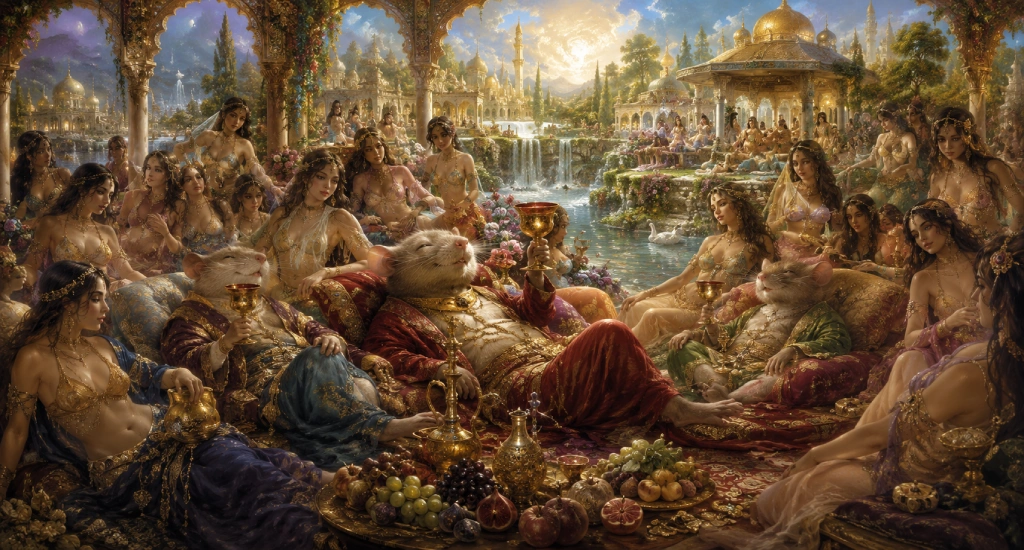
Human beings live in a world marked by hunger, disease, poverty, fear, separation, failure and, above all, death. Religious imagination has quite naturally created a world that reverses these realities, a place where none of them exists. There will be limitless food, safety, beauty, youth, companionship, pleasure and a life without end. From the Islamic Jannah to the Christian heaven, from Vaikuntha to various other religious afterlives, essentially the same dream recurs: a perfect, permanent realm of everlasting happiness opposed to the imperfections of earthly life.
Yet this raises a fundamental question. Is human happiness really just a matter of eliminating deprivation? If every need is met, every danger removed, death rendered impossible, the fear of loss abolished and every desire guaranteed fulfillment, will such an existence truly remain meaningful and enjoyable for all eternity? Or has the religious idea of heaven drastically oversimplified the real complexities of the human mind, biology, desire, identity, freedom and meaningful living, reducing them to a childish world of rewards?
John B. Calhoun’s famous “Universe 25” experiment raises an important question about the relationship between material security and social life. Mice were kept in a controlled environment with ample food and water and no threat from predators. Nevertheless, the colony ultimately underwent a devastating behavioral and reproductive decline. The experiment concerned mouse social behavior in a confined environment, not an imagined human afterlife. Its findings show that eliminating material shortages does not automatically ensure healthy social development. Roles, relationships, freedom of movement and social interaction also matter. Descriptions of religious heaven centered on consumption leave complex questions about human relationships, change, freedom and meaningful participation unresolved.
The promise of endless happiness creates several profound tensions with human psychology as we know it. Eternal comfort and unlimited rewards alone cannot establish what constitutes a fulfilled life while bypassing questions about hedonic adaptation, the meaning of endless existence, the continuity of memory and personal identity, the scope of independent choice and moral responses to the suffering of loved ones. This ideal of religious heaven reflects human fears and unfulfilled desires more clearly than it reflects the complexities of lived human experience.
Introduction: A Kingdom of Eternal Happiness Born of Human Fear
People do not want to accept death. We know that our lives are finite, yet our consciousness struggles to imagine its own absence. We know those we love will die, yet we wish our separation from them would never become final. We know that justice in this world is incomplete: countless perpetrators die unpunished, while countless innocent people are destroyed without redress. We know that many of our aspirations will remain unfulfilled. Out of this profound helplessness, religion has fashioned a story that touches all these vulnerabilities at once. You will not die. You will regain what you have lost. You will be rewarded for your suffering. Your enemies will be punished. All your desires will be fulfilled. You will inhabit a world without fear, deprivation, uncertainty or an ending.
This promise is powerful because it appeals to emotion before reason. Promise immortality to someone who fears death, and the first response may be relief rather than a demand for evidence. A mother who has lost her child is told they will meet again. An oppressed person is promised that every account will be settled at the final judgment. A poor person is told that palaces await in the afterlife. Those deprived in this world are assured of limitless rewards in the next. Religious heaven is therefore more than a doctrine of the afterlife: it is one of the most successful psychological refuges constructed around human fears and frustrated desires.
But a belief does not become true merely because it provides emotional comfort. A cancer patient’s wish not to die does not guarantee immortality. A child’s longing for a deceased father does not reverse death. Even if millions of people desire something, reality is under no obligation to conform to their wishes. The first question about heaven, therefore, is not whether the idea appeals to us, but whether it makes logical sense at all.
Many descriptions of religious heaven reveal a remarkably simple formula: whatever is scarce on earth is abundant in heaven. Food is limited here; there, it is inexhaustible. Water is precious here; there, rivers flow. Youth is fleeting here; there, it lasts forever. Sexual relations are restricted here; there, companionship is unlimited. People die here; there, death does not exist. People grow tired here; there, rest is eternal. It is as though the final solution to every human problem is to make the quantity of every desirable thing infinite.
But human beings are not so simple that increasing the supply of desirable things will make happiness grow forever. Give a child a favorite sweet every day, and eventually it loses its special appeal; the car or house dreamed of for years also becomes part of a new normal. The human nervous system is especially responsive to change, anticipation, novelty, contrast and achievement rather than merely to unchanging rewards. This is also intelligible in evolutionary terms: an animal that settled into permanent satisfaction after obtaining food or safety would be less responsive to new sources of food, new environments, mates, shelter or threats. Our reward systems thus operate in ways that make attainment temporarily satisfying before a new normal emerges and fresh needs arise. Human pleasure is not simply about possessing things; it is shaped by a complex interplay of deprivation, anticipation, change, waiting, risk, achievement and the possibility of loss. Yet religion promises a final world in which everything is always available and never ends, while people supposedly never experience boredom, fatigue or a sense of meaninglessness. Calhoun’s Universe 25 experiment offers an intriguing starting point for examining this promise: even after many basic material pressures were removed for social animals, healthy social life did not arise automatically.
Universe 25: An Artificial Paradise Built for Mice
American animal-behavior researcher John B. Calhoun spent years studying the relationship between population density, social structure and animal behavior. In 1968, he began an experiment that later became famous worldwide as “Universe 25.” Four pairs of healthy mice were placed in a controlled, enclosed environment. They had abundant food, clean water, nesting spaces, regulated environmental conditions and no threat from predators. Many dangers that mice would encounter in nature, including food shortages and predation, had been removed. [1]
Initially, the results were as expected. The population grew rapidly in the protected environment. During the first phase, the mice adapted to their surroundings, established their positions and began reproducing. A period of rapid population growth followed, with the population roughly doubling every 55 days. Everything suggested that Calhoun had created a successful paradise for mice. There was food and water, mortality was low, breeding continued and the population expanded. Yet amid this abundance, something else was gradually taking shape.
As the population increased, social pressure intensified. Although the enclosure had the physical capacity to hold many more mice, not every location had the same social value. Certain areas, nesting sites and social positions became more desirable than others. Dominant males began controlling particular territories. Weaker males lost social contests and found themselves unable to occupy their usual roles. In a natural environment, a defeated animal may leave, search for a new territory or enter a different social arrangement. Universe 25, however, was a closed world. There was nowhere else to go.
Abnormal changes in behavior gradually appeared. Some males became excessively aggressive, while others withdrew almost entirely from social activity. Many female mice ceased displaying normal maternal behavior. Some failed to protect their young, abandoned them or even attacked them. Juvenile mortality increased, and established patterns of social relations began to break down.
It was during this period that the famous mice Calhoun called “the beautiful ones” appeared. They avoided social confrontation. They did not compete with other males for dominance, seek to mate with females or participate in reproduction. Their lives became confined to eating, sleeping and grooming themselves. Because they avoided fights, their bodies bore relatively few bite marks or injuries. Outwardly they appeared especially clean, attractive and healthy; socially and reproductively, however, they were almost lifeless.
The spectacle was extraordinary. There was no shortage of food, no predator threat and no lack of shelter, yet social life was collapsing. Reproduction declined, relationships deteriorated and parental care broke down. Some animals became intensely violent; others were almost completely indifferent. A portion of the population appeared trapped in bodily maintenance and immediate comfort. Eventually the population peaked at approximately 2,200 and stagnated. Birth rates then fell so severely that the colony could no longer replace itself. As new generations ceased to emerge, deaths gradually extinguished the population. Food was still available. So were water and physical safety. But the colony could no longer function as a living social system.
Calhoun did not understand this process solely in terms of physical death. He also used the more profound concept of a “first death.” In his account, social and behavioral death can precede physical death. An animal continues eating, breathing and maintaining its body, yet its social roles, reproduction, relationships and complex behavior have disappeared. The body remains alive, while much of what constitutes its life has already ended.
Universe 25 was a finite, enclosed artificial environment. Although food and water were plentiful, social space, structures of competition, opportunities to move between territories and freedom to leave the colony were constrained. It is therefore wrong to present the experiment as proof that comfort or safety is harmful. Calhoun’s research was also recruited into political narratives about population anxiety, urban living, modernity and moral decay, many of whose claims do not follow from the experimental observations. [2]
Abundance in Universe 25 did not guarantee a stable social structure. Are food, safety and comfort alone enough to make life meaningful? The mice experienced behavioral and reproductive collapse despite having the basic means of survival. A social animal’s life is not confined to eating and keeping its body alive; its relationships with its surroundings and with other animals also matter.
Eliminating Material Deprivation Does Not Create Heaven
One of the greatest intellectual weaknesses of religious heaven is its reduction of life’s complexity to a catalogue of pleasures. People are told that there they will never feel hunger, fatigue or illness, never grow old, obtain whatever they desire, enjoy beautiful companions, food, drink, palaces and rivers, and, above all, never die.
This sounds wonderful, but some of the most important elements of life are almost invisible in such a vision. What is an achievement worth if failure is impossible? What does courage mean if no real danger exists? What significance does an independent decision have if every outcome has been made safe and pleasant in advance? Change, uncertainty, the possibility of loss, surpassing oneself and learning from mistakes are fundamental features of human life. A religious heaven is often portrayed as a final state without fundamental problems. Yet where there are no problems, there is nothing to solve; where there is no danger, courage has no task; where failure is impossible, the depth of victory fades. Much of what gives our lives meaning emerges from limitations. A student’s success matters because failure was possible; an author takes satisfaction in finishing a book because the work was difficult; a mountaineer’s ascent is meaningful partly because it involved risk. Religious heaven offers no coherent account of these complexities. Instead, the response is that such problems will disappear because God will make everything perfect. But saying that problems will vanish miraculously is not an explanation; it merely dismisses the question by invoking magic. Any contradictory fantasy could be protected in this way, but placing an idea beyond criticism does not make it true.
Religious Heaven as a Mirror of Human Deprivation
Descriptions of religious heaven bear such clear marks of human environments, shortages and desires that they resemble enlarged reflections of human aspirations more than accounts of a wholly unfamiliar cosmic reality. Where water is scarce, heaven abounds in rivers; where green gardens are luxuries, there are everlasting gardens; where fine clothing and gold signify status, there are silk and ornaments; where sexuality is socially regulated, beautiful companions are promised; where illness and aging are inevitable, there is eternal youth; where death is humanity’s greatest fear, there is immortality. Such familiar desires are especially visible in Islamic descriptions of Jannah: gardens, flowing rivers, fruit, drinks, shade, silk, ornaments, beautiful companions and a comfortable existence. [3] If an account of a final existence supposedly revealed by an omniscient cosmic being ultimately consists of unlimited versions of familiar human food, drink, sexuality, wealth, comfort and longevity, does it convey knowledge of a truly transcendent world, or depict the desires of deprived human beings multiplied without limit? The deeper issue is not merely what people will receive, but whether they will continue wanting the same desirable things in the same way for eternity. This is where the psychological problem of religion’s heaven of everlasting happiness begins.
The Problem of Eternal Happiness: Does Happiness Remain Happiness Forever?
One of the greatest promises of religious heaven is that people will be happy forever. There will be no suffering, fear, failure or grief. The promise sounds attractive, but reflecting on the nature of the human mind exposes problems within it. Human beings are not containers into which happiness can be poured and preserved forever at the same intensity. The brain adapts to change. A new experience may initially bring intense pleasure, while the initial intensity of certain experiences diminishes over time. Within months of buying a long-dreamed-of home, people may begin to regard it as part of everyday life. A new car, relationship, position, possession or city can similarly become familiar, although the degree of adaptation differs among experiences. Psychology calls this tendency “hedonic adaptation.” [4]
Against this background, the religious notion of everlasting happiness faces an uncomfortable question. What becomes of a pleasure that seems extraordinary on the first day of heaven after a thousand years? After a million? After a trillion? Eternity is a concept before which even the longest imaginable duration is negligible. Spend a trillion years surrounded by the same kinds of security, comfort, beauty, food, companionship and enjoyment, and eternity will still lie ahead. If the human psychological structure remains unchanged, tendencies toward hedonic adaptation should remain as well; persistent pleasures may gradually become the new normal. If people in heaven never adapt, however, the question becomes more profound: their minds must have been altered so that their present psychology no longer operates as it does now.
The promise of eternal happiness says that pleasure in heaven will never diminish. Yet human psychology as we know it is shaped by repetition, habituation, anticipation and novelty. The consumption-centered promises of heaven provide no coherent psychological account of whether desires change over eternity, how long a new experience remains new to an individual, or how unending satisfaction retains the same meaning.
There is another problem. The intensity of many human pleasures depends on contrasting experiences, anticipation and context. Water satisfies because we have been thirsty. Food delights because we have been hungry. Waiting gives fulfillment its value; separation makes reunion emotional; the possibility of failure gives success significance. If heaven contains no deprivation, against what background does satisfaction arise? Without any fear of losing something, how meaningful will the pleasure of gaining it remain? If every wish is guaranteed fulfillment, does a wish still function as a wish, or does it become an automatic mental response?
Religious heaven imagines happiness almost as a substance that will endure forever if supplied in sufficient quantities. But human happiness depends on relationships, change and comparison. The depth of enjoyment rests not simply on obtaining an object but also on what came before: the risks involved, the possibility of loss, the waiting and the effort. In a world without deficiency, failure or uncertainty, the conditions underlying many familiar forms of pleasure and achievement change. The promise of eternal happiness offers no clear psychological explanation of that transformation.
Eternity: Everlasting Life or Endless Imprisonment?
People fear death, so “you will never die” initially sounds like an immense reward. But consider immortality in terms of time rather than emotion, and the picture changes. Imagine entering heaven and enjoying ten thousand extraordinary years. Then another million years, a billion, a trillion, a quadrillion. How much time will still lie ahead? Eternity. No matter how long you exist, there will be no conclusion to your existence, no final chapter, no completion. You will never be able to say, “My life is complete.”
Much of the meaning of human life comes from its limits. Decisions matter partly because our time is finite. Choosing one career closes off other possibilities. Choosing to love one person means committing to one life instead of countless alternatives. Spending time writing a book means not spending that time on something else. Because life is limited, we must set priorities. Given unlimited time, the force of the question “why now?” begins to weaken. What can be done today could also be done a million years from now. What can be done a trillion years from now could be done later still. There is no deadline at the end of time.
Religious immortality may therefore transform the freedom it initially promises into a kind of compulsory existence. Would you be able to end your own existence voluntarily? If so, death is possible in heaven. If not, one of the most fundamental decisions about your existence is beyond your control. You are compelled to remain alive forever; you do not have ultimate authority over your own existence. Is this freedom, or an eternal sentence decorated with the language of happiness?
It may be said that nobody in heaven will want to end their existence. But where does this certainty come from? If the possibility that human interests, values and preferences might change over eternity is categorically excluded, one must ask how the limits of individual will and psychological change are determined there. And if a person’s desires are fundamentally reconstructed so that they remain satisfied in the same way forever, the continuity of personal identity itself comes into question. Would that person still be you?
Must You Be Changed to Remain in Heaven?
Personal identity is not constituted by the body alone. Our identities emerge through memories, experiences, fears, pleasures, losses, shame, relationships, guilt, love, failures and change. Who you are today is substantially shaped by what you have lost, learned and endured; whom you have loved or hated; where you have failed; and how you have changed. If heaven completely removes your sadness, fear, regret, anger, disappointment, guilt and psychological pain, how much of your present self remains?
Suppose you lost a child on earth. That grief profoundly transformed your memories, love, relationships and understanding of life. Even when grief becomes less intense with time, the moral and emotional significance of the child’s absence does not simply vanish. If your memories and personal identity continue in heaven, what will your relationship to that loss become? There is no explanation of how love, memory and the meaning of a profound past loss can all be preserved in an existence completely devoid of sorrow.
Memories of abuse also shape identity and moral judgment. Someone who has suffered grave injustice may eventually recover from the pain while retaining an understanding of the wrong committed against them. If their memories, moral values and feelings remain intact in the afterlife, how will they respond to that experience? And if every form of hurt, regret and anger is rendered impossible, how much will the moral sensitivity developed during their earthly life have changed?
If all painful memories are erased, the continuity of personal identity breaks down. How much remains of the person who lived on earth, formed relationships, suffered, made mistakes, loved, feared and struggled? Merely a name? An invisible marker of identity called a soul?
A substantial part of personal identity rests on the continuity of memory, emotion and moral judgment. Erasing painful experiences altogether eliminates important elements of that identity; retaining them while making every form of moral injury and distress impossible alters its emotional structure. The assertion that the inhabitant of heaven is the continued existence of the very same person who lived on earth cannot be established simply by promising them perpetual happiness.
Where Is Your Heaven If Someone You Love Is in Hell?
One of the most difficult moral problems of religious heaven is the final judgment. Imagine that a mother enters heaven while her child is condemned, under religious judgment, to eternal punishment in hell. If knowing of her child’s suffering causes her pain, her experience is not free from sorrow. If she knows of the suffering yet remains continuously happy for all eternity, an explanation is needed of how her love, compassion and moral judgment remain continuous with the motherhood she experienced on earth.
Even accepting her child’s eternal punishment as God’s just judgment leaves the moral question intact. How could a mother who was distressed by even her child’s smallest suffering on earth feel uninterrupted joy while knowing that the child is in eternal agony? If her memories are preserved but her responses of love and compassion to that agony are transformed, how is the emotional and moral continuity of motherhood maintained? The promise of everlasting happiness gives no clear account of how love for a child and complete indifference to that child’s endless suffering can coexist within the same personal identity.
The Heaven of Free Will and the Contradictions of Theology
One of the most common religious explanations for the existence of evil on earth appeals to free will. Humans, it is argued, have the freedom to choose good or evil; if they had been made incapable of choosing anything but good, moral choices would have no value. Yet this reasoning encounters a fundamental problem in heaven. Can people there commit evil? If murder, abuse, deception or rebellion are genuinely possible, future wrongdoing remains possible too. If none of these things is possible, the claim that evil on earth is an indispensable condition of free will must be reconsidered.
It might be possible for inhabitants of heaven to retain free will while never choosing evil. If so, the direct question is why God did not create human beings as such free agents from the beginning. If an existence free of evil is possible without sacrificing freedom, crimes such as rape, genocide, child abuse and war cannot be called the unavoidable price of freedom. If, instead, the absence of evil is guaranteed by removing certain choices, the scope of the very freedom invoked to explain earthly evil changes in the afterlife. Neither arrangement fits clearly with a free-will explanation of evil.
Abrahamic religious narratives also contain the idea of rebellion by beings associated with God’s presence or a heavenly realm. It cannot therefore simply be assumed that rebellion is inconceivable in a heavenly state. If an arrangement can make rebellion impossible in the afterlife, why was it not implemented from the outset? If freedom can coexist with the absence of evil, atrocities on earth cannot be an indispensable price of free will; if it cannot, the claim of freedom conflicts with the claim that heaven is free of evil.
Is a Meaningful Life Merely Pleasure and Enjoyment?
A good human life cannot be measured by the quantity of pleasure alone. A person might experience intense pleasure by spending an entire day taking drugs. That does not mean we would describe the life as noble, complete or meaningful. Imagine someone lying in a machine that continuously produces pleasurable sensations in their brain. They believe they are in love, achieving success, having adventures and earning others’ respect. In reality, none of these events is taking place: they are only experiencing feelings of pleasure. The philosopher Robert Nozick made this kind of thought experiment famous as the “Experience Machine.” [5]
The central question of this thought experiment is whether we merely want to feel pleasure or whether we also want actually to do things, genuinely to love, truly to achieve something and to form real relationships. The Experience Machine brings into focus the difference between feeling happy and actually acting, relating or achieving in the world. Pleasure and meaning are not the same thing. Many depictions of religious heaven ultimately resemble a gigantic reward machine. Whatever you want, you receive. No suffering, no failure, no death. Every need satisfied and pleasure guaranteed. Yet this arrangement leaves one crucial question unanswered: why is your life meaningful?
Imagine painting pictures in heaven for a thousand years. There are no deadlines, no fear of failure and unlimited time ahead. Even if you paint badly, nothing is lost; you can simply try again later. You will still have time after a million years, or a trillion. What gives achievement its weight under these conditions? A mountaineer climbs because the undertaking is difficult, dangerous and bounded. If they know they cannot die or be injured and may try infinitely many times after failing, the meaning of the adventure changes. Remove risk and the significance of courage changes. Remove the possibility of failure and the significance of victory changes. A meaningful human life is not made of comfort alone; it often takes shape through struggle, limitations, risk and imperfection. Religious heaven reduces this complex human being to a recipient of rewards.
The Hedonistic Vision of Islamic Jannah
The problem is especially visible in descriptions of Islamic Jannah. Alongside spiritual themes, the Qur’an and hadith offer abundant descriptions of material and sensory rewards: gardens, rivers, fruits, meat, drinks, silk, gold, pearls, palace-like dwellings, beautiful companions and uninterrupted comfort. The Qur’an describes rivers of water that never spoils, milk whose taste does not change, wine pleasant to those who drink it and purified honey. [6] It also describes houris, beautiful-eyed companions, fruits, meat, drinks and luxury for the inhabitants of Paradise. [7]
There is a striking contrast here. Religion often treats earthly material desires as base, fleeting or part of a moral test, yet constructs its ultimate reward by extending those same desires without limit.
In the end, religious heaven reduces this complex human being to a kind of reward-receiving creature: eat, drink, rest, enjoy sexual pleasure and live forever. But the meaning of existence cannot be exhausted by the question “How much pleasure will I receive?” This hedonistic structure is particularly explicit in the Islamic depiction of Jannah. Wine is forbidden on earth, but heaven contains rivers of wine; sexuality is tightly regulated on earth, but sexual rewards are promised in the afterlife; earthly luxury is subject to religious restraint, but heaven promises silk, gold, ornaments, palace-like residences and limitless abundance. In other words, desires that religion restricts in this life reappear enormously magnified in the final reward. This is a form of deferred religious hedonism: not now, but later; not in this life, but in the next; obey, exercise restraint and believe now, and you will receive limitless rewards afterward. Heaven thus becomes not merely a moral ideal but a system of obedience organized around rewards. If someone acts justly because other people’s welfare and rights matter to them, that is one form of morality. If they behave morally in expectation of endless gardens, companions, drinks, palaces and pleasure, a calculation of personal gain has entered their moral motivation. Religion no longer merely says, “Be good because goodness has value”; it says, “Be good because you will be rewarded later.” This arrangement resembles a transaction based on rewards far more closely than disinterested moral concern.
Endless Sexual Pleasure and the Mechanization of Desire
The sexual rewards of religious paradise create further problems. Human sexual attraction involves hormones, physical pleasure, intimacy, mate choice, emotional bonds and social relationships. Reproduction has played an important part in the evolutionary history of this system, although sexuality in lived human experience is not confined to reproduction. When descriptions of heaven remove aging, death and earthly biological limitations while retaining sexual pleasure as an eternal reward, the questions become how that desire will operate, whether it will change over time and why the same kinds of experience will remain desirable forever.
Here too the problem of time returns. After a thousand years, a million years or a trillion years, eternity will still remain. Human reward systems as we know them involve anticipation, satisfaction, novelty, habit and renewed desire. The promise of perpetual sexual pleasure does not make clear how this psychological dynamism would work. If the same kind of pleasure endures at an unchanged intensity, what happens to the tendency to habituate? If the nature of desire is fundamentally altered instead, how comparable will the resulting experience be to present-day human sexuality and intimacy?
If an animal were designed to feel pleasure whenever it pressed a button and continued pressing that button for all eternity, we would not consider this a complete description of a meaningful life; the reward system would have become its principal driving force. Many accounts of sexual rewards in religious paradise raise a similar question. Pleasure without end is promised, but no coherent explanation is given of how relationships develop, personal preferences evolve, desires change or the same rewards retain their appeal forever.
The Heaven of Eternal Happiness Against the Freedom of the Human Mind
Ultimately, the problem concerns freedom of mind. A free mind asks questions, changes, revises its opinions, rejects decisions and reflects on the meaning of its own existence. Guaranteeing uninterrupted happiness for eternity in heaven may conflict with this freedom. Will a person be able to say, “I no longer want to stay here,” “I do not want this endless existence,” “I disagree with God’s decision,” or “I refuse to accept the judgment against someone I love who is in hell”? The opportunity to express such views is not the same as the power to change one’s situation. The central question is what limits heaven places on each.
A claim that the inhabitants of heaven genuinely could become dissatisfied yet will never once experience dissatisfaction throughout eternity requires an account of human will and psychological development. If dissatisfaction, refusal or a desire to leave existence is made entirely impossible, the individual’s mental freedom is restricted. One person may be satisfied of their own free will; another may be constructed so that no alternative mental state is available to them. Both may appear peaceful from the outside, but their autonomy is not the same.
When the guarantee of eternal happiness outweighs free choice and the possibility of change, the range of desires available to the inhabitants of heaven may become predetermined. Choosing voluntarily to stay forever is one thing; being incapable of wanting anything else is not a free choice. The promise of unending satisfaction cannot substitute for an individual’s right to make decisions about their own life and future.
The Story of Doomsday: Turning Natural Destruction into a Moral Drama
Religion has often transformed not only humanity’s fear of death but also its fear of destruction into moral narratives. Famines, epidemics, earthquakes, the destruction of cities, the fall of empires and wars have variously been interpreted as divine punishment, consequences of human sin or signs of the approaching end of the world. Yet the causal mechanisms of natural disasters do not depend on religious obedience. Earthquakes follow processes in the Earth’s crust; infectious diseases spread through pathogens and conditions conducive to transmission; drought results from a variety of weather and climatic factors. The collapse of an empire may likewise involve economics, warfare, administrative failures, environmental conditions, struggles for power and other concrete causes.
Universe 25 serves as a revealing metaphor in this regard. Its mice did not abandon a religion, reject a prophet or produce any “tribulations of the end times.” Nevertheless, social relationships deteriorated, parental care changed, reproduction declined and the colony eventually disappeared. To understand what happened, researchers examined confinement, social interaction and changes in behavior; Satan, curses and heavenly vengeance were not components of the scientific explanation. The experiment’s significance lies in the role of observable causes in the behavior of social animals. It was not a direct experiment on human civilization or the afterlife.
The weakness of religious doomsday explanations becomes clear when an event is declared a heavenly response to moral wrongdoing instead of investigating its immediate causes. Identifying an earthquake, epidemic or social disaster as a particular act of divine punishment requires independent evidence. Without such evidence, the religious interpretation is not an alternative form of knowledge about its real causes, but a belief imposed on the event.
Religion’s System of Reward and Punishment: Morality or the Business of Obedience?
One effective means of control within organized religion is the promise of a dual afterlife: on one side eternal reward or Jannah, on the other eternal punishment or Jahannam. This framework attaches a calculation of gain and loss to belief and obedience: obey the commands and receive rewards; disobey and suffer punishment. Expectations of personal reward and fear of punishment may thus influence moral behavior alongside concern for others’ welfare and rights. Helping someone out of compassion and helping solely to increase one’s rewards in the afterlife may look identical from the outside, but the motives differ. Likewise, refraining from murder because one values human life and refraining from it solely out of fear of hell rest on different foundations of moral judgment.
Harm, rights, freedom, consent, justice and human welfare are concrete standards for moral evaluation. The statement “God has said so” does not, by itself, establish the justice of an order; the same claim can be attached to a cruel command. Throughout history, religious authorization has been given to slavery, women’s subordination has been established as religious law, punishment for apostasy has been declared legitimate, homosexuality has been criminalized and justifications have been offered for persecuting dissenters. In these contexts, fear of punishment or promises of reward in the afterlife can serve as tools for strengthening obedience. Following a religious command is therefore not synonymous with doing what is morally right.
The belief that this life is temporary and true judgment awaits in the next can also serve the interests of those in power. People who postpone their demands for justice in the present while awaiting judgment in the afterlife are easier to control. The poor may be urged to accept current inequality in exchange for promises of future wealth; oppressed women may be told to endure injustice in expectation of heavenly rewards; people may be pushed toward mortal danger through promises of the rewards of martyrdom. This structure of belief can be used to secure social and political obedience. Thus the promise of heaven can function not only as private consolation but also as an instrument of power.
Fear of Doomsday and the Human Mind
People find uncertainty difficult to bear. Amid war, epidemics, political conflict and major social change, they want to know what is happening and what will happen next. Doomsday-centered interpretations offer a ready-made story for such events: war is a sign of the last days, an epidemic is a warning from God, new technology is a source of fitna, and political conflict fulfills prophecy. Events can easily be fitted into a prearranged interpretation because different events in different periods may all be presented as instances of the same vague description.
The problem becomes especially serious when the wording of a prophecy is so vague that almost any outcome can be fitted to it after the event. If something happens, the prophecy is declared fulfilled; if it does not happen, the appointed time is said not yet to have arrived. Without specifying what observation would disprove the claim, it is not a testable prediction. Scientific inquiry works differently: claims face observation and evidence, explanations change when new information emerges, and the possibility of being proved wrong gives a test its meaning. Retrofitting a religious story to an event and supplying a verifiable explanation in advance are not the same kind of intellectual activity.
The Central Lesson of Universe 25: Life Requires Structure, Not Just Consumption
Universe 25 provided food, water and safety from predators, yet social organization and reproduction eventually collapsed within the confined environment. Understanding the behavior of a social animal requires attention not only to the resources needed for survival but also to social relationships, opportunities to use space, competition, movement, behavioral development and interaction with the environment. The experiment shows that material abundance does not guarantee social stability or healthy behavior. Questions about the meaning of human life and claims about heaven must be examined separately through human psychology and philosophy.
For human beings, these needs are still more complex. We want not only to eat but to understand; not merely to survive but to experience our lives as our own; not only to feel pleasure but to seek its causes and meaning. We want relationships, but it also matters that they be real and reciprocal. We want freedom alongside security, and the experience of achievement alongside success. Therefore promises of limitless fruit, drinks, companions, clothing, palaces and comfort do not answer every question about human existence.
Questions remain about an eternal life: What will I do, why will I do it, what will I learn or create, what decisions will redirect the course of my life, and what will I strive for? How will priorities, commitments, goals and achievements be assessed when time has no limit? How will the importance and permanence of a decision that changes the course of a life today be determined over eternity? Consumption-centered accounts of religious heaven do not adequately address these human complexities.
“Having Everything” Does Not Mean “Everything Is Good”
Many descriptions of religious heaven place increasing quantities at the center of the reward: more happiness, more life, more sexual pleasure, more wealth, more time. But greater quantity and better quality of experience are not the same. In human experience, the initial excitement may diminish when someone hears the same song repeatedly, eats the same food without interruption or attends a celebration that never ends. Rest is especially valued against the background of work, festivals against everyday life, and many rewards against effort and anticipation.
This is why promising an infinite quantity of pleasure does not explain the familiar structure of human happiness. Pleasure is deeply connected with habit, anticipation, change and the sense of meaning. If a life guarantees pleasure and rewards at all times, how will those pleasures retain their variety, importance and personal significance? Rather than confronting this problem, the promise of perfect happiness in heaven merely paints a picture of abundance.
The Terrifying Stagnation Within an Eternal Heaven
Living human existence is continually changing. Children grow up, people learn new things, a timid person may develop courage, someone who has done wrong may feel remorse, artists create and scientists ask new questions. Societies and relationships also change, and people surpass their former selves. Such development involves not only the experience of happiness but also encountering unknown possibilities and shaping one’s life through decisions.
Where would such development fit within a perfect heaven? Complete happiness is not the same as learning something new or establishing a new goal. Knowledge might expand, relationships might change and desires might move in new directions. But if the desires, values, relationships and goals of heaven’s inhabitants genuinely change, how will uninterrupted eternal happiness remain compatible with new wants and altered preferences? If, on the other hand, no fundamental change is possible, people will remain confined forever within a predetermined psychological and moral state.
The beauty of human life lies not only in happiness but also in change, the unknown, imperfection, possibility and opportunities to create something new. An existence in which no new goals arise and there is no room to learn or transform oneself loses a vital dimension of life’s dynamism. The word “perfection” does not answer the question: what justifies equating perfect happiness with a fixed, unchanging personality?
Is Eternal Peace Actually Permanent Psychological Fixation?
Religious heaven promises that people will never feel dissatisfied, grieve, become bored, rebel or object to God’s decisions. The description sounds peaceful, yet it raises a fundamental question about the freedom of human consciousness. A person might remain content for a very long time without being prevented from questioning, objecting or changing their position. But if these mental states are not even possible for them, their satisfaction is not equivalent to satisfaction freely arrived at.
If a person cannot become dissatisfied, what does their satisfaction mean? If rebellion is impossible, what moral value does obedience have? If questions cannot be asked, how free is belief? If there is no possibility of leaving one’s own existence, how voluntary is remaining there forever? When guarantees of perfect happiness impose limits on an individual’s will and capacities, the price of that guarantee is a narrowing of freedom. Fixing people in a state where they can never desire anything different for the sake of preserving peace is not freedom in its fullest form; it is a restriction of mental possibilities in the name of avoiding conflict.
Humanity’s Real Strength Does Not Lie in Waiting for Heaven
Humanity’s greatest achievements have emerged from identifying and trying to solve problems in the real world. Child mortality has declined through advances in medical science, vaccination and public health; average life expectancy has risen through improvements in nutrition, sanitation and medicine. Humans have struggled against slavery, social movements have fought for women’s rights, and democracy and human rights have developed through prolonged political and intellectual struggles. Vaccines, antibiotics, surgery, electricity, communications, education, law and social protections all rest on the knowledge, labor, mistakes, corrections and struggles of real human beings.
No one lowered hospitals from the sky, sent democracy from Jannah or miraculously abolished slavery. Human beings acted, made mistakes, learned, fought, sometimes gave their lives and tried again. Compared with these struggles, the belief that “everything will be put right after death” may offer easy consolation. The problem arises when that consolation weakens the urgency of remedying injustice in this life.
Those who regard the afterlife as the only true life may begin to treat this life merely as a period of testing. When a ruler tells people to endure suffering because a reward awaits them after death, that message serves the preservation of power. When an institution demands unquestioning obedience by promising invisible rewards, it is not teaching morality but attempting to purchase present obedience through promises of future gain. Real advances in human liberation and welfare have come not from assurances about the afterlife but from human action and critical thinking in this world.
The Humanist Alternative: A Habitable World, Not Heaven
Secular humanism offers no unsupported certainty that people will live after death, that every injustice will inevitably be judged in a cosmic court, or that lost loved ones will return. This uncertainty is difficult, but obtaining comfort from a belief is not the same as establishing its truth. The life we directly know is this one, and this world’s hunger, war, injustice and love are real.
There is therefore no justification for postponing work for human welfare while awaiting an unseen afterlife. Reducing hunger, treating disease, establishing justice, educating children, protecting the vulnerable, expanding freedom, reducing inequality and advancing science all respond to the actual needs of real people. Such efforts are incomplete; they may sometimes fail or suffer reversals. But their effects can be examined, mistakes can be corrected and achievements can be extended.
Improving this imperfect, actual world is more difficult than imagining an ideal, flawless one. Yet accepting responsibility for reducing others’ suffering in the present is more morally honest, because human experience, rights and welfare provide sufficient grounds for doing so without assurances of an invisible reward.
Conclusion: The Fairy Tale of Heaven and Real Human Life
One of the most compelling features of Universe 25 is that it confronts us with an uncomfortable truth. A society cannot be made complete through food, water and safety alone. Life is not merely consumption, not merely comfort, not merely survival.
For human beings, the issue runs deeper still. Beyond food, security and comfort, we need freedom, relationships, change, challenges, achievement, self-determination and opportunities to experience our lives as meaningful. The religious heaven of eternal happiness astonishingly simplifies this complex human being, as though eliminating every deprivation and multiplying desirable things without limit would produce the ultimate life. Yet people adapt, change, ask questions, search for new meaning and want to experience their decisions as their own. They do not merely want to feel good; they want to live a real life. This is where the eternal heaven encounters a series of contradictions: Why would people not adapt to perpetual pleasure? Why would eternity never become tedious? If freedom exists, why would further evil be impossible? If evil is impossible, how much freedom remains? How can someone in heaven be perfectly happy while a loved one is in hell? How can grief disappear while memories remain? And if memories and emotions are transformed, in what sense is the person still the same individual?
Rather than supplying coherent explanations for these problems, religion ultimately resorts to an all-purpose declaration: God will make everything right. But saying “there will be no problems” does not solve a problem; saying “everyone will be happy” does not explain the psychology of happiness; and saying “eternal life is good” does not remove the philosophical difficulties of endless existence. Indeed, the marks of human fears, deprivation and desires are so clear in the construction of heaven that it is more natural to explain the idea as an inverted image of imperfect human life than as knowledge of an unknown cosmic reality. We fear death, so there is immortality; we see poverty, so there is unlimited wealth; we experience hunger, so there is endless food; we encounter sexual and social deprivation, so there are eternal youth and limitless companionship; we see injustice, so there is a final judgment; we lose loved ones, so there is the promise of reunion. Religion has sanctified these desires, named the resulting vision heaven, and attached conditions of belief and obedience to the reward.
But human morality does not require Jannah or Jahannam. People can refrain from harming others because others’ suffering is real, seek justice because injustice causes harm, show compassion because other people’s feelings are real, and value freedom because free consciousness has worth in itself. The mice in Universe 25 could not reconstruct their enclosed world; human beings can. We change laws and societies, expand knowledge, recognize errors and correct them. What we need is not an imagined perfect afterlife, but a more habitable, just and humane version of this imperfect, real world.
The greatest problem with the heaven of eternal peace is not merely the lack of reliable evidence for its existence. A deeper problem is that sustaining religion’s promise of making human beings happy forever appears to require transforming the very nature of human adaptation, freedom, memory, personal identity, love and meaningful life. In the end, this heaven looks less like a profound cosmic truth than a grandiose fairy tale that magnifies humanity’s oldest fears and unfulfilled desires without limit.
References
- John B. Calhoun, “Death Squared: The Explosive Growth and Demise of a Mouse Population”, Proceedings of the Royal Society of Medicine, 66, 1973, pp. 80–88 ↩︎
- Edmund Ramsden and Jon Adams, “Escaping the Laboratory: The Rodent Experiments of John B. Calhoun & Their Cultural Influence”, Journal of Social History, 42(3), 2009, pp. 761–797 ↩︎
- Qur’an 47:15; 52:17-24; 55:46-78; 56:10-40; 76:12-22 ↩︎
- Brickman, P., & Campbell, D. T., 1971, “Hedonic Relativism and Planning the Good Society”, in Adaptation-Level Theory, Academic Press; Frederick, S., & Loewenstein, G., 1999, “Hedonic Adaptation”, in Well-Being: The Foundations of Hedonic Psychology, Russell Sage Foundation ↩︎
- Robert Nozick, Anarchy, State, and Utopia, Basic Books, 1974 ↩︎
- Qur’an 47:15 ↩︎
- Qur’an 52:17-24; 55:54-78; 56:10-40 ↩︎