

Introduction
Islamic Sharia prescribes the death penalty for sorcerers, an extremely brutal, barbaric, and inhumane system of punishment. Various hadith and works of Islamic jurisprudence state that those who practice magic or sorcery are to be executed under Islamic law. Such a punishment in Islamic law is not merely irrational; it is an extreme manifestation of religious fanaticism and superstition. Magic and sorcery are unscientific and baseless concepts for whose actual existence there is no evidence. The forms of magic we see performed for entertainment often provide people with considerable enjoyment. Accusing someone merely for entertaining or astonishing an audience and then sentencing that person to death is an example of a barbaric and uncivilized law. Such archaic laws repeatedly demonstrate how systems of this kind were built upon human fear and ignorance. At the same time, such laws constitute an extreme violation of human rights and are contrary to justice.
Sorcerers and the Ruling of Sharia in Islam
By prescribing execution as the punishment for sorcery, Islamic Sharia not only stands as a symbol of inhumanity and brutality but also becomes a major obstacle to the development of knowledge and science. Laws of this kind reinforce superstition and false beliefs in society and suppress rational thought. In the modern world, where science is uncovering the unknown mysteries of nature and people increasingly analyze phenomena through reason and evidence, prescribing such punishment even for performances intended merely to entertain people amounts to dragging society back into an age of darkness. It tramples upon freedom of thought, freedom of expression, and the scientific outlook. During my childhood, my favorite magician was Jewel Aich. This ever-smiling man is undoubtedly liked by many people. Internationally, I had heard a great deal about P. C. Sorcar, while David Copperfield’s performances are of course captivating. Classical Islamic sources even preserve an example in which a person publicly performing a “game” or astonishing feat was treated as a sahir, or sorcerer, and killed; the case of Jundub is quoted below directly from al-Bukhari’s al-Tarikh al-Kabir. Let us examine the sources.

In Islamic Belief, Sorcerers Are Disbelievers
The hadith states quite explicitly that sorcerers are disbelievers. Under Islamic law, a disbeliever who is neither protected by a treaty nor paying jizya is liable to be killed [3]
Mishkat al-Masabih
Book 23: Medicine and Spells
Chapter: Divination – Section 3
Mishkat al-Masabih 4604
Ibn ‘Abbas reported God’s messenger as saying:
“If anyone acquires a section of the science of the stars for a purpose other than what God has mentioned he has acquired a branch of magic. The astrologer is a kahin, the kahin is a magician, and the magician is an infidel.” Razin transmitted it.
وَعَنِ ابْنِ عَبَّاسٍ قَالَ: قَالَ رَسُولُ اللَّهِ صَلَّى اللَّهُ عَلَيْهِ وَسَلَّمَ: «مَنِ اقْتَبَسَ بَابًا مِنْ عِلْمِ النُّجُومِ لِغَيْرِ مَا ذَكَرَ اللَّهُ فَقَدِ اقْتَبَسَ شُعْبَةً مِنَ السِّحْرِ الْمُنَجِّمُ كَاهِنٌ والكاهنُ ساحرٌ والساحرُ كافرٌ» . رَوَاهُ رزين
Reference: Mishkat al-Masabih 4604
In-book reference: Book 23, Hadith 87
Al-Albani’s ruling on Sunnah.com: Not studied
Ibn Uthaymeen’s Fatwa on Magic and Sorcerers
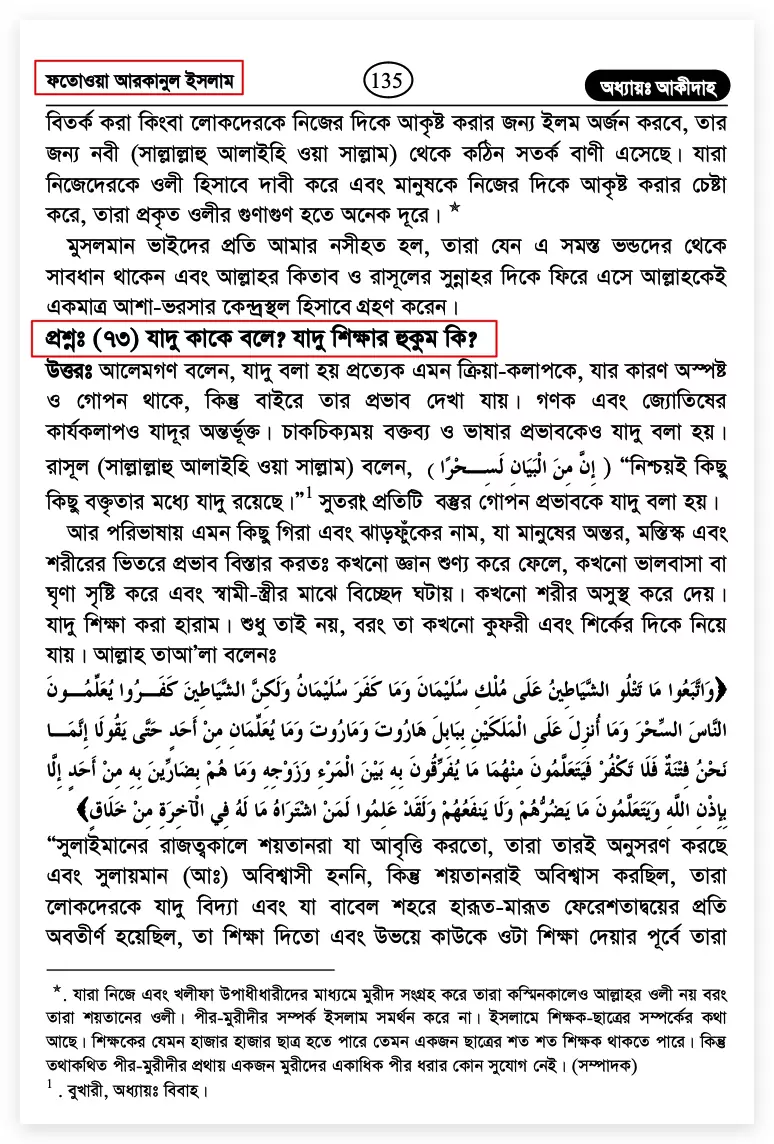
Let us now examine the ruling on this issue from Shaykh Muhammad ibn Salih al-Uthaymeen’s well-known collection of fatwas, Fatawa Arkan al-Islam, [4]
Question (73): What is magic? What is the ruling on learning magic?
Answer: The scholars say that magic refers to every act whose cause is obscure and hidden while its effect is outwardly visible. The activities of soothsayers and astrologers are also included within magic. The captivating effect of eloquent speech and language is likewise called magic. The Messenger said: إِنَّ مِنَ الْبَيَانِ لَسِحرًا — “Indeed, some eloquence is magic.” Thus, every hidden influence may be described as magic. In technical usage, however, magic refers to knots and incantations that affect the heart, mind and body of a person, sometimes depriving a person of awareness, sometimes creating love or hatred and causing separation between husband and wife, and sometimes making the body ill. Learning magic is forbidden. More than that, it may lead to disbelief and shirk.
Allah says:
وَاتَّبَعُوا مَا تَتْلُو الشَّيَاطِينُ عَلَى مُلْكِ سُلَيْمَانَ وَمَا كَفَرَ سُلَيْمَانُ وَلَكِنَّ الشَّيَاطِينَ كَفَرُوا يُعَلِّمُونَ النَّاسَ السِّحْرَ وَمَا أُنزِلَ عَلَى الْمَلَكَيْنِ بِبَابِلَ هَارُوتَ وَمَارُوتَ وَمَا يُعَلِّمَانِ مِنْ أَحَدٍ حَتَّى يَقُولَا إِنَّمَا نَحْنُ فِتْنَةٌ فَلَا تَكْفُرْ فَيَتَعَلَّمُونَ مِنْهُمَا مَا يُفَرِّقُونَ بِهِ بَيْنَ الْمَرْءِ وَزَوْجِهِ وَمَا هُمْ بِضَارِّينَ بِهِ مِنْ أَحَدٍ إِلَّا بِإِذْنِ اللَّهِ وَيَتَعَلَّمُونَ مَا يَضُرُّهُمْ وَلَا يَنفَعُهُمْ وَلَقَدْ عَلِمُوا لَمَنْ اشْتَرَاهُ مَا لَهُ فِي الْآخِرَةِ مِنْ خَلَاقٍ)
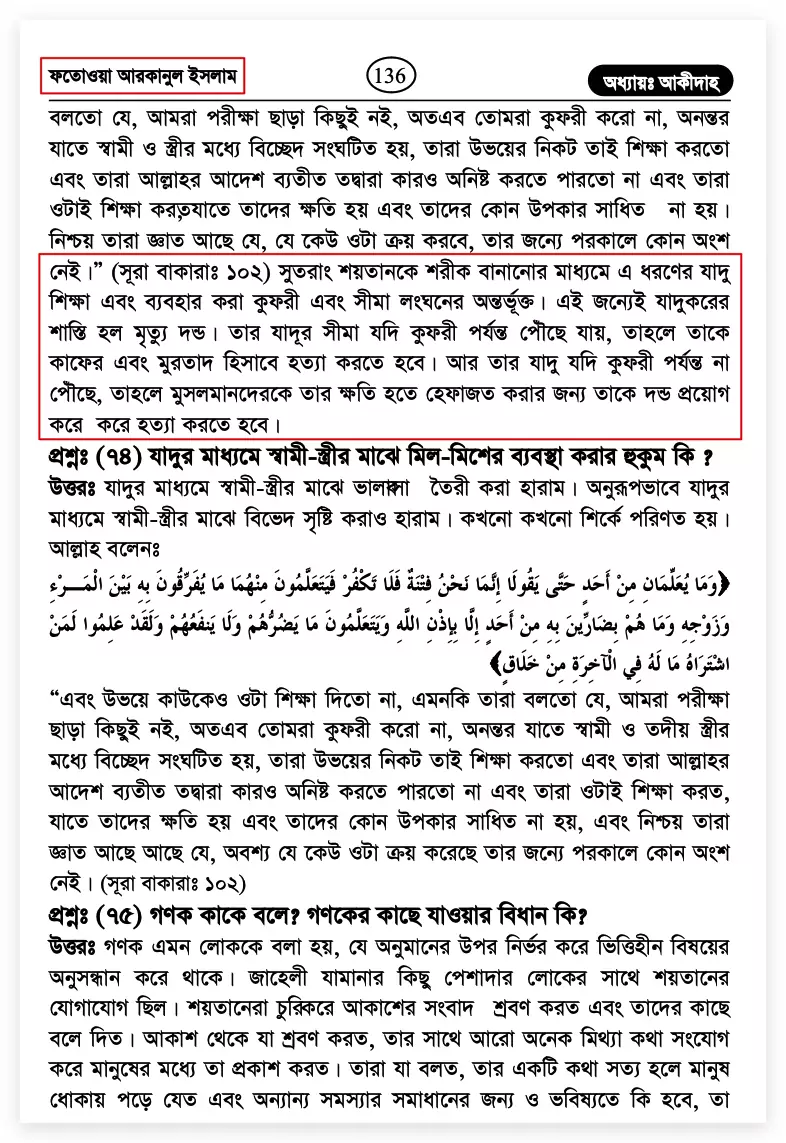
“They followed what the devils recited during the reign of Solomon. Solomon did not disbelieve, but the devils disbelieved, teaching people magic and what had been sent down to the two angels at Babylon, Harut and Marut. Yet these two would not teach anyone without first saying, ‘We are only a trial, so do not disbelieve.’ They learned from them what could cause separation between a man and his wife, although they could harm no one with it except by Allah’s permission. They learned what harmed them and did not benefit them. They certainly knew that whoever purchased it would have no share in the Hereafter.” (Surah al-Baqarah 2:102)
Therefore, learning and practicing this kind of magic through association with Satan constitutes disbelief and transgression. For this reason, the punishment of the sorcerer is death. If his magic reaches the level of disbelief, he is to be killed as a disbeliever and apostate. And if his magic does not reach the level of disbelief, he is nevertheless to be killed as a punishment in order to protect Muslims from his harm.
Those who gather disciples for themselves or through people bearing the title of khalifa can never be friends of Allah; rather, they are friends of Satan. The pir-murid relationship is not supported by Islam. Islam recognizes a teacher-student relationship. Just as a teacher may have thousands of students, a student may have hundreds of teachers. But under the so-called pir-murid system, a disciple has no opportunity to take more than one pir. (Editor)
Bukhari, Chapter: Marriage.
Islamic Sharia on Magic and Sorcerers
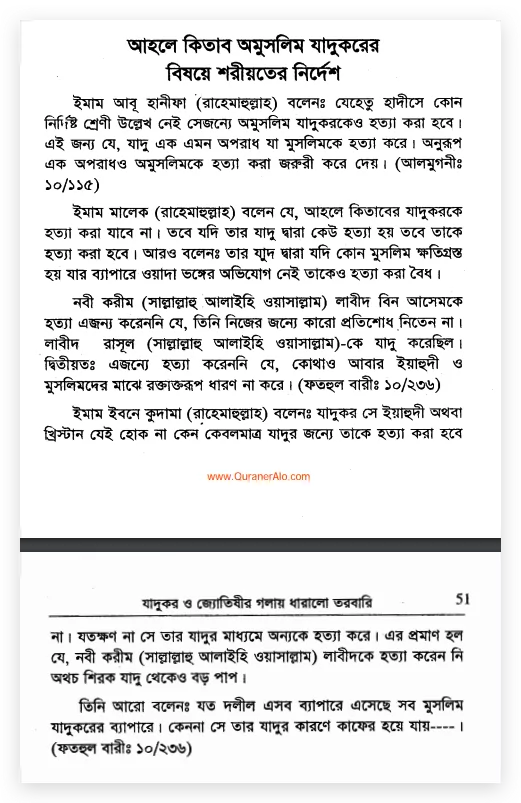
Let us examine what Islamic Sharia says regarding Jewel Aich, P. C. Sorcar and David Copperfield. Since they are non-Muslims, the question is whether the rulings of Islamic Sharia would apply to them. The book A Sharp Sword at the Throat of the Sorcerer and Astrologer – The Ruling on Magic in Islam states on pages 50–51, [5] –
The Sharia Ruling Concerning a Non-Muslim Sorcerer from the People of the Book
Imam Abu Hanifa says: Since the hadith does not specify any particular category, a non-Muslim sorcerer is also to be killed. This is because sorcery is an offence that makes the killing of a Muslim necessary; similarly, the same offence makes the killing of a non-Muslim necessary. (Al-Mughni 10/115)
Imam Malik says that a sorcerer from the People of the Book is not to be killed merely for being a sorcerer. However, if someone is killed through his sorcery, he is to be killed. He further states that if through his sorcery a Muslim is harmed by a person who has no accusation of violating his covenant, it is also permissible to kill him.
The Prophet did not kill Labid ibn al-A‘sam because he did not take revenge for himself. Labid had bewitched the Messenger. Secondly, he was not killed out of concern that the matter might lead to bloodshed between the Jews and the Muslims. (Fath al-Bari 10/236)
Imam Ibn Qudamah says: Whether the sorcerer is a Jew or a Christian, he is not to be killed merely for sorcery unless he kills someone by means of his sorcery. The evidence for this is that the Prophet did not kill Labid, although shirk is a greater sin than sorcery.
He further says: All the proofs transmitted on this matter concern the Muslim sorcerer, because through his sorcery he becomes a disbeliever. (Fath al-Bari 10/236)
A State Order During the Caliphate: Umar’s Letter
The ruling requiring the killing of sorcerers cannot be treated merely as a theoretical opinion formulated by later jurists. Reports from Umar’s caliphate describe the central ruler sending a written order to subordinate officials commanding the killing of sorcerers. In Sunan Abi Dawud 3043, Bajalah states that a letter from Umar reached them one year before Umar’s death, ordering them to kill every sorcerer. In the same report, Bajalah states that, in implementation of this order, they killed three sorcerers in a single day. Sunnah.com lists the narration as Sahih according to al-Albani. [6]
Reference : Sunan Abi Dawud 3043
In-book reference : Book 20, Hadith 116
English translation : Book 19, Hadith 3037
Tribute, Spoils, and Rulership (Kitab Al-Kharaj, Wal-Fai’ Wal-Imarah)
(1119)Chapter: Levying Jizyah On The Zoroastrians(31)باب فِي أَخْذِ الْجِزْيَةِ مِنَ الْمَجُوسِ
Narrated Umar ibn al-Khattab:
Amr ibn Aws and AbulSha’tha’ reported that Bujalah said: I was secretary to Jaz’ ibn Mu’awiyah, the uncle of Ahnaf ibn Qays.
A letter came to us from Umar one year before his death, saying: Kill every magician, separate the relatives of prohibited degrees from the Magians, and forbid them to murmur (before eating). So we killed three magicians in one day, and separated from a Magian husband his wife of a prohibited degree according to the Book of Allah.
He prepared abundant food and called them, and placed the sword on his thigh. They ate (the food) but did not murmur. They threw (on the ground) one or two mule-loads of silver. Umar did not take jizyah from Magians until AbdurRahman ibn Awf witnessed that the Messenger of Allah (ﷺ) had taken jizyah from the Magians of Hajar.
حَدَّثَنَا مُسَدَّدُ بْنُ مُسَرْهَدٍ، حَدَّثَنَا سُفْيَانُ، عَنْ عَمْرِو بْنِ دِينَارٍ، سَمِعَ بَجَالَةَ، يُحَدِّثُ عَمْرَو بْنَ أَوْسٍ وَأَبَا الشَّعْثَاءِ قَالَ كُنْتُ كَاتِبًا لِجَزْءِ بْنِ مُعَاوِيَةَ عَمِّ الأَحْنَفِ بْنِ قَيْسٍ إِذْ جَاءَنَا كِتَابُ عُمَرَ قَبْلَ مَوْتِهِ بِسَنَةٍ اقْتُلُوا كُلَّ سَاحِرٍ وَفَرِّقُوا بَيْنَ كُلِّ ذِي مَحْرَمٍ مِنَ الْمَجُوسِ وَانْهَوْهُمْ عَنِ الزَّمْزَمَةِ فَقَتَلْنَا فِي يَوْمٍ ثَلاَثَةَ سَوَاحِرَ وَفَرَّقْنَا بَيْنَ كُلِّ رَجُلٍ مِنَ الْمَجُوسِ وَحَرِيمِهِ فِي كِتَابِ اللَّهِ وَصَنَعَ طَعَامًا كَثِيرًا فَدَعَاهُمْ فَعَرَضَ السَّيْفَ عَلَى فَخِذِهِ فَأَكَلُوا وَلَمْ يُزَمْزِمُوا وَأَلْقَوْا وِقْرَ بَغْلٍ أَوْ بَغْلَيْنِ مِنَ الْوَرِقِ وَلَمْ يَكُنْ عُمَرُ أَخَذَ الْجِزْيَةَ مِنَ الْمَجُوسِ حَتَّى شَهِدَ عَبْدُ الرَّحْمَنِ بْنُ عَوْفٍ أَنَّ رَسُولَ اللَّهِ صلى الله عليه وسلم أَخَذَهَا مِنْ مَجُوسِ هَجَرَ .
صحيح خ بعضه مجوس هجر (الألباني) حكم :
This is therefore not merely a religious opinion; the same report contains both a written administrative order from the caliph and actual killings carried out pursuant to that order. The rule requiring the killing of sorcerers had thus already reached the level of state enforcement in the earliest period of Islam.
The Killing of Hafsa’s Slave-Girl
The Muwatta of Malik directly reports that Hafsa had one of her slave-girls killed because the woman was accused of having used sorcery against her. After narrating the incident, Malik himself states that, in his opinion, a person who personally practices sorcery is to be killed. The report was therefore not merely preserved as a historical incident; Malik also connected it explicitly with the jurisprudential position that a sorcerer is subject to execution. [7]
Muwatta Malik
Blood-Money
Yahya related to me from Malik from Muhammad ibn Abd ar-Rahman ibn Sad ibn Zurara that he had heard that Hafsa, the wife of the Prophet, may Allah bless him and grant him peace, killed one of her slave-girls who had used sorcery against her. She was a mudabbara. Hafsa gave the order, and she was killed.
Malik said, “The sorcerer is the one who uses sorcery for himself and no one else uses that for him. It is like the one about whom Allah, the Blessed, the Exalted, said in His Book, ‘They know the one who devotes himself to it will have no share in the Next World.’ (Sura 2 ayat 102) I think that that person is killed if he does that himself.”
وَحَدَّثَنِي يَحْيَى، عَنْ مَالِكٍ، عَنْ مُحَمَّدِ بْنِ عَبْدِ الرَّحْمَنِ بْنِ سَعْدِ بْنِ زُرَارَةَ، أَنَّهُ بَلَغَهُ أَنَّ حَفْصَةَ، زَوْجَ النَّبِيِّ صلى الله عليه وسلم قَتَلَتْ جَارِيَةً لَهَا سَحَرَتْهَا وَقَدْ كَانَتْ دَبَّرَتْهَا فَأَمَرَتْ بِهَا فَقُتِلَتْ . قَالَ مَالِكٌ السَّاحِرُ الَّذِي يَعْمَلُ السِّحْرَ وَلَمْ يَعْمَلْ ذَلِكَ لَهُ غَيْرُهُ هُوَ مَثَلُ الَّذِي قَالَ اللَّهُ تَبَارَكَ وَتَعَالَى فِي كِتَابِهِ {وَلَقَدْ عَلِمُوا لَمَنِ اشْتَرَاهُ مَا لَهُ فِي الآخِرَةِ مِنْ خَلاَقٍ} فَأَرَى أَنْ يُقْتَلَ ذَلِكَ إِذَا عَمِلَ ذَلِكَ هُوَ نَفْسُهُ .
USC-MSA web (English) reference : Book 43, Hadith 14
Arabic reference : Book 43, Hadith 1594
Ibn Abi Shaybah’s al-Musannaf preserves an even more important detail concerning the same incident. It states that when the event reached Uthman, he objected; however, the narrator explicitly explains that the reason for his objection was that the woman had been killed without the caliph’s authorization. According to the wording of this report, therefore, the objection was not to the principle of executing someone accused of sorcery, but to carrying out the execution without state authorization. [8]
ما قالوا في الساحر ، ما يصنع به ؟
( 1 ) حدثنا أبو بكر قال حدثنا معاذ بن معاذ قال أخبرنا أشعث عن الحسن أنه قال : يقتل السحار ولا يستتابوا .
( 2 ) حدثنا أبو بكر قال حدثنا يحيى بن سعيد عن سفيان عن أبي إسحاق عن حارثة بن مضرب أن جندبا قتل ساحرا أو أراد أن يقتله .
( 3 ) حدثنا أبو بكر قال حدثنا ابن عيينة عن عمرو عن سالم عن قيس بن سعد أنه قتل ساحرا .
( 4 ) حدثنا أبو بكر قال حدثنا أبو داود الطيالسي عن همام عن يحيى أن عامل عمان كتب إلى عمر بن عبد العزيز في ساحرة أخذها ، فكتب إليه عمر : إن اعترفت أو قامت عليها البينة فاقتلها .
( 5 ) حدثنا أبو بكر قال حدثنا عبدة بن سليمان عن عبيد الله عن نافع عن ابن عمر أن جارية لحفصة سحرتها ، ووجدوا سحرها ، واعترفت به ، فأمر عبد الرحمن بن زيد فقتلها فبلغ ذلك عثمان فأنكره واشتد عليه ، فأتاه ابن عمر فأخبره أنها سحرتها واعترفت به ووجدوا سحرها فكان عثمان إنما أنكر ذلك لأنها قتلت بغير إذنه .
( 6 ) حدثنا أبو بكر قال حدثنا معتمر بن سليمان عن زيد أبي المعلى قال : حدثني شرطي لسنان بن سلمة أن سنانا أتي بساحرة ، فأمر بها أن تلقى في البحر .
( 7 ) حدثنا أبو بكر قال حدثنا ابن عيينة عن عمرو وسمع بجالة يقول : كنت كاتبا لجزء بن معاوية ، فأتانا كتاب عمر بن الخطاب أن اقتلوا كل ساحر وساحرة ، قال : فقتلنا ثلاث سواحر .
( 8 ) حدثنا أبو بكر قال حدثنا الثقفي عن المثنى عن عمرو بن شعيب عن سعيد بن المسيب في الساحر إذا اعترف يقتل .
( 9 ) حدثنا أبو بكر قال حدثنا يحيى بن سعيد عن عمرو عن الحسن في الساحر قال : يقتل .
English translation:
What they said concerning the sorcerer: What should be done with him?
(1) Abu Bakr narrated to us, saying: Mu‘adh ibn Mu‘adh narrated to us; he said: Ash‘ath informed us from al-Hasan that he said: Sorcerers are to be killed and are not to be asked to repent.
(2) Abu Bakr narrated to us, saying: Yahya ibn Sa‘id narrated to us from Sufyan, from Abu Ishaq, from Harithah ibn Mudarrib, that Jundub killed a sorcerer, or intended to kill him.
(3) Abu Bakr narrated to us, saying: Ibn ‘Uyaynah narrated to us from ‘Amr, from Salim, from Qays ibn Sa‘d, that he killed a sorcerer.
(4) Abu Bakr narrated to us, saying: Abu Dawud al-Tayalisi narrated to us from Hammam, from Yahya, that the governor of Oman wrote to Umar ibn Abd al-Aziz concerning a female sorcerer whom he had apprehended. Umar wrote back to him: “If she confesses or evidence is established against her, then kill her.”
(5) Abu Bakr narrated to us, saying: ‘Abdah ibn Sulayman narrated to us from ‘Ubayd Allah, from Nafi‘, from Ibn Umar, that a slave-girl belonging to Hafsa bewitched her. They found the object of her sorcery, and she confessed to it. Hafsa then ordered Abd al-Rahman ibn Zayd, and he killed her. When this reached Uthman, he objected strongly. Ibn Umar then came to him and informed him that the slave-girl had bewitched Hafsa, had confessed to it, and that the object of her sorcery had been found. Uthman’s objection was only because she had been killed without his authorization.
(6) Abu Bakr narrated to us, saying: Mu‘tamir ibn Sulayman narrated to us from Zayd Abu al-Mu‘alla, who said: A guard of Sinan ibn Salamah told me that a female sorcerer was brought to Sinan, and he ordered that she be thrown into the sea.
(7) Abu Bakr narrated to us, saying: Ibn ‘Uyaynah narrated to us from ‘Amr, and he heard Bajalah say: I was secretary to Jaz’ ibn Mu‘awiyah. Then a letter from Umar ibn al-Khattab reached us: “Kill every male and female sorcerer.” Bajalah said: We then killed three female sorcerers.
(8) Abu Bakr narrated to us, saying: al-Thaqafi narrated to us from al-Muthanna, from ‘Amr ibn Shu‘ayb, from Sa‘id ibn al-Musayyab concerning a sorcerer, that if the sorcerer confesses, he is to be killed.
(9) Abu Bakr narrated to us, saying: Yahya ibn Sa‘id narrated to us from ‘Amr, from al-Hasan concerning the sorcerer. He said: He is to be killed.
Jundub Kills a Man Performing a “Game” Before an Audience
This incident is particularly important because it does not concern an accusation of secret sorcery. Rather, a man was publicly performing a “game” before an audience in which he appeared to sever a person’s head and then restore it. In al-Bukhari’s al-Tarikh al-Kabir, the man is directly described with the words “rajulun yal‘ab”—“a man was performing a game.” Jundub then came and killed him. Thus, an early Muslim source preserves an actual precedent in which a public display of an astonishing trick or performance was treated as sihr and the performer was killed. [9]
كَانَ عِنْدَ الْوَلِيدِ رَجُلٌ يَلْعَبُ فَذَبَحَ إِنْسَانًا وَأَبَانَ رَأْسَهُ فَعَجِبْنَا فَأَعَادَ رَأْسَهُ فَجَاءَ جُنْدُبٌ الْأَزْدِيُّ فَقَتَلَهُ
English translation: There was a man in the presence of al-Walid performing a game. He cut off a man’s head and separated it from his body, astonishing us, and then restored his head. Jundub al-Azdi then came and killed him.
The Order to Kill a Female Sorcerer During the Caliphate of Umar ibn Abd al-Aziz
This policy was not limited to a few isolated incidents from the Rashidun period. Ibn Abi Shaybah’s al-Musannaf reports that when the governor of Oman wrote to Caliph Umar ibn Abd al-Aziz concerning an accused female sorcerer, he ordered that if the woman confessed or evidence was established against her, she was to be killed. This provides another direct example of the same death-penalty policy operating at an administrative level under the Umayyad Caliphate. [8]
إِنْ اعْتَرَفَتْ أَوْ قَامَتْ عَلَيْهَا الْبَيِّنَةُ فَاقْتُلْهَا
English translation: If she confesses or evidence is established against her, then kill her.
Hanafi Jurisprudence: Execution Even When No One Is Killed by the Sorcery
The assumption that a sorcerer could be executed only when someone had actually died as a result of the sorcery is also incorrect with regard to Hanafi jurisprudence. The Hanafi jurist Abu Bakr al-Jassas, while explaining Abu Hanifa’s position in Ahkam al-Qur’an, explicitly writes that the sorcerer has committed disbelief through his sorcery; whether or not he kills anyone by means of it, he becomes liable to execution because of that disbelief. In the same discussion, he attributes to Abu Hanifa the position that the sorcerer is to be killed and that his repentance is not accepted. [10]
وَأَمَّا السَّاحِرُ فَقَدْ كَفَرَ بِسِحْرِهِ قَتَلَ بِهِ أَوْ لَمْ يَقْتُلْ فَاسْتَحَقَّ الْقَتْلَ بِكُفْرِهِ
English translation: As for the sorcerer, he has disbelieved through his sorcery; whether he kills by means of it or does not kill, he has become deserving of death because of his disbelief.
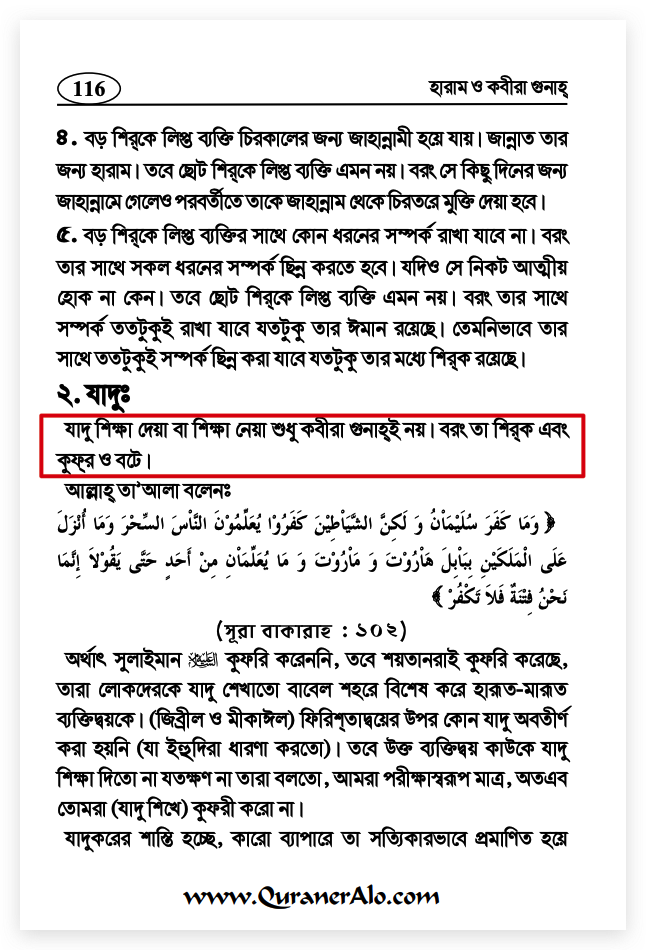
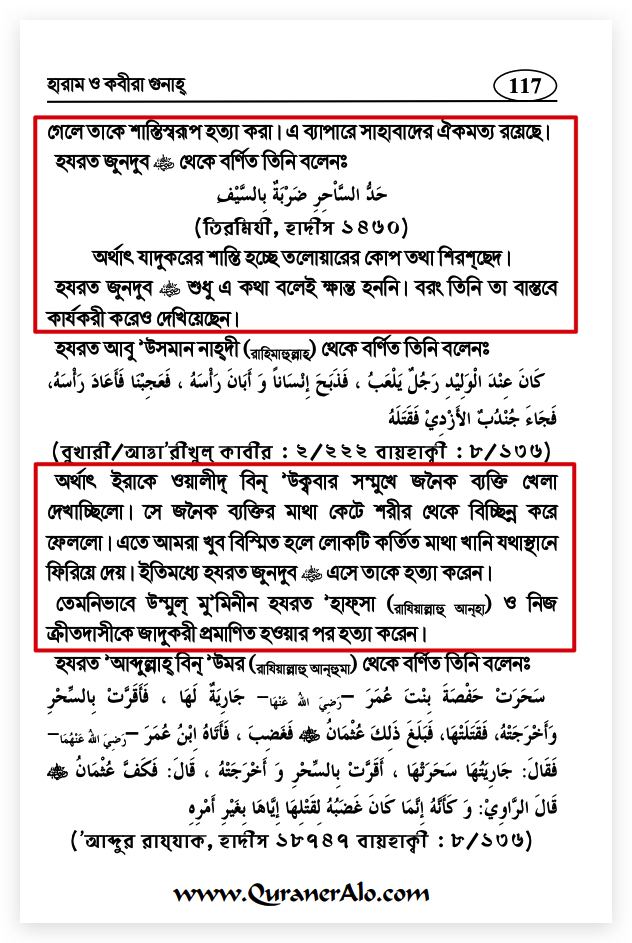
Let us now read an excerpt from Haram and Major Sins by Mostafizur Rahman ibn Abdul Aziz al-Madani, [11]
Teaching or learning magic is not merely a major sin. Rather, it is also shirk and disbelief. Allah says:
«وَمَا كَفَرَ سُلَيْمَاْنُ وَلَكِنَّ الشَّيَاْطِيْنَ كَفَرُوْا يُعَلِّمُوْنَ النَّاْسَ السِّحْرَ وَمَا أُنْزَلَ عَلَى الْمَلَكَيْنِ بِبَاْبِلَ هَاْرُوْتَ وَمَاْرُوْتَ وَمَا يُعَلِّمَاْنِ مِنْ أَحَدٍ حَتَّى يَقُوْلَا إِنَّمَا نَحْنُ فِتْنَةٌ فَلَا تَكْفُرْ»
“Solomon did not disbelieve; rather, the devils disbelieved. They taught people magic, particularly in Babylon in connection with Harut and Marut. No magic had been revealed to the two angels (Jibril and Mika’il), as the Jews believed. But those two would not teach anyone magic until they said: We are only a trial, so do not disbelieve by learning magic.”
(Surah al-Baqarah 2:102)
The punishment of the sorcerer is that, once it has genuinely been established against him, he is to be killed as punishment. There is consensus among the Companions on this matter.
It is narrated from Jundub that he said:
حَدُّ السَّاْحِرِ ضَرْبَةٌ بِالسَّيْفِ.
“The punishment of the sorcerer is a strike with the sword, that is, beheading.”
(Tirmidhi 1460)
Jundub did not merely state this. He also implemented it in practice.
Abu Uthman al-Nahdi narrated:
كَانَ عِنْدَ الْوَلِيْدِ رَجُلٌ يَلْعَبُ، فَذَبَحَ إِنْسَانًا وَأَبَانَ رَأْسَهُ، فَعَجِبْنَا فَأَعَادَ رَأْسَهُ، فَجَاءَ جُنْدُبٌ الْأَزْدِيْ فَقَتَلَهُ.
“In Iraq, a man was performing a game before al-Walid ibn Uqbah. He cut off a man’s head and separated it from his body. We were greatly astonished, and the man then restored the severed head to its place. Meanwhile Jundub al-Azdi arrived and killed him.” (al-Bukhari, al-Tarikh al-Kabir 2/222; al-Bayhaqi 8/136)
Likewise, Umm al-Mu’minin Hafsa also had her own slave-girl killed after she was found to have practiced sorcery.
It is narrated from Abdullah ibn Umar that he said:
سَحَرَتْ حَفْصَةَ بِنْتَ عُمَرَ ـ رَضِيَ اللهُ عَنْهَا ـ جَارِيَةٌ لَهَا، فَأَقَرَّتْ بِالسِّحْرِ وَأَخْرَجَتْهُ، فَقَتَلَتْهَا، فَبَلَغَ ذَلِكَ عُثْمَانُ فَغَضِبَ، فَأَتَاهُ اِبْنُ عُمَرَ ـ رَضِيَ اللهُ عَنْهَا ـ فَقَالَ: جَارِيَتُهَا سَحَرَتْهَا، أَقَرَّتْ بِالسِّحْرِ وَأَخْرَجَتْهُ، قَالَ: فَكَفَّ عُثْمَانُ قَالَ الرَّاوِيْ: وَكَأَنَّهُ إِنَّمَا كَانَ غَضَبُهُ لِقَتْلِهَا إِيَّاهَا بِغَيْرِ أَمْرِهِ.
“One of the slave-girls of Hafsa bint Umar bewitched her. The slave-girl even confessed to the matter and produced the object used in the sorcery. For this reason Hafsa had the slave-girl killed. When the news reached Uthman, he became extremely angry. Abdullah ibn Umar then came to him and explained the matter. Uthman then ceased his objection. The narrator says: Uthman’s anger appears to have been because the slave-girl had been killed without his authorization.”
(Abd al-Razzaq, Hadith 18747; al-Bayhaqi 8/136)
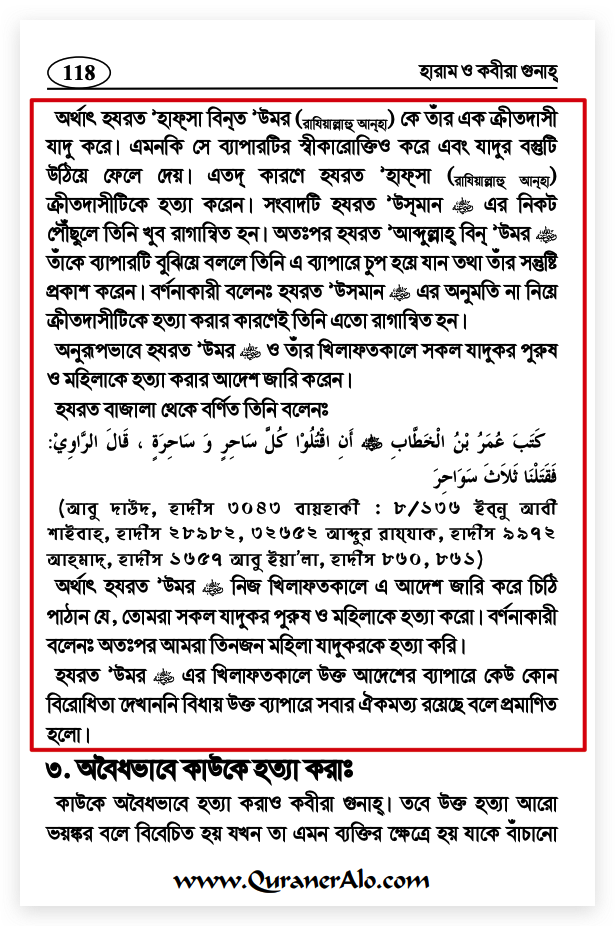
Similarly, during his caliphate Umar ordered all male and female sorcerers to be killed.
It is narrated from Bajalah that he said:
كَتَبَ عُمَرُ بْنُ الْـخَطَّابِ أَنِ اقْتُلُوْا كُلَّ سَاحِرٍ وَسَاحِرَةٍ، قَالَ الرَّاوِيْ: فَقَتَلْنَا ثَلَاثَ سَوَاحِرَ.
“During his caliphate Umar sent a written order saying: Kill every male and female sorcerer. The narrator says: We then killed three female sorcerers.”
(Abu Dawud 3043; al-Bayhaqi 8/136; Ibn Abi Shaybah, Hadith 28982, 32652; Abd al-Razzaq, Hadith 9972; Ahmad 1657; Abu Ya‘la 860, 861)
Since no one is reported to have opposed this order during Umar’s caliphate, this proves consensus on the matter.
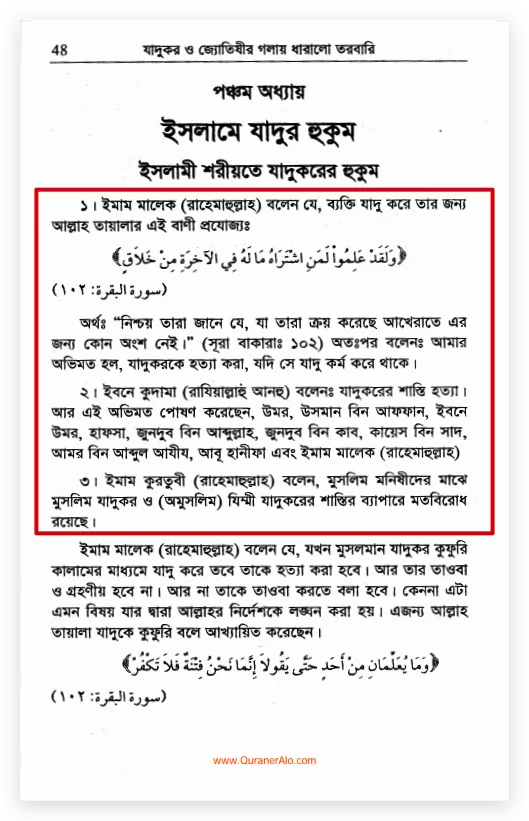
Let us again read from A Sharp Sword at the Throat of the Sorcerer and Astrologer – The Ruling on Magic in Islam. Pages 48–49 state, [12] –
1. Imam Malik says that the following statement of Allah applies to the person who practices magic:
وَلَقَدْ عَلِمُوا لَمَنِ اشْتَرَاهُ مَا لَهُ فِي الْآخِرَةِ مِنْ خَلَاقٍ
Meaning: “They certainly knew that whoever purchased it would have no share in the Hereafter.” (Surah al-Baqarah 2:102) He then says: My opinion is that the sorcerer should be killed if he has practiced sorcery.
2. Ibn Qudamah says: The punishment of the sorcerer is death. This opinion was held by Umar, Uthman ibn Affan, Umar ibn Abd al-Aziz, Abu Hanifa and Imam Malik.
3. Imam al-Qurtubi says that Muslim scholars differed concerning the punishment of a Muslim sorcerer and a non-Muslim dhimmi sorcerer.
Imam Malik says that when a Muslim sorcerer practices magic using words of disbelief, he is to be killed. His repentance is not accepted, nor is he to be asked to repent, because this is an act by which the command of Allah is violated. For this reason Allah described magic as disbelief.
وَمَا يُعَلِّمَانِ مِنْ أَحَدٍ حَتَّىٰ يَقُولَا إِنَّمَا نَحْنُ فِتْنَةٌ فَلَا تَكْفُرْ
Meaning: “They would not teach anyone magic until they said: We are only a trial, so do not disbelieve by learning magic.” (Surah al-Baqarah 2:102)
This opinion was also held by Imam Ahmad ibn Hanbal, Abu Thawr, Ishaq and Abu Hanifa.
4. Imam Ibn al-Mundhir says that when a person admits that he practiced magic using words of disbelief, it becomes obligatory to kill him if he has not repented. Likewise, if his disbelief is established by evidence and testimony, it is obligatory to kill him. If, however, his words do not constitute disbelief, it is not permissible to kill him. If a sorcerer kills someone through his sorcery, he is also to be killed; and if he kills accidentally, blood money must be paid.
5. Hafiz Ibn Kathir says that scholars have cited the following verse of Allah regarding sorcerers:
وَلَوْ أَنَّهُمْ آمَنُوا وَاتَّقَوْا
Meaning: “If only they had believed and feared Allah.” Many scholars therefore inferred from this verse that the sorcerer is a disbeliever. Others held that although he is not a disbeliever, his punishment is nevertheless beheading. Imam al-Shafi‘i and Ahmad ibn Hanbal narrated that they heard Bajalah ibn Abd say that Umar ibn al-Khattab issued an order that every male and female sorcerer should be beheaded. He said that they killed three female sorcerers. Ibn Kathir states that Imam al-Bukhari narrated it in this form. (Bukhari 2/257)
Ibn Kathir says that an authentic report from Hafsa states that one of her female companions practiced sorcery against her, after which the sorcerer was killed on Hafsa’s order.
It is narrated from Imam Ahmad that the ruling to kill a sorcerer is reported from three of the Prophet’s Companions. (Tafsir Ibn Kathir 1/144)
In summary, the preceding discussion shows that, apart from Imam al-Shafi‘i, the majority of scholars held that the sorcerer should be killed. Al-Shafi‘i held that if someone dies as a result of the sorcerer’s magic, the sorcerer is to be killed in retaliation.
Modern Case Studies: State Executions for Alleged “Witchcraft”
Execution for alleged witchcraft was not confined to an extinct medieval legal system. On December 12, 2011, Amina bint Abdul Halim bin Salem Nasser was executed in Saudi Arabia’s al-Jawf region on charges of sihr wa sha‘wadhah, or magic and sorcery. According to a statement by the Saudi Ministry of Interior, the charges against her were established before a Sharia court, she was sentenced to death as a discretionary punishment, the judgment was upheld at higher judicial levels, and the execution was subsequently carried out. [13]
صَدَرَ بِحَقِّهَا صَكٌّ شَرْعِيٌّ يَقْضِي بِثُبُوتِ مَا نُسِبَ إِلَيْهَا شَرْعًا وَالْحُكْمِ عَلَيْهَا بِقَتْلِهَا تَعْزِيرًا
English translation: A Sharia judgment was issued against her, establishing under Sharia the charges attributed to her and sentencing her to death as a discretionary punishment.
The following year, on June 19, 2012, Muree bin Ali bin Issa al-Asiri was beheaded in Najran, Saudi Arabia. According to the U.S. Department of State’s 2012 International Religious Freedom Report, he was accused of “practicing witchcraft and sorcery” and possessing written talismans; after the sentence was upheld at the highest judicial level, the execution was carried out. Thus, the classical Sharia concept of treating magic as an actual criminal offence punishable by death has also left documented examples of enforcement within a modern state judicial system. [14]
On June 19, Muree bin Ali bin Issa al-Asiri was beheaded … for “practicing witchcraft and sorcery” and for owning “written talismans.”
English translation: On June 19, Muree bin Ali bin Issa al-Asiri was beheaded for “practicing witchcraft and sorcery” and for possessing “written talismans.”
Conclusion
The Islamic Sharia ruling requiring the killing of sorcerers is not merely a religious law; it is a direct challenge to the conscience and ethical standards of human civilization. A legal system that orders a person to be put to death on the basis of thoughts, beliefs, or allegations concerning supposed supernatural powers cannot reasonably be described as justice in civilized terms; it is brutality. It reflects the mentality of an age in which ignorance, fear and religious authority determined matters of life and death—not evidence, not reason, and not humanity.
Many interpretations of Islamic jurisprudence, particularly within the Hanafi, Maliki and Hanbali schools, declare the sahir, or sorcerer, a disbeliever and permit or require his execution—yet the very concept called “magic” remains, in the light of science and reason, an unsupported superstition for which no objective evidence exists. Authorizing the death penalty for an offence based on an unproven supernatural premise cannot be called justice in the court of reason; it is cruelty. And people who perform magic tricks simply to entertain others are not in fact committing any harm against anyone. How, then, could killing them merely for entertaining an audience be considered part of a civilized legal system?
More disturbing still, this rule is not confined to theoretical religious interpretation; in Islamic societies it has also been used as religious and legal authorization for killing people. Historically, numerous women were killed after being accused of “witchcraft,” and even in modern times this brutality has continued under religious fanaticism and legal systems operating in the name of Sharia. Modern concepts of human rights—including the rights to life, freedom of expression, freedom of thought and freedom of belief—are fundamentally incompatible with this Sharia ruling. In a civilized society, the state and the law cannot legitimately impose death sentences on the basis of superstition, rumor or religious fear. At the same time, the Islamic belief concerning magic raises questions about the foundations of Islam itself, an issue discussed in detail in this article.
A religious system that commands killing on the basis of blind belief rather than reason is not ethically sustainable; it stands in opposition to the development of human civilization. The Sharia ruling requiring the killing of sorcerers is therefore not merely a legal problem—it is a symbol of the conflict between civilization and superstition.
References
- Sahih al-Bukhari, Hadith 2652 ↩︎
- Sahih Muslim, Hadith 2533 ↩︎
- The Objective of Islamic Jihad: Offensive Jihad and Qital Must Continue Until Shirk Is Eradicated, Until the Day of Judgment ↩︎
- Fatawa Arkan al-Islam, Shaykh Muhammad ibn Salih al-Uthaymeen, pp. 135–136 ↩︎
- A Sharp Sword at the Throat of the Sorcerer and Astrologer – The Ruling on Magic in Islam, Baitus Salam Publications, Saudi Arabia, Wahid ibn Abdus Salam Bali, pp. 50–51 ↩︎
- Sunan Abi Dawud 3043 ↩︎
- Muwatta Malik, Book 43, Hadith 14 ↩︎
- Musannaf Ibn Abi Shaybah, Kitab al-Hudud 1 2
- Not Sahih al-Bukhari — Imam al-Bukhari, al-Tarikh al-Kabir, biography of Jundub ibn Ka‘b ↩︎
- Al-Jassas, Ahkam al-Qur’an — Bab al-Ikhtilaf fi Hukm al-Sahir ↩︎
- Haram and Major Sins, Mostafizur Rahman ibn Abdul Aziz al-Madani, pp. 116–118 ↩︎
- A Sharp Sword at the Throat of the Sorcerer and Astrologer – The Ruling on Magic in Islam, Baitus Salam Publications, Saudi Arabia, Wahid ibn Abdus Salam Bali, pp. 48–49 ↩︎
- Statement of the Saudi Ministry of Interior, Al Riyadh ↩︎
- U.S. Department of State, 2012 International Religious Freedom Report: Saudi Arabia ↩︎