Introduction
When religious emotion and devotion transform even a person’s urine into something sacred and supposedly curative, the conflict between that devotion and reason is no longer hidden. This is precisely the transformation found in the stories about drinking Muhammad’s urine: Muhammad would keep his urine in a vessel at night; a female Companion drank it; after learning what had happened, he assured her either that she would be free from abdominal pain or protected from the fire of Hell, thereby treating the act as beneficial rather than condemning it. The episode found its way into hadith and biographical literature, and later religious interpretation turned it into evidence for the special purity of the Prophet’s body. Here, a bodily waste product is judged not by its properties, but by whose body it came from. Muhammad’s status is extended so far that not only his words and actions but even his urine becomes an object of devotion; juristic works even record permission to use it medicinally.
The disturbing aspect of this belief is not merely the image of someone drinking urine. For a follower, his own urine is impure, while the urine of his religious leader is imagined to be pure and beneficial. Such a belief places the status of a person above any evidence-based judgment about the substance itself. Hopes of health and salvation then become attached to the leader’s body, and even the waste produced by that body becomes a question of obedience. The stories of Umm Ayman and Baraka, Qadi Iyad’s declaration that the report is authentic, and al-Buhuti’s permission to use the substance medicinally gave this belief a written doctrinal form. The view that Muhammad’s urine could be treated as pure is not an accusation invented outside the Islamic tradition; explicit support for it appears in the works of Qadi Iyad and al-Buhuti themselves. Attempting to change the nature of urine through religious reverence is an extreme expression of personality cult: there is no logical connection between a person’s status and miraculous properties allegedly possessed by his bodily waste.
Reports of Urinating into a Vessel Kept beneath the Bed
Sunan Abi Dawud reports through Umaimah bint Ruqaiqah that Muhammad kept a wooden vessel beneath his bed and would urinate into it at night. A urine vessel was therefore kept directly beneath his sleeping place. The chapter itself concerns a man urinating into a vessel at night and keeping it near him, and the quoted report directly specifies both the vessel’s location and its use. Muhammad Nasiruddin al-Albani graded the report “Hasan Sahih.” This hadith in Abu Dawud describes the storage of nighttime urine; later reports concerning Umm Ayman and Baraka connect the urine in such a vessel with claims of relief from illness and protection in the afterlife. Across these two layers, an ordinary bodily function is transformed into a source of the miraculous. [1]
حَدَّثَنَا مُحَمَّدُ بْنُ عِيسَى، حَدَّثَنَا حَجَّاجٌ، عَنِ ابْنِ جُرَيْجٍ، عَنْ حُكَيْمَةَ بِنْتِ أُمَيْمَةَ بِنْتِ رُقَيْقَةَ، عَنْ أُمِّهَا، أَنَّهَا قَالَتْ كَانَ لِلنَّبِيِّ صلى الله عليه وسلم قَدَحٌ مِنْ عَيْدَانٍ تَحْتَ سَرِيرِهِ يَبُولُ فِيهِ بِاللَّيْلِ.
English translation: Narrated Umaymah daughter of Ruqayqah: The Prophet (ﷺ) had a wooden vessel under his bed in which he would urinate at night.
Sunan an-Nasa’i likewise states that Muhammad would urinate into a wooden vessel and place it beneath the bed. In this report, Ibn Jurayj narrates from Hukaimah bint Umaimah, from her mother Umaimah bint Ruqaiqah; Abu Dawud preserves the same line of transmission. Although the report appears in two collections, these are not two independent eyewitness testimonies but versions of the same transmission line. The Nasa’i text contains no episode of anyone drinking the urine and no declaration of benefit from doing so. Sunnah.com lists the Darussalam grading as “Hasan.” This description of the vessel supplies the background to the later, longer narratives: urine was kept in the vessel during the night and the vessel was emptied in the morning. The later claims of laughter, freedom from illness, and protection from fire after the contents had been drunk became central to the theological argument for special bodily purity. [2]
أَخْبَرَنَا أَيُّوبُ بْنُ مُحَمَّدٍ الْوَزَّانُ، قَالَ حَدَّثَنَا حَجَّاجٌ، قَالَ قَالَ ابْنُ جُرَيْجٍ أَخْبَرَتْنِي حُكَيْمَةُ بِنْتُ أُمَيْمَةَ، عَنْ أُمِّهَا، أُمَيْمَةَ بِنْتِ رُقَيْقَةَ قَالَتْ كَانَ لِلنَّبِيِّ صلى الله عليه وسلم قَدَحٌ مِنْ عَيْدَانٍ يَبُولُ فِيهِ وَيَضَعُهُ تَحْتَ السَّرِيرِ.
English translation: It was narrated that Umaimah bint Ruqaiqah said: “The Prophet (ﷺ) had a vessel made from a date tree in which he would urinate and place it under the bed.”
Umm Ayman Drinks the Urine and Is Promised Relief from Abdominal Pain
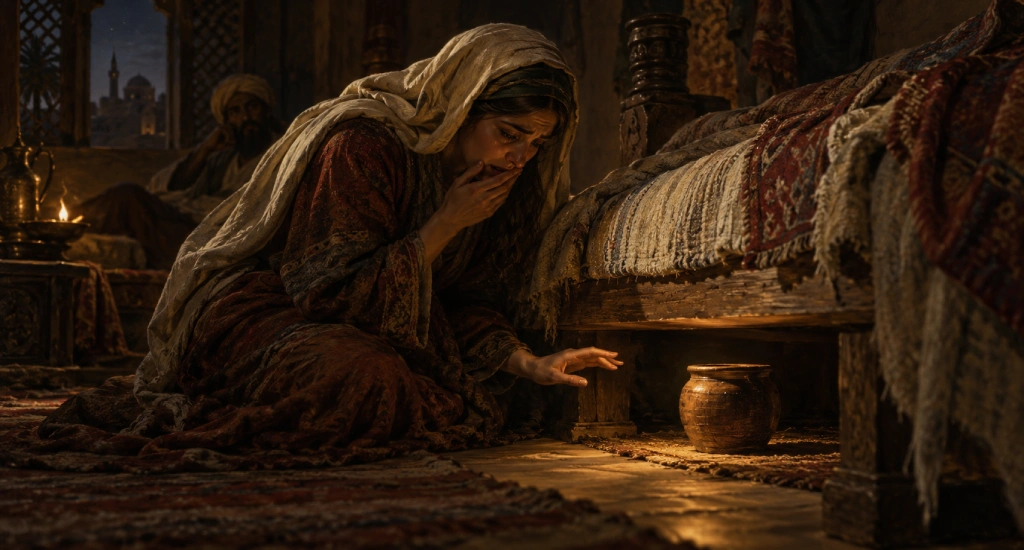
Al-Hakim’s al-Mustadrak preserves a report attributed to Umm Ayman about drinking the urine. In it, Muhammad rises at night and urinates into an earthenware vessel kept at one side of the house. Umm Ayman later wakes thirsty and, without realizing what is in the vessel, drinks its contents. In the morning, when Muhammad tells her to empty the vessel, she tells him that she has already drunk what was inside. His response is what turns the story into a claim of miraculous benefit: Muhammad laughs so broadly that his molar teeth are visible and assures her that her stomach will never hurt again. After Umm Ayman unknowingly drinks the urine, Muhammad’s laughter and promise of lifelong freedom from abdominal pain turn the accident into a narrative of approval and special benefit. The woman’s mistake thus becomes the basis for portraying his bodily waste as a source of miraculous healing. [3]
عن أم أيمن رضي الله عنها قالت: قام النبي صلى الله عليه وآله وسلم من الليل إلى فخارة من جانب البيت فبال فيها، فقمت من الليل وأنا عطشى فشربت من في الفخارة وأنا لا أشعر، فلما أصبح النبي صلى الله عليه وآله وسلم قال: «يا أم أيمن قومي إلى تلك الفخارة فأهريقي ما فيها» قلت: قد والله شربت ما فيها، قال: فضحك رسول الله صلى الله عليه وآله وسلم حتى بدت نواجذه ثم قال: «أما إنك لا يفجع بطنك بعده أبدا».
English translation: It is narrated from Umm Ayman that she said: The Prophet rose during the night and urinated into an earthenware vessel at one side of the house. I rose during the night while thirsty and drank what was in the vessel, without realizing what it was. In the morning the Prophet said, “Umm Ayman, go to that vessel and pour out what is in it.” I said, “By Allah, I have already drunk what was in it.” The Messenger of Allah then laughed until his molar teeth became visible, and said, “After this, your stomach will never suffer pain again.”
Ibn Kathir’s al-Bidaya wa’l-Nihaya, citing Abu Ya’la, contains a similar and longer account. In this version, Umm Ayman’s duty was to empty the urine from the vessel in the morning, and she explicitly says that she mistakenly drank its contents after waking thirsty. Muhammad’s statement after this accidental drinking is what gives the episode its religious significance: Umm Ayman is promised lifelong freedom from abdominal pain. A waste product that was supposed to be discarded in the morning is presented instead as the cause of miraculous benefit to the person who drank it. The narrative therefore makes a clear transition from the ordinary disposal of bodily waste to the alleged special benefit of ingesting it; the belief in the exceptional nature of Muhammad’s body is what makes that transition religiously acceptable. [4]
وقال الحافظ أبو يعلى: ثنا محمد بن أبي بكر المقدمي، ثنا سلم بن قتيبة، عن الحسين بن حريث، عن يعلى بن عطاء، عن الوليد بن عبد الرحمن، عن أم أيمن قالت: كان لرسول الله صلى الله عليه وسلم فخارة يبول فيها، فكان إذا أصبح يقول: «يا أم أيمن، صبي ما في الفخارة» فقمت ليلة وأنا عطشى فغلطت فشربت ما فيها، فقال رسول الله صلى الله عليه وسلم: «يا أم أيمن، صبي ما في الفخارة» فقالت: يا رسول الله صلى الله عليه وسلم قمت وأنا عطشى، فشربت ما فيها. فقال: «إنك لن تشتكي بطنك بعد يومك هذا أبدا».
English translation: Al-Hafiz Abu Ya’la said: Muhammad ibn Abi Bakr al-Muqaddami narrated to us; Salm ibn Qutaybah narrated to us, from al-Husayn ibn Hurayth, from Ya’la ibn ‘Ata’, from al-Walid ibn ‘Abd al-Rahman, from Umm Ayman, who said: The Messenger of Allah had an earthenware vessel in which he would urinate. In the morning he would say, “Umm Ayman, pour out what is in the vessel.” One night I woke thirsty and mistakenly drank what was in it. The Messenger of Allah said, “Umm Ayman, pour out what is in the vessel.” She said, “Messenger of Allah, I woke up thirsty, so I drank what was in it.” He said, “After this day, you will never suffer from abdominal pain again.”
Baraka’s Story and the Promise of Protection from Hellfire
Al-Bidaya wa’l-Nihaya contains another report in which a woman named Baraka drinks Muhammad’s urine. Ibn Kathir cites it from Ibn al-Athir’s al-Ghabah. In this account, Muhammad looks for the vessel kept beneath the bed and finds no urine in it; he is then told that Baraka drank it. A statement attributed to him follows: Baraka has placed a barrier between herself and the Fire. This claim goes even further than the promise of relief from abdominal pain, because drinking the urine is now linked to protection from punishment in the afterlife. The religious meaning of the story therefore turns bodily waste directly into a means of salvation. A substance that would ordinarily be discarded supposedly becomes beneficial when it comes from the Prophet; as the identity of the person changes, the religious value assigned to the substance is reversed as well. [5]
قال ابن الأثير في «الغابة»: وروى حجاج بن محمد، عن ابن جريج، عن حكيمة بنت أميمة، عن أمها أميمة بنت رقيقة قالت: كان للنبي صلى الله عليه وسلم قدح من عيدان يبول فيه، يضعه تحت السرير، فجاءت امرأة اسمها بركة فشربته، فطلبه فلم يجده، فقيل: شربته بركة. فقال: «لقد احتظرت من النار بحظار» قال الحافظ أبو الحسن بن الأثير: وقيل إن التي شربت بوله عليه الصلاة والسلام، إنما هي بركة الحبشية التي قدمت مع أم حبيبة من الحبشة. وفرق بينهما. فالله أعلم.
English translation: Ibn al-Athir said in al-Ghabah: Hajjaj ibn Muhammad narrated from Ibn Jurayj, from Hukaimah bint Umaimah, from her mother Umaimah bint Ruqaiqah, who said: The Prophet had a wooden vessel in which he urinated and which he placed beneath the bed. A woman named Baraka came and drank it. He looked for the vessel and did not find it, and he was told, “Baraka drank it.” He said, “You have placed a barrier between yourself and the Fire.” Al-Hafiz Abu al-Hasan Ibn al-Athir said: It has also been said that the woman who drank his urine was Baraka the Abyssinian, who came from Abyssinia with Umm Habiba. He distinguished between the two women. Allah knows best.
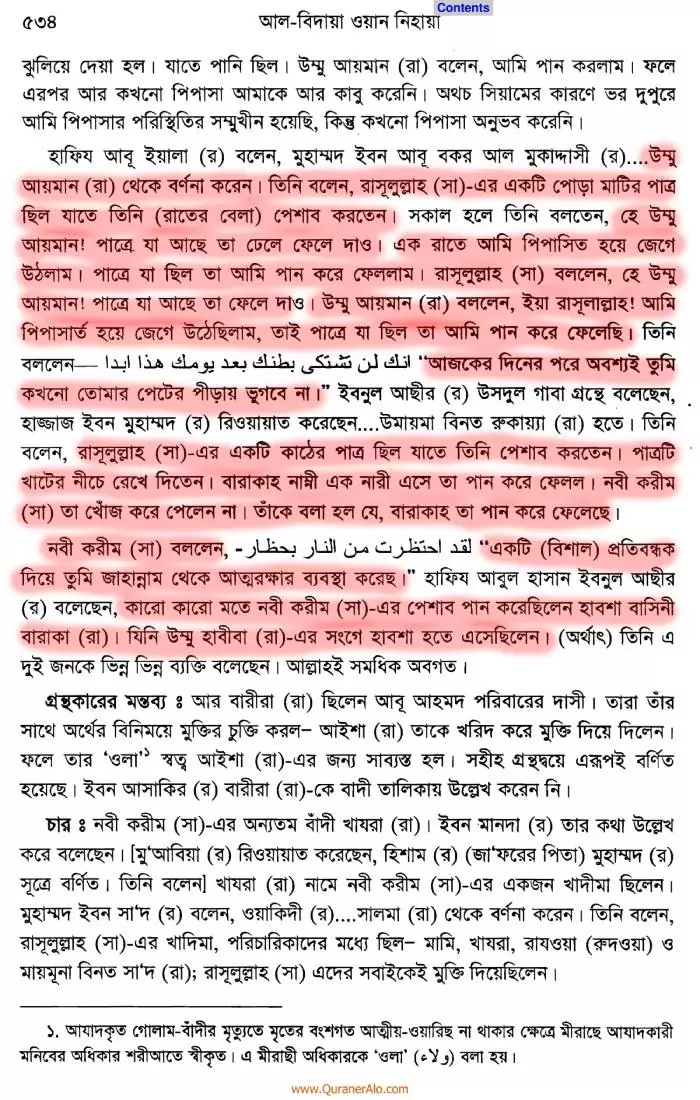
Because Umm Ayman’s name was also Baraka, the two identities could easily be conflated. Yet the discussion quoted by Ibn Kathir itself notes a distinction between the Baraka who came from Abyssinia with Umm Habiba and Umm Ayman, Muhammad’s attendant. The miraculous claims in the two reports also differ: one promises freedom from abdominal pain, while the other promises protection from the Fire. In the Bengali edition of al-Bidaya, a separate story immediately before the urine report describes a bucket of water descending from the sky and permanently relieving thirst; that event is not presented as an effect of drinking urine. The urine report appears on page 534 of volume five of the Islamic Foundation Bengali edition. What matters in the urine narratives is the promise of healing and protection from the Fire: the stories turn human bodily waste into an object of devotion and a purported means of salvation.
Al-Hafiz Abu Ya’la said: Muhammad ibn Abi Bakr al-Muqaddasi narrated … from Umm Ayman. She said: The Messenger of Allah had an earthenware vessel in which he would urinate at night. In the morning he would say, “Umm Ayman, pour out what is in the vessel.” One night I woke thirsty and drank what was in the vessel. The Messenger of Allah said, “Umm Ayman, pour out what is in the vessel.” Umm Ayman said, “Messenger of Allah, I woke up thirsty, so I drank what was in the vessel.” He said,
انك لن تشتكى بطنك بعد يومك هذا ابدا
“You will never suffer from abdominal pain after this day.” Ibn al-Athir said in Usud al-Ghabah that Hajjaj ibn Muhammad narrated … from Umaimah bint Ruqaiqah. She said: The Messenger of Allah had a wooden vessel in which he urinated. The vessel was kept beneath the bed. A woman named Baraka came and drank it. The Prophet looked for it and did not find it. He was told that Baraka had drunk it.
The Prophet said, – لقد احتظرت من النار بحظار
“You have protected yourself from Hellfire with a great barrier.” Al-Hafiz Abu al-Hasan Ibn al-Athir said that, according to some, the woman who drank the Prophet’s urine was Baraka the Abyssinian, who had come from Abyssinia with Umm Habiba. That is, he regarded the two women as different individuals. Allah knows best.
Purity, Authentication, and the “No Need to Rinse the Mouth” Argument in al-Shifa
In al-Shifa, Qadi Iyad places the urine-drinking story within a discussion of Muhammad’s bodily cleanliness, fragrance, and special characteristics. On page 64 of the first volume, he records the view of some scholars that Muhammad’s bodily excretions were pure; on the following page comes the report of a woman drinking his urine, the promise that she would be free from abdominal pain, and the observation that she was neither ordered to rinse her mouth nor forbidden from repeating the act. Reports of drinking his blood appear in the same context. In Qadi Iyad’s argument, the Prophet’s special bodily status and the alleged approval shown toward those who consumed these substances are used to support the claim of purity. He turns the story of drinking urine into an argument for the purity of Muhammad’s bodily excretions and for religious approval of their consumption; an accidental act is recruited to establish the exceptional status of Muhammad’s body. Qadi Iyad explicitly declares the report about the woman drinking his urine to be authentic. [6] [7]
وقد روي نحو من هذا عنه في امرأة شربت بوله فقال لها لن تشتكي وجع بطنك أبدا، ولم يأمر واحدا منهم بغسل فم ولا نهاه عن عودة. وحديث هذه المرأة التي شربت بوله صحيح ألزم الدارقطني مسلما والبخاري إخراجه في الصحيح، واسم هذه المرأة بركة واختلف في نسبها وقيل هي أم أيمن وكانت تخدم النبي صلى الله عليه وسلم، قالت وكان لرسول الله صلى الله عليه وسلم قدح من عيدان يوضع تحت سريره يبول فيه من الليل فبال فيه ليلة ثم افتقده فلم يجد فيه شيئا فسأل بركة عنه فقالت قمت وأنا عطشانة فشربته وأنا لا أعلم، روى حديثها ابن جريج وغيره.
English translation: A similar report is narrated concerning a woman who drank his urine. He said to her, “You will never suffer abdominal pain again.” He did not order any of them to rinse their mouths, nor did he forbid anyone from doing it again. The hadith of this woman who drank his urine is authentic; al-Daraqutni held Muslim and al-Bukhari to the view that it should have been included in their Sahih collections. The woman’s name was Baraka; there is disagreement over her lineage, and it has been said that she was Umm Ayman. She used to serve the Prophet. She said: The Messenger of Allah had a wooden vessel that was placed beneath his bed and into which he would urinate at night. One night he urinated into it, then later looked for it and found nothing inside. He asked Baraka about it, and she said, “I got up while thirsty and drank it without knowing what it was.” Her hadith was narrated by Ibn Jurayj and others.
Qadi Iyad makes two distinct claims here: he declares the report authentic, and he uses the absence of any prohibition or instruction to rinse the mouth as part of a religious argument. Although the woman’s initial act of drinking was accidental, he treats Muhammad’s subsequent response as evidence of approval. The center of Qadi Iyad’s argument is Muhammad’s reaction: he promises a benefit, does not tell her to rinse her mouth, and does not prohibit repetition. Focusing only on the woman’s initial mistake while concealing this subsequent approval is a logical evasion. His Arabic wording also says that al-Daraqutni pressed al-Bukhari and Muslim to include the report in their Sahih collections; it does not say that al-Bukhari actually recorded the report in his Sahih. A circulated Bengali rendering that turns this into a claim that al-Bukhari himself counted the report as authentic is therefore a mistranslation. Likewise, changing “you will not suffer abdominal pain” into “you will never suffer from any disease” inflates a specific promise into protection from all illness. By enlarging both the miraculous result and the degree of canonical endorsement, such translations magnify the authority of the story beyond what the Arabic text itself says.
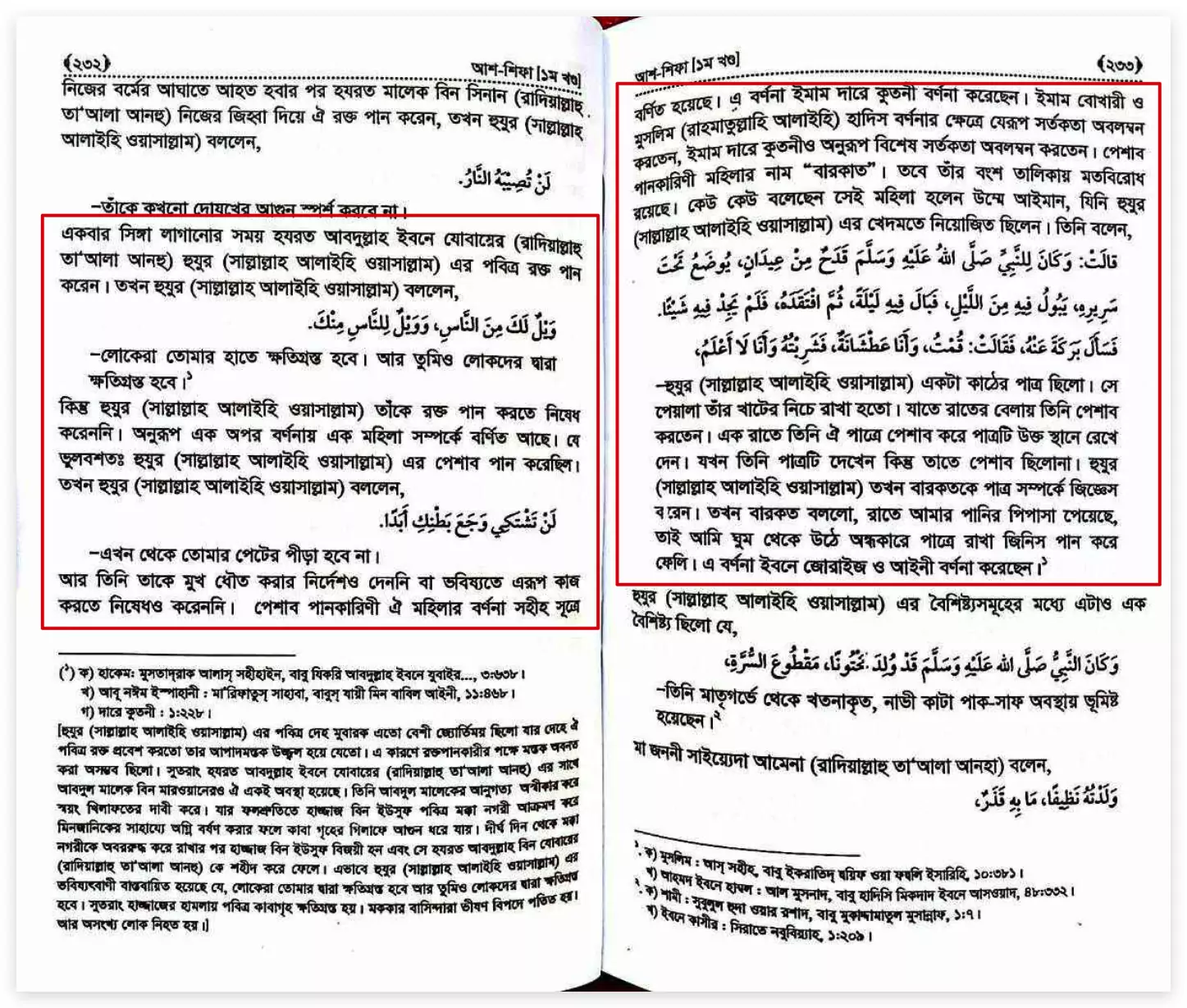
In Bengali religious presentations, the urine in this story is called “blessed urine,” the teeth exposed during laughter become “blessed teeth,” and even sleep is described as “blessed sleep.” Such honorific adjectives fuse devotional value with the factual content of the story, pre-classifying an ordinary bodily function as sacred. Adding the word “blessed” to urine provides no evidence about the properties of the urine itself, yet the word encourages the reader to approach bodily waste with reverence. Respect for Muhammad is extended over every product of his body until even the ordinary identity of waste is buried beneath devotional language. The discussion on pages 232–233 of the Bengali edition of al-Shifa documents how this religious reception moved beyond Arabic commentary into Bengali religious literature as well.
Once, during cupping, Hazrat Abdullah ibn al-Zubayr (may Allah be pleased with him) drank the blessed blood of the Prophet (peace and blessings be upon him). The Prophet then said,
وَيْلٌ لَكَ مِنَ النَّاسِ، وَوَيْلٌ لِلنَّاسِ مِنْكَ.
“People will suffer at your hands, and you too will suffer at the hands of people.”
But the Prophet did not forbid him from drinking the blood. A similar report concerns a woman who mistakenly drank the Prophet’s urine. The Prophet then said,
لَنْ تَشْتَكِي وَجَعَ بَطْنِكِ أَبَدًا.
“From now on, you will not suffer from abdominal pain.”
Nor did he instruct her to rinse her mouth or forbid her from doing such a thing again in the future. The report concerning the woman who drank the urine has been transmitted through an authentic chain. Imam al-Daraqutni narrated it. Imam al-Daraqutni exercised the same special caution in narrating hadith as Imams al-Bukhari and Muslim did. The woman who drank the urine was named “Barakat.” There is disagreement over her lineage. Some have said that she was Umm Ayman, who served the Prophet. She said,
قَالَتْ: وَكَانَ لِلنَّبِيِّ صَلَّى اللَّهُ عَلَيْهِ وَسَلَّمَ قَدَحٌ مِنْ عِيدَانِ، يُوضَعُ تَحْتَ سَرِيرِهِ، يَبُولُ فِيهِ مِنَ اللَّيْلِ، فَبَالَ فِيهِ لَيْلَةً، ثُمَّ افْتَقَلَهُ، فَلَمْ يَجِدْ فِيهِ شَيْئًا.
فَسَأَلَ بَرَكَةً عَنْهُ، فَقَالَتْ: قُمْتُ، وَأَنَا عَطْشَانَةٌ، فَشَرِبْتُهُ وَأَنَا لَا أَعْلَمُ
The Prophet had a wooden vessel. That vessel was kept beneath his bed, and he would urinate into it at night. One night he urinated into the vessel and left it there. When he later looked at the vessel, there was no urine in it. The Prophet asked Barakat about the vessel. Barakat then said, “I became thirsty during the night, so I woke up and, in the darkness, drank what was in the vessel.” This report was narrated by Ibn Jurayj and al-‘Ayni.
Permission in Fiqh to Use Urine and Blood as Medicine
In Mansur al-Buhuti’s Kashshaf al-Qina, under the special characteristics of the Prophet, substances considered impure in ordinary people are described as pure in his case and in the case of the other prophets; the same passage also permits treatment with his urine and blood. In the Shamela edition, on page 31 of volume five, this statement is immediately followed by a report that Umm Ayman drank his urine and was protected from the Fire, although al-Buhuti himself describes that report as weak. Thus, the same paragraph contains the legal permission, a report invoked in support of it, and an acknowledgement that the report is weak. The note about weakness remains beside the ruling; it does not remove the ruling. The passage is a direct example of how strongly a prior belief in the sacred status of a person can operate: even after noting weakness in the evidence, permission to use his urine medicinally is retained. [8] [9]
(والنجس منا طاهر منه) صلى الله عليه وسلم ومن سائر الأنبياء وبجواز أن يستشفى ببوله ودمه لما رواه الدارقطني «أن أم أيمن شربت بوله فقال: إذن لا تلج النار بطنك» لكنه ضعيف.
English translation: What is impure in our case is pure in his case and in the case of all the other prophets; and it is permissible to seek treatment with his urine and blood. Al-Daraqutni narrated that Umm Ayman drank his urine and he said, “Then the Fire will not enter your belly.” But the report is weak.
In this ruling, the religious status of the substance changes because the person is a prophet. The same type of bodily waste receives one judgment for ordinary people and another for prophets, and the second judgment is then used to permit medicinal use. The claim of ritual purity is joined to a claim of healing, even though declaring a substance religiously pure does not demonstrate that it has any therapeutic effect. “Impure in our case, pure in his case” states the double standard plainly; permission to use urine and blood on the basis of that special status is its practical consequence. The identity of the person has been substituted for evidence about the bodily substance itself. When a follower is commanded to avoid his own urine but taught that his leader’s urine may be beneficial, his judgment is trained to follow the leader’s status rather than the properties of the material.
Impure Urine, Punishment in the Grave, and an Exception for the Leader
Abu Dawud records a hadith from Ibn Abbas in which failing to protect oneself from urine is given as a cause of punishment in the grave. Muhammad Shams al-Haqq Azimabadi, in Awn al-Ma’bud, interprets the report in the straightforward sense of guarding oneself from urine. Citing his explanation, scholars at the fatwa center state that before prayer urine must be removed from the body, clothing, and place of prayer, whether the amount is small or large. When this strict religious treatment of urine is set beside the view that Muhammad’s urine was pure and could benefit the person who drank it, the contrast becomes even sharper. For ordinary people, urine causes impurity upon contact and negligence regarding it is associated with fear of punishment; for the exceptional individual, drinking urine is connected with promises of freedom from illness and protection from the Fire. These opposing rulings arise when the judgment shifts from the nature of the substance to the identity of the person. Within the same religious discourse that warns a follower about punishment for failing to avoid his own urine, claims of special benefit are made about ingesting the leader’s urine. [10] [11]
فيجب إزالته من البدن والثوب والمكان عند إرادة الصلاة سواء كان قليلا أو كثيراً
English translation: When one intends to pray, it must be removed from the body, clothing, and place of prayer, whether it is little or much.
Attempts to make the purity of Muhammad’s urine unquestionable are also documented. A questioner at a fatwa center reported that, in a lesson at al-Azhar, a speaker claimed that scholars had reached consensus on the purity of Muhammad’s urine, called those who disagreed innovators, and warned of a bad end for them. Yahya ibn Sharaf al-Nawawi, however, records two views on the matter in al-Majmu and identifies the impurity of blood and bodily excretions as the position accepted by the majority of scholars. The fatwa authors themselves quote al-Nawawi to reject the speaker’s claim. The assertion of consensus is false; al-Nawawi’s own text refutes it. The questioner’s account also shows an attempt to transform disagreement into a religious offense. Once fear of a bad end is inserted into a question as basic as whether urine is pure, verification is displaced by pressure to obey. When the claim that bodily waste is sacred is joined to the threat that denying it is religiously deviant, personality cult ceases to be merely emotional; it acquires a religious language for suppressing dissent. [12] [13]
وطهارة بوله صلى الله عليه وسلم ليس أمرا مجمعا عليه كما زعم
English translation: The purity of his urine is not a matter of consensus, contrary to what he claimed.
Objections to the Chains of Transmission and the Attempt to Defeat the Purity Argument by Calling the Drinking “Accidental”
Ibn Hajar al-Asqalani considered Abu Malik al-Nakha’i weak in the chain of the Umm Ayman report and noted a break in transmission because Nubayh did not meet Umm Ayman. Al-Daraqutni likewise criticized Abu Malik and attributed inconsistency in the report to him. In another line of transmission, both al-Dhahabi and Ibn Hajar described the narrator Hukaimah as unknown. Fatwa 181776, published under the supervision of Muhammad Salih al-Munajjid, cites these assessments and classifies both transmission routes as weak. The authors further argue that even if the reports were authentic, they would not prove ritual purity because the urine was drunk accidentally rather than deliberately. That argument is incomplete: the woman’s ignorance explains why she drank it, but it does not erase Muhammad’s subsequent promise of special benefit. Qadi Iyad constructs his purity argument precisely from that subsequent response. Accidentally drinking the urine and then being promised a special benefit are two stages of the same narrative; pointing to the first does not cancel the religious significance assigned to the second. [14] [15]
ولو صحَّ شيء منها، لم يكن فيه حجة، لأن شرب البول قد وقع فيها مصادفة، من غير تعمد لشربه.
English translation: Even if any of these reports were authentic, they would not constitute proof, because the drinking of urine occurred accidentally, without an intention to drink it.
Qadi Iyad declared the report authentic; Ibn Hajar and al-Daraqutni identified weaknesses in relevant chains. These are internal evaluations within Islamic hadith criticism. A weak chain reduces the force with which an event can be established as certain history, but it does not by itself prove that the event never occurred. Nor does the same story appearing in several books create a new eyewitness each time it is copied. What is beyond dispute is that classical works explicitly contain the positions that Muhammad’s urine was pure and that it could be used medicinally. Qadi Iyad’s declaration of authenticity, al-Buhuti’s permission despite acknowledging weakness in the supporting report, and the rejection found in a modern fatwa represent conflicting religious positions. A later rejection does not erase the earlier ruling from the historical record, while the earlier ruling does not turn the story’s miraculous outcome into an experimentally established fact. The chain-of-transmission debate cannot hide the written record of this personality cult: scholars themselves wrote that human bodily waste could be considered pure and suitable for treatment because it came from Muhammad.
Statements by Religious Speakers
Scientific Analysis: The Risks of Consuming Blood, Urine, and Pus
Urine: Turning Bodily Waste into Medicine
Urine is produced through the process by which the body eliminates metabolic waste along with excess water and salts. The kidneys’ filters and tubules separate substances from the blood, return much of the needed water and useful material to circulation, and excrete the remaining fluid and waste as urine. The U.S. National Institute of Diabetes and Digestive and Kidney Diseases identifies waste removal and the regulation of water, salts, and minerals as core kidney functions. To claim that a substance the body is actively excreting becomes curative because of the religious identity of the person who produced it is to ignore its physiological nature. The fact that urine contains water does not make it purified drinking water; safety depends on what is dissolved in it and what microorganisms may be present. The adjective “blessed” changes neither kidney function nor the composition of the excreted fluid. [16]
Your kidneys remove wastes and extra fluid from your body.
According to clinical toxicologist Wendy Klein-Schwartz, urine is approximately 95 percent water, while the remainder includes urea, creatinine, salts, and other compounds. Drinking urine can cause nausea, vomiting, and diarrhea, and a urinary-tract infection can increase the amount of pathogenic bacteria present. The degree of harm depends on the quantity consumed, the substances present, and any infection; the fact that someone does not become ill after accidentally ingesting a small amount of urine does not demonstrate that the urine has therapeutic value. Her medical discussion explicitly notes the absence of scientific evidence for using urine as an alternative medical therapy. Yet in the Umm Ayman story, a single episode of drinking is transformed into a promise of lifelong freedom from abdominal illness. Making such an extraordinary claim without diagnosis, comparative testing, or clinical observation is not evidence of healing; it is an unsupported declaration of a miracle. [17]
There is no scientific evidence for the use of urine as an alternative medicine therapy.
The assumption that urine is sterile has also failed experimental scrutiny. In a 2014 study, Evann E. Hilt and colleagues examined 65 urine specimens—41 from patients with overactive bladder and 24 from controls. Using enhanced culture methods, they recovered living bacteria from 52 samples; 48 of those had been reported as showing no bacterial growth under the conventional protocol. In other words, failure to detect bacteria by a standard method does not mean that no bacteria are present. Not every bacterium in the bladder causes disease; this study established the presence of living bacterial communities, not that drinking urine is safe or beneficial. Declaring a fluid containing unknown microorganisms and unknown constituents safe because of the religious prestige of the person who produced it is therefore entirely unsupported. The safety of urine depends on its actual composition, not on the religious reputation of the body from which it came. [18]
Our current study demonstrates that urine contains communities of living bacteria that comprise a resident female urine microbiota.
Blood: The Risk of Infection through Oral Mucous Membranes
A major danger in putting another person’s raw blood into one’s mouth is direct exposure to potentially infected blood. Before blood is swallowed and reaches the stomach, it comes into contact with the oral mucous membranes; sores in the mouth or damaged gums make that exposure more concerning. U.S. Centers for Disease Control and Prevention guidance recognizes percutaneous or mucous-membrane exposure to blood or body fluids containing hepatitis B virus as a route of transmission. The same guidance notes that blood contains the highest concentrations of HBV and that chronic infection can lead to cirrhosis and liver cancer. Declaring the drinking of another person’s blood a means of healing without testing the blood for infection therefore recasts a health risk as a supposed benefit. A jurist’s permission does not test the blood, inactivate viruses, or close lesions in the mouth. Religious descriptions of a substance as “pure” have no equivalent meaning in microbiological safety. [19]
HBV is efficiently transmitted by percutaneous or mucous membrane exposure to HBV-infected blood or body fluids that contain HBV.
With HIV as well, contact between infected blood and the oral mucosa or an open wound is a recognized exposure concern. In 2025 clinical guidance, Mary R. Tanner and coauthors note rare cases of HIV acquisition through mucocutaneous exposure to splashed infectious body fluids. Risk depends on the source person’s viral status, viral load, and the nature of the exposure. Putting someone else’s blood into the mouth therefore creates an unnecessary route of contact with potentially infected blood; the drinker’s devotion offers no protection against infection. Al-Buhuti’s permission to “seek treatment with his blood” cannot substitute for testing such risks or demonstrating that the practice cures disease. Inferring medical efficacy merely because a religious narrative reports that someone drank blood without being reprimanded is to substitute religious authority for medical evidence. Claiming a cure while leaving a route of infection open places a follower’s health in the hands of unsupported belief. [20]
Rare cases of HIV acquisition from mucocutaneous exposure to splashed infectious body fluids have been described
Pus: Material from Infection and Damaged Tissue
Pus forms from white blood cells, damaged tissue, and other material that accumulates at a site of infection or inflammation. The U.S. National Library of Medicine’s MedlinePlus describes the pus in an infectious abscess as a mixture of living and dead white blood cells, germs, and dead tissue. The immune system produces this material while fighting infection; drinking pus does not transfer that immune response into the drinker’s body. Putting material from an infected wound into the mouth creates direct contact with whatever microorganisms are present. Medical treatment involves draining pus from an abscess and using antibiotics when necessary; it does not turn pus into a medicinal drink. Material from an infected wound does not become beneficial because it came from a revered person; claiming otherwise transforms an infection into an object of devotion. Calling the source person sacred does not remove germs or dead tissue from pus. [21]
Pus is a mixture of living and dead white blood cells, germs, and dead tissue.
Purulent skin infections can contain organisms such as Staphylococcus aureus, some strains of which are resistant to multiple antibiotics. According to the Centers for Disease Control and Prevention, MRSA can spread through contact with infected wounds or objects carrying bacteria from infected skin. Toxin-producing strains of the same bacterial species can also multiply in contaminated food and produce toxins that cause nausea, vomiting, abdominal cramps, and diarrhea; cooking may kill the bacteria while leaving some toxins in the food. This mechanism of food poisoning illustrates that the risk is not limited to the presence of living bacteria: toxins produced by them can matter as well. Putting infected pus into the mouth creates exposure to microorganisms, and turning the ingestion of germs or their toxins into a supposed route to healing is hazardous. The need to determine what organisms, quantities, and toxins are present cannot be abolished by calling the material “sacred.” [22] [23]
MRSA spreads in the community through contact with infected people, wounds, or things that have touched infected skin and are carrying the bacteria.
Staph food poisoning is a gastrointestinal illness. It is caused by toxins made by Staphylococcus aureus (Staph) bacteria.
The health risks of urine, blood, and pus are not identical: urine contains metabolic waste and can contain microorganisms; infected blood can expose oral mucosa and wounds to viruses; infected pus contains microorganisms and damaged tissue. Treating the absence of immediate illness as evidence of a cure is a direct misuse of logic. The fact that someone consumes something risky and does not become sick immediately does not demonstrate a medical benefit. Safety, therapeutic efficacy, and lifelong immunity from disease are three different claims: the first requires testing composition and infection risk, the second requires evidence of clinical efficacy, and the third requires long-term evidence proportionate to the extraordinary claim. Qadi Iyad’s argument for purity and al-Buhuti’s permission for treatment provide none of this. Replacing the identity of the substance with the religious identity of the Prophet and then inferring healing is therefore evidentially unsupported and medically irresponsible. The word “blessed” cannot change the nature of bodily waste, and a scholar’s permission cannot close a route of infection.
Conclusion
At every stage of the urine-drinking narratives, the status of a person is projected onto bodily waste: a woman drinks it, a special benefit is announced for her, a scholar uses the report to argue for purity, and a work of fiqh permits medicinal use. In this sequence, the impurity ordinarily associated with human bodily waste is reversed for an exceptional individual. No material test is offered to justify the reversal; the basis is Muhammad’s prophetic identity and the miraculous claims preserved around it. A promise of relief from illness is not evidence that illness was cured, a promise of protection from fire is not testable evidence of salvation in an afterlife, and declaring something ritually pure does not establish its medical efficacy. Attempting to bridge these gaps through the prestige of a religious leader means substituting devotion for evidence.
The severity of this personality cult lies in what it does to the follower’s judgment. The follower is required to observe strict rules regarding his own bodily waste, while religious arguments are constructed to treat the leader’s waste as an object of reverence and a source of benefit. When denial of that claim is further linked to religious innovation or the threat of a bad end, even the right to question becomes a test of obedience. Loving a person is not evidence that his urine is pure, and no person’s special status can justify abandoning independent judgment. Adding the word “blessed” to urine does not alter its nature; religious glorification cannot establish miraculous benefits either. The beliefs built around the stories of Umm Ayman and Baraka elevate a person so high that human reason itself is made to bow before human bodily waste.
References
- Sunan Abi Dawud, Hadith 24 ↩︎
- Sunan an-Nasa’i, Hadith 32 ↩︎
- Al-Mustadrak, “Umm Ayman drinking the Prophet’s urine and its effect”; online sequence 6996 ↩︎
- Al-Bidaya wa’l-Nihaya, chapter “His Female Servants,” report from Umm Ayman through Abu Ya’la ↩︎
- Al-Bidaya wa’l-Nihaya, report of Baraka drinking the urine, cited from Ibn al-Athir ↩︎
- Al-Shifa, vol. 1, p. 65; Shamela ↩︎
- Previous page, p. 64: the view that Muhammad’s bodily excretions were pure ↩︎
- Kashshaf al-Qina, vol. 5, p. 31; Shamela ↩︎
- Text of the same work; Islamweb ↩︎
- Fatwa-center scholars’ answer 70011: purification from urine and punishment in the grave; Islamweb ↩︎
- Azimabadi, Awn al-Ma’bud, vol. 1, pp. 37–39 ↩︎
- Fatwa-center scholars’ answer 113828: rejecting the claim that denial of purity makes one an innovator; Islamweb ↩︎
- al-Nawawi, al-Majmu, vol. 1, pp. 288–289: disagreement over the Prophet’s blood and bodily excretions ↩︎
- Fatwa 181776, published under al-Munajjid’s supervision: assessments of Ibn Hajar, al-Daraqutni, and al-Dhahabi; Islam Question & Answer ↩︎
- Profile of fatwa supervisor Muhammad Salih al-Munajjid ↩︎
- National Institute of Diabetes and Digestive and Kidney Diseases: How Your Kidneys Work ↩︎
- Wendy Klein-Schwartz, National Capital Poison Center: Is it safe to drink your urine? ↩︎
- Hilt et al., 2014: urine is not sterile; Journal of Clinical Microbiology, 52(3): 871–876 ↩︎
- Centers for Disease Control and Prevention: hepatitis B transmission and mucous-membrane exposure ↩︎
- Tanner et al., 2025 guidance, Appendix A: exposure to infected blood and mucous membranes ↩︎
- U.S. National Library of Medicine, MedlinePlus: abscesses and the composition of pus ↩︎
- Centers for Disease Control and Prevention: MRSA, purulent infections, and transmission through contact ↩︎
- Centers for Disease Control and Prevention: food poisoning caused by Staphylococcus toxins ↩︎