
Introduction
In Islamic belief about the afterlife, the heaven called “Jannah” is portrayed as a highly regimented, hierarchical, and unequal system of rewards—one that directly conflicts with Islam’s central claim of “Allah’s justice and infinite mercy.” On the one hand, hadith describe eight gates of Paradise, while the Quran and hadith describe different ranks among its inhabitants and declare that a person’s allotted place, comforts, houris, ghilman, and other objects of enjoyment will vary considerably according to their deeds in this world. On the other hand, it is repeatedly promised that the inhabitants of Paradise “will receive whatever they desire”. The profound logical conflict between these two ideas exposes a fundamental sleight of hand in Islamic theology—showing that the concept of Paradise is not divine justice but a calculated instrument of psychological control.
In Islamic eschatology, Paradise is portrayed not merely as a place of happiness but as a carefully designed “heavenly caste system” . Where it is claimed that Paradise contains neither suffering nor unfulfilled desires, creating “elite” and “subordinate” classes according to people’s deeds amounts to glorifying the feudal inequalities of this world in the afterlife. The promise “You will receive whatever you desire” [1] is essentially a logical paradox or logical trapthat cannot be reconciled with this rigid hierarchy of Paradise. This article will examine the irreconcilable conflict between that hierarchy and the supposed “unlimited fulfilment of desires” through rigorous logical and critical analysis, exposing this fundamental sleight of hand in Islam.
Accounts in the Quran and Hadith
Quran 17:21 explicitly states:
Observe how I have favoured some of them over others; the Hereafter is surely higher in rank and greater in excellence.
— Taisirul Quran (English rendering of the Bengali translation)
Observe how I favoured one group of them over another. The Hereafter is surely greater in rank and greater in distinction.
— Sheikh Mujibur Rahman (English rendering of the Bengali translation)
Consider how I have favoured some of them over others. The Hereafter is surely greater in rank and greater in superiority.
— Rawai Al-bayan (English rendering of the Bengali translation)
Observe how We have favoured one group of them over another; the Hereafter is certainly greater in rank and greater in superiority [1]!
— Dr. Abu Bakr Muhammad Zakaria (English rendering of the Bengali translation)
Here Allah himself acknowledges that hierarchy and inequality will exist in the afterlife as well—in other words, a “class system” will continue just as it does in this world. Hadith speak of the eight gates of Paradise and its highest level, “Jannat al-Firdaus,” which only those with the highest level of righteous deeds will be able to enter. This system clearly demonstrates that Islam does not envisage equality or equal happiness for everyone even in the afterlife. Instead, it is a pyramid in which the inhabitants of lower levels will receive distinctly fewer advantages than those at higher levels. Let us examine what Abd al-Hamid Madani’s book “Jannat o Jahannam” (Paradise and Hell) says about this, where all the relevant textual evidence is presented:
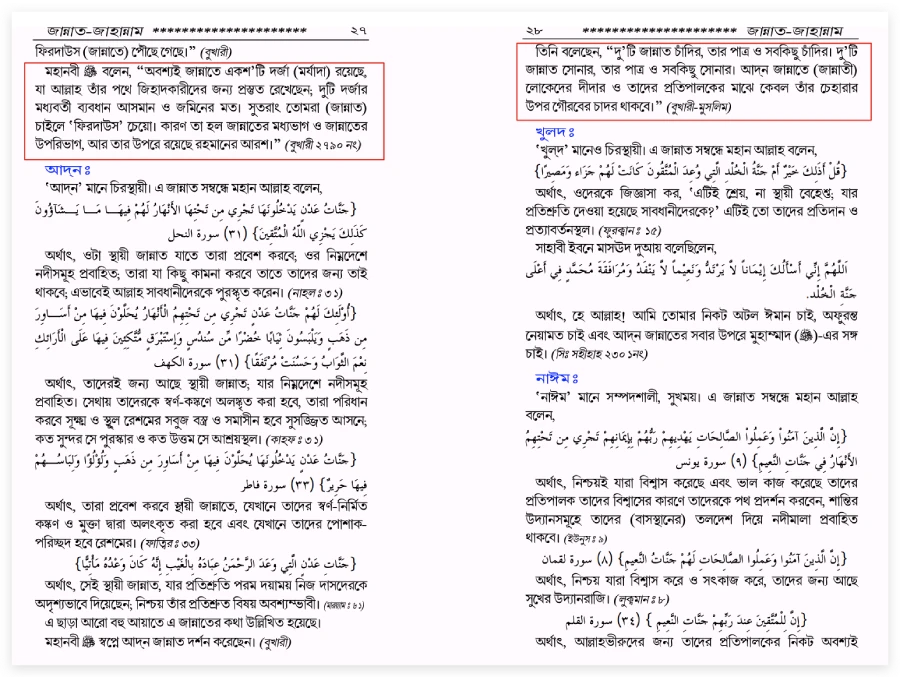
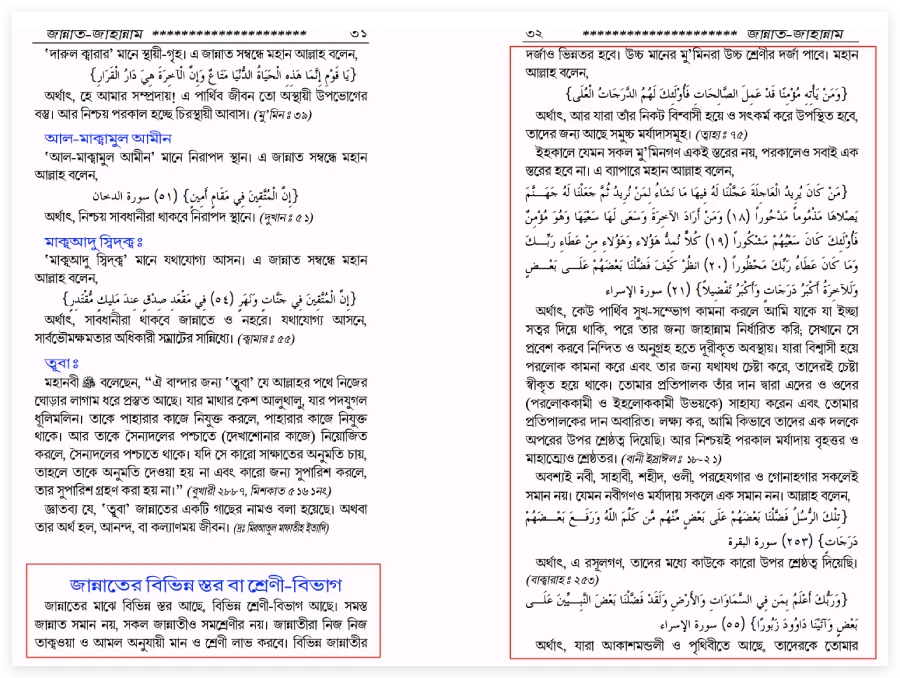
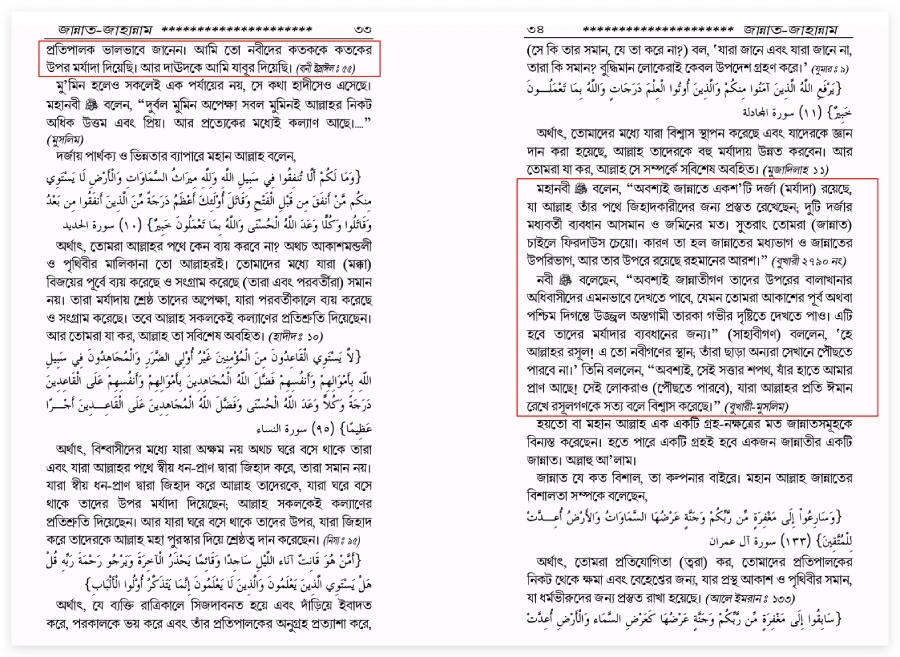
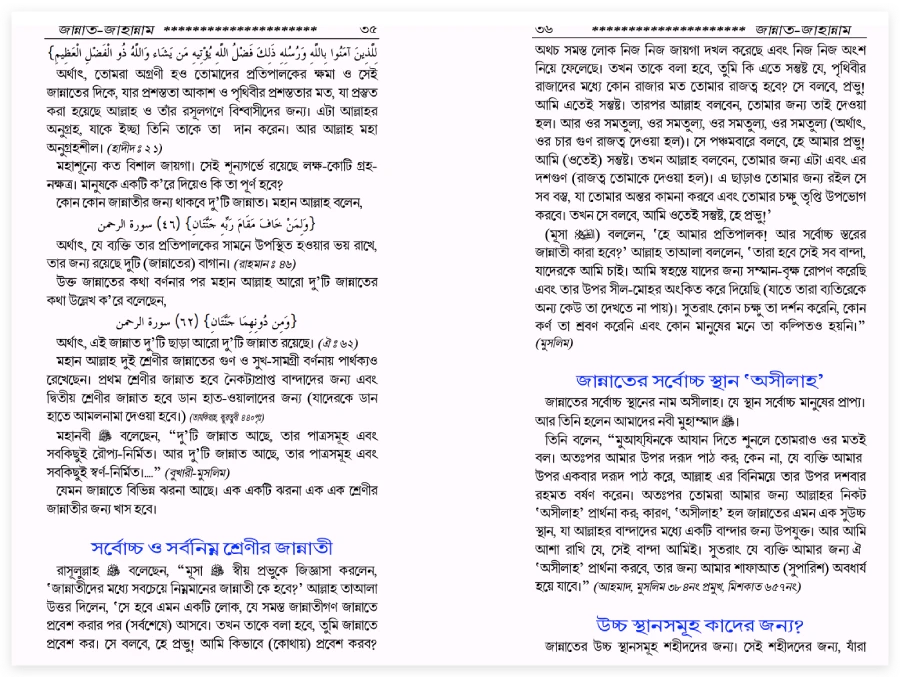
This is where Islam’s greatest deception becomes apparent. The religion that recites the rhetoric of equality in this world by declaring “All Muslims are brothers” is the same religion that entices people with the promise of a profoundly unequal heaven in the afterlife. The appealing declaration “You will receive whatever you desire” (Quran 41:31, 50:35) is a false enticement that becomes practically impossible because of this hierarchy. This conflict turns the Islamic theory of Paradise into an irrational, inhumane, imaginary system that indirectly controls human free will. Let us read another hadith describing how many houris certain inhabitants of Paradise—those who have fought in jihad—will receive. [2]
Sunan at-Tirmidhi (Islamic Foundation Bengali edition)
25/ The Virtues of Jihad
Chapter: The Rewards of the Martyr.
Jami‘ at-Tirmidhi 1663.
حَدَّثَنَا عَبْدُ اللَّهِ بْنُ عَبْدِ الرَّحْمَنِ، حَدَّثَنَا نُعَيْمُ بْنُ حَمَّادٍ، حَدَّثَنَا بَقِيَّةُ بْنُ الْوَلِيدِ، عَنْ بَحِيرِ بْنِ سَعْدٍ، عَنْ خَالِدِ بْنِ مَعْدَانَ، عَنِ الْمِقْدَامِ بْنِ مَعْدِيكَرِبَ، قَالَ قَالَ رَسُولُ اللَّهِ صلى الله عليه وسلم “ لِلشَّهِيدِ عِنْدَ اللَّهِ سِتُّ خِصَالٍ يُغْفَرُ لَهُ فِي أَوَّلِ دَفْعَةٍ وَيَرَى مَقْعَدَهُ مِنَ الْجَنَّةِ وَيُجَارُ مِنْ عَذَابِ الْقَبْرِ وَيَأْمَنُ مِنَ الْفَزَعِ الأَكْبَرِ وَيُوضَعُ عَلَى رَأْسِهِ تَاجُ الْوَقَارِ الْيَاقُوتَةُ مِنْهَا خَيْرٌ مِنَ الدُّنْيَا وَمَا فِيهَا وَيُزَوَّجُ اثْنَتَيْنِ وَسَبْعِينَ زَوْجَةً مِنَ الْحُورِ الْعِينِ وَيُشَفَّعُ فِي سَبْعِينَ مِنْ أَقَارِبِهِ ” . قَالَ أَبُو عِيسَى هَذَا حَدِيثٌ صَحِيحٌ غَرِيبٌ .
English translation (Sunnah.com):
Narrated Al-Miqdam bin Ma’diykarib:
That the Messenger of Allah (ﷺ) said: “There are six things with Allah for the martyr. He is forgiven with the first flow of blood (he suffers), he is shown his place in Paradise, he is protected from punishment in the grave, secured from the greatest terror, the crown of dignity is placed upon his head – and its gems are better than the world and what is in it – he is married to seventy two wives along Al-Huril-‘Ayn of Paradise, and he may intercede for seventy of his close relatives.”
Bengali edition’s grading and cross-references: Sahih; Ahkam al-Jana’iz, pp. 35–36; Ta‘liq al-Targhib, 2/194; al-Silsilah al-Sahihah, 3213; Tirmidhi, hadith 1663 [Al-Madani Publications].
[Abu ‘Eisa said:] This Hadith is Hasan Sahih.
Arabic concluding assessment: Sahih Gharib.
Bengali edition’s assessment attributed to Abu ‘Isa: Hasan-Sahih-Gharib.
Bengali edition’s hadith grading: Sahih. Sunnah.com grading: Hasan (Darussalam).
Narrator: Al-Miqdam (may Allah be pleased with him).
Sunnah.com reference: Jami‘ at-Tirmidhi 1663; in-book reference: Book 22, Hadith 46; English translation reference: Vol. 3, Book 20, Hadith 1663.
Sunan at-Tirmidhi (Verified Bengali Edition)
20/ The Virtues of Jihad
Publisher: Husain al-Madani
Chapter: 25. The Rewards of the Martyr
Jami‘ at-Tirmidhi 1663.
حَدَّثَنَا عَبْدُ اللَّهِ بْنُ عَبْدِ الرَّحْمَنِ، حَدَّثَنَا نُعَيْمُ بْنُ حَمَّادٍ، حَدَّثَنَا بَقِيَّةُ بْنُ الْوَلِيدِ، عَنْ بَحِيرِ بْنِ سَعْدٍ، عَنْ خَالِدِ بْنِ مَعْدَانَ، عَنِ الْمِقْدَامِ بْنِ مَعْدِيكَرِبَ، قَالَ قَالَ رَسُولُ اللَّهِ صلى الله عليه وسلم “ لِلشَّهِيدِ عِنْدَ اللَّهِ سِتُّ خِصَالٍ يُغْفَرُ لَهُ فِي أَوَّلِ دَفْعَةٍ وَيَرَى مَقْعَدَهُ مِنَ الْجَنَّةِ وَيُجَارُ مِنْ عَذَابِ الْقَبْرِ وَيَأْمَنُ مِنَ الْفَزَعِ الأَكْبَرِ وَيُوضَعُ عَلَى رَأْسِهِ تَاجُ الْوَقَارِ الْيَاقُوتَةُ مِنْهَا خَيْرٌ مِنَ الدُّنْيَا وَمَا فِيهَا وَيُزَوَّجُ اثْنَتَيْنِ وَسَبْعِينَ زَوْجَةً مِنَ الْحُورِ الْعِينِ وَيُشَفَّعُ فِي سَبْعِينَ مِنْ أَقَارِبِهِ ” . قَالَ أَبُو عِيسَى هَذَا حَدِيثٌ صَحِيحٌ غَرِيبٌ .
English translation (Sunnah.com):
Narrated Al-Miqdam bin Ma’diykarib:
That the Messenger of Allah (ﷺ) said: “There are six things with Allah for the martyr. He is forgiven with the first flow of blood (he suffers), he is shown his place in Paradise, he is protected from punishment in the grave, secured from the greatest terror, the crown of dignity is placed upon his head – and its gems are better than the world and what is in it – he is married to seventy two wives along Al-Huril-‘Ayn of Paradise, and he may intercede for seventy of his close relatives.”
Bengali edition’s grading and cross-references: Sahih; Ahkam al-Jana’iz (35–36); Ta‘liq al-Targhib (2/194); al-Silsilah al-Sahihah (3213).
[Abu ‘Eisa said:] This Hadith is Hasan Sahih.
Arabic concluding assessment: Sahih Gharib.
Bengali edition’s assessment attributed to Abu ‘Isa: Hasan Sahih Gharib.
Bengali edition’s hadith grading: Sahih. Sunnah.com grading: Hasan (Darussalam).
Sunnah.com reference: Jami‘ at-Tirmidhi 1663; in-book reference: Book 22, Hadith 46; English translation reference: Vol. 3, Book 20, Hadith 1663.
These hadith conflict with the claim that “People will receive whatever they desire in Paradise.” How?
The Concept of Hierarchy and Inequality in Paradise
According to Islamic theology, Paradise is not a heaven with uniform conditions or equal happiness for everyone. It is a rigidly stratified, hierarchical, and unequal structure—the ultimate expression of Islam’s own “class system.” The Quran explicitly declares: “Observe how I have favoured one group of them over another. The Hereafter is greater in rank and greater in superiority” (Quran 17:21). Here Allah himself acknowledges that the pyramid of superiority and inferiority will persist in the afterlife—in other words, this system has been created to perpetuate the inequalities between rich and poor, high and low, that exist in this world.
Hadith elaborate on this even more ruthlessly: Paradise has eight gates [3], and eligibility to enter through each gate depends on a person’s deeds in this world. The places allotted to the inhabitants of Paradise, their number of houris, ghilman, servants, palaces, gardens, and other objects of enjoyment will vary entirely according to their deeds. The highest level, “Jannat al-Firdaus,” lies immediately beneath the Throne [4], where only “elite” Muslims with the highest level of righteous deeds will be able to enter. Those at lower levels will remain satisfied with their allotted, limited benefits—as though a feudal social order will continue even in the afterlife. Let us read another hadith. [5]
Hadith Sambhar (Bengali compilation)
31/ Heart-Softening Admonitions
Chapter: The Description of Paradise
(Sahih al-Bukhari 6571).
حَدَّثَنَا عُثْمَانُ بْنُ أَبِي شَيْبَةَ، حَدَّثَنَا جَرِيرٌ، عَنْ مَنْصُورٍ، عَنْ إِبْرَاهِيمَ، عَنْ عَبِيدَةَ، عَنْ عَبْدِ اللَّهِ ـ رضى الله عنه ـ قَالَ النَّبِيُّ صلى الله عليه وسلم ” إِنِّي لأَعْلَمُ آخِرَ أَهْلِ النَّارِ خُرُوجًا مِنْهَا، وَآخِرَ أَهْلِ الْجَنَّةِ دُخُولاً رَجُلٌ يَخْرُجُ مِنَ النَّارِ كَبْوًا، فَيَقُولُ اللَّهُ اذْهَبْ فَادْخُلِ الْجَنَّةَ. فَيَأْتِيهَا فَيُخَيَّلُ إِلَيْهِ أَنَّهَا مَلأَى، فَيَرْجِعُ فَيَقُولُ يَا رَبِّ وَجَدْتُهَا مَلأَى، فَيَقُولُ اذْهَبْ فَادْخُلِ الْجَنَّةَ. فَيَأْتِيهَا فَيُخَيَّلُ إِلَيْهِ أَنَّهَا مَلأَى. فَيَقُولُ يَا رَبِّ وَجَدْتُهَا مَلأَى، فَيَقُولُ اذْهَبْ فَادْخُلِ الْجَنَّةَ، فَإِنَّ لَكَ مِثْلَ الدُّنْيَا وَعَشَرَةَ أَمْثَالِهَا. أَوْ إِنَّ لَكَ مِثْلَ عَشَرَةِ أَمْثَالِ الدُّنْيَا. فَيَقُولُ تَسْخَرُ مِنِّي، أَوْ تَضْحَكُ مِنِّي وَأَنْتَ الْمَلِكُ ”. فَلَقَدْ رَأَيْتُ رَسُولَ اللَّهِ صلى الله عليه وسلم ضَحِكَ حَتَّى بَدَتْ نَوَاجِذُهُ، وَكَانَ يُقَالُ ذَلِكَ أَدْنَى أَهْلِ الْجَنَّةِ مَنْزِلَةً.
English translation (Sunnah.com):
Narrated `Abdullah:
The Prophet (ﷺ) said, “I know the person who will be the last to come out of the (Hell) Fire, and the last to enter Paradise. He will be a man who will come out of the (Hell) Fire crawling, and Allah will say to him, ‘Go and enter Paradise.’ He will go to it, but he will imagine that it had been filled, and then he will return and say, ‘O Lord, I have found it full.’ Allah will say,
‘Go and enter Paradise, and you will have what equals the world and ten times as much (or, you will have as much as ten times the like of the world).’ On that, the man will say, ‘Do you mock at me (or laugh at me) though You are the King?” I saw Allah’s Messenger (ﷺ) (while saying that) smiling that his premolar teeth became visible. It is said that will be the lowest in degree amongst the people of Paradise.
(Sahih al-Bukhari 6571; the Bengali compilation also cites Muslim 479 in its numbering.)
Hadith grading: Sahih.
Narrator: ‘Abdullah ibn Mas‘ud (may Allah be pleased with him).
Sunnah.com reference: Sahih al-Bukhari 6571; in-book reference: Book 81, Hadith 159; USC-MSA English reference: Vol. 8, Book 76, Hadith 575.
This hierarchy exposes Islam’s most naked truth: in the name of justice, Allah has in fact established a system of permanent inequality in which those who performed more prayers, fasting, zakat, and Hajj in this world will possess vast palaces, countless houris, and boundless enjoyments in the afterlife. Those who did less will remain at lower levels—with no opportunity to complain. This demonstrates that Islam is never truly a religion of equality or justice; it is a calculated strategy for controlling people through greed and fear. This “class system” of Paradise reveals not only inequality in the afterlife but also the fundamental character of Islamic ideology, in which people will remain classified forever according to their worldly “deed score.” This system is not an expression of divine mercy but a cruel religious project that permanently destroys the ideals of human freedom and equality.
According to the hadith in Bukhari, the distance between the levels of Paradise will be like the distance from the earth to the stars in the sky. If it is nevertheless claimed that nobody will suffer from “unfulfilled desires” despite this immense separation, what lies behind that claim is not a miracle but ruthless psychological engineering . Paradise is therefore not a realm in which free people can roam but a “sacred prison”in which Allah has sealed the limits of each person’s happiness in advance and deprived them of the right to cross those limits or entertain higher aspirations.
Gender Inequality in Paradise: Women, Men, and Hijras
Inequality between Women and Men in Paradise and the Question of Houris
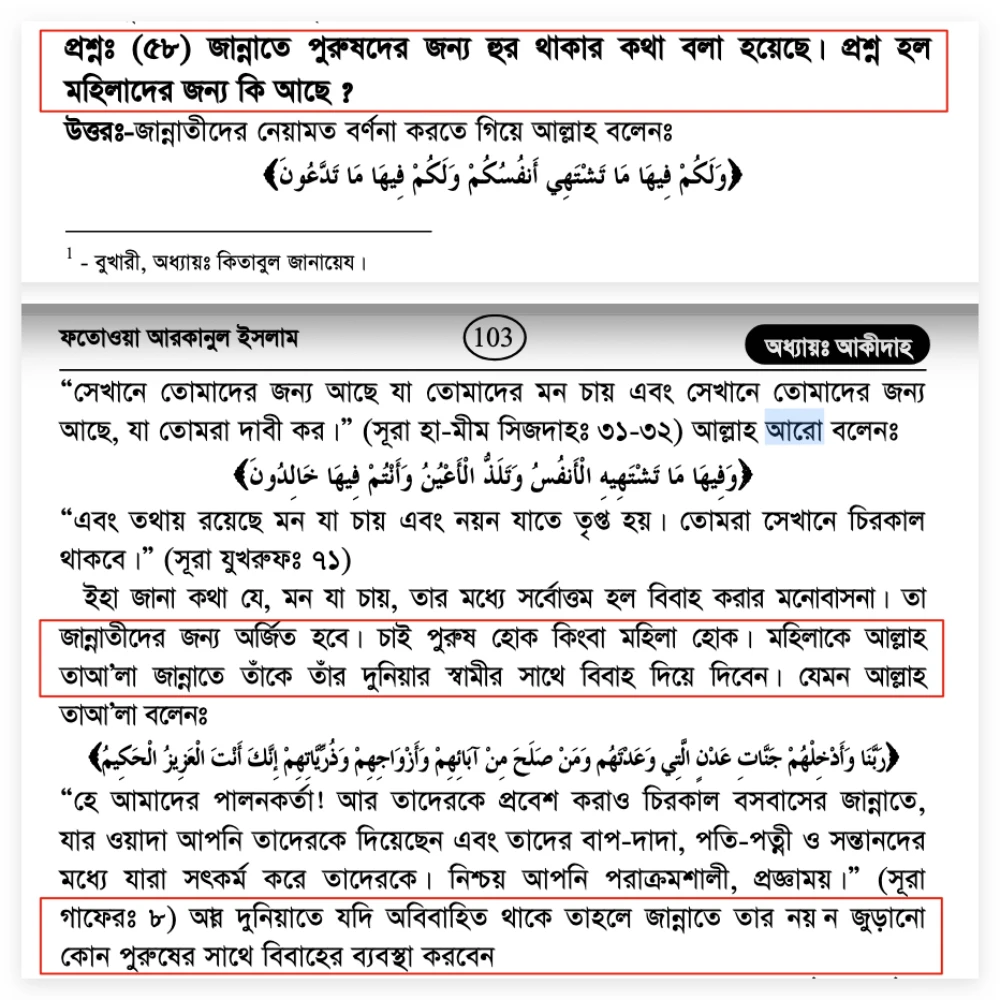
The word “hur” (حُوْرٌ) is grammatically feminine, and Islamic accounts primarily portray houris as a special gift for the men of Paradise. Tirmidhi 1663 promises the martyr marriage to seventy-two houris. There is no parallel promise here of multiple husbands for women. In IslamQA fatwa 149336, a woman asks whether she can have a husband who will have no other wives or houris. Rather than guaranteeing that her relationship will be arranged according to her own wishes, the answer explains that she will not desire any man other than her husband. This raises an ethical question: will the relationship be created according to the woman’s preferences, or will her preferences be adapted to the relationship already determined for her? [6] [7] Many theologians claim that the women of Paradise will be superior to houris because of their worship in earthly life and will be placed as “chiefs” over their contingents of houris. On this subject, Shaykh Muhammad ibn Salih al-‘Uthaymin states in his fatwa that if a woman dies unmarried, or if her husband is not among the people of Paradise, Allah will marry her to another man in Paradise, because no one there can remain single. Examining this system of reward distribution makes it clear that the concept of houris revolves around patriarchal sexual desires: a woman’s position is either that of a man’s subordinate or that of a supervisor over his many objects of enjoyment. Let us now hear the statements of several scholars:
Now let us read from Fatawa Arkan al-Islam. [8]
The Position of Hijras and Intersex People in Paradise
Islamic theology displays a degree of ambiguity and a tendency towards gender uniformity regarding the position of hijras or intersex people in Paradise. According to Islamic jurists, since Paradise is a place free of physical defects, no one will exist there as a worldly “khuntha,” or intersex person. According to the explanation offered by most scholars, Allah will give these individuals one specific sexed form—either male or female—when they enter Paradise [9]. In other words, those who live with gender diversity on earth will have that distinctive identity erased in Paradise, and an artificial binary identity will be imposed on them. This belief raises a major question about gender justice: if Paradise is a place of absolute happiness, why must an intersex person abandon their innate identity and be transformed into a particular sex? This essentially reflects a denial of gender diversity within the concept of Paradise and the imposition of a rigid binary framework.
Limitless Desire and the Promise “You Will Receive Whatever You Desire”
By contrast, in describing Paradise, the Quran repeatedly makes an immensely enticing and dangerous promise: human wishes and desires will have no limits there. It explicitly states, “There you will have whatever your souls desire” (Quran 41:31), and “There they will have whatever they desire, and with Me there is still more” (Quran 50:35). Most commentators, such as Ibn Kathir and al-Tabari, interpret “more,” or “ziyadah,” as the direct vision of Allah. Paradise is thus presented as a place where there will be no obstacles, boundaries, or class-based restrictions on the fulfilment of desires.
Yet this promise is actually one of Islam’s greatest lies and deceptions. The same Quran and hadith describe a rigid hierarchy and inequality in Paradise, in which the inhabitants of lower levels will never obtain the comforts of those at higher levels. How, then, can “You will receive whatever you desire” be true? If an inhabitant of a lower level wishes to reach the highest level, Jannat al-Firdaus, either the hierarchy will collapse—which is impossible under Islam’s rules—or that desire will remain unfulfilled. If it remains unfulfilled, the declaration “You will receive whatever you desire” is directly exposed as false.
If Allah erases from my mind the desire to reach a higher level, he is effectively lobotomising my independent thought or free will . If a prisoner is satisfied with the food in their cell because they are kept drugged, it would be absurd to call them “free.” Likewise, Allah’s prior “conditioning” of the desires of Paradise’s inhabitants cannot be called freedom. This is an extreme afterlife fraud.
This is the central sleight of hand in the Islamic theory of Paradise. On the one hand, Allah says he has given people free will; on the other, in the afterlife he effectively disables that will and confines them within a controlled, stratified system of enjoyment. This promise is a calculated marketing strategy: it binds Muslims into religious servitude in this world by showing them dreams of infinite happiness. In reality, Paradise is not a place of limitless freedom; it is a rigidly structured prison in which the fulfilment of desires takes place only within limits determined by Allah. This duality exposes Islam as logically hollow and hostile to humanity.
Free will
No limits
An inhabitant of a lower level can move to a higher level if they wish
→ Unrestricted desire
Envy and resentment have been removed
The desire to reach a higher level never arises
Only “approved” desires remain
→ Programmed desire
But if desires are controlled in advance so that a person wants only what belongs to their own level, then “You will receive whatever you desire” is no longer the free fulfilment of desires—it is merely a predetermined script.
The two cannot hold simultaneously. Each completely negates the other.
Logical Contradiction and Analysis
IslamQA fatwa 221195 directly addresses what happens if an inhabitant of a lower level wishes to attain a higher rank. It limits the fulfilment of the inhabitants’ desires to their respective ranks, describes wishing for the rank of the prophets as impossible, and explains their satisfaction through the absence of aspirations above their own position. Two distinct issues therefore arise: fulfilling existing desires and determining which desires can arise in the first place. Adjusting a person’s wishes to suit their allotted position and then fulfilling those wishes does not guarantee free choice. Unequal distribution remains intact; what changes is the person’s desire and dissatisfaction concerning that distribution. [10]
Several theological and logical perspectives can be examined in an attempt to resolve this difficulty:
Conclusion
In attempting to reconcile the hierarchy of Paradise with the promise of limitless desire, Islamic theology relies primarily on human “psychological transformation” or the “purification of will.” Logical analysis shows:
Put simply, the statement “You will receive whatever you desire” in Paradise is probably not an unconditional truth; it is made in the context of a “refined will.” If someone at a lower level of Paradise demands to reach a higher level and that demand is not fulfilled, the promise of Paradise remains logically questionable. If they do not make that demand because Allah has altered their capacity to desire, life in Paradise risks being reduced to biological or mechanical automatism. Ultimately, this structure of Paradise is presented as a complex combination of a “balance of rewards” and “personal satisfaction,” in which the individual is assumed to remain content within the boundaries of their deeds.
References
- Quran 41:31 ↩︎
- Jami‘ at-Tirmidhi 1663; Islamic Foundation Bengali edition: Sunan at-Tirmidhi 1669; verified Bengali edition: 1663 ↩︎
- Sahih al-Bukhari 3257 ↩︎
- Sahih al-Bukhari 2790 ↩︎
- Sahih al-Bukhari 6571; Hadith Sambhar, hadith 3883 ↩︎
- Jami‘ at-Tirmidhi 1663 ↩︎
- IslamQA, fatwa 149336 ↩︎
- Fatawa Arkan al-Islam, Shaykh Muhammad ibn Salih al-‘Uthaymin, pp. 102–103 ↩︎
- al-Bahr al-Ra’iq, vol. 8, p. 550; Fatawa Shami, vol. 6, p. 727 ↩︎
- IslamQA, fatwa 221195: The question of wishing for a higher rank in Paradise ↩︎
- Quran 15:47 ↩︎
- Sahih al-Bukhari 3256 ↩︎