

Introduction
One of the most controversial and morally questionable episodes in Islamic history is the Prophet Muhammad’s marriage to Zaynab bint Jahsh, the wife of his adopted son Zayd ibn Harithah. According to historical accounts, the lust or attraction the Prophet felt upon seeing his adopted son’s wife scantily dressed or unprepared was more than a private emotion: it became the catalyst for an abrupt change to a long-established social and family structure. A rational analysis suggests that this marriage did not result from an ordinary separation between Zayd and Zaynab, but unfolded within a carefully arranged framework for fulfilling personal desires under the cover of divine sanction.
The most glaring inconsistency lies in the double standards of Muslim historians and scholars. Whenever al-Waqidi, one of the principal sources for Islamic history, describes something negative or sexually motivated in the Prophet’s life, conservative scholars brand him a ‘liar’ or ‘unacceptable.’ Yet this is a blatant logical fallacy. These same scholars readily turn to al-Waqidi when they seek to justify the implausible Quranic and hadith-based prescriptions concerning rada‘at al-kabir, or adult breastfeeding. The account of milk being poured into a vessel and drunk from it—the account used to make the shameful Islamic practice of sucking milk directly from the breast appear somewhat more ‘respectable’—comes solely from al-Waqidi. Rejecting al-Waqidi therefore means accepting the original, repugnant prescription of drinking milk directly from the breast as definitive. This selective acceptance, this opportunistic policy of accepting and rejecting evidence, shows that preserving an imagined image of the Prophet matters more to them than historical truth. Let us begin by listening to a sermon:
Adoption: The Conflict Between Humanity and Personal Interest
Throughout human history, adoption, or tabanni, has been recognized as a distinctive safeguard of human welfare and social security. Bringing an orphaned child or a child of unknown parentage into the social mainstream by giving that child one’s name, identity, and inheritance is a sign of a healthy, conscientious society. It transforms a child’s individual life and provides lasting security for orphaned and neglected children. Modern psychology and sociology likewise regard identity and family bonds as essential, fundamental rights in a child’s development.
Yet this ancient and beneficial Arabian practice became a major obstacle in the Prophet Muhammad’s life. In pre-Islamic Arabian society, an adopted son enjoyed the same status as a biological son. Muhammad himself had publicly declared Zayd his son in the precincts of the Kaaba. But as soon as the Prophet’s infatuation with, or lust for, Zayd’s beautiful wife Zaynab came to the fore, this humane institution was strangled.
A rational analysis shows that the overnight abolition of an ancient, established social institution was driven neither by a broader public good nor by concern for children’s rights. Behind it lay a far-reaching personal purpose. Had the adopted son legally remained a ‘son,’ marrying his divorced wife would have constituted ‘incest’ according to Arabian custom and the morality of the time. To remove this social and moral obstacle, the adopted child was skilfully deprived of his rights and treated as ‘disposable,’ with an instruction that he be called by his biological father’s name. In other words, to clear the way for sexual relations with one particular woman, the permanent identity and right to legal guardianship of millions of orphaned children were sacrificed forever. This was more than a legal change: it was the naked triumph of personal desire over humanity.
Non-Mahram Even to His Adoptive Mother: The Practical Family Consequences of Abolishing Adoption
The abolition of adoption under Sharia was not confined to the question of what a child should be called. Even a child’s ordinary social relationship with the family that has raised that child from infancy, providing food, shelter, education, and security, becomes subject to different rules in the absence of a lineage relationship recognized by Sharia. IslamQA fatwa no. 129988 provides a direct example. A fifteen-year-old boy states that an Afghan family adopted him when he was six months old. His adoptive mother had not breastfed him. He asks whether the woman who raised him from infancy is now non-mahram to him and must veil herself in his presence. The fatwa answers that she is not his mother under Sharia, nor are the adoptive family’s daughters his sisters: because no milk relationship was established at the appropriate age, they are non-mahram. The family is even instructed to correct the lineage recorded in official documents after raising him under their surname. [1]
الإسلام سؤال وجواب — السؤال 129988
تبنَّته أسرة بسبب فساد أهله، ونسبوه لهم، فماذا يترتب على ذلك التصرف؟
15 May 2009
Original Arabic quotation:
فالمرأة التي تبنتْك : أجنبية عنك ، ولا يحل لك رؤيتها ، فضلاً عن مسِّها ، وتقبيلها
English translation and detailed paraphrase of the relevant question and answer:
Question: I am fifteen years old. An Afghan family adopted me when I was six months old. My biological parents led immoral lives and were unfit to raise me. The adoptive family also changed my name. However, the woman who adopted me did not breastfeed me. Does this mean she is not mahram to me? Must she now veil herself in my presence? What are the Sharia rulings concerning my situation?
Relevant points from the answer: The fatwa first states that adoption was practised in the early period of Islam, and that an adopted child was affiliated with the lineage of the adopter. This arrangement was subsequently prohibited through verses 4–5 of Surah al-Ahzab. Everyone was instructed to be identified by their actual biological father.
According to the fatwa, the adoptive family must also correct the lineage established in official documents. The biological family’s unfitness does not permit a child to be incorporated into another family’s lineage.
Adoption alone does not establish a lineage relationship recognized by Sharia between the adoptive family and the child. Consequently, members of the adoptive family are considered non-mahram under the rules concerning marriage and veiling. The woman who adopted you is, in the legal sense, an unrelated woman. It is not lawful for you to look at her, much less to touch or kiss her. You are mahram neither to her nor to her daughters.
The fatwa cites Muhammad’s marriage to Zaynab bint Jahsh as a practical application of the abolition of the legal effects of adoptive sonship, since Zaynab was the divorced wife of Muhammad’s former adopted son Zayd.
Had the adoptive mother breastfed the child five times before he reached two years of age, however, the milk relationship would have made her his mother, her husband his father, and their children his brothers and sisters. But this did not happen in the case of the boy asking the question. Therefore, the woman who raised him from infancy must observe the rules of veiling applicable to a non-mahram woman.
The fatwa also instructs the boy to treat his adoptive family kindly, express gratitude, and look after their welfare. Fulfilling these family responsibilities, however, does not change the rules governing lineage or mahram status under Sharia.
Under this instruction, a child raised in the same home may become, upon reaching maturity, legally an unrelated man to the women of that family. Fifteen years of continuous care, emotional bonds, a mother’s labour in raising her child, and familial recognition are all deemed insufficient to establish a mahram relationship under Sharia. The direct result is a permanent barrier to legally recognizing the family that sheltered him as his own. This barrier affects ordinary cohabitation and closeness with members of the adoptive family. Presenting Islam’s rules against adoptive sonship merely as ‘preserving the identity of the biological father’ conceals this practical consequence: the severing of legally recognized ties with the family that raised the child.
The Abolition of Adopted Sons’ Inheritance Rights: A Direct Account from the Encyclopaedia of Islamic Jurisprudence
The al-Mawsu‘ah al-Fiqhiyyah cited in the same fatwa explicitly states that, in pre-Islamic Arabia, an adopted person received a share of inheritance like one’s own child and was known by the adopter’s name. Muhammad himself adopted Zayd in this manner. Later, Quranic directives abolished this system of treating an adopted son as an actual son. The legal consequences of the former sonship, including inheritance rights, were also annulled. The historical significance of the event therefore extends beyond changing Zayd’s name: it marks the religious termination of an established relationship of social fatherhood and property rights. Why the arrangement allowing someone to give an inheritance to a person accepted as their own child was rendered ineffective is a question directly connected to children’s long-term financial security. [2]
الموسوعة الفقهية الكويتية
الجزء العاشر، الصفحتان 121–122
باب التبني — الحكم التكليفي
Original Arabic quotation:
حرَّم الإسلام التبنِّي ، وأبطل كل آثاره
English translation and detailed paraphrase of the original section:
The Sharia Ruling on Adoption:
Islam prohibited the institution of adoptive sonship and annulled all its legal effects. The discussion cites Surah al-Ahzab, which directs that adopted children should not be treated as actual children and should be called by their biological fathers’ names.
According to the work, adoption was practised in pre-Islamic Arabian society and also in the early period of Islam. If a man was impressed by another person’s strength, ability, or personal qualities, he would incorporate that person into his family. The adopted child received a share of inheritance like the adopter’s own children and was identified by the adopter’s lineage. Adoption thus involved more than sheltering or raising a child: it conferred the identity of sonship and rights of inheritance.
Muhammad adopted Zayd ibn Harithah according to this practice. Zayd was consequently known as ‘Zayd ibn Muhammad.’ This adoptive relationship had been established before Muhammad’s call to prophethood and continued thereafter.
Later, following the revelation of the relevant verses of Surah al-Ahzab, the former system of establishing sonship through adoption was abolished. A person could no longer identify an adopted child as a child of their own lineage. If the biological father was known, the child had to be called by that father’s name.
If the biological father was unknown, the child was to be considered a brother in religion or a mawla rather than identified as the adopter’s biological child. The work explains the purpose of this rule as preserving the true facts of lineage and safeguarding the property rights of other heirs.
In this way, the earlier institution of adoption—under which someone could voluntarily accept another as their child and confer lineage and inheritance rights—was abolished through Sharia rules. The end of Muhammad’s own adopted son Zayd ibn Harithah’s identity as ‘Zayd ibn Muhammad’ is a direct historical example of this change.
This creates a fundamental contradiction concerning an adopted child’s identity and inheritance. Legal fatherhood is denied to the person who raises the child throughout life, while blood relationship becomes the principal criterion for inheritance within a family that provided no shelter. Adoption no longer confers an automatic right to inherit. This deprivation does not result from any fault or conduct on the child’s part; it is imposed by changing the religious definition of family formation.
Zayd: From Slave to Son, and Back to Being a ‘Stranger’
Zayd ibn Harithah’s life is a peculiar tragedy: he was enslaved, elevated to the throne of sonship, and then stripped of that identity when circumstances required it. His story began as a slave owned by Khadijah, the Prophet Muhammad’s first wife. Through his marriage to Khadijah, Muhammad acquired ownership of Zayd. He later freed him and recognized him as his ‘adopted son.’ This was more than a verbal claim: according to Arabian custom at the time, it was a formal declaration made before the Kaaba. Muhammad announced that Zayd would be his heir and would be known as his son. [3] –
Arabic (Quran 33:5): ٱدۡعُوهُمۡ لِأٓبَآئِهِمۡ هُوَ أَقۡسَطُ عِندَ ٱللَّهِۚ فَإِن لَّمۡ تَعۡلَمُوٓاْ ءَابَآءَهُمۡ فَإِخۡوَٰنُكُمۡ فِي ٱلدِّينِ وَمَوَٰلِيكُمۡۚ وَلَيۡسَ عَلَيۡكُمۡ جُنَاحٞ فِيمَآ أَخۡطَأۡتُم بِهِۦ وَلَٰكِن مَّا تَعَمَّدَتۡ قُلُوبُكُمۡۚ وَكَانَ ٱللَّهُ غَفُورٗا رَّحِيمًا — After Zayd made this decision, Muhammad (peace be upon him) took him by the hand to the Kaaba and, standing beside the Black Stone, addressed the Quraysh present there: ‘People of Quraysh! Bear witness that from this day onward Zayd is my son. He shall inherit from me, and I shall inherit from him.’
Zayd’s father and uncle were delighted by this declaration. They left him with Muhammad ibn Abdullah and returned home reassured. From that day, Zayd ibn Harithah became Zayd ibn Muhammad. Everyone addressed him as Muhammad’s son. Eventually, Allah abolished adoptive sonship by revealing the verse in Surah al-Ahzab, “Let your adopted children keep their family names.” [33:5; Dr. Mustafa Khattab, The Clear Quran.] He then became known once again as Zayd ibn Harithah.
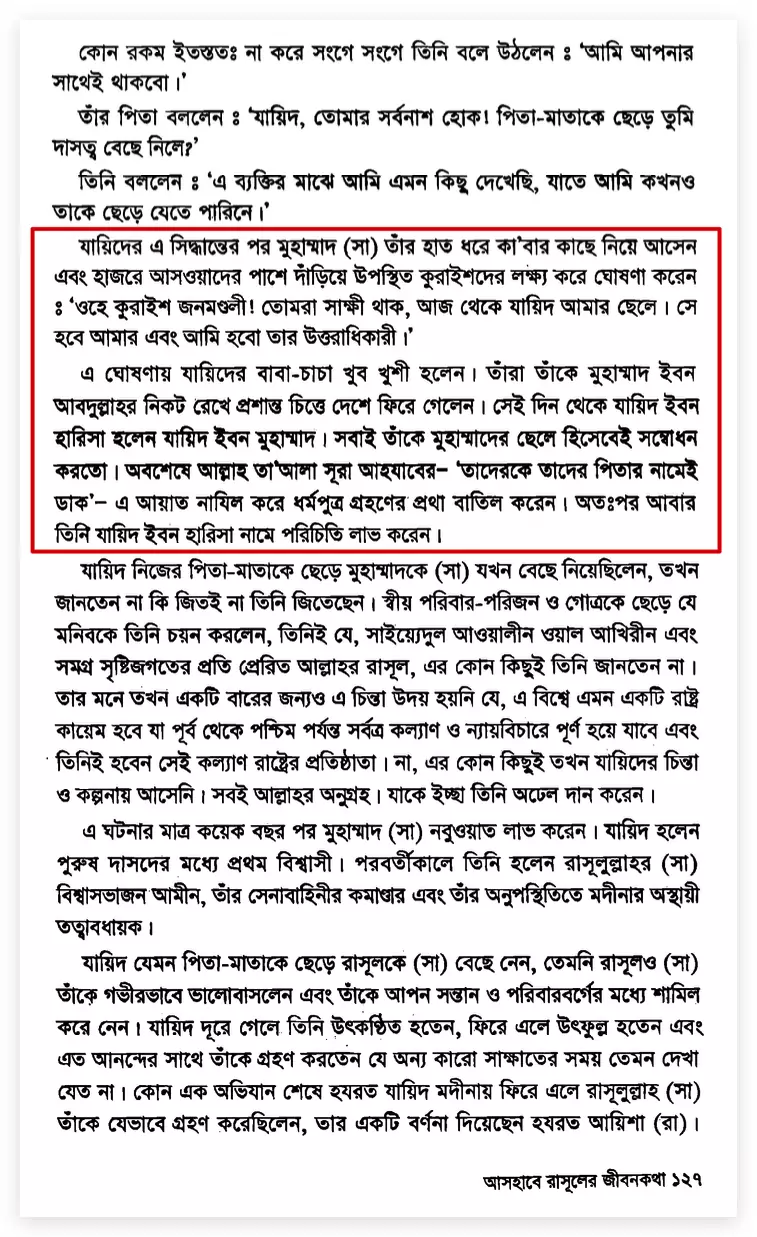
Through this declaration, Zayd ibn Harithah became ‘Zayd ibn Muhammad’ overnight. In the society of that time, this constituted a definitive legal and social bond. According to Sahih al-Bukhari, even the Prophet’s prominent Companions called him by this name until the controversial verse of Surah al-Ahzab was revealed.[4]
Sahih al-Bukhari (Tawhid Publication)
65/ Prophetic Commentary on the Qur’an
Section 65/33/2. Allah’s statement concerning calling adopted sons by their fathers’ names (Surah al-Ahzab 33:5).
4782. Narrated `Abdullah bin `Umar: We used not to call Zaid bin Haritha the freed slave of Allah’s Messenger (ﷺ) except Zaid bin Muhammad till the Qu’anic Verse was revealed: “Call them (adopted sons) by (the names of) their fathers. That is more than just in the Sight of Allah.” (33.5) [Muslim 44/10, hadith 2425; Ahmad 5480] (Adhunik Prakashani: 4418; Islamic Foundation: 4420)
Grade in the supplied edition: Sahih (Sahih). Verified equivalent: Sahih al-Bukhari 4782; Book 65, Hadith 304; USC-MSA Vol. 6, Book 60, Hadith 305. Arabic: حَدَّثَنَا مُعَلَّى بْنُ أَسَدٍ، حَدَّثَنَا عَبْدُ الْعَزِيزِ بْنُ الْمُخْتَارِ، حَدَّثَنَا مُوسَى بْنُ عُقْبَةَ، قَالَ حَدَّثَنِي سَالِمٌ، عَنْ عَبْدِ اللَّهِ بْنِ عُمَرَ ـ رضى الله عنهما ـ أَنَّ زَيْدَ بْنَ حَارِثَةَ، مَوْلَى رَسُولِ اللَّهِ صلى الله عليه وسلم مَا كُنَّا نَدْعُوهُ إِلاَّ زَيْدَ ابْنَ مُحَمَّدٍ حَتَّى نَزَلَ الْقُرْآنُ {ادْعُوهُمْ لآبَائِهِمْ هُوَ أَقْسَطُ عِنْدَ اللَّهِ}.
A profound rational question arises here: why did someone whom you had granted the status of your own son, and to whose name you had attached your own lineage, suddenly have to be made an outsider again? Al-Tabari’s History and other authoritative documents indicate that the principal catalyst for this change was Muhammad’s lust or infatuation with Zaynab rather than any noble spiritual revolution. Had Zayd remained a ‘son,’ Zaynab would have been Muhammad’s ‘daughter-in-law.’ In Arabia at the time, marrying a daughter-in-law constituted an indelible social disgrace and incest. [5] –
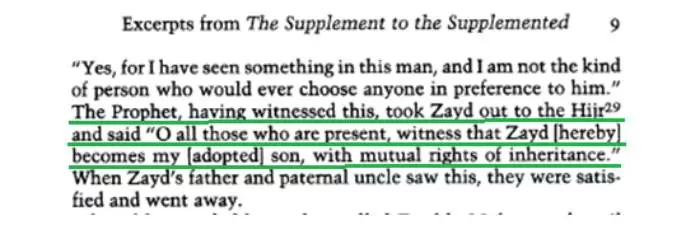
A rational analysis shows that Muhammad himself established Zayd as his son. Later, however, when that wall of ‘sonship’ obstructed his personal wishes, the wall itself was demolished by invoking revelation from Allah. Was this merely a coincidence, or a carefully calculated political and personal manoeuvre?
‘Muḥammad Is Not the Father of Any of Your Men’: Quran 33:40 and the Response to Objections to the Marriage
Alongside verse 37 of Surah al-Ahzab, which permits marriage to an adopted son’s divorced wife, verse 40 makes a declaration about Muhammad’s fatherhood: “Muḥammad is not the father of any of your men” [33:40; Dr. Mustafa Khattab, The Clear Quran]. The significance of this sentence becomes clearer in classical Quranic commentary. Al-Qurtubi writes that, when Muhammad married Zaynab, people accused him of marrying his own son’s wife. The verse was revealed in response: Zayd was not his actual son, so his wife was not forbidden to Muhammad. Opposition to the social and legal status of adoptive fatherhood and the declaration legitimizing this particular marriage thus occur within the same Quranic discussion. [6]
تفسير القرطبي — الجامع لأحكام القرآن
سورة الأحزاب، الآية ٤٠
المسألة الأولى
Original Quranic verse:
مَّا كَانَ مُحَمَّدٌ أَبَا أَحَدٍ مِّن رِّجَالِكُمْ وَلَٰكِن رَّسُولَ اللَّهِ وَخَاتَمَ النَّبِيِّينَ وَكَانَ اللَّهُ بِكُلِّ شَيْءٍ عَلِيمًا
Selected passage from al-Qurtubi’s original Arabic:
لما تزوج زينب قال الناس : تزوج امرأة ابنه ، فنزلت الآية ، أي ليس هو بابنه حتى تحرم عليه حليلته
English translation:
Surah al-Ahzab, verse 40:
“Muḥammad is not the father of any of your men, but is the Messenger of Allah and the seal of the prophets. And Allah has ˹perfect˺ knowledge of all things.” — Dr. Mustafa Khattab, The Clear Quran.
First issue — translation of the relevant part of al-Qurtubi’s explanation:
When Muhammad married Zaynab, people began saying, ‘He has married his son’s wife.’ The verse was then revealed: that is, Zayd was not actually Muhammad’s son such that his wife would become forbidden to Muhammad in marriage.
According to al-Qurtubi’s explanation, Muhammad is like a father to his community in honour and esteem. Muslims are forbidden to marry his wives. But this status does not make him the actual biological father of the adult men of his time.
Through this verse, Allah removed the objections that had arisen in the minds of hypocrites and others, and made clear that Muhammad was not, in a literal sense, the father of any adult man contemporary with him.
Al-Qurtubi further explains that the verse does not mean Muhammad never had sons. He names Ibrahim, al-Qasim, al-Tayyib, and al-Mutahhar as sons born to him. None, however, survived to adulthood. Hasan and Husayn were also children during his lifetime, not adult men.
The verse’s discussion therefore centres on objections to the marriage with Zaynab and the legal status of Muhammad’s relationship with his adopted son Zayd. By establishing a distinction between biological and adoptive fathers, it invalidated the basis of the socially established prohibition against Muhammad marrying Zaynab.
In this sequence, objections to a personal marriage were answered by changing the legal position of all adopted children. The question is not merely whether Muhammad could marry Zaynab; it is also why the existing definition of social fatherhood itself changed around his marriage. Verse 33:5 instructs that adopted children be called by their biological fathers’ names, 33:37 permits marriage to an adopted son’s divorced wife, and 33:40 declares that Muhammad is not anyone’s father. The combined result of these rules, associated with the same episode, was the termination of Zayd’s previously recognized sonship and the legal removal of Arabian society’s objections to the marriage with Zaynab.
Lust at the Sight of an Adopted Son’s Wife: Human Desire Behind Divine Words
One of the astonishing and controversial events in human history is the successive revelation of verses from Allah, Lord of the Throne, concerning an adopted son’s wife. Rational reflection raises the question: why did clearing the way to marry an adopted son’s wife become so urgent to Allah, ahead of addressing the vastness of the universe, abolishing slavery, ending warfare, or reforming grave social evils such as child marriage? Where humanity regards an adopted child as one’s own biological child, breaking up that son’s home and making his wife one’s bedmate is morally questionable and appears to reflect a calculated sexual desire.
The unequal marriage between Zaynab and Zayd was essentially set up through the intimidating warning that believers retain no right to choose otherwise once Allah and His Messenger issue a command. [7]
Arabic (Quran 33:36): وَمَا كَانَ لِمُؤۡمِنٖ وَلَا مُؤۡمِنَةٍ إِذَا قَضَى ٱللَّهُ وَرَسُولُهُۥٓ أَمۡرًا أَن يَكُونَ لَهُمُ ٱلۡخِيَرَةُ مِنۡ أَمۡرِهِمۡۗ وَمَن يَعۡصِ ٱللَّهَ وَرَسُولَهُۥ فَقَدۡ ضَلَّ ضَلَٰلٗا مُّبِينٗا — It is not for a believing man or woman—when Allah and His Messenger decree a matter—to have any other choice in that matter. Indeed, whoever disobeys Allah and His Messenger has clearly gone ˹far˺ astray.
— Dr. Mustafa Khattab, The Clear Quran (Bengali source version: Taisirul Quran)
It is not for a believing man or woman—when Allah and His Messenger decree a matter—to have any other choice in that matter. Indeed, whoever disobeys Allah and His Messenger has clearly gone ˹far˺ astray.
— Dr. Mustafa Khattab, The Clear Quran (Bengali source version: Sheikh Mujibur Rahman)
It is not for a believing man or woman—when Allah and His Messenger decree a matter—to have any other choice in that matter. Indeed, whoever disobeys Allah and His Messenger has clearly gone ˹far˺ astray.
— Dr. Mustafa Khattab, The Clear Quran (Bengali source version: Rawai Al-bayan)
It is not for a believing man or woman—when Allah and His Messenger decree a matter—to have any other choice in that matter. Indeed, whoever disobeys Allah and His Messenger has clearly gone ˹far˺ astray. [Source note marker: 1.]
— Dr. Mustafa Khattab, The Clear Quran (Bengali source version: Dr. Abu Bakr Muhammad Zakaria)
Arabic (Quran 33:37): وَإِذۡ تَقُولُ لِلَّذِيٓ أَنۡعَمَ ٱللَّهُ عَلَيۡهِ وَأَنۡعَمۡتَ عَلَيۡهِ أَمۡسِكۡ عَلَيۡكَ زَوۡجَكَ وَٱتَّقِ ٱللَّهَ وَتُخۡفِي فِي نَفۡسِكَ مَا ٱللَّهُ مُبۡدِيهِ وَتَخۡشَى ٱلنَّاسَ وَٱللَّهُ أَحَقُّ أَن تَخۡشَىٰهُۖ فَلَمَّا قَضَىٰ زَيۡدٞ مِّنۡهَا وَطَرٗا زَوَّجۡنَٰكَهَا لِكَيۡ لَا يَكُونَ عَلَى ٱلۡمُؤۡمِنِينَ حَرَجٞ فِيٓ أَزۡوَٰجِ أَدۡعِيَآئِهِمۡ إِذَا قَضَوۡاْ مِنۡهُنَّ وَطَرٗاۚ وَكَانَ أَمۡرُ ٱللَّهِ مَفۡعُولٗا — And ˹remember, O Prophet,˺ when you said to the one for whom Allah has done a favour and you ˹too˺ have done a favour, “Keep your wife and fear Allah,” while concealing within yourself what Allah was going to reveal. And ˹so˺ you were considering the people, whereas Allah was more worthy of your consideration. So when Zaid totally lost interest in ˹keeping˺ his wife, We gave her to you in marriage, so that there would be no blame on the believers for marrying the ex-wives of their adopted sons after their divorce. And Allah’s command is totally binding.
— Dr. Mustafa Khattab, The Clear Quran (Bengali source version: Taisirul Quran)
And ˹remember, O Prophet,˺ when you said to the one for whom Allah has done a favour and you ˹too˺ have done a favour, “Keep your wife and fear Allah,” while concealing within yourself what Allah was going to reveal. And ˹so˺ you were considering the people, whereas Allah was more worthy of your consideration. So when Zaid totally lost interest in ˹keeping˺ his wife, We gave her to you in marriage, so that there would be no blame on the believers for marrying the ex-wives of their adopted sons after their divorce. And Allah’s command is totally binding.
— Dr. Mustafa Khattab, The Clear Quran (Bengali source version: Sheikh Mujibur Rahman)
And ˹remember, O Prophet,˺ when you said to the one for whom Allah has done a favour and you ˹too˺ have done a favour, “Keep your wife and fear Allah,” while concealing within yourself what Allah was going to reveal. And ˹so˺ you were considering the people, whereas Allah was more worthy of your consideration. So when Zaid totally lost interest in ˹keeping˺ his wife, We gave her to you in marriage, so that there would be no blame on the believers for marrying the ex-wives of their adopted sons after their divorce.* And Allah’s command is totally binding. * فَلَمَّا قَضَىٰ زَيْدٌ مِّنْهَا وَطَرًا literally means: when Zayd had finished his need concerning her (his wife). The intended meaning is: when Zayd divorced his wife after his marital need had ended. Zayd ibn Harithah had been a slave of the Messenger of Allah (peace and blessings be upon him). Allah favoured him by guiding him to Islam, and the Messenger of Allah (peace and blessings be upon him) favoured him by freeing him and declaring him his adopted son. Zayd married Zaynab bint Jahsh, the daughter of the Messenger of Allah’s paternal aunt. When they could not get along, Zayd divorced Zaynab. Later, at Allah’s command, the Messenger of Allah (peace and blessings be upon him) married Zaynab. Through this, Allah removed the social prohibition against marrying an adopted son’s divorced wife.
— Dr. Mustafa Khattab, The Clear Quran (Bengali source version and explanatory note: Rawai Al-bayan)
And ˹remember, O Prophet,˺ when you said to the one for whom Allah has done a favour and you ˹too˺ have done a favour, “Keep your wife and fear Allah,” while concealing within yourself what Allah was going to reveal. And ˹so˺ you were considering the people, whereas Allah was more worthy of your consideration. So when Zaid totally lost interest in ˹keeping˺ his wife, We gave her to you in marriage, so that there would be no blame on the believers for marrying the ex-wives of their adopted sons after their divorce. And Allah’s command is totally binding. [Source note markers: 1, 2, 3, 4.]
— Dr. Mustafa Khattab, The Clear Quran (Bengali source version: Dr. Abu Bakr Muhammad Zakaria)
Zaynab’s Objection to Her First Marriage and Quranic Authority: IslamQA’s Direct Acknowledgement
IslamQA’s detailed discussion also acknowledges Zaynab’s objection to her first marriage and the role of religious instruction in overcoming it. According to the Saudi Permanent Committee for Fatwa’s statement quoted there, Muhammad proposed to Zaynab on Zayd’s behalf. Zaynab objected on grounds of lineage; the account then describes the revelation of verse 36 of Surah al-Ahzab and her agreement in obedience to Allah and to fulfil Muhammad’s wish. At the very first stage of the marriage, the Prophet’s authority and the fear of religious disobedience thus operated upon a personal decision. The Islamic explanation that Zaynab’s objection arose from class pride does not erase the question of her freedom to accept or reject a marriage proposal. [8]
الإسلام سؤال وجواب — السؤال رقم 96464
تفصيل القول في قوله تعالى (وتخفي في نفسك ما الله مبديه)
Cited source: Saudi Permanent Committee for Fatwa, فتاوى إسلامية, vol. 18, pp. 137–141
Selected passages from the original Arabic:
فخطبها من نفسها على زيد ، فاستنكفت وقالت : أنا خير منه حسباً
فاستجابت طاعةً لله ، وتحقيقًا لرغبة رسوله صلى الله عليه وسلم
English translation:
Question: What is the actual story of Zayd ibn Harithah’s marriage to Zaynab bint Jahsh? How did their marriage begin, and how did it end? The question asks for a detailed explanation of the circulating account that Muhammad fell in love with Zaynab.
Relevant passages from the Saudi Permanent Committee for Fatwa’s answer:
Zayd was the son of Harithah ibn Sharahil al-Kalbi and Muhammad’s freed slave. Muhammad had adopted him. He was therefore known as ‘Zayd ibn Muhammad.’ After the Quranic instruction “Let your adopted children keep their family names” [33:5; Dr. Mustafa Khattab, The Clear Quran] was revealed, he was again called ‘Zayd ibn Harithah.’
Zaynab was the daughter of Jahsh ibn Ri’ab al-Asadi. Her mother, Umaymah bint Abd al-Muttalib, was Muhammad’s paternal aunt. Zaynab was thus Muhammad’s paternal cousin.
Muhammad himself arranged Zaynab’s marriage to Zayd. Because Zayd was his freed slave and adopted son, Muhammad proposed to Zaynab on his behalf. Zaynab objected, however, saying, ‘I am superior to him in lineage.’
The fatwa states that verse 36 of Surah al-Ahzab is reported to have been revealed in connection with this event. It says:
“It is not for a believing man or woman—when Allah and His Messenger decree a matter—to have any other choice in that matter. Indeed, whoever disobeys Allah and His Messenger has clearly gone ˹far˺ astray.” — Dr. Mustafa Khattab, The Clear Quran.
Zaynab then agreed to the marriage in obedience to Allah and to fulfil Muhammad’s wish.
According to the Committee’s account, Zaynab lived with Zayd for about a year. Differences then arose between husband and wife. Zayd complained to Muhammad about Zaynab: Zayd was his freed slave and adopted son, while Zaynab was his paternal cousin. Zayd’s words suggested that he wanted to divorce her.
Muhammad told him to keep Zaynab as his wife and be patient. The Committee explains that Muhammad already knew through revelation that Zayd would divorce Zaynab and that she would subsequently become his own wife. He feared, however, that people would condemn him for marrying his adopted son’s wife, since such a marriage had been considered forbidden in pre-Islamic Arabian society.
Thus, the marriage to which Zaynab initially objected was completed with her consent following Muhammad’s proposal and the Quranic instruction. After that marriage ended in divorce, Muhammad himself married Zaynab.
In the course of the same marital history, Zaynab was initially unwilling to marry Zayd; the marriage then took place under the Prophet’s instruction and in an atmosphere of religious obligation; and Islamic accounts subsequently describe Muhammad’s attraction to Zaynab and his own marriage to her. Concentrating the power to propose a marriage, issue religious instructions, mediate family matters, and decide on a subsequent marriage in one person’s hands makes this relationship profoundly unequal compared with an ordinary marriage between two independent adults.
Dissecting the Tafsir: The Secret Concealed in His Heart
Verse 37 of Surah al-Ahzab states, “while concealing within yourself what Allah was going to reveal.” [Dr. Mustafa Khattab, The Clear Quran.] What exactly was this ‘secret’? Almost all reliable commentators, ancient and modern, acknowledge that it was Muhammad’s intense attraction to, or lust for, Zaynab. From Abu Bakr Muhammad Zakaria to al-Jalalayn, this truth emerges with exceptional clarity.
Al-Qur’an al-Karim: Abu Bakr Muhammad Zakaria
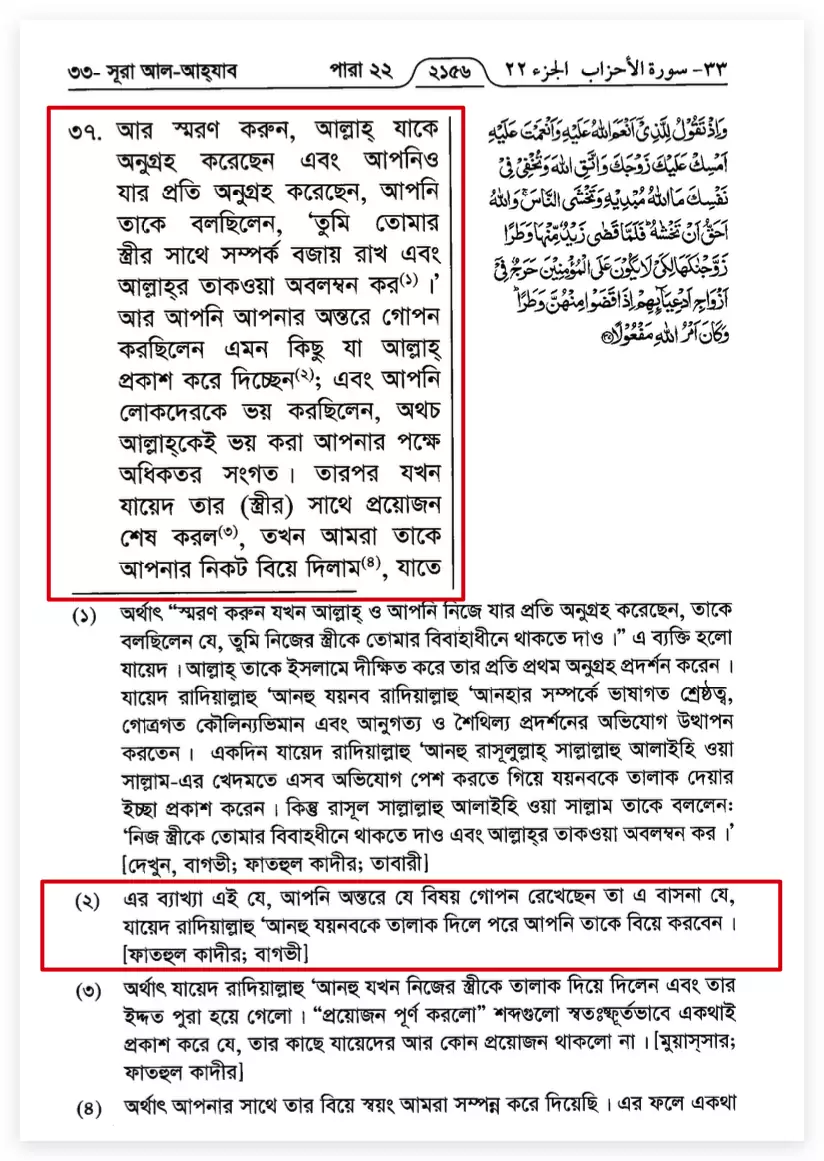
According to Zakaria’s commentary, Muhammad privately wished that Zayd would divorce Zaynab so that he could marry her. Yet, fearing public disgrace, he was telling Zayd, “Keep your wife” [Quran 33:37; Dr. Mustafa Khattab, The Clear Quran]. This double-dealing is demonstrated by the Quranic verse itself. Let us read the verse as presented in Abu Bakr Muhammad Zakaria’s work, [9]
37.
And ˹remember, O Prophet,˺ when you said to the one for whom Allah has done a favour and you ˹too˺ have done a favour, “Keep your wife and fear Allah,” while concealing within yourself what Allah was going to reveal. And ˹so˺ you were considering the people, whereas Allah was more worthy of your consideration. So when Zaid totally lost interest in ˹keeping˺ his wife, We gave her to you in marriage, so that… [Quran 33:37, excerpt; English: Dr. Mustafa Khattab, The Clear Quran; Bengali source note markers: 1, 2, 3, 4.]
(1)
That is, remember when you were telling the person whom Allah and you yourself had favoured,
‘Let your wife remain married to you.’ This person was Zayd. Allah first favoured him by bringing him to Islam. Zayd (may Allah be pleased with him) complained of Zaynab’s verbal superiority, pride in her tribal nobility, and laxity in obedience. One day, while presenting these complaints to the Messenger of Allah (peace and blessings be upon him), Zayd expressed his intention to divorce Zaynab. But the Messenger told him, ‘Let your wife remain married to you, and have taqwa of Allah.’ [See al-Baghawi; Fath al-Qadir; al-Tabari.]
(2)
The explanation is that what you concealed in your heart was the wish that, if Zayd divorced Zaynab, you would subsequently marry her. [Fath al-Qadir; al-Baghawi]
Al-Tabari’s Original Arabic Tafsir: The Hidden Hope ‘That Zayd Would Divorce Her’
In his commentary on Surah al-Ahzab 33:37, al-Tabari does more than mention Muhammad’s attraction to Zaynab: he explicitly identifies the meaning of “while concealing within yourself” as the hope that Zayd and Zaynab would separate. According to al-Tabari, Muhammad felt attracted to Zaynab when he saw her; when Zayd wanted to divorce his wife, Muhammad verbally urged him to continue the marriage, while privately wishing that Zaynab would be released from it so that he could marry her himself. Qatadah’s comment, transmitted by al-Tabari, points in the same direction: Muhammad privately wished for Zayd’s divorce. This account matters because it is not a psychological interpretation invented by a modern critic; the hidden desire is explicitly described within early Muslim Quranic commentary. [10]
تفسير الطبري — جامع البيان عن تأويل آي القرآن
سورة الأحزاب، الآية ٣٧
الجزء العشرون، الصفحتان 273–274
Selected passages from the original Arabic:
وهو صَلَّى الله عَلَيْهِ وَسَلَّم يحب أن تكون قد بانت منه لينكحها
وتخفي في نفسك محبة فراقه إياها لتتزوجها إن هو فارقها
English translation and detailed paraphrase of the relevant explanation:
Allah reminds Muhammad that he had told a person whom Allah had favoured through Islam, and whom Muhammad had favoured by freeing him from slavery, ‘Keep your wife and fear Allah.’ The person in question was Zayd ibn Harithah.
According to al-Tabari’s explanation, it is related that Muhammad once saw Zaynab bint Jahsh and liked her. At that time, Zaynab was Zayd’s wife. Allah knew the feelings for Zaynab that had arisen in Muhammad’s heart. Zayd subsequently developed an aversion to her. He informed Muhammad that he wished to divorce her.
Muhammad told him, ‘Keep your wife.’ But he privately wished that Zaynab would be separated from Zayd’s marriage so that he could marry her himself.
Explaining the words “while concealing within yourself what Allah was going to reveal” [Quran 33:37; Dr. Mustafa Khattab, The Clear Quran], al-Tabari states that Muhammad concealed within himself the desire for Zayd’s separation from Zaynab, so that he could marry her if Zayd divorced her.
Al-Tabari explains “you were considering the people” as Muhammad’s fear that people would say he had instructed a man to divorce his wife and then married her himself.
The explanation transmitted from Qatadah likewise states that Muhammad privately wished Zayd would divorce Zaynab. Ibn Zayd’s account adds that, one day, Muhammad went to Zayd’s house, where the wind lifted the curtain over the doorway and he saw Zaynab uncovered inside her room. He became attracted to her. Later, although Zayd expressed a wish to divorce her, Muhammad told him to keep his wife.
After Zayd eventually divorced Zaynab, the Quran declared that Allah had joined her in marriage to Muhammad. Al-Tabari connects this event with the rule removing the social obstacle to marrying an adopted son’s divorced wife.
Al-Tabari’s explanation makes the Quranic sentence more specific. The verse merely states that Muhammad concealed something within himself; al-Tabari identifies that hidden matter as the expectation of Zayd’s divorce and his own marriage to Zaynab. The inconsistency between verbally saying ‘Keep your wife’ and privately wishing for that marriage to end is therefore more than conjecture: it is established in al-Tabari’s own explanation.
Tafsir al-Mazhari: Qadi Thana’ullah Panipati
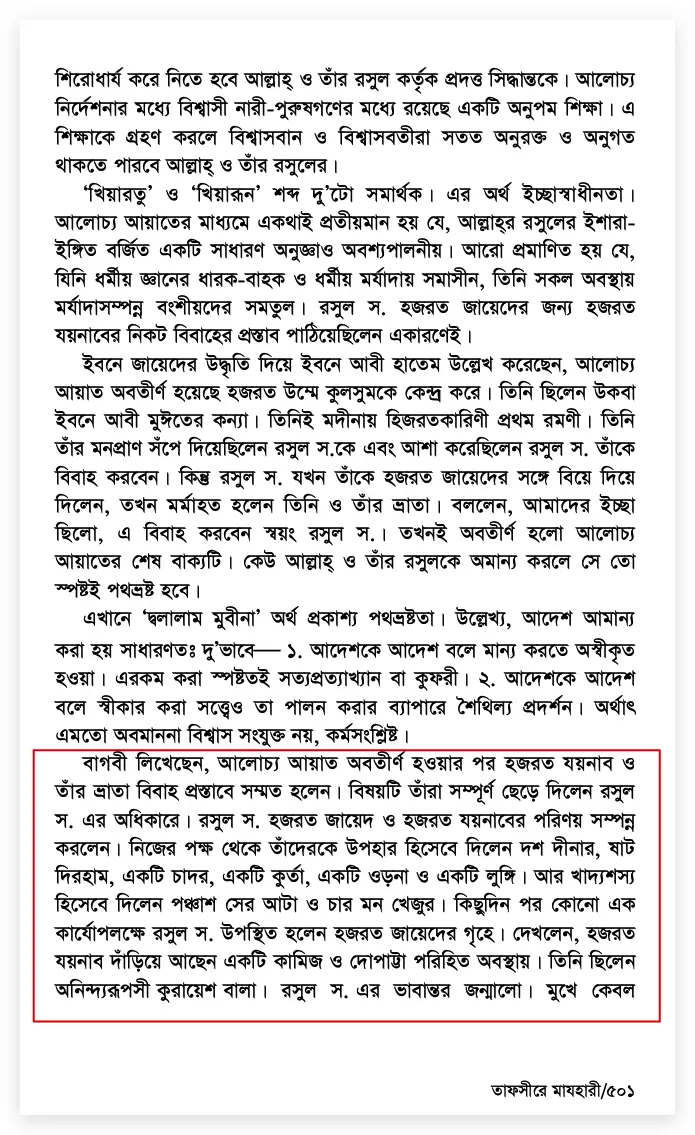
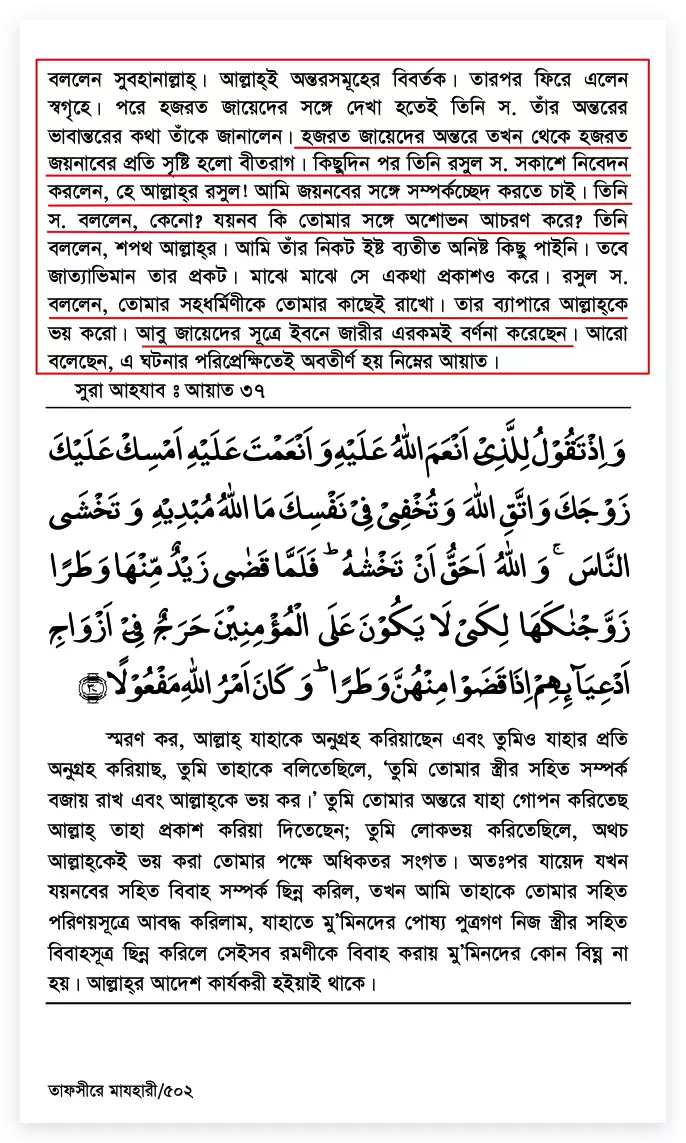
The episode was not confined to emotional attraction; it had a specific physical setting. According to Tafsir al-Mazhari and al-Jalalayn, Muhammad once visited Zayd’s house and saw Zaynab unprepared and scantily dressed. Her exquisite beauty brought about a profound change in the Prophet’s heart, and he murmured to himself, “Subhanallah! It is Allah who turns the hearts.” Let us now read another commentary on this verse, [11]
Al-Baghawi writes that, after the verse under discussion was revealed, Zaynab and her brother agreed to the marriage proposal and left the matter entirely in the Messenger’s hands. The Messenger (peace be upon him) performed the marriage of Zayd and Zaynab. As gifts from himself, he gave them ten dinars, sixty dirhams, a cloak, a tunic, a head covering, and a waist wrapper. For provisions, he gave fifty seers of flour and four maunds of dates.Some time later, the Messenger visited Zayd’s house on an errand. He saw Zaynab standing in a tunic and a dupatta. She was an exquisitely beautiful young Qurayshi woman. A change came over the Messenger’s feelings. He said only, ‘Subhanallah. It is Allah who turns the hearts,’ and then returned home. Later, when he met Zayd, he told him of the change in his heart. From that time onward, Zayd developed an aversion to Zaynab. Some time later, he submitted to the Messenger, ‘Messenger of Allah! I wish to end my relationship with Zaynab.’He asked, ‘Why? Does Zaynab behave improperly toward you?’ Zayd replied, ‘By Allah, I have found nothing but good in her. But her pride in her lineage is pronounced, and she sometimes expresses it.’ The Messenger said, ‘Keep your wife with you, and fear Allah concerning her.’ Ibn Jarir relates a similar account through Abu Zayd. He also says that the following verse was revealed in connection with this event.
… It then says: “while concealing within yourself what Allah was going to reveal.” [Quran 33:37; Dr. Mustafa Khattab, The Clear Quran.]
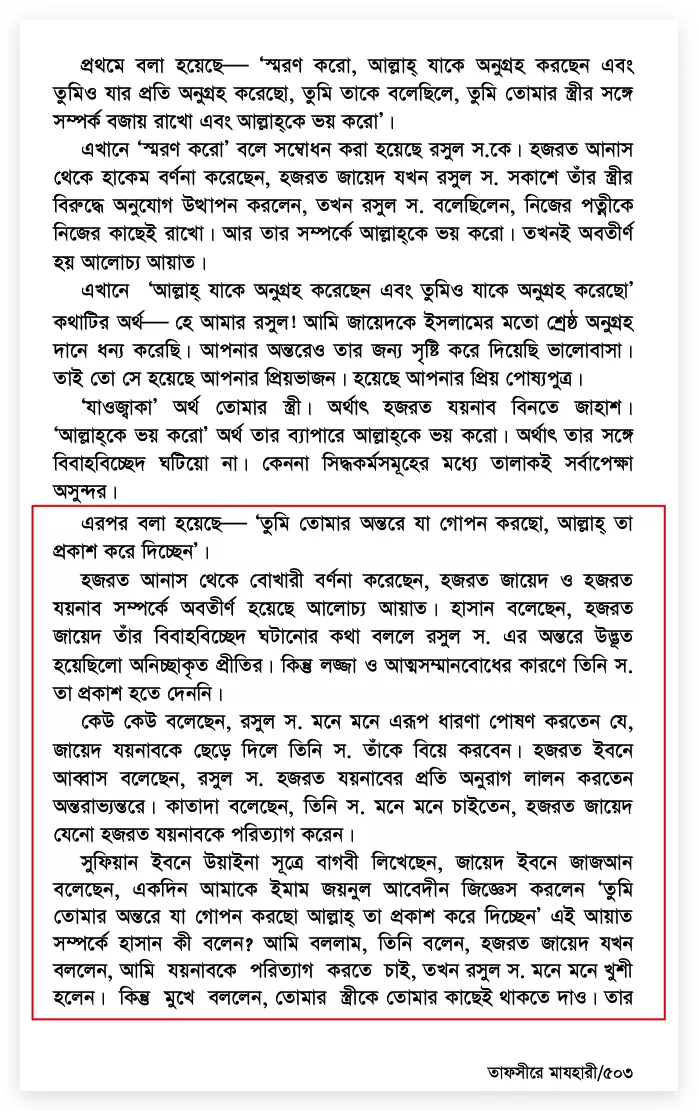
Al-Bukhari relates from Anas that the verse under discussion was revealed concerning Zayd and Zaynab. Hasan said that, when Zayd spoke of divorcing her, an involuntary affection arose in the Messenger’s heart. But out of modesty and self-respect he did not let it become apparent.
Some have said that the Messenger privately entertained the thought that he would marry Zaynab if Zayd left her. Ibn Abbas said that the Messenger harboured affection for Zaynab in his heart. Qatadah said that he privately wished Zayd would abandon Zaynab.
Al-Baghawi writes, through Sufyan ibn Uyaynah, that Zayd ibn Jaz‘an said: One day Imam Zayn al-Abidin asked me, ‘What does Hasan say about the verse “while concealing within yourself what Allah was going to reveal”?’ I replied, ‘He says that, when Zayd said, “I wish to leave Zaynab,” the Messenger felt pleased within himself. But he said aloud, “Let your wife remain with you.” Her…
Tafsir al-Jalalayn: Al-Mahalli and al-Suyuti
Tafsir al-Jalalayn states even more explicitly that ‘love,’ or affection, arose in Muhammad’s heart as soon as he saw Zaynab. When Zayd realized that his adoptive father’s attention had fallen upon his wife, he became disaffected with Zaynab, whether voluntarily or under pressure, and proposed divorcing her. Let us now read Tafsir al-Jalalayn, [12] –
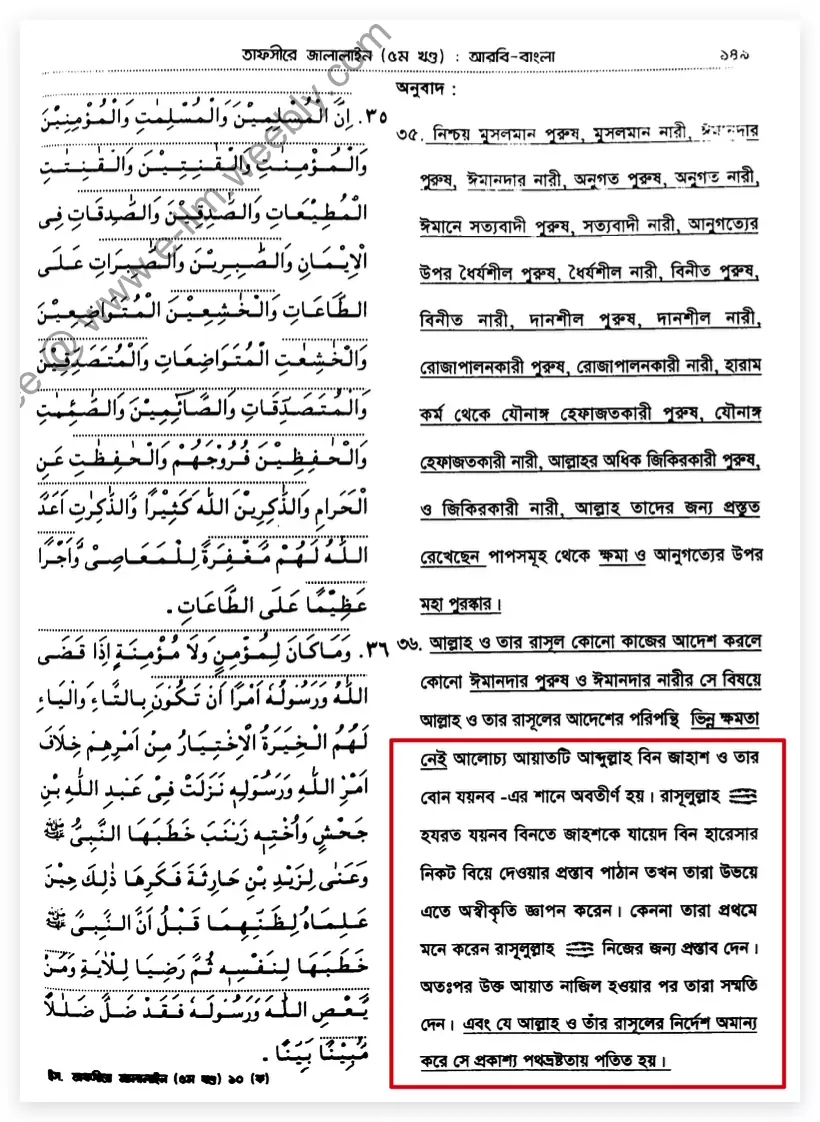
… The verse under discussion was revealed concerning Abdullah ibn Jahsh and his sister Zaynab. When the Messenger of Allah proposed that Zaynab bint Jahsh marry Zayd ibn Harithah, both of them refused, having initially thought that the Messenger was proposing for himself. After the verse was revealed, however, they agreed. Whoever disobeys Allah and His Messenger falls into manifest error.
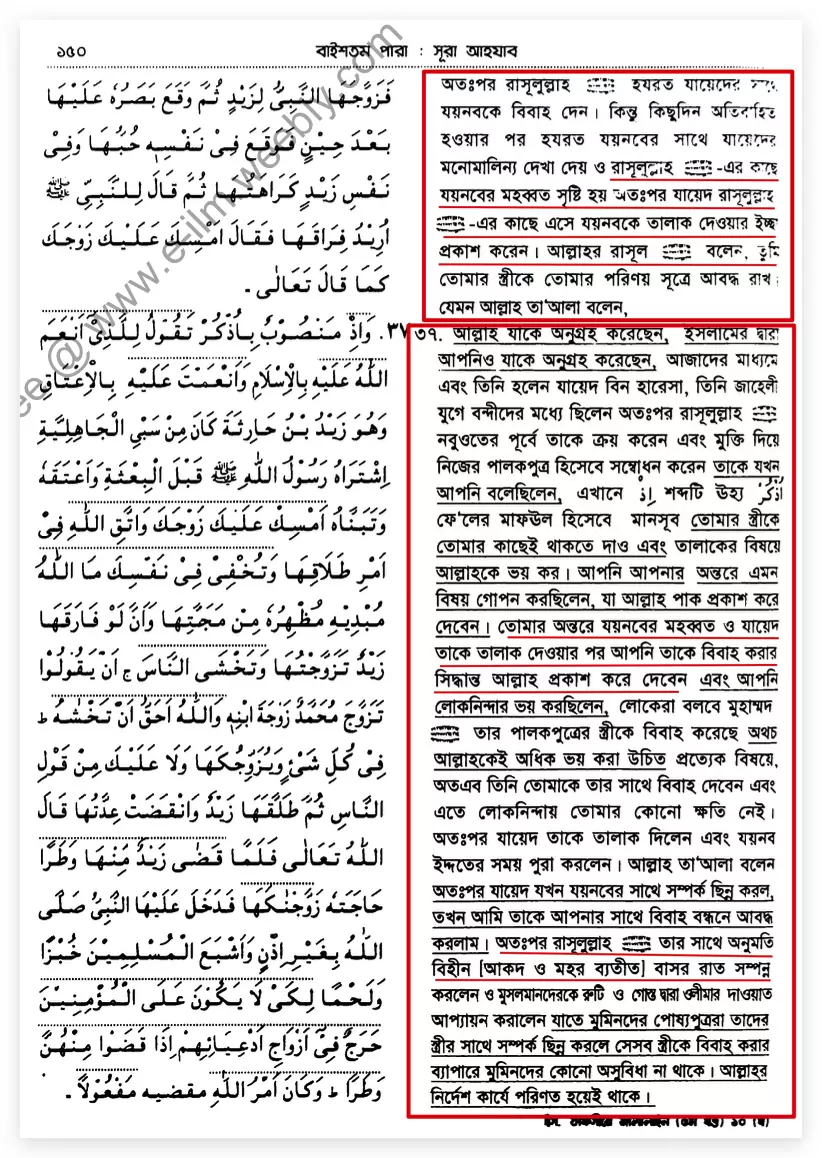
The Messenger then married Zaynab to Zayd. But after some time, differences arose between Zaynab and Zayd, and the Messenger developed affection for Zaynab. Zayd then came to the Messenger and expressed his intention to divorce her. Allah’s Messenger said, ‘Keep your wife married to you,’ as Allah Most High says:
37. Allah favoured him through Islam, and you too favoured him by emancipation: this was Zayd ibn Harithah, who had been among the captives in the pre-Islamic period. Before his prophethood, the Messenger purchased him, freed him, and called him his adopted son. When you said to him—here the word indicated in the source is accusative as the object of an omitted verb—‘Keep your wife with you, and fear Allah concerning divorce.’ You were concealing in your heart your love for Zaynab and your intention to marry her after Zayd divorced her, which Allah would disclose. You feared public reproach: people would say that Muhammad had married his adopted son’s wife. Yet Allah was more deserving of your fear in every matter; He would therefore marry you to her, and public reproach would cause you no harm. Zayd then divorced her, and Zaynab completed her waiting period. Allah Most High says that, when Zayd ended his relationship with Zaynab, He joined her in marriage to you. The Messenger then consummated the marriage with her without permission
[without a marriage contract or mahr]. He entertained the Muslims at a wedding feast of bread and meat, so that believers would face no difficulty in marrying the wives of their adopted sons once those sons had ended their relationships with them. Allah’s command is always fulfilled.
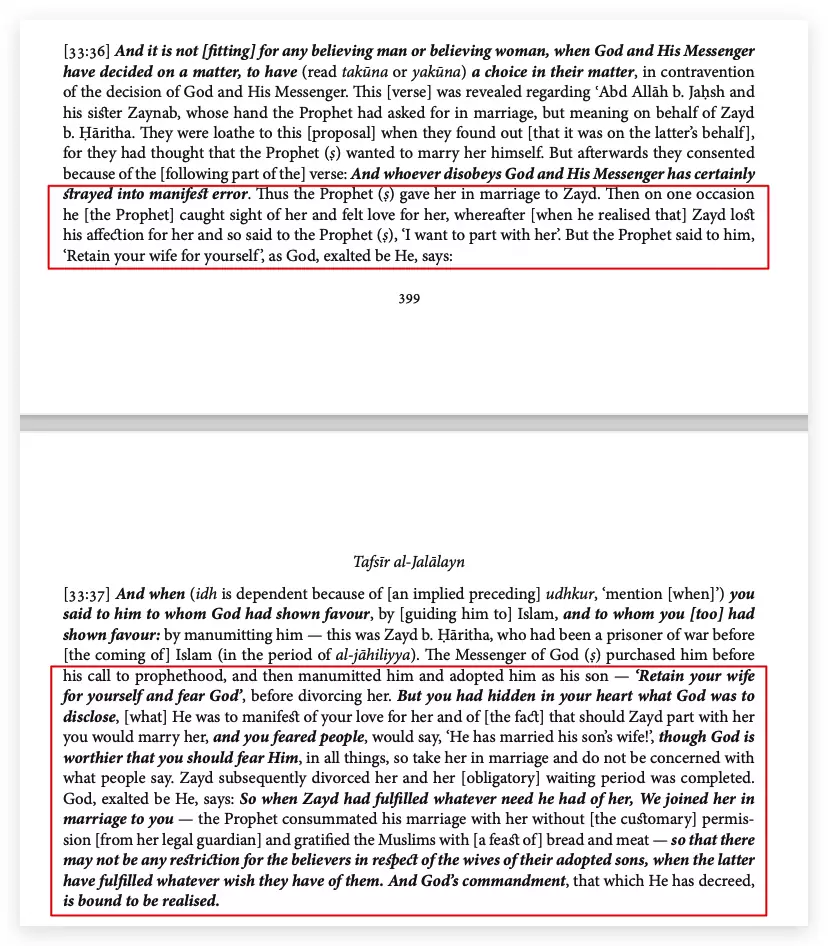
Notice above that the translator adopted a particular device when translating Tafsir al-Jalalayn, with the result that the sequence of events was changed. Let us therefore consult the English translation to understand that sequence, [13]
[33:36] And it is not [fitting] for any believing man or believing woman, when God and His Messenger have decided on a matter, to have (read takūna or yakūna) a choice in their matter, in contravention of the decision of God and His Messenger. This [verse] was revealed regarding ‘Abd Allah b. Jahsh and his sister Zaynab, whose hand the Prophet had asked for in marriage, but meaning on behalf of Zayd b. Haritha. They were loathe to this [proposal] when they found out [that it was on the latter’s behalf], for they had thought that the Prophet (s) wanted to marry her himself. But afterwards they consented because of the [following part of the] verse: And whoever disobeys God and His Messenger has certainly strayed into manifest error. Thus the Prophet (s) gave her in marriage to Zayd. Then on one occasion he [the Prophet] caught sight of her and felt love for her, whereafter [when he realised that] Zayd lost his affection for her and so said to the Prophet (s), ‘I want to part with her.’ But the Prophet said to him, ‘Retain your wife for yourself,’ as God, exalted be He, says:
[33:37] And when (idh is dependent because of [an implied preceding] udhkur, ‘mention [when]’) you said to him to whom God had shown favour, by [guiding him to] Islam, and to whom you [too] had shown favour: by manumitting him – this was Zayd b. Haritha, who had been a prisoner of war before [the coming of] Islam (in the period of al-jahiliyya). The Messenger of God (s) purchased him before his call to prophethood, and then manumitted him and adopted him as his son – ‘Retain your wife for yourself and fear God’, before divorcing her. But you had hidden in your heart what God was to disclose, [what] He was to manifest of your love for her and of [the fact] that should Zayd part with her you would marry her, and you feared people, would say, ‘He has married his son’s wife!’, though God is worthier that you should fear Him, in all things, so take her in marriage and do not be concerned with what people say. Zayd subsequently divorced her and her [obligatory] waiting period was completed. God, exalted be He, says: So when Zayd had fulfilled whatever need he had of her, We joined her in marriage to you the Prophet consummated his marriage with her without [the customary] permission [from her legal guardian] and gratified the Muslims with [a feast of] bread and meat so that there may not be any restriction for the believers in respect of the wives of their adopted sons, when the latter have fulfilled whatever wish they have of them. And God’s commandment, that which He has decreed, is bound to be realised.
Al-Tabari’s History: What Lay Hidden Behind ‘Subhanallah’
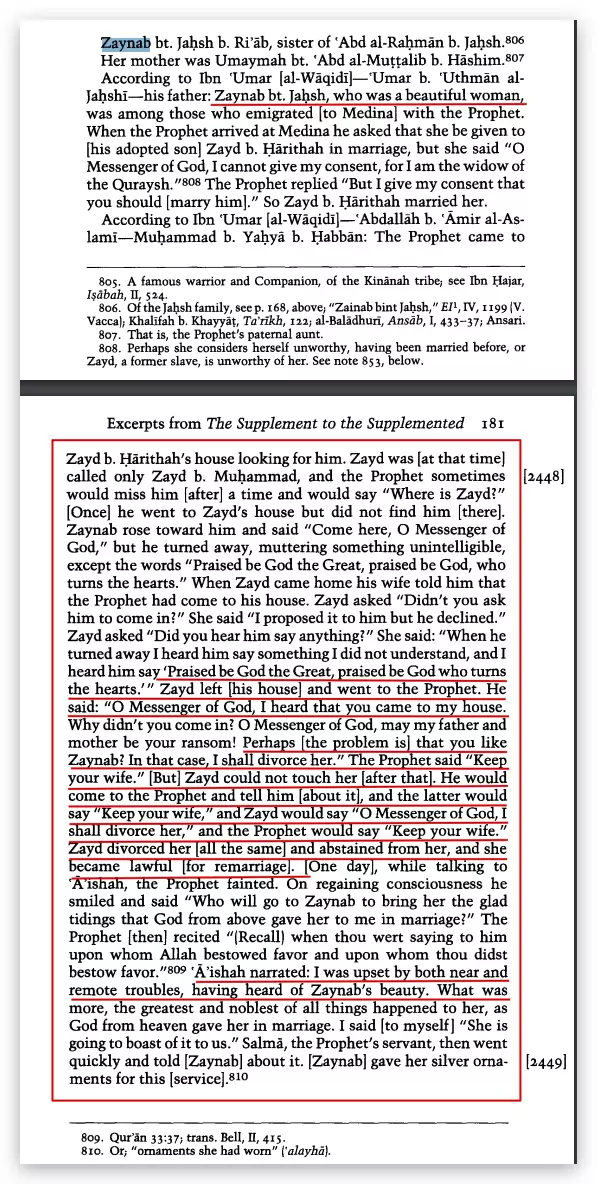
The account in al-Tabari’s History, known as one of the most authoritative records of Islamic history, would stun any conscientious person. When Muhammad visited Zayd’s house, Zaynab hurried out while putting on her clothes. Her beauty left a lasting impression on Muhammad. He turned away muttering ‘Subhanallah,’ perhaps meaning: how could such a beautiful woman be in his adopted son’s household? [14] [15]
Muhammad ibn Umar (al-Waqidi) said: Abdullah ibn Amr al-Aslami said: Muhammad ibn Yahya ibn Hisham said: “The Messenger ﷺ went to the home of Zayd ibn Harithah looking for him. At that time, Zayd was called ‘Muhammad’s son.’ But he did not find him at home. Zaynab then came out to welcome him wearing her nightclothes. The Prophet ﷺ turned his face away, and she said, ‘Prophet of Allah! He is not here; please come inside.’ But the Prophet ﷺ declined to enter. She had come out in her nightclothes because she had been told that the Prophet ﷺ was at the door and had hurried. She found a place in the Prophet’s heart. He left murmuring indistinctly, of which only this could be understood: ‘Praise be to Him who turns the hearts.’”
Let us now read the full account directly from the celebrated historical work of al-Tabari, [16] –
Zaynab bt. Jahsh b. Ri’ab, sister of `Abd al-Rahman b. Jahsh.
Her mother was Umaymah bt. `Abd al-Muttalib b. Hashim.
According to Ibn `Umar [al-Waqidi]-`Umar b. `Uthman al-Jahshi-his father: Zaynab bt. Jahsh, who was a beautiful woman, was among those who emigrated [to Medina] with the Prophet. When the Prophet arrived at Medina he asked that she be given to [his adopted son] Zayd b. Harithah in marriage, but she said “O Messenger of God, I cannot give my consent, for I am the widow of the Quraysh. The Prophet replied “But I give my consent that you should [marry him].” So Zayd b. Harithah married her.
According to Ibn Umar [al-Waqidi]-`Abdallah b. `Amir al-Aslami-Muhammad b. Yahya b. abban: The Prophet came to Zayd b. Harithah’s house looking for him. Zayd was [at that time] called only Zayd b. Muhammad, and the Prophet sometimes would miss him [after] a time and would say “Where is Zayd?” [Once] he went to Zayd’s house but did not find him [there].
Zaynab rose toward him and said “Come here, O Messenger of God,” but he turned away, muttering something unintelligible, except the words “Praised be God the Great, praised be God, who turns the hearts.”( Subhanallah!) When Zayd came home his wife told him that the Prophet had come to his house. Zayd asked “Didn’t you ask him to come in?” She said “I proposed it to him but he declined.”
Zayd asked “Did you hear him say anything?” She said: “When he turned away I heard him say something I did not understand, and I heard him say ‘Praised be God the Great, praised be God who turns the hearts.” Zayd left [his house] and went to the Prophet. He said: “O Messenger of God, I heard that you came to my house.
Why didn’t you come in? O Messenger of God, may my father and mother be your ransom! Perhaps [the problem is] that you like Zaynab? In that case, I shall divorce her.” The Prophet said “Keep your wife.” [But] Zayd could not touch her [after that]. He would
come to the Prophet and tell him [about it], and the latter would say “Keep your wife,” and Zayd would say “O Messenger of God, I shall divorce her,” and the Prophet would say “Keep your wife.”
Zayd divorced her [all the same] and abstained from her, and she became lawful [for remarriage]. [One day], while talking to `A’ishah, the Prophet fainted. On regaining consciousness he smiled and said “Who will go to Zaynab to bring her the glad tidings that God from above gave her to me in marriage?” The Prophet [then] recited “(Recall) when thou wert saying to him upon whom Allah bestowed favor and upon whom thou didst bestow favor.” A’ishah narrated: I was upset by both near and remote troubles, having heard of Zaynab’s beauty. What was more, the greatest and noblest of all things happened to her, as God from heaven gave her in marriage. I said [to myself ] “She is going to boast of it to us.” Salma, the Prophet’s servant, then went quickly and told [Zaynab] about it. [Zaynab] gave her silver ornaments for this [service].
Translation: Zaynab bint Jahsh. Her mother was Umaymah bint Abd al-Muttalib ibn Hashim.
It is related through Ibn Umar that Zaynab bint Jahsh was an exceptionally beautiful woman. She was among the Companions who emigrated to Medina with the Prophet. When he arrived in Medina, he asked Zaynab to marry his adopted son, Zayd ibn Harithah. Zaynab replied, ‘Messenger of Allah, I do not consent, for I am a widow of the Quraysh.’ The Prophet answered, ‘But I instruct you to enter this marriage.’ Zayd ibn Harithah then married her.
It is further related through Ibn Umar that, one day, the Prophet went to Zayd ibn Harithah’s house looking for him. Zayd was then called ‘Zayd ibn Muhammad.’ The Prophet would look for him and say, ‘Where is Zayd?’ One day he went to Zayd’s house, did not find him, and turned away.
When Zaynab saw the Prophet, she said, ‘Messenger of Allah, come inside.’ But he left, uttering some indistinct words as he went. He said, ‘Subhanallah! Praise be to the Great Allah, who turns the hearts.’ When Zayd returned home, his wife told him what had happened. Zayd asked, ‘Did you not ask him to come inside?’ Zaynab replied, ‘I offered, but he declined.’
Zayd asked, ‘Did you hear anything?’ Zaynab replied, ‘As he turned away, he said something indistinct. But I heard him say, “Subhanallah! Praise be to the Great Allah, who turns the hearts.”’
Zayd then went to the Prophet and said, ‘Messenger of Allah, I heard that you visited my house. Why did you not come inside? If you think that you like Zaynab, I will divorce her.’ The Prophet said, ‘Keep your wife with you.’ But Zayd could no longer feel as he previously had toward Zaynab.
The Prophet repeatedly said, ‘Keep your wife with you.’ But Zayd replied, ‘Messenger of Allah, I wish to divorce her.’ Eventually Zayd divorced her, and she became lawful for remarriage.
One day, while speaking with Aisha, the Prophet fainted. When he regained consciousness, he smiled and said, ‘Who will go to Zaynab and give her the good news that Allah from above has married her to me?’ The Prophet then recited a Quranic passage: “And ˹remember, O Prophet,˺ when you said to the one for whom Allah has done a favour and you ˹too˺ have done a favour” [33:37; Dr. Mustafa Khattab, The Clear Quran]. Aisha said, ‘I was distressed to hear of Zaynab’s beauty, and I knew that this would give her something to boast about. Allah had directly bestowed this special honour on her.’
The Prophet’s servant Salma then hurried to Zaynab to convey the good news. In her joy, Zaynab gave her silver ornaments.
Al-Bidayah wa al-Nihayah: Ahmad ibn Hanbal in Ibn Kathir’s Work
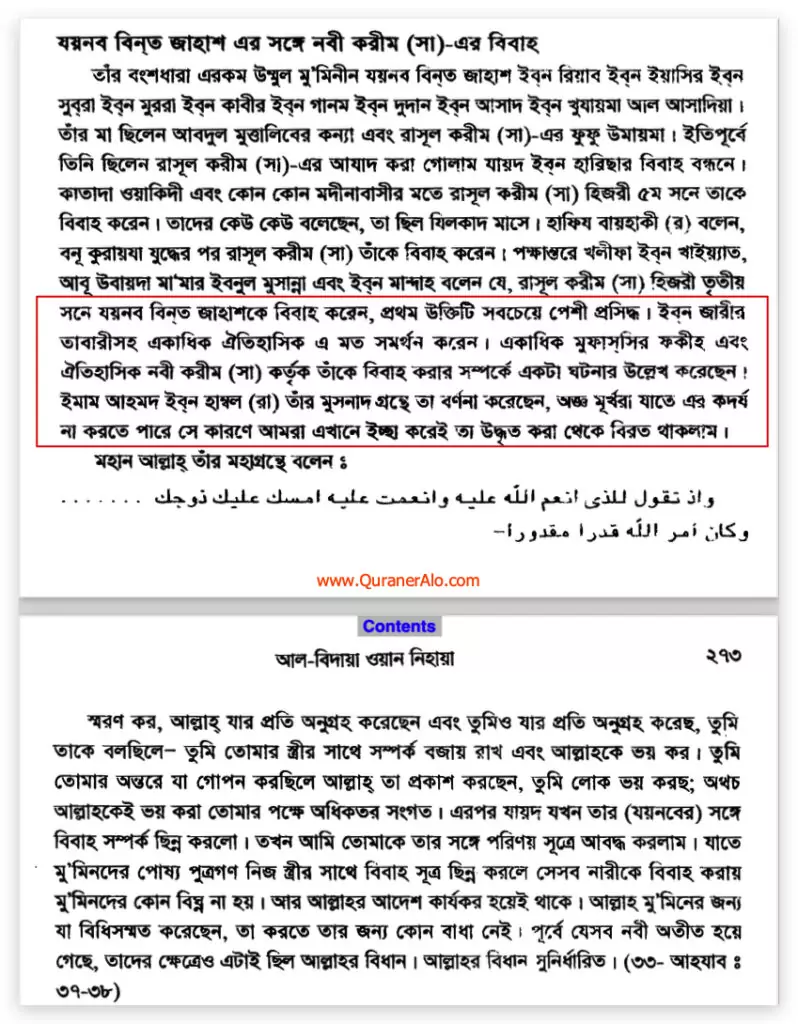
When Zayd returned home, Zaynab told him everything. Zayd realized that the Prophet liked his wife. Without delay, he went to the Prophet and said, “If you think you like Zaynab, I will divorce her.” Although Muhammad said aloud, “Keep your wife,” the different desire he harboured within became plain as day through his subsequent consummation of the marriage with Zaynab and the marriage’s completion by Allah without a formal contract. A statement by Imam Ahmad ibn Hanbal concerning this whole matter is particularly significant. In effect, it says that wicked people would make wicked remarks if this matter were mentioned, so it was concealed! It is easy to infer why Imam Ahmad ibn Hanbal wanted to conceal this ugly episode: such conduct by a prophet cannot be justified by any moral standard. [17] –
Several historians, including Ibn Jarir al-Tabari, support this view. A number of Quranic commentators, jurists, and historians have mentioned an incident concerning the Noble Prophet’s marriage to her!
Imam Ahmad ibn Hanbal (may Allah be pleased with him) narrated it in his Musnad. We have deliberately refrained from quoting it here so that ignorant fools cannot give it an ugly (meaning!).
The Marriage Proposal to Zaynab: Making Her Former Husband the Matchmaker
The proposal to marry Zaynab bint Jahsh offers a striking example of how insignificant humane conduct and morality can become when sexual desire and the display of power reach their peak. As soon as Zaynab’s iddah—the waiting period after divorce—ended, Muhammad proposed to her. Astonishingly, however, the messenger he chose to convey the proposal was Zaynab’s own former husband and his adopted son, Zayd.
A rational analysis shows that sending a man who had only recently left his wife—after learning of the Prophet’s infatuation with her—to propose to that same woman again on another man’s behalf was an act of extreme psychological cruelty. It was a shameless demonstration of crushing Zayd emotionally and making him understand his ultimate ‘subordination.’ [18]
Sahih Muslim (Islamic Foundation)
17/ Marriage
Section 15. The Marriage of Zainab Bint Jahsh, The Revelation of (the verse of) Hijab, and confirmation of the importance of the wedding feast.
3371. Bengali-edition chain: Muhammad ibn Hatim ibn Maymun and Muhammad ibn Rafi‘ … Anas (may Allah be pleased with him). Canonical narrator: Anas (Allah be pleased with him) reported: When the ‘Iddah of Zainab was over, Allah’s Messenger (ﷺ) said to Zaid to make a mention to her about him. Zaid went on until he came to her and she was fermenting her flour. He (Zaid) said: As I saw her I felt in my heart an idea of her greatness so much so that I could not see towards her (simply for the fact) that Allah’s Messenger (ﷺ) had made a mention of her. So I turned my back towards her. and I turned upon my heels, and said: Zainab, Allah’s Messenger (ﷺ) has sent (me) with a message to you. She said: I do not do anything until I solicit the will of my Lord. So she stood at her place of worship
and the (verse of) the Qur’an (pertaining to her marriage) were revealed, and Allah’s Messenger (ﷺ) came to her without permission. He (the narrator) said: I saw that Allah’s Messenger (ﷺ) served us bread and meat until it was broad day light and the people went away, but some persons who were busy in con- versation stayed on in the house after the meal. Allah’s Messenger (ﷺ) also went out and I also followed him, and he began to visit the apartments of his wives greeting them (with the words): As-Salamu ‘alaikum, and they would say: Allah’s Messenger, how did you find your family (hadrat Zainab)? He (the narrator) stated: I do not know whether I had informed him that the people had gone out or he (the Holy Prophet) informed me (about that). He moved on until he entered the apartment, and I also went and wanted to enter (the apartment) along with him, but he threw a curtain between me and him, as (the verfes pertaining to seclusion) had been revealed, and people were instructed in what they had been instructed.
Ibn Rafii had made this addition in his narration:” O you who believe, enter not the houses of the Prophet unless permission is given to you for a meal, not waiting for its cooking being finished…” to the words”… Allah forbears not from the truth.”
Grade in the supplied edition: Sahih (Sahih).
Narrator: Anas ibn Malik (may Allah be pleased with him). Verified equivalent: Sahih Muslim 1428b; Book 16, Hadith 105; USC-MSA Book 8, Hadith 3330. Arabic: حَدَّثَنَا مُحَمَّدُ بْنُ حَاتِمِ بْنِ مَيْمُونٍ، حَدَّثَنَا بَهْزٌ، ح وَحَدَّثَنِي مُحَمَّدُ بْنُ رَافِعٍ، حَدَّثَنَا أَبُو النَّضْرِ، هَاشِمُ بْنُ الْقَاسِمِ قَالاَ جَمِيعًا حَدَّثَنَا سُلَيْمَانُ بْنُ الْمُغِيرَةِ، عَنْ ثَابِتٍ، عَنْ أَنَسٍ، وَهَذَا حَدِيثُ بَهْزٍ قَالَ لَمَّا انْقَضَتْ عِدَّةُ زَيْنَبَ قَالَ رَسُولُ اللَّهِ صلى الله عليه وسلم لِزَيْدٍ ” فَاذْكُرْهَا عَلَىَّ ” . قَالَ فَانْطَلَقَ زَيْدٌ حَتَّى أَتَاهَا وَهْىَ تُخَمِّرُ عَجِينَهَا قَالَ فَلَمَّا رَأَيْتُهَا عَظُمَتْ فِي صَدْرِي حَتَّى مَا أَسْتَطِيعُ أَنْ أَنْظُرَ إِلَيْهَا أَنَّ رَسُولَ اللَّهِ صلى الله عليه وسلم ذَكَرَهَا فَوَلَّيْتُهَا ظَهْرِي وَنَكَصْتُ عَلَى عَقِبِي فَقُلْتُ يَا زَيْنَبُ أَرْسَلَ رَسُولُ اللَّهِ صلى الله عليه وسلم يَذْكُرُكِ . قَالَتْ مَا أَنَا بِصَانِعَةٍ شَيْئًا حَتَّى أُوَامِرَ رَبِّي . فَقَامَتْ إِلَى مَسْجِدِهَا وَنَزَلَ الْقُرْآنُ وَجَاءَ رَسُولُ اللَّهِ صلى الله عليه وسلم فَدَخَلَ عَلَيْهَا بِغَيْرِ إِذْنٍ قَالَ فَقَالَ وَلَقَدْ رَأَيْتُنَا أَنَّ رَسُولَ اللَّهِ صلى الله عليه وسلم أَطْعَمَنَا الْخُبْزَ وَاللَّحْمَ حِينَ امْتَدَّ النَّهَارُ فَخَرَجَ النَّاسُ وَبَقِيَ رِجَالٌ يَتَحَدَّثُونَ فِي الْبَيْتِ بَعْدَ الطَّعَامِ فَخَرَجَ رَسُولُ اللَّهِ صلى الله عليه وسلم وَاتَّبَعْتُهُ فَجَعَلَ يَتَتَبَّعُ حُجَرَ نِسَائِهِ يُسَلِّمُ عَلَيْهِنَّ وَيَقُلْنَ يَا رَسُولَ اللَّهِ كَيْفَ وَجَدْتَ أَهْلَكَ قَالَ فَمَا أَدْرِي أَنَا أَخْبَرْتُهُ أَنَّ الْقَوْمَ خَرَجُوا أَوْ أَخْبَرَنِي – قَالَ – فَانْطَلَقَ حَتَّى دَخَلَ الْبَيْتَ فَذَهَبْتُ أَدْخُلُ مَعَهُ فَأَلْقَى السِّتْرَ بَيْنِي وَبَيْنَهُ وَنَزَلَ الْحِجَابُ قَالَ وَوُعِظَ الْقَوْمُ بِمَا وُعِظُوا بِهِ . زَادَ ابْنُ رَافِعٍ فِي حَدِيثِهِ { لاَ تَدْخُلُوا بُيُوتَ النَّبِيِّ إِلاَّ أَنْ يُؤْذَنَ لَكُمْ إِلَى طَعَامٍ غَيْرَ نَاظِرِينَ إِنَاهُ} إِلَى قَوْلِهِ { وَاللَّهُ لاَ يَسْتَحْيِي مِنَ الْحَقِّ}
The hadith itself makes clear Zayd’s emotional state after this instruction. When he went to Zaynab, he could not even look at her. Although Muslim tradition interprets this as ‘reverence’ or ‘respect,’ it was in fact the utter helplessness of a broken man. He now had to ask the woman he had known as his wife to become another man’s bedmate—and that man was his own adoptive father. It is easy to imagine how deeply this humiliation made Zayd shrink within himself.
Consummation Without Permission and the Claim of a Miraculous Marriage
When Zaynab was waiting for ‘her Lord’s instruction’ rather than consenting directly to the proposal, a Quranic verse was revealed with remarkable convenience. Invoking that verse, Muhammad entered Zaynab’s room directly, without any formal marriage contract, mahr, or witnesses, and consummated the marriage. [18]
A rational question arises: in a religion that requires a minimum number of witnesses for marriage, why were all the rules suspended for the Prophet himself? The claim that Allah had performed the marriage was essentially a religious instrument for suppressing fierce social criticism in Arabia at the time. By presenting marriage to an adopted son’s wife—regarded as incest—as a ‘divine ordinance,’ Muhammad was able to give his personal lust a sacred appearance.
Sahih Muslim (Islamic Foundation)
17/ Marriage
Section 15. The Marriage of Zainab Bint Jahsh, The Revelation of (the verse of) Hijab, and confirmation of the importance of the wedding feast.
3371. Bengali-edition chain: Muhammad ibn Hatim ibn Maymun and Muhammad ibn Rafi‘ … Anas (may Allah be pleased with him). Canonical narrator: Anas (Allah be pleased with him) reported: When the ‘Iddah of Zainab was over, Allah’s Messenger (ﷺ) said to Zaid to make a mention to her about him. Zaid went on until he came to her and she was fermenting her flour. He (Zaid) said: As I saw her I felt in my heart an idea of her greatness so much so that I could not see towards her (simply for the fact) that Allah’s Messenger (ﷺ) had made a mention of her. So I turned my back towards her. and I turned upon my heels, and said: Zainab, Allah’s Messenger (ﷺ) has sent (me) with a message to you. She said: I do not do anything until I solicit the will of my Lord. So she stood at her place of worship
and the (verse of) the Qur’an (pertaining to her marriage) were revealed, and Allah’s Messenger (ﷺ) came to her without permission. He (the narrator) said: I saw that Allah’s Messenger (ﷺ) served us bread and meat until it was broad day light and the people went away, but some persons who were busy in con- versation stayed on in the house after the meal. Allah’s Messenger (ﷺ) also went out and I also followed him, and he began to visit the apartments of his wives greeting them (with the words): As-Salamu ‘alaikum, and they would say: Allah’s Messenger, how did you find your family (hadrat Zainab)? He (the narrator) stated: I do not know whether I had informed him that the people had gone out or he (the Holy Prophet) informed me (about that). He moved on until he entered the apartment, and I also went and wanted to enter (the apartment) along with him, but he threw a curtain between me and him, as (the verfes pertaining to seclusion) had been revealed, and people were instructed in what they had been instructed.
Ibn Rafii had made this addition in his narration:” O you who believe, enter not the houses of the Prophet unless permission is given to you for a meal, not waiting for its cooking being finished…” to the words”… Allah forbears not from the truth.”
Grade in the supplied edition: Sahih (Sahih).
Narrator: Anas ibn Malik (may Allah be pleased with him). Verified equivalent: Sahih Muslim 1428b; Book 16, Hadith 105; USC-MSA Book 8, Hadith 3330. Arabic: حَدَّثَنَا مُحَمَّدُ بْنُ حَاتِمِ بْنِ مَيْمُونٍ، حَدَّثَنَا بَهْزٌ، ح وَحَدَّثَنِي مُحَمَّدُ بْنُ رَافِعٍ، حَدَّثَنَا أَبُو النَّضْرِ، هَاشِمُ بْنُ الْقَاسِمِ قَالاَ جَمِيعًا حَدَّثَنَا سُلَيْمَانُ بْنُ الْمُغِيرَةِ، عَنْ ثَابِتٍ، عَنْ أَنَسٍ، وَهَذَا حَدِيثُ بَهْزٍ قَالَ لَمَّا انْقَضَتْ عِدَّةُ زَيْنَبَ قَالَ رَسُولُ اللَّهِ صلى الله عليه وسلم لِزَيْدٍ ” فَاذْكُرْهَا عَلَىَّ ” . قَالَ فَانْطَلَقَ زَيْدٌ حَتَّى أَتَاهَا وَهْىَ تُخَمِّرُ عَجِينَهَا قَالَ فَلَمَّا رَأَيْتُهَا عَظُمَتْ فِي صَدْرِي حَتَّى مَا أَسْتَطِيعُ أَنْ أَنْظُرَ إِلَيْهَا أَنَّ رَسُولَ اللَّهِ صلى الله عليه وسلم ذَكَرَهَا فَوَلَّيْتُهَا ظَهْرِي وَنَكَصْتُ عَلَى عَقِبِي فَقُلْتُ يَا زَيْنَبُ أَرْسَلَ رَسُولُ اللَّهِ صلى الله عليه وسلم يَذْكُرُكِ . قَالَتْ مَا أَنَا بِصَانِعَةٍ شَيْئًا حَتَّى أُوَامِرَ رَبِّي . فَقَامَتْ إِلَى مَسْجِدِهَا وَنَزَلَ الْقُرْآنُ وَجَاءَ رَسُولُ اللَّهِ صلى الله عليه وسلم فَدَخَلَ عَلَيْهَا بِغَيْرِ إِذْنٍ قَالَ فَقَالَ وَلَقَدْ رَأَيْتُنَا أَنَّ رَسُولَ اللَّهِ صلى الله عليه وسلم أَطْعَمَنَا الْخُبْزَ وَاللَّحْمَ حِينَ امْتَدَّ النَّهَارُ فَخَرَجَ النَّاسُ وَبَقِيَ رِجَالٌ يَتَحَدَّثُونَ فِي الْبَيْتِ بَعْدَ الطَّعَامِ فَخَرَجَ رَسُولُ اللَّهِ صلى الله عليه وسلم وَاتَّبَعْتُهُ فَجَعَلَ يَتَتَبَّعُ حُجَرَ نِسَائِهِ يُسَلِّمُ عَلَيْهِنَّ وَيَقُلْنَ يَا رَسُولَ اللَّهِ كَيْفَ وَجَدْتَ أَهْلَكَ قَالَ فَمَا أَدْرِي أَنَا أَخْبَرْتُهُ أَنَّ الْقَوْمَ خَرَجُوا أَوْ أَخْبَرَنِي – قَالَ – فَانْطَلَقَ حَتَّى دَخَلَ الْبَيْتَ فَذَهَبْتُ أَدْخُلُ مَعَهُ فَأَلْقَى السِّتْرَ بَيْنِي وَبَيْنَهُ وَنَزَلَ الْحِجَابُ قَالَ وَوُعِظَ الْقَوْمُ بِمَا وُعِظُوا بِهِ . زَادَ ابْنُ رَافِعٍ فِي حَدِيثِهِ { لاَ تَدْخُلُوا بُيُوتَ النَّبِيِّ إِلاَّ أَنْ يُؤْذَنَ لَكُمْ إِلَى طَعَامٍ غَيْرَ نَاظِرِينَ إِنَاهُ} إِلَى قَوْلِهِ { وَاللَّهُ لاَ يَسْتَحْيِي مِنَ الْحَقِّ}
This wedding night marked the beginning of the Islamic institution of ‘purdah,’ or ‘hijab.’ Curiously, the rule of seclusion appears to have been revealed to protect the privacy of a controversial marriage in the Prophet’s personal life. According to Sahih Muslim, when Anas ibn Malik tried to enter the room with the Prophet, the Prophet drew a curtain in his face. This was, in other words, an immediate arrangement to keep the expression of his private desire out of public view.
A ‘Divine Marriage’ Without a Guardian or Witnesses: Special Privilege in IslamQA’s Fatwa
The claim that Muhammad’s marriage to Zaynab received special authorization outside the ordinary rules of marriage is more than a critical conjecture. IslamQA fatwa no. 96464 directly quotes the Saudi Permanent Committee for Fatwa: after Zayd divorced Zaynab and her waiting period ended, Muhammad proposed to her, and Allah performed their marriage without a marriage guardian or witnesses. The reasoning is that Muhammad has precedence over all believers, so Allah’s directly performing the marriage was sufficient in his case. This is a clear example of the usual conditions of marriage being treated differently for one particular individual. [19]
Arabic (Quran 33:6): ٱلنَّبِيُّ أَوۡلَىٰ بِٱلۡمُؤۡمِنِينَ مِنۡ أَنفُسِهِمۡۖ وَأَزۡوَٰجُهُۥٓ أُمَّهَٰتُهُمۡۗ وَأُوْلُواْ ٱلۡأَرۡحَامِ بَعۡضُهُمۡ أَوۡلَىٰ بِبَعۡضٖ فِي كِتَٰبِ ٱللَّهِ مِنَ ٱلۡمُؤۡمِنِينَ وَٱلۡمُهَٰجِرِينَ إِلَّآ أَن تَفۡعَلُوٓاْ إِلَىٰٓ أَوۡلِيَآئِكُم مَّعۡرُوفٗاۚ كَانَ ذَٰلِكَ فِي ٱلۡكِتَٰبِ مَسۡطُورٗا — الإسلام سؤال وجواب — السؤال رقم 96464
تفصيل القول في قوله تعالى (وتخفي في نفسك ما الله مبديه)
المصدر المنقول: فتاوى اللجنة الدائمة — فتاوى إسلامية، الجزء 18، الصفحات 137–141
Selected passage from the original Arabic:
بعد انتهاء عدتها من طلاق زيد ، وزوّجه الله إياها بلا ولي ولا شهود ؛ فإنه صلى الله عليه وسلم ، وليّ المؤمنين جميعاً
English translation and detailed paraphrase of the relevant paragraph:
The Saudi Permanent Committee for Fatwa’s statement on Muhammad’s marriage to Zaynab:
After the dissolution of Zayd ibn Harithah’s marriage to Zaynab bint Jahsh, her iddah, or prescribed waiting period, ended. Muhammad then proposed to Zaynab.
Allah performed Muhammad’s marriage to Zaynab without a marriage guardian or witnesses.
The Committee explains this special arrangement by stating that Muhammad is the guardian of the entire community of believers; indeed, his claim over believers is greater than their own claim over themselves. It quotes verse 6 of Surah al-Ahzab: “The Prophet has a stronger affinity to the believers than they do themselves.” [Dr. Mustafa Khattab, The Clear Quran.]
The fatwa further states that through this marriage, Allah abolished the legal institution of adoptive sonship practised in pre-Islamic Arabian society. At the same time, He permitted Muslims to marry women who had been their adopted sons’ wives and had subsequently been released from those marriages through death or divorce.
According to the Committee, this rule was an act of Allah’s mercy toward Muslims and a means of removing obstacles to marriage.
Under this account, Muhammad’s marriage to Zaynab was not performed through the ordinary presence of a guardian or witnesses. Instead, the declaration that Allah had directly performed the marriage was accepted as the basis of its validity. Muhammad’s special religious authority is presented here as a substitute for the customary marriage procedure.
This statement is quoted in the names of the scholars of the Saudi Permanent Committee for Fatwa, including Abd al-Aziz ibn Baz, Abd al-Razzaq Afifi, Abdullah ibn Ghudayyan, and Abdullah ibn Qu‘ud.
According to this statement, a personal revelation became decisive in establishing a marriage’s validity in place of the direct testimony and formal mediation customary in society. The person who himself makes the highest claim to religious authority then employs that same authority as a substitute for the conventional process in his own marriage. This raises the question of the lawgiver, the beneficiary of the law, and the announcer of a new exception all being concentrated in the same individual.
Zaynab’s Own Statement: ‘Your Families Married You; Allah Married Me’
Sahih al-Bukhari 7420 relates, through Anas, that Zaynab presented this marriage to Muhammad’s other wives as evidence of her special standing. She said that their families had married them, whereas Allah had married her from above the seven heavens. The claim of a divine marriage is thus preserved as Zaynab’s own boast, as well as a conclusion of later fatwas. The same hadith identifies verse 37 of Surah al-Ahzab as concerning the episode of Zayd and Zaynab. [20]
صحيح البخاري، 7420
زَوَّجَكُنَّ أَهَالِيكُنَّ، وَزَوَّجَنِي اللَّهُ تَعَالَى مِنْ فَوْقِ سَبْعِ سَمَوَاتٍ
English translation:
You were given in marriage by your families, while I was married (to the Prophet) by Allah from over seven Heavens.
Read alongside the verses changing the identity of the adopted son and announcing Zaynab’s marriage, this statement makes the episode’s power structure clearer. Social objections arose to the legitimacy of marrying a particular woman; the adopted son’s legal position was changed in response; the marriage was then declared a special union performed divinely, above ordinary family arrangements. The objection that arose among people was resolved through a claim to unquestionable religious authority rather than through human discussion.
A Delayed Wedding Night and an ‘Urgent Prompt’ from the Throne
When the supposed creator of the universe sets aside its countless stars, billions of galaxies, and humanity’s innumerable complex problems to become distressed over the delay of one man’s wedding night, serious questions about that ‘creator’s’ grandeur and impartiality are natural. The Prophet’s intense desire for Zaynab bint Jahsh did not stop at breaking up Zayd’s home: it extended to the revelation of divine instructions to drive away guests lingering at the bridal chamber’s door.
A rational analysis shows that, when Muhammad arranged a walimah, or wedding feast, the Companions lingered in conversation after eating. The Prophet, meanwhile, intensely desired union with Zaynab. Social courtesy prevented him from asking his guests to leave. Such embarrassment would be natural in an ordinary person; what was extraordinary was the immediate issuance of an ‘ordinance,’ or law, by the creator of the universe, whose sole purpose was to clear the way for the Prophet’s sexual intercourse. For a more detailed discussion, see this article.
Was Allah the Prophet’s ‘Private Secretary’?
According to an authentic hadith, the Prophet repeatedly went outside and returned because the guests would not leave. Seeing his restlessness, Allah became so ‘distressed’ that He revealed verse 53 of Surah al-Ahzab. It explicitly states that the guests’ lingering troubled the Prophet and that Allah is not shy of speaking the truth. [21]
Sahih Muslim (Islamic Foundation)
17/ Marriage
Section 15. The Marriage of Zainab Bint Jahsh, The Revelation of (the verse of) Hijab, and confirmation of the importance of the wedding feast.
3377. Bengali-edition chain: Muhammad ibn Rafi‘ … Anas (may Allah be pleased with him). Canonical narrator: Anas (Allah be pleased with him) reported: When Allah’s Apostle (ﷺ) contracted marriage with Zainab (Allah be pleased with bet), Umm Sulaim sent him hats in a vessel of stone as a gift. Anas stated that Allah’s Messenger (ﷺ) said to him: Go and invite on my behalf all the Muslims whom you meet. So I invited on his behalf everyone whom I met. They entered (his house) and they ate and went out. And Allah’s Messenger (ﷺ) had kept his hand on the food, and he invoked blessing on that, and said whatever Allah wished him to say,
and none whom I met was left uninvited. They ate to their fill and went out, but a group among them remained there and was engaged in lengthy discussion. Allah’s Apostle (ﷺ) felt shy of saying them anything. So he went out and left them in his house and Allah the Great and Majestic revealed this verse:” 0 you who believe, enter not the houses of the Prophet unless permission is given to you for a meal, not waiting for its cooking being finished.”
Qatada (instead of using the word Ghaira Nazirina) used the word Ghaira Mutahayyinina (i. e. not waiting for the time of the food). But when you are invited, enter…” up to this verse. This is purer for your hearts and their hearts. [Arabic phrase retained from the supplied edition: غير ناظرين إناه.] (33:53).
Grade in the supplied edition: Sahih (Sahih).
Narrator: Anas ibn Malik (may Allah be pleased with him). Verified equivalent: Sahih Muslim 1428h; Book 16, Hadith 111; USC-MSA Book 8, Hadith 3336. Arabic: وَحَدَّثَنِي مُحَمَّدُ بْنُ رَافِعٍ، حَدَّثَنَا عَبْدُ الرَّزَّاقِ، حَدَّثَنَا مَعْمَرٌ، عَنْ أَبِي عُثْمَانَ، عَنْ أَنَسٍ، قَالَ لَمَّا تَزَوَّجَ النَّبِيُّ صلى الله عليه وسلم زَيْنَبَ أَهْدَتْ لَهُ أُمُّ سُلَيْمٍ حَيْسًا فِي تَوْرٍ مِنْ حِجَارَةٍ فَقَالَ أَنَسٌ فَقَالَ رَسُولُ اللَّهِ صلى الله عليه وسلم ” اذْهَبْ فَادْعُ لِي مَنْ لَقِيتَ مِنَ الْمُسْلِمِينَ ” . فَدَعَوْتُ لَهُ مَنْ لَقِيتُ فَجَعَلُوا يَدْخُلُونَ عَلَيْهِ فَيَأْكُلُونَ وَيَخْرُجُونَ وَوَضَعَ النَّبِيُّ صلى الله عليه وسلم يَدَهُ عَلَى الطَّعَامِ فَدَعَا فِيهِ وَقَالَ فِيهِ مَا شَاءَ اللَّهُ أَنْ يَقُولَ وَلَمْ أَدَعْ أَحَدًا لَقِيتُهُ إِلاَّ دَعَوْتُهُ فَأَكَلُوا حَتَّى شَبِعُوا وَخَرَجُوا وَبَقِيَ طَائِفَةٌ مِنْهُمْ فَأَطَالُوا عَلَيْهِ الْحَدِيثَ فَجَعَلَ النَّبِيُّ صلى الله عليه وسلم يَسْتَحْيِي مِنْهُمْ أَنْ يَقُولَ لَهُمْ شَيْئًا فَخَرَجَ وَتَرَكَهُمْ فِي الْبَيْتِ فَأَنْزَلَ اللَّهُ عَزَّ وَجَلَّ { يَا أَيُّهَا الَّذِينَ آمَنُوا لاَ تَدْخُلُوا بُيُوتَ النَّبِيِّ إِلاَّ أَنْ يُؤْذَنَ لَكُمْ إِلَى طَعَامٍ غَيْرَ نَاظِرِينَ إِنَاهُ} قَالَ قَتَادَةُ غَيْرَ مُتَحَيِّنِينَ طَعَامًا وَلَكِنْ إِذَا دُعِيتُمْ فَادْخُلُوا حَتَّى بَلَغَ { ذَلِكُمْ أَطْهَرُ لِقُلُوبِكُمْ وَقُلُوبِهِنَّ}
A profound rational question arises: why was a creator who should hear the cries of millions of oppressed people so preoccupied with arranging the ‘timing’ of one man’s wedding night? Did verses have to descend from the Throne itself to teach the Companions ordinary manners? Or was this Muhammad’s own suppressed wish, imposed on his guests under the wrapping of ‘divine words’? [22]
Sahih Muslim (Islamic Foundation)
17/ Marriage
Section 15. The Marriage of Zainab Bint Jahsh, The Revelation of (the verse of) Hijab, and confirmation of the importance of the wedding feast.
3374. Bengali-edition chain: Yahya ibn Habib al-Harithi, Asim ibn al-Nadr al-Taymi, and Muhammad ibn Abd al-A‘la … Anas ibn Malik (may Allah be pleased with him). Canonical narrator: Anas b. Malik (Allah be pleased with him) reported: When Allah’s Apostle (ﷺ) married Zainab bint jahsh, he invited people (to the wedding feast) and they ate food. They then sat there and entered into conversation. He (the Holy Prophet) made a stir as if he was preparing to stand up, but (the persons busy in talking) did not stand up. When he (the Holy Prophet) saw it, he stood up and when he did so, some other persons stood up.
‘Asim and Abd al-A’la in their narrations made this addition: Three (persons) sat there, and Allah’s Apostle (ﷺ) came there to enter (the apartment) but he found the people sitting there. Then they stood up and went away. He said: Then I came and informed Allah’s Apostle (ﷺ) that they had gone away. He (the Holy Prophet) then came there until he entered (the apartment). I also went and was about to enter, when he hung a curtain between me and him (and it was on this occasion that) Allah, the Exalted and Majestic, revealed this verse:” O you who believe, enter not the houses of the Prophet unless permission is given to you for a meal, not waiting for its cooking being finished to the (words)” Surely this is serious in the sight of Allah” (xxxiii. 53).
Grade in the supplied edition: Sahih (Sahih).
Narrator: Anas ibn Malik (may Allah be pleased with him). Verified equivalent: Sahih Muslim 1428e; Book 16, Hadith 108; USC-MSA Book 8, Hadith 3333. Arabic: حَدَّثَنَا يَحْيَى بْنُ حَبِيبٍ الْحَارِثِيُّ، وَعَاصِمُ بْنُ النَّضْرِ التَّيْمِيُّ، وَمُحَمَّدُ بْنُ عَبْدِ الأَعْلَى، كُلُّهُمْ عَنْ مُعْتَمِرٍ، – وَاللَّفْظُ لاِبْنِ حَبِيبٍ – حَدَّثَنَا مُعْتَمِرُ بْنُ سُلَيْمَانَ، قَالَ سَمِعْتُ أَبِي، حَدَّثَنَا أَبُو مِجْلَزٍ، عَنْ أَنَسِ بْنِ مَالِكٍ، قَالَ لَمَّا تَزَوَّجَ النَّبِيُّ صلى الله عليه وسلم زَيْنَبَ بِنْتَ جَحْشٍ دَعَا الْقَوْمَ فَطَعِمُوا ثُمَّ جَلَسُوا يَتَحَدَّثُونَ – قَالَ – فَأَخَذَ كَأَنَّهُ يَتَهَيَّأُ لِلْقِيَامِ فَلَمْ يَقُومُوا فَلَمَّا رَأَى ذَلِكَ قَامَ فَلَمَّا قَامَ قَامَ مَنْ قَامَ مِنَ الْقَوْمِ . زَادَ عَاصِمٌ وَابْنُ عَبْدِ الأَعْلَى فِي حَدِيثِهِمَا قَالَ فَقَعَدَ ثَلاَثَةٌ وَإِنَّ النَّبِيَّ صلى الله عليه وسلم جَاءَ لِيَدْخُلَ فَإِذَا الْقَوْمُ جُلُوسٌ ثُمَّ إِنَّهُمْ قَامُوا فَانْطَلَقُوا – قَالَ – فَجِئْتُ فَأَخْبَرْتُ النَّبِيَّ صلى الله عليه وسلم أَنَّهُمْ قَدِ انْطَلَقُوا – قَالَ – فَجَاءَ حَتَّى دَخَلَ فَذَهَبْتُ أَدْخُلُ فَأَلْقَى الْحِجَابَ بَيْنِي وَبَيْنَهُ – قَالَ – وَأَنْزَلَ اللَّهُ عَزَّ وَجَلَّ { يَا أَيُّهَا الَّذِينَ آمَنُوا لاَ تَدْخُلُوا بُيُوتَ النَّبِيِّ إِلاَّ أَنْ يُؤْذَنَ لَكُمْ إِلَى طَعَامٍ غَيْرَ نَاظِرِينَ إِنَاهُ} إِلَى قَوْلِهِ { إِنَّ ذَلِكُمْ كَانَ عِنْدَ اللَّهِ عَظِيمًا} .
Personal Desire Versus Divine Law
This verse did more than send the guests away: it also laid the foundations of a strict, discriminatory institution of ‘purdah’ for Muslim women. The rule of seclusion emerged around the Prophet’s controversial wedding night with Zaynab, so that outsiders could not see the Prophet’s beautiful wives. In other words, Allah stamped Muhammad’s private jealousy and possessiveness with the seal of ‘universal law.’
Rationally considered, this was no spiritual revolution. It was the institutional abuse of religion to secure a powerful man’s personal comfort and satisfy his sexual lust, with the creator himself presented as the guardian of the Prophet’s ‘desire.’
His Adopted Son’s Divorced Wife for Himself, but Remarriage Forbidden to His Own Wives
Permission to marry Zaynab and the lifelong prohibition imposed on Muhammad’s wives occur within the same sequence in Surah al-Ahzab. Verse 33:37 announces the removal of the obstacle to Muhammad marrying his adopted son’s divorced wife. Verse 33:53, meanwhile, permanently forbids his wives from marrying any other man after his death. Al-Tabari’s explanation connects this prohibition with their designation as ‘Mothers of the Believers’; accounts concerning the verse’s circumstances also mention someone wanting to marry one of his wives after his death. Within the same religious legal structure, one man’s opportunities for marriage thus expand while his wives’ freedom to marry in the future is permanently curtailed. [23] [24]
سورة الأحزاب: ٥٣
وَلَا أَنْ تَنْكِحُوا أَزْوَاجَهُ مِنْ بَعْدِهِ أَبَدًا
English translation:
nor ever marry his wives after him. [Quran 33:53, excerpt; Dr. Mustafa Khattab, The Clear Quran.]
Freedom to marry is determined here principally by Muhammad’s exceptional personal position. In Zaynab’s case, her previous marriage to his adopted son was not treated as an obstacle to a new relationship. In the case of Muhammad’s wives, however, their former marital status was made a permanent impediment even after his death, one they could never remove. One individual’s religious status was given precedence over a woman’s right to decide for herself, her wish to form a future household, and the ordinary reality that marriage ends with a husband’s death. Placing these two rules side by side exposes the unequal distribution of legal advantage and control.
Zayd’s Death: A Calculated ‘Exit Strategy’ on the Battlefield?
The drama that began around Zaynab bint Jahsh reached its final, tragic conclusion at the Battle of Mu’tah. A rational analysis shows that, some time after marrying Zaynab, Muhammad sent his former adopted son Zayd as commander on a military expedition that was virtually a certain death trap. Was sending Zayd on this suicidal march—only three thousand Muslim soldiers against approximately one hundred thousand, or according to another account two hundred thousand, well-trained Roman troops—simply military strategy, or did a deeper personal calculation lie behind it?
Muhammad’s instructions before the Battle of Mu’tah were highly significant and mysterious. He appointed three commanders in succession: Zayd ibn Harithah, Ja‘far ibn Abi Talib, and Abdullah ibn Rawahah. This advance appointment of successive commanders clearly suggests that Muhammad knew—or wanted—his commanders to die one after another in the battle. [25] –
The Army Commanders and the Messenger of Allah’s Instructions )أمراء الجيش ووصية رسول الله إليهم
The Messenger of Allah appointed Zayd ibn Harithah commander of this force and instructed that, if Zayd was martyred, Ja‘far should take command, and if Ja‘far was martyred, Abdullah ibn Rawahah should become commander. He fastened a white flag for the army and placed it in Zayd’s hand. He then gave the soldiers the following instructions.
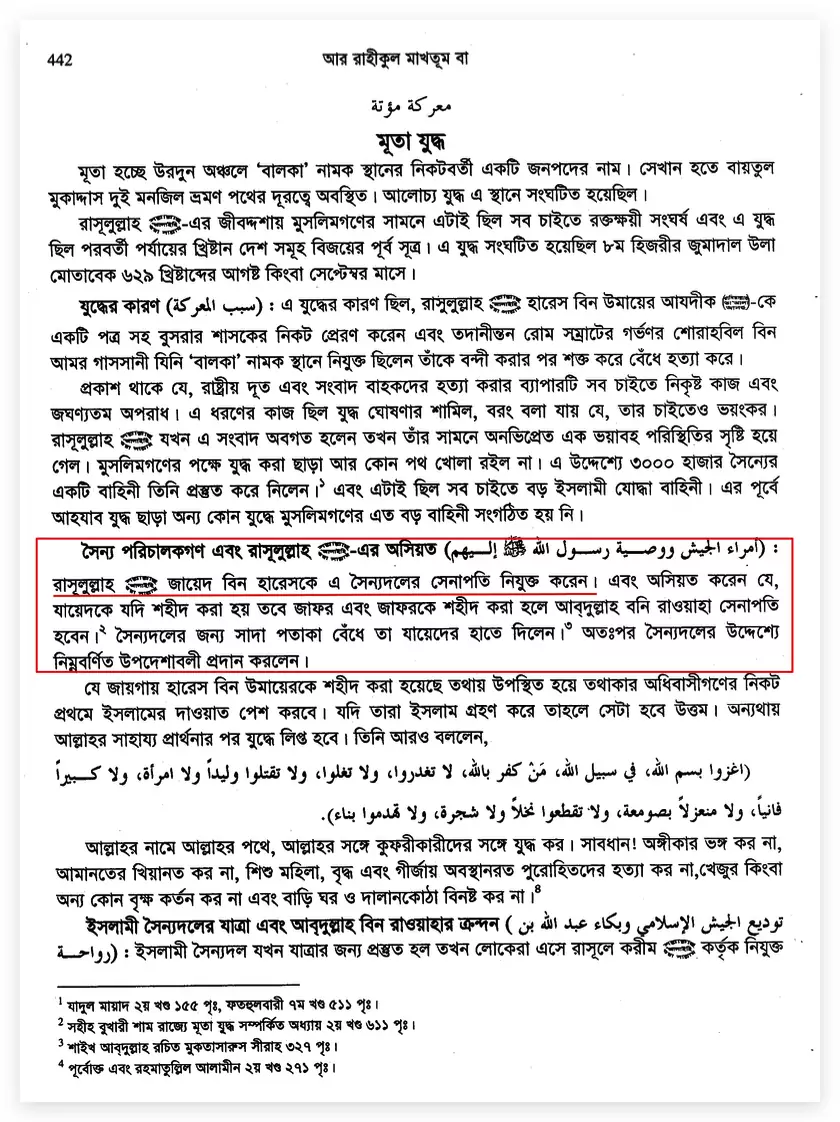
A rational question arises: on the battlefield, the flag-bearing commander is the enemy’s first target. Was sending Zayd to the front as standard-bearer and determining his successors in advance merely a ‘prophecy’? Or was it a carefully planned military departure to remove, permanently, a humiliated and cornered Zayd after the Zaynab episode? Another account states that the opposing army numbered two hundred thousand. Let us read it, [26]
A grave incident occurred in the eighth year after the Hijrah. That year, the Messenger (peace be upon him) sent Harith ibn Umayr al-Azdi to the ruler of Busra with a letter inviting him to Islam. When Harith reached Mu’tah on Jordan’s eastern frontier, Shurahbil ibn Amr, a governor under the Ghassanid ruler, intercepted and imprisoned him, then killed him. The Messenger took the matter extremely seriously, since no earlier envoy had been killed in this way. He prepared a force of three thousand men for an expedition to Mu’tah and placed Zayd ibn Harithah in command. Immediately before departure, he instructed them: ‘If Zayd is martyred, the force’s next commander will be Ja‘far ibn Abi Talib. If Ja‘far is martyred, Abdullah ibn Rawahah will take command. If he too is martyred, they should select a commander from among themselves.’
Under Zayd’s command, the force left Medina and reached Ma‘an on Jordan’s eastern frontier. The Roman emperor Heraclius advanced with a great army of one hundred thousand men to support the Ghassanids. Another hundred thousand pagan Arab troops joined him. This combined force took up a position close to the Muslim army. The Muslims stayed at Ma‘an for two nights, consulting about what to do. Some said that they should write to the Messenger of Allah, inform him of the enemy’s numbers, and await further instructions. Others said, ‘We do not fight through numbers, strength, or numerical superiority. We fight through this religion. Advance toward the purpose for which you set out. You will attain one of two successes: victory or martyrdom.’
The two unequal armies then met in battle. The Roman force was astonished by the courage and valour of only three thousand soldiers against two hundred thousand. Fear also entered their hearts.
Zayd ibn Harithah fought to keep the Messenger of Allah’s standard aloft with a valour rarely equalled in history. Countless arrows and spear thrusts riddled his body, and he finally fell on the battlefield. Ja‘far ibn Abi Talib and Abdullah ibn Rawahah then took up the standard in succession and were bravely martyred. The Muslim force subsequently chose Khalid ibn al-Walid as commander by collective decision. He was a recent convert to Islam. Under his leadership, the Muslim army was saved from inevitable defeat and destruction. Thus, in the ninth year after the Hijrah, Zayd was martyred at the age of fifty-four or fifty-five.
In this unequal battle, no military science offers any prospect of victory for three thousand soldiers against two hundred thousand. Doubt and fear had spread within the Muslim army itself. Many wanted to write to Medina to request reinforcements, but they were pushed toward death. As arrows riddled Zayd’s body, did Muhammad feel affection for his former ‘son’ and ‘heir,’ or satisfaction that the last obstacle to possessing Zaynab completely had been removed?
Rationally considered, this was more than a historical battle: it was a convenient conclusion to the entire story surrounding Zaynab. Zayd’s death not only gave Muhammad unqualified control over Zaynab but also offered an opportunity to bury the social disgrace of marrying his adopted son’s wife beneath the glory of Zayd’s ‘martyrdom.’ Perhaps, after the episode, the Prophet Muhammad felt too embarrassed to look Zayd in the eye or speak to him directly, making Zayd’s death his only escape from that humiliation.
Aisha’s Testimony: The Admission of an Uncomfortable Truth
Muhammad’s favourite wife Aisha was the most dispassionate and incisive observer of the entire drama surrounding Zaynab bint Jahsh. One of her famous statements makes it plain as day how ‘uncomfortable’ and ‘shameful’ it was, at the time, to marry an adopted son’s wife through a revelation sent down from the Throne. A rational analysis suggests that the verse contained elements sufficient to cast a moral stain on the Prophet’s own character, which is why Aisha described it as something that could have been concealed. [27]
Sunan al-Tirmidhi (Islamic Foundation)
50/ Quranic Commentary
Section: Surah al-Ahzab
3208. Bengali-edition chain: Abdullah ibn Waddah al-Kufi … Aisha (may Allah be pleased with her). Narrated ‘Aishah [may Allah be pleased with her]: “If the Prophet (ﷺ) was to have hidden anything from the Revelation, then he would have hidden this Ayah: ‘When you said to him on whom Allah has bestowed grace and you have done a favor (33:37).'” [Arabic excerpt retained from the supplied edition: (إِذْ تَقُولُ لِلَّذِي أَنْعَمَ اللَّهُ عَلَيْهِ وَأَنْعَمْتَ عَلَيْهِ).]
Sahih; al-Bukhari and Muslim; al-Tirmidhi hadith no. 3208 [Al-Madani Prakashani].
(Abu Isa says:) This hadith is hasan sahih.
Grade: Sahih (Darussalam); supplied edition: Sahih (Sahih).
Narrator: Aisha bint Abi Bakr al-Siddiq (may Allah be pleased with her). Verified text: Jami‘ al-Tirmidhi 3208; Book 47, Hadith 260; English Vol. 5, Book 44, Hadith 3208. Arabic: حَدَّثَنَا مُحَمَّدُ بْنُ أَبَانَ، حَدَّثَنَا ابْنُ أَبِي عَدِيٍّ، عَنْ دَاوُدَ بْنِ أَبِي هِنْدٍ، عَنِ الشَّعْبِيِّ، عَنْ مَسْرُوقٍ، عَنْ عَائِشَةَ، رضى الله عنها قَالَتْ لَوْ كَانَ النَّبِيُّ صلى الله عليه وسلم كَاتِمًا شَيْئًا مِنَ الْوَحْىِ لَكَتَمَ هَذِهِ الآيَةَِ : ( إذْ تَقُولُ لِلَّذِي أَنْعَمَ اللَّهُ عَلَيْهِ وَأَنْعَمْتَ عَلَيْهِ ) الآيَةَ . قَالَ هَذَا حَدِيثٌ حَسَنٌ صَحِيحٌ .
Why This Shame and Concealment Over Allah’s Revelation?
Aisha’s admission is particularly significant for two reasons:
1. Moral ambivalence: If the character of a prophet reflected only nobility and a desire to obey divine instruction, the question of concealing that revelation would never arise. Behind Aisha’s statement lies the profound shame produced by breaking up an adopted son’s household and taking his wife.
2. An irrepressible record: Whenever Muhammad recited a verse, the scribes among the Companions wrote it down, and it spread by word of mouth. Consequently, even if he had wished to, he could not erase or abrogate this particular verse, Surah al-Ahzab 37. The deeper implication of Aisha’s statement is that the verse was so embarrassing for the Prophet that, had it been possible, he would have kept it hidden from people.
Aisha’s More Direct Remark: ‘Your Lord Hastens in Fulfilling Your Wishes and Desires’
Sahih al-Bukhari preserves another direct comment by Aisha on the relationship between Muhammad’s personal wishes and the special marital rules revealed for him. In Bukhari 4788, Aisha says that she objected to women offering themselves to Muhammad for marriage. When Surah al-Ahzab 33:51 was subsequently revealed, Muhammad was granted special freedom concerning his wives’ turns and whom he received. Hearing this rule, Aisha remarked that his Lord hastened to fulfil his wishes. Her comment concerns Surah al-Ahzab 33:51, not verse 33:37 concerning Zaynab’s marriage. It is his wife’s own observation about another exceptional rule governing Muhammad’s married life. Her remark captures, with remarkable brevity and sharpness, the succession of legal concessions and revelations surrounding the same Prophet’s personal relationships. [28]
صحيح البخاري، 4788
قُلْتُ مَا أُرَى رَبَّكَ إِلاَّ يُسَارِعُ فِي هَوَاكَ
English translation:
I said (to the Prophet), “I feel that your Lord hastens in fulfilling your wishes and desires.”
The significance of Aisha’s comment is that questions about the convenient alignment of revelation with Muhammad’s personal preferences were not confined to religious critics of later periods. Such a remark is preserved within Muhammad’s own intimate family circle. Placed alongside the Zaynab episode, it broadens the question: why are special instructions tailored to Muhammad’s needs so conspicuous in matters such as marriage, his wives’ turns, social objections, and the departure of guests from his private home? When claims of religious authority are examined against the sequence of historical events, the relationship between personal interest and lawmaking cannot be ignored.
The Power Struggle Between Zaynab and Aisha
After this marriage, Zaynab bint Jahsh would boast to the Prophet’s other wives that their families had married them, whereas Allah himself had married her from above the seven heavens. Aisha was not only morally embarrassed by the episode; the new wife’s ‘divine’ status also wounded her emotionally.
Rationally considered, this entire episode was no spiritual revolution, but the ultimate attempt to confer ‘religious legitimacy’ on a private desire. Erasing an adopted son’s identity, the change in the Prophet’s feelings at the sight of Zaynab’s beauty, sending Zayd to convey the marriage proposal, and finally revealing a verse for the bridal chamber: this sequence demonstrates that the Zaynab affair was one of the greatest scandals in Islamic history, covered over with the wrapping of revelation. Aisha’s historical remark is merely a glimpse of the truth peering out from beneath that cover.
Changes to Adoptive Fatherhood, Inheritance, and Women’s Rights Around a Single Marriage
Dividing the Zayd–Zaynab episode into isolated reports obscures the transformation of the wider religious structure. First comes the Prophet’s mediation and the role of religious instruction in Zayd’s marriage to Zaynab. Then follow accounts of Muhammad’s attraction to Zaynab, his hidden expectation, Zayd’s divorce, and the announcement of a new marriage through the Quran. Verses and juristic rules associated with this period withdrew the legal relationship that had placed an adopted son on the same footing as a biological son. Previously recognized ties of inheritance and lineage between adopted son and adoptive father were abolished, and the objection to marrying the divorced wife of a son within that same social fatherhood was removed. This was more than an event in Zayd’s life: the same rule subsequently applied to other adopted children and their families.
Special arrangements for Muhammad also appear in the marriage formalities. Sahih al-Bukhari records Zaynab’s own statement that Allah married her from above the seven heavens. The fatwa committee quoted by IslamQA describes the same marriage as having taken place without a guardian or witnesses. A later verse gives special instructions concerning guests’ behaviour in Muhammad’s home, introduces a rule of seclusion concerning his wives, and permanently forbids them from marrying anyone else after his death. The family circumstances and special status of the same individual stand at the centre of each rule. Before this sequence is presented as a ‘universal principle of justice,’ one must ask how its advantages, controls, and deprivations were distributed among the people concerned.
On one side, recognition was withdrawn from an adopted son who had been accepted into a relationship of shared name, sonship, and property; on the other, the Prophet’s personal path to marrying his adopted son’s divorced wife was opened. Religious authority exerted pressure on the decision of the woman who had been unwilling to enter the first marriage; later, her new marriage was declared to have been performed divinely in place of witnesses and a guardian. The freedom of the Prophet’s wives to marry after his death was also permanently closed off. Across this entire arrangement, religious law did not expand everyone’s freedom equally. Instead, it redefined other people’s identities, property, marital futures, and family rights in accordance with one particular individual’s relationships and status.
Conclusion: Dissecting Human Lust Beneath a Divine Cover
The entire narrative of Zayd, Zaynab, and the Prophet Muhammad is more than a historical event: it is a classic example of institutionalizing personal desire in the name of religion. A rational examination brings out several incontrovertible truths that no supernatural or spiritual narrative can conceal.
1. The Sacrifice of a Humane Institution: Raising an orphaned child under one’s own identity and giving that child an inheritance is an act of profound humanity. Yet Muhammad’s sudden attraction to Zaynab led to the destruction of Arabia’s beneficial institution of tabanni, or adoption. To clear the way for sexual relations with one particular woman, the legal and social protections of millions of children of unknown parentage were permanently abolished—a measure that cannot be considered universal in its benefit or humane.
2. Allah’s Role and the ‘Timing’ of Revelation: Throughout the episode, whenever Muhammad encountered a personal or physical obstacle, a verse miraculously descended from the Throne to remove it.
A revelation abolished adoption.
A revelation directly commanded the marriage.
A revelation rebuked the Prophet.
A revelation promptly sent the guests away.
3. Zayd’s Tragedy: Used and Discarded: Zayd ibn Harithah’s life was used here like a pawn on a chessboard. First elevated from slave to son, he was then compelled into an unequal marriage with Zaynab. When the Prophet’s attention fell upon that wife, Zayd was compelled to divorce her. Finally, to escape the humiliation and discomfort of the Zaynab affair, he was sent as commander into a battle of certain death, Mu’tah. This may be characterized as more than a death: it was the ‘planned departure’ of a character who had become unnecessary.
4. Historical and Moral Double Standards: Muslim historians’ position on al-Waqidi—calling him a ‘liar’ when the Prophet’s lechery must be concealed, but ‘reliable’ when the repugnant prescription of drinking milk directly from the breast must be disguised—shows that protecting belief takes precedence over truth. Yet Aisha’s admission, “If Muhammad had wished to conceal any revelation, he would have concealed this verse concerning Zaynab,” places a permanent seal upon the episode’s underlying shame and immorality.
5. Final Assessment: In sum, the Prophet’s marriage to Zaynab bint Jahsh was neither a miraculous instance of divine wisdom nor a social reform. It was a naked display of power, lust, and the invocation of revelation to break prevailing moral restraints and fulfil personal desire. Giving divine sanction to what Arabian society regarded as incest by marrying an adopted son’s wife remains a stained chapter of Islamic history, still standing accused before the tribunal of reason and humanity.
References
- IslamQA, Question 129988, تبنَّته أسرة بسبب فساد أهله، ونسبوه لهم، فماذا يترتب على ذلك التصرف؟, 15 May 2009 ↩︎
- IslamQA 129988; cited source: الموسوعة الفقهية, vol. 10, pp. 121–122 ↩︎
- Ashabe Rasuler Jibankatha [Lives of the Prophet’s Companions], vol. 1, p. 127 ↩︎
- Sahih al-Bukhari, Tawhid Publication, hadith no. 4782 ↩︎
- Al-Tabari, vol. 39, Biographies of the Prophet’s Companions and Their Successors, p. 9 ↩︎
- Al-Qurtubi, al-Jami‘ li-Ahkam al-Qur’an, commentary on Surah al-Ahzab 33:40 ↩︎
- Surah al-Ahzab, verses 36–37 ↩︎
- IslamQA, Question 96464, تفصيل القول في قوله تعالى (وتخفي في نفسك ما الله مبديه), citing the Saudi Permanent Committee for Fatwa ↩︎
- Al-Qur’an al-Karim, Bengali Translation and Concise Tafsir, Abu Bakr Muhammad Zakaria Zakaria, vol. 2, p. 2156 ↩︎
- Ibn Jarir al-Tabari, Jami‘ al-Bayan, commentary on Surah al-Ahzab 33:37; vol. 20, pp. 273–274 ↩︎
- Tafsir al-Mazhari, vol. 9, pp. 501, 502, 503 ↩︎
- Tafsir al-Jalalayn, vol. 5, p. 149 ↩︎
- Tafsīr al-Jalālayn, Great Commentaries on the Holy Qur’an, translated by Feras Hamza, Royal Aal al‐Bayt Institute for Islamic Thought 2008, ISSN 1943‐1821, Page: 399, 400 ↩︎
- Ibn Jarir al-Tabari (may Allah have mercy on him), Tarikh 3/161 ↩︎
- Ibn Sa‘d, Tabaqat 8/101 ↩︎
- THE HISTORY OF AL-TABARI: AN ANNOTATED TRANSLATION, VOLUME XXXIX, Biographies of the Prophet’s Companions and Their Successors, AL-TABARI’S SUPPLEMENT TO HIS HISTORY, translated and annotated by Ella Landau-Tasseron, The Hebrew University of Jerusalem, State University of New York Press, Page: 180, 181 ↩︎
- Al-Bidayah wa al-Nihayah, Islamic Foundation Bangladesh, vol. 4, pp. 272, 273 ↩︎
- Sahih Muslim, Islamic Foundation, hadith: 3371 1 2
- IslamQA 96464, the Saudi Permanent Committee for Fatwa’s statement on Zaynab’s marriage ↩︎
- Sahih al-Bukhari 7420, Kitab al-Tawhid ↩︎
- Sahih Muslim, Islamic Foundation, hadith: 3377 ↩︎
- Sahih Muslim, Islamic Foundation, hadith: 3374 ↩︎
- Al-Tabari, commentary on Surah al-Ahzab 33:53 ↩︎
- Ibn Kathir, commentary on Surah al-Ahzab 33:53 ↩︎
- Ar-Raheeq al-Makhtum, p. 442 ↩︎
- Ashabe Rasuler Jibankatha [Lives of the Prophet’s Companions], vol. 1, pp. 128–129 ↩︎
- Sunan al-Tirmidhi, Islamic Foundation, hadith: 3208 ↩︎
- Sahih al-Bukhari 4788, commentary on Surah al-Ahzab 33:51 ↩︎