

Introduction
According to Islamic Sharia, homosexuality is a grave crime for which numerous Islamic jurists and commentators have prescribed the maximum punishment of death, even though from the standpoint of modern science and human rights it cannot be regarded as an injustice or crime at all [1]. In Islamic belief, particularly in the Qur’an, hadith, and early works of fiqh, this matter is known as liwat or “the act of the people of Lot.” The story of the “People of Lot” is repeatedly mentioned in the Qur’an [2] [3] [4], where the men of Lot’s people are described as displaying sexual desire toward men instead of women and, as a consequence, being destroyed by “the punishment of Allah.” According to Islamic interpretation, this story became one of the legal foundations of Islamic Sharia concerning liwat.
The story described in the religious texts is not historical or scientific; it is a religious myth upon which later jurists constructed moral and legal rules. In the early period of Islamic civilization, when social structures were tribal, control over sexual conduct was treated as part of maintaining social order. From this framework, homosexuality came to be treated not merely as a sin but as a state crime. Modern civilization, by contrast, treats personal sexual identity as a matter of individual rights, placing these Sharia rulings in direct conflict with contemporary human rights and moral philosophy. Even in the modern era, in countries governed by Islamic Sharia, homosexuals have been publicly thrown from high places, stoned to death, or beheaded [5] [6]. These punishments not only violate human rights but also violate sexual freedom and obstruct a person’s freedom to choose a sexual partner and live accordingly. The religious and legal foundations of these brutal and medieval punishments are clearly found in the Qur’anic story of Lot, the hadiths ordering the killing of those who commit liwat, the punishments attributed to the Companions, and the later rulings of fiqh.
The Qur’an’s Condemnation of Liwat and the Destruction of the People of Lot
In several passages, the Qur’an condemns men approaching men for sexual gratification as fahishah, transgression, and criminal conduct, and associates this act with the people of Lot and the destructive punishment inflicted upon them by Allah. The Qur’an itself, however, does not contain a direct penal command to human courts saying, “Kill the person who commits liwat.” The explicit basis for a state-imposed death penalty for liwat appears in the hadith, and later fiqh developed rulings involving stoning, burning, throwing from a high place, and other forms of execution on the basis of those hadiths, the story of the people of Lot, and reports attributed to the Companions.
Surah al-A’raf 7:80–84
And I sent Lot. When he said to his people, “You commit such an indecency as no one in all the worlds committed before you.”
— Taisirul Quran
And I sent Lot. He said to his people: You commit such an obscene and evil deed as no one in the world before you ever committed.
— Sheikh Mujibur Rahman
And [We sent] Lot, when he said to his people, “Do you commit such an indecency as no one among creation committed before you?”
— Rawai Al-bayan
And I also sent Lot [1][2]. He said to his people, “Do you persist in such an evil deed as no one among creation before you ever committed?”
— Dr. Abu Bakr Muhammad Zakaria
You approach men with sexual desire instead of women; you are a transgressing people.
— Taisirul Quran
You satisfy your sexual desire with men instead of women. Indeed, you are a transgressing people.
— Sheikh Mujibur Rahman
“You fulfil your lust with men instead of women; rather, you are a transgressing people.”
— Rawai Al-bayan
“You approach men instead of women for sexual gratification; rather, you are a transgressing people.”
— Dr. Abu Bakr Muhammad Zakaria
The only answer of his people was, “Expel these people from your town; they are people who wish to remain very pure.”
— Taisirul Quran
The people had no answer except: Expel them from your town; they are people who want to keep themselves very pure.
— Sheikh Mujibur Rahman
The only response of his people was that they said, “Drive them out of your town. Surely they are people who wish to be exceedingly pure.”
— Rawai Al-bayan
In reply his people only said, “Expel them from your town; they are people who wish to be exceedingly pure.”
— Dr. Abu Bakr Muhammad Zakaria
Then I saved him and his family except his wife, for she was among those who remained behind.
— Taisirul Quran
In the end, I saved him and his family from the punishment, except his wife; she remained behind with them.
— Sheikh Mujibur Rahman
So I saved him and his family except his wife. She was among those who stayed behind.
— Rawai Al-bayan
Then We saved him and all his family except his wife; she was among those who stayed behind.
— Dr. Abu Bakr Muhammad Zakaria
I showered upon them a rain of stones. Then see what the end of the criminals was!
— Taisirul Quran
Then I caused a torrential rain to fall upon them; then observe what the end of the criminals was.
— Sheikh Mujibur Rahman
And I rained upon them a rain. So see what the end of the criminals was.
— Rawai Al-bayan
And We showered them with a terrible rain. So see what the end of the criminals was [1].
— Dr. Abu Bakr Muhammad Zakaria
Surah al-Naml 27:54–58
Remember Lot, when he said to his people: Why do you commit indecency knowingly?
— Taisirul Quran
Remember Lot, when he said to his people: Why do you knowingly commit an obscene act?
— Sheikh Mujibur Rahman
And remember Lot, when he said to his people, “Why do you commit an indecency while you plainly see?”
— Rawai Al-bayan
And remember Lot [1], when he said to his people, “Why do you knowingly and visibly [2] commit an obscene act?”
— Dr. Abu Bakr Muhammad Zakaria
Do you approach men instead of women to satisfy your lust? You are a people behaving ignorantly.
— Taisirul Quran
Will you approach men instead of women for sexual gratification? You are an ignorant people.
— Sheikh Mujibur Rahman
“Do you approach men instead of women for sexual gratification? Rather, you are a people who do not know.”
— Rawai Al-bayan
“Do you approach men instead of women for sexual gratification? You are indeed an ignorant [1] people.”
— Dr. Abu Bakr Muhammad Zakaria
Then the only answer of his people was: Expel Lot’s family from your town; they are people who pretend to be pure.
— Taisirul Quran
In reply his people only said: Expel the family of Lot from your town; they are people who pretend to be exceedingly pure.
— Sheikh Mujibur Rahman
Then the only response of his people was, “Drive Lot’s family out of your town. Surely they are people who wish to remain pure.”
— Rawai Al-bayan
In reply his people only said, “Expel Lot’s family from the town; they are people who wish to remain pure.”
— Dr. Abu Bakr Muhammad Zakaria
Then I saved him and his family except his wife. I had destined her to be among those destroyed.
— Taisirul Quran
Then I saved him and his family except his wife; I had made her one of those destroyed.
— Sheikh Mujibur Rahman
So I delivered him and his family, but not his wife. I had decreed her to be among those left behind.
— Rawai Al-bayan
Then We saved him and his family except his wife; We had made her one of those who remained behind.
— Dr. Abu Bakr Muhammad Zakaria
And I rained upon them a terrible rain. How evil was that rain upon those who had been warned!
— Taisirul Quran
I showered upon them a dreadful rain; how terrible was that rain for those who had been warned.
— Sheikh Mujibur Rahman
I showered upon them a torrential rain [of stones]. How evil was that rain for those who had been warned!
— Rawai Al-bayan
And We showered upon them a dreadful rain; how evil was this rain for those who had been warned!
— Dr. Abu Bakr Muhammad Zakaria
Surah al-‘Ankabut 29:28–35
Remember Lot, when he said to his people: Surely you commit an obscene act that no one in all the worlds committed before you.
— Taisirul Quran
Remember Lot, when he said to his people: You commit such an obscene act as no one in the world before you ever committed.
— Sheikh Mujibur Rahman
And remember Lot, when he said to his people, “Surely you commit an indecency that no one among creation committed before you.”
— Rawai Al-bayan
And remember Lot, when he said to his people, “Surely you commit such an indecency as no one among creation before you ever committed.”
— Dr. Abu Bakr Muhammad Zakaria
You approach men [with lust], commit highway robbery, and commit reprehensible acts in your gatherings. His people’s only answer was: Bring upon us Allah’s punishment if you are truthful.
— Taisirul Quran
You approach men, commit highway robbery, and openly commit reprehensible deeds in your gatherings. His people’s only answer was: Bring upon us Allah’s punishment if you are truthful.
— Sheikh Mujibur Rahman
“You approach men and commit highway robbery, and you commit reprehensible acts in your gatherings!” His people’s only response was, “Bring us the punishment of Allah if you are among the truthful.”
— Rawai Al-bayan
“You approach men, commit highway robbery, and openly commit reprehensible acts in your gatherings [1].” His people’s only reply was, “Bring Allah’s punishment upon us—if you are among the truthful.”
— Dr. Abu Bakr Muhammad Zakaria
He said: My Lord! Help me against the corrupting people.
— Taisirul Quran
He said: O my Lord! Help me against the people who create corruption.
— Sheikh Mujibur Rahman
He said, “My Lord, help me against the corrupting people.”
— Rawai Al-bayan
He said, “My Lord! Help me against the people who spread corruption.”
— Dr. Abu Bakr Muhammad Zakaria
When My messengers [the angels] came to Abraham with good news, they said: We shall destroy the inhabitants of this town; its people are wrongdoers.
— Taisirul Quran
When My messengers, the angels, came to Abraham with good news, they said: We shall destroy the inhabitants of this town; its people are transgressors.
— Sheikh Mujibur Rahman
When My angels came to Abraham with good news, they said, “Surely we shall destroy the inhabitants of this town; surely its inhabitants are wrongdoers.”
— Rawai Al-bayan
And when Our messengers, the angels, came to Abraham with good news, they said, “Surely We shall destroy the inhabitants of this town [1]; its inhabitants are indeed wrongdoers.”
— Dr. Abu Bakr Muhammad Zakaria
Abraham said: Lot is there. They said: We know very well who is there; we will certainly save him and his family except his wife; she is among those who will be destroyed.
— Taisirul Quran
Abraham said: Lot is in this town. They said: We know well who is there; we shall certainly save Lot and his family except his wife; she is among those who will remain behind.
— Sheikh Mujibur Rahman
Abraham said, “Lot is surely there.” They said, “We know well who is there. We shall certainly save him and his family; but not his wife—she will be one of those left behind.”
— Rawai Al-bayan
Abraham said, “Lot is in this town.” They said, “We know well who is there. Surely We shall save Lot and his family except his wife [1]; she is among those who will remain behind.”
— Dr. Abu Bakr Muhammad Zakaria
When My messengers came to Lot, he became distressed for them and felt helpless [to protect them]. Then they said: Do not fear and do not grieve; we shall save you and your family except your wife; she is among those who will be destroyed.
— Taisirul Quran
When My messengers, the angels, came to Lot, he became distressed for them and felt unable to protect them. They said: Do not fear and do not grieve; we shall save you and your family except your wife; she is among those who will remain behind.
— Sheikh Mujibur Rahman
When My angels came to Lot, he became worried for them and felt powerless to protect them; they said, “Do not fear and do not grieve; We shall save you and your family, but not your wife—she will be one of those destroyed.”
— Rawai Al-bayan
And when Our messengers, the angels, came to Lot, he became distressed for them and felt unable to protect them. They said, “Do not fear and do not grieve; We shall save you and your family, except your wife; she is among those who will remain behind.”
— Dr. Abu Bakr Muhammad Zakaria
We shall send down a heavenly punishment upon the inhabitants of this town because they were immersed in sin.
— Taisirul Quran
We shall send down punishment from the sky upon the people of this town because they were sinners.
— Sheikh Mujibur Rahman
Surely We shall send down punishment from the sky upon the inhabitants of this town because they persisted in sin.
— Rawai Al-bayan
“Surely We shall send down punishment from the sky upon the inhabitants of this town because they were committing sin.”
— Dr. Abu Bakr Muhammad Zakaria
I have left in it a clear sign for a people of understanding.
— Taisirul Quran
I have left in it a clear sign for people of understanding.
— Sheikh Mujibur Rahman
And surely I have left in that town a clear sign for a people who understand.
— Rawai Al-bayan
And surely We have left in it a clear sign for a people of understanding [1].
— Dr. Abu Bakr Muhammad Zakaria
The Ruling on Killing Homosexuals in Tafsir Literature
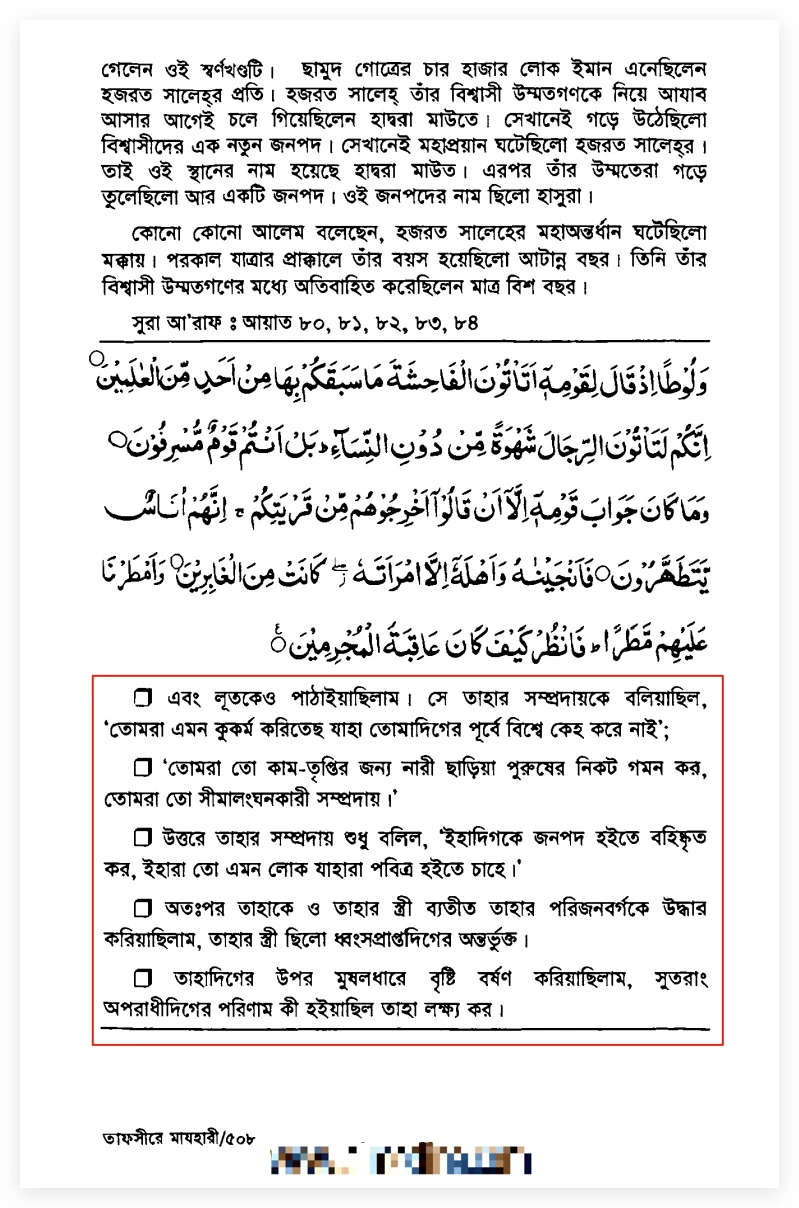
In Tafsir-e-Mazhari, these verses are explained by directly identifying sexual relations between men as fahishah, transgression, and the cause of the destruction of the people of Lot [7]
→ And We had also sent Lot. He said to his people, “You are committing such an evil act as no one in the world before you has committed”;
→ “You approach men instead of women for sexual gratification; you are indeed a transgressing people.”
→ The only answer of his people was, “Expel these people from the town; they are people who wish to remain pure.”
→ Then We saved him and his family except his wife; his wife was among those destroyed.
→ We showered them with a torrential rain; so observe what the end of the criminals was.
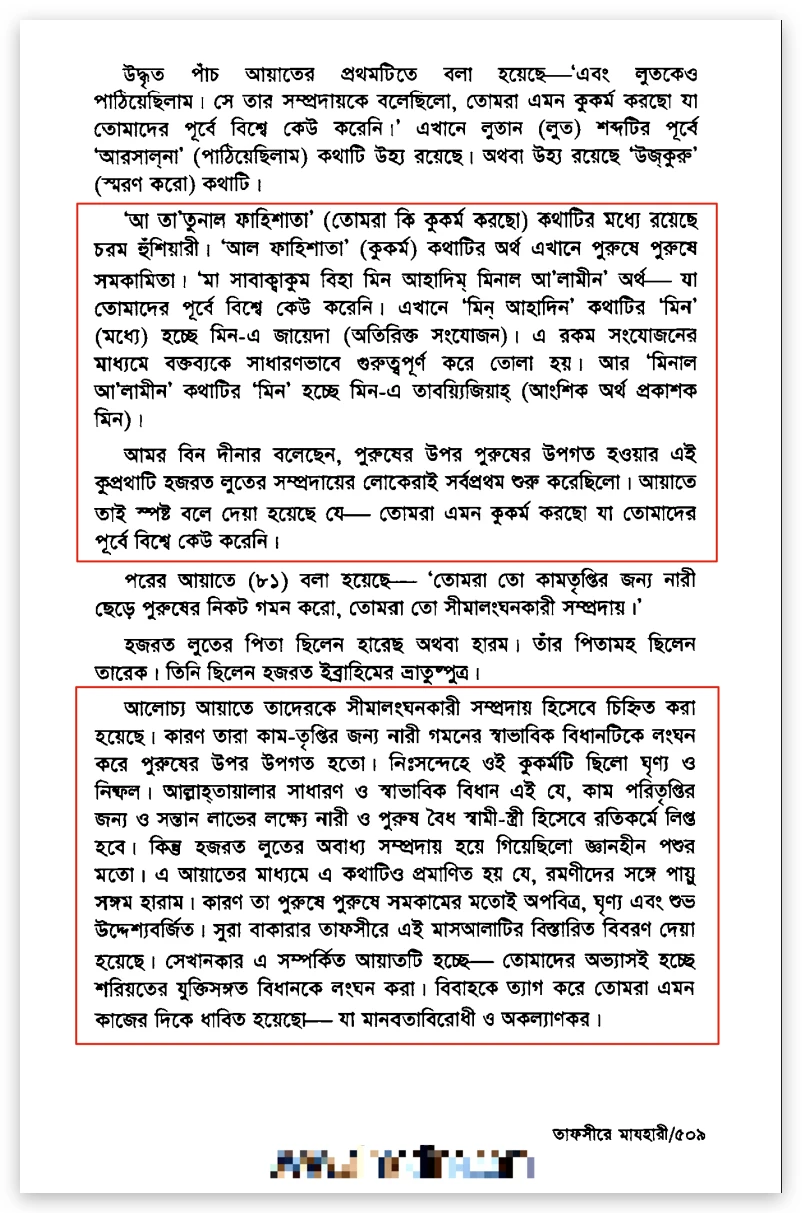
The first of the five quoted verses says, “And We had also sent Lot. He said to his people: You are committing such an evil act as no one in the world before you has committed.” Before the word Lutan [Lot], the expression arsalna [We sent] is omitted. Alternatively, the omitted expression is … [remember].
The words a-ta’tuna al-fahishata [do you commit the indecency?] contain an extreme warning. Here al-fahishah [the indecency] means male-to-male homosexuality. Ma sabaqakum biha min ahadin min al-‘alamin means: something that no one in the world before you committed. Here the min in min ahadin is min za’idah [an additional particle]. Such an addition makes the statement general and emphatic. The min in min al-‘alamin is min tab’idiyyah [a partitive min].
Amr ibn Dinar said that the people of Hazrat Lot were the first to introduce the practice of a man approaching another man. The verse therefore explicitly states: You are committing such an evil act as no one in the world before you has committed.
The next verse [81] says: “You approach men instead of women for sexual gratification; you are indeed a transgressing people.” Hazrat Lot’s father was Harith or Haram. His grandfather was Tariq. He was the nephew of Hazrat Abraham.
In the verse under discussion, they are identified as a transgressing people because, for sexual gratification, they violated the natural rule of approaching women and instead approached men. There is no doubt that this evil act was filthy and futile. Allah’s general and natural rule is that a man and a woman, as lawful husband and wife, engage in sexual relations for sexual satisfaction and for the purpose of having children. But the disobedient people of Hazrat Lot had become like mindless animals. This verse also proves that anal intercourse with women is forbidden, because it is impure, filthy, and devoid of a good purpose just like sexual intercourse between men. This issue has been discussed in detail in the tafsir of Surah al-Baqarah. The relevant verse there means: Your habit is to transgress the rational rulings of Sharia. Abandoning marriage, you have turned toward an act that is anti-human and harmful.
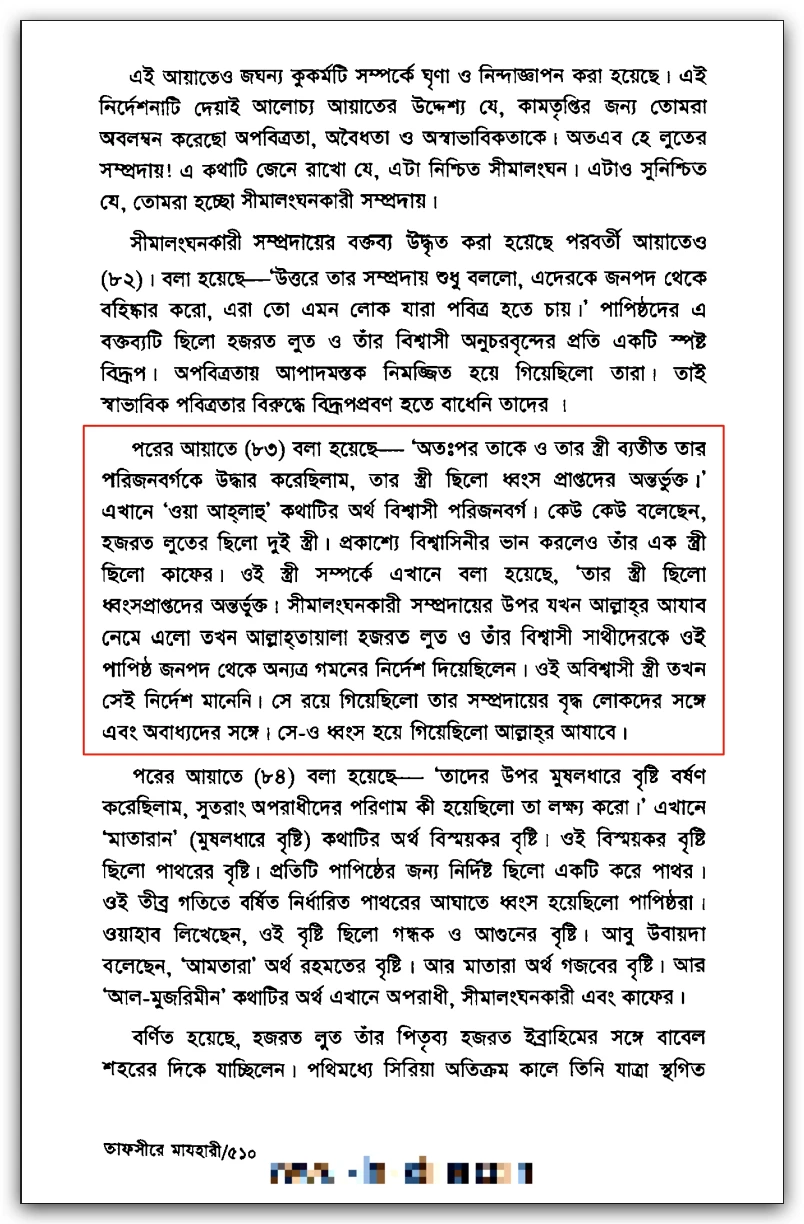
This verse too expresses disgust and condemnation toward that filthy act. The purpose of the verse is to state that, for sexual gratification, you have adopted impurity, illegality, and unnatural conduct. Therefore, O people of Lot, know that this is unquestionably transgression, and it is equally certain that you are a transgressing people. The statement of the transgressing people is quoted in the following verse [82]: “The only answer of his people was: Expel these people from the town; they are people who wish to remain pure.” This statement of the sinners was an explicit mockery of Hazrat Lot and his believing followers. They were immersed head to toe in impurity, and so they had no hesitation in mocking natural purity. The next verse [83] says: “Then We saved him and his family except his wife; his wife was among those destroyed.” Here wa alahu means the believing members of his family. Some have said that Hazrat Lot had two wives. Although outwardly pretending to be a believer, one of his wives was an unbeliever. It is about that wife that the verse says: “His wife was among those destroyed.”
When the punishment of Allah descended upon the transgressing people, Allah instructed Hazrat Lot and his believing companions to leave that sinful settlement. The unbelieving wife did not obey that order. She remained behind with the elderly members of her people and with the disobedient ones. She too was destroyed by Allah’s punishment.
The next verse [84] says: “We showered them with a torrential rain; so observe what the end of the criminals was.” Here mataran [torrential rain] means an extraordinary rain. That extraordinary rain was a rain of stones. A particular stone was designated for each sinner. The sinners were destroyed by the blows of those designated stones falling at great speed. Wahb wrote that the rain consisted of sulfur and fire. Abu Ubaydah said that amtara means a rain of mercy, whereas matara means a rain of wrath. Here al-mujrimin means criminals, transgressors, and unbelievers.
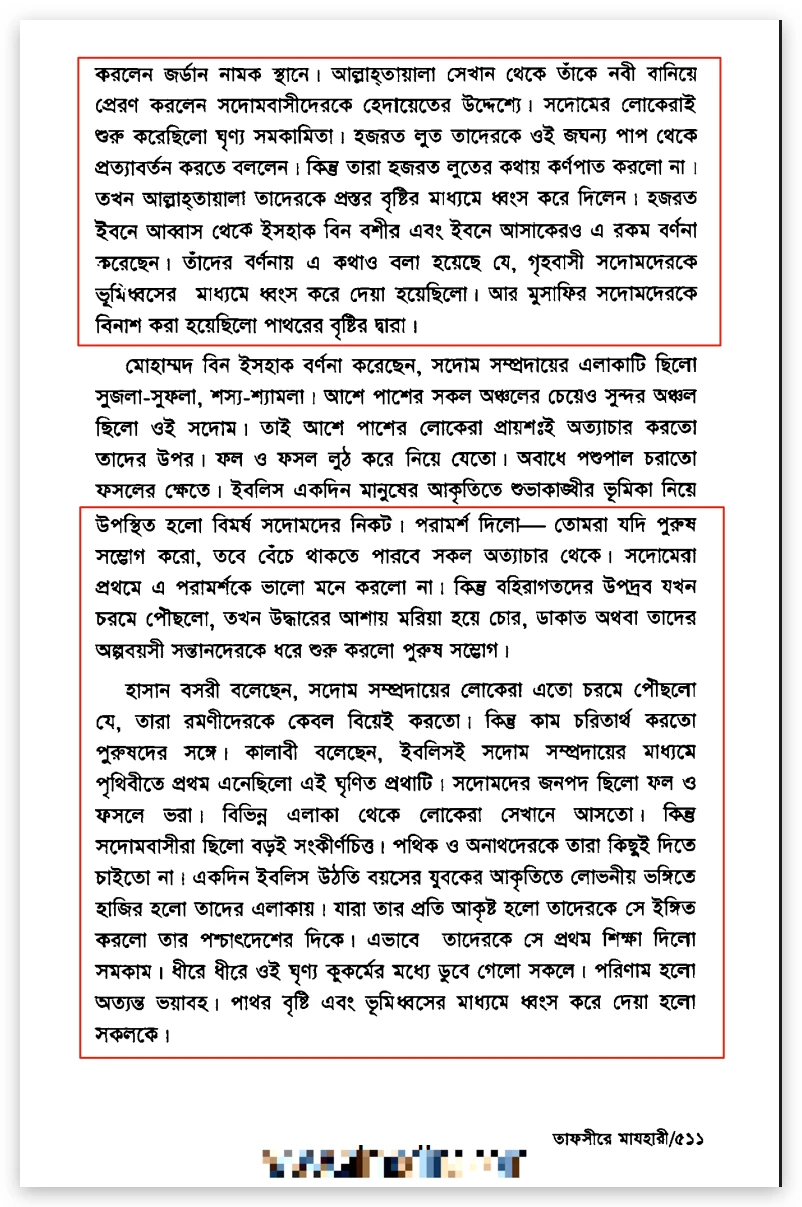
It is narrated that Hazrat Lot was travelling toward the city of Babylon with his paternal uncle Hazrat Abraham. While passing through Syria, he halted his journey at a place called Jordan. Allah appointed him as a prophet there and sent him to guide the people of Sodom. The people of Sodom were the first to begin the filthy practice of homosexuality. Hazrat Lot called on them to abandon that filthy sin, but they paid no attention to him. Allah then destroyed them through a rain of stones. Ishaq ibn Bashir and Ibn Asakir also narrated this from Hazrat Ibn Abbas. Their narration further states that the inhabitants who were inside their homes were destroyed by the earth collapsing, while the travelling Sodomites were destroyed by the rain of stones.
Muhammad ibn Ishaq narrated that the region of the people of Sodom was fertile, lush, and full of crops. It was more beautiful than all the surrounding regions. People from nearby areas would frequently attack them, plunder their fruits and crops, and freely graze livestock in their fields. One day Iblis appeared among the distressed Sodomites in human form, pretending to be a well-wisher. He advised them that if they had intercourse with men, they could protect themselves from all these attacks. At first the Sodomites did not like this advice. But when the harassment from outsiders reached an extreme, in desperation they began seizing thieves, robbers, or their young sons and having intercourse with them.
Hasan al-Basri said that the people of Sodom went so far that they married women only, but satisfied their lust with men. Al-Kalbi said that Iblis was the one who first introduced this detestable practice into the world through the people of Sodom. Their town was full of fruits and crops, and people from different regions came there. But the Sodomites were extremely miserly and did not wish to give anything to travellers and orphans. One day Iblis appeared in their region in the attractive form of a young man. To those who were attracted to him, he gestured toward his buttocks. In this way he first taught them homosexual intercourse. Gradually they all sank into that filthy practice. The outcome was extremely dreadful: all of them were destroyed through a rain of stones and the collapse of the earth.
The Ruling on Killing Homosexuals in Hadith
Hadiths played a central role in establishing the death penalty for liwat in Islamic law. The same basic statement narrated from Ibn Abbas appears in Jami’ at-Tirmidhi 1456, Sunan Abi Dawud 4462, and Sunan Ibn Majah 2561: “Whoever you find doing the action of the people of Lot, kill the one who does it and the one to whom it is done.” Muhammad Nasiruddin al-Albani graded the narration in Abu Dawud 4462 Hasan Sahih. In the Sunnah.com editions of Tirmidhi 1456 and Ibn Majah 2561, the Darussalam grading is Hasan. Tirmidhi also discusses different chains in the same chapter and notes the weakness in the memory of Asim ibn Umar, a narrator in an alternative chain from Abu Hurairah. [8] [9] [10]
Whoever Commits the Act of the People of Lot
حَدَّثَنَا مُحَمَّدُ بْنُ الصَّبَّاحِ، أَنْبَأَنَا عَبْدُ الْعَزِيزِ بْنُ مُحَمَّدٍ، عَنْ عَمْرِو بْنِ أَبِي عَمْرٍو، عَنْ عِكْرِمَةَ، عَنِ ابْنِ عَبَّاسٍ، قَالَ قَالَ رَسُولُ اللَّهِ صلى الله عليه وسلم “ مَنْ وَجَدْتُمُوهُ يَعْمَلُ عَمَلَ قَوْمِ لُوطٍ فَاقْتُلُوا الْفَاعِلَ وَالْمَفْعُولَ بِهِ ” .
English translation: It was narrated from Ibn ‘Abbas that the Messenger of Allah said: “Whoever you find doing the action of the people of Lot, kill the one who does it and the one to whom it is done.”
Sunan Ibn Majah 2561
In-book reference: Book 20, Hadith 30
Grade: Hasan (Darussalam)
One Who Commits the Act of the People of Lot
حَدَّثَنَا عَبْدُ اللَّهِ بْنُ مُحَمَّدِ بْنِ عَلِيٍّ النُّفَيْلِيُّ، حَدَّثَنَا عَبْدُ الْعَزِيزِ بْنُ مُحَمَّدٍ، عَنْ عَمْرِو بْنِ أَبِي عَمْرٍو، عَنْ عِكْرِمَةَ، عَنِ ابْنِ عَبَّاسٍ، فِي الْبِكْرِ يُوجَدُ عَلَى اللُّوطِيَّةِ قَالَ يُرْجَمُ . قَالَ أَبُو دَاوُدَ حَدِيثُ عَاصِمٍ يُضَعِّفُ حَدِيثَ عَمْرِو بْنِ أَبِي عَمْرٍو .
English translation: Narrated Ibn ‘Abbas: Regarding an unmarried man who is found committing sodomy, he said: “He is to be stoned.” Abu Dawud said: The tradition of Asim weakens the tradition of Amr ibn Abi Amr.
Sunan Abi Dawud 4463
Al-Albani: صحيح الإسناد موقوف — its chain is Sahih, mawquf.
These hadiths were adopted as major foundations of Islamic jurisprudence. Malik, al-Shafi’i, and Ahmad ibn Hanbal placed liwat directly within the framework of hudud offences, whereas Abu Hanifa treated it as a ta’zir offence. That is, the punishment could be determined at the judge’s discretion—but the most widespread position was death. Medieval works of fiqh such as al-Muwatta, al-Hidayah, al-Mughni, and Bada’i al-Sana’i discuss these punishments in detail.
The Death Penalty for Liwat in Islamic Jurisprudence: Companions, Jurists, and Classical Sources
In Islamic jurisprudence, liwat primarily means anal intercourse between men; it does not mean a person’s sexual orientation or identity in the modern sense. Yet once this sexual act was established, classical Islamic reports contain several proposed punishments: execution, stoning, burning, throwing from a high place, and crushing beneath a wall. In answer 38622 of Islam Question & Answer, published under the supervision of Shaykh Muhammad Salih al-Munajjid, classical juristic sources including Ibn al-Qayyim’s al-Jawab al-Kafi and Ibn Taymiyyah’s al-Siyasah al-Shar’iyyah are used to state that the Companions agreed on killing the person who committed liwat; their disagreement concerned the method of killing. The answer mentions burning in connection with Ali and Abu Bakr, throwing from a high place and then stoning in connection with Ibn Abbas, and stoning in reports from Ali and Ibn Abbas. Later jurists differed over the form of punishment: one group held that the offender should be killed whether married or unmarried; another applied the punishment for zina; and another favored ta’zir. [11]
عقوبة اللواط
13/صفر/1427 الموافق 13/مارس/2006
766,219
السؤال 38622
ما هي عقوبة اللواط، وهل هناك فرق بين الفاعل والمفعول به؟
ملخص الجواب
أجمع الصحابة على قتل اللوطي، لكن اختلفوا في طريقة قتله، فمنهم من ذهب إلى أن يحرق بالنار، وهذا قول علي رضي الله عنه، وبه أخذ أبو بكر رضي الله عنه، كما سيأتي. ومنهم قال: يرمى به من أعلى شاهق، ويتبع بالحجارة، وهذا قول ابن عباس رضي الله عنه. ومنهم من قال: يرجم بالحجارة حتى يموت، وهذا مروي عن علي وابن عباس أيضاً. ثم اختلف الفقهاء بعد الصحابة، فمنهم من قال يقتل على أي حال كان، محصنا أو غير محصن. ومنهم من قال: بل يعاقب عقوبة الزاني، فيرجم إن كان محصنا، ويجلد إن كان غير محصن. ومنهم من قال: يعزر التعزير البليغ الذي يراه الحاكم.
English translation:
The Punishment for Liwat
13 Safar 1427 AH, corresponding to 13 March 2006
766,219 views
Question 38622
What is the punishment for liwat, and is there any difference between the one who performs the act and the one to whom it is done?
Summary of the Answer
The Companions agreed on killing the person who commits liwat, but they differed over the method of killing him. Some held that he should be burned with fire. This was the view of Ali, and Abu Bakr adopted it as well, as will be mentioned later. Others said that he should be thrown from a high place and then followed with stones. This was the view of Ibn Abbas. Others said that he should be stoned until he dies. This is also reported from Ali and Ibn Abbas.
After the Companions, the jurists differed on the matter. Some said that the person who commits liwat is to be killed in all circumstances, whether married or unmarried. Others said that he should receive the punishment of an adulterer: if married, he is to be stoned, and if unmarried, he is to be flogged. Another group said that he should receive a severe discretionary punishment as determined by the ruler.
Ibn Taymiyyah writes explicitly in his al-Siyasah al-Shar’iyyah fi Islah al-Ra’i wa al-Ra’iyyah that, in his view, the agreed decision of the Companions was that both participants—the “upper” and the “lower” person—were to be killed, whether married or unmarried. He then lists various methods of execution reported from the Companions and the Salaf: burning with fire, direct killing, crushing beneath a wall, confinement in the foulest place until death, throwing from the highest wall in the town and then stoning, and stoning outright. Ibn Taymiyyah further states that most of the Salaf adopted stoning, arguing from the Qur’anic story in which Allah destroyed the people of Lot with stones. [12]
وأما اللواط فمن العلماء من يقول : حده كحد الزنا ، وقد قيل دون ذلك . والصحيح الذي اتفقت عليه الصحابة : أن يقتل الاثنان الأعلى والأسفل . سواء كانا محصنين ، أو غير محصنين .
فإن أهل السنن رووا عن ابن عباس رضي الله تعالى عنهما ، { عن النبي صلى الله عليه وسلم ، قال : من وجدتموه يعمل عمل قوم لوط ، فاقتلوا الفاعل والمفعول به } وروى أبو داود عن ابن عباس رضي الله تعالى عنهما : ” في البكر يوجد على اللواطية ، قال : يرجم ” ويروى عن علي بن أبي طالب رضي الله عنه نحو ذلك . ولم تختلف الصحابة في قتله ، ولكن تنوعوا فيه ، فروي عن الصديق رضي الله عنه أنه أمر بتحريقه ، وعن غيره قتله ، وعن بعضهم : أنه يلقى عليه جدار حتى يموت تحت الهدم ، وقيل : يحبسان في أنتن موضع حتى يموتا .
وعن بعضهم : أنه يرفع على أعلى جدار في القرية ، ويرمى منه ، ويتبع بالحجارة ، كما فعل الله بقوم لوط وهذه رواية عن ابن عباس ، والرواية الأخرى قال : يرجم
وعلى هذا أكثر السلف ، قالوا : لأن الله رجم قوم لوط ، وشرع رجم الزاني تشبيها برجم لوط ، فيرجم الاثنان ، سواء كانا حرين أو مملوكين ، أو كان أحدهما مملوك الآخر ، إذا كانا بالغين ، فإن كان أحدهما غير بالغ عوقب بما دون القتل ، ولا يرجم إلا البالغ .
English translation:
As for liwat, some scholars say that its hadd is the same as the hadd for zina, while a lesser punishment has also been proposed. But the correct position upon which the Companions agreed is that both persons are to be killed—the upper and the lower—whether they are married or unmarried.
The authors of the Sunan collections narrated from Ibn Abbas that the Prophet said: “Whoever you find doing the act of the people of Lot, kill the one who does it and the one to whom it is done.” Abu Dawud also narrated from Ibn Abbas that, regarding an unmarried man found committing liwat, he said: “He is to be stoned.” Something similar is narrated from Ali ibn Abi Talib.
The Companions did not differ over killing him; rather, they differed in the method. It is narrated from Abu Bakr al-Siddiq that he ordered him to be burned. Others held that he should simply be killed. Some held that a wall should be thrown upon him so that he dies beneath the rubble. It was also said that the two should be confined in the foulest place until they die.
Others held that he should be raised to the highest wall in the town, thrown from it, and then followed with stones—as Allah did to the people of Lot. This is one narration from Ibn Abbas. In another narration he said: He is to be stoned.
Most of the Salaf held this view. They said that Allah stoned the people of Lot, and that stoning the adulterer was legislated by analogy with the stoning of Lot’s people. Therefore both are to be stoned, whether they are free or enslaved, or whether one of them is owned by the other, provided that both are adults. If one of them is a minor, he is punished with something less than death, for only an adult is to be stoned.
Ibn Abbas’s Ruling: Throwing from the Highest Building Headfirst, Then Stoning
One of the clearest and most important early reports concerning this punishment appears in Ibn Abi Shaybah’s al-Musannaf. Abu Nadrah narrates that Ibn Abbas was asked: What is the punishment for the person who commits liwat? His answer was that the highest building in the town should be selected, the offender should be thrown from it headfirst, and then stones should be thrown at him. In the same chapter, another report from Ibn Abbas states that a person caught committing liwat is to be stoned, while another report states that Ali stoned a person for liwat. [13] [14]
سئل ابن عباس: ما حد اللوطي؟ قال: ينظر أعلى بناء في القرية فيرمى به منكسا ثم يتبع بالحجارة.
English translation: Ibn Abbas was asked: What is the punishment for the person who commits liwat? He said: The highest building in the town is to be identified; he is to be thrown from it headfirst and then followed with stones.
This report is not merely a later juristic construction. Ibn Hajar al-Asqalani graded its chain Sahih; al-Albani likewise graded the chain of the same report Sahih. The takhrij at Dorar al-Saniyyah records it in Ibn Abi Shaybah 28925, al-Bayhaqi 17106, and al-Ajurri’s Dhamm al-Liwat. [15]
خلاصة حكم المحدث: إسناده صحيح.
English translation: The hadith scholar’s ruling: Its chain is Sahih.
Stoning Even an Unmarried Man: Another Report from Ibn Abbas
In Sunan Abi Dawud 4463, another statement of Ibn Abbas is transmitted through Mujahid and Sa’id ibn Jubayr. The question specifically concerns an unmarried man—that is, someone who is not muhsan under the conventional juristic framework of zina. Ibn Abbas’s answer is that he too is to be stoned. Muhammad Nasiruddin al-Albani graded the chain of this report “Sahih al-isnad mawquf”. [16]
فِي الْبِكْرِ يُوجَدُ عَلَى اللُّوطِيَّةِ قَالَ يُرْجَمُ.
English translation: Regarding an unmarried man who is found committing liwat, Ibn Abbas said: He is to be stoned.
Ali Stoning a Man for Liwat
Ibn Abi Shaybah’s al-Musannaf, the works of al-Bayhaqi, and numerous later juristic writings preserve a report in which Ali stoned a man for liwat. Al-Musannaf states directly through Yazid ibn Qays that Ali stoned a man who committed liwat. This particular chain has been graded weak, but the report has been used in early hadith and fiqh literature in support of stoning as the punishment for liwat. [17]
عن يزيد بن قيس أن عليا رجم لوطيا.
English translation: It is narrated from Yazid ibn Qays that Ali stoned a man who committed liwat.
Abu Bakr Orders Khalid to Burn a Man for Liwat
Al-Bayhaqi’s al-Sunan al-Kubra contains an even more horrific report. It states that Khalid ibn al-Walid wrote to Abu Bakr informing him that, in a certain region of Arabia, a man had been found “who was approached as a woman is approached.” Abu Bakr gathered the Companions of Muhammad and consulted them. According to the report, Ali said that only one nation among the earlier peoples had committed this act and everyone knew what happened to them; therefore his view was that the man should be burned. Abu Bakr then ordered Khalid to burn him to death. Al-Bayhaqi classified the report as “هذا مرسل”, or mursal; the same incident was widely used in later Islamic jurisprudence as a precedent for burning a person who committed liwat. [18]
نرى أن نحرقه بالنار … هذا مرسل.
English translation: “Our view is that he should be burned with fire.” Al-Bayhaqi then says: “This is mursal.”
The same story is repeated in the works of al-Qurtubi, Ibn Hazm, Ibn al-Qayyim, Ibn al-Arabi, and many other classical writers. The appearance of the same basic report in numerous books does not constitute independent corroboration; in most cases later authors were using the already circulating report. It nevertheless shows that burning a person to death was neither an isolated nor a modern interpretation; it was widely circulated in classical juristic literature.
Reports of Burning under Ibn al-Zubayr, Hisham ibn Abd al-Malik, and Khalid al-Qasri
Ibn al-Arabi’s Ahkam al-Qur’an and Ibn Hazm’s al-Muhalla further state that after the Abu Bakr–Khalid incident, Ibn al-Zubayr burned people accused of the same offence during his rule; later, the same punishment is also reported under the Umayyad ruler Hisham ibn Abd al-Malik and under Khalid al-Qasri in Iraq. These reports are not all independent historical records of equal weight, but they clearly show what forms of state punishment medieval Islamic works of law and history transmitted as legitimate precedents. [19]
ثم أحرقهم ابن الزبير في زمانه، ثم أحرقهم هشام بن عبد الملك، ثم أحرقهم خالد القسري بالعراق.
English translation: Then Ibn al-Zubayr burned them in his time; then Hisham ibn Abd al-Malik burned them; then Khalid al-Qasri burned them in Iraq.
The Trial and Stoning of Seven Men for Liwat under Ibn al-Zubayr
In al-Khara’iti’s Masawi al-Akhlaq, Ata ibn Abi Rabah narrates that seven men caught in an act of liwat were brought before Ibn al-Zubayr. Four were married and three were unmarried. According to the report, the four married men were taken outside the mosque and stoned to death, while the hadd punishment was carried out on the remaining three. Ibn Umar and Ibn Abbas were present in the mosque at the time. [20]
شهدت ابن الزبير أتي بسبعة أخذوا في لواط: أربعة قد أحصنوا، وثلاثة لم يحصنوا.
English translation: Ata said: I witnessed Ibn al-Zubayr when seven men who had been caught in liwat were brought to him: four were married and three were unmarried.
Ibn al-Qayyim: Execution Whether Married or Unmarried
Ibn al-Qayyim’s al-Jawab al-Kafi, also known as al-Da’ wa al-Dawa’, contains a lengthy discussion of the punishment for liwat. He names Abu Bakr, Ali, Khalid ibn al-Walid, Abdullah ibn al-Zubayr, Abdullah ibn Abbas, and numerous early figures and later jurists while supporting the position that the punishment for this offence is more severe than that for zina and that the offender is to be killed whether married or unmarried. This discussion is also preserved in the Shamela edition. [21]
عقوبته القتل على كل حال، محصنا كان أو غير محصن.
English translation: His punishment is death in all circumstances, whether married or unmarried.
A Different Position in Hanafi Fiqh: Abu Hanifa’s Ta’zir and Imprisonment
The claim that “all four madhhabs prescribed death in every case in the same way” is not correct. Abu Hanifa’s primary position in Hanafi jurisprudence was different. Fath al-Qadir states that, according to him, the prescribed hadd for zina does not apply to liwat; instead, the offender is to receive ta’zir, and the wording of al-Jami’ al-Saghir also mentions imprisonment. The same discussion compares the positions of Abu Yusuf and Muhammad with the hadd for zina, while another Shafi’i position is cited as requiring death in all cases. Thus, although classical jurisprudence broadly agreed on criminalizing the act, there was real disagreement over the specific punishment. [22]
فلا حد عليه عند أبي حنيفة ويعزر … ويودع في السجن.
English translation: According to Abu Hanifa, there is no prescribed hadd upon him; he is to receive ta’zir and be placed in prison.
Methods of Execution: Sword, Stoning, Burning, Crushing Beneath a Wall, and Throwing from a High Place
In Muhammad al-Amin al-Shinqiti’s Adwa’ al-Bayan, while compiling the jurists’ disagreements over the punishment for liwat, four major methods of execution are listed explicitly: killing with the sword; stoning to death; burning with fire; and throwing the offender headfirst from the highest building in the town and then stoning him. The same discussion addresses the hadith ordering the killing of both “the one who performs the act and the one to whom it is done,” Ibn Abbas’s statement on stoning, and the report of Ali stoning a man. [23]
قال بعضهم: يقتل بالسيف. وقال بعضهم: يرجم بالحجارة. وقال بعضهم: يحرق بالنار.
English translation: Some said he is to be killed with the sword. Others said he is to be stoned with rocks. Others said he is to be burned with fire.
Mansur al-Buhuti: The Hadd for Liwat and the Framework for Proving the Offence
The Hanbali jurist Mansur ibn Yunus al-Buhuti, in his Sharh Muntaha al-Iradat, places anal intercourse between men within the hadd framework of zina. According to his formulation, whichever of the two men is muhsan, or married, is to be stoned; a free unmarried person is to receive one hundred lashes and exile for one year. In the same work, he discusses in detail the framework for proving hudud offences through confession and the testimony of four upright male witnesses. Later juristic compilations applied an analogous evidentiary framework to liwat as well. [24] [25]
ولو وطئ فاعل مفعولا به كزان، فمن كان منهما محصنا رجم، وغير المحصن الحر يجلد مائة ويغرب عاما.
English translation: If a man penetrates another man, they are treated like adulterers. Whichever of the two is muhsan is to be stoned, while a free person who is not muhsan is to receive one hundred lashes and be exiled for one year.
Ibn al-Qayyim: Killing the Consenting Passive Participant as Well
In al-Jawab al-Kafi liman Sa’ala ‘an al-Dawa’ al-Shafi, Ibn al-Qayyim presents an extremely harsh argument not only for killing the person who commits liwat but also for killing the consenting person to whom the act is done. In his view, the “maf’ul bihi,” or passive participant, undergoes such moral and spiritual “corruption” through the act that killing him is supposedly better for him than allowing him to live. In the same discussion, Ibn al-Qayyim portrays liwat as a form of “corruption” even worse than killing and invokes the claimed consensus of the Companions in support of executing both participants. [26]
وقتل المفعول به خير له من وطئه، فإنه إذا وطئه قتله قتلا لا ترجى الحياة معه.
English translation: Killing the person to whom the act is done is better for him than having intercourse performed upon him; for when the act is performed upon him, he is killed with a kind of killing after which no life is hoped for.
Taken together, these sources make one point clear: classical Islamic jurisprudence did not leave liwat as a merely private sin; it transformed it into an offence punishable by the state. Reports from Ibn Abbas prescribe throwing a person headfirst from a high building and then stoning him, as well as stoning an unmarried offender; Ali is reported to have carried out stoning; Abu Bakr is reported to have ordered burning; Ibn al-Zubayr’s period contains a report of stoning; and later jurists prescribed the sword, burning, stoning, and throwing from a high place. Together, these establish killing for liwat as an entrenched current within the classical Islamic legal tradition. The recurrence of the same report in multiple later books does not constitute independent corroboration, but that recurrence makes clear the long-term juristic acceptance and circulation of these forms of execution.
Modern scholars of Islamic history have noted that this legal process functioned as more than religious punishment; it also operated as a mechanism of social control. In medieval Muslim societies, state, religion, and morality were deeply intertwined. Sexual variation could therefore be treated as a crime against religion or public order. Scholars such as Khaled El-Rouayheb [27] have shown that social shame and the protection of honor often carried more importance than homosexual conduct itself. Fear and prohibition surrounding homosexuality were therefore embedded in broader structures of social conservatism and religious authority.
Open Homosexuality among Caliphs during the Caliphate Era
Although Islamic Sharia prescribed harsh punishments, including death, for homosexuality, the royal courts of the caliphates displayed the opposite tendency. Many caliphs, emirs, and court figures openly engaged in love of men within their palaces and showed intense attraction toward young male slaves known as ghilman or amrad (beardless youths). Islamic historians including al-Mas’udi, al-Tabari, Ibn Khallikan, and Ibn al-Jawzi recorded such accounts in their works.
The Abbasid caliph al-Amin (r. 809–813 CE) was one of the most controversial rulers in Islamic history. Al-Mas’udi wrote in Muruj al-Dhahab that “al-Amin was uninterested in women and spent his time with handsome young male slaves; he called them his ‘beloveds’” [28]. Ibn al-Jawzi states in Al-Muntazam fi Tarikh al-Umam wal-Muluk that al-Amin’s palace contained more than a hundred young singers and slaves, and rumors circulated of close relationships with some of them [29]. Similar material appears in al-Tabari’s Tarikh al-Rusul wa al-Muluk, where he states that “the caliph recited poetry with young male slaves in his gatherings and praised their beauty” [30].
Regarding another Abbasid caliph, al-Mu’tasim Billah (r. 833–842), Ibn Khallikan wrote that he was captivated by the beauty of Turkish soldiers and formed his palace guard from among them [31]. Al-Mas’udi’s account describes an unusually intimate relationship with his favored soldier Afshin, which became a major element of palace politics [32]. Modern historian Hugh Kennedy described the relationship as “personal intimacy and political favoritism intertwined with homoerotic overtones” [33].
Similar allegations are recorded concerning the Fatimid caliph al-Amir bi-Ahkam Allah (r. 1101–1130 CE). The Egyptian historian al-Maqrizi wrote in al-Khitat that “the caliph was intensely attracted to young men; dances involving naked performers and slaves were frequently arranged in his palace” [34]. This homosexual conduct contributed to moral decay within the palace, and he was later killed in an assassination.
Homosexual tendencies were also visible among the Umayyad caliphs of al-Andalus. The caliph of Cordoba, al-Hakam II (r. 961–976 CE), showed excessive affection toward a young singer named “Sandal”, whom he treated almost with the status of a wife [35]. Modern historian Reinhart Dozy wrote that “love of men at al-Hakam’s court became a kind of romantic fashion intertwined with poetry, music, and royal culture” [36].
The celebrated poet Abu Nuwas (756–814 CE) was close to al-Amin’s royal court. His poetry openly described love of men and sexual attraction toward youths, for example: “O youth, I am intoxicated by the roses of your cheeks and the wine of your lips” [37]. Abu Nuwas’s explicit poetry and al-Amin’s patronage expose a deep contradiction within medieval Islamic civilization: Sharia prescribed death for homosexuality, while the royal court could simultaneously turn male love into a form of luxury and culture.
Arabic historical works repeatedly record these descriptions of caliphs, royal courts, ghilman, amrad, and love of men. The survival of a culture of male love and sexual attraction toward young men within ruling courts, alongside established Sharia punishments of execution, stoning, and other severe penalties for liwat, exposes a deep hypocrisy between Islamic law and the actual exercise of political power under the caliphates.
Punishment for Liwat and Homosexuality under Modern Sharia-Based Rule: Case Studies
The classical juristic death penalty for liwat did not remain confined to medieval legal texts. In the modern period, states, governments, and armed Islamist regimes applying Sharia have imposed death sentences for this offence or carried them out. The methods have included beheading, hanging, crushing beneath a wall, throwing people from rooftops, stoning, and sentences of crucifixion. The cases below are documented in reports by Amnesty International, Human Rights Watch, the United Nations, official government records, and statements by the states or authorities concerned.
Case Study: Taliban Afghanistan, 1998 — Death by Crushing beneath a Wall
In February 1998, in Taliban-controlled Afghanistan, three men named Fazlur Rahman, Ahmad Shah, and Abdul Qahir were convicted of liwat by a Taliban Sharia court. On 25 February, at Kotal Morcha north of Kandahar, a stone wall was pushed down upon them with a battle tank in front of thousands of spectators. According to Amnesty International, all three were initially still alive; Taliban leader Mullah Muhammad Omar was present at the scene and ordered that they remain under the rubble for half an hour. When they were still alive after half an hour, they were taken to hospital; two died the following day, while the third was reported to have survived. Taliban media themselves described the punishment as the direct execution of a Sharia court verdict and a “Sharia-prescribed punishment.” [38]
“were publicly put under a wall after a verdict of the Shari’a court”
English translation: “They were publicly placed beneath a wall after a verdict of the Sharia court.”
Less than a month later, the same method was used again. On 22 March 1998, Abdul Sami, aged 18, and Bismillah, aged 22, both residents of Herat, had been arrested four months earlier on allegations of liwat. A Taliban Sharia court sentenced them to death. They were made to stand beside a mud wall, which was then pushed down upon them with a bulldozer. Taliban-controlled Voice of Shari’a radio itself announced that the “Sharia-prescribed hadd” had been carried out on the two accused men and that the sentence had received Mullah Omar’s approval. [39]
“Shari’a prescribed punishment … has been administered to two sodomites.”
English translation: “The punishment prescribed by Sharia was carried out on two men accused of sodomy.”
The U.S. Department of State’s 1999 human rights report on Afghanistan states that in 1998 at least seven cases were reported in which men accused of liwat or homosexual acts were punished by having walls collapsed upon them, and five people died by this method. The report describes the Taliban judicial system as a rapid, summary-trial system based on the Taliban’s own interpretation of “Islamic law.” [40]
“five persons reportedly were killed by this method in 1998.”
English translation: “Five people were reportedly killed by this method in 1998.”
Case Study: Saudi Arabia, 2002 — Three Men Publicly Beheaded
On 1 January 2002, three Saudi citizens—Ali bin Hittan bin Sa’id, Muhammad bin Sulayman bin Muhammad, and Muhammad bin Khalil bin Abdullah—were publicly beheaded with a sword in Abha, Asir Province. A statement by the Saudi Ministry of Interior listed homosexual acts among several charges against them. Homosexual conduct was therefore a direct component of their state conviction, and they were publicly beheaded under the Sharia-based judicial system. [41]
“The three men … were publicly beheaded in Abha, Asir province.”
English translation: “The three men were publicly beheaded in Abha, Asir Province.”
The same case is also recorded in a research document by the Immigration and Refugee Board of Canada. It states that the three men were convicted of “sodomy, marriage among themselves, and inciting pedophilia” and were publicly beheaded by sword. The same document also records that in 2000 nine people in Saudi Arabia were flogged for “deviant sexual behaviour,” while allegations surrounding the execution of six others were partly connected to sexual conduct. [42]
“The three men were beheaded by sword in public.”
English translation: “The three men were publicly beheaded by sword.”
Case Study: Iran, 2011 — Three Men Hanged under Liwat Laws
In September 2011, six people were hanged at Karoun Prison in Ahvaz, Iran. Citing the state news agency ISNA, Iran Human Rights reported that three of them—identified only by the initials M.T., T.T., and M.Ch.—had been convicted under Articles 108 and 110 of the Iranian Islamic Penal Code. At the time, Article 108 defined lavat, or liwat, as sexual intercourse between men, while Article 110 prescribed killing as the punishment; the method of execution was left to the Sharia judge. The men faced other charges as well, but the death-penalty provisions for liwat in Articles 108 and 110 were directly applied in the convictions announced by the state. [43]
“Punishment for sodomy is killing; the Sharia judge decides on how to carry out the killing.”
English translation: “The punishment for sodomy is death; the Sharia judge decides how the killing is to be carried out.”
Human Rights Watch’s 2012 World Report likewise confirms that on 3 September 2011 ISNA announced the execution of six men and that three of them had been convicted under Iran’s anti-sodomy laws. [44]
“Three of the men were convicted under Iran’s anti-sodomy laws.”
English translation: “Three of the men were convicted under Iran’s anti-sodomy laws.”
Case Study: ISIS, Iraq, 2015 — Killing by Throwing Men from Buildings
The United Nations directly verified numerous cases in which ISIS threw people from high buildings after accusing them of liwat or homosexuality. A 2015 UNAMI/OHCHR report states that on 4 June in Mosul, two young men and a 60-year-old man were killed by being thrown from the National Insurance Company building on allegations of homosexual acts. Before they were killed, the verdict of ISIS’s self-proclaimed court was read aloud. On 27 June in Fallujah, four more men accused of “sodomy” were thrown from the city’s highest building. Further incidents using the same method were documented in Mosul in July, August, and October. [45]
“individuals murdered (by throwing them from buildings) by ISIL for being homosexual.”
English translation: “Individuals accused of being homosexual were murdered by ISIS by throwing them from buildings.”
A United Nations UNITAD investigation identified these killings not as isolated incidents but as a clear systematic pattern. According to its factual findings, accused men were taken to the rooftops of tall buildings and the verdict was read out; they were then thrown off or forced to walk off the edge themselves. If the fall did not kill them, ISIS members would shoot them or instruct the gathered crowd to stone them to death. This method directly resembles a punishment preserved in classical juristic literature from Ibn Abbas: throwing from a high place followed by stoning. [46]
“If the victim did not die from the fall … the crowd [would] stone him to death.”
English translation: “If the person did not die from the fall … the crowd would be told to stone him to death.”
Case Study: Houthi-Controlled Yemen, 2024 — Death Sentences by Stoning and Crucifixion
On 23 January 2024, a Houthi-controlled court conducted a mass trial of 32 men on charges of “sodomy,” or liwat. Human Rights Watch reviewed the indictment, video of the proceedings, and information from a lawyer involved in the case and reported that nine men were sentenced to death and 23 to prison terms of up to ten years; three were also sentenced to public flogging. The methods of execution included stoning and crucifixion. Human Rights Watch also documented serious due-process violations in the proceedings. [47]
“death sentences that include crucifixion and stoning”
English translation: “The death sentences included crucifixion and stoning.”
The United Nations Security Council’s 2024 Panel of Experts on Yemen further reported that in Sana’a nine men were sentenced to death by stoning and crucifixion and 23 others received prison terms. In February 2024, the Panel also received information that in Ibb 13 more men had been sentenced to death on homosexuality-related charges, three had been imprisoned, and 35 had been detained. [48]
“13 men were sentenced to death … on homosexuality-related charges.”
English translation: “Thirteen men were sentenced to death on homosexuality-related charges.”
Yemen’s Penal Code also provides a clear legal basis for this punishment. According to Human Rights Watch’s Yemen country report, Article 264 of the Penal Code prescribes 100 lashes and one year of imprisonment for anal intercourse when the offender is unmarried, while for a married person the same article prescribes death by stoning. [49]
“If married, the same article prescribes death by stoning.”
English translation: “If the person is married, the same article prescribes death by stoning.”
From Classical Rulings to Modern Enforcement: The Continuity
The continuity is clear: the Qur’anic story of Lot provides the moral condemnation of male-male sexual conduct and the narrative of destruction; the hadith orders the killing of both the “fa’il” and the “maf’ul bihi”; the Companions and jurists are associated with rulings involving stoning, burning, crushing beneath a wall, and throwing from a high place; and modern Sharia-based regimes have imposed death sentences for the same category of sexual conduct and have carried out some of the same methods. The religious-legal conception of consensual same-sex conduct as a capital crime is not a dead medieval rule: people have continued to be killed and sentenced to death under it in the modern era.
Under international human rights law, the death penalty for consensual same-sex relations is unacceptable. It directly conflicts with the rights to life, privacy, personal liberty, and equality. More seriously, many of these cases also involve secret trials, coerced confessions, inadequate legal representation, vague charges, and political or social stigma. The problem is therefore not only a brutal substantive law; in many cases it is compounded by fundamentally unjust judicial procedures.
A Critique in Light of Human Rights, Science, and Ethics
There is no scientific basis for classifying same-sex attraction itself as a mental illness or disorder. The American Psychiatric Association removed homosexuality from the DSM’s classification of mental disorders in 1973. The World Health Organization removed homosexuality from the ICD’s diagnostic categories in 1990; in the WHO’s own formulation, this change reflected the absence of empirical evidence for treating variations in sexual orientation as diseases. [50] [51]
Modern medicine does not recognize same-sex attraction as a disease, even though classical Islamic jurisprudence treated the corresponding sexual act as a capital offence. A large part of the modern world likewise no longer criminalizes consensual same-sex relations between adults. According to ILGA World’s 2024 global legal review, 131 states did not criminalize consensual same-sex sexual activity, while 62 United Nations member states still criminalized it directly or in practice. Seven states prescribed the death penalty in law, while in five additional states there was legal uncertainty over its possible application. [52]
The ethical problem is equally direct. When two consenting adults engage in a private sexual relationship, that relationship in itself does not attack the life, body, property, or liberty of any third person. Treating it in the same category as murder, rape, or other victim-producing violence and imposing state execution is the complete opposite of the harm principle. Here the “crime” is created not by demonstrable harm to an actual victim but by violation of a religious moral prohibition. Enforcing that prohibition by stoning, beheading, burning, crushing beneath a wall, or throwing a person from a high place directly violates the rights to life, privacy, equality, and freedom from cruel and inhuman punishment.
Conclusion
The overall picture in Islamic sources concerning the punishment for liwat is not obscure. The Qur’an condemns men approaching men for sexual gratification as fahishah and transgression and repeatedly recounts the divine destruction of the people of Lot. Although the Qur’an itself does not prescribe a human judicial death penalty for the person who commits liwat, the hadith takes that next step explicitly: “Kill the one who does it and the one to whom it is done.” A statement from Ibn Abbas prescribes stoning even for an unmarried offender; another report from him prescribes throwing the offender headfirst from the highest building in the town and then stoning him. Stoning by Ali, burning on Abu Bakr’s order, crushing beneath a wall, confinement in the foulest place until death, and direct stoning are all preserved in classical Islamic legal literature in reports associated with the Companions, the Salaf, and later jurists.
The jurists disagreed over the precise punishment, but it is wrong to portray that disagreement as a fundamental objection to criminalizing liwat. Abu Hanifa’s position substitutes ta’zir and imprisonment for a fixed hadd, while Maliki, Hanbali, and many Shafi’i and other juristic currents established stoning or direct execution. Ibn Taymiyyah presented killing both participants, whether married or unmarried, as the agreed decision of the Companions. Ibn al-Qayyim went even further, describing liwat as a form of “corruption” worse than killing and arguing that killing the passive participant was supposedly better for him than allowing him to live. This is therefore not an isolated interpretation invented by a modern extremist organization; it is a developed classical legal tradition for using state power to punish private, consensual sexual conduct.
The claim that these rulings belong only to dead medieval books is contradicted by modern enforcement. In 1998, people accused of liwat were crushed beneath walls under Taliban Sharia court rulings in Afghanistan; in 2002, three men in Saudi Arabia were publicly beheaded on convictions that included homosexual acts; in 2011, men convicted under Iran’s anti-sodomy provisions were hanged; in 2015, ISIS threw men accused of homosexuality from high buildings in Mosul and Fallujah and used stoning when the fall did not kill them; and in 2024, Houthi-controlled courts in Yemen issued death sentences involving stoning and crucifixion for liwat. These modern applications show that the religious-legal framework treating consensual same-sex conduct as a capital crime has continued to provide an actual basis for taking human life.
The ethical foundation of this law becomes even weaker when measured against actual harm. A private sexual relationship between two consenting adults does not in itself inflict violence upon the life, body, property, or liberty of any third party. Modern medicine does not classify same-sex attraction as a mental disorder; the American Psychiatric Association removed homosexuality from its disease classification in 1973, and the World Health Organization did so in 1990. Yet the classical Sharia framework authorized taking human life for a victimless consensual act. A law that permits people to be stoned, beheaded, burned, crushed beneath walls, or thrown from high places merely for violating a religious sexual prohibition cannot be called justice. It is a system in which state power converts religious dogma and sexual control into capital punishment.
The problem with the death penalty for liwat in Islamic Sharia is therefore not confined to an isolated hadith, a single madhhab, or a distortion by a modern terrorist organization. Qur’anic moral condemnation, a prophetic command to kill, punishments preserved in reports from the Companions, the legal reasoning of classical jurists, and modern Sharia-based enforcement together form a long and clear continuity. At the center of that continuity lies a fundamental moral failure: religious authority is imposed upon the private sexual conduct of consenting people, and the state is made master of their bodies and lives. Judged by the standards of human rights, individual liberty, scientific knowledge, and harm-based ethics, this ruling is not justice; it is brutal state violence legitimized by an unproven religious morality.
References
- Sexual Diversity and Human Rights: Is Homosexuality Really a Mental Illness or a Normal Variation? ↩︎
- Surah al-A’raf 7:80–84 ↩︎
- Surah al-Naml 27:54–58 ↩︎
- Surah al-‘Ankabut 29:28–35 ↩︎
- Persecution of homosexuals in the Palestinian autonomous areas ↩︎
- Iran defends execution of gay people ↩︎
- Tafsir-e-Mazhari, vol. 4, Islamic Foundation, pp. 508–511 ↩︎
- Jami’ at-Tirmidhi 1456 ↩︎
- Sunan Abi Dawud 4462 — al-Albani: Hasan Sahih ↩︎
- Sunan Ibn Majah 2561 ↩︎
- Islam Question & Answer, published under the supervision of Shaykh Muhammad Salih al-Munajjid, Question 38622: عقوبة اللواط ↩︎
- Ibn Taymiyyah, al-Siyasah al-Shar’iyyah fi Islah al-Ra’i wa al-Ra’iyyah, p. 138 ↩︎
- Ibn Abi Shaybah, al-Musannaf, Kitab al-Hudud — Islamweb ↩︎
- Dorar al-Saniyyah — Ibn Hajar: إسناده صحيح ↩︎
- Dorar al-Saniyyah: Chain of the Report from Ibn Abbas ↩︎
- Sunan Abi Dawud 4463 — al-Albani: صحيح الإسناد موقوف ↩︎
- Ibn Abi Shaybah, al-Musannaf, Kitab al-Hudud ↩︎
- Al-Bayhaqi, al-Sunan al-Kubra, Bab ma ja’a fi hadd al-luti — Islamweb ↩︎
- Ibn al-Arabi, Ahkam al-Qur’an — Islamweb ↩︎
- Al-Khara’iti, Masawi al-Akhlaq — Islamweb ↩︎
- المكتبة الشاملة — ابن القيم، الداء والدواء / الجواب الكافي ↩︎
- Fath al-Qadir, Kitab al-Hudud — Islamweb ↩︎
- Adwa’ al-Bayan: عقوبة من ارتكب فاحشة قوم لوط — Islamweb ↩︎
- Mansur al-Buhuti, Sharh Muntaha al-Iradat, Kitab al-Hudud, vol. 3, p. 346 ↩︎
- Mansur al-Buhuti, Sharh Muntaha al-Iradat, vol. 3, p. 350 ↩︎
- Ibn al-Qayyim, al-Jawab al-Kafi liman Sa’ala ‘an al-Dawa’ al-Shafi — فصل عقوبة اللواط ↩︎
- Harvard University, Before Homosexuality in the Arab-Islamic World, 1500–1800 ↩︎
- Muruj al-Dhahab, vol. 4, p. 61 ↩︎
- Al-Muntazam, vol. 9, p. 28 ↩︎
- Tarikh al-Tabari, vol. 31, p. 28–29 ↩︎
- Ibn Khallikan, Wafayat al-A’yan, vol. 5, p. 241 ↩︎
- Muruj al-Dhahab, vol. 4, p. 102 ↩︎
- Kennedy, The Prophet and the Age of the Caliphates, 2004, p. 165 ↩︎
- al-Maqrizi, al-Khitat, vol. 2, p. 148 ↩︎
- Ibn Hayyan, al-Muqtabis fi Tarikh al-Andalus, vol. 5, p. 312 ↩︎
- Dozy, Spanish Islam: A History of the Moslems in Spain, 1913, p. 458 ↩︎
- Abu Nuwas: The Libertine Poet of Baghdad, Philip Kennedy, 2005, p. 72 ↩︎
- Amnesty International: Afghanistan — Flagrant Abuse of the Right to Life and Dignity ↩︎
- Amnesty International, Afghanistan, April 1998 ↩︎
- U.S. Department of State: Afghanistan Human Rights Report 1999 ↩︎
- Amnesty International: Saudi Arabia — ‘Sexual orientation’ executions condemned ↩︎
- Immigration and Refugee Board of Canada: Treatment and Legal Penalties for Homosexuals in Saudi Arabia ↩︎
- Iran Human Rights: Three Men Were Executed Convicted of Sodomy ↩︎
- Human Rights Watch, World Report 2012: Iran ↩︎
- UNAMI/OHCHR: Report on the Protection of Civilians in Iraq, 1 May–31 October 2015 ↩︎
- UNITAD: ISIL Crimes Committed Against LGBTQ Individuals — Factual Findings ↩︎
- Human Rights Watch: Yemen — Houthis Sentence Men to Death, Flogging ↩︎
- United Nations Security Council, Panel of Experts on Yemen, S/2024/731 ↩︎
- Human Rights Watch, World Report 2024: Yemen ↩︎
- American Psychiatric Association: Removal of Homosexuality from the DSM in 1973 ↩︎
- World Health Organization: SOGIESC FAQ — homosexuality removed from the ICD in 1990 ↩︎
- ILGA World, Laws on Us: A Global Overview, 2024 ↩︎