

Introduction
One of the ugliest aspects of the legal framework in Islamic jurisprudence that treats enslaved women merely as “commodities” or “property” is the permissibility of exchanging them or transferring them as gifts. From the moment a captive woman is distributed as “spoils of war” or war booty, her human personhood is erased and she becomes an object of the owner’s unrestricted sexual use. The most extreme form of this institutionalized system of exploitation appears when the owner sells this “property” to another man, puts her on the market, or transfers her as a gift. Under Islamic law, as soon as ownership changes, the sexual right over the woman’s body is also legally transferred to the new owner. This is essentially an organized system of serial sexual slavery wrapped in religious law, in which a woman is subjected successively to the sexual desires of multiple men. Although the rule of “hiba,” or gifting, may outwardly appear to be an ordinary act of courtesy or transaction, its underlying reality was that women captured on the battlefield could be passed among Muslim fighters for successive sexual use. Thus, even after a woman had been repeatedly raped by one owner, she was not necessarily freed. If that owner gifted her to a friend or close associate, she would again be forced to face the same sexual violation under the next owner. In this way, a woman could be passed from hand to hand and subjected to rape by successive Companions, especially since Muhammad’s Companions frequently practiced coitus interruptus. This legal permissibility amounted to an institutional recognition of extreme degradation of women and systematic gang rape. This becomes particularly clear when hadith and fiqh texts show that the principal condition imposed when an enslaved woman changed hands was only istibra—waiting through a menstrual cycle to establish that the womb was free of pregnancy. In other words, once it was established that she was not pregnant by the previous owner, the new owner obtained the legal right to have sex with her. By any rational standard, this cannot be described as a civilized rule; it was a religious mechanism for using captive women as commodities to satisfy male sexual desire. As Ibn Zayd’s report indicates, although the pre-Islamic practice of exchanging wives was prohibited, the exchange of enslaved women in Islam remained permissible, demonstrating the absence of meaningful human dignity or autonomy for enslaved women.
Islamic Legitimacy of Gifting, Exchanging, or Swapping Enslaved Women
The Islamic rule permitting enslaved women to be sold or given as gifts may appear ordinary at first glance, but it conceals a profoundly brutal legal mechanism. Through this rule, a woman obtained as war booty could be passed from one Companion to another for sexual use. This meant that once a woman was captured by a Muslim army, there was no guarantee of escape from repeated sexual exploitation. One man could use her and then give her to another, while taking another enslaved woman in exchange. This ensured a continuing supply of new enslaved women in their beds. Consider the following hadith [1]:
Sahih al-Bukhari (Tawhid Publication)
51/ Gifts and Their Virtues
Chapter 51/36. According to customary usage, if someone says, “I give this slave girl to you for your service,” it is valid.
وَقَالَ بَعْضُ النَّاسِ هَذِهِ عَارِيَّةٌ وَإِنْ قَالَ كَسَوْتُكَ هَذَا الثَّوْبَ فَهُوَ هِبَةٌ
Some jurists say that this would constitute a loan. But if someone says, “I have given you this garment to wear,” then it constitutes a gift.
2635. Narrated Abu Huraira: The Messenger of Allah related that Abraham migrated with Sarah. The people gave Hagar to Sarah as a gift. Sarah returned to Abraham and said, “Do you know that Allah has humiliated the unbeliever and he has given a girl to serve me?”
Ibn Sirin narrated from Abu Huraira, from the Prophet, that the unbeliever then gave Hagar to Sarah. (2217) (Modern Publication: 2443; Islamic Foundation: 2459)
بَابُ إِذَا قَالَ أَخْدَمْتُكَ هَذِهِ الْجَارِيَةَ عَلَى مَا يَتَعَارَفُ النَّاسُ فَهُوَ جَائِزٌ
حَدَّثَنَا أَبُو الْيَمَانِ أَخْبَرَنَا شُعَيْبٌ حَدَّثَنَا أَبُو الزِّنَادِ عَنْ الأَعْرَجِ عَنْ أَبِيْ هُرَيْرَةَ أَنَّ رَسُوْلَ اللهِ صلى الله عليه وسلم قَالَ هَاجَرَ إِبْرَاهِيْمُ بِسَارَةَ فَأَعْطَوْهَا آجَرَ فَرَجَعَتْ فَقَالَتْ أَشَعَرْتَ أَنَّ اللهَ كَبَتَ الْكَافِرَ وَأَخْدَمَ وَلِيْدَةً وَقَالَ ابْنُ سِيْرِيْنَ عَنْ أَبِيْ هُرَيْرَةَ عَنْ النَّبِيِّ صلى الله عليه وسلم فَأَخْدَمَهَا هَاجَرَ.
Hadith grade: Sahih
Narrator: Abu Huraira
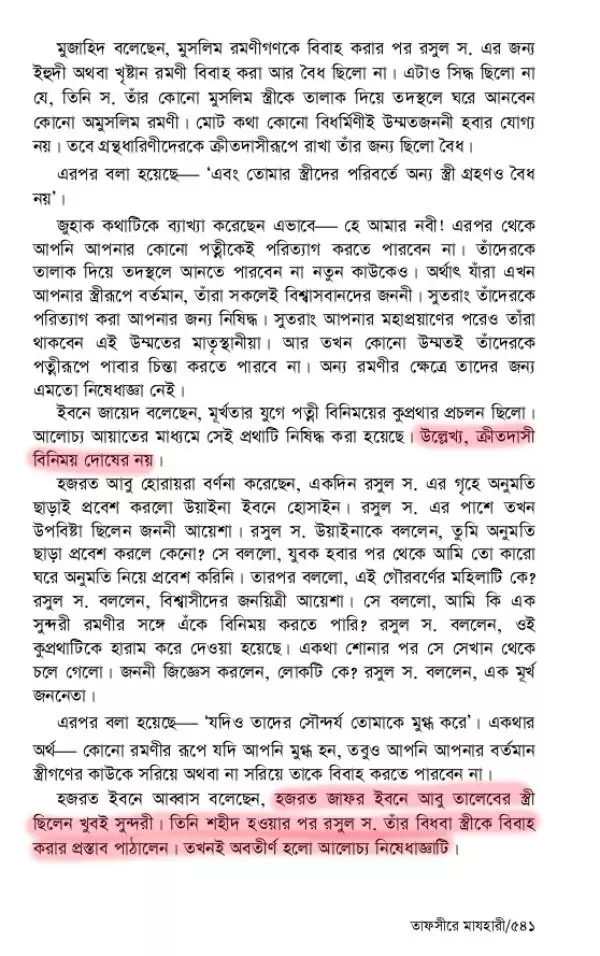
Now consider a relevant passage from Tafsir al-Mazhari [2]:
Ibn Zayd said that during the Age of Ignorance the reprehensible custom of exchanging wives was practiced. This practice was prohibited by the verse under discussion. It should be noted, however, that exchanging enslaved women is not objectionable.
Now consider a passage published on islamweb.net, one of the most influential Islamic fatwa websites in the world today [3]:
المصنف
ابن أبي شيبة – عبد الله بن محمد بن أبي شيبة
جزء
5
صفحة
33
إظهار / إخفاء التشكيل بحث في الكتاب
2662 ( 29 ) الرجل يريد أن يشتري الجارية فيمسها
( 1 ) حدثنا جرير عن منصور عن مجاهد قال : كنت مع ابن عمر أمشي في السوق فإذا نحن بناس من النخاسين قد اجتمعوا على جارية يقلبونها ، فلما رأوا ابن عمر تنحوا وقالوا : ابن عمر قد جاء ، فدنا منها ابن عمر فلمس شيئا من جسدها وقال : أين أصحاب هذه الجارية ، إنما هي سلعة .
( 2 ) نا علي بن مسهر عن عبيد الله عن نافع عن ابن عمر أنه كان إذا أراد أن يشتري الجارية وضع يده على أليتيها أو بين فخذها وربما كشف عن ساقيها [ ص: 33 ]
( 3 ) حدثنا وكيع عن سفيان عن عبيد المكتب عن إبراهيم عن رجل من أصحاب عبد الله أنه قال : ما أبالي مسستها أو مسست هذا الحائط .
( 4 ) حدثنا وكيع عن عبد الله بن حبيب عن أبي جعفر أنه ساوم بجارية فوضع يده على ثدييها وصدرها .
( 5 ) حدثنا ابن مبارك عن الأوزاعي قال : سمعت عطاء وسئل عن الجواري اللاتي يبعن بمكة فكره النظر إليهن إلا لمن يريد أن يشتري .
( 6 ) حدثنا أزهر السمان عن ابن عون قال : كان محمد إذا بعث إليه بالجارية ينظر إليها كشف بين ساقيها وذراعيها .
( 7 ) حدثنا هشيم عن مغيرة عن إبراهيم أن صديقا له أسود كتب إليه أن يشتري له جارية ، ففعل فعاب شيئا من ساق الجارية ، قال : فبلغ ذلك الأسود من قوله فقال : ما أحب أني نظرت إلى ساقيها ولا إلى كذا وكذا .
( 8 ) حدثنا وكيع عن حماد بن سلمة عن حكيم الأثرم عن أبي تميمة عن أبي موسى أنه خطبهم فقال : لا أعلم رجلا اشترى جارية فنظر إلى ما دون الجارية وإلى ما فوق الركبة إلا عاقبته .
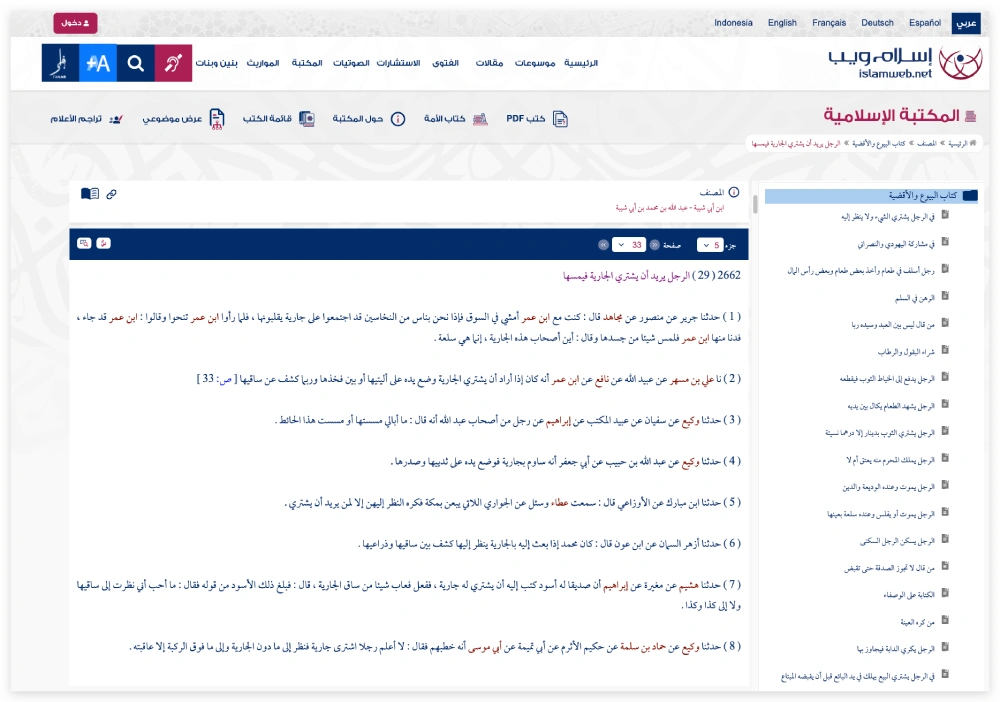
English translation: Musannaf Ibn Abi Shaybah
Section no. 2662 (29) — Regarding a man who intends to purchase a slave girl and touches her
1. Narrated from Mujahid: He said, “I was walking through the market with Ibn Umar when we came upon a group of slave traders gathered around a slave girl, turning her over and examining her. When they saw Ibn Umar, they moved aside and said, ‘Ibn Umar has come.’ Ibn Umar approached her and touched part of her body, then said, ‘Where are the owners of this slave girl? She is only a commodity.’” (Musannaf Ibn Abi Shaybah, Hadith no. 26620)
2. Ali ibn Mushir narrated from Ubayd Allah, from Nafi, from Ibn Umar that when Ibn Umar intended to buy a slave girl, he would place his hand on her buttocks or between her thighs, and sometimes uncover her shins. (Musannaf Ibn Abi Shaybah, Hadith no. 26621)
3. Waki narrated from Sufyan, from Ubayd al-Muktib, from Ibrahim, from one of Abdullah’s companions, who said: “I do not care whether I touched her or touched this wall.” (Musannaf Ibn Abi Shaybah, Hadith no. 26622)
4. Waki narrated from Abdullah ibn Habib, from Abu Jafar, that while bargaining over a slave girl he placed his hand on her breasts and chest. (Musannaf Ibn Abi Shaybah, Hadith no. 26623)
5. Ibn al-Mubarak narrated from al-Awzai: “I heard Ata being asked about slave girls sold in Mecca. He disliked looking at them except for someone who intended to buy.” In other words, looking was permitted for a prospective purchaser. (Musannaf Ibn Abi Shaybah, Hadith no. 26624)
6. Azhar al-Samman narrated from Ibn Awn that when a slave girl was sent to Muhammad ibn Sirin, he would inspect her by uncovering her shins and arms. (Musannaf Ibn Abi Shaybah, Hadith no. 26625)
7. Hushaym narrated from Mughirah, from Ibrahim, that a Black friend of his wrote asking him to purchase a slave girl for him. He did so and mentioned a defect in the slave girl’s shin. When the man heard what he had said, he replied, “I would not like to have looked at her shin, nor at such-and-such [parts].” (Musannaf Ibn Abi Shaybah, Hadith no. 26626)
8. Waki narrated from Hammad ibn Salamah, from Hakim al-Athram, from Abu Tamimah, from Abu Musa that he addressed the people and said: “If I learn that a man purchased a slave girl and looked at what is below [the permitted area] and above the knee, I will punish him.” (Musannaf Ibn Abi Shaybah, Hadith no. 26627)
Summary: These reports make clear that during the buying and selling of enslaved women, prospective purchasers or examiners could directly touch or uncover various intimate parts of their bodies, including the breasts, buttocks, and thighs. Statements attributed to figures such as Ibn Umar show that enslaved women were treated not as autonomous human beings but as purchasable “commodities” or merchandise.
Transfer of Ownership and Sexual Rights: Enslaved Women Passed from Father to Son
Within the Islamic legal framework, the right to have sexual relations with an enslaved woman was directly tied to ownership. When a woman passed into the hands of a new owner through distribution as war booty, purchase, or gift, the sexual right over her likewise passed to the new owner. This is why the law required istibra after the transfer of an enslaved woman: her womb had to be shown free of pregnancy through a menstrual cycle, after which the new owner could have intercourse with her once it had been established that she was not carrying the previous owner’s child [4]. The connection between gifting an enslaved woman and transferring sexual rights becomes even clearer in reports of enslaved women being passed from fathers to sons among the Companions and Successors.
In Ibn Abd al-Barr’s Al-Istidhkar, the same chapter preserves multiple reports involving Umar ibn al-Khattab, Salim ibn Abdullah, Abu Nahshal ibn al-Aswad, and the family of Marwan ibn al-Hakam in which enslaved women were transferred from fathers to sons. Umar gave his son a slave girl but told him not to approach her because Umar had previously uncovered her. Salim ibn Abdullah likewise gave his son a slave girl but prohibited him from approaching her because Salim himself had desired her. Marwan also gave his son a slave girl while instructing him not to have sexual relations with her. Abu Nahshal’s question, however, exposes the sexual character of the system in completely explicit terms. After reaching the point of having intercourse with his own slave girl but stopping because she was menstruating, he asked al-Qasim ibn Muhammad whether he could give the slave girl to his son so that the son could have intercourse with her [5].
[ ص: 257 ] ( 15 ) باب النهي عن أن يصيب الرجل أمة كانت لأبيه
1097 – مالك ; أنه بلغه أن عمر بن الخطاب وهب لابنه جارية ، فقال : لا تمسها . فإني قد كشفتها .
مالك ، عن عبد الرحمن بن المجبر ; أنه قال : وهب سالم بن عبد الله لابنه جارية . فقال : لا تقربها فإني قد أردتها ، فلم أنشط إليها .
1098 – وعن يحيى بن سعيد ; أن أبا نهشل بن الأسود ، قال للقاسم بن محمد : إني رأيت جارية لي منكشفا عنها ، وهي في القمر . فجلست منها مجلس الرجل من امرأته . فقالت : إني حائض . فقمت . فلم أقربها بعد . أفأهبها لابني يطؤها ؟ فنهاه القاسم عن ذلك .
1099 – مالك ، عن إبراهيم بن أبي عبلة ، عن عبد الملك بن مروان ; أنه وهب لصاحب له جارية . ثم سأله عنها . فقال : قد هممت أن أهبها لابني ، فيفعل بها كذا وكذا . فقال عبد الملك : لمروان كان أورع منك . وهب لابنه جارية . ثم قال : لا تقربها فإني قد رأيت ساقها منكشفة .
24340 – قال أبو عمر : أعلى ما في هذا المعنى ما أخبرنا به أبو محمد عبد الله بن محمد بن عبد المؤمن ، قال : حدثني عبد المؤمن بن محمد بن عثمان بن ثابت ، قال : حدثني إسماعيل بن إسحاق ، قال : حدثني علي بن المديني ، قال : حدثني ابن عيينة ، قال : حدثني يزيد بن يزيد بن جابر ، عن مكحول أن عمر جرد جارية ، فنظر إليها ، ثم نهى بعض ولده أن يقربها .
24341 – وذكر عبد الرزاق ، عن ابن عيينة ، عن يحيى بن سعيد ، عن القاسم بن محمد ، عن عبد الله وعبد الرحمن ابني عامر بن ربيعة أن عامر بن ربيعة – وكان بدريا – نهاهما عن جارية له أن يقرباها .
قالا : وما علمناه كان منه إليها شيء إلا أن يكون اطلع منها مطلعا كره أن يطلعه أحدهما .
24342 – وعن الثوري ، عن ابن أبي ليلى ، عن الحكم أن مسروقا قال في جارية له : إني لم أصب منها إلا ما حرم على ولدي من اللمس ، والنظر .
24343 – وعن الثوري ، عن معمر عن عاصم بن سليمان ، عن الشعبي ، عن مسروق أنه قال لبنيه في أمة له : قد نظرت منها منظرا ، وقعدت منها مقعدا ، لا أحب أن تقعدوا منها مقعدي ، ولا تنظروا منظري .
24344 – وعن مجاهد ، وإبراهيم ، والقاسم : التحريم باللمس ، والقبل ، ووضع اليد على الفرج ، والنظر إليه .
24345 – وعن معمر ، عن قتادة ، والحسن قالا : لا يحرمها إلا الوطء .
24346 – قال أبو عمر : قد اختلف عن قتادة في ذلك .
24347 – ولم يختلف عن الحسن فيما علمت ، والله أعلم .
24348 – ذكر ابن أبي شيبة ، قال : حدثني محمد بن يزيد ، عن أبي العلاء ، وقتادة ، وأبي هاشم ، قالا في الرجل يقبل أم امرأته أو ابنتها ، حرمت عليه امرأته .
24349 – قال : حدثني عبد الأعلى ، عن هشام ، عن الحسن في الرجل يقبل المرأة ، أو يلمسها ، أو يأتيها في غير فرجها إن شاء تزوجها ، وتزوج أمها إن شاء ، وإن شاء ابنتها .
24350 – واتفق مالك ، والثوري ، وأبو حنيفة ، والأوزاعي ، والليث : أن اللمس لشهوة يحرم الأم والابنة ، فيحرمها على الأب ، والابن .
24351 – وهو أحد قولي الشافعي ، وهو الأكثر عنه .
24352 – وله قول آخر أنه لا يحرمها إلا الوطء .
24353 – وبه قال داود .
24354 – واختاره المزني من قولي الشافعي .
24355 – واختلفوا في النظر :
24356 – فقال مالك : إذا نظر إلى شعر جاريته ، أو صدرها ، أو ساقها ، أو شيء من محاسنها تلذذا حرمت عليه أمها .
24357 – وقال ابن أبي ليلى ، والشافعي : لا تحرم بالنظر حتى يلمس .
24358 – وقال أبو حنيفة ، وأصحابه : إذا نظر في الفرج بشهوة كان بمنزلة اللمس بشهوة .
24359 – وقال الثوري : إذا نظر إلى فرجها متعمدا ، ولم يذكر الشهوة .
24360 – قال أبو عمر : حرم الله – عز وجل – على الآباء حلائل أبنائهم ، وحرم على الأبناء ما نكح آباؤهم من النساء ، وحرم أمهات النساء والربائب المدخول بأمهاتهن .
24361 – وأجمعوا أن ذلك كله أريد به الوطء مع العقد في الزوجات .
24362 – واختلفوا في العقد دون الوطء وفي الوطء دون العقد على ما قد ذكرناه ، والحمد لله .
24363 – وملك اليمين في ذلك كله تبع للنكاح .
24364 – وجاء عن جمهور السلف أنهم كرهوا من اللمس ، والقبل ، والكشف ، ونحو ذلك ما كرهوا من الوطء ورعا ، ودينا ، ومن اتقى الشبهات فقد استبرأ لدينه ، ومن رعى حول الحمى لم يؤمن عليه أن يرتع فيه .
English translation:
[Page 257] (15) Chapter on the Prohibition of a Man Having Sexual Relations with a Slave Woman Who Had Belonged to His Father
1097 — Malik received the report that Umar ibn al-Khattab gave his son a slave girl and then said, “Do not touch her, for I have uncovered her.”
Malik narrated from Abd al-Rahman ibn al-Mujabbar, who said: Salim ibn Abdullah gave his son a slave girl and then said, “Do not approach her, for I had desired her, but I did not feel inclined to proceed with her.”
1098 — Yahya ibn Said narrated that Abu Nahshal ibn al-Aswad said to al-Qasim ibn Muhammad: “I saw one of my slave girls uncovered in the moonlight. I then sat with her in the position in which a man sits with his wife. She said, ‘I am menstruating.’ So I got up and did not approach her thereafter. May I give her to my son so that he may have intercourse with her?” Al-Qasim prohibited him from doing so.
1099 — Malik narrated from Ibrahim ibn Abi Ablah, from Abd al-Malik ibn Marwan, that he had given one of his companions a slave girl. Later he asked him about her. The man said, “I was thinking of giving her to my son so that he could do such-and-such with her.” Abd al-Malik replied, “Marwan was more scrupulous than you. He gave his son a slave girl and then said, ‘Do not approach her, for I have seen her shin uncovered.’”
24340 — Abu Umar said: The strongest report on this subject is what Abu Muhammad Abdullah ibn Muhammad ibn Abd al-Mumin informed us. He said: Abd al-Mumin ibn Muhammad ibn Uthman ibn Thabit narrated to me; he said: Ismail ibn Ishaq narrated to me; he said: Ali ibn al-Madini narrated to me; he said: Ibn Uyaynah narrated to me; he said: Yazid ibn Yazid ibn Jabir narrated to me, from Makhul, that Umar stripped a slave girl and looked at her, then prohibited one of his sons from approaching her.
24341 — Abd al-Razzaq narrated from Ibn Uyaynah, from Yahya ibn Said, from al-Qasim ibn Muhammad, from Abdullah and Abd al-Rahman, the two sons of Amir ibn Rabiah, that Amir ibn Rabiah—who had participated in the Battle of Badr—prohibited both of them from approaching one of his slave women.
They said: “We did not know that he had done anything with her, except perhaps that he had seen something of her that he disliked either of us seeing.”
24342 — Al-Thawri narrated from Ibn Abi Layla, from al-Hakam, that Masruq said regarding one of his slave women: “I did nothing with her except that which made her forbidden to my children: touching and looking.”
24343 — Al-Thawri narrated from Mamar, from Asim ibn Sulayman, from al-Shabi, from Masruq, that he said to his sons regarding one of his slave women: “I have seen of her what I have seen and sat with her as I have sat; I do not want you to sit with her as I did, nor to look at her as I did.”
24344 — Mujahid, Ibrahim, and al-Qasim held that prohibition is established by touching, kissing, placing the hand on the genitals, and looking at the genitals.
24345 — Mamar narrated from Qatadah and al-Hasan that they said: “Nothing makes her forbidden except intercourse.”
24346 — Abu Umar said: Different reports have been transmitted from Qatadah on this matter.
24347 — As far as I know, there is no disagreement transmitted from al-Hasan. Allah knows best.
24348 — Ibn Abi Shaybah mentioned: Muhammad ibn Yazid narrated to me from Abu al-Ala, Qatadah, and Abu Hashim that they said regarding a man who kisses his wife’s mother or her daughter: his wife becomes forbidden to him.
24349 — He said: Abd al-Ala narrated to me from Hisham, from al-Hasan, concerning a man who kisses a woman, touches her, or engages sexually with her without vaginal intercourse: if he wishes, he may marry her; if he wishes, he may marry her mother; and if he wishes, he may marry her daughter.
24350 — Malik, al-Thawri, Abu Hanifah, al-Awzai, and al-Layth agreed that touching with sexual desire makes the mother and daughter forbidden; likewise, it makes the woman forbidden to the father and the son.
24351 — This is one of the two opinions of al-Shafii, and it is the position most frequently transmitted from him.
24352 — He has another opinion that nothing makes her forbidden except intercourse.
24353 — Dawud also held this view.
24354 — Al-Muzani selected this view from al-Shafii’s two opinions.
24355 — They differed concerning looking.
24356 — Malik said: If a man looks at the hair, chest, shin, or any attractive part of his slave woman for sexual pleasure, her mother becomes forbidden to him.
24357 — Ibn Abi Layla and al-Shafii said that she does not become forbidden merely by looking until he touches her.
24358 — Abu Hanifah and his companions said: If he looks at her genitals with sexual desire, that is equivalent to touching with sexual desire.
24359 — Al-Thawri said: if he deliberately looks at her genitals; he did not stipulate sexual desire.
24360 — Abu Umar said: Allah, Mighty and Exalted, prohibited to fathers the wives of their sons, prohibited to sons the women whom their fathers had married, and prohibited the mothers of women and the stepdaughters whose mothers had been consummated with.
24361 — They agreed that in the case of wives, all of this refers to intercourse together with the marriage contract.
24362 — They differed concerning a contract without intercourse and intercourse without a contract, as we have already discussed. Praise be to Allah.
24363 — In all of these matters, ownership by the right hand follows the rules of marriage.
24364 — It is reported from the majority of the early authorities that, out of religious scrupulousness and piety, they treated touching, kissing, uncovering, and similar acts with the same caution with which they treated intercourse. Whoever avoids doubtful matters protects his religion; and whoever grazes around a protected boundary cannot be certain that he will not stray into it.
In this report, “giving” the slave woman to the son and the son “having intercourse” with her are two inseparable parts of the same question. The sexual purpose of the transfer is therefore not an inference imposed from outside; it is explicitly stated in the report itself. The special prohibitions in the cases of Umar, Salim, and Marwan—“do not approach her” or “do not touch her”—demonstrate the same reality. If sexual relations with a slave woman were not normally lawful and expected after she had been given to the son, there would have been no need for the father to issue a separate instruction prohibiting the son from having sex with her. The prohibition was not against transferring the slave woman; it was against sexual relations with that particular woman because the father had previously viewed her body with sexual desire or had attempted sexual intimacy with her.
Imam al-Zurqani’s Sharh al-Zurqani ala Muwatta Malik explains Abu Nahshal’s report in even more explicit terms. Al-Zurqani identifies the act prohibited by al-Qasim as “giving the slave woman as a gift for intercourse,” while simultaneously stating that gifting her without intercourse was permissible, as Umar and Salim had done [6].
شرح الزرقاني على موطأ الإمام مالك
الزرقاني – محمد بن عبد الباقي بن يوسف الزرقاني المصري الأزهري
جزء 3، صفحة 227
عن مالك عن يحيى بن سعيد أن أبا نهشل بن الأسود قال للقاسم بن محمد: إني رأيت جارية لي منكشفا عنها وهي في القمر، فجلست منها مجلس الرجل من امرأته، فقالت: إني حائض، فقمت فلم أقربها بعد، أفأهبها لابني يطؤها؟ فنهاه القاسم عن ذلك.
وقال الزرقاني في الشرح: قوله: «فجلست منها مجلس الرجل من امرأته» بين وركيها لأنكحها.
وقوله: «أفأهبها لابني يطؤها؟ فنهاه القاسم عن ذلك» أي هبتها للوطء، أما الهبة بلا وطء فيجوز كما فعل عمر وسالم.
English translation:
Al-Zurqani’s Commentary on Imam Malik’s Muwatta
Al-Zurqani — Muhammad ibn Abd al-Baqi ibn Yusuf al-Zurqani al-Misri al-Azhari
Volume 3, p. 227
Malik narrated from Yahya ibn Said that Abu Nahshal ibn al-Aswad said to al-Qasim ibn Muhammad: “I saw one of my slave girls uncovered in the moonlight. I then sat with her in the position in which a man sits with his wife. She said, ‘I am menstruating.’ So I got up and did not approach her thereafter. May I give her to my son so that he may have intercourse with her?” Al-Qasim prohibited him from doing so.
Al-Zurqani explains: “I sat with her in the position in which a man sits with his wife” means: between her hips, in order to have intercourse with her.
Regarding the words, “May I give her to my son so that he may have intercourse with her? Al-Qasim prohibited him from doing so,” al-Zurqani explains: That is, giving her as a gift for intercourse. As for giving her as a gift without intercourse, that is permissible, as Umar and Salim did.
This explanation is especially important because the concept of “giving a slave woman as a gift for intercourse” is stated here not by a later modern critic but in the language of Islamic jurisprudence itself. Therefore, the instructions attributed to Umar or Salim—“do not have intercourse with her”—cannot be used as evidence against the sexual character of transferring enslaved women. On the contrary, these special prohibitions show that, absent such a prohibition, intercourse with the woman as her new owner was the normal legal consequence for the son. Abu Nahshal’s question states that prevailing assumption in completely explicit terms.
A Father Having Intercourse with His Son’s Slave Woman and the Birth of a Child
The legal framework that treated the body of an enslaved woman as sexual property within the father-son relationship was not limited to fathers gifting slave women to their sons. Hanafi jurisprudence also regulated the reverse situation in detail: what happened if a father had intercourse with a slave woman owned by his son and she bore him a child. Nasb al-Rayah states the rule in exceptionally direct language: if a father has intercourse with his son’s slave woman and she bears his child, she becomes the father’s umm walad; the father must pay the son her value, but he owes no dower [7].
وَمَنْ وَطِئَ أَمَةَ ابْنِهِ فَوَلَدَتْ مِنْهُ فَهِيَ أُمُّ وَلَدٍ لَهُ وَعَلَيْهِ قِيمَتُهَا وَلَا مَهْرَ عَلَيْهِ.
English translation: Whoever has intercourse with his son’s slave woman and she bears him a child, she becomes his umm walad; he must pay her value, but he owes no dower.
The explanation of this rule states that, because of the father’s interest in preserving his own lineage, ownership of the son’s slave woman is deemed to have been established for the father, with that ownership treated as taking effect immediately before conception so that the intercourse is legally subsumed under ownership. Badai al-Sanai extends this principle further: if the son’s slave woman gives birth and the father claims the child as his own, paternity is established whether the son accepts or rejects that claim [8].
فَادَّعَاهُ أَبُوهُ ثَبَتَ نَسَبُهُ مِنْهُ … صَدَّقَهُ الِابْنُ فِي ذَلِكَ أَوْ كَذَّبَهُ.
English translation: If the father claims the child as his own, the child’s lineage is established through him—whether the son confirms his claim or denies it.
These rules are a stark example of enslaved women being treated not as autonomous sexual persons but as transferable female bodies within property relations between fathers and sons. On the one hand, a father could give his own slave woman to his son and, when necessary, separately specify whether the son could or could not have intercourse with her. On the other hand, even when a father had intercourse with a slave woman owned by his son and fathered a child through her, the juristic resolution did not turn on the woman’s consent, but on property questions: when ownership was deemed to have arisen, who owed whom her monetary value, and to whose lineage the child belonged. The woman’s own authority over her body is absent from this entire legal framework. These reports concerning the transfer of enslaved women between fathers and sons, together with specific instructions governing sexual use of the same women, destroy any attempt to describe such gifting as merely providing a domestic servant or transferring ordinary property; sexual access was a direct and recognized component of ownership.
The Female Body as Commodity: Coitus Interruptus and the Inhuman Logic of Marketability
The practice of azl, or withdrawing the penis before ejaculation, was closely connected to this process of exchanging and selling enslaved women. Reports from the Companions show that when they received enslaved women as war booty [9], one of their central concerns was how to use them sexually without making them pregnant. The reason was fundamentally commercial: if an enslaved woman became pregnant by her owner, under Islamic law she could no longer be sold in the same way, she became an umm walad, and she would be freed upon the owner’s death. Pregnancy therefore represented a financial loss to the owner. They could continue raping enslaved women while ejaculating outside through coitus interruptus, preserving their market value so that after a period of sexual use they could be sold at a high price or transferred as gifts to another owner [4]. This brutal reality shows that, within the Islamic social order, the body of a captive woman functioned as a transferable object that one man could use and then hand over to another.
The legal opinions and conduct attributed to leading Companions such as Ibn Abbas and Ibn Umar show an extremely objectifying attitude toward the transfer of enslaved women. In some cases, sira, hadith, and fiqh works even preserve reports of prospective buyers physically inspecting different parts of an enslaved woman’s body before purchase [10], conduct that by modern standards constitutes severe sexual violation. Reliable reports, for example, describe Abdullah ibn Umar touching the thighs or other parts of enslaved women while inspecting them before purchase. These accounts make clear that the culture of hiba, or gifting, was not an expression of humane generosity but part of an organized institutional system of sexual trafficking legalized through religion. When an owner gave a slave woman he had used to a friend, the woman did not merely acquire a new owner; her entire body was made available for renewed rape. By declaring this process lawful, Islamic jurisprudence institutionalized male domination over women in one of its most primitive and violent forms.
Conclusion: A Record of Institutionalized Sexual Exploitation
A close examination of Islamic jurisprudence makes it unmistakably clear that slavery in Islam was not merely a labor system; it also functioned as a legal shield for male domination over women’s bodies and the satisfaction of male sexual desire. The rules scattered across hadith and fiqh texts concerning the exchange, sale, and gifting (hiba) of enslaved women were not isolated incidents but components of an institutional structure of sexual exploitation. Within this system, the consent and human dignity of a female war captive had no meaningful legal place. She was treated as a “consumable asset” that could be transferred to another owner after satisfying the previous one. Ibn Zayd’s historical statement—in which he treats the pre-Islamic exchange of wives as prohibited while declaring the exchange of enslaved women unobjectionable—reflects the stark misogyny and double standard embedded in that social order.
Analysis of the entire mechanism shows that rules such as istibra and azl primarily protected male financial and genealogical interests, not the enslaved woman. When an enslaved woman was successively forced into the beds of multiple Companions or owners, religious law provided the legal framework for systematic gang rape. The automatic transfer of sexual rights along with ownership is, by any modern standard, an extreme form of brutality and a violation of human rights. The conduct attributed to Muhammad’s Companions was not merely a series of private deviations; it represented the application of the religious rules governing slave ownership.
In the end, these rules governing the transfer of enslaved women show that religion was used to legitimize a system of trafficking and sexual slavery. A captive girl who fell into the hands of a Muslim army could be passed from one man to another as property, trapped in a condition of profound helplessness. No civilized religion can credibly describe such a system as a “divine” ordinance. These rules are not merely a dark chapter of history; they are an unambiguous record of the degradation of women that continues to offend any rational and humane conscience.
References
- Sahih al-Bukhari, Tawhid Publication, Hadith: 2635 ↩︎
- Tafsir al-Mazhari, Qadi Sanaullah Panipati, Volume 9, p. 541 ↩︎
- Ibn Abi Shaybah — Abdullah ibn Muhammad ibn Abi Shaybah ↩︎
- Coitus Interruptus with Enslaved Women in Islam Without Their Consent and Its Underlying Reasons 1 2
- Al-Istidhkar — Ibn Abd al-Barr, Transfer of Enslaved Women Between Father and Son ↩︎
- Sharh al-Zurqani ala Muwatta Malik — Giving an Enslaved Woman as a Gift for Intercourse ↩︎
- Nasb al-Rayah — A Father Having Intercourse with His Son’s Slave Woman ↩︎
- Badai al-Sanai — A Child Fathered by the Father Through His Son’s Slave Woman ↩︎
- The Fate of Civilian Women and Children in War: Ghanimah or War Booty in Islam ↩︎
- The Final Nail in the Coffin of Humanity: Islamic Slave Markets and the Public Auction of Women’s Bodies ↩︎