
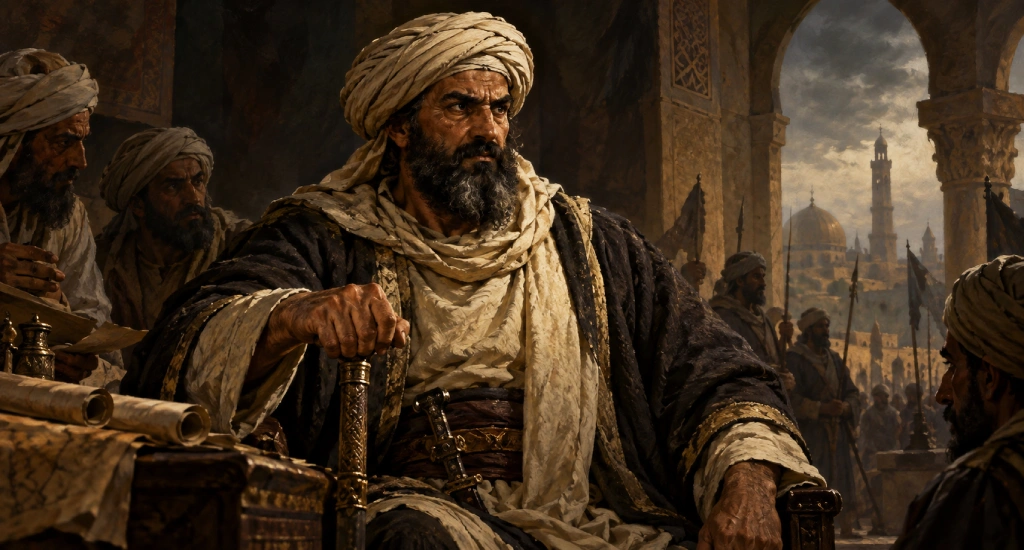
Summary
Hadiths, historical reports, and juristic rulings associated with Umar ibn al-Khattab reveal a recurring pattern of patriarchal authority over women’s bodies, movement, sexuality, and clothing. The surveillance and humiliation of Sawda when she went out to relieve herself, his open displeasure at his wife Atika attending the mosque, intercourse with his wife after treating her statement that she had already fallen asleep as an excuse despite the then-existing prohibition, his intervention in favor of permitting wife-beating after complaining that women were becoming “disobedient” to their husbands, his marriage to the prepubescent Umm Kulthum, and his beating of slave women for covering themselves like free women—although these incidents differ in social context, they share the same central feature: the will and decisions of women are subordinated to the claims and control of powerful men.
Authentic hadith reports state that when the Prophet’s wife Sawda went out at night to relieve herself, Umar publicly identified her and addressed her in such a way that she returned without completing her need and complained. Umar disliked Atika’s attendance at the mosque—this is established in early reports; however, the story that someone lay in wait for her in the dark and struck or touched her buttocks is attributed to Umar in Al-Bidaya wa al-Nihaya, while versions in Al-Tamhid and Al-Isaba attribute a similar act to al-Zubayr. In the report concerning Umar’s own wife, he treated her statement “I had fallen asleep” as an excuse and had intercourse with her; and in another hadith, after he complained that women were “overstepping” against their husbands, permission was given to beat wives, after which many women came to Muhammad’s household complaining of abuse. In the account of Umm Kulthum, Ali objects to her age because she had not yet reached puberty, Umar repeatedly presses his request, and the sources later report consummation of the marriage.
In the case of slave women, this control became even more explicit and violent. Al-Bayhaqi’s commonly printed text contains the phrase «تضرب ثديهن», which IslamQA interprets as meaning that the women’s hair was striking their chests. However, al-Albani quotes the same report from Anas in Irwa al-Ghalil 6/204 with the reading «تضطرب ثديهن»—“their breasts were moving”—and grades its chain «إسناده جيد», “its chain is good”; al-Sarakhsi likewise preserves the report with the wording «مضطربات الثدي», “with their breasts moving.” When a slave woman covered her head and body like a free woman, Umar would beat her with his whip, remove the covering, and order her not to imitate free women. Later Islamic jurisprudence likewise assigned slave women different rules from free women regarding awrah, clothing, labor, and exposure before unrelated men. The fact that the same social order compelled free women to cover while preventing slave women from covering shows that veiling was not merely a universal rule of modesty or protection; it also functioned as a system for visibly separating women according to social class and ownership status.
Treating these incidents as isolated examples of “harshness” obscures the underlying pattern of conduct. Sawda’s movement, Atika’s religious practice, a wife’s statement rejecting sex, the physical safety of other wives, the marital future of a child, and a slave woman’s decision to cover her own body are all subordinated to male gaze, jealousy, sexual desire, marital authority, dynastic interest, or class domination. This recurring conduct reflects abuse of power, disregard for women’s bodily autonomy, and a persistent disposition to impose authority over weaker people.
Introduction: Veiling, Control of Women, and the Politics of Slavery
Islamic veiling is commonly presented as a rule intended to preserve women’s dignity, safety, and modesty. Yet the historical application of the same legal framework shows that while free women were required to cover, slave women were denied the same right to covering. When a slave woman tried to cover her head and body like a free woman, she could be reprimanded, humiliated, and beaten. Veiling therefore did not operate here as a universal moral rule; it functioned as a class-based mechanism for publicly distinguishing free women from slave women. Clothing that symbolized dignity and modesty on one woman’s body became an offense on another woman’s body.
At the center of this dual system stood Islam’s second caliph, Umar ibn al-Khattab. Religious narratives portray him as a symbol of justice, moral rigor, and exemplary governance; but reports associated with him reveal a very different character. Monitoring the Prophet’s wife Sawda while she went out for a private bodily need, openly objecting to his wife Atika’s attendance at the mosque, treating another wife’s statement that she had fallen asleep as an excuse and having intercourse despite her refusal, intervening in favor of permission to beat wives after complaining that women were becoming “disobedient” to their husbands, repeatedly demanding marriage to the underage Umm Kulthum, and physically attacking slave women who covered themselves—across these incidents the same tendency reappears: male authority over women’s bodies, movement, sexuality, and social status is valued above the women’s own will.
Even in his dealings with free women, Umar’s behavior does not reflect respect for women’s independent decisions. Sawda went out to satisfy an unavoidable bodily need; nevertheless, she was identified and subjected to enough pressure that she returned and complained. Umar disliked Atika’s attendance at the mosque and directly expressed that displeasure to her. He did not believe another wife when she said, “I had fallen asleep,” and proceeded to have intercourse with her. After his complaint that women were “overstepping” against their husbands, permission to beat wives was given, after which many women came to Muhammad’s household complaining of abuse. In the case of Umm Kulthum, the prepubescent age of the girl and her father’s initial objection were overridden by the marital and dynastic desire of a powerful ruler. In these accounts, women repeatedly appear not as independent decision-makers but as bodies subordinated to male gaze, jealousy, sexual claims, family authority, and political power.
For slave women, that control became still more brutal and explicit. Free women were covered in the name of shielding them from male gaze, while slave women were kept exposed to male gaze. Juristic rules classified a slave woman’s hair, neck, arms, chest, and breasts among the parts that could remain visible because of the owner’s work requirements and guest service. Some reports even preserve a scene of Umar’s slave women serving male guests while their bare breasts moved. If a slave woman tried to cover her own body, the caliph’s whip descended on her. This conduct shows that the slave woman’s body was not treated as her own; religious law, owner, and state power jointly determined how visible that body had to remain. Veiling therefore did not simply mean women’s protection—it signaled which women were deemed worthy of respect and which women could be kept publicly exposed as usable property.
Religious status does not place anyone beyond moral accountability. The titles “Companion,” “Caliph,” or “Commander of the Faithful” do not justify humiliating women, using political power to pressure for marriage to a child, or stripping a slave woman of the right to cover her own body. Once the sacred image attached to Umar is removed and his actions are judged by ordinary moral standards, an abusive character becomes visible—one in which power means the right to control weaker people’s bodies, women exist under male direction, and slave women are property stripped of dignity and self-respect. This mentality was not merely personally vile; joined to state power and religious law, it became part of an institutional system of oppression.
The Doctrine That Forbids Criticism of the Companions and the Question of Historical Accountability
The first obstacle to examining the historical conduct of the Companions is a religious doctrine that declares the entire group trustworthy, just, and honorable before individual evidence is assessed. IslamQA, quoting Imam al-Nawawi, states that even those who took part in conflicts and civil wars are included in this collective declaration of integrity. In other words, before asking what any individual did, whom he killed, or whether he abused power, the conclusion is already fixed: all the Companions are just. [1]
قال النووي رحمه الله: «الصحابة كلهم عدول، من لابس الفتنة وغيرهم، بإجماع من يعتد به».
English translation: Al-Nawawi said: “All the Companions are just, including those who became involved in the civil strife and others, by the consensus of those whose opinions are considered authoritative.”
In hadith terminology, the “integrity” (‘adalah) of the Companions primarily means a presumption of reliability in accepting their reports; formally, it does not mean sinlessness or infallibility. In practice, however, this distinction often becomes nearly meaningless. When a serious allegation is preserved against a Companion, the same doctrine creates routes for rejecting it, minimizing it as an error, presuming an unrecorded repentance, or shutting down discussion altogether. Instead of examining the person’s conduct and then reaching a conclusion, the conclusion is controlled by his status as a Companion. This is not historical inquiry; it is a predetermined religious verdict imposed on the evidence.
Islamweb goes further and explicitly labels criticism of the Companions a sign of zandaqa, or heresy. In a statement attributed there to Abu Zur‘a, there is no requirement to examine whether a particular allegation is true or false, what evidence supports it, or whether the criticism is ethical or historical. Merely saying something that diminishes the status of a Companion is sufficient to brand the speaker a heretic. [2]
إذا رأيت الرجل ينتقص أحداً من أصحاب رسول الله صلى الله عليه وسلم فاعلم أنه زنديق.
English translation: “When you see a man disparaging any of the Companions of the Messenger of Allah, know that he is a heretic.”
This is not merely religious reverence; it is a mechanism of intimidation directed at the questioner. Instead of answering an allegation with evidence, the accuser is branded a heretic. A believer is therefore presented with two choices: deny the preserved report against a Companion, or accept the threat that his own religious identity may be compromised. Truth and falsehood are then determined not by evidence but by the religious rank of the accused.
Another IslamQA answer describes speaking critically of any of the Companions as destruction and deviation from the straight path. The same answer collectively declares their truthfulness, trustworthiness, character, and deeds to be of the highest order. This sweeping praise is not a conclusion reached by examining the specific life and conduct of each individual; it is a general declaration imposed as part of religious belief. [3]
وأن الوقوع فيهم أو في أحد منهم مهلكة وزيغ عن صراط الله المستقيم.
English translation: “Speaking against them, or against any one of them, is destruction and deviation from Allah’s straight path.”
The social function of this doctrine is clear. The moment a Companion’s conduct is questioned, the issue ceases to be treated as a historical or ethical question and is converted into a test of faith. The experience of an abused person, a humiliated woman, a beaten slave woman, or a child powerless before authority becomes secondary. The accused person’s identity as a Companion becomes a weapon for weakening all testimony against him and labeling all moral criticism as hostility to religion. The same religious pressure not to expose the faults of the Companions is openly promoted in statements by Dr. Abu Bakr Muhammad Zakaria.
The most obvious contradiction in this defensive system is that IslamQA itself also acknowledges that the Companions were not infallible and could make mistakes. If that admission is genuine, then their conduct must also be open to criticism, rejection, and moral judgment. To admit that they could err while describing criticism of those errors as destruction and religious deviation is logically self-contradictory. [4]
إلا أنهم غير معصومين، فربما وقع من بعضهم الخطأ.
English translation: “However, they were not infallible, so some of them may have fallen into error.”
If “they were not infallible” is not merely a face-saving formula, then the conduct of the Companions must be judged by evidence like that of every other historical person. If any negative conclusion automatically turns the critic into a heretic, deviant, or enemy of religion, then the admission that they were fallible becomes meaningless theater. The theoretical possibility of error is conceded, but the moral consequences of any specific error are never allowed to be acknowledged.
In Umar’s case as well, his identity as a Companion, caliph, or “Commander of the Faithful” is not a certificate of moral immunity. Titles do not sanctify actions; actions reveal character. Repeated humiliation, surveillance, sexual degradation, coercion, and physical abuse directed at women and slave women with less power are direct evidence of a ruler’s vile character. Responding to evidence of such conduct by invoking Umar’s rank is not an argument—it is an attempt to conceal the wrongdoing of a powerful man beneath religious prestige.
Veiling: A Rule of Modesty, or a Marker of Class?
Islamic veiling is commonly presented as a universal rule intended to preserve the modesty, safety, and dignity of women’s bodies. Yet the relevant Quranic verse, classical tafsir, and the application of Islamic jurisprudence reveal a very different social reality. Veiling was not a rule designed to protect all women equally; it also functioned as a class marker that visibly distinguished free women from slave women.
Quran 33:59 instructs Muhammad to tell his wives, daughters, and believing women to draw their cloaks over their bodies so that they may be recognized as virtuous and not harassed. [5]
يَٰٓأَيُّهَا ٱلنَّبِيُّ قُل لِّأَزۡوَٰجِكَ وَبَنَاتِكَ وَنِسَآءِ ٱلۡمُؤۡمِنِينَ يُدۡنِينَ عَلَيۡهِنَّ مِن جَلَٰبِيبِهِنَّۚ ذَٰلِكَ أَدۡنَىٰٓ أَن يُعۡرَفۡنَ فَلَا يُؤۡذَيۡنَۗ وَكَانَ ٱللَّهُ غَفُورٗا رَّحِيمٗا ٥٩
English translation (Dr. Mustafa Khattab, The Clear Quran): “O Prophet! Ask your wives, daughters, and believing women to draw their cloaks over their bodies. In this way it is more likely that they will be recognized ˹as virtuous˺ and not be harassed. And Allah is All-Forgiving, Most Merciful.”
The verse does not explicitly mention slave women. The distinction in dress between free women and slave women appears in classical exegesis. Ibn Kathir writes that one purpose of the command to wear the jilbab was to distinguish believing free women in their dress from slave women. [6]
ليتميزن عن سمات نساء الجاهلية وسمات الإماء.
English translation: “So that they would be distinguished from the appearance of the women of the Jahiliyyah and from the appearance of slave women.”
Ibn Kathir further explains that when wrongdoers recognized a woman wearing the jilbab as a free woman, they would keep away from her; a woman without the jilbab could be assumed to be a slave woman and targeted. In this explanation, clothing is not an abstract sign of modesty—it functions as a visible identity card indicating a woman’s social and legal status. A free woman covers herself and thereby claims the protection associated with that status; a woman owned by another person is marked by dress as belonging to an inferior class.
This is not merely an isolated medieval interpretation. Modern IslamQA also explicitly acknowledges that “complete hijab” applies to free women and that slave women or women held by right-hand possession are not to imitate free women in that form of covering. The same answer states that Umar prevented slave women from covering their faces. [7]
لكن الحجاب الكامل للحرائر من النساء، وأما الإماء وملك اليمين فلا يتشبهن بالحرائر في الحجاب الكامل.
English translation: “Complete hijab is for free women; as for slave women and those held by right-hand possession, they are not to imitate free women in complete hijab.”
The very concept of “imitation” exposes the nature of the discrimination. A slave woman covering her own head, face, or body was not treated as an exercise of personal choice or bodily rights. It was treated as an improper attempt to adopt the dress of a higher social class. The right to clothing therefore did not depend on a woman’s humanity; it depended on whether she was a free person or another person’s property.
Islamweb likewise acknowledges that free women were instructed to dress differently from slave women so that wrongdoers would recognize them as free women and fear approaching them. [8]
فلا إشكال في أمر الحرائر بمخالفة زي الإماء ليهابهن الفساق.
English translation: “There is no problem in instructing free women to dress differently from slave women so that immoral men will fear them.”
Islamweb simultaneously claims that this explanation does not mean that abusing slave women was permissible. [9]
ولا يفهم من قوله تعالى ذلك أدنى أن يعرفن فلا يؤذين أنه يجوز التعرض للإماء بالأذى.
English translation: “It should not be understood from His statement, ‘that is more suitable so that they may be recognized and not harmed,’ that it is permissible to harm slave women.”
This claim does not answer the problem of clothing-based discrimination. Declaring in theory that slave women may not be harmed does not make it just to strip them of the right to wear the clothing used in that society to identify a woman as free and socially protected. The admission instead makes the contradiction more obvious. On the one hand, abuse of slave women is declared impermissible; on the other hand, they are denied the very clothing that marked a woman as belonging to the protected free class.
Rather than confronting why wrongdoers attacked women, free women were given distinctive clothing to separate them from slave women. The violence was not eliminated; the potential targets were made identifiable by class. Free women were effectively told: cover yourselves and display the identity of the respectable class. Slave women were told: you may not carry that identity. This was not universal safety; it was class-based safety.
This division did not suddenly appear in Umar’s reign. Reports concerning Muhammad also show veiling functioning as a sign distinguishing the status of a free wife from that of a slave woman. Reports of slave women appearing uncovered in Muawiya’s court reflect the continuation of the same social structure. [10]
“If the Prophet establishes veiling for Safiyya, then she will be considered one of the Prophet’s wives.”
“The slave woman was brought before him completely unclothed or naked.”
Distinguishing free women from slave women was a clear and documented social function of veiling. Presenting veiling merely as a universal system of “modesty and protection for all women” is therefore false and misleading. A system in which the dignity assigned to the same female body changes according to ownership status does not treat women as equal human beings; it divides them into free persons and sexual-labor property.
Umar was not a passive observer of this discriminatory system. During his rule, slave women were prevented from covering like free women, humiliated and beaten for doing so, and in his own household slave women served guests while uncovered. His role was therefore not limited to following an existing social custom; he used his authority to enforce the visible marks of slavery on women’s bodies. This was not the establishment of modesty—it was the cruel politics of publicly marking a slave woman as inferior, usable, and deprived of equal rights.
Surveillance of Sawda: Bodily Necessity, Public Humiliation, and Pressure for Veiling
According to reports preserved in Sahih al-Bukhari and Sahih Muslim, when Muhammad’s wife Sawda went out at night to relieve herself, Umar recognized her by her body shape and publicly called out to her that she had not been able to conceal herself from men’s sight. This was not an ordinary conversation. Sawda had gone out to satisfy a private and unavoidable bodily need at a time when there were no household toilets. At that vulnerable moment, a powerful man watched and identified her body, called her by name, and told her to consider how she went outside. Humiliated and alarmed, Sawda returned without completing her need and complained to Muhammad. In one transmission, Umar had already been repeatedly urging Muhammad to impose veiling on his wives, and the verse of hijab was revealed after this public intervention. In another transmission, the incident occurred after the rule of veiling had already been revealed, and Muhammad’s response to Sawda’s complaint was to reaffirm women’s permission to go out for necessary bodily needs. Despite this chronological contradiction, the common and disturbing core of all versions is the same: Umar was monitoring Sawda’s movement when she went out for a private bodily need and treated her in a way that compelled her to return and complain.
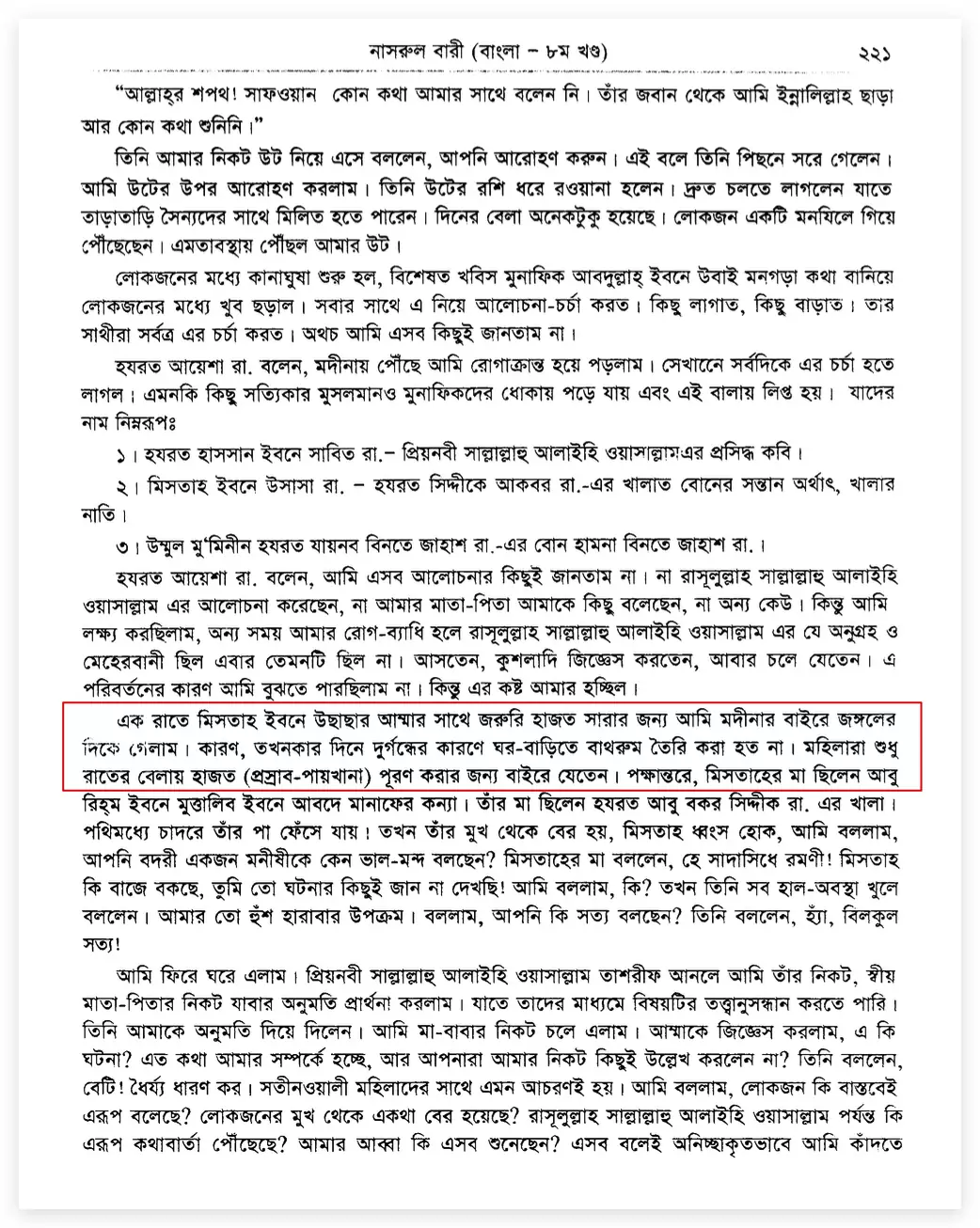
In Medina at that time, women had to go outside the inhabited area at night to relieve themselves. The detailed account of the incident of the slander against Aisha also mentions this social practice of women going out at night for bodily needs. Sawda had therefore not gone out for entertainment, socializing, or aimless movement; she went because there was no toilet inside the home and she had to satisfy an unavoidable bodily function. This context does not lessen Umar’s conduct; it makes its ugliness more apparent. He turned Sawda’s body and movement into a public issue at a moment when she had no practical alternative to going outside. [11]
“By Allah! Safwan did not say a word to me. I heard nothing from him except ‘Inna lillah.’”
He brought the camel near me and told me to mount. He then stepped back. I mounted the camel and he set off holding the reins, moving quickly so that we could rejoin the troops. A considerable part of the day had passed by the time my camel reached the place where the people had stopped.
Whispers began among the people. The vile hypocrite Abdullah ibn Ubayy in particular fabricated stories and spread them widely. He discussed the matter with everyone, adding and exaggerating details. His associates repeated it everywhere. I knew nothing of any of this.
Aisha said: After reaching Medina, I fell ill. The matter was being discussed everywhere. Even some sincere Muslims were deceived by the hypocrites and became involved in this trial. Their names were as follows:
1. Hassan ibn Thabit, the famous poet of the Prophet.
2. Mistah ibn Uthatha, a relative of Abu Bakr al-Siddiq.
3. Hamna bint Jahsh, sister of Zaynab bint Jahsh, Mother of the Believers.
Aisha said: I knew nothing of these discussions. Neither the Messenger of Allah nor my parents nor anyone else told me anything. But I noticed that when I had previously been ill, the Messenger of Allah had shown me a degree of kindness and affection that was absent this time. He would come, ask about my condition, and leave. I did not understand the reason for this change, but it caused me distress.
One night I went outside Medina toward the open fields with the mother of Mistah ibn Uthatha to relieve myself. At that time bathrooms were not built inside houses because of the smell. Women went outside only at night to urinate and defecate. On the way, her foot became caught in her garment and she exclaimed, “May Mistah perish!” I said, “Why do you speak badly of a man who took part in Badr?” Mistah’s mother replied, “You poor innocent woman! Do you not know what Mistah has been saying? You seem to know nothing of what has happened!” I asked, “What?” She then told me everything. I nearly lost consciousness. I asked, “Are you telling the truth?” She replied, “Yes, absolutely.”
I returned home. When the Prophet came, I asked his permission to go to my parents so that I could investigate the matter through them. He gave me permission. I went to my parents and asked my mother, “What is this? So much is being said about me, yet none of you mentioned anything to me?” She said, “My daughter, be patient. Women who have co-wives are often treated this way.” I said, “Have people really said such things? Have these words actually been spoken? Have such statements reached the Messenger of Allah? Has my father heard them?” Saying this, I began to cry involuntarily.
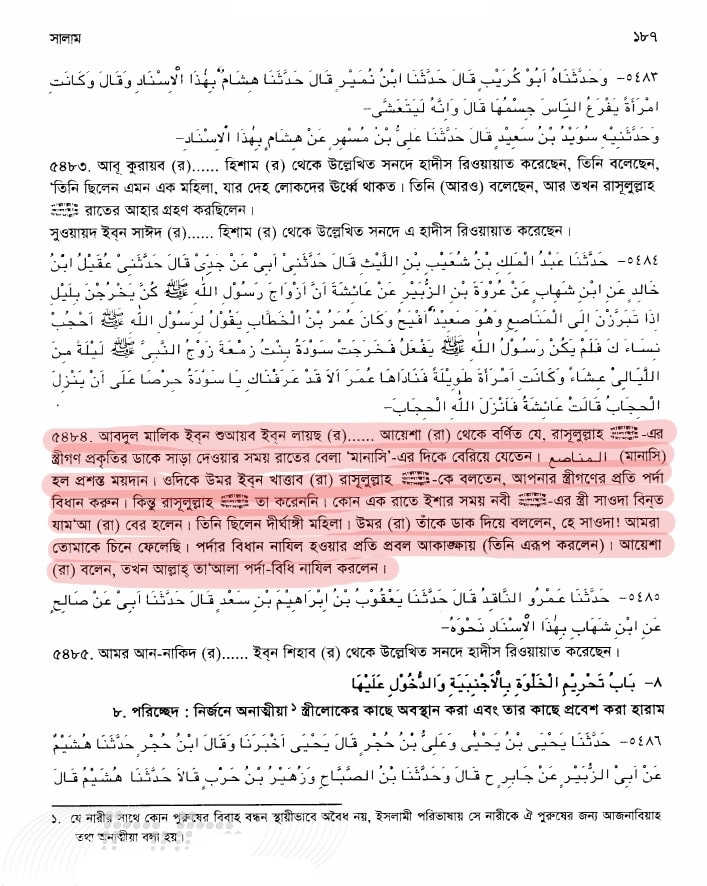
The incident involving Sawda appears in Sahih al-Bukhari and Sahih Muslim under several chapters and numbering systems. These are not five independent eyewitness accounts by five separate people; the principal narrator is Aisha, and different compilations and chapters repeat versions of the same event. By the internal standards of Islamic hadith scholarship, every cited text is classified as authentic and is preserved in the most prestigious collections, including Bukhari and Muslim. Nor can the incident be dismissed by pointing to ambiguity in a single translation or chapter title, because all versions share the same core: Umar recognized Sawda at night, confronted her, told her that he could identify her, Sawda returned and complained, and Muhammad stated that women were permitted to go out for necessary needs. [12] [13] [14] [15] [16]
Sahih Muslim
Book 39: The Book of Greetings
Chapter 7: The Permissibility Of Women Going Out To Relieve Themselves
Sahih Muslim 2170d (in-book reference: Book 39, Hadith 25). ‘A’isha reported that the wives of Allah’s Messenger (ﷺ) used to go out in the cover of night when they went to open fields (in the outskirts of Medina) for easing themselves. ‘Umar b Khattab used to say: Allah’s Messenger, ask your ladies to observe veil, but Allah’s Messenger (ﷺ) did not do that. So there went out Sauda, daughter of Zarn’a, the wife of Allah’s Messenger (ﷺ), during one of the nights when it was dark. She was a tall statured lady. ‘Umar called her saying: Sauda, we recognise you. (He did this with the hope that the verses pertaining to veil would be revealed.) ‘A’isha said: Allah, the Exalted and Glorious, then revealed the verses pertaining to veil.
Sahih al-Bukhari
Book 65: Prophetic Commentary on the Qur’an
Chapter: The Statement of Allah the Exalted concerning Quran 33:53
Sahih al-Bukhari 4795 (in-book reference: Book 65, Hadith 317). Narrated Aisha: Sauda (the wife of the Prophet) went out to answer the call of nature after it was made obligatory (for all the Muslims ladies) to observe the veil. She had a large frame and everybody who knew her before could recognize her. So `Umar bin Al-Khattab saw her and said, “O Sauda! By Allah, you cannot hide yourself from us, so think of a way by which you should not be recognized on going out. Sauda returned while Allah’s Messenger (ﷺ) was in my house taking his supper and a bone covered with meat was in his hand. She entered and said, “O Allah’s Messenger (ﷺ)! I went out to answer the call of nature and `Umar said to me so-and-so.” Then Allah inspired him (the Prophet) and when the state of inspiration was over and the bone was still in his hand as he had not put in down, he said (to Sauda), “You (women) have been allowed to go out for your needs.”
Sahih al-Bukhari
Book 79: Asking Permission
Chapter 10: The Divine Verse of Al-Hijab
Sahih al-Bukhari 6240 (in-book reference: Book 79, Hadith 14). Narrated `Aisha: (the wife of the Prophet) `Umar bin Al-Khattab used to say to Allah’s Messenger (ﷺ) “Let your wives be veiled” But he did not do so. The wives of the Prophet (ﷺ) used to go out to answer the call of nature at night only at Al-Manasi.’ Once Sauda, the daughter of Zam`a went out and she was a tall woman. `Umar bin Al-Khattab saw her while he was in a gathering, and said, “I have recognized you, O Sauda!” He (`Umar) said so as he was anxious for some Divine orders regarding the veil (the veiling of women.) So Allah revealed the Verse of veiling. (Al-Hijab; a complete body cover excluding the eyes).
Sahih Muslim
Book 39: The Book of Greetings
Chapter 7: The Permissibility Of Women Going Out To Relieve Themselves
Sahih Muslim 2170a (in-book reference: Book 39, Hadith 23). A’isha reported that Sauda (Allah he pleated with her) went out (in the fields) in order to answer the call of nature even after the time when veil had been prescribed for women. She had been a bulky lady, significant in height amongst the women, and she could not conceal herself from him who had known her. ‘Umar b. Khattab saw her and said: Sauda, by Allah, you cannot conceal from us. Therefore, be careful when you go out. She (‘A’isha) said: She turned back. Allah’s Messenger (ﷺ) was at that time in my house having his evening meal and there was a bone in his hand. She (Sauda) cline and said: Allah’s Messenger. I went out and ‘Umar said to me so and so. She (‘A’isha) reported: There came the revelation to him and then it was over; the bone was then in his hand and he had not thrown it and he said: “Permission has been granted to you that you may go out for your needs.”
Sahih al-Bukhari
Book 67: Wedlock, Marriage (Nikaah)
Chapter 116: The going out of women for their needs
Sahih al-Bukhari 5237 (in-book reference: Book 67, Hadith 170). Narrated `Aisha: Once Sa`da bint Zam`a went out at night for some need, and `Umar saw her, and recognizing her, he said (to her), “By Allah, O Sa`da! You cannot hide yourself from us.” So she returned to the Prophet (ﷺ) and mentioned that to him while he was sitting in my dwelling taking his supper and holding a bone covered with meat in his hand. Then the Divine Inspiration was revealed to him and when that state was over, he (the Prophet (ﷺ) was saying: “O women! You have been allowed by Allah to go out for your needs.”
The same report also appears in a printed edition. It preserves Sawda’s physical description, Umar identifying her by sight, Sawda returning and complaining, and the permission for women to go out for necessary needs. The incident is therefore not a reconstruction invented by a modern critic; it is an acknowledged report in the most prestigious works of the Islamic hadith tradition. [17]
Narrated from Aisha. She said: After the rule of veiling had been imposed upon us, Sawda went out for a bodily need. She was a large-bodied and tall woman and could not conceal herself from those who knew her. Umar ibn al-Khattab saw her and said, “O Sawda! By Allah, you cannot hide yourself from us. Consider how you go out.” Aisha said: On hearing this, she turned back. Sawda entered and said, “O Messenger of Allah! I went out and Umar said such-and-such to me.” He then said, “You have been permitted to go out for your needs.”
In the versions of Sahih Muslim 2170d and Sahih al-Bukhari 6240, Umar repeatedly urged Muhammad to make his wives observe veiling, Muhammad had not yet done so, and the verse of hijab was revealed after Umar recognized Sawda and commented on her. By contrast, Sahih al-Bukhari 4795 and Sahih Muslim 2170a place the incident after the rule of veiling had already been imposed; in those versions Muhammad responds to Sawda’s complaint by permitting women to go out for necessary needs. The two transmission clusters contradict one another on chronology. Yet both agree that Sawda went out at night to relieve herself, Umar identified her by seeing her body, made remarks that caused her to turn back, and Sawda complained to Muhammad about his conduct. The chronological contradiction does not erase the report of Umar’s humiliating intervention.
Umar did not say that the road was dangerous and she should take someone for protection. He did not warn an attacker, arrange a safe toilet for women, or ensure that Sawda could satisfy her private need without interference. His comments centered on male sight: “We have recognized you,” “You cannot hide yourself from us,” “Consider how you go out.” A woman’s unavoidable bodily need was displaced by men’s ability to see and identify her. Responsibility for the problem was placed not on the behavior of the observer but on the woman’s body and movement. Sawda had committed no offense, yet she was the one who had to return humiliated. In modern terminology, this conduct amounts to street harassment, invasion of privacy, and intimidation aimed at controlling clothing and movement. Those modern terms do not appear in the hadith, but the ethical characterization follows directly from the nature of the conduct described.
This incident reveals an ugly aspect of Umar’s character. He used his social power to harass a woman who had gone out at night to satisfy a bodily necessity and had no realistic alternative to going outside. Public comments about Sawda’s body shape, mocking her inability to hide from male eyes, and intimidating questions about how she went outside together constitute more than an opinion about veiling; they are evidence of a powerful man trampling a woman’s personal dignity. Umar’s status as a Companion or later caliph does not ennoble this conduct. The fact that he dared to treat one of Islam’s most highly honored women in this way instead exposes authoritarianism, an obsession with controlling women’s bodies, and a brutal indifference to another person’s humiliation. Such conduct is not a sign of elevated character; it is direct evidence of deeply degraded character.
Atika’s Attendance at the Mosque: Umar’s Displeasure and the Disputed Report of Touching Her Body in the Dark
Atika bint Zayd regularly attended congregational prayer at the mosque. Umar disliked her going out for this purpose and openly told her of his displeasure. Atika replied that she would not stop attending the mosque unless Umar explicitly prohibited her. Because he knew the instruction not to prevent women from going to the mosque, Umar did not directly forbid her; Atika was present there even on the day Umar was attacked. This report does not show spontaneous respect for Atika’s right to attend the mosque. It shows that a religious prohibition prevented Umar from stopping his wife’s movement, while he continued to express open resentment toward it. [18]
وكان عمر يقول لها: «والله إنك لتعلمين ما أحب هذا». فقالت: «والله لا أنتهي حتى تنهاني». قال: «إني لا أنهاك».
English translation: Umar used to say to her, “By Allah, you know that I do not like this.” She replied, “By Allah, I will not stop until you forbid me.” He said, “I am not forbidding you.”
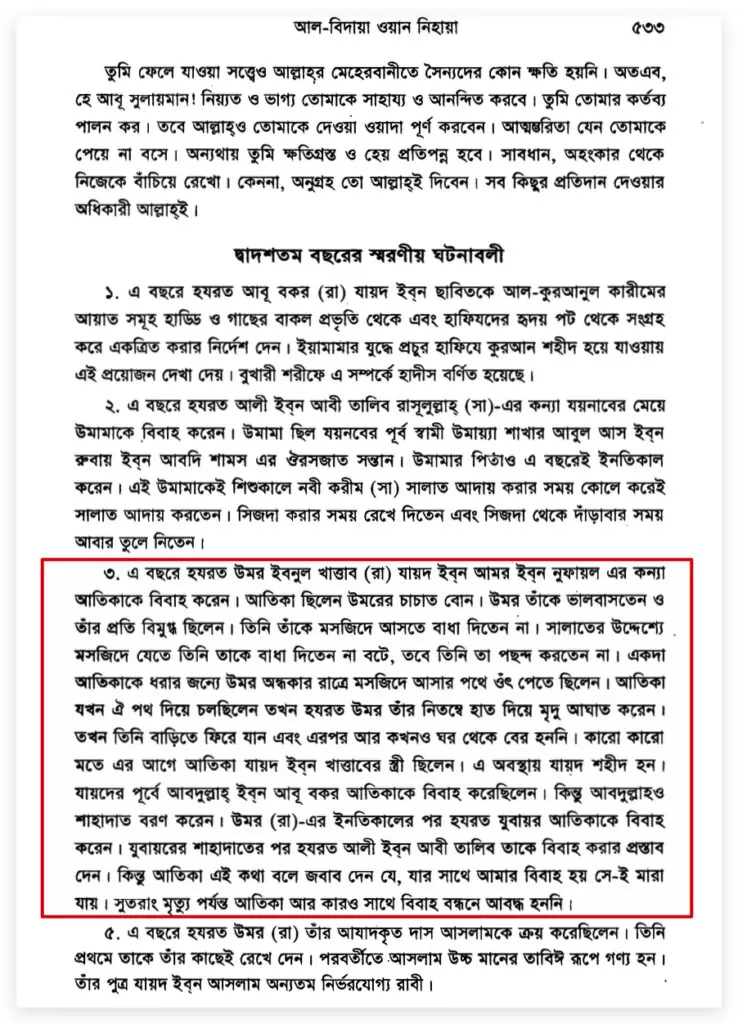
Ibn Kathir’s Al-Bidaya wa al-Nihaya preserves a more serious report. In that version, Umar waits for Atika on a dark road, strikes or places his hand on her buttocks as she passes, and Atika, frightened, returns home and permanently stops going to the mosque. The Arabic phrase “ضرب بيده على عجزها” states that Umar’s hand struck or made contact with her backside or buttocks. The Islamic Foundation translation renders the action as a “gentle strike,” although the Arabic contains no word equivalent to “gentle”; the added adjective softens the violence and sexually humiliating character of the act. [19] [20]
فجلس لها ذات ليلة في الطريق في ظلمة، فلما مرت ضرب بيده على عجزها، فرجعت إلى منزلها ولم تخرج بعد ذلك.
English translation: “One night he sat waiting for her on the road in the darkness. When Atika passed, he struck her buttocks with his hand. She returned to her home and did not go out after that.”
3. In this year Umar ibn al-Khattab married Atika, daughter of Zayd ibn Amr ibn Nufayl. Atika was Umar’s cousin. Umar loved her and was deeply attached to her. He did not prevent her from going to the mosque for prayer, although he disliked it. On one occasion Umar lay in wait for Atika on a dark night along the road to the mosque. When Atika passed that way, Umar struck her lightly on the buttocks with his hand. She then returned home and never left the house again. According to some accounts, Atika had previously been married to Zayd ibn al-Khattab, who was killed while married to her. Before Zayd, Abdullah ibn Abi Bakr had married Atika, but Abdullah also died. After Umar’s death, al-Zubayr married Atika. After al-Zubayr was killed, Ali ibn Abi Talib proposed marriage to her, but Atika replied that whoever married her died. She therefore did not marry again until her death.
It is important to note that the incident of lying in wait in the dark and touching or striking Atika’s buttocks is preserved in two contradictory versions. Al-Bidaya wa al-Nihaya names Umar as the actor. Al-Tamhid transmits a similar story with al-Zubayr as the actor and provides an isnad, and Al-Isaba repeats that account. Yet none of the cited sources gives either version a recognized grading of sahih or hasan. The existence of an isnad in the al-Zubayr version does not transform it into established historical fact; likewise, the absence of a cited chain in the Al-Bidaya version does not prove that the attribution to Umar is false. The available sources establish that major works of Islamic history preserved the accusation under Umar’s name, while another transmission strand preserved a similar story under al-Zubayr’s name. The attacker’s identity cannot be determined with confidence; but the conflict between the sources does not justify simply erasing the allegation preserved under Umar’s name or transferring it to al-Zubayr as though that were established fact. [21] [22]
ثم شرطت ذلك على الزبير، فتحيل عليها أن كمن لها، فلما مرت به ضرب على عجيزتها. ولم نر من حكم على هذه القصة من المحدثين.
English translation: “Then she imposed the same condition on al-Zubayr. He resorted to a trick and lay in wait for her; when she passed him, he struck her buttocks. We have not seen any hadith scholar issue a grading on this story.”
The story of lying in wait in the dark and placing a hand on Atika’s buttocks is thus preserved under Umar’s name in one version and under al-Zubayr’s in another; neither version has an established sahih or hasan grading, so the attacker’s identity cannot be determined. Yet the nature of the act is identical in both versions: concealing one’s identity, waiting in ambush for a woman, touching or striking her buttocks without her consent, frightening her, and using that fear to stop her from attending the mosque. The report does not state that the purpose was sexual gratification; the visible purpose is controlling a woman’s movement through physical humiliation and intimidation. Whether Umar committed this specific assault is unresolved, but his displeasure and jealousy over his wife attending the mosque and his interference with Sawda’s movement are clearly preserved in separate reports. Sawda was not going out for entertainment but to satisfy an unavoidable bodily need; Umar identified her by her body, publicly told her that she could not conceal herself from men’s gaze, and exerted enough pressure that she returned without completing her need and complained. With Atika, Umar’s dissatisfaction again concerned a woman leaving the house—this time his own wife, and the purpose was prayer at the mosque. In both Sawda’s bodily necessity and Atika’s religious practice, the woman’s need or decision was subordinated to Umar’s gaze, jealousy, and desire for control. These were therefore not merely isolated conservative opinions; they reflect a recurring pattern of subjecting women’s movement to male permission, surveillance, and intimidation. The allegation preserved under Umar’s name in Al-Bidaya is consistent with that broader pattern, although consistency alone does not prove the historical truth of the allegation. Even within the limits of the evidence, one aspect of Umar’s character is clear: a woman’s movement was not treated as her own need or right, but as conduct subject to male gaze, jealousy, and authority.
Disregarding a Wife’s Sexual Refusal and Permitting Wife-Beating: Umar’s View of Women
According to a report quoted in Tafsir Ibn Kathir, the rule at that stage of Ramadan was that after a person fell asleep at night, eating, drinking, and sexual intercourse became prohibited. One night Umar returned home and expressed a desire for sex with his wife. She told him that she had already fallen asleep. Her statement simultaneously invoked the existing religious prohibition and clearly refused intercourse. Umar did not believe her and treated the statement as an “excuse,” then had intercourse with her. In other words, in pursuit of his own sexual desire he disregarded three things at once: his wife’s statement, her refusal, and the religious rule then in force. [23]
Quran 2:187 (Dr. Mustafa Khattab, The Clear Quran): عَلِمَ ٱللَّهُ أَنَّكُمۡ كُنتُمۡ تَخۡتَانُونَ أَنفُسَكُمۡ فَتَابَ عَلَيۡكُمۡ وَعَفَا عَنكُمۡۖ — “Allah knows that you were deceiving yourselves. So He has accepted your repentance and pardoned you.”
Ibn Abbas, through Ali ibn Abi Talha, reports that during Ramadan, once the Muslims had completed the Isha prayer, eating, drinking, and intercourse with wives became forbidden until the following sunset. Nevertheless, some of them violated this rule during Ramadan. Umar was among them. A group then brought the matter before the Prophet, and the verse granting relaxation was revealed.
Awfa narrated from Musa ibn Uqba, from Kurayb, from Ibn Abbas: Before this verse of fasting was revealed, Muslims could eat, drink, and have intercourse at night. But after they fell asleep, they refrained from food, drink, and sex until the following evening. We were informed that Umar ibn al-Khattab woke from sleep and had intercourse with his wife. He later came to the Prophet and said, “I have come to complain to Allah and His Messenger about what I have done.” The Prophet asked, “What did you do?” He replied, “Although I intended to fast, I woke from sleep and had intercourse with my wife.” The Prophet said, “That was not appropriate for you.” Then the verse was revealed.
Abu Hurayra, through Ata ibn Rabah, Qays ibn Sa‘d, and Sa‘id ibn Abi Aruba, reported: Before this verse was revealed, once Muslims had completed the Isha prayer and gone to sleep during Ramadan, food, drink, and sexual intercourse were forbidden until the following evening. Umar ibn al-Khattab nevertheless had intercourse after Isha, while Suraqa ibn Qays al-Ansari fell asleep after Maghrib and later ate after Isha. The next morning they came to the Messenger and described what had happened. Then the verse was revealed: أُحِلَّ لَكُمۡ لَيۡلَةَ ٱلصِّيَامِ ٱلرَّفَثُ إِلَىٰ نِسَآئِكُمۡۚ …… ثُمَّ أَتِمُّواْ ٱلصِّيَامَ إِلَى ٱلَّيۡلِۚ — “It has been made permissible for you to be intimate with your wives during the nights preceding the fast” … “then complete the fast until nightfall.”
Abd al-Rahman ibn Abi Layla, through Husayn ibn Abd al-Rahman and Hisham, narrated: “One day Umar ibn al-Khattab stood and said, ‘O Messenger of Allah! Last night I expressed to my wife the desire that a man expresses to a woman. My wife told me that she had fallen asleep. I thought this was an excuse and had intercourse with her.’ Then the verse was revealed…” Shu‘ba and Amr ibn Shu‘ba transmitted a similar report from Ibn Abi Layla.
Ka‘b ibn Abd al-Malik, through Abdullah ibn Ka‘b, Musa ibn Jubayr, Abu Lahi‘a, Ibn al-Mubarak, Suwayd, al-Muthanna, and Abu Ja‘far ibn Jarir, narrated: “The condition of people in Ramadan was that if a person who was fasting fell asleep at night, food, drink, and intercourse were forbidden until the next iftar. One night Umar ibn al-Khattab returned home late from the Messenger of Allah. His wife had already fallen asleep. He expressed his desire to satisfy himself with her, and she said, ‘I had already fallen asleep.’ He did not believe her and had intercourse with her. Ka‘b ibn Malik said that the next morning Umar came to the Messenger and described what had happened. Then Allah revealed: ‘Allah knows that you were deceiving yourselves. So He has accepted your repentance and pardoned you. So now you may be intimate with them.’”
Likewise, Mujahid, Ata, Ikrima, Qatada, and others transmitted the incidents of Umar and Suraqa ibn Qays al-Ansari as the occasion for revelation of the verse. Thereafter, as an act of mercy and favor, intercourse, eating, and drinking were made permissible throughout the nights of Ramadan.
Regarding وَٱبۡتَغُواْ مَا كَتَبَ ٱللَّهُ لَكُمۡۚ (“and seek what Allah has prescribed for you”), Abu Hurayra, Ibn Abbas, Anas, Qadi Shurayh, Mujahid, Ikrima, Sa‘id ibn Jubayr, Ata, Rabi ibn Anas, al-Suddi, Zayd ibn Aslam, al-Hakam ibn Utayba, Muqatil ibn Hayyan, Hasan al-Basri, al-Dahhak, and Qatada interpreted it as referring to children. Abd al-Rahman ibn Zayd ibn Aslam interpreted it as intercourse. Other reports interpreted it as Laylat al-Qadr or as seeking the permission Allah had made lawful.
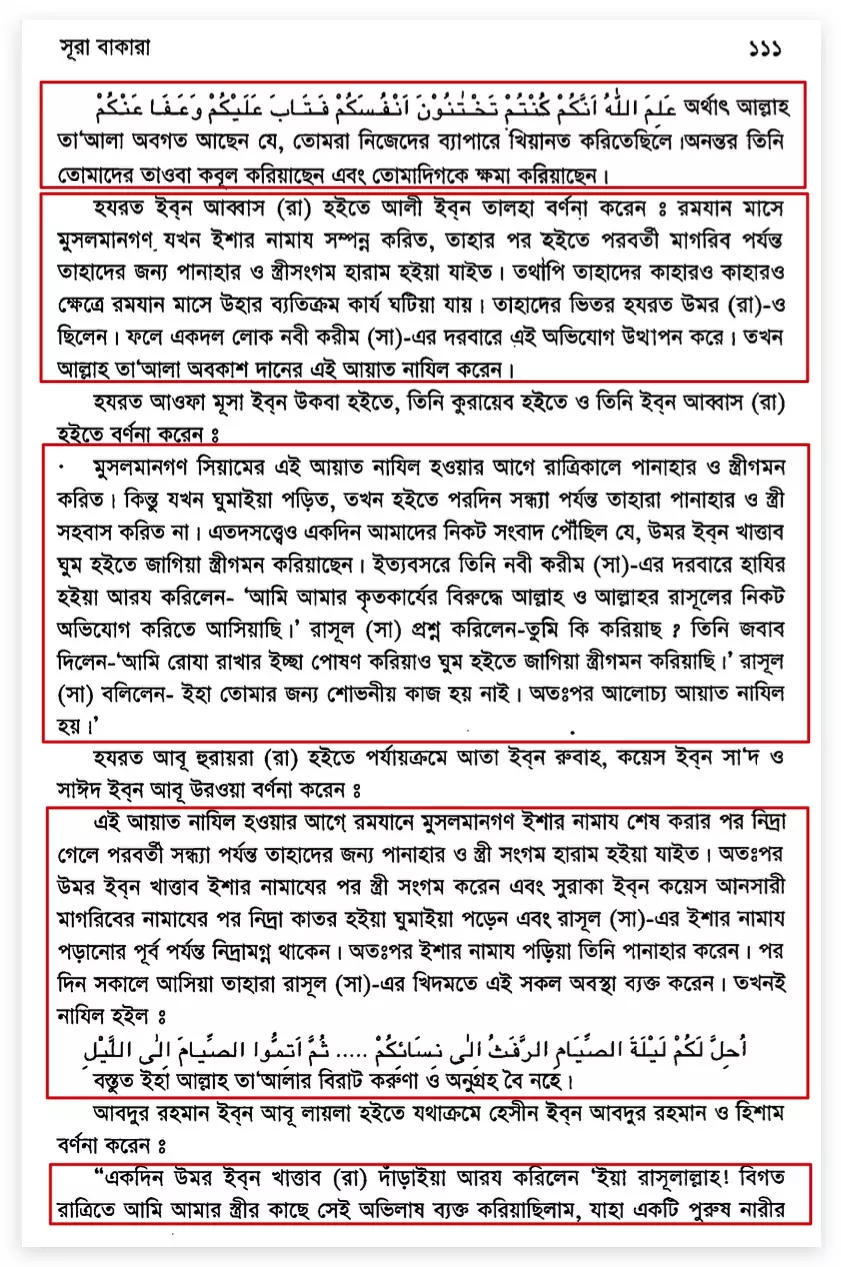
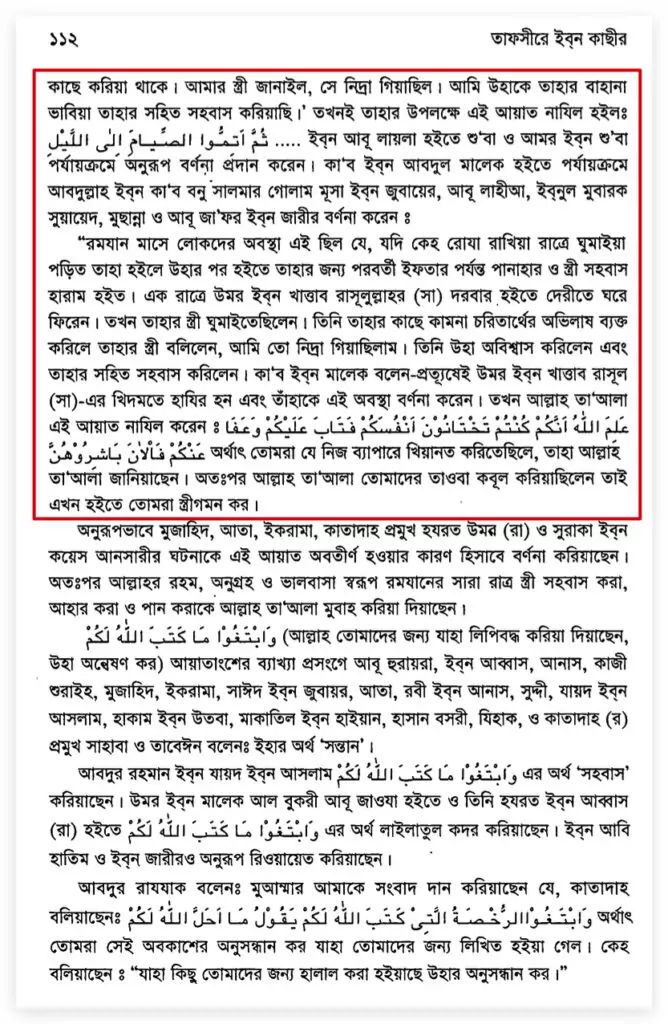
Umar dismissed his wife’s statement—“I had already fallen asleep”—as an “excuse.” Beneath the neutral word “intercourse,” the structure of the event is therefore clear: the wife stated a reason for not having sex, the husband refused to believe her, and he imposed his sexual will. Under modern consent-based ethics, this is non-consensual marital sex and sexual coercion. More significantly, the quoted religious discussion does not even identify the violation of the wife’s consent as the problem; the problem is Umar’s violation of the fasting rule. The wife’s will, fear, helplessness, and right to decide what happens to her own body have no place in the moral analysis of the report. In the end, after men violated the restriction, the restriction itself was relaxed. Male sexual desire became an occasion for legal change, while the consent of the woman whose refusal had been disregarded never became a religious concern.
Umar’s Role in Securing Permission to Beat Wives
The incident in which Umar dismissed his wife’s statement as an “excuse” and enforced his sexual claim over her body was not the only evidence of his view of women. Another hadith reports that Muhammad initially prohibited men from beating their wives. Umar then came and complained that, because of this prohibition, women were becoming disobedient to their husbands or “overstepping” against them. After his complaint, permission was given to beat wives, and large numbers of women were beaten. Later, after seventy women came to Muhammad’s household complaining about their husbands, the men who beat them were condemned as not being good men. The entire moral failure is preserved within the report itself: a prohibition intended to protect women’s bodily safety was issued; Umar complained that male authority had been weakened; the prohibition was lifted and wife-beating was permitted; widespread complaints of abuse followed; the abusers were then criticized, yet the report contains no declaration that the permission itself was revoked. [24]
Sunan Ibn Majah
Book 9: The Chapters on Marriage
Chapter 51: Hitting women
Sunan Ibn Majah 1985 (in-book reference: Book 9, Hadith 141). It was narrated that Iyas bin ‘Abdullah bin Abu Dhubab said: “The Prophet said: ‘Do not beat the female slaves of Allah.’ Then ‘Umar came to the Prophet and said: ‘O Messenger of Allah, the women have become bold towards their husbands? So order the beating of them,’ and they were beaten. Then many women went around to the family of Muhammad. The next day he said: ‘Last night seventy women came to the family of Muhammad, each woman complaining about her husband. You will not find that those are the best of you.’”
Grade: Sahih (Darussalam)
Mishkat al-Masabih
Book 13: Marriage
Chapter 10b: The Treatment of Wives, and the Rights of Each — Section 2
Mishkat al-Masabih 3261 (in-book reference: Book 13, Hadith 178). Iyas b. ‘Abdallah reported God’s Messenger as saying, “Do not beat God’s handmaidens;” but when ‘Umar came to God’s Messenger and said, “The women have become emboldened towards their husbands,” he gave licence to beat them. Then many women went round God’s Messenger’s family complaining of their husbands, and he said, “Many women have gone round Muhammad’s family complaining of their husbands. Those are not the ‘best among you.’” Abu Dawud, Ibn Majah and Darimi transmitted it.
Al-Albani status on Sunnah.com: not studied.
Umar’s complaint contains no allegation of violence, physical abuse, or serious wrongdoing committed by women. The center of the complaint was women’s “disobedience” toward husbands and their “overstepping” against men. In other words, once the prohibition on beating women came into force, male authority no longer operated as freely as before—and this was the problem Umar considered in need of correction. His proposed remedy was not to listen to the women, investigate the causes of marital conflict, or restrain abusive husbands. The remedy was to restore men’s power to use physical violence. The report itself tells us what happened after permission was given: women were beaten and then crowded Muhammad’s household with complaints. The real-world consequence of Umar’s intervention is therefore not speculation; widespread complaints of wife abuse appear within the hadith’s own account.
Calling the husbands who beat their wives “not the best” does not resolve the contradiction. The act had first been prohibited; Umar’s complaint led to its authorization; men then used the authorized power to beat their wives, after which they were merely told that such men were not good. Expressing moral disapproval while leaving the legal permission intact did not provide women effective protection. These incidents reveal a continuous structure in Umar’s view of women. He pressured Muhammad toward veiling through surveillance and humiliation of Sawda’s necessary movement; Atika’s attendance at the mosque was intolerable to him; when his own wife said she had already fallen asleep and thereby rejected sex, he dismissed her statement as an excuse; and when he believed women were becoming disobedient to their husbands, he directly intervened in favor of permission to beat them. In each case, the woman is not treated as a human being possessing independent will, freedom of movement, and bodily autonomy, but as a body under male authority. If she goes outside, she must be controlled; if she refuses sex, her statement can be disbelieved; if she defies her husband’s authority, physical force must be restored. Umar’s conduct and interventions repeatedly reveal this brutal sense of ownership over women.
Umm Kulthum: Marriage to a Prepubescent Child and Consummation
When Umar married Umm Kulthum, the daughter of Ali and Fatima, she had not yet reached puberty. This is acknowledged not only in modern critical writing but in Ibn Sa‘d’s Tabaqat, Abd al-Razzaq’s Musannaf, and a modern Islamweb fatwa. Islamweb states explicitly that Umm Kulthum was “young and had not yet reached puberty.” Presenting her as an adult woman and the marriage as an ordinary relationship between adults therefore falsifies the Islamic historical sources. [25]
وتزوجها عمر رضي الله عنه وهي صغيرة لم تبلغ بعد، رواه عبد الرزاق في المصنف، وابن سعد في الطبقات.
English translation: “Umar married her while she was young and had not yet reached puberty. This was reported by Abd al-Razzaq in the Musannaf and Ibn Sa‘d in the Tabaqat.”
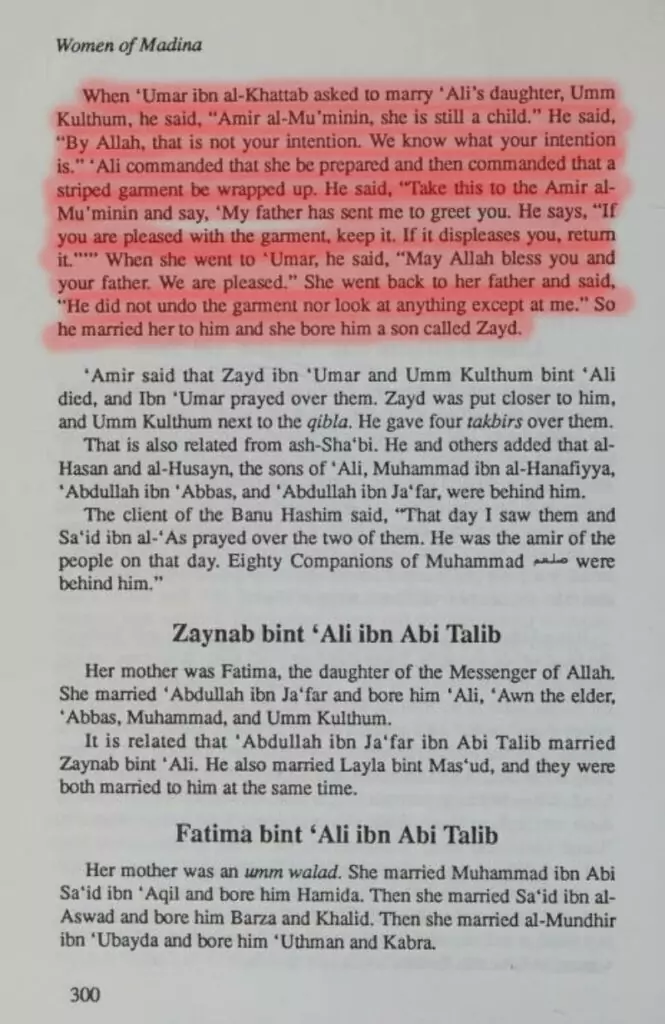
In Ibn Sa‘d’s account, Ali initially says that the girl is still a child and that he is keeping his daughters for the sons of Ja‘far. Umar does not withdraw his request; instead, he continues to pressure Ali, saying that no man on earth would treat the girl better than he would. In another version, when Ali objects that “she is still a child,” Umar replies that he knows Ali’s real intention. Eventually Ali sends Umm Kulthum to Umar and the marriage is concluded. The repeated demands of the ruling caliph, the father’s initial objection, and the complete absence of the child’s own consent reveal this not as a marriage between two independent adults but as the transfer of a child’s body through the decisions of a male guardian and a head of state. [26]
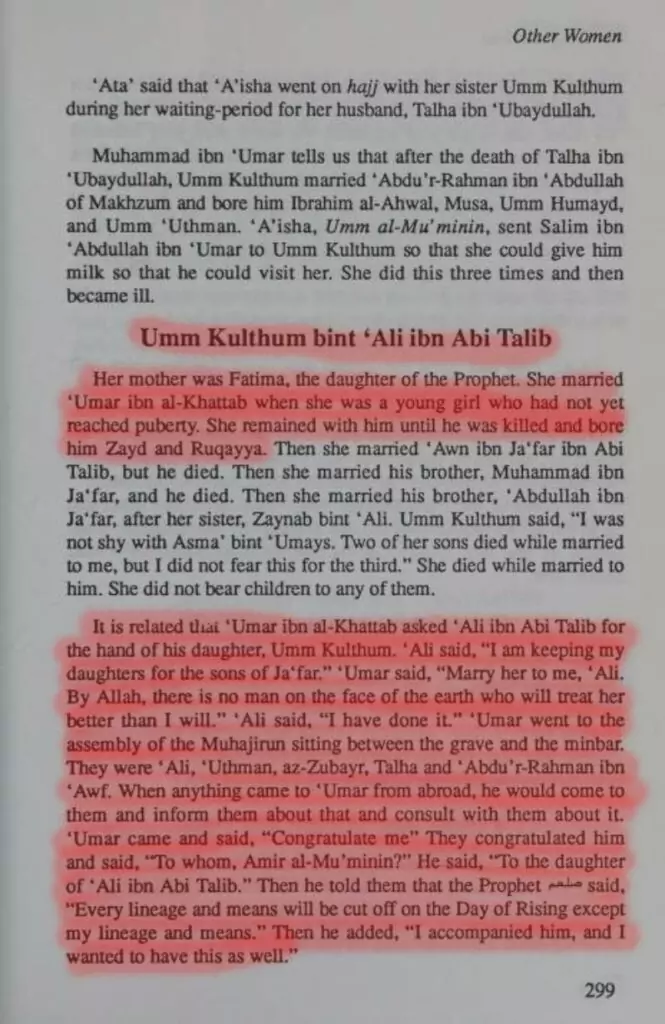
Umm Kulthum bint ‘Ali ibn Abi Talib
Her mother was Fatima, the daughter of the Prophet. She married ‘Umar ibn al-Khattab when she was a young girl who had not yet reached puberty. She remained with him until he was killed and bore him Zayd and Ruqayya. Then she married ‘Awn ibn Ja’far ibn Abi Talib, but he died. Then she married his brother, Muhammad ibn Ja’far, and he died. Then she married his brother, ‘Abdullah ibn Ja’far, after her sister, Zaynab bint ‘Ali. Umm Kulthum said, “I was not shy with Asma’ bint “Umays. Two of her sons died while married to me, but I did not fear this for the third.” She died while married to him. She did not bear children to any of them.
It is related that ‘Umar ibn al-Khattab asked ‘Ali ibn Abi Talib for the hand of his daughter, Umm Kulthum. ‘Ali said, “I am keeping my daughters for the sons of Ja’far.” “Umar said, “Marry her to me, ‘Ali. By Allah, there is no man on the face of the earth who will treat her better than I will.” ‘Ali said, “I have done it.” “Umar went to the assembly of the Muhajirun sitting between the grave and the minbar. They were ‘Ali, ‘Uthman, az-Zubayr, Talha and ‘Abdu’r-Rahman ibn ‘Awf. When anything came to ‘Umar from abroad, he would come to them and inform them about that and consult with them about it. ‘Umar came and said, “Congratulate me” They congratulated him and said, “To whom, Amir al-Mu’minin?” He said, “To the daughter of ‘Ali ibn Abi Talib.” Then he told them that the Prophet said “Every lineage and means will be cut off on the Day of Rising except my lineage and means.” Then he added, “I accompanied him, and I wanted to have this as well.”
When ‘Umar ibn al-Khattab asked to marry ‘Ali’s daughter, Umm Kulthum, he said, “Amir al-Mu’minin, she is still a child.” He said, “By Allah, that is not your intention. We know what your intention is.” Ali commanded that she be prepared and then commanded that a striped garment be wrapped up. He said, “Take this to the Amir al-Mu’minin and say, ‘My father has sent me to greet you. He says, “If you are pleased with the garment, keep it. If it displeases you, return it.” When she went to ‘Umar, he said, “May Allah bless you and your father. We are pleased.” She went back to her father and said, “He did not undo the garment nor look at anything except at me.” So he married her to him and she bore him a son called Zayd.
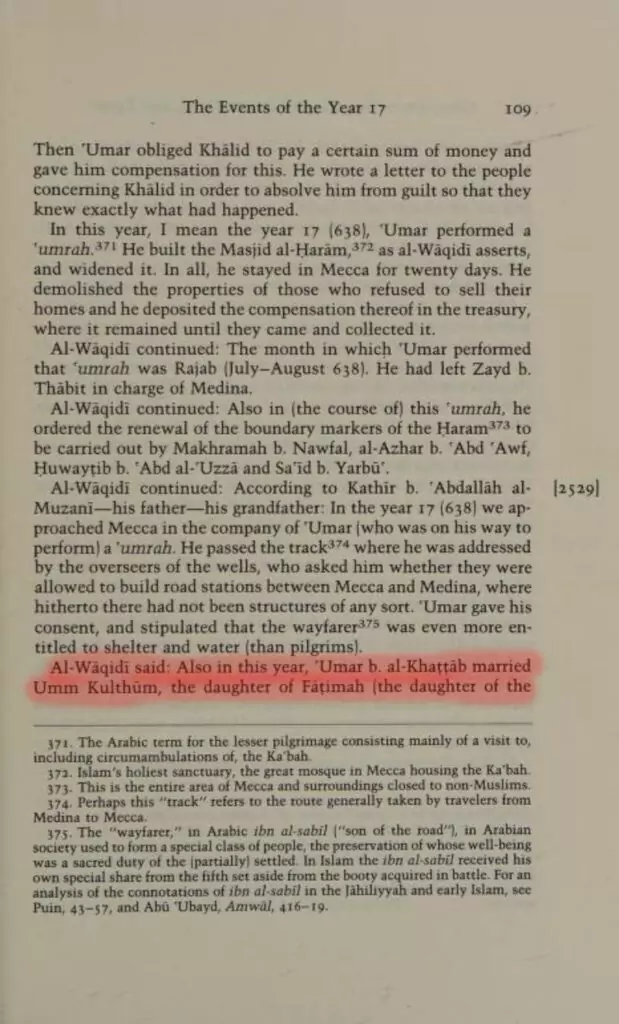
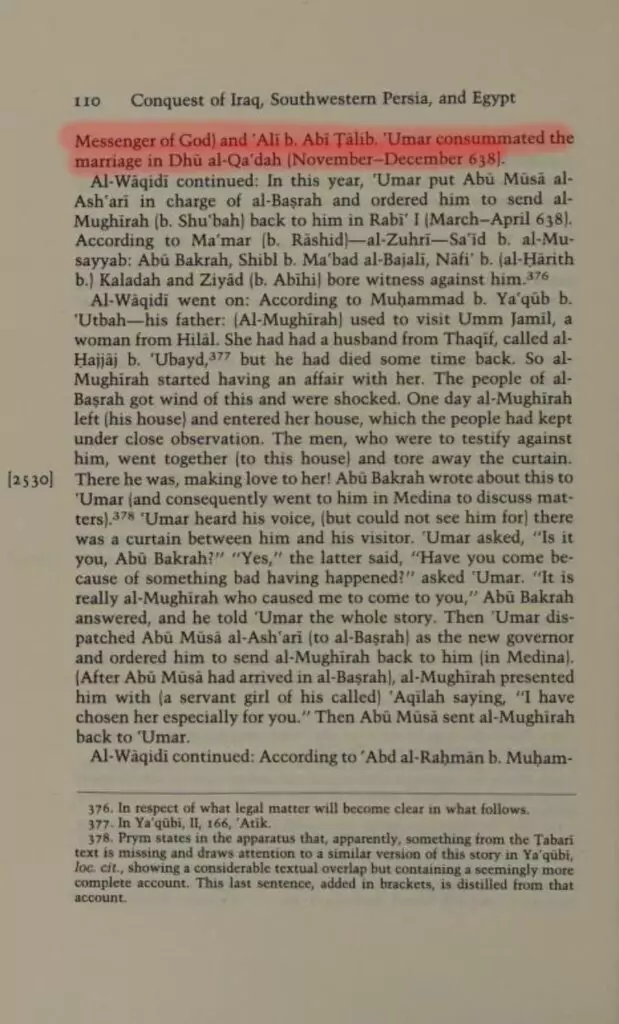
Al-Tabari’s history, under the events of 17 AH, records Umar’s marriage to Umm Kulthum and states that he consummated the marriage in Dhu al-Qa‘dah. Ibn Sa‘d describes her as a child who had not yet reached puberty; al-Tabari gives a date for consummation of the same marriage. Taken together, these two reports describe the marriage of a prepubescent girl followed within a short period by sexual consummation. A father’s marital authorization is not a substitute for the child’s own informed and independent consent. [27]
Al-Waqidi continued: According to Kathir b. Abdallah al-Muzani-his father-his grandfather: In the year 17 (638) we ap-proached Mecca in the company of ‘Umar (who was on his way to perform) a ‘umrah. He passed the track374 where he was addressed by the overseers of the wells, who asked him whether they were allowed to build road stations between Mecca and Medina, where hitherto there had not been structures of any sort. ‘Umar gave his consent, and stipulated that the wayfarer375 was even more en-titled to shelter and water (than pilgrims).
Al-Waqidi said: Also in this year, “Umar b. al-Khattab married Umm Kulthüm, the daughter of Fatimah (the daughter of the Messenger of God) and ‘Ali b. Abi Talih. Umar consummated the marriage in Dhü al-Qa’dah (November-December 638).
Al-Waqidi continued: In this year, ‘Umar put Abū Müsä al-Ash’ari in charge of al-Basrah and ordered him to send al-Mughirah (b. Shu’bah) back to him in Rabi I (March-April 638). According to Ma’mar (b. Räshid)-al-Zuhri-Sa’id b. al-Mu-sayyab: Abů Bakrah, Shibl b. Ma’bad al-Bajali, Nafi’ b. (al-Harith b.) Kaladah and Ziyad (b. Abihi) bore witness against him. 376 Al-Waqidi went on: According to Muhammad b. Ya qüb b.
‘Utbah-his father: (Al-Mughirah) used to visit Umm Jamil, a woman from Hilal. She had had a husband from Thaqif, called al-Hajjaj b. ‘Ubayd, 377 but he had died some time back. So al-Mughirah started having an affair with her. The people of al-Başrah got wind of this and were shocked. One day al-Mughirah left (his house) and entered her house, which the people had kept under close observation. The men, who were to testify against him, went together (to this house) and tore away the curtain.
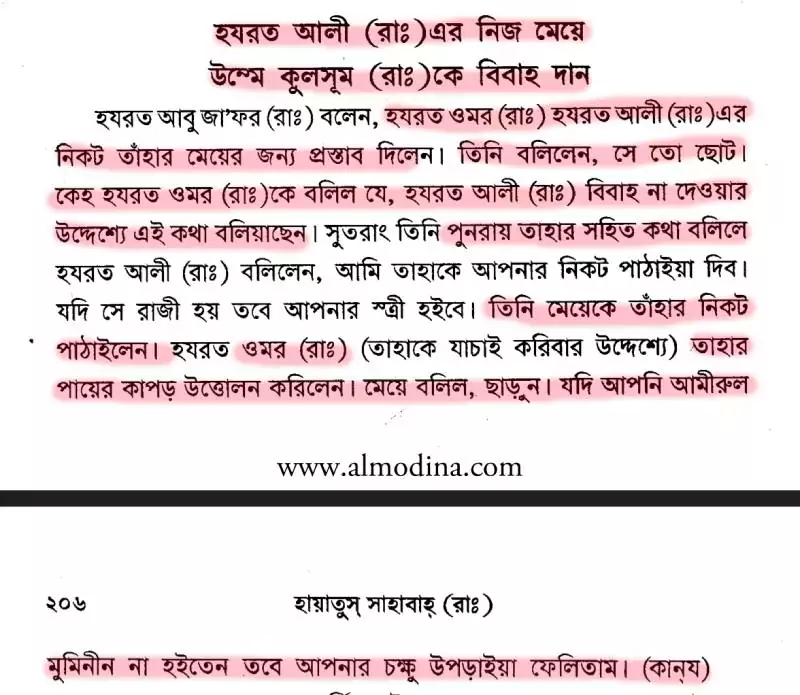
The Bengali edition of Hayatus Sahabah contains another report. In this version Umar lifts the cloth from Umm Kulthum’s leg to inspect her, and the girl protests that if he were not the Commander of the Faithful she would have gouged out his eyes. The English translation of Ibn Sa‘d quoted above says that Umar did not unwrap the garment and looked only at her; the two texts therefore contradict one another regarding the removal of clothing. Yet the Hayatus Sahabah report, in its own wording, preserves an act in which a powerful adult man touches or exposes a child’s body under the pretext of examining her and the child reacts with fierce protest. [28]
The Marriage of Ali’s Daughter Umm Kulthum
Abu Ja‘far narrates that Umar proposed to Ali for the hand of his daughter. Ali said, “She is still young.” Someone told Umar that Ali had said this because he did not wish to marry her to him. Umar therefore spoke to him again. Ali said, “I will send her to you. If she agrees, she will become your wife.” He sent the girl to Umar. Umar, in order to examine her, lifted the cloth from her leg. The girl said, “Let go. If you were not the Commander of the Faithful, I would have gouged out your eyes.”
Islamic jurisprudence itself declares the consent of a minor girl unnecessary. IslamQA, citing Ibn Abd al-Barr, quotes a claimed scholarly consensus that a father may marry off his young daughter without consulting her; the same answer uses Ali’s marriage of the young Umm Kulthum to Umar as an example of the rule. The child’s will is not a legal condition because the father decides on her behalf. This rule is not protection of the child’s welfare; it subjects the child’s body and future to a marital transaction controlled by male guardians. [29]
أجمع العلماء على أن للأب أن يزوج ابنته الصغيرة ولا يشاورها.
English translation: “The scholars are unanimously agreed that a father may marry off his young daughter without consulting her.”
Umm Kulthum’s prepubescent age, Ali’s initial objection, Umar’s repeated demand, and the later report of consummation together present the full structure of a child marriage. Umar’s motive was to obtain a marital connection with Muhammad’s lineage; in Ibn Sa‘d’s account he explicitly states that dynastic purpose. The child’s will, psychological readiness, or consent to sexual relations is nowhere central. The dynastic desire of a powerful adult man was placed above the physical and psychological safety of a girl who had not yet reached puberty. Under modern ethical and human-rights standards, this is child marriage and the establishment of sexual rights over a child; Umar’s religious titles do not remove the ugliness of the act.
Did Umar’s Slave Women Serve Male Guests with Bare Breasts?
Al-Bayhaqi’s Al-Sunan al-Kubra preserves a report attributed to Anas ibn Malik stating that Umar’s slave women served male guests with their hair uncovered. The commonly printed Bayhaqi text reads «كاشفات عن شعورهن، تضرب ثديهن»; the attached English translation renders the final phrase as “hitting their breasts,” while IslamQA interprets it to mean that the women’s hair was striking their chests. Al-Albani, however, quotes the same Anas report in Irwa al-Ghalil 6/204 with the wording «كاشفات عن شعورهن تضطرب ثديهن»—“their hair was uncovered and their breasts were moving”—and explicitly grades the chain «إسناده جيد», “its chain is good.” Al-Sarakhsi’s Al-Mabsut likewise preserves the report with the wording «مضطربات الثدي». The reading in which the breasts themselves are moving therefore does not depend solely on the weak chain transmitted by Yahya ibn Sallam; it is also the wording quoted by al-Albani with a chain he graded good. [30]
كتاب السنن الكبرى » كتاب الصلاة » جماع أبواب لبس المصلي » باب عورة الأمة
بحث في نص الكتاب معلومات عن الكتاب كتاب السنن الكبرى
2جزءالتالي صفحة
227
السابق
3127 ( وأخبرنا ) أبو القاسم عبد الرحمن بن عبيد الله الحرفي ببغداد ، أنبأ علي بن محمد بن الزبير الكوفي ، ثنا الحسن بن علي بن عفان ، ثنا زيد بن الحباب عن حماد بن سلمة ، قال : حدثني ثمامة بن عبد الله بن أنس عن جده أنس بن مالك قال : كن إماء عمر – رضي الله عنه – يخدمننا كاشفات عن شعورهن ، تضرب ثديهن .
قال الشيخ : والآثار عن عمر بن الخطاب – رضي الله عنه – في ذلك صحيحة ، وإنها تدل على أن رأسها ورقبتها وما يظهر منها في حال المهنة ليس بعورة ، فأما حديث عمرو بن شعيب فقد اختلف في متنه ؛ فلا ينبغي أن يعتمد عليه في عورة الأمة ، وإن كان يصلح الاستدلال به وبسائر ما يأتي عليه معه في عورة الرجل . وبالله التوفيق
English translation: Anas ibn Malik said: “Umar’s slave women used to serve us with their hair uncovered”; the report then contains the phrase «تضرب ثديهن»—literally, “striking their breasts.” Al-Bayhaqi says that the reports transmitted from Umar ibn al-Khattab on this matter are authentic. They indicate that a slave woman’s head, neck, and whatever normally becomes exposed from her while working are not regarded as awrah. As for the hadith of Amr ibn Shu‘ayb, its wording has been transmitted differently, so it should not be relied upon to determine the awrah of a slave woman, although it and the other reports that follow may be used as evidence concerning the awrah of a man.
Thumama bin Abdullah bin Anas told me on the authority of his grandfather Anas bin Malik who said: They were the slave girls of Umar (may God be pleased with him) who served us, revealing their hair, hitting their breasts.
Two textual forms of the report are preserved: «تضرب ثديهن» and «تضطرب ثديهن». The commonly printed Bayhaqi text has «تضرب ثديهن», which IslamQA interprets as «يعني أن شعورهن تضرب صدورهن»—that is, the women’s hair was striking their chests. But the explicit «تضطرب ثديهن» reading is not confined to Yahya ibn Sallam’s weak chain. Al-Albani quotes the same report from Anas in Irwa al-Ghalil 6/204 with «تضطرب ثديهن» and grades its chain «إسناده جيد»—“its chain is good.” Yahya ibn Sallam also preserves «تضطرب ثديهن» through another chain containing Nasr ibn Tarif, whom later Muslim rijal critics regarded as unreliable. The weakness therefore applies to that particular Yahya ibn Sallam chain; it cannot be used to dismiss the wording “their breasts were moving,” because al-Albani preserves the same wording with a chain he explicitly graded good. [31]
“Sahih,” “weak,” and “fabricated” are technical classifications within Islamic hadith scholarship; they are not direct synonyms for historical truth and falsehood. A sahih chain does not automatically make an event true, and a weak chain does not automatically make it false. The proper approach here is to present both readings, translations, and the isnad criticism. The translation referring to moving bare breasts is not a modern invention; it is a direct rendering of one reading of the preserved Arabic, and the variant “تضطرب ثديهن” makes the same physical image still more explicit. Juristic discussions that treat a slave woman’s chest and breasts as parts that could be exposed before unrelated men also fit the broader social and legal context of this reading. Whether the specific event actually happened is a separate historical question; using a religious grading of the chain to erase the textual reading and its translation is not objective description.
Exposed Breasts of Slave Women: Textual Variants and the Evidence of Classical Jurisprudence
Al-Bayhaqi’s preserved version contains the phrase «تَضْرِبُ ثُدِيَّهُنَّ». A later interpretation explains this as meaning that the slave women’s uncovered hair struck their chests as they moved rapidly while serving. Yet another early version of the same report contains the explicit reading «تَضْطَرِبُ ثُدِيُّهُنَّ»—“their breasts were moving” or “shaking.” Yahya ibn Sallam preserves the report from Anas ibn Malik in this form in his Tafsir. This particular chain contains Nasr ibn Tarif, whom later Muslim hadith critics regarded as unreliable and accused of fabrication; it therefore cannot be treated as an independent report of equal isnad strength to al-Bayhaqi’s version. The textual variant nevertheless matters, because it demonstrates that one early transmission of the report explicitly preserved the physical movement of the breasts in its wording. [32]
وَقَدْ رَوَاهُ يَحْيَى بْنُ سَلَّامٍ فِي تَفْسِيرِهِ (1/441): حَدَّثَنِي حَمَّادٌ وَنَصْرُ بْنُ طَرِيفٍ، عَنْ ثُمَامَةَ بْنِ أَنَسِ بْنِ مَالِكٍ، عَنْ أَنَسِ بْنِ مَالِكٍ قَالَ: «كُنَّ جَوَارِي عُمَرَ يَخْدُمْنَنَا كَاشِفَاتِ الرُّءُوسِ، تَضْطَرِبُ ثُدِيُّهُنَّ بَادِيَةً خِدَامُهُنَّ».
English translation: Yahya ibn Sallam transmitted in his Tafsir: Hammad and Nasr ibn Tarif narrated to me, from Thumama ibn Anas ibn Malik, from Anas ibn Malik, who said: “Umar’s slave women used to serve us with their heads uncovered; their breasts were moving, and their anklets were visible.”
Al-Albani’s own citation is particularly important here. In Irwa al-Ghalil 6/204 he quotes the same report from Anas with the explicit wording «تضطرب ثديهن» and states of its chain, «إسناده جيد»—“its chain is good.” Dorar al-Saniyyah likewise records this wording and grading under al-Albani’s name. The reading “their breasts were moving” therefore cannot be dismissed as merely the product of the weak chain containing Nasr ibn Tarif in Yahya ibn Sallam’s Tafsir. [33]
عن أنسِ بنِ مالكٍ قال كنَّ إماءَ عمرَ رضيَ اللهُ عنهُ يَخدِمْنَنا كاشفاتٍ عن شعورهن تضطربُ ثُدُيِهِنَّ.
الراوي: أنس بن مالك | المحدث: الألباني | المصدر: إرواء الغليل | الصفحة أو الرقم: 6/204 | خلاصة حكم المحدث: إسناده جيد.
English translation: Anas ibn Malik reported: “Umar’s slave women used to serve us with their hair uncovered, their breasts moving.” Narrator: Anas ibn Malik; hadith critic: al-Albani; source: Irwa al-Ghalil, Vol. 6, p. 204. Al-Albani’s grading: “Its chain is good.”
More importantly, the influential eleventh-century Hanafi jurist Shams al-A’imma al-Sarakhsi quotes the same report from Anas in his Al-Mabsut using the expression «مُضْطَرِبَاتِ الثَّدْيِ». Here the grammatical subject is not the women’s hair. The phrase directly describes the condition of their breasts: “with their breasts moving.” Al-Sarakhsi does not cite this report while attempting to refute a controversial allegation; he uses it as an ordinary legal example while explaining what constitutes being served by a servant. This is not an independent second chain establishing the event, since it preserves the same Anas report, but it is important evidence for how the report was preserved and quoted within classical Muslim jurisprudence. [34]
فَإِذَا حَلَفَ لَا يَخْدُمُهُ خَادِمُ فُلَانٍ فَجَلَسَ عَلَى مَائِدَةٍ مَعَ قَوْمٍ يَطْعَمُونَ، وَذَلِكَ الْخَادِمُ يَقُومُ فِي طَعَامِهِمْ وَشَرَابِهِمْ حَنِثَ؛ لِأَنَّهُ قَدْ خَدَمَ كُلَّ وَاحِدٍ مِنْهُمْ فَوُجِدَ بِهِ شَرْطُ الْحِنْثِ فِي حَقِّ الْحَالِفِ، بِدَلِيلِ حَدِيثِ أَنَسٍ رَضِيَ اللَّهُ عَنْهُ: كُنَّ جَوَارِي عُمَرَ رَضِيَ اللَّهُ عَنْهُ يَخْدِمْنَ الضِّيفَانَ كَاشِفَاتِ الرُّؤُوسِ مُضْطَرِبَاتِ الثَّدْيِ.
English translation: If a man swears that the servant of a particular person will not serve him, and he then sits at a table with a group of people eating while that servant attends to their food and drink, his oath is broken, because the servant has served every one of them and the condition for breaking the oath has therefore been fulfilled with respect to him. The evidence for this is the hadith of Anas: “Umar’s slave women used to serve the guests with their heads uncovered and their breasts moving.”
This reading cannot be separated from its wider juristic context. Classical Hanafi law did not require the body of a slave woman to be covered in the same way as that of a free woman. Ibn Abidin, in Radd al-Muhtar, explicitly discusses the awrah of a slave woman and states that her chest and breasts are not awrah. He further explains that jurists permitted a man to look at those parts of another person’s slave woman that he could look at on a female mahram, and from this reasoning he concludes that the chest and breasts fall outside the slave woman’s awrah. He also records disagreement among Hanafi authorities regarding exposure of the chest and breasts during prayer, but ultimately states that the relied-upon position should be that the chest is not awrah without qualification. [35]
وَقَالَ الرَّحْمَتِيُّ: الظَّهْرُ مَا قَابَلَ الْبَطْنَ مِنْ تَحْتِ الصَّدْرِ إِلَى السُّرَّةِ، جَوْهَرَةٌ: أَيْ فَمَا حَاذَى الصَّدْرَ لَيْسَ مِنْ الظَّهْرِ الَّذِي هُوَ عَوْرَةٌ. اهـ. وَمُقْتَضَى هَذَا أَنَّ الصَّدْرَ وَمَا قَابَلَهُ مِنْ الْخَلْفِ لَيْسَ مِنْ الْعَوْرَةِ، وَأَنَّ الثَّدْيَ أَيْضًا غَيْرُ عَوْرَةٍ، وَسَيَأْتِي فِي الْحَظْرِ وَالْإِبَاحَةِ أَنَّهُ يَجُوزُ أَنْ يَنْظُرَ مِنْ أَمَةِ غَيْرِهِ مَا يَنْظُرُ مِنْ مَحْرَمِهِ، وَلَا شُبْهَةَ أَنَّهُ يَجُوزُ النَّظَرُ إِلَى صَدْرِ مَحْرَمِهِ وَثَدْيِهَا، فَلَا يَكُونُ عَوْرَةً مِنْهَا وَلَا مِنْ الْأَمَةِ، وَمُقْتَضَى ذَلِكَ أَنَّهُ لَا يَكُونُ عَوْرَةً فِي الصَّلَاةِ أَيْضًا، لَكِنْ فِي التَّتَارْخَانِيَّةِ: لَوْ صَلَّتِ الْأَمَةُ وَرَأْسُهَا مَكْشُوفَةٌ جَازَتْ بِالِاتِّفَاقِ، وَلَوْ صَلَّتْ وَصَدْرُهَا وَثَدْيُهَا مَكْشُوفٌ لَا يَجُوزُ عِنْدَ أَكْثَرِ مَشَايِخِنَا. اهـ. وَقَدْ يُقَالُ: إِنَّ صَدْرَ الْأَمَةِ عَوْرَةٌ فِي الصَّلَاةِ لَا خَارِجَهَا، لَكِنَّهُ مُخَالِفٌ لِلْمَذْكُورِ فِي عَامَّةِ الْكُتُبِ مِنْ الِاقْتِصَارِ عَلَى ذِكْرِ الْبَطْنِ وَالظَّهْرِ، وَقَدْ مَرَّ تَفْسِيرُهُمَا، وَلَا يَخْفَى أَنَّ الصَّدْرَ غَيْرُهُمَا، فَيَنْبَغِي أَنْ يَكُونَ الْمُعْتَمَدُ أَنَّهُ لَيْسَ بِعَوْرَةٍ مُطْلَقًا.
English translation: Al-Rahmati said: “The back” means the part corresponding to the abdomen from below the chest to the navel. Al-Jawhara states: what corresponds to the chest is therefore not part of the back that constitutes awrah. The implication is that the chest and the corresponding part of the back are not awrah, and that the breast is likewise not awrah. It will be stated in the chapter on prohibition and permissibility that a man may look at those parts of another person’s slave woman that he may look at on one of his female mahrams. There is no doubt that it is permissible for him to look at the chest and breasts of his female mahram; consequently, these are not awrah in the case of either the mahram woman or the slave woman. This would also imply that they are not awrah during prayer. However, Al-Tatarkhaniyya states that if a slave woman prays with her head uncovered, her prayer is valid by agreement, whereas if she prays with her chest and breasts uncovered, it is not valid according to most of our shaykhs. It may therefore be said that a slave woman’s chest is awrah during prayer but not outside prayer. Yet this conflicts with what is stated in the generality of the legal books, which restrict the additional awrah to the abdomen and back, whose meanings have already been explained. The chest is plainly distinct from both. The relied-upon position should therefore be that the chest is not awrah without qualification.
This juristic context is directly relevant to interpreting the report. In a legal framework in which the chest and breasts of a slave woman were not treated as parts that necessarily had to be concealed like those of a free woman, there is no evidentiary necessity to reconstruct the description of Umar’s serving women as though their breasts must have been completely covered and only their long hair was striking clothing over their chests. The «تَضْطَرِبُ ثُدِيُّهُنَّ» variant of the Anas report, al-Sarakhsi’s «مُضْطَرِبَاتِ الثَّدْيِ» wording, and the classical Hanafi ruling that a slave woman’s breast was not awrah are mutually coherent pieces of evidence.
The textual forms and chains must be distinguished precisely. Al-Bayhaqi’s commonly printed text has «تَضْرِبُ ثُدِيَّهُنَّ», and al-Bayhaqi described the relevant reports from Umar as authentic. Yahya ibn Sallam’s particular chain for «تَضْطَرِبُ ثُدِيُّهُنَّ» contains Nasr ibn Tarif, whom later hadith critics regarded as unreliable. But the «تَضْطَرِبُ ثُدِيُّهُنَّ» wording is not confined to that weak chain: al-Albani quotes the same Anas report with precisely this wording in Irwa al-Ghalil 6/204 and grades its chain «إسناده جيد». Al-Sarakhsi likewise preserves the report as «مُضْطَرِبَاتِ الثَّدْيِ». These should not be counted as three or four independent historical witnesses, because they are different textual preservations and citations of the same Anas report. Their significance is textual and juristic: the reading in which the slave women’s breasts themselves were moving was preserved within Muslim hadith and legal literature, al-Albani explicitly accepted a good chain for that wording, and the same legal tradition also contains explicit rulings placing the chest and breasts of a slave woman outside the awrah in ordinary circumstances.
Beating Slave Women for the “Offense” of Covering Like Free Women
Umar’s policy did not merely exempt slave women from complete veiling. Multiple reports preserved in al-Bayhaqi, juristic commentary, tafsir, and modern Islamic fatwas state that when a slave woman covered her head and body like a free woman, Umar beat her and forced her to remove the covering. IslamQA, quoting Ibn Taymiyya, acknowledges that Umar would beat covered slave women and accuse them of imitating free women. Islamweb likewise cites al-Bayhaqi and states that reports from Umar on this issue are authentic. A slave woman’s exposure was therefore not a matter of leniency or personal freedom; attempting to cover herself could become a physically punishable class violation. [36]
وكان عمر إذا رأى أمة مختمرة ضربها وقال: أتتشبهين بالحرائر أي لكاع؟
English translation: “When Umar saw a slave woman wearing a head covering, he would beat her and say, ‘Are you imitating free women, you wretched woman?’”
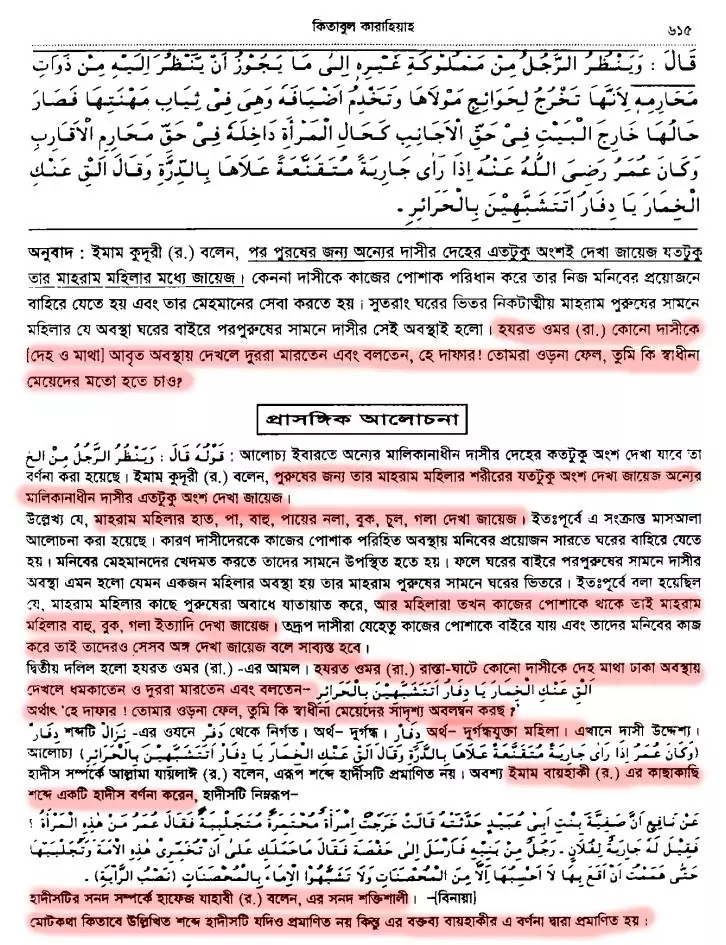
The Bengali commentary Ashraful Hidaya presents the clothing of slave women, the gaze of unrelated men, and Umar’s beating of covered slave women as parts of the same legal structure. It states that an unrelated man may look at the same parts of another person’s slave woman that he may see of a female mahram, because a slave woman must go outside for her owner’s work and serve his guests. In the same discussion it cites a report of Umar beating a covered slave woman with his whip. Although the work notes that a particular wording is not established exactly in that form, it says that the substance is supported by a closely related report from al-Bayhaqi and describes its chain as strong. [37]
كتاب الكراهية
615
قَالَ : وَيَنْظُرُ الرَّجُلُ مِنْ مَمْلُوكَةٍ غَيْرِه إِلى مَا يَجُوزُ أَن يَنظُرَ إِلَيْهِ مِن ذَوَاتِ مَحَارِمِهِ لِأَنَّهَا تَخْرُجُ لِحَوَائِجِ مَوْلَاهَا وَتَخْدِمُ أَضْيَافَهُ وَهِيَ فِي ثِيَابِ مَهْنَتِهَا فَصَارَ حَالُهَا خَارِجَ الْبَيْتِ فِي حَقِّ الْأَجَانِبِ كَحَالِ الْمَرْأَةِ دَاخِلَهُ فِي حَقِّ مَحَارِمِ الْأَقَارِبِ وَكَانَ عُمَرُ رَضِيَ اللهُ عَنْهُ إِذَا رَأَى جَارِيَةً مُتَقَنَّعَةً عَلَاهَا بِالدِّرَّةِ وَقَالَ القِ عَنْكِ الْخِمَارَ يَا دِفَارُ اتَتَشَبَّهِينَ بِالْحَرَائِرِ .
English translation: Imam al-Quduri says that a man may look at those parts of another person’s slave woman that he may lawfully see of his female mahrams. This is because a slave woman must go outside to fulfill her owner’s needs and must serve his guests while wearing work clothes. Her condition outside the house before unrelated men therefore becomes comparable to the condition of a free woman inside the house before her close male relatives. Umar, when he saw a slave woman veiled and covered, would strike her with his whip and say, “Remove the head covering from yourself, O foul woman! Are you imitating free women?”
The commentary explains that the hands, feet, arms, shins, chest, hair, and neck of a mahram woman may be seen. Since slave women must leave the house for their owners’ work and serve their owners’ guests, the same parts of their bodies were regarded as visible before unrelated men. It then cites Umar’s practice as a second proof: when he saw a slave woman outside with her body and head covered, he rebuked her and struck her with his whip, saying, “Throw off the head covering. Are you imitating free women?” The commentator adds that al-Zayla‘i did not regard the report as established in exactly that wording, but that al-Bayhaqi transmitted a closely related report. It further states that al-Dhahabi regarded the chain of that report as strong and concludes that although the wording in the text is not established exactly, its substance is supported by al-Bayhaqi’s narration.
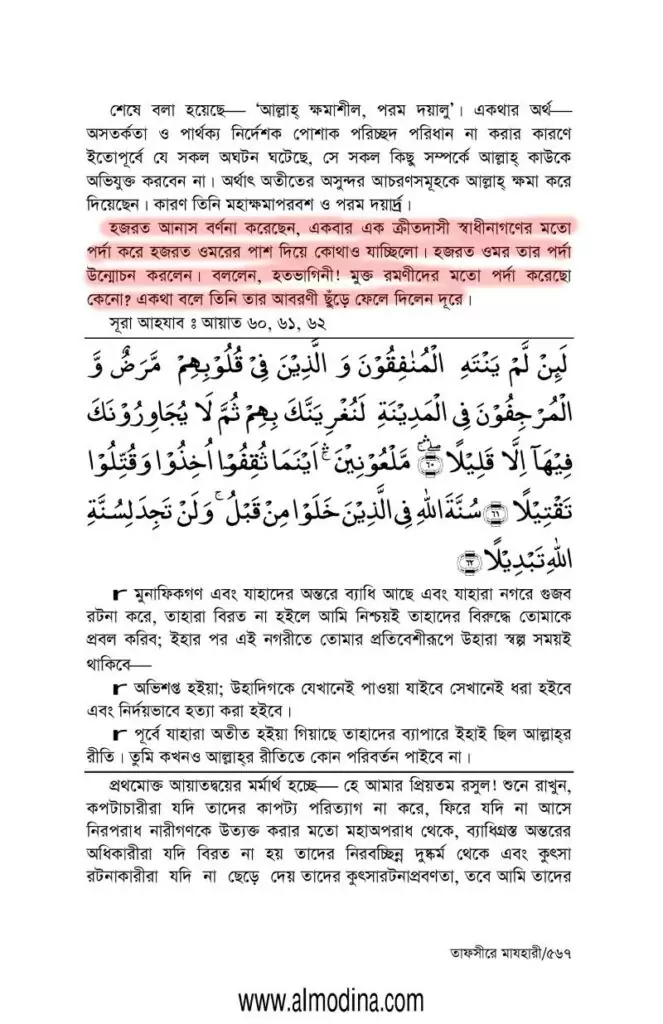
The Bengali translation of Tafsir al-Mazhari likewise discusses clothing used to distinguish free women from slave women and then reports an incident in which Umar uncovered a slave woman who passed before him veiled like a free woman and threw her covering away. The slave woman had chosen to cover her own body; Umar removed the covering against her will and insulted her for veiling “like free women.” The purpose of the act was to keep her subordinate social status visibly marked on her body. [38]
At the end it is said: “Allah is Forgiving, Most Merciful.” This means that Allah will not hold anyone accountable for undesirable incidents that had occurred previously because of carelessness or failure to wear clothing that distinguished social status. Allah has forgiven those earlier undesirable acts because He is Most Forgiving and Most Merciful.
Anas narrated that on one occasion a slave woman passed Umar while veiled like free women. Umar uncovered her and said, “Wretched woman! Why are you veiling like free women?” Saying this, he threw her covering away.
Modern Islamic speakers also acknowledge the historical position that a slave woman’s complete veiling was not like that of a free woman and that Umar beat covered slave women. Explaining the rule as necessary for work does not justify depriving the slave woman of the right to cover herself or physically punishing her for doing so. A working woman may choose lighter clothing for practical reasons; if an owner or ruler beats her because she chooses to cover, that is not accommodation—it is coercion. Listen to the statements of several scholars:
The Slave Woman’s Awrah: Unequal Human Dignity in the Four Schools of Islamic Law
Islamic jurisprudence does not contain a single unanimously agreed boundary for a slave woman’s awrah. According to Islamweb’s summary, the majority of scholars held that a slave woman’s awrah extended from the navel to the knee; the Hanafis compared her visible body to the parts of a free mahram woman that could be seen; some Hanbali scholars and Ibn Hazm held that the awrah of a slave woman and a free woman was the same. These disagreements did not arise from recognition of equal human dignity. The central dispute was how much of the body of an owned woman had to be covered in prayer or before men. Under the majority view of navel to knee, a slave woman’s head, hair, neck, arms, much of her legs, and upper body were outside the prescribed awrah; under the Hanafi explanation, work and guest service created permission for exposure comparable to that of a mahram woman. [39] [40]
فقد ذهب جمهور أهل العلم إلى أن الأمة عورتها ما بين السرة إلى الركبة.
English translation: “The majority of scholars hold that the awrah of a slave woman is the area between the navel and the knee.”
Two reports in Sunan al-Daraqutni likewise define the area between the navel and knee as awrah. The Bengali edition marks the authentication of both reports as “awaiting verification,” so they cannot independently be treated as decisive sahih evidence. Al-Bayhaqi also stated that the hadith of Amr ibn Shu‘ayb had textual variations and should not be relied upon by itself to define a slave woman’s awrah. Nevertheless, the navel-to-knee rule became widely accepted in later jurisprudence, and Islamweb identifies it as the view of the majority of scholars. [41]
Sunan al-Daraqutni
3. Prayer
Section 3. Teaching prayer, ordering corporal punishment for neglecting it, and defining the awrah that must be covered
863(2). Narrated from Amr ibn Shu‘ayb through his father and grandfather. He said that the Messenger of Allah said: “Order your children to pray at the age of seven. When they reach ten, physically discipline them for neglecting prayer and separate their beds. If any of you marries his slave or his laborer to his slave woman, he should not look at the area below her navel and above her knees, because the area from below the navel to the knees is awrah and must be covered.”
Hadith grade: Authentication pending
Narrator: Amr ibn Shu‘ayb
Sunan al-Daraqutni
3. Prayer
Section 3. Teaching prayer, ordering corporal punishment for neglecting it, and defining the awrah that must be covered
864(3). Narrated from Amr ibn Shu‘ayb through his father and grandfather. He said that the Messenger of Allah said: “Order your children to pray when they reach seven. When they reach ten, physically discipline them in order to establish the habit of prayer and separate their beds. If any of you marries off his slave or laborer, he should not look at the area between her knees and navel, because the area between the navel and knees is part of the private parts.”
Hadith grade: Authentication pending
Narrator: Amr ibn Shu‘ayb
The body of a free woman and the body of a slave woman are biologically the same; freedom or ownership does not alter shame, pain, safety, or vulnerability to sexual harassment. Ibn Hazm and some other scholars came closer to this basic fact by holding that the awrah of slave and free women was the same, but the majority of jurists made enslavement a legally valid reason to reduce the bodily dignity assigned to a woman. The argument that slave women had to work was used to reduce their clothing rights, while no equivalent requirement was placed on owners to change labor arrangements or respect the slave woman’s own preference. The rules of awrah therefore did not operate as a neutral boundary of religious modesty; they were laws assigning different value to women’s bodies according to ownership status.
The Social Function of Veiling: Making Slavery Visible on the Body
The declared purpose of distinguishing the clothing of free women from that of slave women was to make social status immediately recognizable. The jilbab marked a free woman as a member of a socially respectable class; the uncovered head and work clothing of a slave woman marked her as an owned laborer. Umar’s beating of covered slave women represents state enforcement of that visual classification. If a slave woman covered herself, an observer might mistake her for a free woman; the response was therefore to remove the covering, humiliate her, and strike her with the whip. Clothing here was not a private matter of modesty but a social identity card. A slave woman could not cover her own body and thereby claim the same visible dignity as a free woman.
Islamweb claims that harming slave women was impermissible, while simultaneously acknowledging that free women were instructed to dress differently from slave women so that immoral men would fear the free women. Such a structure does not give women equal safety. It marks free women through distinctive clothing as a class entitled to protection and prevents slave women from using the same protective identity. Umar’s conduct represents the most naked form of this discrimination: if a slave woman voluntarily adopted that covering, the ruler’s whip came down on her body. The claim of modesty was therefore class-dependent; covering was honor for a free woman and punishable disguise for a slave woman.
The Slave Woman as Owned Property: Sale, Sexual Use, and the Elimination of Consent
Stripping a slave woman of clothing rights was not an isolated rule; it belonged to a wider legal system that turned human beings into property. IslamQA acknowledges that a lawfully owned slave woman could be sold and that, after waiting through one menstrual cycle, the owner could have sexual intercourse with her. Islamweb states still more explicitly that an owner may have sex with a slave woman without marriage and that her consent is not legally considered because she is part of his property. In this formulation, the absence of consent is not treated as abuse; it is an ordinary legal consequence of ownership. [42] [43]
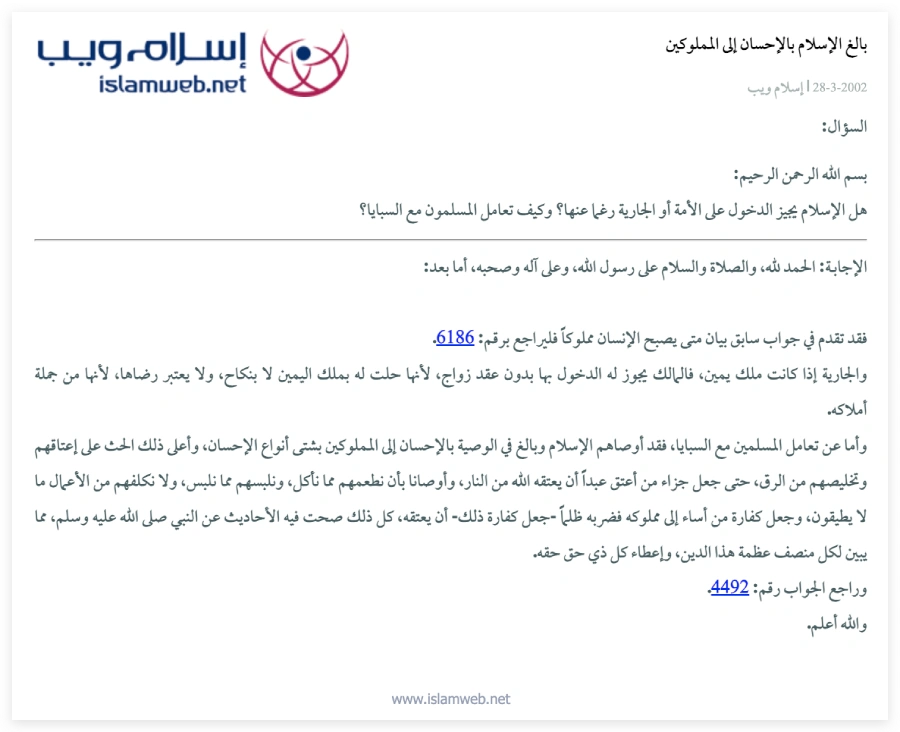
بالغ الإسلام بالإحسان إلى المملوكين
28-3-2002 | إسلام ويب
السؤال:
بسم الله الرحمن الرحيم:
هل الإسلام يجيز الدخول على الأمة أو الجارية رغما عنها؟ وكيف تعامل المسلمون مع السبايا؟
الإجابــة:
الحمد لله، والصلاة والسلام على رسول الله، وعلى آله وصحبه، أما بعد:
فقد تقدم في جواب سابق بيان متى يصبح الإنسان مملوكاً فليراجع برقم: 6186.
والجارية إذا كانت ملك يمين، فالمالك يجوز له الدخول بها بدون عقد زواج، لأنها حلت له بملك اليمين لا بنكاح، ولا يعتبر رضاها، لأنها من جملة أملاكه.
وأما عن تعامل المسلمين مع السبايا، فقد أوصاهم الإسلام وبالغ في الوصية بالإحسان إلى المملوكين بشتى أنواع الإحسان، وأعلى ذلك الحث على إعتاقهم وتخليصهم من الرق، حتى جعل جزاء من أعتق عبداً أن يعتقه الله من النار، وأوصانا بأن نطعمهم مما نأكل، ونلبسهم مما نلبس، ولا نكلفهم من الأعمال ما لا يطيقون، وجعل كفارة من أساء إلى مملوكه فضربه ظلماً -جعل كفارة ذلك- أن يعتقه، كل ذلك صحت فيه الأحاديث عن النبي صلى الله عليه وسلم، مما يبين لكل منصف عظمة هذا الدين، وإعطاء كل ذي حق حقه.
وراجع الجواب رقم: 4492.
والله أعلم.
English translation:
Islam Has Greatly Emphasized Kind Treatment of Slaves
28-3-2002 | Islamweb
Question:
In the name of Allah, the Most Compassionate, the Most Merciful.
Does Islam permit a man to have intercourse with a slave woman or bondwoman against her will? And how did Muslims treat female captives?
Answer:
Praise be to Allah, and peace and blessings be upon the Messenger of Allah, his family and Companions. To proceed:
A previous answer explained when a person becomes legally enslaved; see answer no. 6186.
If a slave woman is held by right-hand possession, her owner may have intercourse with her without a marriage contract, because she has become lawful to him through ownership, not through marriage. Her consent is not taken into consideration, because she is among his possessions.
As for how Muslims treated female captives, Islam instructed them and strongly emphasized treating slaves with every form of kindness. The greatest of these is encouragement to free them and release them from slavery. Whoever frees a slave is promised that Allah will free him from the Fire. Muslims are also instructed to feed them from what they themselves eat, clothe them from what they themselves wear, and not burden them with work beyond their capacity. If someone mistreats his slave and unjustly beats him, the expiation is to free him. Authentic hadiths from the Prophet establish all of this, demonstrating, according to the fatwa, the greatness of the religion and the giving of every person his due rights.
See also answer no. 4492.
Allah knows best.
Another Islamweb fatwa distinguishes women held by right-hand possession from wives and states that an owner may have sexual intercourse with them without a marriage contract, witnesses, or dowry. IslamQA likewise defines a slave woman as a female captive of war, a child born to a slave woman, or a woman purchased from a lawful owner. In other words, another human being holds legal authority over her body, labor, transfer, clothing, and sexual use. Within this structure, stripping a slave woman of her covering is not an accidental deviation; once a human being has been made an object of sale and non-consensual sexual access, the loss of her right to determine her own clothing follows the same logic of ownership. [44] [45]
إذ يحق لمالكهن أن يطأهن من غير عقد زواج، ولا شهود، ولا مهر، فهن لسن أزواجا.
English translation: “Their owner has the right to have intercourse with them without a marriage contract, witnesses, or dowry; they are not wives.”
Describing non-consensual sexual access as an owner’s legal right is, in modern ethical language, a form of rape-based sexual slavery. The Arabic source does not use the modern word “rape,” but it explicitly contains the two defining elements: the owner’s right of sexual access and the irrelevance of the slave woman’s consent. Turning a human being into sexual property without her consent cannot be made humane by instructions to treat her kindly, provide clothing, or sometimes encourage manumission. Umar’s stripping and beating of slave women is one visible form of violence within this property system; the same principle operates from clothing to sexuality—the slave woman’s body is not treated as her own. For further discussion: The Legality of Raping Female War Captives or Slave Women in Islam: Is a Slave Woman’s Consent Necessary?
Modern Islamic Defenses: Discrimination Preserved Inside the Defense
Modern Islamic defenses generally justify the lesser covering required of slave women by appealing to work, reduction of hardship, or a supposedly lower risk of sexual temptation. IslamQA states that Islamic law distinguishes between free women and slave women: a free woman observes complete hijab, while a slave woman may expose her head, hands, and face because she is required to perform more labor and full veiling would be burdensome. The same answer also cites the reports of Umar beating slave women who covered themselves. The defense therefore does not deny the historical discrimination; it attempts to justify it through labor needs. [46]
جاء الشرع بالتفريق بين الحرائر والإماء، فالحرة تحتجب الحجاب الكامل، والأمة تبرز.
English translation: “The Sharia came with a distinction between free women and slave women: the free woman observes complete hijab, while the slave woman remains exposed.”
The argument from “work convenience” erases the slave woman’s own decision. If a woman determines for herself what to wear while working, that may be convenience; if a ruler beats her because she chooses to cover, that is forced exposure. The claim that a slave woman should cover only when there is fear of fitna also fails to recognize her dignity as a human being. In that framework, clothing is determined by male sexual desire and possible social disorder, not by the slave woman’s privacy or preference. If the same woman is considered beautiful or sexually desirable, she may be required to cover; if her labor is needed, she may be left exposed. In both cases, men and owners remain the decision-makers, not the woman herself.
Islamweb declares that abusing slave women is impermissible, yet in the same discussion it acknowledges the majority view that their awrah is from navel to knee, Umar’s prohibition on their covering, and the rule requiring them to dress differently from free women. A legal system cannot be made humane merely by theoretically condemning abuse while simultaneously converting a woman into property, allowing her sale, declaring her consent irrelevant to sexual relations, and treating her attempt to cover her body as a punishable violation of social rank. Advice to show kindness does not abolish the violent foundation of ownership.
The Same Character Pattern: Surveillance, Sexual Authority, Beating, Child Marriage, and the Bodies of Slave Women
The sources and evidentiary strength of the incidents involving Sawda, Atika, Umar’s wife, Umm Kulthum, and slave women are not identical; but in the established portions, the same form of power repeatedly appears. In Sawda’s case, a woman’s unavoidable movement outside was subjected to male surveillance and public comment. In Atika’s case, Umar disliked his wife’s attendance at the mosque and openly expressed that dislike. With his own wife, he treated her statement “I had fallen asleep” as an excuse and had intercourse with her. In relation to other women, he framed wives’ “disobedience” toward husbands as a problem and intervened in favor of permission to beat them. In the case of Umm Kulthum, he continued pressing to marry a prepubescent girl despite her father’s initial objection. With slave women, the same control became directly physical and class-based violence: beating them for covering, removing their coverings, and preventing them from adopting the clothing of free women.
The common thread is not merely personal conservatism; it is the tendency to impose one’s own decision over other people’s bodies and movement. Where a woman may go, how she may go outside, how much weight her words carry in sexual relations, whether physical force may be used against her for resisting a husband’s authority, who determines a child’s marital future, and how much of her body a slave woman may cover—in every one of these questions, women’s will is subordinated to male gaze, sexual claim, family authority, political power, and social hierarchy. The social setting changes, but the principle of control does not.
The most naked form of this pattern appears in the treatment of slave women. Free women were given covering as a visible mark of the class deemed worthy of respect, while slave women who adopted the same covering were beaten. Their uncovered heads, limited awrah, guest service, sale and purchase, and the legal irrelevance of their consent to sex all belonged to the same logic of ownership: the slave woman was not treated as a fully autonomous human being but as property subject to another person’s use. Umar was not a passive inheritor of this system; by beating, humiliating, and uncovering slave women, he personally enforced the class boundary on their bodies.
Conclusion
Beneath the conventional glorified portrait of Umar ibn al-Khattab appears a brutal character repeatedly asserting authority over women’s bodies, movement, and sexuality. Publicly identifying and humiliating Sawda when she went out to satisfy a bodily necessity, resenting his wife’s attendance at the mosque, treating his own wife’s statement as an excuse and having intercourse with her, intervening in favor of permission to beat wives because women were becoming “disobedient” to husbands, marrying the prepubescent Umm Kulthum, and beating covered slave women while removing their coverings are not unrelated moral errors. They repeatedly place women’s will and bodily autonomy beneath male claim, jealousy, sexual desire, marital authority, dynastic ambition, and class domination.
The history of veiling makes this structure of power still clearer. Free women were hidden from male gaze, while slave women were not permitted to adopt the same covering. When a slave woman tried to cover her own body, she could be beaten because clothing was not merely a question of modesty; it was also a visible marker of social status. The free woman’s covering signaled honor and protection; the same covering on a slave woman violated the class boundary. A system in which the dignity assigned to the same female body changes with freedom and ownership is not universal morality; it is class domination.
Umar’s status as a Companion, caliph, or Commander of the Faithful does not change the moral nature of these acts. Humiliating powerless women, disregarding a wife’s sexual statement, helping establish permission for wife-beating, asserting marital and sexual rights over a child, stripping slave women of clothing, and forcing visible marks of social subordination onto their bodies are not signs of justice. The cumulative picture preserved in Islamic sources is one of cruelty, misogyny, class contempt, and extreme abuse of power. Religious prestige does not erase that pattern of character.
References
- IslamQA — The doctrine of the Companions’ collective integrity ↩︎
- Islamweb — Criticizing the Companions is heresy and moral dissolution ↩︎
- IslamQA — Doubting the integrity of the Companions treated as an attack on religion ↩︎
- IslamQA — The Companions were not infallible ↩︎
- Quran 33:59 — Dr. Mustafa Khattab, The Clear Quran; Tafsir Ibn Kathir — Surah al-Ahzab, verse 59 ↩︎
- Tafsir Ibn Kathir — The distinction in dress between free women and slave women ↩︎
- IslamQA — Difference between the veiling of free women and slave women ↩︎
- Islamweb — The slave woman’s awrah and the explanation of “so that they may be recognized” ↩︎
- Islamweb — Explanation that harming slave women was not permissible ↩︎
- Veiling in Islam; Muawiya’s Naked Slave Woman ↩︎
- Sahaj Nasrul Bari, Sharh Sahih Bukhari, Vol. 8, Arabic-Bengali, translation and detailed commentary by Muhammad Usman Gani, Al-Kawthar Publications, p. 221; canonical parallel: Sahih al-Bukhari 4141 ↩︎
- Sahih Muslim 2170d ↩︎
- Sahih al-Bukhari 4795 ↩︎
- Sahih al-Bukhari 6240 ↩︎
- Sahih Muslim 2170a ↩︎
- Sahih al-Bukhari 5237 ↩︎
- Sahih Muslim, Islamic Foundation, Vol. 5, p. 187 ↩︎
- Musannaf Abd al-Razzaq — Women attending congregational prayer; Fath al-Bari — Umar’s wife Atika attending the mosque ↩︎
- Al-Bidaya wa al-Nihaya — Events of the twelfth year after the Hijra ↩︎
- Al-Bidaya wa al-Nihaya, Islamic Foundation Bangladesh, Vol. 6, p. 533 ↩︎
- Islamweb — Sources and status of the Atika and al-Zubayr report ↩︎
- Shamela text edition — The report of Atika in Al-Isaba ↩︎
- Tafsir Ibn Kathir, Vol. 2, p. 111 ↩︎
- Sunan Abi Dawud 2146; Sunan Ibn Majah 1985; Mishkat al-Masabih 3261 ↩︎
- Islamweb — Umar married Umm Kulthum before she reached puberty ↩︎
- Muhammad ibn Saad. Kitab al-Tabaqat al-Kabir Volume 8. Translated by Bewley, A. (1995). The Women of Madina. London: Ta-Ha Publishers. Page: 299, 300 ↩︎
- Muhammad ibn Jarir al-Tabari. Tarikh al-Rusul wa’l-Muluk. Translated by Juynboll, G. H. A. (1989). Volume 13: The Conquest of Iraq, Southwestern Persia, and Egypt, pp. 109-110. Albany: State University of New York Press. ↩︎
- Hayatus Sahabah, Muhammad Yusuf Kandhlawi, Darul Kitab, Vol. 3, pp. 205-206 ↩︎
- IslamQA — The rule permitting a father to marry off a minor daughter without her opinion ↩︎
- Kitab al-Sunan al-Kubra, Vol. 2, p. 227; al-Albani, Irwa al-Ghalil, Vol. 6, p. 204; Dorar al-Saniyyah — al-Albani’s wording and grading in Irwa al-Ghalil 6/204; IslamQA — Discussion of Umar’s slave women ↩︎
- Dorar al-Saniyyah — al-Albani, Irwa al-Ghalil 6/204; IslamQA — Yahya ibn Sallam’s variant and chain discussion ↩︎
- IslamQA — Yahya ibn Sallam’s variant and discussion of its chain ↩︎
- Dorar al-Saniyyah — al-Albani, Irwa al-Ghalil 6/204 ↩︎
- Al-Sarakhsi, Al-Mabsut, Vol. 9, p. 12 ↩︎
- Ibn Abidin, Radd al-Muhtar ‘ala al-Durr al-Mukhtar, Vol. 1 — Discussion of the slave woman’s awrah ↩︎
- IslamQA — Umar beating covered slave women; Islamweb — Reports from Umar described as authentic ↩︎
- Ashraful Hidaya, Islamia Kutubkhana, Vol. 9, p. 615 ↩︎
- Tafsir al-Mazhari, Vol. 9, p. 567 ↩︎
- Islamweb — Juristic disagreement over the slave woman’s awrah ↩︎
- The Slave Woman’s Awrah in Islam: From the Navel to the Knee ↩︎
- Sunan al-Daraqutni, hadith 863 and 864 ↩︎
- IslamQA — Sale and sexual use of slave women ↩︎
- Islamweb — A slave woman’s consent is not considered ↩︎
- Islamweb — Sexual relations with a slave woman without marriage, witnesses, or dowry ↩︎
- IslamQA — Sources of enslavement and purchase of slave women ↩︎
- IslamQA — Lesser covering of slave women justified by work requirements ↩︎