
Introduction
When a religious narrative begins to describe the universe, it ceases to be merely a spiritual story; it becomes a cosmology—a theory of the world. Intellectual honesty then demands that this cosmology be examined through reason, observation, history, and comparative mythology. The picture of the seven heavens found in Islamic accounts of the Mi‘raj—skies with gates, guards at every level, the presence of deceased prophets, a mysterious tree above the seventh heaven, and a reduction in the number of prayers through bargaining with Allah—has no reasonable claim to exemption from analysis merely because it is “a matter of faith.” Rather, these features clearly belong to the worldview of ancient people who imagined the sky not as boundless space but as a solid roof, a series of layers, a palace, a fortress, or a royal administrative building suspended overhead. Here lies the problem: the universe revealed by modern astronomy bears no relation to this gated, metallic sky controlled by guards. The purpose of this article is therefore not to protect religious sentiments but to ask a direct question: do these stories actually describe the universe, or are they Islamic versions of celestial ascent myths drawn from the ancient Near East, Jewish and Christian traditions, Zoroastrianism, and folklore?
Descriptions of the Heavens in the Mi‘raj Narrative
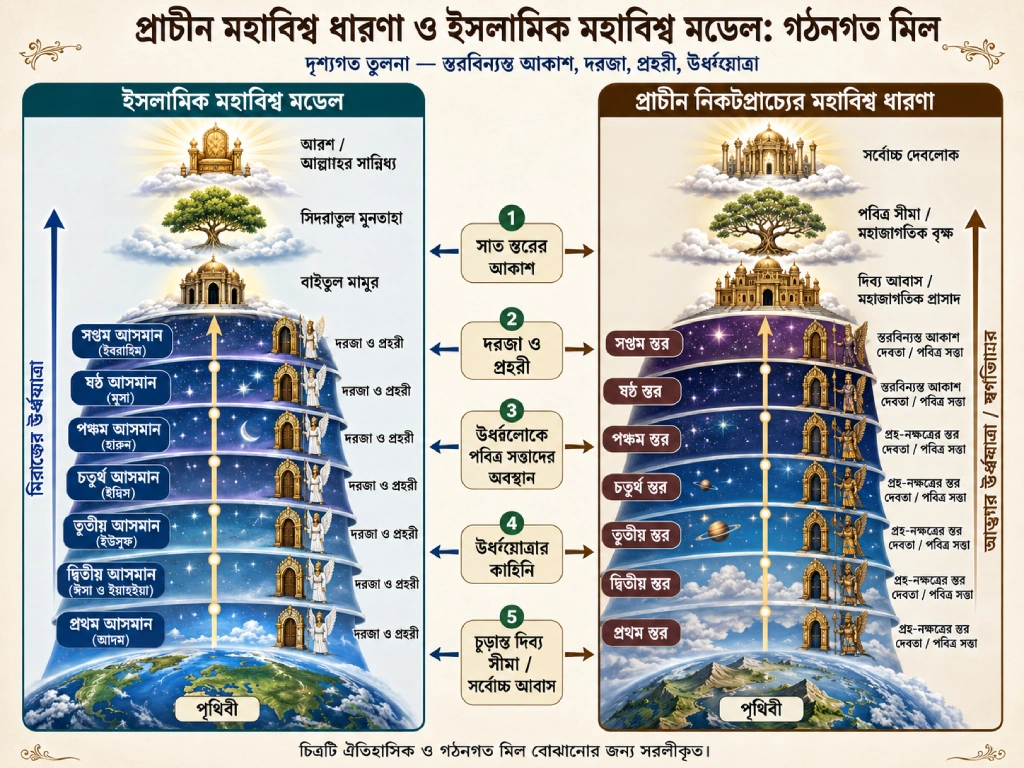
The most striking feature of Islamic accounts of the Mi‘raj is that the heavens are portrayed not as abstract spiritual levels but almost as architectural realities. There are heavens, the heavens have gates, guards stand at those gates, visitors must identify themselves and obtain permission, and only then are the gates opened. Reading this account brings to mind not modern outer space but an ancient royal palace, an imperial administrative building, a fortress, or a stratified mythological heavenly kingdom. Gabriel resembles a cosmic guide, Muhammad a specially authorised guest, and each heaven a separate security checkpoint. This is not a scientific description of the universe; it is a myth of the sky constructed in the language of ancient power, politics, and court administration. In a society where kings, courts, guards, gates, permission, and hierarchy were familiar political experiences, the imagined heaven became a similarly gated, guarded, and stratified supernatural empire. In Sahih Muslim’s account of the Mi‘raj, Gabriel asks for the gate to be opened upon reaching each heaven. Those inside ask who he is, who accompanies him, and whether he has been authorised to bring that person. The gate is then opened, and a particular prophet is encountered. [1] However thoroughly the religious language of this account is enveloped in sanctity, its imaginative structure remains profoundly human, ancient, and mythological.
Sahih Muslim (Hadith Academy Bengali Edition)
1. Faith [Belief]
Chapter: 74. The Messenger of Allah’s Mi‘raj and the Enjoining of Prayer.
Hadith Academy numbering: 300; international reference: Sahih Muslim 162a.
Sahih Muslim 162a.
حَدَّثَنَا ، حَدَّثَنَا ، حَدَّثَنَا ، عَنْ ، أَنَّ رَسُولَ اللَّهِ صلى الله عليه وسلم قَالَ ” أُتِيتُ بِالْبُرَاقِ – وَهُوَ دَابَّةٌ أَبْيَضُ طَوِيلٌ فَوْقَ الْحِمَارِ وَدُونَ الْبَغْلِ يَضَعُ حَافِرَهُ عِنْدَ مُنْتَهَى طَرْفِهِ – قَالَ فَرَكِبْتُهُ حَتَّى أَتَيْتُ بَيْتَ الْمَقْدِسِ – قَالَ – فَرَبَطْتُهُ بِالْحَلْقَةِ الَّتِي يَرْبِطُ بِهِ الأَنْبِيَاءُ – قَالَ – ثُمَّ دَخَلْتُ الْمَسْجِدَ فَصَلَّيْتُ فِيهِ رَكْعَتَيْنِ ثُمَّ خَرَجْتُ فَجَاءَنِي جِبْرِيلُ – عَلَيْهِ السَّلاَمُ – بِإِنَاءٍ مِنْ خَمْرٍ وَإِنَاءٍ مِنْ لَبَنٍ فَاخْتَرْتُ اللَّبَنَ فَقَالَ جِبْرِيلُ صلى الله عليه وسلم اخْتَرْتَ الْفِطْرَةَ . ثُمَّ عَرَجَ بِنَا إِلَى السَّمَاءِ فَاسْتَفْتَحَ جِبْرِيلُ فَقِيلَ مَنْ أَنْتَ قَالَ جِبْرِيلُ . قِيلَ وَمَنْ مَعَكَ قَالَ مُحَمَّدٌ . قِيلَ وَقَدْ بُعِثَ إِلَيْهِ قَالَ قَدْ بُعِثَ إِلَيْهِ . فَفُتِحَ لَنَا فَإِذَا أَنَا بِآدَمَ فَرَحَّبَ بِي وَدَعَا لِي بِخَيْرٍ . ثُمَّ عَرَجَ بِنَا إِلَى السَّمَاءِ الثَّانِيَةِ فَاسْتَفْتَحَ جِبْرِيلُ عَلَيْهِ السَّلاَمُ . فَقِيلَ مَنْ أَنْتَ قَالَ جِبْرِيلُ . قِيلَ وَمَنْ مَعَكَ قَالَ مُحَمَّدٌ . قِيلَ وَقَدْ بُعِثَ إِلَيْهِ قَالَ قَدْ بُعِثَ إِلَيْهِ . فَفُتِحَ لَنَا فَإِذَا أَنَا بِابْنَىِ الْخَالَةِ عِيسَى ابْنِ مَرْيَمَ وَيَحْيَى بْنِ زَكَرِيَّاءَ صَلَوَاتُ اللَّهِ عَلَيْهِمَا فَرَحَّبَا وَدَعَوَا لِي بِخَيْرٍ . ثُمَّ عَرَجَ بِي إِلَى السَّمَاءِ الثَّالِثَةِ فَاسْتَفْتَحَ جِبْرِيلُ . فَقِيلَ مَنْ أَنْتَ قَالَ جِبْرِيلُ . قِيلَ وَمَنْ مَعَكَ قَالَ مُحَمَّدٌ صلى الله عليه وسلم . قِيلَ وَقَدْ بُعِثَ إِلَيْهِ قَالَ قَدْ بُعِثَ إِلَيْهِ . فَفُتِحَ لَنَا فَإِذَا أَنَا بِيُوسُفَ صلى الله عليه وسلم إِذَا هُوَ قَدْ أُعْطِيَ شَطْرَ الْحُسْنِ فَرَحَّبَ وَدَعَا لِي بِخَيْرٍ . ثُمَّ عَرَجَ بِنَا إِلَى السَّمَاءِ الرَّابِعَةِ فَاسْتَفْتَحَ جِبْرِيلُ – عَلَيْهِ السَّلاَمُ – قِيلَ مَنْ هَذَا قَالَ جِبْرِيلُ . قِيلَ وَمَنْ مَعَكَ قَالَ مُحَمَّدٌ . قَالَ وَقَدْ بُعِثَ إِلَيْهِ قَالَ قَدْ بُعِثَ إِلَيْهِ . فَفُتِحَ لَنَا فَإِذَا أَنَا بِإِدْرِيسَ فَرَحَّبَ وَدَعَا لِي بِخَيْرٍ قَالَ اللَّهُ عَزَّ وَجَلَّ { وَرَفَعْنَاهُ مَكَانًا عَلِيًّا} ثُمَّ عَرَجَ بِنَا إِلَى السَّمَاءِ الْخَامِسَةِ فَاسْتَفْتَحَ جِبْرِيلُ . قِيلَ مَنْ هَذَا قَالَ جِبْرِيلُ . قِيلَ وَمَنْ مَعَكَ قَالَ مُحَمَّدٌ . قِيلَ وَقَدْ بُعِثَ إِلَيْهِ قَالَ قَدْ بُعِثَ إِلَيْهِ . فَفُتِحَ لَنَا فَإِذَا أَنَا بِهَارُونَ صلى الله عليه وسلم فَرَحَّبَ وَدَعَا لِي بِخَيْرٍ . ثُمَّ عَرَجَ بِنَا إِلَى السَّمَاءِ السَّادِسَةِ فَاسْتَفْتَحَ جِبْرِيلُ عَلَيْهِ السَّلاَمُ . قِيلَ مَنْ هَذَا قَالَ جِبْرِيلُ . قِيلَ وَمَنْ مَعَكَ قَالَ مُحَمَّدٌ . قِيلَ وَقَدْ بُعِثَ إِلَيْهِ قَالَ قَدْ بُعِثَ إِلَيْهِ . فَفُتِحَ لَنَا فَإِذَا أَنَا بِمُوسَى صلى الله عليه وسلم فَرَحَّبَ وَدَعَا لِي بِخَيْرٍ . ثُمَّ عَرَجَ بِنَا إِلَى السَّمَاءِ السَّابِعَةِ فَاسْتَفْتَحَ جِبْرِيلُ فَقِيلَ مَنْ هَذَا قَالَ جِبْرِيلُ . قِيلَ وَمَنْ مَعَكَ قَالَ مُحَمَّدٌ صلى الله عليه وسلم . قِيلَ وَقَدْ بُعِثَ إِلَيْهِ قَالَ قَدْ بُعِثَ إِلَيْهِ . فَفُتِحَ لَنَا فَإِذَا أَنَا بِإِبْرَاهِيمَ صلى الله عليه وسلم مُسْنِدًا ظَهْرَهُ إِلَى الْبَيْتِ الْمَعْمُورِ وَإِذَا هُوَ يَدْخُلُهُ كُلَّ يَوْمٍ سَبْعُونَ أَلْفَ مَلَكٍ لاَ يَعُودُونَ إِلَيْهِ ثُمَّ ذَهَبَ بِي إِلَى السِّدْرَةِ الْمُنْتَهَى وَإِذَا وَرَقُهَا كَآذَانِ الْفِيَلَةِ وَإِذَا ثَمَرُهَا كَالْقِلاَلِ – قَالَ – فَلَمَّا غَشِيَهَا مِنْ أَمْرِ اللَّهِ مَا غَشِيَ تَغَيَّرَتْ فَمَا أَحَدٌ مِنْ خَلْقِ اللَّهِ يَسْتَطِيعُ أَنْ يَنْعَتَهَا مِنْ حُسْنِهَا . فَأَوْحَى اللَّهُ إِلَىَّ مَا أَوْحَى فَفَرَضَ عَلَىَّ خَمْسِينَ صَلاَةً فِي كُلِّ يَوْمٍ وَلَيْلَةٍ فَنَزَلْتُ إِلَى مُوسَى صلى الله عليه وسلم فَقَالَ مَا فَرَضَ رَبُّكَ عَلَى أُمَّتِكَ قُلْتُ خَمْسِينَ صَلاَةً . قَالَ ارْجِعْ إِلَى رَبِّكَ فَاسْأَلْهُ التَّخْفِيفَ فَإِنَّ أُمَّتَكَ لاَ يُطِيقُونَ ذَلِكَ فَإِنِّي قَدْ بَلَوْتُ بَنِي إِسْرَائِيلَ وَخَبَرْتُهُمْ . قَالَ فَرَجَعْتُ إِلَى رَبِّي فَقُلْتُ يَا رَبِّ خَفِّفْ عَلَى أُمَّتِي . فَحَطَّ عَنِّي خَمْسًا فَرَجَعْتُ إِلَى مُوسَى فَقُلْتُ حَطَّ عَنِّي خَمْسًا . قَالَ إِنَّ أُمَّتَكَ لاَ يُطِيقُونَ ذَلِكَ فَارْجِعْ إِلَى رَبِّكَ فَاسْأَلْهُ التَّخْفِيفَ . – قَالَ – فَلَمْ أَزَلْ أَرْجِعُ بَيْنَ رَبِّي تَبَارَكَ وَتَعَالَى وَبَيْنَ مُوسَى – عَلَيْهِ السَّلاَمُ – حَتَّى قَالَ يَا مُحَمَّدُ إِنَّهُنَّ خَمْسُ صَلَوَاتٍ كُلَّ يَوْمٍ وَلَيْلَةٍ لِكُلِّ صَلاَةٍ عَشْرٌ فَذَلِكَ خَمْسُونَ صَلاَةً . وَمَنْ هَمَّ بِحَسَنَةٍ فَلَمْ يَعْمَلْهَا كُتِبَتْ لَهُ حَسَنَةً فَإِنْ عَمِلَهَا كُتِبَتْ لَهُ عَشْرًا وَمَنْ هَمَّ بِسَيِّئَةٍ فَلَمْ يَعْمَلْهَا لَمْ تُكْتَبْ شَيْئًا فَإِنْ عَمِلَهَا كُتِبَتْ سَيِّئَةً وَاحِدَةً – قَالَ – فَنَزَلْتُ حَتَّى انْتَهَيْتُ إِلَى مُوسَى صلى الله عليه وسلم فَأَخْبَرْتُهُ فَقَالَ ارْجِعْ إِلَى رَبِّكَ فَاسْأَلْهُ التَّخْفِيفَ . فَقَالَ رَسُولُ اللَّهِ صلى الله عليه وسلم فَقُلْتُ قَدْ رَجَعْتُ إِلَى رَبِّي حَتَّى اسْتَحْيَيْتُ مِنْهُ ” .
English translation (Sunnah.com):
It is narrated on the authority of Anas b. Malik that the Messenger of Allah (ﷺ) said:
I was brought al-Buraq Who is an animal white and long, larger than a donkey but smaller than a mule, who would place his hoof a distance equal to the range of vision. I mounted it and came to the Temple (Bait Maqdis in Jerusalem), then tethered it to the ring used by the prophets. I entered the mosque and prayed two rak’ahs in it, and then came out and Gabriel brought me a vessel of wine and a vessel of milk. I chose the milk, and Gabriel said: You have chosen the natural thing.
Then he took me to heaven. Gabriel then asked the (gate of heaven) to be opened and he was asked who he was. He replied: Gabriel. He was again asked: Who is with you? He (Gabriel) said: Muhammad. It was said: Has he been sent for? Gabriel replied: He has indeed been sent for. And (the door of the heaven) was opened for us and lo! we saw Adam. He welcomed me and prayed for my good.
Then we ascended to the second heaven. Gabriel (peace be upon him) (asked the door of heaven to be opened), and he was asked who he was. He answered: Gabriel; and was again asked: Who is with you? He replied: Muhammad. It was said: Has he been sent for? He replied: He has indeed been sent for. The gate was opened. When I entered ‘Isa b. Maryam and Yahya b. Zakariya (peace be upon both of them), cousins from the maternal side. welcomed me and prayed for my good
Then I was taken to the third heaven and Gabriel asked for the opening (of the door). He was asked: Who are you? He replied: Gabriel. He was (again) asked: Who is with you? He replied Muhammad (ﷺ). It was said: Has he been sent for? He replied He has indeed been sent for. (The gate) was opened for us and I saw Yusuf (peace of Allah be upon him) who had been given half of (world) beauty. He welcomed me prayed for my well-being.
Then he ascended with us to the fourth heaven. Gabriel (peace be upon him) asked for the (gate) to be opened, and it was said: Who is he? He replied: Gabriel. It was (again) said: Who is with you? He said: Muhammad. It was said: Has he been sent for? He replied: He has indeed been sent for. The (gate) was opened for us, and lo! Idris was there. He welcomed me and prayed for my well-being (About him) Allah, the Exalted and the Glorious, has said:” We elevated him (Idris) to the exalted position” (Qur’an xix. 57).
Then he ascended with us to the fifth heaven and Gabriel asked for the (gate) to be opened. It was said: Who is he? He replied Gabriel. It was (again) said: Who is with thee? He replied: Muhammad. It was said Has he been sent for? He replied: He has indeed been sent for. (The gate) was opened for us and then I was with Harun (Aaron-peace of Allah be upon him). He welcomed me prayed for my well-being.
Then I was taken to the sixth heaven. Gabriel (peace be upon him) asked for the door to be opened. It was said: Who is he? He replied: Gabriel. It was said: Who is with thee? He replied: Muhammad. It was said: Has he been sent for? He replied: He has indeed been sent for. (The gate) was opened for us and there I was with Musa (Moses peace be upon him) He welcomed me and prayed for my well-being.
Then I was taken up to the seventh heaven. Gabriel asked the (gate) to be opened. It was said: Who is he? He said: Gabriel It was said. Who is with thee? He replied: Muhammad (may peace be upon him.) It was said: Has he been sent for? He replied: He has indeed been sent for. (The gate) was opened for us and there I found Ibrahim (Abraham peace be upon him) reclining against the Bait-ul-Ma’mur and there enter into it seventy thousand angels every day, never to visit (this place) again. Then I was taken to Sidrat-ul-Muntaha whose leaves were like elephant ears and its fruit like big earthenware vessels.
And when it was covered by the Command of Allah, it underwent such a change that none amongst the creation has the power to praise its beauty. Then Allah revealed to me a revelation and He made obligatory for me fifty prayers every day and night. Then I went down to Moses (peace be upon him) and he said: What has your Lord enjoined upon your Ummah? I said: Fifty prayers. He said: Return to thy Lord and beg for reduction (in the number of prayers), for your community shallnot be able to bear this burden. as I have put to test the children of Isra’il and tried them (and found them too weak to bear such a heavy burden).
He (the Holy Prophet) said: I went back to my Lord and said: My Lord, make things lighter for my Ummah. (The Lord) reduced five prayers for me. I went down to Moses and said. (The Lord) reduced five (prayers) for me, He said: Verily thy Ummah shall not be able to bear this burden; return to thy Lord and ask Him to make things lighter.
I then kept going back and forth between my Lord Blessed and Exalted and Moses, till He said: There are five prayers every day and night. O Muhammad, each being credited as ten, so that makes fifty prayers. He who intends to do a good deed and does not do it will have a good deed recorded for him; and if he does it, it will be recorded for him as ten; whereas he who intends to do an evil deed and does not do, it will not be recorded for him; and if he does it, only one evil deed will be recorded.
I then came down and when I came to Moses and informed him, he said: Go back to thy Lord and ask Him to make things lighter. Upon this the Messenger of Allah remarked: I returned to my Lord until I felt ashamed before Him.
Bengali edition cross-references: Islamic Foundation 308; Islamic Centre 319.
Notes from the Bengali edition:
1. Qadi ‘Iyad states that there is disagreement over whether the Mi‘raj occurred bodily or in a dream. Some say that it occurred in a dream. This is an extremely weak position. The majority of earlier and later scholars, jurists, and hadith specialists hold that the Prophet’s Mi‘raj took place bodily while he was awake. The hadith provide explicit evidence of this. There is no reason or scope to give the hadith a contrary interpretation or alternative figurative explanation. (Abridged from al-Nawawi.)
Khadijah died before the Mi‘raj. Her death is reported to have occurred in Ramadan of the tenth year of prophethood. The Mi‘raj therefore occurred after this, not before it. (Al-Rahiq al-Makhtum, Bengali translation by Khadijah Akhtar Reza’i, p. 166.)
2. Imam al-Nawawi states that several points can be learnt from this hadith: (1) If someone inside a house asks a visitor, “Who is it?”, the visitor should not reply, “Me,” but should state their name. (2) The heavens have gates. (3) There are guards at the gates. (4) A guest may be welcomed with “Marhaban” as a mark of honour. This is the practice of the prophets.
3. Above, in the sky opposite the Bayt Allah, there is a house called “al-Bayt al-Ma‘mur.” It is called al-Bayt al-Ma‘mur because the house is always well attended: seventy thousand new angels come to worship there every day. Those who come once never have another opportunity to return. This indicates how many angels Allah has. Al-Bayt al-Ma‘mur is in the seventh heaven. Abraham was sitting with his back towards al-Bayt al-Ma‘mur. This hadith also establishes that it is permissible to sit with one’s back towards the Bayt Allah.
4. “Sidrat al-Muntaha” is a lote tree above the seventh heaven and the utmost boundary of the angels’ movement. Or it is the final limit of ascent. In other words, no one except Allah knows what lies above Sidrat al-Muntaha. Ibn ‘Abbas states that it is called Sidrat al-Muntaha because the angels’ knowledge and movement end there. They cannot proceed beyond it, except for the Messenger of Allah. Those above come to this point and stop; they cannot descend further. Those below come to this point and stop; they cannot ascend further. This is Allah’s command.
This hadith establishes that Allah is seated upon the Throne and spoke directly with the Prophet. There is no scope for misinterpreting this. During this conversation, the obligatory prayers were reduced from fifty to five.
Hadith grading: Sahih.
Narrator: Anas ibn Malik.
Sunnah.com reference: Sahih Muslim 162a; in-book reference: Book 1, Hadith 316; USC-MSA English reference: Book 1, Hadith 309.
A New Version at the Confluence of Ancient Myths
When the roots of this Mi‘raj narrative are examined, it no longer appears to be an isolated “miraculous event” that suddenly arose in the Arabian desert. Rather, it appears to be an Islamic reconstruction of longstanding ancient Near Eastern motifs: myths of the sky, stratified heavens, the palaces of gods, heavenly gates, guards, the ascent of the soul, and visits to heaven and hell. In Mesopotamian and Babylonian cosmology, the sky was not boundless empty space; it was a layered cosmic realm in which ideas of gods, stars, planets, palaces, entrances, and higher worlds overlapped. The special status of the number seven in Babylonian astral theology, the connection between the seven visible celestial bodies and cosmic stratification, and the tendency to imagine the sky as an administrative realm of the gods recur in different forms in later Jewish, Christian, Gnostic, Mandaean, and Islamic literature of celestial ascent. [2] Similarly, the Zoroastrian Arda Viraf Namag describes the soul of a religious figure travelling through heaven and hell, witnessing the fate of the righteous and the sinful, and subsequently returning to recount that supernatural experience. Its structural resemblance to the Mi‘raj is so clear that dismissing it as mere coincidence would be a weak explanation. [3] Although the identity of those referred to as Sabians in the Quran is disputed, Mandaean religious literature also contains accounts of the soul’s ascent, guards or checkpoints along celestial routes, and movement towards the world of light. In other words, the late antique Near East in which Islam emerged was already full of stories of celestial journeys, layered heavens, gates, guards, and supernatural encounters. [4] It is therefore more reasonable to read the Mi‘raj as an Islamic version of ancient celestial mythology than as history or space science. The names of the prophets, angels, and Allah have been inserted, but the imaginative framework comes from the old mythological repertoire—in which the sky was a gated royal palace, the universe a religious bureaucracy, and the divine realm could not transcend the imperial fantasies constructed by human beings.
The Seven Heavens: An Islamic Version of an Ancient Worldview
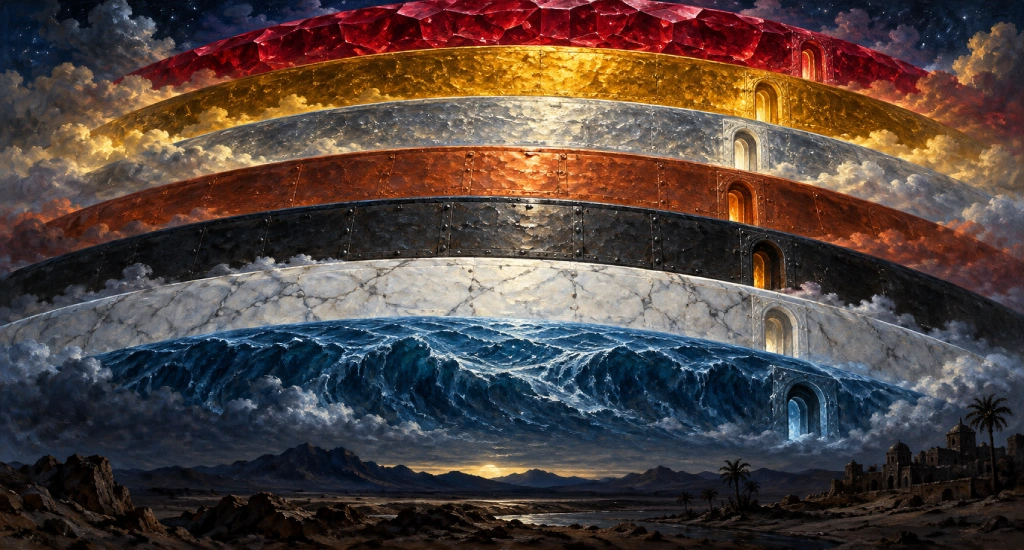
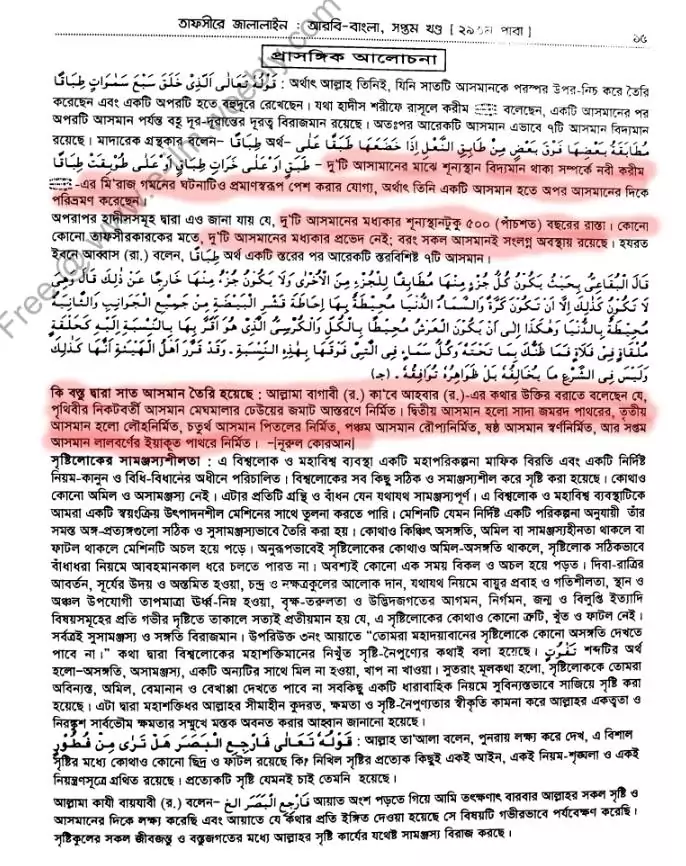
The seven heavens of the Mi‘raj narrative do not represent a modern scientific conception of outer space; they directly reflect the layered cosmology of ancient people. Today we know that there is no metallic roof above the earth, no golden heaven, no layer of brass, no sky made of iron, and no gates in space at which angels stand checking visitors’ identities. In ancient cosmology, however, the sky was frequently imagined as a solid dome, a series of layers, a roof, a palace, or the dwelling place of gods. This is why, in Islamic accounts, heaven is not merely “the direction above”; it is a constructed world with materials, gates, guards, inhabitants, and administrative protocols. The account of the materials of the seven heavens attributed to Ka‘b al-Ahbar in the Bengali edition of Tafsir al-Jalalayn—the first heaven a solidified layer of cloud waves, the second white emerald, the third iron, the fourth brass, the fifth silver, the sixth gold, and the seventh red ruby—makes clear that the sky is imagined here through the language of gems, metals, and royal architecture rather than astronomical reality. [5]
What materials are the seven heavens made of? Al-Baghawi, citing a statement attributed to Ka‘b al-Ahbar, says that the heaven nearest the earth is made from a solidified layer of cloud waves. The second heaven is made of white emerald, the third of iron, the fourth of brass, the fifth of silver, the sixth of gold, and the seventh of red ruby. [Nur al-Quran]
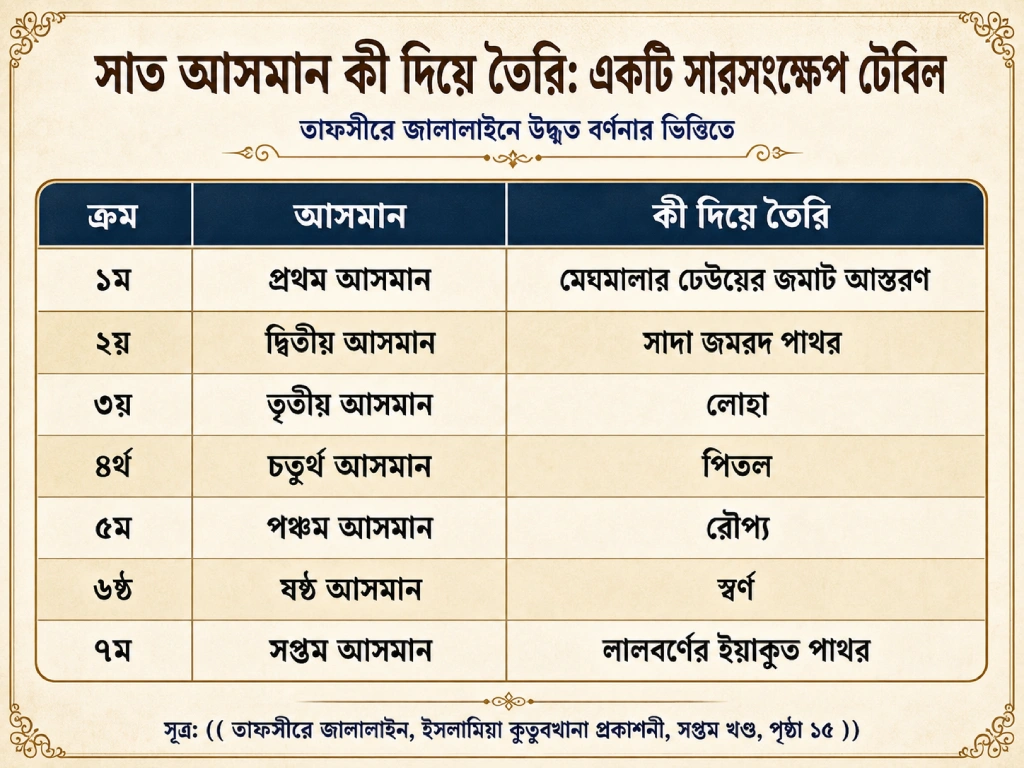
This kind of imagination is the product of an ancient mentality in which the sky meant a stairway to a divine kingdom beyond the visible blue dome, and the universe meant a cosmic replica of human social arrangements, courts, power, guards, and hierarchies. Modern telescopes, spectroscopy, spacecraft, and astrophysics have found no evidence of these heavens. Calling them descriptions of the real universe therefore amounts to an affront to knowledge. They are religious fantasies written in the language of ancient myths: human beings projected their own limited earthly world into the sky and then proclaimed it a divinely revealed truth.
The Materials of the Heavens in Classical Texts: Layers of Solidified Waves, Stone, Metal, and Gems
Descriptions imagining the heavens as layers of metal and gems are not confined to an isolated note in a Bengali tafsir. Classical Arabic works also compile explicit statements about the number, arrangement, and construction materials of the heavens. In these accounts, the sky is not an indeterminate empty expanse but a constructed cosmic structure with one layer placed above another. Its materials are variously described as confined waves, white stone, iron, copper, silver, gold, and ruby. The issue is therefore not merely the religious grandeur of the heavens; it is also the direct question of what kind of objects people imagined them to be.
One Heaven above Another: Al-Baghawi’s Explanation of the Layers
In explaining the expression “seven heavens in layers” in the third verse of Surah al-Mulk, al-Husayn ibn Mas‘ud al-Baghawi describes the heavens as layers situated above one another. His relevant explanation reads: [6]
﴿الَّذِي خَلَقَ سَبْعَ سَمَاوَاتٍ طِبَاقًا﴾ طَبَقًا عَلَى طَبَقٍ بَعْضُهَا فَوْقَ بَعْضٍ.
English translation: “‘He who created seven heavens in layers’—one layer above another, some of them above others.”
This explanation does not call the seven heavens seven moral ranks or states of mind; it establishes an upward and downward spatial relationship between them. It provides a foundation for understanding the subsequent accounts of their materials: the heavens are separate layers, and each layer is described as being constructed from a particular substance. Combining “layers” and “materials” produces the picture of a constructed architecture.
The List of Materials of the Seven Heavens in Al-Suyuti’s Compilation
In the section “The Characteristics of the Seven Heavens” in his book al-Hay’ah al-Saniyyah fi al-Hay’ah al-Sunniyyah, Jalal al-Din ‘Abd al-Rahman al-Suyuti compiles a detailed list attributed to al-Rabi‘ ibn Anas. A separate material is specified for every heaven, from the lowest to the seventh: [7]
وأخرج إسحاق بن راهويه في مسنده، والطبراني في الأوسط، والترمذي، وابن المنذر، عن الربيع بن أنس قال: (السماء الدنيا: موج مكفوف، والثانية: مرمرة بيضاء، والثالثة: حديد، والربعة: نحاس، والخامسة: فضة، والسادسة: ذهب، والسابعة: ياقوتة حمراء).
English translation: “Ishaq ibn Rahawayh in his Musnad, al-Tabarani in al-Awsat, al-Tirmidhi, and Ibn al-Mundhir transmitted from al-Rabi‘ ibn Anas, who said: The lowest heaven is confined waves; the second is white marble; the third is iron; the fourth is copper; the fifth is silver; the sixth is gold; and the seventh is red ruby.”
The terms used here deserve attention. “Iron,” “copper,” “silver,” “gold,” and “ruby” are the names of specific substances familiar to human beings. These substances are directly associated with separate layers of heaven. There is therefore no basis for presenting them as predictions of discoveries in modern astronomy. In its own wording, the account describes a sky constructed from metals and gems. This tendency to arrange cosmic layers using familiar building materials and valuable possessions reveals the nature of the ancient imagination: just as earthly palaces are enriched with precious stones and metals, the higher regions of the sky are imagined as being constructed from increasingly valuable materials.
A Different List in the Same Book: Is the First Heaven Waves or Green Emerald?
On the very next page of the same book, al-Suyuti includes another list of the heavens’ materials and names attributed to Salman al-Farisi. Al-Suyuti himself describes its chain of transmission as extremely weak. Here, the first heaven is said to be made of green emerald rather than confined waves, the second of white silver rather than white marble, and the seventh of light rather than red ruby: [8]
وأخرج أبو الشيخ – بسند واه – عن سلمان الفارسي قال: (السماء الدنيا: من زمردة خضراء واسمها رقيعاء، والثانية: من فضة بيضاء واسمها أزقلون، والثالثة: من ياقوتة حمراء واسمها قيدوم، والرابعة: من درة بيضاء واسمها ماعونا، والخامسة: من ذهبة حمراء واسمها ريقا، والسادسة: من ياقوتة صفراء واسمها دقناء، والسابعة: من نور واسمها عريبا).
English translation: “Abu al-Shaykh transmitted, through an extremely weak chain, from Salman al-Farisi, who said: The lowest heaven is made of green emerald, and its name is Raqi‘a’; the second is made of white silver, and its name is Azqalun; the third is made of red ruby, and its name is Qaydum; the fourth is made of white pearl, and its name is Ma‘una; the fifth is made of red gold, and its name is Riqa; the sixth is made of yellow ruby, and its name is Daqna’; and the seventh is made of light, and its name is ‘Ariba.”
There are clear differences between the construction materials in these two lists. The same heaven is waves in one account and emerald in another, iron in one and ruby in another. Yet the imaginative framework of both accounts is the same: the sky is divided into seven separate layers and adorned with familiar metals, stones, gems, and light. The variability of the lists raises a direct question: if the actual construction materials of the heavens were known, why would contradictory lists of materials for the same layers arise? No observation, measurement, or experiment is used here to establish one list over the other. Giving the accounts religious prestige cannot fill this gap in material knowledge.
The historical significance of these statements compiled under the names of al-Rabi‘ ibn Anas and Salman al-Farisi is that they are specific examples of conceptions of the sky circulating in classical religious literature. Repeating lists of the heavens’ materials and demonstrating the existence of those materials are not the same thing. A claim that the sky is constructed from layers of iron, copper, silver, or gems concerns material reality; establishing its truth requires material evidence. Finding a list in a book demonstrates that the list exists in literature, not that the architecture it describes exists in the universe. This distinction exposes the fundamental epistemic problem with the idea of metallic and gem-built heavens.
The Intellectual Crisis of Metallic Heavens and a Universe with Gates
Describing the seven heavens as made of clouds, emerald, iron, brass, silver, gold, and red ruby is not merely an unusual religious fantasy; it is a complete pre-scientific picture of the universe. The sky is not conceived here in terms of gas, plasma, stellar systems, galaxies, cosmic radiation, or the expansion of space-time. Instead, it is imagined as supernatural architecture constructed from familiar substances: metals, stones, gems, and solidified cloud layers. In this account, the universe resembles not a physical reality but a layered building constructed like a royal palace: the earth below, successive solid heavens above it, gates at each level, guards at the gates, and divine authority at the summit. This imagination does not transcend human experience; it merely transfers human markets, fortresses, courts, treasures, architecture, and administrative structures into the sky. Its mythological character is laid bare here. If an omniscient creator were genuinely explaining the nature of the universe, he would not describe the sky as layers of iron, brass, gold, and ruby. Such descriptions come from people who knew neither telescopes nor gravitation, neither the nature of stars nor galaxies, and for whom it was natural to imagine the blue expanse overhead as an actual solid dome. This material inventory of the seven heavens is therefore not a cosmic truth; it is a cosmic fairy tale produced by a mixture of limited ancient knowledge, a fascination with treasure, and religious authority.
Conclusion
The seven heavens of the Mi‘raj, the gated skies, the guardian angels, the deceased prophets situated at successive levels, Sidrat al-Muntaha, al-Bayt al-Ma‘mur, and skies made of metals and gems cannot be accepted as an actual description of the universe revealed by modern knowledge. They belong to a cosmology whose every layer bears the imprint of ancient imagination, mythological inheritance, and the power structures of human society. The universe is pictured as a royal palace: the ordinary world below, stratified elite regions above, gates and guards at every level, and a divine throne at the summit. This is not science; it is feudal administration projected into the sky. Turning earthly courts, guards, permission, thrones, treasures, and hierarchies into the structure of the universe is the essential character of this narrative.
Blindly accepting the Mi‘raj narrative as “miraculous truth” is therefore a surrender of knowledge. Its structural resemblance to the celestial ascent myths of Mesopotamian, Babylonian, Zoroastrian, Mandaean, and late antique Near Eastern traditions is so strong that presenting it as a wholly isolated, divine, and original event is intellectually untenable. The more honest explanation is that Islam constructed a new version of earlier celestial myths by inserting its own prophet, angels, Allah, prayers, and religious authority. Placing Islamic language over an older mythological structure does not transform it into cosmic truth.
The universe revealed by modern astronomy contains no iron heaven, no brass heaven, no golden layer, no sky of ruby, and no guards standing at gates in outer space. It contains stars, planets, galaxies, gravity, radiation, dark matter, the expansion of space-time, and the rigorous laws of observable nature. Religious narratives do not explain this reality; in many cases, they instead cloak ancient ignorance in sanctity. Clinging to this model of seven heavens as truth is therefore not an attempt to understand the universe but an effort to preserve ancient misconceptions in God’s name. Where reason, history, and science converge, the conclusion is clear: these heavens are not real outer space; they are the gated skies of ancient mythology, in which the human imagination is more visible than God.
References
- Sahih Muslim 162a; Hadith Academy Bengali edition, hadith 300 ↩︎
- Wayne Horowitz, Mesopotamian Cosmic Geography, Eisenbrauns, 1998 ↩︎
- The Book of Arda Viraf, translated by Martin Haug and E. W. West ↩︎
- Jorunn Jacobsen Buckley, The Mandaeans: Ancient Texts and Modern People, Oxford University Press, 2002 ↩︎
- Tafsir al-Jalalayn, Islamiya Kutubkhana Publications, vol. 7, p. 15 ↩︎
- Al-Husayn ibn Mas‘ud al-Baghawi, Ma‘alim al-Tanzil, commentary on Surah al-Mulk 67:3 ↩︎
- Jalal al-Din al-Suyuti, Asrar al-Kawn = al-Hay’ah al-Saniyyah fi al-Hay’ah al-Sunniyyah, “Sifat al-Samawat al-Sab‘,” Dar al-Kutub al-‘Ilmiyyah, Beirut, first edition, 1427 AH/2006, p. 45 ↩︎
- Jalal al-Din al-Suyuti, Asrar al-Kawn = al-Hay’ah al-Saniyyah fi al-Hay’ah al-Sunniyyah, Dar al-Kutub al-‘Ilmiyyah, Beirut, first edition, 1427 AH/2006, p. 46 ↩︎