

Introduction
One of the fundamental foundations of justice and the rule of law is the equal dignity of all people before the law and their equal rights in judicial proceedings. When a crime is committed, adjudication should depend on the facts of the incident, the reliability of the evidence, and the accused person’s involvement in the offense. Whether an eyewitness is telling the truth, whether that person was present at the scene, whether their account is consistent with other evidence, and how reliable their testimony is—these are matters for judicial examination. A witness’s religious identity, personal beliefs, or membership in a particular religious community does not determine whether their statement is true. A Muslim can tell the truth, just as a Hindu, Buddhist, Christian, or atheist can. Likewise, followers of any religion can give false testimony. There is no necessary relationship between a person’s religious identity and their truthfulness or dishonesty. Yet classical Islamic Sharia law of evidence establishes a discriminatory rule that runs directly contrary to this elementary reasoning. Under the prevailing rules of Islamic jurisprudence, a non-Muslim’s judicial testimony against a Muslim is generally inadmissible. Conversely, a Muslim’s testimony against a non-Muslim is admissible. Thus, within the same judicial system, two people’s right to testify is determined differently on the basis of their religious identities. This is not an impartial judicial principle; it is institutional discrimination established on the basis of religion.
This provision of Islamic jurisprudence is not confined to an isolated scholar’s personal opinion or to the social customs of one region. Classical legal texts of the Hanafi, Maliki, Shafi’i, and Hanbali schools contain rules that reject non-Muslim testimony against Muslims. These schools treat a person’s religious identity as a fundamental qualification in determining the admissibility of testimony. Hanafi jurisprudence, in particular, explains testimony as a means of exercising legal authority over another person and, on that basis, denies non-Muslims the right to exercise such authority over Muslims. Consequently, the question of admitting testimony is not confined to establishing the truth; it is bound up with notions of religious superiority and authority. Even if a non-Muslim eyewitness tells the complete truth, even if their statement agrees with other facts, and even if they personally witnessed a crime, their formal judicial testimony against a Muslim may be rejected solely because they are not Muslim. Here religious identity is made a ground of disqualification before the witness’s truthfulness is even assessed. This religion-based classification of testimony rejects the equal dignity of human beings and establishes unequal legal powers for Muslims and non-Muslims.
The most devastating consequences of this discriminatory provision may arise when religious minorities who have been subjected to crimes seek justice. For example, if a Muslim attacks a non-Muslim family and kills one or more of its members, and the only eyewitnesses to the killings are the surviving non-Muslim members of that family, their testimony against the Muslim accused will not be admissible as formal judicial testimony under the prevailing rule of classical Islamic evidence law. Even if there are ten eyewitnesses, even if they give consistent accounts of the same incident, and even if each is personally truthful, the obstacle to admitting their testimony remains because of their religious identity. If there is no other admissible evidence of the crime, this rule may prevent the crime from being proved and allow the accused to escape punishment. Similar problems may arise in cases involving the seizure of property, assaults, arson, and other crimes. Under such a judicial framework, a non-Muslim’s greatest disadvantage is not the weakness of their testimony but their religious identity. Before considering what they saw, what they know, or how truthfully they speak, the religion they follow determines their judicial rights. As a result, instead of facilitating an investigation into the facts of a crime, the witness’s religious identity becomes a barrier at the threshold of the judicial process.
Religious discrimination of this kind in the judicial system does not merely restrict an individual witness’s rights; it also damages the legal security of crime victims, their families, and entire religious minority communities. In a system where a non-Muslim’s testimony against a Muslim is inadmissible but a Muslim’s testimony against a non-Muslim is admissible, members of the two communities do not enjoy equal legal standing. The statements of members of one community are given legal force, while members of another are denied that force because of their religion. This inequality does not depend on a judge’s personal prejudice; the discrimination is built directly into the structure of the law. The principle of equal status before the law and equal protection without discrimination, recognized in the Universal Declaration of Human Rights, is directly contradicted by this rule of Islamic jurisprudence. When a judicial system rejects a person’s testimony solely because of their religious beliefs, it prioritizes religious identity over the search for truth. This is not justice; it is the institutionalization of religious discrimination through law. Rejecting the testimony of a truthful eyewitness because of religious identity while giving a witness of another religion legal standing in the same circumstances directly contradicts human dignity, reason, and the fundamental requirements of justice.
Religious Identity and Legal Restrictions on Testimony
The rule under Islamic Sharia that a non-Muslim’s testimony against a Muslim is inadmissible is profoundly discriminatory, divisive, and ethically unacceptable. It is a deeply discriminatory principle under which an innocent non-Muslim is deprived of the right to have their truthful statement and testimony admitted solely because of their religious identity. A law that makes justice depend on religion entrenches religious inequality and injustice in society. Under this rule, if every eyewitness to a killing is a non-Muslim, their eyewitness testimony against a Muslim defendant is inadmissible as judicial testimony under the prevailing rules of classical jurisprudence. Before examining whether they actually witnessed the crime, how many there are, or how closely their accounts agree, their religious identity becomes the reason for rejecting their testimony. Thus, even if a Muslim is guilty of a crime, that person may escape liability in an Islamic court because of their religious identity. This not only threatens the security and human rights of non-Muslims, but also fundamentally obstructs the establishment of justice in society. Such a law grants Muslims a special advantage while undermining the rights and dignity of non-Muslims.
Rejecting judicial testimony on the basis of religious identity violates the fundamental principles of justice. Islamic jurisprudence has treated testimony as a means of exercising legal authority over another person and, on that basis, deprived non-Muslims of the right to testify against Muslims. As a result, instead of the facts of a crime, the witness’s honesty, and the reliability of eyewitness evidence, a religious hierarchy determines judicial rights. This provision grants Muslims a special legal advantage and denies non-Muslims equal standing before the courts. [1] —
Chapter Ten: Concerning the Testimony of Non-Muslims
1. Legal ruling: The testimony of an unbeliever against a Muslim is not admissible (Al-Muhit: Al-Sarakhsi).
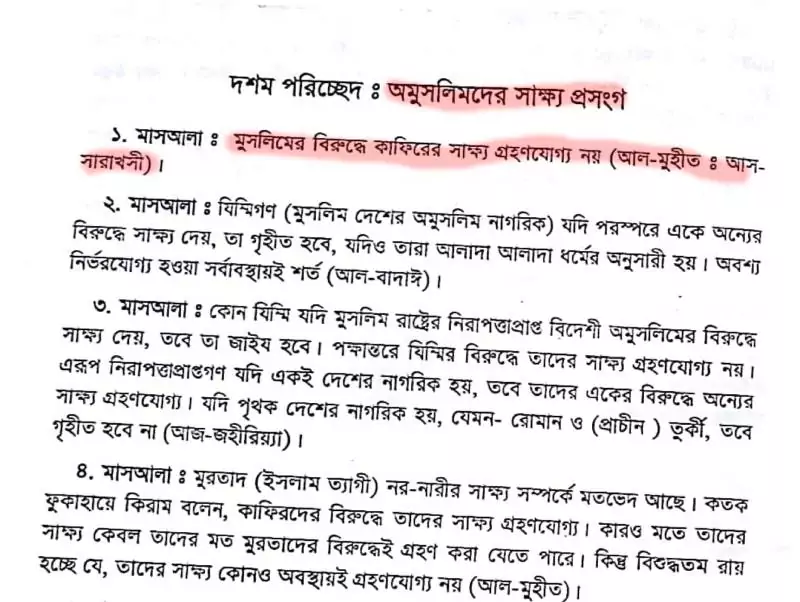
On page 94 of his book Islamer Sakshya Ain (The Law of Evidence in Islam), Muhammad Khalilur Rahman Mumin identifies being Muslim as a qualification for witnesses and declares non-Muslim testimony inadmissible in matters concerning Muslim interests. The book also describes separate scopes for accepting testimony in criminal cases, civil cases, and disputes among non-Muslims. [2]
(2) The witness must be Muslim:
Although non-Muslim testimony is admissible in many criminal cases, it is not admissible under civil law. The book Al-Fiqh al-Islami states that the witness must be Muslim. Jurists are in agreement on this point. Therefore, non-Muslim testimony is not admissible in matters concerning the interests of Muslims. They may, however, testify in matters concerning their own interests. 28 For Allah, Glorified and Exalted, has said:
وَالَّذِينَ كَفَرُوا بَعْضُهُمْ أَوْلِيَاءُ بَعْضٍ.
“Those who disbelieve are protectors of one another.” 29
It is narrated from Jabir ibn Abd Allah:
أَنَّ النَّبِيُّ صَلَّى اللهُ عَلَيْهِ وَسَلَّمَ أَجَازَ شَهَادَةَ أَهْلِ الذِّمَّةِ بَعْضُهُمْ عَلَى بَعْضٍ.
The Prophet (peace and blessings be upon him) permitted non-Muslim dhimmis to testify concerning one another.

The rules cited in these Bengali-language books are also established directly in Arabic works of Islamic jurisprudence. Those works do not treat testimony solely as a matter of firsthand knowledge or truthfulness; they link admissibility to religious allegiance, legal authority, and the witness’s position in matters of faith. Consequently, even if two people witness the same event in exactly the same way, one person’s testimony may be accepted because they are Muslim while the other’s is rejected because they are not.
The Hanafi jurist al-Kasani explains the basis of this rule in Bada’i al-Sana’i fi Tartib al-Shara’i, in the discussion of the conditions of testimony in the Book of Testimonies. In his reasoning, testimony constitutes a form of authority by which one’s legal statement is made effective against another person; non-Muslims are not granted that authority over Muslims. The same discussion also states that Muslim testimony against a non-Muslim is admissible. [3]
إسلام الشاهد إذا كان المشهود عليه مسلما، حتى لا تقبل شهادة الكافر على المسلم؛ لأن الشهادة فيها معنى الولاية، وهو تنفيذ القول على الغير.
English translation: If the person against whom testimony is given is a Muslim, the witness must be Muslim. Thus, the testimony of an unbeliever against a Muslim is not accepted, because testimony contains the meaning of authority (wilaya): making one person’s statement effective against another.
In this explanation, the criterion for admitting testimony shifts away from truth or falsehood and becomes a question of who is entitled to exercise authority. Before assessing how reliable a non-Muslim eyewitness is, their religious identity is made a disqualification from testifying against a Muslim. No equivalent religious restriction is imposed on Muslim witnesses in the opposite case. This is not equal legal standing for equal persons; it is a one-sided allocation of judicial power based on religious identity.
The early and influential Maliki legal compilation Al-Mudawwana records Malik’s position in response to a question about the will of a Muslim who dies while traveling. It rejects non-Muslim witnesses both during travel and while residing at home. [4]
لم يكن مالك يجيز شهادة أحد من أهل الكفر، لا في سفر ولا في حضر، ولا أرى أن تجوز شهادتهم.
English translation: Malik did not permit the testimony of any of the unbelievers, whether while traveling or while residing at home. The narrator also said that he did not consider their testimony admissible.
The Shafi’i jurist al-Mawardi takes an even more restrictive position concerning testimony in disputes among non-Muslims in his Al-Hawi al-Kabir. According to the Shafi’i position, non-Muslim testimony is generally inadmissible not only against Muslims but also in disputes among non-Muslims themselves. The same discussion records the different Hanafi rule allowing testimony among non-Muslims. [5]
وأما الكافر فلا تقبل شهادته لمسلم، ولا عليه.
English translation: As for an unbeliever, their testimony is not accepted in favor of a Muslim, nor against a Muslim.
In the same discussion, al-Mawardi states that, under the Shafi’i school, non-Muslim testimony is inadmissible even in lawsuits between non-Muslims. Accordingly, non-Muslims who bring a complaint against a Muslim face a barrier which, under this Shafi’i position, may also arise in disputes among members of their own community. The Hanafi permission for non-Muslims to testify in cases involving one another does not remove the inequality in their ability to testify against Muslims. [6]
أحدها : وهو مذهب الشافعي أنه لا تقبل شهادتهم بحال سواء اتفقت مللهم أو اختلفت.
English translation: The first opinion, which is the school of al-Shafi’i, is that their testimony is not accepted under any circumstances, whether their religious communities are the same or different.
In Bidayat al-Mujtahid wa Nihayat al-Muqtasid, in the chapter on adjudication and testimony, Ibn Rushd presents being Muslim as an established condition in Islamic jurisprudence. He specifically records the disagreement over an exception allowing non-Muslim testimony concerning wills made during travel. [7]
وأما الإسلام فاتفقوا على أنه شرط في القبول، وأنه لا تجوز شهادة الكافر، إلا ما اختلفوا فيه من جواز ذلك في الوصية في السفر.
English translation: As for Islam, they agreed that it is a condition for admissibility and that the testimony of an unbeliever is not permitted, except for their disagreement over whether such testimony may be accepted regarding a will made during travel.
Ibn Hazm’s Al-Muhalla bil-Athar likewise contains a rule excluding testimony on the basis of religious identity. He rejects not only non-Muslim testimony against Muslims but also, as a general rule, non-Muslim testimony against other non-Muslims. He makes an exception for wills made during travel. [8]
ولا يجوز أن يقبل كافر أصلا، لا على كافر، ولا على مسلم حاش الوصية في السفر فقط.
English translation: The testimony of an unbeliever may not be accepted at all, whether against another unbeliever or against a Muslim, with the sole exception of testimony concerning a will made during travel.
In Hanbali jurisprudence, Ibn Qudama’s Al-Mughni gives a specific permission to accept the testimony of People of the Book when a person is facing death during a journey and no Muslim witnesses can be found. This exception is linked to Quran 5:106. It does not establish a universal right for non-Muslims to testify in ordinary cases of murder, looting, or property disputes. [9]
وتجوز شهادة الكفار من أهل الكتاب، في الوصية في السفر، إذا لم يكن غيرهم.
English translation: The testimony of unbelievers from among the People of the Book is admissible regarding a will made during travel, if no other witnesses are available.
Al-Sarakhsi provides another revealing example in the Hanafi work Al-Mabsut. Even if a person incurred a debt while a non-Muslim but later converted to Islam, the testimony of non-Muslim witnesses against that person is not accepted. Thus, the defendant’s present religious identity in court takes precedence over the facts about the transaction or the time at which the relevant event occurred. [10]
وشهادة الكافر على المسلم لا تقبل سواء أطلق الشهادة أو أرخ بتاريخ سابق على إسلامه.
English translation: The testimony of an unbeliever against a Muslim is not accepted, whether the testimony is stated without a date or dated to a time before the person’s conversion to Islam.
A modern fatwa published by Islamweb directly reiterates the same rule. It explicitly states that testimony based on a non-Muslim’s statement is inadmissible. Ibn Uthaymin, quoted in the fatwa, further acknowledges that a non-Muslim’s oral testimony may be rejected even when that person is in fact truthful; he distinguishes witness statements from independent material evidence such as direct video footage. [11]
فإذا كان الكافر مبرزا في الصدق ـ والكافر قد يكون صدوقا ـ فلا نقبل شهادته.
English translation: Even if an unbeliever is particularly distinguished for truthfulness—and an unbeliever may indeed be truthful—we do not accept their testimony.
The fundamental ethical inconsistency of this rule is clearest here. If testimony is used as a means of discovering the truth, the relevant considerations should include a person’s reputation for honesty, firsthand knowledge of the events, consistency of their account, and agreement with independent evidence. Yet this rule acknowledges that a person may be truthful and still rejects their statement because of their religion. The requirement to verify the truth has been replaced by a requirement of religious allegiance.
Ibn al-Qayyim’s Al-Turuq al-Hukmiyya contains a significant observation about the need for testimony in disputes among non-Muslims. It acknowledges that non-Muslims may include truthful and trustworthy people. The work also discusses the risk that rejecting non-Muslims’ testimony concerning one another may destroy their rights. This observation exposes the irrationality of treating religious identity as automatic proof of untrustworthiness. [12]
والكافر قد يكون عدلا في دينه بين قومه، صادق اللهجة عندهم، فلا يمنعه كفره من قبول شهادته عليهم إذا ارتضوه.
English translation: An unbeliever may be upright in their religion among their own people and known to speak truthfully among them; if they consider that person acceptable, unbelief does not prevent acceptance of the person’s testimony concerning them.
Thus, two things were acknowledged within classical Islamic jurisprudence itself: non-Muslims can in fact be truthful, and excluding their testimony can deprive litigants of their rights. Nevertheless, the general rule rejecting non-Muslim testimony against Muslims remained in place. This divide demonstrates that the religious-identity requirement is not merely a method of ensuring truthful testimony; it is a religion-based hierarchy of judicial authority and status.
Violation of Human Rights and the Principle of Equality
It was on the basis of Quranic verses that later Islamic jurisprudence made religious identity a qualification for witnesses. Surah al-Talaq 65:2 instructs that “two just persons from among you” be called as witnesses, while Surah al-Baqarah 2:282 refers to “two men from among your men.” A significant number of classical jurists used these expressions to impose Muslim identity as a condition. By treating religious faith and judicial truthfulness as the same thing, they disqualified the testimony of even a reliable non-Muslim. [13]
وَأَشْهِدُوا ذَوَيْ عَدْلٍ مِنْكُمْ
English translation: And call to witness two just persons from among you.
Quran 5:106 provides for witnesses from outside the community to a will made by a person facing death while traveling. It is over this specific provision that disagreements developed among the Maliki, Shafi’i, and Hanbali schools. Ibn Qudama allowed testimony from People of the Book when no Muslim witnesses were available during travel; the Maliki and Shafi’i interpretations rejected even that permission. A Quranic provision addressing a particular circumstance does not establish a general, religion-neutral right to testify in every kind of case. [14]
أَوْ آخَرَانِ مِنْ غَيْرِكُمْ إِنْ أَنْتُمْ ضَرَبْتُمْ فِي الْأَرْضِ فَأَصَابَتْكُمْ مُصِيبَةُ الْمَوْتِ
English translation: Or two others from outside your community, if you are traveling through the land and the calamity of death befalls you.
Article 7 of the United Nations Universal Declaration of Human Rights declares every person’s right to equal protection of the law. The religion-based qualifications for testimony discussed in Islamic jurisprudence directly conflict with this principle. [15]
All are equal before the law and are entitled without any discrimination to equal protection of the law.
Article 14(1) of the International Covenant on Civil and Political Rights recognizes equality before the courts. Article 26 of the same Covenant guarantees equal protection of the law without discrimination on grounds including religion. Making the grounds of a complaint, the credibility of testimony, and the opportunity to present evidence against an opposing party depend on religious identity undermines this principle of judicial equality. [16]
All persons shall be equal before the courts and tribunals.
Excluding testimony on religious grounds does not merely deprive the witness of personal rights; it also narrows the path to justice for complainants, victims, and their families. In a sectarian attack, massacre, arson, or looting, members of the targeted community may be the principal eyewitnesses. Dismissing their testimony in advance places majority and minority communities in unequal positions when gathering judicial evidence of a crime. Treating the eyewitnesses from a community that has been attacked as untrustworthy creates a risk that the judicial system will become an institution for protecting religious identity rather than identifying perpetrators.
According to the Universal Declaration of Human Rights (UDHR), all people are equal before the law and are entitled to legal protection without discrimination [15]. When a judicial system dismisses a witness’s statement because of that witness’s religious identity, it constitutes a grave violation of fundamental civil rights.
1. Deprivation of Access to Justice: During sectarian riots or planned attacks, particularly when a Hindu family or community is targeted, the principal or only eyewitnesses to horrific crimes such as the murder of family members, looting, arson, or rape are often the surviving non-Muslim members of the victimized families. Under this framework of classical Islamic law, because a non-Muslim victim’s testimony is not admissible in court against a Muslim perpetrator, the perpetrator may obtain complete legal impunity despite committing the crime. This encourages criminal groups and drives persecuted minority communities beyond the reach of legal protection, directly contradicting the fundamental meaning of justice [17].
2. Institutional Discrimination: This law creates a deeply divisive legal system. While the Muslim majority receives a form of special legal protection or privilege by virtue of its religious identity, religious minorities—especially Hindus and other non-Muslim citizens—are legally marginalized and made profoundly insecure. This violates the state’s commitment to equal rights for all citizens and gives legal legitimacy to religious supremacism in place of equal civic dignity. Such a discriminatory system contradicts modern principles of government and the Universal Declaration of Human Rights, which explicitly states that everyone is equal before the law [15].
Logical and Ethical Analysis
The fundamental questions in evaluating judicial testimony are whether the witness has firsthand knowledge of the events, whether there is a conflict of interest in the statement, whether the person had a genuine opportunity to observe what happened, and whether the account is consistent with other testimony and material evidence. Following a particular religion answers none of these questions. Converting to Islam does not automatically make someone truthful; not converting to Islam does not automatically make someone a liar. Making religious membership a condition for valid testimony is therefore not a rational method of determining the truth.
If a Muslim and a non-Muslim witness the same murder, the event they observed does not become two different realities. Yet the jurisprudential rule under discussion assigns their testimony different legal standing. It creates a connection between the truth of an actual event and religious identity for which there is no evidentiary basis. Differences in belief do not, by themselves, make an eyewitness’s vision, memory, or observation unreliable. A Muslim witness can lie, as can a non-Muslim witness; such possibilities are examined through the taking of testimony and cross-examination, not through the witness’s religion.
The Hanafi argument from wilaya, or authority, is especially revealing in the exclusion of testimony. According to al-Kasani, testimony is a power by which a person’s statement becomes effective against another; non-Muslims are denied that power over Muslims. But judicial testimony is an act of telling the truth, not of establishing religious rule over someone else. Presenting evidence against a person in a state court does not mean establishing the witness’s religious authority over that person. The power to determine whether a witness’s statement is admissible belongs to the court, not to the witness’s religion. The argument from wilaya therefore expresses the establishment of a religious hierarchy, not the reliability of evidence.
The practical effects of this hierarchy may also appear in different areas, including property, debt, inheritance, violence, and criminal complaints. Although Hanafi jurisprudence permits non-Muslims to testify in cases involving one another, that permission ends as soon as the accused is Muslim. The same witness may therefore be admissible against a non-Muslim but inadmissible against a Muslim. Nothing about the witness’s memory, honesty, or opportunity to observe the event has changed; only the defendant’s religion has changed. This inequality has nothing to do with the quality of the evidence.
Declaring non-Muslim eyewitness testimony inadmissible closes off an important avenue for establishing the truth in court. When the statements of non-Muslim eyewitnesses against a Muslim defendant are rejected because of their religious identity, serious obstacles arise to proving the offense. In particular, where no other admissible evidence exists, this rule creates an opportunity for the perpetrator to evade punishment. By making religious identity a ground of disqualification instead of assessing the reliability of testimony, the rule obstructs the judicial search for truth and grants Muslim defendants an unequal legal advantage.
Reason shows that a person’s capacity to speak truthfully or falsely does not depend on any particular religion. A person’s integrity and presence at the event should provide the basis for evaluating their testimony. But when testimony is excluded on religious grounds, the judicial process is transformed from a search for truth into a system of partiality.
If a Muslim kills a non-Muslim and the only eyewitnesses are members of the deceased person’s family, who are themselves non-Muslim, refusing to admit their testimony amounts to denying the victim’s right to justice. This is not only inhumane; it is also extremely dangerous for an orderly society because it encourages criminal behavior [17].
Conclusion
In classical Islamic jurisprudence, non-Muslim judicial testimony against a Muslim is generally inadmissible. Hanafi jurisprudence permits testimony among non-Muslims but rejects it against Muslims; Shafi’i and Maliki texts contain still stricter exclusions; Hanbali texts recognize a specific exception for wills made during travel. These differing applications among the four schools reveal a common discriminatory foundation: the admissibility of judicial testimony is made dependent not only on firsthand knowledge and truthfulness but also on the witness’s religious identity. That a non-Muslim’s testimony against a Muslim can be rejected even when the witness is truthful is openly acknowledged in Islamic legal interpretation itself.
Judicial truth does not depend on religious identity. The truth of the same crime cannot differ for a Muslim and a non-Muslim. Disqualifying a witness on religious grounds before assessing their credibility creates an institutional obstacle to the search for truth. This provision restricts the opportunity of victimized non-Muslim communities to present testimony, creates unequal legal advantages for Muslim defendants, and violates the principle of judicial equality. Justice can rest on reliable evidence, firsthand knowledge, and impartial adjudication—not on assigning less legal value to a person’s voice because of the religion that person follows.
References
- Fatawa-e-Alamgiri, Islamic Foundation Bangladesh, vol. 5, p. 570 ↩︎
- Islamer Sakshya Ain, Mawlana Muhammad Khalilur Rahman Mumin, Research Department, Bangladesh Islamic Center, p. 94 ↩︎
- Al-Kasani, Bada’i al-Sana’i, Book of Testimonies, Conditions of Testimony ↩︎
- Al-Mudawwana, Book of Testimonies, On Non-Muslim Testimony for a Muslim ↩︎
- Al-Mawardi, Al-Hawi al-Kabir, Book of Testimonies ↩︎
- Al-Hawi al-Kabir, Religious Qualifications of Witnesses and Differences Between Legal Schools ↩︎
- Ibn Rushd, Bidayat al-Mujtahid, Book of Judgments, Chapter on Testimony ↩︎
- Ibn Hazm, Al-Muhalla, Book of Testimonies, Issue 1791 ↩︎
- Ibn Qudama, Al-Mughni, Testimony Concerning Wills During Travel ↩︎
- Al-Sarakhsi, Al-Mabsut, Chapter on Testimony Concerning an Authorized Slave ↩︎
- Islamweb, Fatwa 344533, On the Acceptance or Rejection of Non-Muslim Testimony ↩︎
- Ibn al-Qayyim, Al-Turuq al-Hukmiyya, Adjudicating on the Testimony of an Unbeliever ↩︎
- Quran, Surah al-Talaq, verse 2 ↩︎
- Quran, Surah al-Ma’idah, verse 106 ↩︎
- Universal Declaration of Human Rights, Article 7 1 2 3
- International Covenant on Civil and Political Rights, Articles 14(1) and 26 ↩︎
- International Covenant on Civil and Political Rights, Article 14 1 2
