Introduction
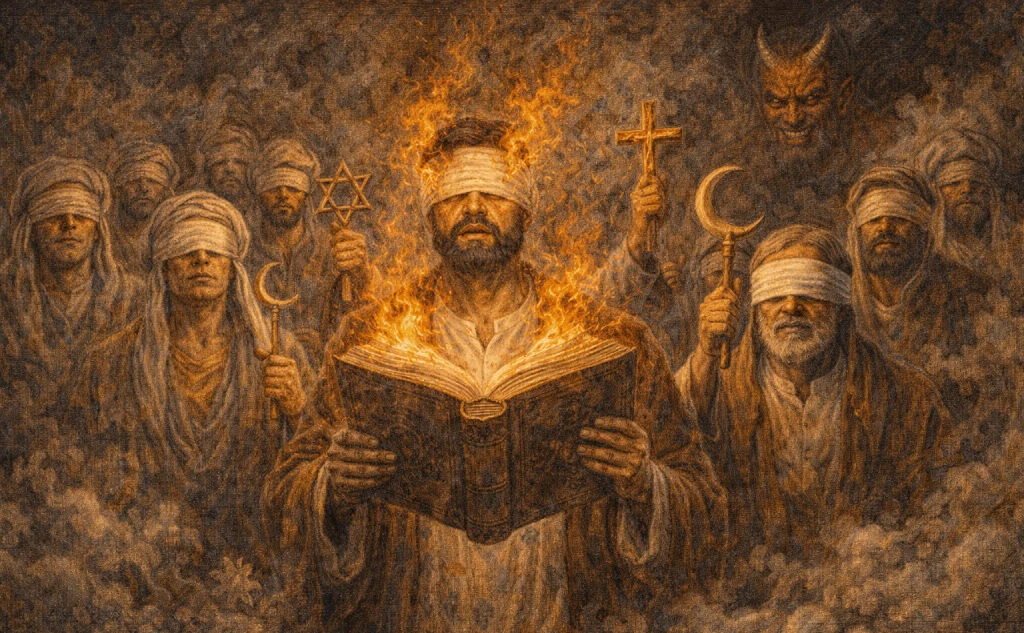
Dogma generally refers to a proclaimed truth or binding doctrine that an authority—whether a religious institution, state, political party, community, or tradition—establishes as unchangeable and beyond question. The epistemological foundation of dogma is not reason, evidence, or experience; instead, it rests on obedience to authority and demands such as “You must believe,” “If you do not believe, you will be killed,” or “If you do not believe, you will be punished.” Dogma is therefore more than a belief. It is a form of intellectual bondage in which asking questions is branded “improper,” doubt becomes a “crime,” and verification is treated as “arrogance.” Declaring a statement true is not the same as establishing that it is true. What evidence supports a claim, how that evidence was gathered, whether a conclusion would change in response to contrary information, and whether people have the freedom to verify the claim independently—these questions determine its epistemic credibility. Dogma obstructs precisely this process. A belief is not declared immutable because its truth has been demonstrated; rather, it is declared immutable from the outset, and the right to examine its evidence is restricted. The responsibility to pursue truth is thus replaced by the duty to defend a predetermined conclusion. A question that could have been answered through reasoning is turned into a test of obedience or disobedience. Firm conviction on a subject is not, in itself, dogma. A strongly held conclusion grounded in evidence can be revised in light of new and reliable information. The defining characteristic of dogma is closing off the possibility of correction. Under such conditions, the same information is accepted when it supports the authority’s ruling and rejected when it contradicts it; the same question is called an inquiry when asked by a loyal follower and an offense when asked by a dissenter. The problem with dogma, therefore, lies not merely in the content of a particular doctrine but in the method by which that doctrine is shielded from accountability to questions and evidence.
How Dogma Works: The Control of Thought
The central characteristic of dogma is that it does not open the door to reasoning for its followers. Instead, it imposes the reversed method of conclusion first, justification afterward. The authority has already supplied the conclusion; the follower’s task is to accept it and, when necessary, subsequently search for “support” in the name of reasoning. Dogmatic control operates through several interconnected mechanisms. One of the most effective is reversing the burden of proof. The authority declares a statement to be the ultimate truth but, rather than presenting independent evidence for it, demands that the questioner demonstrate loyalty. The response to a question is no longer information; it becomes a judgment of the questioner’s motives, character, morality, or allegiance to the group. Once the conclusion has been fixed in advance, the collection of evidence becomes selective: supportive incidents are emphasized, contradictory ones are concealed, and results inconsistent with the doctrine are dismissed as exceptions or conspiracies. Repeating the same belief over and over does not establish its truth; it merely makes the belief appear more familiar and natural to followers. Fear reinforces the system. When expressing dissent carries the risk of social exclusion, losing one’s family, obstruction of employment, harassment by the state, or punishment, people may publicly profess agreement while concealing their real views. This outward consensus is then presented as evidence that the doctrine is true, even though unequal freedom of expression may have helped produce that consensus. Dogma thus controls not only what can be said but also which questions must remain unspoken even after they arise, which information is safe to read, and which doubts can be admitted without social consequences. This structure commonly produces three forms of harm: —
When a person gives priority to blind obedience over personal reasoning, intelligence, observation, and experience, their capacity for independent judgment becomes ineffective. They begin to distrust knowledge obtained through their own senses and learn to accept explanations supplied by an external authority as absolute truths. The absence of critical thinking makes a person dependent on others and undermines their individuality.
When protecting an inherited “old truth” becomes life’s main objective, rather than engaging with new information or discoveries, intellectual stagnation takes root in society. Placing doctrine or dogma above evidence obstructs the pursuit of knowledge and prevents society from adapting to change. Where the scientific method allows established ideas to be disproved, dogma seeks only to preserve old beliefs.
Any dogma or unquestioned belief can serve as an ideal instrument for those in power. When questioning is prohibited, the source of political rule or power itself is also placed beyond scrutiny. It then becomes far easier to control large populations and maintain domination over them. Sociological analyses have identified unquestioning obedience as one of the most effective means by which ruling groups can consolidate their power.
Dogma is therefore not simply a matter of doctrine; it is a kind of system of mental domination in which obedience, rather than inquiry, becomes a condition of morality. Another way to establish dogma is to attach a moral stigma to those who ask questions. When “Why do you doubt?” is replaced with “You have no right to doubt,” the claim itself is no longer examined through reasoning. An artificial equivalence is created among a claim, the person advancing it, and that person’s followers: criticizing the claim is portrayed as insulting the authority, and criticizing the authority as taking a position against the entire community. Disagreements about facts are thereby turned into conflicts over the defense of identity. In such an environment, the views most likely to survive are precisely those that cannot be publicly called false even when they have been disproved.
The Place of Dogma in Religion: Placing Belief Beyond Verification
Dogma is especially prevalent in religious settings because many religions claim that their central scriptures, commandments, or interpretations come from a divine source and therefore stand beyond ordinary human standards of verification. Here, “belief” is not merely a personal feeling; it is a compulsory intellectual position. When religious authority identifies a statement as a direct command from God, the scope for independently assessing its truth and morality is narrowed. Repeating “God said so” in response to questions about the reasoning behind a rule, its practical consequences, or its compatibility with equal human rights does not verify the underlying claim. Instead, the very authority that needs to be established is treated as the source of proof. Within this circle, a statement is accepted because the book is sacred, and the book is considered sacred because of its own declarations about itself. A claim’s declaration about itself is not independent evidence of its truth. For example, the “Trinity” is a central dogma of Christianity: it is presented to believers as an unquestionable truth, while its logical comprehensibility becomes secondary. In Islamic settings, many provisions of the Quran and hadith are presented as inseparable from faith, creating a framework in which people are told that they “must accept them without doubt” [1], in which obedience, rather than verification, becomes the measure of religious devotion.
Commands to Obey Rather Than Question in Primary Islamic Sources
In Islamic scripture, obedience is established not merely as a virtue of good conduct but as an indispensable condition of belief [2]. Quran 33:36 explicitly states that when Allah and His Messenger have decided a matter, neither a believing man nor a believing woman has the right to choose an alternative according to personal preference. Disobeying that instruction is described as manifest error. Here, the authority’s decision sets the ultimate boundary of what is permissible; the follower’s independent evaluation has no power to overturn that decision. Even if a believer objects to the moral consequences of a command, that objection is not recognized as an alternative basis for decision-making. The limits of acceptable conduct are therefore determined by the source of the command, not by an examination of its logical justification. [3]
وَمَا كَانَ لِمُؤْمِنٍ وَلَا مُؤْمِنَةٍ إِذَا قَضَى اللَّهُ وَرَسُولُهُ أَمْرًا أَنْ يَكُونَ لَهُمُ الْخِيَرَةُ مِنْ أَمْرِهِمْ ۗ وَمَنْ يَعْصِ اللَّهَ وَرَسُولَهُ فَقَدْ ضَلَّ ضَلَالًا مُبِينًا
English translation: When Allah and His Messenger have decided a matter, no believing man or believing woman has any choice of their own in that matter. Whoever disobeys Allah and His Messenger has certainly gone clearly astray.
Quran 4:65 takes this obedience even further. Merely accepting Muhammad’s judgment is not enough; a person must not harbor even an inward feeling of unease or objection toward that judgment. Authority, in other words, does not stop at controlling outward conduct: it extends into people’s internal assessments and objections. A person may obey an order under external pressure while continuing to question its justice inwardly. The verse demands the elimination of even that internal resistance as a condition of complete faith. This is not merely a rule regulating public behavior; it also demands that believers subordinate their personal attitudes and judgment to the command. Outward compliance and genuine freedom from inner objection are two distinct states, and the verse makes the second a condition of faith as well. [4]
فَلَا وَرَبِّكَ لَا يُؤْمِنُونَ حَتَّىٰ يُحَكِّمُوكَ فِيمَا شَجَرَ بَيْنَهُمْ ثُمَّ لَا يَجِدُوا فِي أَنْفُسِهِمْ حَرَجًا مِمَّا قَضَيْتَ وَيُسَلِّمُوا تَسْلِيمًا
English translation: No, by your Lord, they will not be believers until they appoint you as judge in their disputes, then find within themselves no uneasiness about what you have decided, and submit completely.
The same language of obedience appears in Quran 24:51. It defines the proper response of believers as “We hear and we obey.” The freedom to reject a judgment after considering reasoning, evidence, and moral consequences is not recognized as the believer’s ideal response. Denial of the right to choose in one verse, the demand to eliminate inner objections in another, and the command to obey upon hearing in a third together establish a clear, continuous structure of Islamic authority. The question confronting followers is thus no longer simply whether a command is true or just; what becomes paramount is the response they are required to give in order to retain their identity as believers. [5]
إِنَّمَا كَانَ قَوْلَ الْمُؤْمِنِينَ إِذَا دُعُوا إِلَى اللَّهِ وَرَسُولِهِ لِيَحْكُمَ بَيْنَهُمْ أَنْ يَقُولُوا سَمِعْنَا وَأَطَعْنَا ۚ وَأُولَٰئِكَ هُمُ الْمُفْلِحُونَ
English translation: The only response of the believers, when they are called to Allah and His Messenger so that he may judge between them, is to say, “We hear and we obey.” It is they who are successful.
In a hadith recorded in Sahih al-Bukhari, Muhammad directly links obedience to him with entry into Paradise and disobedience to him with the rejection of Paradise. In Abu Hurayra’s narration, when asked to explain, Muhammad says that whoever obeys him will enter Paradise, while whoever disobeys him is the one who refuses it. Obedience or disobedience to a human being’s commands is thereby made a criterion for salvation in the afterlife. Obedience to authority is given greater importance than independently questioning that authority’s legitimacy. The narration creates a dual structure of reward for obedience and exclusion for disobedience. Its effect is to tie the authority’s commands to the ultimate fate of a person’s existence rather than leaving them open to ordinary rational debate. [6]
حَدَّثَنَا مُحَمَّدُ بْنُ سِنَانٍ، حَدَّثَنَا فُلَيْحٌ، حَدَّثَنَا هِلاَلُ بْنُ عَلِيٍّ، عَنْ عَطَاءِ بْنِ يَسَارٍ، عَنْ أَبِي هُرَيْرَةَ، أَنَّ رَسُولَ اللَّهِ صلى الله عليه وسلم قَالَ «كُلُّ أُمَّتِي يَدْخُلُونَ الْجَنَّةَ، إِلَّا مَنْ أَبَى». قَالُوا يَا رَسُولَ اللَّهِ وَمَنْ يَأْبَى قَالَ «مَنْ أَطَاعَنِي دَخَلَ الْجَنَّةَ، وَمَنْ عَصَانِي فَقَدْ أَبَى»
English translation: Narrated Abu Hurayra: Muhammad said, “All of my followers will enter Paradise except those who refuse.” They asked, “Who would refuse, Messenger of Allah?” He replied, “Whoever obeys me will enter Paradise, and whoever disobeys me has refused.”
When religious obedience is connected to social and legal punishment, it ceases to be merely a matter of personal belief. In Sahih al-Bukhari 3017, Ibn Abbas quotes Muhammad’s command to kill those who change their religion. According to the narration, after hearing that Ali had burned some people to death, Ibn Abbas says he would not have burned them, but would have killed them, because Muhammad had commanded that those who change their religion be killed. The objection here concerns the method of execution, not the order to execute. Linking the right to change one’s religion to the threat of capital punishment is a concrete example of severe control over freedom of conscience and belief. Changing one’s religious beliefs is not, in itself, an act of violence against another person; nevertheless, the very act of changing one’s religion is placed under a command of execution. Such a rule directly restricts the freedom to express doubt and change one’s mind. [7]
حَدَّثَنَا عَلِيُّ بْنُ عَبْدِ اللَّهِ، حَدَّثَنَا سُفْيَانُ، عَنْ أَيُّوبَ، عَنْ عِكْرِمَةَ، أَنَّ عَلِيًّا رَضِيَ اللَّهُ عَنْهُ حَرَّقَ قَوْمًا، فَبَلَغَ ابْنَ عَبَّاسٍ فَقَالَ لَوْ كُنْتُ أَنَا لَمْ أُحَرِّقْهُمْ، لِأَنَّ النَّبِيَّ صَلَّى اللَّهُ عَلَيْهِ وَسَلَّمَ قَالَ «لَا تُعَذِّبُوا بِعَذَابِ اللَّهِ». وَلَقَتَلْتُهُمْ كَمَا قَالَ النَّبِيُّ صَلَّى اللَّهُ عَلَيْهِ وَسَلَّمَ «مَنْ بَدَّلَ دِينَهُ فَاقْتُلُوهُ»
English translation: Narrated Ikrima: Ali burned some people to death. When Ibn Abbas learned of this, he said, “If it had been me, I would not have burned them, because the Prophet said, ‘Do not punish with Allah’s punishment.’ But I would have killed them, because the Prophet said, ‘Whoever changes his religion, kill him.’”
The social implications of these commands are unmistakable. When a person has no independent right to choose against an authority’s decision, is not permitted to harbor inner objections, must obey as a condition of salvation, and faces punishment for leaving the religion, the combined effect is to transform belief from a personal epistemic judgment into a duty of obedience. The freedom to accept an idea as true no longer depends on the freedom to examine whether it is true; instead, it depends on conformity with beliefs and conduct defined by an authority. The problem is that when dogma becomes “sacred,” it is elevated not only above error but also above criticism. Religious thought then often becomes incapable of correcting itself internally, because the door to revision has been closed. Religious thinking can also give rise to extremism and militant violence, which are harmful to human civilization.
Rejecting One Tradition Only to Make Another Unquestionable
Quran 2:170 criticizes the imitation of one’s ancestors. It states that when people are told to follow what Allah has revealed, some reply that they will follow what they found their forefathers practicing. The verse asks whether such imitation is justified even when their ancestors understood nothing and were not rightly guided. It correctly identifies an epistemic problem: an ancestor’s belief is not independent evidence that a claim is true. Yet when the same scripture establishes its own divine authority and then denies believers the right to choose independently while demanding unconditional obedience, the problem of blind imitation is not eliminated; the center of authority merely shifts. [8]
وَإِذَا قِيلَ لَهُمُ اتَّبِعُوا مَا أَنْزَلَ اللَّهُ قَالُوا بَلْ نَتَّبِعُ مَا أَلْفَيْنَا عَلَيْهِ آبَاءَنَا ۗ أَوَلَوْ كَانَ آبَاؤُهُمْ لَا يَعْقِلُونَ شَيْئًا وَلَا يَهْتَدُونَ
English translation: When it is said to them, “Follow what Allah has revealed,” they say, “Rather, we will follow what we found our forefathers practicing.” Even though their forefathers understood nothing and were not guided?
Rejecting an old authority does not automatically establish rational freedom. A religion, political ideology, or social movement can denounce earlier beliefs as superstition while elevating its own pronouncements beyond doubt. What changes then is the object of obedience, not the method of obedience. One authority replaces another; one forbidden question is replaced by another forbidden question; and one immutable doctrine gives way to a different immutable doctrine. The criterion of intellectual liberation is therefore not whose statements are obeyed, but whether it is genuinely possible to demonstrate that the accepted statements are wrong.
Dogma in Politics: The Deification of Ideology
Dogma is found not only in religion but also in politics. Especially under authoritarian or one-party systems, a particular ideology is presented as “historical truth,” “the path to national liberation,” or “the final solution.” Dissent is then not merely a different opinion; it becomes “treason,” “enmity toward the people,” or “immorality.” Ideology consequently turns into a quasi-religious belief: questioning brings character assassination, doubt invites punishment, and rational argument is met with repression. This is how the political version of dogma operates. It can arise within socialist or nationalist movements—or any other ideological camp—because the fundamental problem is not the label attached to the ideology, but the structure that disables independent judgment.
Under political dogma, responsibility for determining truth does not remain with individual reasoning, research findings, or the lived experience of the population. It becomes concentrated in party leadership, state propaganda machinery, or officially authorized interpreters of an ideology. Even when a policy produces food shortages, corruption, human rights violations, or administrative failures, an independent investigation of those failures can be obstructed. Calls to change the policy are then labeled anti-state activities or enemy propaganda. As a result, the more apparent the damage caused by a failed policy becomes, the harder it may become to change that policy. Agreement with the authorities, rather than agreement with the truth, becomes a condition of political safety. Political dogma also controls language. Branding dissenters as “traitors,” “betrayers,” “enemies of religion,” or “enemies of the people” is often intended not to answer their questions but to confine them within a discredited identity, so their arguments can be rejected before they are heard. Through this process, party and state are conflated, criticism of a leader is presented as an insult to the nation, and political loyalty becomes a measure of moral worth. Individuals are then encouraged to defend an ideology in order to protect their identity and security rather than judging the effectiveness or justice of its policies. This control deepens when independent journalism, historical scholarship, research, the judiciary, and freedom of expression are weakened.
Science and Dogma: The Fundamental Difference
Dogmatic tendencies have also appeared throughout the history of science: authority, institutions, and the prevailing mentality of an age have sometimes suppressed questions. Ptolemy’s geocentric theory remained dominant for a long time, and opposition to it encountered social, religious, and institutional obstacles. This is a familiar part of history. Even when a theory has been accepted for centuries, its epistemic standing depends on observation and explanatory power, not on its age. Natural phenomena do not obey doctrines; when an explanation fails to correspond to them, new observations and revised calculations are compared with competing explanations. In this process, the reputation of an established figure or the endorsement of an institution cannot substitute for evidence. But there is a fundamental difference here:
In dogma or unquestioning belief, a particular conclusion or truth is treated as final from the outset. If evidence contradicts that belief, the evidence is dismissed as false or irrelevant. Evidence is not the standard of truth here; instead, a predetermined belief takes precedence over the evidence. In a dogmatic system, conclusions remain immutable, so belief, rather than information, holds supreme authority.
The foundation of science is observation and verifiable information. No matter how prominent or popular a theory or idea may be, it is abandoned or revised when new and stronger evidence establishes that it is wrong. Science must remain prepared to revise its conclusions in the face of new findings. The scientific method is self-correcting: claims to truth depend on evidence and do not stand above it.
Science can make mistakes, but it contains a principle for correcting them: observation, experimentation, replication, and peer criticism. Dogma lacks this principle; there, “truth” is fixed, and reality is expected to conform to it. The strength of scientific knowledge does not depend on the personal prestige of a scientist or the immutable pronouncement of an institution. When an explanation is sound, it can be supported by observations, measurements, experimental results, and opportunities for other researchers to reexamine it. When new information does not agree with an earlier explanation, an investigation begins: is the error in data collection, experimental design, measurement, or the explanation itself? An inconsistent experimental result does not mean that every theory must be immediately discarded; the reliability of the result and how well a new explanation accounts for the total body of evidence must also be assessed. The crucial distinction is that, throughout this process, no theory can be declared immune to revision as a matter of principle.
The transition from the Ptolemaic geocentric picture of the world to heliocentric astronomy and later modern astrophysics involved a prolonged process of observation, calculation, and theoretical revision. Earlier explanations did not become final truths simply because they had long been accepted. As new evidence enabled better explanations of planetary motion, the limitations of older frameworks could be identified. When authoritarian obstacles arise in scientific practice, they are not achievements of science’s corrigible method; they are restrictions imposed upon that method. Likewise, accepting the words of a scientist as true without examination is not scientific practice—it is using a person’s name to compensate for a lack of evidence. Dogmatic thought tends to preserve its conclusions in the face of contradictory information by repeatedly modifying their interpretation. When a claim conflicts with reality, its meaning is changed until the claim can never be wrong. The claim can then continue to be described as true, but no real condition under which it could be shown false remains. However profound, miraculous, or venerable such a claim may be presented as being, it does not become reliable knowledge if there is no way to verify its truth. The distinction between revising conclusions to fit evidence and reinterpreting evidence to fit predetermined conclusions lies at the center of the conflict between science and dogma.
The Social Benefits of Dogma: Unity—but at What Price?
Dogma can sometimes contribute to social unity, identity, and moral order; that is difficult to deny. Shared symbols, beliefs, and rituals bind people together through a sense of “us.” But the question is: if the price of unity is the death of thought and the death of progress, how necessary is that unity? Unity built on dogma often turns dissenters into enemies and cannot tolerate plurality. Unity can thus easily become narrow-mindedness and intellectual violence, where belief rather than reason has the final word. The fact that members of a community follow the same practices or repeat the same slogans establishes only that their public behavior is similar; it does not demonstrate that they independently arrived at the same conclusions. In a society where dissent leads to lost social standing, estrangement from one’s family, or punishment, some degree of outward unity may be the product of fear and compulsion. Preserving that unity then requires treating questioners as enemies, teaching children only one approved answer, and restricting access to alternative information. If social cohesion depends on people’s silence instead of their freedom of conscience, that cohesion does not protect independent thought; it controls it.
The damage caused by dogma becomes deeper still when morality itself is equated with obedience. If disobeying a particular command is treated as an offense equivalent to harming another person, the actual well-being, suffering, consent, freedom, and justice of human beings are displaced from the center of moral judgment. Harmless personal decisions can then become punishable, while harmful conduct sanctioned by authority may be described as a duty. The justice of an action must be assessed not by the identity of the authority issuing or approving it, but by its real effects on the people concerned, equal rights, and defensible moral reasons. When moral judgment becomes authority-dependent, the evaluation of the same act changes solely according to who approved it. The harm suffered by victims and questions of personal liberty are pushed into a subordinate position, while the identity of the person giving the order becomes the principal standard of morality. Dogma is precisely what narrows this capacity for independent moral judgment.
Conclusion: Dogma Is Not Knowledge—It Is the Control of Knowledge
At the center of dogma lies the obligation that “you must believe”, supported by authority. Understanding dogma therefore means more than understanding one element of religion or politics. It means understanding how societies control thought, how they turn questions into crimes, and how they elevate obedience to the status of truth. Individual and social development require an intellectual culture in which the standards of truth are reason, evidence, and experience, and in which no belief, book, or institution is placed beyond criticism. Some of the most dangerous moments in human history have occurred precisely when people believed that “this must not be questioned.” A rational position opposed to dogma does not mean establishing another immutable doctrine. Its foundation is the demand for appropriate evidence for every claim, the examination of the consistency of reasoning, the revision of conclusions when errors are found, and the freedom to criticize individuals and institutions. No one possesses a monopoly on truth: neither religious scripture, political ideology, a popular leader, a scientist, nor majority public opinion can substitute for independent verification. Saying “I do not know” in the face of the unknown is an acknowledgment of the limits of knowledge; filling that gap without evidence in the name of authority is the path of dogma. A belief that cannot establish its own truth cannot be made true by denying people the right to question it.
References
- Does Islam Allow Its Claims to Be Examined? ↩︎
- The Conflict Between Islam and Philosophy or Logic: Does Islam Allow Examination? ↩︎
- Quran, Surah Al-Ahzab 33:36 ↩︎
- Quran, Surah An-Nisa 4:65 ↩︎
- Quran, Surah An-Nur 24:51 ↩︎
- Sahih al-Bukhari 7280 ↩︎
- Sahih al-Bukhari 3017 ↩︎
- Quran, Surah Al-Baqarah 2:170 ↩︎