Summary
Among Muslim communities in Bangladesh and the Indian subcontinent, Allah is widely described as a formless, omnipresent being beyond space and time. Yet the nature of Allah described in the Quran, authentic hadiths, and early Islamic creedal works differs fundamentally from this conception. These sources describe Allah’s own form, face, eyes, hands, fingers, feet, and shin. An influential tradition among classical Islamic scholars not only affirmed the literal existence of these attributes but also specified the number of Allah’s eyes, hands, and feet. Al-Darimi affirmed two eyes, Ibn Khuzaymah specified two hands, and Ibn Abbas described the Kursi as the place for Allah’s two feet. Ibn Taymiyyah declared even more explicitly that a formless, self-subsisting entity is impossible. The descriptions of the radiance of Allah’s face, His veil of light, His holding creation on five separate fingers, placing His foot in Hell, and uncovering His shin on the Day of Resurrection are likewise consistent with this conception of a God possessing form.
The conventional claim that Allah transcends space and time also conflicts fundamentally with the activities attributed to Him in Islamic sources. Muhammad himself asked an enslaved woman where Allah was and accepted her answer that He was in heaven. Al-Darimi affirmed two distinct boundaries: Allah’s own boundary and that of His location. According to authentic hadiths, Allah descends to the lowest heaven during the last third of every night; a book is kept with Him above the Throne, and angels carry His Throne. Authentic hadiths report that Allah called Himself time and recorded the decrees of all creation fifty thousand years before creating the heavens and the earth. The Quran describes Him establishing Himself upon the Throne after completing creation in six days. Ibn Taymiyyah also accepted that Allah performs actions successively. Islamic sources thus contain explicit descriptions of Allah’s location, direction, boundaries, movement, time, and the chronological order of His actions.
The anthropomorphic features of Islamic theology extend beyond Allah’s form and location. Allah speaks in an audible voice, laughs at human actions, becomes angry and pleased, and in an accepted Quranic reading expresses astonishment. Al-Ashari recorded an early Islamic doctrine according to which Allah becomes heavier when angry and lighter when pleased. Al-Bukhari mentioned angels losing consciousness upon hearing Allah’s voice. Authentic hadiths describe seeing Allah directly as one sees the full moon. These accounts attribute familiar features of human anatomy, sensory experience, psychological reactions, social behaviour, and royal authority to the creator of the universe. It is logically inconsistent to affirm these attributes as real and literal while simultaneously defining Allah as completely formless, partless, spaceless, and timeless.
Introduction
Defining the creator of the universe as simultaneously omnipotent, omniscient, infinite, partless, and beyond space and time raises serious philosophical questions about His bodily organs and actions. The literal concept of organs such as hands, feet, and eyes entails structure, distinctness, location, and function. Affirming such organs in an entirely partless and formless being creates a definitional conflict. Biology explains the origin and function of animal organs through evolution; no equivalent scientific explanation establishes why an omniscient and omnipotent being would need them.
Hands, feet, eyes, and ears are distinct organs of animal bodies. Their literal existence entails structure and spatial relations. These attributes conflict with the concept of a completely spaceless and partless being.
If the creator is defined as immaterial and entirely formless, the existence of literal bodily organs is inconsistent with that definition. Immateriality and possession of bodily organs cannot both be affirmed in the same sense.
Animals use hands and feet to survive. But a being who controls everything and possesses infinite knowledge has no need for bodily organs. The creator of the universe needs neither limbs nor external instruments to perform a particular task; everything can be accomplished through His will or command.
Islamic theology contains both the claim that Allah is incomparable and descriptions of organ-like attributes. Saying that a being’s form does not resemble another’s does not mean that it has no form. Incomparability and formlessness are distinct claims.
The notion that a completely partless and indivisible being has numerically distinct organs is self-contradictory. Similarly, successive actions and complete timelessness conflict by definition.
Biological organs developed through evolution as adaptations to the environment. Since the creator is self-sufficient and without beginning or end, there is no scope for such biological evolution in His case. The necessity of externally evolved organs for His existence and functioning is intellectually meaningless.
Allah Is a Being Possessing Form
The Quran, authentic hadiths, and early Islamic creedal works describe Allah as a personal being with His own form, face, eyes, hands, fingers, feet, audible voice, and various functional attributes. Various accounts specify not only the existence of His organs but also their number, distinct functions, and relationships with creation. Ibn Khuzaymah rejected the notion that Allah has more than two hands; al-Darimi affirmed two eyes, and Ibn Abbas described the Kursi as the place for Allah’s two feet. Ibn Taymiyyah declared a formless self-subsisting being impossible. Al-Darimi explicitly affirmed both Allah’s own boundary and the boundary of His location. Allah’s actions are also described in terms of specific times, chronological relationships, and successive changes. The question of Allah’s form is therefore inseparable from that of His spatial location and temporal activity.
Bringing together the Quranic and hadith descriptions of these attributes and the creedal conclusions drawn from them by classical and modern Islamic scholars yields the following picture. Allah’s essential attributes, actions, spatial relationship with creation, and the relationship of His actions to temporal succession are presented within a single framework.
| Attributes and Actions | Islamic Accounts and Textual Evidence |
|---|---|
| His Own Form or Image (صورة) |
Hadiths describe Adam being created in His image and Allah appearing in different forms on the Day of Resurrection. According to Ibn Taymiyyah, a self-subsisting being cannot exist without form.
Sahih al-Bukhari: 6227, 7439; Ibn Taymiyyah: Naqd al-Ta’sis; Ibn Qutaybah: Ta’wil Mukhtalif al-Hadith |
| Distinct Existing Entity (شيء) |
Al-Bukhari called Allah shay’ (a thing). Ibn Hajar al-Asqalani explains that shay’ refers to something that exists. The nature of Allah’s existence is specified by His other described attributes.
Surah al-An’am: 19; Sahih al-Bukhari: Book of Tawhid, Chapter 21; Fath al-Bari: 13/414–415 |
| Face and Its Radiance (وجه) |
Allah’s face is imperishable. He has a veil of light or fire; were it removed, the radiance of His face would burn creation. Ibn Khuzaymah devoted a chapter to affirming Allah’s face.
Surah al-Rahman: 27; Surah al-Qasas: 88; Sahih Muslim: 179a; Kitab al-Tawhid |
| Two Eyes and Sight (عينان) |
In contrast to the Dajjal, Allah is described as not defective in one eye. Al-Darimi and Ibn Uthaymin affirmed that Allah has two real eyes. According to Ibn Uthaymin, Allah literally sees with those two eyes.
Surah al-Tur: 48; Sahih Muslim: 2937; Al-Naqd ‘ala al-Marisi: 1/327; Majmu’ Fatawa Ibn Uthaymin: 4/58 |
| Two Hands and Distinct Actions (يدان) |
Allah created Adam with His own two hands. Both His hands are outstretched. He will fold up the heavens with one hand and the earths with the other. Ibn Khuzaymah specified that Allah has two hands.
Surah Sad: 75; Surah al-Ma’idah: 64; Al-Tirmidhi: 3045; Abu Dawud: 4732; Kitab al-Tawhid |
| Fingers and Their Distinct Uses (أصابع) |
Human hearts lie between two of Allah’s fingers. Sahih al-Bukhari describes the heavens, earths, trees, water and soil, and the rest of creation being held on five separate fingers.
Al-Tirmidhi: 2140; Sahih al-Bukhari: 4811; Ibn Khuzaymah: Kitab al-Tawhid |
| Two Feet and the Kursi (قدمان) |
Allah will place His foot in Hell to fill it. According to Ibn Abbas and Abu Musa al-Ashari, the Kursi is the place for Allah’s two feet. The Saudi Permanent Committee for Fatwas also affirmed His two feet.
Sahih al-Bukhari: 6661; Sahih Muslim: 2848; Al-Mustadrak: 2/282; Fatawa al-Lajnah al-Da’imah: 2/376 |
| Shin and Recognition (ساق) |
The shin is described as a sign by which Allah will be recognised on the Day of Resurrection. When it is uncovered, believers will prostrate themselves.
Surah al-Qalam: 42; Sahih al-Bukhari: 7439 |
| Heaviness and Being Carried |
Al-Darimi reports that angels became weak while carrying the Throne with Allah above it. Al-Ashari recorded an early Islamic doctrine in which Allah becomes heavier when angry and lighter when pleased.
Abu Dawud: 4727; Al-Ashari: Maqalat al-Islamiyyin; Bayan Talbis al-Jahmiyyah: 3/242–244, 3/376–377 |
| Space, Location and Upward Direction (مكان، جهة) |
Muhammad asked an enslaved woman where Allah was and accepted her answer that He was in heaven. Ibn Baz explains that the Kursi is above the heavens, the Throne above the Kursi, and Allah above the Throne.
Sahih Muslim: 537a; Sahih al-Bukhari: 7423; Ibn Baz: Fatawa Nur ‘ala al-Darb |
| Boundary and the Boundary of His Location (حد) |
Al-Darimi affirmed two distinct boundaries: Allah’s own and that of His location. He associated that location with the Throne above the heavens.
Al-Naqd ‘ala al-Marisi; Ibn Taymiyyah: Dar’ Ta’arud al-‘Aql wa al-Naql: 2/57 |
| Descent and Ascent (نزول، صعود) |
Allah descends to the lowest heaven in the last third of every night. Ibn Taymiyyah accepted His simultaneous descent to the lowest heaven of one region and ascent from that of another.
Sahih al-Bukhari: 1145; Sahih Muslim: 758a; Bayan Talbis al-Jahmiyyah: Vol. 4 |
| Time and Temporal Succession of Actions (الدهر) |
In a hadith Allah says, I am time. He recorded creation’s decrees fifty thousand years before creating the heavens and the earth. The Quran describes His establishment upon the Throne after six days of creation. Ibn Taymiyyah also accepted that Allah performs actions successively.
Sahih al-Bukhari: 4826, 3191; Sahih Muslim: 2246e, 2653b; Surah al-Hadid: 4; Dar’ Ta’arud al-‘Aql wa al-Naql: 2/280–281 |
| Direct Vision and Visibility |
Believers will see Allah directly on the Day of Resurrection. Muhammad compared this vision to seeing the sun and the full moon in a cloudless sky.
Surah al-Qiyamah: 22–23; Sahih al-Bukhari: 7435, 7436, 7439; Kitab al-Tawhid: 2/438 |
| Audible Voice (صوت) |
Allah spoke to Moses. Al-Bukhari explains that Allah’s voice can be heard from both near and far and that angels lose consciousness upon hearing it. Ibn Taymiyyah affirmed that Allah speaks with a voice.
Surah al-Qasas: 30; Al-Bukhari: Khalq Af’al al-‘Ibad; Ibn Qudamah: Lum’at al-I’tiqad; Majmu’ al-Fatawa: 12/173 |
| Hearing and Touch |
Muhammad placed his fingers on his own ear and eye to illustrate Allah’s hearing and sight. In another hadith, Muhammad describes feeling the touch of Allah’s hand and the coldness of His fingers in his chest during a dream.
Surah al-Mujadilah: 1; Abu Dawud: 4728; Al-Tirmidhi: 3235; Mishkat al-Masabih: 748 |
| Laughter, Astonishment and Emotional Responses (ضحك، عجب) |
Allah laughs and becomes pleased at various human actions. In an accepted reading of Surah al-Saffat, Allah speaks of His own astonishment. Shurayh al-Qadi opposed the notion that an omniscient being could be astonished. Ibn Khuzaymah devoted a chapter to affirming divine laughter.
Surah al-Saffat: 12; Sahih al-Bukhari: 2826; Sahih Muslim: 1890; Tafsir al-Tabari; Tafsir al-Qurtubi; Kitab al-Tawhid |
Consider the statement of the prominent Bangladeshi Islamic scholar Dr. Manzur Elahi:
Now consider the statement of another prominent scholar from the Islamic University of Madinah:
Consider a statement by Mufti Ibrahim:
Consider further statements in which Dr. Abu Bakr Muhammad Zakaria says that the report that Allah created Adam in His own image is authentic according to Islam and that the image in question is Allah’s own:
Allah Has His Own Form or Image
The notion that Allah has His own form is not merely derived from a literal reading of a few isolated hadiths; many influential scholars throughout the history of Islamic theology explicitly affirmed Allah’s form or image. The Arabic word صورة (surah) denotes form, figure, and configuration. In his interpretation of the hadith in Sahih al-Bukhari and Sahih Muslim about Adam being created in His image, Ibn Taymiyyah extensively discussed Allah’s own form. According to him, the very notion that a self-subsisting entity could lack a form is impossible. There is a fundamental distinction between not knowing what Allah’s form is like and claiming that He has no form whatsoever. IslamQA quotes Ibn Taymiyyah’s statement in fatwa 20652. [1]
وكما أنه لابد لكل موجود من صفات تقوم به ، فلابد لكل قائم بنفسه من صورة يكون عليها ، ويمتنع أن يكون في الوجود قائم بنفسه ليس له صورة يكون عليها.
English translation:
Just as every existing entity must possess attributes inhering in it, so too every self-subsisting entity must have a form in which it exists. It is impossible for a self-subsisting entity without any form to exist.
The significance of Ibn Taymiyyah’s statement is clear. He did not merely acknowledge the possibility that Allah has a form; he declared formless self-subsistence impossible. To affirm Allah as self-subsisting while claiming that He is formless therefore directly contradicts Ibn Taymiyyah’s own theological position. Ignorance of the nature of a form is not evidence of its absence. Not knowing a being’s form does not make it formless, just as not knowing an object’s weight does not make it weightless. An unknown attribute and an absent attribute are logically distinct.
Centuries before Ibn Taymiyyah, the prominent third-century AH scholar Ibn Qutaybah (d. 276 AH), in his Ta’wil Mukhtalif al-Hadith placed descriptions of Allah’s form in the same category as descriptions of His hands, fingers, and eyes. His argument was that people had become familiar with Quranic descriptions of attributes such as hands, fingers, and eyes and therefore found them easier to accept; the description of a form seemed unfamiliar because it did not appear explicitly in the Quran. He called for belief in these attributes, including form, without specifying their modality or limits. [2]
An important feature of Islamic theology emerges here. Allah’s face, hands, fingers, eyes, and form are treated as objects of the same kind of belief. Ibn Qutaybah’s explanation does not support affirming one while dismissing another as a mere metaphor. Whether Allah’s form resembles the human form is a separate question. Saying that one entity’s form does not resemble another’s does not mean the former has no form. Equating Allah’s incomparability with His formlessness is therefore a logical error.
Allah Is a Distinct Entity or Shay’
What kind of existing entity is the Allah of Islam? Can the creator of Islam be called a thing or an entity? In Chapter 21 of the Book of Tawhid in Sahih al-Bukhari, al-Bukhari explicitly states that Allah has called Himself شيء (shay’un). He bases this conclusion on verse 19 of Surah al-An’am, where Allah is named in answer to the question of what thing or entity is greatest in testimony. In Arabic, shay’un refers to something that exists. Its Bengali equivalents can mean an object, thing, matter, or entity. [3] [4] [5]
A detailed explanation of al-Bukhari’s statement appears in Ibn Hajar al-Asqalani’s famous Fath al-Bari. There he explains the Arabic word shay’un as denoting something that exists. Quoting Abd al-Aziz ibn Yahya al-Makki’s Kitab al-Haydah, he demonstrates that the purpose of calling Allah shay’un is to affirm His existence and reject the notion of His nonexistence. [6]
والشيء يساوي الموجود لغة وعرفا
English translation:
Linguistically and in customary usage, shay’ is synonymous with something that exists.
Calling Allah shay’un and claiming that Allah possesses a definite shape and form are two distinct philosophical propositions. The first concerns His existence; the second concerns the nature of that existence. Calling something existent does not determine its mode of existence. The specific descriptions of Allah’s form, face, two eyes, two hands, fingers, two feet, location upon the Throne, and direct visibility in the Quran, hadiths, and classical creedal works provide more detailed information about the nature of His existence. When Ibn Taymiyyah declared a formless self-subsisting entity impossible, he was not merely making a general statement about Allah’s existence; he was affirming a specific attribute of that existence.
Thus the significance of calling Allah shay’un is that Islamic theology recognises Allah as a distinct, actually existing entity. To understand the nature of that entity, the combined meaning of His specific described attributes must be considered rather than relying exclusively on the word shay’un. In particular, descriptions of the number of hands and eyes, the separate functions of fingers, and the specific place for His feet relate directly to the concept of an entity possessing form.
Sahih al-Bukhari (Tawhid Publications)
97/ Tawhid
Chapter 97/21. The statement of Allah Almighty: Say, what thing is greatest in testimony? Say, Allah (Surah al-An’am 6:19). Here Allah Almighty has called Himself shay’un (a thing). The Prophet (peace be upon him) also called the Quran a thing, although it is one of Allah’s attributes. Allah says: Everything will perish except Allah’s essence (Surah al-Qasas 28:88).
7417. Narrated Sahl ibn Sa’d (may Allah be pleased with him): The Prophet (peace be upon him) asked a man, Do you have anything of the Quran? He replied, Yes, such-and-such surahs, and named them. [2310] (Adhunik Prakashani 6900, Islamic Foundation 6912)
Hadith grade: Sahih (authentic)
Narrator: Sahl ibn Sa’d (may Allah be pleased with him)
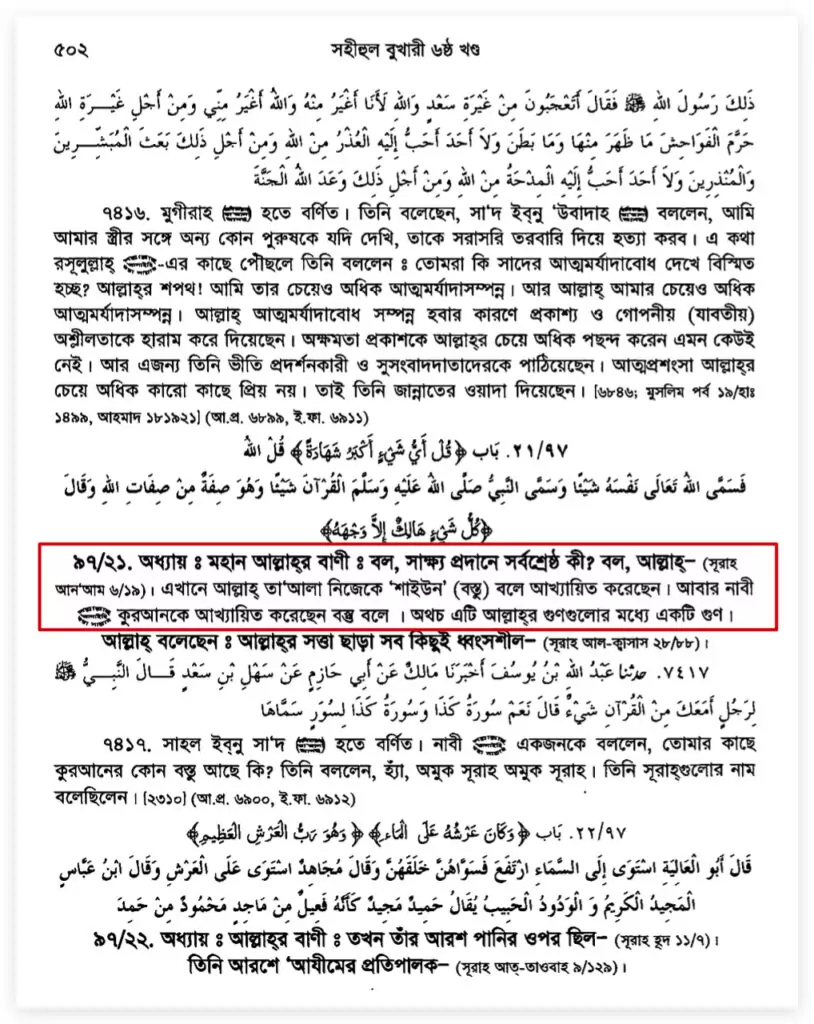
Sahaj Nasr al-Bari Sharh al-Bukhari also explains the use of shay’un and al-Bukhari’s statement about Allah’s existence. Calling Allah shay’un affirms His existence; the word alone does not establish the material nature of His existence. [7]
Allah’s Heaviness, His Position upon the Throne, and the Shaking of the Throne
Allah’s position upon the Throne and the carrying of that Throne are highly significant in Islamic theology. Verse 17 of Surah al-Haqqah states that eight will carry Allah’s Throne on the Day of Resurrection. Hadiths also give detailed descriptions of the immense size of the angels carrying it. According to an authentic hadith in Sunan Abi Dawud, the distance between the earlobe and shoulder of one of the Throne-bearing angels is equivalent to a seven-hundred-year journey. The description of such enormous beings carrying Allah’s Throne presents familiar ideas of thrones, bearers, and carrying burdens from ancient monarchies on a cosmic scale. [8] [9]
Sunan Abi Dawud (authenticated edition)
35/ Sunnah
Chapter 19. Concerning the Jahmiyyah
4727. Narrated Jabir ibn Abdullah (may Allah be pleased with him): The Messenger of Allah (peace be upon him) said: Of the angels who carry Allah’s Throne,I was permitted to speak about one. The distance between his earlobe and shoulder is equivalent to a seven-hundred-year journey.[1]
Sahih.
[1]. Al-Tabarani.
Hadith grade: Sahih (authentic)
Narrator: Jabir ibn Abdullah al-Ansari (may Allah be pleased with him)
One of the clearest historical accounts of Allah’s heaviness appears in the famous Maqalat al-Islamiyyin wa Ikhtilaf al-Musallin of Abu al-Hasan al-Ashari (d. 324 AH), founder of Ashari theology. In compiling the creeds of different Islamic theological groups, he recorded a doctrine according to which the angels who carry the Throne also carry Allah Himself. This doctrine establishes a direct relationship between changes in Allah’s heaviness and His anger or pleasure. When Allah is angry, the burden on the angels’ shoulders increases; when He is pleased, it decreases. From these changes the angels distinguish His anger from His pleasure. The doctrine even describes the Throne creaking like a riding saddle under Allah’s weight. Ibn Taymiyyah also quotes al-Ashari’s account in the third volume of his Bayan Talbis al-Jahmiyyah. [10] [11]
فقال قائلون: الحملة تحمل الباري وأنه إذا غضب ثقل على كواهلهم، وإذا رضي خف فيتبينون غضبه من رضاه
English translation:
Some said that the bearers carry the Creator. When He becomes angry, He grows heavy upon their shoulders, and when He is pleased, He becomes light. In this way they distinguish His anger from His pleasure.
The historical significance of this doctrine recorded by al-Ashari is that Allah’s heaviness is not merely inferred from the existence of the Throne; its increase and decrease are explicitly stated. Moreover, changes in Allah’s psychological or emotional state are related to changes in pressure experienced by the angels carrying Him. This is an important illustration of how Allah was conceived in the early centuries of Islam. In the same discussion, al-Ashari also recorded a doctrine concerning changes in the Throne’s own weight. Whether Allah is carried and whether His heaviness changes were thus questions discussed within Islamic theology itself.
In modern physics, mass and weight are distinct quantities. Mass measures an object’s inertia, whereas weight is the force due to gravity. Changes in pressure on a load-bearing structure relate to changes in the force applied to it. Anger or pleasure, however, is not an independent physical quantity determining a being’s mass or weight. The emotion-dependent change in heaviness described in the doctrine recorded by al-Ashari has no testable mechanism. Allah’s emotions are depicted as manifesting through a mechanical effect: the angels become aware of changes in His internal state through changes in the burden felt upon their shoulders.
Sahih al-Bukhari also contains a significant account of the Throne shaking. Muhammad reported that Allah’s Throne shook upon the death of his companion Sa’d ibn Mu’adh. Allah already knew when Sa’d would die and, according to Islamic predestination, had Himself decreed that death. What, then, is the relationship between this predetermined death and the shaking of Allah’s Throne? The hadith does not specify the mechanical cause of the shaking. Nevertheless, it bears a clear conceptual resemblance to early creedal accounts of carrying the Throne, changes in Allah’s heaviness, and the Throne creaking like a loaded saddle. Human actions and events on earth are associated with various reactions of Allah’s royal Throne. [12] [13]
Sahih al-Bukhari (Islamic Foundation)
Book 50/ The Prophets (peace be upon them)
Chapter 2122. The Virtues of Sa’d ibn Mu’adh (may Allah be pleased with him)
3531. Muhammad ibn al-Muthanna (may Allah have mercy on him) … Jabir (may Allah be pleased with him) said, I heard the Prophet (peace be upon him) say that upon the death of Sa’d ibn Mu’adh (may Allah be pleased with him), the Throne of Allah Almighty shook. Al-A’mash (may Allah have mercy on him) … narrated similarly from the Prophet (peace be upon him). A man told Jabir (may Allah be pleased with him) that al-Bara ibn Azib (may Allah be pleased with him) said it was the funeral bier that shook. Jabir replied that there had been some rivalry between the tribes of Sa’d and al-Bara (but that was not correct), for he had heard the Prophet (peace be upon him) say عَرْشُ الرَّحْمَنِ that is, Allah’s Throne at the death of Sa’d ibn Mu’adh shook , I heard him say.
Hadith grade: Sahih (authentic)
A more detailed description of carrying the Throne and Allah above it appears in the Al-Naqd ‘ala al-Marisi of the prominent third-century AH hadith scholar Uthman ibn Sa’id al-Darimi (d. 280 AH). Ibn Taymiyyah subsequently quoted this statement of al-Darimi in detail in the third volume of his Bayan Talbis al-Jahmiyyah. It states that when the angels attempted to carry the Throne with Allah above it, they became weak and fell to their knees. Subsequently, through Allah’s power, they were able to carry it. [14]
وقد بلغنا أنهم حين حملوا العرش وفوقه الجبار في عزته وبهائه ضعفوا عن حمله واستكانوا وجثوا على ركبهم حتى لقنوا لا حول ولا قوة إلا بالله
English translation:
We have received the report that when they carried the Throne with the Almighty above it in His might and splendour, they became too weak to carry Him, humbled themselves, and fell upon their knees, until they were taught: There is no power or might except through Allah.
In the same discussion, al-Darimi further stated that if Allah so willed, by His own power He could settle upon the back of a mosquito, and the mosquito would be capable of carrying Him. Since the Throne is greater than the seven heavens and seven earths, al-Darimi saw no reason to deny that it could carry Allah. His argument treats Allah’s position upon the Throne and His being carried as real events. It even relates Allah’s position to the Throne’s size, vastness, and carrying capacity.
In the same work, Ibn Taymiyyah explained that Allah created the Throne and its angelic bearers and also granted them the strength to carry it. In his view, therefore, Allah being carried by angels does not mean that He depends upon them. By explaining that Allah empowers His own creatures to carry Him, Ibn Taymiyyah attempted to reconcile Allah’s self-sufficiency with the accounts of His being carried.
Yet the entire notion of an omnipotent being creating a separate throne on which to be carried, creating immense angels to carry it, and subsequently granting them the strength to do so bears a striking resemblance to the structures of power and status in ancient monarchies. A king, his throne, the attendants carrying it, and the limits of their carrying capacity constitute a familiar earthly royal court projected onto a cosmic scale. The account provides no measurement of Allah’s mass or how gravity operates upon Him, but the conception of Allah being carried and the angels becoming weak while carrying Him is explicit in classical Islamic creedal literature.
The Throne shook upon the death of Sa’d ibn Mu’adh (al-Bukhari 3803). The mechanical cause of the shaking is not specified.
A doctrine recorded by al-Ashari describes Allah becoming heavier when angry and lighter when pleased.
In al-Darimi’s account, the angels become weak while carrying the Throne with Allah above it.
Accounts of heaviness, carrying, and the shaking of the Throne resemble familiar concepts from earthly royal courts. The shaking of the Throne alone does not establish Allah’s mass or weight.
Is Allah Beyond Time? I Am Time
In contemporary Islamic religious discourse, it is often claimed that Allah is a being beyond space and time. Time is His creation and does not apply to His own existence. But timeless existence and everlasting existence are entirely different philosophical concepts. A being that has existed from eternity has no beginning to its existence. A timeless being, by contrast, has an existence and activity to which past, present, future, before, after, or chronological sequence do not apply. Existing throughout eternity is therefore not synonymous with existing outside time. A substantial proportion of the Islamic descriptions of Allah present His actions within a definite temporal sequence.
In a hadith narrated by Abu Hurayrah in Sahih al-Bukhari, Allah calls Himself al-Dahr (الدهر), meaning time or the age. This is a hadith qudsi: Muhammad presents the statement as Allah’s own words rather than his own. Allah says that humans offend Him by reviling time, because He is time and controls the alternation of night and day. [15]
قَالَ اللَّهُ عَزَّ وَجَلَّ يُؤْذِينِي ابْنُ آدَمَ، يَسُبُّ الدَّهْرَ وَأَنَا الدَّهْرُ، بِيَدِي الأَمْرُ، أُقَلِّبُ اللَّيْلَ وَالنَّهَارَ
English translation:
Allah Almighty said: The son of Adam offends Me. He reviles time, yet I am time. All authority is in My hand; I alternate night and day.
Sahih Muslim records the same statement more directly and concisely. Muhammad forbids reviling time and gives the statement that Allah is time as the reason for the prohibition. [16]
لاَ تَسُبُّوا الدَّهْرَ فَإِنَّ اللَّهَ هُوَ الدَّهْرُ
English translation:
Do not revile time, for Allah is time.
The Arabic word الدهر is used to mean time, an age, an era, or a long period. On the basis of this hadith, the prominent Andalusian Zahiri jurist Ibn Hazm (d. 456 AH) included al-Dahr among Allah’s names. Ibn Kathir subsequently opposed this conclusion. In his commentary on Sahih Muslim, al-Nawawi understood the statement metaphorically. According to his explanation, Arabs blamed time for death, old age, loss of wealth, and various disasters, and reviled it; Muhammad was informing them that Allah is the actual agent of these events. By reviling time, they were therefore effectively reviling Allah. [17] [18]
The word al-Nawawi uses in explaining this hadith is مجاز, meaning a figurative expression. He identifies time as one of Allah’s creations. [19]
وأما الدهر الذي هو الزمان فلا فعل له بل هو مخلوق من جملة خلق الله تعالى.
English translation:
As for al-Dahr, meaning time, it has no activity of its own; rather, it is one of the creations of Allah Almighty.
An important philosophical problem remains unresolved even in this explanation. The claim that Allah controls or created time does not logically entail that His own actions have no temporal succession. Controlling something and having no relationship to it whatsoever are different matters. The claim that Allah created time and the claim that He exists outside time must therefore be established separately. Particularly when the Quran and hadith explicitly describe before and after, definite temporal intervals, and successive changes in Allah’s own actions, merely declaring time His creation does not establish a timeless Allah.
One of the strongest textual indications of Allah’s temporal activity appears in the Book of Predestination in Sahih Muslim. According to this hadith narrated by Abdullah ibn Amr ibn al-As, Allah recorded the decrees of all creation fifty thousand years before creating the heavens and the earth. At that time His Throne was upon water. The report thus affirms not only an event before the creation of the heavens and earth but also a precise interval of fifty thousand years between that event and their creation. [20]
كَتَبَ اللَّهُ مَقَادِيرَ الْخَلاَئِقِ قَبْلَ أَنْ يَخْلُقَ السَّمَوَاتِ وَالأَرْضَ بِخَمْسِينَ أَلْفَ سَنَةٍ – قَالَ – وَعَرْشُهُ عَلَى الْمَاءِ
English translation:
Allah recorded the decrees of all creation fifty thousand years before creating the heavens and the earth. He also said: His Throne was upon water at that time.
The word قَبْلَ means before or previously, and the phrase بِخَمْسِينَ أَلْفَ سَنَةٍ means at an interval of fifty thousand years. The account describes a measurable temporal interval between two distinct acts of Allah. The first is recording the decrees of all creation; the second is creating the heavens and the earth. The first event occurred fifty thousand years before the second. Taken literally, this account requires affirming temporal succession even before the creation of the heavens and earth, and affirming that Allah performed a particular action within that earlier period.
A further question concerns the process by which these fifty thousand years before the creation of the earth were measured. An earthly solar year is defined by the time the earth takes to complete one orbit around the sun. Expressing events prior to the existence of the earth and sun in years is not impossible, because an interval preceding the establishment of a unit can still be expressed in that unit. But the Islamic account does not specify the basis of these fifty thousand years. Despite this ambiguity, one point is clear: the hadith does not present recording the decrees and creating the heavens and earth as simultaneous events; it establishes a definite interval between them.
The Book of Creation in Sahih al-Bukhari also contains a sequential account of Allah’s actions. According to the hadith narrated by Imran ibn Husayn, Allah existed at first and nothing besides Him existed; His Throne was upon water; He recorded everything and created the heavens and the earth. [21]
كَانَ اللَّهُ وَلَمْ يَكُنْ شَىْءٌ غَيْرُهُ، وَكَانَ عَرْشُهُ عَلَى الْمَاءِ، وَكَتَبَ فِي الذِّكْرِ كُلَّ شَىْءٍ، وَخَلَقَ السَّمَوَاتِ وَالأَرْضَ
English translation:
Allah existed and there was nothing besides Him. His Throne was upon water. He recorded everything and created the heavens and the earth.
The Quran also describes Allah’s actions in temporal succession. Verse 4 of Surah al-Hadid states that Allah established Himself upon the Throne after creating the heavens and the earth in six days. The word ثُمَّ indicates a subsequent event or stage. Creating and establishing Himself upon the Throne after creation are presented as two distinct actions. [22]
هُوَ الَّذِي خَلَقَ السَّمَاوَاتِ وَالْأَرْضَ فِي سِتَّةِ أَيَّامٍ ثُمَّ اسْتَوَىٰ عَلَى الْعَرْشِ
English translation:
He created the heavens and the earth in six days, then established Himself upon the Throne.
For an entirely timeless being, asking what state He was in before performing an action or what state He was in after completing it should be meaningless. The notions of before and after depend upon the existence of time. Yet Islamic accounts describe Allah creating, recording, establishing Himself upon the Throne after creation, descending at a specific time, conversing with humans, and performing various further actions on the future Day of Resurrection. Reconciling these activities with entirely timeless existence requires abandoning their literal temporal meaning.
In modern philosophy, existing throughout eternity is called everlasting existence, whereas existence unrelated to any temporal dimension is called timeless existence. In the former, sequence and change are possible; in the latter, successive changes within the being itself are not possible. Muslim theologians have long debated whether Allah had a first creation and whether His creative activity could proceed successively from eternity. The question of Allah’s relationship to time is therefore not merely a modern scientific debate; it is a fundamental philosophical problem within Islamic theology itself.
It is logically inconsistent to affirm the temporal succession of Allah’s actions described in the Quran and authentic hadiths while declaring Him entirely timeless in the same sense. The recording of decrees fifty thousand years before creating the heavens and earth, six days of creation, establishment upon the Throne after creation, and descent at a specific time every night all establish a relationship between Allah’s actions and time. Believing that Allah’s existence has no beginning is not the same as claiming that His actions are unrelated to time.
Allah’s Location, Descent, and Ascent
Islamic sources describe Allah not only as a being with hands, feet, eyes, and a face, but also as having a location and descending. According to the hadith narrated by Abu Hurayrah in Sahih al-Bukhari and Sahih Muslim, Allah descends to the lowest heaven in the last third of every night. There He invites people to pray to Him, ask Him for things, and seek forgiveness. The description contains a specific destination, a specific time, and actions performed by Allah at that time. [23] [24]
يَنْزِلُ رَبُّنَا تَبَارَكَ وَتَعَالَى كُلَّ لَيْلَةٍ إِلَى السَّمَاءِ الدُّنْيَا حِينَ يَبْقَى ثُلُثُ اللَّيْلِ الآخِرُ
English translation:
Our blessed and exalted Lord descends every night to the lowest heaven when the last third of the night remains.
The Arabic word يَنْزِلُ derives from the root نزل, whose ordinary meaning is to descend or come down from above. Spatial relations are inherent in the notion of descent. If a being descends from above to below, its position is related to a higher and a lower location. Similarly, specifying the final third of the night for the descent establishes a temporal relationship. Yet if Allah is defined as beyond space and time, His descent cannot be explained in its ordinary sense. What literal meaning could above, below, proximity, or distance have for a spaceless existence?
Another serious problem with the hadith concerns the shape and rotation of the earth. Because the earth rotates on its axis, day and night occur at different times at different longitudes. When it is the last third of the night in Bangladesh, it may be evening, midnight, or daylight in another region. As the final third of the night ends in one region, it begins elsewhere. There is therefore no single last third of the night for the entire earth. Somewhere on earth it is continuously the final third of the night. If Allah descends according to each region’s local time, His descent would continue without interruption on a global timescale.
This problem is not the invention of a modern atheist. Medieval Islamic theologians also debated regional differences in the timing of night and Allah’s descent. In his Bayan Talbis al-Jahmiyyah, Ibn Taymiyyah discusses this problem raised by Ibn Hazm and others. His solution is that Allah can simultaneously descend to the lowest heaven of one region and ascend from the lowest heaven of another. In other words, he did not reject the account of descent; instead he accepted simultaneous descent and ascent. [25]
بل في الوقت الواحد الذي يكون ثلثاً عند هؤلاء ، وفجراً عند هؤلاء ، يكون نزوله إلى سماء هؤلاء الدنيا ، وصعوده عن سماء هؤلاء الدنيا.
English translation:
Rather, at the same time when it is the last third of the night for these people and dawn for those, He descends to the lowest heaven of these and ascends from the lowest heaven of those.
Ibn Taymiyyah used the example of the sun to support his statement. The same sun can be rising for people in one region and setting for those in another; through this analogy he attempted to explain Allah’s simultaneous descent and ascent. But sunrise and sunset are primarily caused by the earth’s rotation on its axis. The sun rising for people in a particular region does not mean it has descended from the sky towards that region. A change in the sun’s apparent position and an actual descent of a being from a higher to a lower location are not the same event. The mechanism of one cannot be established through the example of the other.
Islamic creedal works also discuss whether Allah’s Throne becomes vacant when He descends. According to a statement attributed to the prominent third-century AH hadith scholar Ishaq ibn Rahawayh, Allah can descend to the lowest heaven without leaving the Throne. Quoting this statement in fatwa 254465, IslamQA says that even when Allah descends to the lowest heaven, He remains above the Throne and all creation. This combines the notions of the same being remaining upon the Throne, descending to the lowest heaven, and remaining above all creation.
Why would an omniscient and omnipotent being need to descend to the lowest heaven to hear people’s prayers? A human being might approach someone far away to hear them more clearly because human hearing has physical limitations. But if Allah’s hearing is infinite, distance should present no obstacle. From the Throne He should be able to hear every person’s prayer on earth. Nevertheless, answering prayers is associated with Allah’s descent to the lowest heaven. Ancient human conceptions of location, distance, height, and proximity are thus reflected in descriptions of divine activity.
Accepting as real these accounts of Allah’s descent, ascent, position upon the Throne, and presence in the lowest heaven at a particular time, while defining Him as completely spaceless and timeless, creates a fundamental conceptual problem. Declaring the modality of descent unknown merely expresses ignorance of that modality; it does not establish the logical compatibility of the statements concerning space and time.
Is Allah Beyond Space? Allah’s Location, Direction, and Boundaries
Saying that a being exists outside the universe and saying that the concept of space does not apply to its existence are entirely different propositions. The first establishes a spatial relation between a being and the universe; the second denies all spatial relations. Questions about where a being is located, what it is above or below, in which direction one must travel to reach it, its distance from another entity, or from where it descends to another place are meaningful only if that being has some relationship to space. Islamic sources provide several specific answers to such questions concerning Allah. Muhammad even used the answer to the question of Allah’s location as a criterion for assessing a person’s faith.
A well-known hadith in Sahih Muslim narrated by Mu’awiyah ibn al-Hakam al-Sulami reports that he owned an enslaved woman who tended his sheep. One day a wolf took one of the sheep, and Mu’awiyah slapped her. Later he approached Muhammad and asked about freeing her. Muhammad instructed him to bring her before him and asked her two questions. The first was: Where is Allah? She answered: In heaven. In answer to the second question, she acknowledged Muhammad as Allah’s messenger. Based on those two answers, Muhammad declared her a believer and instructed that she be freed. [26]
فَقَالَ لَهَا أَيْنَ اللَّهُ؟ قَالَتْ فِي السَّمَاءِ قَالَ مَنْ أَنَا؟ قَالَتْ أَنْتَ رَسُولُ اللَّهِ. قَالَ أَعْتِقْهَا فَإِنَّهَا مُؤْمِنَةٌ
English translation:
He asked her, Where is Allah? She replied, In heaven. He asked, Who am I? She replied, You are the Messenger of Allah. He said, Free her, for she is a believer.
The Arabic word أَيْنَ means where. It is used to ask about the location of a being. Muhammad did not ask whether Allah existed, how powerful He was, or whether Allah was one. He asked directly where Allah was. The enslaved woman likewise answered about Allah’s location. Muhammad neither rejected the answer nor corrected her by saying that the question of where does not apply to Allah; instead he acknowledged her faith on the basis of her answers. The notion of asking about Allah’s location is thus present in Muhammad’s own statement.
The prominent sixth-century AH Hanbali hadith scholar Abd al-Ghani al-Maqdisi (d. 600 AH), in his Al-Iqtisad fi al-I’tiqad, strongly opposed treating the question of where Allah is as forbidden, on the basis of this hadith. Al-Dhahabi, in his Al-‘Uluw li al-‘Aliyy al-Ghaffar, also drew two conclusions from it: first, asking where Allah is is legitimate under Islamic law; second, the answer is that Allah is in heaven. According to him, denying these two points amounts to denying Muhammad’s statement. The modern Salafi fatwa website IslamQA reached the same conclusion in fatwa 514823. [27]
ففي الخبر مسألتان: إحداهما: شرعية: قول المسلم أين الله؟ وثانيهما: قول المسؤول: في السماء. فمن أنكر هاتين المسألتين، فإنما ينكر على المصطفى صلى الله عليه وسلم
English translation:
This report contains two matters. The first is the legitimacy under Islamic law of a Muslim asking, Where is Allah? The second is the answer of the person questioned: In heaven. Whoever denies these two matters is effectively denying Muhammad’s statement.
One of the clearest statements concerning Allah’s location in the history of Islamic theology was made by the third-century AH hadith scholar Uthman ibn Sa’id al-Darimi. In his Al-Naqd ‘ala Bishr al-Marisi, he opposed the doctrine that Allah has no limit, edge, or boundary. Al-Darimi’s argument is that existing entities have boundaries and attributes; an entity with neither boundary nor attributes cannot be identified as existent. On this basis he declared that Allah has a boundary of His own and that the place where Allah is located also has a boundary. Ibn Taymiyyah preserved this statement in the second volume of his Dar’ Ta’arud al-‘Aql wa al-Naql. [28]
ولكن نؤمن بالحد، ونكل علم ذلك إلى الله، ولمكانه أيضا حد، وهو على عرشه فوق سماواته، فهذان حدان اثنان.
English translation:
We believe in the boundary and entrust knowledge of it to Allah. His location also has a boundary. He is upon His Throne above His heavens. These are therefore two distinct boundaries.
Al-Darimi’s statement establishes two distinct matters. The first is Allah’s own boundary, or حد; the second is the boundary of His location, or مكان. In Arabic, hadd denotes a limit, boundary, or edge, while makan denotes a place or location. By Allah’s location, al-Darimi did not mean His status or authority; he related that location to the Throne above the heavens. By enumerating Allah’s own boundary and that of His location as two separate boundaries, he also explicitly distinguished Allah’s being from the place where He is located. The very notion that a completely spaceless being has its own boundary and a separate boundary of its location is self-contradictory.
Allah’s position is also presented within a definite ascending hierarchy in the cosmic structure described in the Quran and hadith. According to a hadith in the Book of Tawhid in Sahih al-Bukhari, Paradise has one hundred levels, and the distance between two levels is like that between heaven and earth. The highest part of Paradise is al-Firdaws, and above al-Firdaws is Allah’s Throne. A spatial arrangement is therefore established among the various levels of Paradise, its highest level, and Allah’s Throne above it. [29]
فَإِذَا سَأَلْتُمُ اللَّهَ فَسَلُوهُ الْفِرْدَوْسَ، فَإِنَّهُ أَوْسَطُ الْجَنَّةِ وَأَعْلَى الْجَنَّةِ، وَفَوْقَهُ عَرْشُ الرَّحْمَنِ، وَمِنْهُ تَفَجَّرُ أَنْهَارُ الْجَنَّةِ
English translation:
When you ask Allah, ask for al-Firdaws, for it is the middle and highest part of Paradise. Above it is the Throne of the Most Merciful. From it the rivers of Paradise flow.
Regarding this cosmic arrangement, the former Grand Mufti of Saudi Arabia, Abd al-Aziz ibn Baz, explicitly stated in his Fatawa Nur ‘ala al-Darb that the Kursi is above the heavens, the Throne is above the Kursi, and Allah is above the Throne. Nor did he see any problem in specifying the direction of Allah’s location. According to him, that direction is upwards. He rejected the statement that Allah is not located in any direction. [30]
الكرسي فوق السماوات ، والعرش فوق الكرسي ، والله فوق العرش ، فوق جميع الخلق سبحانه وتعالى.
English translation:
The Kursi is above the heavens, the Throne is above the Kursi, and Allah is above the Throne, that is, above all creation.
This arrangement defines the positional relationship between Allah and other created things through a successive ascending hierarchy. The earth, heavens, Kursi, Throne, and Allah are not considered entities occupying the same level. Allah is described as being above all creation. But being above all creation and having no spatial relations are not the same thing. Saying that a being is above all other beings establishes a relative spatial relationship with them. Nor does not being enclosed within a structure establish the absence of spatial location. A bird can occupy a specific place in the sky without being confined within a cage. Thus the claim that no created structure encompasses Allah cannot establish that He has no spatial relations.
The notion of Allah being above the Throne is also associated in another authentic hadith with the location of a book kept with Him. According to the hadith narrated by Abu Hurayrah in Sahih Muslim, after creating creation, Allah wrote in His book that His mercy prevails over His anger. The book is described as being with Allah above the Throne. The account specifies not only the position of a created object but also its spatial relation to Allah. [31]
لَمَّا خَلَقَ اللَّهُ الْخَلْقَ كَتَبَ فِي كِتَابِهِ فَهُوَ عِنْدَهُ فَوْقَ الْعَرْشِ إِنَّ رَحْمَتِي تَغْلِبُ غَضَبِي
English translation:
When Allah created creation, He wrote in His book: My mercy prevails over My anger. That book is with Him above the Throne.
In this hadith, عِنْدَهُ means with Him, and فَوْقَ الْعَرْشِ means above the Throne. In answering where the book is, the narration uses both Allah and the Throne as positional references. Being with Allah and being above the Throne are used together. The hadith is conceptually consistent with the description discussed in a subsequent section of Allah placing His two feet upon the Kursi, the account of the angels carrying the Throne, and al-Darimi’s affirmation that Allah’s location has a boundary.
The Book of Prayer in Sahih al-Bukhari contains another kind of account concerning Allah’s location. Muhammad once saw spittle on the qibla side of the mosque and became displeased. He removed it with his own hand and forbade Muslims from spitting towards the qibla while praying. Explaining the prohibition, he said that a person at prayer converses privately with his Lord, or that his Lord is between him and the qibla. Thus the account establishes a face-to-face positional relationship between Allah and the worshipper. [32]
إِنَّ أَحَدَكُمْ إِذَا قَامَ فِي صَلاَتِهِ، فَإِنَّهُ يُنَاجِي رَبَّهُ ـ أَوْ إِنَّ رَبَّهُ بَيْنَهُ وَبَيْنَ الْقِبْلَةِ ـ فَلاَ يَبْزُقَنَّ أَحَدُكُمْ قِبَلَ قِبْلَتِهِ
English translation:
When one of you stands in prayer, he converses privately with his Lord, or his Lord is between him and the qibla. Therefore none of you should spit towards his qibla.
Al-Bukhari’s narration associates Allah’s presence with the direction in front of the worshipper. Muslims in different regions of the earth face different directions towards the Kaaba when praying. A Muslim in Bangladesh may face west, whereas a Muslim west of Mecca faces east. Both face their respective qiblas. In this situation, accepting the account of Allah facing every worshipper in an ordinary spatial sense creates new problems concerning His presence and direction. The hadith likewise provides no specific spatial explanation of the relationship between Allah above the Throne and the direction in front of worshippers in different parts of the earth.
The Quranic description of angels ascending towards Allah likewise combines space and time. Verse 4 of Surah al-Ma’arij states that the angels and the Spirit ascend towards Allah in a day whose measure is fifty thousand years. Allah is specified as the direction of the ascent, and a temporal quantity is associated with it. [33]
تَعْرُجُ الْمَلَائِكَةُ وَالرُّوحُ إِلَيْهِ فِي يَوْمٍ كَانَ مِقْدَارُهُ خَمْسِينَ أَلْفَ سَنَةٍ
English translation:
The angels and the Spirit ascend towards Him in a day whose measure is fifty thousand years.
In this verse, تَعْرُجُ means to ascend and إِلَيْهِ means towards Him or to Him. The destination of the angels’ ascent is thus associated with Allah. What literal meaning could ascent towards a being entirely beyond space and time have? One cannot travel upwards or downwards towards an abstract mathematical truth, because an abstract truth has no spatial location. Yet in Islamic cosmology the angels ascend from below, Allah descends from above, the Throne is above the heavens, and Allah is above the Throne. Space, direction, motion, and time are interrelated within these accounts.
The relationship between Allah’s spatial location and the temporal succession of His actions becomes clearer in Ibn Taymiyyah’s philosophy. In his view, the succession of Allah’s voluntary actions and creative acts need not have a first event. In his Dar’ Ta’arud al-‘Aql wa al-Naql, he accepted that events occur one after another and Allah likewise performs actions one after another. In his Minhaj al-Sunnah, he also acknowledged the possibility of successive creative activity extending back without beginning. This theological position is known as تسلسل الحوادث or the succession of originated events. According to Ibn Taymiyyah, no individual created thing is beginningless, but the succession of creations may have no beginning. [34] [35]
لكن تحدث الحوادث شيئا بعد شيء، وهو محدثها بأفعاله سبحانه التي يفعلها أيضا شيئا بعد شيء.
English translation:
But events originate one after another, and Allah originates them through His own actions, which He likewise performs one after another.
Ibn Taymiyyah’s statement makes the temporal succession of Allah’s actions very clear. Not only do events in creation occur one after another; according to his explanation, Allah Himself performs actions one after another. This differs fundamentally from the immutable existence of an entirely timeless being. Performing one action after another necessarily entails a before-and-after relationship between them. An infinite sequence of actions does not establish the absence of time; it assumes that the sequence has no first event. Thus in Ibn Taymiyyah’s theological position, affirming Allah’s beginningless existence does not mean denying the temporal relations of His actions.
Modern physics treats space and time as interrelated within spacetime. To specify an event’s position, knowing where it occurred is insufficient; one must also know when it occurred. The movement of an object from one location to another or a change of position cannot be described independently of time. The events centred on Allah in Islamic sources likewise rely on ordinary spatial and temporal language. The combined meaning of statements concerning the direction of Allah’s position, His relation to the Throne, His descent to the lowest heaven, and the specific time of descent produces the conception of a being with spatial and temporal activity. These are not testable measurements of Allah’s location in terms of modern relativity; they are evidence of how His existence was imagined and described in ancient religious literature.
Therefore, affirming Allah as literally positioned above the Throne, possessing a definite direction and boundary, descending at a specific time, and performing actions successively, while claiming that He is completely spaceless and timeless, is a conceptual contradiction. Believing that the nature of Allah’s position or activity may be unknown to humans is not the same as declaring that He has no spatial or temporal relations whatsoever. In particular, al-Darimi’s declaration that even Allah’s location has a boundary and Ibn Taymiyyah’s acceptance of successive divine actions directly conflict with the claim that Allah is entirely unrelated to space and time.
The Being Called Allah Has a Face
Allah has provided evidence of His face in numerous verses of the Quran. This verse of Surah al-Rahman explicitly states that even when everything in the universe perishes, the Lord’s face (wajh) will remain. This strongly supports the existence of a definite physical identity or form of the creator. [36]
And there will remain the Face of your Lord, Owner of Majesty and Honor.
— Saheeh International
O Messenger! Only your Lord’s face will remain. He bestows great compassion and grace upon His servants; thus no destruction will ever reach Him.
— Bengali Mokhtasar
But everlasting is your Lord’s face (essence)— the Possessor of Majesty and Honour.
— Taisirul Quran
Imperishable is only your Lord’s countenance , who is majestic and generous.
— Sheikh Mujibur Rahman
And there will remain only your majestic and generous Lord’s face*. *By face, some commentators have understood Allah’s essence.
— Rawai Al-bayan
And imperishable is only your Lord’s face [1], the Possessor of Majesty and Honour [2];
— Dr. Abu Bakr Muhammad Zakaria
Now consider the following verse, which again emphasises the perishability of all things and the permanence of Allah’s face or wajh alone. In its literal sense, it establishes the presence of a face as an integral aspect of the creator’s form and existence, something difficult to dismiss through metaphorical interpretation. [37]
And do not invoke with Allāh another deity. There is no deity except Him. Everything will be destroyed except His Face.1 His is the judgement, and to Him you will be returned.
— Saheeh International
88. Do not invoke any object of worship besides Allah Almighty, for there is no true object of worship besides Him. Everything other than Him will perish. The authority to judge belongs to Him alone. He judges as He wills. On the Day of Resurrection, you must return to Him alone for reckoning and recompense.
— Bengali Mokhtasar
Do not invoke another deity alongside Allah. There is no true deity besides Him. Everything except Him (His essence) will perish. The command belongs to Him, and to Him you will be returned.
— Taisirul Quran
Do not invoke another deity with Allah. There is no deity besides Him. Everything except Allah’s essence will perish. The command is His, and to Him you will return.
— Sheikh Mujibur Rahman
Do not invoke another deity with Allah. There is no (true) deity besides Him. Everything except His face (essence)* will perish. The decision is His, and to Him you will be returned. *The word وجه in the verse means face. Allah has a face. Just as His face is imperishable, so is His essence.
— Rawai Al-bayan
Do not invoke any other deity alongside Allah; there is no true deity besides Him. Everything except Allah’s essence will perish [1]. The command belongs to Him, and to Him you will return.
— Dr. Abu Bakr Muhammad Zakaria
Affirming Allah’s face, Imam Abu Bakr Muhammad ibn Ishaq ibn Khuzaymah devoted a chapter in Kitab al-Tawhid, one of the earliest Islamic creedal works, entitled باب ذكر إثبات وجه الله, meaning the chapter on affirming the existence of Allah’s face. This prominent hadith scholar of the third and fourth centuries AH quotes several verses, including Surah al-Rahman 27 and Surah al-Qasas 88, and concludes that Allah has affirmed a face for Himself. That face is one of His essential attributes and will not perish. [38]
فأثبت الله لنفسه وجها وصفه بالجلال والإكرام ، وحكم لوجهه بالبقاء ، ونفى الهلاك عنه.
English translation:
Thus Allah affirmed a face for Himself, described it with majesty and honour, decreed that His face would remain, and denied that it would perish.
Ibn Khuzaymah described this interpretation as the creedal position of the scholars known to him in the Hijaz, Tihamah, Yemen, Iraq, Syria, and Egypt. Although he did not regard Allah’s face as resembling the faces of created beings, he made belief in its existence part of the creed. He also severely criticised the Jahmiyyah for denying various attributes of Allah. Affirmation of Allah’s face is therefore not a new addition by the modern Salafi movement; its explicit written foundations are found in early Islamic creedal literature.
A particularly significant hadith in Sahih Muslim describes another attribute of Allah’s face. According to this report narrated by Abu Musa al-Ashari, Allah has a veil of light. Another version describes the veil as fire. If Allah removed that veil, the radiance of His face would burn every created thing within the reach of His sight. The account is collected in the Book of Faith in Sahih Muslim. It describes Allah’s face, its radiance, Allah’s sight, and a veil concealing Him. [39]
حِجَابُهُ النُّورُ – وَفِي رِوَايَةِ أَبِي بَكْرٍ النَّارُ – لَوْ كَشَفَهُ لأَحْرَقَتْ سُبُحَاتُ وَجْهِهِ مَا انْتَهَى إِلَيْهِ بَصَرُهُ مِنْ خَلْقِهِ
English translation:
His veil is light—in Abu Bakr’s narration, fire. If He removed it, the radiance of His face would burn everything in His creation as far as His sight reaches.
In this hadith, Allah’s face is not merely an identifying expression; a causal relationship is also established with it. Creation remains protected while the veil is in place, and removing it is said to cause creation to burn in the radiance of His face. A definite picture is constructed from three concepts: Allah’s face, its emitted radiance, and a barrier between it and creation. Concealing a being, removing that concealment, and thereby causing a change in the external world are all concepts derived from familiar human experience of the physical world.
In modern physics, light is electromagnetic radiation. When radiation falls upon an object and the object absorbs that energy, its temperature may rise. If the intensity is sufficiently high, radiation can also burn an object. A light-blocking barrier can prevent radiation from spreading. The relationship established between Allah’s facial radiance and the veil in the hadith bears a conceptual resemblance to these familiar physical phenomena. Although the hadith provides no information about the wavelength, energy, or nature of that radiance, its described effect is very specific: creation burns.
This raises an important question about omnipotence. If an omnipotent being can destroy and protect all creation by His will, why is a veil needed to protect creation from the radiance of His face? He should be capable of keeping His creation intact without a veil. Yet the account links control of the destructive effect of His facial radiance to the presence of an intervening barrier. Light, concealment, sight, and burning—multiple elements of familiar physical experience—are thus incorporated into cosmic theology through the description of Allah’s face.
Allah Has Eyes Suitable for Seeing
Allah has provided evidence of His sight in approximately fifty Quranic verses. But the words ayn (eye) and ayun (eyes) are used in five verses. Through this verse of Surah al-Tur the creator directly declares the existence of His eyes. This is not merely a metaphorical capacity for observation, but a description of a particular bodily organ that implements His attribute of sight. [40]
O Muhammad! Be patient in accordance with your Lord’s command, for you are before My eyes..
The following well-known hadith compares the Dajjal’s physical defect with Allah. It explicitly states that Allah is not defective in one eye. This comparison establishes that Allah’s eyes physically exist and are superior and perfect compared with the Dajjal’s eyes. If Allah had no eyes, the comparison concerning the absence of such a defect would be meaningless. [41]
Sahih Muslim (Hadith Academy)
Book 1. Iman (Faith)
Chapter 75. Description of Jesus son of Mary (peace be upon him) and the False Messiah.
315-(274/…) Muhammad ibn Ishaq al-Musayyabi (may Allah have mercy on him) … Abdullah ibn Umar (may Allah be pleased with him) said: One day the Messenger of Allah (peace be upon him) mentioned the Dajjal before his companions and said, Indeed, Allah Almighty is not defective in one eye. Know that the Dajjal’s right eye is defective, like a swollen grape. Ibn Umar (may Allah be pleased with him) said that the Messenger of Allah (peace be upon him) said: Once in a dream I found myself near the Kaaba. I saw a wheat-coloured man, the most handsome of all the men of that complexion you have seen. His hair hung down to his shoulders. It was straight and water was dripping from it. He was circumambulating the House of Allah, resting his hands upon the shoulders of two men. I asked who he was. I was told: The Messiah son of Mary. Behind him I saw another man with very curly hair. His right eye was defective. He resembled Ibn Qatan. He too was circumambulating the House of Allah, resting his hands on the shoulders of two men. I asked who he was. I was told: The False Messiah, the Dajjal. (Islamic Foundation 323, Islamic Centre 334)
Hadith grade: Sahih (authentic)
Consider the same hadith directly from the printed book. The contrast between the soundness of Allah’s eyes and the defect of the Dajjal’s eye is an essential source for understanding Allah’s personal and physical nature. [42] —
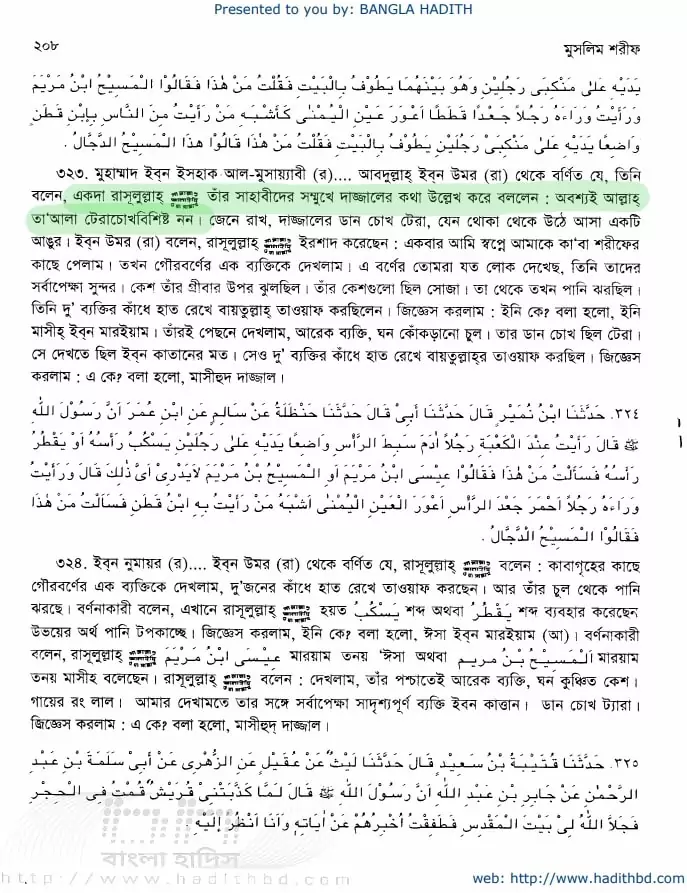
From the aforementioned Quranic verses and various hadiths, it is understood that Allah has eyes..
Islamic creedal works do not merely affirm Allah’s eyes; they also specify their number. The prominent third-century AH hadith scholar Uthman ibn Sa’id al-Darimi (d. 280 AH), in his Al-Naqd ‘ala Bishr al-Marisi, explicitly stated while interpreting the hadith concerning the Dajjal’s eye that Allah is a seeing being with two eyes. The conclusion that Allah has two eyes in contrast to the Dajjal’s defective eye is therefore not the invention of a modern commentator; it appears in early Islamic creedal works. [43]
ففي تأويل قول رسول الله صلى الله عليه وسلم : (إن الله ليس بأعور) : بيان أنه بصير ذو عينين ، خلاف الأعور
English translation:
In interpreting the Messenger of Allah’s statement that Allah is not defective in one eye, it is clear that He sees and possesses two eyes, unlike one who is defective in one eye.
Abu al-Hasan al-Ashari (d. 324 AH), on page 290 of his famous Maqalat al-Islamiyyin, also mentioned Allah’s two hands, two eyes, face, and position upon the Throne while describing the creed of the people of hadith and the Sunnah. In fatwa 262132, IslamQA quotes these early creedal works and presents belief in Allah’s two eyes as the unanimous position of Ahl al-Sunnah. The same fatwa states that a person who affirms eyes without affirming specifically two eyes is considered mistaken. Thus not merely the existence of eyes but also their number is a creedal matter. [44]
The prominent Saudi Salafi scholar Muhammad ibn Salih al-Uthaymin (1929–2001) stated even more explicitly that Allah has two eyes and literally sees with those two eyes. In his explanation, possessing eyes and possessing the capacity to see are distinct attributes. He does not allow the existence of Allah’s eyes to be subsumed into the general notion of all-seeingness. [45]
مذهب أهل السنة والجماعة : أن لله عينين اثنتين ، ينظر بهما حقيقة على الوجه اللائق به ، وهما من الصفات الذاتية
English translation:
The doctrine of Ahl al-Sunnah wa al-Jama’ah is that Allah possesses two eyes and literally sees with those two eyes, in a manner befitting Him. These two eyes are among His essential attributes.
In his Sharh al-Aqidah al-Saffariniyyah, Ibn Uthaymin also clearly distinguished the capacity for sight from the existence of eyes. His argument is that the Quran repeatedly mentions Allah’s capacity to see and separately mentions His eyes. According to his explanation, therefore, interpreting eyes merely as a metaphor for sight is wrong. Eyes are a real attribute of Allah. [46]
The philosophical problem with this explanation is profound. All-seeingness denotes a capacity, whereas two eyes are a numerically specified attribute. Why would an omniscient being use eyes to know about an event? What need is fulfilled by two separate eyes for a being capable of possessing complete knowledge of every event in the universe without eyes? Humans have two eyes as a result of a long evolutionary history. Combining visual information from both eyes confers benefits including the perception of distance and depth. But an omniscient being should have no need for such biological advantages.
More importantly, eyes are not described here as an indeterminate attribute. Three propositions are explicitly present: the number of eyes is two, Allah sees with them, and they are essential attributes. The interpretation that Allah’s eyes merely signify His all-seeingness directly contradicts Ibn Uthaymin’s statement. This creedal notion of Allah’s two real eyes clearly reflects the tendency to imagine God in terms of human physical features.
Allah Has Hands for Grasping Things
Hands are highly important animal organs and a fundamental feature of the physiology and anatomy of mammals, particularly humans. Their structure and function are closely connected with human existence and evolution. A hand is an organ generally situated in the upper part of the body and used for various tasks, such as grasping, touching, and manipulating objects. Hands allow animals to interact with their surroundings and perform necessary tasks. Hands are not exclusive to humans; other animals have different organs that developed into hands or function like hands.
To discuss the origin of hands, one may turn to evolutionary theory. According to biology, the structure and function of modern hands are the outcome of a long evolutionary process. Hands originated in the fins of ancient vertebrates, especially the ancestors of fish, whose fins contained components that later developed into limbs in terrestrial animals. As ancient aquatic animals began to move onto land, their limbs gradually changed in response to the demands of adapting to a new environment. Strong bones and structures gradually developed in place of fins, eventually taking the form of hands. Thus hands arose from fins through a prolonged evolutionary process.
The evolution of human hands began with our ancestors, when early primates lived in trees. Their hands could grasp branches, assisting them in moving through trees and hunting. Later, as human ancestors spent more time on land, the fingers and wrists became more flexible, helping them perform delicate tasks. According to evolutionary theory, distinctive features of human hands include flexible joints, the arrangement of the fingers, and the opposability of the thumb. Their specialised structure and precise control increased human dexterity and enabled complex manual work. The opposable thumb facilitated grasping and the manufacture and use of weapons and complex tools. The hand consequently played an enormous role in the development of the human brain and cognitive abilities.
The use of hands is crucial in modern human life. Their role in everyday tasks is immense. With our hands we can write, eat and drink, operate equipment, and perform various delicate tasks. Without hands, we could not carry out many daily activities. For example, artists use their hands to turn their imagination into paintings, scientists use their hands to operate laboratory instruments, and athletes use their hands to catch or throw balls. Hands also play a role in expressing human emotions. We can express feelings by gesturing, touching, and helping others with our hands.
In other animals, the development of hands has followed their particular needs. For instance, the hands of monkeys and gorillas assist them in grasping branches and hanging from them. Their hand structures have thus evolved in accordance with their needs. In bats, the bones of the hands form wings that enable flight. Hands are therefore important not just for grasping but also for adapting to the environment and performing different tasks. Overall, according to modern evolutionary theory and biology, the origin and development of hands are extremely significant for humans and other animals. The evolution of hands helped our ancestors adapt to their environment and played a major role in the development of the modern human brain and cognitive abilities.
Strangely enough, the Quran and hadith explicitly mention Allah’s hands in countless places. These passages do not merely use metaphorical language; they explicitly mention hands. The word hand denotes an organ of the body with which animals perform various tasks. More precisely, it can refer to the part of the body from the shoulder to the fingertips, or the arm. But why does an omnipotent being, for whom everything comes into existence merely by saying Be, need hands at all? What does He do with those hands? Such questions naturally arise in the mind of a thinking person. [47]
Allah said: O Iblis! The one whom I created with My own hands— what prevented you from prostrating before him? Were you arrogant, or have you attained a very high rank?
— Taisirul Quran
He said: O Iblis! The one whom I created with My own hands— what prevented you from prostrating before him? Have you shown arrogance, or are you of high rank?
— Sheikh Mujibur Rahman
Allah said, O Iblis, the one whom I created with My two hands— what prevented you from prostrating before him? Were you arrogant, or are you of a higher rank?
— Rawai Al-bayan
He said, O Iblis! The one whom I created with My two hands [1], what prevented you from prostrating before him? Did you show arrogance, or are you of higher rank?
— Dr. Abu Bakr Muhammad Zakaria
The following verse states that Allah’s hand was above the companions’ hands when they pledged allegiance. It combines a physical and spiritual relationship in which the hand is presented as a physical symbol of the creator’s authority. [48]
Those who pledge allegiance to you in fact pledge allegiance to Allah. Allah’s hand is above their hands. Whoever breaks this promise bears its harmful consequences himself; whoever fulfils his promise to Allah will soon receive a great reward.
— Taisirul Quran
Those who pledge allegiance to you pledge allegiance to Allah. Allah’s hand is above their hands. Whoever breaks it bears the consequences himself, and whoever fulfils his covenant with Allah will receive a great reward from Him.
— Sheikh Mujibur Rahman
Those who pledge allegiance to you pledge allegiance only to Allah; Allah’s hand is above their hands; whoever breaks the promise bears its consequences himself, while Allah will soon give a great reward to whoever fulfils his promise to Him.
— Rawai Al-bayan
Indeed, those who pledge allegiance to you [1] pledge allegiance to Allah. Allah’s hand [2] is above their hands [3]. Whoever breaks it bears the consequences himself, and whoever fulfils the covenant made with Allah will surely receive a great reward from Him.
— Dr. Abu Bakr Muhammad Zakaria
In response to a misconception attributed to Jews, Muhammad spoke of both of Allah’s hands being open. The repeated use of the expression two hands is incompatible with the theory of formlessness; rather, it attests to a definite structure and existence. [49]
The Jews say Allah’s hand is bound. Their own hands are bound, and they have been cursed for their (absurd) statement. Rather, both of Allah’s hands are outstretched, and He gives as He wills. What has been revealed to you from your Lord will surely increase many of them in transgression and disbelief. We have placed enmity and hatred among them until the Day of Resurrection. Whenever they kindle the fire of war, Allah extinguishes it. They spread corruption on earth, and Allah does not like those who spread corruption.
— Taisirul Quran
The Jews say: Allah’s hand has become closed. Their own hands are closed, and they are cursed for this statement. Rather, both His (Allah’s) hands are open, and He spends as He wills. What is sent to you from your Lord increases many of them in disobedience and disbelief, and We have cast enmity and jealousy among them until the Day of Resurrection. Whenever they seek to kindle the fire of war (against Muslims), Allah extinguishes it. They spread disorder upon the earth, and Allah does not love those who spread disorder.
— Sheikh Mujibur Rahman
The Jews say, Allah’s hand is tied. Their own hands have been tied, and they are cursed for what they said. Rather, His two hands are outstretched. He gives as He wills. What has been revealed to you from your Lord increases many of them in disobedience and disbelief. We have cast enmity and hatred among them until the Day of Resurrection. Whenever they kindle the fire of war, Allah extinguishes it. They spread corruption on earth, and Allah does not love corrupters.
— Rawai Al-bayan
The Jews say, Allah’s hand [1] is restrained [2]. Their own hands have been restrained and they have been cursed for what they say [3]. Rather, both of Allah’s hands are outstretched [4]; He gives as He wills. What has been revealed to you from your Lord will surely increase many of them in disobedience and disbelief. We have cast lasting enmity and hatred among them until the Day of Resurrection [5]. Whenever they kindle the fire of war, Allah extinguishes it. They spread corruption on earth, and Allah does not love those who spread corruption.
— Dr. Abu Bakr Muhammad Zakaria
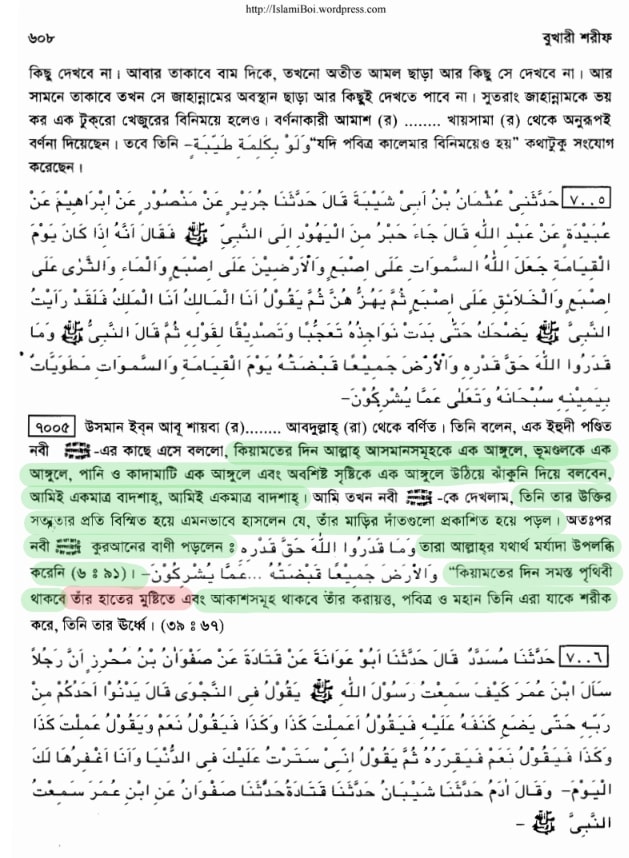
This narration in al-Tirmidhi mentions Allah’s right hand and the Mizan, or scales, in His hands. It is a highly specific physical description directly linking the creator’s actions to His organs. According to the scholars, these accounts must be believed as they stand. [50]
Sunan al-Tirmidhi (authenticated edition)
Book 44/ Tafsir of the Quran
Publisher: Husayn al-Madani
Chapter 6. Surah al-Ma’idah
3045. Narrated Abu Hurayrah (may Allah be pleased with him), who said that the Messenger of Allah (peace be upon him) said: The Merciful Allah Almighty’s right hand is full. It continuously pours forth blessings. Continuous giving day and night never diminishes it. He further said: Have you considered how much He has given since creating the heavens and earth, yet what is in His right hand has not diminished at all? (Before creation) His Throne was upon water.In His other hand is the Mizan (scales). He lowers and raises it (determining the provision of creation).
Sahih: Ibn Majah (197).
Abu Isa said: This hadith is hasan sahih. It explains the following verse: The Jews say Allah Almighty’s hand is restrained. Their own hands are restrained and they are cursed for what they say. Rather, both Allah Almighty’s hands are outstretched; He gives as He wills (Surah al-Ma’idah 64).
The imams say that this hadith must be believed as it has reached us, without interpretation, analysis, doubt, or uncertainty. Several imams said this, including Sufyan al-Thawri, Malik ibn Anas, Ibn Uyaynah, and Ibn al-Mubarak (may Allah have mercy on them). According to them, such matters may be narrated and must be believed, but their modality must not be specified.
Hadith grade: Sahih (authentic)
These pages from Sahih al-Tirmidhi discuss the nature of Allah’s hands and the relevant evidence in detail. They clarify that possessing hands is an eternal attribute of Allah that cannot be negated through metaphorical interpretation. [51]
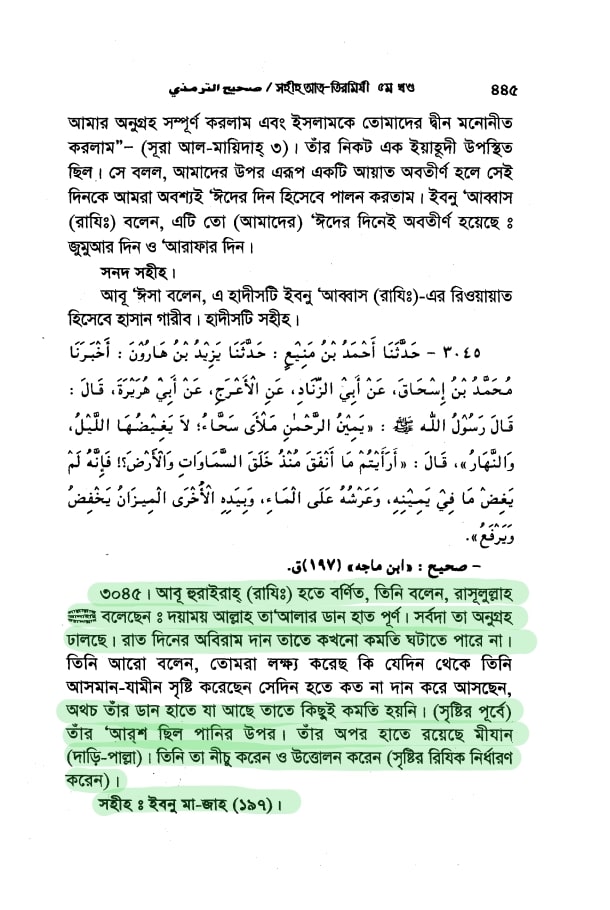
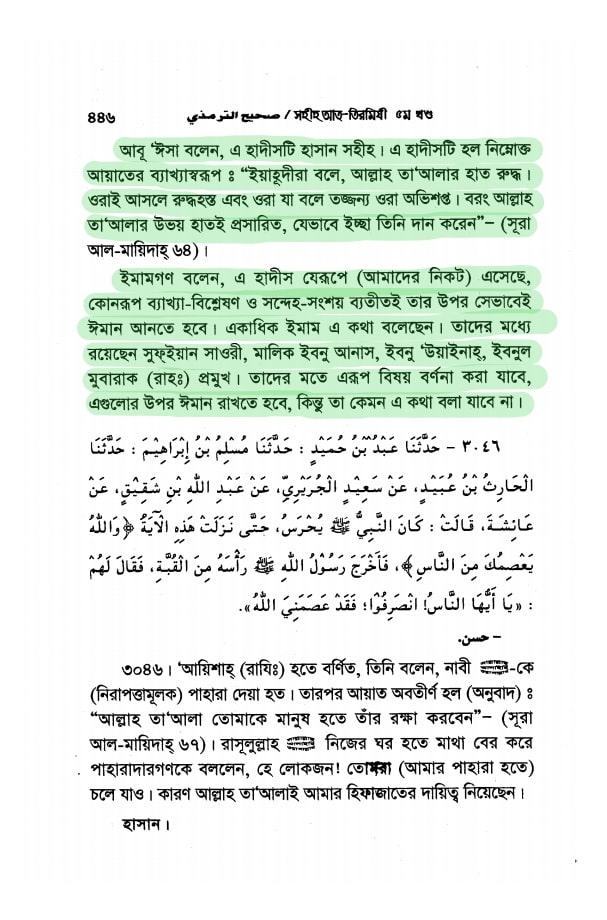
This volume of al-Tirmidhi collects accounts of the functions of Allah’s hands and His physical presence during the creation of the universe. It is a major source for understanding literal creedal belief. [52]
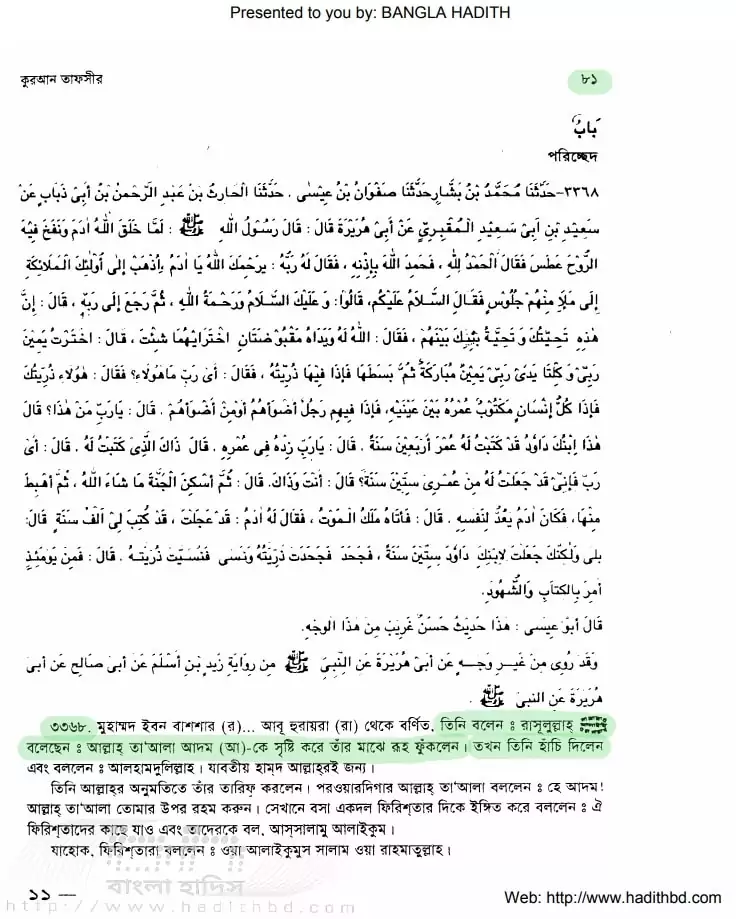
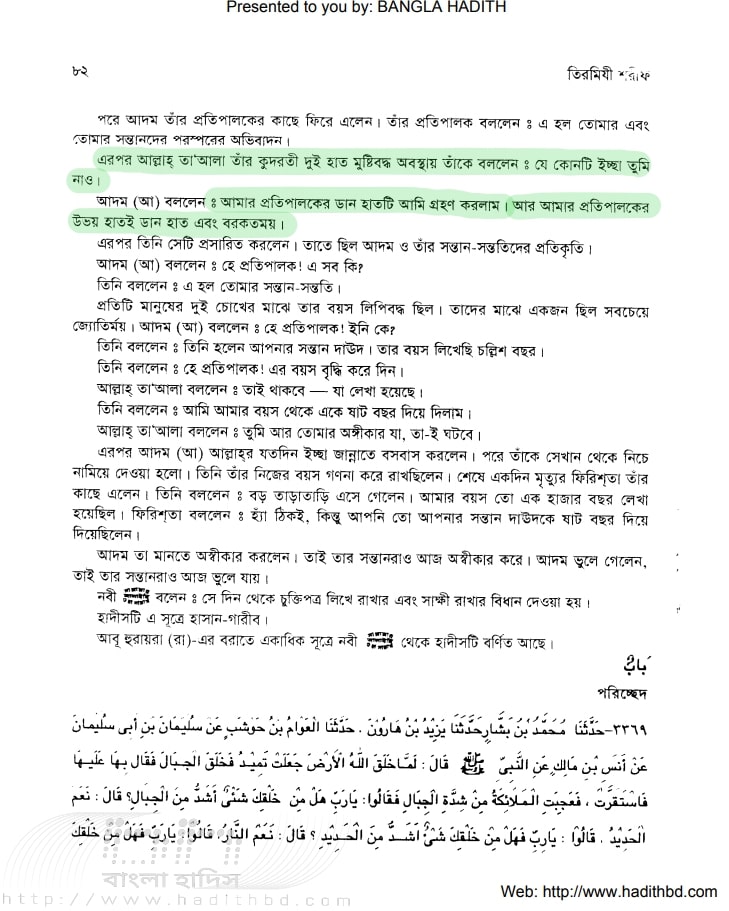
This hadith in Sahih al-Bukhari is particularly significant: it states that Allah will take the earth in His grasp on the Day of Resurrection. This capacity or action of grasping directly implies existence with form and organs. [53]
Sahih al-Bukhari (Tawhid Publications)
Book 97/ Tawhid
7413. Narrated Abu Hurayrah (may Allah be pleased with him): The Messenger of Allah (peace be upon him) said: Allah will take the earth in His grasp . (4812) (Adhunik Prakashani: none; Islamic Foundation 6908)
Hadith grade: Sahih (authentic)
This hadith in Sunan Abi Dawud describes Allah folding up the heavens and the earths in His right hand and His other hand. This is among the strongest textual evidence for the creator’s vastness and the actual existence of His hands. [54]
Sunan Abi Dawud (authenticated edition)
35/ Sunnah
Chapter 21. Refutation of the Jahmiyyah doctrine
4732. Narrated Abdullah ibn Umar (may Allah be pleased with him), who said: The Messenger of Allah (peace be upon him) said: On the Day of Resurrection Allah will fold up the heavens in His right hand and say, I am the sovereign ruler and owner. Where are the tyrants and the arrogant? Then He will fold up the earths in His other hand and say, I am the owner. Where are the tyrants and the arrogant?[1]
Sahih.
[1]. Muslim.
Hadith grade: Sahih (authentic)
Narrator: Abdullah ibn Umar (may Allah be pleased with him)
Allah Has Fingers on His Hands
In describing the completeness of Allah’s hands, hadiths even mention His fingers. According to this hadith, human hearts are between two of Allah’s fingers. The mention of such a definite physical structure as fingers establishes that the creator’s form is not merely imagined, but textually attested. [55]
Sunan al-Tirmidhi (authenticated edition)
Book 30/ Predestination
Publisher: Husayn al-Madani
Chapter 7. All Hearts Are between Two Fingers of Allah Almighty
2140. Narrated Anas (may Allah be pleased with him): The Messenger of Allah (peace be upon him) frequently recited this supplication: O Turner of hearts, keep my heart firmly established in Your religion. I said: O Messenger of Allah (peace be upon him), we believe in you and what you have brought. Do you fear anything concerning us? He said: Yes, because Allah Almighty’s fingers— all hearts lie between two of them. He turns them as He wills.
Sahih, Ibn Majah (3834).
Abu Isa said: Hadiths in this chapter have also been narrated from al-Nawwas ibn Sam’an, Umm Salamah, Abdullah ibn Amr, and Aishah (may Allah be pleased with them). This hadith is hasan. Several narrators transmitted a similar hadith through al-A’mash, from Abu Sufyan, from Anas (may Allah be pleased with him). Some narrated a similar hadith through al-A’mash, from Abu Sufyan, from Jabir (may Allah be pleased with him), from the Messenger of Allah (peace be upon him). Abu Sufyan’s narration from Anas (may Allah be pleased with him) is considerably more authentic.
Hadith grade: Sahih (authentic)
Now consider these pages from Sunan al-Tirmidhi. They discuss the interpretation and reliability of the hadith concerning fingers. The mention of fingers is an extremely significant aspect of understanding the creator’s physical structure. [56]
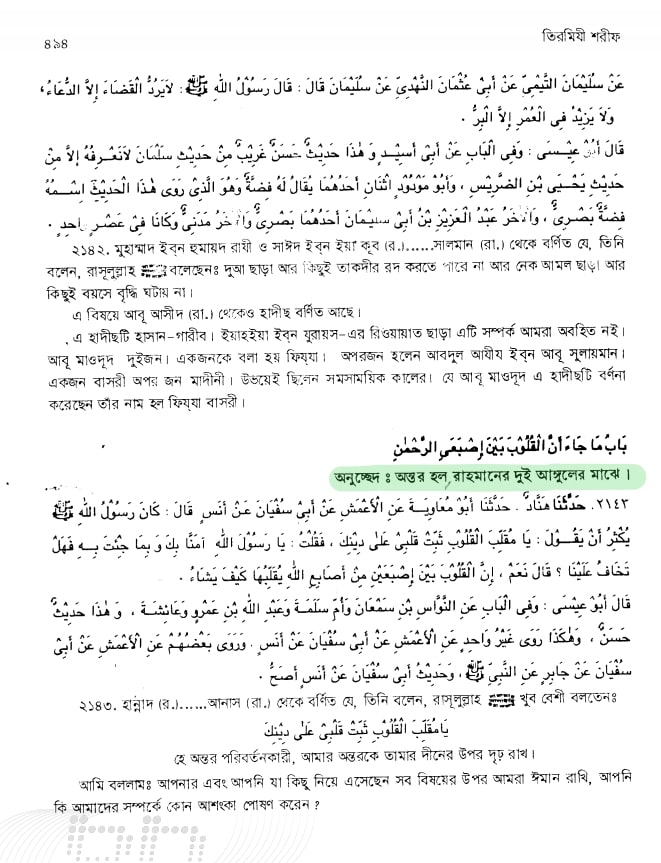
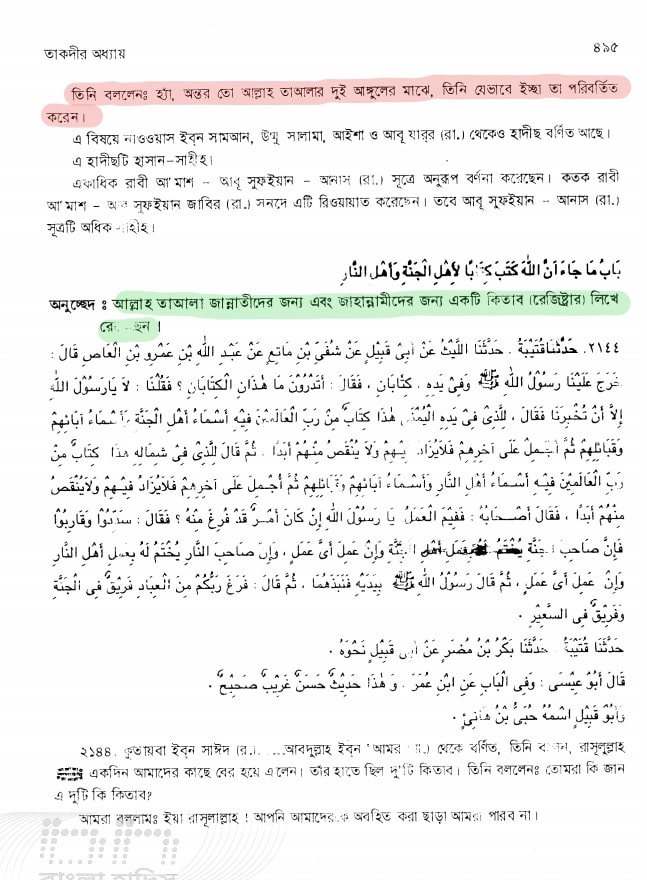
An even more astonishing account of Allah’s fingers appears in Sahih al-Bukhari. According to this hadith narrated by Abdullah ibn Mas’ud, a Jewish religious scholar came to Muhammad and described Allah holding all creation upon His fingers. He said that Allah would hold the heavens upon one finger, the earths upon one finger, the trees upon one finger, water and soil upon one finger, and all remaining creation upon another finger. Hearing this, Muhammad laughed until his teeth became visible. The narrator described his laughter as an acknowledgment of the truth of the Jewish scholar’s statement. Muhammad then recited verse 67 of Surah al-Zumar, which describes the entire earth being in Allah’s grasp and the heavens folded up in His right hand. [57]
إِنَّا نَجِدُ أَنَّ اللَّهَ يَجْعَلُ السَّمَوَاتِ عَلَى إِصْبَعٍ وَالأَرَضِينَ عَلَى إِصْبَعٍ، وَالشَّجَرَ عَلَى إِصْبَعٍ، وَالْمَاءَ وَالثَّرَى عَلَى إِصْبَعٍ، وَسَائِرَ الْخَلاَئِقِ عَلَى إِصْبَعٍ، فَيَقُولُ أَنَا الْمَلِكُ
English translation:
We find that Allah will place the heavens upon one finger, the earths upon one finger, the trees upon one finger, water and soil upon one finger, and all the remaining creation upon one finger. Then He will say: I am the King.
This hadith divides creation into five distinct categories and describes them being held upon five fingers. The total number of Allah’s fingers is not specified in this hadith, but the separate uses of five fingers are explicit. The differentiation of the heavens upon one finger, the earths upon another, and trees upon another establishes the conception of the distinct existence and use of those fingers. The previously mentioned hadith in al-Tirmidhi describes human hearts between two of Allah’s fingers. Al-Bukhari’s account presents the functions of those fingers on a much larger scale.
| Finger | What Will Be Held on the Finger | Arabic Words Used in the Hadith |
|---|---|---|
| First | All the heavens | السماوات |
| Second | The earths | الأرضين |
| Third | The trees | الشجر |
| Fourth | Water and soil | الماء والثرى |
| Fifth | All remaining creation | سائر الخلائق |
Imam Ibn Khuzaymah devoted a chapter to this matter in his Kitab al-Tawhid, entitled باب ذكر إمساك الله تبارك وتعالى اسمه وجل ثناؤه السماوات والأرض وما عليها على أصابعه, meaning the account of Allah holding the heavens, the earth, and everything upon them on His fingers. In this chapter, Ibn Khuzaymah compiled several reports of the conversation between the Jewish scholar and Muhammad. According to his interpretation, if the Jewish scholar had attributed to Allah an attribute He did not possess, Muhammad would have objected. But Muhammad laughed instead of objecting and recited the relevant Quranic verse. Ibn Khuzaymah accepted the event as evidence that Allah has fingers. [58]
In the same work, Ibn Khuzaymah devoted another chapter to affirming the existence of Allah’s fingers, entitled باب إثبات الأصابع لله عز وجل. In opposing interpretations of Allah’s hands as metaphors for His blessings or grace, he made a significant numerical argument. His point is that Allah’s blessings are innumerable and cannot be counted. Yet the Quran says that Allah has two hands. Interpreting Allah’s two hands as His blessings therefore alters the meaning of the Quranic statement. [59]
وَالدَّلِيلُ عَلَى نَقْضِ دَعْوَاهُمْ هَذِهِ أَنَّ نِعَمَ اللَّهِ كَثِيرَةٌ، لَا يُحْصِيهَا إِلَّا الْخَالِقُ الْبَارِئُ، وَلِلَّهِ يَدَانِ لَا أَكْثَرَ مِنْهُمَا
English translation:
The evidence refuting their claim is that Allah’s blessings are numerous and none but the Creator can count them, whereas Allah has two hands, no more.
Ibn Khuzaymah’s statement explicitly distinguishes the number of Allah’s hands from the number of His blessings. He not only affirmed Allah’s hands but also specified their maximum number. In his view, Allah has two hands, not three or four. Denying their literal existence and interpreting them merely as symbols of grace directly contradicts his creedal position. Likewise, he compiled the accounts concerning fingers as evidence affirming real attributes of Allah.
Another important historical aspect of these reports is that in the aforementioned hadith in Sahih al-Bukhari, the idea of Allah holding all creation upon His fingers was first expressed by a Jewish scholar. After hearing it, Muhammad recited the relevant Quranic verse, and the narrator preserved his reaction as an acknowledgment of the statement. This provides a direct literary connection between the anthropomorphic conception of God prevalent in Jewish religious tradition and Islamic theology.
The most important philosophical point is that determining the number of organs requires distinction among them. Two hands means one hand is distinct from the other. Five fingers means five distinct attributes. Describing separate objects being held on each finger also establishes that distinction functionally. It is literally inconsistent to describe a being whose hands can be numbered, whose fingers can be distinguished, and whose fingers each have a separately described use as completely formless and partless. This problem is not merely a conflict between modern science and religion; it is a conflict among the notions of number, form, distinctness, and function used within the religious statements themselves.
Allah’s Feet and Their Functions
The word pa means foot, leg, sole, the part of the body extending from thigh to foot, support, or the leg of a structure. In other words, it denotes the bodily organ by which animals travel from one place to another. According to Islamic belief, the omnipotent creator of the universe, Allah Almighty, has feet. What Allah uses those feet for, what they are made of, and what form they take will surely raise numerous questions in the minds of interested readers.
Legs are among the most important parts of the human body, playing a role in locomotion, balance, and bearing weight. The structure and function of the legs of various animals are related to their evolutionary history. Taking the descriptions of Allah’s feet literally raises the question of what functional role such organs have in His case.
To trace the origins of legs, we must go back several hundred million years to the emergence of the early tetrapod vertebrates. Their ancestors were aquatic animals whose fins were their principal means of locomotion. When these animals began moving from water onto land, the fins on the lower part of their bodies gradually became strong and stable limbs, which subsequently took the form of legs. Tetrapods are noteworthy among the earliest terrestrial vertebrates to emerge with legs. These animals had four limbs that helped them move on land. Over the course of evolution, tetrapod limbs developed into more complex and powerful limbs in modern mammals.
The evolution and structure of human legs are particularly noteworthy. Human ancestors were originally tree-dwelling primates. They could hang from branches and leap from one branch to another. But when they began living on land, major changes occurred in the lower parts of their bodies. Human ancestors gradually became bipedal, capable of walking on two legs. This was a highly significant stage in human evolution.
With bipedal locomotion, the hands of human ancestors became relatively less involved in movement, providing greater opportunities to carry objects and use tools. Over a long evolutionary process, changes occurred in the pelvis, spine, leg bones, muscles, and joints, helping maintain balance while standing and walking on two legs.
One distinctive feature of human feet is the combination of toes, soles, ankles, and various joints that enhances stability and function. The toes help us maintain balance while walking, while the structure of the sole distributes body weight appropriately to facilitate movement. The close coordination between ankles and leg muscles enables us to run quickly, jump, and perform various tasks.
Legs are not used solely for locomotion. They also bear weight, maintain balance, and provide a foundation for physical work. They play an enormous role in sports such as football, basketball, and running. They are also essential for everyday activities such as lifting heavy objects, climbing hills, or even standing still.
The evolution of legs has produced varied developments in animals other than humans as well. In some animals, legs have evolved according to their mode of locomotion. Horses and deer, for example, have strong, long legs adapted for rapid running. Elephants and rhinoceroses have heavy, sturdy legs that support their massive bodies. Birds generally have small and light legs that facilitate flight. The legs of lions and tigers enable them to seize prey and exert force during hunting.
Overall, legs play an extremely important role in movement, balance, and the application of physical force. Their importance to human life is immense: with their help we not only perform daily tasks but can also become physically and mentally stronger. In light of evolutionary theory, the origin and development of legs established them as a significant human organ that shapes our past, present, and future. But why does the Allah of Islam need feet? Consider the relevant hadiths: [60]
Abu Hurayrah narrated that the Messenger (peace be upon him) said: Hell will not be filled until Allah places His foot in Hell, whereupon Hell will keep saying, Enough! Enough!
(Al-Bukhari and Muslim, Mishkat, p. 505)
The prominent third-century AH Islamic scholar, linguist, and hadith scholar Abu Ubayd al-Qasim ibn Sallam (d. 224 AH) accepted as true the reports concerning Allah’s laughter, His placing His foot in Hell, and the Kursi being the place for His two feet. His statement is preserved in al-Bayhaqi’s Al-Asma’ wa al-Sifat and Ibn Abd al-Barr’s Al-Tamhid. Reports about Allah’s feet and the Kursi were thus being used in Islamic creedal discussions about four and a half centuries before Ibn Taymiyyah was born. [61]
وأن جهنم لا تمتلئ حتى يضع ربك قدمه فيها ، والكرسي موضع القدمين ، وهذه الأحاديث في الرواية هي عندنا حق
English translation:
Hell will not be filled until your Lord places His foot in it; the Kursi is the place of the two feet. These hadiths, as transmitted, are true in our view.
This lengthy hadith in Sahih al-Bukhari describes a conversation between Paradise and Hell, culminating in Allah placing His qadam, or foot, in Hell. It is compelling evidence of the depiction of Allah performing a physical action through the use of His organs. [62]
Sahih al-Bukhari (Islamic Foundation)
Book 86/ Refutation of the Jahmiyyah and Tawhid
Chapter 3127. Allah’s statement: Allah’s mercy is near to those who do good (7:56)
6941. Ubaydullah ibn Sa’d ibn Ibrahim (may Allah have mercy on him) … narrated from Abu Hurayrah (may Allah be pleased with him). The Prophet (peace be upon him) said: Paradise and Hell both complained to their Lord. Paradise said: My Lord! Why is it that only the destitute and lowly people will enter me? Hell likewise complained: You have favoured me only with the arrogant. Allah said to Paradise: You are My mercy. He said to Hell: You are My punishment; through you I punish whomever I will. Both of you will be filled. Allah Almighty will not wrong any of His creatures. He will bring into existence a new creation for Hell as He wills. When they are thrown into Hell, it will say: Is there any more? More will be thrown into Hell, and it will still say: Is there any more? It will say this three times. Finally, when Allah Almighty places His qadam (foot) in Hell, it will become full. One part of Hell will then answer another: Enough, enough, enough.
Hadith grade: Sahih (authentic)
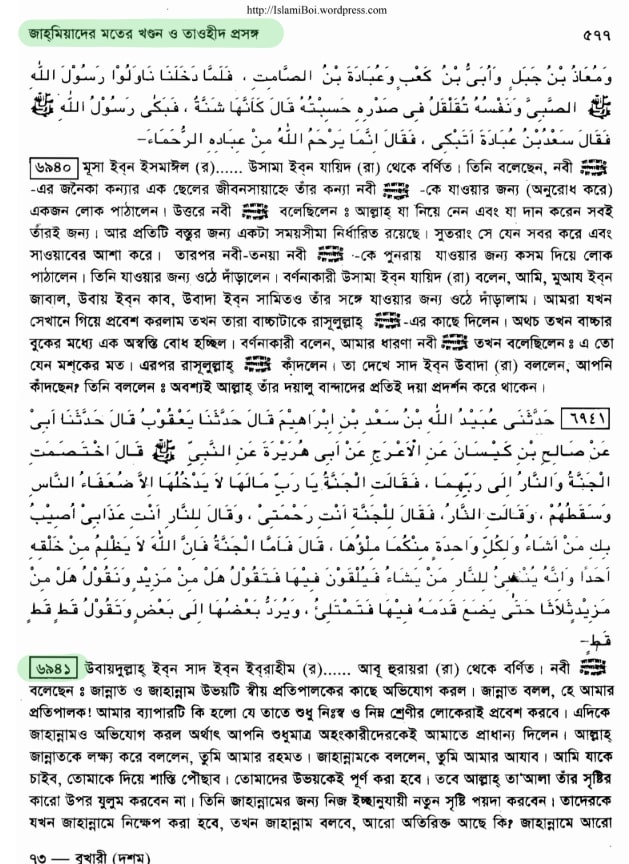
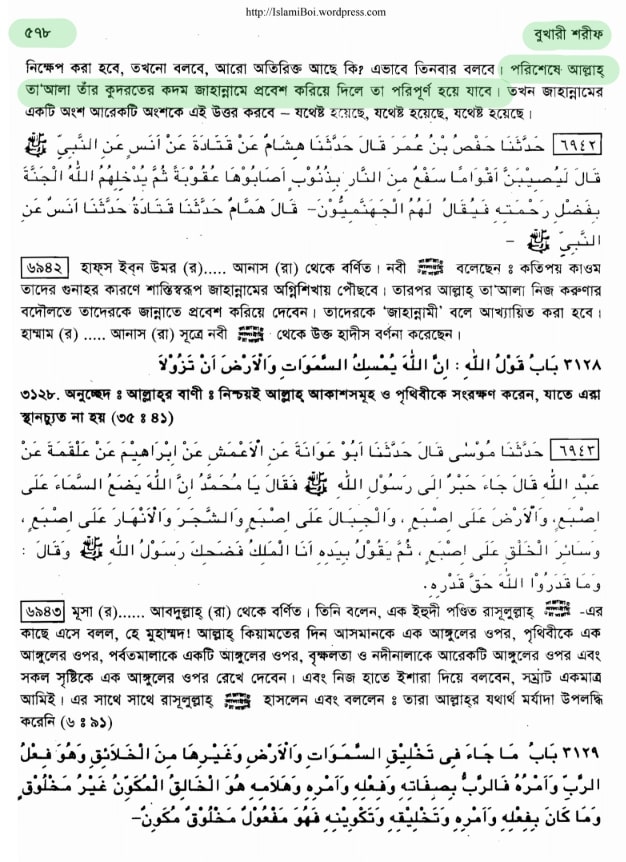
The relevant page of Sahih al-Bukhari is reproduced here, containing the hadith concerning Allah’s qadam or foot. This is reliable textual evidence for the literal account. [63]
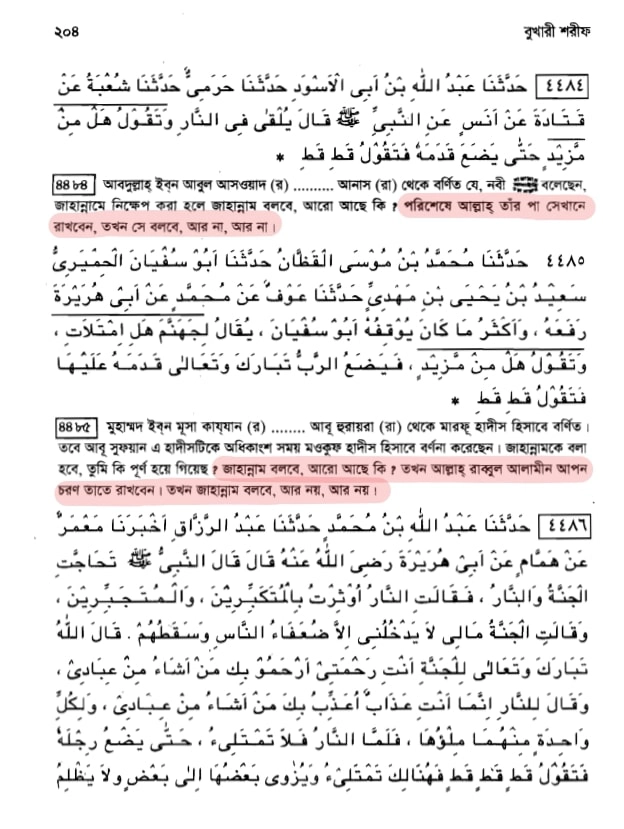
Islamic creedal works also discuss in detail the number of Allah’s feet and where He places them. The statement attributed to Ibn Abbas is preserved in Ibn Khuzaymah’s Kitab al-Tawhid, Ibn Abi Shaybah’s Al-Arsh, al-Darimi’s Al-Radd ‘ala al-Marisi, Abdullah ibn Ahmad’s Al-Sunnah, and al-Hakim’s Al-Mustadrak. Al-Hakim declared its chain authentic according to the criteria of al-Bukhari and Muslim, and al-Dhahabi agreed. This statement of Ibn Abbas describes the Throne and the Kursi as two separate structures, with the Kursi being the place for Allah’s two feet. It is preserved as Ibn Abbas’s own statement, that is, a mawquf report. [64]
الكرسي موضع القدمين ، والعرش لا يقدر أحد قدره
English translation:
The Kursi is the place of the two feet, and no one can determine the magnitude of the Throne.
A statement by another companion of Muhammad, Abu Musa al-Ashari, provides further significant information about the Kursi. According to his account, the Kursi is not only the place for Allah’s feet but also creaks like a riding saddle. This statement is preserved in Abdullah ibn Ahmad’s Al-Sunnah, Ibn Abi Shaybah’s Al-Arsh, and the works of Ibn Jarir al-Tabari and al-Bayhaqi. Ibn Hajar al-Asqalani deemed its chain authentic in his Fath al-Bari. Subsequently, al-Albani likewise classified it as authentic in his Mukhtasar al-‘Uluw. [65]
الكرسي موضع القدمين، وله أطيطٌ كأطيطِ الرَّحْل
English translation:
The Kursi is the place of the two feet, and it creaks like a riding saddle.
The Arabic word أطيط (atit) denotes the creaking sound produced by a structure under pressure or movement. Abu Musa al-Ashari’s account bears a notable resemblance to al-Darimi’s previously mentioned account of carrying the Throne. In the latter, the angels became weak while carrying the Throne with Allah above it; here, the structure on which Allah places His feet is said to creak like a riding saddle. These accounts present Allah’s position through familiar material experiences of ancient humans, including mounts, load-bearing, thrones, and footstools.
Saudi Arabia’s Permanent Committee for Scholarly Research and Fatwa also affirmed the existence of Allah’s two hands, two feet, and fingers as real attributes. The fatwa bears the names of Abd al-Aziz ibn Baz, Salih al-Fawzan, Abd al-Aziz Al al-Shaykh, Bakr Abu Zayd, and Abdullah ibn Ghudayyan. According to their ruling, these attributes of Allah cannot be interpreted as mere metaphors. [66]
الواجب إثبات ما أثبته الله لنفسه من اليدين والقدمين والأصابع وغيرها من الصفات الواردة في الكتاب والسنة على الوجه اللائق بالله سبحانه
English translation:
The attributes Allah has affirmed for Himself, such as two hands, two feet, and fingers, and the other attributes mentioned in the Book and Sunnah, must be affirmed in a manner befitting Allah.
The eighth-century AH Hanafi scholar Ibn Abi al-Izz discussed the distinction between the Throne and the Kursi in his famous Sharh al-Aqidah al-Tahawiyyah. He opposed interpreting the Throne merely as a metaphor for sovereignty or authority. In his explanation, the Throne and the Kursi are two separate creations. He also quoted a statement narrated from Abu Dharr comparing the Kursi in relation to the Throne to an iron ring thrown into a vast desert. Similarly, Ibn Uthaymin rejected the interpretation of the Kursi as Allah’s knowledge and accepted it as the place for Allah’s feet. [67]
This conception is explained in more detail in IslamQA fatwa 447839. A questioner asks how Allah, positioned above the Throne, can place His feet on the Kursi if the latter is as small relative to the Throne as a ring thrown into a vast desert. The fatwa recognises both the Throne and the Kursi as material, perceptible, created structures. It also maintains that Allah is above the Throne and places His two feet upon the Kursi. [68]
Allah’s location and feet are here related to two distinct material structures. One is the Throne, above which Allah is positioned; the other is the Kursi, where He places His two feet. There are also accounts of the relative sizes of the Throne and Kursi. Allah’s existence is thus described within a spatial framework in which above and below, relative size, position, and separate uses of organs are all meaningful. The notion of an entirely formless and spaceless being placing two feet on a distinct material structure is literally self-contradictory.
Allah Has a Shin
The Quran and hadith describe Allah’s shin (saq) being uncovered. This picture makes the existence of a physical form of the creator even more specific. Uncovering the shin and identifying oneself through it can be attributes of a real bodily entity.
Sahih al-Bukhari (Tawhid Publications)
97/ Tawhid
Chapter 97/24. Allah’s statement: Some faces on that Day will be radiant, looking towards their Lord (Surah al-Qiyamah 75:22–23)
7439. Narrated Abu Sa’id al-Khudri (may Allah be pleased with him): We asked, O Messenger of Allah! Will we see our Lord on the Day of Resurrection? He said: Do you have difficulty seeing the sun in a cloudless sky? We said no. He said: On that Day you will have no difficulty seeing your Lord, except such difficulty as you experience in seeing the sun. On that Day a caller will proclaim: Let those who worshipped something go to that which they worshipped. Those who worshipped the cross will go to their cross; idolaters will go to their idols. Everyone will go with their object of worship. Only those who worshipped Allah alone will remain, both righteous and wicked, together with some of the People of the Book. Then Hell will be brought forward, resembling a mirage. The Jews will be asked what they worshipped. They will answer: We worshipped Uzayr (peace be upon him), the son of Allah.
They will be told: You are lying, for Allah has neither wife nor child. What do you want now? They will say: We want you to give us water to drink. They will be told: Drink. Then they will be thrown into Hell. The Christians will be asked what they worshipped. They will answer: We worshipped the Messiah, son of Allah. They will be told: You are lying. Allah had neither wife nor child. What do you want now? They will say: We wish you to give us water to drink. They will be told: Drink. Then they will be thrown into Hell. Finally only those who worshipped Allah alone will remain, both righteous and wicked. They will be asked: What has kept you here, when the others have gone? They will answer: We separated from them on a day when we needed them more than we do today.
We heard a caller proclaim that those who worshipped others should go with them. We are waiting for our Lord. The Prophet (peace be upon him) said: Then Almighty Allah will come to them, but not in the form in which the believers first saw Him. He will proclaim: I am your Lord. They will all say: You are our Lord. On that Day no one except the prophets will be able to speak to Him. Allah will ask them: Is there any sign between you and Him by which He can be recognised? They will say: The shin. Then the shin will be uncovered.
Upon seeing this, all the believers will fall in prostration. Those who prostrated to be seen or heard by others will remain. They will attempt to prostrate, but their backs will become stiff like a plank. A bridge will then be placed over Hell. The companions asked: O Messenger of Allah, what will that bridge be like? He said: It is a difficult and slippery place. It will have rings and hooks, and hard, broad, curved thorns resembling the thorns of the sa’dan plant of Najd. Some believers will cross the bridge in the blink of an eye, some like lightning, some like the wind, and others like swift horses and mounts.
Some of those saved will arrive safely, while others will be wounded by the fire of Hell. The last person to cross will somehow crawl across. You are not more insistent upon the truth than the believers will be before Allah on that Day, when the matter has become clear to you. When the believers see that they alone have been saved, leaving their brothers behind, they will say: Our Lord! Where are our brothers who prayed and fasted with us and performed righteous deeds? Allah Almighty will say: Go and bring out of Hell those in whose hearts you find faith equal to a dinar. Allah has forbidden Hell to consume their faces. Some of them will be in Hell up to their feet or beyond their shins.
They will bring out those they recognise. Then they will return. Allah will say again: Go and bring out those in whose hearts you find faith equal to half a dinar. They will bring out those they recognise. Then they will return again. Allah will say: Go and bring out those in whose hearts you find faith equal to an atom. They will bring out those they recognise. The narrator Abu Sa’id al-Khudri (may Allah be pleased with him) said: If you do not believe me, recite Allah’s statement: Allah does not wrong anyone by even an atom’s weight, and if there is a good deed, He multiplies it (Surah al-Nisa 4:40). Then the prophets, angels, and believers will intercede. Almighty Allah will say: Now only My intercession remains.
He will take a handful of people out of Hell who have been burned to charcoal. They will be cast into a river called Life in front of Paradise. They will sprout on its banks like grass from seeds carried in debris beside stones and trees. You see that plants exposed to sunlight are generally green and those in the shade are white. They will emerge like pearls, with seals placed upon their necks. When they enter Paradise, its other inhabitants will say: These are the people freed by the Merciful, whom Allah admitted to Paradise without any righteous deed or good work. They will then be told: Everything you have seen belongs to you, and an equal amount in addition is granted to you. [22; Muslim 1/81, Hadith 183, Ahmad 11127] (Adhunik Prakashani 6921, Islamic Foundation 6932)
Hadith grade: Sahih (authentic)
Narrator: Abu Sa’id al-Khudri (may Allah be pleased with him)
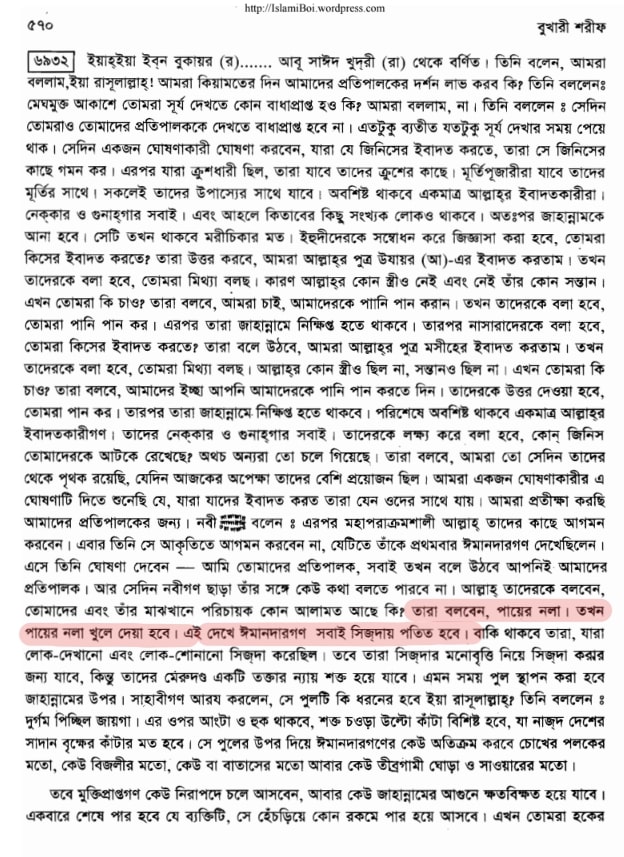
Allah Can Be Seen Directly with One’s Own Eyes
According to Islamic belief, Allah is a being whom believers will see directly in the hereafter. This vision is not described merely as insight, spiritual perception, or acquiring knowledge of Allah’s existence. A hadith narrated by Jarir ibn Abdullah in the Book of Tawhid in Sahih al-Bukhari explicitly states that people will see Allah directly. The Arabic word used is عِيَانًا (iyanan), meaning directly, with one’s own eyes, or through direct vision. The statement is not about perceiving a concept of Allah but about seeing Allah. [69]
عَنْ جَرِيرِ بْنِ عَبْدِ اللَّهِ، قَالَ قَالَ النَّبِيُّ صلى الله عليه وسلم إِنَّكُمْ سَتَرَوْنَ رَبَّكُمْ عِيَانًا
English translation:
Narrated Jarir ibn Abdullah: The Prophet said, You will certainly see your Lord directly with your own eyes.
In the next hadith, Muhammad uses the example of seeing the full moon to make the vision of Allah clearer. A natural object whose existence and location can be perceived by human eyesight is used as an example. Muhammad declares that people will see Allah as easily and without difficulty as they see the moon in the sky on a full-moon night. [70]
قَالَ خَرَجَ عَلَيْنَا رَسُولُ اللَّهِ صلى الله عليه وسلم لَيْلَةَ الْبَدْرِ فَقَالَ إِنَّكُمْ سَتَرَوْنَ رَبَّكُمْ يَوْمَ الْقِيَامَةِ كَمَا تَرَوْنَ هَذَا، لاَ تُضَامُّونَ فِي رُؤْيَتِهِ
English translation:
Jarir said: The Messenger of Allah came out to us on a full-moon night and said, You will certainly see your Lord on the Day of Resurrection just as you see this moon. You will have no difficulty seeing Him.
In the second volume of his Kitab al-Tawhid, Ibn Khuzaymah devoted several chapters to affirming the vision of Allah. His discussion particularly emphasises the comparison between believers seeing Allah on the Day of Resurrection and people directly seeing the full moon on earth. Page 438 quotes a report from Abu Razin in which he asked Muhammad whether every person would see Allah individually. Muhammad answered affirmatively, saying that each person would see Allah as each sees the moon on a full-moon night. [71]
قلت : يا رسول الله : أكلنا نرى الله مخليا به ؟ قال : نعم . قال : وما آية ذلك في خلق الله ؟ قال : أليس كلكم يرى القمر ليلة البدر ، وإنما هو خلق من خلق الله ، فالله أجل وأعظم
English translation:
I said: O Messenger of Allah! Will each of us see Allah individually? He said yes. I asked: What is the sign of this among Allah’s creations? He said, Does not each of you see the moon on a full-moon night? Yet it is merely one of Allah’s creations. Allah is more majestic and greater.
The notion of directly seeing Allah is also associated with the interpretation of verses 22 and 23 of Surah al-Qiyamah. Al-Bukhari used these two verses as the title of the chapter in which he collected hadiths about seeing Allah. [72]
وُجُوهٌ يَوْمَئِذٍ نَاضِرَةٌ إِلَىٰ رَبِّهَا نَاظِرَةٌ
English translation:
Some faces on that Day will be radiant. They will be looking towards their Lord.
Looking towards a being and seeing it with one’s own eyes involves location, direction, and visual presence. A person can understand a mathematical formula, grasp a moral ideal, or contemplate an abstract concept; but cannot see the mathematical formula or moral ideal directly like the full moon in the sky. Creating a visible symbol of an abstract concept and seeing that abstract concept directly are entirely different things. Drawing the symbol for infinity on paper does not mean that infinity itself has been seen with the eyes. Similarly, there is a fundamental conceptual difference between claiming that Allah can be seen directly and defining Him as an entirely abstract and spaceless being.
Considering these accounts of vision alongside the previously mentioned descriptions of Allah’s veil of light, the radiance of His face, two eyes, position upon the Throne, and unveiling of the shin produces a coherent picture. Allah sees and can be seen; He has a face, and that face radiates; He remains behind a veil and its removal is described. On the Day of Resurrection He appears before believers, and His shin is used as a sign by which He is recognised. Collectively, these descriptions present a personal God in the language of direct human sensory experience.
In terms of modern physics, ordinary vision involves light emitted or reflected by a visible source entering the eyes, and the nervous system processing the signals. Islamic accounts provide no testable explanation of the precise process by which Allah would be seen. But visible celestial objects such as the sun and moon are used as examples of vision. Allah’s form is not compared with the moon’s form; direct vision is compared with direct vision. Interpreting the vision of Allah merely as spiritual perception therefore deprives the language of direct vision in Sahih al-Bukhari and its examples of their specific meaning.
Allah’s Form, Colour, and Sibghat Allah
Verse 138 of Surah al-Baqarah uses the expression صِبْغَةَ اللَّهِ or sibghat Allah, literally Allah’s colouring or dye. The Arabic root صبغ conveys dyeing, colouring, or changing something to a particular colour. Various Bengali Quran translations also explicitly use the expression Allah’s colour in this verse. [73]
We have adopted Allah’s colour. Allah’s colour — whose colour could be better? We worship Him alone.
Quran 2:138
Tafsir al-Tabari, one of Islam’s earliest and authoritative commentaries, relates the verse to Christian initiation or baptism. According to al-Tabari, Christians immersed their children in water to initiate them into Christianity, regarding the process as a means of purification. In this verse the Quran instead calls for adoption of Abraham’s religion and Islam. Explanations attributed to Ibn Abbas, Abu al-Aliyah, Qatadah, and al-Suddi also understand sibghat Allah as Allah’s religion. Another explanation narrated from Mujahid identifies it as Allah’s prescribed fitrah, or innate disposition. [74]
قَالَ أَبُو جَعْفَرٍ : يَعْنيِ تَعَالَى ذِكْرُهُ بِ “الصِّبْغَةِ” : صِبْغَةَ الْإِسْلَامِ.
English translation:
Abu Ja’far al-Tabari said: By sibghah Allah Almighty means the colouring or religious identity of Islam.
The question of Allah’s own colour and the notion of Allah colouring humans are linguistically distinct. For example, Allah’s house means the Kaaba, and Allah’s camel means a particular camel; neither object is a part of Allah’s essence. Similarly, associating colouring with Allah in the expression sibghat Allah does not establish that it denotes the colour of Allah’s own form. The surrounding verses and early interpretations collected by al-Tabari support the meaning of religious identity. Consequently, no specific bodily colour of Allah can be determined from this verse.
More specific descriptions of Allah’s visible form appear in the hadiths concerning the radiance of His face, veil of light, and appearance in various forms on the Day of Resurrection. Sahih Muslim 179 describes the destructive effect of the radiance of His face, and Sahih al-Bukhari 7439 describes His appearing in a form different from that previously seen. These accounts relate directly to the question of Allah’s visibility and form. But they do not specify His particular colour.
Allah Has an Audible Voice
During Allah’s conversation with the prophet Moses, the creator produced a voice or sound from a tree. This voice or sound directly indicates the existence of a physical voice. If the creator were merely a formless force, He would not need any particular medium or sound in order to speak. [75]
When he reached it, in the blessed ground of the valley, from the tree on its right side he was called : O Moses! I am Allah, Lord of the worlds.
Quran 28:30
This verse of Surah al-Naml repeats the same event, describing a voice from Allah after Moses approached the fire. Possessing a voice and producing sound from a particular location are major indications of Allah’s existence as a personal being possessing form. [76]
When he came to the fire, a voice proclaimed: Blessed is He who is at the fire and those around it. Glorified and exalted is Allah, Lord of the worlds.
Quran 27:8
An important discussion of Allah’s voice appears in al-Bukhari’s own creedal work, Khalq Af’al al-‘Ibad. Al-Bukhari describes Allah’s voice as real and audible. According to him, Allah calls with a voice that can be heard by those far away and those nearby alike. He even mentions angels losing consciousness upon hearing Allah’s voice. This does not happen when angels call to one another, but happens when they hear Allah’s voice—a distinction he presents as evidence of the uniqueness of Allah’s voice. [77]
لِأَنَّ صَوْتَ اللَّهِ جَلَّ ذِكْرُهُ يُسْمَعُ مِنْ بُعْدٍ كَمَا يُسْمَعُ مِنْ قُرْبِ، وَأَنَّ الْمَلَائِكَةَ يُصْعَقُونَ مِنْ صَوْتِهِ.
English translation:
For the voice of Allah Almighty is heard from afar just as it is heard from nearby, and because of His voice the angels lose consciousness.
Al-Bukhari’s statement establishes a relationship between Allah’s voice, distance, hearing, and the effect of that voice upon listeners. It describes not merely a message or command from Allah reaching people’s hearts, but the hearing of Allah’s own voice and angels losing consciousness upon hearing it. Allah’s speech is thus understood as an audible attribute rather than merely an abstract mental meaning.
The prominent Hanbali jurist of the sixth and seventh centuries AH, Ibn Qudamah al-Maqdisi (d. 620 AH), discussing Allah’s speech in his Lum’at al-I’tiqad, states that Moses heard Allah’s speech directly without an intermediary. Gabriel likewise heard Allah’s speech directly. In the hereafter Allah will speak to the believers, and they will speak to Him. Ibn Qudamah also quotes a report from Abdullah ibn Unays stating that on the Day of Resurrection Allah will gather all creation and call out in a voice that can be heard by those far away and those nearby alike. [78]
In the twelfth volume of his Majmu’ al-Fatawa, Ibn Taymiyyah describes the belief that Allah has a voice as the creedal position of the people of hadith and their imams. According to him, Allah speaks as He wills, and that speech is uttered with a voice. He accepts the Quran and other divine scriptures as statements uttered by Allah through His own will and power. [79]
قول الجمهور وأهل الحديث وأئمتهم: إن الله تعالى لم يزل متكلما إذا شاء وأنه يتكلم بصوت كما جاءت به الآثار.
English translation:
The position of most scholars, the people of hadith and their imams, is that Allah has always spoken whenever He wills, and He speaks with a voice, as reported in the narrations.
The eighth-century AH Hanafi scholar Ibn Abi al-Izz likewise associates Allah’s speech with an audible voice in his Sharh al-Aqidah al-Tahawiyyah. In his explanation, although the attribute of speech is beginningless, each particular utterance of Allah is not beginningless. Allah expresses a specific statement in an audible voice whenever He wills. This doctrine distinguishes Allah’s permanent capacity to speak from an instance of His speaking at a particular time. [80]
A central issue in the long-standing Islamic theological debate concerning Allah’s speech is whether His speech is uttered with letters and sound or is an abstract meaning inherent in His essence. In fatwa 384489, IslamQA rejects the Ashari theological notion of kalam nafsi, or soundless speech inherent in the essence, as an innovation and error. On the basis of the statements of al-Bukhari, Ibn Qudamah, Ibn Taymiyyah, and Ibn Abi al-Izz, it affirms that Allah speaks with letters and an audible voice. There is thus a clear doctrinal conflict within Islamic theology over whether Allah’s voice can be understood merely metaphorically.
In modern physics, sound is a mechanical wave that propagates through a medium. The human voice is produced through the combined operation of vocal cord vibrations, airflow, and various organs of articulation. The production, transmission, and perception of sound each involve specific physical processes. These sources do not describe Allah as having vocal cords, a tongue, or any other particular organ of articulation. But His own voice, the hearing of that voice, and its effects upon listeners are explicitly described.
Another philosophical problem concerning Allah’s speech is the relationship of His actions to time. There are two distinct states before and after uttering a particular statement. The first and last words of a sentence are not uttered at the same point in its sequence; there is a succession between them. When Ibn Abi al-Izz does not affirm each particular utterance of Allah as beginningless, he also accepts the notion of temporal change in Allah’s particular actions. There is therefore a fundamental conceptual conflict between defining Allah as an entirely timeless and immutable being and affirming the doctrine that He utters new statements according to His will.
Allah’s Hearing and the Question of Ears
Islamic sources describe Allah as a personal being capable of hearing human conversations, prayers, complaints, and private discussions. One of the most significant accounts of Allah’s hearing appears in the Book of Sunnah in Sunan Abi Dawud. According to this hadith narrated by Abu Hurayrah, when Muhammad recited verse 58 of Surah al-Nisa, he placed his thumb on his ear and the adjacent finger on his eye to illustrate that Allah is all-hearing and all-seeing. After collecting this hadith, Abu Dawud explicitly said that it refutes the doctrine of the Jahmiyyah. Al-Albani classified its chain as authentic. [81] [82]
رَأَيْتُ رَسُولَ اللَّهِ صلى الله عليه وسلم يَضَعُ إِبْهَامَهُ عَلَى أُذُنِهِ وَالَّتِي تَلِيهَا عَلَى عَيْنِهِ
English translation:
I saw the Messenger of Allah place his thumb upon his ear and the adjacent finger upon his eye.
The significance of this hadith is that Muhammad did not merely provide a verbal description of Allah’s two attributes; he also pointed to two specific organs of his own body. The ear was used to illustrate hearing and the eye to illustrate sight. This use of the organs associated with human hearing and sight as visual aids for explaining Allah’s attributes is a significant example of anthropomorphic description in Islamic theology. The narrator al-Muqri explained that this establishes Allah’s real hearing and sight.
A similar report appears in the Al-Naqd ‘ala Bishr al-Marisi of the prominent third-century AH hadith scholar Uthman ibn Sa’id al-Darimi. It describes Muhammad gesturing towards his two eyes and two ears. The Arabic dual form is used for both eyes and ears. In IslamQA fatwa 300999, a questioner quotes this report from al-Darimi and asks directly whether two ears can be affirmed for Allah on this basis just as two eyes are affirmed. [83]
فَوضع أُصْبُعه الدعّاء على عَيْنَيْهِ ، وإبهامه على أُذُنَيْهِ.
English translation:
Then he placed his index finger upon his two eyes and his thumb upon his two ears.
The aforementioned IslamQA fatwa calls for suspending judgement on whether Allah has ears. According to its authors, there is no direct evidence that Allah possesses ears. The Saudi Salafi scholar Abd al-Rahman al-Barrak, in his Al-Ta’liq ‘ala al-Qawa’id al-Muthla, likewise ruled that Allah’s ears should neither be affirmed nor denied. In other words, they did not establish a doctrine that Allah has no ears either. [84]
ومن الأمثلة في هذا: (الأُذُن) لله – تعالى – : فهذه مما يجب التوقف فيها، فلا تنفى ولا تثبت
English translation:
One example of this concerns the ear of Allah Almighty. This is a matter on which judgement must be suspended: it must neither be denied nor affirmed.
There is a notable distinction between Muhammad’s gestures concerning Allah’s hearing and sight and the subsequent theological conclusions. Evidence for Allah’s two eyes includes the Quranic mention of eyes, the comparison with the Dajjal’s eye, and statements in classical creedal works. But there is no equivalent direct verbal declaration regarding Allah’s ears. Affirming Allah’s hearing does not automatically establish the existence of ears. At the same time, the report that Muhammad used his own ear and eye to illustrate hearing and sight cannot be dismissed. The method of explaining Allah’s attributes through human sensory organs is explicitly preserved in hadith.
Biologically, hearing is a complex sensory process. The human outer ear collects sound waves, the bones of the middle ear transmit vibrations to the inner ear, and sensory cells in the inner ear convert mechanical vibrations into neural signals. By processing these signals in the brain, people become aware of the meaning, source, and direction of sound. An omniscient being should not need such a process to acquire information, since He should possess complete knowledge of the content of an utterance even before it is spoken. The functional distinction between Allah’s hearing and His omniscience is therefore an important philosophical question.
The Quran, however, directly relates Allah’s hearing to human conversations. The first verse of Surah al-Mujadilah mentions hearing a woman’s complaint about her marriage and her conversation with Muhammad. Rather than emphasising Allah’s prior knowledge of the complaint, it emphasises the event of hearing it. Allah’s hearing is thus associated with a human conversation taking place at a particular time. [85]
Allah has heard the words of the woman (Khawlah bint Tha’labah) who disputes with you concerning her husband and appeals to Allah. Allah hears the conversation between you two; Allah is all-hearing, all-seeing.
— Taisirul Quran
(O Messenger) Allah has heard the words of the woman who disputed with you concerning her husband and appealed to Allah. Allah hears your conversation; Allah is all-hearing, all-seeing.
— Sheikh Mujibur Rahman
Allah has indeed heard the words of the woman who was disputing with you about her husband and appealing to Allah. Allah hears your conversation. Indeed, Allah is all-hearing, all-seeing.
— Rawai Al-bayan
Allah has certainly heard the words of the woman; she disputes with you regarding her husband and appeals to Allah. Allah hears your conversation; indeed Allah is all-hearing, all-seeing [1].
— Dr. Abu Bakr Muhammad Zakaria
Verse 134 of Surah al-Nisa also describes Allah as all-hearing and all-seeing. Allah’s hearing and sight are expressed in the language of familiar human sensory experience. The verse is evidence for hearing, not independent evidence for the existence of ears. [86]
Whoever desires worldly reward should know that with Allah are the rewards of this world and the hereafter. Allah is all-hearing, all-seeing.
— Taisirul Quran
Whoever desires the reward of this world, with Allah are the rewards of this world and the next; Allah hears and sees.
— Sheikh Mujibur Rahman
Whoever desires the reward of this world, with Allah are the rewards of this world and the hereafter. Allah is all-hearing, all-seeing.
— Rawai Al-bayan
If anyone desires the reward of this world, let him know that with Allah are the rewards of this world and the hereafter [1]. Allah is all-hearing, all-seeing.
— Dr. Abu Bakr Muhammad Zakaria
Allah’s Cold Touch upon the Prophet’s Chest
One day Muhammad was late for the dawn prayer, and his companions waited for him. After the prayer Muhammad explained that he had become drowsy while praying at night and had seen Allah in a most beautiful form in a dream. Allah asked him what the angels were disputing about and placed His hand between Muhammad’s shoulders. According to Muhammad, he felt the coldness of Allah’s fingers in his chest, and various matters became clear to him. The dream account contains descriptions of Allah’s form, hand, fingers, touch, and coldness together. [87] [88] [89]
Mishkat al-Masabih (Mishkat)
Book 4: Prayer
Chapter 7. Third Section — Mosques and Places of Prayer
748-[60] Narrated Mu’adh ibn Jabal (may Allah be pleased with him), who said:One day the Messenger of Allah (peace be upon him), contrary to his usual practice, was so late in coming to the dawn prayer that the sun was nearly rising. He then came hurriedly. The iqamah was immediately pronounced. The Prophet (peace be upon him) performed a shortened prayer. After giving the salutation, he called out to us: Remain in your rows as you are.Then he (peace be upon him) turned towards us and said: Listen! The reason I was delayed in coming to you this morning was this: I rose at night, performed ablution, and prayed as much as I could. During the prayer I became drowsy and was overcome by sleep. At that moment I saw myself in the presence of my blessed and exalted Lord, who was in the most beautiful form. He called me, O Muhammad! I replied, At Your service, my Lord. He asked: What are the Mala’ al-A’la, the highest-ranking angels, disputing about? I replied: I do not know, my Lord. He asked me this three times.
Then I saw that He had placed His hand between my shoulders. I began to feel the coldness of His fingers in my chest. Everything became clear to me and I understood all matters. Then He called me again: O Muhammad! I said: At Your service, my Lord. Now tell Me what the Mala’ al-A’la are disputing about. I said, Matters that expiate sins. Allah Almighty asked what those things were. I replied: Going to the mosque for prayer, remaining in the mosque after prayer for supplication, and performing ablution despite the hardship of cold or other circumstances. Allah Almighty asked what else they were disputing about. I replied: Degrees, that is, ranks. He asked what these were. I replied: Feeding the poor and needy, speaking gently, and rising to perform the night prayer when people are asleep.
Allah Almighty then said: Very well. Now ask for whatever you wish. So I prayed: O Allah! I ask You for the ability to do good deeds and abstain from evil deeds, for love of the needy, and for Your forgiveness and mercy. When You intend to spread misguidance among a people, take me away before it reaches me, without my being led astray. I ask for Your love, the love of those who love You, and love of deeds that bring me closer to Your love. The Prophet (peace be upon him) then said: This dream is entirely true. Therefore remember this and teach it to others. (Ahmad and al-Tirmidhi;[1]
Al-Tirmidhi also said: This hadith is hasan sahih. I asked Muhammad ibn Isma’il al-Bukhari about it, and he too said it is authentic.)
[1] Sahih: al-Tirmidhi 3235, Ahmad 22109.
Hadith grade: Sahih (authentic)
Reference : Mishkat al-Masabih 748
In-book reference : Book 4, Hadith 176
(8c)Chapter: Mosques and places of Prayer – Section 3(7)
Mu’adh b. Jabal said:
God’s Messenger was detained one morning from observing the prayer with us till the sun had almost appeared over the horizon. He then came cut quickly, and when the iqama had been uttered he conducted the prayer in a shortened form; then when he had given the salutation he called out to us saying, “Keep to your rows as you were.” Then turning to us he said, “I shall tell you what detained me from you this morning. I got up during the night, performed ablution, and prayed what I could; but during my prayer I dozed and was overcome, and there and then I saw my Lord in the most beautiful form. He addressed me by name, and when I replied, ‘At Thy service, my Lord,’ He asked, ‘What do the angels near My presence dispute about?’ and I replied that I did not know. He asked it three times. Then I saw Him put the palm of His hand between my shoulder-blades, so that I experienced the coolness of His fingers between my nipples so everything became clear to me and I attained knowledge. He then addressed me by name, and when I replied, ‘At Thy service, my Lord,’ He asked, ‘What do the angels near My presence dispute about?’ I replied, ‘Expiation.’ He asked what they were, and I replied, ‘Walking on foot to the congregational prayers, sitting in the mosques after the prayers are over, and performing complete ablution in difficult circumstances. He asked what next they disputed about, and when I said it was about degrees, He asked what they were and I replied, ‘Providing food, speaking gently, and praying at night when people are asleep.’ He then told me to make a request, and I said, ‘O God, I ask Thee for power to do good things and abandon objectionable things, for love towards the poor, that Thou shouldest forgive me and show mercy to me, and that when Thou intendest to test any people Thou wilt take me to Thyself without being led astray. And I ask for Thy love, the love of those who love Thee, and a love of doing things which will bring me near to Thy love.’” Then God’s Messenger said, “It is true, so study it and learn it.”
Ahmad and Tirmidhi transmitted it, and Tirmidhi said, “This is a hasan sahih tradition. I asked Muhammad b. Isma’il (Al-Bukhari) about this tradition, and he said it is a sahih tradition.”
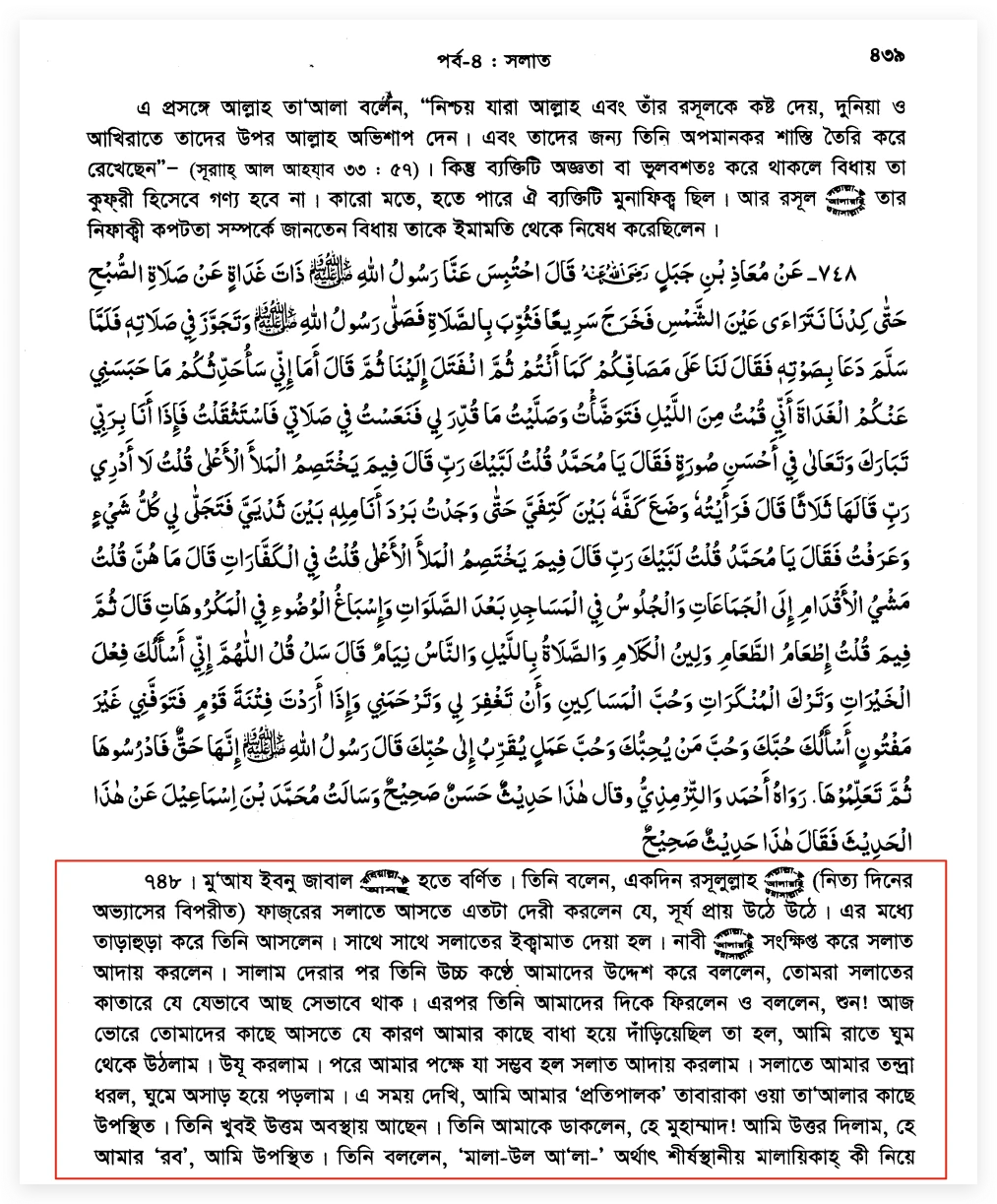
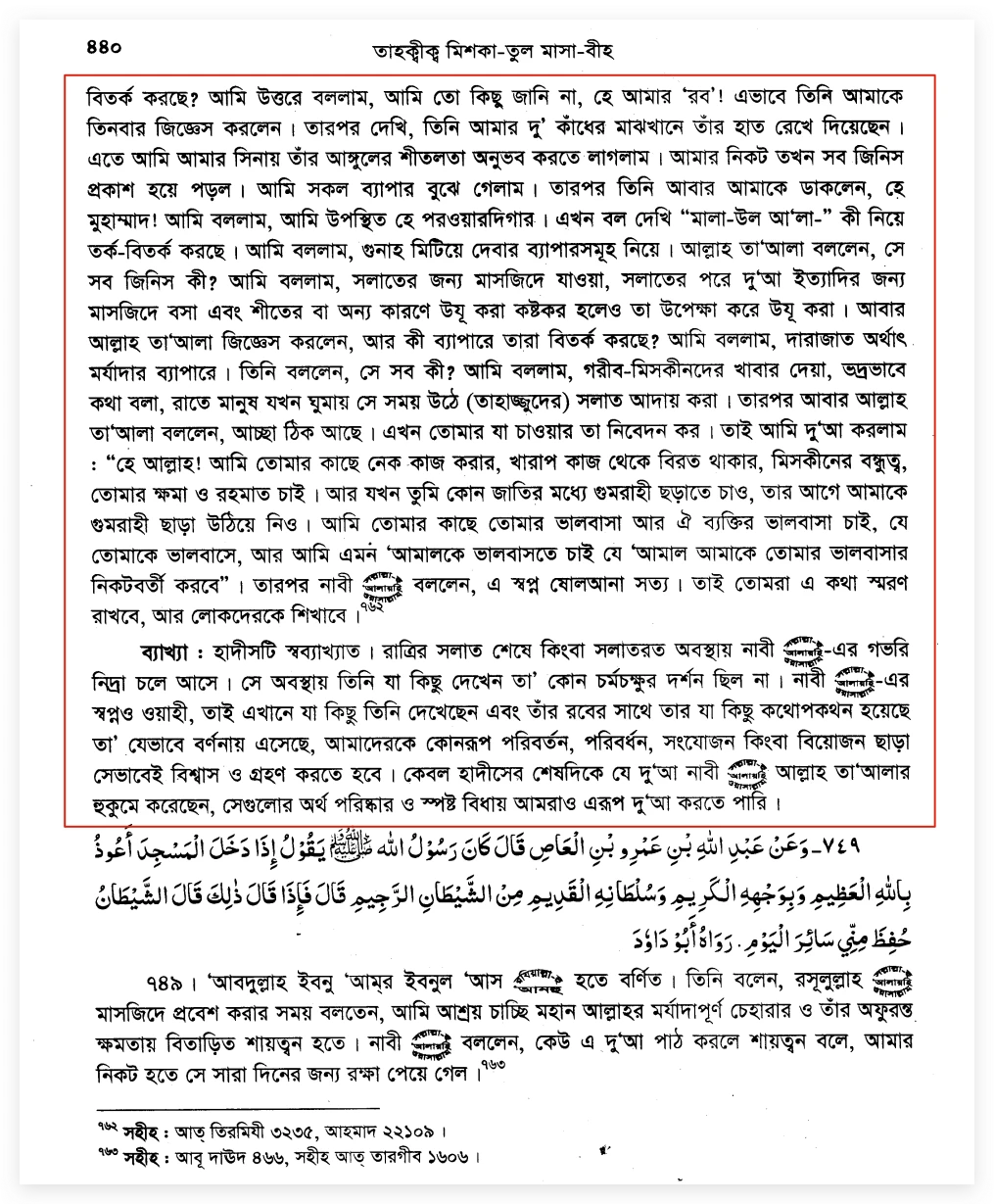
Allah Laughs, Becomes Astonished, and Expresses Emotional Responses
The anthropomorphic attributes of Allah in Islamic theology are not restricted to His face, eyes, hands, feet, fingers, or voice. Hadiths present Allah as a personal being who laughs and becomes astonished at various human actions. According to a hadith narrated by Abu Hurayrah in Sahih al-Bukhari and Sahih Muslim, two men fight against each other and one kills the other. The slain man is killed while fighting in Allah’s cause. Subsequently the killer embraces Islam and is also killed while fighting in Allah’s cause. Both enter Paradise, and Muhammad reports that Allah laughs at their story. Ibn Khuzaymah also collected this hadith in the chapter affirming Allah’s laughter in his Kitab al-Tawhid. [90]
إن الله عز وجل يضحك إلى رجلين قتل أحدهما الآخر ، كلاهما داخل الجنة ، يقاتل هذا في سبيل الله ، فيستشهد ، ثم يتوب الله على قاتله ، فيسلم
English translation:
Allah Almighty laughs at two men, one of whom killed the other, yet both will enter Paradise. One of them fights in Allah’s cause and is martyred. Then Allah accepts the repentance of his killer, who embraces Islam.
Ibn Khuzaymah devoted an entire chapter to establishing the existence of Allah’s laughter, entitled باب ذكر إثبات ضحك ربنا عز وجل بلا صفة تصف ضحكه. That is, a chapter affirming our exalted Lord’s laughter without specifying its modality. In this chapter he collected several narrations concerning Allah’s laughter. The subject of the chapter is the affirmation of laughter as a distinct attribute of Allah rather than accepting it merely as a figure of speech signifying His pleasure.
Modern Salafi theology likewise does not interpret Allah’s laughter metaphorically. Responding to a question concerning its nature in fatwa 178915, IslamQA explicitly declares that Allah’s laughter is real, not metaphorical. It distinguishes affirming the meaning of laughter from being ignorant of its actual modality. The same principle is applied to Allah’s other attributes. [91]
فنقول : معنى ضحك الله إثبات صفة الضحك لله تعالى حقيقة لا مجازا ، على الوجه الذي يليق به سبحانه ، دون تمثيل أو تكييف
English translation:
We say that the meaning of Allah’s laughter is to affirm laughter as a real attribute of Allah, not a metaphor, in a manner befitting Him, without likening it to anything or specifying its modality.
Allah’s astonishment is even more significant. In two accepted readings of verse 12 of Surah al-Saffat, the subject of astonishment differs. The word عَجِبْتَ in the familiar Hafs reading means ‘you were astonished’, addressing Muhammad. But in another accepted reading the word is read as عَجِبْتُ, meaning ‘I was astonished’. According to this second reading, Allah Himself speaks of His astonishment. Al-Qurtubi mentions in his commentary that the second reading is that of the other Kufan reciters apart from Asim, and that it is also narrated from Ali and Abdullah ibn Mas’ud. [92]
| Reading (Qira’ah) | English Meaning | Subject of Astonishment |
|---|---|---|
| بَلْ عَجِبْتَ وَيَسْخَرُونَ | Rather, you were astonished, while they mock. | Muhammad |
| بَلْ عَجِبْتُ وَيَسْخَرُونَ | Rather, I was astonished, while they mock. | Allah |
The prominent Tabi’i and judge Shurayh al-Qadi rejected this second reading. His reason for rejecting it is highly significant. He argued that the person who becomes astonished is one who did not previously know something. Since Allah is omniscient, he did not accept the notion of Allah becoming astonished. Al-Qurtubi preserved Shurayh’s statement in his commentary. [93]
وهي قراءة شريح وأنكر قراءة الضم، وقال: إن الله لا يعجب من شيء، وإنما يعجب من لا يعلم.
English translation:
This was Shurayh’s reading. He rejected the reading with dammah, saying, Allah is not astonished by anything; only someone who does not know becomes astonished.
Ibn Taymiyyah did not accept Shurayh’s statement. In his view, Shurayh rejected an accepted Quranic reading and an attribute of Allah established by the Quran and Sunnah. Tafsir al-Tabari also accepts both readings. Ibn Uthaymin, meanwhile, explains Allah’s astonishment as astonishment expressive of admiration rather than arising from ignorance. An old theological problem is thus clear: to reconcile the notion of Allah’s omniscience with the account of His astonishment, distinct interpretations of the nature of astonishment had to be developed. [94]
Shurayh’s argument is significant from the standpoint of modern philosophy as well. When a person encounters an event that does not correspond to their prior knowledge or expectations, they may experience astonishment. For an omniscient being, there is no scope for discovering new information or for a mismatch between prior expectations and actual events, because by definition He knows all events before they occur. Astonishment arising from an unexpected event and omniscience are therefore contradictory attributes. The need to interpret Allah’s astonishment as admiration or approval itself demonstrates the difficulty of applying the ordinary human meaning of astonishment directly to an omniscient being.
Alongside Allah’s face, hands, eyes, feet, and fingers, descriptions of His laughter, astonishment, pleasure, and anger express different aspects of the same anthropomorphic conception of God. Humans have described the creator of the universe in terms of their own familiar bodily structure, social behaviour, royal authority, and psychological experience. This is why descriptions of the Allah of Islam include not only a king’s throne but also familiar human laughter, astonishment, conversation, touch, and emotional responses. These descriptions are not testable evidence for an omniscient being’s existence; they illustrate the religious tendency to project human experiences and concepts onto God.
Logical Problems
Application of the Law of Non-Contradiction
One of the most fundamental principles of logic is the Law of Non-Contradiction. The ancient Greek philosopher Aristotle in his Metaphysics clearly explained this principle. Its central proposition is that an attribute and its negation cannot both be true of the same entity at the same time and in the same respect [95].
Simply put, an object cannot be both hot and not hot at the same time, nor can it exist and not exist simultaneously. This principle is foundational to logic; without it, rational discussion itself becomes meaningless.
Applying this principle to theology reveals an important problem. If a being is said to possess hands, feet, eyes or a face, a fundamental conception is implicit in that claim. A hand or a foot is not an abstract concept; each is part of a definite structure or form. A hand is an extended organ connected to a larger body. A foot is an organ situated within a definite geometrical arrangement.
Saying that a being possesses hands and feet therefore means affirming that it has a definite shape or form. But if the same being is simultaneously claimed to be completely formless, a clear logical contradiction arises.
For a formless being, the very concept of an organ becomes meaningless. An organ denotes part of a larger structure. If the larger structure itself does not exist, the question of its having parts does not arise.
Consequently, the claims that a being has hands and feet and that it is completely formless cannot both be true at the same time. In logical terms this is a classic contradiction.
The Problem of Composition and Divisibility
In philosophy, an entity composed of different parts or components is called a composite being. For example, the human body consists of various parts, including the head, hands, feet, eyes, and ears. These parts together form a structure.
The renowned Islamic philosopher Avicenna in his philosophical work The Metaphysics of The Healing demonstrated that every composite being depends upon its parts [96].
This idea has a profound philosophical implication. If a being can be analysed into different parts, it is in fact a composite rather than a single and indivisible reality, because its existence depends upon the combination of its parts.
In other words,
- Where there are parts, divisibility exists
- Where distinct parts exist, the claim of complete partlessness is inconsistent; whether the parts can actually be separated is a distinct question
- And where such dependence exists, describing the being as absolute or self-sufficient becomes difficult
If a being is genuinely simple and absolute, it should have no parts or organs within it. If it has parts, it is no longer completely self-sufficient but dependent upon the arrangement of its parts.
The idea that a being described simultaneously as indivisible, absolute, and undivided possesses divisible organs such as hands, feet, and eyes therefore becomes philosophically problematic.
The Argument from Definition and Dependence
Words such as hand, foot, eye, and face are not poetic ornaments; each has a specific definition and function. A hand denotes an organ with which grasping, touching, or working is possible. A foot denotes an organ of locomotion.
Saying that a being has hands therefore implies that it has a limit or boundary. Hands or feet are meaningful only when they exist as parts of a definite structure.
This limitation raises an important philosophical question. If a being has spatial boundaries, it cannot be spatially boundless in the same sense. Spatial extent, power, and knowledge are distinct attributes; what is directly established here is the conflict between having a boundary and being completely spaceless.
Possessing bodily organs also implies a definite arrangement or design. A hand or foot does not suddenly come into existence; it results from structural organisation. This organisation in turn depends upon some material or structural reality.
The medieval philosopher Thomas Aquinas in his Summa Theologica attempted to explain God as a simple being, or an entirely indivisible entity [97]. But if a being is conceived as possessing organs such as hands, feet, and eyes, it is no longer simple or indivisible in the philosophical sense.
Another problem arises from the perspective of causation. When a being performs a task using a hand, the description of that task establishes a specific functional role for the hand. Whether the hand is indispensable to performing the task is a separate question.
No organ or instrument should be indispensable to an omnipotent being. Yet Islamic sources describe specific actions such as Allah creating with His hands, holding things on His fingers, and placing His foot. These accounts clearly reflect familiar human concepts of organs and their functions.
Misuse of Language and Meaninglessness
An apparent solution is often presented in religious discourse. It is said that God does indeed possess hands or feet, but that these are not human hands and feet and are beyond human comprehension.
Although this statement may initially seem convenient, it creates new problems from a linguistic perspective.
A fundamental principle of language is that a word is meaningful when it denotes a particular concept or attribute. We use the word hand because it points to a familiar form, structure, and function.
But if it is said that this hand has no shape, no structure, no boundary, the question arises: Why is it then called a hand?
If the word hand is used metaphorically, its literal anatomical meaning does not apply. If the real existence of a hand is affirmed while all its familiar structural and functional meanings are denied, precisely what attribute the word denotes remains undetermined.
Linguistic inconsistency arises here when the literal meaning of the same attribute is both affirmed and denied. Ibn Khuzaymah’s specification of the number of hands and Ibn Uthaymin’s statement that Allah sees with two eyes are not merely indeterminate symbols; they have definite numerical and functional meanings.
Therefore, if a being is described as completely formless, using the language of organs such as hands, feet, and eyes for it is logically problematic. If these organs are claimed to exist in a real sense, that being can no longer be described as formless.
Conclusion
Allah as described in the Quran, authentic hadiths, and classical Islamic creedal works is not merely an abstract force; He is presented as a personal being with His own form, face, eyes, hands, fingers, feet, location, and distinct actions. Ibn Taymiyyah’s declaration that formless self-subsistence is impossible, Ibn Khuzaymah’s specification of the number of Allah’s hands, al-Darimi’s affirmation of two eyes and two distinct boundaries, and Ibn Abbas’s description of the Kursi as the place for two feet are not inventions of a modern critic. They are historical documents of Islamic theology itself. There is a fundamental distinction between not knowing what Allah’s form is like and claiming that He has no form whatsoever. Similarly, saying that His hands are unlike human hands does not deny the existence of hands. A form possessing a definite number of real organs or distinct features and completely formless existence cannot both be true in the same sense.
The same inconsistency arises concerning space and time. Pointing to heaven in answer to the question of where Allah is, His location above the Throne, His feet on the Kursi, His descent to the lowest heaven, and the affirmation of a boundary to His location all establish spatial relationships. Being above all creation is not equivalent to being outside all spatial relations. Likewise, beginningless existence and timeless existence are distinct concepts. The accounts of recording decrees fifty thousand years before creating the heavens and the earth, establishing Himself upon the Throne after completing creation in six days, and descending at a specific time every night present Allah’s actions in temporal succession. In Ibn Taymiyyah’s words, Allah performs actions one after another. Having affirmed this chronological relationship among Allah’s actions, describing Him as an entirely timeless and immutable being is self-contradictory.
Allah’s personal and anthropomorphic nature is also expressed in accounts of His conversations, sight, hearing, laughter, anger, pleasure, and astonishment. Creation is said to burn in the radiance of His face, angels lose consciousness upon hearing His voice, and Muhammad reports that on the Day of Resurrection believers will see Him directly as they see the full moon. The account of Muhammad feeling the touch of Allah’s hand and the coldness of His fingers in a dream likewise forms part of this anthropomorphic conception of God. An early doctrine recorded by al-Ashari even associates Allah’s anger and pleasure with increases and decreases in His heaviness. The combined picture reflects the ancient human familiarity with royal courts, thrones, footstools, bodily organs, sensory experiences, and emotions.
An omniscient being should not need eyes or ears to acquire information; an omnipotent being should not need hands or fingers to hold an object; and an omnipresent being should not need to descend to reach a location. Claiming that such attributes exist and establishing their necessity are distinct matters. Accounts of Allah’s actions and organs extend familiar human capacities and the means by which they are exercised to a cosmic scale. Modern biology, however, explains the origin and development of animal organs through their long evolutionary history. There is no scientific evidence that the structure of human eyes, hands, and feet was copied from the attributes of an omnipotent being.
The conflict between omniscience, omnipotence, formlessness, spacelessness, and timelessness and the literal form and actions of Allah described in Islamic sources is not merely linguistic; it is fundamentally conceptual. Interpreting literal attributes metaphorically changes their meaning; accepting them as real and literal renders the conception of a completely formless, spaceless, and timeless Allah untenable. Declaring the nature of an attribute unknown may suspend judgement about its modality, but it does not make two contradictory claims logically compatible. There is no evidence-based reason to accept this supernatural conception of God, modelled on human bodily structure, social hierarchies of power, and psychological experience, as a scientific explanation of the nature or origin of the universe. This conception of God, founded on religious belief rather than evidence, is therefore an irrational superstition.
References
- Ibn Taymiyyah, Naqd al-Ta’sis; IslamQA, Fatwa 20652 ↩︎
- Ibn Qutaybah, Ta’wil Mukhtalif al-Hadith, p. 221; quoted by IslamQA ↩︎
- Sahih al-Bukhari, Tawhid Publications, Hadith 7417 ↩︎
- Sahih al-Bukhari, Tawhid Publications, Vol. 6, p. 502 ↩︎
- Surah al-An’am, Verse 19 ↩︎
- Ibn Hajar al-Asqalani, Fath al-Bari, Vol. 13, pp. 414–415 ↩︎
- Sahaj Nasr al-Bari Sharh al-Bukhari, Vol. 13, p. 231 ↩︎
- Surah al-Haqqah, Verse 17 ↩︎
- Sunan Abi Dawud (authenticated edition), Hadith 4727 ↩︎
- Abu al-Hasan al-Ashari, Maqalat al-Islamiyyin, Disagreement concerning the Bearers of the Throne ↩︎
- Ibn Taymiyyah, Bayan Talbis al-Jahmiyyah, Vol. 3, pp. 376–377 ↩︎
- Sahih al-Bukhari, Islamic Foundation, Hadith 3531 ↩︎
- Sahih al-Bukhari, Hadith 3803 ↩︎
- Ibn Taymiyyah, Bayan Talbis al-Jahmiyyah, Vol. 3, pp. 242–244; statement of al-Darimi ↩︎
- Sahih al-Bukhari, Hadith 4826, Book of Tafsir ↩︎
- Sahih Muslim, Hadith 2246e, Prohibition of Reviling Time ↩︎
- Al-Nawawi, Sharh Sahih Muslim, Vol. 15, p. 3; Ibn Kathir, Tafsir, Surah al-Jathiyah, Verse 24; IslamQA, Fatwa 9571 ↩︎
- IslamWeb, Explanation of the hadith that Allah is time and Ibn Hazm’s doctrine ↩︎
- Al-Nawawi, Sharh Sahih Muslim, Vol. 15, p. 3 ↩︎
- Sahih Muslim, Hadith 2653b, Book of Predestination ↩︎
- Sahih al-Bukhari, Hadith 3191, Book of Creation ↩︎
- Quran, Surah al-Hadid, Verse 4 ↩︎
- Sahih al-Bukhari, Hadith 1145, Book of Tahajjud ↩︎
- Sahih Muslim, Hadith 758 ↩︎
- Ibn Taymiyyah, Bayan Talbis al-Jahmiyyah, Vol. 4; IslamQA, Fatwa 254465 ↩︎
- Sahih Muslim, Hadith 537a, Book of Mosques and Prayer ↩︎
- Abd al-Ghani al-Maqdisi, Al-Iqtisad fi al-I’tiqad, p. 89; Al-Dhahabi, Al-‘Uluw, p. 28; IslamQA, Fatwa 514823 ↩︎
- Uthman ibn Sa’id al-Darimi, Al-Naqd ‘ala Bishr al-Marisi; Ibn Taymiyyah, Dar’ Ta’arud al-‘Aql wa al-Naql, Vol. 2, p. 57 ↩︎
- Sahih al-Bukhari, Hadith 7423, Book of Tawhid ↩︎
- Abd al-Aziz ibn Baz, Fatawa Nur ‘ala al-Darb, Vol. 1, pp. 127–130; IslamQA, Fatwa 195996 ↩︎
- Sahih Muslim, Hadith 2751a, Book of Repentance ↩︎
- Sahih al-Bukhari, Hadith 405, Book of Prayer ↩︎
- Quran, Surah al-Ma’arij, Verse 4 ↩︎
- Ibn Taymiyyah, Dar’ Ta’arud al-‘Aql wa al-Naql, Vol. 2, pp. 280–281 ↩︎
- Ibn Taymiyyah, Minhaj al-Sunnah, Vol. 2, p. 355; IslamQA, Fatwa 266259 ↩︎
- Surah al-Rahman, Verse 27 ↩︎
- Surah al-Qasas, Verse 88 ↩︎
- Ibn Khuzaymah, Kitab al-Tawhid, Vol. 1, pp. 25–26, Affirmation of Allah’s Face ↩︎
- Sahih Muslim, Hadith 179a, Book of Faith ↩︎
- Surah al-Tur, Verse 48 ↩︎
- Sahih Muslim, Hadith Academy, Hadith 315 ↩︎
- Sahih Muslim, Islamic Foundation, Vol. 1, p. 208, Hadith 323 ↩︎
- Uthman ibn Sa’id al-Darimi, Al-Naqd ‘ala Bishr al-Marisi, Vol. 1, p. 327; IslamQA, Fatwa 262132 ↩︎
- Abu al-Hasan al-Ashari, Maqalat al-Islamiyyin, p. 290; IslamQA, Evidence for Allah’s Two Eyes ↩︎
- Ibn Uthaymin, Majmu’ Fatawa Ibn Uthaymin, Vol. 4, p. 58; IslamQA, Fatwa 145166 ↩︎
- Ibn Uthaymin, Sharh al-Aqidah al-Saffariniyyah; quoted by IslamQA ↩︎
- Surah 38:75 ↩︎
- Quran 48:10 ↩︎
- Quran 5:64 ↩︎
- Sunan al-Tirmidhi (authenticated edition), Hadith 3045 ↩︎
- Sahih al-Tirmidhi, Vol. 5, pp. 445–446 ↩︎
- Al-Tirmidhi, Vol. 6, pp. 81–82 ↩︎
- Sahih al-Bukhari (Tawhid Publications), Hadith 7413 ↩︎
- Sunan Abi Dawud (authenticated edition), Hadith 4732 ↩︎
- Sunan al-Tirmidhi (authenticated edition), Hadith 2140 ↩︎
- Sunan al-Tirmidhi (authenticated edition), Vol. 4, Hadith 2140 ↩︎
- Sahih al-Bukhari, Hadith 4811, Book of Tafsir ↩︎
- Ibn Khuzaymah, Kitab al-Tawhid, Vol. 1, Chapter on Allah Holding the Heavens and Earth on His Fingers ↩︎
- Ibn Khuzaymah, Kitab al-Tawhid, Vol. 1, Affirmation of Allah’s Fingers ↩︎
- Al-Bukhari and Muslim, Mishkat, p. 505 ↩︎
- Al-Bayhaqi, Al-Asma’ wa al-Sifat, Vol. 2, p. 198; Ibn Abd al-Barr, Al-Tamhid, Vol. 7, p. 149; quoted by IslamQA ↩︎
- Sahih al-Bukhari (Islamic Foundation), Hadith 6941 ↩︎
- Sahih al-Bukhari, Islamic Foundation, Vol. 8, p. 204 ↩︎
- Ibn Khuzaymah, Kitab al-Tawhid, Vol. 1, p. 248, Report 154; Al-Mustadrak, Vol. 2, p. 282; IslamQA, Fatwa 166843 ↩︎
- Ibn Abi Shaybah, Al-Arsh, Report 60; Ibn Hajar al-Asqalani, Fath al-Bari, Vol. 8, p. 47; quoted by IslamQA ↩︎
- Fatawa al-Lajnah al-Da’imah, Vol. 2, p. 376; IslamQA, Affirmation of Allah’s Two Feet ↩︎
- Ibn Abi al-Izz al-Hanafi, Sharh al-Aqidah al-Tahawiyyah, pp. 312–313; IslamQA, Distinction between the Throne and the Kursi ↩︎
- IslamQA, Fatwa 447839, Size of the Kursi Relative to the Throne and Location of Allah’s Feet ↩︎
- Sahih al-Bukhari, Hadith 7435, Book of Tawhid ↩︎
- Sahih al-Bukhari, Hadith 7436, Book of Tawhid ↩︎
- Ibn Khuzaymah, Kitab al-Tawhid, Vol. 2, p. 438, Report 253 ↩︎
- Quran, Surah al-Qiyamah, Verses 22–23 ↩︎
- Quran, Surah al-Baqarah, Verse 138 ↩︎
- Al-Tabari, Jami’ al-Bayan ‘an Ta’wil Ay al-Quran, Vol. 3, pp. 117–120 ↩︎
- Quran 28:30 ↩︎
- Quran 27:8 ↩︎
- Al-Bukhari, Khalq Af’al al-‘Ibad, Chapter on Allah’s Speech ↩︎
- Ibn Qudamah, Lum’at al-I’tiqad, p. 15; quoted by IslamQA ↩︎
- Ibn Taymiyyah, Majmu’ al-Fatawa, Vol. 12, p. 173 ↩︎
- Ibn Abi al-Izz, Sharh al-Aqidah al-Tahawiyyah, Vol. 1, p. 174 ↩︎
- Sunan Abi Dawud, Hadith 4728, Book of Sunnah, Chapter concerning the Jahmiyyah ↩︎
- Sunan Abi Dawud, Vol. 4, p. 233 ↩︎
- Uthman ibn Sa’id al-Darimi, Al-Naqd ‘ala Bishr al-Marisi, Vol. 1, p. 318; IslamQA, Fatwa 300999 ↩︎
- Abd al-Rahman al-Barrak, Al-Ta’liq ‘ala al-Qawa’id al-Muthla, p. 96; IslamQA, Fatwa 300999 ↩︎
- Quran 58:1 ↩︎
- Quran 4:134 ↩︎
- Mishkat al-Masabih (Mishkat), Book 4: Prayer, Chapter 7, Third Section: Mosques and Places of Prayer, 748 ↩︎
- Mishkat al-Masabih, hadith: 748, In-book reference: Book 4, Hadith 176 ↩︎
- Tahqiq Mishkat al-Masabih (Vol. 1) [Arabic and Bengali], original by Allamah Wali al-Din Abu Abdullah Muhammad ibn Abdullah al-Khatib al-Umari al-Tabrizi (may Allah have mercy on him); commentary: Mir’at al-Mafatih Sharh Mishkat al-Masabih by Abu al-Hasan Ubaydullah ibn Muhammad Abd al-Salam ibn Khan Muhammad ibn Amanullah ibn Hisam al-Din al-Rahmani al-Mubarakpuri (may Allah have mercy on him) [d. 1414 AH]; authentication by Allamah Nasir al-Din al-Albani (may Allah have mercy on him); translated and edited by the committee, Hadith Academy, pp. 439–440 ↩︎
- Ibn Khuzaymah, Kitab al-Tawhid, Vol. 2, pp. 569–570, Report 331 ↩︎
- IslamQA, Fatwa 178915, Meaning and Modality of Allah’s Names and Attributes ↩︎
- Tafsir al-Qurtubi, Vol. 15, p. 69; IslamQA, Fatwa 468851 ↩︎
- Al-Qurtubi, Al-Jami’ li-Ahkam al-Quran, Vol. 15, p. 69 ↩︎
- IslamQA, Fatwa 127605; Tafsir al-Tabari and the Statement of Ibn Uthaymin ↩︎
- Aristotle, Metaphysics, Book IV ↩︎
- Avicenna, The Metaphysics of The Healing ↩︎
- Thomas Aquinas, Summa Theologica, Part 1, Question 3 ↩︎