Introduction
The Quran, hadith and classical Islamic exegesis present jinn and Satan as members of a bizarre kingdom of creatures hidden from human sight. According to Islamic narratives, they eat, drink, fart audibly, urinate in people’s ears, spend the night inside sleeping people’s noses, enter through people’s mouths when they yawn, lay eggs in marketplaces and produce offspring. These beings, supposedly created from fire, can also assume human or serpentine forms when necessary. Muhammad claimed to have caught and subdued one of them; such actions as poking newborn babies with a finger and tying knots at the back of sleeping people’s heads are also attributed to Satan. These are not merely ghost stories passed down by word of mouth; they are preserved in Sahih al-Bukhari, Sahih Muslim, other hadith collections and prominent commentaries recognized as foundations of Islamic belief. Yet no reliable, independently verifiable evidence has ever been presented for the actual existence of this purported kingdom of creatures capable of such diverse bodily activities.
Belief in jinn was widespread in Arabian society long before the emergence of Islam. Rather than abolishing this old superstition, the religion propagated by Muhammad expanded it by incorporating it into Allah’s creation narrative, prophethood, worship and the afterlife. Among the jinn there are Muslims and unbelievers; they receive religious messages, reproduce and are also subjected to punishment. Thus a counterpart of familiar human social and religious life was constructed in an invisible world. Various instructions governing everyday human life were also formulated on the basis of that world’s existence. Even in such ordinary matters as how to eat, how to clean one’s nose upon waking and how to cover one’s mouth while yawning, stories about Satan’s presence and activities have been introduced.
A story does not become a real event merely because it appears in a collection of sahih hadith. The classification of a hadith as sahih indicates its acceptability according to the internal criteria of Islamic hadith scholarship; it does not supply a tested specimen of Satan’s eggs, urine, saliva or body. Nor does quoting the same story in ten commentaries turn it into ten independent observations. Later scholars may construct ten further explanations on the basis of an unsubstantiated report, but none of those explanations constitutes new physical evidence for the original claim. If repetition by religious authorities is accepted as evidence of reality, the same method would require accepting as true countless mutually contradictory stories of ghosts, spirits, demons and invisible beings from other religions and cultures around the world.
Modern medicine and biology possess a vast body of observational knowledge about sleep, fatigue, yawning, flatulence, urination and newborn crying. Passing these ordinary phenomena off as the work of Satan is not a scientific explanation. If a creature urinates in someone’s ear, its excretion can be examined; if a being pokes a baby with its finger, the alleged physical interaction is a matter for observation; and if a creature lays eggs, specimens of its reproductive activity can be sought. The burden of proving the existence of a being described as capable of interacting directly with the human body lies with those making that claim. There is an enormous difference between naming a cause in a religious text and actually identifying that cause in reality.
Historical Background of the Concept of Jinn
Pagan Beliefs in Pre-Islamic Arabia
The concept of jinn existed in Arabian folklore long before Islam emerged. Belief in invisible beings was associated with the solitude of the desert, dark places, abandoned settlements, graveyards and places regarded as unclean. Imagining conscious spirits in different parts of nature, personifying natural forces and explaining unknown events as the work of supernatural beings are familiar features of animistic religious cultures. When an unusual sound is heard in a deserted place, imagining that jinn inhabit the area instead of investigating the actual source of the sound, or blaming an invisible being for an unexplained danger, merely substitutes another unsubstantiated idea for an unexplained phenomenon. [1]
Wellhausen compared ancient Arabian beliefs in jinn with the Rephaim, spirits of the dead, and the Shedim, malevolent beings described in Hebrew religious literature. In the tribal poetic culture of pre-Islamic and early Islamic Arabia, the belief that jinn were associated with poets’ creative powers and poetic inspiration was also prevalent. Thus jinn already occupied an established place in Arabian religious and literary imagination before Muhammad’s appearance. In Islam, these old beings became creatures of Allah and communities obliged to obey religious commands. Imagining invisible conscious beings to explain unknown events is not an original intellectual discovery of Islam; it is a religious reconstruction of pre-existing folk beliefs. [2] [3]
Evidence of this old belief also appears in the Quran itself. Verse 6 of Surah al-Jinn states that some human beings used to seek refuge with jinn. The concept of their existence was therefore already familiar to Muhammad’s audience. The Quran opposed treating jinn as protectors or partners of Allah, but retained belief in their existence within a new religious framework. [4]
وَأَنَّهُ كَانَ رِجَالٌ مِنَ الْإِنْسِ يَعُوذُونَ بِرِجَالٍ مِنَ الْجِنِّ فَزَادُوهُمْ رَهَقًا
English translation: Some men among humankind used to seek refuge with men among the jinn, and they increased their rahaq (distress or transgression).
Surah al-An’am also mentions the belief that jinn were partners of Allah. Islamic monotheism revoked the legitimacy of that old worship and redefined jinn as creatures subordinate to Allah. [5]
وَجَعَلُوا لِلَّهِ شُرَكَاءَ الْجِنَّ وَخَلَقَهُمْ وَخَرَقُوا لَهُ بَنِينَ وَبَنَاتٍ بِغَيْرِ عِلْمٍ سُبْحَانَهُ وَتَعَالَى عَمَّا يَصِفُونَ
English translation: They made the jinn partners of Allah, although He created them, and invented sons and daughters for Him without knowledge. Glorified and exalted is He above what they describe.
Similar Beings in Jewish and Christian Traditions
The Jewish Shedim and Mazzikin, the demons or evil spirits of Christian religious literature, and Arabian stories of jinn all contain the idea of supernatural beings capable of influencing human life. Deuteronomy 32:17 mentions sacrifices to the Shedim, while Revelation 20:10 describes Satan’s punishment. Different religious traditions developed their own accounts of the nature and origins of these beings. Islam presents jinn as a broad category of intelligent, religiously accountable beings, including believers and unbelievers, good and evil. Human relationships, moral conflicts and structures of religious obedience are thereby projected onto an invisible world. [6]
A common feature of Greco-Roman, Mesopotamian, Jewish, Christian and Arabian narratives about supernatural beings is the introduction of invisible forces as explanations for unknown phenomena and the limitations of human knowledge. The prevalence of such a belief in a religious culture is no evidence of its truth. For the same reason that mentioning an evil spirit in Jewish scripture does not establish its existence, mentioning jinn in the Quran is not independent evidence that they exist. Elevating an ancient folk belief to the status of God’s word does not alter its epistemic foundations.
Jinn, Iblis and His Descendants in the Quran
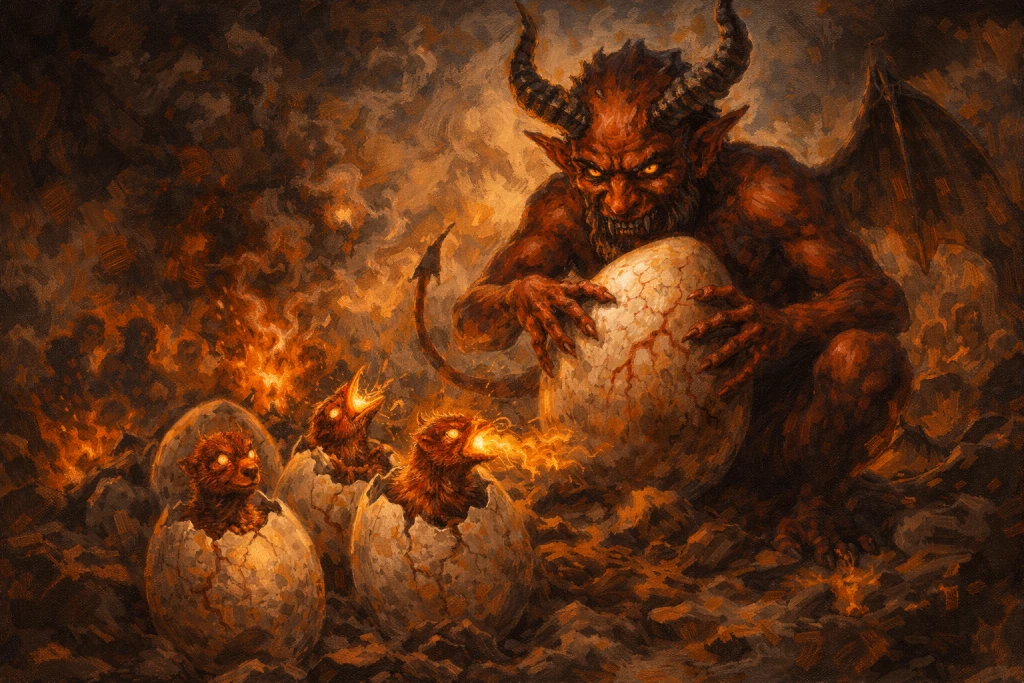
Verse 50 of Surah al-Kahf identifies Iblis as one of the jinn and his descendants as enemies of humankind. Iblis in the Quran is thus not merely an isolated evil character; he has a lineage. This reference to descendants became the basis for bizarre stories in later commentaries about Iblis’s wife, genitals, egg-laying and production of hatchlings. From the Quranic declaration that he has descendants to the exegetical determination of how they are produced, one claim after another has been advanced without a single independently identifiable specimen of Iblis or his alleged offspring being exhibited. [7]
إِلَّا إِبْلِيسَ كَانَ مِنَ الْجِنِّ فَفَسَقَ عَنْ أَمْرِ رَبِّهِ ۗ أَفَتَتَّخِذُونَهُ وَذُرِّيَّتَهُ أَوْلِيَاءَ مِنْ دُونِي وَهُمْ لَكُمْ عَدُوٌّ
English translation: Except Iblis; he was one of the jinn and disobeyed his Lord’s command. Will you take him and his descendants as guardians instead of Me, when they are your enemies?
Surah al-Kahf, 18:50, relevant excerpt.
The Claim That Jinn Were Created from Fire
Verse 15 of Surah al-Rahman mentions a flame of fire as the material from which jinn were created. In the known living world, the formation of bodies, preservation of hereditary information, growth, feeding and reproduction occur through specific biochemical and cellular processes. A flame is not an organism in which such processes have been identified. The claim that an intelligent, feeding and reproductive being originated from a flame is an extraordinary claim about the origin of life, for which no independent scientific evidence has been presented beyond the Quranic declaration. [8]
وَخَلَقَ الْجَانَّ مِنْ مَارِجٍ مِنْ نَارٍ
English translation: And He created the jinn from a flame of fire.
Surah al-Rahman, 55:15.
Bengali translators and commentators have rendered the phrase مَارِجٍ مِنْ نَارٍ in this verse as smokeless fire or a smokeless flame. The conventional Islamic creation narrative concerning the origin of the jinn is clear in these translations. [9]
And He created the jinn from smokeless fire.
— Taisirul Quran
And He created the jinn from a smokeless flame.
— Sheikh Mujibur Rahman
And He created the jinn from a smokeless flame of fire.
— Rawai Al-bayan
And He created the jinn from a smokeless flame of fire [1].
— Dr. Abu Bakr Muhammad Zakaria
The central statement of the Bengali translations above is identical: jinn were created from smokeless fire. Abu Bakr Zakaria’s commentary likewise identifies fire as the principal material of their creation. It states that the first jinn bears the same relationship to the jinn race as Adam does to humanity. After the first jinn was created from a flame, the lineage spread through its descendants. Notably, one unsubstantiated creation story is used to explain another: the creation of Adam from soil is offered as the analogy. [10]
Verse 15
And He created the jinn from a smokeless flame of fire [1].
[1] جان means the race of jinn. مارج means a flame. The principal material of the creation of jinn is a flame, just as soil is the principal material of human creation. نار means a special kind of fire, not the fire produced by burning wood or coal. It means a smokeless flame. [Al-Qurtubi; Fath al-Qadir] This means that just as the first human was created from soil, and through subsequent stages of creation his earthen substance acquired the form of a living human made of flesh and bones, with his lineage subsequently continuing through semen, the first jinn was likewise created from a pure flame, and subsequent generations of jinn have continued to originate from its descendants.
The first jinn occupies the same position among the jinn as Adam does among humanity. Just as the body of Adam and of human beings born from his descendants, once living, no longer resembled that soil, the same applies to the jinn. Their substance is fundamentally the substance of fire. But just as we are not heaps of soil, they are not merely flames. [See Adwa’ al-Bayan]
The same creation narrative is preserved in Sahih Muslim as a statement of Muhammad. A hadith narrated by Aisha associates the origin of three categories of beings with three different materials: light (nur) for angels, a smokeless flame for jinn and the material described in the Quran for Adam. This account of the creation of humans, angels and jinn is well established in religious literature; it contains no description of a tested creation process. [11]
Sahih Muslim (Hadith Academy)
55. Zuhd and Heart-Softening Narrations
Chapter 10. Miscellaneous Narrations
Hadith Academy number: 7385; international number: 2996
7385-(60/2996) Muhammad ibn Rafi and Abd ibn Humayd (may Allah have mercy on them) … narrated from Aisha (may Allah be pleased with her). She said: The Messenger of Allah (peace and blessings be upon him) said: Angels were created from light, the jinn were created from a smokeless flame of fire, and Adam (peace be upon him) was created from that which has been described to you. (Islamic Foundation 7225, Islamic Centre 7277)
Hadith grade: Sahih (authentic)
Narrator: Aisha bint Abu Bakr al-Siddiq (may Allah be pleased with her)
The Saudi scholar Abd al-Aziz ibn Baz also cites this hadith concerning the creation of jinn and angels as a foundation of religious belief in his fatwa. The same passage declares Muhammad to be a messenger sent to both jinn and humanity. The existence of jinn is therefore not an isolated folk tale within Islamic belief; it is directly connected with the concepts of prophethood and revelation. [12]
Original Arabic
وقد جاء ذكرهم في أحاديث صحيحة، وقد ثبت في الصحيح عن عائشة رضي الله عنها أن النبي صلى الله عليه وسلم قال: «خلقت الملائكة من نور وخلق الجان من مارج من نار وخلق آدم مما وصف لكم (¬1) » خرجه مسلم في صحيحه، وهكذا الإيمان بالكتب يجب الإيمان إجمالا بأن الله سبحانه أنزل كتبا على أنبيائه ورسله، لبيان حقه والدعوة إليه، كما قال تعالى: لَقَدْ أَرْسَلْنَا رُسُلَنَا بِالْبَيِّنَاتِ وَأَنْزَلْنَا مَعَهُمُ الْكِتَابَ وَالْمِيزَانَ لِيَقُومَ النَّاسُ بِالْقِسْطِ (¬2) الآية، وقال تعالى: كَانَ النَّاسُ أُمَّةً وَاحِدَةً فَبَعَثَ اللَّهُ النَّبِيِّينَ مُبَشِّرِينَ وَمُنْذِرِينَ وَأَنْزَلَ مَعَهُمُ الْكِتَابَ بِالْحَقِّ لِيَحْكُمَ بَيْنَ النَّاسِ فِيمَا اخْتَلَفُوا فِيهِ (¬3) الآية.
ونؤمن على سبيل التفصيل بما سمى الله منها كالتوراة والإنجيل والزبور والقرآن، والقرآن هو أفضلها وخاتمها، وهو المهيمن والمصدق لها، وهو الذي يجب على جميع الأمة اتباعه وتحكيمه مع ما صحت به السنة عن رسول الله صلى الله عليه وسلم لأن الله سبحانه بعث رسوله محمدا صلى الله عليه وسلم رسولا إلى جميع الثقلين، وأنزل عليه هذا القرآن ليحكم به بينهم، وجعله شفاء لما في الصدور، وتبيانا لكل شيء وهدى ورحمة للمؤمنين، كما قال تعالى: وَهَذَا كِتَابٌ أَنْزَلْنَاهُ مُبَارَكٌ فَاتَّبِعُوهُ وَاتَّقُوا لَعَلَّكُمْ تُرْحَمُونَ (¬4) وقال سبحانه: وَنَزَّلْنَا عَلَيْكَ الْكِتَابَ تِبْيَانًا لِكُلِّ شَيْءٍ وَهُدًى وَرَحْمَةً وَبُشْرَى لِلْمُسْلِمِينَ (¬5) وقال تعالى: قُلْ يَا أَيُّهَا النَّاسُ إِنِّي رَسُولُ اللَّهِ إِلَيْكُمْ جَمِيعًا الَّذِي لَهُ مُلْكُ السَّمَاوَاتِ وَالْأَرْضِ لَا إِلَهَ إِلَّا هُوَ يُحْيِي وَيُمِيتُ فَآمِنُوا بِاللَّهِ وَرَسُولِهِ النَّبِيِّ الْأُمِّيِّ الَّذِي يُؤْمِنُ بِاللَّهِ وَكَلِمَاتِهِ وَاتَّبِعُوهُ لَعَلَّكُمْ تَهْتَدُونَ (¬6)
(¬1) صحيح مسلم الزهد والرقائق (2996) ، مسند أحمد بن حنبل (6/153) .
(¬2) سورة الحديد الآية 25
(¬3) سورة البقرة الآية 213
(¬4) سورة الأنعام الآية 155
(¬5) سورة النحل الآية 89
(¬6) سورة الأعراف الآية 158
English translation:
Their (the angels’) mention occurs in authentic hadith. It is established in an authentic report from Aisha (may Allah be pleased with her) that the Prophet (peace and blessings be upon him) said: “The angels were created from light, the jinn were created from a flame of fire (marij min nar), and Adam was created from that which has been described to you.” (¬1) Muslim recorded this in his Sahih.
Likewise, belief in the scriptures: it is obligatory to believe in general that Allah, glorified and exalted, revealed books to His prophets and messengers to clarify His truth and call people to it, as Allah says: “We sent Our messengers with clear proofs and sent down with them the Book and the balance so that people might uphold justice.” (¬2) And He says: “Humanity was one community. Then Allah sent the prophets as bearers of good tidings and warnings, and revealed with them the Book in truth to judge between people concerning that over which they differed.” (¬3)
We believe specifically in the scriptures Allah named, such as the Torah, the Gospel, the Psalms and the Quran. The Quran is the best and final one, the guardian and confirmer of them. The entire ummah is obliged to follow it and judge by it together with what is authentically established of the Sunnah of Allah’s Messenger (peace and blessings be upon him), because Allah sent His Messenger Muhammad (peace and blessings be upon him) as a messenger to both communities (jinn and humanity), and revealed this Quran to him so that he might judge between them.
He made it a healing for what is in the breasts, a clear explanation of everything, and guidance and mercy for believers. Allah says: “This is a blessed Book We have sent down, so follow it and be mindful of Allah so that you may receive mercy.” (¬4) And He says: “We have sent down to you the Book as a clear explanation of everything, guidance, mercy and good tidings for Muslims.” (¬5)
And Allah says: “Say: O humanity! I am Allah’s Messenger to all of you, to whom belongs the dominion of the heavens and the earth. There is no deity except Him. He gives life and causes death. So believe in Allah and His Messenger, the unlettered Prophet, who believes in Allah and His words, and follow him so that you may be guided.” (¬6)
(¬1) Sahih Muslim, Zuhd and Raqa’iq (2996), Musnad Ahmad ibn Hanbal (6/153).
(¬2) Surah al-Hadid, verse 25
(¬3) Surah al-Baqarah, verse 213
(¬4) Surah al-An’am, verse 155
(¬5) Surah al-Nahl, verse 89
(¬6) Surah al-A’raf, verse 158
The Science of Fire and the Question of the Material of Creation
What exactly is fire? According to modern chemistry, ordinary fire is not a distinct chemical substance. Chemical reactions, including the rapid oxidation of combustible materials, release heat and light, and a flame is formed from heated gases and other particles. Flames may also contain some ionized particles. It is wrong to regard fire as a separate substance like wood, iron or water. Continued combustion requires fuel and suitable conditions; when those conditions cease, an ordinary flame goes out. Fuel can burn without smoke, but the existence of smokeless fire and the emergence of conscious, reproductive organisms from that fire are entirely different claims. Observing the smokeless flame of a gas stove does not provide anyone with evidence of the existence of jinn.
The conception of fire as a fundamental material of creation is comparable to the ancient Greek theory of four elements. In that pre-scientific worldview, earth, water, air and fire were regarded as nature’s fundamental constituents. Modern chemistry has discarded this classification. Soil is a mixture of minerals and organic matter, water is a chemical compound, air is a mixture of gases, and fire is a manifestation of combustion. Naming any one of them as a distinct material of creation does not yield an adequate explanation of the origin of life. Mentioning the word fire in connection with the origin of complex beings such as jinn is not equivalent to discovering a biological process.
Explaining the origin of life requires understanding how materials become organized into a stable and functional body. What substance constitutes the body of a jinn created from fire? How does it store energy, consume food and maintain the continuity of traits among its descendants? These questions cannot be answered by the word fire. Although Islamic narratives describe the diverse activities of this being’s body, no reliable specimen exists from which its composition can be identified. The declaration about the material of creation thus presents a religious creation story rather than explaining the actual origin of jinn.
Classical interpretations of the Quranic phrase مَارِجٍ مِنْ نَارٍ accept fire as the material of creation. Al-Qurtubi reports Ibn Abbas’s explanations of marij as a flame and pure fire; al-Jawhari also mentions smokeless fire. The accounts of Ibn Kathir and al-Durr al-Manthur likewise refer to fire, flames or the fire of samum. The literal fiery origin is retained in IslamWeb, IslamQA and Mustafa al-Adawi’s commentary preserved in Shamela. Although fire is related to energy and plasma, these are not synonymous. Energy is a measurable quantity in physics, while plasma is a state of matter. Neither of these modern scientific terms is synonymous with consciousness, feeding or reproduction. Explaining jinn as plasma would first require evidence that such living beings originate from plasma and actually exist. Placing a few modern scientific terms next to the name of an unsubstantiated entity does not establish that entity scientifically. [13] [14] [15] [16] [17] [18]
Are Jinn Still Made of Fire If They Were Created from It?
How can jinn created from fire be punished by burning in the fire of hell? Islamic scholars are familiar with this question. IslamWeb’s Fatwa 6794 attempts to resolve the problem by claiming that although fire was the original material of jinn, their nature subsequently changed and fire affects their transformed bodies. The story of Adam acquiring a body of flesh and blood after being created from soil is offered as an example. Here the scholars introduce yet another claim about the body of jinn, based not on an observed body but on harmonizing religious narratives. [19]
ثم صاروا إلى طبيعة أخرى تؤثر فيها النار ويعذبون بها
English translation: They then acquired a different nature upon which fire acts and by which they are punished.
Another example of this reasoning appears in IslamWeb’s article on jinn and devils, quoting Ibn Aqil’s Al-Funun. Ibn Aqil asks how Muhammad could have felt the coldness of Satan’s saliva if Satan were still burning fire. And if Iblis himself were fire, why did he have to bring a separate flame in another narrative? This reasoning rests on stories about Satan’s body, saliva and physical interaction with Muhammad. The present bodily nature of jinn is determined by assuming these accounts to be true. Yet no actual specimen of the body whose nature is being explained in such detail has been produced. [20]
To reconcile the Quran’s declaration in Surah al-Anbiya 21:30 that all living things were created from water with the fiery origin of jinn, IslamQA’s Fatwa 121153 states that the verse concerns the visible world; jinn and angels may not have been included within its general scope in the first place. The same fatwa treats angels as an exception and jinn as a possible exception. Al-Alusi’s commentary excludes both jinn and angels from the general statement on the grounds that they are living beings not created from water. The scope of the words “all living things” is thus determined so as to harmonize them with other creation stories in the Quran and hadith. [21]
Discovering an exception to an established biological rule requires demonstrating the actual existence of that exception. A claim that life exists without water requires observable evidence concerning the organism’s body, chemical composition and functioning. In the case of jinn and angels, however, the origins described in religious literature are assumed to be true first, and the scope of “all living things” is then narrowed accordingly. These explanations provide no tested answers as to whether jinn contain water, what their bodies are made of or how such bodies originated from flames. A technique for reconciling two statements in a book is not a method for establishing the existence of an actual organism.
Shape-Shifting Jinn: Appearing as Humans and Snakes
Verse 27 of Surah al-A’raf states that Satan and his followers can see human beings from where humans cannot see them. Islamic literature uses this verse as a basis for the invisibility of jinn. Yet these same invisible beings supposedly touch the human body, eat, excrete waste and can be caught by human hands. Many real objects and organisms invisible to the naked eye have been identified through their physical interactions. Establishing the existence of microorganisms did not require a scripture about microorganisms; specimens were collected, observed and tested. In the case of jinn, a religious declaration of invisibility is presented instead of such testable evidence. [22]
إِنَّهُ يَرَاكُمْ هُوَ وَقَبِيلُهُ مِنْ حَيْثُ لَا تَرَوْنَهُمْ
English translation: Surely he and his tribe see you from where you cannot see them.
Surah al-A’raf, 7:27, relevant excerpt.
To reconcile the invisibility of jinn with claims that they can be seen, IslamQA’s Fatwa 157606 states that humans generally cannot see jinn in their original form but can see them when they assume human or animal forms. It cites Ibn Hajar’s Fath al-Bari (4/489) and Ibn Taymiyyah’s Majmu’ al-Fatawa (19/44–45). According to Ibn Taymiyyah, jinn may assume the forms of snakes, scorpions, camels, cattle, sheep, horses, mules, donkeys, birds and even humans. A single being is claimed to be capable of producing such radically different animal forms, yet no independently tested evidence of this transformation has been presented. [23]
والجن يتصورون في صور الإنس والبهائم ، فيتصورون في صور الحيات والعقارب وغيرها
English translation: Jinn assume the forms of humans and other animals; they assume the forms of snakes, scorpions and other creatures.
Ibn Taymiyyah, Majmu’ al-Fatawa, 19/44–45; relevant excerpt quoted by IslamQA.
IslamQA’s Fatwa 40703 likewise retains the belief that jinn assume human and other animal forms. It does not reach a definitive conclusion about the authenticity of images circulated online as depictions of jinn in their original form. Despite the enormous number of narratives about their presence and transformations, the fatwa supplies no reliable method for independently determining which visible animal is a jinn and which is an ordinary member of its species. Calling a snake someone has seen a jinn in disguise is not the same as proving that a jinn is actually present in that snake. [24]
Are Snakes That Enter Homes Actually Jinn?
Snakes and other wild animals occasionally enter the homes of people living near forests, bodies of water, farmland or bushes. Islamic religious belief has made it possible to interpret even this ordinary natural occurrence as the appearance of a supernatural being. The belief that a snake entering a home could be a jinn converted to Islam is not confined to the pages of old commentaries; contemporary religious preachers continue to propagate it. The following statement by the Bangladeshi Islamic preacher Manzur Elahi is an example.
Manzur Elahi’s statement is based on several snake-related hadith in Sahih Muslim. According to Abu Sa’id al-Khudri, a newly married young man found a snake in his house and struck it, after which both the man and the snake died. Muhammad then said that some jinn in Medina had embraced Islam. If one of them appeared in a home, it was to be warned for three days; if it appeared afterward, it was to be killed, because it was Satan. Another narration in Sahih Muslim mentions warning it three times. An encounter between a human and a snake has thus become the basis for determining the animal’s possible religious identity and prescribing conduct according to that identity. [25] [26]
إِنَّ بِالْمَدِينَةِ جِنًّا قَدْ أَسْلَمُوا فَإِذَا رَأَيْتُمْ مِنْهُمْ شَيْئًا فَآذِنُوهُ ثَلاَثَةَ أَيَّامٍ فَإِنْ بَدَا لَكُمْ بَعْدَ ذَلِكَ فَاقْتُلُوهُ فَإِنَّمَا هُوَ شَيْطَانٌ
English translation: Some jinn in Medina have embraced Islam. If you see any of them, warn it for three days; if it appears afterward, kill it, for it is Satan.
Sahih Muslim 2236a, relevant excerpt.
In his commentary on this hadith, al-Nawawi discusses the idea that if a snake remains after being warned, it should not be regarded as a Muslim jinn or a jinn inhabiting the home. His statement is quoted in IslamQA’s Fatwa 40703. According to this interpretation, the creature’s alleged religious identity is determined by whether it leaves after being warned. Yet there is no reliable evidence that a reptile possesses religious beliefs or can understand religious instructions. [27]
Biologically, snakes are reptiles. Their anatomy, hereditary characteristics, dietary habits, reproduction and environmental needs are matters of observable knowledge. A snake may enter a home in search of food, shelter or a suitable temperature and may flee after sensing human movements, vibrations or danger. It may also remain in the same place when it lacks shelter or an escape route. There is no scientific basis for interpreting these behaviours as the obedience of Muslim jinn or the disobedience of Satan. Projecting human religious identities onto an animal’s natural behaviour tells us nothing about that behaviour.
If a jinn actually assumed the form of a snake, evidence for the claim could be collected by examining its cells, DNA, organs and metabolic processes. Changes in mass, chemical composition and hereditary information before and after the transformation would also be matters for observation. The religious procedure of warning a snake three times or for three days tests none of these things. Treating the presence of a potentially venomous animal as a religious test may instead endanger human safety. When a snake is encountered, the practical response is to maintain a safe distance and seek help from trained rescuers rather than approach, wait for or strike it because it is thought to be a jinn or Satan. This is the danger of substituting religious narratives for knowledge of animals.
The Story of Muhammad Catching and Strangling a Jinn
According to Islamic belief, jinn and Satan are generally hidden from human sight. Yet Muhammad claimed that on one occasion he caught an evil jinn with his hands, squeezed its throat and intended to tie it to a pillar of the mosque. The incident is preserved in Sahih Muslim. Muhammad claimed that the jinn had come to disrupt his prayer and that Allah had brought it under his control. He supposedly even had the opportunity to show it to people attending the mosque the following morning. Read the account from the Bengali translation of the Islamic Foundation. [28] [29]
Sahih Muslim (Islamic Foundation)
5. Mosques and Places of Prayer
Chapter 8. Cursing Satan during prayer, seeking refuge from Satan, and the permissibility of limited movements
1092. Ishaq ibn Ibrahim (may Allah have mercy on him) and Ishaq ibn Mansur (may Allah have mercy on him) … narrated from Abu Hurayrah (may Allah be pleased with him), who said: The Messenger of Allah (peace and blessings be upon him) said, “Last night an evil jinn attacked me to disrupt my prayer. But Allah brought it under my control. I twisted its neck. I intended to tie it to one of the pillars of the mosque so that all of you could see it in the morning.” Then I remembered the prayer of my brother Solomon. He had prayed: رَبِّ اغْفِرْ لِي وَهَبْ لِي مُلْكًا لاَ يَنْبَغِي لأَحَدٍ مِنْ بَعْدِي (My Lord, forgive me and grant me a kingdom that no one after me shall possess.) Then Allah drove the evil jinn away in humiliation.
Hadith grade: Sahih (authentic)
Narrator: Abu Hurayrah (may Allah be pleased with him)
The Islamic Foundation’s Bengali translation uses the expression “I twisted its neck.” The original Arabic word فَذَعَتُّهُ here means grasping the throat and subduing it. The hadith does not state that the jinn was killed. Muhammad’s claim is that he brought a jinn under such control that it could have been tied to a mosque pillar with a rope or similar material and displayed before others. This is a claim about the interaction of an actual body with a human hand and a real structure such as a mosque.
The Jinn’s Throat and Cold Tongue
The strangling of Satan is described even more remarkably in al-Nasa’i’s Al-Sunan al-Kubra. In the report transmitted through Abu Hurayrah, Muhammad claims that Satan’s tongue was so real that he could feel its coldness on the palm of his hand. Al-Nasa’i included this hadith in the chapter on grasping and strangling Satan during prayer. [30]
اعْتَرَضَ لِيَ الشَّيْطَانُ فِي مُصَلَّايَ ، فَأَخَذْتُ بِحَلْقِهِ فَخَنَقْتُهُ حَتَّى وَجَدْتُ بَرْدَ لِسَانِهِ عَلَى كَفِّي ، وَلَوْلَا مَا كَانَ مِنْ دَعْوَةِ أَخِي سُلَيْمَانَ لَأَصْبَحَ مَرْبُوطًا تَنْظُرُونَ إِلَيْهِ
English translation: Satan obstructed me at my place of prayer. I took hold of his throat and strangled him until I felt the coldness of his tongue on my palm. Had it not been for my brother Solomon’s prayer, he would have remained tied up in the morning and you would have seen him.
Al-Nasa’i, Al-Sunan al-Kubra, 636, central text of the narration.
To subdue a creature by grasping its throat, force from the hand must be transmitted to that creature’s body, which in turn resists the force. Likewise, when a cold tongue touches a palm, heat is transferred between it and the skin, a sensation detected by thermosensitive nerves. The possibility of tying a creature to a mosque pillar implies that human-made objects can restrain its movements. Muhammad’s reports present Satan as a being endowed with precisely these physical characteristics. Testing the existence of a being capable of so many direct interactions with familiar matter does not require seeing it with the naked eye. The force it exerts, its thermal interactions or the physical traces it leaves could themselves be tested.
The most striking aspect of this incident is that Muhammad himself said the jinn could have been exhibited to others. Yet that exhibition never occurred. Solomon’s prayer for a unique kingdom was offered as the reason. This religious explanation supplies not a single independent witness to the existence of the jinn. The explanation for why the creature could not be shown came from the very person who claimed to have caught it. When a real animal is captured, its body can be examined, others can see it and its characteristics can be documented. Here, all we have instead is a miraculous story. Assuming Muhammad’s claim to be true and obtaining evidence that he actually caught a jinn are not the same thing.
Satan Farts and Flees upon Hearing the Call to Prayer
Muhammad also provided quite detailed information about what Satan does upon hearing the adhan. According to Sahih al-Bukhari 608, as soon as the call to prayer begins, Satan flees while farting audibly so that he cannot hear it. He returns when the call ends. When the iqamah begins, he flees again, and when it ends, he returns to those praying and inserts various thoughts into their minds, even making them forget how many rak’ahs they have performed. Bukhari 1231 and 3285 describe the same event. A cycle of fleeing, farting and returning by this invisible creature has thus been attached to the daily prayers. [31]
حَدَّثَنَا عَبْدُ اللَّهِ بْنُ يُوسُفَ، قَالَ أَخْبَرَنَا مَالِكٌ، عَنْ أَبِي الزِّنَادِ، عَنِ الأَعْرَجِ، عَنْ أَبِي هُرَيْرَةَ، أَنَّ رَسُولَ اللَّهِ صلى الله عليه وسلم قَالَ «إِذَا نُودِيَ لِلصَّلاَةِ أَدْبَرَ الشَّيْطَانُ وَلَهُ ضُرَاطٌ حَتَّى لَا يَسْمَعَ التَّأْذِينَ، فَإِذَا قَضَى النِّدَاءَ أَقْبَلَ، حَتَّى إِذَا ثُوِّبَ بِالصَّلاَةِ أَدْبَرَ، حَتَّى إِذَا قَضَى التَّثْوِيبَ أَقْبَلَ حَتَّى يَخْطُرَ بَيْنَ الْمَرْءِ وَنَفْسِهِ، يَقُولُ اذْكُرْ كَذَا، اذْكُرْ كَذَا، لِمَا لَمْ يَكُنْ يَذْكُرُ، حَتَّى يَظَلَّ الرَّجُلُ لَا يَدْرِي كَمْ صَلَّى»
English translation: Narrated from Abu Hurayrah through Abdullah ibn Yusuf, Malik, Abu al-Zinad and al-A’raj. Muhammad said: When the call to prayer is made, Satan flees while farting audibly so that he cannot hear the call. When it ends, he returns. When the iqamah begins, he flees again; when it ends, he returns and inserts various thoughts into a person’s mind. He says: Remember this, remember that—things the person had not been thinking about. In this way, the person even forgets how many rak’ahs he has prayed.
Sahih al-Bukhari, 608, relevant excerpt.
The Arabic word ضُرَاطٌ means audible farting or passing wind. It is not an addition by a translator. The same account is preserved in Sahih Muslim. The hadith is very specific: Satan flees to avoid hearing the adhan, produces another sound from his body and returns when the adhan ends. Yet although the call to prayer is heard every day in the real world, no connection has been established between it and any independently identifiable sound or gas from Satan’s flatulence. Recording the same ancient account in Bukhari and Muslim does not supply the missing evidence. [32]
How Far Does Satan Flee?
Islamic hadith even specify how far Satan flees upon hearing the adhan. In Sahih Muslim 388a, Muhammad reportedly states through Jabir that Satan travels as far as the distance to a place called Rawha. The subsequent part of the narration identifies Rawha as a place thirty-six miles from Medina. Satan’s movement is described using a familiar geographical distance, yet there is no information about the observations on which this distance was determined. [33]
إِنَّ الشَّيْطَانَ إِذَا سَمِعَ النِّدَاءَ بِالصَّلاَةِ ذَهَبَ حَتَّى يَكُونَ مَكَانَ الرَّوْحَاءِ. قَالَ سُلَيْمَانُ فَسَأَلْتُهُ عَنِ الرَّوْحَاءِ فَقَالَ هِيَ مِنَ الْمَدِينَةِ سِتَّةٌ وَثَلاَثُونَ مِيلاً
English translation: When Satan hears the call to prayer, he flees as far as the distance to Rawha. Sulayman said: I asked him about Rawha. He replied that it was thirty-six miles from Medina.
Sahih Muslim, 388a.
Consider this story in relation to the real world. Prayer times differ across regions because of differences in the position of the sun. Even neighbouring mosques in a single city issue the adhan and iqamah at slightly different times. The adhan at one mosque may end just as another begins. The religious narrative offers no method for determining precisely which sound Satan responds to, how far he travels, when he returns or where he subsequently goes. The propagation, intensity and audible range of the adhan can be measured. Yet the story of Satan’s flight attached to this measurable phenomenon is not founded on experimental data. A creature’s flight has been linked to the religious significance of the call to prayer in order to portray it as possessing special supernatural power.
The Physiology of Flatulence
Gas accumulates in the digestive systems of many animals, including humans. Air swallowed while eating and drinking and the metabolic activity of intestinal microorganisms are among the principal sources of this gas. As gas escapes, its flow and the vibration of tissues may produce sound. Farting is therefore a real physiological event involving the production, accumulation and expulsion of gas. No physiological specimen or identifiable evidence of expelled gas has been presented to substantiate the Islamic accounts of Satan eating and farting audibly. Although the chemical composition of gas and the source of sound can be investigated, the claim of Satan’s flatulence remains confined to religious narratives. [34]
In his Fath al-Bari, the renowned Islamic hadith scholar Ibn Hajar al-Asqalani quotes a particularly important argument by Qadi Iyad on this subject. According to Qadi Iyad, Satan is a corporeal being that consumes food, so wind can escape from his body. Notice that the very body and feeding habits of the Satan whose farting is being explained have already been assumed to be real. Drawing inferences about the excretion of an actual animal by observing its feeding habits is entirely different from drawing conclusions about the body of a creature described in one religious story on the basis of another religious story. [35]
قَالَ عِيَاضٌ: يُمْكِنُ حَمْلُهُ عَلَى ظَاهِرِهِ لِأَنَّهُ جِسْمٌ مُتَغَذٍّ يَصِحُّ مِنْهُ خُرُوجُ الرِّيحِ
English translation: Qadi Iyad said: It may be understood in its literal sense, because Satan is a body that consumes nourishment and from which wind can escape.
Qadi Iyad’s statement quoted in Fath al-Bari.
Losing Concentration During Prayer and an Unsupported Supernatural Cause
The subsequent part of the hadith blames Satan for people forgetting the number of rak’ahs they have prayed. Yet the tendency of the mind to drift during monotonous or repetitive tasks is a familiar phenomenon in psychology. This diversion of attention is called mind-wandering. While doing something, one may suddenly remember an earlier conversation, money owed, unfinished office work, a family problem or plans for the following day. Because human attention and working memory are limited, it is also natural to lose track of numbers while juggling several tasks or thoughts. This happens not only during prayer, but also while reading, doing calculations or repeatedly performing the same task. The hadith superimposes the idea of Satan’s control on these ordinary functions of memory and attention. [36]
The fact that someone forgets how many rak’ahs he has prayed does not imply that Satan inserted thoughts into his brain. The same error occurs during the worship of other religions and in activities entirely unrelated to religion. Identifying lapses of attention as Satan’s whisperings produces no new knowledge about the nature of human attention and memory. Instead, people are taught to experience a commonplace mental event as an attack by a religious enemy. They learn to fear an invisible enemy even in relation to their own normal thoughts.
Satan Urinates in Sleeping People’s Ears and Ties Knots on Their Heads
Muhammad also has a remarkable explanation for people failing to wake up in time for prayer. In Sahih al-Bukhari 1144, Abdullah ibn Mas’ud narrates that Muhammad was told about a man who slept through the night and did not get up for prayer. Muhammad replied that Satan had urinated in that man’s ear. The same statement occurs in Bukhari 3270 and Sahih Muslim 774. Muslim’s account even contains the detail of whether Satan urinated in one ear or both. The ordinary experience of failing to wake up has thus been linked quite literally to Satan’s urine. [37]
حَدَّثَنَا مُسَدَّدٌ، قَالَ حَدَّثَنَا أَبُو الْأَحْوَصِ، قَالَ حَدَّثَنَا مَنْصُورٌ، عَنْ أَبِي وَائِلٍ، عَنْ عَبْدِ اللَّهِ، قَالَ ذُكِرَ عِنْدَ النَّبِيِّ صلى الله عليه وسلم رَجُلٌ فَقِيلَ مَا زَالَ نَائِمًا حَتَّى أَصْبَحَ مَا قَامَ إِلَى الصَّلَاةِ، فَقَالَ «بَالَ الشَّيْطَانُ فِي أُذُنِهِ»
English translation: A man who had slept until morning and had not risen for prayer was mentioned before the Prophet. He said, “Satan has urinated in his ear.”
Sahih al-Bukhari, 1144.
The original Arabic phrase is بَالَ الشَّيْطَانُ فِي أُذُنِهِ, meaning that Satan urinated in his ear. Words conveying the same meaning occur in the Arabic text of Sahih Muslim. Ibn Mas’ud, Abu Wa’il and Mansur appear in the transmission chain of the same incident. This statement is preserved in Islamic hadith literature under Muhammad’s name; it is not a story invented by a critic of Islam. [38]
ذَاكَ رَجُلٌ بَالَ الشَّيْطَانُ فِي أُذُنَيْهِ أَوْ قَالَ فِي أُذُنِهِ
English translation: That is a man in whose two ears Satan has urinated—or he said, in one ear.
Sahih Muslim, 774, relevant excerpt.
Satan’s Literal Urination in Classical Commentary
The arguments advanced by classical Islamic scholars for taking this urination literally are even more astonishing. In his Fath al-Bari, Ibn Hajar al-Asqalani quotes al-Qurtubi and other scholars. Their reasoning is that it has been established that Satan eats, drinks and has sexual intercourse; therefore there is nothing impossible about his urinating. Satan’s sexual intercourse and feeding are treated as established facts to render the urination story plausible. Yet all these claims rest on the same kind of religious narratives. If a character is depicted eating, drinking and having sexual intercourse in one story, an account of his urinating in another story may be consistent with it; that does not make the character real. [39] [40]
قَالَ الْقُرْطُبِيُّ وَغَيْرُهُ: لَا مَانِعَ مِنْ ذَلِكَ، إِذْ لَا إِحَالَةَ فِيهِ؛ لِأَنَّهُ ثَبَتَ أَنَّ الشَّيْطَانَ يَأْكُلُ وَيَشْرَبُ، وَيَنْكِحُ، فَلَا مَانِعَ مِنْ أَنْ يَبُولَ
English translation: Al-Qurtubi and others said: There is no obstacle to this, for it has been established that Satan eats, drinks and has sexual intercourse; therefore there is no obstacle to his urinating.
Commentary quoted in Fath al-Bari.
In the human body, the kidneys produce urine by removing waste products and excess water from the blood. The urine travels through two ureters to the bladder and exits the body through the urethra. Urine helps regulate the balance of water and dissolved substances in the body. It is not an unknown miraculous liquid; its chemical composition can be tested. If a being actually urinated in a sleeping person’s ear, the presence, quantity and composition of that liquid would be matters for examination. The Islamic sources supply not a single such specimen of Satan’s alleged urine. Al-Qurtubi’s conception of Satan as a creature that eats and drinks adds no evidence of the actual existence of his urine. [41]
The outer, middle and inner ears have distinct structures; the eardrum separates the external ear canal from the middle ear. If actual liquid enters someone’s outer ear, it can be observed and tested. Yet from the mere fact that a man failed to wake up at the usual time, it was declared that Satan had urinated in his ear. Sleep deprivation, irregular sleep, illness or circadian rhythms can cause someone to wake late. Rather than investigating these causes, failing to get up for prayer is transformed into a humiliating incident in which the person is portrayed as a receptacle for Satan’s urine. This interpretation in terms of humiliation also appears in Ibn Hajar’s discussion. There is no medical basis for attaching disgust and shame to failure to perform a religious ritual in this manner.
Satan’s Three Knots at the Back of a Sleeping Person’s Head
Satan’s activities in connection with human sleep do not end there. In Sahih al-Bukhari 1142, Muhammad says that when someone sleeps, Satan ties three knots at the back of his head. With each knot, he encourages the person to remain asleep by telling him that the night is long. When the person wakes and remembers Allah, one knot is undone; when he performs ablution, the second is undone; and when he prays, the third is undone. After praying, the person is refreshed and cheerful, while otherwise he begins the morning lazy and ill-disposed. A specific supernatural causal connection has been constructed between sleeping, waking and religious rituals, with a separate knot assigned to each ritual. [42]
يَعْقِدُ الشَّيْطَانُ عَلَى قَافِيَةِ رَأْسِ أَحَدِكُمْ إِذَا هُوَ نَامَ ثَلاَثَ عُقَدٍ، يَضْرِبُ كُلَّ عُقْدَةٍ عَلَيْكَ لَيْلٌ طَوِيلٌ فَارْقُدْ، فَإِنِ اسْتَيْقَظَ فَذَكَرَ اللَّهَ انْحَلَّتْ عُقْدَةٌ، فَإِنْ تَوَضَّأَ انْحَلَّتْ عُقْدَةٌ، فَإِنْ صَلَّى انْحَلَّتْ عُقْدَةٌ فَأَصْبَحَ نَشِيطًا طَيِّبَ النَّفْسِ، وَإِلَّا أَصْبَحَ خَبِيثَ النَّفْسِ كَسْلَانَ
English translation: When one of you sleeps, Satan ties three knots at the back of his head. At each knot he says: You have a long night ahead, so sleep. If he wakes and remembers Allah, one knot is undone; if he performs ablution, one knot is undone; if he prays, one knot is undone. He then begins the morning energetic and cheerful; otherwise he begins it ill-disposed and lazy.
Sahih al-Bukhari, 1142, central text.
The timing of human sleep and wakefulness is governed by various physiological factors, including neural processes in the brain, circadian rhythms and the sleep pressure accumulated during wakefulness. Fatigue, sluggishness and difficulty concentrating may persist for a while after waking, a phenomenon known as sleep inertia. Sleep deprivation, the time of waking and the stage of sleep influence this condition. Moving around after waking, washing one’s face with water or concentrating on a task can change one’s experience of becoming alert. No invisible knots at the back of the head are required. There is no neurological evidence for the location or structure of the three knots, or for the disappearance of one of them upon remembering Allah. [43]
The social significance of the hadith about urination in the ears and knots at the back of the head is clear. Instead of treating the inability to wake up for prayer as an ordinary human limitation, it is depicted as humiliation at Satan’s hands. At the same time, remembrance of Allah, ablution and prayer are prescribed as the means of escaping Satan. An invisible danger is thus constructed on the one hand, and religious rituals are prescribed as the means of escaping it on the other. Instead of understanding adequate sleep, physical condition and the actual causes of sleep problems, emphasis is placed on obeying religious injunctions to undo the knots on one’s head. This is a clear example of attaching religious fear and obligation to normal bodily experiences.
Satan Spends the Night in the Human Nostrils
Satan urinates in sleeping people’s ears and ties knots at the back of their heads, and Muhammad also tells us where he spends the night. According to Sahih al-Bukhari 3295 and Sahih Muslim 238, Satan’s overnight accommodation is the human nose. This is given as the reason for blowing and cleaning the nose three times upon waking. The Arabic word خَيْشُوم refers to the inner or upper part of the nose. A specific part of the human respiratory system is thus identified as Satan’s lodging for the night. [44]
إِذَا اسْتَيْقَظَ أَحَدُكُمْ مِنْ مَنَامِهِ فَتَوَضَّأَ فَلْيَسْتَنْثِرْ ثَلاَثًا، فَإِنَّ الشَّيْطَانَ يَبِيتُ عَلَى خَيْشُومِهِ
English translation: When one of you wakes from sleep and performs ablution, let him blow his nose three times, for Satan spends the night in the upper part of his nose.
Sahih al-Bukhari, 3295.
The plural form of the same word, خَيَاشِيم, occurs in the Sahih Muslim narration. After instructing people to blow their noses three times upon waking, it states the reason directly: Satan spends the night in the nasal passages. Both hadith collections explicitly connect human nasal hygiene with the presence of this supernatural being. [45]
إِذَا اسْتَيْقَظَ أَحَدُكُمْ مِنْ مَنَامِهِ فَلْيَسْتَنْثِرْ ثَلاَثَ مَرَّاتٍ فَإِنَّ الشَّيْطَانَ يَبِيتُ عَلَى خَيَاشِيمِهِ
English translation: When one of you wakes from sleep, let him blow his nose three times, for Satan spends the night in his nasal passages.
Sahih Muslim, 238.
Classical Interpretations of the Nose and Entrances to the Body
In his Sharh Sahih Muslim, al-Nawawi discusses interpretations of khayshum as the upper part of the nose, the entire nose or the thin, soft bone between the nose and the brain. According to Qadi Iyad, quoted there, Satan may literally spend the night in the nose because it is one of the bodily entrances through which the heart can be reached; there is also no natural door to close the nose or ears. He connects this idea with the hadith about closing the mouth while yawning. A religious explanation of Satan’s entry into the body and exercise of influence has been constructed around the anatomy of the human nose. [46]
قَالَ الْقَاضِي عِيَاضٌ: يُحْتَمَلُ أَنْ يَكُونَ قَوْلُهُ: فَإِنَّ الشَّيْطَانَ يَبِيتُ عَلَى خَيَاشِيمِهِ عَلَى حَقِيقَتِهِ فَإِنَّ الْأَنْفَ أَحَدُ مَنَافِذِ الْجِسْمِ الَّتِي يُتَوَصَّلُ إِلَى الْقَلْبِ مِنْهَا
English translation: Qadi Iyad said: The statement that Satan spends the night in the nasal passages may be understood literally, because the nose is one of the entrances to the body through which the heart can be reached.
Al-Nawawi, Sharh Sahih Muslim, relevant excerpt.
In his Hashiyat Ibn al-Qayyim ‘ala Sunan Abi Dawud, Ibn al-Qayyim goes a step further, stating that Satan is filthy and that filthy things suit him. When someone falls asleep, Satan sees no dirtier place among the outward parts of the body than the nose, so he spends the night there. This interpretation connects the normal condition of the nose with Satan’s supposed attraction to filth. [47]
فإن الشيطان خبيث يناسبه الخبائث فإذا نام العبد لم ير في ظاهر جسده أوسخ من خيشومه فيستوطنه في المبيت
English translation: Satan is filthy, and filthy things suit him. When the servant sleeps, Satan sees nothing dirtier on the exterior of his body than his nose, so he makes it his lodging for the night.
Ibn al-Qayyim, commentary on Sunan Abi Dawud, relevant excerpt.
In actual anatomy, the nose is an entrance to the respiratory system. Behind the nasal cavity lies the nasopharynx, from which air travels through the throat and trachea into the lungs. There is no open passage leading directly from the nose to the heart. Mucus is produced inside the nose to protect the respiratory system. It traps dust and small airborne particles, while tiny cellular structures called cilia help move the mucus away. There is no scientific basis for treating this normal defence mechanism as evidence that an unclean being spends the night there. Examining mucus and dust can reveal their composition; these narratives provide no evidence that Satan’s body, footprints or any identifiable trace of his overnight stay has been found. [48]
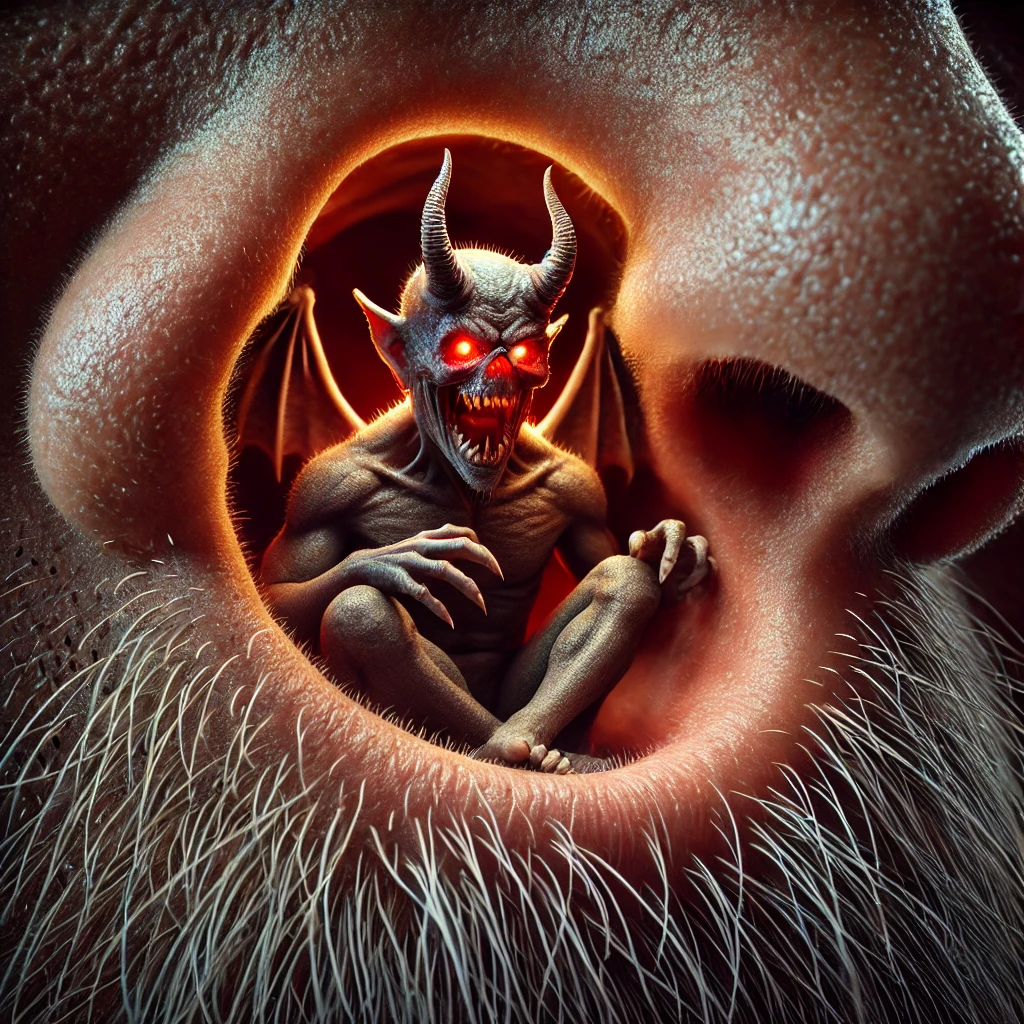
If an invisible creature really spends the night within the limited space of the human nose, its size, location, relationship to airflow and what happens to it when the nose is cleaned could all be investigated. Yet instead of verifying Satan’s presence in the nose, the hadith’s declaration itself is treated as evidence of that presence. Attaching a story about Satan to the ordinary habit of cleaning one’s nose has produced no new knowledge of the human body. Rather, people learn to associate normal nasal mucus, experiences of sleep or physical discomfort with the presence of an invisible enemy. In this way, pre-scientific superstition has acquired the status of religious truth and daily ritual in place of investigating natural causes.
Bones and Dung as Food for Jinn and Satan’s Eating Habits
By identifying bones and dung as food for jinn, Muhammad also imposed rules concerning human toilet hygiene. In Sahih al-Bukhari 3860, Abu Hurayrah narrates that Muhammad asked him for stones to clean himself after relieving himself, while forbidding him to bring bones or dung. When Abu Hurayrah asked why, Muhammad said that bones and dung were the food of the jinn. A delegation of jinn from Nasibin had come to him asking for food, and he had prayed to Allah that they would find food whenever they came upon bones or dung. In Islamic narratives, jinn not only experience hunger; they also possess a social system capable of dispatching delegations to the prophet of humanity to resolve their food shortage. A religious prohibition is imposed on visible human beings to provide food for an invisible population. [49]
حَدَّثَنَا مُوسَى بْنُ إِسْمَاعِيلَ، حَدَّثَنَا عَمْرُو بْنُ يَحْيَى بْنِ سَعِيدٍ، قَالَ أَخْبَرَنِي جَدِّي، عَنْ أَبِي هُرَيْرَةَ، أَنَّهُ كَانَ يَحْمِلُ مَعَ النَّبِيِّ صلى الله عليه وسلم إِدَاوَةً لِوُضُوئِهِ وَحَاجَتِهِ، فَبَيْنَمَا هُوَ يَتْبَعُهُ بِهَا فَقَالَ «مَنْ هَذَا» فَقَالَ أَنَا أَبُو هُرَيْرَةَ. فَقَالَ «ابْغِنِي أَحْجَارًا أَسْتَنْفِضْ بِهَا، وَلَا تَأْتِنِي بِعَظْمٍ وَلَا بِرَوْثَةٍ» فَأَتَيْتُهُ بِأَحْجَارٍ أَحْمِلُهَا فِي طَرَفِ ثَوْبِي حَتَّى وَضَعْتُ إِلَى جَنْبِهِ ثُمَّ انْصَرَفْتُ، حَتَّى إِذَا فَرَغَ مَشَيْتُ فَقُلْتُ مَا بَالُ الْعَظْمِ وَالرَّوْثَةِ قَالَ «هُمَا مِنْ طَعَامِ الْجِنِّ، وَإِنَّهُ أَتَانِي وَفْدُ جِنِّ نَصِيبِينَ وَنِعْمَ الْجِنُّ، فَسَأَلُونِي الزَّادَ، فَدَعَوْتُ اللَّهَ لَهُمْ أَنْ لَا يَمُرُّوا بِعَظْمٍ وَلَا بِرَوْثَةٍ إِلَّا وَجَدُوا عَلَيْهَا طَعَامًا»
English translation: Abu Hurayrah narrated that he was carrying a water vessel for Muhammad’s ablution and toilet needs. Muhammad asked him to bring some stones but forbade him to bring bones or dung. After bringing the stones, Abu Hurayrah asked why bones and dung were prohibited. Muhammad said: Bones and dung are food for the jinn. A delegation of jinn from Nasibin came to me; they were good jinn. They asked me for provisions, so I prayed to Allah that whenever they passed by a bone or dung, they would find food upon it.
Sahih al-Bukhari, 3860, relevant excerpt.
Sahih Muslim 450 contains an even more remarkable account of the food of jinn. According to Abdullah ibn Mas’ud, one night a caller from the jinn summoned Muhammad, who went there and recited the Quran to the jinn. When they subsequently asked him for provisions, he told them that every bone over which Allah’s name had been pronounced would reach their hands covered with abundant meat. Dung would be fodder for their animals. This hadith therefore speaks not only of jinn but also of their own livestock. Whereas Bukhari calls both bones and dung food for jinn, this detailed narration in Muslim allocates bones to the jinn themselves and dung to their animals. The claim that even stripped bones appear in the hands of jinn covered with meat is a miraculous tale about food production. [50]
لَكُمْ كُلُّ عَظْمٍ ذُكِرَ اسْمُ اللَّهِ عَلَيْهِ يَقَعُ فِي أَيْدِيكُمْ أَوْفَرَ مَا يَكُونُ لَحْمًا وَكُلُّ بَعَرَةٍ عَلَفٌ لِدَوَابِّكُمْ
English translation: Every bone over which the name of Allah has been pronounced is yours; it will reach your hands covered with abundant meat. Every piece of dung is fodder for your animals.
Sahih Muslim, 450a, relevant excerpt.
The production of flesh in an animal’s body requires cellular activity, amino acids, water, energy and other constituents. There is no natural process by which new muscle tissue grows on the stripped bones of a dead animal as it does in a living one. Bones contain collagen and minerals, but these are not the same as bones covered with meat. If Muhammad’s claim were true, the amount of meat present before and after a bone reached a jinn’s hands, the composition of that meat and the source of its constituents would be matters for empirical investigation. Yet the Islamic narratives provide no verifiable instance of meat growing again on a bone. The declaration that this miraculous provision occurs through pronouncing Allah’s name and Muhammad’s prayer has been substituted for evidence altogether.
The Livestock of Jinn, Dung and Charcoal
The dietary list of jinn does not end with bones and dung. According to Sunan Abi Dawud 39, a delegation of jinn approached Muhammad and requested that his followers refrain from cleaning themselves after relieving themselves with bones, dung or charcoal, because Allah had supposedly provided their sustenance through these materials. In accordance with their request, Muhammad prohibited Muslims from using these objects. Al-Albani classified the hadith as sahih. This is a bizarre example of imposing restrictions on actual human life to preserve the food and livelihood of a purported invisible population. [51]
يَا مُحَمَّدُ انْهَ أُمَّتَكَ أَنْ يَسْتَنْجُوا بِعَظْمٍ أَوْ رَوْثَةٍ أَوْ حُمَمَةٍ فَإِنَّ اللَّهَ تَعَالَى جَعَلَ لَنَا فِيهَا رِزْقًا
English translation: O Muhammad, forbid your followers from cleaning themselves after relieving themselves with bones, dung or charcoal, for Allah has provided our sustenance through these things.
Sunan Abi Dawud, 39, relevant excerpt.
Dung contains undigested organic matter, microorganisms and other chemical constituents. In nature there are insects and microorganisms that derive nutrients from dung, and their feeding and life cycles can be observed. Charcoal also contains various carbon-bearing compounds. Determining what nutrients a creature obtains from such materials requires examining the actual transfer of matter between it and its food. None of this has been established for the jinn and their animals described in Islamic narratives. Biologists did not need revelations to a prophet to identify known dung-feeding organisms; knowledge of them was acquired by observing their bodies, dietary habits and reproduction. In the dietary system attributed to jinn, the alleged encounter with an invisible delegation has been taken as true in place of this fundamental evidence.
Satan Eats and Drinks with His Left Hand
Even the hand with which a person eats has been associated with Satan in Islam. In Sahih Muslim 2020, Muhammad instructs people to eat and drink with their right hands because Satan supposedly eats and drinks with his left hand. The functioning of the left and right hands and which hand a person feels more comfortable using are related to the nervous system and habit. Bringing food to one’s mouth with the left hand does not change its nutritional value or how the digestive system functions. Yet a religious prohibition has been created by attaching the idea of imitating Satan to a particular form of this ordinary human habit. There is no scientific or rational basis for equating the eating habits of a naturally left-handed person with the behaviour of an invisible enemy. [52]
إِذَا أَكَلَ أَحَدُكُمْ فَلْيَأْكُلْ بِيَمِينِهِ وَإِذَا شَرِبَ فَلْيَشْرَبْ بِيَمِينِهِ فَإِنَّ الشَّيْطَانَ يَأْكُلُ بِشِمَالِهِ وَيَشْرَبُ بِشِمَالِهِ
English translation: When one of you eats, let him eat with his right hand, and when he drinks, let him drink with his right hand, for Satan eats with his left hand and drinks with his left hand.
Sahih Muslim, 2020a.
According to another account of Muhammad, Satan can enter a person’s home and even eat dinner with him. Sahih Muslim 2018 states that if a person does not mention Allah’s name upon entering the home, Satan obtains a place to spend the night, and if the person does not mention Allah’s name while eating, Satan obtains food as well. Mentioning Allah’s name deprives him of this opportunity. Satan’s access to the same house and the same food thus depends on the utterance of a specific word. Whether a homeowner pronounces Allah’s name yields no verifiable information about whether an invisible creature entered the house or how much food it consumed from someone’s meal. Yet by imposing fear of Satan’s presence even on ordinary activities such as entering the house and eating, religious remembrance has been made indispensable. [53]
إِذَا دَخَلَ الرَّجُلُ بَيْتَهُ فَذَكَرَ اللَّهَ عِنْدَ دُخُولِهِ وَعِنْدَ طَعَامِهِ قَالَ الشَّيْطَانُ لَا مَبِيتَ لَكُمْ وَلَا عَشَاءَ، وَإِذَا دَخَلَ فَلَمْ يَذْكُرِ اللَّهَ عِنْدَ دُخُولِهِ قَالَ الشَّيْطَانُ أَدْرَكْتُمُ الْمَبِيتَ، وَإِذَا لَمْ يَذْكُرِ اللَّهَ عِنْدَ طَعَامِهِ قَالَ أَدْرَكْتُمُ الْمَبِيتَ وَالْعَشَاءَ
English translation: When a man remembers Allah upon entering his home and at mealtime, Satan says: You have no lodging here and no dinner. If he enters without remembering Allah, Satan says: You have obtained lodging. If he does not remember Allah at mealtime, Satan says: You have obtained both lodging and dinner.
Sahih Muslim, 2018a.
Digestion, Energy and the Claim of an Invisible Consumer
After humans eat, saliva in the mouth, acid and digestive juices in the stomach and various enzymes in the small intestine break down complex food constituents. Most absorbed nutrients reach the body’s cells through the bloodstream, while the lymphatic system is an important route for fat absorption. Cells use these nutrients to obtain energy, maintain bodily structure and produce new organic matter. Undigested food and metabolic waste leave the body through various routes. There is thus a clear biochemical relationship between feeding, digestion, obtaining energy and producing waste. Although specific materials such as bones, meat, dung, charcoal and human food have been identified as provisions for jinn, no observable mechanism by which they obtain nutrients from these materials has been established. [54]
Earlier hadith described Satan farting audibly and urinating in human ears. Now we find that Satan eats, drinks, uses his hands and obtains dinner in people’s homes. These narratives claim an entire sequence of activities by an invisible creature, from consuming food to excreting waste. If it obtains nutrients from actual food, there should be an exchange of matter and energy between it and that food. If it expels actual gas or urine, the properties of the expelled substance should be open to investigation. No identifiable specimen supports these specific claims of physical activity. Yet Islamic commentators have used one hadith’s story about Satan eating to support other hadith stories about his farting and urinating. An entire supernatural kingdom of creatures has been constructed by making one unsubstantiated claim the foundation of another.
The Story of Satan Laying Eggs, Hatching Young and Reproducing in the Marketplace
The Satan of Islamic literature not only eats, drinks and excretes waste; he also lays eggs and hatches young from them! This astonishing story of Satan’s reproduction appears in al-Nawawi’s celebrated Riyad al-Salihin. It first mentions Salman al-Farisi’s statement preserved in Sahih Muslim 2451. Salman calls the marketplace Satan’s battlefield and speaks of Satan erecting his banner there. Al-Nawawi then quotes a statement of Muhammad transmitted through Salman and preserved in al-Barqani’s Sahih, which explicitly mentions Satan laying eggs and hatching young in the marketplace. The story of Satan’s reproduction is now attached even to instructions about when to enter and leave the market. [55] [56]
لَا تَكُنْ أَوَّلَ مَنْ يَدْخُلُ السُّوقَ وَلَا آخِرَ مَنْ يَخْرُجُ مِنْهَا، فِيهَا بَاضَ الشَّيْطَانُ وَفَرَّخَ
English translation: Do not be the first to enter the marketplace or the last to leave it, for Satan lays eggs and hatches young there.
Al-Barqani’s report quoted in Riyad al-Salihin; not the original text of Muslim 2451.
The same story appears through Salman al-Farisi in narration 6118 of al-Tabarani’s Al-Mu’jam al-Kabir. The Arabic word بَاضَ means to lay eggs, while فَرَّخَ is used in the sense of producing hatchlings. The statement concerns not only Satan’s presence in the marketplace but also his reproduction there. The later commentator al-Qurtubi took this very language of egg-laying and hatching as evidence that Satan produces descendants from his own body. [57]
لَا تَكُنْ أَوَّلَ مَنْ يَدْخُلُ السُّوقَ، وَلَا آخِرَ مَنْ يَخْرُجُ مِنْهَا، فَفِيهَا بَاضَ الشَّيْطَانُ وَفَرَّخَ
English translation: Do not be the first to enter the marketplace or the last to leave it, for Satan lays eggs and produces young there.
Al-Tabarani, Al-Mu’jam al-Kabir, 6118.
Iblis’s Five Eggs and Special Reproductive Organs in Al-Qurtubi’s Commentary
After Allah mentions Iblis’s descendants in Surah al-Kahf 18:50, the obvious question arises: where do all these descendants come from? Several bizarre answers to this question are preserved in al-Qurtubi’s commentary. When someone asked al-Sha’bi whether Iblis had a wife, he initially joked that he had not attended the wedding. Then, recalling the Quranic verse about descendants, he concluded that Iblis had a wife. Mujahid’s statement is even more remarkable. According to him, Iblis inserted one of his genitals into the other and laid five eggs, from which his lineage originated. The story of Iblis’s sexual activity and production of offspring is not based on information obtained by examining an egg or reproductive organ; it is an explanation of his reproduction developed from a reference to descendants in a religious verse. [58]
وَقَالَ مُجَاهِدٌ: إِنَّ إِبْلِيسَ أَدْخَلَ فَرْجَهُ فِي فَرْجِ نَفْسِهِ فَبَاضَ خَمْسَ بَيْضَاتٍ؛ فَهَذَا أَصْلُ ذُرِّيَّتِهِ
English translation: Mujahid said: Iblis inserted his genital organ into his other genital organ and laid five eggs; this is the origin of his descendants.
Mujahid’s statement quoted in al-Qurtubi’s commentary.
The same commentary contains another account specifying the location of Iblis’s reproductive organs, the number of eggs he lays daily and how many devils are born from each egg. According to this view, Allah created a male genital organ in Iblis’s right thigh and a female genital organ in his left thigh. Through these two organs he engages in sexual activity with himself and produces ten eggs daily. The account claims that seventy male and female devils emerge from each egg. That is seven hundred new devils every day! They even begin flying after birth, and the child who creates the greatest discord among humans holds the highest rank in Iblis’s estimation. [58]
وقيل : إن الله – تعالى – خلق له في فخذه اليمنى ذكرا وفي اليسرى فرجا ; فهو ينكح هذا بهذا ، فيخرج له كل يوم عشر بيضات ، يخرج من كل بيضة سبعون شيطانا وشيطانة ، فهو يخرج وهو يطير ، وأعظمهم عند أبيهم منزلة أعظمهم في بني آدم فتنة
English translation: It has also been said that Allah created a male genital organ in his right thigh and a female genital organ in his left. He copulates with one by means of the other, so that ten eggs emerge from him every day, and from each egg emerge seventy male and female devils. They emerge flying. The one who causes the greatest discord among the children of Adam holds the highest rank with their father.
Tafsir al-Qurtubi, Surah al-Kahf 18:50.
In discussing Iblis’s production of offspring, al-Qurtubi also quotes al-Barqani’s hadith about Satan laying eggs in the marketplace and concludes that the hadith indicates that Satan has offspring from his own body. The statement about laying eggs is therefore used in his commentary as evidence for the claim of actual reproduction. [59]
وهذا يدل على أن للشيطان ذرية من صلبه ، والله أعلم
English translation: This indicates that Satan has offspring from his own loins. Allah knows best.
Al-Qurtubi’s own conclusion in his commentary on Surah al-Kahf 18:50.
The fundamental weakness of al-Qurtubi’s reasoning is that he uses another unsubstantiated event of the same kind as evidence for the event that needs to be established. Satan’s biological offspring are established on the basis of the unverified claim that he lays eggs in the marketplace. If a religious story mentions a being laying eggs, this may be consistent with the idea of its reproduction within that story; it does not establish that the being reproduces in the real world.
The Names and Duties of Iblis’s Children and Their Association with the Marketplace
The Islamic literary imagination concerning Iblis’s descendants did not stop at the method of their birth. Their names and responsibilities are also preserved under Mujahid’s name in Abu al-Shaykh’s Al-Azamah and various commentaries. Al-Qurtubi, citing al-Tabari and others, mentions that Zalanbur is in charge of the marketplace; Thabr influences human behaviour in times of calamity and grief; al-A’war is associated with adultery; Miswat spreads lies and unfounded news through people’s mouths; and Dasim is associated with entering the home and eating. Different invisible characters have thus been assigned responsibility for various problems in human economic, family and moral life. [58]
The story of Satan erecting his banner in the marketplace is preserved in Sahih Muslim as a statement of Salman al-Farisi, while al-Barqani’s report also mentions egg-laying. The roles of human decisions, economic interests and weak regulation in conflicts between buyers and sellers, competition for profit, dishonest business and fraud can be investigated. Assigning responsibility for these real problems to an alleged devil inhabiting the marketplace and his descendants does not explain the actual causes of fraud. Instead, a story about an invisible enemy is attached to people’s own decisions and behaviour. [60]
لَا تَكُونَنَّ إِنِ اسْتَطَعْتَ أَوَّلَ مَنْ يَدْخُلُ السُّوقَ وَلَا آخِرَ مَنْ يَخْرُجُ مِنْهَا فَإِنَّهَا مَعْرَكَةُ الشَّيْطَانِ وَبِهَا يَنْصِبُ رَايَتَهُ
English translation: If possible, do not be the first person to enter the marketplace or the last to leave it, for the marketplace is Satan’s battlefield and there he erects his banner.
Statement of Salman al-Farisi, Sahih Muslim 2451.
The Actual Biology of Eggs and Reproduction
Egg-laying is no mystery in nature. Various stages of reproduction in birds, many reptiles, fish, amphibians and invertebrates have been understood through observation and research. Egg cells carry hereditary information, provisions are available to nourish the developing embryo, and the body of a new organism is formed through cell division. Egg coverings and methods of nutrient provision vary by species. Some animals even reproduce without fertilization through parthenogenesis. Each instance of this diversity is an observable reproductive process in actual organisms. Yet in the case of Iblis, not a single egg, reproductive cell or embryo has been identified to support the specific accounts of where his reproductive organs are, how he engages in sexual activity with himself, how many eggs he lays and how many young emerge from them.
If the account of Iblis producing seven hundred offspring from ten eggs daily were true, in the 365 days of a single year he alone would produce 255,500 offspring. How many survive, whether they reproduce themselves, and where the food and bodily constituents of such enormous numbers of new beings come from are questions without tested answers. The being described in the Quran as a jinn created from fire has been endowed in later exegesis with familiar human genital organs and the capacity to reproduce like egg-laying animals. When even the claim that such a body originated from fire is unproven, specifying the precise location of its genital organs and calculating its daily production of offspring is not knowledge; it is the construction of further unsubstantiated tales upon unsubstantiated tales.
These animals lay eggs containing the nutrients needed for embryonic development. Birds, most reptiles (such as snakes and turtles), fish and insects provide many examples. The embryo develops outside the mother’s body within various types of shells or coverings, and after a certain period it hatches and emerges independently. This is an ancient and evolutionarily successful method of reproduction.
These animals give birth to live offspring. In most mammals, including humans, the embryo develops inside the mother’s body and receives nutrients through the placenta. Various fish and reptiles also possess their own physiological systems for giving birth to live young.
Mammals such as the platypus and echidna also lay eggs, while various fish and reptiles possess different arrangements for embryonic development inside the maternal body. In biology, an animal’s reproductive method is determined by observing its actual physiological characteristics and reproduction. The complete opposite occurred in the accounts of Iblis’s reproduction quoted by al-Qurtubi. The Quran’s declaration about descendants was first assumed true, and stories about a wife, reproductive organs, sexual activity, eggs and hatchlings were then presented as explanations of that declaration. In the acquisition of actual knowledge, conclusions are drawn from evidence; here, the conclusion is predetermined and compatible fictional accounts are subsequently constructed.
Yawning as Satan’s Work, Satan’s Laughter and Entry Through the Human Mouth
When we feel sleepy or tired, or see someone else yawning, we also yawn. Islam has associated even this extremely commonplace physiological event with Satan. In Sahih al-Bukhari 3289 and 6226, Muhammad claims that yawning comes from Satan and that people should suppress it as much as possible. If a person makes the sound “ha” while yawning, Satan supposedly laughs at him! Alongside urinating in people’s ears and fleeing while farting upon hearing the adhan, Islamic hadith include laughing at yawning humans in the list of Satan’s activities. In explaining such an ordinary phenomenon of daily human life, Muhammad described the activities of an invisible creature without presenting any observable evidence for them. [61] [62]
التَّثَاؤُبُ مِنَ الشَّيْطَانِ فَإِذَا تَثَاءَبَ أَحَدُكُمْ فَلْيَرُدَّهُ مَا اسْتَطَاعَ فَإِنَّ أَحَدَكُمْ إِذَا قَالَ هَا ضَحِكَ الشَّيْطَانُ
English translation: Yawning is from Satan. If one of you yawns, let him suppress it as much as he can, for when one of you says “ha” while yawning, Satan laughs.
Sahih al-Bukhari, 3289.
According to Sahih al-Bukhari 6223, Allah too has particular preferences concerning these bodily functions. Allah likes sneezing but dislikes yawning. Yet sneezing and yawning are both associated with the functioning of the nervous system and muscles. Stimulation of sensory nerves in the nose activates a protective mechanism that expels irritants from the airways through sneezing. During yawning, the jaw stretches, the mouth opens and the breathing rhythm changes temporarily. These reactions occur independently of human will as well. The religious discourse that labels the body’s normal functions either as something Allah likes or as Satan’s work provides no knowledge of how the human body functions; rather, it needlessly attaches a biological phenomenon to religious obedience and an invisible enemy. [63]
إِنَّ اللَّهَ يُحِبُّ الْعُطَاسَ وَيَكْرَهُ التَّثَاؤُبَ
English translation: Allah loves sneezing and dislikes yawning.
Sahih al-Bukhari, 6223, relevant excerpt.
Satan Enters Through the Mouth During Yawning
The matter is not limited to Satan laughing. In Sahih Muslim 2995, Muhammad says through Abu Sa’id al-Khudri that people must cover their mouths with their hands when yawning, because Satan then enters them. The same warning is given regarding yawning during prayer. Notably, the means prescribed to prevent Satan’s entry is a physical barrier over the mouth: the hand. A specific bodily organ is identified as the entry point of a being generally invisible to human sight, and covering that organ is claimed to prevent its entry. Medicine has studied the human mouth, pharynx, oesophagus and airways extensively. None of this research has discovered a connection between yawning and Satan’s entry. [64]
إِذَا تَثَاوَبَ أَحَدُكُمْ فَلْيُمْسِكْ بِيَدِهِ عَلَى فِيهِ فَإِنَّ الشَّيْطَانَ يَدْخُلُ
English translation: When one of you yawns, let him hold his hand over his mouth, for Satan enters.
Sahih Muslim, 2995a.
In his celebrated commentary on Bukhari, Fath al-Bari, Ibn Hajar al-Asqalani accepts the possibility of Satan literally entering the body in his interpretation of this hadith from Muslim. According to his explanation, although Satan moves through the human body like the flow of blood, he cannot gain control of a person while that person remembers Allah. Since a person is not remembering Allah while yawning, Satan can then actually enter his body. Yet another unsubstantiated claim about Satan’s movements within the human body has thus been used to explain an unsubstantiated religious claim. [65]
وأما قوله في رواية مسلم فإن الشيطان يدخل فيحتمل أن يراد به الدخول حقيقة، وهو وإن كان يجري من الإنسان مجرى الدم لكنه لا يتمكن منه ما دام ذاكرا لله تعالى، والمتثائب في تلك الحالة غير ذاكر فيتمكن الشيطان من الدخول فيه حقيقة.
English translation: As for the statement in Muslim’s narration that Satan enters, it may mean actual entry. Although Satan moves through a human being like the flow of blood, he cannot gain control of him as long as he remembers Allah. A person yawning in that state is not remembering Allah, so Satan can actually enter him.
Fath al-Bari, vol. 10, p. 628.
Ibn Hajar also discusses the use of a cloth as well as the hand to cover the mouth. His interpretation was not founded on any experiment to determine whether a person opening his mouth remembers Allah or whether Satan uses that opportunity to enter his body. Nor is there any physical evidence behind the idea of stopping an invisible being with a cloth or a hand. A fictional causal relationship has been constructed by substituting one religious assumption after another for information about human physiological reactions.
The Science of Yawning: The Old, Mistaken Oxygen-Deficiency Explanation
Yawning is not confined to humans; it has also been observed in many other vertebrates. It is associated with transitions between sleep and wakefulness, fatigue, levels of alertness and neural stimulation. Various scientific hypotheses, including regulation of brain temperature, have been proposed to explain its function. An older belief was that humans yawn when blood oxygen decreases or carbon dioxide increases. In 1987, Robert Provine and his colleagues put this hypothesis to the test. Breathing pure oxygen and gas containing elevated levels of carbon dioxide did not produce the changes in yawning frequency predicted by the hypothesis. Nor did increasing the breathing rate through exercise increase yawning. The simple oxygen-deficiency explanation for yawning thus failed to gain experimental support. This is the difference between science and religious superstition: a scientific explanation is discarded when it fails the test, whereas no experimental results have been presented to justify accepting the story of Satan as true. [66]
Many people yawn when they see someone else yawning, or even when they read about yawning. This phenomenon is called contagious yawning. Instances of this behaviour have also been observed in social animals. Research has examined its relationship with neural activity, environmental stimuli and social responses. The subject of this research is the actual behaviour of humans and other animals, not the imagined presence of an invisible being. Using the fact that all biological functions of yawning have not yet been conclusively determined as evidence for Satan’s existence is logically absurd. A gap in knowledge about a natural phenomenon does not imply the existence or activity of a specific supernatural creature. [67]
There is no scientific basis for instilling fear that Satan will enter a person’s body if the mouth is open during a spontaneous physical reaction like yawning. The central problem is the story of an invisible enemy attached to each instruction about cleaning the nose after waking, untying knots on the head or covering the mouth while yawning. If the actual existence of the danger is unsubstantiated, there is no basis for establishing the effectiveness of religious rituals as protection from it. A form of religious control based on superstition has thus developed around the normal functions of the human body.
Satan’s Assault on Newborn Babies and the Cause of Crying at Birth
Another extremely bizarre and medically incorrect Islamic claim is that a newborn baby’s crying at birth is supposedly caused by Satan’s poke! This story is preserved in Sahih al-Bukhari and Sahih Muslim as a statement of Muhammad. Bukhari 3431 explicitly states that every child of Adam except Mary and her son Jesus is touched by Satan at birth, and that it is this touch which makes the baby scream and cry. In attempting to explain a normal physiological reaction of a child newly arrived in the world, Muhammad thus presented a story of supernatural physical assault. This is a specific causal claim about why newborns cry at birth, which can be compared with actual births. That comparison proves the hadith’s universal claim about crying wrong. [68]
مَا مِنْ بَنِي آدَمَ مَوْلُودٌ إِلَّا يَمَسُّهُ الشَّيْطَانُ حِينَ يُولَدُ فَيَسْتَهِلُّ صَارِخًا مِنْ مَسِّ الشَّيْطَانِ غَيْرَ مَرْيَمَ وَابْنِهَا. ثُمَّ يَقُولُ أَبُو هُرَيْرَةَ: وَإِنِّي أُعِيذُهَا بِكَ وَذُرِّيَّتَهَا مِنَ الشَّيْطَانِ الرَّجِيمِ
English translation: Every child of Adam is touched by Satan when born and begins to scream and cry because of Satan’s touch, except Mary and her son. Abu Hurayrah then said: “I seek refuge with You for her and her descendants from the accursed Satan.”
Sahih al-Bukhari, 3431, relevant excerpt.
Sahih Muslim 2366a uses the word نَخَسَهُ, meaning to poke, to describe Satan’s action. Sahih al-Bukhari 3286 is even more specific: Satan pokes the newborn in the side with his finger. When he attempts to poke Jesus, he strikes a barrier. The description of Satan’s finger, the side of the child’s body and the barrier that blocks the assault clearly employs the concept of a physical attack. Yet medical observations in delivery rooms, examinations of newborn babies and research on respiration have identified no such finger, trace of injury or supernatural barrier. [69] [70]
كُلُّ بَنِي آدَمَ يَطْعُنُ الشَّيْطَانُ فِي جَنْبَيْهِ بِإِصْبَعِهِ حِينَ يُولَدُ غَيْرَ عِيسَى بْنِ مَرْيَمَ ذَهَبَ يَطْعُنُ فَطَعَنَ فِي الْحِجَابِ
English translation: Every child of Adam is poked by Satan’s finger at birth, except Jesus son of Mary; when Satan went to poke him, he struck a barrier.
Sahih al-Bukhari, 3286.
Mary’s Mother’s Prayer and the Protective Barrier in Quranic Commentary
Verse 36 of Surah Al Imran describes a prayer by Mary’s mother after Mary’s birth. She seeks refuge with Allah for Mary and her descendants against the accursed Satan. Abu Hurayrah cites this very verse after narrating Muhammad’s statement about newborn crying. A prayer is thus used as the religious explanation for Mary and Jesus receiving special protection from Satan’s assault. [71]
وَإِنِّي سَمَّيْتُهَا مَرْيَمَ وَإِنِّي أُعِيذُهَا بِكَ وَذُرِّيَّتَهَا مِنَ الشَّيْطَانِ الرَّجِيمِ
English translation: I have named her Mary, and I seek refuge with You for her and her descendants from the accursed Satan.
Surah Al Imran, 3:36, relevant excerpt.
Al-Tabari’s interpretation of this verse of Surah Al Imran contains several narrations transmitted through Abu Hurayrah. Narration 6885 states that because of Mary’s mother’s prayer, a barrier was placed before Mary and her son, causing Satan to poke the barrier instead of them. Narration 6895 contains a similar story transmitted through Qatadah. Satan’s finger poking a child at birth, and a barrier created by Allah to prevent that poke, together construct an imaginary supernatural delivery room. [72]
كل مولود من ولد آدم له طعنة من الشيطان، وبها يستهل الصبي، إلا ما كان من مريم ابنة عمران وولدها، فإن أمها قالت حين وضعتها: إني أعيذها بك وذريتها من الشيطان الرجيم، فضرب دونهما حجاب، فطعن في الحجاب.
English translation: Every newborn among the children of Adam receives a poke from Satan, which makes the child scream and cry, except Mary daughter of Imran and her child. For when her mother gave birth to her, she said: I seek refuge with You for her and her descendants from the accursed Satan. A barrier was then placed before them, and Satan poked the barrier.
Tafsir al-Tabari, narration 6885.
The Quran mentions Mary’s mother’s prayer after Mary’s birth; the hadith places Satan’s assault at the moment of birth. Al-Tabari’s narration explains how the attack was avoided through the story of the prayer and the installation of a barrier. Yet there is no independent eyewitness record of Mary’s or Jesus’s crying, breathing or alleged assault at the moment of their birth. The actual causes of newborn respiration cannot be discovered by supporting one religious narrative with another.
Breathing After Birth and the Crying of Newborns
In the womb, the fetal lungs contain fluid rather than air, and oxygen is obtained from the mother’s blood through the placenta. At birth, this situation changes fundamentally. During the first breaths, air enters the lungs, lung fluid is gradually cleared and absorbed, pulmonary vascular resistance decreases and blood flow to the lungs increases. This transition from dependence on the mother’s body for oxygen to breathing through one’s own lungs is vital to the newborn’s survival. Crying is associated with deep inspiration and the retention of air in the lungs. A baby’s cry is therefore an important sign that breathing has begun after birth. Crying is not the only way to begin breathing; many newborns begin breathing normally without screaming. Medical professionals assess a baby’s respiration, heart rate and muscle activity. None of this requires a poke from Satan’s finger. [73]
According to Muhammad, every newborn on earth except Mary and Jesus cries at birth because of Satan’s assault. But in reality, not every baby cries immediately after birth. A study published in the medical research journal Pediatrics in 2020, involving 19,977 newborns in four hospitals in Nepal, found that 11.1 percent of newborns did not cry immediately after birth, and 5.2 percent neither cried nor breathed. In other words, some babies were breathing without crying. The hadith’s universal claim that every newborn except Mary and Jesus screams and cries at birth has been disproved by actual observation. The results of medical observations of almost twenty thousand babies cannot be changed to fit an ancient religious story. [74]
The problem with this superstition is not confined to providing a false explanation of newborn crying. Following the logic of the hadith could create the misleading impression that if a newborn does not cry at birth, Satan did not attack the child, and that the child has therefore received special protection like Mary and Jesus. If a child’s breathing difficulties are ignored because the child is thought to be a saint or endowed with special miraculous powers, the child’s life may be placed in grave danger. Whether the baby is having difficulty breathing, whether sufficient oxygen is reaching the body and whether its heart rate is normal are questions answered by medicine, not by religious stories about Satan. Treating a sign that may require medical attention as evidence of Allah’s special favour is a dangerous superstition.
The 2025 neonatal resuscitation guidelines of the American Heart Association and the American Academy of Pediatrics identify ensuring adequate lung inflation and ventilation after birth as the highest priority. As required, trained medical personnel keep the baby warm, dry the baby, use gentle touch to stimulate breathing and provide assisted ventilation if normal breathing has not been established. An obstruction in the airway is addressed when present; there is no need for routine instrumental clearing of every newborn’s airway or indiscriminate administration of excess oxygen. Every clinical decision depends on the baby’s actual physiological condition. [75]
Instead of regarding a baby who does not cry at birth as a miraculous child protected from Satan’s poke, it is essential to determine the baby’s actual respiratory condition. Advances in medicine have saved countless newborn lives through the discovery of the body’s natural functions and effective methods of treatment. Passing off that very physiological event as the result of a poke from Satan’s finger is no substitute for knowledge; it is a pre-scientific superstition.
The Physical Existence of Jinn and Satan: Biology, Physics and the Problem of Evidence
The scope of the invisible kingdom of jinn and devils depicted in Islamic narratives is truly astonishing. It includes accounts of feeding, drinking, excretion, sexual intercourse, egg-laying, production of offspring, locomotion, entering human bodies and even physical assault. Muhammad spoke of catching Satan and tying him to a mosque pillar; Islamic literature also contains the account of feeling the coldness of his tongue. All these claims concern matter, energy, temperature, sound, space and physical force in the real world. Grasping a throat should produce sensations of touch and resistance, audible farting should generate sound waves, and urination should release a liquid. Yet despite such detailed descriptions, no reliable bodily remains, biological specimens or independently verified evidence of physical interactions have been presented to establish the existence of this purported kingdom of creatures.
There is a fundamental logical problem in the interpretations of Qadi Iyad and al-Qurtubi. Qadi Iyad explained Satan’s flatulence by conceiving him as a corporeal being that consumes food; al-Qurtubi argued for the possibility of his urinating on the basis of accounts of Satan eating, drinking and having sexual intercourse. Ibn Hajar also discussed the literal interpretation of Satan entering a human mouth during yawning. But what is the evidence that Satan eats? What is the evidence that he has sexual intercourse? And where is the very body with which he is alleged to perform these acts? Demonstrating the relationship between digestion and waste excretion in established organisms cannot be used to establish the existence or specific activities of an unsubstantiated creature. Some familiar features of actual biology have been projected onto religious fables. By passing off consistency between stories as evidence, a vast literature about Satan has been produced, but no new knowledge about the real world has been generated.
Satan Moves Through Humans Like the Flow of Blood
According to Sahih al-Bukhari 3281, while Muhammad was observing i’tikaf, his wife Safiyyah came to visit him at night. After their conversation, when Safiyyah was leaving, Muhammad went out with her. Two men of the Ansar saw them and began to hurry away, whereupon Muhammad called out to them and told them that the woman with him was Safiyyah bint Huyayy. He then claimed that Satan moves through human beings like the flow of blood and that he feared Satan might introduce an evil thought into their minds. Satan is thus invoked even to explain the entirely familiar social and psychological phenomenon of what two people might think upon seeing a man and a woman together at night. [76]
فَمَرَّ رَجُلاَنِ مِنَ الأَنْصَارِ، فَلَمَّا رَأَيَا النَّبِيَّ صلى الله عليه وسلم أَسْرَعَا، فَقَالَ النَّبِيُّ صلى الله عليه وسلم عَلَى رِسْلِكُمَا إِنَّهَا صَفِيَّةُ بِنْتُ حُيَىٍّ، فَقَالاَ سُبْحَانَ اللَّهِ يَا رَسُولَ اللَّهِ، قَالَ إِنَّ الشَّيْطَانَ يَجْرِي مِنَ الإِنْسَانِ مَجْرَى الدَّمِ، وَإِنِّي خَشِيتُ أَنْ يَقْذِفَ فِي قُلُوبِكُمَا سُوءًا ـ أَوْ قَالَ ـ شَيْئًا
English translation: Two men of the Ansar were passing by. When they saw the Prophet, they hurried away. The Prophet said: Slow down, this is Safiyyah bint Huyayy. They said: Glory be to Allah, O Messenger of Allah! He said: Satan moves through a human being like the flow of blood. I feared that he might cast an evil thought—or he said, something—into your hearts.
Sahih al-Bukhari, 3281, relevant excerpt.
A vast amount of reliable information is now available about blood circulation in the human body. Contraction of the heart, blood flow through arteries and veins, exchange of substances in capillaries and the functions of blood cells and plasma can be directly observed. Nor does the emergence of suspicion in the human mind require the presence of an invisible creature. People infer the meaning of events on the basis of previous experience, memory, social expectations and incomplete information. Such inferences may be correct or incorrect. In the incident described in the hadith itself, Muhammad used the ordinary human method of dispelling a potential misunderstanding by identifying his companion. What new information about human thought processes is obtained by adding a story about Satan moving like the flow of blood? None whatsoever. There is no independent evidence for Satan’s movement within the human body or his interference with thought.
Iblis’s Throne on the Water and the Concept of His Organized Forces
In Sahih Muslim 2813b, Satan’s activities are described as the operations of a well-organized army. Iblis places his throne on the water, dispatches various detachments from there to sow discord among humans and determines their ranks according to the results of their work. When one devil reports that he has separated a husband and wife, Iblis is particularly pleased. An administrative structure for the invisible world is imagined on the model of ancient kings and monarchs: a ruler, his throne, subordinate forces, reports of their activities and rewards for a job well done. [77]
إِنَّ إِبْلِيسَ يَضَعُ عَرْشَهُ عَلَى الْمَاءِ ثُمَّ يَبْعَثُ سَرَايَاهُ فَأَدْنَاهُمْ مِنْهُ مَنْزِلَةً أَعْظَمُهُمْ فِتْنَةً يَجِيءُ أَحَدُهُمْ فَيَقُولُ فَعَلْتُ كَذَا وَكَذَا فَيَقُولُ مَا صَنَعْتَ شَيْئًا قَالَ ثُمَّ يَجِيءُ أَحَدُهُمْ فَيَقُولُ مَا تَرَكْتُهُ حَتَّى فَرَّقْتُ بَيْنَهُ وَبَيْنَ امْرَأَتِهِ – قَالَ – فَيُدْنِيهِ مِنْهُ وَيَقُولُ نِعْمَ أَنْتَ. قَالَ الأَعْمَشُ أُرَاهُ قَالَ فَيَلْتَزِمُهُ
English translation: Iblis places his throne on the water and then dispatches his detachments. The one who creates the greatest discord is closest to him in rank. One of them comes and says: I did such and such. He says: You have done nothing. Then another comes and says: I did not leave him until I separated him from his wife. He draws him close and says: How excellent you are! Al-A’mash said: I think he said that he embraces him.
Sahih Muslim, 2813b, relevant excerpt.
Real causes behind the deterioration of marital relationships can be investigated, including financial pressure, mutual distrust, abuse, lack of communication and conflicts of interest. Divorce may sometimes be a necessary means of escaping abuse and an intolerable relationship. Yet this hadith presents bringing about separation as a particular success for Satan. Treating family problems as the conspiracy of an invisible army fosters the tendency to blame an imaginary enemy instead of addressing the behaviour of the people involved and the actual problems in their relationships. There is no independent evidence of where in the world Iblis’s throne on the water is located, where he directs his forces from or how a connection between his forces and any specific marital separation has been established.
Lack of Evidence of Physical Existence Behind the Claim of Invisibility
The alleged physical activities of Satan cannot be exempted from scrutiny behind the religious declaration that he cannot be seen. Bacteria are invisible to the naked eye, but they can be seen under a microscope, their reproduction can be observed in a laboratory and their chemical and genetic characteristics can be identified. Gas does not have to be visible for its presence to be determined either. Its pressure, density, chemical composition and interaction with the environment can be measured. Many events claimed in hadith relating to jinn and Satan likewise have physical effects that can be investigated. If Satan actually urinates in human ears, where are the traces of the expelled substance? If his throat can be grasped by hand, why have no identifiable characteristics of that body been found? Invisibility is not evidence here; it is merely a religious claim used to explain away the absence of evidence.
The difference between the method of acquiring knowledge about the characteristics of actual living bodies and the method of acquiring religious knowledge about jinn is stark. When a new species is discovered, researchers observe bodily specimens, cells, hereditary information, habitat, diet and reproduction. Other researchers can verify those findings independently. In the case of Iblis, the opposite method has been followed. A religious declaration that he has descendants was first accepted; stories about his genitals, eggs and number of offspring subsequently proliferated around that declaration. Instead of drawing conclusions from actual specimens, the process began with belief and imagined a body suited to that belief.
Despite the highly specific accounts of Satan’s activities, resembling familiar human bodily functions, there are no repeatable observations establishing their truth. The religious narratives supply no reliable criteria for identifying a substance detected during testing as the waste of jinn, distinguishing a snake as a jinn, or determining from an observation that a child has been poked by Satan. Consequently, any ordinary event can be declared Satan’s work without any means of establishing the truth of that declaration. In this way, human ignorance can be exploited to create countless fictional stories.
Claims of catching a jinn and feeling its coldness are claims of actual physical interaction. Yet no identifiable body or independently verified physical effect has been established.
Farting, urination and feeding are parts of specific bodily processes in known organisms. These acts are attributed to Satan, but no body, metabolism or excreted substance has been identified.
Animal reproductive methods are diverse. Verifying claims about Iblis’s eggs or reproductive organs requires observations of eggs, living cells, hereditary information or offspring, for which no independent evidence exists.
Yawning, crying, sleep and lapses of attention are real phenomena. Declaring an association between them and an invisible Satan does not produce causal evidence.
The Nature and Evidentiary Status of Claims About Physical Events
In addition to evidence for Satan’s existence, separate evidence is required for his alleged activities. Establishing the existence of an unknown creature alone would not establish that it farts upon hearing the adhan, urinates in human ears or causes babies to cry. Each specific activity requires evidence of the relevant event. Yet Islamic narratives accept both claims of existence and causal claims simultaneously without independent evidence. The following table brings together the relevant primary sources and the types of evidence needed to verify these claims in the real world.
| Religious Claim | Primary Source | Testable Question |
|---|---|---|
| Creation of jinn from fire | Quran 55:15; Muslim 2996 | What testable evidence exists for the origin of organized living bodies from flames? |
| Jinn assuming the form of snakes | Muslim 2236; Majmu’ al-Fatawa 19/44–45 | What reliable method distinguishes an allegedly transformed jinn from an ordinary snake? |
| Grasping Satan’s throat and feeling the coldness of his tongue | Muslim 541a; Al-Nasa’i, Al-Sunan al-Kubra 636 | Where is the independent evidence of touch, temperature and observation of the being? |
| Satan farting audibly upon hearing the adhan | Bukhari 608 | Where is the independent evidence of the source, gas, sound and location? |
| Urinating in sleeping people’s ears | Bukhari 1144; Muslim 774 | Have the liquid and its physical traces been identified? |
| Three knots at the back of the head | Bukhari 1142 | What evidence exists of the knots or their neurological effects? |
| Spending the night in the nostrils | Bukhari 3295; Muslim 238 | Has the location of the invisible being in the nasal cavity been identified? |
| Bones, dung and sharing human food | Bukhari 3860; Muslim 450, 2018 | What evidence exists of feeding and changes in matter? |
| Laying eggs and hatching young in the marketplace | Al-Barqani; Al-Tabarani 6118 | Where are the eggs, embryos or offspring? |
| Satan laughing at yawning and entering the mouth | Bukhari 3289; Muslim 2995 | What independent traces of laughter or entry exist? |
| Poking newborns with a finger | Bukhari 3286, 3431 | What evidence establishes a causal relationship between the assault and crying? |
Repetition of Religious Narratives Is Not Independent Evidence
Finding a story in an ancient religious book means that the story has been preserved in that religious literature. Neither antiquity nor the religious standing of the book is sufficient to establish it as an actual event. When Bukhari, Muslim, al-Tabarani or later exegetes quote a narration, this provides information about the history of its transmission and reception. A story spreading from a single source into ten books does not create ten independent eyewitness accounts. Despite discussion of Satan’s eggs in numerous books, the actual existence of a single egg has not been established. The number of books cannot remedy this lack of evidence.
The marketplace is described as Satan’s battlefield and the place where he erects his banner in Salman al-Farisi’s statement, a mawquf narration in Sahih Muslim. Al-Barqani’s marfu’ narration, attributed to Muhammad, additionally mentions Satan laying eggs and hatching young in the marketplace. This distinction matters in identifying the source of the narration. But acceptability under the internal criteria of hadith scholarship and the truth of the egg-laying event in the real world are not the same thing. Even if a narrator is regarded as trustworthy, that does not create independent evidence for the miraculous event he reports. The universal statement about newborn crying contained in a sahih hadith is itself inconsistent with actual observations of newborns. This single example demonstrates that treating the classification of sahih as a certificate of infallible knowledge about nature and the human body is wrong.
The Burden of Proof and the Fallacy of Turning the Unknown into Evidence of the Supernatural
The existence of jinn and Satan is asserted in Islamic religious texts. The burden of producing evidence for that claim therefore lies with the claimant. If someone claims that Satan urinates, evidence of his urine must be presented; if someone claims that he lays eggs, evidence of the existence of those eggs must be provided. Demanding that critics search every ear, every nostril and every marketplace on earth to prove Satan is absent is the fallacy of reversing the burden of proof. By this method, anyone could claim that any imaginary creature exists and impose on others the responsibility of proving its nonexistence.
If we lack complete knowledge of all the physiological functions of yawning, simply naming the unknown part Satan does not produce new knowledge. Ignorance of the cause of an event is not evidence of a particular supernatural cause for that event. If someone loses concentration during prayer, the lapse of attention is real, but Satan’s presence does not follow from it. If someone cannot get up in the morning, the difficulty waking is real, but it is not evidence of three knots at the back of the head or urine in the ear. Using a gap in knowledge as evidence of the supernatural is known in logic as the argument from ignorance fallacy.
The harm of this superstition is not confined to believing false information. Explaining the exhaustion of someone who lacks adequate sleep through Satan’s knots may delay investigation of sleeping habits or physical problems. Being preoccupied with miraculous explanations of a newborn who cannot breathe creates a risk of delaying urgent medical treatment. Passing off marital violence, financial difficulties, distrust or unequal power relations as Satan’s conspiracy obscures the actual problems. This practice of blaming an invisible enemy rather than investigating responsibility for one’s own actions, the causes of illness and the sources of social conflict may obstruct the resolution of real human problems.
Conclusion
The folk beliefs of pre-Islamic Arabia about jinn became part of Allah’s creation narrative and prophetic teaching in Islam. The Quran declares that jinn were created from fire and that Iblis has descendants; the hadith recount bizarre stories about Satan eating and drinking, farting audibly, urinating in ears, spending the night in noses, entering through mouths, tying knots on heads and poking newborn babies. Classical exegesis even specifies the location of Iblis’s reproductive organs, the number of eggs he lays daily and how many devils are born from them. An imaginary supernatural kingdom of creatures conceived by ancient people has thereby been elevated to the status of religious truth.
Yet despite this enormous body of narratives, no reliable, testable evidence of the actual existence and alleged activities of jinn has been established. A throat can supposedly be grasped, yet there is no identifiable trace of that throat; there is supposedly the sound of farting, yet no independent observation of its source; urine is supposedly expelled, yet there is no specimen of that liquid; eggs are supposedly laid, yet neither an egg nor an offspring has been independently identified. The extraordinary detail of the accounts in religious texts is entirely at odds with this vast absence of actual evidence.
The interpretations of Qadi Iyad, al-Qurtubi and other commentators illustrate how, through reliance on religious authority, one unsubstantiated claim has become the foundation for many others. In some cases, the story of Satan eating has been used to support the stories of his flatulence and urination; in others, the declaration that he has descendants has been elaborated into tales of eggs and genitals. This method can construct an enormous structure of religious belief, but no part of that structure becomes scientific truth through its own authority.
The problem is even clearer in the case of newborn crying. The claim that every newborn except Mary and Jesus cries at birth because of Satan’s touch conflicts with actual observation. Research involving almost twenty thousand newborns found that a substantial proportion of babies did not cry immediately after birth. Newborn respiration and postnatal adaptation are matters that can be investigated by medical science. The story of a poke from Satan’s finger is not a scientific explanation.
These stories have also been connected to the regulation of people’s everyday behaviour. The presence of an invisible enemy has been attached to ordinary activities such as deciding which hand to eat with, what to use for toilet hygiene, how often to clean the nose upon waking and how to position the mouth when yawning. By turning normal physiological activities into matters of fear and religious obedience, religious authority has been established even over the smallest aspects of private human life.
These stories about jinn and Satan are not manifestations of miraculous knowledge concerning nature and the human body. They are a collection of pre-scientific superstitions, unsubstantiated supernatural claims and false causal explanations. Human ignorance cannot be transformed into evidence in the name of religious authority. Reliable knowledge of the human body, nature and social behaviour has come through observation, experimentation, reasoning and correction of errors—not through multiplying imaginary stories in the name of an invisible Satan.
References
- Julius Wellhausen, Reste arabischen Heidentums, second edition, 1897, Geister und Gespenster, pp. 148–159 ↩︎
- Wellhausen, Reste arabischen Heidentums, 1897, p. 150 ↩︎
- Maxim Yosefi, The origins of the traditional approach towards the jinn of poetic inspiration in tribal Arab culture, Proceedings of the Seminar for Arabian Studies, 49 (2019), pp. 293–302 ↩︎
- Quran, Surah al-Jinn, 72:6 ↩︎
- Quran, Surah al-An’am, 6:100 ↩︎
- The Evolution of the Jinn in Middle Eastern Culture and Literature from Pre-Islam to the Modern Age ↩︎
- Quran, Surah al-Kahf, 18:50 ↩︎
- Quran, Surah al-Rahman, 55:15 ↩︎
- Quran 55:15 ↩︎
- Tafsir Abu Bakr Zakaria ↩︎
- Sahih Muslim, 2996 ↩︎
- Fatwas of Ibn Baz, vol. 1, pp. 16–20 ↩︎
- Tafsir al-Qurtubi, vol. 17, pp. 161–165 ↩︎
- Tafsir Ibn Kathir — Surah al-Hijr ↩︎
- Al-Durr al-Manthur, vol. 5, pp. 98–102 ↩︎
- IslamWeb — The Jinn and Some of Their Characteristics ↩︎
- IslamQA — Creation of Jinn from Fire and All Living Things from Water (Fatwa 121153) ↩︎
- Mustafa al-Adawi, Tafsir Series, vol. 45, p. 15 (Shamela) ↩︎
- IslamWeb, Fatwa 6794 — Jinn Created from Fire Are Also Punished by Fire ↩︎
- IslamWeb — The World of Jinn and Devils; quotation from Ibn Aqil’s Al-Funun ↩︎
- IslamQA, Fatwa 121153 — Creation of Jinn from Fire and All Living Things from Water ↩︎
- Quran, Surah al-A’raf, 7:27 ↩︎
- IslamQA, Fatwa 157606 — Jinn Assuming Human and Animal Forms ↩︎
- IslamQA, Fatwa 40703 — Can Jinn Be Seen and Are There Authentic Pictures of Them? ↩︎
- Sahih Muslim 2236a ↩︎
- Sahih Muslim 2236c ↩︎
- IslamQA 40703; al-Nawawi, Sharh Sahih Muslim, 14/236 ↩︎
- Sahih Muslim, Islamic Foundation, hadith 1092 ↩︎
- Sahih Muslim 541a, corresponding Arabic text ↩︎
- Al-Nasa’i, Al-Sunan al-Kubra, vol. 2, hadith 636, IslamWeb ↩︎
- Sahih al-Bukhari, hadith 608 ↩︎
- Sahih Muslim, 389a ↩︎
- Sahih Muslim, 388a ↩︎
- NIDDK, Causes of Gas in the Digestive Tract ↩︎
- Ibn Hajar, Fath al-Bari, chapter on the merits of the adhan ↩︎
- Smallwood and Schooler, The Restless Mind, 2006 ↩︎
- Sahih al-Bukhari, hadith 1144 ↩︎
- Sahih Muslim, hadith 774 ↩︎
- Ibn Hajar, Fath al-Bari, chapter on tahajjud, IslamWeb ↩︎
- IslamWeb, Fatwa 381497 — quotation of the relevant passage from Fath al-Bari ↩︎
- NIDDK, The Urinary Tract & How It Works ↩︎
- Sahih al-Bukhari, hadith 1142 ↩︎
- CDC/NIOSH, Sleep Inertia ↩︎
- Sahih al-Bukhari, hadith 3295 ↩︎
- Sahih Muslim, hadith 238 ↩︎
- Al-Nawawi, Sharh Sahih Muslim, IslamWeb ↩︎
- Ibn al-Qayyim, commentary on Sunan Abi Dawud, chapter on purification ↩︎
- NCBI Bookshelf, Nasal Cavity Anatomy ↩︎
- Sahih al-Bukhari, hadith 3860 ↩︎
- Sahih Muslim, hadith 450a ↩︎
- Sunan Abi Dawud, hadith 39 ↩︎
- Sahih Muslim, hadith 2020a ↩︎
- Sahih Muslim, hadith 2018a ↩︎
- NIDDK, Your Digestive System & How It Works ↩︎
- Riyad al-Salihin, Bengali edition, hadith 1851 ↩︎
- Riyad al-Salihin, IslamWeb Arabic edition, 1842 ↩︎
- Al-Tabarani, Al-Mu’jam al-Kabir, hadith 6118 ↩︎
- Al-Qurtubi, commentary on Surah al-Kahf 18:50 1 2 3
- Tafsir al-Qurtubi, Surah al-Kahf 18:50 ↩︎
- Sahih Muslim, 2451 ↩︎
- Sahih al-Bukhari, hadith 3289 ↩︎
- Sahih al-Bukhari, hadith 6226 ↩︎
- Sahih al-Bukhari, 6223 ↩︎
- Sahih Muslim, hadith 2995a ↩︎
- Ibn Hajar al-Asqalani, Fath al-Bari, vol. 10, p. 628, chapter on covering the mouth while yawning ↩︎
- Provine, Tate and Geldmacher, 1987 ↩︎
- Guggisberg and colleagues, Why Do We Yawn?, 2010 ↩︎
- Sahih al-Bukhari, 3431 ↩︎
- Sahih Muslim, 2366a ↩︎
- Sahih al-Bukhari, 3286 ↩︎
- Quran, Surah Al Imran, 3:36 ↩︎
- Tafsir al-Tabari, Surah Al Imran 3:36, narrations 6885 and 6895 ↩︎
- MedlinePlus, Changes in the Newborn at Birth ↩︎
- Kc and colleagues, Not Crying After Birth as a Predictor of Not Breathing, 2020 ↩︎
- American Heart Association and American Academy of Pediatrics, 2025 Neonatal Resuscitation Guidelines ↩︎
- Sahih al-Bukhari, hadith 3281 ↩︎
- Sahih Muslim, 2813b ↩︎