
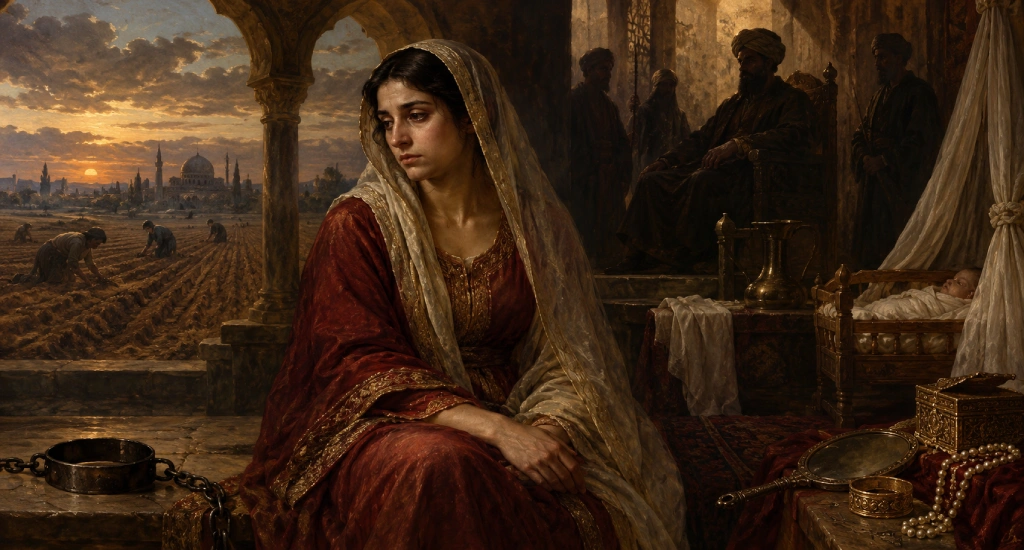
Introduction: Is a Woman an Independent Person or an Instrument of Male Enjoyment?
Qur’an 7:189 describes woman as a companion created so that man may find tranquility in her; Qur’an 2:223 calls wives men’s fields; and in Sahih Muslim, Muhammad describes the righteous woman as the finest means of worldly enjoyment. Across these three statements, man is the recipient of tranquility and enjoyment, while woman is presented as the means of satisfying his needs. In accounts of creation, sexuality, and reproduction, male needs occupy the center, while women’s own desires and independent personhood are left out of view. This is reinforced by marital rules under which a wife who refuses her husband’s sexual summons faces the angels’ curse, divine displeasure, and, in juristic interpretations, the loss of financial maintenance and permission for physical punishment. The depiction of woman as a means of enjoyment is therefore not an isolated metaphor; it forms part of a religiously sanctioned structure of unequal sexual and familial power.
Objectification occurs when a person is evaluated primarily in terms of another person’s benefit, satisfaction, or use, rather than as someone with purposes, preferences, and autonomy of their own. Philosopher Martha C. Nussbaum identifies treating a person as a tool for another’s purposes and disregarding that person’s autonomy among the characteristics of objectification. Barbara L. Fredrickson and Tomi-Ann Roberts analyze how treating women’s bodies as objects of others’ evaluation relates to self-perception and psychological well-being. Islamic narratives of creation, the metaphor of a “field,” the hadith describing a woman as the “finest means of enjoyment,” and rules concerning wives’ sexual obedience together reveal a recurring religious framework in which women’s standing is subordinated to their usefulness to men. [1] [2]
The Creation of Woman: When Serving Man’s Tranquility Becomes the Purpose
Qur’an 7:189 states that a spouse was created from one person so that he might find tranquility in her. Male needs thus occupy the center of the stated purpose of the woman’s creation. Defining woman as the means of man’s tranquility conflicts with the recognition of her independent personhood: her own wishes and an equally autonomous purpose are not identified as the reason for her creation. The subsequent description of sexual intercourse and pregnancy reinforces this male-centered creation narrative. [3]
هُوَ الَّذِي خَلَقَكُم مِّن نَّفْسٍ وَاحِدَةٍ وَجَعَلَ مِنْهَا زَوْجَهَا لِيَسْكُنَ إِلَيْهَا فَلَمَّا تَغَشَّاهَا حَمَلَتْ حَمْلًا خَفِيفًا فَمَرَّتْ بِهِ فَلَمَّا أَثْقَلَت دَّعَوَا اللَّهَ رَبَّهُمَا لَئِنْ آتَيْتَنَا صَالِحًا لَنَكُونَنَّ مِنَ الشَّاكِرِينَ
English translations:
He created you from a single person, and from that person created his mate so that he might find tranquility in her. When he had intercourse with her, she conceived a light pregnancy and carried it about. When the pregnancy grew heavy, they both prayed to Allah, their Lord: “If You grant us a sound child, we shall surely be grateful.”
— Taisirul Quran
It is Allah who created you from one person and from that same person created his spouse so that he might find tranquility with her. Then, when he had intercourse with her, she conceived a light pregnancy and continued carrying it. When it became heavy, they both prayed to Allah, their Lord: “If You grant us a righteous child, we shall be among Your grateful servants.”
— Sheikh Mujibur Rahman
He is the One who created you from a single person and made from that person his spouse so that he might find tranquility with her. When he united with her, she conceived a light pregnancy and carried it about. When it grew heavy, they both called upon Allah, their Lord: “If You grant us a good child, we shall certainly be grateful.”
— Rawai Al-Bayan
He created you from one person, and from that person created his wife so that he might find tranquility in her [1]. Then, when he had intercourse with her, she conceived a light pregnancy and carried it without difficulty. When it became heavy, they both prayed to Allah, their Lord: “If You grant us a fully formed child, we shall be grateful to You.”
— Dr. Abu Bakr Muhammad Zakaria
Qur’an 7:189 places the first person, his spouse, sexual intercourse, and pregnancy within a single narrative sequence. The masculine subject of the clause and the phrase “so that he might find tranquility in her” are significant: the woman is presented as the source of that person’s tranquility. The verse does not discuss her own aspirations, independent identity, or an equally defined purpose for her existence. This is not merely a poetic description of mutual affection; it is a scriptural account of human creation.
Al-Shanqiti and Ibn Kathir on the Position of Eve
Muhammad al-Amin al-Shanqiti explains the verse in Adwa’ al-Bayan: Eve was created from Adam so that Adam could find companionship and tranquility in her. Adam is the central beneficiary of the account, while Eve is presented as the spouse who fulfills that need. [4]
ذَكَرَ فِي هَذِهِ الْآيَةِ الْكَرِيمَةِ أَنَّهُ خَلَقَ حَوَّاءَ مِنْ آدَمَ لِيَسْكُنَ إِلَيْهَا، أَيْ: لِيَأْلَفَهَا وَيَطْمَئِنَّ بِهَا، وَبَيَّنَ فِي مَوْضِعٍ آخَرَ أَنَّهُ جَعَلَ أَزْوَاجَ ذُرِّيَّتِهِ كَذَلِكَ، وَهُوَ قَوْلُهُ: وَمِنْ آيَاتِهِ أَنْ خَلَقَ لَكُمْ مِنْ أَنْفُسِكُمْ أَزْوَاجًا لِتَسْكُنُوا إِلَيْهَا وَجَعَلَ بَيْنَكُمْ مَوَدَّةً وَرَحْمَةً [الروم: ٢١].
English translation: Regarding this noble verse, he mentions that Eve was created from Adam so that Adam might find tranquility in her—that is, feel companionship with her and find reassurance in her presence. Elsewhere, he explains that spouses were similarly created for Adam’s descendants, as stated in the verse: “And among His signs is that He created for you spouses from among yourselves, so that you may find tranquility in them, and He placed affection and mercy between you” (Qur’an 30:21).
In his commentary on Qur’an 7:189, Ibn Kathir also links the creation of Eve to Adam’s need for companionship and tranquility. His explanation places the fulfillment of Adam’s needs at the center of Eve’s creation. Although he also cites Qur’an 30:21 concerning marital affection, his explanation begins with the tranquility sought by the man. [5]
وَقَالَ فِي هَذِهِ الْآيَةِ الْكَرِيمَةِ: وَجَعَلَ مِنْهَا زَوْجَهَا لِيَسْكُنَ إِلَيْهَا أَيْ: لِيَأْلَفَهَا وَيَسْكُنَ بِهَا، كَمَا قَالَ تَعَالَى: وَمِنْ آيَاتِهِ أَنْ خَلَقَ لَكُمْ مِنْ أَنْفُسِكُمْ أَزْوَاجًا لِتَسْكُنُوا إِلَيْهَا وَجَعَلَ بَيْنَكُمْ مَوَدَّةً وَرَحْمَةً [الروم: ٢١]، فَلَا أُلْفَةَ بَيْنَ زَوْجَيْنِ أَعْظَمَ مِمَّا بَيْنَ الزَّوْجَيْنِ.
English translation: Regarding this noble verse, “And He made from him his spouse so that he might find tranquility in her,” the meaning is that he would feel companionship with her and find repose in her. As God says: “And among His signs is that He created for you spouses from among yourselves so that you may find tranquility in them, and placed affection and mercy between you” (Qur’an 30:21). There is no companionship between two spouses greater than that between husband and wife.
Eve: An Independent Being or an Ancillary Creation of Adam?
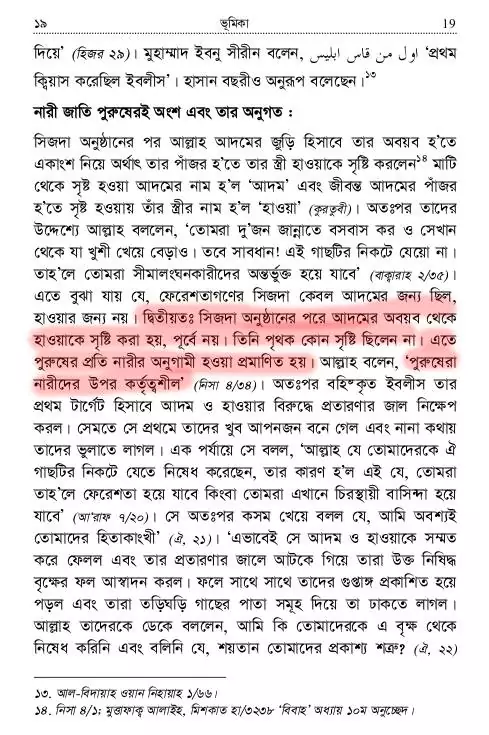
In Stories of the Prophets, Dr. Muhammad Asadullah al-Ghalib derives women’s subordination from the account of the angels prostrating specifically before Adam and the creation of Eve from Adam’s rib. He writes that Eve “was not a separate creation,” treating this as proof that women must follow men, and cites Qur’an 4:34 on male authority. The narrative of creation is thus used directly to justify women’s social subordination. [6]
Women are part of men and subordinate to them:
After the prostration, Allah created Adam’s companion, his wife Eve, from part of his body—that is, from his rib. Adam, created from earth, was named “Adam,” while his wife, created from the rib of the living Adam, was named “Hawwa” (al-Qurtubi). Allah then said to them: “You two dwell in Paradise and eat whatever you wish from it. But do not approach this tree, lest you become wrongdoers” (al-Baqarah 2:35).
This shows that the angels’ prostration was for Adam alone, not for Eve. Second, Eve was created from Adam’s body after the prostration, not before it. She was not a separate creation. This proves that women are followers of men. Allah says: “Men are in authority over women” (al-Nisa’ 4:34). Then the expelled Iblis directed his first deception against Adam and Eve. He approached them as though he were a well-wisher and gradually misled them. At one point he said: “Allah has forbidden you from this tree only so that you do not become angels or live here forever” (al-A‘raf 7:20). He then swore that he was their sincere adviser (7:21). In this way, he persuaded Adam and Eve; ensnared by his deception, they tasted the forbidden fruit. Their nakedness became apparent, and they hurried to cover themselves with leaves. Allah called to them: “Did I not forbid you from this tree and tell you that Satan is your open enemy?” (7:22).
The implications of this creation account extend beyond a story about bodily origins. Once the narrative is used to conclude that woman is subordinate to man, created for him, or intended to fulfill his needs, the creation story becomes a justification for diminishing women’s individuality. Hadith literature also compares women to a bent rib and speaks of deriving enjoyment from them; this is examined separately in the article According to Muhammad, Women Are Inherently Crooked.
In the creation narrative reproduced in the Bengali edition of Tafsir Ibn Kathir, Adam asks Eve why she was created. Her reported answer is: “So that you may find satisfaction through me.” The exchange portrays woman as created for man’s companionship and satisfaction. [7]
He was pleased when he saw her. Allah joined them in marriage. He then openly declared: “O Adam, dwell in Paradise with your wife and eat whatever you wish from it. But do not approach this tree, lest you become among the wrongdoers.”
Some say that Eve was created after Adam entered Paradise. Thus al-Suddi narrated through Abu Malik, Abu Salih, Ibn Abbas, Murrah, Ibn Mas‘ud, and other Companions: Iblis was expelled from Paradise, while Adam was placed there. Adam wandered about alone, with no wife to provide companionship and satisfaction. One day he fell into a deep sleep; on waking he saw a woman sitting by his head. Allah had created her from one of Adam’s ribs. Adam asked her, “Who are you?” She answered, “A woman.” Adam asked, “Why were you created?” She answered, “So that you may find satisfaction through me.”
The angels witnessing the event asked, “O Adam, what is her name?” He said, “Hawwa.” They asked, “Why Hawwa?” He answered, “Because she was created from a living being.”

Wives as Fields: A Metaphor of Sexual Access and Reproduction
Qur’an 2:223 calls wives “fields” and addresses men with the instruction to approach their fields as they wish. Classical exegetes discussed the limits of permissible sexual positions. Yet within this metaphor, man is the active party who derives sexual gratification, while woman is his field of sexual pleasure and reproduction. The wording obscures women’s personhood by presenting them through their usefulness to men. Sexual objectification means identifying a person primarily through sexual use, the body, or usefulness to others rather than recognizing that person as a complete human being. Such a conception can reinforce social and ethical expectations of women’s subordination. [8]
نِسَاؤُكُمْ حَرْثٌ لَكُمْ فَأْتُوا حَرْثَكُمْ أَنَّى شِئْتُمْ وَقَدِّمُوا لِأَنْفُسِكُمْ وَاتَّقُوا اللَّهَ وَاعْلَمُوا أَنَّكُمْ مُلَاقُوهُ وَبَشِّرِ الْمُؤْمِنِينَ
English translations:
Your wives are your fields; therefore approach your fields however you wish, and make provision for your future. Fear Allah, know that you will meet Him, and give glad tidings to the believers.
— Taisirul Quran
Your wives are like cultivated fields for you; therefore approach and make use of them however you wish, and prepare for what lies ahead. Fear Allah and know that one day you will meet Him. Give glad tidings to the believers.
— Sheikh Mujibur Rahman
Your wife is your field; so approach your field however you wish. Send good deeds ahead for yourselves. Be mindful of Allah and know that you will meet Him. Give glad tidings to the believers.
— Rawai Al-Bayan
Your wives are your fields; therefore you may approach your fields however you wish [1]. Send something ahead for your future [2], fear Allah, and know that you will certainly meet Him. Give glad tidings to the believers.
— Dr. Abu Bakr Muhammad Zakaria
The Arabic word harth (حَرْث) denotes cultivation, sowing, and agricultural production. In Qur’an 2:223, wives are described as men’s “fields,” and sexual intercourse is expressed as approaching those fields. The man occupies the active position of the sower, while the woman is represented as the site of production. An unequal set of agricultural roles is used to describe marriage instead of a vocabulary of equal personhood and mutual choice. This interpretation is not an invention of modern critics: classical Muslim exegetes themselves explained women as the field in which offspring are produced.
Abu Ishaq al-Zajjaj: A Field for Procreation and Sexual Pleasure
The Arabic linguist and exegete Abu Ishaq al-Zajjaj, in Ma‘ani al-Qur’an wa I‘rabuhu, explicitly includes both procreation and sexual pleasure when explaining the verse. Accordingly, the “field” is not merely a dispassionate biological metaphor for pregnancy: the classical interpretation presents a woman’s body as the site of a man’s sexual pleasure and reproduction. The work is also available in the Shamela library. [9] [10]
وَالْقَوْلُ عِنْدِي فِيهِ أَنَّ مَعْنَاهُ أَنَّ نِسَاءَكُمْ حَرْثٌ لَكُمْ؛ مِنْهُنَّ تَحْرُثُونَ الْوَلَدَ؛ وَاللَّذَّةَ. وَقَوْلُهُ – عَزَّ وَجَلَّ -: فَأْتُوا حَرْثَكُمْ أَنَّى شِئْتُمْ؛ أَيْ: كَيْفَ شِئْتُمْ.
English translation: In my view, its meaning is that your wives are fields for you: through them you cultivate offspring and obtain pleasure. As for the words of God Almighty, “So approach your fields however you wish,” their meaning is: in whatever manner you wish.
Al-Zajjaj first notes that Abu Ubaydah interpreted “Your wives are your fields” as an indirect expression. Al-Zajjaj then offers his own explanation, expressly mentioning both procreation and sexual pleasure. He further explains that “however you wish” permits different forms of intercourse at the designated site of reproduction. He recounts a belief attributed to Jews that intercourse from behind would result in a cross-eyed child; the account addresses this by permitting various positions provided intercourse occurs vaginally. Commenting on “Send something ahead for yourselves and fear Allah,” he also discusses observing prescribed restrictions regarding intercourse and menstruation. In his explanation, preparing good for oneself means obeying God’s commands.
Al-Qurtubi and Ibn Kathir: The Reproductive Meaning of the Field Metaphor
Explaining the “field” metaphor in Qur’an 2:223, al-Qurtubi describes women as the ground in which offspring are produced. He interprets “however you wish” as referring to different sexual positions, while restricting the permitted site to the vagina. The wording addresses the man and the manner of his sexual activity, without making the wife’s independent desire or consent a condition in that sentence. The metaphor centrally depicts the woman’s body as the field of reproduction and the man as the one who uses that field. [11]
وَحَرْثٌ تَشْبِيهٌ؛ لِأَنَّهُنَّ مُزْدَرَعُ الذُّرِّيَّةِ، فَلَفْظُ الْحَرْثِ يُعْطِي أَنَّ الْإِبَاحَةَ لَمْ تَقَعْ إِلَّا فِي الْفَرْجِ خَاصَّةً إِذْ هُوَ الْمُزْدَرَعُ.
English translation: The word “field” is a comparison, because women are the ground in which progeny are cultivated. Thus the term “field” indicates that permission applies specifically to intercourse in the vagina, for that is the place of cultivation.
In his second discussion, al-Qurtubi argues that the relevant hadiths establish the permissibility of different sexual positions, provided intercourse takes place at the site of procreation. A man may approach from the front or behind, or have intercourse with the woman in various positions, but al-Qurtubi does not permit intercourse through another bodily opening. For him, the word “field” itself imposes this limit. The comparison is grounded in the depiction of women as sites of reproduction.
To support the interpretation, al-Qurtubi cites a verse of poetry transmitted from Tha‘lab in which the womb is compared to cultivated land and man’s role to sowing seed. According to the poem, the act of sowing is human, while germination rests with God. Al-Qurtubi develops the analogy: the female genital tract is like land, semen like seed, and the child like the resulting plant. The site of intercourse is called a “field” on this basis.
He goes on to state that, according to most Companions, Successors, and jurists, “however you wish” refers to different sexual positions. Intercourse may therefore take place from the front or rear, but it must be vaginal.
Ibn Kathir transmits a comparable interpretation attributed to Ibn Abbas: the “field” is the place where a child is conceived, while different sexual positions are permissible within one bodily opening. Ibn Kathir’s commentary is also available in a separately edited Shamela edition. The definition of woman as the place of reproductive production remains central to this account. [12] [13]
وَقَوْلُهُ: (نِسَاؤُكُمْ حَرْثٌ لَكُمْ) قَالَ ابْنُ عَبَّاسٍ: الْحَرْثُ مَوْضِعُ الْوَلَدِ، (فَأْتُوا حَرْثَكُمْ أَنَّى شِئْتُمْ) أَيْ: كَيْفَ شِئْتُمْ، مُقْبِلَةً وَمُدْبِرَةً فِي صِمَامٍ وَاحِدٍ، كَمَا ثَبَتَتْ بِذَلِكَ الْأَحَادِيثُ.
English translation: Concerning the statement “Your wives are your fields,” Ibn Abbas said: “The field is the place where a child is conceived.” As for “So approach your fields however you wish,” it means in whatever manner you wish, whether facing forward or backward, but through the same opening. The hadith reports also establish this interpretation.
A woman’s capacity to bear children is also made a criterion for choosing a marriage partner in hadiths recommending marriage to fertile women. This further emphasis on women’s reproductive ability as a means of achieving men’s familial objectives is examined in Marriage to Infertile Women in Islam.
Women in Hadith: The Finest Means of Worldly Enjoyment
After the Qur’anic depictions of women as means of male tranquility and as fields, a statement attributed to Muhammad in Sahih Muslim expresses this male-centered outlook more directly. In a hadith narrated from Abdullah ibn Amr, the world is called matāʿ (مَتَاعٌ)—something from which benefit and enjoyment are derived—and the righteous woman is described as the finest of these worldly means of enjoyment. Here the woman’s excellence is assessed in terms of the enjoyment and practical benefit she brings to a man. The accompanying video presents a related statement by Abdur Razzaq bin Yusuf. [14]
The Arabic wording of Muhammad’s statement in Sahih Muslim and its Bengali translation published by the Islamic Foundation convey this same meaning. [15]
الدُّنْيَا مَتَاعٌ وَخَيْرُ مَتَاعِ الدُّنْيَا الْمَرْأَةُ الصَّالِحَةُ
English translation: Sahih Muslim (Islamic Foundation Bengali edition)
Book 18: Breastfeeding
Section 9: Advice Concerning Women
Hadith 3512. Muhammad ibn Abdullah ibn Numayr al-Hamdani … narrated from Abdullah ibn Amr that the Messenger of Allah said: “The world is a means of enjoyment, and the best means of enjoyment in the world is a righteous woman.”
Hadith classification: Sahih.
The Meaning of Matāʿ: Classifying a Woman as an Object of Enjoyment
The key word in this hadith is matāʿ (مَتَاع), denoting an object or means of enjoyment and benefit, worldly goods, or a temporary advantage. In the first clause, the entire world is called matāʿ; in the second, the righteous woman is placed among its finest examples. She appears here not as someone who enjoys in her own right but as a source of enjoyment and benefit to another. The translation “commodity” may additionally suggest commercial exchange; “means of enjoyment” more precisely conveys the utilitarian conception of women present in this hadith.
In Fayd al-Qadir, Abd al-Ra’uf al-Munawi explains matāʿ in terms of the things from which people derive benefit and enjoyment in worldly life. Quoting al-Tibi and other commentators, he presents the wife as a source of pleasure, satisfaction, and benefit to the husband, with the righteous wife deemed the finest of these. The criterion of excellence is thus not what the woman wants or achieves for herself, but what the man gains from her. [16]
A person’s companionship, sexuality, labor, and care may benefit someone else. Objectification begins when those benefits become the measure of that person’s human worth. In this hadith, the adjective “righteous” does not undo the classification of woman as a means of enjoyment; it establishes the conditions under which a particular woman qualifies as the best such means for a man.
Translating Matāʿ as “Wealth” or “Benefit” Does Not Erase Objectification
The Arabic word مَتَاع encompasses worldly possessions, useful things, benefit, and enjoyment. The same word occurs twice in the hadith: “The world is a means of enjoyment” and “the best means of worldly enjoyment is a righteous woman.” The first clause establishes a wider category; the second places woman among its most prized instances. Rendering the word as “means of enjoyment” in one clause and “wealth” in the other does not alter the grammatical classification in the Arabic. The capacity to benefit another does not in itself diminish anyone’s moral standing. What diminishes their personhood is defining their excellence primarily through the benefits others derive from them.
In his commentary on this hadith in Sahih Muslim, Abu al-Abbas al-Qurtubi defines matāʿ in al-Mufhim li-ma Ashkala min Talkhis Kitab Muslim as something enjoyed for a limited time. He then describes the righteous woman through qualities such as improving her husband’s domestic circumstances, pleasing him, protecting his interests in his absence, and obeying his instructions. The praise of religious virtue is therefore itself explained through the husband’s benefit and the wife’s obedience. [17]
(قوله: الدنيا متاع) أي: شيء يتمتع به حينا ما، كما قال تعالى: قل متاع الدنيا قليل [النساء: 77]. و(المرأة الصالحة): هي الصالحة في دينها، ونفسها، والمصلحة لحال زوجها. وهذا كما قال في الحديث الآخر: (ألا أخبركم بخير ما يكنز المرء؟) قالوا: بلى. قال: (المرأة الصالحة؛ التي إذا نظر إليها سرته، وإذا غاب عنها حفظته، وإذا أمرها أطاعته).
English translation: His words, “The world is a means of enjoyment,” mean something enjoyed for a time, as God Almighty says: “Say: The enjoyment of this world is little” (Qur’an 4:77). The “righteous woman” is one who is righteous in her religion and character and improves her husband’s circumstances. This is like the statement in another hadith: “Shall I tell you of the best treasure a person can store?” They answered, “Yes.” He said: “A righteous woman: when he looks at her, she pleases him; when he is absent, she safeguards his interests; and when he commands her, she obeys.”
Here, a woman’s religious virtue is explained primarily through her usefulness to her husband. Preferring piety to physical attractiveness does not remove the objectifying classification; it specifies the qualities of the ideal means of enjoyment. Sexual pleasure, financial benefit, domestic service, and raising children are distinct activities, but in these interpretations each is assessed from the perspective of what the man gains. The word “righteous” does not place the woman’s independent dignity or sexual consent at the center of that assessment.
What Makes a “Righteous Woman”? Obedience as a Measure of Usefulness
Although saliha in the hadith denotes a morally upright woman, classical commentators frequently explain its practical meaning by reference to her husband’s interests and rights. In the explanation attributed to al-Tibi in al-Munawi’s Fayd al-Qadir, a woman who is not righteous becomes the worst rather than the best means of enjoyment. In the same passage, al-Akmal defines a righteous woman as one who manages her husband’s household and obeys his commands. A woman’s goodness is thus judged by how agreeable and obedient she is to her husband. [18]
فَصَاحِبُهَا يَلْتَذُّ بِهَا مِنْ جِهَةِ تَنَعُّمِهِ، وَقُرَّةِ عَيْنِهِ بِهَا، وَمِنْ وُجْهَةِ إِيصَالِهَا لَهُ إِلَى مَرْضَاةِ رَبِّهِ، وَإِيصَالِهِ إِلَى لَذَّةٍ أَكْمَلَ مِنْهَا. قَالَ الطَّيِّبِيُّ: وَقَيَّدَ بِـ«الصَّالِحَةُ»؛ إِيذَانًا بِأَنَّهَا شَرُّ الْمَتَاعِ لَوْ لَمْ تَكُنْ صَالِحَةً؛ وَقَالَ الْأَكْمَلُ: الْمُرَادُ بِالصَّالِحَةِ: النَّقِيَّةُ الْمُصْلِحَةُ لِحَالِ زَوْجِهَا فِي بَيْتِهِ؛ الْمُطِيعَةُ لِأَمْرِهِ.
English translation: Her husband takes pleasure in her through the enjoyment she provides and the delight she brings to his eyes, and because she helps him attain the pleasure of his Lord and a greater delight beyond it. Al-Tibi said: “The specification ‘righteous’ indicates that, were she not righteous, she would be the worst means of enjoyment.” Al-Akmal said: “By ‘righteous’ is meant a woman who is pure, who improves her husband’s domestic circumstances, and who obeys his commands.”
The terms “best” and “worst” here are not defined by a woman’s aspirations, knowledge, independent decisions, contribution to society, or psychological well-being. The criterion is what her husband receives from her. A woman may be educated, capable, creative, ethical, and of considerable benefit to society; yet if she disobeys her husband, her eligibility to count as the “best means” is called into question within this obedience-based definition. This is a clear example of evaluating women from a male-centered standpoint. Woman is praised, but the conditions of praise reinforce her subordinate position.
Sexual Gratification, Service, and Reproduction in a Commentary Quoted by al-Munawi
Elsewhere in Fayd al-Qadir, al-Munawi quotes a statement attributed to al-Qadi describing a righteous woman as more beneficial than gold. Her benefits are listed as pleasing a man when he looks at her, fulfilling his sexual desires, keeping his secrets, following his instructions, protecting his property, and raising his children. The commentary effectively assesses a woman by the services she provides: sexual gratification, household management, protection of property, and reproduction. Her own desires, life projects, and distinct interests are not criteria in this assessment. [19]
تنظر إليها تسرك، وتقضي إليها عند الحاجة وطرك، وتشاورها فيما يعن لك فتحفظ سرك، وتستمد منها في حوائجك فتطع أمرك، وإذا غبت تحامي مالك، وترعى عيالك، ولو لم يكن إلا أنها تحفظ بذرك، وتربي زرعك: لكفى به فضلاً.
English translation: When you look at her, she pleases you. When you have a need, you fulfill your sexual desire through her. When you consult her about something that concerns you, she keeps your secrets. When you seek her help with your affairs, she obeys your commands. When you are absent, she protects your property and tends your children. Even if she had no other virtue than preserving your seed and nurturing your crop, that alone would suffice as an excellence.
In the same passage, al-Munawi’s source values a woman for preserving a man’s “seed” and nurturing his “crop.” The connection to the language of Qur’an 2:223, which calls wives fields, is significant. Woman here is not merely a beloved companion but a means of satisfying male sexual needs, producing children, performing domestic labor, and protecting property. Cooperation between people has value, but reducing a partner to the sum of services rendered—and judging her worth by those services—diminishes independent human dignity. Especially in matters of sex, being capable of fulfilling another person’s need is not the same as choosing freely to do so.
Male Satisfaction Remains Central in Modern Commentary
This utilitarian interpretation is not confined to early Islamic scholarship. In Sharh Riyad al-Salihin, Muhammad ibn Salih al-Uthaymin explains the superiority of a righteous wife by saying that she protects her husband’s secrets, wealth, and children, manages his household, pleases him when he looks at her, and does not betray a responsibility entrusted to her. IslamQA reproduces this explanation. Trustworthiness and affection may be valuable qualities, but the explanation of why the woman is considered the best remains framed entirely around the benefits received by her husband. Her own welfare, equal decision-making rights, and personal aspirations are not measures in this definition. [20]
لأنها تحفظه في سره وماله وولده، وإذا كانت صالحة في العقل أيضاً فإنها تدبر له التدبير الحسن في بيته وفي تربية أولادها، إن نظر إليها سرته، وإن غاب عنها حفظته، وإن وكل إليها أمره لم تخنه، فهذه المرأة هي خير متاع الدنيا.
English translation: Because she safeguards his secrets, wealth, and children. If she is also sound in judgment, she manages his household well and raises her children properly. When he looks at her, she pleases him; when he is absent, she protects his interests; and when he entrusts a matter to her, she does not betray him. Such a woman is the best means of enjoyment in this world.
In this explanation, the ideal woman is primarily a symbol of the benefits a man receives from having a good wife, not an independent moral ideal in her own right. A woman’s role in her husband’s comfort, sexual fulfillment, property, and family may matter greatly; but defining her as the “best means” of providing these things is fundamentally different from recognizing her as a complete person. Men, too, might be expected to possess these qualities, yet the wording of the hadith itself presents woman as the object of male benefit.
The Hadith’s One-Sided Language: Women for Men—but What About Men for Women?
The one-sided nature of this language is especially apparent in an IslamQA question and answer, fatwa 459179. The question asks whether, if a righteous woman is the finest means of worldly enjoyment for a man, a righteous husband is likewise the finest such means for a woman. The response acknowledges that the hadith directly states the former. It then attempts to establish the analogous status of the husband not from the hadith’s explicit words but through an inference of reciprocity. The original hadith does not describe a righteous man as the finest means of enjoyment for a woman. [21]
والذي يظهر، والله أعلم: أنه يمكن أن يؤخذ من مفهوم هذا الحديث أن خير متاع المرأة في هذه الدنيا: الزوج الصالح؛ وهذا لأمرين:
English translation: What appears to be the case—and God knows best—is that one may infer from the meaning of this hadith that the best means of worldly enjoyment for a woman is a righteous husband. This is for two reasons:
The IslamQA response first acknowledges that the hadith in Sahih Muslim directly names the righteous woman as the finest means of enjoyment for a man. It then offers two reasons to infer that a righteous husband holds a corresponding position for a woman. First, women are counterparts of men, and comparable rulings may apply to both. Second, a righteous wife assists her husband in meeting sexual needs lawfully and fulfilling religious obligations, while a righteous husband may likewise assist his wife with sexual fulfillment and religious observance. The response also cites al-San‘ani’s discussion of women’s sexual attractiveness, the benefit of avoiding illicit sex, and the religious advantages men gain through marriage. The explicit male-centered wording of the hadith thus remains distinct from the inferred extension later proposed for women.
The fatwa’s reasoning itself reveals the linguistic asymmetry: woman as man’s means of enjoyment is stated explicitly, while man as woman’s corresponding means of enjoyment is derived through later inference. That inferred reciprocity does not change the one-sided wording of the original hadith. Instead, a subsequent interpretation is added while the established language of judging a woman by her usefulness to a man remains unchanged.
From Praising the Wife to Mandating Her Obedience
The notion of woman as the finest means of enjoyment has been explicitly linked to marital obedience in later Islamic commentary. While asserting that a husband’s authority over his wife exceeds that of her parents and that obedience to him is more obligatory, Ibn Taymiyyah cites this hadith. IslamQA reproduces the passage from his Majmu‘ al-Fatawa. The hadith is therefore used not simply as a compliment but as part of the religious argument for the superiority of husbands’ rights and wives’ obedience. [22]
الْمَرْأَةُ إذَا تَزَوَّجَتْ كَانَ زَوْجُهَا أَمْلَكَ بِهَا مِنْ أَبَوَيْهَا وَطَاعَةُ زَوْجِهَا عَلَيْهَا أَوْجَبُ قَالَ اللَّهُ تَعَالَى : { فَالصَّالِحَاتُ قَانِتَاتٌ حَافِظَاتٌ لِلْغَيْبِ بِمَا حَفِظَ اللَّهُ }
English translation: When a woman marries, her husband has greater authority over her than her parents, and obeying him becomes more obligatory for her. God Almighty says: “Righteous women are devoutly obedient, guarding in the unseen what God has guarded.”
Immediately afterward, Ibn Taymiyyah quotes the hadith, “The world is a means of enjoyment, and the best means of worldly enjoyment is a righteous woman.” The report he cites describes an ideal wife as one who pleases her husband when he looks at her, obeys him when he commands, and protects her chastity and his property during his absence. He also cites a hadith linking a woman’s prayer, fasting, chastity, and obedience to her husband to entry into Paradise. He then concludes that a wife may not leave the home without her husband’s permission, even if her parents instruct her to do so. His discussion therefore employs the characterization of woman as the finest means of enjoyment to support the husband’s authority and the wife’s duty of obedience.
The Fundamental Conflict with Women’s Human Dignity
Classifying woman as the “finest means of worldly enjoyment” already subordinates her personhood to her usefulness. A person’s free will, feelings, choices, and dignity do not depend on the benefits that person brings to someone else. Yet the hadith’s criterion of evaluation is what a man receives from a woman. What she herself wants, whether she consents to sexual relations, and how much authority she possesses over her own body and life are not criteria for excellence in this formulation. Making male benefit central to a woman’s moral identity reflects a conception that reduces a free person to a resource for another’s use.
The fulfillment of sexual needs and obedience to commands in the explanations cited by al-Munawi, protection of the home, children, and wealth in al-Uthaymin’s interpretation, and the husband’s superior authority in Ibn Taymiyyah’s analysis all point toward the same male-centered social ideal. Here the excellence of the “righteous” woman is associated with obedience, sexual availability, and domestic service rather than her independent moral agency. Describing a person as another person’s finest article of enjoyment, rather than as someone worthy of respect in her own right, is ethically degrading. When this classification receives religious authority, that degradation is elevated into a moral ideal.
The hadith in Sahih Muslim describes woman as the finest means of enjoyment. Classical interpreters give particular weight to male sexual satisfaction, obedience, safeguarding property, and raising children when specifying what makes her “the best.” Defining women’s excellence by men’s needs conflicts with the conception of human beings as equally autonomous persons. It also directly corresponds to the Qur’anic language of wives as men’s “fields”: both assess women’s bodies and labor from the standpoint of male benefit.
From Metaphor to Legal Obligation: Male Sexual Demands and Female Refusal
The problem becomes sharper when the rules governing marital sex are considered alongside the depiction of women as means of enjoyment. On one side stand statements about men’s desires and permissible forms of sexual access; on the other are religious threats and penalties directed at wives who refuse intercourse. Sexual consent requires that a person be free to decide what happens to their own body and to refuse an unwanted sexual act at any time. Entering a marriage does not constitute permanent consent to every future sexual act.
Angels Curse a Wife Who Refuses Her Husband’s Call
Reports narrated from Abu Hurayrah in Sahih al-Bukhari and Sahih Muslim state that when a husband calls his wife to bed, she refuses, and he spends the night angry with her, angels curse her until morning. The wife’s refusal is linked to the husband’s displeasure and accompanied by a threat of supernatural punishment. The legal implications are discussed in greater detail in Marital Rape in Islam. [23] [24]
Sahih al-Bukhari 3237 specifies that the husband spends the night angry after the wife refuses his sexual summons. Another report, al-Bukhari 5193, describes the angels’ curse without explicitly mentioning that condition. Sahih Muslim 1436c further states that God remains displeased with the wife until her husband is satisfied with her. All three reports associate a wife’s refusal of sexual intercourse with divine displeasure or a curse. [23] [25] [26]
Sahih al-Bukhari 3237:
إِذَا دَعَا الرَّجُلُ امْرَأَتَهُ إِلَى فِرَاشِهِ فَأَبَتْ، فَبَاتَ غَضْبَانَ عَلَيْهَا، لَعَنَتْهَا الْمَلاَئِكَةُ حَتَّى تُصْبِحَ
English translation: Abu Hurayrah narrated that Muhammad said: “If a man calls his wife to his bed and she refuses, and he spends the night angry with her, the angels curse her until morning.”
Sahih al-Bukhari 5193:
إِذَا دَعَا الرَّجُلُ امْرَأَتَهُ إِلَى فِرَاشِهِ فَأَبَتْ أَنْ تَجِيءَ لَعَنَتْهَا الْمَلاَئِكَةُ حَتَّى تُصْبِحَ
English translation: Abu Hurayrah narrated that Muhammad said: “If a man calls his wife to his bed and she refuses to come, the angels curse her until morning.”
Sahih Muslim 1436c:
وَالَّذِي نَفْسِي بِيَدِهِ مَا مِنْ رَجُلٍ يَدْعُو امْرَأَتَهُ إِلَى فِرَاشِهَا فَتَأْبَى عَلَيْهِ إِلاَّ كَانَ الَّذِي فِي السَّمَاءِ سَاخِطًا عَلَيْهَا حَتَّى يَرْضَى عَنْهَا
English translation: Abu Hurayrah narrated that Muhammad said: “By Him in whose hand is my soul, whenever a man calls his wife to his bed and she refuses him, the One in heaven remains displeased with her until her husband is pleased with her.”
Islamweb: Lack of Sexual Desire Is Not an Acceptable Excuse
Islamweb fatwa 74409 addresses the question of whether a wife may refuse intercourse because she does not currently feel sexual desire or a need for sex. The answer first invokes Abu Hurayrah’s report about the angels’ curse. It then cites a narration attributed to Abdullah ibn Abi Awfa stating that a wife does not fully fulfill God’s rights until she fulfills her husband’s, and that she must not refuse him even if he seeks intercourse while she is seated on a camel’s saddle. The response also quotes Jami‘ al-Tirmidhi 1160, which directs a wife to respond to her husband’s sexual summons even when she is occupied at the oven making bread.
According to the interpretation by al-Mubarakfuri cited in the fatwa, baking bread is a task normally too pressing to leave unfinished, yet the hadith still instructs a wife to answer her husband’s summons. The fatwa then invokes al-Munawi’s commentary to support the duty to respond promptly in the absence of a recognized religious excuse. It concludes that a woman’s lack of sexual desire is not an acceptable reason for refusal: if she is physically capable of complying, she is expected to do so. [27] [28]
Jami‘ al-Tirmidhi 1160 — Hadith cited in the fatwa:
إِذَا الرَّجُلُ دَعَا زَوْجَتَهُ لِحَاجَتِهِ فَلْتَأْتِهِ وَإِنْ كَانَتْ عَلَى التَّنُّورِ
English translation: Talq ibn Ali narrated that Muhammad said: “When a man summons his wife for his need, she should come to him even if she is at the oven.”
Islamweb fatwa 74409 — Conclusion:
وليس ما ذكر في السؤال من عدم شهوتها ونحو ذلك عذرا للامتناع لأنها قادرة على إجابته، وما دامت قادرة فلا تعذر.
English translation: What the question mentions about her lack of desire and similar matters is not an excuse for refusing, because she is capable of responding to him. As long as she remains capable, she is not excused.
IslamQA: Sexual Refusal, Maintenance, and Punishment
IslamQA fatwa 33597 explicitly addresses a husband compelling his wife to have intercourse. It states that a wife must respond to her husband’s summons and may not refuse without a recognized excuse, such as harm. If she refuses without such an excuse, she is deemed disobedient and may lose entitlement to maintenance and clothing; the fatwa also discusses permission for physical punishment. It cites Ibn Taymiyyah in support of these conclusions. Sexual unwillingness is thus placed not merely within a domestic disagreement but within a system of financial and punitive consequences. [29]
فَإِنِ امْتَنَعَتْ مِنْ غَيْرِ عُذْرٍ كَانَتْ عَاصِيَةً نَاشِزًا، تَسْقُطُ نَفَقَتُهَا وَكِسْوَتُهَا. وَعَلَى الزَّوْجِ أَنْ يَعِظَهَا وَيُخَوِّفَهَا مِنْ عِقَابِ اللَّهِ، وَيَهْجُرَهَا فِي الْمَضْجَعِ، وَلَهُ أَنْ يَضْرِبَهَا ضَرْبًا غَيْرَ مُبَرِّحٍ.
English translation: If she refuses without an excuse, she is disobedient and in a state of nushuz, and her entitlement to maintenance and clothing lapses. The husband must admonish her, warn her of God’s punishment, and forsake her in bed; he may also strike her, provided the beating is not severe.
The force of these rules rests not only on religious fear but also on the distribution of power within the household. A system under which a wife risks losing financial support for prioritizing her own sexual wishes conflicts with freely given sexual consent. The punitive rulings and their juristic justifications are examined further in The Permissibility of Wife Beating in Islam. Additional evidence about the demand for a husband’s superior status and the wife’s subordination is discussed in In Islam, the Husband Is Almost Worthy of Prostration.
Marriage, Mahr, and the Legal Language of Sexual Access
There is a direct connection between the Qur’anic metaphor of wives as “fields,” the hadith’s characterization of woman as a “means of enjoyment,” and the legal vocabulary of marriage and mahr (the marital payment). A specific hadith links the money paid at marriage to the husband’s acquisition of lawful sexual access. In Sahih al-Bukhari, when a husband seeks the return of his mahr after a separation through li‘an (mutual imprecation), Muhammad’s ruling refers to that payment as the consideration for making intercourse lawful. This legal conception of exchange is analyzed further in Mahr: The Price of Sexual Access to a Woman. [30]
حِسَابُكُمَا عَلَى اللَّهِ أَحَدُكُمَا كَاذِبٌ، لَا سَبِيلَ لَكَ عَلَيْهَا. قَالَ: مَالِي؟ قَالَ: لَا مَالَ لَكَ، إِنْ كُنْتَ صَدَقْتَ عَلَيْهَا، فَهْوَ بِمَا اسْتَحْلَلْتَ مِنْ فَرْجِهَا، وَإِنْ كُنْتَ كَذَبْتَ عَلَيْهَا، فَذَاكَ أَبْعَدُ لَكَ.
English translation: Sa‘id ibn Jubayr asked Ibn Umar about a husband and wife who had undergone li‘an (mutual imprecation). Ibn Umar related that Muhammad told the couple: “Your reckoning is with God. One of you is a liar, and you have no claim over her.”
The husband asked: “What about my money?”—that is, whether the mahr he had paid to his wife would be returned. Muhammad replied: “You have no claim to the money. If you were truthful in your accusation against her, the payment was for the fact that you had made intercourse with her lawful for yourself. If you were lying about her, you have even less claim to its return.”
In Sahih al-Bukhari 5312, the mahr is expressly linked to making sexual access to the wife’s body lawful for the husband. Payment and sexual entitlement are placed within the same legal exchange. Such a marital entitlement, however, does not establish a woman’s independent consent to every future sexual act. Consent must be freely given by the person involved on each occasion; a marriage contract or financial payment cannot ethically amount to the permanent surrender of bodily autonomy to another person.
Literary Metaphors, Mutual Support, and Women’s Sexual Autonomy
Calling a loved one one’s “peace,” “treasure,” or “wealth” may be a literary expression. Its meaning depends on the subject, speaker, and nature of the relationship. In Jibanananda Das’s poem Banalata Sen, the poet describes a personal experience of tranquility; the poem does not establish rules requiring women to obey their husbands. In Rabindranath Tagore’s short story Haimanti, the statement “She is not my property; she is my treasure” expressly rejects the idea of ownership. By contrast, the significance of calling a woman a “means of enjoyment” within religiously authoritative texts must be assessed alongside the social and legal rules associated with those texts. When the Sahih Muslim hadith is explained through a wife’s duty to fulfill her husband’s sexual needs, obey his commands, provide domestic service, and raise children, the expression is no longer merely an affectionate form of address. [31]
A Declaration of Mutual Support Does Not Establish Equal Marital Authority
Qur’an 9:71 describes believing men and women as one another’s allies and supporters. The verse speaks of enjoining good, forbidding wrong, establishing prayer, giving zakat, and obeying God and His Messenger. That declaration of religious solidarity does not settle the separate questions of whose sexual wishes take precedence in marriage, what happens when a wife refuses intercourse, or whether the spouses have equal authority. Reports in Sahih al-Bukhari and Sahih Muslim concerning sexual refusal, together with juristic rules on nushuz, give priority to the husband’s authority and the wife’s obligations in these matters. Thus language about religious cooperation can coexist with inequalities in sexual consent and marital power. [32] [23] [33]
وَالْمُؤْمِنُونَ وَالْمُؤْمِنَاتُ بَعْضُهُمْ أَوْلِيَاءُ بَعْضٍ يَأْمُرُونَ بِالْمَعْرُوفِ وَيَنْهَوْنَ عَنِ الْمُنْكَرِ وَيُقِيمُونَ الصَّلَاةَ وَيُؤْتُونَ الزَّكَاةَ وَيُطِيعُونَ اللَّهَ وَرَسُولَهُ أُولَٰئِكَ سَيَرْحَمُهُمُ اللَّهُ إِنَّ اللَّهَ عَزِيزٌ حَكِيمٌ
English translation: Believing men and believing women are allies of one another. They enjoin what is right, forbid what is wrong, establish prayer, give zakat, and obey God and His Messenger. Those are the ones upon whom God will have mercy. Surely God is Almighty, Wise. (Qur’an 9:71)
Similarly, Qur’an 4:19 prohibits inheriting women against their will, while Qur’an 4:22 prohibits marrying women formerly married to one’s father. These are prohibitions of particular social practices. Abolishing one practice does not abolish other discriminatory rules within the same religious system. The recognition of some rights for women does not automatically confer equal authority over marital sexual relations. That depends on the freedom to withdraw consent and the consequences of refusal. Where refusal of a husband’s sexual summons can invite curses, divine displeasure, the loss of maintenance, or beating, the claim of equal marital autonomy is not logically sustainable. [34] [35] [27]
The Social and Ethical Consequences of Objectifying Women
The sexual objectification of women can reinforce gender inequality by encouraging the view that women are inferior to men and valuable only for their sexual functions and capacity to bear children. It can also reinforce stereotypes that obedience to men is a woman’s natural destiny and that women are suited only to a limited range of roles. Such assumptions can constrain educational opportunities, professional choices, and the possibility of independent lives. Objectification has potentially far-reaching consequences for both individuals and society. A society that respects women as human beings, rather than reducing them to their bodies, must recognize their dignity and autonomy across all spheres of life. [8]
Objectification is a question of social power as well as interpersonal relationships. When women are portrayed primarily as providers of male sexual gratification, childbearing, and obedient marital companionship, their educational, economic, and social identities risk being treated as secondary. What men may demand of them takes precedence over the lives women wish to lead. This is ethically troubling because measuring one person’s worth solely through another’s benefit undermines the equal standing of that person’s freedom to choose and refuse.
The tendency to treat a woman’s body as an object of others’ judgment can affect her self-evaluation, anxiety, and psychological well-being, as analyzed in Fredrickson and Roberts’ objectification theory. The Qur’anic verses, exegetical discussions, hadiths, and fatwas cited here reveal a further problem: men’s sexual needs and authority are given religious standing even when they conflict with women’s wishes. When unequal relationships are reinforced by threats of supernatural punishment, withdrawal of financial maintenance, and rules of marital obedience, the pressure on women’s self-determination takes on an institutional form. [36]
Conclusion
Qur’an 7:189 depicts woman as the companion created for man’s tranquility; Qur’an 2:223 calls wives men’s fields; and a report in Sahih Muslim describes the righteous woman as the finest means of worldly enjoyment. The commentaries of Ibn Kathir, al-Shanqiti, al-Zajjaj, and al-Qurtubi make the creation-related, reproductive, and sexual meanings of these formulations more explicit. The hadith reports about curses for wives who refuse intercourse, together with fatwas from Islamweb and IslamQA, show how utilitarian conceptions of women also connect to religious and legal obligations. Although scripture and later juristic rulings constitute different layers of evidence, their combined operation supports an unequal structure of marital power.
Defining a woman through her capacity to bear children, satisfy a man, or obey her husband’s commands is not a recognition of her full human dignity. Woman is an autonomous person; her body, sexual desires, personal aspirations, and right to refuse are not anyone else’s property. A system that measures women’s worth by their capacity to meet husbands’ demands cannot be described as equality. The primary Islamic texts, classical commentaries, and contemporary fatwas examined here document that discriminatory conception.
References
- Martha C. Nussbaum, “Objectification” (1995) ↩︎
- Fredrickson and Roberts, “Objectification Theory” (1997) ↩︎
- Qur’an 7:189 ↩︎
- Adwa’ al-Bayan, commentary on Qur’an 7:189, vol. 2, p. 46 ↩︎
- Tafsir Ibn Kathir on Qur’an 7:189 ↩︎
- Stories of the Prophets, vol. 1, Dr. Muhammad Asadullah al-Ghalib, p. 19 ↩︎
- Tafsir Ibn Kathir, Islamic Foundation Bengali edition, vol. 1, p. 399 ↩︎
- Qur’an 2:223 1 2
- Al-Zajjaj, Ma‘ani al-Qur’an, vol. 1, p. 298 ↩︎
- Shamela: Ma‘ani al-Qur’an wa I‘rabuhu ↩︎
- Tafsir al-Qurtubi on Qur’an 2:223 ↩︎
- Tafsir Ibn Kathir on Qur’an 2:223 ↩︎
- Shamela: Tafsir Ibn Kathir, ed. Sami al-Salamah ↩︎
- Sahih Muslim 715k; standard Arabic numbering 1467 ↩︎
- Sahih Muslim, Islamic Foundation Bengali edition, hadith 3512 ↩︎
- Al-Munawi, Fayd al-Qadir, hadith 4279, vol. 3, pp. 548–549 ↩︎
- Abu al-Abbas al-Qurtubi, al-Mufhim, vol. 4, p. 221; commentary on Sahih Muslim 1467 ↩︎
- Al-Munawi, Fayd al-Qadir, vol. 3, p. 549; explanations attributed to al-Tibi and al-Akmal ↩︎
- Al-Munawi, Fayd al-Qadir, vol. 1, p. 465; statement attributed to al-Qadi ↩︎
- Al-Uthaymin, Sharh Riyad al-Salihin, vol. 2, pp. 127–128; IslamQA, fatwa 109190 ↩︎
- IslamQA, fatwa 459179, July 6, 2023 ↩︎
- Ibn Taymiyyah, Majmu‘ al-Fatawa, vol. 32, pp. 262–263; IslamQA, fatwa 317000 ↩︎
- Sahih al-Bukhari 3237 1 2 3
- Sahih Muslim 1436d ↩︎
- Sahih al-Bukhari 5193 ↩︎
- Sahih Muslim 1436c ↩︎
- Islamweb, fatwa 74409 1 2
- Jami‘ al-Tirmidhi 1160 ↩︎
- IslamQA, fatwa 33597, January 1, 2003 ↩︎
- Sahih al-Bukhari 5312, report concerning li‘an ↩︎
- Rabindranath Tagore, Haimanti, in Galpaguchchha ↩︎
- Qur’an 9:71 ↩︎
- IslamQA, fatwa 33597 ↩︎
- Qur’an 4:19 ↩︎
- Qur’an 4:22 ↩︎
- Fredrickson and Roberts, 1997 ↩︎