

Summary
Islamic historical literature records a long series of actions by Khalid ibn al-Walid, known as Sayf Allah or the “Sword of God,” that extended far beyond defeating opponents in battle. These accounts describe the killing of captives, beheadings after surrender, burning people alive, deliberate mutilation, destruction of settlements, seizure of property, and enslavement of women and minors. Such episodes appear in Sahih al-Bukhari, Ibn Kathir’s Al-Bidaya wa’l-Nihaya, Ibn al-Athir’s Al-Kamil fi’l-Tarikh, al-Tabari’s history, and other Islamic works. Across these campaigns, a recurring pattern emerges: military force defeated an opposing community, after which the victor claimed sweeping power over the lives and freedom of those who survived.
During Muhammad’s lifetime, in the campaign against Banu Jadhimah, Khalid captured and killed people who had expressed that they had entered Islam. He subsequently ordered every soldier under his command to kill his own prisoner; Ibn Umar and other companions refused to comply. Another account describes Khalid killing a woman with his sword during the destruction of al-Uzza’s sanctuary at Nakhla. After Muhammad’s death came the killing of Malik ibn Nuwayrah and his companions, the account of Malik’s severed head being used in a cooking fire, and Khalid’s taking of the dead man’s wife for himself. Together, these episodes reveal a brutal exercise of power over captives’ lives, the bodies of the dead, and women’s liberty.
The scale of this violence expanded during Abu Bakr’s campaigns against apostasy and the conquest of Iraq. The sources describe burning people, crushing them with stones, and throwing them from mountains at Buzakha; burning Banu Sulaym captives alive; bringing prisoners to a river at Ullays for successive beheadings; destroying Amghishiya and seizing its possessions after its population had fled; and ordering archers at Anbar to aim specifically at their opponents’ eyes. These were acts extending far beyond combat on a battlefield. Particularly striking are the conversion of killing into a deliberate spectacle in the account of Ullays’s “River of Blood,” and the order at Anbar to concentrate injuries on a particular part of the human body.
At Ayn al-Tamr, Khalid rejected requests for a negotiated settlement, had those who surrendered beheaded, and then seized forty Christian boys studying scripture in a church within the captured fortress and distributed them as slaves. At Dumat al-Jandal, accounts describe the capture and killing of Ukaydir after he had sought to avoid fighting, the beheading of Jawdi and other prisoners, the sale of women and children, and Khalid’s purchase of a slain leader’s daughter for himself. A night assault on sleeping people at Musayyakh and the destruction of a family were accompanied by the deaths of two men holding guarantees of safety. After night attacks at Thani and Zumayl, women and younger captives were taken into slavery. These narratives document not only the deaths of those killed but also the enduring deprivation and subjugation of those who survived.
Objections to Khalid’s conduct were not confined to his military enemies. Muhammad disavowed Khalid’s actions against Banu Jadhimah; Umar protested in connection with Malik ibn Nuwayrah and Musayyakh; and the accounts describe Abu Bakr paying compensation. Nevertheless, punitive accountability for the military commander did not follow. Killings were sometimes explained as mistaken judgments and sometimes obscured by praise for military victories. Neither a religious title nor success in war can make it morally legitimate to kill prisoners, enslave minors, or distribute the families of the dead as property. The central fact in assessing these events historically and ethically is that successive campaigns under Khalid’s command deprived people of their lives, bodily integrity, possessions, and liberty through organized military power.
Khalid ibn al-Walid’s Actions: Incidents and Primary Sources
| No. | Incident / Place | Recorded Action | Principal Sources |
|---|---|---|---|
| 1 | Nakhla—Sanctuary of al-Uzza | Destruction of the idol and sanctuary; a second visit to demolish the site and seize its property. | Ibn Kathir, Destruction of al-Uzza’s sanctuary |
| 2 | Nakhla—Sanctuary of al-Uzza | Killing with a sword of a woman described as emerging from the sanctuary. | Ibn Kathir |
| 3 | Banu Jadhimah | Capture and killing of people who declared their entry into Islam; an order that each soldier kill the prisoner in his custody. Some soldiers refused. | Sahih al-Bukhari 4339 |
| 4 | Malik ibn Nuwayrah | Capturing and killing Malik and his companions despite testimony that they had performed prayers. | Ibn Kathir; Ibn al-Athir |
| 5 | Malik ibn Nuwayrah | The account of Malik’s severed head being used as part of a cooking hearth. | Ibn Kathir |
| 6 | Malik’s wife Umm Tamim | Taking the dead man’s wife from among female captives for himself and subsequently having sexual relations with her. | Ibn Kathir; Ibn al-Athir |
| 7 | Buzakha—Post-Ridda Campaign | Burning detainees, crushing them with stones, and killing them by throwing them from mountains. | Ibn Kathir |
| 8 | Buzakha—Punitive Campaign | Having tribes deliver accused persons, throwing prisoners headfirst into wells, and inflicting exemplary punishments including arrows. | Ibn Kathir |
| 9 | Banu Sulaym | Gathering detainees inside an enclosure and burning them alive; a similar account is also located at Yamama. | Ibn Abi Shaybah; Al-Mawardi |
| 10 | Ullays | Ordering and carrying out successive beheadings of captured survivors beside a river after the battle. | Ibn Kathir |
| 11 | Ullays—River of Blood | Continuing to kill captives to fulfil a vow to make blood flow, then releasing river water to create a blood-mixed stream. | Ibn Kathir |
| 12 | Amghishiya | Ordering a settlement destroyed after its residents fled; destruction of homes and other structures. | Ibn Kathir |
| 13 | After Amghishiya | Distribution of seized property, dispatch of captive women, and the granting of one of them as a reward. | Ibn Kathir |
| 14 | Anbar—Dhat al-Uyun | Ordering arrows aimed at opponents’ eyes; accounts report injuries to one thousand eyes. | Ibn Kathir; Ibn al-Athir |
| 15 | Anbar—Siege | Rejecting initial peace terms, filling a moat with animal carcasses to gain access, and forcing surrender on the victors’ conditions. | Ibn Kathir |
| 16 | Ayn al-Tamr—Fortress | Rejecting a request for safe conduct, chaining surrendering prisoners, and beheading captives including Aqqa. | Ibn Kathir; Ibn al-Athir |
| 17 | Ayn al-Tamr—Christian Church | Breaking into a closed room, seizing forty boys studying religion, and distributing them as slaves among commanders and wealthy men. | Ibn Kathir; Ibn al-Athir |
| 18 | Dumat al-Jandal—Ukaydir | Intercepting, capturing, and killing Ukaydir after he advised peace and withdrew to avoid fighting. | Ibn Kathir; Ibn al-Athir |
| 19 | Dumat al-Jandal—Jawdi | Capturing and beheading Jawdi ibn Rabi’a and killing other captives held with him. | Ibn Kathir |
| 20 | Dumat al-Jandal—Fortress and Families | Killing people stranded outside the fortress; capturing and selling women and children as slaves. | Ibn Kathir |
| 21 | Dumat al-Jandal—Jawdi’s Daughter | Purchasing the slain leader’s daughter for Khalid after she had been sold as a captive. | Ibn Kathir |
| 22 | Musayyakh—Night Assault | A coordinated surprise attack from three directions on sleeping opponents, followed by widespread killing. | Ibn Kathir; Ibn al-Athir |
| 23 | Musayyakh—Harqus’s Family | Beheading Harqus ibn Nu’man, attacking his family, and accounts of the killing or captivity of his wife and children. | Ibn Kathir; Ibn al-Athir |
| 24 | Musayyakh—Men Holding Safe-Conduct Letters | The deaths of two men at the hands of Khalid’s forces despite Abu Bakr’s letters of safety, followed by payment of blood money to their families. | Ibn Kathir |
| 25 | Thani and Zumayl—Night Attacks | Surprise assaults from three directions, extensive killing, and capture of young survivors. | Ibn Kathir; Ibn al-Athir |
| 26 | Thani and Zumayl—Captivity | Distribution and sale of female slaves; the account of Ali purchasing a daughter of Rabi’a ibn Bujayr. | Ibn al-Athir; Ibn Kathir |
Introduction
A general’s historical standing cannot be determined solely by how many battles he won, how quickly he conquered territory, or how extensively an empire expanded under his command. Military success does not exempt anyone from moral accountability. Fighting an armed opponent, killing a prisoner who has laid down his weapons, enslaving the women and children of a defeated settlement, and publicly torturing people to spread terror are not the same kind of act. When these distinctions are erased, a history of conquest can conceal a history of atrocities. Khalid ibn al-Walid is a conspicuous example of such dangerous glorification. Islamic history remembers him by the title Sayf Allah—the “Sword of God”—and associates his victories with courage and religious glory. Yet accounts of prisoner killings, mutilation, destruction of settlements, plunder, captivity of women and children, and repression based on religious identity during different stages of his career reveal a reality sharply opposed to his conventional heroic image.
These events are discussed in Sahih al-Bukhari, Ar-Raheeq al-Makhtum, al-Tabari’s history, Ibn Kathir’s Al-Bidaya wa’l-Nihaya, Ibn al-Athir’s Al-Kamil fi’l-Tarikh, al-Baladhuri’s Futuh al-Buldan, and other Islamic historical works. Alongside the military campaigns, these works preserve Khalid’s decisions, the fate of captives, and the political leadership’s responses to him. Prisoner killings, slavery, and the destruction of settlements are as much a part of this Islamic history as his battlefield victories.
At Banu Jadhimah, Khalid’s own soldiers rejected his order to kill. He captured members of the community, distributed prisoners among his soldiers, and ordered each soldier to kill the captive in his custody. The reported size of the force, combined with the account of prisoners being handed to individual soldiers, demonstrates the breadth of the order. Some soldiers carried it out, while Ibn Umar and his companions refused to kill their captives. On learning of the incident, Muhammad disavowed Khalid’s actions and arranged compensation. His comrades’ refusal and Muhammad’s disavowal document contemporary protests against the killing. Handing unarmed people under military custody to soldiers with orders to kill them was not a spontaneous clash in battle; it was an organized decision to put captives to death.
Khalid’s expedition against the sanctuary of al-Uzza at Nakhla illustrates another exercise of religious power. The commander sent to destroy a place of worship is described as cutting in two a figure appearing as a woman at the sanctuary with a sword. The religious narrative subsequently identifies her with al-Uzza herself. Imagining a person as the embodiment of a goddess does not justify physical violence against her; that religious identification transforms the killing of a woman into a religious victory over a goddess. The destruction of another community’s sanctuary, the elimination of its sacred symbols, and the violence accompanying the expedition established the victor’s exclusive authority in place of religious freedom.
The killing of Malik ibn Nuwayrah raises even sharper questions about Khalid’s personal decisions, the fate of prisoners, and the abuse of power. Islamic historical literature contains accounts of Malik being killed in captivity, Khalid taking his wife, the horrifying use of the dead man’s head in a cooking fire, and protests against these acts. Objections from Abu Qatadah and Umar, together with Abu Bakr’s response, show that the episode was disputed among contemporary Muslim leaders. Malik was killed in captivity; afterward, his wife came under the victorious commander’s control. This killing of a captive and assertion of power over a woman are preserved in the same history as the military achievements. Killing a captive and asserting control over the deceased person’s family both placed human life and freedom at the victor’s discretion.
The campaigns against apostasy during Abu Bakr’s caliphate and the subsequent conquest of Iraq reveal an even wider range of violent methods. The records describe searching for accused persons at Buzakha, burning them, crushing them with stones, throwing them from heights, and imposing severe punishments to terrify others. The reports associated with Banu Sulaym and Yamama also discuss the burning alive of prisoners. At Ullays, Khalid swore to make a river flow with the blood of captives; the histories describe prisoners being brought in and successively beheaded. In these accounts, the very method of killing conveyed a message: the defeated were not merely to be deprived of military power; their deaths were to be displayed to intimidate other communities. Burning or beheading captives to create a stream of blood is no ordinary battlefield tactic. It is organized cruelty against people already under control.
The incidents at Anbar, Ayn al-Tamr, and Dumat al-Jandal further illustrate the reach of this military power. At Anbar, Khalid ordered archers to aim at the eyes of their opponents, giving rise to the name Dhat al-Uyun, the “Battle of the Eyes.” At Ayn al-Tamr, accounts of the beheading of surrendering prisoners appear alongside the capture and distribution as slaves of forty Christian boys studying religion in a church. At Dumat al-Jandal, reports of prisoner killings, the sale of women and children, and Khalid’s purchase of a slain leader’s daughter show military victory turning into ownership over human bodies and freedom. Removing children from religious instruction and making them someone else’s property, or buying a woman from a defeated family, were not inevitable consequences of battle. They were specific choices that treated slavery as a legitimate system for distributing the spoils of conquest.
The campaigns at Amghishiya, Musayyakh, and Thani–Zumayl reveal further consequences of this system. Amghishiya was destroyed and its property seized after the inhabitants had fled. At Musayyakh, a three-sided night attack on sleeping people resulted in widespread killing and the captivity of relatives of those slain. Two men holding Abu Bakr’s guarantees of safety were also killed by Khalid’s forces during the same campaign, after which compensation was arranged. Following the attacks at Thani and Zumayl, female captives were distributed, and one woman was purchased by Ali ibn Abi Talib. These reports show that war affected more than the defeat of armies or the transfer of territory. Families were destroyed, women and children lost their liberty, settlements lost their possessions, and members of the victorious forces acquired private wealth.
In Khalid’s case, responsibility for atrocities also raises grave questions of accountability. Muhammad’s anger and disavowal after the Banu Jadhimah killings, Umar’s outrage over Malik ibn Nuwayrah, the compensation for men holding guarantees of safety, and Abu Bakr’s decision to retain Khalid in command reveal a pronounced gap between protest and punishment. Khalid’s military ability, political usefulness, and religious status were given greater weight than the allegations of atrocities against him. Compensation cannot bring a dead person back, restore a bereaved family, or extinguish the personal responsibility of whoever ordered the killing. In a system where the need for military victory takes precedence over redress for atrocities, the powerful are ultimately answerable only to the decisions of their patrons.
Under Khalid ibn al-Walid’s military authority, captives’ lives, women’s bodies, children’s freedom, and the futures of defeated families were placed at the victor’s discretion. The allegations against him and his retention in command expose the connection between that power and political impunity. Organized killing of captives, burning people to death, mutilation, the distribution of captive women and children as property, and the failure to protect people guaranteed safety cannot be transformed into moral achievements by a religious title. Calling someone the “Sword of God” does not erase the suffering of those killed by his forces; victory does not turn the acts committed under his command into justice. A history that preserves the conqueror’s glory while hiding the deaths of captives, the enslavement of women, and the destruction of families is not a complete history but a selective memory of power. Khalid’s life is a substantial record of the violence concealed behind that memory.
Religious Restrictions on Criticism of the Companions and Their Impunity
Sunni doctrines and fatwa literature explicitly contain rules that make criticism of the character and actions of Muhammad’s companions a punishable offence. According to fatwas published by Islamweb, describing most of the companions as apostates or sinners constitutes unbelief; there is disagreement about whether cursing them amounts to unbelief, but penalties are nevertheless prescribed; even condemning a companion for such qualities as cowardice or miserliness is considered punishable. Thus there is no single rule that “every criticism of every companion is unbelief,” but there is an established framework for treating speech against the companions as a religious offence subject to sanction. Such provisions directly obstruct the free investigation and criticism of historical figures on the same terms as other people. [1] [2]
الثالث: أن يسبهم بما لا يقدح في دينهم كالجبن والبخل فلا يكفر، ولكن يعزر بما يردعه عن ذلك.
English translation: The third category is insulting them over matters that do not undermine their religion, such as cowardice or miserliness. This does not make the speaker an unbeliever, but the speaker shall be subjected to a disciplinary punishment sufficient to deter such conduct.
On this subject, the prominent Bangladeshi Islamic scholar Dr. Abu Bakr Muhammad Zakaria says:
The historical consequences of this religious protection can be seen in Khalid ibn al-Walid’s career. After he took and killed captives from Banu Jadhimah, Muhammad disavowed his conduct. Umar protested Khalid’s role in the Malik ibn Nuwayrah affair, yet Abu Bakr kept him in military command. Protests against Khalid are recorded in the statements and decisions of the Muslim leadership of his own time. But preserving evidence of an incident and establishing proportionate judicial accountability for it are different things. Paying compensation after a killing, or explaining a commander’s actions as an error in judgment, does not restore the lives of those killed.
Ibn Umar, who disobeyed the extensive order to kill prisoners at Banu Jadhimah, was himself a companion. Muhammad also disavowed Khalid’s conduct. Khalid’s status did not place his decisions beyond question: his companions rejected the order, and protests were raised over the killings actually carried out by other soldiers. Against this record of protest, later fatwas prescribing punishment for criticism of the companions establish religious protection for historical figures. [3]
Banu Jadhimah: The Order to Kill Captives and the Protest
Khalid ibn al-Walid was sent to Banu Jadhimah to preach Islam, not to wage war. When members of the tribe could not clearly express “We have accepted Islam” in the customary words and instead said saba’na—“We have abandoned our former religion”—Khalid ordered them killed and captured. He then assigned a prisoner to each soldier accompanying him and later ordered every soldier to kill the captive in his custody. This was not combat against an armed adversary; it was an organized military order to kill detained people under the commander’s control. Ibn Umar and his companions disobeyed and did not kill their captives. The account also records that soldiers of Banu Sulaym killed prisoners in their hands. The specific offences were thus an order for mass killing of captives and its partial execution. [4]
بَاب بَعْثِ النَّبِيِّ صلى الله عليه وسلم خَالِدَ بْنَ الْوَلِيْدِ إِلَى بَنِيْ جَذِيْمَةَ
مَحْمُوْدٌ حَدَّثَنَا عَبْدُ الرَّزَّاقِ أَخْبَرَنَا مَعْمَرٌ ح و حَدَّثَنِيْ نُعَيْمٌ أَخْبَرَنَا عَبْدُ اللهِ أَخْبَرَنَا مَعْمَرٌ عَنْ الزُّهْرِيِّ عَنْ سَالِمٍ عَنْ أَبِيْهِ قَالَ بَعَثَ النَّبِيُّ صلى الله عليه وسلم خَالِدَ بْنَ الْوَلِيْدِ إِلَى بَنِيْ جَذِيْمَةَ فَدَعَاهُمْ إِلَى الإِسْلَامِ فَلَمْ يُحْسِنُوْا أَنْ يَقُوْلُوْا أَسْلَمْنَا فَجَعَلُوْا يَقُوْلُوْنَ صَبَأْنَا صَبَأْنَا فَجَعَلَ خَالِدٌ يَقْتُلُ مِنْهُمْ وَيَأْسِرُ وَدَفَعَ إِلَى كُلِّ رَجُلٍ مِنَّا أَسِيْرَهُ حَتَّى إِذَا كَانَ يَوْمٌ أَمَرَ خَالِدٌ أَنْ يَقْتُلَ كُلُّ رَجُلٍ مِنَّا أَسِيْرَهُ فَقُلْتُ وَاللهِ لَا أَقْتُلُ أَسِيْرِيْ وَلَا يَقْتُلُ رَجُلٌ مِنْ أَصْحَابِيْ أَسِيْرَهُ حَتَّى قَدِمْنَا عَلَى النَّبِيِّ صلى الله عليه وسلم فَذَكَرْنَاهُ فَرَفَعَ النَّبِيُّ صلى الله عليه وسلم يَدَهُ فَقَالَ اللهُمَّ إِنِّيْ أَبْرَأُ إِلَيْكَ مِمَّا صَنَعَ خَالِدٌ مَرَّتَيْنِ.
محمود حدثنا عبد الرزاق اخبرنا معمر ح و حدثني نعيم اخبرنا عبد الله اخبرنا معمر عن الزهري عن سالم عن ابيه قال بعث النبي صلى الله عليه وسلم خالد بن الوليد الى بني جذيمة فدعاهم الى الاسلام فلم يحسنوا ان يقولوا اسلمنا فجعلوا يقولون صبانا صبانا فجعل خالد يقتل منهم وياسر ودفع الى كل رجل منا اسيره حتى اذا كان يوم امر خالد ان يقتل كل رجل منا اسيره فقلت والله لا اقتل اسيري ولا يقتل رجل من اصحابي اسيره حتى قدمنا على النبي صلى الله عليه وسلم فذكرناه فرفع النبي صلى الله عليه وسلم يده فقال اللهم اني ابرا اليك مما صنع خالد مرتين. Sahih al-Bukhari (Tawhid Publications)
64 / Maghazi [Military Expeditions]
Chapter 64/59: The Prophet’s dispatch of Khalid ibn al-Walid to Banu Jadhimah.
4339. Narrated by Salim’s father [Abdullah ibn Umar]: The Prophet sent Khalid ibn al-Walid on an expedition against Banu Jadhimah. On arriving there, Khalid invited them to Islam. But they could not express clearly, “We have accepted Islam.” Instead, they kept saying, “We have abandoned our former religion! We have abandoned our former religion!” Khalid began killing some of them and taking others captive, handing the prisoners over to each of us. Finally, one day he ordered every one of us to kill the captive in his custody. I said, “By God, I will not kill my prisoner, and none of my companions will kill his prisoner.” When we returned to the Prophet, we mentioned the matter to him. The Prophet raised both hands and said, “O Allah, I declare myself innocent before You of what Khalid has done.” He repeated this twice. [7189] (Modern Publications: 3996; Islamic Foundation: 4000).
Hadith classification: Sahih.
Narrator: Abdullah ibn Umar.
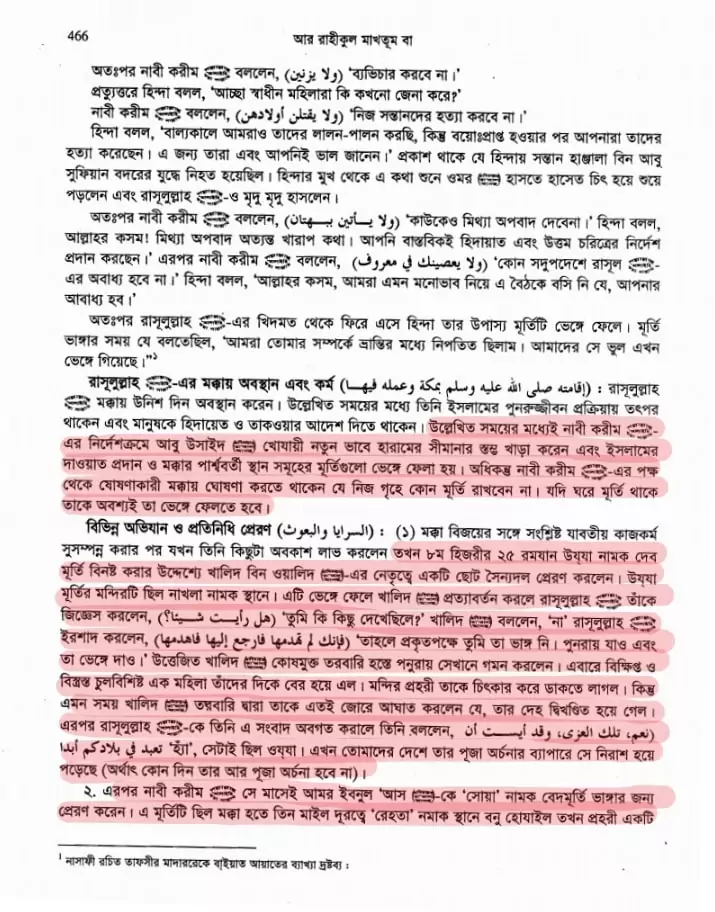
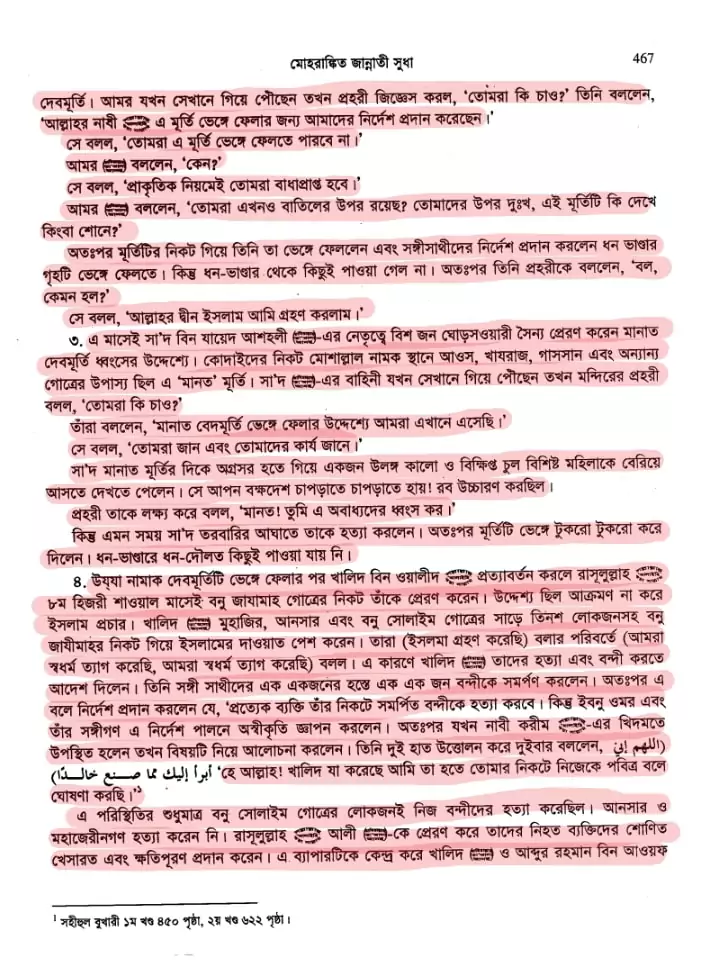
The section “Military Expeditions and Delegations” in Ar-Raheeq al-Makhtum also describes the destruction of al-Uzza’s sanctuary at Nakhla immediately before the Banu Jadhimah campaign. There Khalid cuts in two, with a sword, a woman described as having dishevelled hair; Muhammad subsequently identifies her as al-Uzza. The same extract states that Khalid took 350 soldiers to Banu Jadhimah and placed a prisoner in the hands of each soldier. These two expeditions thus document two distinct actions: the killing of a woman at a sanctuary and an order to execute captives among people who had announced their acceptance of Islam. [5]
Various Expeditions and Delegations (السَّرَايَا وَالْبُعُوْثِ):
1. After all matters relating to the conquest of Mecca had been completed and he had some respite, on 25 Ramadan in the eighth year after the Hijra, to destroy the idol known as al-Uzza, he dispatched a small detachment commanded by Khalid ibn al-Walid. The temple of al-Uzza was situated at Nakhla. Khalid demolished it and returned. The Messenger of Allah then asked him, (هَلْ رَأَيْتَ شَيْئًا؟) ‘Did you see anything?’ Khalid answered, ‘No.’ The Messenger of Allah said, (فَإِنَّكَ لَمْ تَهْدِمْهَا فَارْجِعْ إِلَيْهَا فَاهْدِمْهَا) ‘Then you have not actually destroyed it. Go back and destroy it again.’ An excited Khalid returned there with his sword drawn. This time a woman with wild, dishevelled hair came out toward them. The temple keeper shouted to her. At that moment Khalid struck her so forcefully with his sword that her body was split in two. He reported what had happened to the Messenger of Allah, who said, (نَعَمْ، تِلْكَ الْعُزّٰى، وَقَدْ أَيِسَتْ أَنْ تَعْبُدَ فِيْ بِلَادِكُمْ أَبَدًا) ‘Yes, that was al-Uzza. She has now despaired of ever being worshipped again in your land (that is, no worship of her will take place again).
2. The Prophet then sent Amr ibn al-As during the same month to destroy the idol Suwa, worshipped by Banu Hudhayl at Rihat, three miles from Mecca. When Amr arrived, its keeper asked, ‘What do you want?’ He replied, ‘Allah’s Prophet has ordered us to destroy this idol.’
The keeper said, ‘You will not be able to destroy this idol.’
Amr asked, ‘Why?’
The keeper answered, ‘You will be prevented by the natural order of things.’
Amr said, ‘Are you still following falsehood? Woe to you! Can this idol see or hear?’
Then he approached the idol and smashed it, ordering his companions to demolish the treasury building as well. But they found nothing in the treasury. He then asked the keeper, ‘Well, how did that go?’
The keeper answered, ‘I have accepted Islam, the religion of Allah.’
3. In the same month, a detachment of twenty mounted soldiers under Sa’d ibn Zayd al-Ashhali was sent to destroy the idol Manat. This idol, at Mushallal near Qudayd, was worshipped by the Aws, Khazraj, Ghassan, and other tribes. When Sa’d’s force arrived, the temple keeper asked, ‘What do you want?’
They replied, ‘We have come to destroy the idol Manat.’
The keeper said, ‘You know, and your actions will speak for themselves.’
As Sa’d advanced toward the idol of Manat, he saw a naked black woman with dishevelled hair coming out. She beat her chest and cried out, ‘O Lord!’
The keeper said to her, ‘Manat, destroy these rebels!’
But at that moment Sa’d killed her with a stroke of his sword. He then broke the idol into pieces. Nothing of value was found in its treasury.
4. After Khalid ibn al-Walid had returned from destroying the idol al-Uzza, the Messenger of Allah sent him to Banu Jadhimah in Shawwal of the eighth year after the Hijra. His mission was to preach Islam, not to attack. Khalid went with a force consisting of Muhajirun, Ansar, and members of Banu Sulaym, three hundred and fifty men in all, and invited Banu Jadhimah to Islam. Instead of saying ‘We have accepted Islam,’ they said ‘We have left our former religion; we have left our former religion.’ For that reason Khalid ordered them killed and taken captive. He placed one prisoner in the custody of each of his companions, and then ordered, ‘Every man must kill the captive entrusted to him.’ But Ibn Umar and his companions refused to carry out the order. When they came before the Prophet and discussed what had happened, he raised both hands and said twice, (اللهم إِنِّيْ أَبْرَأُ إِلَيْكَ مِمَّا صَنَعَ خَالِدًا) ‘O Allah, I declare myself innocent before You of what Khalid has done.’ (1)
Only the soldiers of Banu Sulaym killed the prisoners in their custody; the Ansar and Muhajirun did not. The Messenger of Allah sent Ali to pay blood money for the people killed and compensation for the losses. This incident led to a heated exchange between Khalid and Abd al-Rahman ibn Awf, and their relationship deteriorated. On learning of it, the Messenger of Allah said,
(مَهَلًّا يَا خَالِدُ، دَعْ عَنْكَ أَصْحَابِيْ، فَوَاللهِ لَوْ كَانَ أَحَدٌ ذَهَبًا، ثُمَّ أَنْفَقَتْهُ فِيْ سَبِيْلِ اللهِ مَا أَدْرَكَتْ غُدْوَةَ رَجُلٍ مِّنْ أَصْحَابِيْ وَلَا رَوْحَتَهُ)
‘Khalid, stop! Leave my companions alone. By Allah, even if Mount Uhud were made of gold and you spent all of it in Allah’s cause, you could not attain the merit of a single morning or evening of worship by one of my companions.’ (2)
Ibn Hisham’s Al-Sirah al-Nabawiyyah preserves a specific sequence of events before the assault on the tribe. Muhammad sent Khalid to invite people to Islam, not to wage war. When the tribesmen stood armed, Khalid told them to put down their weapons because people had accepted Islam. A man named Jahdam warned that disarmament would be followed by captivity and captivity by beheading. Others in the tribe overruled his warning and laid down their weapons. Khalid then had them bound and brought before the sword, and some were killed. Thus imprisonment and killing followed their compliance with a demand to disarm. [6]
فلما وضعوا السلاح أمر بهم خالد عند ذلك، فكتفوا، ثم عرضهم على السيف فقتل من قتل منهم.
English translation: When they laid down their weapons, Khalid ordered them seized and bound. They were then brought before the sword, and some of them were killed.
An earlier tribal feud was also connected to these killings. Ibn Hisham reports that, before Islam, members of Banu Jadhimah had killed Khalid’s uncle, al-Fakih ibn al-Mughirah, and the father of Abd al-Rahman ibn Awf. After the massacre, Abd al-Rahman accused Khalid of behaving in the Islamic period as people had in the age of pre-Islamic ignorance. Khalid replied that he had avenged Abd al-Rahman’s father. Abd al-Rahman answered that he had already killed his own father’s murderer, and that Khalid had actually avenged his uncle. This is a direct allegation by a contemporary companion that personal revenge motivated Khalid’s actions, grounded in an older blood feud. [7]
فقال: إنما ثأرت بأبيك. فقال عبد الرحمن: كذبت، قد قتلت قاتل أبي، ولكنك ثأرت بعمك الفاكه بن المغيرة.
English translation: Khalid said, “I was avenging your father.” Abd al-Rahman replied, “You lie. I have already killed my father’s killer. You were avenging your uncle al-Fakih ibn al-Mughirah.”
Another report in Ibn Hisham states that Muhammad sent Ali to Banu Jadhimah with money. Ali paid blood money for those killed and compensation for property plundered or destroyed, even reimbursing the value of a dog’s drinking vessel. He gave the remaining money to the tribe before returning. This compensation acknowledged that real people had been killed and had suffered material losses in Khalid’s expedition. Yet the account records no equivalent punitive sentence against Khalid, the commander who had issued the killing order. [8]
Cooking over the Severed Head of a Man Who Refused Zakat
The murder of Malik ibn Nuwayrah brings together Khalid ibn al-Walid’s power over captives, his decision to impose death, and his authority over a dead man’s family. Ibn Kathir’s Al-Bidaya wa’l-Nihaya relates that Khalid’s army captured Malik and his companions in the Butah region. The soldiers disagreed over whether the prisoners had performed prayer. Abu Qatadah testified that they had prayed, while others claimed otherwise. Malik and his companions were killed before the account establishes any judicial resolution of that dispute. The central issue was therefore not merely a political disagreement over zakat but the absence of protection for people after they had been taken captive. [9]
Ibn Kathir preserves two versions of the incident. In one, soldiers misunderstand an announcement intended to keep prisoners warm on a cold night as an order to kill them; Dirar ibn al-Azwar kills Malik. In another, Khalid personally summons Malik and questions him about following Sajah and withholding zakat. When Malik refers to Muhammad as “your companion,” Khalid becomes angry and orders Dirar to strike off his head. This second version also describes placing Malik’s severed head alongside two stones as supports for a cooking pot and preparing the evening meal over them. The account states that this was done to frighten Arab innovators and others, combining the desecration of a corpse with a display of intimidation. [10]
فقال: أهو صاحبنا وليس بصاحبك؟! يا ضرار، اضرب عنقه. فضرب عنقه، وأمر برأسه فجعل مع حجرين، وطبخ على الثلاثة قدرا.
English translation: Khalid said, “Is he our companion but not yours? Dirar, strike off his head!” Dirar beheaded him. His head was then placed alongside two stones, and a cooking pot was set on those three supports, and food was cooked in it.
The same narrative states that Khalid chose Malik’s wife, Umm Tamim bint al-Minhal, for himself from among the female captives. Ibn Kathir writes that Khalid had intercourse with her after she became free from menstruation. Taking a slain captive’s wife for the victorious commander’s sexual use is a concrete example of treating a woman as a person subject to war-acquired ownership rather than as a free individual. The source explicitly mentions both choosing her for himself and having sexual relations with her; it contains no account of asking for her own consent. [11]
Abu Qatadah complained about the killing and Khalid’s taking of the captive woman. Umar called on Abu Bakr to dismiss Khalid and said his sword was stained with wrongdoing. Malik’s brother Mutammim also lodged a complaint with the caliph. Although Abu Bakr paid blood money for Malik, he retained Khalid as commander. Later Umar publicly confronted Khalid in the mosque, accusing him of killing a Muslim and rushing upon the man’s wife. The bereaved family received compensation, but the commander who had ordered the killing kept his military power. This episode exposes a direct conflict between contemporary Muslim protests and the political protection extended to Khalid. [12]
Khalid selected Malik ibn Nuwayrah’s wife from among the female captives as part of the spoils. She was Umm Tamim, daughter of al-Minhal, and was described as exceptionally beautiful. After she became free of menstruation, Khalid had intercourse with her. Some reports state that Khalid summoned Malik ibn Nuwayrah and questioned him about following Sajah and withholding zakat. He asked, “Do you not know that the obligation of zakat has been joined together with the obligation of prayer?” Malik replied, “That is what your companion [the Prophet] believes.” Khalid said, “Is he our companion but not yours? Dirar, strike off his head!” Malik was then beheaded. On Khalid’s orders, his head was severed and placed alongside two stones, with a cooking pot resting on those three supports. Khalid ate the food prepared that night. This arrangement was intended to frighten Arab religious innovators and other people. It is also said that Malik’s hair was placed in the cooking fire, and that his hair was so abundant that some remained even after the meat had finished cooking. Abu Qatadah criticized Khalid’s actions, leading to an argument between them. Abu Qatadah even appeared before the caliph, Abu Bakr al-Siddiq, to lodge a complaint. When Umar learned of the incident from Abu Qatadah, he told the caliph, “Remove Khalid, because his sword is tainted with oppression.” But Abu Bakr answered, “I cannot sheath a sword that Allah Himself has drawn against the unbelievers.” Mutammim ibn Nuwayrah then came to complain to the caliph about Khalid, with Umar supporting him.
Umar ibn al-Khattab continued pressing the caliph to remove Khalid ibn al-Walid as commander, repeatedly asserting that his sword had become involved in injustice. The caliph eventually summoned Khalid, who arrived in Medina wearing iron armor that had rusted from having been stained with so much blood. Khalid had fixed a bloodstained arrow into the turban on his head. As soon as he entered the mosque, Umar rose, took the arrow from his turban, and broke it. Umar said, “Have you killed a Muslim man to display your arrogance and then thrown yourself upon his wife? By Allah, I will have you stoned to death.” Khalid said nothing to Umar. He was simply watching to see whether the caliph shared Umar’s position. He then went before Abu Bakr and offered his excuse. The caliph accepted it, pardoned him, and paid the blood money for Malik ibn Nuwayrah.
When Khalid came out from the caliph’s presence, Umar was still seated in the mosque. Khalid called to him, “Son of Umm Shamlah, come to me now!” Umar did not reply, realizing that the caliph was pleased with Khalid. Abu Bakr retained Khalid in his command. In fact, Khalid had exercised ijtihad concerning the killing of Malik ibn Nuwayrah and had erred in that judgment. On another occasion the Messenger of Allah sent Khalid to suppress Abu Judhaymah, and Khalid killed prisoners who had said, “We have abandoned our religion; we have abandoned our religion,” when in fact they were unaccustomed to saying, “We have become Muslims.” The Messenger of Allah then paid their blood money, described as equal in value to the herds of Banu Kalb. He raised both hands and prayed, “O Allah, I disavow what Khalid has done.” Nevertheless, the Messenger of Allah did not remove Khalid from his military command.


Torture and Exemplary Killings of Captives at Buzakha
After Muhammad’s death, various Arab tribes rejected the political and religious authority of Medina under Abu Bakr, and the so-called Ridda, or wars against apostasy, began. Khalid ibn al-Walid was one of the leading commanders in these campaigns. His expedition at Buzakha (بزاخة) against Tulayha ibn Khuwaylid, supported by Banu Asad and Ghatafan, was far more than a battlefield victory. Early Muslim chronicles describe pursuing prisoners and accused persons after the battle, burning them, crushing them with stones, throwing them down mountains, dropping them headfirst into wells, and shooting them with arrows. Killing continued after the armed opponents had been defeated. The surrender of defeated tribes was made conditional upon their handing over members of their own communities to Khalid. Instead of using a single means of execution, different appalling methods were employed. The accounts themselves state the purpose of this brutality: to terrorize other Arab tribes.
Tulayha claimed to be a prophet, and several Arab tribes supported him. The members of those tribes did not all play identical roles. Some fought, others followed their leaders, and others sought to return to Medina’s rule after defeat. Following Khalid’s victory, Banu Amir and other tribes approached him professing Islam and allegiance. Their willingness to surrender did not itself secure acceptance. After the victory, Khalid exercised the power to decide who could surrender, on what conditions, and who would be killed. Al-Tabari’s Tarikh al-Rusul wa’l-Muluk explicitly records the imposition of these conditions. [13]
وَأَقْبَلَتْ بَنُو عَامِرٍ بَعْدَ هَزِيمَةِ أَهْلِ بُزَاخَةَ يَقُولُونَ: نَدْخُلُ فِيمَا خَرَجْنَا مِنْهُ، فَبَايَعَهُمْ عَلَى مَا بَايَعَ عَلَيْهِ أَهْلَ بُزَاخَةَ مِنْ أَسَدٍ وَغَطَفَانَ وَطَيِّئٍ قَبْلَهُمْ.
English translation: After the people of Buzakha had been defeated, Banu Amir came forward saying, “We wish to return to what we had left.” He accepted their pledge of allegiance on the same conditions that he had previously imposed on Banu Asad, Ghatafan, and Tayy.
Al-Tabari and Ibn al-Athir report that Khalid ordered the tribes concerned to produce those among them accused of killing Muslims, mutilating bodies, or burning people. The tribes handed them over. The accused were no longer members of an independent armed force; they were detainees subject to Khalid’s custody and punishment. The penalties he then imposed combined death with public physical torture. Especially noteworthy is the deliberate intensification of suffering before or during execution and the use of living or dead bodies as instruments for spreading fear. Even an accusation of an earlier killing cannot make burning, crushing with stones, or throwing a person off a mountain a substitute for a just judicial process.
Ibn al-Athir’s Al-Kamil fi’l-Tarikh provides an even longer list of punishments carried out after Buzakha. Alongside burning, crushing with stones, and throwing people from mountains, he mentions dropping captives headfirst into wells. The same report says that Abu Bakr was informed of Khalid’s actions. The incident is therefore not presented as the work of a secret or uncontrolled band of soldiers: the punishments were carried out by the commander’s decision and reported to the central ruler. [14]
فَمَثَّلَ بِهِمْ وَحَرَّقَهُمْ وَرَضَخَهُمْ بِالْحِجَارَةِ وَرَمَى بِهِمْ مِنَ الْجِبَالِ وَنَكَّسَهُمْ فِي الْآبَارِ، وَأَرْسَلَ إِلَى أَبِي بَكْرٍ يُعْلِمُهُ مَا فَعَلَ.
English translation: He mutilated them, burned them, crushed them with stones, threw them down from mountains, and cast them headfirst into wells. He then sent word to Abu Bakr telling him what he had done.
The methods of casting people headfirst into wells and throwing them off mountains expose the nature of these events. They do not describe the force required to repel an armed combatant in battle. They describe the use of the body of a prisoner or detainee as a display of punishment. The same applies to crushing someone with stones. In these methods of killing used by Khalid’s forces, acute physical suffering and conspicuous cruelty became means of displaying punishment. Al-Tabari also mentions impaling or piercing people with arrows. The significance of the episode therefore extends beyond any one form of capital punishment to a campaign of torture and execution of captives through multiple methods.
Abu Bakr’s orders were directly connected to these actions. Ibn Kathir quotes part of a letter sent by Abu Bakr to Khalid after the defeat of Tulayha. Besides ordering exemplary punishment for those involved in killing Muslims, it authorizes Khalid to kill people identified as “enemies of God” if he considers doing so beneficial. Permission to kill was thus not confined to specific killings that had been proven; religious classification and the commander’s judgment were made criteria for punishment. The leadership of the campaign effectively decided what constituted “opposition to God” and whose death would be “beneficial.” Ibn Kathir presents Khalid’s prolonged searches and punishments as activities following this order. [15]
Khalid remained at Buzakha for roughly a month, repeatedly searching the surrounding areas and bringing accused persons into custody. The month-long operation was a prolonged process of finding people and carrying out punishments. After the defeat, the search for people, their detention, and their execution by different methods continued for an extended period. Ibn Kathir explicitly states the social purpose of these penalties: the reports were to reach other apostate Arab tribes and frighten them. Terrifying executions were turned into messages designed to deter further resistance to central authority. The goal was not simply battlefield victory, but preventing other communities from daring to defy Medina. [16]
فَمِنْهُمْ مَنْ حَرَّقَهُ بِالنَّارِ، وَمِنْهُمْ مَنْ رَضَخَهُ بِالْحِجَارَةِ، وَمِنْهُمْ مَنْ رَمَى بِهِ مِنْ شَوَاهِقِ الْجِبَالِ، كُلُّ هَذَا لِيُشَرِّدَ بِهِمْ مَنْ يَسْمَعُ بِخَبَرِهِمْ مِنْ مُرْتَدَّةِ الْعَرَبِ.
English translation: He burned some of them in the fire, crushed others with stones, and threw still others from high mountains. All this was done to frighten and scatter those apostate Arabs who heard what had happened to them.
News of people being burned and thrown from mountains was circulated to terrorize other tribes as well. The message was that defying Medina’s authority could bring not only defeat and death but terrible torture before death. Publicly killing people by multiple methods constituted a display of sovereign power directed immediately at the victims and indirectly at the wider community. This transformation of violence into an instrument of social control and political obedience is central to the Buzakha campaign.
A separate report preserved by Ibn Abd al-Barr in Al-Tamhid lima fi’l-Muwatta min al-Ma’ani wa’l-Asanid adds detail to Buzakha. Through Musa ibn Uqbah, it attributes to Ibn Shihab al-Zuhri an account in which, after fighting the tribes of Asad and Ghatafan, Muslims killed many and captured others. Khalid then had an enclosure built to hold the prisoners. A large fire was lit beneath it, and the captives were thrown into the flames. This is not merely a reference to “punishment by fire” or the burning of corpses; it is an account of detainees being assembled after fighting and cast into a specially prepared fire. It gives still more horrifying substance to what captivity meant in the punitive operations following Buzakha. [17]
وَقَتَلَ الْمُسْلِمُونَ مِنَ الْعَدُوِّ بَشَرًا كَثِيرًا وَأَسَرُوا مِنْهُمْ أُسَارَى فَأَمَرَ خَالِدٌ بِالْحَظِيرَةِ أَنْ تُبْنَى ثُمَّ أُوقِدَ تَحْتَهَا نَارًا عَظِيمَةً فَأَلْقَى الْأُسَارَى فِيهَا.
English translation: The Muslims killed many of the enemy and took others captive. Khalid ordered an enclosure to be constructed; a great fire was then kindled beneath it, and he cast the captives into the flames.
Reports also describe captives being burned under Khalid’s command outside Buzakha. Ibn Abi Shaybah’s Musannaf preserves another report in which Khalid gathered members of Banu Sulaym inside an enclosure and burned them. Umar protested directly to Abu Bakr, asking why he retained a man who punished people with fire, a punishment attributed to God. Abu Bakr did not dismiss Khalid. This concerns a different tribe from the Asad and Ghatafan captives at Buzakha. Both narratives describe the use of fire against captives; the Banu Sulaym account also preserves Umar’s protest and Abu Bakr’s decision to retain Khalid in command. [18]
فَجَمَعَ مِنْهُمْ أُنَاسًا فِي حَظِيرَةٍ حَرَّقَهَا عَلَيْهِمْ بِالنَّارِ، فَبَلَغَ ذَلِكَ عُمَرَ، فَأَتَى أَبَا بَكْرٍ، فَقَالَ: انْزِعْ رَجُلًا يُعَذِّبُ بِعَذَابِ اللَّهِ.
English translation: He gathered some of them inside an enclosure and set fire to it over them. When Umar learned of this, he went to Abu Bakr and said, “Remove a man who tortures people with the punishment of God.”
Umar’s protest against punishment by fire directly corresponds to the prohibition preserved in Sahih al-Bukhari. Bukhari 3016 records Muhammad initially ordering two people to be burned and then withdrawing the order, declaring that only God may punish by fire. Khalid’s burning of captives directly violated that prohibition as well. This tension is discussed in later Islamic fatwa literature. IslamQA acknowledges hadith prohibiting punishment by fire while also discussing reports that Khalid and other companions employed it. The coexistence of a declared prohibition and reports of a powerful commander’s violation illustrates the gap between religious norms and actual military conduct. [19]
إِنِّي أَمَرْتُكُمْ أَنْ تُحْرِقُوا فُلاَنًا وَفُلاَنًا، وَإِنَّ النَّارَ لاَ يُعَذِّبُ بِهَا إِلاَّ اللَّهُ، فَإِنْ وَجَدْتُمُوهُمَا فَاقْتُلُوهُمَا.
English translation: “I ordered you to burn such-and-such two men, but no one punishes with fire except Allah. Therefore, if you find them, kill them instead.”
Abu Bakr’s role in the Buzakha repression raises direct political and moral questions. He instructed Khalid to impose exemplary severe punishments, while reports of Khalid’s actions were sent back to him. When Umar demanded Khalid’s removal following the burning of Banu Sulaym prisoners, Abu Bakr refused to dismiss him, calling him a sword drawn by God. The commander’s decisions to kill and burn captives were connected to the central ruler’s orders and patronage. Military command, authorization by the central ruler, and the prestige of a religious warrior operated within the same political system. That prestigious title gave prisoners facing execution no protection; it helped sustain the commander’s power even after objections were raised against him. [20]
فَقَالَ عُمَرُ لِأَبِي بَكْرٍ: أَتَدَعُ رَجُلًا يُعَذِّبُ بِعَذَابِ اللَّهِ؟ قَالَ: وَاللَّهِ لَا أَشِيمُ سَيْفًا سَلَّهُ اللَّهُ عَلَى عَدُوِّهِ. ثُمَّ أَمَرَهُ، فَمَضَى إِلَى مُسَيْلِمَةَ.
English translation: Umar said to Abu Bakr, “Will you leave in command a man who tortures people with God’s punishment?” Abu Bakr replied, “By Allah, I will not sheath a sword that Allah has drawn against His enemy.” He then gave Khalid his orders, and Khalid proceeded against Musaylimah.
The question of justice for detainees is also absent from these accounts. They speak of accusations, arrests, conditions of allegiance, fire, stones, mountains, and wells, but they do not establish each prisoner’s individual offence, the evidence, an impartial hearing, an opportunity to defend oneself, or the proportionality of punishment. Labelling someone an “apostate,” an “enemy of God,” or a “rebel” does not justify torture. Forcing a captive already in the ruler’s custody to face a brutal death after a battle is an abuse of power. When a punishment is openly intended to terrorize others, it is also an instrument of coercive social control. The reports attributed to Khalid at Buzakha exhibit both features: extreme violence against detainees and the use of news about that violence as a weapon to demand political obedience.
Burning the Captives of Banu Sulaym Alive
Early Islamic sources preserve reports that Khalid ibn al-Walid not only killed defeated opponents during military campaigns but burned people alive. These reports describe gathering prisoners inside a fenced enclosure, setting fire to it, Umar ibn al-Khattab’s protest upon hearing of the incident, and Abu Bakr’s decision to retain Khalid in military command despite that protest. Fire was chosen as the means of killing after the people concerned had already been detained. This was therefore not the use of fire during combat between two armed forces, but the deliberate burning of prisoners. Ibn Abi Shaybah’s Al-Musannaf, al-Dhahabi’s Siyar A’lam al-Nubala, and Ibn Asakir’s Tarikh Dimashq associate the incident with Banu Sulaym. Al-Mawardi’s Al-Hawi al-Kabir, by contrast, places the burning of captives in a pit during the Battle of Yamama. These sources document the killing, while also containing significant differences regarding its location and later transmission.
Ibn Abi Shaybah records the event in the historical section of his Al-Musannaf, transmitting from Abu Mu’awiyah, from Hisham ibn Urwah, from Hisham’s father Urwah. The narrative begins by accusing Banu Sulaym of apostasy. Abu Bakr sends Khalid against the tribe. Khalid gathers a group of people, confines them inside an enclosure, and sets fire to it while they are inside. When Umar hears of this, he goes to Abu Bakr and demands the removal of someone who tortures human beings with the punishment of God. Abu Bakr rejects the demand and sends Khalid on another expedition. The wording and sequence attribute responsibility for burning the prisoners to Khalid and responsibility for keeping him in command after learning of it to Abu Bakr. [21]
حَدَّثَنَا أَبُو مُعَاوِيَةَ عَنْ هِشَامٍ عَنْ أَبِيهِ قَالَ: كَانَتْ فِي بَنِي سُلَيْمٍ رِدَّةٌ، فَبَعَثَ إِلَيْهِمْ أَبُو بَكْرٍ خَالِدَ بْنَ الْوَلِيدِ، فَجَمَعَ مِنْهُمْ أُنَاسًا فِي حَظِيرَةٍ حَرَّقَهَا عَلَيْهِمْ بِالنَّارِ، فَبَلَغَ ذَلِكَ عُمَرُ، فَأَتَى أَبَا بَكْرٍ فَقَالَ: انْزِعْ رَجُلًا يُعَذِّبُ بِعَذَابِ اللَّهِ، فَقَالَ أَبُو بَكْرٍ: وَاللَّهِ لَا أَشِيمُ سَيْفًا سَلَّهُ اللَّهُ عَلَى عَدُوِّهِ حَتَّى يَكُونَ اللَّهُ هُوَ يَشِيمُهُ، وَأَمَرَهُ فَمَضَى مِنْ وَجْهِهِ ذَلِكَ إِلَى مُسَيْلِمَةَ.
English translation: Abu Mu’awiyah narrated to us from Hisham, from his father, who said: There was apostasy among Banu Sulaym, so Abu Bakr sent Khalid ibn al-Walid against them. Khalid gathered some of them inside an enclosure and set fire to it while they were inside. When Umar learned of this, he went to Abu Bakr and said, “Remove a man who punishes people with the punishment of Allah.” Abu Bakr said, “By Allah, I will not sheath a sword that Allah has drawn against His enemies until Allah Himself sheaths it.” He then instructed Khalid, who departed from there to confront Musaylimah.
The Arabic term حظيرة means an enclosed area or pen. The narrative describes two separate actions: assembling prisoners within that enclosure and setting it on fire while they were inside. فجمع منهم أناسا describes gathering the people first, and حرقها عليهم بالنار describes burning the enclosure with them in it. The victims’ names, numbers, and individual circumstances of capture are unrecorded; the method of gathering them in an enclosure and setting it alight is explicit. Confining living people and burning them turned captivity directly into a means of killing. Nor does it describe an individualized judicial process: people classified collectively as apostates were killed as a group after being detained.
The account also exposes the combination of political authority and religious conformity imposed after Muhammad’s death. Members of Banu Sulaym were categorized as participating in ridda, or apostasy. A state army was then sent against them, and detained people were burned. The account contains no trial, evidence, individualized charge, or opportunity for defence for those who died in the fire. The accusation concerned a tribe; the punishment was inflicted on a group of its captured members. The union of state killing power with the suppression of religious disobedience produced a situation in which prisoners’ lives depended entirely on the victorious commander’s decision.
Umar’s protest proves that the episode was not unknown to contemporary Muslim leadership. On hearing about Khalid’s conduct, he demanded the commander’s removal. Abu Bakr did not respond by proposing an inquiry into the offences, the prisoners’ status, or the appropriate penalty. Instead, he invoked Khalid’s military standing. In his response, the “sword drawn by Allah” functioned as political protection: despite burning people, the commander’s status shielded him from dismissal. Khalid was not merely pardoned; the narrative records that he received orders to proceed against Musaylimah. The same military power thus remained in his hands despite the killings and the protest.
Al-Dhahabi includes the Banu Sulaym incident in his biography of Khalid. He preserves the same sequence: captives burned inside an enclosure, an exchange between Umar and Abu Bakr, and Khalid’s departure to confront Musaylimah. This is a later retelling of the same report transmitted through Urwah. Even works praising Khalid as the “Sword of God” did not erase the account of prisoners being burned alive. [22]
هِشَامُ بْنُ عُرْوَةَ: عَنْ أَبِيهِ قَالَ: كَانَ فِي بَنِي سُلَيْمٍ رِدَّةٌ، فَبَعَثَ أَبُو بَكْرٍ إِلَيْهِمْ خَالِدَ بْنَ الْوَلِيدِ فَجَمَعَ رِجَالًا مِنْهُمْ فِي الْحَظَائِرِ، ثُمَّ أَحْرَقَهُمْ، فَقَالَ عُمَرُ لِأَبِي بَكْرٍ: أَتَدَعُ رَجُلًا يُعَذِّبُ بِعَذَابِ اللَّهِ؟ قَالَ: وَاللَّهِ لَا أَشِيمُ سَيْفًا سَلَّهُ اللَّهُ عَلَى عَدُوِّهِ. ثُمَّ أَمَرَهُ، فَمَضَى إِلَى مُسَيْلِمَةَ.
English translation: Hisham ibn Urwah narrated from his father: There was apostasy among Banu Sulaym, so Abu Bakr sent Khalid ibn al-Walid against them. Khalid gathered men from the tribe in enclosures and burned them. Umar asked Abu Bakr, “Will you leave a man who punishes people with the punishment of Allah?” Abu Bakr answered, “By Allah, I will not sheath a sword that Allah has drawn against His enemy.” He then gave Khalid his orders, and Khalid proceeded against Musaylimah.
A fuller account of the burning of Banu Sulaym prisoners appears in Muhammad ibn Abd al-Wahhab’s Mukhtasar Sirat al-Rasul. It describes a letter from Abu Bakr to Khalid. According to the letter, after defeating Banu Hanifah, Khalid was to strike Banu Sulaym severely; Abu Bakr expressed intense anger toward the tribe and ordered burning and killing on such a scale that others would take warning. The following passage says that Banu Sulaym assembled a fighting force upon hearing that Khalid was approaching, led by Abu Shajarah ibn Abd al-Uzza. After their defeat, many were captured, and Khalid had enclosures built and burned the prisoners inside. The episode is described not as an accidental fire during battle, but as a planned form of punishment and intimidation. [23]
وَكَتَبَ أَبُو بَكْرٍ رَضِيَ اللَّهُ عَنْهُ إِلَى خَالِدٍ: «إِنْ أَظْفَرَكَ اللَّهُ بِبَنِي حَنِيفَةَ فَأَقِلَّ اللُّبْثَ فِيهِمْ، حَتَّى تَنْحَدِرَ إِلَى بَنِي سُلَيْمٍ، فَتَطَأَهُمْ وَطْأَةً يَعْرِفُونَ بِهَا مَا مَنَعُوا، فَإِنَّهُ لَيْسَ بَطْنٌ مِنَ الْعَرَبِ أَنَا أَغْيَظُ عَلَيْهِ مِنِّي عَلَيْهِمْ، فَإِنْ أَظْفَرَكَ اللَّهُ بِهِمْ فَلَا آلُوكَ فِيهِمْ أَنْ تُحْرِقَهُمْ بِالنَّارِ، وَهَوِّلْ فِيهِمُ الْقَتْلَ حَتَّى يَكُونَ نَكَالًا لَهُمْ». وَسَمِعَتْ بَنُو سُلَيْمٍ بِإِقْبَالِ خَالِدٍ، فَاجْتَمَعَ مِنْهُمْ بَشَرٌ كَثِيرٌ، وَاسْتَجْلَبُوا مَنْ بَقِيَ مِنَ الْعَرَبِ مُرْتَدًّا، وَكَانَ الَّذِي جَمَعَهُمْ أَبُو شَجَرَةَ بْنَ عَبْدِ الْعُزَّى. فَانْتَهَى خَالِدٌ إِلَى جَمْعِهِمْ مَعَ الصُّبْحِ، فَصَاحَ خَالِدٌ فِي أَصْحَابِهِ، وَأَمَرَهُمْ بِلُبْسِ السِّلَاحِ، ثُمَّ صَفَّهُمْ، وَصَفَّتْ بَنُو سُلَيْمٍ. وَجَعَلَ خَالِدٌ يَلِي الْقِتَالَ بِنَفْسِهِ حَتَّى أَثْخَنَ فِيهِمُ الْقَتْلَ، ثُمَّ حَمَلَ عَلَيْهِمْ حَمْلَةً وَاحِدَةً فَانْهَزَمُوا، وَأُسِرَ مِنْهُمْ بَشَرٌ كَثِيرٌ، ثُمَّ حَظَّرَ لَهُمُ الْحَظَائِرَ وَحَرَّقَهُمْ فِيهَا.
English translation: Abu Bakr wrote to Khalid: “If Allah grants you victory over Banu Hanifah, do not remain among them long. Go down to Banu Sulaym and strike them so severely that they understand what they have refused. Of all the Arab tribes, there is none with whom I am angrier than I am with them. If Allah grants you victory over them, I do not wish you to spare them from burning with fire; make the killing among them so terrible that it serves as an exemplary punishment.” Hearing that Khalid was approaching, many members of Banu Sulaym gathered and called in other Arabs who remained apostates. They were assembled by Abu Shajarah ibn Abd al-Uzza. Khalid came upon their forces at dawn, called to his men, ordered them to put on their armor, and drew them up in battle formation. Banu Sulaym also formed their ranks. Khalid personally directed the fighting and inflicted heavy casualties. After a concerted charge, Banu Sulaym fled and many were captured. Khalid then had enclosures built for the prisoners and burned them inside.
The letter attributed to Abu Bakr is significant for more than its order to attack. أَنْ تُحْرِقَهُمْ بِالنَّارِ explicitly means to burn them with fire, while حَتَّى يَكُونَ نَكَالًا لَهُمْ expresses the purpose of turning the punishment into a frightening example for others. The description of captured prisoners being enclosed and burned follows immediately after the letter. In this version, the commander’s conduct and the expectation of the highest political authority form part of the same brutal system. There is no separate trial for each person found guilty and no account of choosing to release or spare the prisoners. Captives under military control after a battle were burned alive: that is the direct moral and political substance of the episode.
The chronology of the expedition is contradictory in these early and later sources. Ibn Abi Shaybah’s version sends Khalid to confront Musaylimah after burning Banu Sulaym; Mukhtasar Sirat al-Rasul presents a letter ordering Khalid to advance against Banu Sulaym after victory over Banu Hanifah. The chronological conflict occurs between two accounts of burning captives from the same tribe. Both versions describe prisoners of Banu Sulaym burned inside an enclosure, but differ over when the expedition took place. Urwah in Ibn Abi Shaybah’s transmission is not an eyewitness to the incident; the quoted passage from the later work does not identify the letter’s own primary source. The report of burning captives and the order preserved in Abu Bakr’s name are therefore documents from different stages of compilation and transmission.
The Shafi’i jurist al-Mawardi preserves another important version in Al-Hawi al-Kabir. In discussing punishment of prisoners of war and mutilation of bodies, he says that, during the fighting against apostates at Yamama, Khalid gathered captives into a pit and burned them. He combines this with the account of a leader’s severed head being used to fuel a fire beneath Khalid’s cooking pot. The burning resembles the story about Banu Sulaym, while cooking over a severed head corresponds to the account of Malik ibn Nuwayrah. This account preserved under the name of Yamama brings together two familiar narratives: burning captives and cooking over a severed head. By al-Mawardi’s time, these two forms of cruelty attributed to Khalid had entered legal discussion and received explanations concerning their permissibility. [24]
وَلَا يَجُوزُ أَنْ يُحْرِقَهُمْ بِالنَّارِ، لِقَوْلِ النَّبِيِّ صَلَّى اللَّهُ عَلَيْهِ وَسَلَّمَ: «لَا يُعَذِّبُ بِعَذَابِ اللَّهِ غَيْرُ اللَّهِ». فَإِنْ قِيلَ: فَقَدْ جَمَعَ خَالِدُ بْنُ الْوَلِيدِ حِينَ قَاتَلَ أَهْلَ الرِّدَّةِ بِالْيَمَامَةِ جَمَاعَةً مِنَ الْأَسْرَى، وَأَلْقَاهُمْ فِي حَفِيرَةٍ وَأَحْرَقَهُمْ بِالنَّارِ، وَأَخَذَ رَأْسَ زَعِيمِهِمْ فَأَوْقَدَهُ تَحْتَ قِدْرِهِ، قِيلَ عَنْهُ جَوَابَانِ: أَحَدُهُمَا: أَنَّ أَبَا بَكْرٍ وَعُمَرَ أَنْكَرَا ذَلِكَ مِنْ فِعْلِهِ وَبَرِئَا إِلَى اللَّهِ مِنْ فِعْلِهِ.
English translation: “It is not permissible to burn them with fire, for the Prophet said: No one but Allah may punish with Allah’s punishment.” If it is said, “When Khalid ibn al-Walid fought the apostates at Yamama, he gathered a group of prisoners, cast them into a pit, and burned them with fire; he also took their leader’s head and used it as fuel beneath his cooking pot,” there are two answers. The first is that Abu Bakr and Umar condemned his action and disavowed it before Allah.
Al-Mawardi’s first explanation contains a clear inconsistency. He says both Abu Bakr and Umar condemned Khalid’s conduct. In Ibn Abi Shaybah’s report, however, Umar demanded Khalid’s removal and Abu Bakr refused; Mukhtasar Sirat al-Rasul even attributes an order to burn captives to Abu Bakr himself. Thus Abu Bakr appears in three different roles concerning the same kind of act: opponent of cruelty, protector of the commander, and author of an order for harsh punishment. These accounts contradict one another concerning the caliph’s response. In each version, burning the captives appears as a deliberate punishment. The differences concern chiefly chronology, location, and the caliph’s response, rather than the description of punishment by fire under Khalid.
Two points appear in al-Mawardi’s account. First, he directly invokes the burning of prisoners as a historical precedent in his legal discussion. Second, his reference to “Yamama” and to cooking over a severed head as part of the same event conflicts with earlier accounts. In the report transmitted from Urwah, the people burned were captives from Banu Sulaym; Malik ibn Nuwayrah’s severed head features in the account of the campaign around Butah. The conflation of these two familiar incidents in al-Mawardi’s text illustrates their transformation in later legal literature. Burning captives and desecrating a corpse became subjects of a jurist’s explanation. Joining cruelties preserved in separate incidents into one narrative also produced inconsistencies in his account’s location and the identity of the people involved.
Al-Mawardi also supplies a second explanation. He writes that the prohibition against punishment by fire supposedly had not yet spread sufficiently and that Khalid acted according to his own political judgment. Treating apostasy as a grave offence, his analysis explains burning as a decision of government policy. This is al-Mawardi’s legal reasoning, not an eyewitness account of the events. This debate over religious law centers on the legal permission or prohibition governing the commander’s use of fire; the right of living prisoners to protection is relegated to a secondary position. The burning alive of a group of people is thus transformed into a debate over “political necessity” and the timing of the prohibition’s circulation. [25]
وَالثَّانِي: أَنَّهَا كَانَتْ حَالًا لَمْ يَنْتَشِرْ فِيهَا حُكْمُ النَّهْيِ، فَفَعَلَ خَالِدٌ مِنْ ذَلِكَ مَا اقْتَضَاهُ حُكْمُ السِّيَاسَةِ عِنْدَهُ؛ لِأَنَّهُ كَانَ فِي مُتَقَدِّمِ الْإِسْلَامِ، وَكَانُوا أَوَّلَ قَوْمٍ تَظَاهَرُوا بِالرِّدَّةِ بَعْدَ قَبْضِ الرَّسُولِ صَلَّى اللَّهُ عَلَيْهِ وَسَلَّمَ وَآمَنُوا بِمُسَيْلِمَةَ الْكَذَّابِ، فَأَظْهَرَ بِمَا فَعَلَ مِنْ إِحْرَاقِهِمْ بِالنَّارِ أَعْظَمَ الْعُقُوبَاتِ لِارْتِكَابِهِمْ أَعْظَمَ الْكُفْرِ، ثُمَّ عَلِمَ بِالنَّهْيِ فَكَفَّ وَامْتَنَعَ.
English translation: The second explanation is that this occurred at a time when the ruling prohibiting it had not become widespread. Khalid therefore acted according to what he judged to be required by governance and political necessity. This was early in the history of Islam, and they were the first people to unite openly in apostasy after Muhammad’s death and to believe in Musaylimah. By burning them, Khalid displayed the greatest punishment for the greatest unbelief. Later he learned of the prohibition and stopped.
The most revealing words of this explanation are فَأَظْهَرَ … أَعْظَمَ الْعُقُوبَاتِ لِارْتِكَابِهِمْ أَعْظَمَ الْكُفْرِ—“he displayed the greatest punishment for their commission of the greatest unbelief.” Burning prisoners is framed not as an accident or inevitable consequence of war but as an intentional penalty proportionate, in the author’s view, to the seriousness of the offence. “Politics” here is invoked to explain the function of torture: suppressing religious disobedience through severe examples that frighten others. This use of living human bodies as a display of ruling power subordinates the accused person’s life to religious conformity. Al-Mawardi’s explanation does not erase responsibility for the acts; it documents the special rationalizations developed in later Islamic jurisprudence.
The prohibition against killing by fire also appears directly in Islamic hadith literature. Sahih al-Bukhari records that when Ali ibn Abi Talib burned a group of apostates, Ibn Abbas said he would not have done so, because Muhammad had forbidden punishment by fire. The hadith concerns Ali’s burning of people; Umar’s protest uses the same language identifying fire as God’s method of punishment. Umar’s phrase “the punishment of Allah” corresponds to the rationale of the hadith prohibition. It exposes a practical contradiction between the political leadership’s decision and the religious rule governing punishments: fire is forbidden on one hand, while the commander who used it is retained as the “Sword of Allah” on the other. [26]
حَدَّثَنَا عَلِيُّ بْنُ عَبْدِ اللَّهِ، حَدَّثَنَا سُفْيَانُ، عَنْ أَيُّوبَ، عَنْ عِكْرِمَةَ، أَنَّ عَلِيًّا حَرَّقَ قَوْمًا، فَبَلَغَ ابْنَ عَبَّاسٍ فَقَالَ: لَوْ كُنْتُ أَنَا لَمْ أُحَرِّقْهُمْ؛ لِأَنَّ النَّبِيَّ صَلَّى اللَّهُ عَلَيْهِ وَسَلَّمَ قَالَ: «لَا تُعَذِّبُوا بِعَذَابِ اللَّهِ»، وَلَقَتَلْتُهُمْ كَمَا قَالَ النَّبِيُّ صَلَّى اللَّهُ عَلَيْهِ وَسَلَّمَ: «مَنْ بَدَّلَ دِينَهُ فَاقْتُلُوهُ».
English translation: Ali ibn Abd Allah narrated to us from Sufyan, from Ayyub, from Ikrimah: Ali burned a group of people. When Ibn Abbas heard of it, he said, “Had it been me, I would not have burned them, for the Prophet said, ‘Do not punish with Allah’s punishment.’ But I would have killed them in accordance with the Prophet’s instruction: ‘Whoever changes his religion, kill him.’”
Ibn Abbas did not object here to the rule that apostates should be killed; he objected to the method of burning. The hadith therefore does not establish freedom to leave a religion. Instead, it preserves the death penalty for apostasy while drawing a boundary around the method of execution. Even that boundary did not operate in the reports of Khalid’s captive killings. Umar brought the matter to the caliph, yet Khalid remained commander. Al-Mawardi’s explanation, meanwhile, invokes an uncirculated prohibition and political necessity to interpret the burning. The conflict between religious penalties and the ruler’s political interests did nothing to alter the fate of the prisoners. No later legal revision, expression of regret, or theological explanation could restore the lives of those burned inside the enclosure.
The early quoted account does not preserve the names or exact number of people of Banu Sulaym who were burned. Al-Mawardi’s Yamama version likewise gives no count. The sequence preserved in the sources is as follows: the accounts describe living captives being confined in an enclosure and burned to death under Khalid’s command; Umar protested, while Abu Bakr retained him. A later jurist brought the same type of prisoner burning into a discussion of the treatment of captives and recorded a political justification for it. Khalid’s responsibility thus extended beyond an immediate order in battle and became connected with three issues: extrajudicial killing of captives, cruelty toward human bodies, and impunity granted by the state.
The burning of Banu Sulaym captives exposes a specific feature of power in Islamic history. A tribe’s political or religious defiance was first turned into a punishable identity. After military victory, prisoners were burned as an example instead of being kept alive. Finally, even after the killing was reported, the political leadership left the commander in power. The exchange between Umar and Abu Bakr captures the system: burning prisoners could be condemned while the standing of the man who ordered the burning remained intact. The reality of a human being burned alive was subordinated to the religious identity of the victorious army and the military needs of the state.
Ullays: Killing Captives and the “River of Blood”
The Battle of Ullays during Khalid ibn al-Walid’s campaign in Iraq is an exceptionally brutal episode. In Safar of 12 AH, near the Euphrates, an engagement with Persian forces and their Arab Christian allies was followed by killings that went well beyond defeating opponents in battle. Khalid vowed to make a river flow with the blood of the defeated. After the battle, he ordered those unable to escape to be captured and brought in; the prisoners were then taken to the riverside and beheaded one after another. People were brought in alive for subsequent beheading. The killings continued after the military engagement because Khalid’s oath required human blood.
The background was the Battle of Walaja. After Khalid’s forces killed Arab Christians from the Bakr ibn Wa’il tribe there, their relatives gathered to take revenge. Abd al-Aswad al-Ijli was one of the leaders of this coalition; his son had died in the earlier fighting. They contacted the Persians and encamped at Ullays alongside the army of the Persian commander Jaban. According to the account, Jaban favored immediate battle, but many of his soldiers had laid out food and begun eating. Khalid arrived with his forces and attacked. Intense fighting ensued. During the battle, Khalid swore in God’s name that if the enemy were defeated he would spare no one he could seize until he had made their river run with their blood. The exact words of this oath are preserved in the historical accounts. [27]
اللَّهُمَّ لَكَ عَلَيَّ إِنْ مَنَحْتَنَا أَكْتَافَهُمْ أَنْ لَا أَسْتَبْقِيَ مِنْهُمْ أَحَدًا أَقْدِرُ عَلَيْهِ حَتَّى أُجْرِيَ نَهْرَهُمْ بِدِمَائِهِمْ.
English translation: “O Allah, I make this vow to You: if You grant us power over them, I shall spare no one whom I can capture until I cause their river to flow with their blood.”
Khalid pledged to kill every opponent who fell within his reach. No moral boundary was drawn between soldiers killed during combat and people who surrendered or were captured afterward. Bloodshed itself became an objective. Defeating the opponent was the military goal; the declared object of the oath was to kill as many of the defeated as could be caught and thereby make a river flow with blood.
The order proclaimed by Khalid’s herald after the battle makes the organized nature of this massacre even clearer. Only those resisting capture were to be killed on the spot; everyone else was to be taken prisoner and brought in. Soldiers followed this instruction and gathered people in groups. Khalid appointed executioners to them. Prisoners were taken to the river, where their throats were cut. Ibn al-Athir’s Al-Kamil fi’l-Tarikh gives an especially explicit account of this stage of capturing and killing people. [28]
فانهزمت فارس فنادى منادي خالد: الأسراء الأسراء إلا من امتنع فاقتلوه. فأقبل بهم المسلمون أسراء، ووكل بهم من يضرب أعناقهم يوما وليلة.
English translation: The Persian forces were defeated, and Khalid’s herald called, “Prisoners! Prisoners! Kill only those who resist!” The Muslims brought them in as captives and appointed men to cut off their heads for a day and a night.
At Ullays, the order to take captives was an order to collect people for killing. Normally, laying down arms, submitting to captivity, and the end of killing are linked. Khalid’s campaign reversed that relationship. Those who ceased fighting and became prisoners were handed over to executioners for subsequent killing. Ibn Kathir’s extended narrative states that the search for prisoners continued for days after the first day and night, with anyone found being taken to the river for beheading. The machinery for gathering prisoners and carrying out executions remained active as the massacre continued over the following days. The gathering of captives, appointment of executioners, transfer to the river, and continuation of beheadings over several days all bear the marks of organized command and implementation.
A further gruesome detail accompanied Khalid’s vow. Even after many had been killed, the blood did not flow like a river. The account says the water had previously been diverted. Because the collected blood would not flow on its own, someone advised Khalid to release the water again so that it would mingle with the blood, creating a stream and allowing the oath to be considered fulfilled. Khalid followed that advice. The incident also appears in al-Tabari’s Tarikh al-Rusul wa’l-Muluk, where the instruction to restore the flow of water in order to fulfill the vow is explicit. [29]
فأرسل عليه الماء تبر يمينك وقد كان صد الماء عن النهر فأعاده فجرى دما عبيطا فسمى نهر الدم لذلك الشأن إلى اليوم.
English translation: “Release the water over it, and you will fulfill your oath.” The river’s water had been blocked; when it was released again, it flowed mixed with fresh blood. Because of that incident, it was known thereafter as the “River of Blood.”
Al-Tabari goes on to say that mills driven by the blood-mixed water ground grain for the army for three days. Ibn Kathir preserves the same report. The significance of the scene extends beyond the naming of a river. Human killing and its memory were turned into a display of military victory; the victims’ blood became visible proof that a vow had been fulfilled. The water that had been held back was released to mix with the accumulated blood. The sequence of killing captives, collecting their blood, and sending it into the water created a planned spectacle fulfilling the oath.
Ibn al-Athir, Ibn Kathir, and al-Tabari mention seventy thousand deaths in connection with the battle. The figure is presented as the total dead, comprising those killed in combat and captives killed afterward; the accounts do not provide a separate tally of seventy thousand prisoners beheaded. Al-Tabari’s account of Ullays begins with a report transmitted through Sayf ibn Umar, and later historians adopted many elements of this narrative tradition. The reference to seventy thousand is the total number of dead within this interdependent narrative tradition. The sequence specifically describes orders to kill, captives brought in groups, the appointment of executioners, and beheadings sustained over a long period. Turning defeated captives’ blood into an instrument for fulfilling an oath is the specific crime of this massacre.
Another striking element of the Ullays account is that, after the oath and the killing of captives, Khalid distributed food prepared by the defeated opponents among his soldiers. Ibn Kathir and Ibn al-Athir place the victorious army’s consumption of that food immediately after the River of Blood narrative. In the same account, prisoners are beheaded on the riverside while the defeated people’s food becomes the conquerors’ spoils. Human lives, prisoners’ safety, and the defeated side’s possessions all come under the victor’s military control. The episode demonstrates that the conclusion of the fighting did not end the violence against the defeated: captivity was made an organized stage of the killing itself.
At Ullays, captives under military control were killed after victory had been secured. Bringing them in alive after the battle, handing them to executioners, and carrying out successive beheadings were decisions implemented on Khalid’s orders. Khalid first vowed to make a river run with blood; he then captured the defeated to fulfill that object, appointed executioners, and carried out the killings. Islamic histories include this episode in the narrative of military victory, but the conduct described is the organized killing of prisoners, the public display of cruel punishment, and the transformation of a religious oath into a rationale for taking human lives. The fact that the oath was made in God’s name does not confer moral legitimacy on the killings. It illustrates how religious language can turn a command for mass killing into what the commander regards as a personal obligation.
Amghishiya: Destruction of a Settlement, Plunder, and Slavery
After the slaughter at Ullays, Khalid ibn al-Walid’s next target was Amghishiya (أمغيشيا), a settlement in Iraq. Al-Tabari devotes a separate report to the campaign in Tarikh al-Rusul wa’l-Muluk, titled “The Account of Amghishiya and the Taking of Its Property Without Battle.” After the horror at Ullays, the inhabitants of Amghishiya abandoned their homes and scattered across Iraq. By the time Khalid’s forces arrived, the settlement was effectively deserted. There was no further armed resistance in the town to overcome. Yet Khalid did not stop at seizing the abandoned property. He ordered the destruction of the entire settlement and its dependent structures. Destroying the homes and urban fabric of a community whose inhabitants have fled to avoid war is the devastation of a civilian settlement. Its consequences extend beyond combatants to homes, livelihoods, and the possibility of return. [30]
لما فرغ خالد من وقعة أليس نهض فأتى أمغيشيا وقد أعجلهم عما فيها وقد جلا أهلها وتفرقوا في السواد
English translation: After finishing the battle of Ullays, Khalid marched to Amghishiya. Its inhabitants had fled so hastily that they could not remove their possessions, and they had scattered across the Sawad region.
This is not an assault on soldiers holding a fortress while battle was underway. People had abandoned their homes, leaving their property behind. Khalid’s army seized what remained and destroyed the town. What emerges is not a tactical necessity to win an immediate engagement, but a decision to destroy the future existence of a defeated or fleeing community. Al-Tabari did not simply write that the city was captured: he described an order to demolish the town and everything within its jurisdiction. Dispossession and displacement were thus closely intertwined. People who had fled to save their lives also faced the destruction of their ability to return and rebuild. [31]
فأمر خالد بهدم أمغيشيا وكل شيء كان في حيزها، وكانت مصرا كالحيرة.
English translation: Khalid ordered the destruction of Amghishiya and everything within its bounds. It had been a major town like al-Hirah.
Calling Amghishiya “a town like al-Hirah” identifies it as more than a temporary military encampment. It possessed an urban population, economic activity, and surrounding territory. Al-Tabari also links the region to the Euphrates and the Badqala waterway, and identifies Ullays as a defensive position dependent on Amghishiya. There was thus geographic and political continuity between Khalid’s advance from Ullays and the town. But defeating opponents on a battlefield and destroying the town of people who have fled are different acts. The second attacks an entire social and economic existence, and Khalid ordered precisely that.
The destruction was accompanied by the seizure and distribution of property. Al-Tabari, Ibn al-Jawzi, and Ibn Kathir emphasize the enormous booty taken at Amghishiya. The reported share of each mounted soldier was fifteen hundred, excluding special awards for distinguished service. This share per mounted soldier was a direct financial return to the troops from the plundered property. The account shows how destroying a settlement could translate directly into financial profit for the conquering troops. While residents suffered the destruction of their homes and loss of possessions, the same campaign generated wealth for the victors. [32]
فأصابوا منها ما لم يصيبوا مثله قط، بلغ سهم الفارس ألفا وخمسمائة سوى النفل الذي نفله أهل البلاء.
English translation: They obtained wealth there of a kind they had never gained before. A horseman’s share reached fifteen hundred, apart from the additional rewards granted to those who distinguished themselves.
Ibn Kathir’s Al-Bidaya wa’l-Nihaya states that Khalid sent the news of victory, the prescribed fifth of the booty, and prisoners to the caliph through a man named Jandal. Jandal belonged to Banu Ijl and had also served as a guide to the army. After delivering the message, he was rewarded by Abu Bakr with a woman from among the captives. A woman deprived of the power to decide where she would live or whether she would be free was thus made the reward for a military messenger. The account says nothing about her name, earlier life, wishes, or consent. She appears in the narrative as part of the spoils of conquest. [33]
فلما بلغ الصديق الرسالة، وأدى الأمانة، أثنى عليه وأجازه جارية من السبي.
English translation: When the messenger delivered the message to Abu Bakr and discharged his trust, Abu Bakr praised him and rewarded him with a slave woman from among the captives.
The award of a captive woman exposes the moral character of the spoils system. The assets being distributed were not limited to weapons, money, or livestock: they included a human being. Someone with no opportunity to accept or reject the arrangement was handed over as compensation for another person’s service. Within this system, a captive’s personhood was subordinated to ownership and her freedom to military authority. Abu Bakr decided what recognition Jandal deserved, but the wishes of the woman used as his reward never entered the calculation. The incident links the consequences of Khalid’s local campaign directly to the central caliphate’s practice of allocating property and rewards.
The same narrative records Abu Bakr praising Khalid’s campaign in public. He compared Khalid to a lion before the Quraysh and declared that women could not give birth to another man like him. Immediately preceding this praise are the accounts of Amghishiya’s destruction, plunder, and the presentation of a female captive as a gift. Khalid’s actions were therefore not confined to his personal decisions in battle: the central political authority accepted a share of the captured property and publicly glorified the commander. The destruction of a settlement and deprivation of human liberty were treated as military achievements. [34]
Al-Tabari adds a further detail: after Amghishiya’s inhabitants fled, agriculture and settlement patterns in the area also changed. In the following chapter, the ruler of al-Hirah, Azadhbeh, learns of Amghishiya’s destruction and recognizes the danger confronting his own territory. The effects of the campaign thus went beyond the destruction of an isolated structure. For surrounding powers, the town’s fate was a direct warning of what might happen to communities in the path of Khalid’s forces. News of Amghishiya’s fate spread military pressure and terror to neighboring settlements as well. Both the explicit order to destroy Amghishiya and the anxiety it caused elsewhere are present in the historical account. [35]
The ethical meaning of the Amghishiya episode is plain. The inhabitants had fled before Khalid’s army arrived; nevertheless, their town was destroyed, their abandoned possessions were distributed among soldiers, and captive women were treated as transferable property rather than free people. Abu Bakr accepted a share of the booty, rewarded someone with one of the captive women, and praised Khalid as a hero. The planned demolition, distribution of plunder, and use of human slavery as a political reward are three parts of the same campaign. Amghishiya therefore documents a military order in which even fleeing people’s homes were not safe, and the liberty of captives disappeared before the victors’ claims of ownership.
Anbar and “Dhat al-Uyun”: Archers Ordered to Target Eyes
The Anbar incident is among the most brutal episodes of Khalid ibn al-Walid’s Iraq campaign. Rather than simply directing archers to fire on opposing troops, he ordered them to aim specifically at people’s eyes. Early Islamic chronicles came to call the battle Dhat al-Uyun (ذات العيون), the “Battle of the Eyes.” According to the account, Khalid’s archers fired a coordinated volley and continued their attack, injuring one thousand eyes. The reported figure counts injuries to people’s eyes. The reason an account of bodily injury stands at the center of the battle narrative is Khalid’s explicit military order to aim for the eyes. An arrow to the eye can produce not only temporary incapacity in battle but permanent loss of sight, severe pain, and lifelong disability. The narrative gives a count of damaged eyes rather than a person-by-person tally of lost sight; that count conveys the scale of deliberate mutilation. [36]
In 12 AH, after securing control of the al-Hirah region, Khalid marched toward Anbar. His advance guard was led by al-Aqra ibn Habis. Anbar was an important town in the Persian military and administrative system; historians connect its name with the storage of food and supplies. Its defence was commanded by Shirzad, or Shirzadh, a Persian commander associated with Sabat. Local Arab groups and Persian soldiers took positions behind the fortress and its moat, preventing Khalid’s men from reaching the trench. Khalid then used archers to break the opposing defence. His objective was to destroy the defenders’ ability to resist, but the method he chose was an express order to destroy their eyes. The earliest extended account appears in al-Tabari’s Tarikh al-Rusul wa’l-Muluk, with later historians preserving the sequence of the campaign. [37] [38]
He did not merely instruct the archers to attack: he ordered them to strike the eyes and no other part of the body. The injuries to eyes were therefore the result of the commander’s specific order. A soldier struck by an arrow in the chest, arm, or another part of the body is one thing; archers deliberately aiming for eyes on a commander’s orders are another. The first can occur in ordinary armed combat; the second expressly targets a specific organ. Al-Tabari says the attack did not end with one volley; the archers continued shooting afterward. The language connects Khalid’s order, the coordinated archery, and the injuries to a continuing military decision. [39]
إني أرى أقواما لا علم لهم بالحرب، فارموا عيونهم ولا توخوا غيرها، فرموا رشقا واحدا، ثم تابعوا، ففقئ ألف عين يومئذ.
English translation: “I see people who know nothing about war. Shoot at their eyes and do not aim anywhere else.” They fired a single coordinated volley and then continued shooting; one thousand eyes were put out that day.
The Arabic words ولا توخوا غيرها are especially revealing: the archers were told not to aim anywhere other than the eyes. This was no vague order concerning general tactics but an instruction naming a precise anatomical target. The order concentrated the archers’ attacks on human eyes. Archers were therefore not merely repelling opponents; they were aiming at an extremely vulnerable organ to destroy sight. Such injuries could eliminate a person’s capacity to fight while also permanently affecting movement, livelihood, and ordinary life. That the word “eyes” became part of the battle’s name shows that the mutilation itself became its defining feature for the chroniclers.
Ibn Kathir’s Al-Bidaya wa’l-Nihaya gives further background on Anbar’s military position. His narrative describes the defences surrounding the fortress, the presence of local Arabs, and the Persian commander’s position. The defenders were not simply an isolated Persian force at a remote outpost; local inhabitants participated in the defence of Anbar. The cry reported after the attack—“The eyes of the people of Anbar are gone!”—signals more than military defeat. It conveys the panic and severe physical harm suffered by the defenders. There is no separate count of injured soldiers and local inhabitants; the narrative records the outcome of the coordinated attack on the eyes of Anbar’s defenders. [40]
فأحاط بها خالد وعليها خندق وحوله أعراب من قومهم على دينهم، واجتمع معهم أهل أرضهم، فمانعوا خالدا أن يصل إلى الخندق.
English translation: Khalid besieged the town, which was protected by a moat. Around it were Arabs of the same religion as the defenders, joined by the people of the surrounding territory. They prevented Khalid from reaching the moat.
After the archery directed at their eyes, Anbar’s commander Shirzad sought to negotiate peace. The defending side tried to end the fighting, but Khalid rejected its initial terms. Ibn al-Athir records that he sent Shirzad’s envoys away and prepared to cross the moat. Even after a campaign of severe injury to eyes, military pressure continued when the opponents attempted to stop the conflict through negotiation. As the besieging commander, Khalid could accept or reject proposed terms; he used that power to place the defenders under greater pressure. Shirzad’s first proposed settlement did not take effect. Once Muslim troops had crossed the moat and advanced closer to the defences, Shirzad had to accept Khalid’s conditions. [41]
The method of crossing the moat is another harsh detail of the Anbar campaign. Ibn Kathir, Ibn al-Athir, and Ibn al-Jawzi describe Khalid ordering the army’s weaker camels slaughtered and using their bodies to fill a narrow part of the ditch. The soldiers advanced over the carcasses into the fortified position. The same commander who had just ordered arrows aimed at human eyes now killed the army’s animals to create a temporary crossing for rapid advance. The military objective behind the decisions was shared, but the methods differed: the first caused deliberate injury to human bodies, while the second opened a route across the defences to establish direct control of the town. Ibn al-Jawzi records the filling of the moat particularly clearly in Al-Muntazam. [42]
فأتى خالد أضيق مكان في الخندق [برذايا] الجيش، فرماهم فيها، فأفعمه، ثم اقتحم الخندق، فقهرهم.
English translation: Khalid brought the army’s weak camels to the narrowest part of the ditch and threw them into it, filling it up. He then crossed the trench and subdued the defenders.
In the final stage of negotiations, Shirzad sought permission to withdraw safely with a group of horsemen. Khalid permitted them to go, but not to take their goods. The power relationship after Anbar’s defeat is plain. A commander whose side had initially defended its town and fortifications could ultimately secure only safe departure with his life; whether he could take his possessions also depended on the victorious commander’s permission. Ibn al-Athir records this restriction in the terms of the settlement. The assault, the destruction of eyes, the crossing of the moat, and withdrawal without property were successive phases of one campaign. Under Khalid’s command, this sequence broke Anbar’s defences and transferred local power to the victor. [43]
فأرسل شيرزاد إلى خالد وبذل له ما أراد، فصالحه على أن يلحقه بمأمنه في جريدة ليس معهم من متاع شيء.
English translation: Shirzad sent a message accepting Khalid’s demands. Peace was then concluded on the condition that he could reach a place of safety with a small mounted party, but none of them could carry any belongings.
Events at Anbar were not limited to the siege and eye-targeting archery. Al-Baladhuri’s Futuh al-Buldan preserves another important detail of the campaign. On Khalid’s orders, al-Muthanna ibn Harithah raided the market of old Baghdad and brought back gold, silver, and readily portable goods. This was an older market in the Baghdad region, predating the establishment of the later Abbasid capital. Al-Baladhuri also writes that Muslim forces besieged Anbar and set fires in its surroundings. The same campaign therefore involved two forms of power: deliberate injury against military defenders and attacks on economic assets. The seizure of market goods and fires around the town damaged ordinary commercial life and security. Alongside military defences, Khalid’s forces attacked the property of nearby markets and commercial security. [44]
فبعث خالد المثنى بن حارثة فأغار عليه، فملأ المسلمون أيديهم من الصفراء والبيضاء وما خف محمله من المتاع.
English translation: Khalid sent al-Muthanna ibn Harithah to raid it. The Muslims returned with their hands full of gold, silver, and various goods light enough to carry.
Al-Tabari, Ibn al-Jawzi, Ibn al-Athir, and Ibn Kathir preserve the same broad sequence of the eye-targeting attack: the Anbar fortress and its moat; Khalid’s order to the archers; a count of one thousand eyes injured; Shirzad’s offer of peace; the filling of the moat; and a settlement on Khalid’s terms. The same narrative tradition was compiled again in the later histories. Sayf ibn Umar appears in the line of transmission behind al-Tabari’s version. Al-Baladhuri provides additional details concerning the seizure of wealth and the setting of fires. Later chroniclers also recorded this mutilation as the defining event of the battle. [45] [46] [47]
At Anbar, Khalid made the destruction of a specific bodily organ a means of breaking resistance. Khalid’s order at Anbar makes the distinction explicit: archers were told to aim nowhere other than the eyes. The order targeted the organ of sight, damage to which could devastate the injured person’s life for years or permanently. Khalid’s rejection of Shirzad’s first settlement proposal and continuation of military pressure also reveal the distribution of power during the campaign. What matters most here is not the glory of Khalid’s victory, but intentional injuries to others’ bodies under his orders, a brutal assault to break resistance, and the subsequent seizure of political and economic authority. Dhat al-Uyun may be celebrated as a military achievement, but the literal meaning of the name and the historical sequence document a planned campaign of mutilation.
Beheading Prisoners Who Surrendered at Ayn al-Tamr
During the Iraq campaign in 12 AH, Khalid ibn al-Walid advanced from Anbar toward Ayn al-Tamr (عين التمر). A local Arab tribal force was stationed there alongside Persian military commanders. Ibn Kathir’s Al-Bidaya wa’l-Nihaya and Ibn al-Athir’s Al-Kamil fi’l-Tarikh preserve an extended sequence of events. At a certain point, the fighting, the defeat of the military force, and the subsequent captivity of the defeated become separate stages of the narrative. Khalid not only overcame armed opponents; he had people killed after they surrendered and were placed in chains. A group of local Christian Arabs took refuge in the fortress and sought a settlement to save their lives. Khalid refused their plea, compelled them to submit unconditionally to his judgment, and then ordered the captives beheaded. Their deaths were not a normal result of armed fighting but the victorious commander’s deliberate decision over disarmed people deprived of liberty. [48]
The Persian forces at Ayn al-Tamr were led by Mihran ibn Bahram, while the allied Arab tribesmen were commanded by Aqqa ibn Abi Aqqa. Aqqa argued that Arabs understood how to fight other Arabs and that his men should therefore confront Khalid first. Mihran agreed, calculating that an Arab victory would serve his interests, while an Arab defeat would weaken the Muslims before the Persians engaged them. At the very beginning of the encounter, however, Khalid attacked Aqqa directly and captured him. With their leader imprisoned, the Arab force collapsed. The account specifically says that Aqqa’s men fled without engaging in a full battle and many were taken captive. Some of those killed afterward had thus already been prisoners during the fighting, with no record of renewed armed resistance after their defeat. [49]
Ibn al-Athir’s account of Aqqa’s capture and the fate of his forces is brief but unmistakable: [50]
فاحتضنه وأخذه أسيرا، وانهزم عسكره من غير قتال فأسر أكثرهم.
English translation: Khalid seized him in his arms and took him captive. His army fled without fighting, and most of them were captured.
The second stage took place around the fortress of Ayn al-Tamr. Hearing of Aqqa’s defeat, Mihran withdrew his Persian troops and abandoned the stronghold. The remaining defeated Arab Christians entered the open fortress for refuge. Not all those seeking shelter had fled with the Persian commander; they remained inside to defend themselves. Khalid placed the fortress under a severe siege. When the people inside realized they could not survive continued resistance, they requested peace. Negotiating safety before surrender is a natural attempt to preserve life. Khalid, however, refused a settlement and demanded that they come out entirely subject to his judgment. Rather than a guarantee of release, their only remaining option was submission to the victor’s unilateral authority. [51]
Ibn al-Athir describes the consequence of this surrender: [50]
فطلبوا منه الأمان فأبى، فنزلوا على حكمه، فأخذهم أسرى وقتل عقة ثم قتلهم أجمعين.
English translation: They asked him for safe conduct, but he refused. They then surrendered to his judgment. He took them captive, killed Aqqa, and afterward killed them all.
First a request for safety was rejected, the defenders submitted to the victor’s judgment, they were taken captive, and finally they were killed. Ibn al-Athir’s phrase فأخذهم أسرى states that they were taken prisoner after surrender. The subsequent words ثم قتلهم أجمعين state that those prisoners were all killed. This is not a description of people being struck by arrows or swords while a fortress was being stormed. It is an account of living surrendering people taken into custody and then executed. The prisoners were executed after military control had been established. Surrender is not consent to die, yet these people were beheaded after surrendering.
Ibn Kathir specifies the method of killing and the prisoners’ condition still further. He writes that the surrendering people were placed in chains and the fortress was taken over. Orders were then given to execute Aqqa, those captured with him earlier, and all who had surrendered from the fortress. Not only Aqqa’s force, but also the besieged people who emerged in surrender were placed under the same death sentence. The order applied to several distinct groups of prisoners. Their confinement in chains and the seizure of the fortress’s property appear together in the narrative. The purpose of victory and the subsequent decision are distinguishable: even after military power was established, the killing of surviving opponents continued. [52]
The central passage of Ibn Kathir’s account reads: [51]
فجعلوا في السلاسل وتسلم الحصن، ثم أمر فضربت عنق عقة، ومن كان أسر معه، والذين نزلوا على حكمه أيضا أجمعين.
English translation: They were placed in chains and the fortress was handed over. Khalid then ordered the beheading of Aqqa, those captured along with him, and all who had surrendered to his judgment.
The words ثم أمر—“then he ordered”—in Ibn Kathir determine who issued the command. Khalid issued the order to kill, and it was carried out under his authority. The slaughter of captives by a force under a general’s command is organized violence. The deaths of disarmed people did not arise solely from individual soldiers’ brutality but from the commander’s decision after the prisoners had been taken. Military authority was exercised in a way that made even surrender insufficient to save their lives. The imbalance of power on the battlefield had become a unilateral power over captives’ life and death.
Another aspect of the episode is the violence against the Arab Christian population. Ibn Kathir identifies the people sheltering in the fortress as نصارى الأعراب, “Arab Christians.” The decision to kill the local Christian Arab captives was implemented after their military resistance had collapsed. The conflict formed around their religious identity ultimately became unilateral power over the lives of a defeated population. Their forces had been defeated, they had emerged from a place of defence to surrender, and they had been taken prisoner. After all three stages, executions proceeded on Khalid’s orders. The outcome was not merely political submission or military control but the killing of the captured people.
The episode is preserved in Ibn al-Athir’s Al-Kamil fi’l-Tarikh, Ibn Kathir’s Al-Bidaya wa’l-Nihaya, and Ibn al-Jawzi’s Al-Muntazam. Ibn al-Jawzi also records Aqqa’s captivity, his army’s collapse, the siege of the fortress, the beheading of surrendering prisoners, and the subsequent captivity. The principal sequence is consistent across these accounts: Aqqa is captured, the fortress is besieged, those within surrender, and captives are beheaded on Khalid’s orders. These historical narratives may be dependent on one another; the same sequence of events is preserved as part of Khalid’s campaigns of conquest. [53]
The events at Ayn al-Tamr expose a particular feature of Khalid’s command. Some prisoners came from a force that collapsed without a full battle, while people trapped inside a fortress sought peace but received no protection. Prisoners were chained and beheaded after complete control had been established over them. When the decision to spare or take lives after victory rests with a single person who orders the prisoners killed, military command becomes an administrative machinery of execution. The account of Khalid ibn al-Walid at Ayn al-Tamr is thus not simply the history of a captured fortress; it is a record of surrendering people chained and killed.
The Enslavement of Forty Christian Boys at Ayn al-Tamr
Khalid ibn al-Walid’s campaign at Ayn al-Tamr did not end with the beheading of those who surrendered. Islamic chronicles also describe his capture of forty boys and adolescents from a Christian church after the fortress fell, and their distribution among Muslim commanders and influential men. No armed resistance, killing, or participation in military operations is attributed to them as an offence. According to Ibn Kathir, they were reading the Christian scriptures, the Gospel, inside a locked chamber of the church. Khalid broke through the door, brought them out, and handed them over to others. The essential act here was the seizure and enslavement of people from a place of religious learning outside the battlefield. The victorious commander did not leave the people in the church as free individuals; he exercised the power gained through conquest to deprive them of control over their own lives.
Khalid’s forces entered Ayn al-Tamr after the Anbar campaign in 12 AH. Immediately beforehand, many prisoners had been killed despite the surrender of the fortress’s inhabitants. The seizure of forty people from the church was connected to that killing but constituted a separate offence. This was not the execution of defeated fighters after an engagement, but the taking alive of young people from a religious school and assigning them as slaves under other people’s ownership. The campaign therefore combined the taking of lives with turning survivors into property. Those killed lost their lives, while the young men taken from the church lost control over their labor, movement, and freedom to the victors. [54]
Ibn Kathir’s Al-Bidaya wa’l-Nihaya expressly mentions the church, the number of prisoners, what they were studying, the breaking of the door, and their distribution. The words أهل الغناء refer to people of wealth and means. The captives were distributed among commanders and also among people holding social and economic power. Ibn Kathir writes: [55]
وَوَجَدَ فِي الْكَنِيسَةِ الَّتِي بِهِ أَرْبَعِينَ غُلَامًا يَتَعَلَّمُونَ الْإِنْجِيلَ، وَعَلَيْهِمْ بَابٌ مُغْلَقٌ، فَكَسَرَهُ خَالِدٌ وَفَرَّقَهُمْ فِي الْأُمَرَاءِ وَأَهْلِ الْغَنَاءِ.
English translation: He found forty boys in a church there studying the Gospel. The door to their chamber was locked. Khalid broke down the door and distributed them among the commanders and wealthy men.
First, the forty people are not identified as combatants: they were in a church studying scripture. Second, the door was locked, and Khalid himself broke it down. Third, there is no account of rescuing them, returning them to their families, or allowing them to continue religious instruction. Fourth, they were allocated to people who held military and social power. No consent was sought from them as free individuals; they were treated as transferable property. The word غلام can mean a boy, adolescent, or young man, and the source does not give each person’s precise age. The power Khalid established over them was the power to seize people from a place of religious learning and distribute them into other people’s ownership. The freedom of people studying scripture was turned into a reward for military victory.
Ibn al-Athir’s Al-Kamil fi’l-Tarikh states the matter even more directly. Khalid captured forty people from the church and distributed them among أهل البلاء, those who had distinguished themselves in battle or on campaign. Ibn Kathir’s wording, “commanders and wealthy men,” differs from Ibn al-Athir’s “men of merit,” but both describe captive youths being distributed as rewards. A system of military prizes and war booty turned human liberty into a transferable commodity. In Ibn al-Athir’s words: [56]
وَجَدَ فِي بَيْعَتِهِمْ أَرْبَعِينَ غُلَامًا يَتَعَلَّمُونَ الْإِنْجِيلَ، فَأَخَذَهُمْ فَقَسَّمَهُمْ فِي أَهْلِ الْبَلَاءِ، مِنْهُمْ: سِيرِينُ أَبُو مُحَمَّدٍ، وَنُصَيْرُ أَبُو مُوسَى، وَحُمْرَانُ مَوْلَى عُثْمَانَ.
English translation: He found forty boys in their church studying the Gospel, seized them, and distributed them among men who had distinguished themselves. They included Sirin, the father of Muhammad; Nusayr, the father of Musa; and Humran, a slave of Uthman.
The names of these captives were not lost to Islamic history. Biographical works also preserve the later lives in slavery and family identities of several of them. Sirin was the father of the celebrated successor and Islamic scholar Muhammad ibn Sirin. Humran later became associated with Uthman ibn Affan. Nusayr is identified as the father of Musa ibn Nusayr. Their captivity is therefore intertwined with the family histories of prominent individuals in Islamic biographical literature. Ancestors of later generations respected in religious history were themselves captured by Khalid and distributed as slaves.
Al-Baladhuri’s Futuh al-Buldan preserves another important early account. Without specifying a number, it describes taking a group captive from a church. Alongside Sirin, al-Baladhuri mentions other family members and Yasar, linked to the ancestry of the later historian Ibn Ishaq. The memory of this captivity thus extended beyond military histories into records of family genealogy. The work contains varying accounts of the surrender and capture of the fortress, but is explicit about the enslavement of people taken from the church. Its wording is: [57]
وَوَجَدَ فِي كَنِيسَةٍ هُنَاكَ جَمَاعَةً سَبَاهُمْ فَكَانَ مِنْ ذَلِكَ السَّبْيِ حُمْرَانُ بْنُ أَبَانَ ابْنِ خَالِدٍ التَّمْرِيِّ.
English translation: He found a group of people in a church there, took them captive, and enslaved them. Among them was Humran ibn Aban ibn Khalid al-Tamri.
Following the later lives of the church captives shows that their detention was not temporary wartime custody. Al-Mizzi’s Tahdhib al-Kamal fi Asma’ al-Rijal identifies Humran as one of the prisoners taken at Ayn al-Tamr and states that Khalid captured him. Musayyab ibn Najabah is named as an early owner; Uthman later purchased and freed him. The sequence of sale between owners and eventual manumission establishes the legal and social meaning of “captive.” The person’s identity became that of another human being’s property long after the battlefield had been left behind. Al-Mizzi records: [58]
حُمْرَانُ مَوْلَى عُثْمَانَ مِنْ سَبْيِ عَيْنِ التَّمْرِ، سَبَاهُ خَالِدُ بْنُ الْوَلِيدِ، وَمِنْ تِلْكَ السَّبَايَا أَفْلَحُ مَوْلَى أَبِي أَيُّوبَ.
English translation: Humran, associated with Uthman, was one of the captives of Ayn al-Tamr. Khalid ibn al-Walid took him prisoner. Another captive from the same group was Aflah, a slave of Abu Ayyub.
Humran’s biography preserves the full sequence of a person’s purchase, sale, and transfer between owners. Al-Mizzi explicitly records his sale and emancipation. Humran later became known as a transmitter of hadith from Uthman, but his standing on the day of conquest did not depend on his later learning or religious position. He was transferred as someone else’s property. Later scholarship, social standing, or emancipation does not erase the prior history of captivity and ownership. A person who subsequently became free had still previously been deprived of freedom. Khalid’s victory deprived a young man from a church of his freedom and established another person’s ownership over him.
His owner imposed a financial claim on Sirin’s freedom. His son Muhammad ibn Sirin is a prominent name in the history of Islamic hadith and law. Yet Sirin was at one stage owned by Anas ibn Malik. Al-Dhahabi’s Siyar A’lam al-Nubala preserves a report attributed to Muhammad ibn Sirin describing an emancipation contract: his father’s freedom was arranged for a price of forty thousand dirhams, which Muhammad ibn Sirin paid. This was not an immediate release of a prisoner of war. It was a complete economic relationship of slavery: captivity, ownership, a price set for manumission, and payment of that price. Al-Dhahabi records: [59]
كَاتَبَ أَنَسُ بْنُ مَالِكٍ أَبِي أَبَا عَمْرَةَ عَلَى أَرْبَعِينَ أَلْفَ دِرْهَمٍ. فَأَدَّاهَا مُحَمَّدُ بْنُ سِيرِينَ.
English translation: Anas ibn Malik concluded a manumission contract with my father Abu Amrah for forty thousand dirhams. Muhammad ibn Sirin paid that amount.
The report of forty thousand dirhams reveals the lasting consequences of the power relationship created by Khalid’s campaign at Ayn al-Tamr. A person captured while studying scripture in a church eventually faced an economic obligation to purchase his freedom. Sirin’s son had to pay for his father’s liberty. Freedom was not recognized as the man’s inherent right; it came through an agreement with an owner and payment of money. Under such a system, a human being’s labor, productive capacity, future work, and control over his own life could be assigned a price. The captivity that began on the day of conquest shaped family and financial circumstances for years afterward.
Al-Bayhaqi’s Al-Sunan al-Kubra contains another report about Sirin’s manumission contract. Beyond the monetary payment, it mentions a condition involving two additional slaves who could perform work like his. This language shows how the valuation of labor and demands for additional workers could also enter the process of freeing someone. Personal freedom was treated not as a recognition granted without payment, but as the subject of a contract governed by an owner’s financial terms. Al-Bayhaqi writes: [60]
هَذِهِ مُكَاتَبَةُ سِيرِينَ عِنْدَنَا هَذَا مَا كَاتَبَ أَنَسُ بْنُ مَالِكٍ غُلَامَهُ سِيرِينَ كَاتَبَهُ عَلَى كَذَا وَكَذَا أَلْفٍ وَعَلَى غُلَامَيْنِ يَعْمَلَانِ مِثْلَ عَمَلِهِ.
English translation: We have the written manumission contract of Sirin. In it, Anas ibn Malik contracted with his slave Sirin for a specified sum of several thousand and two other slaves capable of doing work like his.
Different stages of the same slaveholding system operated in the subsequent lives of those captured from the church. The capture of forty people from a church, their distribution among commanders and wealthy men, Sirin’s ownership by Anas, Humran’s sale from one owner to another, and contracts requiring payment for emancipation were distinct phases of the same slaveholding system. Khalid did not stand outside that system; his campaign placed these people into slavery in the first place. Their later ownership by well-known companions and elite figures incorporated that slavery into structures of social prestige and religious leadership. Seizing and distributing people who had been reading scripture was not an unavoidable consequence of war; it was a decision to take specified individuals captive and deprive them of liberty.
Some biographies of Sirin state that he originally came from Jarjaraya and had gone to Ayn al-Tamr to work making copper vessels. This gives a separate account of his occupation and presence in the town. A craftsman traveling to a settlement for work does not thereby confer a moral right of ownership on an invading army. Nor did the religion, residence, or language of the students in the church justify depriving them of liberty. Amid variations in the individual biographies, the central fact of the narratives remains: Khalid’s forces captured people at a church, and the captives’ subsequent lives entered the framework of slavery. [61]
The events at Ayn al-Tamr provide a clear picture of human catastrophe within the history of Islamic conquest. Power was exercised over people who are not reported to have fought. Their place of religious learning provided no protection; the victorious commander broke down a locked door and took them away. The captives were then distributed as personal property, bought and sold, and in some cases later had to purchase their own freedom. Describing such conduct as “heroism,” “religious preaching,” or “Islamic victory” obscures the experiences of those enslaved. The term used in the sources is saby—the taking of people captive and into slavery. Its moral character is equally direct: the abduction and enslavement of people from a place of religious learning, and the handing over of their freedom to others as a reward for military victory.
Capturing and Beheading Ukaydir
The killing of Ukaydir ibn Abd al-Malik, ruler of Dumat al-Jandal, is an episode of Khalid ibn al-Walid’s military career in which defeating an opponent in battle was not the direct cause of the death. Ukaydir advised against fighting Khalid’s forces and left his associates when they rejected that advice. Upon learning that he had departed, Khalid sent troops to intercept him. Ukaydir was captured and brought before the commander, who ordered his beheading. This sequence is preserved in al-Tabari, Ibn Kathir, and Ibn al-Athir. The accounts do not describe Ukaydir taking up arms and fighting at that point; his last political decision had been not to fight. Pursuing and capturing a man who had withdrawn from the army, then killing him on the commander’s orders, is the central offence in the episode. [62]
Dumat al-Jandal was an important fortress settlement in the northern Arabian Peninsula, situated along routes leading toward Syria and Iraq. Ukaydir ibn Abd al-Malik was a Christian ruler belonging to the Kindah tribe. Islamic histories mention him not only in connection with Abu Bakr’s reign but also in accounts of a military confrontation with Khalid and a subsequent written treaty during Muhammad’s lifetime. Two sets of evidence are therefore relevant to his later death: the first concerns the Tabuk campaign in 9 AH, the second Khalid’s return to Dumat al-Jandal after his Iraq operations in 12 AH. The sequence links Ukaydir’s earlier captivity, release, political authority, and eventual killing. [63]
During the Tabuk campaign in 9 AH, Muhammad sent Khalid against Ukaydir. Al-Bayhaqi’s Dala’il al-Nubuwwah and Ibn al-Jawzi’s Al-Muntazam state that 420 mounted men were dispatched. According to the account, Khalid’s cavalry attacked Ukaydir and his party when they left the fortress to hunt at night. Ukaydir was captured, his brother Hassan was killed, and Khalid took Ukaydir’s valuable garment. After terms were established concerning the fortress and its property, Ukaydir was sent to Muhammad. Khalid’s forces had the power to execute the Christian ruler during this first expedition, but ultimately brought him alive before Muhammad. [64]
Al-Bayhaqi’s account places the killing of Ukaydir’s brother alongside Khalid’s seizure of a valuable silk garment. The capture of the ruler, killing of a family member, seizure of clothing, and use of the prisoner to secure the opening of the town’s gates reveal the imbalance of military power. Ukaydir had not approached Khalid as a free negotiator; he was compelled to accept terms while in custody. The negotiations began under detention and armed pressure. [65]
فَأَخَذَتْهُ وَقَتَلُوا أَخَاهُ حَسَّانَ، وَكَانَ عَلَيْهِ قَبَاءُ دِيبَاجٍ مَخُوصٌ بِالذَّهَبِ فَاسْتَلَبَهُ إِيَّاهُ خَالِدُ بْنُ الْوَلِيدِ
English translation: They captured Ukaydir and killed his brother Hassan. Ukaydir was wearing a silk garment embroidered with gold, which Khalid ibn al-Walid took from him.
Muhammad did not kill Ukaydir after this first captivity. Sunan Abi Dawud 3037 expressly states that when Ukaydir was seized and taken before Muhammad, his life was spared and a settlement was made for payment of jizya. Their relationship began not only with military hostility but also with a specific agreement, authorized by Muhammad, providing for his release and taxation. Khalid brought him alive on the first occasion; several years later the same Ukaydir was killed under Khalid’s command. [66]
أَنَّ النَّبِيَّ صَلَّى اللَّهُ عَلَيْهِ وَسَلَّمَ بَعَثَ خَالِدَ بْنَ الْوَلِيدِ إِلَى أُكَيْدِرِ دُومَةَ فَأُخِذَ فَأَتَوْهُ بِهِ فَحَقَنَ لَهُ دَمَهُ وَصَالَحَهُ عَلَى الْجِزْيَةِ
English translation: Muhammad sent Khalid ibn al-Walid to Ukaydir of Dumah. Ukaydir was captured and brought before him. He spared Ukaydir’s life and concluded a treaty with him in exchange for payment of jizya.
Other accounts of the first expedition also describe Ukaydir being released and permitted to return to his settlement. The text attributed to al-Bayhaqi preserved on Islamweb explicitly mentions his return after the jizya agreement. Ibn al-Jawzi also describes a written document granting protection. Ukaydir therefore appears in early narratives not only as a name on a later list of rebel leaders but as a ruler with whom an agreement had been concluded. The man whose life was once spared and who was allowed to return home was later captured and killed by Khalid’s army. The sparing of his life and written guarantee of safety in the first expedition were followed by orders to capture and kill the same man in the second. [67]
وَصَالَحَهُ عَلَى الْجِزْيَةِ وَحَقَنَ دَمَهُ وَدَمَ أَخِيهِ وَخَلَّى سَبِيلَهُمَا وَكَتَبَ لَهُمَا كِتَابًا فِيهِ أَمَانُهُمْ
English translation: He made a treaty with him for payment of jizya, spared the lives of him and his brother, released them, and wrote a document recording their safety.
After Muhammad’s death, the new state authority came into conflict with various Arab tribes. During Abu Bakr’s caliphate, Khalid initially undertook a series of campaigns in Iraq. Following Ayn al-Tamr, he was drawn into events at Dumat al-Jandal. Iyad ibn Ghanm asked for assistance against local opponents, and Khalid advanced toward the region. The leadership of Dumat al-Jandal at the time included Ukaydir and Jawdi ibn Rabi’a. Early histories also connect the area with the Bahra, Kalb, Ghassan, Tanukh, and Daja’im tribes. News of Khalid’s approach sparked disagreement among the leaders. The incident did not begin with the ruler being taken prisoner on a battlefield but with a political dispute over whether to fight or seek negotiation. [68]
Ukaydir already knew Khalid. From his earlier experience of captivity, he understood the commander’s military capabilities and the consequences of his attack. He advised his associates that fighting Khalid was dangerous and that they should make peace. Ukaydir proposed negotiation instead of bloodshed. At least one member of the leadership sought to avoid the conflict when the alternative of armed resistance remained available. The other leader and his supporters rejected the advice, whereupon Ukaydir independently broke with them and withdrew. [69]
فَأَطِيعُونِي وَصَالِحُوا الْقَوْمَ فَأَبَوْا عَلَيْهِ فَقَالَ لَنْ أُمَالِئَكُمْ عَلَى حَرْبِ خَالِدٍ فَشَأْنُكُمْ فَخَرَجَ لِطِيَّتِهِ
English translation: Ukaydir said, “Follow my advice and make peace with them.” They refused. He then said, “I will not help you fight Khalid. You may proceed as you decide.” With that, he went his own way.
Al-Tabari’s narrative contains three distinct actions. Ukaydir first proposes peace. When that proposal is rejected, he refuses to participate in the fighting. He then leaves the assembled leadership. The sequence contains no subsequent attack by him before his arrest. Khalid nevertheless treated the position of a political leader who had expressed dissent and withdrawn as equivalent to the active command of an enemy force. Ukaydir’s departure was, in fact, the last described act immediately preceding his capture and death. [70]
Khalid learned that Ukaydir had withdrawn and sent Asim ibn Amr after him. Asim intercepted Ukaydir on his route and brought him to Khalid. Ukaydir was not surrounded in battle; soldiers were dispatched to seize him along the road he was taking. After his capture, the sources do not describe him escaping, taking up arms again, or attacking Khalid’s soldiers. Ibn Kathir records an order to behead him after he was brought to the commander. The deliberate capture and subsequent execution were thus two successive military decisions. [71]
فَأَطِيعُونِي وَصَالِحُوا الْقَوْمَ. فَأَبَوْا عَلَيْهِ، فَقَالَ: لَنْ أُمَالِئَكُمْ عَلَى حَرْبِ خَالِدٍ. وَفَارَقَهُمْ، فَبَعَثَ إِلَيْهِ خَالِدٌ عَاصِمَ بْنَ عَمْرٍو فَعَارَضَهُ فَأَخَذَهُ، فَلَمَّا أَتَى بِهِ خَالِدًا أَمَرَ فَضُرِبَتْ عُنُقُهُ وَأَخَذَ مَا كَانَ مَعَهُ.
English translation: Ukaydir said, “Follow my advice and make peace with them.” But they rejected his counsel. He then said, “I will not assist you in fighting Khalid,” and left them. Khalid sent Asim ibn Amr after him. Asim intercepted and arrested Ukaydir. When he was brought before Khalid, Khalid gave the order; Ukaydir was beheaded, and the property he had with him was taken.
In Ibn Kathir’s Arabic, فَأَخَذَهُ denotes taking him into custody, while أَمَرَ فَضُرِبَتْ عُنُقُهُ refers to his beheading after an order was given. The captive was beheaded on Khalid’s order; the decision to kill and the military authority to carry it out were his. The man who sent soldiers to capture Ukaydir and whose order caused the prisoner’s death made the decision to kill him. The same sentence also records the seizure of Ukaydir’s possessions. The operation therefore involved both removing the captive and appropriating his property. [72]
Ibn al-Athir’s Al-Kamil fi’l-Tarikh gives a concise but specific sequence. Ukaydir opposed fighting Khalid and advised a settlement. When his position was rejected, he left the others. Khalid then had him intercepted on his route, taken captive, and killed. His proposal for a settlement, withdrawal from the leadership, interception on the road, and the order to kill follow one another in this account. Khalid’s forces pursued, captured, and killed a man who had left to avoid fighting. [73]
فَلَمْ يَرَ قِتَالَ خَالِدٍ وَأَشَارَ بِصُلْحِهِ خَوْفًا فَلَمْ يَقْبَلُوا مِنْهُ فَخَرَجَ عَنْهُمْ وَسَمِعَ خَالِدٌ بِمَسِيرِهِ فَأَرْسَلَ إِلَى طَرِيقِهِ فَأَخَذَهُ أَسِيرًا فَقَتَلَهُ
English translation: Ukaydir did not want to fight Khalid and advised making peace with him out of fear. When his advice was rejected, he left the others. On learning that he had departed, Khalid sent men to intercept him, took him captive, and killed him.
The historian al-Baladhuri preserves another account of Ukaydir’s death in Futuh al-Buldan. On the authority of Awanah ibn al-Hakam, he states that Abu Bakr wrote to Khalid at Ayn al-Tamr ordering him to advance against Ukaydir. Khalid went to Ukaydir, killed him, and captured Dumat al-Jandal. Abu Bakr’s letter in this report is an order to campaign against Ukaydir, not an explicit order for his beheading. The killing is reported as a result of Khalid’s expedition. Even with this distinction, it is clear that the action was not the isolated conduct of an individual soldier: the ruler’s designated military commander carried out the killing during an authorized campaign. [74]
أَنَّ أَبَا بَكْرٍ كَتَبَ إِلَى خَالِدِ بْنِ الْوَلِيدِ وَهُوَ بِعَيْنِ التَّمْرِ يَأْمُرُهُ أَنْ يَسِيرَ إِلَى أُكَيْدِرَ، فَسَارَ إِلَيْهِ فَقَتَلَهُ
English translation: Abu Bakr wrote to Khalid ibn al-Walid, who was then at Ayn al-Tamr, ordering him to advance against Ukaydir. Khalid went to him and killed him.
Al-Baladhuri also includes a report that Ukaydir left Dumat al-Jandal for al-Hirah after Muhammad’s death. One version locates him in al-Hirah, while another, attributed to Awanah ibn al-Hakam, says he later returned to Dumah and was killed during Khalid’s expedition. Ibn Asakir places these statements side by side in Tarikh Dimashq, commenting on the differing locations. Reports of Ukaydir’s departure for al-Hirah and his later return to Dumah and death were compiled side by side at a later stage. The report transmitted through Awanah ibn al-Hakam records his killing at Khalid’s hands; Ibn Asakir’s discussion also preserves the differences concerning location and movements. [75]
فَلَمَّا قُبِضَ النَّبِيُّ مَنَعَ الصَّدَقَةَ وَنَقَضَ الْعَهْدَ وَخَرَجَ مِنْ دُومَةِ الْجَنْدَلِ فَلَحِقَ بِالْحِيرَةِ
English translation: After Muhammad’s death, Ukaydir ceased paying the prescribed alms, broke the treaty, and left Dumat al-Jandal for al-Hirah.
Al-Tabari’s version names several transmitters through Sayf ibn Umar. The sequences preserved by Ibn Kathir and Ibn al-Athir closely resemble the narrative in al-Tabari. These three works transmit the same line of reporting. Al-Baladhuri’s separate report through Awanah is particularly valuable for recording both the order to undertake the campaign and the killing in an earlier historical work. Early Islamic histories describe the beheading of Ukaydir on Khalid’s order after he refused to fight and withdrew. [76]
Ukaydir’s religious identity or later allegations concerning tribute payments do not alter the nature of the killing. A jizya agreement had been made during the first expedition; later accounts also accuse him of violating the treaty. But in the sequence describing his death, there is no trial establishing an offence, no opportunity for him to defend himself, and no acknowledgement of his right to depart peacefully after refusing to fight. There is an order by Khalid as commander and the beheading of a captive. The state’s interest in collecting taxes and enforcing political obedience cannot establish a moral right to seize someone and kill him without trial. [77]
Islamic sources thus present two entirely different scenes involving the same man. In the first, Khalid captures Ukaydir and brings him to Muhammad, who spares his life and makes a jizya agreement with him. In the second, Ukaydir refuses to fight Khalid, leaves his associates, is intercepted by soldiers sent after him, and is beheaded on Khalid’s orders. Khalid’s role in the second is not merely participation in an unavoidable battlefield encounter. He exercises military power to capture and kill someone who had proposed negotiations and withdrawn from combat. It is a grim example of a person receiving no safety even after choosing not to fight. [78]
Killing Captives and Enslaving Women and Children at Dumat al-Jandal
The account of Khalid ibn al-Walid’s Dumat al-Jandal campaign in 12 AH describes a sustained process in which the seizure of political power led to the deprivation of defeated people’s lives and liberty. After overcoming the town’s defenders, Khalid did not merely kill opponents in battle. He had a captive leader beheaded, ordered the execution of other prisoners, killed people stranded outside the fortress, and, after occupying it, arranged for women and minors to be taken captive and sold in the slave market. Most strikingly, Khalid himself purchased the daughter of Jawdi ibn Rabi’a, a leader who had been killed in captivity. From military victory to slave sales, the sequence is preserved in the histories of al-Tabari, Ibn Kathir, and Ibn al-Athir. [79]
Dumat al-Jandal’s leaders included Ukaydir ibn Abd al-Malik and Jawdi ibn Rabi’a. After Ukaydir withdrew, fighting took place under Jawdi’s leadership; his capture and beheading were followed by the sale of women and children as slaves. Khalid’s and Iyad ibn Ghanm’s forces advanced on the region from two directions. Jawdi led one force against Khalid, while another confronted Iyad. After both were defeated, many fled toward the fortress for refuge. There was no longer space within, so the gates were shut, leaving large numbers trapped outside. The most horrifying episodes followed this collapse of resistance, when some opponents were in Khalid’s custody and others were helpless outside the walls. [80]
Ibn Kathir states that Khalid killed those found outside the fortress and ordered the beheading of the captive Jawdi and other prisoners. This is explicitly not the account of instantaneous fighting on a battlefield. Jawdi had already been captured alive and had no remaining power to command troops when Khalid had him killed. The other captives were in a similar position. Instead of protecting people after surrender or capture, the commander ordered them executed. [47]
وأمر بضرب عنق الجودي ومن كان معه من الأسارى، إلا أسارى بني كلب
English translation: He ordered the beheading of Jawdi and the prisoners with him, except for the captives of Banu Kalb.
Members of Tamim had promised them safety, which ultimately compelled Khalid to release them. Prisoner executions were therefore not an unavoidable result of self-defence during ongoing combat: Khalid’s orders determined who would live and who would die. In the same condition of captivity, one group was beheaded while another was spared on account of an earlier guarantee. Khalid exercised this power over captives through his military command. [81]
Al-Tabari describes so many people being killed near the fortress gate as they sought shelter that their bodies obstructed the entrance. No precise count of the dead is supplied. Instead, the account conveys the location, scale, and method of killing through the image of corpses blocking the gates. Taking up arms before battle to defend oneself and killing people stranded near a fortress after their defence has collapsed are not the same act. Some of those killed in the second stage had been trying and failing to reach shelter. [82]
وأخذ الجودي أسيرا وانهزموا إلى الحصن، فلما امتلأ أغلقوا الباب دون أصحابهم فبقوا حوله، فأخذهم خالد فقتلهم حتى سد باب الحصن
English translation: Jawdi was captured. The others fled toward the fortress for refuge. When the fortress became full, those inside shut the gates on their companions who remained outside, leaving them trapped around the walls. Khalid seized and killed them until their bodies obstructed the entrance to the fortress.
Khalid’s army then tore down the gates and entered the fortress. Ibn Kathir’s narrative records the killing of combatants and the capture of women and children in immediate succession. After the fighters inside the fortress were killed, their family members were also deprived of freedom. Women and children who had not taken part in battle were seized and converted into the spoils of military victory. Their sale into slavery extended the devastation beyond the immediate engagement to the social and family life of the defeated town. [83]
Ibn al-Athir states explicitly that, after the fortress was taken by force and its fighters killed, women, children, and livestock were taken and then sold. The Arabic term الذرية in this context refers not to soldiers but to their offspring and dependent family members. The social meaning is clear: a father’s defeat deprived his children of personal freedom, separated them from family, and exposed them to sale as someone else’s property. No individual crime was proven against those children. Membership of the conquered community was the actual basis on which they were enslaved. [84]
ثم أخذ الحصن قهرا فقتل المقاتلة، وسبى الذرية والسرح، فباعهم
English translation: The fortress was then taken by force, its fighters were killed, and the women, children, and livestock were seized and sold.
Ibn Kathir even describes the method of sale: the captives were auctioned among the victors. This was not a plan to keep prisoners under military custody and return them to their families for ransom. It was a market transaction assigning prices and transferring ownership. Competitive bids for a human being, the purchaser’s power over that person’s life and labor, and the transformation of a free individual into an owned slave are all evident. The captives’ ages, wishes, previous identities, and consent played no effective role in the report. [47]
Khalid’s purchase of the daughter of the executed leader Jawdi ibn Rabi’a is the most personal and harrowing aspect of the campaign. Jawdi was first defeated by Khalid and taken captive, then beheaded. His daughter was included among the war captives and put up for sale. The very commander who had ordered her father’s death bought her. Both Ibn Kathir and Ibn al-Athir mention her beauty. The detail is not merely decorative: physical attractiveness is presented as a noteworthy characteristic in the purchase of a human slave. These passages do not specify what personal relationship later developed, but they make clear that she lost her freedom and became Khalid’s property. [85] [86]
واقتحموا الحصن فقتلوا من فيه من المقاتلة، وسبوا الذراري، فتبايعوهم بينهم فيمن يزيد، واشترى خالد يومئذ ابنة الجودي، وكانت موصوفة بالجمال
English translation: They then entered the fortress, killed its fighters, captured the women and children, and sold the prisoners at auction among themselves. That day Khalid purchased Jawdi’s daughter, who was described as beautiful.
This single statement reveals the extent of the conqueror’s control over Jawdi’s family. A father was killed in captivity, and his daughter lost the freedom to determine her own life, becoming the property of the man who had ordered his death. The daughter’s capture, the arrangements for her sale, and Khalid’s personal purchase were three stages of the same military campaign. The account demonstrates that slavery was not merely a system for extracting labor but an institution of personal ownership over human beings. Especially where a captive woman has no freedom to consent, buying and selling her cannot be called a voluntary relationship between two equally free people.
Selling women and children into slavery imposed a lasting punishment on the families of those killed and captured. Their suffering did not end with the battle: the loss of relatives, displacement, loss of liberty, subjection to unfamiliar owners, and uncertainty of further sales shaped their future lives. Defeating the armed defenders of a town and enslaving its noncombatant inhabitants are morally distinct actions. The historical narratives attribute both to Khalid’s campaign. [87]
The documentary relationship among these accounts is identifiable. Al-Tabari’s detailed narrative reappears in the later histories of Ibn Kathir and Ibn al-Athir. The texts of Ibn Kathir and Ibn al-Athir preserve later compilations of this line of reporting. The historical fact concerning the sources is that these works preserve accounts of the killing of captives, the capture of the fortress, the sale into slavery of women and children, and the purchase of Jawdi’s daughter under Khalid’s command. Instead of a complete death toll, the narratives preserve the captive leader’s name, the order to behead, the method of selling slaves, and Khalid’s personal purchase. [88] [89] [90]
The events at Dumat al-Jandal are therefore not merely a record of one general’s military success. They document the killing of prisoners, conflicts among soldiers over the authority to grant safety, the execution of people seeking shelter, the enslavement of families, and the conversion of a defeated leader’s daughter into the victor’s personal property. Although the historical narratives celebrate Khalid’s victory, its actual cost was borne by slain prisoners, devastated families, and women and children reduced to slavery.
Musayyakh: Night Assault, Killing, and Captivity
Khalid ibn al-Walid’s expedition in the Musayyakh (المُصَيَّخ) region of Iraq was a planned night attack. The seventh-century campaign is described in al-Tabari’s Tarikh al-Rusul wa’l-Muluk, Ibn al-Athir’s Al-Kamil fi’l-Tarikh, and Ibn Kathir’s Al-Bidaya wa’l-Nihaya. Rather than emphasizing a face-to-face engagement between two prepared armies, the accounts specifically describe the timing of the attack, the simultaneous arrival of multiple units, and an assault from three directions on people who were sleeping. Many were killed. The same campaign also includes attacks on the family of a man called Harqus ibn Nu’man and the capture of his daughters. The ancient histories themselves record what befell the dead, their families, and the captured women beneath the narrative of military success. [91]
Before this campaign, members of Arab and Persian forces defeated at Husayd and Khanafis sought refuge at Musayyakh. People gathered there under Hudhayl ibn Imran. When Khalid learned their location, he advanced with one force and sent messages to Qa’qa ibn Amr, Abu Layla, Abbad, and Urwah ordering them to arrive at the same place on a specified night and at an appointed time. The night assault was therefore not an encounter that arose unexpectedly. The place, timing, and coordination of the forces had been determined in advance. Khalid marched from the Ayn al-Tamr region toward Musayyakh with his troops. At the agreed moment, the forces converged and attacked the sleeping people. Al-Tabari directly describes the opening of the assault as an attack from three sides while the defenders were asleep. [92]
فأغاروا على الهذيل ومن معه ومن أوى إليه، وهم نائمون من ثلاثة أوجه، فقتلوهم وأفلت الهذيل في أناس قليل.
English translation: They attacked Hudhayl, his companions, and those who had sought refuge with him from three directions while they were asleep. They were killed, and Hudhayl escaped with only a few others.
The account explicitly describes the victims as sleeping. They were attacked from three directions at an appointed moment during the night, without an opportunity to prepare for battle. This reduced the chance of organized resistance and created the circumstances for extensive killing. Al-Tabari describes the battlefield covered with bodies and compares the slain to sheep lying on the ground. Ibn Kathir repeats the same image. The simile conveys the scale of the killing, not an exact count. A planned night attack, opponents assaulted in their sleep, and numerous deaths are all part of the historical narrative. [93]
Ibn Kathir’s version is even shorter and more direct. He says that Khalid divided his force into three units and attacked the opponents at night while they were sleeping; only a small number escaped. The sequence identifies the character of the assault: the people attacked were asleep while the attacking force had been organized beforehand. The coordinated attack caused heavy casualties, accompanied by the captivity of members of families. The deaths and imprisonment were direct consequences of military planning under Khalid’s command. [94]
وقسم الجيش ثلاث فرق ، وأغار عليهم ليلا وهم نائمون فأنامهم ، ولم يفلت منهم إلا اليسير.
English translation: He divided the army into three groups and attacked them at night as they slept. They were killed, and only a few escaped.
The fate of Harqus ibn Nu’man al-Namiri’s family is especially notable among the killings at Musayyakh. Al-Tabari, transmitting from Adi ibn Hatim, relates that the attackers saw Harqus sitting with his wife, sons, and daughters. A vessel of wine stood before them. The family was frightened by the news that an enemy force was approaching. Harqus told them to drink a final farewell cup, believing they would have no chance to survive. This scene concerns not a clash of armed armies in a battlefield but the last moments of a family facing death. Harqus’s words reveal his expectation of an imminent attack and the presence of his family around him. [95]
The attackers then reached Harqus. Ibn Kathir says one man struck his head, which fell into the vessel of wine. Ibn Kathir describes Harqus’s sons, daughters, and wife being taken captive, while Ibn al-Athir says his sons were killed and his daughters captured. Preserving this specific difference, the cruelty of the episode remains clear: the father was beheaded, family members were attacked, and daughters were taken captive. These cited passages do not give a full account of where the women were taken or what happened to them afterward. They do, however, explicitly describe the deprivation of their freedom and their seizure as war captives. [96]
فضرب رأسه ، فإذا هو في جفنة فيها الخمر ، وقتلوا أولاده وأخذوا بناته .
English translation: He was struck on the head, which fell into the vessel of wine. His sons were killed, and his daughters were taken captive.
The Harqus family episode reveals a broader reality of the campaign. The deaths were not confined to opposing fighters; other members of their families were directly affected. Capturing the daughters meant depriving defeated women of liberty, security, and the ability to decide their own future. Their capture itself forced the daughters from independent lives into the victor’s control. Captivity itself is a direct account of the loss of personal liberty. Responsibility for the human consequences of an expedition carried out under Khalid’s command extends to the forces he led.
Ibn al-Athir writes that before the attack, Harqus warned his companions of the danger, but they did not heed him. This detail, combined with the account of his death, indicates that some warning was received, but no effective defensive arrangements followed. Their lack of readiness helped magnify the killing during Khalid’s planned three-sided attack. The historical narrative does not establish the identity, age, or armament of every person killed. The gathering under attack included both fighters and family members; the military status of each person killed is not fully recorded. The presence of women and children alongside fighters creates no right to deprive them of liberty. The substantiated facts are the planned attack, extensive deaths, and violence inflicted on a particular family. [97]
Khalid was not merely a soldier present at the scene. He gave orders to assemble at a specified time, coordinated different commanders, and directed the plan. The killing that followed the three-sided attack on sleeping opponents was a direct result of his campaign. The cited passage in Ibn Kathir does not identify which soldier personally struck off Harqus’s head. The timing of the attack, coordination of the forces, and military plan were determined by Khalid’s orders. The killing and captivity of family members occurred in the expedition he directed. The capture of Harqus’s daughters is likewise not a minor detail of a military victory but an essential part of its human cost.
The historical works also state that two Muslims killed during the Musayyakh expedition, Abd al-Uzza ibn Abi Rahm and Labid ibn Jarir, possessed documents from Abu Bakr concerning their protection. Compensation was paid after their deaths, and Umar protested against Khalid. Their Muslim identity and Abu Bakr’s letters of safety proved ineffective during the planned night attack. The campaign brought both widespread killing and the capture of women, while also causing the deaths of people acknowledged by the ruler on the attacking side. [98]
In the accounts of Musayyakh preserved by al-Tabari, Ibn al-Athir, and Ibn Kathir, Khalid’s expedition involved not only the defeat of opponents but also a planned attack on sleeping people, widespread killings, the beheading of a father, accounts of his sons’ deaths, and the captivity of his daughters. Treating these episodes as mere statistics of victory would erase the lives of the dead and the liberty of captured women. However much military skill is attributed to the attacker, the fate of those killed and captured remains an equally important historical fact. The night attack at Musayyakh is a specific and brutal example.
Musayyakh: Killing Men Holding Letters of Protection and Impunity
Among those killed in the Musayyakh campaign were two men whose Muslim identity was documented and whose protection was associated with letters issued by Abu Bakr. Their names were Abd al-Uzza ibn Abi Rahm ibn Qurwash and Labid ibn Jarir. The first was killed by Jarir ibn Abd Allah al-Bajali; the second by other Muslim soldiers. The victims’ identities and their killers’ names are separately preserved in the narrative. Men holding the caliph’s written documents were killed in the operation he commanded; their Muslim identity and guarantee of safety were not protected. Their deaths raise questions about military leadership, the identification of targets, and the failure to preserve the lives of those guaranteed safety. [91]
وَقَدْ قُتِلَ فِي هَذِهِ الْمَعْرَكَةِ رَجُلَانِ كَانَا قَدْ أَسْلَمَا وَمَعَهُمَا كِتَابٌ مِنَ الصِّدِّيقِ بِالْأَمَانِ، وَلَمْ يَعْلَمْ بِذَلِكَ الْمُسْلِمُونَ، وَهُمَا عَبْدُ الْعُزَّى بْنُ أَبِي رَهْمِ بْنِ قُرَوَاشٍ، قَتَلَهُ جَرِيرُ بْنُ عَبْدِ اللَّهِ الْبَجَلِيُّ، وَالْآخَرُ لَبِيدُ بْنُ جَرِيرٍ قَتَلَهُ بَعْضُ الْمُسْلِمِينَ، فَلَمَّا بَلَغَ خَبَرُهُمَا الصِّدِّيقَ وَدَاهُمَا، وَبَعَثَ بِالْوَصَاةِ بِأَوْلَادِهِمَا، وَتَكَلَّمَ عُمَرُ بْنُ الْخَطَّابِ فِي خَالِدٍ بِسَبَبِهِمَا، كَمَا تَكَلَّمَ فِيهِ بِسَبَبِ مَالِكِ بْنِ نُوَيْرَةَ، فَقَالَ لَهُ الصِّدِّيقُ: كَذَلِكَ يَلْقَى مَنْ سَاكَنَ أَهْلَ الْحَرْبِ فِي دِيَارِهِمْ.
English translation: Two people were killed in this battle who had embraced Islam and carried guarantees of safety from Abu Bakr, although the Muslim soldiers did not know it. They were Abd al-Uzza ibn Abi Rahm ibn Qurwash, killed by Jarir ibn Abd Allah al-Bajali, and Labid ibn Jarir, killed by other Muslim soldiers. When Abu Bakr learned of the incident, he paid blood money for both and sent instructions for the care of their children. Umar objected to Khalid over these two deaths, just as he had protested over Malik ibn Nuwayrah. Abu Bakr replied, “That is what happens to someone who lives among people engaged in war in their own territory.”
Ibn Kathir’s passage reveals the central contradiction: a document of protection issued by the caliph himself failed to preserve two lives during a military expedition of that very state. The narrative does not explain why soldiers were unaware of the documents, whether the letters were checked beforehand, or what procedures existed to establish the men’s identity. But the reference to ignorance does not undo the deaths. Two men were killed despite possessing letters of protection, and the central ruler later paid compensation for them. Their deaths were not treated merely as ordinary enemy losses in battle; special redress was provided at the state level.
Al-Tabari’s Tarikh al-Rusul wa’l-Muluk gives further details of the victims’ identities and killers. It names the first victim’s tribal affiliation, refers to the letter held by him and Labid, and says that he declared his religious identity during the attack. In al-Tabari, Abu Bakr’s letter is described as documenting that both men had accepted Islam; Ibn Kathir’s shorter account presents it as a letter of safety. Although the wording differs, both describe the deaths of the two letter-holders and subsequent compensation. The event preserved in detail by al-Tabari is retold in condensed form in Ibn Kathir’s text. [99]
وَكَانَ مَعَهُ وَمَعَ لَبِيدِ بْنِ جَرِيرٍ كِتَابٌ مِنْ أَبِي بَكْرٍ بِإِسْلَامِهِمَا
English translation: He and Labid ibn Jarir held a letter from Abu Bakr stating that both had accepted Islam.
Al-Tabari further says that on the night of the assault Abd al-Uzza identified himself as Abd Allah and proclaimed the glory of Muhammad’s Lord. The army’s targets included men such as Abd al-Uzza, who held documentation of his acceptance of Islam; he was killed even after declaring his religious identity. The method of attack caused deaths before identities could be verified. Abd al-Uzza’s statement was later conveyed to Abu Bakr. In the expedition under Khalid’s command, neither his declared Muslim identity nor the caliph’s letter ensured his survival.
Abu Bakr paid blood money, or diyah, for the slain men and ordered special care for their children. These financial and administrative remedies expose a fundamental contradiction: the same account gives no punitive action against the commander responsible for the operation that caused their deaths. When a state grants someone safety, its army also bears responsibility for making that guarantee effective. Paying money after the death of a protected person cannot restore the irreparable loss of life. Compensation does not bring back the dead or cancel the violence inflicted on their families. [100]
Umar ibn al-Khattab protested against Khalid over these two killings. He connected the matter with his earlier complaint about Malik ibn Nuwayrah. Objections to Khalid were therefore not reactions confined to one campaign or an isolated death. Repeated killings under the same commander generated disputes within the ruling group. Umar’s protest raised the issue of command responsibility instead of accepting these deaths as inescapable costs of victory. Abu Bakr, however, did not accept the demand to punish Khalid. His response shifted attention to where the slain men had lived.
فَقَالَ لَهُ الصِّدِّيقُ: كَذَلِكَ يَلْقَى مَنْ سَاكَنَ أَهْلَ الْحَرْبِ فِي دِيَارِهِمْ.
English translation: Abu Bakr told him, “Those who live among people at war in their territory meet such a fate.”
The implications of Abu Bakr’s statement are appalling. Both men had accepted Islam and held a letter issued by the caliph, yet after they were killed their place of residence and the identity of their neighbors were invoked as an explanation. Responsibility for the killing of protected individuals was thereby shifted toward the victims’ living circumstances. Choosing a place to live, or having neighbors of a particular identity, is not a legitimate reason to take a life. Living in an area inhabited by combatants cannot justify killing someone, particularly when the very authority conducting the campaign had previously issued a written guarantee of protection.
Two levels of political authority came into conflict. At the first level, a written letter from the caliph affirmed the two men’s Muslim identity or safety. At the second, they were killed in an assault by the caliph’s army. The central ruler then acknowledged their deaths by paying compensation while invoking their place of residence in response to objections against the commander. There was a clear gap between announcing protection and actually providing it. The state’s guarantee did not operate in the soldiers’ hands; the two letter-holders paid for that failure with their lives.
The highest level of command bore responsibility for the killing of the men holding letters of protection at Musayyakh. The sources identify Jarir ibn Abd Allah as the killer of Abd al-Uzza and other Muslim soldiers as the killers of Labid. Alongside the identities of the soldiers who killed them, Umar’s protest against the commander who directed the attack is also documented. What the sources do establish is that two men holding letters from the caliph were killed in Khalid’s campaign, Umar protested against him, and Abu Bakr paid compensation without recording a punitive sentence against Khalid. The failure to punish the commander after a guarantee of safety was violated is a direct example of political impunity.
The deaths of Abd al-Uzza and Labid at Musayyakh were thus not merely two casualties of confusion during battle. Lives were lost despite written protection; the ruler had to make special provision for the victims’ children; a senior companion challenged the commander; and the caliph characterized the men’s place of residence as the reason for their fate. Together these facts expose a system in which a state document did not ensure the protection of life and the political response to death did not extend to punishing the commander.
Killing and Enslavement at Thani and Zumayl
At a later stage of his campaign in Iraq in 12 AH, Khalid ibn al-Walid led successive attacks on Thani (الثني) and Zumayl (الزميل) after Musayyakh. Accounts of both operations survive in al-Tabari, Ibn al-Athir, and Ibn Kathir. They describe troops attacking from three directions at night, striking opponents with swords, widespread killing, the capture of women and younger people, and the distribution of captives as property. Military victory was thus directly linked to depriving members of defeated communities and their families of freedom. The separation of captive women from the families of those killed, their treatment as war booty, and their sale take the events well beyond a conventional account of battle.
Ibn al-Athir identifies Thani and Zumayl, also called Bishr, as places east of historical Rusafah. Rabi’a ibn Bujayr of the Taghlib tribe was stationed at Thani, while other leaders who had returned from defeated armies were at Zumayl or Bishr. He describes Rabi’a’s response to what had happened to a leader named Aqqa and plans to coordinate with Ruzbih, Jarmahr, and Hudhayl. The opposing side therefore had a military organization. But its existence did not provide moral legitimacy for enslaving the community’s women or treating sons and daughters as saleable property.
Al-Tabari’s Tarikh al-Rusul wa’l-Muluk contains a detailed account of the plans for Thani and Zumayl. Khalid ordered al-Qa’qa ibn Amr and Abu Layla to move ahead and fixed a particular night for a simultaneous attack from three sides. The same method used at Musayyakh was repeated. This was no isolated encounter arising by chance: the timing, routes, and movements of separate units had been decided in advance under Khalid’s command. [101]
وقد نزل ربيعة بن بجير التغلبي الثنى والبشر غضبا لعقة وواعد روزبه وزرمهر والهذيل فلما أصاب خالد أهل المضيح بما أصابهم به تقدم إلى القعقاع وإلى أبى ليلى بأن يرتحلا أمامه وواعدهما الليلة ليفترقوا فيها للغارة عليهم من ثلاثة أوجه كما فعل بأهل المضيح
English translation: Rabi’a ibn Bujayr of Taghlib, angered by what had happened to Aqqa, established positions at Thani and Bishr and arranged to meet Ruzbih, Jarmahr, and Hudhayl. After Khalid attacked the people of Mudayyah, he ordered al-Qa’qa and Abu Layla to march ahead and fixed a night with them so that they could attack from three directions, as they had done at Musayyakh.
In carrying out the plan at Thani, Khalid and his allied forces surrounded and attacked the assembled group under cover of darkness. Al-Tabari states that swords were drawn against the troops, and not even a messenger escaped from the force that had been attacked. The same narrative uses واستبى الشرخ to describe taking younger people captive. Killing and the enslavement of survivors were consecutive phases of the same campaign, followed by the distribution of plundered property and captives. [102]
فبدأ بالثنى واجتمع هو وأصحابه فبيته من ثلاثة أوجه بياتا ومن اجتمع له وإليه ومن تأشب لذلك من الشبان فجردوا فيهم السيوف فلم يفلت من ذلك الجيش مخبر واستبى الشرخ وبعث بخمس الله إلى أبى بكر مع النعمان بن عوف بن النعمان الشيباني وقسم النهب والسبايا
English translation: He first attacked Thani. Khalid and his companions assembled and launched a night assault from three directions, striking the assembled troops and the young men among them with their swords. No messenger escaped from that force. The younger people were taken captive. Khalid sent one-fifth of the booty to Abu Bakr through Nu’man ibn Awf ibn Nu’man al-Shaybani and distributed the seized property and captives.
Al-Tabari’s phrase استبى الشرخ matters for understanding the age and position of the captives. In Al-Nihayah fi Gharib al-Hadith, Ibn al-Athir records two usages of sharkh: children below maturity and young men strong enough for work. The historian’s term therefore does not simply identify ordinary adult combatants. It refers to a category of children and youths seized and enslaved after battle. The early lexicon even relates the meaning to their usefulness for service and labor. [103]
والشرخ : الصغار الذين لم يدركوا . وقيل أراد بالشيوخ الهرمى الذين إذا سبوا لم ينتفع بهم في الخدمة ، وأراد بالشرخ الشباب أهل الجلد الذين ينتفع بهم في الخدمة . وشرخ الشباب : أوله .
English translation: “Sharkh” refers to children who have not yet reached maturity. Another explanation distinguishes old men who, if captured, would be of little use for service from “sharkh,” vigorous young men who can be taken captive and put to work. The beginning of youth is also called “sharkh.”
In the Thani campaign, Rabi’a ibn Bujayr’s daughter was captured and passed into Ali’s ownership. Al-Tabari states that, after Khalid’s army distributed the captives, Ali ibn Abi Talib bought Rabi’a’s daughter. She later bore Ali two children, Umar and Ruqayyah. The source makes no allegation that this woman personally committed a crime or participated in the attack. She was taken captive during a campaign against her family and tribe and subsequently held the position of a slave woman available for purchase, rather than that of a free person deciding her own life. Even her children’s identities were recorded in early history as a direct consequence of conquest and slave ownership. [102]
فاشترى على ابن أبي طالب عليه السلام بنت ربيعة بن بجير التغلبي فاتخذها فولدت له عمر ورقية
English translation: Ali ibn Abi Talib purchased the daughter of Rabi’a ibn Bujayr of Taghlib and kept her with him. She bore him two children, Umar and Ruqayyah.
Rabi’a’s daughter was not merely an anonymous captive. Ibn Sa’d’s Al-Tabaqat al-Kubra identifies her as Sahba, or Umm Habib bint Rabi’a, and gives her genealogy. He describes her as a woman taken captive by Khalid. Ibn Sa’d locates the captivity among Taghlib near Ayn al-Tamr, while al-Tabari associates her with the Thani and Zumayl operations. Despite this difference in location, both identify her as a Taghlib woman captured in Khalid’s campaign and as the mother of Ali’s children Umar and Ruqayyah. The transformation of her liberty into war-acquired property is preserved in the records of her genealogy and children. [104]
وعمر الأكبر بن علي ورقية بنت علي وأمهما الصهباء . وهي أم حبيب بنت ربيعة بن بجير بن العبد بن علقمة بن الحارث بن عتبة بن سعد بن زهير بن جشم بن بكر بن حبيب بن عمرو بن غنم بن تغلب بن وائل . وكانت سبية أصابها خالد ابن الوليد حين أغار على بني تغلب بناحية عين التمر .
English translation: Ali’s son Umar al-Akbar and daughter Ruqayyah had the same mother, Sahba. She was Umm Habib bint Rabi’a ibn Bujayr, whose paternal line is then traced to the Taghlib tribe. She was captured when Khalid ibn al-Walid attacked Taghlib in the Ayn al-Tamr region.
Al-Mizzi’s Tahdhib al-Kamal preserves Ibn Sa’d’s account and also records, through Mus’ab ibn Abd Allah al-Zubayri, that Umar and Ruqayyah were twins and that their mother was Sahba. She is explicitly described as min saby Khalid ibn al-Walid—one of the people captured by Khalid ibn al-Walid. The identification of a captive woman as the mother of children born later exposes the social consequences of sexual ownership within this genealogical framework. [105]
وقال أبو بكر بن أبي خيثمة ، عن مصعب بن عبد الله الزبيري : عمر بن علي ، ورقية بنت علي توأم ، أمهما الصهباء يقال : اسمها أم حبيب بنت ربيعة من بني تغلب من سبي خالد بن الوليد ، وكان عمر بن علي آخر ولد علي بن أبي طالب .
English translation: Abu Bakr ibn Abi Khaythamah narrated from Mus’ab ibn Abd Allah al-Zubayri: Ali’s son Umar and daughter Ruqayyah were twins. Their mother was Sahba, also named Umm Habib bint Rabi’a. She was a woman of Taghlib and one of those taken captive by Khalid ibn al-Walid. Umar ibn Ali was Ali’s youngest child.
Ibn al-Athir’s Al-Kamil fi’l-Tarikh provides a concise but explicit version of the same episode. His account directly mentions plunder and captivity after the attack at Thani. The purchase of Rabi’a’s daughter by Ali and her subsequent children appear in the same passage. The verbs غنم وسبى (“he took booty and captives”) and فاشترى (“he purchased”) describe the actual process of establishing ownership over human beings. The narrative makes no reference to captive women’s personal decisions about their lives; the victors distributed and purchased them. [106]
فسار خالد من المصيخ ، فاجتمع هو وأصحابه بالثني ، فبيتهم من ثلاثة أوجه وجردوا فيهم السيوف ، فلم يفلت منهم مخبر ، وغنم وسبى وبعث بالخبر والخمس إلى أبي بكر ، فاشترى علي بن أبي طالب – كرم الله وجهه – بنت ربيعة بن بجير التغلبي ، فولدت له عمر ورقية .
English translation: Khalid set out from Musayyakh. He and his companions gathered at Thani, attacked from three directions at night, and struck their opponents with swords; none escaped to carry news. He took booty and prisoners and sent news of victory and one-fifth of the spoils to Abu Bakr. Ali ibn Abi Talib bought the daughter of Rabi’a ibn Bujayr of Taghlib, and she bore Umar and Ruqayyah.
After Thani, Khalid advanced toward Zumayl, also called Bishr. Hudhayl, who had escaped from Musayyakh, had joined a larger force there led by a man named Attab. Before they heard what had happened to Rabi’a, Khalid launched another three-sided night assault. Ibn al-Athir says the killing was so extensive that those forces had never suffered such a slaughter before. The booty was then divided, with the state’s share sent to Abu Bakr. Thani was thus no isolated accident: the same planned method of attack was used at the next target. [107]
ولما انهزم الهذيل بالمصيخ لحق بعتاب بن فلان ، وهو بالبشر ، في عسكر ضخم ، فبيتهم خالد بغارة شعواء من ثلاثة أوجه قبل أن يصل إليهم خبر ربيعة ، فقتل منهم مقتلة عظيمة لم يقتلوا مثلها ، وقسم الغنائم ، وبعث الخمس إلى أبي بكر
English translation: Hudhayl, defeated at Musayyakh, joined Attab, who was stationed with a large army at Bishr. Before they learned what had happened to Rabi’a, Khalid attacked fiercely at night from three directions. The killing was so extensive that they had never sustained such losses. Khalid distributed the booty and sent one-fifth to Abu Bakr.
Al-Tabari even preserves the names of some female captives from Zumayl: the daughter of a man named Mu’adhdhin, Layla bint Khalid, and Rayhanah bint Hudhayl ibn Hubayrah. The preservation of these names means their captivity cannot be hidden behind the vague term “booty.” Each name belonged to a particular person whose family, social position, and freedom changed after the attack. Al-Tabari says Khalid sent one-fifth of these captives to Abu Bakr. Capturing women during the campaign was therefore not merely the spontaneous conduct of a few individual soldiers. It was part of an organized structure involving military command, rules for distributing property, and the transfer of a share to the central ruler. [108]
وكانت على خالد يمين ليبغتن تغلب في دارها وقسم خالد فيأهم في الناس وبعث بالأخماس إلى أبى بكر مع الصباح بن فلان المزني وكانت في الأخماس ابنة مؤذن النمري وليلى بنت خالد وريحانة بنت الهذيل بن هبيرة
English translation: Khalid had sworn to attack Taghlib unexpectedly in their own territory. He distributed the property seized from them and sent one-fifth to Abu Bakr through Sabbah al-Muzani. That share included the daughter of a Nimri man called Mu’adhdhin, Layla bint Khalid, and Rayhanah bint Hudhayl ibn Hubayrah.
Ibn Kathir’s Al-Bidaya wa’l-Nihaya preserves the same sequence. He describes a night attack in which Arabs and non-Arabs present at the location were killed, no messenger escaped, and Khalid sent one-fifth of the booty and captives to Abu Bakr. Ibn Kathir also records Ali’s purchase of the captive daughter of Rabi’a and the children born to her. The condensed narrative brings together three essential stages: surprise attack and killing, captivity of survivors, and transfer of a captive into another person’s ownership. [109]
ثم كانت وقعة الثني والزميل ، وقد بيتوهم ، فقتلوا من كان هنالك من الأعراب والأعاجم ، فلم يفلت منهم أحد ولا انبعث مخبر ، ثم بعث خالد بالخمس من الأموال والسبي إلى الصديق ، وقد اشترى علي بن أبي طالب من هذا السبي جارية من العرب ، وهي ابنة ربيعة بن بجير التغلبي ، فاستولدها عمر ورقية رضي الله عنهم أجمعين .
English translation: Then came the events of Thani and Zumayl. A surprise attack was launched at night, killing the Arabs and non-Arabs present there; no one escaped to carry news. Khalid sent one-fifth of the property and captives to Abu Bakr. Ali ibn Abi Talib bought an Arab slave woman from among the captives. She was the daughter of Rabi’a ibn Bujayr of Taghlib and bore Ali the children Umar and Ruqayyah.
The children born to the captive daughter of Rabi’a are especially significant in this early historical narrative. Her identity is first defined through her father, while her later life is described through her owner. Without war and captivity under Khalid’s command, the transfer into Ali’s ownership would not have occurred. The birth of children after ownership was established shows a direct relationship between captivity, sexual access, and reproduction. The source’s own words are “purchase” and “gave birth.” They do not demonstrate the woman’s free sexual consent; rather, they document another person’s power over her body and reproduction within slave ownership.
Al-Tabari uses الشرخ for younger captives, السبايا for female captives, and النهب and الفيء for seized property. Together, these terms describe the social structure of the campaign. Once a captive is treated as an object acquired through victory, control over that person’s freedom and future passes to the commander, the soldier receiving an allocation, or the purchaser. Khalid’s power did not end when armed opponents were defeated; it continued to operate over survivors after the battle.
Abu Bakr’s administrative connection to these events is equally clear. One-fifth of the seized goods and captives was dispatched to him after the campaign. The historians recount the collection of prisoners under the commander’s leadership, the distribution of spoils, the purchase of captive women, and the transfer of the state’s share as stages of the same military operation. The gathering and distribution of captives were connected to the military leadership and the central administration. Khalid planned and led the expedition; the capture and distribution of people were direct results of his victory.
The Thani and Zumayl narratives provide no definite total of the dead. They do contain phrases such as “not one escaped to carry news” and “they had never suffered so great a massacre.” These are descriptions of the scale of the killing; a separate count of the dead is unrecorded. The names of the captive women, purchases, and the identities of children born afterward give the consequences of slavery additional specificity. Describing these incidents merely as two victorious battles would erase the record of women and younger people being enslaved alongside the killings.
The incidents at Thani and Zumayl exhibit a recognizable pattern: night assaults planned in advance, killing by converging forces from multiple directions, women and youths captured alive, and then prisoners divided and sold like property. The human catastrophe was not a peripheral detail of Khalid’s victory, but part of the documented outcome of the campaign. The fate of Rabi’a’s captive daughter, the names of other women from Zumayl, and the prisoners delivered to the caliph collectively show how the lives, liberty, and family relationships of defeated people came under the power of the victors.
A Psychological Analysis of the Brutality
In Khalid’s campaigns, captives’ bodies, corpses, women’s freedom, families’ futures, and settlements’ property came under the same military authority. Desecrating corpses displayed domination beyond death; public torture terrorized the living; and distributing slaves converted the gains of conquest into private ownership. Violence, dehumanization, and political impunity were interconnected in these acts.
The account of Malik ibn Nuwayrah’s severed head being used to support a cooking pot shows violence against the body continuing after death. The dead man’s body became both a cooking implement and an instrument of intimidation. After defeating a living opponent, this desecration placed even his corpse at the victor’s discretion, making it an ultimate display of power.
The distribution and sale of captive women and children, and the award of a captive woman to a messenger, subordinated human personhood to ownership. The decisions of commanders, recipients, and buyers took effect in place of the captives’ wishes. Their market value, labor, and usefulness to the victor replaced their freedom.
The accounts of Khalid taking Malik’s wife for himself after Malik’s death and buying Jawdi’s daughter after Jawdi’s beheading show military authority turning into personal ownership. Sexual relations with Umm Tamim are also recorded. Women from the families of the dead lost the freedom to determine their futures and became subject to the man who had ordered the killings.
The order to kill captives after distributing them among soldiers at Banu Jadhimah, and the chaining and beheading of those who surrendered at Ayn al-Tamr, turned captivity into preparation for killing. Even after opponents had lost their weapons and ability to resist, death was imposed on the commander’s orders. Whether defeated people survived depended entirely on the victor’s decision.
The account of Buzakha explicitly states the intention to terrorize other tribes by spreading news of horrific punishments. Burning people, crushing them with stones, and throwing them from mountains turned victims’ bodies into instruments for frightening others. Punishing individuals was joined to a political strategy for forcing entire communities into obedience.
The burning of Banu Sulaym prisoners inside an enclosure and the order to shoot at eyes at Anbar show that the method of violence was deliberately chosen. In the first case, detained people were burned alive; in the second, the organ of sight was the target. These episodes encompass both killing and permanent injury to the bodies of survivors.
The destruction of al-Uzza’s sanctuary and the killing of a woman at Nakhla were narrated in the language of religious victory. At Ullays, captives’ blood was made to flow to fulfill an oath sworn in God’s name. In these incidents, religious objectives and commitments were linked to violence; human life and freedom of worship were subordinated to the authority of the conquering power.
The destruction of Amghishiya after its inhabitants fled, and the distribution of its property among soldiers, turned displaced people’s losses into financial gain for the victors. Destroying homes and structures also damaged their opportunity to return and rebuild their lives. Military seizure was accompanied by attacks on homes, livelihoods, and the future.
The capture and distribution of forty people studying scripture in the church at Ayn al-Tamr deprived students outside the battlefield of their freedom. Accounts of Sirin’s and Humran’s later ownership, sale, and manumission reveal the enduring consequences of this captivity. Freedom lost on the day of conquest later became subject to owners’ decisions and financial conditions.
The attack on Harqus’s family at Musayyakh, the sale of women and children at Dumat al-Jandal, and the distribution of captive women at Thani–Zumayl extended the impact of killing to surviving relatives. Captivity, changes of ownership, and loss of freedom accompanied the deaths of family members. The consequences of military campaigns reached into later family life and the identities of subsequent generations.
Ukaydir was captured and killed after refusing to fight and withdrawing. Two men holding Abu Bakr’s letters were also killed at Musayyakh. In these separate incidents, withdrawing from conflict and possessing documents of state protection failed to preserve life. Personal safety became ineffective in the face of military action.
Khalid remained in military command despite Umar’s protests, demands for his removal, and compensation for the dead. Abu Bakr’s declaration that he would not sheath the ‘Sword of God’ made military prestige a shield of impunity. Valuing the victorious commander’s usefulness above captives’ lives and freedom reveals the political patronage behind the violence.
The Ultimate Failure of Religious Impunity
Concealing Khalid ibn al-Walid’s atrocities behind the title ‘Sword of God’ and ‘mistakes of ijtihad’ exposes Islam’s moral bankruptcy. Responsibility for killing captives, burning people alive, and slavery was buried beneath the commander’s religious status. Keeping his military power intact despite protests against the killings placed the victorious commander’s usefulness above the people killed. This impunity for atrocities empties claims of religious justice of substance: the authority that failed to protect the captives protected the man who ordered their killing, placing itself against justice for the oppressed.
Khalid ibn al-Walid was no great hero; beneath the stories of his valor lie the lives of slain captives, shattered families, children sold into slavery, and women owned by the victor. The atrocities inflicted on these people were inseparable from his military glory. Religious titles do not erase that bloodshed, and praise for conquest cannot justify the desecration of corpses or the deprivation of human freedom. Glorifying Khalid as a great hero buries the suffering and rights of the people subjected to his power beneath the victor’s glory for a second time. Absolution through calling his crimes ‘mistakes’ perpetuates that injustice.
Conclusion
The documented events of Khalid ibn al-Walid’s military career reveal a sustained exercise of power. Violence did not stop when opposing forces were defeated. Captives were killed, defeated communities subjected to exemplary torture, settlements destroyed, and surviving women and minors deprived of liberty and converted into the spoils of conquest. The order to kill prisoners at Banu Jadhimah, the killing and desecration of Malik ibn Nuwayrah, the successive beheadings of captives brought to Ullays, and the capture of boys studying religion in a church at Ayn al-Tamr establish the same fundamental reality: Khalid’s military authority went beyond disarming defeated opponents to asserting unilateral control over their lives, bodies, families, and futures.
Khalid’s violence continued after military control had been established. Chaining and beheading surrendering people, burning detainees, collecting prisoners to fulfil a vow to make a river run with enemies’ blood, and destroying a town after its inhabitants had fled were not inevitable battlefield casualties. They were the results of specific orders, plans, and their implementation. The chroniclers themselves record the intention to terrorize other tribes by spreading news of appalling punishments at Buzakha. The command to shoot at people’s eyes at Anbar similarly demonstrates the deliberate selection of a method of violence. Pain and fear, alongside killing, became instruments of political authority.
The captivity of women and children added another brutal dimension to Khalid’s campaigns. The distribution as slaves of Christian boys at Ayn al-Tamr, the sale of women and children at Dumat al-Jandal, Khalid’s purchase of a slain leader’s daughter, and the transfer of captive women from Thani and Zumayl reveal an organized system in which human beings were used as property. At every stage—from battlefield victory through the gathering and distribution of captives, sale and purchase, and dispatch of a prescribed share to the caliph—the defeated person’s freedom was extinguished. Killing a man did not end the victors’ control over his family; that family could then be subjected to the army’s financial and personal claims. Captivity and slavery were therefore not accidental by-products of these operations but direct and institutional results of conquest.
Protests against Khalid’s actions further expose the nature of his political impunity. At Banu Jadhimah, Ibn Umar and other soldiers disobeyed the order to kill captives, and Muhammad disavowed Khalid’s conduct. The objections of Umar and Abu Qatadah in the Malik ibn Nuwayrah affair, Umar’s demand that Khalid be removed after captives were burned, and the compensation paid after the deaths of men holding letters of protection demonstrate that members of the contemporary Muslim leadership protested these acts. Yet Khalid continued to exercise military authority despite the objections and payments. Abu Bakr’s declaration that he would not sheath the “Sword of Allah” reveals the political rationale: the victorious commander’s military usefulness was valued more highly than the injustices inflicted on the dead and the captives.
The title “Sword of Allah” cannot transform killings, torture, slavery, and plunder carried out under Khalid ibn al-Walid’s command into justice. A commander must be judged not only by his victories but also by his decisions and conduct toward helpless people under his control. The incidents preserved in Islamic histories portray Khalid as a commander under whose orders captives were killed, defeated families deprived of freedom, and authority established through fear. Minimizing these atrocities as mistakes of ijtihad, or hiding them behind religious prestige, denies the wrongs committed against the victims. Khalid’s history of violence cannot be separated from his celebrated military career. Beneath the glory of conquest lie the lives of slain prisoners, children sold into slavery, women deprived of autonomy, and the inhabitants of devastated settlements.
References
- Islamweb, “Punishment for Reviling the Companions,” Fatwa 129741 ↩︎
- Islamweb, “Insulting and Cursing the Companions: Boundaries of Unbelief and Sin,” Fatwa 70466 ↩︎
- Sahih al-Bukhari 4339, Banu Jadhimah Expedition ↩︎
- Sahih al-Bukhari 4339, Khalid’s Banu Jadhimah Expedition ↩︎
- Ar-Raheeq al-Makhtum, Safiur Rahman Mubarakpuri, Tawhid Publications, pp. 466–467 ↩︎
- Ibn Hisham, Al-Sirah al-Nabawiyyah, vol. 2, Banu Jadhimah Campaign and Disarmament ↩︎
- Ibn Hisham, Al-Sirah al-Nabawiyyah, vol. 2, Dispute between Khalid and Abd al-Rahman ibn Awf ↩︎
- Ibn Hisham, Al-Sirah al-Nabawiyyah, vol. 2, Ali’s Payment of Compensation on Muhammad’s Orders ↩︎
- Ibn Kathir, Al-Bidaya wa’l-Nihaya, Account of Malik ibn Nuwayrah’s Murder ↩︎
- Ibn Kathir, Al-Bidaya wa’l-Nihaya, Malik’s Beheading, Severed Head, and Cooking ↩︎
- Ibn Kathir, Al-Bidaya wa’l-Nihaya, Account of Taking Umm Tamim ↩︎
- Ibn Kathir, Al-Bidaya wa’l-Nihaya, Reactions of Abu Qatadah, Umar, Mutammim, and Abu Bakr ↩︎
- Al-Tabari, Tarikh al-Rusul wa’l-Muluk, Buzakha and the Return of Banu Amir ↩︎
- Ibn al-Athir, Al-Kamil fi’l-Tarikh, “Apostasy of Banu Amir, Hawazin, and Sulaym” ↩︎
- Ibn Kathir, Al-Bidaya wa’l-Nihaya, “Khalid ibn al-Walid’s Campaign against the Apostates” ↩︎
- Ibn Kathir, Al-Bidaya wa’l-Nihaya, The Month-long Punitive Campaign at Buzakha ↩︎
- Ibn Abd al-Barr, Al-Tamhid, vol. 5, Account of Captives Thrown into Fire at Buzakha ↩︎
- Ibn Abi Shaybah, Al-Musannaf, Report 33725; also quoted by al-Dhahabi in Siyar A’lam al-Nubala ↩︎
- Sahih al-Bukhari 3016, Prohibition of Punishment by Fire ↩︎
- Al-Dhahabi, Siyar A’lam al-Nubala, Khalid’s biography: Burning Prisoners and Umar’s Objection ↩︎
- Ibn Abi Shaybah, Al-Musannaf, Kitab al-Tarikh, Burning Banu Sulaym Captives ↩︎
- Al-Dhahabi, Siyar A’lam al-Nubala, Khalid ibn al-Walid’s biography, p. 372 ↩︎
- Muhammad ibn Abd al-Wahhab, Mukhtasar Sirat al-Rasul, Banu Sulaym Campaign ↩︎
- Al-Mawardi, Al-Hawi al-Kabir, vol. 14, pp. 175–176, Discussion of Burning Captives ↩︎
- Al-Mawardi, Al-Hawi al-Kabir, vol. 14, p. 176, Second Explanation ↩︎
- Sahih al-Bukhari, Hadith 3017, Prohibition of Punishment by Fire ↩︎
- Ibn Kathir, Al-Bidaya wa’l-Nihaya, Events of 12 AH, Khalid’s Iraq Campaign and Ullays ↩︎
- Ibn al-Athir, Al-Kamil fi’l-Tarikh, vol. 2, Events of 12 AH, “Battle of Ullays” ↩︎
- Al-Tabari, Tarikh al-Rusul wa’l-Muluk, vol. 2, p. 562, “Account of Ullays” ↩︎
- Al-Tabari, Tarikh al-Rusul wa’l-Muluk, “Account of Amghishiya” ↩︎
- Ibn al-Jawzi, Al-Muntazam, Account of Amghishiya ↩︎
- Ibn al-Jawzi, Al-Muntazam, vol. 4, p. 103 ↩︎
- Ibn Kathir, Al-Bidaya wa’l-Nihaya, Khalid’s Iraq Campaign ↩︎
- Islamweb, “Battle of Amghishiya” ↩︎
- Al-Tabari, Amghishiya and the Subsequent al-Hirah Campaign ↩︎
- Ibn Kathir, Al-Bidaya wa’l-Nihaya, 12 AH, “Battle of the Eyes” ↩︎
- Al-Tabari, Tarikh al-Rusul wa’l-Muluk, Events of 12 AH, “Account of Anbar” ↩︎
- Ibn al-Athir, Al-Kamil fi’l-Tarikh, vol. 2, “Conquest of Anbar” ↩︎
- Al-Tabari, Tarikh, “Account of Anbar”: Khalid’s Order to the Archers ↩︎
- Ibn Kathir, Al-Bidaya wa’l-Nihaya, vol. 9, p. 527, “Battle of the Eyes” ↩︎
- Ibn al-Athir, Al-Kamil fi’l-Tarikh, “Conquest of Anbar,” vol. 2, pp. 241–242 ↩︎
- Ibn al-Jawzi, Al-Muntazam fi Tarikh al-Muluk wa’l-Umam, vol. 4, “Account of Anbar,” pp. 106–107 ↩︎
- Ibn al-Athir, Al-Kamil fi’l-Tarikh, “Conquest of Anbar”: Treaty with Shirzad ↩︎
- Al-Baladhuri, Futuh al-Buldan, “Conquest of Anbar,” p. 301 ↩︎
- Al-Tabari, Tarikh, “Account of Anbar” ↩︎
- Ibn al-Jawzi, Al-Muntazam ↩︎
- Ibn Kathir, Al-Bidaya wa’l-Nihaya 1 2 3
- Ibn Kathir, Al-Bidaya wa’l-Nihaya, 12 AH, “Battle of Ayn al-Tamr,” vol. 9, p. 529 ↩︎
- Ibn al-Athir, Al-Kamil fi’l-Tarikh, 12 AH, “Conquest of Ayn al-Tamr,” vol. 2, p. 243 ↩︎
- Ibn al-Athir, Al-Kamil fi’l-Tarikh, “Conquest of Ayn al-Tamr” 1 2
- Ibn Kathir, Al-Bidaya wa’l-Nihaya, “Battle of Ayn al-Tamr” 1 2
- Ibn Kathir, Al-Bidaya wa’l-Nihaya, vol. 9, p. 529 ↩︎
- Ibn al-Jawzi, Al-Muntazam fi Tarikh al-Muluk wa’l-Umam, 12 AH, “Account of Ayn al-Tamr” ↩︎
- Ibn Kathir, Al-Bidaya wa’l-Nihaya, vol. 9, p. 529, “Battle of Ayn al-Tamr” ↩︎
- Al-Bidaya wa’l-Nihaya, “Battle of Ayn al-Tamr,” vol. 9, p. 529 ↩︎
- Ibn al-Athir, Al-Kamil fi’l-Tarikh, vol. 2, pp. 242–243, “Conquest of Ayn al-Tamr” ↩︎
- Al-Baladhuri, Futuh al-Buldan, The Conquest of Ayn al-Tamr and Captives from the Church ↩︎
- Al-Mizzi, Tahdhib al-Kamal, vol. 7, pp. 302–303, Biography of Humran ibn Aban ↩︎
- Al-Dhahabi, Siyar A’lam al-Nubala, vol. 4, p. 614, “Muhammad ibn Sirin” ↩︎
- Al-Bayhaqi, Al-Sunan al-Kubra, vol. 10, p. 323, Kitab al-Mukatab, hadith 20990 ↩︎
- Al-Khatib al-Baghdadi, Tarikh Baghdad, “Muhammad ibn Sirin” ↩︎
- Ibn Kathir, Al-Bidaya wa’l-Nihaya: Account of Dumat al-Jandal ↩︎
- Islamweb: Khalid’s First Expedition against Ukaydir ↩︎
- Al-Bayhaqi, Dala’il al-Nubuwwah: Ukaydir’s First Captivity ↩︎
- Al-Bayhaqi: Capture during the Hunt and Seizure of Property ↩︎
- Sunan Abi Dawud, Hadith 3037 ↩︎
- Ibn al-Jawzi, Al-Muntazam: Ukaydir’s Guarantee of Safety ↩︎
- Ibn al-Athir, Al-Kamil fi’l-Tarikh: Leaders and Campaign at Dumat al-Jandal ↩︎
- Al-Tabari, Tarikh al-Rusul wa’l-Muluk: Ukaydir’s Offer of Peace ↩︎
- Al-Tabari: Withdrawal after Rejection of Peace Proposal ↩︎
- Ibn Kathir: Sending Asim to Capture and Kill Ukaydir ↩︎
- Ibn Kathir’s Arabic Account: Beheading and Seizure of Property after Arrest ↩︎
- Ibn al-Athir, Al-Kamil: From the Peace Proposal to the Killing of Captives ↩︎
- Al-Baladhuri, Futuh al-Buldan: Abu Bakr’s Letter and Ukaydir’s Death at Khalid’s Hands ↩︎
- Ibn Asakir, Tarikh Dimashq: Ukaydir’s Movements and Death ↩︎
- Al-Tabari, Tarikh: Transmitters of the Dumat al-Jandal Account ↩︎
- Tarikh Dimashq: Alleged Treaty Violation by Ukaydir ↩︎
- Al-Kamil fi’l-Tarikh: The Sequence of Ukaydir’s Beheading ↩︎
- Ibn Kathir, Al-Bidaya wa’l-Nihaya, “Account of Dumat al-Jandal” ↩︎
- Ibn al-Athir, Al-Kamil fi’l-Tarikh, Events of 12 AH ↩︎
- Al-Tabari, Tarikh al-Rusul wa’l-Muluk, Dumat al-Jandal ↩︎
- Al-Tabari, Dumat al-Jandal Campaign ↩︎
- Ibn Kathir, Account of Dumat al-Jandal ↩︎
- Ibn al-Athir, Al-Kamil fi’l-Tarikh ↩︎
- Ibn Kathir, Dumat al-Jandal ↩︎
- Ibn al-Athir, Al-Kamil ↩︎
- Egyptian Ministry of Awqaf, Historical Account of Dumat al-Jandal ↩︎
- Al-Tabari, Tarikh ↩︎
- Ibn Kathir ↩︎
- Ibn al-Athir ↩︎
- Ibn Kathir, Al-Bidaya wa’l-Nihaya, “Battles of Husayd and Musayyakh” 1 2
- Al-Tabari, Tarikh al-Rusul wa’l-Muluk, “Musayyakh of Banu al-Barsha” ↩︎
- Ibn Kathir, Al-Bidaya wa’l-Nihaya, Musayyakh Campaign ↩︎
- Ibn Kathir, Al-Bidaya wa’l-Nihaya, pp. 533–534 ↩︎
- Ibn Kathir, Al-Bidaya wa’l-Nihaya, Account Transmitted from Adi ibn Hatim ↩︎
- Ibn al-Athir, Al-Kamil fi’l-Tarikh, “Battle of Musayyakh, Banu al-Barsha” ↩︎
- Ibn al-Athir, Al-Kamil fi’l-Tarikh, vol. 2, Musayyakh ↩︎
- Ibn Kathir, Al-Bidaya wa’l-Nihaya, Two Muslims Killed at Musayyakh ↩︎
- Al-Tabari, Tarikh al-Rusul wa’l-Muluk, Musayyakh ↩︎
- Al-Bidaya wa’l-Nihaya, Account of Musayyakh ↩︎
- Al-Tabari, Tarikh al-Rusul wa’l-Muluk, Thani and Zumayl, p. 582 ↩︎
- Al-Tabari, Tarikh, Thani and Zumayl 1 2
- Ibn al-Athir, Al-Nihayah fi Gharib al-Hadith wa’l-Athar, Definition of “شرخ” ↩︎
- Ibn Sa’d, Al-Tabaqat al-Kubra, Ali’s Children and Their Mothers ↩︎
- Al-Mizzi, Tahdhib al-Kamal, Biography of Umar ibn Ali ibn Abi Talib ↩︎
- Ibn al-Athir, Al-Kamil fi’l-Tarikh, 12 AH, “Battle of Thani and Zumayl” ↩︎
- Ibn al-Athir, Al-Kamil fi’l-Tarikh: Thani and Zumayl ↩︎
- Al-Tabari, Tarikh al-Rusul wa’l-Muluk, p. 582 ↩︎
- Ibn Kathir, Al-Bidaya wa’l-Nihaya, 12 AH: Thani–Zumayl after Husayd and Musayyakh ↩︎
