
Introduction
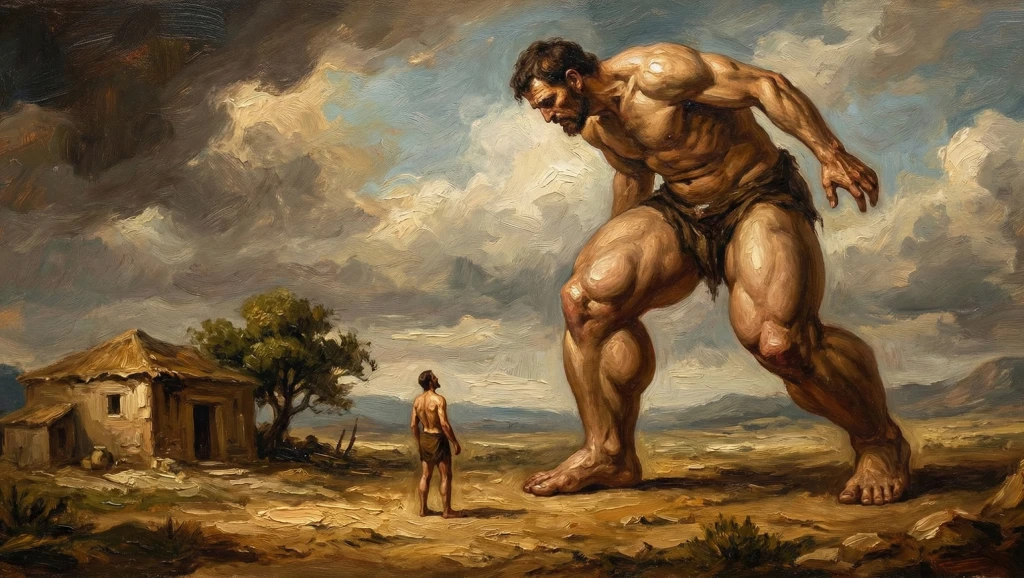
According to a well-known Islamic hadith, Allah created Adam, the first human being, in His image and at a height of sixty cubits. Whether the cubit here is supposed to be measured by Allah’s own arm is not clear. Using the conventional cubit of eighteen inches, however, sixty cubits amount to approximately ninety feet, or 27.4 metres. Some translations round this figure to about thirty metres. This is not a claim about an unusually tall man: it describes a “human” roughly as tall as an eight- to ten-storey building. Such a claim entails problems far beyond extraordinary height.
Anyone is free to believe a religious story. But when that story is presented as actual history—as a claim about the first human, humanity’s physical past, or a supposed continuous decrease in human height—it must confront the evidence of biology, physics and the fossil record. A proposition may seem sacred within the comfortable glass walls of belief, but in the real world, the compressive strength of bone, muscle cross-sectional area, blood pressure, gravity, heat exchange, reproductive biology and fossils do not yield to anyone’s religious feelings. Yet when we put such religious claims to the test of reason, believers often rush to ask why their feelings are being hurt. Anyone making a claim must also be prepared to hear and face criticism of it.
The central question is straightforward: could a ninety-foot-tall human body, made of known biological materials and equipped with human skeletal, muscular and circulatory systems, stand, walk, survive, reproduce and leave descendants under Earth’s normal gravity?
The scientific answer is no. In light of known human anatomy, biology, physics and the fossil record, a ninety-foot-tall human body is not biologically realistic. It exceeds the limitations of the familiar human body plan, conflicts with biomechanics and directly contradicts the evidence-based history of human evolution.
The Hadiths
Both Sahih al-Bukhari and Sahih Muslim describe Adam as sixty cubits tall. In Sahih al-Bukhari 3326 and 6227, a hadith narrated by Abu Huraira states that Allah created Adam at that height. The same account says that people entering Paradise will have Adam’s form and that, since his creation, human stature has continued to diminish until the present day. A corresponding account appears in Sahih Muslim 2841. [1] [2] —
Sahih al-Bukhari
Book of Asking Permission
Chapter: The beginning of Salam
Sahih al-Bukhari 6227. Narrated Abu Huraira: The Prophet (ﷺ) said, “Allah created Adam in His picture, sixty cubits (about 30 meters) in height. When He created him, He said to him, ‘Go and greet that group of angels sitting there, and listen what they will say in reply to you, for that will be your greeting and the greeting of your offspring.’ Adam went and said, ‘As-Salamu alaikum.’ They replied, ‘As-Salamu Alaika wa Rahmatullah.’ So they increased ‘Wa Rahmatullah.’ The Prophet (ﷺ) added: ‘So whoever will enter Paradise, will be of the shape and picture of Adam. Since then the creation of Adam’s offspring, i.e., stature of human beings, has been diminishing continuously up to the present time.’
Grade: Sahih
Narrator: Abu Huraira
Sahih Muslim
The Book of Paradise, its Description, its Bounties and its Inhabitants
Chapter: People Will Enter Paradise Whose Hearts Are Like The Hearts Of Birds
Sahih Muslim 2841. Abu Huraira reported Allah’s Messenger (ﷺ) as saying: “Allah, the Exalted and Glorious, created Adam in His image with his length of sixty cubits, and as He created him He told him to greet that group, and that was a party of angels sitting there, and listen to the response that they give him, for it would form his greeting and that of his offspring. He then went away and said: Peace be upon you! They said: May there be peace upon you and the Mercy of Allah, and they made an addition of ‘Mercy of Allah.’ So he who would enter Paradise would get in the form of Adam, his length being sixty cubits; then the people who followed him continued to diminish in size up to this day.”
Grade: Sahih
Narrator: Abu Huraira
Consider the following page from Bukhari Sharif. [3]
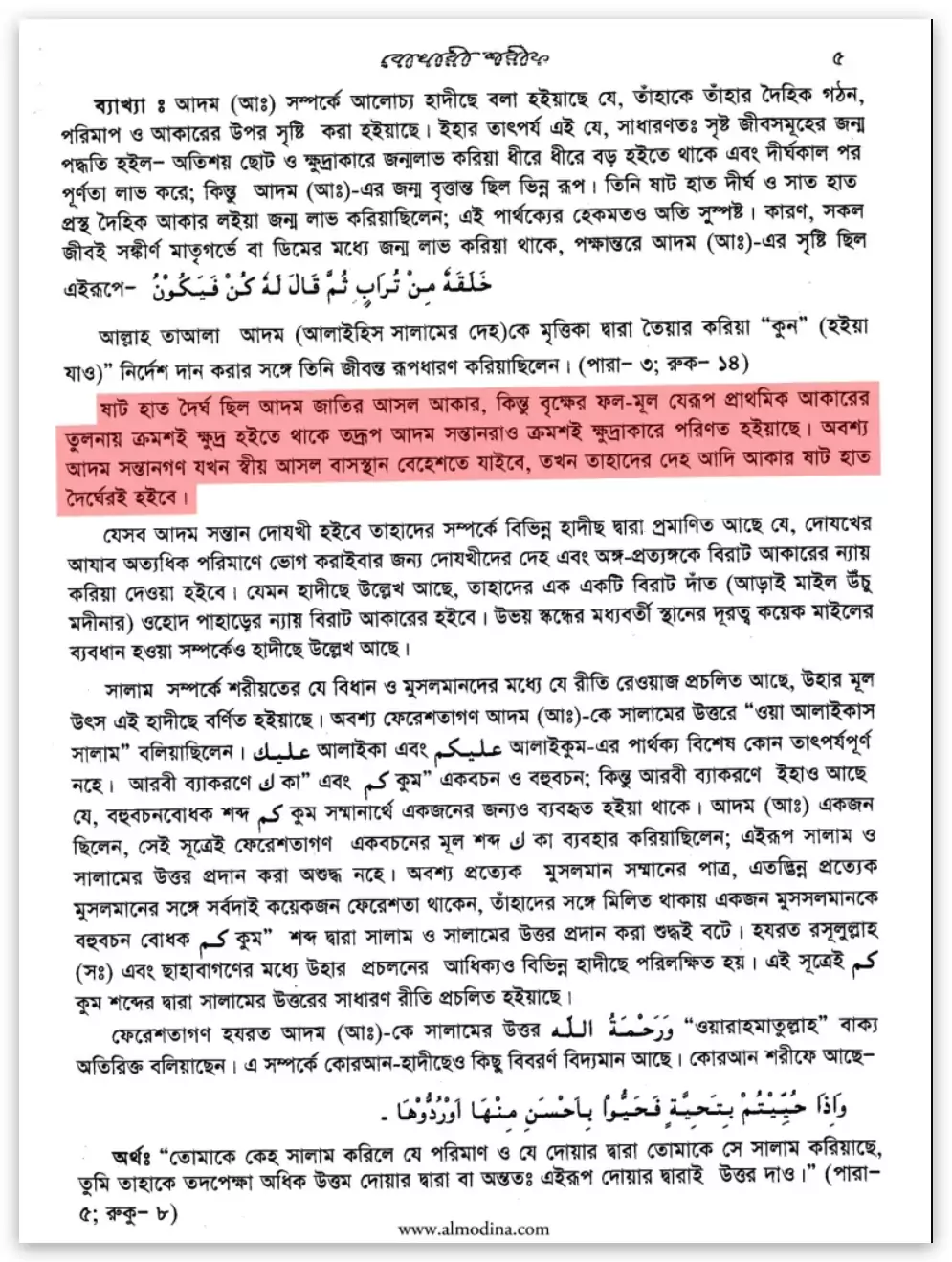
The hadith makes two distinct claims. First, Adam was sixty cubits tall. Second, human bodies have progressively diminished in size from Adam’s time to the present.
Had the first claim stood alone, Islamic apologists might have explained it away as a metaphysical height belonging to Paradise. The second claim makes it far harder to dismiss the hadith as a description merely of a “miraculous body in Paradise” or as a metaphor. After specifying Adam’s height, the hadith explicitly says that human stature has continued to decrease to this day. This is a direct empirical claim about the physical history of humanity, and therefore one that can be tested. If it were true, traces should be visible in the fossil record: in human skeletons and teeth, footprints, settlements, tools, evidence of diet and the biology of reproduction.
The evidence points in the opposite direction. Throughout the evolutionary history of humanity, there is no evidence of ninety-foot-tall people—or even of a naturally occurring human population fifteen feet tall.
Manzur Ilahi on Adam’s Height
Listen to the statement of Manzur Ilahi, a well-known Islamic scholar from Bangladesh.
How Tall Is Sixty Cubits, Exactly?
The cubit was not a fixed unit of measurement throughout antiquity. Its length varied somewhat between civilizations and periods. A conventional cubit, however, is commonly taken as about eighteen inches, or 45.7 centimetres. On that basis:
60 cubits × 1.5 feet = 90 feet.
That is approximately 27.4 metres.
If one uses a cubit of twenty or twenty-one inches rather than eighteen, the estimated height becomes even greater, potentially approaching one hundred feet. If, instead, someone tries to rescue the claim by treating the cubit as exceptionally short, the result becomes absurd. To reduce sixty cubits to the height of an ordinary six-foot person, each cubit would have to measure only 1.2 inches, or roughly three centimetres. “Cubit” would then no longer refer to a measurement based on the human forearm but to something like a small segment of a child’s finger. That interpretation is incompatible with language, history and metrology.
Thus, saying that “cubit measurements varied” does not resolve the problem. Shrinking the unit until the claim can be preserved merely empties the claim’s own wording of meaning.
Human Height Has Not Simply Decreased or Increased Throughout History
The Islamic account asserts that humans have steadily become shorter since Adam. The actual history of human stature, however, is not linear. Average height has fluctuated with region, climate, diet, disease, genetic ancestry, agriculture and social inequality. Some Upper Palaeolithic European populations were relatively tall. In certain regions, average stature subsequently declined during the Mesolithic and Neolithic periods. The emergence of agriculture did not always improve nutrition: in many cases, dietary diversity declined, exposure to disease increased and population density rose, contributing to reduced stature. Recent palaeogenomic research also indicates that Neolithic farmers were shorter relative to their genetically predicted height potential. [4]

None of this complexity helps the claim about a ninety-foot Adam in the slightest. Variation among heights of 150, 170, 180 or 190 centimetres is one thing; a human standing 27,000–30,000 millimetres tall is something entirely different. Comparing ordinary evolutionary variation in human height with ninety feet is like pointing to ripples in a teacup as evidence of a tsunami.
Has human height fluctuated throughout history? Yes. Is there scientific evidence that humans were ever ninety feet tall? No.
Scaling and the Square–Cube Law
Under the square–cube law, when all the linear dimensions of an object are increased by the same factor, its surface area increases with the square of that factor, while its volume—and, at constant density, its mass—increases with the cube. Enlarging an organism therefore increases its mass far faster than the load-bearing cross-sectional areas of its tissues.
Suppose a person who is six feet tall is enlarged fifteenfold to ninety feet, with all body proportions preserved. Then:
Height increases by a factor of 15.
The cross-sectional areas of bones, muscles and tendons increase by approximately 15² = 225 times.
But body volume and mass increase by 15³ = 3,375 times.
If the original six-foot person weighs 70 kilograms, the proportionally enlarged ninety-foot body would weigh approximately:
70 × 3,375 = 236,250 kilograms.
In other words, about 236 metric tonnes.
This is no longer an ordinary human body: it is an unstable biological structure weighing hundreds of tonnes while retaining a human shape. Its bones do not gain 3,375 times their load-bearing capacity; their cross-sectional area increases only about 225-fold. Consequently, stress from body weight on a given unit of bone area rises by roughly a factor of fifteen. Merely standing would be dangerous, and walking would increase the loading further. Human bones, muscles and connective tissues are adapted to ordinary human dimensions, not to supporting the mass of a proportionally enlarged ninety-foot body.
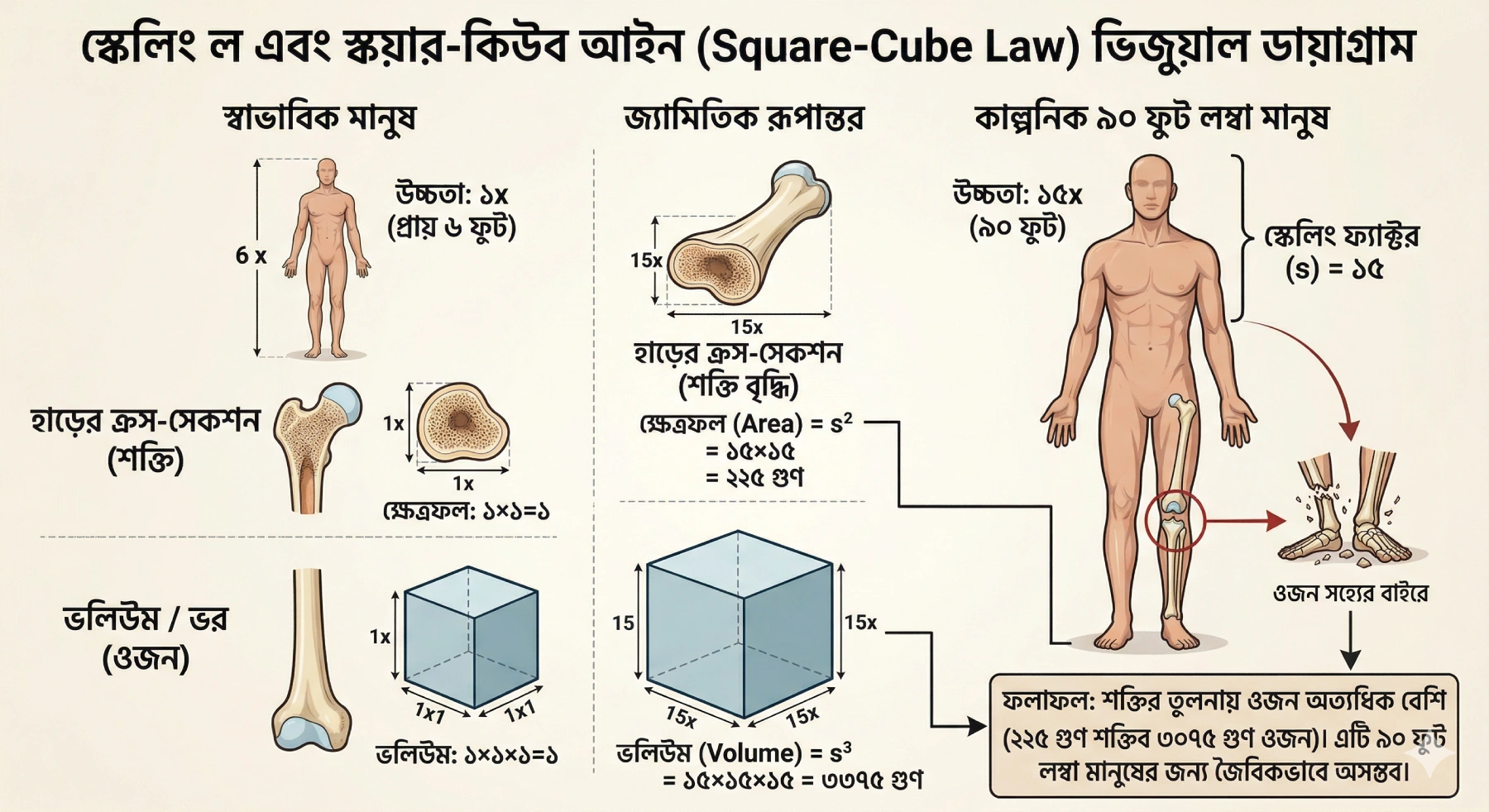
In his famous essay “On Being the Right Size,” J. B. S. Haldane used a sixty-foot giant to illustrate the problem. A giant ten times the height of an ordinary person would have 1,000 times the mass but only 100 times the bone cross-sectional area, creating ten times the stress per square inch of bone. A human femur can ordinarily withstand forces several times body weight, but in a giant, the forces of each step could cause the bone to fail. At ninety feet, the problem would be more severe still. [5]
By the square–cube law, increasing an object’s linear dimensions tenfold increases its volume approximately 1,000-fold. At ninety feet tall, a human-shaped body would have such enormous mass and volume that its ordinary human skeletal structure could not support it, making walking—or even standing upright on two legs—untenable.
“1x” height
about “15x” height
Balance and Physical Limitations
From a scientific perspective, a ninety-foot-tall human would be extremely unlikely to stand or move successfully with an ordinary human body plan. Humans are bipeds, and their balance depends on the position of the centre of mass relative to the feet and on the forces acting upon the body. A person of normal height can maintain balance within a workable range. If every dimension were enlarged proportionally, however, the centre of mass would also rise in proportion, while the geometry of the feet’s support area would scale up. The problem is therefore not simply static balance. The more fundamental difficulties are enormous body mass, joint torque, ground-reaction forces during each step and the immense kinetic energy involved in a fall. A narrow, upright, human-style biped weighing 200–300 tonnes would subject its knees, ankles, hips and spine to extreme torque whenever it tried to walk.
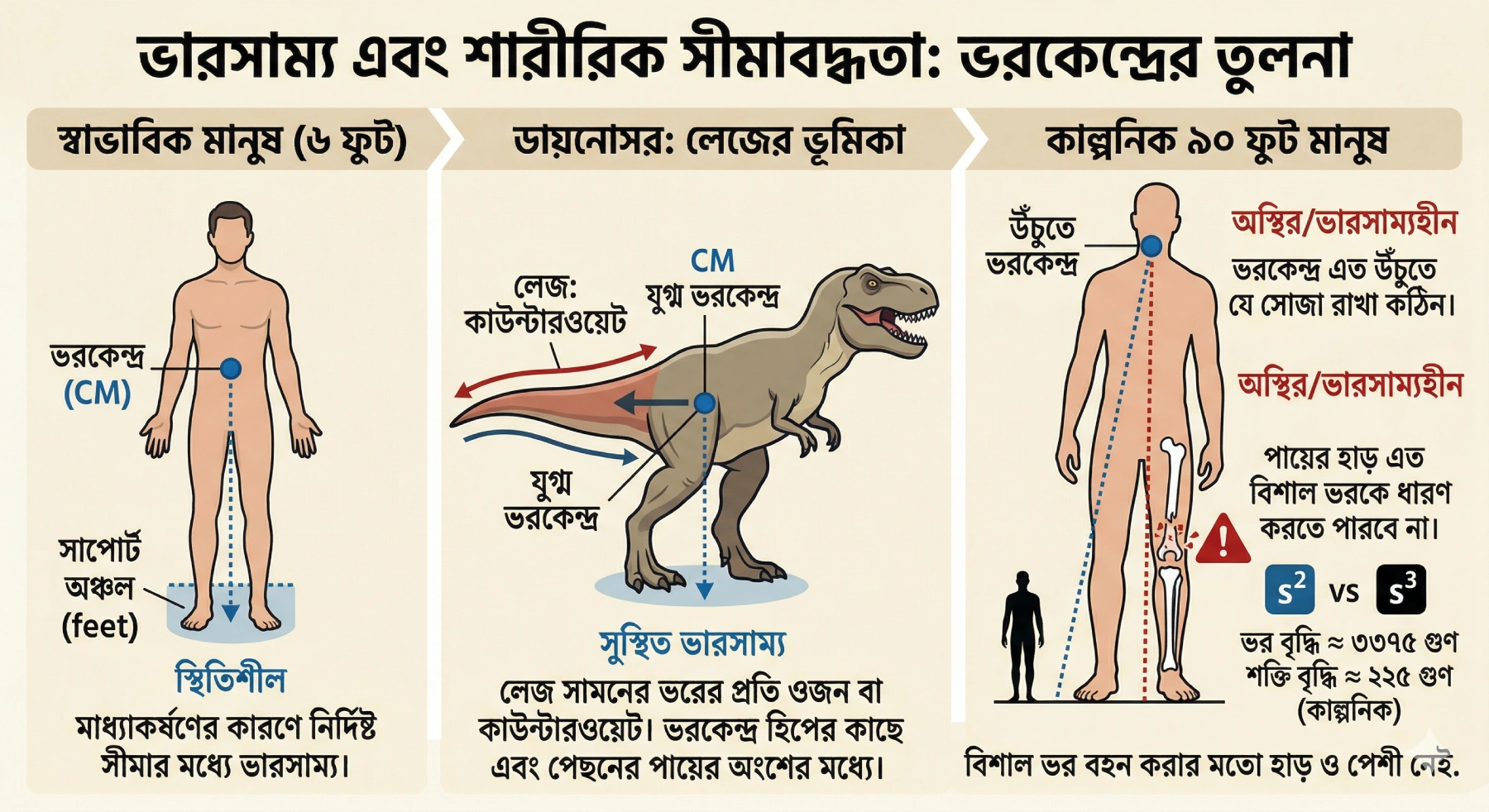
The Problem of Bones: How Could a 236-Tonne Body Stand on Two Legs?
Humans are bipeds. Our entire body weight is supported by two legs, especially the femurs, tibias, pelvis, ankles and arches of the feet. Each step imposes dynamic forces greater than the static load of simply standing. Running, jumping, sitting down, standing up and stumbling can subject the joints to loads several times body weight.
Now consider a ninety-foot human. Depending on the original individual used for proportional scaling, the body could weigh roughly 200–300 tonnes. Even while standing on two legs, each leg would bear loads ranging from many tens to more than a hundred tonnes. Walking would increase those forces.
Human bones are not concrete pillars. Bone is living tissue, containing marrow, blood vessels, microscopic structures and a continuous system of remodelling. Bone is strong, but its strength is not unlimited. Human bones are not built to carry a body with a mass comparable to heavy machinery aboard a small warship. If the leg bones of a ninety-foot human were enlarged while retaining normal human proportions, they could not withstand their own body’s weight. If those bones were made disproportionately thicker, the resulting organism would no longer have ordinary human proportions; it would require a radically different body plan, more like that of an elephant or a sauropod.
This creates a fundamental difficulty for the Islamic claim, which identifies Adam as a human being. A human skeletal design would not work for a ninety-foot terrestrial animal. Such a body would require radically different anatomy: exceptionally thick legs, an enormous pelvis, a differently structured spine, different tendons and foot architecture, a huge heart, a vastly more powerful vascular system and, quite possibly, a body that was no longer the familiar narrow, upright human biped.
In other words, if Adam really stood ninety feet tall, he could not have had the biological structure of an ordinary human; if he had an ordinary human body plan, he could not have stood ninety feet tall.
The Problem of Muscles and Movement
One might think that thicker bones would solve the problem. They would not. Muscle strength poses a comparable difficulty.
A muscle’s force-producing capacity depends primarily on its physiological cross-sectional area. Muscle force thus scales approximately with the square of linear size, while the mass the muscle must move scales with the cube. In a body enlarged fifteenfold, the muscles’ force capacity would rise about 225-fold while the mass to be moved would rise 3,375-fold. Relative to body weight, muscular capacity would therefore decrease by roughly a factor of fifteen.
This is one reason large animals cannot move, leap or manoeuvre with the same agility as much smaller animals. An elephant cannot climb a wall like an ant; a giraffe cannot rapidly lower and raise its head in the manner of a human; sauropods could not sprint like humans. Increasing size requires fundamental changes in the mechanics of the body.
The notion that a ninety-foot person could walk just like a normal human is childish. Every step would generate enormous ground-reaction forces. The knees, ankles, hips and spine would experience extreme torque. Even a slight slip or loss of balance could produce a fall violent enough to tear or severely damage internal organs.
The human body is not built for such mass. However solemnly religious imagination presents its giant, the claim collapses when subjected to biomechanics.
The Circulatory Problem: How Would Blood Reach the Head of a Ninety-Foot Body?
Blood circulation presents another formidable problem for a ninety-foot human. The heart must pump blood upward against gravity to reach the brain. In an ordinary person, the vertical difference between the heart and brain is relatively small. In a ninety-foot body, the head would be many metres above the heart.
Hydrostatic-pressure calculations show that lifting a fluid such as blood through several metres requires substantial pressure. If the vertical distance from heart to brain were even ten to twelve metres, hundreds of additional millimetres of mercury (mmHg) would be needed just to counter gravity. Normal human blood pressure is roughly 120/80 mmHg. A heart attempting to supply blood to the brain of a ninety-foot human would have to generate pressures far beyond those of the normal human cardiovascular system.
Giraffes are among the tallest living terrestrial mammals. Even at heights of approximately five to six metres, they require specialized cardiovascular adaptations: a powerful heart, elevated blood pressure, specialized vascular arrangements in the neck and mechanisms that help regulate blood pressure when the head is raised or lowered. A human body twenty-seven to thirty metres tall would face a much greater challenge. The human cardiovascular system has no comparable design.
If someone replies that “Allah specially created him that way,” this is not a scientific explanation; it is an ad hoc appeal to a miracle. At that point, empirical discussion has been abandoned. Miracles can be invoked to explain anything: people flying without wings, speaking without heads, or stones becoming pregnant. None of these are scientific explanations. They are stories insulated from verification.
The Problem of Thermoregulation
Humans are endothermic organisms: metabolic chemical processes generate heat within the body, and physiological regulation maintains a relatively stable internal temperature. In an ordinary human, body mass, surface area, blood flow, sweating, lungs and skin work together at a manageable scale. Enlarge that same body proportionally to ninety feet, however, and its thermoregulatory system would face a catastrophic mismatch.
The square–cube law explains the problem. If height, width and depth all increase fifteenfold, total surface area rises by about 15² = 225 times, but volume and mass increase by about 15³ = 3,375 times. Metabolic heat is generated largely by active tissues throughout the body. Under a simple proportional-scaling model, total heat production would rise thousands of times while the surface area available to release that heat would increase much less. The result would be an enormous biological heat trap.
Put simply, the skin surface of a ninety-foot human would not be sufficient to dissipate the immense metabolic heat predicted by such a scaled-up model. Normal humans lose heat through sweating, blood flow to the skin and respiration. In a ninety-foot body, the difficulty would be twofold: dramatically increased internal heat generation and a much smaller surface area relative to body mass. Deep tissues, muscles, organs and the brain would consequently face dangerous overheating. This would not merely cause discomfort; it could lead to fatal hyperthermia.
Large animals are therefore not simply enlarged versions of small ones. Elephants have column-like legs, different body proportions and enormous ears that help dissipate heat. The behaviour of large mammals also contributes to temperature regulation: they seek shade, move more slowly, enter water, cover themselves with mud or reduce activity during the hottest part of the day. Whales, meanwhile, achieve their enormous size in water, where buoyancy and thermal conditions differ fundamentally from those on land. Sustaining a very large body requires substantially different anatomical and physiological adaptations.
The human body does not have those adaptations. Human skin, sweat glands, circulation, heart, lungs and bodily proportions are not designed to cool a body twenty-seven to thirty metres tall and weighing hundreds of tonnes. To make a ninety-foot organism viable, its skin, blood vessels, sweat glands, heart, ears, limbs and overall proportions would all have to be redesigned. That organism would no longer follow the normal human body plan; it would constitute a fundamentally different biological structure.
A ninety-foot “human,” then, would face more than the difficulties of standing and walking: its own internal heat would pose a serious threat. A body whose mass grows 3,375-fold while its heat-dissipating surface grows only 225-fold cannot continue functioning on land with ordinary human proportions and physiology. The giant may sound impressive in religious imagination, but it fails the tests posed by thermodynamics and biology.
The Fossil Record: Where Are the Ninety-Foot Humans?
If the hadith were accurate, ninety-foot humans once existed and humanity then progressively became shorter. That would imply numerous transitional populations measuring eighty, seventy, sixty, fifty, forty, thirty, twenty or ten feet tall at various stages.
Such populations should have left traces in the fossil record. Not just a single bone, but extensive evidence would be expected. The femur of a ninety-foot human alone would be several metres long. Teeth, skulls, pelvises, vertebrae, rib cages and foot bones would all be enormous. Their footprints, dwellings, burial deposits, tools and signs of food consumption would be exceptional. The discovery of such people would rank among the most extraordinary findings in the history of palaeontology.
No such evidence exists.
Homo erectus was within the range of modern human stature. According to the Smithsonian Human Origins Program, estimated heights for Homo erectus range from about 145 to 185 centimetres. The Natural History Museum likewise describes Homo erectus as broadly comparable to modern humans in body size and shape. Neanderthals were generally around 150–175 centimetres tall, although more muscular and stockily built. [6]
The human relatives discussed in evolutionary research—Homo erectus, Homo heidelbergensis, Neanderthals and early Homo sapiens—were nowhere near ninety feet tall. Body size changed across the human lineage, but those changes occurred on the scale of metres, not buildings.
The claim about ninety-foot humans is therefore not merely unsupported by evidence; it directly conflicts with the evidence that exists.
Jewish Aggadah, Oral Exaggeration and Islamic Adaptation
The idea that Adam stood sixty cubits, or about ninety feet, tall did not emerge suddenly from nowhere as an isolated Islamic story. Ancient Near Eastern religious imagination, Jewish aggadic interpretation, the Babylonian Talmud, Jewish and Christian oral traditions in Arabia, and later Islamic hadith literature all belonged to a cultural environment in which stories of gigantic ancestors circulated. Long before the Islamic accounts of Adam, Jewish rabbinic literature had already imagined the first human as a being of extraordinary size. The cultural exchange and spread of such myths provide an intelligible background for the corresponding Islamic belief.
An extraordinary description of Adam’s stature appears in Chagigah 12a of the Babylonian Talmud. [7] There, a statement attributed to Rabbi Elazar says that the first human, Adam, extended “from the earth to the firmament,” while a statement attributed to Rav describes Adam as stretching “from one end of the world to the other.” The text then says that after Adam sinned, God laid His hand upon him and diminished his stature. Adam is thus first imagined as a being of cosmic proportions whose body is subsequently reduced. This demonstrates directly that the motif of an enormously tall first human existed in Jewish rabbinic literature before its appearance in Islamic hadith.
An even more explicit numerical parallel appears in Bava Batra 75a of the Babylonian Talmud. Discussing the future stature of the righteous, the text interprets the word ‘קוממיות’ (“upright stature”) in Leviticus 26:13. Rabbi Meir speaks of a height of 200 cubits, while Rabbi Yehuda gives a figure of 100 cubits. Rabbi Yehuda compares the latter height with that of the Temple and its walls. Rashi’s commentary also refers to Adam having been reduced to 100 cubits. These are not the sixty cubits of the Islamic account but even larger figures of 100 or 200 cubits. The conception of gigantic Adamic or righteous human beings was therefore already circulating within Jewish religious interpretation before the Islamic tradition. [8]
Modern biblical studies and Jewish-Christian discussions also identify this Talmudic motif. For example, Bible-oriented explanatory discussions such as “Bible in the Year” treat the idea of Adam’s gigantic stature not as the plain meaning of the Hebrew Bible but as a feature of subsequent Jewish rabbinic and Talmudic interpretation. The distinction matters: imagining Adam as a giant was neither unique to Islam nor an isolated invention. It was an older motif within a broader Jewish, Christian and Near Eastern store of religious narratives, retold with different measurements and formulations in different traditions. [9]
The Babylonian Talmud and the sahih hadith do not give identical figures. Some Talmudic descriptions extend Adam from earth to heaven or from one end of the world to the other; Bava Batra 75a discusses heights of 100 and 200 cubits; the Islamic hadith specifies sixty cubits. The relevant comparison is therefore not an “identical number” but a shared mythic pattern: the first human or future righteous people exceed the dimensions of ordinary bodies; the primordial human condition is gigantic; present humanity is smaller than a glorified past; and bodily height symbolizes holiness, grandeur or original perfection in religious imagination.
Pre-Islamic Arabia was not a culturally sealed island where such stories could never be exchanged. Jewish communities were historically present in the Arabian Peninsula, especially the Hijaz. Jewish tribes, religious narratives, biblical characters and oral traditions associated with the People of the Book formed part of the religious environment in Yathrib/Medina, Khaybar, Fadak and Tayma. Jewish and Jewish-influenced monotheistic elements also appear in the Himyarite setting of southern Arabia. Researchers continue to discuss how closely the Jews of pre-Islamic Arabia followed rabbinic and Talmudic traditions as distinct from local oral traditions. What is beyond doubt is that Jewish and Christian narratives circulated in Arabia’s religious milieu.
Against this background, the story of Adam’s gigantic body can reasonably be situated within the wider storytelling traditions of the late antique Near East. Ancient societies readily developed ideas that “people in the distant past were much taller than us,” “the first human reached the sky,” or “the righteous will one day have enormous bodies.” People in earlier periods lacked scientific explanations for fossils, enormous animal bones, unfamiliar ruins, megalithic monuments, caves or unusually large skeletal remains. They could interpret such discoveries as the remains of giants, ancient heroes, divine humans or vanished peoples.
Stories often become more exaggerated as they pass from person to person. Someone might begin by saying, “Ancient people were very tall”; in subsequent retellings they become “as tall as trees,” then “as tall as temples,” and finally “tall enough to touch the sky.” One tradition speaks of 100 cubits, another of 200, and the Islamic account of sixty. The numbers differ, but the underlying narrative psychology is similar: people are small today, while the past was immense. This sort of mythic inflation is familiar in ancient religious literature. Biblical genealogies assigning lifespans of hundreds of years, the cosmic Adam of Jewish Aggadah, the righteous people of 100 or 200 cubits in Bava Batra and the sixty-cubit Adam of Islamic hadith all exemplify such glorification of the distant past.
There is consequently no strong basis for treating sixty cubits as the result of a reliable measurement. It is not a finding recorded by palaeontologists, anatomists or metrologists; it is a number in a religious narrative. We do not have a certain map of how that exact number became fixed—through which oral tradition, interpretive setting or cultural exchange. We do know, however, that Jewish rabbinic literature imagined gigantic bodies for Adam and the future righteous before the Islamic accounts appeared, and that Islamic-era Arabia was not isolated from the circulation of Jewish and Christian stories.
There is no logical reason, then, to treat the sixty-cubit Adam hadith as an isolated item of “divinely revealed scientific information.” Historically, it can be explained much more naturally as an Islamic version of an older Near Eastern religious motif. The same Adam, the same glorification of the distant past, the same enormous body and the same idea that present-day humans are diminished—only the numbers and manner of narration have changed.
This historical discussion does not alter the central scientific question. Whether the story arose in Jewish, Christian, Islamic or popular tradition, a ninety-foot human body has no established biological foundation. The comparison further shows that the claim is not newly verified information but a transformed version of an ancient religious imagination. However old a story may be, its age cannot turn it into evidence against the fossil record, biomechanics, thermodynamics, circulatory physiology or human anatomy.
The age of a religious story does not make it true. A narrative does not become actual human history merely because it circulated for centuries among Babylonian Jews, Arabian Jews, Christians or Muslims. The older and more dependent on oral transmission a story is, the more carefully its status must be examined: is it history, or an expanding myth passed down from one generation to the next?
Conclusion
The claim that Adam stood ninety feet tall may appeal to religious sentiment, but under scientific examination it belongs to the unfounded beliefs of antiquity. Even using an ordinary cubit, the claim implies a human twenty-seven to thirty metres tall and weighing hundreds of tonnes. Under the square–cube law, body mass grows with the cube of scale while the cross-sectional capacity of bones and muscles grows only with the square. Bones, joints, muscles, the spine and the circulatory system would consequently fail under a proportionally enlarged human body plan. Pumping blood to the brain, regulating temperature, walking, standing and reproducing would all present overwhelming obstacles.
The fossil record provides no support for the claim either. There is no trace of ninety-foot humans among Homo erectus, Neanderthals or early Homo sapiens. The history of human height is complex and varies between regions, but there is no scientific evidence of a continuous decline from ninety feet to six feet.
The conclusion is therefore straightforward: the hadith describing Adam as sixty cubits tall is a religious narrative, but it is incompatible with the established biological and historical evidence about humanity. Presenting it as scientific history is intellectually dishonest. Saying “Allah could do it if He wished” does not rescue the claim; it merely removes it from the world of evidence and hides it in the darkness of the supernatural.
Human height can be measured. So can the strength of bones. Mass, mechanical stress, blood pressure, heat exchange and fossils can all be investigated. The evidence from this testable world points to the same conclusion: a ninety-foot Adam is not a reality of human biology but a gigantic religious claim that collapses under scientific examination.
References
- Sahih al-Bukhari, Tawhid Publications, hadith 6227 ↩︎
- Sahih Muslim, Islamic Foundation, hadith 6900 ↩︎
- Bukhari Sharif, Hamidia Library, Volume 4, p. 5 ↩︎
- S. Marciniak et al., “An integrative skeletal and paleogenomic analysis of stature variation suggests relatively reduced health for early European farmers,” PNAS, 2022 ↩︎
- J. B. S. Haldane, “On Being the Right Size,” 1928 ↩︎
- Smithsonian Human Origins Program, “Homo erectus”; Natural History Museum, “Homo erectus, our ancient ancestor”; Natural History Museum, “Who were the Neanderthals?” ↩︎
- Babylonian Talmud, Chagigah 12a; cf. Bava Batra 75a on 100/200 cubits and Adamic stature. ↩︎
- Babylonian Talmud, Bava Batra 75a; Rashi ad loc.; HebrewBooks archived text ↩︎
- Bible in the Year, Adam’s stature and later Jewish/Talmudic tradition ↩︎
