

Introduction
Atheists and religious nonbelievers have higher average intelligence than religious believers—a statistical finding repeatedly observed in psychological research. For nearly a century, researchers have examined the relationships among intellectual ability, belief in God, confidence in religious doctrines, and participation in religious practices. Multiple meta-analyses spanning different countries, age groups, and measurement methods have found a negative correlation between the strength of religious belief and general intelligence. In other words, higher intelligence has consistently been associated with a tendency toward lower religiosity. The strongest basis for this conclusion is not the opinion of a prominent atheist or an isolated survey, but the combined statistical evidence from numerous studies. [1]
small but robust negative association between intelligence and religiosity
To understand how high IQ, critical thinking, and religious disbelief are related, it is necessary to distinguish intelligence, belief, and cognitive style. A score on an intelligence test, the ability to think before accepting an immediate answer, and a person’s position on the truth of religious doctrines are three different matters. Research identifies specific relationships among them; understanding those relationships requires examining how each variable is measured and how large the observed effects are. The conclusions presented here rest on test results and pooled evidence from multiple samples, rather than on personal identities.
Intelligence, Atheism, and Religious Belief: What Do Researchers Measure?
In intelligence research, general intelligence (g) refers to the correlated abilities an individual displays across different cognitive tasks. IQ tests are intended to provide a standardized measure of this general ability. Religiosity, by contrast, is measured through indicators such as the strength of belief in God, acceptance of scriptures or supernatural doctrines, prayer, attendance at worship, religious identity, and observance of rituals. Thus, identifying as an atheist, lacking belief in God, and engaging in little religious activity are not necessarily the same category. Someone may participate in religious ceremonies for social reasons while holding weak religious beliefs; similarly, someone who identifies with a religion may reject many of its established theological claims. Researchers generally find a clearer relationship with religious belief than with religious behavior. [2]
it was also stronger for religious beliefs than religious behavior.
This distinction matters when interpreting the findings. Attending a religious gathering cannot fully establish the strength of a person’s private beliefs. Likewise, education, professional achievement, and IQ are not interchangeable measures. Academic performance is influenced by attention, social opportunities, economic circumstances, and educational institutions. Results from standardized intelligence tests therefore offer a more direct way to examine the association with religiosity. The negative association between intelligence and religious belief persists in studies using such tests.
The 2009 Study: Atheists Averaged Approximately 6 IQ Points Higher
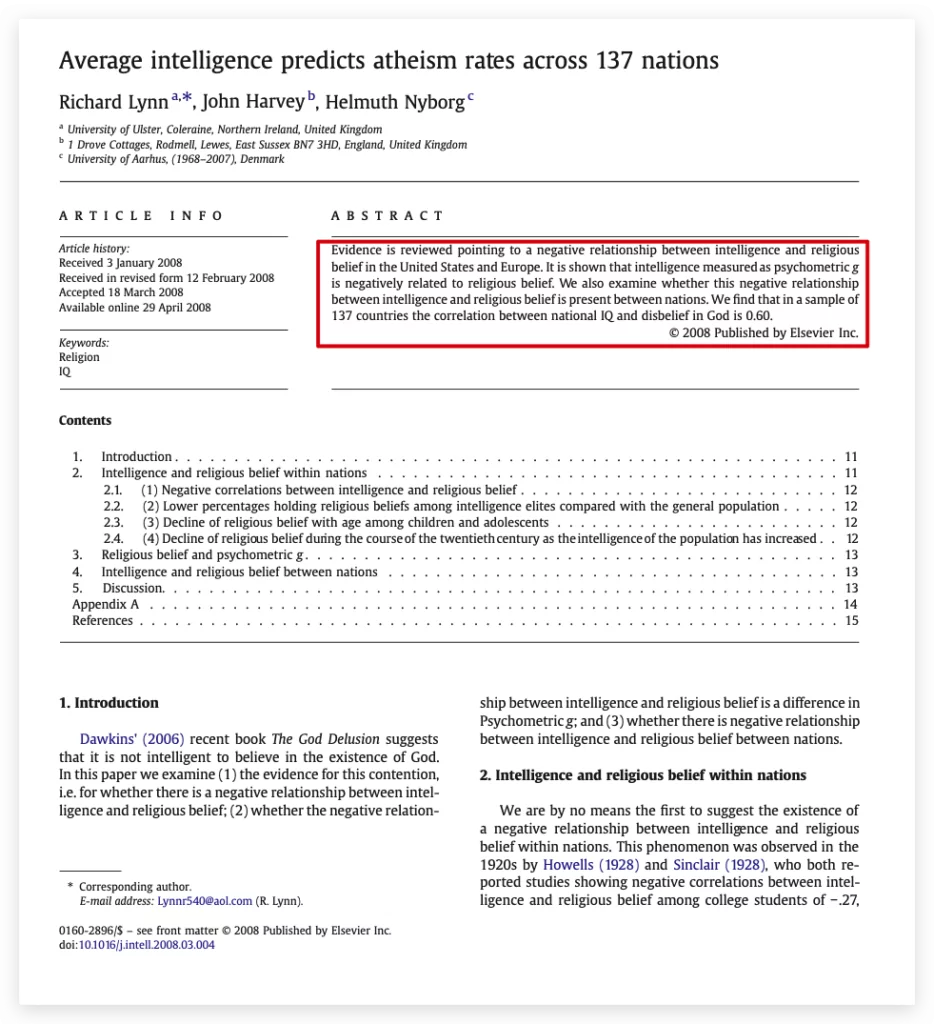
In a study published in 2009, Richard Lynn, John Harvey, and Helmuth Nyborg analyzed data from the United States National Longitudinal Survey of Youth 1997 (NLSY97). This was not a separate survey newly conducted by the researchers; it was a reanalysis of data from a national longitudinal survey of adolescents aged 12–17 in 1997. Their sample included religious-identification data and cognitive test results for 6,825 participants. Using scores from the Armed Services Vocational Aptitude Battery to construct an indicator associated with general intelligence, they reported that atheists scored, on average, approximately 6 IQ-equivalent points higher than the combined group of participants identifying with religions. The difference was also statistically significant. [3]
Atheists scored 6 g-IQ equivalent points higher than the combined group of subjects professing to one or another of a large number of different religions.
Using the same NLSY97 dataset, another analysis published by Nyborg in 2009 identified differences among religious orientations in a sample of White American adolescents. In that analysis, atheists scored an average of 1.95 IQ points higher than agnostics, 3.82 points higher than participants with liberal religious orientations, and 5.89 points higher than participants with dogmatic religious orientations. The overall average difference between atheists and religious believers in that sample was 5.13 points. The results revealed a gradient in cognitive ability across levels of religious commitment. However, these two 2009 studies cannot be counted as evidence from two independent samples: both drew their findings from the same NLSY97 dataset. [4]
Atheists score 1.95 IQ points higher than Agnostics, 3.82 points higher than Liberal persuasions, and 5.89 IQ points higher than Dogmatic persuasions.
A Comparison of 137 Countries: National Averages Are Not Individual-Level Data
In the same paper, Lynn, Harvey, and Nyborg reported a correlation of r = +0.60 between estimates of national IQ and rates of disbelief in God across 137 countries. In other words, the country-level figures they used associated higher estimated national IQ with higher rates of disbelief. But using national averages to compare the intelligence of an individual atheist with that of an individual believer is a logical error. A country’s average does not determine the position of every individual within that country. Furthermore, the Lynn–Vanhanen national IQ dataset has faced serious methodological criticism over the samples used for many countries, their representativeness, and their comparability across nations. The reported correlation of 0.60 across 137 countries therefore cannot substitute for individual-level research. Stronger evidence concerning the relationship between individual intelligence and religious belief comes from tests administered directly to individuals and from meta-analyses. [5]
Most data originates from samples which are wholly unrepresentative of their national populations.
Zuckerman’s Meta-Analyses: Combined Findings from 2013 and 2020
Combining findings from many studies is more reliable than treating the result of a single survey as a general rule. In 2013, Miron Zuckerman, Jordan Silberman, and Judith Hall published a meta-analysis of 63 studies examining the relationship between intelligence and religiosity. Most of the studies in the original review indicated a negative relationship; the widely cited count was 53 studies with results in that direction. Across samples of college students and the general population, the average correlation between intelligence and the strength of religious belief was approximately r = −0.24, with estimates ranging from −0.20 to −0.25 depending on the calculation method. Regardless of the number of studies, the meaning of this statistic is clear: higher intelligence is generally associated with weaker religious belief. [2]
A meta-analysis of 63 studies showed a significant negative association between intelligence and religiosity.
Additional research accumulated after the 2013 findings were published. In 2020, Zuckerman, Chen Li, Shengxin Lin, and Judith Hall published a new meta-analysis covering 83 studies. First published online in 2019 and included in a 2020 journal issue, this study found correlations between intelligence and religious belief ranging from −0.20 to −0.23 in college and noncollege samples. The direction of the relationship did not change with the addition of new data. The researchers also examined the mediating role of education and found that education alone could not explain the association between intelligence and religious belief, while finding support for partial mediation by analytic thinking. The negative association reported in 2013 was therefore not confined to one sample or one particular statistical method. [6]
the new analysis showed that the correlation between intelligence and religious beliefs in college and noncollege samples ranged from -.20 to -.23.
The 2022 Meta-Analysis: Combined Data from 201,457 Participants
In a broader meta-analysis published in 2022, Florian Dürlinger and Jakob Pietschnig collected 105 effect-size estimates from 89 studies, representing a combined sample of 201,457 participants. The overall correlation was r = −0.14, with statistical significance of p < 0.001 and a 95% confidence interval from −0.17 to −0.12. Although the correlation was small, its negative direction was robust in such a large pooled sample. The researchers tested 192 reasonable analytical specifications; all 135 specifications that produced statistically significant results showed a negative relationship. The association was clearer when intelligence was measured directly through cognitive tests rather than through indirect indicators such as academic grades. [7]
Out of 192 reasonable specifications all 135 (70.4%) significant summary effects were negative.
New Research in 2026: A Clearer Association with General Intelligence
On March 12, 2026, Dürlinger and Pietschnig published another study in Frontiers in Psychology. This time, they used NLSY data and a pooled analysis of multiple studies to investigate which characteristics of intelligence tests were most closely associated with religiosity. Their meta-analysis of 126 effect sizes yielded a combined correlation of approximately r = −0.135. Among tests that more strongly measured general intelligence, or g, the association reached approximately r = −0.20. In the researchers’ words, people with higher general intelligence are less likely to uphold religious worldviews. The same study found a more negative relationship between intelligence and belief than between intelligence and religious practice among Catholic participants. This result made the earlier research more specific: religious disbelief is associated not merely with educational qualifications but also with general cognitive ability. [8]
individuals of higher general intelligence are less likely to uphold religious worldviews
Research Findings at a Glance
| Study | Data | Main Finding |
|---|---|---|
| Lynn, Harvey & Nyborg (2009) | 6,825 adolescents in the United States | Atheists averaged approximately 6 IQ-equivalent points higher |
| Zuckerman et al. (2013) | 63 studies | Average correlation with religious belief of approximately −0.24 |
| Zuckerman et al. (2020) | 83 studies | Correlations in relevant samples ranging from −0.20 to −0.23 |
| Dürlinger & Pietschnig (2022) | 89 studies; 105 effect sizes; 201,457 participants | Pooled correlation of −0.14; p < 0.001 |
| Dürlinger & Pietschnig (2026) | NLSY data and 126 effect sizes included in a meta-analysis | Overall correlation of approximately −0.135; approximately −0.20 for tests with high g-loadings |
The same primary studies may have been included again in different meta-analyses. It would therefore be incorrect to add together the 2013, 2020, 2022, and 2026 datasets and call them four entirely independent bodies of evidence. What matters is that the overall negative direction of the relationship has persisted across different researchers, additional data, and new analytical methods. The difference of 6 IQ points from a particular sample and the correlation of −0.14 pooled across many studies are also different kinds of statistics; they cannot be treated as equivalent.
The Inverse Association Between Religious Belief and Intelligence Also Appears in Old Age
The association is not confined to samples of young students. In 2014, Stuart Ritchie, Alan Gow, and Ian Deary examined data from a longitudinal cohort whose childhood intelligence test scores had been preserved and whose cognitive abilities were subsequently measured repeatedly between ages 79 and 90. The original sample contained 550 individuals. Religious belief measured at age 83 was negatively associated with intelligence in later life, but no comparable association was observed for religious attendance. In particular, correlations of approximately −0.14 to −0.15 were found between intelligence at age 79 and religious belief four years later. The study did not find evidence that religiosity caused faster cognitive decline. Its findings show that the negative association between religious belief and average intelligence is also present in older adult samples. [9]
We found that religious belief, but not attendance, was negatively related to intelligence.
Why Is Religious Disbelief More Common Among People with Higher Intelligence?
Researchers have discussed several psychological mechanisms that may underlie the association between intelligence and religious disbelief. Zuckerman and colleagues proposed analytic thinking, independence from conventional beliefs, and the availability of functional alternatives to the psychological roles fulfilled by religion. These are proposed explanations of the observed association. They do not all have equally strong experimental support: while many studies have examined cognitive style and religious belief, independent causal tests of the other two explanations have been relatively limited.
Questioning answers that initially seem correct, looking for evidence against one’s own assumptions, and identifying logical inconsistencies are characteristics of analytic thinking. Higher intellectual ability is associated with performing such tasks. Claims about miracles, invisible beings, or religious authority then also become subjects of scrutiny. Research has repeatedly found a negative association between analytic thinking and religious belief.
A claim taught by family, society, or religious authorities does not become true simply because it is conventional. The ability to evaluate claims independently makes it possible to reject socially established doctrines. Zuckerman and colleagues discussed reduced conformity to conventional views among people with higher intelligence as one possible explanation of religious disbelief. This is a proposed psychological explanation, not a description of every atheist’s personal motives.
Religious belief may serve functions such as coping with uncertainty, providing a sense of control, offering emotional comfort, and fostering social support. Problem-solving ability, self-regulation, and alternative social relationships may satisfy some of these needs in other ways. According to the researchers’ proposal, these alternative capacities may reduce dependence on religion among people with higher intelligence.
The explanation involving analytic thinking can be tested: if a person is more inclined to question initial assumptions, how likely are they to accept claims about God’s existence or supernatural explanations? The 2022 meta-analysis also examined whether cognitive style mediates the relationship between intelligence and religious belief. Accounting for cognitive style reduced the magnitude of the direct intelligence–religiosity association; conversely, the association between analytic thinking and religiosity did not disappear entirely when intelligence was taken into account. Thus, these two cognitive traits are related, but their explanatory roles are not identical. [10]
The Cognitive Reflection Test (CRT): Verified Answers Instead of Intuitive Responses
The Cognitive Reflection Test, or CRT, uses questions for which the answer that first comes to mind is often wrong. Getting the right answer requires suppressing an intuitive reaction and checking the calculation or reasoning again. The CRT is therefore not synonymous with an IQ test; it is specifically used to assess the tendency to engage in reflective thinking rather than accept intuitive answers. Although the CRT is related to intelligence, the two measures are not identical. Studies using this separate test have also found a similar statistical tendency toward atheism and religious disbelief.
In a study published in Cognition in 2012, Gordon Pennycook, James Cheyne, Paul Seli, Derek Koehler, and Jonathan Fugelsang examined the relationship between analytic thinking and religious and paranormal beliefs. They found a negative association between analytic thinking and supernatural belief even after accounting for factors such as age, gender, education, political orientation, religious practice, and cognitive ability. Thus, religious disbelief is associated not only with higher IQ but also with the tendency to examine the logic of a claim before accepting it. [11]
Participants more willing to engage in analytic reasoning were less likely to endorse supernatural beliefs.
In 2016, Pennycook, Robert Ross, Derek Koehler, and Jonathan Fugelsang published four new studies alongside a meta-analysis of earlier data. The paper was titled Atheists and Agnostics Are More Reflective than Religious Believers. Their findings provided further support for the link between religious disbelief and reflective thinking. They also examined whether the findings could be explained merely by the order of the questions, since the CRT was administered before religious belief was measured. [12]
7,771 Participants Across 19 Countries: A Cross-National Study in 2025
In 2025, Omid Ghasemi, Onurcan Yilmaz, Ozan Isler, Jenny Terry, and Robert Ross analyzed data from 7,771 university students in 19 countries and found that higher reflective-thinking scores were associated with weaker belief in God, while a greater tendency toward intuitive answers was associated with stronger belief in God. The study used a preregistered analysis plan, and university students were selected to keep participants’ educational levels comparable. Manipulating the order of the questions to administer the CRT first did not provide evidence of a reduction in belief in God. Thus, the association between test performance and belief was not merely the result of beliefs changing immediately upon exposure to the test questions. [13]
we found a negative relationship between reflective thinking and BiG
The significance of this cross-national study is that the relationship between reason-based thinking and religious disbelief was not observed only in one American sample. Similar questions have been investigated in other cultural settings. However, the strength of the association is not identical across countries. A 2018 study of 3,461 participants from 13 societies found an overall negative association, but individual country-level results were not equally strong. This highlights the importance of the larger 2025 study: testing the same psychological association requires diversity in cultural settings and samples. [14]
The results provide additional evidence for culture’s effects on core beliefs.
50,827 Participants Across 16 Countries: Analytic Thinking and Changes in Belief
In another study published in Cognition in 2025, Michael Stagnaro and Gordon Pennycook analyzed two large datasets containing a total of 50,827 participants from 16 countries. Nearly one-quarter of participants reported having experienced a significant change in their religious beliefs at least once in their lives. Analytic thinking was associated not only with religious disbelief but also with the tendency to change one’s beliefs. The finding highlights an important feature of critical thinking: reassessing positions one has previously accepted. The study relied on participants’ retrospective reports of change and contemporary measurements; it was not a longitudinal experiment that directly tracked each participant’s changes in belief over many years. [15]
In total, this work provides evidence for a robust link between analytic thinking and religious belief change over time.
Evolutionary Psychology and the Savanna-IQ Hypothesis
In his 2010 article Why Liberals and Atheists Are More Intelligent, Satoshi Kanazawa attempted to explain the association between intelligence and religious disbelief using the Savanna-IQ Interaction Hypothesis. According to his proposal, general intelligence may help people adapt to situations and values that were unfamiliar in humanity’s evolutionary past. He categorized religious belief as an evolutionarily familiar tendency and modern atheism as a comparatively novel social position. Analyzing data from the National Longitudinal Study of Adolescent Health and the General Social Survey, he found a positive association between intelligence and atheism in adulthood. [16]
show that adolescent and adult intelligence significantly increases adult liberalism, atheism
The observed intelligence–atheism association in Kanazawa’s study and his evolutionary explanation are two separate claims. Survey data can be used to examine the correlation between intelligence and atheism, but that correlation alone does not establish that atheism is evolutionarily novel or that religious belief is a universal innate instinct. Those are theoretical assumptions of the hypothesis. Therefore, establishing that atheists have higher average intelligence does not require accepting Kanazawa’s evolutionary explanation as true. Direct statistical findings from numerous psychological studies already establish the association itself.
Belief Versus Religious Practice: Why Does the Social Environment Matter?
In a society, religion is not merely a private opinion; it is also part of family identity, festivals, social relationships, and established rituals. Consequently, religious identity and religious behavior do not always reveal the actual strength of a person’s belief in God. The finding that intelligence is more strongly associated with religious belief than with participation in worship or other religious activities is consistent with this distinction. In particular, the 2026 Dürlinger–Pietschnig study reported a correlation of r = −0.09 between intelligence and religious belief in Catholic samples, compared with r = +0.04 for religious behavior. In other words, conclusions about a person’s beliefs based on religious behavior are not equivalent to directly measured internal belief. [17]
distinguishing between religious beliefs and behaviors is therefore necessary
This distinction does not negate the association between cognitive ability and religious disbelief; it clarifies which measures capture it most clearly. To understand a person’s position on the truth of religious doctrines, that position must be measured directly. Treating social identity and personal belief as the same thing obscures actual changes in belief.
What Correlation Means: Group Averages Are Not Individual Judgments
The statistical claim that atheists have higher average intelligence than religious believers is entirely different from the claim that every atheist is more intelligent than every religious believer. Research supports the first statement, not the second. Even when two groups have different averages, their score distributions overlap substantially. Knowing someone’s religious identity therefore does not allow us to determine that person’s IQ. Conversely, isolated examples of individuals cannot invalidate an observed difference between group averages. The existence of an exceptionally intelligent religious believer does not make the data on atheists’ comparatively higher average intelligence false; nor does the existence of an atheist with low intelligence refute it.
Another logical boundary is clear: finding an association between higher intelligence and weaker religious belief does not mean that high IQ constitutes philosophical proof that God does not exist. Determining the truth of specific claims about God, miracles, or religious scriptures requires examining the arguments and evidence supporting those claims. At the same time, it is scientifically possible to measure how people with different cognitive abilities accept or reject religious claims without first settling whether religious doctrines are true. The established research finding is that higher intelligence is generally associated with lower religiosity and greater disbelief. This is a statistical conclusion, not one constructed by assuming the truth of any particular worldview.
Intelligence and Cognitive Style: The Question of Causation
Does higher intelligence reduce religious belief? Does religious disbelief create certain opportunities for intellectual engagement? Or are both traits associated with another factor? Correlational statistics alone cannot establish the direction of causation. In 2012, Gervais and Norenzayan reported reduced religious belief in experiments designed to temporarily activate analytic thinking. However, a preregistered replication involving 941 participants in 2017 failed to reproduce that specific experimental effect. This did not invalidate the underlying observational association; rather, it failed to provide sufficient support for the particular causal claim that temporarily activating analytic thinking necessarily reduces religious belief. [18]
The original finding does not seem to provide reliable or valid evidence that analytic thinking causes a decrease in religious belief.
The 2025 study across 19 countries likewise found no credible difference in average belief-in-God scores depending on whether participants completed the CRT before or after the belief measure. These experiments establish an important distinction: people with stronger reflective-thinking abilities and dispositions tend to exhibit more religious disbelief, but there is no evidence that briefly presenting a few reasoning questions immediately changes an individual’s religious beliefs. Conflating an association with stable cognitive traits and the effect of a short-lived experimental prompt is a scientific error.
Conclusion
Research from different periods on the relationship between intelligence and religious belief has repeatedly reached a consistent conclusion: on average, atheists and religious nonbelievers demonstrate higher intellectual ability than religious believers, and higher intelligence is negatively correlated with the strength of religious belief. A 2009 study based on data from American adolescents found a difference of approximately 6 IQ-equivalent points. Meta-analyses of 63 studies in 2013, 83 studies in 2020, and 89 studies in 2022 also repeatedly confirmed the negative association. The pooled evidence from 201,457 participants in 2022 and the 2026 analysis focusing on general intelligence have further expanded the evidentiary basis of this conclusion.
This association is not confined to IQ tests. Researchers have also found relationships among analytic thinking, the tendency to correct incorrect intuitive answers, and the strength of belief in God. The 2016 meta-analysis on reflective thinking, the 2025 study of 7,771 students across 19 countries, and the study of changes in belief among 50,827 participants across 16 countries provide additional evidence of these connections. Psychological research has repeatedly identified an association between religious disbelief and the ability and inclination to question religious authority, claims of miracles, and beliefs inherited through socialization.
These statistics describe average differences across many participants, not judgments about particular individuals. It is incorrect to apply a group-level average difference to an individual’s score, just as it is incorrect to deny a research-based average difference by citing exceptional individuals. Numerous studies have established an association between stronger religious belief and lower average intelligence scores, and between higher intelligence and greater religious disbelief. Although the causal mechanisms underlying this relationship have not all been determined to the same degree, the existence of the association is well supported by evidence.
References
- Dürlinger & Pietschnig (2022), PLOS ONE, 17(2), e0262699 ↩︎
- Zuckerman, Silberman & Hall (2013), Personality and Social Psychology Review, 17(4), 325–354 1 2
- Lynn, Harvey & Nyborg (2009), “Average intelligence predicts atheism rates across 137 nations,” Intelligence, 37(1), 11–15 ↩︎
- Nyborg (2009), “The intelligence–religiosity nexus,” Intelligence, 37(1), 81–93 ↩︎
- Sear, “National IQ datasets do not provide accurate, unbiased or comparable measures of cognitive ability worldwide,” preprint ↩︎
- Zuckerman, Li, Lin & Hall (2020), “The Negative Intelligence–Religiosity Relation: New and Confirming Evidence,” Personality and Social Psychology Bulletin, 46(6), 856–868 ↩︎
- Dürlinger & Pietschnig (2022), “Meta-analyzing intelligence and religiosity associations: Evidence from the multiverse,” PLOS ONE, 17(2), e0262699 ↩︎
- Dürlinger & Pietschnig (2026), “The negative intelligence-religiosity link may be differentiated according to cognitive test g-loadings and (Christian) religious denominations,” Frontiers in Psychology, 17, 1633400 ↩︎
- Ritchie, Gow & Deary (2014), “Religiosity is negatively associated with later-life intelligence, but not with age-related cognitive decline,” Intelligence, 46, 9–17 ↩︎
- Dürlinger & Pietschnig (2022), mediation analyses concerning cognitive style ↩︎
- Pennycook, Cheyne, Seli, Koehler & Fugelsang (2012), “Analytic cognitive style predicts religious and paranormal belief,” Cognition, 123(3), 335–346 ↩︎
- Pennycook, Ross, Koehler & Fugelsang (2016), PLOS ONE, 11(4), e0153039 ↩︎
- Ghasemi, Yilmaz, Isler, Terry & Ross (2025), “Reflective thinking predicts disbelief in God across 19 countries,” Psychonomic Bulletin & Review, 32, 2220–2229 ↩︎
- Gervais et al. (2018), “Analytic atheism: A cross-culturally weak and fickle phenomenon?”, Judgment and Decision Making, 13(3), 268–274 ↩︎
- Stagnaro & Pennycook (2025), “On the role of analytic thinking in religious belief change,” Cognition, 254, 105989 ↩︎
- Kanazawa (2010), “Why Liberals and Atheists Are More Intelligent,” Social Psychology Quarterly, 73(1), 33–57 ↩︎
- Dürlinger & Pietschnig (2026), Frontiers in Psychology, 17, 1633400 ↩︎
- Sanchez, Sundermeier, Gray & Calin-Jageman (2017), “Direct replication of Gervais & Norenzayan (2012),” PLOS ONE, 12(2), e0172636 ↩︎
