

Introduction
According to a widely held Islamic belief, Muhammad split the moon in the sky into two with a gesture of his finger to prove the truth of his prophethood. Hadith reports and their Bengali translations describe the moon’s two pieces falling on either side of a mountain in Mecca. Various Quran commentaries, hadith commentaries and religious tales elaborate the event further: in some, the moon descends to earth; in others, its two parts fall on Safa and al-Mash’arayn; and in still others, it circumambulates the Kaaba and passes into and out of Muhammad’s sleeves. In these accounts, the moon is an object that can be brought down from the sky in an instant, divided, dropped on either side of a mountain and then returned to its former position. The inconsistencies in this story, believed by hundreds of millions, become clear when it is compared with the known characteristics of the actual earth and its satellite.
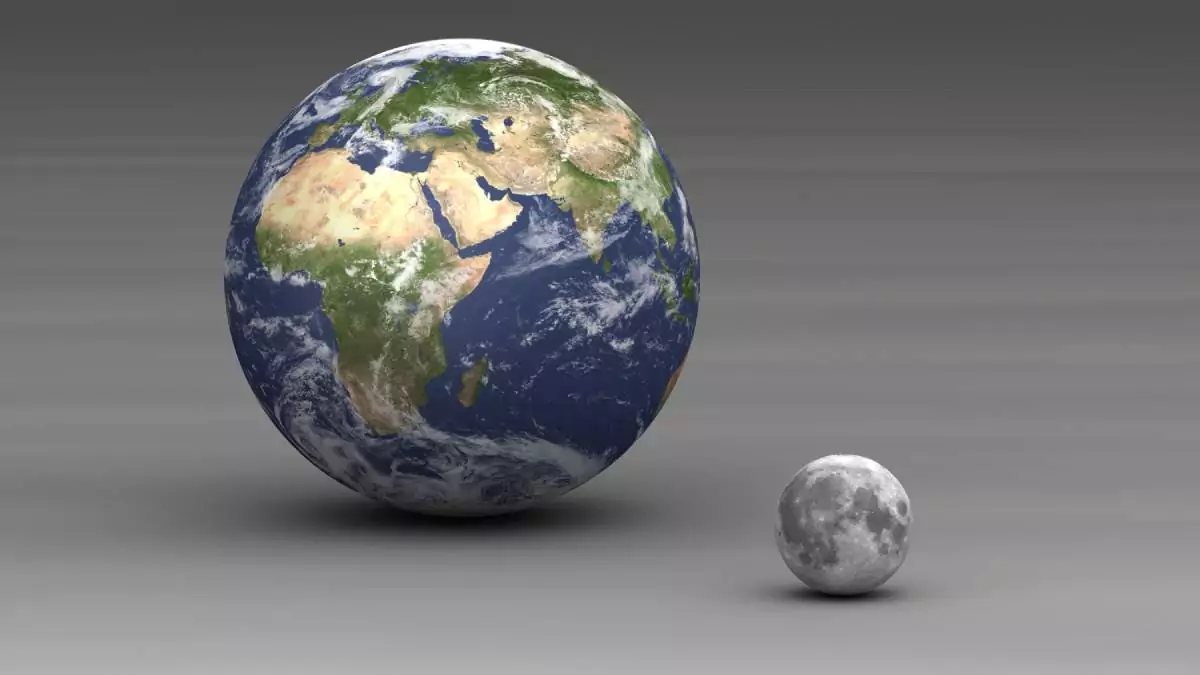
The moon is not a small object merely because it looks small in the sky. Located approximately 384,000 kilometres from Earth, this satellite has a mean diameter of about 3,475 kilometres. Its volume is roughly one-fiftieth of Earth’s and its mass approximately one eighty-first; that mass is about 7.35 × 10²² kilograms. Dividing the moon into two equal parts would give each piece a mass of approximately 3.67 × 10²² kilograms. Even if one piece were reshaped into a sphere of equal volume, its diameter would be about 2,758 kilometres. Half the moon is therefore no rock lying beside a mountain; it is a rocky body immense even on a continental scale. If such an object descended towards Earth and crashed into a mountain in Mecca, the event would not remain a miraculous spectacle confined to a single city. The energy of the collision, the destruction of Earth’s surface and its global consequences would be catastrophic for the entire planet. [1]
Even at this great distance, the moon’s gravity plays a major role in ocean tides. Bringing half its mass down near a mountain would also dramatically alter the mutual gravitational attraction of Earth, the oceans and the moon. Separating two enormous rocky pieces and then reuniting them through a collision would not make their kinetic energy disappear; some of it would become heat, deformation and fragmentation. Yet the traditional story treats this vast satellite like a toy that can be pulled down at will and put back without damage. Many centuries before Muhammad, the Greek astronomer Aristarchus attempted to determine the relative sizes of the moon and Earth through observations of lunar eclipses. Investigation into the actual size and distance of the apparently small moon had already begun; imagining it as a small object falling on either side of a mountain is incompatible with that reality. [2] [3]
Statements by Islamic Scholars (Video)
In the sermon below, a Bangladeshi Islamic scholar recounts the splitting of the moon in detail. According to his account, Abu Jahl challenges Muhammad to demonstrate proof of his prophethood. In response, Muhammad splits the moon in the sky into two with a gesture of his finger. The scholar’s account goes beyond a mark appearing on the distant moon or two luminous sections being seen on either side of a mountain: the pieces crash down onto Earth. He presents the event as proof of the Prophet’s miraculous power, as though bringing such an enormous satellite down from the sky, dropping it onto Earth and leaving everything normal afterwards were perfectly ordinary.
The moon described in this sermon is the actual moon familiar to us, with a diameter approaching three and a half thousand kilometres and a half-mass that is itself unimaginably large. Each piece crashing onto Earth would constitute a collision between Earth and an enormous celestial body. The two mountains of Mecca could hardly keep those pieces apart; a collision with Earth would inevitably entail immense destruction. This story of splitting the moon and dropping it onto Earth in response to Abu Jahl’s challenge conflicts with the actual moon’s size, mass and the consequences of an impact. Listen to the scholar’s own account in the video below.
Accounts of the Splitting of the Moon in the Quran and Hadith
The splitting of the moon is promoted in Islamic belief as a major miraculous sign. Its basis extends beyond stories told in sermons: the first verse of Surah al-Qamar in the Quran and several reports in Sahih Muslim, Sahih al-Bukhari and al-Tirmidhi refer to the moon splitting. Some accounts describe the Meccans demanding a sign; others claim the narrators were with Muhammad at Mina, describe the moon’s two pieces and their positions relative to mountains, or recount the Meccans’ accusation of sorcery. The way the event is presented in Bengali translations published by the Islamic Foundation, Hadith Academy and other publishers makes both the familiar form of this belief and its textual basis clear. Hadith numbers vary between publishers and editions; the corresponding international numbers are also provided in the references. [4] [5] [6]
The Quran: Surah al-Qamar, Verse 1
The first verse of Surah al-Qamar states that the Hour has drawn near and the moon has split. Its Arabic text is: اقْتَرَبَتِ السَّاعَةُ وَانْشَقَّ الْقَمَرُ. The following verse refers to people turning away from a sign and calling it sorcery. The first verse gives no account of who split the moon, how or where it was split, or what subsequently happened to its pieces. Hadith reports and Quran commentaries connect the verse to an event during Muhammad’s lifetime. Four Bengali translations commonly used in Bangladesh express the same point in the first verse: the moon has been cleft or split. [7]
The Hour has drawn near and the moon has been cleft,
— Taisirul Quran
The Hour is imminent, the moon has split,
— Sheikh Mujibur Rahman
The Hour has drawn near and the moon has split.
— Rawai Al-bayan
The Hour has come near [1], and the moon has split [2],
— Dr. Abu Bakr Muhammad Zakaria
Sahih Muslim: Two Pieces at Mina, Bengali Hadith 6815
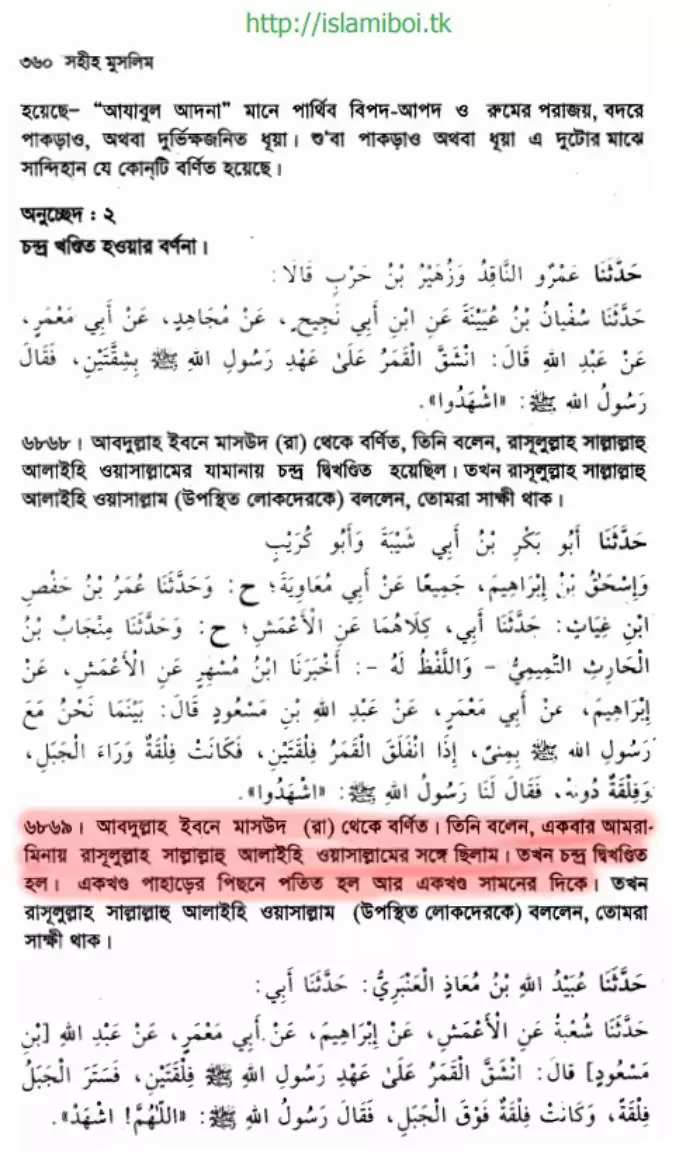
In Sahih Muslim’s chapter on the splitting of the moon, a report attributed to Abdullah ibn Mas’ud states that the moon split while he and others were with Muhammad at Mina. The Islamic Foundation’s Bengali translation says that one piece fell on this side of the mountain and the other on the far side. Muhammad then told those present to bear witness. The report therefore claims an event witnessed by people at a specific place during Muhammad’s lifetime, rather than merely predicting the Day of Judgment. It is numbered 6815 in the Islamic Foundation edition and 2800b in the international numbering. [8] [9]
Sahih Muslim (Islamic Foundation)
Book 53: The Day of Judgment, Paradise and Hell
Chapter 9: Account of the splitting of the moon
6815. Abu Bakr ibn Abi Shaybah, Abu Kurayb, Ishaq ibn Ibrahim, Umar ibn Hafs ibn Ghiyath, and Minjab ibn al-Harith al-Tamimi (may Allah have mercy on them) … narrated from Abdullah ibn Mas’ud (may Allah be pleased with him). He said: We were with the Messenger of Allah (peace and blessings of Allah be upon him) at Mina. At that moment, the moon (suddenly) split into two. One piece fell on this side of the mountain and the other on the far side. The Messenger of Allah (peace and blessings of Allah be upon him) then said: Bear witness.
Hadith grade: Sahih (authentic)
Al-Tirmidhi: Two Pieces on Two Mountains, Hadith 3289
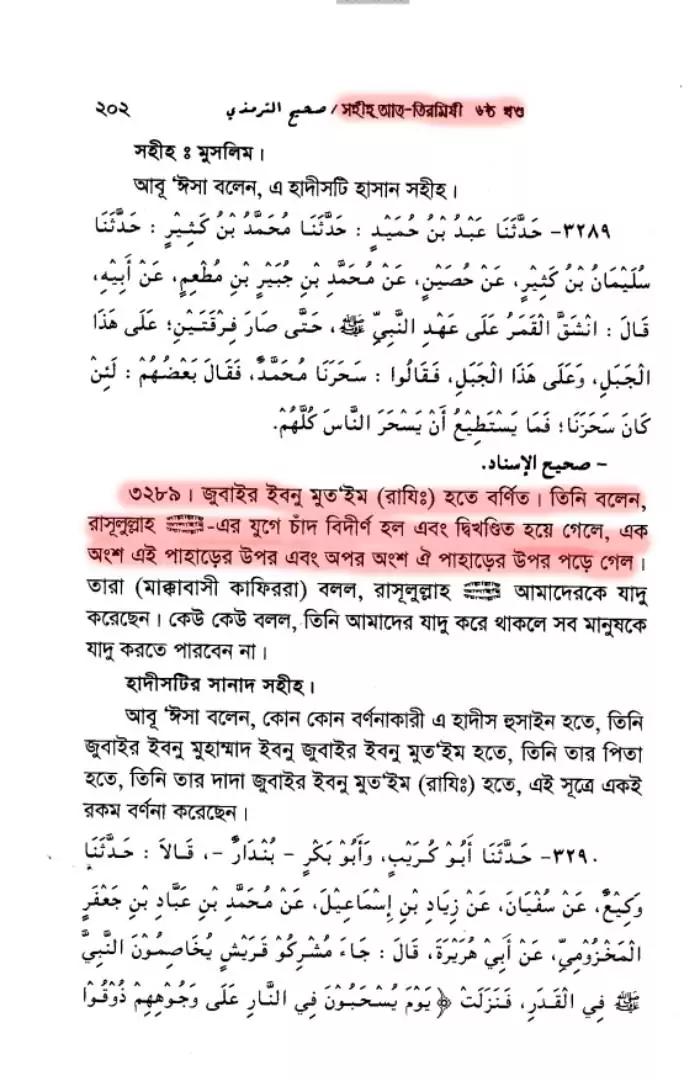
In the report preserved by al-Tirmidhi through Jubayr ibn Mut’im, the Bengali translation states that after the moon split, one piece fell on one mountain and the other on another mountain. The story also describes the Meccans’ response: they accused Muhammad of sorcery, while some of those present said that even if he could bewitch them, he could not bewitch everyone. The moon’s two pieces on the mountains and the conversation among the Meccans together present an account of a public miraculous event. The report is numbered 3289 in the chapter on Surah al-Qamar within al-Tirmidhi’s book of Quran commentary. [10] [11]
Sunan al-Tirmidhi (Critically Verified Edition)
Book 44: Commentary on the Quran
Publisher: Husain al-Madani
Chapter 55: Surah al-Qamar
3289. Narrated from Jubayr ibn Mut’im (may Allah be pleased with him). He said: During the time of the Messenger of Allah (peace and blessings of Allah be upon him), the moon split into two, and one part fell on this mountain and the other on that mountain. They (the Meccan unbelievers) said: The Messenger of Allah (peace and blessings of Allah be upon him) has bewitched us. Some said: Even if he has bewitched us, he cannot bewitch everyone.
The chain of transmission of this hadith is authentic.
Abu Isa said: Some narrators have reported a similar account through Husayn, from Jubayr ibn Muhammad ibn Jubayr ibn Mut’im, from his father, from his grandfather Jubayr ibn Mut’im (may Allah be pleased with him).
Hadith grade: Sahih (authentic)
Sahih Muslim: Behind and Above the Mountain, Bengali Hadith 6966
Another report of the same event in Sahih Muslim, transmitted through Ibn Mas’ud, states that after the moon split, the mountain concealed one piece while the other remained above it. In the Hadith Academy’s Bengali edition, Muhammad then asks Allah to bear witness. Both this account and the preceding one describe the moon splitting during Muhammad’s lifetime and specify the positions of the pieces relative to a mountain. The report is numbered 6966 in the Hadith Academy edition, 6816 in the Islamic Foundation edition and 2800c internationally. [12] [13]
Sahih Muslim (Hadith Academy)
Book 52: The Day of Judgment, Paradise and Hell
Chapter 8: Account of the splitting of the moon
6966-(45/…) Ubaydullah ibn Mu’adh al-Anbari (may Allah have mercy on him) … narrated from Abdullah (may Allah be pleased with him). He said: During the time of the Messenger of Allah (peace and blessings of Allah be upon him), the moon split into two pieces. The mountain concealed one piece and the other was visible above the mountain. The Messenger of Allah (peace and blessings of Allah be upon him) then said: O Allah! Bear witness. (Islamic Foundation 6816, Islamic Centre 6870)
Hadith grade: Sahih (authentic)
Sahih Muslim: Anas’s Brief Account, Bengali Hadith 6819
Sahih Muslim also contains a brief account transmitted through Anas. In hadith 6819 of the Islamic Foundation’s Bengali edition, he reports that the moon split; the version transmitted through Abu Dawud specifies that the event occurred during Muhammad’s lifetime. This account does not give the mountain’s name, the positions of the moon’s pieces or the Meccans’ words in detail. Its central claim is that the event occurred in Muhammad’s time, a claim elaborated in other reports through descriptions of mountains, those present and their reactions. [14]
Sahih Muslim (Islamic Foundation)
Book 53: The Day of Judgment, Paradise and Hell
Chapter 9: Account of the splitting of the moon
6819. Muhammad ibn al-Muthanna and Ibn Bashshar (may Allah have mercy on them) … narrated from Anas (may Allah be pleased with him). He said: The moon split. The report transmitted through Abu Dawud (may Allah have mercy on him), however, states that the moon split during the time of the Messenger of Allah (peace and blessings of Allah be upon him).
Hadith grade: Sahih (authentic)
Sahih Muslim: A Demand for a Sign and the “Twice” Wording, Bengali Hadith 6818
Another report through Anas connects the splitting of the moon with the Meccans’ demand for a sign. Hadith 6818 in the Islamic Foundation edition of Sahih Muslim states that the people of Mecca asked Muhammad for a sign and he showed them the splitting of the moon. The Bengali translation includes “twice” in parentheses; the Arabic text also contains the word «مَرَّتَيْنِ» (“twice”). Ibn Hajar discusses whether the splitting happened once or twice, and the relationship between “twice” and “two pieces,” in Fath al-Bari. In this version, the moon splitting is presented as a sign shown in response to the Meccans’ demand. [15] [16]
Sahih Muslim (Islamic Foundation)
Book 53: The Day of Judgment, Paradise and Hell
Chapter 9: Account of the splitting of the moon
6818. Zuhayr ibn Harb and Abd ibn Humayd (may Allah have mercy on them) … narrated from Anas (may Allah be pleased with him). He said: The people of Mecca asked the Prophet (peace and blessings of Allah be upon him) to show them a sign (miracle). He showed them the sign of the splitting of the moon (twice).
Muhammad ibn Rafi (may Allah have mercy on him) … narrated from Anas (may Allah be pleased with him) an account similar to Shayban’s.
Hadith grade: Sahih (authentic)
Sahih al-Bukhari: Ibn Abbas’s Account, Bengali Hadith 3377
Sahih al-Bukhari also preserves a report through Ibn Abbas that the moon split during Muhammad’s lifetime. It is numbered 3377 in the Islamic Foundation’s Bengali edition; the report quoted here corresponds to international number 3638. The relevant chapter heading in al-Bukhari refers to the polytheists requesting a sign and Muhammad showing them the splitting of the moon. The brief text of the report, attributed to Ibn Abbas, states that the moon split in Muhammad’s time. Together with the Quranic verse, these reports in Sahih Muslim, al-Tirmidhi and al-Bukhari form the event’s basis in Islamic religious texts. [17] [18]
Sahih al-Bukhari (Islamic Foundation)
Book 50: The Prophets (peace be upon them)
Publisher: Islamic Foundation
Chapter 2077. When the polytheists asked the noble Prophet (peace be upon him) to show a miracle, he showed them the moon split in two
3377. Khalaf ibn Khalid al-Qurashi (may Allah have mercy on him) … narrated from Ibn Abbas (may Allah be pleased with him) that the moon split during the time of the Prophet (peace and blessings of Allah be upon him).
Hadith grade: Sahih (authentic)
Accounts of the Moon Splitting in Commentaries and Explanatory Works
The moon-splitting story is not confined to the original hadith reports. Its explanation and circulation expanded further in hadith commentaries, works on the Prophet’s miracles and Bengali translations of those works. Their authors connect Quranic verses with hadith reports, explain the positions of the moon’s pieces and recount stories that people outside Mecca also witnessed the event. Bengali commentaries and translations explicitly describe pieces of the moon falling above or below a mountain in numerous places. This wording is therefore not a modern critic’s interpretation; it appears very clearly in religious books printed by Muslim publishers.
Nasr al-Bari: One Piece Above the Mountain, the Other Below
The ninth volume of Nasr al-Bari, a Bengali commentary on Sahih al-Bukhari, prints the account of the moon splitting transmitted through Ibn Mas’ud. Report 387 on page 620 of the Shibli Publications edition states that the moon split during Muhammad’s time and that one piece fell above the mountain and the other below it. Muhammad then told those present to bear witness. The Bengali printing explicitly uses the word “fell.” This description of the two pieces falling above and below a mountain is significant as a Bengali hadith text circulated by a Muslim publisher; the complete paragraph and the printed page appear below. [19]
387. Musaddad (may Allah have mercy on him) … narrated through Ibn Mas’ud (may Allah be pleased with him), who said: The moon split during the time of the Messenger (peace and blessings of Allah be upon him). One piece fell above the mountain and the other below it. The Messenger (peace and blessings of Allah be upon him) then said: Bear witness.

Qadi Iyad’s Al-Shifa: The Moon’s Pieces and the Story of Outside Witnesses
In the chapter on the splitting of the moon and the return of the sun in Al-Shifa bi-Ta’rif Huquq al-Mustafa, Qadi Iyad presents the event as a miraculous sign of Muhammad. After quoting the verses of Surah al-Qamar, he cites Ibn Mas’ud’s account of the moon’s two pieces and the mountain. He then includes other reports placing the event in Mecca, recounting the Quraysh’s accusation of sorcery and claiming that people arriving from elsewhere saw the same event. Pages 589–590 of the first volume of Sanjari Publications’ Bengali edition print the Arabic and Bengali translation together. This Bengali edition also describes one piece of the moon falling above the mountain and the other below it. [20] [21] [22]
Chapter Twelve
فِي إِنْشِقَاقِ الْقَمَرِ وَحَبْسِ الشَّمْسِ
The miracle of the Master (peace be upon him): splitting the moon and bringing back the setting sun
The words of Allah Most High—
اقْتَرَبَتِ السَّاعَةُ وَأَنشَقَّ الْقَمَرُ وَإِن يَرَوْا ءَايَةً يُعْرِضُوا
وَيَقُولُوا سِحْرٌ مُسْتَمِرٌ
“The Hour has drawn near and the moon has split. And if they see a sign, they turn away and say: This is sorcery that has continued.”
In this verse, Almighty Allah refers to the splitting of the moon using a past-tense verb and states that the unbelievers deny Allah’s signs. All Quran commentators and the scholars of Ahl al-Sunnah have agreed that this event occurred.
The report of Hazrat Abdullah ibn Mas’ud (may Allah be pleased with him) states:
انْشَقَّ الْقَمَرُ عَلَى عَهْدِ رَسُولِ الله صَلَّى اللَّهُ عَلَيْهِ وَسَلَّمَ فِرْقَتَيْنِ فِرْقَةٌ فَوْقَ الْجِبَلِ وَفِرْقَةٌ دُونَهُ فَقَالَ رَسُولُ اللهِ صَلَّى اللَّهُ عَلَيْهِ وَسَلَّمَ اشْهَدُوا،
“During the time of the Master (peace and blessings of Allah be upon him), the moon split and one piece fell above the mountain, while the other fell below it. The Master then said: Bear witness.”
And in the report of Hazrat Mujahid (may Allah be pleased with him), he says:
وَنَحْنُ مَعَ النَّبِيِّ صَلَّى اللهُ عَلَيْهِ،
“At that time I was with the Master (peace and blessings of Allah be upon him).”
In the report of Hazrat Anas (may Allah Most High be pleased with him), it is stated that the event occurred at Mina. This account is also narrated from Hazrat Ibn Mas’ud and Hazrat Aswad (may Allah Most High be pleased with them). He says:
حَتَّى رَأَيْتُ الْجِبَلِ بَيْنَ فُرْجَتَي الْقَمَرِ وَرَوَاهُ عَنْهُ مَسْرُوقٌ أَنَّهُ كَانَ بِمَكَّةَ وَزَادَ فَقَالَ كُفَّارُ قُرَيْشٍ سَحَرَكُمُ ابْن أَبِي كَيْشَةً فَقَالَ رَجُلٌ مِنْهُمْ إِنَّ مُحَمَّدًا إِنْ كَانَ سَحَرَ الْقَمَرَ فَإِنَّهُ لَا يَبْلُغُ مِن سِحْرِهِ أَن يَسْحَرَ الْأَرْضَ كُلَّهَا فَاسْأَلُوا من يَأْتِيكُمْ مِن بَلَدٍ آخَرَ هَلْ رَأَوْا هَذَا فَأَتَوْا فَسَأَلُوهُمْ فَأَخْبَرُوهُم أَنَّهُمْ رَأَوْا مِثْلَ ذَلِكَ،
“I saw the moon split in two and fall upon the mountain.” The report transmitted by Hazrat Masruq (may Allah Most High be pleased with him) places the event in Mecca. This version adds that the unbelievers of Quraysh told him: Ibn Abi Kabshah (that is, the Master, peace and blessings of Allah be upon him) has bewitched you. One of them said: If Muhammad (peace and blessings of Allah be upon him) has bewitched the moon, the effect of his sorcery on it would not extend to bewitching the entire earth. Ask those arriving from other lands whether they saw the moon split. When the Meccans asked them, they said: Yes, we saw the moon split.
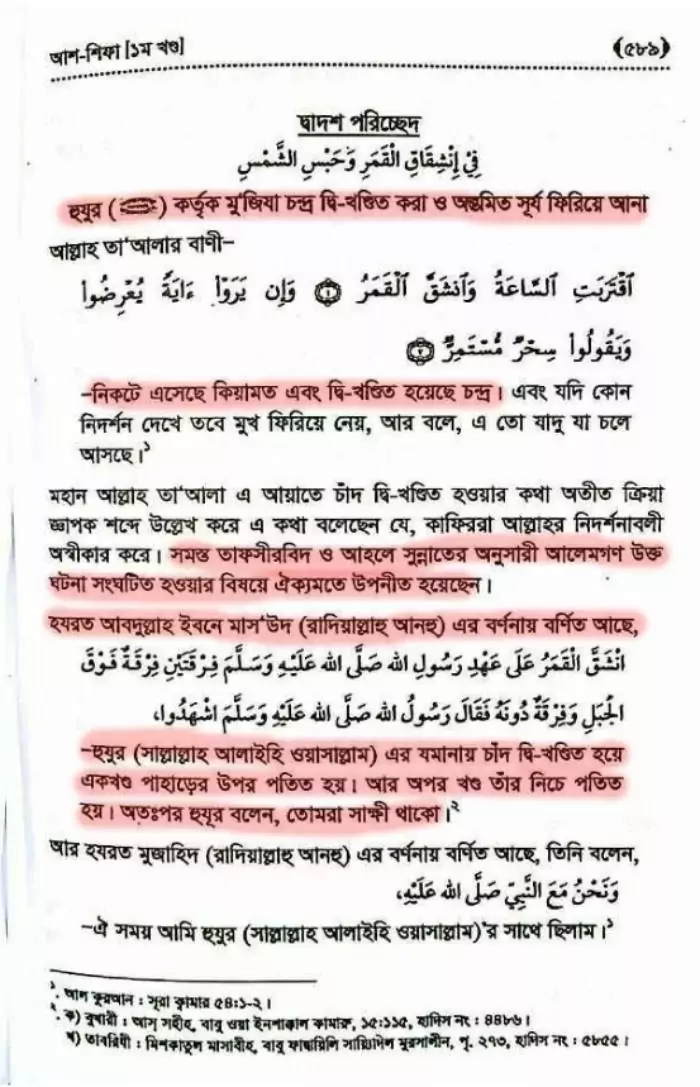
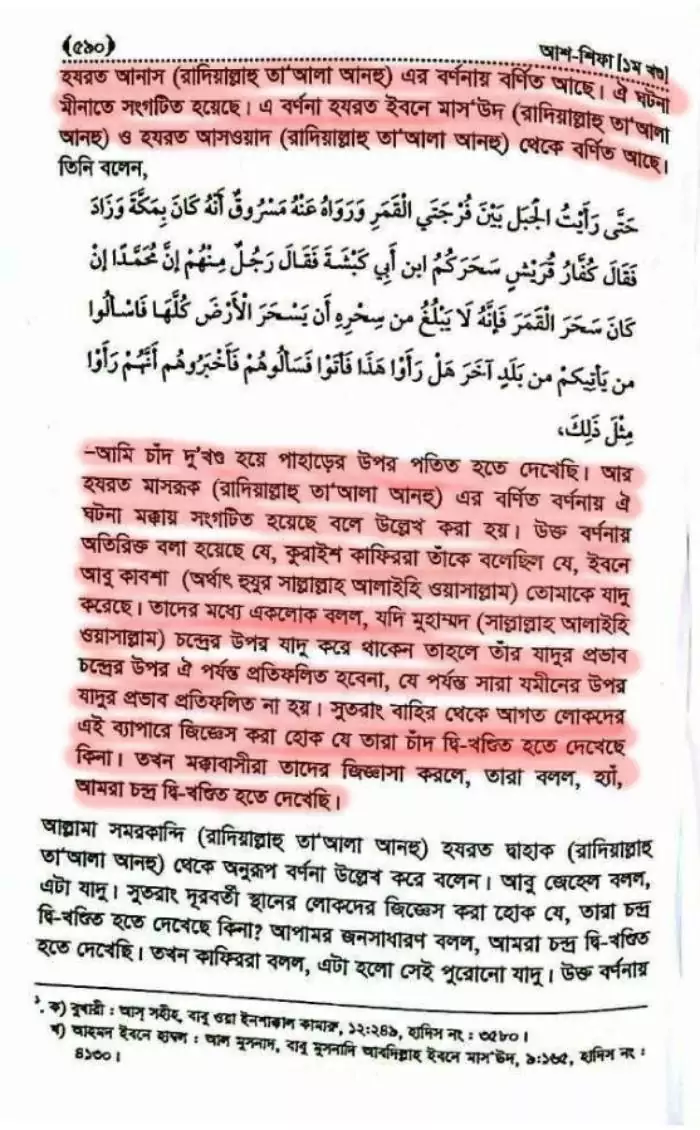
In this passage from Al-Shifa, one of the Quraysh argues that even if Muhammad could bewitch the Meccans present, he could not bewitch everyone on Earth; people arriving from elsewhere should therefore be questioned. The story then claims that these outsiders saw the same event. These foreign or outside witnesses are part of a report preserved in Qadi Iyad’s book. The passage supplies neither their names, their places of residence nor the identity of any independent record contemporary with the event.
Abu al-Abbas al-Qurtubi: The Moon Really Split in Two
In Al-Mufhim lima Ashkala min Talkhis Kitab Muslim, a commentary on Sahih Muslim, Abu al-Abbas Ahmad ibn Umar al-Qurtubi interprets the splitting of the moon as a real event. In the discussion of Surah al-Qamar in volume seven, he states that the moon genuinely split into two and that this happened at Mina in Mecca. In his account, Muhammad showed the Quraysh the splitting after they requested a sign. He also accepts Ibn Mas’ud’s description of the two sides of the mountain as an account of the event. He insists that the splitting actually occurred, rather than treating it as a mere metaphor or an observer’s optical illusion. [23]
(قَوْلُهُ : انْفَلَقَ الْقَمَرُ ) أَيِ : انْشَقَّ نِصْفَيْنِ ، أَيْ : وَقَعَ ذَلِكَ الِانْشِقَاقُ عَلَى حَقِيقَتِهِ ، وَوُجِدَ ذَلِكَ بِمَكَّةَ بِمِنًى
English translation: The moon splitting means that it divided into two halves; that is, the splitting actually occurred, and it took place at Mina in Mecca.
In response to the question of why others did not see such an enormous celestial event, al-Qurtubi adds that it happened at night, when many people were asleep or not looking at the sky. His discussion also suggests the possibility that Allah turned the rest of humanity away from looking at the moon at that moment so that only the Meccans would witness the sign. This is yet another miraculous claim, intended to keep every other people on Earth from witnessing the event. Offering a story of people’s gazes being miraculously diverted to explain the absence of contemporary testimony only makes this religious tale more absurd. [24]
Ibn Hajar: The Question of One Splitting or Two
In Fath al-Bari, his commentary on Sahih al-Bukhari, Ibn Hajar al-Asqalani discusses whether the moon split once or twice. One report in Sahih Muslim uses “twice,” while others speak of the moon’s two pieces. Ibn Hajar says that he knows of no hadith scholar who definitively held that the moon split more than once during Muhammad’s lifetime. He also discusses explanations offered by Ibn al-Qayyim and Ibn Kathir: “twice” might have been intended to mean two pieces. The book thus preserves the commentators’ discussion of word meanings and the relationship between reports as they attempted to reconcile this discrepancy. [25]
ولا أعرف من جزم من علماء الحديث بتعدد الانشقاق في زمنه
English translation: I know of no hadith scholar who definitively asserted that the splitting occurred more than once during his lifetime.
Mulla Ali al-Qari: Below or Near the Mountain
In Sharh al-Shifa, his commentary on Qadi Iyad’s Al-Shifa, Mulla Ali al-Qari explains the words locating the moon’s two pieces relative to the mountain. He suggests that the mountain associated with the upper piece could be Hira or Abu Qubays. He interprets the word «دونه» used for the other piece as below or near the mountain. The same book also discusses the reports of a mountain appearing between the moon’s pieces and of questioning people arriving from outside Mecca. This commentary explains the word as indicating a position below or nearby; that is the distinction between this Arabic explanation and the Bengali translation’s “fell.” [26]
(فوق الجبل) أي جبل حراء أو أبي قبيس (وفرقة دونه) أي أسفل منه أو قريب منه
English translation: Above the mountain—that is, Mount Hira or Abu Qubays; and one piece below it—that is, below or near the mountain.
Arabic Accounts, Bengali Translations and Separate Stories of the Moon’s Fall
Religious books circulated in Bengali explicitly describe pieces of the moon falling above and below a mountain. In the Islamic Foundation edition of Sahih Muslim, one piece “fell” on this side of the mountain and the other on the far side; the Bengali translation of al-Tirmidhi likewise says that the pieces “fell” on two mountains. These translations help explain the accounts of pieces crashing onto Earth promoted in Bangladeshi scholars’ sermons. Comparing the Arabic originals with their Bengali translations also shows that translators have added a verb of their own in many places. The Arabic describes the positions of the moon’s two pieces; some Bengali translations turn those positions into the event of the pieces falling. The similarity between these Bengali accounts of a fall and the explanations circulated in Bengali commentaries is clear. Identifying these differences establishes exactly what each book says.
Muslim 2800b: Two Sides of the Mountain
A report in Sahih Muslim transmitted through Abdullah ibn Mas’ud states that the moon split into two while they were with Muhammad at Mina. In that account, one piece was behind the mountain and the other on this side of it. The Islamic Foundation’s Bengali translation expresses these positions as “one piece fell on this side of the mountain and the other fell on the far side.” The Arabic sentence below describes the two pieces’ relative positions in relation to the mountain. Setting the Arabic and Bengali versions of the same hadith side by side reveals how “fell” has been introduced into the translation. [27] [28]
فَكَانَتْ فِلْقَةٌ وَرَاءَ الْجَبَلِ وَفِلْقَةٌ دُونَهُ
English translation: One piece was behind the mountain and the other on this side of it.
Here, «وراء الجبل» means behind the mountain. In explaining the other word, «دونه» Mulla Ali al-Qari refers to a position below or near the mountain. An observer describing such positions relates the mountain and the moon to their line of sight: one piece is obscured by or behind the mountain, the other in front of it or nearby. Describing an object’s position is a different claim from saying that it descended from the sky and struck a mountain. “Fell” creates the second image in the reader’s mind, although the quoted Arabic sentence conveys the first. [29]
Muslim 2800c: The Mountain Concealed a Piece
The next report in Sahih Muslim is also transmitted through Ibn Mas’ud. It states that the moon split into two during Muhammad’s time; the mountain concealed one piece, while the other was above it. This resembles the preceding report’s description of a piece behind the mountain and another on this side: both locate the pieces in relation to the mountain. The Hadith Academy’s Bengali edition describes one piece as obscured by the mountain and the other as visible above it. The report’s Arabic sentence reads: [30] [31]
فَسَتَرَ الْجَبَلُ فِلْقَةً وَكَانَتْ فِلْقَةٌ فَوْقَ الْجَبَلِ
English translation: The mountain concealed one piece, while the other was above the mountain.
Seeing a celestial object above a mountain and seeing that object crash onto the mountain are two different events. Similarly, an object obscured by a mountain is described in relation to the mountain and the observer’s line of sight; this does not automatically imply that it descended to the mountain’s foot. These two reports in Sahih Muslim present the moon as having physically split—that is their central claim. But adding an impact on Earth to sentences describing the positions of the pieces changes what those particular sources say. The direct textual evidence for descent and a fall consists of the books that actually recount those events.
The Change of Meaning Between Al-Shifa’s Arabic and Bengali Texts
An even clearer alteration appears in the Bengali edition of Qadi Iyad’s Al-Shifa published by Sanjari Publications. The Arabic sentence attributed to Ibn Mas’ud describes seeing a mountain between the moon’s two pieces. On the same page, its Bengali translation reads: “I saw the moon split in two and fall upon the mountain.” The Arabic locates the mountain within the narrator’s field of vision; the Bengali translation makes the moon’s pieces fall onto it. This is a change in the account of the event, not ordinary variation in word choice. The straightforward meaning of the Arabic sentence below makes the discrepancy clear. [32] [33]
حَتَّى رَأَيْتُ الْجَبَلَ بَيْنَ فُرْجَتَيِ الْقَمَرِ
English translation: I could even see the mountain between the moon’s two pieces.
Comparing the Arabic with the translation printed beside it exposes the problem. The Arabic «بَيْنَ» means “between”; the sentence says that the narrator saw the mountain through the gap between the two lunar pieces. The fall onto the mountain introduced in Bengali is the translator’s addition. This is a mistranslation. A reader of the Bengali passage would naturally understand that pieces of the moon fell onto a mountain, although the quoted Arabic presents a different scene. Concealing the distinction between the Arabic source and the translator’s addition misleads readers about what the original book says.
Identifying this mistranslation does not erase the separate stories of the moon descending to Earth and falling onto mountains. Al-Hidaya al-Kubra, published under the name of Husayn ibn Hamdan al-Khusaybi, contains a continuous narrative of a demand to bring the moon down from the sky, its two pieces falling on Safa and al-Mash’arayn and its subsequent return to the sky. Umar al-Kharbuti’s Asidat al-Shahda describes the moon descending to Earth and then splitting into two. In both books, descent to Earth or a fall onto specific places is part of the story itself. Independently of the error in the Bengali translation of Sahih Muslim, these two books explicitly recount the moon’s descent and fall. [34] [35]
Several kinds of statements about pieces of the moon falling onto mountains circulate side by side in Islamic literature. The quoted Arabic sentences in Sahih Muslim describe the pieces’ positions; the Bengali printings of Nasr al-Bari and Al-Shifa describe pieces falling; and the separate stories in Al-Hidaya al-Kubra and Asidat al-Shahda recount descent to Earth and a fall. The addition of words in a translation is real, and so is the presence of descent stories in other Arabic books. Reducing the entire dispute to a faulty Bengali translation obscures what those Arabic works say.
Descent to Earth and a Fall onto Mountains: Accounts by Source
Several works of Islamic literature describe pieces of the moon descending to Earth or falling onto mountains. Their accounts do not all follow the same sequence. In some, the moon splits and its two parts fall on Safa and al-Mash’arayn; in another, the whole moon first descends to Earth and then divides. Other stories have the moon circumambulate the Kaaba, speak before Muhammad and pass through his sleeves. These different versions are preserved in books, poetry, Quran commentaries and explanatory works from various periods. Read together, they show that the ideas of a fall onto mountains and a descent to Earth do not depend on a single Bengali word; they circulated extensively within the Arabic accounts themselves.
Al-Khusaybi: Two Pieces Fall on Safa and Al-Mash’arayn
Al-Hidaya al-Kubra, published under the name of Husayn ibn Hamdan al-Khusaybi, contains a detailed moon-splitting story. In report 24 of its first chapter, the Quraysh challenge Muhammad to bring the moon down from the sky and divide it so that one part falls on Safa and the other on al-Mash’arayn. After his promise to demonstrate the event, people gather around the Kaaba at night. According to the account, when Abu Jahl and Abu Sufyan demand that he fulfil the promise, Muhammad instructs Ali to stand beside Safa, proceed towards al-Mash’arayn and pray to Allah. The prayer expressly asks for the moon to divide, descend to Earth and fall on two specified places. The account is printed on pages 70–73 of the fourth edition published by Mu’assasat al-Balagh, Beirut. [36]
أئذن للقمر أن ينشق وينزل الى الارض فيقع نصفه على الصفا ونصفه على المشعرين
English translation: Permit the moon to split and descend to Earth, so that half of it falls on Safa and half on al-Mash’arayn.
The story then says that as Ali prays aloud, the earth and sky seem to be shaken violently. Muhammad tells those present to look at the moon; it then divides, one half falling on Safa and the other on al-Mash’arayn. According to the book, the event illuminates Mecca’s interior and its valleys. Some of those present shout that it is sorcery; the moon subsequently returns to its position in the sky. What the prayer requests is thus separately claimed to have happened in the narrative that follows. Page 73 describes the fall of the two pieces as follows: [37]
نصفا وقع على الصفا ونصفا وقع على المشعرين
English translation: Half fell on Safa and half fell on al-Mash’arayn.
Hashim al-Bahrani: The Same Fall Story in a Quran Commentary
A similar story is included in volume five of Hashim al-Bahrani’s Al-Burhan fi Tafsir al-Quran, in the commentary on the first two verses of Surah al-Qamar. The fourth report under entry 10263 recounts the Quraysh’s demand, Ali being sent to pray, the moon descending to Earth and its two parts falling on Safa and al-Mash’arayn. The continuation also describes Mecca and its valleys being illuminated and the people’s reactions. The event therefore does not rest on an isolated word: this commentary constructs a complete sequence, from the demand to bring down the moon to its two pieces falling on specified places. [38]
قسم وقع على الصفا ، وقسم وقع على المشعرين
English translation: One part fell on Safa and another on al-Mash’arayn.
Comparing the two books reveals their relationship and several differences. The published text of Al-Hidaya al-Kubra attributes the account to al-Baqir; Al-Burhan transmits it through al-Mufaddal ibn Umar in al-Sadiq’s name. The accounts of the people’s reactions after the fall also differ. The source note in the Al-Burhan edition points to Al-Hidaya, so the story’s presence in both books documents its reproduction and circulation. Presenting these two printed occurrences as the testimony of two separate eyewitnesses conceals the relationship between the sources. Both works nevertheless preserve the statement that pieces of the moon fell on Safa and al-Mash’arayn. [39]
Al-Iraqi: One Piece Rose, the Other Descended to the Mountain
The descent of part of the moon to a mountain also appears in Zayn al-Din Abu al-Fadl al-Iraqi’s poetry on the Prophet’s life. Ibn Hajar al-Asqalani quotes the verse in the moon-splitting chapter of Fath al-Bari, his commentary on Sahih al-Bukhari. Ibn Hajar is principally discussing the reports’ question of whether the moon divided once or twice. In that context, he cites the verse of his own teacher, al-Iraqi. It says that after the moon became two pieces, one rose while the other descended to the mountain. This wording occurs in an Arabic poetic account, showing that the image of a lunar piece descending towards a mountain had also entered the poetic tradition of prophetic biography. [40]
فصار فرقتين فرقة علت وفرقة للطود منه نزلت
وذاك مرتين بالإجماع
والنص والتواتر السماع
English translation: The moon became two pieces; one rose and the other descended to the mountain. And this happened twice—on the basis of consensus, textual evidence and widely transmitted oral reports.
Al-Iraqi’s verse about one piece rising and another descending to a mountain and al-Khusaybi’s story are accounts in two different forms. Al-Khusaybi names two places and describes a sequence of a fall to Earth and a return; the quoted verse of al-Iraqi describes one part descending to a mountain. Ibn Hajar, in turn, quotes the verse in his discussion of repeated splitting; he preserves and discusses al-Iraqi’s poem. Muhammad ibn Ja’far al-Kattani also cites the poem and Ibn Hajar’s discussion in the moon-splitting section of Nazm al-Mutanathir. The same verse consequently circulated in later religious works. [41]
The Verb of Falling in a Report Transmitted through Abu Zur’ah
While collecting reports of the moon splitting in Al-Bidaya wa-l-Nihaya, Ibn Kathir quotes a brief account from Abu Zur’ah’s Al-Dala’il. Islamweb’s text places it on pages 563–564 of volume eight. The report uses «فخر شقتين» after describing the moon splitting while Muhammad was in Mecca before the migration—that is, it uses a verb describing a fall in two pieces. It then recounts the polytheists’ accusation of sorcery. Ibn Kathir classifies this chain as mursal (meaning that a Successor who learned Islam from a Companion but did not meet the Prophet narrates directly from the Prophet without naming the intervening Companion). The quoted Arabic sentence, including Muhammad’s presence in Mecca and the timing of the event, reads: [42]
انشق القمر بمكة، والنبي صلى الله عليه وسلم بها قبل الهجرة، فخر شقتين
English translation: The moon split in Mecca while the Prophet was there before the migration, and fell in two pieces.
Here the verb «خرّ» means to drop or fall; the sentence does not name Earth or any particular mountain as the pieces’ destination. This word in the report Ibn Kathir quotes and his own subsequent explanation are separate statements. He comments that the moon did not leave the sky while split and calls the story of its passage through clothing baseless. His collection therefore contains a report using a verb of falling, while the compiler’s own conclusion favours the moon remaining in the sky. In this Islamweb text, the narrator following al-Awza’i is named Ibn Abi Kathir; some other online texts give Ibn Bukayr.
Umar al-Kharbuti: Descent to Earth Followed by Splitting
Umar ibn Ahmad al-Kharbuti’s Asidat al-Shahda fi Sharh Qasidat al-Burda preserves another extended story of the moon descending to Earth. The commentary on verse 75 of the Burda says that Abu Jahl and his associates invite Habib ibn Malik, the emir of Syria, to Mecca. Habib asks Muhammad for a sign in which the sun sets, the moon rises, descends to Earth and splits, then returns to the sky as a luminous moon. The story also includes the disclosure of hidden information about Habib’s daughter’s physical condition and her recovery. The account is printed on pages 190–191 of the Arabic edition published by Dawat-e-Islami. [43] [44]
فجعل القمر يركض ركضا حتى نزل الى الارض، فانفلق فلقتين، ثم عاد قمرا منيرا
English translation: The moon moved swiftly until it descended to Earth; it then split into two pieces and became a luminous moon again.
In al-Kharbuti’s collected story, a full moon rises after Muhammad gestures and the sun sets. At a second gesture, the moon swiftly descends to Earth, then divides into two pieces and becomes luminous again. The story says that the sun subsequently returns to its former position. The order matters: here, the moon first descends to Earth and then splits. Al-Khusaybi describes two pieces falling on Safa and al-Mash’arayn; al-Kharbuti arranges the descent and division differently. Page 190 abbreviates the source as “Al-Mishkat.” The publisher’s biography dates al-Kharbuti’s death to 1299 AH. [45] [46]
Atfayyish: Circumambulation, Prostration and Entry into the Sleeves
Muhammad ibn Yusuf Atfayyish’s Quran commentary Himyan al-Zad ila Dar al-Ma’ad preserves an even more elaborate version of the Habib ibn Malik story. In the discussion of the third verse of Surah al-Qamar, Habib requests a sign in which darkness falls, the moon comes to the Kaaba, circumambulates and prostrates, addresses Muhammad, enters one sleeve and emerges from the other, then splits into two, moves east and west and reunites. The narrative describes the moon descending, circumambulating the Kaaba, prostrating and standing before Muhammad. Atfayyish attributes this extended account to storytellers. [47]
واشار اليه فنزل فطاف وسجد ووقف بين يديه
English translation: He gestured towards it; it descended, circumambulated, prostrated and stood before him.
In his commentary on the preceding verses of the same surah, Atfayyish also discusses the moon’s descent, circumambulation of the Kaaba and entry into a sleeve. His statement is conditional: if these events occurred, Allah is capable of making a large body small and a small body large. In response to the question of how a moon thousands of kilometres in diameter could enter human clothing, he invokes the power to shrink its body miraculously. His comment shows that the extraordinary problem of scale was present within his own discussion. In the following words, he makes the truth of the descent and circumambulation conditional: [48]
وان صح نزوله وطوافه بالبيت
English translation: And if its descent and circumambulation of the House were true.
The religious possibility that a vast object could miraculously shrink does not establish that on a particular night the moon actually became small, entered Muhammad’s clothing and then returned to the sky. The event still requires independent evidence. But the existence of the story collected in Atfayyish’s commentary, and of his discussion of its problem of scale, is clear. Al-Khusaybi’s fall onto mountains, al-Kharbuti’s descent to Earth before division, and the circumambulation and passage through sleeves in Atfayyish’s commentary each have their own book, author and sequence of events.
Scholars’ Rejections and Explanations of the Descent Stories
Islamic scholars themselves disputed stories of the moon descending to Earth, coming down before Muhammad, entering his clothing and circumambulating the Kaaba. Some preserved these stories in questions put to them; others mentioned the claims of popular storytellers and rejected them. Their discussions establish two things together: stories of descent and entry into sleeves circulated in their societies, and some scholars refused to accept them. Al-Nawawi, al-Sakhawi and Ibn Kathir document both the stories’ existence and their rejection. Distinguishing the storyteller, the questioner and the scholar answering the question reveals the actual character of these sources.
Al-Nawawi: A Dispute between Two People and the Fatwa’s Answer
The fourth question in the Quran commentary chapter of Yahya ibn Sharaf al-Nawawi’s fatwa collection, Al-Masa’il al-Manthura, also known as Fatawa al-Nawawi, records a dispute about where the moon went. According to the question, one person claimed that after the moon split, one part entered Muhammad’s sleeve and emerged from the other. The second said that the moon descended before Muhammad in two pieces but did not pass through his sleeves. The questioner asks which claim is correct. Al-Nawawi declares both people mistaken and gives his own conclusion: the moon split while remaining in its place in the sky, and its pieces appeared above and on the other side of the mountain. The core of his answer reads: [49]
الجواب: الاثنان مخطئان؛ بل الصواب أنه انشق وبقي في موضعه من السماء، وظهرت إِحدى الفرقتين فوقَ الجبل، والأخرى دونه
English translation: Answer: Both are mistaken. The correct account is that the moon split and remained in its place in the sky. One piece appeared above the mountain and the other on its other side.
The question put to al-Nawawi is important in its own right. Descent before Muhammad and passage into and out of his sleeves are the claims of the two people described by the questioner; al-Nawawi did not endorse them. His rejection nevertheless shows that at least these two kinds of story circulated and caused a dispute. A lengthy footnote in the same online edition contains a harsher comment about the moon falling to Earth; that is a note by the editor, Muhammad al-Hajjar, rather than al-Nawawi’s original fatwa. Distinguishing the original response from the later editorial note identifies exactly who said what.
Al-Sakhawi: A Question about Descent, Two Sleeves and Circumambulation
Question 76 in Shams al-Din al-Sakhawi’s Al-Ajwiba al-Mardiyya asks about the origins of four circulating sayings. The fourth concerns the moon splitting: the moon divides, descends to Muhammad, enters one sleeve, emerges from the other and circumambulates the Kaaba. The question is not about an isolated reference to a sleeve; it asks about a whole sequence of descent, passage through clothing and circumambulation. The relevant part of the question reads: [50]
القمر حين انشق نزل إليه صلى الله عليه وسلم ودخل من كمه وخرج من الكم الآخر، فطاف بالكعبة
English translation: When the moon split, it descended to him, entered one sleeve, emerged from the other and circumambulated the Kaaba.
Al-Sakhawi answers the four questions separately. After discussing the first three, he says that he has found no source for the fourth claim. Reading the question with the answer establishes the story’s status: the account of descent and sleeves was presented to al-Sakhawi as a question, and he did not accept it as an established report. His answer concerning the fourth report is: [51]
وأما الرابع: فما وقفت له على أصل
English translation: As for the fourth, I have found no source for it.
Al-Sakhawi’s statement that he found no source records the result of his inquiry. The question he himself preserves also demonstrates that this form of the story circulated. A claim that later critics invented the moon’s descent before Muhammad and entry into his sleeves directly conflicts with al-Sakhawi’s recorded question. The extended versions preserved in Atfayyish’s commentary and various manuscripts provide further evidence of its literary circulation.
Ibn Kathir: Storytellers’ Claims and the Explanation That the Moon Stayed in the Sky
After collecting reports of the moon splitting in Al-Bidaya wa-l-Nihaya, Ibn Kathir discusses another story circulating among storytellers: the moon enters Muhammad’s neckline and emerges from his sleeve. In his view, there is no reliable basis for this claim. In the same discussion, he maintains that the moon did not leave the sky even while split; one part moved behind Mount Hira and the other towards the other side, leaving the mountain visible between them. Alongside this explanation, he explicitly mentions the sleeve story: [52]
أن القمر دخل في جيب النبي صلى الله عليه وسلم وخرج من كمه ، ونحو هذا الكلام ، فليس له أصل يعتمد عليه
English translation: That the moon entered the Prophet’s neckline and emerged from his sleeve—claims of this kind have no reliable basis.
Ibn Kathir specifically identifies this as a claim of “some storytellers.” Its circulation is therefore the direct subject of his discussion; his objection concerns its reliability. In the same chapter, he collects a report through Abu Zur’ah using a verb of falling in two pieces, while reaching his own conclusion that the moon remained in the sky. The wording of a collected report, his comment on storytellers’ claims and his own explanation are three distinct statements.
Al-Qastallani: Ibn Kathir’s Statement through Al-Zarkashi
Ahmad ibn Muhammad al-Qastallani adds a “tanbih,” or special note, at the end of his moon-splitting discussion in Al-Mawahib al-Ladunniyya bi-l-Minah al-Muhammadiyya. He too mentions some storytellers’ claim that the moon entered the Prophet’s neckline and emerged from his sleeve. For his conclusion that the story has no basis, he names Badr al-Din al-Zarkashi and points through him to his teacher, Ibn Kathir. The relevant part of al-Qastallani’s comment reads: [53]
دخل فى جيب النبى- صلى الله عليه وسلم- وخرج من كمه، فليس له أصل، كما حكاه الشيخ بدر الدين الزركشى عن شيخه العماد بن كثير
English translation: That the moon entered the Prophet’s neckline and emerged from his sleeve has no basis, as Badr al-Din al-Zarkashi related from his teacher Imad Ibn Kathir.
This quotation preserves both the story and the scholar’s judgment against it. The rejection passes from Ibn Kathir through al-Zarkashi into al-Qastallani’s work. Counting the preservation of one comment in several books as the results of numerous independent investigations conceals the authors’ dependence on one another. At the same time, this chain of quotations shows that the story of the moon entering clothing remained a subject of scholarly discussion across more than one period.
Al-Hut: Calling the Moon’s Descent into a Sleeve a Lie
Muhammad Darwish al-Hut’s Asna al-Matalib fi Ahadith Mukhtalifat al-Maratib evaluates various circulating reports. Under the letter nun, entry 1604 mentions the story of the moon descending into Muhammad’s sleeve when it split. He then rejects it as false and invalid. This brief entry places the story’s description beside his judgment: [54]
1604 – خبر: «نزُول الْقَمَر فِي كم رَسُول الله صلى الله عَلَيْهِ وَسلم حِين انْشَقَّ». كذب بَاطِل، بَارِد من غير ذوق
English translation: 1604. Report: When the moon split, it descended into the Messenger of Allah’s sleeve. This is false and invalid; dull and tasteless.
Al-Hut’s judgment targets the story of descent into a sleeve. His wording expresses opposition to the tale while also showing that it circulated, prompting him to identify it in his collection. Different forms of the same story recur in the question addressed to al-Nawawi, the question put to al-Sakhawi and al-Hut’s entry.
Al-Bajuri: The Idea of Descent to a Mountain
While recounting the splitting of the moon in Tuhfat al-Murid ala Jawharat al-Tawhid, Ibrahim al-Bajuri explicitly mentions the idea of descent to a mountain. He concludes that the moon split into two while remaining in the sky. At the same time, he acknowledges that hearing the account may suggest that the moon descended from the sky to the mountain. The published Arabic places this within a complete sentence; his statement must be read with both the moon’s remaining in the sky and the idea of descent to the mountain in view. [55]
فقد انشق نصفين وهو في السماء وإن كان قد يسبق إلى الوهم أنه نزل منها إلى الجبل
English translation: The moon split into two while it was in the sky, although it might initially be imagined that it descended from there to the mountain.
Al-Bajuri did not adopt the idea of descent to a mountain as his own conclusion. The meaning he rejects is itself important: an account of the moon’s pieces and their relationship to a mountain can create an image of descent from the sky in the reader’s mind. Bengali translations using “fell” or “fell down” create that image more directly; in the Arabic stories of al-Khusaybi and al-Kharbuti, descent and a fall form part of the narrative’s central sequence.
Mulla Ali al-Qari and Al-Khafaji: Below, Near or in Front of the Mountain
Mulla Ali al-Qari discusses the meanings of the hadith’s mountain-related words in Sharh al-Shifa. In his explanation, the mountain associated with the upper piece may be Hira or Abu Qubays. He interprets «دونه» used for the other piece as below or near the mountain. The concise explanation, including al-Qari’s wording, reads: [26]
(فوق الجبل) أي جبل حراء أو أبي قبيس (وفرقة دونه) أي أسفل منه أو قريب منه
English translation: (Above the mountain)—that is, Mount Hira or Abu Qubays; (and a piece on its other side)—that is, below or near the mountain.
In al-Khafaji’s Nasim al-Riyad, the word «دونه» in the same sentence is explained as “in front of it.” Al-Sabbagh quotes this explanation from al-Khafaji’s third volume in his Tahsil al-Maram. The mountain is also identified as possibly Hira or Abu Qubays. Al-Khafaji’s statement, preserved through al-Sabbagh, reads: [56]
وفي الخفاجي على الشفا: فرقة فوق الجبل وفرقة دونه ـ أي: أمامه ـ
English translation: Al-Khafaji’s commentary on Al-Shifa states: One piece above the mountain and another on its other side—that is, in front of it.
Al-Qari and al-Khafaji both interpret the hadith’s words to describe the position of a piece relative to the mountain. Presenting that explanation as an account of an impact distorts the source; using it to erase every story of descent to Earth is equally untenable. Stories of a fall appear in the separate accounts of authors such as al-Khusaybi, al-Bahrani and al-Kharbuti, with their own wording and sequences of events.
Sibt Ibn al-Ajami: Quoting Al-Nawawi’s Fatwa Again
Burhan al-Din Ibrahim ibn Muhammad Sibt Ibn al-Ajami reproduces al-Nawawi’s fatwa in the moon-splitting chapter of his Bukhari commentary, Al-Talqih li-Fahm Qari al-Sahih. In the first “tanbih,” he calls the sleeve-entry story baseless and names al-Nawawi. He then presents the question concerning the two people’s dispute and al-Nawawi’s answer declaring both mistaken. His opening statement combines a description of the story with its evaluation: [57]
ما يقال: إنَّه دخل القمر في كمِّ النَّبيِّ صلعم، وخرج من الكمِّ الآخر؛ فباطل لا أصل له
English translation: The claim that the moon entered one of the Prophet’s sleeves and emerged from the other is invalid and baseless.
By reproducing al-Nawawi’s question and answer, Sibt Ibn al-Ajami preserves the text of that dispute in another commentary. It remains a quotation of al-Nawawi’s statement; printing the same fatwa in two books does not constitute two separate events. Both layers—the question’s claim of descent before Muhammad and the answer favouring continued presence in the sky—remain in his collection.
Al-Alusi: Two Pieces in the Sky and Rejection of the Sleeve Story
In his commentary on the first verse of Surah al-Qamar in Ruh al-Ma’ani, Shihab al-Din Mahmud al-Alusi says that the moon’s two pieces did not leave the sky; they remained separated briefly and then rejoined. He immediately rejects storytellers’ account of entry through the neckline and emergence from a sleeve. He too cites Ibn Kathir through al-Zarkashi as the source of this rejection. Al-Alusi’s own explanation and his comment on the circulating story appear together in the same paragraph: [58]
ثم إن القمر بعد انشقاقه لم تفارق قطعتاه السماء بل بقيتا فيها متباعدتين تباعداً مّا لحظة ثم اتصلتا
English translation: After the moon split, its two pieces did not leave the sky; they remained there, separated for a moment, and then rejoined.
Al-Alusi, al-Qastallani and Ibn Kathir favour splitting in the sky and oppose the story of entry into clothing. The questions addressed to al-Nawawi and al-Sakhawi also document stories of descent before Muhammad and entry into sleeves. These scholars’ rejections represent their own positions; turning their statements into support for descent stories distorts the sources. Their opposition also shows that the stories they rejected circulated within religious society.
Descent, Sleeves and Textual Variants in Written Manuscripts
Stories of the moon descending to Earth and entering Muhammad’s sleeves were more than disputes mentioned in scholars’ fatwas; their own texts survive in manuscripts. Two Arabic copies in London contain important differences within the same story. In one, the moon descends from the sky and passes through Muhammad’s sleeves; in the other, it splits in the sky at the gesture of his finger. Berlin manuscripts add circumambulation of the Kaaba, prostration and speech. Malayalam and Malay stories also intertwine the splitting with local royal narratives and histories of conversion. These written texts clarify the story’s circulation, transformation and reception in different regions.
The British Library’s Eighteenth-Century Arabic Copy
The British Library preserves an Arabic copy of the story known as Qissat Shakarwati Farmad. Its current catalogue number is IO Islamic 2807/4; research also uses the earlier designation IO Islamic 2807d. The catalogue dates the copy to 1700–1799 CE, the eighteenth century. The story is connected to the legend of the conversion of Kerala’s King Cheraman Perumal. This manuscript establishes the period of the surviving copy containing a particular Arabic text. Determining when the story was originally composed and how it acquired its present form requires a separate investigation of its manuscript history. [59]
According to Ines Weinrich’s research, this copy belonged to the collection of the Scottish linguist John Leyden, whose collection reached the East India Company’s library in 1824. A second London copy of the same story is catalogued as Or 1738h. It was commissioned around 1853 by the historian and colonial official Henry Miers Elliot. Confusing a manuscript’s library number, copying date and subsequent custody with the seventh-century event claimed in its story wrongly turns a copy of an old tale into a contemporary witness’s document. [60]
The First London Version: The Moon Descends and Passes through Two Sleeves
Weinrich calls the first London copy, IO Islamic 2807d, “Manuscript A.” In the story on folios 86r–86v, Muhammad’s opponents in Mecca, following Habib ibn Malik’s advice, demand a miraculous sign. The requested sign includes the moon descending from the sky, entering Muhammad’s right sleeve, emerging from his left sleeve and entering his neckline. The moon must then divide, one part moving east and the other west, before reuniting in the centre of the sky like a full moon. Weinrich translates this passage into English. The relevant part of her published translation reads: [61]
the moon descends from the sky and enters your [Muḥammad’s] right sleeve and leaves from your left sleeve
English translation: The moon will descend from the sky, enter your [Muhammad’s] right sleeve and emerge from your left sleeve.
In this version, the sleeve episode is part of both the demand for a miraculous sign and the story of its fulfilment. It does not merely portray the moon becoming visible on the other side of a mountain; it tells a continuous story of descent from the sky, entry into clothing, emergence, division and reunion in the sky. The manuscript documents the written circulation of this claim as a religious story. That the actual moon performed these actions is the story’s claim, and requires evidence of the event beyond the writing in the manuscript.
The Second London Version: Splitting at a Finger’s Gesture, without Sleeves
Weinrich compares the second London copy of the same tale, Or 1738h, as “Manuscript B.” Folios 75v–76r describe the moon dividing at the gesture of Muhammad’s finger. One piece moves east and the other west before reuniting in the centre of the sky. Like the first copy, this is a miraculous story, but it lacks the episode in which the moon is brought down and passes through two sleeves and a neckline. Although the copies carry the same broader royal narrative, they describe different methods of splitting the moon. [62]
This difference raises an important point: invoking the name of the same event does not make all its circulating accounts identical. One version includes the moon’s descent and passage into sleeves; another has it divide in the sky. Removing the descent episode leaves the first copy’s story incomplete, while inserting that sleeve episode into the second alters its text. Comparing the copies directly reveals how the religious tale circulated with different sequences of events.
The Berlin Manuscripts: Circumambulation, Prostration and Speech
Folio 39v of Wetzstein 694c in the Berlin State Library contains a still more elaborate moon-splitting story. Weinrich dates this copy to approximately 1592 CE. In her published translation, Habib ibn Malik demands that darkness deepen and Muhammad stand on Mount Abu Qubays and call the moon. The moon must then approach the Kaaba, circumambulate it, prostrate before it and stand before Muhammad to acknowledge his prophethood. It must subsequently enter the right sleeve and emerge from the left, its halves moving east and west before reuniting. [63]
The researcher also examined Berlin copies Wetzstein 702c and Wetzstein 745f and identified the sleeve story in all three. Of the manuscripts she lists containing the story as a standalone narrative, three are held in Gotha, five in Berlin and one in Istanbul. The three Berlin texts are not entirely identical; she translates the lengthy account in 694c as an example. The tale of bringing down the moon and making it enter clothing is therefore not an isolated reading in a single London copy: it is documented in several Arabic manuscripts preserved in Berlin. [64]
| Manuscript | Reading Documented by the Researcher |
|---|---|
| British Library, IO Islamic 2807d, 86r–86v | Descent, entry into sleeves and neckline, division and return. |
| British Library, Or 1738h, 75v–76r | Division at a gesture; no sleeve episode. |
| Berlin, Wetzstein 694c, 39v; approximately 1592 | Circumambulation of the Kaaba, prostration, standing before Muhammad and sleeves. |
| Berlin, Wetzstein 702c and 745f | Includes the sleeve story. |
Both the presence of the sleeve story in these three Berlin copies and its absence in the other London version matter. The first establishes multiple written carriers of the tale; the second shows that events were not identical across all circulating versions of the moon splitting. Erasing manuscript differences and presenting a single version as universally uniform conceals the actual history of the story’s written transmission.
The Malayalam Manuscript: The Moon Emerges from a White Robe and Descends to Earth
While researching local origin stories in Malabar, Ophira Gamliel and Ines Weinrich identified a Malayalam moon-splitting account in manuscript Ma I 848 at Tübingen University Library. In the story on folios 23v–24r, Cheraman Perumal asks about his fate. He is directed to an Arab called Aliyar in the north, where the moon is described as splitting, emerging through the fold of Aliyar’s white robe and descending to Earth as a sign. A journey to Mecca and salvation are then connected to the story. The researchers published an English translation from the manuscript’s Malayalam text. They translate the complete sentence concerning descent as follows: [65]
Then, you will see it split into two, emerging through the fold of the white robe of Āliyār, and descending upon the earth.
English translation: Then you will see it split in two, emerge through the fold of Aliyar’s white robe and descend to Earth.
Here the moon’s descent is tied to the fate, conversion and Meccan journey of a Kerala king. Muhammad’s sleeves in the London Arabic copy and Aliyar’s white robe in this Malayalam text exemplify different uses of the same narrative element. Muhammad’s clothing is central in one version; in the other, it is the clothing of an Arab religious figure within the local account. The researchers identified the moon-splitting story in that Malayalam text and published both its English translation and the manuscript’s folio references.
Habib ibn Malik and the Moon Splitting in Malay Hikayat
Malay literature also preserves several manuscripts of Hikayat Bulan Terbelah, the tale of the splitting of the moon. Adel M. Abdulaziz al-Geriani and Nidzamuddin Zakaria’s 2021 study mentions copies in Leiden, Berlin and Indonesian collections. A Jawi-script copy numbered MSS 2111(A) is held in the National Library of Malaysia; according to the researchers, Ahmad ibn Abdullah copied it in 1890, and it comprises 17 folios. Its central figure, Habib ibn Malik, requests a sign of Muhammad’s prophethood; his daughter’s illness and recovery are also connected to this account. [66]
In the Malay manuscript’s account, Habib ibn Malik is a powerful figure who demands a sign from Muhammad. The story of his daughter’s physical condition and recovery is linked with the moon splitting. The same character and miraculous demand are familiar from the Arabic tales; the Malay copy documents the story’s circulation in another linguistic and geographical setting. The researchers’ summary identifies the copy’s title, script, copying date and main characters.
Descent and Shrinking of the Moon in Modern Retellings
Beyond the old manuscripts, elaborate forms of the story survive in contemporary religious circulation. A post published on 11 June 2026 by an al-Kafeel forum user named “Aqilat al-Abbas” describes the moon descending towards the Kaaba after Habib ibn Malik’s challenge, circumambulating seven times, prostrating and standing before Muhammad. The story claims that the moon then splits and half enters Muhammad’s sleeves. The post also says that those present were astonished at how such a large moon had become small. Part of the published Arabic account reads: [67]
فانحدر الى البيت والناس ينظرون وطاف سبعا بالكعبه وسجد حتى وقف امام رسول الله مُسلما عليه بالنبوه والرساله
English translation: As the people watched, it descended towards the Kaaba, circumambulated it seven times and prostrated; it then stood before the Messenger, acknowledging his prophethood and messengership.
This is a story published by a forum user, providing direct evidence of the tale’s circulation today. Bringing the moon near the Kaaba, shrinking it to enter clothing and returning it to the sky are elements of the circulated account itself. The London and Berlin manuscripts, the Malayalam royal story and the modern post each have their own version; alongside their similarities, differences in characters, locations and sequences are evident.
Logical Analysis: If the Moon Really Had Split in Two!
The claim of a split moon concerns changes in a real satellite’s structure, position and motion. A fall onto mountains, descent to Earth, separation and reunion each raise questions about mass, distance, energy and movement. Religious accounts supply no measurements for these questions. Modern science identifies the moon as an enormous rocky body; dividing it, drawing it down or reuniting its pieces through collision entails an immense exchange of energy. Calling the story miraculous is no substitute for accounting for that energy or proving the event.
Natural Disasters If the Moon Split
The moon’s gravitational pull is a principal driver of Earth’s tides. Its tide-generating effect is proportional to mass and inversely proportional to the cube of distance. If a large part of the moon descended towards Earth, this effect would therefore increase rapidly as the distance decreased. The same mass at half the present distance would produce roughly eight times the effect; at one-tenth the distance, roughly a thousand times. Accounts of bringing the actual lunar body down near Mecca’s mountains, the Kaaba or a person’s clothing therefore raise questions about immense gravitational and oceanic effects. These ratios measure how rapidly the difference in gravitational attraction grows as distance diminishes. [68]
Tide-generating attraction deforms Earth’s solid body as well as its oceans. If half the moon were brought near Earth, the two pieces moved in different directions and then returned to their former orbit, the effects on the oceans, crust and orbital motion would depend on the duration, path and speed of those changes. The accounts provide none of this information. Yet claiming that a real lunar half appeared beside Earth concerns more than a luminous visual spectacle; it entails a changed gravitational field. A religious book’s invoking divine power does not erase the physical consequences.
Can Pieces of the Moon “Join Together” Again?
Gravity can bring large masses together. Broken pieces approaching each other again and the original moon being restored without damage are therefore different events. If two enormous rocky sections collide and merge, their relative kinetic energy becomes heat, deformation, fragmentation and ejected material. Greater energy also increases melting and vaporisation. A story in which the moon separates and instantly returns with the same face, terrain and position offers no testable account of that collision’s energy, deformation or heat. Using natural reaccretion as evidence of perfect miraculous restoration is unsound.
Apollo lunar samples and seismic data, Lunar Reconnaissance Orbiter images and the GRAIL mission’s gravity maps are used to analyse the moon’s ancient impacts, volcanic activity, crust and interior. These studies have identified no recognised evidence for a moon-wide splitting and reunion in the seventh century. The moon’s history includes major impacts and geological changes; their ages and traces are analysed to reconstruct that history. Calling a local fault the division of the entire moon to fit a religious story reverses that scientific procedure. [69] [70]
What If Pieces of the Moon Reached Earth?
The moon’s mass is about one eighty-first of Earth’s. Half of it would weigh approximately 3.67 × 10²² kilograms. For illustration, if this mass struck at 10 kilometres per second, E = ½mv² gives a kinetic energy of approximately 1.84 × 1030 joules. The example assumes a speed of 10 kilometres per second; the energy follows from that mass and speed. A collision releasing so much energy cannot be portrayed as the harmless event of two pieces lying on either side of a mountain. By comparison, the Chicxulub impactor associated with the extinction of non-avian dinosaurs was approximately 10 kilometres across; even that impact is linked with a global catastrophe around 66 million years ago. [71] [72]
Ice ages are linked with long-term changes in Earth’s orbit and axis, the geographical distribution of solar energy, atmospheric carbon dioxide and ocean–climate feedbacks. The Chicxulub impact is supported by a specific crater, associated rock layers and chemical evidence. Making these events the result of lunar pieces falling in the seventh century erases a chronology spanning tens of millions of years in a single leap. Explanations such as “pieces of the moon fell, causing an ice age or the dinosaurs’ extinction” directly contradict geological and fossil dating. [73] [74]
Measurements of Size, Mass and Energy
The moon’s mean radius is 1,737.4 kilometres; using 2πR, its circumference is approximately 10,916.4 kilometres. Its mass is 7.346 × 10²² kilograms. A sphere of the same density and half the volume would have a diameter 2−1/3 times the moon’s—approximately 2,758 kilometres. Thus, even “half the moon” describes a body thousands of kilometres across. Bringing that body near the Kaaba, a mountain or clothing cannot be compared with the fall of an ordinary-sized stone. [75]
| Quantity | Value or Assumed Condition | Result |
|---|---|---|
| Half the moon’s mass | 7.346 × 10²² ÷ 2 | 3.673 × 10²² kilograms |
| Illustrative impact speed | 10 kilometres per second | E = ½mv² ≈ 1.84 × 1030 joules |
| The same mass at half the present distance | Tide-generating effect ∝ 1/r³ | Approximately 8 times |
| The same mass at one-tenth the present distance | Tide-generating effect ∝ 1/r³ | Approximately 1,000 times |
These calculations use the moon’s known mass, an explicitly assumed illustrative speed and distance ratios. The accounts describe different paths and sequences: a fall, a descent or shrinking to enter clothing. Each additional transformation requires distinct physical work. Covering all those processes with the single word “miracle” does not answer the calculations; it abandons the field of calculation altogether.
Chicxulub, Ice Ages and the Chronological Gap
The Chicxulub impact dates to approximately 66 million years ago. Cycles of glacial advance and retreat span many thousands to hundreds of thousands of years. These events are enormously distant from the seventh century, when the moon splitting is alleged to have occurred. Turning dinosaur extinction, ice ages or ancient craters into evidence of falling lunar fragments first requires disproving those dates. The general fact that an ancient catastrophe occurred does not establish that the moon fell in Muhammad’s time. A specific event requires a specific age, material and structure. [76] [77]
The Absence of Historical Sources
Describing the moon splitting as a public astronomical event inevitably raises the question of independent observations. The moon cannot be seen from every place on Earth at the same moment; visibility, timing, the horizon and weather must be specified. But a claim that a king outside Mecca saw it also requires its own independently dated record. Adding a foreign king’s name to a later Islamic tale does not make it a contemporary observation from that king’s country. Establishing a claim as large as the actual division of the visible moon requires verifiable testimony beyond religious accounts.
Ancient and medieval astronomical records describe eclipses, comets and unusual celestial objects. These records allow past events in the sky to be investigated. The Cheraman story promoted as evidence for the moon splitting presents no dated Indian observation from the seventh century; it offers later religious narratives and their copies. China, India and Byzantium had their own intellectual practices and written traditions. An Arabian religious narrative cannot replace their observational records. Claims of testimony from another country must be established through identifiable documents from that country; placing foreign eyewitnesses inside a story does not create independent testimony.
| Civilisation | Period (Seventh Century) | Astronomical Developments | Independent Testimony and Religious Accounts |
|---|---|---|---|
| Tang Dynasty (China) | 618–907 CE | There was a tradition of written observations of celestial events such as eclipses, comets and newly visible stars. [78] | Later Islamic accounts are not contemporary observation records by Chinese astronomers. |
| Indian (Brahmagupta) | 598–668 CE | The renowned astronomer Brahmagupta composed the Brahmasphutasiddhanta (628 CE), which contains detailed mathematical discussions of planetary orbits and eclipses. [79] | The later Cheraman tale is neither Brahmagupta’s observation nor testimony from his work. |
| Byzantine Empire | 330–1453 CE | The seventh-century Chronicon Paschale combines biblical chronology with political history. Its modern translation covers the chronicle for 284–628 CE. [80] | A Mecca-based religious account cannot substitute for independent Byzantine historical testimony. |
The materials promoted in support of the moon splitting consist chiefly of religious tales, later compilations, translations and modern repetitions of those stories. Quotation of one account in many books demonstrates its circulation; counting that account as numerous independent observations artificially inflates the evidence. Claims of agreement with scientific findings must likewise be established through the relevant images, measurements and research. Placing the name of science beside a familiar religious tale does not accomplish that task.
South India’s “Cheraman Perumal” Myth: Deliberate Historical Fraud
Islamic publicity often uses the story of South India’s Cheraman Perumal as independent Indian evidence of the moon splitting. According to the tale, the king saw the moon divide, travelled to Mecca and converted to Islam in Muhammad’s presence. No dated seventh-century royal observation, account by the king himself or contemporary inscription is presented in support of this claim. Passing off a later religious narrative as Indian testimony from the time of the event is fraud in the name of history. Arabic wording, preservation in a foreign library or repetition in tourism publicity cannot move its composition back to the seventh century.
The Enormous Time Gap and Lack of Reliable Sources
The Cheraman Perumal story survives in several distinct textual traditions. Zayn al-Din al-Malibari’s sixteenth-century Tuhfat al-Mujahidin is an important written source; another is the anonymously authored Qissat Shakarwati Farmad. The British Library dates its IO Islamic 2807/4 copy to 1700–1799 CE, the eighteenth century. A story’s presence in an old copy and a document contemporary with its alleged event are different things. The location of the Qissa copy cannot produce an Indian eyewitness from Muhammad’s time. [81]
The Author of Tuhfat al-Mujahidin Rejects the Account Himself
When Zayn al-Din al-Malibari’s Tuhfat al-Mujahidin is cited to support the king’s conversion during Muhammad’s lifetime, the author’s own comment is relevant. In M. J. Rowlandson’s 1833 English translation, chapter two—on the first propagation of Islam in Malabar—printed pages 55–56, the author says that the precise time is uncertain; in his view, it was about two centuries after the migration. After mentioning the popular account of the king’s journey after witnessing the moon splitting in Muhammad’s time, he says: [82]
There is, however, but little truth in this account.
English translation: There is very little truth in this account.
Presenting this book as straightforward support for the king meeting Muhammad reverses the author’s own statement. The story is quoted in the work, but its author did not accept the familiar version placing it in the Prophet’s lifetime. Retaining only the tale and omitting the author’s objection changes the source’s meaning for the reader.
The Story’s Political and Religious Uses
Parthasarathi P. T.’s “Cheraman Perumal between Legend and History: A Search of His Existence in Kerala History,” Heritage: Journal of Multidisciplinary Studies in Archaeology 4, 2016, pp. 446–453, discusses how the Perumal narrative became linked to local ruling groups’ claims to rights, power and legitimacy. He also identifies the problem of converting an old tale into history without contemporary testimony. By joining royal titles, conversion and mosque foundation within one story, the narrative supplies religious identity with claims to royal recognition and antiquity. [83]
The Title “Cheraman Perumal” and Chronological Inconsistency (Anachronism)
“Cheraman Perumal” was used as a royal title rather than a personal name. M. G. S. Narayanan’s study of the Cera Perumal dynasty of Makotai covers approximately 800–1124 CE. Making a ruler of that medieval dynasty Muhammad’s seventh-century contemporary creates a chronological inconsistency. A shared title cannot erase several centuries and establish that a particular king sought an audience with Muhammad; the king’s specific identity, reign and independent evidence of the meeting are required. This essential connection is missing from the promotion of the Cheraman story. [84]
Dissecting the Archaeological Falsehood
The claim that Cheraman Juma Masjid was founded in 629 CE also appears in Kerala’s official tourism publicity. The same account mentions renovations in the eleventh and eighteenth centuries. A foundation date on a website or a plaque at the current entrance cannot replace archaeological dating to the seventh century. Without a contemporary foundation inscription, a reliable construction layer or tested early material, presenting the date on a modern plaque as a document from the period is misleading. Even establishing the mosque’s antiquity would not demonstrate that a king witnessed the moon splitting. [85] [86]
Logical Analysis and Religious Purpose
The Cheraman story’s social function is clear: directly linking the local Muslim presence with Muhammad, presenting a king’s conversion as the community’s beginning and connecting local territory with the miraculous narrative of prophethood. The story’s very structure produces claims to religious legitimacy and antiquity. Its effectiveness as a believing group’s origin story does not establish its validity as independent historical proof of the moon’s physical division. Passing off the later story’s political and religious uses as seventh-century astronomy directly distorts the evidence.
The tale of Cheraman Perumal’s conversion and sighting of the moon is a foundation story, linking local history with a king, religious missionaries, a port, a mosque and Muhammad. Repetition can strengthen religious and social identity, but it cannot create missing contemporary testimony. When this tale is offered as proof of the moon splitting, the existence of a story is used as evidence that the event within it happened. That circular argument does not turn religious fantasy into history.
NASA and Rima Ariadaeus: Pseudoscience Exposed
The Apollo 10 photograph AS10-31-4645 is circulated online as a scar left by the moon splitting and rejoining. The formation visible in the image is called Rima Ariadaeus. NASA identifies it as a fault system with a graben, approximately 300 kilometres long. Using NASA’s photograph, reversing NASA’s geological explanation and then calling that NASA’s confirmation is falsification of scientific information. Stories of Neil Armstrong’s conversion to Islam circulate within the same stream of publicity; one unsubstantiated story does not substantiate another claim. [87]
What NASA’s Original Image Description Says
NASA Photojournal’s description of PIA12908, “Rima Ariadaeus—A Linear Rille,” dated 28 September 2009, identifies the formation as approximately 300 kilometres long and notes graben features typical of normal faults. Its direct description reads: [95]
is a fault system exhibiting a well-developed graben typical of normal fault systems on Earth.
English translation: It is a fault system with a well-developed graben of the kind found in normal fault systems on Earth.
Fault movement can displace or lower sections of crust and create valleys. Equating such local subsidence with cutting an entire celestial body into two halves is a category error. A line in a photograph does not make it a stitched seam. Using both “NASA’s photograph” and “NASA’s explanation” to promote the opposite conclusion requires concealing the image’s actual identification.
Apollo Seismology and GRAIL Gravity Maps
“Seismic Detection of the Lunar Core,” by Renée C. Weber, Pei-Ying Lin, Edward J. Garnero, Quentin Williams and Philippe Lognonné, Science 331(6015), 21 January 2011, pp. 309–312, DOI: 10.1126/science.1199375, reanalyses Apollo seismic data. The authors summarise their finding as: [96]
a solid inner and fluid outer core, overlain by a partially molten boundary layer
English translation: A solid inner core and a fluid outer core, with a partially molten boundary layer above them.
This research identifies the lunar core’s structure; it does not provide evidence of a seventh-century splitting. GRAIL gravity maps reveal crustal density, porosity and fracturing. A NASA research summary from 2015 reports that the crust is more porous and fractured than previously thought. [97]
The Moon’s crust is less dense and more porous and fractured than previously thought.
English translation: The moon’s crust is less dense, more porous and more fractured than previously believed.
Cracks, faults and moonquakes are established lunar geological features. NASA’s account of Thomas Watters and colleagues’ 2019 research discusses the relationship between active thrust faults and moonquakes. Claiming that the presence of fractures means the moon once split into two therefore turns a scientific identification into a religious story. [98]
Separate discussions also address the promotion of lunar fractures as NASA’s confirmation and claims of Armstrong’s conversion: [99] [100]
The Moon’s Fall and the Apologists’ Embarrassment
Islamic translations, commentaries, storytelling literature and Quran exegesis do contain accounts of the moon descending to Earth and falling onto mountains. Al-Khusaybi’s book uses a verb of falling onto Safa and al-Mash’arayn, al-Kharbuti’s commentary describes descent to Earth, and the story preserved by Atfayyish explicitly includes circumambulation and entry into sleeves. Calling this entire descent tradition a fabrication by modern critics is therefore false. Additional references to “falling” in some Bengali translations do not erase al-Khusaybi’s or al-Kharbuti’s direct descent narratives. Excluding part of the religious literature and presenting the remainder as the sole tradition is selective representation.
If miraculous power is invoked to defend the moon splitting, the same argument can defend claims that its pieces descended to Earth, shrank and returned to the sky. Atfayyish’s conditional comment directly applies that reasoning. “Allah can do it” does not single out one particular event and prove it true; the same claim of power accommodates countless different stories. Removing the descent story therefore does not turn splitting in the sky into history through a declaration of omnipotence alone. Deciding which event occurred requires evidence specific to that event.
Even accepting that the moon split only in the sky, with no piece reaching Earth, leaves the burden of proving the physical division of the actual moon. An impact on a mountain would then be outside the claim, but the satellite’s division, separation and reunion would remain. “Miracle,” “temporarily,” “not everyone saw it” and “Allah’s power” are neither independent observations, tested traces nor contemporary documents. Removing every testable consequence from a claim about a visible change leaves a belief placed beyond evidence. Calling that belief a scientific discovery or established history is false.
Accounts of lunar pieces falling to Earth conflict with the actual body’s size, mass and impact energy. Splitting in the sky does not become true without its own evidence either. Selecting convenient elements from different religious versions, calling a local fault the wound of an entire moon and presenting a later Indian tale as contemporary testimony all lower the standard of evidence while leaving the claim intact. These are strategies for sustaining an unsupported conclusion, rather than strong evidence of a miracle.
Conclusion
Belief in the splitting of the moon is widely promoted in Islamic culture. Its presence in the Quran, hadith, Quran commentaries, explanatory works and storytelling literature establishes the belief’s religious and literary history. Recognised astronomical or geological evidence has not established that the actual moon split and rejoined. In particular, the story of a lunar half falling to Earth is gravely inconsistent with the mass of the real celestial body and the scale of an impact. Presenting local faults, ancient impact craters or moonquake data as proof of that tale changes the meaning of the research.
The Cheraman Perumal story likewise rests on later books, copies and popular traditions. An eighteenth-century Arabic copy is not the document of a seventh-century Indian eyewitness. The author of Tuhfat al-Mujahidin himself objected to the familiar story of the king converting during Muhammad’s lifetime. Neither the number of accounts, the library holding a manuscript, a modern mosque plaque nor a religious slogan beside a NASA photograph independently establishes the alleged event.
The moon’s history is one of ancient impacts, volcanic activity, crustal deformation and long-term physical evolution. Modern observations analyse traces of that history; a story of cutting the moon apart and rejoining it in Muhammad’s time is not a recognised part of it. Treating a tale’s existence as the truth of its event, belief as observation and unexplained divine power as evidence is logically mistaken. The “splitting of the moon” therefore fails as established cosmic history; it is a miraculous tale preserved in religious belief.
References
- NASA, Moon Fact Sheet, Moon/Earth Comparison—volume, mass, radius and distance of the Moon and Earth ↩︎
- NOAA, Tides and Water Levels—the moon’s gravity and tide-generating forces ↩︎
- Ohio State University, Ancient Greek Astronomy—Aristarchus’s measurement of the moon’s size ↩︎
- Quran, Surah al-Qamar 54:1 ↩︎
- Sahih Muslim 2800b, chapter on the splitting of the moon ↩︎
- Jami al-Tirmidhi 3289, commentary on Surah al-Qamar ↩︎
- Quran, Surah al-Qamar 54:1–2; Arabic and Bengali translations ↩︎
- Sahih Muslim, Islamic Foundation, book 53, chapter 9, hadith 6815 ↩︎
- Sahih Muslim 2800b, Arabic original ↩︎
- Al-Tirmidhi, critically verified Bengali edition, book 44, chapter 55, hadith 3289 ↩︎
- Jami al-Tirmidhi 3289, Arabic original ↩︎
- Sahih Muslim, Hadith Academy, book 52, chapter 8, hadith 6966 ↩︎
- Sahih Muslim 2800c, Arabic original ↩︎
- Sahih Muslim, Islamic Foundation, book 53, chapter 9, hadith 6819 ↩︎
- Sahih Muslim, Islamic Foundation, book 53, chapter 9, hadith 6818 ↩︎
- Ibn Hajar, Fath al-Bari, باب انشقاق القمر ↩︎
- Sahih al-Bukhari, Islamic Foundation, chapter 2077, hadith 3377 ↩︎
- Sahih al-Bukhari 3638, Book of Virtues, chapter 27 ↩︎
- Nasr al-Bari, commentary on Sahih al-Bukhari, Shibli Publications, vol. 9, p. 620, report 387 ↩︎
- Al-Shifa, Sanjari Publications, vol. 1, p. 589 ↩︎
- Ibid., p. 590 ↩︎
- Al-Shifa, vol. 1, book 4, chapter 12, Arabic text ↩︎
- Abu al-Abbas al-Qurtubi, Al-Mufhim, vol. 7, Book of Quran Commentary, Surah al-Qamar, pp. 403–405 ↩︎
- Al-Mufhim, commentary on Surah al-Qamar, pp. 404–405 ↩︎
- Ibn Hajar, Fath al-Bari, Book of the Merits of the Ansar, باب انشقاق القمر ↩︎
- Mulla Ali al-Qari, Sharh al-Shifa, vol. 1, فصل في انشقاق القمر وحبس الشمس 1 2
- Sahih Muslim 2800b, Book of the Day of Judgment, chapter on the splitting of the moon—Arabic original ↩︎
- Sahih Muslim, Islamic Foundation, hadith 6815—Bengali translation ↩︎
- Mulla Ali al-Qari, Sharh al-Shifa, فصل في انشقاق القمر وحبس الشمس ↩︎
- Sahih Muslim 2800c, Book of the Day of Judgment, chapter on the splitting of the moon ↩︎
- Sahih Muslim, Hadith Academy, hadith 6966 ↩︎
- Qadi Iyad, Al-Shifa, vol. 1, Arabic text of the chapter on the splitting of the moon ↩︎
- Al-Shifa, Sanjari Publications, vol. 1, p. 590—Bengali printing ↩︎
- Al-Hidaya al-Kubra, chapter 1, report 24, pp. 72–73 ↩︎
- Asidat al-Shahda, commentary on verse 75 of the Burda, p. 191 ↩︎
- Al-Hidaya al-Kubra, chapter 1, report 24, pp. 70–72 ↩︎
- Al-Hidaya al-Kubra, report 24, p. 73 ↩︎
- Al-Burhan fi Tafsir al-Quran, vol. 5, pp. 215–217, report 10263/4 ↩︎
- Al-Burhan, vol. 5, report 10263/4 and source note ↩︎
- Ibn Hajar, Fath al-Bari, Book of the Merits of the Ansar, باب انشقاق القمر—quotation from al-Iraqi ↩︎
- Al-Kattani, Nazm al-Mutanathir min al-Hadith al-Mutawatir, discussion of the splitting of the moon ↩︎
- Ibn Kathir, Al-Bidaya wa-l-Nihaya, vol. 8, Book of the Proofs of Prophethood, splitting of the moon, pp. 563–564 ↩︎
- Asidat al-Shahda, p. 190—beginning of the Habib ibn Malik story ↩︎
- Ibid., p. 191—demand for a sign and the moon’s descent ↩︎
- Asidat al-Shahda, p. 190 ↩︎
- Author’s biography and date of death, p. 7 ↩︎
- Atfayyish, Himyan al-Zad, Surah al-Qamar 54:3 ↩︎
- Atfayyish, Himyan al-Zad, Surah al-Qamar 54:1–2 ↩︎
- Fatawa al-Nawawi, compiled by Ibn al-Attar, Quran commentary chapter, مسألة انشقاق القمر, question 4 ↩︎
- Al-Ajwiba al-Mardiyya, question 76, fourth question ↩︎
- Al-Ajwiba al-Mardiyya, question 76, answer to the fourth question ↩︎
- Ibn Kathir, Al-Bidaya wa-l-Nihaya, vol. 8, chapter on the splitting of the moon, p. 564 ↩︎
- Al-Mawahib al-Ladunniyya, discussion of the splitting of the moon, تنبيه ↩︎
- Asna al-Matalib, حرف النون, entry 1604 ↩︎
- Al-Bajuri, Tuhfat al-Murid ala Jawharat al-Tawhid, discussion of معجزة انشقاق القمر ↩︎
- Al-Sabbagh, Tahsil al-Maram, printed pp. 501–502; quoting al-Khafaji, Nasim al-Riyad 3:3 ↩︎
- Sibt Ibn al-Ajami, Al-Talqih li-Fahm Qari al-Sahih, باب انشقاق القمر, first تنبيه ↩︎
- Al-Alusi, Ruh al-Ma’ani, Surah al-Qamar 54:1, discussion of the splitting of the moon ↩︎
- British Library Archives and Manuscripts Catalogue, IO Islamic 2807/4, record 040-003787602, date range 1700–1799 ↩︎
- Ines Weinrich, Shifting Perspectives and Methods in Researching the Moon-splitting Episodes, Higher Education for the Future, 13(2), 2026—identification of the London manuscripts ↩︎
- Weinrich, 2026, Manuscript A, IO Islamic 2807d, fol. 86r–86v ↩︎
- Weinrich, 2026, comparison of IO Islamic 2807d and Or 1738h, fol. 86r–86v and 75v–76r ↩︎
- Weinrich, 2026, Berlin State Library, Wetzstein 694c, fol. 39v ↩︎
- Weinrich, 2026, The Sleeve and the Finger—Wetzstein 694c, 702c and 745f ↩︎
- Ophira Gamliel and Ines Weinrich, Reconnecting the Split Moon, 2 October 2023; Tübingen, Ma I 848, fol. 23v–24r ↩︎
- Al Geriani and Zakaria, Biography of the Prophet Through Manuscripts of Tales and Stories in the Malay Archipelago, UFUQ 1(2), 2021, pp. 8–9 ↩︎
- Al-Kafeel forum, عقيلة العباس, القصة الكاملة لانشقاق القمر, 11 June 2026 ↩︎
- NOAA, Tides and Water Levels—the inverse-cube relationship and tide-generating force ↩︎
- NASA, Moon Facts—Formation, Structure and Surface ↩︎
- Weber et al., Seismic Detection of the Lunar Core, Science 331, 2011, pp. 309–312 ↩︎
- NASA, Moon Fact Sheet—the moon’s mass ↩︎
- Southwest Research Institute, study of the Chicxulub impactor, 27 July 2021 ↩︎
- NASA, Milankovitch Cycles and Their Role in Earth’s Climate ↩︎
- Institutional account of the research by Nesvorný, Bottke and Marchi ↩︎
- NASA, Moon Fact Sheet—mass and mean radius; calculation from the stated ratio ↩︎
- SwRI, institutional account of the Chicxulub research ↩︎
- NASA, Milankovitch cycles—chronology and climate records ↩︎
- F. R. Stephenson and D. H. Clark, Applications of Early Astronomical Records, Oxford University Press, 1978 ↩︎
- Kim Plofker, Mathematics in India, Princeton University Press, 2009 ↩︎
- Michael Whitby and Mary Whitby, Chronicon Paschale 284–628 AD, Liverpool University Press, 1989, introduction and translation ↩︎
- British Library, IO Islamic 2807/4, record 040-003787602—eighteenth century ↩︎
- Tohfut-ul-Mujahideen, translated by M. J. Rowlandson, 1833, chapter 2, pp. 55–56 ↩︎
- Parthasarathi P. T., Heritage 4, 2016, pp. 446–453 ↩︎
- Gamliel and Weinrich, Reconnecting the Split Moon—bibliographic reference to Narayanan, Perumāḷs of Kerala, c. AD 800–1124 ↩︎
- Kerala Tourism, Muziris Heritage—Cheraman Juma Masjid ↩︎
- Parthasarathi P. T., Cheraman Perumal between Legend and History, Heritage 4, 2016, pp. 446–453 ↩︎
- NASA Photojournal, PIA12908, Rima Ariadaeus—A Linear Rille, 28 September 2009 ↩︎
- NASA Photojournal, PIA12908—Rima Ariadaeus ↩︎
- NASA, Rima Ariadaeus—length ↩︎
- NASA, Moon Fact Sheet—radius ↩︎
- NASA, Rima Ariadaeus—tectonic classification ↩︎
- Weber et al., Science 331, 2011 ↩︎
- NASA, GRAIL Gravity Maps, 2015 ↩︎
- NOAA, Tides and Water Levels ↩︎
- NASA/GSFC/Arizona State University, PIA12908, Description ↩︎
- Weber et al., 2011, Abstract ↩︎
- NASA@SC15, GRAIL Gravity Maps Enable Insights into Moon’s Crust and Interior, 9 November 2015 ↩︎
- NASA, Shrinking Moon May Be Generating Moonquakes, 13 May 2019 ↩︎
- NASA on the Moon’s Fractures: Confirmation of a Split Moon? ↩︎
- Did Neil Armstrong Become a Muslim? ↩︎