
Introduction
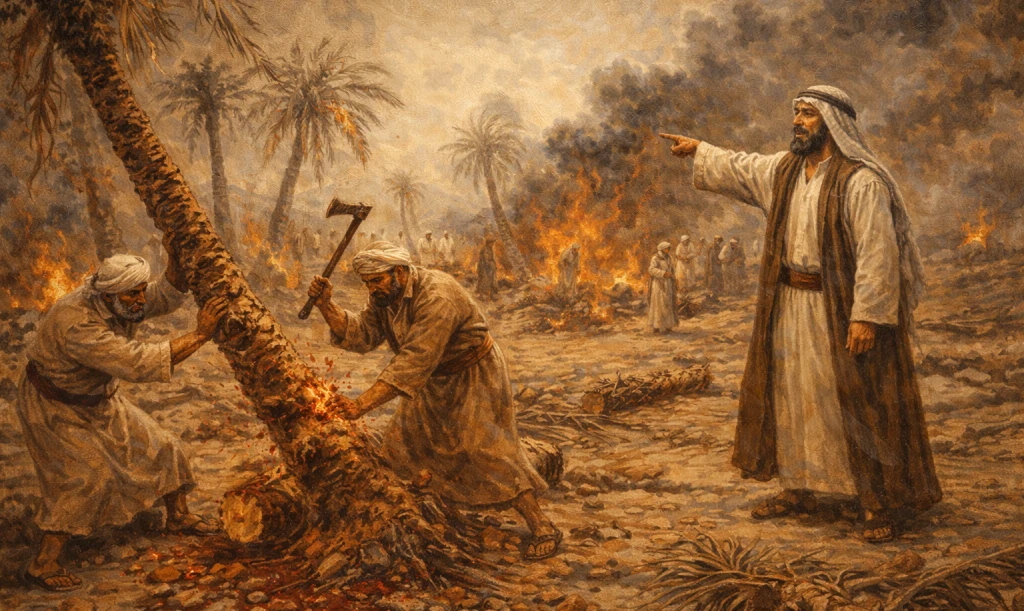
History is not merely a chronicle of victories and defeats; it also reflects the moral values and human concerns of its time. Many events from early Islamic history, when examined in light of modern knowledge and universal human rights, challenge familiar beliefs. One such highly controversial episode in Muhammad’s life concerns the Jewish tribe of Banu Nadir in Medina: his order to cut down and burn the date palms that formed an important part of the livelihood its people had built through years of labor.
Islamic historians and Quranic commentators have traditionally presented this destruction as a ‘clever military tactic’ or a legitimate way to subdue an enemy. The act is even claimed to have received ‘divine authorization’ through a Quranic verse. Yet, viewed through reasoned ethical inquiry and the principles of international humanitarian law (IHL), it raises serious moral and legal questions. How ethical is a tactic that destroys a community’s productive agricultural property in order to humiliate and weaken it? How can the bearer of a faith that describes its prophet as rahmatan lil-‘alamin, or a mercy to all worlds, order the cutting and burning of an opponent’s fruit-bearing trees to bring that opponent into disgrace?
Date palms were an important component of Banu Nadir’s agriculture, food production, and wealth. Al-Qurtubi’s commentary preserves differing accounts of how many trees were cut down and burned. But the destruction of trees, the intention to humiliate the opposing community, and the tribe’s subsequent expulsion and loss of control over its landed property are all recorded in Islamic sources themselves. These events directly raise questions about the ethics of destroying agricultural property, the role of religious authorization, and the rights to livelihood and property of a defeated community.
A Comparative Example in a Modern Context
To understand the moral significance of this historical episode, consider a contemporary hypothetical situation. Suppose Hamas, the governing group in today’s Gaza Strip, violated a peace agreement with Israel or plotted an assassination, as Banu Nadir was accused of doing. If, in response to that alleged breach, Israeli forces attacked not military targets but the basic means of survival of ordinary people in Gaza, what would the world’s response be?
Imagine that Israel destroyed Gaza’s only drinking-water treatment plants, burned farmland, and demolished major sources of income, including fishing infrastructure and factories. Suppose Israel then argued that this was a ‘military strategy’ intended to subject ordinary Gazans to severe shortages of food and water, break their morale, and force them to pressure their rulers—or that it constituted ‘divine retribution.’ Could a conscientious person endorse such conduct? [1] [2]
In the case of Banu Nadir, Muhammad likewise ordered the cutting and burning of his opponents’ date palms. The commentaries describe the purpose as humiliating and weakening the enemy. The tribe was subsequently expelled from Medina, and control of its landed property passed to a new authority. The sources disagree about the number of trees destroyed, but the ethical issue of damaging property to exert pressure on a community remains clear. Modern international humanitarian law prohibits collective punishment for offenses for which individuals are not personally responsible. [3]
Moral standards cannot change according to a person’s identity or religion. If deliberately attacking civilian food production, water supplies, and livelihoods in a contemporary conflict is reprehensible, the same human concerns apply to the destruction of Banu Nadir’s agricultural property. That Muhammad ordered the act, and that the Quran authorized it, does not diminish the value of the affected people’s property or livelihoods.
This comparison illustrates how human-made laws have developed over time and how many ancient ‘tactics’ are now recognized as crimes. Invoking religion to legitimize such inhumane conduct is not merely morally bankrupt; it is an affront to the humanitarian principles developed by modern civilization.
Historical Background
After migrating to Medina, Muhammad became involved in a series of political and military conflicts with Jewish tribes. One such tribe was Banu Nadir. According to Islamic historical accounts, members of Banu Nadir intended to assassinate Muhammad, although no independently verifiable evidence of the alleged plot has been established; Gabriel is said to have secretly informed Muhammad of it. The matter is discussed in detail elsewhere. In response to this alleged conspiracy, Muhammad besieged them and burned part of their date-palm groves. The incident is mentioned in Quran 59:5. [4]
The date palms you cut down, and those you left standing on their trunks, were cut or left standing by Allah’s permission, so that He might disgrace the defiantly disobedient.
— English rendering of Taisirul Quran
Whatever date palms you cut down, or left standing upon their trunks, was by Allah’s permission, so that He might humiliate the transgressors.
— English rendering of Sheikh Mujibur Rahman
Whatever young date palms you cut down or left standing upon their roots was by Allah’s permission, and in order that He might disgrace the disobedient.
— English rendering of Rawai Al-Bayan
Whatever date palms you cut down or left standing upon their trunks was by Allah’s permission [1], and so that He might disgrace the defiantly disobedient.
— English rendering of Dr. Abu Bakr Muhammad Zakaria
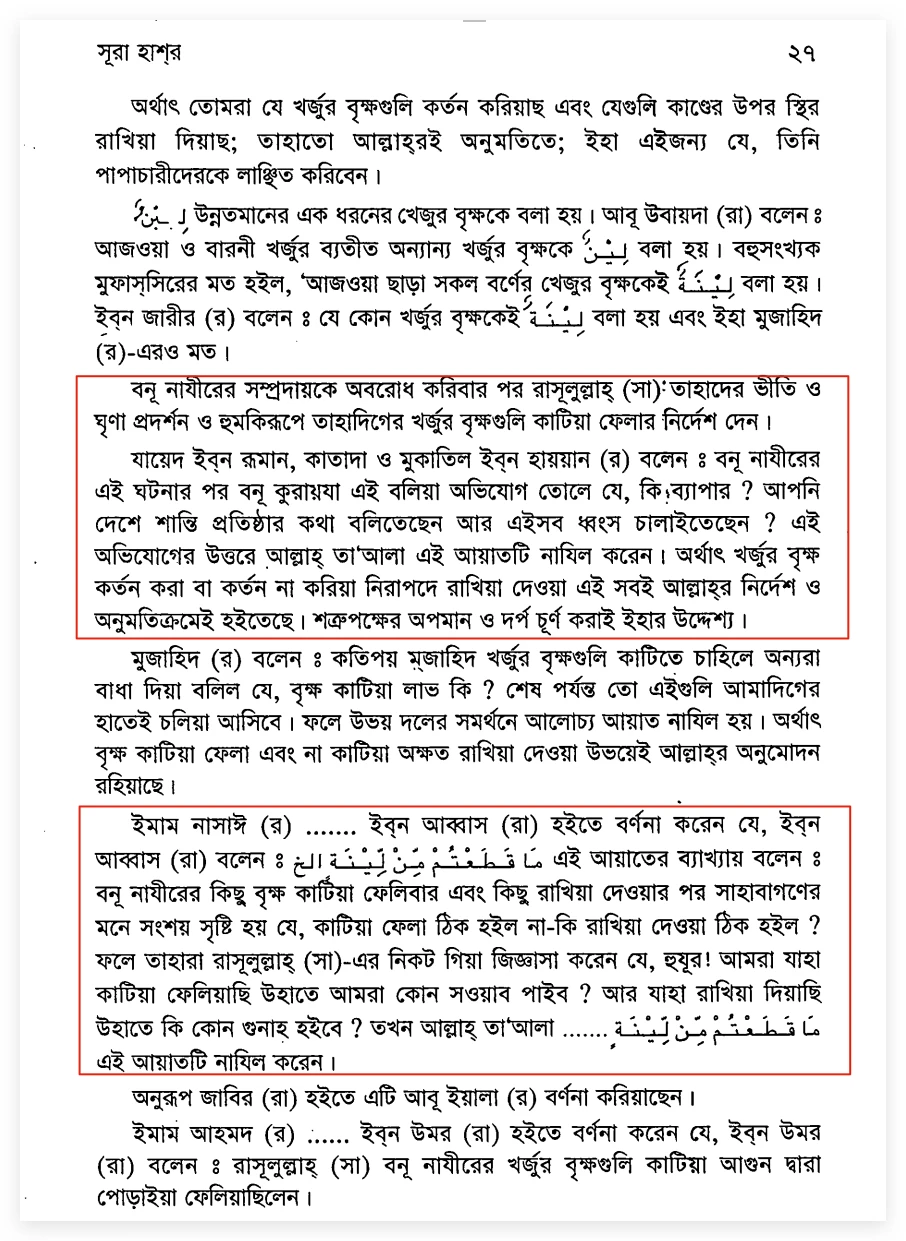
Thus, the cutting and burning of the date palms received religious authorization for Muhammad’s side. The following passage from Ibn Kathir’s commentary discusses this verse. [5]
That is: Whatever date palms you cut down, and those you left standing upon their trunks, were dealt with by Allah’s permission, so that He might humiliate the transgressors.
The term refers to a superior variety of date palm. Abu Ubaydah said that it refers to date palms other than the Ajwa and Barni varieties. According to many commentators, it includes all types of date palms except Ajwa. Ibn Jarir and Mujahid are also cited in the discussion of which varieties are meant.
After besieging Banu Nadir, the Messenger of Allah (peace be upon him) ordered their date palms to be cut down as a means of frightening, threatening, and displaying hostility toward them.
Zayd ibn Ruman, Qatadah, and Muqatil ibn Hayyan said that after this incident involving Banu Nadir, Banu Qurayzah protested: What is this? You speak of establishing peace in the land, yet you carry out such destruction? In response to this objection, Allah revealed the verse. Thus, both cutting the palms and leaving them standing were by Allah’s command and permission. The purpose was to humiliate the enemy and break its pride.
Mujahid said that when some of the fighters wanted to cut down the date palms, others objected: What is the point of cutting them? Ultimately they will come into our possession. The verse was then revealed in support of both groups: cutting the palms and leaving them intact had both received Allah’s approval.
Al-Nasa’i narrated from Ibn Abbas concerning the words مَا قَطَعْتُمْ مِنْ لَيْنَة الخ that, after some of Banu Nadir’s palms had been cut and others left standing, the Companions became uncertain whether cutting or preserving them had been right. They asked the Messenger of Allah whether there would be a reward for the trees they had cut and a sin in those they had spared. Allah then revealed the verse beginning مَا قَطَعْتُمْ مِّنْ لَّيْنَةٍ.
Abu Ya’la also related a similar account from Jabir.
Imam Ahmad narrated from Ibn Umar that the Messenger of Allah (peace be upon him) cut down and burned the date palms of Banu Nadir.
The cutting and burning of Banu Nadir’s date palms is recorded not only in Quranic commentary but also in separate narrations in Sahih al-Bukhari and Sahih Muslim. Both collections report that date palms in the Buwairah area were cut down and burned on Muhammad’s orders. [6] [7] [8]
Sahih al-Bukhari (Islamic Foundation edition)
33 / Sharecropping
Chapter 1450: Cutting down date palms and other trees. Anas said that the Prophet (peace be upon him) ordered date palms to be cut down, and they were cut down.
Islamic Foundation no. 2175; international no. 2326
2175. Narrated through Musa ibn Isma’il … from Abdullah ibn Umar, from the Prophet (peace be upon him): The Prophet burned and cut down the date palms of the garden belonging to Banu Nadir at Buwairah. Regarding this, Hassan said in his poem that flames were blazing in the garden at Buwairah, while the chiefs of Banu Lu’ayy accepted it with ease.
Hadith classification: Sahih
Narrator: Abdullah ibn Umar
Sahih Muslim (Hadith Academy edition)
33 / Jihad and Expeditions
Chapter 10: Permissibility of Cutting Down and Burning the Trees of Disbelievers
Hadith Academy no. 4444; international no. 1746
4444 (29/1746). Yahya ibn Yahya, Muhammad ibn Rumh, and Qutaybah ibn Sa’id … narrated from Abdullah: The Messenger of Allah (peace be upon him) burned and cut down the date palms of Banu Nadir. The garden was called Buwairah. Qutaybah and Ibn Rumh included an additional statement in their narrations. Thereafter Allah revealed the verse: ‘Whatever date palms you cut down or left standing upon their trunks was by Allah’s permission, so that He might disgrace the transgressors.’ (Islamic Foundation 4402; Islamic Center 4402)
Hadith classification: Sahih
Narrator: Abdullah ibn Umar
Sahih Muslim (Hadith Academy edition)
33 / Jihad and Expeditions
Chapter 10: Permissibility of Cutting Down and Burning the Trees of Disbelievers
Hadith Academy no. 4445; international no. 1746
4445 (30/…) Sa’id ibn Mansur … narrated from Ibn Umar: The Messenger of Allah (peace be upon him) cut down and burned the date palms of Banu Nadir. The poet Hassan said of this: ‘The flames at Buwairah have become an easy matter for the leaders of Banu Lu’ayy (that is, Quraysh).’ In relation to this, the verse was revealed: ‘Whatever date palms you cut down or left standing upon their trunks,’ to the end of the verse. (Islamic Foundation 4403; Islamic Center 4403)
Hadith classification: Sahih
Narrator: Abdullah ibn Umar
Islamic legal works also provide various authorizations for destroying trees and other property. In Al-Hidayah, the chapter on jihad describes how Muslim forces may burn houses, destroy trees, and devastate gardens belonging to disbelieving enemies. [9]
Imam al-Quduri said: If they refuse, seek Allah’s help against them and engage them in battle.
For the hadith narrated by Sulayman ibn Buraydah reports that the Prophet (peace be upon him) said: If they reject the invitation, then invite them to pay jizya. He then said: If they refuse this as well, seek Allah’s help against them and fight them.
Allah is the helper of His beloved servants and the destroyer of His enemies. It is therefore proper to seek His help in all matters. Deploy mangonels against them, as the Prophet (peace be upon him) did against Ta’if, and carry out burning and destruction against them, for the Prophet burned the area of Buwairah when necessary.
Imam al-Quduri said: Release water against them (by breaking embankments or other means), cut down their trees, and destroy their crops.
For such measures humiliate them, provoke their anger, break their power, and disrupt their unity; consequently, they are permissible.
Even if Muslim captives or merchants are among them, this does not prevent firing arrows at them. The reason is that repelling the greater harm by defending the center of Islam outweighs the limited harm caused if Muslim captives or merchants are killed. Moreover, hardly any fortress is entirely free of Muslims. If their presence were always taken into account, the door to jihad would be closed.
If they use Muslim children or captives as shields, the Muslims should not refrain from shooting arrows at them for the reasons already given. They should, however, intend to strike the disbelievers. Although a distinction may be impossible in practice, it is possible in intention, and obedience is required according to one’s capacity. If any Muslims are hit by those arrows, neither blood money nor expiation is obligatory for the fighters.
This is because jihad is an obligation, and a penalty cannot be attached to the fulfillment of an obligation.
The situation differs from taking another person’s property when starvation threatens one’s life, because the fear of compensation does not deter someone from saving their own life. Jihad, by contrast, is founded upon taking life, and concern about compensation could deter its conduct.
Imam al-Quduri said: There is no objection to taking women and copies of the Quran with the Muslim army if it is large enough for safety to be relied upon. In that case safety predominates, and what predominates is treated as certain. Taking them with a smaller force that cannot guarantee security is disapproved.

The Destruction of Banu Nadir’s Trees: Classical Exegesis, Jurisprudence, and the Ethics of Divine Authorization
The cutting and burning of Banu Nadir’s date palms did not remain merely an isolated incident in Islamic history. Later jurists and Quranic commentators used it to formulate rules governing the destruction of enemy property. Could a Muslim army cut down an enemy’s fruit-bearing trees, demolish farmland and homes, burn crops to weaken its opponents, and rely upon Quranic authorization for such devastation? Banu Nadir’s case became an important precedent in debates over all these questions. In particular, al-Shafi’i’s Al-Umm, al-Nawawi’s Commentary on Sahih Muslim, and Ibn Rushd’s Bidayat al-Mujtahid address the destruction of enemy agricultural and economic property. Meanwhile, the commentaries of al-Tabari and al-Qurtubi preserve the objections raised by Banu Nadir, disagreements among Muslims, and the authorization supplied by Quran 59:5. Taken together, these sources reveal a distinct religious and legal understanding in which destroying an enemy’s economic assets, alongside the use of military force, could serve to humiliate and weaken that enemy.
Al-Shafi’i’s Al-Umm: Authorization to Destroy Enemy Trees, Crops, and Homes
Al-Shafi’i, the founder of one of the four major Sunni schools of jurisprudence, discussed the destruction of enemy property at length in Al-Umm, in the section Al-Khilaf fi al-Tahriq (Disagreements Concerning Burning). He was asked whether, when Muslim forces invaded the territory of hostile non-Muslims, they were prohibited from cutting fruit-bearing trees, demolishing homes and towns, setting fires, flooding property, or destroying fruit and other possessions. Al-Shafi’i answered that destroying the enemy’s inanimate property was permissible. His discussion was not confined to fortifications or arsenals: it included fruit trees, agricultural assets, homes, and movable property. The scope of what could be destroyed in war thus extended beyond living combatants and directly military installations to the enemy’s economic assets. [10]
كُلُّ مَا كَانَ مِمَّا يَمْلِكُوا لَا رُوحَ لَهُ فَإِتْلَافُهُ مُبَاحٌ بِكُلِّ وَجْهٍ وَكُلُّ مَا زَعَمْت أَنَّهُ مُبَاحٌ فَحَلَالٌ لِلْمُسْلِمِينَ فِعْلُهُ وَغَيْرُ مُحَرَّمٍ عَلَيْهِمْ تَرْكُهُ.
English translation: Whatever they own that has no life may be destroyed by any means. Everything I have described as permissible is lawful for Muslims to do, and it is not forbidden for them to refrain from doing it.
The significance of this ruling becomes clearer in al-Shafi’i’s further explanation. He says that if Muslim forces enter hostile territory where the enemy is strong and well defended, and there is little prospect of the territory soon falling into Muslim hands, he favors cutting and burning the enemy’s fruit, trees, and other property. Movable assets can be seized as spoils of war if they can be carried away; otherwise, he permits burning them or destroying them by submerging them in water. Conversely, when territory is likely to come under Muslim control, he advises preserving its property so it can eventually become Muslim property. Even in such circumstances, however, he does not generally declare the destruction of enemy property unlawful before possession has actually been established.
This distinction between preserving and destroying property is especially revealing. If the enemy’s land, trees, and fruit are likely to come into Muslim possession, there is a practical advantage in protecting them; but if they are likely to remain under enemy control, destruction remains permissible. Thus, a central consideration in determining the fate of the same tree or orchard becomes who will control it. Whether the tree provides the enemy’s livelihood, whether a family depends on its fruit, or whether an orchard has taken years to cultivate does not appear as a central limitation on al-Shafi’i’s permission. The greater the prospect of enemy property becoming Muslim property, the stronger the advice to preserve it; where it is likely to remain in enemy hands, permission to destroy it remains.
In another section of Al-Umm, Fi Qat’ al-Shajar wa Harq al-Manazil (On Cutting Trees and Burning Houses), al-Shafi’i likewise expressly permits cutting fruit-bearing trees, destroying inhabited structures, and burning enemy food and other inanimate property. He invokes the burning of Banu Nadir’s palms and Quran 59:5 in support of this position. In his jurisprudence, the Banu Nadir episode thus becomes more than a historical precedent: it becomes evidence for a general rule of warfare. [11]
وَلَا بَأْسَ بِقَطْعِ الشَّجَرِ الْمُثْمِرِ وَتَخْرِيبِ الْعَامِرِ وَتَحْرِيقِهِ مِنْ بِلَادِ الْعَدُوِّ وَكَذَلِكَ لَا بَأْسَ بِتَحْرِيقِ مَا قَدَرَ لَهُمْ عَلَيْهِ مِنْ مَالٍ وَطَعَامٍ لَا رُوحَ فِيهِ.
English translation: There is no objection to cutting fruit-bearing trees, destroying inhabited structures, and burning them in enemy territory. Likewise, there is no objection to burning the property and food of theirs that Muslims are able to seize, provided these things have no life.
Al-Shafi’i’s ruling illustrates how extensive the authorized damage to an enemy’s economic resources could be. A fruit tree and a military fortress do not serve the same purpose. A fortress may form part of the enemy’s defensive system, whereas a fruit tree primarily provides food, livelihoods, and support for the local economy. Treating such property as destructible simply because it belongs to the enemy turns the means of civilian subsistence into targets of war. By transforming the religious authorization of Banu Nadir’s tree-cutting into a general legal principle, al-Shafi’i broadened the juridical basis for destroying such property.
Al-Nawawi: Jurists’ Positions on Cutting and Burning Enemy Trees
In his Commentary on Sahih Muslim, al-Nawawi likewise treats the destruction of Banu Nadir’s palms as direct evidence of legal permission. The relevant chapter in Sahih Muslim is itself entitled Bab Jawaz Qat’ Ashjar al-Kuffar wa Tahriqiha—’Chapter on the Permissibility of Cutting Down and Burning the Trees of Disbelievers.’ It contains the account of Muhammad cutting and burning the date palms of Banu Nadir. Al-Nawawi explains that this hadith establishes the permissibility of cutting and burning the trees of non-Muslim enemies. He names Abd al-Rahman ibn al-Qasim, Nafi’, Malik, Sufyan al-Thawri, Abu Hanifa, al-Shafi’i, Ahmad, Ishaq, and others among those who adopted this position, presenting it as the view of the majority of jurists. [12]
وَفِي هَذَا الْحَدِيثِ جَوَازُ قَطْعِ شَجَرِ الْكُفَّارِ وَإِحْرَاقِهِ، وَبِهِ قَالَ عَبْدُ الرَّحْمَنِ بْنُ الْقَاسِمِ وَنَافِعٌ مَوْلَى ابْنِ عُمَرَ وَمَالِكٌ وَالثَّوْرِيُّ وَأَبُو حَنِيفَةَ وَالشَّافِعِيُّ.
English translation: This hadith establishes the permissibility of cutting down and burning the trees of disbelievers. This was the view of Abd al-Rahman ibn al-Qasim, Nafi’, the freedman of Ibn Umar, Malik, al-Thawri, Abu Hanifa, and al-Shafi’i.
In the same discussion, al-Nawawi also mentions the prohibitive positions attributed to Abu Bakr, al-Layth ibn Sa’d, Abu Thawr, and al-Awza’i. A disagreement among Islamic jurists over the permissibility of tree destruction is therefore evident. What remains important, however, is that several major schools of Islamic law established permission to cut and burn enemy trees and cited Muhammad’s conduct toward Banu Nadir as a principal precedent. A particular military episode consequently influenced the rules under which later Muslim armies could lawfully destroy property.
The central ethical question in this jurisprudential discussion is why conflict with an armed enemy should authorize the destruction of that enemy’s agricultural property. Resisting the enemy’s military strength and destroying its agricultural production to inflict economic damage are distinct acts. A fruit tree is not a weapon of war; it is a source of food and wealth. Yet under the legal position cited by al-Nawawi, the enemy’s religious and political identity becomes an important basis for authorizing the cutting of its trees. In this way, a lasting precedent developed in Islamic jurisprudence for treating the means of subsistence and agricultural production as lawful objects of destruction during war.
Ibn Rushd: Legal Disagreement Arising from Muhammad’s Tree Destruction and Abu Bakr’s Prohibition
In the chapter on jihad in Bidayat al-Mujtahid wa Nihayat al-Muqtasid, Ibn Rushd discusses the positions of different jurists on the extent to which an enemy’s property may be attacked. According to his account, Malik permitted cutting trees and fruit and destroying inhabited structures, while taking a prohibitive position on killing animals and burning date palms. Al-Awza’i disapproved of cutting fruit trees and destroying inhabited structures. One position attributed to al-Shafi’i permitted burning houses and trees used as enemy defensive positions while disfavoring destruction where there was no such defensive use. Most significantly, Ibn Rushd explicitly identifies the difference between Muhammad’s conduct and Abu Bakr’s instructions as the origin of this legal disagreement. [13]
وَذَلِكَ أَنَّهُ ثَبَتَ أَنَّهُ عَلَيْهِ الصَّلَاةُ وَالسَّلَامُ حَرَّقَ نَخْلَ بَنِي النَّضِيرِ وَثَبَتَ عَنْ أَبِي بَكْرٍ أَنَّهُ قَالَ: لَا تَقْطَعَنَّ شَجَرًا وَلَا تُخَرِّبَنَّ عَامِرًا.
English translation: This is because it is established that he [Muhammad], peace and blessings be upon him, burned the date palms of Banu Nadir; and it is established that Abu Bakr said: Do not cut down trees, and do not destroy inhabited structures.
In Ibn Rushd’s account, the source of disagreement was not a modern ethical controversy but different practices among Islam’s earliest leaders. Muhammad burned Banu Nadir’s date palms, whereas Abu Bakr later instructed Muslim forces not to cut fruit-bearing trees or destroy inhabited structures. Ibn Rushd records that some jurists gave weight to Abu Bakr’s injunction and opposed destroying trees. Others treated Muhammad’s conduct as the decisive precedent and authorized tree-cutting and arson. Thus, a restraint on the destruction of property that can be found in later Islamic military instructions was countered by the use of Muhammad’s conduct toward Banu Nadir to justify the destruction of property.
Abu Bakr’s instructions are also preserved in Malik’s Al-Muwatta. According to the account, Abu Bakr gave Yazid ibn Abi Sufyan ten instructions when sending him on an expedition to Syria. These included prohibitions on killing women, children, and the elderly; cutting fruit-bearing trees; destroying inhabited structures; and slaughtering animals except for food. The instructions articulate a clear principle of preserving livelihoods and productive resources even in wartime. [14]
وَإِنِّي مُوصِيكَ بِعَشْرٍ لَا تَقْتُلَنَّ امْرَأَةً وَلَا صَبِيًّا وَلَا كَبِيرًا هَرِمًا وَلَا تَقْطَعَنَّ شَجَرًا مُثْمِرًا وَلَا تُخَرِّبَنَّ عَامِرًا وَلَا تَعْقِرَنَّ شَاةً وَلَا بَعِيرًا إِلَّا لِمَأْكُلَةٍ.
English translation: I instruct you in ten matters: Do not kill a woman, a child, or a very old person. Do not cut down a fruit-bearing tree or destroy an inhabited place. Do not slaughter a sheep or camel except for food.
Al-Shafi’i also addresses Abu Bakr’s prohibition in Al-Umm. He speculates that Abu Bakr may have instructed his forces to preserve property in Syria because he expected it eventually to come into Muslim hands, rather than because he considered cutting trees or destroying houses inherently unlawful. Against Abu Bakr’s injunction, he gives priority to Muhammad’s conduct in connection with Banu Nadir, Khaybar, and Ta’if. The legal debate consequently turns significantly on which authority is to prevail, rather than principally on the ethical implications of property destruction. Where Abu Bakr’s instruction protects fruit trees and inhabited structures, Muhammad’s conduct toward Banu Nadir serves as a precedent for overriding that restraint. [15]
Al-Tabari and Al-Qurtubi: Banu Nadir’s Protests and Objections Among Muslims
Islamic commentaries also preserve accounts of protests against the burning of Banu Nadir’s date palms. Explaining Quran 59:5, al-Tabari reports through Ibn Ishaq that when Muhammad besieged Banu Nadir, its people sheltered within their fortifications. Muhammad ordered their date palms cut down and burned. In response, the people of Banu Nadir openly asked Muhammad why he was cutting and burning their trees when he had previously forbidden corruption and condemned those who engaged in it. According to al-Tabari, Quran 59:5 was revealed after this objection, declaring both the cutting of trees and leaving them standing to have taken place by Allah’s permission. [16]
فَنَادَوْهُ: يَا مُحَمَّدُ، قَدْ كُنْتَ تَنْهَى عَنِ الْفَسَادِ وَتَعِيبُهُ عَلَى مَنْ صَنَعَهُ، فَمَا بَالُ قَطْعِ النَّخْلِ وَتَحْرِيقِهَا؟ فَأَنْزَلَ اللَّهُ عَزَّ وَجَلَّ.
English translation: They called out to him: O Muhammad! You used to forbid corruption and condemn those who committed it. So why are the date palms being cut down and burned? Then Allah, Mighty and Exalted, revealed [the verse].
In this protest, Banu Nadir pointed to a contradiction between Muhammad’s declared moral position and his own conduct. Their objection concerned the destruction of other people’s agricultural property. They did not accuse him simply of wrongdoing because he was fighting a war; rather, they asked specifically how cutting and burning trees could be reconciled with his own condemnation of destructive conduct. In al-Tabari’s account, the verse revealed in response did not deny that the trees had been damaged. Instead, it placed the act under Allah’s authorization. The objection was thus answered through religious authority, not by addressing the actual harm inflicted.
The people of Banu Nadir were not the only ones to raise objections. Al-Tabari also reports disagreement among Muslims over cutting the trees. According to Mujahid, some of the Emigrants told others not to cut them because the trees might later become spoils for the Muslims. Qatadah likewise reports that some Muslims were cutting trees while others regarded the action as destructive and refrained from it. The people of Banu Nadir then asked whether Allah had authorized this destruction. Following such objections and disagreements, the revealed verse authorized both cutting the trees and leaving them intact. In this way, doubts among the Muslims about the permissibility of destroying property were also settled by religious authorization. [17]
Al-Qurtubi’s Al-Jami’ li-Ahkam al-Quran offers further details. Alongside Banu Nadir’s objections and the disagreement among Muslims, he cites a protest poem attributed to a Jewish poet of Banu Nadir. The poem condemns the killing and exile of its people and the destruction of date palms. Al-Qurtubi also reports that some Muslims argued against destroying property that might eventually come into their possession, while others urged the cutting of trees in order to anger and humiliate the enemy. These reports clearly describe psychological pressure on the opposing community alongside the economic dimensions of property destruction. [18]
فَقَالَ بَعْضُهُمْ: لَا تَقْطَعُوا مِمَّا أَفَاءَ اللَّهُ عَلَيْنَا. وَقَالَ بَعْضُهُمْ: اقْطَعُوا لِنُغِيظَهُمْ بِذَلِكَ. فَنَزَلَتِ الْآيَةُ بِتَصْدِيقِ مَنْ نَهَى عَنِ الْقَطْعِ وَتَحْلِيلِ مَنْ قَطَعَ مِنَ الْإِثْمِ.
English translation: Some of them said: Do not cut down what Allah may grant us as spoils. Others said: Cut them down so that we may provoke their anger. Then the verse was revealed, vindicating those who had opposed cutting and absolving those who had cut the trees of sin.
Al-Qurtubi also preserves differing reports about the extent of tree-cutting. Accounts attributed to Qatadah and al-Dahhak mention six date palms being cut and burned, while a report through Ibn Ishaq mentions one tree cut and another burned. Although the reports differ numerically, all describe the destruction of Banu Nadir’s trees with Muhammad’s authorization. These disagreements over the number do not erase the occurrence of the incident. More importantly, al-Qurtubi’s discussion reveals that even the cutting of a small number of trees provoked protests from Banu Nadir and questions among Muslims. The ethical problem, therefore, cannot be measured solely by the quantity of damage; the deliberate destruction of productive enemy property and its use as an instrument of humiliation are also central to the episode.
The Expulsion of Banu Nadir, Destruction of Homes, and Transfer of Property
The cutting and burning of Banu Nadir’s date palms cannot be separated from the tribe’s wider expulsion and loss of property without obscuring the economic significance of the campaign. Quran 59:2 describes the removal of a group among the People of the Book from their homes in Medina. The same verse refers to their reliance on fortifications, the pressure exerted by Muslim forces, and the destruction of homes. The following verse speaks of their decreed exile. Thus, the campaign against Banu Nadir did not end with cutting or burning some trees: the tribe was driven from its homes and control of its immovable property changed hands. [19] [20]
يُخْرِبُونَ بُيُوتَهُمْ بِأَيْدِيهِمْ وَأَيْدِي الْمُؤْمِنِينَ فَاعْتَبِرُوا يَا أُولِي الْأَبْصَارِ.
English translation: They were destroying their houses with their own hands and with the hands of the believers. So take heed, O people of insight.
— Quran 59:2
According to al-Qurtubi’s commentary, after the siege the people of Banu Nadir surrendered and agreed to leave Medina in exchange for their lives being spared. They were allowed to take movable belongings but not weapons. Several prominent leaders went to Khaybar, while others traveled toward Syria. Permanent homes, farmland, and date-palm groves cannot be taken along when a population is expelled. Permission to carry some movable possessions is therefore not the same as retaining ownership of productive land and a long-established economic base. Through their expulsion, Banu Nadir lost not only their place of residence but also control of their land and orchards, which passed to the Muslim side. [21]
This transfer of property is also linked to a distinct rule of ownership in Islamic law. Quran 59:6 describes property that came under Muslim control without conventional battle as property bestowed by Allah upon His Messenger. In Islamic jurisprudence, this category is called fay’. Unlike ordinary war booty, it is not subject to the same direct distribution among fighters. The property of Banu Nadir was classified in this category. The expulsion of the tribe was therefore followed by Quranic authorization for Muhammad’s control over its abandoned land and other assets. [22]
وَمَا أَفَاءَ اللَّهُ عَلَىٰ رَسُولِهِ مِنْهُمْ فَمَا أَوْجَفْتُمْ عَلَيْهِ مِنْ خَيْلٍ وَلَا رِكَابٍ وَلَٰكِنَّ اللَّهَ يُسَلِّطُ رُسُلَهُ عَلَىٰ مَنْ يَشَاءُ.
English translation: Whatever Allah restored from them to His Messenger, you did not spur horses or camels to obtain it. Rather, Allah grants His messengers power over whomever He wills.
— Quran 59:6
In explaining this verse, al-Tabari explicitly identifies the property as belonging to Banu Nadir. According to the account he preserves, their land and possessions came under Muhammad’s exclusive control because they were acquired through a settlement rather than conventional conquest in battle. Citing al-Zuhri, al-Tabari reports that Muhammad subsequently distributed the property of Banu Nadir chiefly among the Emigrants from Mecca, giving none of it to the Helpers except two men in need. In other words, agricultural and landed property was taken out of Banu Nadir’s control and used to establish an economic foundation for members of the new political community. [23]
فَكَانَتْ بَنُو النَّضِيرِ لِلنَّبِيِّ خَالِصَةً لَمْ يَفْتَحُوهَا عَنْوَةً بَلْ عَلَى صُلْحٍ فَقَسَمَهَا النَّبِيُّ بَيْنَ الْمُهَاجِرِينَ لَمْ يُعْطِ الْأَنْصَارَ مِنْهَا شَيْئًا إِلَّا رَجُلَيْنِ كَانَتْ بِهِمَا حَاجَةٌ.
English translation: The property of Banu Nadir belonged exclusively to the Prophet. They had not conquered it by force, but had obtained it through a settlement. The Prophet then distributed it among the Emigrants and gave none of it to the Helpers except two men who were in need.
The transfer of property gives the destruction of trees a broader economic significance. The people of Banu Nadir were separated from their land, homes, and agricultural resources, and some of that property passed into new ownership. The cutting and burning of palms took place within this wider process of siege, expulsion, and redistribution. The economic damage to Banu Nadir therefore cannot be reduced to the number of trees cut down. Losing their permanent homes, land, and control over property cultivated over generations had deeper and more lasting consequences. Resources that had supported one community’s livelihoods were taken from that community and used to strengthen another community economically. The campaign against Banu Nadir was therefore not merely a military victory but also a transformation in property ownership and economic power.
Quran 2:205 and 59:5: Condemnation of Crop Destruction and the Double Standard of Divine Authorization
Quran 2:205 condemns spreading corruption on earth and destroying crops and the continuity of life. According to the verse, Allah does not love the corruption caused by a person who destroys crops and progeny. The destruction of agricultural production is presented here not simply as damage to property but as part of a broader social calamity, directly connected to food production and the continuation of life. Yet Quran 59:5 describes the cutting of Banu Nadir’s date palms, or leaving them standing, as acts permitted by Allah. These differing positions raise an important question about the consistency of religious authority and moral rules. [24] [4]
وَإِذَا تَوَلَّىٰ سَعَىٰ فِي الْأَرْضِ لِيُفْسِدَ فِيهَا وَيُهْلِكَ الْحَرْثَ وَالنَّسْلَ وَاللَّهُ لَا يُحِبُّ الْفَسَادَ.
English translation: And when he turns away, he strives throughout the land to spread corruption in it and destroy crops and progeny. Allah does not love corruption.
— Quran 2:205
Al-Tabari’s commentary on the verse is particularly revealing. Citing al-Suddi, he reports an account in which a man burned the Muslims’ crops and killed their animals. Explaining the meaning of destroying crops, al-Tabari explicitly mentions burning them. Thus, the expression ihlak al-harth—the destruction of crops—includes ruining agricultural production by setting it on fire. A type of conduct presented as corruption when performed against others receives religious authorization when it consists of cutting and burning trees belonging to Banu Nadir. [25]
وَإِهْلَاكُهُ الزَّرْعَ إِحْرَاقُهُ. وَقَدْ يَجُوزُ أَنْ يَكُونَ كَمَا قَالَ مُجَاهِدٌ بِاحْتِبَاسِ الْقَطْرِ مِنْ أَجْلِ مَعْصِيَتِهِ رَبَّهُ وَسَعْيِهِ بِالْإِفْسَادِ فِي الْأَرْضِ.
English translation: His destruction of crops means burning them. It is also possible, as Mujahid said, that crops were destroyed because rainfall was withheld due to his disobedience to his Lord and his efforts to spread corruption on earth.
The central issue here goes beyond the different wording of the two verses: it concerns the basis of moral judgment. In Quran 2:205, destroying another party’s crops is included among the acts of a person who spreads corruption on earth. In Quran 59:5, by contrast, Allah’s authorization is declared for cutting and burning Banu Nadir’s date palms, with the purpose of disgracing the opposing party expressly stated. Damage to agricultural property, therefore, ceases to be the sole basis of moral judgment; the identity of the target and the authority under which the act takes place also become decisive. Destruction of a similar kind is condemned as corruption in one setting and approved as the subjugation of an enemy in another. This position conflicts with the principle of universal morality, because the value of the affected people’s food, property, and livelihoods should not change with their religious identity.
A defining feature of the Banu Nadir episode is that authorization to cut the trees is accompanied by the words wa-li-yukhziya al-fasiqin—’so that He might disgrace the defiantly disobedient.’ This is not merely an account of unintended collateral damage. The purpose of humiliating the enemy is acknowledged in the religious text. In the reports of al-Tabari and al-Qurtubi, the authorization follows objections from Banu Nadir and doubts among Muslims. Al-Shafi’i extends that permission into a general jurisprudential rule, while al-Nawawi presents cutting and burning enemy trees as an accepted position among many jurists. Consequently, the destruction of property during one campaign did not end with the event itself; it became an enduring part of religious law and subsequent discussions of warfare.
The establishment of military control over a community, destruction of its productive property, expulsion from its homes, and redistribution of its assets are interconnected in the Banu Nadir episode. Classical Islamic works preserve accounts of these events and also establish religious and legal authorization for destroying enemy property. The moral problem extends beyond burning trees. At its heart is a structure of power in which the religious authority of the victorious side determines the future of the defeated community’s property, livelihoods, and homes. Religious authorization does not make the infliction of harm on a community morally acceptable. Destroying people’s food, agricultural assets, and means of subsistence in order to weaken and humiliate them is itself profoundly inhumane.
The Ethical Problem of Destroying Economic Infrastructure
Farmland and fruit-bearing trees are more than property: they are bound up with food, income, trade, and the long-term economic security of families. When such resources are deliberately destroyed in war, the harm need not stop with the owner; farm laborers, families, and local networks of exchange may also be affected. In the case of Banu Nadir, the commentaries disagree about the number of trees cut and burned, so the exact amount of agricultural output lost cannot be established. Yet humiliation and the weakening of the enemy are recorded as motives for the destruction, and the tribe subsequently lost control of its land and permanent assets through expulsion. Taken together, the cutting of trees and the transfer of property reveal the nature of the economic pressure exerted upon it.
The allegation of a conspiracy against Banu Nadir does not give anyone a moral right to destroy the agricultural property of every member of the tribe. Quran 59:5 explicitly associates the permission to cut trees with disgracing the opposing community; al-Qurtubi’s commentary also discusses the intention to anger and weaken the enemy. Confronting a military opponent is not the same as exerting pressure by destroying its agricultural and residential property. Modern international humanitarian law prohibits collective punishment and imposes strict requirements of military necessity on the destruction of an opposing party’s property. [3] [26]
Ethical Assessment Under International Humanitarian Law
Modern international humanitarian law (IHL) establishes rules governing conduct during war. Its central purpose is to limit the suffering caused by armed conflict and protect the lives and property of people who are not directly participating in hostilities. Applying these standards as ethical points of comparison to the destruction of Banu Nadir’s date palms reveals serious problems concerning the purpose of that destruction, military necessity, and the treatment of civilian property.
Article 53 of the Fourth Geneva Convention of 1949 states the following concerning the destruction of property by an occupying power in occupied territory:
“Any destruction by the Occupying Power of real or personal property belonging individually or collectively to private persons… is prohibited, except where such destruction is rendered absolutely necessary by military operations.” [1]
This article restricts the destruction of property by an occupying power in occupied territory. A broader rule applicable to an opposing party’s property in warfare is that the destruction or seizure of such property is prohibited unless imperatively demanded by military necessity. [26]
Sources describing the Banu Nadir episode identify humiliating, angering, and weakening the enemy as purposes of the destruction. They do not describe a specific, immediate military threat posed by the fruit-bearing trees. Comparing these facts with the principles of modern humanitarian law highlights several important problems:
The sources concerning the cutting of Banu Nadir’s trees preserve the aim of humiliating and weakening the enemy. Destroying agricultural resources and means of livelihood for that purpose more closely resembles pressure exerted on the opponent’s way of life than direct military resistance. Judged against the protections for property and the prohibition of collective punishment in international humanitarian law, the ethical unacceptability of this conduct is clear.
Environmental Protection and Sustainable Development
Environmental protection is not merely a luxury in the modern world; it is essential to humanity’s continued existence. The cutting and burning of Banu Nadir’s fruit-bearing date palms raises ethical questions not only about economic damage but also about the treatment of nature and productive resources. Establishing and maintaining a green orchard in an arid environment requires years of sustained labor.
Even if allegations had been made against individual members of Banu Nadir, they would not justify destroying the opposing community’s fruit-bearing trees in order to humiliate it. Although the sources differ on the number of trees cut and burned, the deliberate destruction and its religious authorization are established. Turning productive property into a weapon for subduing an enemy shows disregard for nature and human livelihoods.
Double Standards: Military Strategy or Cruelty?
Islamic historians and conservative commentators have often attempted to justify the destruction of Banu Nadir’s date palms as an ‘indispensable military tactic.’ In their account, it was a psychological measure intended to compel the enemy to surrender. Examining that justification, however, reveals a profound moral double standard that cannot be accepted as consistent ethical reasoning.
This double standard can be examined through the following points:
Ultimately, this episode demonstrates an early tendency to sanctify morally objectionable acts by invoking religion. What is glorified as ‘military strategy’ was an act of sectarian cruelty and an assertion of power. When a system changes its moral rules to suit its own interests, it cannot credibly claim to represent a consistent ethical ideal; it reveals moral inconsistency.
Conclusion
The cutting and burning of Banu Nadir’s date palms is recorded in authentic hadith collections and Quran 59:5. The commentaries of al-Tabari and al-Qurtubi also preserve accounts of protests by the affected tribe and doubts among Muslims. The destruction was declared permissible by Allah’s authorization, and the purpose of humiliating the opposing party was expressly stated. That religious authorization does not resolve the ethical problem of destroying an enemy’s fruit-bearing trees.
The influence of this episode is equally clear in classical Islamic jurisprudence. Al-Hidayah and al-Shafi’i’s Al-Umm authorize the destruction of enemy trees, crops, houses, and other property; al-Nawawi names numerous jurists who supported such permission. Ibn Rushd, meanwhile, explicitly identifies the difference between Abu Bakr’s instruction not to cut fruit-bearing trees and Muhammad’s conduct toward Banu Nadir as a source of legal disagreement. Abu Bakr’s instruction itself demonstrates that a principle of protecting agricultural resources during war was possible.
The expulsion of Banu Nadir from Medina and the transfer of control over its landed property were also major consequences of the campaign. Although reports vary on the number of trees cut and burned, the destruction of property, the tribe’s expulsion, and the redistribution of its land are separately attested. An assessment of the economic harm therefore cannot be confined to the number of trees burned. Destroying productive property and uprooting a community from its homes may constitute uses of military power, but military power does not in itself establish moral legitimacy.
The basic dignity owed to people’s food supplies, agricultural assets, and homes does not vary with religious identity. Destroying an enemy’s productive property in order to humiliate it, and then legitimizing the act through divine authorization, conflicts with universal ethical principles. Religious authority does not confer a moral right to destroy the livelihood and property of another community.
References
- Geneva Convention IV, Article 53 1 2
- Additional Protocol I to the Geneva Conventions, Article 54 ↩︎
- Geneva Convention IV, Article 33 1 2 3
- Quran 59:5 1 2 3
- Tafsir Ibn Kathir, Islamic Foundation, Volume 11, p. 27 ↩︎
- Sahih al-Bukhari, Islamic Foundation edition, hadith 2175 ↩︎
- Sahih Muslim, Hadith Academy edition, hadith 4444 ↩︎
- Sahih Muslim, Hadith Academy edition, hadith 4445 ↩︎
- Al-Hidayah, Burhan al-Din Ali ibn Abi Bakr al-Marghinani, Islamic Foundation Bangladesh, Vol. 2, p. 432 ↩︎
- Imam al-Shafi’i, Al-Umm, Vol. 4, Al-Khilaf fi al-Tahriq ↩︎
- Imam al-Shafi’i, Al-Umm, On Cutting Trees and Burning Houses ↩︎
- Imam al-Nawawi, Commentary on Sahih Muslim, Book of Jihad and Expeditions, Vol. 12, Chapter on the Permissibility of Cutting and Burning the Trees of Disbelievers ↩︎
- Ibn Rushd, Bidayat al-Mujtahid, Book of Jihad, Rules on the Destruction of Enemy Property ↩︎
- Malik’s Al-Muwatta, Book of Jihad, Abu Bakr’s Ten Instructions ↩︎
- Imam al-Shafi’i, Al-Umm, Al-Khilaf fi al-Tahriq ↩︎
- Imam al-Tabari, Jami al-Bayan, Commentary on Quran 59:5 ↩︎
- Tafsir al-Tabari, Quran 59:5, Reports from Mujahid and Qatadah ↩︎
- Imam al-Qurtubi, Al-Jami li-Ahkam al-Quran, Commentary on Quran 59:5 ↩︎
- Quran 59:2 ↩︎
- Quran 59:3 ↩︎
- Al-Qurtubi’s Commentary on Quran 59:5, Account of the Expulsion of Banu Nadir ↩︎
- Quran 59:6 ↩︎
- Imam al-Tabari, Jami al-Bayan, Commentary on Quran 59:6 ↩︎
- Quran 2:205 ↩︎
- Imam al-Tabari, Jami al-Bayan, Commentary on Quran 2:205 ↩︎
- ICRC, Customary International Humanitarian Law, Rule 50 1 2
- Tafsir Ibn Kathir, Vol. 11, p. 27 1 2 3
- Additional Protocol I, Article 54 ↩︎
- United Nations Environment Programme (UNEP), principles on environment and armed conflict ↩︎
- Additional Protocol I to the Geneva Conventions, Article 35(3) ↩︎
- Sahih Muslim, Hadith 4444 ↩︎
- Malik’s Al-Muwatta, Hadith 965 ↩︎