

Introduction
As civilization developed, human understandings of crime, justice, and punishment underwent fundamental changes. There was a time when publicly mutilating offenders, inflicting unbearable pain on their bodies, humiliating them before crowds, or prolonging their suffering before death served as displays of a ruler’s power. Under this system, which established authority through the severity of punishment, the offender’s body became an instrument of state retaliation and intimidation. Modern human rights and theories of justice draw a clear distinction between holding someone accountable for a crime and torturing that person. Even a person who commits murder, robbery, violence against the state, or another serious offense does not forfeit their human dignity. Neither adjudication nor punishment, crime prevention, public safety, or the rehabilitation of offenders creates moral permission to deliberately blind a person, amputate limbs and leave them to die in agony, or withhold water from someone suffering from thirst. The modern prohibition of torture and cruel, inhuman, or degrading punishment rests on this basic principle of humanity.
Early Islamic history contains accounts of punishments that directly conflict with this principle. One particularly striking example is the brutal punishment imposed on several captives from the tribes of Ukl and Uraynah on Muhammad’s orders. According to Sahih al-Bukhari, Sahih Muslim, and other hadith collections, these men came to Medina and embraced Islam. When the local climate made them ill, Muhammad instructed them to drink camel milk and urine and arranged for them to stay with a herd of camels. After recovering, they killed the herdsman and fled with the animals. Several hadith versions also state that they apostatized. After they were captured and brought back to Muhammad, their hands and feet were cut off on his orders, their eyes were blinded with heated iron instruments, and no measures were taken to stop the bleeding from their wounds. Other accounts say that the captives were abandoned under the blazing sun or on hot, rocky ground; although they begged for water, none was given to them. They eventually died in extreme agony. The horror of the incident was not confined to the imposition of a death sentence. It also involved deliberate bodily mutilation, excruciating pain, and the denial of basic necessities before death.
The ethical significance of this incident is especially serious because, within Islam, Muhammad is not merely a historical political or military leader: he is presented as the highest moral example for all time. The Quran portrays him as an exemplary model to follow, and his words, actions, and approvals are recognized as important sources of Islamic law. Consequently, a cruel punishment carried out on his orders does not remain an isolated event in the distant past. Later jurists, Quranic commentators, and rulers can invoke it when discussing justice and criminal punishment. That is precisely how the Ukl–Uraynah incident entered subsequent Islamic legal discourse. Quran 5:33 prescribes killing, crucifixion, the amputation of hands and feet on opposite sides, and exile as punishments for waging war against God and His Messenger and spreading corruption on earth. Several strands of classical exegesis connect that verse to the Ukl–Uraynah affair. Later Muslim scholars also disputed whether Muhammad’s punishment of blinding the captives had been abrogated or remained legally valid. The incident is therefore not merely the history of one ruler’s cruelty; it is also part of the history of how bodily torture and mutilation carried out on Muhammad’s orders were given legal legitimacy in subsequent Islamic jurisprudence.
The gravity of an offense cannot morally justify the cruelty of any punishment imposed in response. Killing a herdsman and stealing camels are serious crimes, and they raise legitimate questions of accountability and punishment. Yet establishing that an offense occurred is not the same as establishing that any degree of bodily torture is permissible in response. Trying and punishing a murderer is fundamentally different from driving heated iron into the person’s eyes to blind them, cutting off their limbs and leaving them bleeding, and deliberately refusing them water so that their agony continues. The latter is not merely a means of incapacitating an offender or preventing further crimes; it involves the deliberate infliction of pain, retaliation, and the exercise of extreme power over the person’s body. One can recognize responsibility for a crime while condemning the torture inflicted on its perpetrator. Fundamental human rights do not operate according to one moral standard for the innocent and another for the guilty.
The accounts of Muhammad’s punishment are also connected to subsequent Muslim political history. In one report in Sahih al-Bukhari, the Umayyad ruler al-Hajjaj ibn Yusuf asked Anas ibn Malik to describe the harshest punishment Muhammad had ever administered. Anas recounted the Ukl–Uraynah affair. When al-Hasan al-Basri learned of this, he remarked that it would have been better if Anas had not told al-Hajjaj about the incident. The report raises the question of how a precedent for brutal punishment attributed to the Prophet could become a powerful instrument in the hands of a repressive ruler. Disputes in later tafsir and jurisprudence over the legitimacy, abrogation, or continuing validity of this punishment demonstrate that its historical consequences did not end with Muhammad’s lifetime. Once a penal practice promoted as part of a religious ideal becomes a precedent for later rulers, its ethical consequences extend far beyond the original incident and affect society at large.
The punishment imposed on the Ukl–Uraynah captives, the penal provisions of Quran 5:33–34, classical accounts of the verses’ occasion of revelation, the hadith descriptions of blinding and withholding water, and subsequent juristic interpretations form an interconnected historical record. Judicial punishment, apostasy, retaliation for murder, state authority, and public humiliation appear together in these materials. Deliberately disabling and blinding human beings and leaving them to die raises fundamental questions about justice and about the moral basis for treating such punishment as part of a divinely sanctioned ideal. A claim to provide a moral example valid for all time does not place an individual’s historical conduct beyond criticism. On the contrary, that very claim makes the punishments carried out on his orders, and their subsequent religious and legal legitimation, subject to rigorous ethical and logical scrutiny.
Modern Ethics and Human Rights Standards
A fundamental principle of modern human rights and criminal justice is that committing a crime does not entirely extinguish a person’s human dignity. Even someone convicted of murder, robbery, armed assault, or violence against the state does not thereby become a legitimate target for torture, deliberate mutilation, or prolonged suffering before death. Legally restricting an offender’s liberty and turning that person’s body into an instrument of vengeance are fundamentally different acts. Modern penal systems recognize the importance of preventing crime, protecting society, delivering justice, and promoting rehabilitation. None of these purposes authorizes cruelty or torture. When the state acquires complete control over a prisoner’s body, life, and death, preventing the abuse of that power becomes especially urgent. A captive loses the freedom to defend themselves, escape, or meet even their own basic needs; their survival and safety depend directly on the decisions of the detaining authority.
Article 5 of the 1948 Universal Declaration of Human Rights prohibits torture and cruel, inhuman, or degrading treatment or punishment. The significance of this provision is that human dignity is not a discretionary favor conferred by rulers, religious authorities, or judges. Even after someone is identified as a criminal, fundamental rights relating to their body and person remain and cannot simply be taken away in the name of punishment. The purpose of a sentence is to address an offense, not to make the infliction of bodily suffering itself the measure of judicial success. Cutting off limbs, blinding someone, or deliberately denying water to a dying prisoner violates this basic humanitarian principle [1]
Article 5. No one shall be subjected to torture or to cruel, inhuman or degrading treatment or punishment.
This human rights principle does not establish separate standards governing torture for guilty and innocent people. A murderer may be tried and punished, but driving red-hot iron into their eyes to blind them, or amputating their limbs and leaving them to die, still constitutes torture. The fact that someone committed a crime can justify legal proceedings against that person; it does not confer moral authority to inflict unbearable pain deliberately. In particular, once an individual is a captive and no longer capable of mounting an attack or resistance, further bodily torture is no longer a defensive use of force. It becomes deliberate cruelty against a helpless human being under the control of a powerful authority. The accounts of amputating the Ukl–Uraynah captives’ limbs, blinding them, and allowing them to die without stopping their bleeding make this ethical distinction especially clear.
Article 7 of the 1966 International Covenant on Civil and Political Rights likewise prohibits torture and cruel, inhuman, or degrading punishment. Article 10 establishes the right of persons deprived of their liberty to humane treatment. Detention, prosecution, or conviction does not erase a person’s human dignity simply because they have come under state control. This principle applies to ordinary prisoners and to people accused of the most serious crimes while in state custody. Deliberately injuring a captive’s body or exploiting their helplessness to increase their suffering constitutes an abuse of state authority. Article 10(1) states the requirement explicitly [2]
All persons deprived of their liberty shall be treated with humanity and with respect for the inherent dignity of the human person.
A more specific definition of torture appears in the 1984 United Nations Convention against Torture. Article 1 includes the intentional infliction of severe physical or mental pain or suffering for purposes such as punishment for an offense, obtaining information, intimidation, coercion, or discrimination, when this is carried out by, at the instigation of, or with the consent or acquiescence of a public official or someone acting in an official capacity. Torture thus means more than beating someone to extract a confession; it also includes deliberately inflicting severe pain to retaliate for an offense or intimidate others. Article 2 prohibits invoking war, the threat of war, political instability, or another public emergency as a justification for torture. Under Article 2(3), orders issued by a superior authority likewise cannot make torture lawful [3]
An order from a superior officer or a public authority may not be invoked as a justification of torture.
An important ethical conclusion follows from this provision: a punishment does not become just simply because an authority ordered it. A ruler’s political power, a judge’s legal authority, or a religious leader’s claim to divine authority does not by itself establish the moral legitimacy of physical torture. Criminal accountability and the treatment of offenders must be evaluated independently. When punishment combines intimidation, retaliation, and the infliction of suffering, the moral nature of torture remains unchanged regardless of the source of authority. In the Ukl–Uraynah incident, the cutting off of limbs, the application of heated iron to the eyes, the failure to stop bleeding, and the refusal of water until death reveal a form of punishment in which the offender’s suffering itself became a central element of enforcement.
The United Nations Nelson Mandela Rules prescribe more specific standards for the treatment of prisoners. Rule 22 requires the provision of adequate food and drinking water whenever a prisoner needs it. Rule 43 prohibits corporal punishment, reducing food or drinking water as a disciplinary sanction, and other cruel or degrading practices. Water is not an additional privilege or an act of mercy by the ruler; it is a basic necessity for a captive’s survival. Denying it to someone suffering severe blood loss, exposure to heat, and intense physical pain increases that person’s suffering. These requirements stand in direct ethical opposition to the reports that the Ukl–Uraynah captives were refused water [4]
Corporal punishment or the reduction of a prisoner’s diet or drinking water;
— Rule 43(1)(d), prohibited disciplinary practices.
These human rights provisions define the limits of state punishment as well as the importance of fair trials, human dignity, and rehabilitation. In modern criminal justice, punishment is not merely a means of retaliation: it is also intended to protect society, prevent reoffending, secure justice, and, where possible, provide opportunities for rehabilitation. Denying the ethical distinction between holding someone accountable and torturing them to death eliminates the boundary between punishment and abuse. The greater the state’s control over a captive, the greater its duty to ensure humane treatment. Amputating limbs, blinding prisoners, and withholding necessities such as drinking water violate that duty and transform the human body into an object of state vengeance.
The purpose of justice is not solely retaliation for an offense; it also includes public safety, crime prevention, and, wherever possible, the rehabilitation and reintegration of offenders. Permanently disabling someone through mutilation and torture contradicts these principles of rehabilitative justice.
Deliberately inflicting severe physical or psychological suffering as punishment, retaliation, or intimidation is cruel and inhuman. Blinding a person, leaving them to die after amputating their limbs, or withholding necessary medical treatment are clear examples of torture.
A person does not lose their human dignity or basic necessities of life even after being convicted of a crime. Deliberately denying a captive food, drinking water, or necessary medical care exploits their helplessness. Protecting the human dignity of offenders is a responsibility of the detaining authority.
These three principles are especially relevant to the ethical evaluation of the Ukl–Uraynah affair. The men were accused of murdering the herdsman, stealing camels, and apostatizing. Yet regardless of the seriousness of the accusations, they provide no moral justification for burning their eyes with hot iron after capture, cutting off their limbs and leaving them bleeding, or withholding water to prolong their agony. The state may possess authority to punish a murderer, but that authority does not include an unlimited right to cruelty against the human body. Once an offender is under restraint, punishing them through pain and allowing that suffering to continue until death is more characteristic of retaliatory torture than of judicial justice.
In Islam, Muhammad’s conduct is regarded as a moral example for all time, and the punishments imposed on his orders are considered an important source of religious law. This makes the incident all the more troubling. A legal system whose exemplary source authorizes torture, mutilation, and prolonged dying comes into fundamental conflict with humane justice. The severity of punishment may help establish a ruler’s power, but it does not establish moral justice. An offender’s crime is subject to judgment, and so is the cruelty inflicted on a captive on a ruler’s orders. Fundamental human dignity does not change with religious affiliation, criminal allegations, or claims of authority.
Terror and Intimidation as Instruments of Penal Law
In ancient and medieval systems of government, punishment was not merely the state’s response to an offense; in many cases, it was an important means by which rulers displayed their power, authority, and capacity for revenge. Mutilating offenders, crucifying them, blinding them, publicly humiliating them, or subjecting them to prolonged physical pain before execution were practices whose impact extended beyond the people punished. Such sentences also conveyed to witnesses and the wider population a message about the ruler’s power and the consequences of defiance. Modern political theory and penology analyze such practices as spectacular or demonstrative punishment, in which the offender’s body becomes the visible site of power. Punishment then serves not only to prevent further offenses or establish culpability but also to assert authority through intolerable suffering and to instill fear in others. In such a system, the display of dominance and the impulse for vengeance overshadow the offender’s dignity, the possibility of rehabilitation, and the moral duty to limit suffering.
Early Islamic penal practices likewise contain clear elements of bodily mutilation, public humiliation, and the assertion of authority through extreme punishment. The accounts of punishments administered to captives from Ukl and Uraynah on Muhammad’s orders include severing hands and feet, blinding with heated iron, refusing to cauterize wounds to stop bleeding, and leaving injured men to die of thirst. These were not actions performed during an immediate clash on a battlefield. The accused were punished after being captured and returned to Muhammad’s authority, when they could no longer escape or continue the earlier attack. Thus their mutilation cannot be equated with the immediate use of force necessary to repel an ongoing assault. It was a deliberate infliction of pain on the bodies of persons already in custody. This form of punishment bears the characteristics of retaliatory sentencing and the assertion of social authority through terrifying consequences, rather than rehabilitative justice. Even where murders and thefts require accountability, there is no humanitarian necessity to blind offenders, sever their limbs, or prolong their suffering by withholding water.
Islamic theology offers not only historical precedents in Muhammad’s actions for punishments of this kind; the Quran also directly prescribes severe bodily penalties. Quran 5:33 announces killing, crucifixion, the amputation of hands and feet on opposite sides, and banishment for those who wage war against God and His Messenger and seek to spread corruption on earth. Its conclusion describes these punishments as disgrace in this world and threatens severe punishment in the hereafter. Mutilation and humiliation are therefore not merely inventions of political rulers; they are also elements of Quranic penal law. The deliberate imposition of bodily suffering is linked to religious authority and to punishment in both this world and the next [5]
إِنَّمَا جَزَاءُ الَّذِينَ يُحَارِبُونَ اللَّهَ وَرَسُولَهُ وَيَسْعَوْنَ فِي الْأَرْضِ فَسَادًا أَنْ يُقَتَّلُوا أَوْ يُصَلَّبُوا أَوْ تُقَطَّعَ أَيْدِيهِمْ وَأَرْجُلُهُمْ مِنْ خِلَافٍ أَوْ يُنْفَوْا مِنَ الْأَرْضِ ۚ ذَٰلِكَ لَهُمْ خِزْيٌ فِي الدُّنْيَا ۖ وَلَهُمْ فِي الْآخِرَةِ عَذَابٌ عَظِيمٌ
English translation: The only recompense of those who wage war against Allah and His Messenger and strive to spread corruption in the land is that they be killed or crucified, or that their hands and feet be cut off on opposite sides, or that they be banished from the land. That is disgrace for them in this world, and in the Hereafter they will suffer a tremendous punishment.
The language of this verse reveals a particularly significant relationship between severe punishment and religious authority. The offense is not described solely in terms of harm inflicted on other people; it is called waging war against God and His Messenger. Resistance to political and military authority is thus also expressed in the language of religious crime. The prescribed penalties include dismemberment and extreme physical punishment such as crucifixion. More significantly, the verse explicitly describes these punishments as خِزْيٌ فِي الدُّنْيَا, or disgrace in worldly life. Disgrace is not presented as an accidental or unintended consequence; it is part of the religious description of punishment. Severing an offender’s hands and feet to disable them permanently, or crucifying them, does more than remove their ability to commit further crimes: it makes their body a visible example of dreadful punishment. By combining the idea of offenses against religious authority with bodily humiliation as part of sentencing, this system privileges the display of authority and the consequences of disobedience over human dignity.
In his commentary on Quran 5:33, al-Tabari explains that the verse announces punishment and exemplary chastisement for those who spread corruption on earth. His discussion connects killing, crucifixion, amputation on opposite sides, and exile to disgrace in this life. Al-Tabari also preserves several accounts of the verse’s occasion of revelation. Some refer to treaty-breaking People of the Book, others to polytheists, and still others to members of Ukl and Uraynah who apostatized and engaged in violence. These accounts show that subsequent Islamic exegesis treated the verse as a provision for harshly punishing armed hostility to religious authority, highway robbery, theft, and social disorder. Alongside the preventive function of punishment, its language also contains the concepts of exemplary chastisement and humiliation [6]
وهذا بيان من الله عز ذكره عن حكم الفساد في الأرض الذي ذكره في قوله : { من أجل ذلك كتبنا على بني إسرائيل أنه من قتل نفسا بغير نفس أو فساد في الأرض } أعلم عباده ما الذي يستحق المفسد في الأرض من العقوبة والنكال , فقال تبارك وتعالى : لا جزاء له في الدنيا إلا القتل والصلب وقطع اليد والرجل من خلاف أو النفي من الأرض , خزيا لهم ; وأما في الآخرة إن لم يتب في الدنيا فعذاب عظيم . ثم اختلف أهل التأويل فيمن نزلت هذه الآية .
English translation: This is God’s explanation of the ruling concerning corruption on earth, mentioned in His earlier statement: ‘For that reason We decreed upon the Children of Israel that whoever kills a person, except in retaliation for murder or for corruption in the land …’ God informed His servants what punishment and exemplary chastisement those who spread corruption on earth deserve. He declared that their punishment in this world is killing, crucifixion, cutting off the hand and foot on opposite sides, or exile from the land, as a disgrace for them. As for the Hereafter, unless they repent in this world, they face an immense punishment. The interpreters then disagreed concerning the people about whom this verse was revealed.
The punishment administered to the Ukl–Uraynah captives on Muhammad’s orders is an exceptionally cruel historical example of this penal system. Although Quran 5:33 authorizes amputation of hands and feet, the accounts of these captives also describe the use of heated iron to blind their eyes after the amputations, followed by prolonged suffering until death. The men were not simply sentenced to death or otherwise punished: their bodies were mutilated and subjected to intense pain beforehand. This additional severity is not identical to what was necessary to bring an offender before a court. Prolonging suffering before death turns punishment into a means of vengeance and terror in which the person’s pain becomes a display of power. Such a sentence also has the social function of making others fear the same consequences. This early Islamic example therefore reveals the close relationship between religious and political power, bodily torture, and exemplary retaliation.
Islam presents Muhammad as a mercy to humankind and the supreme moral example. But capturing an offender, cutting off the person’s hands and feet, blinding them with hot iron, and leaving them to die without water does not demonstrate mercy or humane restraint. Such cruelty may establish authority through punishment, but authority does not itself prove justice. A murderer’s offense is condemnable, and so is the torture of a captive murderer left to die in agony. The claim of a religious ideal cannot erase that ethical distinction. An ideal that purports to be worthy of imitation for all time is directly called into question when its penal system sanctions amputation, crucifixion, and bodily humiliation.
Historical Background and the Incident of Ukl and Uraynah
The affair involving the tribes of Ukl and Uraynah in Muhammad’s Medina is a significant example of brutal punishment in early Islamic history. Sahih al-Bukhari and Sahih Muslim preserve multiple accounts attributed to Anas ibn Malik. They describe the arrival of the accused in Medina, their illness, their drinking of camel milk and urine on Muhammad’s instructions, their subsequent killing of the herdsman and theft of the camels, their apostasy, flight, capture, and the dreadful punishment imposed on them. Some versions identify the men as belonging to Ukl, others as belonging to Uraynah, and still others mention both tribes. According to a detailed report in Sahih al-Bukhari, there were eight men. The central event is that after receiving Muhammad’s shelter and assistance, they committed murder and theft, and were subsequently subjected on his orders to a punishment involving not only amputation and blinding but also prolonged suffering before death.
Sahih al-Bukhari 3018 provides a detailed account from Anas ibn Malik. Eight men from Ukl approached Muhammad. Because Medina’s climate did not suit them, they asked him to arrange some milk. Muhammad directed them to the camel herd, where they drank camel milk and urine until they recovered and grew strong. They then killed the herdsman, fled with the camels, and abandoned Islam. When Muhammad received word, he sent men in pursuit. After the fugitives were captured and brought back, their hands and feet were amputated on his orders, iron nails were heated and applied to their eyes, and they were abandoned in the rocky area known as al-Harra. Although they begged for water, none was given to them until they died. At the end of the hadith, the narrator Abu Qilabah collectively cites murder, theft, waging war against God and His Messenger, and spreading corruption on earth [7]
أَنَّ رَهْطًا، مِنْ عُكْلٍ ثَمَانِيَةً قَدِمُوا عَلَى النَّبِيِّ صلى الله عليه وسلم فَاجْتَوَوُا الْمَدِينَةَ فَقَالُوا يَا رَسُولَ اللَّهِ، ابْغِنَا رِسْلاً. قَالَ “ مَا أَجِدُ لَكُمْ إِلاَّ أَنْ تَلْحَقُوا بِالذَّوْدِ ”. فَانْطَلَقُوا فَشَرِبُوا مِنْ أَبْوَالِهَا وَأَلْبَانِهَا حَتَّى صَحُّوا وَسَمِنُوا، وَقَتَلُوا الرَّاعِيَ، وَاسْتَاقُوا الذَّوْدَ، وَكَفَرُوا بَعْدَ إِسْلاَمِهِمْ، فَأَتَى الصَّرِيخُ النَّبِيَّ صلى الله عليه وسلم، فَبَعَثَ الطَّلَبَ، فَمَا تَرَجَّلَ النَّهَارُ حَتَّى أُتِيَ بِهِمْ، فَقَطَّعَ أَيْدِيَهُمْ وَأَرْجُلَهُمْ، ثُمَّ أَمَرَ بِمَسَامِيرَ فَأُحْمِيَتْ فَكَحَلَهُمْ بِهَا، وَطَرَحَهُمْ بِالْحَرَّةِ، يَسْتَسْقُونَ فَمَا يُسْقَوْنَ حَتَّى مَاتُوا. قَالَ أَبُو قِلاَبَةَ قَتَلُوا وَسَرَقُوا وَحَارَبُوا اللَّهَ وَرَسُولَهُ صلى الله عليه وسلم وَسَعَوْا فِي الأَرْضِ فَسَادًا.
English translation: Anas ibn Malik narrated that eight men from the tribe of Ukl came to the Prophet. The climate of Medina did not agree with them, so they said, ‘Messenger of Allah, obtain some milk for us.’ He replied, ‘I have nothing for you except that you join the herd of camels.’ They went and drank the camels’ urine and milk until they recovered their health and became strong. Then they killed the herdsman, drove away the camels, and disbelieved after having embraced Islam. Someone came to the Prophet calling for help, and he sent men in pursuit. They were brought back before the day was far advanced. He had their hands and feet cut off, then ordered iron nails to be heated and used to burn their eyes. He had them thrown onto the stony ground of al-Harra. They begged for water but were not given any until they died. Abu Qilabah said, ‘They committed murder and theft, waged war against Allah and His Messenger, and spread corruption on earth.’
This report plainly describes both the alleged offenses and the punishment. The killing of the herdsman, theft of the camels, and apostasy are followed by amputation, blinding with heated iron, and leaving the captives to die without water. The crucial distinction is that, once they had been brought into custody under Muhammad’s authority, there was no longer any immediate attack to repel. Nevertheless, their limbs were severed and their eyes blinded. Rather than relieving their suffering, they were left on rocky ground and refused water. This is not simply an account of carrying out a death sentence; it describes deliberate bodily mutilation and the continuation of pain before death. That distinction is fundamental to evaluating the punishment ethically. Sentencing someone for an offense and turning a captive’s body into an instrument of unbearable suffering are not the same judicial act.
Sahih Muslim 1671a also records the incident through Anas ibn Malik. In this version, the accused are described as members of Uraynah. When Medina’s climate made them sick, Muhammad suggested that they go to the charity camels and drink their milk and urine. After recovering, they killed the herdsmen, renounced Islam, and took the camels. Muhammad then sent men after them. They were captured, brought back, and subjected to amputation, blinding, and abandonment in the region of al-Harra. This hadith explicitly mentions their apostasy. The affair thus involved not merely murder and theft but also the question of renouncing religious allegiance [8]
أَنَّ نَاسًا، مِنْ عُرَيْنَةَ قَدِمُوا عَلَى رَسُولِ اللَّهِ صلى الله عليه وسلم الْمَدِينَةَ فَاجْتَوَوْهَا فَقَالَ لَهُمْ رَسُولُ اللَّهِ صلى الله عليه وسلم “ إِنْ شِئْتُمْ أَنْ تَخْرُجُوا إِلَى إِبِلِ الصَّدَقَةِ فَتَشْرَبُوا مِنْ أَلْبَانِهَا وَأَبْوَالِهَا ” . فَفَعَلُوا فَصَحُّوا ثُمَّ مَالُوا عَلَى الرِّعَاءِ فَقَتَلُوهُمْ وَارْتَدُّوا عَنِ الإِسْلاَمِ وَسَاقُوا ذَوْدَ رَسُولِ اللَّهِ صلى الله عليه وسلم فَبَلَغَ ذَلِكَ النَّبِيَّ صلى الله عليه وسلم فَبَعَثَ فِي أَثَرِهِمْ فَأُتِيَ بِهِمْ فَقَطَعَ أَيْدِيَهُمْ وَأَرْجُلَهُمْ وَسَمَلَ أَعْيُنَهُمْ وَتَرَكَهُمْ فِي الْحَرَّةِ حَتَّى مَاتُوا.
English translation: Some men from Uraynah came to the Messenger of Allah in Medina, but its climate did not agree with them. The Messenger of Allah told them, ‘If you wish, go out to the charity camels and drink their milk and urine.’ They did so and recovered their health. They then attacked the herdsmen and killed them, apostatized from Islam, and drove away the Messenger of Allah’s camels. When the Prophet learned of this, he sent men in pursuit. They were captured and brought before him; he had their hands and feet cut off and their eyes blinded, then left them in al-Harra until they died.
This narration from Sahih Muslim is particularly important because it combines three distinct elements in the allegations against the men: murder of the herdsmen, theft of property, and apostasy. These acts are not identical in either legal or moral character. Murder deprives another person of life, robbery involves forcibly taking another person’s property, while apostasy involves changing one’s religious beliefs and identity. Classical Islamic penal law associated this incident with the treatment of combatants and apostates, a connection reflected in the chapter heading. Later jurists related the account to retaliation for murder, highway robbery, apostasy, and the legal prohibition of waging war against God and His Messenger. In particular, they connected it to Quran 5:33, which prescribes bodily amputation and crucifixion. The incident therefore raises not only the question of what punishment was actually inflicted but also the question of how that punishment came to be classified in Islamic law.
Another significant detail about the captives’ cruel treatment appears in Sahih Muslim 1671c. This version specifically states that their eyes were blinded and that they were abandoned on the stony ground of al-Harra. Although they asked for water, they received none. The significance is that their suffering was not brought to an end after the amputations and blinding. Instead, they were kept thirsty until death. Depriving someone who has sustained severe physical injuries of a basic necessity such as water intensifies the brutality of the punishment [9]
قَالَ قَدِمَ عَلَى رَسُولِ اللَّهِ صلى الله عليه وسلم قَوْمٌ مِنْ عُكْلٍ أَوْ عُرَيْنَةَ فَاجْتَوَوُا الْمَدِينَةَ فَأَمَرَ لَهُمْ رَسُولُ اللَّهِ صلى الله عليه وسلم بِلِقَاحٍ وَأَمَرَهُمْ أَنْ يَشْرَبُوا مِنْ أَبْوَالِهَا وَأَلْبَانِهَا . بِمَعْنَى حَدِيثِ حَجَّاجِ بْنِ أَبِي عُثْمَانَ . قَالَ وَسُمِرَتْ أَعْيُنُهُمْ وَأُلْقُوا فِي الْحَرَّةِ يَسْتَسْقُونَ فَلاَ يُسْقَوْنَ.
English translation: Anas said that some men from Ukl or Uraynah came to the Messenger of Allah and found the climate of Medina unsuitable. The Messenger of Allah arranged milch camels for them and instructed them to drink the camels’ urine and milk. The narrator then related the incident in the same sense as the hadith of Hajjaj ibn Abi Uthman, adding: ‘Their eyes were blinded, and they were cast onto the stony ground of al-Harra, asking for water, but they were given none.’
Read together, Sahih al-Bukhari 3018 and Sahih Muslim 1671a and 1671c give a coherent picture of the event. The accused received medical assistance on Muhammad’s instructions, later killed the herdsmen and stole the camels, and are also reported to have apostatized. After being captured, they were punished by amputation and blinding. The narrations further describe their being left to die without water. Anas ibn Malik is the primary source of these reports; different transmissions of the same incident preserve overlapping details. Bukhari specifically records the number of men and the use of heated iron. One Muslim narration highlights murder and apostasy, while another explicitly mentions the refusal of water before death. All of them describe severe bodily punishment administered to captives under Muhammad’s authority.
The gravest ethical aspect of this affair is that the punishment of the accused was coupled with the deliberate infliction of unbearable pain. Murdering herdsmen and stealing camels give rise to serious criminal liability, but the capture and mutilation of prisoners, the blinding of their eyes with hot iron, and their abandonment to die without water transformed punishment into retaliatory torture. Continuing the captives’ suffering until death was not necessary to determine their responsibility for the crimes. Their bodies instead became instruments of extreme agony. As Islamic theology presents Muhammad’s life as a moral model for all time, this cruelty inflicted on his orders reveals a profound contradiction with claims of humane justice, compassion, and fairness. Subsequent tafsir and juristic discussions also demonstrate that this punishment did not remain the momentary retaliation of an individual ruler; it became the subject of a lasting debate in Islamic law and legal thought.
Amputation and Blinding with Heated Iron on Muhammad’s Orders
Multiple accounts in Sahih al-Bukhari and Sahih Muslim preserve the horrifying details of the punishment imposed on captives from Ukl and Uraynah at Muhammad’s command. They describe amputation of hands and feet, blinding with heated iron, leaving wounds uncauterized and bleeding, and abandoning injured captives to die of thirst. These were not events that occurred in the heat of a battlefield confrontation. The punishment was carried out after the accused had been captured and brought under Muhammad’s control. Although Islamic religious tradition presents Muhammad as a symbol of mercy, justice, and the highest moral ideal, this punishment reveals retaliatory torture and bodily mutilation rather than humane restraint. Trying persons accused of murder and leaving them blind, maimed, and dying in agony are fundamentally different forms of state action.
In Sahih al-Bukhari 5685, Anas ibn Malik relates that Muhammad provided accommodation and food to several ill people before sending them to his herd of camels. After recovering, they killed the herdsman and fled with the animals. Muhammad sent pursuers after them and had their hands and feet cut off and their eyes blinded once they were caught. Anas himself saw one of the dying captives biting the earth with his tongue. This eyewitness detail conveys the extreme agony following the punishment. The end of the hadith records another important exchange: the Umayyad ruler al-Hajjaj ibn Yusuf asked Anas to describe the most severe punishment Muhammad had ever inflicted, and Anas recounted this incident. When al-Hasan al-Basri heard about it, he remarked that it would have been better had Anas not informed al-Hajjaj. Muslim hadith literature therefore also preserves concern about this precedent for brutality becoming known to a subsequent ruler [10]
Sahih al-Bukhari (Tawhid Publications)
76 / Medicine
Chapter 76/5: Treatment with Camel Milk
5685. Narrated Anas: Some people became ill and said, ‘Messenger of Allah, provide us with shelter and food.’ When they had recovered, they said that the air and climate of Medina did not suit them. He allowed them to stay with some of his camels in a place called al-Harra and said, ‘Drink their milk.’ When they recovered, they killed the Prophet’s herdsman and drove away his camels. He sent men after them. He then had their hands and feet cut off and their eyes gouged out. The narrator said: I saw one of them biting the earth with his tongue until he died. [233]
The narrator Sallam said: I was informed that al-Hajjaj ibn Yusuf said to Anas, ‘Tell me about the most severe punishment that the Prophet ever inflicted.’ Anas then narrated this hadith. When the news reached al-Hasan al-Basri, he said, ‘It would have been better, in my view, if he had not narrated this hadith.’
(Modern Publications: 5274; Islamic Foundation: 5170)
Hadith classification: Sahih
Narrator: Anas ibn Malik
Anas’s account of a dying captive biting the ground with his tongue is particularly revealing. After his limbs had been severed and his eyes blinded, he was no longer able to relieve his suffering or obtain water himself. Dying as he lay on the ground makes the outcome of the punishment even more appalling. Together with the amputation and blinding, the description of the prisoners’ agonizing deaths shows that the event involved not only mutilation but also continued, unbearable suffering. Significantly, when al-Hajjaj asked for an example of Muhammad’s most severe punishment, this was the incident he was told about. Al-Hasan al-Basri’s objection suggests at least some concern about the implications of bringing such a precedent to the attention of a later ruler. The report thus raises the question of how Muhammad’s penal practices could be invoked by subsequent men in power.
Mishkat al-Masabih 3539 provides further details of the same event. It describes members of Ukl apostatizing, murdering the herdsmen, and stealing the camels before being captured. Beyond the amputation of their hands and feet and the blinding of their eyes, the report specifically states that their wounds were not cauterized to stop the bleeding. Other versions mention the use of heated iron rods to blind them and the refusal of water to the captives abandoned at al-Harra. These details go beyond mere retaliation for murder: blood loss, mutilation, blindness, and thirst were all made part of their suffering before death [11]
Mishkat al-Masabih
Part 16: Qisas (Retaliation)
Chapter 4, Section One: On Killing Apostates and Those Who Spread Disorder
3539 (7). Narrated Anas: Some people from the tribe of Ukl came to the Prophet and embraced Islam. However, the climate of Medina did not suit them. He therefore instructed them to go to the charity she-camels and drink their milk and urine. They followed his instructions and recovered their health. After recovering, however, they apostatized, killed the herdsmen, and drove away the camels. When the Prophet heard the news, he sent men in pursuit. After the fugitives were captured and brought back, he had their hands and feet cut off and their eyes gouged out. He did not cauterize the bleeding wounds so that they would die.
Another narration states that iron instruments were passed over their eyes. Another says, He ordered iron rods to be brought and heated, and they were passed over the captives’ eyes. They were then left on scorching ground. They begged for water but were not given any, and eventually died in that pitiable state. (Al-Bukhari and Muslim) (1)
(1) Sahih: al-Bukhari 3018, 6802; Muslim 1671; Abu Dawud 4364; al-Nasa’i 4025; Ibn Majah 2578; Ahmad 12639.
Hadith classification: Sahih
Narrator: Anas ibn Malik
The failure to stop the bleeding is a particularly significant element of the Mishkat report. Severing a person’s limbs causes severe blood loss, weakness, and a life-threatening medical crisis. The reference to cauterizing wounds shows that the narrators knew of a method intended to stop bleeding. Yet no such measure was taken for these captives, who were instead allowed to die. At the same time, heated iron destroyed their sight. Refusing water to men who were already wounded and blind increased the cruelty of the punishment. Rather than simply executing the prisoners swiftly, the punishment created a physical condition in which they died slowly in excruciating pain. The method thus involved both penalizing the accused and prolonging their suffering. This deliberate use of bodily agony is characteristic of retaliatory torture.
The Islamic Foundation Bengali edition of Sahih Muslim, hadith 4207, recounts the case of eight men from Ukl. They embraced Islam but became ill because of Medina’s climate. After drinking camel milk and urine on Muhammad’s advice, they recovered. When he learned that they had killed the herdsman and fled with the camels, he sent men to capture them. Once they were brought back, he ordered their hands and feet amputated, heated iron instruments inserted into their eyes, and their bodies left in the blazing sun until they died. This version directly connects the punishment to their deaths. The mutilation and blinding inflicted upon the captives ended only with their death [12]
Sahih Muslim (Islamic Foundation edition)
Book 29: Qasamah (Special Oaths in Cases of Murder), Muharibin (Combatants), Qisas (Retaliation), and Diyah (Blood Money)
Chapter 2: Trial of Combatants and Apostates
4207. Abu Ja’far Muhammad ibn al-Sabbah and Abu Bakr ibn Abi Shaybah … narrated from Anas: A group of eight men from Ukl came to the Messenger of Allah and pledged allegiance to Islam. But the climate there did not suit them, and they became ill. They complained to the Messenger of Allah. The Prophet said, ‘Would you go with our herdsman and drink camel urine and milk?’ They answered, ‘Yes.’ They went out and drank the urine and milk and recovered.
Then they killed the herdsman and drove away the camels. When the news reached the Messenger of Allah, he sent men after them. They were captured and brought back. Orders were issued, and their hands and feet were cut off and heated iron instruments inserted into their eyes. They were then cast into the sun until they died.
In Ibn al-Sabbah’s version, وَطَرَدُوا الإِبِل is replaced by وَاطَّرَدُوا النَّعَمَ, and the version also includes the wording وَسُمِّرَتْ أَعْيُنُهُمْ.
Hadith classification: Sahih
Narrator: Anas ibn Malik
Another Bengali translation of the same event appears as hadith 4246 in the Hadith Academy edition of Sahih Muslim. Besides mentioning amputation and blinding with heated iron, the version interprets the Arabic phrase وَسُمِّرَتْ أَعْيُنُهُمْ as having the eyes gouged out. Different transmissions and translations preserve accounts of the same brutal mutilation and blinding. These two Bengali editions of Muslim are translations of the same underlying narrative tradition and cannot be counted as independent historical incidents. Reading them side by side nevertheless clarifies the physical nature of the punishment, the Arabic terminology, and how the violence is expressed in translation [13]
Sahih Muslim (Hadith Academy edition)
Book 29: Qasamah (Oaths in Disputed Homicide), Muharibin (Combatants), Qisas (Retaliation), and Diyah (Compensation for Homicide)
4246 (10/…). Abu Ja’far Muhammad ibn al-Sabbah and Abu Bakr ibn Abi Shaybah … narrated from Anas: Eight men from the tribe of Ukl came to the Messenger of Allah and pledged allegiance to Islam. The climate of Medina did not suit them, and they became ill and complained to the Messenger of Allah. The Prophet said, ‘Will you go with our herdsman and drink the camels’ urine and milk?’ They replied, ‘Yes.’ They went out, drank the urine and milk, and recovered. Then they killed the herdsman and drove away the camels. When this was reported to the Messenger of Allah, he sent men after them. They were seized and brought back. Orders were issued. Their hands and feet were cut off, heated iron instruments were thrust into their eyes, and they were left out in the sun until they died.
In Ibn al-Sabbah’s version, وَطَرَدُوا الإِبِلَ is replaced by وَاطَّرَدُوا النَّعَمَ. The narrator states: ‘Their eyes were then gouged out.’ (Islamic Foundation 4207; Islamic Center 4207)
Hadith classification: Sahih
Narrator: Anas ibn Malik
Sahih Muslim also preserves a direct explanation of why the captives were blinded. In one narration, Anas ibn Malik states that Muhammad blinded them because they had blinded the herdsmen. This makes the retaliatory nature of the bodily mutilation explicit. The accused destroyed the herdsmen’s sight, and in response the captives’ sight was destroyed. The purpose of retaliation here was not merely to punish an offender, but to inflict a comparable injury on the offender’s body. Amputation and abandonment to die of thirst were also part of the reported punishment. The totality of the sentence thus combined mutilation as retribution with additional suffering [14]
إِنَّمَا سَمَلَ النَّبِيُّ صلى الله عليه وسلم أَعْيُنَ أُولَئِكَ لأَنَّهُمْ سَمَلُوا أَعْيُنَ الرِّعَاءِ.
English translation: The Prophet blinded those people’s eyes only because they had blinded the eyes of the herdsmen.
This narration directly establishes the retaliatory character of the blinding. At the time of punishment, the captives were under Muhammad’s control, and the measures inflicted on their bodies were carried out at his direction. Blinding destroys a person’s sight and the ability to live normally. Inflicting the same injury on another person as retribution does not erase the cruelty of the original crime; it creates a further act of bodily violence. When this is coupled with amputation and the refusal of water until death, the scope of retaliation becomes still greater. Murder and mutilation can be prosecuted as crimes, but reproducing the same cruel methods in response does not establish a model of humane justice.
The accounts of punishment imposed on the Ukl–Uraynah captives show no principle of preserving the offender’s human dignity after bringing him under judicial control. Instead, incapacitation, blinding, unchecked bleeding, and abandonment to die of thirst turned their helplessness into part of the punishment. The presence of these reports in Sahih al-Bukhari and Sahih Muslim made the incident an important precedent for later religious and legal discussions. Imposing such penalties at the direction of someone held to be the supreme moral example for all time creates a profound conflict with the claims of mercy, compassion, and justice associated with that ideal. Inflicting limitless suffering on captives as state retaliation cannot be called justice; it is an extreme and cruel exercise of power over the human body.
Zad al-Ma’ad: The Brutal Punishment Was Not Abrogated but Remains in Force
The amputation, blinding, and prolonged agony inflicted upon the Ukl–Uraynah captives on Muhammad’s orders became an important subject of later Islamic jurisprudence and prophetic biography. The affair was preserved not only as a brutal punishment from Muhammad’s lifetime, but also as a case concerning the continuing validity and legal legitimacy of such penalties. The influential scholar Ibn al-Qayyim al-Jawziyyah discusses the Uraynah incident in his Zad al-Ma’ad fi Hady Khayr al-Ibad as a source of Islamic legal rulings. He concludes that Muhammad blinded the captives in retaliation for their blinding the herdsman and that this form of punishment was not subsequently abrogated. Rather, he argues, the later Quranic penal provisions affirmed rather than abolished such punishment. Ibn al-Qayyim thus treats the blinding carried out on Muhammad’s orders as a valid judicial precedent whose force continued under later Islamic law.
Ibn al-Qayyim also places the event in its historical setting. Among the military expeditions of the sixth year after the Hijrah, he describes an expedition against the men of Uraynah led by Kurz ibn Jabir al-Fihri. According to his account, after the herdsman was killed and the camels stolen, Muhammad dispatched twenty horsemen to capture those responsible. Drawing on Sahih al-Bukhari and Sahih Muslim, Ibn al-Qayyim relates the accused men’s illness, their use of camel milk and urine on Muhammad’s instructions, the murder, camel theft, apostasy, and subsequent punishment. Quoting a report from Sahih Muslim, he also states that the accused blinded the herdsman’s eyes. Muhammad then had them captured, their hands and feet cut off, and their bodies abandoned in al-Harra until they died. Ibn al-Qayyim derives several legal rulings from this account [15]
In Ibn al-Qayyim’s analysis, several rules follow from the Uraynah incident. First, he derives conclusions about drinking camel urine and the ritual purity of urine from animals whose meat is permissible to eat. Second, he holds that amputation and execution may be combined when an armed offender commits murder and theft. Third, he accepts retaliation that inflicts an injury corresponding to the physical harm perpetrated by the offender. He grounds this third ruling directly in the blinding of the accused as retaliation for the blinding of the herdsman. The punishment of the Uraynah captives is therefore not treated by Ibn al-Qayyim as an accidental or isolated response; he uses it to derive legal rules on homicide, theft, and bodily retaliation.
Most significantly, Ibn al-Qayyim explicitly rejects the claim that the legal ruling established by this incident was abrogated. In his account, although the Uraynah affair occurred before the Quranic hudud provisions were revealed, the subsequent verses did not abolish its punishment. Rather, they confirmed it. Through this conclusion, he recognizes Muhammad’s retaliatory blinding as a continuing rule of Islamic law [16]
وَقَدْ ظَهَرَ بِهَذَا أَنَّ الْقِصَّةَ مُحْكَمَةٌ، لَيْسَتْ مَنْسُوخَةً، وَإِنْ كَانَتْ قَبْلَ أَنْ تَنْزِلَ الْحُدُودُ، وَالْحُدُودُ نَزَلَتْ بِتَقْرِيرِهَا لَا بِإِبْطَالِهَا. وَاللَّهُ أَعْلَمُ.
English translation: It has thus become clear that the ruling in this incident remains in force and has not been abrogated. Although it occurred before the hudud provisions were revealed, those later provisions were revealed to confirm it, not to invalidate it. And Allah knows best.
The significance of Ibn al-Qayyim’s statement is profound. That captives were blinded on Muhammad’s orders is a historical report. That this punishment remains valid and was not cancelled by subsequent Quranic law is a juristic conclusion. This conclusion transforms an episode of historical cruelty into a legal model for later generations. A rule allowing the eyes of an offender to be destroyed in retaliation for blinding another person makes the body an instrument of judicial revenge. It does not undo the original injury; state authority is instead used to inflict a similar injury on another human being. Retaliation through bodily mutilation conflicts with rehabilitative justice and the protection of human dignity.
Ibn al-Qayyim’s discussion does not stop at the legitimacy of retaliatory blinding. He also affirms that the penalties of amputation and execution may be combined in cases involving murder and theft. Such an approach makes the imposition of multiple severe bodily penalties a part of sentencing, rather than merely depriving an offender of the ability to commit further crimes. Quran 5:33 prescribes amputation of hands and feet on opposite sides, killing, and crucifixion; Ibn al-Qayyim’s analysis is directly connected to these provisions. He presents the punishment established by Muhammad’s practice and the later Quranic penal law as mutually confirming rather than contradictory. Mutilation thereby receives religious legitimacy not only as Muhammad’s historical conduct but also within later Islamic jurisprudence.
The abridged Bengali edition of Ibn al-Qayyim’s Zad al-Ma’ad also discusses the Uraynah incident and its legal implications. Its reproduced page from Mukhtasar Zad al-Ma’ad concerns bodily retaliation for injuries, the combination of penalties for murder and theft, and the conclusion that earlier prophetic punishments were not abrogated. These conclusions correspond to the discussion in Ibn al-Qayyim’s original Arabic work. Muhammad’s punishment is presented not as a temporary political reaction but as a legally acceptable precedent within Islamic jurisprudence [17]
The Incident of Uraynah
Anas ibn Malik said: One day, some people from Uraynah or Ukl came to the Prophet. The climate of Medina was unsuitable for their health, and they became ill. The Prophet ordered them to go to the milch camels and said, ‘Drink their milk and urine.’ They went there and, after some days, recovered. They then killed the Prophet’s herdsman and fled with the animals. When the Prophet received this news early in the day, he sent a party of Companions to capture them. By midday, the men had been captured and brought before the Messenger. On the Prophet’s orders, their hands and feet were cut off, heated iron rods were used to pierce their eyes, and they were left on scorching ground. Although they begged desperately for water, they were given none.
Ibn al-Qayyim stated that this incident establishes the following: (1) Drinking camel urine is permissible. (2) The urine of animals whose meat is lawful is ritually pure. (3) It is permissible to combine amputation of hands and feet with execution in the case of armed bandits. (4) A violent offender may be punished in the manner in which he killed another person. They had thrust heated rods into the Prophet’s herdsman’s eyes; therefore, a corresponding punishment was inflicted on them by way of qisas, or retaliation. This incident established a distinct legal ruling. It occurred before the provisions of hudud punishment were revealed, but those later provisions did not abrogate this ruling; rather, they confirmed it.
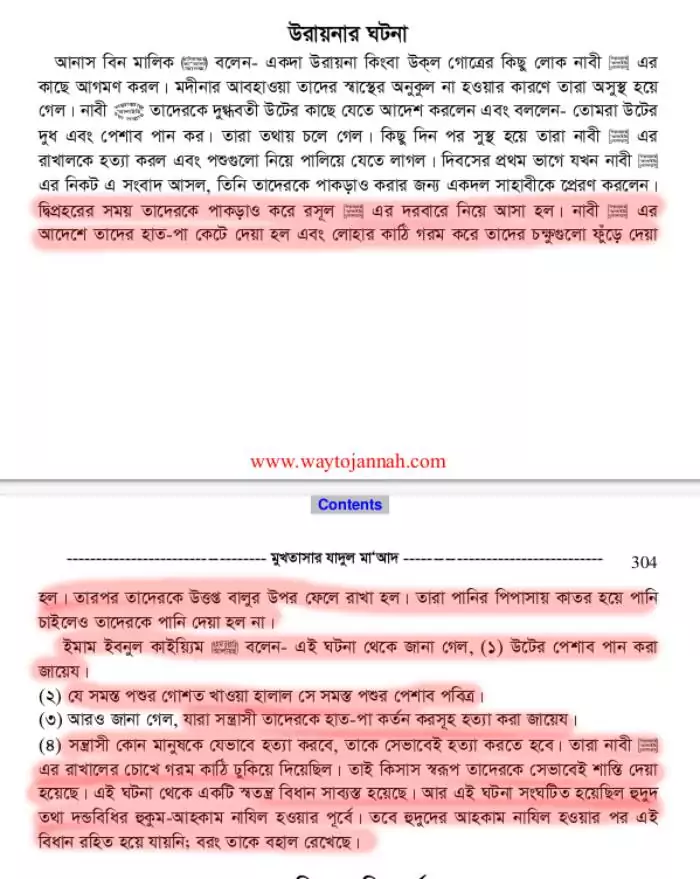
The ethical problem with this juristic conclusion is that it permits the blinding or dismemberment of a person to be repeated as retaliation for an offense. Even where responsibility for a crime is established, the moral legitimacy of bodily torture does not automatically follow. A person found guilty of murder or severe violence can be sentenced by a court, but destroying their sight or permanently disabling them is not necessary to impose a sentence. Such penalties do not repair the original harm; they create additional physical injury. When Ibn al-Qayyim recognizes retaliatory blinding as a continuing prophetic ruling, the ethical problem extends from a historical episode into an enduring conception of Islamic justice.
This ruling directly conflicts with the claim that Muhammad is a moral exemplar for all time. The historical fact that a ruler had captives mutilated and tortured in his own era is itself subject to severe ethical criticism. The problem becomes greater when later jurists establish some of that torture as a permanent legal rule. Giving religious legitimacy to cruel bodily retaliation privileges vengeance in punishment over the human dignity of offenders. Blinding, amputation, and the deliberate infliction of bodily pain as a state sentence do not represent humane justice. Attempts to perpetuate such sentences as religious law directly conflict with human dignity and the right to freedom from torture.
Apostasy as a Reason for the Brutal Punishment
The connection between the brutal punishment carried out against captives from Ukl and Uraynah on Muhammad’s orders and the issue of apostasy is explicitly recorded in Islamic hadith literature. Multiple accounts in Sahih al-Bukhari and Sahih Muslim say that the accused initially embraced Islam but later abandoned it in the course of killing the herdsmen and stealing the camels. Although they were accused of murder and theft, narrators also specifically mention their apostasy. The event was therefore not preserved merely as an ordinary case of homicide or robbery; it became associated with renouncing Islam after conversion, rebelling against Muslim leadership, and rejecting religious and political authority. In one report in Sunan al-Nasa’i, a direct question is asked about the grounds for the punishment: was it imposed because of an offense, or because of disbelief? The reply attributed to Anas ibn Malik identifies disbelief. This account is significant evidence for examining the relationship between apostasy and bodily torture.
Sunan al-Nasa’i 307, in the Islamic Foundation edition, describes several Bedouins from Uraynah arriving in Medina and embracing Islam. When they became ill, Muhammad instructed them to drink camel milk and urine. After recovering, they killed the herdsman and fled with the camels. Men sent on Muhammad’s orders caught them, and they were punished by amputation and the insertion of heated iron instruments into their eyes. The narration then records a question asked by the Umayyad caliph Abd al-Malik ibn Marwan. He asked Anas whether the punishment had been imposed because of disbelief or some other sin. The reply attributed to Anas was that it was for disbelief. In this account, religious identity and the renunciation of faith are directly presented as grounds for punishment [18]
Sunan al-Nasa’i (Islamic Foundation edition)
1 / Purification
Chapter 191: Regarding the Urine of Animals Whose Meat Is Lawful
307. Muhammad ibn Wahb … narrated from Anas ibn Malik: Some Bedouins from the tribe of Uraynah came to the Messenger of Allah and accepted Islam. Medina did not suit them, and they became pale and their bellies swelled. The Messenger of Allah sent them to his milch camels and ordered them to drink their milk and urine. They recovered, killed the herdsman, and drove away the camels. The Prophet sent men to find them. They were captured; their hands and feet were cut off, and heated iron rods were thrust into their eyes.
When the Commander of the Faithful Abd al-Malik heard Anas narrate this hadith, he asked, ‘Was this punishment for disbelief or for a sin?’ He replied, ‘For disbelief.’
Abu Abd al-Rahman (Imam al-Nasa’i) said: We do not know of anyone other than Talhah who transmitted this statement from Yahya on the authority of Anas in this chain. The correct version, and Allah knows best, is the mursal report of Yahya from Sa’id ibn al-Musayyab.
Hadith classification: Sahih
Narrator: Anas ibn Malik
The most important part of this narration is the question asked by Abd al-Malik and the answer attributed to Anas. The ruler asked whether the punishment imposed on the Uraynah men had been for disbelief or for the crimes they had committed. His question distinguishes two different grounds of accountability: religious belief and identity on the one hand, and actual criminal conduct on the other. The answer attributed to Anas identifies disbelief as the reason for punishment. In this context, disbelief also encompasses abandoning Islam after conversion, since Bukhari and Muslim explicitly describe the accused as apostates. Apostasy is therefore more than incidental background information; in this particular narration, it also enters the discussion of why the punishment was imposed.
The original Arabic wording of the hadith makes the distinction explicit. Abd al-Malik’s question and the reply attributed to Anas use the expression بِكُفْرٍ أَمْ بِذَنْبٍ—’for disbelief or for a sin?’ The central issue in this report is thus not merely whether the men had apostatized, but what relationship their apostasy bore to the brutal bodily punishment inflicted on them. The answer identifying disbelief makes that relationship more direct [19]
قَالَ أَمِيرُ الْمُؤْمِنِينَ عَبْدُ الْمَلِكِ لأَنَسٍ وَهُوَ يُحَدِّثُهُ هَذَا الْحَدِيثَ بِكُفْرٍ أَمْ بِذَنْبٍ قَالَ بِكُفْرٍ.
English translation: When Anas was narrating this hadith, the Commander of the Faithful Abd al-Malik asked him, ‘Was this for disbelief or for a sin?’ He answered, ‘For disbelief.’
Imam al-Nasa’i himself comments on the status of this question-and-answer report. He states that, to his knowledge, no one other than Talhah narrated this additional statement through Yahya from Anas, and he considered the correct transmission to be the mursal report from Yahya through Sa’id ibn al-Musayyab. Thus the original compiler raises a specific objection to the chain transmitting Abd al-Malik’s question and the answer attributed to Anas. This is a textual fact relevant to evaluating the particular report linking apostasy to the reason for punishment. Yet the accounts of amputation, blinding, and apostasy do not depend solely on that additional statement: they also occur independently in other narrations in Sahih al-Bukhari and Sahih Muslim. The chain-related limitation of the al-Nasa’i report therefore does not erase the principal accounts of the punishment or the fact that apostasy is included in those narratives.
Sahih al-Bukhari 6802 places the affair in the Kitab al-Hudud, the book of legally prescribed punishments. Its chapter is entitled Bab al-Muharibin min Ahl al-Kufr wa al-Riddah—the chapter on armed combatants among disbelievers and apostates. Anas relates that members of Ukl embraced Islam and became ill because of Medina’s climate. After drinking camel milk and urine on Muhammad’s instructions, they recovered, apostatized, killed the herdsmen, and took the camels. Muhammad ordered their capture and subsequently had their hands and feet cut off and their eyes blinded, without the wounds being cauterized to stop the bleeding. In this narration, apostasy and physical torture appear together in the same account [20]
حَدَّثَنِي أَبُو قِلاَبَةَ الْجَرْمِيُّ، عَنْ أَنَسٍ رَضِيَ اللَّهُ عَنْهُ، قَالَ قَدِمَ عَلَى النَّبِيِّ صلى الله عليه وسلم نَفَرٌ مِنْ عُكْلٍ، فَأَسْلَمُوا فَاجْتَوَوُا الْمَدِينَةَ، فَأَمَرَهُمْ أَنْ يَأْتُوا إِبِلَ الصَّدَقَةِ، فَيَشْرَبُوا مِنْ أَبْوَالِهَا وَأَلْبَانِهَا، فَفَعَلُوا، فَصَحُّوا، فَارْتَدُّوا وَقَتَلُوا رُعَاتَهَا، وَاسْتَاقُوا الإِبِلَ، فَبَعَثَ فِي آثَارِهِمْ، فَأُتِيَ بِهِمْ فَقَطَعَ أَيْدِيَهُمْ، وَأَرْجُلَهُمْ وَسَمَلَ أَعْيُنَهُمْ، ثُمَّ لَمْ يَحْسِمْهُمْ حَتَّى مَاتُوا.
English translation: Abu Qilabah al-Jarmi narrated to me from Anas, who said: Some men from Ukl came to the Prophet and accepted Islam, but the climate of Medina did not agree with them. He ordered them to go to the charity camels and drink their urine and milk. They did so and recovered. Then they apostatized, killed the camels’ herdsmen, and drove away the camels. He sent men in pursuit, and when they were brought back, he had their hands and feet cut off and their eyes blinded. Their wounds were not cauterized until they died.
In this narration from Sahih al-Bukhari, the word for apostasy is فَارْتَدُّوا, meaning ‘they apostatized.’ It is immediately followed by the description of the killing of the herdsmen and the theft of the camels. Religious and criminal allegations were therefore combined in the description of the accused. This matters because classical Islamic penal discourse treats the apostate (murtadd) and the armed combatant (muharib) as distinct categories, yet both identities are used in relation to the Uraynah incident. Omitting their apostasy would leave the source-based Islamic account incomplete. Equally, omitting the murder and camel theft would remove the criminal context. The full narrative includes the abandonment of religious allegiance, the taking of lives and property, and punishment through amputation, blinding, and suffering until death.
In Islamic law, an incident of this kind is not confined to determining individual criminal responsibility: opposition to religious authority also acquires significance in discussions of punishment. The hadith reports that the Uraynah men apostatized after embracing Islam, and Quranic commentary on 5:33 also refers to their case. The offenders are characterized there as people who wage war against Allah and His Messenger and strive to spread corruption on earth. Describing opposition to religious and political authority in this way links offenses against the state with religious disobedience. Treating apostasy as a religious crime and discussing it within the same penal framework as murder and robbery raises serious ethical questions about freedom of belief and the limits of state punishment.
Apostasy is particularly relevant to assessing the brutality of the punishment inflicted on the Uraynah men, but the allegations of murder and theft do not morally justify that brutality. The report that they killed a herdsman establishes grounds for criminal investigation and punishment. Yet thrusting heated rods into the captives’ eyes, severing their limbs without stopping the bleeding, and leaving them to die without water constitutes retaliatory torture extending far beyond the adjudication of guilt. Turning an offender’s body into an instrument of unbearable suffering is not humane justice. Using the person’s apostasy as an additional religious justification would also bring the enforcement of religious allegiance into the rationale for torture.
Abd al-Malik’s question distinguishes disbelief from sin as grounds for punishment; Bukhari explicitly mentions apostasy; and the Quranic law of hirabah employs the concept of waging war against God and His Messenger. Together, these three elements illustrate the close connection between religious authority, crime, and bodily punishment in early Islamic penal discourse. Questions of physical security and religious freedom are both implicated. Criminal behavior can give rise to prosecution, but changing one’s faith or religious identity cannot justify torture. The horror of the Uraynah affair is that Islamic sources record apostasy and armed criminal acts alongside the infliction of multiple severe bodily penalties on captives. The methods of punishment directly conflict with the claim to an exemplary moral standard for all humanity.
Quran 5:33–34: Divine Penal Provisions for Killing, Crucifixion, Amputation, and Exile
The brutal punishment carried out against captives from Ukl and Uraynah on Muhammad’s orders is closely connected to verses 33 and 34 of Surah al-Ma’idah. Numerous Islamic works of tafsir and fiqh treat these verses as the foundation of the law of hirabah, concerning those who wage war against God and His Messenger and spread corruption on earth. Verse 33 prescribes four penalties: killing, crucifixion, amputation of hands and feet on opposite sides, and exile. It also characterizes these penalties as worldly disgrace for the offenders. The following verse provides an exception for those who repent before capture and addresses the legal consequences of that repentance. Together, the verses deal not only with bodily punishment but also with religious authority, humiliation, state power to impose sentences, and the differing legal treatment of repentance before and after arrest. Classical scholars extensively debated their application in connection with the mutilation and blinding of the Uraynah captives.
The language of Quran 5:33 directly prescribes physical penalties. It characterizes the offenders as people who wage war against Allah and His Messenger and seek to spread corruption in the land. In response, it announces killing, crucifixion, the cutting off of hands and feet on opposite sides, or banishment. Cutting off hands and feet on opposite sides means amputating a hand on one side of the body and a foot on the other, causing severe permanent disability. Crucifixion likewise turns the human body into an instrument of extreme punishment and public humiliation. The authorization of such mutilation and disgrace is directly incorporated into the prescription of criminal sentences [21]
إِنَّمَا جَزَاءُ الَّذِينَ يُحَارِبُونَ اللَّهَ وَرَسُولَهُ وَيَسْعَوْنَ فِي الْأَرْضِ فَسَادًا أَنْ يُقَتَّلُوا أَوْ يُصَلَّبُوا أَوْ تُقَطَّعَ أَيْدِيهِمْ وَأَرْجُلُهُمْ مِنْ خِلَافٍ أَوْ يُنْفَوْا مِنَ الْأَرْضِ ۚ ذَٰلِكَ لَهُمْ خِزْيٌ فِي الدُّنْيَا ۖ وَلَهُمْ فِي الْآخِرَةِ عَذَابٌ عَظِيمٌ
English translation: The only recompense of those who wage war against Allah and His Messenger and strive to spread corruption in the land is that they be killed or crucified, or that their hands and feet be cut off on opposite sides, or that they be banished from the land. That is disgrace for them in this world, and in the Hereafter they will suffer a tremendous punishment.
One of the most significant phrases in this verse is ذَٰلِكَ لَهُمْ خِزْيٌ فِي الدُّنْيَا—’That is disgrace for them in this world.’ The connection between punishment and disgrace is important. A sentence intended to prevent crime or protect society and the dismemberment of an offender’s body for humiliation do not rest on the same moral foundation. The former centers criminal accountability and public safety; the latter involves turning a human body into an instrument of degradation and vengeance. The Quranic verse directly associates bodily penalties with worldly disgrace. Disgrace is thus not merely an unintended side effect of imposing punishment; it is a declared consequence of the Quranic sanction. The authorization to disable human beings permanently and the attribution of that authority to divine command fundamentally conflict with human dignity and a justice system free of torture.
In commenting on this verse, al-Tabari describes killing, crucifixion, amputation, and exile as prescribed punishments and exemplary chastisements for people who spread corruption on earth. He associates the sanctions with nakal, severe exemplary punishment, and khizyun, disgrace. He also connects the provision to an earlier verse in Surah al-Ma’idah about unlawful killing and corruption on earth. In al-Tabari’s discussion, then, bodily punishment for an offense is tied to the idea of publicly disgracing an offender as an example to others [22]
أَعْلَمَ عِبَادَهُ مَا الَّذِي يَسْتَحِقُّ الْمُفْسِدُ فِي الْأَرْضِ مِنَ الْعُقُوبَةِ وَالنَّكَالِ، فَقَالَ تَبَارَكَ وَتَعَالَى: لَا جَزَاءَ لَهُ فِي الدُّنْيَا إِلَّا الْقَتْلُ وَالصَّلْبُ وَقَطْعُ الْيَدِ وَالرِّجْلِ مِنْ خِلَافٍ أَوِ النَّفْيُ مِنَ الْأَرْضِ، خِزْيًا لَهُمْ.
English translation: He informed His servants of the punishment and exemplary chastisement deserved by those who spread corruption on earth. He, exalted is He, declared that their punishment in this world is nothing but killing, crucifixion, cutting off a hand and a foot on opposite sides, or exile from the land, as a disgrace for them.
This Quranic provision did not remain merely a religious maxim in later Islamic jurisprudence. Jurists used it to establish rules for assigning punishments according to the nature of an offense. Al-Qurtubi’s commentary records extensive disagreement over the penalties for someone who merely blocks a road and terrorizes travelers, steals property, commits murder, or combines murder with theft. One position attributed to Ibn Abbas prescribes separate penalties according to the offense. Other positions, associated with Malik, Abu Thawr, and additional scholars, emphasize the ruler’s authority to choose among the punishments listed in the verse. The central dispute was whether the four Quranic penalties were assigned to distinct offenses in a fixed order or whether a judge or ruler could choose among them. Both approaches retained killing, crucifixion, and amputation as legitimate penalties [23]
وَاخْتَلَفُوا فِي حُكْمِ الْمُحَارِبِ؛ فَقَالَتْ طَائِفَةٌ: يُقَامُ عَلَيْهِ بِقَدْرِ فِعْلِهِ؛ فَمَنْ أَخَافَ السَّبِيلَ وَأَخَذَ الْمَالَ قُطِعَتْ يَدُهُ وَرِجْلُهُ مِنْ خِلَافٍ، وَإِنْ أَخَذَ الْمَالَ وَقَتَلَ قُطِعَتْ يَدُهُ وَرِجْلُهُ ثُمَّ صُلِبَ، فَإِذَا قَتَلَ وَلَمْ يَأْخُذِ الْمَالَ قُتِلَ، وَإِنْ هُوَ لَمْ يَأْخُذِ الْمَالَ وَلَمْ يَقْتُلْ نُفِيَ.
English translation: They differed concerning the ruling for an armed combatant. One group said that punishment should be imposed in proportion to what he has done. A person who terrorizes travelers and takes their property has his hand and foot cut off on opposite sides. If he takes property and kills, his hand and foot are cut off and he is then crucified. If he kills without taking property, he is executed. If he neither takes property nor kills, he is banished.
Although this juristic position varies the severity of punishment according to the offense, it still establishes bodily mutilation as an acceptable form of judicial sentencing. Amputating hands and feet for highway robbery and theft, or combining amputation with crucifixion in cases involving both murder and theft, authorizes multiple terrifying bodily penalties. It permits permanent injury to be inflicted on an offender and the severity of the sentence to be increased in response to a crime. Holding someone accountable for harm to society is not the same as licensing the mutilation of that person’s body. Yet bodily mutilation is one of the central authorized forms of punishment under this interpretation.
Al-Qurtubi also discusses the positions of Abu Hanifa and al-Shafi’i. Under Abu Hanifa’s approach, a person who commits murder is executed, while one who steals property without killing has a hand and foot cut off on opposite sides. Where both murder and theft occur, the ruler has a choice among multiple penalties. Al-Shafi’i discusses the amputation of the right hand and left foot for theft of property, including cauterizing the wounds to stop the bleeding. Execution is prescribed for murder, and execution together with crucifixion is discussed for the combination of murder and theft. Thus, although Islamic juristic traditions disagree about the selection and implementation of penalties, they recognize the severing of an offender’s limbs as part of criminal law [24]
Comparing this legal discussion with the punishment imposed on the Ukl–Uraynah captives reveals a significant difference. Quran 5:33 prescribes killing, crucifixion, amputation of hands and feet on opposite sides, and exile. It does not instruct authorities to insert heated iron into a prisoner’s eyes, leave a blind captive bleeding, or allow him to die of thirst. Yet the reports in Sahih al-Bukhari and Sahih Muslim describe these additional acts of torture carried out on Muhammad’s orders. The Quranic provision for amputation and the actual punishment administered by Muhammad therefore differ in their additional measures of bodily abuse. That difference also helps explain why later commentators disputed whether such additional torture remained legally valid or was subsequently corrected by the Quranic revelation.
Al-Qurtubi offers another important explanation of the verse. In his view, ‘waging war against Allah and His Messenger’ is a figurative expression, because God cannot literally be fought and defeated like a human opponent. He interprets it as waging war against those who follow God. This exposes the relationship between the verse’s religious language and the political and social authority established over human beings. Describing an armed attack against a community or its ruling authority as war against God and His Messenger elevates an earthly conflict into a religious offense. The power to impose punishment is thereby grounded not only in political authority but also in a claim to divine authority [25]
Quran 5:34 announces an important exception to this penal regime. It provides for the forgiveness of persons who repent before they are captured by the authorities. The timing of repentance is crucial. Whether an offender repents before arrest or after coming under state control affects the legal consequences of the sentence. Judicial authority and the circumstances of surrender are therefore linked to religious forgiveness [26]
إِلَّا الَّذِينَ تَابُوا مِنْ قَبْلِ أَنْ تَقْدِرُوا عَلَيْهِمْ ۖ فَاعْلَمُوا أَنَّ اللَّهَ غَفُورٌ رَحِيمٌ
English translation: Except for those who repent before you gain power over them. Know that Allah is Forgiving, Merciful.
In interpreting this verse, al-Qurtubi discusses in detail the relationship between repentance and remission of punishment. In his account, those who repent before being captured may be relieved of penalties concerning the rights of God, but repentance does not automatically extinguish liabilities relating to murder or other individuals’ property and rights. If the offender has killed someone, the claims associated with the victim’s rights and with compensation owed to others remain separate questions. Conversely, if repentance occurs after capture, the general effect of the verse is that the prescribed punishment still applies. Repentance and forgiveness thus operate within a defined legal structure [27]
اسْتَثْنَى جَلَّ وَعَزَّ التَّائِبِينَ قَبْلَ أَنْ يُقْدَرَ عَلَيْهِمْ، وَأَخْبَرَ بِسُقُوطِ حَقِّهِ عَنْهُمْ بِقَوْلِهِ: فَاعْلَمُوا أَنَّ اللَّهَ غَفُورٌ رَحِيمٌ. أَمَّا الْقِصَاصُ وَحُقُوقُ الْآدَمِيِّينَ فَلَا تَسْقُطُ، وَمَنْ تَابَ بَعْدَ الْقُدْرَةِ فَظَاهِرُ الْآيَةِ أَنَّ التَّوْبَةَ لَا تَنْفَعُ، وَتُقَامُ الْحُدُودُ عَلَيْهِ.
English translation: God, exalted is He, made an exception for those who repent before they are apprehended, and stated that His right over them is waived, saying, ‘Know that Allah is Forgiving, Merciful.’ But retaliation and the rights of human beings are not waived. As for one who repents after capture, the apparent meaning of the verse is that repentance does not remove the penalty, and the hudud punishments are imposed upon him.
The significance of this rule is that the relationship between bodily punishment and religious repentance is tied to a particular stage in the exercise of state authority. Repentance before capture may lead to one legal result, while repentance after capture may produce another. The timing of an offender’s remorse, surrender, and entry into official custody thus matters to the judicial outcome. Al-Qurtubi also preserves liability for the rights of other persons, so religious repentance does not erase responsibility for homicide or harm to others. Yet the broader penal framework continues to include killing, amputation, and crucifixion. The presence of a provision for forgiveness does not eliminate the authorization to cause permanent injury to offenders.
The connection between the Ukl–Uraynah affair and these two verses further exposes the ethical problems of Islamic penal law. The accused had their hands and feet amputated and their eyes blinded on Muhammad’s orders. Meanwhile, Quran 5:33 authorizes killing, crucifixion, amputation on opposite sides, and exile as religious penalties. It describes these punishments as worldly disgrace, and the next verse establishes special treatment for repentance before capture. Within this legal framework, criminal punishment is associated with the permanent disabling and public humiliation of the human body. The seriousness of an offense may justify prosecution and sentencing, but it does not make bodily mutilation a humane method of justice. Giving permanent legal authority to such cruelty through religious sanction directly conflicts with the fundamental dignity of human beings and their right to freedom from torture.
Quran 5:33 and 5:34 are not merely texts explaining an ancient incident; they also became foundations for defining the punishment of hirabah in Islamic jurisprudence. Subsequent commentators and jurists used these verses to discuss armed criminal acts, highway robbery, theft, homicide, rebellion against religious authority, and the consequences of repentance. Their discussions recognized dismemberment, execution, and crucifixion as legitimate components of religious penal law. In this way, the concept of severe bodily punishment from Muhammad’s period acquired a lasting foundation in later Islamic legal thought. Authorizing such punishments to leave people permanently disabled and disgraced profoundly conflicts with universal human dignity, limits on judicial power, and ethics opposed to torture. The presence of this cruelty in a penal system claiming to offer an exemplary source of justice for all time exposes a fundamental moral contradiction.
The Occasion of Revelation of Quran 5:33: The Ukl–Uraynah Incident in Classical Tafsir
Classical Islamic exegesis extensively discusses the connection between Quran 5:33 and the brutal punishment imposed on the Ukl and Uraynah captives on Muhammad’s orders. The accounts in Sahih al-Bukhari and Sahih Muslim describe the accused having their hands and feet amputated, their eyes blinded with heated iron, and their bodies left bleeding and thirsty until death. Quran 5:33, by contrast, prescribes killing, crucifixion, amputation on opposite sides, and exile for waging war against God and His Messenger and spreading corruption in the land. An important group of classical Quranic commentators explicitly associate the revelation of this verse with the Uraynah incident. Their discussions concern not only the prescribed penalties, but also what Muhammad did before the verse was revealed, later objections to that punishment, and the limits placed on sentencing by the Quran. The affair thus became an important source for examining the historical background of Quranic penal law.
In his Al-Jami li Ahkam al-Quran, al-Qurtubi begins his commentary on Quran 5:33 by discussing its occasion of revelation. He reports disagreement over the question but states that the majority view holds that the verse was revealed concerning the men of Uraynah. He then recounts the incident in detail through Anas ibn Malik. The men who came to Muhammad became ill because of Medina’s climate; on his instructions they drank camel milk and urine and recovered, after which they killed the herdsman and stole the camels. They were eventually captured. In the narration quoted by al-Qurtubi, Muhammad ordered their hands and feet amputated and their eyes blinded, and they were abandoned in al-Harra. It also states that they asked for water and were refused. Al-Qurtubi therefore treats this appalling bodily torture as a significant historical background to the revelation of the verse [28]
الأولى : اختلف الناس في سبب نزول هذه الآية ; فالذي عليه الجمهور أنها نزلت في العرنيين.
English translation: First issue: People have differed concerning the reason for the revelation of this verse. The majority view, however, is that it was revealed concerning the men of Uraynah.
Al-Qurtubi also says that the herdsman killed by the men of Uraynah was named Yasar and was of Nubian origin. According to historical and sira accounts, the offenders cut off the herdsman’s hands and feet, drove thorns into his eyes, and killed him. This account reveals the brutality of the original homicide as well. Both the torture inflicted on the herdsman and the subsequent torture ordered by Muhammad involved bodily mutilation. Al-Qurtubi presents the details about the herdsman’s severed limbs and thorns in his eyes as information drawn from historical and biographical sources. Sahih Muslim also reports that the herdsman’s eyes were blinded. Taken together, these accounts clarify the purpose of retaliatory mutilation. Blinding and murdering a person is an atrocious crime, and blinding captives in response and leaving them to die in agony is another act of cruelty. The severity of the original offense cannot morally validate subsequent torture [29]
Al-Tabari’s Jami al-Bayan preserves several distinct accounts of the verse’s occasion of revelation. Reports attributed to Ibn Abbas and al-Dahhak connect it to a group of treaty-bound People of the Book who broke their agreement and obstructed roads. Other interpretations attributed to Ikrimah and al-Hasan al-Basri concern polytheists. Still other reports through Qatadah, Anas, and additional transmitters identify the apostasy, murder, and camel theft committed by men from Ukl and Uraynah as its context. Of these differing explanations, al-Tabari favors a position in which the verse was revealed after Muhammad had punished the Uraynah men. His preferred interpretation therefore establishes a particular sequence between the earlier punishment and the subsequent Quranic legislation [30]
The chronology of al-Tabari’s interpretation is crucial. He accepts that the captives’ hands and feet were cut off and their eyes blinded before the verse was revealed. This matters because later Muslim scholars debated whether the verse invalidated any element of Muhammad’s punishment. The revelation’s placement after the Uraynah affair supplies a historical premise for that disagreement. In particular, blinding the prisoners and failing to stop their bleeding are not among the four forms of punishment listed in Quran 5:33. Scholars therefore asked whether the verse merely confirmed the legal basis of the earlier punishment or restricted and abolished Muhammad’s additional acts of mutilation. Both positions appear in the traditions preserved by al-Tabari.
Ibn Kathir also examines the Uraynah affair in detail in his commentary on Quran 5:33. Drawing on Bukhari and Muslim, he recounts the men’s conversion to Islam, illness, consumption of camel milk and urine, killing of the herdsman, theft of the camels, apostasy, and subsequent punishment. He also quotes the Muslim report explaining that the prisoners were blinded because they had blinded the herdsmen. Ibn Kathir does not confine the verse’s ruling to a particular tribe or religious affiliation. His conclusion is that it applies generally to polytheists and anyone else who commits the offenses described in it. The verse associated with the particular Uraynah incident was thereby interpreted as a foundation for a general penal law [31]
والصحيح أن هذه الآية عامة في المشركين وغيرهم ممن ارتكب هذه الصفات
English translation: The correct view is that this verse applies generally to polytheists and others who commit acts characterized by these attributes.
Al-Baghawi’s Ma’alim al-Tanzil likewise preserves multiple accounts of the occasion of revelation. He cites al-Dahhak concerning treaty-breaking People of the Book, al-Kalbi regarding another conflict, and Sa’id ibn Jubayr concerning the people of Ukl and Uraynah. In the report through Sa’id ibn Jubayr, these men professed Islam without sincere allegiance, then apostatized, killed the herdsman, and fled with the camels. Al-Baghawi also uses Anas ibn Malik’s report to recount the amputation of their limbs, the blinding of their eyes, and their abandonment to die without their bleeding being stopped. In this commentary as well, the Uraynah incident is connected to the historical background of the Quranic penal provisions [32]
واختلفوا في حكم هؤلاء العرنيين : فقال بعضهم : هي منسوخة لأن المثلة لا تجوز ، وقال بعضهم : حكمه ثابت إلا السمل [ والمثلة ] وروى قتادة عن ابن سيرين أن ذلك كان قبل أن [ ينزل الحد ] وقال أبو الزناد : فلما فعل رسول الله صلى الله عليه وسلم ذلك بهم أنزل الله الحدود ونهاه عن المثلة فلم يعد .
English translation: Scholars differed concerning the ruling applied to these men of Uraynah. Some said that it was abrogated because mutilation is impermissible. Others said that the ruling remains in force except for blinding and mutilation. Qatadah narrated from Ibn Sirin that this had occurred before the hudud provisions were revealed. Abu al-Zinad said that after the Messenger of Allah had treated them in this manner, Allah revealed the hudud provisions and prohibited him from mutilation, and he never did it again.
These commentaries establish an important point when read together: the punishment of the Uraynah men was preserved not merely as a hadith report but as evidence for determining the occasion of revelation and the limits of Quranic criminal law. Al-Qurtubi identifies its connection with the verse as the majority view; al-Tabari concludes that revelation followed the punishment; Ibn Kathir regards the verse’s ruling as generally applicable; and al-Baghawi preserves the dispute over whether the punishment was abrogated or remained valid. The amputation and blinding carried out on Muhammad’s orders therefore became a significant legal precedent within Islam’s interpretive tradition. Its most serious ethical implication is that the severe torture of captive human beings occupied a central place in later religious disputes over the legitimacy of punishment. By associating mutilation, bleeding, and prolonged agony with divinely authorized penalties, the episode acquired enduring religious and legal importance.
Was Blinding Abrogated or Still Valid? The Juristic Dispute among Al-Tabari, Al-Qurtubi, and Ibn al-Qayyim
Classical Muslim scholars disagreed over the legal status of the punishment Muhammad ordered against the Ukl–Uraynah captives: amputation, blinding with heated iron, and abandonment to die of thirst. The central question was whether such physical torture remained part of permanent Islamic penal law or whether later Quranic legislation abrogated some of it. Quran 5:33 prescribes killing, crucifixion, amputation of hands and feet on opposite sides, and exile, but it does not authorize thrusting hot iron into prisoners’ eyes, leaving them bleeding after amputation, or denying them water until death. This difference led some later scholars to interpret the blinding as a punishment that was corrected or abrogated. Ibn al-Qayyim and others, by contrast, accepted its retaliatory element as a valid rule. The same historical act thus produced competing legal conclusions.
Sunan Abi Dawud 4370 preserves an especially significant report on this dispute. According to Abu al-Zinad, after Muhammad had the hands and feet of the camel thieves cut off and blinded their eyes with heated iron, Allah reproached him for what he had done. Quran 5:33 was then revealed. In this narration, the revelation of the Quranic provision is presented as a correction of Muhammad’s earlier conduct. The act of blinding is thus described as a form of punishment against which a subsequent religious instruction was given. Sunan Abi Dawud records the statement as a separate report, and the same interpretive tradition appears in the commentaries of al-Tabari and al-Qurtubi [33]
أَنَّ رَسُولَ اللَّهِ صلى الله عليه وسلم لَمَّا قَطَعَ الَّذِينَ سَرَقُوا لِقَاحَهُ وَسَمَلَ أَعْيُنَهُمْ بِالنَّارِ عَاتَبَهُ اللَّهُ تَعَالَى فِي ذَلِكَ فَأَنْزَلَ اللَّهُ تَعَالَى { إِنَّمَا جَزَاءُ الَّذِينَ يُحَارِبُونَ اللَّهَ وَرَسُولَهُ وَيَسْعَوْنَ فِي الأَرْضِ فَسَادًا أَنْ يُقَتَّلُوا أَوْ يُصَلَّبُوا } الآيَةَ .
English translation: Abu al-Zinad narrated that when the Messenger of Allah had the hands and feet of those who stole his milch camels cut off and blinded their eyes with fire, Allah, exalted is He, reproached him for it. Allah then revealed: ‘The only recompense for those who wage war against Allah and His Messenger and strive to spread corruption in the land is that they be killed or crucified …’—and the remainder of the verse.
The reproach described in this report is significant for more than the sequence of punishments. It distinguishes an act Muhammad actually carried out from the subsequent divine legislation. The accused had their hands and feet amputated and their eyes blinded, and only afterward does the account mention reproach for those acts. Islamic narrative tradition thus preserves an example in which a punishment inflicted by Muhammad was portrayed as something requiring correction. Abu al-Zinad’s particular report does not belong to the same line of transmission as the eyewitness accounts from Anas; it constitutes a separate strand of later interpretation. Yet the blinding itself is explicitly recorded in Sahih al-Bukhari and Sahih Muslim. Disagreement over the report of divine reproach therefore does not erase the act of blinding the captives on Muhammad’s orders.
Sunan Abi Dawud 4368 contains another important statement concerning the subsequent prohibition of mutilation. In one version of Anas ibn Malik’s account of the Uraynah affair, it is said that Muhammad thereafter forbade mutilation. The term muthlah refers to the mutilation of the body. The significance of this narration is that the hadith collections preserve not only the punishment of blinding ordered by Muhammad but also a later prohibition of bodily mutilation. The same hadith notes a variation among transmitters over whether the hands and feet were said to have been cut off on opposite sides. The account therefore provides material for examining both the punishment actually carried out and the subsequent legal status of such practices [34]
زَادَ ثُمَّ نَهَى عَنِ الْمُثْلَةِ وَلَمْ يَذْكُرْ مِنْ خِلاَفٍ
English translation: The narrator added: ‘Then he prohibited mutilation,’ but did not include the wording ‘on opposite sides.’
In his commentary on Quran 5:33, al-Tabari preserves three positions on whether the punishment inflicted on the Uraynah captives was abrogated. According to the first, the blinding carried out by Muhammad was abrogated through the later Quranic verse and the prohibition of mutilation. According to the second, the punishment remained a permanent legal ruling because the men had committed apostasy, murder, theft, and armed violence. A third narration claims that Muhammad intended to blind the prisoners but that the revelation prevented him from doing so. This third position denies that blinding actually occurred. Yet the explicit accounts in Sahih al-Bukhari and Sahih Muslim say that the punishment was carried out. The third claim therefore conflicts with the principal hadith reports. Al-Tabari’s own discussion also places the revelation after the punishment of the Uraynah captives [35]
وقال بعضهم : بل فعل النبي صلى الله عليه وسلم بالعرنيين حكم ثابت في نظرائهم أبدا , لم ينسخ ولم يبدل.
English translation: Others said: Rather, what the Prophet did to the men of Uraynah is a fixed ruling for those who commit comparable offenses forever; it has neither been abrogated nor changed.
Al-Tabari also preserves a report through Muhammad ibn Ajlan interpreting Quran 5:33 as a reproach of Muhammad’s earlier punishment. According to that account, the revelation established prescribed penalties of killing, amputation, and exile, and Muhammad never again blinded anyone in the same manner. The same discussion includes a contrary position from Abu Amr. He did not accept that the verse reproached Muhammad; instead, he interpreted the punishment imposed on the Uraynah men as a measure specific to them and regarded blinding as withdrawn for subsequent offenders. These interpretations differ, but both make the later legal status of blinding a central issue. The dispute was not chiefly over whether Muhammad had carried out the punishment; it concerned whether that action remained a precedent to be followed.
Al-Qurtubi discusses this controversy in greater detail. He reports that, according to Muhammad ibn Sirin, the Uraynah affair occurred before the hudud provisions were revealed. Al-Layth ibn Sa’d and certain other scholars held that the mutilation imposed on the captives was subsequently abrogated. Al-Qurtubi also cites Abu al-Zinad’s report of divine reproach. In contrast, he preserves the positions of scholars who considered the blinding retaliatory punishment for similar torture inflicted on the herdsmen. Al-Qurtubi himself regards this explanation based on retaliation as acceptable. Significantly, however, he also acknowledges that, if the report of reproach is authentic, it may have concerned excess cruelty in killing—especially the use of heated iron nails to blind the men and the decision to leave them thirsty until death [36]
إلا أنه يحتمل أن يكون العتاب إن صح على الزيادة في القتل ، وذلك تكحيلهم بمسامير محماة وتركهم عطاشى حتى ماتوا
English translation: Nevertheless, if the report of reproach is correct, it may have concerned excess in the killing: cauterizing their eyes with heated nails and leaving them thirsty until they died.
Al-Qurtubi’s statement is important because it expressly identifies blinding with heated iron and allowing captives to die without water as possible grounds for reproach over excessive cruelty. Classical Islamic exegesis thus contains an interpretation that treats elements of the punishment imposed on Muhammad’s orders as exceeding the prescribed penalty. Al-Qurtubi does not deny that blinding took place. On the contrary, he considers very weak a report transmitted through al-Suddi claiming that Muhammad merely intended to blind the men but never did so. Against that assertion, he cites the explicit account in Sahih al-Bukhari of heated iron nails. The historical act of bodily torture remains present in his discussion, even as its legal and ethical interpretations are disputed.
Ibn al-Qayyim, by contrast, rejects the position that the punishment was abrogated in his Zad al-Ma’ad. He holds that the ruling governing the punishment administered to the Uraynah captives remains valid. He interprets their blinding as retaliation for blinding the herdsman and also affirms the legality of combining amputation and execution in cases of murder and robbery. In his view, although the incident took place before the revelation of the hudud provisions, the later Quranic legislation did not abolish the punishment but confirmed it. His interpretation presents Muhammad’s practice and Quranic penal law as mutually reinforcing. Where other scholars considered part of the punishment abrogated or corrected, Ibn al-Qayyim recognized it as a continuing judicial precedent [37]
وقد ظهر بهذا أن القصة محكمة ، ليست منسوخة ، وإن كانت قبل أن تنزل الحدود ، والحدود نزلت بتقريرها لا بإبطالها
English translation: It has thus become clear that the ruling in this incident remains in force and has not been abrogated. Although it occurred before the hudud provisions were revealed, those later provisions confirmed it rather than invalidating it.
Ibn al-Qayyim’s position differs fundamentally from the accounts of correction and abrogation preserved by al-Tabari, al-Qurtubi, and Abu Dawud. Under one interpretation, Muhammad’s practice of blinding was restricted or abolished through later Quranic legislation; under another, it remained a valid form of retaliatory justice for comparable offenses. This is more than a dispute over the interpretation of a single verse. It concerns the extent of bodily harm that the state may legitimately impose as punishment. Amputation, blinding with heated iron, leaving wounds bleeding, and denying water all entered discussions about the limits of judicial authority. The very dispute over whether any of these measures were subsequently abrogated shows that the incident posed an enduring problem for Islamic penal law.
One historical point remains unchanged despite the disagreement: on Muhammad’s orders, the Uraynah captives had their hands and feet amputated and their eyes blinded, and they suffered until death. Sahih al-Bukhari, Sahih Muslim, Sunan Abi Dawud, and classical commentaries preserve accounts of this event. A later scholar’s conclusion that the punishment was abrogated cannot erase the torture previously inflicted. Nor does another scholar’s judgment that the ruling remains valid establish the moral legitimacy of bodily torture. Religious legal permission and humane justice are distinct questions. The cruelty of destroying someone’s eyesight, severing their limbs, and deliberately prolonging their dying does not change when the act is assigned a different religious legal classification.
The gravest ethical consequence of the episode is that a punishment imposed on Muhammad’s orders became a precedent in Islamic legal thought whose legitimacy was debated over centuries. Some scholars emphasized the prohibition of mutilation; others accepted retaliatory blinding as a continuing legal rule. At the center of the entire dispute, however, stands the severe bodily torture actually inflicted upon prisoners in custody. This history raises profound questions concerning human dignity, the rights of offenders, and the limits of state punishment. That the central figure of a religious tradition claiming to embody justice for all time ordered such torture, and that later jurists disputed its continuing legitimacy, directly challenges claims about the humanity and justice of that ideal.
Moral Ideals and Historical Reality: Political Use of Prophetic Punishment
Islamic theology presents Muhammad as uswatun hasanah, the supreme model worthy of imitation. Yet his orders to amputate the limbs of Ukl–Uraynah captives, blind them with heated iron, and leave them to die thirsty directly conflict with claims that this model embodies humane conduct. A murderer may be tried and sentenced, but blinding and disabling a person after capture and leaving them to die in agony is not an indispensable part of justice. The problem is deepened when later Islamic jurisprudence recognizes such cruelty as a valid or continuing legal rule. Once Muhammad’s conduct becomes an authoritative model for religious penal law, later rulers can invoke the same precedent to defend the imposition of severe bodily punishments.
Sahih al-Bukhari 5685 preserves an important historical example of this problem. The Umayyad ruler al-Hajjaj ibn Yusuf asked Anas ibn Malik about the harshest punishment Muhammad had inflicted. Anas told him about the amputation and blinding of the Ukl–Uraynah captives. When al-Hasan al-Basri learned of this, he remarked that it would have been better if Anas had not told al-Hajjaj. In his commentary on Quran 5:33, Ibn Kathir preserves a more detailed report through Ibn Mardawayh. It describes Anas’s regret and states that al-Hajjaj would cite Muhammad’s punishment in public sermons and use the hadith as an argument against people. A precedent for prophetic cruelty was thus also used to justify a subsequent political ruler’s exercise of power [38] [39]
فكان الحجاج إذا صعد المنبر يقول : إن رسول الله صلى الله عليه وسلم قد قطع أيدي قوم وأرجلهم ثم ألقاهم في الرمضاء حتى ماتوا لحال ذود [ من الإبل ] وكان يحتج بهذا الحديث على الناس .
English translation: Whenever al-Hajjaj ascended the pulpit, he would say, ‘The Messenger of Allah cut off the hands and feet of some men, then cast them onto scorching ground until they died, over a few camels.’ He used this hadith as an argument against people.
This narration reveals a significant political consequence of prophetic penal practice. Muhammad’s use of extreme bodily punishment was not merely an event from the past for a later ruler; it became an authoritative precedent for imposing harsh measures against people. Al-Hasan al-Basri’s remark and the report of Anas’s regret suggest concern about what could happen when such accounts reached someone wielding great political power. If a brutal episode from religious history is legitimated by the highest moral authority, it can later be invoked in defense of violent state punishment. Al-Hajjaj’s use of the precedent provides a concrete historical example of that danger.
The Ukl–Uraynah affair is therefore more than an instance of historical cruelty. It shows how a punishment presented as religiously exemplary can influence later law and political power. When scholars such as Ibn al-Qayyim concluded that the rule of retaliatory punishment remained valid, and rulers such as al-Hajjaj invoked Muhammad’s punishment against people, the relationship between criminal justice, religious legitimation, and political repression became clearer. A punishment is not morally acceptable merely because Muhammad ordered it. On the contrary, legitimating amputation, blinding, and prolonged agony through religious authority creates the danger of making such cruelty an enduring model for subsequent generations.
Conclusion
The punishment imposed on captives from Ukl and Uraynah at Muhammad’s command is a horrifying example of cruelty in the administration of justice in early Islamic history. Sahih al-Bukhari and Sahih Muslim preserve reports of the accused having their hands and feet cut off, their eyes blinded with heated iron, their bleeding wounds left untreated, and their bodies abandoned to die of thirst. They were accused of murdering a herdsman, stealing camels, and apostatizing. Murder and theft demand accountability, but they do not confer moral authority to inflict unlimited physical torture on captives. Blinding people, severing their limbs, and prolonging their agony as retaliation is not justice; it is retaliatory cruelty. Both the offender’s crime and the torture inflicted at a ruler’s direction require independent moral judgment.
The ethical implications are intensified by Quran 5:33 and subsequent Islamic jurisprudence. The Quran prescribes killing, crucifixion, amputation of hands and feet on opposite sides, and exile for waging war against God and His Messenger and spreading corruption on earth. It also characterizes these penalties as disgrace in this world. Classical Quranic commentators extensively debated the verse’s connection to the Uraynah affair, whether Muhammad’s blinding of the captives was subsequently corrected, and the continuing legal force of that punishment. Some scholars held that mutilation was abrogated, while Ibn al-Qayyim accepted it as a continuing rule. One historical event remains unchanged throughout these disagreements: prisoners were subjected to severe physical torture on Muhammad’s orders. Subsequent juristic disputes do not erase that cruelty.
Muhammad’s punishment also became a precedent used by later political authorities. Al-Hajjaj ibn Yusuf invoked the Uraynah incident in support of harsh measures against people. An episode of historical sentencing thus influenced later religious law and political rule. This exposes the fundamental problem with presenting Muhammad as the supreme moral example for all time. Evaluating cruelty that occurred in antiquity as a historical event is one matter; establishing that cruelty as divinely sanctioned and worthy of imitation by subsequent generations is another. Religious prestige cannot change the moral character of a cruel act.
Turning the human body into an instrument of state vengeance, religious authority, or political intimidation is not justice. No matter how grave an offender’s crime, deliberately blinding and disabling that person and allowing them to die in unbearable suffering is an extreme violation of human dignity. Such cruelty does not become morally acceptable merely by presenting it as a customary seventh-century punishment or part of a divinely sanctioned law. The history of torture carried out on the orders of the central figure of a tradition claiming to offer mercy and justice for all humanity, together with the subsequent attempts to establish the legal and religious legitimacy of that torture, exposes a profound and enduring moral contradiction in that claim.
References
- United Nations, Universal Declaration of Human Rights, Article 5 ↩︎
- International Covenant on Civil and Political Rights, Article 10(1) ↩︎
- Convention against Torture, Article 2(3) ↩︎
- United Nations Standard Minimum Rules for the Treatment of Prisoners, Nelson Mandela Rules, Rules 22 and 43 ↩︎
- Quran, Surah Al-Ma’idah, Verse 33 ↩︎
- Al-Tabari, Jami al-Bayan, Commentary on Quran 5:33 ↩︎
- Sahih al-Bukhari 3018, Book of Jihad, Chapter: Retaliation against a polytheist who burns a Muslim ↩︎
- Sahih Muslim 1671a, Book of Oaths, Rebels, Retaliation and Blood Money, Chapter on Hirabah and Apostasy ↩︎
- Sahih Muslim 1671c, Book of Oaths, Rebels, Retaliation and Blood Money, Chapter on Hirabah and Apostasy ↩︎
- Sahih al-Bukhari 5685, Tawhid Publications, Book of Medicine, Treatment with Camel Milk ↩︎
- Mishkat al-Masabih 3539, Book of Qisas, Chapter on Apostates and Those Spreading Disorder ↩︎
- Sahih Muslim 4207, Islamic Foundation edition (international numbering 1671), Book of Qisas ↩︎
- Sahih Muslim 4246, Hadith Academy edition (international numbering 1671), Trial of Combatants and Apostates ↩︎
- Sahih Muslim 1671h, Book of Qisas, Chapter on Combatants and Apostates ↩︎
- Ibn al-Qayyim, Zad al-Ma’ad fi Hady Khayr al-Ibad, Vol. 3, pp. 254–255, Expedition against the Uraynah Tribe and Legal Rulings ↩︎
- Zad al-Ma’ad, Vol. 3, p. 255, Discussion of the Non-Abrogation of the Uraynah Ruling ↩︎
- Mukhtasar Zad al-Ma’ad, Wahidiyya Islamiyya Library, pp. 303–304 ↩︎
- Sunan al-Nasa’i 307, Islamic Foundation edition, Book of Purification, Chapter 191: Urine of Animals Whose Meat Is Lawful ↩︎
- Sunan al-Nasa’i 307, Original Arabic Text ↩︎
- Sahih al-Bukhari 6802, Book of Hudud, Chapter on Combatants among Disbelievers and Apostates ↩︎
- The Quran, Surah Al-Ma’idah, Verse 33 ↩︎
- Al-Tabari, Jami al-Bayan, Commentary on Quran 5:33: Punishment and Humiliation of Those Spreading Corruption ↩︎
- Al-Qurtubi, Al-Jami li Ahkam al-Quran, Quran 5:33, Third Issue: Juristic Disagreement over the Punishment of Combatants ↩︎
- Al-Qurtubi, Commentary on Quran 5:33, Views of Abu Hanifa and Al-Shafi’i ↩︎
- Al-Qurtubi, Commentary on Quran 5:33, Meaning of Waging War against God and His Messenger ↩︎
- The Quran, Surah Al-Ma’idah, Verse 34 ↩︎
- Al-Qurtubi, Al-Jami li Ahkam al-Quran, Quran 5:34, Repentance before Capture and Remission of Punishment ↩︎
- Al-Qurtubi, Al-Jami li Ahkam al-Quran, Quran 5:33, First Issue: Occasion of Revelation ↩︎
- Al-Qurtubi, Commentary on Quran 5:33, the Uraynah Incident, the Shepherd Yasar and Mutilation ↩︎
- Al-Tabari, Jami al-Bayan, Quran 5:33, Reports on the Occasion of Revelation and Al-Tabari’s Conclusion ↩︎
- Ibn Kathir, Tafsir al-Quran al-Azim, Quran 5:33, General Application and the Uraynah Incident ↩︎
- Al-Baghawi, Ma’alim al-Tanzil, Quran 5:33, Occasion of Revelation and Punishment of the Uraynah Captives ↩︎
- Sunan Abi Dawud 4370, Book of Hudud, Chapter on the Punishment of Armed Combatants ↩︎
- Sunan Abi Dawud 4368, Book of Hudud, Prohibition of Mutilation after the Uraynah Incident ↩︎
- Al-Tabari, Jami al-Bayan, Quran 5:33, Dispute over Abrogation of the Uraynah Punishment ↩︎
- Al-Qurtubi, Al-Jami li Ahkam al-Quran, Quran 5:33, Disagreement over Mutilation and Abrogation ↩︎
- Ibn al-Qayyim, Zad al-Ma’ad fi Hady Khayr al-Ibad, Vol. 3, p. 255, Legal Ruling and Its Non-Abrogation ↩︎
- Sahih al-Bukhari 5685, Book of Medicine, Exchange between Al-Hajjaj and Anas ↩︎
- Ibn Kathir, Commentary on Quran 5:33, Al-Hajjaj’s Use of the Uraynah Incident in Sermons ↩︎