
Introduction
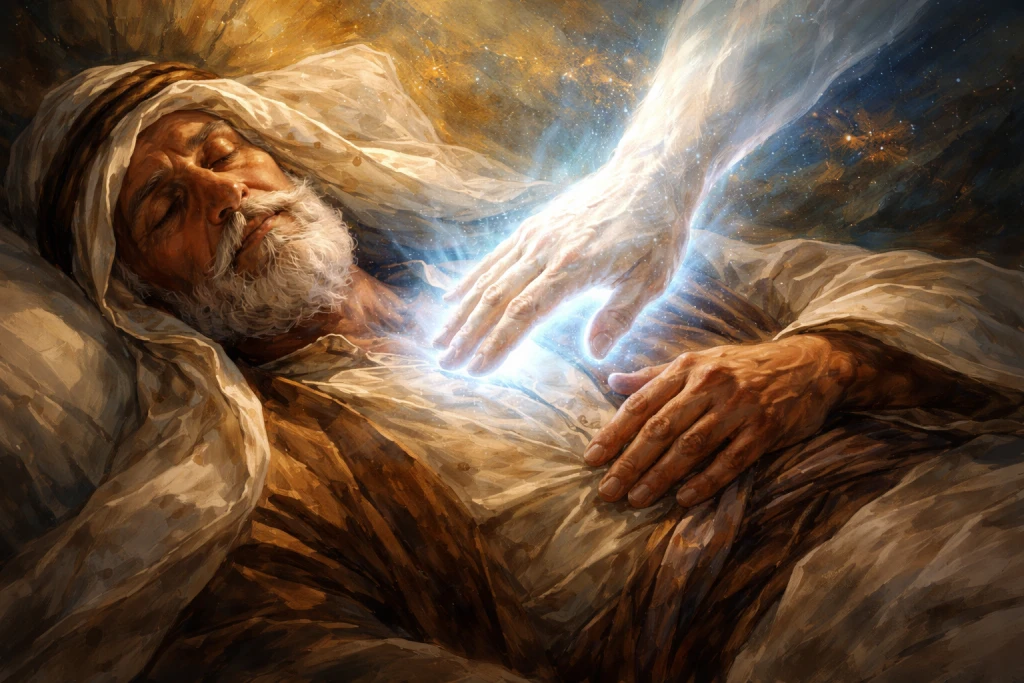
In Islam, Muhammad is established as Allah’s final prophet and an example for humanity to follow. His words, conduct, and personal experiences are accepted as sources of religious truth and instruction. Yet these hadiths sometimes depict Allah in ways that introduce deeply troubling human resemblances and inconsistencies into the proclaimed conception of an omniscient, omnipotent, and incomparable Creator. One such incident appears in Mishkat al-Masabih 748 and Jami‘ al-Tirmidhi 3235. One morning, Muhammad was so late for the congregational Fajr prayer that the sun was almost rising. After the prayer, explaining the reason for his delay to the Companions, he said that he had fallen asleep while praying during the night and had seen Allah in a beautiful form in a dream. Allah had spoken to him, touched his body, and through that touch, special knowledge had been revealed to Muhammad.
According to the account, Allah first asked Muhammad what the angels of the highest assembly were disputing about. When Muhammad replied that he did not know, Allah asked him the same question three times. He then placed the palm of His hand between Muhammad’s shoulders. Muhammad felt the coolness of Allah’s fingers between his two breasts, and only then understood the subject of the dispute. In contrast to the Bengali translation’s wording “in my chest,” the original Arabic says “between my two breasts,” while the English translation reads between my nipples. This is no vague metaphor for acquiring knowledge; the Creator’s hand, fingers, and the sensation of touch are described with striking specificity in the Prophet’s dream.
The central issue raised by this portrayal of God is not proving or disproving Allah’s actual existence. The question is why, in Islam’s own account, the omnipotent Creator touches someone with His hand as a human would, the coolness of His fingers is felt, and that touch is linked to the imparting of knowledge. The Quran declares Allah incomparable to everything else, yet the Quran and other sahih hadiths also describe His hands and fingers. Muhammad declared this dream true and instructed his followers to teach it; within Islamic tradition, the dreams of prophets are recognized as revelation. There is therefore no basis for excluding Allah’s bodily actions in this dream from a critique of the Islamic conception of God.
The knowledge described as having been revealed to Muhammad through Allah’s touch principally concerns familiar practices such as prayer, ablution, going to and remaining in mosques, feeding the poor, speaking kindly, and worshipping at night. The disparity between this content and the elaborate account of the Creator of the universe personally appearing, the angels’ hidden dispute, and the imparting of knowledge through bodily touch is also noteworthy. The conception of a Creator with humanlike limbs and behavior can also be found in Jewish scriptures and ancient divine myths predating Islam. The account of Muhammad’s dream thus brings into view both the anthropomorphic features of Islam’s portrayal of God and its continuity with earlier religious imagination.
The Coolness of Allah’s Fingers Between Muhammad’s Breasts: The Original Hadith and Its Significance
Reading the Bengali and English translations of Mishkat al-Masabih 748 side by side makes the precise location of Allah’s touch clear. The Bengali version says that Muhammad felt the coolness of the fingers “in my chest”; the Arabic reads بَيْنَ ثَدْيَيَّ, meaning “between my two breasts.” The English translation says between my nipples. Allah placed His hand between Muhammad’s shoulders, but the coolness was felt between the two breasts on his chest. The location where the hand was placed must not be confused with the location where the coolness was felt. The Bengali and English versions of the original hadith, along with screenshots of the relevant book, are preserved below.
Mishkat al-Masabih (Mishkat)
Part 4: Prayer
Chapter 7, Section 3: Mosques and Places of Prayer
748-[60] Mu‘adh ibn Jabal (may Allah be pleased with him) narrated. He said: One day, contrary to his usual practice, the Messenger of Allah, peace and blessings be upon him, was so late in coming for the Fajr prayer that the sun was almost rising. He then arrived in haste. The iqama was immediately pronounced. The Prophet, peace and blessings be upon him, performed the prayer briefly. After giving the salutation, he called out to us: Remain in your prayer rows as you are. Then he, peace and blessings be upon him, turned toward us and said: Listen! What prevented me from coming to you this morning was this: I awoke during the night, performed ablution, and then prayed as much as I could. During the prayer I became drowsy and was overcome by sleep. At that moment I saw myself in the presence of my Lord, Blessed and Most High. He was in a most excellent state. He called to me: O Muhammad! I replied: Here I am, my Lord. He said: What are the highest angels—the highest assembly—disputing about? I replied: I know nothing of it, my Lord! He asked me this three times.
Then I saw that He had placed His hand between my two shoulders. I began to feel the coolness of His fingers in my chest. Everything then became manifest to me. I understood all matters. Then He called to me again: O Muhammad! I said: Here I am, my Lord. Now tell Me: What is the highest assembly disputing about? I replied: About the things that erase sins. Allah Most High said: What are those things? I replied: Going to the mosque for prayer, remaining in the mosque after prayer for supplication and the like, and performing ablution despite the difficulty caused by cold or other circumstances. Allah Most High again asked: What else are they disputing about? I replied: About ranks, meaning degrees of honor. He asked: What are those things? I replied: Feeding the poor and needy, speaking politely, and rising to perform the night prayer—tahajjud—when people are asleep.
Then Allah Most High said again: Very well. Now ask for whatever you wish. So I prayed: “O Allah! I ask You to enable me to do good deeds and refrain from evil, for friendship with the poor, and for Your forgiveness and mercy. When You intend to spread misguidance among a people, take me away before that, without my being led astray. I ask You for Your love and the love of the person who loves You, and I wish to love the deeds that will bring me closer to Your love.” Then the Prophet, peace and blessings be upon him, said: This dream is entirely true. Remember it and teach it to others. (Ahmad and al-Tirmidhi;[1]
Imam al-Tirmidhi further said: This hadith is hasan sahih. I asked Muhammad ibn Isma‘il al-Bukhari about this hadith; he, too, said that it is sahih.)
[1] Sahih: al-Tirmidhi 3235; Ahmad 22109.
Hadith grade: Sahih
Reference : Mishkat al-Masabih 748
In-book reference : Book 4, Hadith 176
(8c)Chapter: Mosques and places of Prayer – Section 3(7)
Mu’adh b. Jabal said:
God’s Messenger was detained one morning from observing the prayer with us till the sun had almost appeared over the horizon. He then came cut quickly, and when the iqama had been uttered he conducted the prayer in a shortened form; then when he had given the salutation he called out to us saying, “Keep to your rows as you were.” Then turning to us he said, “I shall tell you what detained me from you this morning. I got up during the night, performed ablution, and prayed what I could; but during my prayer I dozed and was overcome, and there and then I saw my Lord in the most beautiful form. He addressed me by name, and when I replied, ‘At Thy service, my Lord,’ He asked, ‘What do the angels near My presence dispute about?’ and I replied that I did not know. He asked it three times. Then I saw Him put the palm of His hand between my shoulder-blades, so that I experienced the coolness of His fingers between my nipples so everything became clear to me and I attained knowledge. He then addressed me by name, and when I replied, ‘At Thy service, my Lord,’ He asked, ‘What do the angels near My presence dispute about?’ I replied, ‘Expiation.’ He asked what they were, and I replied, ‘Walking on foot to the congregational prayers, sitting in the mosques after the prayers are over, and performing complete ablution in difficult circumstances. He asked what next they disputed about, and when I said it was about degrees, He asked what they were and I replied, ‘Providing food, speaking gently, and praying at night when people are asleep.’ He then told me to make a request, and I said, ‘O God, I ask Thee for power to do good things and abandon objectionable things, for love towards the poor, that Thou shouldest forgive me and show mercy to me, and that when Thou intendest to test any people Thou wilt take me to Thyself without being led astray. And I ask for Thy love, the love of those who love Thee, and a love of doing things which will bring me near to Thy love.’” Then God’s Messenger said, “It is true, so study it and learn it.”
Ahmad and Tirmidhi transmitted it, and Tirmidhi said, “This is a hasan sahih tradition. I asked Muhammad b. Isma’il (Al-Bukhari) about this tradition, and he said it is a sahih tradition.”
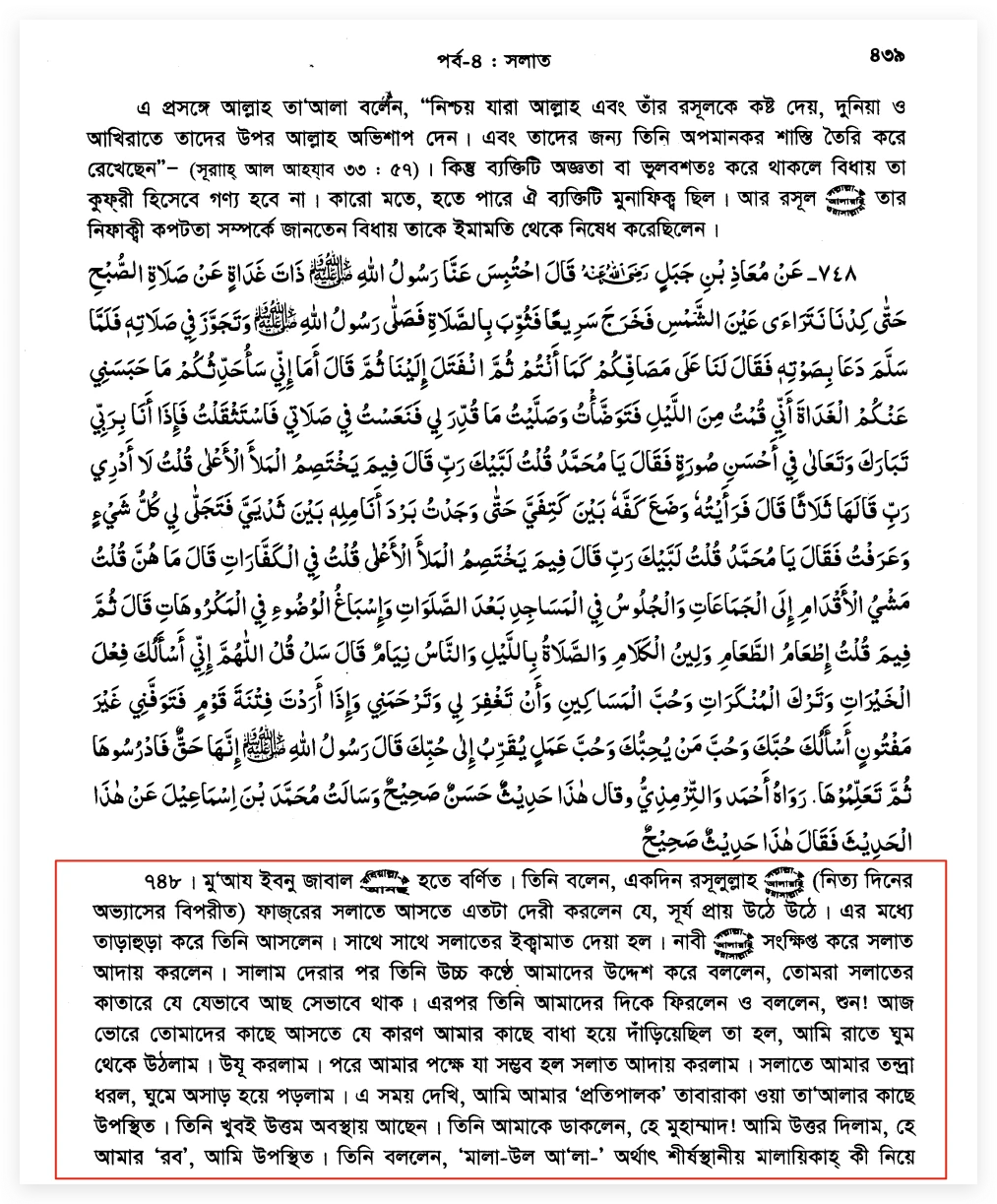
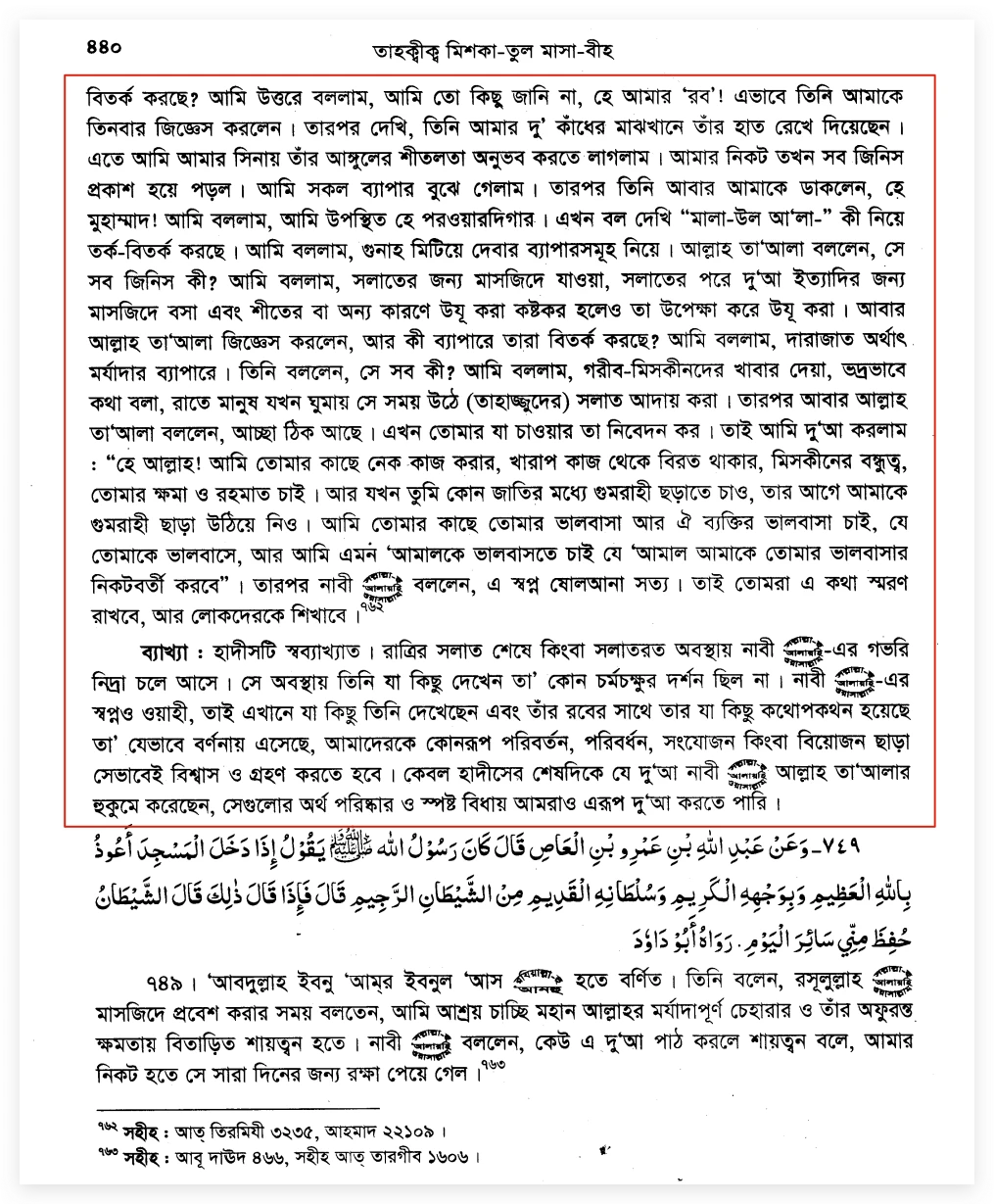
In the hadith, Allah’s “beautiful form,” the palm of His hand, His fingers, and the coolness of His touch are parts of a specific experience. The omnipotent Creator is depicted here as a being who uses limbs as humans do. Particularly significant is the fact that the coolness of the fingers is a bodily sensation, not the name of an abstract power. In the wording of the hadith, Muhammad claimed to have experienced this sensation; the event of Allah’s touch is also presented as part of his true dream.
When Allah asked Muhammad three times about the angels’ dispute, he could not answer. Only after the touch of the hand was the matter revealed to him. The sequence of events thus establishes a direct relationship between touch and the acquisition of knowledge. In Islam, the Creator of the universe is believed to be capable of imparting knowledge by His mere will; the central question raised by this story is why His imparting of knowledge was depicted through the experience of human bodily touch and coolness. The hadith does not say that such touch was necessary for Allah; it does, however, describe the imparting of knowledge through a familiar human bodily act.
The knowledge revealed after the touch concerns deeds that expiate sins and raise one’s rank: attending congregational prayer, remaining in the mosque after prayer, performing ablution in difficult circumstances, giving food, speaking gently, and praying at night. The story of the angels’ dispute and Allah’s direct bodily touch is used to convey the religious merit of these practices. This specific content cannot be equated with an unveiling of all the mysteries of heaven and earth; although the original account uses language suggesting extensive knowledge, the answers actually given concern a limited set of religious practices.
The Delay in the Fajr Prayer and the Account of a Miraculous Encounter with Allah
In Mu‘adh ibn Jabal’s account, the encounter with Allah in a dream appears as the explanation for Muhammad’s unusual delay in coming to the congregational Fajr prayer. That day, he arrived when the sun was almost rising, had the iqama pronounced, and completed the prayer briefly. He then told the Companions to remain in their rows and explained that he had become drowsy during his night prayer and seen Allah in a dream. In the sequence of the hadith, the shortage of time for prayer and the account of a miraculous encounter with Allah are thus linked.
In Sahih Muslim 612, Muhammad defines the time for Fajr as extending from true dawn until sunrise. There is also an instruction to refrain from prayer when the sun rises, because, in his words, the sun rises between Satan’s two horns. Against that rule, the delay of the congregational Fajr prayer until close to sunrise in Mu‘adh’s hadith is significant. [4]
وَقْتُ الظُّهْرِ إِذَا زَالَتِ الشَّمْسُ وَكَانَ ظِلُّ الرَّجُلِ كَطُولِهِ مَا لَمْ يَحْضُرِ الْعَصْرُ وَوَقْتُ الْعَصْرِ مَا لَمْ تَصْفَرَّ الشَّمْسُ وَوَقْتُ صَلاَةِ الْمَغْرِبِ مَا لَمْ يَغِبِ الشَّفَقُ وَوَقْتُ صَلاَةِ الْعِشَاءِ إِلَى نِصْفِ اللَّيْلِ الأَوْسَطِ وَوَقْتُ صَلاَةِ الصُّبْحِ مِنْ طُلُوعِ الْفَجْرِ مَا لَمْ تَطْلُعِ الشَّمْسُ فَإِذَا طَلَعَتِ الشَّمْسُ فَأَمْسِكْ عَنِ الصَّلاَةِ فَإِنَّهَا تَطْلُعُ بَيْنَ قَرْنَىْ شَيْطَانٍ
English translation: The time for the noon prayer begins when the sun passes the meridian and a person’s shadow is equal to their height, as long as the time for the afternoon prayer has not arrived. The time for the afternoon prayer lasts until before the sun turns yellow. The time for the sunset prayer lasts until the twilight disappears. The time for the night prayer lasts until midnight. The time for the dawn prayer begins at true dawn and lasts until before the sun rises. When the sun rises, refrain from prayer, because the sun rises between Satan’s two horns.
In Ikhtiyar al-Awla fi Sharh Hadith Ikhtisam al-Mala’ al-A‘la, Ibn Rajab al-Hanbali states that delaying Fajr until so close to sunrise was not Muhammad’s normal practice. He usually performed the prayer while it was still dark. Ibn Rajab explicitly notes that this was why Muhammad explained that day’s delay to the Companions. He also states that some jurists considered such a delay unlawful without a valid excuse, while a statement of Imam Ahmad likewise associates this kind of delay with negligence. The purpose of shortening the prayer was to complete it within its prescribed time. [5] [6]
ففي الحديث دلالة على أن النبي صلى الله عليه وسلم لم يكن من عادته تأخير صلاة الصبح إلى قريب طلوع الشمس، وإنما كانت عادته التغليس بها، وكان أحيانا يسفر بها عند انتشار الضوء على وجه الأرض، وأما تأخيرها إلى قريب طلوع الشمس فلم يكن من عادته، ولهذا اعتذر لهم عنه في هذا الحديث.
وقد قيل: إن تأخيرها إلى هذا الإسفار الفاحش لا يجوز لغير عذر، وأنه وقت ضرورة، كتأخير العصر إلى بعد اصفرار الشمس، وهو قول القاضي من أصحابنا في بعض كتبه، وقد أومأ إليه الإمام أحمد، وقال: هذه صلاة مفرط، إنما الإسفار أن ينتشر الضوء على الأرض.
وفي الحديث دلالة على أن من أخر الصلاة إلى آخر الوقت لعذر أو غيره وخاف خروج الوقت في الصلاة إن طولها أن يخففها حتى يدركها كلها في الوقت.
English translation: The hadith demonstrates that it was not the Prophet’s usual practice to delay the dawn prayer until close to sunrise. His usual practice was to perform it while it was still dark. Sometimes he performed it when light had spread across the earth. But delaying it until so close to sunrise was not his normal practice. This was why he explained the delay to the Companions in this hadith.
It has also been said that delaying the dawn prayer until it is this bright is not permissible without a valid excuse. This is a time reserved for necessity, like delaying the afternoon prayer until after the sun has turned yellow. The Qadi of our school expressed this position in some of his books. Imam Ahmad also indicated this, saying: This is the prayer of a negligent person. Isfar properly means that light has spread across the earth.
The hadith further demonstrates that if someone delays the prayer until the end of its time, whether with a valid excuse or otherwise, and fears that prolonging it will cause its time to expire, he should shorten it so that the entire prayer is completed within its prescribed time.
According to Ibn Rajab’s explanation, this was not the normal time at which Muhammad regularly performed Fajr. He also felt the need to explain the delay to the Companions. That explanation links the ordinary human experience of fatigue and sleep to a miraculous account of Allah’s presence, touch, and the imparting of special knowledge. This context is significant when analyzing the actual event of the delay in Fajr and the religious content of the dream.
The Companions witnessed Muhammad’s delay and the shortened prayer, but they did not witness the encounter with Allah described in the dream. Muhammad declared the dream true and instructed them to teach it. An explanation of an unusual delay was thus subsequently preserved as a religious account of Allah’s bodily touch and the Prophet’s acquisition of special knowledge. In this way, an incident involving a religious leader’s human limitations was also linked to a story of his exceptional, divinely conferred status. This function is evident from the content of the hadith itself.
The Dreams of Prophets Are Revelation: Establishing Allah’s Touch as Religious Truth
To understand the theological significance of Allah’s hands and fingers in the Prophet’s dream, the status of prophetic dreams in Islam is important. Unlike the dreams of ordinary people, the dreams of prophets have been accepted as revelation within Islamic tradition. Muhammad himself declared the dream under discussion true and instructed the Companions to teach it. According to Islamic belief, therefore, this is no insignificant personal dream; Allah’s appearance, conversation, and touch are accepted as the content of a true dream.
Sahih al-Bukhari 859, in Ibn Abbas’s account of an incident during the night, includes the statement that Muhammad’s eyes sleep but his heart does not. In the accompanying discussion, Amr ibn Dinar quotes Ubayd ibn Umayr’s statement: “The dreams of prophets are revelation.” In support of his statement, Ubayd recites the Quranic verse concerning Ibrahim’s dream of slaughtering his son. The same statement also appears in Sahih al-Bukhari 138. This is not a direct saying of Muhammad; it is a statement by Ubayd ibn Umayr. It is nevertheless significant in Islamic interpretation for establishing the status of prophetic dreams. [7] [8]
قَالَ عَمْرٌو سَمِعْتُ عُبَيْدَ بْنَ عُمَيْرٍ يَقُولُ إِنَّ رُؤْيَا الأَنْبِيَاءِ وَحْىٌ ثُمَّ قَرَأَ {إِنِّي أَرَى فِي الْمَنَامِ أَنِّي أَذْبَحُكَ}
English translation: Amr said: I heard Ubayd ibn Umayr say that the dreams of prophets are revelation. He then recited this verse: I see in a dream that I am slaughtering you.
In Quran 37:102–105, Ibrahim says that he has seen himself slaughtering his son in a dream. His son accepts the dream as a command and tells him to carry it out; Allah later declares that Ibrahim has fulfilled the dream. In the Islamic account, a prophet’s dream is thus given the status of a basis for actual conduct and a divine command. The event of Allah’s touch in Muhammad’s dream falls within that religious framework as well, particularly since Muhammad himself declared it true. [9] [10]
يَا بُنَيَّ إِنِّي أَرَىٰ فِي الْمَنَامِ أَنِّي أَذْبَحُكَ فَانظُرْ مَاذَا تَرَىٰ
قَدْ صَدَّقْتَ الرُّؤْيَا ۚ إِنَّا كَذَٰلِكَ نَجْزِي الْمُحْسِنِينَ
English translation: My son, I see in a dream that I am slaughtering you. Now tell me what you think.
You have fulfilled the dream. Indeed, this is how We reward those who do good.
In his commentary on Quran 37:102, Ibn Kathir cites the statement that the dreams of prophets are revelation. Al-Qurtubi’s commentary also discusses prophets receiving revelation while asleep. This status of prophetic dreams is therefore connected to the Quranic narrative, the statement preserved in Sahih al-Bukhari, and classical Quranic commentaries. [11] [12]
قَالَ عُبَيْدُ بْنُ عُمَيْرٍ : رُؤْيَا الْأَنْبِيَاءِ وَحْيٌ
English translation: Ubayd ibn Umayr said: The dreams of prophets are revelation.
In Sahih al-Bukhari 6982, Aisha reports that Muhammad’s reception of revelation began through true dreams. The account states that, during that initial period, his dreams would come true as clearly as the light of dawn. Dreams during sleep are therefore linked to divine communication in the Islamic account of prophethood itself. [13]
أَوَّلُ مَا بُدِئَ بِهِ رَسُولُ اللَّهِ صلى الله عليه وسلم مِنَ الْوَحْىِ الرُّؤْيَا الصَّادِقَةُ فِي النَّوْمِ
English translation: The Messenger of Allah’s reception of revelation began with true dreams during sleep.
In light of these sources, the touch of Allah’s hand and fingers in Muhammad’s dream cannot be excluded from discussion merely by saying that “it was a dream.” Whether the form seen in the dream exactly resembles Allah’s actual essence is a separate theological question. The original hadith identifies Allah Himself as the agent of the touch and declares the dream true. The subject of criticism is therefore the kinds of actions and attributes ascribed to God in Islam’s accepted religious accounts, how those actions can be explained, and how rational such an anthropomorphic portrayal is.
Allah’s Hands and Fingers: Anthropomorphic Descriptions of God in the Quran and Sahih Hadith
The references to Allah’s hands and fingers in Muhammad’s dream are not isolated within Islamic sources. The Quran speaks of Adam being created with Allah’s two hands, the earth being held in His grasp, and the heavens being folded in His right hand. Sahih hadiths also describe different parts of creation being held on fingers and human hearts being between two fingers. In all these accounts, God’s actions are presented in the language of familiar human limbs and bodily acts.
In Quran 38:75, Allah asks Iblis what prevented him from prostrating before the one He created with His own two hands. The Arabic word بِيَدَيَّ means “with My two hands.” Alongside the explanation that Allah created Adam with His two hands, al-Tabari’s commentary preserves an account attributed to Ibn Umar in which the Throne, Eden, the Pen, and Adam were specially created by Allah’s hand. The particular reference to hands in Adam’s creation is not merely a general declaration of creative power; it is a specific instance of describing the Creator’s work through familiar parts of the human body. [14]
قَالَ يَا إِبْلِيسُ مَا مَنَعَكَ أَنْ تَسْجُدَ لِمَا خَلَقْتُ بِيَدَيَّ أَسْتَكْبَرْتَ أَمْ كُنْتَ مِنَ الْعَالِينَ
English translation: Allah said: O Iblis! What prevented you from prostrating before the one I created with My own two hands? Were you arrogant, or were you among those of high rank?
The use of hands in the account of making a human from clay resembles a familiar human process of construction. People use their hands to make objects from clay; the Quran likewise refers to two hands in Allah’s case. The power of Islam’s omnipotent Creator is not established as being dependent on a physical process such as constructing objects by hand. Yet the language of human craftsmanship is used to describe His activity.
Quran 39:67 states that on the Day of Resurrection the entire earth will be in Allah’s grasp, and the heavens will be folded in His right hand. The image of power over the universe is constructed here from the human experience of holding an object in one’s grasp and folding something by hand. [15]
وَمَا قَدَرُوا اللَّهَ حَقَّ قَدْرِهِ وَالْأَرْضُ جَمِيعًا قَبْضَتُهُ يَوْمَ الْقِيَامَةِ وَالسَّمَاوَاتُ مَطْوِيَّاتٌ بِيَمِينِهِ سُبْحَانَهُ وَتَعَالَى عَمَّا يُشْرِكُونَ
English translation: They have not appreciated Allah as He deserves. On the Day of Resurrection, the entire earth will be in His grasp and the heavens will be folded in His right hand. Glorified and exalted is He above whatever they associate with Him.
In Sahih al-Bukhari 7414, a Jewish man tells Muhammad that Allah will hold the heavens on one finger, the earth on another, and the mountains, trees, and creation on others. Muhammad laughs on hearing this and recites Quran 39:67. An additional part of the account describes his laughter as an expression of astonishment and affirmation. The image of creation being held on fingers is therefore not confined to the Jewish speaker’s statement; Muhammad’s approval is also narrated. [16]
أَنَّ يَهُودِيًّا جَاءَ إِلَى النَّبِيِّ صلى الله عليه وسلم فَقَالَ يَا مُحَمَّدُ إِنَّ اللَّهَ يُمْسِكُ السَّمَوَاتِ عَلَى إِصْبَعٍ وَالأَرَضِينَ عَلَى إِصْبَعٍ وَالْجِبَالَ عَلَى إِصْبَعٍ وَالشَّجَرَ عَلَى إِصْبَعٍ وَالْخَلاَئِقَ عَلَى إِصْبَعٍ ثُمَّ يَقُولُ أَنَا الْمَلِكُ. فَضَحِكَ رَسُولُ اللَّهِ صلى الله عليه وسلم حَتَّى بَدَتْ نَوَاجِذُهُ ثُمَّ قَرَأَ وَمَا قَدَرُوا اللَّهَ حَقَّ قَدْرِهِ. قَالَ يَحْيَى بْنُ سَعِيدٍ وَزَادَ فِيهِ فُضَيْلُ بْنُ عِيَاضٍ عَنْ مَنْصُورٍ عَنْ إِبْرَاهِيمَ عَنْ عَبِيدَةَ عَنْ عَبْدِ اللَّهِ فَضَحِكَ رَسُولُ اللَّهِ صلى الله عليه وسلم تَعَجُّبًا وَتَصْدِيقًا لَهُ.
English translation: A Jewish man came to the Prophet and said: O Muhammad! Allah will hold the heavens on one finger, the earths on one finger, the mountains on one finger, the trees on one finger, and creation on one finger. He will then say: I am the King. On hearing this, Muhammad laughed until his back teeth became visible. He then recited: They have not appreciated Allah as He deserves. Yahya ibn Sa‘id said that Fudayl ibn Iyad added to this account that Muhammad laughed in astonishment and in affirmation of what the man had said.
Allah’s fingers are used for different purposes in this account in al-Bukhari and in the dream in Mishkat. In one, fingers hold creation; in the other, the coolness of touch is felt in the Prophet’s body. In both cases, familiar human uses of fingers are expanded to an extraordinary scale. In particular, the image of separate objects being held on fingers is an unmistakable imaginative portrayal of an anthropomorphic deity.
In Sahih Muslim 2655, Muhammad says that all the hearts of Adam’s descendants are between Allah’s two fingers as a single heart; He turns them as He wills. At the end, Muhammad prays for his own heart to be turned toward obedience to Allah. Here, alongside holding creation or touching someone, fingers are also used as the language of control over people’s mental and religious states. [17]
إِنَّ قُلُوبَ بَنِي آدَمَ كُلَّهَا بَيْنَ إِصْبَعَيْنِ مِنْ أَصَابِعِ الرَّحْمَنِ كَقَلْبٍ وَاحِدٍ يُصَرِّفُهُ حَيْثُ يَشَاءُ. ثُمَّ قَالَ رَسُولُ اللَّهِ صلى الله عليه وسلم اللَّهُمَّ مُصَرِّفَ الْقُلُوبِ صَرِّفْ قُلُوبَنَا عَلَى طَاعَتِكَ.
English translation: All the hearts of Adam’s descendants are between two of the Most Merciful’s fingers as a single heart. He turns them in whichever direction He wills. Muhammad then says: O Allah, Controller of hearts, turn our hearts toward obedience to You.
Quran 36:82 states that when Allah wills something, He need only say “Be,” and it is. Alongside this declaration of omnipotence are accounts of His making a human with His hands, holding creation on His fingers, and imparting knowledge by touching the Prophet’s body. It does not follow that Allah was incapable of imparting knowledge without bodily touch. Rather, the question arises as to why the omnipotent Creator’s actions are depicted in such detail through the language of familiar human uses of hands and fingers. [18]
فَاطِرُ السَّمَاوَاتِ وَالْأَرْضِ جَعَلَ لَكُمْ مِنْ أَنْفُسِكُمْ أَزْوَاجًا وَمِنَ الْأَنْعَامِ أَزْوَاجًا يَذْرَؤُكُمْ فِيهِ لَيْسَ كَمِثْلِهِ شَيْءٌ وَهُوَ السَّمِيعُ الْبَصِيرُ
English translation: He is the Creator of the heavens and the earth. He has made mates for you from among yourselves, and mates among livestock. In this way He causes you to multiply. There is nothing like Him. He is the All-Hearing, the All-Seeing.
إِنَّمَا أَمْرُهُ إِذَا أَرَادَ شَيْئًا أَنْ يَقُولَ لَهُ كُنْ فَيَكُونُ
English translation: When He wills something, His command is only to say to it, “Be,” and it is.
Quran 42:11 declares of Allah: “There is nothing like Him.” Yet the same religious tradition describes Allah’s two hands, right hand, grasp, fingers, and the coolness of His touch. These texts do not necessarily establish that Allah’s hands have exactly the same form as human hands. Nevertheless, human limbs and bodily experience provide the basis for describing the Creator’s actions, particularly in a sensation as specific as the coolness of fingers between the Prophet’s two breasts. [19]
What connects these accounts is the anthropomorphic presentation of Allah. He creates with His own two hands, holds different parts of creation on His fingers, controls human hearts between two fingers, and imparts special knowledge by touching Muhammad. The criticism here rests not merely on the literal meaning of a single word but on the combined portrayal of human limbs and actions recurring across several sources. Such extensive reliance on the workings of the human body to describe a Creator proclaimed incomparable to His creation is a distinctly anthropomorphic feature of the Islamic conception of God.
The Inheritance of Ancient Religious Myths: Divine Hands, Bodily Touch, and the Miraculous Imparting of Knowledge
Antecedents of the ideas of Allah’s hands and fingers, and of imparting knowledge by touching a prophet’s body, exist in religious literature predating Islam. In particular, the Hebrew Bible preserves a specific account of God imparting divine words by touching a prophet’s body with His hand. The gods of ancient Middle Eastern and Greek literature are likewise described with human form, limbs, and the ability to touch. These ancient precedents situate the anthropomorphic features of Islam’s portrayal of God within a broader religious history.
In the first chapter of the biblical Book of Jeremiah, God instructs the prophet Jeremiah to proclaim His words to the people. When Jeremiah protests that he is young and cannot speak well, God reassures him. God then stretches out His hand, touches Jeremiah’s mouth, and says that He has placed His words in Jeremiah’s mouth. God has therefore already spoken with Jeremiah before the touch; bodily touch is specifically linked to the imparting of His words. In Muhammad’s dream, too, special knowledge is revealed after Allah’s touch. This particular resemblance between the two stories is already present in Jewish scripture long before the Islamic hadith. [20]
וַיֹּאמֶר יְהוָה אֵלַי, אַל־תֹּאמַר נַעַר אָנֹכִי: כִּי עַל־כָּל־אֲשֶׁר אֶשְׁלָחֲךָ, תֵּלֵךְ, וְאֵת כָּל־אֲשֶׁר אֲצַוְּךָ, תְּדַבֵּר.
אַל־תִּירָא, מִפְּנֵיהֶם: כִּי־אִתְּךָ אֲנִי לְהַצִּלֶךָ, נְאֻם־יְהוָה.
וַיִּשְׁלַח יְהוָה אֶת־יָדוֹ, וַיַּגַּע עַל־פִּי; וַיֹּאמֶר יְהוָה אֵלַי, הִנֵּה נָתַתִּי דְבָרַי בְּפִיךָ.
רְאֵה הִפְקַדְתִּיךָ הַיּוֹם הַזֶּה, עַל־הַגּוֹיִם וְעַל־הַמַּמְלָכוֹת, לִנְתוֹשׁ וְלִנְתוֹץ, וּלְהַאֲבִיד וְלַהֲרוֹס–לִבְנוֹת, וְלִנְטוֹעַ.
English translation: The Lord said to me: Do not say that you are young. You shall go to everyone to whom I send you, and you shall say whatever I command you to say. Do not be afraid of them, for I am with you to protect you—thus says the Lord.
Then the Lord stretched out His hand and touched my mouth. The Lord said to me: See, I have placed My words in your mouth. Today I have appointed you over nations and kingdoms—to uproot and pull down, to destroy and overthrow, and also to build and plant.
God’s touching Jeremiah’s mouth to place His words there and the revelation of knowledge after Allah places His hand between Muhammad’s shoulders involve different locations of touch, but a specific similarity in method. In both cases, bodily touch follows a conversation between God and a human and is linked to the imparting of knowledge or a message. The familiar experience of giving someone something special through touch becomes part of an account of imparting divine knowledge.
Exodus 31:18 states that the two stone tablets given to Moses were written with God’s finger. A bodily act such as writing with God’s finger was thus described long before the Islamic hadith. This is not the same event as the sensation of the coolness of Allah’s fingers in Muhammad’s dream, but it is another example of the practice of representing God’s actions through familiar human uses of hands and fingers. [21]
וַיִּתֵּן אֶל־מֹשֶׁה, כְּכַלֹּתוֹ לְדַבֵּר אִתּוֹ בְּהַר סִינַי, שְׁנֵי, לֻחֹת הָעֵדֻת–לֻחֹת אֶבֶן, כְּתֻבִים בְּאֶצְבַּע אֱלֹהִים.
English translation: When God finished speaking with Moses on Mount Sinai, He gave him the two tablets of testimony. They were stone tablets written with God’s finger.
In Exodus 33:20–23, in response to Moses’s request to see God, God says that no human can see His face and live. He will place Moses in a cleft of the rock, cover him with His hand while passing by, and then remove His hand. Moses will then be able to see His back, but not His face. The account contains God’s hand, face, back, and movement through space. An anthropomorphic God thus appears in earlier religious literature as well, raising questions like those generated by the descriptions of hands, fingers, and touch alongside the declaration of Allah’s incomparability in Islamic sources. [22]
וַיֹּאמֶר, לֹא תוּכַל לִרְאֹת אֶת־פָּנָי: כִּי לֹא־יִרְאַנִי הָאָדָם, וָחָי.
וַיֹּאמֶר יְהוָה, הִנֵּה מָקוֹם אִתִּי; וְנִצַּבְתָּ, עַל־הַצּוּר.
וְהָיָה בַּעֲבֹר כְּבֹדִי, וְשַׂמְתִּיךָ בְּנִקְרַת הַצּוּר; וְשַׂכֹּתִי כַפִּי עָלֶיךָ, עַד־עָבְרִי.
וַהֲסִרֹתִי, אֶת־כַּפִּי, וְרָאִיתָ, אֶת־אֲחֹרָי; וּפָנַי, לֹא יֵרָאוּ.
English translation: God said: You cannot see My face, for no human can see Me and live. The Lord then said: There is a place beside Me; stand on that rock. When My glory passes by, I will put you in a cleft of the rock and cover you with My hand until I have passed. Then I will remove My hand. You will see My back, but you will not see My face.
Archaeological evidence of anthropomorphic divine forms also exists in the polytheistic cultures of the ancient Middle East. On the stele of the thunderbolt-bearing god Baal, discovered at Ras Shamra in Ugarit and preserved in the Louvre, the god is shown in human form, holding weapons with a raised arm. Its inventory number is AO 15775. This artifact is tangible evidence of the depiction of a deity with a human body and limbs in the region before Islam. [23]
Stèle du Baal au foudre
Lieu de découverte : Ras Shamra acropole
Décor : dieu ; Baal ; bras levé ; foudre ; lance ; rameau ; poignard ; massue ; couronne égyptisante ; roi ; montagne ; mer.
English translation: Stele of the thunderbolt-bearing god Baal. Place of discovery: the acropolis of Ras Shamra, ancient Ugarit. Visual elements on the stele: the god Baal, a raised arm, thunderbolt, spear, branches, dagger, club, an Egyptian-style crown, a king, mountains, and the sea.
The depiction of El, the supreme Canaanite deity, has also been examined in historical and archaeological research. In The Origin and Character of God, Theodore J. Lewis examines divine iconography in ancient Israel and Ugarit, El’s enthroned and paternal form, and the associated debates. This illuminates the cultural setting in which God or gods were presented with human and animal features in the ancient Near East. [24]
The first book of the Greek epic Iliad also describes physical contact between a deity and a chosen human. As Achilles draws his sword in anger, the goddess Athena descends from the sky, stands behind him, and pulls him by the hair. She is visible to Achilles alone. The goddess then commands him to desist. The purpose of Athena’s touch is not the same as the imparting of knowledge in Muhammad’s dream; nevertheless, the scene of a supernatural being’s personal presence, touch, and command is an example of the same type of story involving an anthropomorphic deity. [25] [26]
ἧος ὃ ταῦθ᾽ ὥρμαινε κατὰ φρένα καὶ κατὰ θυμόν,
ἕλκετο δ᾽ ἐκ κολεοῖο μέγα ξίφος, ἦλθε δ᾽ Ἀθήνη
οὐρανόθεν: πρὸ γὰρ ἧκε θεὰ λευκώλενος Ἥρη
ἄμφω ὁμῶς θυμῷ φιλέουσά τε κηδομένη τε:
στῆ δ᾽ ὄπιθεν, ξανθῆς δὲ κόμης ἕλε Πηλεΐωνα
οἴῳ φαινομένη: τῶν δ᾽ ἄλλων οὔ τις ὁρᾶτο:
θάμβησεν δ᾽ Ἀχιλεύς, μετὰ δ᾽ ἐτράπετ᾽, αὐτίκα δ᾽ ἔγνω
Παλλάδ᾽ Ἀθηναίην: δεινὼ δέ οἱ ὄσσε φάανθεν:
English translation: While he was turning these thoughts over in his mind and drawing his great sword from its sheath, Athena descended from heaven. The goddess Hera had sent her, for she felt equal affection and concern for both men. Athena stood behind Achilles and pulled him by his golden hair. She appeared to Achilles alone; no one else could see her. Astonished, Achilles turned around and immediately recognized the goddess Pallas Athena. The goddess’s eyes flashed terribly.
These comparisons do not all carry the same evidentiary weight. God’s touching Jeremiah’s mouth and imparting His words bears a particularly specific literary resemblance to Muhammad’s dream. The accounts of hands and fingers in Exodus show the ancient presence of an anthropomorphic God within the Jewish-Abrahamic religious tradition. The stories of Baal and Athena demonstrate the prevalence of anthropomorphic deities across a wider region. These sources do not prove that the hadith in Mishkat was taken directly from any particular Greek or Canaanite story. They do establish, however, that the elements of divine limbs, touch, and special communication used in the Islamic account were familiar features of much earlier religious literature.
Islam’s monotheistic portrayal of God is therefore not detached from the older religious language of anthropomorphic deities. Although names and religious rules change, the practice of describing supernatural beings through the experience of the human body, hands, fingers, and touch remains. The coolness of Allah’s fingers in Muhammad’s dream and God’s touch on Jeremiah’s mouth are the most specific comparative examples of this pattern. Questioning the rational basis of these stories from a modern standpoint does not require proof of direct literary borrowing; their particular resemblance to ancient religious imagination is itself historically significant.
Conclusion
In Mishkat al-Masabih 748, explaining his unusual delay in coming to the Fajr prayer, Muhammad describes a dream in which Allah placed His hand between his shoulders and he felt the coolness of Allah’s fingers between his two breasts. After that touch, the subject of the angels’ dispute was revealed to him. Muhammad declared the dream true; Islamic tradition likewise accords the dreams of prophets the status of revelation. The incident is therefore an accepted religious portrayal of Allah’s bodily touch and His imparting of knowledge within Islam’s own accounts. Descriptions in the Quran and other sahih hadiths of Allah creating, holding, and controlling with His two hands, grasp, and fingers extend this portrayal further. This tendency to present a Creator proclaimed incomparable to creation through the language of human limbs and bodily acts is a fundamental feature of the Islamic conception of God.
Specific antecedents of this anthropomorphic portrayal of God can be found in religious literature long predating Islam. The imparting of words through God’s hand touching Jeremiah’s mouth, laws written for Moses with God’s finger, and ancient stories of divine beings personally appearing and touching humans express the same kind of religious imagination. The significance of the hadith of Muhammad’s dream is therefore not as a test of Allah’s actual existence, but as material for a critique of the kind of being Allah is depicted as in Islam’s own sources. The omniscient and omnipotent Creator of the universe is imagined as placing His hand on a man’s back, causing him to feel the coolness of His fingers between his two breasts, and informing him of a few religious practices. The anthropomorphism of this scene, its unnecessary bodily theatricality, and its resemblance to ancient divine myths rationally call into question the claims of supernatural grandeur made for Islam’s portrayal of God.
References
- Mishkat al-Masabih (Mishkat), Part 4: Prayer; Chapter 7, Section 3: Mosques and Places of Prayer, Hadith 748 ↩︎
- Mishkat al-Masabih, hadith: 748, In-book reference: Book 4, Hadith 176 ↩︎
- Tahqiq Mishkat al-Masabih, vol. 1 [Arabic and Bengali]; original work by ‘Allama Wali al-Din Abu Abdullah Muhammad ibn Abdullah al-Khatib al-‘Umari al-Tabrizi (may Allah have mercy on him); commentary: Mir‘at al-Mafatih Sharh Mishkat al-Masabih, by Abu al-Hasan Ubaydullah ibn Muhammad Abd al-Salam ibn Khan Muhammad ibn Amanullah ibn Hisam al-Din al-Rahmani al-Mubarakpuri (may Allah have mercy on him) [d. 1414 AH]; verification: ‘Allama Nasir al-Din al-Albani (may Allah have mercy on him); translated and edited by a committee, Hadith Academy, pp. 439–440 ↩︎
- Sahih Muslim 612d: The Time Limits for Prayer ↩︎
- Ibn Rajab, Commentary on the Dispute of the Highest Assembly — Islamweb ↩︎
- Ibn Rajab, Original Arabic Work ↩︎
- Sahih al-Bukhari 859: The Dreams of Prophets Are Revelation ↩︎
- Sahih al-Bukhari 138: Parallel Account ↩︎
- Quran, Surah al-Saffat 37:102 ↩︎
- Quran, Surah al-Saffat 37:105 ↩︎
- Ibn Kathir, Commentary on Quran 37:102 ↩︎
- Al-Qurtubi, Commentary on Quran 37:102 ↩︎
- Sahih al-Bukhari 6982: The Beginning of Revelation Through True Dreams ↩︎
- Quran 38:75; Al-Tabari’s Commentary ↩︎
- Quran, Surah al-Zumar 39:67 ↩︎
- Sahih al-Bukhari 7414 ↩︎
- Sahih Muslim 2655 ↩︎
- Quran, Surah Ya-Sin 36:82 ↩︎
- Quran, Surah al-Shura 42:11 ↩︎
- Hebrew Bible, Jeremiah 1:4–10; Hebrew Text and English Translation ↩︎
- Hebrew Bible, Exodus 31:18 ↩︎
- Hebrew Bible, Exodus 33:20–23 ↩︎
- Louvre Museum, Stèle du Baal au foudre, AO 15775 ↩︎
- Theodore J. Lewis, The Origin and Character of God, Chapter 5, Oxford University Press, 2020 ↩︎
- Homer, Iliad, Book 1, lines 193–200; Original Greek Text ↩︎
- Homer, Iliad, Book 1; English Translation ↩︎