Summary
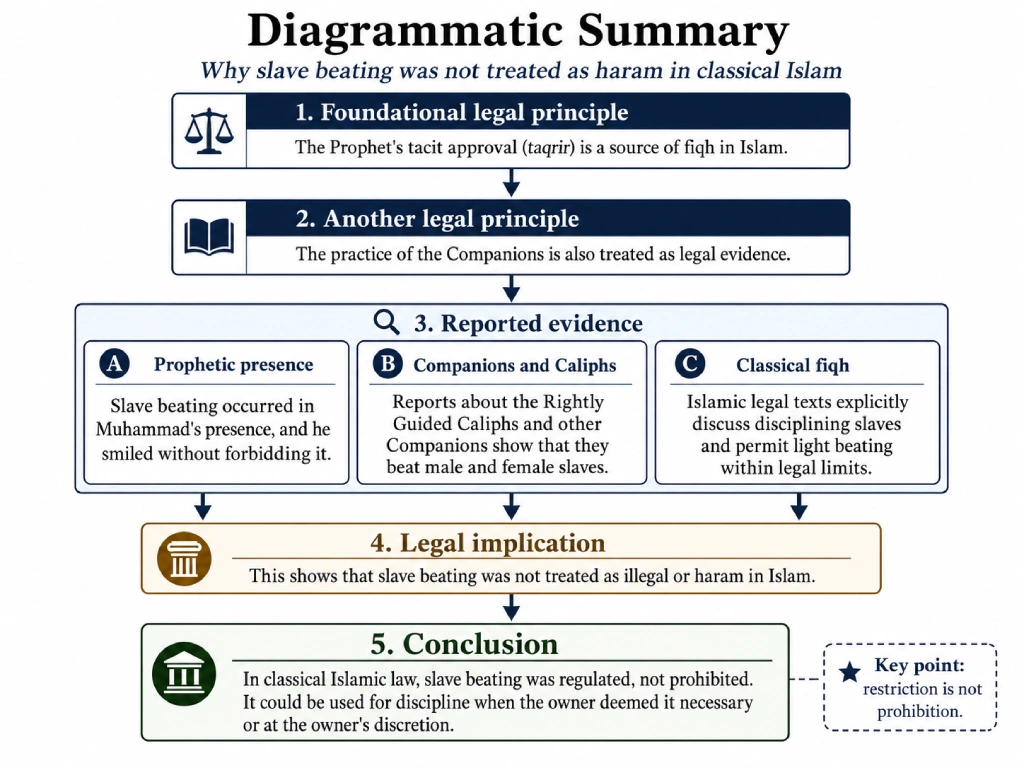
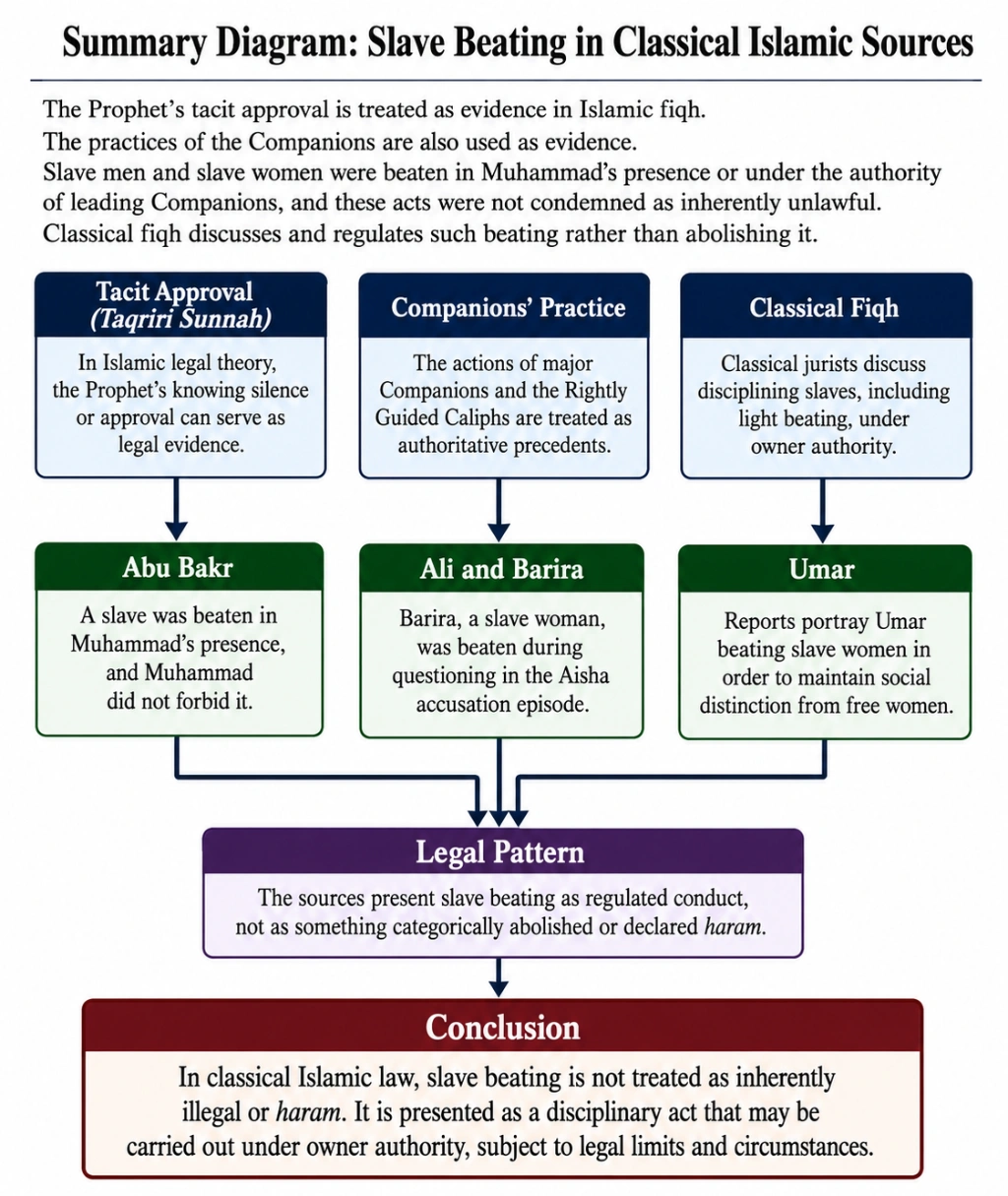
The widely circulated claim that Islam completely forbade or declared unlawful the beating of enslaved men and women is incompatible with Islamic sources, the conduct of the Companions, and classical jurisprudence. Within Islamic legal theory, Muhammad’s tacit approval, or taqrīr, is recognized as a source of legal evidence; the practices of the Companions and the Rightly Guided Caliphs also play an important role in Islamic law and its interpretation. Taken together, these sources show that Islam did not abolish the power to discipline enslaved people physically. It imposed certain restrictions on the exercise of that power.
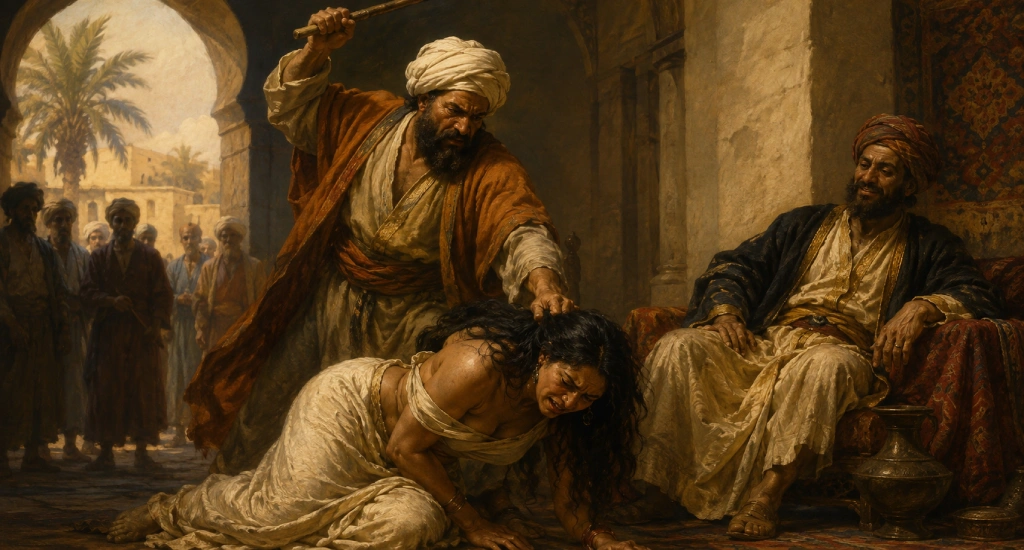
Hadith literature instructs people to avoid striking an enslaved person in the face, compares the beating of a wife to the beating of a slave, and records Abu Bakr beating his slave in Muhammad’s presence while Muhammad watched, smiled, and did not prohibit it. Under the Islamic legal principle of taqrīr, this tacit approval is evidence of permissibility. Islamic tradition also preserves the account of Ali severely beating Aisha’s enslaved servant Barira to make her tell the truth, and reports of Umar beating an enslaved woman over her clothing. Slave-beating cannot therefore be dismissed as an exceptional practice outside the Islamic tradition.
Classical jurisprudence makes this even clearer. Jurists such as Ibn Qudamah explicitly permitted an owner to discipline an enslaved man or woman who had committed an offense through reprimand and light beating. Although hadiths prescribe emancipation as expiation for wrongful beating, the prevailing juristic position was that emancipation was recommended, not obligatory. Jurists even disagreed over whether severe beating, burning, or mutilation made emancipation mandatory. The owner’s power to inflict physical punishment was not abolished; its degree, methods, and circumstances were regulated.
The actual picture is therefore this: Islam did not prohibit slave-beating; it regulated excessive slave-beating. Expressions such as “not on the face,” “not excessively,” “not without cause,” and “light beating” do not express an outright prohibition; they restrict an existing power to inflict corporal punishment. One human being may own another, control that person’s labor, movement, and body, and beat them in the name of necessity or discipline: this moral framework is the fundamental problem of Islamic slavery. A few restrictions do not make that framework humane; they show that it was regulated slavery, not prohibited slavery.
Introduction
A familiar strategy for presenting Islamic slavery as acceptable to modern moral standards is to foreground isolated instructions on decent treatment while obscuring the institution’s underlying realities. Claims are made that Islam protected enslaved people so completely that even a slight blow was prohibited, or that an owner was automatically obliged to emancipate a slave after striking them. Those claims conflict with primary Islamic sources and classical jurisprudence.
The central question is straightforward: Did Islam prohibit an owner’s power to impose corporal punishment on enslaved people, or did it retain that power while limiting its exercise? These are fundamentally different legal arrangements. Instructing owners not to strike the face, not to beat someone without cause or with excessive force, or recommending emancipation after wrongful beating does not abolish their authority to inflict corporal punishment. These are restrictions within a system in which one person owns another and may physically punish that person under specified conditions.
The distinction becomes clearer when hadiths, juristic commentaries, and the conduct of the Companions are considered together. Rather than universally declaring slave-beating unlawful, these sources discuss where a slave must not be struck, how severely a slave may be beaten, which blows constitute wrongful conduct, and whether emancipation after such beating is obligatory or recommended. The existence of an owner’s punitive authority over enslaved people underlies the discussion.
Not a Ban on Slave-Beating: Limits on How Slaves Could Be Beaten
The language of the Islamic sources reveals an essential distinction. Sahih al-Bukhari contains an instruction to avoid the face when beating someone. Its relevant chapter is entitled “If somebody beats a slave, he should avoid his face.” The wording of Bukhari 2559 gives the general instruction to avoid the face in fighting or beating, while al-Bukhari places the report under a heading specifically concerning slaves. The same general instruction against striking the face appears in Sahih Muslim 2612 and Sunan Abi Dawud 4493. [1] [2] [3]
Prohibiting one particular manner of striking someone is not equivalent to prohibiting beating altogether. Al-Bukhari’s chapter heading addresses avoiding the face when beating a slave, and the hadith itself prohibits blows to the face during a fight or beating. Classical jurists nevertheless permitted disciplinary blows to other parts of an enslaved person’s body. The prohibition on striking the face therefore restricted, rather than abolished, the owner’s power to impose corporal punishment.
The relevant chapter heading in the Bengali edition of al-Bukhari reads: “Beating slaves and saying ‘my slave’ or ‘my slave woman’ is disliked.” The hadith quoted below principally concerns forms of address for slaves and owners. The Arabic chapter heading and Ibn Hajar’s explanation discuss arrogance toward enslaved people and the language used to address them. The instruction to avoid the face when beating a slave appears in a separate chapter of al-Bukhari. Together with the explicit juristic rules permitting disciplinary beating, these two chapters illustrate the owner’s authority and the limits placed on its exercise. [4]
Sahih al-Bukhari (Tawheed Publications)
49: Manumission of Slaves
Chapter 49/17. Beating slaves and saying “my slave” or “my slave woman” is disliked.
2552. Narrated Abu Hurayrah: The Prophet, peace and blessings be upon him, said: None of you should say, “Feed your lord,” “Help your lord perform ablution,” or “Give your lord a drink.” Rather, slaves should say “my master” or “my patron.” None of you should say “my slave” or “my slave woman”; rather say “my boy,” “my girl,” or “my servant.” (Adhunik Prokashoni: 2367; Islamic Foundation: 2384)
Hadith grade: Sahih (authentic)
Narrator: Abu Hurayrah
In Fath al-Bari, Ibn Hajar al-Asqalani explains the word “tatawul” in the chapter heading as considering oneself superior to enslaved people and exceeding the limits in doing so. He understands “disliked” here as karahat al-tanzih: disapproval below the level of declaring something forbidden. His complete explanatory paragraph reads: [5]
قوله: (باب كراهية التطاول على الرقيق) أي الترفع عليهم، والمراد مجاوزة الحد في ذلك، والمراد بالكراهة كراهة التنزيه.
English translation:
His words, “Chapter on the disapproval of arrogance toward slaves,” mean considering oneself superior to them; what is intended is exceeding the limits in this. The disapproval intended is karahat al-tanzih.
The word “beating” in the Bengali heading does not accurately convey the Arabic original’s meaning of arrogance and overstepping limits. In Ibn Hajar’s explanation, this chapter concerns the owner’s behavioral superiority. Holding a person as subordinate property and instructing the owner to display less conceit in speaking to that person coexist within the same framework. Ownership, the extraction of labor, and disciplinary authority remain intact while forms of address and outward conduct are regulated. The subsequent chapter’s instruction to avoid the face, and the later juristic authorization of reprimand and beating, define the limits within which this physical authority may be exercised.
Manumission of Slaves
(20)Chapter: If somebody beats a slave, he should avoid his face.(20)باب إِذَا ضَرَبَ الْعَبْدَ فَلْيَجْتَنِبِ الْوَجْهَ
Narrated Abu Huraira:
The Prophet (ﷺ) said, “If somebody fights (or beats somebody) then he should avoid the face.”
حَدَّثَنَا مُحَمَّدُ بْنُ عُبَيْدِ اللَّهِ، حَدَّثَنَا ابْنُ وَهْبٍ، قَالَ حَدَّثَنِي مَالِكُ بْنُ أَنَسٍ، قَالَ وَأَخْبَرَنِي ابْنُ فُلاَنٍ، عَنْ سَعِيدٍ الْمَقْبُرِيِّ، عَنْ أَبِيهِ، عَنْ أَبِي هُرَيْرَةَ ـ رضى الله عنه ـ عَنِ النَّبِيِّ صلى الله عليه وسلم وَحَدَّثَنَا عَبْدُ اللَّهِ بْنُ مُحَمَّدٍ، حَدَّثَنَا عَبْدُ الرَّزَّاقِ، أَخْبَرَنَا مَعْمَرٌ، عَنْ هَمَّامٍ، عَنْ أَبِي هُرَيْرَةَ ـ رضى الله عنه ـ عَنِ النَّبِيِّ صلى الله عليه وسلم قَالَ ” إِذَا قَاتَلَ أَحَدُكُمْ فَلْيَجْتَنِبِ الْوَجْهَ ”.
Reference : Sahih al-Bukhari 2559
In-book reference : Book 49, Hadith 41
USC-MSA web (English) reference : Vol. 3, Book 46, Hadith 734
A significant moral contradiction also emerges here. Instructing an owner to say “my boy” or “my servant” instead of “my slave,” while the person remains property that can be bought, sold, inherited, and compelled to work, does nothing to change the underlying institution. Softer terminology does not end ownership. Polishing the vocabulary of an oppressive institution is not the same as abolishing that institution.
Beating a Wife “Like a Slave”: What the Comparison Reveals
Hadiths concerning the beating of wives also provide evidence of the social status of slave-beating. Muhammad instructed men not to beat their wives “like a slave,” because they might then have sexual intercourse with those same wives at the end of the day. The comparison treats severe beating of an enslaved person as a recognizable practice and a standard against which wife-beating could be measured. The legal rules concerning wife-beating are examined in a separate article. [6]
“Do not beat your wife like a male or female slave” uses slave-beating as a familiar social comparison. The comparison does not prohibit beating slaves; it highlights the severity of beating a wife like a slave and the incongruity of subsequent sexual intercourse. Slave-beating was familiar enough for its intensity to serve as a comparative standard for wife-beating. This language reveals the social reality of an owner’s physical authority over an enslaved person. [7]
Mishkat al-Masabih (Mishkat)
Book 13: Marriage
Chapter 10, first section: Kind treatment of wives and the mutual rights of husband and wife
3242-[5]. Abdullah ibn Zam’ah narrated that the Messenger of Allah, peace and blessings be upon him, said: None of you should beat his wife as he would an enslaved woman, subjecting her to abuse, and then have intercourse with her at the end of the day.
Another version states: None of you should deliberately beat his wife as he would an enslaved woman, when he may wish to have intercourse with her at the end of the day and she may feel aversion. He then admonished those who laughed at the passing of wind: Why do you laugh at someone else for something you do yourselves? (Al-Bukhari and Muslim)[1]
[1] Authentic: al-Bukhari 4942; Muslim 1470.
Hadith grade: Sahih (authentic)
Narrator: Abdullah ibn Zam’ah
Versions of the same statement appear several times in Sahih al-Bukhari. Bukhari 5204 questions the practice of beating a wife like a slave and then having intercourse with her later that day, while Bukhari 4942 and 6042 contain other versions of the comparison. The expression “beating like a slave” is therefore not merely a formulation found in a later compilation; it is present in al-Bukhari’s own hadith collection.
The relevant page of Muhammad Muhsin Khan’s Arabic–English edition of Sahih al-Bukhari, published by Darussalam, also reproduces the chapter heading and narration directing people to avoid the face when beating a slave. [8]
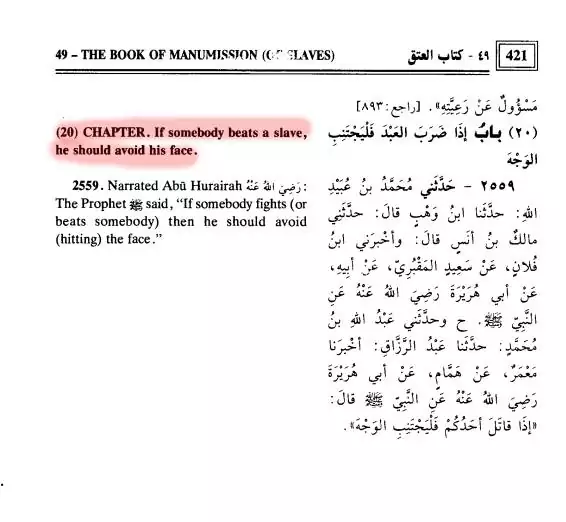
Another hadith compilation renders the comparison explicitly as “beating like a slave.” The statement does not abolish slave-beating; it criticizes the severity of beating a wife in that fashion and then having sexual intercourse with her. [9]
Bulugh al-Maram
Book 8: Marriage
Chapter 5: Division of rights among wives—prohibition of beating wives excessively
1064. Abdullah ibn Zam’ah narrated that the Messenger of Allah, peace and blessings be upon him, said: None of you should beat his wife as he beats a slave.[1]
[1] Al-Bukhari 5204, 3377, 5942, 6042; Muslim 2855; al-Tirmidhi 3343; Ibn Majah 1983; Ahmad 15788; al-Darimi 2220. The complete hadith states that the Prophet said: لا يجلد أحدكم امرأته جلد العبد ثم يجامعها في آخر اليوم None of you should beat his wife as he beats a slave, for he will have intercourse with her at the end of the day. Al-Haythami states in Majma al-Zawa’id 5/7 that its transmitters include Hajjaj ibn Artah, who is a mudallis.
Hadith grade: Sahih (authentic)
Narrator: Abdullah ibn Zam’ah
Al-Bukhari’s Original Arabic: Beating and Intercourse on the Same Day
Al-Bukhari’s original Arabic uses «جَلْدَ الْعَبْدِ»—flogging as one flogs a slave. Beating an enslaved person is invoked as a familiar degree of punishment against which the beating of a wife is compared. The next part of the sentence refers to sexual intercourse with the wife later that same day. It foregrounds the incongruity of a man first beating his wife like a slave and then seeking sexual intimacy with that same woman. Making the owner’s beating of an enslaved person’s body the standard of comparison reveals the accepted social place of violence against subordinate people. [10]
حَدَّثَنَا مُحَمَّدُ بْنُ يُوسُفَ، حَدَّثَنَا سُفْيَانُ، عَنْ هِشَامٍ، عَنْ أَبِيهِ، عَنْ عَبْدِ اللَّهِ بْنِ زَمْعَةَ، عَنِ النَّبِيِّ صلى الله عليه وسلم قَالَ: «لاَ يَجْلِدُ أَحَدُكُمُ امْرَأَتَهُ جَلْدَ الْعَبْدِ، ثُمَّ يُجَامِعُهَا فِي آخِرِ الْيَوْمِ».
English translation:
Muhammad ibn Yusuf narrated to us; Sufyan narrated to him, from Hisham, from his father, from Abdullah ibn Zam’ah, from the Prophet, who said: “None of you should flog his wife as he flogs a slave, and then have intercourse with her at the end of the day.”
The comparison establishes two levels of physical treatment for wives and slaves. It is improper to beat a wife as a slave is beaten; the prospect of subsequent intimacy with her explains the objection. The same question of intimacy is not raised for the slave. The suffering of the person struck is therefore not assessed on the basis of equal human dignity: the degree of treatment depends on whether that person is a wife or an owned slave. Once one person’s body is accepted as the domain of another’s discipline, the amount of violence that may be inflicted on it is differentiated according to relationship and social status.
The reference to marital intimacy is also significant. A woman subjected to violence may feel fear, humiliation, and aversion, yet the man who beat her seeks sexual companionship from her later the same day. The commentary acknowledges that aversion. Alongside this acknowledgment, later commentators infer permission to beat slaves severely. Awareness of a beaten person’s psychological reaction and authorization of punitive violence against slaves thus coexist within the same interpretation. The value assigned to an enslaved person’s body and feelings is subordinated to their owned status.
A Separate Report Against Beating a Wife Like an Enslaved Woman
In Laqit ibn Sabirah’s narration, the same comparison appears in response to a specific marital question. When Laqit complains about his wife’s offensive speech, Muhammad first tells him to divorce her. After Laqit mentions their longstanding companionship and child, he is instructed to admonish her. He is then told not to beat his wife as he beats his own enslaved woman. The word «أُمَيَّتَكَ» refers to an enslaved woman under his ownership. A man’s treatment of his own enslaved woman is used as a comparison for wife-beating. [11]
حَدَّثَنَا قُتَيْبَةُ بْنُ سَعِيدٍ، فِي آخَرِينَ، قَالُوا حَدَّثَنَا يَحْيَى بْنُ سُلَيْمٍ، عَنْ إِسْمَاعِيلَ بْنِ كَثِيرٍ، عَنْ عَاصِمِ بْنِ لَقِيطِ بْنِ صَبْرَةَ، عَنْ أَبِيهِ، لَقِيطِ بْنِ صَبْرَةَ قَالَ: كُنْتُ وَافِدَ بَنِي الْمُنْتَفِقِ، أَوْ فِي وَفْدِ بَنِي الْمُنْتَفِقِ، إِلَى رَسُولِ اللَّهِ صلى الله عليه وسلم. قَالَ: فَلَمَّا قَدِمْنَا عَلَى رَسُولِ اللَّهِ صلى الله عليه وسلم فَلَمْ نُصَادِفْهُ فِي مَنْزِلِهِ، وَصَادَفْنَا عَائِشَةَ أُمَّ الْمُؤْمِنِينَ. قَالَ: فَأَمَرَتْ لَنَا بِخَزِيرَةٍ فَصُنِعَتْ لَنَا. قَالَ: وَأُتِينَا بِقِنَاعٍ، وَلَمْ يَقُلْ قُتَيْبَةُ الْقِنَاعَ، وَالْقِنَاعُ الطَّبَقُ فِيهِ تَمْرٌ. ثُمَّ جَاءَ رَسُولُ اللَّهِ صلى الله عليه وسلم فَقَالَ: «هَلْ أَصَبْتُمْ شَيْئًا أَوْ أُمِرَ لَكُمْ بِشَىْءٍ؟». قَالَ: قُلْنَا نَعَمْ يَا رَسُولَ اللَّهِ. قَالَ: فَبَيْنَا نَحْنُ مَعَ رَسُولِ اللَّهِ صلى الله عليه وسلم جُلُوسٌ إِذْ دَفَعَ الرَّاعِي غَنَمَهُ إِلَى الْمُرَاحِ، وَمَعَهُ سَخْلَةٌ تَيْعَرُ. فَقَالَ: «مَا وَلَّدْتَ يَا فُلاَنُ؟». قَالَ: بَهْمَةً. قَالَ: «فَاذْبَحْ لَنَا مَكَانَهَا شَاةً». ثُمَّ قَالَ: لاَ تَحْسِبَنَّ، وَلَمْ يَقُلْ لاَ تَحْسَبَنَّ، «أَنَّا مِنْ أَجْلِكَ ذَبَحْنَاهَا. لَنَا غَنَمٌ مِائَةٌ لاَ نُرِيدُ أَنْ تَزِيدَ، فَإِذَا وَلَّدَ الرَّاعِي بَهْمَةً ذَبَحْنَا مَكَانَهَا شَاةً». قَالَ: قُلْتُ يَا رَسُولَ اللَّهِ إِنَّ لِي امْرَأَةً وَإِنَّ فِي لِسَانِهَا شَيْئًا، يَعْنِي الْبَذَاءَ. قَالَ: «فَطَلِّقْهَا إِذًا». قَالَ: قُلْتُ يَا رَسُولَ اللَّهِ إِنَّ لَهَا صُحْبَةً وَلِي مِنْهَا وَلَدٌ. قَالَ: «فَمُرْهَا»، يَقُولُ عِظْهَا، «فَإِنْ يَكُ فِيهَا خَيْرٌ فَسَتَفْعَلُ، وَلاَ تَضْرِبْ ظَعِينَتَكَ كَضَرْبِكَ أُمَيَّتَكَ». فَقُلْتُ يَا رَسُولَ اللَّهِ أَخْبِرْنِي عَنِ الْوُضُوءِ. قَالَ: «أَسْبِغِ الْوُضُوءَ وَخَلِّلْ بَيْنَ الأَصَابِعِ وَبَالِغْ فِي الاِسْتِنْشَاقِ إِلاَّ أَنْ تَكُونَ صَائِمًا».
English translation:
Qutaybah ibn Sa’id and others narrated to us: Yahya ibn Sulaym narrated to them, from Ismail ibn Kathir, from Asim ibn Laqit ibn Sabirah, from his father, Laqit ibn Sabirah. Laqit said: I was the representative of Banu al-Muntafiq, or among the delegation of Banu al-Muntafiq, to the Messenger of Allah. When we arrived, we did not find him at home, but found Aisha, the Mother of the Believers. She ordered khazirah to be prepared for us, and it was made. A platter of dates was brought to us. Qutaybah did not use the word qina; a qina is a dish containing dates. Then the Messenger of Allah came and asked: “Have you eaten anything, or has anything been ordered for you?” We answered: “Yes, Messenger of Allah.” While we were sitting with him, the shepherd brought his flock to its enclosure, accompanied by a bleating young animal. He asked: “What has been born, so-and-so?” The shepherd answered: “A lamb.” He said: “Slaughter a sheep for us in its place.” Then he said la tahsibanna, not la tahsabanna: “Do not think that we slaughtered it for your sake. We have a hundred sheep and do not wish their number to increase. Whenever the shepherd has a lamb born, we slaughter a sheep in its place.” Laqit said: I asked, “Messenger of Allah, I have a wife whose tongue has something wrong with it”—meaning offensive speech. He said: “Then divorce her.” I replied: “Messenger of Allah, we have companionship, and I have a child by her.” He said: “Then instruct her,” meaning admonish her. “If there is good in her, she will comply. Do not beat your wife as you beat your enslaved woman.” I asked: “Messenger of Allah, tell me about ablution.” He answered: “Perform ablution thoroughly, pass water between the fingers, and draw water deeply into the nose, except when fasting.”
The complaint against the wife concerns her speech. The response combines an instruction to admonish her with the comparison to beating an enslaved woman. The enslaved woman appears as a subordinate whose treatment illustrates the degree of violence prohibited against a wife. Both women’s bodies can be injured; both experience pain and humiliation. Yet one woman’s owned status makes her an example of harsher beating. The social familiarity of this treatment of enslaved women makes the brief comparison intelligible.
Abdullah ibn Zam’ah’s narration compares flogging a slave with beating a wife; Laqit’s narration compares a man’s treatment of his own enslaved woman with that of his wife. This language reveals a hierarchy of male authority within the household: both wife and enslaved woman appear within the discussion of discipline, but beating an enslaved woman supplies the standard of harsher treatment. Rather than establishing bodily security as the right of an independent person, the limits of treatment are determined by social relationship and ownership status.
Ibn Hajar’s Explanation: Permission to Beat Slaves Severely
In Fath al-Bari, Ibn Hajar al-Asqalani explicitly states that this hadith permits disciplining slaves through severe beating. His wording is «جَوَازُ تَأْدِيبِ الرَّقِيقِ بِالضَّرْبِ الشَّدِيدِ»—the permissibility of disciplining enslaved people by severe beating. He then places the beating of wives below that degree and explains why a beaten person feels aversion toward the person who beat them. In the same paragraph, he quotes al-Muhallab’s explanation that slaves receive greater beating because their status differs from that of free people. [12]
وفي الحديث جواز تأديب الرقيق بالضرب الشديد، والإيماء إلى جواز ضرب النساء دون ذلك، وإليه أشار المصنف بقوله «غير مبرح»، وفي سياقه استبعاد وقوع الأمرين من العاقل: أن يبالغ في ضرب امرأته ثم يجامعها من بقية يومه أو ليلته، والمجامعة أو المضاجعة إنما تستحسن مع ميل النفس والرغبة في العشرة، والمجلود غالبا ينفر ممن جلده، فوقعت الإشارة إلى ذم ذلك، وأنه إن كان ولا بد فليكن التأديب بالضرب اليسير بحيث لا يحصل منه النفور التام، فلا يفرط في الضرب ولا يفرط في التأديب. قال المهلب: بين صلى الله عليه وسلم بقوله «جلد العبد» أن ضرب الرقيق فوق ضرب الحر لتباين حالتيهما، ولأن ضرب المرأة إنما أبيح من أجل عصيانها زوجها فيما يجب من حقه عليها. اهـ.
English translation:
The hadith permits disciplining slaves through severe beating and indicates permission to beat women to a lesser degree. The compiler points to this with the words “not injurious.” Its wording presents it as implausible that a reasonable person would do both things: beat his wife excessively and then have intercourse with her during the remainder of the same day or night. Intercourse or sharing a bed is pleasant only with inclination and desire for companionship, while a flogged person generally feels aversion toward the person who flogged them. The wording therefore indicates condemnation of that conduct. If discipline is unavoidable, it should involve slight beating that does not produce complete aversion: one should neither be excessive in beating nor neglect discipline. Al-Muhallab said: By saying “the flogging of a slave,” the Prophet explained that beating slaves exceeds beating free people because their conditions differ; beating a wife was permitted because she disobeys her husband concerning rights she owes him. End of quotation.
Three points are explicit in Ibn Hajar’s conclusion: permission to beat a slave, the severity of that beating, and a lesser degree of beating for a wife. He uses «جواز» to express permissibility and «الشديد» to describe the beating. These words establish an owner’s authorization to inflict corporal punishment on an enslaved person. The moral problem of slavery becomes acute here: the owner’s disciplinary right replaces the principle that an adult person should control their own body. How much violence the slave’s body must endure is also determined within the ownership relationship.
Al-Muhallab’s quoted explanation states the class distinction even more directly: slaves and free people occupy different conditions, so the beating of slaves is greater. Depriving a person of freedom becomes the basis for inflicting more corporal punishment on that person. Slavery here is not merely a system for extracting labor; it also creates a position in which greater physical violence may be applied. With the loss of freedom, people lose control over their labor, movement, and bodies, and that subordinate position is then used to explain harsher treatment of them.
Al-Ayni’s Explanation: Different Degrees of Beating for Slaves and Wives
Badr al-Din al-Ayni likewise derives permission to discipline slaves through severe beating from the same hadith in Umdat al-Qari. He states that the beating of wives is to be less than that of slaves. He then explains the incongruity of seeking intercourse with a woman after beating her excessively: a beaten person feels aversion toward the person who beat them. Although the resulting aversion is acknowledged, the right to inflict harsh punishment on an enslaved person remains intact. [13]
وفي الحديث جواز ضرب العبد بالضرب الشديد للتأديب، وفيه أن ضرب النساء دون ضرب العبيد، وفيه استبعاد وقوع الأمرين من العاقل: أن يبالغ في ضرب امرأته ثم يجامعها في بقية يومه أو ليلته، وذلك أن المضاجعة إنما تستحسن مع ميل النفس والرغبة، والمضروب غالبا ينفر من ضاربه، ولكن يجوز الضرب اليسير بحيث لا يحصل منه النفور التام، فلا يفرط في الضرب ولا يفرط في التأديب.
English translation:
The hadith permits beating a slave severely for discipline. It also indicates that beating women should be less than beating slaves. It presents it as implausible that a reasonable person would both beat his wife excessively and then have intercourse with her during the remainder of the day or night. Sharing a bed is pleasant only with inclination and desire, whereas a beaten person generally feels aversion toward the person who beat them. Slight beating is permissible, however, provided it does not produce complete aversion. One should therefore neither be excessive in beating nor neglect discipline.
In Ibn Hajar’s and al-Ayni’s explanations, slave-beating is a recognized disciplinary method. Their discussions combine discouragement of beating wives to that degree with permission to beat slaves severely. The suffering of owned people is thus assessed in relation to their inferior status. The risk of damaging the marital relationship can justify reducing a beating, while an enslaved person’s owned condition supplies the basis for harsher punishment. This legal hierarchy does not establish equal bodily security; it establishes an owner’s punitive power and different degrees of its exercise according to subordinate status.
Expiation for Beating, Emancipation, and Legal Obligation
Sahih Muslim records the emancipation of an enslaved person as expiation for slapping or beating them. Classical Islamic jurisprudence, however, did not generally interpret emancipation as the automatic and compulsory consequence of every beating. Al-Nawawi, Ibn Hazm, and Maliki jurists reached different legal conclusions concerning when an owner’s violence was wrongful, what remedy it required, and under what circumstances ownership would cease.
Ibn Umar’s narration in Sahih Muslim explicitly states that the expiation for slapping or beating one’s slave is to emancipate that person. In reports transmitted through Suwayd ibn Muqarrin, Muhammad ordered the emancipation of an enslaved woman after someone slapped her. Jurists then debated whether that directive was farḍ or wājib—legally obligatory—or mustaḥabb or mandūb—recommended and commendable as expiation. [14] [15]
In his Commentary on Sahih Muslim, al-Nawawi described emancipating a beaten slave as recommended rather than obligatory and claimed scholarly consensus on that point. He wrote: “وأجمع المسلمون على أن عتقه بهذا ليس واجبا”—“Muslims have agreed that emancipation for this reason is not obligatory.” In practical terms, the hadith calling for emancipation as expiation was accepted without treating the termination of the owner’s property rights as compulsory. Ibn Hazm’s separate ruling, however, contradicts al-Nawawi’s claim of unanimity. [16]
The views of al-Nawawi and Qadi Iyad are also reproduced in the Bengali commentary Idah al-Muslim. It discusses the consensus reported concerning non-obligatory emancipation after a minor blow and the juristic disagreement over compulsory emancipation after mutilation, burning, or a severe beating without cause. [17]
باب صحبة المماليك
Chapter: Treatment of enslaved men and women
عَنْ زَاذَانَ أَبِي عُمَرَ قَالَ: أَتَيْتُ ابْنَ عُمَرَ رَضِيَ اللَّهُ عَنْهُ وَقَدْ أَعْتَقَ مَمْلُوكًا، قَالَ: فَأَخَذَ مِنَ الْأَرْضِ عُودًا أَوْ شَيْئًا فَقَالَ: مَا فِيهِ مِنَ الْأَجْرِ مَا يَسْوَى هَذَا إِلَّا أَنِّي سَمِعْتُ رَسُولَ اللَّهِ صَلَّى اللَّهُ عَلَيْهِ وَسَلَّمَ يَقُولُ: مَنْ لَطَمَ مَمْلُوكَهُ أَوْ ضَرَبَهُ فَكَفَّارَتُهُ أَنْ يُعْتِقَهُ.
Zadhan said: I once came to Ibn Umar when he had emancipated a slave. Taking a piece of wood or something similar from the ground, he said: “I do not expect even the equivalent of this piece of wood in reward for emancipating him. The reason is that I heard the Messenger say: Whoever slaps or beats his slave, the expiation is to free that slave.”
He did not expect a reward because he had struck him. In accordance with the Messenger’s words, emancipation served as expiation.
Izahul Muslim
365
He therefore regarded the special reward for emancipation as compensation for the assault.
فَكَفَّارَتُهُ أَنْ يُعْتِقَهُ
Al-Nawawi says: All scholars agree that emancipating a beaten slave is not obligatory but recommended. The evidence against obligation is the hadith of Suwayd ibn Muqarrin: In the Messenger’s time we had only one slave. One of us struck her. On hearing the incident, the Messenger said: “Free her.” When told that this was their only slave, he said: “Continue taking her service for now; free her when the opportunity arises.”
Qadi Iyad says: Everyone agrees that a slight blow does not make emancipation obligatory. If an owner burns, mutilates, or severely beats a slave without cause, however, Imam Malik and the jurist Abu Layth consider emancipation obligatory. Other scholars do not consider it obligatory even in those cases.
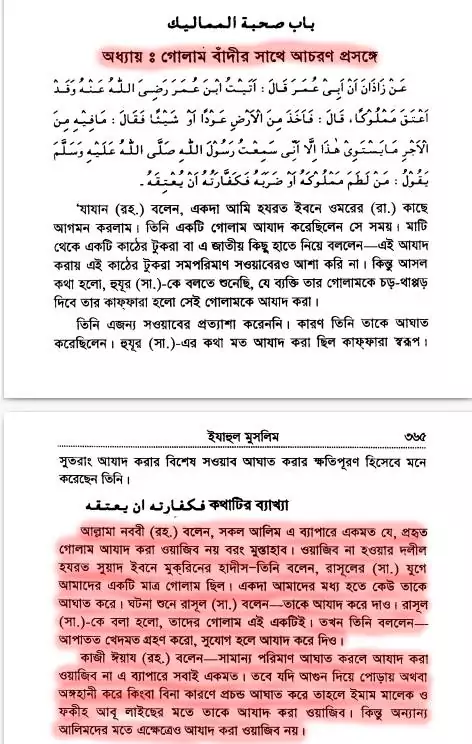
These commentaries do not merely deny that a minor blow necessarily requires emancipation; they preserve disagreement over whether ownership ends even after severe beating, burning, or mutilation. Malik and al-Layth are reported to have required emancipation in such cases of extreme abuse, while numerous other jurists did not regard it as obligatory. Even violence of this severity against an enslaved person left the question of that person’s freedom subject to legal dispute.
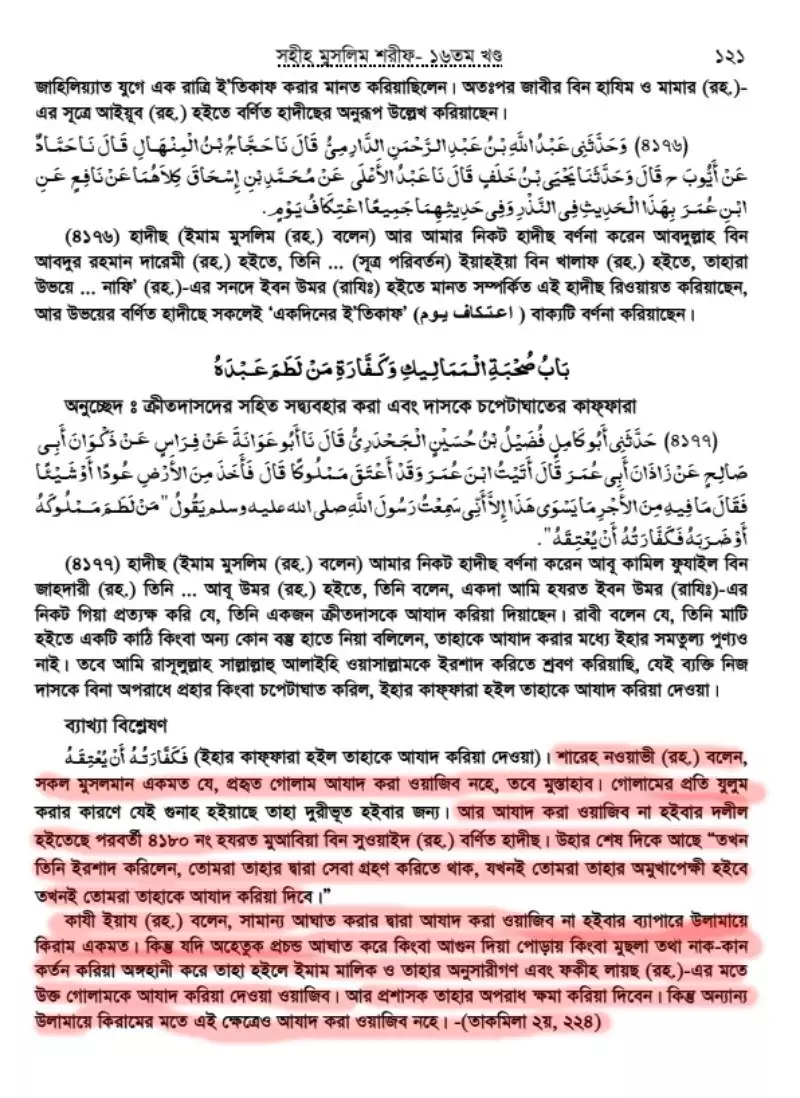
The commentary in Sahih Muslim Sharif: Bengali Translation with Necessary Explanation also records al-Nawawi’s conclusion that emancipation is recommended and the disagreement quoted by Qadi Iyad. In particular, it sets out differing legal conclusions on whether extreme abuse such as mutilation or burning makes emancipation obligatory. Sahih Muslim Sharif (Bengali Translation with Necessary Explanation), Al Hadith Publications, vol. 16, p. 121
بَابُ صُحْبَةِ الْمَمَالِيكِ وَكَفَّارَةِ مَنْ لَطَمَ عَبْدَهُ
Chapter: Kind treatment of slaves and the expiation for slapping one’s slave
(۹۹(8) حَدَّثَنِي أَبُو كَامِلٍ فُضَيْلُ بْنُ حُسَيْنِ الْجَحْدَرِي قَالَ نَا أَبُو عَوَانَةً عَنْ فِرَاسٍ عَنْ ذَكْوَانَ أَبِي صَالِحٍ عَنْ زَاذَانَ أَبِي عُمَرَ قَالَ أَتَيْتُ ابْنَ عُمَرَ وَقَدْ أَعْتَقَ مَمْلُوكًا قَالَ فَأَخَذَ مِنَ الْأَرْضِ عُودًا أَوْ شَيْئًا فَقَالَ مَا فِيهِ مِنَ الأَجْرِ مَا يَسْوَى هَذَا إِلَّا أَنِّي سَمِعْتُ رَسُولَ اللَّهِ صلى الله عليه وسلم يَقُولُ مَنْ لَطَمَ مَمْلُوكَهُ أَوْ ضَرَبَهُ فَكَفَّارَتُهُ أَنْ يُعْتِقَهُ”.
(4177) Hadith: Imam Muslim says: Abu Kamil Fudayl ibn Jahdari narrated to me … from Abu Umar, who said: I once came to Ibn Umar and saw that he had emancipated a slave. The narrator says that he took a small stick or something else from the ground and said: “There is not even the equivalent of this in reward for freeing him. However, I heard the Messenger of Allah say: Whoever beats his slave without an offense or slaps him, the expiation is to emancipate him.”
Explanation and analysis
فَكَفَّارَتُهُ أَنْ يُعْتِقَهُ —“The expiation is to emancipate him.” Al-Nawawi says: All Muslims agree that freeing a beaten slave is not obligatory, but recommended, to remove the sin committed by wronging him. The evidence against obligation is the following hadith, number 4180, narrated by Muawiyah ibn Suwayd. It ends: “Continue to receive her service; when you no longer need her, emancipate her.”
Qadi Iyad says: Scholars agree that a slight blow does not make emancipation obligatory. But if the owner severely beats the slave without cause, burns him, or mutilates him by cutting off the nose or ears, Imam Malik, his followers, and the jurist al-Layth hold that the slave must be emancipated, and the ruler will pardon the offense. Other scholars hold that emancipation is not obligatory even in this case. (Takmilah, vol. 2, p. 224)
The Castration of a Slave and the Order to Emancipate Him
Sunan Abi Dawud preserves an account of an owner cutting off his slave’s penis. The owner is named Zinba Abu Rawh, and the abused slave is Rawh ibn Dinar. The narration describes the owner’s jealousy and his severing of the slave’s genitals because of it. The injured man cries out to Muhammad for help. Muhammad orders the owner to be brought before him; when he cannot be found, Muhammad declares the slave free. Even then, the man asks about his own protection. His question raises the need to safeguard freedom in practice alongside its declaration. [18]
حَدَّثَنَا مُحَمَّدُ بْنُ الْحَسَنِ بْنِ تَسْنِيمٍ الْعَتَكِيُّ، حَدَّثَنَا مُحَمَّدُ بْنُ بَكْرٍ، أَخْبَرَنَا سَوَّارٌ أَبُو حَمْزَةَ، حَدَّثَنَا عَمْرُو بْنُ شُعَيْبٍ، عَنْ أَبِيهِ، عَنْ جَدِّهِ، قَالَ: جَاءَ رَجُلٌ مُسْتَصْرِخٌ إِلَى النَّبِيِّ صلى الله عليه وسلم فَقَالَ: جَارِيَةٌ لَهُ يَا رَسُولَ اللَّهِ. فَقَالَ: «وَيْحَكَ مَا لَكَ؟». قَالَ: شَرًّا، أَبْصَرَ لِسَيِّدِهِ جَارِيَةً لَهُ فَغَارَ فَجَبَّ مَذَاكِيرَهُ. فَقَالَ رَسُولُ اللَّهِ صلى الله عليه وسلم: «عَلَىَّ بِالرَّجُلِ». فَطُلِبَ فَلَمْ يُقْدَرْ عَلَيْهِ. فَقَالَ رَسُولُ اللَّهِ صلى الله عليه وسلم: «اذْهَبْ فَأَنْتَ حُرٌّ». فَقَالَ: يَا رَسُولَ اللَّهِ عَلَى مَنْ نُصْرَتِي؟ قَالَ: «عَلَى كُلِّ مُؤْمِنٍ»، أَوْ قَالَ: «كُلِّ مُسْلِمٍ». قَالَ أَبُو دَاوُدَ: الَّذِي عُتِقَ كَانَ اسْمُهُ رَوْحُ بْنُ دِينَارٍ. قَالَ أَبُو دَاوُدَ: الَّذِي جَبَّهُ زِنْبَاعٌ. قَالَ أَبُو دَاوُدَ: هَذَا زِنْبَاعٌ أَبُو رَوْحٍ كَانَ مَوْلَى الْعَبْدِ.
English translation:
Muhammad ibn al-Hasan ibn Tasnim al-Ataki narrated to us; Muhammad ibn Bakr narrated to him; Sawwar Abu Hamzah informed him; Amr ibn Shuayb narrated to him from his father, from his grandfather, who said: A man came crying out to the Prophet for help and said: “Messenger of Allah, because of an enslaved woman of his!” He asked: “What has happened to you?” The man answered: “Something terrible. He saw an enslaved woman belonging to his master, and the master became jealous and cut off his penis.” The Messenger of Allah said: “Bring the man to me.” He was sought but could not be found. The Messenger of Allah said: “Go; you are free.” He asked: “Messenger of Allah, who is responsible for protecting me?” He answered: “Every believer,” or he said, “Every Muslim.” Abu Dawud said: The man emancipated was named Rawh ibn Dinar. Abu Dawud said: The man who cut off his penis was Zinba. Abu Dawud said: This Zinba Abu Rawh was the slave’s owner.
Ibn Majah’s version gives a more specific reason for the assault: the slave was kissing an enslaved woman owned by the same man, who saw this and cut off his penis. An owner is exercising violent control over intimacy between two people under his authority. Jealousy over the enslaved woman is avenged by permanently mutilating the enslaved man’s body. Her owned status and his enslavement together form the background to this violence. After the declaration of freedom, the slave expresses fear of being enslaved again by his owner. [19]
حَدَّثَنَا رَجَاءُ بْنُ الْمُرَجَّى السَّمَرْقَنْدِيُّ، حَدَّثَنَا النَّضْرُ بْنُ شُمَيْلٍ، حَدَّثَنَا أَبُو حَمْزَةَ الصَّيْرَفِيُّ، حَدَّثَنِي عَمْرُو بْنُ شُعَيْبٍ، عَنْ أَبِيهِ، عَنْ جَدِّهِ، قَالَ: جَاءَ رَجُلٌ إِلَى النَّبِيِّ صلى الله عليه وسلم صَارِخًا، فَقَالَ لَهُ رَسُولُ اللَّهِ صلى الله عليه وسلم: «مَا لَكَ؟». قَالَ: سَيِّدِي رَآنِي أُقَبِّلُ جَارِيَةً لَهُ فَجَبَّ مَذَاكِيرِي. فَقَالَ النَّبِيُّ صلى الله عليه وسلم: «عَلَىَّ بِالرَّجُلِ». فَطُلِبَ فَلَمْ يُقْدَرْ عَلَيْهِ. فَقَالَ رَسُولُ اللَّهِ صلى الله عليه وسلم: «اذْهَبْ فَأَنْتَ حُرٌّ». قَالَ: عَلَى مَنْ نُصْرَتِي يَا رَسُولَ اللَّهِ؟ قَالَ يَقُولُ: أَرَأَيْتَ إِنِ اسْتَرَقَّنِي مَوْلاَىَ؟ فَقَالَ رَسُولُ اللَّهِ صلى الله عليه وسلم: «عَلَى كُلِّ مُؤْمِنٍ أَوْ مُسْلِمٍ».
English translation:
Raja ibn al-Murajja al-Samarqandi narrated to us; al-Nadr ibn Shumayl narrated to him; Abu Hamzah al-Sayrafi narrated to him; Amr ibn Shuayb narrated to him from his father, from his grandfather, who said: A man came to the Prophet crying out. The Messenger of Allah asked: “What has happened to you?” He answered: “My master saw me kissing an enslaved woman of his and cut off my penis.” The Prophet said: “Bring the man to me.” He was sought but could not be found. The Messenger of Allah said: “Go; you are free.” The man asked: “Messenger of Allah, who is responsible for protecting me?” The narrator explains that he meant: “What if my master enslaves me again?” The Messenger of Allah answered: “Every believer or Muslim is responsible for helping you.”
The slave’s words disclose both the perpetrator’s act and the victim’s helplessness. His owner has cut off a part of his body to satisfy his jealousy. The enslaved man’s body becomes the target of the owner’s anger and a site for asserting authority over the enslaved woman. In response to intimacy that angered him, the owner destroyed another person’s genitals. This account records a specific instance of the horrific violence that can result when the power to control subordinate people physically is combined with personal jealousy.
Muhammad’s decision was to declare the injured man free. Ownership over him ended after the mutilation, but the path he had to endure before obtaining that declaration was brutal. First he had to live as property; then his owner severed his penis; then he had to cry out for redress while injured. The freedom due to him as a human being became operative as a remedy after extreme abuse. While enslaved, he lacked secure control over his own body; only after permanent bodily damage did he escape ownership.
The victim had to enter free life carrying the permanent damage of mutilation. Obtaining freedom after such an attack exposes the cruel price of slavery. The owner’s personal rage devastated his body, sexual life, and future. The powers to sell a slave, extract his labor, and control his movement establish an ownership relationship within which this violence occurred. The narration identifies the motive for the bodily assault as the owner’s jealousy—a possessive attitude toward the private intimacy of people held under his control.
The question after emancipation reveals deeper insecurity: if the owner enslaved him again, who would protect him? Even after hearing the declaration of freedom, the injured man could not assume that he was safe. He still feared being captured again by the person who mutilated him. Muhammad assigned every believer or Muslim the duty to help him. Practical protection of his declared freedom therefore also required the assistance of others. The victim’s own words make clear that fear of the former owner’s power persisted even after he left the ownership relationship.
The order of emancipation terminated ownership in this particular case. The need to uphold that order arose immediately because the victim feared renewed enslavement by his former owner. The remedy therefore had two levels: the declaration ending ownership and the duty to protect the person afterward. A man who gained a declaration of freedom after extreme abuse still had to seek others’ help to secure his safety. That situation exposes the depth of the power imbalance of his previous enslavement.
Emancipation After Wrongful Beating: Disagreement Between Ibn Hazm and Other Jurists
Classical Islamic jurisprudence did not take an entirely uniform position on emancipation after slave-beating. In his commentary on Sahih Muslim, Imam al-Nawawi asserted scholarly consensus that freeing a beaten slave was not obligatory. Yet the Zahiri jurist Ibn Hazm’s al-Muhalla bil-Athar contains an explicit contrary legal ruling. According to Ibn Hazm, if an owner slapped his male or female slave on the cheek with the palm of his hand, or punished them for an offense they had not committed, they became free under specified conditions. Emancipation following wrongful beating was thus more than a commendable act; in specified circumstances it took legal effect. [20]
ومن لطم خد عبده أو خد أمته بباطن كفه فهما حران ساعتئذ إذا كان اللاطم بالغا مميزا.
English translation: Whoever slaps the cheek of his male or female slave with the palm of his hand—if the person administering the slap is an adult capable of discernment—the enslaved person concerned becomes free from that very moment.
In the same legal discussion, Ibn Hazm applied emancipation to punishment imposed for an offense an enslaved person had not committed. Both a slap on the cheek with the palm and punishment of an innocent slave were grounds for terminating ownership under his ruling. Yet he allowed an owner unable to manage without the slave’s services to continue receiving those services until the need ended. Even the practical realization of freedom following wrongful punishment was thus made dependent on the owner’s needs.
Ibn Hazm relied on Ibn Umar’s narration concerning emancipation as expiation for beating and on the incident in which a member of Suwayd ibn Muqarrin’s family slapped an enslaved woman. In the latter case, Muhammad ordered the woman to be freed. When the family explained that she was their only enslaved servant, Muhammad instructed them to retain her services while they needed them and emancipate her afterward. Ibn Hazm treated this not as general moral encouragement but as an enforceable command. Citing the Qur’anic duty to obey Muhammad’s directives, he argued that compliance with the order was obligatory. Under his interpretation, emancipation was not merely a virtuous deed: it was a legal consequence of particular wrongful acts of beating.
Ibn Hazm also examined the incident in which Abu Masud beat his slave. Muhammad warned Abu Masud, who then chose to emancipate the slave; that narration does not contain a direct command from Muhammad to emancipate him. Ibn Hazm grounded his ruling on compulsory emancipation in the separate account in which Muhammad explicitly ordered an enslaved woman to be freed. This distinction shows how classical jurists assigned different legal consequences to an act of beating, an order to emancipate, and the conditions under which emancipation would take effect.
Classical Islamic jurisprudence therefore contained a genuine dispute over compulsory emancipation after slave-beating. Al-Nawawi generally regarded freeing a beaten slave as recommended, whereas Ibn Hazm required emancipation in particular cases, including slapping the cheek or punishing an innocent slave. Maliki jurisprudence also preserves rulings requiring emancipation after severe beating, mutilation, or burning. The disagreement concerned which violations of the owner’s disciplinary power terminated ownership, not the abolition of that disciplinary power itself.
Whether an enslaved person would actually obtain freedom after wrongful physical assault depended on juristic interpretations. Ibn Hazm identified particular injuries as grounds for mandatory emancipation, while al-Nawawi did not regard emancipation after beating in general as legally compulsory. Even Ibn Hazm’s ruling allowed implementation of emancipation to be delayed when the owner depended on the slave’s services. The enslaved person’s control over their own body and their release from abuse thus remained subject to rules structured around another person’s ownership. Emancipation for certain abuses did not abolish the institution’s power to impose corporal punishment.
The Opinion That Even Three Hundred Lashes Do Not Require Emancipation
In al-Dhakhira, the Maliki jurist Shihab al-Din al-Qarafi records a ruling by Ibn al-Qasim in which a slave’s emancipation is not obligatory even after three hundred lashes have left him severely exhausted. The context is an oath to beat a slave linked to a condition of emancipation and the consequences of that oath. In the quoted ruling, even if the owner administers three hundred lashes in accordance with the oath and exhausts the slave, ownership ends only when the injury reaches the level of severe mutilation. An example is the loss and wasting away of flesh until skin remains on bone; that condition is compared with the severing of a limb. [21]
قال ابن القاسم: وليضربنه ثلاثمائة سوط، ففعل فأنهكه، لا يعتق عليه إلى أن يبلغ منه مثلة شديدة، مثل ذهاب لحم، وتآكله حتى يبقى جلد على عظم فيعتقه، مثل قطع عضو.
English translation:
Ibn al-Qasim said: He will certainly flog him with three hundred lashes; then he did so and exhausted him severely. The slave does not become free from his ownership until the beating amounts to severe mutilation, such as the loss and wasting away of flesh until only skin remains on bone. He is then freed, as in the case of severing a limb.
At the center of the statement is «فَفَعَلَ فَأَنْهَكَهُ»—he did it and severely exhausted him. Having acknowledged the result of serious beating, the ruling continues: «لَا يَعْتِقُ عَلَيْهِ»—the slave does not become free from his ownership. The victim’s physical devastation and the continuation of the owner’s property right coexist within the same ruling. Even after three hundred lashes, freedom remains subject to a further condition: the bodily damage must reach the level of severe mutilation. The rule explicitly allows ownership to survive the abuse.
The condition for emancipation is expressed as «مُثْلَةً شَدِيدَةً», severe mutilation. Its example describes the loss and wasting away of flesh until skin remains on bone. Such bodily devastation is treated as equivalent to amputation, activating emancipation. The cruelty of the ruling therefore lies not only in the number of lashes but also in the high threshold of physical destruction required before freedom takes effect. Despite injury and suffering, the enslaved person must reach a specified legal category of damage to escape the ownership bond.
The practical legal consequence is extremely harsh. If emancipation does not take effect after the beating, the slave remains owned by the person whose blows devastated him. The owner’s claim to his labor and services, and the power to transfer him to another person, remain attached to that relationship. Even the right to escape the assailant’s ownership after an attack is thus made dependent on the extent of the injuries. A person is first converted into property; the point at which that property relationship ends is then determined by how far his body has been mutilated.
The oath’s context is also significant. The owner connects his own declaration to the beating of another person’s body and to a condition affecting that person’s freedom. The person swearing the oath and the person subjected to beating occupy wholly unequal positions. The owner decides; the slave bears the blows; juristic rules determine whether ownership will end afterward. The slave’s own wishes or decision to leave the relationship safely do not form the basis of this arrangement. His body becomes the site on which the owner’s oath is carried out, and his freedom is assessed as a consequence of that oath and the resulting injury.
The difference from Ibn Hazm’s ruling is explicit. Ibn Hazm requires emancipation in cases of a slap on the cheek with the palm or particular wrongful punishment of an innocent slave. In the ruling of Ibn al-Qasim quoted by al-Qarafi, severe mutilation remains a condition even after the slave has been exhausted by three hundred lashes. These two positions directly illustrate how widely classical jurists could differ over the threshold at which freedom took effect. A person’s freedom and the termination of an owner’s rights were thus made dependent on the kind of assault, the degree of injury, and the applicable legal opinion.
The Right to Discipline Slaves in Classical Islamic Jurisprudence
The Hanbali jurist Ibn Qudamah explicitly recognized an owner’s disciplinary authority in al-Mughni, in a discussion of the maintenance of enslaved men and women. He stated that when an enslaved person committed an offense, the owner could administer a reprimand and light beating. In the same passage, he prohibited beating without an offense, severe beating even when an offense had occurred, and slapping the face. He thus distinguished permissible from impermissible forms of physical assault rather than prohibiting all blows to an enslaved person’s body. Immediately afterward, Ibn Qudamah cited the incident involving the emancipation of the woman slapped by a member of Suwayd ibn Muqarrin’s family and Muhammad’s warning to Abu Masud after the latter beat his slave. He was aware of these hadiths condemning particular beatings and nevertheless retained a limited right of corporal discipline for owners. [22]
فصل: وله تأديب عبده وأمته إذا أذنبا، بالتوبيخ، والضرب الخفيف، كما يؤدب ولده، وامرأته في النشوز، وليس له ضربه على غير ذنب، ولا ضربه ضربا مبرحا وإن أذنب، ولا لطمه في وجهه، وقد روي عن ابن مقرن المزني، قال: «لقد رأيتني سابع سبعة، ليس لنا إلا خادم واحد، فلطمها أحدنا، فأمرنا رسول الله صلى الله عليه وسلم بإعتاقها، فأعتقناها». وروي عن أبي مسعود، قال: «كنت أضرب غلاما لي، فإذا رجل من خلفي يقول: اعلم أبا مسعود، اعلم أبا مسعود فالتفت، فإذا النبي صلى الله عليه وسلم يقول: اعلم أبا مسعود، أن الله أقدر عليك منك على هذا الغلام».
English translation:
Section: When an enslaved man or woman commits an offense, the owner may discipline them through reprimand and light beating, just as he disciplines his child and his wife in cases of marital disobedience. He has no right to beat the slave without an offense, beat him severely even when he has offended, or slap his face. It is reported from Ibn Muqarrin al-Muzani that he said: “I was one of seven brothers, and we had only one enslaved servant. One of us slapped her. The Messenger of Allah ordered us to emancipate her, and we did so.” It is reported from Abu Masud that he said: “I was beating a slave of mine when a man behind me kept saying: ‘Know, Abu Masud; know, Abu Masud.’ I turned and found the Prophet saying: ‘Know, Abu Masud, that Allah has greater power over you than you have over this slave.’”
Ibn Qudamah’s comparison is itself revealing. To explain the punishment of enslaved people, he invokes the discipline of children and wives; he does not establish a principle barring one person from using force against another free adult. The power imbalance is greater still in slavery: the owner controls the slave’s labor and services, and juristic doctrine recognizes physical beating as a means of enforcing that control. Ibn Qudamah prohibited beating without cause or with excessive severity, but preserved the right to administer light blows for misconduct. Both propositions belong to the same legal ruling. Restrictions such as “not on the face,” “not without an offense,” and “not excessively” regulate the owner’s authority; they do not remove it.
Several positions on the limits of this authority are preserved within the Hanbali school. In al-Furu, Ibn Muflih reports Harb’s transmission from Imam Ahmad: after forgiving a slave once or twice, the owner may punish him for an offense, but not severely. Another statement transmitted through Hanbal ibn Ishaq stipulates a serious offense. The same discussion records positions on restraining an enslaved person who disobeys the owner, administering limited beating, and selling the person if disobedience continues; another report prefers sale to restraint. Abu Dawud also transmitted Ahmad’s authorization of discipline over prayer, other obligatory duties, and work assigned within the slave’s capacity. Islamweb’s Fatwa 137527 collects these distinct positions as quotations from Ibn Muflih. They are preserved in Ibn Muflih’s book as different transmissions from Imam Ahmad. [23]
نقل حرب ـ يعني عن الإمام أحمد: لا يضربه إلا في ذنب بعد عفوه عنه مرة أو مرتين، ولا يضربه شديدا.
English translation: Harb transmitted from Imam Ahmad: He should not beat the slave except for an offense, after forgiving the slave once or twice; nor should he beat the slave severely.
These reports differ on the limits of punishment within a single juristic tradition, but they address the same underlying question: when may an owner strike the person held in slavery? Ibn Qudamah’s “light beating,” the requirement to forgive an offense once or twice, the condition of serious misconduct, and the authorization to beat or sell a disobedient slave are different forms of ownership-based control. A slave’s refusal to obey is not treated as the decision of a free worker to leave employment; it is a violation of the owner’s instructions. The concentration of both punitive authority and the power of sale in one person exposes slavery’s fundamental inequality. Classical Islamic law did not abolish these powers.
An Owner’s Right to Beat and Control Slaves in Al-Iqna
The Hanbali jurist Musa ibn Ahmad al-Hajjawi sets out an owner’s authority over enslaved men and women through several specific rules in al-Iqna fi Fiqh al-Imam Ahmad ibn Hanbal. An owner may discipline them through reprimand and beating, place a slave in fetters when concerned about him, and discipline him over obligatory duties and refusal of assigned work within his capacity. The same passage includes initial forgiveness, the requirement of a serious offense, and a prohibition on severe beating. Within these conditions, the owner’s power to inflict corporal punishment and exercise control is established. [24]
وللسيد تأديبهم باللوم والضرب كولد وزوجة، والأحاديث الصحيحة تدل على جواز الزيادة، ويسن العفو عنه أولا، ويكون مرة أو مرتين نصا، ولا يضربه شديدا، ولا يضربه إلا في ذنب عظيم نصا، ويقيده بقيد إذا خاف عليه، ويؤدب على فرائضه، وعلى ما إذا كلفه ما يطيق فامتنع، وليس له لطمه في وجهه، ولا خصاؤه، ولا التمثيل، ولا يشتم أبويه الكافرين، ولا يعود لسانه الخنا والردا، ولا يدخل الجنة سيء الملكة، وهو الذي يسيء إلى مماليكه.
English translation:
The owner has the right to discipline them through reprimand and beating, like a child or wife. Authentic hadiths indicate permission to increase the beating. Forgiving the slave initially is recommended; explicit statements specify once or twice. He must not beat him severely or beat him except for a serious offense; explicit statements address this as well. He may place him in fetters when concerned about him. The slave is disciplined concerning obligatory duties, and when assigned work within his capacity but refusing it. The owner may not slap his face, castrate him, or mutilate him. He must not insult the slave’s non-Muslim parents or accustom his tongue to obscene and vile speech. A person who mistreats those he owns will not enter Paradise: this means one who treats his slaves badly.
The ruling begins by identifying the holder of the right as «السيد»—the owner. The means of exercising that right are «باللوم والضرب»—reprimand and beating. One person’s power to punish another physically is recognized here as part of ownership. The enslaved person is included under the comparison with disciplining a child and wife. An adult slave’s independent control over their own body is consequently subordinated to the owner’s discipline. The owner may strike them for misconduct, and jurisprudence assigns that violence the legal status of “ta’dib,” or discipline. Physical assault becomes a recognized means of obtaining obedience.
The instruction to forgive once or twice first also makes the owner’s position clear. The decision to forgive and the power to punish afterward rest with the same person. The slave is subordinate to that power; the owner judges his conduct and subjects him either to forgiveness or to beating. The requirement of serious misconduct and the rules governing the degree of beating define the boundaries of this authority. The owner’s right to punish the slave’s body is legally established, while the slave’s safety depends on the conditions regulating its exercise.
An editorial footnote in this edition explains «جواز الزيادة»—permission to increase the beating—as allowing slaves to be beaten more than wives. The words “to teach them” connect this increase with instruction and discipline. In this explanation, slave-beating appears as an authorized punishment of greater intensity than wife-beating. [25]
يريد جواز الزيادة في ضرب الرقيق على ضرب الزوجة لتعليمهم.
English translation:
What is intended is permission to beat enslaved people more than a wife, in order to teach them.
Social status determines the degree of corporal punishment in this explanation. Permission to beat a slave more than a wife deepens the subordination of slavery. The extent of violence against the same human body is not held equal on the basis of feelings or dignity; punishment varies according to the relationship under which the person is held. The words “teaching” and “discipline” give the owner’s force an ordered form, while the body of an owned human being remains its target.
The combination of beating and fettering makes the owner’s control clearer still. The owner also possesses a physical means of restricting the slave’s movement. The same paragraph allows discipline for obligatory religious duties and refusal of work assigned within the slave’s capacity. In both religious observance and work for the owner, the slave falls under the owner’s punitive authority. The rule legally authorizes one person’s multiple powers over another’s labor, movement, and body. Reprimand, beating, and physical restraint stand behind the demand for obedience.
Al-Iqna also defines the owner’s power over a slave’s request for a change of owner. If the owner refuses to provide the maintenance, clothing, or arrangements for marriage that he owes, the slave may request sale, and the owner must sell him. If the owner fulfills the duties owed, he is not obliged to sell the slave at the slave’s request. Even if the slave does not wish to remain under that owner, the decision to terminate the relationship therefore does not rest with him. [26]
ومتى امتنع السيد من الواجب عليه من نفقة أو كسوة أو تزويج فطلب العبد البيع لزمه بيعه، سواء كان امتناع السيد لعجزه عنه أو مع قدرته عليه، ولا يلزمه بيعه بطلبه مع القيام بما يجب له.
English translation:
Whenever an owner refuses to provide obligatory maintenance, clothing, or arrangements for marriage, and the slave requests sale, the owner must sell him, whether the refusal arises from inability or despite being able to provide these things. If he fulfills what is owed to the slave, he is not obliged to sell him at his request.
In this rule, fulfillment of the owner’s duties provides the basis for preserving ownership. The owner’s rights take precedence over the slave’s personal unwillingness. The person’s free consent does not determine whose labor they will perform or under whose authority they will live. The remedy for changing the relationship is itself sale to another owner. When sale occurs, the person is transferred as someone else’s property. Their labor, movement, and disciplinary subjection then pass under a new owner. Both their position and the remedy are determined within the ownership framework.
An Owner’s Right to Impose Ta’zir on Slaves in Hanafi Jurisprudence
Hanafi jurisprudence explicitly recognizes an owner’s power to discipline a slave. In Radd al-Muhtar, Ibn Abidin explains the rule that “an owner may impose ta’zir on his slave” by quoting Fath al-Qadir, which identifies a slave’s bad manners as a lawful reason for discipline. Ta’zir here means punitive discipline. The owner’s power to punish extends to how an enslaved person behaves within their personal relationship. [27]
(قوله يعزر المولى عبده) قال في الفتح: وإذا أساء العبد الأدب حل لمولاه تأديبه، وكذا الزوجة.
English translation:
Explaining “the owner may impose ta’zir on his slave,” al-Fath states: When a slave behaves with bad manners, his owner may lawfully discipline him; the same applies to a wife.
“Bad manners” is a concept formed around the behavioral relationship between owner and subordinate. It encompasses how one must speak before another person and how one must behave toward authority. Authorizing owners to punish bad manners carries the humiliation of slavery into the depths of everyday relationships. The manner in which obedience is displayed can itself become grounds for punishment. The power restricts the subordinate person’s scope to assert their dignity before the owner, dispute authority, or express dissatisfaction in speech, because labeling behavior as bad manners is linked to permission to discipline it.
The owner is given punitive power to control the behavior of the same person whose labor and services are being extracted. The interests in obtaining labor and maintaining obedience are concentrated in one person. When ownership of a human being is combined with power to punish their body and conduct, coercion becomes a permanent element of the relationship. One person enjoys another’s labor and also possesses the power to discipline that person’s behavior: this is a profound inequality of power. Legally recognizing that inequality sustains the owner’s authority over the slave. The rule permitting punishment for bad manners extends that authority into domestic speech and everyday conduct.
Muhammad’s Tacit Approval as Legal Evidence in Islam
In Islamic legal theory, Muhammad’s Sunnah is not confined to spoken commands. His statements are termed qawlī Sunnah, his actions fiʿlī Sunnah, and his failure to object to conduct or speech occurring with his knowledge taqrīrī Sunnah. In taqrīr, Muhammad need not perform the act himself: it occurs in his presence or comes to his attention, and he does not reject it. Jurists recognize such tacit approval as a means of establishing the permissibility of the particular act. Islamweb’s Fatwa 38938 likewise defines the three categories of Sunnah and includes conduct or speech that Muhammad knew about but did not condemn. [28]
والسنة التقريرية: هي أن يسكت النبي صلى الله عليه وسلم عن إنكار قول أو فعل صدر أمامه، أو في عصره وعلم به.
English translation: Taqriri Sunnah is when the Prophet refrains from condemning a statement or an act made in his presence, or during his lifetime with his knowledge.
Ibn Hajar al-Asqalani explained the legal basis of this principle in Fath al-Bari, commenting on al-Bukhari’s chapter concerning the Prophet’s failure to object as legal evidence, unlike the silence of other people. He reported agreement that an act performed in Muhammad’s presence, or a statement brought to his attention, indicates permissibility if he raises no objection. His reasoning rests on the doctrine of prophetic impeccability: within that system, the Prophet would not knowingly allow wrongful conduct to pass without objection. Ordinary people’s silence carries no equivalent legal status. Ibn Hajar separately examined whether the silence of Companions could establish consensus. The rule therefore concerns the particular legal status accorded to Muhammad’s tacit approval, not a claim that everyone’s silence has identical evidentiary force. [29]
وقد اتفقوا على أن تقرير النبي صلى الله عليه وسلم لما يفعل بحضرته أو يقال ويطلع عليه بغير إنكار دال على الجواز.
English translation: They agreed that the Prophet’s tacit approval of something done in his presence, or said and brought to his attention without his objection, indicates its permissibility.
Ibn al-Qayyim, in Badaʾiʿ al-Fawaʾid, identified approval of conduct during the period of revelation as a means of determining legal permissibility. He distinguished divine approval from Muhammad’s approval after learning of an act. Under that legal theory, an action performed before Muhammad can acquire evidentiary significance through his acquiescence even if he did not perform it himself. Ibn al-Qayyim’s passage from Badaʾiʿ al-Fawaʾid is quoted in IslamQA’s Answer 216016. [30]
ومن الإقرار على الفعل في زمن الوحي، وهو نوعان: إقرار الرب تبارك وتعالى، وإقرار رسوله صلى الله عليه وسلم إذا علم الفعل.
English translation: Approval of an act during the period of revelation is of two kinds: the approval of the Lord, blessed and exalted, and the approval of His Messenger after he becomes aware of the act.
The word jawaz, permissibility, in Ibn Hajar’s quotation specifies the legal effect of tacit approval: an act knowingly approved by Muhammad is evidence of permissibility. Al-Shatibi’s al-Muwafaqat discusses the limits of deriving general and permanent rules from approval of particular incidents. In Abu Bakr’s case, Muhammad witnessed the beating without objecting; Abu Dawud placed the account in a chapter on disciplining slaves; and the later commentator Abd al-Muhsin al-Abbad inferred permission for discipline through beating. Both the original narration and its use in Islamic legal theory thus provide authorization to beat a slave for discipline. [31]
Muhammad was present while Abu Bakr beat his slave, witnessed the assault, smiled, and commented on it. The narration does not report any order to stop the beating. The Islamic doctrine treating taqrīr as legal evidence, together with Abu Dawud’s choice of chapter heading, connects this incident to the permission to discipline an enslaved person. The exercise of an owner’s power to inflict physical punishment took place in Muhammad’s presence.
Abu Bakr Beat His Slave While Muhammad Watched and Smiled
Abu Bakr’s beating of his slave is particularly significant in light of this legal principle. An enslaved servant entrusted with the provisions of Abu Bakr, Islam’s first caliph, had lost a camel. Abu Bakr began beating him in Muhammad’s presence. Muhammad did not merely hear about the incident: he watched, smiled, and told those present, “Look at this man in ihram and what he is doing.” He did not prohibit Abu Bakr from beating the slave, order the beating to stop, declare the act unlawful, or direct that the slave be emancipated. [32] [33]
Abu Bakr beat the enslaved man in Muhammad’s presence. Muhammad witnessed the incident and commented on Abu Bakr’s actions, yet the narration records neither an instruction to stop nor an order to emancipate the slave or punish Abu Bakr. Islamic jurisprudence regards non-objection to an act performed with Muhammad’s knowledge as taqrīr. The report is therefore important both as evidence of the practice of slave-beating and for the legal approval subsequently derived from it.
Abu Dawud entitled the chapter “باب المحرم يؤدب غلامه”—“A person in ihram disciplining his slave.” In his Commentary on Sunan Abi Dawud, Abd al-Muhsin al-Abbad explained: “أي: يؤدب غلامه بالضرب غير المبرح”—“That is, he disciplines his slave by beating him without excessive severity.” He then concluded: “فيدل هذا الحديث على أنه لا بأس للمحرم أن يؤدب غلامه”—“This hadith indicates that there is no objection to a person in ihram disciplining his slave.” A later Islamic commentator thus explicitly used Abu Bakr’s beating as evidence permitting corporal discipline. [34]
The account brings together Muhammad’s smile, his comment, and the absence of an order to stop the beating. Under the Islamic legal doctrine of taqrīr, failure to object to conduct knowingly witnessed by Muhammad constitutes evidence of permissibility. Abu Dawud’s chapter heading likewise places the episode in the context of disciplining an enslaved person. An owner struck his slave for losing a camel, and the punishment took place before Muhammad—a revealing instance of ownership-based corporal discipline as a socially recognized practice.
This report directly illuminates the place of ownership-based punishment in Islamic legal and social history. Abu Bakr beat his slave for losing a camel, and Muhammad watched without forbidding the beating. Abu Dawud categorized the incident under the discipline of slaves, while Abd al-Muhsin al-Abbad derived permission for disciplinary beating from it. The report is direct evidence that an owner’s power to strike an enslaved person was recognized within the social and legal order.
Sunan Abi Dawud (Islamic Foundation edition)
Book 5: Hajj
Chapter 28: A person in ihram beating his own slave.
1818. Ahmad ibn Hanbal … narrated from Asma bint Abu Bakr: We set out with the Messenger of Allah for the Farewell Hajj. On reaching al-Arj, he dismounted, and we also dismounted. Aisha sat beside the Prophet, and I sat beside my father, Abu Bakr. Their food, drink, and traveling provisions were together on a camel entrusted to Abu Bakr’s slave.
Abu Bakr waited for the slave so they could eat and drink. He arrived without the camel. Abu Bakr asked: “Where is your camel?” He answered: “I lost it yesterday.” Abu Bakr said: “A single camel, and you lost even that?” The narrator says: He then beat him. The Messenger of Allah smiled and said: “Look at this person in ihram—what is he doing?”The narrator Ibn Abi Rizmah says that the Messenger said nothing beyond: “Look at this person in ihram—what is he doing?” And he was smiling.
Hadith grade: Hasan (good)
Narrator: Asma bint Abu Bakr
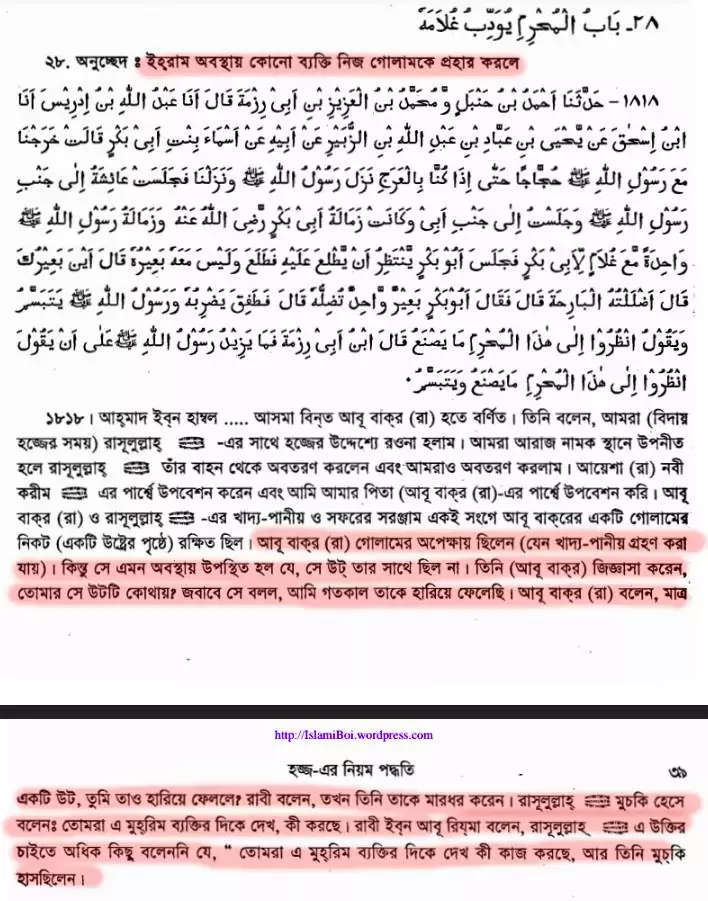
This incident is also recorded in several other hadith collections. [35] [36] [37]
Original Arabic
حَدَّثَنَا عَبْدُ اللهِ بْنُ إِدْرِيسَ، قَالَ: حَدَّثَنَا ابْنُ إِسْحَاقَ، عَنْ يَحْيَى بْنِ عَبَّادِ بْنِ عَبْدِ اللهِ بْنِ الزُّبَيْرِ، عَنْ أَبِيهِ، أَنَّ أَسْمَاءَ بِنْتَ أَبِي بَكْرٍ، قَالَتْ: خَرَجْنَا مَعَ رَسُولِ اللهِ صَلَّى اللهُ عَلَيْهِ وَسَلَّمَ حُجَّاجًا، حَتَّى إِذَا كُنَّا بِالْعَرْجِ، نَزَلَ رَسُولُ اللهِ صَلَّى اللهُ عَلَيْهِ وَسَلَّمَ، فَجَلَسَتْ عَائِشَةُ إِلَى جَنْبِ رَسُولِ اللهِ صَلَّى اللهُ عَلَيْهِ وَسَلَّمَ، وَجَلَسْتُ إِلَى جَنْبِ أَبِي، وَكَانَتْ زِمَالَةُ رَسُولِ اللهِ صَلَّى اللهُ عَلَيْهِ وَسَلَّمَ وَزِمَالَةُ أَبِي بَكْرٍ وَاحِدَةً مَعَ غُلَامِ أَبِي بَكْرٍ، فَجَلَسَ أَبُو بَكْرٍ يَنْتَظِرُهُ أَنْ يَطْلُعَ عَلَيْهِ، فَطَلَعَ، وَلَيْسَ مَعَهُ بَعِيرُهُ، فَقَالَ: أَيْنَ بَعِيرُكَ؟ قَالَ: أَضْلَلْتُهُ الْبَارِحَةَ، فَقَالَ أَبُو بَكْرٍ: بَعِيرٌ وَاحِدٌ تُضِلُّهُ، فَطَفِقَ يَضْرِبُهُ وَرَسُولُ اللهِ صَلَّى اللهُ عَلَيْهِ وَسَلَّمَ يَتَبَسَّمُ، وَيَقُولُ: ” انْظُرُوا إِلَى هَذَا الْمُحْرِمِ وَمَا يَصْنَعُ “
تحقيق الشيخ شعيب الأرناؤوط: [إسناده ضعيف ]
English translation
26916 – Asma bint Abu Bakr narrated: We set out for Hajj with the Prophet. When we reached al-Arj, he made camp. Aisha came and sat beside him, and I sat beside my father. The traveling load of the Prophet and Abu Bakr was together and entrusted to Abu Bakr’s slave. Abu Bakr waited for his slave, but he arrived without the camel. Abu Bakr asked him: “Where is your camel?” He replied that it had been lost during the night. Abu Bakr said: “You had one camel, and you lost it?” Then he began beating him. The Prophet watched, smiling and saying: “Look at this person in ihram—what is he doing?”
The Slave’s Pleas for Refuge Did Not Stop the Beating: Abu Masud and Muhammad’s Intervention
Sahih Muslim preserves an important incident involving Abu Masud al-Ansari. Abu Masud was whipping an enslaved servant when Muhammad repeatedly called to him from behind. Abu Masud was so angry that he initially failed to understand the call. When Muhammad approached, Abu Masud recognized him and dropped the whip. Muhammad then told him that God had greater power over him than he had over his slave. In one version, Abu Masud vowed never to beat an enslaved person again. The account shows a Companion whipping his own slave while Muhammad intervened during the beating. [38]
كُنْتُ أَضْرِبُ غُلاَمًا لِي بِالسَّوْطِ فَسَمِعْتُ صَوْتًا مِنْ خَلْفِي «اعْلَمْ أَبَا مَسْعُودٍ» فَلَمْ أَفْهَمِ الصَّوْتَ مِنَ الْغَضَبِ.
English translation: I was whipping a slave of mine when I heard a voice behind me saying, “Know this, Abu Masud!” But I was so angry that I did not understand the voice.
Another version of the same incident provides crucial details about the enslaved man’s reaction. As the beating continued, he sought refuge in God, but Abu Masud continued striking him. When the slave sought refuge with Muhammad, Abu Masud stopped. Muhammad then reminded Abu Masud of God’s superior power, and Abu Masud emancipated the slave. The account exposes the enslaved man’s vulnerability. His appeal for protection failed to restrain his owner until he invoked Muhammad’s authority. The power to stop the assault remained with the owner; the enslaved man’s own plea had not secured his immediate safety. [39]
فَجَعَلَ يَقُولُ أَعُوذُ بِاللَّهِ – قَالَ – فَجَعَلَ يَضْرِبُهُ فَقَالَ أَعُوذُ بِرَسُولِ اللَّهِ فَتَرَكَهُ.
English translation: The slave kept saying, “I seek refuge in Allah,” but he continued to beat him. Then the slave said, “I seek refuge with the Messenger of Allah,” and he stopped beating him.
In a third version recorded in Sahih Muslim, Abu Masud declared the slave free. Muhammad warned that, had he not done so, the fire of Hell would have touched or scorched him. This account contains a severe threat of punishment in the afterlife for the particular beating. Ibn Hazm did not derive his rule of mandatory emancipation solely from this incident; he relied on another hadith in which Muhammad directly ordered an enslaved woman to be freed. The essential elements of Abu Masud’s case are therefore Muhammad’s intervention during the beating, the slave’s emancipation, and the severe warning addressed to the man who had beaten him. [40] [20]
فَقُلْتُ يَا رَسُولَ اللَّهِ هُوَ حُرٌّ لِوَجْهِ اللَّهِ فَقَالَ «أَمَا لَوْ لَمْ تَفْعَلْ لَلَفَحَتْكَ النَّارُ أَوْ لَمَسَّتْكَ النَّارُ».
English translation: I said, “Messenger of Allah, he is free for Allah’s sake.” He replied, “Had you not done so, the Fire would have scorched you or touched you.”
The incidents involving Abu Bakr and Abu Masud are two distinct accounts of slave-beating. Muhammad witnessed Abu Bakr’s beating, smiled, and commented without ordering it to stop. In Abu Masud’s case, he intervened and warned of punishment by fire if the slave was not emancipated. These different reactions, preserved within the same hadith tradition, show that condemnation of particular acts of beating coexisted with recognition of an owner’s disciplinary power. Neither account abolished slavery or the institution of ownership. The enslaved person’s bodily security continued to be considered within the legal framework of enslavement.
The combined significance of the reports runs deeper. Abu Masud’s slave asked for protection but could not stop the assault himself. The whip in the owner’s hand, the injuries inflicted on the slave, the owner’s anger, and the slave’s appeals reveal the severe power imbalance between ownership and compulsory obedience. Muhammad’s intervention ended the beating in that particular case and resulted in emancipation. Yet the broader ownership-based authority to beat slaves for discipline was not abolished. Later jurists elaborated rules concerning permissible degrees of force, expiation for wrongful beating, and when emancipation was obligatory. Intervention against individual abuses and the institutionally recognized power of corporal punishment thus remained side by side in the same legal tradition.
Commentators on Permission to Beat and Punishment for Exceeding the Limits
In Husayn ibn Awdah al-Awayishah’s Sharh Sahih al-Adab al-Mufrad, the explanation of Ibn Umar’s incident authorizes discipline and beating when a servant commits something prohibited or unlawful. The account of Abu Masud follows immediately, together with an explanation of the warning reminding him of God’s power. The arrangement brings permission for disciplinary beating and a warning to the person administering a beating together on the same page. [41]
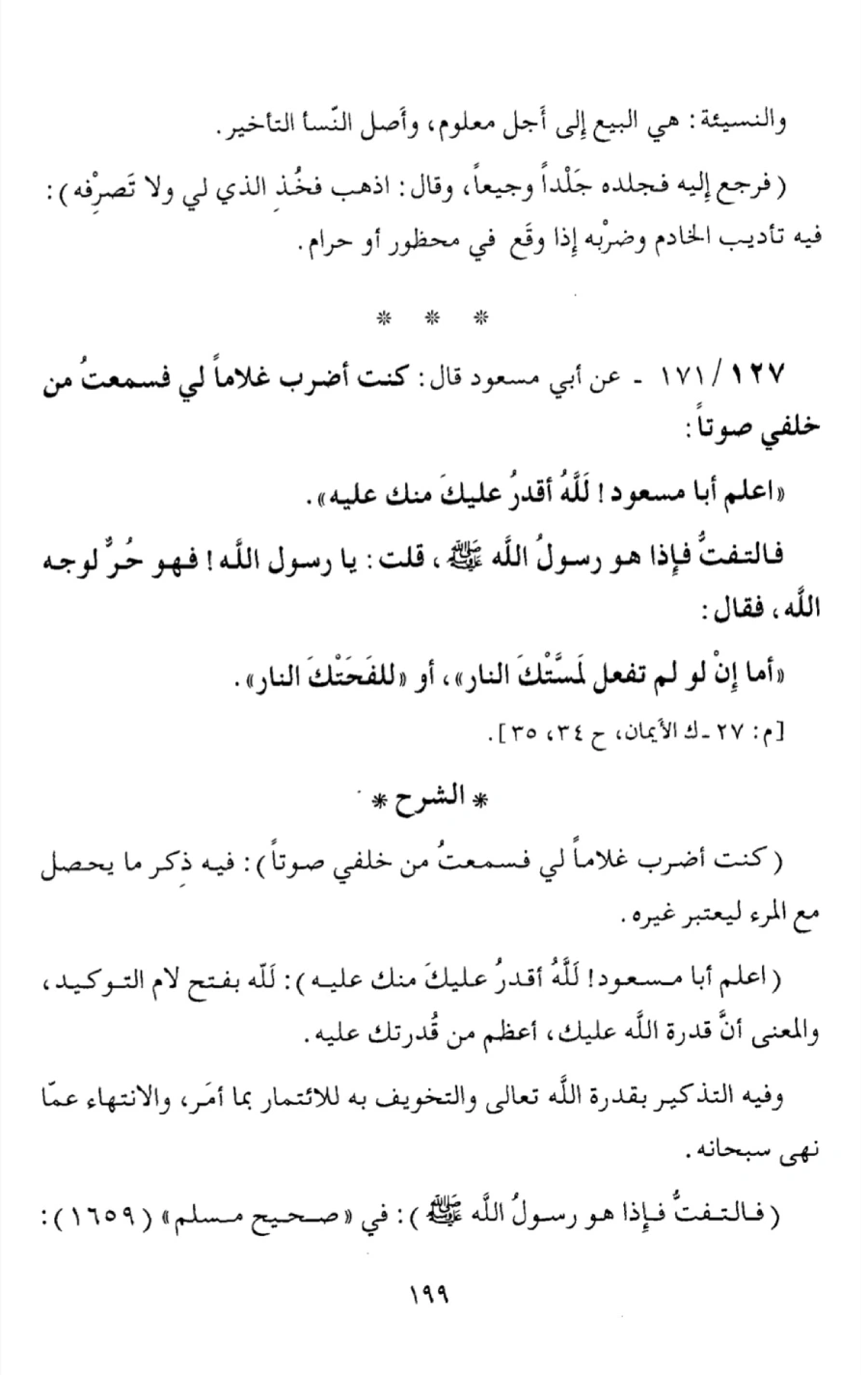
والنسيئة: هي البيع إلى أجل معلوم، وأصل النسأ التأخير.
(فرجع إليه فجلده جلداً وجيعاً، وقال: اذهب فخذ الذي لي ولا تصرفه): فيه تأديب الخادم وضربه إذا وقع في محظور أو حرام.
* * *
١٢٧/١٧١ ـ عن أبي مسعود قال: كنت أضرب غلاماً لي فسمعت من خلفي صوتاً:
«اعلم أبا مسعود! لله أقدر عليك منك عليه».
فالتفت فإذا هو رسول الله ﷺ، قلت: يا رسول الله! فهو حر لوجه الله، فقال:
«أما إن لو لم تفعل لمستك النار»، أو «للفحتك النار».
[م: ٢٧ ـ ك الأيمان، ح ٣٤، ٣٥].
* الشرح *
(كنت أضرب غلاماً لي فسمعت من خلفي صوتاً): فيه ذكر ما يحصل مع المرء ليعتبر غيره.
(اعلم أبا مسعود! لله أقدر عليك منك عليه): لله بفتح لام التوكيد، والمعنى أن قدرة الله عليك، أعظم من قدرتك عليه.
وفيه التذكير بقدرة الله تعالى والتخويف به للائتمار بما أمر، والانتهاء عما نهى سبحانه.
(فالتفت فإذا هو رسول الله ﷺ): في «صحيح مسلم» (١٦٥٩):
١٩٩
English translation:
Nasi’ah is a sale for a specified term; the root nasa means delay.
“When he returned, he flogged him painfully and said: Go, recover what belongs to me, and do not exchange it”—this establishes disciplining and beating a servant when he commits something prohibited or unlawful.
* * *
127/171. Abu Masud narrated: I was beating a slave of mine when I heard a voice behind me:
“Know, Abu Masud! Allah has greater power over you than you have over him.”
I turned and found the Messenger of Allah. I said: “Messenger of Allah, he is free for Allah’s sake.” He said:
“Had you not done so, the fire would have touched you,” or “the fire would have scorched you.”
Muslim: Book 27, the Book of Oaths, hadiths 34 and 35.
Explanation:
“I was beating a slave of mine when I heard a voice behind me”—this illustrates recounting what happens to a person so others may take a lesson.
“Know, Abu Masud! Allah has greater power over you than you have over him”—the first lam in «لله» is the emphatic lam and takes a fathah. The meaning is that Allah’s power over you is greater than your power over him.
This reminds a person of Allah’s power and instills fear of Him so that His commands are obeyed and His prohibitions observed.
“I turned and found the Messenger of Allah”—Sahih Muslim, number 1659, states:
Page 199.
This commentary derives permission for beating from the account of Ibn Umar’s painful flogging of his slave. Identifying the slave’s conduct as prohibited or unlawful provides the basis for subjecting him to corporal punishment. In explaining the warning to Abu Masud, the commentator invokes God’s power and fear of Him. Within this religious framework, the distinction governing an owner’s power to strike concerns what the beating is for and how it is administered. The slave’s body remains subject to the owner’s discipline.
In the collected text of Abd al-Razzaq al-Badr’s Sharh al-Adab al-Mufrad, the warning of punishment in Abu Masud’s hadith is directly connected to beating that oversteps the limits. He argues that if anyone who struck a servant for any reason were subject to the fire, every form of beating would become forbidden. He adopts different rulings for different circumstances of beating. The same passage mentions Abu Masud’s pledge never to beat a slave again. [42]
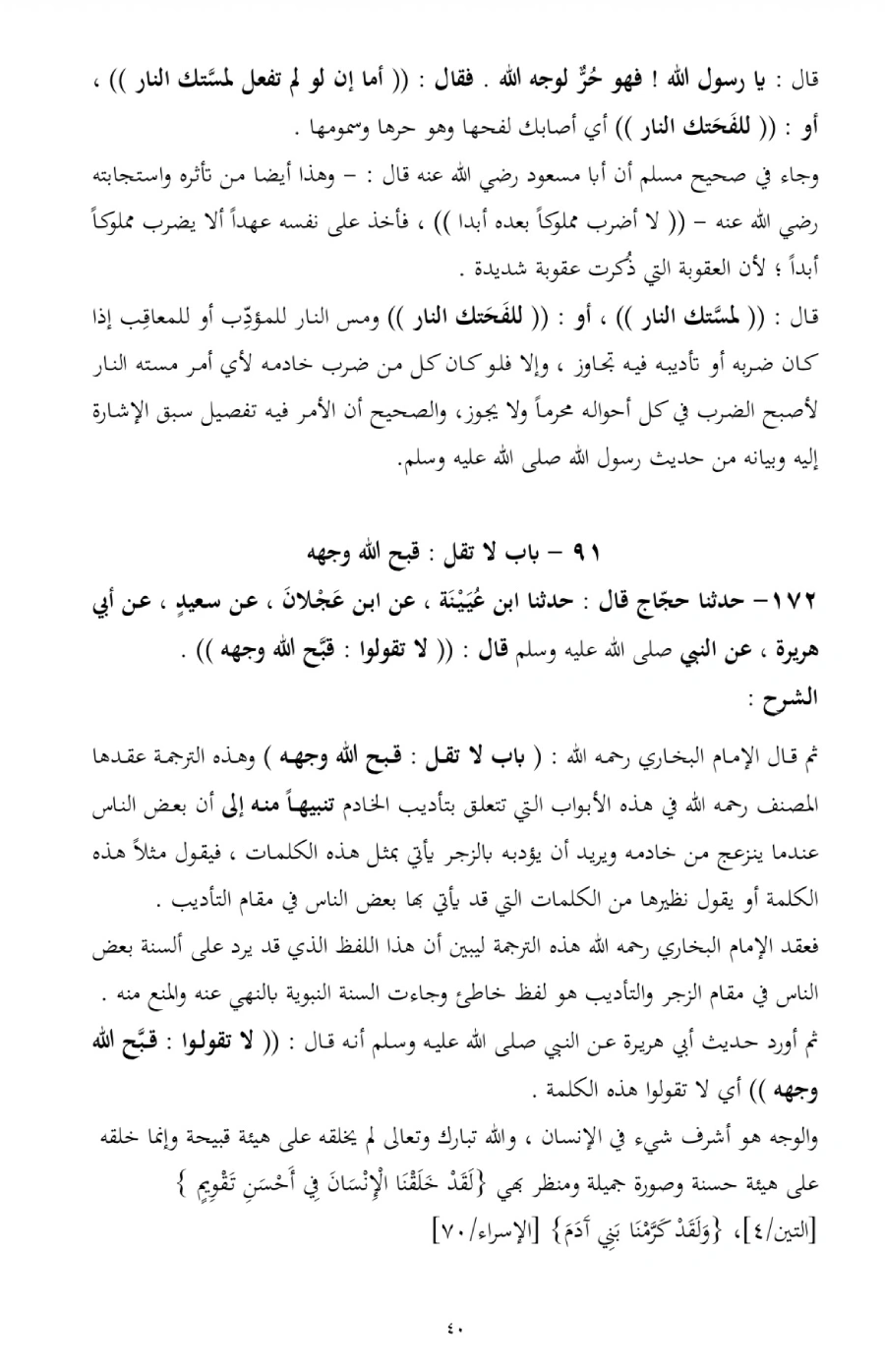
قال: يا رسول الله! فهو حر لوجه الله. فقال: «أما إن لو لم تفعل لمستك النار»، أو: «للفحتك النار» أي أصابك لفحها وهو حرها وسمومها.
وجاء في صحيح مسلم أن أبا مسعود رضي الله عنه قال: ـ وهذا أيضاً من تأثره واستجابته رضي الله عنه ـ «لا أضرب مملوكاً بعده أبداً»، فأخذ على نفسه عهداً ألا يضرب مملوكاً أبداً؛ لأن العقوبة التي ذُكرت عقوبة شديدة.
قال: «لمستك النار»، أو: «للفحتك النار» ومس النار للمؤدِّب أو للمعاقِب إذا كان ضربه أو تأديبه فيه تجاوز، وإلا فلو كان كل من ضرب خادمه لأي أمر مسته النار لأصبح الضرب في كل أحواله حراماً ولا يجوز، والصحيح أن الأمر فيه تفصيل سبق الإشارة إليه وبيانه من حديث رسول الله صلى الله عليه وسلم.
٩١ ـ باب لا تقل: قَبَّحَ اللهُ وجهه
١٧٢ ـ حدثنا حجاج قال: حدثنا ابن عيينة، عن ابن عجلان، عن سعيد، عن أبي هريرة، عن النبي صلى الله عليه وسلم قال: «لا تقولوا: قَبَّحَ اللهُ وجهه».
الشرح:
ثم قال الإمام البخاري رحمه الله: (باب لا تقل: قبح الله وجهه) وهذه الترجمة عقدها المصنف رحمه الله في هذه الأبواب التي تتعلق بتأديب الخادم تنبيهاً منه إلى أن بعض الناس عندما ينزعج من خادمه ويريد أن يؤدبه بالزجر يأتي بمثل هذه الكلمات، فيقول مثلاً هذه الكلمة أو يقول نظيرها من الكلمات التي قد يأتي بها بعض الناس في مقام التأديب.
فعقد الإمام البخاري رحمه الله هذه الترجمة ليبين أن هذا اللفظ الذي قد يرد على ألسنة بعض الناس في مقام الزجر والتأديب هو لفظ خاطئ وجاءت السنة النبوية بالنهي عنه والمنع منه.
ثم أورد حديث أبي هريرة عن النبي صلى الله عليه وسلم أنه قال: «لا تقولوا: قبح الله وجهه» أي لا تقولوا هذه الكلمة.
والوجه هو أشرف شيء في الإنسان، والله تبارك وتعالى لم يخلقه على هيئة قبيحة وإنما خلقه على هيئة حسنة وصورة جميلة ومنظر بهي {لَقَدْ خَلَقْنَا الْإِنسَانَ فِي أَحْسَنِ تَقْوِيمٍ} [التين/٤]، {وَلَقَدْ كَرَّمْنَا بَنِي آدَمَ} [الإسراء/٧٠].
٤٠٠
English translation:
He said: “Messenger of Allah, he is free for Allah’s sake.” He answered: “Had you not done so, the fire would have touched you,” or “the fire would have scorched you,” meaning its scorching heat and burning blast would have struck you.
Sahih Muslim records Abu Masud saying—and this also expresses his response and the impression made on him—“I will never beat an owned slave after this.” He pledged never to beat a slave again because the punishment mentioned was severe.
He said: “The fire would have touched you,” or “the fire would have scorched you.” The fire touching the person administering discipline or punishment applies when his beating or discipline exceeds the limits. Otherwise, if everyone who beat his servant for any reason were touched by the fire, beating would become forbidden and impermissible in every circumstance. The correct position is that different circumstances have different rulings, as previously indicated and explained through the Messenger’s hadith.
91. Do not say: “May Allah make his face ugly.”
172. Hajjaj narrated to us; Ibn Uyaynah narrated to him, from Ibn Ajlan, from Sa’id, from Abu Hurayrah, from the Prophet, who said: “Do not say: May Allah make his face ugly.”
Explanation:
Imam al-Bukhari then said: “Do not say: May Allah make his face ugly.” The compiler placed this heading among the chapters concerning discipline of servants to explain that some people, when annoyed with a servant and seeking to discipline him through rebuke, use such words. They may say this expression or similar words used when administering discipline.
Al-Bukhari established this heading to explain that these words, which some people utter when rebuking and disciplining, are wrong; the prophetic Sunnah prohibits saying them and directs people to refrain from them.
He then cites Abu Hurayrah’s hadith from the Prophet: “Do not say: May Allah make his face ugly”—that is, do not utter this expression.
The face is the most honorable part of a human being. Allah did not create the human being with an ugly form, but with a good constitution, beautiful appearance, and pleasing aspect. “We have created the human being in the best form”—al-Tin 95:4. “We have honored the children of Adam”—al-Isra 17:70.
Page 400.
In al-Badr’s interpretation, the warning of punishment by fire applies when discipline exceeds its limits. Beating accepted as authorized discipline for misconduct is not included in that prohibition. Stopping the beating in Abu Masud’s case and preserving an owner’s general disciplinary power are thus possible within the same interpretation. The commentator assesses the degree and grounds of beating from the starting position that striking a slave can be lawful. The basis of this rule is not the slave’s bodily independence but the authorized boundaries of the owner’s discipline.
Abu Masud personally pledged never to beat a slave again. Al-Badr’s interpretation preserves other owners’ right to authorized disciplinary beating alongside that personal pledge. The explanation below concerning a curse upon a person’s face likewise determines which words may not be used while rebuking and disciplining a servant. These rules governing the limits of physical and verbal discipline take the owner’s control of the slave as an ordinary entitlement. Holding a human being as property and subjecting their body and conduct to another person’s punitive power constitute the fundamental oppression of this system.
Umar Beat Enslaved Women Who Covered Their Heads
Accounts concerning Umar ibn al-Khattab provide a clear example of how physical authority over enslaved women extended beyond isolated incidents. Quoting Ibn Taymiyyah’s Majmu al-Fatawa, IslamQA states that Umar would beat enslaved women whom he saw covering their heads and ask why they were imitating free women. The purpose was to preserve a distinction in dress between free and enslaved women. [43] [44]
The wording preserved in Ibn Taymiyyah’s Majmuʿ al-Fatawa is more explicit: “وكان عمر رضي الله عنه إذا رأى أمة مختمرة ضربها وقال أتتشبهين بالحرائر”—“When Umar saw an enslaved woman wearing a head covering, he would beat her and say, ‘Are you imitating free women?’” The beating was not punishment for theft, violence, or refusal to perform work. It was directed at an enslaved woman for dressing in a manner associated with free women. Physical violence was thus used to keep an enslaved woman within a visibly subordinate social category. [45]
Ibn Abi Shaybah’s al-Musannaf preserves the full account through Anas ibn Malik. Umar first asks whether the enslaved woman has been freed. When she answers that she has not, he orders her to uncover her head and strikes her head with a whip when she hesitates. The narration identifies removal of the head covering as the endpoint of the beating. The footnote in Saad al-Shathri’s edition grades the report “sahih.” [46]
٦٣٨٣ ـ حدثنا علي بن مسهر عن المختار بن فلفل عن أنس بن مالك قال: دخلت على عمر بن الخطاب أمة (قد) (١) كان يعرفها لبعض (٢) المهاجرين أو الأنصار وعليها جلباب متقنعة به فسألها: عتقت؟ قالت: لا، قال: فما بال الجلباب؟ ضعيه عن رأسك إنما الجلباب على الحرائر من نساء المؤمنين (فتلكأت) (٣) فقام إليها بالدرة فضربها بها (برأسها) (٤) حتى ألقته عن رأسها (٥).
(١) في [أ]: (و).
(٢) في [هـ]: (ببعض).
(٣) في [أ، ب، جـ]: (فتلكات)، وفي [ز، هـ]: (فتلكت).
(٤) في [أ، جـ، ك]: (رأسها)، وفي [ب]: (رأسه).
(٥) صحيح.
English translation:
6383. Ali ibn Mushir narrated to us, from al-Mukhtar ibn Fulful, from Anas ibn Malik. Anas said: An enslaved woman entered Umar ibn al-Khattab’s presence. He knew her; she belonged to one of the Muhajirun or Ansar. She wore a jilbab covering her head. He asked: “Have you been freed?” She answered: “No.” He said: “Then why this jilbab? Remove it from your head. The jilbab is for free women among the believing women.” She hesitated. He approached her with a whip and struck her on the head with it until she removed the covering.
(1) The manuscript marked “أ” has “و” in place of “قد.”
(2) The manuscript marked “هـ” has “ببعض” in place of “لبعض.”
(3) The manuscripts marked “أ، ب، جـ” have “فتلكات” in place of “فتلكأت”; those marked “ز، هـ” have “فتلكت.”
(4) The manuscripts marked “أ، جـ، ك” have “رأسها” in place of “برأسها”; the manuscript marked “ب” has “رأسه.”
(5) Sahih.
The exchange directly links the right to dress in a particular way to the woman’s status as free or enslaved. She is struck for wearing, while enslaved, a covering she could have worn as a free woman. She hesitates to remove it; violence is then used to change her clothing. The blows target her head, and stopping them is connected with removing the covering. The function of the violence is therefore explicit: enforcing a visible distinction between free and enslaved women. Even how the enslaved woman’s body is covered is subjected to the authority’s instructions.
This account starkly exposes the character of such coercive authority. An enslaved woman was beaten for covering her body, because her status as a slave meant she was not to dress like a free woman. Corporal punishment was therefore not confined to enforcing labor discipline. The Islamic historical tradition also records beating as a means of maintaining the social hierarchy of slavery and ensuring that the subordinate status of enslaved women remained visible.
Enforcing Class Distinctions in Dress Through Beating: Ibn Qudamah and Ibn Muflih
Ibn Qudamah uses Umar’s beating to establish the rule that an enslaved woman may pray with her head uncovered. Umar saw an enslaved woman belonging to Anas’s household with her head covered, beat her, and told her not to imitate free women. The author invokes the prevalence of the practice and the absence of objection to support his ruling. [47]
فصل: قال: وصلاة الأمة مكشوفة الرأس جائزة. هذا قول عامة أهل العلم. لا نعلم أحدا خالف في هذا إلا الحسن، فإنه من بين أهل العلم أوجب عليها الخمار إذا تزوجت، أو اتخذها الرجل لنفسه، واستحب لها عطاء أن تقنع إذا صلت، ولم يوجبه. ولنا، أن عمر رضي الله عنه ضرب أمة لآل أنس رآها متقنعة، وقال: اكشفي رأسك، ولا تشبهي بالحرائر. وهذا يدل على أن هذا كان مشهورا بين الصحابة لا ينكر، حتى أنكر عمر مخالفته كان ينهى الإماء عن التقنع. قال أبو قلابة: إن عمر بن الخطاب كان لا يدع أمة تقنع في خلافته، وقال: إنما القناع للحرائر.
English translation:
Section: He said that an enslaved woman may pray with her head uncovered. This is the position of scholars generally. We know of no disagreement except from al-Hasan: among scholars, he alone required her to wear a head covering if she married or a man took her for himself. Ata recommended that she cover her head for prayer but did not make it obligatory. Our evidence is that Umar saw an enslaved woman of Anas’s household with her head covered and beat her, saying: “Uncover your head; do not imitate free women.” This indicates that the practice was well known among the Companions and unopposed, to the point that Umar objected to departing from it. He prohibited enslaved women from covering their heads. Abu Qilabah said: During his caliphate, Umar ibn al-Khattab would not allow an enslaved woman to cover her head and said: “This head covering is for free women.”
Burhan al-Din Ibrahim ibn Muhammad ibn Muflih records the same practice in al-Mubdi and calls it “like consensus.” In his reasoning, its prevalence and the absence of objection provide a basis for juristic approval. [48]
ولا فرق بين الحر والعبد وكذا من بلغ عشرا في الأصح وأما الأمة فذكر معظم الأصحاب وهو المذهب أن عورتها كالرجل لما روى عمرو ابن شعيب عن أبيه عن جده مرفوعا قال: «إذا زوج أحدكم عبده أو أمته أو أجيره فلا ينظر إلى شيء من عورته فإن ما تحت السرة إلى ركبته عورة» رواه أحمد وأبو داود يريد به الأمة فإن الأجير والعبد لا يختلف حاله بالتزويج وعدمه وكان عمر ينهى الإماء عن التقنع وقال إنما القناع للحرائر واشتهر ذلك ولم ينكر فكان كالإجماع.
English translation:
There is no distinction between a free man and a male slave; according to the sounder position, the same applies to a person who has reached ten years of age. As for an enslaved woman, most Hanbali jurists state—and this is the school’s position—that her awrah is like a man’s. Amr ibn Shuayb narrated through his father and grandfather that the Prophet said: “When one of you marries off his slave, enslaved woman, or hired worker, he must not look at any part of that person’s awrah: from below the navel to the knee is awrah.” Ahmad and Abu Dawud transmitted it. The enslaved woman is intended, because marriage does not change the position of a hired worker or male slave. Umar prohibited enslaved women from covering their heads and said: “This covering is for free women.” That became widely known and was not opposed, making it like consensus.
The social function of this beating was to preserve a visible distinction between free and enslaved women. The head covering was not recognized as a matter of the woman’s own choice; it became a marker of her social position. An enslaved woman was struck for adopting clothing associated with a free woman’s standing. Later jurists used that practice to support rules of dress and bodily covering. Enforcement of an enslaved woman’s inferior status and its religious-legal explanation thus reinforced each other. Ibn Muflih’s assessment that the practice was “like consensus” represents his own reasoning for granting it juristic authority.
From the Companions’ Silence to Legal Approval: Al-Saymari’s Principle of Consensus
Ibn Qudamah and Ibn Muflih describe the practice of removing enslaved women’s head coverings as widespread among the Companions and unopposed. Behind this appeal to prevalence and the absence of objection stands a specific principle of legal theory. In Masa’il al-Khilaf fi Usul al-Fiqh, the Hanafi legal theorist Husayn ibn Ali al-Saymari adopts the view that a statement circulated among the Companions, without a known opponent, constitutes consensus. He reasons that disagreement would have become known and been transmitted; the absence of transmitted opposition is therefore accepted as evidence of agreement. In the same discussion he records two alternative positions. [49]
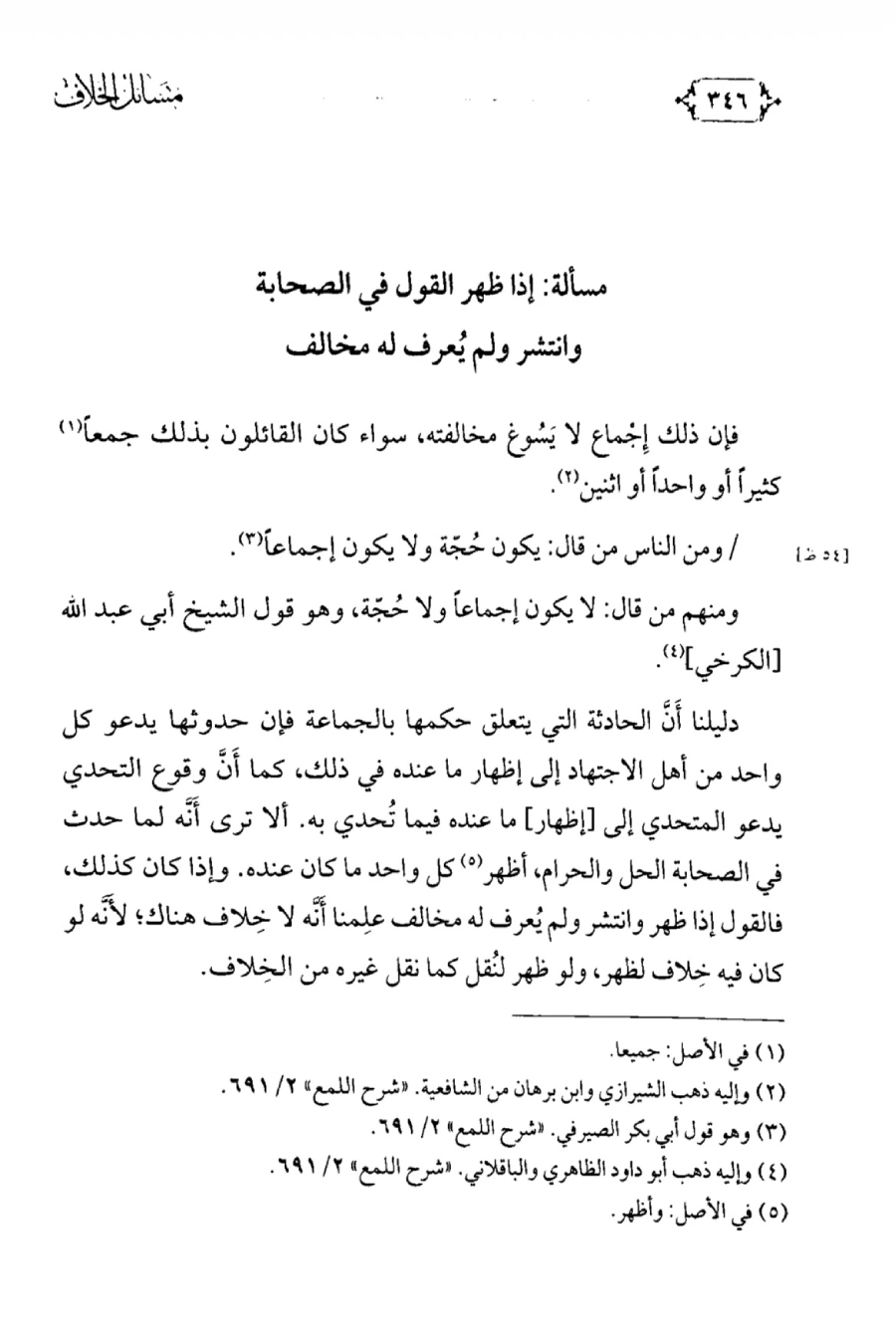
مسائل الخلاف — ٣٤٦
مسألة: إذا ظهر القول في الصحابة وانتشر ولم يُعرف له مخالف
فإن ذلك إجماع لا يسوغ مخالفته، سواء كان القائلون بذلك جمعاً(١) كثيراً أو واحداً أو اثنين(٢).
ومن الناس من قال: يكون حجة ولا يكون إجماعاً(٣).
ومنهم من قال: لا يكون إجماعاً ولا حجة، وهو قول الشيخ أبي عبد الله [الكرخي](٤).
دليلنا أن الحادثة التي يتعلق حكمها بالجماعة فإن حدوثها يدعو كل واحد من أهل الاجتهاد إلى إظهار ما عنده في ذلك، كما أن وقوع التحدي يدعو المتحدى إلى [إظهار] ما عنده فيما تحدي به. ألا ترى أنه لما حدث في الصحابة الحل والحرام أظهر(٥) كل واحد ما كان عنده. وإذا كان كذلك، فالقول إذا ظهر وانتشر ولم يعرف له مخالف علمنا أنه لا خلاف هناك؛ لأنه لو كان فيه خلاف لظهر، ولو ظهر لنقل كما نقل غيره من الخلاف.
(١) في الأصل: جميعا.
(٢) وإليه ذهب الشيرازي وابن برهان من الشافعية. «شرح اللمع» ٢/٦٩١.
(٣) وهو قول أبي بكر الصيرفي. «شرح اللمع» ٢/٦٩١.
(٤) وإليه ذهب أبو داود الظاهري والباقلاني. «شرح اللمع» ٢/٦٩١.
(٥) في الأصل: وأظهر.
English translation:
Masa’il al-Khilaf—page 346.
Question: When a statement appears and circulates among the Companions and no opponent is known.
It then constitutes consensus, and opposing it is impermissible, whether its proponents are many people, one person, or two. (1–2)
Some have said that it constitutes legal evidence but not consensus. (3)
Others have said that it constitutes neither consensus nor legal evidence. This is the position of Shaykh Abu Abdullah al-Karkhi. (4)
Our evidence is that when an event’s ruling concerns the whole group, its occurrence prompts every qualified jurist to express his position, just as a challenge prompts the person challenged to set out what he has concerning the matter. When questions of permissibility and prohibition arose among the Companions, each expressed what he knew. (5) Thus, when a statement appears and circulates without a known opponent, we know there is no disagreement. Had there been disagreement, it would have appeared; had it appeared, it would have been transmitted like other disagreements.
(1) The original manuscript reads «جميعا»—all together.
(2) Among the Shafi’is, al-Shirazi and Ibn Burhan adopted this position. Sharh al-Luma, 2/691.
(3) This is Abu Bakr al-Sayrafi’s position. Sharh al-Luma, 2/691.
(4) Abu Dawud al-Zahiri and al-Baqillani adopted this position. Sharh al-Luma, 2/691.
(5) The original manuscript reads «وأظهر»—and expressed.
Applying this principle turns a prevalent practice into a basis for religious law. In the case of removing an enslaved woman’s head covering, Ibn Qudamah and Ibn Muflih invoke the practice’s prevalence among the Companions and the absence of objection. In their reasoning, legal authority is constructed from the conduct and silence of recognized religious figures. Whether the enslaved woman wants to cover her head is not a condition of this argument. The consent of the person struck and whose dress is controlled consequently has no role in establishing the rule. The absence of known dissent among authoritative men is used to authorize a status distinction imposed on her.
Al-Saymari’s preferred position establishes that silence as consensus and declares opposition to it impermissible. Ibn Muflih describes the particular dress rule as “like consensus.” Together, these statements show how control of enslaved women’s clothing acquired authority within juristic reasoning. Reports of beating an enslaved woman for adopting the visible appearance of a free woman are connected to religious-legal arguments for maintaining the distinction. A system dividing people into free and owned classes thus extended its control even to the right to dress.
Severely Beating an Enslaved Woman to Extract the Truth
The account of Barira in Ibn Hisham’s Sira gives this issue an even more serious dimension. After accusations of adultery spread against Aisha, Muhammad sought the advice of Ali and Usama. Ali suggested questioning Aisha’s enslaved attendant, Barira. Muhammad summoned Barira, and the account states that Ali beat her severely to make her tell the truth. [50]।
Islamweb does not conceal the meaning of this incident either. Its fatwa states directly, “وإنما كان ضرب علي لها لتصدق فيما تجيب به”—“Ali beat her so that she would speak truthfully in her answers.” Islamweb’s explanation explicitly identifies the purpose of the beating as extracting the truth during questioning. [51]
Ali’s assault on Barira is described as part of the effort to investigate the accusation against Aisha. Muhammad summoned Barira, and Ali beat her severely while demanding the truth. The narrative records no objection by Muhammad to this violence, no punishment of Ali, and no remedy for Barira. A woman in a subordinate position was physically assaulted to obtain information, and the incident presents that violence as part of the questioning process.
The summons of Aisha’s enslaved attendant at Muhammad’s initiative and her beating by Ali during the interrogation occur consecutively in the sira narrative. It records no action taken against beating her as a method of questioning. The relationship between violence and authority is clear: physical force was used to compel an enslaved woman to provide information. The incident also reveals the social reality of punitive authority exercised over enslaved women.
The Messenger’s questioning
Aisha said: The Messenger summoned Ali ibn Abi Talib and Usama
ibn Zayd to seek their advice. Usama praised me and spoke well of me, saying: “Messenger of Allah, your household—we know nothing but good of them. This is false accusation and slander.” Ali said:
310
Sirat al-Nabi
“Messenger of Allah, there are many women, and you are able to replace her with another. Ask the enslaved woman; she will tell you the truth.”
The Messenger then summoned Barira to question her.
Aisha said: Ali ibn Abi Talib stood beside her. He then beat her severely and said: “Tell the Messenger the whole truth.”
She said: “By Allah, I know nothing but good of her. I find no fault with Aisha except that, when I prepare dough for bread and ask her to watch it, she falls asleep instead, and the goat comes and eats it.”
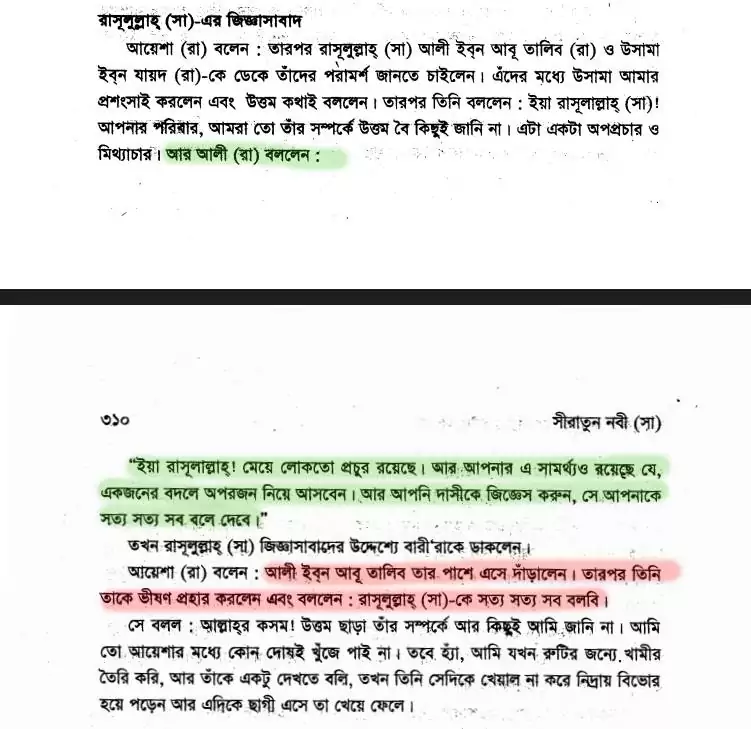
Slave-Beating in Everyday Work and Service: Accounts of Companions and Successors
Accounts record enslaved people being beaten for deviations from the rules of a transaction while carrying out the owner’s business, the loss of livestock, or dissatisfaction with service. The owner’s economic interests, personal anger, and use of force against subordinate bodies are closely connected in these incidents. The slave’s labor serves the owner’s wealth and comfort; when the result displeases the owner, that person’s body becomes a target of violence.
Ibn Umar’s Painful Flogging Over a Currency Exchange
Ibn Umar sent a slave with gold or silver to exchange. The slave allowed the other party time to complete the exchange. On his return, Ibn Umar flogged him painfully and ordered him to retrieve his property. The report is numbered 170 in the Arabic edition of al-Adab al-Mufrad; some Bengali editions number it 169. [52]
أرسل عبدُ اللهِ بنُ عمرَ غلامًا له بذهبٍ أو بورقٍ فصرفه فأنظر بالصَّرفِ فرجع إليه فجلده جلدًا وجيعًا وقال اذهبْ فخُذْ الذي لي ولا تَصرِفْه.
English translation:
Abdullah ibn Umar sent a slave of his with gold or silver. The slave exchanged it and allowed the other party time to complete the exchange. When he returned, Ibn Umar flogged him painfully and said: “Go, recover what belongs to me, and do not exchange it.”
The expression “jaldan waji’an,” used to describe the assault, means painful flogging. In response to a violation of the rules of a transaction, the owner made a subordinate person’s body the site of punishment. The same person who possesses the power to send another human being to exchange his property also exercises the power to inflict pain when dissatisfied with the outcome. Combining the order to reverse the transaction with flogging makes the connection between the owner’s economic interests and physical authority over the slave explicit.
The printed text of al-Adab al-Mufrad includes the full chain of transmission and the expression “painful flogging” in Ibn Umar’s account. The next report on the same page concerns Abu Masud’s beating of a slave. The footnote identifies the first as a mawquf report with a hasan chain and grades the second chain sahih. It also gives a detailed assessment of the transmitters of the first report. Disciplinary beating and a warning against a beating are preserved together in the same chapter, “Disciplining the Servant.” [53]
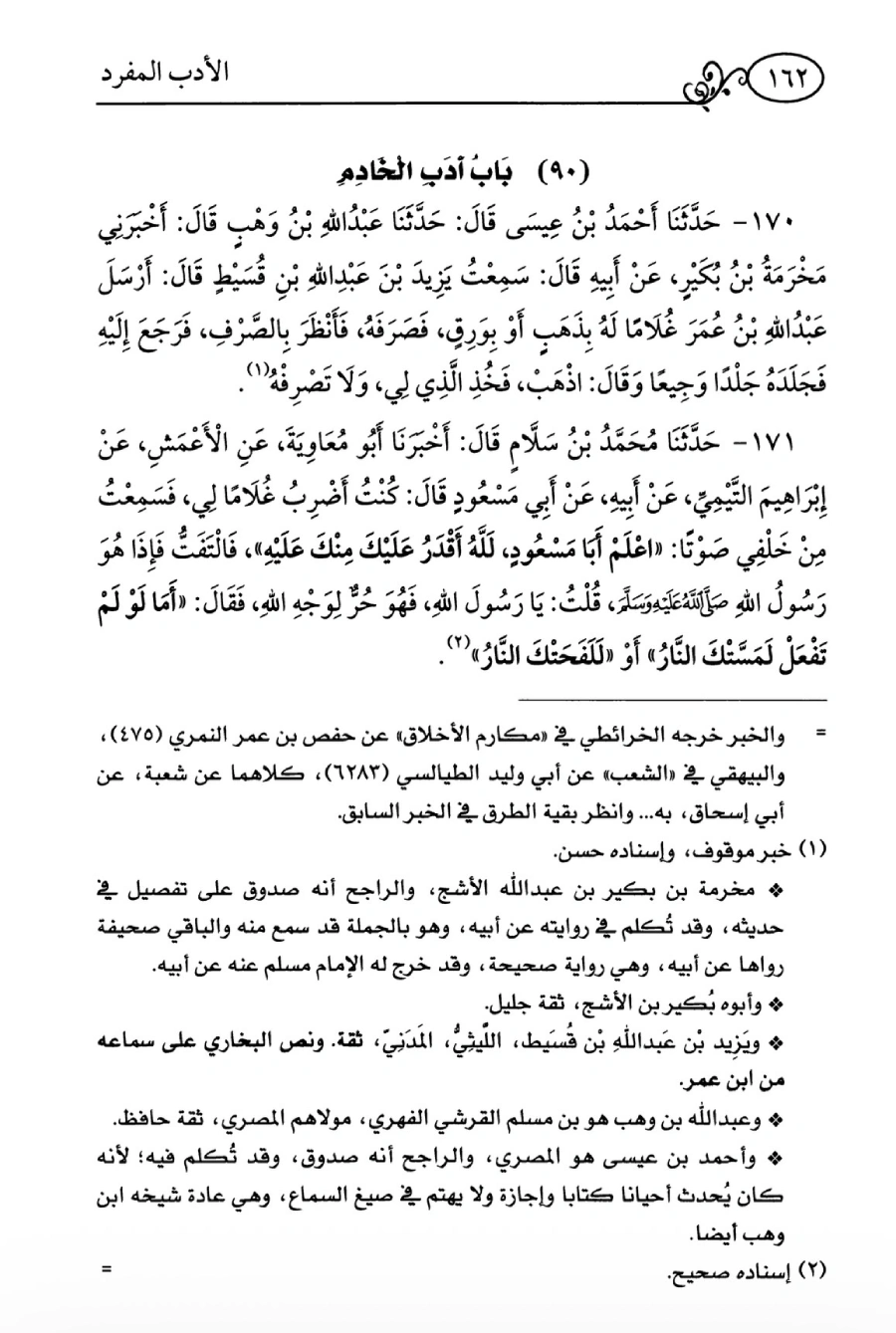
الأدب المفرد — ١٦٢
(٩٠) بَابُ أَدَبِ الْخَادِمِ
١٧٠ ـ حَدَّثَنَا أَحْمَدُ بْنُ عِيسَى قَالَ: حَدَّثَنَا عَبْدُ اللَّهِ بْنُ وَهْبٍ قَالَ: أَخْبَرَنِي مَخْرَمَةُ بْنُ بُكَيْرٍ، عَنْ أَبِيهِ قَالَ: سَمِعْتُ يَزِيدَ بْنَ عَبْدِ اللَّهِ بْنِ قُسَيْطٍ قَالَ: أَرْسَلَ عَبْدُ اللَّهِ بْنُ عُمَرَ غُلَامًا لَهُ بِذَهَبٍ أَوْ بِوَرِقٍ، فَصَرَفَهُ، فَأَنْظَرَ بِالصَّرْفِ، فَرَجَعَ إِلَيْهِ فَجَلَدَهُ جَلْدًا وَجِيعًا وَقَالَ: اذْهَبْ، فَخُذِ الَّذِي لِي، وَلَا تَصْرِفْهُ(١).
١٧١ ـ حَدَّثَنَا مُحَمَّدُ بْنُ سَلَامٍ قَالَ: أَخْبَرَنَا أَبُو مُعَاوِيَةَ، عَنِ الْأَعْمَشِ، عَنْ إِبْرَاهِيمَ التَّيْمِيِّ، عَنْ أَبِيهِ، عَنْ أَبِي مَسْعُودٍ قَالَ: كُنْتُ أَضْرِبُ غُلَامًا لِي، فَسَمِعْتُ مِنْ خَلْفِي صَوْتًا: «اعْلَمْ أَبَا مَسْعُودٍ، لَلَّهُ أَقْدَرُ عَلَيْكَ مِنْكَ عَلَيْهِ»، فَالْتَفَتُّ فَإِذَا هُوَ رَسُولُ اللَّهِ صَلَّى اللَّهُ عَلَيْهِ وَسَلَّمَ، قُلْتُ: يَا رَسُولَ اللَّهِ، فَهُوَ حُرٌّ لِوَجْهِ اللَّهِ، فَقَالَ: «أَمَا لَوْ لَمْ تَفْعَلْ لَمَسَّتْكَ النَّارُ» أَوْ «لَلَفَحَتْكَ النَّارُ»(٢).
= والخبر أخرجه الخرائطي في «مكارم الأخلاق» عن حفص بن عمر النمري (٤٧٥)، والبيهقي في «الشعب» عن أبي الوليد الطيالسي (٦٢٨٣)، كلاهما عن شعبة، عن أبي إسحاق، به… وانظر بقية الطرق في الخبر السابق.
(١) خبر موقوف، وإسناده حسن.
❖ مخرمة بن بكير بن عبد الله الأشج، والراجح أنه صدوق على تفصيل في حديثه، وقد تكلم في روايته عن أبيه، وهو بالجملة قد سمع منه والباقي صحيفة رواها عن أبيه، وهي رواية صحيحة، وقد خرج له الإمام مسلم عنه عن أبيه.
❖ وأبوه بكير بن الأشج، ثقة جليل.
❖ ويزيد بن عبد الله بن قسيط، الليثي، المدني، ثقة. ونص البخاري على سماعه من ابن عمر.
❖ وعبد الله بن وهب هو ابن مسلم القرشي الفهري، مولاهم المصري، ثقة حافظ.
❖ وأحمد بن عيسى هو المصري، والراجح أنه صدوق، وقد تكلم فيه؛ لأنه كان يتحدث أحياناً كتاباً وإجازة ولا يهتم في صيغ السماع، وهي عادة شيخه ابن وهب أيضاً.
(٢) إسناده صحيح.
English translation:
Al-Adab al-Mufrad—page 162.
90. Disciplining the Servant.
170. Ahmad ibn Isa narrated to us. He said: Abdullah ibn Wahb narrated to us. He said: Makhramah ibn Bukayr informed me through his father, who said: I heard Yazid ibn Abdullah ibn Qusayt say: Abdullah ibn Umar sent a slave with gold or silver. The slave exchanged it and allowed time for the exchange. When he returned, Ibn Umar flogged him painfully and said: “Go, recover what belongs to me, and do not exchange it.” (1)
171. Muhammad ibn Salam narrated to us. He said: Abu Muawiyah informed us, from al-Amash, from Ibrahim al-Taymi, from his father, from Abu Masud. Abu Masud said: I was beating a slave of mine when I heard a voice behind me: “Know, Abu Masud, Allah has greater power over you than you have over him.” I turned and found the Messenger of Allah. I said: “Messenger of Allah, he is free for Allah’s sake.” He said: “Had you not done so, the fire would have touched you,” or “the fire would have scorched you.” (2)
= Al-Khara’iti transmitted the report in Makarim al-Akhlaq through Hafs ibn Umar al-Namari, number 475, and al-Bayhaqi in al-Shuab through Abu al-Walid al-Tayalisi, number 6283. Both transmit through Shu’bah, from Abu Ishaq, through that chain… See the remaining transmission routes in the preceding report.
(1) This is a mawquf report ending with a Companion’s words or actions; its chain is hasan.
❖ Makhramah ibn Bukayr ibn Abdullah al-Ashajj: the preferred view, based on a detailed assessment of his reports, is that he is truthful. His transmission from his father has been criticized. Broadly, he did hear from his father; the remainder comes from a written collection he transmitted from him. That transmission is sound. Imam Muslim also included his reports through his father.
❖ His father, Bukayr ibn al-Ashajj, is a trustworthy and distinguished transmitter.
❖ Yazid ibn Abdullah ibn Qusayt al-Laythi al-Madani is trustworthy. Al-Bukhari explicitly states that he heard Ibn Umar.
❖ Abdullah ibn Wahb is Abdullah ibn Muslim al-Qurashi al-Fihri, their freedman, an Egyptian. He is trustworthy and a hafiz.
❖ Ahmad ibn Isa is the Egyptian. The preferred view is that he is truthful. He has been criticized because he sometimes transmitted from written books and authorization without paying attention to wording indicating direct hearing. His teacher Ibn Wahb had the same practice.
(2) Its chain is sahih.
The narration explicitly connects Ibn Umar’s instruction with painful flogging. He orders the recovery of his property and strikes the slave’s body. Correction of a property transaction and corporal punishment of a person are performed by the same owner. The chapter heading “Disciplining the Servant” also places this violence within discipline. Accepting responsibility for work thus means that the slave must answer for mistakes and endure the owner’s physical punishment for them. This power rests on one person’s ownership of another.
In Rashsh al-Barad: Sharh al-Adab al-Mufrad, Muhammad Luqman al-Salafi separates the incident’s vocabulary from the legal conclusions drawn from it. He identifies postponement of the exchange as forbidden and “painful flogging” as a beating that causes pain. He then derives permission to beat a slave for disciplinary purposes because of an offense. On the same page, his explanation of Abu Masud’s hadith calls emancipation after beating recommended rather than obligatory. In his interpretation, authorization of disciplinary beating, its limits, and expiation for wrongful beating are distinct rules within the same system. [54]
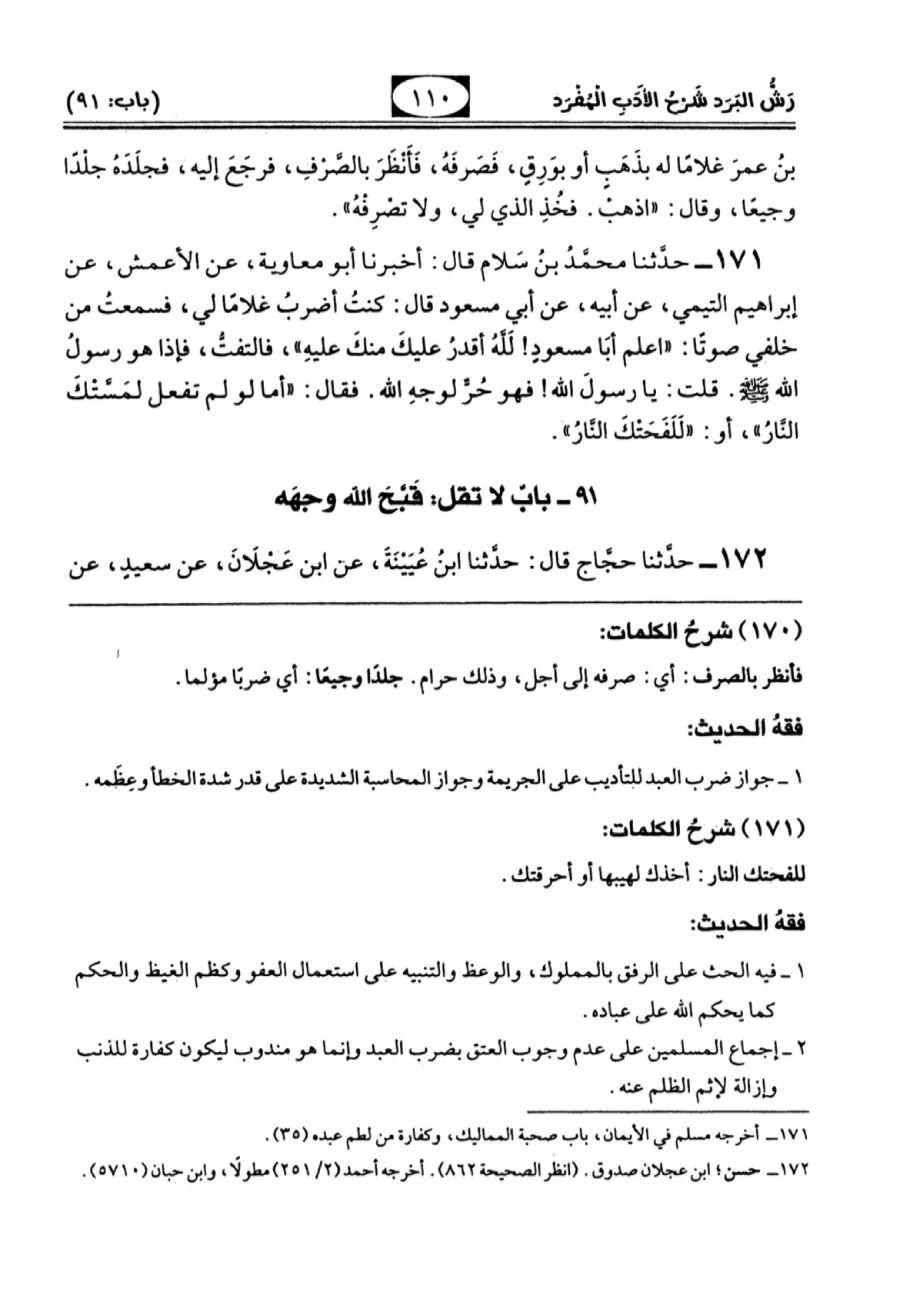
رَشُّ البَرَد شَرْحُ الأَدَبِ المُفْرَد — ١١٠ — (باب: ٩١)
بن عمر غلاماً له بذهب أو بورق، فصرفه، فأنظر بالصرف، فرجع إليه، فجلده جلداً وجيعاً، وقال: «اذهب، فخذ الذي لي، ولا تصرفه».
١٧١ ـ حدثنا محمد بن سلام قال: أخبرنا أبو معاوية، عن الأعمش، عن إبراهيم التيمي، عن أبيه، عن أبي مسعود قال: كنت أضرب غلاماً لي، فسمعت من خلفي صوتاً: «اعلم أبا مسعود! لله أقدر عليك منك عليه»، فالتفت فإذا هو رسول الله ﷺ، قلت: يا رسول الله! فهو حر لوجه الله. فقال: «أما لو لم تفعل لمستك النار»، أو: «للفحتك النار».
٩١ ـ باب لا تقل: قَبَّحَ اللهُ وجهه
١٧٢ ـ حدثنا حجاج قال: حدثنا ابن عيينة، عن ابن عجلان، عن سعيد، عن
(١٧٠) شرح الكلمات:
فأنظر بالصرف: أي: صرفه إلى أجل، وذلك حرام. جلداً وجيعاً: أي ضرباً مؤلماً.
فقه الحديث:
١ ـ جواز ضرب العبد للتأديب على الجريمة، وجواز المحاسبة الشديدة على قدر شدة الخطإ وعظمه.
(١٧١) شرح الكلمات:
للفحتك النار: أخذك لهيبها أو أحرقتك.
فقه الحديث:
١ ـ فيه الحث على الرفق بالمملوك، والوعظ والتنبيه على استعمال العفو وكظم الغيظ والحكم كما يحكم الله على عباده.
٢ ـ إجماع المسلمين على عدم وجوب العتق بضرب العبد وإنما هو مندوب ليكون كفارة للذنب وإزالة لإثم الظلم عنه.
١٧١ ـ أخرجه مسلم في الإيمان، باب صحبة المماليك، وكفارة من لطم عبده (٣٥).
١٧٢ ـ حسن؛ ابن عجلان صدوق. (انظر الصحيحة ٨٦٢). أخرجه أحمد (٢/٢٥١) مطولاً، وابن حبان (٥٧١٠).
English translation:
Rashsh al-Barad: Sharh al-Adab al-Mufrad—page 110—chapter 91.
Ibn Umar sent a slave with gold or silver. He exchanged it and allowed time for the exchange. When he returned, Ibn Umar flogged him painfully and said: “Go, recover what belongs to me, and do not exchange it.”
171. Muhammad ibn Salam narrated to us. He said: Abu Muawiyah informed us, from al-Amash, from Ibrahim al-Taymi, from his father, from Abu Masud. Abu Masud said: I was beating a slave of mine when I heard a voice behind me: “Know, Abu Masud! Allah has greater power over you than you have over him.” I turned and found the Messenger of Allah. I said: “Messenger of Allah, he is free for Allah’s sake.” He said: “Had you not done so, the fire would have touched you,” or “the fire would have scorched you.”
91. Do not say: “May Allah make his face ugly.”
172. Hajjaj narrated to us. He said: Ibn Uyaynah narrated to us, from Ibn Ajlan, from Sa’id, from—
Vocabulary of report 170:
“Allowed time for the exchange” means making the exchange with a deferred term; this is forbidden. “Painful flogging” means beating that causes pain.
Rulings derived from the hadith:
1. Beating a slave to discipline him for an offense is permissible. Strict accountability proportionate to the seriousness and magnitude of the error is also permissible.
Vocabulary of report 171:
“The fire would have scorched you” means its flame would have seized or burned you.
Rulings derived from the hadith:
1. It encourages kindness to the owned slave, admonition and attention to forgiveness, restraint of anger, and judging as Allah judges His servants.
2. Muslims agree that beating a slave does not make emancipation obligatory. Rather, it is recommended as expiation for the sin and to remove the sin of wrongdoing.
171. Muslim transmitted it in the Book of Faith, in the chapter on treatment of slaves and expiation for slapping one’s slave, number 35.
172. Hasan; Ibn Ajlan is truthful. See al-Sahihah, number 862. Ahmad transmitted it at 2/251 in a longer form, and Ibn Hibban at number 5710.
Luqman’s conclusion that “beating a slave to discipline him for an offense is permissible” explicitly demonstrates the legal reception of this incident. He accepts the error of delaying a currency exchange as a lawful reason for beating. The same explanation permits strict accountability proportionate to the seriousness of the error. A mistake by a person carrying out the owner’s business creates a right to inflict physical punishment on that person. In this arrangement, safeguarding the owner’s property is intertwined with subjecting the slave’s body to punishment. Adding physical pain to the duty to correct a mistake exposes the brutal power of the ownership relationship.
The assertion on the same page of consensus that emancipation after beating is not obligatory reiterates al-Nawawi’s position discussed earlier. Permission for beating and emancipation after wrongful beating are treated as separate questions. The owner’s power to beat remains intact where discipline is authorized; where emancipation is recommended as expiation, that position still does not make it compulsory. Both control over the slave’s body and the route to obtaining freedom are determined within the ownership framework.
In Sharh Sahih al-Adab al-Mufrad, Abd al-Aziz al-Rajihi directly compares Ibn Umar’s beating with Abu Masud’s beating of his slave. He accepts Ibn Umar’s painful flogging as discipline because the slave violated the rules of currency exchange. He interprets Abu Masud’s incident as severe beating, in anger, of a slave who had committed no offense. By identifying one owner’s flogging as authorized discipline and another owner’s beating as wrongful within the same discussion, he defines the limits of an owner’s power to punish. [55]
هذا فيه دليل على أنه لا يجوز ضرب الغلام بغير حق أما في الحديث الأول ابن عمر أدبه لأنه تجاوز الحد ولأنه صرف فعل شيئا أما هذا ظاهره أنه يؤدبه وليس له ذنب ويضربه ضربا شديدا بسبب الغضب.
English translation:
This establishes that beating a slave unjustly is impermissible. In the first hadith, Ibn Umar disciplined him because he overstepped the limit and performed the currency exchange. In this incident, however, he apparently disciplines him although he has committed no offense, beating him severely because of anger.
In al-Rajihi’s interpretation, the lawfulness of beating a slave is determined by the slave’s conduct and the form of the owner’s discipline. He accepts the painful flogging in Ibn Umar’s account as disciplinary action. Because a rule of currency exchange was violated, correction of the mistake was accompanied by punishment of the slave’s body. Assigning work, determining an error in its performance, and flogging the worker for that error are all concentrated in the owner’s hands. An error in an economic transaction becomes a reason to inflict bodily pain on a subordinate person. Authority over property is directly connected with punitive authority over an owned human being’s body.
The conclusion that Abu Masud’s slave had committed no offense is al-Rajihi’s interpretation; his word “apparently” identifies its interpretive status. On that interpretation, he simultaneously condemns severe beating in anger and establishes the lawfulness of disciplinary beating for misconduct. The power to strike a slave remains a recognized power of the owner. A transaction error by a free person can be addressed through discussion, recovery of the account, or cancellation of the transaction; here, flogging of the slave’s body is added. Making a person property extends control over their work into a right to punish their body. This physical subjection is the cruelty of slavery: a mistake in another person’s financial business is paid for through pain inflicted on one’s own body.
Slapping an Enslaved Woman After a Sheep Was Lost: Muawiyah ibn al-Hakam
Muawiyah ibn al-Hakam al-Sulami recounts slapping his enslaved shepherdess. After a wolf took a sheep, he struck her in anger. Muhammad treated the matter as grave; the woman was subsequently brought to him and he ordered her emancipation. The full incident, from the beating to the order of emancipation, reads: [56]
قَالَ وَكَانَتْ لِي جَارِيَةٌ تَرْعَى غَنَمًا لِي قِبَلَ أُحُدٍ وَالْجَوَّانِيَّةِ فَاطَّلَعْتُ ذَاتَ يَوْمٍ فَإِذَا الذِّيبُ قَدْ ذَهَبَ بِشَاةٍ مِنْ غَنَمِهَا وَأَنَا رَجُلٌ مِنْ بَنِي آدَمَ آسَفُ كَمَا يَأْسَفُونَ لَكِنِّي صَكَكْتُهَا صَكَّةً فَأَتَيْتُ رَسُولَ اللَّهِ صلى الله عليه وسلم فَعَظَّمَ ذَلِكَ عَلَىَّ قُلْتُ يَا رَسُولَ اللَّهِ أَفَلاَ أُعْتِقُهَا قَالَ «ائْتِنِي بِهَا». فَأَتَيْتُهُ بِهَا فَقَالَ لَهَا «أَيْنَ اللَّهُ». قَالَتْ فِي السَّمَاءِ. قَالَ «مَنْ أَنَا». قَالَتْ أَنْتَ رَسُولُ اللَّهِ. قَالَ «أَعْتِقْهَا فَإِنَّهَا مُؤْمِنَةٌ».
English translation:
He said: I had an enslaved woman who tended my sheep near Uhud and al-Jawwaniyyah. One day I found that a wolf had taken a sheep from her flock. I am a child of Adam and become angry as others do, but I slapped her. I came to the Messenger of Allah, and he treated my action as grave. I asked: “Messenger of Allah, should I not emancipate her?” He answered: “Bring her to me.” I brought her, and he asked: “Where is Allah?” She answered: “In heaven.” He asked: “Who am I?” She answered: “You are the Messenger of Allah.” He said: “Emancipate her, for she is a believer.”
When a sheep was taken by a wolf, the woman tending the flock became the target of the owner’s anger. Her body became an easy outlet for his reaction to the loss of property. The owner himself describes anger as a normal human reaction and then admits slapping her. The danger of the owner’s daily power over an enslaved person is exposed in this incident: striking the subordinate becomes his immediate reaction to damage to his property. The account ends with an order of emancipation; its sequence of beating, objection, and emancipation records the violence already inflicted on the woman.
Two Lashes for Pouring Cold Water: Judge Iyas ibn Muawiyah
Waki’s Akhbar al-Qudat preserves an account attributed to the judge Iyas ibn Muawiyah. After the governor Yusuf ibn Umar had him given fifty-six lashes, he compared this with his own record of beating slaves. His recollection includes giving one slave two lashes for pouring cold water on his head on a cold day. [57]
أخبرني إبراهيم بن أبي عثمان، عن سليمان بن أبي شيخ، عن صالح بن بن سليمان، عن حفص بن عمر بن حفص بن عبد الله بن الحارث بن هشام، قال: كنت غائبا عن واسط أيام يوسف بن عمر؛ فقدمت فقال لي: إني أتيت إياس بن معاوية؛ قلت: وما له؟ قال: ضربه الأمير يوسف؛ أراده على أن يتولى له السوق؛ فأبى فضربه، فأتيته، فوجدت عنده جماعة، جماعة، فقال: إلي إلي يا أبا عمر ها هنا، فأجلسني إلى جنبه، ثم قال: لقد ضربني الأمير ستة وخمسين سوطا، فنظرت في ضربي مملوكي فإذا هو ينقص على ضرب يوسف إياي سوطين؛ فقلت: أرجو أن يكون قصاصا وأن يكون لي فوات السوطين، ثم اقتص ضربه مملوكيه لما ضربهم عليه، فحفظت قصة غلام منهم؛ قال: جئت في يوم بارد فوضعت قلنسوتي، وعمامتي عن رأسي، ودعوت بالوضوء، فجاء بماء بارد؛ فقال: بالفارسية: أصب على رأسك؟ فقلت متعجبا منه: نعم، فصب على رأسي ماء باردا في يوم بارد، فضربته سوطين.
English translation:
Ibrahim ibn Abi Uthman informed me, from Sulayman ibn Abi Shaykh, from Salih ibn ibn Sulayman, from Hafs ibn Umar ibn Hafs ibn Abdullah ibn al-Harith ibn Hisham, who said: I was away from Wasit during Yusuf ibn Umar’s time. On returning, he told me: “I visited Iyas ibn Muawiyah.” I asked: “What happened to him?” He answered: “The governor Yusuf beat him. He wanted him to take charge of the market; he refused, so the governor beat him.” I visited him and found a group of people there. He said: “Abu Umar, come here beside me.” He seated me next to him and said: “The governor gave me fifty-six lashes. I examined my beatings of my slaves and found that they totaled two blows fewer than Yusuf gave me. I said: I hope this is recompense and that I retain the reward of the extra two blows.” He then recounted why he had beaten his slaves. I remember the case of one of them. He said: “I arrived on a cold day, took the cap and turban from my head, and asked for ablution water. The slave brought cold water and asked in Persian: ‘Shall I pour it over your head?’ In surprise, I said: ‘Yes.’ He then poured cold water over my head on a cold day, so I gave him two lashes.”
In this incident, the slave asked before pouring the water and received the owner’s answer, “Yes.” Even so, the punishment for the owner’s displeasure fell upon his body. The subordinate was not safe even after obtaining permission to act. The slave engaged in service bore the burden of personal discomfort, a reply expressing surprise, and subsequent anger. In the account, Iyas tallies the governor’s blows against his own beatings of slaves as recompense. His experience links two levels of power through the same physical pain: above him, a ruler beats him; below him, he has beaten slaves.
Beating Slaves for Disobeying Orders
An important illustration of the power structure of Islamic slavery appears in the legal opinions attributed to Ahmad ibn Hanbal. In Masaʾil al-Imam Ahmad, collected by Abu Dawud al-Sijistani, Ahmad was asked on what matters an enslaved person could be disciplined or punished. He answered that discipline was permitted concerning prayer, other religious obligations, and tasks assigned within the enslaved person’s capacity. [58]।
سَمِعْتُ أَحْمَدَ، سُئِلَ عَنِ الْمَمْلُوكِ: فِيمَ يُؤَدَّبُ؟ قَالَ: فِي صَلَاتِهِ، وَفِي فَرَائِضِهِ، وَإِذَا حُمِّلَ مَا يُطِيقُ
Abu Dawud said: I heard Ahmad being asked: “Concerning what may a slave be disciplined?” He answered: “His prayer, his obligatory duties, and when work within his capacity is assigned to him.”
The later Hanbali jurist al-Buhuti clarified this ruling in Kashshaf al-Qinaʿ. He wrote: “وَيُؤَدِّبُهُ السَّيِّدُ عَلَى مَا إِذَا كَلَّفَهُ مَا يُطِيقُ فَامْتَنَعَ مِنْ امْتِثَالِهِ”—the owner may discipline an enslaved person when assigned work is within that person’s capacity and the person refuses to comply. The same discussion states: “وَلِلسَّيِّدِ تَأْدِيبُهُمْ … بِاللَّوْمِ وَالضَّرْبِ”—the owner has the right to discipline enslaved people through reprimand and beating. [59]
Ibn Qudamah’s al-Mughni permits reprimand and light beating for misconduct by an enslaved man or woman. Ibn Muflih’s al-Furu preserves Ahmad ibn Hanbal’s view permitting discipline over prayer, other obligatory duties, and assigned work within the person’s capacity. Both classical positions are cited in Islamweb’s Fatwa 137527; the underlying legal views belong to Ibn Qudamah and to Ahmad as transmitted by Ibn Muflih. [60]
The significance of this evidence goes beyond the mere permissibility of slave-beating in Islamic jurisprudence. The owner’s authority to enforce commands was backed by a legally recognized power of corporal punishment. The owner could assign work within the slave’s capacity; refusal could be met with physical discipline. This was not a relationship between two independent individuals. It was a relationship between an owner empowered to issue orders and an enslaved person obliged to obey them.
Recognizing corporal punishment as a means of enforcing obedience placed an enslaved person’s labor, services, and daily decisions under the owner’s authority. The owner issued instructions; the slave was required to obey; and beating was an authorized response to disobedience. This was not a relationship of equal rights between free individuals. It was a legal order based on ownership, compulsory obedience, and the power to punish in order to enforce it.
Obtaining Work, Beating, and Fetters in Al-Buhuti’s Ruling
In Kashshaf al-Qina, al-Buhuti gives the juristic explanation for beating slaves more than wives. The same ruling authorizes fettering a slave out of fear of escape, discipline for obligatory religious duties, and punishment for refusing assigned work within the slave’s capacity. The complete relevant passage, including admonition, forgiveness, the condition of a serious offense, and prohibited forms of abuse, reads: [61]
(وللسيد تأديبهم) أي الأرقاء (باللوم والضرب كولد وزوجة) ناشز (والأحاديث الصحيحة تدل على جواز الزيادة) في الرقيق على الزوجة، منها ما رواه أحمد وأبو داود عن لقيط أن النبي صلى الله عليه وسلم قال له: «ولا تضرب ظعينتك ضرب أمتك» ولأحمد والبخاري «لا يجلد أحدكم امرأته جلد العبد ثم لعله يجامعها أو يضاجعها من آخر اليوم» ولابن ماجه بدل العبد الأمة فهذه تدل على أن ضرب الرقيق أشد من ضرب المرأة (ويسن) للسيد (العفو عنه أولا) أي قبل التأديب (ويكون) العفو (مرة أو مرتين نصا) نقل حرب «لا تضرب إلا في ذنب بعد عفو مرة أو مرتين» (ولا يضربه شديدا ولا يضربه إلا في ذنب عظيم نصا) لقوله صلى الله عليه وسلم: «إذا زنت أمة أحدكم فليجلدها» (ويقيده بقيد إذا خاف عليه) الإباق (ويؤدب على فرائضه) أي فرائض الله تعالى من الصلاة والصوم. (و) يؤدبه السيد (على ما إذا كلفه ما يطيق فامتنع) من امتثاله (وليس له لطمه في وجهه) لحديث ابن عمر مرفوعا: «من لطم غلامه فكفارته عتقه» رواه مسلم (ولا خصاؤه ولا التمثيل به) بجدع أنف أو نحوه ويعتق بذلك لما تقدم في العتق.
English translation:
An owner may discipline his male and female slaves through reprimand and beating, as he disciplines a child and a disobedient wife. Authentic hadiths indicate permission to beat slaves more than wives. Among them, Ahmad and Abu Dawud transmit from Laqit that the Prophet told him: “Do not beat your wife as you beat your enslaved woman.” Ahmad and al-Bukhari record: “None of you should flog his wife as he flogs a slave and then perhaps have intercourse or share a bed with her at the end of the day.” Ibn Majah has “enslaved woman” instead of “slave.” These indicate that beating slaves is harsher than beating women. It is recommended that the owner forgive before disciplining; explicit statements specify once or twice. Harb transmitted: “Do not beat except for an offense, after forgiving once or twice.” Explicit statements prohibit severe beating and beating except for a serious offense, because the Prophet said: “If one of your enslaved women commits zina, flog her.” If escape is feared, the owner may put the slave in fetters. He may discipline him over Allah’s obligatory duties, such as prayer and fasting, and when assigned work within his capacity but refusing to perform it. The owner may not slap his face, because Ibn Umar transmits the Prophet’s statement: “Whoever slaps his slave, the expiation is to emancipate him”—recorded by Muslim. He may not castrate or mutilate him, such as by cutting off his nose; he becomes free through that, according to the rule previously discussed under emancipation.
Fettering against escape and punishment for refusing work together reveal the method of extracting slave labor. Movement may be restricted when the person wants to leave; bodily punishment may be imposed when the person refuses an instruction to work. Providing services to the owner becomes compulsory obedience. The same owner also possesses punitive authority over obligatory religious observance. Control of labor, movement, and religious conduct is thus combined under the same ownership-based authority.
A Shafi’i Fatwa Permitting Beating for Refusal to Work
In Fath al-Muin, Zayn al-Din al-Malibari recognizes an owner’s right to impose ta’zir on a slave and quotes a detailed fatwa by Abd al-Rahman ibn Ziyad. It permits effective beating that is not severe when a slave refuses to serve the owner. The same fatwa provides for intervention by the ruler against excessive beating and, if necessary, the sale of the slave. [62]
وسئل شيخنا عبد الرحمن بن زياد رحمه الله تعالى عن عبد مملوك عصى سيده وخالف أمره ولم يخدمه خدمة مثله هل لسيده أن يضربه ضربا غير مبرح أم ليس له ذلك؟ وإذا ضربه سيده ضربا مبرحا ورفع به إلى أحد حكام الشريعة فهل للحاكم أن يمنعه عن الضرب المبرح أم ليس له ذلك؟ وإذا منعه الحاكم مثلا ولم يمتنع فهل للحاكم أن يبيع العبد ويسلم ثمنه إلى سيده أم ليس له ذلك؟ وبماذا يبيعه بمثل الثمن الذي اشتراه به سيده أو بما قاله المقومون أو بما انتهت إليه الرغبات في الوقت؟ فأجاب إذا امتنع العبد من خدمة سيده الخدمة الواجبة عليه شرعا فللسيد أن يضربه على الامتناع ضربا غير مبرح إن أفاد الضرب المذكور وليس له أن يضربه ضربا مبرحا ويمنعه الحاكم من ذلك فإن لم يمتنع من الضرب المذكور فهو كما لو كلفه من العمل ما لا يطيق بل أولى إذ الضرب المبرح ربما يؤدي إلى الزهوق بجامع التحريم. قد أفتى القاضي حسين بأنه إذا كلف مملوكه ما لا يطيق أنه يباع عليه بثمن المثل وهو ما انتهت إليه الرغبات في ذلك الزمان والمكان انتهى.
English translation:
Our teacher Abd al-Rahman ibn Ziyad was asked: If an owned slave disobeys his owner, violates his instructions, and fails to provide the service appropriate to a slave like him, may the owner beat him without severe injury? If the owner beats him severely and the matter is brought before a Sharia judge, may the judge prevent that severe beating? If the owner does not desist after the judge prohibits it, may the judge sell the slave and give the price to the owner? Should the sale price equal what the owner paid, be set by appraisers, or reflect what buyers are willing to pay at that time? He answered: If a slave refuses the service legally owed to his owner, the owner may beat him for that refusal without severe injury, if that beating is effective. He may not beat him severely; the judge must prevent it. If he does not stop, the case is like assigning work beyond the slave’s capacity, and more serious still, because severe beating may cause death; both are prohibited. Qadi Husayn ruled that when an owner assigns work beyond his slave’s capacity, the slave is to be sold at a fair market price: what buyers are willing to pay at that time and place.
The fatwa defines the slave’s labor as service owed to the owner. It authorizes beating as an effective response to refusing that service. The requirement that it be “effective” means that violence must work to change the subordinate person’s conduct and obtain obedience. The person’s body is made a means of applying pressure to extract labor. If sale is implemented as a remedy for excessive beating, the slave becomes another owner’s property and the former owner receives the price. Even the remedy for abuse is organized through ownership and market value.
Beating to Obtain One’s Own Rights: Izz al-Din ibn Abd al-Salam’s Ruling
In Qawa’id al-Ahkam fi Masalih al-Anam, Izz al-Din ibn Abd al-Salam states the general rule that nobody may obtain their own rights by beating. He then identifies enslaved men and women as exceptions. Beating is authorized when they refuse the owner’s service and rights and are not deterred by admonition and speech. This special power to use force in obtaining a personal interest directly exposes the legal inequality between owner and slave. [63]
المثال الرابع والثلاثون: لا يستوفي أحد حق نفسه بالضرب واستثني من ذلك العبد والأمة إذا استغنى من خدمة السيد والقيام بحقوقه ولم يرتدعا بالوعظ والكلام، وكذلك المرأة الناشزة على زوجها، وهو أن يضربها لاستيفاء حقه، والضرب في هذا كله غير مبرح، ويختلف باختلاف المضروب في الضعف والقوة.
English translation:
Example thirty-four: Nobody may obtain their own rights through beating. Exceptions are an enslaved man or woman who refuses the owner’s service and fulfillment of his rights and is not deterred by admonition and speech. The same applies to a wife disobedient to her husband: he may beat her to obtain his right. In all these cases, the beating must not be severely injurious, and its degree varies according to the strength or weakness of the person beaten.
In this rule, the owner’s claim to service provides the basis for using force against the slave’s body. Permission exists to proceed to beating when admonition does not work. The slave’s refusal cannot operate as a personal decision; the owner obtains a right to break that refusal through physical assault. The interests of power are also explicit in the phrase “obtaining one’s own rights”: the person demanding service is the same person authorized to beat to obtain it. Once one person’s labor is established as another’s property-based benefit, punishing the body to obtain that benefit becomes a legal entitlement.
The owner of a slave receives an exceptional power from which people generally are barred when pursuing their personal claims by beating. Slavery undermines bodily security in precisely this way: owned status makes the person’s body an authorized target for obtaining another person’s private interest. The instruction to vary the degree of beating according to the victim’s strength or weakness also defines how that power is exercised. This special right to use force to obtain labor and obedience forms the practical basis of the slave’s subordination.
Ten Lashes as Disciplinary Punishment: Juristic Limits on Beating Slaves
Islamic jurists did not merely acknowledge an owner’s power to inflict corporal punishment in vague terms; they also specified numerical limits for whipping. In Nayl al-Awtar, al-Shawkani discussed emancipation after slave-beating and stated explicitly that the legal evidence permitted an owner to beat a slave for discipline, provided the punishment did not exceed ten lashes. This was not a categorical ban on striking enslaved people. It permitted lashes within a defined limit. In the same discussion, he treated the prohibition on striking the face and the permissibility of administering prescribed punishment to an enslaved woman as evidence for distinct legal categories of corporal punishment. [64]
وَقَدْ دَلَّتِ الْأَدِلَّةُ عَلَى أَنَّهُ يَجُوزُ لِلسَّيِّدِ أَنْ يَضْرِبَ عَبْدَهُ لِلتَّأْدِيبِ، وَلَكِنْ لَا يُجَاوِزُ بِهِ عَشَرَةَ أَسْوَاطٍ.
English translation: The evidence demonstrates that an owner may beat his slave for discipline, but must not exceed ten lashes.
Al-Shawkani’s treatment goes beyond merely acknowledging that slave-beating was permissible. He also examined Ibn Umar’s hadith requiring emancipation as expiation for slapping or beating an enslaved person. The broad wording of that report raises the issue of emancipation after various forms of beating, whether minor or severe, permissible or impermissible. Al-Shawkani, however, restricted its application by reference to other juristic evidence. In his analysis, beating that the law itself permits is not treated in the same way as conduct that triggers compulsory emancipation. The hadith prescribing emancipation therefore remained part of the tradition while the owner’s authority to impose disciplinary beating was retained in its juristic interpretation.
In this legal arrangement, the owner’s power over the body of an enslaved person is taken as an accepted starting point. The juristic question is not whether one human being should possess the right to injure another person whom they own. It is for what purpose the owner may strike, how many times, and beyond what degree the beating becomes prohibited. A limit of ten lashes defines a legally permitted field of physical punishment. Violence that would constitute abuse when committed against a free person is recognized here as part of an owner’s disciplinary authority. Limiting the severity of beating does not end ownership-based control over the enslaved person’s body; it regulates that control.
Al-Shawkani’s discussion places the instruction to avoid the face alongside permission for a specified degree of disciplinary whipping. He did not treat the ban on facial blows as a general prohibition of slave-beating. Instead, it helps define the boundaries of permissible blows elsewhere on the body. The requirements of avoiding the face, keeping within ten lashes, and acting for a disciplinary purpose regulated the owner’s punitive power without abolishing it.
Juristic Calculations for Fulfilling an Oath to Beat a Slave
In his explanation of Quran 38:44, Abu Bakr al-Jassas uses the example of an oath to flog a slave ten times. He considers whether gathering the lashes into a bundle and striking once fulfills the oath. The opinions of Abu Hanifah, Abu Yusuf, Zufar, and Muhammad appear alongside the differing position of Malik and al-Layth. [65]
قال أبو بكر: وفي هذه الآية دلالة على أن من حلف أن يضرب عبده عشرة أسواط فجمعها كلها وضربه ضربة واحدة أنه يبر في يمينه إذا أصابه جميعها لقوله تعالى: «وخذ بيدك ضغثا فاضرب به ولا تحنث» والضغث هو ملء الكف من الخشب أو السياط أو الشماريخ ونحو ذلك فأخبر الله تعالى أنه إذا فعل ذلك فقد بر في يمينه لقوله: «ولا تحنث» وقد اختلف الفقهاء في ذلك فقال أبو حنيفة وأبو يوسف وزفر ومحمد إذا ضربه ضربة واحدة بعد أن يصيبه كل واحدة منه فقد بر في يمينه وقال مالك والليث لا يبر وهذا القول خلاف الكتاب لأن الله تعالى قد أخبر أن فاعل ذلك لا يحنث وقد روي عن مجاهد أنه قال هي لأيوب خاصة وقال عطاء للناس عامة قال أبو بكر: دلالة الآية ظاهرة على صحة القول الأول من وجهين أحدهما أن فاعل ذلك يسمى ضاربا لما شرط من العدد وذلك يقتضي البر في يمينه والثاني أنه لا يحنث لقوله: «ولا تحنث».
English translation:
Abu Bakr said: This verse indicates that if someone swears to give his slave ten lashes, gathers the rods together, and strikes once, his oath is fulfilled if all of them touch the slave’s body. Allah says: “Take a bundle in your hand, strike with it, and do not break your oath.” A dighth is a handful of wood, rods, palm stalks, or similar material. Allah states that doing this fulfills the oath because He says: “Do not break your oath.” Jurists disagree on this. Abu Hanifah, Abu Yusuf, Zufar, and Muhammad say that striking once fulfills the oath provided each rod touches the person. Malik and al-Layth say that it does not. This view contradicts the Book, because Allah states that a person doing this does not break the oath. Mujahid is reported to have said that this was a rule specific to Ayyub. Ata said that it applies generally to people. Abu Bakr said: The verse clearly supports the first position for two reasons. First, a person doing this is called one who has struck the stipulated number, which fulfills the oath. Second, he does not break the oath, because it says: “Do not break your oath.”
In this example, a slave’s body becomes the object through which another person’s oath is fulfilled. Juristic calculation centers on how many blows the owner swore to administer, whether each rod in a bundle touched the body, and how many blows a single strike counts as. The method of beating changes when one bundled strike fulfills the number, but the social position that allows beating a slave to be the subject of an oath remains operative. Such a right to carry out a personal pledge on another person’s body exposes the profound subjection of slavery.
A Slave Dies After Ten Lashes on the Owner’s Orders: No Compensation Liability
A more disturbing illustration of the extent of this punitive power appears in al-Mudawwana, a foundational work of Maliki jurisprudence. It addresses not only the right to strike an enslaved person but also liability when the person dies from the beating. The legal hypothetical is specific: an owner orders another man to administer ten lashes to his slave; the man complies, and the slave dies from those blows. Is the person who struck him liable to pay compensation? The answer attributed to Malik is that no compensation is owed. Expiation for accidental killing is nevertheless described as preferable. The passage also examines cases in which the man administers eleven or twenty lashes instead of the ten ordered. Liability can arise if the additional blows may have caused the death. [66]
فَضَرَبَهُ عَشَرَةَ أَسْوَاطٍ فَمَاتَ الْعَبْدُ مِنْهَا، أَيَضْمَنُ الضَّارِبُ أَمْ لَا؟ قَالَ: قَالَ مَالِكٌ: لَا ضَمَانَ عَلَيْهِ.
English translation: He administered ten lashes, and the slave died from them. Is the person who administered the lashes liable to pay compensation or not? He replied: Malik said, “He bears no liability for compensation.”
The striking feature of this ruling is that even the slave’s death does not, by itself, determine liability. The central issue is whether the person administering the lashes remained within the owner’s instructions. If the specified number of lashes was delivered and the slave died, the person administering the punishment incurred no compensation liability under the stated ruling. If more lashes were delivered and the excess may have caused the death, liability became an issue. The distinction between authorized and unauthorized blows therefore governed compensation even where corporal punishment had fatal consequences.
This legal discussion exposes an underlying feature of slavery: the owner possesses disciplinary authority, and another person carries out the owner’s instructions. If the slave dies, the question is whether that person owes compensation to the owner. The analysis turns on the owner’s authorization, the number of lashes, and whether the prescribed limit was exceeded. The enslaved person’s life and bodily security are considered through the owner’s punitive authority. A death caused by ten authorized lashes could produce no compensation liability, while death potentially caused by additional blows could do so. The legal distinction places the owner’s authority at the center of the analysis rather than treating the enslaved person’s life as having equal independent standing.
The rule discussed in al-Mudawwana specifically concerns the beater’s liability for compensation. An enslaved person has died after ten lashes administered on the owner’s instructions, yet the person administering them is not made liable for compensation. Physical blows cause the death, while remaining within the number prescribed by the owner provides the reason for exemption from liability. Even after loss of the slave’s life, compensation is determined around the owner’s instructions and the number of blows. That legal arrangement exposes the horrific consequences of corporal authority over enslaved people.
Permission to beat an enslaved person and the rules governing compensation if that beating causes death are addressed within the same legal framework. The number of blows, the owner’s authorization, and the legal consequences of exceeding that authorization govern the analysis of a slave’s death. Al-Mudawwana shows that the law’s treatment of bodily control over enslaved people was not confined to slaps or light blows: classical jurisprudence also considered the fatal consequences of punishment inflicted on an owner’s instructions.
Al-Baghawi on Beating With the Owner’s Permission and Compensation for Death
In Rawdat al-Talibin, al-Nawawi discusses liability when disciplinary beating causes death, mentioning teachers, husbands, and rulers. Within that discussion, a separate rule attributed to al-Baghawi concerns owned people: if a teacher beats a slave with the owner’s permission and the slave dies, there is no liability for compensation. The owner’s permission is also central to the reasoning. [67]
أما الأول فما يفضي إلى الهلاك من التصرفات المتعلقة بالولاة أنواع: أحدها: التعزير، فإذا مات منه المعزر، وجب ضمانه؛ لأنه تبين بالهلاك أنه جاوز الحد المشروع، وحكي وجه أنه لا ضمان إذا عزر لحق الآدمي بناء على أنه واجب إذا طلب المستحق فصار كالحد، والصحيح الأول، ويجب الضمان أيضا في تعزير الزوج والمعلم إذا أفضى إلى الهلاك، سواء ضربه المعلم بإذن أبيه، أو دون إذنه، لكن لو كان مملوكا، فضربه بإذن سيده، قال البغوي: لا ضمان؛ لأنه لو أذن في قتله، فقتله، لم يضمنه، ثم الضمان الواجب الدية على عاقلة الزوج والمعلم، وفي حق الإمام هل هو على عاقلته أم في بيت المال؟ فيه خلاف سبق ويعود أيضا إن شاء الله تعالى لكن لو أسرف المعزر، وظهر منه قصد القتل، تعلق به القصاص والدية المغلظة في ماله.
English translation:
The first category comprises several acts by persons in authority that can cause death. The first is ta’zir. If the person punished dies, compensation is obligatory, because death shows that the lawful limit was exceeded. One opinion is reported that no compensation is due when ta’zir is imposed for a private person’s right, on the basis that it becomes obligatory when the right-holder requests it and thus resembles a fixed penalty. The sounder position is the first. Compensation is also obligatory when discipline by a husband or teacher causes death, whether the teacher beats with or without the father’s permission. But if the person beaten is an owned slave and the teacher acts with the owner’s permission, al-Baghawi says: No compensation is due. If the owner had permitted killing and the person killed him, compensation would not have been due either. The compensation otherwise required—the blood money—is payable by the husband’s or teacher’s aqilah. For the ruler, whether it is payable by his aqilah or the public treasury has already been disputed and will be discussed again, Allah willing. If the person administering punishment goes to excess and his intention to kill is evident, retaliation and aggravated blood money payable from his own assets apply.
The same discussion contains a general principle requiring compensation for death from disciplinary beating and the opinion that no compensation is owed when a slave is beaten with the owner’s permission. The distinction centers on the deceased person’s owned status and the owner’s permission. Al-Baghawi’s quoted reasoning even states that compensation would not be due if the owner had authorized killing. Another person’s ownership of the deceased’s body thus plays a decisive role in determining financial liability for death. Loss of a human life is judged through a distinction between free standing and owned status.
Authorization of Slave-Beating in Modern Fatwas: Ibn Baz
Explicit authorization of slave-beating also appears in statements by the modern Saudi scholar Abd al-Aziz ibn Baz. Explaining the hadith against beating a wife like a slave, he distinguishes the degree of beating of a slave from that of a wife. His fatwa also explicitly differentiates hired domestic workers from owned slaves. Permission to beat an owned human being thus persists in the language of modern fatwas.
Direct Authorization of Flogging a Slave
In Ibn Baz’s hadith lesson, he is directly asked whether flogging a slave is lawful. He answers yes. In the same discussion, he states that a slave’s beating can be harsher than a wife’s if warranted. [68]
س: هل يدل على جواز جلد العبد؟
ج: نعم.
English translation:
Question: Does this indicate that flogging a slave is permissible?
Answer: Yes.
This answer recognizes corporal punishment of a slave as lawful. The classical interpretation supporting the owner’s disciplinary authority continues to operate in the modern scholar’s ruling. Permitted beating of a slave becomes the comparative standard for beating a wife; differences of social status are also reflected in different degrees of bodily punishment.
Different Rules for Hired Domestic Workers and Owned Slaves
Asked about beating a hired domestic worker as though she were an owned slave, Ibn Baz prohibits it and says that if her work is unsatisfactory she should be returned to her family. In the same answer, he separately identifies the owned slave as a person subject to discipline. [69]
المملوك معناه: الخادم المملوك، هذا الذي يُؤَدَّب.
English translation:
Mamluk means the owned servant; that is the person subject to discipline.
The distinction rests on ownership of the worker. Two people can perform the same domestic services, yet the rules governing violence against their bodies differ because one works under a labor contract while the other is personally owned. The right to make a human being property is the basis for the power to strike them in the name of discipline. This ownership-based subjection stands at the center of the moral objection to slavery.
Not Prohibited: Regulated Corporal Punishment
The evidence leads to a consistent conclusion. Hadiths direct those who beat slaves to avoid the face; a wife is not to be beaten like a slave; emancipation is described as expiation for wrongful beating but was not generally made obligatory by jurists; classical jurisprudence permitted limited physical punishment for discipline; and Muhammad did not forbid Abu Bakr from beating his slave in his presence.
There was therefore no comprehensive ban on corporal punishment of enslaved people. Instead there was regulation of corporal punishment. The owner’s authority to discipline by force remained; the law specified circumstances, degrees of severity, and parts of the body that should not be struck. Presenting such limits as a universal prohibition of slave-beating misrepresents both Islamic law and the historical record.
The reality is more disturbing because this was not discipline between two equally free people. One human being owned another, controlled that person’s labor, could sell that person, and exercised authority over the person’s body. Physical “discipline” formed part of that proprietary power. Describing the institution as “humane” merely because it contained a few restraints empties the language of human dignity of its meaning.
Making Language More Humane Without Granting Human Freedom
Rules governing the degree of beating, food and clothing, and owners’ behavior operate within the ownership relationship of slavery. A person’s independent rights over their own body and labor are subordinated to the owner’s authority. Regulating treatment after making a person another’s property does not establish a right to freedom. The moral problem of slavery centers on one person’s ownership of another and the resulting powers to extract labor and impose punishment.
Although Islamic sources praise emancipation, they do not declare the existence of slaves unlawful; ownership is retained. Even IslamQA’s lengthy defense of slavery does not deny this. Its answer states explicitly, “we reply emphatically and without shame that slavery is permitted in Islam”—an acknowledgment made, in its own words, “emphatically and without shame.” It then explains the enslavement of prisoners of war as a lawful source of Islamic slavery [70]. Likewise, condemnation of wrongful or excessive beating did not abolish all of an owner’s physical disciplinary powers. Expressions in classical jurisprudence such as “light beating,” “not without an offense,” “not on the face,” and “not severely” disclose that reality. The ownership-based right to punish another person’s body was limited rather than rejected in principle.
Conclusion
The widespread assertion that Islam completely prohibited even a slight blow against an enslaved person and made emancipation obligatory after any single act of beating is false. Islamic sources present a far more troubling picture: slavery was lawful, human beings could own other human beings, and ownership included a recognized power to discipline and inflict physical punishment within specified limits. There were restrictions on unjustified, excessive, or facial blows; such restrictions did not amount to the abolition of slave-beating as an institutionally permitted practice.
More significantly, the instruction to emancipate a slave after wrongful beating—often presented today as evidence of Islam’s extraordinary humanity—was not generally treated as requiring compulsory emancipation by classical jurists. The ruling that a minor blow did not make emancipation obligatory is not a modern critic’s invention; it is recorded within the Islamic interpretive tradition itself. Jurists even disagreed over whether emancipation was mandatory after extreme physical abuse.
The fundamental moral question confronting ownership-based punishment is: Why should one person have any such ownership-based authority over another person’s body, labor, and freedom? The answer of modern humanitarian ethics is explicit: nobody should. A system that recognizes this authority and merely regulates the degree of its exercise cannot be called an ideal of human freedom. It remains slavery—slavery accompanied by certain regulatory rules.
References
- Sahih Bukhari, hadith: 2559 ↩︎
- Sahih Muslim, hadith 2612 ↩︎
- Sunan Abu Dawud, hadith: 4493 ↩︎
- Sahih al-Bukhari, Tawheed Publications, hadith 2552 and its chapter heading ↩︎
- Ibn Hajar al-Asqalani, Fath al-Bari, Book of Manumission, vol. 5, p. 211; commentary on arrogance toward slaves and forms of address ↩︎
- Islam and Women: Supreme Honor and Exalted Status ↩︎
- 3242 ↩︎
- Sahih al-Bukhari, Vol. 3, p. 421, Darussalam Publications ↩︎
- Bulugul Maram, hadith: 1064 ↩︎
- Sahih al-Bukhari 5204, chapter on wife-beating ↩︎
- Sunan Abi Dawud 142, Laqit ibn Sabirah’s narration ↩︎
- Ibn Hajar, Fath al-Bari, Book of Marriage, باب ما يكره من ضرب النساء, vol. 9, p. 214 ↩︎
- Badr al-Din al-Ayni, Umdat al-Qari, vol. 20, p. 193, باب ما يكره من ضرب النساء ↩︎
- Sahih Muslim, hadith 1657a, 1657b ↩︎
- Sahih Muslim, hadith 1658A-D ↩︎
- Al-Nawawi, Commentary on Sahih Muslim, باب صحبة المماليك وكفارة من لطم عبده ↩︎
- Idah al-Muslim, pp. 364–365 ↩︎
- Sunan Abi Dawud 4519, Book of Blood Money; killing or mutilating one’s own slave ↩︎
- Sunan Ibn Majah 2680, باب من مثل بعبده فهو حر ↩︎
- Ibn Hazm, Al-Muhalla, Masala 1677 1 2
- Shihab al-Din al-Qarafi, Al-Dhakhira, Book of Manumission, الركن الثالث الصيغة, discussion ten, vol. 11, p. 115 ↩︎
- Ibn Qudama, Al-Mughni, 8/205, فصل لسيد تأديب عبده وأمته ↩︎
- Islamweb — The scope of permissible beating of slaves, citing Ibn Qudamah ↩︎
- Musa ibn Ahmad al-Hajjawi, Al-Iqna, Dar al-Marifah edition, vol. 4, p. 154; Original text continued on the following page ↩︎
- Al-Iqna, Dar al-Marifah edition, vol. 4, p. 154, footnote 2 ↩︎
- Al-Iqna, Book of Maintenance; maintenance and sale of slaves ↩︎
- Ibn Abidin, Radd al-Muhtar, vol. 4, p. 77; an owner’s right to impose ta’zir on a slave ↩︎
- Qawli, Fiʿli and Taqriri classifications of Sunnah; fatwa 38938 ↩︎
- Ibn Hajar al-Asqalani, Fathul Bari, 13/336, باب من رأى ترك النكير من النبي حجة ↩︎
- Ibn al-Qayyim, Badaʾiʿ al-Fawaʾid, 4/6; IslamQA, Question 216016 ↩︎
- Al-Shatibi and the legal significance of the Prophet’s tacit approval ↩︎
- Sunan Abu Dawud, Islamic Foundation, hadith Number: 1818 ↩︎
- Sunan Abu Dawud, Islamic Foundation, Volume III, Pages 38, 39 ↩︎
- Abd al-Muhsin al-Abbad, Commentary on Sunan Abi Dawud [215], باب المحرم يؤدب غلامه ↩︎
- Musnad Ahmad, hadith 26916 ↩︎
- Sunan Abu Dawud 1818 ↩︎
- Sunan Ibn Majah 2933 ↩︎
- Sahih Muslim 1659a, Book of Oaths, treatment of slaves and expiation for slapping them ↩︎
- Sahih Muslim 1659d, the enslaved man’s plea for refuge ↩︎
- Sahih Muslim 1659c, warning of punishment by fire if the slave was not emancipated ↩︎
- Husayn ibn Awdah al-Awayishah, Sharh Sahih al-Adab al-Mufrad, p. 199 ↩︎
- Abd al-Razzaq al-Badr, Sharh al-Adab al-Mufrad, p. 400 ↩︎
- Ibn Taymiyyah — Report of Umar beating enslaved women for covering their heads ↩︎
- Umar’s Treatment of Women in Islamic Sources: Veiling, Sexual Coercion, Wife-Beating, and Abuse of Enslaved Women ↩︎
- Ibn Taymiyyah, Majmu’ al-Fatawa, 15/372-373; Islamweb Library ↩︎
- Ibn Abi Shaybah, Al-Musannaf, Saad al-Shathri edition, vol. 4, pp. 354–355, report 6383; enslaved women’s head coverings ↩︎
- Ibn Qudamah, Al-Mughni, vol. 1, pp. 350–351; an enslaved woman praying with her head uncovered ↩︎
- Burhan al-Din ibn Muflih, Al-Mubdi Sharh al-Muqni; bodily covering and enslaved women’s dress ↩︎
- Husayn ibn Ali al-Saymari, Masa’il al-Khilaf fi Usul al-Fiqh, p. 346 ↩︎
- Sirat al-Nabi, Ibn Hisham, Volume III, Pages 309, 310; Ibn Hisham, al-Sirah al-Nababiyyah, Ghazwat Bani al-Musthalik; Islamweb Fatwa No. 198439, “هذا السياق من قصة الإفك صحيح” ↩︎
- IslamWeb Fatwa no. 198439, هذا السياق من قصة الإفك صحيح ↩︎
- Al-Bukhari, Al-Adab al-Mufrad, report 170; Sahih al-Adab al-Mufrad 126; original report on Dorar ↩︎
- Al-Adab al-Mufrad, p. 162; reports 170–171 and notes on transmission ↩︎
- Muhammad Luqman al-Salafi, Rashsh al-Barad: Sharh al-Adab al-Mufrad, p. 110 ↩︎
- Abd al-Aziz al-Rajihi, Sharh Sahih al-Adab al-Mufrad, lesson 32; explanation of reports 170–171 ↩︎
- Sahih Muslim 537a; Muawiyah ibn al-Hakam al-Sulami’s account of his enslaved shepherdess ↩︎
- Waki, Akhbar al-Qudat, biography of Iyas ibn Muawiyah; comparing Yusuf ibn Umar’s flogging with beatings of slaves ↩︎
- Abu Dawud al-Sizistani, Masayil al-Imam Ahmad, Riwat Abi Dawud Al-Sizistani, Masala 1830, Volume 1, Page 378; Ibn Muflih, Al-Furu’ ↩︎
- Al-Buhuti, Kashshaf al-Kina’ an Matan al-Iqna’, Volume 5, Pages 491–492; Islamweb Library ↩︎
- Ibn Qudama, Al-Mughni; Ibn Muflih, al-Furu – quoted fatwa 137527 ↩︎
- Al-Buhuti, Kashshaf al-Qina, vol. 5, pp. 491–492; discipline and obtaining work from slaves ↩︎
- Zayn al-Din al-Malibari, Fath al-Muin, discussion of ta’zir; Abd al-Rahman ibn Ziyad’s fatwa ↩︎
- Izz al-Din ibn Abd al-Salam, Qawa’id al-Ahkam fi Masalih al-Anam, vol. 2, p. 197, example thirty-four; Full text of the same work on Wikisource ↩︎
- Al-Shawkani, Nayl al-Awtar, Book of Emancipation, باب أن من مثل بعبده عتق عليه, volume 6, page 101; Islamweb ↩︎
- Al-Jassas, Ahkam al-Quran, Quran 38:44; fulfilling an oath with a bundle of rods ↩︎
- Al-Mudawwana, Book of Loans for Use, باب فيمن أمر رجلا يضرب عبدا له فضربه فمات, volume 4, page 449; Islamweb ↩︎
- Al-Nawawi, Rawdat al-Talibin, vol. 10, p. 177; al-Baghawi on compensation after death from beating with the owner’s permission ↩︎
- Ibn Baz’s official website; hadith lesson on allocation of nights among wives and beating a wife like a slave; questions and answers ↩︎
- Ibn Baz, fatwa 21887; treating and beating a domestic worker as an owned slave ↩︎
- IslamQA, Answer 94840, “Slavery in Islam” ↩︎
