Summary
Islamic theology contains a concept of supernatural punishment known as maskh (المسخ), whereby Allah is believed to be able to alter a person’s normal physical form and transform them into another animal. The Quran describes some of the Children of Israel being turned into monkeys and pigs. Authentic hadiths threaten that a person’s head may be transformed into that of a donkey if they raise it before the imam during prayer. Other narrations identify mice as the transformed remnants of an earlier human community and cite their alleged habits regarding the consumption of goat’s and camel’s milk as evidence. Various hadiths also warn that such physical transformations will occur again in the future.
Classical Islamic Quranic commentaries and hadith exegeses contain even more astonishing accounts of these transformations. Islamic scholars have discussed whether people grew tails after becoming monkeys, recognized their relatives, wept, died within a short period, or were capable of reproducing. Some scholars even speculated that monkeys living today descended from those transformed humans. These ideas were grounded in scriptural language, Arabic grammar and traditional religious narratives rather than zoological research, physiological observation or genetic evidence.
Traditional Islamic creationism fundamentally conflicts with modern evolutionary biology concerning human origins. Despite extensive scientific evidence that new species have emerged from common ancestors through natural evolution over hundreds of millions of years, Islamic creationism prioritizes the special creation of Adam. Yet the same religious system regards unscientific stories of adults suddenly assuming the form of monkeys, pigs or donkeys as credible. This double standard in evaluating knowledge exposes a fundamental problem in religious authority-based thinking.
| Religious claim | Principal Islamic sources | Assessment in light of reason and science |
|---|---|---|
| Transformation of humans into monkeys | Surah Al-Baqarah 2:65–66 and Surah Al-A’raf 7:163–166 | An unsupported claim of supernatural bodily transformation of a human community as punishment for violating a religious prohibition. |
| Transformation of humans into pigs | Surah Al-Ma’idah 5:60 and classical tafsir | A mythological transformation story inconsistent with the distinct evolutionary histories of humans and pigs. |
| Transformation of a human head into a donkey’s head | Sahih al-Bukhari 691, Sahih Muslim 427, Sunan Abi Dawud 623 | A threat of supernatural punishment without biological foundation, intended to enforce ritual discipline in prayer. |
| Identification of mice as a transformed human community | Narrations of Abu Hurayrah in Sahih al-Bukhari and Sahih Muslim | A baseless and unscientific method of inferring an animal’s human origins from its feeding habits. |
| Reproduction of transformed animals | Tafsir al-Qurtubi, Ibn Qutaybah’s Ta’wil Mukhtalif al-Hadith and Sahih Muslim | Conflicting conjectures by religious scholars unsupported by zoological or genetic research. |
| Future transformation of humans into monkeys and pigs | Sahih al-Bukhari, Jami’ al-Tirmidhi and Sunan Ibn Majah | The threat of supernatural punishment to enforce religious prohibitions. |
| Special creation of humans versus natural evolution | Islamic beliefs concerning the creation of Adam | Conflict with established knowledge from fossils, comparative anatomy, genetics and modern evolutionary biology. |
Introduction
Stories of humans turning into other animals are familiar features of ancient mythology and religious narratives around the world. People becoming animals or birds through a deity’s curse, human bodies changing under a magician’s spell, and supernatural powers transforming people into animals as punishment for wrongdoing have long occupied the human imagination. Long before scientific knowledge of nature, animal origins, heredity and human anatomy developed, people attempted to explain the world through imaginative narratives. A prominent feature of such stories is their association of natural events with the will, anger, curses and pleasure of deities. Islamic scripture also contains clear examples of this ancient mythological worldview.
In Islam, the idea of human beings turning into other animals is discussed under a specific theological term known in Arabic as maskh (المسخ). It encompasses the distortion of a person’s normal form and the imposition of another form upon them. Islamic literature preserves statements suggesting that disobeying Allah may cause a person’s head to become a donkey’s head, the inhabitants of a settlement to become monkeys, or an entire human community to have been transformed into small mice. An imaginary causal relationship is constructed between violating religious rules and changing the physical structure of the human body.
Such beliefs conflict significantly with modern biology. The structure of the human body, its organs, nervous system, genetic characteristics and embryonic development result from an extended biological process. Transforming a human head into a donkey’s head would entail far more than changing facial appearance: it would require radical alteration of numerous interdependent biological structures, including the skull, teeth, jaws, brain, auditory system, respiratory tract, muscles, nerves and blood vessels. Likewise, the claim that an adult human can be turned into a mouse is entirely inconsistent with established scientific knowledge of body size, mass, anatomy, genetic structure and physiological function. No reliable and independently verifiable evidence of such a transformation has been found in human history.
These stories serve an important social function in establishing religious authority. Linking fishing on a particular day, raising one’s head before another person during prayer, or engaging in a religiously prohibited activity with the fear of losing one’s human form creates a psychological mechanism for securing obedience. Instead of examining rational reasons why an action might be good or bad, attention shifts to the fear of catastrophic supernatural punishment. Conscience, independent judgment and the actual consequences of human actions are displaced by obedience to an invisible punisher. This is a fundamental problem with morality grounded in religious fear and superstition.
The Quranic Accounts of Humans Being Transformed into Monkeys and Pigs
At least three passages in the Quran describe Allah transforming human beings into monkeys and pigs. Surah Al-Baqarah recounts how some of the Children of Israel were turned into monkeys for violating the religious observance of the Sabbath. The following verse presents this punishment as an exemplary penalty for contemporary and subsequent generations and as an admonition to the God-fearing. The Quranic narrative thus explicitly connects the transformation with the objective of securing religious obedience among future generations. [1]
وَلَقَدْ عَلِمْتُمُ الَّذِينَ اعْتَدَوْا مِنكُمْ فِي السَّبْتِ فَقُلْنَا لَهُمْ كُونُوا قِرَدَةً خَاسِئِينَ فَجَعَلْنَاهَا نَكَالًا لِمَا بَيْنَ يَدَيْهَا وَمَا خَلْفَهَا وَمَوْعِظَةً لِّلْمُتَّقِينَ
English renderings of the Bengali translations:
You surely know those among you who transgressed concerning the Sabbath. We told them, ‘Become despised monkeys.’ — Taisirul Quran (2:65)
And surely you know those among you who transgressed concerning the Sabbath. We told them that they should become lowly monkeys. — Sheikh Mujibur Rahman (2:65)
You certainly know those among you who transgressed concerning the Sabbath. Then We told them, ‘Become wretched monkeys.’ — Rawai Al-bayan (2:65)
You certainly knew those among you who transgressed concerning the Sabbath [1]. So We told them, ‘Become despised monkeys.’ — Dr. Abu Bakr Muhammad Zakaria (2:65)
Then We made it an exemplary punishment for their contemporaries and those who came after them, and an admonition for the God-fearing. — 2:66, direct translation.
Surah Al-A’raf provides a more detailed account of this event. It describes a seaside settlement whose inhabitants were prohibited from fishing on Saturdays. According to the Quran, abundant fish appeared before them on the Sabbath, whereas the fish did not appear on other days. In this way Allah tested them. When some inhabitants violated the prohibition, punishment befell them. Ibn Kathir’s commentary preserves several reports identifying this settlement as Aylah; Madyan and Maqna are also mentioned as alternative identifications. [2] [3]
فَلَمَّا عَتَوْا عَن مَّا نُهُوا عَنْهُ قُلْنَا لَهُمْ كُونُوا قِرَدَةً خَاسِئِينَ
English renderings of the Bengali translations:
When they continued arrogantly doing the very things they had been forbidden to do, We told them, ‘Become despised, humiliated monkeys.’ — Taisirul Quran
Then, when they recklessly continued their forbidden deeds, We said, Become despised and disgraced monkeys. — Sheikh Mujibur Rahman
When they transgressed concerning what they had been forbidden, We told them, ‘Become wretched monkeys.’ — Rawai Al-bayan
Then, when they went to excess in their forbidden activities, We told them, ‘Become despised monkeys!’ — Dr. Abu Bakr Muhammad Zakaria
The moral basis of the story is deeply problematic. Fishing is an ordinary means of livelihood and obtaining food. Destroying a person’s entire physical existence and turning them into another animal for fishing on a particular day of the week bears no relation to principles of just punishment. In the story, Allah himself creates an abundance of fish on the forbidden day, exposing people to temptation, and subsequently imposes a terrible punishment for violating the prohibition. An omniscient being would already know how people would act in the future. This raises serious questions about the moral justification of creating temptation to test human obedience and then inflicting a cruel punishment for failing the test. The story establishes disobedience to Allah’s command, rather than the harm caused to other human beings, as the primary basis for punishment.
The account of supernatural transformation is further expanded in Surah Al-Ma’idah, which mentions pigs alongside monkeys. The wording connects Allah’s curse, anger, transformation into animals and inferior religious standing. Assuming the form of a particular animal is presented as a sign of humiliation and divine condemnation. [4]
قُلْ هَلْ أُنَبِّئُكُم بِشَرٍّ مِّن ذَٰلِكَ مَثُوبَةً عِندَ اللَّهِ ۚ مَن لَّعَنَهُ اللَّهُ وَغَضِبَ عَلَيْهِ وَجَعَلَ مِنْهُمُ الْقِرَدَةَ وَالْخَنَازِيرَ وَعَبَدَ الطَّاغُوتَ ۚ أُولَٰئِكَ شَرٌّ مَّكَانًا وَأَضَلُّ عَن سَوَاءِ السَّبِيلِ
English renderings of the Bengali translations:
Say, shall I inform you of something worse than this as a recompense with Allah? It is those whom Allah has cursed, with whom He has been angry, some of whom He transformed into monkeys and pigs, and those who worshipped taghut. They are the people of the worst standing and the furthest astray from the straight and true path. — Taisirul Quran
Say: Shall I inform you of a way worse than that which you consider evil, in the sight of Allah? It is the way of those whom Allah has cursed, upon whom He has sent His wrath, and whom He transformed into monkeys and pigs, and those who worship taghut. They are inferior in rank and the furthest astray from the straight path. — Sheikh Mujibur Rahman
Say, ‘Shall I inform you of something worse than this in terms of the outcome with Allah? Those whom Allah cursed and with whom He was angry, and from among whom He made monkeys and pigs, and who worshipped taghut. They are worse in standing and further astray from the straight path.’ — Rawai Al-bayan
Say, ‘Shall I inform you of a worse outcome than this with Allah? Those whom Allah has cursed and with whom He has been angry, and some of whom He made monkeys and others pigs, [1] and some of whom worshipped taghut. They are the worst in standing and the furthest astray from the straight path.’ — Dr. Abu Bakr Muhammad Zakaria
Presenting the forms of monkeys and pigs as degrading and humiliating punishments for religious transgressions also reveals an ancient anthropocentric view of the animal kingdom. Monkeys and pigs are not morally inferior animals. They possess distinct biological characteristics adapted to their respective environments. Their feeding habits, social behavior, intelligence and physical structures result from long evolutionary histories. There is no zoological basis for treating the physical form of any animal as a sign of sin, condemnation or moral degradation. Religious narratives have projected human social contempt and moral judgments onto the animal kingdom to construct a concept of supernatural punishment.
Accounts of Physical Human Transformation in Classical Tafsir
Classical Islamic Quranic commentaries contain extensive accounts of actual physical transformations in their explanations of these verses. Tafsir al-Tabari preserves a figurative interpretation attributed to Mujahid, according to which the transformation concerned people’s hearts or inner selves. Al-Tabari himself, however, rejected Mujahid’s interpretation as contrary to the apparent meaning of the Quran. His argument was that the Quran described their transformation into monkeys and pigs in the same manner as other punishments inflicted on the Children of Israel. Consequently, rejecting a physical transformation would require separate evidence. [5] [6]
مسخت قلوبهم ، ولم يمسخوا قردة ، وإنما هو مثل ضربه الله لهم ، كمثل الحمار يحمل أسفارا .
قال أبو جعفر : وهذا القول الذي قاله مجاهد ، قول لظاهر ما دل عليه كتاب الله مخالف .
English translation:
Mujahid says, Their hearts were transformed; they were not turned into monkeys. Allah presented this as a parable for them, like the parable of a donkey carrying books.
Abu Ja’far (al-Tabari) says, This statement of Mujahid contradicts the apparent meaning of Allah’s Book.
Ibn Kathir likewise acknowledged the soundness of the chain transmitting Mujahid’s interpretation, yet described that interpretation as unusual and contrary to the apparent meaning of the Quran. A report attributed to Ibn Abbas in his commentary describes young people becoming monkeys and elderly people becoming pigs. A report attributed to Qatadah also mentions men and women growing tails after becoming monkeys. The physical interpretation is so literal that it describes the emergence of new appendages on human bodies. [7]
فزعم أن شباب القوم صاروا قردة والمشيخة صاروا خنازير .
فصار القوم قرودا تعاوى لها أذناب بعد ما كانوا رجالا ونساء .
English translation:
He reported that the young people of the community became monkeys and the elderly became pigs.
Having previously been men and women, they became howling monkeys with tails.
Tafsir al-Baghawi preserves two different accounts of the identity of the people transformed into pigs. According to one interpretation, those who violated the Sabbath were turned into monkeys, while those who disbelieved in the episode of Jesus’ table spread with food were turned into pigs. Another interpretation attributed to Ibn Abbas places both kinds of transformed people within the same event. According to that account, the nature of their transformation was determined by their age. [8]
فالقردة أصحاب السبت ، والخنازير كفار مائدة عيسى عليه السلام .
أن الممسوخين كلاهما من أصحاب السبت ، فشبانهم مسخوا قردة ومشايخهم مسخوا خنازير .
English translation:
The monkeys were the Sabbath violators, and the pigs were those who disbelieved in the episode of Jesus’ table spread with food.
According to another account, both groups of transformed individuals were Sabbath violators. Their young people were transformed into monkeys and their elders into pigs.
These accounts illustrate how religious myths progressively expand. Later traditions supplement the brief Quranic transformation stories with numerous details about age-specific punishments, the growth of tails, animal-like cries, communication with humans and death after transformation. Yet no independently verifiable historical testimony, observable specimens of transformed bodies, identification of the individuals involved or account of the mechanism of transformation has been presented. Rather than producing verifiable knowledge about nature, Islamic literature has generated further narratives and conjectures around a religious story.
Are Today’s Monkeys and Pigs Descendants of Transformed Humans?
Once religious accounts of human beings becoming monkeys and pigs were accepted as actual events, another question arose among Islamic scholars. Could the transformed humans reproduce like other animals? What form would their offspring assume? Could some monkeys and pigs living today be descendants of those transformed humans? Tafsir al-Qurtubi records two distinct scholarly positions on this question. Some scholars considered reproduction possible and believed that present-day monkeys might be genealogically related to the transformed individuals. Abu Bakr Ibn al-Arabi adopted this position. The majority held that transformed humans left no descendants. [9] [10]
وَاخْتَلَفَ الْعُلَمَاءُ فِي الْمَمْسُوخِ هَلْ يَنْسِلُ؟ عَلَى قَوْلَيْنِ: قَالَ الزَّجَّاجُ: قَالَ قَوْمٌ يَجُوزُ أَنْ تَكُونَ هَذِهِ الْقِرَدَةُ مِنْهُمْ. وَاخْتَارَهُ الْقَاضِي أَبُو بَكْرِ ابْنُ الْعَرَبِيِّ.
English translation:
Scholars differed over whether a transformed creature could reproduce, holding two opinions. Al-Zajjaj says, Some people said that these monkeys could have originated from them. Judge Abu Bakr Ibn al-Arabi adopted this opinion.
An earlier example of this idea appears in the ninth-century Islamic scholar Ibn Qutaybah’s Ta’wil Mukhtalif al-Hadith. While discussing an account of a female monkey being stoned to death by other monkeys for adultery, Ibn Qutaybah expressed his belief that those monkeys were the offspring of transformed creatures. One of the main grounds for his conclusion was the use of the Arabic definite article al- (ال) before the words for monkeys and pigs in Surah Al-Ma’idah 5:60. He believed that this grammatical feature referred to monkeys observable in the world today. He also allowed for revising his position if the hadith narrated in connection with Umm Habibah proved authentic. [11]
قال أبو محمد : وأنا أظن أنها الممسوخ بأعيانها توالدت .
[…]
فدخول الألف واللام في القردة والخنازير يدل على المعرفة ، وعلى أنها هي القردة التي نعاين .
English translation:
Abu Muhammad (Ibn Qutaybah) says, I believe these are the offspring of those very transformed creatures.
[…]
The addition of alif and lam to the words for monkeys and pigs denotes definiteness and indicates that these are the monkeys we observe.
Ibn Qutaybah’s interpretation clearly illustrates a methodological problem in acquiring knowledge. To determine an animal’s origins and ancestry, he relied on the grammatical structure of words in a religious text instead of anatomy, fossils, reproduction or genetic characteristics. The presence of a definite article, whether attached as a prefix or otherwise, cannot establish an animal’s ancestry. Linguistic analysis may help identify what a speaker intended to convey, but determining whether that idea is true in the real world requires a fundamentally different kind of evidence. Using linguistic interpretation as proof of an animal’s biological ancestry is a basic logical error.
Conversely, a hadith attributed to Muhammad and narrated by Ibn Mas’ud in Sahih Muslim states that Allah did not create descendants for transformed creatures and that monkeys and pigs existed before the transformation. Relying on this hadith, most later Islamic scholars rejected the possibility that transformed humans reproduced. [12] [13]
عَنْ عَبْدِ اللَّهِ بْنِ مَسْعُودٍ قَالَ : قَالَ رَجُلٌ : يَا رَسُولَ اللَّهِ ، الْقِرَدَةُ وَالْخَنَازِيرُ هِيَ مِمَّا مُسِخَ ؟ فَقَالَ النَّبِيُّ : إِنَّ اللَّهَ عَزَّ وَجَلَّ لَمْ يَجْعَلْ لِمَسْخٍ نَسْلًا وَلَا عَقِبًا، وَإِنَّ الْقِرَدَةَ وَالْخَنَازِيرَ كَانُوا قَبْلَ ذَلِكَ
English translation:
Narrated by Abdullah ibn Mas’ud. A man asked, O Messenger of Allah, are monkeys and pigs among the transformed creatures? The Prophet replied, Allah has not left any progeny or descendants for a transformed creature. Monkeys and pigs existed before that.
Both positions in the debate over whether transformed humans reproduced are grounded in accepting a supernatural transformation story as a real event. One group speculated that descendants of those transformed humans still exist, while the other believed that their lineages became extinct after transformation. Answers to the distinctly biological questions of animal reproduction and species origins were sought in religious texts and traditions. This method of reasoning shows no attempt to independently verify the physical transformation at the center of the debate. Numerous further conjectures were constructed upon an unproven premise.
Did Transformed Creatures Survive for Only Three Days?
Islamic literature also contains specific claims about how long people survived after being transformed into other animals. According to a statement attributed to Ibn Abbas through al-Dahhak in Tafsir Ibn Kathir, no transformed creature ever survived for more than three days. During that period they neither ate, drank nor reproduced. This report adds specific conjectures about lifespan and physiological behavior to a religious transformation story. [14]
ولم يعش مسخ قط فوق ثلاثة أيام ، ولم يأكل ولم يشرب ولم ينسل .
English translation:
No transformed creature ever lived for more than three days. They neither ate, drank nor reproduced.
The contemporary Islamic fatwa institution IslamQA states that no authentic report establishes the specific duration between transformation and death, and that no hadith directly attributed to Muhammad establishes this three-day period. The same fatwa accepts physical human transformation as an actual punishment from Allah and reaffirms the belief that it will occur among some of Muhammad’s followers in the future. The alleged survival period is thus evaluated according to the standards of religious transmission, while the transformation itself is accepted as real on the basis of religious belief. [15]
والمسخ عقوبة باقية سوف تحدث لأقوام من هذه الأمة المحمدية
لم يصح في تحديد مدة بقائهم بعد المسخ ، وقبل الإهلاك : شيء . ولم يرد في ذلك حديث مرفوع للنبي صلى الله عليه وسلم .
English translation:
Maskh is an enduring punishment that will befall some communities of Muhammad’s ummah in the future.
Nothing authentic establishes the length of time they remain alive after transformation and before destruction. No marfu’ hadith attributed to the Prophet has been transmitted on this matter.
To determine an animal’s lifespan, a zoologist collects information on its birth, growth, physiology, environment, feeding habits and death. Observations of numerous individuals of the same species allow researchers to analyze variation in lifespan and causes of death. Yet Islamic literature advances precise biological claims about transformed creatures surviving for three days, abstaining from food and drink and being unable to reproduce, without any such research. Answers to biological questions have been imagined around a religious myth. This method differs fundamentally from evidence-based inquiry. The internal acceptability of a religious narration cannot establish an animal’s physiological characteristics or actual existence.
Turning a Human Head into a Donkey’s Head for Raising It Before the Imam During Prayer
The idea of altering a person’s physical form and transforming them into another animal is not confined to stories of the ancient Children of Israel. Similar threats of supernatural punishment have also been used to regulate the religious behavior of Muhammad’s followers. Several hadith collections, including Sahih al-Bukhari, Sahih Muslim, Sunan Abi Dawud and Mishkat al-Masabih, recount that if someone raises their head before the imam during congregational prayer, Allah may turn their head into a donkey’s head or their form into that of a donkey. A minor violation of a ritual rule is thus associated with the terrifying punishment of deforming a person’s physical existence. Instead of rational instructions for maintaining order during prayer, a threat of supernatural punishment is made for which there is no physiological, medical or independently verifiable historical evidence. This hadith continues to be propagated in Islamic religious sermons today.
In Sahih al-Bukhari, this hadith appears under the chapter heading ‘The Sin of Raising One’s Head Before the Imam’. Its wording uses both ‘head’ and ‘form’. The threat is therefore presented as a change in a person’s existing physical form, rather than as a general description of behavioral change. [16] [17]
حَدَّثَنَا حَجَّاجُ بْنُ مِنْهَالٍ، قَالَ حَدَّثَنَا شُعْبَةُ، عَنْ مُحَمَّدِ بْنِ زِيَادٍ، سَمِعْتُ أَبَا هُرَيْرَةَ، عَنِ النَّبِيِّ صلى الله عليه وسلم قَالَ: أَمَا يَخْشَى أَحَدُكُمْ ـ أَوْ لاَ يَخْشَى أَحَدُكُمْ ـ إِذَا رَفَعَ رَأْسَهُ قَبْلَ الإِمَامِ أَنْ يَجْعَلَ اللَّهُ رَأْسَهُ رَأْسَ حِمَارٍ أَوْ يَجْعَلَ اللَّهُ صُورَتَهُ صُورَةَ حِمَارٍ
English translation:
Hajjaj ibn Minhal narrated from Shu’bah, who narrated from Muhammad ibn Ziyad. He heard Abu Hurayrah report that the Prophet said: When one of you raises his head before the imam, does he not fear that Allah will turn his head into a donkey’s head or turn his form into that of a donkey?
The same hadith is also included in Mishkat al-Masabih, where the central statement is presented more concisely and explicitly. [18] [19]
وَعَنْ أَبِي هُرَيْرَةَ رَضِيَ اللَّهُ عَنْهُ قَالَ: قَالَ رَسُولُ اللَّهِ صَلَّى اللَّهُ عَلَيْهِ وَسَلَّمَ: «أَمَا يَخْشَى الَّذِي يَرْفَعُ رَأْسَهُ قَبْلَ الْإِمَامِ أَنْ يُحَوِّلَ اللَّهُ رَأْسَهُ رَأْسَ حمَار»
English rendering of the Bengali translation:
Mishkat al-Masabih (Mishkat)
Book 4: Prayer
Chapter 28, first section — What the follower must do in following the imam, and rulings concerning the latecomer
1141-[6] Narrated by Abu Hurayrah (may Allah be pleased with him). He said, The Messenger of Allah (peace and blessings of Allah be upon him) said: Does the person who raises his head before the imam (from bowing or prostration) not fear that Allah Most High will transform his head into the head of a donkey? (Bukhari, Muslim)[1]
[1] Sahih: Bukhari 691, Muslim 427.
Hadith grade: Sahih (authentic)
The narration in Sunan Abi Dawud warns of this punishment befalling someone who raises their head while the imam is still prostrating. [20] [21]
حَدَّثَنَا حَفْصُ بْنُ عُمَرَ، حَدَّثَنَا شُعْبَةُ، عَنْ مُحَمَّدِ بْنِ زِيَادٍ، عَنْ أَبِي هُرَيْرَةَ، قَالَ قَالَ رَسُولُ اللَّهِ صلى الله عليه وسلم: أَمَا يَخْشَى – أَوْ أَلاَ يَخْشَى – أَحَدُكُمْ إِذَا رَفَعَ رَأْسَهُ وَالإِمَامُ سَاجِدٌ أَنْ يُحَوِّلَ اللَّهُ رَأْسَهُ رَأْسَ حِمَارٍ أَوْ صُورَتَهُ صُورَةَ حِمَارٍ
English rendering of the Bengali translation:
Sunan Abi Dawud (critically edited edition)
2/ Prayer
Chapter 76. Warning to those who raise or lower their heads before the imam
623. Narrated by Abu Hurayrah (may Allah be pleased with him). He said, The Messenger of Allah (peace and blessings of Allah be upon him) said: Do you not fear that if someone raises his head while the imam is still prostrating, Allah may transform his head into that of a donkey or his form into that of a donkey? [1]
Sahih: Bukhari and Muslim.
Hadith grade: Sahih (authentic)
Narrator: Abu Hurayrah (may Allah be pleased with him)
In congregational prayer, instructing everyone to follow an imam so that they perform the same movements is a straightforward organizational matter. Participants in any collective activity need coordination. The need for such coordination can easily be explained rationally. By attaching the fear of a person’s head turning into a donkey’s head to that ordinary instruction, however, an organizational rule is converted into an obligation enforced by supernatural punishment. The fear of losing one’s own body and human identity is used to secure obedience to religious authority.
If someone raises their head before the imam, no biological causal relationship is created in their skull, teeth, brain or nervous system that could turn the structure of their head into that of a donkey. Raising one’s head is an ordinary physical action controlled by muscles and nerves. Performing the same movement before or after the imam entails a difference in timing, not a fundamental genetic or physiological difference. Yet the hadith connects that minor difference in timing with supernatural punishment involving the complete transformation of a person’s physical form. Disobedience to religious authority, rather than an actual causal process in the natural world, is presented as a potential cause of biological catastrophe.
Ibn Hajar al-Asqalani’s Explanation: Physical Transformation or Metaphor?
In Fath al-Bari, one of the most influential commentaries in Islamic hadith scholarship, Ibn Hajar al-Asqalani discusses the literal and figurative interpretations of this hadith in detail. He quotes Ibn Daqiq al-Id, who cites the observation that many people raise their heads before the imam without being seen to undergo physical transformation as a reason for a figurative interpretation. Ibn Hajar himself advances several arguments in favor of a literal reading. In particular, he notes that a narration in Ibn Hibban also describes the human head being transformed into a dog’s head rather than a donkey’s. In Ibn Hajar’s view, this alternative narration weakens the metaphorical interpretation based on the donkey’s supposed stupidity. He also uses the future-oriented wording of the hadith and its reference to changing an existing physical form to support a literal interpretation. [22]
وَحَمَلَهُ آخَرُونَ عَلَى ظَاهِرِهِ إِذْ لَا مَانِعَ مِنْ جَوَازِ وُقُوعِ ذَلِكَ
English translation:
Others understood the hadith according to its apparent meaning, since there is nothing to preclude the possibility of such an event occurring.
In the same discussion, Ibn Hajar also invokes the hadith about some of Muhammad’s followers being transformed into monkeys and pigs in the future as evidence for the possibility of a literal transformation. His reasoning is that because one hadith describes human beings turning into other animals, a similar transformation described in another hadith could actually occur. One supernatural claim is used as evidence for another supernatural claim. Establishing the truth of either requires independent evidence beyond the religious narratives themselves. Two unsupported statements do not become factual merely because they are mutually consistent.
The legal significance of this discussion in Fath al-Bari is also important. Ibn Hajar states that the apparent wording of the hadith indicates that raising one’s head before the imam is forbidden because it is accompanied by the threat of a severe punishment such as maskh. According to most jurists, the person who does this commits a sin, although the prayer remains valid. According to a position attributed to Ibn Umar and one opinion transmitted from Ahmad ibn Hanbal, the prayer becomes invalid. The threat of supernatural bodily transformation was thus employed not merely as a religious story but as evidence for establishing the importance and binding nature of an actual religious rule. This method of determining the prohibition of an act from the supposed severity of its punishment assigns legal significance to supernatural fear rather than evaluating moral harm.
Are Mice Really Transformed Human Beings?
In Islamic hadith literature, the concept of maskh expands into a particular superstition concerning animal origins. Sahih al-Bukhari and Sahih Muslim preserve narrations from Abu Hurayrah stating that a community of the Children of Israel disappeared and that its fate was unknown. Muhammad conjectured that this missing human community had been transformed into mice. More astonishingly, he cited the alleged feeding habits of mice as evidence for that conjecture. According to his statement, mice do not drink camel’s milk when it is placed before them, but drink goat’s or sheep’s milk. This alleged feeding behavior was used to establish a connection between mice and a vanished human community. [23] [24]
عَنْ أَبِي هُرَيْرَةَ، قَالَ قَالَ رَسُولُ اللَّهِ صلى الله عليه وسلم: فُقِدَتْ أُمَّةٌ مِنْ بَنِي إِسْرَائِيلَ لاَ يُدْرَى مَا فَعَلَتْ وَلاَ أُرَاهَا إِلاَّ الْفَأْرَ أَلاَ تَرَوْنَهَا إِذَا وُضِعَ لَهَا أَلْبَانُ الإِبِلِ لَمْ تَشْرَبْهُ وَإِذَا وُضِعَ لَهَا أَلْبَانُ الشَّاءِ شَرِبَتْهُ قَالَ أَبُو هُرَيْرَةَ فَحَدَّثْتُ هَذَا الْحَدِيثَ كَعْبًا فَقَالَ آنْتَ سَمِعْتَهُ مِنْ رَسُولِ اللَّهِ صلى الله عليه وسلم قُلْتُ نَعَمْ. قَالَ ذَلِكَ مِرَارًا. قُلْتُ أَأَقْرَأُ التَّوْرَاةَ؟ قَالَ إِسْحَاقُ فِي رِوَايَتِهِ: لاَ نَدْرِي مَا فَعَلَتْ.
English translation:
Narrated by Abu Hurayrah. He said that the Messenger of Allah stated, A community of the Children of Israel disappeared. It is not known what happened to them. I believe they are none other than the mice. Do you not see that when camel’s milk is placed before them, they do not drink it, whereas when sheep’s or goat’s milk is placed before them, they drink it? Abu Hurayrah said: I related this hadith to Ka’b. He asked, ‘Did you hear this from the Messenger of Allah?’ I answered, ‘Yes.’ He repeated the question several times. I said, ‘Do I read the Torah?’ Ishaq said in his narration, ‘We do not know what happened to them.’
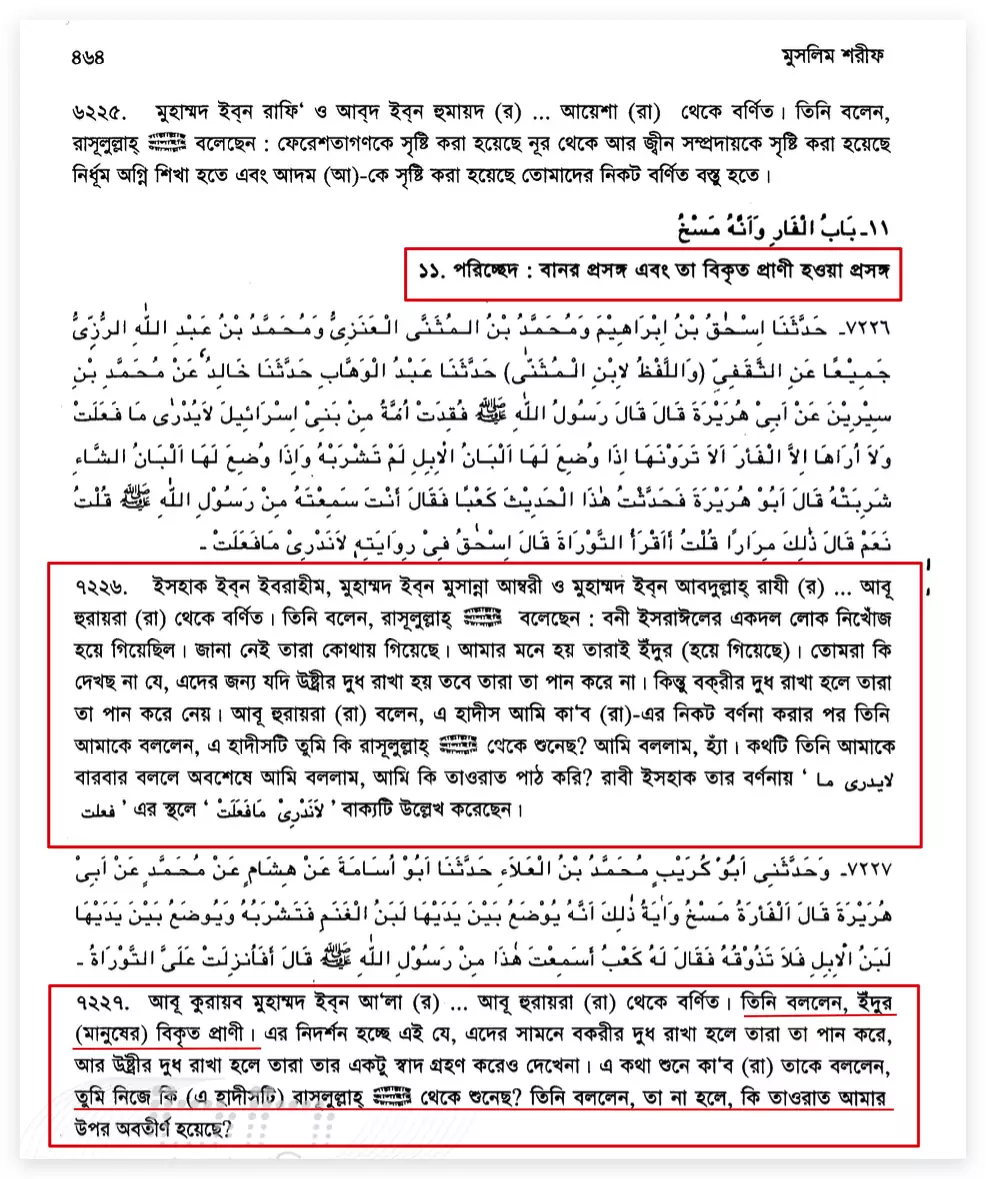
In the subsequent narration in Sahih Muslim, the same statement appears in more definite language from Abu Hurayrah himself. Mice are directly identified as transformed creatures, and their alleged refusal to drink camel’s milk is described as a sign of this transformation. Abu Hurayrah’s reply to Ka’b also indicates that he was referring to Muhammad’s statement as the source of this information. The Bengali translation published by the Islamic Foundation includes the narration as hadith 7227. [25] [26] [27]
وَحَدَّثَنِي أَبُو كُرَيْبٍ، مُحَمَّدُ بْنُ الْعَلاَءِ حَدَّثَنَا أَبُو أُسَامَةَ، عَنْ هِشَامٍ، عَنْ مُحَمَّدٍ، عَنْ أَبِي هُرَيْرَةَ، قَالَ: الْفَأْرَةُ مَسْخٌ وَآيَةُ ذَلِكَ أَنَّهُ يُوضَعُ بَيْنَ يَدَيْهَا لَبَنُ الْغَنَمِ فَتَشْرَبُهُ وَيُوضَعُ بَيْنَ يَدَيْهَا لَبَنُ الإِبِلِ فَلاَ تَذُوقُهُ. فَقَالَ لَهُ كَعْبٌ أَسَمِعْتَ هَذَا مِنْ رَسُولِ اللَّهِ صلى الله عليه وسلم قَالَ أَفَأُنْزِلَتْ عَلَىَّ التَّوْرَاةُ
English rendering of the Bengali translation:
Sahih Muslim (Islamic Foundation edition)
Book 56/ Narrations on asceticism and detachment from worldly life
Publisher: Islamic Foundation
Chapter 11. Concerning monkeys and their being transformed creatures
7227. Abu Kurayb Muhammad ibn al-A’la (may Allah have mercy on him) … narrated from Abu Hurayrah (may Allah be pleased with him), who said, Mice are transformed (human) creatures. The sign of this is that when goat’s milk is placed before them, they drink it, whereas when she-camel’s milk is placed before them, they do not even taste it. Hearing this, Ka’b (may Allah be pleased with him) asked, ‘Did you personally hear this hadith from the Messenger of Allah (peace and blessings of Allah be upon him)?’ He replied, ‘If not, was the Torah revealed to me?’
Hadith grade: Sahih (authentic)
The reasoning of this hadith is extremely weak. First, a human community is claimed to have disappeared. Next, a connection is established between that community and mice without historical testimony or direct observation. Finally, an alleged feeding habit of mice is presented as proof of the connection. One entirely unproven event is imagined to explain another unknown event, and an irrelevant characteristic is invoked to establish a relationship between them. If the whereabouts of a missing population are unknown, the rational conclusion is that insufficient information exists about their fate. Filling that gap in knowledge with a story of human beings turning into mice is not a valid method of acquiring knowledge.
Milk Consumption by Mice and Jewish Dietary Laws: Al-Nawawi’s Explanation
Al-Nawawi’s commentary on Sahih Muslim clearly explains the religious background of this peculiar reasoning. Al-Nawawi states that camel meat and milk were forbidden to the Children of Israel, whereas goat and sheep meat and milk were not. The alleged refusal of mice to drink camel’s milk and their consumption of goat’s or sheep’s milk was therefore taken as a sign that they were transformed members of the Children of Israel. According to this reasoning, a human community’s religious dietary rules persisted in the animals’ feeding habits even after the people had been transformed into another species. [28]
مَعْنَى هَذَا أَنَّ لُحُومَ الْإِبِلِ وَأَلْبَانَهَا حُرِّمَتْ عَلَى بَنِي إِسْرَائِيلَ دُونَ لُحُومِ الْغَنَمِ وَأَلْبَانِهَا، فَدَلَّ بِامْتِنَاعِ الْفَأْرَةِ مِنْ لَبَنِ الْإِبِلِ دُونَ الْغَنَمِ عَلَى أَنَّهَا مَسْخٌ مِنْ بَنِي إِسْرَائِيلَ.
English translation:
This means that camel meat and milk were forbidden to the Children of Israel, but sheep and goat meat and milk were not. Thus, the mouse’s abstention from camel’s milk but not from sheep’s or goat’s milk was taken as a sign that it was a transformed creature from among the Children of Israel.
Human religious dietary prohibitions are acquired primarily through social learning and culture. Children are not born knowing which foods are religiously lawful (halal) or forbidden (haram). They learn these rules from their families, societies and religious education. Two individuals of the same genetic ancestry may have entirely different dietary habits because of their education, religion, environment and personal preferences. A Jewish person may abstain from camel’s milk for religious reasons, while one of their descendants may change religious beliefs and drink the very same milk. Religious dietary rules are not reliable markers of human genetic identity.
Animal food selection, by contrast, depends on species-specific characteristics, the digestive system, taste and smell, the chemical composition of food, previous experience and the environment. An animal’s acceptance or rejection of a particular food cannot establish its religious identity or the religion of its ancestors. If mice are more attracted to one kind of milk than another, the causes of that difference must be investigated through their physiological characteristics and the composition of the foods involved. There is no scientific basis for connecting such behavior with the religious dietary rules of the ancient Children of Israel. Inferring supernatural human origins from food preferences is a clear fallacy of causation.
Muhammad’s Mistaken Conjecture and the Explanation of Its Correction Through Subsequent Revelation
The hadith concerning the origins of mice created a problem within Islamic hadith scholarship itself. Muhammad conjectured that mice were transformed members of a missing human community, while the hadith narrated by Ibn Mas’ud states that transformed creatures do not reproduce. Since the reproduction of mice is a directly observable and well-known fact, later Islamic scholars found it necessary to reconcile these statements. The early Hanafi scholar Abu Ja’far al-Tahawi devoted a separate chapter of his Sharh Mushkil al-Athar to this problem. According to his explanation, Muhammad initially suspected that mice were transformed humans, and Allah later informed him that transformed creatures left no descendants. His earlier suspicion was thereby dispelled. [29]
كَانَ مِنْهُ قَبْلَ أَنْ يُعْلِمَهُ اللهُ مَا أَعْلَمَهُ مِنْ أَنَّهُ لَا يَجْعَلُ لِمَنْ أَهْلَكَهُ نَسْلًا وَلَا عَقِبًا، فَذَهَبَ بِذَلِكَ مَا كَانَ يَخْشَاهُ.
English translation:
This statement of his was made before Allah informed him that He leaves no progeny or descendants for those He destroys. This dispelled his earlier apprehension.
Ibn Hajar al-Asqalani discusses the same problem in Fath al-Bari. According to him, most Islamic scholars adopted the view that Muhammad’s conjectures concerning mice and other animals were made before he learned the actual facts of the matter through revelation. [30]
وَأَجَابَ الْجُمْهُورُ عَنْ ذَلِكَ بِأَنَّهُ صَلَّى اللَّهُ عَلَيْهِ وَسَلَّمَ قَالَ ذَلِكَ قَبْلَ أَنْ يُوحَى إِلَيْهِ بِحَقِيقَةِ الْأَمْرِ فِي ذَلِكَ، وَلِذَلِكَ لَمْ يَأْتِ الْجَزْمُ عَنْهُ بِشَيْءٍ مِنْ ذَلِكَ، بِخِلَافِ النَّفْيِ فَإِنَّهُ جَزَمَ بِهِ.
English translation:
The majority of scholars responded that the Prophet made these statements before the truth of the matter was revealed to him. For this reason, no definitive assertion from him concerning these matters has been transmitted, unlike his denial, which he expressed categorically.
According to the explanations of al-Tahawi and Ibn Hajar, Muhammad first made a mistaken inference about an animal’s origins from its alleged feeding habits and subsequently corrected it after receiving information from Allah. The significance of this explanation is that it acknowledges the presence of contemporary superstitions, ignorance of nature and unverified conjectures in Muhammad’s statements. Connecting the consumption of milk by mice with the religious dietary laws of the Children of Israel was logically erroneous from the outset. No supernatural revelation was needed to recognize that error; what was needed was an acknowledgment of insufficient information and a refusal to elevate an unproven conjecture to the status of truth.
There is also a problem concerning the chronology of these hadiths. Al-Tahawi and Ibn Hajar constructed a sequence of initial conjecture followed by correction through subsequent revelation. Yet the hadith texts themselves do not specify the dates on which either statement was made. Nor does Muhammad explicitly announce the withdrawal of his earlier statement in them. This chronology is therefore essentially a harmonizing interpretation constructed by later scholars. The inconsistency between the religious accounts is addressed by assuming that one statement followed the other. Independent chronological evidence would be necessary to establish the historical accuracy of this interpretation.
A Desert Reptile Also Suspected of Being a Transformed Human
Mice were not the only animals about whose origins Muhammad made such conjectures. Sahih Muslim preserves a similar suspicion regarding a desert reptile known as dabb (الضب). Although often translated into Bengali as a monitor lizard, zoologically it is a spiny-tailed desert lizard of the genus Uromastyx. Some inhabitants of the Arabian deserts commonly ate this animal. When a man asked Muhammad about eating it, Muhammad expressed concern that it might belong to a community of the Children of Israel transformed by Allah’s curse. [31]
عَنْ أَبِي سَعِيدٍ، أَنَّ أَعْرَابِيًّا، أَتَى رَسُولَ اللَّهِ صلى الله عليه وسلم فَقَالَ إِنِّي فِي غَائِطٍ مَضَبَّةٍ وَإِنَّهُ عَامَّةُ طَعَامِ أَهْلِي، قَالَ فَلَمْ يُجِبْهُ فَقُلْنَا عَاوِدْهُ. فَعَاوَدَهُ فَلَمْ يُجِبْهُ ثَلاَثًا ثُمَّ نَادَاهُ رَسُولُ اللَّهِ صلى الله عليه وسلم فِي الثَّالِثَةِ فَقَالَ: يَا أَعْرَابِيُّ إِنَّ اللَّهَ لَعَنَ أَوْ غَضِبَ عَلَى سِبْطٍ مِنْ بَنِي إِسْرَائِيلَ فَمَسَخَهُمْ دَوَابَّ يَدِبُّونَ فِي الأَرْضِ فَلاَ أَدْرِي لَعَلَّ هَذَا مِنْهَا فَلَسْتُ آكُلُهَا وَلاَ أَنْهَى عَنْهَا.
English translation:
Narrated by Abu Sa’id. A Bedouin came to the Messenger of Allah and said, ‘I live in a region where dabb are abundant, and they constitute my family’s usual food.’ He did not answer him. We told the man to ask again. He repeated the question, and three times he received no answer. On the third occasion the Messenger of Allah called him and said, ‘O Bedouin, Allah cursed, or became angry with, a tribe of the Children of Israel and transformed them into creatures that crawl upon the earth. I do not know; perhaps this animal is one of them. Therefore I do not eat it, nor do I prohibit eating it.’
In this narration, a question about the identity and edibility of an actual animal is answered with a supernatural story about its possible human origins. In the case of mice, the conjecture was based on alleged feeding habits; in the case of dabb, no particular zoological characteristic was even cited. In both instances, the religious idea that an earlier human community was transformed into animals by Allah’s curse is used to explain the actual animal kingdom. Determining the origins and identities of animals through human religious history is a primitive and unsupported approach to acquiring knowledge of the natural world.
The dabb is a reptile, whereas humans are mammals. They differ extensively in physical structure, skin characteristics, reproduction, temperature regulation, embryonic development and evolutionary history. There is no anatomical or genetic evidence for suspecting that a desert reptile is the transformed form of an earlier human community. Assessing the animal’s edibility also requires actual information about its nutritional value, toxicity, pathogens and food safety. Whether its alleged ancestors were cursed by Allah is not a scientific criterion for determining food safety. Substituting supernatural narratives for the actual characteristics of nature opens the way for superstition to influence dietary habits, attitudes toward animals and public health decisions.
Transformation into Monkeys and Pigs for Alcohol Consumption, Singing and Musical Instruments
The concept of maskh was not preserved in Islamic theology merely as an isolated event of the past. Various hadiths announce that the punishment will also befall Muhammad’s followers in the future. In particular, accepting the permissibility of drinking alcohol, wearing silk, engaging in religiously prohibited sexual relations and using musical instruments is associated with the punishment of transformation into monkeys and pigs. A widely discussed hadith in Sahih al-Bukhari describes this terrifying punishment befalling some members of Muhammad’s ummah. It recounts a mountain collapsing upon one group and others being transformed into monkeys and pigs. [32]
قَالَ حَدَّثَنِي أَبُو عَامِرٍ ـ أَوْ أَبُو مَالِكٍ ـ الأَشْعَرِيُّ وَاللَّهِ مَا كَذَبَنِي سَمِعَ النَّبِيَّ صلى الله عليه وسلم يَقُولُ: لَيَكُونَنَّ مِنْ أُمَّتِي أَقْوَامٌ يَسْتَحِلُّونَ الْحِرَ وَالْحَرِيرَ وَالْخَمْرَ وَالْمَعَازِفَ، وَلَيَنْزِلَنَّ أَقْوَامٌ إِلَى جَنْبِ عَلَمٍ يَرُوحُ عَلَيْهِمْ بِسَارِحَةٍ لَهُمْ، يَأْتِيهِمْ ـ يَعْنِي الْفَقِيرَ ـ لِحَاجَةٍ فَيَقُولُوا ارْجِعْ إِلَيْنَا غَدًا. فَيُبَيِّتُهُمُ اللَّهُ وَيَضَعُ الْعَلَمَ، وَيَمْسَخُ آخَرِينَ قِرَدَةً وَخَنَازِيرَ إِلَى يَوْمِ الْقِيَامَةِ.
English translation:
Narrated by Abu Amir or Abu Malik al-Ash’ari, who heard the Prophet say, There will arise groups among my ummah who regard illicit sexual relations, silk, wine and musical instruments as lawful. Some people will stay beside a mountain, and their grazing animals will return to them in the evening. When a poor man comes to them in need, they will say, ‘Come back to us tomorrow.’ Allah will destroy them during the night and bring the mountain down. And He will transform others into monkeys and pigs until the Day of Resurrection.
A hadith in Sunan Ibn Majah associates this transformation more directly with alcohol consumption, musical instruments and the singing of female performers. It thereby provides an explicit religious basis for attaching the fear of supernatural punishment to human entertainment and cultural activity. [33]
عَنْ أَبِي مَالِكٍ الأَشْعَرِيِّ، قَالَ قَالَ رَسُولُ اللَّهِ صلى الله عليه وسلم: لَيَشْرَبَنَّ نَاسٌ مِنْ أُمَّتِي الْخَمْرَ يُسَمُّونَهَا بِغَيْرِ اسْمِهَا يُعْزَفُ عَلَى رُءُوسِهِمْ بِالْمَعَازِفِ وَالْمُغَنِّيَاتِ يَخْسِفُ اللَّهُ بِهِمُ الأَرْضَ وَيَجْعَلُ مِنْهُمُ الْقِرَدَةَ وَالْخَنَازِيرَ.
English translation:
Narrated by Abu Malik al-Ash’ari. The Messenger of Allah said, ‘Some people of my ummah will drink wine, calling it by another name. Musical instruments will be played and female singers will sing before them. Allah will cause the earth to swallow them and will make monkeys and pigs out of some of them.’
Hadith grade: Hasan (Darussalam’s assessment).
Jami’ al-Tirmidhi also connects the widespread presence of music, female singers and alcohol consumption with the punishments of maskh, the earth swallowing people, and the pelting of stones. Al-Tirmidhi himself classified this narration as gharib, while Darussalam grades it weak. Alongside other narrations dealing with the same subject, this hadith illustrates the extent of the concept of supernatural punishment preserved in Islamic literature. [34]
عَنْ عِمْرَانَ بْنِ حُصَيْنٍ، أَنَّ رَسُولَ اللَّهِ صلى الله عليه وسلم قَالَ: فِي هَذِهِ الأُمَّةِ خَسْفٌ وَمَسْخٌ وَقَذْفٌ. فَقَالَ رَجُلٌ مِنَ الْمُسْلِمِينَ يَا رَسُولَ اللَّهِ وَمَتَى ذَاكَ قَالَ: إِذَا ظَهَرَتِ الْقَيْنَاتُ وَالْمَعَازِفُ وَشُرِبَتِ الْخُمُورُ.
English translation:
Narrated by Imran ibn Husayn. The Messenger of Allah said, Among this ummah there will be incidents of the earth swallowing people, physical transformation and the pelting of stones. A Muslim asked, ‘O Messenger of Allah, when will that happen?’ He replied, When singing slave girls and musical instruments become widespread and wine is drunk.
Hadith grade: Da’if (Darussalam’s assessment).
Throughout human civilization, music, musical instruments and dance have been important means of creativity, entertainment, social communication and cultural expression. Through music, people express emotions, preserve history and memories, and communicate with one another. Playing a musical instrument or listening to music has no biological connection with the transformation of a human body into that of a monkey or pig. Musical melodies, rhythms and sound waves cannot alter a person’s genetic identity and turn them into another mammal. Yet these hadiths associate ordinary human entertainment with one of the most terrifying supernatural punishments imaginable.
A similar epistemological problem arises with the actual health risks of alcohol consumption. Excessive consumption may increase the risk of liver damage, addiction, neurological problems, accidents and various diseases. These harms have identifiable biological causes and can be observed and verified through medical science. Such evidence concerning the harmful effects of drinking is relevant to protecting human health. Adding an imaginary punishment of transformation into monkeys or pigs introduces supernatural fear into the scientific explanation of health risks. An activity may be harmful for actual reasons; that does not make the supernatural stories propagated about it true.
Maskh: A Fear-Based Mechanism for Regulating Religious Behavior
Considered together, the accounts of maskh preserved in the Quran and hadith reveal a common religious framework. In one instance, people are transformed into monkeys as punishment for fishing on a particular day; in another, those who raise their heads before the imam during prayer are threatened with the transformation of their heads into those of donkeys; elsewhere, the spread of music and alcohol consumption is associated with predictions of transformation into monkeys and pigs. The same transformation story is also employed to explain the existence of actual animals such as mice and desert reptiles. Across these accounts, maskh functions variously as alleged history, an explanation of animal identity and origins, a legal foundation for religious rules, and a threat of future punishment.
| Action or circumstance | Alleged transformation and punishment | Function of the religious narrative |
|---|---|---|
| Violating the prohibition on fishing on the Sabbath | Transformation into monkeys | Enforcing obedience to the rules governing a religious holy day. |
| Being subjected to Allah’s curse and anger | Transformation into monkeys and pigs | Associating disobedience to Allah’s authority with bodily humiliation. |
| Raising one’s head before the imam during prayer | Threat of assuming a donkey’s head or form | Employing fear of supernatural punishment to maintain ritual discipline. |
| Disappearance of a community of the Children of Israel | Conjecture of transformation into mice | Explaining an unknown event and connecting animal origins with a religious story. |
| Existence of the desert reptile known as dabb | Suspicion of belonging to a transformed human community | Applying supernatural beliefs to determine animal identity and dietary practices. |
| Regarding wine, silk, musical instruments and prohibited sexual relations as lawful | Transformation into monkeys and pigs and other punishments | Establishing religious control over personal lifestyles, entertainment and cultural behavior. |
The central feature of this system of punishment is obedience to religious authority. Rather than determining the seriousness of an offense according to whether it harms another person’s life, liberty, property or dignity, disobedience to Allah’s command is established as the basis for terrible punishment. By associating raising one’s head slightly early during prayer or playing musical instruments with the fear of losing one’s human form, independent human conduct is subordinated to religious prohibitions. Instead of teaching morality, this approach creates terror about the consequences of disobedience.
Fear can change human behavior, but it cannot establish the truth of a belief. People may refrain from particular activities because they fear an imaginary punishment without possessing any knowledge of its actual existence. By the same method, any religious leader could associate ordinary human activities with any supernatural catastrophe and demand obedience. The problem is that fear can remain effective in the absence of evidence. Successful behavioral control can thus be presented as proof of the validity of a religious claim. Substituting supernatural fear for actual evidence as the basis of human decision-making is incompatible with intellectual freedom and rational morality.
Do Mice Really Refuse to Drink Camel’s Milk? Experimental Research
A distinctive feature of Muhammad’s statement concerning the origins of mice is that he presented an animal behavior as evidence for his conjecture that can be tested directly. According to the narration in Sahih Muslim, mice do not even taste camel’s milk. The Arabic expression is ‘فَلَا تَذُوقُهُ’, meaning that they do not even taste it. This is a specific claim about animal feeding behavior. Modern zoology and laboratory research have made it possible to examine its validity. Most notably, experimental evidence contradicting the claim is available in research conducted by researchers at a university in Saudi Arabia.
On September 3, 2025, the Indian Journal of Animal Research published a research paper by A. A. Mohammed and colleagues from the Department of Agriculture and Food Sciences at King Faisal University in Saudi Arabia. Thirty male albino mice were divided into three groups. One group was given access to water, another to camel colostrum, and the third to ordinary camel milk. The camel milk and colostrum were diluted with equal quantities of water and placed in automatic drinking bottles. Instead of being force-fed milk through tubes, the mice were allowed to drink according to their own needs. Their daily fluid consumption was also recorded in the research paper. [35]
The mice consumed daily ~8.0 ml of diluted milk and colostrum, respectively.
English rendering of the Bengali translation:
The mice consumed approximately 8 milliliters of diluted milk and colostrum daily, respectively.
The research term Ad libitum means allowing animals to consume food or drink according to their own needs. The researchers selected this method so that the mice could voluntarily regulate their fluid intake. Their fluid consumption and various physiological characteristics were observed for sixteen days. Because a mixture of milk and water was used, this experiment does not establish a comparative preference between undiluted camel milk and goat milk. It does, however, provide direct evidence against the categorical claim that mice do not even taste camel’s milk.
Another study by researchers at the same university, published in the Asian Journal of Dairy and Food Research, also allowed mice to drink camel milk and colostrum voluntarily. The daily fluid consumption of the mice receiving milk and colostrum was recorded at approximately 5 and 4 milliliters, respectively. The researchers examined the mice’s body weight, blood glucose, blood cells and other physiological changes. Actual animal research was thus conducted on the ingestion of camel milk constituents and their physiological effects. [36]
The mice consumed daily ~5.0 and ~4.0 ml of diluted milk and colostrum, respectively.
English rendering of the Bengali translation:
The mice consumed approximately 5 milliliters of diluted milk and 4 milliliters of diluted colostrum daily, respectively.
In the statement preserved in Muhammad’s name, the alleged refusal of mice to drink camel’s milk was used as evidence for the supernatural transformation of a human community. Modern research has documented behavior contrary to that alleged habit. There are consequently two distinct errors: first, a false generalization about animal feeding behavior; second, the inference of the animal’s human origins from that generalization. Experimental observation undermines the very premise upon which the religious conjecture concerning the origins of mice was constructed.
Determining an animal’s evolutionary ancestry from its dietary preferences is also entirely erroneous. Many mammals, including humans, share similar feeding habits. Similarities between an animal’s diet and a human diet do not make the animal a transformed human. Likewise, an animal’s rejection of a particular food provides no logical basis for concluding that its ancestors rejected that food for religious reasons. Animal food preferences and genealogical history are distinct subjects of research, each requiring its own kind of evidence.
The Fundamental Difference Between Evolutionary Theory and Islamic Maskh
In modern evolutionary biology, evolution does not mean that an individual adult animal turns into an animal of another species during its lifetime. Evolution is the change in heritable characteristics of a population across generations. Processes such as genetic mutation, recombination, natural selection, gene flow and genetic drift change population characteristics over time. As these changes accumulate in separate populations over long periods, new species may emerge. The process takes place at the level of populations and lineages. [37]
Members of a population exhibit heritable variation. In a particular environment, certain traits may confer advantages in survival and reproduction. If individuals possessing those traits leave relatively more offspring, the traits may become more prevalent in subsequent generations. Such changes occur from generation to generation. From the emergence of antibiotic resistance in bacteria to the long evolutionary history of mammals, heritable changes and their transmission play a central role. Evolution has no predetermined goal, and animals do not voluntarily transform themselves into superior animals.
The Islamic concept of maskh is entirely different. An already-born and fully developed human assumes the physical form of another animal as a consequence of Allah’s curse or punishment. This transformation is not the result of reproduction, heritable variation, natural selection or changes across generations. The violation of a religious prohibition or Allah’s anger is presented as the cause. Thus, although maskh may sarcastically be described as ‘reverse evolution’, in biological terminology it is not an evolutionary process; it is a mythological notion of supernatural bodily transformation.
| Aspect of comparison | Scientific evolution | Islamic maskh |
|---|---|---|
| Level of change | Populations and lineages. | The bodies of already-born individuals or human communities. |
| Mechanism of change | Genetic change, natural selection, gene flow and genetic drift. | Allah’s command, anger or curse. |
| Timescale | Multiple generations; duration varies according to the nature of the change. | Supernatural change within an individual’s lifetime. |
| Heredity | Transmission of heritable characteristics across generations plays a fundamental role. | According to the narration in Sahih Muslim, transformed creatures leave no descendants. |
| Cause of change | Natural and biological processes. | Religious disobedience and divine punishment. |
| Evidence | Fossils, genomes, comparative anatomy, direct observation and experimental research. | Narrations in the Quran, hadith and religious commentaries. |
| Scientific validity | A well-established theory of modern biology. | A supernatural claim lacking independently verifiable evidence. |
It is also erroneous to imagine evolution as a ladder with monkeys at the bottom and humans at the top. Modern evolutionary biology represents relationships among species through a branching genealogical tree. Humans and present-day chimpanzees are separate evolutionary branches descended from a common ancestor. The evolutionary position of humans is not determined by their supposedly greater moral worth. Similarly, pigs, mice and donkeys are not degraded human species. Each animal has its own evolutionary history. Associating an animal’s physical characteristics with moral advancement or degradation belongs to religious imagination, not biology.
The Actual Evolutionary Relationship Between Humans and Mice
Humans and mice do indeed share a genetic relationship. Both are mammals, and their evolutionary lineages shared a common ancestor tens of millions of years ago. Humans belong to the order Primates, whereas mice belong to the order Rodentia. The word ‘mouse’ does not designate a single species; numerous distinct species are known under this name. The scientific name of the house mouse widely used in laboratories is Mus musculus, and the scientific name of humans is Homo sapiens. Comparing the genomes of these two species has yielded extensive information about their common evolutionary history.
On December 5, 2002, researchers of the international Mouse Genome Sequencing Consortium published in the renowned scientific journal Nature a high-quality initial draft sequence of the mouse genome and its comparative analysis. The study extensively compared the mouse and human genomes. It identified conserved genetic regions in the chromosomes of both animals, gene arrangements, changes in various gene families, and similarities and differences in heritable characteristics. In its contemporary explanation of the study, the US National Human Genome Research Institute estimated that humans and mice shared a common ancestor approximately 75 million years ago. [38] [39]
Evidence for the relationship between human and mouse genomes is not confined to similarities in a few genes. Evolutionarily conserved arrangements of corresponding genes have been identified across numerous large chromosomal regions in both species. At the same time, countless genomic differences have accumulated as their lineages evolved separately over long periods. This genetic relationship between humans and mice is one of the principal foundations for the use of mice as research models in modern medical science. Research on mice yields important information about the genetic causes of human diseases, mechanisms of drug action and physiological processes.
The evolutionary lineage of mice began developing independently long before modern humans emerged. Identifying a human community from a few thousand years ago as the origin of mice therefore contradicts genetics and the evolutionary history of animals. Modern research explains the relationship between humans and mice without relying on a particular religious community, dietary prohibition or supernatural curse. Their relationship is established through DNA, gene arrangements, chromosomal history and evidence of heritable change.
The Common Ancestry of Humans and Other Primates: Chromosomal Evidence
Comparative genetics constitutes an exceptionally important part of the extensive evidence modern science has produced concerning human evolution. Comparative studies of human and chimpanzee genomes have identified numerous genetic changes accumulated since the two species diverged from their common ancestor. In 2005, the international Chimpanzee Sequencing and Analysis Consortium published a study in Nature documenting approximately 35 million single-nucleotide differences, approximately five million DNA insertion and deletion events, and various chromosomal rearrangements between the two species. This comparison provides evidence both of their close genetic relationship and of their distinct evolutionary histories. [40]
The history of human chromosome 2 offers particularly strong evidence of this evolutionary relationship. Human somatic cells generally contain 46 chromosomes, whereas chimpanzees, gorillas and orangutans generally have 48. Comparative chromosomal studies show that human chromosome 2 resulted from the fusion of two separate ancestral chromosomes. Chromosome ends normally contain specialized DNA sequences called telomeres. Within human chromosome 2, DNA sequences consistent with the end-to-end fusion of two ancestral chromosomes have been identified. In 1991, J. W. IJdo and colleagues published molecular evidence of this fusion site. [41]
The significance of this discovery lies in the fact that evolutionary relationships led scientists to expect the existence of a particular genetic feature, which subsequent molecular research was able to identify. The structure of human chromosome 2, the arrangement of the corresponding chromosomes in other primates and the DNA at the fusion site reveal a mutually consistent evolutionary history. This is where the strength of science lies: explanations generate testable expectations, and actual research determines their validity. In contrast, the accounts of maskh offer no observable genetic history, chromosomal fusion, intermediate anatomy or testable mechanism for the transformation of human beings into other animals.
The Biological Inconsistencies of Transforming a Human Body into Another Animal
The human body’s structure is not like an external mask or garment that can be removed and replaced with a different form. The body consists of countless specialized cells, tissues, organs and interdependent physiological systems. During embryonic development, specific organs form through cell division, cellular differentiation, regulation of gene activity, chemical signaling and cell migration. An important component of these processes in developmental biology is called morphogenesis, the process through which living bodies acquire particular shapes and structures. [42]
Transforming a human head into a donkey’s head would require far more than altering the external shape of the nose, mouth and ears. The arrangement of the bones of the skull, jaw structure, number and position of teeth, tongue, oral cavity, airway, brain shape and numerous neural connections would have to be extensively reconstructed. The attachment of the head to the neck, blood circulation and the relationship between the spinal cord and the nervous system would also have to remain functional. During the transformation, the oxygen supply to the brain and other essential bodily functions would have to continue. There is no recognized physiological process capable of suddenly reconstructing these interdependent biological systems.
The claim that an entire human being can be transformed into a pig, monkey or mouse is even more inconsistent. Consider a person weighing 70 kilograms being transformed into a mouse weighing a few tens of grams. Where would the enormous quantity of matter in the human body go during this transformation? What would happen to the bones, blood, fat, muscles and various organs? How would the brain and nervous system be reconstructed? What would happen to the person’s memories, consciousness and personal identity after the transformation? Alongside the reduction in body mass, a functioning biological mechanism would be required to change the number and arrangement of organs and the activity of genes. The religious narratives offer only Allah’s supernatural power as an answer to these concrete questions.
Genetic changes do not automatically turn a fully developed body into the body of another species. Modern medicine conducts research on gene editing, cellular reprogramming and stem cells. Altering the genetic characteristics of a cell or converting it into another cell type, however, is entirely different from transforming the whole body of a fully developed human into the functioning body of another animal. The formation of a fully developed organism requires the coordinated growth, positioning, communication and specialization of vast numbers of cells. The concept of maskh disregards this complex biological reality and imagines the body as a form that can be altered by magic.
Natural Animal Metamorphosis and Mythological Transformation
Some organisms undergo substantial physical changes at different stages of their development. Familiar examples include a caterpillar developing into an adult butterfly and a tadpole becoming an adult frog. In biology, this process is known as metamorphosis. These changes are part of the animals’ normal life cycles and are regulated by gene activity, hormones and cellular changes. A caterpillar and an adult butterfly are two distinct developmental stages of the same animal. Likewise, a tadpole and an adult frog belong to the life cycle of the same species. These transformations have identifiable stages that can be repeatedly observed and studied in laboratories.
In the Islamic claim of maskh, a human being does not enter the next stage of the normal life cycle of their species. Instead, the person assumes the form of an animal possessing a distinct genetic and evolutionary history. At no stage of human birth, childhood, puberty, adulthood or aging are biological instructions for forming the body of a donkey, monkey, pig or mouse activated. Natural metamorphosis in the animal kingdom is an observable developmental process, whereas maskh is an unsupported supernatural event imagined as religious punishment.
The Double Standard of Rejecting Evolution and Believing in Supernatural Transformation
Islamic creationism describes human origins as an act of special creation. According to the Quran, Allah created Adam from soil and commanded him to come into existence. This account of human origins is grounded in direct divine creation rather than a long evolutionary lineage linking humans to earlier animal life. Verse 59 of Surah Al Imran presents this statement by comparing the creation of Adam and Jesus. [43]
إِنَّ مَثَلَ عِيسَىٰ عِندَ اللَّهِ كَمَثَلِ آدَمَ ۖ خَلَقَهُ مِن تُرَابٍ ثُمَّ قَالَ لَهُ كُن فَيَكُونُ
English translation:
Indeed, the likeness of Jesus before Allah is like that of Adam. He created him from dust, then said to him, ‘Be,’ and he came into being.
A fatwa published on June 28, 2003, by the contemporary Islamic fatwa institution IslamQA is entitled ‘The Invalidity of the Theory of Evolution and Advancement’ (بطلان نظرية التطور والارتقاء). Quoting the Saudi Permanent Committee for Fatwas, it rejects the idea of the evolutionary origins of humans. Quranic descriptions of the stages of Adam’s creation, including moistening soil into sticky clay, altered black mud and a dry earthen form, are presented as evidence. The answer to a scientific question about human evolutionary history is determined through the statements of a religious scripture. [44]
Question:
هناك من يقول: إن الإنسان منذ زمن بعيد كان قردا وتطور، فهل هذا صحيح، وهل من دليل؟
Answer:
هذا القول ليس بصحيح، والدليل على ذلك أن الله بين في القرآن أطوار خلق آدم
English translation:
Question: Some people say that humans were monkeys long ago and evolved. Is this correct? Is there any evidence for it?
Answer: This statement is incorrect. The evidence is that Allah has described the different stages of Adam’s creation in the Quran.
The question itself contains a common misconception about evolution. Humans did not originate from any monkeys or chimpanzees living today; humans share common ancestors with other primates. The fatwa does not analyze fossil, genomic or comparative anatomical evidence to evaluate this evolutionary relationship. Instead, it accepts the Quranic statement about the creation of Adam as the basis for its conclusion. Authority to determine the validity of a scientific theory is thereby assigned to religious scripture rather than scientific research.
Yet in fatwa 257378 concerning maskh, the same institution, IslamQA, accepts physical transformation as a real punishment from Allah and expresses belief that it will occur again in the future. On the one hand, scientific evidence of the evolution of populations through a prolonged natural process is rejected; on the other, the unsupported supernatural claim that an individual human can become a monkey or pig during their lifetime is accepted. The decisive factor behind this position is whether a proposition has the endorsement of religious authority. The same evidentiary standard is not applied in both cases.
Rejecting scientifically established natural human evolution on the basis of scripture, while accepting supernatural bodily transformation as true on the basis of that same scripture, constitutes a clear double standard in the evaluation of knowledge. Rather than determining beliefs through evidence, predetermined beliefs determine which evidence will be accepted. Religious beliefs are thereby insulated in advance from the possibility of being proven wrong. Treating scriptural statements about nature as the ultimate standard restricts the freedom to evaluate the findings of scientific research.
Claims of Supernatural Power and the Burden of Proof
The Islamic accounts of humans being transformed into other animals are grounded in belief in Allah’s omnipotence. According to this belief, Allah can alter any person’s body as He wishes. Quranic and hadith commentaries employ this theological premise to establish the possibility of transformation. But believing that a being has the ability to perform an action and establishing that the being actually performed a particular action are two entirely distinct claims. The truth of an event cannot be determined from an assumed ability to cause it.
If someone claims to be capable of transforming all the inhabitants of a village into monkeys, evidence of that capacity would first be required. Separate evidence would then be needed to establish whether such a transformation actually occurred in the village. If every event attributed to a supposedly omnipotent being is declared true merely by presupposing the existence of that being, verification of the claims becomes unnecessary. Any supernatural story could then be established as true through the same method. Even mutually contradictory miracle stories from different religions could be declared true on the basis of belief in the powers of their respective deities. This method is ineffective in distinguishing truth from fiction.
When a hadith compiler classifies a narration as sahih, the classification assesses the acceptability of the narration according to the internal standards of hadith scholarship. Examining the memory and reliability of narrators and the continuity of transmission is not the same kind of inquiry as determining whether a human body actually became the body of another animal. The former investigates the transmission of traditional narratives; the latter investigates an alleged event in the real world. Regardless of how reliable the transmission of a narration is considered, the zoological claims contained within it must be subjected to actual observation and experiment. Research concerning the consumption of camel’s milk by mice provides a concrete example of this distinction.
The burden of proving maskh rests with those who claim that these events are real. Invoking Allah’s power, the authenticity of hadith or the sanctity of the Quran instead of producing specific, independently verifiable and reliable evidence of a fully developed human being transformed into another animal leaves the central claim unproven. The intensity of belief, antiquity of a narration or religious status of its narrator cannot substitute for evidence that an event actually occurred.
Conclusion
The accounts of maskh preserved in the Quran, authentic hadith collections, classical tafsir and hadith commentaries reflect an ancient mythological worldview concerning nature and the animal kingdom. In this worldview, religious disobedience causes changes in human physical form, human communities become monkeys and pigs, raising one’s head slightly early during prayer can turn one’s head into a donkey’s head, and the alleged human origins of mice are determined from their feeding habits. On the same basis, a desert reptile is suspected of being a member of a transformed human community. These statements employ religious curses, divine punishment and supernatural transformation in place of scientific explanations of nature.
Later Islamic scholars constructed increasingly elaborate interpretations around these stories. They discussed the growth of tails in transformed humans, their reproduction, their possible relationship to present-day monkeys, their consumption of food and drink, and the duration of their survival after transformation. Muhammad’s conjecture concerning mice was explained as a statement corrected through subsequent revelation. The threat of literal transformation was also used as evidence for establishing the binding nature of religious rules and prohibitions. These discussions constructed various conclusions concerning theology, animal origins and religious law around an unsupported supernatural premise.
Modern biology has established the actual relationships between humans and other animals through genetics, fossils, comparative anatomy and evolutionary research. Humans and mice shared a common ancestor tens of millions of years ago. Human chromosome 2 preserves clear traces of the evolutionary history of our primate ancestors. Experimental research has also made it possible to collect actual information about animal feeding habits. Documented voluntary consumption of camel milk diluted with water by mice directly contradicts a specific zoological claim in the hadith. No reliable biological or independent historical evidence has been found for the claim that humans suddenly transform bodily into other animals.
The ethical problem of maskh is equally profound. Depriving people of their human form for violating religious commands, associating ordinary entertainment and musical activity with fear of supernatural punishment, and threatening physical deformation for breaking a ritual rule of worship make obedience central rather than morality. The satisfaction of religious authority, rather than the actual harm caused by human actions, justice, individual liberty and proportionality of punishment, becomes the basis of punishment. Intimidation can compel people to obey a rule, but it cannot establish the moral justification of that rule or the truth of the associated supernatural claim.
The Islamic concept of maskh is not a biological reality; it is an unsupported mythological belief constructed around religious curses and supernatural punishment. There is no evidence-based epistemological foundation for rejecting the well-established scientific theory of evolution while accepting such transformation stories as true. Observation, experimentation, research and reason are the means of discovering the truth about nature. Obedience to religious authority, fear of supernatural punishment and the sanctity attributed to ancient narratives cannot replace that method.
Bibliography and Research Resources
| Author or institution | Books and research papers | Subject addressed in the article |
|---|---|---|
| Primary scripture of Islam | The Quran | Transformation into monkeys and pigs and the special creation of Adam. |
| Muhammad ibn Ismail al-Bukhari | Sahih al-Bukhari | Threat of transformation into a donkey’s head, origins of mice and future maskh. |
| Muslim ibn al-Hajjaj | Sahih Muslim | Feeding habits of mice, reproduction of transformed creatures and suspicion concerning dabb. |
| Abu Dawud al-Sijistani | Sunan Abi Dawud | Punishment for raising one’s head before the imam. |
| Muhammad ibn Isa al-Tirmidhi | Jami’ al-Tirmidhi | Accounts of music, alcohol consumption and future maskh. |
| Muhammad ibn Yazid Ibn Majah | Sunan Ibn Majah | Accounts of transformation into monkeys and pigs in connection with alcohol and musical instruments. |
| Wali al-Din al-Khatib al-Tabrizi | Mishkat al-Masabih | Ritual rules of prayer and threats of bodily transformation. |
| Muhammad ibn Jarir al-Tabari | Jami’ al-Bayan ‘an Ta’wil Ay al-Quran | Literal interpretation of maskh and rejection of Mujahid’s figurative interpretation. |
| Ismail ibn Umar Ibn Kathir | Tafsir al-Quran al-Azim | Accounts of transformation into monkeys and pigs, growth of tails and a three-day lifespan. |
| Husayn ibn Mas’ud al-Baghawi | Ma’alim al-Tanzil | Identity of transformed people and age-based transformations. |
| Abu Abdullah al-Qurtubi | Al-Jami’ li-Ahkam al-Quran | Disagreement concerning the reproduction of transformed creatures. |
| Abdullah ibn Muslim Ibn Qutaybah | Ta’wil Mukhtalif al-Hadith | Conjecture that present-day monkeys descend from transformed humans. |
| Ahmad ibn Ali Ibn Hajar al-Asqalani | Fath al-Bari bi-Sharh Sahih al-Bukhari | Literal interpretation of maskh, jurisprudential rulings and explanations of conjectures corrected through subsequent revelation. |
| Yahya ibn Sharaf al-Nawawi | Al-Minhaj Sharh Sahih Muslim ibn al-Hajjaj | Relationship between the feeding habits of mice and the religious dietary laws of the Children of Israel. |
| Abu Ja’far al-Tahawi | Sharh Mushkil al-Athar | Harmonizing interpretations of hadiths concerning transformed creatures. |
| IslamQA | Fatwa 257378, Fatwa 14085 and Fatwa 34508 | The reality of maskh, the lifespan and reproduction of transformed creatures, and rejection of evolution. |
| OpenStax | Biology 2e | Definition of evolution, natural selection and changes in populations. |
| Scott F. Gilbert | Developmental Biology, 6th Edition, 2000 | Embryonic development, cellular differentiation and formation of bodily structures. |
| Mouse Genome Sequencing Consortium | Initial Sequencing and Comparative Analysis of the Mouse Genome, Nature, 2002 | Comparative genetics and evolutionary relationships between humans and mice. |
| National Human Genome Research Institute | The Mouse Genome and the Measure of Man, 2002 | Common ancestry of humans and mice and comparative genomics. |
| Chimpanzee Sequencing and Analysis Consortium | Initial Sequence of the Chimpanzee Genome and Comparison with the Human Genome, Nature, 2005 | Genetic relationship between humans and chimpanzees. |
| J. W. IJdo et al. | Origin of Human Chromosome 2: An Ancestral Telomere-Telomere Fusion, PNAS, 1991 | Molecular evidence of the evolutionary fusion of human chromosome 2. |
| A. A. Mohammed et al., King Faisal University | The Potential Influence of 16 Days Ad libitum Consumption of Camel’s Colostrum and Milk in Fresh and Cold-stored Status on Blood Glucose Values and Hematological Profiles in Mice, 2025 | Experimental evidence of voluntary consumption of diluted camel milk by mice. |
| Noura Alshaibani and Abd El-Nasser Ahmed Mohammed, King Faisal University | Chemical Composition of Camel Colostrum and Milk: The Potential Consumption in Fresh and Frozen-thawed States on Blood Glucose Values and Hematological Profiles in Mice, Asian Journal of Dairy and Food Research, 2025, DOI: 10.18805/ajdfr.DRF-588 | Voluntary consumption of camel milk and colostrum and physiological changes in mice. |
References
- Quran, Surah Al-Baqarah, verses 65–66 ↩︎
- Quran, Surah Al-A’raf, verses 163–166 ↩︎
- Tafsir Ibn Kathir, Surah Al-A’raf, verse 163 ↩︎
- Quran, Surah Al-Ma’idah, verse 60 ↩︎
- Al-Tabari, Jami’ al-Bayan, Surah Al-Baqarah, verse 65 ↩︎
- Tafsir al-Tabari, vol. 2, p. 173, narration 1144 and subsequent discussion ↩︎
- Tafsir Ibn Kathir, Surah Al-Baqarah, verse 65 ↩︎
- Tafsir al-Baghawi, Ma’alim al-Tanzil, Surah Al-Ma’idah, verse 60 ↩︎
- Tafsir al-Qurtubi, Surah Al-Baqarah, verse 65 ↩︎
- IslamQA, fatwa 257378, quoting Tafsir al-Qurtubi, vol. 1, p. 440 ↩︎
- Ibn Qutaybah, Ta’wil Mukhtalif al-Hadith, vol. 1, pp. 372–374, discussion of the stoning of a monkey for adultery ↩︎
- Tafsir Ibn Kathir, Surah Al-Ma’idah, verse 60, narration from Sahih Muslim ↩︎
- IslamQA, fatwa 14085, Sahih Muslim 2663 and al-Nawawi’s commentary ↩︎
- Tafsir Ibn Kathir, vol. 1, commentary on Surah Al-Baqarah, verse 65 ↩︎
- IslamQA, fatwa 257378, حول صحة إهلاك المسخ بعد ثلاث — On the authenticity of the report that transformed creatures are destroyed after three days ↩︎
- Sahih al-Bukhari, Book of Adhan, hadith 691 ↩︎
- Sahih Muslim, Book of Prayer, hadith 427 ↩︎
- Mishkat al-Masabih, Book 4: Prayer, hadith 1141 ↩︎
- Mishkat al-Masabih, hadith 1141, original Arabic ↩︎
- Sunan Abi Dawud, Book of Prayer, hadith 623 ↩︎
- Sunan Abi Dawud, hadith 623, original Arabic ↩︎
- Ibn Hajar al-Asqalani, Fath al-Bari, vol. 2, pp. 215–216, chapter on the sin of raising one’s head before the imam ↩︎
- Sahih al-Bukhari, Book of the Beginning of Creation, hadith 3305 ↩︎
- Sahih Muslim, hadith 2997a, chapter on mice and their being transformed creatures ↩︎
- Sahih Muslim, Islamic Foundation, vol. 6, p. 464, hadith 7227 ↩︎
- Sahih Muslim, Islamic Foundation, hadith 7227 ↩︎
- Sahih Muslim, hadith 2997b, original Arabic ↩︎
- Al-Nawawi, Sharh Sahih Muslim, vol. 18, pp. 415–416, chapter on mice and their being transformed creatures ↩︎
- Abu Ja’far al-Tahawi, Sharh Mushkil al-Athar, vol. 8, chapter 527, pp. 325–327 ↩︎
- Ibn Hajar al-Asqalani, Fath al-Bari, vol. 7, pp. 196–197, chapter on qasamah in the pre-Islamic period ↩︎
- Sahih Muslim, Book of Hunting, Slaughter and Edible Animals, hadith 1951b ↩︎
- Sahih al-Bukhari, Book of Drinks, hadith 5590 ↩︎
- Sunan Ibn Majah, Book of Tribulations, chapter on punishments, hadith 4020 ↩︎
- Jami’ al-Tirmidhi, Book of Tribulations, hadith 2212 ↩︎
- A. A. Mohammed et al., The Potential Influence of 16 Days Ad libitum Consumption of Camel’s Colostrum and Milk in Fresh and Cold-stored Status on Blood Glucose Values and Hematological Profiles in Mice, Indian Journal of Animal Research, 2025, DOI: 10.18805/IJAR.BF-2037 ↩︎
- Asian Journal of Dairy and Food Research, research paper DRF-588, Materials and Methods: Animal Management ↩︎
- OpenStax, Biology 2e, Chapter 18.1: Understanding Evolution ↩︎
- Mouse Genome Sequencing Consortium, Initial sequencing and comparative analysis of the mouse genome, Nature 420, 520–562, 2002 ↩︎
- National Human Genome Research Institute, The Mouse Genome and the Measure of Man, December 2002 ↩︎
- Chimpanzee Sequencing and Analysis Consortium, Initial sequence of the chimpanzee genome and comparison with the human genome, Nature 437, 69–87, 2005 ↩︎
- J. W. IJdo et al., Origin of human chromosome 2: an ancestral telomere-telomere fusion, Proceedings of the National Academy of Sciences, 88(20), 9051–9055, 1991 ↩︎
- Scott F. Gilbert, Developmental Biology, 6th Edition, Sinauer Associates, 2000, Morphogenesis and Cell Adhesion ↩︎
- Quran, Surah Al Imran, verse 59 ↩︎
- IslamQA, The Invalidity of the Theory of Evolution and Advancement, fatwa 34508, June 28, 2003 ↩︎