

Introduction: Different Beliefs, Equal Dignity
In a pluralist, secular society, a mosque, a temple, and a church can stand in the same neighbourhood. Their worshippers send their children to the same school, receive treatment at the same hospital, walk the same streets, and turn to one another for help in times of trouble. Some people never set foot in a place of worship; that gives them no less of a place in the neighbourhood and no fewer rights. This equal stake is the foundation of a multireligious society. People are free to think their neighbour’s religion is wrong, just as they are free to follow that religion, change their religion, or follow none. Social trust depends on whether people keep their word, respect others’ rights, and can be counted on when needed. How someone worships tells us none of these things.
Yet a number of injunctions in Islamic scripture, jurisprudence, and fatwas make a person’s beliefs the criterion for deciding how to relate to them. A report in Abu Dawud likens a person who lives with a polytheist to the polytheist; the account of the Khath‘am expedition disclaims responsibility for Muslims who live among polytheists. In Ibn Qudama’s jurisprudence, leaving a non-Muslim area is recommended even when one can practise one’s religion there, because leaving makes it possible to avoid mixing with non-Muslims. In stricter terms, al-Albani prohibited permanent residence in non-Muslim countries. These rulings do not prescribe the same thing in every case. What they share is that, in judging where people should live, they give weight to the religious identity of those around them in addition to safety and the actual freedom to practise their religion.
The division does not stop at where people live. In al-Fawzan’s account of al-wala’ wa-l-bara’, hatred and hostility towards polytheists are religious duties. A fatwa quoted by IslamQA carries that principle into marriage: a Muslim man may love his Jewish or Christian wife, and it is also his religious duty to hate her wholeheartedly for her disbelief in Islam. Sahih Muslim instructs Muslims not to offer salam to Jews and Christians first and to force them to take the narrow part of the road. The same kind of inequality takes different forms in these examples of residence, marriage, and public life. The religion a person follows determines how they are to be treated or regarded before the question of what they have done even arises.
Freedom of belief is the right to choose how to live one’s own life. The social condition of that freedom is that no one should be relegated to an inferior position for living next door, walking the same street, or working in the same institution while holding different beliefs. Making hostility compulsory on the basis of religious identity turns people into targets of hatred without evidence of any wrongdoing. Treating coexistence as a fault places sectarian pressure on people’s choice of where to live and whom to form relationships with. The principle of equal dignity rejects both demands.
Living with Polytheists: Hadith 2787 in Sunan Abi Dawud
A report in Sunan Abi Dawud, transmitted on the authority of Samurah ibn Jundub, attributes to Muhammad the statement that anyone who associates with and lives with a polytheist is like that polytheist. Abu Dawud placed the report in the chapter on residence in polytheist territory. Al-Albani classified the report as sahih. [1]
أَمَّا بَعْدُ، قَالَ رَسُولُ اللَّهِ صلى الله عليه وسلم: مَنْ جَامَعَ الْمُشْرِكَ وَسَكَنَ مَعَهُ فَإِنَّهُ مِثْلُهُ.
English translation:
Sunan Abi Dawud (critically edited edition)
Book 9: Jihad
182. On residing in polytheist territory
2787. Narrated on the authority of Samurah ibn Jundub (may Allah be pleased with him). To proceed, the Messenger of Allah (may Allah bless him and grant him peace) said: Anyone who associates with a polytheist and lives with him is like him.(1)
(1). Sahih.
Hadith grade: Authentic (Sahih)
Living in the same area is no evidence that someone has adopted another person’s beliefs. Working with a neighbour, helping them in a crisis, or visiting their home tells us nothing about a person’s religious allegiance. Yet this hadith links associating and living with a polytheist to becoming like them. This provides a basis for treating social proximity as a threat to faith. Al-Albani’s fatwa takes that reasoning further: without requiring evidence of any harm from a neighbour, he prohibits permanent residence in non-Muslim territory itself.
The Expedition to Khath‘am: A Report of Killing and Residence among Polytheists
Hadith 2645 in Sunan Abi Dawud reports, on the authority of Jarir ibn Abd Allah, that Muhammad sent a military detachment to the tribe of Khath‘am. Some people there tried to save their lives by prostrating themselves, but they were swiftly killed. The report then gives the order to pay half the blood money and Muhammad’s declaration that he bore no responsibility for Muslims who live among polytheists. When asked why, he said the two sides’ fires should be out of sight of one another. [2]
عَنْ جَرِيرِ بْنِ عَبْدِ اللَّهِ، قَالَ بَعَثَ رَسُولُ اللَّهِ صلى الله عليه وسلم سَرِيَّةً إِلَى خَثْعَمٍ فَاعْتَصَمَ نَاسٌ مِنْهُمْ بِالسُّجُودِ فَأَسْرَعَ فِيهِمُ الْقَتْلُ – قَالَ – فَبَلَغَ ذَلِكَ النَّبِيَّ صلى الله عليه وسلم فَأَمَرَ لَهُمْ بِنِصْفِ الْعَقْلِ وَقَالَ «أَنَا بَرِيءٌ مِنْ كُلِّ مُسْلِمٍ يُقِيمُ بَيْنَ أَظْهُرِ الْمُشْرِكِينَ» قَالُوا يَا رَسُولَ اللَّهِ لِمَ قَالَ «لاَ تَرَاءَى نَارَاهُمَا»
English translation: It is narrated on the authority of Jarir ibn Abd Allah that Muhammad sent a military detachment against the tribe of Khath‘am. Some people there tried to save their lives by prostrating themselves, but they were swiftly killed. When word of this reached Muhammad, he ordered that half the blood money be paid for them and said, “I bear no responsibility for any Muslim who lives among polytheists.” The Companions asked, “Why, Messenger of Allah?” He said, “The two sides’ fires should not be visible to one another.”
Abu Dawud notes that Jarir is absent from several chains of transmission for the same report. Al-Tirmidhi gives the version without Jarir and says that al-Bukhari considered that version correct. Al-Albani classified Abu Dawud’s report as sahih, excluding the sentence about half the blood money. The order to pay half the blood money is therefore in the report, but al-Albani’s sahih assessment does not apply to that sentence. The report quoted here gives no separate explanation of why the amount was set at half. [3] [4]
صَحِيحٌ دُونَ جُمْلَةِ الْعَقْلِ
English translation: Sahih, except for the sentence concerning blood money.
At the centre of the account is the killing, at the hands of a military detachment, of people who had tried to protect themselves by prostrating. Yet the declaration attributed to Muhammad shifts attention from the attackers’ conduct to the question of Muslims living among polytheists. The wording about keeping the fires out of sight directs the two communities to keep their settlements apart. The ethical grounds for targeting someone in an armed operation can include their role in the conflict and the threat they pose. The religion of their neighbours does not lessen responsibility for a killing.
Statements by Contemporary Islamic Scholars
Bangladeshi Islamic scholars on living with non-Muslims:
Bangladeshi Islamic scholars on Hindus:
Al-Nisa’ 4:97–99: Punishment for Failing to Migrate
Verses 97–99 of Surah al-Nisa’ provide another important basis for Islamic rulings on living among non-Muslims. The verses describe angels questioning people at the time of their deaths who are said to have wronged themselves. The angels ask what circumstances they were in. They answer that they were weak and oppressed in the land. The angels ask in return whether Allah’s earth was not wide enough for them to migrate elsewhere. Hell is then declared to be their fate. The following verse exempts helpless men, women, and children who can find no means to leave or do not know the way to their destination. The Quran thus links the ability to move for religious reasons, and the failure to use that ability, to punishment in the afterlife. [5]
إِنَّ الَّذِينَ تَوَفَّاهُمُ الْمَلَائِكَةُ ظَالِمِي أَنْفُسِهِمْ قَالُوا فِيمَ كُنْتُمْ قَالُوا كُنَّا مُسْتَضْعَفِينَ فِي الْأَرْضِ قَالُوا أَلَمْ تَكُنْ أَرْضُ اللَّهِ وَاسِعَةً فَتُهَاجِرُوا فِيهَا فَأُولَئِكَ مَأْوَاهُمْ جَهَنَّمُ وَسَاءَتْ مَصِيرًا إِلَّا الْمُسْتَضْعَفِينَ مِنَ الرِّجَالِ وَالنِّسَاءِ وَالْوِلْدَانِ لَا يَسْتَطِيعُونَ حِيلَةً وَلَا يَهْتَدُونَ سَبِيلًا فَأُولَئِكَ عَسَى اللَّهُ أَنْ يَعْفُوَ عَنْهُمْ وَكَانَ اللَّهُ عَفُوًّا غَفُورًا
English translation: The angels will ask those whose lives they take while they have wronged themselves, “What circumstances were you in?” They will say, “We were weak and oppressed in the land.” The angels will say, “Was Allah’s earth not wide enough for you to migrate within it?” Their abode will be Hell. What a terrible place to end up! Except for those helpless men, women, and children who have no means at their disposal and can find no way. Allah may pardon them. Allah is pardoning and forgiving.
The verses set apart those who have no means or way to move. They reject the claim of helplessness made by those who could have migrated and threaten them with Hell. Leaving one’s home raises questions of livelihood, property, family, and safety. Later Islamic jurisprudence adds another condition to that decision: whether the territory where the person lives is dar al-Islam or dar al-kufr. Under that classification, migration is considered preferable even where people are free in practice to observe their religion.
Al-Tabari interprets the angels’ question in al-Nisa’ 4:97 as a question about the people’s religious circumstances. In his account, the polytheists had the advantage in numbers and strength and were preventing them from believing in Allah and following Muhammad. He calls this a weak excuse for those who were able to leave. He describes the destination as a land whose inhabitants would protect them from the authority of the polytheists. In his interpretation, the immediate reason for migration is obstruction of religious practice; in Ibn Qudama’s discussion, separate reasons for leaving are given even where there is no such obstruction. [6]
إِلَى الْأَرْضِ الَّتِي يَمْنَعُكُمْ أَهْلُهَا مِنْ سُلْطَانِ أَهْلِ الشِّرْكِ بِاللَّهِ، فَتُوَحِّدُوا اللَّهَ فِيهَا وَتَعْبُدُوهُ، وَتَتَّبِعُوا نَبِيَّهُ
English translation: To a land whose inhabitants will protect you from the authority of those who associate partners with Allah, so that there you may affirm Allah’s oneness, worship Him, and follow His prophet.
Permanent Residence in a “Country of Unbelievers”: Al-Albani’s Prohibition
Muhammad Nasir al-Din al-Albani prohibited Muslims from residing permanently in non-Muslim countries. The Bengali collection of his fatwas adds that even if someone is expelled from a Muslim country, they must go to another Muslim country. Under this ruling, even a country where a person can live safely and practise their religion is deemed unsuitable as a place of refuge if it is classed as a “country of unbelievers”.
In Question 486 of the Bengali collection of his fatwas, al-Albani combines the prohibition on residence with the instruction to go to another Muslim country after expulsion. [7]
Question 486: What is the ruling on living in a country of unbelievers?
Answer: We have no doubt that at present it is impermissible for a Muslim to live in any country of unbelievers. If someone is expelled from a Muslim country, they are to go to another Muslim country.
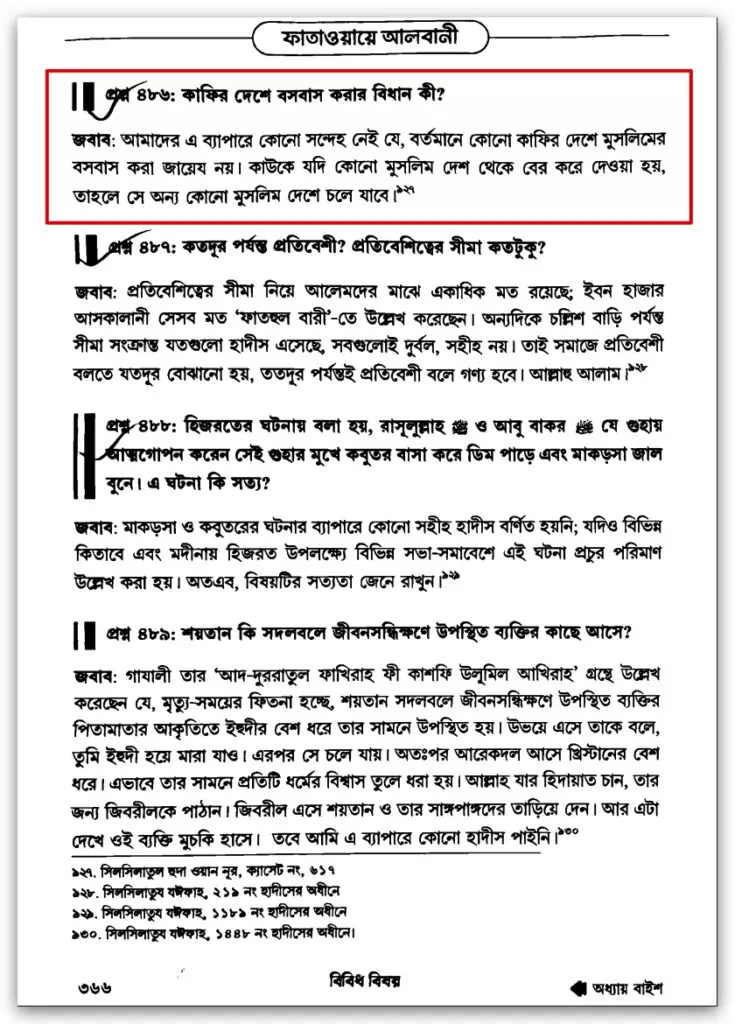
In another recorded answer, al-Albani cites both reports from Abu Dawud as evidence for the prohibition. He argues that when Muslims live with polytheists, the influence of the latter’s character spreads to them without their realising it. By that reasoning, living with a neighbour is deemed a moral danger before anything is known about what kind of person the neighbour is. [8]
حَيْثُ أَنَّ الْمُسْلِمَ إِذَا سَاكَنَ الْمُشْرِكِينَ سَرَتْ عَدْوَاهُمُ الْخُلُقِيَّةُ إِلَى الْمُسْلِمِ مِنْ حَيْثُ لَا يَشْعُرُ وَلَا يُدْرِكُ
English translation: For when a Muslim lives with polytheists, the contagion of their character spreads to him without his noticing or realising it.
Dar al-Islam and Dar al-Kufr: The Religious Division of Residence in Ibn Qudama’s Jurisprudence
Rules on living with non-Muslims are not confined to the fatwas of modern scholars. Classical Islamic jurisprudence discusses residence and migration by classifying territories according to their religious identity. In the chapter on jihad in al-Mughni, the Hanbali jurist Ibn Qudama defines hijra as migration from dar al-kufr to dar al-Islam. He then divides Muslims into three groups. The first comprises those who can move but cannot openly profess their religion or fulfil their religious duties while living among non-Muslims; migration is obligatory for them. The second comprises those who cannot move because of illness, incapacity, or other constraints; the obligation does not apply to them. The third comprises those who can migrate and can also practise their religion in a non-Muslim area; migration is recommended for them, but not obligatory. [9]
إِذَا ثَبَتَ هَذَا فَالنَّاسُ فِي الْهِجْرَةِ عَلَى ثَلَاثَةِ أَضْرُبٍ: أَحَدُهَا مَنْ تَجِبُ عَلَيْهِ، وَهُوَ مَنْ يَقْدِرُ عَلَيْهَا، وَلَا يُمْكِنُهُ إِظْهَارُ دِينِهِ، وَلَا تُمْكِنُهُ إِقَامَةُ وَاجِبَاتِ دِينِهِ مَعَ الْمُقَامِ بَيْنَ الْكُفَّارِ، فَهَذَا تَجِبُ عَلَيْهِ الْهِجْرَةُ
English translation: This being established, people fall into three groups with respect to migration. The first consists of those for whom migration is obligatory. Such a person has the means to migrate but cannot openly profess his religion or fulfil his religious duties while living among unbelievers. Migration is obligatory for such a person.
Ibn Qudama makes a further, significant point about the third group. In his account, migration is recommended, though not required, for someone who can move and can also practise their religion in a non-Muslim area. His reasons include increasing the number of Muslims and helping them, taking part in jihad against non-Muslims, avoiding adding to their numbers, and avoiding association with them. In his list, avoiding association with non-Muslims is itself a purpose of migration. [10]
وَالثَّالِثُ، مَنْ تُسْتَحَبُّ لَهُ، وَلَا تَجِبُ عَلَيْهِ. وَهُوَ مَنْ يَقْدِرُ عَلَيْهَا، لَكِنَّهُ يَتَمَكَّنُ مِنْ إِظْهَارِ دِينِهِ، وَإِقَامَتِهِ فِي دَارِ الْكُفْرِ، فَتُسْتَحَبُّ لَهُ، لِيَتَمَكَّنَ مِنْ جِهَادِهِمْ، وَتَكْثِيرِ الْمُسْلِمِينَ، وَمَعُونَتِهِمْ، وَيَتَخَلَّصَ مِنْ تَكْثِيرِ الْكُفَّارِ، وَمُخَالَطَتِهِمْ، وَرُؤْيَةِ الْمُنْكَرِ بَيْنَهُمْ، وَلَا تَجِبُ عَلَيْهِ؛ لِإِمْكَانِ إِقَامَةِ وَاجِبِ دِينِهِ بِدُونِ الْهِجْرَةِ.
English translation: The third group consists of those for whom migration is recommended but not obligatory. Such a person is able to move and can openly profess and practise his religion while living in dar al-kufr. Migration is recommended for him so that he can wage jihad against them, increase the number of Muslims and help them, and avoid adding to the number of unbelievers, mixing with them, and seeing wrongdoing among them. Migration is not obligatory for him, because he can fulfil his religious duties without moving.
In discussing obligatory migration, Ibn Qudama cites al-Nisa’ 4:97 and treats its threat of Hell as evidence that the ruling is binding. His recommendation for the third group, however, rests on different grounds. The person already enjoys the freedom to practise their religion. Even so, they are encouraged to move in order to avoid the company of non-Muslims, increase the numbers and strength of Muslims, and take part in jihad against non-Muslims. Here, separation between communities is considered a benefit in its own right even after the need to secure religious freedom has been met.
In Ibn Qudama’s classification, migration is recommended for someone who can practise their religion. In the fatwa quoted from al-Albani, permanent residence in a non-Muslim country is itself forbidden. The former makes withdrawal from coexistence religiously desirable; the latter declares that residence religiously impermissible. The distinction matters in practice when a person is deciding whether to leave the country where they have built their family life, livelihood, and civic life. The criterion that remains in both rulings is the religious identity of the people around them.
Al-Wala’ wa-l-Bara’: Making Hatred a Religious Duty
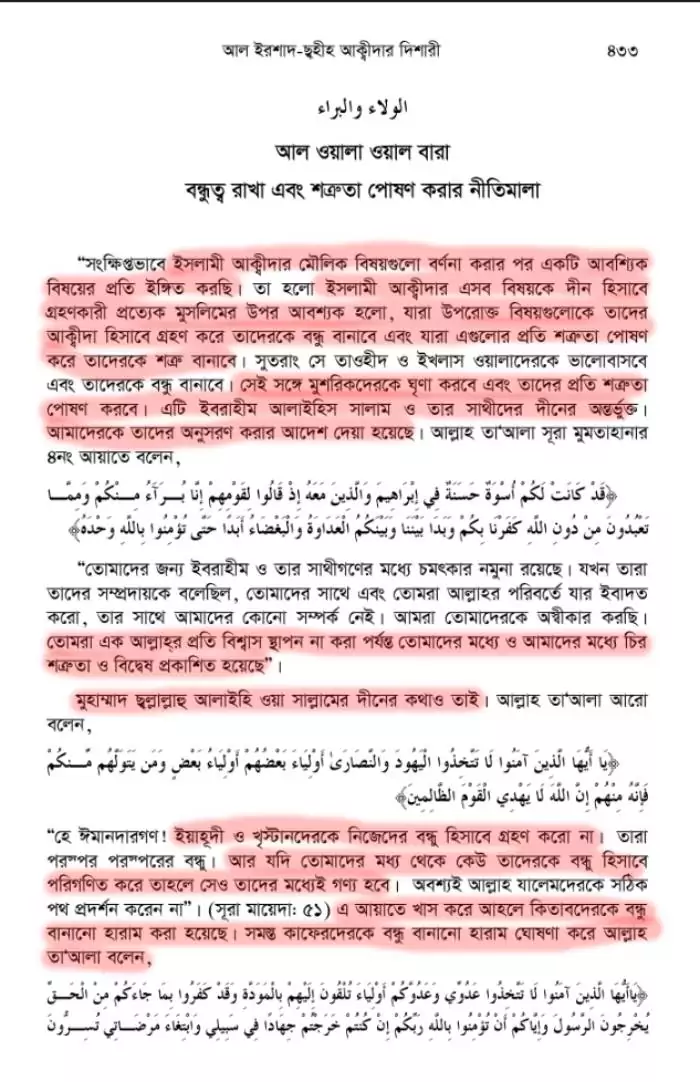
Al-wala’ wa-l-bara’ refers to the principle of religious allegiance and disavowal. In al-Irshad ila Sahih al-I‘tiqad, Salih al-Fawzan presents loving and showing allegiance to monotheists, and hating and harbouring hostility towards polytheists, as duties for every Muslim. As evidence for this duty, he cites the declaration of hostility and hatred by Abraham and his followers.
In al-Fawzan’s account, the target of hatred is not only the form of worship but also the people who practise it. The injunction appears on page 433 of the Bengali edition of his book. [11]
فَيُحِبُّ أَهْلَ التَّوْحِيدِ وَالْإِخْلَاصِ وَيُوَالِيهِمْ، وَيُبْغِضُ أَهْلَ الْإِشْرَاكِ وَيُعَادِيهِمْ.
English translation: He must love and show allegiance to those devoted to monotheism and sincerity; he must hate and harbour hostility towards polytheists.
Al-Irshad: A Guide to Sound Creed
Page 433
Al-Wala’ wa-l-Bara’
The principles of maintaining friendship and harbouring hostility
“Having briefly described the fundamentals of the Islamic creed, I will point out an obligatory
matter. Every Muslim who accepts these tenets of the Islamic creed as their religion
is obliged to take as friends those who accept the foregoing tenets as their
creed and to take as enemies those who harbour hostility
towards them. Thus, he must love those devoted to monotheism and sincerity
and take them as friends. He must also hate polytheists and harbour hostility
towards them. This is part of the religion of Abraham (peace be upon him) and his companions.
We have been commanded to follow them.” Allah Most High says in Surah al-Mumtahanah,
verse 4:
قَدْ كَانَتْ لَكُمْ أَسْوَةٌ حَسَنَةٌ فِي إِبْرَاهِيمَ وَالَّذِينَ مَعَهُ إِذْ قَالُوا لِقَوْمِهِمْ إِنَّا بُرَآءُ مِنْكُمْ وَمِمَّا
تَعْبُدُونَ مِنْ دُونِ اللَّهِ كَفَرْنَا بِكُم وبدا بيننا وبينكُمُ الْعَدَاوَةُ وَالْبَغْضَاءُ أَبَدًا حَتَّى تُؤْمِنُوا بِاللَّهِ وَحدَهُ
“In Abraham and his companions you have an excellent example. When they
said to their people, ‘We have nothing to do with you or with what you worship
besides Allah. We reject you.
Lasting hostility and hatred have arisen between you and us until
you believe in Allah alone.’”
The same applies to the religion of Muhammad (may Allah bless him and grant him peace). Allah Most High further
says:
يَا أَيُّهَا الَّذِينَ آمَنُوا لَا تَتَّخِذُوا الْيَهُودَ وَالنَّصَارَى أَوْلِيَاءَ بَعْضُهُمْ أَوْلِيَاءُ بَعْضٍ وَمَن يَتَوَلَّهُم مِّنكُمْ
فَإِنَّهُ مِنْهُمْ إِنَّ اللَّهَ لَا يَهْدِي الْقَوْمَ الظَّالِمِينَ
“O believers! Do not take Jews and Christians as your friends. They are
friends of one another. If any of you takes them as friends,
that person will be counted among them. Surely Allah does not guide
wrongdoers.” (Surah al-Ma’idah: 51) This verse specifically forbids taking the People of the Book
as friends.
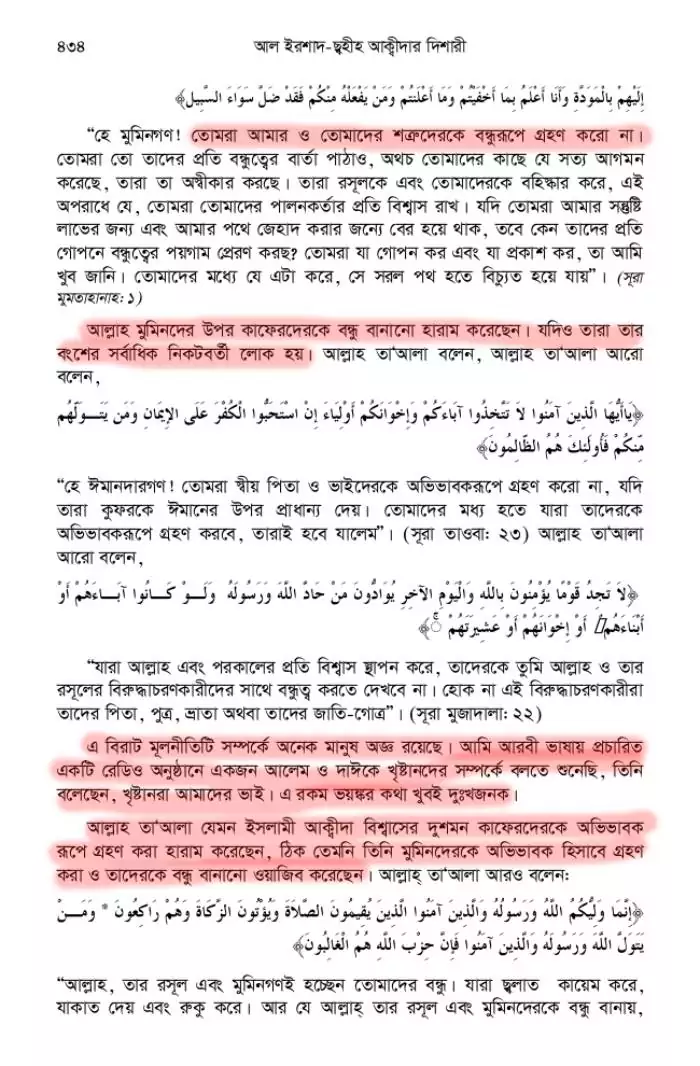
On the following page, al-Fawzan applies the same principle to close relatives. He also calls it dangerous that a religious preacher referred to Christians as “our brothers” on an Arabic radio programme. [12]
حَتَّى لَقَدْ سَمِعْتُ بَعْضَ الْمُنْتَسِبِينَ إِلَى الْعِلْمِ وَالدَّعْوَةِ فِي إِذَاعَةٍ عَرَبِيَّةٍ يَقُولُ عَنِ النَّصَارَى: إِنَّهُمْ إِخْوَانُنَا!
English translation: I even heard someone engaged in religious scholarship and preaching say of Christians on an Arabic radio programme, “They are our brothers!”
Page 434
Al-Irshad: A Guide to Sound Creed
يَا أَيُّهَا الَّذِينَ آمَنُوا لَا تَتَّخِذُوا عَدُوِّي وَعَدُوَّكُمْ أَوْلِيَاءَ تُلْقُونَ إِلَيْهِمْ بِالْمَوَدَّةِ وَقَدْ كَفَرُوا بِمَا جَاءَكُمْ مِنَ الْحَقِّ يُخْرِجُونَ الرَّسُولَ وَإِيَّاكُمْ أَنْ تُؤْمِنُوا بِاللَّهِ رَبِّكُمْ إِنْ كُنْتُمْ خَرَجْتُمْ جِهَادًا فِي سَبِيلِي وَابْتِغَاءَ مَرْضَاتِي تُسِرُّونَ إِلَيْهِمْ بِالْمَوَدَّةِ وَأَنَا أَعْلَمُ بِمَا أَخْفَيْتُمْ وَمَا أَعْلَنْتُمْ وَمَنْ يَفْعَلْهُ مِنْكُمْ فَقَدْ ضَلَّ سَوَاءَ السَّبِيلِ
“O believers! Do not take My enemies and yours as friends.
You send them messages of friendship, although they reject
the truth that has come to you. They expel the Messenger and you
for the offence of believing in your Lord. If you have gone forth to seek My pleasure
and wage jihad in My cause, why then do you
secretly send them messages of friendship? I know full well what you conceal
and what you disclose. Whoever among you does this has strayed from the straight path.” (Surah
al-Mumtahanah: 1)
Allah has forbidden believers to take unbelievers as friends, even if they are
their closest kin. Allah Most High says:
يَا أَيُّهَا الَّذِينَ آمَنُوا لَا تَتَّخِذُوا آبَاءَكُمْ وَإِخْوَانَكُمْ أَوْلِيَاءَ إِنْ اسْتَحَبُّوا الْكُفْرَ عَلَى الإِيمَانِ وَمَن يَتَولَّهُم
مِّنكُمْ فَأُولَئِكَ هُمُ الظَّالِمُونَ
“O believers! Do not take your fathers and brothers as guardians if
they prefer disbelief to faith. Those among you who take them
as guardians are the wrongdoers.” (Surah al-Tawbah: 23) Allah Most High
further says:
لَا تَجِدُ قَوْمًا يُؤْمِنُونَ بِاللَّهِ وَالْيَوْمِ الْآخِرِ يُوَادُّونَ مَنْ حَادَّ اللَّهَ وَرَسُولَهُ وَلَوْ كَانُوا آبَاءَهُمْ أَوْ
أَبْنَاءَهُمْ أَوْ إِخْوَانَهُمْ أَوْ عَشِيرَتَهُمْ
“You will not see those who believe in Allah and the Hereafter befriending those who oppose Allah and His
Messenger, even if those opponents are
their fathers, sons, brothers, or kin.” (Surah al-Mujadilah: 22)
Many people are ignorant of this great principle. On an Arabic-language
radio programme I heard a scholar and preacher speak about Christians.
He said that Christians are our brothers. Such a dreadful statement is deeply regrettable.
Just as Allah Most High has forbidden taking unbelievers, the enemies of the Islamic creed,
as guardians, so He has made it obligatory to take believers as guardians
and to make them friends.
The Prohibition on Taking Jews and Christians as Guardians and Allies: The Quran and Ibn Kathir’s Commentary
Verse 51 of Surah al-Ma’idah is one of the most important Quranic sources for defining the limits of religious allegiance and social relations with non-Muslims. It forbids Muslims from taking Jews and Christians as awliya’ and says that any Muslim who forms such a relationship with them will be counted among them. Depending on the relationship, the Arabic word awliya’ can mean allies, guardians, protectors, or those to whom close allegiance is owed. The declaration towards the end of the verse that a Muslim who forms such a relationship will be counted as part of another community reveals a harsh aspect of this division by religious identity. A relationship of allegiance or alliance is made suspect on the basis of a person’s faith, and crossing the religious boundary carries the threat of being counted outside one’s own community. [13]
يَا أَيُّهَا الَّذِينَ آمَنُوا لَا تَتَّخِذُوا الْيَهُودَ وَالنَّصَارَى أَوْلِيَاءَ بَعْضُهُمْ أَوْلِيَاءُ بَعْضٍ وَمَنْ يَتَوَلَّهُمْ مِنْكُمْ فَإِنَّهُ مِنْهُمْ إِنَّ اللَّهَ لَا يَهْدِي الْقَوْمَ الظَّالِمِينَ
English translation: O believers, do not take Jews and Christians as your allies and guardians. They are allies of one another. Whoever among you takes them as allies and guardians is one of them. Surely Allah does not guide wrongdoing people.
In his commentary on this verse, Ibn Kathir explicitly identifies Jews and Christians as enemies of Islam and says that religious alliance with them is forbidden. In his words, Allah has threatened those who enter into such an alliance. Allegiance to Jews and Christians is thus subject to religious prohibition in classical commentary itself. In this interpretation, relations with people of another faith are judged without regard to personal integrity, moral character, or mutual trust. Membership in a religious community is made a decisive boundary for those relations. [14]
يَنْهَى تَعَالَى عِبَادَهُ الْمُؤْمِنِينَ عَنْ مُوَالَاةِ الْيَهُودِ وَالنَّصَارَى الَّذِينَ هُمْ أَعْدَاءُ الْإِسْلَامِ وَأَهْلِهِ، قَاتَلَهُمُ اللَّهُ، ثُمَّ أَخْبَرَ أَنَّ بَعْضَهُمْ أَوْلِيَاءُ بَعْضٍ، ثُمَّ تَهَدَّدَ وَتَوَعَّدَ مَنْ يَتَعَاطَى ذَلِكَ فَقَالَ: وَمَنْ يَتَوَلَّهُمْ مِنْكُمْ فَإِنَّهُ مِنْهُمْ.
English translation: Allah has forbidden His believing servants from allying with Jews and Christians, who are enemies of Islam and its followers. May Allah destroy them. Allah then stated that they are allies of one another. He then threatened and warned those who form such an alliance, saying, “Whoever among you takes them as allies is one of them.”
The social effect of this interpretation is to place people under suspicion in advance on the basis of their religious identity, rather than judging them by their conduct and character. A Jewish or Christian neighbour may be trustworthy, honest, compassionate, and just; a Muslim neighbour may be dishonest and unjust. Yet under this religious classification of allegiance and alliance, a person’s religious identity becomes more important than their individual qualities. In a modern pluralist state, cooperation, political partnership, and social trust among citizens are not restricted on the basis of religion. The strict interpretation of al-Ma’idah 5:51 that bars such alliances clashes directly with this civic ideal.
Under this verse, Ibn Kathir also quotes an account involving a Christian scribe who worked for Abu Musa al-Ash‘ari. According to the account, Umar was initially impressed by the scribe’s skill and praised him. On learning that the scribe was Christian, Umar rebuked Abu Musa, ordered that the man be put out, and recited al-Ma’idah 5:51. In this account, the verse is applied to an administrative relationship with a Christian scribe. [15]
فَقَالَ عُمَرُ: أَجُنُبٌ هُوَ؟ فَقَالَ: لَا بَلْ نَصْرَانِيٌّ. قَالَ: فَانْتَهَرَنِي وَضَرَبَ فَخِذِي، ثُمَّ قَالَ: أَخْرِجُوهُ
English translation: Umar asked, “Is he in a state that requires ritual bathing?” He replied, “No, he is a Christian.” He said, “Then Umar rebuked me, struck me on the thigh, and said, ‘Put him out.’”
Surah al-Mumtahanah: Hostility and Hatred Until Belief in Allah Alone
Verse 4 of Surah al-Mumtahanah is one of the main Quranic foundations of the Islamic doctrine of al-wala’ wa-l-bara’. The verse presents the conduct of Abraham and his followers as an excellent example for Muslims. Abraham and his companions tell their own people that they have severed ties with them and with those they worship besides Allah. They also declare that they have rejected their people and that lasting hostility and hatred have arisen between them until their people believe in Allah alone. The point here is that ending the hostility is not made conditional on a change in conduct, an end to wrongdoing, or an end to harm. The stated condition is belief in Allah alone. A change in religious belief is thus made the central condition for ending the hostility and hatred in the relationship. [16]
قَدْ كَانَتْ لَكُمْ أُسْوَةٌ حَسَنَةٌ فِي إِبْرَاهِيمَ وَالَّذِينَ مَعَهُ إِذْ قَالُوا لِقَوْمِهِمْ إِنَّا بُرَآءُ مِنْكُمْ وَمِمَّا تَعْبُدُونَ مِنْ دُونِ اللَّهِ كَفَرْنَا بِكُمْ وَبَدَا بَيْنَنَا وَبَيْنَكُمُ الْعَدَاوَةُ وَالْبَغْضَاءُ أَبَدًا حَتَّى تُؤْمِنُوا بِاللَّهِ وَحْدَهُ إِلَّا قَوْلَ إِبْرَاهِيمَ لِأَبِيهِ لَأَسْتَغْفِرَنَّ لَكَ وَمَا أَمْلِكُ لَكَ مِنَ اللَّهِ مِنْ شَيْءٍ رَبَّنَا عَلَيْكَ تَوَكَّلْنَا وَإِلَيْكَ أَنَبْنَا وَإِلَيْكَ الْمَصِيرُ
English translation: In Abraham and his companions you have an excellent example, when they said to their own people, “We disavow you and those you worship besides Allah. We reject you. Lasting hostility and hatred have arisen between us and you until you believe in Allah alone.” Except for these words Abraham said to his father: “I will ask forgiveness for you, though I have no power to do anything for you before Allah.” Our Lord, in You we have put our trust, to You we have turned, and to You is the return.
The verse uses two distinct words, al-‘adawah and al-baghda’: hostility and hatred. They do not simply mean regarding a religious doctrine as wrong or rejecting someone else’s beliefs. Calling another person’s beliefs false and harbouring hostility and hatred towards the people who hold them are entirely different ethical positions. The first is criticism of doctrines and arguments; the second is a hostile attitude towards people. The strict scholars who take this passage from al-Mumtahanah as a basis for al-wala’ wa-l-bara’ couple the rejection of a doctrine with the injunction to hate people for their religious identity. Hostility towards a person until they change their beliefs is thus established as part of religious allegiance.
Al-Fawzan derives the injunction to hate polytheists and harbour hostility towards them from this very verse. In his reasoning, following Abraham means embracing monotheism and also taking a hostile position towards people who worship differently. He cites further verses to prohibit allegiance to Jews, Christians, and other non-Muslims. Under this interpretation, hatred does not require evidence of wrongdoing by the person in question. A different belief is enough.
Religious Allegiance in the Family: Affection for Close Relatives and Hatred of a Non-Muslim Wife
Rules of allegiance and hatred based on religious identity extend to family ties. Verse 22 of Surah al-Mujadilah says that no people who believe in Allah and the Hereafter will be found to harbour affection for those who oppose Allah and His messenger, even if those opponents are their fathers, sons, brothers, or relatives. By naming some of the closest ties of kinship, the verse makes religious opposition a boundary for personal affection. The word yuwaddun here has to do with love and heartfelt goodwill. Religious allegiance thus concerns more than overt political cooperation: it reaches into people’s private feelings and family relationships. [17]
لَا تَجِدُ قَوْمًا يُؤْمِنُونَ بِاللَّهِ وَالْيَوْمِ الْآخِرِ يُوَادُّونَ مَنْ حَادَّ اللَّهَ وَرَسُولَهُ وَلَوْ كَانُوا آبَاءَهُمْ أَوْ أَبْنَاءَهُمْ أَوْ إِخْوَانَهُمْ أَوْ عَشِيرَتَهُمْ أُولَئِكَ كَتَبَ فِي قُلُوبِهِمُ الْإِيمَانَ وَأَيَّدَهُمْ بِرُوحٍ مِنْهُ وَيُدْخِلُهُمْ جَنَّاتٍ تَجْرِي مِنْ تَحْتِهَا الْأَنْهَارُ خَالِدِينَ فِيهَا رَضِيَ اللَّهُ عَنْهُمْ وَرَضُوا عَنْهُ أُولَئِكَ حِزْبُ اللَّهِ أَلَا إِنَّ حِزْبَ اللَّهِ هُمُ الْمُفْلِحُونَ
English translation: You will not find people who believe in Allah and the Hereafter showing affection for those who oppose Allah and His messenger, even if they are their fathers, sons, brothers, or relatives. Allah has established faith in their hearts and strengthened them with a spirit from Himself. He will admit them to gardens beneath which rivers flow, where they will remain forever. Allah is pleased with them, and they are pleased with Allah. They are the party of Allah. Know that it is the party of Allah who will succeed.
How should a Muslim man observe al-wala’ wa-l-bara’ after marrying a Jewish or Christian woman? In answer to this question, IslamQA quotes Abd al-Rahman al-Barrak, who distinguishes natural affection from religious love. Under his ruling, a husband may love his wife because of their marital relationship, and he is obliged to hate that same woman on religious grounds because of her disbelief. [18]
وَمِنْ هَذَا الْجِنْسِ مَحَبَّةُ الزَّوْجَةِ الْكِتَابِيَّةِ فَإِنَّهُ يَجِبُ بُغْضُهَا لِكُفْرِهَا بُغْضًا دِينِيًّا، وَلَا يَمْنَعُ ذَلِكَ مِنْ مَحَبَّتِهَا الْمَحَبَّةَ الَّتِي تَكُونُ بَيْنَ الرَّجُلِ وَزَوْجِهِ، فَتَكُونُ مَحْبُوبَةً مِنْ وَجْهٍ، وَمَبْغُوضَةً مِنْ وَجْهٍ.
English translation: Love for a wife from the People of the Book falls into this category. But she must be hated on religious grounds for her disbelief. This hatred does not prevent the love that exists between a husband and his wife. A wife may therefore be loved in one respect and hated in another.
The fatwa does not stop at telling a person to criticise a belief. The target of the hatred is the wife herself, and the stated reason for hating her is her disbelief. A husband can disagree with his wife’s religious views while recognising her freedom of thought and equal dignity. Al-Barrak’s fatwa adds a duty to hate the person to that disagreement. Permission to love her does not remove the injunction to hate her because of her beliefs.
Al-Barrak also uses polytheist parents as an example of the same rule. A child may feel natural affection for their parents, but in his view they are also obliged to hate those parents for Allah’s sake. This rule does not let different beliefs within a family remain a difference of opinion; it imposes the demands of religious allegiance on how people feel about those closest to them. Even if parents remain just as loving and responsible towards their children, a change in their beliefs creates, under this principle, a reason for religious hatred towards them.
Not Offering Salam First to Jews and Christians and Forcing Them onto the Narrow Part of the Road
In Hadith 2167a of Sahih Muslim, narrated by Abu Hurayra, Muhammad says not to offer the greeting of salam to Jews and Christians first. If Muslims meet one of them on the road, they are told to force that person onto the narrowest part of it. The instruction concerns everyday courtesy and the use of public space. A person’s religion determines who may be greeted first and who must be made to walk along the side of the road. [19]
عَنْ أَبِي هُرَيْرَةَ، أَنَّ رَسُولَ اللَّهِ صلى الله عليه وسلم قَالَ «لَا تَبْدَءُوا الْيَهُودَ وَلَا النَّصَارَى بِالسَّلَامِ فَإِذَا لَقِيتُمْ أَحَدَهُمْ فِي طَرِيقٍ فَاضْطَرُّوهُ إِلَى أَضْيَقِهِ»
English translation: Abu Hurayra narrated that Muhammad said, “Do not offer Jews or Christians the greeting of salam first. If you meet one of them on the road, force that person to take its narrowest part.”
The conduct prescribed in this hadith is fundamentally at odds with the modern idea of civic equality. A road is a common space for everyone in society to use. A person’s right to travel through that space safely and with dignity cannot depend on their religious identity. The instruction to force a Jewish or Christian pedestrian onto the narrow part of the road solely because of their religion is discriminatory. Likewise, prescribing different rules of ordinary courtesy according to religion gives religious sanction to social distance in place of mutual respect. The way people are treated should depend on how they conduct themselves and how they respect others, not on their religious identity.
The relationship between this hadith and the doctrine of al-wala’ wa-l-bara’ is also significant. Interpretations of the Quranic prohibition on taking Jews and Christians as allies, al-Fawzan’s injunction to hate non-Muslims, and Sahih Muslim’s restrictions on everyday courtesy together reveal several levels of differential treatment on religious grounds. Religious rules govern allegiance and affection on one level, and ordinary encounters and conduct on the road on another. Religious division is thus not confined to abstract belief: it can extend to family ties, social interaction, and conduct in public. When these injunctions are made a code of conduct in a multireligious society, disrespectful treatment of non-Muslim citizens is given the status of a religious duty.
Kindness Is Permitted, Yet Religious Hatred Is Required
According to verse 8 of al-Mumtahanah, Allah does not forbid kindness and justice towards those who have not fought Muslims on account of religion or expelled them from their homes. Verse 9 links the prohibition on alliance to fighting, expulsion, and assistance in expulsion. Here, people’s conduct—fighting and expelling others—plays a part in determining the relationship. In verse 4 of the same surah, belief in Allah alone is the condition for ending hostility and hatred in Abraham’s declaration. [20]
لَا يَنْهَاكُمُ اللَّهُ عَنِ الَّذِينَ لَمْ يُقَاتِلُوكُمْ فِي الدِّينِ وَلَمْ يُخْرِجُوكُمْ مِنْ دِيَارِكُمْ أَنْ تَبَرُّوهُمْ وَتُقْسِطُوا إِلَيْهِمْ إِنَّ اللَّهَ يُحِبُّ الْمُقْسِطِينَ إِنَّمَا يَنْهَاكُمُ اللَّهُ عَنِ الَّذِينَ قَاتَلُوكُمْ فِي الدِّينِ وَأَخْرَجُوكُمْ مِنْ دِيَارِكُمْ وَظَاهَرُوا عَلَى إِخْرَاجِكُمْ أَنْ تَوَلَّوْهُمْ وَمَنْ يَتَوَلَّهُمْ فَأُولَئِكَ هُمُ الظَّالِمُونَ
English translation: Allah does not forbid you to treat with kindness and justice those who have not fought you on account of religion or driven you from your homes. Surely Allah loves those who act justly. Allah only forbids you to take as allies those who have fought you on account of religion, driven you from your homes, and helped to expel you. Those who take them as allies are the wrongdoers.
Although kindness and justice are permitted, religious hatred of polytheists remains in force in al-Fawzan’s interpretation. Al-Barrak makes the same distinction in his example of marriage: loving the woman as one’s wife is permitted, while hating her for her disbelief is obligatory. In this framework, kindness and religious hatred do not cancel each other out. A person is therefore recognised as deserving fair treatment while their religious identity is still treated as sufficient reason to hate them.
When someone does wrong, their actions supply the reason to oppose them. Taking part in war or expulsion and worshipping differently are not the same kind of act. The former can harm other people and violate their rights; the latter expresses a different belief. The duty of religious hatred erases that distinction. It makes a peaceful neighbour’s beliefs a reason to hate them even when they are accused of no wrongdoing. Permitting kindness does not remove that discriminatory criterion.
Sectarianism versus Secular Humanism
In secular humanism, belonging to a community is not the source of human dignity. Running a school, protecting workers’ wages, or ensuring a neighbour’s safety requires cooperation among people with different beliefs. Such cooperation can rest on shared interests, mutual responsibility, and trust earned through action. When belief is made a condition of alliance and belonging, people are sorted into religious categories before their contributions are even considered. Al-Fawzan even called it dangerous to refer to Christians as “our brothers”. His objection was not to wrongdoing by a particular Christian, but to recognising Christians as one’s own across a religious boundary.
Equal Citizenship and Freedom of Belief: The Human Rights Problem with Religious Separation
Modern human rights rest on the equal dignity of every person and the enjoyment of rights without discrimination on grounds of religion. Article 1 of the United Nations’ 1948 Universal Declaration of Human Rights states that all human beings are born free and equal in dignity and rights. Article 2 sets out everyone’s entitlement to rights and freedoms without discrimination based on religion or other grounds. Article 13 recognises freedom of movement and residence within a state, as well as the right to leave any country, including one’s own, and to return to one’s own country. Article 18 recognises freedom of thought, conscience, and religion, including the right to change one’s religion. These rights belong to people irrespective of religious identity; they are not conditional on following a particular religion. [21]
Universal Declaration of Human Rights — Article 18
Everyone has the right to freedom of thought, conscience and religion; this right includes freedom to change his religion or belief, and freedom, either alone or in community with others and in public or private, to manifest his religion or belief in teaching, practice, worship and observance.
English rendering of the Bengali translation: Every person has the right to freedom of thought, conscience, and religion. This right includes the freedom to change one’s religion or belief and the freedom to express one’s religion or belief through teaching, practice, worship, and religious observance, alone or with others, in public or in private.
Equal citizenship regardless of religion means enjoying the same rights and protections in schools, workplaces, on the streets, and in public institutions. In such a society, how a person worships has no bearing on whether they are regarded as fit to live alongside others or cooperate with them. Rules that make living with a non-Muslim neighbour undesirable, make hatred of that neighbour obligatory, or assign that person an inferior place on the road are contrary to equal participation. The opportunity to live together does not by itself guarantee equal dignity. What also matters is whether people in the same space are subjected to different treatment because of their religion.
Freedom of belief includes the freedom to regard one’s own religion as true, to observe its practices, and to criticise other people’s beliefs. Personal friendship cannot be forced on anyone either. But restricting someone’s movement, access to public services, or civic opportunities because of their religious identity is discrimination. And a rule requiring a person to be hated for their beliefs is morally wrong, whether or not it becomes the law of the state. Criticising a doctrine is an exercise of freedom of thought; curtailing the rights of a believer violates that freedom.
Differences of belief can arise within a family through marriage, a change of religion, or independent thinking. Those differences tell us nothing about a family member’s sense of responsibility, affection, or trustworthiness. Yet when hatred of a family member is made obligatory in the name of religious allegiance, the price of holding a personal belief can be the hostility of those closest to them. The basis of that pressure is clear in the statements of al-Fawzan and al-Barrak: neither close kinship nor marriage exempts a person from the duty to hate.
The state’s task is to uphold laws and institutions under which the majority’s religion does not determine the rights of minorities. A citizen’s religion cannot be a valid reason for the state to treat them differently when providing services, protecting their safety, or adjudicating their complaints. The same principle applies to social relations: honesty, compassion, and responsibility are shown through a person’s actions. Judging by religious identity in place of conduct means passing a verdict against the person before their case has even been heard.
Conclusion: Coexistence and Equal Dignity
In the hadith about Khath‘am, after people who prostrated themselves to save their lives were killed, the question became whom they had lived among. In Ibn Qudama’s jurisprudence, even a Muslim who can practise their religion may be encouraged to leave in order to avoid the company of non-Muslims. Al-Albani’s fatwa rejects the very option of permanent residence in a non-Muslim country. A military report, a juristic recommendation, and a modern fatwa are different kinds of sources, and their rulings differ in scope. Yet a continuity is clear: the religion of a person’s neighbours is made a criterion in its own right in matters of residence and safety. Living in the same society as another community thus becomes a matter of religious objection even where people can live safely and practise their own religion.
In al-Fawzan’s interpretation, this division extends beyond where people live and becomes a rule of allegiance and hatred towards other people. In al-Barrak’s fatwa it becomes a rule for marriage: a husband is permitted to love his wife, but has a duty to hate her because of her religious beliefs. The instruction in Sahih Muslim brings the division into public view: on encountering a Jew or a Christian on the road, one is told to force that person onto the narrowest part. What matters under these instructions is not how a wife has treated her spouse or what harm a pedestrian has done to anyone. Religious identity alone is treated as sufficient grounds for hatred or degrading treatment. This criterion is discriminatory.
Al-Mumtahanah 60:8 permits kindness and justice towards people who have taken no part in fighting or expulsion. Permitting kindness does not confer moral legitimacy on the instruction to hate people because of their beliefs. This is the difference between opposing a belief and being hostile towards the person who holds it: showing that a belief is wrong takes reasoning and evidence, while a rule that requires hatred of a person for their religion dispenses with judging their actions altogether. If someone does wrong, the grounds for taking action against them lie in what they did. Worshipping differently, believing in a different god, or believing in no god at all is no evidence of wrongdoing on their part.
Coexistence does not mean expecting everyone to come to the same beliefs. It means that people can hold different beliefs and still be safe in their own homes, be treated with dignity as family members, use the same roads, and claim the same protection from the state. Their rights remain intact whether they practise a religion, change it, or leave it. A principle that treats a person as an enemy until they change their beliefs, or assigns them a lower place in society because of their religion, is incompatible with that equality. A person’s conduct can be criticised and judged. Their dignity as a human being is subject to no religious condition.
References
- Sunan Abi Dawud, Hadith 2787 ↩︎
- Sunan Abi Dawud, Hadith 2645 ↩︎
- Abu Dawud 2645: Comment on the chains of transmission and al-Albani’s assessment ↩︎
- Al-Tirmidhi 1605: The chain without Jarir and al-Bukhari’s assessment ↩︎
- Quran, Surah al-Nisa’, verses 97–99 ↩︎
- Tafsir al-Tabari, al-Nisa’ 4:97 ↩︎
- Fatawa al-Albani, Question 486, Bengali edition, p. 366 ↩︎
- Al-Albani, the ruling on living in non-Muslim countries: Arabic transcript of a recorded answer ↩︎
- Ibn Qudama, al-Mughni, Book of Jihad, section on migration, pp. 236–237 ↩︎
- Al-Mughni, the third category of migration and the reasons for avoiding association with non-Muslims ↩︎
- Salih al-Fawzan, al-Irshad ila Sahih al-I‘tiqad, “Al-Wala’ wa-l-Bara’”; Bengali edition, p. 433 ↩︎
- Salih al-Fawzan, al-Irshad ila Sahih al-I‘tiqad, “Al-Wala’ wa-l-Bara’”; Bengali edition, p. 434 ↩︎
- Quran, Surah al-Ma’idah, verse 51 ↩︎
- Ibn Kathir, Tafsir al-Quran al-‘Azim, commentary on al-Ma’idah 5:51 ↩︎
- Ibn Kathir, al-Ma’idah 5:51: The account of Abu Musa’s Christian scribe ↩︎
- Quran, Surah al-Mumtahanah, verse 4 ↩︎
- Quran, Surah al-Mujadilah, verse 22 ↩︎
- IslamQA, Fatwa 154606: A wife from the People of the Book and al-wala’ wa-l-bara’ ↩︎
- Sahih Muslim, Book of Greetings, Hadith 2167a ↩︎
- Quran, Surah al-Mumtahanah, verses 8–9 ↩︎
- United Nations, Universal Declaration of Human Rights, Articles 1, 2, 13, and 18 ↩︎