

Introduction
After the siege of the Trench ended, Muhammad sent an army against the Jewish tribe of Banu Qurayza in Medina. The tribe was accused of breaking its agreement with Muhammad during the siege and siding with the allied forces. According to Ibn Kathir, Muhammad had already received news of the alleged breach of the treaty. After the allied forces withdrew, a new order arrived: take up arms again and march against Banu Qurayza. The order is described as a command from Allah delivered by Gabriel. Yet when the visitor appeared before Muhammad, Umm Salama identified him as Dihya al-Kalbi. On the way to the campaign, Muhammad’s companions likewise identified a rider as Dihya. If the heavenly identity of this visitor, who appeared in human form, can be established only through Muhammad’s own statement, how can the eyewitnesses’ observations prove that identity?
Gabriel in the Form of Dihya: Direct Evidence of Disguise
At the beginning of Sahih al-Bukhari, Muhammad states that an angel sometimes appeared to him in the form of a man and spoke to him. In report 5857 of Musnad Ahmad, Ibn Umar identifies that form more specifically: Gabriel used to come to Muhammad in the appearance of Dihya. Ibn Sa’d’s al-Tabaqat al-Kubra also names Dihya al-Kalbi through the same line of transmission. The account does not merely say that the angel looked human. It claims that Gabriel appeared with the face of a real, recognizable person. Sahih al-Bukhari itself shows whom a witness believed she was seeing when Gabriel appeared before Muhammad bearing Dihya’s particular appearance. [1] [2]
وَأَحْيَانًا يَتَمَثَّلُ لِيَ الْمَلَكُ رَجُلاً فَيُكَلِّمُنِي فَأَعِي مَا يَقُولُ
English translation: “Sometimes the angel appears to me as a man and speaks to me, and I comprehend what he says.”
وكان جبريل عليه السلام يأتي النبي صلى الله عليه وسلم في صورة دحية
English translation: “Gabriel used to come to the Prophet in the form of Dihya.”
Muhammad asked Umm Salama who the man speaking to him was. According to Sahih al-Bukhari 4980, she answered, “This is Dihya.” She further stated that she continued to believe the visitor was Dihya until she heard Muhammad speak about Gabriel in a subsequent address. Bukhari 3634 contains the same report through Usama ibn Zayd. Umm Salama did not merely notice a resemblance; she identified the visitor as Dihya himself. This demonstrates the effect of the disguise: seeing Dihya’s face, a person present believed that Dihya himself was standing before her. [3] [4]
قَالَتْ هَذَا دِحْيَةُ.
English translation: “She said, ‘This is Dihya.’”
Sahih al-Bukhari (Islamic Foundation edition)
53 / Virtues of the Quran
Chapter: How revelation was sent down and which verse was revealed first. Ibn Abbas said that الْمُهَيْمِنُ means “trustworthy”; the Quran serves as a trustworthy guardian over the earlier revealed scriptures.
Islamic Foundation number: 4619; international number: 4980
4619. Narrated by Musa ibn Isma’il … from Abu Uthman, who said: I was informed that Gabriel once came to the Messenger of Allah. Umm Salama was with him at the time. Gabriel began speaking to him. The Messenger of Allah asked Umm Salama, “Who is this?” or asked something to that effect. Umm Salama replied, “This is Dihya.” Then Gabriel stood up. She said, “By Allah, I continued to think that he was Dihya himself until I heard the Messenger of Allah mention Gabriel in his address.” Or the narrator reported words to that effect. The narrator Mu’tamir said that his father Sulayman stated: I asked Uthman from whom he had heard this account. He answered: From Usama ibn Zayd.
Hadith grade: Sahih
Narrator: Abu Uthman
Umm Salama believed that the visitor was Dihya. The consequence of adopting someone else’s identity need not be inferred here: a witness identified the visitor as Dihya because he appeared in the guise of the man whom she was later told he was not.
In the incident recorded in Sahih al-Bukhari 4980, the confusion over identity did not stop at a fleeting facial resemblance. When Muhammad asked, Umm Salama gave the visitor’s name. She then swore that, until hearing Muhammad’s later address, she had believed him to be no one else. In other words, by adopting Dihya’s face, Gabriel presented an identity that led an eyewitness to believe she was seeing the wrong person. Umm Salama did not recognize Gabriel through her own observation; the face of someone she knew produced the mistaken identification. Bukhari gives no account of the visitor immediately revealing his real identity to correct her mistake. His identity was corrected only on the basis of information Muhammad subsequently supplied. The practical effect of adopting another person’s appearance was to induce belief in a false identity—the essential mechanism of disguise. [5]
The Disguise as Dihya in the Banu Qurayza Incident
Ibn Kathir describes the visitor’s encounter with Muhammad at Umm Salama’s home after the siege of the Trench was lifted. In his account, Gabriel arrived riding a mule and wearing a silk turban. He told Muhammad, who had already laid down his weapons, to march against Banu Qurayza. The visitor’s words were: “Allah commands you to march against Banu Qurayza.” The account of Gabriel appearing in Dihya’s likeness therefore includes a specific action: delivering a message in Allah’s name while appearing under the identity of a familiar human being. [6]
ثُمَّ قَالَ: إِنَّ اللَّهَ يَأْمُرُكَ أَنْ تَنْهَضَ إِلَى بَنِي قُرَيْظَةَ.
English translation: “Then he said, ‘Allah commands you to march against Banu Qurayza.’”
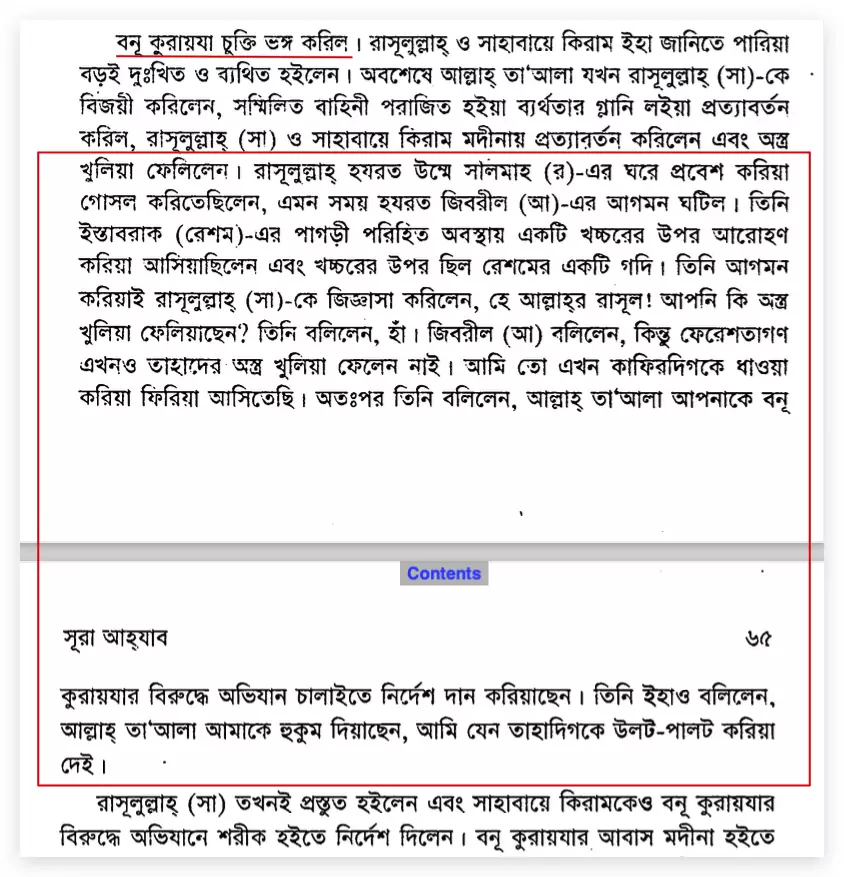
Banu Qurayza broke the treaty. When the Messenger of Allah and his companions learned of this, they were deeply saddened and distressed. Eventually, Allah granted victory to the Messenger of Allah, and the allied army withdrew in defeat and disgrace. The Messenger of Allah and his companions returned to Medina and laid down their weapons. The Messenger of Allah had entered the home of Umm Salama and was bathing when Gabriel arrived. He was riding a mule, wearing a turban of istabraq (silk), and the mule had a silk saddlecloth. Upon arriving he asked, “O Messenger of Allah! Have you laid down your arms?” He replied, “Yes.” Gabriel said, “But the angels have not yet laid down their arms. I have just returned from pursuing the unbelievers.” He then said, “Allah has commanded you to launch an expedition against Banu Qurayza.” He further said, “Allah has commanded me to overturn them.”
In Fath al-Bari, Ibn Hajar links Umm Salama’s encounter to the Banu Qurayza incident. He cites Aisha’s account from al-Bayhaqi’s Dala’il al-Nubuwwah. Aisha saw Muhammad speaking to a rider. When Muhammad asked whom the man resembled, she replied, “Dihya ibn Khalifa.” Muhammad responded that the man was Gabriel and that he had instructed him to proceed against Banu Qurayza. In a single exchange, the report connects Aisha’s observation of the rider’s appearance, Muhammad’s identification of him as Gabriel, and the military order. [7]
قَالَ بِمَنْ تُشَبِّهِينَهُ؟ قُلْتُ بِدِحْيَةَ بْنِ خَلِيفَةَ. قَالَ ذَاكَ جِبْرِيلُ أَمَرَنِي أَنْ أَمْضِيَ إِلَى بَنِي قُرَيْظَةَ.
English translation: “He asked, ‘Whom does he resemble to you?’ I said, ‘Dihya ibn Khalifa.’ He said, ‘That was Gabriel. He instructed me to proceed against Banu Qurayza.’”
Al-Tabari mentions other witnesses on the route of the same expedition. At al-Sawrayn, Muhammad asked his companions whether someone had passed by them. They answered that Dihya ibn Khalifa al-Kalbi had ridden past on a white mule. Muhammad identified that rider as Gabriel. The face of Dihya recurs in the encounter at Umm Salama’s home, in the conversation Aisha witnessed, and in the testimony of the people along the road. Aisha described a resemblance; Umm Salama and the roadside witnesses identified Dihya by name. [8]
قَدْ مَرَّ بِنَا دِحْيَةُ بْنُ خَلِيفَةَ الْكَلْبِيُّ عَلَى بَغْلَةٍ بَيْضَاءَ
English translation: “Dihya ibn Khalifa al-Kalbi passed by us riding a white mule.”
In Bukhari 4117, Muhammad set out after the visitor pointed toward Banu Qurayza. Muhammad himself instructed his followers to perform the Asr prayer at Banu Qurayza. One group prayed on the road; according to Ibn Hisham’s Sira, some others arrived after Isha and then performed the Asr prayer there. [9] [10] [11]
قَالَ هَا هُنَا، وَأَشَارَ إِلَى بَنِي قُرَيْظَةَ، فَخَرَجَ النَّبِيُّ صلى الله عليه وسلم إِلَيْهِمْ.
English translation: “He said, ‘Over there,’ and pointed toward Banu Qurayza. The Prophet then set out toward them.”
Sahih al-Bukhari: لاَ يُصَلِّيَنَّ أَحَدٌ الْعَصْرَ إِلاَّ فِي بَنِي قُرَيْظَةَ
Ibn Hisham’s Sira: فَصَلَّوْا الْعَصْرَ بِهَا، بَعْدَ الْعِشَاءِ الْآخِرَةِ
English translation:
Sahih al-Bukhari: “None of you should perform the Asr prayer except at Banu Qurayza.”
Ibn Hisham’s Sira: “They performed the Asr prayer there after Isha.”
Al-Tabari’s account makes the incident still clearer. The roadside witnesses said that Dihya ibn Khalifa al-Kalbi had passed them riding a white mule; Muhammad told them that the rider was Gabriel. They did not see an angel and identify him as an angel. They believed they had seen Dihya. The gap between their direct experience and Muhammad’s subsequent declaration reveals the actual consequence of Gabriel’s disguise. When someone else adopts the appearance by which a person is normally identified, an eyewitness’s ordinary means of identifying that person fails. Reducing the account of a being concealing his identity behind a companion’s familiar face to the phrase “appearing in human form” omits the specific appropriation of Dihya’s identity and the confusion it produced. [12]
The Banu Qurayza account also links the disguise directly to the claim of revelation. The combined descriptions in Ibn Kathir, al-Tabari, and the related hadith reports concern a visitor whom people recognized as Dihya delivering a military order in Allah’s name. The visitor’s face and outward identity were Dihya’s, but the authority attributed to him was Gabriel’s. This confusion over identity was resolved by Muhammad’s declaration, not by any independent indication in the visitor’s external appearance. Islamic religious literature thus preserves, as an episode of revelation, the delivery of a heavenly command from behind an assumed identity that caused people to believe someone else was present. [13]
Salafi Fatwas Prohibit Assuming the Identity of a Companion
Ibn Baz characterized pretending to be another person in a performance as lying and falsification. In his example, an actor abandons his own identity and declares, “I am Umar,” “I am Ali ibn Abi Talib,” or “I am Abu Hanifa.” Ibn Baz called this conduct tazwir: presenting an identity that is not one’s own as though it were one’s own. The central issue in this fatwa is not the subject of the performance, but the act of assuming another person’s identity. [14]
فهذا كذب لا يجوز، وهذا تزوير، وليس تمثيل، تزوير
English translation: “This is a lie and is not permissible. This is falsification. It is not acting; it is falsification.”
Abd al-Muhsin al-Abbad did not confine the prohibition to verbally using someone else’s name. In Sunan Abi Dawud, Aisha reports that she imitated a person before Muhammad and that he disliked it. Al-Abbad explains that Aisha either performed the same action as that person or imitated the person’s outward manner. From this hadith, he concludes that acting founded on imitation of another person’s conduct and assuming another character is forbidden. The objection to Gabriel’s disguise as Dihya therefore does not require inventing a statement in which the visitor says, “I am Dihya.” The reported act is that he assumed Dihya’s form; its consequence was that people identified him as Dihya. [15] [16]
The hadith in Abu Dawud: وَحَكَيْتُ لَهُ إِنْسَانًا فَقَالَ: مَا أُحِبُّ أَنِّي حَكَيْتُ إِنْسَانًا وَأَنَّ لِي كَذَا وَكَذَا.
Al-Abbad’s commentary: وهذا الحديث يدل على تحريم التمثيل، الذي هو مبني على الحكاية، ومبني على التقليد، وعلى ـ كما يقولون ـ تقمص شخصية شخص آخر.
English translation:
Abu Dawud’s hadith: “I imitated a person in his presence, and he said, ‘I would not like to imitate anyone, even if I were given such-and-such.’”
Al-Abbad’s commentary: “This hadith indicates that acting is forbidden, since acting is based on portraying someone, on imitation, and on what they call assuming another person’s character.”
Ibn Uthaymin gave an even more specific example in his fatwa concerning the portrayal of the companions. Suppose someone has shaved his beard and then attaches a false beard to portray a companion or an imam from the generation of the Successors. Ibn Uthaymin did not consider this permissible. IslamQA fatwa 14488 likewise declares that portraying the companions in films, theatrical productions, or other media is forbidden. Dihya al-Kalbi was himself a companion. Accordingly, the form Gabriel assumed in the Banu Qurayza account was precisely the form of a real individual belonging to the class whose impersonation these Salafi rulings explicitly prohibit. [17] [18]
Ibn Uthaymin: كشخص حليق مثلاً، يجعل على نفسه لحية -كذباً- ويمثل أحداً من هؤلاء، فإن هذا لا يجوز.
IslamQA fatwa: يحرم تمثيل أحد من أصحاب النبي صلى الله عليه وسلم في الأفلام أو المسرحيات أو غيرها.
English translation:
Ibn Uthaymin: “For example, a clean-shaven person puts on a beard as a false disguise and portrays one of these figures. That is not permissible.”
IslamQA fatwa: “Portraying any of the Prophet’s companions in films, plays, or other media is forbidden.”
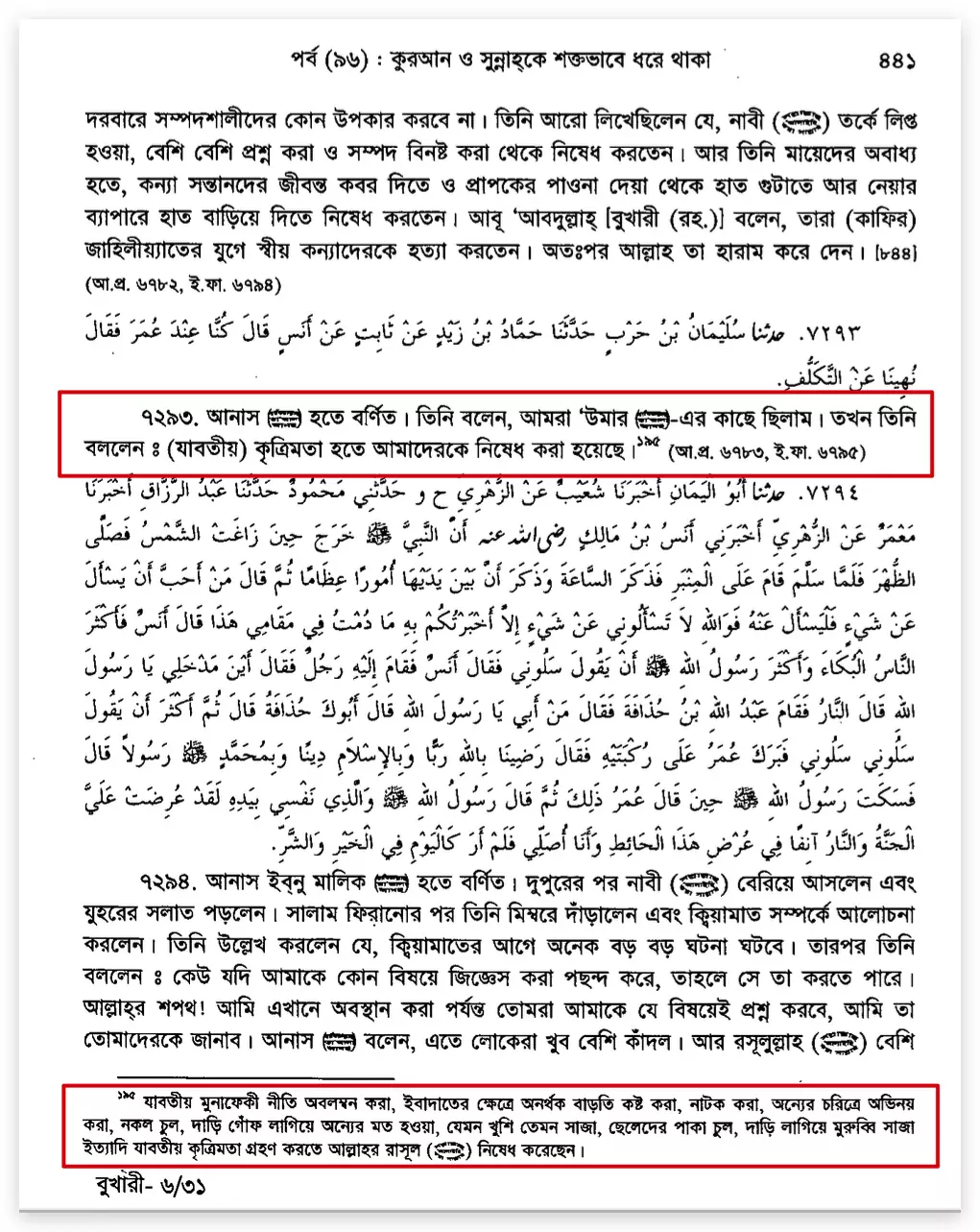
The Bengali edition of Bukhari 7293 published by Tawhid Publications also gives acting as another person’s character, wearing false hair, or using artificial beards and moustaches to look like someone else as examples of takalluf. Umar’s original statement concerns the prohibition of takalluf; the examples involving costumes and acting are the publisher’s application of that statement in a footnote. Ibn Uthaymin’s fatwa explicitly gives the example of attaching a false beard to portray a companion. This is where the Bengali publisher’s note corresponds to the Salafi ruling. [19] [20]
نُهِينَا عَنِ التَّكَلُّفِ.
English translation: “We were forbidden from takalluf (artificiality and affectation).”
Sahih al-Bukhari (Tawhid Publications edition)
96 / Holding Fast to the Quran and Sunnah
Chapter 96/3: Excessive questioning and imposing unnecessary hardship are blameworthy.
7293. Narrated by Anas: We were with Umar when he said, “We have been forbidden from all forms of artificiality (takalluf).”[1] (Adhunik Prakashani 6783; Islamic Foundation 6795)
[1] Adopting hypocritical methods, imposing unnecessary hardship in worship, performing in dramas, acting as another person, wearing false hair, beards, or moustaches to resemble someone else, dressing up as one pleases, or wearing grey hair and a beard to appear elderly, and other forms of artificiality were prohibited by the Messenger of Allah.
Hadith grade: Sahih
Narrator: Anas ibn Malik
Ibn Baz’s fatwa calls passing off someone else’s personal identity as one’s own kidhb (lying) and tazwir (falsification). Al-Abbad develops the objection further: in his words, acting is based on imitating someone else’s behavior and تقمص شخصية شخص آخر—assuming the personality or character of another person. The central conduct targeted by these prohibitions is abandoning one’s own identity and appearing as another individual. The accounts of Umm Salama in Bukhari and the roadside witnesses in al-Tabari also record the direct consequence of that conduct: Gabriel was identified as Dihya. What is condemned for human beings in the name of Islam as falsification and prohibited impersonation is glorified in Gabriel’s case as the miraculous action of an angel. [21] [22]
It was Gabriel who used Dihya’s identity, not Dihya himself. The real Dihya did not alter his appearance, hand over his identity to someone else, or take any action that caused Umm Salama or the other witnesses to form a false belief. It was Gabriel who used another person’s individual identity. Yet IslamQA fatwa 14488 prohibits portraying the companions on the grounds of their status; Ibn Uthaymin similarly rejects assuming the character of a companion through an artificial disguise. Dihya was a companion, and his face became the means of concealing another being’s identity in this episode. Dihya’s recognizable identity thus ceased to guarantee that Dihya himself was present; it became a means of causing someone to see another being in his place. The cited fatwas offer no consistent moral standard for prohibiting human beings from using another person’s identity while praising an angel for the same identity-based act. [18] [23]
Gabriel’s Act of Kufr: Impersonation Under Disguise
Al-Abbad rejects describing Gabriel’s assumption of human form as acting. Yet the Dihya episode explicitly describes taking the appearance of a real person and eyewitnesses believing they had seen that person. Al-Abbad’s terminology cannot erase the confusion of identity. Umm Salama identified the visitor as Dihya, and her mistaken belief remained unchanged until she later heard Muhammad’s address. Concealing one’s identity behind the face of a familiar person is the basis of impersonation through disguise. [24]
لا يدل على التمثيل، لأن التمثيل كذب
English translation: “It does not provide evidence for acting, because acting is a lie.”
In Sahih Muslim 102, Muhammad explicitly condemns deception. When the wet portion of a heap of food was concealed beneath the dry portion on display, he asked why the wet food had not been placed on top so that people could see it. He then declared that whoever deceives others does not belong to his followers. The issue at the heart of the incident is concealing an object’s actual condition so that an observer forms a different impression. In the account of Gabriel’s disguise as Dihya, people likewise believed they were seeing one individual, while the visitor’s actual identity was subsequently claimed to be someone else. Concealing one’s identity while inducing others to believe that one is another person is also a form of deception. In Bukhari, Umm Salama’s sworn testimony about her mistaken identification is direct evidence of the resulting confusion. [25] [26]
أَنَّ رَسُولَ اللَّهِ صلى الله عليه وسلم مَرَّ عَلَى صُبْرَةِ طَعَامٍ فَأَدْخَلَ يَدَهُ فِيهَا فَنَالَتْ أَصَابِعُهُ بَلَلاً فَقَالَ «مَا هَذَا يَا صَاحِبَ الطَّعَامِ» قَالَ أَصَابَتْهُ السَّمَاءُ يَا رَسُولَ اللَّهِ. قَالَ «أَفَلاَ جَعَلْتَهُ فَوْقَ الطَّعَامِ كَىْ يَرَاهُ النَّاسُ مَنْ غَشَّ فَلَيْسَ مِنِّي».
English translation: “The Messenger of Allah passed by a pile of food and put his hand into it. His fingers felt moisture, so he asked, ‘What is this, owner of the food?’ The man replied, ‘Rain fell on it, O Messenger of Allah.’ He said, ‘Why did you not put the wet part on top so that people could see it? Whoever deceives is not one of mine.’”
The Banu Qurayza account does not merely say that Gabriel looked like a human being in order to converse with people. It states that he assumed Dihya’s particular appearance, and that people who saw this appearance believed he was Dihya. Once portraying a companion is declared forbidden in acting, the consequences of Allah’s messenger adopting that companion’s identity cannot be erased by assigning a different name to the conduct. Appearing with another person’s face, causing observers to believe that he is that person, and speaking in Allah’s name while doing so—these three elements are all part of the account of the disguise.
Conclusion
The central account of Gabriel’s disguised impersonation is preserved in Islamic sources themselves. Musnad Ahmad reports that he assumed Dihya’s form. In Bukhari, Umm Salama identified the visitor as Dihya. In al-Tabari’s account, witnesses on the road also recognized the rider on the white mule as Dihya. In Salafi fatwas, Ibn Baz calls passing off another person’s identity as one’s own lying and falsification; al-Abbad condemns acting based on imitating another person’s appearance and manner; and Ibn Uthaymin prohibits portraying a companion. In Sahih Muslim, Muhammad condemns deception that conceals the actual facts from people through misleading outward presentation. The Islamic accounts themselves describe Gabriel taking another person’s form, misleading eyewitnesses through that form, and delivering Allah’s message. What is described for human beings as lying, falsification, and forbidden impersonation is presented in Gabriel’s case as a method of revelation.
References
- Sahih al-Bukhari 2: The angel appearing in human form ↩︎
- Arabic texts of Musnad Ahmad 5857 and Ibn Sa’d’s report ↩︎
- Sahih al-Bukhari 4980; Islamic Foundation edition, no. 4619 ↩︎
- Sahih al-Bukhari 3634: Another version of the same report ↩︎
- Sahih al-Bukhari 4980: Umm Salama identifies Dihya and later learns the visitor’s identity ↩︎
- Tafsir Ibn Kathir, al-Ahzab 33:26; Islamic Foundation edition, vol. 9, pp. 64–65 ↩︎
- Fath al-Bari: Bukhari 4980, the Banu Qurayza incident, and Aisha’s narration ↩︎
- Tafsir al-Tabari, al-Ahzab 33:26: The rider on a white mule identified as Dihya ↩︎
- Sahih al-Bukhari 4117: Pointing toward Banu Qurayza ↩︎
- Sahih al-Bukhari 4119: The order concerning the Asr prayer ↩︎
- Ibn Hisham’s Sira: Performing Asr after Isha ↩︎
- Tafsir al-Tabari, al-Ahzab 33:26: The roadside witnesses identify the rider as Dihya ↩︎
- Ibn Kathir, al-Ahzab 33:26: Gabriel’s arrival and the order to launch the expedition ↩︎
- Ibn Baz’s fatwa: Impersonation described as lying and falsification ↩︎
- Sunan Abi Dawud 4875: Imitating another person ↩︎
- Al-Abbad, Sharh Sunan Abi Dawud, lesson 555: The prohibition of impersonation and acting ↩︎
- Ibn Uthaymin’s own fatwa: Portraying a companion with a false beard ↩︎
- IslamQA 14488: Prohibition on portraying the companions 1 2
- Sahih al-Bukhari 7293: The original statement prohibiting takalluf ↩︎
- Tawhid Publications: Bengali translation and footnote 1 ↩︎
- Ibn Baz: Identity-based impersonation described as lying and falsification ↩︎
- Al-Abbad, Sharh Sunan Abi Dawud 555: The prohibition on assuming another person’s character ↩︎
- Ibn Uthaymin: Ruling on portraying companions and imams ↩︎
- Al-Abbad, Sharh Sunan Abi Dawud, lesson 527: Gabriel’s human form compared with acting ↩︎
- Sahih Muslim 102: Muhammad’s condemnation of deception ↩︎
- Sahih al-Bukhari 4980: The mistaken identification as Dihya ↩︎
