
Introduction
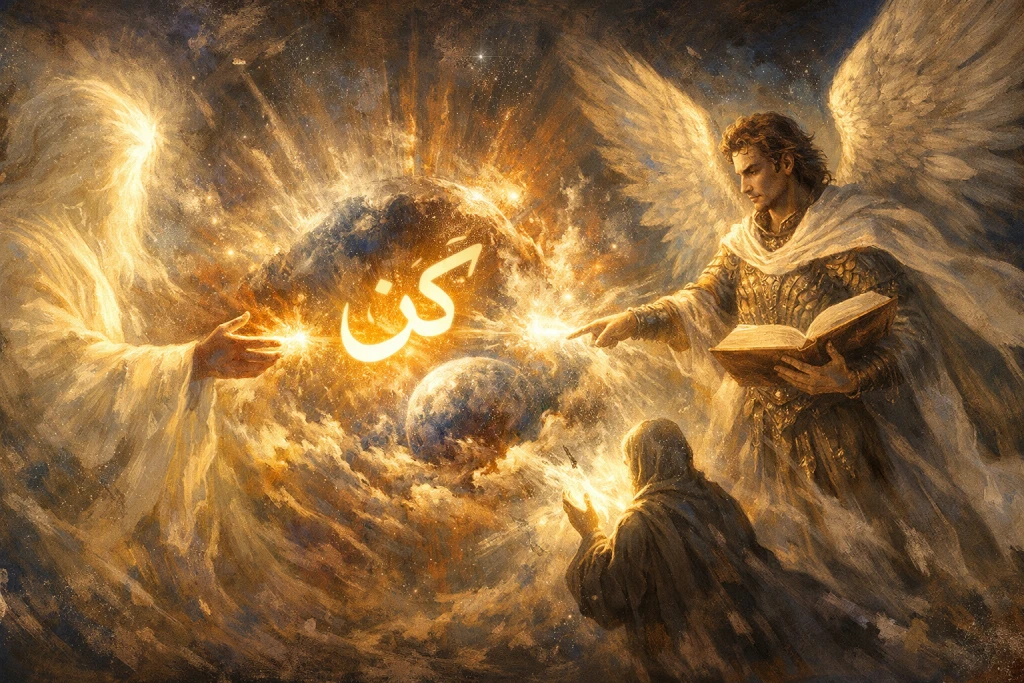
The Quran presents the power of creation through an exceptionally simple statement: when Allah wills something, He merely says ‘Be,’ and it comes into being. This statement is presented as an expression of Allah’s omnipotence. It claims a power that requires no gathering of materials, exertion, waiting, or overcoming of obstacles. Yet declaring a power and explaining an event through that power are different things. Saying ‘Allah created it’ names a creator; it does not explain how creation became possible, how will relates to existence, or why one particular outcome occurred rather than another. Placing the word ‘Be’ where this explanation is missing does not solve the problem. Instead, the process that needed to be understood is concealed behind a command.
When a ruler gives an order, subordinates carry it out. The issuer, recipient, means of implementation, and outcome each have a distinct existence and role. But what does it mean to say ‘Be’ to something that does not yet exist? Who receives the instruction, and through what process does it take effect? If Allah’s will alone is sufficient to produce the outcome, what role does a separate command play after that willing? These questions become more pressing when the same religious accounts describe creation taking time, refer to materials and stages in the formation of human beings, and assign angels to different tasks. On one side stands the declaration of an immediately effective, omnipotent will; on the other stands an extensive system of messengers, scribes, observers, bearers, and executors of punishment. The relationship between these two pictures requires examination.
The same problem arises with the claim of omniscience. If Allah knows every human action and intention completely, what purpose do recording angels, alternating observers, and the presentation of deeds at specified times serve for Him? Why must reports be delivered to one who knows everything? Why does one who can accomplish everything through His own will employ so many agents to implement His commands? Evading these questions through devotion leaves the logical worth of the claims unexamined. Any statement about the universe, humanity, or causation that claims to be true must face scrutiny of its explanation and evidence. This article therefore examines the notion that things come into being merely through the command ‘Be,’ alongside the Quran, tafsir, and related religious accounts. The central question is whether this statement offers an intelligible explanation of reality or substitutes a declaration of unlimited power for an explanation.
The Quranic Claim: When Allah Says ‘Be,’ Everything Happens Immediately
An Islamic doctrinal belief is that when Allah says ‘Be,’ it happens immediately [1]
Mary said, ‘My Lord! How can I have a son when no human being has touched me?’ He said, ‘Thus it shall be.’ Allah creates whatever He wills; whenever He decrees something, He says, ‘Be,’ and it comes into being.
— Taisirul Quran
She said, ‘My Lord! How can I have a son when no man has touched me?’ He said, ‘In this way Allah creates whatever He wills; when He decides upon a matter, He says to it, ‘Be,’ and it comes into being.
— Sheikh Mujibur Rahman
Mary said, ‘My Lord, how can I have a child when no human being has touched me?’ Allah said, ‘Thus it shall be.’ Allah creates whatever He wishes. When He decides upon a matter, He merely says to it, ‘Be,’ and it comes into being.
— Rawai Al-bayan
She said, ‘My Lord! How can I have a child when no man has touched me?’ He (Allah) said, ‘Thus it shall be.’ Allah creates whatever He wills. Whenever He decrees something, He says, ‘Be,’ and it comes into being [1].
— Dr. Abu Bakr Muhammad Zakaria
Let us read another Quranic verse [2].
Originator of the heavens and the earth. When He decrees a matter, He only says to it, “Be,” and it is.
— Saheeh International
The Originator of the heavens and the earth! When He decreeth a thing, He saith unto it only: Be! and it is.
— M. Pickthall
Allah is the originator of the heavens and the earth. When He decides to bring about a matter, He merely says to it, ‘Be,’ and it immediately comes into being.
— Taisirul Quran
He is the creator of the heavens and the earth, and when He wills to accomplish a matter, He merely says, ‘Be,’ and it comes into being.
— Sheikh Mujibur Rahman
He is the creator of the heavens and the earth. When He decides upon a matter, He merely says, ‘Be,’ and it comes into being.
— Rawai Al-bayan
He is the originator of the heavens and the earth. When He decides to bring something about, He merely says to it, ‘Be,’ and it comes into being.
— Dr. Abu Bakr Muhammad Zakaria
The Explanation of This Verse in Tafsir
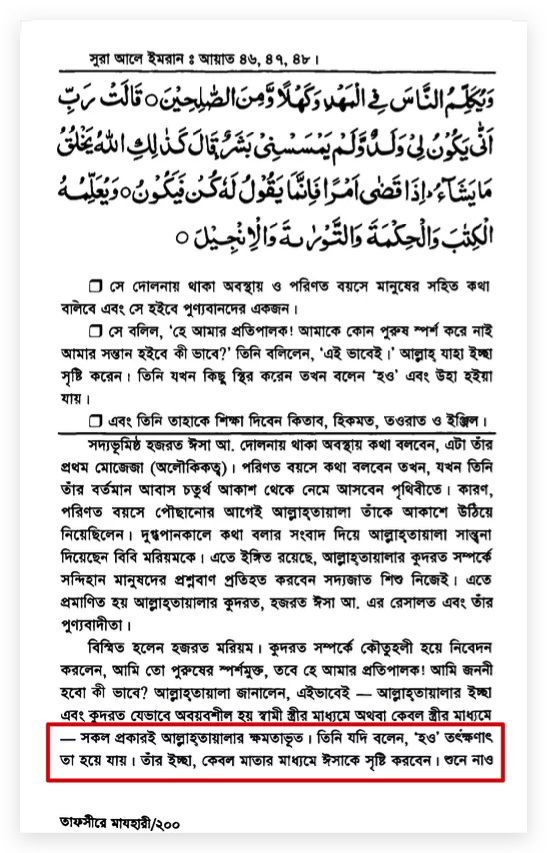
Tafsir al-Mazhari explains this verse as follows [3]:
Every form is within Allah’s power. If He says ‘Be,’ it comes into being immediately. His will is to create Jesus through a mother alone.
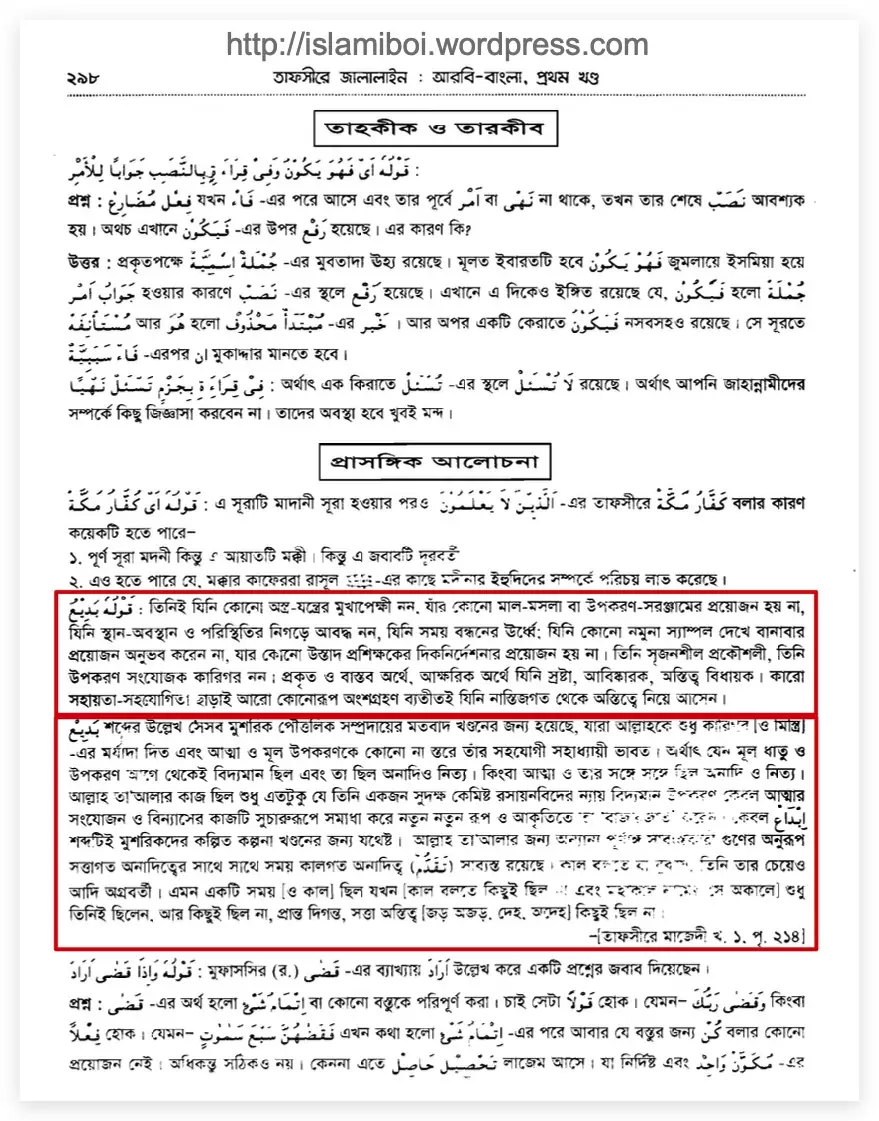
It is also necessary to read the commentary on this verse [4]:
قَوْلَهُ أَي كُفَّارَ مَكَةً : Although this surah is Medinan, there may be several reasons why the commentary on الَّذِينَ لَا يَعْلَمُونَ says كَثَرُ مَكَ
:
1. The entire surah is Medinan, but this verse is Meccan. This answer, however, is far-fetched.
2. It is also possible that the unbelievers of Mecca learned about the Jews of Medina from the Messenger.
قَوْلَهُ بَدِيعُ : He is the one who depends on no tools or instruments, requires no materials or equipment, is not bound by place, circumstances, or conditions, and is above the constraints of time. He has no need to make anything by following a model or sample and requires no guidance from a teacher or instructor. He is a creative engineer, not an artisan who assembles materials. In the actual, real, and literal sense, He is the creator, originator, and giver of existence. Without anyone’s assistance or cooperation, and without any participation by another, He brings things from nonexistence into existence.
The word بدیع is mentioned to refute the doctrines of those polytheistic, idolatrous communities that regarded Allah merely as an artisan or craftsman
and regarded the soul and primary materials, at some level, as His partners or collaborators. They held, in effect, that the basic substance and materials already existed and were beginningless and eternal, or that the soul and its associated elements were beginningless and eternal. Allah’s work, on this account, consisted merely in skillfully combining and arranging existing materials and souls, like an expert chemist, and bringing new forms and shapes to market. The word إبداع alone is sufficient to refute the imagined conceptions of the polytheists. Like His other perfect attributes, Allah possesses temporal beginninglessness (1), alongside the beginninglessness of His essence. He precedes whatever is understood by time. There was a ‘time’ when there was no time at all; in that timeless condition, He alone existed. Nothing else existed: no boundaries or horizons, no beings or entities, whether material or immaterial, corporeal or incorporeal.
—Tafsir al-Majidi, vol. 1, p. 214.
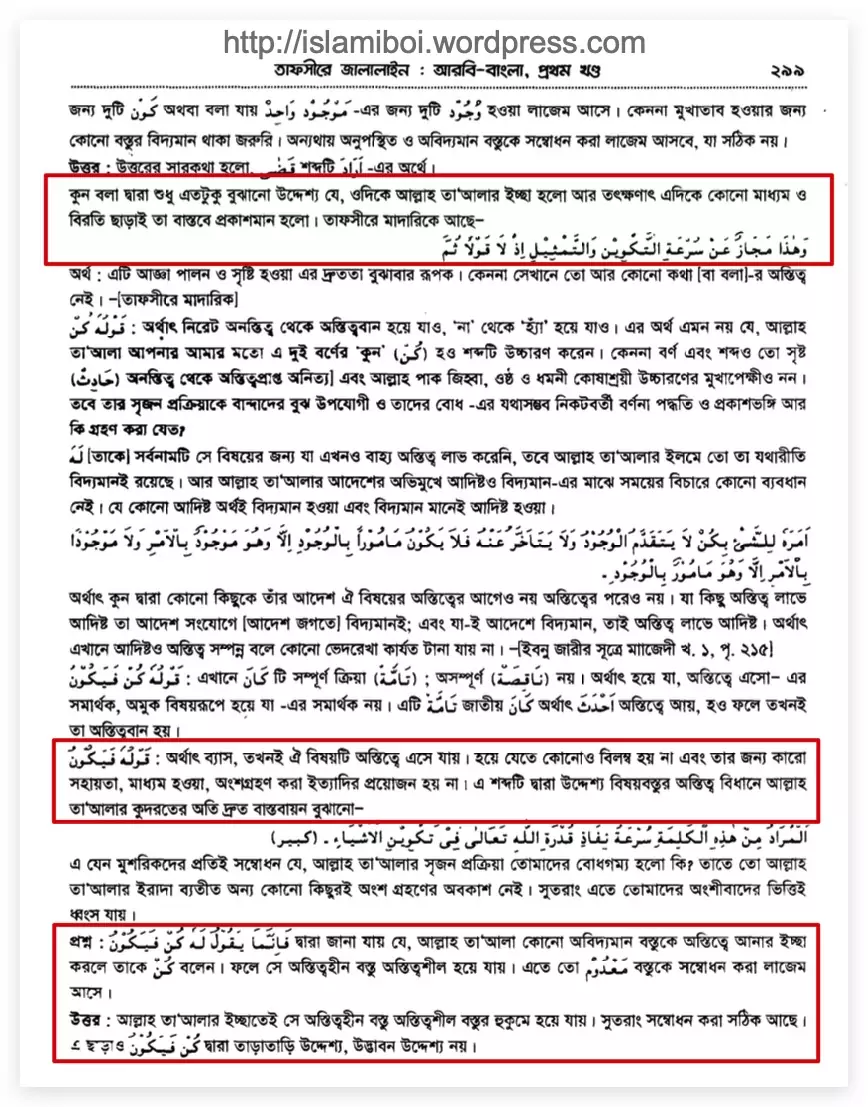
Tafsir al-Jalalayn, Arabic–Bengali edition, vol. 1, p. 299
This would entail two کون, or, in other words, two وُجُود for موجود واحد. For something to be addressed, it must exist. Otherwise, it would entail addressing something absent and nonexistent, which is not correct.
Answer: The substance of the answer is that
the word is used in the sense of [illegible in the supplied transcription].
Saying kun is intended only to convey that, as soon as Allah wills it, the thing manifests in reality immediately, without any intermediary or interval. Tafsir al-Madarik states:
وَهَذَا مَجَازَ عَنْ سُرْعَةِ التَّكْوِينِ وَالتَّمْشِيلِ إِذْ لَا قَوْلًا ثُمَّ
Meaning: This is a metaphor expressing the rapidity of obedience to the command and coming into existence, since there is no actual speech or utterance there. —Tafsir al-Madarik.
قوله کن : That is, come into existence from sheer nonexistence; pass from ‘no’ to ‘yes.’ It does not mean that Allah pronounces the two-letter word kun (1), ‘Be,’ as you or I do. Letters and sounds are themselves created (حادث), contingent things that come into existence from nonexistence. Nor does Allah depend on pronunciation through the tongue, lips, or bodily organs. Yet what other manner of description and expression could have been adopted to make His creative process intelligible to His servants and bring it as close as possible to their understanding
?
The pronoun ‘it’ refers to something that has not yet acquired external existence but already exists in Allah’s knowledge. There is no temporal interval between Allah’s command and the existence of what is commanded. To be commanded means to exist, and to exist means to be commanded.
أَمَرَهُ لِلشَّيْ بِكُنْ لَا يَتَقَدَّمُ الْوُجُودُ وَلَا يَتَآخَرُ عَنْهُ فَلَا يَكُونُ مَامُوراً بِالْوُجُودِ إِلَّا وَهُوَ مَوْجُودُ بِالْأَمْرِ وَلَا مَوْجُودًا بالأمْرِ إِلَّا وَهُوَ مَا مُورَ بِالْوُجُودِ .
In other words, His command to something through kun occurs neither before its existence nor after it. Whatever is commanded to exist already exists in conjunction with the command, in the realm of command; whatever exists through the command is commanded to acquire existence. No effective dividing line can therefore be drawn here between being commanded and possessing existence. Cited through Ibn Jarir in al-Majidi, vol. 1, p. 215.
قَولَهُ كُنْ فَيَكُونَ : Here the verb is complete (تَامَّ), not incomplete (نَاقِصَة). It means ‘become’ or ‘come into existence,’ rather than ‘become such-and-such a thing.’ It conveys the sense of اَحْدَثَ: come into existence, be; and immediately
it comes into existence.
قَوْلُهُ فَيَكُونُ : That is, the thing comes into existence at once. There is no delay in its coming into being, nor any need for anyone’s assistance, mediation, or participation. The expression is intended to convey the exceedingly rapid realization of Allah’s power in bringing the intended object into existence—
الْمُرَادُ مِنْ هَذِهِ الكَلِمَةِ سُرْعَة نِفَاذِ قدرة الله تعالى في تكوين الاشياء . (كبير)
as though addressing the polytheists: have you understood Allah’s process of creation? Nothing other than Allah’s will has any room to participate in it. The foundation of your doctrine of associating partners with Him is therefore destroyed.
Question: فانّما يقول له كن فيكون indicates that when Allah wishes to bring a nonexistent thing into existence, He addresses it, whereupon that nonexistent thing comes to exist. This would entail addressing a معدوم, a nonexistent thing.
Answer: Through Allah’s will, that nonexistent thing acquires the status of an existent thing. Addressing it is therefore correct.
1. كُن فيكون expresses rapidity, not origination.
Why the Claim Requires Analysis
Allah could have said that the process through which the universe originated is complex and beyond human understanding because of the limitations of human knowledge. Instead, He made claims that, when examined, generate numerous difficult questions and seriously challenge the Quran’s assertions. If these matters lie beyond human knowledge, why did Allah make this statement in the Quran at all? Does He want human beings to accept His claim blindly, without understanding it, on the excuse that their knowledge is limited? What, then, is wrong with Brahma, Vishnu, Shiva, Odin, Zeus, or the gods of other religions? Those gods, or their followers, could likewise invoke the limitations of human knowledge and say that people cannot understand such mysteries. Why should we not accept their statements too? The same reasoning must be applied to every god.
Since Allah has made the claim, examining it is necessary. If we can understand nothing of it, there can be no benefit in reciting this verse as a meaningless statement. Nor would Allah have any rational reason to reveal such an unintelligible verse.
The Logical Inconsistency of the Command ‘Be’
First, ‘Be’ is a word, a verbal or human instruction. Even if we set aside its linguistic aspect and treat it simply as a directive, it is important to recognize that the effectiveness of any instruction depends on a recipient who receives, understands, and implements it.
If we accept this Quranic claim as an account of how the universe originated, two possibilities arise:
- Allah Himself says ‘Be’ and carries it out Himself. Allah is both the issuer of the instruction and its implementer.
- Allah merely says ‘Be,’ and a third party hears, understands, and implements the instruction. Allah is the issuer, while someone else implements it.
To illustrate these two possibilities, consider the following diagram, reproduced from the original article. On the left, Allah says ‘Be,’ but a question mark appears in the middle because there is no recipient, with an image of the universe below. On the right, Allah uses a megaphone to say ‘Be’ to Himself, receives the instruction Himself, and carries it out, with the universe below. The diagram illustrates the need for a distinct entity to receive and implement the instruction.
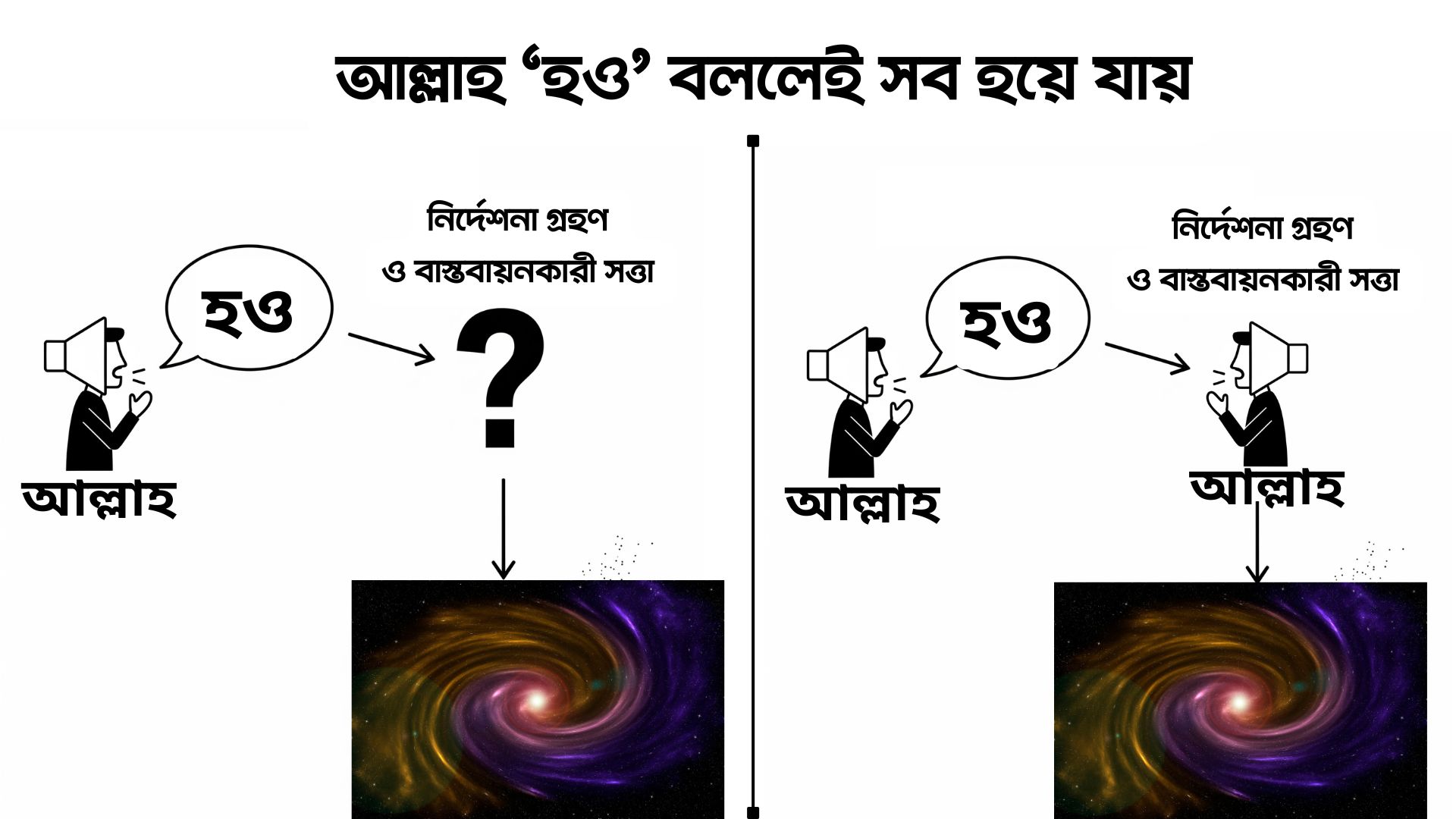
The problem is that an instruction and its implementation ordinarily call for two different conscious entities. If no external recipient is needed, saying ‘Be’ serves no function; rather, the command becomes self-contradictory. It turns God into a being who listens to His own words and responds to His own instruction by implementing it—a portrayal inconsistent with the concepts of consciousness or self-consciousness and contrary to causal reasoning. This explanation turns God into an absurd, irrational character who issues commands to Himself and implements them Himself.
The Scientific Impossibility of Creating Matter
Second, bringing something into existence requires materials, energy, and a specific process. Under the fundamental laws of physics, the creation of matter from nothing conflicts with principles of conservation in reasoning and science. Modern Big Bang theory likewise does not use ‘nothing’ to mean literally no thing at all; instead, it explains the emergence of space, time, and matter–energy from an extremely dense, hot state, or singularity. Against this scientific background, the idea that the world could arise from nothing simply through the utterance ‘Be’ has no meaningful explanatory value. It entirely disregards natural laws and causal relationships.
The Philosophical Problem of Time, Will, and Change
A central philosophical question also arises: ‘How can something arise from nothing?’ If God has always existed, His will must nevertheless be assumed to have a temporal, time-dependent form: at some particular moment, He ‘willed’ that the world should exist. Until the moment before He formed that will, it would therefore not have existed.
This raises the question: why did He not form this will earlier? Willing requires a mental change, and mental change implies the existence of time, since time measures change. But if God is independent of time, His will cannot change either. That will must also be beginningless and eternal. If the will to create the universe is beginningless and eternal, Allah had no option other than to create the universe. He could not have willed anything other than its creation, because that will was beginningless and eternal.
If Allah’s willing is a temporal, time-dependent event, Allah becomes subject to time. If it is eternal, why did the world begin at a particular moment? What was Allah waiting for before that? This conception contains a profound philosophical problem. If God created from nothing, there must be an entity or process between creation and nothingness that can account for the intermediate or relational connection—and that must be open to investigation within a rational framework independently of God. For, according to the rules of reasoning, every effect must have a cause. If ‘Be’ conveys a causal relationship, it can function as an effective cause only when a process or means exists through which its consequence can occur. Otherwise, it is an irrational claim inconsistent with reality.
The Quran’s internal self-contradiction is also evident here. Several verses claim that Allah created the heavens and the earth in six days [5]. The logical question is this: if God’s merely saying ‘Be’ is sufficient for creation, and the thing comes into existence immediately upon the command, why was a gradual process lasting six days or an extended period necessary? The conflict between immediate creation through ‘Be’ and step-by-step creation over six days demonstrates that this is not a coherent cosmological principle but a disordered combination of mythological conceptions composed at different times and used in different contexts.
Disregarding the Complexity of the Universe
Another serious problem is that the notion of something happening merely because ‘Be’ is uttered entirely disregards the universe’s complexity and its surrounding causal principles. The specific structures and relationships underlying every particle, form of energy, law, and configuration in the present universe cannot be explained through an intelligible linguistic instruction. For example, explaining the discovery of the Higgs boson, confirmed at CERN in 2012 and associated with giving particles mass, or the nature of dark matter and dark energy, which constitute 95% of the universe’s mass–energy while remaining invisible, requires centuries of research and data analysis. Yet if everything is created by a single ‘Be,’ the claim that ‘Allah’s knowledge is infinite’ is called into question by reducing His method of creation to a childish magical act. This is a form of intellectual laziness that denies the universe’s astonishing complexity and belittles the human pursuit of knowledge.
Historical and Cultural Context
Comparative religion and ancient history show that the idea of creating the universe through spoken words or commands—creation by fiat—is not an original or novel Islamic philosophy. In ancient Egyptian Memphite theology, it was believed that the god Ptah created everything through the intention of his mind and the words uttered by his mouth [6]. Similarly, the Hebrew Bible’s Book of Genesis repeatedly uses the structure ‘God said … and it came to be’ [7]. This is therefore a familiar mythological motif that was already widespread in the ancient Middle East and that the Quran borrowed from earlier religions and traditional narratives, assimilating it in its own way.
Philosophical examination makes it clear that ‘Be’ is essentially a linguistic claim intended to communicate Allah’s sovereign power to the uneducated people of the Arabian desert. When treated as an explanation of the existence or emergence of the real world, however, it becomes wholly unreliable under rational analysis. The word ‘Be’ has no philosophical or scientific significance and provides no logical explanation; it merely demands blind belief in a claim, contrary to the pursuit of knowledge. It offers no actual explanation, instead encouraging us to accept an irrational assertion blindly by invoking the limitations of human knowledge and the immensity of the universe. It presents God’s power in a simplified form that pretends to provide knowledge without actually doing so. Exploring its deeper meaning does not extend the boundaries of reasoning; it requires us to abandon reasoning altogether.
Examples of Outcomes That Are Not Immediate
A fundamental Quranic conception is the immediate effectiveness of Allah’s will or command. Surah Ya-Sin (36:82) states: ‘His command, when He wills something, is only to say to it, “Be”—and it comes into being.’ This verse presents Allah’s unlimited power and omnipotence, a central Islamic belief. Yet the Quran and hadith contain numerous examples in which Allah’s will or command was expressed without being implemented immediately. The logical question arises: if the command ‘Be’ is genuinely immediate and self-sufficient, why are time, processes, or materials required in so many instances? These inconsistencies conflict with the definition of omnipotence, since an omnipotent being should have no limitations, such as waiting for time to pass or depending on external materials. A detailed analysis based on reasoning and evidence follows, with sources provided wherever possible. Where direct evidence for a claim is unavailable, this will be stated explicitly.
Time in the Creation of the Universe versus Immediate Effectiveness
The Quran (2:117) states that when Allah wishes to create something, He merely says ‘Be,’ and it comes into being immediately: time presents no obstacle. This reflects omnipotence, through which everything acquires existence in an instant. Yet other Quranic accounts of the universe’s creation conflict with this conception. For example, Surah Al-Araf (7:54) and Surah Yunus (10:3) state that Allah took six days to create the heavens and the earth [8]. Surah Fussilat (41:9–12) also provides a detailed account: two days to create the earth, another four days to establish mountains and provisions, described as included within the total six days, and another two days to create the heavens in seven layers. Some interpreters claim that the periods overlap and total six days, but counting them as 2 + 4 + 2 = 8 reveals an inconsistency. If ‘Be’ is genuinely immediate, why would creation take several days? This demonstrates that divine will is not free from temporal limitations, directly contradicting omnipotence. Scientifically, the universe is 13.8 billion years old, which does not correspond to the notion of ‘six days,’ but the focus here is the Quran’s internal inconsistency.
Materials and Procedural Limitations in the Creation of Human Beings
In its account of the creation of humanity, or Adam, the Quran states that Allah’s command concerning Adam was merely ‘Be,’ and he came into being [9]. At the same time, several Quranic passages claim that human beings were created from materials such as clay, dry clay, or something resembling baked clay [10]. The Islamic story of Adam’s formation describes the various stages in greater detail [11]. If ‘Be’ is sufficient and self-sufficient for creating something, there should be no need to use raw materials or natural substances such as clay. Using materials and proceeding through a specific process—the transformation of clay into a human being—suggests something equivalent to an earthly construction process rather than an instantaneous miracle. Where materials are required, the creator becomes dependent on them, revealing a limitation in His ability to bring about ‘instantaneous creation’ merely by saying ‘Be.’
The Command to Destroy Abu Lahab and Its Delayed Implementation
Abu Lahab’s case is an important example contrary to the immediate effectiveness of Allah’s command. According to Sahih al-Bukhari, when Muhammad stood on Mount Safa and warned the Quraysh, Abu Lahab insulted him. Surah Al-Masad was then revealed, declaring: ‘May the hands of Abu Lahab perish, and may he himself perish’ [12]. This Quranic language is presented not merely as a prediction but as a divine decree or command of destruction. If Allah’s command were as effective as saying ‘Be,’ Abu Lahab should have been destroyed immediately upon this declaration. Yet according to historical information and hadith, Abu Lahab lived for roughly another ten years after this curse or command and continued actively opposing Islam. The decade-long delay in implementing a direct divine command of destruction indicates that divine will or command does not always take effect immediately, weakening the logical foundation of kun fa-yakun [13] [14]
May the two hands of Abu Lahab perish,
and may he himself perish.
His wealth has availed him nothing,
nor has what he earned.
Soon he will enter a blazing fire,
and his wife too, the carrier of firewood,
with a rope of palm fiber around her neck.
Sahih al-Bukhari (Tawhid Publication)
65. Commentary on the Quran
Chapter 65/26/2: Allah’s statement: ‘Warn your nearest relatives,’ and be humble toward the believers (Surah Ash-Shuara, 26:214–215).
اخْفِضْ جَنَاحَكَ —‘Lower your wing.’
4770. Narrated by Ibn Abbas: When the verse وَأَنْذِرْ عَشِيْرَتَكَ الْأَقْرَبِيْنَ was revealed, Allah’s Messenger climbed Safa and called out, ‘O Banu Fihr! O Banu Adi!’ addressing the various clans of the Quraysh. Eventually they gathered. Those unable to come themselves sent representatives to find out what was happening. Abu Lahab and other members of the Quraysh also came. Allah’s Messenger said, ‘Tell me, if I informed you that enemy troops had arrived in the valley and were preparing to attack you suddenly, would you believe me?’ They replied, ‘Yes; we have always found you truthful.’ He then said, ‘I am warning you of a severe punishment.’ Abu Lahab said to Allah’s Messenger, ‘May you perish all day long! Is this why you gathered us?’ Then the following was revealed: ‘May the two hands of Abu Lahab perish, and may he himself perish. His wealth and his earnings have not benefited him.’ [1394] (Modern Publication: number not supplied; Islamic Foundation: 4408.)
Hadith classification: Sahih (authentic)
Narrator: Abdullah ibn Abbas
If Everything Happens through ‘Be,’ Why Are So Many Angels and Departments Needed?
The Quran’s account of Allah’s power, whereby something happens as soon as He says ‘Be,’ becomes more complicated when read alongside other Islamic claims. This account mentions no employee, bearer, scribe, guard, or implementing force between His will and its outcome. Yet other Quranic and hadith accounts present an extensive angelic system: one angel brings revelation, another is responsible for rain and vegetation, another waits to blow the trumpet, some take souls, some record human actions, some conduct questioning in the grave, some are assigned to the entrances and punishments of Paradise and Hell, and a group carries Allah’s Throne. Accounts of creation and the governance of the world thus present two arrangements simultaneously: directly effective divine will, and distinct created agents and intermediaries assigned to different tasks [15] [16]।
This division of responsibilities bears a familiar resemblance to human states and royal courts. A king cannot go everywhere, know every fact, or perform every task alone; he therefore needs messengers, soldiers, scribes, guards, executors of punishment, and administrative employees. The existence of separate ministries in a state likewise reflects the volume of work, specialized skills, and human limitations. But if Allah is omnipotent and omniscient, these limitations should not apply to Him. The question therefore becomes more specific: What indispensable role does an angel perform in a task that can be accomplished directly through divine will? What does a system of recording and reporting explain when the information is already fully known? What functional reason is there to appoint enormous created bearers to carry a Throne that could remain in place through a single act of will?
The Division of Angelic Tasks: Messengers, Scribes, Guards, and Executors of Punishment
The Quran, hadith, and religious commentaries assign specific duties to angels. Placing these duties alongside one another produces a picture of a system of delegated responsibilities, extending from the delivery of revelation to death, judgment, punishment, and the final catastrophe. The table below identifies the angels or groups of angels, their assigned tasks, and the sources of these accounts. The comparison with ministries and departments concerns the division of work: separate roles are described for conveying messages, weather, taking souls, preserving records, security, questioning, and executing punishment.
| Angel or Group of Angels | Responsibilities and Department-Like Functions | References |
|---|---|---|
| Jibril (Gabriel) | Revelation and communication: delivering the Quran to Muhammad’s heart by Allah’s permission. | Quran, 2:97 |
| Mikail (Michael) | Rain and vegetation: assigned responsibility for rain and vegetation in religious commentary; according to Ibn Kathir’s account, his assistants direct the winds and clouds. | The quoted statement of Ibn Kathir; Discussion of responsibilities |
| Israfil | The trumpet and the final catastrophe: assigned the blowing of the trumpet in religious commentary. A hadith describes the trumpet-bearer waiting for the command with the trumpet at his mouth. | Israfil’s responsibility; Al-Tirmidhi, 2431; Quran, 39:68 |
| The Angel of Death and the Angels Who Take Souls | Taking souls: references describe the Angel of Death appointed to take human souls, as well as messengers who take souls. | Quran, 32:11; 6:61 |
| The Angels Who Bear the Throne | Carrying the Throne: eight bearers are mentioned on the Day of Resurrection. The Throne-bearers and the angels surrounding it also offer praise and seek forgiveness for believers. | Quran, 69:17; 40:7; Abu Dawud, 4727 |
| Kiraman Katibin and the Angels Who Record Deeds | Recordkeeping: observing and recording human actions and spoken words; two receivers are described as positioned on the right and left. | Quran, 82:10–12; 50:17; 50:18 |
| Muaqqibat, or Alternating Guardians | Protection and security: guarding a person from the front and behind by Allah’s command. | Quran, 13:11 |
| The Angels Who Alternate by Night and Day | Observation and reporting: meeting at the dawn and afternoon prayers, then answering Allah about the condition of human beings. | Sahih al-Bukhari, 555 |
| The Angel Appointed over the Womb | Duties and recordkeeping concerning the womb: reporting the embryo’s stages and recording its sex, fortune or misfortune, provision, and lifespan after asking about them. | Sahih al-Bukhari, 6595 |
| Munkar and Nakir | Questioning in the grave: asking the deceased about Muhammad; the subsequent condition of the grave is described as related to the answer. | Al-Tirmidhi, 1071 |
| Malik | Supervision of Hell: its inhabitants ask him to obtain death for them, and he tells them that they must remain there. | Quran, 43:77 |
| The Stern Guards of Hell | Punishment and guarding: stern angels assigned to the Fire obey commands; nineteen are mentioned in relation to Saqar, and the guardians of the Fire are identified as angels. | Quran, 66:6; 74:30–31 |
| The Guardians of Paradise | Admission and reception: greeting those arriving at the gates of Paradise and announcing their entry. | Quran, 39:73 |
| The Angel of the Mountains | Exercising power over mountains: offering Muhammad the option of crushing his opponents between two mountains. | Sahih al-Bukhari, 3231 |
| The Angels Who Assist in Battle | Military assistance: a declaration of support through one thousand angels in response to an appeal for help. | Quran, 8:9 |
| The Traveling Angels Who Convey Greetings | Message delivery: traveling through the earth and conveying the greetings of Muhammad’s followers to him. | Sunan an-Nasai, 1282 |
| The Angels Who Seek Gatherings of Remembrance | Observing gatherings: seeking assemblies devoted to remembrance, attending them, and subsequently reporting to Allah about them. | Sahih Muslim, 2689 |
Enormous Bearers of the Throne: The Royal Seat of an Omnipotent Being
The descriptions of the Throne-bearing angels are especially significant. The Quran mentions eight bearing the Throne on the Day of Resurrection; another verse describes the praise and prayers for forgiveness offered by the Throne-bearers and the angels surrounding it. A hadith in Abu Dawud describes the distance between one bearer’s earlobe and shoulder as a journey of seven hundred years. The bearer is thus presented as possessing actual, immense bodily dimensions. The Throne, its bearers, the obedient beings surrounding it, and their prayers together create a scene resembling a royal court. Let us read the full statements of the relevant verses and hadith.
Surah Al-Haqqah, 69:17
وَالْمَلَكُ عَلَىٰ أَرْجَائِهَا ۚ وَيَحْمِلُ عَرْشَ رَبِّكَ فَوْقَهُمْ يَوْمَئِذٍ ثَمَانِيَةٌ
English translation: The angels will be at its edges, and on that Day eight will bear your Lord’s Throne above them.
Original text and online reference
Surah Ghafir, 40:7
الَّذِينَ يَحْمِلُونَ الْعَرْشَ وَمَنْ حَوْلَهُ يُسَبِّحُونَ بِحَمْدِ رَبِّهِمْ وَيُؤْمِنُونَ بِهِ وَيَسْتَغْفِرُونَ لِلَّذِينَ آمَنُوا رَبَّنَا وَسِعْتَ كُلَّ شَيْءٍ رَحْمَةً وَعِلْمًا فَاغْفِرْ لِلَّذِينَ تَابُوا وَاتَّبَعُوا سَبِيلَكَ وَقِهِمْ عَذَابَ الْجَحِيمِ
English translation: Those who bear the Throne and those surrounding it glorify their Lord with praise, believe in Him, and ask forgiveness for the believers: ‘Our Lord, Your mercy and knowledge encompass everything. Forgive those who have repented and followed Your path, and protect them from the punishment of Hell.’
Original text and online reference
Sunan Abi Dawud, 4727
Narrated by Jabir ibn Abdullah, Muhammad said:
أُذِنَ لِي أَنْ أُحَدِّثَ عَنْ مَلَكٍ مِنْ مَلاَئِكَةِ اللَّهِ مِنْ حَمَلَةِ الْعَرْشِ إِنَّ مَا بَيْنَ شَحْمَةِ أُذُنِهِ إِلَى عَاتِقِهِ مَسِيرَةُ سَبْعِمِائَةِ عَامٍ
English translation: I have been permitted to speak about one of Allah’s angels who bear the Throne. The distance from his earlobe to his shoulder is a journey of seven hundred years.
Sunan Abi Dawud, 4727: Arabic text and reference
Carrying an earthly king’s throne requires human strength because the king and the bearers have limited capacities, and moving the object requires exertion. But for a being capable of accomplishing everything by saying ‘Be,’ keeping the Throne stable or in a particular position should not lie beyond His will. Do descriptions of enormous bodies, multiple bearers, and the labor of carrying explain any indispensable process in the governance of creation? The display of strength and scale in the account of carrying the Throne magnifies a scene of human royal grandeur, but it does not establish the functional necessity of these bearers for a being of unlimited power. The question here is not how much the Throne weighs, but what the labor of these created bodies adds to the claim of effortless divine efficacy.
Scribes, Observers, and Alternating Reports for an Omniscient Being
Human administrations maintain records to prevent forgetting, obtain information about events occurring in someone’s absence, verify other employees’ work, and preserve evidence for future decisions. Which of these informational deficiencies needs to be addressed for an omniscient being? The Quran mentions recording angels and observers; Bukhari’s account describes angels alternating by night and day and answering Allah. It also explicitly states that Allah already knows the condition of human beings better, down to its finest details. The problem centers on this simultaneous portrayal of knowing and receiving reports: a scene of information administration is constructed without any need to supply missing information.
Surah Al-Infitar, 82:10–12
وَإِنَّ عَلَيْكُمْ لَحَافِظِينَ كِرَامًا كَاتِبِينَ يَعْلَمُونَ مَا تَفْعَلُونَ
English translation: Over you there are indeed observers—honorable scribes; they know what you do.
Original text and online reference
Surah Qaf, 50:17–18
إِذْ يَتَلَقَّى الْمُتَلَقِّيَانِ عَنِ الْيَمِينِ وَعَنِ الشِّمَالِ قَعِيدٌ مَا يَلْفِظُ مِنْ قَوْلٍ إِلَّا لَدَيْهِ رَقِيبٌ عَتِيدٌ
English translation: When the two receivers receive, one seated on the right and the other on the left. Not a word does he utter without a watchful observer ready beside him.
50:17; 50:18
Sahih al-Bukhari, 555
Narrated by Abu Huraira, Muhammad said:
يَتَعَاقَبُونَ فِيكُمْ مَلاَئِكَةٌ بِاللَّيْلِ وَمَلاَئِكَةٌ بِالنَّهَارِ، وَيَجْتَمِعُونَ فِي صَلاَةِ الْفَجْرِ وَصَلاَةِ الْعَصْرِ، ثُمَّ يَعْرُجُ الَّذِينَ بَاتُوا فِيكُمْ، فَيَسْأَلُهُمْ وَهْوَ أَعْلَمُ بِهِمْ كَيْفَ تَرَكْتُمْ عِبَادِي فَيَقُولُونَ تَرَكْنَاهُمْ وَهُمْ يُصَلُّونَ، وَأَتَيْنَاهُمْ وَهُمْ يُصَلُّونَ
English translation: A group of angels comes among you by night and another by day, alternating with one another. They meet at the dawn and afternoon prayers. Those who spent the night among you then ascend. Allah asks them—although He knows their condition better—‘In what state did you leave My servants?’ They say, ‘We left them praying, and we also found them praying when we came to them.’
Sahih al-Bukhari, 555: Arabic text and reference
The roles of these scribes, observers, and reporters are familiar administrative functions. The use of records in a judicial system is understandable because the judge was not present at the events and does not know everything directly. But for a judge whose knowledge is complete and whose memory is flawless, a scribe’s ledger cannot provide additional information. If some independent purpose is claimed for the records, that purpose must be established. Simply saying ‘Allah has instituted this arrangement’ repeats the fact that the arrangement exists; it does not explain why it was chosen. The angels’ ledgers do not explain omniscience, and declaring omniscience does not explain the purpose of a ledger-based administrative picture.
Deeds Presented on Mondays and Thursdays: Why Does an Omniscient Being Receive Weekly Reports?
Alongside the recording of human deeds and the reports of the angels of night and day, hadith also provides a specific weekly schedule for presenting deeds. Human deeds are presented to Allah on Mondays and Thursdays. Explaining his fasting on these days, Muhammad said that he preferred to be fasting when his deeds were presented. The account thus distinguishes between an action occurring and that action subsequently being presented to Allah. Yet if Allah already knows every human action, its purpose, and the moment it occurs completely, what does the later presentation add to His knowledge? What remains for Him to learn about an action before it is presented on Monday that Monday’s presentation supplies? Why is another presentation needed on Thursday? To understand the problem in this account, let us first examine the full statements of the relevant hadith.
Sunan an-Nasai, 2358
Chapter: The Prophet’s fasting
Narrator: Usama ibn Zayd
Original Arabic text:
قَالَ قُلْتُ يَا رَسُولَ اللَّهِ إِنَّكَ تَصُومُ حَتَّى لاَ تَكَادَ تُفْطِرُ وَتُفْطِرُ حَتَّى لاَ تَكَادَ أَنْ تَصُومَ إِلاَّ يَوْمَيْنِ إِنْ دَخَلاَ فِي صِيَامِكَ وَإِلاَّ صُمْتَهُمَا . قَالَ ” أَىُّ يَوْمَيْنِ ” . قُلْتُ يَوْمَ الاِثْنَيْنِ وَيَوْمَ الْخَمِيسِ . قَالَ ” ذَانِكَ يَوْمَانِ تُعْرَضُ فِيهِمَا الأَعْمَالُ عَلَى رَبِّ الْعَالَمِينَ فَأُحِبُّ أَنْ يُعْرَضَ عَمَلِي وَأَنَا صَائِمٌ ” .
English translation: Usama ibn Zayd said: I said, ‘O Messenger of Allah! Sometimes you fast so continuously that you hardly ever stop, and at other times you refrain from fasting so long that you hardly ever fast. Two days, however, are exceptions: if they fall within a period when you are fasting, you include them, and otherwise you still fast on those two days.’ He asked, ‘Which two days?’ I said, ‘Monday and Thursday.’ He said, ‘On these two days deeds are presented to the Lord of all worlds. I therefore prefer that my deeds be presented while I am fasting.’
Hadith classification: Hasan; the assessment in the Darussalam edition.
Reference: Sunan an-Nasai, 2358; Book 22, hadith 269; the English translation number listed on the page is 2360।
Jami at-Tirmidhi, 747
Chapter: Fasting on Mondays and Thursdays
Narrator: Abu Huraira
Original Arabic text:
أَنَّ رَسُولَ اللَّهِ صلى الله عليه وسلم قَالَ ” تُعْرَضُ الأَعْمَالُ يَوْمَ الاِثْنَيْنِ وَالْخَمِيسِ فَأُحِبُّ أَنْ يُعْرَضَ عَمَلِي وَأَنَا صَائِمٌ ” . قَالَ أَبُو عِيسَى حَدِيثُ أَبِي هُرَيْرَةَ فِي هَذَا الْبَابِ حَدِيثٌ حَسَنٌ غَرِيبٌ .
English translation: Narrated by Abu Huraira, Allah’s Messenger said: ‘Deeds are presented on Mondays and Thursdays. I therefore prefer that my deeds be presented while I am fasting.’ Abu Isa al-Tirmidhi said that Abu Huraira’s hadith in this chapter is hasan gharib.
Hadith classification: Hasan; the assessment in the Darussalam edition.
Reference: Jami at-Tirmidhi, 747; Book 8, hadith 66।
The purpose of weekly reports in earthly administration is understandable. Authorities do not directly observe every employee’s every action; they must collect information, assemble work from different periods, and read reports before making decisions. The schedule for collecting and presenting information reflects human limitations of knowledge, attention, and capacity for work. But which of these limitations applies to an omniscient Allah? If He knows an action completely at the moment it occurs, presenting it on Monday or Thursday fills no gap in His knowledge. If He also knows the person’s intention, no scribe or reporter can add an explanation that He did not already know. If presenting deeds to an omniscient being on specified days conveys information, the claim of omniscience encounters a problem; if it conveys no new information, the independent purpose of this entire arrangement for transmitting information remains unexplained.
More importantly, Muhammad attaches a special preference to being in a state of fasting when his deeds are presented. The moment of presentation thereby acquires distinct significance. Yet if Allah knows human actions and inner states at every moment, why would fasting on Monday acquire additional significance through the presentation of deeds compared with fasting on another day? Is a fast’s worth determined by its sincerity, intention, and manner of observance, or is coincidence with the reporting day also especially desirable? No moment of human life is hidden from an omniscient judge; there is no informational need to choose a special time of presentation to show Him one’s favorable condition. What, then, is the relationship between omniscience and the expectation ‘I will be fasting when my deeds are presented’? In human offices, the desire to display one’s favorable condition while presenting work to a superior is understandable. Why does the same attention to presentation matter before a being who already knows a person’s entire life of action and every intention?
Combining the descriptions of recording angels, alternating observers, ascent, questions and answers, and the presentation of deeds on specified days of the week produces a picture of departmental administration. Yet the omniscience attributed to the being at its center removes the need to collect and deliver information. The question therefore extends beyond what the angels do: what purpose does the administrative system to which they belong serve for an omniscient being? This particular problem, and the special significance of worship at the time deeds are presented, are discussed in detail in Shongshoy’s article Allah’s Bureaucracy: Islam’s Pagan Inheritance.
Deeds Are Also Raised in Shaban: Why Present the Same Actions at So Many Stages?
The accounts of presenting deeds do not end with a weekly schedule. Explaining why he fasted more in Shaban, Muhammad also said that deeds are raised to the Lord of all worlds during this month and that he wished to be fasting when his deeds were raised. The accounts concerning human actions therefore include several time cycles: the alternation and reporting of the angels of night and day, the presentation of deeds on Mondays and Thursdays, and their raising during Shaban. In light of the claim of omniscience, the same question must be asked at each stage: what does this presentation add that was not already present in Allah’s knowledge? Daily, weekly, and annual accounts serve different purposes in human offices because employees and authorities have limited knowledge and must assemble information. But what does this time-based presentation accomplish for one who knows every event, every period, and every relationship between events completely?
Sunan an-Nasai, 2357
Chapter: The Prophet’s fasting
Narrator: Usama ibn Zayd
Original Arabic text:
قَالَ قُلْتُ يَا رَسُولَ اللَّهِ لَمْ أَرَكَ تَصُومُ شَهْرًا مِنَ الشُّهُورِ مَا تَصُومُ مِنْ شَعْبَانَ . قَالَ ” ذَلِكَ شَهْرٌ يَغْفُلُ النَّاسُ عَنْهُ بَيْنَ رَجَبٍ وَرَمَضَانَ وَهُوَ شَهْرٌ تُرْفَعُ فِيهِ الأَعْمَالُ إِلَى رَبِّ الْعَالَمِينَ فَأُحِبُّ أَنْ يُرْفَعَ عَمَلِي وَأَنَا صَائِمٌ ” .
English translation: Usama ibn Zayd said: I said, ‘O Messenger of Allah! I do not see you fasting as much in any other month as you do in Shaban.’ He said, ‘It is a month between Rajab and Ramadan that people neglect. It is a month in which deeds are raised to the Lord of all worlds. I therefore prefer that my deeds be raised while I am fasting.’
Hadith classification: Hasan; the assessment in the Darussalam edition.
Reference: Sunan an-Nasai, 2357; Book 22, hadith 268; the English translation number listed on the page is 2359।
This account establishes a direct connection between fasting in Shaban and the time when deeds are raised. The question is why the month in which deeds are raised should have special significance for a person’s current state of worship. If Allah’s knowledge remains equally complete at every moment, no new human condition is being revealed to Him during Shaban. He knows the fasting of the previous month and the following month; He also knows who fasts sincerely and who does so for display. What, then, is the basis for linking this month to the preference for being in a state of fasting when one’s deeds are raised? Alongside the claimed religious value of fasting, the account attributes particular importance to the time of presentation. Explaining this additional importance requires showing why the moment of presentation before an omniscient being creates a difference that was not already present in His continuous knowledge.
Placing the reports of night and day, the presentation of deeds on two days of the week, and their raising in Shaban alongside one another makes the resemblance to human administration clearer. Accounts of work reach earthly authorities at specified times; an official receives them; an employee wishes to highlight good work at the moment of presentation. The religious accounts feature similar schedules, upward presentation, and the desire to be in a favorable condition when the presentation occurs. Yet the informational limitations of earthly authorities should not apply here. If the claim of omniscience is maintained, these reports cannot inform Allah of anything; what, then, is the rational basis for attaching such importance to presentation, schedules, and one’s particular state of worship at the moment of presentation? ‘Deeds are presented’ is the account’s statement. What purpose that presentation serves for an omniscient being is a question of explanation. Repeating the first statement does not answer the second question.
The Messenger of Revelation and the Department of Rain: What Do Intermediary Agents Explain?
An earthly ruler needs messengers because he cannot be present everywhere or communicate directly with every person. The Quran assigns Jibril the role of conveying revelation. A created messenger is thus inserted between Allah’s will and the delivery of a message to human beings. But claiming that a message is delivered and explaining the process of its delivery are different matters. How Jibril receives the message, traverses the distance, and conveys it to human understanding cannot be answered merely by naming the messenger. The question also remains why a messenger system was chosen alongside an omnipotent being’s ability to communicate directly [17]।
The descriptions of Mikail’s responsibility for rain and vegetation make this division of work clearer. The statement quoted from Ibn Kathir also mentions Mikail’s assistants. It describes an assigned agent, his assistants, and the direction of winds and clouds according to instructions. Reading this account reveals not merely a divine will but the work of multiple agents under that will.
Ibn Kathir’s Statement on Mikail’s Responsibility
ميكائيل موكل بالقطر والنبات اللذين يخلق منهما الأرزاق في هذه الدار، وله أعوان يفعلون ما يأمرهم به بأمر ربه، يصرفون الرياح والسحاب، كما يشاء الرب جل جلاله.
English translation: Mikail is assigned responsibility for rain and vegetation, through which sustenance is produced in this world. He has assistants who carry out what he instructs them to do according to his Lord’s command. They direct the winds and clouds as the Lord wills.
Source: The complete paragraph quoted under Ibn Kathir’s name; ‘Sual al-Malakayn fil-Qabr,’ discussion of the angels assigned particular responsibilities।
Here another layer of work is placed upon the task: Mikail is responsible for rain and vegetation, while assistants under him direct winds and clouds. Yet identifying a created agent is no substitute for explaining the natural process through which rain occurs. If the claim is that the outcome follows merely from ‘Be,’ what independent contribution do these additional layers of messengers and assistants make to producing it? ‘Mikail does it because Allah told him to’ identifies the source of the instruction; it explains neither the process of rainfall nor the need for an assisting force. Explaining an invisible agent’s work through another invisible command does not resolve the question; it increases the number of intermediary entities in the explanation.
A Trumpet, a Blast, and Awaiting the Command for the Final Catastrophe
The Quran connects death and resurrection with the blowing of a trumpet. In a hadith in al-Tirmidhi, the trumpet-bearer holds the trumpet at his mouth and waits to hear the command. Religious commentary identifies this responsibility as Israfil’s. The account of the final catastrophe therefore includes distinct elements: an issuer of commands, a waiting agent, an instrument, and the act of blowing into that instrument. Setting this instrument-based scene alongside the claim that ‘Be’ is directly effective makes the question clear: what role do the trumpet and its blowing play in bringing about death and resurrection? These elements appear in the full statements of the verse and hadith below [18]।
Surah Az-Zumar, 39:68
وَنُفِخَ فِي الصُّورِ فَصَعِقَ مَنْ فِي السَّمَاوَاتِ وَمَنْ فِي الْأَرْضِ إِلَّا مَنْ شَاءَ اللَّهُ ۖ ثُمَّ نُفِخَ فِيهِ أُخْرَىٰ فَإِذَا هُمْ قِيَامٌ يَنْظُرُونَ
English translation: The trumpet will be blown, and those in the heavens and the earth will fall stricken, except those whom Allah wills. Then it will be blown again, and they will stand, looking on.
Original text and online reference
Jami at-Tirmidhi, 2431
Narrated by Abu Said, Muhammad said:
كَيْفَ أَنْعَمُ وَصَاحِبُ الْقَرْنِ قَدِ الْتَقَمَ الْقَرْنَ وَاسْتَمَعَ الإِذْنَ مَتَى يُؤْمَرُ بِالنَّفْخِ فَيَنْفُخُ
English translation: How can I be at ease when the trumpet-bearer has placed the trumpet at his mouth and is waiting to hear when he will be commanded to blow, so that he may blow it?
When this became difficult for Muhammad’s companions, he told them:
قُولُوا حَسْبُنَا اللَّهُ وَنِعْمَ الْوَكِيلُ عَلَى اللَّهِ تَوَكَّلْنَا
English translation: Say, ‘Allah is sufficient for us, and He is the best disposer of affairs; we have placed our trust in Allah.’
Abu Isa al-Tirmidhi classified this hadith as hasan and noted that a similar account was transmitted through another route from Atiyya, from Abu Said.
Jami at-Tirmidhi, 2431: full Arabic text and reference
The use of trumpets and other signaling instruments in human society is understandable: informing distant people, signaling soldiers to move together, or announcing the beginning of an assembly. But bringing the dead to life is not like calling a human gathering. If the trumpet’s blast is an effective means of resurrection, its relationship to the reconstruction of bodies and the return of life must be explained. If it is merely a signal of the event, the purpose of that signal within an account of directly effective divine will must be specified. Mentioning a trumpet, a blast, and a waiting agent does not explain resurrection. Instead, a dramatic ceremonial scene is added to the declaration of omnipotence, with familiar elements drawn from human signaling systems.
From Birth to Death: Separate Agents for Questioning, Recording, and Implementation
The hadith concerning the angel appointed over the womb describes questions, answers, and recording. It includes statements and questions about the embryo’s stages, sex, provision, and lifespan, and ends by describing their recording. An invisible registration system is thus attached to human birth. Let us read the hadith’s statement in full.
Sahih al-Bukhari, 6595
Narrated by Anas ibn Malik, Muhammad said:
وَكَّلَ اللَّهُ بِالرَّحِمِ مَلَكًا فَيَقُولُ أَىْ رَبِّ نُطْفَةٌ، أَىْ رَبِّ عَلَقَةٌ، أَىْ رَبِّ مُضْغَةٌ. فَإِذَا أَرَادَ اللَّهُ أَنْ يَقْضِيَ خَلْقَهَا قَالَ أَىْ رَبِّ ذَكَرٌ أَمْ أُنْثَى أَشَقِيٌّ أَمْ سَعِيدٌ فَمَا الرِّزْقُ فَمَا الأَجَلُ فَيُكْتَبُ كَذَلِكَ فِي بَطْنِ أُمِّهِ
English translation: Allah appoints an angel over the womb. The angel says, ‘O Lord, a drop of semen; O Lord, an alaqa; O Lord, a lump of flesh.’ Then, when Allah wishes to complete its creation, the angel says, ‘O Lord, male or female? Wretched or fortunate? What will its provision be? What will its lifespan be?’ These things are thus recorded while it is in its mother’s womb.
Sahih al-Bukhari, 6595: Arabic text and reference
Separate agents are also assigned to death: the Quran states that the Angel of Death appointed over human beings will take their souls. Another verse mentions messengers carrying out this task. There are also distinct roles for questioning in the grave, subsequent judgment, and admission, guarding, and punishment in Paradise and Hell. Human life thus passes through a system of delegated responsibilities: records of birth, deeds during life, the taking of the soul at death, questioning in the grave, and guarding and punishment in the afterlife. Yet each new agent raises a question: what indispensable task does this agent perform to produce an outcome Allah could bring about directly? Identifying the agent’s name and responsibility does not explain the need for that agent [19]।
An Explanation of Omnipotence, or a Cosmic Reflection of a Human Royal Court?
Taken together, these accounts present messengers, scribes, observers, guards, bearers, questioners, and executors of punishment for Allah. An earthly king depends on such roles to exercise his power; the relationship between his administrative arrangements and his limitations is understandable. In the angelic system, the same division of work is enlarged to a cosmic scale. This resemblance raises an important textual question: do the religious accounts offer an independent explanation of unlimited power, or do they extend the familiar human relationship between rulers and employees into the heavens? However large the Throne, however immense the bearers’ bodies, or however numerous the agents, enlarging the scale of a system is not equivalent to explaining its necessity.
Invoking ‘Allah’s will’ does not settle the question either. Will can be the source of the choice of a system, but that system’s purpose, operation, and explanatory value remain separate questions. Asking why an omniscient being has information-recording scribes, why directly effective power has messengers, why the Throne has bearers, and why resurrection has a trumpet-bearer examines the relationship between the declared power and the described arrangement. If the outcome cannot occur without the angel’s work, dependence on an intermediary becomes an issue. If the outcome can occur without angels, the purpose of choosing that intermediary and its independent role must be established. A list of angels’ numbers, names, and tasks is no answer; it describes the very system whose rational necessity and causal relationships still require explanation.
Conclusion
‘Allah said “Be,” and it came into being’ does not explain any mechanism of creation. It mentions a will, a command, and an outcome, yet declares the outcome certain while leaving the relationship between them unproven. How existence arises from nonexistence, who receives the command, how that command takes effect, and how the particular characteristics of a complex universe are determined cannot be answered by the word ‘omnipotent.’ Both the power invoked to explain the event and its efficacy must first be established. Substituting Allah’s will for an event’s unknown cause does not turn the unknown into the known; it merely gives the unknown a religious name.
The combined picture of the religious accounts makes this problem more pronounced. Alongside the declaration of a directly effective will stand creation over time, the use of materials, successive stages, and the appointment of angels to different tasks. Messengers carry messages for Allah, bearers carry the Throne, scribes record human actions, and observers report the condition of human beings. Deeds are also presented on specified days and during a specified month, with a special preference expressed for being in a state of fasting at the time of presentation. The reasons for such arrangements in human administration are understandable: a ruler does not know everything, cannot be present everywhere, and cannot perform every task personally. But what independent purpose does the same departmental arrangement serve for an omniscient and omnipotent being? If reports add nothing to His knowledge, why present them at so many stages? If will alone is sufficient, what role do so many intermediary agents play in implementation? Describing the system does not answer these questions.
These accounts reveal a cosmic reflection of the familiar human royal court: an authority seated on a throne, messengers carrying His orders, a subordinate workforce, records, reports, and separate departments for executing punishment. Enlarging the Throne, making the bearers’ bodies enormous, or multiplying the agents does not remedy this structure’s explanatory deficiencies. Declaring omnipotence is no substitute for a causal explanation; declaring omniscience does not explain the purpose of report-based administration either. Understanding the universe and human existence requires statements that withstand questioning, can be supported by evidence, and make it possible to explain actual events. The claim that everything happens through ‘Be’ lacks that explanation. Devotion can fill this void; knowledge cannot.
References
- Surah Al Imran, verse 47 ↩︎
- Surah Al-Baqarah, verse 117 ↩︎
- Tafsir al-Mazhari, vol. 2, p. 200 ↩︎
- Tafsir al-Jalalayn, vol. 1, p. 298 ↩︎
- Surah Al-Araf, 7:54 ↩︎
- The Intellectual Adventure of Ancient Man, H. Frankfort, 1946, pp. 64–66 ↩︎
- Genesis 1:3 ↩︎
- The Omnipotent Allah’s Creation of the Universe in Six Days ↩︎
- Quran, 3:59 ↩︎
- Quran, 15:26; 32:7 ↩︎
- The Islamic Tale of Making Adam ↩︎
- Sahih al-Bukhari, 4770 ↩︎
- Surah Al-Masad ↩︎
- Sahih al-Bukhari, Tawhid Publication, hadith 4770 ↩︎
- Quran, 36:82 ↩︎
- A doctrinal discussion of angels’ various responsibilities ↩︎
- Quran, 2:97 ↩︎
- Discussion of Israfil’s responsibility ↩︎
- Quran, 32:11; 6:61; Al-Tirmidhi, 1071 ↩︎