

Introduction
What lies beneath the ground on which we live? What supports the Earth? Are there other earths beneath our own, and if so, what lies between them? What holds our planet in place, and what causes earthquakes? Across human history, attempts to answer such questions have produced countless myths, legends, and religious explanations. Long before modern geology, the Earth was imagined as flat land resting on the back of an enormous creature, an object floating on a cosmic sea, or a structure kept in place by supernatural powers. Without observational knowledge of the planet’s interior, people attributed natural phenomena to invisible beings, miraculous interventions, and layers of a supernatural cosmos. These ideas matter historically, but their claims about the actual Earth must be tested against observation, experiment, and scientific evidence.
In Islamic belief, Allah created the universe and possesses complete knowledge of everything in it. On that premise, he cannot be ignorant of what lies beneath the Earth, how the planet formed, or how the universe is structured. Islamic theology also regards Muhammad as a prophet who received revelation from Allah. Whenever an account in the Quran or attributed to Muhammad is presented as revealed knowledge of the Earth’s structure, its factual accuracy therefore matters. Knowledge supposedly originating with an omniscient creator should not contradict observable reality. Neither the sacred status of a text nor the reputation of a narrator establishes its truth; the decisive question is whether the physical structure it describes actually exists.
Early Islamic collections of hadith and Quranic exegesis preserve accounts of the world beneath the Earth that contradict modern geology. They describe seven earths separated by journeys of five hundred years, layers of water and rock, a gigantic fish, angels, a many-horned bull, darkness, and a subterranean Hell. The most significant testimony is attributed to Ibn Abbas, a prominent Companion and Quranic exegete: Allah placed the Earth on the back of a fish named Nun; when the fish moved, the Earth shook; mountains were then installed to stop its movement. Al-Hakim declared the chain of this report sound according to the criteria of al-Bukhari and Muslim, and al-Dhahabi gave the same assessment. Al-Suddi’s composite creation narrative, attributed to Ibn Masud and other Companions, likewise tells of an Earth resting on a fish, whose movement makes it tremble. Other early exegetes, including Mujahid, Muqatil, al-Suddi, and al-Kalbi, are also named as proponents of the fish interpretation. Its preservation by al-Tabari, Ibn Kathir, al-Qurtubi, and al-Baghawi shows that this was neither a modern fabrication nor the isolated fancy of an unknown storyteller: it circulated within early Islamic scholarship itself. The sequence of fish, rock, water, and angel varies between accounts, but the conception of an Earth supported by creatures and supernatural bearers is unmistakable.
The actual Earth, however, rests on no fish, angel, or bull; neither does its interior contain seven separate inhabited earths stacked beneath one another. By studying seismic waves, gravity, density, heat flow, geomagnetism, and rock composition, scientists have established its internal structure. A relatively thin solid crust overlies a vast rocky mantle, while the deeper core consists primarily of iron and nickel, with a liquid outer core and a solid inner core. Earthquakes do not arise from the motions of a cosmic fish. They result from processes including the sudden release of accumulated energy, fault rupture, and tectonic movement. This understanding rests on measurable observations from across the planet, not on religious tradition or philosophical conjecture.
One of the central questions surrounding the fish story is who transmitted it and how it became part of religious learning. The account attributed to Ibn Abbas, al-Suddi’s composite creation narrative, al-Tabari’s collected reports, and quotations by later exegetes make related claims, but they do not all possess independent chains or origins. Reproduction of a report in several books does not turn it into several independent eyewitness accounts. It does, however, reveal how a story circulated, gained authority, and remained embedded in Quranic interpretation over centuries. Even a report transmitted through a chain judged sound up to a Companion is not thereby a true description of the physical Earth: isnad criticism evaluates transmission, not geological reality.
What stands out in these beliefs is the extraordinary specificity of their imaginary geography. Which animal carries which rock? Why does the Earth sway on a fish’s back? How do mountains stop the motion? How distant are the seven earths from one another? The narrators offered answers as though they possessed a map of an unseen universe. Yet the order of the supposed supports and the distances themselves change between accounts. None of these tales supplies testable evidence about earthquakes, mountain formation, or the Earth’s interior. The Earth-bearing fish called Nun provides a striking example of how mistaken ancient speculation acquired the status of knowledge through religious authority.
Earth on the back of a fish: The belief in the movement of the fish, the shaking of the earth, and the stabilization of the earth by mountains
The tale of the Earth resting on a gigantic fish is not simply a passing reference to a supernatural animal in early Islamic exegesis. It was also used to explain why the Earth shook and why mountains were created. In a report attributed to Ibn Abbas, Allah creates the fish Nun, spreads the Earth across its back, and then sets mountains in place when the movement of the fish causes the Earth to sway. Al-Tabari preserved the episode through multiple transmission routes; Ibn Kathir and al-Baghawi also quoted it. Other reports add a succession of supports involving water, stones, angels, and a bull. Together, the transmission history, the story’s survival in later tafsirs, and its conflict with established geology raise fundamental questions about the reliability of this early cosmology.
The causal link between the fish’s movement and the Earth’s shaking is explicit in the story itself. So is the claim that mountains were created to bring the motion to an end. The opening letter Nun in Quran 68:1 was interpreted as the fish, while the description of mountains preventing the Earth from swaying in Quran 16:15 was connected to the same narrative. The claim therefore goes beyond the existence of a strange subterranean creature: the fish and the mountains are assigned physical roles in maintaining the stability of the Earth.
The ‘Nun’ of the Quran and the cosmological fish carrying the earth
The Quran’s Surah al-Qalam begins with the Arabic letter ‘Nun’. Following this, an oath is taken by the pen and what they write. In the direct reading of the verse, there is no mention of a fish or any creature located beneath the earth. However, in ancient Islamic tafsir, the concept of a giant fish carrying the earth is found as one explanation of the word ‘Nun’. Al-Tabari, al-Baghawi, and al-Qurtubi have preserved this explanation in the name of Ibn Abbas and several other ancient figures. In their narrations, ‘Nun’ is not merely an Arabic letter; it is the name of that giant fish upon whose back the earth was placed. [1]
نٓ ۚ وَالْقَلَمِ وَمَا يَسْطُرُونَ
English translation: Nun. By the pen and what they write.
At the beginning of the explanation of this verse in Tafsir al-Tabari, it is mentioned that a group of early commentators understood ‘Nun’ to mean that fish upon which the earths are situated. Subsequently, Tabari compiled various reports based on the authority of Ibn Abbas. In the explanation of the same verse, the word ‘Nun’ has also been interpreted as an inkwell, a detached Arabic letter, a part of Allah’s name, and an element of an oath. In other words, there are multiple interpretations in Tabari’s compilation. However, the fish-related interpretation is not a modern conjecture; it is an ancient interpretation related to the detailed cosmology prevalent in the name of Ibn Abbas. [2]
القول في تأويل قوله تعالى : ن وَالْقَلَمِ وَمَا يَسْطُرُونَ (1)
اختلف أهل التأويل في تأويل قوله: ( ن ) فقال بعضهم: هو الحوت الذي عليه الأرَضُون.
ذكر من قال ذلك:
حدثنا محمد بن المثنى، قال: ثنا ابن أبى عديّ، عن شعبة، عن سليمان، عن أبي ظَبْيان، عن ابن عباس، قال: أوّل ما خلق الله من شيء القلم، فجرى بما هو كائن، ثم رفع بخار الماء، فخلقت منه السماوات، ثم خلق النون فبسطت الأرض على ظهر النون، فتحرّكت الأرض فمادت، فأثبت بالجبال، فإن الجبال لتفخر على الأرض، قال: وقرأ: ( ن وَالْقَلَمِ وَمَا يَسْطُرُونَ ).
English translation: Regarding the explanation of the statement of Allah the Almighty, ‘Nun. By the pen and what they write’—Tabari said, the commentators have differed regarding the meaning of the word ‘Nun’. One group among them said it is that fish upon which the earths are situated.
The detail of the statement of those who gave this interpretation is: Muhammad ibn Musanna narrated to us. He said, Ibn Abi Adi narrated to us, on the authority of Shuba, on the authority of Sulayman, on the authority of Abu Zabyan, narrated from Ibn Abbas. Ibn Abbas said, Allah first created the Pen. The Pen began to write whatever would happen in the future. Then the vapor of water rose upwards and from that vapor the heavens were created. Then Allah created a fish named Nun and spread the earth upon the back of the fish. Then the earth began to move and shake. At that time, Allah stabilized the earth with the help of mountains. Consequently, the mountains boast over the earth. Then Ibn Abbas recited, ‘Nun. By the pen and what they write.’
Here, a direct causal relationship is established between the shaking of the earth and the creation of mountains. According to the sequence of the report, first the Pen was created, then the heavens, and then the fish named Nun was created. After spreading the earth on the back of the fish, the earth began to move. Mountains were placed to stop that movement. That is, the existence of mountains is explained as a special arrangement to maintain the stability of the earth. The final part of the report also mentions the mountains boasting over the earth, which presents the mountains as an essential element for the earth’s stability.
Tabari also compiled another chain of narration for the same event, where the movement of the fish is mentioned more directly as the cause of the earth’s shaking. Here, after the events of the first creation of the Pen and the writing of the divine decree are narrated, the creation of Nun, the creation of the heavens from the vapor of water, and the spreading of the earth on the back of the fish are mentioned. Then, when the fish moves, the earth shakes, and it is stabilized with the help of mountains. [3]
حدثنا ابن بشار، قال: ثنا يحيى، قال: ثنا سفيان، قال: ثني سليمان، عن أبي ظبيان، عن ابن عباس، قال: أوّل ما خلق الله القلم، قال: اكتب، قال: ما أكتب؟ قال: اكتب القدر، قال: فجرى بما يكون من ذلك اليوم إلى قيام الساعة، ثم خلق النون، ورفع بخار الماء، ففُتِقت منه السماء و بُسِطت الأرض على ظهر النون، فاضطرب النون، فمادت الأرض، فأثبتت بالجبال، فإنها لتفخر على الأرض.
English translation: Ibn Bashshar narrated to us. He said, Yahya narrated to us. He said, Sufyan narrated to us, on the authority of Sulayman, on the authority of Abu Zabyan, narrated from Ibn Abbas. He said, Allah first created the Pen. Allah said to the Pen, write. The Pen asked, what shall I write? Allah said, write the divine decree. Then the Pen began to write whatever would happen from that day until the Day of Resurrection.
Then Allah created a fish named Nun and caused the vapor of water to rise. From that vapor, the heavens were created separately, and the earth was spread upon the back of the fish named Nun. Then the fish began to move. Consequently, the earth also shook. Then the earth was stabilized with the help of mountains. For this reason, the mountains boast over the earth.
The factual similarity between these two reports is very close. Both reports contain the same sequence of creation, the fish named Nun, the earth on the back of the fish, and the event of stabilizing the earth with mountains. Especially in the phrase فَاضْطَرَبَ النُّونُ، فَمَادَتِ الْأَرْضُ of the second report, the movement of the fish and the motion of the earth are mentioned consecutively. That is, the relationship between the movement of the fish and the shaking of the earth is an inherent part of the narration; it is not an interpretation created by some later critic.
Ibn Abbas and the Earth-Bearing Fish: A Companion’s Cosmology Preserved Through a Sound Chain of Transmission
The report attributed to Ibn Abbas is preserved not only in al-Tabari’s tafsir but also with a complete chain of transmission in al-Hakim al-Naysaburi’s al-Mustadrak ala al-Sahihayn. Al-Hakim explicitly declared it sound according to the criteria of al-Bukhari and Muslim. In his Talkhis al-Mustadrak, al-Dhahabi agreed that its chain meets those criteria. This is not an anonymous saying without a chain, invented in some late period. It is a detailed creation narrative transmitted through the familiar route of al-Amash, Abu Zabyan, and Ibn Abbas. [4]
أخبرنا أبو زكريا يحيى بن محمد العنبري، حدثنا محمد بن عبد السلام، حدثنا إسحاق بن إبراهيم، أخبرنا جرير، عن الأعمش، عن أبي ظبيان، عن ابن عباس قال: إن أول شيء خلقه الله القلم، فقال له: اكتب، فقال: وما أكتب؟ فقال: القدر، فجرى من ذلك اليوم بما هو كائن إلى أن تقوم الساعة. قال: وكان عرشه على الماء، فارتفع بخار الماء ففتقت منه السماوات، ثم خلق النون فبسطت الأرض عليه، والأرض على ظهر النون، فاضطرب النون فمادت الأرض، فأثبتت بالجبال، فإن الجبال تفخر على الأرض.
هذا حديث صحيح على شرط الشيخين، ولم يخرجاه.
English translation: Abu Zakariya Yahya ibn Muhammad al-Anbari informed us; Muhammad ibn Abd al-Salam narrated to us; Ishaq ibn Ibrahim narrated to us; Jarir informed us, from al-Amash, from Abu Zabyan, from Ibn Abbas, who said: The first thing Allah created was the Pen. He said to it, ‘Write.’ It asked, ‘What shall I write?’ He replied, ‘The decree.’ From that day it wrote everything that would come to pass until the Hour is established. He said: His Throne was over the water. Vapor rose from the water and the heavens were formed from it. Then He created Nun and spread the Earth over it; the Earth was upon Nun’s back. Nun moved, causing the Earth to sway, so He fixed it in place with mountains. The mountains therefore boast over the Earth.
Al-Hakim stated: This report is authentic according to the conditions of the two Shaykhs (al-Bukhari and Muslim), although neither included it in his collection.
Al-Hakim’s chain runs as follows: al-Hakim ← Abu Zakariya Yahya ibn Muhammad ← Muhammad ibn Abd al-Salam ← Ishaq ibn Ibrahim ← Jarir ibn Abd al-Hamid ← Sulayman al-Amash ← Abu Zabyan Husayn ibn Jundub ← Ibn Abbas. Al-Tabari also preserves versions through Shuba, Sufyan al-Thawri, Muhammad ibn Fudayl, and Waki; Ibn Kathir names these narrators as well. Their routes largely converge at al-Amash and Abu Zabyan. Repetitions of this transmission are not multiple independent observations of the same event. They show that a coherent account of an Earth resting on a fish, with mountains stopping its shaking, circulated under Ibn Abbas’s name through identifiable channels. [5] [6]
The report makes three central claims: the Earth rests on the back of a fish; the movement of the fish makes the Earth shake; and mountains are set in place to stop that motion. These episodes are woven into a creation sequence involving the writing of destiny by the Pen, the Throne over water, and the formation of the heavens from vapor. The phrase فَاضْطَرَبَ النُّونُ فَمَادَتِ الْأَرْضُ explicitly connects the movement of Nun with the swaying of the Earth. In this particular narrative, the fish is not a literary metaphor, the mountains are not merely a decorative image, and the shaking is not described as a vague spiritual event. The account makes false physical claims about the Earth’s location and the cause of its movement.
The Cosmic Fish in the Reports of Ibn Abbas, Ibn Masud, and Early Quranic Commentators
Ibn Abbas was Muhammad’s cousin and one of the foremost Companion-exegetes in later Islamic tradition. The preservation under his name of a sound-chain report about the Earth resting on a fish is significant evidence for the cosmological ideas circulating in the early Muslim community. In al-Tabari’s commentary on Quran 2:29, al-Suddi’s composite report names Ibn Abbas through Abu Malik and Abu Salih, Ibn Masud through Murra, and other Companions. The account places the fish in water, the water on a stone, the stone on an angel, and the angel on another stone; the fish’s movement causes the Earth to quake, and mountains make it stable. This is an elaborate creation narrative transmitted under the names of Companions, not merely a proposed meaning of the letter Nun. [7]
In his commentary on Quran 68:1, al-Baghawi groups together Ibn Abbas, Mujahid, Muqatil, al-Suddi, and al-Kalbi as sources for the identification of Nun with the Earth-bearing fish. The story of Iblis tempting the fish to throw the Earth off its back is also preserved in this exegetical tradition under the name of Kab al-Ahbar. Different versions disagree about the fish’s name and the positions of the rock, bull, and angel above it. Nevertheless, the underlying idea of the Earth resting on a cosmic animal persisted in the works of influential commentators. Its transmission from al-Tabari through al-Baghawi, al-Qurtubi, and Ibn Kathir documents the longevity and reach of the belief in premodern Muslim intellectual life. [8] [9]
The historical significance extends beyond a list of names. The Quranic Nun was identified with the fish; the seven earths were placed upon it; mountains were credited with preventing the instability caused by its motion; and the Throne, ocean, rocks, angels, and bull were arranged as further levels in related cosmological accounts. What lies below the inhabited Earth, what lies above the sky, and why the ground trembles were addressed through these mythic spatial arrangements. The sound-chain report attributed to Ibn Abbas represents one of their most important early Companion connections. Reports attributed to Ibn Masud and other authorities, and the expanded discussions of early exegetes, document how the ideas circulated and developed.
Tafsir al-Tabari: The complete creation story of fish, water, stone, angels, and earthquakes
In Tabari’s explanation of verse 29 of Surah al-Baqarah, there is a more extensive account regarding the creation of the earth. Here, a joint report is preserved on the authority of Suddi, from Abu Malik, Abu Salih, Ibn Abbas, Ibn Masud, and several other Companions. In this account, the events from the beginning of the earth’s creation to the origin of the seven earths, the placement of the earth on the back of a fish, the position of water and stone beneath the fish, and the shaking of the earth due to the fish’s movement are narrated together. The fragmented accounts found in other tafsirs regarding the structure beneath the earth take the form of a well-organized cosmology here. [10]
591- فحدثني موسى بن هارون, قال: حدثنا عمرو بن حماد, قال: حدثنا أسباط، عن السُّدّيّ في خبر ذكره، عن أبي مالك, وعن أبي صالح, عن ابن عباس – وعن مُرَّة, عن ابن مسعود, وعن ناس من أصحاب النبي صلى الله عليه وسلم: ” هو الذي خلقَ لكم ما في الأرض جميعًا ثم استوى إلى السماء فسواهن سبع سموات “. قال: إن الله تبارك وتعالى كان عرشه على الماء, ولم يخلق شيئًا غير ما خلق قبل الماء. فلما أراد أن يخلق الخلق، أخرج من الماء دخانًا, فارتفع فوق الماء فسما عليه, فسماه سماء.
ثم أيبس الماء فجعله أرضًا واحدة, ثم فتقها فجعل سبع أرضين في يومين – في الأحد والاثنين, فخلق الأرض على حوت, والحوتُ هو النون الذي ذكره الله في القرآن: ن وَالْقَلَمِ ، والحوت في الماء، والماء على ظهر صفاة, والصفاةُ على ظهر ملَك, والملك على صخرة, والصخرة في الريح – وهي الصخرة التي ذكر لقمان – ليست في السماء ولا في الأرض: فتحرك الحوت فاضطرب, فتزلزت الأرض, فأرسى عليها الجبال فقرّت, فالجبال تخر على الأرض, فذلك قوله: وَأَلْقَى فِي الأَرْضِ رَوَاسِيَ أَنْ تَمِيدَ بِكُمْ [سورة النحل: 15].
وخلق الجبالَ فيها، وأقواتَ أهلها وشجرها وما ينبغي لها في يومين، في الثلاثاء والأربعاء, وذلك حين يقول: أَئِنَّكُمْ لَتَكْفُرُونَ بِالَّذِي خَلَقَ الأَرْضَ فِي يَوْمَيْنِ وَتَجْعَلُونَ لَهُ أَنْدَادًا ذَلِكَ رَبُّ الْعَالَمِينَ * وَجَعَلَ فِيهَا رَوَاسِيَ مِنْ فَوْقِهَا وَبَارَكَ فِيهَا يقول: أنبت شجرها وَقَدَّرَ فِيهَا أَقْوَاتَهَا يقول: أقواتها لأهلها فِي أَرْبَعَةِ أَيَّامٍ سَوَاءً لِلسَّائِلِينَ يقول: قل لمن يسألك: هكذا الأمر.
English translation: Musa ibn Harun narrated to me. He said, Amr ibn Hammad narrated to us. He said, Asbat informed us of a report from al-Suddi. Suddi narrated on the authority of Ibn Abbas through Abu Malik and Abu Salih, from Ibn Masud through Murrah, and through several other Companions of Muhammad regarding this statement of Allah: ‘It is He who created for you all that is on the earth, then He turned to the heaven and arranged them into seven heavens.’
It is mentioned in the report that Allah’s Throne was upon water. He created nothing other than what He had created before the water. Then, when Allah willed to create the universe, He brought forth smoke from the water. That smoke rose above the water and was called the heaven.
Then Allah dried the water and turned it into an earth. Then He divided that earth and created seven earths. This work was completed in two days, Sunday and Monday. Then Allah created the earth upon a fish. The fish is that Nun, which Allah mentioned in the Quran: ‘Nun. By the pen.’ The fish is within the water. The water is upon a flat stone. The stone is upon the back of an angel. The angel is upon another stone, and that stone is situated within the wind. This is the stone mentioned in the event of Luqman. The stone is neither in the heaven nor on the earth.
Then the fish moves and oscillates. Consequently, the earth shakes. Then Allah placed mountains upon the earth to stabilize it. As a result, the mountains boast over the earth. This is what is meant by the statement of Allah: ‘And He has set up firm mountains on the earth so that it does not shake with you.’ This is verse 15 of Surah an-Nahl.
Then Allah, in these two days—Tuesday and Wednesday—created the mountains on earth, the livelihood of the earth’s inhabitants, plants, and other necessary things. The explanation of Allah’s statement, ‘Do you deny the Entity who created the earth in two days and set up equals to Him? He is the Lord of all the worlds. He has set up firm mountains upon the earth, blessed it, and determined the arrangement of livelihood there’—is that He produced plants on earth and determined the livelihood of the earth’s inhabitants. These works were completed in four days. Tell those who wish to know about this that the matter occurred in this way.
This report presents a complete causal framework regarding the creation and stability of the earth. First, the earth was created from water, then the earth was divided into seven parts. The earth is placed upon a giant fish. The fish is situated in water, and beneath that water is a stone. The stone is held by an angel, the angel is upon another stone, and the final stone is situated within the wind. That is, a system of successive carriers and supports is imagined here regarding the stability of the earth.
The second part of the narration directly mentions the cause of the Earth’s tremors. The Earth shakes because the fish moves. Then, those tremors are stopped by the establishment of mountains. The important Arabic word here is فَتَزَلْزَلَتِ الْأَرْضُ, which means the Earth shakes or suffers an earthquake. Consequently, the relationship between the movement of the fish and the Earth’s seismic activity is very clear. This is not merely a vague metaphor regarding the Earth’s balance; the movement of the fish is presented as the cause of the Earth’s tremors, and the mountains as the mechanism to prevent those tremors.
More importantly, in this narration, verse 15 of Surah An-Nahl is directly linked to the event of the fish’s movement and the explanation of stabilizing the Earth with mountains. The Quranic verse does not mention a fish, but in this explanation transmitted via As-Suddi, the verse’s statement regarding mountains is presented as the outcome of the story of the Earth on the back of the fish. Consequently, a direct interpretive connection is found between the Quranic statement about mountains and the descriptions of the fish in ancient Islamic cosmology.
Ibn Kathir: The Earth on the back of the fish and stopping tremors with mountains
Ibn Kathir discussed Nun in detail in the explanation of the first verse of Surah Al-Qalam. He first mentions the explanation of ‘Nun’ as a disconnected Arabic letter. Then, in another explanation, it is stated that Nun is that fish residing in the waters of a vast ocean, which carries the seven earths. In support of this explanation, Ibn Kathir cites a long narration from Ibn Abbas via Al-Tabari. There, statements are made regarding the spreading of the Earth on the back of the fish, the movement of the fish, and the stabilization of the Earth with mountains. He further states that the same narration has been compiled through Ibn Abi Hatim and other narrators. [11]
قد تقدم الكلام على حروف الهجاء في أول ” سورة البقرة ” ، وأن قوله : ( ن ) كقوله : ( ص ) ) ق ) ونحو ذلك من الحروف المقطعة في أوائل السور ، وتحرير القول في ذلك بما أغنى عن إعادته .
وقيل : المراد بقوله : ( ن ) حوت عظيم على تيار الماء العظيم المحيط ، وهو حامل للأرضين السبع ، كما قال الإمام أبو جعفر بن جرير :
حدثنا ابن بشار ، حدثنا يحيى ، حدثنا سفيان – هو الثوري – حدثنا سليمان – هو الأعمش – عن أبي ظبيان ، عن ابن عباس قال : أول ما خلق الله القلم قال : اكتب . قال : وما أكتب ؟ قال : اكتب القدر . فجرى بما يكون من ذلك اليوم إلى يوم قيام الساعة . ثم خلق ” النون ” ورفع بخار الماء ، ففتقت منه السماء ، وبسطت الأرض على ظهر النون ، فاضطرب النون فمادت الأرض ، فأثبتت بالجبال ، فإنها لتفخر على الأرض .
وكذا رواه ابن أبي حاتم ، عن أحمد بن سنان ، عن أبي معاوية ، عن الأعمش به . وهكذا رواه شعبة ، ومحمد بن فضيل ، ووكيع ، عن الأعمش ، به . وزاد شعبة في روايته : ثم قرأ : ( ن والقلم وما يسطرون ) وقد رواه شريك ، عن الأعمش ، عن أبي ظبيان – أو مجاهد ، – عن ابن عباس فذكر نحوه .
English translation: At the beginning of Surah Al-Baqarah, the disconnected Arabic letters have been discussed. It is stated there that ‘Nun’ is similar to ‘Sad’, ‘Qaf’, and other disconnected letters found at the beginning of various surahs. This matter has been discussed in detail previously.
It is further stated that ‘Nun’ refers to that giant fish, which resides in the flow of vast encompassing waters and carries the seven earths. As Imam Abu Ja’far Ibn Jarir Al-Tabari narrated:
Ibn Bashshar narrated to us. He said, Yahya narrated to us. He said, Sufyan al-Thawri narrated to us. He said, Sulayman A’mash narrated to us, on the authority of Abu Zabyan, narrated from Ibn Abbas. Ibn Abbas said, Allah first created the Pen. He told the Pen, Write. The Pen said, What shall I write? Allah said, Write the decrees. Then the Pen began to write everything that would happen from that day until the Day of Judgment.
Then Allah created the fish named Nun and caused the vapor of water to rise. From that vapor, the heavens were created. Then the Earth was spread upon the back of the fish. When the fish moves, the Earth also oscillates. Then the Earth was stabilized with mountains. Consequently, the mountains boast upon the Earth.
Ibn Abi Hatim also compiled the same account on the authority of Ahmad ibn Sinan, on the authority of Abu Mu’awiyah, from A’mash. Similarly, Shuba, Muhammad ibn Fudayl, and Waqi narrated this on the authority of A’mash. In Shuba’s narration, it is additionally mentioned that Ibn Abbas then recited the verse ‘Nun. By the pen and what they write’. Sharik also narrated a similar statement from Ibn Abbas on the authority of A’mash, via Abu Zabyan or Mujahid.
Two important pieces of information are established from this discussion by Ibn Kathir. First, the ancient narration explaining Nun as the giant fish carrying the Earth was preserved even in his time. Second, he did not merely mention a brief statement regarding the existence of the fish; he quoted the entire story of the Earth’s tremors resulting from the fish’s movement and the stopping of those tremors through mountains. However, a large portion of the various chains of narration cited by Ibn Kathir reaches Ibn Abbas via A’mash and Abu Zabyan. Consequently, the mention of multiple books and narrators cannot be counted as a collection of completely independent testimonies. Rather, it is clear here how the same original narration was preserved and expanded across various Islamic compilations.
Tafsir Al-Baghawi: The angel carrying the weight of the Earth, the bull with forty thousand horns, and the giant fish
In the explanation of the first verse of Surah Al-Qalam in Tafsir Al-Baghawi, a more extensive description of the cosmic structure beneath the Earth is found. Al-Baghawi first mentions that Ibn Abbas, Mujahid, Muqatil, Suddi, and Kalbi explained Nun as the fish carrying the Earth. Then he compiles a long creation story, where the seven earths are placed on the shoulder of a giant angel. To provide a place for the angel to stand, a bull with forty thousand horns and forty thousand legs was created. Beneath the bull is a giant rock, and beneath that rock is the fish named Nun. It is described that the fish is established upon the sea, the sea upon the wind, and the wind upon the power of Allah. [12]
( ن ) اختلفوا فيه فقال ابن عباس : هو الحوت الذي على ظهره الأرض . وهو قول مجاهد ومقاتل والسدي والكلبي .
وروى أبو ظبيان عن ابن عباس قال : أول ما خلق الله القلم ، فجرى بما هو كائن إلى يوم القيامة ، ثم خلق النون فبسط الأرض على ظهره فتحرك النون فمادت الأرض ، فأثبتت بالجبال وإن الجبال لتفخر على الأرض ثم قرأ ابن عباس : ( ن والقلم وما يسطرون ) .
واختلفوا في اسمه ، فقال الكلبي ومقاتل : اسمه يهموت . وقال الواقدي : ليوثا . وقال كعب : لويثا . وعن علي : اسمه بلهوث .
وقالت الرواة : لما خلق الله الأرض وفتقها بعث من تحت العرش ملكا فهبط إلى الأرض حتى دخل تحت الأرضين السبع فوضعها على عاتقه ، إحدى يديه بالمشرق والأخرى بالمغرب ، باسطتين قابضتين على الأرضين السبع ، حتى ضبطها فلم يكن لقدميه موضع قرار ، فأهبط الله – عز وجل – من الفردوس ثورا له أربعون ألف قرن وأربعون ألف قائمة ، وجعل قرار قدمي الملك على سنامه ، فلم تستقر قدماه فأخذ الله ياقوتة خضراء من أعلى درجة في الفردوس غلظها مسيرة خمسمائة عام فوضعها بين سنام الثور إلى أذنه فاستقرت عليها قدماه ، وقرون ذلك الثور خارجة من أقطار الأرض ، ومنخراه في البحر فهو يتنفس كل يوم نفسا فإذا تنفس مد البحر وإذا [ رد ] نفسه جزر البحر فلم يكن لقوائم الثور موضع قرار [ فخلق ] الله تعالى صخرة كغلظ سبع سماوات وسبع أرضين فاستقرت قوائم الثور عليها وهي الصخرة التي قال لقمان لابنه ” [ يا بني إنها إن تك مثقال حبة من خردل ] فتكن في صخرة ” ولم يكن للصخرة مستقر ، فخلق الله نونا وهو الحوت العظيم ، فوضع الصخرة على ظهره وسائر جسده خال والحوت على البحر ، والبحر على متن الريح ، والريح على القدرة .
يقال : فكل الدنيا كلها بما عليها حرفان قال لها الجبار : [ جل جلاله ] كوني فكانت .
English translation: Commentators have differed regarding ‘Nun’. Ibn Abbas said it is that fish upon whose back the earth is situated. Mujahid, Muqatil, Suddi, and Kalbi also held this view.
Abu Zabyan narrated from Ibn Abbas that Allah first created the Pen. The Pen continues to write whatever will happen until the Day of Resurrection. Then Allah created a fish named Nun and spread the earth upon its back. When the fish moves, the earth also shakes. Then the earth was stabilized with mountains. Consequently, the mountains boast over the earth. Then Ibn Abbas recited the verse, ‘Nun. By the pen and what they write’.
There is also disagreement regarding the name of the fish. Kalbi and Muqatil said its name is Yahmut. Waqidi said Leotha. Kab said Luwaitha. It has also been narrated in the name of Ali that its name is Balhuth.
The narrators said that when Allah created the earth and divided it, He sent an angel from beneath the Throne. That angel descended below the earth, entered beneath the seven earths, and lifted the seven earths upon his shoulders. One of his hands extended toward the east and the other toward the west. He held the seven earths with both hands and kept them under control. But there was no stable place for him to place his feet.
Then Allah sent down a bull from Jannatul Firdaus. The bull had 40,000 horns and 40,000 feet. Allah designated the hump of the bull as the place for the angel to place his feet. But his feet did not remain stable there. Then Allah brought a green ruby stone from the highest level of Jannatul Firdaus. The thickness of that stone was equal to a journey of 500 years. Allah placed the stone from the hump of the bull to its ear. Then the angel’s feet became stable there.
The horns of the bull extended outward, crossing various ends of the earth. Its nostrils were located within the sea. The bull would breathe every day. When it exhaled, the sea water would rise. And when it inhaled, the sea water would recede.
But there was no stable place for the bull to place its feet. Then Allah created such a massive stone whose thickness was equal to the seven heavens and seven earths. The bull’s feet became stable upon that stone. This is the stone about which Luqman said to his son, ‘O my son, if it be the weight of a mustard seed and it be within a rock’.
But that stone also had no place of support. Then Allah created a massive fish named Nun and placed the stone upon the fish’s back. The rest of the fish’s body carried no other burden. The fish was situated upon the sea, the sea upon the wind, and the wind was established upon the power of Allah.
It is said that the entire earth and everything upon it were created through the command of two letters of Allah. He said, ‘Be’, and it became.
This account presents a very detailed imaginary picture of the cosmic structure beneath the earth. First, an angel carrying the seven earths, then a bull with 40,000 horns and 40,000 feet beneath the angel’s feet, a massive stone beneath the bull, and a fish beneath that stone—thus a long sequence of bearing the earth’s weight has been created. To keep each element stable, another element was required. Finally, after the sequence of fish, sea, and wind, the chain of carriers is concluded by mentioning the power of Allah.
Another important part of this story is the explanation of the tides of the sea. The claim is found here that the bull’s nostrils are within the sea and as a result of its breathing, the sea water rises and falls. That is, the same cosmic creature is given the responsibility of bearing the earth’s weight on one hand, and is shown as the cause of the rise and fall of sea water on the other. In reality, the primary causes of sea tides are the gravitational effects of the moon and the sun and the earth’s rotation and associated hydrodynamics. There is no relationship between the breathing of any cosmic bull and the tides of the sea.
In this detailed account by Baghawi, there is a mention of a collective narration stating ‘the narrators said’. That is, the entire story of the bull with 40,000 horns and the angel was not presented directly as the statement of Muhammad. However, the concept of the earth being on the back of a fish, which has been preserved in the names of Ibn Abbas, Mujahid, Muqatil, and other ancient commentators, has been expanded into a broader cosmic structure by this long narrative.
The fish poised to cast off the earth at the instigation of Iblis
In the same discussion in Tafsir al-Baghawi, there is another astonishing account in the name of Kab al-Ahbar. Here, an incident between the fish carrying the earth and Iblis is described. According to Kab’s statement, Iblis went to the fish and tried to convince it that there are countless humans, animals, plants, and mountains on its back. If the fish wished, it could cast them all off its back by shaking its body once. At this instigation, the fish thought about shaking off the earth. Then Allah sent a creature that entered through the fish’s nostrils and reached its brain. Because of this, the fish suffered and prayed to Allah, and by Allah’s permission, the creature came out. Thereafter, the creature began to keep watch over the fish so that it could stop the fish if it tried to cast the earth off its back again. [13]
قال كعب الأحبار : إن إبليس تغلغل إلى الحوت الذي على ظهره الأرض فوسوس إليه ، فقال له : أتدري ما على ظهرك يا لويثا من الأمم والدواب والشجر والجبال لو نفضتهم ألقيتهم عن ظهرك ، فهم لويثا أن يفعل ذلك فبعث الله دابة فدخلت منخره فوصلت إلى دماغه فعج الحوت إلى الله منها فأذن لها الله فخرجت . قال كعب : فوالذي نفسي بيده إنه لينظر إليها وتنظر إليه إن هم بشيء من ذلك عادت كما كانت .
English translation: Kab al-Ahbar said that Iblis approached that fish upon whose back the earth is situated. He whispered to the fish, saying, O Luwaitha, do you know how many nations, how many animals, how many plants, and how many mountains are upon your back? If you shake them off once, everyone will fall from your back.
Then the fish Luwaitha thought of doing such a thing. Then Allah sent a creature. That creature entered through the fish’s nostrils and reached its brain. Because of this, the fish began to cry out to Allah in pain. Then Allah gave the creature permission to come out, and it came out.
Kab said, I swear by Him in whose hand is my soul, the fish keeps looking at that creature and the creature keeps looking at the fish. If the fish thinks of doing such a thing again, the creature will enter it just as before.
In this account, the stability of the earth is placed into another kind of uncertainty. The fish carrying the earth not only makes the earth shake through its own unintentional movements; it can also think of intentionally casting the earth off its back at the instigation of Iblis. That is, the existence and stability of the earth are imagined to be dependent on the behavior of a massive creature. To control that creature, it was necessary to send another creature. There is no discussion of any geological process here; the stability of the earth is explained through the will of a creature, physical reactions, and supernatural intervention.
In Tafsir al-Qurtubi as well, this story is preserved in the name of Kab in the explanation of the first verse of Surah al-Qalam. Multiple versions of the fish’s name are found there, and the incident of Iblis’s instigation and the creature entering the fish’s nostrils is narrated. The core story of these accounts in Baghawi and Qurtubi is the same. Consequently, the presence of the same account in two books does not mean two independent events; rather, it is evidence of the propagation and acceptance of the story in ancient Islamic tafsir. [14]
The statement in the Quran regarding the prevention of the earth’s movement by mountains
The story of the Earth’s tremors caused by the movement of the fish and the stopping of those tremors by mountains has a direct exegetical relationship with the Quranic verses regarding mountains. In verse 15 of Surah An-Nahl, it is stated that Allah has placed firm mountains on the earth so that the earth does not shake with people. The same verse also mentions the creation of rivers and paths. That is, preventing the movement of the earth is mentioned here as one purpose for placing mountains. [15]
وَأَلْقَىٰ فِي الْأَرْضِ رَوَاسِيَ أَنْ تَمِيدَ بِكُمْ وَأَنْهَارًا وَسُبُلًا لَعَلَّكُمْ تَهْتَدُونَ
English translation: And He has set up on the earth firm mountains lest it should shake with you. And He has created rivers and paths that you may find your way.
A similar statement is found in verse 31 of Surah Al-Anbiya. There, the placement of firm mountains on the earth is mentioned so that the earth does not shake with people. In this verse as well, the relationship between mountains and the stability of the earth is directly mentioned. [16]
وَجَعَلْنَا فِي الْأَرْضِ رَوَاسِيَ أَنْ تَمِيدَ بِهِمْ وَجَعَلْنَا فِيهَا فِجَاجًا سُبُلًا لَعَلَّهُمْ يَهْتَدُونَ
English translation: And We have set up on the earth firm mountains lest it should shake with them. And We have made for them therein wide paths that they may find their way.
The meaning of the word تَمِيدَ used in these verses is to sway, shake, or move unsteadily. Tabari, in explaining this word, stated that Allah stabilized the earth through mountains so that the earth would not sway with the creatures living upon it. He further mentioned that before the placement of mountains, the earth was in a state of shaking. In other words, in Tabari’s explanation, mountains are a direct cause of the earth’s stability. [17]
يقول تعالى ذكره: ومن نعمه عليكم أيها الناس أيضا، أن ألقى في الأرض رواسي، وهي جمع راسية، وهي الثوابت في الأرض من الجبال. وقوله ( أَنْ تَمِيدَ بِكُمْ ) يعني: أن لا تميد بكم، وذلك كقوله يُبَيِّنُ اللَّهُ لَكُمْ أَنْ تَضِلُّوا والمعنى: أن لا تضلوا. وذلك أنه جلّ ثناؤه أرسى الأرض بالجبال لئلا يميد خلقه الذي على ظهرها، بل وقد كانت مائدة قبل أن تُرْسَى بها.
كما حدثنا بشر ، قال: ثنا يزيد، قال: ثنا سعيد، عن قتادة، عن الحسن، عن قيس بن عباد: أن الله تبارك وتعالى لما خلق الأرض جعلت تمور ، قالت الملائكة. ما هذه بمقرّة على ظهرها أحدا ، فأصبحت صبحا وفيها رواسيها.
حدثني المثنى، قال: ثنا الحجاج بن المنهال ، قال: ثنا حماد، عن عطاء بن السائب، عن عبد الله بن حبيب، عن عليّ بن أبي طالب، قال: لما خلق الله الأرض قمصت، وقالت: أي ربّ أتجعل عليّ بني آدم يعملون عليّ الخطايا ويجعلون عليّ الخبث ، قال: فأرسى الله عليها من الجبال ما ترون وما لا ترون، فكان قرارها كاللحم يترجرج ، والميد: هو الاضطراب والتكفؤ، يقال: مادت السفينة تميد ميدا: إذا تكفأت بأهلها ومالت، ومنه الميد الذي يعتري راكب البحر، وهو الدوار.
English translation: Allah said, O mankind, another favor of His upon you is that He has placed firm mountains on the earth. The word ‘rawasi’ is the plural of ‘rasia’, which means mountains firmly established on the earth. And ‘lest it should shake with you’—means that the earth should not sway with you. Just as Allah said, ‘Allah has made it clear for you, so that you do not go astray’—meaning so that you do not go astray.
Allah stabilized the earth through mountains so that the earth would not sway with the creatures living on its back. Rather, before being stabilized by mountains, the earth was in a state of shaking.
Bishr narrated to us. He said, Yazid narrated to us. He said, Sa’id narrated from Qatadah, Qatadah from Hasan, and Hasan from Qays ibn Abbad, who related that when Allah created the earth, the earth began to shake. The angels said, no one will be able to reside stably upon its back. Then, when morning came, it was seen that firm mountains had been created on the earth.
Musanna narrated to me. He said, Hajjaj ibn Minhal narrated to us. He said, Hammad narrated from Ata ibn al-Saib, who narrated from Abdullah ibn Habib, who narrated from Ali ibn Abi Talib. Ali said, when Allah created the earth, the earth leaped up and said, O my Lord, will You make the children of Adam reside upon me, who will commit sins and impure acts upon me? Then Allah placed such mountains on the earth, some of which you see and some you do not see. As a result, the earth became stable, although its stability was like trembling meat.
The word ‘mayd’ means to shake and lean to one side. For example, it is said that a ship is swaying when the ship leans to one side with its passengers. The state of a sea traveler’s dizziness is also associated with this word.
From this explanation of Tabari, it becomes clear that the ancient Islamic concept regarding the stability of the earth through mountains was not solely dependent on the story of the fish. Apart from the mention of the fish, a separate chain of narration existed regarding the movement of the earth after its creation and the stopping of that movement through the placement of mountains. In the statement preserved through Qays ibn Abbad, the angels commented upon seeing the instability of the earth that no one could reside here permanently. In the narration attributed to Ali, the earth itself moves and complains about the sins of humans. Then it is stabilized by the placement of mountains. In these accounts, a common concept of the earth’s movement, the creation of mountains, and the achievement of habitable stability is found, although the descriptions regarding the cause of the earth’s instability are not the same.
Hadith of Tirmidhi: Allah created mountains because the earth was shaking
In hadith number 3369 of Jami’ al-Tirmidhi, a statement of Muhammad is compiled on the authority of Anas ibn Malik, where the event of the earth’s movement after its creation and the stopping of that movement by mountains is directly narrated. According to the hadith, when Allah created the earth, the earth began to shake. Then Allah created mountains and placed them on the earth, and the earth became stable. The angels were amazed by the power of the mountains. Then they asked Allah whether there was any creation stronger than the mountains. In response to this question, a comparative description of the strength of iron, fire, water, wind, and a person who gives charity in secret is given. [18]
حَدَّثَنَا مُحَمَّدُ بْنُ بَشَّارٍ، حَدَّثَنَا يَزِيدُ بْنُ هَارُونَ، حَدَّثَنَا الْعَوَّامُ بْنُ حَوْشَبٍ، عَنْ سُلَيْمَانَ بْنِ أَبِي سُلَيْمَانَ، عَنْ أَنَسِ بْنِ مَالِكٍ، عَنِ النَّبِيِّ صلى الله عليه وسلم قَالَ ” لَمَّا خَلَقَ اللَّهُ الأَرْضَ جَعَلَتْ تَمِيدُ فَخَلَقَ الْجِبَالَ فَعَادَ بِهَا عَلَيْهَا فَاسْتَقَرَّتْ فَعَجِبَتِ الْمَلاَئِكَةُ مِنْ شِدَّةِ الْجِبَالِ قَالُوا يَا رَبِّ هَلْ مِنْ خَلْقِكَ شَيْءٌ أَشَدُّ مِنَ الْجِبَالِ قَالَ نَعَمِ الْحَدِيدُ . قَالُوا يَا رَبِّ فَهَلْ مِنْ خَلْقِكَ شَيْءٌ أَشَدُّ مِنَ الْحَدِيدِ قَالَ نَعَمِ النَّارُ . فَقَالُوا يَا رَبِّ فَهَلْ مِنْ خَلْقِكَ شَيْءٌ أَشَدُّ مِنَ النَّارِ قَالَ نَعَمِ الْمَاءُ . قَالُوا يَا رَبِّ فَهَلْ مِنْ خَلْقِكَ شَيْءٌ أَشَدُّ مِنَ الْمَاءِ قَالَ نَعَمْ الرِّيحُ قَالُوا يَا رَبِّ فَهَلْ مِنْ خَلْقِكَ شَيْءٌ أَشَدُّ مِنَ الرِّيحِ قَالَ نَعَمِ ابْنُ آدَمَ تَصَدَّقَ بِصَدَقَةٍ بِيَمِينِهِ يُخْفِيهَا مِنْ شِمَالِهِ ” . قَالَ أَبُو عِيسَى هَذَا حَدِيثٌ غَرِيبٌ لاَ نَعْرِفُهُ مَرْفُوعًا إِلاَّ مِنْ هَذَا الْوَجْهِ .
English translation: Muhammad ibn Bashshar narrated to us. He said, Yazid ibn Harun narrated to us. He said, Awam ibn Hawshab narrated to us, on the authority of Sulayman ibn Abi Sulayman, narrated from Anas ibn Malik. Anas said, the Prophet said:
When Allah created the earth, the earth began to move. Then Allah created mountains and placed them upon the earth. Consequently, the earth became stable. The angels were amazed by the strength of the mountains. They said, O our Lord, is there anything stronger than the mountains among Your creations?
Allah said, Yes, iron.
They asked, O Lord, is there anything stronger than iron among Your creations?
Allah said, Yes, fire.
They asked, is there anything stronger than fire?
Allah said, Yes, water.
They asked, is there anything stronger than water?
Allah said, Yes, wind.
They asked, is there anything stronger than wind?
Allah said, Yes, the child of Adam, who gives with his right hand in such a way that his left hand does not even know it.
Tirmidhi said, this hadith is gharib. We do not know it to be narrated as a statement of the Prophet through any other chain than this one.
There is an important relationship between this hadith and the narration preserved in Tafsir al-Tabari about the earth being on the back of a fish. In Tabari’s story regarding the fish, the movement of the fish is mentioned as the cause of the earth’s movement. In this hadith of Tirmidhi, there is no mention of the fish, but the same sequence of events—the movement of the earth and the stabilizing of the earth by mountains—is found. Here, the purpose of creating mountains is presented very directly: the earth was unstable, and after the creation of mountains, it became stable. Although the latter part of the hadith contains a comparison of strong creations, the first part regarding the earth and mountains carries a separate physical claim.
Tirmidhi has called the narration gharib and mentioned only a single chain of transmission. Among later hadith evaluators, there are differences in its classification. In the evaluation of Darussalam on Sunnah.com, the hadith is marked as hasan, while in Albani’s evaluation, it is weak. This difference in classification relates to the question of the narration’s historical authenticity. However, the statement regarding the role of mountains in the text is not ambiguous. After the creation of the Earth, it was shaking and became stable upon the placement of mountains—this is the direct statement of the narration.
Do mountains really prevent earthquakes?
There is a fundamental conflict between modern geosciences and the ancient Islamic explanations regarding the movement of the fish carrying the Earth and the stopping of the Earth’s tremors by mountains. In modern geosciences, earthquakes are explained as the result of the sudden release of pressure and energy accumulated in the rock layers within the Earth. The solid outer part of the Earth is divided into several tectonic plates. These plates move slowly, and immense pressure can build up at their boundaries or within geological faults. When the pressure accumulated in a part of the rock layer overcomes frictional resistance, a sudden displacement occurs, and the stored energy spreads in all directions in the form of seismic waves. When those waves reach the Earth’s surface, an earthquake is felt. [19]
An earthquake is caused by a sudden slip on a fault. The tectonic plates are always slowly moving, but they get stuck at their edges due to friction.
English translation: Earthquakes occur due to sudden displacement in geological faults. Tectonic plates are always moving slowly, but parts of their boundaries can become stuck due to friction.
The formation of mountains is also deeply related to the dynamics of tectonic plates. In particular, many large mountain ranges were formed as a result of the collision of continental plates, compression of the crust, folding of rock layers, and uplift of the crust. The creation of the Himalayan mountain range through the collision of the Indian and Eurasian plates is one of its most well-known examples. As a result of this collision, which began approximately 40 to 50 million years ago, a vast portion of the crust was uplifted, creating the Himalayas. This collision is still ongoing, and immense tectonic pressure and earthquakes are being created in that region. That is to say, one of the world’s largest mountain ranges is located in a region where the propensity for earthquakes is extremely high. [20]
Among the most dramatic and visible creations of plate-tectonic forces are the lofty Himalayas, which stretch 2,900 km along the border between India and Tibet.
English translation: Among the most dramatic and visible geological structures created by the power of tectonic plates is the towering Himalayan mountain range, which extends approximately 2,900 kilometers along the border of India and Tibet.
In research by the United States Geological Survey regarding earthquakes in the Himalayan region, the collision of the Indian and Eurasian plates has been identified as the primary cause of earthquakes. These two plates are advancing toward each other at an estimated rate of 40 to 50 millimeters per year. The tendency of the Indian plate to subduct under the Eurasian plate, the compression of the crust, and the dynamics of the associated faults are creating regular earthquakes in that region. This Himalayan region is one of the most dangerous earthquake-prone regions in the world. [21]
Seismicity in the Himalaya region predominantly results from the collision of the India and Eurasia continental plates, which are converging at a relative rate of 40–50 mm/yr.
English translation: Earthquakes in the Himalayan region occur primarily as a result of the collision of the Indian and Eurasian continental plates. The two plates are advancing toward each other at a relative speed of approximately 40 to 50 millimeters per year.
This information reveals a reality contrary to the ancient notion that the Earth’s tremors are stopped by mountains. Mountains are not such heavy objects upon the Earth that their placement can stop the movement of the entire planet. Mountain ranges themselves are part of the crust, and many mountain ranges are the result of long-term tectonic pressure and dynamics. Mountainous regions are not free from earthquakes; rather, many mountain ranges associated with active plate boundaries are extremely earthquake-prone. Earthquakes occurring in the Himalayas, Hindu Kush, Pamirs, and other active mountain regions are direct examples of this reality.
Here, the firmness of mountains and the ability to prevent earthquakes are not the same thing. A mountain may be a firm geological structure composed of rock, but its presence does not stop the dynamics of tectonic plates or the sudden release of energy accumulated in geological faults. In mountainous regions, extensive changes in landforms can also occur due to landslides, rock layer collapses, and earthquakes. Consequently, imagining the mountain as a kind of stabilizing weight placed to stop the Earth’s tremors is not an accurate explanation of actual geological processes.
The movement of the fish and earthquakes: The conflict between ancient cosmology and reality
In Ibn Abbas’s report, the movement of Nun the fish occurs before mountains are placed upon Earth. It is a specific event in a creation narrative, with a specific cause. Al-Baghawi’s other account imagines the same fish as so dangerous that, tempted by Iblis, it considers throwing the entire Earth off its back. Al-Tabari’s composite narrative introduces water and rock beneath the fish, an angel beneath the rock, and yet another rock. The sequences differ, but throughout these reports the Earth’s physical stability is imagined to depend on an animal rather than on the structure of the planet itself.
The relation to Quranic interpretation is especially evident in al-Tabari’s account of Quran 2:29. Having narrated the shaking of Earth through the fish’s movement and its stabilization with mountains, the report explicitly cites Quran 16:15. In al-Tirmidhi’s account from Anas, the sequence of an initially unstable Earth being stabilized by mountains appears without a fish. The idea that mountains were installed to prevent the Earth from swaying therefore circulated in more than one religious narrative; it was not limited to the fish story.
The origin, energy, and wave propagation of earthquakes can now be measured. A sudden slip along a geological fault releases seismic waves; collisions between tectonic plates can simultaneously produce mountain ranges and devastating earthquakes. The Himalayas are an obvious example. Mountains do not halt those collisions; many are their result. Both claims—that the fish once made the Earth shake and that mountains were installed to end its instability—are incompatible with what has been established about the Earth’s geology and earthquakes.
A chain of transmission and the truth of a physical claim are separate matters. Al-Hakim described the report from Ibn Abbas as sound according to the criteria of al-Bukhari and Muslim. That assessment bears on the history of transmission under Ibn Abbas’s name, not the actual existence of an Earth-bearing fish. Al-Tabari placed the story in Quranic exegesis, Ibn Kathir reproduced it, and al-Baghawi preserved an even more elaborate series of cosmic supports. These texts document the spread of the superstition in early Islamic interpretation. The real planet, bound by gravity and made up of known internal layers and moving tectonic plates, supports none of the mythical structure.
Seven Earths: The Stratification of the Earth in the Quran, Hadith, and Ancient Tafsir
Are there six more earths beneath the earth where humans reside? In Islamic religious texts, alongside the concept of seven heavens, a concept of seven earths is also found. This is not merely an isolated folk tale of the Middle Ages. Mention of seven earths exists in Quranic verses, hadiths of Muhammad, and ancient tafsir books. Specifically, in a primary explanation by ancient Quranic commentators, the earths are described as seven separate layers located one beneath another. Various descriptions have been preserved regarding the distance between these earths, their inhabitants, size, and position. To understand how the world beneath the earth was imagined in Islamic cosmology, it is first necessary to examine the religious basis and ancient explanations of the concept of seven earths.
The Concept of Seven Earths in the Quran
In verse 12 of Surah At-Talaq in the Quran, after mentioning the creation of seven heavens, a similar creation is mentioned regarding the earth. Although the verse does not directly state the number of earths as seven, ancient Islamic Quranic commentators have accepted the statement of creating earths similar to the seven heavens as evidence for the existence of seven earths. The same verse mentions that Allah’s command descends among these heavens and earths. That is, the subject of the verse is not merely the familiar territory habitable by humans, but rather a larger structure of the creation. [22]
اللَّهُ الَّذِي خَلَقَ سَبْعَ سَمَاوَاتٍ وَمِنَ الْأَرْضِ مِثْلَهُنَّ يَتَنَزَّلُ الْأَمْرُ بَيْنَهُنَّ لِتَعْلَمُوا أَنَّ اللَّهَ عَلَىٰ كُلِّ شَيْءٍ قَدِيرٌ وَأَنَّ اللَّهَ قَدْ أَحَاطَ بِكُلِّ شَيْءٍ عِلْمًا
English translation: Allah has created seven heavens and of the earth, the like of them. His command descends among them, so that you may know that Allah is Powerful over all things and that Allah encompasses all things with His knowledge.
The important phrase of the verse is وَمِنَ الْأَرْضِ مِثْلَهُنَّ, meaning similar to them from the earth as well. The explanation of the seven earths has developed from this comparison of the earth with the seven heavens. However, regarding the question of what is meant by the seven earths, ancient commentators of tafsir did not only speak of seven regions of the earth or seven types of soil. In many of their accounts, the earths are depicted as worlds with separate existences. In some accounts, they are situated one beneath another; in some, there is a specific distance between each; and in other accounts, the habitation of different creations in each earth is mentioned. Consequently, the concept of the seven earths is not merely a number; it is an important part of ancient Islamic cosmological thought.
Seven earths in Sahih Bukhari
That the concept of the seven earths was not merely the personal imagination of later commentators is made clear from the hadiths of Sahih Bukhari. In the chapter on the Beginning of Creation in Sahih Bukhari, there is a separate section regarding the seven earths, the Arabic title of which is بَاب مَا جَاءَ فِي سَبْعِ أَرَضِينَ, meaning ‘What has been narrated regarding the seven earths.’ There, a statement of Muhammad narrated through Aisha is compiled, where the punishment for unjustly occupying a span of land is linked to the seven earths. In the context of the hadith, a dispute over land had arisen between Abu Salama ibn Abdur Rahman and several individuals. When he informed Aisha about the matter, Aisha warned him regarding the land and quoted the statement of Muhammad. [23]
حَدَّثَنَا عَلِيُّ بْنُ عَبْدِ اللَّهِ، أَخْبَرَنَا ابْنُ عُلَيَّةَ، عَنْ عَلِيِّ بْنِ الْمُبَارَكِ، حَدَّثَنَا يَحْيَى بْنُ أَبِي كَثِيرٍ، عَنْ مُحَمَّدِ بْنِ إِبْرَاهِيمَ بْنِ الْحَارِثِ، عَنْ أَبِي سَلَمَةَ بْنِ عَبْدِ الرَّحْمَنِ، كَانَتْ بَيْنَهُ وَبَيْنَ أُنَاسٍ خُصُومَةٌ فِي أَرْضٍ، فَدَخَلَ عَلَى عَائِشَةَ فَذَكَرَ لَهَا ذَلِكَ، فَقَالَتْ يَا أَبَا سَلَمَةَ اجْتَنِبِ الأَرْضَ، فَإِنَّ رَسُولَ اللَّهِ صلى الله عليه وسلم قَالَ “مَنْ ظَلَمَ قِيدَ شِبْرٍ طُوِّقَهُ مِنْ سَبْعِ أَرَضِينَ”.
English translation: Ali ibn Abdullah narrated to us, Ibn Ulaiyah informed us, on the authority of Ali ibn Mubarak, Yahya ibn Abi Kathir narrated, on the authority of Muhammad ibn Ibrahim ibn Haris, narrated from Abu Salama ibn Abdur Rahman: He had a dispute with several persons over a piece of land. He went to Aisha and mentioned the matter. Aisha said, O Abu Salama, be cautious regarding land. For the Messenger of Allah said, whoever unjustly occupies a span of land, that land will be made a collar around his neck from the seven earths.
In a subsequent hadith of the same chapter, another statement is found on the authority of Abdullah ibn Umar. There, it is mentioned that the one who unjustly occupies land will be sunk down to the seven earths on the Day of Resurrection. In the first narration, there is mention of the land being made a collar around the neck from the seven earths, and in the second narration, there is mention of being sunk to the depth of the seven earths. In this second narration, the concept of the seven earths is linked to a structure extending from top to bottom. [24]
حَدَّثَنَا بِشْرُ بْنُ مُحَمَّدٍ، أَخْبَرَنَا عَبْدُ اللَّهِ، عَنْ مُوسَى بْنِ عُقْبَةَ، عَنْ سَالِمٍ، عَنْ أَبِيهِ، قَالَ قَالَ النَّبِيُّ صلى الله عليه وسلم “مَنْ أَخَذَ شَيْئًا مِنَ الأَرْضِ بِغَيْرِ حَقِّهِ خُسِفَ بِهِ يَوْمَ الْقِيَامَةِ إِلَى سَبْعِ أَرَضِينَ”.
English translation: Bishr ibn Muhammad narrated to us, Abdullah informed us, on the authority of Musa ibn Uqbah, Salim narrated from his father that the Prophet said, whoever unjustly occupies any part of someone’s land, he will be sunk below the ground to the seven earths on the Day of Resurrection.
Mention of seven earths in Sahih Muslim as well
A statement of Muhammad mentioning the seven earths has also been preserved in Sahih Muslim. In the hadith narrated on the authority of Sa’id ibn Zayd, it is mentioned that the one who unjustly occupies a span of land will have that land made a collar around his neck from the seven earths on the Day of Resurrection. This same belief has found a place in both the Bukhari and Muslim collections. These narrations are not proof of the existence of fish or rocks beneath the earth; but they are direct evidence that the concept of the seven earths was prevalent as a hadith of Muhammad. [25]
حَدَّثَنَا يَحْيَى بْنُ أَيُّوبَ، وَقُتَيْبَةُ بْنُ سَعِيدٍ، وَعَلِيُّ بْنُ حُجْرٍ، قَالُوا حَدَّثَنَا إِسْمَاعِيلُ، – وَهُوَ ابْنُ جَعْفَرٍ – عَنِ الْعَلاَءِ بْنِ عَبْدِ الرَّحْمَنِ، عَنْ عَبَّاسِ بْنِ سَهْلِ بْنِ سَعْدٍ السَّاعِدِيِّ، عَنْ سَعِيدِ بْنِ زَيْدِ بْنِ عَمْرِو بْنِ نُفَيْلٍ، أَنَّ رَسُولَ اللَّهِ صلى الله عليه وسلم قَالَ “مَنِ اقْتَطَعَ شِبْرًا مِنَ الأَرْضِ ظُلْمًا طَوَّقَهُ اللَّهُ إِيَّاهُ يَوْمَ الْقِيَامَةِ مِنْ سَبْعِ أَرَضِينَ”.
English translation: Yahya ibn Ayyub, Qutaiba ibn Sa’id, and Ali ibn Hujr narrated to us. They said, Ismail ibn Ja’far narrated to us, on the authority of Ala ibn Abdur Rahman, on the authority of Abbas ibn Sahl ibn Sa’d as-Sa’idi, narrated from Sa’id ibn Zayd ibn Amr ibn Nufayl that the Messenger of Allah said, whoever unjustly occupies a span of land, Allah will make that land a collar around his neck from the seven earths on the Day of Resurrection.
In these narrations of Bukhari and Muslim, the seven earths are mentioned as part of the real world. However, from these hadiths alone, the specific thickness of the earths, the intermediate distance, or the physical structure of each earth cannot be determined. Those detailed descriptions are found in ancient tafsir and other hadith collections. Especially while explaining verse 12 of Surah At-Talaq of the Quran, Tabari, Ibn Kathir, and Qurtubi have discussed the seven earths more extensively. In these discussions, besides the number of the seven earths, concepts of their mutual position, separate inhabitants, and the distance between the earths are found.
The seven earths and the creation of each earth in Tafsir al-Tabari
In Tafsir al-Tabari, one of the most important collections of ancient Islamic tafsir, multiple narrations regarding the seven earths are found in the explanation of verse 12 of Surah At-Talaq. In an account narrated on the authority of Ibn Abbas, mention is made of a person similar to Ibrahim in each earth and creations similar to the creations inhabiting the earth. That is, here the seven earths are imagined not just as multiple layers of soil, but as worlds with separate creations. This statement preserved in the name of Ibn Abbas is important testimony to the ancient Islamic concept regarding the existence of other worlds beneath the earth. [26]
حدثني عمرو بن عليّ ومحمد بن المثنى، قالا ثنا محمد بن جعفر، قال: ثنا شعبة، عن عمرو بن مرّة، عن أَبي الضحى، عن ابن عباس، قال في هذه الآية: ( اللَّهُ الَّذِي خَلَقَ سَبْعَ سَمَاوَاتٍ وَمِنَ الأرْضِ مِثْلَهُنَّ ) قال عمرو: قال: في كل أرض مثل إبراهيم ونحو ما على الأرض من الخلق. وقال ابن المثنى: في كلّ سماء إبراهيم.
English translation: Amr ibn Ali and Muhammad ibn Musanna narrated to us. They said, Muhammad ibn Ja’far narrated to us, he said, Shuba narrated to us, on the authority of Amr ibn Murrah, on the authority of Abu Duha, narrated from Ibn Abbas. He said regarding this verse of Allah, ‘Allah created seven heavens and similar to them from the earth.’ Amr said, the statement of Ibn Abbas was that in every earth there is a person like Ibrahim and creations similar to the types of creations that exist in this earth. And in the narration of Ibn Musanna, it is stated that in every heaven there is an Ibrahim.
In the explanation of the same verse, Tabari compiled another narration in the name of Ibn Abbas. There, when Ibn Abbas was asked to explain the verse, he gave such a surprising reaction from which it is understood that he presented the explanation of the seven earths as an unusual matter beyond the common experience of people. According to his statement, if he revealed the true explanation of this verse, the listeners might disbelieve it. [27]
حدثنا عمرو بن عليّ، قال: ثنا وكيع، قال: ثنا الأعمش، عن إبراهيم بن مهاجر، عن مجاهد، عن ابن عباس، في قوله: ( اللَّهُ الَّذِي خَلَقَ سَبْعَ سَمَاوَاتٍ وَمِنَ الأرْضِ مِثْلَهُنَّ ) قال: لو حدثتكم بتفسيرها لكفرتم وكفركم تكذيبكم بها.
English translation: Amr ibn Ali narrated to us. He said, Waki narrated to us. He said, Amash narrated to us, on the authority of Ibrahim ibn Muhajir, on the authority of Mujahid, narrated from Ibn Abbas. Regarding the statement of Allah, ‘Allah created seven heavens and similar to them from the earth,’ Ibn Abbas said, if I describe its explanation to you, then you will commit kufr. And your kufr would be to deny its truth.
Tabari also preserved the concept of the seven heavens and seven earths on the authority of Qatadah. There, separate creations, commands, and laws of Allah in every heaven and every earth are mentioned. In this statement, the seven earths are not shown merely as a collection of dead or lifeless rock layers. Each earth is described as a separate realm of Allah’s creation. [28]
حدثنا بشر، قال: ثنا يزيد، قال: ثنا سعيد، عن قتادة، قوله: ( اللَّهُ الَّذِي خَلَقَ سَبْعَ سَمَاوَاتٍ وَمِنَ الأرْضِ مِثْلَهُنَّ ) خلق سبع سموات وسبع أرضين في كل سماء من سمائه، وأرض من أرضه، خلق من خلقه وأمر من أمره، وقضاء من قضائه.
English translation: Bishr narrated to us. He said, Yazid narrated to us. He said, Sa’id narrated from Qatadah that regarding Allah’s statement, ‘Allah created seven heavens and of the earth the like thereof,’ Qatadah said: Allah created seven heavens and seven earths. In each of His heavens and each of His earths, there are creations from His creation, commands from His commands, and decrees from His decrees.
In these three narrations, three important characteristics have been associated with the concept of the seven earths. First, the earths are imagined as worlds with separate existences. Second, the presence of creations similar to those of the human-known world in these earths is mentioned. Third, the creation and administration of the earths are explained as being subject to separate commands and laws of Allah. In searching for the answer to what lies beneath the earth, the concept of multiple worlds beyond the known earth was established in ancient Islamic tafsir.
Ibn Kathir’s Explanation: Seven Earths Do Not Mean Seven Landmasses
Ibn Kathir’s position is particularly important against the explanation that the seven earths refer to seven regions of the earth, seven countries, or seven geographical divisions. In the explanation of verse 12 of Surah At-Talaq, he explicitly acknowledged the number of seven earths and used the hadith of Bukhari and Muslim as evidence. More importantly, he rejected the explanations of those who interpreted the seven earths as seven geographical regions, calling them contrary to the Quran and hadith. In the same discussion, he also mentioned reports regarding the distance between the seven earths and the thickness of each earth. [29]
وقوله تعالى ( ومن الأرض مثلهن ) أي سبعا أيضا، كما ثبت في الصحيحين “من ظلم قيد شبر من الأرض طوقه من سبع أرضين” وفي صحيح البخاري “خسف به إلى سبع أرضين” وقد ذكرت طرقه وألفاظه وعزوه في أول “البداية والنهاية” عند ذكر خلق الأرض ولله الحمد والمنة.
ومن حمل ذلك على سبعة أقاليم فقد أبعد النجعة، وأغرق في النزع، وخالف القرآن، والحديث بلا مستند. وقد تقدم في سورة الحديد عند قوله: ( هو الأول والآخر والظاهر والباطن ) [ الآية : 3 ] ذكر الأرضين السبع، وبعد ما بينهن، وكثافة كل واحدة منهن خمسمائة عام، وهكذا قال ابن مسعود وغيره، وكذا في الحديث الآخر “ما السماوات السبع، وما فيهن، وما بينهن، والأرضون السبع، وما فيهن، وما بينهن في الكرسي إلا كحلقة ملقاة بأرض فلاة”.
English translation: Allah’s statement, ‘and of the earth the like thereof’—means seven earths as well. For example, it is proven in Sahih Bukhari and Sahih Muslim that whoever unjustly occupies a handspan of land, it will be hung around his neck from seven earths. And in Sahih Bukhari, it is mentioned that he will be sunk beneath the ground up to seven earths. While discussing the creation of the earth, I have mentioned various chains of narration, wordings, and sources of this hadith at the beginning of the book ‘Al-Bidaya wan Nihaya’. All praise is due to Allah.
And whoever accepts the meaning as seven geographical regions has strayed far from the correct explanation, has exaggerated in interpretation, and has opposed the Quran and hadith without any basis. Previously, in the explanation of the verse from Surah Al-Hadid, ‘He is the First, the Last, the Manifest, and the Hidden,’ the seven earths, the distance between them, and the thickness of each earth being equivalent to a five-hundred-year journey were discussed. Ibn Masud and others have also said this. Similarly, in another hadith, it is mentioned that the seven heavens, whatever is in them and between them, and the seven earths, whatever is in them and between them—compared to the Kursi, are like a small ring thrown in a vast desert.
In Ibn Kathir’s statements, the concept of the seven earths has become more explicit in terms of interpretation. He rejected the possibility of interpreting the seven earths as seven regions of the earth. In his explanation, these are seven separate earths, each of which has a thickness and between which there is distance. He adopted this position based on the verses of the Quran, the hadiths of Bukhari and Muslim, and the narrations of ancient figures like Ibn Masud. Consequently, interpreting the seven earths merely as seven symbolic regions is in direct conflict with Ibn Kathir’s own position.
In the explanation of the same verse, Ibn Kathir also mentioned a surprising narration in the name of Ibn Abbas regarding the presence of individuals similar to the known prophets in each earth. There, individuals similar to Adam, Noah, Abraham, and Jesus are found in each earth. After mentioning the narration through Bayhaqi, Ibn Kathir also preserved Bayhaqi’s comment. Although Bayhaqi considered the isnad of the narration sahih up to Ibn Abbas, he identified its content as extremely strange and mentioned that no supporting narrator was found for Abu Duha. That is, the source-based evaluation of the narration and the question of the actual existence of the worlds described therein are not the same thing. [30]
وقد روى البيهقي في كتاب الأسماء والصفات هذا الأثر عن ابن عباس بأبسط من هذا السياق فقال: أنا أبو عبد الله الحافظ، حدثنا أحمد بن يعقوب، حدثنا عبيد بن غنام النخعي، أنا علي بن حكيم، حدثنا شريك، عن عطاء بن السائب، عن أبي الضحى، عن ابن عباس، قال ( الله الذي خلق سبع سماوات ومن الأرض مثلهن ) قال: سبع أرضين، في كل أرض نبي كنبيكم، وآدم كآدم، ونوح كنوح، وإبراهيم، كإبراهيم، وعيسى كعيسى.
ثم رواه البيهقي من حديث شعبة، عن عمرو بن مرة، عن أبي الضحى، عن ابن عباس، في قول الله عز وجل ( الله الذي خلق سبع سماوات ومن الأرض مثلهن ) قال في كل أرض نحو إبراهيم عليه السلام.
ثم قال البيهقي: إسناد هذا عن ابن عباس صحيح وهو شاذ بمرة، لا أعلم لأبي الضحى عليه متابعا، والله أعلم.
English translation: Bayhaqi mentioned this narration of Ibn Abbas in more detail in his book ‘Al-Asma was-Sifat’. He said, Abu Abdullah al-Hafiz informed us, Ahmad ibn Yaqub narrated to us, Ubayd ibn Gannam an-Nakha’i narrated to us, Ali ibn Hakim informed us, Sharik narrated to us, on the authority of Ata ibn al-Saib, on the authority of Abu Duha, narrated from Ibn Abbas. Regarding Allah’s statement, ‘Allah created seven heavens and of the earth the like thereof,’ Ibn Abbas said: there are seven earths. In each earth, there is a prophet like your prophet, an Adam like your Adam, a Noah like your Noah, an Abraham like your Abraham, and a Jesus like your Jesus.
Then Bayhaqi mentioned another narration from Ibn Abbas through Shuba, through Amr ibn Murrah, through Abu Duha. Regarding this verse of Allah, Ibn Abbas said: in each earth, there are people like Abraham.
Then Bayhaqi said, the isnad of this narration up to Ibn Abbas is sahih, but the narration is extremely strange. I do not know of any supporting narrator for Abu Duha. Allah knows best.
The concept found here regarding the inhabitants of other earths located beneath the earth is particularly noteworthy. According to the narration, there is the existence of similar prophets and creations similar to the known human society in multiple earths. This is not a description of the layering of the earth’s crust, mantle, or core. Rather, it is the imagination of several other separate worlds like the known human world. Such narrations bear historical witness to how the seven earths were understood in ancient Islamic tafsir. Bayhaqi’s comment regarding the strangeness of the narration is also preserved; but that comment does not invalidate the historical fact that the narration was prevalent in ancient Islamic literature and tafsir studies.
Seven Earths One Beneath Another in Qurtubi’s Tafsir
Qurtubi discussed the position of the seven earths more clearly in the explanation of verse 12 of Surah At-Talaq. According to his account, the opinion of most commentators was that the seven earths are located in layers, one beneath another, and between every two earths there is a gap similar to the distance between the heavens. He further mentioned that each earth has inhabitants from Allah’s creation. At the same time, he preserved a different explanation by Dahhak, where the earths are imagined as layers adjacent to one another. Qurtubi accepted the first explanation as more correct. [31]
قوله تعالى : الله الذي خلق سبع سماوات ومن الأرض مثلهن دل على كمال قدرته وأنه يقدر على البعث والمحاسبة . ولا خلاف في السموات أنها سبع بعضها فوق بعض ; دل على ذلك حديث الإسراء وغيره . ثم قال : ومن الأرض مثلهن يعني سبعا . واختلف فيهن على قولين : أحدهما : وهو قول الجمهور – أنها سبع أرضين طباقا بعضها فوق بعض ، بين كل أرض وأرض مسافة كما بين السماء والسماء ، وفي كل أرض سكان من خلق الله . وقال الضحاك : ومن الأرض مثلهن أي سبعا من الأرضين ، ولكنها مطبقة بعضها على بعض من غير فتوق بخلاف السموات .
والأول أصح ; لأن الأخبار دالة عليه في الترمذي والنسائي وغيرهما . وقد مضى ذلك مبينا في ” البقرة ” .
English translation: Allah’s statement, ‘Allah created seven heavens and of the earth, the like of them,’ is proof of His complete power and evidence that He is capable of resurrection and accounting. There is no disagreement that there are seven heavens and that one is situated above another. Hadiths and other narrations regarding Isra are evidence of this. Then He said, ‘and of the earth, the like of them’—meaning seven earths.
There are two opinions regarding the seven earths. The first opinion is that of the majority of scholars. According to them, the seven earths are situated layer upon layer, one above another. Between every two earths, there is a distance similar to that which exists between two heavens. In every earth, there are inhabitants from among Allah’s creations. Dahhak stated that ‘the like of them from the earth’ refers to seven earths, but they are not spaced apart like the heavens; rather, they are adjacent to one another in layers.
The first opinion is more correct. This is because narrations in Tirmidhi, Nasa’i, and other hadith collections provide evidence in favor of this view. This matter was discussed in detail previously in the explanation of Surah Al-Baqarah.
In this account by Qurtubi, the seven earths are presented as distinct worlds situated one beneath another. According to his accepted interpretation, there are empty gaps between the earths, and each earth has inhabitants. In Dahhak’s alternative explanation, there are no gaps between the earths, but the concept of seven distinct layers remains intact. Consequently, the interpretational difference is primarily about the gap between the earths, not about the numerical existence of seven earths. Qurtubi also used hadiths from Tirmidhi and Nasa’i as evidence in this regard.
Inhabitants of other earths, the sky and the source of light
An important example of how far the concept of seven earths extended in ancient Islamic thought is found in Mawardi’s discussion within Qurtubi’s tafsir. If there are more earths beneath our earth and intelligent beings like humans reside in them, the question was raised whether the laws of Islam are applicable to them. Simultaneously, discussions were held regarding whether the inhabitants of the lower earths can see the sky and from where they receive light. In Mawardi’s account, separate possibilities regarding the inhabitants’ source of light are found based on whether the earth is conceived as flat or spherical. [32]
قال الماوردي : وعلى أنها سبع أرضين بعضها فوق بعض تختص دعوة أهل الإسلام بأهل الأرض العليا ، ولا تلزم من في غيرها من الأرضين وإن كان فيها من يعقل من خلق مميز . وفي مشاهدتهم السماء واستمدادهم الضوء منها قولان : أحدهما : أنهم يشاهدون السماء من كل جانب من أرضهم ويستمدون الضياء منها . وهذا قول من جعل الأرض مبسوطة . والقول الثاني : أنهم لا يشاهدون السماء ، وأن الله تعالى خلق لهم ضياء يستمدونه . وهذا قول من جعل الأرض كالكرة .
English translation: Mawardi said that if the seven earths are situated one above another, then the call of Islam would specifically apply to the inhabitants of the uppermost earth. It would not be mandatory for the inhabitants of the other earths, even if there are intelligent and discerning beings from among Allah’s creations there.
There are two opinions on whether they see the sky and receive light from the sky. According to the first opinion, they see the sky from all directions of their earth and receive light from the sky. This is the view of those who consider the earth to be expansive or flat. According to the second opinion, they do not see the sky; rather, Allah has created a separate light for them, by which they are illuminated. This is the view of those who consider the earth to be spherical.
In the same discussion, Qurtubi mentioned another explanation attributed to Ibn Abbas, where the seven earths are described not as one beneath another, but as seven distinct landmasses spread side by side. In this explanation, there are seas between the earths, and the same sky covers them all. Based on that concept, Qurtubi discussed whether the laws of Islam would apply to them if communication were possible between the inhabitants of one earth and another. [33]
وفي الآية قول ثالث حكاه الكلبي عن أبي صالح عن ابن عباس أنها سبع أرضين منبسطة ; ليس بعضها فوق بعض ، تفرق بينها البحار وتظل جميعهم السماء . فعلى هذا إن لم يكن لأحد من أهل الأرض وصول إلى أرض أخرى اختصت دعوة الإسلام بأهل هذه الأرض ، وإن كان لقوم منهم وصول إلى أرض أخرى احتمل أن تلزمهم دعوة الإسلام عند إمكان الوصول إليهم ; لأن فصل البحار إذا أمكن سلوكها لا يمنع من لزوم ما عم حكمه ، واحتمل ألا تلزمهم دعوة الإسلام لأنها لو لزمتهم لكان النص بها واردا ، ولكان صلى الله عليه وسلم بها مأمورا .
English translation: There is a third opinion regarding this verse, which Kalbi narrated from Ibn Abbas via Abu Salih. According to that view, the seven earths are spread out; they are not one above another. Seas separate them, and the same sky covers them all.
According to this explanation, if it is not possible for the inhabitants of one earth to reach another, then the call of Islam remains specific to the inhabitants of this earth. However, if it is possible for any of them to reach another earth, then the call of Islam may be mandatory for them if they have the capacity to reach there. This is because, despite being separated by seas, if it is possible to cross them, then any generally applicable law would be effective for them, and that sea would not create an obstacle. Then again, there is a possibility that the call of Islam would not be mandatory for them. For if it were mandatory, there would have been a clear religious instruction on this matter, and the Prophet would have been given that instruction.
From these narrations, multiple concepts of geographical and cosmological structures regarding the seven earths are found in ancient Islamic tafsir. In one explanation, the seven earths are situated one beneath another with long distances between each. In another explanation, they are adjacent layers. In a third explanation, the earths are spread side by side, separated by seas, and located under the same sky. These explanations are not consistent with each other in all respects. The earths cannot simultaneously be situated layer upon layer one beneath another and also be seven landmasses separated side by side by seas. These differing structural concepts of ancient Islamic cosmology have been preserved in Qurtubi’s own discussion.
Mufti Ibrahim’s Claims and Their Foundations in Early Tafsir
Bangladeshi religious preacher Mufti Ibrahim has made various claims about additional worlds beneath the Earth and a layered cosmic structure. Dismissing them as nothing more than his personal fantasies obscures their connections with early Islamic literature. Reports attributed to Ibn Abbas and discussions preserved by al-Qurtubi, Ibn Kathir, and others describe seven earths, their inhabitants, and their relative positions in remarkable detail. The video below illustrates the continued circulation of such ideas in contemporary religious preaching. Their presence in early sources does not establish their geological accuracy; it establishes the historical reach of the superstition.
The concept of seven earths and the actual earth
Early texts agree on the number seven but not on where the earths supposedly are or how they are arranged. Quran 65:12 refers to earths corresponding to seven heavens, while reports in al-Bukhari and Muslim speak of a person sinking through the seven earths or being encircled by land taken from them. Al-Mawardi went so far as to ask whether Islamic law would apply to inhabitants of lower earths. Al-Qurtubi recorded accounts of separated layers, adjoining layers, and landmasses divided by oceans, while Ibn Kathir rejected the identification of seven earths with seven geographical regions. These writers discussed the earths as real creations, yet transmitted no consistent account of their location.
In al-Qurtubi’s preferred interpretation there is another earth beneath the familiar one, separated from it by a gap and, according to some reports, inhabited by distinct creatures. Other reports attributed to Ibn Abbas imagine counterparts of familiar prophets in those worlds. Such earths cannot be identified with the crust, mantle, or core: those geological layers contain no separate sunlit worlds or human communities. Observations of seismic waves and Earth’s density contradict the imagined inhabited layers. The problem is not the number seven by itself, but the unverified physical descriptions of seven distinct earths.
Early reports go further and assign distances and thicknesses to these imagined structures. Some describe journeys of five hundred years between consecutive earths, and similar lengths for the thickness of each; comparable intervals and thicknesses are also attributed to the heavens. Al-Tabari and Ibn Kathir preserve these numbers, and modern scholars teaching Islamic creed have used them as though they were genuine measurements of the cosmic tiers. Their contradictions, and their departure from what is observed, become even more evident on closer examination.
Distances Between the Seven Earths and Seven Heavens: Five-Hundred-Year Journeys and Modern Islamic Creed
Early narrators attached numerical measurements to the claim that seven worlds exist beneath the Earth. One earth was said to be a journey of five hundred years from the next, and each earth was supposedly just as thick. Similar claims about distance, thickness, and stratification were made for the heavens. The result was an imagined, measurable cosmic geography stretching from the highest heavens to the lowest earth. The numbers, however, differ between reports: some describe journeys of five hundred years, another gives seven hundred years between earths, and yet another puts the interval between the heavens at seventy-one to seventy-three years. The persistence of these conflicting calculations in modern works of Islamic creed is itself part of the history of this belief.
Hadith of Tirmidhi: Six More Earths Beneath Human Feet
In hadith number 3298 of Jami Tirmidhi, a long statement of Muhammad is compiled on the authority of Abu Hurayrah. At the beginning of the account, Muhammad was sitting with the Companions. When a cloud passed over them, Muhammad questioned the cloud. He then asked the Companions what was above their heads. The Companions replied that Allah and His Messenger know best. Muhammad then described the heaven as a protected roof and a restrained wave. He then stated that the distance between the heaven and the earth is equal to a five-hundred-year journey. Mentioning the seven heavens one by one, he described the distance between every two heavens as also being equal to a five-hundred-year journey. He also mentioned the position of the Throne above the highest heaven. Subsequently, through a similar series of questions and answers, he began discussing the structure beneath the earth. [34]
هَلْ تَدْرُونَ مَا الَّذِي تَحْتَ ذَلِكَ قَالُوا اللَّهُ وَرَسُولُهُ أَعْلَمُ قَالَ فَإِنَّ تَحْتَهَا الأَرْضَ الأُخْرَى بَيْنَهُمَا مَسِيرَةُ خَمْسِمِائَةِ سَنَةٍ
English translation: He said, “Do you know what is beneath it?” They said, “Allah and His Messenger know best.” He said, “Beneath it is another earth, and the distance between these two earths is equal to a five-hundred-year journey.”
Muhammad did not stop here in the hadith. He counted sequentially up to seven earths and stated that there is a distance of a five-hundred-year journey between every two earths. He then swore that if a person were lowered by a rope to the lowest earth, that person would reach Allah. After this statement, Muhammad recited verse 3 of Surah al-Hadid, where Allah is described as the First, the Last, the Manifest, and the Hidden. Consequently, the account presents a cosmic structure extending from the heavens and the Throne above to seven earths below.
The most important feature of this account is that the earths are not shown merely as seven different names or symbolic layers. Muhammad’s question, “What is beneath you?” and the answer, “Beneath it is another earth”—in this sequence, the earths are presented as distinct worlds located one above the other. The distance of a five-hundred-year journey between two earths is also part of that positional relationship. If the earths were adjacent rock layers of the same planet, the concept of a separate gap equal to a five-hundred-year journey between them would not be consistent with this account.
After compiling the Tirmidhi hadith, he called it gharib and mentioned that according to some narrators, Hasan Basri did not hear the hadith directly from Abu Hurayrah. In subsequent hadith scholarship evaluations, the account has been classified as weak. This problem of isnad prevents the account from being established as a confirmed historical statement of Muhammad. However, as a result, the account does not lose its importance as a historical element of ancient Islamic cosmology. In Tirmidhi’s compilation, it is a specific cosmic description propagated as a statement of Muhammad, within which the concept of seven earths and the five-hundred-year distance between them is preserved. Another important account of this belief is found in the statement attributed to Ibn Masud, where specific information is given not only about the distance between the earths but also about the thickness of each.
Statement of Ibn Masud: The Thickness of Each Earth is Also a Five-Hundred-Year Journey
In Tafsir al-Tabari, in the explanation of verse 12 of Surah at-Talaq, an important account is preserved in the name of Abdullah ibn Masud. Ibn Masud was one of the well-known Companions of Muhammad and an influential figure in the explanation of the Quran and the pursuit of religious knowledge. In this account preserved in his name, a measurement-based structure of seven heavens and seven earths is found. First, the seven heavens are mentioned. The thickness of each heaven is mentioned as a five-hundred-year journey, and the distance between every two heavens is also a five-hundred-year journey. There is also mention of water above the seventh heaven and the position of Allah above that water. Then, regarding the structure beneath the earth, it is stated that there are seven earths, the gap between every two earths is a five-hundred-year journey, and the individual thickness of each earth is also equal to a five-hundred-year journey. [35]
والأرض سبع، بين كلّ أرضين خمس مئة عام، وغلظ كلّ أرض خمس مئَة عام.
English translation: And the earths are seven. Between every two earths there is a distance of a five-hundred-year journey, and the thickness of each earth is equal to a five-hundred-year journey.
Two separate measurements are mentioned here. The first is the distance between two earths, and the second is the individual thickness of each earth. This distinction is extremely important. This is because the thickness of one earth and the empty space between it and another earth located beneath it are not the same thing. According to the account preserved in the name of Ibn Masud, the thickness of each of the seven earths is equal to a five-hundred-year journey. Again, the gap to reach the earth below from one earth is also equal to a five-hundred-year journey. That is, in this account, there are not just seven adjacent layers beneath the earth; rather, there are seven earths with separate thicknesses and long gaps between them.
Considering the numerical structure of this account, the total thickness of the seven earths amounts to a journey of 3,500 years. There are six intermediate gaps among the seven earths. If each gap is a five-hundred-year journey, their combined distance amounts to another 3,000 years’ journey. Consequently, according to the simple stratification of this account by Ibn Masud, the total expanse from the upper surface of the uppermost earth to the lower surface of the lowest earth amounts to a journey of 6,500 years. This is not a modern unit of length measurement, as it is not specified at what speed one must travel in one year to cross that distance. However, the concept of multiple distinct worlds with immense thickness and gaps beneath the earth is completely clear.
In modern geology, the crust, mantle, and various sub-layers of the core are identified based on their chemical composition, density, temperature, pressure, and the movement of seismic waves. An undefined distance like a five-hundred-year journey is not used to separate one layer from another. The way the interior of the earth is imagined in Ibn Masud’s account—as separate earths, each with its own thickness and gaps between them—does not match the internal structure of the earth based on observation.
An account of the same distance as a statement of Muhammad in Tafsir al-Tabari
Al-Tabari has compiled another long narration from Qatada in the explanation of the same verse. The content of this narration bears a close resemblance to the hadith of Tirmidhi. Here too, while sitting with the Companions, Muhammad asks a question upon seeing a cloud. He then describes the heaven as a protected ceiling and as restrained waves. The existence of seven heavens one after another and the distance of five hundred years between them are mentioned. After explaining the position of the Throne above the heavens, Muhammad asks about what lies beneath the earth. Following the response of the Companions, he informs them of the existence of another earth below and describes the distance between the two earths as a journey of five hundred years. Subsequently, seven earths are mentioned in succession. [36]
تَحْتَ ذِلكَ أَرْضٌ، قال: أَتَدْرُونَ كَمْ بَيْنَهُمَا؟ قَالُوا: الله وَرسوله أَعلم. قال: بَيْنَهُمَا مَسِيرَةُ خَمْسِ مِئَةِ سَنَةٍ، حتى عدّ سبع أرضين
English translation: there is another earth beneath it. He said, ‘Do you know what the distance is between these two earths?’ They replied, ‘Allah and His Messenger know best.’ He said, ‘The distance between them is equal to a journey of five hundred years.’ In this manner, he counted up to seven earths.
In Tabari’s account, there is also an additional statement regarding the position of the lowest earth. After mentioning the seven earths, Muhammad swears that if a person were lowered by a rope to the bottom of the lowest seventh earth, he would reach Allah. Subsequently, verse 3 of Surah Al-Hadid is recited. Consequently, the structure beneath the earth is linked to such a depth that reaching its lowest extremity is described as being related to Allah. The position of the Throne above the heavens and the statement about a person lowered below the seven earths reaching Allah appear within the same cosmological discussion.
However, this account of Tabari and hadith number 3298 of Tirmidhi cannot be counted as two completely independent testimonies. There is a close similarity between the content, the sequence of question and answer, and the conclusion of the two narrations. In Tirmidhi’s chain of narration, Hasan Basri is mentioned from Qatada, and from there, the source is Abu Hurayrah. On the other hand, this account of Tabari has been compiled through the statements of Qatada, where no direct Companion-source is mentioned. Therefore, the presence of similar accounts in two compilations does not mean that two independent sources have separately confirmed Muhammad’s statement. Rather, this similarity indicates that a well-organized cosmological account regarding the five-hundred-year gap between the heavens and the earths was prevalent in ancient Islamic narrative traditions.
In Ibn Kathir’s compilation, a distance of seven hundred years instead of five hundred years
Numerical differences regarding the distance between the earths are also found among the ancient accounts. In the explanation of verse 3 of Surah Al-Hadid in Tafsir Ibn Kathir, the hadith of Tirmidhi regarding the five-hundred-year distance is mentioned in detail. Then Ibn Kathir informs that in a similar account compiled by Ahmad ibn Hanbal, the distance between two earths is stated as a journey of seven hundred years instead of five hundred years. In this version as well, it is mentioned that if someone is lowered by a rope to the lowest seventh earth, he will reach Allah. That is, although the basic cosmological structure of the two accounts is similar, there is a difference in the specific number of the distance. [37]
وعنده بعد ما بين الأرضين مسيرة سبعمائة عام ، وقال : ” لو دليتم أحدكم بحبل إلى الأرض السفلى السابعة لهبط على الله “
English translation: In his account, the distance between two earths is equal to a journey of seven hundred years. He further stated, ‘If any of you were lowered by a rope to the lowest seventh earth, he would reach Allah.’
A journey of five hundred years and a journey of seven hundred years are not the same distance. In the account compiled by Tirmidhi, the distance between two earths is a journey of five hundred years, whereas in Ahmad’s version quoted by Ibn Kathir, that distance is a journey of seven hundred years. A difference equivalent to a journey of two hundred years in the same type of cosmological account is not a trivial numerical change. For six intermediate gaps, the total distance according to the five-hundred-year calculation is a journey of three thousand years, and according to the seven-hundred-year calculation, it is a journey of four thousand two hundred years. This difference in the gap shows that the ancient accounts did not preserve a uniform and precise measurement of the structure beneath the earth.
In the same discussion, Ibn Kathir also discusses the relationship between the accounts prevalent from the sources of Tirmidhi, Ahmad, Ibn Abi Hatim, al-Bazzar, and Tabari. According to his account, the part about lowering a person by a rope to the lowest earth is absent in Ibn Abi Hatim’s version, but the description of seven earths and the five-hundred-year distance between each two earths is present. The account of Qatada in Tabari’s source is not connected to a Companion. Ibn Kathir considered the disconnected account prevalent from Qatada’s source as the potentially more preserved form in the case of such narrations. Consequently, his compilation contains not only the description of cosmological distances but also preserves the discrepancies in the various versions and chains of narration of that account.
At least two things become clear from these differences. First, a concept of determining the distance between the seven earths through long journeys was prevalent in ancient Islamic narrative literature. Second, the specific number of that distance was not the same in all accounts. The textual variants of five hundred and seven hundred years cannot be called two forms of the same precise measurement. Whether any account has historically reached Muhammad is a matter of separate investigation; but the existence of numerical discrepancies among the compiled accounts is established directly from the text.
Five-Hundred-Year Distances in Modern Creed: Ibn Baz and His Declaration of Authenticity
The notion that seven heavens exist at intervals of five hundred years’ travel, each with its own thickness, was not confined to medieval tafsir and hadith collections. Abd al-Aziz ibn Baz, the former Grand Mufti of Saudi Arabia, discussed the reports of Ibn Masud and al-Abbas ibn Abd al-Muttalib in his lectures on Kitab al-Tawhid and treated the distances as actual intervals in the cosmos. In his account, the distance from Earth to the first heaven, between successive heavens, from the seventh heaven to the Kursi, and from the Kursi to the water above form a continuous spatial arrangement. He explicitly said that these reports specify distances of five hundred years’ travel. [38]
وهذان الحديثان يدلان على المسافات التي بين الأرض والسماء وبين كل سماء وسماء، وبين السماء السابعة والكرسي، وبين الكرسي والماء، وهي خمسمائة عام، وهذا يدل على بعد ما بين هذه المخلوقات وأن الله جل وعلا فوق الجميع سبحانه وتعالى فوق العرش
English translation: These two hadiths establish the distances between Earth and heaven, between each heaven and the next, between the seventh heaven and the Kursi, and between the Kursi and the water. They are five hundred years’ travel. This indicates the great distances separating these created things and that Allah, exalted is He, is above them all, above the Throne.
Ibn Baz did more than note the existence of these traditions: he discussed their authenticity and their status as foundations for religious belief. Although the report attributed to Ibn Masud is formally a Companion’s statement, he reasoned that detailed knowledge of the unseen distances between the heavens, Kursi, and Throne could not originate in personal opinion, and therefore treated it as possessing the authority of a prophetic report. He acknowledged problems in the chain of another report attributed to al-Abbas but considered the accounts mutually supportive. He also interpreted the thousand years mentioned in Quran 32:5 as five hundred years for ascent and five hundred for descent. The five-hundred-year journey thus became, in his exposition, a supposed cosmic measurement supported by several transmitted reports and a Quranic verse. [38]
In another lecture, Ibn Baz went further and explicitly described the report attributed to Ibn Masud as sahih. He used it to assign five hundred years’ travel to the distance from Earth to heaven, the gaps between the heavens, and the thickness of each heaven. He also discussed the Kursi above the seventh heaven, the water above the Kursi, the Throne above the water, and the angels bearing the Throne. The statement survives in a transcript on his official website. [38]
وحديث ابن مسعودٍ حديث صحيح، يدل على أنَّ ما بين السماء والأرض مسيرة خمسمئة عام، وبين كل سماءٍ إلى سماء خمسمئة عام، وكثف كل سماءٍ خمسمئة عام، يعني: غلظه، غلظ السماء خمسمئة عام، وبين السماء السابعة والكرسي خمسمئة عام
English translation: The hadith of Ibn Masud is authentic. It indicates that the distance between heaven and Earth is a journey of five hundred years, and the distance between each heaven and the next is five hundred years. The thickness of each heaven is five hundred years—that is, its actual thickness is five hundred years’ travel. The distance between the seventh heaven and the Kursi is also five hundred years.
The problem is not merely that ‘five hundred years’ travel’ lacks a defined astronomical unit. Ibn Baz called a Companion report sound and used it to determine the actual intervals between heavens, Kursi, and water. The method assumes the truth of a religious tradition and then derives a model of the physical universe from it. Yet no independently observed boundaries or thick layers corresponding to those heavens have been identified, and there is nothing against which the alleged journey of five hundred years could be measured. An unverified number is presented as knowledge in Ibn Baz’s teaching of Islamic creed.
Salih al-Fawzan: Seven Heavens, Five-Hundred-Year Distances, and Opposition to Modern Astronomy
A particularly direct confrontation between ancient Islamic cosmology and modern astronomy appears in the writings of the influential Saudi Salafi scholar Salih al-Fawzan. Toward the end of his al-Mulakhkhas fi Sharh Kitab al-Tawhid, in the chapter explaining Quran 39:67, he cites the account attributed to Ibn Masud and a report transmitted from al-Abbas ibn Abd al-Muttalib. These narrations speak of five hundred years’ travel from Earth to the first heaven, five hundred years between successive heavens, and the same measure for each heaven’s thickness. Above the seventh heaven are the Kursi, a cosmic ocean, and the Throne. Al-Fawzan describes these as real structures arranged one above another, with specific thicknesses and intervals. He does not merely preserve the traditions as historical curiosities: he explicitly presents them as a refutation of modern theories about the universe. [39]
2- فيهما بيان صفة الأجرام العلوية وعظمتها واتِّساعها وتباعد أقطارها. 3- فيها الرد الواضح على أهل النظريات الحديثة الذين لا يؤمنون بوجود السماوات والكرسيّ والعرش ويزعمون أن الكون العلوي فضاءٌ وكواكبٌ فقط. 4- فيهما إثبات علو الله على خلقه بذاته المقدسة
English translation: 2. Both reports describe the characteristics of the upper celestial bodies, their immense size, their extent, and the distances separating them. 3. They clearly refute proponents of modern theories who do not believe in the existence of the heavens, the Kursi, and the Throne, and claim that the upper universe consists only of space and planets. 4. Both reports affirm that Allah, in His sacred essence, is above His creation.
Al-Fawzan’s position is significant for more than the numerical claim. He puts the universe established by modern astronomy in direct opposition to scriptural cosmology. His account has seven distinct heavens above Earth, each possessing a measurable thickness and separated by fixed intervals, followed by the Kursi, ocean, and Throne. He regards this hierarchy as the real structure of creation. In his view, descriptions of these unseen tiers refute those who describe the upper universe through space and celestial bodies. The conflict between this ancient cosmological model and modern astronomy is therefore not something imposed by a critic; al-Fawzan explicitly declares the conflict himself.
Al-Fawzan elaborates the same claims in I’anat al-Mustafid bi-Sharh Kitab al-Tawhid. He treats the five-hundred-year distances attributed to Ibn Masud as evidence establishing the positions of Earth and the heavens. The sequence begins with Earth, followed by seven heavens, then the Kursi, a cosmic sea, and the Throne. He specifies both the distance between heavens and the thickness of each as five hundred years’ travel. He further speaks of an ocean above the heavens, separate from Earth’s seas, whose depth is likewise five hundred years’ travel. He presents these details as the positions and dimensions of actual created things. [40]
In this second work al-Fawzan also directly attacks the Earth’s revolution around the Sun. He describes modern theorists as placing the Sun at the center of the solar system and maintaining that the planets, including Earth, orbit it. He characterizes the theory as a false statement about Allah. His argument is that the Quran describes Earth as a stable resting place and the Sun as moving, whereas modern astronomy attributes motion to Earth. On that basis he treats acceptance of the traditional hierarchy of heavens, Kursi, sea, and Throne—and rejection of contrary modern theories—as a religious obligation. [40]
والله جل وعلا فوق العرْش، فيجب الإيمان بذلك، وتكذيب هذه النظريّات الباطلة التي ما أنزل الله بها من سلطان.
فالله أخبر أن الأرض قرار وأن الشمس تجري وأصحاب النظريات يقولون بالعكس.
English translation: Allah, glorious and exalted, is above the Throne. It is therefore obligatory to believe this and to reject as false these unsound theories for which Allah has revealed no authority.
Allah has stated that Earth is a stable dwelling and that the Sun moves, whereas the proponents of these theories say the opposite.
Al-Fawzan’s reasoning contains a basic scientific error. The motion of the Sun does not imply that Earth is stationary. Earth rotates on its axis and revolves around the Sun; the Sun also moves, and the solar system orbits within the Milky Way. The statement that the Sun moves therefore cannot establish that Earth does not orbit it. Nor does astronomy reduce the entire universe to the solar system: the solar system is a small part of one galaxy among the enormous number visible in the observable universe. The scientific picture rejected by al-Fawzan is itself a mistaken representation of what modern astronomy establishes.
The contradiction in his position is explicit. He not only accepts the supposed thickness of the heavens and a cosmic ocean above the Kursi; he uses those religious accounts to refute the modern understanding of the cosmos. In another work he rejects the established fact that Earth revolves around the Sun. Yet the Sun’s motion and Earth’s motion are perfectly compatible, and both are real. His error lies in placing a religious interpretation ahead of observation. Instead of correcting medieval cosmological assumptions in the light of scientific evidence, he uses those assumptions to reject well-established findings.
Ibn al-Uthaymin: The Five-Hundred-Year Distances, Authenticity, and Conflict with Modern Astronomy
The five-hundred-year distances of early Islamic cosmology also occupy an important place in the teaching of another influential modern Salafi scholar, Muhammad ibn Salih al-Uthaymin. In a question-and-answer session preserved on his official website under Fatawa Nur ala al-Darb, he was asked about the distances between the seven heavens and the thickness of each heaven. He described the heavens as separate structures arranged one above another and likewise spoke of seven earths lying one below another. He invoked Quran 65:12 and the reports about seven earths in al-Bukhari and Muslim as the basis for this hierarchy, and then cited the traditional distances and thicknesses of five hundred years’ travel. [41]
وأما البعد بين كل سماء والأخرى فقد ورد في ذلك حديث عن رسول الله صلى الله عليه وسلم أن بُعد ما بين سماء وسماء مسيرة خمسمائة عام، وأن كثافة كل سماء مسيرة خمسمائة عام، والعلم عند الله تبارك وتعالى.
English translation: As for the distance between each heaven and the next, a hadith from the Messenger of Allah states that the interval between every two heavens is a journey of five hundred years and that the thickness of every heaven is also a journey of five hundred years. Allah, blessed and exalted, knows best.
Al-Uthaymin’s explanation assigns two distinct physical properties: the distance from one heaven to the next and the thickness of each heaven itself. These are not described as vaguely spiritual stages, but as separate creations placed one above another, with intervals and thicknesses of their own. In the same answer he presents the seven earths as arranged one below another. His cosmos thus contains seven heavens above the inhabited Earth and seven earths below, continuing the layered cosmology preserved in premodern tafsir.
In al-Qawl al-Mufid ala Kitab al-Tawhid, al-Uthaymin also discusses the five-hundred-year distances reported from Ibn Masud, including the intervals between heavens, from the seventh heaven to the Kursi, and from the Kursi to the water above. Although the report formally ends with Ibn Masud rather than Muhammad, al-Uthaymin does not treat it as merely the Companion’s personal opinion. His reasoning is that precise information about unseen cosmic distances could not be known through ordinary judgment, and that Ibn Masud was not known to derive such material from Israelite traditions. He therefore regards the report as marfu in effect—having the evidentiary status of a statement attributed to Muhammad. [42]
هذا الحديثُ موقوفٌ على ابنِ مسعودٍ، لكنَّهُ من الأشياءِ الَّتي لا مجالَ للرَّأْيِ فيها، فيكونَ لهُ حُكْمُ الرَّفعِ؛ لأنَّ ابنَ مسعودٍ رضِيَ اللهُ عنهُ لمْ يُعْرَفْ بالأخذِ عن الإسرائيليَّاتِ.
English translation: This report is mawquf upon Ibn Masud, but it concerns matters in which there is no room for personal opinion. It therefore has the status of a marfu report, because Ibn Masud was not known to take information from Israelite traditions.
That assessment gives Ibn Masud’s cosmological figures exceptional authority in al-Uthaymin’s religious interpretation. The figures were not simply quoted; they were used to calculate the total distance up through the heavenly structure. Between the first and seventh heavens lie six intervals, followed by one between the seventh heaven and Kursi and another between Kursi and the water: eight intervals at five hundred years each, or four thousand years’ travel. If the seven heavens’ own thicknesses of five hundred years are added, the total rises to seven thousand five hundred years’ travel. Numbers from early religious narratives are thus used to construct a cumulative measurement of the cosmos.
An even more revealing exchange occurs in lecture 53 of al-Uthaymin’s Sharh Kitab al-Tawhid. While explaining Ibn Masud’s report, he calculated the five-hundred-year intervals between the heavens, Kursi, and water. He then addressed the immense distances attributed to stars and galaxies by modern astronomers. When a student brought up light-years, al-Uthaymin discussed what to accept if a hadith conflicts with modern observations. He declared that, when a hadith is genuinely authentic, contrary assertions must be rejected. [43]
إذا صحت الأحاديث عن الرسول عليه الصلاة والسلام فإننا نضرب بما خالفها عرض الحائط ولا نقبل كلام لأحد أبدا إذا صح الحديث عن الرسول عليه الصلاة والسلام.
English translation: If the hadiths from the Messenger—peace be upon him—are authentic, we cast aside everything that contradicts them. If a hadith from the Messenger is authentic, we will never accept anyone else’s statement against it.
In the same exchange, al-Uthaymin also addressed conclusive sensory evidence. If an observation is firmly established and appears to contradict a hadith, he said the reliability of the report must be examined, or a reconciliation considered; where no reconciliation is possible, the report may have to be regarded as weak. He did not, therefore, maintain that no physical evidence could ever call a narration into question. The decisive problem is that he initially treated modern astronomical measurements of stellar and galactic distances as uncertain, while giving priority to religious reports he considered authentic. Established methods of measuring cosmic distances were placed in direct competition with the ancient five-hundred-year account. [43]
In a separate question-and-answer session he was asked directly whether the hadith describing five hundred years between each pair of heavens was authentic. He replied that scholars had classified it as sound and accepted it. He acknowledged that some modern writers rejected it because the distance between Earth and heaven was supposedly much greater; he dismissed that objection as speculation. In the same answer, however, he added that, if the contrary distance were established conclusively, he would adopt the view of scholars who considered the hadith weak. [44]
الشيخ: نعم هذا الحديث صحيح صححه العلماء وتلقوه بالقبول وبعض المعاصرين أنكره بناء على أن المسافة بين السماء والأرض أكثر بكثير من هذا.
السائل: من خمسمئة عام.
الشيخ: أكثر من خمسمئة عام لكن يقال ما قاله هؤلاء مبني على الظن والتخمين فإن ثبت قطعا صرنا إلى قول من قال بضعف الحديث إي نعم نعم.
English translation: Al-Uthaymin: Yes, this hadith is authentic. The scholars classified it as sound and accepted it. Some contemporary people rejected it on the grounds that the distance between heaven and Earth is much greater than this.
Questioner: Greater than five hundred years?
Al-Uthaymin: Greater than five hundred years. But what they have said is based on conjecture and guesswork. If it is conclusively established, we will adopt the position of those who declared the hadith weak. Yes, yes.
The particular significance of al-Uthaymin’s discussion is that he explicitly recognized the confrontation between ancient travel-time distances and modern light-year measurements. He classified Ibn Masud’s formally non-prophetic report as effectively prophetic, accepted the five-hundred-year distance as authentic, and calculated the dimensions of the cosmic layers. He also allowed that definitive contradictory evidence could require reconsidering the report. Nevertheless, in the discussion at hand, he discounted astronomical distance measurements as uncertain and initially privileged the religious account. The epistemic failure lies in giving an unverified measurement of unidentified cosmic structures priority over independently established methods of observation.
Modern astronomy determines the positions of stars, planets, galaxies, and cosmic distances by observation, spectroscopy, geometric parallax, established distance indicators, and other measurable evidence. It has found no sequence of seven solid heavens above Earth at intervals of five hundred years’ travel, each with its own specified thickness, followed by a Kursi and a separate cosmic ocean. The spatial scheme preserved in al-Uthaymin’s religious exposition conflicts with the observed structure of the universe. The continued authority of these measurements in the teachings of Ibn Baz, al-Fawzan, and al-Uthaymin demonstrates how ancient cosmic descriptions survived in modern Islamic creed despite advances in observational science.
Five Hundred Versus Seventy-One to Seventy-Three Years: Contradictory Hadith Measurements and Ibn Baz’s Reconciliation
Islamic hadith collections also preserve another measurement for the distance between Earth and heaven besides the journey of five hundred years. Sunan Abi Dawud 4723 and Jami al-Tirmidhi 3320 attribute to Muhammad a report transmitted through al-Abbas ibn Abd al-Muttalib. Muhammad is described as sitting with Companions when a cloud passed overhead. After asking about the cloud’s names, he asked how far it was between Earth and heaven. When his companions said they did not know, he answered that the interval was seventy-one, seventy-two, or seventy-three years’ travel. He assigned the same distance between successive heavens, counting through all seven. In comparison with the five-hundred-year intervals attributed to Ibn Masud, the account thus gives sharply different figures for equivalent kinds of cosmic separation. [45] [46]
إِنَّ بُعْدَ مَا بَيْنَهُمَا إِمَّا وَاحِدَةٌ أَوِ اثْنَتَانِ أَوْ ثَلاَثٌ وَسَبْعُونَ سَنَةً ثُمَّ السَّمَاءُ فَوْقَهَا كَذَلِكَ
English translation: The distance between them is either seventy-one, seventy-two, or seventy-three years. The heaven above it is likewise at the same distance.
The reports in Abu Dawud and al-Tirmidhi do more than assign distances between the heavens. They describe a sea above the seventh heaven, whose depth is likewise compared with the gap between two heavens. Above that sea are eight enormous goat-like creatures, whose hooves and knees are separated by the same immense distance. The Throne is described as resting upon their backs, and its own upper and lower dimensions are also assigned an equivalent interval. This is a detailed stratification of heavens, ocean, immense animals, and Throne—not a generic statement praising the vastness of creation. [45] [46]
The transmission assessments differ. Al-Tirmidhi described the hadith as hasan gharib and noted that in the version transmitted through Sharik, part of the account appeared as a Companion’s statement rather than a prophetic one. Al-Albani later classified Abu Dawud 4723 as weak, and the Darussalam grading of al-Tirmidhi 3320 likewise marks it weak. The specific narrative therefore cannot be established as a certain historical statement made by Muhammad. Its presence in early hadith collections nevertheless establishes that a measurement of seventy-one to seventy-three years circulated alongside the competing five-hundred-year figure. [46] [45]
Abd al-Aziz ibn Baz discussed this discrepancy in his explanation of Kitab al-Tawhid. After setting the five-hundred-year report attributed to Ibn Masud beside the seventy-one-to-seventy-three-year report from al-Abbas, he cited a reconciliation proposed by some scholars. According to that proposal, the figures refer to the same physical distance but use different speeds of travel. Five hundred years would be the time taken by ordinary travelers, beasts carrying loads, or people on foot; roughly seventy-three years would be the time taken by fast couriers. Ibn Baz suggested that swift travel could require about one-sixth the ordinary time. The difference in speed was introduced to make the incompatible numbers seem to describe the same cosmic interval. [38]
قال بعض أهل العلم: الجمع بينهما أن السير يختلف، وأن خمسمائة عام بالنظر إلى سير الأحمال والجري بالأقدام السير العادي، وثلاث وسبعون سنة ونحوها بالنظر إلى سير البرد، السير الخفيف القوي فإنه يكون بمقدار سدس بالنسبة إلى الأحمال والمثقلات أو حول ذلك.
English translation: Some scholars have said that the two reports can be reconciled by recognizing differences in the pace of travel. Five hundred years refers to ordinary travel on foot or by beasts carrying loads, whereas seventy-three years or thereabouts refers to the journey of fast couriers. Such swift travel would take roughly one-sixth the time required by a heavily laden caravan, or something close to that.
It is mathematically true that the same distance can take much longer at an ordinary pace than at a faster one. But the reconciliation Ibn Baz quoted adds an unsupported assumption: that the five-hundred-year figure was calculated for burdened animals and ordinary pedestrians while the seventy-one-to-seventy-three-year figure was calculated for express couriers. Ibn Baz presented this as a proposal made by some scholars. Neither hadith identifies these two modes of travel or gives the daily speed of either traveler. Whether the time ratio is approximately one-sixth is therefore not the substantive objection. The problem is that different travel speeds are presumed rather than independently established, solely to reconcile conflicting numbers. Without evidence showing which speed generated which figure, the explanation adds no real information about the distance in question.
A more fundamental problem remains untouched by this attempted reconciliation. Both accounts presuppose seven distinct heavens arranged above Earth, with specified intervals and, in some versions, a separate thickness for each. Yet no observational method identifies the supposed boundary of the first heaven, measures its distance from the second, or determines what material constitutes a layer allegedly five hundred years’ travel thick. The structure is unverified, and additional guesses are then introduced to reconcile two incompatible measures of that unverified structure. Even if the figures could be made arithmetically consistent, that would not establish the existence of the unseen heavens. This is an attempt to preserve a predetermined cosmology, not a test of religious claims against independently observed reality.
Salih Al al-Shaykh: Treating the Mythic Seven-Heaven Cosmology as a Foundation of Islamic Creed
Another revealing example of the elevation of ancient cosmological speculation into authoritative modern religious teaching is Salih ibn Abd al-Aziz Al al-Shaykh, an influential Saudi Salafi scholar. In al-Tamhid li-Sharh Kitab al-Tawhid, he discusses the positions of Earth, the seven heavens, Kursi, cosmic water, and Throne. Drawing on the five-hundred-year report attributed to Ibn Masud and the report transmitted from al-Abbas ibn Abd al-Muttalib, he assigns five hundred years’ travel from Earth to the first heaven, another five hundred from the first to the second, and successive intervals up to the seventh heaven. He explains this distance as the journey of a swift rider. These heavens are not treated as indeterminate spiritual symbols but as distinct cosmic structures at stated distances above Earth. [47]
وأن بين الأرض وبين السماء الأولى مسيرة خمسمائة سنة في مسير الراكب السريع، وكذلك بين السماء الأولى والسماء الثانية مسيرة خمسمائة سنة، وهكذا حتى تنتهي السبع سماوات، وكذلك السماوات السبع متناهية في الصغر أمام الكرسي
English translation: Between Earth and the first heaven is a journey of five hundred years by a swift rider; between the first heaven and the second there is likewise a journey of five hundred years. The same applies up to the seventh heaven. The seven heavens are also exceedingly small in comparison with the Kursi.
Al al-Shaykh carries this sequence as far as the seventh heaven. In his account, the seven heavens are tiny relative to the Kursi, an image he illustrates by comparing them to seven coins lying inside a shield. For the relationship of the Kursi to the Throne he invokes another comparison: a small iron ring cast into a vast desert. Earth, the heavens, the Kursi, and the Throne appear as progressively greater and higher real creations. He also situates Allah above the Throne in this spatial arrangement. His religious instruction thus reproduces a recognizable hierarchy: Earth, seven heavens, Kursi, and the supreme Throne, whose immensity he uses as evidence of Allah’s greatness. [47]
Here the gap between religious narrative and verifiable knowledge is fundamental. Al al-Shaykh gives the distance from Earth to the first heaven as five hundred years of travel by a fast rider. Yet the location of the first heaven has never been established as a distinct physical structure by this calculation or by observation. No independently measured speed, daily distance, point of departure, or direction of travel is supplied. The phrase ‘five hundred years’ travel’ has not been established as a testable astronomical distance outside the religious account. Astronomy, by contrast, uses measured light, geometric parallax, observations of stars and galaxies, and other independently validated techniques. A travel time recorded in a religious narrative provides no scientific basis for locating cosmic boundaries.
Nor do the metaphors for the vastness of the Kursi and Throne resolve this problem. Seven coins within a shield or a ring in a desert can illustrate a relative difference in size. They cannot establish the physical existence of seven heavens, a Kursi, or a Throne. Before asserting how much larger one object is than another, there must be evidence that the objects exist and possess the claimed physical properties. Al al-Shaykh offers no such evidence. The structures are assumed on the authority of religious narratives, and their supposed vastness is then invoked to demonstrate Allah’s greatness. Imaginary dimensions assigned to unverified cosmic structures are not independent evidence of a creator’s existence or greatness.
A significant citation discrepancy also appears in his treatment of the account transmitted from al-Abbas ibn Abd al-Muttalib. He quotes five hundred years between Earth and heaven while referring, among other collections, to Abu Dawud. But the familiar Arabic text of Sunan Abi Dawud 4723 gives seventy-one, seventy-two, or seventy-three years—not five hundred. Jami al-Tirmidhi 3320 preserves the same shorter range. Consequently, the particular text of Abu Dawud cited for the five-hundred-year figure does not contain that figure. Versions mentioning five hundred years may circulate elsewhere, but that does not make them the wording of Abu Dawud 4723. The discrepancy matters because Al al-Shaykh uses the figure as an actual cosmic measurement even though a principal source he cites preserves a different number. [48] [45] [46]
This cannot be dismissed as a trivial copyist’s error. Al al-Shaykh accepts the five-hundred-year measurement and builds upon it a hierarchy of seven heavens with theological significance. Yet alongside the five-hundred-year intervals attributed to Ibn Masud, the reports in Abu Dawud and al-Tirmidhi give seventy-one to seventy-three years for the gaps between heavens. In a separate comparison concerning the gaps between earths, al-Tirmidhi has five hundred years, whereas the version of Musnad Ahmad quoted by Ibn Kathir gives seven hundred. These are two different discrepancies: five hundred versus seventy-one to seventy-three years between heavens, and five hundred versus seven hundred years between earths. Neither set of figures rests on independent astronomical or geological measurements. Imagining different speeds of travel does not locate the heavens or the supposed worlds beneath Earth. The reconciliation was devised to preserve a predetermined cosmology, without independent testable support.
Al al-Shaykh did not leave this model as a curiosity from a long-dead commentator. In teaching Islamic creed, he used the seven heavens, their immense intervals, and the scale of the Kursi and Throne to illustrate Allah’s greatness. An unverified mythic account of the physical universe became a premise for religious obedience and worship. Ancient scientific ignorance was not simply preserved in books; it was granted the status of authoritative knowledge in modern religious instruction.
The deepest weakness in his cosmology lies in its starting point. He treats a rider’s alleged journey of five hundred years to the first heaven as a distance, then builds the further heavens, Kursi, and Throne above it. But no observation identifies the first heaven in the first place. Every further distance built upon that undefined journey remains undefined as well. The independent measurements, spectral analysis, and distance indicators used by astronomers to locate stars and galaxies bear no resemblance to such theological assumptions. In the teaching of a modern scholar such as Al al-Shaykh, ancient cosmological superstition is not merely repeated; it becomes a supposed source of religious knowledge and an argument for worship. [49]
Is a distance of five hundred years consistent with the actual earth?
Modern scientific information regarding the internal structure of the earth is fundamentally different from these ancient accounts. The average radius of the earth is approximately 6,371 kilometers and the equatorial diameter is approximately 12,756 kilometers. The distance to the center of the earth is not an unknown or infinite depth. The internal structure of the earth has been determined through the speed of seismic waves, gravity, density, heat flow, the earth’s magnetic field, and laboratory-based high-pressure research. In this, the crust, mantle, liquid outer core, and solid inner core have been identified. No habitable earths one after another beneath the earth, nor separate cosmological gaps equal to a journey of five hundred years between them, have been found. [50]
Earth is composed of four main layers, starting with an inner core at the planet’s center, enveloped by the outer core, mantle, and crust.
English translation: The earth consists of four main layers. At the center of the planet is the inner core; surrounding it are the outer core, mantle, and crust.
One of the most important pieces of evidence in determining the internal structure of the earth is seismic waves. Various types of waves created by earthquakes pass through the earth at different speeds. By analyzing their paths, reflection, refraction, and the time they take to reach different regions of the earth, scientists gather information about the nature of the internal materials. Specifically, the existence of the earth’s liquid outer core has been established from the difference in the movement of various seismic waves through solid and liquid materials. If there were seven earths separated by long void gaps beneath the earth, the influence of their boundaries and intermediate structures should also have been revealed in the measurement of seismic waves. There is no such stratification in the observed internal structure of the earth. [51]
Scientists discovered that Earth’s outer core is liquid by observing seismic waves. P waves travel through solid and liquid, but S waves do not travel through liquid.
English translation: By observing seismic waves, scientists discovered that the earth’s outer core is liquid. P-waves can travel through both solid and liquid materials, but S-waves cannot travel through liquid materials.
There is another problem with directly comparing the distance of a five-hundred-year journey to modern kilometers. In these accounts, the speed of travel is not specified. It is not clear whether the five-hundred-year distance refers to walking, riding a camel, or some other speed. Consequently, it is not possible to determine an accurate kilometer value based solely on the number five hundred. However, this measurement ambiguity does not turn the claim of seven separate earths beneath the earth and the vast gaps between them into a scientific truth. The fundamental physical claim of these accounts is that there are more earths beneath the known earth, and they are separated from each other by long distances. No such structure has been found within the interior of the earth in modern geosciences.
In these accounts of ancient Islamic cosmology, regarding the position of the seven earths, one finds not just a religious number, but a specific physical conception of the earth’s interior. In the narration of Tirmidhi, there are more earths beneath the upper earth, with a distance of five hundred years between them. In the statement compiled by al-Tabari on the authority of Ibn Masud, the thickness of each earth is also equal to a five-hundred-year journey. In the account preserved by al-Tabari through Qatada, there is a statement regarding Allah’s position in relation to reaching the lowest extremity of the earths. Again, in another version quoted by Ibn Kathir, the same type of gap is mentioned as a seven-hundred-year journey. A uniform and precise measurement of the structure beneath the earth is not found in these accounts; rather, several interrelated but numerically different cosmological accounts are found.
In reality, beneath human feet lies the earth’s solid crust, below that the mantle, and deeper still, the metallic core. There is no existence of another earth at a distance of five hundred years, nor another earth below that, and thus not seven distinct worlds. The cosmological stratification mentioned in ancient accounts does not match the actual internal structure of the earth. Being preserved in religious texts, being attributed to a Companion, or being quoted by an influential tafsir scholar—none of these establish the truth of those physical claims. Rather, these accounts show that in ancient Islamic religious literature, conceptions about the world beneath the earth were prevalent which have fundamental contradictions with today’s observation-based geosciences.
What is beneath the soil: The stratification of water, rock, angels, fish, and darkness
Alongside the belief that there are seven separate earths beneath the earth and the distance between them is equal to hundreds of years of travel, astonishing details about the components of the world beneath the earth are also found in ancient Islamic tafsir. These accounts mention layers of water and earth one after another beneath the soil, massive rocks, the angel supporting the earth, cosmic fish, a bull, and the position of darkness. In some accounts, the head and tail of the fish are related to the Throne, while in other accounts, the position of the rock is shown above the fish and the angel above the rock. In answering the question of what lies beneath the earth, these narrators have described a cosmological structure whose various components are dependent on one another. In this structure, the earth is not a planet existing independently; rather, it is an object established with the help of water, rock, animals, and supernatural entities.
These types of accounts are particularly important because they have been preserved in the explanation of those verses of the Quran where the heavens, the earth, and everything beneath the soil are mentioned to denote the scope of the creation owned by Allah. In the explanation of verse 6 of Surah Taha, influential tafsir scholars like al-Tabari, Ibn Kathir, al-Qurtubi, and al-Baghawi have compiled various ancient statements regarding the structure beneath the earth. Not all of these statements come from the same chain of narration, nor is the same structure found in all of them. But one main characteristic of the accounts is uniform: the world beneath the earth has been imagined as a multi-layered structure established upon physical components.
The Quranic question: Whatever is beneath the soil
In verse 6 of Surah Taha of the Quran, it is declared that the heavens, the earth, the space between them, and whatever is beneath the soil, all belong to Allah. In the final part of the verse, وَمَا تَحْتَ الثَّرَىٰ is used—meaning that which is beneath the soil. In the Arabic language, the word ‘sara’ or ‘thara’ is used to denote moist soil or damp earth. Consequently, the direct statement of the verse is that whatever is beneath the soil is all subject to Allah. In explaining this brief statement, detailed descriptions regarding the various layers beneath the earth and their positions have been added in ancient tafsir. [52]
لَهُ مَا فِي السَّمَاوَاتِ وَمَا فِي الْأَرْضِ وَمَا بَيْنَهُمَا وَمَا تَحْتَ الثَّرَىٰ
English translation: Whatever is in the heavens, whatever is on the earth, whatever is between the two, and whatever is beneath the soil—all is His.
The verse does not directly mention any fish, bull, angel, or rock. But in the explanation of the phrase ‘beneath the soil’ in the verse, ancient tafsir scholars have preserved accounts where the positions of these components are specified. Consequently, although the direct statement of the Quran and the ancient cosmological explanations preserved in tafsir are distinct, their historical relationship is clear. The tafsir scholars expanded the conception of the world beneath the soil such that the existence of various other layers and entities exists beneath the seven earths.
Tafsir al-Tabari: Moist soil and the world beneath the seventh earth
In the explanation of verse 6 of Surah Taha, al-Tabari first discusses the lexical meaning of the word ‘sara’. In his explanation, the word denotes moist soil. He mentions the statement of Qatada that the word is also used to denote moist or wet objects. Then, through the authorities of Dahhak and Muhammad ibn Ka’b, he shows the relationship of the verse with the seven earths. Specifically, in Dahhak’s explanation, the part beneath the soil refers to the world extending down to the bottom of the seventh earth. In the narration of Muhammad ibn Ka’b, the conception of the seven earths is linked with the word ‘sara’. [53]
وَيَعْنِي بِالثَّرَى: النَّدَى.
يُقَالُ لِلتُّرَابِ الرَّطْبِ الْمُبْتَلِّ: ثَرًى.
حَدَّثَنَا بِشْرٌ، قَالَ: ثَنَا يَزِيدُ، قَالَ: ثَنَا سَعِيدٌ، عَنْ قَتَادَةَ، قَوْلُهُ: (وَمَا تَحْتَ الثَّرَى) وَالثَّرَى: كُلُّ شَيْءٍ مُبْتَلٍّ.
حُدِّثْتُ عَنِ الْحُسَيْنِ بْنِ الْفَرَجِ، قَالَ: سَمِعْتُ أَبَا مُعَاذٍ يَقُولُ: أَخْبَرَنَا عُبَيْدٌ، قَالَ: سَمِعْتُ الضَّحَّاكَ يَقُولُ فِي قَوْلِهِ: (وَمَا تَحْتَ الثَّرَى) مَا حُفِرَ مِنَ التُّرَابِ مُبْتَلًّا، وَإِنَّمَا عَنَى بِذَلِكَ: وَمَا تَحْتَ الْأَرَضِينَ السَّبْعِ.
كَالَّذِي حَدَّثَنِي مُحَمَّدُ بْنُ إِبْرَاهِيمَ السُّلَمِيُّ الْمَعْرُوفُ بِابْنِ صَدْرَانَ، قَالَ: ثَنَا أَبُو عَاصِمٍ، قَالَ: ثَنَا مُحَمَّدُ بْنُ رِفَاعَةَ، عَنْ مُحَمَّدِ بْنِ كَعْبٍ: (وَمَا تَحْتَ الثَّرَى) قَالَ: الثَّرَى: سَبْعُ أَرَضِينَ.
English translation: Here ‘sara’ denotes moisture. Moist and wet soil is called ‘sara’. Bishr narrated to us, he said, Yazid narrated to us, he said, Said narrated from Qatadah regarding the statement of Allah ‘and whatever is beneath the soil’ that ‘sara’ denotes everything wet or moist.
It has been narrated to me on the authority of Husayn ibn Faraj. He said, I heard Abu Mu’adh say, Ubayd informed us, he heard Dahhak say regarding the statement of Allah ‘and whatever is beneath the soil’: its meaning is that which is beneath the moist soil. By this, that which is beneath the seven earths is intended.
Similarly, Muhammad ibn Ibrahim al-Sulami, who is known as Ibn Sadran, narrated to us. He said, Abu Asim narrated to us, he said, Muhammad ibn Rifa’a narrated from Muhammad ibn Ka’b regarding the statement of Allah ‘and whatever is beneath the soil’. Muhammad ibn Ka’b said, ‘sara’ denotes the seven earths.
In al-Tabari’s accounts, the explanation of the world beneath the soil is found in two stages. The first stage is the natural meaning of the Arabic word—moist or damp soil. In the second stage, a relationship is established between that word and the seven earths and the unknown world beneath the seventh earth. According to the statement of Dahhak, ‘beneath the soil’ does not only denote the part a few feet or a few hundred feet below the known ground; rather, that which is even below the seven earths is included in this conception. This explanation created a broad cosmological framework for the accounts regarding the position of water, rock, angels, and massive fish beneath the earth in subsequent tafsirs.
Tafsir of Ibn Kathir: Layers of earth and water one after another
In the tafsir of Ibn Kathir, in the explanation of verse 6 of Surah Taha, a lengthy question-and-answer narration is found in the name of Ka’b. Al-Awza’i narrated through Yahya ibn Abi Kathir that Ka’b was once asked what lies beneath this earth. Ka’b replied, water. Then he was asked what lies beneath the water. He replied, earth. In this manner, the questioning continued, and layers of water and earth were described one after another. Finally, it is mentioned that beneath the earth is a rock, beneath the rock is an angel, and beneath the angel is a giant fish. The two ends of the fish are described as hanging from the Throne. In response to the question of what lies beneath the fish, wind and darkness were mentioned. Regarding what lies beneath that, it was mentioned that knowledge has come to an end. [54]
وَقَوْلُهُ: (وَمَا تَحْتَ الثَّرَى) قَالَ مُحَمَّدُ بْنُ كَعْبٍ: أَيْ مَا تَحْتَ الْأَرْضِ السَّابِعَةِ.
وَقَالَ الْأَوْزَاعِيُّ: إِنَّ يَحْيَى بْنَ أَبِي كَثِيرٍ حَدَّثَهُ أَنَّ كَعْبًا سُئِلَ فَقِيلَ لَهُ: مَا تَحْتَ هَذِهِ الْأَرْضِ؟ فَقَالَ: الْمَاءُ. قِيلَ: وَمَا تَحْتَ الْمَاءِ؟ قَالَ: الْأَرْضُ. قِيلَ: وَمَا تَحْتَ الْأَرْضِ؟ قَالَ: الْمَاءُ. قِيلَ: وَمَا تَحْتَ الْمَاءِ؟ قَالَ: الْأَرْضُ. قِيلَ: وَمَا تَحْتَ الْأَرْضِ؟ قَالَ: الْمَاءُ. قِيلَ: وَمَا تَحْتَ الْمَاءِ؟ قَالَ: الْأَرْضُ. قِيلَ: وَمَا تَحْتَ الْأَرْضِ؟ قَالَ: الْمَاءُ. قِيلَ: وَمَا تَحْتَ الْمَاءِ؟ قَالَ: الْأَرْضُ. قِيلَ: وَمَا تَحْتَ الْأَرْضِ؟ قَالَ: صَخْرَةٌ. قِيلَ: وَمَا تَحْتَ الصَّخْرَةِ؟ قَالَ: مَلَكٌ. قِيلَ: وَمَا تَحْتَ الْمَلَكِ؟ قَالَ: حُوتٌ مُعَلَّقٌ طَرَفَاهُ بِالْعَرْشِ. قِيلَ: وَمَا تَحْتَ الْحُوتِ؟ قَالَ: الْهَوَاءُ وَالظُّلْمَةُ وَانْقَطَعَ الْعِلْمُ.
English translation: Regarding Allah’s statement, ‘And whatever is beneath the earth,’ Muhammad ibn Ka’b said, it means that which is beneath the seventh earth.
Al-Awza’i said, Yahya ibn Abi Kathir narrated to him that Ka’b was once asked, what is beneath this earth? He said, water. He was asked, what is beneath the water? He said, earth. He was asked again, what is beneath the earth? He said, water. He was asked, what is beneath the water? He said, earth. He was asked, what is beneath the earth? He said, water. He was asked, what is beneath the water? He said, earth. He was asked, what is beneath the earth? He said, water. He was asked, what is beneath the water? He said, earth.
Then he was asked, what is beneath the earth? He said, a rock. He was asked, what is beneath the rock? He said, an angel. He was asked, what is beneath the angel? He said, a giant fish, whose two ends are hanging from the Throne. He was asked, what is beneath the fish? He said, wind and darkness. After that, knowledge has ended.
In the seventh volume of Tafsir Ibn Kathir published by the Islamic Foundation Bangladesh, in the explanation of verse 6 of Surah Taha, detailed descriptions are preserved regarding the position of water, rock, angels, fish, and the components of Hell within the various layers of the seven earths beneath the earth. Along with the stratification beneath the earth narrated in the name of Ka’b, another narration prevalent in the name of Muhammad through the source of Ibn Abi Hatim is also mentioned. [55]
… subject to His will, He is the Creator of all of it. He is the Owner and He is the only deity. There is no deity other than Him.
The word of Allah Almighty:
وَمَا تَحْتَ الثَّرَى Muhammad ibn Ka’b (may Allah have mercy on him) مَا تَحْتَ الثَّرَى interprets this as the object located beneath the seven earths. Imam Al-Awza’i (may Allah have mercy on him) says, Yahya ibn Abu Kathir (may Allah have mercy on him) narrated to him, once Ka’b (may Allah be pleased with him) was asked, what is beneath this earth? He said, water. He was asked again, what is beneath the water? He said, soil. He was asked again, what is beneath the soil? He said, beneath the soil is water. He was asked, what is beneath that water? He said, rock. He was asked again, what is beneath the rock? He said, an angel. It was asked, what is beneath the angel? He said, beneath it is a fish, whose two ends are hanging from the Throne. It was asked, what is beneath the fish? He said, beneath it is void and darkness. After that, it is no longer possible to know.
Ibn Abu Hatim (may Allah have mercy on him) says, Abu Ubaydullah (may Allah have mercy on him), the nephew of Ibn Wahb……. narrated from Hadrat Abdullah ibn Umar (may Allah be pleased with him), he said, the Messenger of Allah (peace and blessings be upon him) said, between every earth there is a distance of five hundred years and the lowest earth is situated upon a fish. The two ends of the fish are in the heavens. The fish is upon a rock and the rock is in the hand of an angel; wind is confined in the second earth. In the third earth are the stones of Hell, in the fourth earth is the sulfur of Hell. In the fifth earth are the snakes of Hell, in the sixth earth are the scorpions of Hell. In the seventh earth is Hell and there Iblis remains imprisoned. One of his hands is tied in front and one hand behind. When Allah wills, He releases him. This hadith is certainly gharib. Its being marfu’ is also subject to consideration.
Hafiz Abu Ya’la (may Allah have mercy on him) says in his book ‘Musnad’, Abu Musa Harwi (may Allah have mercy on him)……. narrated from Jabir ibn Abdullah (may Allah be pleased with him), he said, I was a participant in the battle of Tabuk with the Noble Prophet (peace and blessings be upon him). Upon returning, due to the intense heat, we were walking in small groups, one or two at a time. I was in the first group. Suddenly a person came before us, gave salam and asked, who among you is Muhammad (peace and blessings be upon him)? My companions left me and moved on, and I remained standing with him. And suddenly the Messenger of Allah (peace and blessings be upon him) arrived, riding a red camel with his head covered, in the middle of the army. I … him …
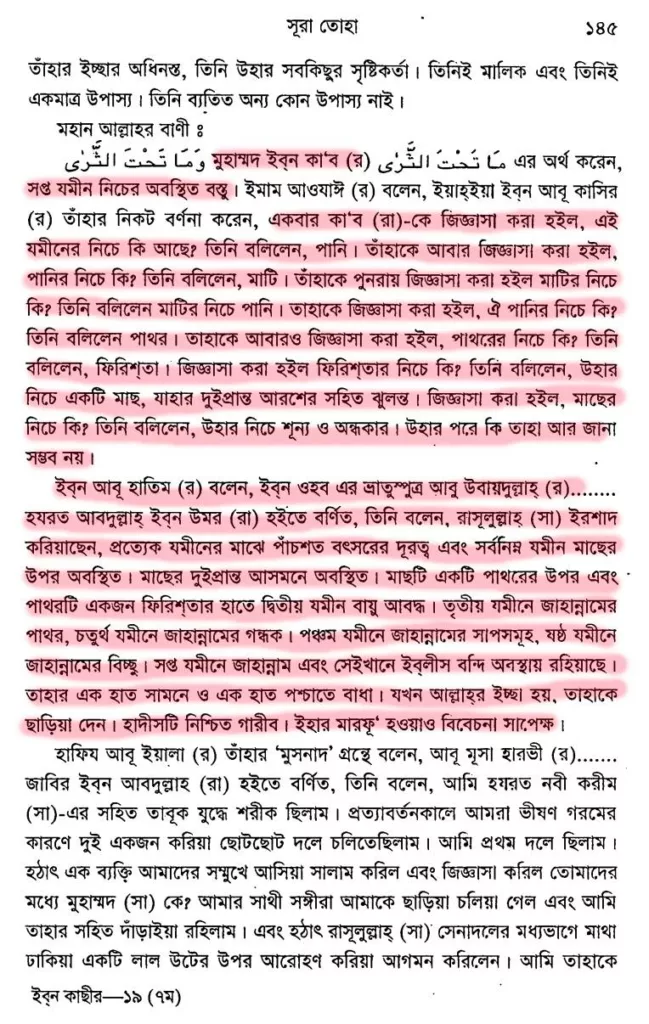
In this narration, a clear positional concept of the structure beneath the earth is found. First, water is placed beneath the known earth. Beneath that water is another earth. Then again water and again earth. In this way, after crossing layers of water and earth one after another, the position of a rock is described. Beneath the rock is an angel and beneath that is a fish. That is, a sequence of multiple physical and supernatural elements has been created to hold the various layers of the earth. The description of the two ends of the fish hanging from the Throne connects this structure beyond the lower limit of the earth to the heavens.
The statement narrated in the name of Ka’b here is a description of a specific cosmological arrangement. There is no basis to assume the layers of water and earth as synonyms for the crust and mantle in a geological sense. In the narration, water and earth are mentioned as alternating separate layers; in the lowest part are a rock, an angel, and a fish. In modern geosciences, the composition of the various internal layers of the earth is determined from the chemical composition of rocks, density, pressure, temperature, and the characteristics of seismic waves. No evidence has been found there for the position of a fish or an angel beneath alternating oceans and separate earths.
Another characteristic of this narration is that the limit of knowledge is defined upon reaching the lowest part. Although wind and darkness are mentioned beneath the fish, it is stated that nothing more is known about what lies beneath that. Such boundaries of knowledge are particularly significant in ancient cosmological imaginations. Very specific details are given about the position of more earths, water, rock, angels, and fish beneath the known earth, yet the end of knowledge is declared upon reaching the final edge of that structure. No part of these descriptions is based on observation or measurement; they have been preserved as cosmological concepts prevalent in ancient religious narrative literature.
Narration of Ibn Abbas: Ocean, green rock, and bull beneath the fish
In the tafsir of al-Qurtubi, in the explanation of the same verse, another description of the structure beneath the earth is found in the name of Ibn Abbas. Here, the earths are said to be placed upon a fish named Nun. The fish is said to be situated upon the ocean, and it is described that the head and tail of the fish meet beneath the Throne. The ocean beneath the fish is established upon a green rock. In the narration, a relationship is also established between that green rock and the color of the sky. The rock is upon the horn of a bull, and the bull is situated upon the soil. Then it is said, no one but Allah knows what lies beneath that soil. [56]
لَهُ مَا فِي السَّمَاوَاتِ وَمَا فِي الْأَرْضِ وَمَا بَيْنَهُمَا وَمَا تَحْتَ الثَّرَى يَرِيدُ مَا تَحْتَ الصَّخْرَةِ الَّتِي لَا يَعْلَمُ مَا تَحْتَهَا إِلَّا اللَّهُ تَعَالَى.
وَقَالَ مُحَمَّدُ بْنُ كَعْبٍ: يَعْنِي الْأَرْضَ السَّابِعَةَ.
ابْنُ عَبَّاسٍ: الْأَرْضُ عَلَى نُونٍ، وَالنُّونُ عَلَى الْبَحْرِ، وَأَنَّ طَرَفَيِ النُّونِ رَأْسَهُ وَذَنَبَهُ يَلْتَقِيَانِ تَحْتَ الْعَرْشِ، وَالْبَحْرُ عَلَى صَخْرَةٍ خَضْرَاءَ السَّمَاءُ مِنْهَا، وَهِيَ الَّتِي قَالَ اللَّهُ تَعَالَى فِيهَا: فَتَكُنْ فِي صَخْرَةٍ أَوْ فِي السَّمَاوَاتِ أَوْ فِي الْأَرْضِ، وَالصَّخْرَةُ عَلَى قَرْنِ ثَوْرٍ، وَالثَّوْرُ عَلَى الثَّرَى، وَمَا يَعْلَمُ مَا تَحْتَ الثَّرَى إِلَّا اللَّهُ تَعَالَى.
English translation: ‘Whatever is in the heavens, whatever is on the earth, whatever is between them, and whatever is beneath the soil—all belongs to Him’—here, that which is beneath the rock is meant, and no one knows what is beneath it except Allah.
Muhammad ibn Ka’b said that this refers to the seventh earth.
Ibn Abbas said that the earth is situated upon a fish named Nun. The fish is upon the sea. The two ends of the fish, namely its head and tail, meet beneath the Throne. The sea is situated upon a green rock, and the greenish color of the sky is described as being related to it. This is the same rock about which Allah said, ‘Even if it be within a rock or in the heavens or on the earth.’ The rock is situated upon the horn of a bull, and the bull is upon moist soil. No one knows what is beneath that soil except Allah.
In this account, the structure beneath the earth differs from the narration of Ka’b compiled by Ibn Kathir. In Ka’b’s narration, beneath successive layers of water and earth there is a rock, beneath the rock is an angel, and beneath the angel is a fish. However, in the narration of Ibn Abbas compiled by al-Qurtubi, the earth is directly upon the fish, the fish is upon the sea, the sea is upon the green rock, and the rock is upon the horn of the bull. In the first account, the angel is an important element of the stratification beneath the earth; in the second account, the bull is found in that position. Both narrations contain the concept of the existence of a fish and a rock beneath the earth, but their positional relationships are not the same.
Another point is particularly noteworthy in al-Qurtubi’s narration. Here, a relationship is established between the rock mentioned in verse 16 of Surah Luqman of the Quran and the green rock located beneath the earth. The verse in Surah Luqman states that even an object the size of a mustard seed, if it were within a rock, in the heavens, or on the earth, Allah is capable of bringing it forth. However, in the discussions of ancient tafsir, that rock has been identified as a specific cosmic rock that supports the sea and the fish beneath the earth. In other words, an attempt is found here to explain the mention of a rock in a verse regarding moral exhortation as part of the physical structure of the earth.
Tafsir al-Baghawi: The cosmic bull that swallows the sea water
In Tafsir al-Baghawi, a nearly identical narration in the name of Ibn Abbas is preserved in the explanation of verse 6 of Surah Taha. But there is an additional detail in al-Baghawi’s account. It is stated there that the mouth of the bull located beneath the earth remains open. When Allah turns all the seas into one sea, that water will enter the stomach of the bull through its mouth and dry up there. Consequently, the bull beneath the earth here is not only a creature bearing the weight of the cosmic structure; it is also linked to the future state of the sea water. [57]
(لَهُ مَا فِي السَّمَاوَاتِ وَمَا فِي الْأَرْضِ وَمَا بَيْنَهُمَا) يَعْنِي الْهَوَاءَ، (وَمَا تَحْتَ الثَّرَى) وَالثَّرَى هُوَ التُّرَابُ النَّدِيُّ. قَالَ الضَّحَّاكُ: يَعْنِي مَا وَرَاءَ الثَّرَى مِنْ شَيْءٍ.
وَقَالَ ابْنُ عَبَّاسٍ: إِنَّ الْأَرَضِينَ عَلَى ظَهْرِ النُّونِ، وَالنُّونُ عَلَى بَحْرٍ، وَرَأْسُهُ وَذَنَبُهُ يَلْتَقِيَانِ تَحْتَ الْعَرْشِ، وَالْبَحْرُ عَلَى صَخْرَةٍ خَضْرَاءَ، خُضْرَةُ السَّمَاءِ مِنْهَا، وَهِيَ الصَّخْرَةُ الَّتِي ذَكَرَ اللَّهُ فِي قِصَّةِ لُقْمَانَ: (فَتَكُنْ فِي صَخْرَةٍ)، وَالصَّخْرَةُ عَلَى قَرْنِ ثَوْرٍ، وَالثَّوْرُ عَلَى الثَّرَى، وَمَا تَحْتَ الثَّرَى لَا يَعْلَمُهُ إِلَّا اللَّهُ عَزَّ وَجَلَّ، وَذَلِكَ الثَّوْرُ فَاتِحٌ فَاهُ، فَإِذَا جَعَلَ اللَّهُ عَزَّ وَجَلَّ الْبِحَارَ بَحْرًا وَاحِدًا سَالَتْ فِي جَوْفِ ذَلِكَ الثَّوْرِ، فَإِذَا وَقَعَتْ فِي جَوْفِهِ يَبِسَتْ.
English translation: ‘Whatever is in the heavens, whatever is on the earth, and whatever is between them’—here, the intermediate space refers to the air. And ‘whatever is beneath the soil’—here ‘sara’ refers to moist soil. Dahhak said that this refers to whatever is beneath the soil.
Ibn Abbas said that the earths are situated upon the back of the fish named Nun. The fish is upon a sea. The head and tail of the fish meet beneath the Throne. The sea is situated upon a green rock, and the greenish color of the sky comes from that rock. This is the same rock that Allah mentioned in the account of Luqman: ‘Even if it be within a rock.’ The rock is upon the horn of a bull, and the bull is situated upon moist soil. No one knows what is beneath that soil except Allah the Almighty.
The mouth of that bull remains open. When Allah turns all the seas into one sea, the water of that sea will flow into the stomach of the bull. Once the water enters its stomach, it will dry up.
The structure beneath the earth in the narrations of al-Baghawi and al-Qurtubi is nearly identical. In both cases, the positions of the fish, sea, green rock, and bull are described in the same order. Consequently, there is no basis to count these as two independent direct testimonies; rather, the same type of ancient narration has been preserved and propagated in multiple important tafsir works. The additional detail in al-Baghawi’s narration regarding the sea water entering and drying up through the bull’s mouth relates this cosmic creature to the state of natural water bodies.
The physical claims of this narration are not consistent with the actual structure of the earth. The seas of the earth are not supported by a rock placed upon a giant fish or bull. Ocean water resides in the lowlands of the Earth’s crust due to the earth’s gravity. The position, flow, evaporation, condensation, and events of the water cycle of the sea can be explained through observable physical processes. The idea that a giant bull beneath the earth is receiving sea water with its mouth open, or that in the future all sea water will enter its stomach and dry up, has no geological or physical basis.
Wahb ibn Munabbih: The sea between the seven earths and Hell below
In the explanation of the same verse, al-Qurtubi has preserved another detailed account in the name of Wahb ibn Munabbih. In this narration, the structure beneath the earth is explained through the sea, Hell, air, and darkness instead of the fish and bull. According to Wahb’s statement, there are seven seas upon the earth and the earth is also seven. There is one sea between every two earths. The lowest sea surrounds the edge of Hell. Due to the vast amount of water and the coolness of that sea, the fire of Hell cannot burn everything above the earth. Hell itself is upon the air, and the air is situated upon a vast covering of darkness. Finally, that covering of darkness is described as being established upon the soil. [58]
وَقَالَ وَهْبُ بْنُ مُنَبِّهٍ: عَلَى وَجْهِ الْأَرْضِ سَبْعَةُ أَبْحُرٍ، وَالْأَرَضُونَ سَبْعٌ، بَيْنَ كُلِّ أَرْضَيْنِ بَحْرٌ، فَالْبَحْرُ الْأَسْفَلُ مُطْبِقٌ عَلَى شَفِيرِ جَهَنَّمَ، وَلَوْلَا عِظَمُهُ وَكَثْرَةُ مَائِهِ وَبَرْدُهُ لَأَحْرَقَتْ جَهَنَّمُ كُلَّ مَنْ عَلَيْهَا، قَالَ: وَجَهَنَّمُ عَلَى مَتْنِ الرِّيحِ، وَمَتْنُ الرِّيحِ عَلَى حِجَابٍ مِنَ الظُّلْمَةِ، لَا يَعْلَمُ عِظَمَهُ إِلَّا اللَّهُ تَعَالَى، وَذَلِكَ الْحِجَابُ عَلَى الثَّرَى، وَإِلَى الثَّرَى انْتَهَى عِلْمُ الْخَلَائِقِ.
English translation: Wahb ibn Munabbih said that there are seven seas on the surface of the earth and there are seven earths. There is one sea between every two earths. The lowest sea surrounds the edge of Hell. If the vastness, the immense amount of water, and the coolness of that sea were not present, the fire of Hell would have burned everything that is above it.
He further said that Hell is situated upon the air, and that air is established upon a covering of darkness. No one knows how vast that covering of darkness is except Allah the Almighty. The covering of darkness is situated upon moist soil, and the limit of the knowledge of creation reaches up to that soil.
A special kind of cosmic causal relationship has been created in this account of Wahb ibn Munabbih. The fire of Hell is located beneath the earth, but there is a vast sea above it. The amount of water and the coolness of that sea protect the upper world from the heat of Hell. That is, the existence of the sea beneath the earth is explained not only as a geographical stratification but also as a natural barrier preventing the influence of the fire of Hell. According to the narration, if this resistance of the sea were not present, the fire of Hell would have destroyed everything above.
There is a fundamental difference between this concept and the actual thermal structure of the Earth. Temperature inside the Earth increases with depth, and the core temperature reaches several thousand degrees Celsius. However, the source of that heat is the Earth’s internal energy, residual heat from the planet’s formation, and various physical processes including the decay of radioactive elements. No cosmic ocean has been found existing beneath the Earth to keep the fires of Hell cool. The structure established by observing heat transfer within the Earth, heat flow in the crust, volcanic activity, and mantle dynamics has no consistency with the stratification of Hell-ocean-wind-darkness described by Wahb.
Narration of Ibn Abi Hatim: The highest earth upon the fish and the elements of Hell in the lower layers
In the explanation of the same verse, Ibn Kathir has compiled a detailed statement of Muhammad on the authority of Abdullah ibn Amr via Ibn Abi Hatim. Here, separate characteristics are mentioned for each of the seven layers beneath the Earth. According to the narration, there is a distance of a five-hundred-year journey between every two earths. The highest earth is situated on the back of a giant fish. The two ends of the fish meet in the sky. The fish is upon a rock, and that rock is in the hand of an angel. The second earth is called the prison of wind. In the third earth are the rocks of Hell, in the fourth earth the sulfur of Hell, in the fifth earth the snakes of Hell, and in the sixth earth the scorpions of Hell are described to be located. In the seventh earth is the Hell called Saqar, and there Iblis is kept imprisoned in iron chains. [59]
وَقَالَ ابْنُ أَبِي حَاتِمٍ: حَدَّثَنَا أَبُو عُبَيْدِ اللَّهِ ابْنُ أَخِي ابْنِ وَهْبٍ، حَدَّثَنَا عَمِّي، حَدَّثَنَا عَبْدُ اللَّهِ بْنُ عَيَّاشٍ، حَدَّثَنَا عَبْدُ اللَّهِ بْنُ سُلَيْمَانَ عَنْ دَرَّاجٍ، عَنْ عِيسَى بْنِ هِلَالٍ الصَّدَفِيِّ، عَنْ عَبْدِ اللَّهِ بْنِ عَمْرٍو قَالَ: قَالَ رَسُولُ اللَّهِ صَلَّى اللَّهُ عَلَيْهِ وَسَلَّمَ: “إِنَّ الْأَرَضِينَ بَيْنَ كُلِّ أَرْضٍ وَالَّتِي تَلِيهَا مَسِيرَةُ خَمْسِمِائَةِ عَامٍ، وَالْعُلْيَا مِنْهَا عَلَى ظَهْرِ حُوتٍ، قَدِ الْتَقَى طَرَفَاهُ فِي السَّمَاءِ، وَالْحُوتُ عَلَى صَخْرَةٍ، وَالصَّخْرَةُ بِيَدِ الْمَلَكِ، وَالثَّانِيَةُ سِجْنُ الرِّيحِ، وَالثَّالِثَةُ فِيهَا حِجَارَةُ جَهَنَّمَ، وَالرَّابِعَةُ فِيهَا كِبْرِيتُ جَهَنَّمَ، وَالْخَامِسَةُ فِيهَا حَيَّاتُ جَهَنَّمَ، وَالسَّادِسَةُ فِيهَا عَقَارِبُ جَهَنَّمَ، وَالسَّابِعَةُ فِيهَا سَقَرُ، وَفِيهَا إِبْلِيسُ مُصَفَّدٌ بِالْحَدِيدِ، يَدٌ أَمَامَهُ وَيَدٌ خَلْفَهُ، فَإِذَا أَرَادَ اللَّهُ أَنْ يُطْلِقَهُ لِمَا يَشَاءُ أَطْلَقَهُ”.
هَذَا حَدِيثٌ غَرِيبٌ جِدًّا وَرَفْعُهُ فِيهِ نَظَرٌ.
English translation: Ibn Abi Hatim said, Abu Ubaydullah, the nephew of Ibn Abi Wahb, narrated to us. He said, my uncle narrated to us. He said, Abdullah ibn Ayyash narrated to us. He said, Abdullah ibn Sulayman narrated from Darraj, Darraj from Isa ibn Hilal as-Sadafi, and he from Abdullah ibn Amr. Abdullah ibn Amr said, the Messenger of Allah said:
The distance between every earth and the earth following it is equal to a five-hundred-year journey. Among these, the highest earth is situated on the back of a fish. The two ends of the fish meet in the sky. The fish is upon a rock, and the rock is in the hand of an angel.
The second earth is the prison of wind. In the third earth are the rocks of Hell. In the fourth earth is the sulfur of Hell. In the fifth earth are the snakes of Hell. In the sixth earth are the scorpions of Hell. In the seventh earth is Saqar, and there Iblis is kept imprisoned in iron chains. One of his hands is tied in front and one hand behind. When Allah wishes to release him for some purpose, He releases him.
Ibn Kathir said, this hadith is extremely gharib, and the matter of narrating it as a statement of Muhammad is questionable.
In this narration, the position of Hell and Iblis is directly linked to the structure beneath the Earth. The various layers of the Earth are as if designated as separate places for various elements of Hell. In the third earth rocks, in the fourth earth sulfur, in the fifth earth snakes, and in the sixth earth scorpions—in this arrangement, the punitive elements of Hell are given actual spatial positions. By mentioning Saqar and the imprisonment of Iblis in the final seventh earth, the world beneath the Earth is merged with the location of Hell.
Here, there is an important difference between Ibn Kathir’s original Arabic text and the common Bengali translation. In the Arabic narration وَالْعُلْيَا مِنْهَا عَلَى ظَهْرِ حُوتٍ it is stated. This means, among the earths, the highest earth is situated on the back of the fish. A translation such as ‘the lowest earth is situated on the fish’ is opposite to the original Arabic statement. Similarly, in the original Arabic, the name of the narrator is عَبْدِ اللَّهِ بْنِ عَمْرٍو, meaning Abdullah ibn Amr. Identifying him as Abdullah ibn Umar changes the identity of the narrator. These two differences are important, because one changes the position of the Earth’s stratification and the other changes the identity of the source of the narration.
Ibn Kathir called the narration extremely gharib and raised questions regarding its attribution as a statement of Muhammad. This is his own assessment regarding the historical reliability of the narration. Consequently, there is no basis to accept the narration as an established historical statement of Muhammad. However, the presence of this account in the collections of Ibn Abi Hatim and Ibn Kathir shows how detailed the concepts were in ancient Islamic narrative literature regarding the structure beneath the seven earths, the fish, the angel, and the positions of various elements of Hell. When the physical claims of these narrations are compared with reality, neither the Earth on the back of a fish, the rock in the hand of an angel, nor the location of snakes, scorpions, and Hell in separate subterranean earths has any geological basis.
What is beneath the Earth: Another narration of the question-answer between Muhammad and Jibrail
In the same discussion in Tafsir Ibn Kathir, another long narration on the authority of Jabir ibn Abdullah from the Musnad of Abu Ya’la is quoted. According to the narration, while returning from the Tabuk expedition, a man came to Muhammad and asked several questions, the answers to which are not meant for ordinary people to know. Among the questions were the sleep of the Prophet, the resemblance of children to their parents, and the structure beneath the Earth. In answer to the question of what is beneath the Earth, Muhammad first mentions creation, then the earth, water, darkness, wind, and moist soil. Finally, when asked what is beneath that soil, tears come to Muhammad’s eyes and he says that the limit of the knowledge of creation has ended at the knowledge of the Creator. At the end of the narration, the questioner is identified as Jibrail. [60]
ثُمَّ قَالَ: يَا مُحَمَّدُ، مَا تَحْتَ هَذِهِ؟ يَعْنِي الْأَرْضَ. فَقَالَ رَسُولُ اللَّهِ صَلَّى اللَّهُ عَلَيْهِ وَسَلَّمَ: “خَلْقٌ”. فَقَالَ: فَمَا تَحْتَهُمْ؟ قَالَ: “أَرْضٌ”. قَالَ: فَمَا تَحْتَ الْأَرْضِ؟ قَالَ: “الْمَاءُ”. قَالَ: فَمَا تَحْتَ الْمَاءِ؟ قَالَ: “ظُلْمَةٌ”. قَالَ: فَمَا تَحْتَ الظُّلْمَةِ؟ قَالَ: “الْهَوَاءُ”. قَالَ: فَمَا تَحْتَ الْهَوَاءِ؟ قَالَ: “الثَّرَى”. قَالَ: فَمَا تَحْتَ الثَّرَى؟ فَفَاضَتْ عَيْنَا رَسُولِ اللَّهِ صَلَّى اللَّهُ عَلَيْهِ وَسَلَّمَ بِالْبُكَاءِ، وَقَالَ: “انْقَطَعَ عِلْمُ الْمَخْلُوقِينَ عِنْدَ عِلْمِ الْخَالِقِ، أَيُّهَا السَّائِلُ، مَا الْمَسْئُولُ عَنْهَا بِأَعْلَمَ مِنَ السَّائِلِ”.
قَالَ: فَقَالَ: صَدَقْتَ، أَشْهَدُ أَنَّكَ رَسُولُ اللَّهِ. فَقَالَ رَسُولُ اللَّهِ صَلَّى اللَّهُ عَلَيْهِ وَسَلَّمَ: “أَيُّهَا النَّاسُ، هَلْ تَدْرُونَ مَنْ هَذَا؟” قَالُوا: اللَّهُ وَرَسُولُهُ أَعْلَمُ. قَالَ: “هَذَا جِبْرِيلُ”.
English translation: Then the man said, O Muhammad, what is beneath this earth? The Messenger of Allah said, there is creation. The man asked, what is beneath them? He said, the earth. The man asked, what is beneath the earth? He said, water. The man asked, what is beneath the water? He said, darkness. The man asked, what is beneath the darkness? He said, wind. The man asked, what is beneath the wind? He said, moist soil.
The man asked again, what is beneath the moist soil? Then the two eyes of the Messenger of Allah became tearful and he said, the limit of the knowledge of creation has ended upon reaching the knowledge of the Creator. O questioner, the one being asked about the answer to this question knows no more than the questioner.
The man said, you have spoken the truth. I bear witness that you are the Messenger of Allah. Then the Messenger of Allah said, O people, do you know who this person is? They said, Allah and His Messenger know best. He said, this person is Jibrail.
Ibn Kathir identified this narration as extremely gharib and its sequence of events as unusual. He mentioned that Qasim ibn Abdur Rahman propagated this narration alone, and there are negative assessments of him by Yahya ibn Ma’in, Abu Hatim al-Razi, and Ibn Adi. Ibn Kathir further commented that various statements and hadiths have become mixed within the narration; this may have occurred due to the narrator’s error or through intentional additions. Consequently, this particular question-answer session cannot be called an established historical event that occurred between Muhammad and Jibrail. However, another form of the prevailing concept regarding the layers beneath the Earth in ancient hadith and tafsir literature is preserved here. [61]
هَذَا حَدِيثٌ غَرِيبٌ جِدًّا، وَسِيَاقٌ عَجِيبٌ، تَفَرَّدَ بِهِ الْقَاسِمُ بْنُ عَبْدِ الرَّحْمَنِ هَذَا، وَقَدْ قَالَ فِيهِ يَحْيَى بْنُ مَعِينٍ: “لَيْسَ يُسَاوِي شَيْئًا”، وَضَعَّفَهُ أَبُو حَاتِمٍ الرَّازِيُّ، وَقَالَ ابْنُ عَدِيٍّ: لَا يُعْرَفُ.
قُلْتُ: وَقَدْ خَلَطَ فِي هَذَا الْحَدِيثِ، وَدَخَلَ عَلَيْهِ شَيْءٌ فِي شَيْءٍ، وَحَدِيثٌ فِي حَدِيثٍ. وَقَدْ يُحْتَمَلُ أَنَّهُ تَعَمَّدَ ذَلِكَ، أَوْ أُدْخِلَ عَلَيْهِ فِيهِ، فَاللَّهُ أَعْلَمُ.
English translation: This hadith is extremely gharib and its sequence of events is astonishing. Qasim ibn Abdur Rahman narrated it alone. Yahya ibn Ma’in said regarding him that he holds no value. Abu Hatim al-Razi called him weak and Ibn Adi stated that he is not known.
Ibn Kathir said that in this hadith, he has mixed various matters. One statement has been mixed with another, and one hadith with another. It could be that he did this intentionally or that something else was inserted into his narration. Allah knows best.
There are both similarities and differences between this question-and-answer session attributed to Jabir and the narration preserved in the name of Ka’b. In both cases, water, darkness, and the ultimate limit of knowledge are found beneath the earth. However, in Ka’b’s narration, there are stones, angels, and fish following successive layers of water and earth; in the narration attributed to Jabir, a sequence of creation, earth, water, darkness, wind, and moist soil is found beneath the earth. These positional differences show that an immutable and consensus structure was not preserved in ancient narrative literature regarding the world beneath the earth. Rather, the list of elements and the order of their positions beneath the earth varied across different narrations.
Mutual inconsistencies in the descriptions of the structure beneath the earth
When the narrations compiled by al-Tabari, Ibn Kathir, al-Qurtubi, and al-Baghawi are placed side by side, several distinct concepts regarding the structure beneath the earth emerge. In Ka’b’s statement, there are stones, angels, and fish following successive layers of water and earth. In the narrations of al-Qurtubi and al-Baghawi in the name of Ibn Abbas, the earth is upon a fish, the fish is upon a sea, the sea is upon a green stone, and the stone is upon the horn of a bull. In the statement of Wahb ibn Munabbih, there is a sea between the seven earths and Hell is beneath the lowest sea; Hell is established upon wind and darkness. In the hadith compiled via Ibn Abi Hatim, the highest earth is upon a fish, the fish is upon a stone, and the stone is in the hand of an angel. And in the question-and-answer session attributed to Jabir, a sequence of water, darkness, wind, and moist soil is found beneath the earth.
Although these accounts are part of the same kind of ancient cosmological imagination, their positional claims are not the same. In one narration, there is an angel beneath the stone and a fish beneath the angel; in another, there is a stone beneath the fish and the stone is in the hand of an angel. In another narration, there is a sea beneath the fish, a stone beneath the sea, and a bull beneath the stone. In some narrations, there is water between the earths, while in others, each earth is shown as the position of a separate element of Hell. These contradictory positional descriptions regarding the same part of the same physical structure cannot be true simultaneously.
Another important characteristic of the narrations is that a series of carriers was required to support the structure beneath the earth. The earth is upon a fish, the fish is upon a sea, the sea is upon a stone, the stone is upon a bull, and the bull is upon the soil—in this way, each layer is shown as established with the help of another layer. Again, in Ka’b’s narration, there is an angel beneath the stone and a fish beneath the angel. In this type of structure, the idea that one object requires another object to hold it has expanded continuously downwards. Finally, at some stage, the sequence is declared finished by mentioning darkness, wind, or an unknown boundary. But such a succession of carriers is not necessary to explain the stability of the actual earth.
The earth is a gravitationally bound planet. Its various internal layers are arranged based on the density, pressure, temperature, and chemical composition of matter. There is no need to place the earth on the back of a giant creature or in the hand of a supernatural entity. Objects fall downwards on the earth’s surface due to the earth’s gravity. The pressure of matter and gravitational balance within the earth play a crucial role in determining its structure. Consequently, the idea of a succession of carriers such as water, stone, fish, and angels beneath the earth is fundamentally inconsistent with the structure of the earth established in modern physics and geosciences.
The actual geological structure of the earth cannot be known from these narrations preserved in ancient Islamic tafsir. However, these narrations reveal an important historical truth: in response to the question of what lies beneath the earth, various cosmological structures consisting of water, separate earths, stones, angels, giant fish, bulls, Hell, wind, and darkness were prevalent in ancient Islamic religious literature. These were not compiled merely as ornamental metaphors; rather, they were presented as descriptions of the actual position beneath the earth as statements of various individuals and, in some cases, as hadiths of Muhammad. Simultaneously, the positional inconsistencies among these accounts and the differences in the reliability of the chains of narration are also preserved in the books of the compilers. Modern scientific investigation into the actual composition of the earth has found no factual basis for these cosmological structures.
Seven Heavens, Seven Earths, and Other Forms of Ancient Islamic Cosmology
The story of Earth resting on a fish reveals a broader feature of ancient Islamic cosmology. Creation was imagined in terms of the heavens above, the earths below, and the inhabited world between them. In al-Tabari’s report through al-Suddi, Nun the fish, water, rocks, and an angel support one another, while mountains prevent the land from shaking. Other narratives rearrange the fish or introduce a bull and darkness. Sometimes the fish directly supports the Earth; sometimes rocks, angels, or a bull intervene. Even the order of these supposed supports varies. Although these texts make detailed claims about the structure of the world, they preserve no single accurate account of it. Yet this shifting imaginary geography was used to produce teachings about creation and religious knowledge.
The closest connections concern the seven earths, the seven layered heavens, and their purported distances. The same traditions that separate the lower earths by journeys of five hundred years also assign thicknesses and distances to the heavens above. Accounts of the supposed materials of the heavens describe their physical nature, while another discussion addresses the distance between heaven and Earth. Reports locating the celestial sanctuary of Bayt al-Mamur directly above the Kaaba, and describing Allah’s descent to the nearest heaven, provide further examples of this imagined vertical geography. These accounts position discrete levels, distances, and places of worship above the terrestrial world. They treat the universe as a space whose boundaries and layers can supposedly be known through religious narration.
The movements of the Sun and phenomena observed in the sky were also tied to religious narratives. Reports of the Sun’s journey beneath the Throne and its prostration describe its movement and worship under the Throne. Attempts to identify the Milky Way with a gate of heaven link the luminous band in the night sky to celestial gates and flowing water. Claims that meteors do not appear on Laylat al-Qadr associate meteors with devils and heavenly events. Instead of establishing the causes of visible astronomical phenomena, these explanations invoke unseen beings, celestial passages, and religious events. The observational explanations of the Sun’s apparent movement, meteors, and the Milky Way do not rest on those religious assumptions.
Familiar terrestrial phenomena were likewise attributed to an unseen realm, though these accounts do not all describe the same spatial structure. Reports of the heavenly origin of the Nile and Euphrates associate the rivers with Muhammad’s night journey, contradicting the known geography of their sources and drainage systems. Hadiths explaining summer and winter through the breathing of Hell attribute seasonal temperature differences to that supernatural cause, whereas Earth’s axial tilt, solar illumination, and atmospheric physics explain the seasons. Other early narratives locate Hell and Sijjin beneath the Earth and imagine the subterranean realm as a place of punishment in the afterlife. These are distinct stories about rivers, seasons, and the world below, but each attempts to explain a real phenomenon by invoking an unverified invisible cause.
The fundamental problem with these cosmic accounts is not simply that they contain supernatural figures. They purport to explain earthquakes through the movement of a fish, the stability of the Earth through mountains, ocean tides through the breathing of a bull, seasonal temperatures through the breathing of Hell, and distances between heavens in terms of journeys lasting centuries. These are claims about the causes of physical phenomena, not mere decorative elements of a story. Even a report judged to have a sound chain does not thereby establish the truth of its physical assertions. Nor does the repetition of an erroneous account in several books constitute independent scientific corroboration.
The long survival of these ideas in modern teachings of Islamic creed is particularly revealing. Ibn Baz, al-Fawzan, al-Uthaymin, and Salih Al al-Shaykh discuss five-hundred-year distances between heavens, the layered heavenly structure, and the positions of Kursi and Throne as genuine cosmic knowledge. Al-Fawzan explicitly opposed modern astronomy on the strength of those accounts and denied that Earth revolves around the Sun. Whether the subject is the ancient story of a fish below the Earth or the supposed dimensions of the heavens in modern theology, religious authority and unverified reports are privileged over tested knowledge of nature. The Earth-bearing fish is therefore not just an eccentric folktale: it is a notable example of a much longer history of treating religious narratives as explanations of the natural world.
Conclusion
Early Islamic literature gives many differing answers to what lies beneath the Earth, but they share a recurring conception: below the inhabited world lie further earths, seas, rocks, enormous creatures, angels, or the location of Hell. The Quran speaks of earths corresponding to the seven heavens, while al-Bukhari and Muslim transmit references to seven earths. On that foundation, exegetes produced elaborate descriptions assigning the earths inhabitants, intervals, thicknesses, and physical supports. In some versions the earths are stacked; in others seas alternate between them; elsewhere Earth rests on a fish, while an angel or bull bears the weight. These are documents of cosmological beliefs circulating in Islamic religious scholarship, not accounts of the Earth’s actual interior.
Among these beliefs, the tale of Nun the fish makes an especially clear and false causal claim. In a report transmitted under the name of Ibn Abbas, Allah spreads the Earth upon the fish; the fish moves and the Earth shakes; mountains are then installed to stop the movement. Al-Hakim declared the chain authentic according to the criteria of al-Bukhari and Muslim, and al-Dhahabi agreed with that assessment of the isnad. The composite report through al-Suddi also names Ibn Masud and other Companions, while al-Baghawi identifies Ibn Abbas, Mujahid, Muqatil, al-Suddi, and al-Kalbi as authorities for the fish interpretation. The narrative also appears in the writings of al-Tabari, Ibn Kathir, and al-Qurtubi. It is therefore not an allegation invented by modern critics but a superstition transmitted within early Islamic religious culture. The sources establish the history of its circulation; they do not establish the existence of the fish.
The scientific error of attributing earthquakes to the fish’s movements and stability to the installation of mountains can be tested directly. Earthquakes result from sudden slips along geological faults and the movement of tectonic plates. Many large mountain ranges were produced by those same processes: the Himalayas provide a clear example. Mountains therefore do not halt the planet’s tectonic movements. Nor is there a cosmic fish beneath the Earth: the planet has a crust, mantle, and predominantly iron-nickel core. The supposed five-hundred-year distances and thicknesses assigned to subterranean earths have no independent geological basis. Ancient cosmologies required an endless succession of rocks, water, angels, and animals to support the world; modern physics and geology require none of those imaginary bearers to explain the Earth’s structure and stability. The article’s related discussion of distances between heaven and Earth addresses the wider cosmological measurements.
The inconsistencies among the narratives are equally revealing. One version puts water and a rock beneath the fish, another places a rock in an angel’s hand below the fish, and yet another has the fish supporting a rock and an enormous horned bull. In one report two earths are separated by a five-hundred-year journey; another says seven hundred. Reports about the heavens introduce a further range of seventy-one to seventy-three years. Some modern scholars have sought to reconcile the figures by proposing different speeds of travel, but the accounts themselves specify no such speeds. Ibn Baz classified a Companion report about five-hundred-year distances as authentic; al-Fawzan used the traditional heavenly hierarchy against modern astronomy; al-Uthaymin and Salih Al al-Shaykh likewise discussed and accepted those measurements in works on Islamic creed. This continuity shows that cosmological claims without a scientific foundation did not lose their religious authority with the end of classical tafsir.
Ancient peoples lacked reliable knowledge of the Earth’s interior, earthquakes, and the true structure of space. That they devised stories to fill those gaps is unsurprising. The deeper problem arose when such stories were accepted as a Companion’s religious knowledge, Quranic interpretation, or an explanation with the authority of prophetic teaching, and then treated as factual descriptions of the world. A sound isnad does not make a physical claim true; repetition across books is not independent scientific evidence; and an ad hoc assumption introduced to reconcile contradictory numbers is no substitute for testing reality. In place of an Earth resting on a fish, mountains restraining its movement, seven inhabited earths, or heavens arranged at journeys of five hundred years, we possess the measurable findings of geology and astronomy. Ancient religious narratives tell us about the history of belief, not the actual structure of Earth and the universe.
References
- Al-Quran, Surah al-Qalam 68:1 ↩︎
- Tafsir al-Tabari, Surah al-Qalam 68:1 ↩︎
- Tafsir al-Tabari, Surah al-Qalam 68:1, report of Sufyan al-Thawri on the authority of Ibn Abbas ↩︎
- Al-Hakim, al-Mustadrak, 2:540, with the judgments of al-Hakim and al-Dhahabi ↩︎
- Tafsir al-Tabari, Quran 68:1 ↩︎
- Tafsir Ibn Kathir, Quran 68:1 ↩︎
- Tafsir al-Tabari, Quran 2:29 ↩︎
- Tafsir al-Baghawi, Quran 68:1 ↩︎
- Tafsir al-Qurtubi, Quran 68:1 ↩︎
- Tafsir al-Tabari, Surah al-Baqarah 2:29, report 591 ↩︎
- Tafsir Ibn Kathir, Surah Al-Qalam 68:1 ↩︎
- Tafsir Al-Baghawi, Surah Al-Qalam 68:1 ↩︎
- Tafsir al-Baghawi, Surah al-Qalam 68:1, narration of Kab al-Ahbar ↩︎
- Tafsir al-Qurtubi, Surah al-Qalam 68:1 ↩︎
- Al-Quran, Surah An-Nahl 16:15 ↩︎
- Al-Quran, Surah Al-Anbiya 21:31 ↩︎
- Tafsir al-Tabari, Surah An-Nahl 16:15 ↩︎
- Jami’ al-Tirmidhi, Hadith 3369, Kitab al-Tafsir ↩︎
- United States Geological Survey — What is an earthquake and what causes them to happen? ↩︎
- United States Geological Survey — The Himalayas: Two Continents Collide ↩︎
- USGS, Seismicity of the Earth 1900–2010: Himalaya and Vicinity, Open-File Report 2010–1083-J ↩︎
- Al-Quran, Surah At-Talaq 65:12 ↩︎
- Sahih Bukhari, Hadith 3195, Chapter: Beginning of Creation ↩︎
- Sahih Bukhari, Hadith 3196, Chapter: Beginning of Creation ↩︎
- Sahih Muslim, Hadith 1610a, Chapter: Prohibition of Unjustly Occupying Land ↩︎
- Tafsir al-Tabari, Surah At-Talaq 65:12 ↩︎
- Tafsir al-Tabari, Surah At-Talaq 65:12, narration of Ibn Abbas ↩︎
- Tafsir al-Tabari, Surah At-Talaq 65:12, narration of Qatadah ↩︎
- Tafsir Ibn Kathir, Surah At-Talaq 65:12 ↩︎
- Tafsir Ibn Kathir, Surah At-Talaq 65:12, narration of Ibn Abbas ↩︎
- Tafsir al-Qurtubi, Surah At-Talaq 65:12 ↩︎
- Tafsir al-Qurtubi, Surah At-Talaq 65:12, discussion of Mawardi ↩︎
- Tafsir al-Qurtubi, Surah At-Talaq 65:12, narration regarding the alternative position of the seven earths ↩︎
- Jami Tirmidhi, Hadith 3298, Kitab al-Tafsir, explanation of Surah al-Hadid ↩︎
- Tafsir al-Tabari, Surah at-Talaq 65:12, account of Abdullah ibn Masud ↩︎
- Tafsir al-Tabari, Surah At-Talaq 65:12, cosmological account narrated from Qatada ↩︎
- Tafsir Ibn Kathir, Surah Al-Hadid 57:3, mention of the alternative account in Musnad Ahmad ↩︎
- Abd al-Aziz ibn Baz, commentary on Kitab al-Tawhid, official lecture transcript 1 2 3 4
- Salih al-Fawzan, al-Mulakhkhas fi Sharh Kitab al-Tawhid ↩︎
- Salih al-Fawzan, Ianat al-Mustafid bi-Sharh Kitab al-Tawhid 1 2
- Ibn al-Uthaymin, Fatawa Nur ala al-Darb, official website ↩︎
- Ibn al-Uthaymin, Tahdhib al-Qawl al-Mufid ↩︎
- Ibn al-Uthaymin, Sharh Kitab al-Tawhid, lecture 53 1 2
- Ibn al-Uthaymin, ruling on the five-hundred-year report ↩︎
- Sunan Abu Dawud, hadith 4723 1 2 3 4
- Jami al-Tirmidhi, hadith 3320 1 2 3 4
- Salih Al al-Shaykh, al-Tamhid li-Sharh Kitab al-Tawhid 1 2
- Salih Al al-Shaykh, al-Tamhid li-Sharh Kitab al-Tawhid, p. 575 ↩︎
- NASA Science, What Is the Universe? ↩︎
- NASA Science — Facts About Earth, Structure ↩︎
- United States Geological Survey — P-wave and S-wave Paths Through the Earth ↩︎
- Al-Quran, Surah Taha 20:6 ↩︎
- Tafsir al-Tabari, Surah Taha 20:6 ↩︎
- Tafsir Ibn Kathir, Surah Taha 20:6, narration of Ka’b ↩︎
- Tafsir Ibn Kathir, Islamic Foundation Bangladesh, Volume 7, Page 145 ↩︎
- Tafsir al-Qurtubi, Surah Taha 20:6, narration of Ibn Abbas ↩︎
- Tafsir al-Baghawi, Surah Taha 20:6 ↩︎
- Tafsir al-Qurtubi, Surah Taha 20:6, narration of Wahb ibn Munabbih ↩︎
- Tafsir Ibn Kathir, Surah Taha 20:6, narration of Abdullah ibn Amr via Ibn Abi Hatim ↩︎
- Tafsir Ibn Kathir, Surah Taha 20:6, narration of Jabir ibn Abdullah from Musnad Abu Ya’la ↩︎
- Tafsir Ibn Kathir, Surah Taha 20:6, Ibn Kathir’s assessment regarding the narration of Jabir ↩︎
