
Introduction: Unhygienic Practices in the Name of Religion
Throughout human history, medical knowledge has developed through experimentation, observation, and evidence. Yet within medieval religious frameworks, human waste and animal excretions were sometimes promoted as “miraculous medicines.” The Islamic practice of drinking camel urine is one such controversial and unscientific prescription. Even in the twenty-first century, some believers continue to revere it as a Sunnah or sacred remedy. This belief is not merely absurd; it poses serious risks to public health.
According to Islamic hadith accounts, Muhammad instructed a group of sick people from the tribes of ‘Ukl and ‘Uraynah, who had come to him and embraced Islam, to drink camel milk and urine as treatment. Later jurists and religious scholars developed a legal framework around this account under which the urine and feces of animals whose meat is halal are considered ritually pure. But a declaration of ritual purity is no evidence of medical effectiveness or health safety. Urine is the product of a physiological excretory process through which the body eliminates metabolic waste, excess salts, urea, creatinine, and other dissolved substances. Promoting such animal waste as shifa—a source of healing—solely on religious authority, without independent scientific evidence, is irrational and dangerous to public health.
Camel Milk and Urine: Prophetic Medicine
The relevant reports are found in Mishkat al-Masabih, hadith 3539, and Sahih Muslim, Islamic Foundation edition, hadith 4207, and Hadith Academy edition, hadith 4246: [1] [2] [3]
Mishkat al-Masabih
Book 16: Qisas (Retaliation)
Chapter 4, First Section: On killing apostates and those who cause violent disorder
3539 (7). Narrated by Anas: Some people of the tribe of ‘Ukl came to the Prophet and embraced Islam, but the climate of Medina did not suit them. He directed them to go to the camels kept for charity and drink their milk and urine. They followed his directions and recovered. After recovering, however, they apostatized, killed the camel-herders, and drove off the camels. The Prophet sent men after them. When they were brought back, he had their hands and feet cut off and their eyes gouged out; their bleeding wounds were not cauterized, so that they died. Another version says their eyes were seared with iron rods. Another says that he ordered iron rods to be heated and applied to their eyes. They were then left on scorching ground. They asked for water, but none was given to them, until they died in that condition. (Bukhari and Muslim)
(1) Sahih: Bukhari 3018, 6802; Muslim 1671; Abu Dawud 4364; al-Nasa’i 4025; Ibn Majah 2578; Ahmad 12639.
Hadith classification: Sahih
Narrator: Anas ibn Malik.
Sahih Muslim (Islamic Foundation edition)
Book 29: Qasamah (oaths in cases of homicide), Muharibin (combatants), Qisas (retaliation), and Diyah (blood money)
Chapter 2: Judgment of combatants and apostates
4207. Abu Ja‘far Muhammad ibn al-Sabbah and Abu Bakr ibn Abi Shaybah narrated … from Anas that eight men of the tribe of ‘Ukl came to the Messenger of Allah and pledged allegiance to Islam. The climate there did not suit them and they fell ill, so they complained to him. The Prophet said, “Will you go with our herdsman and use the camels’ urine and drink their milk?” They replied, “Yes.” They went out, used the urine, and drank the milk. They recovered. Then they killed the herdsman and drove away the camels. When the news reached the Messenger, he sent men in pursuit. They were captured and brought back. Orders were given to amputate their hands and feet and to insert heated iron rods into their eyes. They were then thrown out into the sun until they died.
In Ibn al-Sabbah’s version, وَاطَّرَدُوا النَّعَمَ appears instead of وَطَرَدُوا الإِبِل; his report also contains وَسُمِّرَتْ أَعْيُنُهُمْ.
Hadith classification: Sahih
Narrator: Anas ibn Malik.
Sahih Muslim (Hadith Academy edition)
Book 29: Qasamah, Muharibin, Qisas, and Diyah
4246 (10/…). Abu Ja‘far Muhammad ibn al-Sabbah and Abu Bakr ibn Abi Shaybah narrated … from Anas: Eight men of the tribe of ‘Ukl came to the Messenger of Allah and pledged allegiance to him as Muslims. The climate of Medina did not suit them and they became ill, so they complained to the Messenger. The Prophet said, “Will you go with our herdsman and drink the urine and milk of the camels?” They said, “Yes.” They left and drank the urine and milk, and recovered. They then killed the herdsman and drove away the camels. When the news reached the Messenger of Allah, he sent men after them. They were caught and brought back. Orders were issued to cut off their hands and feet and to insert heated iron rods into their eyes. They were then left in the sun until they died. Ibn al-Sabbah’s version has وَاطَّرَدُوا النَّعَمَ in place of وَطَرَدُوا الإِبِلَ. The narrator added that their eyes were gouged out. (Islamic Foundation 4207; Islamic Center 4207)
Hadith classification: Sahih
Narrator: Anas ibn Malik.
Institutional Recognition as Prophetic Medicine
The acceptance of camel urine as a treatment does not rest solely on scattered hadith reports. Muhammad ibn Isma‘il al-Bukhari, compiler of Sahih al-Bukhari, devoted an entire chapter of his Book of Medicine to treatment using camel urine. Book 76 is entitled Kitab al-Tibb (The Book of Medicine). Its sixth chapter is called باب الدواء بأبوال الإبل, meaning “Treatment with the Urine of Camels.” Hadith 5686, narrated by Anas ibn Malik, records Muhammad’s instruction to drink camel milk and urine. The immediately preceding fifth chapter is devoted to treatment with camel milk. Bukhari thus gave camel milk and camel urine separate headings within his medical material. Camel urine was therefore not treated as an incidental detail of a historical episode or a directive relevant only to particular people; it was recognized as a therapeutic substance in the arrangement of the hadith collection. [4]
صحيح البخاري — كتاب الطب
باب الدواء بأبوال الإبل
حديث رقم: 5686
حَدَّثَنَا مُوسَى بْنُ إِسْمَاعِيلَ، حَدَّثَنَا هَمَّامٌ، عَنْ قَتَادَةَ، عَنْ أَنَسٍ ـ رضى الله عنه ـ أَنَّ نَاسًا، اجْتَوَوْا فِي الْمَدِينَةِ فَأَمَرَهُمُ النَّبِيُّ صلى الله عليه وسلم أَنْ يَلْحَقُوا بِرَاعِيهِ ـ يَعْنِي الإِبِلَ ـ فَيَشْرَبُوا مِنْ أَلْبَانِهَا وَأَبْوَالِهَا، فَلَحِقُوا بِرَاعِيهِ فَشَرِبُوا مِنْ أَلْبَانِهَا وَأَبْوَالِهَا، حَتَّى صَلَحَتْ أَبْدَانُهُمْ فَقَتَلُوا الرَّاعِيَ وَسَاقُوا الإِبِلَ، فَبَلَغَ النَّبِيَّ صلى الله عليه وسلم فَبَعَثَ فِي طَلَبِهِمْ، فَجِيءَ بِهِمْ فَقَطَعَ أَيْدِيَهُمْ وَأَرْجُلَهُمْ، وَسَمَرَ أَعْيُنَهُمْ. قَالَ قَتَادَةُ فَحَدَّثَنِي مُحَمَّدُ بْنُ سِيرِينَ أَنَّ ذَلِكَ كَانَ قَبْلَ أَنْ تَنْزِلَ الْحُدُودُ.
English translation:
Sahih al-Bukhari, Book of Medicine
Chapter: Treatment with Camel Urine
Hadith 5686
Musa ibn Isma‘il narrated to us; Hammam narrated to us from Qatadah, from Anas: Some people came to Medina and became ill because its climate did not agree with them. The Prophet instructed them to join his camel-herder and drink the camels’ milk and urine. They went to the herder and drank the milk and urine until their bodies recovered. They then killed the herder and drove off the camels. When the news reached the Prophet, he sent men in pursuit. The culprits were brought back; their hands and feet were amputated and their eyes were seared with heated iron rods. Qatadah said that Muhammad ibn Sirin told him this happened before the prescribed penal punishments (hudud) were revealed.
The therapeutic instruction in this hadith is explicit. The men had become ill because they could not adapt to the climate of Medina. Muhammad told them to go to his camel-herder and drink milk and urine to treat their illness. Drinking camel urine is not presented as the men’s arbitrary choice: the directive comes directly from Muhammad. The phrase فَيَشْرَبُوا مِنْ أَلْبَانِهَا وَأَبْوَالِهَا means that they should drink the camels’ milk and urine. The subsequent phrase فَشَرِبُوا مِنْ أَلْبَانِهَا وَأَبْوَالِهَا states that they actually obeyed. Both the order to drink urine and its implementation are therefore explicit. The report then says حَتَّى صَلَحَتْ أَبْدَانُهُمْ, asserting that their bodies recovered. Illness, the Prophet’s instruction, drinking urine, and recovery are presented as a sequence suggesting a causal connection. Bukhari used this very account as the basis of a chapter on medical treatment.
Bukhari’s classification is particularly significant. Elsewhere in his collection the same episode appears in discussions of crime, retaliation, and punishment. By placing it in the Book of Medicine, he also recognized a distinct therapeutic application. The very existence of one chapter on camel milk followed immediately by another on camel urine shows that drinking urine was no embarrassing detail overlooked by the compiler. He deliberately treated it as a medical subject. The latter part of the hadith recounts the killing of the herdsman, theft of the camels, and the brutal punishment in which the accused men’s hands and feet were amputated and their eyes seared with hot iron. Yet the reason for its placement in the Book of Medicine is the opening event: the order for sick men to drink camel urine. Its religious use thus extended beyond the law of retaliation or the punishment of offenders into the tradition of Islamic medicine itself.
Ibn Hajar al-‘Asqalani, the renowned commentator on Sahih al-Bukhari, also discusses the chapter “Treatment with Camel Urine” in volume ten of his Fath al-Bari. Alongside the account of the ‘Uraynah tribe, he quotes another report attributed to Ibn ‘Abbas through Ibn al-Mundhir, according to which camel urine is beneficial for intestinal illness. This is further evidence that classical hadith commentary treated camel urine as a substance credited with medicinal properties. The historical evidentiary value of the second report cited by Ibn Hajar is distinct from the classification of the hadith in Sahih al-Bukhari; its inclusion nonetheless shows that the camel-urine episode informed later discussions of medicine. [5]
قَوْلُهُ : ( بَابُ الدَّوَاءِ بِأَبْوَالِ الْإِبِلِ ) ذَكَرَ فِيهِ حَدِيثَ الْعُرَنِيِّينَ ، وَوَقَعَ فِي خُصُوصِ التَّدَاوِي بِأَبْوَالِ الْإِبِلِ حَدِيثٌ أَخْرَجَهُ ابْنُ الْمُنْذِرِ عَنِ ابْنِ عَبَّاسٍ رَفَعَهُ ” عَلَيْكُمْ بِأَبْوَالِ الْإِبِلِ فَإِنَّهَا نَافِعَةٌ لِلذَّرِبَةِ بُطُونِهِمْ ” وَالذَّرِبَةُ بِفَتْحِ الْمُعْجَمَةِ وَكَسْرِ الرَّاءِ جَمْعُ ذَرِبٍ ، وَالذَّرَبُ بِفَتْحَتَيْنِ فَسَادُ الْمَعِدَةِ .
English translation: His statement, “Chapter: Treatment with Camel Urine”: in it he cited the hadith of the people of ‘Uraynah. Another report specifically concerning treatment with camel urine was transmitted by Ibn al-Mundhir from Ibn ‘Abbas, who attributed it to the Prophet: “Use camel urine, for it is beneficial to those suffering from disorders of the stomach.” The term al-dharibah is the plural of dharib, while al-dharab refers to a disorder or impairment of the stomach.
The fundamental problem with the kind of evidence advanced by these religious texts for the medicinal effects of camel urine is that an account of a patient’s recovery does not establish that a particular substance caused it. Bukhari’s report provides no diagnosis, no measurements of the men’s condition, no dosage, no duration of treatment, and no information about other food or treatments they may have received. The men consumed both camel milk and urine, so the report cannot isolate any effect attributable to the urine itself. Nor does it supply the information needed to exclude changes in environment, rest, nutrition, the natural course of illness, or other causes. A religious account asserting recovery and an experimental demonstration of a causal relationship are entirely different things. The first records a historical claim; the second requires observable, reproducible, independently verifiable evidence.
By erasing this distinction, an ancient medical practice acquired religious authority in later centuries. That Muhammad told sick men to drink camel urine is what the hadith reports. That Bukhari placed this account in a chapter on treatment with camel urine is the compiler’s classification. That Ibn Hajar and subsequent commentators preserved the medical claim is part of the history of hadith interpretation. None of these three levels supplies independent scientific evidence of efficacy. A directive attributed to Muhammad, its inclusion in a hadith collection classified as sahih, and centuries of religious endorsement cannot establish the health benefits of animal waste. Rather, this episode demonstrates how an old therapeutic belief acquired institutional religious prestige through prophetic authority, hadith compilation, and classical commentary.
Zad al-Ma‘ad: The Urine of Animals Whose Meat Is Halal Is Pure
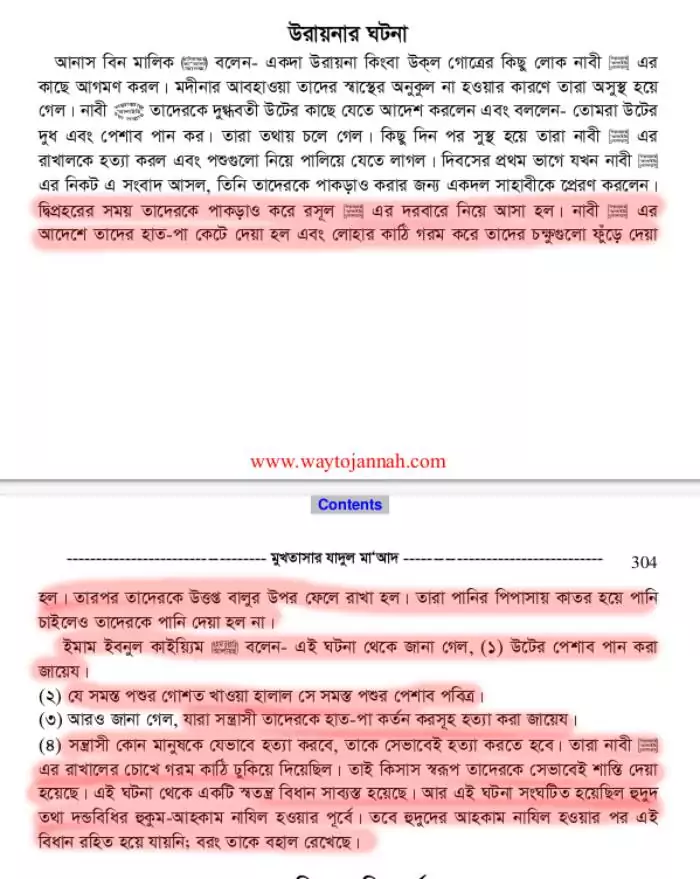
The following passage comes from the abridged Zad al-Ma‘ad, attributed to Ibn al-Qayyim, Wahidiyah Islamiyah Library edition, pp. 303–304. [6]
The Incident of ‘Uraynah
Anas ibn Malik said: One day, some people belonging to the tribe of ‘Uraynah or ‘Ukl came to the Prophet. The climate of Medina did not agree with them and they fell ill. The Prophet instructed them to go to the milk-producing camels and said, “Drink the camels’ milk and urine.” They went there. After recovering some days later, they killed the Prophet’s herdsman and fled with the animals. When the news reached the Prophet early in the day, he dispatched a group of Companions to arrest them. Around midday they were captured and brought before the Messenger. On the Prophet’s order their hands and feet were cut off and heated iron rods were driven into their eyes. They were then left on scorching sand. Although they pleaded for water in agony, none was given to them.
Ibn al-Qayyim stated that the following rulings can be derived from this event:
(1) Drinking camel urine is permissible.
(2) The urine of animals whose meat is halal is ritually pure.
(3) It is permissible to amputate the hands and feet of violent offenders and kill them.
(4) A violent offender may be executed in the same manner in which he killed someone. Since they had put heated iron rods into the herdsman’s eyes, the same punishment was inflicted on them as qisas (retaliation). This incident established a distinct ruling. It occurred before the ordinances of hudud (prescribed punishments) were revealed; yet the later revelation of those ordinances did not abrogate this ruling, which remained in force.
From Camel Urine to Animal Dung: The Ritual Purity of Excrement in Islamic Jurisprudence
The legal conclusions drawn in Islamic jurisprudence from the hadith about drinking camel urine extend far beyond camel urine itself. Taking a specific medical instruction by Muhammad as their starting point, a number of jurists formulated a general rule: both the urine and the feces of animals whose meat is halal are ritually pure under Islamic law. The rule encompasses cattle, goats, sheep, and other edible animals in addition to camels. Nor is this conception of purity limited to the permissibility of drinking a substance. It is applied to the ritual status of clothing worn during prayer, the human body, floors, and places of worship. A hadith about camel urine thus became a foundation for a broader legal framework governing everyday cleanliness and religious observances. Within that framework, the decisive criterion for the ritual purity of animal waste is whether the animal’s meat is religiously permissible to eat.
A major classical source for this ruling is Al-Mughni by the Hanbali jurist Ibn Qudamah. In the section on prayer, he includes a separate discussion entitled “The Urine and Dung of Animals Whose Meat Is Edible Are Pure.” He cites ‘Ata’ and several other early jurists, including Malik. Ibn Qudamah invokes the account of the ‘Uraynah men drinking camel urine to support the ruling. His reasoning is that Muhammad would not have instructed them to drink camel urine if it had been impure. He also invokes permission to pray in sheepfolds as evidence of the purity of animal excrement. Thus, a report concerning medical treatment and a ruling about places of prayer are combined to establish general purity for the waste of edible animals. [7]
المغني لابن قدامة — كتاب الصلاة
فصل: بول ما يؤكل لحمه وروثه طاهر
وَبَوْلُ مَا يُؤْكَلُ لَحْمُهُ وَرَوْثُهُ طَاهِرٌ . وَهَذَا مَفْهُومُ كَلَامِ الْخِرَقِيِّ . وَهُوَ قَوْلُ عَطَاءٍ وَالنَّخَعِيِّ وَالثَّوْرِيِّ وَمَالِكٍ .
English translation:
Ibn Qudamah, Al-Mughni, Book of Prayer
Section: The urine and dung of animals whose meat is edible are pure
The urine and dung of animals whose meat may be eaten are pure. This is also what is understood from the words of al-Khiraqi. It is the position of ‘Ata’, al-Nakha‘i, al-Thawri, and Malik.
Ibn Qudamah’s conclusion involves a substantial logical extension. Muhammad’s hadith instructs a particular group of sick people to drink camel milk and urine. It does not issue a general declaration about the purity of the urine or feces of cattle, goats, sheep, or chickens; nor does the medical directive mention camel dung. Yet subsequent jurists developed from this specific episode a general ruling encompassing the urine and feces of numerous animals. That extension rests on juristic inference and analogy, not on a separate injunction in the original hadith for the waste of each species. Ordering people to drink camel urine is not the same statement as declaring cattle urine, goat urine, or sheep dung pure. The former is the content of a specific account; the latter is a general law formulated by jurists drawing on that account and other religious rulings.
Classical Muslim jurists themselves disagreed about this legal ruling. In Al-Tamhid, Ibn ‘Abd al-Barr records the positions of Abu Hanifah and Abu Yusuf, who considered the urine of edible animals within the rules of ritual impurity and discussed the validity of prayer when substantial quantities were present. The same work reports that Muhammad ibn al-Hasan al-Shaybani considered such urine pure, whereas al-Shafi‘i considered it impure. In other words, different jurists pronounced the very same animal urine pure or impure. This disagreement had practical legal consequences: whether soiled clothes must be washed, whether prayer is valid while urine remains on them, and how the substance is classified under religious law. [8]
التمهيد لما في الموطأ من المعاني والأسانيد — ابن عبد البر
الجزء الثاني والعشرون، صفحة 240
وذهب محمد بن الحسن إلى أن بول كل ما يؤكل لحمه طاهر كقول مالك ، وقال الشافعي : بول ما يؤكل لحمه نجس .
English translation:
Ibn ‘Abd al-Barr, Al-Tamhid, vol. 22, p. 240
Muhammad ibn al-Hasan adopted the view that the urine of every animal whose meat is edible is pure, as Malik held. Al-Shafi‘i, on the other hand, said that the urine of edible animals is impure.
The disagreement exposes a fundamental problem. The chemical composition of urine and the microorganisms it may contain do not change according to a jurist’s ruling. The same camel urine may be classified as pure by a Maliki jurist and impure by a Shafi‘i jurist while its biological properties remain unchanged. “Purity” here therefore denotes no laboratory-verifiable property of the substance. It is a legal-religious classification defined through interpretations of hadith and juristic decisions. When such a classification is invoked to establish medical safety, a legal definition is falsely converted into a scientific property. Being ritually pure is entirely different from being sterile, drinkable, or medically effective. Juristic quotations can establish the former within a legal school; the latter requires laboratory and clinical evidence.
Modern Fatwas: IslamWeb
The idea of treating illness with camel urine has not remained confined to ancient hadith collections or medieval jurisprudence. Major contemporary Islamic fatwa websites continue to authorize it. IslamWeb’s Fatwa No. 93051, entitled “The Urine of Camels as Medicine,” is particularly revealing. The questioner expresses discomfort about whether Muslims may drink camel urine as a treatment and even compares the practice with the Hindu consumption of cow urine. For the questioner, drinking animal urine was itself a disturbing comparison.
IslamWeb’s response did not resolve that discomfort; it gave the practice theological sanction. It declared the prophetic report authentic, citing Bukhari, Muslim, and other hadith compilations. It then concluded that the report proves both the permissibility of drinking camel urine and its supposed usefulness as medicine. It further invoked Ibn Sina’s Al-Qanun. A seventh-century hadith account is thus used as a basis for a modern therapeutic assertion. [9]
The urine of camels as medicine
Fatwa No: 93051
The Prophetic narration which you mentioned in the question is authentic and is reported by Al-Bukhari, Muslim and others may Allaah have mercy upon them.
The narration is proves the permissibility of drinking the urine of camels and that it is a beneficial medicine. Moreover, some doctors stated this fact as well, like Ibn Seenaa may Allaah have mercy upon him in his book entitled ”Al-Qaanoon (The Law (of medicine))”.
The urine of camels and that of cows is pure; and this is the view of the majority of the scholars may Allaah have mercy upon them.
Similarly, the urine and dung of animals which we are allowed to eat their meat, is pure as stated by the scholars may Allaah have mercy upon them.
The fatwa’s most consequential element is its declaration of purity. IslamWeb does not merely permit camel urine as medicine: it also says that camel and cow urine are pure and that this is the view of the majority of scholars. By the same reasoning, it classifies the urine and dung of animals whose meat is permissible as pure. The questioner’s attempt to distinguish Muslims from Hindus on the basis of cow-urine consumption therefore collapses under the fatwa’s own ruling: cow urine, too, is ritually pure because cattle are halal animals.
Here the logical inconsistency becomes apparent. Islamic preachers often depict the consumption of animal urine or similar customs in other religions as superstition. Yet when faced with sahih hadith and their own jurisprudence, they describe comparable animal waste as “pure,” “permissible,” and “medicine.” The standard of judgment shifts according to the religious identity of the people involved. What is dismissed as superstition in another religion becomes prophetic medicine within one’s own.
This fatwa shows that the practice is not merely an isolated folk custom. It has formal religious authorization. When a major fatwa website describes camel urine as a “beneficial medicine” and the urine of camels and cows as “pure,” followers are presented not simply with a personal belief but with a therapeutic claim endorsed by religious authority. This creates conditions for public-health risks, delayed medical treatment, a market in quack remedies, and the religious sanctification of animal waste.
| Claim in IslamWeb Fatwa | Implication |
|---|---|
| The hadith is sahih and reported in Bukhari and Muslim | The report is not marginal or classified as weak within Islamic sources |
| Drinking camel urine is permissible | Religious legal approval is given to drinking animal urine |
| Camel urine is a beneficial medicine | A therapeutic claim is made without clinical evidence |
| Camel and cow urine are ritually pure | This undermines the questioner’s uncomfortable comparison with cow urine |
| The urine and dung of halal animals are ritually pure | The ruling extends beyond camels to a broader juristic principle |
More Modern Fatwas: IslamQA
A contemporary application of this classical legal rule appears in IslamQA’s Fatwa No. 111786. A questioner complains that his mother’s pet birds defecate in various places around the house, including on carpets and clothes. He finds this filthy and impure and asks for a ruling. IslamQA replies that if the birds belong to edible species—such as sparrows, chickens, and ducks—their droppings are ritually pure. It says the same applies to other edible animals, including sheep, cattle, and horses. The fatwa explicitly cites the hadith about drinking camel urine and the permission to pray in sheepfolds. Most strikingly, it rules that such bird droppings need not be washed from clothes, the body, or carpets for the purposes of ritual purity, and that prayer in those clothes is permissible. [10]
بول وروث الحيوان الذي يؤكل لحمه طاهر
ضمن أهم الإجابات في
19/ذو الحجة/1428 الموافق 29/ديسمبر/2007
174,436
السؤال 111786
والدتي لديها طيور، وهذه الطيور تتبرز في كل مكان، على السجاد والملابس، أنا أجد هذا الأمر مقرفاً للغاية وأعتبره من النجاسة . أرجو أن تخبرني بالحكم في هذه الحالة
الجواب
الحمد لله والصلاة والسلام على رسول الله، وبعد:
أولاً : إذا كانت هذه الطيور مما يجوز أكل لحمها شرعاً ، كالعصافير والدجاج والبط …. إلخ فروثها طاهر ، وهكذا الحكم في كل حيوان يؤكل لحمه ، كالغنم والبقر والخيول …… إلخ .
وقد دل على طهارة بول وروث كل حيوان يؤكل لحمه أدلة كثيرة ، منها :
1- أن الأصل في الأشياء أنها طهارة ، ولم يأت دليل شرعي صحيح يدل على نجاسة هذه الأشياء .
2- أنه قد ثبت في الصحيحين أن النبي صلى الله عليه وسلم أمر جماعة قدموا إلى المدينة ومرضوا أن يشربوا من أبوال الإبل وألبانها ، ولو كانت أبوال الإبل نجسة لما أمرهم بشربها ، لأنه لا يجوز التداوي بشيء محرم .
3- أنه قد ثبت في صحيح مسلم أن النبي صلى الله عليه وسلم سئل عن الصلاة في مرابض الغنم ، فقال : (صلوا فيها ، فإنها بركة) ، ولم يأمر من يصلي فيها باجتناب بولها وروثها ، مع أن الغالب أنه سيصيبه شيء من ذلك .
وهناك أدلة أخرى كثيرة ، أطال البحث فيها شيخ الإسلام ابن تيمية رحمه الله ، فانظرها في “مجموع الفتاوى” (21/542 – 586) .
وقال ابن قدامة رحمه الله في المغني (2/492) :
“وبول ما يؤكل لحمه وروثه طاهر … قال مالك : لا يرى أهل العلم أبوال ما أكل لحمه وشرب لبنه نجساً …. وقال ابن المنذر : أجمع كل من نحفظ عنه من أهل العلم على إباحة الصلاة في مرابض الغنم ، إلا الشافعي فإنه اشترط أن تكون سليمة من أبعارها وأبوالها” انتهى باختصار .
وجاء في “فتاوى اللجنة الدائمة” (6/414) :
“بول ما يؤكل لحمه طاهر ، فإذا استعمل في البدن لحاجة فلا حرج من الصلاة به” انتهى .
أما إذا كانت هذه الطيور مما لا يؤكل لحمه ، كذوات المخالب من الطيور ، كالصقر ، فإن روثها نجس ، بلا خلاف بين العلماء . انظر “المغني” (2/490) .
ثانياً :
إذا ثبت طهارة روث الطيور التي يؤكل لحمها ، فإنه لا يجب غسلها إذا أصابت الثوب أو البدن أو السجاد ، ولا حرج من الصلاة بهذا الثوب أو على تلك السجادة .
وينبغي نصح الوالدة أن تجعل لهذه الطيور مكاناً خاصاً بها حتى لا تؤذي أهل البيت ، لأن هذا الروث حتى وإن كان طاهراً ، فإنه مما يستقذره الناس .
والله أعلم
المصدر: الإسلام سؤال وجواب
English translation:
The urine and dung of animals whose meat is edible are pure
Among the most important answers
19 Dhu al-Hijjah 1428 AH, corresponding to December 29, 2007
174,436 views
Question 111786
My mother has pet birds, and these birds defecate everywhere, on the carpets and on clothes. I find this extremely disgusting and consider it an impurity. Please tell me what the ruling is in this situation.
Answer
Praise be to Allah, and blessings and peace be upon the Messenger of Allah. To proceed:
First: If these birds are of a kind whose meat it is permissible to eat under Islamic law, such as sparrows, chickens, ducks, and so on, their droppings are pure. The same ruling applies to every animal whose meat may be eaten, including sheep, cattle, horses, and so forth.
Many pieces of evidence indicate that the urine and dung of every edible animal are pure. Among them are the following:
1. The basic principle is that things are pure, and no sound religious evidence has established the impurity of these substances.
2. It is established in the two Sahih collections that the Prophet instructed a group who came to Medina and became ill to drink camel urine and milk. If camel urine were impure, he would not have instructed them to drink it, because it is not permissible to seek treatment with something forbidden.
3. It is established in Sahih Muslim that the Prophet was asked about praying in sheepfolds. He replied, “Pray in them, for there is blessing in them.” He did not instruct those praying there to avoid the sheep’s urine and dung, although it is generally likely that some of it would come into contact with them.
There is much additional evidence, which Shaykh al-Islam Ibn Taymiyyah discussed at length. See Majmu‘ al-Fatawa (21/542–586).
Ibn Qudamah, may Allah have mercy on him, stated in Al-Mughni (2/492):
“The urine and dung of animals whose meat may be eaten are pure. … Malik said: Scholars do not consider the urine of animals whose meat may be eaten and whose milk may be drunk impure. … Ibn al-Mundhir said: All the scholars whose opinions we know have agreed that prayer in sheepfolds is permissible, with the exception of al-Shafi‘i, who stipulated that they must be free of droppings and urine.” End of abridged quotation.
In Fatawa al-Lajnah al-Da’imah (6/414), it is stated:
“The urine of animals whose meat may be eaten is pure. If it is applied to the body because of a need, there is no objection to praying with it on the body.” End quote.
If, however, the birds are of a kind whose meat may not be eaten, such as birds of prey with talons—for example, falcons—their droppings are impure, with no disagreement among scholars. See Al-Mughni (2/490).
Second: Once it is established that the droppings of edible birds are pure, they need not be washed off if they get onto clothes, the body, or carpets. There is nothing wrong with praying while wearing those clothes or on that carpet.
The mother should nevertheless be advised to give these birds a dedicated place so that they do not disturb the household, because people find such droppings disgusting even though they are ritually pure.
And Allah knows best.
Source: Islam Question & Answer (IslamQA)
The practical implications of this fatwa are explicit. If chicken droppings get onto someone’s clothes, a duck defecates on a carpet, or the feces of an edible animal come into contact with the body, the relevant juristic ruling does not require removal for the validity of prayer. The presence of excrement is not denied; the excrement itself is declared ritually pure. The fatwa does advise removing such waste as a matter of ordinary cleanliness, but that recommendation is distinct from the rules governing ritual impurity. Thus a substance that people find foul-smelling and repulsive can nevertheless be classified as pure under Islamic law. This classification is not the result of microbiological testing. It follows from the religious permissibility of eating the animal and the juristic conclusions built upon that criterion.
The distinction between this religious classification and modern infectious-disease science is fundamental. The US Centers for Disease Control and Prevention (CDC) states that backyard poultry such as chickens and ducks can carry disease-causing microorganisms, including Salmonella, even when they look healthy and clean. Their droppings can contaminate the environment and objects. The CDC advises wearing gloves when cleaning droppings, avoiding contact with feces using bare hands, washing hands with soap after contact with poultry or their environment, and cleaning their living areas regularly. The very chicken or duck droppings described as pure in this juristic ruling can thus be a source of infection under modern public-health standards. Ritual declarations cannot determine biological safety. [11]
The method by which Islamic jurisprudence reaches these decisions is itself revealing. First, the hadith about drinking camel urine is used to establish the permissibility of urine from a particular animal. That episode is then combined with other religious rulings to establish the general purity of urine from edible animals. Next, feces are placed under the same rule. Finally, that rule is applied to permit prayer in clothing soiled with the waste of chickens, ducks, cattle, or goats. At each stage, the scope of the conclusion becomes broader than the particular circumstances described in the original hadith of ‘Uraynah. Contemporary fatwas therefore do more than reproduce an ancient incident: they employ it as a basis for expansive religious law. The disagreements among classical jurists also show that these extended conclusions were neither unanimous nor the only possible interpretation.
The crucial question is what connection exists between the religious permissibility of eating an animal’s meat and the health safety of its urine or feces. The fact that beef is halal does not sterilize cow urine. The permissibility of goat meat does not eliminate infection risks in goat dung. Nor does the permissibility of chicken meat remove the possibility of Salmonella in chicken droppings. The safety of properly cooked meat and the safety of contact with an animal’s untreated waste are not the same issue. The former concerns food suitability and appropriate preparation; the latter concerns pathogens, routes of transmission, and risks to human health. It is therefore baseless to infer the medical safety of feces or urine from the religious permission to eat meat.
This legal framework derived from the camel-urine hadith reveals a basic limitation of religious authority. Jurists classified a substance as pure by reference to the Quran, hadith, analogy, and the opinions of earlier scholars. That method cannot establish whether the substance carries pathogens or cures illness. Ibn Qudamah’s ruling, the disagreement documented by Ibn ‘Abd al-Barr, and IslamQA’s contemporary fatwa together demonstrate that the ritual status of animal waste has been determined through human interpretation and juristic authority. Calling a waste product “pure” does not change its chemical makeup, microorganisms, or capacity to transmit disease. Treating religious permission as proof of medical safety is the central and potentially dangerous logical error of this sanctification.
Islamic Preachers on the Permissibility and Purity of Camel Urine
The following two videos present statements on drinking camel urine by Dr. Abu Bakr Muhammad Zakaria.
The following video presents Zakir Naik’s remarks.
The “Purification” of Camel Urine: A Theological Analysis
Under Islamic law, drinking camel urine is not simply an isolated occurrence: it is recognized as a form of “treatment” directly instructed by Muhammad. Multiple reports in Sahih al-Bukhari and Sahih Muslim say that a group from the tribes of ‘Ukl and ‘Uraynah became sick after arriving in Medina because the local climate did not agree with them. Muhammad instructed them to go to the charitable camel herd and drink the animals’ milk and urine. According to the hadith, they recovered after consuming these substances. Later Muslim jurists and scholars developed a controversial legal conclusion from this historical account.
In Zad al-Ma‘ad, Ibn al-Qayyim explicitly concluded that this incident establishes the permissibility of drinking camel urine and the purity of the urine of animals whose meat is halal. Ibn Qudamah and other jurists extended that rule of purity to the feces of edible animals. But declaring a substance ritually pure is not the same as demonstrating that it is hygienic or medically beneficial. Urine contains metabolic waste and dissolved compounds, and untreated animal urine may carry disease-causing pathogens. Yet the fatwa website IslamWeb still declares camel and cow urine pure and camel urine a beneficial medicine, without presenting reliable human clinical evidence of the therapeutic claim.
Contemporary Islamic preachers such as Dr. Abu Bakr Muhammad Zakaria and Zakir Naik continue to support this ancient and unscientific practice. They present the religious authority of hadith as a basis for claims about the medical benefits of camel urine. But calling an animal waste product “pure” or shifa cannot turn it into a safe and effective medicine when its efficacy has not been established and its untreated use poses infection risks. The fundamental logical error is to substitute religious belief for medical evidence. The standard for judging treatment is not the Prophet’s status or the hadith tradition’s internal classifications, but testable outcomes, safety, and independent scientific evidence.
Camel Urine: Health Risks and the Dangers of Consuming Animal Waste
Urine is a fluid produced by the kidneys, consisting mostly of water together with urea, uric acid, creatinine, salts, and metabolic waste. The fact that a substance is excreted does not, by itself, prove that it is poisonous; nor does it establish that the substance is safe to drink or medically useful. Untreated animal urine presents a serious concern because of possible exposure to disease-causing microorganisms. Various salts and nitrogen-containing compounds have been identified in camel urine, but identifying these chemicals does not demonstrate therapeutic efficacy. To justify using camel urine as treatment for a disease, controlled human clinical trials would have to establish efficacy, appropriate dosage, and safety. No such reliable evidence supports drinking animal urine as a healthy or beneficial practice. [12]
One of the most serious dangers is zoonotic disease transmission. The World Health Organization (WHO) identifies camels as a major animal reservoir of MERS-CoV, a virus that can cause the severe respiratory disease Middle East Respiratory Syndrome in humans. The WHO advises against drinking raw camel milk or urine, particularly for people at increased risk of severe illness. Yet Islamic scholars and fatwa websites such as IslamQA have promoted camel urine as medically beneficial. [13] IslamQA’s Fatwa No. 83423 makes claims about treating cancer, liver disease, skin conditions, and many other illnesses with camel urine, insisting that its benefits have been proven by modern scientific research. The original Arabic version remains published on IslamQA’s own website, while an older English version survives in the Web Archive. Thus, despite the conflict between these medical claims and scientific evidence, the original fatwa still retains its assertions about therapeutic benefits. [14] [15] The archived English text of the fatwa follows.
83423: The benefits of drinking camel urine
I hope that you can provide me with a scientific answer – if such knowledge is available – about the saheeh hadeeth about drinking camel’s urine. May Allaah reward you.
Praise be to Allaah.
The hadeeth referred to by the questioner is a saheeh hadeeth, in which it says that some people came to Madeenah and fell sick. The Prophet (peace and blessings of Allaah be upon him) told them to drink the milk and urine of camels, and they recovered and grew fat. In the story it also says that they apostatized and killed the camel-herder, then the Muslims caught them and executed them. Narrated by al-Bukhaari (2855) and Muslim (1671).
With regard to the health benefits of drinking the milk and urine of camels, they are many, and they are well known to the earlier generations of medical science and they have been proven by modern scientific research.
Ibn al-Qayyim said:
The author of al-Qanoon (the Canon) – i.e. the doctor Ibn Seena (Avicenna) – said:
The most beneficial of urine is the urine of Bedouin camels which are called najeeb. End quote.
Zaad al-Ma’aad (4/47, 48).
In the Emirati newspaper al-Ittihaad (issue no. 11172, Sunday 6 Muharram 1427 AH/5 February 2006) it says:
One of the most important things for which camels are raised is their milk, which is efficacious in treating many illnesses, including hepatitis, and the digestive system in general, various types of cancer and other diseases.
In an article by Dr Ahlaam al-‘Awadi, which was published in al-Da’wah magazine, issue no. 1938, 25 Safar 1425 AH/15 April 2004 CE, about the diseases which can be treated with camel’s milk, as proven by experience, it says that there are many benefits in camel’s milk. There follows some of what was said in the article by Dr. Ahlaam:
Camel’s urine is efficacious in the treatment of skin diseases such as ringworm, tinea and abscesses, sores that may appear on the body and hair, and dry and wet ulcers. Camel’s urine brings the secondary benefits of making the hair lustrous and thick, and removing dandruff from the scalp. Camel’s milk is also beneficial in treating hepatitis, even if it has reached an advanced stage where medicine is unable to treat it. End quote.
In the al-Jazeerah al-Sa’oodiyyah newspaper (issue no. 10132, Rabee’ al-Awwal 1421 AH) there is a quotation from the book Al-Ibl Asraar wa i’jaaz (The camel: secrets and wonders) by Darmaan ibn ‘Abd al-‘Azeez Aal Darmaan and Sanad ibn Mutlaq al-Subay’i:
As for camel’s urine, the book suggests that it has numerous uses which are beneficial for man. This is indicated by the Prophetic texts and confirmed by modern science … Scientific experiments have proven that camel’s urine has a lethal effect on the germs that cause many diseases.
Among the uses of camel’s urine, many women use it to wash their hair, to make it longer, and to make it lighter and more lustrous. Camel’s urine is also efficacious in the treatment of swelling of the liver and other diseases such as abscesses, sores that appear on the body and toothache, and for washing eyes. End quote.
Prof. Dr. ‘Abd al-Fattaah Mahmoud Idrees says: With regard to the benefits of camel’s urine in treating disease, Ibn Seena said in his Qanoon: The most beneficial of urine is the urine of the Bedouin camels known as najeeb. Camel’s urine is beneficial in treating al-hazaaz, and it was said that al-hazzaz is a pain in the heart caused by anger and so on. Camel’s urine, especially the urine of a young she-camel – is used as a cleansing substance to wash wounds and sores, to make the hair grow, to strengthen and thicken it and to prevent it falling out, and it is used to treat diseases of the scalp and dandruff. In a Master’s thesis by an engineer in applied chemistry, Muhammad Awhaaj Muhammad, that was submitted to the faculty of applied chemistry in the al-Jazeerah university in Sudan, and approved by the Dean of science and postgraduate studies in the university in November 1998 CE, entitled A Study of the Chemical Composition and Some Medical Uses of the Urine of Arabian Camels, Muhammad Awhaaj says:
Laboratory tests indicate that camel’s urine contains high levels of potassium, albuminous proteins, and small amounts of uric acid, sodium and creatine.
In this study, he explained that what prompted him to study the medicinal properties of camel’s urine was what he had seen of some tribesmen drinking this urine whenever they suffered digestion problems. He sought the help of some doctors in studying camel’s urine. They brought a number of patients and prescribed this urine for them, for a period of two months. Their bodies recovered from what they had been suffering from, which proves the efficacy of camel’s urine in treating some diseases of the digestive system.
It also proves that this urine is useful in preventing hair loss. He says:
Camel’s urine acts as a slow-acting diuretic, but it does not deplete potassium and other salts as other diuretics do, because camel’s urine contains a high level of potassium and proteins. It has also been proven to be effective against some types of bacteria and viruses. It brought about an improvement in the condition of twenty-five patients who used camel’s urine for dropsy, without disrupting their potassium levels. Two of them were cured of liver pain, and their liver function was restored to normal levels, as well as the tissue of the liver being improved. One of the medicines used to treat blood clots is a compound called Fibrinoltics which works by changing a substance in the body from its inactive form, Plasminogen, to its active form, Plasmin, in order to dissolve the substance that causes clotting, Fibrin. One of the components of this compound is called Urokinase, which is produced by the kidneys or from the urine, as indicated by the name “uro”.
The dean of the Faculty of Medical Science in the Sudanese al-Jazeerah university, Professor Ahmad ‘Abd-Allaah Ahmadaani, has discovered a practical way of using camel’s urine to treat dropsy and swelling in the liver. Its success has been proven in treating those who are affected by these diseases. He said in a seminar organized by the al-Jazeerah University:
The experiment began by giving each patient a daily dose of camel’s urine mixed with camel’s milk to make it palatable. Fifteen days after the beginning of the experiment, the patients’ stomachs grew smaller and went back to their normal size.
He said that he examined the patients’ livers with ultrasound before the study began, and he found out that the livers of fifteen out of the twenty-five were in a cirrhotic state, and some of them had developed cirrhosis of the liver as the result of bilharzia. All of the patients responded to treatment with camel’s urine, and some of them continued, by their own choice, to drink a dose of camel’s urine every day for a further two months. At the end of that time, they were all found to have been cured of cirrhosis of the liver. He said: Camel’s urine contains a large amount of potassium, as well as albumen and magnesium, because the camel only drinks four times during the summer and once during the winter, which makes it retain water in its body so as to preserve the sodium, and the sodium causes it not to urinate a great deal, because it keeps the water in its body.
He explained that dropsy results from a deficiency of albumen or potassium, and the urine of camels in rich in both of these.
He suggested that the best type of camels for using the urine as a remedy are young camels.
Dr. Ahlaam al-‘Awadi, a specialist in microbiology in the Kingdom of Saudi Arabia, supervised some scientific papers that dealt with her discoveries in the usage of camel’s urine for medical treatment, such as the papers by ‘Awaatif al-Jadeedi and Manaal al-Qattaan. During her supervision of the paper by Manaal al-Qattaan, she succeeded in confirming the effectiveness of using a preparation made from camel’s urine which was the first antibiotic produced in this manner anywhere in the world. Concerning the features of this new product, Dr. Ahlaam said:
It is not costly, and it is easy to manufacture. It can be used to treat skin diseases such as eczema, allergies, sores, burns, acne, nail infections, cancer, hepatitis and dropsy with no harmful side effects.
And she said:
Camel’s urine contains a number of healing factors such as antibiotics (bacteria that are present in it, salts and urea). The camel possesses an immune system that is highly equipped to combat funguses, bacteria and viruses, because it contains antibodies. It may also be used to treat blood clots and fibrinolytics may be derived from it, and it may be used to treat dropsy (which is caused by a deficiency in albumen and potassium, as camel’s urine is rich in both). Camel’s urine may also provide a remedy for abdominal complaints, especially those of the stomach and intestines, as well as asthma and shortness of breath. It caused a noticeable reduction in patients’ sugar levels. It is a remedy for low libido, and it aids in bone growth in children and in strengthening the heart muscles. It may be used as a cleansing agent for cleaning wounds and sores, especially the urine of young she-camels. It also helps the hair to grow and become strong and thick, and it helps to prevent hair loss and baldness, and can be used to treat dandruff. Camel’s urine may also be used to combat disease by using bacteria extracted from it. It was used to treat a girl who was suffering from an infection behind the ear, that was accompanied by pus weeping from it and painful cracks and sores. It was also used to treat a girl who was unable to extend the fingers of her hands because of the presence of so many cracks and sores, and whose face was almost black with pimples. Dr. Ahlaam said:
Camel’s urine may also be used to treat the digestive system and to treat some cases of cancer. She stated that the research that she had undertaken on camel’s urine proved that it was effective in destroying micro-organisms such as fungus, yeast and bacteria.
Dr. Rahmah al-‘Ulyaani, who is also from Saudi Arabia, carried out tests on rabbits infected with bacteria in the colon. She treated each group of rabbits with a different kind of medicine, including camel’s urine. There was a noticeable regression in the rabbits that were treated with other medicines, except for camel’s urine, which brought about a clear improvement.
Majallat al-Jundi al-Muslim, issue no. 118, 20 Dhu’l-Qa’dah 1425 AH; 1 January 2005 CE.
Allaah calls upon us to ponder the creation of the camel, as He says (interpretation of the meaning):
“Do they not look at the camels, how they are created?”
[al-Ghaashiyah 88:17]
This pondering is not limited to the outward form of the camel, or even to the inner workings of its body, rather it also includes that which we have discussed here, which is the benefits of the urine and milk of the camel. Modern scientific research is still discovering for us many of the wonders of this creature.
And Allaah knows best.
In seventh-century Arabia, modern medical knowledge and medicines were unavailable. When a folk remedy of that period is transformed into an enduring “divine prescription,” it becomes a dangerous and absurd superstition in an age of evidence-based medicine. When figures such as Zakir Naik or Dr. Abu Bakr Muhammad Zakaria defend urine consumption on the authority of centuries-old hadith instead of dependable clinical research, they expose ordinary people’s health to risk. Passing off animal urine as medicine under a claim of ritual purity or religious reverence is not only unscientific but grossly irresponsible.
From Hadith to Market: The Trade in Bottled Camel Urine
The consumption of camel urine is no longer confined to hadith collections, fatwa websites, or religious lectures; in parts of the Arab world, it has developed into a commercial market. Religious authorization of the substance as “pure” and “medicinal” has encouraged some people to treat animal excretion as medicine, Sunnah treatment, or Prophetic medicine. A market in unhygienic alternative remedies has consequently emerged, targeting sick people, those desperate for relief, and patients who have not benefited from conventional treatment.
In 2021, the Saudi newspaper Al-Madina reported that camel urine had become a commercial product, with half-liter bottles selling for 40–50 Saudi riyals. Some buyers purchased it to drink, while others applied it to parts of their bodies. Herbal and perfume shops were also marketing “camel urine oil” and similar products with claims concerning cancer, digestive conditions, hair, skin, and even sexual performance. The report cited the Saudi Food and Drug Authority’s position that camel-urine and camel-urine-oil products were not registered with the authority and therefore were not approved. Their efficacy and safety were unknown because unregistered products were not subject to regulatory evaluation and monitoring. [16]
Another Saudi publication, Al-Bilad, described herders collecting camel urine in containers and transferring it into used plastic water bottles to sell at high prices to patients. The writer said this trade existed in Sudan, Saudi Arabia, and the United Arab Emirates, creating opportunities to extract money from patients desperate for treatment. These accounts demonstrate that camel urine is not simply a matter of religious belief: it has become part of an economy based on folk remedies and patients’ vulnerability. [17]
Religious permission plays a substantial role in sustaining this market. On the official fatwa website of the influential Saudi scholar ‘Abd al-‘Aziz ibn Baz, a question about treatment with camel urine and milk receives the answer that there is no problem with it: the substance is pure and may be used for treatment. The urine of edible animals, including camels, cattle, and goats, is also described as pure. Thus people who take camel urine as medicine are not merely following a folk belief; they are receiving authorization from influential religious authorities. [18]
The harmful effects of this belief are also visible in the Saudi medical context. A Saudi study published in the WHO’s Eastern Mediterranean Health Journal examined camel-urine use among cancer patients. It noted that in Saudi Arabia camel urine, either alone or mixed with camel milk, is used as complementary or alternative medicine, a practice supported by religious beliefs described in the study as vague. Among 20 cancer patients observed between 2020 and 2022, no clinical benefit was found; two developed brucellosis. The researchers concluded that camel urine should no longer be promoted as a traditional treatment because there is no scientific evidence supporting it. [19]
The public-health implications are equally serious. Regarding MERS-CoV, the WHO advises people at elevated risk to take precautions around camels and not to consume raw camel milk or urine. The Saudi Ministry of Health likewise warns of camel-associated transmission risks and advises against drinking raw camel milk or urine. Thus, while public-health authorities warn against consuming untreated camel products and animal excretions, religious fatwas and promoters of “Prophetic medicine” advertise the same waste as a treatment.
The issue is not merely what individuals choose to drink. When religious authorities authorize an animal waste product as pure and medically useful, they can encourage deceptive sales, quack medicine, delayed treatment, exposure to infection, and distrust of evidence-based healthcare. When an account from a sahih hadith develops into bottled products, herbal-store promotions, cancer-treatment claims, social-media marketing, and the financial exploitation of vulnerable patients, it ceases to be only a private belief. It becomes an issue of public health and scientific literacy. [20] [21]
Conclusion: Superstition Versus Evidence-Based Reason
The evidence makes clear that treating camel urine as a “sacred medicine” in Islamic theology amounts to giving religious approval to an ancient medical superstition. Modern medicine evaluates the effectiveness and safety of a treatment through observation, experimentation, and verifiable evidence. By contrast, promoting animal waste as shifa or a source of healing solely because of religious authority is unscientific and dangerous. The sequence of hadith reports, later juristic rulings, and modern fatwas shows how an old folk remedy came to acquire the status of religious law and belief. Yet reliable scientific evidence establishing the treatment’s effectiveness remains absent.
When religious preachers such as Zakir Naik and Dr. Abu Bakr Muhammad Zakaria invoke the authority of hadith to defend drinking camel urine, they put belief ahead of the scientific standards used to establish medical efficacy. The danger is not confined to the spread of false medical ideas. The WHO advises against drinking raw camel urine and milk, while an observational study of cancer patients found no clinical benefit from consuming camel urine and documented infections. Promoting untreated animal waste as a cure on religious authority can push patients toward ineffective remedies and delay treatment that actually works. Rejecting medical evidence in deference to religious belief is a direct threat to public health.
Superstition and religious dogmatism can so thoroughly cloud judgment that people see miraculous healing and sanctity even in animal waste that carries a risk of infection. Assigning the labels “halal,” “pure,” or “Sunnah” to a substance does not change its chemical composition, microbiological characteristics, or therapeutic effectiveness. A healthy modern society must reject such irrational and unscientific medical beliefs. When lives are at stake, reliable evidence from modern medicine—not religious authority—must be the foundation of treatment. In the face of ordinary reason and scientific evidence, this ancient, religiously sanctioned medical superstition has no rational basis.
References
- Mishkat al-Masabih, Hadith 3539 ↩︎
- Sahih Muslim, Islamic Foundation edition, Hadith 4207 ↩︎
- Sahih Muslim, Hadith Academy edition, Hadith 4246 ↩︎
- Sahih al-Bukhari, Book of Medicine, Chapter 6, Treatment with Camel Urine, Hadith 5686 ↩︎
- Ibn Hajar al-‘Asqalani, Fath al-Bari Sharh Sahih al-Bukhari, vol. 10, pp. 149–150, commentary on treatment with camel urine ↩︎
- Mukhtasar Zad al-Ma‘ad, Ibn al-Qayyim, Wahidiyah Islamiyah Library, pp. 303–304 ↩︎
- Ibn Qudamah, Al-Mughni, Book of Prayer, discussion of the purity of urine and dung from edible animals; IslamWeb ↩︎
- Ibn ‘Abd al-Barr, Al-Tamhid lima fi al-Muwatta’ min al-Ma‘ani wa-al-Asanid, vol. 22, p. 240; IslamWeb ↩︎
- IslamWeb, “The urine of camels as medicine,” Fatwa 93051 ↩︎
- IslamQA, Fatwa 111786, “The urine and dung of animals whose meat is edible are pure” ↩︎
- Centers for Disease Control and Prevention (CDC), Backyard Poultry: Healthy Pets, Healthy People ↩︎
- WebMD, Are There Health Benefits to Drinking Urine? ↩︎
- WHO Fact Sheet: Middle East Respiratory Syndrome Coronavirus (MERS-CoV) ↩︎
- IslamQA, Fatwa 83423: فوائد شرب أبوال الإبل ↩︎
- The Benefits of Drinking Camel Urine — Archived English Version ↩︎
- Al-Madina: الأبل.. 80 ريالا للبول .. و40 للحليب.. والشوكولاتة والصابون من منتجاته ↩︎
- Al-Bilad: ما رأي وزارة الصحة في بول الإبل كعلاج؟ ↩︎
- Ibn Baz, “What is the ruling on treatment with camel urine and milk?” ↩︎
- “Use of camel urine is of no benefit to cancer patients: observational study and literature review,” Eastern Mediterranean Health Journal, 2023, 29(8), 657–663 ↩︎
- WHO, Middle East Respiratory Syndrome Coronavirus — Saudi Arabia ↩︎
- Saudi Ministry of Health, Coronavirus (MERS-CoV) ↩︎