

Abstract
“There is no transmission of disease”: for centuries, Muslim commentators have changed the meaning and application of this statement attributed to Muhammad to reconcile it with reality. The same hadith literature both denies contagion and instructs people not to mix sick animals with healthy ones, to flee from lepers, and to restrict travel into and out of plague-stricken areas. The Bedouin’s observation of disease spreading through his camel herd also directly challenges that denial. This contradiction did not arise after the discovery of modern microbiology; ancient Muslim works preserve both the objection and various attempts to reconcile the reports.
Ibn Qutayba accepted the experience of people falling ill after prolonged proximity to a patient, but attributed it, in the case of leprosy, to an offensive smell. Even while accepting the observation that disease spreads, he tried to distinguish it from the contagion denied in the hadith. In al-Nawawi’s preferred reconciliation, the scope of the denial was narrowed: it did not mean that disease does not spread, but that disease does not spread by its own nature, outside Allah’s action and predestination. This accepted the reality of harm following contact with a patient and placed it under divine control. A general denial of contagion was thus transformed into a theological explanation of its occurrence. Within the same tradition, some held that the instruction to separate sick animals had been abrogated; others attributed avoidance to offensive smells and discomfort at the patient’s appearance.
The discussions preserved by Ibn Hajar and al-‘Ayni contain still more explicit arguments for defending the hadith. In the explanations attributed to Abu ‘Ubayd and Ibn Khuzayma, the purpose of avoiding a patient was to prevent anyone who became ill after contact from believing that contagion had occurred. Here, the very possibility of revising a belief in light of the experience of disease spreading is closed off. First, the conclusion that contagion does not exist is fixed; avoidance is then explained as a way of preventing human experience from challenging it. The same conduct has consequently been presented sometimes as disease prevention and sometimes as a measure to preserve belief in the denial of contagion.
This change of meaning has continued in modern fatwas. Ibn Baz accepted the transmission of disease from the sick to the healthy while placing it under Allah’s permission and predestination. Accepting established knowledge of transmission through germs, al-Ghunayman also interpreted “la ‘adwa” as a prohibition: a person should not become a cause of another person’s infection. His argument begins by establishing that Muhammad’s statement cannot contradict reality; a meaning suited to defending that conclusion is then selected. Throughout this long history, the claim that the hadith must remain infallible has remained unchanged; what has changed is the meaning of the denial, the purpose of avoiding patients, and the explanation of disease causation. The statement has been defended by changing its meaning in the face of empirical evidence; the scientific truth of the original denial has not been established.
Introduction
How disease spreads is a question directly connected to human life and death. A mistaken understanding of its causes can obstruct treatment, make necessary precautions seem pointless, and turn one person’s illness into a danger to many others. When such a misconception receives the support of religious authority, its influence becomes deeper. People who regard statements promoted in the name of religion as infallible may begin to doubt their own experience, medical advice, and tested knowledge. Muhammad’s erroneous statement about contagion, and Islamic explanations defending that error, are directly connected to this question of protecting human health and life.
Several authentic hadith reports attribute to Muhammad the statements “There is no transmission of disease” or “There is no such thing as a contagious disease.” One associated account describes a Bedouin raising his experience of his camel herd. After a camel suffering from a skin disease entered his healthy herd, other camels developed the same kind of disease. His question concerned causation and arose from direct observation. Muhammad replied by asking who had infected the first camel. But the cause of the first animal’s illness and the process by which disease spreads from an infected animal to another are separate subjects of investigation. Asking for an explanation of the first cannot justify denying the second.
The same hadith literature instructs people not to mix sick animals with healthy ones. It tells people to flee from a leper as they would flee from a lion. There is also an account of a man with leprosy being sent back without a direct meeting. Other reports prohibit entering a place where plague has broken out or leaving a place while an outbreak is occurring there. On one side is a denial of contagion; on the other are instructions to avoid patients and affected areas. Those claiming that these hadiths are infallible bear the responsibility of explaining the relationship between the two. If proximity to a patient plays no role in another person becoming ill, what is the basis for avoiding the patient? And if such proximity carries a risk of illness, what becomes of the denial of contagion?
This problem did not first emerge after the discovery of modern microbiology. Ancient Muslim commentators also attempted to reconcile the conflicting hadiths. There was no single unanimously accepted explanation. Some said disease does not spread by its own power, but does so if Allah wills. Some proposed that one statement might have abrogated another. Others attributed avoidance to offensive smells, physical discomfort, or the fear that people might come to believe in contagion. These differences matter. The explanation now promoted as Muhammad’s sole and unambiguous intention existed historically alongside other, mutually conflicting interpretations.
In later interpretation, “There is no contagion” is often presented as “There is no contagion without Allah’s permission.” This changes the meaning. The first sentence denies the existence of contagion; the second accepts its occurrence and attaches a divine condition. The question of how disease spreads then shifts to whose will lies behind its spread. Yet a claim about supernatural will does not tell us how particular diseases spread, when risks increase, or which measures reduce transmission. Protecting human life requires specific, verifiable answers to these questions.
Modern microbiology and epidemiology have developed such verifiable knowledge. It has been built by identifying pathogens, investigating transmission routes, examining differences in the spread of disease among infected and uninfected people, and measuring the effects of preventive interventions. Infection risk depends on the pathogen, the nature and duration of exposure, the environment, and a person’s immune defences, among other factors. Differences in these conditions explain why people in the same setting do not all become equally ill. Denial of tested knowledge about transmission and prevention exacts a price in human health and life.
Mistaken religious ideas about contagion also have serious social consequences. Denialist preaching can diminish the perceived importance of necessary precautions and prevention. Comparing a patient to a dangerous animal and instructing people to flee can also generate irrational fear of the disease and hatred of the patient. Real transmission risks are thus neglected while people who are ill face exclusion and humiliation. Responsible public health requires an assessment of actual risk, effective treatment, necessary precautions, and respect for patients’ dignity together. Religious status does not place a statement beyond examination. Claims about illness, treatment, and protecting life are established by evidence; a claim to prophethood cannot turn an error into truth.
Clerical Statements: There Is No Such Thing as a Contagious Disease
The influence of hadiths denying contagion is not confined to the pages of old religious books. These statements continue to circulate in sermons, religious discussions, and social media. When a religious speaker denies the existence of contagious disease, listeners give the statement greater weight than an ordinary opinion about illness. Muhammad’s authority, the status of authentic hadith, and questions of faith become attached to it. Consequently, even while opposing established medical knowledge, listeners may believe they are demonstrating loyalty to religion.
The central problem with this preaching is that religious authority is being used to answer an empirical question about disease transmission. Whether pathogens can pass from a sick person to another, how they pass, and how their spread can be reduced are matters of observation and experiment. A statement’s presence in a hadith does not invalidate empirical evidence that contradicts it. Yet assuming the hadith’s infallibility in advance creates pressure to force experience into agreement with that conclusion. The religious speaker’s responsibility is especially important because his statements can influence listeners’ everyday decisions. Belief that contagion does not exist weakens the rationale for necessary precautions around patients. It can encourage indifference about mixing with others while ill, following medical instructions, or adopting preventive measures. Religious speakers cannot evade responsibility for these practical consequences.
Invoking predestination does not solve this problem. Claiming that illness is predetermined provides no information about transmission routes. The same claim can be used to argue for precautions or for neglecting them. Effective guidance requires knowing which behaviours increase risk, which interventions reduce it, and what evidence supports them. Evading these questions while invoking divine determination leaves a void where usable knowledge of disease prevention should be. Religious preaching about vaccination creates the same artificial conflict between prevention and faith.
People’s decisions about vaccination depend importantly on their understanding of disease risk, the need for prevention, and trust in medicine. Presenting prevention as unnecessary or incompatible with faith undermines that trust. Parents make these decisions for children in particular. The consequences of a misconception therefore also fall on people who did not choose to adopt it. Clerical denial of contagion rests on hadiths attributed to Muhammad. Alongside the denial, these reports contain instructions to avoid patients. To conceal this contradiction, the original denial is reinterpreted: “disease does not spread” becomes “disease spreads, but with Allah’s permission.”
Hadiths Concerning Contagion
Statements denying contagion occur in several hadith collections. Some directly state that disease does not spread. Others combine that statement with rejection of beliefs concerning owls, the month of Safar, or omens. In one report, the denial is immediately followed by an instruction to flee from a leper. These reports repeat the denial of contagion, conflict with the Bedouin’s observation, and contain the contrary instruction to avoid patients within the same narration.
The Bedouin’s Experience and Muhammad’s Counterquestion
In al-Bukhari’s report, a Bedouin hears the denial of contagion and raises his experience of his camel herd. He seeks an explanation for his observation that healthy camels become ill after a diseased camel enters the herd. [1]
حَدَّثَنَا عَبْدُ الْعَزِيزِ بْنُ عَبْدِ اللَّهِ، حَدَّثَنَا إِبْرَاهِيمُ بْنُ سَعْدٍ، عَنْ صَالِحٍ، عَنِ ابْنِ شِهَابٍ، قَالَ أَخْبَرَنِي أَبُو سَلَمَةَ بْنُ عَبْدِ الرَّحْمَنِ، وَغَيْرُهُ، أَنَّ أَبَا هُرَيْرَةَ ـ رضى الله عنه ـ قَالَ إِنَّ رَسُولَ اللَّهِ صلى الله عليه وسلم قَالَ ” لاَ عَدْوَى وَلاَ صَفَرَ وَلاَ هَامَةَ ”. فَقَالَ أَعْرَابِيٌّ يَا رَسُولَ اللَّهِ فَمَا بَالُ إِبِلِي تَكُونُ فِي الرَّمْلِ كَأَنَّهَا الظِّبَاءُ فَيَأْتِي الْبَعِيرُ الأَجْرَبُ فَيَدْخُلُ بَيْنَهَا فَيُجْرِبُهَا. فَقَالَ ” فَمَنْ أَعْدَى الأَوَّلَ ”. رَوَاهُ الزُّهْرِيُّ عَنْ أَبِي سَلَمَةَ وَسِنَانِ بْنِ أَبِي سِنَانٍ .
English translation: Sahih al-Bukhari (Bengali edition: Tawhid Publications)
76/ Medicine
Bengali chapter 76/25: Safar Is an Abdominal Ailment; Sunnah.com chapter 25: There Is No Safar Disease That Afflicts the Abdomen
5717. Narrated Abu Huraira: Allah’s Messenger (ﷺ) said, ‘There is no ‘Adwa (no disease is conveyed from the sick to the healthy without Allah’s permission), nor Safar, nor Hama.” A bedouin stood up and said, “Then what about my camels? They are like deer on the sand, but when a mangy camel comes and mixes with them, they all get infected with mangy.” The Prophet (ﷺ) said, “Then who conveyed the (mange) disease to the first one?”
Additional transmission note in the Arabic: Al-Zuhri narrated it through Abu Salama and Sinan ibn Abi Sinan. [5707; Muslim 39/33, hadith 2220; Ahmad 7624] (Adhunik Prakashani: 5299; Islamic Foundation: 5195)
Hadith grading: Sahih
Narrator: Abu Hurayra (may Allah be pleased with him)
The Bedouin’s question concerns a specific instance of disease spreading. A sick camel enters a healthy herd, after which the other camels become ill. He is not asking about the mystery of disease’s ultimate origin; he wants an explanation of something he has witnessed. Why does disease appear after a sick camel enters the healthy herd? Is there a causal relationship between contact with that animal and the others becoming ill? If there is no such relationship, how is his observation to be explained? Muhammad’s answer resolves none of these questions. He asks who infected the first camel. Raising the question of a disease’s beginning does not answer the question of its subsequent spread.
Even if the cause of the first animal’s infection is unknown, that does not eliminate the possibility that an infected animal can transmit disease to others. The cause of the first occurrence and the cause of its subsequent spread may differ. Nor does the report establish that the first camel seen to be ill in a herd was the first infected animal in the entire history of the disease. What warrants treating the observer’s first identified animal as the disease’s ultimate beginning? Even if the first animal’s source of illness were known, whether it can transmit disease to others would still require a separate answer. Conflating where disease originated with whether it passes from one body to another is the fundamental logical error here.
Muhammad’s counterquestion may expose the limits of the Bedouin’s knowledge; it cannot prove that contagion does not exist. Even assuming the Bedouin did not know the cause of the first camel’s illness, how does it follow that other camels are not infected through contact with a sick one? Why should a herder lose the right to question disease spreading through his herd until he can explain its entire history? What the questioner does not know is not evidence for a denial. There is no valid logical path from “you do not know the first one’s cause” to “no transmission occurred among the others.” The first statement concerns the limits of human knowledge; the second makes a claim about what happened in reality.
The Bedouin’s observation also generates specific questions for investigation. Does separating the sick camel change the rate of new illness in the herd? Do exposed and unexposed camels differ in their illness rates? Does the same pattern recur? Could a common source other than direct contact be responsible? Answers to these questions can support conclusions about causation. Asking who infected the first camel is no substitute for these investigations. Even if that question is answered, subsequent transmission remains to be investigated; failure to answer it does not render that investigation meaningless.
Muhammad’s counterquestion therefore provides no evidence for the sweeping denial that contagion exists. It does not show the Bedouin’s observation to be mistaken, refute the role of contact with the sick camel, or offer an alternative explanation for the spread of disease. It simply shifts the question from subsequent transmission to the first patient’s source of illness. This is not an argument against contagion; it evades one question by introducing another. If the first camel’s source of illness is unknown, the proper conclusion is that its source is unknown. Declaring from this that “there is no transmission of disease” goes far beyond the evidence and constitutes a direct logical inconsistency.
Denial of Contagion and the Instruction to Flee from a Leper in the Same Report
The same hadith attributes both a denial of contagion and an instruction to flee from a leper to Muhammad. The Bengali translation quoted from Mishkat uses “tiger,” whereas al-Bukhari’s Arabic says “lion.” After declaring that disease does not spread, the statement instructs people to avoid a patient like an animal whose proximity presents an immediate danger. [2]
وَقَالَ عَفَّانُ حَدَّثَنَا سَلِيمُ بْنُ حَيَّانَ، حَدَّثَنَا سَعِيدُ بْنُ مِينَاءَ، قَالَ سَمِعْتُ أَبَا هُرَيْرَةَ، يَقُولُ قَالَ رَسُولُ اللَّهِ صلى الله عليه وسلم “ لاَ عَدْوَى وَلاَ طِيَرَةَ وَلاَ هَامَةَ وَلاَ صَفَرَ، وَفِرَّ مِنَ الْمَجْذُومِ كَمَا تَفِرُّ مِنَ الأَسَدِ ”.
English translation: Mishkat al-Masabih (Mishkat)
Book 23: Medicine and Spells
Chapter: Good and Evil Omens, Section 1
4577-[2]. Abu Hurayra (may Allah be pleased with him): He reported God’s messenger as saying, “There is no infection, no evil omen, no hama*, and no serpent in a hungry belly*; but flee from one who has tubercular leprosy as you would from a lion.” Bukhari transmitted it. Notes in the published English translation: * The word means an owl, or a night-bird which frequents graves. The pre-Islamic Arabs believed that when vengeance had not been taken for one who had been killed a bird called hama came forth from the dead and screeched demanding vengeance. ** The word is safar. The pre-Islaraic Arabs used the word as meaning a serpent which bites a man from within when he is hungry and causes the sense of stinging a man feels when hungry. It was also used of a serpent within the belly which was believed to cause a disease more contagious than mange or scab.
[1] Sahih: Bukhari 5707; Al-Jami‘ al-Saghir 13487; Sahih al-Jami‘ 7560; Al-Silsilah al-Sahihah 782, 783; Ahmad 9722; Ibn Abi Shayba 24543; Musannaf ‘Abd al-Razzaq 19508.
Hadith grading: Sahih (al-Albani)
Narrator: Abu Hurayra (may Allah be pleased with him)
Why instruct people to flee from a patient after saying there is no contagion? The same report first denies disease transmission, then tells people to flee from a leper as they would from a lion. What danger does the patient’s presence create that warrants such a severe instruction? Is it the risk that his disease will spread to someone else, or something else? Accepting prevention of transmission as the reason for fleeing acknowledges the reality of contagion. Completely denying contagion makes it impossible to use the instruction as evidence of preventing transmission. This is precisely where the standard defences of the hadith run into difficulty.
Explaining that avoidance is necessary because a patient’s disease may pass to others through contact acknowledges the causal process of contagion. Why, then, was contagion first denied? If the risk of disease spreading is the basis for fleeing, what does it mean to declare the actual cause of that risk nonexistent? For someone who accepts “there is no contagion” directly, where does the medical necessity of avoiding patients come from? Someone who avoids a patient for fear of transmission is, in practice, acknowledging the very contagion denied by the preceding sentence. Declaring contagion nonexistent while claiming that the same contagion must be prevented is self-contradictory.
Choosing another reason for fleeing does not erase the question of contagion. Later commentators also invoked offensive smells, discomfort at the patient’s appearance, and fear that belief in contagion might arise. Accepting these explanations changes the instruction’s purpose. Rather than preventing disease from spreading, the priority becomes avoiding a healthy person’s discomfort or controlling his beliefs. How does avoiding patients because their smell or appearance is disliked prove knowledge of microbial transmission? And if avoidance is intended to prevent someone who becomes ill after contact from believing in contagion, does this demonstrate knowledge of prevention or a mechanism for defending the belief that contagion does not exist?
Avoiding a patient cannot be conflated with the explanation for doing so. The same distance may be maintained to reduce infection risk, out of aversion to a patient, or to defend religious belief. An instruction to keep away does not by itself establish the presence of modern knowledge of contagion. That claim must also account for its relationship with “there is no contagion.” Claiming scientific credit for the instruction to flee, then assigning it an entirely different purpose when the erroneous denial is challenged, is an opportunistic change of meaning.
The different solutions offered by later commentators developed around this contradiction. Some limited the denial to disease’s independent power; others chose reasons unrelated to transmission for avoiding patients. The first approach accepts transmission and narrows the general denial. The second removes the claim that avoidance demonstrates scientific prevention. Some interpretations retain precaution, others retain denial, but these different positions cannot be merged into a claim that the original statement’s scientific truth has remained unchanged. Finding some way to reconcile two sentences in a hadith and proving Muhammad’s statement about disease true are not the same task.
Denial of Contagion in Jabir’s Report
A statement denying contagion is also attributed to Muhammad through Jabir. Here, the empirical question of disease transmission is placed in the same list as beliefs about Safar and ghouls and declared nonexistent. [3]
وَعَنْ جَابِرٍ قَالَ: سَمِعْتُ النَّبِيَّ صَلَّى اللَّهُ عَلَيْهِ وَسَلَّمَ يَقُولُ: «لَا عَدْوَى وَلَا صَفَرَ وَلَا غُولَ» . رَوَاهُ مُسلم
English translation: Mishkat al-Masabih (Mishkat)
Book 23: Medicine and Spells
Chapter: Good and Evil Omens, Section 1
4580-[5]. Jabir told that he heard the Prophet say: “There is no infection, no serpent in a hungry belly, and no ghoul.”* Muslim transmitted it. Note in the published English translation: * I have used the English word derived from the Arabic ghul. It was used of a creature which was a type of jinni or devil which was believed to appear to people in various forms and lead them astray in the desert and cause their destruction.
[1] Sahih: Muslim (2222)-108; Sahih Ibn Hibban 6128; Ahmad 15103.
Hadith grading: Sahih (al-Albani)
Narrator: Jabir ibn ‘Abd Allah al-Ansari (may Allah be pleased with him)
This report takes the discussion beyond Abu Hurayra’s individual narration. Statements denying contagion were collected through several Companions. The question of disease spreading is placed alongside beliefs rejected as unfounded. The Bedouin’s camels present an empirical test of one item in that list: how is another animal’s illness following contact with a diseased animal to be explained?
The Direct Denial of Contagion in Abu Dawud
Abu Dawud’s report likewise directly denies the existence of contagion. Transmission is denied in the same sentence that rejects beliefs concerning owls, stars, and Safar. [4]
حَدَّثَنَا الْقَعْنَبِيُّ، حَدَّثَنَا عَبْدُ الْعَزِيزِ، – يَعْنِي ابْنَ مُحَمَّدٍ – عَنِ الْعَلاَءِ، عَنْ أَبِيهِ، عَنْ أَبِي هُرَيْرَةَ، قَالَ قَالَ رَسُولُ اللَّهِ صلى الله عليه وسلم ” لاَ عَدْوَى وَلاَ هَامَةَ وَلاَ نَوْءَ وَلاَ صَفَرَ ” .
English translation: Sunan Abi Dawud (critically verified Bengali edition)
Bengali edition: 23/ Medicine
Bengali chapter 24: Evil Omens; Sunnah.com: Book 30, Divination and Omens, chapter At-Tiyarah
3912. Narrated Abu Hurairah: The Messenger of Allah (ﷺ) as saying: There is no infection, no hamah, no other promising rain, and no serpent in a hungry belly.
Sahih.
[1] Muslim; Ahmad.
Hadith grading: Sahih (al-Albani)
Narrator: Abu Hurayra (may Allah be pleased with him)
The Arabic original also contains the denial of contagion. Those explaining it as meaning that transmission occurs but requires Allah’s permission must show how that explanation relates to the original sentence. Denying the existence of transmission and placing it under divine control are different claims. Erasing this distinction in translation and commentary presents readers with an altered version of the original statement.
Contagion and Omens in Ibn ‘Umar’s Report
Ibn ‘Umar’s report combines a denial of contagion and omens with a statement about misfortune in women, houses, and animals. The Bengali edition also appends a publisher’s explanatory footnote. [5]
حَدَّثَنِي عَبْدُ اللَّهِ بْنُ مُحَمَّدٍ، حَدَّثَنَا عُثْمَانُ بْنُ عُمَرَ، حَدَّثَنَا يُونُسُ، عَنِ الزُّهْرِيِّ، عَنْ سَالِمٍ، عَنِ ابْنِ عُمَرَ ـ رضى الله عنهما ـ أَنَّ رَسُولَ اللَّهِ صلى الله عليه وسلم قَالَ ” لاَ عَدْوَى وَلاَ طِيَرَةَ، وَالشُّؤْمُ فِي ثَلاَثٍ فِي الْمَرْأَةِ، وَالدَّارِ، وَالدَّابَّةِ ”.
English translation: Sahih al-Bukhari (Bengali edition: Tawhid Publications)
76/ Medicine
Chapter 76/43: At-Tiyara (Drawing an Evil Omen from Birds, Etc.)
5753. Narrated `Abdullah bin `Umar: Allah’s Messenger (ﷺ) said, “There is neither ‘Adwa (no contagious disease is conveyed to others without Allah’s permission) nor Tiyara, but an evil omen may be in three a woman, a house or an animal.”[1] [2099; Muslim 39/34, hadith 2225; Ahmad 4544] (Adhunik Prakashani: 5333; Islamic Foundation: 5229)
[1] Publisher’s explanatory note in the Bengali edition: Some women disobey their husbands. Others are childless. Some houses are troubled by evil jinn, while others become places of unrest because of oppressive neighbours. Performing prayers and remembrance of Allah in the house can protect against the misfortune caused by jinn. Some animals are disobedient and unruly.
Hadith grading: Sahih
Narrator: ‘Abd Allah ibn ‘Umar (may Allah be pleased with him)
The explanations about disobedient wives, childlessness, jinn, and animal behaviour are explanatory additions in the Bengali edition. These later interpretations are not part of Muhammad’s original statement. The same distinction applies to contagion. An explanation added later cannot simply be treated as part of the sentence Muhammad uttered when determining the original meaning.
Sa‘d ibn Malik’s Report
Sa‘d ibn Malik likewise narrates a rejection of ominous owls, contagion, and evil omens. Horses, women, and houses appear together in this report as well. [6]
حَدَّثَنَا مُوسَى بْنُ إِسْمَاعِيلَ، حَدَّثَنَا أَبَانُ، حَدَّثَنِي يَحْيَى، أَنَّ الْحَضْرَمِيَّ بْنَ لاَحِقٍ، حَدَّثَهُ عَنْ سَعِيدِ بْنِ الْمُسَيَّبِ، عَنْ سَعْدِ بْنِ مَالِكٍ، أَنَّ رَسُولَ اللَّهِ صلى الله عليه وسلم كَانَ يَقُولُ ” لاَ هَامَةَ وَلاَ عَدْوَى وَلاَ طِيَرَةَ وَإِنْ تَكُنِ الطِّيَرَةُ فِي شَىْءٍ فَفِي الْفَرَسِ وَالْمَرْأَةِ وَالدَّارِ ” .
English translation: Sunan Abi Dawud (critically verified Bengali edition)
Bengali edition: 23/ Medicine
Bengali chapter 24: Evil Omens; Sunnah.com: Book 30, Divination and Omens, chapter At-Tiyarah
3921. Narrated Sa’d ibn Malik: The Prophet (ﷺ) said: There is no hamah, no infection and no evil omen; if there is in anything an evil omen, it is a house, a horse, and a woman.[1]
Sahih.
[1] Ahmad. Ahmad Shakir says its chain is authentic.
Hadith grading: Sahih (al-Albani)
Narrator: Sa‘d ibn Malik (may Allah be pleased with him)
Although the wording varies, the phrase denying contagion recurs. This repetition prevents the problem from being dismissed as an isolated choice of words in a Bengali translation. The denial appears in the Arabic itself; later commentators offered different solutions for interpreting it.
The Denial of Contagion in the Islamic Foundation Translation
The Islamic Foundation’s Bengali translation states the point even more directly: “No disease is contagious.” In translating the same Arabic report, it also substitutes a reference to ghouls for the passage concerning stars. [7]
حَدَّثَنَا الْقَعْنَبِيُّ، حَدَّثَنَا عَبْدُ الْعَزِيزِ، – يَعْنِي ابْنَ مُحَمَّدٍ – عَنِ الْعَلاَءِ، عَنْ أَبِيهِ، عَنْ أَبِي هُرَيْرَةَ، قَالَ قَالَ رَسُولُ اللَّهِ صلى الله عليه وسلم ” لاَ عَدْوَى وَلاَ هَامَةَ وَلاَ نَوْءَ وَلاَ صَفَرَ ” .
English translation: Sunan Abi Dawud (Bengali edition: Islamic Foundation)
Bengali edition: 23/ Divination and Omens
Bengali chapter 4: Drawing Good or Evil Omens from Birds
Islamic Foundation no. 3872; corresponding Sunnah.com reference: Sunan Abi Dawud 3912. Arabic chain begins with al-Qa‘nabi and leads to Abu Hurayra (may Allah be pleased with him). Narrated Abu Hurairah: The Messenger of Allah (ﷺ) as saying: There is no infection, no hamah, no other promising rain, and no serpent in a hungry belly.
Hadith grading: Sahih (al-Albani)
Narrator: Abu Hurayra (may Allah be pleased with him)
Where this Bengali edition says “ghouls do not lead people astray,” its accompanying Arabic contains the star-related word “naw’.” Rendering “naw’” as ghouls is incorrect and changes the meaning of the statement about stars. The phrase denying contagion appears in both the Bengali and Arabic texts. “No disease is contagious” is a sweeping denial. Subsequently accepting transmission and attaching Allah’s permission as a condition changes that meaning.
The Questions Raised by These Reports
The same statement appears in different collections, chains, and Bengali editions. Mishkat compiles reports from al-Bukhari and Muslim, so some quotations repeat the original narrations. Three issues are central: the direct denial of contagion, the Bedouin’s observation of disease spreading, and the instruction to flee from a leper. The Bedouin reports other animals becoming ill after contact with a diseased animal. The instruction to flee likewise involves avoiding proximity to a patient. Accepting infection risk as the reason for this distance acknowledges contagion, requiring the general denial to be restricted to a special meaning. Concealing the distinction between the original statement and a condition added later does not erase the error in denying contagion.
“La ‘Adwa”: The Original Arabic Statement and the Condition of Divine Permission Added in Translation
The most important phrase in the hadiths concerning contagion is “la ‘adwa,” which directly means “there is no contagion.” In explaining this statement, it is often said that Muhammad actually meant that no disease passes into another person’s body without Allah’s permission. But there is a difference in meaning between the original sentence and this condition introduced through interpretation. One statement denies contagion; the other accepts its occurrence and makes it conditional on divine permission. This difference can be seen directly by reading the original Arabic of a report in Sahih al-Bukhari alongside its published English translation.
What the Original Arabic Says
The Arabic of Sahih al-Bukhari 5717 directly states “la ‘adwa.” In response to the Bedouin’s question about disease spreading through his camel herd, Muhammad asks about the source of the first camel’s illness. He does not mention any condition about contagion occurring “without Allah’s permission” or “by independent power.” [8]
حَدَّثَنَا عَبْدُ الْعَزِيزِ بْنُ عَبْدِ اللَّهِ، حَدَّثَنَا إِبْرَاهِيمُ بْنُ سَعْدٍ، عَنْ صَالِحٍ، عَنِ ابْنِ شِهَابٍ، قَالَ أَخْبَرَنِي أَبُو سَلَمَةَ بْنُ عَبْدِ الرَّحْمَنِ، وَغَيْرُهُ، أَنَّ أَبَا هُرَيْرَةَ ـ رضى الله عنه ـ قَالَ إِنَّ رَسُولَ اللَّهِ صلى الله عليه وسلم قَالَ ” لاَ عَدْوَى وَلاَ صَفَرَ وَلاَ هَامَةَ ”. فَقَالَ أَعْرَابِيٌّ يَا رَسُولَ اللَّهِ فَمَا بَالُ إِبِلِي تَكُونُ فِي الرَّمْلِ كَأَنَّهَا الظِّبَاءُ فَيَأْتِي الْبَعِيرُ الأَجْرَبُ فَيَدْخُلُ بَيْنَهَا فَيُجْرِبُهَا. فَقَالَ ” فَمَنْ أَعْدَى الأَوَّلَ ”. رَوَاهُ الزُّهْرِيُّ عَنْ أَبِي سَلَمَةَ وَسِنَانِ بْنِ أَبِي سِنَانٍ .
Published English translation: Narrated Abu Huraira: Allah’s Messenger (ﷺ) said, ‘There is no ‘Adwa (no disease is conveyed from the sick to the healthy without Allah’s permission), nor Safar, nor Hama.” A bedouin stood up and said, “Then what about my camels? They are like deer on the sand, but when a mangy camel comes and mixes with them, they all get infected with mangy.” The Prophet (ﷺ) said, “Then who conveyed the (mange) disease to the first one?” Additional transmission note in the Arabic: Al-Zuhri narrated it through Abu Salama and Sinan ibn Abi Sinan.
The report first attributes to Muhammad a denial of contagion, Safar, and hamah. The Bedouin then raises his experience of disease spreading through his camels. Muhammad responds by asking who infected the first camel. The words “without Allah’s permission” do not occur in this Arabic report. Nor is any condition stated that limits the denial to disease spreading by “independent power,” “its own force,” or “outside Allah’s will.” These ideas are introduced in interpretations of the original statement.
What Has Been Added in Parentheses in the English Translation
In the English translation of Sahih al-Bukhari 5717, Sunnah.com places the condition of Allah’s permission in parentheses as an explanation of “‘adwa.” In place of the Arabic’s general denial, this addition accepts the occurrence of contagion and places it under divine control. The original Arabic phrase and the explanatory addition in the published translation read as follows: [9]
لاَ عَدْوَى
English translation: “no disease is conveyed from the sick to the healthy without Allah’s permission”
The parenthetical phrase means: no disease passes from a sick person to a healthy person without Allah’s permission. A particular theological interpretation has been attached to the translation. Readers dependent on that translation receive this additional condition as the meaning of Muhammad’s statement. Yet the condition in parentheses is an addition to the Arabic original. This parenthetical addition changes the meaning. Reading “there is no contagion” presents the reader with a denial of contagion. Reading “there is no contagion without Allah’s permission” accepts the occurrence of transmission and makes Allah’s permission a necessary condition behind it. These two versions of the same statement lead readers toward two different conclusions.
From Denial to Conditional Acceptance
| Statement | Position on Contagion | Focus of the Explanation |
|---|---|---|
| There is no contagion | Contagion is denied | Whether disease passes into another person’s body |
| There is no contagion without Allah’s permission | Contagion is accepted, subject to divine permission | Who permits contagion to occur |
| Disease does not spread by its own independent power | Transmission may occur, but its independent causal power is denied | A theological explanation of disease’s causal power |
When observations of disease spreading are presented against the first claim, they require an explanation. The second and third claims can accept those observations while saying that the event occurred with Allah’s permission. Interpretation thus replaces the original denial with a position that can accommodate the occurrence of contagion. The importance of this change is particularly clear in the Bedouin’s question. He made no claim that disease possessed independent divine power. He asked why healthy camels became ill after a diseased camel entered the herd. His question concerned the relationship between contact with the sick and subsequent illness. Asking about the source of the first camel’s disease does not explain that relationship.
Reaccepting Contagion Through Interpretation
This altered position is explicit in Ibn Baz’s explanation. He accepts that disease may spread through contact between the sick and the healthy with Allah’s permission. In his view, the hadith rejects the belief that disease spreads by its own natural power outside Allah’s will and predestination. He explains the instructions not to mix sick animals with healthy ones and to avoid lepers as measures for avoiding causes of harm. [10]
قد ينتقل المرض من المريض إلى الصحيح
English translation: The sick person’s disease may pass to the healthy person.
This explanation accepts the actual occurrence of contagion. To resolve the problem, the scope of the original denial has consequently had to be narrowed: contagion occurs, but it does not occur independently. The discussion has shifted from whether disease spreads to who ultimately controls its spread. This also changes the nature of the problem. Whether contagion occurs can be investigated through observation and experiment. But if contagion means Allah granted permission, and its absence means he withheld it, both outcomes fit the same explanation. This condition alone predicts neither the circumstances in which transmission will occur nor the measures that will reduce it.
Hiding Responsibility for the Original Statement Behind Interpretation
Those adopting an interpretation to reconcile the hadith with observations of contagion bear the burden of arguing for it. That burden cannot be evaded by inserting into the translation a condition unstated in Arabic. Conflating the original sentence with an explanatory addition conveys a distorted meaning to ordinary readers. Using the original sentence to deny contagion, then interpreting the same sentence as accepting contagion subject to divine permission when confronted with evidence of transmission, are contradictory positions. The first rejects the reality of disease spreading. The second accepts that reality and redefines the hadith’s meaning. Concealing this change of meaning while claiming the statement’s truth has remained unchanged obscures the scientific and logical problem in the original statement.
Abu Hurayra’s Denial of His “No Contagion” Report and the Instruction to Separate Sick Camels
The problems in the hadiths about contagion extend beyond their contents. Sahih al-Bukhari and Sahih Muslim also preserve an account of Abu Hurayra changing his position when narrating these statements. At first, he attributed both statements to Muhammad: there is no contagion, and sick animals must not be brought near healthy ones. Later, although he continued narrating the second, he denied having narrated the first. His listeners noticed and reminded him of his earlier report. The same narrator transmitted two statements, later denied narrating one of them, and encountered objections to that denial from his listeners. The conflict is documented within the transmission of the reports themselves.
The Account Preserved in Sahih al-Bukhari
In Sahih al-Bukhari 5771, Abu Hurayra narrates the instruction not to bring sick animals near healthy ones. The same report also preserves his denial of the earlier “no contagion” hadith, the listeners’ objection, and his speaking in Abyssinian. [11]
وَعَنْ أَبِي سَلَمَةَ، سَمِعَ أَبَا هُرَيْرَةَ، بَعْدُ يَقُولُ قَالَ النَّبِيُّ صلى الله عليه وسلم ” لاَ يُورِدَنَّ مُمْرِضٌ عَلَى مُصِحٍّ ”. وَأَنْكَرَ أَبُو هُرَيْرَةَ حَدِيثَ الأَوَّلِ قُلْنَا أَلَمْ تُحَدِّثْ أَنَّهُ لاَ عَدْوَى فَرَطَنَ بِالْحَبَشِيَّةِ. قَالَ أَبُو سَلَمَةَ فَمَا رَأَيْتُهُ نَسِيَ حَدِيثًا غَيْرَهُ.
Published English translation: Narrated Abu Huraira: Allah’s Messenger (ﷺ) said: The cattle (sheep, cows, camels, etc.) suffering from a disease should not be mixed up with healthy cattle, (or said: “Do not put a patient with a healthy person ). ” (as a precaution).
Continuation in the Arabic report: Abu Hurayra denied the first hadith. We said, “Did you not narrate that there is no contagion?” He then spoke in Abyssinian.
Abu Salama said, “I have never seen him forget any hadith other than this one.”
This report explicitly mentions Abu Hurayra’s denial. The listeners remind him of his earlier statement. Abu Salama relates the incident in terms of forgetting. On this Sunnah.com page, the Arabic contains the denial, the listeners’ question, and the account of speaking in Abyssinian. But the published English translation gives only the instruction not to keep sick and healthy animals together. Consequently, the English translation on that page does not provide the complete account.
The Detailed Account in Sahih Muslim
Sahih Muslim preserves the incident in greater detail. It contains both Abu Hurayra’s conversation with his paternal cousin Harith ibn Abi Dhubab and Abu Salama’s uncertainty. [12]
وَحَدَّثَنِي أَبُو الطَّاهِرِ، وَحَرْمَلَةُ، – وَتَقَارَبَا فِي اللَّفْظِ – قَالاَ أَخْبَرَنَا ابْنُ وَهْبٍ، أَخْبَرَنِي يُونُسُ، عَنِ ابْنِ شِهَابٍ، أَنَّ أَبَا سَلَمَةَ بْنَ عَبْدِ الرَّحْمَنِ بْنِ عَوْفٍ، حَدَّثَهُ أَنَّ رَسُولَ اللَّهِ صلى الله عليه وسلم قَالَ ” لاَ عَدْوَى ” . وَيُحَدِّثُ أَنَّ رَسُولَ اللَّهِ صلى الله عليه وسلم قَالَ ” لاَ يُورِدُ مُمْرِضٌ عَلَى مُصِحٍّ ” . قَالَ أَبُو سَلَمَةَ كَانَ أَبُو هُرَيْرَةَ يُحَدِّثُهُمَا كِلْتَيْهِمَا عَنْ رَسُولِ اللَّهِ صلى الله عليه وسلم ثُمَّ صَمَتَ أَبُو هُرَيْرَةَ بَعْدَ ذَلِكَ عَنْ قَوْلِهِ ” لاَ عَدْوَى ” . وَأَقَامَ عَلَى ” أَنْ لاَ يُورِدُ مُمْرِضٌ عَلَى مُصِحٍّ ” . قَالَ فَقَالَ الْحَارِثُ بْنُ أَبِي ذُبَابٍ – وَهُوَ ابْنُ عَمِّ أَبِي هُرَيْرَةَ – قَدْ كُنْتُ أَسْمَعُكَ يَا أَبَا هُرَيْرَةَ تُحَدِّثَنَا مَعَ هَذَا الْحَدِيثِ حَدِيثًا آخَرَ قَدْ سَكَتَّ عَنْهُ كُنْتَ تَقُولُ قَالَ رَسُولَ اللَّهِ صلى الله عليه وسلم ” لاَ عَدْوَى ” . فَأَبَى أَبُو هُرَيْرَةَ أَنْ يَعْرِفَ ذَلِكَ وَقَالَ ” لاَ يُورِدُ مُمْرِضٌ عَلَى مُصِحٍّ ” . فَمَا رَآهُ الْحَارِثُ فِي ذَلِكَ حَتَّى غَضِبَ أَبُو هُرَيْرَةَ فَرَطَنَ بِالْحَبَشِيَّةِ فَقَالَ لِلْحَارِثِ أَتَدْرِي مَاذَا قُلْتُ قَالَ لاَ . قَالَ أَبُو هُرَيْرَةَ . قُلْتُ أَبَيْتُ . قَالَ أَبُو سَلَمَةَ وَلَعَمْرِي لَقَدْ كَانَ أَبُو هُرَيْرَةَ يُحَدِّثُنَا أَنَّ رَسُولَ اللَّهِ صلى الله عليه وسلم قَالَ ” لاَ عَدْوَى ” . فَلاَ أَدْرِي أَنَسِيَ أَبُو هُرَيْرَةَ أَوْ نَسَخَ أَحَدُ الْقَوْلَيْنِ الآخَرَ
English translation: Abu Salama h. ‘Abd al-Rahman b. ‘Auf reported Allah’s Messenger (ﷺ) as saying:
There is no transitive disease,
but he is also reported to have said: A sick person should not be taken to one who is healthy.
Abu Salama said that Abu Huraira used to narrate these two (different ahadith) from Allah’s Messenger (ﷺ), but afterwards Abu Huraira became silent on these words:” There is no transitive disease,” but he stuck to this that the sick person should not be taken to one who is healthy.
Harith b. Abu Dhubab (and he was the first cousin of Abu Huraira) said: Abu Huraira, I used to hear from you that you narrated to us along with this hadith and the other one also (there is no transitive disease), but now you observe silence about it. You used to say that Allah’s Messenger (ﷺ) said: There is no transitive disease. Abu Huraira denied having any knowledge of that, but he said that the sick camel should not be taken to the healthy one.
Harith, however, did not agree with him, which irritated Abu Huraira and he said to him some words in the Abyssinian language. He said to Harith: Do you know what I said to you? He said: No. Abu Huraira said: I simply denied having said it. Abu Salama sad: By my life, Abu Huraira in fact used to report Allah’s Messenger (ﷺ) having said: There is no transitive disease. I do not know whether Abu Huraira has forgotten it or he deemed it an abrogated statement in the light of the other one.
Muslim’s account contains several stages. Abu Hurayra initially narrated both statements. He later stopped repeating the statement denying contagion. When reminded of it, he refused to acknowledge it. Meanwhile, he continued narrating the instruction not to bring sick animals near healthy ones. There is a direct conflict here between Abu Hurayra’s earlier narration and his subsequent denial. Harith relies on his memory to remind him of the earlier statement. Abu Salama likewise confirms that Abu Hurayra had narrated the denial of contagion to them.
The Questions of Forgetting and Abrogation
Abu Salama himself expresses uncertainty about the reason for the denial. He raises the possibilities of forgetting and one statement abrogating the other. The report gives no definite conclusion about the reason. Accepting the explanation of forgetting raises questions about an important narrator’s memory and his denial of his own earlier report. The narrator later denies the very statement his listeners remember. It consequently becomes difficult to establish the history of his earlier narration solely from his later statement.
Accepting the possibility of abrogation raises further questions: which statement came first, and which came later? What evidence establishes that one statement cancelled the ruling of the other? Abu Salama’s remarks do not establish this chronology. They raise a possibility, not a definite conclusion. Memory, denial of an earlier narration, and abrogation are not problems invented by later interpreters; they are present in the accounts through which the hadiths were preserved.
Why Prohibit Bringing Sick Animals Near Healthy Ones?
The instruction Abu Hurayra continued narrating was: sick animals must not be brought near healthy ones. This prohibition regulates contact between sick and healthy animals. Accepting the risk of transmission through contact as its reason requires acknowledging contagion. The same relationship appeared in the Bedouin’s observation: after a diseased camel enters the herd, the other camels become ill. Yet the statement denying contagion challenges that very relationship. If contact with the sick has no connection with others becoming ill, the instruction to separate sick and healthy animals requires an explanation. Accepting the possibility of transmission through contact, on the other hand, requires changing the meaning of the sentence denying contagion.
| Issue | What the Report Contains |
|---|---|
| The Bedouin’s experience | Other camels become ill after a diseased camel enters the herd |
| Muhammad’s statement about contagion | There is no contagion; who infected the first camel? |
| Muhammad’s instruction about mixing animals | Sick animals must not be brought near healthy ones |
| Abu Hurayra’s later position | Continuing to narrate the instruction to separate them while refusing to acknowledge the earlier report denying contagion |
Sunan Abi Dawud also brings together the Bedouin’s question, the instruction not to bring sick animals near healthy ones, and Abu Hurayra’s denial. When reminded of his earlier report, he says he did not narrate it to them. Abu Salama again confirms that he did. [13]
قَالَ لَمْ أُحَدِّثْكُمُوهُ . قَالَ الزُّهْرِيُّ قَالَ أَبُو سَلَمَةَ قَدْ حَدَّثَ بِهِ وَمَا سَمِعْتُ أَبَا هُرَيْرَةَ نَسِيَ حَدِيثًا قَطُّ غَيْرَهُ .
English translation: He replied: I did not transmit it to you. Al-Zuhri said: Abu Salamah said: He had narrated it and I did not hear that Abu Hurairah had ever forgotten any tradition except this one.
The tension between denying contagion and instructing people to separate diseased animals is preserved within the hadith accounts themselves. Alongside it are a narrator’s denial of his earlier statement and his listeners’ objections. Ignoring this history and presenting a later conciliatory interpretation as the established, unambiguous meaning from the outset conceals the problems within the reports.
Sending Back the Delegate with Leprosy: Muhammad’s Own Conduct
Alongside the instruction to flee from a leper, there is also a report about Muhammad’s own conduct. A member of the delegation from the Thaqif tribe had leprosy. A message was sent informing him that his pledge of allegiance had been accepted and that he could return. [14]
حَدَّثَنَا يَحْيَى بْنُ يَحْيَى، أَخْبَرَنَا هُشَيْمٌ، ح وَحَدَّثَنَا أَبُو بَكْرِ بْنُ أَبِي شَيْبَةَ، حَدَّثَنَا شَرِيكُ بْنُ عَبْدِ اللَّهِ، وَهُشَيْمُ بْنُ بَشِيرٍ، عَنْ يَعْلَى بْنِ عَطَاءٍ، عَنْ عَمْرِو بْنِ الشَّرِيدِ، عَنْ أَبِيهِ، قَالَ كَانَ فِي وَفْدِ ثَقِيفٍ رَجُلٌ مَجْذُومٌ فَأَرْسَلَ إِلَيْهِ النَّبِيُّ صلى الله عليه وسلم ” إِنَّا قَدْ بَايَعْنَاكَ فَارْجِعْ ” .
English translation: ‘Amr b. Sharid reported on the authority of his father that there was in the delegation of Thaqif a leper. Allah’s Apostle (ﷺ) sent a message to him: We have accepted your allegiance, so you may go.
In this incident, rather than having the man appear in person to complete his pledge, a message was sent and he was sent back. The report specifically identifies him as having leprosy. Placed alongside the instruction to avoid lepers, this conduct shows continuity: the general instruction calls for avoidance, and in the particular incident the matter is also handled from a distance. Explaining avoidance as a preventive measure acknowledges a risk of disease spreading. The direct meaning of “there is no contagion” can then no longer be retained. Read together with the general instruction to avoid lepers, the incident shows the same pattern of maintaining physical distance because of disease.
Religious acceptance and physical distance coexist here. The man’s pledge is accepted, but he is told to return. To promote this account of treating a person with leprosy as equivalent to modern microbiology, one must also demonstrate agreement with the disease’s actual transmission routes, degree of contact, and necessary precautions. Keeping one patient at a distance does not establish that knowledge. Denial of contagion and the practice of keeping patients away are preserved in the same religious tradition. If preventing transmission is given as the reason for the latter, the former’s general denial becomes false.
The Prohibition on Entering or Leaving a Plague-Stricken Area
The plague hadith is often raised in discussions of contagion. The instruction not to enter an area where disease has appeared, and not to leave if already there, is presented as anticipating modern disease control. Restrictions on travel to and from an affected area do not make the denial of contagion true. [15]
حَدَّثَنَا حَفْصُ بْنُ عُمَرَ، حَدَّثَنَا شُعْبَةُ، قَالَ أَخْبَرَنِي حَبِيبُ بْنُ أَبِي ثَابِتٍ، قَالَ سَمِعْتُ إِبْرَاهِيمَ بْنَ سَعْدٍ، قَالَ سَمِعْتُ أُسَامَةَ بْنَ زَيْدٍ، يُحَدِّثُ سَعْدًا عَنِ النَّبِيِّ صلى الله عليه وسلم قَالَ ” إِذَا سَمِعْتُمْ بِالطَّاعُونِ بِأَرْضٍ فَلاَ تَدْخُلُوهَا، وَإِذَا وَقَعَ بِأَرْضٍ وَأَنْتُمْ بِهَا فَلاَ تَخْرُجُوا مِنْهَا ” . فَقُلْتُ أَنْتَ سَمِعْتَهُ يُحَدِّثُ سَعْدًا وَلاَ يُنْكِرُهُ قَالَ نَعَمْ.
English translation: Transmission context in the Arabic: Habib ibn Abi Thabit said that he heard Ibrahim ibn Sa‘d say that he heard Usama ibn Zayd narrate to Sa‘d from the Prophet (ﷺ). Published English translation: The Prophet (ﷺ) said, “If you hear of an outbreak of plague in a land, do not enter it; but if the plague breaks out in a place while you are in it, do not leave that place.”
Closing exchange in the Arabic report: I asked, “Did you hear him narrate it to Sa‘d without Sa‘d objecting?” He said, “Yes.”
The instruction has practical significance. Reducing entry into an affected area may reduce people’s exposure to danger. Restricting movement out of an affected area may also form part of measures to reduce transmission in some circumstances. But an instruction’s practical usefulness and the presence of modern microbiological knowledge behind it are separate claims. This hadith contains no account of pathogens, transmission routes, incubation periods, or transmission without symptoms.
An Account of Choosing Precaution Within Predestination
The following report in al-Bukhari describes ‘Umar’s decision to turn back after hearing of an epidemic during his journey to Syria. The Companions differ. Abu ‘Ubayda asks whether he is fleeing Allah’s predestination. ‘Umar replies that they are moving from Allah’s predestination to Allah’s predestination. ‘Abd al-Rahman ibn ‘Awf later narrates the instruction not to enter an epidemic-stricken area or flee from one. [16]
نَعَمْ نَفِرُّ مِنْ قَدَرِ اللَّهِ إِلَى قَدَرِ اللَّهِ
English translation: Yes, we are running from what Allah had ordained to what Allah has ordained.
Sahih al-Bukhari (Bengali edition: Islamic Foundation)
63/ Medicine
Bengali chapter 2301: The Account of Plague
Islamic Foundation no. 5318; standard no. 5729
Sahih al-Bukhari 5729. Sunnah.com in-book reference: Book 76, Hadith 44. The transmission chain begins with ‘Abd Allah ibn Yusuf. Narrated `Abdullah bin `Abbas: `Umar bin Al-Khattab departed for Sham and when he reached Sargh, the commanders of the (Muslim) army, Abu ‘Ubaida bin Al-Jarrah and his companions met him and told him that an epidemic had broken out in Sham. `Umar said, “Call for me the early emigrants.” So `Umar called them, consulted them and informed them that an epidemic had broken out in Sham. Those people differed in their opinions.
Some of them said, “We have come out for a purpose and we do not think that it is proper to give it up,” while others said (to `Umar), “You have along with you. other people and the companions of Allah’s Messenger (ﷺ) so do not advise that we take them to this epidemic.” `Umar said to them, “Leave me now.” Then he said, “Call the Ansar for me.” I called them and he consulted them and they followed the way of the emigrants and differed as they did.
He then said to them, Leave me now,” and added, “Call for me the old people of Quraish who emigrated in the year of the Conquest of Mecca.” I called them and they gave a unanimous opinion saying, “We advise that you should return with the people and do not take them to that (place) of epidemic.” So `Umar made an announcement, “I will ride back to Medina in the morning, so you should do the same.” Abu ‘Ubaida bin Al-Jarrah said (to `Umar), “Are you running away from what Allah had ordained?” `Umar said, “Would that someone else had said such a thing, O Abu ‘Ubaida! Yes, we are running from what Allah had ordained to what Allah has ordained. Don’t you agree that if you had camels that went down a valley having two places, one green and the other dry, you would graze them on the green one only if Allah had ordained that, and you would graze them on the dry one only if Allah had ordained that?” At that time `Abdur-Rahman bin `Auf, who had been absent because of some job, came and said, “I have some knowledge about this.
I have heard Allah’s Messenger (ﷺ) saying, ‘If you hear about it (an outbreak of plague) in a land, do not go to it; but if plague breaks out in a country where you are staying, do not run away from it.’ ” `Umar thanked Allah and returned to Medina.
Hadith grading: Sahih
Narrator: ‘Abd Allah ibn ‘Abbas (may Allah be pleased with him)
This account reconciles belief in predestination with taking precautions. But it does not make “there is no contagion” scientifically true. Accepting that precautions can reduce actual risks requires acknowledging the causal relationships that determine which circumstances are dangerous and why.
Different Interpretations of the Same Instruction
Ibn Qutayba connects the instruction not to leave a plague-stricken area with rejecting the idea of escaping Allah’s predestination. His reason for not entering an affected area is that staying in a disease-free place brings greater peace of mind and a more pleasant life. This explanation differs from the language of modern infection control. [17]
يريد بقوله : لا تخرجوا من البلد إذا كان فيه ، كأنكم تظنون أن الفرار من قدر الله تعالى ينجيكم من الله ، ويريد بقوله : وإذا كان ببلد فلا تدخلوه أن مقامكم بالموضع الذي لا طاعون فيه أسكن لأنفسكم وأطيب لعيشكم .
English translation: The meaning of not leaving a land where it occurs is that you should not imagine that fleeing Allah’s predestination will save you from Allah. The meaning of not entering a land where it occurs is that remaining in a plague-free place brings greater peace to your minds and makes your lives more pleasant.
The plague instruction therefore cannot erase the problem in the hadith denying contagion. Accepting the prevention of disease spread as the reason for the instruction requires acknowledging contagion. Accepting predestination or peace of mind as the reason provides no basis for claiming that modern epidemiological knowledge was present. These contradictory explanations cannot together serve as evidence of scientific truth.
Ibn Qutayba’s Discussion: An Ancient Objection and an Attempt to Reconcile the Contradiction
The contradiction between the hadiths concerning contagion cannot be presented as an invention of modern critics. Ibn Qutayba’s Ta’wil Mukhtalif al-Hadith explicitly preserves this objection. Presenting the objectors’ claim of “two contradictory hadiths,” he brings together the denial of contagion, separation of sick animals, fleeing from lepers, and sending back the man with leprosy who came to pledge allegiance. He then attempts to reconcile them, arguing that they do not contradict one another. Ibn Qutayba mentions “two contradictory hadiths” as the objectors’ claim; it is not his own final conclusion. The section on contagion and omens begins: [18]
قالوا حديثان متناقضان .
10 – العدوى والطيرة .
English translation: They said: Two contradictory hadiths.
10. Contagion and omens.
After presenting the objectors’ statement, his own answer begins as follows: [19]
قال أبو محمد : ونحن نقول : إنه ليس في هذا اختلاف ، ولكل معنى منها وقت وموضع ، فإذا وضع بموضعه زال الاختلاف .
English translation: Abu Muhammad says: Our answer is that there is no contradiction here. Each of these meanings has its own time and place. When placed where it belongs, the contradiction disappears.
Responding to the objection, Ibn Qutayba distinguishes meanings, times, and applications to reconcile the reports. His subsequent explanation accepts the experience of disease spreading but foregrounds offensive smells and substances discharged from sores as its causes.
Explaining Offensive Smells as a Cause of Illness
Ibn Qutayba begins by distinguishing two kinds of contagion. In leprosy and certain other diseases, he explains illness following prolonged proximity through the effects of offensive smells. His explanation also discusses the wife and children of a person with leprosy, prolonged proximity, and camels with skin disease. [20]
والعدوى جنسان : أحدهما عدوى الجذام ، فإن المجذوم تشتد رائحته حتى يسقم من أطال مجالسته ومؤاكلته ، وكذلك المرأة تكون تحت المجذوم فتضاجعه في شعار واحد ، فيوصل إليها الأذى ، وربما جذمت ، وكذلك ولده ينزعون في الكثير إليه .
وكذلك من كان به سل ودق ونقب ، والأطباء تأمر بأن لا يجالس المسلول ولا المجذوم لا يريدون بذلك معنى العدوى ، إنما يريدون به تغير الرائحة وأنها قد تسقم من أطال اشتمامها ، والأطباء أبعد الناس من الإيمان بيمن أو شؤم ، وكذلك النقبة تكون بالبعير ، وهي جرب رطب ، فإذا خالطها الإبل وحاكها وأوى في مباركها ، أوصل إليها بالماء الذي يسيل منه والنطف ، نحوا مما به .
English translation: Contagion is of two kinds. One is the contagion of leprosy. The smell of a person with leprosy becomes so strong that someone who sits and eats with him for a long time becomes ill. Similarly, if a woman becomes the wife of a man with leprosy and sleeps with him under the same covering, harm reaches her, and sometimes she too develops leprosy. The same tendency frequently appears in his children.
The same applies to tuberculosis, wasting disease, and ulceration. Physicians prohibit sitting with people who have tuberculosis or leprosy. They do not mean contagion by this; they mean the alteration of the smell and the possibility that someone exposed to it for a long time may become ill. Physicians are the furthest of people from belief in good or evil omens. Similarly, the sores that camels develop are moist mange. When other camels mix with them, rub against them, or shelter where they have rested, the fluid and droplets coming from their bodies produce a similar condition in the others.
This explanation accepts the experience of others becoming ill after prolonged proximity to a patient, living together, rubbing against sick animals, or occupying the same place. His solution is to accept these events while explaining them in a sense distinguished from the “contagion” denied in the hadith. In leprosy, offensive smells are identified as the cause of illness; in camels, emphasis falls on contact with wound fluid and previously occupied places. The presence of a smell and the transmission of pathogens are separate matters. A smell may be unpleasant, but perceiving it does not identify the infectious agent, its route of entry, or the process by which it causes disease. Similarly, explaining illness in several family members through hereditary resemblance requires separately examining the roles of a shared environment and prolonged contact.
Ibn Qutayba’s discussion thus combines empirical observation with an erroneous causal explanation. It notices the relationship between animals’ sores, contact, and occupied places; its explanation of offensive smells as the cause of leprosy is wrong. This work cannot be called an early discovery of germ theory. It is an ancient attempt to reconcile the experience of disease spreading with a religious statement denying contagion. More significantly, he also mentions an explanation according to which sick animals were kept away so that an owner would not believe contagion had occurred if his own animals later fell ill. Ibn Qutayba rejects that explanation and insists that the events he describes can be directly observed. The conflict between practical experience and arguments defending belief already existed within ancient Islamic discussion.
Al-Nawawi’s Account: Three Solutions to the Same Problem
Al-Nawawi’s commentary on Sahih Muslim preserves several methods of reconciling the hadiths about contagion. He endorses one reconciliation while documenting two other explanations. This disagreement itself demonstrates that the claim that a later interpretation was Muhammad’s sole, undisputed meaning from the outset is false.
The First Explanation: Denying Disease’s Inherent Power
The majority solution described by al-Nawawi is that the hadith denying contagion rejects belief in disease spreading by its own inherent power. Meanwhile, the instruction to avoid patients calls for avoiding circumstances in which harm ordinarily occurs through Allah’s action and predestination. This reconciliation restricts the denial of contagion to a particular theological meaning. [21]
قال جمهور العلماء : يجب الجمع بين هذين الحديثين ، وهما صحيحان . قالوا : وطريق الجمع أن حديث ( لا عدوى ) المراد به نفي ما كانت الجاهلية تزعمه وتعتقده أن المرض والعاهة تعدي بطبعها لا بفعل الله تعالى .
وأما حديث ( لا يورد ممرض على مصح ) فأرشد فيه إلى مجانبة ما يحصل الضرر عنده في العادة بفعل الله تعالى وقدره .
فنفى في الحديث الأول العدوى بطبعها ، ولم ينف حصول الضرر عند ذلك بقدر الله تعالى وفعله ، وأرشد في الثاني إلى الاحتراز مما يحصل عنده الضرر بفعل الله وإرادته وقدره .
English translation: Most scholars said that these two hadiths must be reconciled and that both are authentic. According to them, the method of reconciliation is that the hadith “there is no contagion” rejects the notion and belief of the people of the pre-Islamic period that diseases and illnesses spread by their own nature rather than through Allah’s action.
The hadith “do not bring sick animals near healthy ones” instructs people to avoid things in whose proximity harm ordinarily occurs through Allah’s action and predestination.
The first hadith denies natural contagion. It does not deny that harm occurs through Allah’s predestination and action. The second hadith instructs caution against circumstances in which harm occurs through Allah’s action, will, and predestination.
Al-Nawawi accepts this reconciliation. It preserves the reality of harm following proximity to a patient while making Allah its ultimate cause. The focus here is the theological ownership of causation. The general denial stated in the original sentence is being restricted to this particular meaning.
The Second Explanation: One Hadith Abrogated the Other
Al-Nawawi reports that some scholars regarded the instruction not to bring sick animals near healthy ones as abrogated by the hadith “there is no contagion.” He calls this view mistaken. He gives two objections: abrogation cannot be concluded while reconciliation remains possible, and establishing abrogation requires knowledge of which statement came first and which later. That chronology has not been established here. The consequences of this explanation are serious. Treating the denial of contagion as definitive may allow religious interpretation to cancel the force of the instruction to separate sick animals. The very instruction now cited as evidence of Islam’s scientific knowledge of prevention was once regarded by some as abrogated.
The Third Explanation: There Is No Contagion; Avoidance Is Due to Offensive Smells and Discomfort
Al-Nawawi describes another view as follows: [22]
وقال آخرون : حديث ( لا عدوى ) على ظاهره ، وأما النهي عن إيراد الممرض على المصح فليس للعدوى ، بل للتأذي بالرائحة الكريهة ، وقبح صورته ، وصورة المجذوم . والصواب ما سبق . والله أعلم .
English translation: Others said that the hadith “there is no contagion” applies according to its apparent meaning. The reason for prohibiting the bringing of sick animals near healthy ones is not contagion, but suffering from the offensive smell and the repulsiveness of their appearance and that of a person with leprosy. The correct position is what was stated earlier. Allah knows best.
This third explanation foregrounds the smell and appearance of the patient’s body as reasons for avoidance. Prevention recedes, while healthy people’s discomfort at seeing or approaching a patient becomes central. The ill person’s body and appearance are themselves made the grounds for social distance.
| Explanation | Position on Contagion | Explanation for Avoiding Patients or Sick Animals |
|---|---|---|
| Al-Nawawi’s preferred reconciliation | Denial of independent inherent power; acceptance of harm through Allah | Avoiding circumstances in which harm ordinarily occurs |
| The abrogation view | Treating the denial of contagion as the later, operative statement | Considering the instruction to separate them abrogated |
| The literal denial view | Complete denial of contagion | Avoiding offensive smells and discomfort at appearance |
These interpretations of the same hadith produce different conclusions about practical conduct. Accepting disease transmission and taking precautions, treating the precautionary instruction as abrogated, and denying contagion while making the patient’s appearance the problem are different positions. This historical disagreement cannot be erased to make a single interpretation the self-evident meaning of the original statement.
Ibn Hajar and Al-‘Ayni: Predestination, Causes, and the Continuity of Different Interpretations
Ibn Hajar’s Fath al-Bari and Badr al-Din al-‘Ayni’s ‘Umdat al-Qari preserve contradictory interpretations of contagion. One important strand accepts that contact with a patient can cause harm and explains that harm’s causation theologically. Alongside it, the tradition of completely denying contagion is also preserved.
Acknowledging Causes While Denying Independent Power in Ibn Hajar
Ibn Hajar lists several methods of reconciliation. One reads the instruction to keep away from the sick as acknowledging ordinary causation and other conduct as denying the independence of causes. In this connection, he quotes al-Bayhaqi: [23]
قال البيهقي : وأما ما ثبت عن النبي – صلى الله عليه وسلم – أنه قال : لا عدوى فهو على الوجه الذي كانوا يعتقدونه في الجاهلية من إضافة الفعل إلى غير الله – تعالى – .
وقد يجعل الله بمشيئته مخالطة الصحيح من به شيء من هذه العيوب سببا لحدوث ذلك ، ولهذا قال – صلى الله عليه وسلم – : فر من المجذوم فرارك من الأسد وقال : لا يورد ممرض على مصح ” وقال في الطاعون ” من سمع به بأرض فلا يقدم عليه وكل ذلك بتقدير الله – تعالى – . وتبعه على ذلك ابن الصلاح في الجمع بين الحديثين ومن بعده وطائفة ممن قبله .
English translation: Al-Bayhaqi said that the established statement of the Prophet, peace and blessings be upon him, “there is no contagion,” applies to the pre-Islamic belief that attributed the action to something other than Allah.
Allah, if he wills, may make healthy people’s contact with those suffering from these diseases a cause of their developing the disease. For this reason, he said, “Flee from a leper as you flee from a lion”; he said, “Do not bring sick animals near healthy ones”; and he said of plague, “If you hear of it in a land, do not go there.” All this occurs through Allah’s predestination. Ibn al-Salah and some scholars before and after him also followed this method of reconciling the two hadiths.
This reconciliation acknowledges contact as a cause of disease. It distinguishes the actual presence of a cause from its independent power. Theologically, this keeps Allah as the ultimate controller. The explanation does not identify the pathogen, how it enters the body, or the circumstances in which it spreads.
Al-Nawawi’s commentary on Sahih Muslim similarly acknowledges harm following proximity to a patient and places it under Allah’s action and predestination. The conciliatory approach of al-Bayhaqi, Ibn al-Salah, and al-Nawawi preserves Allah’s ultimate control without denying causation.
Opposing Meanings Preserved Side by Side in Al-‘Ayni
In explaining the hadith prohibiting bringing sick animals near healthy ones, al-‘Ayni places a solution from Ibn Battal alongside al-Nawawi’s. His complete relevant paragraph reads: [24]
وَالتَّوْفِيقُ بَيْنَ الْحَدِيثَيْنِ بِمَا قَالَهُ ابْنُ بَطَّالٍ، وَهُوَ أَنْ “لَا عَدْوَى” إِعْلَامٌ بِأَنَّهَا لَا حَقِيقَةَ لَهَا، وَأَمَّا النَّهْيُ فَلِئَلَّا يَتَوَهَّمَ الْمُصِحُّ أَنَّ مَرَضَهَا مِنْ أَجْلِ وُرُودِ الْمَرْضَى عَلَيْهَا فَيَكُونُ دَاخِلًا بِتَوَهُّمِهِ ذَلِكَ فِي تَصْحِيحِ مَا أَبْطَلَهُ النَّبِيُّ – صَلَّى اللَّهُ تَعَالَى عَلَيْهِ وَسَلَّمَ – مِنَ الْعَدْوَى، وَقَالَ النَّوَوِيُّ: الْمُرَادُ بِقَوْلِهِ: “لَا عَدْوَى” يَعْنِي مَا كَانُوا يَعْتَقِدُونَهُ أَنَّ الْمَرَضَ يُعْدِي بِطَبْعِهِ، وَلَمْ يَنْفِ حُصُولَ الضَّرَرِ عِنْدَ ذَلِكَ بِقُدْرَةِ اللَّهِ تَعَالَى وَجَعْلِهِ، وَبِقَوْلِهِ: “لَا يُورِدَنَّ” الْإِرْشَادُ إِلَى مُجَانَبَةِ مَا يَحْصُلُ الضَّرَرُ عِنْدَهُ فِي الْعَادَةِ بِفِعْلِ اللَّهِ وَقَدَرِهِ، وَقِيلَ: النَّهْيُ لَيْسَ لِلْعَدْوَى، بَلْ لِلتَّأَذِّي بِالرَّائِحَةِ الْكَرِيهَةِ وَنَحْوِهَا.
English translation: The two hadiths can be reconciled according to Ibn Battal’s explanation. In his view, “there is no contagion” states that contagion has no reality. The purpose of the prohibition is that the owner of healthy animals should not imagine that his animals became ill because sick animals were brought near them. If he thought this, he would regard as true the very contagion that the Prophet, peace and blessings be upon him, invalidated. Al-Nawawi said that “there is no contagion” refers to people’s belief that disease spreads by its own nature. It does not deny harm occurring through Allah’s power and creation. “Do not bring” instructs people to avoid things in whose proximity harm ordinarily occurs through Allah’s action and predestination. It has also been said that the reason for the prohibition is not contagion but suffering from offensive smells and similar things.
The first explanation denies the reality of contagion. The second accepts harm following proximity to a patient and attributes its cause to Allah’s action. The third gives the patient’s offensive smell as the reason for keeping away. The presence of these explanations in the same paragraph means that presenting the tradition as having a single, uniform position on contagion does not agree with this history. Ibn Hajar’s discussion likewise contains different paths: reconciliation, abrogation, and preferring one report over another. Some gave priority to reports denying contagion; others to the instruction to avoid patients. Ibn Hajar argues for reconciliation where it is possible. This methodological choice seeks to preserve the hadiths’ religious acceptability. Its purpose is not to test contagion through modern experiments.
The historical record shows that interpreting the denial of contagion through predestination is old. Complete denial of contagion is also old. Dismissing a present-day speaker’s literal denial as unrelated to the tradition excludes this history.
Avoiding Patients to Prevent Belief in Contagion: Abu ‘Ubayd and Ibn Khuzayma
The instruction to keep away from patients has sometimes been explained in a way that makes preventing belief in contagion, rather than preventing transmission, its main purpose. Ibn Hajar preserves this view as the sixth method in his discussion. In his account, Abu ‘Ubayd’s position is: [25]
المسلك السادس : العمل بنفي العدوى أصلا ورأسا ، وحمل الأمر بالمجانبة على حسم المادة وسد الذريعة لئلا يحدث للمخالط شيء من ذلك فيظن أنه بسبب المخالطة فيثبت العدوى التي نفاها الشارع ، وإلى هذا القول ذهب أبو عبيد وتبعه جماعة فقال أبو عبيد : ليس في قوله : لا يورد ممرض على مصح إثبات العدوى ، بل لأن الصحاح لو مرضت بتقدير الله – تعالى – ربما وقع في نفس صاحبها أن ذلك من العدوى فيفتتن ويتشكك في ذلك ، فأمر باجتنابه .
English translation: The sixth method is to deny contagion entirely. The instruction to keep away is understood in terms of apprehension and blocking its path, lest a person who has been in proximity become ill, attribute it to mixing, and accept as established the contagion that the Lawgiver denied. Abu ‘Ubayd and a group following him adopted this position. Abu ‘Ubayd said that “do not bring sick animals near healthy ones” does not establish contagion. If the healthy animals became ill through Allah’s predestination, the owner might think that this happened because of contagion, falling into confusion and doubt. He was therefore instructed to keep them apart.
In this explanation, accepting illness as a consequence of contact becomes the problem. Someone who becomes ill after approaching a patient may think contagion has occurred. The instruction to stay away is said to close off the opportunity for that belief to arise.
Ibn Hajar also presents the discussion in Ibn Khuzayma’s Kitab al-Tawakkul. There the purpose of avoiding patients is explained still more explicitly: [26]
إنما أمرهم – صلى الله عليه وسلم – بالفرار من المجذوم كما نهاهم إن يورد الممرض على المصح شفقة عليهم ، وخشية أن يصيب بعض من يخالطه المجذوم الجذام ، والصحيح من الماشية الجرب فيسبق إلى بعض المسلمين أن ذلك من العدوى فيثبت العدوى التي نفاها – صلى الله عليه وسلم – فأمرهم بتجنب ذلك شفقة منه ورحمة ليسلموا من التصديق بإثبات العدوى ، وبين لهم أنه لا يعدي شيء شيئا .
English translation: The instruction to flee from a leper and the prohibition on bringing sick animals near healthy ones were given out of compassion for them. There was a fear that if someone mixing with a leper developed leprosy, or healthy animals developed mange, some Muslims might think this had happened through contagion. They would then affirm the contagion that the Prophet, peace and blessings be upon him, denied. Avoidance was therefore instructed out of compassion and mercy, to protect them from believing contagion to be established. They were taught that nothing infects anything else.
The epistemic problem in this explanation is profound. The conclusion that contagion does not exist has already been fixed. Conduct is then regulated to prevent people from drawing the opposite conclusion from the experience of falling ill after proximity to a patient. The possibility of revising belief through empirical observation is closed off. Scientific investigation examines differences in illness between people exposed and unexposed to patients. It tests that relationship while considering other causes. This explanation instead asks people to avoid drawing the conclusion of contagion from observation. Using the same prohibition as evidence of modern prevention while accepting this historical explanation are therefore different positions. Ancient commentary itself contains precedents for literally denying contagion and treating avoidance of patients as a means of protecting faith. Modern clerics’ literal denial of contagion continues this ancient apologetic defence.
Date-Palm Pollination: The Harm of Bad Advice and Religious Authority
Muhammad’s limited worldly knowledge and the practical consequences of his statements appear directly in Sahih Muslim’s accounts of date-palm pollination [27]. Medina’s farmers used to pollinate their date palms. After Muhammad expressed the opinion that it would be better not to do so, they stopped. Rafi‘ ibn Khadij’s account then mentions fruit falling off or a reduced yield. The report collected through ‘A’isha and Anas describes poorly developed dates. When the farmers reminded him of his earlier statement, he said they knew more about worldly matters. The farmers who changed their working methods on his advice bore the practical consequences of that mistaken advice. [28]
أَنَّ النَّبِيَّ صلى الله عليه وسلم مَرَّ بِقَوْمٍ يُلَقِّحُونَ فَقَالَ ” لَوْ لَمْ تَفْعَلُوا لَصَلُحَ ” . قَالَ فَخَرَجَ شِيصًا فَمَرَّ بِهِمْ فَقَالَ ” مَا لِنَخْلِكُمْ ” . قَالُوا قُلْتَ كَذَا وَكَذَا قَالَ ” أَنْتُمْ أَعْلَمُ بِأَمْرِ دُنْيَاكُمْ ” .
English translation: Anas reported that Allah’s Messenger (ﷺ) happened to pass by the people who had been busy in grafting the trees. Thereupon he said: If you were not to do it, it might be good for you. (So they abandoned this practice) and there was a decline in the yield. He (the Holy Prophet) happened to pass by them (and said): What has gone wrong with your trees? They said: You said so and so. Thereupon he said: You have better knowledge (of a technical skill) in the affairs of the world.
The work the farmers had been doing stopped because of Muhammad’s conjecture. His personal opinion had sufficient influence to change his followers’ methods of production. After the poor harvest, the farmers reminded him of his own words. The status of the Prophet’s words displaced the farmers’ practical knowledge, and the farmers bore the loss. A later acknowledgment of their greater knowledge does not make the earlier advice correct. This account reveals a practical problem in following religious authority: the speaker’s status gives his conjecture special weight, while followers pay the price when it proves wrong.
In the report collected through Talha, Muhammad initially says he does not consider pollination useful. The people hear this and abandon it. When later informed of the matter, he identifies his earlier statement as conjecture and distinguishes it from what he says on Allah’s behalf. His own statement thus acknowledges the limits of personal conjecture while claiming separate authority for statements made in Allah’s name. [29]
إِنْ كَانَ يَنْفَعُهُمْ ذَلِكَ فَلْيَصْنَعُوهُ فَإِنِّي إِنَّمَا ظَنَنْتُ ظَنًّا فَلاَ تُؤَاخِذُونِي بِالظَّنِّ وَلَكِنْ إِذَا حَدَّثْتُكُمْ عَنِ اللَّهِ شَيْئًا فَخُذُوا بِهِ فَإِنِّي لَنْ أَكْذِبَ عَلَى اللَّهِ عَزَّ وَجَلَّ
English translation: If there is any use of it, then they should do it, for it was just a personal opinion of mine, and do not go after my personal opinion; but when I say to you anything on behalf of Allah, then do accept it, for I do not attribute lie to Allah, the Exalted and Glorious.
This distinction raises a direct question: if Muhammad’s conjecture about what increases agricultural yield can be wrong, what is the basis for treating his statements about how disease spreads as infallible? Agriculture and disease transmission both concern empirical causation. The benefits of pollination appear in the harvest; the reality of contagion appears in pathogen transmission, the spread of illness, and the effects of prevention. Classifying a claim as religious does not make contradictory evidence false. Once “you know better about your worldly affairs” has been conceded, there is no logical basis for subordinating experts’ tested knowledge of worldly disease transmission to hadith.
The defence of the denial of contagion therefore evades the central question: whether Muhammad’s statements about disease can be wrong. The date-palm incident preserves an account of losses after people changed their cultivation methods on his advice. If the same kind of authority influences decisions about treatment and prevention, human health and life are put at risk. Changing the meaning of an erroneous statement to preserve its infallibility does not remove that risk. The status of prophethood is no evidence of expertise in agriculture or medicine; the consequences of error in matters of disease and livelihood do not stop out of deference to religious identity.
Scientific Reality: Pathogens, Infection, and Disease Causation
Modern microbiology has identified the roles of bacteria, viruses, fungi, and various parasites in causing disease. These pathogens can enter the body through particular routes, multiply, and, together with the body’s response, produce illness. The relationship between a source, a route by which pathogens reach the body, and a susceptible host is important to infection. The US Centers for Disease Control and Prevention also describes this process in its basic explanation of infection. [30]
An infection occurs when germs enter the body, increase in number and the body reacts.
Meaning: Infection occurs when germs enter the body, multiply, and provoke a bodily response.
Different diseases have different transmission routes. Particles expelled through breathing, direct contact, contaminated objects, food or water, blood, and animal vectors play different roles depending on the disease. Preventive measures therefore cannot be identical for every disease. Indoor air and respiratory protection may matter for diseases transmitted through breathing; safe water and sanitation matter for diseases transmitted through contaminated water. Knowing the cause makes it possible to specify preventive measures. [31]
Use Contact Precautions for patients with known or suspected infections
Meaning: Apply contact precautions when patients have a known or suspected infection.
How Evidence of Transmission Is Established
Two people becoming ill in succession is not, by itself, conclusive evidence of causation. Scientific investigation combines observation with laboratory findings, the timing of disease, comparative risk, and assessments of alternative causes to determine how disease spreads. Different kinds of evidence, from identifying pathogens to the results of prevention, support one another in that investigation.
| Area of Investigation | What Is Examined |
|---|---|
| Identifying the pathogen | Whether the pathogen or its specific components occur in relevant samples from an infected person |
| Timing and exposure | Whether infection or disease appears within a plausible period after exposure to a possible source |
| Comparative risk | Whether infection rates differ between exposed and unexposed people |
| Experimental investigation | Whether appropriate, ethical studies can test a pathogen’s disease-causing capacity and mechanisms |
| Genetic relationships | Whether similarities between pathogens from different samples agree with the history of disease spread |
| Effects of prevention | Whether rates of new infection decline after transmission routes are interrupted or effective prevention is introduced |
The historical method of isolating a pathogen, producing disease in an appropriate experimental setting, and identifying the same pathogen again was important in investigating disease causation. Koch’s postulates, however, do not apply identically to every disease. Research on viruses, asymptomatic carriers, and modern molecular testing have expanded methods of establishing causation. It is also incorrect to assume that all pathogens can be grown in the same way without living cells. [32]
Some agents cannot be propagated in culture.
Meaning: Some disease-causing agents cannot be grown in laboratory culture.
Transmission Is a Probabilistic Process
Not everyone who approaches the same patient becomes ill. The quantity of pathogens, their route of entry, duration of exposure, environment, and the body’s defences influence the outcome. Some people may carry and spread pathogens without symptoms. Others may resist them despite exposure. These differences are subjects of research. A risk cannot be denied merely because it does not produce the same outcome every time. Not every smoker develops the same disease, and not every road accident produces the same injuries. Differences in risk can nevertheless be tested and measured. The relevant question about transmission is likewise whether exposure to an infected source increases risk when the relevant conditions are considered. The scientific claim is that particular pathogens and particular exposures make a real difference to disease risk. Evidence can be collected for or against that claim. A general declaration of divine will specifies no such difference.
Skin Disease in Camels: The Bedouin’s Observation and the Question of the First Patient
The Bedouin’s observation begins with a healthy herd. A camel suffering from skin disease then enters it. The other camels subsequently become ill. This sequence raises an investigable question about the role of contact. Answering it requires knowing the cause of the disease, what the infected camel carries to the others, and how stopping contact changes its spread. “Who infected the first one?” substitutes for none of these stages of investigation. Even if the source of the first camel’s illness is unknown, it can still be a source of illness for the subsequent camels.
Contagious Skin Diseases in Veterinary Medicine
Some forms of mange in animals are caused by microscopic parasitic mites. Direct rubbing and contaminated bedding or objects can transfer some mites to other animals. Depending on the disease, management addresses infected animals, exposed animals, and the environment. [33]
Transmission is via direct contact and fomites.
Meaning: Spread occurs through direct contact and contaminated objects carrying pathogens or parasites.
Studies have also identified parasites in camels. A study in Saudi Arabia found mites called Sarcoptes scabiei by examining skin samples from camels. The spread of contagious skin disease among camels is therefore a testable veterinary reality. [34]
skin scraping revealed that Sarcoptes scabiei var. cameli mite was found in 28% of the examined animals
Meaning: Examination of skin scrapings found Sarcoptes scabiei var. cameli mites in 28% of the animals examined.
A 2025 case report from Dubai describes sarcoptic mange spreading from one infected camel to other camels and humans. [35]
from one dromedary camel to a group of other dromedary camels and a group of human beings
Meaning: From one single-humped camel to a group of other single-humped camels and a group of people.
There is no laboratory diagnosis of the camels in the hadith. The importance of the Bedouin’s observation is that he raises the relationship between contact with an affected animal and subsequent illness in others. Modern veterinary medicine provides ways of investigating such relationships. A counterquestion about the first patient’s source does not invalidate that relationship.
The Origin of Disease and the Spread of Disease
The first infected person or animal may acquire a pathogen from another animal, an unidentified carrier, the environment, or a source outside human observation. Nor is the first camel identified in a herd necessarily the first infected animal in the entire history of the disease. The first event an observer notices and the actual beginning are different things. Even when the first patient cannot be identified, routes of spread among subsequent patients can still be investigated. Even if the origin of a fire in one house is unknown, it is possible to observe whether that fire is spreading to the next house. Conflating a fire’s origin with its spread produces the same logical error.
Suppose a hay warehouse in a village market catches fire. A religious leader in the village says the fire will not spread. An ordinary villager then asks, “If fire does not spread, how did the fire in one warehouse reach the neighbouring shops?” The question is entirely logical. He is not asking about the fire’s first source; he is asking about its spread. His observation concerns whether fire spreads from one place to another. If the religious leader now replies, “Then who set fire to the first warehouse?”, that is no answer. The first fire could have started through lightning, a short circuit, a cooking stove, someone’s negligence, or any other cause. But how the first fire started is one question; whether fire spread or can spread from one warehouse to the next is another. Inability to explain the first fire’s source cannot justify denying that fire spreads. The Bedouin’s question was about contagion in exactly the same way: why do other camels become ill when a sick camel enters a healthy herd? It was a question based on empirical observation. Yet the reply was, “Who made the first camel ill?” This does not answer the question of transmission; it redirects the discussion toward the origin of disease. Even if we do not know how the first camel became ill, subsequent camels can become ill through contact with it. This response is therefore a diversion rather than an argument: a weak attempt to evade empirical observation and rescue the earlier claim.
An unknown initial cause does not render subsequent spread nonexistent. In disease as well, a true explanation must account for the observed sequence and the effects of prevention. The Bedouin’s question opened a path of inquiry. The counterquestion about the first camel did not complete that inquiry. Where disease began and how it spread are separate questions; an unknown answer to one cannot invalidate evidence concerning the other.
Contagion and International Public Health Standards
Acknowledging disease transmission underpins effective public health measures. The World Health Organization describes infection prevention and control as a practical, evidence-based approach. Its purpose is to protect patients and health workers from preventable infections. Hospital hand hygiene, safe injections, sterile equipment, and protections appropriate to transmission routes rest on this foundation. [36]
a practical, evidence-based approach preventing patients and health workers from being harmed by avoidable infections.
Meaning: A practical approach grounded in evidence that prevents avoidable infections from harming patients and health workers.
Measures According to the Disease and Its Transmission Route
Not every patient needs the same form of isolation or degree of precaution. Measures depend on the disease’s transmission route, the infected person’s condition, and the risk to others. In healthcare, additional precautions are added to standard precautions as necessary. [37]
Transmission-Based Precautions are the second tier of basic infection control
Meaning: Precautions based on transmission routes form the second level of basic infection control.
| Measure | Purpose and Basis for Application |
|---|---|
| Separating infected people when necessary | Reducing contact when the disease and its stage create a risk of transmission to others |
| Monitoring exposed people | Identifying possible infections and, depending on the disease, conducting necessary tests or temporarily restricting movement |
| Vaccination | Developing immunity to the relevant disease and, depending on the disease, reducing the risk of illness, severe outcomes, or infection |
| Ventilation and respiratory protection | Reducing exposure to pathogens transmitted through breathing |
| Hand hygiene and environmental cleanliness | Reducing routes of pathogen transfer through contact and contaminated objects |
| Safe water, food, and sanitation | Blocking foodborne and waterborne transmission |
| Appropriate treatment and contact tracing | Treating patients, reducing infectiousness where appropriate, and identifying other people at risk |
Vaccines help the body recognise particular pathogens and mount a rapid defence. The degree to which a vaccine reduces particular outcomes is tested for each disease and vaccine. To determine whether prevention works, rates of infection, severe illness, and other relevant outcomes are compared. Within these systems, doctors and health workers can approach patients, treat them, and control infection risk. Instead of a general instruction to flee on seeing a patient, there are specific measures addressing specific causes. Caring for people and preventing disease form part of the same framework.
Public Health Is an Accountable, Testable Responsibility
If disease declines after precautions are introduced, their effects can be evaluated. An ineffective measure can be changed. Rules can be revised when new evidence emerges. This capacity for correction is a strength of public health because its purpose is to reduce actual harm. “It will happen if Allah wills, and will not if he does not” tells us neither which of these measures is needed nor when. Those decisions require information about pathogens, exposure, and human bodies. Subordinating usable knowledge of disease prevention to religious authority makes decisions about protecting human life depend on the interpreter’s preferences rather than evidence.
Islamist Patchwork: Examining Seven Common Explanations
One tendency recurs in interpretations of the hadiths about contagion: instead of allowing the original statement to be proven wrong, its meaning is defined so that even contrary evidence can be reconciled with it. When disease spreading is observed, contagion is made conditional on divine permission. When instructions to keep away from patients are raised, their purpose is described variously as preventing disease, protecting faith, or avoiding discomfort. Several of these explanations have ancient histories. Modern preaching presents them in new scientific language. This language changes the original statement’s meaning; the requirement that the hadith remain infallible produces no new, verifiable knowledge of disease.
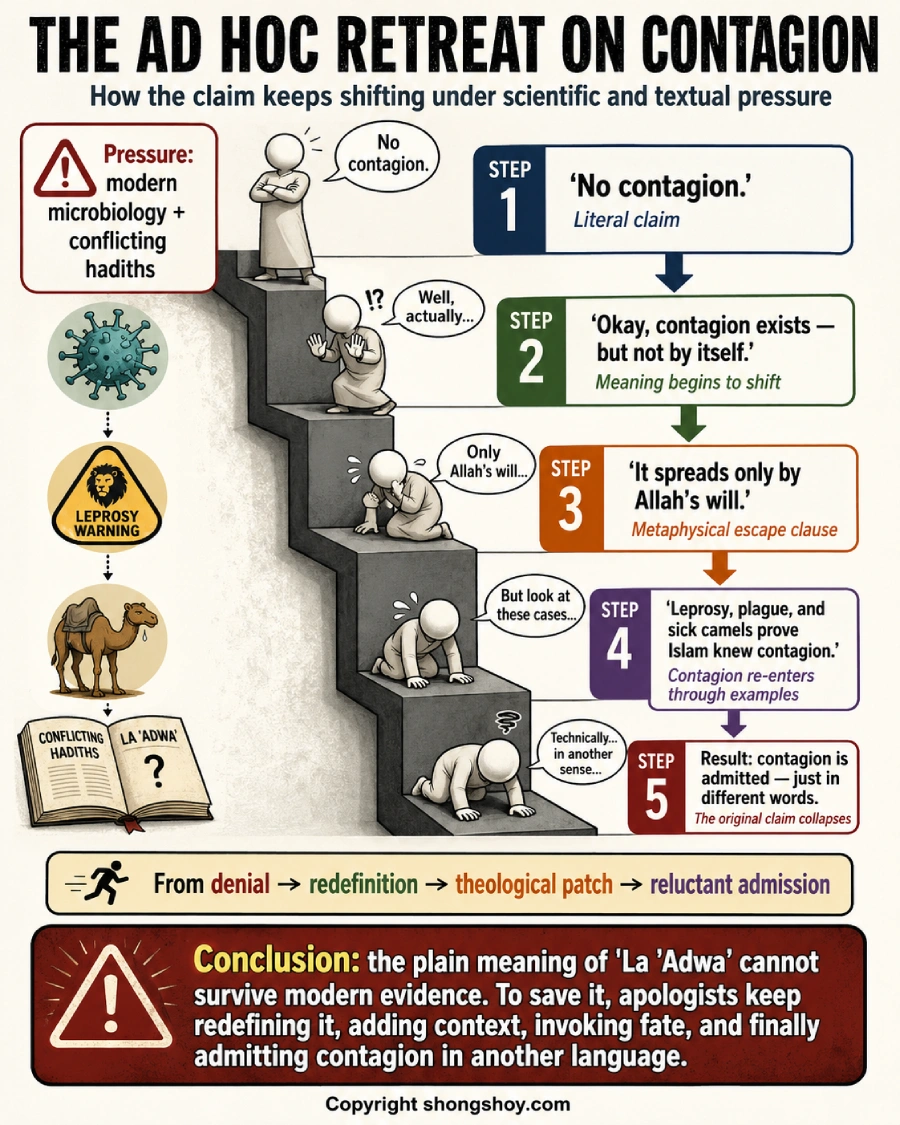
The First Patch: Contagion Exists, but Does Not Occur Without Allah’s Will
This explanation accepts the occurrence of disease transmission. It then identifies Allah’s will as its ultimate controller. Part of Ibn Baz’s original statement reads: [38]
قد ينتقل المرض من المريض إلى الصحيح
English translation: The sick person’s disease may pass to the healthy person.
In another fatwa, he states still more explicitly that disease may sometimes pass between sick and healthy people through contact if Allah wills. Actual transmission is accepted here and a theological condition attached to it. [39]
بل ينتقل بإذن الله عند المخالطة؛ قد ينتقل عند المخالطة
English translation: Rather, it passes through contact with Allah’s permission; it may pass through contact.
But the condition of divine permission supplies no additional information about the presence of pathogens, degree of exposure, or effectiveness of prevention. Saying that permission existed when transmission occurs and did not exist when it does not allows any outcome to fit the same sentence. Prevention requires specific knowledge of which changes in causes change outcomes. The same distinction applies to fire, bullets, poison, road accidents, and disease. Even if divine will is said to lie behind every event, practical decisions still require knowledge of physical causes.
| Situation | The Empirical Cause That Can Be Tested | The Decision Requiring Knowledge of Causes |
|---|---|---|
| Burns | Heat intensity and bodily contact | Distance from fire and heat-resistant protection |
| Gunshot injuries | Kinetic energy, impact location, and bodily damage | Measures to avoid injury and appropriate protection |
| Poisoning | The substance, dose, and entry into the body | Avoiding toxic substances and providing treatment |
| Falling from a height | Height, speed of falling, and impact | Safe structures and fall prevention |
| Viral infection | Pathogen source, route of entry, and exposure | Effective prevention appropriate to the disease |
| Road accidents | Speed, control, and collision | Safe driving and vehicle protection |
| Electric shock | Electric current and its path through the body | Insulation and electrical safety |
| Drowning | Disruption of breathing | Water safety and rescue arrangements |
| The health risks of smoking | Exposure to harmful substances | Reducing tobacco use and exposure |
| Seat-belt protection | Bodily movement and distribution of impact during a collision | Using tested protection |
Adding “without Allah’s will” to a denial after it has been proven wrong changes its meaning. The examples below assume that a contrary outcome has occurred after the statement was made. Spain’s victory in the World Cup example is also part of this hypothetical situation.
| Original Statement | Contrary Outcome Assumed in the Example | Explanation Constructed Afterwards |
|---|---|---|
| The Earth does not rotate. | Evidence of the Earth’s rotation was found. | The Earth does not rotate without Allah’s will. |
| Spain will not win the 2026 football World Cup. | Assume that Spain has won. | Spain will not win without Allah’s will. |
| It will not rain tomorrow. | It rained the following day. | It will not rain tomorrow without Allah’s will. |
| This seed will not produce a seedling. | A seedling emerged from the seed. | This seed will not produce a seedling without Allah’s will. |
In the Spain example, the original prediction was that the team would not become champions. If Spain wins, that prediction is wrong. By adding “without Allah’s will” afterwards, one can say Spain won because Allah willed it. Had Spain failed to win, that would not contradict the revised sentence either. No independent, verifiable criterion has been supplied for determining whether Allah willed the outcome before it is known. A mistaken earlier prediction is thus replaced with a different claim that accommodates both victory and failure to win.
Likewise, “disease does not spread” and “disease does not spread without Allah’s permission” are different claims. Evidence of transmission can be presented against the first. For the second, after transmission occurs, one can say it happened because permission existed. Its absence would not contradict the sentence either. The condition does not tell us which pathogen will spread by which route, whose risk will increase, or which measures will reduce transmission. The information needed for prevention must still come from tested knowledge.
A statement that can be fitted to any outcome after it occurs does not establish the testable distinction between which outcome will occur and which will not. Used this way, the sentence loses its capacity to make specific predictions about empirical events. Adding “without Allah’s will” therefore does not prove the original claim true; it changes its meaning in the face of counterevidence. Defending an erroneous statement and establishing its truth by testing it against evidence are entirely different activities.
The Second Patch: Denying Contagion Through the Question of the First Patient
The counterquestion to the Bedouin is sometimes presented as if subsequent transmission cannot be accepted unless the source of the first patient’s illness can be explained. This argument confuses the origin of disease with its spread. Other unidentified infected animals may have preceded the first identified camel. Infection may also have come from the environment or another source. These are matters for investigation. Even while that investigation remains incomplete, evidence of disease spreading from one infected animal to another can be accepted. “Where did the earlier one get it?” does not invalidate the later one’s infection. More fundamentally, science does not require every case of a disease to occur through the same route. A pathogen can have multiple sources and routes of spread among people. Inferring a denial of all contagion from the question of the first patient is therefore a logical leap.
The Third Patch: Approaching a Patient May Create Belief in Contagion
The historical form of this explanation appeared in the discussions of Abu ‘Ubayd and Ibn Khuzayma. If someone becomes ill after approaching a patient, he may regard contact as the cause. Avoiding patients is explained as a way of protecting him from that belief. The problem is that the outcome has been decided before the actual risks of approaching a patient have been investigated. Instead of examining whether transmission occurred when someone became ill, the emergence of belief in contagion is considered dangerous. The interpretation of experience is controlled rather than knowledge being acquired through experience.
Ibn Hajar also preserves an explanation that makes strength of faith the basis for managing contact with disease. Fear that belief in contagion may arise is treated as a problem of weak faith, while firm reliance on Allah is taken to permit mixing. Degrees of faith cannot measure a pathogen’s route of entry or exposure risk; conduct toward patients is determined by the disease’s condition and evidence about prevention. [40]
وحيث جاء فر من المجذوم كان المخاطب بذلك من ضعف يقينه ، ولم يتمكن من تمام التوكل فلا يكون له قوة على دفع اعتقاد العدوى ، فأريد بذلك سد باب اعتقاد العدوى عنه بأن لا يباشر ما يكون سببا لإثباتها .
English translation: Where “flee from a leper” is said, the person addressed is someone whose belief is weak and who has not attained complete reliance on Allah, so he lacks the strength to resist belief in contagion. The purpose is therefore to close the door to that belief for him by not approaching something that might establish belief in contagion.
The Fourth Patch: Contagion Has No Power of Its Own
If “power of its own” means a pathogen’s physical causal activity, it is a matter for testing; if it means supernatural power wholly independent of Allah, it is theology. Scientific explanations of transmission through pathogens do not treat pathogens as independent gods or miraculous beings. This ambiguity is used to restrict the original hadith’s general denial to a theological meaning. One can then accept the reality of transmission while retaining the language denying contagion. But when that language reaches ordinary people as the claim that disease does not spread, its practical consequences are different.
This method of reinterpretation is particularly clear in ‘Abd Allah al-Ghunayman’s Sharh Fath al-Majid. He states that once it is known that many diseases are caused by germs and that germs pass from the sick to the healthy, the hadith’s intention becomes clear. In another discussion, “la ‘adwa” is also read as a prohibition: no one should become a cause of infecting someone else. [41]
أما إذا علم ذلك فيتبين مراد الرسول صلى الله عليه وسلم، وأنه لا يخالف الواقع.
English translation: Once this is known, the intention of the Messenger, peace and blessings be upon him, becomes clear, and it is understood that he does not contradict reality.
This method uses empirical knowledge to determine the hadith’s meaning. It begins by fixing the conclusion that Muhammad’s statement cannot contradict reality, then selects a meaning consistent with it. Such a method cannot test infallibility because the possibility of error has been excluded from the outset.
The Fifth Patch: The Instruction to Flee Is Only for Peace of Mind
Explaining avoidance of a person with leprosy solely in terms of discomfort, fear, or peace of mind weakens the claim of disease prevention. Avoiding a patient because healthy people find his smell or appearance unpleasant is not medical infection control. It also raises questions about the patient’s social position and dignity. If actual infection risk from proximity is given as the reason for keeping away, contagion must be acknowledged. In leprosy, it is necessary to know which kinds of contact create that risk and what treatment changes. A general instruction to flee as from a lion does not establish the disease’s actual degree of risk.
The Sixth Patch: Safar and Owls Were Not Denied Existence, So Neither Was Contagion
This comparison argues that “la Safar” does not mean the month of Safar does not exist, and “la hamah” does not mean owls do not exist. Therefore, “la ‘adwa” does not deny the existence of contagion either. Explaining different words in this way sidesteps the specific incident concerning transmission.
Ancient commentators gave several meanings for Safar. Some discussed beliefs concerning the month, others beliefs about an animal or disease within the abdomen. Explanations of hamah include ominous owls and beliefs associated with the dead. Al-Nawawi’s discussion itself contains these different meanings. [42]
قوله صلى الله عليه وسلم : ( ولا صفر ) فيه تأويلان : أحدهما المراد تأخيرهم تحريم المحرم إلى صفر ، وهو النسيء الذي كانوا يفعلونه ، وبهذا قال مالك وأبو عبيدة .
والثاني أن الصفر دواب في البطن ، وهي دود
English translation: His statement, peace and blessings be upon him, “there is no Safar,” has two interpretations. One is postponing the prohibition of Muharram to Safar; it refers to the postponement they used to practise. Malik and Abu ‘Ubayda said this.
The second is that Safar is an animal in the abdomen, meaning worms.
In the contagion report, however, the Bedouin’s question establishes a specific context. He mentions neither a bird’s call nor an unlucky month. He raises his experience of other camels becoming ill after mixing with a sick camel. The answer likewise redirects his question toward the first case of disease. Explanations of neighbouring words in the list therefore cannot evade this empirical question of transmission.
The Seventh Patch: The Plague Instruction Proves Modern Knowledge of Contagion
Avoiding plague-stricken areas or separating sick animals involves practical precaution. But that does not simultaneously establish the meaning of the original denial, knowledge of contagion, and equivalence to modern medicine. Accepting these instructions as measures to stop disease spreading requires acknowledging transmission’s causal processes. The original denial then needs a separate meaning. Conversely, explaining the instructions as preventing escape from predestination or preventing belief in contagion provides no basis for claiming that modern public health knowledge was present. The central problem in this defence is using the same instruction as evidence of contagion or as a shield for denying contagion according to the needs of the interpretation.
The Reliability of the Report About Eating from the Same Bowl with a Leper
The account narrated through Jabir, in which a leper’s hand is placed in a food bowl, is also cited in support of denying contagion. Al-Tirmidhi’s report describes Muhammad placing the patient’s hand in the bowl and telling him to eat with trust and reliance on Allah. Within Islamic hadith criticism, there are objections to this report’s chain. Al-Tirmidhi mentions an alternative chain and regards the route preserving the incident as an act of Ibn ‘Umar as better established and more correct. The Darussalam grading published on Sunnah.com classifies the report as weak. [43]
وَقَدْ رَوَى شُعْبَةُ هَذَا الْحَدِيثَ عَنْ حَبِيبِ بْنِ الشَّهِيدِ عَنِ ابْنِ بُرَيْدَةَ أَنَّ ابْنَ عُمَرَ أَخَذَ بِيَدِ مَجْذُومٍ وَحَدِيثُ شُعْبَةَ أَثْبَتُ عِنْدِي وَأَصَحُّ .
English translation: Shu’bah reported this Hadith from Habib bin Ash-Shahid, from Ibn Buraidah: “That Ibn ‘Umar took the hand of a leper” and the narration of Shu’bah is more appropriate to me and more correct.
Nor does someone remaining well after a single meal prove that a disease is noncontagious. Infection risk and degree of exposure must be considered. A weak chain does not, by itself, make an event historically impossible; equally, even if the event occurred, it does not provide medical evidence for denying contagion.
Accepting contagion means preventive measures must follow its causal processes. Adopting the language of scientific causation while assuming the hadith’s infallibility does not establish its denial of contagion as scientifically true. Changing the meaning to rescue an error is the strategy of this apologetic defence.
Leprosy: Islamic Statements Versus Scientific Evidence
Leprosy is a chronic infectious disease. According to the World Health Organization, its primary cause is the bacterium Mycobacterium leprae. The disease can damage the skin, peripheral nerves, eyes, and parts of the respiratory tract. The CDC also mentions the role of Mycobacterium lepromatosis. [44]
a chronic infectious disease
Meaning: An infectious disease that persists over a long period.
It Is Transmissible, but Does Not Spread Easily
Leprosy bacteria are thought to spread through prolonged, close contact with an untreated patient. The main explanation is that pathogen-carrying droplets from the nose and mouth enter another person’s body over a long period. The CDC mentions close contact over many months. The World Health Organization states that the disease does not spread through casual contact such as shaking hands, sitting together, or sharing meals. These facts establish two conclusions together. Calling leprosy wholly noncontagious is wrong. Equally, fearing a person with leprosy as though seeing a dangerous animal is inconsistent with the actual risk. Precautions must take account of the kind of contact and the patient’s treatment status. [45]
The disease does not spread through casual contact
Meaning: Ordinary everyday contact does not spread the disease.
Treatment and the Patient’s Ordinary Life
Leprosy is treatable. A combination of several medicines is used. The World Health Organization states that patients stop transmitting the disease when treatment begins. Early detection and treatment can reduce the risk of disability. Screening close contacts and taking preventive measures where appropriate also form part of disease control. [46]
The patient stops transmitting the disease upon initiation of treatment.
Meaning: Transmission from the patient stops when treatment begins.
The Social Meaning of Comparing a Patient to a Lion
The analogy of fleeing from a lion can make a patient a symbol of immediate and terrifying danger. Yet a person with this disease needs treatment and support. Spreading fear can create conditions in which diagnosis is delayed, illness is concealed, or people are cut off from social contact. Both the World Health Organization and the CDC discuss stigma, superstition, and discrimination against people with leprosy. Protecting patients’ dignity is therefore connected to controlling the disease. Treatment, necessary precautions, and social support belong to the same responsibility. Denying contagion and avoiding patients like terrifying animals both create misconceptions about disease. The former erases actual risk. The latter conceals the true degree of risk and the effects of treatment, potentially exposing patients to social punishment.
“There Is No Contagion” and “Flee from the Patient”: Where the Contradiction Lies
Accepting prevention of transmission as the reason for avoiding a patient immediately creates a contradiction with “there is no contagion.” The argument that distance is necessary because contact can spread disease acknowledges contagion. A denial of all contagion and an instruction to avoid patients to prevent contagion cannot both be true in the same sense. One declares contagion nonexistent; the other acknowledges a need to prevent it. If offensive smells, discomfort at appearance, or fear of developing belief in contagion are accepted as the reasons for distance, the instruction cannot be used as scientific recognition of the need to prevent disease spreading. Under those interpretations, the purpose becomes avoiding a patient’s smell or appearance, or a belief arising from experience, rather than stopping transmission. [47]
لاَ عَدْوَى وَلاَ طِيَرَةَ وَلاَ هَامَةَ وَلاَ صَفَرَ، وَفِرَّ مِنَ الْمَجْذُومِ كَمَا تَفِرُّ مِنَ الأَسَدِ
Published English translation: Allah’s Messenger (ﷺ) said, “(There is) no ‘Adwa (no contagious disease is conveyed without Allah’s permission). nor is there any bad omen (from birds), nor is there any Hamah, nor is there any bad omen in the month of Safar, and one should run away from the leper as one runs away from a lion.”
| Interpretation Accepted | Its Consequence |
|---|---|
| Contagion does not exist at all | There is no basis for avoiding patients to prevent contagion |
| Patients must be avoided because their disease may spread | The reality of contagion is acknowledged |
| Distance is due to offensive smells or discomfort at appearance | The issue becomes aversion to patients rather than disease prevention |
| Distance prevents belief in contagion from arising | The path from experience to a conclusion of contagion is controlled |
| Contagion exists, but with Allah’s permission | The general denial is changed into a conditional theological claim |
Preserving the meaning is central here. Denying contagion and then accepting it subject to divine permission adopts a new position. Even if that position is accepted theologically, the earlier general denial has not been proven scientifically true. The testable question is whether particular kinds of contact increase disease risk and whether changing those routes of contact reduces it. Research seeks answers to that question. “It will happen if Allah wills” can be fitted to either outcome, so it cannot substitute for testable causation. Denying contagion while claiming the rationale for avoiding patients to prevent contagion is self-contradictory when the meaning remains the same. Changing the meaning to construct a theological reconciliation does not prove the original denial true. Nor do explanations involving offensive smells, appearance, or protecting faith establish modern scientific knowledge of contagion.
Public Health, Ethics, and Human Rights
The influence of preaching that denies contagion extends beyond the speaker’s personal beliefs. Changing people’s understanding of prevention can also change the risk of infection to others. One family’s decisions can affect children, older people, sick family members, and neighbours. Statements about disease therefore carry a social responsibility. The World Health Organization connects health with human rights. This right includes access to necessary healthcare, nondiscriminatory treatment, and social arrangements conducive to health. Exposing people to preventable harm through misinformation runs against that responsibility. [48]
Every human being has the right to the highest attainable standard of physical and mental health.
Meaning: Every person is entitled to the highest achievable standard of physical and mental health.
Misinformation Changes People’s Decisions
The World Health Organization identifies the excessive spread of false and misleading information during disease outbreaks as a public health problem. Such information can generate confusion, risky behaviour, and distrust of health authorities, obstructing necessary action. [49]
It causes confusion and risk-taking behaviours that can harm health.
Meaning: It generates confusion and risky conduct that may damage health.
Experimental research has also demonstrated this effect. A controlled study in the United Kingdom and the United States, published in 2021, showed participants either accurate information or misinformation about COVID-19 vaccines. Among participants who had previously definitely intended to be vaccinated, exposure to misinformation reduced vaccination intent by 6.2 percentage points in the UK and 6.4 percentage points in the US compared with the group receiving factual information. [50]
recent misinformation induced a decline in intent of 6.2 percentage points
Meaning: Recent misinformation reduced vaccination intent by 6.2 percentage points.
This finding is a specific example of misinformation changing health decisions. Religious sermons describing prevention as unnecessary create a similar risk to decision-making. A listener may neglect precautions, underestimate the need for treatment, or lose confidence in vaccines. When health misinformation spreads with the force of religious authority, its danger is not confined to the speaker’s beliefs.
Religious Places Do Not Block Transmission Routes
The risk of transmission at a gathering depends on factors such as sources of pathogens among those present, ventilation, crowding, and contact. A gathering’s religious character does not change these physical conditions. The same evidence-based standards therefore apply when assessing religious and other gatherings occurring under the same conditions. Declaring a place protected from disease because of its religious status may lead people to abandon necessary precautions. Such assurances require evidence about the disease and environment. The speaker’s religious rank cannot substitute for it.
Disease Prevention and Patients’ Dignity
Acknowledging transmission does not mean humiliating patients. Accurate knowledge determines which forms of contact pose risks and which are safe. Ignorance can simultaneously produce needless panic and dangerous indifference. Irrational fear of everyday contact with people who have leprosy, and denial of actual transmission routes, exemplify these two dangers. Public health’s ethical responsibility is to ensure treatment, necessary precautions, and nondiscriminatory conduct. Linking disease with weak faith or personal misfortune forces patients to bear social humiliation alongside their need for treatment. Criticising a doctrine that obstructs the protection of human life is an ethical responsibility. The status of scriptures, religious leaders, or institutions cannot exempt them from such criticism. Health claims must be judged by evidence, practical consequences, and human dignity.
Conclusion
The hadiths concerning contagion contain clear contradictions. On one side are statements denying contagion; on the other are instructions to separate sick animals, flee from lepers, and control movement in plague-stricken areas. Added to these is Abu Hurayra’s denial of his earlier report. Various solutions have been devised since ancient times to explain these contradictions. Ibn Qutayba’s explanation involving smells and sores, al-Nawawi’s reconciliation, the abrogation view, and explanations aimed at preventing belief in contagion are different positions. They demonstrate disagreement within the tradition over the meaning and practical consequences of the original statement. Selecting one later interpretation and claiming it was the sole clear meaning from the outset conceals this history.
For modern science, transmission is a testable reality. Pathogens can be identified, routes of spread investigated, and the effects of prevention measured. Subsequent transmission can be demonstrated without knowing every detail about the first patient’s source of infection. Infection risk remains real even when not everyone is affected equally. Moving from “there is no contagion” to “there is no contagion without Allah’s permission” changes the claim’s meaning. Transmission is then accepted and a theological condition attached to it. This reinterpretation does not turn the original general denial into scientific truth. Nor does the claim of divine permission provide the knowledge needed about disease sources, transmission routes, or preventive measures.
With a treatable disease such as leprosy, both denying contagion and instructing people to flee at the sight of a patient are problematic. What is needed is an understanding of actual risk, access to treatment, and protection of patients’ dignity. Public health cannot be protected by making sick people symbols of fear and hatred. No religious statement can take precedence over human life, health, and established knowledge. When an erroneous statement about disease is declared infallible in religion’s name, criticism becomes still more necessary. Prevention rests on empirical evidence. The responsibility to protect human life cannot be subordinated to defending hadith.
References
- Muhammad ibn Isma‘il al-Bukhari, Sahih al-Bukhari, Tawhid Publications Bengali edition, Book of Medicine, chapter 76/25, hadith 5717. Arabic reference: Book 76, Hadith 34. Narrator: Abu Hurayra. Arabic text corresponding to the complete quotation in the Bengali edition: Sahih al-Bukhari 5717. ↩︎
- Mishkat al-Masabih, Medicine and Spells, Good and Evil Omens, hadith 4577; Arabic text of Mishkat, Book 23, Hadith 61. Original report in al-Bukhari: Medicine, chapter on leprosy, Sahih al-Bukhari 5707, Book 76, Hadith 27. ↩︎
- Mishkat al-Masabih, Medicine and Spells, Good and Evil Omens, hadith 4580, Book 23, Hadith 64. Jabir’s report denying contagion, ghoul and Safar: Sahih Muslim 2222b, Book of Greetings, Book 39, Hadith 148. ↩︎
- Sunan Abi Dawud, critically verified Bengali edition, Medicine, chapter on omens, hadith 3912. Arabic reference: Book 30, Hadith 9; narrator: Abu Hurayra; al-Albani’s grading: Sahih. Arabic text: Sunan Abi Dawud 3912. ↩︎
- Sahih al-Bukhari, Tawhid Publications, Medicine, chapter on drawing omens from birds, hadith 5753. Arabic reference: Book 76, Hadith 68; narrator: ‘Abdullah ibn ‘Umar. Sahih al-Bukhari 5753. ↩︎
- Sunan Abi Dawud, critically verified Bengali edition, Medicine, chapter on omens, hadith 3921. Arabic reference: Book 30, Hadith 18; narrator: Sa‘d ibn Malik; al-Albani’s grading: Sahih. Sunan Abi Dawud 3921. ↩︎
- Sunan Abi Dawud, Islamic Foundation Bengali edition, Divination and Omens, chapter on drawing omens from birds, hadith 3872. The standard number for the same chain and Arabic report is 3912. Corresponding Arabic and published English translation: Sunan Abi Dawud 3912; comparison with the Arabic original: Sunan Abi Dawud 3912. ↩︎
- Muhammad ibn Isma‘il al-Bukhari, Sahih al-Bukhari, Kitab al-Tibb, or the Book of Medicine; chapter 25, concerning Safar; hadith 5717. Narrator: Abu Hurayra. In-book reference: Book 76, Hadith 34; old English reference: Vol. 7, Book 71, Hadith 615. Complete Arabic report and published English translation: Sahih al-Bukhari 5717. ↩︎
- Sahih al-Bukhari, Book of Medicine, hadith 5717; Abu Hurayra’s report denying contagion and recounting the Bedouin’s question about his camels. The quoted English wording comes from the explanatory parentheses in the translation published on the same page. Arabic original and English translation together: Sahih al-Bukhari 5717, original text and translation. ↩︎
- ‘Abd al-‘Aziz ibn ‘Abd Allah ibn Baz, question and answer on the meaning of the hadith “la ‘adwa wa la tiyarah,” fatwa 16140. The discussion explains the relationship between disease passing from the sick to the healthy through contact, Allah’s permission and predestination, and taking preventive measures. Original Arabic: Explanation published on Ibn Baz’s official website. ↩︎
- Muhammad ibn Isma‘il al-Bukhari, Sahih al-Bukhari, Book of Medicine; chapter 53, concerning the denial of hamah; hadith 5771. Abu Salama recounts Abu Hurayra’s statement and subsequent denial. In-book reference: Book 76, Hadith 85; old English reference: Vol. 7, Book 71, Hadith 665. Arabic original: Sahih al-Bukhari 5771. ↩︎
- Muslim ibn al-Hajjaj, Sahih Muslim, Book of Greetings; chapter 33, denying contagion, evil omens, hamah, and Safar, and prohibiting bringing sick animals near healthy ones; hadith 2221a. Chain: Yunus, Ibn Shihab, and Abu Salama ibn ‘Abd al-Rahman ibn ‘Awf. In-book reference: Book 39, Hadith 143; old English reference: Book 26, Hadith 5510. Complete Arabic report: Sahih Muslim 2221a. ↩︎
- Abu Dawud Sulayman ibn al-Ash‘ath, Sunan Abi Dawud, Book of Divination and Omens; chapter on omens; hadith 3911. The report contains the Bedouin’s question about his diseased camels, the instruction not to mix sick and healthy animals, and Abu Hurayra’s denial of his earlier narration. Al-Albani’s grading: Sahih. In-book reference: Book 30, Hadith 8. Original Arabic report: Sunan Abi Dawud 3911. ↩︎
- Muslim ibn al-Hajjaj, Sahih Muslim, Kitab al-Salam, or the Book of Greetings; chapter 36, Avoiding Lepers and the Like; hadith 2231. Narrator: ‘Amr ibn al-Sharid, on the authority of his father, al-Sharid. In-book reference: Book 39, Hadith 174; old English reference: Book 26, Hadith 5541. Complete Arabic and report identification: Sahih Muslim 2231. ↩︎
- Muhammad ibn Isma‘il al-Bukhari, Sahih al-Bukhari, Book of Medicine; chapter 30, What Has Been Mentioned About the Plague; hadith 5728. In the chain, Ibrahim ibn Sa‘d states that he heard Usama ibn Zayd narrate to Sa‘d. In-book reference: Book 76, Hadith 43; old English reference: Vol. 7, Book 71, Hadith 624. Arabic original: Sahih al-Bukhari 5728. ↩︎
- Sahih al-Bukhari, Book of Medicine, chapter on plague, hadith 5729. Narrator: ‘Abd Allah ibn ‘Abbas. Full account of ‘Umar’s consultations, the Companions’ disagreement, Abu ‘Ubayda’s question, and ‘Abd al-Rahman ibn ‘Awf’s narration: Sahih al-Bukhari 5729. ↩︎
- Abu Muhammad ‘Abd Allah ibn Muslim ibn Qutayba, Ta’wil Mukhtalif al-Hadith, discussion of “al-‘Adwa wa al-Tiyarah,” Vol. 1, p. 169 in the online edition. Explanation of the prohibitions on entering and leaving a plague-stricken area: The work’s original Arabic discussion. ↩︎
- Abu Muhammad ‘Abd Allah ibn Muslim ibn Qutayba, Ta’wil Mukhtalif al-Hadith, discussion of hadiths accused of contradiction; “al-‘Adwa wa al-Tiyarah,” Vol. 1, pp. 167–168 in the online edition. The first quotation presents the objectors’ statement; the second gives the author’s reply. Original Arabic: Section on contagion and omens. ↩︎
- Ibn Qutayba, Ta’wil Mukhtalif al-Hadith, Vol. 1, p. 168; original Arabic text. ↩︎
- Ibn Qutayba, Ta’wil Mukhtalif al-Hadith, “al-‘Adwa wa al-Tiyarah,” Vol. 1, pp. 168–169 in the online edition. Paragraphs on leprosy, prolonged proximity, offensive smells, and the effects of discharge from camels’ moist skin lesions. The author’s medical ideas from his own period are translated here. Original Arabic: Ibn Qutayba’s detailed explanation. ↩︎
- Yahya ibn Sharaf al-Nawawi, Al-Minhaj Sharh Sahih Muslim ibn al-Hajjaj, Book of Greetings, chapter on contagion and omens; commentary on Sahih Muslim 2220–2221. Relevant discussion on pp. 378–379 in the edition displayed by Islamweb. The majority’s reconciliation and al-Nawawi’s preferred position: Original Arabic discussion in the commentary on Sahih Muslim. ↩︎
- Al-Nawawi, Sharh Sahih Muslim, Book of Greetings, chapter on contagion, commentary on Sahih Muslim 2220–2221. In the quoted paragraph, al-Nawawi reports others’ literal denial and endorses his previously stated reconciliation. The reasons for rejecting abrogation occur in the same discussion. Complete original text. ↩︎
- Ahmad ibn ‘Ali ibn Hajar al-‘Asqalani, Fath al-Bari Sharh Sahih al-Bukhari, Book of Medicine, commentary on hadith 5707 concerning leprosy; Vol. 10, relevant discussion on pp. 168–172. In the quoted passage, Ibn Hajar mentions al-Bayhaqi’s interpretation and its adoption by Ibn al-Salah and others. The Islamweb page preserves this discussion before the next chapter heading: Original text of Fath al-Bari. ↩︎
- Badr al-Din Mahmud ibn Ahmad al-‘Ayni, ‘Umdat al-Qari Sharh Sahih al-Bukhari, Book of Medicine, chapter “La Hamah”; commentary on Sahih al-Bukhari 5771. Online edition, Vol. 21, p. 288. The quoted paragraph separately describes Ibn Battal’s explanation, al-Nawawi’s, and another interpretation. Arabic text of ‘Umdat al-Qari. ↩︎
- Ibn Hajar al-‘Asqalani, Fath al-Bari, Book of Medicine, commentary on the reports concerning leprosy, Vol. 10, discussion on pp. 170–171. The quotation concerns the sixth method of reconciliation and Abu ‘Ubayd’s view as reported there. Original Arabic text of Fath al-Bari. ↩︎
- Ibn Hajar, Fath al-Bari, Book of Medicine, Vol. 10, p. 171. Ibn Khuzayma’s position is reported here from his Kitab al-Tawakkul. The source of the quotation is the account preserved by Ibn Hajar. Original Arabic discussion. ↩︎
- The Prophet Gets Caught Out Trying to Know Better Than Farmers ↩︎
- Muslim ibn al-Hajjaj, Sahih Muslim, Book of Virtues; hadith 2362; hadith 2363. The quotation below gives the main account in report 2363. ↩︎
- Muslim ibn al-Hajjaj, Sahih Muslim, Book of Virtues, the date-palm pollination incident reported through Talha; hadith 2361. ↩︎
- CDC, infection control basics; explanation of the source of infection, entry, multiplication, and the body’s response. ↩︎
- World Health Organization, guidance on infection prevention and control; infection prevention and control. CDC, additional precautions in healthcare according to transmission route; precautions for contact, droplet, and airborne transmission. ↩︎
- US Institute of Medicine, Global Infectious Disease Surveillance and Detection: Assessing the Challenges, Finding Solutions, chapter “Detection and Diagnostics.” Discussion of Koch’s postulates, Rivers’ modifications for viruses, and molecular approaches to determining causation: NCBI edition; publisher’s original chapter. ↩︎
- Jennifer K. Ketzis, “Overview of Mange in Animals,” MSD Veterinary Manual; reviewed March 2023, modified September 2024. Parasitic mites, spread through direct contact and contaminated objects, and management of affected and exposed animals: original veterinary discussion. ↩︎
- “Epidemiological investigations in Sarcoptic mange in camels with special reference in treatment,” Journal of Parasitic Diseases, 2021; research conducted from August 2019 to August 2020, Saudi Arabia. Identification of parasites and investigation of skin disease in camels; DOI: 10.1007/s12639-020-01346-x; abstract and bibliographic details. ↩︎
- Hebel and colleagues, “One Health alert: zoonotic scabies from dromedary camels-A case report and call for vigilance,” Frontiers in Veterinary Science, 2025, Vol. 12, article 1500916; DOI: 10.3389/fvets.2025.1500916. Case report describing spread from one camel to other camels and humans: study details and abstract. ↩︎
- World Health Organization, infection prevention and control; CDC, basic explanation of infection; WHO introduction to infection prevention and control; CDC infection basics. ↩︎
- CDC, transmission-based precautions; guidance on additional precautions according to transmission route and control of contact, droplet, and airborne transmission: original guidance. World Health Organization, immunity and the role of vaccines: how vaccines work. ↩︎
- ‘Abd al-‘Aziz ibn Baz, “معنى حديث لا عدوى ولا طيرة”, fatwa 16140. In the explanation following the quoted phrase, he describes contact as a cause of disease passing between people and the event as occurring with Allah’s permission. Complete statement on Ibn Baz’s official website. On the same subject, his “الجمع بين لا عدوى ولا طيرة و فر من المجذوم”, fatwa 1553, Majmu‘ Fatawa wa Maqalat, Vol. 6, p. 27: fatwa on reconciling the two hadiths. ↩︎
- Ibn Baz, explanation of the hadith concerning contagion and omens, fatwa 18408; original Arabic statement. ↩︎
- Ibn Hajar, Fath al-Bari, Book of Medicine, second method of reconciliation in the commentary concerning leprosy; original Arabic discussion. ↩︎
- ‘Abd Allah ibn Muhammad al-Ghunayman, شرح فتح المجيد للغنيمان, المكتبة الشاملة; written transcript of the same lecture series on Islamweb, “Sharh Fath al-Majid Sharh Kitab al-Tawhid,” lesson 79. Discussion of knowledge about germs and the hadith’s intention: first transcript; discussion interpreting “la ‘adwa” as a prohibition: second transcript. ↩︎
- Al-Nawawi, Sharh Sahih Muslim, Book of Greetings, explanation of “la Safar” and “la hamah”; original Arabic discussion. ↩︎
- Muhammad ibn ‘Isa al-Tirmidhi, Jami‘ al-Tirmidhi, Book of Food, chapter 19, What Has Been Related About Eating with a Leper, hadith 1817. Text narrated through Jabir ibn ‘Abd Allah, al-Tirmidhi’s comments on the chain, and Darussalam’s weak grading: original Arabic and complete discussion; in-book reference: Book 25, Hadith 31. ↩︎
- World Health Organization, leprosy fact sheet; CDC, introduction to leprosy; WHO leprosy fact sheet; CDC introduction to leprosy. ↩︎
- World Health Organization, leprosy transmission; original fact sheet; CDC explanation. ↩︎
- World Health Organization, leprosy; information on transmission, treatment, screening contacts, and patients’ dignity: WHO’s original fact sheet. The CDC states that people receiving treatment can continue ordinary life, work, and education with their families and friends: discussion of common misconceptions about leprosy. ↩︎
- The denial of contagion and the instruction to flee from a leper occur in the same report: Sahih al-Bukhari 5707, Book of Medicine, chapter on leprosy. The instruction not to bring sick animals near healthy ones: Sahih al-Bukhari 5771. Historical account of different interpretations: al-Nawawi’s commentary on Sahih Muslim. ↩︎
- World Health Organization, health and human rights; recognition of health as a human right and the associated responsibilities. ↩︎
- World Health Organization, the infodemic, or widespread circulation of misinformation; the relationship between misleading information, risky behaviour, and the public health response during outbreaks: WHO discussion. ↩︎
- Sahil Loomba, Alexandre de Figueiredo, Simon J. Piatek, Kristen de Graaf, and Heidi J. Larson, “Measuring the impact of COVID-19 vaccine misinformation on vaccination intent in the UK and USA,” Nature Human Behaviour, Vol. 5, pp. 337–348, 2021. The study used data from September 2020; its experimental findings concern changes in vaccination intent. DOI: 10.1038/s41562-021-01056-1. Original research paper; study abstract. ↩︎