
Summary
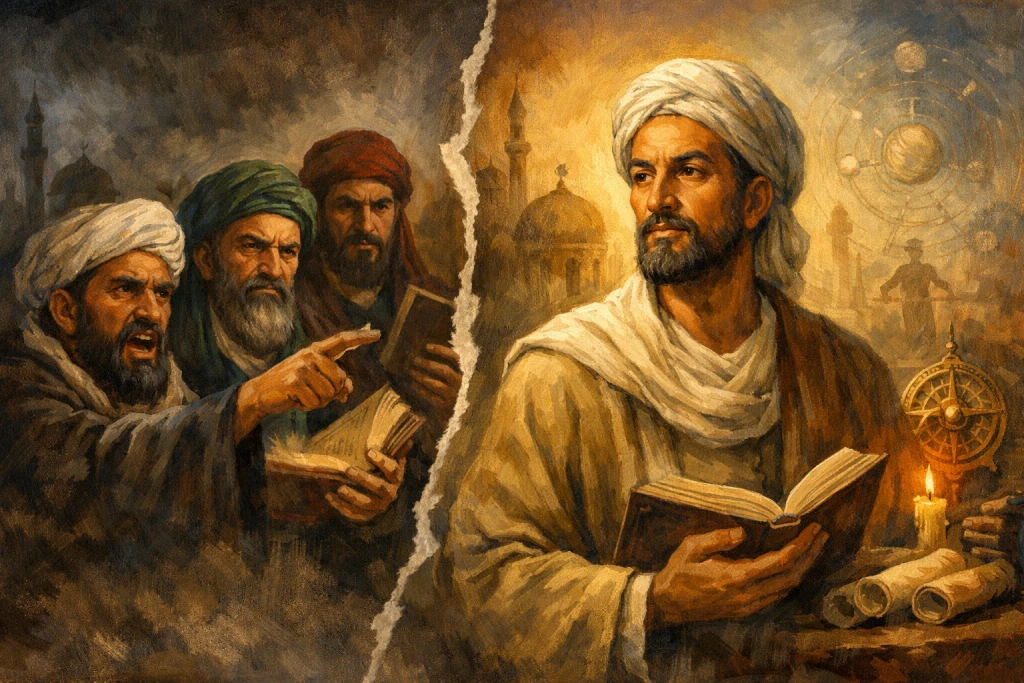
Ibn Sina was unquestionably one of the most remarkable figures in the history of medieval knowledge and science. His influence on medicine, philosophy, logic, and the natural sciences endured for centuries across Europe and Asia. In modern Muslim discourse, these scientific and philosophical achievements are often presented as achievements of “Islamic civilization,” while Ibn Sina himself is celebrated directly as a “Muslim scientist.” Yet a different picture emerges when his own philosophical beliefs are compared with classical Islamic creed. On such fundamental questions as whether the world had a beginning in time, the nature of God’s knowledge of particular persons and events, bodily resurrection, prophecy, and revelation, Ibn Sina developed a philosophical system that came into fundamental conflict at several points with later classical Sunni theology.
Ibn Sina’s family environment was influenced by Isma’ilism, although in his own autobiography he states that he did not accept that doctrine. There is likewise no evidence that he was himself a Mu’tazilite; however, parts of his philosophy concerning the divine attributes, the relation between essence and attributes, and causation resembled Mu’tazilite kalam—a similarity al-Ghazali himself identified. Most importantly, al-Ghazali explicitly classified three central doctrines associated with Ibn Sina and al-Farabi as kufr: the eternity of the world, a particular account of God’s knowledge of individual events and persons, and the denial of bodily resurrection. Later influential scholars, including Ibn Taymiyyah, Ibn al-Qayyim, al-Dhahabi, Ibn Hajar, Ibn Kathir, and Ibn al-‘Imad, also rejected Ibn Sina’s philosophy in severe terms. Modern platforms such as Islamweb and IslamQA continue to repeat the same historical judgment. Presenting Ibn Sina’s scientific achievements as achievements of classical Islamic creed is therefore a selective and incomplete use of history.
Introduction
Discussions of the scientific history of Muslim civilization almost inevitably invoke a familiar group of names—al-Farabi, Ibn Sina, al-Biruni, Ibn al-Haytham, Ibn Rushd, and others. In popular religious lectures, social media, textbooks, and civilizational narratives, many of these figures are collectively presented as “Muslim scientists” or “Islamic scientists.” This label is often used not merely as a geographical or civilizational description, but in a way that suggests that their scientific and philosophical achievements simultaneously demonstrate the intellectual success of the Qur’an, Hadith, and classical Islamic theology. This is precisely where the historical question becomes important. Being born in a Muslim-majority society, bearing a Muslim name, or working under a Muslim ruler does not automatically make a thinker a representative of conventional Qur’an-and-Sunnah-based creed.
The medieval Muslim intellectual world was never monolithic. The falasifa, Mu’tazilites, Ash’arites, Maturidis, Isma’ilis, various Shi’i traditions, and later Sufi and kalam traditions disagreed profoundly over creation, the attributes of God, causation, the soul, the afterlife, prophecy, and revelation. Thinkers within the same cultural sphere often reached mutually contradictory conclusions on the same questions. It is therefore historically mistaken to merge a philosopher’s contributions to medicine or mathematics with his theological commitments. Scientific work can be accepted while theology is rejected; in Ibn Sina’s case, the Islamic tradition did exactly that.
Ibn Sina is one of the clearest examples of this tension. His historical contribution to medicine was immense, while his metaphysics, psychology, and theory of prophecy were also enormously influential in medieval philosophy. Yet this second dimension is largely absent from the popular narrative of the “Muslim scientist.” Several doctrines that later Sunni tradition regarded as matters of fundamental creed were so extensively reinterpreted by Ibn Sina that al-Ghazali explicitly declared some of them kufr. The question of this article, therefore, is not whether Ibn Sina was brilliant. The question is whether the religious identity through which he is celebrated today is actually supported by his own philosophy and by the judgment of the Islamic theological tradition.
What Is the Problem with the Label “Muslim Scientist”?
There is nothing inherently wrong with mentioning a scientist’s religious identity. The problem begins when scientific achievement is used as evidence for the glory of reading the Qur’an, the beauty of Islam, or the scientist’s theological adherence. Einstein was born into a Jewish family, and Newton wrote extensively on Christian theology, yet relativity and calculus are not described respectively as “Jewish science” and “Christian science.” Likewise, Ibn Sina’s achievements in medicine do not transform his metaphysical doctrines into Islamic creed. An IslamQA answer acknowledges this distinction directly: Ibn Sina was not declared a kafir because of medicine, chemistry, or other worldly sciences; the judgment of kufr concerned his theological doctrines [1]
فإن العلماء الذين حكموا عليه بالكفر، لم يكفروه من أجل علمه بالطب، بل لأمور تتصل بالعلم الشرعي
English translation: The scholars who judged him to be a kafir did not declare him a kafir because of his knowledge of medicine, but because of matters connected with religious knowledge.
Even more strikingly, within the same Islamic discursive space, Ibn Sina is celebrated on the one hand as a glory of Muslim medicine, while on the other he is described as a kafir or mulhid on matters of creed. In an Islamweb article on civilization and medicine, Ibn Sina is presented as a famous Muslim physician and his al-Qanun fi al-Tibb is described as one of the major medical textbooks of the Middle Ages. [2]
واشتهر كذلك الطبيب المسلم ابن سينا، حتى أصبح كتابه “القانون في الطب” واحدًا من أهم المراجع الدراسية في المدارس الطبية خلال العصور الوسطى
English translation: The Muslim physician Ibn Sina also became famous, and his book al-Qanun fi al-Tibb became one of the most important study references in medical schools during the Middle Ages.
Yet an aqidah-related fatwa on the same Islamweb platform states that accusations of kufr and atheism against Ibn Sina were based on his doctrine of the eternity of the world, his position on the afterlife, and other philosophical doctrines; it also names al-Ghazali, Ibn Taymiyyah, Ibn al-Qayyim, and al-Dhahabi among scholars associated with such judgments. Thus the same individual appears on one page as a source of pride in Muslim medical civilization and on another as a philosopher accused of unbelief or atheism in matters of creed. This contradiction shows why his medical achievements cannot be used as evidence for his theological orthodoxy [3]
Ibn Sinna (Avicenna) was accused of being a Kafir and an atheist because of his statements about the antiquity of the world
This dual use exposes the underlying historical problem. It is entirely possible to accept Ibn Sina’s medical knowledge while rejecting the theology of Ibn Sina the philosopher, and the Islamic tradition in fact did precisely that. But if so, his achievements in medicine and science cannot simply be presented as the product of “pure Islamic creed.” History instead shows that the medieval Muslim intellectual world was diverse enough to produce thinkers whose knowledge later Muslims embraced even while condemning some of their fundamental theological conclusions as kufr.
Ibn Sina’s Religious Beliefs and Philosophical Positions
A Scholar’s Statement about Ibn Sina (Video)
Isma’ili Family Background, the Falasifa, and the Mu’tazila: Which Tradition Did Ibn Sina Belong To?
Ibn Sina’s family environment was influenced by Isma’ilism, and his own autobiography is one of the most important primary sources for this point. He states that his father responded to the call of the “Egyptian missionaries” and was counted among the Isma’ilis; his brother also participated in those discussions. Yet Ibn Sina says in the same passage that although he understood their arguments, his mind did not accept them, and although he was invited to their doctrine, he did not embrace it. The Isma’ili influence on his father and household is therefore supported by the source, but it does not follow directly that Ibn Sina himself was an Isma’ili [4]
وكان أبي ممَّن أجاب داعي المصريين ويُعدُّ من الإسماعيلية، وقد سمع منهم ذكر النفس والعقل … وأنا أسمعهم وأُدرك ما يقولونه ولا تقبله نفسي
English translation: My father was among those who responded to the call of the Egyptians and was counted among the Isma’ilis. He heard from them discussions concerning the soul and the intellect … I would listen to them and understand what they were saying, but my mind did not accept it.
The most accurate description of Ibn Sina’s intellectual identity is that of an independent philosopher within the falasifa tradition. Drawing on Aristotelian logic, Neoplatonic cosmology, the Arabic philosophical tradition, and debates with contemporary kalam, he constructed a systematic philosophy of his own. He cannot simply be described as a Mu’tazilite; nevertheless, several major positions in his philosophy resembled Mu’tazilite kalam. Al-Ghazali himself states at the end of Tahafut al-Falasifa that, outside the three doctrines he classified as kufr, the philosophers’ views on the divine attributes and some questions of causation were close to Mu’tazilite positions. This does not make Ibn Sina a Mu’tazilite, but it does demonstrate genuine intellectual overlap between his philosophy and Mu’tazilite kalam [5]
فأما ما عدا هذه المسائل الثلث من تصرفهم في الصفات الإلهية واعتقاد التوحيد فيها فمذهبهم قريب من مذاهب المعتزلة
English translation: As for what lies beyond these three issues in their treatment of the divine attributes and their doctrine of divine unity, their position is close to the positions of the Mu’tazila.
Creation of the World: Not a Beginning in Time, but Eternal Causal Dependence
It would be inaccurate to describe Ibn Sina’s position as “matter is eternal without God.” He was not an atheistic materialist; in his philosophy God, or the “Necessary Existent,” is the ultimate cause of all existence. The conflict concerned whether the world had a beginning in time. In the conventional doctrine of classical kalam, God created the world at a certain point—meaning that the world has a temporal beginning. In Ibn Sina’s philosophical system, the world depends completely on God causally, yet there is no moment in time at which God existed while the causal order of the world did not. He explains creation not merely as a first event occurring in time, but as an eternally dependent emanation from the Necessary First Cause.
Al-Ghazali describes the position of the falasifa he is attacking in precisely these terms: the world has always existed with God as His effect; God is prior to the world, but this priority is not temporal—it is causal and ontological. This distinction is crucial. Ibn Sina did not describe the world as independent of God; rather, he described it as dependent on God in such a way that the relation between God and the world has no temporal beginning. This is exactly where his cosmology conflicts with the Sunni kalam doctrine of creation [6]
فالذي استقر عليه رأي جماهيرهم المتقدمين والمتأخرين القول بقدمه وأنه لم يزل موجوداً مع الله تعالى ومعلولاً له … غير متأخر عنه بالزمان
English translation: The settled position of the majority of their earlier and later thinkers is that the world is eternal, that it has always existed with God as His effect … not temporally posterior to Him.
The theological significance of this doctrine was immense. In the conventional Sunni reading of Qur’anic creation, there was no created world before creation, and God brought it into existence by His will. In Ibn Sina’s system, the continuous procession of existence from the Necessary First is tied to the nature and intellectual activity of the First Cause; therefore, a temporal change such as “deciding at one point to create” does not fit comfortably within his doctrine of God. Al-Ghazali regarded this philosophy as incompatible with Islamic creation doctrine and placed it explicitly in the category of kufr.
Divine Attributes and God’s Knowledge of Particular Persons and Events
In Ibn Sina’s theology, God is one, simple, and necessary; there can be no multiplicity in Him that would amount to distinct eternal components within the divine essence. For this reason, his analysis of the relation between essence and attributes differs from classical Sunni attribute-theory and in certain respects resembles Mu’tazilite theology of divine unity. His aim was to preserve God’s absolute unity and immutability, but the consequence was that many conventional theological descriptions of divine knowledge, will, and attributes had to be reinterpreted.
It is not sufficiently precise simply to say that Ibn Sina believed “God is not omniscient.” His position was that God does not know changing particular persons and events through separate, changing items of knowledge in the way human beings do; rather, He knows them within the causal totality through universal or kulli knowledge. Behind this theory lies Ibn Sina’s doctrine of divine immutability: if each new event generated a new state in God’s knowledge, then God would become subject to change. Ibn Sina therefore explains divine knowledge as an immutable universal knowledge [7]
إن الله لا يعلم الجزئيات بعلم جزئي، بل بعلم كلي
English translation: God does not know particulars through particular knowledge; rather, He knows them through universal knowledge.
This is not merely a verbal distinction. Qur’anic descriptions present God as directly knowing particular individuals, hidden speech, thoughts, minute actions, and future events. Ibn Sina reinterprets the same claim of omniscience within a different metaphysical framework in which divine knowledge is immutable. In al-Ghazali’s judgment, this reinterpretation fails to preserve Qur’anic omniscience; he therefore counts it among the three doctrines of kufr.
The Soul Survives Death, but Not Bodily Resurrection
Ibn Sina did not deny the survival of the soul after death. In his psychology, the human intellectual soul is not completely destroyed when the body dies; the soul continues to exist, and its subsequent happiness or misery is connected with its moral and intellectual condition. The conflict concerned bodily resurrection. In conventional Islamic creed, human beings will be raised bodily on the Day of Judgment, judged, and experience the physical dimensions of reward and punishment in Paradise and Hell. In the philosophical doctrine attacked by al-Ghazali, an afterlife of the soul is affirmed, but the reconstruction of the body and bodily resurrection are not accepted as literal realities [8]
فإن القول ببعث الروح دون الجسد يوم القيامة كفر بالله وتكذيب للقرآن … وتحمل ذلك عنه ابن سينا ونصره
English translation: To say that the soul will be resurrected without the body on the Day of Judgment is disbelief in God and a denial of the Qur’an … Ibn Sina adopted this from him and defended it.
Thus it is wrong to say that Ibn Sina believed death was simply the end of everything, but it is equally wrong to present him as a conventional adherent of Islamic eschatology. He believed in a philosophical doctrine of the soul’s immortality, while rejecting the ordinary Sunni reading of bodily resurrection described in the Qur’an and Hadith. This distinction became one of the central grounds of al-Ghazali’s takfir.
Prophecy and Revelation: A Philosophical-Psychological Reinterpretation
Ibn Sina did not regard prophets merely as frauds or ordinary social reformers. In his system, prophecy represents a special and supreme level of human cognitive capacity. A prophet possesses an extraordinary intuitive capacity or “holy intellect” through which he can grasp the relations between propositions with exceptional speed. Knowledge flows into the human soul from the Active Intellect (al-‘aql al-fa”al), while the prophet’s exceptionally powerful imagination transforms intellectual truths into language, images, symbols, and prescriptions. Revelation is therefore not simply a matter of receiving words spoken in human language from above; it is a combined process involving the Active Intellect, the prophet’s intellectual faculty, and the imagination [9]
this capacity is coupled with an equally highly developed internal sense of imagination that can translate this intellective knowledge into language and images
In Ibn Sina’s account, the prophet is not inferior to the philosopher; rather, his capacity to receive knowledge stands at the highest level of human cognition. Yet this creates a fundamental difference from a classical literal model of revelation. The words, images, and symbols of revelation emerge through the active role of the prophet’s imagination. Modern scholarship therefore reads Ibn Sina’s theory of prophecy as a philosophical account in which divine knowledge, mediated by the Active Intellect, takes human linguistic form through the prophet’s intellect and imagination [10]
prophets receive universal concepts or intelligibles from the Active Intellect, after which their imaginative faculties transform them into figurative (visual or auditory) images.
Ibn Sina therefore did not deny prophecy; he reconstructed prophecy within his own metaphysics and psychology. This distinction matters because there is no need to attribute to him positions he did not hold in order to show the conflict between his philosophy and Islamic creed. The actual conflict is already substantial: he transformed the conventional theological framework of divine revelation into a philosophical system involving the Active Intellect, holy intuition, and the imaginative faculty.
Which Three Doctrines Did al-Ghazali Explicitly Classify as Kufr?
The most historically influential theological judgment against Ibn Sina and al-Farabi came from Abu Hamid al-Ghazali. In Tahafut al-Falasifa, he examines twenty philosophical questions. His conclusion was that not all of them belonged to the same category: in most cases the philosophers’ positions were bid’ah or error, but in three matters their conflict with Islam was, in his judgment, such that takfir was required. These three were the eternity of the world, their special account of God’s knowledge of particular persons and events, and the denial of bodily resurrection [5]
تكفيرهم لا بد منه في ثلاث مسائل … قدم العالم … إن الله لا يحيط علماً بالجزئيات الحادثة من الأشخاص … إنكارهم بعث الأجساد وحشرها
English translation: They must be declared unbelievers on three issues … the eternity of the world … that God does not encompass in knowledge the temporal particulars concerning individual persons … and their denial of the resurrection and gathering of bodies.
In al-Munqidh min al-Dalal, al-Ghazali names al-Farabi and Ibn Sina even more directly. He identifies them as the principal Muslim transmitters of Aristotelian philosophy and states that they are to be judged as unbelievers in three fundamental doctrines and as innovators in the remaining seventeen. This created a clear theological template for the later Sunni tradition’s judgment of Ibn Sina [11]
ولكن مجموع ما غلطوا فيه يرجع إلى عشرين أصلاً، يجب تكفيرهم في ثلاثة منها، وتبديعهم في سبعة عشر
English translation: The totality of their errors returns to twenty fundamental issues; they must be declared unbelievers in three of them and innovators in seventeen.
What Islamic Scholars Said about Ibn Sina
The objections to Ibn Sina within the Sunni theological tradition were not isolated personal remarks. Al-Ghazali’s classification of the three doctrines of kufr was repeated in the writings of many later scholars, and the language often became harsher over time. The chronology, however, must be kept clear. Ibn Sina died in 428 AH/1037 CE; al-Ghazali’s philosophical critique was written several decades after Ibn Sina’s death. Ibn Taymiyyah, Ibn al-Qayyim, al-Dhahabi, Ibn Hajar, and Ibn Kathir belonged to still later centuries. It therefore goes beyond the direct evidence to claim that “the highest-ranking scholars contemporary with Ibn Sina declared him a kafir.” What is demonstrable is that many of the most influential later authorities of Sunni creed repeatedly classified central parts of his philosophy as kufr, ilhad, or grave deviation.
Ibn Taymiyyah
Ibn Taymiyyah did not reduce his criticism of Ibn Sina to three isolated errors. In his view, Ibn Sina’s overall philosophical system combined Greek philosophy, Jahmi and other kalam doctrines, Isma’ili-Batini ideas, and certain Sufi concepts. He specifically accused Ibn Sina of developing philosophical accounts of theology, prophecy, the afterlife, and religious law that had not existed among the earlier Greek philosophers, while incorporating material taken from the Muslim intellectual environment into the philosophical tradition. For Ibn Taymiyyah, this was not merely a matter of disagreement: he associated Ibn Sina’s family and philosophical trajectory with Isma’ili-Batini ilhad [12]
وابن سينا تكلم في أشياء من الإلهيات والنبوات والمعاد والشرائع لم يتكلم فيها سلفه ولا وصلت إليها عقولهم ولا بلغتها علومهم فإنه استفادها من المسلمين وإن كان إنما أخذ عن الملاحدة المنتسبين إلى المسلمين كالإسماعيلية وكان هو وأهل بيته وأتباعهم معروفين عند المسلمين بالإلحاد وأحسن ما يظهرون دين الرفض وهم في الباطن يبطنون الكفر المحض
وابن سينا أحدث فلسفة ركبها من كلام سلفه اليونان ومما أخذه من أهل الكلام المبتدعين الجهمية ونحوهم وسلك طريق الملاحدة الإسماعيلية في كثير من أمورهم العلمية والعملية ومزجه بشيء من كلام الصوفية
English translation: Ibn Sina spoke about matters of theology, prophecy, resurrection, and religious laws in ways that his predecessors had not discussed and that their intellects and sciences had not reached. He derived some of this from Muslims, although, according to Ibn Taymiyyah, he took it especially from heretical groups who affiliated themselves with Islam, such as the Isma’ilis. Ibn Taymiyyah further says that Ibn Sina constructed a new philosophy by combining the words of his Greek predecessors with what he took from the Jahmiyyah and other innovators in kalam, following the path of the Isma’ili heretics in many theoretical and practical matters, and mixing this with elements of Sufi discourse.
When Ibn Taymiyyah’s accusation is compared with Ibn Sina’s own autobiography, an important distinction appears. Ibn Sina acknowledged Isma’ili influence within his family, but wrote that he himself did not accept the doctrine. Ibn Taymiyyah drew a broader conclusion from that same background and connected him to the Batini-ilhadi tradition. It is therefore incorrect to say, “Ibn Sina himself admitted that he was a Batini.” The accurate statement is that his family environment was Isma’ili and that the later Ibn Taymiyyah interpreted part of his philosophy as a continuation of that environment.
Ibn al-Qayyim
Ibn al-Qayyim’s language is even more severe. He associated Ibn Sina with the Qarmatian-Batini tradition and presented his doctrines of God, prophecy, and the afterlife as contrary to Islamic belief. In his writings, Ibn Sina is not merely someone mistaken on a particular issue; rather, Ibn al-Qayyim treats his broader metaphysical system and his doctrines of prophecy and the afterlife as part of an ilhadi intellectual tradition [13]
وكان ابن سينا كما أخبر عن نفسه قال: أنا وأبي من أهل دعوة الحاكم فكان من القرامطة الباطنية الذين لا يؤمنون بمبدأ ولا معاد ولا رب ولا رسول مبعوث جاء من عند الله تعالى
English translation: Ibn al-Qayyim reports Ibn Sina as saying of himself, “My father and I belonged to the da’wah of al-Hakim,” and then places him among the Qarmatian Batinis, whom he describes as not believing in a beginning, a resurrection, a Lord, or a messenger sent by God.
Al-Dhahabi and Ibn Hajar
Al-Dhahabi’s biographical works acknowledge Ibn Sina’s intellectual ability while sharply rejecting his theological positions. In Siyar A’lam al-Nubala’, he refers to Ibn Sina’s al-Shifa’ and other writings containing matters he regarded as intolerable, and he notes that al-Ghazali declared Ibn Sina and al-Farabi unbelievers. In Mizan al-I’tidal, Ibn Sina’s philosophical doctrines are described as deviant. Ibn Hajar expands on this tradition in Lisan al-Mizan, citing the eternity of the world, the denial of bodily resurrection, and the theory that God knows particulars universally as reasons for scholars’ judgments of kufr against Ibn Sina [14]
هو رأس الفلاسفة الإسلامية، لم يأت بعد الفارابي مثله
English translation: He was the leading figure of the Islamic philosophers; after al-Farabi, no one like him appeared.
This source is important because al-Dhahabi’s comments are sometimes used as though he had endorsed Ibn Sina as theologically acceptable. But biographical recognition and theological judgment are not the same. Al-Dhahabi acknowledged Ibn Sina’s intellectual stature while also recording al-Ghazali’s takfir and elsewhere describing his philosophy as deviant. This historical duality weakens the modern equation “famous Muslim scientist = representative of Islamic creed.”
Ibn Kathir
In discussing Ibn Sina’s life, Ibn Kathir repeats the substance of al-Ghazali’s twenty objections. His account singles out three doctrines as grounds for kufr—the eternity of the world, the denial of bodily resurrection, and the question of God’s knowledge of particulars—while the remaining issues are classified as bid’ah. This shows that al-Ghazali’s theological classification remained active in Sunni historiography centuries later [15]
قد حصر الغزالي كلامه في “مقاصد الفلاسفة” ثم رد عليه في “تهافت الفلاسفة” في عشرين مجلساً له، كفره في ثلاث منها، هي: قوله بقدم العالم وعدم المعاد الجسماني وأن الله لا يعلم الجزئيات وبدَّعه في البواقي ويقال أنه تاب عند الموت والله أعلم
English translation: Al-Ghazali summarized their doctrines in Maqasid al-Falasifa and then refuted them in Tahafut al-Falasifa in twenty discussions. He declared him an unbeliever in three of them: his doctrine of the eternity of the world, the absence of bodily resurrection, and that God does not know particulars. In the remaining issues he declared him an innovator. It is said that he repented at the time of death; God knows best.
Even Harsher Language from Ibn al-‘Imad, Ibn al-Salah, and Anwar Shah Kashmiri
In later religious literature, the language about Ibn Sina did not remain at the level of “a mistaken philosopher.” A report attributed to Ibn al-‘Imad states that most scholars judged him to be an unbeliever and a zindiq and repeats al-Ghazali’s takfir of al-Farabi and Ibn Sina. A widely transmitted statement attributed to Ibn al-Salah calls him “one of the devils among mankind.” In a quotation from Anwar Shah Kashmiri’s Fayd al-Bari, Ibn Sina is described as a mulhid, zindiq, and Qarmatian. These are not primary sources for Ibn Sina’s own beliefs; they are evidence for how later Muslim scholars regarded him. Precisely for that reason, they are significant in demonstrating the distance between modern Muslim celebration of Ibn Sina and his historical theological reception [16]
أكثر العلماء على كفره وزندقته
English translation: Most scholars held that he was an unbeliever and a zindiq.
Statements attributed to Ibn al-Salah and Anwar Shah Kashmiri [17]
كان شيطاناً من شياطين الإنس
ابن سينا الملحد الزنديق القرمطي غدا مدى شرك الردى وشريطة الشيطان
English translation: He was one of the devils among mankind.
Ibn Sina is here described as a mulhid, a zindiq, and a Qarmatian, and is denounced in language associating him with shirk and Satan.
Islamweb: The Same Historical Judgment Repeated in Modern Fatwas
The historical judgments of kufr against Ibn Sina have not remained confined to medieval books; they continue to be repeated actively in modern Islamic fatwa discourse. In Islamweb’s fatwa “Ibn Sina in the Balance,” the question asks whether it is true that many scholars declared Ibn Sina a kafir. The answer brings together allegations of Qarmatian-Batini affiliation, allegedly atheistic philosophical doctrines, the severe judgments of Ibn Taymiyyah and Ibn al-Qayyim, and the statements of several later historians [18]
فإن ابن سينا اتهم بأنه كان من القرامطة الباطنية، وكانت عنده أفكار فلسفية إلحادية
English translation: Ibn Sina was accused of belonging to the Qarmatian Batinis and of holding atheistic philosophical ideas.
Another Islamweb fatwa, titled “The Conclusive Statement Regarding Ibn Sina’s Creed,” gathers material from al-Dhahabi, Ibn Hajar, and other sources. It concludes that Ibn Sina’s writings contain explicit doctrines of kufr, while declining to make a certain claim about whether he repented at the end of his life. The distinction is important: the fatwa states its judgment of the doctrines in categorical terms but leaves his final personal state uncertain [19]
وله كتاب الشفاء، وغيره، وأشياء لا تحتمل، وقد كفره الغزالي
English translation: He has the book al-Shifa’ and other works, and there are matters [in them] that cannot be tolerated; al-Ghazali declared him an unbeliever.
IslamQA: Why Did Scholars Declare Ibn Sina a Kafir?
An entire IslamQA answer is devoted directly to the question, “Why did scholars declare Ibn Sina a kafir?” It cites Lisan al-Mizan for the eternity of the world, denial of bodily resurrection, and the doctrine of God’s universal knowledge, and states that these beliefs were regarded as contrary to conventional Islamic creed and therefore led to judgments of kufr against both Ibn Sina and al-Farabi. The same answer also repeats material from al-Ghazali and Ibn Kathir [20]
وكان من القرامطة الباطنية، وله مقالات كفرية مشهورة، ولهذا كفره جمع من العلماء، وحكيت توبته قبل موته
English translation: He was of the Qarmatian Batinis, and he had well-known statements of kufr; for this reason a number of scholars declared him an unbeliever. It has also been reported that he repented before his death.
Another IslamQA answer raises the modern form of the issue directly: if Islam encourages medicine, mathematics, and other worldly sciences, why were scientist-philosophers such as Ibn Sina and al-Farabi declared unbelievers? IslamQA’s answer is explicit—their scientific competence and their theological doctrines are separate issues; Ibn Sina was not declared a kafir for medicine, but for statements concerning creed. This admission directly undermines the modern equation “Ibn Sina’s science = an achievement of Islamic creed” [21]
لم يكفروه من أجل علمه بالطب
English translation: They did not declare him an unbeliever because of his knowledge of medicine.
This answer is especially significant for the central question of this article. Modern Muslim rhetoric often presents Ibn Sina’s medical achievements as evidence of Islam’s intellectual and scientific greatness; yet IslamQA’s own classification says that his scientific work and his Islamic creed are separate matters. If his creed was regarded as so deviant that the same religious tradition declared him a kafir, it is logically invalid to use his medicine as evidence for the truth of that creed. His scientific achievements may be part of the history of Muslim civilization, but the additional claim that they were a product of classical Islamic creed requires separate evidence.
Naming Institutions after Ibn Sina: A Modern Ruling by Salih al-Fawzan
This historical takfir is not confined to old books in modern Salafi discourse; rulings have also been issued concerning the use of Ibn Sina’s name. Salih al-Fawzan was asked whether there was a Sharia objection to naming schools, pharmacies, or companies after Ibn Sina or al-Farabi. His answer was that such naming was impermissible because it amounted to honoring them. At the same time, he did not deny Ibn Sina’s competence in medicine; rather, he acknowledged Ibn Sina as a skilled physician while rejecting religious veneration of him. The answer makes the modern duality exceptionally clear: the medicine is acceptable, but the physician’s creed is not [22]
لا يجوز، تعظيم لهم
English translation: It is not permissible, because it is an act of honoring them.
The modern picture is therefore clear. The same man’s al-Qanun fi al-Tibb and medical achievements can be celebrated as a glory of Muslim civilization, while theological authorities within the same religious sphere classify his philosophy as kufr and even object to naming institutions after him. The contradiction does not lie in Ibn Sina’s individual brilliance; it arises when scientific achievement is used to establish theological legitimacy.
Conclusion
The clearest lesson from Ibn Sina’s history is that scientific achievement, civilizational identity, and theological adherence are not the same thing. Ibn Sina was an extraordinary physician and philosopher born within a Muslim-majority society, and his works profoundly influenced centuries of medical and philosophical study in both Europe and Asia. But it does not follow that his metaphysics reflected classical Islamic creed. Several of his central philosophical positions—on the temporal beginning of the world, the mode of God’s knowledge of particular persons and events, bodily resurrection, and the nature of revelation—came into fundamental conflict with conventional Sunni theology.
It would also be inaccurate to call Ibn Sina an atheist in the modern sense. His philosophy includes a Necessary First Existent, the soul, the survival of the soul after death, and an important place for prophecy. Yet he interpreted these concepts within a philosophical system that substantially transformed conventional theological doctrine. His world is dependent on God but temporally eternal; divine knowledge is explained as immutable and universal; his eschatology affirms the continued existence of the soul while rejecting bodily resurrection in its conventional sense; and his theory of prophecy explains revelation through the Active Intellect, holy intuition, and imagination. For this reason, portraying him as an ordinary representative of classical Sunni creed does not fit the historical evidence.
The question of the Mu’tazila must be treated with the same precision. There is no evidence that Ibn Sina was himself a Mu’tazilite. Yet al-Ghazali explicitly identified similarities between the falasifa and Mu’tazilite positions on the divine attributes, the relation between essence and attributes, and certain questions of causation. When this is placed alongside Ibn Sina’s Isma’ili family background, Greek-Arabic philosophy, Neoplatonic emanationism, and debates with contemporary kalam, the resulting picture is not one of a single, “pure Islamic science.” It is a history of conflict, borrowing, translation, reconstruction, and debate among competing intellectual traditions. Any serious understanding of the intellectual achievements of Muslim civilization has to acknowledge this diversity.
The greatest contradiction appears in the language of modern religious pride. Today Ibn Sina’s name is used for hospitals, educational institutions, pharmacies, and civilizational propaganda as a symbol of Muslim achievement. Yet the same Sunni theological tradition that is simultaneously presented as “pure creed” includes al-Ghazali, Ibn Taymiyyah, Ibn al-Qayyim, al-Dhahabi, Ibn Hajar, and Ibn Kathir—highly influential figures who judged central doctrines of Ibn Sina’s philosophy as kufr, ilhad, or serious deviation. Modern Islamweb and IslamQA continue to repeat those judgments, while contemporary Salafi scholars such as Salih al-Fawzan acknowledge Ibn Sina’s medical skill yet reject naming institutions after him as an act of honoring him.
There is therefore no need to turn Ibn Sina artificially into a representative of classical creed in order to acknowledge his scientific achievements. His medicine belongs to the intellectual heritage of humanity; his philosophy is likewise an important chapter in the history of human thought. But using his scientific brilliance as evidence for the truth of Islamic creed while concealing his actual theological doctrines and the severe judgments made against them within Islamic tradition is a selective use of history. Ibn Sina’s real history teaches almost the opposite lesson: the intellectual strength of Muslim civilization was not produced by religious conformity alone; it was built through translation, philosophy, disagreement, intellectual conflict, and the willingness to ask questions beyond established theological boundaries.
References
- IslamQA — How Can Islam Encourage Applied Science and Yet Declare Ibn Sina and al-Farabi Kafirs? ↩︎
- Islamweb — The Contribution of Islamic Civilization to Medical Science ↩︎
- Islamweb — Claims about Ibn Sina Being an Atheist or Kafir ↩︎
- Ibn Sina’s Autobiography — Sirat al-Shaykh al-Ra’is ↩︎
- Maktaba Shamela — al-Ghazali, Tahafut al-Falasifa 1 2
- Maktaba Shamela — Tahafut al-Falasifa, on the Eternity of the World ↩︎
- Maktaba Shamela — Ibn Hajar, Lisan al-Mizan ↩︎
- Islamweb — The Ruling on Affirming Resurrection of the Soul without the Body ↩︎
- Stanford Encyclopedia of Philosophy — Ibn Sina ↩︎
- Oxford Academic — Revelation and Religious Experience in the Islamic Tradition ↩︎
- Maktaba Shamela — al-Ghazali, al-Munqidh min al-Dalal ↩︎
- Maktaba Shamela — Ibn Taymiyyah, Majmu’ al-Fatawa ↩︎
- Maktaba Shamela — Ibn al-Qayyim, Ighathat al-Lahfan ↩︎
- Islamweb — Quotations from al-Dhahabi and Ibn Hajar on Ibn Sina’s Creed ↩︎
- Maktaba Shamela — Ibn Kathir, al-Bidaya wa al-Nihaya ↩︎
- Shadharat al-Dhahab — Quotation Attributed to Ibn al-‘Imad ↩︎
- Al-Maktaba — Quotations from Ibn al-Salah and Anwar Shah Kashmiri ↩︎
- Islamweb — Ibn Sina in the Balance ↩︎
- Islamweb — The Conclusive Statement Regarding Ibn Sina’s Creed ↩︎
- IslamQA — Reasons Scholars Declared Ibn Sina a Kafir ↩︎
- IslamQA — Is There a Contradiction between Encouraging Science and the Takfir of Ibn Sina? ↩︎
- Salih al-Fawzan — Ruling on Naming Schools, Pharmacies, or Companies after Ibn Sina or al-Farabi ↩︎