

Introduction
Religious belief is fundamentally an internal process shaped by a person’s mentality, feelings, and convictions. What an individual chooses to accept within their own mind becomes the basis of their belief. Such beliefs develop through personal experience, knowledge, and surrounding circumstances; they cannot be genuinely produced through external pressure or coercion. It is impossible to force someone sincerely to believe in a particular religion, because conviction arises within the mind. Yet when a person is born into a religious family, they are expected to follow that religion’s customs and beliefs without anyone asking about their opinions or wishes. Children born into Muslim families, in particular, are often presented with religious observance as an obligation and made to follow religious rules regardless of their wishes. In reality, their preferences are never even sought. Nor are they invited, upon reaching adulthood, to make an informed choice for themselves. In Islam, a person who knowingly and deliberately leaves the religion is classified as an apostate (murtadd). Islamic Sharia prescribes the death penalty for apostasy, a clear violation of international human rights principles. This punishment is a cruel intrusion upon freedom of thought and religion and is incompatible with fundamental human rights. Although religious belief is a free and personal matter, such punishment violates human free will and the right to express independent opinions.
Belief is not an immutable possession like an identity assigned at birth. A child does not adopt a religion at birth after examining the truth of its scriptures, evaluating historical evidence for a prophet’s claims, or rationally comparing competing religions. Family, society, and the state assign the child a religious identity. As the child grows, changes in knowledge, experience, and judgment may also change those religious convictions. Confronted with new evidence, a person may come to regard something formerly considered true as false. The same basic intellectual freedom should apply to religion. Yet Islamic laws against apostasy threaten severe punishment against people identified as Muslims through birth or earlier conversion. Recognizing the freedom to believe while denying the freedom not to believe is not freedom of belief; it is an obligation to maintain religious allegiance.
The problem with classical Islamic punishments for apostates extends far beyond the declaration of a death sentence. Rules developed around apostasy that govern a person’s life, marriage, property, inheritance, children’s religious identity, guardianship, and even the treatment of the body after death. In some jurisprudential positions, apostasy dissolves a marriage; in others, heirs or the public treasury (bayt al-mal) acquire claims over the person’s property; in still others, the apostate is denied inheritance from Muslim relatives. The legal schools differ over whether female apostates should face execution or imprisonment and pressure to return to the religion. Even washing the deceased, funeral prayers, and burial are made contingent upon the apostate’s change of belief. Religious conviction is thus turned into an instrument for controlling the entirety of a person’s civil and family existence.
Threats of death, imprisonment, punishment, or family devastation do not produce sincere belief in someone who has left a religion. A person may profess belief to save their life, perform religious rituals to preserve family relationships, or conceal disbelief for fear of losing property and social standing. Such compliance is not evidence that a religious doctrine is true; it is the product of coercion through fear. A religion that relies on punishment for apostasy rather than reason and evidence to establish its truth displays, through its penal code, a profound distrust of people’s independent judgment. Whether a belief is true is determined by the evidence supporting it—not by threats to behead those who abandon it.
Freedom of Belief and Criticism: International Human Rights
In modern political philosophy and sociology, freedom of thought, conscience, and belief is not merely a legal entitlement but an essential condition for the development of the human person. In his celebrated work On Liberty, philosopher John Stuart Mill argued that if any doctrine—religious or political—is placed beyond criticism, it degenerates into lifeless dogma [1]. According to Mill, the only way to seek truth is to expose every ideology to open discussion and criticism. If a belief is correct, criticism will strengthen its foundations; if it is false, criticism will help free people from ignorance.
The force of Mill’s argument goes beyond the proposition that established doctrines may be questioned: acknowledging the possibility of error is an indispensable condition of intellectual inquiry. People must have the right to challenge even a doctrine accepted as true. A suppressed opinion might itself be true, or it may contain a partial truth missing from the prevailing belief. Even if the established view is entirely true, silencing criticism causes its followers to lose the habit of examining the reasons supporting that truth. Religion or ideology then ceases to be an informed understanding and becomes a mechanical habit of obeying authority. A system that declares its own religion infallible and intimidates apostates and critics is directly opposed to this intellectual freedom [2]।
From a rational standpoint, the human intellect provides the capacity to question and analyze. Sociologist Max Weber argued that modern society is becoming increasingly ‘rationalized,’ with individual reasoning and evidence acquiring greater importance than custom or tradition [3]. In such a rationalized society, blindly accepting an ideology amounts to intellectual servitude. Just as an individual has the right to support an ideology, that person has an equal right to criticize or reject it on the basis of evidence and reasoning. This is a foundation of the modern ‘open society,’ which philosopher Karl Popper examined in detail. In Popper’s view, a society unable to tolerate criticism of its established institutions ultimately becomes authoritarian and closed [4]।
Criticizing an ideology is not the same act as committing violence against people. Criticism of the historical claims of a scripture, the moral conduct of a prophet, a rule of jurisprudence, or the power of a religious institution does not amount to an attack on another person. Placing individuals and institutions beyond criticism puts religious authority beyond accountability. The death penalty for apostasy, in particular, sends followers an unmistakable message: entering a belief system is acceptable, but leaving it on the basis of reason or evidence may cost one’s life. Such a law does not encourage the search for truth; it forces people to conceal their opinions and perform allegiance in public.
Articles 18 and 19 of the Universal Declaration of Human Rights (UDHR), a cornerstone of international human rights law, state clearly that everyone has the right to change their religion or belief and to express and criticize opinions without intimidation [5]. According to sociologists, when a society strips people of these rights, several serious crises emerge:
Article 18 of the Universal Declaration of Human Rights explicitly includes the right to change religion or belief within freedom of religion. This means more than permission to move from one religion to another: it also covers abandoning religious belief altogether, becoming an atheist or skeptic, and declining any religious identity. Article 19 of the same declaration protects the freedom to hold opinions without interference and to seek, receive, and impart information and ideas. Consequently, a person who argues against their own religion or calls a scriptural rule false, inhumane, or unsupported by evidence cannot be deprived of freedom of thought and expression merely for making that criticism. Prohibiting criticism of a religion while requiring continued adherence to it violates both rights [6]।
Article 18 of the 1966 International Covenant on Civil and Political Rights establishes freedom of religion and conscience in more precise legal terms. Paragraph 2 prohibits coercion that would impair a person’s freedom to have or adopt a religion or belief of their choice. In its 1993 General Comment No. 22 interpreting this provision, the UN Human Rights Committee clarified that religious freedom protects theistic, non-theistic, and atheistic beliefs, as well as the right not to profess any religion. Paragraph 5 equally recognizes the right to replace one’s current religion, adopt atheistic views, or retain one’s previous beliefs. The Committee identifies threats of physical force, imprisonment, and other penalties used to prevent conversion or apostasy as prohibited coercion. Accordingly, the death penalty for apostasy is not merely an ambiguous moral controversy: it directly attacks a right explicitly recognized under international human rights law [7] [8]।
The effects of punishing apostasy are not confined to freedom of thought or religion. Rules that dissolve a person’s marriage, remove family guardianship, or deny inheritance because that person changes religion also infringe other fundamental rights. Article 12 of the Universal Declaration of Human Rights protects against arbitrary interference with privacy and family life; Article 16 recognizes equal rights in marriage and family formation; Article 17 protects property rights and against arbitrary deprivation of property. Thus, apostasy does not merely deprive a person of freedom of belief: applying certain rules of classical Islamic jurisprudence can also damage marital relations, property rights, and family ties. Threatening someone with the loss of family and property for changing their beliefs is incompatible with freedom of conscience [9]।
These three social consequences are closely connected. When people face the threat of death, imprisonment, or family harm for apostasy, they may stop voicing their doubts openly. Errors in doctrines then escape public scrutiny, while an artificial consensus develops outwardly. That consensus can be presented as proof of a religion’s universal acceptance or its followers’ unreserved conviction, even though fear may account for their silence. At the same time, restricting dissenters’ lives, property, and social rights on the basis of religious identity creates an institutional foundation for discrimination and violence. Rather than establishing the truth of religion, such a system turns the ordinary human capacity to ask questions into punishable conduct.
The UN Human Rights Committee takes an even more explicit position on laws suppressing criticism of religious doctrines and leaders in General Comment No. 34. Paragraphs 48 and 51 explain that laws generally criminalizing disrespect for a religion or belief system are incompatible with the Covenant on Civil and Political Rights; such laws cannot be used to punish criticism of religious leaders or commentary on and criticism of religious doctrines. There is a legal distinction between incitement to violence against individuals and rational criticism of a religious ideology. Punishing severe criticism of religious claims, ethical examination of a prophet’s actions, or a decision to leave a religion as though these were violent crimes is a direct assault on freedom of expression [10]।
Finally, sociologist Émile Durkheim demonstrated that diversity is a principal source of solidarity in modern society [11]. Enforced unity and compulsory belief obstruct society’s natural development. A progressive and advanced society therefore requires not only the freedom to believe but also the right to disbelieve and to criticize rationally. Without these rights, society becomes an enormous prison in which human creativity and the desire to discover truth are permanently suppressed.
The real test of freedom of belief comes when someone no longer regards the religion of their family, society, or state as true. Freedom becomes meaningless if people may ask questions but not leave a religion, criticize but not publicly declare disbelief, or join a religion but not exit it. No ideology can claim ownership over its followers’ lives and property, and the freedom of individual conscience does not depend on permission from a religious institution. Religious claims of truth can be tested by evidence and reason, but threats of execution, imprisonment, confiscation of property, or family separation cannot establish that those claims are true.
Punishment for Apostasy and the Violation of Human Rights
The death penalty for leaving Islam is not limited to the possibility of taking a person’s life; it also denies that person’s right to think independently, change their views publicly, and determine their religious identity. Allowing a person to doubt the truth of their beliefs while forbidding them to leave the religion as a logical consequence of those doubts cannot be called freedom of belief. Religious allegiance becomes an unalterable social obligation. Someone may be born into a Muslim family without making any decision, yet upon reaching adulthood, attempting to leave that inherited identity may expose them to rules imposing execution, detention, or loss of family rights. Demanding lifelong allegiance to a religion assigned at birth amounts to treating an individual’s conscience as property subject to religious authority.
The very definition of crime is fundamentally problematic here. Murder, theft of property, and violence against others involve identifiable victims; criminal responsibility may be assessed in relation to actual harm and culpability. No longer believing a religion is true, adopting another religion, or becoming an atheist does not itself kill or injure anyone. Yet classical rules of riddah treat precisely this change of belief as a capital offense. By turning questions about what a person privately believes, what they declare, and which religious identity they choose into matters of criminal adjudication, the freedom of belief effectively becomes dependent upon permission from authority. Rather than testing a religion’s claims to truth, the law targets the physical existence of the person who changes belief.
To understand why and how punishments for apostasy violate human rights, consider the following points:
Children born into Muslim families become Muslims before making any decision for themselves. They are given no alternative choice. As they reach an age of understanding, religious customs are imposed upon them. They are not given an opportunity to choose rationally among some 4,200 religions. This is an example of a human rights violation because religious liberty is a fundamental right. Under the United Nations Universal Declaration of Human Rights (UDHR), everyone has the right to choose or change their religion or belief.
Under Islamic Sharia law, the punishment for a Muslim leaving Islam is death, in a matter known as ‘riddah.’ Many scholars characterize it as rebellion against the Muslim community. Various hadiths, including reports in Sahih al-Bukhari and Sahih Muslim, transmit Muhammad’s instruction to kill whoever abandons Islam. A number of Muslim countries impose the death penalty on the basis of Sharia law.
The death penalty for abandoning a religion is a clear violation of human rights. Article 18 of the UDHR recognizes every person’s right to freedom of religion and to change their beliefs. In a civilized society, imposing execution, intimidation, or state coercion upon someone for leaving or adopting a religion seriously violates individual free will.
Religious belief is personal, and coercing someone is unethical. Practicing a religion out of fear of punishment indicates an absence of genuine belief, calling the foundations of religion into question. Compelling religious observance cannot change a person’s sincere convictions. It produces conduct under pressure rather than sincerity and may have no religious value. If every religion enacted such laws, the consequences would be disastrous.
Religious freedom is a fundamental right in modern society. Democratic states grounded in human rights recognize the freedom to change religions, whereas the Sharia provision for the death penalty is incompatible with that freedom. Some Muslim intellectuals and reformers argue for change, considering respect for religious liberty and individual choice essential in the modern world.
Even before the death penalty is enforced against an apostate, fear of it may operate as a mechanism of social control. A person may be forced to conceal their views by the prospect of losing family relationships, seeing their marriage dissolved, facing disputes over property or inheritance, or being branded a religious criminal for announcing a change of belief. Public observance motivated by such fear is no evidence of genuine conviction. People may say things they do not believe in order to protect their lives and social security. Threats of punishment can obtain outward obedience, but that obedience cannot establish the truth of religious claims.
The discrimination inherent in this penal system becomes clearer when the rights to adopt and abandon religion are compared. Islam praises conversion to Islam as a commendable religious decision while treating departure from Islam as punishable; this subjects the same person to two contradictory standards. A follower of another religion may conclude that their former beliefs are false and convert to Islam, but a Muslim who leaves Islam for comparable reasons of reasoning, experience, or doubt is subjected to penal provisions. There is no coherent humane principle under which one decision is an exercise of freedom of belief and its opposite is a capital crime. This is not a right to seek truth; it is the unequal exercise of power to preserve a particular religious identity.
An even more troubling feature of classical Islamic law on apostasy is that its consequences extend beyond a person’s own life and body. Jurisprudential rules address dissolution of marriage following a husband’s or wife’s apostasy, the religious identity of children, loss of guardianship, exclusion from inheritance, and transfer of property to the public treasury. Imprisoning female apostates and pressuring them to return to Islam are also discussed. These provisions make a person’s religious choice a basis for punitive control over their family, economic independence, and social existence. Even where execution is not carried out, these deprivations of rights do not guarantee free religious practice.
Invoking the authority of religious texts in support of this system does not answer the ethical question. Finding a rule in the Quran, hadith, or an established jurisprudential work identifies its historical and religious source; it does not demonstrate that the rule is just. The supposed truth of a religion is taken for granted to justify punishing someone for changing beliefs, even though that very truth is what the person questions. Imposing the authority of their former religion as the final answer against the conclusion that led them to leave is a direct interference with freedom of conscience. A claim of divine law cannot transform the deprivation of fundamental human rights into justice.
Statements by Islamic Scholars
Statements by contemporary religious preachers concerning punishment for apostasy are not merely matters of personal religious opinion: they concern execution, religious allegiance, and the safety of dissenters. When a preacher presents the rules of riddah as divine law, the consequences are not confined to a theological conclusion. Their claims bear directly upon whether an individual has the right to change beliefs, may publicly leave Islam, or may be subjected to state force because apostasy is classified as a crime. A religious leader’s popularity or social acceptance does not establish the justice of a penal provision.
The legal sources of classical Islam discuss executing apostates, giving them time to repent, imprisoning them, and imposing distinct penalties on women and men. Evaluating such rules does not require speculation about a preacher’s private attitudes; comparing the claim made with the actual statements of the Quran, hadith, and legal works is sufficient. Equating apostasy exclusively with armed rebellion obscures the penalties classical jurisprudence separately prescribes for changing beliefs. Nor does a requirement that a judge or ruler carry out a punishment eliminate the underlying problem of treating a change of belief as a capital offense. State authorization cannot make an injustice ethically legitimate when the same act would be unjust if performed privately.
Two separate claims are frequently joined in discussions of punishment for apostasy. The first is that Islam is the true religion; the second is that punishing someone for leaving Islam is legitimate. Even if the first claim were true, the second would not logically follow. Accepting a doctrine as true and taking the life of someone who rejects it are entirely separate judgments. Truth requires arguments, examination, and criticism; imposing penalties on those who change their minds cannot replace proof. Combining the two claims in religious preaching manufactures an unfounded connection between a religion’s truth and the ethical legitimacy of punishment.
Consider a statement by the prominent Islamic scholar Mahmudul Hasan Gunvi:
Continuity with religious tradition plays an important role in defending the death penalty for apostasy. Instructions transmitted in Muhammad’s name, accounts of their application by the Companions, and later legal compilations associated with the schools of law together create a chain of authority that places preservation of religious identity above individual freedom of conscience when determining the punishment for changing belief. When a preacher repeats this tradition, the question becomes more urgent: why should anyone lose the right to decide what they believe? The ethical basis for taking away someone’s safety, property, or liberty is not allegiance to a scripture; it is established responsibility for actual harm or a crime against others. A mere change of religious opinion is not such harm.
Promoting violent punishment for apostasy as acceptable also has serious social consequences. An unbeliever may fear disclosing their position, a religious critic may go into hiding under threat, or a family may feel compelled to ostracize a member who has left the faith. An outward appearance of religious conformity may survive in such circumstances, but it is not a society of free conscience. If people cannot question authority outside religious institutions or preachers, both inquiry and disagreement become subject to fear. The genuine test of freedom of expression is whether society can tolerate criticism of religion and guarantee the critic’s safety.
The mere fact that someone has left Islam does not establish responsibility for murder, violence, or any other actual crime. If a crime has occurred, it may be tried independently. But supporting execution or imprisonment by treating a change of belief as a crime denies people’s rights to independent thought and self-determined religious identity. How the rules of riddah are presented in Islamic sources is a historical and legal question; their ethical evaluation is a separate one. The fundamental contradiction in this system of punishment is its elevation of obedience to religious authority above human life and freedom of conscience.
Evidence from Islamic Sources
The Quran, hadith, and classical jurisprudence do not speak in identical terms about punishment for leaving Islam. The Quran condemns apostasy, declares deeds to be rendered worthless, and speaks of punishment in the hereafter; hadiths preserved in Muhammad’s name, by contrast, contain direct commands to kill those who change their religion. Later jurists derived not only the death penalty from these instructions but also separate rules governing apostates’ marriages, property, inheritance, children’s religious identity, guardianship, and treatment of their bodies after death. Punishment for apostasy is therefore not an isolated sentence; it is a framework of legal control extending from personal belief to family, wealth, and even dignity after death.
Criticizing a religion, concluding that an ideology is wrong, or changing one’s beliefs are fundamentally different from murder, robbery, or violence against another person. Classical rules of riddah erase that distinction by making a person’s religious position itself into a criminal matter. Despite particular disagreements among scholars, the central fact remains clear: many recognized Islamic legal texts authorize punitive interference with life, marriage, property, and social standing on account of apostasy.
Punishment for Apostates in the Quran: Killing Those Who Turn Away
The Quran does not directly prescribe killing every person who becomes an apostate, but one verse contains an indirect indication relevant to this issue. Surah al-Nisa states that those who turn away from Allah’s path are to be killed [12]:
They wish that you would disbelieve just as they disbelieve, so that you would become equal to them. Therefore, do not take any of them as friends until they emigrate in the cause of Allah. If they turn away, seize them and kill them wherever you find them. Do not take any of them as friends or helpers.
— Taisirul Quran
They wish that you become unbelievers as they are unbelievers, so that you may become like them. Therefore, do not take any of them as friends until they leave their homeland in the way of Allah; and if they turn back, then capture them and slay them wherever you find them; and take none of them as a friend or helper.
— Sheikh Mujibur Rahman
They wish that you would disbelieve as they have disbelieved, so that you might all become equal. So do not take any of them as friends until they emigrate in the cause of Allah. If they turn away, then seize them and kill them wherever you find them. Do not take any of them as a guardian or helper.
— Rawai Al-bayan
They wish that you would disbelieve as they have disbelieved so that you would be equal to them. Therefore, do not take any of them as friends until they emigrate in the cause of Allah [1]. If they turn away, seize and kill them wherever you find them, and take none of them as friends or supporters.
— Dr. Abu Bakr Muhammad Zakaria
The passage from Surah al-Nisa 4:89 instructs the capture and killing of the religious group under discussion. Yet it belongs to the continuing discussion in 4:88–91, which distinguishes a group of hypocrites, emigration, changes of allegiance, people covered by peace agreements, and those who refrain from fighting. Therefore, treating this verse in isolation as a universal declaration requiring the killing of every apostate in every era exceeds what the passage says. The absence of an explicit, universal capital punishment in the Quran makes the separate significance of the commands to kill found in hadith and subsequent jurisprudence all the more apparent. Apostasy is also addressed in Surah al-Baqarah 2:217: it declares that those who turn away from their religion and die as unbelievers will have their deeds rendered worthless in this world and the next and will enter Hell; it gives no instruction to carry out an earthly execution [13] [14]।
This distinction does not diminish the fundamental problem with Islamic Sharia. In the classical legal system, Muhammad’s hadiths and the legal judgments of jurists were treated as authoritative sources alongside the Quran. Even without an explicitly universal Quranic command to execute apostates, the general wording of hadith was used to establish the death penalty for apostasy. Authorizing the taking of a person’s life because they change their opinion about their religion is incompatible with any rational conception of crime. Equating a change of belief with a physical offense and arranging for the person’s execution unless they return to their former religion transforms religious identity into compulsory allegiance.
Punishment for Apostates in Hadith: ‘Strike Off Their Heads’
The following hadiths tell us what Islam prescribes for apostates [15] [16] [17]:
Sunan an-Nasa’i (Islamic Foundation)
38 / Prohibition of Killing
Chapter: 14. Rulings Concerning Apostates
4064. Musa ibn Abd al-Rahman … narrated from al-Hasan, who said: The Messenger of Allah said: ‘Whoever changes his religion, kill him.’
Authentication: Sahih.
Hadith classification: Sahih
Narrator: Hasan al-Basri
Sunan Abu Dawud (Islamic Foundation)
Section 33 / Prescribed Punishments
4300. Ahmad ibn Muhammad … narrated from Ikrimah that Ali burned with fire those people who had become apostates. When Ibn Abbas learned of this, he said: ‘Had I been present, I would not have permitted them to be burned, for the Messenger of Allah said: Do not punish anyone with Allah’s punishment [fire].’ ‘I would, however, have killed them as the Messenger of Allah instructed, for he said: If anyone abandons his religion and becomes an apostate, kill him.’ Hearing Ibn Abbas’s statement, Ali said: ‘Well said! Ibn Abbas has spoken the truth. This is the Prophet’s command.’
Hadith classification: Sahih
Sunan Abu Dawud (Islamic Foundation)
Section 33 / Prescribed Punishments
4301. Amr ibn Awn … narrated from Abdullah that the Messenger of Allah said: ‘The blood of a Muslim who testifies that there is no deity but Allah and that I am the Messenger of Allah is not lawful to shed except for one of three reasons: (1) a married person committing adultery; (2) a person who kills another, in retaliation for that killing; and (3) a person who abandons religion, becomes an apostate, and leaves the Muslim community.’
Hadith classification: Sahih
The hadith concerning the killing of apostates uses the expression مَنْ بَدَّلَ دِينَهُ فَاقْتُلُوهُ—’Whoever changes his religion, kill him’—without mentioning any condition involving murder, robbery, or a specific armed rebellion. Under the chapter ‘The Judgment Concerning Male and Female Apostates’ in Sahih al-Bukhari, Ikrimah reports that Ali burned several heretics (zindiqs) to death. Ibn Abbas objected to this method, saying that he would not have burned them because Muhammad forbade it, but would have executed them by another method. Thus, his objection concerned not the legitimacy of killing but the particular method of burning. The principle of capital punishment for religious unbelief is explicitly accepted in this account [18]।
وَلَقَتَلْتُهُمْ لِقَوْلِ رَسُولِ اللَّهِ صلى الله عليه وسلم مَنْ بَدَّلَ دِينَهُ فَاقْتُلُوهُ
English translation: Ibn Abbas said: I would have killed them on the basis of the Messenger’s instruction, ‘Whoever changes his religion, kill him.’
There is a serious ethical contradiction here. Although burning someone alive is prohibited as a method of execution, killing that person for changing beliefs is regarded as lawful. The objection is restricted to how the sentence should be carried out, not whether executing the person is just. A dispute over methods of punishment does nothing to resolve the fundamental problem of treating apostasy as a capital crime. Making a person’s change of religious identity grounds for killing, when they have murdered no one, committed no violence, and violated no other person’s rights, is a complete denial of freedom of belief. Consider the hadiths directly from the Bengali translation of Sahih al-Bukhari [19] [20]:
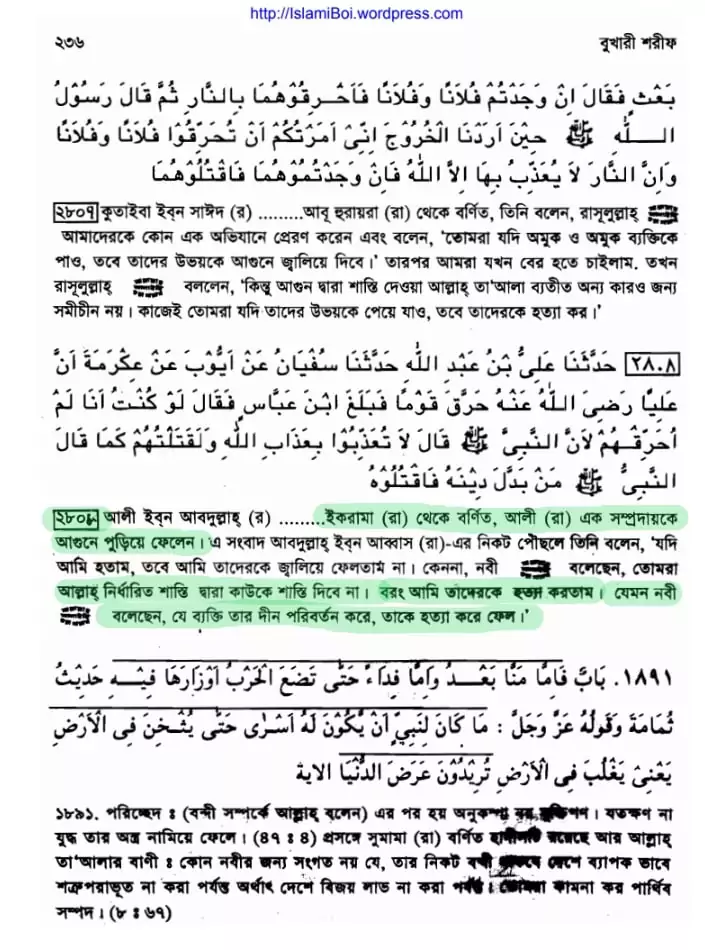
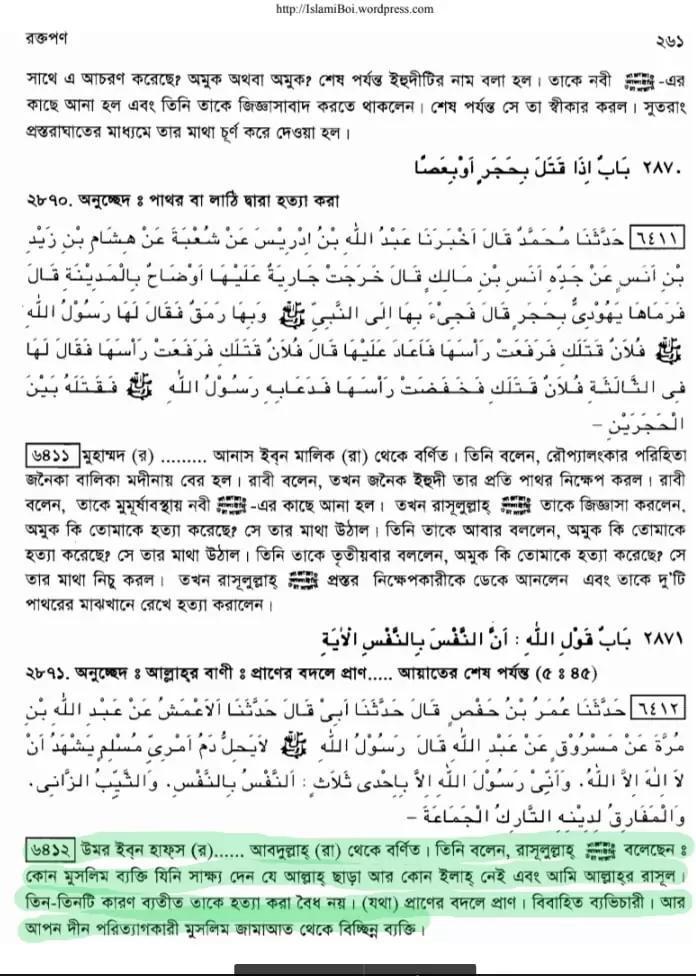
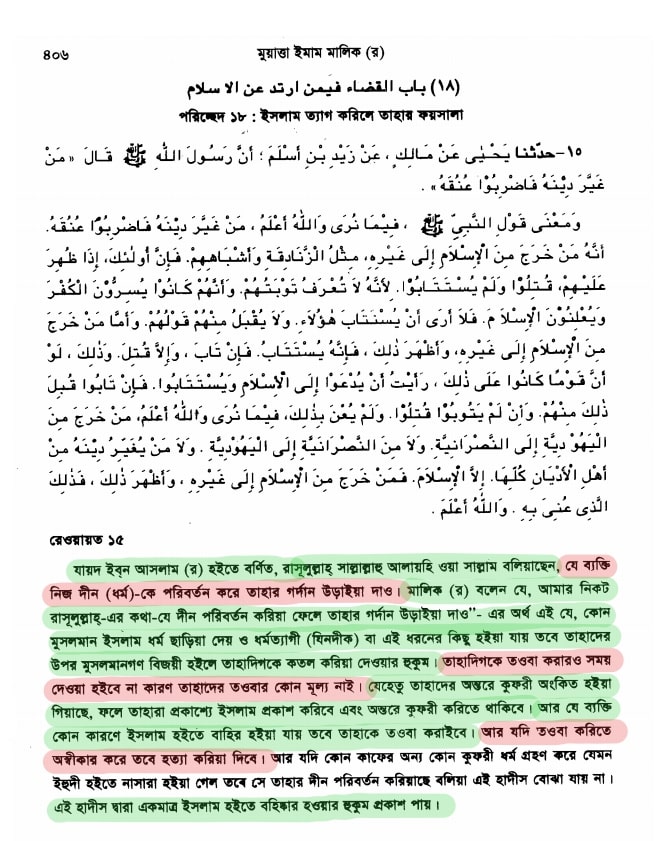
Now consider the punishment for apostates in al-Muwatta, the work of the eminent hadith compiler Imam Malik. The report appears on pages 406–407 of volume 2 of the Islamic Foundation’s edition of Muwatta Imam Malik [21]:
(۱۸) باب القضاء فيمن ارتد عن الاسلام
Chapter 18: The Ruling on Abandoning Islam
10 – حدثنا يَحْيَى عَنْ مَالِكٍ ، عَنْ زَيْدِ بْنِ أَسْلَمَ : أَنَّ رَسُولَ اللَّهِ ﷺ قَالَ « مَنْ غَيْرَ دِينَهُ فَاضْرِبُوا عُنُقَهُ …
وَمَعْنَى قَوْلِ النَّبِيِّ ، فِيْمَا نُرَى وَاللَّهُ أَعْلَمُ ، مَنْ غَيَّرَ دِيْنَهُ فَاضْرِبُوا عُنُقَهُ. أَنَّهُ مَنْ خَرَجَ مِنَ الْإِسْلَامِ إِلَى غَيْرِهِ، مِثْلُ الزَّنَادِقَةِ وَأَشْبَاهِهِمْ، فَإِنَّ أُولَئِكَ، إِذَا ظُهِرَ عَلَيْهِمْ، قُتِلُوا وَلَمْ يُسْتَتَابُوا لِأَنَّهُ لا تُعْرَفُ تَوْبَتُهُمْ وَأَنَّهُمْ كَانُوا يُسِرُّونَ الْكُفْرَ وَيُعْلِنُونَ الْإِسْلامَ. فَلَا أَرَى أَنْ يُسْنَتَابَ هُؤُلاءِ. وَلَا يُقْبَلُ مِنْهُمْ قَوْلُهُمْ وَأَمَّا مَنْ خَرَجَ مِنَ الْإِسْلَامِ إِلَى غَيْرِهِ، وَأَظْهَرَ ذَلِكَ ، فَإِنَّهُ يُسْتَتَابُ، فَإِنْ تَابَ ، وَإِلَّا قُتِلَ، وَذَلِكَ ، لَوْ أنَّ قَوْمًا كَانُوا عَلَى ذَلِكَ ، رَأَيْتُ أَنْ يُدْعَوْا إِلَى الْإِسْلَامِ وَيُسْتَتَابُوا فَإِنْ تَابُوا قُبِلَ ذَلِكَ مِنْهُمْ وَإِنْ لَمْ يَتُوبُوا قُتِلُوا وَلَمْ يُعْنَ بِذلِكَ، فِيْمَا نُرَى وَاللَّهُ أَعْلَمُ مَنْ خَرَجَ مِنَ الْيَهُودِيَّةِ إِلَى النَّصْرَانِيَّةِ وَلَا مِنَ النَّصْرَانِيَّةِ إِلَى الْيَهُودِيَّةِ . وَلَا مَنْ يُغَيِّرُ دِيْنَهُ مِنْ أهْلِ الْأَدْيَانِ كُلَّهَا إِلَّا الْإِسْلَامَ. فَمَنْ خَرَجَ مِنَ الْإِسْلَامِ إِلَى غَيْرِهِ ، وَأَظْهَرَ ذَلِكَ ، فَذَلِكَ الَّذِي عُنِي بِهِ . وَاللَّهُ أَعْلَمَ .
Report 15
Zayd ibn Aslam narrated that the Messenger of Allah said: ‘Whoever changes his religion, strike off his head.’ Malik said: ‘In my view, the meaning of the Messenger of Allah’s words, “Whoever changes his religion, strike off his head,” is that if a Muslim leaves Islam and becomes a heretic (zindiq) or something similar, and Muslims gain power over such people, they are to be killed. They are not to be given time to repent, because their repentance has no value. Unbelief has become engraved upon their hearts; they will outwardly profess Islam while inwardly remaining unbelievers. As for a person who leaves Islam for some other reason, he should be urged to repent. If he refuses to repent,
he is to be killed. But if an unbeliever changes from one unbelieving religion to another, such as from Judaism to Christianity, the hadith is not understood to apply merely because he has changed his religion. This hadith sets out the ruling specifically for departure from Islam.’
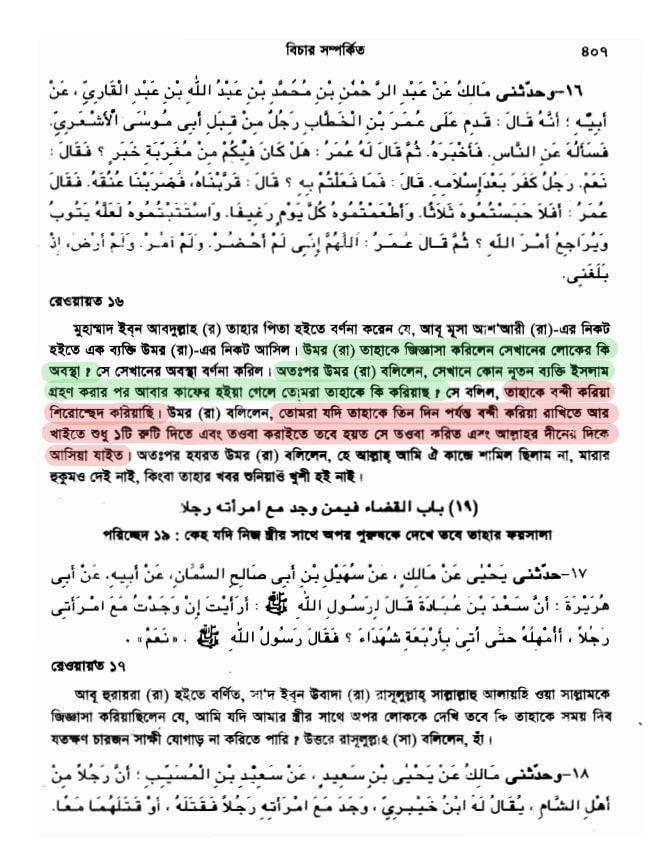
١٦ – وحدثني مَالِكَ عَنْ عَبْدِ الرَّحْمَنِ بْنِ مُحَمَّدِ بْنِ عَبْدُ اللَّهِ بْنِ عَبْدِ الْقَارِيِّ ، عَنْ أبِيهِ : أَنَّهُ قَالَ : قَدِم عَلَى عُمَرَ بْنِ الْخَطَابِ رَجُلٌ مِنْ قِبَلِ أَبِي مُوسَى الْأَشْعَرِي فَسَأَلُهَ عَنِ النَّاسِ فَأَخْبَرَهُ، ثُمَّ قَالَ لَهُ عُمَرُ : هَلْ كَانَ فِيكُمْ مِنْ مُغَرِّبَةِ خَبَرٍ ؟ فَقَالَ : نَعَمْ. رَجُلُ كَفَرَ بَعْدَ إِسْلَامِهِ. قَالَ : فَمَا فَعَلْتُمْ بِهِ ؟ قَالَ : قَرَّبْنَاهُ، فَضَرَبْنَا عُنُقَهُ، فَقَالَ عُمَرُ : أَفَلاَ حَبَسْتُمُوهَ ثَلاثًا وَأَطْعَمْتُمُوهُ كُلَّ يَوْمٍ رَغِيفًا، وَاسْتَتَبْتُمُوهُ لَعَلَّهُ يَتُوبُ وَيُرَاجِعُ أمر الله ؟ ثُمَّ قَالَ عُمَرُ : اللَّهُمَّ إِنِّي لَمْ أَحْضُرُ، وَلَمْ أَمْرُ وَلَمْ أَرْضِ إِذْ بَلَغَنِي.
Report 16
Muhammad ibn Abdullah narrated from his father that a man came to Umar from Abu Musa al-Ashari. Umar asked about the condition of the people there, and the man described their situation. Umar then asked: ‘What did you do about someone there who embraced Islam and subsequently became an unbeliever?’ He replied: ‘We detained him and beheaded him.’ Umar said: ‘If only you had kept him imprisoned for three days, giving him a loaf of bread to eat and calling on him to repent, he might have repented and returned to Allah’s religion.’ Umar then said: ‘O Allah, I did not take part in that deed, did not order his execution, and was not pleased when I heard of it.’
Punishment for Apostasy under Islamic Sharia
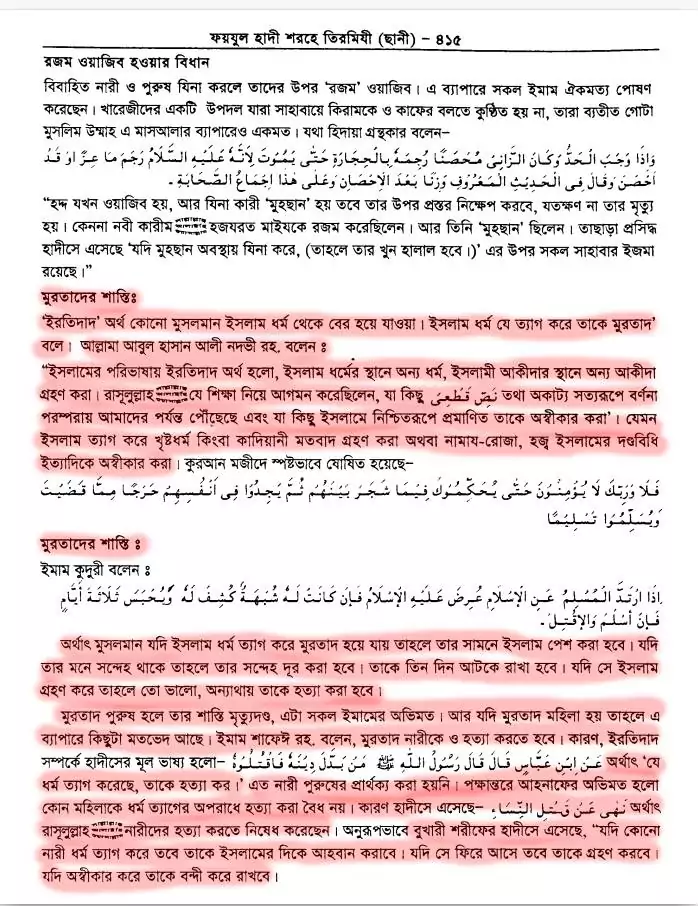
Let us now examine the punishment for apostates under Islamic Sharia. Fayd al-Hadi Sharh al-Tirmidhi (Thani) is a commentary on Jami al-Tirmidhi. It states the following [22]:
Punishment for Apostasy: ‘Irtidad’ means that a Muslim leaves the religion of Islam; one who abandons Islam is called a ‘murtadd’ or apostate. Allama Abul Hasan Ali Nadwi says: ‘In Islamic terminology, irtidad means adopting another religion in place of Islam or another creed in place of the Islamic creed, and denying anything that the Messenger of Allah brought, that has reached us through continuous transmission as an established truth, and that is definitively proven in Islam.’ Examples include leaving Islam for Christianity or the Qadiani doctrine, or denying prayer, fasting, pilgrimage, Islamic penal provisions, and the like. The Noble Quran states clearly: فَلَا وَرَبِّكَ لَا يُؤْمِنُونَ حَتَّى يُحَكِّمُوكَ فِيمَا شَجَرَ بَيْنَهُم ثُمَّ يَجِدُوا فِى أَنْفُسِهِمْ حَرَجًا مِمَّا قَضَيْتَ وَيُسَلِّمُوا تَسْلِيمًا
Punishment for Apostasy: Imam al-Quduri states: إِذَا ارْتَدَّ الْمُسْلِمُ عَنِ الْإِسْلَامِ عُرِضَ عَلَيْهِ الْإِسْلَامُ فَإِن كَانَتْ لَهُ شُبْهَةٌ كُشِفَ لَهُ وَيُحْبَسَ ثَلَاثَةَ أَيَّامٍ فَإِن أَسْلَمَ وَالإقتل . That is, if a Muslim leaves Islam and becomes an apostate, Islam will be presented to him. If he has doubts, attempts will be made to dispel them. He will be detained for three days. If he accepts Islam, that is well and good; otherwise he will be killed. According to all the imams, a male apostate’s punishment is death. There is some difference of opinion concerning female apostates. Imam al-Shafi’i said that an apostate woman must also be executed because the original wording of the hadith on apostasy is, ‘Whoever abandons religion, kill him’; it makes no distinction between men and women. The Hanafis, on the other hand, hold that it is not permissible to kill a woman merely for leaving religion because the hadith reports that the Messenger of Allah forbade the killing of women. Similarly, a report in Sahih al-Bukhari states: ‘If a woman abandons her religion, invite her back to Islam. If she returns, accept her; if she refuses, keep her imprisoned.’
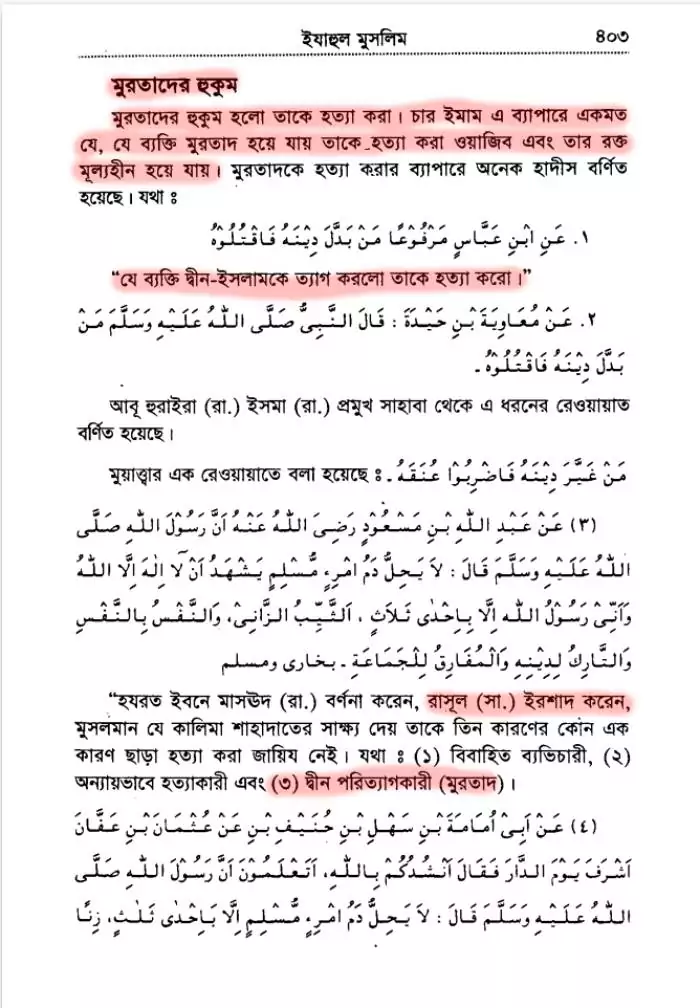
Now let us read a more detailed explanation and analysis from Idah al-Muslim [23]:
The Ruling Concerning an Apostate
The ruling on an apostate is that he should be killed. The four imams agree that it is obligatory to kill a person who becomes an apostate and that his blood has no legal value. Many hadiths have been narrated concerning the killing of apostates,
including the following:
۱. عَنِ ابْنِ عَبَّاسٍ مَرْفُوعًا مَنْ بَدَّلَ دِينَهُ فَاقْتُلُوهُ
“Whoever abandons the religion of Islam, kill him.”
عَنْ مُعَاوِيَةَ بْنِ حَيْدَةَ : قَالَ النَّبِيُّ صَلَّى اللَّهُ عَلَيْهِ وَسَلَّمَ مَنْ بَدَّلَ دِينَهُ فَاقْتُلُوهُ .
Similar reports are transmitted from Companions including Abu Hurayra and Asma.
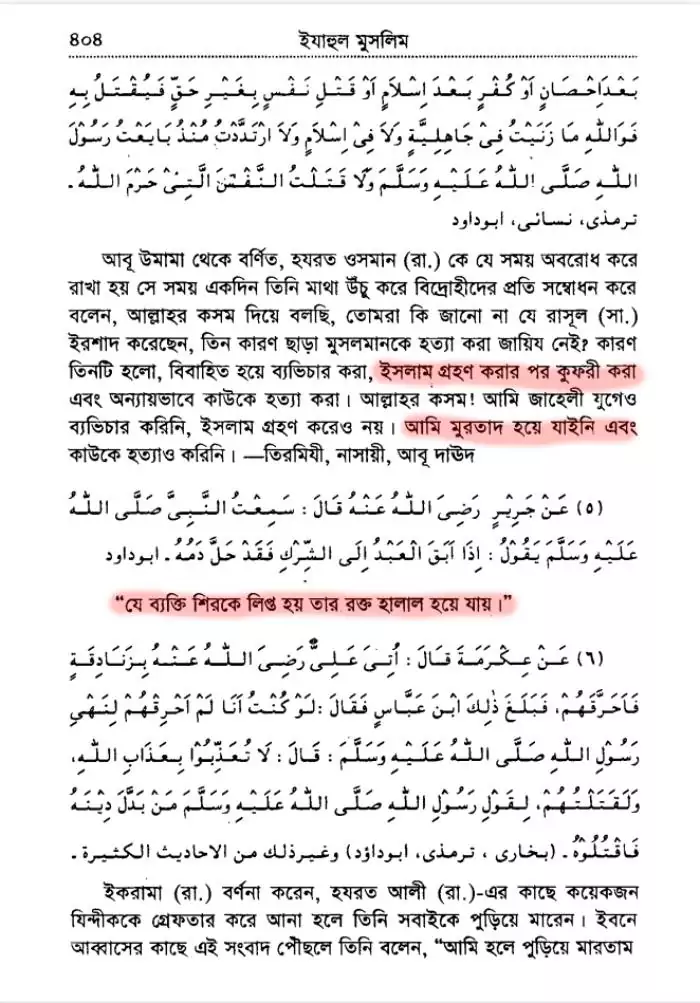
مَنْ غَيَّرَ دِينَهُ فَاضْرِبُوا عُنَقَهُ . :
(۳) عَنْ عَبْدِ اللَّهِ بْنِ مَسْعُودٍ رَضِيَ اللَّهُ عَنْهُ أَنَّ رَسُولَ اللَّهِ صَلَّى اللهُ عَلَيْهِ وَسَلَّمَ قَالَ : لَا يَحِلُّ دَمُ امْرِءٍ مُّسْلِمٍ يَشْهَدُ أَنْ لَا إِلَهَ إِلَّا اللَّهُ وَانِّي رَسُولُ اللهِ إِلَّا بِإِحْدَى ثَلاثٍ ، الطَّيِّبُ الزَّانِي، وَالنَّفْسُ بِالنَّفْسِ وَالتَّارِكُ لِدِينِهِ وَالْمُفَارِقُ لِلْجَمَاعَةِ – بخاري ومسلم
Ibn Masud narrated that the Messenger said:
“A Muslim who bears witness to the declaration of faith may not be killed except for one of three reasons: (1) a married adulterer, (2)
an unlawful killer, and (3) one who abandons the religion (an apostate).’
(٤) عَنْ أَبِي أُمَامَةَ بْنِ سَهْلِ بْنِ حُنَيْفِ بْنِ عَنْ عُثْمَانَ بْنِ عَفَّانَ أشْرَفَ يَومَ الدَّارَ فَقَالَ أَنْشُدُكُمْ بِاللهِ، أَتَعْلَمُونَ أَنَّ رَسُولَ اللَّهِ صَلَّى اللهُ عَلَيْهِ وَسَلَّمَ قَالَ : لَا يَحِلُّ دَمُ امْرِءٍ مُّسْلِمٍ إِلَّا بِإِحْدَى تَلْتَ زِنَا
بَعْدَ احْصَانٍ أَوْ كُفْرٍ بَعْدَ إِسْلامِ أَوْ قَتْلِ نَفْسٍ بِغَيْرِ حَةٍ فَيُقْتَلُ بِهِ فَوَاللَّهِ مَا زَنَيْتُ فِي جَاهِلِيَّةٍ وَلَا فِي إِسْلامِ وَلَا ارْتَدَّدْتُ مُنْذُ بَا بَعْتُ رَسُولَ اللهِ صَلَّى اللهُ عَلَيْهِ وَسَلَّمَ وَلَا قَتَلْتُ النَّفْتَنَ الَّتِي حَرَّمَ اللَّهُ .
ترمذی نسانی ابوداود
It is narrated from Abu Umama that while Uthman was besieged, he once raised his head and addressed the rebels: ‘I ask you by Allah, do you not know that the Messenger said that a Muslim may not be killed except for three reasons: committing adultery while married, disbelieving after accepting Islam, or unlawfully killing someone? By Allah, I have never committed adultery, either in the Age of Ignorance or after embracing Islam. I have not become an apostate, nor have I killed anyone.’ — Tirmidhi, Nasa’i and Abu Dawud.
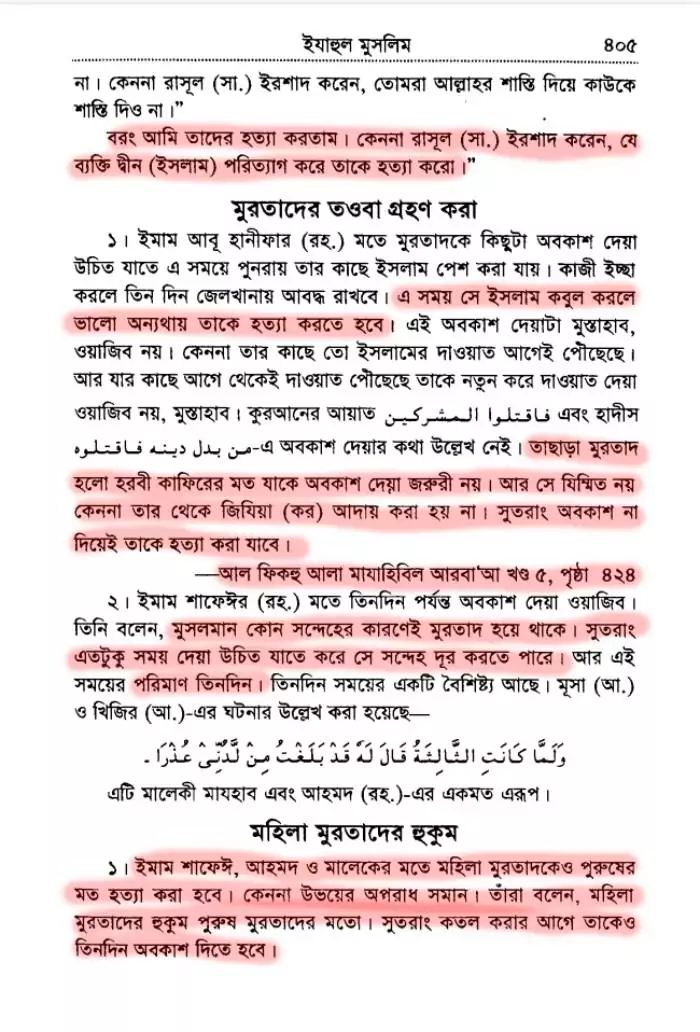
(٥) عَنْ جَرِيرٍ رَضِيَ اللهُ عَنْهُ قَالَ : سَمِعْتُ النَّبِيَّ صَلَّى اللَّهُ عَلَيْهِ وَسَلَّمَ يَقُولُ : إِذَا أَبْقَ الْعَبْدُ إِلَى الشِّرْكِ فَقَدْ حَلَّ دَمُهُ . ابوداود
“Whoever engages in polytheism, his blood becomes lawful to shed.”
٦) عَنْ عِكْرَمَةَ قَالَ : أَتِي عَلَى رَضِيَ اللَّهُ عَنْهُ بِزَنَادِقَةٍ
( فَأَحَرَّفَهُمْ، فَبَلَغَ ذَلِكَ ابْنَ عَبَّاسٍ فَقَالَ : لَوْ كُنْتُ أَنَا لَمْ أَحْرِقْهُمْ لِنَهْي رَسُولِ اللهِ صَلَّى اللهُ عَلَيْهِ وَسَلَّمَ : قَالَ : لَا تُعَذِّبُوا بِعَذَابِ اللَّهِ وَلَقَتَلْتُهُمْ لِقَوْلِ رَسُولِ اللهِ صَلَّى اللهُ عَلَيْهِ وَسَلَّمَ مَنْ بَدَّلَ دِينَهُ فَاقْتُلُوهُ – (بخاری ، ترمذی، ابوداؤد) وغير ذلك من الاحاديث الكثيرة .
Ikrimah narrated that several heretics were arrested and brought before Ali, who burned them all to death. When Ibn Abbas heard of this, he said: ‘Had it been me, I would not have burned them,
because the Messenger said: Do not punish anyone with Allah’s punishment.’
‘Instead, I would have killed them, for the Messenger said: Whoever abandons the religion (Islam), kill him.’
Accepting the Repentance of Apostates
1. According to Imam Abu Hanifa, an apostate should be granted some time so Islam can be presented to him again. The judge may imprison him for three days if he wishes. If he accepts Islam during that time, well and good; otherwise he must be killed. Granting this time is recommended (mustahabb), not obligatory (wajib), because the invitation to Islam has already reached him. Repeating the invitation to someone who has already received it is recommended, not obligatory. Neither the Quranic verse فاقتلوا المشركين nor the hadith من بدل دینه فاقتلوه requires granting a period of delay. Moreover, an apostate is like a hostile unbeliever (harbi kafir), for whom a delay is unnecessary. Nor is he a dhimmi, since jizya (tax) is not collected from him. Consequently he may be killed without being given any further time.
—Al-Fiqh ‘ala al-Madhahib al-Arba’a, volume 5, page 424
2. According to Imam al-Shafi’i, granting three days is obligatory. He says that a Muslim becomes an apostate because of some doubt and should be given enough time to remove that doubt; that period is three days. There is a special significance attached to three days. In the account of Moses and Khidr, it is stated:
وَلَمَّا كَانَتِ الثَّالِثَةُ قَالَ لَهُ قَدْ بَلَغْتُ مِن لَّدُنِي عُدْرًا . The Maliki school and one opinion of Ahmad agree with this.
The Ruling on Female Apostates
1. According to al-Shafi’i, Ahmad, and Malik, a female apostate is to be killed just as a male apostate is, because their offense is the same. They hold that the ruling concerning female apostates is identical to that concerning men. She must therefore also be granted three days before execution.
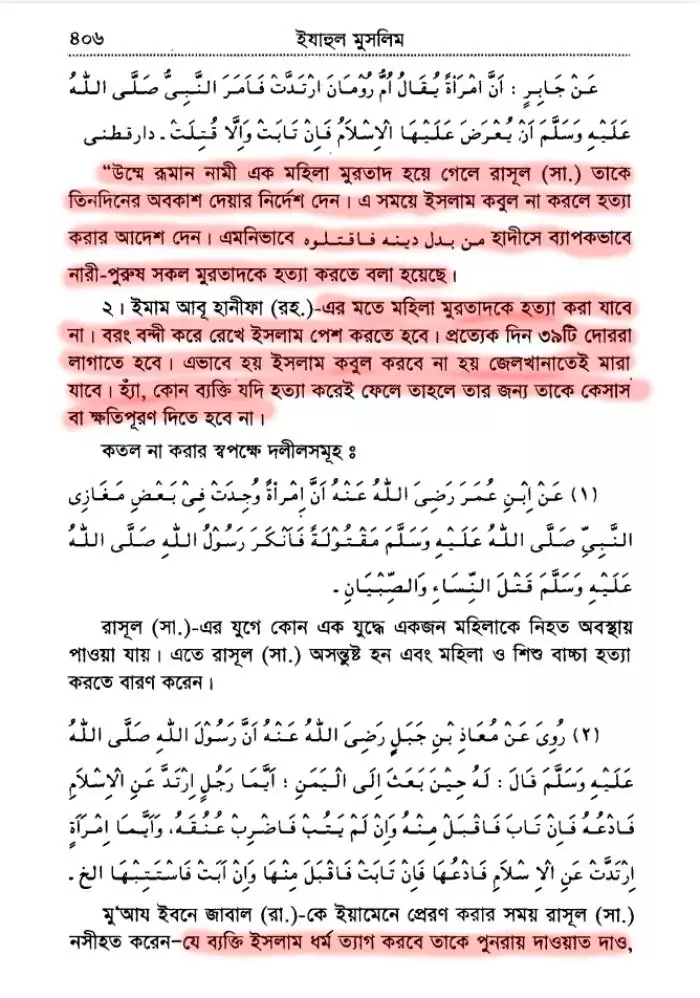
عَنْ جَابِرٍ : أَنَّ امْرَأَةً يُقَالُ أَمُّ رُومَانَ ارْتَدَّتْ فَأَمَرَ النَّبِيُّ صَلَّى اللَّهُ عَلَيْهِ وَسَلَّمَ أَنْ يُعْرَضَ عَلَيْهَا الْإِسْلامُ فَإِنْ تَابَتْ وَإِلَّا قُتِلَتْ – دار قطني
“When a woman named Umm Ruman became an apostate, the Messenger instructed that she be given three days. If she did not accept Islam during that period, he ordered her execution.” Likewise, the hadith من بدل دینه فاقتلوه generally commands the killing of all apostates, male and female.
2. In Imam Abu Hanifa’s view, a female apostate may not be killed.
Instead, she should be imprisoned and Islam presented to her. She should be given thirty-nine lashes every day. This is to continue until she accepts Islam or dies in prison. If someone nevertheless kills her, that person is not liable for retaliation (qisas) or compensation.
Evidence for Not Executing Her:
(۱) عَنْ ابْنِ عُمَرَ رَضِيَ اللهُ عَنْهُ أَنَّ امْرَأَةٌ وُجِدَتْ فِي بَعْضٍ مَغَازِي النَّبِيِّ صَلَّى اللهُ عَلَيْهِ وَسَلَّمَ مَقْتُولَةٌ فَأَنْكَرَ رَسُولُ اللَّهِ صَلَّى اللَّهُ عَلَيْهِ وَسَلَّمَ قَتْلَ النِّسَاءِ وَالصَّبْيَانِ .
During a battle in the Messenger’s lifetime, a woman was found dead. He was displeased and forbade killing women and children.
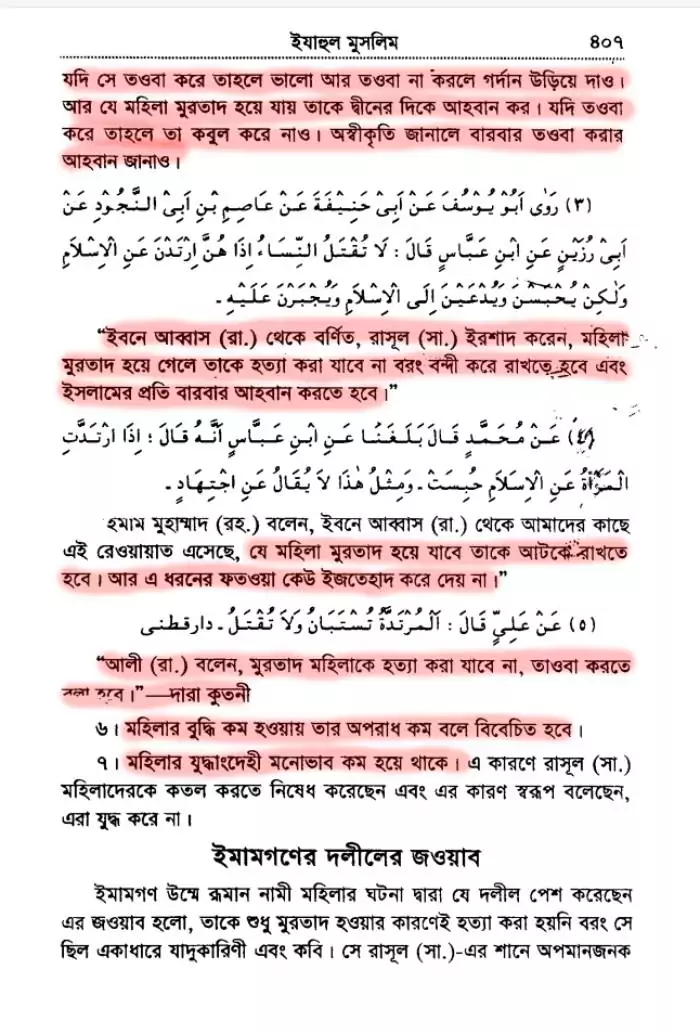
(۲) رُوِيَ عَنْ مُعَاذِ بْنِ جَبَلٍ رَضِيَ اللَّهُ عَنْهُ أَنَّ رَسُولَ اللَّهِ صَلَّى اللَّهُ عَلَيْهِ وَسَلَّمَ قَالَ : لَهُ حِيْنَ بَعَثَ إِلَى الْيَمَنِ : أَيَّمَا رَجُلٍ ارْتَدَّ عَنِ الْإِسْلَامِ فَادْعُهُ فَإِنْ تَابَ فَاقْبَلْ مِنْهُ وَإِنْ لَمْ يَتُبْ فَاضْرِبْ عُنُقَهُ، وَأَنَّمَا امْرَأَةٍ ارْتَدَّتْ عَنِ الَّا سُلَامِ فَادْعُهَا فَإِنْ تَابَتْ فَاقْبَلَ مِنْهَا وَإِنْ أَبَتْ فَاسْتَتِبْهَا الخ .
When sending Mu’adh ibn Jabal to Yemen, the Messenger advised: ‘Whoever abandons Islam should be invited back again;
if he repents, that is good; if he does not, strike off his head. As for a woman who becomes an apostate, invite her back to the religion. If she repents, accept her repentance. If she refuses, continue inviting her to repent repeatedly.’
(۳) روى أَبو يُوسُفَ عَنْ أَبِي حَنِيفَةَ عَنْ عَاصِمِ بْنِ أَبِي النُّجُودِ عَنْ أَبِي رُزَيْنِ عَنِ ابْنِ عَبَّاسٍ قَالَ : لَا تُقْتَلُ النِّسَاءُ إِذَا هُنَّ ارْتَدْنَ عَنِ الْإِسْلَامِ وَلَكِنْ يُحْبَسْنَ وَيُدْعَيْنَ إِلَى الْإِسْلَامِ وَيُجْبَرْنَ عَلَيْهِ .
“Ibn Abbas narrated that the Messenger said: ‘If a woman
becomes an apostate, she should not be killed; she should instead be imprisoned and repeatedly invited to Islam.'”
) عَنْ مُحَمَّدٍ قَالَ بَلَغَنَا عَنِ ابْنِ عَبَّاسٍ أَنَّهُ قَالَ : إِذَا ارْتَدَّتِ السَّواةُ عَنِ الْإِسْلامِ حُبِسَتْ ، وَمِثْلُ هَذَا لَا يُقَالُ عَنِ اجْتِهَادٍ .
Hammam Muhammad says: ‘We received this narration from Ibn Abbas: a woman who becomes an apostate must be detained. Such a legal opinion is not one that someone would issue merely through independent reasoning.’
(٥) عَنْ عَلِيِّ قَالَ : الْمُرْتَدَّةُ تُسْتَبَانُ وَلَا تُقْتَلُ – دار قطني
“Ali said: ‘An apostate woman may not be killed; she should be asked to repent.'” — al-Daraqutni
6. Because women’s intellect is considered deficient, their offense is regarded as less serious.
7. Women are considered less inclined to fight. For this reason, the Messenger forbade killing women, explaining that they do not engage in combat.
Responses to the Imams’ Evidence
The response to the evidence the imams present from the case of a woman named Umm Ruman is that she was not executed solely for becoming an apostate; rather, she was both a sorceress and a poet. She had spoken offensively about the Messenger’s honor
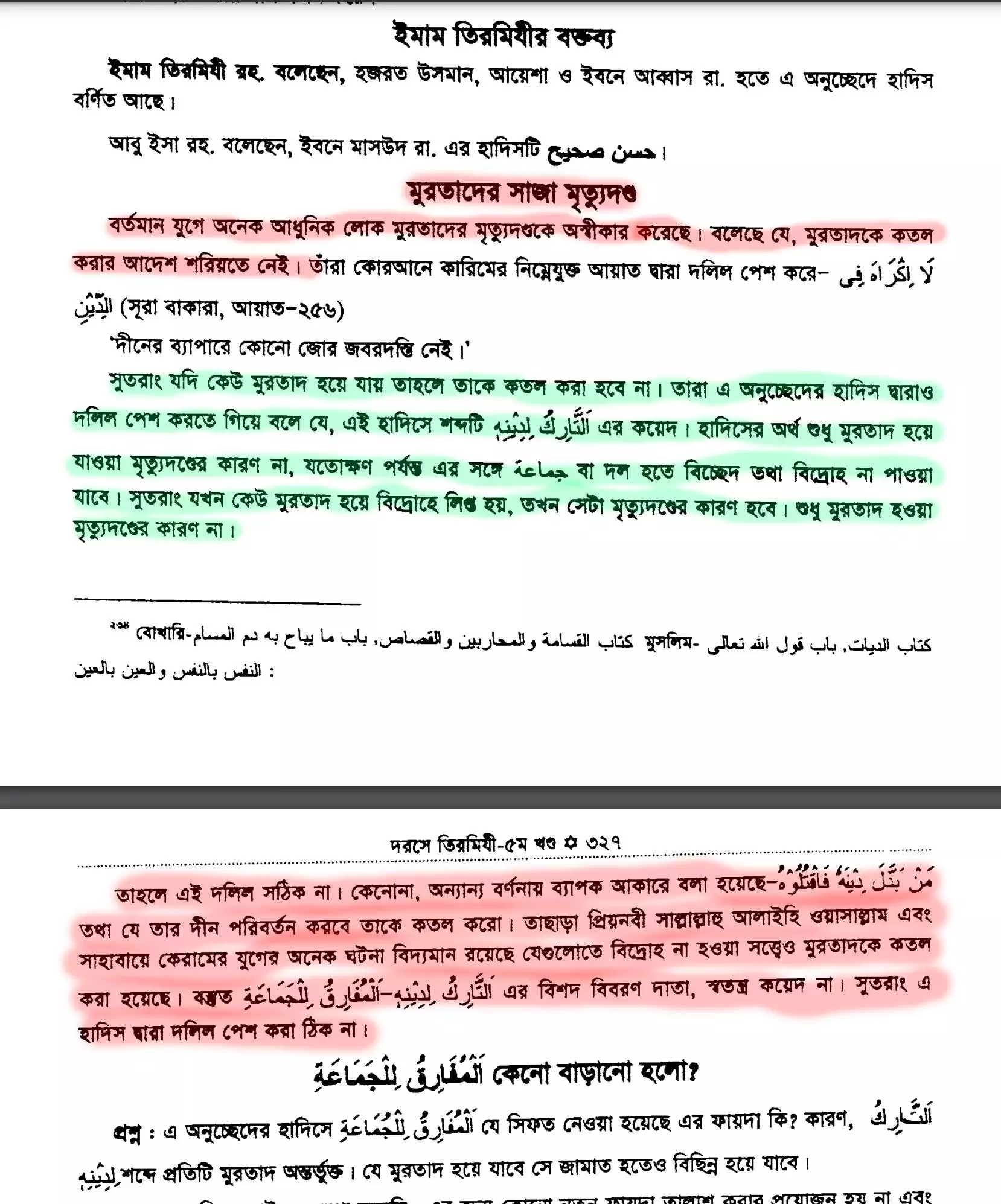
In recent times, many Islamic preachers, including Zakir Naik, have claimed that Islam does not prescribe the execution of apostates in general but commands only the killing of apostates who rebel. Yet the hadith commentaries plainly state that these claims are entirely false. An apostate must be killed whether or not he has rebelled [24]:
The Death Penalty for Apostasy
In modern times many modernists have denied the death penalty for apostasy. They claim there is no Sharia command to kill an apostate. They cite the following verse of the Noble Quran: لَا إِكْرَاهَ فِي
الدِّينِ (Surah al-Baqarah, verse 256)
“There is no compulsion in religion.”
Thus, they say that a person who becomes an apostate should not be killed. They also attempt to use the hadith of this chapter as evidence, arguing that the expression الثَّارِكُ لِینِ is qualified by the phrase concerning separation from the community. They say that mere apostasy is not grounds for a death sentence unless it also involves separation from the jama’ah (جماعة), meaning rebellion. Accordingly, someone becomes liable to execution only when apostasy is accompanied by rebellion; apostasy alone is not a capital offense.
But this argument is incorrect. Other narrations state in general terms: من بذل دينه فاقتلوه — ‘Whoever changes his religion, kill him.’ Moreover, many incidents from the era of the Prophet and the Companions show apostates being killed despite not engaging in rebellion. In fact, التَّارِكُ لِدِيْنِهِ الْمُفَارِقُ لِلْجَمَاعَةِ is an explanatory description, not a separate restrictive condition. Therefore, using this hadith as evidence for that claim is incorrect.
We can also examine what Islamic Sharia prescribes for apostates’ wives and other family members [25]:
According to reports from Abd al-Razzaq and al-Zuhri, the Messenger entered into treaties with the Arab polytheists at different times but did not accept jizya from them.
Imam Abu Hanifa said that the Arab polytheists were numerous and influential. The Noble Quran was revealed in their own language. They were therefore defiant and denied manifest miracles. For that reason nothing would be accepted from them except profession of Islam. If they refused Islam, they deserved to be killed. The same ruling applies to apostates (those who abandon the faith). They knowingly and voluntarily embrace Islam, and then abandon it despite understanding Islam. Their ignorance is therefore inexcusable. Only war is permitted against them, not jizya.
Imam Muhammad ibn Hasan narrated through Muslim from Ibn Abbas that the Messenger said: ‘With the polytheists of Arabia there are only
two options: Islam or war.’ If idolaters and apostates are captured, their wives and children may be made into male and female slaves. The Messenger enslaved the families of the people of Awtas and Hawazin. They were Arabs and polytheists. The families of Banu Mustaliq were treated similarly. When Abu Banu Hanifa became apostates, Abu Bakr enslaved their families and distributed those slaves among the fighters. The mother of Muhammad ibn Ali ibn Abi Talib and the mother of Zayd ibn Abdullah ibn Umar were among them.
After the wives and sons of apostates have been captured and placed under complete control, they may be compelled to accept Islam. The wives, sons and daughters of polytheists, however, are not to be invited to Islam. Imam al-Shafi’i said that the wives, sons and daughters of Arab polytheists may be captured and enslaved.
Imam Abu Yusuf wrote that the hadith concerning Ukaydir indicates:
Jizya was collected even from Arab unbelievers, whether they were People of the Book, idolaters, or fire-worshippers. Another hadith reports that Jews and Christians were expelled from the Arabian Peninsula. The ruling in the hadith concerning Ukaydir must therefore be regarded as abrogated, because residence in Arabia was itself a condition for eligibility to pay jizya. Once residence was no longer possible, on what basis could the tax still be levied?

An even more inhumane provision is that a person who kills an apostate is not subjected to the death penalty for that killing. This is stated in volume 1 of Codified Islamic Law [26]:
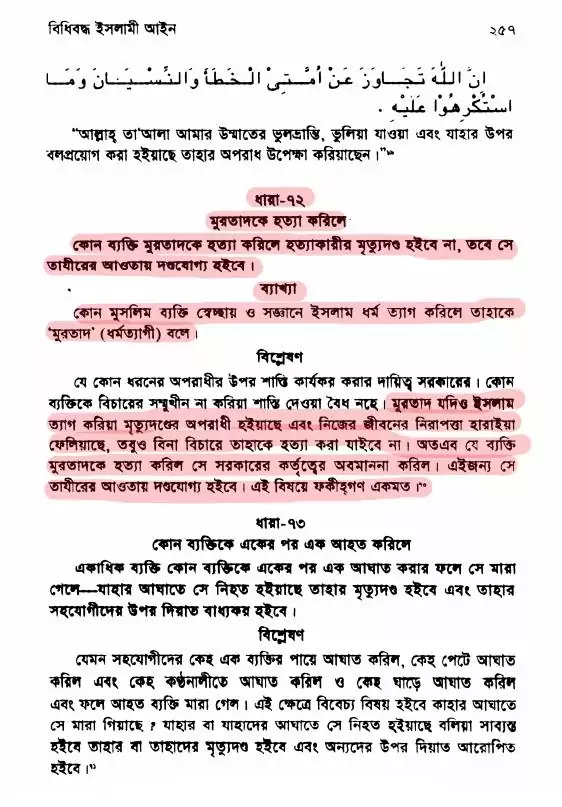
Section 72
If an Apostate Is Killed
If someone kills an apostate, the killer is not subject to the death penalty, but is punishable under ta’zir.
Explanation
A Muslim who knowingly and voluntarily abandons Islam is called a ‘murtadd’ (apostate).
Analysis
Responsibility for implementing punishment against any offender lies with the government. It is not lawful to punish someone without bringing them to trial. Although an apostate, by abandoning Islam, has committed a capital offense and forfeited the security of his own life, he may not be killed without trial. Therefore, a person who kills an apostate has violated the government’s authority and is punishable under ta’zir. Jurists agree on this matter.
Islamic law also provides for the confiscation of apostates’ property [27]:
Section 444
Inheritance of an Apostate (One Who Has Left Islam)
(a) An apostate cannot inherit from his Muslim relatives.
(b) The property an apostate earned while Muslim shall go to his Muslim heirs, while property acquired after apostasy shall be deposited in the Bayt al-Mal; however,
(c) All the property of a female apostate shall go to her Muslim heirs.
Analysis
A Muslim who abandons the religion of Islam is called a murtadd (apostate).
The Holy Quran states:
وَمَنْ يَرْتَدِدْ مِنْكُمْ عَنْ دِينِهِ فَيَمُتْ وَهُوَ كَافِرُ فَأُولئِكَ حَبِطَتْ أَعْمَالُهُمْ فِي الدُّنْيَا وَالْآخِرَةِ وَأُولَئِكَ أَصْحَبُ النَّارِ هُمْ فِيهَا خُلِدُوْنَ .
“Whoever among you turns away from his religion and dies as an unbeliever, their deeds will be rendered worthless in this world and the Hereafter. They are the inhabitants of Hell and will remain there forever” (Surah al-Baqarah 2:217).
According to Imam Abu Yusuf and Imam Muhammad, all property owned by an apostate, whether acquired before or after apostasy, shall belong to his Muslim heirs.
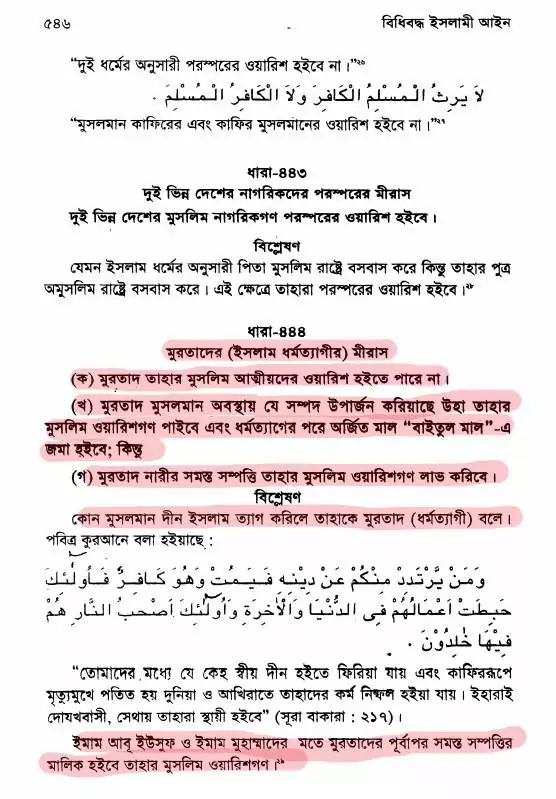
Apostates’ Property, Inheritance, and Transfer of Assets to the Public Treasury
Section 444 of the Islamic Foundation’s Codified Islamic Law specifies how the property of an apostate is to be distributed. It is not merely a rule of family succession but an instrument for asserting economic control over those who change religious beliefs. The assets someone earned while practicing Islam were acquired through their own labor, business, or lawful transactions. Yet once the person leaves Islam, the religion of their heirs, the ruler’s treasury, and school-specific jurisprudence are given priority over their own wishes in deciding who receives that property. By treating apostasy as comparable to death or a restriction of legal ownership, the law may undermine the financial independence of someone who is still alive.
In a hadith on inheritance in Sahih al-Bukhari, Muhammad says that a Muslim does not inherit from a non-Muslim, nor does a non-Muslim inherit from a Muslim. This religious barrier to inheritance became a fundamental basis for later jurists. If a father leaves Islam while his children remain Muslim, or a child leaves Islam while the father remains Muslim, reciprocal property rights cease to be determined solely by family ties. Religious identity has been placed above kinship [28]।
عَنْ أُسَامَةَ بْنِ زَيْدٍ ـ رضى الله عنهما ـ أَنَّ النَّبِيَّ صلى الله عليه وسلم قَالَ لاَ يَرِثُ الْمُسْلِمُ الْكَافِرَ، وَلاَ الْكَافِرُ الْمُسْلِمَ
English translation: It was narrated from Usama ibn Zayd that Muhammad said: ‘A Muslim cannot inherit from a non-Muslim, nor can a non-Muslim inherit from a Muslim.’
In his Al-Hawi al-Kabir under the chapter ‘Inheritance of the Apostate,’ Imam al-Mawardi records six distinct jurisprudential positions. One established Shafi’i and Hanbali position holds that an apostate’s estate, instead of passing to heirs as ordinary inheritance, is deposited as fay’ in the Muslims’ public treasury. The basic Maliki position likewise favors the treasury, although exceptions are discussed for heretics (zindiqs) and deathbed apostasy intended to deprive heirs. According to Abu Hanifa, property acquired before apostasy goes to Muslim heirs, while property acquired afterward goes to the public treasury, with a separate rule for female apostates. Abu Yusuf and Muhammad hold that all property, whether acquired before or after apostasy, goes to Muslim heirs. Other positions also refer to heirs belonging to the apostate’s new religion. These distinctions reveal how institutionalized the transfer of economic rights on the basis of religious identity became [29]।
قال الماوردي : وهذا كما قال : لا اختلاف بينهم أن المرتد لا يرث ، واختلفوا هل يورث أم لا ؟ على ستة مذاهب
English translation: Al-Mawardi says that jurists do not disagree that an apostate cannot inherit from another person. They do, however, hold six different legal positions concerning whether other people may inherit the apostate’s property.
It is false that, under every school, the property ultimately goes to the public treasury. It is equally false that, under every school, only relatives receive it. Yet the broader problem exposed by these differences is the same: a person’s property rights are made dependent on their religious status. Changing one’s religion bears no necessary ethical relation to property lawfully acquired or to reciprocal inheritance among relatives. Restricting economic rights because of a change in belief can become a powerful form of financial pressure to maintain religious obedience.
Divorce, Waiting Periods, and Dower in Cases of Apostasy
Under classical Islamic jurisprudence, when a husband or wife abandons Islam, the legal status of their marriage changes. No proof of violence against others, domestic abuse, or marital infidelity is required; a change in one spouse’s religion may be sufficient. Two adults may love each other and consent to remain married, yet religious law imposes an additional condition upon that consent. The consequences are not confined to the apostate: the spouse, children, and family life are directly affected.
In Imam al-Shafi’i’s Al-Umm chapter on ‘Apostasy of One or Both Spouses,’ it is stated that marital intercourse is prohibited when either or both spouses leave Islam. Where apostasy occurs after consummation, the existing marriage may remain suspended until the end of the waiting period (iddah). If the apostate returns to Islam during that time, the marriage continues; otherwise it dissolves. The work also discusses immediate dissolution where apostasy occurs before consummation. Entitlement to the whole or half of the dower may depend on which spouse apostatized and whether the marriage had been consummated. In al-Shafi’i’s account this is not an ordinary voluntary divorce (talaq); it is faskh—judicial or legal dissolution of the marital bond [30]।
وَإِذَا ارْتَدَّا أَوْ أَحَدُهُمَا مُنِعَا الْوَطْءَ فَإِنْ انْقَضَتِ الْعِدَّةُ قَبْلَ اجْتِمَاعِ إِسْلَامِهِمَا انْفَسَخَ النِّكَاحُ
English translation: If both spouses, or either one, apostatize, they are prohibited from sexual intercourse. If the waiting period expires before both have returned to Islam, the marriage is dissolved.
Al-Mawardi also records the differences among legal schools on this question. Under the Shafi’i view as he describes it, a marriage remains suspended until the end of the waiting period if apostasy takes place after consummation. Abu Hanifa holds that the marriage ends as soon as apostasy occurs. In Malik’s account, the marriage is dissolved unless the apostate returns. Thus, although the schools disagree on when the marriage ends, they regard apostasy as a legal ground for its dissolution [31]।
Dissolving marriages because of apostasy creates a fundamental conflict with religious freedom and family autonomy. A change in one person’s views does not cancel the other person’s consent. Yet in this system the continuation of a marriage depends on whether the apostate has restored their relationship with Islam. When a person must confront the threat of losing marriage and family in addition to the threat of death unless they return to the religion, the demand for religious conformity is no longer merely spiritual; it becomes coercive authority over intimate human relationships.
The Religious Identity, Captivity, and Enslavement of Apostates’ Children
Another serious area affected by punishments for apostasy is the religious identity of children. No child is born having examined the doctrines, truth claims, or philosophies of any religion. Nevertheless, classical jurisprudence contains rules classifying a child as Muslim or otherwise on the basis of parental religion. Whether a child was born while the parents were Muslim, whether both later apostatized, where the family resides, and whether the child has reached puberty all influence the rules governing that child’s future rights and freedom.
The Hanafi jurisprudential work of Imam al-Kasani, Bada’i al-Sana’i contains a separate chapter, ‘Rulings Concerning the Children of Apostates,’ in volume 7. Under certain circumstances, children born to Muslim parents remain legally Muslim even after their parents apostatize. If such a child grows up and rejects Islam, the text provides for compelling them to return. The relevant rule distinguishes personal apostasy from apostasy attributed to the child through the parents; in the latter situation, coercion through detention is discussed instead of execution. Thus, even where the child has never independently chosen Islam, religious identity is fixed through state law and family affiliation [32]।
وَأَمَّا حُكْمُ الِاسْتِرْقَاقِ فَذُكِرَ فِي السِّيَرِ أَنَّهُ يُسْتَرَقُّ الْإِنَاثُ وَالذُّكُورُ الصِّغَارُ مِنْ أَوْلَادِهِ
English translation: Regarding enslavement, the work al-Siyar states that the underage daughters and sons of an apostate may be enslaved.
In al-Kasani’s discussion, this provision for enslavement is specifically tied to warfare, migration to dar al-harb, captivity, and the parents’ previous religious status. It is not a general rule under which every apostate’s child automatically becomes a slave. Nevertheless, the legal possibility of enslaving minor children from apostate families under particular conditions is appalling. Subjecting a child who has committed no crime and has not independently chosen any religious identity to captivity or enslavement on account of the parents’ religion directly denies personal liberty and human dignity.
Tafsir-e-Mazhari records an account in which Abu Bakr captured and enslaved members of the apostate families of Banu Hanifa. This account differs importantly from al-Kasani’s rule: one is a historical narrative preserved in a later commentary, while the other is legal authorization for captivity and slavery under specified conditions. They are not identical, but taken together they demonstrate that the consequences of apostasy could extend beyond the apostates to the bodily freedom of their wives and children.
A Saudi Fatwa Explaining the Punishment
Shaykh Muhammad Salih al-Munajjid is among the world’s leading contemporary Islamic scholars. Consider the fatwa published on his well-known website, islamqa.info [33]
Why Is the Punishment for Apostasy Death?
Question 20327
Although I am a non-Muslim, I have become attracted to your beliefs. But I find it difficult to understand why a person should face a death warrant merely for saying something—I am referring to Salman Rushdie. I believe that as human beings we have no right to issue such judgments. Matters of this kind should be decided by Allah alone.
Answer
Praise be to Allah.
First, we thank you for trusting us with this question, for your interest in our beliefs, and for your desire to know the answer. We welcome you as a visitor, reader, and seeker of knowledge on this website. Dear reader, we have noticed that you openly express your attraction to Islam. This is good news both for us and for you. It is good news for us because our religion has reached truth-seekers such as yourself. Our Prophet informed us that this religion would spread throughout the earth. Tamim al-Dari reported hearing the Messenger say: ‘This religion will reach everywhere that night and day reach. No house made of animal hair [a nomad’s tent] or of clay [a settled house] will be left without Allah bringing this religion into it: with honor into the house of one worthy of honor and with humiliation into the house of one deserving humiliation. By that honor Allah will glorify Islam and by that humiliation He will abase unbelief.’ [Musnad Ahmad (16344); al-Albani graded the hadith sahih in Silsilat al-Sahihah.] This is good news for you because your interest will encourage you to learn more about this great religion. Islam accords with human nature and sound reason. We therefore advise you to study Islam calmly and free of outside influences. You may read questions 219, 21613, 20756, and 10590 on this website. As for your question—’I find it difficult to understand why someone should have a death warrant issued against him for saying something … I believe that as human beings we have no right to issue such judgments’—you are right that no person has the right to sentence someone to death without evidence from the Quran and Sunnah. Muslim scholars call the statement for which a death sentence may be pronounced ‘riddah’ (apostasy). When does a person become an apostate, and what is the ruling concerning an apostate? First, riddah means returning to unbelief after accepting Islam.
Second: When Is a Person Considered an Apostate?
Acts that establish apostasy fall into four categories. 1. Apostasy through belief, such as associating partners with Allah, denying Allah, or denying one of His established attributes.
2. Apostasy through speech, such as insulting Allah or insulting the Messenger.
3. Apostasy through actions, such as throwing the Quran into a filthy place. This is a form of disrespect toward Allah’s words and a sign of disbelief in the heart. Prostrating before an idol, the sun, or the moon is similar.
4. Apostasy through omission, such as abandoning all Islamic obligations and completely turning away from practicing them.
Third: What Is the Ruling on an Apostate?
If a Muslim becomes an apostate and all the relevant conditions apply (sanity, adulthood, and freedom of will), he is sentenced to death and is executed by the imam—the ruler of the Muslims—or his representative, such as a judge. His body is not to be washed, no funeral prayer is to be offered for him, and he is not to be buried in a Muslim cemetery.
The evidence for killing an apostate is the Prophet’s saying, ‘Whoever changes his religion, kill him’ [Sahih al-Bukhari (2794)]. The word ‘religion’ in this hadith means Islam. The Prophet also said: ‘The blood of a Muslim who testifies that there is no god but Allah and that I am Allah’s Messenger is forbidden to shed except in three cases: retaliation for murder, a married adulterer, and one who leaves his religion and separates from the community.’ [Sahih al-Bukhari (6878); Sahih Muslim (1676)]. See Al-Mawsu’ah al-Fiqhiyyah (Encyclopedia of Jurisprudence), volume 22, page 180. Dear questioner, this should make it clear to you that killing apostates is carried out by Allah’s command, because Allah has instructed us to obey His Messenger: ‘Obey Allah and obey the Messenger and those in authority among you.’ As stated earlier, the Messenger commanded the killing of apostates: ‘Whoever changes his religion, kill him.’ You may need some time and reflection to accept this ruling. Consider the following: a person follows the truth, enters the true path, and accepts the one true religion that Allah has made obligatory for him. Are we then to give him the freedom to abandon this religion easily whenever he wishes, to utter words of unbelief that expel him from Islam, to reject Allah, His Messenger, His Book, and His religion, and to face no punishment? What effect would this have upon him and upon others who wish to enter the religion? Do you not think that allowing such freedom would turn this great religion—which it is obligatory to embrace—into an open shop that anyone could enter and leave whenever they wished? He might even encourage others to leave Islam. Moreover, this person is not someone who has never known the truth or practiced religion or worship. Rather, he has known the truth, observed religious duties, and performed worship. Therefore, his punishment is no greater than he deserves. This kind of punishment is reserved for a person whose life has no value, because he has known the truth, followed Islam, and then abandoned it. Can there be a soul more wicked than his? In summary, Allah revealed this religion, made its acceptance obligatory, and prescribed death as the punishment for abandoning Islam after accepting it. This punishment is not a product of Muslim thinking, consultation, or independent jurisprudential reasoning. Since this is the case, we must obey the command of the One we have accepted as our Lord and God. May Allah enable us and you to do what pleases Him. We thank you again.
Peace be upon those who accept guidance.
Now let us examine how the Saudi government regards atheists [34]

Desecration of Apostates’ Bodies: Denial of Funeral Rites and Burial and Permission to Leave Bodies to Dogs
The lengthy IslamQA fatwa explicitly states that after an apostate is executed, the body is not to be washed as a Muslim’s would be, no funeral prayer is to be offered, and the person is not to be buried in a Muslim graveyard. Even after execution has taken a life, the deceased person’s religion remains the criterion for how the body is treated. A dignified funeral after death is not a declaration that the deceased’s beliefs were true; it is a matter of allowing surviving relatives to grieve, respecting the body, and observing minimum social humanity. Yet apostasy is made into an offense whose punitive consequences do not end at death.
In volume 5 of Al-Majmu’ Sharh al-Muhadhdhab the influential Shafi’i scholar Imam al-Nawawi, discussing shrouding and burial, states that shrouding a deceased hostile unbeliever (harbi kafir) or apostate is not obligatory; according to the adopted Shafi’i position, burial is not obligatory either. The work goes on to give an even more disturbing permission: setting dogs upon the corpse is permissible. Al-Nawawi also names al-Baghawi, al-Rafi’i, and other scholars in this discussion. Burial is permitted if the smell of the corpse would cause inconvenience to people [35]।
وَإِنْ كَانَ حَرْبِيًّا أَوْ مُرْتَدًّا لَمْ يَجِبْ تَكْفِينُهُ بِلَا خِلَافٍ وَلَا يَجِبْ دَفْنُهُ عَلَى الْمَذْهَبِ وَبِهِ قَطَعَ الْأَكْثَرُونَ ، بَلْ يَجُوزُ إغْرَاءُ الْكِلَابِ عَلَيْهِ
English translation: If the deceased is a hostile unbeliever or apostate, shrouding is not obligatory. Under the adopted position of the school, burial is not obligatory either; most scholars have given this ruling. Indeed, setting dogs upon the corpse is permissible.
Al-Nawawi does not describe setting dogs upon a corpse as fard, wajib, or an act obligatory for all Muslims; he calls it permissible. To call it compulsory would distort the original wording. Yet the very designation ‘permissible’ presents a profound ethical problem: humiliating a corpse by setting animals upon it is legally authorized. After death, a person cannot defend their body or protest, and their relatives also have a basic human interest in opposing such treatment. Denying the dignity of a human body on account of religious belief serves no necessary purpose of justice.
Ibn Hajar al-Haytami’s Tuhfat al-Muhtaj fi Sharh al-Minhaj states the same position directly. It permits setting dogs upon the body of a hostile unbeliever and says that the same ruling applies to an apostate or a zindiq. Thus, this position is not confined to an isolated modern fatwa but appears in multiple major works of classical Shafi’i jurisprudence [36]।
أَمَّا الْحَرْبِيُّ فَيَجُوزُ إغْرَاءُ الْكِلَابِ عَلَى جِيفَتِهِ وَكَذَا الْمُرْتَدُّ وَالزِّنْدِيقُ
English translation: Setting dogs upon the body of a hostile unbeliever is permissible. The same ruling applies to an apostate and a zindiq.
Solely because someone leaves Islam, separate religious rules govern their funeral prayer, burial, the treatment of their body, and their family’s opportunity to perform last rites. Maintaining punitive contempt for an apostate even after death directly contradicts the principle of human dignity. Just as ordering someone’s execution to enforce religious allegiance is cruel, authorizing the desecration of their body after death is inhumane. Neither a state nor a religious institution acquires ethical authority to deny a dead person basic respect because of the person’s beliefs.
Methods of Punishing Apostates: Beyond the Limits of Brutality
Consider an incident showing how certain people regarded as apostates were killed. Some members of the Ukl tribe came to the Prophet and embraced Islam. They later killed a shepherd and fled with camels. Muhammad had them killed with extreme cruelty. It is crucial to determine whether this brutal punishment was inflicted for killing the shepherd, stealing the camels, or abandoning Islam [37]. The method of punishment is also significant [38] [39] [40]
Sunan an-Nasa’i (Islamic Foundation)
1 / Purification
Chapter 191 / The Urine of Permissible Animals
307 Muhammad ibn Wahb … narrated from Anas ibn Malik: Some Bedouins of the Uraynah tribe came to the Messenger of Allah and embraced Islam. The climate of Medina did not suit them, and their complexions turned pale and their bellies became swollen. The Messenger of Allah sent them to his herd of milch camels and instructed them to drink their milk and urine. They recovered but then killed the camel-herder and drove away the camels. The Prophet sent people to pursue them. They were captured and brought back. Their hands and feet were cut off and heated iron rods were thrust into their eyes.
When the Commander of the Faithful Abd al-Malik heard this hadith from Anas, he asked: ‘Was this punishment for unbelief or for sin?’ He replied: ‘For unbelief.’ Abu Abd al-Rahman (Imam al-Nasa’i) said: ‘We do not know of anyone other than Talhah mentioning this statement through Yahya from Anas in the chain of this hadith. The correct view—Allah knows best—is that Yahya narrated it as a mursal report from Sa’id ibn al-Musayyab.’
Hadith classification: Sahih
Narrator: Anas ibn Malik
Mishkat al-Masabih (Mishkat)
Part 16: Qisas (Retaliation)
Chapter 4, First Section: Apostates and the Killing of Those Who Create Disorder
3539 (7)It is narrated from Anas that some members of the Ukl tribe came to the Prophet and accepted Islam. But the climate of Medina did not suit them. Therefore, he instructed them to go to the charity camels and drink their milk and urine. They followed the instruction and recovered. After regaining their health, however, they apostatized, killed the herdsmen, and drove away the camels.The Prophet sent men after them. When they were caught and brought back, he had their hands and feet cut off and their eyes gouged out. He did not have their bleeding wounds cauterized, so that they would die.
Another narration states that their eyes were branded with iron rods. Yet another states: He ordered iron rods to be brought and heated, then applied them to their eyes. He then left them on the scorching ground. They asked for water, but none was given to them. Eventually they died in this miserable condition.(Al-Bukhari and Muslim) (1)
(1) Sahih: al-Bukhari 3018, 6802; Muslim 1671; Abu Dawud 4364; al-Nasa’i 4025; Ibn Majah 2578; Ahmad 12639.
Hadith classification: Sahih
Narrator: Anas ibn Malik
Sahih Muslim (Islamic Foundation)
Chapter 29: Qasamah (special oaths concerning homicide), Muharibin (armed enemies), Qisas (retaliation for murder), and Diyah (financial compensation for homicide)
Section 2: The Judgment of Armed Enemies and Apostates
4207. Abu Ja’far Muhammad ibn al-Sabbah and Abu Bakr ibn Abi Shaybah … narrated from Anas that a group of eight men from the Ukl tribe came to the Messenger of Allah and pledged allegiance to Islam. But because the local climate did not suit them, they fell ill. They complained to the Messenger of Allah, and the Prophet said: ‘Why do you not go with our herdsman and use the urine of the camels and drink their milk?’ They agreed, went out, and used the urine and drank the milk, thereby recovering.
They then killed the herdsman and drove away the camels. When news of this reached the Messenger of Allah, he sent men in pursuit.They were captured and brought back. An order was issued: their hands and feet were cut off, heated iron rods were thrust into their eyes, and they were left in the sun until they died.
In Ibn al-Sabbah’s version, وَطَرَدُوا الإِبِل appears as وَاطَّرَدُوا النَّعَمَ, and his narration includes وَسُمِّرَتْ أَعْيُنُهُمْ.
Hadith classification: Sahih
Narrator: Anas ibn Malik
The incident involving Ukl and Uraynah cannot simply be equated with an ordinary, peaceful change of belief, for a particular reason: the accounts also describe the killing of a shepherd, theft of camels, and violence alongside apostasy. Such offenses require separate legal consideration. Yet the evidence for a general penalty against apostates does not rest on this incident alone. It also includes al-Bukhari’s hadith ordering the killing of those who change religion, the practices of the Companions, and the independent penalties for religious conversion discussed in subsequent jurisprudence. The fact that apostasy occurred alongside murder does not make apostasy itself equivalent to murder. Equally, citing the general death penalty for apostasy cannot justify torture of any intensity when punishing violent crime.
The most significant ethical aspect of this incident is the account of amputations after arrest, blinding with heated iron, leaving wounds to bleed, and withholding water until the prisoners died. Even when someone is guilty of a crime, inflicting unbearable suffering is not the same as remedying the harm caused by that crime. The general death penalty for apostasy, meanwhile, treats even a peaceful person who simply changes belief as deserving execution. Excessive cruelty in punishing an actual offense and criminalizing a change of belief are two distinct but serious ethical problems.
Islam: A Mousetrap
Whether a person adopts a religion should be their own decision. But if, after accepting a religious identity, the person has no right to change it, the freedom to enter that religion remains incomplete. Classical jurisprudence makes numerous fine distinctions among people who voluntarily convert to Islam, people classified as Muslim from birth, and people who profess Islam under coercion. Nevertheless, certain established rulings prevent someone once classified as Muslim from abandoning that identity. This creates a one-way system between the apparent freedom to join a religion and punishment for leaving it: one can enter, but leaving becomes dangerous or legally forbidden.
This one-way system is not merely a theoretical problem. It also appears in real legal rules for determining religious identity. A child born into a Muslim family is classified as Muslim from childhood. Some jurisprudential positions also recognize conversion under threat of force as legally effective in specified historical circumstances of warfare and religious classification. Inner conviction and public identity are not identical here: a declaration of Islam counts as an operative identity in the eyes of the ruler, even when the person making it may privately believe something else. If riddah provisions can then apply when the person abandons that identity, religion becomes in practice a matter of state and social authority rather than independent choice.
Let us examine the actual rules and authority of Islam on this question through a well-known work of creed [41]
… then she pointed toward the sky, indicating that you are the Messenger of Allah. The Messenger of Allah said: ‘You may set her free.’
Accordingly, words and acts that only a Muslim can say or perform, and by which it becomes clear that a person has entered Islam, count as accepting Islam. Examples include performing prayer like Muslims or undertaking the pilgrimage. However, if it is established that the person has not abandoned false beliefs and entered pure Islam through such words or acts, but continues to perform them while remaining an unbeliever under their own religious creed (as the Qadianis do today), or does so in jest, those acts will not be considered conversion to Islam unless the person uses an expression demonstrating abandonment of their former beliefs and return to the correct creed preached by the Messenger and followed by the Companions.
⇒ Forcing Someone to Accept Islam
This is an important issue related to the foregoing discussion. All the scholars agree that if unbelievers with whom we have no treaty, and who are not protected dhimmis paying jizya, are compelled to accept Islam by threats of death or by other means, that conversion is valid. In other words, after entering Islam in this manner, if they wish to leave again they will be considered apostates and killed. The evidence is the statement of the Messenger cited earlier: أمرت أن أقاتل النَّاسَ حَتَّى يَقُولُوا: لا إله إلا الله، فَمَنْ قال: لا إله إلا اللهُ عَصَمَ مِنِّي مَالَهُ، وَنَفْسَهُ — ‘I have been commanded to fight people until they say: There is no god but Allah.’
(11) The hadith was narrated by Imam Abu Dawud, who did not declare its chain weak, which means he considered it acceptable. He said that any hadith in his book on which he gave no comment was acceptable to him. Al-Haythami said in Majma al-Zawa’id: رجاله موثوقون — ‘The narrators of this hadith are trustworthy.’ Shaykh al-Albani, however, graded the hadith weak.
This report indicates that a person may express acceptance of Islam through signs and gestures. Prayer or other acts of worship can sometimes stand in their place when it is clear that the person would not have performed them without intending to accept Islam. Allah knows best.
Once they say it, their lives and property are considered protected. [Al-Bukhari and Muslim]
A lengthy hadith in Sahih Muslim states that whenever the Messenger sent out an expedition, he advised its commander:
فَادْعُهُمْ إلى ثلاث خِصَالٍ فَأَيتُهُنَّ مَا أَجَابُوكَ فَاقْبَلْ مِنْهُمْ
“Invite them to three options. Whichever they accept, accept it from them.”
Those options are: (a) embracing Islam, (b) paying the jizya tax, and (c) fighting. Therefore, those compelled to accept Islam through warfare are considered Muslims.
The incident involving Usama ibn Zayd demonstrates the same point. An unbeliever whom Usama was about to kill suddenly recited the declaration of faith. Usama assumed that the man’s conversion was unacceptable because it was motivated
by fear of the sword. Yet the Messenger severely rebuked him for this. The plain meaning is that if a person whom it is lawful to attack and kill (13) is threatened with death and embraces Islam out of fear, that conversion is valid. If the person later abandons Islam, he is considered an apostate. (12)
The commentary on Kanz al-Daqa’iq states: ولو أكره الحربي على الإسلام فأسلم صح إسلامُهُ بِالإجْمَاعِ
If an unbeliever with whom there is no treaty is compelled to embrace Islam, there is consensus that his conversion is valid. [Tabyin al-Haqa’iq]
(12) The hadiths in Sahih al-Bukhari and Sahih Muslim were mentioned earlier.
(13) Ibn al-Arabi said: أن المسلم إذا لقي الكافر لا عهد له جازله قتله — ‘When a Muslim encounters an unbeliever with whom he has no treaty, it is permissible for him to kill that person.’ [Ahkam al-Quran] Mulla Ali al-Qari al-Hanafi narrates from Imam al-Khattabi: أن الأصلَ فِي دِمَاءِ الْكُفَّارِ الْإِبَاحَةُ — ‘The basic rule concerning the blood of unbelievers is that it is permissible to shed.’ [Mirqat al-Mafatih] That is, an unbeliever’s blood is protected by a treaty or another reason; without a treaty it is lawful to shed it. In contrast, the basic rule concerning a Muslim’s blood is prohibition, which may be lifted for a particular reason (such as adultery by a married person). A treaty may be of three kinds: (a) a jizya agreement; (b) a truce or peace treaty; (c) an agreement granting short-term protection in an Islamic state. It is lawful to attack and compel to become Muslim any unbeliever with whom Muslims have none of these treaties. Those who accept Islam under such compulsion are legally considered Muslims in this world. The state of their hearts is left to Allah.
This applies to unbelievers who have no treaty with Muslims. In Islamic terminology they are called harbis (حربي) or ahl al-harb (أهل الحرب). It is entirely lawful to compel them to accept Islam, and a conversion made in this way is valid. They cannot later return from Islam. By contrast, Muslims have agreements with other categories, such as dhimmis (نمي) (14), musta’mans (مستأمن) (15), and mu’ahids (معاهد) (16). There is consensus among the community that compelling members of these classes to embrace Islam is not lawful, but scholars disagree over whether such a conversion, if it occurs, counts as valid. According to Hanbali and Shafi’i scholars, it does not count as conversion. (17) Under the adopted Hanafi position, it does count as conversion, and a non-Muslim who becomes Muslim in this way may not be permitted to leave Islam afterward. Tabyin al-Haqa’iq states:
أكره الدمي على الإسلام فأسلم يَصِحُ إِسْلَامُهُ
If a dhimmi unbeliever is compelled to accept Islam and does so, the conversion is valid.
The first position is correct here, and Allah knows best.
Note that when scholars say the conversion of a coerced person is valid, they mean that the person is legally considered Muslim in this world. His life and property are considered protected. If he returns to unbelief, he is regarded as an apostate, and it becomes obligatory to kill him unless he accepts Islam again. The state of his heart is left to Allah.
(14) Non-Muslims living in an Islamic state under its authority and paying a tax.
(15) Non-Muslims who obtain permission from the authorities to reside temporarily in an Islamic state for the purpose of learning about Islam.
(16) Non-Muslims who remain in their own territory under a truce with Muslims.
واذا أكره على الإسلام من لا يجوز إكراهه كالأمي والمستأمن فأسلم لم يثبت له حكم الاسلام حتى ( 21 2409 (29) PACO يوجد منه ما يدل على إسلامه طوعا مثل أن يثبت على الإسلام بعد زوال الاكراه عنه — If a person whom it is not permissible to compel to accept Islam, such as a dhimmi or musta’man, is coerced and accepts Islam, the conversion is not legally effective until evidence appears that the person voluntarily remains Muslim after the coercion is removed. [Al-Mughni] He said that Abu Hanifa and al-Shafi’i held the same view. We have noted, however, that the accepted Hanafi position is that such conversion is considered valid.
The Messenger’s hadith provides guidance on this matter.
He said:
أمِرْتُ أَنْ أَقَاتِلَ النَّاسَ حَتَّى يَقُولُوا: لا إله إلا الله، فَمَنْ قَالَ: لا إله إلا اللهُ عَصَمَ مِنِّي مَالَهُ، وَنَفْسَهُ وحسابه علي
الله
“I have been commanded to fight people until they say, ‘There is no god but Allah.’ When they say this, their lives and property are protected, and their reckoning is with Allah.”
[Al-Bukhari and Muslim]
In other words, those forced by war to recite the declaration of faith are regarded as Muslims for the purposes of worldly law, while the state of their hearts is left to Allah. If they have truly accepted Islam, they will be saved in the hereafter; otherwise, Allah will count them as unbelievers and they will suffer the punishment of Hell. We seek refuge with Allah from such an end. Amen.
1.b. (2) By Being Born to Muslim Parents
All scholars agree that a child born to Muslim parents is considered Muslim. Likewise, if a non-Muslim couple converts to Islam, their minor sons and daughters are considered Muslim. But there is disagreement over the ruling where only one parent is Muslim. Imam al-Bukhari narrates from Judge Shurayh and other Successors that they said:
إذا أسلم أَحَدُهُمَا فَالْوَلَدُ مَعَ الْمُسْلِمِ
If either parent is Muslim, the child is considered Muslim. [Sahih al-Bukhari]
Their evidence for this is the Messenger’s saying: الاسلام يعلو ولا يُعلي — ‘Islam is superior and nothing can prevail over Islam.’ (18) That is, when one parent is an unbeliever and the other is Muslim, the Muslim parent takes precedence and the corresponding ruling is applied to the child. This is the view of al-Shafi’i and Ahmad ibn Hanbal, and Abu Hanifa has a similar position.
He said, however, that a child treated as Muslim because of the parents’ conversion
(18) Al-Daraqutni, Bulugh al-Maram; Imam al-Bukhari mentioned the hadith without an isnad as a mawquf report. Ibn Hajar al-Asqalani classified it as hasan [Fath al-Bari 3/220], as did al-Albani [Irwa’ al-Ghalil 1268].
There are hadiths stating: من قال لا اله الا الله دخل الجنة — ‘Whoever says, There is no god but Allah, will enter Paradise.’ Yet the discussion above shows that a person may still be regarded as an unbeliever even after pronouncing ‘There is no god but Allah,’ acknowledging Allah as the sole deity, and believing Muhammad to be the Messenger. If that person considers something forbidden to be permissible, or something permissible to be forbidden, or commits another act of unbelief (28), that person is classified as an unbeliever. Scholars hold that such people are not regarded as Muslim merely for reciting the declaration of faith until they renounce whatever caused their unbelief. We have previously cited scholars such as al-Baghawi, al-Nawawi, and Ibn Qudamah on this point. Hadiths promising Paradise for reciting the declaration of faith are conditional: the person must say it while avoiding all forms of polytheism and unbelief. Another hadith states: من صلي البردين دخل الجنة — ‘Whoever performs the Fajr and Asr prayers will enter Paradise.’ Obviously it does not promise Paradise to someone who performs only those two prayers and neglects all others. Rather, the promise is conditional upon abstaining from polytheism, unbelief, neglect of other prayers, and other destructive acts. A verse or hadith must therefore be understood alongside other verses and hadiths rather than in isolation. This is discussed in detail near the end of chapter two.
2. (b) Can Unbelievers Be Forced to Become Muslims?
Today many Islamic thinkers (!!) loudly proclaim that nobody is forced to embrace Islam. Yet attentive readers of the foregoing discussion have seen that of the three ways of entering Islam described above, in the latter two the person’s own will carries no weight. Nobody voluntarily chooses to be born to Muslim parents, yet an infant born to Muslim parents is classified as Muslim and remains bound by that status after reaching adulthood. No opportunity to change that status is given: trying to do so means facing death. Likewise, when a child is classified as Muslim through captivity in war, the child’s consent or objection is irrelevant. The first method of accepting Islam
(28) We shall discuss this subject in greater detail in the next chapter, God willing.
is fundamentally dependent on individual will, but all the scholars agree that when an unbeliever without a treaty is attacked and compelled to become Muslim, a conversion made under such pressure is valid. The detailed evidence for this has already been provided. It clearly demonstrates that conversion to Islam can be voluntary or coerced. Those who deny this are ignorant of the evidence and are foolish researchers influenced and misled by the false ideologies propagated by unbelievers and polytheists. They deceive people by citing selected Quranic verses out of context, such as ‘There is no compulsion in religion’ (لا اكراه في الدين) [al-Baqarah 2:256], ‘You are not a controller over them’ (لست عليهم بمصيطر) [al-Ghashiyah 88:22], and ‘Will you then compel people until they become believers?’ (أفأنت تكره النَّاسَ حَتَّى يَكُونُوا مُؤْمِنِينَ) [Yunus 10:99]. They use these verses to argue that nobody may be compelled to enter Islam. Yet other verses and hadiths command collecting jizya from unbelievers in a state of humiliation [al-Tawbah 9:29], killing those who leave Islam, and forbidding unbelievers to practice their religion publicly (29) in an Islamic state. Various restrictions are imposed on them because of unbelief. The Messenger even said: ‘I have been commanded to fight people until they say, There is no god but Allah.’ To reconcile all these verses and hadiths, we must take account of the positions and practices of the Companions and subsequent distinguished religious scholars. The scholars have agreed on the matters described above, which are supported by clear evidence; therefore, one must not take a single verse or hadith out of context and cast aside all the evidence and scholarly consensus.
بَلْ قَدْ شَرَطَ عَلَيْهِمْ أَمِيرُ الْمُؤْمِنِينَ عُمَرَ بْنِ الْخَطَّابِ وَالصَّحَابَةُ وَسَائِرُ أَئِمَّةِ الْمُسْلِمِينَ أَنْ لَا يُظْهِرُوا ( 1 ا 2011 (20) أغيادَهُمْ فِي دَارِ الْمُسْلِمِينَ وَإِنَّمَا يَعْمَلُونَهَا سِرًّا فِي مَسَاكِنِهِمْ — ‘The Commander of the Faithful Umar ibn al-Khattab, the other Companions, and all the Muslim caliphs required non-Muslim dhimmis not to celebrate their religious festivals publicly in the Islamic state but only privately inside their homes.’ [Majmu’ al-Fatawa] Ibn Kathir writes in his commentary: ،ولا نظهر شركا ولا ندعو إليه أحدا؛ ولا تمنع أحدا من ذوي قرابتنا الدخول في الإسلام إن أرادوه، وأن نوقر المسلمين، وأن نقوم لهم من مجالسنا إن أرادوا الجلوس — ‘[The Jews wrote in their treaty:] We will not practice our religion openly or invite anyone to polytheism or unbelief. We will not prevent any of our relatives who wish to enter Islam. We will honor Muslims and stand up to make room for them if they wish to sit in our assemblies.’ [Tafsir Ibn Kathir, commentary on al-Tawbah 9:29]. The subject is discussed further below.
Rather, every verse must be applied in its proper place. The verse ‘There is no compulsion in religion’ applies to unbelievers from whom jizya may be collected and who agree to pay it. It does not apply to those who refuse jizya or its conditions, such as refraining from openly practicing or propagating their religion and not building new places of worship. Nor does that verse apply to a child considered Muslim because of birth in a Muslim household or captivity at Muslim hands, who later reaches adulthood and wishes to return to unbelief. Such a person will be prevented and, if necessary, killed, because the Messenger said: من بدل دينه فاقتلوه — ‘Whoever changes his religion, kill him.’ [Sahih al-Bukhari] In all these cases, the verse prohibiting compulsion does not apply; instead, the provisions authorizing coercion apply.
We conclude here our discussion of how a person is considered Muslim. In the next chapter, God willing, we shall discuss the words and acts by which a person is classified as an unbeliever, that is, the utterances and actions regarded as kufr.
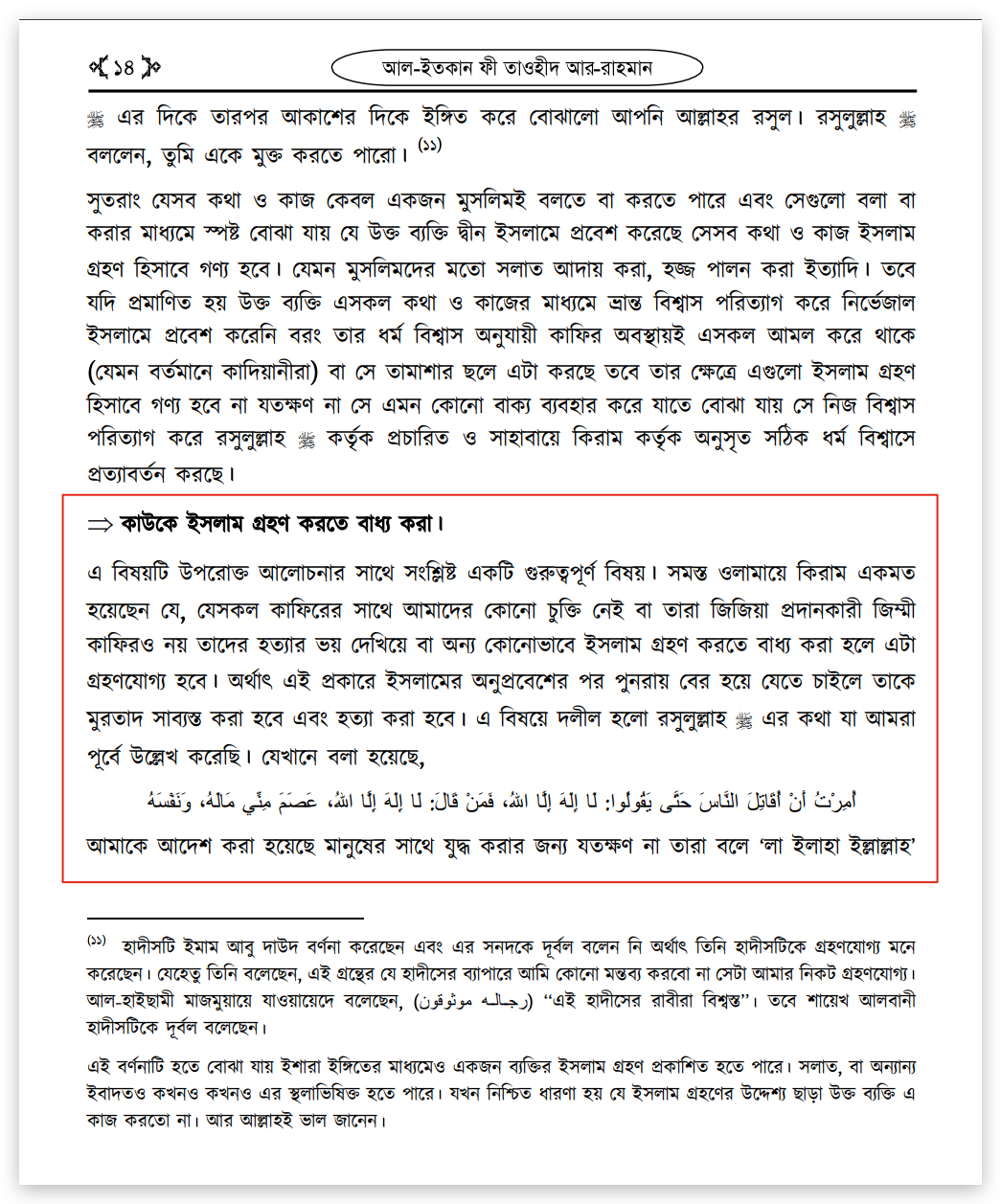
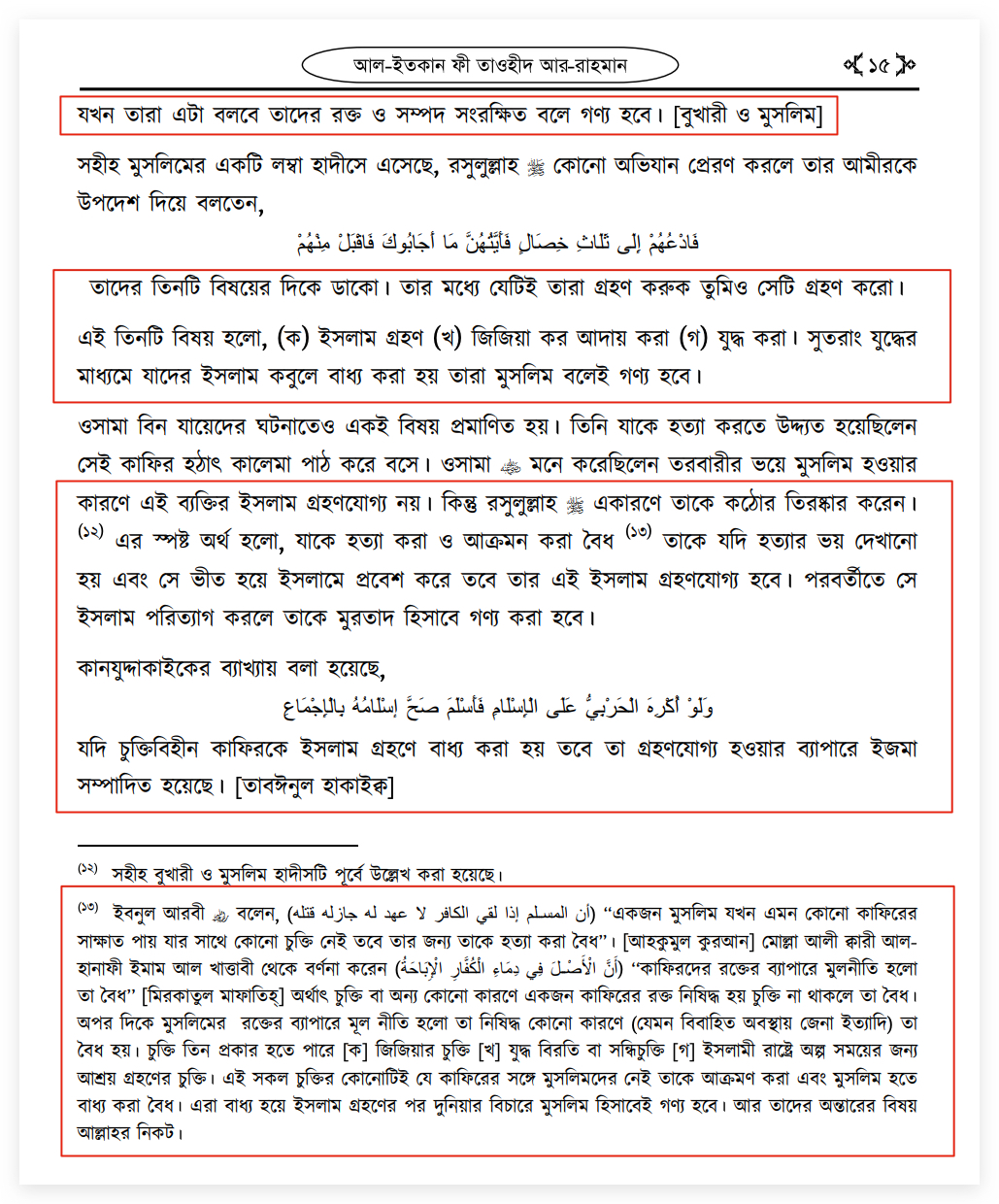
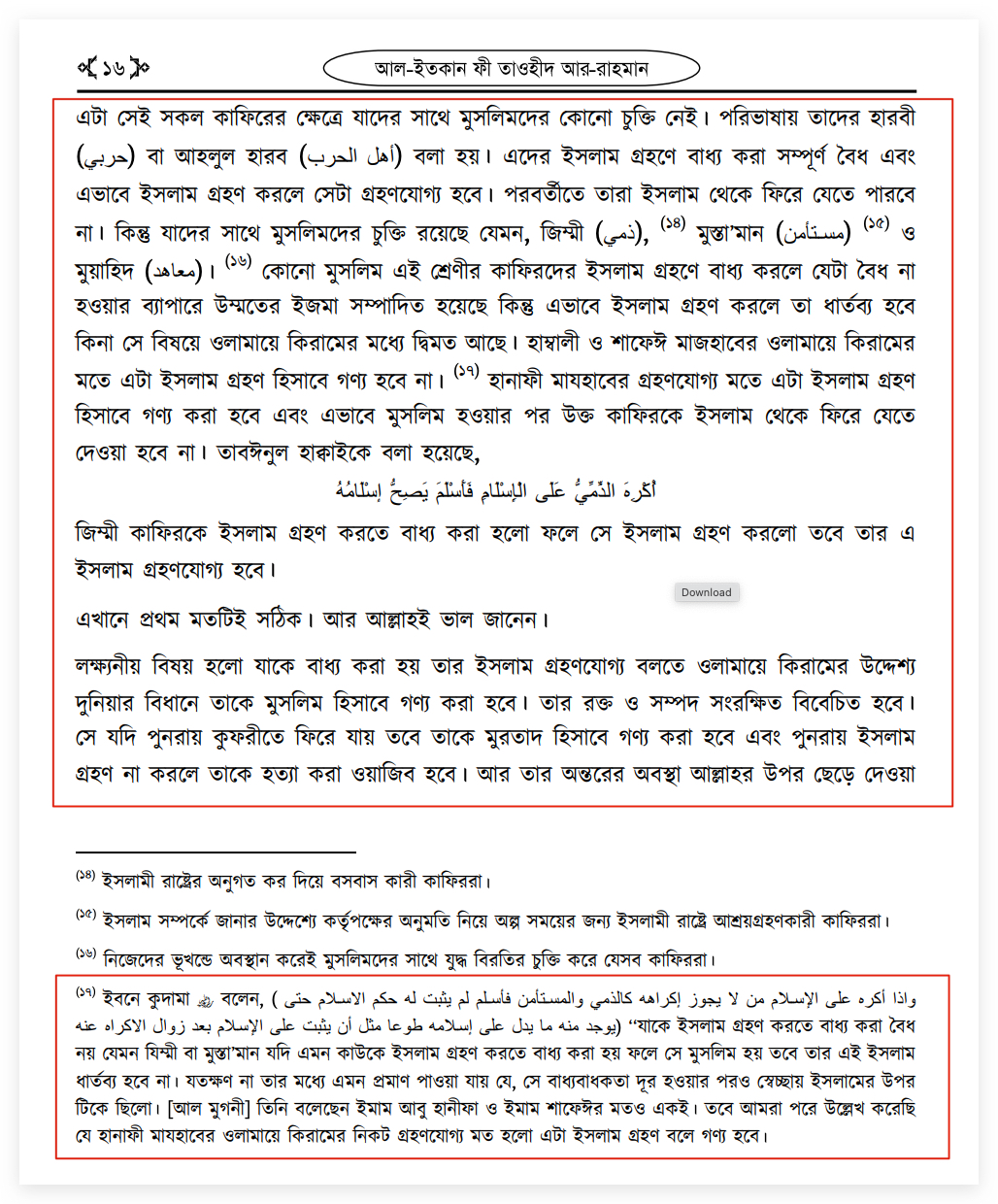
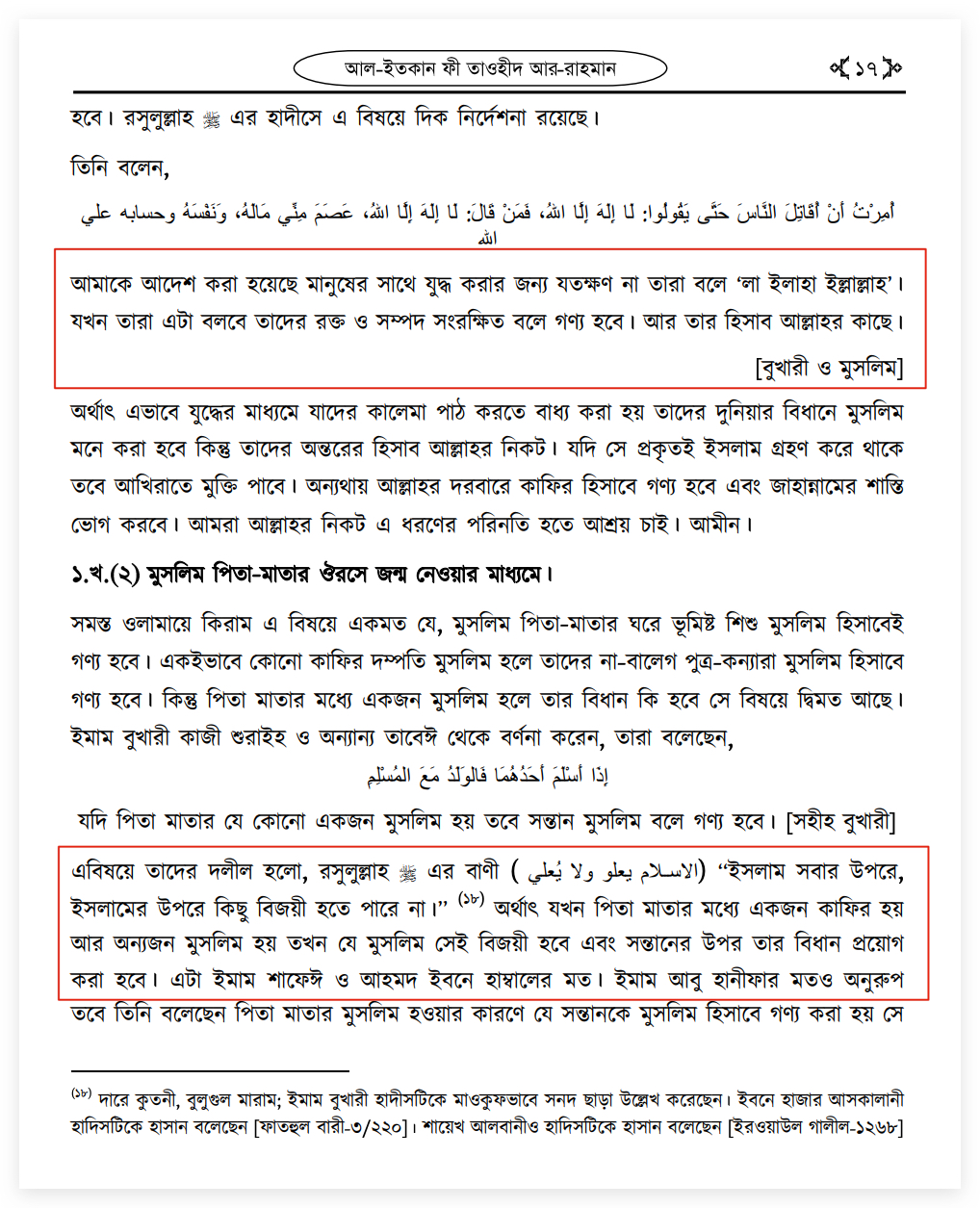
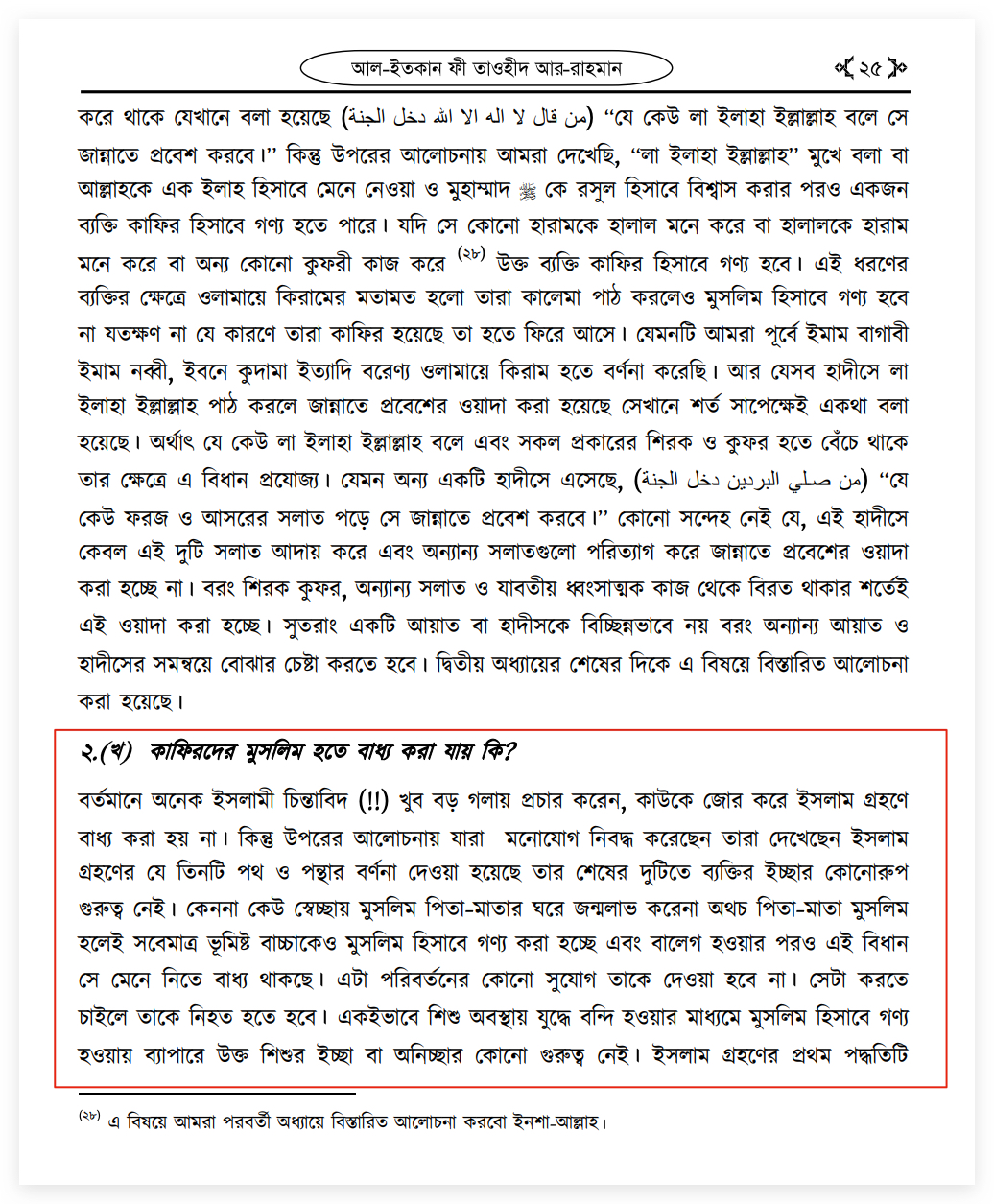
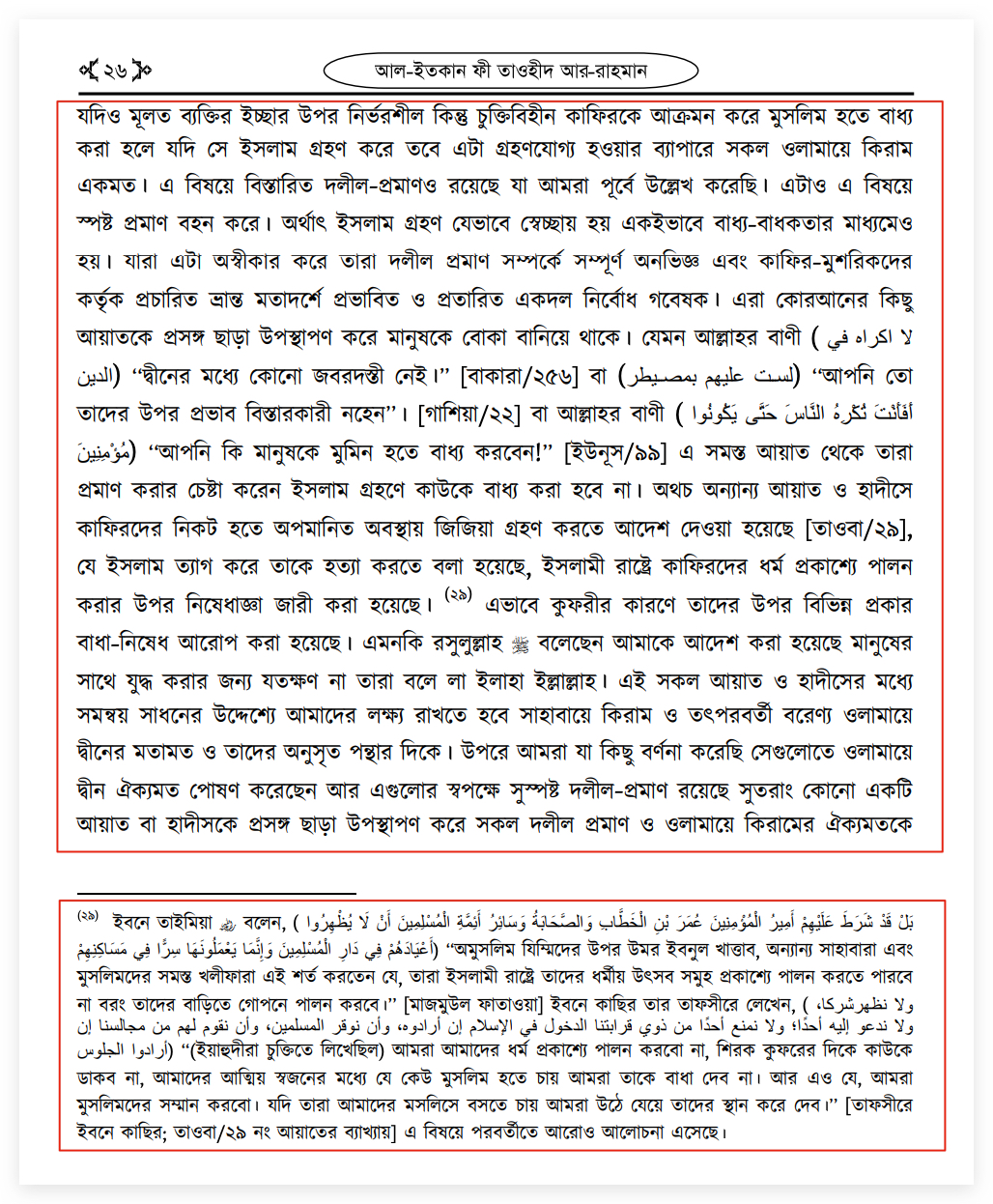
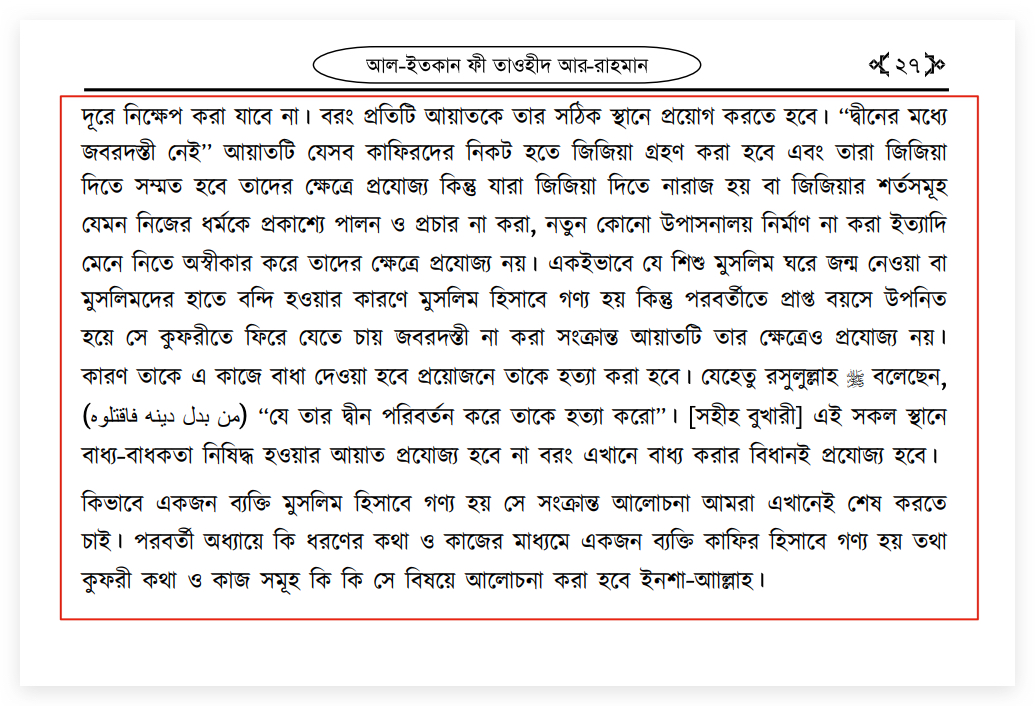
Al-Itqan fi Tawhid al-Rahman The categorical distinctions made in this book of creed between harbi unbelievers without treaties, protected dhimmis, musta’mans, and children born to Muslim families have parallels in important discussions of Hanafi and Shafi’i jurisprudence. The Hanafi work Al-Ikhtiyar li-Ta’lil al-Mukhtar states in its chapter on ‘How a Non-Muslim Becomes a Muslim’ that when a dhimmi is forced to accept Islam, that conversion may be regarded as valid. If the person later leaves Islam, the rule discussed there is to imprison them until they return, rather than kill them. This specific Hanafi position is not identical to all Shafi’i positions. Nevertheless, the problem is clear: a religious declaration extracted by force is made the basis for legal identity instead of the person’s actual inward conviction [42]।
أُكْرِهَ الذِّمِّيُّ عَلَى الْإِسْلَامِ فَأَسْلَمَ يَصِحُّ إِسْلَامُهُ ، وَلَوْ رَجَعَ لَا يُقْتَلُ ، وَلَكِنْ يُحْبَسُ حَتَّى يَرْجِعَ إِلَى الْإِسْلَامِ
English translation: If a dhimmi is forced to accept Islam and does so, the conversion is regarded as valid. If the person later turns away, they are not executed but imprisoned until they return to Islam.
In Imam al-Nawawi’s Al-Majmu’ the Shafi’i discussion quotes the view that a declaration of Islam extracted by coercion from an unprotected harbi is legally effective, whereas distinct rules govern forcing dhimmis or other protected non-Muslims to convert. This classification creates a double standard: whether coercion concerning the same personal belief is legally accepted depends on the person’s treaty relationship with Muslim authorities and their legal status. The right to freedom of conscience does not arise only after a person has been classified as a harbi, a dhimmi, or the child of Muslim parents; the capacity to think and change belief is part of every individual’s rights [43]।
The greatest logical contradiction here is that when a profession of religious allegiance is obtained through threats, its wording is accepted as legal evidence of belief, whereas the same person may face punishment if they later freely declare that they do not believe in the religion. A declaration obtained through coercion is not evidence of spontaneous personal conviction. Turning that declaration into a permanent legal identity and forbidding the opposite declaration means that control over religious affiliation belongs not to the person but to the authorities. Rather than proving a religious truth, it is a mechanism for locking an individual’s public identity in one direction.
The same problem arises with religious identity assigned by birth. A child has not freely chosen Islam merely by being born into a Muslim family. Yet when that child becomes an adult, critically examines religion, and leaves Islam, rules treating them as an apostate turn an identity imposed by others at the very beginning of life into an unchangeable one. Threatening punishment for abandoning an identity that never required the person’s consent to acquire is not freedom of belief. If religious truth can be established through reason and evidence, there is no ethical necessity to threaten apostates with execution, imprisonment, family separation, or confiscation of property.
The conflict between the Quranic declaration ‘There is no compulsion in religion’ and provisions accepting forced conversion while punishing departure is thus not merely a disagreement over words; it is a contradiction of principle. Religion is called a matter of individual belief while penalties are imposed upon the public exercise of the right to change that belief. No ruler, jurist, relative, or religious institution can decide on another person’s behalf which religion they should believe. One-way conversion and compulsory allegiance place human conscience under authority; they do not establish freedom of belief.
Without Killing Apostates, Islam Would Not Have Survived
An influential current among Islamic scholars has presented the death penalty for apostasy not only as punishment for a religious offense, but also as a means of keeping Islam alive, preventing Muslims from leaving the faith, and obstructing the spread of dissent against religious authority. The starkest expression of this position is the claim that Islam would have ceased to exist immediately after Muhammad’s death had violent measures not been taken against apostates. This claim is not a historically proven alternative outcome; it is an account of perceived political and religious necessity acknowledged by religious leadership itself. An argument that a religion must prevent its followers from leaving and kill them if necessary to survive makes the power to enforce allegiance, rather than the truth of belief, central. People who have privately lost faith can still outwardly identify with a religion out of fear of death, so apparent membership cannot be treated as evidence of free consent.
A video below contains a statement asserting that Islam would not have survived without severe punishments for apostasy. The same claim appears directly in Arabic in the complete transcript of a 2013 program featuring Yusuf al-Qaradawi.
On 23 January 2013, in Al Jazeera’s Al-Sharia wa al-Hayat program, a viewer asked what punishment apostates receive in this world, given that the Quran speaks of punishment in the afterlife. Yusuf al-Qaradawi responded by referring to Surah al-Ma’idah 5:54 and the Ridda Wars of Abu Bakr, claiming that Islam would have ended immediately after Muhammad’s death had those apostate groups not been resisted. He was not merely describing the military outcome of a state conflict; he attributed Islam’s very survival to resistance against apostasy. His remarks establish a direct causal connection between the religion’s existence and the suppression of apostasy [44]।
لو تركوا الردة ما كان هناك إسلام كان انتهى الإسلام منذ وفاة الرسول علية الصلاة والسلام، فالوقوف أمام الردة هو الذي أبقى الإسلام
English translation: If they had not taken action against apostasy, Islam would not have survived; it would have ended soon after the Messenger’s death. Resistance to apostasy is what kept Islam alive.
Al-Qaradawi’s statement is not scientific proof of the actual historical causes of Islam’s survival. We cannot observe an alternative history in which those wars against apostates did not occur. Its political significance, however, is unambiguous. In his explanation, the safeguard of Islam is not letting those who have lost faith leave, but resisting apostasy to keep the religious community intact. Religious allegiance is no longer left to an individual’s independent decision. Leaving religious authority is treated as a threat to the existence of the entire system. Continuity of the institution thereby becomes more important than protecting the apostate’s life and right to change belief. If the strength of a truth claim depends on reasoning and evidence, there should be no need to prevent a change of belief by threatening death.
Al-Qaradawi advanced the same argument for control in a fatwa published on his own website on 24 July 2007, titled Khuturat al-Riddah wa Uqubat al-Murtadd (The Danger of Apostasy and the Punishment of the Apostate). The question concerned what legal judgment should apply to someone who kills an individual who left Islam without publicly announcing it. In response, al-Qaradawi raised the issue of protecting the existence of Muslim society. He argued that apostasy, wherever it appears and whatever form it takes, must be resisted; even individual apostasy must be suppressed before it spreads and becomes collective apostasy. Here, someone’s right to change their thinking or belief is treated as a dangerous contagion threatening society. The fear that an apostate’s views could encourage others to leave religion becomes an argument for religious control [45]।
وواجب المجتمع المسلم – لكي يحافظ على بقائه – أن يقاوم الردة من أي مصدر جاءت، وبأي صورة ظهرت
English translation: To safeguard the existence of Muslim society, it is its duty to resist apostasy wherever it comes from and however it manifests itself.
The wording of al-Qaradawi’s fatwa is particularly significant. He regards apostasy not merely as disagreement with a doctrine but as a threat to the survival of Muslim society. For someone who believes religious claims are false, even the freedom to communicate that opinion to others becomes a source of anxiety for this system, because other people might change their beliefs as a result. Yet the ordinary way to determine whether an idea is reasonable is to allow open questioning, opposition, criticism, and rejection. Closing that process through state punishment means using authority to control the free competition of beliefs. A religious institution may preserve itself by restricting its members’ right to leave, but that does not prove its doctrines true.
An even clearer jurisprudential justification for the death penalty for apostates appears in Ibn Taymiyyah’s Majmu’ al-Fatawa, volume 20, page 102. Comparing the positions of various schools on capital punishment, he explains Imam Ahmad’s reasoning: returning to unbelief after entering Islam is treated as a distinct offense, because without punishment those who enter the religion might leave it again. The purpose of killing is explained as protecting the religion and its adherents and preventing the loss of followers through apostasy. This is not merely an argument about retribution for an offense; it is an explicitly stated penal rationale for preventing people from leaving a religious community [46]।
فإنه لو لم يقتل ذلك لكان الداخل في الدين يخرج منه فقتله حفظ لأهل الدين وللدين
English translation: For if he were not killed, the person who entered the religion would leave it again. Killing him is thus a means of protecting the religion and those who follow it.
The internal logic of this argument is straightforward: people may leave Islam; the threat of death can prevent that; therefore execution protects religion. Whether a person sincerely believes Islam to be true is not the central consideration. What matters is whether they may leave the identity of Muslim even when they no longer believe. Such a mechanism may keep people publicly identified as Muslims, but it cannot remove unbelief from their minds. Fear of execution can compel someone to hide their opinion; that fear cannot turn a supernatural claim, scripture, or doctrine into truth.
In a sermon titled Hifz al-Din published on Muhammad Salih al-Munajjid’s official website, this argument for preserving religion is presented even more openly. He calls the penalty for apostasy a means of preventing Islam from being destroyed. He also says that without the punishment people would easily leave Islam; enforcing it can obstruct the dissemination of unbelieving ideologies, criticism of religion under the banner of free thought, and advocacy of apostasy. His discussion goes beyond the act of changing religious identity: it extends the rationale for punishment to the dissemination of dissenting opinions about Islam through books, films, television debates, and public criticism. Thus, the death penalty appears not only as an instrument for suppressing changes of belief but also as a weapon for controlling speech [47]।
لقد شرع الله من الحدود ما يكفل حفظ الدين، وهو حد الردة الذي يُحفظ به جانب الإسلام من الهدم
English translation: Allah has instituted punishments to ensure the preservation of religion. Among them is the punishment for apostasy, through which Islam is protected from destruction.
The most important aspect of al-Munajjid’s statement is its treatment of freedom of expression itself as a potential threat to religious authority. Publicly adopting atheism, writing a critical book about religion, or questioning Islamic claims on television is not equivalent to murder, robbery, or physical assault. Yet his sermon connects such expression to the supposed necessity of enforcing the punishment for apostasy. This perspective, which makes the critic punishable rather than answering criticism with arguments, documents, and evidence, is directly opposed to free inquiry. The religion that killing is claimed to protect here is not a truth established through rational scrutiny; it is a religious and social structure in which opportunities to express dissent are restricted.
A fatwa by Saudi scholar Salih al-Fawzan expresses the same attitude. He was asked how the Quranic declaration ‘There is no compulsion in religion’ can be reconciled with the hadith ‘Whoever changes his religion, kill him.’ Al-Fawzan compared the apostate to a decaying limb of society that must be cut off to protect the community from its influence. His reasoning was that the person had left Islam and might also change other people’s beliefs. In other words, not only the person’s own change of belief but also the possibility of influencing others is characterized as an offense. Under this reasoning, a dissenter is no longer treated as an individual with independent thought and rights but as a social danger to be eliminated [48]।
فهذا عضو فاسد يجب بتره وإراحة المجتمع منه؛ لأنه فاسد العقيدة، ويخشى أن يفسد عقائد الباقين
English translation: He is a decayed limb that must be cut away, and society must be rid of him, because his belief has become corrupted and there is a fear that he will corrupt the beliefs of others.
Describing a person as a ‘decayed limb’ and arguing that the person must be eliminated from society is outright dehumanization. No evidence of a specific violent offense is offered to establish that the person presents an immediate danger to others’ lives or physical safety. The principal fear is that the person might persuade others to change their beliefs. Yet religious preachers also seek to change other people’s beliefs through argument. Reserving the right to promote one’s own religion while denying others the right to leave it or explain why they should is a blatant double standard. If freedom of belief exists only for entering a religion but not for leaving it, it is not freedom: it is a rule of one-way allegiance.
Another direct example of this controlling argument appears in IslamQA fatwa 20327, quoted in full in Bengali earlier in this article. It depicts Islam as an institution that should not be treated like an open shop anyone can enter and leave at will. The fear that an apostate might influence others to leave is invoked to justify punishment. More harshly, the fatwa asserts that the life of someone who leaves Islam has no value. This statement regards others’ freedom to change their beliefs as a danger to religious authority. The objective of punishment is therefore not simply the adjudication of a particular offense: it is also to close the exit from religious identity and prevent people from openly communicating or advocating that decision. A doctrine is not proved true by denying its followers the right to leave [49]।
Abu Bakr’s Ridda Wars: Religious Allegiance and State Authority
The Ridda Wars during Abu Bakr’s rule after Muhammad’s death are important for understanding the connection between religious identity and allegiance to the state. In Sahih al-Bukhari 1399–1400, Abu Hurayra reports that after Muhammad died, some Arabs returned to unbelief and Abu Bakr decided to fight them. When Umar questioned this decision, Abu Bakr explicitly said he would fight those who separated prayer from zakat; he would fight even if they refused a small part of the zakat they had previously paid. His statements connect religious observance, economic obligation, and allegiance to the ruler within the same conflict. They clearly describe warfare against the refusal to pay zakat. Although questions of apostasy and state taxation/allegiance appear together in these events, there is no basis for treating every private change of belief as equivalent to those wars [50]।
حَدَّثَنَا أَبُو الْيَمَانِ الْحَكَمُ بْنُ نَافِعٍ، أَخْبَرَنَا شُعَيْبُ بْنُ أَبِي حَمْزَةَ، عَنِ الزُّهْرِيِّ، حَدَّثَنَا عُبَيْدُ اللَّهِ بْنُ عَبْدِ اللَّهِ بْنِ عُتْبَةَ بْنِ مَسْعُودٍ، أَنَّ أَبَا هُرَيْرَةَ ـ رضى الله عنه ـ قَالَ لَمَّا تُوُفِّيَ رَسُولُ اللَّهِ صلى الله عليه وسلم وَكَانَ أَبُو بَكْرٍ ـ رضى الله عنه ـ وَكَفَرَ مَنْ كَفَرَ مِنَ الْعَرَبِ فَقَالَ عُمَرُ ـ رضى الله عنه كَيْفَ تُقَاتِلُ النَّاسَ، وَقَدْ قَالَ رَسُولُ اللَّهِ صلى الله عليه وسلم ” أُمِرْتُ أَنْ أُقَاتِلَ النَّاسَ حَتَّى يَقُولُوا لاَ إِلَهَ إِلاَّ اللَّهُ. فَمَنْ قَالَهَا فَقَدْ عَصَمَ مِنِّي مَالَهُ وَنَفْسَهُ إِلاَّ بِحَقِّهِ، وَحِسَابُهُ عَلَى اللَّهِ ”. فَقَالَ وَاللَّهِ لأُقَاتِلَنَّ مَنْ فَرَّقَ بَيْنَ الصَّلاَةِ وَالزَّكَاةِ، فَإِنَّ الزَّكَاةَ حَقُّ الْمَالِ، وَاللَّهِ لَوْ مَنَعُونِي عَنَاقًا كَانُوا يُؤَدُّونَهَا إِلَى رَسُولِ اللَّهِ صلى الله عليه وسلم لَقَاتَلْتُهُمْ عَلَى مَنْعِهَا. قَالَ عُمَرُ ـ رضى الله عنه ـ فَوَاللَّهِ مَا هُوَ إِلاَّ أَنْ قَدْ شَرَحَ اللَّهُ صَدْرَ أَبِي بَكْرٍ ـ رضى الله عنه ـ فَعَرَفْتُ أَنَّهُ الْحَقُّ.
English translation: Abu Hurayra narrated: When Abu Bakr assumed authority after the death of Allah’s Messenger, it was decided to fight those Arabs who had returned to disbelief. Umar asked Abu Bakr: ‘How can you fight these people when Allah’s Messenger said, “I have been commanded to fight people until they say there is no deity but Allah. Whoever says it secures his life and property from me, except for the rights or legal obligations arising from that declaration; and his reckoning is with Allah”?’ Abu Bakr replied: ‘By Allah, I will certainly fight those who distinguish between prayer and zakat. Zakat is an obligation attached to property. By Allah, if they refuse to give me even the young goat that they used to give to Allah’s Messenger as zakat, I will fight them for refusing it.’ Umar said: ‘By Allah, I realized that Allah had opened Abu Bakr’s heart to this decision, and I came to understand that his judgment was correct.’
Abu Bakr’s statement directly establishes that refusing to pay zakat to Islamic state authority was treated as a reason for war. Economic allegiance and religious allegiance are inseparably linked here. On the basis of this history, later Islamic thinkers have employed the Ridda Wars as a historical model for preserving the existence of religion. Al-Qaradawi does so explicitly: he attributes Islam’s survival to Abu Bakr’s resistance against apostates. In Ibn Taymiyyah’s discussion, by contrast, punishment for individual apostasy is justified as a way to prevent people from leaving the religion. In one case the concern is military-political authority, in the other individual religious affiliation; both are connected to the concept of protecting religion through control.
Such control is not limited to the declaration of a death sentence. Classical jurisprudence also contains rules on dissolution of marriage, changes to property and inheritance rights, loss of family guardianship, and imprisonment of female apostates because of religious abandonment. Consequently, deciding to leave Islam may carry multiple punitive consequences for a person’s life, family, economic security, and social standing. Making a change of religious identity so costly can compel people to continue practicing outwardly even after losing faith internally. The number of followers or extent of participation in religious ceremonies may thus remain high, but neither is reliable evidence of the sincerity of belief or the truth of a doctrine. Outward obedience and free conviction are distinct things.
Surah al-Nisa 4:137 speaks of people who believe, then disbelieve, then believe again, and once more disbelieve. It describes religious and otherworldly consequences for them; it contains no direct instruction to impose a worldly death penalty for individual apostasy [51]. Yet an influential current in classical jurisprudence and later fatwas established the killing of apostates to prevent people from leaving their religious identity. If authorities believe that granting freedom to leave religion would cause followers to depart and weaken the system, that fear is not evidence for the religion’s truth. Instead, it is the authorities’ own admission that they consider punishment necessary to preserve religious allegiance.
When the case for keeping a religion alive is built on denying people the right to leave, suppressing expression, and threatening death, that reasoning reveals the role of force in maintaining religious authority—not the truth of the religion. Just as people have the right to embrace religion freely, they have an equal right to leave it when they find it false, criticize it, and explain the reasons for their decisions to others. Killing someone for apostasy or imposing punitive measures on their life, family, and property denies freedom of thought. The only rational basis for regarding a doctrine as worthy of adherence is the truth of its claims and the evidence supporting them—not closing the exit through fear of execution.
Conclusion
The death penalty for abandoning religion is an inhumane and barbaric provision of Islamic Sharia when judged by ethics and human rights. Under human rights principles, everyone should be free to change or abandon religion. Islamic penal rules curtail that right and place pressure upon individual freedom of will. Religious belief requires sincerity and honest conviction, neither of which can be established through coercion. Under the principles of human rights and religious liberty, everyone has the right to choose their own beliefs and religion. Imposing a religion or compelling its observance is ethically wrong and incompatible with human values.
Considered together, the classical jurisprudential provisions concerning apostates show the full scope of this system of repression. Execution for male apostates and execution or imprisonment for female apostates do more than criminalize an individual’s religious decision. They also impose discriminatory rules, based on religious identity, upon marriages, inheritance, property, children, and even the body after death. Dissolution of marriage upon apostasy in Shafi’i jurisprudence; transfer of property to the public treasury or its distribution among Muslim heirs under various schools; familial and state authority over children’s religious identity; and permission to mistreat a corpse—all these distinct legal discussions have a common foundation: refusal to recognize the person who leaves Islam as possessing an equal right to make an independent choice. Religious allegiance is made a condition of life and social rights.
Especially disturbing is the fact that this discrimination does not end at the apostate’s death. Alongside rules denying funeral prayers and burial in Muslim graveyards, Shafi’i jurisprudential discussions by Imam al-Nawawi and Ibn Hajar al-Haytami also permit leaving an apostate’s body to dogs. This specific permission cannot be called an obligatory rule of every school. Yet its very existence demonstrates how the dignity of the dead has been denied on the basis of religious identity. A dead person’s body cannot rebel against religious authority or persuade anyone to leave religion. Nevertheless, regarding such treatment as lawful is a cruel example of religious division persisting after death. Human dignity is not a special privilege dependent on approval of one’s religious beliefs.
Someone born into a Muslim family is classified as Muslim without giving consent, yet rules provide for execution and other penalties if, as an adult, that person rejects the identity. Jurisprudential positions are also preserved in which someone may be compelled to embrace Islam and subsequently prevented from leaving it. Where free consent is absent at entry but punishment is compulsory at exit, there is no freedom of belief—only one-way control. A person’s conscience, thoughts, and identity cannot be the permanent property of any religious institution or state authority. Someone may hear arguments in favor of religion and remain a believer, or find those arguments unconvincing and leave. Killing that person or depriving them of rights relating to family and property because of the latter choice directly denies freedom of thought and human dignity.
A religious legal system that authorizes death, imprisonment, deprivation of property rights, family separation, and desecration of the dead in response to abandoning belief is fundamentally incompatible with human freedom of thought and conscience. A doctrine that survives open scrutiny, evidence, and criticism can be assessed freely on its merits; retaining followers through threats of death is no way to establish truth. Without equal freedom to join, practice, criticize, and leave religion, claims to freedom of religious belief are meaningless. Human life and dignity cannot be made a reward for retaining membership in a religion.
References
- John Stuart Mill, “On Liberty”, 1859 ↩︎
- John Stuart Mill, On Liberty, Chapter II: Of the Liberty of Thought and Discussion, 1859 ↩︎
- Max Weber, “The Protestant Ethic and the Spirit of Capitalism”, 1905 ↩︎
- Karl Popper, “The Open Society and Its Enemies”, 1945 ↩︎
- UN General Assembly, “Universal Declaration of Human Rights”, Article 18 & 19, 1948 ↩︎
- United Nations, Universal Declaration of Human Rights, 1948, Articles 18 and 19 ↩︎
- International Covenant on Civil and Political Rights, Article 18(1)–(2) ↩︎
- UN Human Rights Committee, General Comment No. 22, paragraphs 2 and 5, 1993 ↩︎
- Universal Declaration of Human Rights, Articles 12, 16, 17 and 18 ↩︎
- UN Human Rights Committee, General Comment No. 34, paragraphs 48 and 51, 2011 ↩︎
- Émile Durkheim, “The Division of Labour in Society”, 1893 ↩︎
- Surah al-Nisa, verse 89 ↩︎
- Quran, Surah al-Nisa 4:88–91 ↩︎
- Quran, Surah al-Baqarah 2:217 ↩︎
- Sunan an-Nasa’i, Islamic Foundation, hadith 4064 ↩︎
- Sunan Abu Dawud, Islamic Foundation, hadith 4300 ↩︎
- Sunan Abu Dawud, Islamic Foundation, hadith 4301 ↩︎
- Sahih al-Bukhari, hadith 6922, The Judgment Concerning Male and Female Apostates ↩︎
- Sahih al-Bukhari, volume 5, page 236 ↩︎
- Sahih al-Bukhari, volume 10, page 261 ↩︎
- Muwatta Imam Malik, volume 2, pages 406–407 ↩︎
- Fayd al-Hadi Sharh al-Tirmidhi (Thani), volume 1, Al-Kawsar Publications, page 415 ↩︎
- Idah al-Muslim, Bengali commentary on Sahih Muslim, volume 2, Darul Ulum Library, pages 403–407 ↩︎
- Dars-e-Tirmidhi, Allama Mufti Taqi Usmani, volume 5, page 326 ↩︎
- Tafsir-e-Mazhari, Hakimabad Khanqah-e-Mujaddidiya Publishers, volume 5, page 300 ↩︎
- Codified Islamic Law, Islamic Foundation, volume 1, page 257 ↩︎
- Codified Islamic Law, Islamic Foundation, volume 1, page 246 ↩︎
- Sahih al-Bukhari, hadith 6764, Book of Inheritance ↩︎
- Al-Mawardi, Al-Hawi al-Kabir, volume 8, Chapter on the Inheritance of an Apostate ↩︎
- Imam al-Shafi’i, Al-Umm, volume 8, chapter on the apostasy of either or both spouses ↩︎
- Al-Mawardi, Al-Hawi al-Kabir, volume 9, chapter concerning apostasy of a husband or wife ↩︎
- Al-Kasani, Bada’i al-Sana’i, volume 7, section on the ruling concerning an apostate’s child ↩︎
- Why Is the Punishment for Apostasy Death? ↩︎
- Saudi Arabia Declares Atheists Terrorists ↩︎
- Imam al-Nawawi, Al-Majmu’ Sharh al-Muhadhdhab, volume 5, rulings on shrouding and burying the dead ↩︎
- Ibn Hajar al-Haytami, Tuhfat al-Muhtaj, discussion of shrouding and burying the dead ↩︎
- Muhammad’s Brutal Punishment: Amputating Captives’ Hands and Feet, Blinding Them, and Prolonging Their Agony ↩︎
- Sunan an-Nasa’i, Islamic Foundation, hadith 307 ↩︎
- Mishkat al-Masabih, hadith 3539 ↩︎
- Sahih Muslim, Islamic Foundation, hadith 4207 ↩︎
- Al-Itqan fi Tawhid al-Rahman, Shaykh Abdullah al-Munir, pages 14–17 and 25–27 ↩︎
- Al-Mawsili, Al-Ikhtiyar li-Ta’lil al-Mukhtar, volume 4, chapter on how an unbeliever becomes Muslim ↩︎
- Imam al-Nawawi, Al-Majmu’, discussion of the legal validity of conversion to Islam under coercion ↩︎
- Al Jazeera, Al-Sharia wa al-Hayat, Yusuf al-Qaradawi’s remarks, 23 January 2013 ↩︎
- Yusuf al-Qaradawi, Khuturat al-Riddah wa Uqubat al-Murtadd, 24 July 2007 ↩︎
- Ibn Taymiyyah, Majmu’ al-Fatawa, volume 20, page 102, explanation of Imam Ahmad’s position ↩︎
- Muhammad Salih al-Munajjid, Hifz al-Din, second sermon, discussion of the establishment of the punishment for apostasy ↩︎
- Salih al-Fawzan, Ayah wa Hadith, fatwa concerning punishment for apostasy and Surah al-Baqarah 2:256 ↩︎
- IslamQA, Question 20327, arguments offered in support of the death penalty for apostasy ↩︎
- Sahih al-Bukhari, hadiths 1399–1400, Book of Zakat, Abu Bakr’s war against those who refused zakat ↩︎
- Quran, Surah al-Nisa, verse 137 ↩︎