
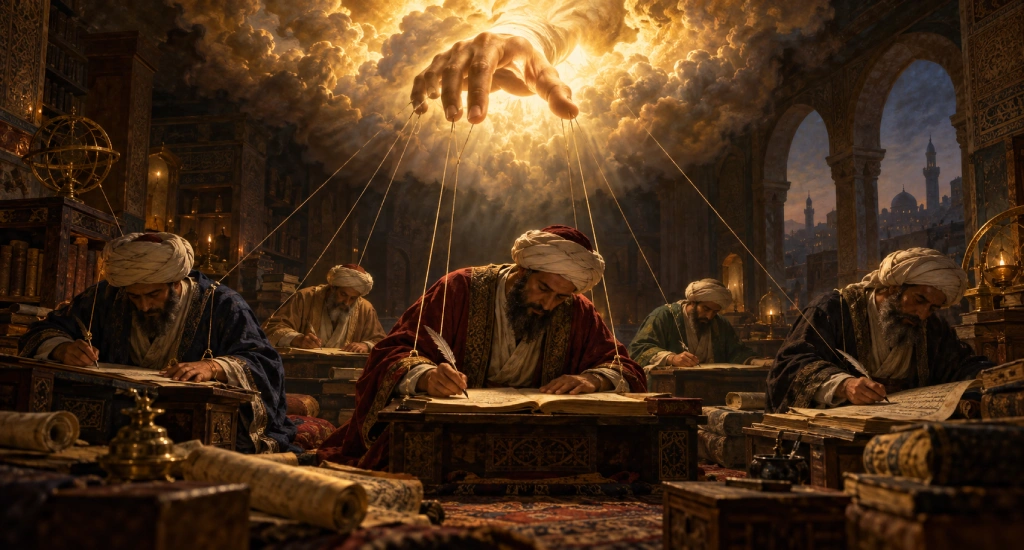
Introduction
In Islam, predestination is not merely the belief that Allah knows in advance what will happen in the future. In classical Sunni creedal works, its scope is much broader. Good and evil, obedience and disobedience, faith and disbelief, guidance and misguidance, life and death, provision, sin, and even human will and action are described as subject to Allah’s judgment, will, and creation. Some works state even more explicitly that people perform the very deeds for which they were created and ultimately move toward the outcome already decreed for them.
This doctrinal framework creates a fundamental problem concerning human moral responsibility. If people are punished for an act whose existence, possibility, motivating will, realization, and ultimate outcome are all subject to Allah’s predetermination, how can they be regarded as its fully independent source? The problem is especially acute when the same creedal works maintain, on the one hand, that sin, disbelief, and disobedience are not outside Allah’s predestination and will, while declaring, on the other, that sinners alone bear full responsibility for their actions.
This tension was not unknown to classical Muslim scholars. Creedal literature repeatedly uses language that firmly establishes the all-encompassing control of predestination while discouraging deep inquiry, questions of “why?” and “how?”, debate, or logical analysis concerning the relationship between that control and human responsibility. Some works explicitly call predestination “Allah’s secret” and declare it beyond the reach of human reason.
The question of predestination therefore appears in classical creedal literature on two levels: first, what Allah predetermines and creates; and second, how human beings can be held morally responsible within that all-encompassing determination. These works answer the first question very explicitly. The same clarity is lacking on the second; instead, in many passages, instructions to believe, submit, and refrain from questioning become the final answer.
Predestination in Early Sunni Creed: Belief and Submission Rather Than Questioning
The tendency to accept transmitted hadiths and inherited positions rather than analyze predestination through reason is already present in early Sunni creedal literature. In the Usul al-Sunnah preserved under Ahmad ibn Hanbal’s name, belief in predestination, both its good and its evil, is described as an indispensable part of the Sunnah. The statement attributed to him concerning hadiths on predestination is that they must be believed: one must not ask “why?” or “how?” Even when the explanation of a hadith lies beyond a person’s understanding, it must be accepted rather than rejected. [1]
الْإِيمَانُ بِالْقَدَرِ خَيْرِهِ وَشَرِّهِ، وَالتَّصْدِيقُ بِالْأَحَادِيثِ فِيهِ، وَالْإِيمَانُ بِهَا، لَا يُقَالُ: لِمَ؟ وَلَا كَيْفَ؟ إِنَّمَا هُوَ التَّصْدِيقُ بِهَا وَالْإِيمَانُ بِهَا، وَمَنْ لَمْ يَعْرِفْ تَفْسِيرَ الْحَدِيثِ وَيَبْلُغْهُ عَقْلُهُ فَقَدْ كُفِيَ ذَلِكَ وَأُحْكِمَ لَهُ، فَعَلَيْهِ الْإِيمَانُ بِهِ وَالتَّسْلِيمُ لَهُ، مِثْلُ حَدِيثِ الصَّادِقِ وَالْمَصْدُوقِ، وَمَا كَانَ مِثْلَهُ فِي الْقَدَرِ، وَمِثْلُ أَحَادِيثِ الرُّؤْيَةِ كُلِّهَا، وَإِنْ نَبَتْ عَنِ الْأَسْمَاعِ وَاسْتَوْحَشَ مِنْهَا الْمُسْتَمِعُ فَإِنَّمَا عَلَيْهِ الْإِيمَانُ بِهَا، وَأَنْ لَا يَرُدَّ مِنْهَا جُزْءًا وَاحِدًا وَغَيْرَهَا مِنَ الْأَحَادِيثِ الْمَأْثُورَاتِ عَنِ الثِّقَاتِ، لَا يُخَاصِمُ أَحَدًا وَلَا يُنَاظِرُهُ وَلَا يَتَعَلَّمُ الْجَدَلَ، فَإِنَّ الْكَلَامَ فِي الْقَدَرِ وَالرُّؤْيَةِ وَالْقُرْآنِ وَغَيْرِهَا مِنَ السُّنَنِ مَكْرُوهٌ مَنْهِيٌّ عَنْهُ، وَلَا يَكُونُ صَاحِبُهُ – إِنْ أَصَابَ بِكَلَامِهِ السُّنَّةَ – مِنْ أَهْلِ السُّنَّةِ حَتَّى يَدَعَ الْجَدَلَ وَيُسَلِّمَ وَيُؤْمِنَ بِالْآثَارِ.
English translation: “One must believe in predestination, both its good and its evil, affirm the hadiths transmitted concerning it, and believe in them. One must not say ‘Why?’ or ‘How?’; rather, the duty is to affirm and believe in them. If someone does not know the explanation of a hadith and his reason cannot grasp it, that is nevertheless sufficient for him; his duty is to believe in the hadith and submit to it. Examples include the hadith of ‘al-Sadiq al-Masduq’ [the truthful and trusted one], other similar hadiths concerning predestination, and all the hadiths concerning the vision of Allah. Even if hearing them makes someone uneasy, his duty is to believe in them and reject no part of these hadiths transmitted through reliable authorities. He must not quarrel or debate with anyone about them, nor learn disputation. Debating predestination, the vision of Allah, the Qur’an, and other matters of the Sunnah is disapproved of and forbidden. Even if someone arrives through argument at a position consistent with the Sunnah, he will not be counted among Ahl al-Sunnah until he abandons disputation, submits, and believes in the transmitted reports.”
The method here matters. The internal coherence of the statements about predestination is not first demonstrated before belief is required; instead, belief is established as a prerequisite, and the limits of inquiry are then set. Even if a statement is not fully intelligible to human reason, the person’s duty is to believe and submit. In the case of predestination, therefore, rational comprehension is not a condition for the creed’s validity.
The same statement preserved under Ahmad’s name also condemns argument and debate about predestination. It uses the strong language that even someone who reaches the correct Sunni conclusion through argument will not be regarded as a follower of the Sunnah until he abandons disputation. Thus, the concern is not merely the adoption of an erroneous opinion; making predestination a subject of rational debate is itself treated with suspicion.
Casting Predestination as a Mystery and Prohibiting Rational Inquiry
Let us now hear Dr. Abu Bakr Zakaria explain that ordinary Muslims are forbidden to delve too deeply into predestination:
Did Allah Merely Record What His Servants Would Do in the Future?
Many Islamic preachers and speakers today regularly make a popular claim: “Allah records an act on the basis that His servant will want to do it or will do it. Because Allah knows the future in advance, He has supposedly done no more than record it.” They intend this to mean that when people do evil, the responsibility belongs to them, with no responsibility on Allah’s part. Allah has merely recorded it, so He cannot be held responsible for the act. Their argument implies that, according to their claim, “Allah’s writing depends on human actions.” They use this as an argument for intention and free will, as though Allah had written solely on the basis of human deeds. People perform the act; Allah merely records it beforehand!
But the traditional, authoritative, and classical position of Islamic creed is the exact opposite. For centuries, mainstream creedal works have explicitly stated that Allah’s writing, knowledge, decision, and predestination do not depend on human actions, decisions, or will. Rather, human actions depend on Allah’s predetermined writing. The entire framework of qadar, or predestination, rests on four pillars: Allah’s ‘ilm (knowledge), mashi’ah (will), kitabah (writing), and khalq (creation). None of these takes human free will as its foundation. According to the accounts of prominent Islamic scholars, classical commentators on creed, and renowned authorities on hadith and Qur’anic commentary, this position is firmly established in classical Sunni Islam; it is not an isolated opinion.
For this reason, the claim made by some modern preachers that “Allah writes on the basis of human actions” directly conflicts with the accounts in classical Sunni and Salafi creedal works and misleadingly presents the traditional doctrine of predestination. In classical creed, independent human action is not established as the cause of Allah’s writing; instead, Allah’s foreknowledge, writing, will, and decree are presented as preceding human actions and as independent of human beings. Consequently, limiting predestination to foreknowledge and prior recording—as though Allah simply foresaw people’s independent decisions and recorded them—does not fully describe the classical Sunni position. Rather, authentic hadiths themselves directly state that Allah causes people to perform various good and evil deeds.
Thus, in classical Islam, Allah’s writing determines human actions; human actions do not determine Allah’s writing. The deeds people will perform occur according to His will, knowledge, and previously recorded decision: this has been established as the principal position of Islamic creed for centuries. Let us hear statements on this subject from several Bangladeshi Salafi scholars. They state very clearly that the notion that Allah merely wrote something because a person would do it constitutes explicit disbelief. The teaching of the early Muslim generations is that Allah depends on no one in any act: He writes independently, and His servants act according to that written predestination.
Every Detail, Down to the Smallest, Is Written and Predetermined
One of Islam’s fundamental beliefs is that every detail, down to the smallest, is written and predetermined in the divine decree. Let us begin by hearing a statement from Dr. Abu Bakr Zakaria:
Now let us hear a statement from Shaykh Ahmadullah:
Let us hear another discussion:
Predestination as Allah’s Hidden Secret: Questioning, Disbelief, and Human Responsibility
Sharh al-‘Aqidah al-Tahawiyyah is one of the best-known commentaries on Sunni creed. In explaining the statements on predestination in the original Al-‘Aqidah al-Tahawiyyah, Ibn Abi’l-‘Izz al-Hanafi presents a position that does more than place predestination beyond the limits of human knowledge: it declares deep inquiry, reflection, and questions such as “Why did Allah do this?” to be dangerous. The same discussion also states that human actions are Allah’s creation and that an unbeliever’s disbelief occurs by Allah’s will. Its principal argument against the objections of the Qadariyyah and Mu‘tazilah is that, if people can independently bring about acts contrary to Allah’s will, then human will must be understood to have defeated Allah’s will. [2]
(49) Imam al-Tahawi, may Allah have mercy on him, says:
وأَصلُ الْقَدَرِ سِرُّ اللَّهِ تَعَالَى فِي خَلْقِهِ، لَمْ يَطَّلِعْ عَلَى ذَلِكَ مَلَكٌ مُقَرَّبٌ، وَلَا نَبِيُّ مُرْسَلٌ، وَالتَّعَمُّقُ وَالنَّظَرُ فِي ذَلِكَ ذَرِيعَةُ الْخِذْلانِ، وَسُلَّمُ الْحِرْمَانِ، وَدَرَجَةُ الطَّغْيَانِ، فَالْحَذَرَ كُلَّ الْحَذَرِ مِنْ ذَلِكَ نَظَرًا وَفِكْرًا وَوَسْوَسَةً، فَإِنَّ اللَّهَ تَعَالَى طَوَى عِلْمَ الْقَدَرِ عَنْ أَنَامِهِ، وَفَاهُمْ عَنْ مَرَامِهِ، كَمَا قَالَ تَعَالَى فِي كِتَابِهِ: لَا يُسْأَلُ عَمَّا يَفْعَلُ وَهُمْ يُسْأَلُونَ} [الْأَنْبِيَاءِ : ۲۳] . فَمَنْ سَأَلَ : لِمَ فَعَلَ فَقَدْ رَدَّ حُكْمَ الْكِتَابِ وَمَنْ رَدَّ حُكْمَ الْكِتَابِ، كَانَ مِنَ الْكَافِرِينَ”
The fundamental point about predestination is that it is a secret of Allah concerning His creation, of which neither an angel brought near to Him nor a messenger sent by Him has knowledge. Deep reflection upon it or engagement in such discussion is a cause of failure, a stairway to deprivation, and a step toward transgression. So beware! Guard against reflection and obsessive speculation concerning it. Allah Most High has concealed knowledge of predestination from His creation and forbidden them to investigate its purpose. As Allah Most High says: لا يُسْأَلُ عَمَّا يَفْعَلُ وَهُمْ يُسْأَلُونَ “He will not be questioned about what He does; rather, they will be questioned about their deeds.” (Surah al-Anbiya’: 23) Therefore, whoever asks, “Why did He do this?” has defied the ruling of Allah’s Book. Whoever defies the ruling of the Book is among the unbelievers.
Explanation: The fundamental point about predestination is that it is a matter belonging to Allah concerning His creation. That is, He creates and He destroys; He makes some poor and others rich; He causes death and gives life; He leads astray and grants guidance. ‘Ali (1) says that predestination is Allah’s hidden secret. We shall therefore not attempt to uncover it. The disagreement among people on this issue is well known.
According to Ahl al-Sunnah wa’l-Jama‘ah, everything occurs in accordance with Allah’s judgment and decree. Allah Most High is the Creator of His servants’ actions.
Allah Most High says:
اللَّهُ خَالِقُ كُلِّ شَيْءٍ
“Allah alone is the Creator of everything.” (Surah al-Qamar: 49)
Allah Most High says:
وَخَلَقَ كُلَّ شَيْءٍ فَقَدَّرَهُ تَقْدِيرًا
“And He created everything, then determined for it a decree or measure.” (Surah al-Furqan: 2)
The disbelief committed by an unbeliever occurs by Allah’s will, but He does not approve of disbelief. He wills to create disbelief at the level of creation, but does not approve of it as a religion.
The Qadariyyah and Mu‘tazilah opposed Ahl al-Sunnah wa’l-Jama‘ah. 268 They hold that Allah Most High wills faith to occur in unbelievers, but the unbeliever wills disbelief. They said this to avoid the notion that Allah Most High wills to create disbelief and then punishes people for disbelieving. Their situation is like that of someone who jumps into a fire to escape the discomfort of standing on hot sand. They have fled something less harmful only to enter something more harmful. That is, if it is said that Allah Most High is the Creator of His servants’ actions, and those actions include both good and evil, then evil becomes attributed to Allah Most High. To escape this problem, they said that servants create their own actions. But the resulting problem is more serious than the previous one. It necessarily follows that the unbeliever’s will triumphs over Allah’s will. In other words, Allah Most High willed that the unbeliever should believe. If the unbeliever does not believe, it naturally follows that the unbeliever’s will has triumphed over Allah’s will. We seek refuge in Allah. For, according to their own position, Allah Most High willed faith to occur in the unbeliever, while the unbeliever willed disbelief. In this case, Allah’s will was not realized, whereas the unbeliever’s will was!! Furthermore, such a belief establishes multiple creators!! This creed is most reprehensible…
268. Disagreement on this issue began after the era of the Companions. They all believed in predestination. During their era, there was no disagreement on this issue. Disagreement arose at the very end of their era, when only a few Companions, including ‘Abd Allah ibn ‘Umar and Ibn ‘Abbas, were still alive. They, too, strongly opposed those who denied predestination. Disagreement on this issue marked the beginning of associating partners with Allah within the Muslim community.
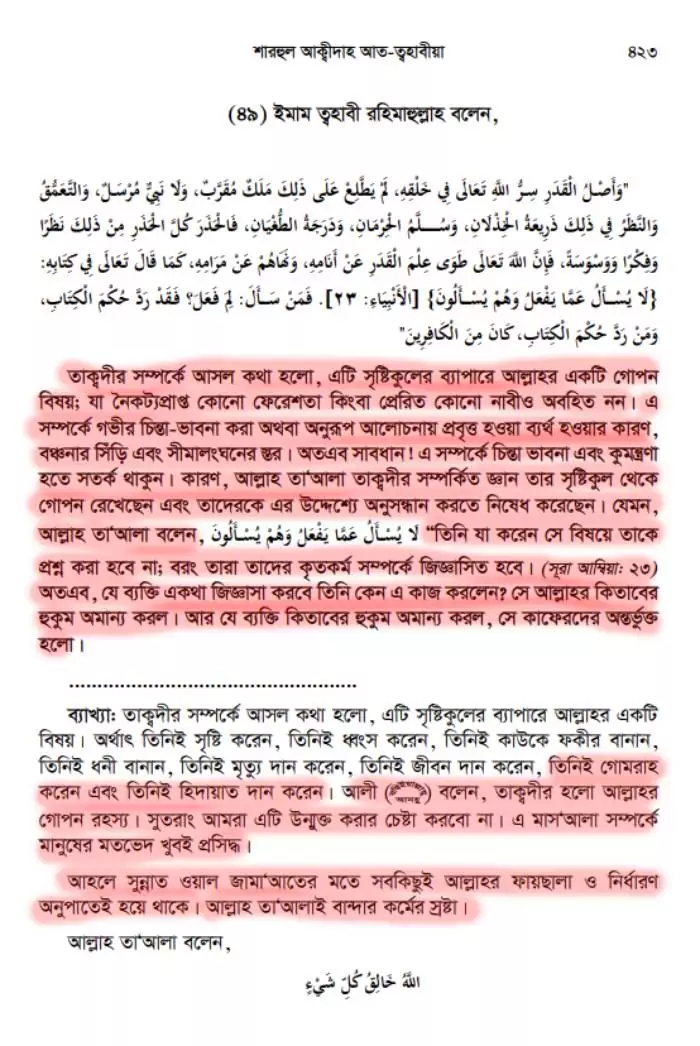
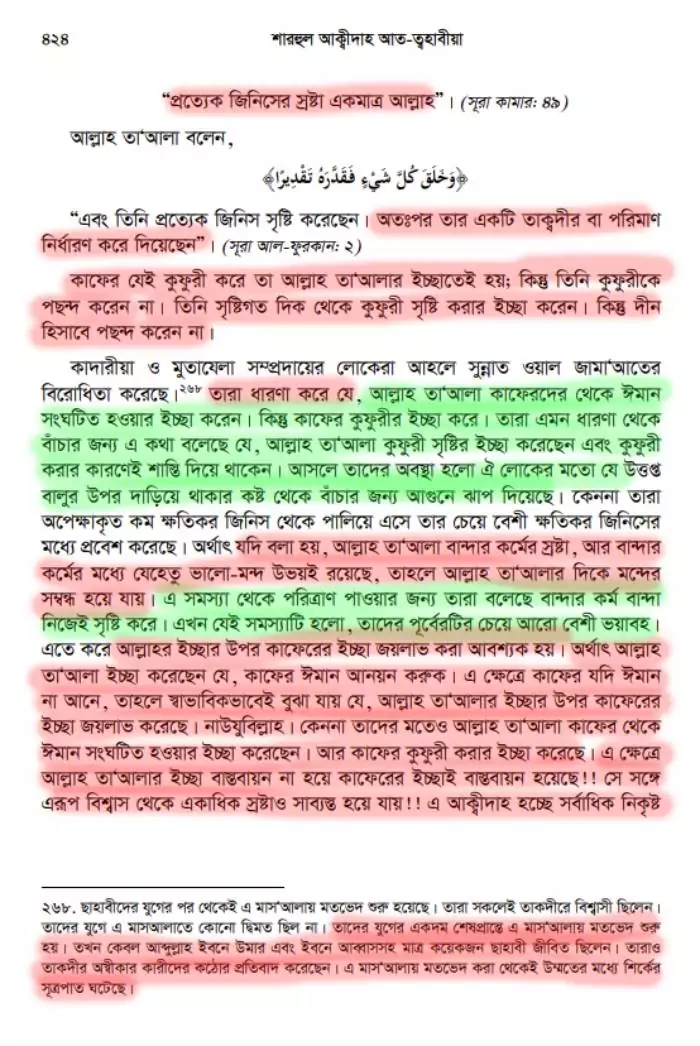
Two points appear side by side with particular clarity in this passage. First, Allah is the Creator of His servants’ actions, and an unbeliever’s disbelief also occurs by Allah’s will. Second, the commentator is not unaware of the moral problem this position creates: Allah wills disbelief to occur and then punishes people for that very disbelief. Indeed, the passage explicitly states that the Qadariyyah and Mu‘tazilah explained human actions as people’s own creation precisely to avoid this problem. The objection, therefore, was not invented by an outside modern critic; the problem was clearly identified within Islamic theology itself.
Yet the commentary does not answer this objection by showing how Allah can create and will disbelief while remaining entirely separate from moral responsibility for it. Instead, it redirects the argument: if an unbeliever can bring about disbelief contrary to Allah’s will, then human will has defeated Allah’s will, which is unacceptable. Consequently, in preserving Allah’s all-encompassing will and creative power, the conclusion is that an unbeliever’s disbelief, too, is not outside Allah’s effective will.
This does not resolve the original moral question raised by the Mu‘tazilah; it rejects their proposed solution. The question remains: if Allah is the Creator of His servants’ actions, an unbeliever’s disbelief occurs by His will, and no outcome contrary to His will can become real, on what grounds does full moral responsibility for that disbelief fall solely upon the unbeliever? The statement “human will cannot defeat Allah’s will” establishes Allah’s omnipotence, but does not establish independent human responsibility. Rather, it further narrows the scope of human freedom.
It is precisely here that the language of “mystery” and “prohibited questioning” in the original Tahawiyyah becomes significant. The causal explanation of predestination reaches a point where it is maintained simultaneously that Allah is the Creator of His servants’ actions, that disbelief also occurs by His will, and yet that human beings alone are punished for disbelief. But in seeking to understand how these two claims fit together, even asking “Why did Allah do this?” is prohibited. Doctrinal submission is thus established as the ultimate boundary in place of a logical resolution.
The distinction that “Allah does not approve of disbelief as a religion, but wills it at the level of creation” does not remove the central problem either. It simply separates Allah’s moral approval from His effective creative will. But if that creative will is indispensable for disbelief to come into existence, the question of disbelief’s causal source remains. Whether Allah approves of disbelief and whether disbelief can occur outside His will and creation are two different questions. According to the commentary itself, the answer to the second is clear: it cannot.
This discussion in Sharh al-‘Aqidah al-Tahawiyyah therefore does not conceal the fundamental tension in classical Sunni predestination; it makes it directly visible. Human disbelief and action are subject to Allah’s will and creation, yet human beings bear full responsibility for punishment; deep inquiry into the relationship between these claims is then closed off by calling it a “hidden secret.” Declaring a claim a mystery does not remove its logical inconsistency; it merely prohibits demanding an explanation of that inconsistency.
Harb al-Kirmani: Good and Evil, Sin and Disobedience—All Are Allah’s Predestination
The account of creed preserved under the name of the ninth-century Sunni scholar Harb al-Kirmani expresses this conception of predestination in particularly explicit and forceful language. It does more than state generally that “everything is Allah’s predestination”: it directly includes good and evil, illicit sexual intercourse, theft, drinking alcohol, murder, acquiring unlawful wealth, associating partners with Allah, and every kind of sin and disobedience within Allah’s judgment and predestination. It further states that Allah created the disobedient for disobedience and the obedient for obedience; everyone performs the deeds for which they were created, and no one can exceed Allah’s will and decree. [3]
Creed Concerning Predestination
١٥- وَالْقَدَرُ خَيْرُهُ وَشَرُّهُ، وَقَلِيلُهُ وَكَثِيرُهُ، وَظَاهِرُهُ وَبَاطِنُهُ، وَحُلْوُهُ وَمُرُّهُ، وَمَحْبُوبُهُ وَمَكْرُوهُهُ، وَحَسَنُهُ وَسَيِّئُهُ، وَأَوَّلُهُ وَآخِرُهُ: مِنَ اللَّهِ تَبَارَكَ وَتَعَالَى قَضَاءٌ قَضَاهُ عَلَى عِبَادِهِ، وَقَدَرٌ قَدَّرَهُ عَلَيْهِمْ، لَا يَعْدُو أَحَدٌ مِنْهُمْ مَشِيئَةَ اللَّهِ، وَلَا يَتَجَاوَزُ قَضَاءَهُ؛ بَلْ هُمْ كُلُّهُمْ صَائِرُونَ إِلَى مَا خَلَقَهُمْ لَهُ، وَوَاقِعُونَ فِيمَا قَدَّرَ عَلَيْهِمْ لَا مَحَالَةَ، وَهُوَ عَدْلٌ مِنْهُ عَزَّ رَبُّنَا وَجَلَّ.
15. Predestination as decreed by Allah—its good and evil, little and much, apparent and hidden, sweetness and bitterness, desirable and undesirable, good and bad, first and last—is all a judgment and predetermined destiny ordained by Allah Most High for His servants. None of His servants can step outside Allah’s will or surpass His judgment. Rather, all ultimately move toward the destiny for which Allah created them; they will inevitably fall within the predestination Allah has ordained for them. Allah’s decreed predestination is His (perfect) justice, while our Lord is Glorious and Mighty.36
36 That is, in decreeing predestination, Allah Most High has wronged no one. If a servant goes to Hell, it is his own fault, the recompense for his own sins. If a servant goes to Paradise, it is through Allah’s boundless grace, for no one can enter Paradise without Allah’s grace.
وَالزِّنَا، وَالسَّرِقَةُ، وَشُرْبُ الْخَمْرِ، وَقَتْلُ النَّفْسِ، وَأَكْلُ الْمَالِ الْحَرَامِ، وَالشِّرْكُ بِاللَّهِ، وَالذُّنُوبُ وَالْمَعَاصِي كُلُّهَا بِقَضَاءٍ وَقَدَرٍ مِنَ اللَّهِ، مِنْ غَيْرِ أَنْ يَكُونَ لِأَحَدٍ مِنَ الْخَلْقِ عَلَى اللَّهِ حُجَّةٌ، بَلِ اللَّهُ الْحُجَّةُ الْبَالِغَةُ عَلَى خَلْقِهِ، لَا يُسْأَلُ عَمَّا يَفْعَلُ وَهُمْ يُسْأَلُونَ [الأنبياء: ٢٣].
Illicit sexual intercourse, theft, drinking alcohol, murder, consuming unlawful wealth, associating partners with Allah, and all sins and acts of disobedience are decreed by Allah’s judgment and predestination. Yet no created being can offer Allah any excuse for his deeds. Rather, Allah possesses the conclusive argument against His creation.37 “He will not be questioned about what He does; rather, they will be questioned about their deeds.”38
37 That is, those who have disobeyed Allah will not benefit from the excuse, “Everything is Allah’s decree, so we are not at fault.” Rather, Allah possesses the conclusive argument against them.
38 Surah al-Anbiya’ 21:23.
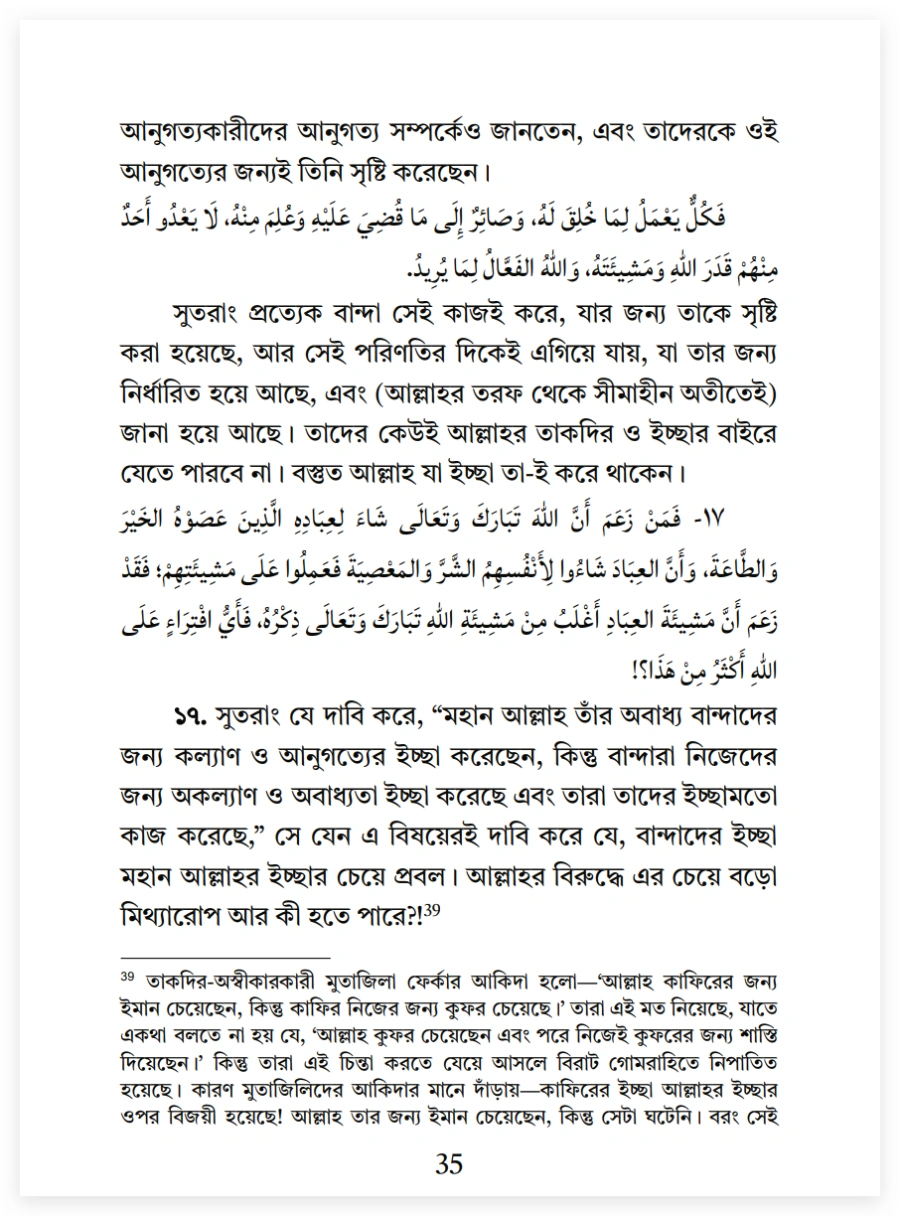
١٦- وَعِلْمُ اللَّهِ مَاضٍ فِي خَلْقِهِ بِمَشِيئَةٍ مِنْهُ؛ قَدْ عَلِمَ مِنْ إِبْلِيسَ – مِنْ لَدُنْ أَنْ عُصِيَ رَبُّنَا تَبَارَكَ وَتَعَالَى إِلَى أَنْ تَقُومَ السَّاعَةُ – وَمِنْ غَيْرِهِ مِمَّنْ عَصَاهُ، الْمَعْصِيَةَ، وَخَلَقَهُمْ لَهَا. وَعَلِمَ الطَّاعَةَ مِنْ أَهْلِ طَاعَتِهِ، وَخَلَقَهُمْ لَهَا.
16. Allah’s knowledge concerning His creation takes effect through His will. He knew in advance all the disobedience that Iblis and the other disobedient beings would commit against Him, from the time our exalted Lord was first disobeyed until the Day of Resurrection. He created them for that very disobedience. He likewise knew the obedience of the obedient and created them for that very obedience.
فَكُلٌّ يَعْمَلُ لِمَا خُلِقَ لَهُ، وَصَائِرٌ إِلَى مَا قُضِيَ عَلَيْهِ وَعُلِمَ، لَا يَعْدُو أَحَدٌ مِنْهُمْ قَدَرَ اللَّهِ وَمَشِيئَتَهُ، وَاللَّهُ الْفَعَّالُ لِمَا يُرِيدُ.
Thus, every servant performs the deeds for which he was created and proceeds toward the outcome decreed for him and known to Allah from eternity past. None of them can step outside Allah’s predestination and will. Indeed, Allah does whatever He wills.
١٧- فَمَنْ زَعَمَ أَنَّ اللَّهَ تَبَارَكَ وَتَعَالَى شَاءَ لِعِبَادِهِ الَّذِينَ قَضَاهُمُ الْخَيْرَ وَالطَّاعَةَ، وَأَنَّ الْعِبَادَ شَاءُوا لِأَنْفُسِهِمُ الشَّرَّ وَالْمَعْصِيَةَ فَعَمِلُوا عَلَى مَشِيئَتِهِمْ؛ فَقَدْ زَعَمَ أَنَّ مَشِيئَةَ الْعِبَادِ أَغْلَبُ مِنْ مَشِيئَةِ اللَّهِ تَبَارَكَ وَتَعَالَى ذِكْرُهُ، فَأَيُّ افْتِرَاءٍ عَلَى اللَّهِ أَكْثَرُ مِنْ هَذَا؟!
17. Whoever claims, “Allah Most High willed goodness and obedience for His disobedient servants, but those servants willed evil and disobedience for themselves and acted as they wished,” is effectively claiming that the servants’ will is stronger than Allah’s will. What greater falsehood could be attributed to Allah?!39
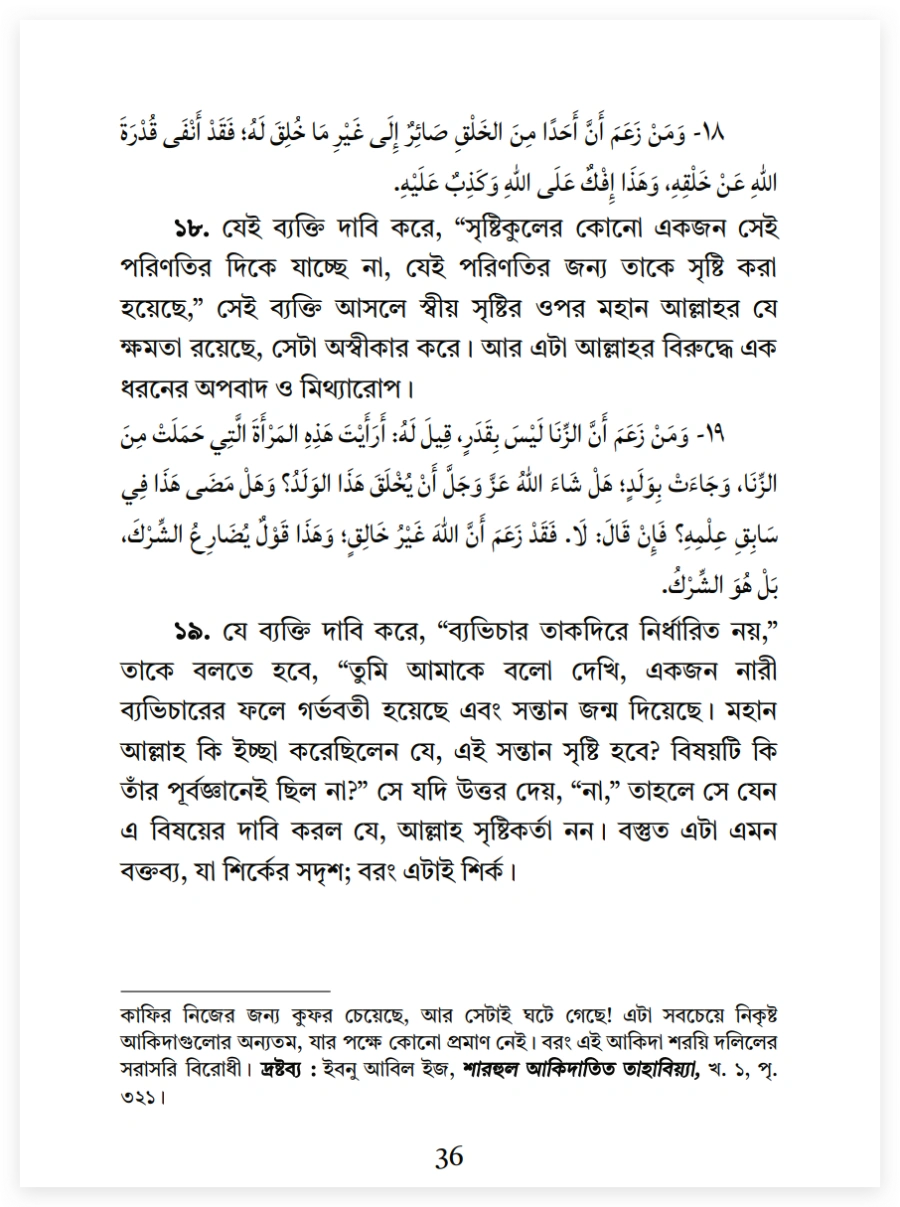
39 The creed of the Mu‘tazilah, a sect that denies predestination, is: “Allah willed faith for the unbeliever, but the unbeliever willed disbelief for himself.” They adopted this position to avoid saying, “Allah willed disbelief and then Himself punished people for disbelief.” Yet in thinking this way, they fell into grave misguidance. For the Mu‘tazili creed means that the unbeliever’s will has triumphed over Allah’s will. Allah willed faith for him, but it did not occur. Instead, the unbeliever willed disbelief for himself, and that is what occurred! This is among the most reprehensible creeds, with no evidence in its support. Rather, it directly contradicts scriptural evidence. See Ibn Abi’l-‘Izz, Sharh al-‘Aqidah al-Tahawiyyah, Vol. 1, p. 321.
١٨- وَمَنْ زَعَمَ أَنَّ أَحَدًا مِنَ الْخَلْقِ صَائِرٌ إِلَى غَيْرِ مَا خُلِقَ لَهُ؛ فَقَدْ أَلْغَى قُدْرَةَ اللَّهِ عَنْ خَلْقِهِ، وَهَذَا إِفْكٌ عَلَى اللَّهِ وَكَذِبٌ عَلَيْهِ.
18. Whoever claims, “Any one of Allah’s creatures is not proceeding toward the outcome for which he was created,” is in fact denying Allah’s power over His creation. This is a form of slander and false accusation against Allah.
١٩- وَمَنْ زَعَمَ أَنَّ الزِّنَا لَيْسَ بِقَدَرٍ، قِيلَ لَهُ: أَرَأَيْتَ هَذِهِ الْمَرْأَةَ الَّتِي حَمَلَتْ مِنَ الزِّنَا، وَجَاءَتْ بِوَلَدٍ؛ هَلْ شَاءَ اللَّهُ عَزَّ وَجَلَّ أَنْ يَخْلُقَ هَذَا الْوَلَدَ؟ وَهَلْ مَضَى هَذَا فِي سَابِقِ عِلْمِهِ؟ فَإِنْ قَالَ: لَا، فَقَدْ زَعَمَ أَنَّ اللَّهَ غَيْرُ خَالِقٍ؛ وَهَذَا قَوْلٌ يُضَارِعُ الشِّرْكَ، بَلْ هُوَ الشِّرْكُ.
19. Whoever claims, “Illicit sexual intercourse is not decreed in predestination,” must be asked: “Tell me: a woman became pregnant through illicit intercourse and gave birth. Did Allah Most High will that this child should be created? Was it not within His foreknowledge?” If he answers, “No,” then he is effectively claiming that Allah is not the Creator. Such a statement resembles associating partners with Allah; indeed, it is itself such association.
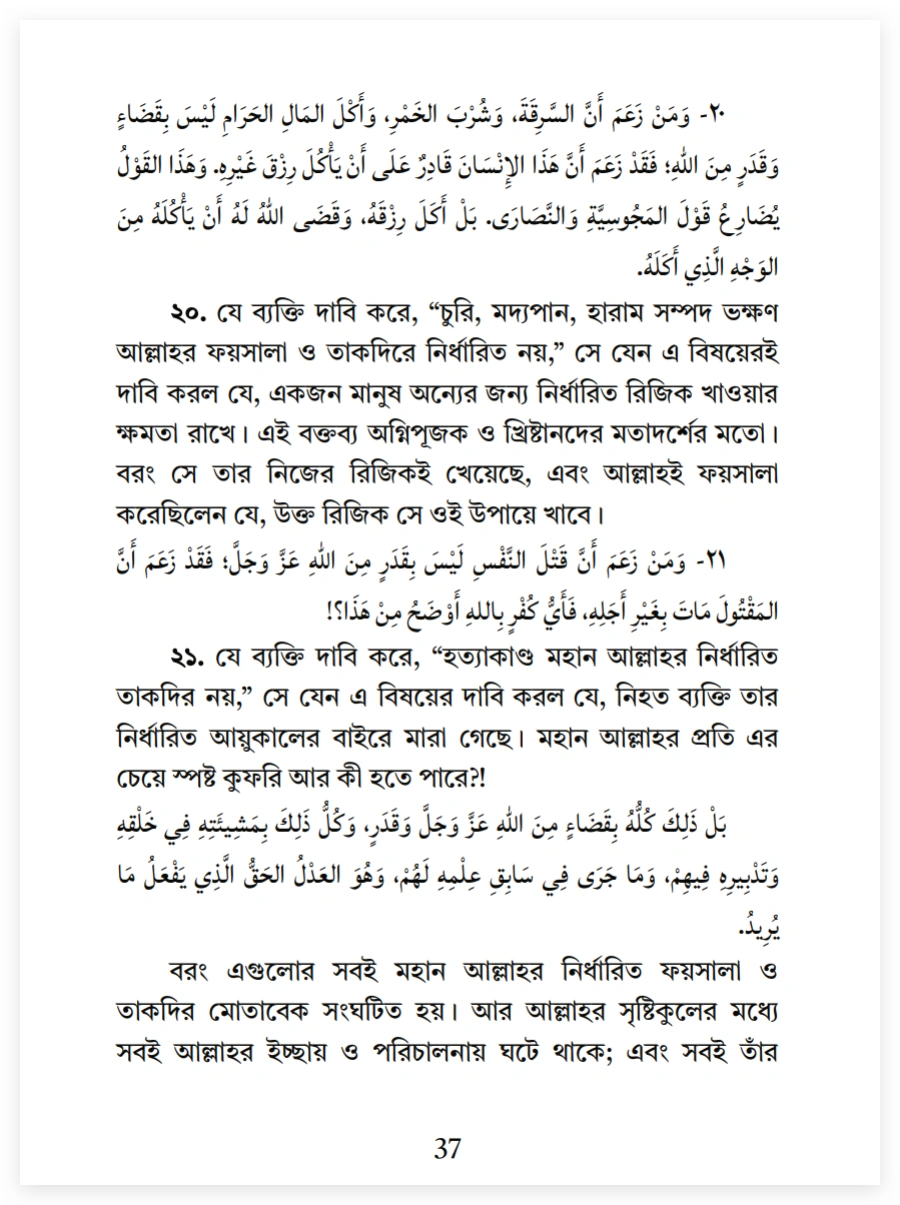
٢٠- وَمَنْ زَعَمَ أَنَّ السَّرِقَةَ، وَشُرْبَ الْخَمْرِ، وَأَكْلَ الْمَالِ الْحَرَامِ لَيْسَ بِقَضَاءٍ وَقَدَرٍ مِنَ اللَّهِ؛ فَقَدْ زَعَمَ أَنَّ هَذَا الْإِنْسَانَ قَادِرٌ عَلَى أَنْ يَأْكُلَ رِزْقَ غَيْرِهِ. وَهَذَا الْقَوْلُ يُضَارِعُ قَوْلَ الْمَجُوسِيَّةِ وَالنَّصَارَى. بَلْ أَكَلَ رِزْقَهُ، وَقَضَى اللَّهُ لَهُ أَنْ يَأْكُلَهُ مِنَ الْوَجْهِ الَّذِي أَكَلَهُ.
20. Whoever claims, “Theft, drinking alcohol, and consuming unlawful wealth are not decreed by Allah’s judgment and predestination,” is effectively claiming that a person has the power to consume provision decreed for someone else. This statement resembles the doctrines of the fire-worshippers and Christians. Rather, he has consumed his own provision, and Allah Himself decreed that he would consume that provision in that manner.
٢١- وَمَنْ زَعَمَ أَنَّ قَتْلَ النَّفْسِ لَيْسَ بِقَدَرٍ مِنَ اللَّهِ عَزَّ وَجَلَّ؛ فَقَدْ زَعَمَ أَنَّ الْمَقْتُولَ مَاتَ بِغَيْرِ أَجَلِهِ، فَأَيُّ كُفْرٍ بِاللَّهِ أَوْضَحُ مِنْ هَذَا؟!
21. Whoever claims, “Murder is not part of the predestination decreed by Allah Most High,” is effectively claiming that the murdered person died outside his appointed lifespan. What more explicit disbelief in Allah Most High could there be?!
بَلْ ذَلِكَ كُلُّهُ بِقَضَاءٍ مِنَ اللَّهِ عَزَّ وَجَلَّ وَقَدَرٍ، وَكُلُّ ذَلِكَ بِمَشِيئَتِهِ فِي خَلْقِهِ وَتَدْبِيرِهِ فِيهِمْ، وَمَا جَرَى فِي سَابِقِ عِلْمِهِ لَهُمْ، وَهُوَ الْعَدْلُ الْحَقُّ الَّذِي يَفْعَلُ مَا يُرِيدُ.
Rather, all these things occur in accordance with the judgment and predestination decreed by Allah Most High. Everything within Allah’s creation occurs through His will and direction, and everything accords with His foreknowledge. Nevertheless, He is the Just and the Supreme Truth, who does whatever He wills.
٢٢- وَمَنْ أَقَرَّ بِالْعِلْمِ؛ لَزِمَهُ الْإِقْرَارُ بِالْقَدَرِ وَالْمَشِيئَةِ عَلَى الصِّغَرِ وَالْفَاقَةِ. وَاللَّهُ الضَّارُّ النَّافِعُ، الْمُضِلُّ الْهَادِي، فَتَبَارَكَ اللَّهُ أَحْسَنُ الْخَالِقِينَ.
22. Whoever acknowledges Allah’s knowledge must also acknowledge His predestination and will in even the smallest and most trivial matters. Allah is the One who brings harm and benefit,40 and the One who leads astray and grants guidance.41 So blessed is Allah, the best of creators!
40 That is, Allah alone possesses the power to bring harm and benefit. No one can bring even the slightest benefit or harm to any created being outside Allah’s will and decreed predestination. (Surah Yunus 10:107; al-Tirmidhi, Hadith 2516, graded authentic)
41 That is, Allah guides whomever He wills and leads astray whomever He wills.
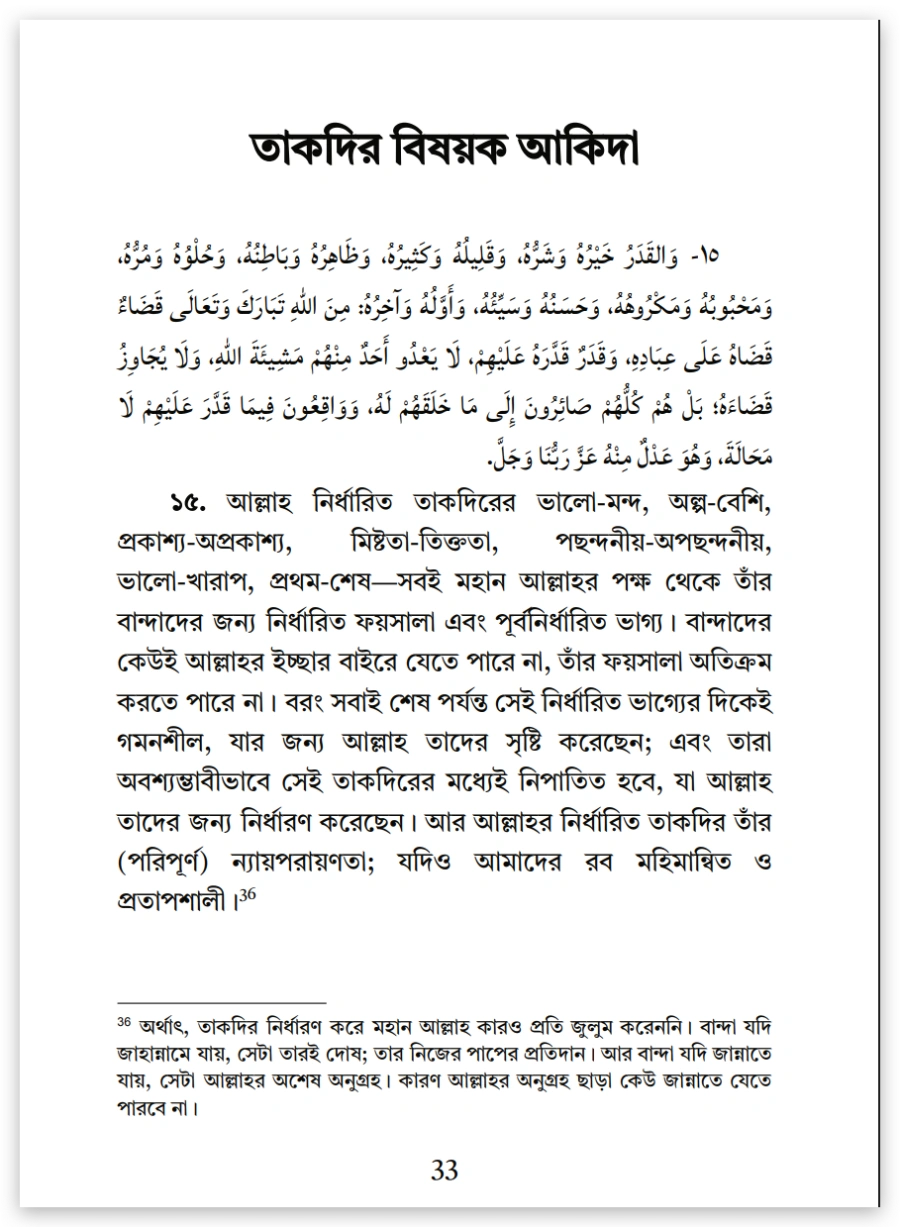
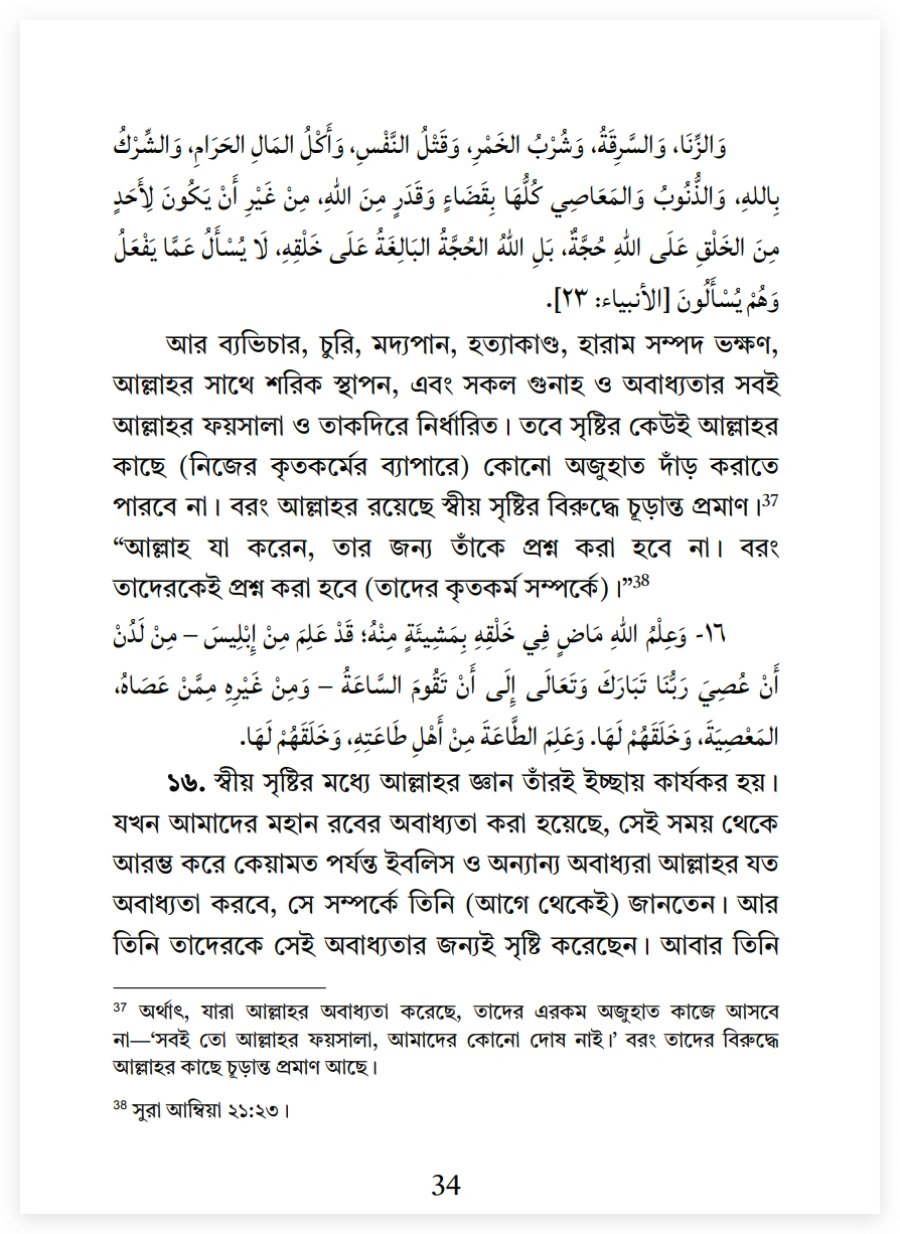
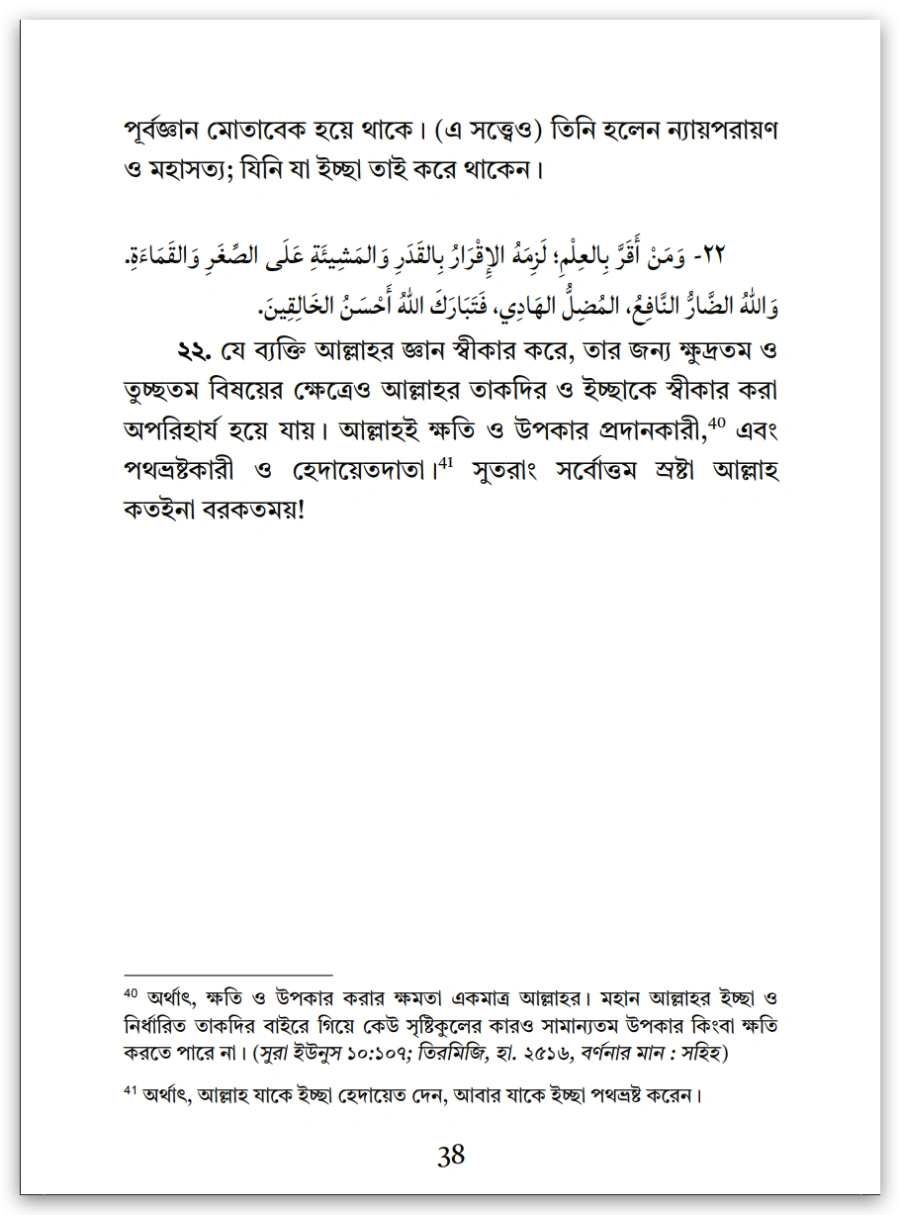
This statement cannot be explained merely as “Allah knows everything.” In Harb’s language, knowledge, will, creation, action, and outcome are bound together. The disobedient were created for disobedience; the obedient were created for obedience; everyone performs the deeds for which they were created; and no one can exceed the decreed outcome.
What is particularly striking here is that the examples of sin are not abstract. Illicit sexual intercourse, theft, drinking alcohol, murder, and associating partners with Allah are directly included within Allah’s predestination and will. At the same time, it is declared that people cannot offer excuses for these acts and that Allah’s judgment is entirely just. In other words, two claims stand side by side in the same text: sin is not outside Allah’s predetermination and will, and the sinner bears full responsibility for that sin. Yet no causal explanation is offered of how the second claim can be justly reconciled with the first; justice is declared.
Statement 17 is even more forceful. It rejects the notion that Allah willed only good for people while they independently chose evil, because this would mean that human will had defeated Allah’s will. Thus, in preserving Allah’s omnipotent will, the possibility of people independently realizing a contrary will is explicitly curtailed.
In Harb’s framework, therefore, sinners do not act within an independent sphere in which Allah intended one outcome but human beings brought about another. Rather, the sin itself is the outcome that occurred under Allah’s will, predestination, and direction. Human beings are then held responsible for that outcome. This is where the tension between predestination and moral responsibility becomes clearest.
Ibn Battah: People Created for Paradise, People Created for Hell
The same position appears more systematically in the chapter on predestination in Al-Ibanah al-Kubra by the tenth-century Hanbali scholar Ibn Battah. In his account, good and evil, obedience and disobedience are included within Allah’s judgment and predestination. Allah created Paradise and created people for it; He also created Hell and created people for it. Ibn Battah even states that Allah decreed human movements, intentions, thoughts of the heart, and mental inclinations; no one can make a movement or form an intention without His permission. [4]
وَقَدَّرَ حَرَكَاتِ الْعِبَادِ وَهِمَمَهُمْ وَهَوَاجِسَ قُلُوبِهِمْ.
English translation: “He decreed His servants’ movements, intentions, and thoughts of the heart.”
In Ibn Battah’s account, the source of moral differentiation is also linked to Allah’s activity. For those whose guidance He willed, He opened their hearts to faith and made faith dear to them; for those whose misguidance He willed, He constricted their hearts. Although people receive commands and prohibitions, Ibn Battah states that obedience requires Allah’s enabling grace and that avoiding sin requires His protection.
More directly still, in the title of one chapter, Ibn Battah states that Allah created whomever He willed for Paradise and whomever He willed for Hell; His knowledge of this preceded it, His judgment takes effect, and the Pen has already recorded it. [5]
فَمَنْ شَاءَ خَلَقَهُ لِلْجَنَّةِ وَمَنْ شَاءَ خَلَقَهُ لِلنَّارِ.
English translation: “He created whomever He willed for Paradise and whomever He willed for Hell.”
Another statement by Ibn Battah makes the structure of this problem clearer. He divides knowledge of predestination into two parts: one must be known and believed, while reflection, questioning, debate, and disputation concerning the other are prohibited. Within the part that must be known, he states that good and evil come from Allah; obedience and disobedience are subject to Allah’s judgment and predestination; Allah helps those designated for Paradise to perform righteous deeds; and for those designated for Hell, He decrees deeds that He disapproves of for them, after which they are punished for those very deeds. [6]
أَنَّ الْخَيْرَ وَالشَّرَّ مِنَ اللَّهِ، وَأَنَّ الطَّاعَةَ وَالْمَعْصِيَةَ بِقَضَاءِ اللَّهِ وَقَدَرِهِ.
English translation: “Good and evil come from Allah; obedience and disobedience occur according to Allah’s judgment and predestination.”
The boundary of the problem is itself established within the creed: believe that sin and disobedience are also included within Allah’s predestination, but do not ask too many questions about the justice of the causal relationships within that system. Instead of explaining and reconciling the moral tension, limits are imposed on inquiry.
Al-Lalaka’i: Turning the Predestination Debate into a Doctrinal Boundary
Abu’l-Qasim al-Lalaka’i’s Sharh Usul I‘tiqad Ahl al-Sunnah wa’l-Jama‘ah is one of the most important classical compilations of Sunni creed. He devotes extensive chapters to predestination, collecting Qur’anic verses, hadiths, and statements by the Companions and later scholars. His introduction associates the emergence of the early predestination debate with the beginning of Marwanid rule. [7]
فِي أَوَّلِ إِمَارَةِ الْمَرْوَانِيَّةِ فِي الْقَدَرِ وَتَكَلَّمَ فِيهِ.
English translation: “New statements and debates concerning predestination appeared early in Marwanid rule.”
Al-Lalaka’i’s compilation shows that predestination quickly became more than a philosophical problem: it became a boundary of identity, distinguishing followers of the Sunnah from religious innovators. Denial of predestination was identified as a doctrinal deviation, rather than merely faulty reasoning. Later discussions therefore developed in an environment where raising a rational objection to divine determination was not simply asking a neutral philosophical question; it could also become a question of religious identity.
This historical position matters because one possible resolution of the tension between independent human action and Allah’s all-encompassing determination was to limit Allah’s will—that is, to say that human beings can independently bring about certain acts outside Allah’s decree. Classical Sunni creed rejected this approach. The pressure to establish human responsibility while preserving Allah’s all-encompassing will consequently produced the later language of reconciliation.
The Tahawiyyah: Predestination Is “Allah’s Secret”—Deep Inquiry Is Dangerous
An even more explicit method appears in Al-‘Aqidah al-Tahawiyyah, associated with Imam al-Tahawi, and its celebrated commentary. The original creedal statement calls predestination “Allah’s secret within His creation”; neither an angel brought near to Him nor a messenger sent by Him knows this secret. Delving deeply into it, investigating it, and reflecting upon it are identified as paths to failure, deprivation, and transgression. Even the question “Why did Allah do this?” is presented as opposition to the Qur’an’s ruling. [8]
وأَصلُ الْقَدَرِ سِرُّ اللَّهِ تَعَالَى فِي خَلْقِهِ، لَمْ يَطَّلِعْ عَلَى ذَلِكَ مَلَكٌ مُقَرَّبٌ، وَلَا نَبِيُّ مُرْسَلٌ، وَالتَّعَمُّقُ وَالنَّظَرُ فِي ذَلِكَ ذَرِيعَةُ الْخِذْلانِ، وَسُلَّمُ الْحِرْمَانِ، وَدَرَجَةُ الطَّغْيَانِ، فَالْحَذَرَ كُلَّ الْحَذَرِ مِنْ ذَلِكَ نَظَرًا وَفِكْرًا وَوَسْوَسَةً، فَإِنَّ اللَّهَ تَعَالَى طَوَى عِلْمَ الْقَدَرِ عَنْ أَنَامِهِ، وَنَهَاهُمْ عَنْ مَرَامِهِ، كَمَا قَالَ تَعَالَى: لَا يُسْأَلُ عَمَّا يَفْعَلُ وَهُمْ يُسْأَلُونَ. فَمَنْ سَأَلَ: لِمَ فَعَلَ؟ فَقَدْ رَدَّ حُكْمَ الْكِتَابِ.
English translation: The fundamental point about predestination is that it is a secret of Allah concerning His creation, of which neither an angel brought near to Him nor a messenger sent by Him has knowledge. Deep reflection and inquiry concerning it are a cause of failure, a stairway to deprivation, and a step toward transgression. One must therefore guard against reflection, inquiry, and obsessive speculation concerning it. Allah has concealed knowledge of predestination from His creation and forbidden them to investigate its purpose. “He will not be questioned about what He does; rather, they will be questioned.” Therefore, whoever asks, “Why did He do this?” rejects the ruling of the Book.
Following this statement, Ibn Abi’l-‘Izz’s commentary clarifies the Sunni position further: everything occurs according to Allah’s judgment and predestination, and Allah is the Creator of His servants’ actions. An unbeliever’s disbelief also occurs by Allah’s will, although Allah does not approve of disbelief as a matter of religion. [9]
وَالَّذِي عَلَيْهِ أَهْلُ السُّنَّةِ وَالْجَمَاعَةِ: أَنَّ كُلَّ شَيْءٍ بِقَضَاءِ اللَّهِ وَقَدَرِهِ، وَأَنَّ اللَّهَ تَعَالَى خَالِقُ أَفْعَالِ الْعِبَادِ.
English translation: “According to Ahl al-Sunnah wa’l-Jama‘ah, everything occurs according to Allah’s judgment and predestination, and Allah is the Creator of His servants’ actions.”
Ibn Abi’l-‘Izz also identifies the actual reason behind the objections of the Qadariyyah and Mu‘tazilah: they did not want to say that Allah willed an unbeliever’s disbelief and then punished him for that very disbelief. They therefore said that Allah willed faith, but the unbeliever independently willed disbelief. The Sunni criticism is that this requires understanding the unbeliever’s will as having defeated Allah’s will.
The consequence of this argument is clear. Of the two possibilities, Sunni creed chooses the second: an unbeliever’s disbelief, too, is not outside Allah’s effective will. Otherwise, human will could thwart Allah’s will. But the cost of this solution is to intensify the moral problem: people are punished for the very disbelief that came into being under Allah’s will.
The Tahawiyyah does not provide a causal resolution of this tension. Instead, the original text sets a boundary from the outset: predestination is Allah’s secret; one must not delve deeply into it or ask “why?” Thus, precisely where the rational question is most acute, inquiry is identified as a doctrinal risk.
Sin Occurs by Allah’s Will, but Responsibility Rests Solely with Human Beings
Taken together, the statements in classical creedal works form a consistent framework. First, no event occurs outside Allah’s will. Second, His servants’ actions are also His creation. Third, good and evil, obedience and disobedience are included within His predestination. Fourth, these works also speak of people being created for particular deeds and outcomes. Fifth, human beings cannot exceed the outcome decreed by Allah. Yet full moral responsibility is nevertheless placed upon human beings.
The statement “the human being is the agent of the act” does not, by itself, resolve this problem. An act’s immediate agent and its ultimate determiner are not the same thing. It may be true that a person physically performed the act and intended it. But if that intention was created by Allah, its effectiveness depends on Allah’s will, and no other outcome can actually occur, then the presence of intention within the person does not make that person the act’s ultimate independent source.
Harb al-Kirmani’s statement is particularly unambiguous on this point. He rejects the view that Allah willed good but human beings independently brought about evil. His argument is that this would make human will stronger than Allah’s will. Thus, if an evil act actually occurs, it, too, must be subject to Allah’s effective will. The route of explaining moral responsibility by treating sin as an independent human creation outside Allah’s will is thereby closed.
The sinner is then declared responsible. But simply saying “he performed the act” is insufficient to answer why he is responsible. The dispute concerns neither the act’s physical performance nor who carried it out; it concerns its ultimate source and the possibility of alternatives. If a person cannot realize an outcome contrary to Allah’s decreed will, then there were not, in any genuine sense, two equally realizable futures before him.
“Legislative Will” and “Creative Will” Do Not Remove the Problem
Later Sunni explanations introduce a familiar distinction: Allah does not approve of or authorize a sin as a matter of religion, but that sin occurs within His will in the creative or decretive sense. This distinction protects the creed from the claim that Allah morally approves of sin, but does not resolve the problem of independent human responsibility.
Moral approval and causal control are two different questions. Even if it is true that Allah disapproves of sin, if that sin cannot actually exist without His will and creation, then He remains the ultimate controller of the causal system, even if He does not morally approve of the sin. The question of human responsibility concerns this second level.
The scope of human freedom is further narrowed when the same creed states that the outcome could have been different had Allah willed, but that a contrary outcome cannot occur without His will. Human beings cannot do anything outside Allah’s effective will. To hold them morally responsible, one must therefore explain why full responsibility for an act occurring through a will created and decreed by Allah belongs solely to the created individual. Classical creedal works do not provide a detailed rational answer to this question.
“He Is Just”: Does a Declaration Establish Justice?
Works such as those of Harb al-Kirmani and Ibn Battah follow their strict statements of predestination by declaring that Allah is just and wrongs no one. Yet declaring a system “just” and demonstrating its justice are not the same thing.
Suppose a person’s disobedience is predetermined; he was created for that disobedience; it is impossible for him to exceed Allah’s decreed will; and his disobedience itself is part of Allah’s predestination. If it is then said, “He is nevertheless fully responsible, because Allah is just,” the claim of justice is a presupposition rather than the conclusion of an argument.
In a just system of judgment, the degree of responsibility is generally related to a person’s control. The less independent control someone has over an action, the more questionable their full responsibility becomes. But in the classical framework of predestination, the highest level of control rests with Allah rather than human beings. Human beings carry out actions as immediate agents within that predetermined system. Under these conditions, excluding the ultimate controller entirely from moral accounting while holding only the dependent agent fully responsible requires a separate justification.
The principle “Allah must not be questioned” does not fill this logical gap. It merely denies the right to question the judge. Saying “the judge must not be questioned,” instead of explaining why an act is just, is not evidence of justice.
“Mystery” as a Solution to Predestination
A recurring feature of classical creedal literature is the instruction to halt inquiry when confronted with predestination’s fundamental tension. The creed preserved under Ahmad ibn Hanbal’s name calls for belief and submission rather than questions of “why?” and “how?” Ibn Battah declares reflection, questioning, and debate about one aspect of predestination forbidden. The Tahawiyyah calls predestination Allah’s secret and identifies deep reflection as a path to failure and transgression. Statements preserved under al-Barbahari’s name likewise prohibit debate about predestination and instruct believers to submit. [10]
الْكَلَامُ وَالْجَدَلُ وَالْخُصُومَةُ فِي الْقَدَرِ خَاصَّةً مَنْهِيٌّ عَنْهُ عِنْدَ جَمِيعِ الْفِرَقِ؛ لِأَنَّ الْقَدَرَ سِرُّ اللَّهِ، وَنَهَى الرَّبُّ تَبَارَكَ وَتَعَالَى الْأَنْبِيَاءَ عَنِ الْكَلَامِ فِي الْقَدَرِ، وَنَهَى رَسُولُ اللَّهِ صَلَّى اللَّهُ عَلَيْهِ وَسَلَّمَ عَنِ الْخُصُومَةِ فِي الْقَدَرِ، وَكَرِهَهُ الْعُلَمَاءُ وَأَهْلُ الْوَرَعِ، وَنَهَوْا عَنِ الْجِدَالِ فِي الْقَدَرِ، فَعَلَيْكَ بِالتَّسْلِيمِ وَالْإِقْرَارِ وَالْإِيمَانِ، وَاعْتِقَادِ مَا قَالَ رَسُولُ اللَّهِ صَلَّى اللَّهُ عَلَيْهِ وَسَلَّمَ فِي جُمْلَةِ الْأَشْيَاءِ، وَتَسْكُتُ عَمَّا سِوَى ذَلِكَ.
English translation: “Speaking, arguing, and disputing about predestination in particular are prohibited among all groups, for predestination is Allah’s secret. The exalted Lord forbade the prophets to speak about predestination, and the Messenger also forbade disputing about it. Scholars and pious people likewise disapproved of this and prohibited arguments about predestination. Your duty, therefore, is to submit, acknowledge, believe, and affirm what the Messenger has said concerning these matters, and to remain silent about anything beyond that.”
This is a significant doctrinal strategy. Neither side of the tension is discarded. It is not said that human beings are wholly independent and that Allah’s predetermination is therefore limited. Nor is it said that human beings are wholly compelled and that punishment therefore lacks a moral foundation. Both claims are retained: Allah’s will is all-encompassing, and human beings are responsible. Their deeper relationship is then placed beyond the limits of human reason.
But calling a problem a “mystery” does not solve it. If one cannot show how two claims are mutually consistent, saying “reason cannot comprehend this” merely withdraws from the demand for explanation. This may preserve belief, but it does not remove the logical tension.
The Same Classical Framework in Modern Bengali Creedal Works
This classical position also appears almost unchanged in modern Bengali Sunni creedal literature. Muhammad Asadullah al-Ghalib’s ‘Aqidah Islamiyyah states that human lifespans, actions, provision, and destinies in Paradise or Hell were written fifty thousand years before the creation of the heavens and the earth; one group of people was created for Paradise and another for Hell; and no one will receive anything beyond what is written in predestination. Rejecting both the Jabriyyah and the Qadariyyah, it presents the position of Ahl al-Sunnah as a middle path. [11]
(6) Belief in predestination (الإيمان بالقدر): A person’s appointed lifespan, deeds, provision, and destination in Paradise
or Hell—these four principal matters, together with all the good and evil actions of a servant’s entire life—were recorded in Allah’s knowledge fifty thousand years before the creation of the heavens and the earth. Furthermore, Allah Most Holy created one group of people for Paradise and another for Hell. No one other than He can know this. Precisely because he does not know, the believing servant, hoping to attain Paradise, places his trust in predestination while making every effort and taking every practical measure. In adversity, he does not lose patience; in joy, he does not lose himself. In this world, he lives a balanced, secure, and peaceful life, for he knows that he will receive nothing beyond what is written in predestination. The Jabriyyah became fatalists and regarded themselves as inert matter without willpower. The Qadariyyah denied predestination and regarded themselves as the makers of their own destinies. The true path lies between these two: it is the path and accepted creed of Ahl al-Sunnah, Ahl al-Hadith.
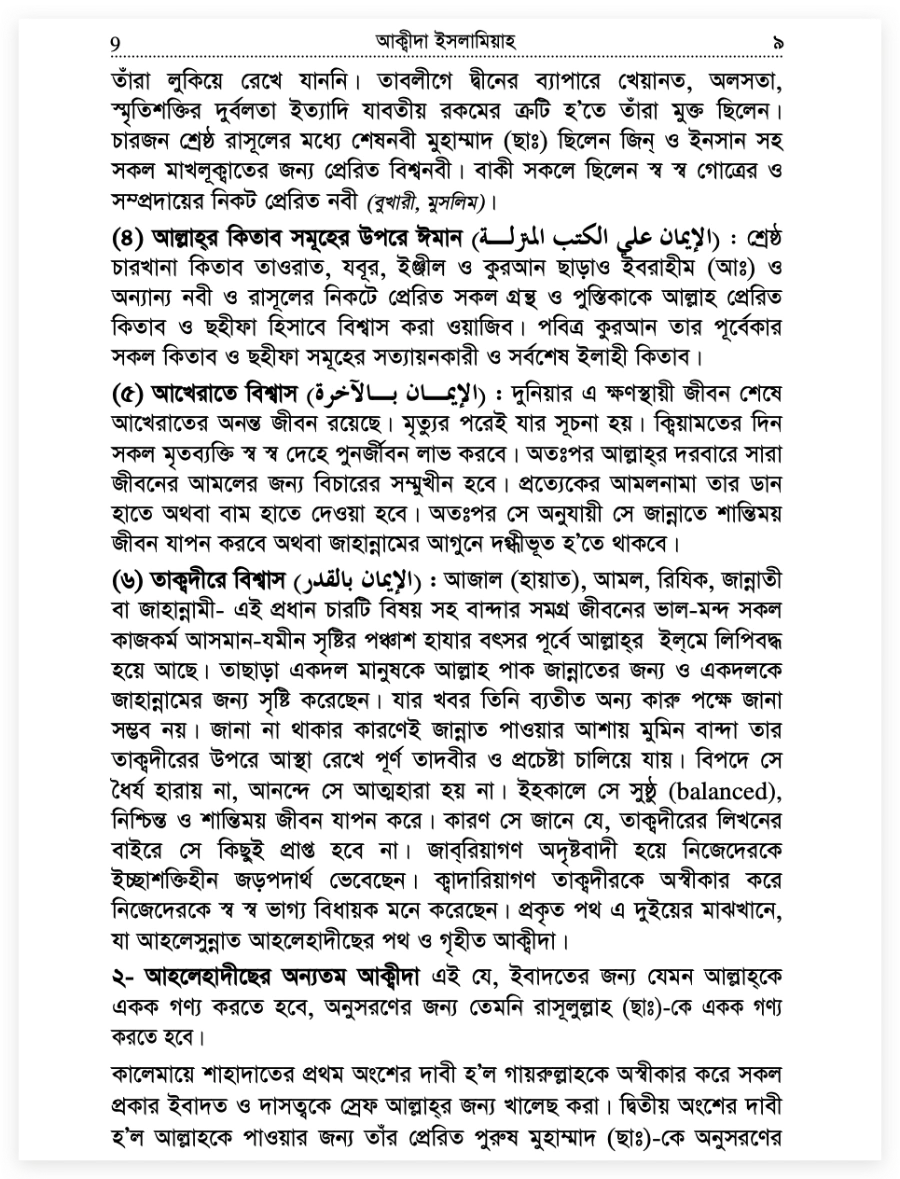
Here, too, a “middle” position is declared, but how that position works causally is not explained. If a person cannot receive anything outside written predestination and his final destination is already decreed, the question remains: what does freedom mean within that system?
The Combined Picture in Classical Creedal Works
Classical Sunni creedal works differ in language and method, but several central claims about predestination recur. Allah has foreknowledge of everything; everything is subject to His written decree; nothing occurs outside His will; human actions are also included within His creation; good and evil, obedience and disobedience are not outside predestination; and guidance and misguidance are likewise under His control. Classical sources also speak of people being created for Paradise and Hell.
At the same time, people are held responsible for their actions. Yet in establishing this responsibility, human will is not acknowledged as an independent power capable of bringing about an outcome contrary to Allah’s will. The opposite is maintained: if human will could defeat Allah’s effective will, Allah’s power would itself be diminished.
Classical Sunni creed therefore develops a dual language concerning human action: people act, but Allah is the ultimate Creator of the action; people will, but that will is not outside Allah’s will; people sin, but that sin is not outside Allah’s predestination; people are punished, but the outcome for which they are punished occurred within Allah’s predetermined system.
The more difficult the rational explanation of this duality becomes, the more prominently creedal literature invokes submission, prohibitions on questioning, and the language of “mystery.” Both doctrinal claims are thereby preserved—Allah’s all-encompassing power and human responsibility—but their mutual consistency is not demonstrated.
Conclusion
In classical Islamic creedal works, predestination is not merely foreknowledge. Allah does more than know what human beings will do: His judgment, will, and creation take effect in human actions and outcomes. In Harb al-Kirmani’s language, good and evil, sin and disobedience, illicit sexual intercourse, murder, and associating partners with Allah are all included within Allah’s predestination; people perform the deeds for which they were created. Ibn Battah speaks of distinct groups of people being created for Paradise and Hell, of even the intentions of their hearts being decreed, and of divine control over guidance and misguidance. The Tahawiyyah declares this entire domain Allah’s secret and instructs people to refrain from deep inquiry and questions of “why?”
This doctrinal system is highly consistent in preserving Allah’s omnipotence: no independent human power capable of thwarting Allah’s will is acknowledged. Yet this very position intensifies the problem of moral responsibility. If nothing occurs outside Allah’s will, human actions are also His creation, people cannot exceed the decreed outcome, and sin is not outside His predestination, then the conclusion that human beings alone bear full moral responsibility for that sin requires a separate argument.
Classical creedal works generally do not supply that argument. They declare responsibility, declare Allah’s justice, and, when the question goes deeper, call predestination a “mystery” and set limits to inquiry. What is established, therefore, is an obligation to believe despite the tension, rather than a resolution of it.
The central problem of classical Sunni predestination therefore remains: Allah is the ultimate determiner of a system in which human will, action, sin, guidance, misguidance, and outcome cannot step outside His will and predestination; yet within that same system, human beings are required to bear full moral responsibility for their predetermined actions. None of the declarations “Allah creates, human beings act,” “Allah is just,” or “predestination is Allah’s secret” by itself removes that causal conflict.
References
- Sharh Usul I‘tiqad Ahl al-Sunnah wa’l-Jama‘ah — The Creed of Ahmad ibn Hanbal ↩︎
- Sharh al-‘Aqidah al-Tahawiyyah, author: Imam Ibn Abi’l-‘Izz al-Hanafi; publisher: Maktabat al-Sunnah; pp. 423–424 ↩︎
- Ijma‘i ‘Aqidah [The Consensus Creed], original: Imam Harb al-Kirmani (d. 280 AH); translation and notes: Muhammad Abdullah Mridha; pp. 33–38 ↩︎
- Al-Ibanah al-Kubra by Ibn Battah — The Book of Predestination ↩︎
- Al-Ibanah al-Kubra — He Created Whomever He Willed for Paradise and Whomever He Willed for Hell ↩︎
- Al-Ibanah al-Kubra — Introduction to the Book of Predestination ↩︎
- Sharh Usul I‘tiqad Ahl al-Sunnah — The Beginning of the Emergence of Innovations ↩︎
- Sharh al-‘Aqidah al-Tahawiyyah — The Foundation of Predestination Is Allah’s Secret Within His Creation ↩︎
- Sharh al-‘Aqidah al-Tahawiyyah — The Sunni Position on Predestination ↩︎
- Islamweb — The Nature of Predestination and the Prohibition on Delving into It ↩︎
- ‘Aqidah Islamiyyah, Muhammad Asadullah al-Ghalib, Hadith Foundation Bangladesh, p. 9 ↩︎