
Summary
The ruling on rada‘ al-kabir, or adult suckling, poses a complex problem in Islamic sources: sahih hadith, Quranic texts, the practice of the Companions, and later legal interpretations come into conflict at several levels. The instruction for Sahla bint Suhayl to give her milk to Salim, a fully grown man with a beard, is preserved in Sahih Muslim and other hadith collections. Aisha held that the ruling applied to other adults and put it into practice, whereas Muhammad’s other wives rejected that application and considered it a concession specific to Salim. More unusually, Ibn Abi Mulayka was afraid to relate this hadith for nearly a year. The unease and disagreement over its interpretation are thus already evident in early Islamic tradition.
The method of giving the milk presents a similar conflict. None of the sahih reports mentions expressing milk into a vessel and giving it to Salim. That specific detail comes through al-Waqidi, whom several leading hadith critics rejected as a transmitter or called a liar. By contrast, a jurist as important as Ibn Hazm held that only sucking directly from the breast constitutes rada‘ under Islamic law and that drinking milk from a vessel does not establish a mahram relationship. Then there is the problem of the Quranic texts on ten and five feedings. Sahih Muslim says that the text on five feedings was still being recited as Quran at Muhammad’s death, yet it is absent from the present Quran. Al-Nawawi later explained that its recitation was abrogated so late that some people were still reciting it as Quran when Muhammad died, having not received word of the abrogation. There is also no consensus on the legal status of adult suckling. Some said the ruling was abrogated; others said it was specific to Salim; and the position associated with Ibn Taymiyya and Ibn al-Qayyim holds that it can apply to others when a need like Salim’s arises. The case is more than an unusual legal ruling: it exposes deep inconsistencies in the wording of hadith, the application of Islamic law, the abrogation of revelation, and the preservation of the Quranic text.
Introduction
An ideal society with a sense of decency has clear standards of conduct for protecting human dignity, personal modesty, and the sanctity of family relationships. Modern society places great importance on personal privacy and appropriate conduct between men and women. Against that standard, rada‘ al-kabir, or adult suckling, presents a profound and uncomfortable conflict in classical Islamic history. The Muslim world’s authoritative religious texts give this ruling serious attention, yet the circumstances in which they present it make it appear not only unacceptable to contemporary judgment, humane sensibility, and common decency, but grossly irrational and perverse.
Giving an adult man with a beard the breast milk of a woman who is not his mahram to solve the everyday problem of granting him free access to a household is ethically disturbing. It raises an even greater philosophical question about the claim of divine wisdom. When a religion presents itself as a complete code of life for all humanity until the Day of Judgement, the presence of so indecent and irrational a procedure comes into direct conflict with modern psychological understanding. This article examines the historical and theoretical foundations of that controversial ruling, how this particular religious solution conflicts with universal human values, and why it poses a serious intellectual problem today.
The Background: The Story of Sahla and Salim
At the centre of the case are Sahla bint Suhayl and Salim, the mawla of Abu Hudhayfa. Abu Hudhayfa had adopted Salim as his son, and Salim came and went in the household like a child of the family. When the Quranic instruction to call adopted sons by their biological fathers’ names was revealed, the legal status of that earlier social relationship changed, and the adult Salim’s unrestricted access to Sahla became a problem. According to Islamic sources, Muhammad’s solution was to instruct Sahla to give Salim her milk, establishing milk kinship and making him her mahram. Salim was no child. In the words of the hadith, he had “reached the stage that men reach” and “understood what men understand”; another report describes him as a grown man with a beard. Classical and modern Islamic sources describe the abolition of the adoptive relationship and the background to Salim’s case in the same way. The fatwas on this matter appear in the next section.
The case does not rest on a single isolated or obscure report. Different parts are related through several chains in Sahih Muslim, as well as in Ibn Majah, Abu Dawud, al-Nasa’i, Malik’s Muwatta, and other collections. The hadith reports come first. [1] [2] [3] [4] [5] [6] [7] [8] [9] –
Sahih Muslim (Islamic Foundation)
18. Suckling
No chapter heading
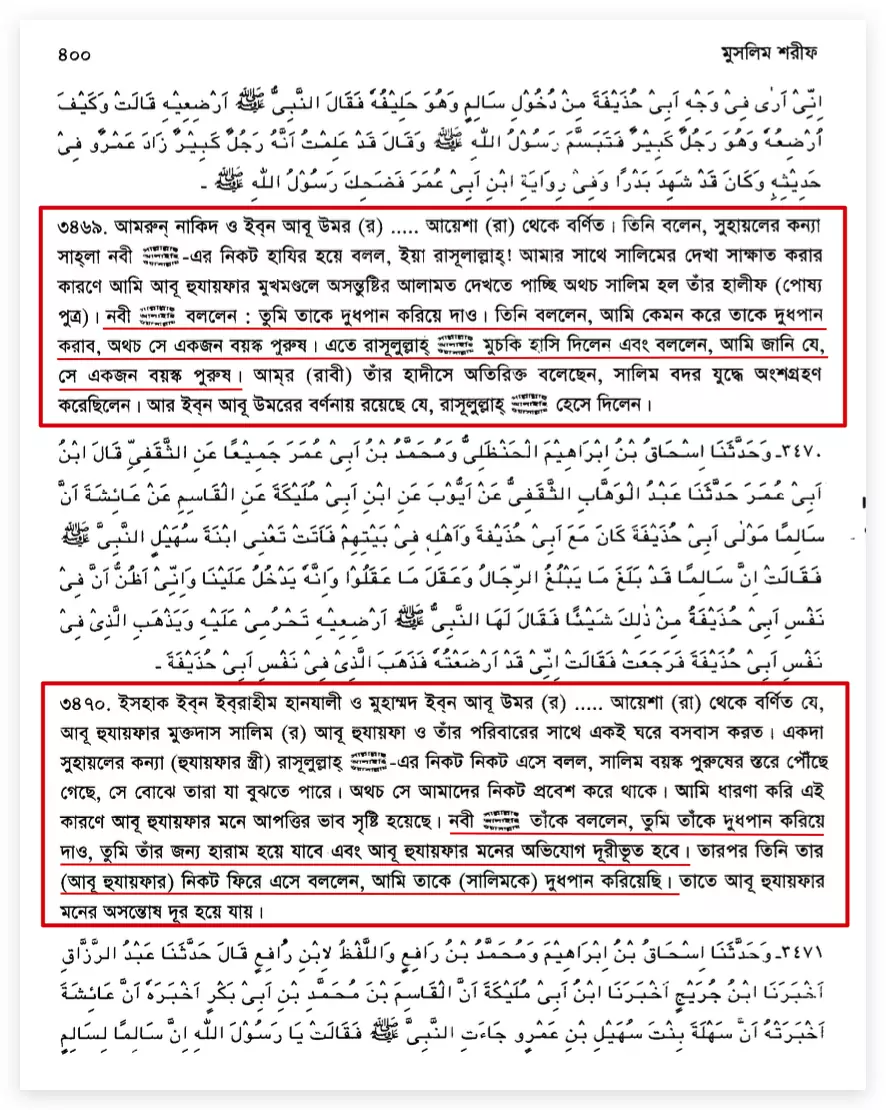
3469. ‘Amr al-Naqid and Ibn Abi ‘Umar (may Allah have mercy on them) … narrated from Aisha (may Allah be pleased with her). She said: Sahla, the daughter of Suhayl, came to the Prophet (may Allah bless him and grant him peace) and said, “Messenger of Allah, I see signs of displeasure on Abu Hudhayfa’s face because Salim comes to see me, although Salim is his ally (adopted son).” The Prophet (may Allah bless him and grant him peace) said, “Give him your milk.” She said, “How can I suckle him when he is a grown man?” At this, the Messenger of Allah (may Allah bless him and grant him peace) smiled and said, “I know that he is a grown man.” ‘Amr (the narrator) adds that Salim took part in the Battle of Badr. In Ibn Abi ‘Umar’s version, the Messenger of Allah (may Allah bless him and grant him peace) laughed.
Hadith grade: Sahih
Narrator: Aisha (may Allah be pleased with her)
Sahih Muslim (Islamic Foundation)
18. Suckling
No chapter heading
3470. Ishaq ibn Ibrahim al-Hanzali and Muhammad ibn Abi ‘Umar (may Allah have mercy on them) … narrated from Aisha (may Allah be pleased with her) that Salim (may Allah have mercy on him), Abu Hudhayfa’s slave, lived in the same house as Abu Hudhayfa and his family. One day, Suhayl’s daughter (Hudhayfa’s wife) came to the Messenger of Allah (may Allah bless him and grant him peace) and said, “Salim has reached manhood and understands what men understand, yet he still comes into our home. I think this has caused Abu Hudhayfa some unease.” The Prophet (may Allah bless him and grant him peace) told her, “Give him your milk, and you will become forbidden to him in marriage, and Abu Hudhayfa’s unease will go away.” Then she went back to Abu Hudhayfa and said, “I have given Salim my milk.” Abu Hudhayfa’s displeasure went away.
Hadith grade: Sahih
Narrator: Aisha (may Allah be pleased with her)
Sahih Muslim (Islamic Foundation)
18. Suckling
No chapter heading
3472. Muhammad ibn al-Muthanna (may Allah have mercy on him) … narrated that Umm Salama (may Allah be pleased with her) said to Aisha (may Allah be pleased with her), “Boys who are nearly of age come in to see you, but I do not like boys of that age coming in to see me.” The narrator says that Aisha asked, “Do you not have an excellent example in the Messenger of Allah (may Allah bless him and grant him peace)?” She added that Abu Hudhayfa’s wife once said, “Messenger of Allah, Salim comes in to see me although he is a grown man, and this causes Abu Hudhayfa some displeasure.” Then the Messenger of Allah (may Allah bless him and grant him peace) said, “Give him your milk so that he may come in to see you.”
Hadith grade: Sahih
Narrator: Umm Salama (may Allah be pleased with her)
Sahih Muslim (Islamic Foundation)
18. Suckling
No chapter heading
3473. Abu al-Tahir and Harun ibn Sa‘id al-Ayli (may Allah have mercy on them) … narrated that Umm Salama (may Allah be pleased with her), wife of the Messenger of Allah (may Allah bless him and grant him peace), once said to Aisha (may Allah be pleased with her), “By Allah, I do not like to be seen by a boy past the age of suckling.” Aisha said, “Why? Sahla, the daughter of Suhayl, once came to the Messenger of Allah (may Allah bless him and grant him peace) and said, ‘Messenger of Allah, by Allah, I see signs of displeasure on Abu Hudhayfa’s face because Salim comes in to see me.’” Aisha said: The Messenger of Allah (may Allah bless him and grant him peace) then told her, “Give him your milk.” Sahla replied, “But Salim has a beard.” He said, “Give him your milk, and the displeasure on Abu Hudhayfa’s face will go away.” Sahla said, “By Allah, I did not see that displeasure on Abu Hudhayfa’s face again.”
Hadith grade: Sahih
Narrator: Umm Salama (may Allah be pleased with her)
Sunan Ibn Majah
9. Marriage
Chapter 9/36: Suckling an adult.
1/1943. Narrated from Aisha (may Allah be pleased with her): Sahla bint Suhayl (may Allah be pleased with her) came to the Prophet (may Allah bless him and grant him peace) and said, “Messenger of Allah, I notice displeasure on my husband Abu Hudhayfa’s face when Salim comes to see me.” The Prophet (may Allah bless him and grant him peace) told her, “Give him your milk.” She asked, “How can I suckle him when he is a grown man?” The Messenger of Allah (may Allah bless him and grant him peace) smiled and said, “I know that he is a grown man.” She did so. “After I had given him my milk, I saw no sign of displeasure on Abu Hudhayfa’s face.” The narrator says that he took part in the Battle of Badr.
Sahih al-Bukhari 4000, 5088; Muslim 1453; al-Nasa’i 3223, 3234, 3319, 3320, 3321, 3322, 3323; Abu Dawud 2061; Ahmad 25121; Malik’s Muwatta 1288; al-Darimi 2257; Irwa’ 6/264; Rawd al-Nadir 354.
Al-Albani’s assessment: Sahih.
Hadith grade: Sahih
Narrator: Aisha (may Allah be pleased with her)
Sunan Ibn Majah
9. Marriage
Chapter 9/35: One or two sips of milk do not establish a marriage prohibition.
3/1942. Narrated from Aisha (may Allah be pleased with her). She said, “The Quran originally contained this ruling, which was later abrogated: fewer than ten or five sips of milk do not establish a marriage prohibition.”
Sahih al-Bukhari 1452; Ibn Majah 1944; al-Nasa’i 3307, 2062; Malik’s Muwatta 1293; al-Darimi 2253; Irwa’ 2147. Al-Albani’s assessment: Sahih.
Hadith grade: Sahih
Narrator: Aisha (may Allah be pleased with her)
Sahih Muslim (Hadith Academy)
Book 18. Suckling
Chapter 6. Establishing a marriage prohibition by drinking five sips of a woman’s milk
3490-(25/…) Abd Allah ibn Maslama al-Qa‘nabi (may Allah have mercy on him) … narrated from Amra (may Allah have mercy on her), who heard Aisha (may Allah be pleased with her) speak when discussing the amount of suckling that establishes a marriage prohibition. Amra said that Aisha said, “The Quran revealed عَشْرُ رَضَعَاتٍ مَعْلُومَاتٍ, ‘ten specified feedings’. Then خَمْسٌ مَعْلُومَاتٌ, ‘five specified feedings’, was revealed.” (Islamic Foundation 3463; Islamic Centre 3462)
Hadith grade: Sahih
Sahih Muslim (Islamic Foundation)
Book 18. Suckling
No chapter heading
3466. Yahya ibn Yahya (may Allah have mercy on him) … narrated from Aisha (may Allah be pleased with her), who said, “This verse was revealed in the Quran: عَشْرُ رَضَعَاتٍ مَعْلُومَاتٍ, ‘Ten feedings establish a marriage prohibition.’ It was then abrogated by خَمْسٍ مَعْلُومَاتٍ (five feedings establish the prohibition). Then the Messenger of Allah (may Allah bless him and grant him peace) died while that verse was still being recited as a verse of the Quran.”
Hadith grade: Sahih
Where Did Sahla’s Milk Come From?
Another basic question about Salim’s case is where Sahla bint Suhayl’s milk came from. Salim was already a grown man, and the sahih reports do not say that Sahla had recently given birth. The question did not originate with modern critics; it was put directly to IslamQA. The most important point in its answer is that it could offer no historical information about the actual source of Sahla’s milk. Instead, it proposed one possibility after another: perhaps she had another child whose birth was not recorded, perhaps she miscarried, or perhaps she continued to produce milk for a long time after the birth of her earlier child, Muhammad. Finally, it said that a woman can lactate without pregnancy or even marriage. [10]. Its answer reads:
أما عن استشكال السائل في بقاء لبنها، فيقال فيه:
يحتمل أن يكون هذا اللبن قد در لها من ولد آخر، سوى محمد المذكور، ولم ينقل لنا شأنه.
ويحتمل أن يكون بسبب سقط، لم يبق إلى حين الولادة، ونقل شأنه.
ويحتمل أن يكون قد اتصل لبنها، بعد ولادة ابنها محمد، المذكور، وإن كان ذلك يبعد، لطول الزمان بين قصة سالم، وتحريم التبني، وولادة محمد المذكور، قبل الرجوع من الحبشة، على ما ذكره أهل السير.
وأما ما ذكر في السؤال، من أن المعروف أن اللبن يكون في صدر المرأة، إذا كانت حديثة عهد بالولادة؛ فيقال: نعم، هذا هو المعروف، الغالب؛ لكن ذلك لا يمنع أن يحصل اللبن في صدر المرأة، ولو بغير حمل، بل، ولو من غير زواج، أحيانا، كما هو مشاهد معلوم.
English translation:
The questioner asks how there could still have been milk in Sahla’s breasts. In reply, it may be said:
It is possible that she produced this milk because she had another child besides her son Muhammad, mentioned above, but no account of that child has come down to us.
It is also possible that she produced milk following a miscarriage; the pregnancy did not reach term, and no account of it was preserved.
It is also possible that she continued producing milk after the birth of her son Muhammad, mentioned above. This is unlikely, however, given the long interval between Salim’s case and the prohibition of adoption on the one hand, and Muhammad’s birth on the other. According to the biographers, Muhammad was born before the return from Abyssinia.
The question also states that women generally produce milk shortly after giving birth. Yes, that is what normally happens. But it does not follow that a woman cannot produce milk without having been pregnant. A woman can sometimes produce milk without pregnancy, or even without having married. This is a known and observed phenomenon.
The point is clear. IslamQA could provide no historical information about what caused Sahla to lactate. “She may have had another child”, “she may have miscarried”, and “she may still have been producing milk from an earlier pregnancy” are possibilities, not accounts of what happened. Although Salim’s consumption of Sahla’s milk appears in sahih hadith, the original reports say nothing about a basic biological element of the case: where the milk came from. IslamQA filled that gap with conjecture. Most tellingly, it acknowledged that the third possibility was unlikely given the length of the interval.
In answering this question, IslamQA also cited another fatwa by Ibn Baz. There he says explicitly that a woman need not previously have been pregnant or given birth for milk kinship to be established under Islamic law. Even if an unmarried virgin produces milk and gives it to a child, she becomes the child’s milk mother. [11]
السؤال فيه إشكال، لكن هذا الرضاع الذي حصل من هذه المرأة من خالة الطفل رضاع شرعي، ما دام درت عليه تكون أمه، وليس من شرط ذلك أن تكون قد حملت.
الصواب: أن درها يؤثر، ولو لم يسبق حمل، هذا هو الصواب؛ لأن الله أطلق قال: وَأُمَّهَاتُكُمُ اللَّاتِي أَرْضَعْنَكُمْ [النساء:23].
[…]
سواء كان عن حمل، أو عن وطء، أو درت من دون حمل، ولا وطء، تكون أمه، لو كانت امرأة بكر ما تزوجت أصلًا، ثم درت على إنسان تكون أمًا له […] ما هو بشرط أن يكون هناك زوج وحمل، ما هو بشرط، الصحيح أنه ليس بشرط.
English translation:
The question presents some difficulty. But the suckling in this case, in which the child’s maternal aunt gave the child her milk, is legally valid. As long as she produced milk and gave it to the child, she becomes the child’s mother. Prior pregnancy is not a condition.
The correct view is that a woman’s milk has this effect even if there has been no prior pregnancy, because Allah spoke in general terms: “And your mothers who nursed you.” (Surah al-Nisa’, 4:23)
[…]
Whether her milk came in as a result of pregnancy or intercourse, or without either, she becomes the child’s milk mother. Even if a virgin who has never married produces milk and gives it to someone, she becomes that person’s milk mother. […] Having a husband or having been pregnant is not a condition. According to the correct view, neither is required.
The original hadith does not say when Sahla gave birth or whether she had a newborn at the time. Islamic jurisprudence resolves a different question: the presence of milk is sufficient, and neither pregnancy nor childbirth is required as its source. That leaves the historical gap in Salim’s case. The sources provide no information about what actually caused Sahla to lactate.
More significantly, Ibn Baz himself did not deny that Salim was given milk as an adult. He wrote explicitly that scholars disagreed on the question, then stated his preferred view that the case was specific to Salim and Sahla. In the next fatwa in the same volume, the questioner says that he found three different positions in Zad al-Ma‘ad. Some scholars held that the ruling was specific to Salim; others held it applied generally; and, in Ibn Taymiyya’s view, it applied to others when the same circumstances arose. [12]
153 – لا يعتد بالرضاع إلا ما كان في الحولين
فقد اختلف أهل العلم في رضاع الكبير هل يؤثر أم لا؟ والسبب في ذلك أنه ورد في الحديث الصحيح عن عائشة – رضي الله عنها – أن النبي – صلى الله عليه وسلم – أمر سهلة بنت سهيل أن ترضع سالما مولى أبي حذيفة وكان كبيرا […]
فأمرها أن ترضعه خمس رضعات، فاختلف العلماء في ذلك، والصحيح من قولي العلماء أن هذا خاص بسالم وبسهلة بنت سهيل وليس عاما للأمة، قاله غالب أزواج النبي – صلى الله عليه وسلم -، وقاله جمع غفير من أهل العلم، وهذا هو الصواب.
[…]
154 – حكم إرضاع الكبير
وقد راجعت كلام أهل العلم في المسألة في كتاب: زاد المعاد، فوجدت أنهم فريقان ووسط: فريق يرى أن الحديث خاص في حق سالم فقط، وفريق يرى عموم الحديث في سالم وغيره، وفريق يتوسط ويرى أن الحديث عام في سالم وغيره بشرط أن تكون حاله مثل حال سالم وأم حذيفة، وهو رأي شيخ الإسلام ابن تيمية – رحمه الله -.
[…]
نرى أن حديث سالم مولى أبي حذيفة خاص بسالم كما هو قول الجمهور، لصحة الأحاديث الدالة على أنه لا رضاع إلا في الحولين، وهذا هو الذي نفتي به.
153 — Suckling counts only within the first two years
Scholars disagree on whether adult suckling has legal effect. This is because a sahih report from Aisha says that the Prophet instructed Sahla bint Suhayl to give her milk to Salim, the freedman of Abu Hudhayfa, although Salim was already an adult. […]
The Prophet instructed her to give Salim her milk five times. Scholars have differed on this. The correct of the two views is that it was specific to Salim and Sahla bint Suhayl and was not a general ruling for the whole ummah. Most of the Prophet’s wives and a great many scholars held this view, and it is the correct one.
[…]
154 — The ruling on giving a woman’s milk to an adult
I reviewed the scholars’ discussion of this question in Zad al-Ma‘ad and found them divided into three groups:
One group holds that the hadith is specific to Salim alone.
Another holds that it applies generally, to Salim and to everyone else.
A third takes an intermediate position: it applies to Salim and others, provided that their circumstances resemble those of Salim and Umm Hudhayfa. This is the view of Shaykh al-Islam Ibn Taymiyya.
[…]
Our view is that the hadith concerning Salim, the freedman of Abu Hudhayfa, is specific to him, as the majority of scholars hold. This is because there are sahih hadith stating that suckling after the first two years has no legal effect. This is the view on which we issue fatwas.
Was Adult Suckling Abrogated?
The report from Sahih Muslim above is crucial. Aisha says that a ruling concerning ten feedings was first revealed in the Quran, then abrogated by five feedings. Muhammad then died “while that verse was still being recited as a verse of the Quran.” [9] [13] Here the problem is plain: according to Aisha, the text on five feedings was still in circulation as Quran at Muhammad’s death, yet it is absent from the present Quran. Later commentators proposed that the recitation of the verse on five feedings had been abrogated at the very end, and some people had still not received word of the abrogation when Muhammad died. Al-Nawawi gives precisely this explanation: some people were still reciting “five feedings” as Quran when Muhammad died and stopped when they learned it had been abrogated. [14] [15] To bridge the gap between the sahih report and the present mushaf, the later explanation therefore posits an abrogation so late that not all readers had heard about it by the time Muhammad died. This makes the question of how the Quranic text was preserved and uniformly established all the more acute. The Bengali commentary on this hadith reads as follows. [16] —

Consider another hadith. [17]
Sunan Ibn Majah
9. Marriage
Chapter 9/36: Suckling an adult.
2/1944. Narrated from Aisha (may Allah be pleased with her). She said: The verse on stoning and the verse on an adult drinking ten sips of breast milk were revealed and were written on a sheet kept under my bed. When the Messenger of Allah (may Allah bless him and grant him peace) died and we were preoccupied with his death, a goat came in and ate it.
Ibn Majah 1944; Sahih al-Bukhari 1452; al-Nasa’i 3307, 2062; Malik’s Muwatta 1293; al-Darimi 2253; Ta‘liq Ibn Majah.
Al-Albani’s assessment: Hasan. Concerning Muhammad ibn Ishaq, a transmitter of this hadith, Yahya ibn Ma‘in and al-‘Ijli said that he was trustworthy. Ahmad ibn Hanbal said his hadith were hasan. Ali ibn al-Madini said that he was sound. (Tahdhib al-Kamal, narrator no. 5057, vol. 24, p. 405)
Hadith grade: Hasan
Narrator: Aisha (may Allah be pleased with her)
The central problem goes beyond the story of a goat eating a sheet of paper. Putting two reports on the subject side by side makes it clear. In Sahih Muslim, Aisha says that the text on five feedings was still being recited as Quran when Muhammad died. In Ibn Majah’s report she says that a text on stoning and “ten feedings for an adult” was on a sheet under her bed, and a domesticated animal ate it amid the preoccupation with Muhammad’s death. [18] [19] Hadith scholars disagree on the grade of Ibn Majah’s report. It circulates with al-Albani’s grading of hasan, and the Arabic explicitly says “وَرَضَاعَةُ الْكَبِيرِ عَشْرًا”, “ten feedings for an adult”.
The account of Aisha’s sheet being eaten also appears in Musnad Ahmad, but the two versions place the event at different times. In Ibn Majah, the animal enters after Muhammad’s death, while everyone is preoccupied with it. In Ahmad, Muhammad falls ill and people are preoccupied with him when the animal eats the sheet. Both reports refer to stoning and ten feedings for an adult, and both chains include Muhammad ibn Ishaq. They are thus two versions of the same incident, and they disagree on when the animal ate the sheet. [20]
فلما اشتكى رسول الله صلى الله عليه وسلم تشاغلنا بأمره ودخلت دويبة لنا فأكلتها
English translation: When the Messenger of Allah fell ill, we were preoccupied with him. A small animal of ours came in and ate it.
Islamic commentators explain that the recitation of these texts was abrogated, but the problem remains: the wording in Sahih Muslim itself says that the text was still being recited as Quran when Muhammad died. Al-Nawawi therefore had to say that the abrogation came so late that some people had not heard about it by the time Muhammad died. [21] More significantly, Mirqat al-Mafatih records Ibn al-Humam’s objection: if Aisha’s account means that a part of the Quran that had not been abrogated was lost after Muhammad’s death, the direct implication is that part of the Quran was lost. And if one says that the recitation was abrogated but the ruling remained in force, separate evidence is needed for the ruling to remain in force. [22] The dispute is therefore no joke about a goat. It is a real conflict in the accounts of revealed texts, how word of their abrogation spread, and which texts belong in the present mushaf. The relevant Quranic verses read as follows. [23] [24]
If I abrogate a verse or cause it to be forgotten, I bring one better than it or like it. Do you not know that Allah has power over all things?
— Taisirul Quran
If I abrogate the ruling of a verse or cause the verse to be forgotten, I bring one better than it or similar to it. Do you not know that Allah has power over everything?
— Sheikh Mujibur Rahman
Whatever verse I abrogate or cause to be forgotten, I bring one better than it or like it. Do you not know that Allah has power over all things?
— Rawai Al-bayan
If We abrogate a verse or cause it to be forgotten, We bring a verse better than it or equal to it.[1] Do you not know that Allah has power over all things?
— Dr. Abu Bakr Muhammad Zakaria
When I reveal one verse in place of another—and Allah knows best what He reveals—these people say, “You are a liar who makes things up.” The truth is that most of them have no knowledge of it.
— Taisirul Quran
When I put one verse in place of another, and Allah Himself knows best what He reveals, they say, “You are nothing but a fabricator of lies.” But most of them do not know.
— Sheikh Mujibur Rahman
When I replace one verse with another—Allah knows best what He reveals—they say, “You are merely a liar.” Rather, most of them do not know.
— Rawai Al-bayan
When We replace one verse with another—and Allah knows best what He will reveal—they say, “You are nothing but a liar.” Rather, most of them do not know.
— Dr. Abu Bakr Muhammad Zakaria
The Verse on Five Feedings: A Serious Problem for the Commentators Themselves
Aisha’s report in Sahih Muslim says that a ruling concerning “ten specified feedings” was first revealed in the Quran and then abrogated by “five specified feedings”. Muhammad then died while the text on five feedings was still being recited as Quran. Later hadith scholars and jurists offered several explanations of this report. The problem becomes clearer when those explanations are put side by side. Mulla Ali al-Qari’s Mirqat al-Mafatih Sharh Mishkat al-Masabih preserves the statements of al-Turbishti, al-Ashraf, al-Nawawi, al-Tibi, and Ibn al-Humam together. [25]
3167 – وعن عائشة قالت : كان فيما أنزل من القرآن : عشر رضعات معلومات يحرمن ، ثم نسخن بخمس معلومات فتوفي رسول الله – صلى الله عليه وسلم – وهي فيما يقرأ من القرآن . رواه مسلم .
( وعن عائشة قالت : كان فيما أنزل من القرآن عشر رضعات ) بسكون الشين وفتح الضاد ( معلومات يحرمن ثم نسخن بخمس معلومات ) أي : مشبعات في خمسة أوقات متفاصلة عرفا ( فتوفي رسول الله – صلى الله عليه وسلم – وهي ) أي : آية خمس رضعات ( فيما يقرأ ) بصيغة المجهول ( من القرآن ) تعني أن من لم يبلغه النسخ كان يقرؤه على الرسم الأول لأن النسخ لا يكون إلا في زمان الوحي فكيف بعد وفاة النبي – صلى الله عليه وسلم – أرادت بذلك قرب زمان الوحي.
قال التوربشتي : ولا يجوز أن يقال أن تلاوتها قد كانت باقية فتركوها فإن الله تعالى رفع قدر هذا الكتاب المبارك عن الاختلال والنقصان وتولى حفظه وضمن صيانته فقال عز من قال: إنا نحن نزلنا الذكر وإنا له لحافظون، فلا يجوز على كتاب الله أن يضيع منه آية ولا أن ينخرم حرف كان يتلى في زمان الرسالة إلا ما نسخ منه.
قال الأشرف : المفهوم من كلام الشيخ في شرح السنة أن الضمير في قول عائشة وهو ( فيما يقرأ من القرآن ) عائد إلى عشر رضعات […] ولو جعل الضمير المذكور عائدا إلى خمس معلومات […] يكون المعنى حينئذ أن العشر نسخن بخمس معلومات واستقر النسخ وتقرر في زمان النبي – صلى الله عليه وسلم – وهذا هو المراد من قولها فتوفي رسول الله – صلى الله عليه وسلم – وهي فيما يقرأ من القرآن أي توفي النبي – صلى الله عليه وسلم – بعد نسخ العشرة بالخمس في حالة استقرار الخمس وكونه مقروءا في القرآن.
قال الطيبي – رحمه الله – : ويؤيده قول النووي في شرح مسلم أي : أن النسخ بخمس رضعات تأخر إنزاله جدا حتى أنه – صلى الله عليه وسلم – توفي وبعض الناس يقرأ خمس رضعات ويجعلها قرآنا متلوا لكونه لم يبلغه النسخ لقرب عهده فلما بلغهم النسخ بعد ذلك رجعوا عن ذلك وأجمعوا على أن هذا لا يتلى.
قال الطيبي : والنسخ ثلاثة أنواع منها ما نسخ حكمه وتلاوته كعشر رضعات ، وما نسخت تلاوته دون حكمه كخمس رضعات ، والشيخ والشيخة إذا زنيا فارجموهما ، وما نسخ حكمه وبقيت تلاوته وهذا هو الأكثر.
قال المحقق ابن الهمام : هذا لا يستقيم إلا على إرادة الكل وإلا لزم ضياع بعض القرآن الذي لم ينسخ فيثبت قول الروافض ذهب كثير من القرآن بعد رسول الله – صلى الله عليه وسلم – لم يثبته الصحابة فلا تمسك بالحديث ، وإن كان إسناده صحيحا لانقطاعه باطنا وما قيل ليكن نسخ الكل ويكون نسخ التلاوة مع بقاء الحكم وأن هذا مما لا جواب له فليس بشيء ; لأن ادعاء بقاء حكم الدال بعد نسخه يحتاج إلى دليل وإلا فالأصل أن نسخ الدال يرفع حكمه وما نظر به الشيخ والشيخة إذا زنيا فارجموهما فلولا ما علم بالسنة والإجماع لم يثبت به.
English translation:
3167 — Narrated from Aisha. She said: Among the things revealed in the Quran was the statement that “ten specified feedings make marriage unlawful.” The ruling of ten was later abrogated by “five specified feedings”. The Messenger of Allah then died while it was still being recited as Quran. Muslim transmitted the hadith.
The commentary explains: by “ten specified feedings” Aisha meant ten feedings that make marriage unlawful. They were later abrogated by five, meaning five full feedings at times customarily regarded as separate. In Aisha’s words, “The Messenger of Allah died while it was still being recited as Quran”, “it” refers to the verse on five feedings. Those who had not heard of the abrogation continued to recite it according to the earlier written text. Abrogation is possible only while revelation is being received; how could it take place after the Prophet’s death? Aisha meant a time very close to the period of revelation.
Al-Turbishti says: One cannot say that its recitation remained in force and that people later abandoned it. Allah raised this blessed Book above defect and deficiency, undertook to preserve it, and guaranteed its protection. Allah said: “Indeed, We sent down the Reminder, and We are its guardian.” No verse of Allah’s Book can therefore be lost, nor can a single letter recited in the prophetic period disappear, except what was abrogated.
Al-Ashraf says: The shaykh’s remarks in Sharh al-Sunnah suggest that the pronoun in Aisha’s words “what was being recited as Quran” refers to ten feedings. […] If the pronoun is taken to refer instead to the five specified feedings, the meaning is that ten were abrogated by five and that this abrogation was settled and established during the Prophet’s lifetime. Aisha’s words, “The Messenger of Allah died while it was being recited as Quran”, would then mean that the Prophet died after ten had been abrogated by five and while the text on five was being recited as Quran.
Al-Tibi says: In support of this, al-Nawawi says in his commentary on Muslim that the abrogation of the text on five feedings occurred so late that some people were still reciting the text on five feedings as part of the Quran to be recited when the Prophet died. The interval was so short that news of the abrogation had not reached them. When it did, they abandoned the text and agreed that it was no longer to be recited.
Al-Tibi also says: Abrogation is of three kinds. In one, both the ruling and the recitation are abrogated, as with ten feedings. In another, the recitation is abrogated but the ruling remains in force, as with five feedings and “If an old man and an old woman commit unlawful intercourse, stone them to death”. In the third, the ruling is abrogated but the recitation remains. This is the most common kind.
The scholar Ibn al-Humam says: This explanation is tenable only if the entire text is understood to have been abrogated. Otherwise it would follow that part of the Quran was lost without ever being abrogated. That would establish the Rafidis’ claim that much of the Quran was lost after the Messenger of Allah died and that the Companions did not preserve it. This hadith therefore cannot be relied on as evidence, even if its chain is sahih, because it has an underlying discontinuity.
Nor is the problem resolved by saying that the entire text was abrogated and that the ruling nevertheless remained in force after the recitation was abrogated. A claim that a ruling survives the abrogation of its text requires separate evidence. Otherwise the default principle is that abrogating the text that establishes a ruling also removes the ruling. “If an old man and an old woman commit unlawful intercourse, stone them to death” is not a sufficient example in itself. Had its ruling not been established by the Sunnah and consensus, it could not have been established by the abrogated text alone.
This explanation is significant because the problem is being acknowledged by the commentators in an Islamic commentary itself. It was not invented by an outside critic. Al-Turbishti begins by drawing a line: no verse recited in the Prophet’s time and not abrogated could subsequently have been lost, because that would undermine the claim that the Quran was preserved. Aisha’s words therefore have to be interpreted so that the text on five feedings was already abrogated during the Prophet’s lifetime.
That explanation raises another question. According to al-Nawawi, the abrogation took place so late that some people were still reciting the text on five feedings as a Quranic verse when Muhammad died. They did not know it had been abrogated and stopped reciting it when word reached them. On this account, at Muhammad’s death some members of the same society still regarded a text as Quran even though, according to the later explanation, it had already been abrogated. This goes directly to how revelation was communicated and preserved: a Quranic text had been abrogated, yet not everyone concerned knew it by the time Muhammad died.
Ibn al-Humam makes the sharpest objection. He says that if Aisha’s words mean that a Quranic text was lost without being abrogated, the implication is that “part of the Quran was lost”. He himself notes that this lends weight to the Rafidis’ claim that much of the Quran disappeared. If the recitation was abrogated but the ruling remained, that too requires separate proof. A ruling cannot be kept in force on the strength of a lost or abrogated text alone. [26]
The report of the change from ten to five also appears in al-Tirmidhi through Malik → Abd Allah ibn Abi Bakr → Amra → Aisha. The final sentences differ. In Sahih Muslim, the text is said to have been recited as Quran when Muhammad died. In al-Tirmidhi, he died while the ruling still stood as it was. Al-Tirmidhi’s wording does not expressly mention recitation. Treating the two versions of the same transmission as interchangeable erases an important distinction in what their wording says was still in force at Muhammad’s death: the ruling or the recitation. [27]
فَتُوُفِّيَ رَسُولُ اللَّهِ صلى الله عليه وسلم وَالأَمْرُ عَلَى ذَلِكَ
English translation: The Messenger of Allah died while the ruling still stood as it was.
In Ahkam al-Quran, the Hanafi jurist al-Jassas objects to accepting Aisha’s report as true in the form in which it was transmitted. He argues that if a text remained part of the Quran at Muhammad’s death, it could not be abrogated afterwards. Yet the text is absent from the recitation. He gives two possibilities: either the report is defective at its root and does not establish a ruling, or, if the report is established, the ruling was abrogated in Muhammad’s lifetime. Al-Nawawi distinguishes the recitation from the ruling by explaining that word of the abrogation reached some people late. On al-Jassas’s account, this report does not keep the ruling on five feedings in force. [28]
إما أن يكون الحديث مدخولا في الأصل غير ثابت الحكم ، أو يكون إن كان ثابتا فإنما نسخ في حياة رسول الله صلى الله عليه وسلم
English translation: Either the hadith is defective at its root and its ruling is not established, or, if it is established, it was abrogated during the lifetime of the Messenger of Allah.
Saying “it was abrogated” does not settle the problem of the verse on five feedings. The sahih report says it was still being recited as Quran when Muhammad died. Al-Nawawi says that not everyone had heard of its abrogation. Al-Turbishti says that a verse not abrogated could not be lost. Ibn al-Humam says that otherwise one is left with the loss of part of the Quran. The attempt to reconcile the text reported by Aisha with the present Quran has produced successive explanations, objections, and replies within classical Islamic commentary itself.
A Quranic Ruling for Salim Alone?
The ruling on adult suckling cannot be dismissed as an exception for Salim alone, because the primary Islamic sources record an explicit disagreement. Aisha did not regard Salim’s case as a personal exception. According to Abu Dawud, she instructed her sisters’ and brothers’ daughters to give their milk five times to adult men whom she wanted to admit to her presence. Ibn Hajar describes the chain of this report as sahih and says it clearly establishes that Aisha put the ruling into practice. [29] Umm Salama and Muhammad’s other wives, on the other hand, considered it a concession specific to Salim. “For Salim alone” is therefore not the wording of a declaration by Muhammad. It is the interpretation of a group of his wives, and Aisha’s practice stands against it.
More significantly, later scholars did not settle on this interpretation of a personal concession. Ibn Baz’s fatwa, preserved in Shongshoy’s Islam Archive, treats it as specific to Salim and Sahla. [30] Ibn Taymiyya and Ibn al-Qayyim take a completely different position: the case was neither abrogated nor a personal privilege for Salim; the ruling on adult suckling can apply when a need like Salim’s arises. IslamQA quotes Ibn al-Qayyim: “حديث سهلة ليس بمنسوخ، ولا مخصوص”—the hadith of Sahla was neither abrogated nor restricted to Salim as an individual. [31] More significantly, IslamQA acknowledges that the Quranic verse on two years of suckling was revealed before Salim’s case. The chronology in which Salim’s case represents an earlier general ruling later abrogated by the verse on two years therefore does not work. In Fath al-Bari, Ibn Hajar also calls the basis for this abrogation argument “weak”. As for restricting the ruling to Salim on account of his circumstances, Ibn Hajar writes that the same reasoning would include anyone with the same need. [32] Three distinct positions thus remain in Islamic tradition: the ruling was abrogated; it applied to Salim alone; or it can apply to another adult when the need arises.
In Abu Dawud’s report, Muhammad’s instruction is simply, “Give him your milk.” It is the narrator, in the next sentence, who says that Sahla gave him her milk five times and that Salim acquired the status of her milk son. Aisha directed her sisters’ and brothers’ daughters to give their milk to those whom she wished to admit to her presence. [33] [34]
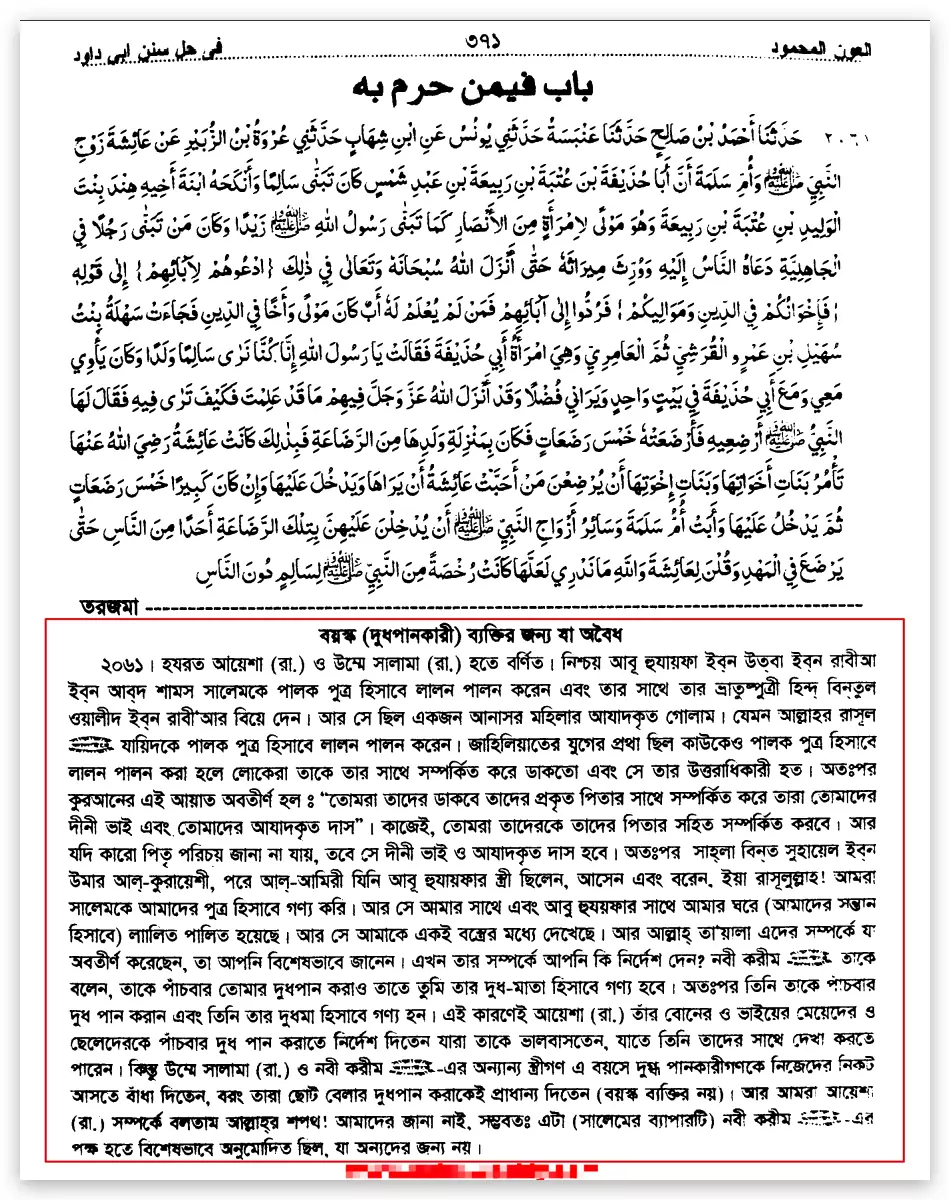
Sunan Abi Dawud 2061: English rendering of the corrected Bengali translation
It is narrated from Aisha and Umm Salama that Abu Hudhayfa ibn ‘Utba ibn Rabi‘a ibn Abd Shams adopted Salim as his son and married him to his brother’s daughter, Hind bint al-Walid ibn ‘Utba ibn Rabi‘a. Salim was the freedman of an Ansari woman. Abu Hudhayfa adopted Salim just as the Messenger of Allah had adopted Zayd. In the pre-Islamic period, when someone was adopted as a son, people called him by his adoptive father’s name and he inherited from him. Then Allah revealed concerning them the passage from “Call them by their fathers’ names” to “they are your brothers in religion and your mawlas”. They were then called by their fathers’ names. A person whose father was unknown was regarded as a mawla and a brother in religion. Sahla bint Suhayl ibn ‘Amr al-Qurashi al-‘Amiri, the wife of Abu Hudhayfa, came and said, “Messenger of Allah, we regarded Salim as a son. He lived in the same house as me and Abu Hudhayfa and saw me in my house clothes. You know what Allah has revealed about such people. What do you think should be done about Salim?” The Prophet told her, “Give him your milk.” Sahla then gave him her milk five times, and Salim acquired the status of her milk son. For this reason, Aisha used to instruct her sisters’ and brothers’ daughters to give their milk five times to those whom she wanted to see and admit into her presence, even if they were adults. They could then come in to see her. Umm Salama and the Prophet’s other wives would not admit anyone on the strength of such suckling unless he had been nursed as an infant in the cradle. They told Aisha, “By Allah, we do not know. Perhaps it was a special concession from the Prophet for Salim alone.”
In Malik’s Muwatta, the number five is part of the instruction itself. In Abu Dawud, the instruction and what Sahla actually did appear in separate sentences; in Malik, Muhammad himself states the number. Keeping the two versions separate shows where the number is part of the instruction and where it is part of the account of Sahla’s actions. [35]
أَرْضِعِيهِ خَمْسَ رَضَعَاتٍ فَيَحْرُمُ بِلَبَنِهَا
English translation: Give him your milk five times. Marriage will then be forbidden on account of her milk.
The Musannaf of Abd al-Razzaq gives a specific example of adult suckling being treated as an impediment to marriage outside Salim’s case. According to Ibn Jurayj, a man asked ‘Ata’ ibn Abi Rabah whether he could marry a woman who had given him her milk after he reached adulthood. ‘Ata’ said that the marriage was forbidden and cited Aisha’s practice in support of his position. Here, ‘Ata’ uses adult suckling to determine not only who may enter someone’s home but also whether a marriage is lawful. [36]
سقتني امرأة من لبنها بعد ما كنت رجلا كبيرا أأنكحها ؟ قال : لا
English translation: A woman gave me her milk after I had become a grown man. May I marry her? ‘Ata’ said, “No.”
Citing ‘Ata’s answer, Ibn Abd al-Barr says that for an adult, the milk is expressed and given to the person to drink. He is interpreting the method from ‘Ata’s report; he provides no new testimony about what Sahla did. The same discussion records a woman asking al-Layth ibn Sa‘d about going on Hajj without a mahram. In one report, al-Layth tells her to drink another woman’s milk so that the woman’s husband would become her milk father and she could go on Hajj with him. In this fatwa, adult milk kinship is used not only to regulate a man’s access to a home or to bar a marriage, but also to provide a mahram for a woman’s journey. The same work also records al-Layth expressing reluctance to permit adult suckling. [37]
اذهبي إلى امرأة رجل ترضعك فيكون زوجها أبا لك فتحجين معه
English translation: Go to a man’s wife and have her give you her milk. Her husband will then become your milk father, and you can go on Hajj with him.
The Narrator Was Afraid to Relate the Hadith
The transmission of the hadith about giving milk to the adult Salim preserves an unusual incident. After hearing it from al-Qasim ibn Muhammad on Aisha’s authority, the narrator Abd Allah ibn Abi Mulayka told no one about it for nearly a year. The report gives the reason as رَهْبَةً—fear, dread, or deep apprehension. He later returned to al-Qasim and told him about it, and al-Qasim instructed him to relate the hadith on his authority. The same report appears in the Musannaf of Abd al-Razzaq. [38] [39] [40]
Sahih Muslim (Islamic Foundation)
18. Suckling
No chapter heading
3471. Ishaq ibn Ibrahim and Muhammad ibn Rafi‘ (may Allah have mercy on them) … narrated from Aisha (may Allah be pleased with her) that Sahla, daughter of Suhayl ibn ‘Amr, came to the Prophet (may Allah bless him and grant him peace) and said, “Messenger of Allah, Salim, the freedman of Abu Hudhayfa, lives with us in the same house, yet he has reached the stage of an adult man with understanding.” He said, “Give him your milk, and you will become forbidden to him in marriage.” The narrator Ibn Abi Mulayka said, “After that I did not relate this hadith for a year, or nearly a year, out of fear. Then I met al-Qasim and said, ‘You related a hadith to me some time ago which I have not told anyone to this day.’ He asked, ‘Which hadith?’ I told him about it. He then said, ‘Relate it from me on the authority that Aisha (may Allah be pleased with her) told me about it.’”
Hadith grade: Sahih
Narrator: Aisha (may Allah be pleased with her)

The narrator’s fear was not imagined by a modern critic. The word is in the hadith itself. More tellingly, in another version al-Qasim tells him, “حدث به ولا تهابه”—“Relate it, and do not be afraid of it.” This was the very report he had kept to himself for nearly a year. Ibn Abd al-Barr quotes the episode in al-Istidhkar and comments directly: “هذا يدل على أنه حديث ترك قديما، ولم يعمل به، ولا تلقاه الجمهور بالقبول على عمومه”—it shows that the hadith was set aside early, was not generally acted upon, and was not accepted as a general ruling by the majority of scholars. [41]
The unease over this hadith cannot be described as a modern development. The report itself says that Ibn Abi Mulayka did not relate it for nearly a year “out of fear”. In al-Nasa’i’s version, al-Qasim had to tell him explicitly, “Relate it, and do not be afraid.” [42] Ibn Abd al-Barr then states that it was not generally acted upon in early times and that the majority did not accept it as a general ruling. [43] Yet Aisha did not regard it as a case specific to Salim; she had the ruling applied to other adult men. A transmitter was afraid to relate a sahih instruction, most of Muhammad’s wives rejected it as a general ruling, and Aisha applied it to others. The division is preserved in Islamic sources themselves.
The Claim That Milk Was Given in a Vessel: No Mention in Sahih Hadith
How exactly did Salim drink Sahla’s milk: directly from the breast, or from a vessel into which it had been expressed? This is the most awkward question for the later interpretations. In several reports in Sahih Muslim and in Abu Dawud, al-Nasa’i, and other primary accounts, Sahla is told “أَرْضِعِيهِ”—“Give him your milk.” Sahla responds that he is a grown man, or that he has a beard. Muhammad smiles and says he knows Salim is a grown man. But none of these sahih reports mentions a vessel or bowl, an instruction to express milk, or a direction not to touch the breast. When Islamweb was asked this very question, its answer was unambiguous: “ولم يرد في الروايات ما يشير إلى أن الرضاعة كانت من إناء ولم تكن من الثدي”—there is nothing in the reports to indicate that the milk was taken from a vessel rather than from the breast. [44]
The idea of a vessel comes from later commentary and a separate weak report, rather than from sahih hadith. Qadi ‘Iyad says that “perhaps Sahla expressed her milk”. Al-Nawawi considers this conjecture plausible but acknowledges another possibility: direct contact may have been permitted because of the need. Al-Zurqani’s Commentary on the Muwatta records a more significant point: the hadith’s ظاهر, or plain sense, points to drinking directly from the breast. When Sahla objected that Salim was an adult, Muhammad smiled but did not tell her to express the milk into a vessel. [45]
The specific account of giving milk from a vessel appears in al-Tabaqat al-Kubra. [46]
أَخْبَرَنَا مُحَمَّدُ بْنُ عُمَرَ. حَدَّثَنَا مُحَمَّدُ بْنُ عَبْدِ اللَّهِ ابْنِ أَخِي الزُّهْرِيِّ عَنْ أَبِيهِ قَالَ:
كَانَ يَحْلُبُ فِي مِسْعَطٍ أَوْ إِنَاءٍ قَدْرَ رَضْعَةٍ فَيَشْرَبُهُ سَالِمٌ كُلَّ يَوْمٍ. خَمْسَةَ أَيَّامٍ. وَكَانَ بَعْدُ يَدْخُلُ عَلَيْهَا وَهِيَ حَاسِرٌ. رُخْصَةً مِنْ رَسُولِ اللَّهِ لِسَهْلَةَ بنت سهيل
Sahla expressed her milk into a vessel. Salim came and drank it for five days. Afterwards, Salim would come straight in to see Sahla without her veiling herself. The Messenger (may Allah bless him and grant him peace) granted this concession to make things easier for Sahla bint Suhayl.
The first words of the report reveal the problem: “أخبرنا محمد بن عمر”—“Muhammad ibn ‘Umar informed us.” This was Muhammad ibn ‘Umar al-Waqidi. The specific scene involving milk in a vessel, absent from sahih hadith, is transmitted by a man whom many leading hadith critics rejected as a transmitter. In Tahdhib al-Kamal, available on Islamweb, al-Bukhari says “متروك الحديث”—al-Waqidi is to be abandoned in hadith. Ahmad ibn Hanbal says “هو كذاب”—he is a liar. Muslim says “متروك الحديث”; al-Nasa’i says “ليس بثقة”—he is not trustworthy. Yahya ibn Ma‘in calls him weak, “nothing”, and “not trustworthy”. Ali ibn al-Madini says he does not accept him in hadith, genealogy, or any other matter. [47] The discussion available through al-Shamela also records al-Nasa’i’s description of him as “abandoned”, Ishaq ibn Rahawayh’s charge that he fabricated hadith, and al-Bukhari’s rejection of him. [48]
The two sources are therefore on different evidentiary levels. The instruction to give milk to the adult Salim is sahih; the specific scene of milk being expressed into a vessel is absent from the sahih sources. The particular report describing that scene comes through al-Waqidi. Presenting the later claim that “he actually drank it from a vessel” as a fact reported in sahih hadith reverses the history of the evidence. The sahih sources do not specify a method, and the chain of the report that specifies a vessel is weak.
Ibn Hazm: Drinking from a Vessel Does Not Constitute Rada‘
The Zahiri jurist Ibn Hazm presents a greater problem for the vessel interpretation. He is unequivocal in al-Muhalla. His definition is “وأما صفة الرضاع المحرم فإنما هو ما امتصه الراضع من ثدي المرضعة بفيه فقط”—the only suckling that establishes a marriage prohibition is that in which the recipient draws milk directly from the nursing woman’s breast with his mouth. He goes on to list drinking a woman’s milk from a vessel, pouring it into the mouth, mixing it with food, and introducing it through the nose. In his view none of these constitutes rada‘ or establishes a mahram relationship. [49] The text preserved in al-Shamela says the same. [50]
The paradox is straightforward. On Qadi ‘Iyad’s interpretation, a man cannot touch the breast of a woman who is not his mahram, so the milk must have been given in a vessel. Under Ibn Hazm’s jurisprudence, however, drinking from a vessel would not make the man her mahram; he must take the breast in his mouth and suck directly. Ibn Hajar records this conflict explicitly in Fath al-Bari. Qadi ‘Iyad’s suggestion of a vessel cannot resolve the matter for Ibn Hazm, who recognises only direct suckling from the breast as rada‘. Ibn Hazm uses Salim’s case as evidence that touching and taking the breast of a woman who is not one’s mahram into the mouth was permitted. [51]
Ibn Qudama reaches a different legal conclusion about milk given in a vessel. His example in al-Mughni is that milk is expressed into a vessel all at once, then given to a child at five separate times. He counts that as five feedings. The number of times the milk was expressed is immaterial to his calculation; what matters is how many times the child drank it on separate occasions. Treating “five feedings” as five sips in one sitting erases that distinction. Ibn Hazm denies that drinking from a vessel counts as rada‘ at all; Ibn Qudama counts milk given from a vessel to a child. The difference concerns the two jurists’ legal definitions. It gives no direct account of how Sahla gave Salim her milk. [52]
ولو حلبت في إناء دفعة واحدة ، ثم سقته غلاما في خمسة أوقات ، فهو خمس رضعات
English translation: If milk is expressed into a vessel all at once and then given to a child at five separate times, that is five feedings.
The Smile and the Plain Meaning of the Sahih Reports
In one report in Sahih Muslim, as soon as Sahla hears the instruction, she asks how she is to give her milk to a grown man. Muhammad smiles and says he knows that Salim is a grown man. Another version of the same hadith says he laughed rather than smiled. In a different report through Umm Salama, Sahla is more specific: Salim has a beard. Muhammad again tells her to give him her milk and says this will dispel Abu Hudhayfa’s displeasure. In both accounts, Salim’s age was known when the instruction was given. Even after Sahla raised the point, Muhammad neither withdrew the instruction nor gave her an alternative method of feeding him. [53] [54]
وَكَيْفَ أُرْضِعُهُ وَهُوَ رَجُلٌ كَبِيرٌ فَتَبَسَّمَ رَسُولُ اللَّهِ صلى الله عليه وسلم وَقَالَ قَدْ عَلِمْتُ أَنَّهُ رَجُلٌ كَبِيرٌ
English translation: “How can I suckle him when he is a grown man?” The Messenger of Allah smiled and said, “I know that he is a grown man.”
Al-Zurqani’s Commentary on the Muwatta records an argument for direct suckling. Those who read it this way say that Sahla’s question gave Muhammad an opportunity to clarify the method, yet he said nothing about expressing milk. In their view, unless a different method is specified, the ordinary sense of rada‘ points to sucking from the breast. In the same passage, al-Zurqani mentions Qadi ‘Iyad’s conjecture about expressing the milk, al-Nawawi’s suggestion that contact may have been permitted out of need, and Ibn Sa‘d’s report of a vessel through al-Waqidi. Al-Zurqani records the argument for direct suckling as the view of other commentators. He does not take the specific detail about a vessel from Sahih Muslim; he cites it separately as Ibn Sa‘d’s report through al-Waqidi. [45]
ولم يأمرها بالحلب ، وهو موضع بيان ، ومطلق الرضاع يقتضي مص الثدي
English translation: He did not tell her to express the milk, although this was the occasion to make that clear. Suckling, when stated without qualification, entails sucking from the breast.
Ibn Qutayba draws the opposite conclusion from the same smile. He holds that Salim was already permitted to visit Sahla, so the purpose of the instruction was to dispel Abu Hudhayfa’s displeasure. Ibn Qutayba takes Muhammad to have meant that Sahla should express her milk, and reads his smile as a gesture intended to ease the tension in the household. On this interpretation, giving Salim the milk did not make anything previously forbidden lawful, and Salim did not become Sahla’s milk son. Ibn Qutayba is interpreting the exchange; he offers no direct account of the milk being expressed. [55]
من غير أن يكون دخول سالم كان حراما ، أو يكون هذا الرضاع أحل شيئا كان محظورا ، أو صار سالم لها به ابنا
English translation: Salim’s entry had not been forbidden, this suckling did not make anything previously prohibited lawful, and Salim did not thereby become her son.
Ibn Qutayba’s interpretation is directly at odds with the legal language in other reports. In another version in Muslim, Muhammad says that if Sahla gives Salim her milk, she will become forbidden to him in marriage and Abu Hudhayfa’s unease will go away. The marriage prohibition and the easing of her husband’s unease are two distinct outcomes. In Abu Dawud’s report, after Sahla gives Salim her milk five times, he acquires the status of her milk son. In Ibn Qutayba’s reading the tension in the household goes away, but the legal effect of milk kinship stated in the other two versions drops out. [56] [57]
أَرْضِعِيهِ تَحْرُمِي عَلَيْهِ وَيَذْهَبْ الَّذِي فِي نَفْسِ أَبِي حُذَيْفَةَ
English translation: Give him your milk. You will then be forbidden to him in marriage, and the unease in Abu Hudhayfa’s heart will go away.
The most definite information here lies in what Muhammad said after smiling: he knew that Salim was an adult. The smile supplies no instruction to give the milk in a vessel. The absence of a direction to express the milk explains the argument for direct suckling based on the wording, but it does not directly describe how Salim drank it. What the sahih reports make clear is that the instruction stood even after Sahla raised Salim’s adulthood, and that another version names milk kinship as the result. The specific scene involving a vessel comes from a separate report.
Abrogated, a Personal Concession, or Still Applicable?
Islamic tradition has no single interpretation of the ruling’s legal status. Some hold that it was abrogated, others that it was specific to Salim, and another influential line of interpretation holds that it applies to other adults when the same kind of need arises. In Fath al-Bari, Ibn Hajar describes the argument that Salim’s case came first and the hadith limiting suckling to two years came later as resting on “مستند ضعيف”, a weak basis. He adds that if Salim’s particular need is the reason for the ruling, the same reasoning includes anyone whose need is the same. [58]
The disagreement remains visible in Islamic fatwa sources today. Ibn Baz’s fatwa states that the correct view is that the concession was specific to Salim and Sahla. [59] IslamQA, on the same question, quotes Ibn al-Qayyim’s view that it was neither abrogated nor a personal concession for Salim; it may apply out of need to others in Salim’s circumstances. [60] From the same hadith, one side concludes that the ruling is no longer in force, another that it applied to one person alone, and a third that it can still apply in principle when the conditions are met. This disagreement was not invented by an outside critic; it is documented in the sources of Islamic jurisprudence itself.
The Main Conflicts at a Glance
The evidence brings three central problems into focus: the absence of a vessel from the sahih reports, al-Waqidi’s presence in the chain of the specific account involving a vessel, and Ibn Hazm’s legal position requiring direct suckling. The points are set out below.
In the principal sahih reports of the case, including Sahih Muslim, Muhammad says “أرضعيه”. Sahla objects that Salim is a grown man with a beard, but there is no instruction to express milk into a vessel. Islamweb also expressly acknowledges that the original reports do not mention a vessel.
The specific account in which Sahla expresses her milk into a vessel comes through al-Waqidi in al-Tabaqat al-Kubra. Yet al-Bukhari said he was “to be abandoned in hadith”, Ahmad called him “a liar”, Muslim called him “abandoned”, and al-Nasa’i said he was “not trustworthy”. A report by a weak transmitter cannot establish a method absent from the sahih hadith.
In Ibn Hazm’s explicit definition, rada‘ means taking the woman’s breast into the mouth and sucking the milk directly. Drinking expressed milk from a vessel establishes no milk kinship. The vessel interpretation therefore comes directly into conflict with another important legal position in Islamic tradition.
For comparison, here is the English translation from Sunnah.com:
17. The Book of Suckling
(7) Chapter: Breastfeeding an adult
‘ A’isha (Allah be pleased with her) reported that Sahla bint Suhail came to Allah’s Apostle (may peace be eupon him) and said:
Messengerof Allah, I see on the face of Abu Hudhaifa (signs of disgust) on entering of Salim (who is an ally) into (our house), whereupon Allah’s Apostle (ﷺ) said: Suckle him. She said: How can I suckle him as he is a grown-up man? Allah’s Messenger (ﷺ) smiled and said: I already know that he is a young man ‘Amr has made this addition in his narration that he participated in the Battle of Badr and in the narration of Ibn ‘Umar (the words are): Allah’s Messenger (ﷺ) laughed.
Reference : Sahih Muslim 1453a
In-book reference : Book 17, Hadith 33
USC-MSA web (English) reference : Book 8, Hadith 3424
Consider the reports in Malik’s Muwatta. The Bengali translation uses wording equivalent to “have him suckle” and “sucking milk”. The Salim in the first report, however, is Salim ibn Abd Allah, not Salim, the mawla of Abu Hudhayfa. The report itself says he was a nursing infant. It therefore gives no direct account of how the adult Salim received the milk. Its significance lies elsewhere: it shows how the Bengali translator rendered the language of rada‘ as direct suckling and how the next report preserves the Quranic ruling on ten and five instances of suckling. For the method in the adult Salim’s case, the main evidence is the wording of the sahih hadith, the interpretation recorded by al-Zurqani, and Ibn Hazm’s legal definition. [61] —
Malik’s Muwatta
Book 30. Rules on Nursing Children
Chapter 1. Nursing Children
Report 7. Narrated from Nafi‘ (may Allah have mercy on him): Salim ibn Abd Allah (may Allah have mercy on him) told him that while he was still a nursing infant, Aisha, Mother of the Believers (may Allah be pleased with her), sent him to her sister Umm Kulthum bint Abi Bakr (may Allah be pleased with her). She said, “Let him (Salim) suckle ten times so that he may come in to see me.” Salim said, “On three occasions, Umm Kulthum let me suckle. Then I fell ill, so she did not nurse me beyond those three times. Since Umm Kulthum did not nurse me ten times, I did not go in to see Aisha (may Allah be pleased with her).”
Hadith grade: Pending verification
Narrator: Nafi‘ (may Allah have mercy on him)
Malik’s Muwatta
Book 30. Rules on Nursing Children
Chapter 3. Miscellaneous Matters Concerning Suckling
Report 17. Narrated from Amra bint Abd al-Rahman (may Allah have mercy on her) that Aisha (may Allah be pleased with her), wife of the Prophet (may Allah bless him and grant him peace), said: Among the things revealed in the Quran, ten instances of suckling were specified as establishing a marriage prohibition. This was then abrogated by the five specified instances of suckling in the revealed ruling. Then the Messenger of Allah (may Allah bless him and grant him peace) died while the verse containing the ruling on those five instances of suckling was still being recited.
Malik (may Allah have mercy on him) said, “This is not acted upon.” That is, the rule of five is not followed. Whether the amount of milk consumed is small or large, it establishes a marriage prohibition.
Hadith grade: Pending verification
Narrator: Amra bint Abd al-Rahman (may Allah have mercy on her)

Consider this reference. It says that the verse on five feedings was supposedly abrogated towards the end of the Prophet’s life. But where is the reference for that? Which hadith reports it? Why does a search of the Islamic evidence yield no information on it?

Islamic apologists claim that this ruling applied to Salim alone. Yet Ibn Majah’s report explicitly mentions a verse concerning “ten feedings for an adult”. Sahih Muslim reports the revelation of the texts on ten and then five feedings and says that the text on five was still being recited as Quran when Muhammad died.
- If the ruling applied to Salim alone, why would Allah reveal it in a universal form such as a Quranic verse?
- If the Quran is humanity’s constitution until the Day of Judgement, how reasonable is it to reveal a separate verse to solve one person’s domestic problem?
The ruling is said to have been abrogated (mansukh). But where is the conclusive evidence or the hadith that abrogated it?
- Aisha, who witnessed the Prophet’s final moments, acted on the ruling herself.
- If it had been abrogated, why did Aisha regularly have her sister or nieces put it into practice?
- Aisha would be expected to know the Prophet’s final ruling best, yet her practice runs directly counter to the claim of abrogation.
The Legal Meaning of Rada‘ and Direct Suckling
The operative instruction in the hadith about Sahla is “أَرْضِعِيهِ”—“Give him your milk” or “suckle him”. Later jurists disagreed on how to apply that word, and their disagreement brings the problem into sharper focus. Qadi ‘Iyad proposed the possibility of giving the milk in a vessel. But al-Zurqani’s commentary explicitly records the argument that the hadith’s ظاهر, or apparent sense, points to drinking from the breast, because Muhammad did not instruct Sahla to express her milk even after she raised Salim’s adulthood. [45]
Ibn Hazm is more explicit. In al-Muhalla, he defines rada‘ as “ما امتصه الراضع من ثدي المرضعة بفيه فقط”—only the milk that a recipient sucks with his own mouth from the nursing woman’s breast counts as rada‘ under Islamic law. He then says plainly that drinking a woman’s milk from a vessel, pouring it into the mouth, mixing it with food, or getting it into the body in any other way is not rada‘ in his view and does not establish milk kinship. [62] Ibn Hajar likewise writes in Fath al-Bari that the vessel interpretation cannot resolve the matter for Ibn Hazm. Ibn Hazm requires taking the breast directly into the mouth and reads Salim’s hadith as permitting an adult man who is not her mahram to touch the woman’s breast and take it into his mouth. [63] “She gave him the milk in a vessel” and “rada‘ is only direct sucking from the breast” are both positions found within Islamic tradition. Adopting one necessarily puts it at odds with the other. The fuller discussion in al-Muhalla follows. [64] –
Al-Muhalla bi-l-Athar: The Question of Adult Suckling
Imam Ibn Hazm al-Andalusi
Principal Position
Ruling: Adult suckling establishes a marriage prohibition even if the man is elderly, just as a child’s suckling does. There is no difference between the two.
People have disagreed on this matter:
1. The first group says that suckling establishes a marriage prohibition only in childhood, not in adulthood. They did not set a specific age limit. For example, it is related through Malik, Ibn Shihab, and ‘Urwa ibn al-Zubayr that the Prophet’s wives (may Allah bless him and grant him peace), except Aisha (may Allah be pleased with her), regarded the case of Salim, the mawla of Abu Hudhayfa, as specific to him. This shows that they regarded only a child’s suckling as grounds for a marriage prohibition. It is also related from ‘Umar ibn al-Khattab and Ibn ‘Umar (may Allah be pleased with them) that “suckling counts only in childhood”. [65]
2. The second group says that suckling establishes a marriage prohibition only while the child is in the cradle, that is, in early infancy. Sa‘id ibn al-Musayyib held that “no suckling establishes a prohibition outside the cradle”. [66]
3. The third group says that only suckling before weaning (fitam) establishes a prohibition. Umm Salama (may Allah be pleased with her) was asked whether suckling after weaning establishes a marriage prohibition. She said, “No.” [67] A man came to Abu Musa al-Ash‘ari (may Allah be pleased with him) and said that he had sucked at his wife’s breast and the milk had reached his stomach. Abu Musa first told him, “Your wife has become forbidden to you.” Ibn Mas‘ud (may Allah be pleased with him) disagreed, saying, “Only suckling that builds bone and flesh counts.” Abu Musa then withdrew his opinion. [68]
Criticism of the Views of Abu Hanifa, Malik, and Zufar
Imam Ibn Hazm says:
Zufar ibn al-Hudhayl says that suckling establishes a prohibition up to the age of three.
Abu Hanifa says that it establishes a prohibition up to two years and six months.
Imam Malik says that it establishes a prohibition up to two years and two months.
Ibn Hazm says sharply, “We know of no evidence from any earlier scholar for these three positions of Abu Hanifa, Zufar, and Malik. They have merely followed their own whims. We seek refuge in Allah from this trial.” [69]
The Evidence of Aisha (may Allah be pleased with her) and Ibn Hazm on Adult Suckling
Imam Ibn Hazm presents strong evidence that adult suckling establishes a marriage prohibition:
1. The case of Salim and Sahla: Sahla bint Suhayl, wife of Abu Hudhayfa, came to the Prophet (may Allah bless him and grant him peace) and said, “Salim, our adopted son, has grown up and comes into our home, which Abu Hudhayfa does not like.” The Prophet (may Allah bless him and grant him peace) smiled and said, “Give him your milk. You will then become forbidden to him in marriage and be his mahram, and Abu Hudhayfa’s unease will go away.” Sahla said, “But he is a grown man with a beard!” The Prophet (may Allah bless him and grant him peace) replied, “I know he is a grown man.” [70]
2. Aisha’s practice (may Allah be pleased with her): Aisha (may Allah be pleased with her) issued fatwas on the basis of this hadith. When she wished to admit a man into her home, she directed her sister Umm Kulthum or her brothers’ daughters to give him their milk. The man would then become Aisha’s mahram. [71]
3. Al-Layth ibn Sa‘d and ‘Ata’ ibn Abi Rabah: These prominent jurists also held that mahram status could lawfully be established through adult suckling. [72]
Ibn Hazm’s Final Argument
Ibn Hazm says that the claim that these verses or rulings were abrogated is invalid. A sahih hadith cannot be declared abrogated without clear evidence.
When the Prophet (may Allah bless him and grant him peace) gave Sahla bint Suhayl this instruction, he knew that Salim was a grown man.
Had this been a special concession for Salim alone, the Prophet (may Allah bless him and grant him peace) would have said so explicitly, as he did in the case of Abu Burda’s sacrifice.
He adds, “Some opponents object: how can a grown man suck the breast of a woman who is not his mahram? Yet the same people issue fatwas allowing an enslaved woman to pray unclothed, or holding that her prayer is valid if part of her private area is visible. We seek refuge in Allah from their lack of modesty and religious scruple.” [73]
Conclusion: In Imam Ibn Hazm’s view, the Quran’s general statement, “your mothers who nursed you” [74], sets no time limit. On the basis of sahih hadith, at least five feedings in adulthood therefore establish a mahram relationship. Aisha (may Allah be pleased with her) issued this fatwa and put it into practice through her sisters’ and brothers’ daughters.
Conflicts over the Ruling’s Application and Sources
Rada‘ al-kabir, or adult suckling, has produced several layers of conflict within Islamic sources. First, Muhammad’s wives were divided over its application. Following Salim’s case, Aisha had her sisters’ and brothers’ daughters give their milk to adult men so that they could come in to see her. Umm Salama and Muhammad’s other wives rejected this practice and held that it was a special concession for Salim alone. Ibn Hajar graded the chain of Abu Dawud’s account of Aisha’s practice as sahih and rejected the doubts raised about it. [63] [75] There was therefore no consensus even within Muhammad’s household about the legal meaning of the same instruction.
Second, the conflict over the method is sharper still. The sahih hadith do not mention a vessel, as Islamweb itself acknowledges. The specific account of a vessel comes through al-Waqidi, whom hadith critics rejected as a transmitter. Yet in Ibn Hazm’s view, drinking milk from a vessel does not constitute rada‘ at all: the man must take the breast into his mouth and suck directly. Islamic law, meanwhile, has extensive rules against looking at or touching the body of a woman who is not one’s mahram, or being alone with her. Establishing mahram status would then require a physical act that is otherwise forbidden before that status exists. Al-Nawawi also entertains the possibility that “the contact was excused because of the need”. [76] This paradox is not imposed from outside; it arises in Islamic commentary itself.
Third, the reports about the suckling verses raise the question of the Quran’s preservation and abrogation directly. In Sahih Muslim, Aisha says that the verse on ten feedings was abrogated by five, and that the text on five was still being recited as Quran when Muhammad died. [18] The report in Ibn Majah that circulates with a hasan grading adds that a text on stoning and ten feedings for an adult was on a sheet under Aisha’s bed, and a domesticated animal ate it amid the preoccupation with Muhammad’s death. [19] In his later commentary, al-Nawawi had to say that the recitation of the text on five feedings was abrogated so late that some people had not heard about it and were still reciting it as Quran when Muhammad died. [21] This explanation does not erase the incident. It shows that even at Muhammad’s death, not all readers had the same information about what counted as part of the Quran and what had been abrogated. The issue goes beyond an unusual legal ruling: it exposes a serious inconsistency in the history of revealed texts, their preservation, and their abrogation.
Conclusion: Human Dignity versus Religious Dogmatism
Rada‘ al-kabir, or adult suckling, is a chapter of Islamic history that many contemporary Muslim scholars and thinkers find deeply uncomfortable to discuss in public. The chief reason is that the ruling conflicts directly with ordinary human judgment, modern ethics, and a developed sense of decency. Invoking religion to confer the status of sacred or divine law on such indecent and irrational practices insults human reason and lowers universal ethical standards.
The clear division among Muhammad’s wives over this issue, the claim that revelation was preserved alongside historical reports of missing verses, and a perverse method such as direct suckling together reveal a deep intellectual and ethical crisis. A civilised society should rest on mutual respect, a scientific outlook, and rational laws. A ruling that undermines natural human feelings, bodily modesty, and personal dignity in the name of redefining relationships in bizarre ways can no longer be accepted today. When reason is sacrificed in the struggle between human progress and religious dogmatism, society’s ethical foundations weaken. Progress calls for casting aside such primitive and inhumane practices and adopting sound, modern judgment.
References
- Sahih Muslim, Islamic Foundation, Hadith 3469 ↩︎
- Sahih Muslim, Islamic Foundation, vol. 3, p. 400 ↩︎
- Sahih Muslim, Islamic Foundation, Hadith 3470 ↩︎
- Sahih Muslim, Islamic Foundation, Hadith 3472 ↩︎
- Sahih Muslim, Islamic Foundation, Hadith 3473 ↩︎
- Sunan Ibn Majah, Hadith 1943 ↩︎
- Sunan Ibn Majah, Hadith 1942 ↩︎
- Sahih Muslim, Hadith Academy, Hadith 3490 ↩︎
- Sahih Muslim, Islamic Foundation, Hadith 3466 1 2
- IslamQA, Question 295587: حول رضاع سالم مولى أبي حذيفة، وهل ولدت زوجة أبي حذيفة كي ترضع سالما؟ ↩︎
- Ibn Baz’s official website: حكم الرضاع ممن درت لبنًا مع أنها لم تلد ↩︎
- Majmu‘ Fatawa Ibn Baz, vol. 22, pp. 262–265, fatwas 153–154 ↩︎
- Sahih Muslim, Hadith Academy, Hadith 3489 [1452] ↩︎
- Al-Nawawi, Commentary on Sahih Muslim: explanation of خمس رضعات and “وهن فيما يقرأ من القرآن” ↩︎
- IslamWeb: بيان نسخ تحريم الرضاع من عشر رضعات إلى خمس ↩︎
- Al-‘Awn al-Mahmud fi Hall Sunan Abi Dawud (Book of Zakat to Book of Jihad), compiled and edited by Mawlana Abd al-Hafiz ibn Abd al-Ra’uf, Al-Mahmud Publications, p. 372 ↩︎
- Sunan Ibn Majah, Hadith 1944 ↩︎
- Sahih Muslim 3489 [1452] 1 2
- Sunan Ibn Majah 1944 1 2
- Musnad Ahmad, Musnad of Aisha, Hadith 25784 ↩︎
- Al-Nawawi, Commentary on Sahih Muslim 1 2
- Mirqat al-Mafatih, باب المحرمات: the verse on five feedings and Ibn al-Humam’s objection ↩︎
- Al-Baqarah 2:106 ↩︎
- Al-Nahl 16:101 ↩︎
- Mulla Ali al-Qari, Mirqat al-Mafatih Sharh Mishkat al-Masabih, vol. 5, p. 2079, Hadith 3167 ↩︎
- Mulla Ali al-Qari, Mirqat al-Mafatih, vol. 5, p. 2079 ↩︎
- Jami‘ al-Tirmidhi 1150: the final sentence of the report on five feedings ↩︎
- Al-Jassas, Ahkam al-Quran, vol. 3, pp. 67–68 ↩︎
- Ibn Hajar, Fath al-Bari, باب من قال لا رضاع بعد حولين ↩︎
- Shongshoy Islam Archive: Ibn Baz, vol. 25, pp. 251–255 ↩︎
- IslamQA 509196: أيهما كان أولا آية الرضاع في العامين أو قصة سالم؟ ↩︎
- Fath al-Bari: criticism of the arguments for abrogation and restriction ↩︎
- Sunan Abi Dawud 2061, Arabic original ↩︎
- Al-‘Awn al-Mahmud fi Hall Sunan Abi Dawud, compiled and edited by Mawlana Abd al-Hafiz ibn Abd al-Ra’uf, Al-Mahmud Publications, p. 371 ↩︎
- Malik’s Muwatta, Book of Suckling, Report 13 ↩︎
- Musannaf Abd al-Razzaq, باب رضاع الكبير, Report 13883 ↩︎
- Ibn Abd al-Barr, al-Istidhkar, vol. 18, Reports 27808–27816 ↩︎
- Sahih Muslim, Islamic Foundation, Hadith 3471 ↩︎
- Sahih Muslim, Islamic Foundation, vol. 3, p. 401 ↩︎
- Musannaf Abd al-Razzaq, باب رضاع الكبير, Hadith 13884 ↩︎
- Ibn Abd al-Barr, al-Istidhkar, باب ما جاء في الرضاعة بعد الكبر ↩︎
- Sunan al-Nasa’i, باب رضاع الكبير, Hadith 3322 ↩︎
- Ibn Abd al-Barr, al-Istidhkar ↩︎
- IslamWeb: خبر رضاع سالم من سهلة بنت سهيل ↩︎
- Al-Zurqani, Commentary on Malik’s Muwatta, باب ما جاء في الرضاعة بعد الكبر 1 2 3
- Al-Tabaqat al-Kubra, 8/212, Dar al-Kutub, Beirut, narrator no. 4219 ↩︎
- Tahdhib al-Kamal: محمد بن عمر بن واقد الواقدي ↩︎
- Al-Maktaba al-Shamela: assessments of al-Waqidi’s reports ↩︎
- Ibn Hazm, al-Muhalla bi-l-Athar: صفة الرضاع المحرم ↩︎
- Al-Maktaba al-Shamela: Ibn Hazm on rada‘ ↩︎
- Ibn Hajar, Fath al-Bari: رضاع الكبير ↩︎
- Ibn Qudama, al-Mughni, Book of Suckling, case 6414 ↩︎
- Sahih Muslim 1453a: Sahla’s question and Muhammad’s smile ↩︎
- Sahih Muslim 1453e: mention of the beard and repetition of the instruction ↩︎
- Ibn Qutayba, Ta’wil Mukhtalif al-Hadith, pp. 437–438 ↩︎
- Sahih Muslim 1453b: the marriage prohibition and Abu Hudhayfa’s unease ↩︎
- Sunan Abi Dawud 2061: the status of a milk son ↩︎
- Fath al-Bari: من قال لا رضاع بعد حولين ↩︎
- Shongshoy Islam Archive: Ibn Baz, حكم إرضاع الكبير ↩︎
- IslamQA 509196 ↩︎
- Imam Malik’s Muwatta, Islamic Foundation Bangladesh, vol. 2, pp. 232, 233, 238 ↩︎
- Al-Muhalla bi-l-Athar: صفة الرضاع المحرم ↩︎
- Ibn Hajar, Fath al-Bari 1 2
- Al-Muhalla: Adult Suckling ↩︎
- Malik’s Muwatta, 3/604; Sunan al-Bayhaqi, 15593 ↩︎
- Musannaf Abd al-Razzaq, 7/463 ↩︎
- Musannaf Ibn Abi Shayba, 4/171 ↩︎
- Sunan Abi Dawud, 2060 ↩︎
- Al-Muhalla, 10/204 ↩︎
- Sahih Muslim, 1453 ↩︎
- Sunan Abi Dawud, 2061; Malik’s Muwatta, 1292 ↩︎
- Al-Muhalla, 10/205 ↩︎
- Al-Muhalla, 10/211 ↩︎
- Surah al-Nisa’, 4:23 ↩︎
- IslamQA: Aisha’s practice and the disagreement of Muhammad’s other wives ↩︎
- Al-Zurqani’s Commentary: the possibilities raised by Qadi ‘Iyad and al-Nawawi ↩︎