
Introduction
However deep the divisions created by war, political conflict, religious hatred, or personal enmity, according a minimum of respect to the human dead remains a fundamental demand of humanity. While alive, a person may be someone’s opponent, enemy, or aggressor. Self-defense, resistance, or legal action against that person may be necessary. In death, however, that person can no longer attack anyone, make decisions, or even raise the slightest objection to defend the dignity of their own remains. Exploiting that absolute helplessness to humiliate a corpse, turn it into an instrument of revenge, or subject it to public degradation is not an act of courage. It is an expression of hatred so relentless that even an opponent’s death cannot bring it to an end.
Protecting the dignity of the dead is not merely a matter of symbolic respect for the deceased. A person’s remains are bound up with the story of their life, their family, the feelings of those who loved them, their social identity, and the memories they leave behind. A soldier killed in battle may have been an enemy to the opposing side, but to their family that person was a child, a parent, a spouse, or a sibling. Disrespecting the body therefore does more than mistreat an inanimate object. It humiliates living relatives and exploits the vulnerability of the defeated as a display of the victor’s power. Displaying an enemy’s corpse, mutilating it, throwing it among refuse, or denying the possibility of a proper burial can inflict further psychological harm on the family. Such humiliation may sustain resentment, demands for revenge, and sectarian hatred long after the fighting has ended.
One important measure of a society’s moral standing is how it treats not only its own members but also its enemies and dissenters. It is relatively easy to honor the dead when they belonged to one’s own religion, tribe, or political side. The real test comes when the same respect must be extended to a defeated enemy, a person of another religion, or someone whose beliefs and actions were fiercely opposed. The dignity of the dead cannot depend on religious identity, political loyalty, or acceptance by the victorious side. The remains of a Muslim, Hindu, Christian, atheist, or adherent of any other belief deserve the same basic human dignity. To regard someone as impure, hateful, or undeserving of respect even after death because of their religion directly contradicts the principle of equal human worth.
This ethical question becomes especially urgent on the battlefield. The intensity of combat, the deaths of comrades, resentment toward the enemy, and the exhilaration of victory can all intensify the desire for revenge. But that desire provides no moral justification for cruelty to a corpse. A slain enemy is no longer an active combatant; degrading their remains eliminates no military threat. When a dead body is instead used as a trophy, a means of humiliating an enemy, or a display of religious superiority, violence is being extended beyond the end of a person’s life. This basic human consideration underlies modern international humanitarian law, which requires parties to a conflict to recover and identify the dead, handle their remains with dignity as far as circumstances permit, and protect them against degrading treatment.
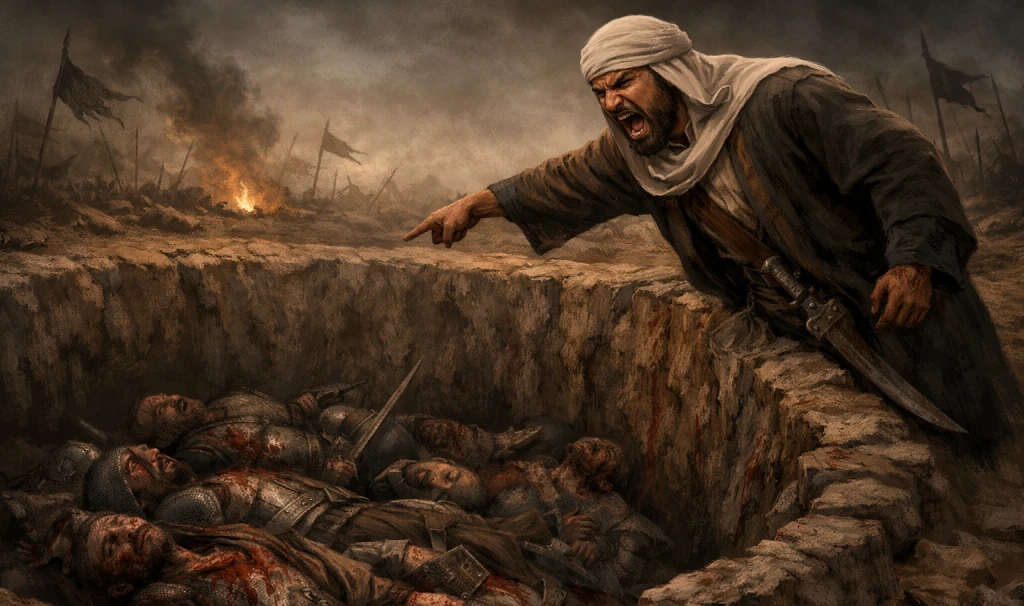
The treatment of the slain Quraysh leaders by Muhammad and his followers after the Battle of Badr brings this moral question into sharp focus. According to the Islamic hadith collections, Muhammad ordered the bodies of twenty-four slain Quraysh leaders to be thrown into a filthy, abandoned well at Badr. Three days after the battle, he went to the well, called the dead men by name, and questioned them about the consequences of opposing Allah and His Messenger. The significance of this episode extends beyond the location where the bodies were deposited. Addressing the dead in this manner also expressed the victor’s religious and military triumph and conveyed a rebuke to the defeated. Later Muslim commentators explicitly described humiliation and degradation as part of the purpose behind throwing the bodies into the well. The degrading character of this treatment is therefore not an allegation invented outside the Islamic tradition; it is supported by the tradition’s own narratives and interpretations.
The episode is also closely connected to Islamic jurisprudence concerning the dead. Classical fiqh established different rules for the bodies of Muslims, non-Muslims living under Muslim rule, non-Muslims protected by treaties, non-Muslims belonging to hostile forces, and apostates. Some of these rulings state that burying a dead enemy combatant is not obligatory; certain texts even permit openly degrading treatment of the remains of particular categories of people. This raises a serious ethical question: does a dead person possess dignity simply by virtue of being human, or is that dignity granted and withdrawn according to religion and political allegiance? In a system that prescribes honorable burial for members of its own religion while permitting the humiliation of religious enemies, human dignity ceases to be universal and becomes subordinate to religious divisions.
The dumping of the slain Quraysh leaders into the well at Badr, Muhammad’s rebuke directed at the dead, later scholars’ interpretations of the episode, and classical legal rulings concerning the bodies of hostile non-Muslims reveal a profound moral conflict between religious enmity and the dignity of the dead. The right to oppose someone’s beliefs or actions while they are alive does not create a right to humiliate their body after death. Whether the deceased had embraced the victor’s religion, or whether their political position was acceptable to the victors, is irrelevant to their entitlement to basic respect. The human dignity of the dead does not depend on their religion. Denying that dignity out of enmity is an act of vengeance, not justice.
International Humanitarian Law and the Laws of War: The Duty to Respect the Dead
Modern international humanitarian law (IHL) establishes obligations to protect human dignity even in war. Among these obligations are recovering the bodies of those killed in conflict, identifying the dead, and handling their remains with dignity. Under the 1949 Geneva Conventions and the subsequent Additional Protocols, parties to a conflict must take all feasible measures, taking the circumstances and military realities into account, to prevent bodies from being plundered, mutilated, or desecrated. Rule 113 of the International Committee of the Red Cross’s compilation of customary international humanitarian law likewise prohibits mutilation and recognizes the duty to take all possible measures to prevent the dead from being despoiled and their remains from being mistreated [1].
These protections do not depend on the dead person’s religion, nationality, or side in the conflict. The duties to recover and identify remains, inform relatives, facilitate the return of bodies, and arrange dignified burial or other appropriate disposal are carried out according to the circumstances. Failure to fulfill every individual duty does not automatically amount to a war crime; mutilation and serious outrages against the dead, however, may constitute war crimes under international criminal law. The principal obligations include the following:
The purpose of these rules is clear: military power does not entitle a warring party to turn the corpse of a dead enemy into an instrument of revenge, spectacle, or humiliation. Serious indignities inflicted on human remains can give rise to accountability under international law. Regardless of which side the deceased belonged to, identifying the dead and handling their remains with dignity are obligations, not favors dispensed at the victor’s discretion.
The following film excerpt, dealing with the treatment of the dead, illustrates the moral problem of revenge.
Early Islamic History: A Critical Examination
A very different picture emerges when the earliest period of Islamic history and Muhammad’s actions are considered against modern human rights and universal moral principles. The accounts of the wars with the Quraysh of Mecca describe profoundly vindictive treatment of fallen enemies rather than respect for their remains. In particular, the treatment of the bodies of the slain unbelievers after the Battle of Badr stands in direct opposition to modern principles governing warfare. Muhammad and his companions threw the bodies of twenty-four Quraysh leaders into a foul, refuse-filled well, an act of extreme contempt. The treatment was justified by reference to their hostility toward the Muslims and their supposed impurity. Such conduct toward the dead was also incorporated into the religious tradition [2] [3].
Sahih al-Bukhari (Islamic Foundation Bengali edition)
51 / Maghazi (Military Campaigns)
Chapter 2170: The Killing of Abu Jahl
Islamic Foundation no. 3689; international no. 3976
3689. Narrated by Abu Talha through Abdullah ibn Muhammad and others: On the day of the Battle of Badr, by the command of Allah’s Prophet (peace and blessings be upon him), the bodies of twenty-four chiefs of the Quraysh were thrown into a foul, filthy well at Badr. When the Messenger of Allah defeated a people, he would remain on the outskirts of their territory for three days. Accordingly, on the third day after the Battle of Badr, he ordered his mount to be prepared and saddled. The Messenger of Allah then walked a short distance, and his companions followed him.
They said: We thought that perhaps he was going somewhere on an errand. Eventually, he stood at the edge of the well and began calling those who had been thrown into it by their own names and their fathers’ names: O so-and-so, son of so-and-so! Do you now realize that obedience to Allah and His Messenger would have been a source of happiness for you? We have found true what our Lord promised us. Have you too found true what your Lord promised you? The narrator said: Upon hearing this, Umar asked, ‘O Messenger of Allah! Why are you addressing bodies without souls?’
The Prophet replied: By the One in Whose hand Muhammad’s life is, you cannot hear what I am saying any better than they can. Qatada said that Allah had temporarily restored life to them so that they could hear the Messenger’s words as a form of rebuke, humiliation, distress, regret, and shame.
Hadith classification: Sahih
Narrator: Abu Talha
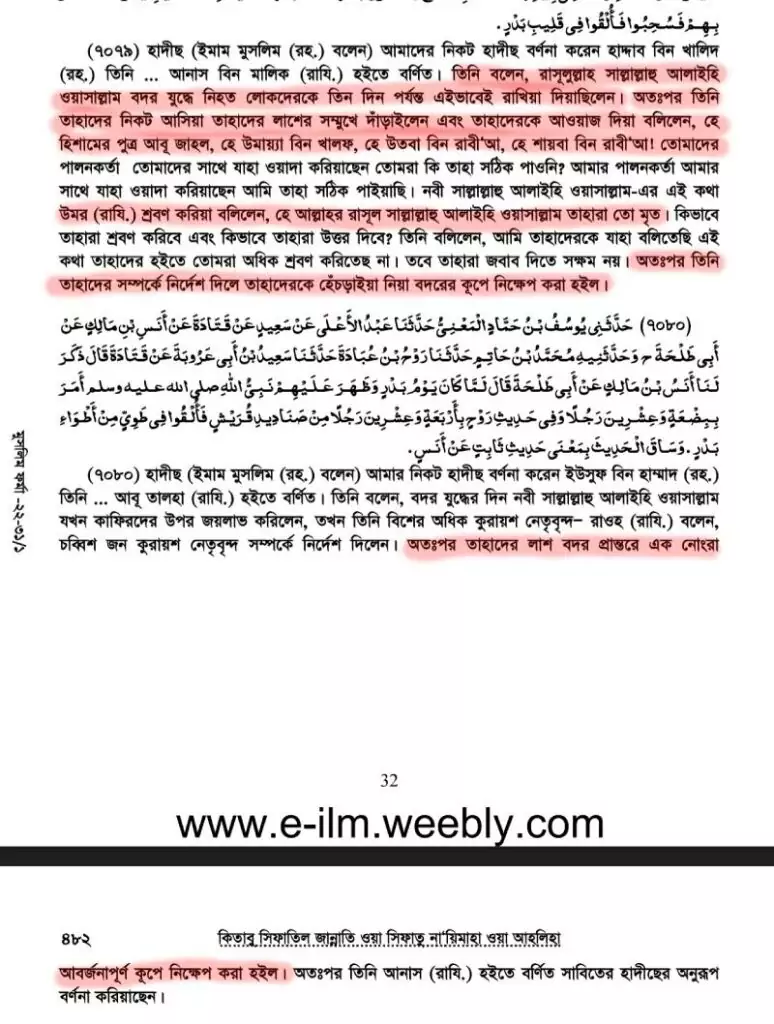
The same incident is recorded in Sirat al-Mustafa [4]. The preceding portion of the account also describes the sadness visible on Abu Hudhayfa’s face when he saw the body of his father. Even the corpse of a beloved father was treated as undeserving of honor because he had died an unbeliever.
92
Sirat al-Mustafa (peace be upon him)
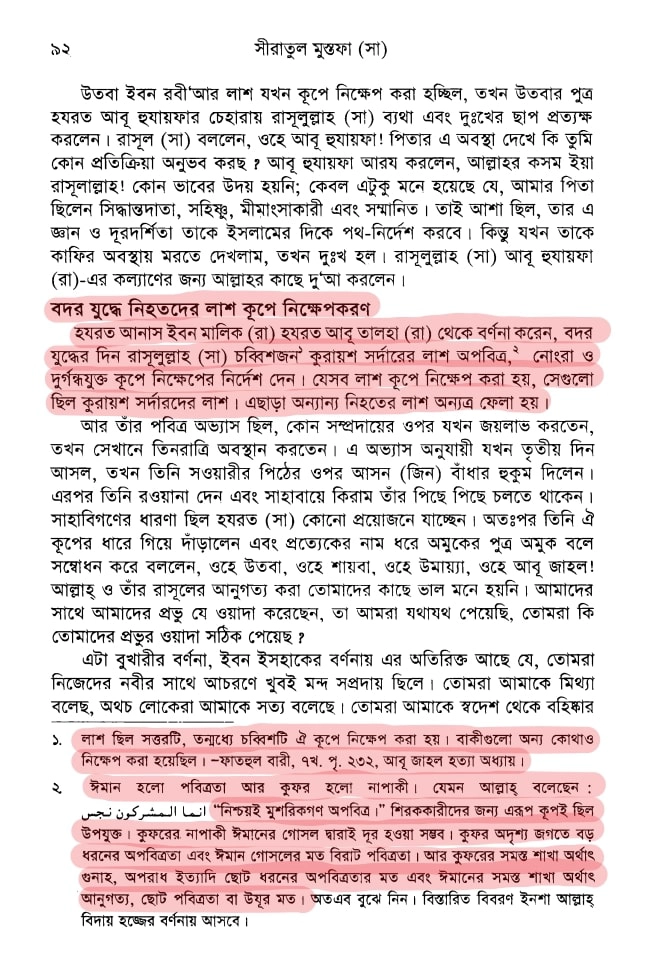
When the body of Utba ibn Rabi’a was being thrown into the well, the Messenger of Allah (peace be upon him) noticed pain and sorrow on the face of Utba’s son, Abu Hudhayfa. The Messenger asked, ‘Abu Hudhayfa, do you feel anything at seeing your father in this condition?’ Abu Hudhayfa replied, ‘By Allah, O Messenger of Allah, no such feeling has arisen in me. I only thought that my father was a man of sound judgment, patience, reconciliation, and honor. I had hoped that his knowledge and foresight would lead him to Islam. But when I saw him die as an unbeliever, I felt sorrow.’ The Messenger of Allah prayed to Allah for Abu Hudhayfa’s well-being.
Throwing the Bodies of Those Killed at Badr into a Well
Anas ibn Malik narrated from Abu Talha that on the day of the Battle of Badr, the Messenger of Allah (peace be upon him) ordered the bodies of twenty-four Quraysh leaders to be thrown into an impure, filthy, foul-smelling well. Those thrown into the well were the bodies of the Quraysh chiefs. The remaining bodies of those killed were cast elsewhere.
His blessed custom was to remain in a place for three nights whenever he had defeated a people. In accordance with this custom, when the third day came, he ordered a saddle to be fastened to his mount. He then set out, and the noble companions followed him. They assumed that he was going on some errand. He finally stood at the edge of the well and called each of the dead by name, saying, ‘O Utba, O Shayba, O Umayya, O Abu Jahl! Did you not think it good to obey Allah and His Messenger? We have found exactly what our Lord promised us. Have you found your Lord’s promise to be true?’
This is Bukhari’s account. The narration of Ibn Ishaq adds: ‘You were a very wicked people in your treatment of your own Prophet. You called me a liar, while others believed me to be truthful. You expelled me from my homeland’.
1. There were seventy bodies in total, of which twenty-four were thrown into this well. The remaining bodies were thrown elsewhere. — Fath al-Bari, vol. 7, p. 232, chapter on the killing of Abu Jahl.
2. Faith is purity and unbelief is impurity. As Allah says: انما المشركون نجس — ‘Indeed, the polytheists are impure.’ A well of this kind was fitting for the polytheists. The impurity of disbelief can only be removed through the washing of faith. Disbelief is a great impurity in the unseen realm, and faith is a great purification resembling a ritual bath. The branches of disbelief, namely sins and transgressions, resemble minor impurities, whereas the branches of faith, namely acts of obedience, resemble minor purification or ablution. Consider this carefully. A detailed account, Allah willing, will appear in the discussion of the Farewell Pilgrimage.
Throwing the Dead into the Well at Badr: The Explanations of al-Nawawi, al-Ayni, and Ibn Hajar
The dumping of the slain Quraysh leaders into a filthy, abandoned well at Badr was not merely recorded in the historical hadith reports. Influential Muslim scholars of later centuries also discussed why the bodies were thrown into the well, the rationale for that treatment, and the legal duty, if any, to bury non-Muslims killed in war. Particularly important are al-Nawawi’s Sharh Sahih Muslim, Badr al-Din al-Ayni’s Umdat al-Qari, and Ibn Hajar al-Asqalani’s Fath al-Bari. Although all three commentaries discuss the same episode, al-Nawawi and al-Ayni explicitly use the term tahqir (تحقير), meaning humiliation or degradation, in explaining the purpose of throwing the bodies into the well. The conclusion that the act involved the humiliation of dead enemies therefore does not rest solely on modern moral criticism; it is acknowledged in classical Islamic hadith commentary itself.
In his commentary on the hadith concerning Badr in Sahih Muslim, al-Nawawi wrote that the Quraysh leaders’ bodies were placed in the well to humiliate them and to prevent their smell from troubling other people. He also made clear that throwing bodies into the well was not burial in the religious sense, because burying a deceased enemy belonging to hostile forces is not obligatory. In the same discussion he presented the position of scholars of his Shafi’i school: if there is no risk that the odor will cause others distress, such an enemy’s body is to be left in the open [5].
قَوْلُهُ: «وَالَّذِي بَعَثَ مُحَمَّدًا بِالْحَقِّ لَقَدْ رَأَيْتُ الَّذِينَ سَمَّى صَرْعَى يَوْمَ بَدْرٍ ثُمَّ سُحِبُوا إِلَى الْقَلِيبِ قَلِيبِ بَدْرٍ» هَذِهِ إِحْدَى دَعَوَاتِهِ الْمُجَابَةِ، وَالْقَلِيبُ هِيَ الْبِئْرُ الَّتِي لَمْ تُطْوَ، وَإِنَّمَا وُضِعُوا فِي الْقَلِيبِ تَحْقِيرًا لَهُمْ، وَلِئَلَّا يَتَأَذَّى النَّاسُ بِرَائِحَتِهِمْ، وَلَيْسَ هُوَ دَفْنًا لِأَنَّ الْحَرْبِيَّ لَا يَجِبُ دَفْنُهُ، قَالَ أَصْحَابُنَا: بَلْ يُتْرَكُ فِي الصَّحْرَاءِ إِلَّا أَنْ يُتَأَذَّى بِهِ.
English translation: Al-Nawawi comments on the statement, ‘By the One Who sent Muhammad with the truth, I saw those whom he named lying slain on the day of Badr, and then they were dragged to the well of Badr.’ He identifies this as one of Muhammad’s answered supplications and explains that a qalib is a well without masonry lining. The bodies were placed there to humiliate them and to spare people the distress caused by their stench. This was not burial, because burying a hostile enemy combatant is not obligatory. Al-Nawawi adds that scholars of his school held that such a body should be left in the open desert unless it would cause harm or distress to others.
Al-Nawawi’s account identifies two purposes side by side: removing the bodies and humiliating the dead enemies. He acknowledges the problem of the odor, but does not omit humiliation from his explanation. More importantly, he does not treat dumping bodies into the well as equivalent to according the dead a proper burial. In his jurisprudential discussion, burial is not an obligatory right of a deceased non-Muslim enemy combatant. Removing the bodies might therefore spare the living the effects of their decay, but al-Nawawi’s account does not portray the act as having been undertaken out of any obligation to honor the deceased.
Badr al-Din al-Ayni examines the same episode in greater detail in Umdat al-Qari Sharh Sahih al-Bukhari. He raises the question of why the corpses had to be thrown into a well when covering them with earth could also have eliminated the stench. His answer is that throwing them into the well was easier under the circumstances and also served to humiliate them further. Al-Ayni’s discussion matters because he does not present the dumping as an unavoidable public-health measure alone. Even while acknowledging burial under earth as a possible alternative, he identifies the additional purpose of degradation in the decision to cast the bodies into the well [6].
وَمِنْهَا مَا قِيلَ: إِنَّ إِلْقَاءَهُمْ فِي الْبِئْرِ دَفْنٌ لَهُمْ، وَالْحَرْبِيُّ لَا يَجِبُ دَفْنُهُ، بَلْ يُتْرَكُ فِي الصَّحْرَاءِ، وَهُمْ كَانُوا حَرْبًا. وَأُجِيبَ بِأَنَّ إِلْقَاءَهُمْ فِي الْبِئْرِ كَانَ تَحْقِيرًا لَهُمْ، وَلِئَلَّا يَتَأَذَّى النَّاسُ بِرَائِحَتِهِمْ، وَلَمْ يَكُنْ ذَلِكَ دَفْنًا. فَإِنْ قُلْتَ: فِي سُنَنِ الدَّارَقُطْنِيِّ أَنَّ مِنْ سُنَّتِهِ فِي مَغَازِيهِ إِذَا مَرَّ بِجِيفَةِ إِنْسَانٍ أَمَرَ بِدَفْنِهِ، وَلَا يَسْأَلُ عَنْهُ مُؤْمِنًا كَانَ أَوْ كَافِرًا، قُلْتُ: إِنَّمَا كَانَ لَا يَسْأَلُ لِأَنَّهُ كَانَ يَعْلَمُ بِالْوَحْيِ بِأَنَّهُ إِنْ كَانَ مُؤْمِنًا كَانَ مُسْتَحِقَّ الدَّفْنِ لِكَرَامَتِهِ، وَإِنْ كَانَ كَافِرًا فَلِئَلَّا يَتَأَذَّى النَّاسُ بِرَائِحَتِهِ، عَلَى أَنَّ الْمُرَادَ بِدَفْنِهِ لَيْسَ دَفْنًا شَرْعِيًّا، بَلْ صَبَّ التُّرَابِ عَلَيْهِ لِلْمُوَارَاةِ. وَمِنْهَا مَا قِيلَ: إِنَّ صَبَّ التُّرَابِ عَلَيْهِمْ كَانَ يَقْطَعُ رَائِحَتَهُمْ، قُلْتُ: كَانَ إِلْقَاؤُهُمْ فِي الْبِئْرِ أَيْسَرَ عَلَيْهِمْ فِي ذَلِكَ الْوَقْتِ مَعَ زِيَادَةِ التَّحْقِيرِ لَهُمْ لِمَا ذَكَرْنَا.
English translation: Al-Ayni first addresses the objection that throwing bodies into a well amounts to burial even though burying a hostile enemy is not obligatory, and such bodies may instead be left in the desert. His response is that the bodies were thrown into the well to humiliate the dead and to prevent their odor from distressing people; it was not religious burial. He then discusses a report in al-Daraqutni’s Sunan according to which, when Muhammad encountered a corpse during a military expedition, he would order it to be covered without asking whether the deceased was a believer or an unbeliever. Al-Ayni explains that, in the case of a believer, this was done to honor the deceased, while in the case of an unbeliever it was to spare people the stench. In his explanation, covering the body with earth did not necessarily constitute burial in the religious sense. A further question is then raised: would throwing earth over the bodies not have stopped the smell without casting them into the well? Al-Ayni replies that throwing them into the well was easier at the time and also involved the additional humiliation of the deceased.
The particularly revealing phrase in al-Ayni’s explanation is ma’a ziyadat al-tahqir (مع زيادة التحقير): ‘along with further humiliation.’ Even if the stench needed to be eliminated, the method chosen was not morally neutral. Casting enemy corpses together into an abandoned well also carried the meaning of degradation. Al-Ayni does more than repeat the incident; he compares possible methods of disposing of the bodies and explicitly recognizes the added humiliation involved in throwing them into the well. Presenting the Badr episode as nothing more than an ordinary mass burial would therefore erase a crucial part of his commentary.
In Fath al-Bari, Ibn Hajar al-Asqalani explains that the bodies were removed so their smell would not trouble other people. He also connects this explanation to the juristic position that burying deceased non-Muslims from hostile forces is not obligatory. In his discussion, he rejects the likelihood that the well contained usable water, treating it as an abandoned well [7].
قَالَ الْعُلَمَاءُ: وَإِنَّمَا أَمَرَ بِإِلْقَائِهِمْ فِيهِ لِئَلَّا يَتَأَذَّى النَّاسُ بِرِيحِهِمْ، وَإِلَّا فَالْحَرْبِيُّ لَا يَجِبُ دَفْنُهُ، وَالظَّاهِرُ أَنَّ الْبِئْرَ لَمْ يَكُنْ فِيهَا مَاءٌ مُعَيَّنٌ. قَوْلُهُ: «قَلِيبِ بَدْرٍ» بِالْجَرِّ عَلَى الْبَدَلِيَّةِ، وَالْقَلِيبُ بِفَتْحِ الْقَافِ وَآخِرُهُ مُوَحَّدَةٌ هُوَ الْبِئْرُ الَّتِي لَمْ تُطْوَ، وَقِيلَ: الْعَادِيَةُ الْقَدِيمَةُ الَّتِي لَا يُعْرَفُ صَاحِبُهَا.
English translation: Ibn Hajar cites the scholars’ explanation that the bodies were ordered to be thrown into the well so that people would not be distressed by their smell. Burial is not obligatory for a deceased hostile enemy. He adds that the well apparently did not contain any particular supply of water. Explaining the term qalib, he says that it refers to a well without masonry lining; another interpretation identifies it as an old well of unknown ownership.
These three classical commentaries reveal two important features of the Badr incident. First, the scholars did not recognize a general obligation to give a deceased hostile non-Muslim enemy a proper burial. Second, both al-Nawawi and al-Ayni connected the throwing of the bodies into the well with an intention to humiliate them. Ibn Hajar emphasized the practical need to eliminate the smell, while al-Nawawi and al-Ayni explicitly included the degradation of the enemy alongside that concern. Thus the dumping of the bodies at Badr was not simply an episode in the disposal of battlefield dead. Later Muslim scholars themselves recognized its humiliating significance.
The Status of Dead Non-Muslims in Islamic Jurisprudence: Burial, Setting Dogs upon Corpses, and Payment for Human Remains
Muslim scholars’ treatment of the bodies of the fallen at Badr was not confined to the history of that particular battle. Later jurisprudence addressed burial, shrouding, preservation of remains, and the handling of deceased enemies as distinct legal questions. Religious and political status figured prominently in these rulings. Obligations toward the dead differed depending on whether the person had been a Muslim, a non-Muslim living under Muslim rule as a dhimmi, a non-Muslim covered by a treaty, a non-Muslim belonging to hostile forces (a harbi), or an apostate (murtadd). Several authoritative works of Shafi’i jurisprudence prescribe treatment of the dead bodies of harbis and apostates that directly conflicts with modern notions of human dignity.
The important Shafi’i legal work Nihayat al-Muhtaj ila Sharh al-Minhaj, by Shams al-Din al-Ramli, discusses the funeral prayer, washing, shrouding, and burial of non-Muslims. It recognizes an obligation to provide shrouds and burial for non-Muslim dhimmis. Similar rules are extended to treaty-protected non-Muslims and those granted safe-conduct, but hostile non-Muslims and apostates are excluded. The text goes further: it permits dogs to be set upon the bodies of these latter two groups on the grounds that their remains possess no legally protected sanctity or inviolability. It explicitly connects this ruling to the order to throw the bodies of those killed at Badr into the well [8].
وَالْأَصَحُّ وُجُوبُ تَكْفِينِ الذِّمِّيِّ وَدَفْنِهِ فِي بَيْتِ الْمَالِ، فَإِنْ لَمْ يَكُنْ فَعَلَيْنَا حَيْثُ لَا مَالَ لَهُ وَلَمْ يَكُنْ ثَمَّ مَنْ تَلْزَمُهُ نَفَقَتُهُ وَفَاءً بِذِمَّتِهِ كَمَا يَجِبُ إِطْعَامُهُ وَكِسْوَتُهُ، وَمِثْلُهُ الْمُعَاهَدُ وَالْمُؤَمَّنُ دُونَ الْحَرْبِيِّ وَالْمُرْتَدِّ، بَلْ يَجُوزُ إِغْرَاءُ الْكِلَابِ عَلَى جِيفَتِهِمَا إِذْ لَا حُرْمَةَ لَهُمَا، وَقَدْ ثَبَتَ الْأَمْرُ بِإِلْقَاءِ قَتْلَى بَدْرٍ فِي الْقَلِيبِ بِهَيْئَتِهِمْ، فَإِنْ دُفِنَا فَلِئَلَّا يَتَأَذَّى النَّاسُ بِرِيحِهِمَا وَهُوَ الْأَوْلَى، وَمُقَابِلُ الْأَصَحِّ لَا، لِأَنَّ الذِّمَّةَ قَدِ انْتَهَتْ بِالْمَوْتِ.
English translation: According to the stronger opinion, the shrouding and burial of a dhimmi are obligatory and their costs are to be borne by the public treasury. If no funds are available there, and the deceased has no assets and no one legally responsible for his maintenance, the obligation falls upon us, in fulfillment of the covenant of protection, just as providing him with food and clothing would have been obligatory during his lifetime. The same applies to a person protected by treaty or granted safe-conduct, but not to a hostile enemy or an apostate. It is even permissible to set dogs upon their corpses, since their bodies have no protected inviolability. The order to throw those slain at Badr into the well in the condition in which they lay is established. If such people are buried, it is to prevent others from being distressed by the stench, and this is preferable. The opinion opposed to the stronger view holds that burial of a dhimmi is not obligatory, since the covenant of protection ends at death.
Al-Ramli’s discussion makes the role of religious status in treatment of the dead unmistakable. Shrouding and burying a dhimmi or protected non-Muslim may be a recognized duty, yet exposing the body of a hostile non-Muslim or an apostate to dogs is deemed permissible. The question of safeguarding minimum dignity after death is not treated here as a universal human right; it depends instead on a particular religious and legal classification. More significantly, the ruling is expressly tied to the throwing of the slain at Badr into the well. The degradation of dead enemies is therefore not merely an isolated historical incident: it has also been given a place in classical legal reasoning.
The same rule appears in al-Shirwani’s marginal commentary accompanying Ibn Hajar al-Haytami’s Tuhfat al-Muhtaj. The commentary excludes the hostile non-Muslim from the obligation to shroud and bury a dhimmi and mentions the permissibility of setting dogs upon a hostile non-Muslim’s remains. It then states that burial is preferable when the smell of the corpse would cause distress to the living. In that explanation, the reason given for burial is not the dead person’s human dignity but the need to protect living people from the stench [9].
حَاشِيَةُ الشَّرْوَانِيِّ: قَوْلُ الْمَتْنِ «وُجُوبُ تَكْفِينِ الذِّمِّيِّ» خَرَجَ بِهِ الْحَرْبِيُّ فَلَا يَجِبُ تَكْفِينُهُ وَلَا دَفْنُهُ، بَلْ يَجُوزُ إِغْرَاءُ الْكِلَابِ عَلَيْهِ إِذْ لَا حُرْمَةَ لَهُ، وَالْأَوْلَى دَفْنُهُ لِئَلَّا يَتَأَذَّى النَّاسُ بِرَائِحَتِهِ، وَالْمُرْتَدُّ كَالْحَرْبِيِّ. مُغْنِي وَنِهَايَة.
English translation: In his marginal commentary, al-Shirwani explains the statement ‘the shrouding of a dhimmi is obligatory’ by noting that the hostile non-Muslim is excluded from that rule. Shrouding or burying such a person is not obligatory. Indeed, it is permissible to set dogs upon his corpse, because his body has no protected inviolability. Burial is nevertheless preferable to spare people the distress of its smell. The same ruling applies to an apostate as to a hostile non-Muslim. The marginal note attributes this discussion to Mughni al-Muhtaj and Nihayat al-Muhtaj.
The way Imam al-Bukhari organized his chapters is also significant. In the Book of Jizya and Peace Treaties in Sahih al-Bukhari, a chapter is headed ‘Throwing the Bodies of the Polytheists into a Well and Not Accepting Payment for Their Bodies.’ The report concerning those killed at Badr appears under this heading. Thus al-Bukhari placed the episode not only within the narrative of the battle but also under a distinct subject concerning how the corpses of non-Muslim enemies were to be treated [10].
In his explanation of this chapter, Badr al-Din al-Ayni observes that those thrown into the well at Badr were prominent Quraysh leaders from Mecca. He also raises the possibility that their relatives would have been prepared to pay substantial sums if allowed to recover and bury the bodies. The collection of such payment, however, was prohibited because corpses were not lawful property to be bought and sold. Al-Ayni is not describing an actual demand for money in exchange for the bodies; he is discussing a hypothetical situation as part of his explanation of the rule against taking payment for human remains [11].
قَوْلُهُ: «وَلَا يُؤْخَذُ لَهُمْ ثَمَنٌ» أَيْ: لَا يَجُوزُ أَخْذُ الْفِدَاءِ فِيهَا مِنَ الْمُشْرِكِينَ، إِذْ كَانَ أَصْحَابُ قَلِيبِ بَدْرٍ رُؤَسَاءَ مُشْرِكِي مَكَّةَ، وَلَوْ مُكِّنَ أَهْلُهُمْ مِنْ إِخْرَاجِهِمْ مِنَ الْبِئْرِ وَدَفْنِهِمْ لَبَذَلُوا فِي ذَلِكَ كَثِيرَ الْمَالِ، وَإِنَّمَا لَا يَجُوزُ أَخْذُ الثَّمَنِ فِيهَا لِأَنَّهَا مَيْتَةٌ لَا يَجُوزُ تَمَلُّكُهَا وَلَا أَخْذُ عِوَضٍ عَنْهَا، وَقَدْ حَرَّمَ الشَّارِعُ ثَمَنَهَا وَثَمَنَ الْأَصْنَامِ فِي حَدِيثِ جَابِرٍ.
English translation: In explaining the words ‘and no payment is to be taken for them,’ al-Ayni writes that taking ransom from the polytheists in exchange for the bodies is not permissible. Those in the well at Badr were leaders of the Meccan polytheists, and their families would have offered large sums if allowed to remove the bodies from the well and bury them. But the bodies of the dead cannot be owned as property or exchanged for compensation. He adds that the Lawgiver prohibited the price of carrion and idols, as reported in the hadith of Jabir.
Ibn Hajar al-Asqalani likewise addresses payment in exchange for a dead enemy’s remains. In Fath al-Bari, he cites a report from Ibn Abbas in which polytheists sought to obtain one of their slain men’s bodies for money, but Muhammad refused to sell it. He also recounts, through Ibn Ishaq, the episode of Nawfal ibn Abdullah, who was killed during the Battle of the Trench. In that account, Muhammad stated that neither the body nor its price was wanted. Ibn Hajar also notes that the chain of transmission of the Ibn Abbas report is not strong. His commentary thus discusses three related but distinct matters: the prohibition on selling corpses, the desire of enemy relatives to recover the remains, and the question of demanding payment for their return [12].
وَذَكَرَ ابْنُ إِسْحَاقَ فِي الْمَغَازِي أَنَّ الْمُشْرِكِينَ سَأَلُوا النَّبِيَّ صَلَّى اللَّهُ عَلَيْهِ وَسَلَّمَ أَنْ يَبِيعَهُمْ جَسَدَ نَوْفَلِ بْنِ عَبْدِ اللَّهِ بْنِ الْمُغِيرَةِ، وَكَانَ اقْتَحَمَ الْخَنْدَقَ؛ فَقَالَ النَّبِيُّ صَلَّى اللَّهُ عَلَيْهِ وَسَلَّمَ: «لَا حَاجَةَ لَنَا بِثَمَنِهِ وَلَا جَسَدِهِ». فَقَالَ ابْنُ هِشَامٍ: بَلَغَنَا عَنِ الزُّهْرِيِّ أَنَّهُمْ بَذَلُوا فِيهِ عَشَرَةَ آلَافٍ، وَأَخَذَهُ مِنْ حَدِيثِ الْبَابِ مِنْ جِهَةِ أَنَّ الْعَادَةَ تَشْهَدُ أَنَّ أَهْلَ قَتْلَى بَدْرٍ لَوْ فَهِمُوا أَنَّهُ يَقْبَلُ مِنْهُمْ فِدَاءَ أَجْسَادِهِمْ لَبَذَلُوا فِيهَا مَا شَاءَ اللَّهُ، فَهَذَا شَاهِدٌ لِحَدِيثِ ابْنِ عَبَّاسٍ، وَإِنْ كَانَ إِسْنَادُهُ غَيْرَ قَوِيٍّ.
English translation: Ibn Ishaq states in al-Maghazi that the polytheists asked the Prophet to sell them the body of Nawfal ibn Abdullah ibn al-Mughira, who had crossed the trench. Muhammad responded, ‘We have no need of its price or its body.’ Ibn Hisham reports that word reached him from al-Zuhri that they had offered ten thousand for it. Ibn Hajar then observes that the families of those killed at Badr could likewise have offered large sums for the return of their relatives’ bodies if they thought payment would be accepted. This possibility lends support to the report of Ibn Abbas, although its chain of transmission is not strong.
The four Sunni schools of jurisprudence also address the burial of deceased non-Muslims in a variety of circumstances. According to the rulings collected in al-Mawsu’a al-Fiqhiyya, where a non-Muslim dies among Muslims and no one of the deceased’s own religion is present to perform the burial, Muslims may make arrangements to place the body in the ground. Shafi’i jurisprudence, however, does not recognize an obligation to bury harbis and apostates, and it also discusses permission for particularly degrading treatment of their remains. The treatment of a corpse thus differs according to the deceased’s religious identity, legal position, and relationship with Muslim political authority [13].
These legal rulings raise a profound moral problem. A person’s religious beliefs do not create any ethical justification for disrespecting their remains after death. Whether a person was an enemy fighter, a political opponent, or an apostate during life, using that identity as a basis for degrading the corpse is incompatible with the principle of universal human dignity. Where a legal tradition goes so far as to permit dogs to be set upon the dead, the issue is no longer simply the formal rules of burial. The very question of whether human remains deserve respect is made dependent on religious classification. The disposal of the slain Quraysh leaders in the well at Badr and the subsequent Shafi’i rulings illustrate two aspects of the same broader problem: religious enmity has been given legal sanction to extend even to the bodies of the dead.
Conclusion: Religious Enmity and the Dignity of the Dead
The order to throw the bodies of twenty-four slain Quraysh leaders into a filthy well after the Battle of Badr, Muhammad’s subsequent rebuke of the dead by name, and the explanations given by classical Muslim scholars present a clear historical picture. Al-Nawawi and al-Ayni explicitly identified humiliation as a purpose of throwing the bodies into the well. They also referred to the need to eliminate the smell, but their explanations acknowledge that this practical purpose was accompanied by an intention to degrade. Al-Ayni, in particular, discussed the alternative of covering the bodies with earth and nevertheless identified added humiliation in casting them into the well. This treatment of the dead cannot be described as a merely neutral method of disposing of bodies after a battle.
Later Shafi’i jurisprudence expressed this inequality of status in even harsher legal terms. Al-Ramli’s Nihayat al-Muhtaj and the marginal commentary on Tuhfat al-Muhtaj recognize duties of shrouding and burial toward dhimmis and protected non-Muslims, yet also discuss permission to set dogs upon the corpses of hostile non-Muslims and apostates. The rationale given for burying the latter often emphasizes protecting the living from the smell rather than honoring the dead. Treatment of human remains was therefore not determined by a uniform principle of basic human dignity after death; religious and legal distinctions took precedence. The ethical implications of these rulings become clear in three questions:
Respect for the body of a person killed in war is not an act of religious generosity. Whether the deceased was Muslim or non-Muslim, an apostate or a believer, friend or enemy of the victors, none of these labels can determine their entitlement to minimum human dignity. The humiliating interpretations of the Badr well incident and the permission to degrade enemy corpses found in later jurisprudence reveal a religious hierarchy at odds with that principle. Religious or political opposition to someone in life does not create a right to dishonor their body in death.
References
- ICRC, Customary International Humanitarian Law, Rule 113: Treatment of the Dead ↩︎
- Sahih al-Bukhari, Islamic Foundation Bengali edition, hadith 3689 ↩︎
- Sahih Muslim (Bengali translation with commentary), Maktabatul Hadith Publishers, vols. 21–22, pp. 481–482 ↩︎
- Sirat al-Mustafa, by Idris Kandhlawi, Islamic Foundation Bangladesh, vol. 2, p. 92 ↩︎
- Imam al-Nawawi, Sharh Sahih Muslim, Book of Jihad and Expeditions, vol. 12 ↩︎
- Badr al-Din al-Ayni, Umdat al-Qari Sharh Sahih al-Bukhari, Book of Ablution ↩︎
- Ibn Hajar al-Asqalani, Fath al-Bari, Book of Ablution ↩︎
- Shams al-Din al-Ramli, Nihayat al-Muhtaj ila Sharh al-Minhaj, Book of Funerals, vol. 2, p. 493 ↩︎
- Tuhfat al-Muhtaj and Hashiyat al-Shirwani, Book of Funerals, vol. 3 ↩︎
- Sahih al-Bukhari, hadith 3185, Book of Jizya, chapter on throwing the corpses of polytheists into a well ↩︎
- Badr al-Din al-Ayni, Umdat al-Qari, Book of Jizya, vol. 15 ↩︎
- Ibn Hajar al-Asqalani, Fath al-Bari, Book of Jizya, vol. 6 ↩︎
- al-Durar al-Saniyya, al-Mawsu’a al-Fiqhiyya: Rulings on Burial of the Dead ↩︎