

Introduction: The Equal Worth of Human Life and Religious Discrimination in the Courts
When a person is deliberately killed, the case should be judged on the nature of the crime, the evidence, the killer’s culpability, and the relevant legal circumstances. The victim’s religion does not make the killing less serious. Yet major rules of classical Islamic jurisprudence make the religious identities of the killer and the victim a condition of eligibility for qisas, or retaliatory punishment. According to the majority of Sunni jurists, qisas does not apply to a Muslim who deliberately kills a protected non-Muslim. It can apply when a non-Muslim kills a Muslim. The basis of this inequality is the difference in religion between the killer and the victim; there is no corresponding difference in the crime. Denying equal legal rights for the same offense directly conflicts with the equal dignity of human beings and the principle of equality before the law.
The discrimination did not stop at qisas. Several schools also set the blood money owed to the family of a non-Muslim victim at a lower rate than for a Muslim victim. Under Shafi’i jurisprudence, blood money for a Jew or a Christian is one-third of the Muslim rate, and for a protected Zoroastrian or idolater it is one-fifteenth. The Hanafi school, by contrast, provides for qisas against a Muslim who kills a dhimmi under permanent protection. Many scholars of the other major schools rejected that rule on the direct authority of sahih hadith. These rules divide the loss of human life, the right to seek retaliation, and the right to compensation into legal categories based on religion. The justice and compensation available to a victim’s family depend on the victim’s religion and the applicable school of law as well as on the killing itself.
Exemption from Qisas for Muslims Who Kill Non-Muslims in Sahih Hadith
Sahih al-Bukhari 6915 states explicitly that the written rules kept by Ali ibn Abi Talib included the following: A Muslim is not subject to qisas for killing a non-Muslim. The same rule appears in Sunan Ibn Majah 2658 and Sunan Abi Dawud 4530–4531. Abu Dawud’s report declares Muslims’ lives equal to one another and prohibits qisas against a Muslim for killing a non-Muslim in the same passage. In Sahih al-Bukhari 3166, Muhammad warns that anyone who kills a non-Muslim under covenant will be denied the fragrance of Paradise in the afterlife. That religious condemnation is distinct from a rule allowing the killer to be subjected to qisas in this world. Most classical jurists applied the prohibition in Bukhari 6915 to killings of protected non-Muslims as well. The deliberate killing was thus recognized as a crime, yet the Muslim killer was exempt from qisas because of the victim’s religion. [1] [2] [3]
Sahih al-Bukhari (Tawhid edition)
Book 87: Blood Money
Chapter 87/31: A Muslim is not to be killed in retaliation for a disbeliever.
6915. Narrated by Abu Juhayfah (may Allah have mercy on him). He said: I asked Ali (may Allah be pleased with him), “Do you have anything that is not in the Quran?” He replied, “The rules of blood money and the release of captives, and the rule that no Muslim is to be killed in retaliation for a disbeliever.” (111) (Adhunik Prokashoni: 6435; Islamic Foundation: 6447)
Hadith grade: Sahih
Sunan Ibn Majah
Publisher: Tawhid Publications
Book 15: Blood Money
Chapter 15/21: A Muslim is not to be killed for killing a disbeliever
1/2658. Narrated by Abu Juhayfah (may Allah be pleased with him). He said: I asked Ali ibn Abi Talib (may Allah be pleased with him), “Do you possess any knowledge unknown to other people?” He answered, “No, by Allah! We have no special knowledge beyond what people already know, except the understanding of the Quran that Allah may grant someone and what this document contains from the Messenger of Allah (peace and blessings be upon him) concerning blood money and related matters.” The document also states that no Muslim is to be killed for killing a disbeliever.
Sahih al-Bukhari 111, 1870, 3047, 3034, 3172, 3180, 6755, 6903, 6915, 7300; Muslim 1370; al-Tirmidhi 1412, 2127; al-Nasa’i 4734, 4735, 4744, 4745, 4746, 4530; Ahmad 600, 616, 484, 962, 994, 1040; al-Darimi 2356; Irwa’ 2209. Al-Albani’s grading: Sahih.
Hadith grade: Sahih
Sunan Abi Dawud (critically assessed edition)
Book 34: Blood Money
Chapter 11: Should a Muslim be killed in retaliation for killing a disbeliever?
4530. Narrated by Qays ibn Abbad (may Allah have mercy on him). He said: Al-Ashtar and I went to Ali (may Allah be pleased with him) and asked, “Did the Messenger of Allah (peace and blessings be upon him) give you any particular instruction that he did not give to people generally?” He answered, “No, apart from what is in this document of mine.” He then took a document from the sheath of his sword. It read: “The lives of all Muslims are of equal value. They stand as one against others.
A pledge of protection granted by even an ordinary Muslim is binding on them all. Take heed: no believer is to be killed for killing a disbeliever. Nor is a non-Muslim under covenant to be killed while his covenant remains in force. Whoever introduces a religious innovation bears responsibility for it. Whoever introduces an innovation or gives shelter to an innovator incurs the curse of Allah, the angels, and all people.” (1)
Sahih.
(1) Al-Nasa’i and Ahmad.
Hadith grade: Sahih
Narrator: Qays ibn Abbad (may Allah have mercy on him)
Sunan Abi Dawud (critically assessed edition)
Book 34: Blood Money
Chapter 11: Should a Muslim be killed in retaliation for killing a disbeliever?
4531. Narrated by Amr ibn Shu’ayb (may Allah have mercy on him), through his father, from his grandfather. He said that the Messenger of Allah (peace and blessings be upon him) spoke to the same effect as in the hadith narrated by Ali (may Allah be pleased with him), with this addition: those far away may also grant protection on their behalf, and the owners of strong and weak mounts, as well as soldiers in the rear and those at the front, receive equal shares of the spoils of war. (1)
Hasan sahih.
(1) This also appeared above, at hadith 2751.
Hadith grade: Hasan
Narrator: Amr ibn Shu’ayb (may Allah have mercy on him)
Qisas for Killing Non-Muslims in the Four Schools: Unequal Justice Based on Religion
In Islamic jurisprudence, proof of deliberate killing is insufficient on its own for qisas, or retaliatory punishment, to apply. Whether the killer and the victim have equivalent religious status has also been treated as an important condition. This condition changes how an otherwise comparable killing is judged when the killer is Muslim and the victim is non-Muslim. In the Shafi’i and Hanbali schools, a Muslim killer is exempt from qisas for killing a non-Muslim. The Maliki school follows the same general rule but makes special provision for ghila, or treacherous killing by deception. The Hanafi school recognizes qisas against a Muslim who intentionally kills a non-Muslim dhimmi. At the center of this disagreement is the question of how far the victim’s religion should determine the killer’s punishment. Most schools make religion a condition of equivalence for qisas. The retaliatory punishment available after a killing therefore depends on whether the victim was Muslim or non-Muslim.
The prominent Maliki jurist and philosopher Ibn Rushd al-Qurtubi records three main positions on a Muslim killing a non-Muslim dhimmi in the Book of Qisas in his Bidayat al-Mujtahid wa-Nihayat al-Muqtasid. He reports that al-Shafi’i, Sufyan al-Thawri, Ahmad ibn Hanbal, Dawud al-Zahiri, and several other scholars rejected qisas against the Muslim killer. Abu Hanifa, his followers, and Ibn Abi Layla recognized qisas for killing a dhimmi. According to Malik and al-Layth ibn Sa’d, a Muslim is not to be put to death for killing a dhimmi except in the particular case of ghila. Ibn Rushd illustrates ghila by describing a person being made to lie down and having their throat cut, especially when the killer intends to seize their property. Under Maliki law, execution for ghila is classified as a hadd punishment. Once the case reaches the ruler, neither the victim’s family nor the ruler may pardon the offender. The rule on ghila therefore does not grant a dhimmi victim’s family the same rights they would have under ordinary qisas. [4] [5]
وَأَمَّا قَتْلُ الْمُؤْمِنِ بِالْكَافِرِ الذِّمِّيِّ، فَاخْتَلَفَ الْعُلَمَاءُ فِي ذَلِكَ عَلَى ثَلَاثَةِ أَقْوَالٍ
English translation: The scholars held three distinct positions on whether a Muslim is subject to qisas for killing a non-Muslim dhimmi.
The founder of the Shafi’i school, Imam Muhammad ibn Idris al-Shafi’i, makes the inequality in this criminal rule even clearer in his al-Umm. In the section entitled “Those Between Whom There Is No Qisas Because of a Difference in Religion,” he writes that a Muslim who kills a non-Muslim is exempt from qisas. The same rule applies if the killer murders several non-Muslims; in his view, qisas is unavailable even if a non-Muslim is killed so that the killer can take their property. In determining eligibility for qisas, al-Shafi’i thus gives precedence to the killer’s Muslim identity over motive, repeated offending, and the harm inflicted on the victim. He provides for blood money, discretionary punishment (ta’zir), and imprisonment for the Muslim killer. When a non-Muslim kills a Muslim, he reaches the opposite conclusion: qisas applies whether the killer is a dhimmi, a harbi, or a non-Muslim under temporary protection. The change in punishment when the parties’ religious identities are reversed in the same offense reveals a structural inequality in the system of justice. [6]
وَسَوَاءٌ أَكْثَرَ الْقَتْلَ فِي الْكُفَّارِ أَوْ لَمْ يُكْثِرْ، وَسَوَاءٌ قَتَلَ كَافِرًا عَلَى مَالٍ يَأْخُذُهُ مِنْهُ أَوْ عَلَى غَيْرِ مَالٍ
English translation: The rule is the same whether or not he kills many non-Muslims, and whether he kills a non-Muslim to take their property or for a reason unrelated to property.
The discrimination is clearest in al-Shafi’i’s opposite rulings. If a Muslim deliberately kills a non-Muslim, the Muslim killer is not subject to qisas. If a non-Muslim kills a Muslim, qisas applies. The offense is the same, but the right to seek retaliation is unequal. The other punishments al-Shafi’i provides for a Muslim killer do not erase the disparity. For purposes of qisas, the life of the non-Muslim victim is given a different legal standing from that of the Muslim victim. The retaliatory punishment available for taking a Muslim’s life does not apply to a Muslim killer who takes a non-Muslim’s life in the same circumstances. This discrimination directly conflicts with the modern principles of equal protection under the law and equal legal remedies regardless of religion.
The prominent Hanbali jurist Ibn Qudama al-Maqdisi discusses religious equivalence as a condition of qisas in his al-Mughni. One consequence of this condition is that if a Muslim wounds a dhimmi and then leaves Islam, and the victim later dies of the wound, qisas does not apply to the original injury: at the moment it was inflicted, the attacker was Muslim and the victim was a dhimmi. If the killer deliberately and wrongfully kills someone they knew to be a dhimmi or an enslaved person, and that person had already converted to Islam or been emancipated, Ibn Qudama holds that qisas is mandatory. He gives a different ruling for someone the killer knew to be a harbi. The victim’s actual religion at the time of the killing thus becomes an important factor in determining whether retaliation applies. In this legal system, a person’s protection is determined by categories of religious equivalence instead of by equal human dignity. [7]
The modern Islamic fatwa service IslamQA adopts the same rule. In fatwa 243345, issued in response to the question “What is the punishment for a Muslim who kills a dhimmi?”, it cites Bukhari’s hadith and states that a Muslim is not to be executed in qisas for killing a non-Muslim in any of these categories: dhimmi, mu’ahad (person under covenant), or musta’man (person under temporary protection). The fatwa also quotes Imam Ahmad as saying that if a Muslim deliberately kills a non-Muslim under covenant, qisas is barred and blood money is increased. Shaykh Khalid al-Mushayqih is quoted in the same fatwa as explicitly stating that the equivalence required for qisas is absent because a dhimmi is not the equal of a Muslim. The classical jurists’ concept of religious equivalence thus remains in force in contemporary fatwas. [8]
الْمُسْلِمُ لَا يُقْتَلُ بِالذِّمِّيِّ، لِتَخَلُّفِ شَرْطِ الْمُكَافَأَةِ، وَهُوَ شَرْطٌ مِنْ شُرُوطِ وُجُوبِ الْقِصَاصِ فَالذِّمِّيُّ لَيْسَ مُكَافِئًا لِلْمُسْلِمِ
English translation: A Muslim is not to be killed for killing a non-Muslim dhimmi. This is because the condition of equivalence required for qisas has not been met. A dhimmi is not the equal of a Muslim.
Under these rules of Shafi’i, Hanbali, and Maliki jurisprudence, the victim’s religious identity is assessed before the value of their life is adjudicated. By denying equivalence between the Muslim killer and the non-Muslim victim, the rules restrict the right to seek retaliatory punishment. Although the Hanafi school reaches the opposite conclusion for the killing of a dhimmi, the discriminatory framework remains in place in most schools. The problem is not a lack of evidence of the killing. It is that even after the killing has been proven, the victim’s religion bars the same retaliatory punishment. The result is a hierarchy based on religion in the state’s system of justice in place of equal legal standing for Muslim and non-Muslim citizens.
Qisas and Blood Money in Sunni and Shia Jurisprudence: A Comparison
Alongside the four main Sunni schools, Zahiri and Twelver Imami Shia jurisprudence have distinct rules for qisas and blood money when a Muslim kills a protected non-Muslim. The table compares each tradition’s ruling on qisas, its special conditions and exceptions, and the blood money due for the non-Muslim victim.
| School or legal tradition | Qisas when a Muslim kills a non-Muslim dhimmi | Special conditions and exceptions | Blood money for a non-Muslim | Primary legal sources |
|---|---|---|---|---|
| Hanafi Abu Hanifa | Yes — A Muslim is subject to qisas for deliberately killing a dhimmi. | Applies to a dhimmi under permanent protection; a different rule applies to a non-Muslim under temporary protection. | Blood money for Jews, Christians, and Zoroastrians is equal to the Muslim rate. | Al-Mawardi, al-Hawi al-Kabir Al-Qarafi, al-Dhakhira |
| Maliki Malik ibn Anas | Generally no — The Muslim killer is not subject to qisas. | In the special case of ghila, or treacherous killing by deception, the Muslim killer is put to death. Once the case reaches the ruler, neither the victim’s family nor the ruler may pardon the offender. | Jews and Christians: half the Muslim rate. Zoroastrians: 800 dirhams. | Imam Malik, al-Muwatta’ Al-Qarafi, al-Dhakhira |
| Shafi’i Muhammad ibn Idris al-Shafi’i | No — A Muslim is not subject to qisas for killing a dhimmi. | The rule on religious equivalence stands even if the killer repeatedly kills non-Muslims or kills to seize property. | Jews and Christians: one-third of the Muslim rate. Zoroastrians and protected idolaters: one-fifteenth. | Imam al-Shafi’i, al-Umm: Qisas Imam al-Shafi’i, al-Umm: Blood Money Al-Mawardi, al-Hawi al-Kabir |
| Hanbali Ahmad ibn Hanbal | No — A Muslim is not subject to qisas for killing a dhimmi. | Blood money is increased for deliberate killing, but this does not amount to qisas. | Jews and Christians: in the view recorded by al-Mawardi, the full Muslim rate for deliberate killing and half for accidental killing. Zoroastrians: 800 dirhams. | Al-Mawardi, al-Hawi al-Kabir Ibn Hubayra, al-Ifsah |
| Zahiri Ibn Hazm | No — There is no qisas for killing a dhimmi or a non-Muslim under temporary protection. | Deliberate killing is punishable by disciplinary measures and imprisonment until the offender repents. | No mandatory blood money. Ibn Hazm also rejects any obligation to perform expiation for such a killing. | Ibn Hazm, al-Muhalla, Ruling 2025 |
| Ja’fari Shia (Imami) Prevailing classical rule; Ayatollah al-Khoei | Generally no. Under ordinary circumstances, a Muslim who kills a dhimmi is not subject to qisas. | If a Muslim has made a habit of killing dhimmis, the victim’s family may seek qisas upon paying the difference in blood money. | Under the prevailing classical rule, blood money for a Jewish, Christian, or Zoroastrian man is 800 dirhams, or 8 percent of the Muslim rate of 10,000 dirhams. | Ayatollah al-Khoei, Takmilat Minhaj al-Salihin Ayatollah Ja’far Subhani, Diyat al-Dhimmi wa-l-Musta’man |
Ja’fari Shia jurists also disagree on the rules for killing non-Muslims. Ayatollah Ja’far Subhani identifies three positions in his discussion Diyat al-Dhimmi wa-l-Musta’man. Ibn Idris al-Hilli rejected qisas even if a Muslim repeatedly kills dhimmis. Shaykh al-Saduq’s al-Muqni’ provides for qisas upon payment of the difference in blood money, without requiring that the killings be repeated. Shaykh al-Tusi’s al-Nihaya and Ayatollah al-Khoei’s Takmilat Minhaj al-Salihin impose a condition of repeated killing. Thus, even the prevailing position in Ja’fari jurisprudence does not treat the lives of a Muslim and a dhimmi as directly equivalent for qisas. It allows qisas against a Muslim killer only when special conditions are met. [9] [10]
The comparison makes the legal inequality in homicide cases plain. The Hanafi school recognizes qisas against a Muslim for killing a dhimmi under permanent protection; the general rule in the other three major Sunni schools rejects it. The Zahiri jurist Ibn Hazm also rejects any obligation to pay blood money. The prevailing Ja’fari rule imposes a further condition of repeated killing and requires the non-Muslim victim’s family to pay the difference in blood money. These differences in punishment and compensation for the same killing show that religion directly determined a person’s legal standing in major traditions of classical Islamic criminal law.
The Hanafi Exception and Its Critics’ Reliance on Sahih Hadith
The Hanafi school differs from the other three major Sunni schools on whether a Muslim is subject to qisas for killing a non-Muslim. According to Abu Hanifa and his followers, qisas applies to a Muslim who deliberately kills a non-Muslim dhimmi under permanent protection in Muslim territory. Their decision rests on the Quran’s general provisions on qisas and the principle that the life and property of a dhimmi enjoy permanent legal protection. Verse 45 of Surah al-Ma’idah states “a life for a life,” while verse 178 of Surah al-Baqarah prescribes qisas for killing. Hanafi jurists interpret these general rules as applying to non-Muslim dhimmis as well. They reason that if the prescribed punishment can be imposed on a Muslim for stealing a dhimmi’s property, qisas can also be imposed for taking a dhimmi’s life. Many scholars of the other schools appealed directly to Muhammad’s hadith against this position. They argue that Muhammad’s specific injunction limits the general Quranic provision where a Muslim and a non-Muslim are concerned: لَا يُقْتَلُ مُسْلِمٌ بِكَافِرٍ, meaning “No Muslim is to be killed for killing a non-Muslim.” [11] [12]
One of the most significant criticisms of the Hanafi position comes from Imam Abu al-Faraj Ibn al-Jawzi. In the Book of Offenses in his al-Tahqiq fi Ahadith al-Khilaf, he discusses the issue under the explicit heading “A Muslim Is Not to Be Killed for Killing a Non-Muslim.” He begins by noting Abu Hanifa’s contrary ruling and presents three hadith against it. The first is Bukhari’s report transmitted through Ali, the second is transmitted through Amr ibn Shu’ayb, and the third is a rule about shedding Muslim blood transmitted through Aisha. Ibn al-Jawzi recognizes the Hanafi view as an established position of a school of law before presenting the hadith evidence against it. The criticism of the Hanafi rule thus arose within classical Sunni jurisprudence itself, where scholars opposed it on the authority of sahih hadith; it is no modern anti-religious polemic. [13]
مَسْأَلَةٌ: لَا يُقْتَلُ الْمُسْلِمُ بِالْكَافِرِ، وَقَالَ أَبُو حَنِيفَةَ: يُقْتَلُ بِالذِّمِّيِّ. لَنَا ثَلَاثَةُ أَحَادِيثَ:
English translation: Ruling: A Muslim is not to be killed for killing a non-Muslim. Abu Hanifa said that a Muslim is subject to qisas for killing a dhimmi. We have three hadith in support of our position.
Another report used in support of the Hanafi position says that Muhammad put a Muslim to death for killing a dhimmi and declared, “I have the strongest claim to uphold the covenant.” The report was transmitted through Ibn al-Baylamani. Hafiz Ibn Rajab al-Hanbali criticizes the report as mursal and weak in his Jami’ al-‘Ulum wa-l-Hikam. He also notes that hadith specialists including Ahmad ibn Hanbal, Abu Ubayd al-Qasim ibn Sallam, Ibrahim al-Harbi, al-Juzajani, Ibn al-Mundhir, and al-Daraqutni judged it weak. Their objections concerned the report’s transmission and reliability. By contrast, Sahih al-Bukhari directly records the statement exempting a Muslim from qisas. Many hadith specialists therefore objected to treating the report cited in support of the Hanafi view as an established instruction from Muhammad. [14]
وَهَذَا مُرْسَلٌ ضَعِيفٌ قَدْ ضَعَّفَهُ الْإِمَامُ أَحْمَدُ، وَأَبُو عُبَيْدٍ، وَإِبْرَاهِيمُ الْحَرْبِيُّ، وَالْجَوْزَجَانِيُّ، وَابْنُ الْمُنْذِرِ، وَالدَّارَقُطْنِيُّ
English translation: This is a weak mursal report. Imam Ahmad, Abu Ubayd, Ibrahim al-Harbi, al-Juzajani, Ibn al-Mundhir, and al-Daraqutni judged it weak.
Imam Abu Abd Allah al-Qurtubi, in his Quran commentary al-Jami’ li-Ahkam al-Qur’an, examines the evidence cited by the Hanafi and Kufan jurists in his discussion of al-Baqarah 2:178. He first records their position: because the life and property of a non-Muslim dhimmi are permanently protected, a Muslim who kills a dhimmi should be subject to qisas. Al-Qurtubi then takes Bukhari’s hadith as his principal evidence against that view. He explicitly rejects as unreliable the reports transmitted through Rabi’a and Ibn al-Baylamani in which qisas was imposed on a Muslim. He also quotes al-Daraqutni’s criticism of weaknesses in the transmission of Ibn al-Baylamani’s report. Al-Qurtubi concludes that Bukhari’s is the sound hadith on this question and that it restricts the application of the Quran’s general rule on qisas. He thus gives the specific prohibition in a sahih hadith precedence over the Quran’s general rule of “a life for a life” to establish unequal qisas on the basis of religion. [15]
قُلْتُ: فَلَا يَصِحُّ فِي الْبَابِ إِلَّا حَدِيثُ الْبُخَارِيِّ، وَهُوَ يُخَصِّصُ عُمُومَ قَوْلِهِ تَعَالَى: كُتِبَ عَلَيْكُمُ الْقِصَاصُ فِي الْقَتْلَى
English translation: I say: No hadith on this matter is sound except Bukhari’s. It restricts the application of the general Quranic command, “Qisas is prescribed for you in cases of killing.”
Another important example of this criticism based on hadith comes from Imam al-Shafi’i himself. In al-Umm, he rejects the report of Ibn al-Baylamani used to support the Hanafi position. He states that the chain of transmission of the hadith he presents is continuous, whereas Ibn al-Baylamani’s report has a broken chain and is erroneous. He also discusses the wording and transmission of the hadith and their chronological relationship to the prohibition announced at the conquest of Mecca. At the heart of the dispute is the Hanafi jurists’ use of the Quran’s general rules and other reports to recognize qisas for the killing of a dhimmi despite an explicit prohibition preserved in Muhammad’s name. Al-Shafi’i, al-Qurtubi, Ibn Rajab, and Ibn al-Jawzi all directly criticize that reasoning on the basis of hadith. They reach the same religious and legal result: a Muslim is exempt from qisas for killing a non-Muslim. [16] [17]
The dispute over the Hanafi rule for killing a dhimmi exposes a deep problem in Islamic criminal law. Although the Quran lays down a general rule on qisas for killing, a sahih hadith preserves a specific exemption based on religion. Many influential jurists applied that hadith to deny qisas against a Muslim who kills a non-Muslim. The Hanafi school recognizes qisas for the killing of a dhimmi, but that ruling drew forceful criticism from other scholars on the authority of hadith. This is a fundamental dispute within classical jurisprudence over religious identity, the legal precedence of the Quran and hadith, and the equal worth of human lives. Its significance extends beyond the rule of any one school. The key fact is that many scholars took the plain wording of a sahih hadith as the basis for exempting a Muslim killer from qisas for killing a non-Muslim. Making retaliatory justice depend on the victim’s religion denies the principle of equal standing before the law.
Blood Money by Religion in Islamic Jurisprudence: The Unequal Value of Muslim, Jewish, Christian, and Zoroastrian Lives
Religious discrimination in Islamic criminal law extends beyond qisas for killing. The blood money, or diya, set for the victim’s family also varies with the victim’s religion. Classical jurisprudence sets different rates for Muslims, Jews, Christians, and Zoroastrians. The difference between what a Muslim victim’s family and a non-Muslim victim’s family may receive for the same kind of killing directly reflects the legal hierarchy of Sharia. Requiring religious equivalence for qisas and setting different rates of blood money by religion are two manifestations of the same discriminatory legal system. Compensation for the loss of life is set by the victim’s religious category rather than by the equal worth of human lives.
The prominent Shafi’i jurist and legal theorist Abu al-Hasan al-Mawardi records the four schools’ rules on blood money for Jews and Christians in detail in the Book of Blood Money of his al-Hawi al-Kabir. He first quotes Imam al-Shafi’i, who sets blood money for a Jew or Christian at one-third of the Muslim rate. Al-Mawardi then reports that Abu Hanifa sets the rate for Jews and Christians equal to the Muslim rate; Imam Malik sets it at half; Imam Ahmad ibn Hanbal sets it at the full Muslim rate for deliberate killing and half for accidental killing; and Imam al-Shafi’i sets it at one-third for both deliberate and accidental killing. The compensation due to the family of a victim of the same religion also depends on which school’s law is applied. Setting the rate for a Jew or Christian at one-third while allowing full blood money for a Muslim is direct financial discrimination on the basis of religion. [18]
مسألة : قال الشافعي رضي الله عنه : ودية النصراني واليهودي ثلث الدية واحتج في ذلك بعمر وعثمان رضي الله عنهما .
قال الماوردي : اختلف الفقهاء في دية اليهودي والنصراني من أهل الذمة والمعاهدين على أربعة مذاهب :
أحدها : وهو مذهب أبي حنيفة : أنها كدية المسلم سواء .
وبه قال من الصحابة ابن مسعود .
ومن التابعين الزهري .
ومن الفقهاء الثوري وأبو يوسف ومحمد .
والثاني : وهو مذهب مالك أنها نصف دية المسلم ، وبه قال عمر بن عبد العزيز وعروة بن الزبير .
والثالث : وهو مذهب أحمد بن حنبل : إن قتل عمدا فمثل دية المسلم كقول أبي حنيفة ، وإن قتل خطأ فنصف دية المسلم كقول مالك .
والرابع : وهو مذهب الشافعي : أن ديته ثلث دية المسلم في العمد والخطأ .
English translation: Imam al-Shafi’i said that blood money for a Christian or a Jew is one-third of the Muslim rate. He cited the decisions of Umar and Uthman in support of this. Al-Mawardi says that jurists hold four views on blood money for Jews and Christians who are dhimmis or under covenant. The first is Abu Hanifa’s view: their blood money is equal to that of a Muslim. Ibn Mas’ud among the Companions, al-Zuhri among the Successors, and Sufyan al-Thawri, Abu Yusuf, and Muhammad among the jurists held this view. The second is Imam Malik’s view: their blood money is half the Muslim rate. Umar ibn Abd al-Aziz and Urwa ibn al-Zubayr also held this view. The third is Ahmad ibn Hanbal’s view: the full Muslim rate in deliberate killing and half the Muslim rate in accidental killing. The fourth is Imam al-Shafi’i’s view: their blood money is one-third of the Muslim rate in both deliberate and accidental killing.
Al-Mawardi’s account puts a figure on the disparity in blood money. If full blood money for a Muslim is taken as 100 percent, the Shafi’i school sets the amount for a Jew or Christian at about 33.33 percent, and the Maliki school sets it at 50 percent. Hanbali jurisprudence provides for 50 percent in accidental killing and for full blood money in certain cases of deliberate killing. Although the Hanafi school sets blood money for Jews and Christians at the Muslim rate, the other schools use religion to set the amount of compensation. The families of a Muslim and a non-Muslim killed in the same offense receive different sums. A human life has been lost in either case, but the jurists’ rules on blood money do not compensate the two deaths equally.
This inequality in Islamic jurisprudence did not stop with Jews and Christians. The Shafi’i school sets an even lower rate for Zoroastrians, or Magians. Imam al-Shafi’i, in al-Umm, sets blood money for a Zoroastrian at 800 dirhams, or one-fifteenth of the Muslim rate of 12,000 dirhams. In the same discussion he states that the same rate applies if a protected idolater is killed. After setting the rate for Jews and Christians at one-third of the Muslim rate, he sets it at one-fifteenth for Zoroastrians and idolaters. The resulting discrimination in compensation operates among different groups of non-Muslims as well as between Muslims and non-Muslims. This is a direct example of Islamic law dividing compensation for loss of life into tiers based on religious status. [19]
[قال الشافعي]: وأمر الله تعالى في المعاهد يقتل خطأ بدية مسلمة إلى أهله ودلت سنة رسول الله ﷺ على أن لا يقتل مؤمن بكافر مع ما فرق الله عز وجل بين المؤمنين والكافرين فلم يجز أن يحكم على قاتل الكافر إلا بدية ولا أن ينقص منها إلا بخبر لازم فقضى عمر بن الخطاب وعثمان بن عفان رضي الله عنهما في دية اليهودي والنصراني بثلث دية المسلم وقضى عمر في دية المجوسي بثمانمائة درهم وذلك ثلثا عشر دية المسلم؛ لأنه كان يقول تقوم الدية اثني عشر ألف درهم ولم نعلم أحدا قال في دياتهم أقل من هذا وقد قيل: إن دياتهم أكثر من هذا فألزمنا قاتل كل واحد من هؤلاء الأقل مما اجتمع عليه فمن قتل يهوديا أو نصرانيا خطأ، وللمقتول ذمة بأمان إلى مدة أو ذمة بإعطاء جزية أو أمان ساعة فقتله في وقت أمانه من المسلمين فعليه ثلث دية المسلم وذلك ثلاث وثلاثون من الإبل وثلث، ومن قتل مجوسيا أو وثنيا له أمان فعليه ثلثا عشر دية مسلم وذلك ست فرائض وثلثا فريضة مسلم
English translation: Imam al-Shafi’i says: Allah has prescribed that when a non-Muslim under covenant is accidentally killed, blood money must be paid to the victim’s family. Given the distinction Allah has made between believers and non-Muslims, and given that Muhammad’s Sunnah establishes that a believer is not to be killed in retaliation for a non-Muslim, only blood money may be imposed on the killer of a non-Muslim, and its amount may not be reduced without binding evidence. Umar ibn al-Khattab and Uthman ibn Affan set blood money for Jews and Christians at one-third of the Muslim rate. Umar set blood money for Zoroastrians at 800 dirhams, one-fifteenth of the Muslim rate, because he valued full blood money at 12,000 dirhams. We do not know of any lower rate set for their blood money, although higher rates have been proposed. We therefore made the lowest recognized rate obligatory for killing a person in any of these categories. If a Muslim accidentally kills a Jew or Christian under a pledge of protection or a jizya agreement, the blood money is one-third of the Muslim rate, or 33⅓ camels. If a protected Zoroastrian or idolater is killed, the blood money is one-fifteenth of the Muslim rate, or 6⅔ camels.
Al-Mawardi discusses the blood-money rule for Zoroastrians in more detail in al-Hawi al-Kabir. He reports that Abu Hanifa sets the Zoroastrian rate equal to the Muslim rate; Umar ibn Abd al-Aziz sets it at half; and al-Shafi’i sets it at 800 dirhams, or one-fifteenth of full blood money. In support of the Shafi’i rule, al-Mawardi argues that Zoroastrians have lower religious standing than Jews and Christians, citing the different rules on marrying their women and eating meat from animals they slaughter. He uses this difference in religious standing to justify the lower rate of blood money. A person’s religion, marriage rules, and dietary prohibitions thus become grounds for reducing compensation to the family after that person is killed. [20]
مسألة : قال الشافعي رضي الله عنه : ودية المجوسي ثمانمائة درهم واحتج في ذلك بعمر بن الخطاب رضي الله عنه .
قال الماوردي : واحتج في ذلك بعمر بن الخطاب – رضي الله عنه – اختلف في دية المجوسي فجعلها أبو حنيفة كدية المسلم ، وجعلها عمر بن عبد العزيز نصف دية المسلم كاليهودي والنصراني عنده ، وهي عند الشافعي ثمانمائة درهم ، ثلثا عشر دية المسلم ، وتكون من الإبل ستة أبعرة وثلثين ، ومن الدنانير ستة وستون دينارا وثلثان
English translation: Imam al-Shafi’i said that blood money for a Zoroastrian is 800 dirhams. He cited Umar ibn al-Khattab’s decision in support of this. Al-Mawardi says that there is disagreement about blood money for a Zoroastrian. Abu Hanifa set it equal to the Muslim rate. Umar ibn Abd al-Aziz set it at half the Muslim rate, as he did for Jews and Christians. According to al-Shafi’i, blood money for a Zoroastrian is 800 dirhams, or one-fifteenth of the Muslim rate. In camels this amounts to 6⅔ camels, and in gold coins it amounts to 66⅔ dinars.
This discrimination in blood money is not confined to classical books of jurisprudence. In fatwa 243345, the modern Islamic fatwa service IslamQA states that a Muslim who accidentally kills a non-Muslim dhimmi must pay half the Muslim rate. For deliberate killing it cites reports about Uthman and Umar in support of a higher rate. It relates that when a case of a Muslim killing a dhimmi was brought before Uthman, he did not subject the killer to qisas but imposed blood money equal to the Muslim rate. The same fatwa also records Imam Ahmad’s statement: when a non-Muslim under covenant is killed deliberately, qisas is barred and the blood money is doubled; for accidental killing, half the Muslim rate applies. Thus, even when blood money for a deliberate killing reaches the full Muslim rate, the rule barring qisas against a Muslim killer remains in force. [21]
أما العقوبة على قاتل الذمي ، فإذا كان القتل خطأ فإنه يدفع ديته ، وهي نصف دية المسلم ، وإذا كان القتل عمدا عدوانا ، فقد جاءت الآثار عن عثمان وعمر رضي الله عنهما بتغليظ الدية على قاتل الذمي عمدا ، فجاء عن ابن عمر رضي الله عنه : ” أن رجلاً مسلماً قتل رجلاً من أهل الذمة عمداً ، ورفع إلى عثمان رضي الله عنه فلم يقتله ، وغلظ عليه الدية ، مثل دية المسلم “
English translation: As for the punishment of someone who kills a dhimmi, if the killing was accidental, he pays the dhimmi’s blood money, which is half that of a Muslim. For wrongful and deliberate killing, reports from Uthman and Umar prescribe increased blood money. Ibn Umar reported that a Muslim had deliberately killed a dhimmi. When the case was brought before Uthman, he did not subject the killer to qisas. He increased the blood money to the amount payable for a Muslim.
Under these rules of Shafi’i, Maliki, and Hanbali jurisprudence, blood money varies with the victim’s religion and the nature of the killing. In the Shafi’i school, compensation for taking the life of a protected Jew or Christian is one-third of the Muslim rate, while for a protected Zoroastrian or idolater it is one-fifteenth. This creates several legal tiers among non-Muslims themselves. The difference in compensation for the deaths of a Jew, a Christian, and a Zoroastrian is determined by the victim’s religion rather than by the brutality of the crime. A legal system that sets compensation for the same loss of life at the full rate, half, one-third, or one-fifteenth according to religion does not uphold the principle of equal legal standing. Alongside the unequal rules on qisas, these tiers of blood money are direct evidence that Islamic jurisprudence assigns unequal compensation for human lives on the basis of religion.
Ibn Hazm’s Al-Muhalla: No Qisas, Blood Money, or Expiation for Killing a Dhimmi
An even harsher position on unequal justice for the killing of non-Muslims appears in Ibn Hazm al-Andalusi’s al-Muhalla bi-l-Athar. This prominent Zahiri jurist holds that if an adult Muslim of sound mind kills a dhimmi or a non-Muslim under temporary protection, whether deliberately or accidentally, qisas does not apply. Ibn Hazm also denies that the Muslim killer owes blood money or must perform expiation. For deliberate killing he prescribes disciplinary punishment and imprisonment until the killer repents. Under his ruling, a Muslim who takes the life of a protected non-Muslim is subject to no mandatory retaliatory death sentence, financial compensation, or religious expiation. By denying the victim’s family even the right to compensation on the basis of religion, this rule creates a disparity that goes beyond inequality in qisas. [22]
2025 – مسألة : وإن قتل مسلم عاقل بالغ : ذميا ، أو مستأمنا – عمدا ، أو خطأ – فلا قود عليه ، ولا دية ، ولا كفارة – ولكن يؤدب في العمد خاصة ، ويسجن حتى يتوب كفا لضرره .
برهان ذلك – : قول الله تعالى : { ومن قتل مؤمنا خطأ فتحرير رقبة مؤمنة ودية مسلمة إلى أهله إلا أن يصدقوا } إلى قوله تعالى : { وكان الله عليما حكيما } .
فهذا كله في المؤمن بيقين – والضمير الذي في { كان من قوم بينكم وبينهم ميثاق فدية مسلمة إلى أهله وتحرير رقبة مؤمنة فمن لم يجد فصيام شهرين متتابعين توبة من الله } راجع ضرورة – لا يمكن غير هذا – إلى المؤمن المذكور أولا ، ولا ذكر في هذه الآية لذمي أصلا ، ولا لمستأمن – فصح يقينا أن إيجاب الدية على المسلم في ذلك لا يجوز ألبتة ، وكذلك إيجاب القود عليه ولا فرق .
English translation: Ruling 2025: If an adult Muslim of sound mind kills a dhimmi or a non-Muslim under protection, deliberately or accidentally, he is not subject to qisas and owes neither blood money nor expiation. In a deliberate killing, however, he is to be punished and imprisoned until he repents, to prevent further harm. The evidence is Allah’s statement from “Whoever accidentally kills a believer must free a believing slave and pay blood money to the victim’s family, unless they waive it” through to the end of the same verse, “And Allah is All-Knowing, All-Wise.” All of this certainly concerns a believer. As for “If he belongs to a people with whom you have a covenant, then blood money must be paid to his family and a believing slave must be freed. Whoever is unable to do so must fast for two consecutive months as repentance to Allah,” the pronoun at the beginning also refers to the believer mentioned earlier. This verse makes no mention of a dhimmi or of a non-Muslim under temporary protection. It is therefore impermissible to impose blood money on the Muslim killer in this case, just as it is impermissible to subject him to qisas.
Ibn Hazm’s ruling rests on a particular interpretation of verse 92 of Surah al-Nisa’. The verse sets out rules for blood money and expiation in cases of accidental killing. Ibn Hazm argues that the victim in the verse is a believer and that the rule therefore does not apply to a non-Muslim victim. He also takes the reference to a people under covenant to mean that a slain believer had been living among them. The consequence is grave. If a Muslim accidentally kills another Muslim, the victim’s family is entitled to blood money. Under Ibn Hazm’s ruling, however, if a Muslim accidentally kills a protected non-Muslim, no mandatory blood money is owed to that family. Change the victim’s religion, and the family’s right to financial redress disappears. The non-Muslim’s life is given unequal standing in qisas, and the family is also denied the right to compensation for the death.
In the same discussion Ibn Hazm records the views of Abu Hanifa, Malik, and al-Shafi’i. According to Abu Hanifa, a Muslim who deliberately kills a dhimmi is subject to qisas; accidental killing entails blood money and expiation. According to Malik, the killer is put to death in cases of ghila or hiraba; in other cases, blood money is owed. According to al-Shafi’i, a Muslim is exempt from qisas for killing a dhimmi but is subject to the rules on blood money and expiation. After describing these positions, Ibn Hazm rejects mandatory blood money as well as qisas in his own ruling. This reveals a significant difference within classical jurisprudence: for the very kind of killing for which some schools prescribe blood money, Ibn Hazm denies any obligation to compensate. For him, punishment is limited to disciplining and imprisoning the person who kills deliberately. [23]
وقد اختلف الناس في هذا – : فقالت طائفة – منهم : أبو حنيفة : يقاد المسلم بالذمي في العمد ، وعليه في قتله خطأ الدية والكفارة ، ولا يقتل بالمعاهد – وإن تعمد قتله ولا نعلم له في قوله هذا سلفا أصلا .
وقالت طائفة – منها مالك : لا يقاد المسلم بالذمي إلا أن يقتله غيلة ، أو حرابة ، فيقاد به ولا بد – وعليه في قتله خطأ أو عمدا – غير غيلة – الدية فقط ، والكفارة في الخطأ .
وقالت طائفة – منها الشافعي : لا يقاد المسلم بالذمي أصلا ، لكن عليه في قتله إياه – عمدا أو خطأ – الدية ، والكفارة .
English translation: The scholars disagree on this matter. According to one group, including Abu Hanifa, a Muslim who deliberately kills a dhimmi is subject to qisas; in an accidental killing, blood money and expiation are due. A Muslim is not subject to qisas even for deliberately killing a non-Muslim under covenant. We know of no one who preceded Abu Hanifa in this view. According to another group, including Malik, a Muslim who kills a dhimmi is not subject to qisas except in the special cases of treacherous killing by deception or killing in the course of brigandage. In those cases qisas applies. In other cases of deliberate or accidental killing, blood money is due, as is expiation for accidental killing. According to another group, including al-Shafi’i, a Muslim is never subject to qisas for killing a dhimmi, but blood money and expiation are due whether the killing was deliberate or accidental.
Ibn Hazm directly criticizes the Hanafi rule recognizing qisas for killing a dhimmi. His objections concern both the chain of transmission of the hadith and the Hanafi legal reasoning. The Hanafis argued that if a Muslim’s hand could be cut off for stealing a dhimmi’s property, qisas could likewise be imposed for taking a dhimmi’s life. Ibn Hazm rejects the analogy. In his argument, the prescribed punishment for theft is Allah’s right, whereas qisas concerns the victim’s family’s right to demand punishment or pardon the killer. He therefore denies that the rule on punishing theft of a dhimmi’s property can establish qisas for killing a dhimmi. This reasoning rejects the non-Muslim family’s very right to enforce a claim of qisas against a Muslim killer. In his ruling, non-Muslim property enjoys certain protections, but the loss of a non-Muslim life is not accorded the same standing for retaliatory justice. [24]
Ibn Hazm’s discussion takes on particular significance when he explains his own position on redress for the death of a dhimmi. He says that if it were possible to bring the slain non-Muslim back to life, the killer could be compelled to do so. Since the dead cannot be brought back to life, under Ibn Hazm’s ruling the killer is subject to disciplinary punishment alone. He compares the wrongful seizure of a non-Muslim’s property with the killing of a non-Muslim. Property must be returned when it can be returned; because the victim’s life cannot be restored, he holds that no separate financial liability for compensation arises. This completely denies the bereaved family’s claim to blood money. Ibn Hazm expressly establishes that even when a protected non-Muslim is killed, the family has no right to mandatory compensation. [25]
ولو قدرنا على تكليفه إحياء الذمي الذي قتل لفعلنا ذلك به ، فإذ لا يقدر على ذلك فلا شيء عليه ، إلا الأدب ; لتعديه إلى ما حرم الله تعالى عليه فقط كما نؤدبه في غصبه ماله إذا لم يقدر على رده ، ولا على إنصافه فقط ، وليس كل متعد إلى ما حرم عليه الله عز وجل يلزمه قتل ولا قطع عضو ولا قصاص .
وأما احتجاجهم على من قال : إذا قتل ذمي ذميا ثم أسلم القاتل : فالقود عليه باق – فقد أخطأ هذا القائل ، بل قد سقط القود والقصاص عنه ; لأنه قتل مؤمن بكافر ، وقد حرم الله تعالى ذلك على لسان رسوله صلى الله عليه وسلم .
English translation: If it were possible to compel the killer to bring the dhimmi he killed back to life, we would certainly do so. Since he cannot do that, he is liable only to disciplinary punishment for doing what Allah forbade. The same applies when a person wrongfully seizes someone else’s property and cannot return it: he is disciplined. Not everyone who does what Allah has forbidden is liable to execution, amputation, or qisas. Whoever says that a dhimmi who kills another dhimmi and then embraces Islam remains subject to qisas is mistaken. His liability to qisas lapses, for that would mean killing a believer in retaliation for a non-Muslim, which Muhammad prohibited.
Another serious aspect of Ibn Hazm’s position is that conversion to Islam after the crime changes the killer’s legal standing. He states that if a dhimmi kills another dhimmi and subsequently converts to Islam, qisas no longer applies to the earlier killing. In other words, although both people belonged to the same non-Muslim category when the killing occurred, the killer becomes exempt from qisas by becoming Muslim before the sentence is carried out. The crime remains the same, the victim’s identity has not changed, and the family’s loss has not diminished. Only the killer’s religion has changed, and that conversion is accepted as grounds for exemption from qisas. A rule that allows the killer to escape retaliatory justice for the same killing by changing religion after the crime is entirely at odds with secular equality before the law.
Ibn Hazm also sharply criticizes the Hanafi distinction between dhimmis and non-Muslims under temporary protection. In Hanafi jurisprudence a Muslim may be subject to qisas for killing a dhimmi under permanent protection, but the same rule does not apply to the killing of a non-Muslim under temporary protection. Ibn Hazm asks how the different durations of their agreements can change the ruling on qisas when both victims were protected at the time of the killing. He says that the ruling must rest on the circumstances at the time of the offense rather than on possible later changes. His criticism exposes another level of classification in the Hanafi rules: the killing of a non-Muslim under permanent protection is judged differently from the killing of a non-Muslim under temporary protection. The legal rights that arise from the loss of a non-Muslim’s life thus depend on the victim’s status under the agreement as well as on religion. [26]
ومن غرائب القول : احتجاج الحنفيين في الفرق بين قاتل المستأمن فلا يقيدونه به ، وبين قاتل الذمي فيقيدونه به .
فإن قالوا : الذمي محقون الدم بغير وقت ، والمستأمن محقون الدم بوقت ثم يعود دمه حلالا إذا رجع إلى دار الحرب ؟ ولا ندري من أين وجب إسقاط القود بهذا الفرق ، وكلاهما محرم الدم إذا قتل : تحريما مساويا لتحريم الآخر .
وإنما يراعى الحكم وقت الجناية الموجبة للحكم – لا بعد ذلك – ولعل المستأمن لا يرجع إلى دار الحرب ، ولعل الذمي ينقض الذمة ويلحق بدار الحرب فيعود دمه حلالا ولا فرق – وحسبك بقوم هذا مقدار علمهم الذي به يحلون دماء المسلمين – وحسبنا الله ونعم الوكيل .
English translation: One of the strangest positions is that the Hanafis deny qisas against the killer of a non-Muslim under temporary protection but impose it on the killer of a dhimmi. If they say that a dhimmi’s blood is protected indefinitely, while the blood of a person under temporary protection is protected only for a fixed time and may lawfully be shed again once he returns to enemy territory, then why should this distinction cancel qisas? At the time they were killed, it was equally unlawful to shed the blood of either. The ruling must be determined by the circumstances at the time of the offense, rather than by possible future circumstances. The person under temporary protection might never return to enemy territory, and the dhimmi might break the covenant and join enemy territory. There is no essential difference. Ibn Hazm ends with a sharp criticism of the Hanafis’ reasoning, saying that this is the extent of the knowledge on which they make the shedding of Muslim blood lawful.
Ibn Hazm’s ruling is an extreme example of unequal legal rights based on religion in Islamic criminal law. In his view, when a Muslim kills a dhimmi or a protected non-Muslim, there is no qisas, no blood money, and no expiation. Although deliberate killing is punishable by disciplinary measures and imprisonment, the family has no right to retaliatory justice or mandatory financial compensation. The role of religion becomes even clearer when this is read alongside his ruling that the killer’s conversion to Islam after the crime cancels qisas. The decisive factor in determining legal rights is the religious status of the killer and the victim rather than the crime of killing itself. Rights recognized for a Muslim victim’s family in the same kind of killing are denied to a non-Muslim victim’s family. This rule directly and fundamentally conflicts with the equal worth of human life and the principle of equal protection before the law.
Clerics’ Sermons: A Disbeliever’s Life Is Worth Less
Let us hear what a prominent Bangladeshi cleric has to say on the subject:
Discrimination Made Explicit in Islamic Fatwas
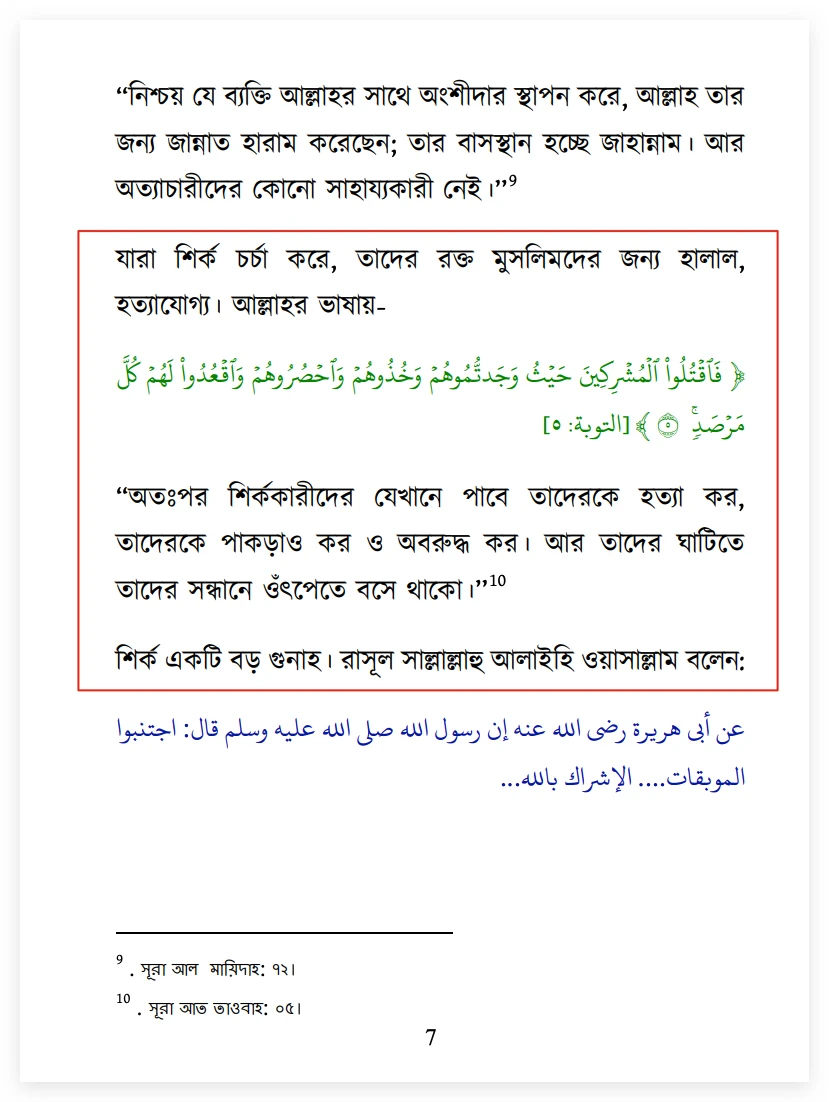
Md. Abdul Kader’s book “A Review of Shirk, Bid’a, and Superstitions Prevalent in Bangladesh,” edited by the prominent Bangladeshi cleric and scholar of Islamic jurisprudence Dr. Abu Bakr Muhammad Zakaria, states plainly that shirk is a crime punishable by death. It is lawful for Muslims to shed the blood of those who practice shirk! Here is what the book says: [27]
The blood of those who practice shirk is lawful for Muslims to shed; they are liable to be killed. In Allah’s words:
فَاقْتُلُوا الْمُشْرِكِينَ حَيْثُ وَجَدتُمُوهُمْ وَخُذُوهُمْ وَاحْصُرُوهُمْ وَاقْعُدُوا لَهُمْ كُلَّ مَرْصَدٍ ﴾ [التوبة: ٥]
“Then kill those who practice shirk wherever you find them, seize them, besiege them, and lie in wait for them at their strongholds.”10
Islamweb’s fatwa 92261 adopts the majority view among jurists: a Muslim killer is not subject to qisas for killing a free non-Muslim living under Muslim rule. [28]
All perfect praise be to Allaah, The Lord of the Worlds. I testify that there is none worthy of worship except Allaah, and that Muhammad is His slave and Messenger. We ask Allaah to exalt his mention as well as that of his family and all his companions.
First of all, you should know that a Muslim should not be killed for killing a belligerent non-Muslim according to the consensus of the scholars may Allaah have mercy upon them. According to the view of the majority of the scholars may Allaah have mercy upon them a Muslim should not be killed against a free non-Muslim under the Muslim rule. The evidence about this is the saying of the Prophet sallallaahu `alayhi wa sallam ( may Allaah exalt his mention ): “A Muslim should not be killed for killing a non-Muslim.” (At-Tirmithi)
Moreover, according to the view of the majority of the scholars may Allaah have mercy upon them the title (and rulings) “disbeliever” is applicable to a free non-Muslim under the Muslim rule. However, Abu Haneefah, and the scholars of his School of jurisprudence may Allaah have mercy upon them are of the view that a Muslim should be killed for killing a free non-Muslim under Muslim rule; their evidence is the two verses which the questioner mentioned. Nonetheless, the correct opinion is that of the majority of the scholars may Allaah have mercy upon them that is based on the above Prophetic narration, which is a direct proof related to the case of dispute.
Allaah Knows best.
English rendering of the Bengali translation: “All praise belongs to Allah, Lord of the Worlds. I bear witness that there is no deity but Allah and that Muhammad (peace be upon him) is His servant and messenger. We pray that Allah will raise the standing and honor of His Messenger, his family, and all his Companions.
First, you should know that, by the consensus (ijma) of the scholars (may Allah have mercy on them), a Muslim may not be executed for killing a belligerent non-Muslim (harbi). According to the majority of scholars, a Muslim may not be sentenced to death for killing a free non-Muslim (dhimmi) living under Islamic rule either. Their evidence is the statement of the Messenger of Allah (peace and blessings be upon him): ‘A Muslim is not to be killed for killing a non-Muslim.’ (Al-Tirmidhi)
Most scholars also hold that the designation ‘disbeliever’ and its associated rulings apply to free non-Muslims living under Islamic rule. Imam Abu Hanifa and the scholars of his school, however, hold that a Muslim is to be put to death for killing a free non-Muslim living under Islamic rule. They cite the two verses mentioned by the questioner. Nevertheless, the correct view is that of the majority, which rests on the Prophet’s hadith quoted above and directly addresses the matter in dispute.
Allah knows best.”
Lessons on Tawhid and Fighting: Valuing Life According to Religion
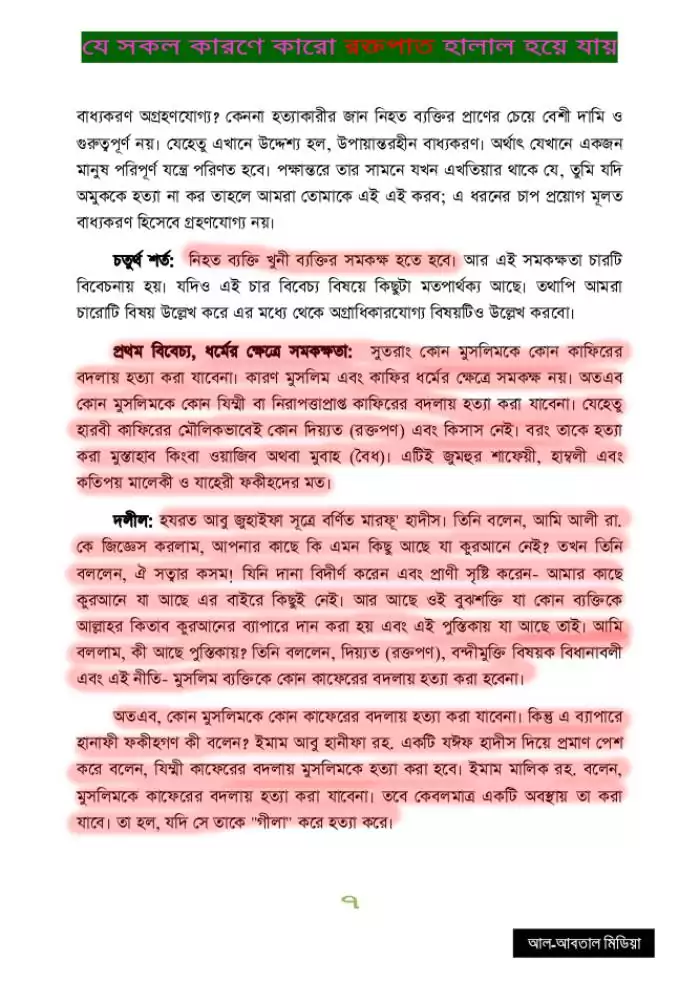
Further detail can be found in Lessons on Tawhid and Fighting (Fourth Lesson): The Circumstances in Which Shedding Someone’s Blood Becomes Lawful. [29]
Fourth condition: The victim must be the equal of the killer. Equivalence is assessed in four respects. Although there is some disagreement on these points, we will state all four and indicate which view should be given precedence.
The first consideration is equivalence in religion. Thus, no Muslim may be killed in retaliation for a disbeliever
because a Muslim and a disbeliever are not equal in religion. Therefore, no Muslim may be killed in retaliation for a dhimmi or a disbeliever under protection. For a harbi disbeliever, there is, as a matter of principle, neither blood money (diya) nor qisas. Killing him is instead recommended, obligatory, or permissible. This is the view of most Shafi’i and Hanbali jurists and of some Maliki and Zahiri jurists.
Evidence: a marfu’ hadith narrated by the venerable Abu Juhayfah. He said: I asked Ali (may Allah be pleased with him), “Do you have anything that is not in the Quran?” He said, “By Him who splits the seed and creates life, I have nothing beyond what is in the Quran, except the understanding of Allah’s Book, the Quran, that may be granted to a person, and what is in this document.” I asked, “What is in the document?” He said, “Blood money, rules on releasing captives, and the principle that a Muslim is not to be killed in retaliation for a disbeliever.”
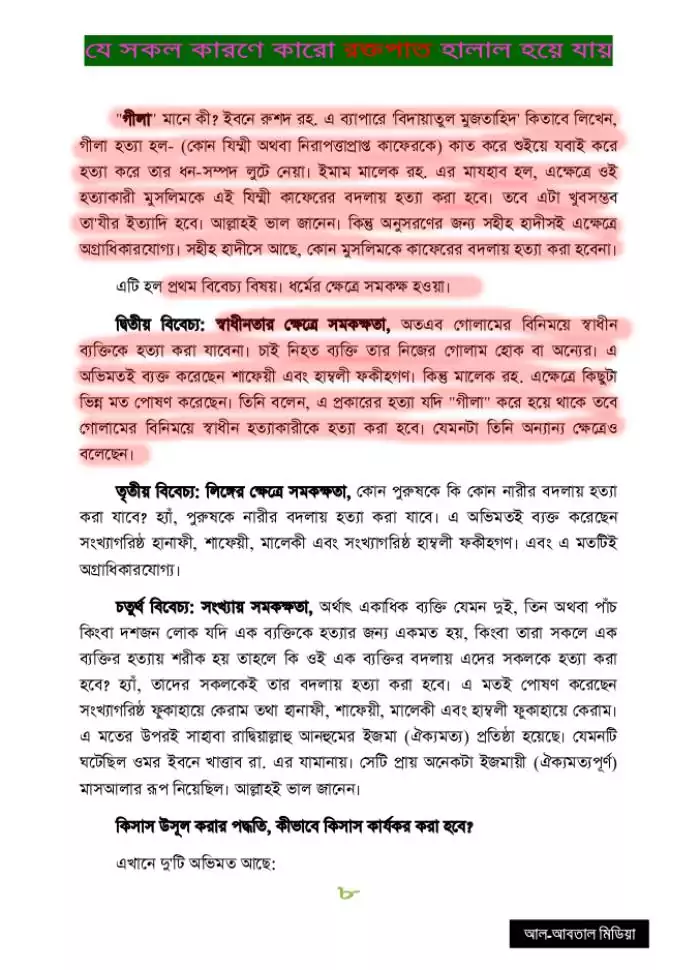
Therefore, a Muslim may not be killed in retaliation for a disbeliever. What do the Hanafi jurists say on this matter? Citing a weak hadith as evidence, Imam Abu Hanifa (may Allah have mercy on him) says that a Muslim is to be killed in retaliation for a dhimmi disbeliever. Imam Malik (may Allah have mercy on him) says that a Muslim may not be killed in retaliation for a disbeliever. There is only one exception: when he kills him by “ghila.”
What does “ghila” mean? Ibn Rushd (may Allah have mercy on him) writes in Bidayat al-Mujtahid that ghila consists of laying someone (a dhimmi or a protected disbeliever) on his side, cutting his throat, and plundering his property. In the school of Imam Malik (may Allah have mercy on him), the Muslim killer in this case is to be killed in retaliation for the dhimmi disbeliever. This is very likely a matter of ta’zir or the like. Allah knows best. The sahih hadith, however, is the one to follow here. The sahih hadith states that a Muslim is not to be killed in retaliation for a disbeliever.
This is the first consideration: equivalence in religion.
The second consideration is equivalence in freedom. Thus, a free
person may not be killed in retaliation for an enslaved person, whether the victim belonged to the killer or to someone else. This is the view of the Shafi’i and Hanbali jurists. Malik (may Allah have mercy on him) took a somewhat different view. He said that if the killing was committed by “ghila,” the free killer is to be killed in retaliation for the enslaved person, as he also held in other cases.
The third consideration is equivalence in sex. May a man be put to death
in retaliation for a woman? Yes, a man may be put to death in retaliation for a woman. This is the view of most Hanafi, Shafi’i, and Maliki jurists and of most Hanbali jurists. It is the view that should be given precedence.
The fourth consideration is equivalence in number. If several people, say two, three, or five
or ten, agree to kill one person or all take part in killing that person, are all of them to be killed in retaliation for that one person? Yes, all of them are to be killed in retaliation. This is the view of the majority of jurists: the Hanafi, Shafi’i, Maliki, and Hanbali jurists. On this view the Companions (may Allah be pleased with them) reached a consensus (ijma), as happened in the time of Umar ibn al-Khattab (may Allah be pleased with him). The question came close to being one on which there was consensus. Allah knows best.
The Jurisprudence of Uthman (May Allah Be Pleased with Him): The Caliphs’ Approach
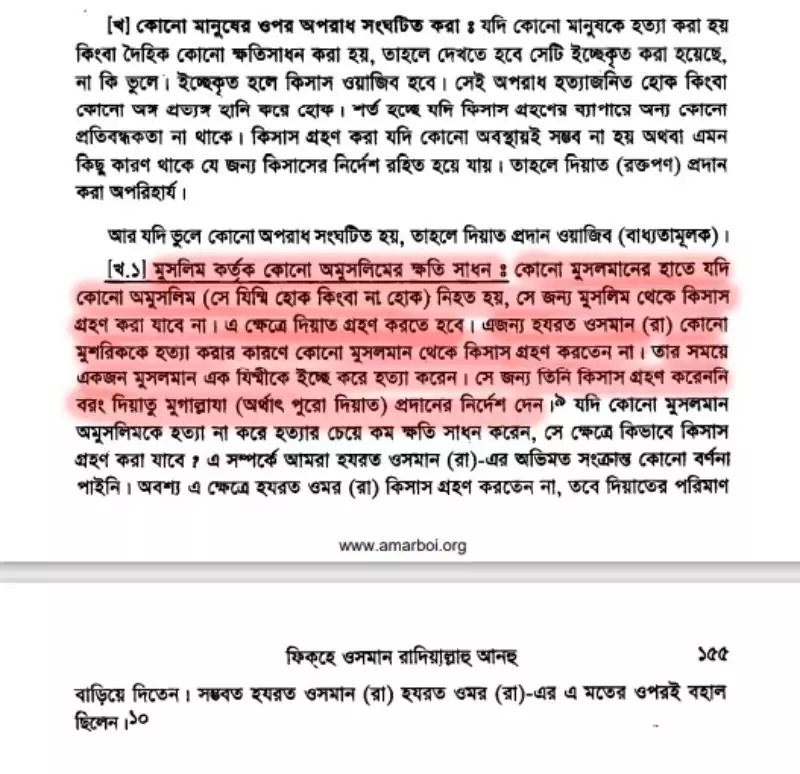
In The Jurisprudence of Uthman (May Allah Be Pleased with Him), Muhammad Rawwas Qal’aji explains the decision not to impose qisas by citing Ubaydullah’s agitated mental state. [30]
[d] Committing an offense in a state of agitation: The view of the venerable Uthman (may Allah be pleased with him) was that if a person commits an offense in a state of agitation, the ruling is the same as for jinayat al-khata, an offense committed by mistake. In that case, a fine or compensation must be paid in place of qisas. For example, Abd al-Rahman ibn Abi Bakr (may Allah be pleased with him) reported: “When the venerable Umar (may Allah be pleased with him) was martyred, I went out in search of Hormuzan, Jufayna, and Abu Lu’lu’a. They lived in a neighborhood in Medina. When they saw me, they began to run away, and I pursued them. While they were running, a dagger (a large knife) fell from their hands. It was sharp on both sides. On seeing it, I said to my companions, ‘Look, this is the dagger with which Umar (may Allah be pleased with him) was martyred.’” The people went to see the dagger and confirmed what he had said. When Ubaydullah ibn Umar (may Allah be pleased with him) saw the dagger, he went out with his sword and killed Hormuzan and Jufayna. He then found Abu Lu’lu’a’s young daughter and killed her too. He raised his sword and cried, ‘By Allah, no enslaved man or woman in Medina will escape my sword today. Some others must be killed as well.’ By ‘some others’ he meant certain Companions among the Muhajirun. People pressed him to put down his sword but did not dare approach him. At that moment the venerable Amr ibn al-As (may Allah be pleased with him) arrived. He said gently and affectionately, ‘Nephew, give me the sword.’ He handed it over.
The venerable Uthman (may Allah be pleased with him) convened the consultative council and said, “Advise me concerning Ubaydullah ibn Umar (may Allah be pleased with him).” The council was divided. Some of the Muhajirun Companions advised putting him to death in qisas. Others said, “How extraordinary! His father was martyred yesterday, and he is to be killed today? May Allah destroy Hormuzan and Jufayna.” The venerable Uthman (may Allah be pleased with him) became deep in thought. He concluded that Ubaydullah ibn Umar (may Allah be pleased with him) had committed the killings while he was not in a normal state. A person in a normal state could not say and do the things he had said and done. His mental condition was sufficient to set aside qisas. Like a hadd punishment, qisas is set aside when there is doubt.
Hormuzan and Abu Lu’lu’a’s daughter had no heirs. In those circumstances the state served as their guardian; in other words, the venerable Uthman (may Allah be pleased with him) was their guardian. He sought an equitable resolution. He turned to those who had advised executing Ubaydullah ibn Umar (may Allah be pleased with him) and asked, “Tell me, who is Hormuzan’s guardian?” They replied, “Commander of the Faithful, you are his guardian now.” He answered, “If that is so, I pardon Ubaydullah ibn Umar (may Allah be pleased with him).”6 When the victim’s guardian pardons the killer, diya (blood money) becomes obligatory in place of qisas. The venerable Uthman (may Allah be pleased with him) therefore ordered that the blood money be paid from the public treasury. That left Jufayna, who was a Christian. When a non-Muslim is killed by a Muslim, the Muslim cannot be put to death for it. Uthman therefore also paid Jufayna’s blood money on Ubaydullah’s behalf.
[b.1] Harm inflicted on a non-Muslim by a Muslim: If a Muslim kills a non-Muslim, whether a dhimmi or not, qisas cannot be exacted from the Muslim. Diya must be taken in such a case. For this reason, the venerable Uthman (may Allah be pleased with him) did not exact qisas from a Muslim for killing a polytheist. In his time a Muslim deliberately killed a dhimmi. Uthman did not exact qisas but ordered payment of diya mughallaza (that is, full blood money). If a Muslim harms a non-Muslim without killing him, how is qisas to be exacted for harm short of killing? We have found no report of the venerable Uthman’s (may Allah be pleased with him) opinion on this question.

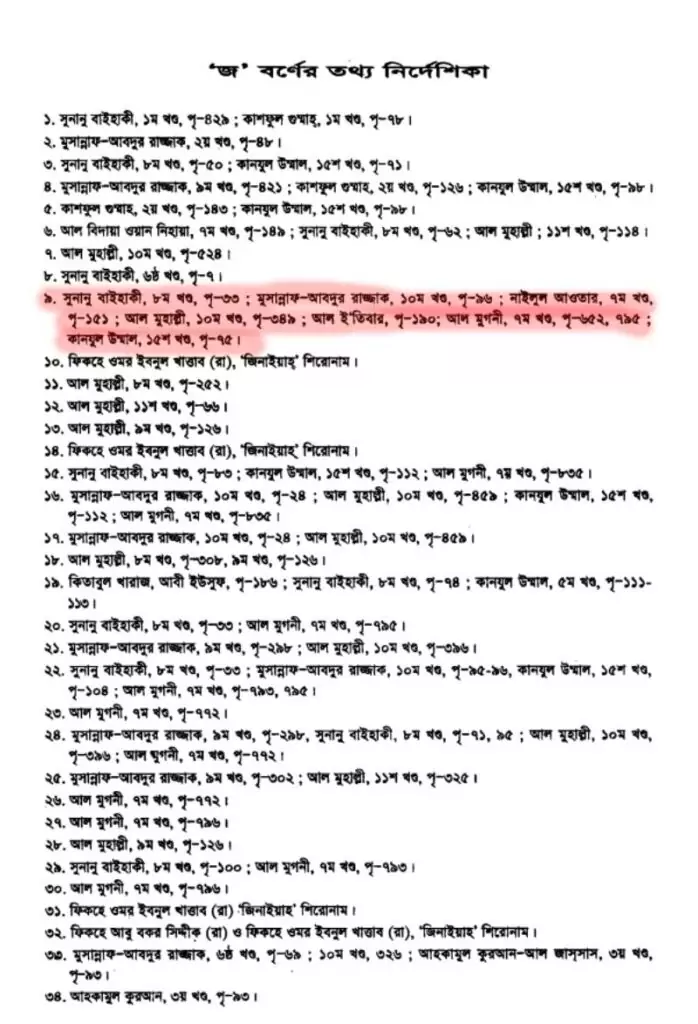
The Killings by Ubaydullah ibn Umar and Uthman’s Ruling in the Original Arabic Histories
After the attack on Umar ibn al-Khattab and before Uthman became caliph, Umar’s son Ubaydullah killed Hormuzan, Jufayna, and Abu Lu’lu’a’s young daughter in revenge. The case was settled after Uthman became caliph. The Islamic historian al-Dhahabi reports that Hormuzan had already converted to Islam. Jufayna was a Christian from al-Hira who lived in Medina and taught reading and writing. There is also a report that Abu Lu’lu’a’s daughter claimed to be Muslim. It is therefore wrong to describe all the victims as non-Muslims. The fact that Ubaydullah was not subjected to qisas after killing three people raises serious questions about crimes by members of powerful Muslim families, the victims’ legal rights, and the caliph’s power to pardon. [31] [32]
Ubaydullah’s Killings: The Account of Abd al-Rahman ibn Abi Bakr
Hafiz Jamal al-Din Abd Allah ibn Yusuf al-Zayla’i, in his Nasb al-Raya li-Takhrij Ahadith al-Hidaya, preserves an important account by Abd al-Rahman ibn Abi Bakr from Imam al-Tahawi’s Sharh Ma’ani al-Athar. Abd al-Rahman reported that before Umar was killed he had seen Abu Lu’lu’a, Hormuzan, and Jufayna speaking together. When they rose at the sight of him, a double-edged dagger fell. After Umar was killed, a description of the dagger reached Ubaydullah, who attacked Hormuzan on that basis. According to the account, as the blade struck Hormuzan, he said, “There is no deity but Allah.” Ubaydullah then killed Jufayna, a Christian from al-Hira. Abu Lu’lu’a’s young daughter was also killed. Ubaydullah threatened to kill other captives and people of foreign origin in Medina. A group of the Muhajirun opposed him, and he was eventually disarmed. The allegation was based on suspicion; no court had found any of the three victims guilty of conspiring to kill Umar. [33]
فَقَتَلَ الْهُرْمُزَانَ، وَلَمَّا وَجَدَ مَسَّ السَّيْفِ، قَالَ: لَا إِلَهَ إِلَّا اللَّهُ، وَعَدَا عَلَى جُفَيْنَةَ، وَكَانَ مِنْ نَصَارَى الْحِيرَةِ، فَقَتَلَهُ
English translation: Ubaydullah killed Hormuzan. When Hormuzan felt the blow of the sword, he said, “There is no deity but Allah.” Ubaydullah then attacked and killed Jufayna, a Christian from al-Hira.
Ubaydullah’s retaliatory attack was no part of a legal proceeding. He took it upon himself to act as accuser, judge, and killer. Abd al-Rahman ibn Abi Bakr’s account describes three men seen together and the presence of a dagger. Those circumstances alone do not establish that each of them was involved in a murder conspiracy. No crime was proven in court against either Jufayna or Abu Lu’lu’a’s daughter. The killing of the young girl in particular is a brutal instance of targeting an innocent family member in the name of revenge. Ubaydullah’s threat to kill others with his sword drawn shows that his violence was not confined to people accused on specific evidence. It was a sweeping act of vengeance by a member of a politically powerful family, and it claimed at least three lives.
Hormuzan’s Religion and the Killing of Jufayna
Imam Shams al-Din al-Dhahabi records Hormuzan’s conversion to Islam in his Siyar A’lam al-Nubala’. He states that Hormuzan ruled Tustar and had converted to Islam before Ubaydullah killed him. Imam al-Bayhaqi also cites Anas ibn Malik’s account of Hormuzan’s conversion. Al-Zayla’i preserves al-Bayhaqi’s statement. Hormuzan therefore cannot be treated as a straightforward example of a non-Muslim victim in a discussion of qisas for killing non-Muslims. There is no comparable problem with Jufayna’s religious identity. The accounts preserved by al-Dhahabi and Ibn Sa’d and transmitted through al-Tahawi identify him as Christian. Jufayna was a Christian killed by a Muslim, and Ubaydullah was not subjected to qisas. Hormuzan and a young girl were also killed at the same time. The question for Uthman’s caliphate is how those three killings were dealt with in law. [34] [35]
قُلْتُ: وَالْهُرْمُزَانُ هُوَ مَلِكُ تُسْتَرَ، وَقَدْ تَقَدَّمَ إِسْلَامُهُ، قَتَلَهُ عُبَيْدُ اللَّهِ بْنُ عُمَرَ لَمَّا أُصِيبَ عُمَرُ
English translation: Al-Dhahabi says: Hormuzan was the ruler of Tustar. He had already embraced Islam. When Umar was killed, Ubaydullah ibn Umar killed Hormuzan.
Uthman’s Decision: No Qisas After Three Killings
The al-Musannaf of Abd al-Razzaq al-San’ani preserves a report through Ibn Shihab al-Zuhri about the legal outcome of the killings. After becoming caliph, Uthman consulted the Muhajirun about Ubaydullah. Some called for qisas. A dispute arose over whether Umar’s son should be executed so soon after Umar himself had been killed. Amr ibn al-As advised Uthman against executing Ubaydullah. In the end it was decided that blood money would be paid for the three victims. Abd al-Razzaq records a statement attributed to Uthman in which he identifies himself as the guardian of Hormuzan, Jufayna, and the girl, and sets blood money. Thus, after three people were killed, the case against a politically influential killer was resolved by a financial settlement in place of retaliatory punishment. [36]
قَالَ مَعْمَرٌ: وَقَالَ غَيْرُ الزُّهْرِيِّ: فَقَالَ عُثْمَانُ: أَنَا وَلِيُّ الْهُرْمُزَانِ وَجُفَيْنَةَ وَالْجَارِيَةِ، وَإِنِّي قَدْ جَعَلْتُهُمْ دِيَةً
English translation: Ma’mar says: Someone other than al-Zuhri reported that Uthman said, “I am the guardian of Hormuzan, Jufayna, and the girl. I have decided on blood money for their deaths.”
The Hanafi jurist Imam Abu Ja’far al-Tahawi uses this case in his discussion of qisas for a Muslim who kills a non-Muslim. He argues that a group of the Muhajirun called for Ubaydullah’s execution and that their demand concerned the killings of Hormuzan and Jufayna. Imam al-Bayhaqi criticizes this interpretation. He notes that Hormuzan had already embraced Islam and was a Muslim. He also argues that Abu Lu’lu’a’s young daughter claimed to be Muslim and that killing her made qisas due. Al-Bayhaqi’s argument does not establish which killing prompted the Muhajirun to call for qisas. The two jurists thus interpret the demand for qisas differently as a precedent for seeking retaliation when a Muslim kills a non-Muslim. The essential facts remain the same: Ubaydullah killed three people, Jufayna was a Christian, and the killer was not subjected to qisas during Uthman’s caliphate. [37]
The most serious legal question raised by these killings is who exercised the authority to pardon the killer and settle the blood money. In one account preserved by al-Dhahabi, Uthman declares himself the victims’ guardian and says that he will pay the blood money from his own funds. The account quoted by Qal’aji instead has the blood money paid from the public treasury. Qal’aji presents Ubaydullah’s agitated mental state as the reason qisas was not imposed, but the earlier accounts quoted here do not establish that this was the reason for Uthman’s decision. Al-Tabari gives another account through Sayf ibn Umar. In it, Uthman hands Ubaydullah over to Hormuzan’s son, who lets him go. Despite the differences in the accounts of the pardon and the blood money, the outcome is the same: Ubaydullah was not executed. The killer was the second caliph’s son and belonged to the political circle close to the new caliph. After three people were killed, his case was debated at the highest levels. The rights of the victims, the killer’s social standing, and the state’s power to pardon were intertwined in the resolution of the crime. The case is a historical record of serious questions about justice for crimes committed by powerful people and the rights of those harmed in the early Islamic state. [38] [39]
Religious Rules on Qisas and Blood Money: A Fundamental Conflict with International Human Rights
Using religion to determine how a killer is judged and how much compensation a victim’s family receives violates fundamental principles of modern human rights. The rules of Islamic jurisprudence discussed here deny equivalence between Muslims and non-Muslims for purposes of qisas. Under the general rule of the Shafi’i, Hanbali, and Maliki schools, qisas does not apply to a Muslim who kills a protected non-Muslim. It can apply when a non-Muslim kills a Muslim. Shafi’i jurisprudence also sets blood money for Jews and Christians at one-third of the Muslim rate and for Zoroastrians at one-fifteenth. The discrimination in these rules goes beyond claims of religious superiority. In the state’s legal system, a person’s religion determines how their killing is treated and how much compensation their family receives. When a different religion for the victim means a different rule on qisas for the killer and a different amount of blood money for the family, the law does not protect human lives equally.
Article 2 of the Universal Declaration of Human Rights, adopted by the United Nations General Assembly on December 10, 1948, states that everyone is entitled to the rights set out in the Declaration without discrimination based on religion or other status. Article 3 recognizes everyone’s right to life, liberty, and security of person. Article 7 declares equality before the law and the right to equal protection without discrimination. Article 8 recognizes the right to an effective remedy through competent national courts when fundamental rights are violated. Taken together, these four articles establish that the state may not give anyone less legal protection on account of their religion. Making eligibility for retaliatory punishment depend on the difference between the religions of the victim and the killer conflicts with that principle. [40]
All are equal before the law and are entitled without any discrimination to equal protection of the law.
English rendering of the Bengali translation: Everyone is equal before the law and has the right to equal protection under it without discrimination of any kind. (Universal Declaration of Human Rights, Article 7)
Equal protection under the law does not mean that every killing must be punished by execution. It means that religion must not influence how the killing, the evidence, the defendant’s culpability, the circumstances of the crime, or the legal criteria for sentencing are assessed. Applying one rule to a Muslim killer and another to a non-Muslim killer in the same kind of deliberate killing turns the offender’s religion into grounds for legal privilege. In comparable circumstances, a non-Muslim victim’s family cannot claim the retaliatory justice available to a Muslim victim’s family. Similarly, a different religion for the victim can mean a lower rate of blood money for the family. The disparity comes from the religious hierarchy, not from the nature of the crime. When the state makes religion a criterion for judging the killing of a human being, it no longer judges that crime under secular law based on equality.
Article 6 of the 1966 International Covenant on Civil and Political Rights recognizes every person’s inherent right to life. Article 14 provides that all persons are equal before courts and tribunals. Article 26 prohibits discrimination on grounds including religion and guarantees equal and effective protection under the law. The Covenant goes beyond a declaration of personal morality: it creates binding obligations under international law for states that ratify it. The rules of classical jurisprudence that restrict qisas and set lower blood money for a non-Muslim dhimmi than for a Muslim fundamentally conflict with these international standards. Religion cannot legitimately confer a special advantage or disadvantage in a state’s adjudication of homicide. [41]
Every human being has the inherent right to life. This right shall be protected by law.
English rendering of the Bengali translation: Every person has an inherent right to life. The law must protect that right. (International Covenant on Civil and Political Rights, Article 6)
In General Comment No. 18: Non-discrimination, the United Nations Human Rights Committee explains that Article 26 of the International Covenant on Civil and Political Rights is not limited to the particular rights set out in the Covenant. The right to legal protection without discrimination applies in every area in which the state makes and applies laws. Thus, when a state legislates on homicide, blood money, property, family rights, or any other matter, the content of the law cannot discriminate on the basis of religion. The discrimination in the classical rules on qisas and diya discussed here arises directly from the law itself, not from a judge’s personal prejudice. The amount of blood money varies according to whether the victim was Jewish, Christian, Zoroastrian, or Muslim. The religious inequality therefore persists even when a judge applies the rule correctly. This is discrimination built into the law, not a departure from it in the administration of justice. [42]
The unequal rates of blood money by religion put a figure on this structural discrimination. In Shafi’i jurisprudence, compared with full blood money for a Muslim, the rate for a Jew or Christian is one-third, and for a protected Zoroastrian or idolater it is one-fifteenth. If full blood money for a Muslim is set at 100 units, the rate is about 33.33 units for Jews and Christians and about 6.67 units for Zoroastrians. This large disparity between families who suffer the same kind of loss rests on religious identity. The financial loss suffered by a victim’s children, spouse, or family is no smaller because of the victim’s religion. Yet setting compensation according to religious categories means that different families receive different amounts for the same loss. The family’s right to compensation, like the legal standing given to the victim’s life, comes to depend on religion.
The harsher rule in Ibn Hazm’s al-Muhalla denies any obligation of qisas, blood money, or expiation when a Muslim kills a dhimmi or a protected non-Muslim. Denying mandatory financial compensation after a non-Muslim is killed also limits the family’s right to a legal remedy. The Hanafi school provides for qisas for killing a dhimmi but does not reach the same decision for the killing of a non-Muslim under temporary protection. Under this system of classification, how a person’s death is judged can depend on the type and duration of their agreement with the state as well as on religion. Even if the person was legally protected when killed, their status under the agreement serves as grounds for exempting the killer from qisas. Protection of human life is thereby divided into classes of rights defined by state and religious authorities instead of being upheld as a universal right.
Unequal treatment of homicide cases on the basis of religion divides victims and their families by civic standing. The family of a non-Muslim victim does not enjoy the same right to seek retaliatory justice as the family of a Muslim victim. Even among non-Muslim communities, families may be entitled to different rates of blood money. If a state enforces these rules as law, religion determines the level of legal protection a citizen receives. Dividing the protection of life between Muslims and non-Muslims living in the same state is a direct denial of equal citizenship. Ending this inequality requires recognizing every person’s life, family, and legal rights independently of religion. The killer’s Muslim identity and the victim’s non-Muslim identity cannot be grounds for special privilege or for the denial of protection in the adjudication of a crime.
Human Rights Violations and Second-Class Citizenship
This criminal rule of Islamic Sharia destroys the very idea of equal citizenship in modern political science. When a state values one citizen’s life less than another’s solely because of religion, the rule of law becomes meaningless. This provides a legal basis for the state to treat non-Muslims as second-class citizens. By modern global human rights standards, justice should be blind: it should consider the nature of the crime without regard to the offender’s social or religious status. Here the Sharia rule itself plays the part of a biased judge, contrary to the universal meaning of justice.
Second, this rule reduces legal protection for minorities. When the killer is Muslim, a Muslim victim’s family can seek qisas. Under the majority jurists’ rule, the family cannot make the same claim in a comparable killing if the victim is non-Muslim. Some schools also set lower blood money for the same kind of loss of life. Article 3 of the Universal Declaration of Human Rights recognizes everyone’s right to life, liberty, and security of person. Reducing the legal remedies available for loss of life on the basis of religion denies equal legal protection of that right. This discrimination is characteristic of a barbaric medieval system of government.
Furthermore, this rule strikes at the heart of moral and human values. The measure of a civilized society is whether it upholds the victim’s dignity, not whether it judges their religion. When a killer takes a non-Muslim’s life and is spared because he is Muslim, state and religion together send a message: non-Muslim blood is less pure or worth less than Muslim blood. This kind of arrogance and sectarian division erodes social cohesion and poses a major obstacle to modern democracy and an egalitarian society.
Conclusion: What a Civilized Society Demands and the Equality of Human Beings
Finally, examining this criminal rule of Islamic Sharia and its context makes it plain as day that it is wholly incompatible with modern human rights, justice, and social equality. Assigning a value to human life on the basis of religion is an ancient and backward idea that reflects a barbaric system of justice with no place in any civilized state today. When a non-Muslim is deprived of the security of their life and the killer is exempt from qisas because of his religion, the law dies and humanity is defeated.
Modern states are governed by constitutions and laws of universal application, under which a citizen’s religion or beliefs cannot stand in the way of legal protection. This discriminatory rule of Sharia divides society and perpetuates fear and marginalization among non-Muslim citizens. Sentencing must rest on the nature and seriousness of the offense, the evidence, the offender’s culpability, and the legal circumstances of the case. The religion of the offender or the victim cannot be a basis for sentencing. According to the Universal Declaration of Human Rights, no state can be truly democratic or humane without ensuring that the law is applied equally.
The demand of our time is therefore to reject this medieval discriminatory mindset and guarantee the equal worth and protection of every human life. In building a civilized, modern society, it is unacceptable to invoke religion to divide people in matters of life and death. Our aim should be a world in which every life, Muslim or non-Muslim, has equal value and everyone is entitled to equal justice before the courts.
References
- Sahih al-Bukhari 6915 ↩︎
- Sahih al-Bukhari 3166 ↩︎
- Sunan Abi Dawud 4530 ↩︎
- Ibn Rushd, Bidayat al-Mujtahid wa-Nihayat al-Muqtasid, Book of Qisas: The Requirement of Equivalence for the Victim ↩︎
- Ibn Hazm, al-Muhalla: Pardon in Killings Involving Ghila or Hiraba ↩︎
- Imam al-Shafi’i, al-Umm, Book of Intentional Injuries: Qisas Where the Parties Differ in Religion ↩︎
- Ibn Qudama, al-Mughni, Book of Injuries: The Ruling on a Muslim Who Changes Religion After Wounding a Dhimmi ↩︎
- IslamQA, Fatwa 243345: عقوبة المسلم إذا قتل ذميا; Statements by Imam Ahmad and Shaykh Khalid al-Mushayqih ↩︎
- Ayatollah Ja’far Subhani, Diyat al-Dhimmi wa-l-Musta’man: Positions of the Imami Jurists ↩︎
- Ayatollah al-Khoei, Takmilat Minhaj al-Salihin, Ruling 65 ↩︎
- Ibn Rushd, Bidayat al-Mujtahid: The Disagreement Between the Hanafi and Other Schools on Qisas ↩︎
- Imam al-Qurtubi, al-Jami’ li-Ahkam al-Qur’an: Commentary on al-Baqarah 2:178 ↩︎
- Ibn al-Jawzi, al-Tahqiq fi Ahadith al-Khilaf, vol. 2, p. 308: The Ruling on a Muslim Killing a Non-Muslim ↩︎
- Ibn Rajab al-Hanbali, Jami’ al-‘Ulum wa-l-Hikam, Commentary on Hadith 14: Criticism of Ibn al-Baylamani’s Report ↩︎
- Imam al-Qurtubi, al-Jami’ li-Ahkam al-Qur’an, al-Baqarah 2:178, Seventh Ruling ↩︎
- Imam al-Shafi’i, al-Umm: Qisas Where the Parties Differ in Religion ↩︎
- Ibn Rajab, Jami’ al-‘Ulum wa-l-Hikam ↩︎
- Al-Mawardi, al-Hawi al-Kabir, vol. 12, Book of Blood Money: The Four Schools’ Rulings on Blood Money for Jews and Christians ↩︎
- Imam al-Shafi’i, al-Umm, Book of Intentional Injuries, Blood Money for a Person Under Covenant: Blood Money for Jews, Christians, Zoroastrians, and Idolaters ↩︎
- Al-Mawardi, al-Hawi al-Kabir, vol. 12, “مسألة دية المجوسي ثمانمائة درهم”: Blood Money for Zoroastrians and the Argument from Religious Status ↩︎
- IslamQA, Fatwa 243345: Blood Money for Killing a Dhimmi, Uthman’s Decision, and Imam Ahmad’s Ruling ↩︎
- Ibn Hazm, al-Muhalla bi-l-Athar, vol. 10, Ruling 2025: A Muslim Killing a Dhimmi or Musta’man ↩︎
- Al-Muhalla bi-l-Athar, Ruling 2025: The Views of Abu Hanifa, Malik, and Al-Shafi’i, and Ibn Hazm’s Decision ↩︎
- Ibn Hazm, al-Muhalla, vol. 10, pp. 234–235: Criticism of the Hanafi Rule on Qisas ↩︎
- Ibn Hazm, al-Muhalla, Ruling 2025: Rejection of Compensation on the Grounds That a Slain Dhimmi Cannot Be Brought Back to Life ↩︎
- Ibn Hazm, al-Muhalla, vol. 10, p. 235: Criticism of the Hanafi Distinction Between Dhimmis and Musta’mans in Qisas ↩︎
- A Review of Shirk, Bid’a, and Superstitions Prevalent in Bangladesh, 2. The Consequences of Shirk ↩︎
- Killing a Muslim in punishment for killing a non-Muslim ↩︎
- Lessons on Tawhid and Fighting (Fourth Lesson): The Circumstances in Which Shedding Someone’s Blood Becomes Lawful, by Shaykh Mujahid Harith ibn Ghazi al-Nadhari (may Allah have mercy on him), translated by Abdullah Siraji, Al-Abtal Media Publications, pp. 7–8 ↩︎
- The Jurisprudence of Uthman (May Allah Be Pleased with Him), Dr. Muhammad Rawwas Qal’aji, translated and edited by Muhammad Khalilur Rahman Mumin, Adhunik Prokashoni, pp. 152, 153, 154 ↩︎
- Imam al-Dhahabi, Siyar A’lam al-Nubala’: Events in Uthman’s Caliphate ↩︎
- Imam al-Zayla’i, Nasb al-Raya, vol. 6, pp. 334–335 ↩︎
- Al-Zayla’i, Nasb al-Raya, vol. 6, p. 334: Abd al-Rahman ibn Abi Bakr’s Account as Transmitted by Imam al-Tahawi ↩︎
- Al-Dhahabi, Siyar A’lam al-Nubala’: Hormuzan’s Conversion to Islam and Jufayna’s Christian Identity ↩︎
- Al-Zayla’i, Nasb al-Raya: Hormuzan’s Conversion to Islam as Reported by Al-Bayhaqi ↩︎
- Abd al-Razzaq al-San’ani, al-Musannaf, vol. 5, pp. 478–480: Events Following Umar’s Killing ↩︎
- Al-Zayla’i, Nasb al-Raya, vol. 6, pp. 334–335: The Legal Disagreement Between Al-Tahawi and Al-Bayhaqi ↩︎
- Al-Dhahabi, Siyar A’lam al-Nubala’: Uthman’s Decision and Payment of Blood Money from His Own Funds ↩︎
- Al-Tabari, Tarikh, vol. 4: The Account of Hormuzan’s Son ↩︎
- United Nations, Universal Declaration of Human Rights, Articles 2, 3, 7 and 8 ↩︎
- United Nations, International Covenant on Civil and Political Rights, Articles 6, 14 and 26 ↩︎
- United Nations Human Rights Committee, General Comment No. 18: Non-discrimination, paragraphs 12–13 ↩︎