

Introduction: Jizya as a System of Religious Penalties
‘Jizya’ (poll tax/tribute) is not merely an ordinary revenue-collection mechanism in the Islamic fiscal system; it is a sensitive, structural, and far-reaching political instrument within Islamic state theory and jurisprudence. Historically, jizya has been defined as a financial liability imposed upon non-Muslim dhimmis—subordinate subjects who accept subjugation and humiliation under an Islamic state—and regarded as the ‘price’ or ‘ransom’ paid in return for protection of their lives and security under the state. Its character, however, extends beyond this fiscal definition. Political and theological analysis reveals a deliberate philosophy of psychological domination over non-Muslims and the destruction of their self-respect. Although the rule of jizya is expressly set out in Qur’an 9:29, classical exegesis and jurisprudence across the four schools describe methods of collection and religious objectives that amount to a humiliating penal regime directed at non-Muslims.
A central argument of this article is that jizya is not an innocuous tax: it is an institutional mechanism for humiliating, subordinating, and politically weakening non-Muslims under Islamic rule. Modern apologists may soften it by calling it a ‘security tax,’ a ‘substitute for military service,’ or a ‘social contract,’ but the language of classical jurisprudence and exegesis is considerably harsher. Under these interpretations of Sharia, the purpose is not merely to fill the treasury but to impose such persistent degradation, economic pressure, and social humiliation upon non-Muslims that they experience the price of remaining in their religion every day and are eventually driven to regard conversion to Islam as a means of escape. Even when it is not conversion compelled at swordpoint, it operates as prolonged psychological warfare by the state. The non-Muslim subject is repeatedly reminded that they are not equal: they are conquered, tolerated, taxable, and allowed to exist only in an inferior, subordinate condition. A particularly dangerous element of this system is the absence of a divinely fixed rate or universal statutory rate for jizya. The primary texts do not impose a general maximum, leaving much of its implementation to the ruler’s juristic discretion, administrative requirements, and political will. Non-Muslim religious identity is thus made a taxable offense, while the conqueror is granted the power to set the amount. Historically, that indeterminacy gave Muslim rulers significant leverage: they could raise assessments to meet administrative expenses, war costs, personal desires, or policies of religious dominance, sometimes producing economic suffocation and human disaster for non-Muslim populations.
The most important and controversial term in the definition of jizya is ṣāghirūn (‘humbled’ or ‘humiliated’). On the reading examined here, the Qur’anic command is not merely a financial transaction: the non-Muslim payer must manifest submission and inferiority. Several important classical interpretations in tafsir and fiqh explicitly associate payment with the non-Muslim’s political subjection and humiliation, and some prescribe acts of physical and public degradation as part of collection. The ultimate purpose attributed to this practice is to create enduring feelings of inferiority and thereby pressure non-Muslims to seek relief from social and economic humiliation through conversion. The severe, discriminatory, and inhumane application of jizya under various Muslim rulers in the Indian subcontinent, and its consequences for Hindus and Buddhists—including poverty, social disruption, and threats to their continued existence—call for sustained examination against the surviving historical record.
Modern Human Rights, Human Dignity, and Jizya’s Discriminatory Structure
Jizya cannot be properly evaluated solely within the tribal world of seventh-century Arabia or the fiscal arrangements of medieval empires. It must also be examined against contemporary standards of ethics, law, and human rights. The character of a political and social system is exposed by its treatment of human dignity, equal citizenship, freedom of religion, and equality before the law. Judged by these standards, jizya is not simply an obsolete tax; it reflects a stratified and discriminatory model of government in which a person’s standing is determined by religious identity rather than by their equal humanity.
A fundamental principle of a modern rights-based state is that it must not discriminate among citizens on grounds of religion, race, ethnicity, language, or belief. Democratic and human-rights law rests on the principle that all persons possess equal dignity and rights by birth. Article 1 of the United Nations’ Universal Declaration of Human Rights (UDHR), adopted in 1948, declares:
“All human beings are born free and equal in dignity and rights.”
— Universal Declaration of Human Rights, Article 1
Whether someone is Muslim, Hindu, Christian, Jewish, atheist, or belongs to any other belief, their civic standing, security, and fundamental rights are supposed to be equal in the eyes of the state. Calling the dhimmi system ‘protection’ does not make it humane. A slaveholder may protect a slave, and a feudal lord may protect a subject; neither relationship thereby becomes one of equal citizenship. The issue is not simply whether protection exists, but whether it is a right of equal citizenship or permission granted on condition of a tax, subordination, and humiliation because of religion. The jizya–dhimmi system belongs to the second category. It divides inhabitants into Muslims and non-Muslims: the former enjoy protection as a function of political status, while the latter must purchase it through jizya and acceptance of subordination. A person’s legal standing consequently depends on whether they have accepted Islam. This two-tier system of Muslim and non-Muslim dhimmi amounts to a religious caste hierarchy, with Muslims enjoying ruling status and political prestige while non-Muslims remain subordinate taxpayers whose survival depends on permission. In modern terms, this is not neutral tax policy but state-sanctioned discrimination on grounds of religion.
Under modern legal standards this is not merely discriminatory; it directly violates the principle of civic equality. Modern taxation ordinarily takes account of income, assets, economic activity, or the use of public services. Jizya, by contrast, is triggered by religious identity. Two people living in the same territory and possessing comparable means are treated differently solely because one must pay a special tax in a state of humiliation while the other is exempt from it. This contradicts a foundational principle of modern constitutional government.
The Qur’anic requirement of ṣāghirūn—payment in a humbled and degraded state—makes jizya still more objectionable under contemporary human-rights standards. Human dignity is understood as inherent and inviolable. Article 1 of Germany’s Basic Law, for example, states:
“Human dignity shall be inviolable.”
— German Basic Law, Article 1
The state may not deliberately demean or humiliate its citizens. Yet numerous classical juristic interpretations turned the public abasement of non-Muslim payers into a religiously sanctioned practice. This constitutes more than economic exploitation: it is the political destruction of personal dignity through a technology of domination. Under modern international legal principles, assigning an inferior legal standing to a religious community amounts to discriminatory treatment.
Article 18 of the United Nations’ International Covenant on Civil and Political Rights (ICCPR) guarantees freedom of religion and belief, including protection against coercion that impairs the freedom to have or adopt a religion or belief of one’s choice. Historically, jizya was in many cases imposed at burdensome levels and accompanied by social humiliation, functioning as psychological and economic pressure to convert. Its underlying message was effectively: ‘Unless you accept Islam, you will live as a humiliated subject.’
Modern citizenship is conceived in universal and equal terms. When citizens obey the law and meet their lawful obligations, their religious identity should be irrelevant to their civic status. Under the dhimmi framework, however, non-Muslims did not possess standing equal to Muslims. In different periods and juridical settings they faced requirements to wear distinctive clothing or identifying marks, limitations on loud religious rites and the construction of houses of worship, and restrictions on carrying weapons or riding horses [3]. Jizya was only one element of this broader structure of discriminatory civic status.
A familiar objection is that ‘Muslims paid zakat while non-Muslims paid jizya,’ implying that the two constituted an equitable tax arrangement. The comparison is deceptive from the outset. Zakat is a Muslim religious duty; jizya is a tax of subordination imposed because the payer is not Muslim. A Muslim does not become an otherwise tax-free citizen simply by renouncing Islam, whereas a dhimmi’s jizya obligation ceases upon conversion to Islam. That distinction alone exposes their different legal and political characters. Zakat does not require Muslims to acknowledge degradation, subjection, or reduced civic dignity. Jizya, however, is imposed upon conquered non-Muslim populations and is expressly linked to paying in a humbled state. By paying zakat a Muslim fulfills an act of worship, whereas a non-Muslim paying jizya is marked as conquered, subordinate, and humiliated. Presenting the two as interchangeable forms of taxation is not a sound argument: it is a device for disguising discriminatory humiliation in the language of accounting.
Slavery, feudalism, caste hierarchies, and monarchical despotism were once sanctioned through religion, tradition, or law. They have been rejected in modern human-rights thought because classifying human dignity by birth, religion, or ethnicity is profoundly unjust. Likewise, jizya and the dhimmi system constitute a religiously discriminatory social hierarchy incompatible with equal citizenship, religious liberty, and the fundamental dignity of the person.
Modern political thought treats a person’s religious affiliation as a matter of individual conscience, while jizya turns that identity into a legal basis for political subordination. Where modern human rights assert that ‘all human beings have equal dignity,’ the jizya-based dhimmi system effectively declares: ‘Human beings are not equal; non-Muslims may live under Muslim rulers only in a humbled position.’ The disagreement is not merely procedural or legal but a clash between radically different moral foundations of political order.
Offensive Warfare and the Context of Imposing Jizya
One established doctrine of classical Islamic government and jurisprudence is jihad al-ṭalab, or offensive warfare. In its mainstream classical treatment, when the Muslim community possessed sufficient political and military capacity, advancing against neighboring non-Muslim states or dār al-ḥarb, defeating them, and incorporating them into Islamic rule was considered a collective religious obligation (farḍ kifāya). Its aim was not only territorial expansion but also the removal of non-Muslim political sovereignty and establishment of Sharia authority. Military conquest in turn established the conditions for collecting jizya from conquered populations. Further discussion appears in this section.
Classical Islamic jurisprudence draws sharp distinctions concerning the treatment of non-Muslims after conquest. In a postwar setting the defeated population is often presented with three possible outcomes, although the available options differ by religious classification:
1. Polytheists and idolaters: Under the severe rule discussed for Arabian idolaters and other polytheists, only two alternatives are offered: conversion to Islam or death by the sword. Protection of their existing worship by collecting jizya is not permitted under this classification. This is an extreme punitive arrangement that refuses to recognize their continued religious existence.
2. The dhimmi status of the People of the Book: A different rule applies to scriptural communities such as Jews and Christians. If they reject Islam after military defeat, they may be allowed to live as dhimmis under the Islamic state. The condition for this ‘protection’ is payment of jizya in a deeply subordinate and humiliated position. Jizya thereby becomes a public acknowledgement of defeat and inferior status, and the grant of security is conditioned upon that humiliating arrangement.
3. The exception for the Magians or Zoroastrians: A particular historical and strategic exception developed concerning Persian Zoroastrians. Although they were not named among the People of the Book in the Qur’anic jizya passage, jizya was taken from them. ‘Umar reportedly admitted that he did not know how to treat the Magians, whom he did not regard as People of the Book. ‘Abd al-Raḥmān ibn ‘Awf then cited a prophetic precedent for treating them according to the practice applied to scriptural communities. Had jizya been an obvious universal rule applicable to all polytheists, that hesitation and separate precedent would have been unnecessary. The original Qur’anic category was therefore the People of the Book, with the Magians included through a particular prophetic precedent. Subsequent sections examine explanations attributed to Ibn ‘Abbās and ‘Alī for granting this large Persian population the same opportunity.
Discussions of offensive jihad often foreground religious aims—preaching, establishing monotheism, suppressing unbelief, or asserting the authority of Sharia. Yet the Qur’an and its commentaries also reveal a clear economic dimension to military expansion. Read together, Qur’an 9:28–29 indicates that barring polytheists from the Sacred Mosque raised fears of economic loss among Muslims: the markets, commerce, and pilgrimage trade of Mecca had long depended on the visits of non-Muslim Arabian communities. In answer to this anxiety, the Qur’an promises that God will enrich believers through His bounty if they fear poverty.
The next verse goes further, commanding war against the People of the Book until they pay jizya and accept subordination. The textual sequence is significant: first comes the danger of losing income through the exclusion of polytheists, and then a route to replacing that income through jizya. Ibn Kathir expressly explains that Muslims feared losing markets, trade, and earnings after cutting ties with the polytheists, and that God compensated for this loss through jizya collected from the People of the Covenant. [4]
The body of a polytheist is not inherently impure, for Allah has made the food of the People of the Book lawful for Muslims. Some members of the Zahiri school, however, maintain that the polytheist’s body is impure. Ash‘ath related from Hasan al-Basri that anyone who shakes hands with a polytheist should perform ablution. Ibn Jarir also reported this opinion from Hasan al-Basri.
وَإِنْ خِفْتُمْ عَيْلَةً فَسَوْفَ يُغْنِيْكُمُ اللَّهُ مِنْ فَضْلِهِ إِنْ شَاءَ
“If you fear poverty, Allah will enrich you out of His bounty, if He wills.”
Muhammad ibn Ishaq said: When polytheists were forbidden to enter the Sacred Mosque, some Muslims said: “Our markets will become idle, our commerce and trade will cease, and we shall lose the income we earned through trade with the polytheists. Poverty and financial hardship will befall us.” Then Allah revealed the following verse:
وَإِنْ خِفْتُمْ عَيْلَةً فَسَوْفَ يُغْنِيكُمُ اللهُ مِنْ فَضْلِهِ إِنْ شَاءَ إِنَّ اللَّهَ عَلِيمٌ حَكِيمٌ، قَاتِلُوا الَّذِينَ لا يُؤْمِنُونَ بالله
That is: “If you fear poverty, Allah will enrich you by His grace through some other means, if He wills.” He is wise and fully aware: He knows when and for whom a particular ruling should be instituted. Fight those among the People of the Book who do not believe in Allah or the Last Day, do not regard as forbidden what Allah and His Messenger have forbidden, and do not follow the true religion, until they pay jizya in a humiliated state while you are victorious.
In the first verse Allah forbade the believers from allowing polytheists to enter the Sacred Mosque, giving rise to fears that their trade would suffer and they would fall into poverty. In the second verse, Allah removed that concern by commanding believers to collect jizya from the People of the Book. Similar interpretations have been transmitted from Ibn ‘Abbas, Mujahid, ‘Ikrima, Sa‘id ibn Jubayr, Qatada, Dahhak, and other commentators.
إِنَّ اللَّهَ عَلَيْمٌ حَكِيمٌ means that Allah knows best which actions will bring you benefit, and in commanding some things and forbidding others He acts with wisdom. His acts and words are consummately wise, and He is the most just in His commands to creation. Hence He rewarded their jihad through victory and the acquisition of jizya from conquered dhimmis.
قالُوا الَّذِيْنَ لَا يُؤْمِنُونَ بِالله means that the scriptural communities claim to believe in previous prophets, yet in reality, according to this interpretation, they believe in none of them. They lack a sincere desire for truth; if they possessed it, they would have believed in Allah’s Messenger Muhammad, the greatest of His messengers. Their claim to believe in the earlier prophets is false. Had they truly believed in those prophets, they would have believed in Muhammad, for all the preceding prophets had foretold his coming and ordered people to follow him. Even when the People of the Book observe certain prescriptions of earlier religious laws, this is not genuine belief in those prophets but adherence motivated by inherited customs or worldly benefit. Such obedience is not true faith and will be of no avail to them.
On the basis of this verse, some jurists hold that jizya cannot be collected from any people other than the People of the Book and comparable communities, such as the Zoroastrians. Jizya may be taken from Zoroastrians because an authentic hadith states that the Prophet collected it from the Zoroastrians of Hajar (هج). Al-Shafi‘i and, according to the well-known report, Ahmad held this opinion. Abu Hanifa said jizya should be taken from every non-Arab unbeliever, whether from the People of the Book or from polytheists, but among Arabs only the People of the Book were liable. Malik said it may be taken from any unbeliever—scripturalist, Zoroastrian, idolater, or otherwise.
This is not the place to discuss the arguments for and against those positions, so they have been omitted. Allah knows best.
حَتَّى يُعْطُوا الْجِزْيَةَ عَنْ يُدِ وَهُمْ صَاغَرُونَ means that, unless they embrace Islam, they are to pay jizya with their own hands while Muslims are victorious and they themselves are subdued, disgraced, and humiliated. Hence Muslims are forbidden to honor a dhimmi or elevate such a person above Muslims: dhimmis are to remain in a degraded and humiliated condition. Abu Hurayra reported in Sahih Muslim that the Prophet said: “Do not initiate greetings of peace to Jews and Christians; and when you meet one of them on the road, compel him to take its narrowest part.”
For this reason ‘Umar included humiliating conditions for Christians in the peace agreement concluded with the people of al-Sham (present-day Syria and surrounding regions). Several hadith authorities narrated from ‘Abd al-Rahman ibn Ghanm al-Ash‘ari that he said: When ‘Umar decided to conclude a peace treaty with the Christians of al-Sham, I drafted the following document on his behalf:
In the name of Allah, the Most Gracious, the Most Merciful.
These are the written pledges made by the inhabitants of such-and-such cities of al-Sham to ‘Umar, Commander of the Faithful and servant of Allah: “When you came to us, we sought from you security for ourselves, our children, our possessions, and all members of our religion. In exchange for that security we undertake not to build new churches or places of worship within our cities or their surroundings; not to repair old churches or places of worship; and not to restore as churches or places of worship any buildings that have come into Muslim possession. We shall not prevent a Muslim from staying in any of our churches by night or day, and shall keep their doors open to travelers and wayfarers. We shall provide three days’ hospitality to any Muslim traveler passing our homes. We shall not harbor spies in our churches or residences or engage in deceit against Muslims. We shall not teach our children the Qur’an, publicly proclaim any form of shirk, or invite anyone to polytheism. We shall not prevent a relative who wishes to embrace Islam from doing so. We shall show respect to Muslims, and when a Muslim wishes to sit at one of our gatherings, we shall rise to make room. We shall not wear garments like those of Muslims, nor wear caps, turbans, or shoes as Muslims do, nor part our hair in the same fashion; we shall not speak as Muslims do or adopt names and honorifics peculiar to them. We shall not use saddles on riding animals, wear swords at our sides, keep weapons, or carry weapons. We shall not engrave Arabic words upon our rings or trade in wine. We shall crop the hair at the front of our heads, keep the prescribed lock of hair wherever we live, and wear the distinctive cord. We shall not display crosses in the open areas of our churches, nor display crosses or our religious books on Muslim roads or in their markets. We shall not ring church bells loudly or read our scriptures aloud in the presence of Muslims; we shall not organize processions during religious festivals. We shall not wail loudly while carrying our dead or carry funerals along Muslim roads and markets. We shall not employ a slave who has been employed by a Muslim. We shall direct Muslim travelers when asked and shall not look into Muslim homes.”
‘Abd al-Rahman ibn Ghanm said: When I brought this document to ‘Umar, he added the following: “And we shall not strike any Muslim.” By accepting these conditions we have secured your protection. If we break any of these stipulations, you (Muslims) shall be under no obligation to protect us; in that case you will be permitted to treat us as enemies.”
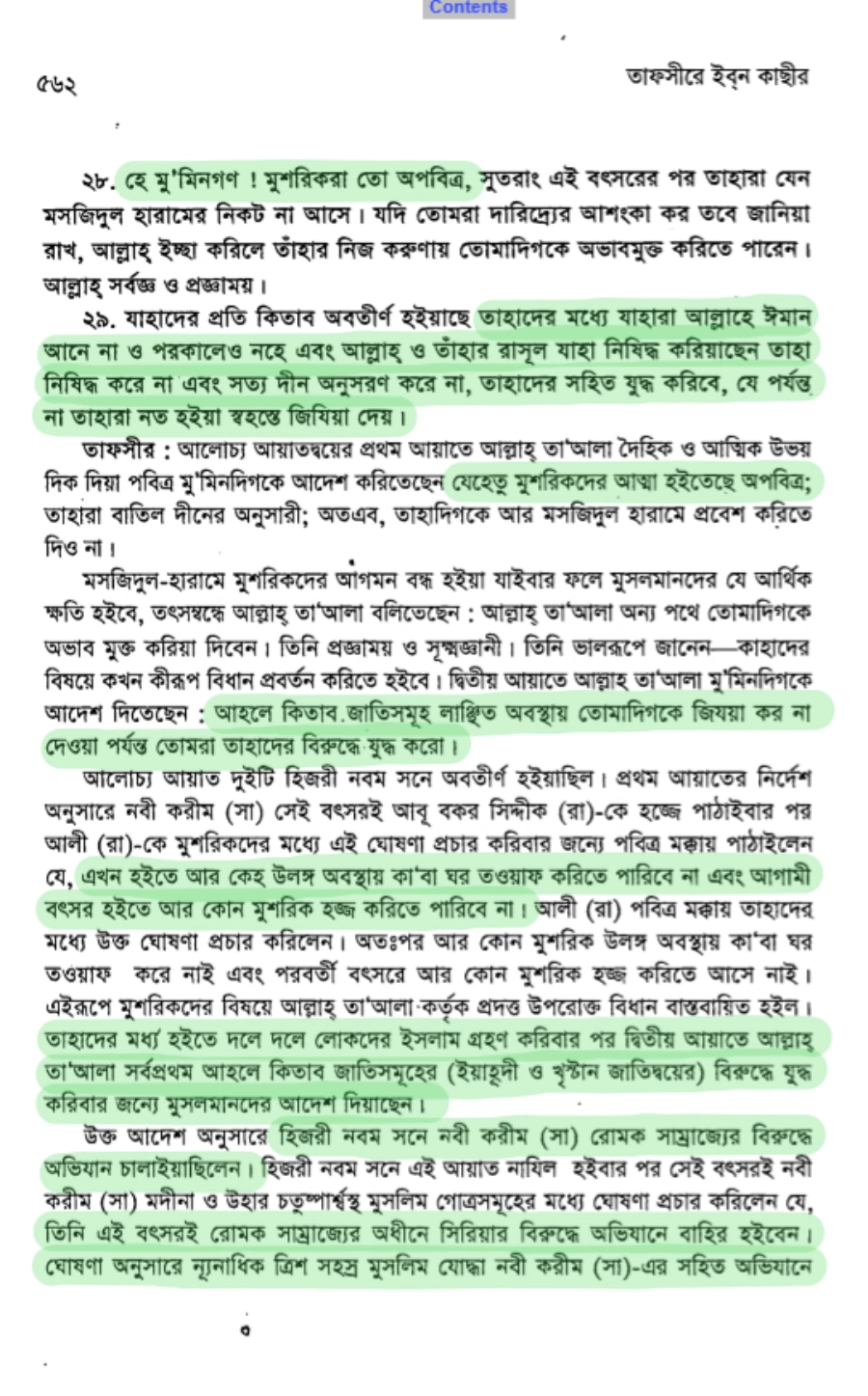
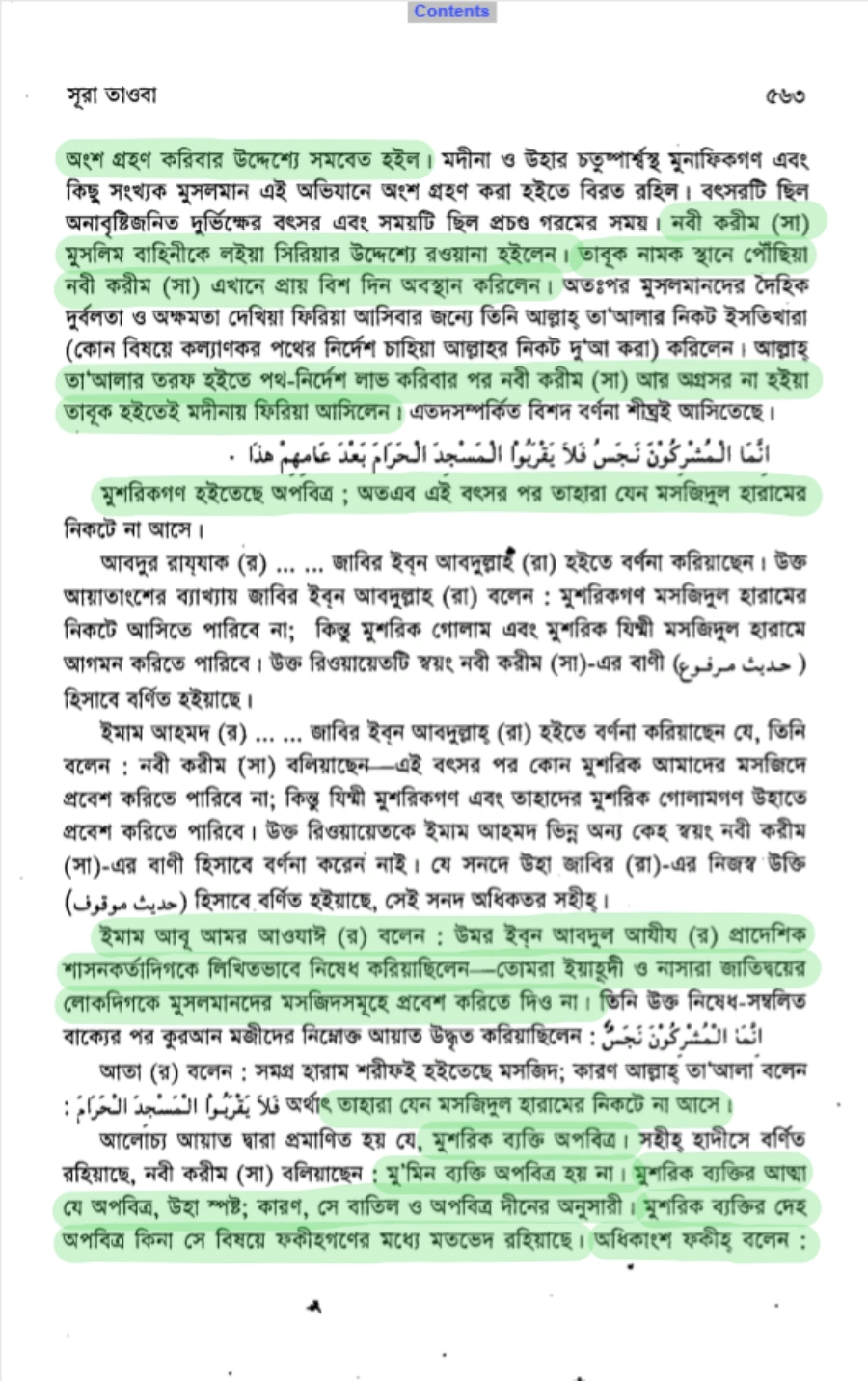
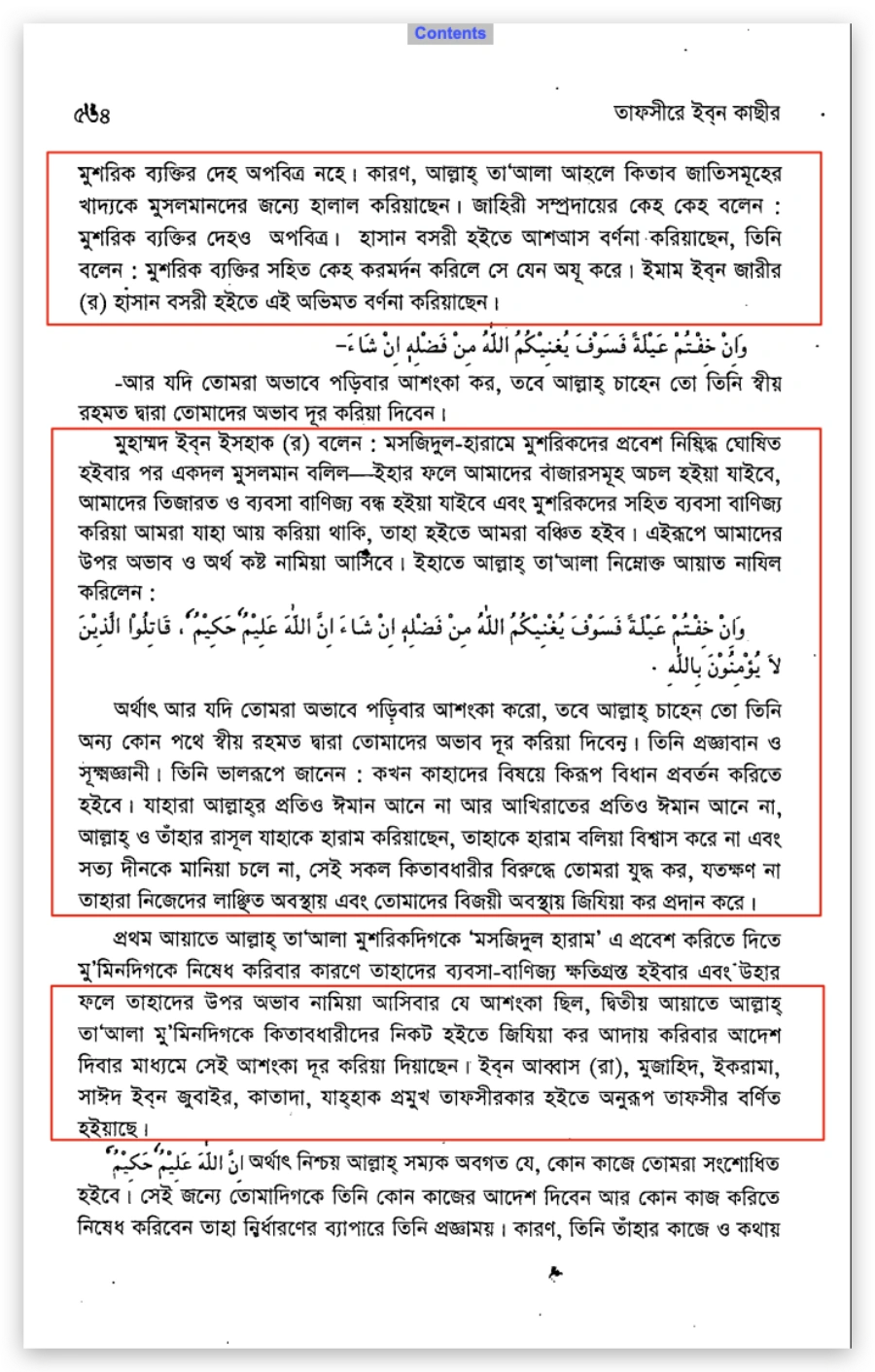
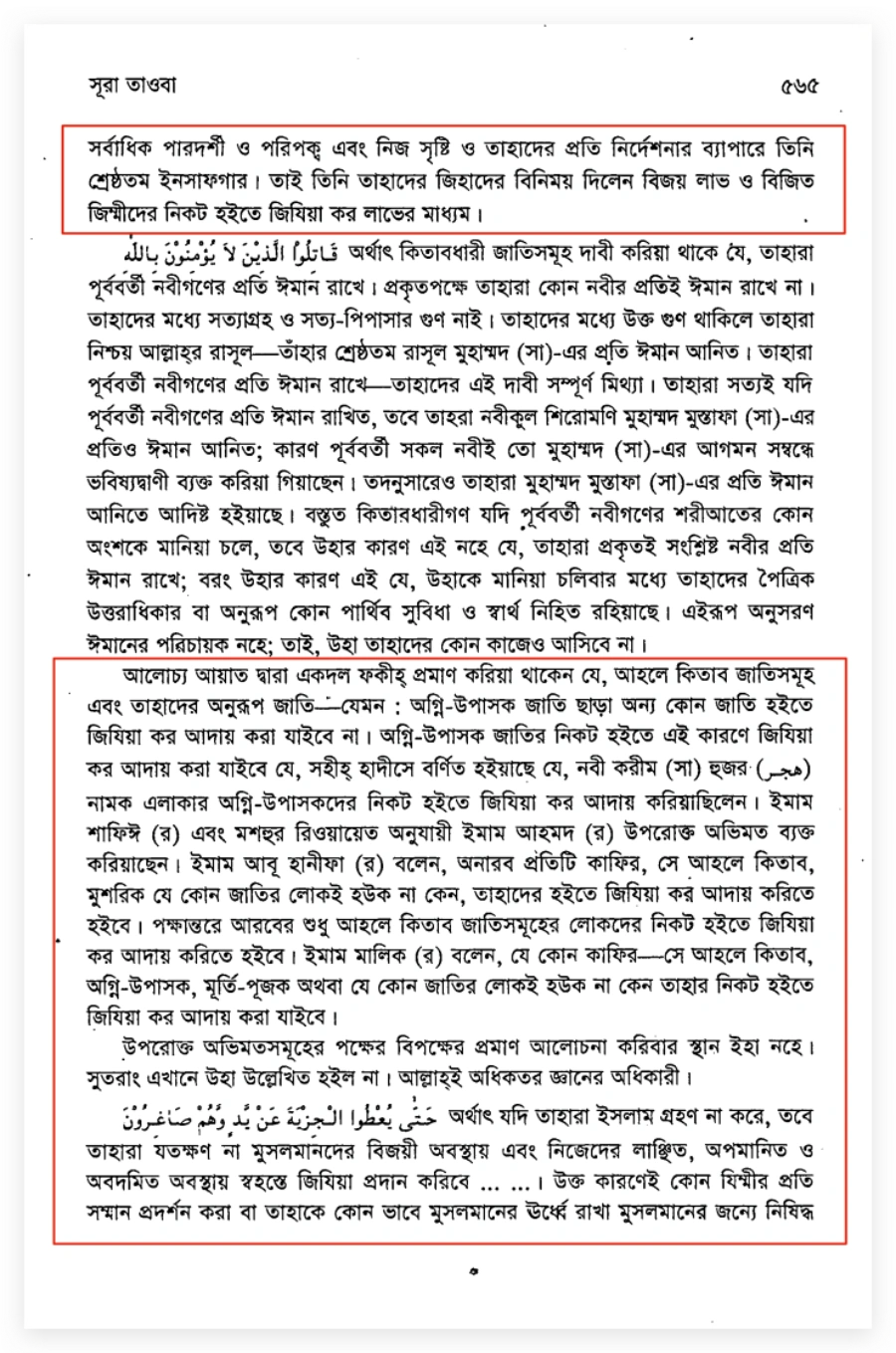
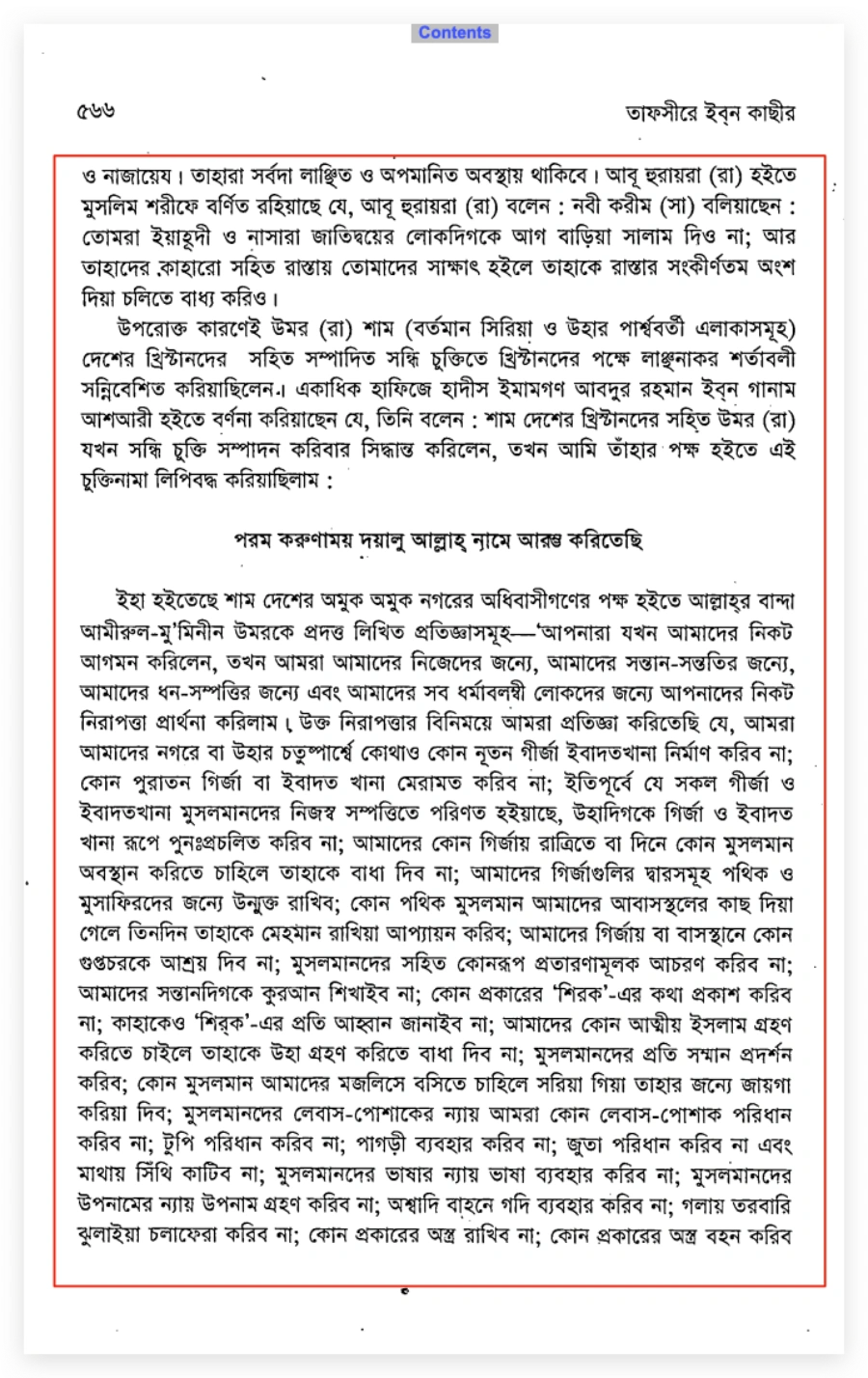
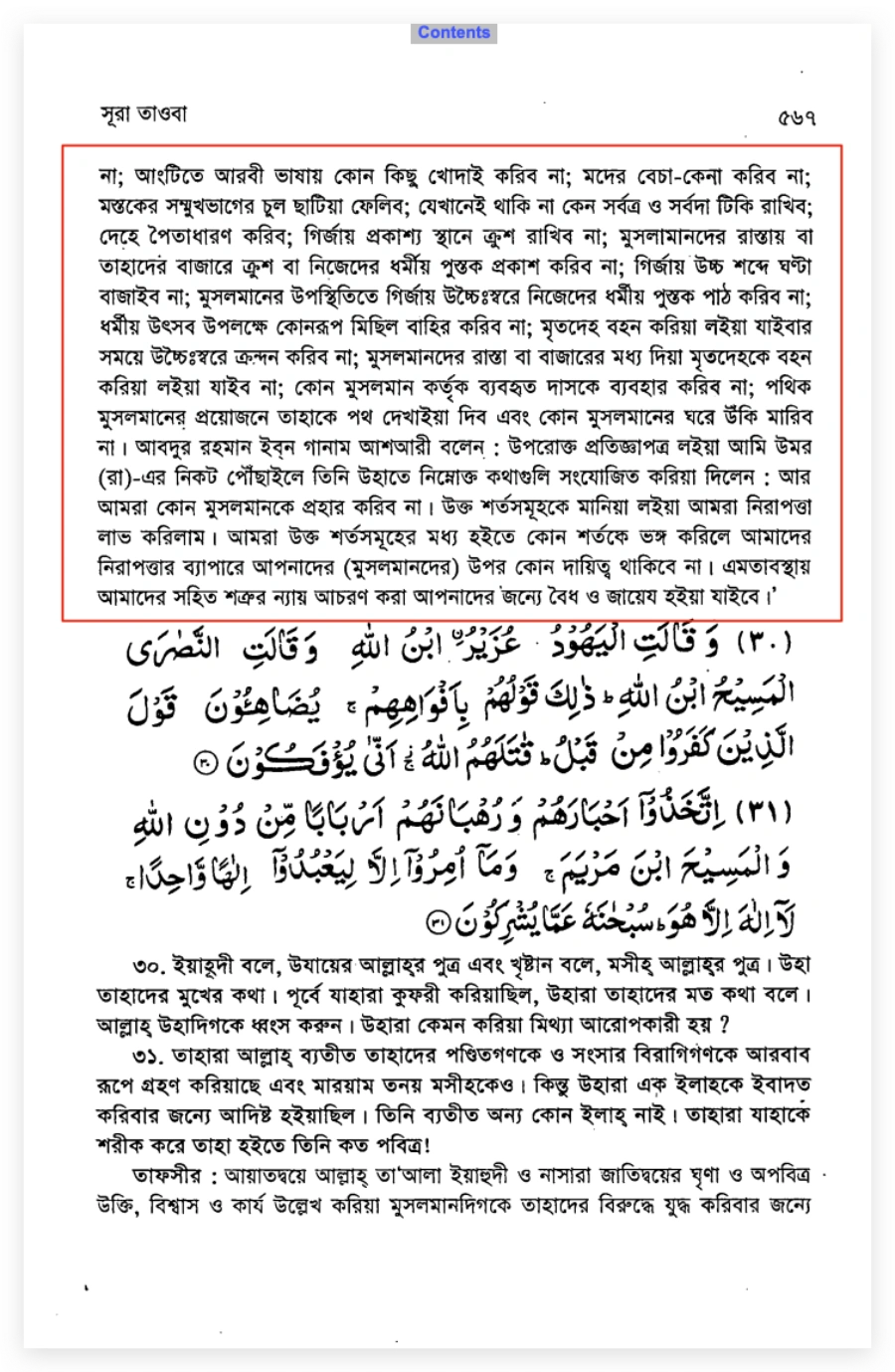
This interpretation leaves no room to treat offensive jihad merely as an abstract religious duty. Jihad, jizya, and the state economy appear here as parts of the same structure. Non-Muslim political communities face three options: accept Islam, submit to Islamic rule and pay jizya, or fight. Jizya was no mere tax for religious toleration, but a source of recurring state revenue extracted from defeated and subordinate non-Muslims. Offensive jihad thus also served as an economic engine of Islamic imperialism.
This point matters because modern apologists often present jizya in softened terms as a ‘state protection tax’ or a ‘payment in place of military service.’ That selectively promotes the least objectionable juristic interpretations while concealing its wider legal character. Classical fiqh variously describes jizya as a payment for security and residence, a substitute for fighting on behalf of Muslims, a penalty for unbelief, a mark of humiliation, and an alternative to killing. Treating the military-service explanation as its only true definition is false and misleading. The interpretation cannot withstand the primary texts. In the sequence of Qur’an 9:28–29 and in classical exegesis, jizya’s economic and imperial character is plainly exposed. When polytheists are barred from the Sacred Mosque, Muslims worry that their trade will suffer; the subsequent provision directs war against the People of the Book and collection of jizya from them. Jizya is therefore not a neutral tax paid by equal citizens, but money taken from the conquered and a declaration of political submission and religious supremacy. Calling it simply a ‘security tax’ is a manipulation of language; in this framework it served to extract wealth from conquered non-Muslims and enforce their subordinate position under Islamic law.
Tafsir al-Mazhari offers a parallel interpretation: the promise to dispel Muslims’ fear of poverty after barring polytheists is connected to jizya and wealth obtained through conquest. Offensive jihad was accordingly not merely a project for spreading religious doctrine; it also involved economic redistribution, revenue extraction, the appropriation of wealth from subordinate populations, and the strengthening of the victorious Muslim state. The following passage is from Tafsir al-Mazhari [5].
Dahhak and Qatada said that the statement ‘He may enrich you’ indicates that vast amounts of jizya would soon come from conquered territories. And so it happened: enormous jizya revenues began to arrive, and Muslims grew wealthy through their shares of that revenue.
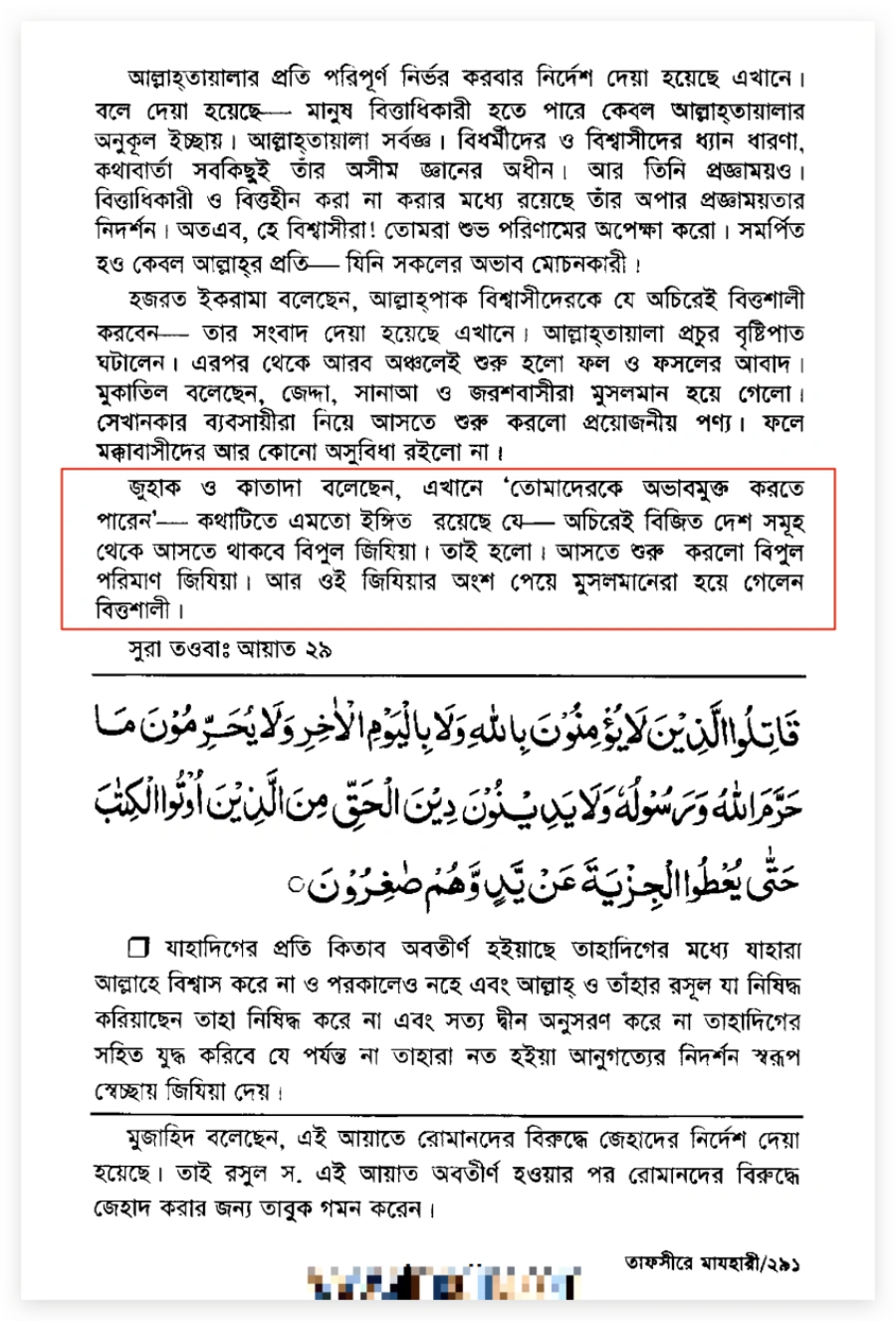
Read together, Qur’an 9:28–29 reveals a strong fiscal interest behind offensive jihad, alongside the vocabulary of ‘preaching’ and ‘establishing the true religion.’ When Muslims feared poverty after losing the commercial presence of polytheists, the alternative source of income set out was warfare against non-Muslims, their political subjection, and jizya revenues to enrich the Muslim state. Offensive jihad must therefore be analyzed as an integrated system of military conquest and economic exploitation, not merely as a question of religious ideals.
The Linguistic and Ideological Meaning of Jizya: The Relationship Between Ransom for Life and Subjugation
Translating jizya simply as ‘tax’ conceals its social, political, and psychological implications. Etymologically the word is linked to the Arabic root jazāʾ, conveying recompense, requital, or punishment. In the classical interpretations of fiqh and tafsir examined here, it is treated as a payment or penalty for the non-Muslim’s unbelief. Rather than a charge for public services or ordinary civic benefits, it is a burden imposed for continuing to exist as an unbeliever under Islamic rule. Despite attempts by modern commentators to present it as ordinary taxation, important classical sources explicitly characterize it as punitive.
The wording in Tafsir al-Jalalayn is especially stark. Its Bengali commentary explains the term jizya through jazāʾ and describes an unbeliever as someone notionally liable to the death penalty, but granted the opportunity to remain alive and secure in the dār al-Islām rather than having that penalty enforced. [6]. Jizya thus becomes the price of securing permission to live—a form of ransom that averts death. In this formulation the state’s guarantee of safety can be forfeited if the payer refuses the terms.
Tafsir al-Jalalayn, Arabic–Bengali edition, volume 2 (tenth juz’), page 653.
That is, fight in jihad against those among the People of the Book who do not believe in Allah or the Hereafter.
Mujahid said that this verse was revealed when the Prophet was commanded to wage jihad against the Romans; following its revelation, he went on the expedition to Tabuk.
— [Ma’ariful Qur’an by Idris Kandhlawi, vol. 3, p. 308; Tafsir al-Mazhari, vol. 5, p. 235.]
When four faults are found among the People of the Book, namely Jews and Christians, fighting them in jihad becomes obligatory. They are:
1. They do not believe in Allah: they claim that Jesus and ‘Uzayr are sons of Allah [God forbid], thereby denying His oneness.
2. They do not believe in the Hereafter: Jews think only they will enter Paradise, while Christians think Paradise belongs only to them; Jews say the Fire will touch them only for a few days before they are saved. Jews and Christians also maintain that the blessings of Paradise resemble those of this world and differ about whether Paradise lasts forever. These claims are taken to establish that they do not genuinely believe in the Hereafter.
3. They do not acknowledge as forbidden the things Allah and His Messenger have prohibited. There are two possible meanings. (a) They reject the prohibitions set down in the Qur’an and the Prophet’s practice. (b) They also disregard the prohibitions in the Torah and Gospel, having altered those scriptures and devised laws of their own. Some commentators say ‘Messenger’ here refers to the messenger whom they claim to follow but disobey, since Moses and Jesus reportedly instructed them to follow Muhammad, the final and greatest prophet.
4. They do not accept the true religion. Qatada said that the word ‘truth’ in this expression signifies Allah, so the passage condemns those who do not follow the true religion of Allah. Another verse says that the only religion accepted by Allah is Islam, which they do not embrace.
Jizya and kharaj: Jizya is a tax collected in exchange for the lives of unbelievers. The word derives from jazāʾ, signifying that you are a person guilty of an offense deserving the death penalty. You are nevertheless granted the opportunity to avoid having that penalty carried out and are permitted to reside securely in the dār al-Islām. You have not been killed or enslaved. Just as the payment of a ransom averts a death sentence, collecting jizya prevents the rule of execution from taking effect.
Second, the Islamic state confers another benefit by assuming responsibility for protecting your life, property, honor, and dignity, just as it protects those of Muslims. Under Sharia, the protection of life and property is equally the state’s responsibility for Muslims and non-Muslims. An Islamic state is one whose constitution is based on Islamic Sharia and where Islamic laws are enforced. Kharaj, meanwhile, is the tax levied on the land of non-Muslim subjects.
In other words, fight those among the People of the Book who do not believe until they pay jizya, the non-Muslim tax, in a humiliated condition. The expression ‘an yadin in the verse has been understood as submission or as a requirement that non-Muslims pay jizya directly with their own hands rather than through someone else.
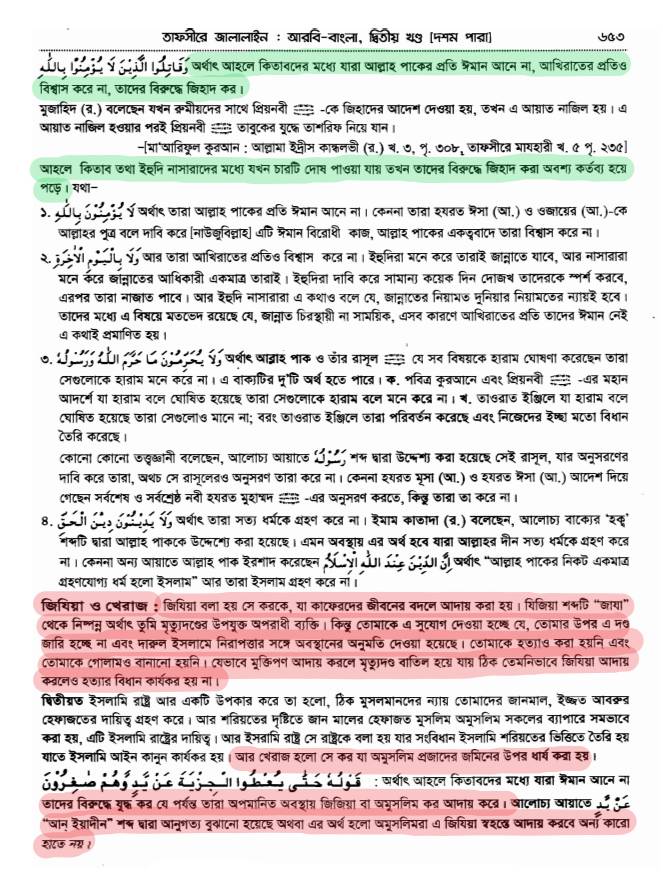
An important distinction is often obscured: the difference between jizya and kharaj. Kharaj is a land tax associated with land held or cultivated in conquered territories; jizya is a poll tax levied on non-Muslim persons on account of their religious status. Kharaj belongs primarily to the sphere of land and revenue, whereas jizya functions as a marker of subjection. The payment allows defeated non-Muslims to remain in their religion and survive under the authority of the victorious Muslims rather than face the alternative of warfare, death, or enslavement. In that sense it is a ‘tax for protection’—but crucially, the threat from which protection is bought comes from the same military-political power that demands the tax. The recurring Qur’anic and juristic association is one of payment in a lowly and humiliated condition, publicly acknowledging the conquerors’ superior status. Modern research on formative Islamic jurisprudence likewise places jizya within a framework of submission to political authority rather than treating it as a transaction detached from the state’s hierarchy. The cited Bukhari chapter and commentaries mention humiliation in relation to jizya, while particular practices of personal attendance and physically unequal postures of collector and payer are discussed in later juristic works [7]. The following quotation from Bukhari concerns the term ‘humiliated.’
Chapter 1961: Accepting jizya from the dhimmis and concluding truces with the people of war. The word of Allah: ‘Fight those who do not believe in Allah and the Last Day, and do not consider forbidden what Allah and His Messenger have forbidden…’ (9:29). The root of
مسكينisمسكنة, meaning ‘poor’ or ‘needy’;أسكن من فلانmeans ‘more needy than such-and-such a person.’ It does not derive fromسكون.صَاغَرُونَmeans ‘humiliated.’ Jizya may be collected from Jews, Christians, Zoroastrians, and non-Arabs. Ibn ‘Uyayna reported from ‘Abd Allah ibn Abi Najih: I asked Mujahid why people in Syria paid four dinars while those in Yemen paid one dinar. He replied: ‘It was assessed according to their means.’

Consider the treatment of jizya in a book published by IslamHouse and edited by Dr. Muhammad Abu Bakr Zakaria: does it describe the tax as humiliating or honorable? [8].
Jizya is a sign of degradation, humiliation, and unbelief:
Allah’s words حَتَّى يُعْطُوا الْجِزْيَةَ, ‘until they pay jizya,’ mean that if they do not embrace Islam, then عَنْ يَدٍ, ‘by hand,’ signifies that they are defeated and compelled, and وَهُمْ صَاغِرُونَ, ‘in submission,’ means that they are humiliated and degraded. Accordingly, honoring dhimmis or elevating them above Muslims is not permitted; rather they are to remain lowly, without honor, and wretched. Sahih Muslim reports from Abu Hurayra that the Prophet said: ‘Do not initiate greetings to Jews and Christians; when you encounter any of them on the road, compel them to take the narrowest part of it.’ This is why the Commander of the Faithful ‘Umar ibn al-Khattab imposed the well-known humiliating conditions upon them. Hadith scholars narrated this from ‘Abd al-Rahman ibn Ghanm al-Ash‘ari, who said: ‘I wrote down on behalf of ‘Umar ibn al-Khattab the conditions of the peace agreement concluded with the Christians of al-Sham.’


Who Is Subject to Jizya: Polytheists and Juristic Deviations
The scope of jizya reveals a substantial doctrinal gap between its scriptural category and the extensions later made for political reasons. Qur’an 9:29 gives a specific command concerning payment of jizya. The verse reads:
Fight those among the People of the Book who do not believe in Allah or the Last Day, do not regard as forbidden what Allah and His Messenger have forbidden, and do not adopt the true religion, until they pay the tax willingly in a state of subjection.
— Taisirul Quran
Fight those among the People of the Book who do not believe in Allah and the Last Day, do not regard as unlawful what Allah and His Messenger have made unlawful, and do not accept the true religion, until they pay jizya with their own hands in submission.
— Rawai al-Bayan
Fight those among the people given the Scripture who do not believe in Allah or the Last Day, do not consider forbidden what Allah and His Messenger have forbidden, and do not follow the true religion, until they pay jizya with their own hands in submission.
— Dr. Abu Bakr Muhammad Zakaria
The explicit wording of this Qur’anic passage establishes the author’s argument that its stated addressees are the People of the Book. During Muhammad’s lifetime and the rule of the first caliph Abu Bakr, Arabian idolaters, under the interpretation discussed here, were presented with ‘Islam or the sword’ rather than a third option of protection in exchange for jizya: they were to convert or face warfare.
An exception arose for the Magians or Zoroastrians during Muhammad’s era. Because they practiced fire worship, the Companions initially questioned whether taking jizya from them was lawful. A striking theological explanation was attributed to ‘Ali: the Magians had originally followed the law of Adam and possessed a divinely revealed book, but one of their kings, while intoxicated, married his own sister and then burned or corrupted their scripture to legitimize the act. This account presented the Magians as originally belonging to the People of the Book. Muhammad is reported to have said, ‘Treat them according to the practice applied to the People of the Book’ (sunnū bihim sunnata ahl al-kitāb), a separate precedent invoked to justify collecting jizya from them.

In the Indian subcontinent the definition of those liable to jizya was greatly expanded through a controversial interpretation of Hanafi jurisprudence. Abu Hanifa’s position permitted jizya to be imposed upon non-Arab polytheists and idolaters, reasoning that where enslavement was permissible, taxation through jizya could also be permissible. This juristic extension facilitated the imposition of jizya upon India’s idol-worshipping communities. Although it allowed Hindus and Buddhists to preserve their lives and remain under Muslim rule, it also exposed them to a prolonged system of discriminatory taxation. Rulers from Muhammad ibn Qasim onward, including rulers of the Mughal period, classified many non-Muslim populations as dhimmis, in part because the fiscal and political consequences of refusing such arrangements would have been considerable. The result was an economically consequential extension of the original scriptural classification.
The article contrasts that extension with a strict rule attributed to the caliph ‘Umar: when faced with conquered polytheists he reportedly rejected jizya as an alternative to conversion and death. Under that rule, polytheists were offered Islam or battle, with no religious protection in return for payment. In India, however, jurists and rulers applied the broader Hanafi permission. It spared many conquered inhabitants from killing or enslavement while making possible an oppressive fiscal regime under which they could be subjected to jizya for generations.
Sahih al-Bukhari (Islamic Foundation edition)
48. Jihad
Chapter 1961: Accepting jizya from dhimmis and concluding peace treaties with belligerents; and Allah’s statement: ‘Fight those who do not believe in Allah or the Last Day and do not treat as unlawful what Allah and His Messenger have forbidden…’ (9:29). The root ofمسكينisمسكنة, meaning poor or needy;أسكن من فلانmeans more needy than so-and-so. It does not derive fromسكون.صاغرونmeans ‘humiliated.’ Jizya may be collected from Jews, Christians, fire-worshippers, and non-Arabs. Ibn ‘Uyayna narrated from ‘Abd Allah ibn Abi Najih: I asked Mujahid why four dinars were taken from the people of Syria but one from those of Yemen. He replied: ‘It was assessed according to their means.’
Islamic Foundation number: 2935; international numbers: 3156–3157.
2935. ‘Ali ibn ‘Abd Allah … ‘Amr ibn Dinar reported: I was sitting near the steps of Zamzam with Jabir ibn Zayd and ‘Amr ibn Aws in the year 70 AH, when Mus‘ab ibn al-Zubayr performed the pilgrimage with the people of Basra. Bajala then told them: ‘I served as a scribe to Jaz’ ibn Mu‘awiya, uncle of al-Ahnaf. A year before ‘Umar ibn al-Khattab died, we received a letter from him instructing us to separate Magians married to their prohibited relatives. ‘Umar did not take jizya from the Magians until ‘Abd al-Rahman ibn ‘Awf testified that Allah’s Messenger had taken it from the Magians of Hajar.’ [The Persian fire-worshippers are called Magians.]
Hadith classification: Sahih (sound)
Narrator: ‘Amr ibn Dinar.
Sunan al-Darimi (HadithBD)
17. Book of Military Expeditions
Chapter 58: Collecting jizya from Magians or fire-worshippers
2539. ‘Amr reported from Bajala: I heard him say that ‘Umar did not accept jizya from the fire-worshippers until ‘Abd al-Rahman ibn ‘Awf testified that Allah’s Messenger had collected jizya from the fire-worshippers of a place called Hajar. [1]
[1] Verification: Its chain meets the conditions of al-Bukhari.
References: al-Bukhari, Book of Jizya, 3156; a full tracing is given in Musnad al-Mawsili 860 and 861 and Musnad al-Humaydi 64.
Hadith classification: Sahih (sound).
Let us now examine the explanation Ibn ‘Abbas gave for collecting jizya from the Magians, an argument presented as evidence that membership in the People of the Book was a prerequisite.
Sunan Abi Dawud (Islamic Foundation edition)
14. Taxes, Land Revenue, Grants, and Administrative Duties
Chapter 169: Collecting jizya from fire-worshippers
3032. Ahmad ibn Sinan al-Wasiti … narrated from Ibn ‘Abbas that when the prophet of the Persians died, Iblis induced them to worship fire, leading them astray.
Hadith classification: Hasan (fair)
Narrator: ‘Abd Allah ibn ‘Abbas.
The Purpose, Humiliation, and Collection of Jizya in Classical Tafsir and Fiqh
Classical Islamic discussions of jizya show that it cannot be understood solely as a fiscal tax or administrative revenue. Around the Qur’anic command in 9:29, وَهُمْ صَاغِرُونَ (‘while they are humbled’), exegetes, jurists, and theorists of the Islamic state have examined its purpose, justification, collection procedures, and the political status of dhimmis. Their vocabulary repeatedly links jizya to صغار (abasement or subjection), إذلال (humiliation), عقوبة (punishment), and submission to Muslim political authority.
Ibn Kathir and Tafsir al-Mazhari first show how ṣāghirūn refers not just to payment but to the non-Muslim’s defeated, subordinate, and humiliated condition. Ibn al-Qayyim’s Ahkam Ahl al-Dhimma then rejects the idea that jizya is rent for living in Islamic territory or an ordinary public-service fee, describing it instead through the categories of humiliation and punishment. Al-Mawardi’s al-Ahkam al-Sultaniyya treats dhimmi status and jizya as institutional political arrangements in which non-Muslim security is contingent upon subjection to Muslim rule and fulfillment of specified conditions.
Hanafi sources including al-Sarakhsi’s al-Mabsut and Ashraful Hidaya are then examined for explanations of jizya as punishment, an alternative to killing, a consequence of unbelief, and a means of humbling dhimmis. The later governmental and legal arrangement of those Hanafi principles appears in Fatawa Alamgiri. Ibn Qudama’s al-Mughni provides another perspective from Hanbali jurisprudence on the terms of dhimmi status and jizya, demonstrating that the issue extends beyond one isolated opinion within a single school.
Finally, contemporary Islamic fatwas are considered to trace the continuity of the same legal framework. The sequence—accept Islam, pay jizya, or face war upon refusing both—continues to appear in conservative legal answers based on classical sources. Taken together, these sections examine jizya not as neutral taxation but as a normative legal framework for political submission, religiously differentiated status, and subordination.
Ibn Kathir: Jizya, Saghār, and the Subordination of Non-Muslims
Qur’an 9:29 commands fighting the People of the Book until they ‘pay jizya with their own hands while in the state of ṣāghirūn.’ The word صَاغِرُونَ is central to the political and social meaning of this tax. Modern interpretations sometimes reduce it to accepting state authority or obeying ordinary laws, but Ibn Kathir’s classical exegesis does not use such neutral language. His interpretation directly associates the payer with defeat, compulsion, inferiority, and humiliation.
Ibn Kathir first explains عَنْ يَدٍ (‘from the hand’) as domination established through Muslim power and victory. He then explains وَهُمْ صَاغِرُونَ by combining Arabic terms meaning lowly, contemptible, and humiliated. In his account, jizya is not a payment made by one of two equal citizens under a neutral tax category, but a payment made to victorious Muslim political authority by a conquered and subordinate population. [9]
حَتَّى يُعْطُوا الْجِزْيَةَ أَيْ: إِنْ لَمْ يُسْلِمُوا، عَنْ يَدٍ أَيْ: عَنْ قَهْرٍ لَهُمْ وَغَلَبَةٍ، وَهُمْ صَاغِرُونَ أَيْ: ذَلِيلُونَ حَقِيرُونَ مُهَانُونَ
English translation: ‘Until they pay jizya,’ meaning if they do not embrace Islam; ‘by hand,’ meaning through conquest and domination over them; and ‘while they are ṣāghirūn,’ meaning they are lowly, contemptible, and humiliated.
Ibn Kathir goes further. Immediately after this explanation he says dhimmis may not be honored or raised above Muslims. To support that position he cites the hadith in Sahih Muslim in which Muhammad forbids Muslims to initiate greetings of peace to Jews and Christians and commands them to force such people toward the narrowest part of the road. Thus, for Ibn Kathir, ṣaghār is not simply a formality occurring at the instant of payment: it is linked to the dhimmi’s generally inferior social position. In the same commentary he records humiliating conditions from the covenant traditionally attributed to ‘Umar. [10]
فَلِهَذَا لَا يَجُوزُ إِعْزَازُ أَهْلِ الذِّمَّةِ وَلَا رَفْعُهُمْ عَلَى الْمُسْلِمِينَ
English translation: ‘For this reason it is not permissible to honor the People of the Covenant or elevate them above Muslims.’
This passage further exposes the inadequacy of presenting jizya merely as a ‘security tax.’ If the aim were nothing more than collecting payment for state protection, there would be no reason to describe the taxpayer as ذليل (lowly), حقير (contemptible), and مهان (humiliated), nor to introduce a prohibition on raising dhimmis to a rank equal or superior to Muslims. Ibn Kathir’s own interpretation presents jizya as both revenue collection and a visible symbol of non-Muslims’ political defeat and social subordination.
More significantly, Ibn Kathir reads Qur’an 9:28 and 9:29 together, discussing Muslims’ fear of commercial losses when polytheists were prohibited from entering the Sacred Mosque. According to him, Muslims feared that their markets and income would decline if trade with polytheists stopped. The subsequent command to fight the People of the Book and collect jizya answered those economic concerns. His commentary thus treats jizya as both a marker of subordination and a source of revenue for the Muslim state. [11]
فَعَوَّضَهُمْ عَنْهَا بِمَا شَرَعَهُ لَهُمْ مِنْ قِتَالِ أَهْلِ الْكِتَابِ حَتَّى يُسْلِمُوا أَوْ يُعْطُوا الْجِزْيَةَ
English translation: God compensated them for that loss by instituting fighting against the People of the Book until they embraced Islam or paid jizya.
Three aspects of jizya thus emerge from Ibn Kathir’s explanation: it follows military and political victory; it is directly associated with ṣaghār, a degraded and subordinate condition; and it produces recurring financial benefits for the Muslim state from conquered peoples. Presenting it simply as ‘payment for protection’ suppresses these central elements of his commentary. The payer must not merely hand over money, but submit to the victorious Muslim political power and acknowledge an inferior rank. The full relevant passage from Ibn Kathir is reproduced below [12].
The body of a polytheist is not inherently impure, for Allah has made the food of the People of the Book lawful for Muslims. Some members of the Zahiri school, however, maintain that the polytheist’s body is impure. Ash‘ath related from Hasan al-Basri that anyone who shakes hands with a polytheist should perform ablution. Ibn Jarir also reported this opinion from Hasan al-Basri.
وَإِنْ خِفْتُمْ عَيْلَةً فَسَوْفَ يُغْنِيْكُمُ اللَّهُ مِنْ فَضْلِهِ إِنْ شَاءَ
“If you fear poverty, Allah will enrich you out of His bounty, if He wills.”
Muhammad ibn Ishaq said: When polytheists were forbidden to enter the Sacred Mosque, some Muslims said: “Our markets will become idle, our commerce and trade will cease, and we shall lose the income we earned through trade with the polytheists. Poverty and financial hardship will befall us.” Then Allah revealed the following verse:
وَإِنْ خِفْتُمْ عَيْلَةً فَسَوْفَ يُغْنِيكُمُ اللهُ مِنْ فَضْلِهِ إِنْ شَاءَ إِنَّ اللَّهَ عَلِيمٌ حَكِيمٌ، قَاتِلُوا الَّذِينَ لا يُؤْمِنُونَ بالله
That is: “If you fear poverty, Allah will enrich you by His grace through some other means, if He wills.” He is wise and fully aware: He knows when and for whom a particular ruling should be instituted. Fight those among the People of the Book who do not believe in Allah or the Last Day, do not regard as forbidden what Allah and His Messenger have forbidden, and do not follow the true religion, until they pay jizya in a humiliated state while you are victorious.
In the first verse Allah forbade the believers from allowing polytheists to enter the Sacred Mosque, giving rise to fears that their trade would suffer and they would fall into poverty. In the second verse, Allah removed that concern by commanding believers to collect jizya from the People of the Book. Similar interpretations have been transmitted from Ibn ‘Abbas, Mujahid, ‘Ikrima, Sa‘id ibn Jubayr, Qatada, Dahhak, and other commentators.
إِنَّ اللَّهَ عَلَيْمٌ حَكِيمٌ means that Allah knows best which actions will bring you benefit, and in commanding some things and forbidding others He acts with wisdom. His acts and words are consummately wise, and He is the most just in His commands to creation. Hence He rewarded their jihad through victory and the acquisition of jizya from conquered dhimmis.
قالُوا الَّذِيْنَ لَا يُؤْمِنُونَ بِالله means that the scriptural communities claim to believe in previous prophets, yet in reality, according to this interpretation, they believe in none of them. They lack a sincere desire for truth; if they possessed it, they would have believed in Allah’s Messenger Muhammad, the greatest of His messengers. Their claim to believe in the earlier prophets is false. Had they truly believed in those prophets, they would have believed in Muhammad, for all the preceding prophets had foretold his coming and ordered people to follow him. Even when the People of the Book observe certain prescriptions of earlier religious laws, this is not genuine belief in those prophets but adherence motivated by inherited customs or worldly benefit. Such obedience is not true faith and will be of no avail to them.
On the basis of this verse, some jurists hold that jizya cannot be collected from any people other than the People of the Book and comparable communities, such as the Zoroastrians. Jizya may be taken from Zoroastrians because an authentic hadith states that the Prophet collected it from the Zoroastrians of Hajar (هج). Al-Shafi‘i and, according to the well-known report, Ahmad held this opinion. Abu Hanifa said jizya should be taken from every non-Arab unbeliever, whether from the People of the Book or from polytheists, but among Arabs only the People of the Book were liable. Malik said it may be taken from any unbeliever—scripturalist, Zoroastrian, idolater, or otherwise.
This is not the place to discuss the arguments for and against those positions, so they have been omitted. Allah knows best.
حَتَّى يُعْطُوا الْجِزْيَةَ عَنْ يُدِ وَهُمْ صَاغَرُونَ means that, unless they embrace Islam, they are to pay jizya with their own hands while Muslims are victorious and they themselves are subdued, disgraced, and humiliated. Hence Muslims are forbidden to honor a dhimmi or elevate such a person above Muslims.


Tafsir al-Mazhari: Humiliating Methods of Collecting Jizya
The meaning of وَهُمْ صَاغِرُونَ, ‘while they are ṣāghirūn,’ was not restricted in classical exegesis to political submission alone. In Tafsir al-Mazhari, composed by the Hanafi scholar Qadi Muhammad Sanaullah Panipati, the explanation of Qur’an 9:29 explicitly calls jizya a sign of abasement. Under the expressions عَنْ يَدٍ and صَاغِرُونَ it presents forms of collection through which the payer manifests not only financial compliance but social and political inferiority. [13]
الْجِزْيَةُ … عَلَامَةُ الصَّغَارِ … وَقِيلَ مَعْنَى عَنْ يَدٍ أَنْ يُعْطِيَهَا بِيَدِهِ لَا بِيَدِ غَيْرِهِ … وَقِيلَ مَعْنَاهُ أَنْ يُعْطِيَهَا عَنْ ذُلٍّ وَقَهْرٍ … وَهُمْ صَاغِرُونَ أَيْ أَذِلَّاءُ مَهَانُونَ مَقْهُورُونَ
English translation: Jizya is a sign of abasement and inferiority. One explanation of ‘by hand’ is that the dhimmi pays it personally rather than through another person. Another is that it is paid in humiliation and subjugation. ‘While they are ṣāghirūn’ means lowly, humiliated, and subdued.
What is most significant in Tafsir al-Mazhari is that ṣaghār is not defined merely as obedience to the laws of the state. It is linked to inferior social standing, political defeat, and visible subordination in the act of paying jizya. Al-Mazhari cites interpretations attributed to Ibn ‘Abbas, ‘Ikrima, Abu ‘Ubayda, al-Kalbi, and others. In one such interpretation the Muslim collector sits while the dhimmi stands; others speak of striking the payer on the neck, pulling the beard, or dragging a dhimmi by the collar. This is a classical exegetical tradition in which degradation is made part of the public collection procedure. [14]
قال عكرمة: يكون الآخذ جالسًا والمعطي قائمًا … وقيل: توضع أيديهم في أعناقهم حين تؤخذ منهم الجزية، وقال الكلبي: يُلكَزون في أعناقهم عند الأداء، وقيل: تؤخذ بلحاهم ويُضربون في لهواتهم، وقيل: يؤخذ بتلبيب الذمي ويُجر إلى موضع الأداء
English translation: ‘Ikrima said: The collector shall be seated and the payer shall stand. Another opinion says that their hands should be placed on their necks when jizya is taken. Al-Kalbi said: They are struck on the neck at the time of payment. Others said they are taken by the beard and struck on the jaw or throat, or a dhimmi is seized by the collar and dragged to the place of payment.’
These reports are not all presented by al-Mazhari as equally binding legal prescriptions: he is recording a range of earlier interpretations. Their significance is that humiliation, physical subjection, and the visible degradation of dhimmis formed part of the recognized exegetical discourse surrounding ṣāghirūn. The claim that it meant merely visiting a tax office and paying a neutral state levy does not reflect this strand of classical interpretation.
Al-Mazhari further records an interpretation according to which the payer should hand over jizya believing that Muslims have done them a favor by accepting the payment and sparing their life. Here jizya is not a contract between citizens of equal standing but a reprieve from death extended as a favor by the victorious Muslim authority. [15]
وقيل: معنى عَنْ يَدٍ أن يعطوها معتقدين أن المسلمين قد أحسنوا إليهم بقبول الجزية منهم وإبقائهم على الحياة
English translation: Another interpretation holds that paying ‘by hand’ means paying while believing that Muslims have shown them favor by accepting jizya and allowing them to remain alive.
A further feature of al-Mazhari’s discussion is that payment is explicitly linked to political surrender. In commenting on Qur’an 8:39—‘until religion belongs entirely to Allah’—he says that the intended meaning is not necessarily converting every individual to Islam. Instead, it is the establishment of قهر، غلبة، استسلام، سلطان، ملك، حكم: coercive domination, victory, surrender, sovereignty, political rule, and government. Even where non-Muslims do not convert, fighting ceases if they pay jizya and accept that political supremacy. [16]
حَتَّى لَا تَكُونَ فِتْنَةٌ أَيْ فَسَادٌ فِي الْأَرْضِ يَعْنِي حَتَّى يُسْلِمُوا أَوْ يُعْطُوا الْجِزْيَةَ عَنْ يَدٍ وَهُمْ صَاغِرُونَ … بَلِ الْمُرَادُ مِنْهُ الْقَهْرُ وَالْغَلَبَةُ وَالِاسْتِسْلَامُ وَالسُّلْطَانُ وَالْمُلْكُ وَالْحُكْمُ
English translation: ‘Until there is no more fitna’ means until such disorder has disappeared from the earth, that is, until they embrace Islam or pay jizya by hand while subdued. Here ‘religion’ does not mean religious conviction alone; it denotes domination, victory, submission, authority, sovereignty, and rule.
Three dimensions thus emerge in Tafsir al-Mazhari: first, jizya is a sign of ṣaghār, or an inferior and defeated condition; second, the commentary preserves several classical descriptions of public humiliation or physical degradation during collection; and third, payment permits non-Muslims to remain within their religion only under Muslim political authority and sovereign control. Against this material, describing jizya merely as an ordinary modern ‘security tax’ conceals the political hierarchy and language of classical exegesis. For Bengali readers, the long passage on jizya as a sign of humiliation and on the methods of collection is reproduced below [17].
Surah al-Tawbah, verse 29
قَاتِلُوا الَّذِينَ لَا يُؤْمِنُونَ بِاللَّهِ وَلَا بِالْيَوْمِ الْآخِرِ وَلَا يُحَرِّمُونَ مَا حَرَّمَ اللَّهُ وَرَسُولُهُ وَلَا يَدِينُونَ دِينَ الْحَقِّ مِنَ الَّذِينَ أُوتُوا الْكِتَابَ حَتَّى يُعْطُوا الْجِزْيَةَ عَنْ يَدٍ وَهُمْ صَغِرُونَ
∎ Fight those among the People given the Book who do not believe in Allah or the Last Day, who do not regard as forbidden what Allah and His Messenger have forbidden, and who do not follow the true religion, until they pay jizya submissively as a sign of obedience, while humbled.
Mujahid said that this verse commands jihad against the Romans. Thus, after the verse was revealed, the Messenger went to Tabuk to undertake jihad against the Romans.
First it says, ‘Among those given the Book, those who do not believe in Allah and the Last Day.’ The expression ‘those given the Book’ refers here to Jews and Christians. They lack correct belief in Allah and the Hereafter.
An objection: Jews and Christians do believe in Allah and the Hereafter. Why are they nevertheless described here as unbelievers?
Response to the objection: Jews and Christians do not believe in Allah in the manner they have been commanded to believe; they believe according to rules they have invented. Such faith is unacceptable to Allah. Allah is eternally self-sufficient. He is neither anyone’s child nor anyone’s father. Yet the Jews call Uzayr a son of Allah, and Christians call Jesus a son of Allah. What remains of their ‘faith’ when they make such claims? Nor do they hold correct belief in the Hereafter. They think Paradise is assured to them. The Jews say that even if they enter Hell they will remain there only for a few days. They also say that Paradise resembles the world, that eating and drinking may occur there as in this world, or perhaps not. Can those with such ideas about the Hereafter be called believers? It should also be noted that the Mu’tazilites do not hold correct belief in the Hereafter.
Next it says, ‘And do not regard as forbidden what Allah and His Messenger have forbidden.’ This means that the Jews and Christians do not recognize as forbidden what Allah and His Messenger Muhammad have declared forbidden. Some scholars say that ‘Messenger’ here does not mean Muhammad Mustafa but rather the prophets of those communities themselves, namely Moses and Jesus. These prophets instructed the Jews and Christians to follow Muhammad when he appeared as the final messenger. But they have disobeyed that command. They have not followed him, and instead continuously plot against and oppose him.
Next it states, ‘And do not follow the true religion.’ Qatada said that dīn al-ḥaqq (‘true religion’) means the religion of Allah. Some say it means Islam. Abu Ubayda said that ‘do not follow the true religion’ means that Jews and Christians do not submit to the followers of the true religion.
Finally it says, ‘Fight them until they pay jizya willingly, in a humbled state, as a sign of submission.’
The lexical meaning of the word jizya is compensation or recompense. Its final letter ta expresses requital. Jizya is a sign of humiliation. Those designated by jurists as liable to jizya must pay the tax.
Some say the word jizya derives from jazā daynahu, meaning ‘he repaid his debt.’ Here ʿan yad means as a sign of submission. Yad means ‘hand,’ and here signifies the hand of obedience. Thus jizya must be paid personally, not through someone else. Ibn Abbas said that the dhimmis—unbelievers required to pay this tax—must pay it by their own hands and cannot appoint anyone else to do so. Alternatively, ʿan yad may mean payment in disgrace. Abu Ubayda said that unbelievers must pay jizya with the bitter sensation of compulsion and fear. Arabs describe compulsory giving with the expression fulānun aʿṭā ʿan yad. Others interpret ʿan yad as payment in cash, not on credit. Yet others say it means paying in gratitude, with the attitude: ‘The Muslims are very generous, and have mercifully agreed to accept jizya from us and keep us alive.’
Ṣāghirūn means humbled, humiliated, and defeated. Ikrima said that the collector should remain seated while the payer stands before him. One report says jizya should be collected with the payers’ shoulders trampled underfoot. Al-Kalbi said their necks may be struck with a fist to acknowledge receipt. Others say their beards may be seized and they may be slapped while paying jizya. Some say the dhimmi may be seized by the collar and forcibly dragged to the place where his money is kept. Some scholars say that imposing jizya upon people of other religions is itself an act of humiliating them. Imam al-Shafi’i said that bringing dhimmis under Islamic law means subduing them.
The verse under discussion orders fighting only the People of the Book and collecting jizya from them. It says nothing here about other unbelievers. Thus, after conquering the lands of other unbelievers during his caliphate, Umar initially did not impose jizya upon them. When Abd al-Rahman ibn Awf testified that the Messenger had also authorized collecting jizya from fire worshipers, Umar applied it to those other unbelievers as well. Al-Bukhari reports this narration through Bajala ibn Abada. Imam al-Shafi’i said that Bajala was an unknown narrator, yet in the chapter on jizya in his own work he called the report transmitted through him authentic. The legitimacy of imposing jizya on fire worshipers therefore became a matter of consensus.
Disagreement: Imam Abu Hanifa said that jizya may be taken from Jews and Christians, Arab and non-Arab alike. It may also be collected from non-Arab polytheists, whether they are fire worshipers or idolaters. Jizya cannot be taken from apostates. Imam Abu Yusuf said that jizya cannot be taken from any Arabs, whether Jews, Christians, idolaters, or fire worshipers. It may be taken only from non-Arab People of the Book and polytheists.
Imam Malik and Imam al-Awza’i said that jizya may be collected from unbelievers everywhere, Arab and non-Arab, but not from apostates or the polytheists of Quraysh. Imam al-Shafi’i said that jizya should not be imposed on individuals, but on the community of unbelievers. Accordingly, it may be collected from Arab and non-Arab Jews and Christians but not from idolaters in general; in al-Shafi’i’s view, however, fire worshipers are included among the People of the Book. Malik in his Muwatta and al-Shafi’i in his Al-Umm report through Ja’far ibn Muhammad, from his father, that Umar once said, ‘I do not know what to do about the fire worshipers.’ Abd al-Rahman ibn Awf replied, ‘I heard the Messenger himself say that they should be treated according to the practice applied to the People of the Book.’
Imam al-Shafi’i said that Sufyan transmitted to him from Sa’id ibn Marzuban a report of Nasr ibn Asim. In that report, Farwa ibn Nawfal asked, ‘On what basis should jizya be taken from fire worshipers? They are not People of the Book.’ Masturad became angry, immediately stood, seized Farwa by the collar, and shouted, ‘Enemy of Allah! How dare you condemn Abu Bakr, Umar, and Ali! They took jizya from the fire worshipers.’ Masturad then went to the caliph’s residence. Ali said, ‘I know more about the fire worshipers than others do. They too had religious knowledge and scripture. They studied and taught it. Once their king, while intoxicated, embraced his mother or his daughter. The incident …’
… became known. Their scholars said that under their scripture the king must be punished. The king assembled his subjects and said, ‘Whose religion could be better than that of Adam, the first prophet? He married his own sons to his own daughters. I follow his religion.’
‘You too should follow the religious practice of Adam.’ The people accepted the king’s decree, and his opponents were killed. Their community of scholars was destroyed in one night. This is why fire worshipers too count among the People of the Book. The Messenger himself, Abu Bakr, and Umar collected jizya from them. Ibn al-Jawzi mentioned this report in Al-Taḥqīq but also recorded criticism of Sa’id ibn Marzuban. Yahya ibn Sa’id said, ‘I do not consider Sa’id ibn Marzuban’s narration reliable.’ Yahya ibn al-Qattan said, ‘He is unacceptable; his reports are not even worth recording.’ Khallas called Sa’id ibn Marzuban abandoned. Abu Usama, however, regarded him as reliable. Abu Zur’a said he was truthful but a mudallis (one who obscures his sources).
I say: Abu Yusuf’s Kitāb al-Kharāj reports through Sufyan ibn Uyayna from Nadr ibn Asim that Ali said: ‘The Messenger of Allah, Abu Bakr, and Umar collected jizya from the fire worshipers. I know their situation better than others. They were People of the Book, reading their scripture and teaching its laws, but divine knowledge was removed from their hearts.’ Abu Yusuf also transmitted through Nasr ibn Khalifa that Farwa ibn Nawfal al-Ashja’i once said, ‘It is hard to accept that jizya was taken from fire worshipers, since they were not People of the Book.’ Mastur ibn Ahnaf grew furious and declared, ‘You make a mockery of the Messenger’s decision. Repent immediately, or I shall kill you. The Messenger collected tax from the fire worshipers dwelling in Tawazar.’ The two then brought their dispute before Ali. Ali said, ‘I shall tell you something about the fire worshipers that will satisfy you both. They were once People of the Book. They possessed a revealed scripture and recited it. One of their kings was a heavy drinker. One day, in a drunken state, he took his own sister from the house and had intercourse with her. Four people followed and witnessed the act. When he sobered up, his sister said, “You committed such an act before four witnesses! Now you will be executed under religious law.” The king replied, “Indeed; I remember nothing of it.” His sister said, “If you heed my advice, you may escape punishment.” He replied, “Tell me; I will certainly obey you.” She told him, “Proclaim what you did to be religious law. Gather the people and say that it is the religion of Adam. Eve was made from Adam, so she was his daughter, yet they were husband and wife. We must follow the religion of the first prophet. Release those who accept your proclamation and kill with the sword anyone who rejects it.” The king obeyed her instructions, but many people refused and some rebelled. He ordered the rebels killed, yet the uprising continued. His sister said, “The people are not yet afraid. Announce that anyone who refuses your rule will be thrown into a blazing pit.” The king did so and constructed a vast fire pit.’
He announced: ‘Whoever refuses my religion will be burned alive in this pit.’ The people now became afraid and accepted the king’s decree. After recounting this event, Ali said, ‘You see, the fire worshipers were People of the Book, which is why the Messenger collected tax from them. Later they became polytheists, and marriage with them and eating animals they slaughter are therefore forbidden.’
Ibn al-Jawzi writes in Al-Taḥqīq that Ibn Abbas said: ‘After the prophet of the Persians died, Iblis led them into fire worship.’
Response: The Messenger said, ‘Treat fire worshipers as you treat the People of the Book.’ That does not establish that the fire worshipers themselves belong to the People of the Book or that every rule applicable to the People of the Book applies to them. The consensus is that marriage with fire worshipers is forbidden, as is eating animals slaughtered by them. The hadith means only that taxation may be imposed on them as it is on the People of the Book. We also learn from the hadith that their ancestors were People of the Book, who read and preached Allah’s scripture. But when they abandoned Allah’s religion and turned away from the scripture, divine knowledge was removed from their hearts. Iblis made them fire worshipers. Since then, they have not been People of the Book, which is why scholars say they are not. One report from al-Shafi’i says they are People of the Book; according to another report his view agrees with that of the majority, namely that they are not.
I say: If the ancestors of fire worshipers were People of the Book, there is no reason to deny that designation to them. On the same basis, the Hindu idolaters of our country could also be regarded as People of the Book, for they possess a scripture called the Veda, comprising four parts, collectively known as the four Vedas. Many of the rules in those Vedas resemble rules of the Sharia. There are, of course, discrepancies in their accounts, which must have arisen through Satanic interference. Satan’s machinations have also produced seventy-three sects among Muslims. Evidence that Hindus belong to the People of the Book appears in the Quran: wa im min ummatin illā khalā fīhā nadhīr—’There has been no community without a warner having passed among it.’ If fire worshipers may be called People of the Book, there is still greater reason to call Hindus so. The king of the fire worshipers committed incest with his sister while drunk, decreed laws contrary to Allah’s book, and spread his corrupt doctrine in Adam’s name. Hindus have done no comparable thing. They are nevertheless unbelievers because they reject the messengership of Muhammad. I have heard that the four Vedas contain glad tidings of the advent of the Messenger, and that some Hindus became Muslims after reading that announcement. Allah knows best.
‘Jizya may not be collected from idolaters’—this is Imam al-Shafi’i’s
view, in support of which the verse qātilūhum ḥattā lā takūna fitnah (‘Fight them until there is no persecution/fitna’) has been cited. But why go to such lengths? The verse under discussion expressly mentions taking jizya from the People of the Book, while a hadith reports its collection from fire worshipers. The Messenger is said to have collected jizya from fire worshipers living in the Hijaz.
I say: By consensus, fire worshipers are not included within the verse under discussion. Their ruling appears in hadith, and a rational basis has also been given: shirk. They are polytheists. Idolaters, like fire worshipers, are polytheists, so the same rule should apply to both. If it is argued that the ancestors of fire worshipers were People of the Book, one must also accept that the ancestors of idolaters were People of the Book. Yet neither idolaters nor fire worshipers can be called People of the Book in the present sense, because they do not follow that community’s religious code.
According to the scholars’ consensus, idolaters may be made male or female slaves just as fire worshipers may. Therefore jizya may also be collected from idolaters, as from fire worshipers. It is consequently lawful to collect jizya from them in either enslaved or free conditions. In either condition they earn their own livelihood and use that income to maintain their families and pay jizya.
Sulayman ibn Burayda narrated from his father that when the Messenger dispatched a military force, he specifically instructed its commander to fear Allah and treat his companions with compassion. He would then say: ‘Go to jihad in Allah’s name and in His way; fight those who disbelieve in Allah; keep fighting until the enemy is defeated. Do not break treaties; do not mutilate anyone by cutting off nose or ears; do not attack from behind. When you encounter the enemy, first invite them to three things. 1. Call them to accept Islam. If they accept, cease fighting. Tell them to migrate to Medina. If they do so, they will be considered Emigrants, sharing in the joys and sorrows of the Muslims. If they do not agree to go to Medina, tell them they will be regarded as Muslims living outside Medina, subject to the rules that apply to Muslims generally, but without a share of booty, fay’, or other gains obtained under treaties. 2. If they reject Islam, demand jizya; if they agree to pay it, refrain from fighting them. 3. If they refuse to pay jizya, seek Allah’s help and fight them.’ Muslim.
According to a narration from Anas, it is permissible to collect jizya from Arab People of the Book. Another of his reports states that the Messenger sent Khalid ibn al-Walid against Ukaydir, ruler of Dumat al-Jandal. Khalid captured him and brought him back. The Messenger spared Ukaydir’s life and concluded a treaty on condition that he pay jizya. Abu Dawud.
According to reports from Yazid ibn Rumman and Abdullah ibn al-Siddiq al-Akbar, the Messenger sent Khalid ibn al-Walid against Ukaydir ibn Abd al-Malik al-Kindi, ruler of Dumat al-Jandal, and granted him protection in exchange for jizya. Abu Dawud; al-Bayhaqi.
Hafiz Ibn Hajar writes that if the above hadith is accepted as reliable, jizya cannot be confined to non-Arabs; Arabs too would be liable. Ukaydir was certainly an Arab, for Banu Kinda is an Arab branch. This would also establish that jizya is not confined to the People of the Book and non-Arabs. The opinions of Abu Hanifa and Malik would then be declared sound, with only the following difference:
in Abu Hanifa’s view, jizya may not be taken from the Arab pagans, nor may they be enslaved. Ukaydir was a Christian or a fire worshiper, not a pagan.
Abd al-Razzaq and al-Zuhri narrated that the Messenger concluded treaties with Arabian pagans on various occasions but did not take jizya from them.
Abu Hanifa said that Arabian pagans were numerous and influential. The Noble Quran was revealed in their own language. They were thus insolent and denied manifest miracles. Consequently, nothing short of acceptance of Islam would be accepted from them; if they did not convert, they became liable to be killed. The same rule applied to apostates. They voluntarily embraced Islam with knowledge and understanding, then knowingly abandoned it; their ignorance was therefore inexcusable. There could be only fighting against them, not jizya.
Imam Muhammad ibn al-Hasan reports through Muslim from Ibn Abbas that the Messenger said relations with the polytheists of Arabia involve only
two alternatives: Islam or war. If idolaters and apostates are captured, their wives and children may be made male and female slaves. The Messenger made slaves of the families of the people of Awtas and Hawazin, who were Arab polytheists; the families of Banu al-Mustaliq were treated similarly. When Banu Hanifa apostatized, Abu Bakr enslaved their families and distributed them among the mujahidin. Among them were the mothers of Muhammad ibn Ali ibn Abi Talib and Zayd ibn Abdullah ibn Umar.
Once the wives and children of apostates have been captured and brought under complete control, they may be compelled to accept Islam. But the wives, sons, and daughters of polytheists are not to be invited to Islam. Imam al-Shafi’i said that the wives and children of Arab polytheists may be captured and enslaved. And
Abu Yusuf wrote that the hadith concerning Ukaydir shows that jizya was also collected from Arab unbelievers, whether People of the Book, idolaters, or fire worshipers. Other hadiths report that Jews and Christians were expelled from the Arabian Peninsula. Therefore the ruling in the hadith concerning Ukaydir must be regarded as abrogated. Residence in Arabia had been a condition for liability to jizya; once residence itself ceased to exist, the basis for levying jizya there disappeared.
Ibn Abbas narrated that the Messenger gave three instructions: 1. Expel the polytheists from the Arabian Peninsula. 2. Hold the unbelievers of other countries captive. Ibn Abbas said that the Messenger either did not utter the third instruction or that he himself had forgotten it.
Jabir ibn Abdullah narrated that Umar said: ‘I heard the Messenger say with my own ears: I shall certainly expel the Jews and Christians from the Arabian Peninsula. No one other than Muslims has a right to reside in this Arabia.’ Muslim.
Malik reported a tradition from al-Zuhri in his Muwatta. Al-Zuhri also transmitted a similar report from Abu Hurayra through Salih ibn al-Akhdar: ‘Two religions cannot exist in the Arabian Peninsula.’ Ishaq subsequently transmitted the report through his own chain.
Abu Ubayda ibn al-Jarrah narrated that the Messenger’s final
instruction was to expel the Jews from the Hijaz and the Christians from the Arabian Peninsula. Ahmad; al-Bayhaqi.
Amount of jizya: Abu Hanifa’s opinion is that jizya has no specified fixed amount; its amount is to be determined by discussion and agreement between the collector and the payer. The Messenger concluded a treaty with the people of Yemen requiring two thousand sets of garments. Abu Dawud reports from Ibn Abbas that the Messenger concluded a non-aggression treaty with the people of Najran in return for two thousand sets of clothing. Under the treaty, they had to provide one thousand sets in the month of Safar and one thousand in Rajab. Abu Yusuf writes in his Kitāb al-Amwāl that the Messenger issued the people of Najran a written decree requiring two thousand sets of clothing per year, each set worth one uqiya. Ibn al-Humam calculated from that report that each set was worth forty dirhams, not fifty as some claimed.
A set of clothes means two garments, a lower wrapper and a shawl. Such garments had to be provided as jizya assessed both on persons and on land. Abu Yusuf wrote this in Kitāb al-Amwāl. The jizya of the land was established …


Ibn al-Qayyim: Jizya Is Not Rent for Residence but Humiliation and Punishment
Modern accounts often describe jizya as an ordinary civic charge paid in return for residence, security, or state protection in Islamic territory. But Ibn al-Qayyim al-Jawziyya, a major classical Hanbali scholar, explicitly rejects that explanation in Ahkam Ahl al-Dhimma. In his discussion jizya is neither rent for housing, a residence fee, nor a neutral payment for public services. It is directly tied to ṣaghār (abasement), idh-lāl (humiliation), and ʿuqūba (punishment). These are his own legal categories in explaining its character, not terms invented by modern critics. [18]
الْجِزْيَةَ وُضِعَتْ صَغَارًا وَإِذْلَالًا لِلْكُفَّارِ لَا أُجْرَةً عَنْ سُكْنَى الدَّارِ
English translation: Jizya was instituted to abase and humiliate the unbelievers, not as rent for living in the territory.
The significance is unmistakable. If jizya were simply rent or a residence charge, there would be no connection between the payment and degradation on the basis of religious identity. Ibn al-Qayyim develops the argument: if it were rent, it would also apply to women, children, the disabled, and the blind; its term would be fixed as with rental agreements, and its value would correspond to the benefit or use received. Above all, humiliation and ṣaghār would not be conditions of collection. He therefore treats humiliation as a defining feature in rejecting the claim that jizya is rent, rather than an incidental abuse by a particular ruler. [19]
Elsewhere Ibn al-Qayyim asks whether jizya was instituted merely in exchange for sparing non-Muslim lives or whether it was also meant as punishment expressing the low status of unbelief and its adherents. In the explanation he sets out, the declared aim is to manifest the abasement of unbelief and the subjugation of non-Muslims. [20]
الْمَقْصُودُ إِظْهَارُ صَغَارِ الْكُفْرِ وَأَهْلِهِ وَقَهْرِهِمْ
English translation: The objective is to make manifest the abasement of unbelief and its adherents, and to subjugate them.
This passage lays bare the political character of jizya. Its basis is not a citizen’s income, property, or consumption of state services, but religious affiliation and subjection to Muslim political authority. Jizya imposes a financial burden while expressing the objective of keeping the non-Muslim’s unbelief in a publicly inferior and conquered condition. Ibn al-Qayyim therefore brings ṣaghār, idh-lāl, and qahr (subjugation) into one legal scheme.
More important still, Ibn al-Qayyim explicitly places jizya within the category of punishments or ʿuqūbāt. He does not describe it as an honor or special benefit granted to the People of the Book. This is incompatible with modern descriptions of jizya as an equivalent parallel system of taxation alongside zakat. Zakat is a Muslim duty of worship, whereas in this juristic treatment jizya belongs to the category of punishment. [21]
الْجِزْيَةَ مِنْ بَابِ الْعُقُوبَاتِ
English translation: Jizya belongs to the category of punishments.
Taken together, the three statements establish Ibn al-Qayyim’s position: jizya is not rent for residence; it is connected to the humiliation and subjugation of unbelievers; and it is classified as a punishment. Reducing it to a ‘security tax’ or ‘the non-Muslim counterpart of zakat’ excludes essential parts of his legal explanation.
Ibn al-Qayyim’s analysis becomes still harsher when he addresses jizya in relation to very large populations of non-Muslims. Where exterminating a large idol-worshipping population, such as those in India, was impracticable by the sword, subordinating them through jizya might more effectively preserve Islamic power and honor. In that political-juristic reasoning, jizya is not merely a peaceful agreement to prevent warfare: it is a system for maintaining Muslim supremacy and continuing fiscal extraction while allowing conquered non-Muslims to remain alive. [22]
Ibn al-Qayyim’s own jurisprudence therefore cannot be reduced to ‘residence rent,’ ‘ordinary civic taxation,’ or ‘the price of protection services.’ Its governing categories are ṣaghār, idh-lāl, qahr, and ʿuqūbāt—abasement, humiliation, subjugation, and punishment. Whatever neutral taxation language is used today, that modern redescription conflicts with the words of this classical source.
Al-Mawardi: Jizya as a Covenant of Political Subordination
Abu al-Hasan al-Mawardi’s al-Ahkam al-Sultaniyya is a major source for understanding jizya in classical Islamic political theory. The book treats jizya and kharaj not as parts of a neutral fiscal system but as provisions governing the political position of non-Muslims under a Muslim ruler. At the opening of his chapter on jizya and kharaj, al-Mawardi describes them as two entitlements Allah has granted Muslims from polytheists, adding that both are collected from a polytheist as an expression of ṣaghār, or inferior and subordinate status. [23]
وَالْجِزْيَةُ وَالْخَرَاجُ حَقَّانِ أَوْصَلَ اللَّهُ سُبْحَانَهُ وَتَعَالَى الْمُسْلِمِينَ إلَيْهِمَا مِنْ الْمُشْرِكِينَ، يَجْتَمِعَانِ مِنْ ثَلَاثَةِ أَوْجُهٍ، وَيَفْتَرِقَانِ مِنْ ثَلَاثَةِ أَوْجُهٍ، ثُمَّ تَتَفَرَّعُ أَحْكَامُهُمَا. فَأَمَّا الْأَوْجُهُ الَّتِي يَجْتَمِعَانِ فِيهَا فَأَحَدُهَا أَنَّ كُلَّ وَاحِدٍ مِنْهُمَا مَأْخُوذٌ عَنْ مُشْرِكٍ صَغَارًا لَهُ وَذِمَّةً
English translation: Jizya and kharaj are two rights which Allah, glorified and exalted, has granted Muslims from polytheists. They share three aspects and differ in three aspects, with further rules derived from them. The first of their common aspects is that each is collected from a polytheist as an expression of his abasement and in connection with protected status.
Al-Mawardi directly connects jizya to ṣaghār, so its significance is not merely financial. It also defines the non-Muslim’s political position. A dhimmi may continue to live within their own religion, but that is not independent citizenship on equal terms. Their status is a conditional relationship with the Muslim state: security, residence, and continued religious practice depend upon compliance with specified conditions and payment of jizya.
Al-Mawardi further distinguishes jizya from kharaj. The legal basis of jizya is given directly in the scriptural text, whereas kharaj is determined by juristic judgment. He also states that while the minimum amount of jizya is fixed by Sharia, its upper assessment may depend on the ruler’s discretionary judgment. Jizya thereby becomes both a religiously differentiated tax and a flexible fiscal tool within the ruler’s political authority. [24]
وَأَمَّا الْأَوْجُهُ الَّتِي يَفْتَرِقَانِ فِيهَا: فَأَحَدُهَا أَنَّ الْجِزْيَةَ نَصٌّ وَأَنَّ الْخَرَاجَ اجْتِهَادٌ، وَالثَّانِي: أَنَّ أَقَلَّ الْجِزْيَةِ مُقَدَّرٌ بِالشَّرْعِ وَأَكْثَرَهَا مُقَدَّرٌ بِالِاجْتِهَادِ
English translation: As for their differences, the first is that jizya is established by a textual rule whereas kharaj is a matter of juristic discretion. The second is that the minimum jizya is fixed by the Law while its maximum is determined by ijtihad.
An especially important aspect of al-Mawardi’s discussion is the direct connection between jizya liability and conversion to Islam. Jizya continues while unbelief persists and ceases upon conversion, whereas kharaj may remain payable after conversion. This is not an ordinary tax on land, income, or public services: it is attached to the taxpayer’s religious identity. For the same person, becoming Muslim removes liability, while remaining non-Muslim keeps it in place. [25]
وَالثَّالِثُ أَنَّ الْجِزْيَةَ تُؤْخَذُ مَعَ بَقَاءِ الْكُفْرِ وَتَسْقُطُ بِحُدُوثِ الْإِسْلَامِ، وَالْخَرَاجُ يُؤْخَذُ مَعَ الْكُفْرِ وَالْإِسْلَامِ
English translation: The third difference is that jizya is taken while unbelief continues and lapses when Islam is adopted, whereas kharaj is taken both during unbelief and after conversion to Islam.
This provision directly exposes jizya’s religious character. If it were merely payment for services, protection, or residence, the obligation would not simply disappear when someone changed religion. Under al-Mawardi’s account its very basis lies in being non-Muslim. Conversion removes that basis, and jizya disappears with it. The system therefore establishes differentiated legal statuses according to religious identity.
Al-Mawardi also identifies jizya as a binding term of the dhimma agreement. If the dhimmis refuse to pay, he says, their refusal constitutes a breach of the covenant. The payment is therefore not optional but a condition of continued protection and dhimmi status. [26]
وَإِذَا امْتَنَعَ أَهْلُ الذِّمَّةِ مِنْ أَدَاءِ الْجِزْيَةِ كَانَ نَقْضًا لِعَهْدِهِمْ
English translation: When the People of the Covenant refuse to pay jizya, that constitutes a breach of their covenant.
Thus jizya works on three levels in al-Mawardi’s political theory: it marks non-Muslims as subject to ṣaghār, imposes a distinct financial obligation based on religion, and is a mandatory condition for retaining the dhimma covenant. Conversion to Islam ends the obligation; remaining non-Muslim while retaining dhimmi status requires payment. This is not taxation premised on equal citizenship, but a legal mechanism institutionalizing the subordinate political rank of non-Muslim communities under Muslim rule.
Al-Sarakhsi’s al-Mabsut: Jizya as Punishment and Saghār in Hanafi Fiqh
In al-Mabsut, a major Hanafi legal work, Shams al-A’imma al-Sarakhsi does not describe jizya as ordinary debt, rent for residence, or a neutral financial liability. Instead he states directly that the obligation is imposed on non-Muslims by way of punishment. His argument is that penalties attached to unbelief cease upon conversion to Islam; the same principle applies to jizya. [27]
أَنَّ الْوُجُوبَ عَلَيْهِمْ بِطَرِيقِ الْعُقُوبَةِ لَا بِطَرِيقِ الدُّيُونِ، وَعُقُوبَاتُ الْكُفْرِ تَسْقُطُ بِالْإِسْلَامِ كَالْقَتْلِ
English translation: Their obligation arises by way of punishment, not as a debt; punishments for unbelief cease upon embracing Islam, as does the penalty of killing.
For al-Sarakhsi the punitive character is not incidental. He compares the legal rationale of jizya to killing: men of the non-Muslim enemy who were considered liable to be killed during war become liable for jizya once a dhimma agreement is concluded. Hence women, children, the blind, incapacitated elderly people, and others who are not fit to fight are exempted. In this jurisprudential logic, jizya is directly connected to the penalty associated with unbelief. [28]
وَلِأَنَّ فِي حَقِّهِمْ الْوُجُوبَ بِطَرِيقِ الْعُقُوبَةِ كَالْقَتْلِ، وَإِنَّمَا يُقْتَلُ الرِّجَالُ مِنْهُمْ دُونَ النِّسَاءِ وَالصِّبْيَانِ حِينَ كَانُوا حَرْبِيِّينَ، فَكَذَلِكَ حُكْمُ الْجِزْيَةِ بَعْدَ عَقْدِ الذِّمَّةِ
English translation: In their case the obligation is imposed as a punishment, like killing. When they were in the state of war, men were killed, not women and children; the rule governing jizya after conclusion of the dhimma agreement follows the same principle.
Al-Sarakhsi then explicitly associates collection with ṣaghār, abasement or humiliation. Jizya, he writes, is taken from them ‘by way of ṣaghār.’ He describes a particular procedure: the dhimmi may not send payment through an agent but must attend personally. The payer stands while the collector sits. Another report describes seizing the dhimmi by the collar, shaking him, and demanding the tax. [29]
وَلِأَنَّ أَخْذَ الْجِزْيَةِ مِنْهُمْ بِطَرِيقِ الصَّغَارِ كَمَا قَالَ تَعَالَى: وَهُمْ صَاغِرُونَ، وَلِهَذَا لَا تُقْبَلُ مِنْهُ لَوْ بَعَثَهَا عَلَى يَدِ نَائِبِهِ، بَلْ يُكَلَّفُ بِأَنْ يَأْتِيَ بِهَا بِنَفْسِهِ فَيُعْطِيَ قَائِمًا وَالْقَابِضُ مِنْهُ قَاعِدٌ، وَفِي رِوَايَةٍ يَأْخُذُ بِتَلْبِيبِهِ فَيَهُزُّهُ هَزًّا وَيَقُولُ: أَعْطِ الْجِزْيَةَ يَا ذِمِّيُّ
English translation: Jizya is collected from them by way of abasement, as Allah says: ‘while they are humbled.’ Therefore it is not accepted if he sends it through an agent; rather he is required to bring it in person. He pays while standing, and the collector remains seated. According to another report, he is seized by the collar, shaken, and told: ‘Pay the jizya, O dhimmi!’
Al-Sarakhsi explains the rationale for this procedure himself: after converting to Islam, the same degrading method of collection is no longer possible, since a Muslim is entitled to respect by virtue of faith. The ṣaghār tied to jizya while the person remains non-Muslim is thus removed upon conversion. Religious identity determines the legal distinction in personal dignity. [30]
وَبَعْدَ الْإِسْلَامِ لَا يُمْكِنُ اسْتِيفَاؤُهُ بِطَرِيقِ الصَّغَارِ لِأَنَّ الْمُسْلِمَ يُوَقَّرُ لِإِيمَانِهِ
English translation: After conversion to Islam, it cannot be collected by the method of abasement, because a Muslim is treated with respect on account of his faith.
Al-Sarakhsi also clarifies that jizya is not rent for residence. Once the dhimma agreement is concluded, the non-Muslim becomes an inhabitant of Islamic territory and remains in the place where they live; there is no basis for charging rent for that residence. Nor does he regard jizya as an ordinary debt. This parallels Ibn al-Qayyim’s position that the payment reflects humiliation and subjection rather than rent. [31]
وَقَدْ بَيَّنَّا أَنَّ الْجِزْيَةَ لَيْسَتْ بِدَيْنٍ وَلَا بَدَلًا عَنْ السُّكْنَى
English translation: We have already explained that jizya is neither a debt nor consideration for residence.
Taken together, these provisions of al-Sarakhsi’s Hanafi jurisprudence reveal jizya as neither a debt nor rent for residence, but a punitive liability attached to unbelief, collected through the method of ṣaghār. The dhimmi must appear in person and pay while standing, whereas the collector sits. Upon conversion to Islam the degrading method no longer applies because the convert becomes entitled to respect on account of faith. Portraying jizya as neutral taxation conceals these express juristic statements in al-Mabsut.
Ashraful Hidaya: Hanafi Interpretations of Killing, Punishment, and Jizya
In Hanafi jurisprudence, al-Hidaya and its Bengali commentary Ashraful Hidaya link jizya not to an ordinary tax but to warfare, killing, punishment for unbelief, and non-Muslim subjection. Their discussion of the victorious Muslim ruler’s authority over conquered non-Muslims describes options to kill, enslave, or leave people in possession of their property while imposing jizya. On this account, the defeated population’s life and liberty become subject to decisions made by the conquering ruler. [32]
وَلَا جِزْيَةَ عَلَى امْرَأَةٍ وَلَا صَبِيٍّ؛ لِأَنَّهَا وَجَبَتْ بَدَلًا عَنِ الْقَتْلِ أَوْ عَنِ الْقِتَالِ
English translation: No jizya is imposed on a woman or child, because it is required as a substitute for killing or fighting.
The implication is direct. The exemption of women and children is not explained here by poverty or means testing, but by the conception of jizya as a substitute for killing or fighting. Those who are not legally liable to be fought or killed are accordingly exempt. In this line of Hanafi reasoning, the basis of jizya lies closer to warfare and religious status than to the taxpayer’s financial condition.
Al-Hidaya also expressly identifies jizya as a punishment for unbelief. In explaining why an existing obligation lapses when a dhimmi embraces Islam, it says the levy is not an ordinary debt but a punishment imposed on account of unbelief. When that unbelief ends through conversion, the penalty is removed. [33]
وَلِأَنَّهَا وَجَبَتْ عُقُوبَةً عَلَى الْكُفْرِ، وَلِهَذَا تُسَمَّى جِزْيَةً، وَهِيَ وَالْجَزَاءُ وَاحِدٌ، وَعُقُوبَةُ الْكُفْرِ تَسْقُطُ بِالْإِسْلَامِ
English translation: Jizya became obligatory as a punishment for unbelief. It is therefore called jizya, a word sharing its root with jazāʾ (requital). The punishment for unbelief lapses upon accepting Islam.
This explanation makes the religious basis of jizya still more explicit. If it were merely a charge for state security, residence, or administrative benefits, conversion alone would not end the liability. In al-Hidaya, however, the original cause is the person’s unbelief. Becoming Muslim removes that cause and the obligation with it.
Ashraful Hidaya expands the argument. Because jizya is considered a punishment for unbelief, it is collected through procedures of humiliation. According to the preferred report, a dhimmi cannot send the amount by an agent; he must come in person, stand, and pay while the collector remains seated. The aim is not simply receipt of the money: the collection procedure publicly displays the payer’s lower status. [34]
وَلِأَبِي حَنِيفَةَ رَحِمَهُ اللَّهُ: أَنَّهَا وَجَبَتْ عُقُوبَةً عَلَى الْإِصْرَارِ عَلَى الْكُفْرِ … وَلِهَذَا لَا تُقْبَلُ مِنْهُ لَوْ بَعَثَ بِهَا عَلَى يَدِ نَائِبِهِ، فِي أَصَحِّ الرِّوَايَاتِ، بَلْ يُكَلَّفُ أَنْ يَأْتِيَ بِهَا بِنَفْسِهِ، فَيُعْطِيَ قَائِمًا، وَالْقَابِضُ مِنْهُ قَاعِدٌ
English translation: In Abu Hanifa’s view, jizya is imposed as punishment for persisting in unbelief. Therefore, according to the soundest report, if he sends it through an agent it is not accepted; he must come and pay it himself. He pays while standing while the receiver remains seated.
This punitive conception produces another Hanafi ruling. In Abu Hanifa’s view, unpaid jizya from several years may merge into a single liability. Were it ordinary debt, each year’s arrears would be separately recoverable. Because it is treated as a punishment, however, multiple penalties of the same kind are understood as merging, as with certain legal penalties. [35]
وَإِنِ اجْتَمَعَ حَوْلَانِ تَدَاخَلَتِ الْجِزْيَةُ؛ لِأَنَّهَا عُقُوبَةٌ، وَالْعُقُوبَاتُ إِذَا اجْتَمَعَتْ تَدَاخَلَتْ كَالْحُدُودِ
English translation: If two years have accumulated, their jizya liabilities merge, for it is a punishment, and when punishments accumulate they merge, just as prescribed penalties do.
Ashraful Hidaya offers the same rationale of subordination for imposing jizya upon non-Arab polytheists. According to Hanafi reasoning, if it is lawful to enslave such people, it is likewise lawful to levy jizya upon them. The two practices are compared as means of restricting their autonomy. This argument does not rest on equal citizenship or ordinary protection but on the conqueror’s authority over those defeated. [36]
وَلَنَا أَنَّهُ يَجُوزُ اسْتِرْقَاقُهُمْ فَيَجُوزُ ضَرْبُ الْجِزْيَةِ عَلَيْهِمْ، إِذْ كُلُّ وَاحِدٍ مِنْهُمَا يَشْتَمِلُ عَلَى سَلْبِ التَّنَفُّسِ مِنْهُمْ
English translation: Our argument is that it is permissible to enslave them; therefore it is permissible to impose jizya upon them, since each entails taking away their freedom of action.
Read together, these Hanafi explanations leave no ambiguity about the nature of jizya in the cited framework: an alternative to killing or fighting, a penalty for unbelief, a religious obligation removed by conversion, an instrument for displaying humiliation, and a means of subordinating conquered non-Muslims. Those legal categories directly contradict the claim that jizya was simply a neutral civic tax comparable to the duties paid by Muslim subjects.
Translation: Another kind of jizya is what the ruler first fixes after defeating unbelievers and leaving them in possession of their property. He assesses forty-eight dirhams a year on a wealthy person, collecting four dirhams monthly; forty dirhams on a middle-income person, collecting two dirhams monthly; and twelve dirhams on a working person, collecting one dirham monthly. This is our opinion.
Relevant discussion
The second form of jizya is what Muslims impose as an act of favor on unbelievers whom they have conquered. When a Muslim army gains victory over the unbelievers by force, the ruler has discretion: he may kill them, enslave them, or allow them to retain their property and levy jizya upon them.
Therefore, if the Muslim ruler mercifully leaves the defeated unbelievers alive and does not enslave them, but allows them to retain ownership of their property, he imposes jizya upon them. Its amount is determined by differences in their economic position, which divides them into three classes: 1. the wealthy, 2. the middle class, and 3. the poor.
Those who own ten thousand dirhams or more are classed as wealthy and pay forty-eight dirhams annually. To lighten their burden, four dirhams are collected each month. Those whose wealth ranges from two hundred to less than ten thousand dirhams belong to the middle class and pay twenty-four dirhams annually, collected at two dirhams per month to lighten their burden.
Those who possess less than two hundred dirhams, or have no accumulated wealth but are capable of work, fall into the poor class. Their jizya is twelve dirhams per year, with one dirham collected monthly. These are the jizya rates according to the Hanafi position.
A condition for imposing jizya on an unbeliever is that he must be capable of working and fit for warfare. Jizya is therefore not imposed on someone whose hands and feet are paralyzed or on a lame person.
Likewise, if an unbeliever remains ill for the entire year, most of the year, or half the year, jizya is not imposed upon him.
If an unbeliever is capable of work but remains unemployed instead of working, his jizya is not waived; he is liable because he can work. Jurist Abu Ja’far said that the classification as wealthy, middle-income, or poor depends on local circumstances. In Balkh, a person owning fifty thousand dirhams is considered wealthy, whereas in Baghdad someone with the same amount is not. Wealth, poverty, and intermediate status should therefore be determined according to the circumstances of each country. Some say that a person unable to maintain a normal standard of living is poor, one able to support himself and his dependents is middle-income, and one possessing wealth beyond the cost of his own and his family’s maintenance is rich or wealthy.
Imam al-Shafi’i said that jizya should be assessed at the equivalent of one dinar, without distinction between rich and poor.
Evidence: Imam al-Shafi’i’s first proof is the Messenger’s instruction to Mu’adh:
خُذْ مِنْ كُلِّ خالم وحالِمَةٍ دِينَارًا أَوْ عِدْلَهُ مَغافر
That is: ‘O Mu’adh, collect from every adult man and woman one dinar or its equivalent in Ma’afiri cloth.’ This hadith was narrated by al-Tirmidhi, Abu Dawud, al-Nasa’i, and others.
Al-Shafi’i said that in this hadith the Prophet instructed Mu’adh to collect one dinar of jizya from every adult man and woman, without distinguishing between the rich and the poor. This must therefore be the rule concerning jizya.
Al-Shafi’i’s second proof is that jizya becomes obligatory in place of killing. By paying jizya, the dhimmi escapes being killed by Muslims. Thus jizya is not imposed on unbelievers who may not lawfully be killed, such as unbelieving children or women. Although they are unbelievers, killing them is prohibited, so jizya is not imposed upon them. This shows that jizya substitutes for killing. Since rich and poor are equally spared from killing, the two are equal in the jizya obligation.
The Hanafis’ evidence: Their first proof is the consensus of the Companions. The Hanafi view has been transmitted from Umar, Uthman, and Ali. Ibn Abi Shayba reports the relevant hadith in his Musannaf, with the following chain and wording:
حَدَّثَنَا عَلِيُّ بْنُ مَسهَرٍ عَنِ الشَّيْبَانِي عَنْ أَبِي عَوْنٍ مُحَمَّدِ بْنِ عَبْدِ اللَّهِ الثَّقَفِى قَالَ وَضَعَ عُمَرُ بْنُ الخَطَّابِ رَضِ فِي الجِزْيَةِ عَلَى رُؤُوسِ الرِّجَالِ عَلَى الغَنِي ثَمَانِيَةً و أَرْبَعِيْنَ دِرْهَمًا وعَلَى المُتَوَسُطِ أَرْبَعَةً وَعِشْرِينَ وَعَلَى الفَقِيْرِ إِثْنَا عَشَرَ دِرْهَمًا –
That is, Umar imposed jizya on men: forty-eight dirhams on the wealthy, twenty-four on the middle class, and twelve on the poor.
Umar followed this practice in the presence of all the Companions, both Ansar and Muhajirun, and none objected. Uthman continued to follow it after Umar. The Companions’ consensus was thus established on this position, and their consensus is equivalent to a naṣṣ qaṭʿī (نص قطعی)—a definitive text of the Quran or hadith.
The Hanafis’ second proof is that jizya becomes obligatory in place of assisting Muslims in war with one’s life and property. The unbelievers were obliged to join Muslims in warfare with their persons and possessions, but they do not do so, so jizya is imposed in its place. Assistance in battle with life and property varies according to financial capacity. Its substitute, jizya, must therefore vary according to capacity. If they helped the Muslims with their lives and property during jihad, they could not all contribute equally; each would contribute as able, some more and some less. Hence the jizya due in place of such assistance also varies by their means: the wealthy pay most, the middle class an intermediate amount, and the poor least.
Response to al-Shafi’i’s evidence: The hadith cited by al-Shafi’i does not concern the jizya under discussion, the second kind, but rather the first kind. The direction to collect one dinar from every adult man and woman concerned jizya fixed by ṣulḥ or negotiation, which is the first type. This is proved by the fact that otherwise women would not be made liable for jizya. Since the hadith also orders collection of one dinar from women, it must concern the first kind, imposed by agreement, not the second. It therefore cannot be used as proof concerning the second kind.
Translation: Imam al-Quduri says that jizya is also imposed on non-Arab idolaters. Imam al-Shafi’i disagreed. He held that, because Allah commanded, wa-qātilūhum (وقائِلُوهُمْ) (‘Fight them’), it is obligatory to fight them. We know from the Book of Allah that fighting may be suspended in the case of the People of the Book, and from hadith that this applies to Magians. The original rule therefore remains applicable to the others.
Our proof is that, since it is lawful to bring them under the bonds of slavery, it is also lawful to impose jizya on them. Both involve depriving a person of control over his own person, in that he earns money and gives it to Muslims while remaining responsible for his own subsistence.
Relevant discussion
Jizya is not imposed on Arab polytheists. They must either accept Islam or be killed. There is disagreement on whether non-Arab polytheists may be subjected to jizya. The Hanafis hold that they may. Al-Shafi’i holds that it may not be imposed on them either: they must convert to Islam or be killed. His proof is Allah’s command to fight the unbelievers, which includes all those of other religions. A Quranic verse later exempted the People of the Book by permitting jizya and allowing them to remain in their religion; hadith likewise established that Magians could pay jizya and remain in their religion. The People of the Book and Magians are therefore exempted from the command to fight, while all other unbelievers remain subject to it. Since non-Arab polytheists belong to neither category, they must be fought and cannot be allowed to keep their religion by paying jizya.
The Hanafis’ proof is that ‘enslaving non-Arab polytheists is permissible by consensus; imposing jizya upon them is therefore also permissible. Enslavement and the imposition of jizya are of the same nature, as both involve depriving a person of independent personal standing. In enslavement, a person loses that standing because whatever the slave earns belongs not to him but to his master. In this sense the slave becomes like an animal, without independent personality. Imposing jizya likewise strips the person of standing: the one assessed must hand his earnings to Muslims while remaining responsible for his own upkeep. The person subject to jizya is thus placed on the same level as the enslaved person. Enslaving someone and levying jizya on him are effectively alike. Since it is lawful to enslave a non-Arab polytheist, it must also be lawful to impose jizya upon him. Enslavement is permitted by consensus; therefore jizya is too.’ This is the Hanafi doctrine.
Translation: If they are conquered before jizya is imposed, they, their wives, and their children become spoils of war, because it is permissible to enslave them.
Jizya is not imposed on the idolaters of Arabia or on apostates, whether Arab or non-Arab, because their unbelief is particularly grave. The reason in the case of Arab polytheists is that the Prophet appeared among them and the Quran was revealed in their own language; the miracles were therefore especially evident to them. In the apostate’s case, he rejected his Lord after being guided to Islam and learning all its virtues. Consequently, as a more severe punishment, nothing is accepted from either group except Islam or the sword.
The response to al-Shafi’i’s view that Arab polytheists can be enslaved is the same as we have given above.
Relevant discussion
If Muslims conquer the People of the Book, Magians, or non-Arab polytheists before jizya is imposed, their men, women, and children all become spoils of war. The imam then has the option of enslaving them or imposing jizya upon them.
قوله ولا تُوضع على عبدة الأوثان من العرب الخ — His words: ‘It shall not be imposed on the idolaters of Arabia,’ etc. They are not to be allowed to remain in their religion. They must either accept Islam or be killed. The reason is that their offense is grave. The apostates had once been guided by Allah to Islam, entered it, and witnessed all of its virtues, yet abandoned Islam and disbelieved in their Lord. They must therefore receive a severe punishment.
The offense of Arab polytheists is similarly grave, because the Messenger himself was sent among them and grew up in their society. The divine scripture, the Noble Quran, was revealed in their language, and they witnessed the Messenger’s miracles. They ought therefore to have been the first to accept Islam and to give the Prophet the greatest assistance. Instead they did the opposite, and their punishment must accordingly be severe: conversion or death. Jizya will not be imposed so that they can remain in their creed. There is, however, disagreement among the imams over Arab polytheists. Al-Shafi’i said it is permissible to enslave them; Malik and Ahmad ibn Hanbal agreed. Their argument was that enslavement and killing amount to the same thing: killing destroys a person in fact, while enslavement destroys the person’s independent standing. Therefore if killing is lawful, enslavement is lawful. The Hanafis answer as before: their offense is grave, so they must abandon unbelief and embrace Islam or be killed. There is no second alternative for them.
Translation: If they are conquered, their wives and children become spoils of war, because Abu Bakr enslaved the women and children of Banu Hanifa on account of the tribe’s apostasy and distributed them among the mujahidin.
Those men who do not accept Islam are killed, for the reason already stated. Jizya is not imposed on women or children, because it becomes obligatory as a substitute for being killed or taking part in battle. Women and children may not be killed, nor are they qualified to fight.
Relevant discussion
If the mujahidin defeat the Arab polytheists and apostates, the young adult men are to be killed, while the women and children are distributed among the fighters as booty. Abu Bakr al-Siddiq divided the wives and children of the apostates of Banu Hanifa among the mujahidin.
Their story is as follows. A man of Banu Hanifa named Musaylima al-Kadhdhab had believed in the Prophet. During the Prophet’s final illness, the man left Islam and claimed prophethood for himself. After the Prophet’s death, Abu Bakr sent an army of Companions against them under Khalid ibn al-Walid. They were very numerous: more than sixty thousand fought against the Companions in open battle. Fierce fighting followed. Abu Dujana al-Ansari, Nadr ibn Anas, and many learned Companions were killed. Ultimately the Muslims won, and Musaylima al-Kadhdhab was killed. Members of Banu Hanifa were then seized, and Abu Bakr distributed their wives and underage children among the mujahidin. Ali received a woman as his share. She gave birth to his son, Muhammad ibn al-Hanafiyya.
قَوْلُهُ وَمَنْ لَمْ يُسْلِمُ مِنْ رِجَالِهِمْ قُتِلَ الحَ — His words: ‘Those of their men who do not embrace Islam shall be killed,’ etc. The men among Arab polytheists and apostates who do not accept Islam are killed for the reason explained earlier: their crime is considered grave, so the intention is to intensify their punishment.
Jizya is not imposed on women or children. The reason is that jizya is required as a substitute for execution or participation in battle. A defeated unbeliever may lawfully be killed, but jizya saves him from that fate. Likewise, they were supposed to join the Muslims in warfare with their lives and property but do not do so, so jizya is required instead. Accordingly jizya substitutes for killing and for taking part in war. But killing children and women is impermissible, and they cannot take part in combat. As they are not subject to the original obligation, it is also impermissible to impose its substitute, jizya, upon them.
… in exchange for a right. Protection of life and property or the right of residence is thus what the dhimmi receives, while jizya is what the Muslim government is entitled to receive in return. Since the dhimmi has obtained or enjoyed what was owed to him, the consideration becomes obligatory and must be paid. It is not canceled by conversion to Islam or by death.
Imam al-Shafi’i
presented two examples in support of his opinion:
1. If a dhimmi rents a house from someone, then dies or converts to Islam after living in it, the rent is not canceled. Since he enjoyed the benefits of the house, rent is due and must be paid.
2. If a dhimmi intentionally kills someone and becomes liable to qiṣāṣ, then reaches a financial settlement with the victim’s guardians, the money imposed instead of retaliation remains due even if the killer converts to Islam or dies. He received the benefit in exchange for that payment—his life was spared—and must therefore pay the agreed consideration.
In short, just as rent remains payable after someone has enjoyed a rented house, and money agreed upon to spare a person’s life remains due despite death or conversion, jizya remains due for the protection of life and property or residence in Dār al-Islām. Conversion or death does not extinguish it.
The Hanafis’ evidence:
1. Their first proof is a hadith. The Prophet said: لَيْسَ عَلَى مُسْلِم جزية — ‘No Muslim is liable for jizya.’ This hadith was narrated from Ibn Abbas and cited in the works of al-Tirmidhi, Abu Dawud, Ahmad, al-Daraqutni, al-Tabarani, and other traditionists. Some versions say: مَنْ أَسْلَمَ فَلَا جِزْيَةً عَلَيْهِ — ‘Whoever accepts Islam owes no jizya.’ On the basis of this hadith, the Hanafis say that a dhimmi’s jizya is canceled when he embraces Islam.
2. Jizya is obligatory upon a dhimmi as punishment for his unbelief. This is why it must be paid in a condition of extreme degradation and humiliation. Once a person has abandoned unbelief through conversion to Islam, the punishment for unbelief—jizya—can no longer be imposed. Likewise, if a dhimmi dies, jizya is canceled, since punishment cannot be inflicted on the dead.
3. The worldly punishment of jizya was instituted to restrain the evildoing of unbelievers. When an unbeliever converts to Islam or dies, his wrongdoing has already been stopped, so punishment by jizya is no longer needed.
4. Jizya was imposed on dhimmis as a substitute for helping Muslims in war. Once the dhimmi becomes Muslim, he is capable of providing that help: he can join other Muslims in jihad. When the original duty can be performed, there is no basis for imposing its substitute. A substitute is needed only when the original is impossible.
Response to al-Shafi’i’s evidence: As a human being, a person inherently possesses the right to protection, since human beings were created to be protected and secure. Unbelief had temporarily suspended that condition. When he accepts Islam, he returns to his original position and enjoys protection by virtue of being human, not in return for jizya.
Likewise, a dhimmi resides on land he owns, not on land belonging to another. Therefore jizya is not imposed in exchange for residence. If it were, jizya would be rent, and rent has a defined duration or period of use. Jizya, by contrast, does not specify any such period: it is not determined how many months or years a dhimmi may live in Dār al-Islām. This demonstrates that jizya is not a rental payment for residence.
Al-Shafi’i’s position that jizya becomes obligatory in return for a dhimmi’s protection and right of residence is therefore incorrect. The correct position is that it is imposed instead of killing and instead of helping Muslims in warfare.
The proof concerning this legal issue is as follows. A dhimmi may die before jizya becomes due or after it becomes due. If death occurs before the obligation arises, there is no doubt that jizya is canceled. If death occurs after it becomes due, according to us it is canceled by death. In al-Shafi’i’s view as stated here, death also cancels it, because he holds that jizya falls due at the end of the year. It is thus treated as though the dhimmi died before jizya became payable, so it is not collected from him.
By saying وأمَّا مشثَلْةُ الْمَوْتِ فَقَدْ ذَكَرْنَاهَا (‘As for the issue of death, we have already mentioned it’), the author refers back to an earlier passage.
we are fafaria – ولأن شرع العُقُوبَة فِي الدُّنْيا لا يكون إلا لدفع الشر وقد انْدَفَعَ بِالْمَوْتِ والإسْلامِ Taraf a — Punishment has been instituted to prevent the misconduct of unbelievers. Their misconduct ceases through death or acceptance of Islam, so there is no rationale for making jizya due after death. This was discussed previously.
Issue no. 2. The disputed point concerning kharaj referred to here is as follows:
If two years’ kharaj accumulates upon a person, do the two assessments merge by tadākhul? The jurists transmitted two views. Some held that the rule is the same as for jizya: according to Abu Hanifa, the two years’ obligations merge, so only one kharaj is collected. According to his two leading disciples, they do not merge, and separate kharaj payments are due for both years. Other jurists held that two kharaj obligations never merge, and that this is agreed upon without disagreement. The author refers to this legal issue in the following statement:
وقيل حراج الأرض على هذا الخلاف وقيل لا تَداخُلَ فِيْهِ بِالاتفاقِ
Issue no. 3. The proofs of the two sides regarding whether accumulated jizya liabilities merge are as follows. The phrase لهما في الخلافية begins the evidence of the two disciples, who held that two jizya liabilities do not merge; both must be collected from the relevant dhimmi. Their proof is that jizya is obligatory as consideration in return for something, as explained previously. When several payments of consideration accumulate and can be recovered, all are collected. For example, if a tenant owes two or three months of rent, every month’s rent is collected separately; the payments do not merge. Likewise, if a dhimmi accumulates several years of jizya and collection is possible, each year’s payment should be collected separately. Two or more assessments do not merge. If the person converts to Islam, however, jizya can no longer be collected from him, because its purpose is to dishonor and humiliate him. A Muslim becomes entitled to dignity and respect by virtue of his faith; jizya therefore cannot be collected from a Muslim.
ولأبي حنيفة (رح) قَوْلُة — From here begins Abu Hanifa’s evidence. His argument is that jizya is a punishment imposed for obstinately persisting in unbelief. Its punitive nature is apparent from the fact that the dhimmi must pay in person. Payment sent through a servant is not accepted. The dhimmi must stand while paying, and the collector sits to receive it. Some reports describe the collector grabbing the dhimmi by the front of his clothing, shaking him, and saying, ‘Enemy of Allah, pay the jizya.’ Such words and actions establish that jizya is a punishment. When multiple penalties of the same type accumulate, they merge into one, just as multiple ḥadd punishments of one kind merge into a single punishment. Since jizya is a punishment, several accumulated jizya liabilities merge into one.
Another point is that jizya becomes due in place of the killing to which the dhimmi might be subjected in the future and in place of assisting us in future wars. The past is therefore less relevant to jizya. If two years of arrears have accumulated, only one jizya assessment is collected. The author indicates this reasoning in the following words:
ولائها وَجَبَتْ بَدَلًا عَنِ الْقَتْلِ في حقهم وعن النصرة في حقنا الخ
Al-Mabsut states that the purpose of collecting jizya from dhimmis is not to accumulate wealth but to humiliate them. Two separate payments are unnecessary to achieve this purpose: a single jizya payment accomplishes it.
Issue no. 4. Imam Muhammad’s statement in Al-Jāmiʿ al-Ṣaghīr is as follows:
fef – ومَنْ لَمْ يُؤْخَذُ مِنْهُ خَرَاجُ رأسه حَتَّى مَضَتْ السنة وجَانَتْ سَنَةً أُخْرَى لَمْ يُؤْخَذْ — If his poll tax was not collected, the year ended, and another year arrived, the previous year’s jizya will not be collected from him.
There are two interpretations of the expression وجائتْ سَنَةً أُخْرَى (‘and another year arrived’). Some jurists take جائت سنة أخرى to mean ‘another year has passed,’ interpreting jāʾa (جاء) (‘came’) in the sense of maḍā (‘passed’). On their reading, Imam Muhammad’s statement means: If a person’s jizya has not been collected, a year ends, and yet another year passes, the two assessments are not collected from him.
According to them, two jizya liabilities accumulate only when the second year has also passed; they then merge through tadākhul, and only one jizya payment is collected from the dhimmi.
On this interpretation of Imam Muhammad’s statement, jizya becomes due at the end of the year.
The question remains: on what basis did these jurists take جاءت (‘came’) in the sense of مضت (‘passed’)? Their basis is majāz, figurative usage in which a word is employed in another meaning through a relationship or similarity called ʿalāqa. Among the relationships licensing figurative usage in Arabic is ʿalāqat al-talāzum, a relation of mutual necessity or implication. It is on this basis that جاءت is used with the sense of مضت. The phrases جاءت سنة (‘a year came’) and مضت سنة (‘a year passed’) imply one another, because the arrival of a new year requires the end of the preceding year, and the end of the old year entails the arrival of a new year.
In short, because a year beginning and a year ending are linked by ʿalāqat al-talāzum, each expression may be used in the sense of the other. Those jurists interpret it in this way.
Other jurists maintain that the expression جاءَتْ سَنَةٌ in Imam Muhammad’s statement is used in its ordinary meaning. On this interpretation, if a person’s jizya has not been collected and the first year passes, then the second year begins, the previous year’s jizya is not collected. Thus the merging of two jizya assessments does not require the completion of two years. Once one year has elapsed and a second begins, the two obligations merge. Under this interpretation, jizya becomes due at the beginning of the year. The author discusses this point with the phrase ثُمَّ قول محمد (رح.
Issue no. 5. There is disagreement about when jizya becomes due. According to the sound Hanafi view, it becomes due at the beginning of the year; al-Shafi’i holds that it becomes due at the end of the year.
Al-Shafi’i’s proof is analogy with zakat: as zakat becomes due at the end of the year, so should jizya.
The Hanafi proof is that jizya is imposed in exchange for the killing that could occur in the future and for the duty of providing assistance in future warfare. It therefore cannot become due at the end of the year, because that would make it compensation for past killing and past military assistance. It has already been established that jizya substitutes for future killing and assistance in war. Since liability at year’s end is impossible under that reasoning, the Hanafis make it due at the beginning of the year.
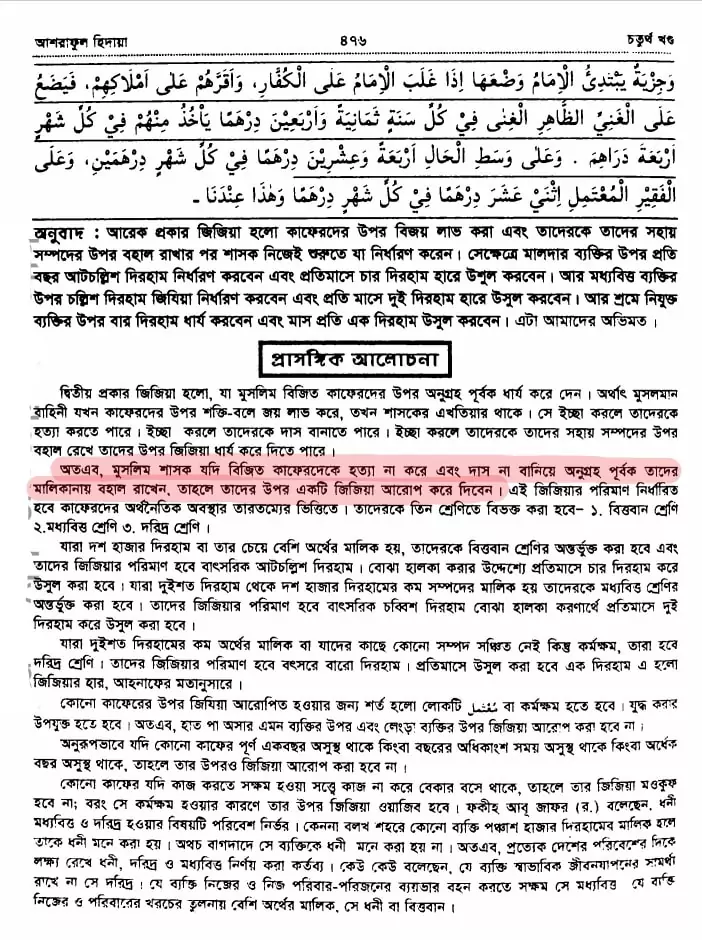
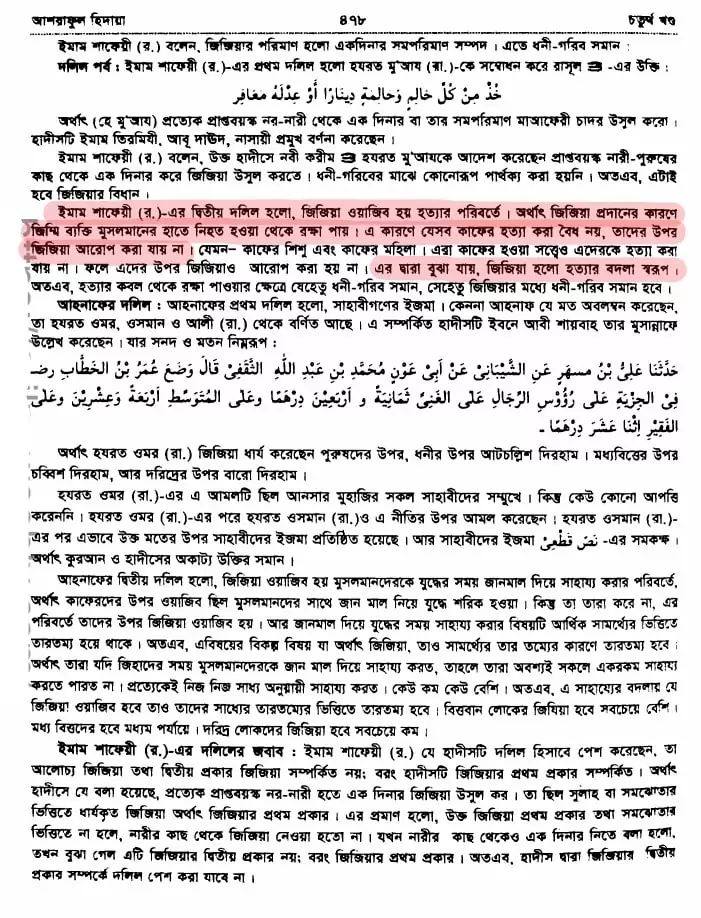
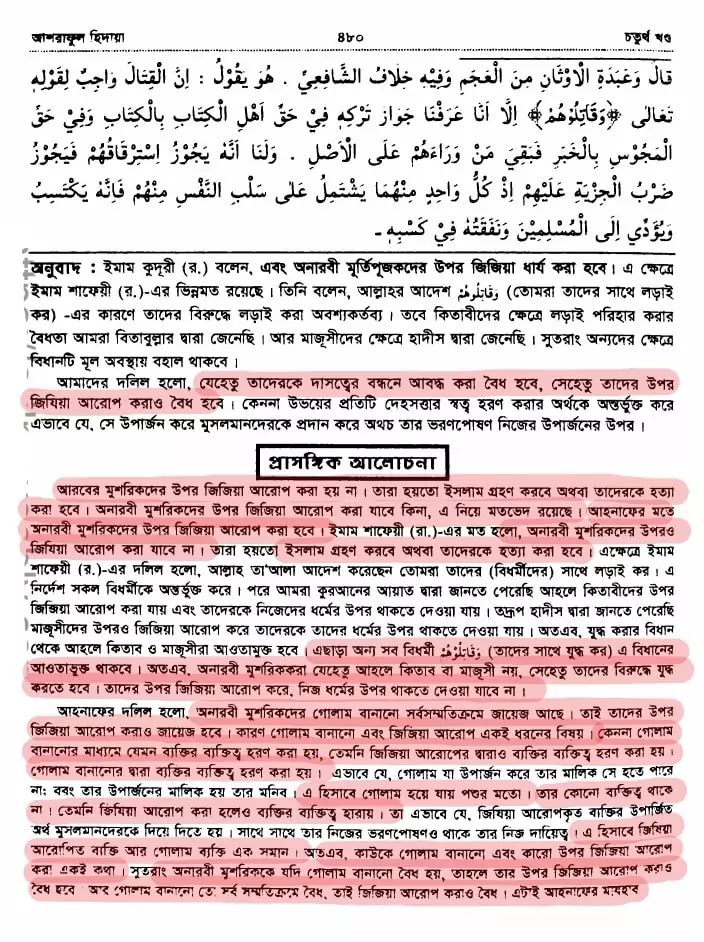
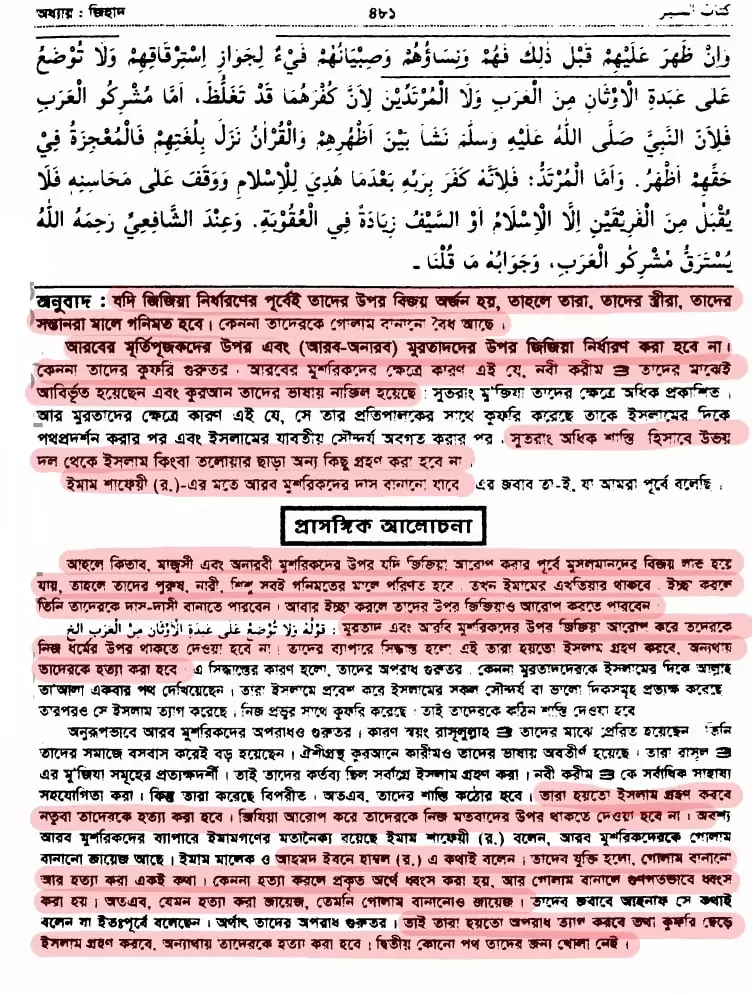
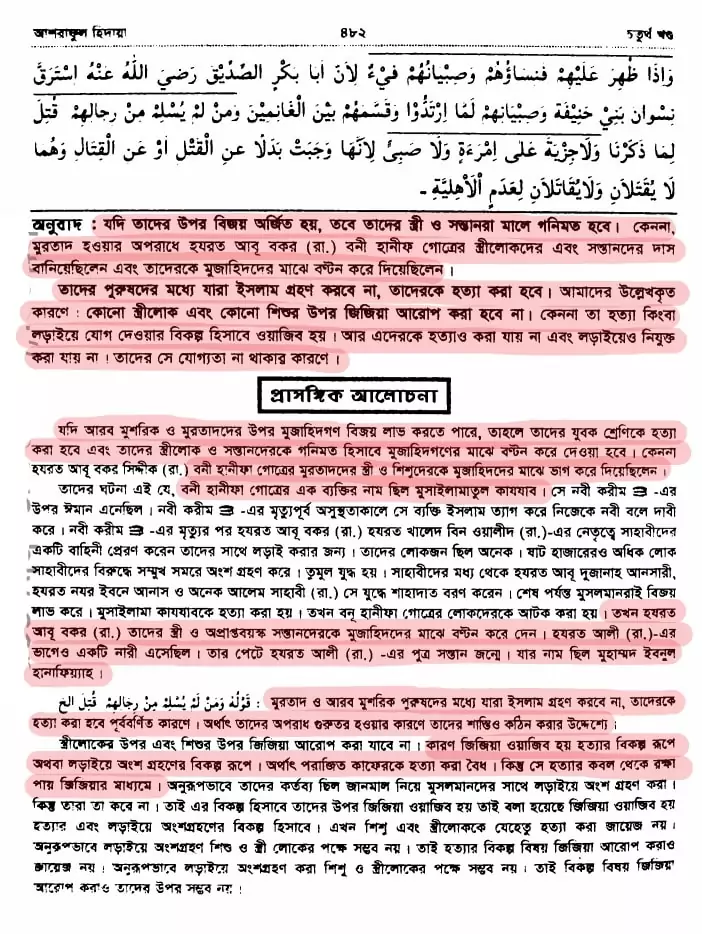
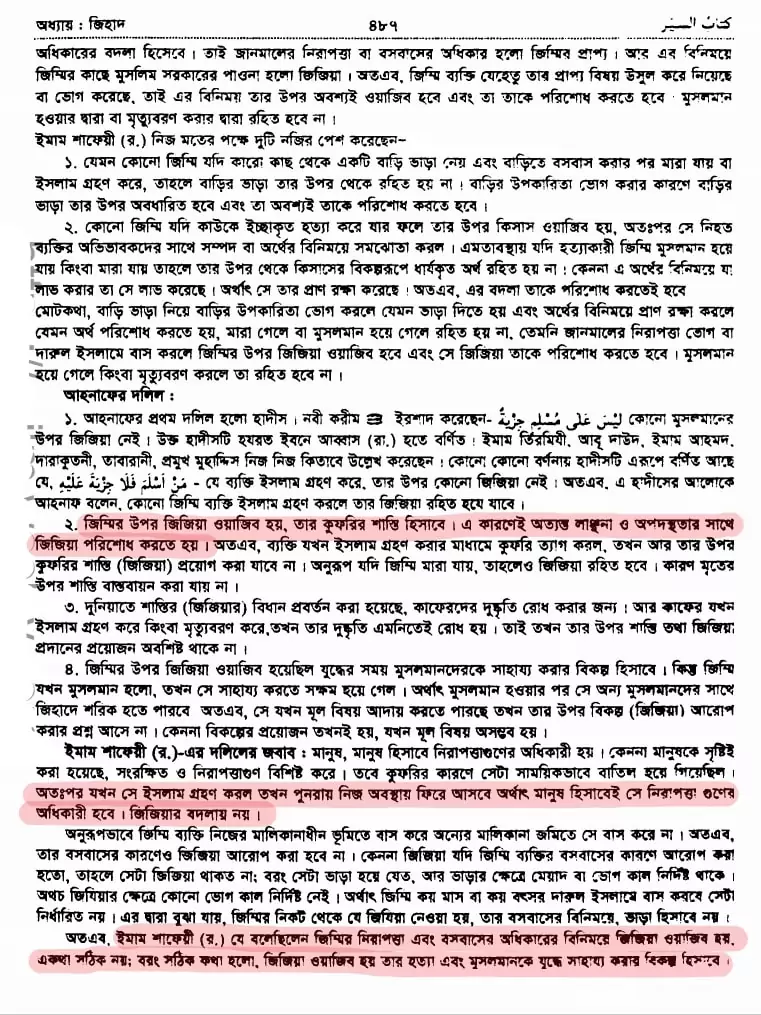
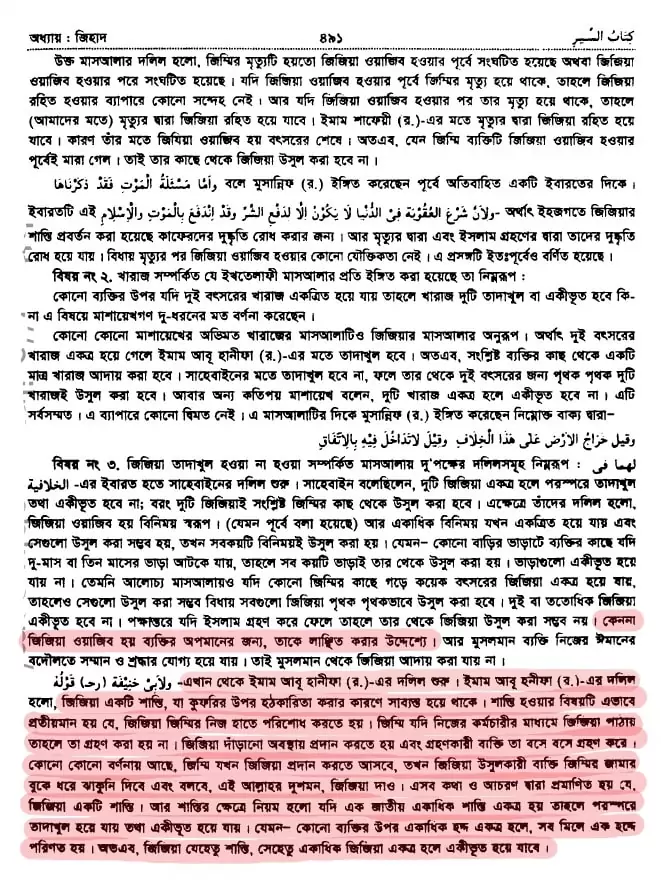
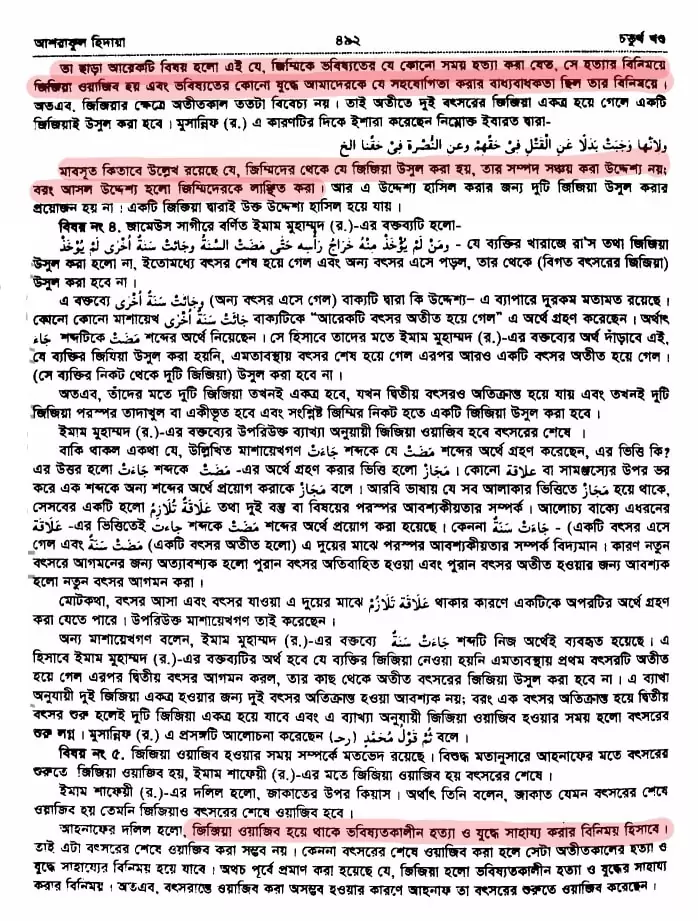
Fatawa Alamgiri: The Application of Jizya in Mughal State Jurisprudence
Fatawa Alamgiri, also known as al-Fatawa al-Hindiyya, is essential for understanding how Hanafi jurisprudence was incorporated into the Mughal Empire’s official legal compilation. Prepared under the patronage of Emperor Aurangzeb, the work brings together rules on government, taxation, warfare, personal obligations, and the status of non-Muslims. Its discussion of jizya preserves the Hanafi legal understanding that non-Muslim subjection was to be visible not only in the liability to pay but in the method of payment. The Arabic excerpts that follow expose the particular practices associated with this state-oriented jurisprudential compilation. [37]
The work cites al-Tatarkhaniyya in preserving a method of collecting jizya that makes the payer’s subordination physically visible: the payer’s hand is below that of the Muslim official receiving the tax. The bodily arrangement turns the act of payment into an expression of inferior standing. It is not a purely financial procedure but a ritualized acknowledgement of the collector’s authority. [38]
وَتَكُونُ يَدُ الْمُؤَدِّي أَسْفَلَ وَيَدُ الْقَابِضِ أَعْلَى، كَذَا فِي التَّتَارْخَانِيَّةِ
English translation: The jizya payer’s hand shall be lower and the collector’s hand shall be higher. This is how it is stated in al-Tatarkhaniyya.
The later Hanafi commentator Ibn ‘Abidin cites this rule in Radd al-Muhtar, specifically referring to Fatawa Alamgiri as al-Hindiyya. His discussion explains that accepting payment through an agent would defeat the intended public humiliation of the payer; the person should therefore present the money directly. The tax collector’s raised hand and the payer’s lower hand are not accidental gestures. They exemplify the way religiously differentiated status is built into the prescribed method of collection. [39]
لِأَنَّ قَبُولَهَا مِنَ النَّائِبِ يُفَوِّتُ الْمَأْمُورَ بِهِ مِنْ إِذْلَالِهِ عِنْدَ الْإِعْطَاءِ، قَالَ تَعَالَى: ﴿حَتَّى يُعْطُوا الْجِزْيَةَ عَنْ يَدٍ وَهُمْ صَاغِرُونَ﴾ … وَتَكُونُ يَدُ الْمُؤَدِّي أَسْفَلَ وَيَدُ الْقَابِضِ أَعْلَى، هِنْدِيَّةٌ
English translation: Accepting jizya through a representative does not fulfill the instruction to humiliate the payer at the time of payment. Allah says: “Until they pay jizya by hand in a humbled state.” … And the payer’s hand shall be lower and the collector’s hand higher—this is the ruling in Al-Fatawa al-Hindiyya.
Fatawa Alamgiri also draws explicit distinctions on religious grounds in defining who may be subjected to jizya. Dhimma agreements are available for the People of the Book and Magians; Hanafi law also permits collection from non-Arab idolaters. However, the category of Arabian idolaters and apostates is treated differently: jizya is not imposed upon them, and those refusing Islam face the penalties prescribed for those categories. The legal difference is tied to religious identity, origin, and the conqueror’s authority rather than equal civic status. [40]
وَلَا تُوضَعُ عَلَى عَبَدَةِ الْأَوْثَانِ مِنَ الْعَرَبِ، وَلَا الْمُرْتَدِّينَ، وَإِنْ ظَهَرَ عَلَيْهِمْ فَنِسَاؤُهُمْ وَصِبْيَانُهُمْ فَيْءٌ، وَمَنْ لَمْ يُسْلِمْ مِنْ رِجَالِهِمْ قُتِلَ
English translation: Jizya shall not be imposed upon Arab idol worshipers or apostates. If they are conquered, their women and children become spoils of war, and those of their men who do not embrace Islam are killed.
For non-Arab idolaters, Hanafi doctrine follows a different rule. Jizya can be accepted from them because jurists use the permissibility of enslaving them as justification for imposing the tax. The option of paying jizya is thus not based on recognition of religious equality but on the conqueror’s ability to subject those populations through enslavement or taxation. [41]
The compilation also states the relationship between religious conversion and jizya. If a community concluded an agreement involving both a head tax and a charge on land, and its members subsequently embraced Islam, the per-person jizya was canceled while the land levy remained. The same people and land thus continued to exist within the state, yet the personal religious tax disappeared once they became Muslim. [42]
وَلَوْ أَسْلَمَ أَهْلُ هَذِهِ الدَّارِ الَّتِي صَالَحَهُمْ الْإِمَامُ عَلَى مَالٍ مَعْلُومٍ يُؤَدُّونَهُ عَنْ رُءُوسِهِمْ وَأَرَاضِيهِمْ سَقَطَ خَرَاجُ الرُّءُوسِ دُونَ الْأَرَاضِي
English translation: If the inhabitants of a territory with whom the ruler concluded an agreement to pay a specified amount on their persons and their land embrace Islam, their head tax or jizya is canceled, but the land kharaj remains.
The jizya chapter of Fatawa Alamgiri thus incorporates several fundamental Hanafi doctrines into a state-oriented legal compilation: liability is based on religion; conversion to Islam ends the poll tax; certain non-Muslim categories may pay while others are subjected to different penalties; and the method of payment may publicly display the payer’s humiliation (ṣaghār). These provisions are part of a broader system of power over conquered non-Muslim populations, not ordinary equal-citizenship taxation.
The original Bengali edition reproduces the supporting passage from the book itself [43].
642. Fatawa Alamgiri.
The jurists differ as to whether distinction is to be made by one sign or by two or three. Hakim Abu Muhammad said: If the Muslim caliph makes a peace agreement with them and accepts them under the covenant on the basis of one distinguishing mark, the mark must remain one and may not be increased. If a country or city is conquered by force, however, the Muslim ruler may impose as many distinguishing signs upon them as he wishes. This is the sound opinion. (al-Muhit)
11. Legal ruling: Muslim and dhimmi women must be distinguishable from one another when walking in the streets and when entering public baths. Thus iron chains are to be placed around the necks of dhimmi women. Their waist garments must be different from those of Muslim women. Their houses must bear a mark distinguishing Muslim homes from dhimmi homes, so that a beggar does not stand before a dhimmi household and mistakenly pray for forgiveness for its occupants. In short, they must bear such identifying features that their humiliation and insignificance are evident and readily recognizable to the people of every age and every town. (Ikhtiyar Sharh al-Mukhtar) If a dhimmi asks a Muslim to show the way to their house of worship, the Muslim should not guide him, since doing so would be assistance in sin. If a Muslim’s parents are dhimmis, he should not escort them to church; he may, however, bring them home from church. (Fatawa Qadi Khan) Dhimmis may not openly carry weapons. When they go out on the road, Muslims should walk together in such a way that they have no room to pass. Muslims shall not initiate greetings of peace to them. If they greet Muslims first, the Muslims may reply but should say only ‘Wa ‘alaykum.’ (Fath al-Qadir) Slaves of dhimmis are not to be compelled to wear the distinctive cord. This is the preferred opinion. (al-Fatawa al-Kubra)
12. Legal ruling: Christians shall not be permitted to blow conch shells in their own homes in Muslim cities. Nor are they permitted to gather people together for prayer according to their customary practice. They may pray individually. They may not display crosses or similar objects outside their places of worship and churches. If they loudly recite the Psalms or Gospel, and the recitation contains polytheistic statements, they must not be allowed to do so; where it contains no such statements, they may not be prohibited, but they may not recite such materials in Muslim marketplaces. [1] For example, the caliph said: ‘We accept that you will remain dhimmis, but your appearance and clothing must differ from ours; you must wear the zunnar (distinctive cord) around your neck.’
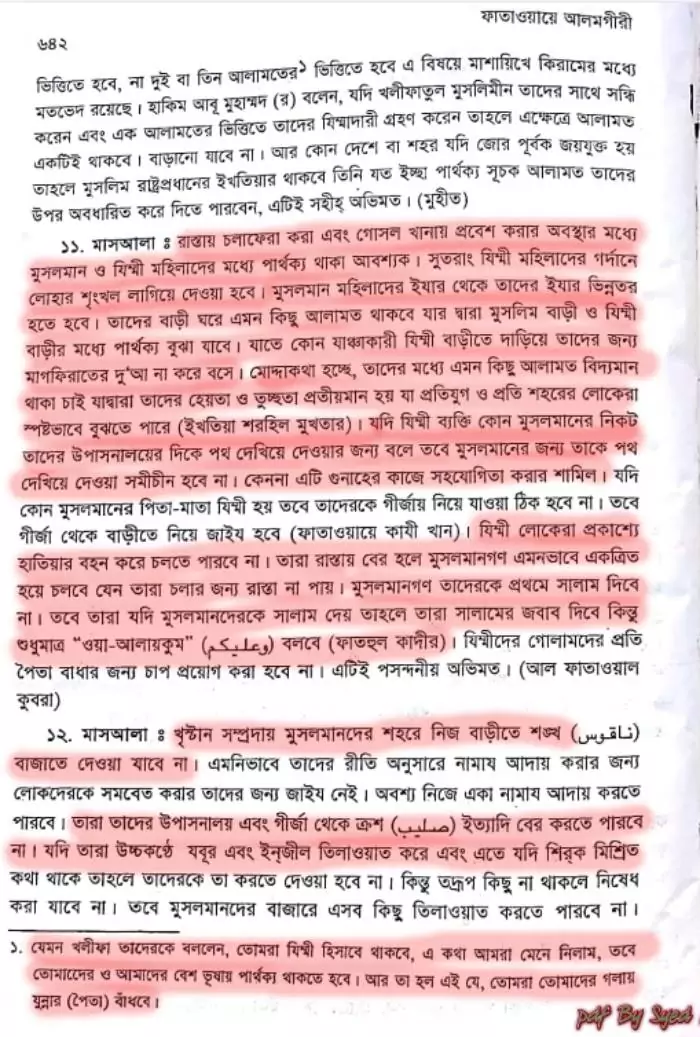
In Islamic jurisprudence jizya was not merely a financial penalty; it was accompanied by a body of humiliating regulations governing the social and personal lives of non-Muslims or dhimmis. Fatawa Alamgiri, an authoritative juristic compilation of the Indian subcontinent prepared at Aurangzeb’s order, records rules under which the state imposed constant social differentiation and abasement upon non-Muslims. Their purpose was to mark them as ‘second-class subjects’ and to create a persistent sense of social inferiority.
Jizya in Shi‘i Ja‘fari Fiqh: Saghār, Subordination, and Warfare
The concepts of jizya, dhimma, and ṣaghār are not confined to the four Sunni schools of jurisprudence. Major works of Twelver Shi‘i, or Imami Ja‘fari, fiqh also prescribe jizya for the People of the Book, subjection to Muslim state authority, and a return to belligerent status upon refusal. In one of the most important Shi‘i legal works, al-Muhaqqiq al-Hilli’s Shara’i‘ al-Islam fi Masa’il al-Halal wa-l-Haram, the amount of jizya, who must pay it, and the implementation of the dhimmi’s ṣaghār are discussed separately. [44]
الثَّانِي: فِي كَمِّيَّةِ الْجِزْيَةِ، وَلَا حَدَّ لَهَا، بَلْ تَقْدِيرُهَا إِلَى الْإِمَامِ بِحَسَبِ الْأَصْلَحِ … وَمَعَ انْتِفَاءِ مَا يَقْتَضِي التَّقْدِيرَ، يَكُونُ الْأَوْلَى إِطْرَاحَهُ تَحْقِيقًا لِلصَّغَارِ
English translation: The second matter concerns the amount of jizya. It has no fixed limit; the Imam determines its amount according to what is most beneficial. … When there is no reason requiring a fixed assessment, leaving it undetermined is preferable in order to realize ṣaghār.
Here the determination of jizya is directly tied to ṣaghār: its amount is not only a fiscal matter but also a means of maintaining dhimmi subordination. In explaining al-Hilli, the later Shi‘i jurist Shahid al-Thani writes that the common definition of ṣaghār is acceptance by the dhimmi of whatever amount of jizya the ruler may impose. He also records an explanation under which the dhimmi stands to pay while the Muslim collector sits. [45]
قَوْلُهُ: «وَمَعَ انْتِفَاءِ مَا يَقْتَضِي التَّقْدِيرَ، يَكُونُ الْأَوْلَى اطِّرَاحُهُ تَحْقِيقًا لِلصَّغَارِ». لِأَنَّ الْمَشْهُورَ فِي تَعْرِيفِهِ: أَنَّهُ الْتِزَامُهُ الْجِزْيَةَ عَلَى مَا يَحْكُمُ بِهِ الْإِمَامُ مِنْ غَيْرِ أَنْ تَكُونَ مُقَدَّرَةً … وَأَمَّا عَلَى مَا فَسَّرَهُ بِهِ بَعْضُهُمْ مِنْ أَنَّهُ أَخْذُ الْجِزْيَةِ مِنْهُ قَائِمًا وَالْمُسْلِمُ جَالِسٌ وَنَحْوُ ذَلِكَ
English translation: The statement ‘It is preferable to leave the amount unspecified in order to realize ṣaghār’ is explained by the common definition: the dhimmi undertakes to pay jizya in whatever amount the Imam determines, without a predetermined fixed sum. Others interpret ṣaghār as collecting jizya from him while he is standing and the Muslim is seated, or through a similar method.
Shara’i‘ al-Islam also explicitly links jizya to religious status in relation to the children of dhimmis. When a boy from a dhimmi family reaches adulthood, he is instructed either to embrace Islam or to pay jizya. If he refuses both, he loses dhimmi status and becomes ḥarbī, that is, a person treated as belonging to the enemy side in a state of war. [46]
وَكُلُّ مَنْ بَلَغَ مِنْ صِبْيَانِهِمْ يُؤْمَرُ بِالْإِسْلَامِ أَوْ بَذْلِ الْجِزْيَةِ، فَإِنِ امْتَنَعَ صَارَ حَرْبِيًّا
English translation: Whoever among their children reaches maturity shall be ordered to accept Islam or pay jizya; if he refuses, he becomes a harbi.
This rule reveals the conditional nature of dhimmi status. A child born to a non-Muslim family does not acquire a permanent right to equal citizenship merely by birth. Upon reaching adulthood, the choice of Islam or jizya applies anew. Refusal of both ends the dhimma guarantee and invokes the laws of belligerency. Dhimma is therefore not universal civic membership but a legal status granted on conditions of religious classification and political submission.
One of the most extensive encyclopedic works of Shi‘i jurisprudence is Muhammad Hasan al-Najafi’s Jawahir al-Kalam, which elaborates the legal rules of Shara’i‘ al-Islam. It cites a report concerning the People of the Book which states that those living under Islamic rule are offered jizya or the consequences of war. The same passage speaks of their property as spoils and of their children being taken captive. [47]
فَمَنْ كَانَ مِنْهُمْ فِي دَارِ الْإِسْلَامِ فَلَنْ يُقْبَلَ مِنْهُ إِلَّا الْجِزْيَةُ أَوِ الْقَتْلُ، وَمَالُهُمْ فَيْءٌ، وَذَرَارِيُّهُمْ سَبْيٌ … وَمَنْ كَانَ مِنْهُمْ فِي دَارِ الْحَرْبِ … لَمْ يُقْبَلْ مِنْهُمْ إِلَّا دُخُولُ دَارِ الْإِسْلَامِ أَوِ الْجِزْيَةُ أَوِ الْقَتْلُ
English translation: Of those among them who are in the dār al-Islām, nothing is accepted except jizya or killing; their wealth is fay’ and their children are captives. … As for those in the dār al-ḥarb, nothing is accepted except entering the dār al-Islām, jizya, or killing.
Jawahir al-Kalam also presents ṣaghār as an operative legal objective in assessing the amount of jizya. Al-Najafi explains the passage in Shara’i‘ al-Islam which favors leaving the amount to the ruler instead of fixing it in advance, precisely because this is considered conducive to ṣaghār. The dhimmi manifests subjection by accepting whatever amount the ruler decides. [48]
تَحْقِيقًا لِلصَّغَارِ الَّذِي قَدْ عَرَفْتَ تَحَقُّقَهُ بِالْتِزَامِ الذِّمِّيِّ مَا يُقْتَرَحُ عَلَيْهِ
English translation: In order to realize ṣaghār, which you already know is achieved by the dhimmi’s acceptance of whatever is demanded from him.
Another report preserved in Jawahir al-Kalam makes the relationship between jizya and ṣaghār still clearer. In explaining an instruction that a Muslim should not associate himself with the status of jizya-paying dhimmis, it says he should not return to the ṣaghār from which Allah has delivered him. Jizya is therefore associated not merely with money but with a distinct inferior standing. [49]
وَلَا يُقْرِنْ أَحَدُكُمْ بِالصَّغَارِ بَعْدَ أَنْ أَنْقَذَهُ اللَّهُ مِنْهُ
English translation: None of you should associate himself with the ṣaghār from which Allah has delivered him.
Imami Shi‘i jurisprudence therefore also grounds the jizya system in a hierarchy of religious statuses. Adult male scripturalists must accept Islam or the conditions of jizya, and refusal places them in the category of belligerents. The ruler’s discretion in assessing jizya is justified by the objective of realizing ṣaghār. Subsequent Shi‘i discussions preserve both the interpretation of ṣaghār as acceptance of whatever the ruler demands and the interpretation requiring the dhimmi to stand while a Muslim receives the payment seated. The ideas of religion-based taxation, political submission, and abasement thus appear in Ja‘fari as well as Sunni jurisprudence.
Ibn Qudama: Conditions of Dhimma and Jizya in Hanbali Fiqh
In al-Mughni, one of the major Hanbali legal works, Ibn Qudama identifies two mandatory conditions for a permanent dhimma contract: annual payment of jizya and acceptance of the legal rulings of Islam. Dhimmi status therefore is not acquired merely by paying a particular sum; acknowledgment of Muslim legal sovereignty is also obligatory. He cites Qur’an 9:29 and the hadith of Burayda in support. [50]
وَلَا يَجُوزُ عَقْدُ الذِّمَّةِ الْمُؤَبَّدَةِ إِلَّا بِشَرْطَيْنِ، أَحَدُهُمَا أَنْ يَلْتَزِمُوا إِعْطَاءَ الْجِزْيَةِ فِي كُلِّ حَوْلٍ، وَالثَّانِي الْتِزَامُ أَحْكَامِ الْإِسْلَامِ، وَهُوَ قَبُولُ مَا يُحْكَمُ بِهِ عَلَيْهِمْ مِنْ أَدَاءِ حَقٍّ أَوْ تَرْكِ مُحَرَّمٍ
English translation: A permanent dhimma contract is valid only under two conditions: first, they undertake to pay jizya every year; second, they undertake to abide by the rulings of Islam. That means accepting what is judged obligatory upon them in discharging rights and abstaining from prohibited acts.
These conditions specify the dhimmi’s political status. The first imposes a separate annual tax on religious grounds; the second subjects the person to Islamic state law. Ibn Qudama is not describing a contract under which a non-Muslim simply pays money and retains an independent legal position. Recognition of Islamic legal authority is itself a condition of permanent residence under the dhimma.
Ibn Qudama further explains that although jizya may in practice be collected at the end of the year, the non-Muslim must undertake at the outset to pay it in order for the dhimma contract to take effect. He interprets ‘until they pay’ in Qur’an 9:29 as not merely physically handing over money but agreeing to and accepting the obligation to provide it. [51]
وَالْمُرَادُ بِقَوْلِهِ: ﴿حَتَّى يُعْطُوا﴾ أَيْ يَلْتَزِمُوا الْإِعْطَاءَ وَيُجِيبُوا إِلَى بَذْلِهِ
English translation: ‘Until they give’ means that they undertake the obligation to give and agree to offer payment.
Alongside these mandatory conditions, Ibn Qudama also defines the ruler’s obligations. Once a dhimma contract exists, the Muslim ruler must protect dhimmis from attacks by Muslims, hostile forces, and other dhimmis, because the covenant creates a duty of protection. He also cites a saying attributed to ‘Ali that jizya was given so that the payers’ property and lives would be protected like those of Muslims. [52]
وَإِذَا عَقَدَ الذِّمَّةَ فَعَلَيْهِ حِمَايَتُهُمْ مِنَ الْمُسْلِمِينَ وَأَهْلِ الْحَرْبِ وَأَهْلِ الذِّمَّةِ، لِأَنَّهُ الْتَزَمَ بِالْعَهْدِ حِفْظَهُمْ … وَقَالَ عَلِيٌّ: إِنَّمَا بَذَلُوا الْجِزْيَةَ لِتَكُونَ أَمْوَالُهُمْ كَأَمْوَالِنَا وَدِمَاؤُهُمْ كَدِمَائِنَا
English translation: Once a dhimma contract is concluded, the ruler is responsible for protecting them from Muslims, the people of war, and other dhimmis, because he has undertaken their protection in the covenant. … ‘Ali said: They paid jizya so that their property would be like ours and their blood like ours in being protected.
This exchange of protection cannot be equated with equal citizenship. In the same legal framework Ibn Qudama makes annual payment and submission to Islamic law preconditions of security. The protection of the dhimmi’s life and property is not conceived as an unconditional right of equal civic membership; it is protection established by a particular religious-political agreement.
Ibn Qudama also emphasizes the permanent character of the covenant. Once a valid dhimma agreement has been made, a later ruler must uphold it even after the preceding ruler dies or is removed. As he says, the dhimma contract is permanent. The separate legal status of non-Muslim populations is therefore not necessarily a temporary wartime expedient; it may persist as a standing category within an Islamic state. [53]
وَإِذَا مَاتَ الْإِمَامُ أَوْ عُزِلَ وَوَلِيَ غَيْرُهُ … أَقَرَّهُمْ عَلَيْهِ … وَلِأَنَّ عَقْدَ الذِّمَّةِ مُؤَبَّدٌ
English translation: If the ruler dies or is removed and another takes office, the new ruler shall uphold the existing agreement … because the dhimma contract is permanent.
In Ibn Qudama’s Hanbali jurisprudence the relationship between jizya and dhimma is therefore explicit. To retain permanent dhimmi status, the non-Muslim must accept annual jizya and the authority of Islamic law. The state in return assumes responsibility for protecting life and property, and the agreement can continue under subsequent rulers. Jizya is thus not simply a financial tax but an element of a continuing political-religious structure in which non-Muslim residence and security are tied to submission to Muslim rule and to a separate tax obligation.
The Same Framework of Jizya in Contemporary Islamic Fatwas
Treating jizya as a vanished institution belonging only to medieval empires overlooks an important body of contemporary Islamic fatwa literature. On the Salafi fatwa website IslamQA, multiple answers about jizya, offensive jihad, and non-Muslim political status repeat the same classical structure. Jews, Christians, and Magians are given the alternatives of Islam or jizya; where they reject both, fighting is declared obligatory for a Muslim state capable of carrying it out. [54]
فَهَذِهِ الطَّوَائِفُ الثَّلَاثُ جَاءَ الشَّرْعُ بِأَنَّهُمْ يُخَيَّرُونَ بَيْنَ الْإِسْلَامِ وَالْجِزْيَةِ … فَإِنْ أَبَوْا الْإِسْلَامَ وَالْجِزْيَةَ وَجَبَ قِتَالُهُمْ مَعَ الْقُدْرَةِ
English translation: The Law offers these three groups—Jews, Christians, and Magians—a choice between Islam and jizya. If they refuse both Islam and jizya, it becomes obligatory to fight them when able.
In explaining the verse ‘There is no compulsion in religion,’ the same fatwa says this applies to those non-Muslims from whom jizya may be accepted. It also cites an opinion that the verse’s original rule was abrogated by the subsequent command to wage war. It then maintains that those from whom jizya cannot be accepted are to be compelled to embrace Islam and fought when Muslims have the power to do so. [55]
وَقَالَ آخَرُونَ مِنْ أَهْلِ الْعِلْمِ: إِنَّهَا كَانَتْ فِي أَوَّلِ الْأَمْرِ ثُمَّ نُسِخَتْ بِأَمْرِ اللَّهِ سُبْحَانَهُ بِالْقِتَالِ وَالْجِهَادِ، فَمَنْ أَبَى الدُّخُولَ فِي الْإِسْلَامِ وَجَبَ جِهَادُهُ مَعَ الْقُدْرَةِ حَتَّى يَدْخُلَ فِي الْإِسْلَامِ أَوْ يُؤَدِّيَ الْجِزْيَةَ إِنْ كَانَ مِنْ أَهْلِهَا
English translation: Other scholars said the initial ruling was later abrogated by Allah’s command for fighting and jihad. Whoever refuses to enter Islam must be fought, where there is capacity, until he embraces Islam or, if he is among those eligible, pays jizya.
In another long fatwa published in 2003, IslamQA explains even more openly the relationship between offensive jihad, jizya, and ṣaghār. It says one category of jihad is jihad al-ṭalab—war initiated by Muslims rather than fighting to repel an attack upon Muslim territory. The fatwa calls this form of warfare instrumental to the spread of Islam and condemns the claim that only defensive jihad is legitimate as contrary to the Qur’an, the Sunna, and the findings of Muslim scholars. [56]
وَلَا شَكَّ أَنَّ جِهَادَ الطَّلَبِ كَانَ لَهُ أَثَرٌ كَبِيرٌ فِي نَشْرِ الْإِسْلَامِ، وَدُخُولِ النَّاسِ فِي دِينِ اللَّهِ أَفْوَاجًا … وَنَفَوْا مَشْرُوعِيَّةَ الْجِهَادِ فِي الْإِسْلَامِ إِلَّا عَلَى سَبِيلِ الدِّفَاعِ فَقَطْ، وَأَمَّا جِهَادُ الطَّلَبِ فَلَا وُجُودَ لَهُ عِنْدَهُمْ، وَهَذَا خِلَافُ مَا قَرَّرَهُ أَئِمَّةُ الْهُدَى عُلَمَاءُ الْمُسْلِمِينَ، فَضْلًا عَنْ مُخَالَفَتِهِ لِلْقُرْآنِ وَالسُّنَّةِ
English translation: There is no doubt that offensive jihad played a major role in spreading Islam and bringing people into God’s religion in large numbers. … Those who recognize no lawful jihad other than defense and reject the existence of jihad al-ṭalab oppose the rulings of Muslim scholars and, moreover, the Qur’an and Sunna.
The same fatwa cites the hadith of Burayda to identify three steps in warfare: invite people to Islam; if they reject it, demand jizya; and if they also reject that, wage war. The fatwa does not merely say that non-Muslims must pay: it explicitly says they must do so ‘humiliated and as ṣāghirūn.’ If jizya is refused, it declares, nothing but the sword remains. [57]
فَهَذَا رَسُولُ اللَّهِ صَلَّى اللَّهُ عَلَيْهِ وَسَلَّمَ يَأْمُرُ أُمَرَاءَهُ أَنْ يَدْعُوا الْكُفَّارَ إِلَى الْإِسْلَامِ وَهُمْ يَرْفَعُونَ السُّيُوفَ فَوْقَ رُءُوسِهِمْ، فَإِنْ أَبَوُا الْإِسْلَامَ دَفَعُوا الْجِزْيَةَ وَهُمْ أَذِلَّةٌ صَاغِرُونَ، فَإِنْ أَبَوْا فَمَا لَهُمْ إِلَّا السَّيْفُ
English translation: Here the Messenger commands his commanders to invite unbelievers to Islam while their swords are raised above their heads. If they refuse Islam, they pay jizya while humiliated and subdued; if they refuse that as well, nothing remains for them except the sword.
The fatwa is even more explicit about the connection between jizya and humiliation. It asks whether non-Muslims were frightened simply by hearing a peaceful call to religion or rather by jihad, the imposition of jizya, and ṣaghār. It suggests that a person may embrace Islam precisely to escape such humiliation. Here ṣaghār is not portrayed as a historical abuse of jizya but as an effective element of the religious system. [58]
وَهَلْ يُرْعِبُ الْكُفَّارَ أَنْ يُقَالَ لَهُمْ أَسْلِمُوا، فَإِنْ لَمْ تُسْلِمُوا فَأَنْتُمْ أَحْرَارٌ فِيمَا تَعْتَقِدُونَ وَتَفْعَلُونَ؟ أَمْ كَانَ يُرْعِبُهُمْ الْجِهَادُ وَضَرْبُ الْجِزْيَةِ وَالصَّغَارُ … فَهَذِهِ دَعْوَةٌ إِلَى اللَّهِ سُبْحَانَهُ مَقْرُونَةٌ بِقُوَّةِ السِّلَاحِ
English translation: Would unbelievers be frightened by being told, ‘Embrace Islam; if you do not, you are free to believe and do as you wish’? Or were they frightened by jihad, the imposition of jizya, and humiliating subordination (ṣaghār)? … This is a call to Allah accompanied by the force of arms.
Another IslamQA fatwa, published in 2012, repeats the same framework. In explaining the relationship between ‘No compulsion in religion’ and the command to fight non-Muslims, it quotes Ibn Taymiyya to distinguish unlawful compulsion from what he regarded as lawful coercion against belligerent non-Muslims. In the latter case fighting continues until people accept Islam or, where permissible, pay jizya. [59]
وَقَالَ شَيْخُ الْإِسْلَامِ ابْنُ تَيْمِيَّةَ رَحِمَهُ اللَّهُ: … بِخِلَافِ الْمُكْرَهِ بِحَقٍّ، كَالْمُقَاتِلِينَ مِنْ أَهْلِ الْحَرْبِ، حَتَّى يُسْلِمُوا إِنْ كَانَ قِتَالُهُمْ إِلَى الْإِسْلَامِ، أَوْ إِعْطَاءِ الْجِزْيَةِ إِنْ كَانَ الْقِتَالُ عَلَى أَحَدِهِمَا
English translation: Ibn Taymiyya said: … This differs from one lawfully subjected to compulsion, such as combatants from the people of war, until they accept Islam if their fighting is to end through conversion, or until they pay jizya if either alternative is accepted.
The fatwa’s own summary says that a non-Muslim who does not embrace Islam must either remain under dhimma and treaty, paying jizya, or be treated as a belligerent against whom war is obligatory. The permission to remain in one’s religion is not recognized as equal civic freedom, but as a conditional position under jizya and Muslim political authority. [60]
فَمَنْ لَمْ يَدْخُلْ فِيهِ فَإِمَّا أَنْ يَكُونَ مِنْ أَهْلِ الذِّمَّةِ وَالْعَهْدِ، فَهَذَا لَهُ ذِمَّتُهُ وَعَهْدُهُ، وَعَلَيْهِ دَفْعُ الْجِزْيَةِ، وَإِمَّا أَنْ يَكُونَ مِنَ الْمُحَارِبِينَ، فَهَذَا لَا بُدَّ مِنْ مُحَارَبَتِهِ وَقِتَالِهِ
English translation: Whoever does not enter Islam either belongs to the people of dhimma and treaty, in which case he retains his covenant and must pay jizya, or he belongs to the belligerents, in which case he must be opposed and fought.
IslamQA also expresses the same framework when explaining hadiths about the return of Jesus and the abolition of jizya. Quoting al-Nawawi, the fatwa says that in Jesus’ time jizya will no longer be accepted: non-Muslims will be offered only Islam, and an offer to pay jizya will be rejected. In explaining how this differs from current law, it acknowledges that today a scripturalist’s offer of jizya must be accepted, after which it is unlawful to fight or force the person to embrace Islam. [61]
قَالَ النَّوَوِيُّ رَحِمَهُ اللَّهُ: … لَا يَقْبَلُ مِنَ الْكُفَّارِ إِلَّا الْإِسْلَامَ … بَلْ لَا يَقْبَلُ إِلَّا الْإِسْلَامَ أَوِ الْقَتْلَ … وَالْحُكْمُ الْمَوْجُودُ الْيَوْمَ أَنَّ الْكِتَابِيَّ إِذَا بَذَلَ الْجِزْيَةَ وَجَبَ قَبُولُهَا، وَلَا يَجُوزُ قِتَالُهُ وَلَا إِكْرَاهُهُ عَلَى الْإِسْلَامِ
English translation: Al-Nawawi said that at that time nothing will be accepted from unbelievers except Islam; no alternative but Islam or death will be accepted. … Under the rule existing today, however, if a person of the Book offers jizya, it must be accepted, and it is not permissible to fight him or force him to embrace Islam.
These modern fatwas retain the fundamental structure of classical jizya law. Certain non-Muslims may pay jizya instead of converting; payment remains tied to ṣaghār and submission; refusal can bring the rule of war into effect; and the religious existence of a dhimmi is protected only under the covenant and its financial terms. The framework is therefore not merely an antiquated idea recorded in medieval tafsir and fiqh: it is explicitly endorsed and repeated in influential twenty-first-century Islamic fatwa literature.
Hateful Statements by Religious Scholars (Video)
First, consider the following video, in which an Arab Islamic scholar explains how non-Muslims in a Sharia-based state should be repeatedly humiliated and degraded until they feel compelled to embrace Islam.
Let us hear another scholar’s remarks.
Now consider a video featuring the well-known Bangladeshi preacher Ahmadullah. In this statement, peaceful coexistence with non-Muslims is portrayed as a temporary and tactical arrangement, effectively assigning them the status of second-class citizens. He describes the Constitution of Medina as a ‘treaty’ entered into with Jews under the pressure of circumstances and says it was subsequently canceled or abrogated through Surah al-Tawbah. The message is that coexistence on the basis of equal rights is not a permanent Islamic ideal. He describes the humiliating imposition of jizya upon non-Muslims as a condition of residence in return for a specified payment rather than recognition as citizens, contradicting the modern principle of civic equality. He also dismisses ‘standing shoulder to shoulder’ or living in mixed communities with non-Muslims as ‘deception,’ while making highly negative and prejudicial remarks about Jews, including suggestions that they are cunning outsiders who established a foothold. These assertions encourage social suspicion and hostility. Overall, by treating peaceful coexistence as expedient and abrogated, he diminishes the political and social standing of non-Muslims.
Humiliating Dress, Identity Markers, and Iron Neck Rings for Non-Muslim Women
The separate and inferior status of dhimmis extended far beyond the payment of jizya. Hanafi jurisprudence discusses distinctive clothing, riding animals, head coverings, waist belts, and marks on homes, all intended to make non-Muslims readily identifiable. The rules applied not only to men but also to dhimmi women in public streets and bathhouses. The Bengali edition of Fatawa Alamgiri states this explicitly [43].
‘Muslim and dhimmi women must be distinguishable from one another when walking in the streets and entering bathhouses. Accordingly, iron restraints are to be placed around the necks of dhimmi women.’
Although the Bengali translation here says ‘iron chain,’ the precise expression used in the Arabic Hanafi work is طَوْقُ الْحَدِيدِ, an iron neck ring or collar. This was not an ordinary identity card or neutral administrative symbol. The same Hanafi discussion expressly gives the reason for separating dhimmis from Muslims in clothing and appearance. In Ibn al-Humam’s Fath al-Qadir, they are distinguished in dress, riding equipment, and other marks ‘to manifest ṣaghār upon them.’ Muslims are to be honored and dhimmis humiliated; without a distinctive mark, a dhimmi might mistakenly receive treatment reserved for Muslims, which the book disallows. [62]
وَإِنَّمَا يُؤْخَذُونَ بِذَلِكَ إِظْهَارًا لِلصَّغَارِ عَلَيْهِمْ وَصِيَانَةً لِضَعَفَةِ الْمُسْلِمِينَ، وَلِأَنَّ الْمُسْلِمَ يُكْرَمُ، وَالذِّمِّيُّ يُهَانُ … فَلَوْ لَمْ تَكُنْ عَلَامَةٌ مُمَيِّزَةٌ فَلَعَلَّهُ يُعَامَلُ مُعَامَلَةَ الْمُسْلِمِينَ وَذَلِكَ لَا يَجُوزُ
English translation: These rules are imposed to manifest their abasement and to safeguard Muslims who lack discernment, for the Muslim is honored and the dhimmi is humiliated. If there were no distinguishing mark, the dhimmi might be treated as a Muslim, and that is not permissible.
Immediately afterward Fath al-Qadir applies the same separation to women. It says dhimmi women must be distinguished from Muslim women both in the streets and in bathhouses. Such rules were not an isolated administrative provision; they formed part of the broader jurisprudential expression of ṣaghār and inferior social position imposed upon dhimmis. [63]
وَيَجِبُ أَنْ يَتَمَيَّزَ نِسَاؤُهُمْ عَنْ نِسَائِنَا فِي الطُّرُقَاتِ وَالْحَمَّامَاتِ، وَيُجْعَلُ عَلَى دُورِهِمْ عَلَامَاتٌ كَيْ لَا يَقِفَ عَلَيْهَا سَائِلٌ يَدْعُوَ لَهُمْ بِالْمَغْفِرَةِ
English translation: Their women must be distinguishable from our women in streets and bathhouses. Their homes should bear marks so that a petitioner does not stand there and invoke forgiveness for them.
The later Hanafi work Radd al-Muhtar ‘ala al-Durr al-Mukhtar by Ibn ‘Abidin preserves these provisions in greater detail. Quoting Fath al-Qadir, it requires distinctive markings on dhimmi women’s clothing in the streets: a piece of yellow cloth on the outer garment of a Jewish woman and blue cloth on that of a Christian woman. Referring to al-Ikhtiyar, it then specifies an iron collar around their necks as an identifying mark in public bathhouses. [64]
قَالَ فِي الْفَتْحِ: وَكَذَا تُؤْخَذُ نِسَاؤُهُمْ بِالزِّيِّ فِي الطُّرُقِ فَيُجْعَلُ عَلَى مِلَاءَةِ الْيَهُودِيَّةِ خِرْقَةٌ صَفْرَاءُ وَعَلَى النَّصْرَانِيَّةِ زَرْقَاءُ، وَكَذَا فِي الْحَمَّامَاتِ … أَيْ فَيُجْعَلُ فِي أَعْنَاقِهِنَّ طَوْقُ الْحَدِيدِ كَمَا فِي الِاخْتِيَارِ
English translation: Fath al-Qadir states: Their women too must be distinguished by clothing in the streets: a yellow piece of cloth shall be placed upon the outer garment of a Jewish woman and a blue piece upon that of a Christian woman; the same distinction applies in bathhouses. … That is, an iron neck ring shall be placed around their necks, as stated in al-Ikhtiyar.
Three layers of discrimination are evident. First, the non-Muslim woman’s religion is no longer a matter of personal belief: the color of her clothing must publicly identify her when she walks outside. Second, the prescribed markings distinguish one non-Muslim religion from another—yellow for Jewish women and blue for Christian women. Third, even in bathhouses, where ordinary garments may be removed, an iron neck ring preserves the visible identification of her religion. Changing her clothes does not allow the woman to escape the state-sanctioned public marking of her non-Muslim status.
There is no need to speculate about the purpose of these rules: the same Hanafi sources state it explicitly. They use إِظْهَارًا لِلصَّغَارِ, ‘to manifest their abasement,’ and still more directly الْمُسْلِمُ يُكْرَمُ وَالذِّمِّيُّ يُهَانُ, ‘the Muslim is honored and the dhimmi is humiliated.’ Describing the yellow or blue marks on dhimmi women and their iron bathhouse collars as merely administrative identification contradicts those source statements. The jurisprudential rationale explicitly connects differentiation with ṣaghār, lower social standing, and denial of the respect reserved for Muslims.
The distinctions extended beyond the body and clothing. The same legal discussion calls for distinctive marks on dhimmi houses so that a Muslim beggar or petitioner does not mistakenly assume a home belongs to Muslims and invoke God’s forgiveness for those inside. Religious classification was thus made visible across dress, women’s movements in public, communal bathhouses, and private residences. [65]
The Hanafi legal tradition incorporated into Fatawa Alamgiri therefore did not leave non-Muslim women outside its hierarchy of religious status. Dress, color markers, and even the neck ornaments worn in bathhouses were regulated so that Muslim and dhimmi women would not appear in public with the same standing. Since the same fiqh text expressly says Muslims should be honored, dhimmis humiliated, and ṣaghār made visible, the social function is unmistakable. These were not merely neutral means of identifying which religion someone practiced; they were institutional techniques for translating religious identity into a visible hierarchy of social rank.
Fatawa Alamgiri states unambiguously that non-Muslim dhimmi women must dress differently from Muslim women. It provides additional means of marking their identities, both in public and upon entering bathhouses, in order to make their lower standing visible. Its wording is as follows:
‘Muslim women and dhimmi women must be distinguishable when walking in streets and entering bathhouses. Accordingly, iron restraints shall be placed around the necks of dhimmi women.’ [43].
The stated purpose of such iron collars or other distinguishing marks was to humiliate non-Muslim women and place their social status beneath that of Muslims.
Distinguishing Dhimmi Homes and Institutional Social Discrimination
Distinctive marks were imposed not merely upon clothing but also on non-Muslim residences. Under the ruling cited from Fatawa Alamgiri, dhimmi homes must bear recognizable signs distinguishing them from Muslim homes. The rationale is revealing: a petitioner or beggar should not accidentally stand before a non-Muslim house and pray that its inhabitants be forgiven. The objective was to make the residents’ ‘insignificance’ evident throughout society. [43].
Restrictions on Dhimmis’ Public Movement and Forms of Address
Dhimmis also faced degrading restrictions on movement in streets and public spaces. Works such as Fatawa Alamgiri and Fath al-Qadir prescribe the following [43]:
- Subordination on the Road: Dhimmis may not openly carry weapons. When Muslims go out on the road, they may walk together in such a manner that dhimmis are left insufficient space and forced to move crouching along one side.
- Responding to Greetings: Muslims are not to greet dhimmis first. If a dhimmi offers a greeting, the response is to be brief and cold—only “wa ʿalaykum” (“and upon you”).
Restrictions on Non-Muslim Religious Rituals and the Sound of Conch Shells
The right of non-Muslims to perform their own religious rites was sharply restricted as well. The juristic rules state [43]:
- Christians and other non-Muslims may not ring bells in their own homes within Muslim cities.
- They may not call out loudly for prayer or religious gatherings.
- They may not recite their scriptures, such as the Bible or the Vedas, aloud in markets or public spaces, especially passages contrary to Muslim beliefs.
- They may not publicly carry crosses or comparable religious symbols outside their houses of worship.
Taken together, these restrictions illustrate a policy of social segregation imposed upon non-Muslims through the jizya and dhimma system. It was not simply economic punishment: their cultural expression, religious symbols, and personal dignity were subjected to discriminatory law. One intended result was to communicate that escape from this degrading condition could be obtained through conversion to Islam.
The Absence of a Fixed Rate: Legitimizing the Ruler’s Discretion
One disturbing feature of jizya is the absence of a single, permanently fixed Qur’anic or prophetic rate comparable to the familiar 2.5 percent assessment on qualifying zakat assets. The Qur’an and Sunna do not set a universal upper limit for jizya. Later jurists in various schools discussed annual rates such as 12, 24, or 48 dirhams, but these are juristic assessments rather than a uniformly specified Qur’anic rate. The level and collection of jizya remained subject to the governing authorities’ legal judgment (ijtihad) and administrative policy (siyasa). This structural discretion could become a legal means of imposing severe fiscal burdens on non-Muslim subjects.
The absence of a universal maximum gave rulers substantial discretion. Where treasuries faced shortages or governments financed expensive military campaigns, it was possible to increase the tax burden imposed upon non-Muslims. In some circumstances the amounts assessed exceeded the capacity of ordinary farmers or laborers. Al-Shafi‘i held that the minimum jizya was one dinar but that its maximum was not fixed, leaving room for the ruler’s decision. [66]. Without a clear upper boundary, the levy was vulnerable to being used according to a ruler’s fiscal priorities or arbitrary will rather than transparent and equal taxation.
A vivid historical example of how ruler-dependent levies could produce humiliation, resentment, and conflict is the episode of Abu Lu’lu’a, also known as Firuz. According to the accounts, al-Mughira ibn Shu‘ba imposed a daily monetary levy on this Persian craftsman, who was his slave. Reports give varying figures of two or four dirhams. When Abu Lu’lu’a petitioned Caliph ‘Umar to reduce the burden, ‘Umar reportedly judged the amount in light of his craftsman’s skills and indicated that it might instead be raised to four dirhams per day or 100 per month. This was not a direct instance of jizya, but an example of how an owner-imposed levy, lacking transparent standards, could function as a display of power rather than an equitable financial obligation. The burden reflected the dependent person’s powerlessness and subordinate status. His failed petition for relief was one reported source of Abu Lu’lu’a’s anger; one account connects it with his subsequent intention to kill ‘Umar. [67]. The episode does not establish any rate for jizya. It illustrates how slave labor and financial demands determined by those in authority could provoke intense resentment.
The Inhuman Burden of Jizya in India and Its Historical Consequences
In the Indian subcontinent jizya was not simply a source of revenue. Under the policies analyzed here, it became an instrument for impoverishing non-Muslim subjects, especially Hindus and Buddhists, and reducing their social standing. The absence of a single fixed rate allowed Indian sultans and emperors considerable room to use fiscal pressure against these populations. The broader effect was to make remaining outside Islam an increasingly costly and humiliating condition.
Extreme Poverty and Humiliation under Alauddin Khalji
Under Sultan Alauddin Khalji, the burden of kharaj and other fiscal demands became so severe that non-Muslim subjects suffered extreme hardship. The contemporary chronicler Ziauddin Barani gives a brutal account in his Tarikh-i-Firuz Shahi. According to Barani, taxation left many Hindus unable to ride horses, wear fine clothes, or even afford betel leaf. Khalji created a revenue regime that left non-Muslims with little beyond the food required to survive, partly to deprive them of the resources to rebel. In some cases, inability to pay taxes reportedly forced women of non-Muslim households to work as servants in Muslim homes. [68].
After completing these measures, Sultan Alauddin asked the learned men to devise a method or rule by which the Hindus could be brought under firm control. They were to retain not even a fraction of the wealth that might cause rebellion, and kharaj was to be collected on an equal basis from Kshatriyas and Shudras. Care was nevertheless to be taken that those with means and those without means were not assessed identically. The Hindus, in particular, were not to be allowed enough wealth to buy fine weapons, wear good clothes, and pass their days enjoying pleasures as they pleased. Two regulations were to be introduced for this specific aspect of governing the realm. First, cultivators would be required to pay half as kharaj, assessed according to the classification, area, distance, and variation of their fields. The khuts (Kshatriyas) and bulahars (Shudras) would be governed by the same rules. No part of the kharaj owed by Kshatriyas would be remitted. Second, designated grazing grounds were to be maintained for milk-giving cows, buffaloes, and goats, and the animals were to be kept overnight in specified public locations rather than scattered everywhere, so that they could be found together when kharaj was assessed, with no discrepancies in the collection. No one would be exempt.
To ensure the regulations were enforced, the sultan dismissed officials, scribes, mushrifs, and clerks guilty of bribery or embezzlement, entrusting the department to Sharaf Qai. Sharaf Qai held the post of deputy vizier of the realm and enjoyed an almost unmatched reputation for knowledge, ability, experience, and competence at the time. He worked diligently for several years and made numerous changes and additions to the system. He divided into assessment districts all the villages around the city, the Doab, the territories from Bayana to Jhabun, Palam to Devpalpur, the regions of Lahore, Samana and Sanam, Rewari to Naur, Kora to Kanudi, the villages of Abruha, Afghanpur and Kabir as far as Badaun, Jhark and Quela, and the whole of Kathiawar. He brought all these regions within fixed assessments according to distance, extent, quality of cultivated land and grazing land. Collection under this scheme became so stringent that among the chaudhuris, khuts, and muqaddams, comforts such as riding horses, bearing swords, wearing fine clothes, and chewing betel ceased entirely. Their habit of raising their heads in defiance disappeared. All were subject to the same order in matters of kharaj. Their submission became so complete that a single village tax collector could bind together twenty chaudhuris, khuts and muqaddams and beat them for the kharaj, while other Hindus watched without raising a protest. Indeed, not a single piece of gold or silver, nor even a small copper coin, remained in Hindu households with which they could stand upright in independence. In this helpless state, the wives and children of Hindus were compelled to earn a living by serving in Muslim households.
Deputy vizier Sharaf Qai also adopted rigorous measures against the tax-collecting officials themselves. As a result, no mushrif, officer, clerk, udadar, agent, or collector who gathered money through fines and force could embezzle even one small coin. The accountants recovered each coin from them and, where necessary, did not hesitate to resort to sticks, chains, and imprisonment. Nor was it possible to obtain a bribe from a Hindu or Muslim in these matters. Officials, mushrifs, and udadars were sometimes confined for years over sums of five hundred or a thousand tankas, and were subjected to coercion. Thus employment as a fiscal officer became as frightening as the fire of an enemy cannon, and bookkeeping acquired a bad reputation among educated people. No one wished to marry his daughter to a bookkeeper, and if a man entered the service of a mushrif, everyone regarded his prospects with despair, for officers and mushrifs were constantly imprisoned, kicked, beaten, and confined in jail.
Sultan Alauddin was illiterate and had no habit of associating with scholars and religious learned men. Once he ascended the throne, he came to believe that learning and the Sharia were quite separate from kingship. Kingship was the business of the sovereign, whereas the Sharia belonged to muftis and qadis. Thus when a measure seemed beneficial and appropriate for governing the realm, he did not hesitate to implement it whether or not it accorded with the Sharia. Nor did he think it necessary to consult scholars. Learned men seldom visited his court. Qadi Ziyauddin of Bayana, Maulana Zahiruddin Laj and Maulana Murshid Kahrani went there fairly often. Qadi Mughisuddin of Bayana also came to court and sat among the amirs and nobles.
One day Qadi Mughis attended court at a time when the burden of kharaj and the severity of fines had reached their height. The sultan said, ‘I shall ask you a few questions on legal matters. In your answers, tell me what you know to be true.’ Hearing this, Qadi Mughis replied, ‘It appears that my death is approaching.’ The sultan asked, ‘How do you know your death is near?’ The qadi replied, ‘Your Majesty will probably ask me about the Sharia, and I shall answer according to what I know to be true. You may then grow angry and put me to death.’ The sultan answered, ‘You need not fear that. I shall not kill you. You may therefore present what you believe to be true.’ Qadi Mughis said, ‘If Your Majesty means what you say, I will try to answer your questions according to what I have found in the books.’
The first question the sultan put to Qadi Mughis was what the Sharia prescribed concerning taking kharaj from Hindus and how they were to pay it. The qadi replied, ‘According to the Sharia, when the revenue collector of the diwan demands the kharaj, they must pay immediately, without hesitation and with the utmost deference. If the collector even spits in their faces, they must accept it as their due and become still more diligent in serving him. The significance of this deference, submission, and swallowing of spittle is that the dhimmis must always remain in a state of dishonor.’ For by this means, the honor of Islam as the true religion and the degradation of false religion would be established. Allah the Exalted commanded their humiliation in the words, ‘Take from their hands in such a way that they remain abased.’ Keeping Hindus in a particularly degraded condition was regarded as an act of religious devotion, because they were the most bitter enemies of the religion of Muhammad Mustafa. For this reason, he commanded that they be killed, their wealth plundered, and they be taken as male and female slaves. The imam whose school we follow, the greatest imam Abu Hanifa, prescribed either initiating them into Islam or killing them, plundering their property, and taking them as slaves. Other imams and learned men prescribed two alternatives: they must either embrace Islam or be killed.
Upon hearing Qadi Mughis, Sultan Alauddin said, ‘I did not know any of the things you have told me. Yet I had received many reports. I had heard that the khuts and muqaddams rode very fine horses, wore clean and elegant clothes, used Persian bows and arrows, fought one another, and hunted, while refusing to pay the kharaj and jizya owed by them. They collected their own shares from the villages, held drinking parties with the proceeds, and enjoyed themselves. Whether summoned by the diwan or not, they would not even go near its premises and treated the collectors with contempt. These reports made me furious. I thought: What a shame that I want to conquer further lands and extend my frontier when the lands already under my rule are disobedient! What use is further conquest in such circumstances? So I decided I must first adopt measures that would make my subjects truly obedient and submissive, to such an extent that if I commanded them to enter a rat’s hole, they would do so without hesitation. I now hear from you that keeping Hindus in precisely such a condition of total obedience and submission is a command of the Sharia.’
After this, Sultan Alauddin said, ‘Maulana Mughis, you may be a scholar, but your experience is limited. Although I cannot read and write, I have gained extensive practical experience. From it I have learned that until Hindus are rendered destitute and helpless, they will not agree to submit to Muslims. I have therefore ordered that they retain only enough land and property to till their fields and somehow subsist from one year’s income to the next; no surplus savings whatsoever must remain in their possession.‘


Aurangzeb’s Reintroduction of Jizya and Popular Resistance
Although the Mughal emperor Akbar abolished jizya, Emperor Aurangzeb reimposed it in 1679. This inflicted severe economic and psychological harm on Indian subjects. In many cases, the amount demanded was a substantial share of a poor peasant’s annual income, making payment impossible. The historian Khafi Khan recounts that after the tax was restored, countless Hindu subjects gathered before Delhi’s Red Fort and petitioned for the abolition of this inhumane levy. Aurangzeb disregarded their pleas and instead ordered elephants driven against the assembled unarmed subjects, crushing them. [69].
Humiliating Procedures for Collecting Jizya
The methods of jizya collection described in historical documents were inhumane by any standard of a civilized society. For many rulers, the physical humiliation of subjects during collection was considered a religious duty. The directions for collection found in Fiqh-i Firoz Shahi and various commentaries included the following:
- Physical Humiliation: When the taxpayer came to pay jizya, the collecting officer would slap him or sharply pull his beard.
- Displaying Inferiority: During collection, the Muslim officer sat in an elevated place while the non-Muslim subject was made to stand with head bowed, at a lower level or in the dust.
- Marks of Identity: Sometimes jizya-paying subjects were required to wear distinctive marks or seals around their necks, so they could readily be recognized as dhimmis in public and humiliated.
The very purpose of this extreme humiliation and economic pressure was to destroy non-Muslims’ sense of self-respect. Under this oppressive burden, even high-status Hindu families were reduced to extreme poverty, and some converted to Islam simply to escape such suffering. Jizya was a dark chapter of Indian history, pushing vast populations into humiliation and severe deprivation over centuries.
Modern Scholarship on Jizya: Conversion, Fiscal Policy, and the Economics of Subordination
The discriminatory character of jizya is also evident in modern historical and economic research, not merely in classical tafsir and jurisprudence. Studies of India, Egypt, and North Africa reveal that it was far from an innocuous administrative levy: in numerous settings, it functioned as an economic burden imposed on the basis of religious identity, an expression of political subordination, and an incentive to convert. Indian historian Satish Chandra analyzed the relationship between Mughal state policy and jizya, especially in the seventeenth century, in ‘Jizyah and the State in India During the 17th Century.’ S. M. Azizuddin Husain examined Aurangzeb’s restoration of the tax in 1679 as a significant political and religious event in ‘Jizya—Its Reimposition During the Reign of Aurangzeb: An Examination.’ Their research establishes that jizya was bound up with state power, the raising of revenue, and the political position of non-Muslim communities, rather than being merely an abstract religious doctrine. [70] [71]
Modern economic historian Mohamed Saleh offers still stronger quantitative evidence from Egypt. His research shows that Muslims were exempt from the poll tax imposed on non-Muslims and received cash stipends—ʿaṭāʾ and rizq—from the state in connection with military conscription. Thus the popular apologetic equation, ‘Muslims performed military service, while non-Muslims paid jizya in its place,’ does not match the history: non-Muslims paid a tax because of their religion, while Muslim soldiers received state payments for their service. In ‘On the Road to Heaven: Taxation, Conversions, and the Coptic-Muslim Socioeconomic Gap in Medieval Egypt,’ Saleh shows that the poll tax imposed on non-Muslim Coptic Christian men from 641 to 1856 created a powerful financial incentive for poorer Copts to convert. Even without conversion at swordpoint, jizya created economic pressure that made conversion to Islam a practical route to financial relief for impoverished non-Muslims. His statistical analysis demonstrates that conversion cannot be explained solely by belief or spiritual attraction: a discriminatory tax system was also a significant factor. More specifically, areas that historically bore a heavier poll-tax burden later tended to have lower proportions of Coptic Christians. Jizya was therefore not merely theoretical discrimination; it exerted concrete economic pressure toward religious conversion. The claim that ‘jizya had no role in conversion’ is contradicted by quantitative research. [72]
The history of the Berber peoples of North Africa exposes the same reality. UNESCO’s General History of Africa reports that People of the Book had to pay jizya under Muslim rule, Muslims were exempt, and the social and economic advantages of joining the victorious religion encouraged many communities to embrace Islam. More strikingly, under the Umayyads many new Muslims continued to be taxed as before because mass conversions threatened state revenues. The discrimination was particularly apparent among North African Berbers: even after embracing Islam, they were often treated by Arab ruling elites as subordinate populations rather than as fully accepted fellow Muslims. Heavy taxation, political exclusion, and Arab–non-Arab discrimination became major sources of resentment. This record shows that jizya and related taxation were not simply flexible arrangements for religious coexistence; they were instruments of imperial revenue extraction, ethnic-political stratification, and religious subordination. [73]
Individual Kindness Versus State-Sanctioned Discrimination
Another familiar apologetic tactic is to conceal systemic injustice by presenting a few stories about individual acts of kindness. This is not peculiar to Islamic apologetics. Across power-centered political cultures, accounts of ‘benevolent rulers’ have been produced and circulated to obscure harsh policies. Some such accounts may be true, but they do not refute structural legal discrimination. In Bangladesh, for instance, people have grown up hearing stories of Ershad’s generosity, Mujib’s humanity, or Zia’s simplicity and kindness; none makes state repression, discrimination, authoritarianism, or structural abuses of power morally legitimate. Likewise, the story that Umar once waived the jizya of a poor non-Muslim, or that Ali or another ruler showed compassion toward an individual dhimmi, does not weaken the central ethical objection to the system by a single inch. The question is not whether a ruler was ever personally kind; it is whether state law recognized non-Muslims as equals.
If a slaveholder gives an enslaved person a good meal one day, slavery does not thereby become just. Similarly, a story about a Muslim commander refunding jizya changes nothing about its religious discrimination. A refund establishes, at most, that money was returned when a specific protection agreement could not be fulfilled. It does not abolish ṣāghirūn, the subordinate legal standing of dhimmis, religion-specific taxation, or unequal Muslim and non-Muslim status. Examples of administrative fairness within a discriminatory system do not turn that system into one of equality. If a feudal lord graciously waives a poor peasant’s dues, feudalism does not become humane. If a dictator helps an impoverished passerby, state repression does not become morally legitimate. Nor does the personal decision of a caliph or other Muslim ruler to pardon one or two non-Muslims’ jizya make institutional religious discrimination just. Such stories instead reveal that non-Muslims’ dignity and security could depend on a ruler’s mercy, whim, or display of benevolence rather than on equal civic rights. Calling humane a system in which a person is a tax-paying, tolerated ‘dhimmi’ surviving by sovereign favor rather than an equal citizen is intellectual deception.
The fundamental question is therefore straightforward: did the legal structure of the Islamic state accord non-Muslims equal dignity with Muslims, or did it designate them as ‘dhimmis’—subordinate, humiliated, dishonored, tax-paying subjects of inferior status? Did they enjoy equal civic standing, or was their religious identity itself made the basis of state-enforced subordination? A life in which a non-Muslim must pay to remain in their faith, pay in a humbled posture, and be treated by the state as a tolerated subordinate rather than a citizen of full dignity cannot reasonably be described as honorable or desirable. Classical jurisprudence is unequivocal on the point: jizya was not a guarantee of non-Muslim equality; it was evidence of their subordination. Legitimizing systemic discrimination with stories of individual mercy is not an argument. It is a cheap apologetic device for obscuring structural injustice through sentimental anecdotes.
Humiliating Jizya under ‘Umar
Consider an account from Umar’s reign describing how he humiliated Christian subjects and explained their humiliation. [74]
He agrees with Sayf ibn Umar that al-Jazira was conquered in this year. Ibn Ishaq states that this conquest occurred in 19 AH. Iyad ibn Ghanm set out to conquer al-Jazira. He was assisted by Abu Musa al-Ash’ari and Umar ibn Sa’d ibn Abi Waqqas, who was then a young boy entrusted with no major military responsibility. Uthman ibn Abi al-As was also with them. They camped at a place called al-Raha. Its inhabitants concluded a peace agreement on condition that they pay jizya. The people of Harran made peace on the same terms. Abu Musa al-Ash’ari was then sent toward Nisibis, Umar ibn Sa’d toward Ra’s al-Ayn, and Iyad ibn Ghanm himself toward Dara. They conquered these cities. Uthman ibn Abi al-As was sent toward Armenia, where a small battle took place and Safwan ibn al-Mu’attal al-Sulami was killed. Its inhabitants subsequently concluded a treaty with Uthman ibn Abi al-As on condition that they pay jizya. The agreement required each household to pay one dinar, a gold coin, as jizya.
Sayf says that Abdullah ibn Abdullah ibn Ghassan marched to Mosul and advanced as far as Nisibis. Its inhabitants proposed a treaty, and an agreement was concluded on the same terms as the treaty with the inhabitants of Raqqa. He sent the leading Arab Christians of al-Jazira to Caliph Umar in Medina. Umar told them, ‘Pay the jizya.’ They replied, ‘No. Instead, allow us safe passage to our homeland. If you impose jizya on us, we shall go to Roman territory and join them. As Arabs, we are being humiliated.’ Umar replied, ‘By refusing to accept Islam, you have humiliated yourselves and acted contrary to your own principles. You must now pay jizya in a humbled condition. If you flee to Roman territory, I will send a military expedition to bring you back. I will capture you and return you as prisoners.’ They said, ‘Then take some wealth from us, but do not call it jizya.’ The caliph replied, ‘We shall receive it as jizya, whatever name you give it when you pay.’ Ali ibn Abi Talib then said, ‘Did Sa’d not impose twice the sadaqa on them?’ The caliph replied, ‘Indeed he did.’ He then listened closely to Ali and accepted the proposal of the Arab Christians.
Ibn Jarir states that in this year, namely 17 AH, Umar arrived in Syria, reaching Sargh, according to Muhammad ibn Ishaq. Sayf ibn Umar says that the caliph arrived in Jabiyah. I say that the well-known opinion is that he … [The surviving Bengali passage breaks off here.] 1. According to al-Waqidi, his name was Umayr ibn Sa’d ibn Ubayd.
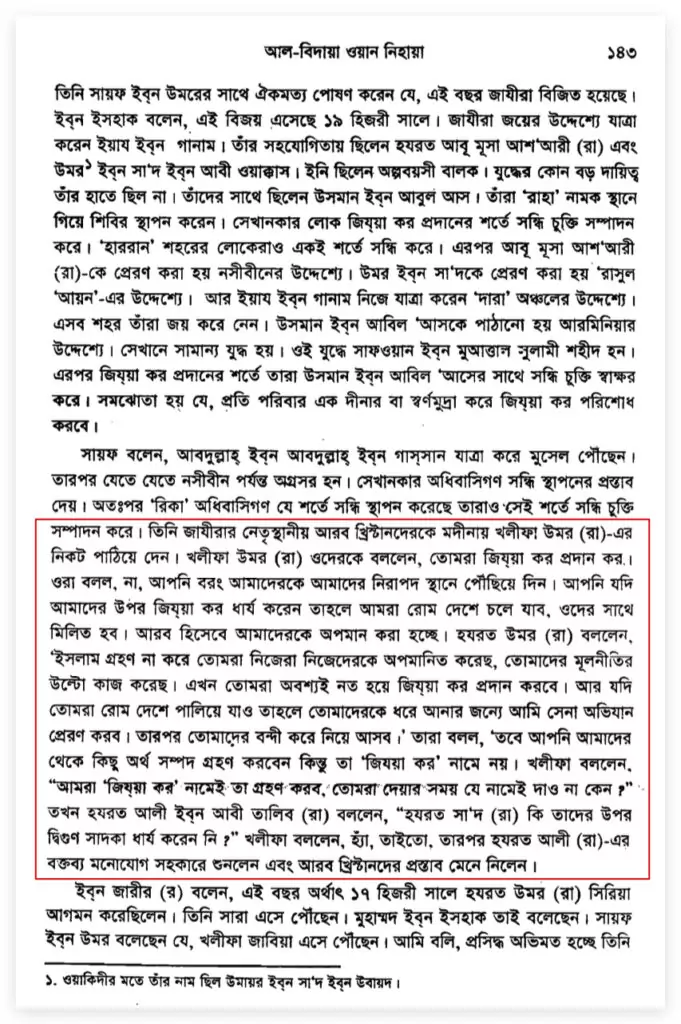
Islamist Defenses of the Humiliation and Discrimination of Jizya
A common way of denying the discriminatory character of jizya and the dhimmi system is to cite a classical jurist who rejected a particular brutal collection practice, and then pretend that Islamic jurisprudence therefore rejected the humiliation and degradation of dhimmis altogether. That inference is false. Jurists disagreed on many issues, and the existence of a different opinion does not erase the other opinions or transform them into inventions by critics of Islam. Nor does a jurist’s rejection of a particular method—pulling someone’s beard, striking their neck, beating them, or making them stand unnecessarily for long periods—abolish ṣaghār, religious subordination, unequal legal status, enforced distinctions, or the disparity of dignity between Muslims and dhimmis. Reading the relevant works in full often shows the same jurist rejecting a specific form of physical abuse while retaining ṣaghār and subordination by other means. The language of degradation and humiliation is also explicit in the Quran itself.
Even if one adopts those jurists’ positions, the problem remains. ‘They must not be beaten’ is not the same proposition as ‘They must be regarded as citizens of equal standing.’ A subordinate population can be subjected to a separate tax, required to wear distinctive clothing, excluded from social status comparable to that of Muslims, and compelled to live under the victorious community’s laws without being physically assaulted. Classical jurisprudence can describe that entire subordinate condition as ṣaghār. This distinction recurs throughout the legal literature.
Imam al-Nawawi: Rejecting One Method of Physical Humiliation, Not Saghār
A statement by Imam al-Nawawi in Rawḍat al-Ṭālibīn is frequently cited. Concerning a method of collecting jizya that involved forcing a dhimmi to stand, lowering his head, tugging his beard, and striking the side of his face, al-Nawawi said he knew of no reliable basis for it. Rather, most Shafi’i jurists held that jizya should be collected gently, like a debt. He characterized that particular physical ritual as باطلة مردودة—invalid and rejected. [75]
But stopping the quotation there distorts al-Nawawi’s position. In the very next sentence he reports, through al-Rafi’i, the strong opinion among Shafi’i jurists: ṣaghār means that Islamic law applies to dhimmis and they are compelled to comply with it. It then states:
أَشَدُّ الصَّغَارِ عَلَى الْمَرْءِ أَنْ يُحْكَمَ عَلَيْهِ بِمَا لَا يَعْتَقِدُهُ
English translation: The most severe form of ṣaghār for a person is to be governed by laws he does not believe in.
Al-Nawawi’s position therefore means: ṣaghār remains, but there is no reliable basis for the particular ritual of tugging beards or striking faces in order to implement it. To portray this as ‘al-Nawawi rejected the very notion of degrading or subordinating dhimmis’ is to reverse his actual meaning.
Ibn al-Qayyim: Opposing Dragging and Beating While Retaining Saghār and Dhilla
The same distinction becomes still clearer in Ibn al-Qayyim’s Aḥkām Ahl al-Dhimmah. He criticized several interpretations requiring a dhimmi to be dragged forcibly to pay jizya, made to stand for an unnecessarily long time, or subjected to physical humiliation. In his view, there was no reliable precedent for these specific actions in the Quran, Muhammad’s conduct, or the Companions’ practice. [76]
Immediately before that discussion, however, his interpretation of Quran 9:29 describes jizya as a tax imposed on non-Muslims ‘for humiliation and ṣaghār‘ and says that the payer must pay as صاغر ذليل—humbled and debased. More significantly, even after stating that specific forms of rough physical handling were unnecessary, he cited a report from Ahmad and an explanation by Qadi Abu Ya’la that the purpose was not torture but rather:
الِاسْتِخْفَافَ بِهِمْ وَإِذْلَالَهُمْ
English translation: To belittle and humiliate them.
In the same discussion, Ibn al-Qayyim explains that an ordinary charitable gift places the giver’s hand above the recipient’s; the posture is therefore reversed for jizya, with the non-Muslim payer’s hand below and the Muslim collector’s above. He also describes as incompatible with dhimmi status a situation in which Christians or other jizya payers exercise authority and superiority over Muslims. His objection, in other words, is not to the concept of humiliation but to certain specific, unsupported physical techniques for carrying it out. [77]
Ibn Qudama: Prohibiting Abuse Does Not Establish Equal Status
A similar dual structure appears in Ibn Qudamah’s Al-Mughnī. He says that excessive pressure must not be exerted in collecting jizya and that dhimmis unable to pay must not be tortured. These are real legal restrictions. Yet the heading of the same discussion is ‘Humiliating the People of the Dhimmah When Collecting Jizya,’ and it records Abu al-Khattab’s view involving their humiliation, prolonged standing, and pulling them by the hand. Ibn Qudamah then provides another interpretation in which ṣaghār means collecting jizya and subjecting dhimmis to Muslim law. He also describes the dhimmi appearing in person to pay while standing and the collector remaining seated. [78]
The inference ‘one must not beat an incapacitated person, therefore dhimmis and Muslims were equal citizens’ is a non sequitur. Restrictions on physical abuse and a lower legal status based on religious identity can coexist within the same system. Ibn Qudamah’s account contains both.
Distinctive Clothing: Disagreement over Method, Not the Principle of Separation
Another common defense concerns the distinctive attire or ghiyār of dhimmis. Some Hanbali jurists held that dhimmis refusing to wear distinctive clothing should not be forced to do so; from this, it is claimed that separate attire was not an obligatory rule at all. That argument rests on an incomplete quotation. Explaining the disagreement, Ibn Taymiyyah says the question is whether dhimmis themselves should be compelled to change their dress, or whether Muslims should differentiate their own dress when dhimmis refuse. He then states directly:
وَأَمَّا وُجُوبُ أَصْلِ الْمُغَايَرَةِ فَمَا عَلِمْتُ فِيهِ خِلَافًا
English translation: As for the obligation of distinguishing the two in principle, I know of no disagreement about it.
Contemporary IslamQA cites the same passage and begins by saying that dhimmis must have something in their clothing by which they are distinguished from Muslims. It discusses provisions involving differently colored shoes for women, distinguishing colors or cloth marks for men, and other forms of separation. [79]
The same issue appears in Ibn Muflih’s Al-Furūʿ. It first describes rules distinguishing dhimmis from Muslims in hairstyle, clothing, mounts, and other outward attributes. It then says that according to one Hanbali position, when they refuse a particular ghiyār they should not be forced, and Muslims must instead distinguish themselves. Thus ‘they should not be forced’ does not abolish differentiation; it proposes an alternative way of accomplishing it. [80]
The Claim That These Rules Were Merely Substitutes for Identity Documents
Another modern interpretation suggests that prescribing different colors, belts, clothing, or identifying marks for dhimmis served only the function of an identity card today. Identification was certainly one function of these rules; classical jurists also said they allowed Muslims and dhimmis to be recognized separately. But it does not follow that the rules had nothing to do with degradation or inequalities of status.
In Aḥkām Ahl al-Dhimmah, Ibn al-Qayyim calls this distinctive clothing ghiyār, describes it as a Sunnah, and quotes an earlier scholar linking its purpose simultaneously to ṣaghār, humiliation, public visibility, and identification. Identification and degradation are therefore not competing explanations here; both are recorded as purposes of the same jurisprudential arrangement. [81]
صَغَارًا وَذُلًّا وَشُهْرَةً وَعَلَمًا عَلَيْهِمْ
English translation: As a means of subjecting them to ṣaghār and humiliation, making them publicly recognizable, and marking them out.
The Hanbali work Al-Mubdiʿ likewise discusses distinguishing dhimmis in hairstyle, clothing, and mounts, imposing belts on Christians, and requiring lead seals or small bells around their necks on entering bathhouses. Describing the practice as a merely neutral identification system does not fully represent the jurisprudential language. [82]
Suspending a Provision for Maslaha Does Not Abolish That Provision
Another remark by Ibn al-Qayyim is often invoked as if he rejected distinctive clothing and social restrictions for dhimmis. In fact, he says that if relaxing a clothing requirement, greeting a dhimmi, or otherwise being accommodating in a particular situation would make that person more likely to accept Islam, such a concession may be preferable for the greater religious interest. This is an argument for temporarily relaxing a rule on grounds of maṣlaḥah (expediency or benefit), not a declaration that the rule is unjust or nonexistent.
The same contemporary IslamQA fatwa acknowledges ghiyār as an established rule for dhimmis before quoting Ibn al-Qayyim on such concessions, and says its application can vary with time, place, strength, weakness, benefit, and harm. [83] The conclusion ‘the rule may sometimes be left unenforced, therefore classical jurisprudence contained no discriminatory rule’ does not logically follow.
Common Defenses Versus the Primary Sources: A Comparative Overview
| Common Apologetic Claim | What the Primary Sources Actually State | Finding |
|---|---|---|
| Al-Nawawi said jizya should be collected gently, so there was no concept of ṣaghār or humiliation. | Al-Nawawi rejected the specific practice of pulling beards and striking payers as unfounded, but in the same passage he retained ṣaghār as compulsory submission to Islamic law. | A specific physical ritual was rejected; ṣaghār was not. |
| Ibn al-Qayyim opposed dragging and beating taxpayers, so jizya was not humiliating. | In the same discussion, he linked jizya to ṣaghār and degradation, retaining the dhimmi’s humbled and humiliated status. | The claim rests on an incomplete quotation. |
| Ibn Qudamah prohibited torture, so dhimmis had equal standing with Muslims. | He prohibited torturing those unable to pay, yet discussed dhimmis standing to pay while Muslim collectors sat and treated ṣaghār in the same chapter. | Prohibition of torture ≠ equality of status. |
| Distinctive clothing was not mandatory for dhimmis. | Ibn Taymiyyah said the dispute concerned who must change their clothing; he knew of no disagreement about the obligation of differentiation itself. | The claim reverses the source’s meaning. |
| Ibn Muflih said dhimmis should not be forced, so ghiyār was optional. | The same legal passage retains the rules distinguishing hairstyle, clothing, mounts, and identifying marks; the disagreement concerns who must make themselves different if dhimmis refuse. | Not optional; disagreement over implementation. |
| Ghiyār was merely an administrative system like modern identity cards. | Alongside identification, classical texts speak of ṣaghār, abasement, and public degradation. | Identification was one purpose, not the only one. |
| Ibn al-Qayyim allowed ghiyār to be waived when necessary, so it had no religious basis. | He permitted concessions in special circumstances based on maṣlaḥah and the prospect of conversion; elsewhere he discussed ghiyār as an established rule. | An exception does not negate the rule’s existence. |
Read together, these sources present a clear picture. Classical jurists disagreed over the precise physical method of collecting jizya. Some rejected practices such as pulling beards, striking payers, or subjecting them to unnecessary physical abuse. That disagreement does not eliminate ṣaghār, religious subordination, and a discriminatory hierarchy of standing from the jizya and dhimmi system. The full statements of al-Nawawi, Ibn Qudamah, Ibn al-Qayyim, Ibn Taymiyyah, and Ibn Muflih reveal that while they rejected certain forms of physical abuse, they retained various forms of separate legal and social status for dhimmis.
For precisely this reason, even if the statement ‘Islam did not command the beating of dhimmis’ is true, it does not answer criticism of jizya. The issue has never been merely whether beatings occurred. It is whether someone living in the same state must pay a separate tax because of their religion, remain in a defeated and subordinate political category, make their dress and social identity visibly distinct, and occupy an inferior position to Muslims under rules of the Sharia. Numerous major classical jurisprudential sources answer those questions in the affirmative.
Demonstrating that a particular brutal practice was an ‘incorrect application’ and then portraying the entire dhimmi system as egalitarian is a category error. Even without physical violence during tax collection, a separate religious tax, ṣaghār, legal subordination, distinctive clothing, and unequal social status could remain. That is precisely the arrangement described in these classical sources. Selecting a handful of lenient statements to erase the wider jurisprudential structure is neither history nor legal analysis; it changes the apparent nature of the system by suppressing the rest of the evidence.
Conclusion: Jizya as an Instrument of Deliberate Psychological Transformation
The overall analysis makes clear that jizya was not simply an obsolete tax but a far-reaching political and psychological penal system imposed on non-Muslims. Its most terrifying feature was uncertainty over rates. Without a divinely fixed and immutable ceiling comparable to that associated with zakat, collection depended heavily on a ruler’s discretion. At different moments in history, Muslim rulers wielded jizya as a weapon when facing financial crises or seeking to subjugate particular populations. The uncertainty itself generated fear among non-Muslim subjects, who could not know how great a financial burden would be imposed on them the following year. It stripped them not merely of property but of the ability to plan for the future and secure their economic lives.
Its consequences were still more destructive in India’s history. The harsh imposition of jizya on the region’s Hindu and Buddhist majority did not merely impoverish them: it sought to uproot their self-respect. Humiliating jurisprudential provisions—such as iron restraints around the neck, walking with lowered heads, or restrictions on displaying religious symbols—show that revenue was not the only objective. The deeper purpose was to instill enduring inferiority and a sense of culpability in non-Muslims. Beneath the system lay a form of psychological engineering meant to make their lives so intolerable that they would change religion, whether voluntarily under pressure or by compulsion, to escape degradation.
Ultimately, jizya stands in fundamental opposition to modern human rights, civic equality, and human dignity. It is not an ordinary tax regime; it is a state-enforced penal structure in which the supposed offense is not what a person does but which religion they follow. Under the Islamic state, the non-Muslim is told: You may live, but not as an equal; you may follow your religion, but not with your head held high; you may have protection, but not as a civic right—only in exchange for payment and humiliation. Every coin paid as jizya thus bears the stain of dishonor, political subordination, and religious discrimination. The historical documents and jurisprudential commentaries show that this system served not only revenue collection but also the enduring degradation, intimidation, marginalization, and dependence of non-Muslim populations. The history of jizya, in this sense, is more than the history of a tax. It is a stark record of state discrimination, humiliation, and systemic oppression conducted in the name of religious superiority.
References
- Sahih al-Bukhari, hadith 2652 ↩︎
- Sahih Muslim, hadith 2533 ↩︎
- Restrictions on Non-Muslims’ Religious Propagation and Places of Worship in a Sharia State ↩︎
- Tafsir Ibn Kathir, Islamic Foundation edition, vol. 4, pp. 562–567 ↩︎
- Tafsir al-Mazhari, vol. 5, p. 291 ↩︎
- Tafsir al-Jalalayn, vol. 2, p. 653 ↩︎
- Sahih al-Bukhari, vol. 5, p. 328 ↩︎
- Commentary on Surah al-Tawbah, Ibn Kathir, edited by Dr. Muhammad Abu Bakr Zakaria, IslamHouse Publications, p. 49 ↩︎
- Tafsir Ibn Kathir, Surah al-Tawbah 9:29, Islamweb Arabic edition ↩︎
- Tafsir Ibn Kathir, Qur’an 9:29, King Saud University Quran Project ↩︎
- Ibn Kathir, Tafsir al-Qur’an al-‘Azim, Surah al-Tawbah 9:28–29, Islamweb ↩︎
- Tafsir Ibn Kathir, Islamic Foundation, vol. 4, pp. 564–565 ↩︎
- Tafsir al-Mazhari, Sanaullah Panipati, Qur’an 9:29, Quranpedia ↩︎
- Tafsir al-Mazhari, Qur’an 9:29, commentary on ‘until they pay jizya by hand while subdued’ ↩︎
- Tafsir al-Mazhari, Qur’an 9:29, the expression ‘an yadin ↩︎
- Tafsir al-Mazhari, Qur’an 8:39, Quranpedia ↩︎
- Tafsir al-Mazhari, vol. 5, pp. 291–301 ↩︎
- Ibn al-Qayyim, Ahkam Ahl al-Dhimma, chapter ‘Jizya Is Not Rent for Residence,’ Islamweb ↩︎
- Ahkam Ahl al-Dhimma, vol. 1, ‘Jizya Is Not Rent for Living in the Territory’ ↩︎
- Ibn al-Qayyim, Ahkam Ahl al-Dhimma, ‘Reason for Instituting Jizya,’ Islamweb ↩︎
- Ibn al-Qayyim, Ahkam Ahl al-Dhimma, Shamela PDF, jizya chapter ↩︎
- Ibn al-Qayyim, Ahkam Ahl al-Dhimma, ‘Cause for Instituting Jizya,’ Islamweb ↩︎
- Al-Mawardi, al-Ahkam al-Sultaniyya, chapter on Jizya and Kharaj, Islamweb ↩︎
- Al-Mawardi, al-Ahkam al-Sultaniyya, jizya and kharaj chapter, Islamweb ↩︎
- Al-Mawardi, al-Ahkam al-Sultaniyya, jizya provisions, Islamweb ↩︎
- Al-Mawardi, al-Ahkam al-Sultaniyya, refusal to pay jizya, Islamweb ↩︎
- Al-Sarakhsi, al-Mabsut, Kitab al-Siyar, jizya and kharaj chapter, Islamweb ↩︎
- Al-Sarakhsi, al-Mabsut, Kitab al-Siyar, ‘Chapter on Assessing Kharaj,’ Islamweb ↩︎
- Al-Mabsut, vol. 10, procedure for jizya collection, Islamweb ↩︎
- Al-Sarakhsi, al-Mabsut, cancellation of jizya after conversion, Islamweb ↩︎
- Al-Mabsut, vol. 10, jizya not rent for residence, Islamweb ↩︎
- Al-Marghinani, al-Hidaya, chapter on jizya, Arabic edition ↩︎
- Al-Hidaya, chapter on jizya, cessation upon a dhimmi’s conversion ↩︎
- Al-Hidaya, chapter on jizya, collection procedure ↩︎
- Hanafi jurisprudential commentary on jizya and punishments, Arabic edition ↩︎
- Al-Hidaya, chapter on jizya and the permissibility of collecting it from non-Arab polytheists ↩︎
- Al-Fatāwā al-Hindiyyah, Vol. 2, Book of Siyar, chapter on jizya, Usul online edition ↩︎
- Al-Fatāwā al-Hindiyyah, Vol. 2, p. 247, chapter on jizya, Arabic online text ↩︎
- Ibn Abidin, Radd al-Muhtar, chapter on jizya, quoting Al-Fatāwā al-Hindiyyah, Islamweb ↩︎
- Al-Fatāwā al-Hindiyyah, Vol. 2, p. 244, dhimma and jizya rules ↩︎
- Al-Fatāwā al-Hindiyyah, Book of Siyar, chapter on jizya, al-Maktaba al-Kamila ↩︎
- Al-Fatāwā al-Hindiyyah, Vol. 2, p. 247, on jizya after conversion to Islam ↩︎
- Fatawa Alamgiri, Islamic Foundation Bangladesh, vol. 3, p. 642 1 2 3 4 5 6
- Al-Muhaqqiq al-Hilli, Shara’i‘ al-Islam, vol. 1, p. 251, online edition ↩︎
- Shahid al-Thani, commentary on Shara’i‘ al-Islam, p. 315, ‘taḥqīqan li-l-ṣaghār’ ↩︎
- Al-Muhaqqiq al-Hilli, Shara’i‘ al-Islam, vol. 1, rules concerning dhimmis ↩︎
- Muhammad Hasan al-Najafi, Jawahir al-Kalam, vol. 21, p. 349 ↩︎
- Jawahir al-Kalam, vol. 21, p. 248, jizya assessment and ṣaghār ↩︎
- Jawahir al-Kalam, vol. 21, p. 238, jizya and ṣaghār ↩︎
- Ibn Qudama, al-Mughni, vol. 9, Book of Jizya, conditions for permanent dhimma, Islamweb ↩︎
- Ibn Qudama, al-Mughni, Book of Jizya, permanent dhimma contract, Islamweb ↩︎
- Ibn Qudama, al-Mughni, vol. 9, obligations arising from the dhimma covenant, Islamweb ↩︎
- Ibn Qudama, al-Mughni, vol. 9, continuity of prior dhimma agreements, Islamweb ↩︎
- IslamQA, Fatwa 34770, ‘No Compulsion in Accepting Islam,’ December 13, 2002 ↩︎
- IslamQA, Fatwa 34770, ‘No Compulsion in Accepting Islam’ ↩︎
- IslamQA, Fatwa 43087, ‘Was Islam Spread by the Sword?’, July 31, 2003 ↩︎
- IslamQA, Fatwa 43087, hadith of Burayda and jizya ↩︎
- IslamQA, Fatwa 43087, jihad, jizya, and ṣaghār ↩︎
- IslamQA, Fatwa 178756, ‘No Compulsion in Religion’ and warfare, July 4, 2012 ↩︎
- IslamQA, Fatwa 178756, dhimmi and belligerent status of non-Muslims ↩︎
- IslamQA, Fatwa 178756, return of Jesus and abolition of jizya ↩︎
- Ibn al-Humam, Fath al-Qadir, Book of Siyar, chapter on jizya, Islamweb ↩︎
- Fath al-Qadir, vol. 6, distinctive clothing and identification rules for dhimmis ↩︎
- Ibn ‘Abidin, Radd al-Muhtar, Book of Jihad, distinctive clothing of dhimmis, Islamweb ↩︎
- Fath al-Qadir, rules on distinguishing the People of the Covenant, Islamweb ↩︎
- Al-Umm, al-Shafi‘i; al-Hidaya, vol. 2 ↩︎
- Ibn Sa‘d, Kitab al-Tabaqat al-Kubra, vol. 3; Sahih al-Bukhari ↩︎
- Ziauddin Barani, Tarikh-i-Firuz Shahi, translated by Golam Samdani Quraishy, Bangla Academy, pp. 236–239 ↩︎
- Khafi Khan, Muntakhab-ul-Lubab; Stanley Lane-Poole, Aurangzeb ↩︎
- Satish Chandra, ‘Jizyah and the State in India During the 17th Century,’ Journal of the Economic and Social History of the Orient, Vol. 12, 1969, pp. 322–340 ↩︎
- S. M. Azizuddin Husain, ‘Jizya—Its Reimposition During the Reign of Aurangzeb: An Examination,’ Indian Historical Review, Vol. 27, Issue 2, 2000, pp. 87–121 ↩︎
- Mohamed Saleh, ‘On the Road to Heaven: Taxation, Conversions, and the Coptic-Muslim Socioeconomic Gap in Medieval Egypt,’ The Journal of Economic History, 2018 ↩︎
- UNESCO, General History of Africa, Vol. III: Africa from the Seventh to the Eleventh Century, 1988 ↩︎
- Al-Bidaya wa’l-Nihaya, Vol. 7, Islamic Foundation, p. 143 ↩︎
- Imam al-Nawawi, Rawḍat al-Ṭālibīn, Vol. 10, chapter on jizya, Islamweb ↩︎
- Ibn al-Qayyim, Aḥkām Ahl al-Dhimmah, chapter on jizya, Islamweb ↩︎
- Aḥkām Ahl al-Dhimmah, continuation of the same discussion ↩︎
- Ibn Qudamah, Al-Mughnī, Vol. 9, ‘The Condition of the People of the Dhimmah When Collecting Jizya,’ Islamweb ↩︎
- IslamQA, Fatwa 429701, ‘What Is Meant by the Ghiyar of the People of the Dhimmah?’ ↩︎
- Ibn Muflih, Al-Furūʿ, Vol. 6, chapter on the rulings of the dhimmis, Islamweb ↩︎
- Ibn al-Qayyim, Aḥkām Ahl al-Dhimmah, Vol. 3, regulations on distinctive clothing, Islamweb ↩︎
- Ibn Muflih, Al-Mubdiʿ fī Sharḥ al-Muqniʿ, chapter on the rulings of the people of the dhimmah, Islamweb ↩︎
- IslamQA, Fatwa 429701 ↩︎