
Introduction
Islamic theology describes Iblis as the principal enemy of humanity. According to the Quran, after refusing to prostrate before Adam, Iblis resolved to lead human beings astray and was granted the opportunity to continue his activities until the Day of Resurrection. His role is to whisper evil suggestions into people’s minds, divert them from the truth, encourage wrongdoing, and undermine religious faith. However, Islamic accounts do not describe Iblis as carrying out these activities alone. He has offspring, followers, and an organized army of devils. A hadith in Sahih Muslim states that Iblis sends detachments of devils from his throne to various regions. It is also stated that every human being has an accompanying devil assigned to them. Thus, Islamic belief describes an extensive supernatural system intended to influence human thoughts, decisions, and everyday conduct. At the center of this system stands Iblis, under whose leadership devils carry out their activities to lead humanity astray.
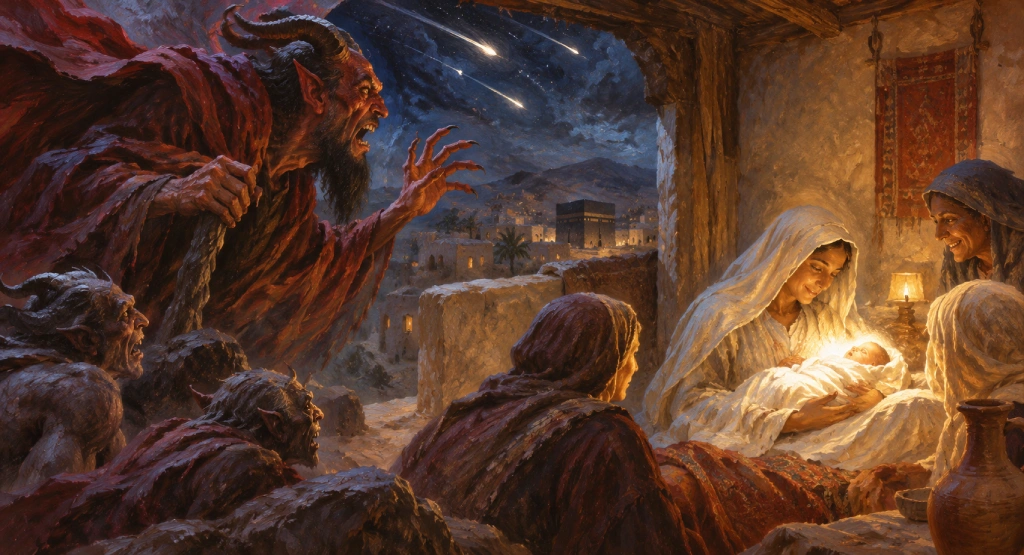
Comparing this religious worldview with the miraculous accounts surrounding Muhammad’s birth, childhood, and attainment of prophethood reveals a striking inconsistency. Islamic sirah and hadith literature do not portray Muhammad’s birth as an ordinary human event. They contain accounts of special announcements made to his mother before his birth, a miraculous light witnessed during pregnancy, an angel opening his chest during childhood and cleansing his heart, and the removal of Satan’s portion from his body. Other accounts of his life describe his exceptional status, supernatural protection, and various signs foreshadowing his future prophethood. According to these Islamic narratives, miraculous events involving angels, special divine commands, and Satan’s ability to influence human beings were occurring in Muhammad’s life even before his birth. Yet, despite this long sequence of events, a hadith in al-Tirmidhi depicts Iblis investigating the cause of a change associated with Muhammad’s prophethood.
Indeed, Sunan al-Tirmidhi 3324 depicts Iblis in a situation where he suspects that something important has happened on earth but does not know what the event is. Following Muhammad’s appointment as a prophet, the jinn encounter obstacles at their customary locations for gathering information from heaven. They inform Iblis of this change. Iblis concludes that something new must have occurred on earth and dispatches his forces to investigate the cause. Members of his army discover Muhammad performing prayer. When they return and report their discovery, Iblis identifies the cause of the change. Thus, in this hadith, Iblis did not already know the reason for the heavenly disruption associated with Muhammad’s prophethood; he had to learn about it through the reports of his subordinate jinn and their subsequent investigation.
This raises an obvious question: what had Iblis’s vast army been doing all those years? Did the devils, supposedly capable of entering people’s minds and whispering evil suggestions, gather no information about Muhammad’s birth, upbringing, or the alleged miraculous events in his life? Gabriel reportedly came to a child, opened his chest, and removed Satan’s portion from his heart—an event directly related to Iblis’s own sphere of activity. Did none of his followers notice even this? If Muhammad had enjoyed special divine protection from birth, why did the devils assigned to influence human beings fail to notice his exceptional condition? Moreover, if every person has an accompanying devil, what was the status of the devil assigned to Muhammad, and what information did it communicate to Iblis? These questions cannot be avoided when the Islamic narratives are examined together.
Islamic religious texts describe an extensive army of devils under Iblis, a jinn companion assigned to every human being, and a system for gathering information from heaven. These devils allegedly interfere in people’s personal lives, influence their thoughts, and steal information from angels. Yet Islamic biographical literature contains numerous accounts of miraculous signs preceding Muhammad’s birth, Gabriel’s intervention during his childhood, and advance announcements of his prophethood. Despite all these events, the hadith in al-Tirmidhi describes Iblis sending an army to investigate the cause of the change associated with Muhammad’s prophetic mission. The alleged extensive information-gathering abilities of the devils and their leader’s belated investigation expose an internal inconsistency in these Islamic supernatural narratives.
Miraculous Announcements Before Muhammad’s Birth: What Did Iblis Know?
Islamic biographical literature contains accounts of signs foreshadowing Muhammad’s prophethood, some of which are said to have occurred even before his birth. Ibn Hisham’s al-Sirah al-Nabawiyyah, transmitting Ibn Ishaq’s account, records an experience attributed to Muhammad’s mother, Amina bint Wahb. According to this account, Amina was informed during her pregnancy that she was carrying the leader of this community. She was instructed to seek Allah’s protection for the child after his birth and to name him Muhammad. The same account states that Amina saw a light during pregnancy through which the palaces of Busra in Syria became visible to her. Muhammad’s exceptional identity was therefore allegedly announced long before his appointment as a prophet. There is no independent historical evidence for this miraculous event. Nevertheless, Islamic sirah literature claims that Amina was informed of Muhammad’s future identity before his birth. Despite such advance announcements, the supposed intelligence network led by Iblis failed to demonstrate effective prior knowledge when Muhammad’s prophethood began. [1]
وَرَأَتْ حِينَ حَمَلَتْ بِهِ أَنَّهُ خَرَجَ مِنْهَا نُورٌ رَأَتْ بِهِ قُصُورَ بُصْرَى ، مِنْ أَرْضِ الشَّامِ
English translation: When she was carrying him, Amina saw a light emerging from her through which she could see the palaces of Busra in the region of al-Sham.
Amina’s reported experience is significant for several reasons. First, it establishes the notion that Muhammad’s future religious status had already been determined and announced before his birth. Second, it associates her pregnancy with a miraculous light whose reach allegedly extended beyond Mecca to the distant palaces of al-Sham. Third, the announcement was supposedly delivered to a woman who was then merely the mother of a future prophet; Muhammad’s prophetic mission had not yet begun. Thus, Muhammad’s exceptional identity was not presented as a sudden development in this Islamic biographical account. The narrative claims that supernatural activity surrounding him had already begun before his birth. Ibn Kathir also preserved the account of Amina seeing this light in al-Bidayah wa al-Nihayah, in his discussion of Muhammad’s birth. The repetition of an earlier narrative in a later work is not independent historical corroboration; it demonstrates how this account was preserved and circulated within Islamic biographical literature. [2]
Comparing these events with Sunan al-Tirmidhi 3324 raises further questions about Iblis’s access to information. According to al-Tirmidhi, Iblis discovers that something new has happened on earth only after the jinn are prevented from gathering heavenly information. Yet Ibn Hisham’s sirah claims that Muhammad’s special identity had been announced before his birth and that a miraculous light had appeared during Amina’s pregnancy. Did Iblis’s army receive no information about these events? If it did, why did Iblis have difficulty connecting the subsequent blockade of heavenly information with Muhammad’s already established exceptional status? If the information never reached his army, how effective was the intelligence and communication system attributed to devils supposedly active throughout human life? According to Islamic sirah literature, one miraculous event after another occurred before Muhammad’s birth. Yet after this long succession of signs, al-Tirmidhi still depicts Iblis investigating the cause of a new event when Muhammad’s prophethood begins. This sequence is inconsistent with the information-gathering and communication abilities attributed to the devils.
The inconsistency becomes even more striking when the accounts of Muhammad’s special protection during childhood are considered. According to Islamic narratives, not only was his future prophethood announced in advance, but extraordinary supernatural measures were allegedly taken to prevent Satan from influencing him. In Ibn Hisham’s sirah, a statement attributed to Amina concerning the young Muhammad indicates that Satan held no authority over him. Sahih Muslim, meanwhile, records Gabriel opening Muhammad’s chest and removing Satan’s portion from his heart. Both narratives directly concern Muhammad’s relationship with Satan. Consequently, the question of what Iblis’s army knew about Muhammad, when it knew it, and how that information was acquired extends beyond the miraculous signs surrounding his birth to the alleged events of his childhood.
Gabriel Opens Muhammad’s Chest During Childhood: Was Iblis Unaware That Satan’s Portion Had Been Removed from His Heart?
One of the most significant miraculous stories about Muhammad’s childhood concerns Gabriel opening his chest and removing Satan’s portion from his heart. In Sahih Muslim 162c, Anas ibn Malik narrates that Gabriel came to Muhammad while he was playing with other children. Gabriel laid him on the ground, opened his chest, extracted his heart, and removed a clot from it. Gabriel identified the clot as Satan’s portion within Muhammad. He then washed the heart in a golden vessel with Zamzam water and returned it to its original place. The other children ran to Muhammad’s foster mother and reported that Muhammad had been killed. Everyone rushed to him and found him pale. Anas further stated that he later saw the mark of the stitching on Muhammad’s chest. Sahih Muslim thus explicitly recounts Gabriel opening the young Muhammad’s chest, extracting his heart, removing Satan’s portion, washing the heart, and replacing it. Islamic belief thereby claims that an extraordinary event directly involving Satan’s ability to influence human beings occurred during Muhammad’s childhood. [3]
عَنْ أَنَسِ بْنِ مَالِكٍ، أَنَّ رَسُولَ اللَّهِ صلى الله عليه وسلم أَتَاهُ جِبْرِيلُ صلى الله عليه وسلم وَهُوَ يَلْعَبُ مَعَ الْغِلْمَانِ فَأَخَذَهُ فَصَرَعَهُ فَشَقَّ عَنْ قَلْبِهِ فَاسْتَخْرَجَ الْقَلْبَ فَاسْتَخْرَجَ مِنْهُ عَلَقَةً فَقَالَ هَذَا حَظُّ الشَّيْطَانِ مِنْكَ ثُمَّ غَسَلَهُ فِي طَسْتٍ مِنْ ذَهَبٍ بِمَاءِ زَمْزَمَ ثُمَّ لأَمَهُ ثُمَّ أَعَادَهُ فِي مَكَانِهِ وَجَاءَ الْغِلْمَانُ يَسْعَوْنَ إِلَى أُمِّهِ – يَعْنِي ظِئْرَهُ – فَقَالُوا إِنَّ مُحَمَّدًا قَدْ قُتِلَ فَاسْتَقْبَلُوهُ وَهُوَ مُنْتَقَعُ اللَّوْنِ قَالَ أَنَسٌ وَقَدْ كُنْتُ أَرَى أَثَرَ ذَلِكَ الْمِخْيَطِ فِي صَدْرِهِ
English translation: Anas ibn Malik narrated that Gabriel came to Muhammad while he was playing with other boys. He seized him, laid him down, opened his chest, extracted his heart, and removed a clot from it, saying, “This is Satan’s portion within you.” He then washed the heart in a golden vessel with Zamzam water, joined it together, and returned it to its place. The boys ran to his mother—that is, his foster mother—and said that Muhammad had been killed. They found him pale. Anas said that he could still see the mark of the stitching on Muhammad’s chest.
The significance of this hadith extends beyond the claim that Muhammad underwent a miraculous procedure during childhood. It explicitly identifies a portion belonging to Satan and describes Gabriel’s intervention to remove it. In Islamic belief, Iblis is the principal adversary seeking to lead human beings astray. His activities are associated with whispering evil suggestions into people’s hearts and directing them toward wrongdoing. Yet within this same religious worldview, Satan’s portion is supposedly being removed from the heart of an exceptional child. In other words, Islamic narratives describe Muhammad’s relationship with Satan as having been altered through an extraordinary supernatural intervention during his childhood. Islamic hadith literature attributes satanic influence to human beings generally, while claiming that Gabriel himself intervened to prevent such influence in Muhammad’s case. The account of Iblis’s investigation when Muhammad’s prophetic mission began is inconsistent with these earlier events, which were directly related to Iblis’s own sphere of activity.
Comparing this incident with the activities attributed to Iblis raises serious questions. If Iblis and his followers can whisper into human minds, influence human conduct, and maintain a direct connection with people, how did such an extraordinary event involving the young Muhammad escape their attention? This was not an ordinary illness or medical treatment. According to Islamic accounts, Gabriel himself came and removed Satan’s portion from a child’s body. A supernatural intervention was therefore made in an area directly connected with Satan’s supposed influence. Did no member of Iblis’s army gather information about this child’s identity, condition, and special protection? If they knew about the event, why was the information not communicated to their leader? If they did not know, how limited was the observational capacity of the satanic system supposedly active throughout human society?
The question becomes even more significant because separating the miraculous announcements surrounding Muhammad’s birth from the opening of his chest during childhood obscures their combined implications. The sirah describes special announcements and a miraculous light during his mother’s pregnancy. Sahih Muslim subsequently describes Gabriel removing Satan’s portion from Muhammad’s heart during childhood. Both events supposedly occurred long before his appointment as a prophet. Both establish the idea of an exceptional child enjoying special religious status and supernatural protection. Yet in the sequence recorded in al-Tirmidhi 3324, Iblis fails to understand the cause of the heavenly changes associated with Muhammad’s prophethood and dispatches forces to investigate. Taken together, the pre-birth signs, special protection during childhood, and subsequent prophetic mission transform Iblis’s ignorance into more than an isolated failure to obtain information. They raise the question of how information about these alleged supernatural events was managed within the system operating under his leadership.
According to Islamic belief, Muhammad’s heart was cleansed of Satan’s portion during his childhood within the very human world supposedly monitored and influenced by Iblis’s extensive army. Despite this exceptional event involving his principal religious adversary, the devils’ alleged intelligence network failed to spare their leader the need for a new investigation when Muhammad’s prophethood began. Islamic narratives describe Iblis’s followers as active in human thought and behavior, capable of reaching human beings, and operating under his leadership. A highly unusual event directly related to that system supposedly occurred during Muhammad’s childhood. The removal of Satan’s portion from a child’s heart should have been significant to Iblis’s army, whose alleged primary function was to exercise satanic influence over human beings. According to Islamic sources, the child later identified as Islam’s final prophet had been specially protected against Satan’s influence since childhood, yet Iblis still had to dispatch forces to identify the change associated with that very person’s prophethood. This sequence exposes a serious inconsistency concerning the operation and information flow of the Islamic supernatural system.
A Devil Accompanies Every Human Being: What Did Muhammad’s Companion Tell Its Leader?
Islamic hadith literature does not restrict the relationship between human beings and devils to distant whispers or appearances on particular occasions. In Sahih Muslim 2814a, Muhammad states that every human being has a companion assigned from among the jinn. His companions ask whether Muhammad himself has such a companion. Muhammad confirms that he does, but says that Allah helped him against it and that it commands him to do nothing except good. This narration establishes the idea of a permanent connection between human beings and a satanic entity. A devil is not merely an invisible force operating from afar; Islamic belief assigns a jinn companion to each person’s personal life. More importantly, Muhammad did not exempt himself from this general rule. He explicitly acknowledged the presence of such a companion in his own case while claiming special divine assistance against its influence. [4]
عَنْ عَبْدِ اللَّهِ بْنِ مَسْعُودٍ، قَالَ قَالَ رَسُولُ اللَّهِ صلى الله عليه وسلم «مَا مِنْكُمْ مِنْ أَحَدٍ إِلَّا وَقَدْ وُكِّلَ بِهِ قَرِينُهُ مِنَ الْجِنِّ» قَالُوا وَإِيَّاكَ يَا رَسُولَ اللَّهِ قَالَ «وَإِيَّايَ إِلَّا أَنَّ اللَّهَ أَعَانَنِي عَلَيْهِ فَأَسْلَمَ فَلَا يَأْمُرُنِي إِلَّا بِخَيْرٍ»
English translation: Abdullah ibn Mas’ud narrated that Muhammad said, “There is not one of you who has not been assigned a companion from among the jinn.” They asked, “Even you, Messenger of Allah?” He replied, “Even me. But Allah helped me against him, so he became submissive to me and commands me to do nothing except good.”
Another hadith narrated by Aisha makes the matter even more explicit. In Sahih Muslim 2815, Aisha reports that one night Muhammad left her and she became jealous. When he returned and noticed her condition, he asked whether her devil had come to her. Surprised, Aisha asked whether she also had a devil accompanying her. Muhammad answered yes. She then asked whether every human being had such a devil, and Muhammad again answered yes. Finally, she asked whether Muhammad himself had one. He confirmed that he did, adding that Allah had helped him against it. Here, the presence of a devil is not merely a general theological statement. Muhammad associates a particular emotional experience—Aisha’s jealousy—with the possible activity of her accompanying devil. The hadith therefore directly connects the presence of devils with people’s everyday emotions and psychological experiences. [5]
عَنْ عَائِشَةَ زَوْجِ النَّبِيِّ صلى الله عليه وسلم أَنَّ رَسُولَ اللَّهِ صلى الله عليه وسلم خَرَجَ مِنْ عِنْدِهَا لَيْلاً قَالَتْ فَغِرْتُ عَلَيْهِ فَجَاءَ فَرَأَى مَا أَصْنَعُ فَقَالَ «مَا لَكِ يَا عَائِشَةُ أَغِرْتِ» فَقُلْتُ وَمَا لِي لاَ يَغَارُ مِثْلِي عَلَى مِثْلِكَ فَقَالَ رَسُولُ اللَّهِ صلى الله عليه وسلم «أَقَدْ جَاءَكِ شَيْطَانُكِ» قَالَتْ يَا رَسُولَ اللَّهِ أَوَمَعِيَ شَيْطَانٌ قَالَ «نَعَمْ» قُلْتُ وَمَعَ كُلِّ إِنْسَانٍ قَالَ «نَعَمْ» قُلْتُ وَمَعَكَ يَا رَسُولَ اللَّهِ قَالَ «نَعَمْ وَلَكِنْ رَبِّي أَعَانَنِي عَلَيْهِ حَتَّى أَسْلَمَ»
English translation: Aisha narrated that Muhammad went out from her one night and she became jealous. When he returned and saw her condition, he asked, “What is the matter, Aisha? Are you jealous?” She replied, “Why should a woman like me not be jealous concerning a husband like you?” Muhammad then asked, “Has your devil come to you?” Aisha asked, “Messenger of Allah, do I have a devil with me?” He replied, “Yes.” She asked, “Does every human being have one?” He replied, “Yes.” She asked, “Even you, Messenger of Allah?” He replied, “Yes, but my Lord helped me against him until he became submissive to me.”
Connecting these two hadiths with the account of Muhammad’s chest being opened during childhood raises an important question. Sahih Muslim 162c states that Gabriel removed Satan’s portion from the young Muhammad’s heart. Sahih Muslim 2814a and 2815, meanwhile, state that Muhammad himself had an accompanying devil and that Allah had given him special assistance against its influence. Thus, Islamic hadith literature records several exceptional interventions involving Satan’s influence over Muhammad. The general relationship between human beings and devils is described as being subject to special divine intervention in his case. What, then, did Muhammad’s accompanying devil know about his exceptional condition? How did it perceive Gabriel’s alleged intervention, the removal of Satan’s portion, or the subsequent restriction of satanic influence over Muhammad? The presence of this companion is acknowledged, as is Muhammad’s special protection, yet there is no account of information from that companion reaching Iblis.
Sahih Muslim 2813a makes the activities of Iblis’s army especially relevant to this question. Jabir narrates that Muhammad said Iblis’s throne is situated over the sea and that he dispatches detachments to cause discord among human beings. The devil who causes the greatest discord is the most important to Iblis. This account does not portray Iblis as a passive or isolated entity. He actively dispatches subordinate forces and assesses the significance of their activities. Creating discord among human beings is part of his army’s organized operations. When the claim that every human being has a devil is considered alongside the account of Iblis directing his forces, Islamic belief describes an extensive organizational structure for satanic activity within human life. [6]
عَنْ جَابِرٍ، قَالَ سَمِعْتُ النَّبِيَّ صلى الله عليه وسلم يَقُولُ «إِنَّ عَرْشَ إِبْلِيسَ عَلَى الْبَحْرِ فَيَبْعَثُ سَرَايَاهُ فَيَفْتِنُونَ النَّاسَ فَأَعْظَمُهُمْ عِنْدَهُ أَعْظَمُهُمْ فِتْنَةً»
English translation: Jabir said that he heard Muhammad say, “Indeed, Iblis’s throne is upon the sea. He sends out his detachments, and they cause discord among the people. The greatest among them in his estimation is the one who causes the greatest discord.”
Sahih Muslim describes a satanic companion assigned to every human being and organized forces operating under Iblis. The inability of these forces, allegedly so extensively involved in people’s personal lives, to gather effective information about Muhammad’s exceptional position directly conflicts with the powers attributed to this satanic system. How could no devil under Iblis’s leadership obtain the necessary information about the life and activities of someone as exceptional as Muhammad over such a long period? According to the accounts of miraculous signs preceding his birth, Gabriel’s intervention during childhood, and special protection against satanic influence, Muhammad’s life had been exceptional from its beginning. Such a condition should have been of considerable significance to entities supposedly capable of accompanying and influencing human beings. Yet al-Tirmidhi depicts Iblis initiating his investigation only after obstacles appeared in the jinn’s attempts to gather information from heaven.
The powers attributed to Iblis’s organized army and the accompanying devils in Islamic belief conflict with the story of his delayed access to information. According to Sahih Muslim, satanic companions are attached to people’s personal lives; Iblis’s forces are engaged in creating discord; and Muhammad allegedly experienced the removal of Satan’s portion from his heart and other exceptional protections during childhood. Nevertheless, according to al-Tirmidhi 3324, Iblis had to investigate events on earth after the jinn’s access to heavenly information was obstructed following Muhammad’s prophethood. The combination of such an extensive supernatural army, a satanic companion assigned to every person, and Muhammad’s alleged long-standing divine protection raises a fundamental question: why did the leader of devils supposedly so deeply involved in human life fail to receive effective information about Muhammad’s exceptional status? The failure of this supposedly powerful satanic network to provide its leader with useful advance information about Muhammad exposes an internal inconsistency in the Islamic narrative.
Stones, Trees, and a Christian Monk Recognized Muhammad Before His Prophethood: Why Did Iblis Fail to Recognize Him?
Islamic accounts of the signs foreshadowing Muhammad’s prophethood are not confined to his birth and childhood. Hadith and sirah literature record several miraculous events in which his exceptional identity supposedly became apparent before his prophetic mission began. According to these narratives, a stone greeted Muhammad, trees showed him respect, a cloud sheltered him, and a Christian monk identified him as a future prophet through physical marks and miraculous signs. These events are used in Islamic biographical literature to establish Muhammad’s exceptional religious status. Yet the same accounts make Iblis’s alleged ignorance even more problematic. If even inanimate objects supposedly recognized Muhammad’s exceptional identity, and certain ordinary human beings were able to identify his future prophethood, how could the vast satanic army of Iblis, supposedly active throughout human life, remain unaware of his special status for so long?
In Sahih Muslim 2277, Muhammad describes an unusual event that allegedly occurred before his appointment as a prophet. Jabir ibn Samurah narrates that Muhammad said there was a stone in Mecca that used to greet him even before he received his prophetic mission. Muhammad claimed that he could still identify that stone afterward. Significantly, the stone’s behavior was not described as beginning after Muhammad publicly announced his prophethood. According to Muhammad’s own statement, the stone greeted him in a special manner before he was sent as a prophet. Islamic belief thus attributes to an ordinary inanimate object the ability to recognize the exceptional identity of a future prophet. There is no scientific evidence that stones possess consciousness or the ability to speak. Nevertheless, Sahih Muslim claims that a stone recognized Muhammad’s exceptional identity and greeted him before his prophethood. Islamic hadith literature therefore depicts even a stone recognizing the future prophet, while Iblis’s organized army still has to conduct a new investigation when the prophetic mission begins. [7]
عَنْ جَابِرِ بْنِ سَمُرَةَ، قَالَ قَالَ رَسُولُ اللَّهِ صلى الله عليه وسلم «إِنِّي لأَعْرِفُ حَجَرًا بِمَكَّةَ كَانَ يُسَلِّمُ عَلَىَّ قَبْلَ أَنْ أُبْعَثَ إِنِّي لأَعْرِفُهُ الآنَ»
English translation: Jabir ibn Samurah narrated that Muhammad said, “I know a stone in Mecca that used to greet me before I was sent as a prophet. I still know that stone.”
The story of the stone greeting Muhammad belongs to the wider collection of signs supposedly foreshadowing his prophethood. Following the announcement to Amina before his birth, the miraculous light during her pregnancy, and Gabriel’s opening of his chest during childhood, Islamic literature introduces a stone that allegedly greeted Muhammad before his prophetic mission. These narratives do not portray his exceptional status as something entirely concealed. Rather, they claim that his status was manifested through people, angels, and even inanimate nature at different stages of his life. Why, then, should none of this information have reached Iblis’s followers? How could devils supposedly capable of influencing the hidden inclinations of human minds fail to identify any of the alleged miraculous events occurring around Muhammad? According to Islamic belief, even an inanimate stone recognized Muhammad’s exceptional identity, yet the leader of devils supposedly capable of whispering into human minds had to conduct a new investigation to identify the cause of the change associated with his prophethood. This sequence conflicts with the observational and information-gathering abilities attributed to the devils.
A more elaborate account of human foreknowledge of Muhammad’s exceptional identity appears in the story of the Christian monk Bahira. Jami al-Tirmidhi 3620, narrated through Abu Musa al-Ash’ari, states that Muhammad traveled to al-Sham as a child with his uncle Abu Talib on a trading journey. When the travelers reached a monk, he identified Muhammad among them. According to the narration, the monk took Muhammad’s hand and declared him the leader of the worlds and the messenger of the Lord of the worlds. He said Muhammad would be sent as a mercy to human beings and jinn. When the Quraysh leaders asked how he knew this, the monk reportedly said that trees and stones had prostrated themselves upon their arrival and that such things happened only for a prophet. He also referred to a special mark of prophethood beneath Muhammad’s shoulder. The narration further describes a cloud shading Muhammad and the shade of a tree shifting toward him. [8]
هَذَا سَيِّدُ الْعَالَمِينَ هَذَا رَسُولُ رَبِّ الْعَالَمِينَ يَبْعَثُهُ اللَّهُ رَحْمَةً لِلْعَالَمِينَ
English translation: “This is the leader of the worlds. This is the messenger of the Lord of the worlds. Allah will send him as a mercy to the worlds.”
The story of Bahira contains another significant detail. It states that seven men from Roman territory had arrived searching for Muhammad. According to their statements, information had reached them that a prophet would appear during that month, and men had been dispatched along different routes to locate him. Thus, the account does not merely claim that a solitary monk recognized Muhammad’s exceptional identity; it also claims that people from distant regions had received information concerning his future prophethood. Muhammad had not yet publicly claimed to be a prophet. Nevertheless, the narrative describes information about his future identity spreading, attempts being made to identify him, and considerable concern surrounding his appearance. Hadith scholars have disagreed about the reliability of parts of this narration. Al-Tirmidhi classified it as hasan gharib, while later evaluations also described it as weak. The references to Abu Bakr and Bilal in particular have attracted criticism. Therefore, the narrative cannot be treated as an independently established historical event. It nevertheless provides a notable example of how Islamic biographical literature circulated miraculous claims of Muhammad’s recognition before his prophethood.
Comparing this story with Iblis’s position reveals a particular inconsistency. According to the Bahira narrative, a Christian monk identified Muhammad’s future status through physical marks, the behavior of trees and stones, and other signs. Information about the appearance of a prophet had supposedly reached people in distant regions as well. Yet in al-Tirmidhi 3324, Iblis dispatches forces to investigate the cause of the heavenly blockade after Muhammad’s prophethood has begun. How could the army of Iblis, whose principal task was supposedly to mislead people across the earth, fail to gather information about Muhammad’s exceptional identity? If a monk could identify the future prophet, why did the leader of the devils fail to obtain significant advance information about him? In Islamic belief, Muhammad’s religious mission directly opposed Iblis’s declared objective of leading humanity astray. Muhammad’s emergence was therefore not an irrelevant event for Iblis; it was directly connected to the purpose of his own activities.
When Muhammad’s birth, childhood, the opening of his chest, the stone’s greeting, and the story of Bahira are considered together, Islamic biographical literature presents a long sequence of miraculous events before his prophethood. Different parts of that sequence allegedly revealed Muhammad’s exceptional identity in different ways. Yet al-Tirmidhi’s account of Iblis depicts him concluding that something new had happened on earth only after the jinn’s previous activities in heaven were obstructed. The leader of an army of devils supposedly active throughout human life takes so long to identify the cause of a major religious change, while the same religious literature claims that signs foreshadowing the change had been appearing for years. These accounts do not describe a coherent supernatural intelligence system. The more miraculous accounts are added about Muhammad’s advance recognition, the more problematic Iblis’s delayed investigation becomes.
The Heavenly Blockade After Muhammad’s Prophethood: Why Was Iblis Forced to Investigate Events on Earth?
The most important direct narration concerning Iblis’s ignorance appears in Sunan al-Tirmidhi 3324. According to this hadith, narrated from Ibn Abbas, jinn previously ascended toward heaven to listen to information from the unseen world. Whenever they overheard one true statement, they added nine false statements of their own. The narration therefore describes an intelligence-gathering system through which the jinn could obtain information from heaven and use it on earth. When Muhammad was appointed as a prophet, this arrangement changed. The jinn encountered obstacles when attempting to sit in their previous listening positions, and blazing projectiles began to be directed against them. Unable to understand the cause of this unusual development, they reported it to Iblis. Iblis then suspected that a new event had occurred on earth and sent his forces to investigate. Members of his army discovered Muhammad performing prayer between two mountains. When they returned and reported their discovery, Iblis identified this event as the cause of the changes in heaven. [9]
Sunan al-Tirmidhi, Hadith 3324
Quranic Exegesis — Surah al-Jinn
Reference: Jami al-Tirmidhi 3324. Ibn Abbas narrated that the jinn used to ascend to heaven to gather information. When they heard one statement, they added nine statements of their own, so that one was true while nine were false. When Muhammad was appointed as a prophet, they were prevented from occupying their former listening places in heaven. The jinn reported this matter to Iblis. Previously, stars had not been hurled at them in this manner. Iblis said that something new must have happened on earth to cause this obstruction. He therefore dispatched his forces, who discovered Muhammad standing in prayer between two mountains. Al-Tirmidhi’s narration includes the transmitter’s uncertainty about whether the location was specifically described as Mecca. The forces returned and informed Iblis of what they had seen. He declared that this was the new event that had occurred on earth.
Al-Tirmidhi described the hadith as hasan sahih.
Traditional classification: Sahih.
Narrator: Abdullah ibn Abbas.
The sequence of Iblis’s actions in this hadith is particularly significant. First, the jinn lose their previous opportunity to gather information from heaven. Second, they are unable to explain the change themselves and report it to Iblis. Third, Iblis suspects that something new has happened on earth, but still does not know the event’s precise identity. Fourth, he sends his forces to investigate. Fifth, they discover Muhammad praying and return with the information. Finally, Iblis accepts their report as the explanation for the heavenly change. The narrative therefore presents a process in which Iblis moves from ignorance to an identification of the event through investigation, rather than acting on prior knowledge. According to al-Tirmidhi, Iblis suspects a new event on earth and dispatches his forces to discover its cause. Yet other Islamic biographical accounts state that he had known about Muhammad’s future role from the day of his birth. These two sequences create a serious inconsistency between Iblis’s supposed prior knowledge and his later investigation.
Sahih al-Bukhari 4921 also describes an investigation on earth after the jinn are prevented from gathering information in heaven. Ibn Abbas narrates that Muhammad was traveling toward the market of Ukaz with several companions. At that time, the devils’ access to heavenly information was interrupted, and fiery projectiles were directed against them. The devils returned and informed their companions about the change. They were then told that something important must have happened on earth and that they should search different regions in the east and west to discover its cause. A group of the investigating devils found Muhammad performing the dawn prayer with his companions at Nakhlah in the Tihamah region. When they heard the Quran being recited, they realized that this event was associated with the blockade of heavenly information. They then returned to their community and reported what they had heard. [10]
فَاضْرِبُوا مَشَارِقَ الأَرْضِ وَمَغَارِبَهَا فَانْظُرُوا مَا هَذَا الأَمْرُ الَّذِي حَدَثَ
English translation: “Travel through the eastern and western regions of the earth and investigate what new event has occurred.”
This narration in al-Bukhari exposes the central problem in al-Tirmidhi’s hadith even more clearly. In al-Tirmidhi, Iblis himself orders the investigation; in al-Bukhari, the decision to search the eastern and western regions of the earth arises among the devils. However, the central circumstances are similar in both accounts: after their previous system of gathering heavenly information is disrupted, the devils begin searching the earth for a new event. The entities supposedly responsible for whispering evil suggestions into human minds and influencing people’s lives evidently did not possess information about Muhammad’s prophethood that enabled them immediately to identify the reason for the heavenly change. Instead, they had to conduct new investigations across different regions of the earth. Why did the devils need such an investigation to identify an event associated with a man whom Islamic sirah and hadith literature describe as specially marked before birth, whose heart was supposedly cleansed of Satan’s portion during childhood, whom a stone greeted, and whom a monk allegedly recognized as a future prophet?
This depiction of ignorance is not confined to hadith literature. Quran 72:8–10 places a similar statement in the mouths of the jinn. They say that when they attempted to reach heaven, they found it filled with powerful guards and flaming projectiles. Previously, they had been able to occupy designated positions to listen for information, but now anyone who attempted to do so would find a blazing projectile waiting for them. More significantly, they admit that they do not know whether evil has been intended for those on earth or whether their Lord intends to guide them toward good. Thus, even after recognizing the change in heaven, the jinn were ignorant of its purpose. The Quran presents them as lacking knowledge not only about the circumstances of the change but also about its religious significance. [11]
وَأَنَّا لَا نَدْرِي أَشَرٌّ أُرِيدَ بِمَنْ فِي الْأَرْضِ أَمْ أَرَادَ بِهِمْ رَبُّهُمْ رَشَدًا
English translation: “And we do not know whether evil is intended for those on earth or whether their Lord intends guidance for them.”
Considered together, Surah al-Jinn, Sahih al-Bukhari 4921, and Sunan al-Tirmidhi 3324 describe an extensive sequence of events. The jinn previously gathered information from heaven. Following a change associated with Muhammad’s prophethood, they lost that opportunity. Its cause and significance were unclear to them. They searched the earth, heard Muhammad reciting the Quran, and subsequently learned about the new religious event. This sequence depicts a supernatural community supposedly connected to human life as unable immediately to identify the cause of a disruption to one of its principal information-gathering channels. More significantly, despite their previous experience obtaining information from heaven, they had to depend on investigations on earth to discover the identity of the new religious development.
Sahih Muslim describes Iblis dispatching organized forces and a jinn companion assigned to every human being. According to this Islamic supernatural system, devils are extensively active in human life. Muhammad was born, allegedly received supernatural protection during childhood, exhibited various signs of his future status before prophethood, and subsequently began publicly preaching his religion. Yet after their access to heavenly information was obstructed, Iblis and the devils had to investigate what had happened on earth. The extensive intelligence-gathering abilities attributed to devils in Islamic belief directly conflict with their leader’s ignorance: how could entities supposedly extending into people’s personal lives and operating throughout different regions of the earth fail so completely to gather useful information about Muhammad’s long-standing exceptional status and the emergence of his prophethood?
Quran 46:29–32 also describes jinn hearing the Quran and returning to their community to communicate the news. The jinn tell one another to remain silent while listening, and afterward they return to warn their people. They announce that they have heard a scripture revealed after Moses, confirming the truth and guiding toward the straight path. This narrative provides another example of communication and the circulation of religious information among jinn. They collect new information, understand it, and convey it to their community. Islamic sources repeatedly attribute the ability to exchange information to jinn. Yet those same accounts fail to establish a coherent explanation of what Iblis knew beforehand about Muhammad’s prophethood or why his forces needed to investigate the cause of the new heavenly blockade. [12]
The central inconsistency concerns the chronology and circulation of information. According to Islamic narratives, Muhammad’s exceptional identity had been announced before his birth, special measures involving an angel were taken during his childhood, miraculous signs of his future prophethood appeared before his mission, and he himself had an accompanying devil. Yet Iblis had to dispatch forces to investigate the cause of the heavenly changes associated with Muhammad’s prophethood. The satanic system supposedly capable of influencing even the hidden impulses of human minds failed to gather effective information about its principal religious opponent’s exceptional status over many years. This portrayal undermines the coherence of the Islamic miraculous narratives. Stories used separately to establish Muhammad’s extraordinary status and Iblis’s power collectively produce contradictory depictions of supernatural ability, ignorance, and access to information rather than a consistent supernatural system.
Devils Stole Information About the Future from Angels: Where Did the News of Muhammad’s Prophethood Disappear?
Islamic hadith literature contains another significant account of the information-gathering abilities of Iblis’s army. In Sahih al-Bukhari 3288, Aisha narrates that Muhammad said angels discuss matters that will occur on earth while in the clouds. The devils overhear a word from those conversations and convey it to the ears of soothsayers. They then attach another hundred lies to that single true statement. This hadith does not restrict the devils’ intelligence-gathering powers to ordinary human observation. Instead, it associates them with a supernatural information network through which they can obtain news about earthly events before those events occur by overhearing angelic conversations. Thus, Islamic accounts do not describe devils as merely observing people’s present behavior; they also supposedly attempt to collect information about future earthly events from heaven. This alleged capacity makes Iblis’s ignorance of Muhammad even more significant. [13]
عَنِ النَّبِيِّ صلى الله عليه وسلم قَالَ «الْمَلاَئِكَةُ تَتَحَدَّثُ فِي الْعَنَانِ ـ وَالْعَنَانُ الْغَمَامُ ـ بِالأَمْرِ يَكُونُ فِي الأَرْضِ، فَتَسْمَعُ الشَّيَاطِينُ الْكَلِمَةَ، فَتَقُرُّهَا فِي أُذُنِ الْكَاهِنِ، كَمَا تُقَرُّ الْقَارُورَةَ، فَيَزِيدُونَ مَعَهَا مِائَةَ كَذِبَةٍ»
English translation: Aisha narrated that Muhammad said, “The angels converse in the clouds about matters that will occur on earth. The devils overhear a word and pour it into the ear of a soothsayer as something is poured into a vessel. They then add a hundred lies to it.”
Comparing this narration with the miraculous announcements before Muhammad’s birth, the opening of his chest during childhood, and his appointment as a prophet raises a fundamental question. According to Islamic belief, Muhammad’s prophethood formed part of Allah’s plan. The sirah describes announcements concerning his special identity even before his birth. Hadith literature also claims that Gabriel came during Muhammad’s childhood and removed Satan’s portion from his heart. Other narratives describe a stone greeting him before prophethood and various signs foreshadowing his future mission. Meanwhile, Sahih al-Bukhari asserts that devils could collect information about future earthly events from angels. Did no information about the emergence of such a significant person or the extraordinary events of his life ever reach the devils through this network? According to Islamic belief, devils capable of stealing information about future earthly events from angels nevertheless failed to identify the cause of the change associated with Muhammad’s prophethood. Despite numerous stories of miraculous announcements and the revelation of Muhammad’s exceptional status before his birth, this failure calls the alleged reliability of their information-gathering network into question.
Sahih al-Bukhari 7561 also describes devils conveying information to soothsayers. In this hadith, Aisha narrates that certain people questioned Muhammad about soothsayers. Muhammad initially dismissed their claims. The questioners then pointed out that some statements made by soothsayers turned out to be true. Muhammad replied that jinn steal a true statement from heaven and whisper it into the ears of soothsayers, who then mix it with more than a hundred lies. Here, the apparent accuracy of some predictions is attributed not to observation, calculation, or ordinary inference but to the supernatural theft of information by jinn. According to this Islamic account, even an ordinary soothsayer could receive information allegedly stolen from heaven. [14]
قَالَتْ عَائِشَةُ ـ رضى الله عنها ـ سَأَلَ أُنَاسٌ النَّبِيَّ صلى الله عليه وسلم عَنِ الْكُهَّانِ فَقَالَ «إِنَّهُمْ لَيْسُوا بِشَىْءٍ» فَقَالُوا يَا رَسُولَ اللَّهِ فَإِنَّهُمْ يُحَدِّثُونَ بِالشَّىْءِ يَكُونُ حَقًّا. قَالَ فَقَالَ النَّبِيُّ صلى الله عليه وسلم «تِلْكَ الْكَلِمَةُ مِنَ الْحَقِّ يَخْطَفُهَا الْجِنِّيُّ فَيُقَرْقِرُهَا فِي أُذُنِ وَلِيِّهِ كَقَرْقَرَةِ الدَّجَاجَةِ، فَيَخْلِطُونَ فِيهِ أَكْثَرَ مِنْ مِائَةِ كَذْبَةٍ»
English translation: Aisha narrated that some people asked Muhammad about soothsayers. He replied that they were of no significance. They said that soothsayers sometimes made statements that proved true. Muhammad answered, “That true statement is snatched by a jinn and whispered into the ear of his associate like the clucking of a hen. They then mix more than a hundred lies with it.”
This narration reveals another alleged feature of the devils’ communication system. After obtaining information from heaven, jinn can supposedly transmit it to particular human beings on earth. Thus, both the collection and distribution of information are presented as activities within their capabilities. Why, then, did the same ability fail to communicate information about the miraculous events allegedly occurring in Muhammad’s life? An ordinary soothsayer could supposedly receive information about future events, while Iblis, the leader of the devils, had to send his forces after the heavenly blockade to discover the cause of the change associated with Muhammad’s prophethood. Islamic belief attributes to devils the ability to communicate future information to human beings, yet their leader had to initiate a fresh investigation to identify the cause of the change connected with Muhammad’s prophetic mission. These opposing accounts expose a serious inconsistency in the information-gathering and communication system attributed to the devils.
Another important consideration concerns Iblis’s declared purpose. According to the Quran, he intends to divert human beings from Allah’s path. Within Islam, Muhammad is regarded as the final messenger, and his religious message directly opposes that purpose. Through Muhammad, the Quran is supposedly revealed, people’s religious practices are transformed, and humanity is instructed to reject Satan’s influence. Muhammad’s emergence was therefore directly relevant to Iblis’s activities. Despite the vast powers supposedly granted to devils to obtain information about people’s hidden inclinations and future earthly events, al-Tirmidhi’s sequence contains no account of effective advance intelligence or preparation regarding the central opponent of their declared objective. Instead, Iblis receives news of the heavenly blockade, suspects that something new has happened on earth, and investigates until Muhammad’s location is discovered.
According to Islamic narratives, devils can influence people’s private thoughts, steal information about future events from the conversations of angels, and convey that information to soothsayers. Yet their leader had to conduct a new investigation to discover the cause of a change associated with Muhammad’s prophethood. Taken together, these stories describe a supernatural intelligence system whose powers are sometimes extraordinarily extensive and at other times astonishingly limited. The claim that devils possess such broad intelligence-gathering powers conflicts with Iblis’s ignorance when Muhammad’s prophethood begins. In Islamic narratives, the devils’ abilities sometimes extend to obtaining information about the future, yet their intelligence system fails in the case of their principal religious opponent.
New Heavenly Guards and Flaming Projectiles After Muhammad’s Prophethood: The Reality of Meteors and Contradictions in Hadith
The account of Iblis learning about Muhammad’s prophethood is connected to a supposedly extraordinary change in heaven. Sunan al-Tirmidhi 3324 states that after Muhammad was appointed as a prophet, jinn were prevented from occupying their former positions for gathering information from heaven, and stars began to be hurled at them. The Arabic text specifically states that stars had not previously been thrown at them in this manner. Consequently, the jinn regarded this change as unusual and informed Iblis. Iblis suspected that the heavenly change was connected to a new event on earth. Thus, the implementation of a new heavenly defense system is presented as the principal clue prompting his investigation into the emergence of Muhammad’s prophethood. [15]
فَلَمَّا بُعِثَ رَسُولُ اللَّهِ صلى الله عليه وسلم مُنِعُوا مَقَاعِدَهُمْ فَذَكَرُوا ذَلِكَ لإِبْلِيسَ وَلَمْ تَكُنِ النُّجُومُ يُرْمَى بِهَا قَبْلَ ذَلِكَ فَقَالَ لَهُمْ إِبْلِيسُ مَا هَذَا إِلاَّ مِنْ أَمْرٍ قَدْ حَدَثَ فِي الأَرْضِ فَبَعَثَ جُنُودَهُ فَوَجَدُوا رَسُولَ اللَّهِ صلى الله عليه وسلم قَائِمًا يُصَلِّي بَيْنَ جَبَلَيْنِ
English translation: When Muhammad was sent as a prophet, the jinn were prevented from occupying their former positions in heaven. They informed Iblis of this matter. Stars had not previously been hurled at them in this manner. Iblis said, “Something new must certainly have happened on earth.” He then dispatched his forces, who found Muhammad standing in prayer between two mountains.
Quran 72:8–9 also describes new guards and flaming projectiles at the locations where jinn previously gathered information from heaven. There, the jinn contrast their former experiences with their present circumstances. They state that they once occupied specific positions in heaven to listen for information, but now anyone attempting to do so finds a blazing projectile waiting. This account directly connects heavenly guards with the prevention of information gathering by jinn. Quran 67:5 also declares that the nearest heaven has been adorned with lamps and that they have been made into objects used against devils. Thus, Islamic scripture associates the supposed prevention of heavenly eavesdropping with luminous celestial objects and fiery projectiles visible in the sky. [16]
وَأَنَّا لَمَسْنَا السَّمَاءَ فَوَجَدْنَاهَا مُلِئَتْ حَرَسًا شَدِيدًا وَشُهُبًا وَأَنَّا كُنَّا نَقْعُدُ مِنْهَا مَقَاعِدَ لِلسَّمْعِ فَمَنْ يَسْتَمِعِ الْآنَ يَجِدْ لَهُ شِهَابًا رَصَدًا
English translation: “And we sought to reach heaven and found it filled with powerful guards and flaming projectiles. We used to occupy positions there to listen, but whoever now attempts to listen will find a blazing projectile waiting for him.”
There is an important historical problem here. Al-Tirmidhi describes a new situation in which stars are hurled at jinn after Muhammad’s prophetic mission begins. However, Sahih Muslim 2229a records Muhammad himself questioning his companions about their observations of shooting stars in pre-Islamic times. According to the narration, a bright meteor appeared while Muhammad was sitting with a group of people. He asked them what they used to say in the period of Jahiliyyah when they witnessed such an event. They replied that they believed it indicated the birth or death of an important person. Muhammad rejected this explanation, stating that a meteor was not hurled because of anyone’s birth or death. He then described communication among angels concerning Allah’s commands and the jinn’s attempts to steal that information. This hadith establishes that shooting stars were already familiar to people before Muhammad’s prophethood and that social beliefs about them existed at that time. [17]
أَنَّهُمْ بَيْنَمَا هُمْ جُلُوسٌ لَيْلَةً مَعَ رَسُولِ اللَّهِ صلى الله عليه وسلم رُمِيَ بِنَجْمٍ فَاسْتَنَارَ فَقَالَ لَهُمْ رَسُولُ اللَّهِ صلى الله عليه وسلم «مَاذَا كُنْتُمْ تَقُولُونَ فِي الْجَاهِلِيَّةِ إِذَا رُمِيَ بِمِثْلِ هَذَا» قَالُوا اللَّهُ وَرَسُولُهُ أَعْلَمُ كُنَّا نَقُولُ وُلِدَ اللَّيْلَةَ رَجُلٌ عَظِيمٌ وَمَاتَ رَجُلٌ عَظِيمٌ فَقَالَ رَسُولُ اللَّهِ صلى الله عليه وسلم «فَإِنَّهَا لاَ يُرْمَى بِهَا لِمَوْتِ أَحَدٍ وَلاَ لِحَيَاتِهِ»
English translation: One night, while they were sitting with Muhammad, a bright shooting star appeared. Muhammad asked them, “What did you use to say in the days of Jahiliyyah when something like this was hurled?” They replied that they used to believe a great person had been born or had died that night. Muhammad said, “These are not hurled because of anyone’s death or birth.”
Sahih Muslim explicitly establishes that meteors were observed in pre-Islamic times. Yet al-Tirmidhi describes the blockade of the jinn’s heavenly information-gathering activities and the hurling of stars against them as a new development following Muhammad’s prophethood. There is no observational basis for this supernatural explanation of meteors. Therefore, any claim that meteors first appeared on earth only after Muhammad’s prophethood would contradict Sahih Muslim. Even if al-Tirmidhi’s narration is understood as claiming that a new defense system was established specifically against the jinn, the actual existence of such a system, the supposed positions of jinn in heaven, and any connection between flaming projectiles and the activities of jinn remain unsubstantiated by independent evidence. A religious narrative alone is not sufficient to identify a visible natural phenomenon as a weapon used to prevent supernatural information theft.
According to modern astronomy, a meteor is a luminous phenomenon produced when a small extraterrestrial object enters Earth’s atmosphere at high speed. Such an object is called a meteoroid while it remains in space. When it enters the atmosphere and produces a bright streak of light through its interaction with the air, the phenomenon is called a meteor. These objects may originate from asteroids, comets, or other extraterrestrial sources. Meteor showers can occur when Earth passes through streams of particles left behind by comets. The trajectories, velocities, luminous effects, and compositions of these phenomena can be observed and measured. No observable relationship has been established between meteors and the supposed positions of jinn attempting to eavesdrop in heaven or being struck by celestial projectiles. There is no scientific basis for treating the hurling of fiery objects at jinn as the actual physical cause of meteors. [18]
When meteoroids enter Earth’s atmosphere (or that of another planet, like Mars) at high speed and burn up, the fireballs, or “shooting stars,” are called meteors.
English translation: When meteoroids enter the atmosphere of Earth or another planet at high speed and burn up, the resulting luminous phenomena, commonly called shooting stars, are known as meteors.
The connection between this alleged heavenly defense system and Iblis’s ignorance is direct. In al-Tirmidhi’s narration, Iblis did not initiate an investigation because he was acting on advance information concerning Muhammad’s prophethood. Instead, his subordinate jinn informed him that they could no longer carry out their previous activities in heaven. He then suspected that something new had happened on earth. Thus, the investigation began because of a sudden obstruction affecting his army’s own operations. Other Islamic sources attribute to devils the ability to gather heavenly information, engage in extensive activities on earth, and influence human beings. Yet despite all these supposed powers, the disruption of their heavenly information network had to occur before their leader obtained effective information about the change associated with Muhammad’s prophethood.
On the one hand, Islamic belief describes devils as an army capable of interfering in people’s personal lives, gathering information about future earthly events from the conversations of angels, and conveying that information to human beings. On the other hand, their leader had to dispatch forces and conduct a new investigation to discover the cause of the change associated with Muhammad’s prophethood. These interconnected narratives reveal a fundamental inconsistency between the powers attributed to devils, their information network, and Iblis’s ignorance. There is also no independent evidence for the actual existence of jinn entering heaven, stealing information, being attacked by flaming projectiles, or Iblis conducting these investigations. The narratives are therefore internally problematic and lack the evidence necessary to establish them as events in the real world.
Earlier Prophets Already Knew of Muhammad’s Coming: Why Did This Information Never Reach Iblis?
Islamic theology does not describe Muhammad’s prophethood as a sudden or unplanned event. Instead, the Quran claims that information about his coming had been preserved in earlier scriptures and that previous prophets foretold his appearance. According to this idea, Muhammad’s emergence was a religious event whose announcement had reached humanity centuries before his birth. Quran 61:6 explicitly claims that Jesus announced to the Israelites the coming of a messenger after him named Ahmad. Islamic interpretation identifies Ahmad with Muhammad. Thus, the Quran itself claims that news of Muhammad’s future emergence had been circulated long before his prophetic mission began. Yet Sunan al-Tirmidhi 3324 describes Iblis investigating the cause of the heavenly blockade after Muhammad’s prophethood. Comparing these accounts raises a serious question about Iblis’s access to information and the effectiveness of his army. [19]
وَإِذْ قَالَ عِيسَى ابْنُ مَرْيَمَ يَا بَنِي إِسْرَائِيلَ إِنِّي رَسُولُ اللَّهِ إِلَيْكُمْ مُصَدِّقًا لِمَا بَيْنَ يَدَيَّ مِنَ التَّوْرَاةِ وَمُبَشِّرًا بِرَسُولٍ يَأْتِي مِنْ بَعْدِي اسْمُهُ أَحْمَدُ فَلَمَّا جَاءَهُمْ بِالْبَيِّنَاتِ قَالُوا هَذَا سِحْرٌ مُبِينٌ
English translation: And remember when Jesus, son of Mary, said, “Children of Israel, I am Allah’s messenger to you, confirming the Torah revealed before me, and bringing good news of a messenger who will come after me, whose name is Ahmad.” But when he came to them with clear proofs, they said, “This is obvious magic.”
According to this verse, knowledge of Muhammad’s coming was not confined to Amina’s miraculous experience during pregnancy or a monk’s prediction during his childhood. The Quran also claims that an earlier prophet, Jesus, announced his future arrival. There is no independent historical evidence establishing that Jesus actually made this prediction about Muhammad. Yet according to the Quran, the announcement of Muhammad’s coming had been made centuries before his birth. The account of Iblis’s belated investigation, despite this ancient prediction, exposes an inconsistency among the Islamic narratives. Within that religious worldview, Iblis had been active for generations in misleading human beings. His forces entered human lives to whisper evil suggestions, obtained information from angelic conversations, and operated across different parts of the earth. Why, then, did no effective system exist for this information about a future messenger to reach Iblis, despite its supposed circulation centuries earlier? Were Iblis’s subordinate devils inactive in the time of Jesus? Did the entities supposedly assigned to influence people’s religious beliefs and behavior take no interest in such an important religious declaration?
Quran 7:157 expresses the same idea even more directly. It claims that the description of the unlettered prophet was written in the Torah and the Gospel. The verse presents the future prophet’s identity as something recognizable to followers of earlier scriptures. This is not merely a general announcement that another messenger would appear; it claims that descriptions of his identity and activities were present in earlier religious texts. According to the Quran, therefore, a religious basis for recognizing Muhammad’s identity existed before his prophetic mission. The Quran explicitly claims that Muhammad’s description was recorded in previous scriptures. This alleged ancient foreknowledge conflicts with the account of Iblis’s delayed investigation in al-Tirmidhi. [20]
الَّذِينَ يَتَّبِعُونَ الرَّسُولَ النَّبِيَّ الْأُمِّيَّ الَّذِي يَجِدُونَهُ مَكْتُوبًا عِنْدَهُمْ فِي التَّوْرَاةِ وَالْإِنْجِيلِ يَأْمُرُهُمْ بِالْمَعْرُوفِ وَيَنْهَاهُمْ عَنِ الْمُنْكَرِ وَيُحِلُّ لَهُمُ الطَّيِّبَاتِ وَيُحَرِّمُ عَلَيْهِمُ الْخَبَائِثَ وَيَضَعُ عَنْهُمْ إِصْرَهُمْ وَالْأَغْلَالَ الَّتِي كَانَتْ عَلَيْهِمْ فَالَّذِينَ آمَنُوا بِهِ وَعَزَّرُوهُ وَنَصَرُوهُ وَاتَّبَعُوا النُّورَ الَّذِي أُنْزِلَ مَعَهُ أُولَئِكَ هُمُ الْمُفْلِحُونَ
English translation: Those who follow the messenger, the unlettered prophet whom they find described in the Torah and the Gospel in their possession, who commands what is right and forbids what is wrong, permits good things and prohibits impure things, and removes their burdens and the restraints imposed upon them. Those who believe in him, honor him, support him, and follow the light revealed with him are the successful.
The implications become clearer when this statement is compared with Iblis’s activities. Islamic theology describes Iblis’s primary objective as diverting human beings from Allah’s commands. The Quran does not claim that followers of earlier scriptures were outside the scope of his activities. His alleged influence was therefore not confined to the Arabs who lived during Muhammad’s lifetime; Islamic belief describes his hostility as extending throughout human religious history. If Muhammad’s coming had been foretold in earlier scriptures over that long period, the information would have been directly relevant to devils supposedly assigned to influence people’s religious beliefs. They are credited with interfering in human faith, yet there is no account establishing that information about one of the most important predictions in religious history effectively reached their leadership. In al-Tirmidhi, Iblis instead dispatches forces to identify the cause of a new event.
Sahih al-Bukhari 7 adds another dimension through the account of the conversation between the Byzantine emperor Heraclius and Abu Sufyan. Heraclius questioned Abu Sufyan in detail about Muhammad’s family background, truthfulness, followers, and religious teachings. According to the narration, he already knew from religious scripture that a prophet was expected, although he had not anticipated that the prophet would emerge from among the Arabs. After Muhammad had announced his prophethood, Heraclius reportedly used knowledge of earlier religious texts and information supplied by Abu Sufyan to assess Muhammad’s identity. Islamic hadith literature thus describes an ordinary human being using previous religious knowledge to recognize Muhammad’s exceptional status. Yet the enormous powers attributed to Iblis’s army remain inconsistent with its leader’s belated investigation. The narrative depicts a ruler drawing conclusions from religious information, human testimony, and observable social circumstances. [21]
Islamic sources therefore contain three types of claims concerning advance knowledge of Muhammad’s identity. The Quran claims that Jesus announced the coming of Ahmad and that Muhammad’s description appeared in the Torah and Gospel. Sirah literature describes miraculous manifestations of his exceptional identity before his birth and during childhood. Hadith literature also describes individuals identifying him through knowledge of earlier scriptures. Against this extensive sequence of advance announcements, al-Tirmidhi depicts Iblis sending forces to discover the cause of a heavenly change associated with Muhammad’s prophethood. According to Islamic sources, the coming of this messenger had been announced centuries earlier, his exceptional identity had been revealed before birth, and Satan’s portion had been removed from him during childhood. Yet Iblis’s ignorance of the cause of the change associated with that same person’s prophethood conflicts with the extensive activities attributed to his army. The more broadly a religious narrative describes the advance announcement of an event, the more seriously the delayed access to information by its organized supernatural adversary becomes a problem.
Iblis’s Oath to Mislead Adam’s Descendants: Why Was He So Uninformed About His Principal Opponent?
The question of Iblis’s ignorance becomes particularly significant when his declared purpose and commitments in the Quran are compared with Muhammad’s prophethood. In Quran 15:39–40, Iblis declares that he will make evil deeds appear attractive to human beings on earth and attempt to mislead them all, except Allah’s chosen servants. His activity is not restricted to any particular nation, era, or region. His declared target is all humanity. According to this oath, Iblis maintains a continuing opposition to people’s religious beliefs, moral conduct, and obedience to divine commands. Making wrongdoing attractive is central to his purpose. The emergence of a messenger such as Muhammad is therefore directly relevant to his activities. In Islamic theology, Muhammad called upon humanity to obey Allah and reject Satan’s temptations. His prophetic mission directly opposed Iblis’s declared objective. [22]
قَالَ رَبِّ بِمَا أَغْوَيْتَنِي لَأُزَيِّنَنَّ لَهُمْ فِي الْأَرْضِ وَلَأُغْوِيَنَّهُمْ أَجْمَعِينَ إِلَّا عِبَادَكَ مِنْهُمُ الْمُخْلَصِينَ
English translation: Iblis said, “My Lord, because You have led me astray, I will make wrongdoing attractive to them on earth and will certainly mislead them all, except Your chosen servants among them.”
Connecting this oath with Gabriel’s alleged opening of Muhammad’s chest during childhood raises another significant question. According to Sahih Muslim 162c, Gabriel removed Satan’s portion from Muhammad’s heart while he was still a child. Sahih Muslim 2814a and 2815, meanwhile, state that Muhammad, like every other person, had an accompanying devil, but Allah gave him special assistance against it. Islamic narratives therefore describe several extraordinary measures allegedly taken to prevent Satan from influencing Muhammad. Since Iblis’s declared purpose is to mislead human beings, a person over whom normal satanic influence supposedly cannot operate should have been extremely significant to his army’s activities. Investigating this exceptional condition and identifying its relationship with the individual’s future role would have been directly relevant to Iblis’s declared objective. Yet Islamic accounts provide no description of Iblis or his army reacting to these events during Muhammad’s childhood.
In Quran 17:62, Iblis declares his intention to bring most of Adam’s descendants under his control. In verse 64, he is instructed to incite people with his voice, mobilize his cavalry and infantry against them, and share in their wealth and children. This account describes Iblis’s activities through the language of an extensive campaign. It attributes to him a voice, armed forces, followers, and the ability to interfere in different aspects of human life. These verses are directly related to the hadith accounts of Iblis’s throne and his dispatching subordinate forces. Within the Islamic supernatural worldview, Iblis is depicted as the leader of a sustained campaign against humanity. [23]
قَالَ أَرَأَيْتَكَ هَذَا الَّذِي كَرَّمْتَ عَلَيَّ لَئِنْ أَخَّرْتَنِ إِلَىٰ يَوْمِ الْقِيَامَةِ لَأَحْتَنِكَنَّ ذُرِّيَّتَهُ إِلَّا قَلِيلًا
English translation: Iblis said, “Do You see this one whom You have honored above me? If You grant me respite until the Day of Resurrection, I will surely bring his descendants under my control, except for a few.”
وَاسْتَفْزِزْ مَنِ اسْتَطَعْتَ مِنْهُمْ بِصَوْتِكَ وَأَجْلِبْ عَلَيْهِمْ بِخَيْلِكَ وَرَجِلِكَ وَشَارِكْهُمْ فِي الْأَمْوَالِ وَالْأَوْلَادِ وَعِدْهُمْ وَمَا يَعِدُهُمُ الشَّيْطَانُ إِلَّا غُرُورًا
English translation: “Incite whoever you can among them with your voice, mobilize your cavalry and infantry against them, share in their wealth and children, and make promises to them.” But Satan promises them nothing except deception.
According to these verses, Iblis seeks to influence the religious and moral lives of human beings. His activities are not described as a single act of deception followed by withdrawal; they form an ongoing and extensive campaign of temptation. The significance of Muhammad’s emergence to Iblis’s operations is therefore obvious. In Islamic belief, Muhammad is the final messenger, and his religious mission is intended to turn people away from Satan’s influence and toward obedience to Allah. His personal life is also described in hadith literature as having been under special protection since childhood. Iblis’s declared purpose and Muhammad’s religious mission thus stand in direct opposition. The failure of Iblis’s army to gather effective information about the extraordinary events in the life of such a person directly conflicts with the activities and objectives attributed to the devils themselves.
This inconsistency is particularly evident in the sequence described in al-Tirmidhi 3324. Iblis is not depicted as taking action based on advance information about the emergence of his principal declared opponent. His subordinate jinn report that they have been prevented from occupying their former listening positions in heaven, and he suspects that something new has happened on earth. He then dispatches his forces to investigate, identifies the cause after receiving news that Muhammad has been seen praying, and connects the discovery with the heavenly blockade. His investigation therefore begins only after an obstruction affects the operations of his own army. Yet Islamic biographical literature describes special announcements before Muhammad’s birth, angelic intervention during his childhood, signs foreshadowing his prophethood, and protection against satanic influence. Despite the direct relevance of these events to Iblis’s declared purpose, those narratives contain no account of a corresponding earlier investigation or reaction by Iblis.
Another question concerns the accompanying devil assigned to Muhammad. If Muhammad had enjoyed an exceptional condition of protection against satanic influence for many years, would this not have seemed unusual even to the entity assigned to accompany him? Islamic hadith literature states that human beings have accompanying devils and explicitly acknowledges such a companion in Muhammad’s own case. According to Muhammad’s statement, Allah’s assistance protected him from that companion’s harmful influence. Why, then, did this exceptional condition not become a significant clue for the satanic system led by Iblis? Islamic narratives connect devils with jealousy, suspicion, and evil thoughts in human minds, yet they provide no account of the exceptional restriction of satanic influence over Muhammad being used to identify him as the principal opponent of Iblis. This is especially significant because Islamic theology presents Muhammad as the messenger through whom the final religious guidance was delivered to humanity.
The Quran also refers to Iblis’s offspring. Quran 18:50 describes Iblis, who refused to prostrate before Adam, as one of the jinn and warns human beings against taking him and his descendants as allies. Thus, Islamic belief does not restrict Iblis’s activities to the presence of a single deceptive entity. His offspring and followers form part of an extensive hostile force operating against humanity. Members of that force supposedly remain active in different people’s lives, while their leader has undertaken a lasting campaign to influence human religious and moral behavior. Muhammad’s life and prophethood therefore cannot be dismissed as ordinary local events irrelevant to the activities attributed to Iblis and his followers. [24]
Iblis’s declared objective is to mislead all humanity. His army is active in human life, devils supposedly gather information from heaven, and hadith literature describes a jinn companion assigned to every human being. Islamic sources also contain numerous accounts of extraordinary events surrounding Muhammad’s birth, childhood, and signs preceding his prophethood. Yet after this long sequence of events, Iblis still had to dispatch forces to discover the cause of the change associated with Muhammad’s prophetic mission. Islamic narratives fail to establish a coherent relationship between Iblis’s declared purpose, his organized activities, his alleged intelligence-gathering abilities, and this belated investigation. The more extensive and effective the supposed influence of Satan over human beings becomes, the more inconsistent Iblis’s failure to obtain information about Muhammad’s exceptional status appears.
Iblis Knew Muhammad’s Future Role on the Day of His Birth: Contradictory Accounts in Islamic Sirah Literature
Islamic biographical literature contains another highly significant account concerning Iblis’s knowledge of Muhammad’s prophethood. Sunan al-Tirmidhi 3324 describes Iblis dispatching his forces to investigate the cause of the heavenly blockade after Muhammad was appointed as a prophet. Yet other Islamic historical and biographical accounts state that Iblis had already learned about Muhammad’s exceptional identity on the day of his birth and was alarmed by his appearance. One narration even describes Iblis personally approaching the newborn Muhammad with the intention of harming him. These reports present a completely different picture of Iblis’s access to information. In one account, Iblis investigates the cause of the heavenly blockade after Muhammad’s prophethood begins; in another, he knows the significance of Muhammad’s future role from the moment of his birth and attempts to intervene against him.
In al-Bidayah wa al-Nihayah, Ibn Kathir discusses the miraculous events surrounding Muhammad’s birth and cites a report from the tafsir of Baqi ibn Makhlad through al-Suhayli. According to this report, Iblis cried out on four occasions: when he was cursed, when he was sent down to earth, when Muhammad was born, and when Surah al-Fatihah was revealed. Here, Muhammad’s birth is explicitly described as a disastrous event for Iblis. The narrative goes beyond claiming that Iblis merely learned of the child’s birth. His cries of distress and despair indicate that he understood the event’s exceptional significance. In other words, this account depicts Iblis as already recognizing why Muhammad’s appearance mattered to him. [25]
أَنَّ إِبْلِيسَ رَنَّ أَرْبَعَ رَنَّاتٍ; حِينَ لُعِنَ، وَحِينَ أُهْبِطَ، وَحِينَ وُلِدَ رَسُولُ اللَّهِ صلى الله عليه وسلم، وَحِينَ أُنْزِلَتِ الْفَاتِحَةُ.
English translation: Iblis cried out four times: when he was cursed, when he was sent down to earth, when Muhammad was born, and when Surah al-Fatihah was revealed.
An even more explicit account appears in al-Salihi al-Shami’s Subul al-Huda wa al-Rashad. Citing a report transmitted through Ibn Abi Hatim from Ikrimah, the work states that after Muhammad’s birth, Iblis declared that a child had been born that night who would ruin their activities. Members of his army then advised him to approach the child and cause him harm. When Iblis advanced toward Muhammad, Allah sent Gabriel, who kicked Iblis away, sending him to the region of Aden. There is no depiction of ignorance on Iblis’s part in this narrative. Instead, Muhammad’s birth, his future religious role, the threat that role supposedly posed to Iblis’s interests, and the attempt to prevent it all appear within the same sequence of events. [26]
قَالَ إِبْلِيسُ لَمَّا وُلِدَ رَسُولُ اللَّهِ صلى الله عليه وسلم: لَقَدْ وُلِدَ اللَّيْلَةَ وَلَدٌ يُفْسِدُ عَلَيْنَا أَمْرَنَا
English translation: When Muhammad was born, Iblis said, “Tonight a child has been born who will ruin our affairs.”
This narration is particularly significant because it does not merely claim that Iblis received news of Muhammad’s birth. It also depicts him understanding that the child’s future activities would oppose his own objectives. According to the Quran, Iblis had sworn to mislead all humanity. Against that background, he allegedly recognized Muhammad’s birth as a threat to his operations and attempted to take direct action against him. Gabriel is also said to have intervened to stop him. Thus, according to this Islamic biographical narrative, the conflict between Muhammad and Iblis began long before Muhammad’s appointment as a prophet. Comparing this account with al-Tirmidhi 3324 raises an obvious question: if Iblis recognized the child on the day of his birth as a threat to his operations and even attempted to harm him, why did he need to dispatch an army to investigate the cause of a new event when that same individual attained prophethood? The descriptions of advance knowledge about Muhammad’s exceptional identity and the subsequent investigation into the change associated with his prophethood create a serious interpretive inconsistency.
The same work preserves another important account concerning Iblis’s access to heaven. Al-Salihi al-Shami cites Ma’ruf ibn Kharrabudh through al-Zubayr ibn Bakkar and Ibn Asakir. According to this narration, Iblis had previously been able to enter all seven heavens. Following the birth of Jesus, he was prevented from entering three of them but retained access to the remaining four. After Muhammad’s birth, however, he was barred from all seven heavens. According to this account, Iblis completely lost access to heaven when Muhammad was born, not when his prophetic mission began. Yet al-Tirmidhi 3324 describes the jinn being prevented from occupying their heavenly listening positions after Muhammad’s appointment as a prophet. Islamic narratives therefore preserve different chronological accounts of when the movement of devils through heaven was obstructed. [27]
The inconsistency between Iblis’s knowledge at Muhammad’s birth and his later investigation is sufficiently apparent that the Islamic biographer Ali al-Halabi discusses the problem directly in al-Sirah al-Halabiyyah. Citing Ikrimah’s narration, he states that the hurling of stars at the time of Muhammad’s birth became a sign of his appearance for Iblis. He then mentions the difficulty posed by another account in which the devils complain to Iblis after being expelled from their heavenly listening places, prompting him to dispatch forces to investigate the new event. Al-Halabi acknowledges both types of accounts, associating the events respectively with Muhammad’s birth and his appointment as a prophet. He also mentions the possibility that transmitters confused the chronology. The chronological problem is therefore not an imaginary objection invented by modern critics; Islamic biographical literature itself recognizes a difficulty in reconciling the sequence of events. [28]
Another difference appears in a report concerning Iblis’s four cries transmitted from Mujahid. Ibn Kathir’s cited version associates one of these cries with Muhammad’s birth, whereas a narration from Mujahid associates it with Muhammad being sent as a prophet. IslamQA’s discussion of this report, question 383168, cites the narration preserved by Abu Nu’aym and Abu al-Shaykh. It also specifies that although the report is preserved through Mujahid, a continuous chain establishing it as Muhammad’s own statement has not been demonstrated. Consequently, different accounts place Iblis’s cry of distress at different times: Muhammad’s birth in one version and his appointment as a prophet in another. [29]
رَنَّ إِبْلِيسُ أَرْبَعًا حِينَ لُعِنَ، وَحِينَ أُهْبِطَ، وَحِينَ بُعِثَ مُحَمَّدٌ
English translation: Iblis cried out four times: when he was cursed, when he was sent down to earth, and when Muhammad was sent as a prophet.
Accounts of Iblis crying out at Muhammad’s birth, attempting to harm the newborn, and losing access to heaven are preserved in different Islamic biographical and exegetical works. There is no independent historical evidence for these miraculous events. Moreover, Islamic literature circulates inconsistent accounts concerning Iblis’s prior knowledge, Muhammad’s birth, and the timing of the heavenly blockade associated with his prophethood. These narratives appear in works by Ibn Kathir, al-Salihi al-Shami, al-Halabi, and other compilers. Islamic biographical literature therefore does not preserve one consistent sequence of events concerning Iblis. Different accounts describe when he learned about Muhammad, when he reacted, and when his access to heaven was terminated.
According to several Islamic biographical accounts, Iblis knew about Muhammad’s future role from the day of his birth and even attempted to obstruct him. Yet al-Tirmidhi 3324 describes Iblis investigating the cause of the heavenly blockade after Muhammad was appointed as a prophet. These accounts are seriously inconsistent regarding Iblis’s prior knowledge and the chronology of his investigation. If Iblis had recognized Muhammad’s exceptional identity on the day of his birth, why did he require such an investigation to connect the subsequent heavenly change with that earlier knowledge? If he had not known about Muhammad’s exceptional identity beforehand, how could the accounts of his cries at Muhammad’s birth, his identification of the child as a threat to his operations, and his attempt to harm him all be true? The conflicting chronologies concerning the blockade of heavenly access make the inconsistency even more apparent. Islamic literature preserves multiple accounts of the same supernatural entity’s actions without providing a coherent sequence or independent historical evidence establishing their reality.
Devils Informed Soothsayers About Muhammad Before His Prophethood: What Did Iblis Know?
Islamic biographical literature claims that even before Muhammad’s prophetic mission, devils had gathered information about his expected appearance and conveyed it to Arabian soothsayers. Ali al-Halabi’s al-Sirah al-Halabiyyah preserves an account attributed to Ibn Ishaq describing this collection and circulation of information. According to the narration, Jewish religious scholars, Christian monks, and Arabian soothsayers discussed Muhammad’s expected emergence before his prophethood. Jewish and Christian religious figures supposedly learned of his identity and the time of his appearance from their scriptures. The source of the information reaching Arabian soothsayers, however, is explicitly identified as the devils. Thus, according to this Islamic biographical account, devils were gathering and communicating information about Muhammad’s expected emergence even before his prophetic mission began. [30]
وَأَمَّا الْكُهَّانُ مِنَ الْعَرَبِ، فَجَاءَهُمْ بِهِ الشَّيَاطِينُ فِيمَا تَسْتَرِقُ بِهِ مِنَ السَّمْعِ
English translation: “As for the soothsayers among the Arabs, the devils brought them news of him through the information they secretly overheard.”
This statement has particularly important implications. It does not merely describe devils attempting to overhear events in heaven. It explicitly states that they gathered information concerning Muhammad’s emergence and communicated it to Arabian soothsayers. Islamic biographical literature therefore contains an account in which devils possessed advance information about Muhammad and circulated it among human beings. Yet Sunan al-Tirmidhi 3324 states that after the heavenly listening positions were blocked following Muhammad’s prophethood, the jinn informed Iblis of the change. Iblis suspected that something new had happened on earth and sent his forces to investigate. Why, then, did the devils who had already been communicating information about Muhammad’s appearance to Arabian soothsayers fail to communicate that information to their own leader? According to Islamic sirah literature, human soothsayers received advance news of Muhammad’s coming from devils. Yet al-Tirmidhi portrays the leader of those devils investigating the cause of a new event after Muhammad’s prophethood. These contradictory functions of the same information network expose another internal inconsistency in the Islamic narratives.
Al-Halabi adds another significant observation. After quoting Ibn Ishaq’s statement, he remarks that it explicitly indicates that angels discussed Muhammad in heaven even before his existence. According to this interpretation, information about Muhammad’s future emergence was not confined to religious scholars on earth; it was also present in the conversations of angels in heaven. Islamic hadith literature further states that devils could gather information by overhearing such conversations. Thus, these narratives themselves describe a specific channel through which advance information about Muhammad could be obtained. This makes Iblis’s ignorance even more problematic, because the accounts attribute to devils opportunities to obtain information about Muhammad’s identity both through their activities among human beings and through heavenly conversations. [31]
وَهَذَا فِيهِ تَصْرِيحٌ بِأَنَّ الْمَلَائِكَةَ كَانَتْ تَذْكُرُهُ فِي السَّمَاءِ قَبْلَ وُجُودِهِ
English translation: “This explicitly indicates that the angels used to mention him in heaven before he came into existence.”
This information is directly connected to Sahih al-Bukhari 3288 and 7561. In those hadiths, Muhammad states that devils steal true information about future earthly events from conversations among angels and convey it to soothsayers. The account attributed to Ibn Ishaq and preserved by al-Halabi provides a specific application of this general intelligence-gathering mechanism: information concerning Muhammad’s coming supposedly reached Arabian soothsayers through devils. Islamic narratives therefore do not merely make an abstract claim about the devils’ ability to gather information; they also describe the gathering of advance information concerning Muhammad’s own appearance. At the same time, al-Tirmidhi depicts Iblis sending forces to investigate the cause of a new event on earth after Muhammad’s prophethood. Together, these accounts raise serious questions about the effectiveness of the intelligence network supposedly operating under Iblis. [32] [33]
Including the biographical narratives about Iblis’s prior knowledge makes the inconsistency even broader. One report describes Iblis crying out at Muhammad’s birth. Another says he recognized on that very day that a child had been born who would ruin his activities and even attempted to harm the child. Meanwhile, Ibn Ishaq’s account preserved by al-Halabi describes devils conveying news of Muhammad’s expected appearance to soothsayers. Thus, Islamic biographical literature contains accounts both of Iblis’s own prior knowledge and of his army gathering information in advance. Treating the investigation in al-Tirmidhi 3324 as nothing more than an ordinary attempt to learn about a new event conceals the central problem. With so many narratives describing advance information and Iblis’s reaction at Muhammad’s birth, the question remains: why did Iblis still need to investigate the cause of the heavenly change when Muhammad attained prophethood?
Al-Halabi himself discusses different accounts concerning the chronology and identification of these events. His work preserves a narration in which Iblis understood the significance of the heavenly change at Muhammad’s birth. Other accounts describe the investigation after the jinn were prevented from gathering heavenly information following Muhammad’s prophethood. In some reports, Iblis searches different regions personally; in others, he sends his forces; elsewhere, he is said to examine the soil to identify the relevant region. Al-Halabi also mentions the possibility that transmitters confused the chronology of the events. He discusses reports in which Iblis did not know Muhammad’s precise identity or location. These variations demonstrate that Islamic biographical literature does not preserve a single consistent chronology concerning the event, Iblis’s prior knowledge, and the process by which Muhammad’s identity was supposedly discovered. [34]
Ibn Ishaq’s statement is preserved in the work of the later biographer al-Halabi; it is not contemporary eyewitness testimony. Nor is there independent historical evidence establishing the supernatural stories of Iblis crying out at Muhammad’s birth, attempting to harm him, or stealing information from heaven. Moreover, one Islamic biographical account describes devils gathering news about Muhammad before his prophethood, another depicts Iblis recognizing the child’s exceptional identity on the day of his birth, while al-Tirmidhi portrays the same Iblis investigating the cause of a new event after Muhammad’s prophethood. These narratives construct mutually inconsistent histories of the same supernatural system. In one Islamic biographical account, angels discussed Muhammad before his birth, and devils communicated news about him to soothsayers. Another account claims that Iblis recognized the significance of Muhammad’s appearance on the day of his birth. Yet al-Tirmidhi describes Iblis investigating the cause of a new event on earth after the heavenly blockade associated with Muhammad’s prophethood. These sequences present conflicting depictions of Iblis’s access to information and the abilities of his army.
Conclusion
Islamic theology describes Iblis as humanity’s principal enemy and the leader of an extensive army of devils. The Quran records his oath to mislead Adam’s descendants. Sahih Muslim states that subordinate forces under his command work to create discord among human beings. The same hadith collection also states that every person has an accompanying devil. Sahih al-Bukhari describes devils gathering information about future earthly events from angelic conversations and transmitting that information to soothsayers. Thus, Islamic belief attributes to devils powers extending beyond whispering evil suggestions into people’s minds; it describes an extensive system of organized activities, heavenly intelligence gathering, and the communication of information to human beings.
Islamic hadith and biographical literature, meanwhile, contain numerous accounts of miraculous events associated with Muhammad’s life even before his birth. These include special announcements made to his mother Amina, a miraculous light seen during pregnancy, Gabriel opening his chest during childhood, the removal of Satan’s portion from his heart, a stone greeting him before his prophethood, and claims that his coming had been foretold in earlier scriptures. If these accounts are accepted, Muhammad’s exceptional identity and status had been revealed in different ways long before his prophetic mission began. One biographical account even describes angels discussing his coming. More importantly, a report attributed to Ibn Ishaq describes devils themselves communicating advance news of Muhammad’s arrival to Arabian soothsayers. Thus, according to the chronology of Islamic narratives, advance information concerning Muhammad’s exceptional identity was abundantly available.
Against this extensive foreknowledge, Iblis’s situation in Sunan al-Tirmidhi 3324 is remarkable. Following Muhammad’s appointment as a prophet, the jinn lose their previous access to heavenly information. When they inform Iblis, he suspects that something new has happened on earth and dispatches his forces to investigate. His forces discover Muhammad performing prayer and return with the information. Iblis then identifies the cause of the heavenly change. Sahih al-Bukhari 4921 likewise describes devils searching the eastern and western regions of the earth and discovering Muhammad’s recitation of the Quran. Islamic hadith literature therefore depicts the devils as needing a new investigation to identify the cause of the change associated with Muhammad’s prophethood. Yet other Islamic narratives describe devils obtaining news of Muhammad before his birth, Iblis reacting at his birth, and his advance knowledge of Muhammad’s exceptional role.
The fundamental inconsistency in these Islamic accounts lies precisely here. Islamic biographical literature describes devils capable of influencing people’s private lives, gathering information about future events from angels, and communicating news of Muhammad’s coming to soothsayers. Yet the leader of those same devils had to conduct a new investigation to discover the cause of the change associated with Muhammad’s prophethood. Other narratives claim that Iblis understood Muhammad’s future role on the day of his birth and even attempted to harm him. The problem therefore extends beyond the limits of a supernatural being’s knowledge. It concerns contradictory accounts of that being’s prior knowledge, alleged capabilities, intelligence gathering, and subsequent investigation within the same body of religious literature. Islamic belief attributes to Iblis’s forces the ability to whisper into human minds and steal information about future events from angels. Yet their leader still had to conduct a new investigation to identify the cause of the change associated with Muhammad’s prophetic mission. The extensive powers attributed to the devils are fundamentally inconsistent with the narrative of Iblis’s belated investigation.
Islamic biographical literature also preserves differing accounts of when Iblis learned about Muhammad’s birth, when he identified Muhammad’s exceptional status, and when the devils’ access to heaven was blocked. Some accounts associate these events with Muhammad’s birth, while others associate them with his appointment as a prophet. Classical biographers such as al-Halabi themselves discuss chronological differences and the possibility of confusion among transmitters. Although different versions of these narratives have been preserved, their historical reality has not been established. There is also no independent observational evidence for the existence of Iblis, the operations of his army, the presence of a satanic companion with every human being, the theft of angelic information, or flaming projectiles being hurled at jinn in heaven. The narratives therefore suffer not only from internal inconsistencies but also from the absence of the evidence necessary to establish them as real historical events.
Islamic belief portrays Iblis as an entity capable of influencing human minds, directing an organized army, and participating in a supernatural intelligence-gathering system. Yet the accounts surrounding Muhammad’s birth, childhood, and prophethood present mutually inconsistent descriptions of that same Iblis’s prior knowledge and ignorance. In one religious narrative, Iblis understands the future importance of Muhammad from the day of his birth. In another, devils circulate news about him before his prophethood. Yet al-Tirmidhi portrays Iblis investigating the cause of a new event after Muhammad’s prophetic mission begins. These accounts of Iblis and the devils are mutually inconsistent and do not constitute a reliable, coherent history of a supernatural system. Religious authority and the repetition of miraculous stories do not provide independent evidence of an event’s truth. The alleged powers of Iblis, the miraculous signs preceding Muhammad’s prophethood, and the stories of devils gathering information ultimately remain a collection of unsubstantiated supernatural claims whose internal inconsistencies undermine the historical and logical reliability of the Islamic narratives.
References
- Ibn Hisham, al-Sirah al-Nabawiyyah, Vol. 1, p. 158: Amina’s Announcement During Pregnancy and the Light Illuminating the Palaces of Busra ↩︎
- Ibn Kathir, al-Bidayah wa al-Nihayah: Miraculous Accounts Associated with Muhammad’s Birth ↩︎
- Sahih Muslim, Book of Faith, Hadith 162c: Gabriel Opens Muhammad’s Chest and Removes Satan’s Portion ↩︎
- Sahih Muslim 2814a: A Jinn Companion Assigned to Every Human Being ↩︎
- Sahih Muslim 2815: Aisha, Her Devil, and the Companion Assigned to Every Human ↩︎
- Sahih Muslim 2813a: Iblis’s Throne and the Dispatch of His Forces to Cause Discord ↩︎
- Sahih Muslim, Book of Virtues, Hadith 2277: A Stone Greets Muhammad Before His Prophethood ↩︎
- Jami al-Tirmidhi, Book of Virtues, Hadith 3620: The Monk Bahira Recognizes Muhammad ↩︎
- Sunan al-Tirmidhi, Quranic Exegesis, Surah al-Jinn, Hadith 3324 ↩︎
- Sahih al-Bukhari, Quranic Exegesis, Hadith 4921: The Devils Investigate the Heavenly Blockade ↩︎
- Quran 72:8–10: Heavenly Guards and the Jinn’s Ignorance ↩︎
- Quran 46:29–32: Jinn Hear the Quran and Communicate the News to Their Community ↩︎
- Sahih al-Bukhari 3288: Devils Overhear Angels Discussing Future Earthly Events ↩︎
- Sahih al-Bukhari 7561: Jinn Convey Stolen Heavenly Information to Soothsayers ↩︎
- Sunan al-Tirmidhi 3324: The Heavenly Blockade and Stars Hurled at Jinn After Muhammad’s Prophethood ↩︎
- Quran 72:8–9: Heavenly Guards and Flaming Projectiles ↩︎
- Sahih Muslim 2229a: Shooting Stars in Pre-Islamic Times and Muhammad’s Explanation of Them ↩︎
- NASA, Meteors and Meteorites: The Scientific Explanation of Meteor Formation, Atmospheric Entry, and Luminosity ↩︎
- Quran 61:6: Jesus Announces the Coming of a Messenger Named Ahmad ↩︎
- Quran 7:157: The Unlettered Prophet Described in the Torah and Gospel ↩︎
- Sahih al-Bukhari 7: Heraclius and Abu Sufyan Discuss Muhammad and Predictions in Earlier Scriptures ↩︎
- Quran 15:39–40: Iblis Vows to Mislead Humanity ↩︎
- Quran 17:62–65: Iblis’s Campaign Against Adam’s Descendants and His Forces ↩︎
- Quran 18:50: Iblis as a Jinn and the Mention of His Offspring ↩︎
- Ibn Kathir, al-Bidayah wa al-Nihayah, Vol. 3: Miraculous Events on the Night of Muhammad’s Birth and the Four Cries of Iblis ↩︎
- Al-Salihi al-Shami, Subul al-Huda wa al-Rashad, Vol. 1, Chapter 10: Iblis’s Distress at Muhammad’s Birth, the Heavenly Blockade, and Gabriel’s Intervention ↩︎
- Subul al-Huda wa al-Rashad, Vol. 1, Chapter 10: Changes in Iblis’s Access to Heaven Following the Births of Jesus and Muhammad ↩︎
- Ali al-Halabi, al-Sirah al-Halabiyyah, Chapter on Muhammad’s Birth: Contradictions Concerning Iblis’s Knowledge and the Heavenly Blockade ↩︎
- IslamQA, Question 383168: Mujahid’s Report About the Four Cries of Iblis and Its Transmission ↩︎
- Ali al-Halabi, al-Sirah al-Halabiyyah: Jewish Scholars, Christian Monks, and Arabian Soothsayers Receiving News of Muhammad Before His Prophethood ↩︎
- Al-Sirah al-Halabiyyah: Angels Discussing Muhammad in Heaven Before His Birth ↩︎
- Sahih al-Bukhari 3288: Devils Gather Information About Future Events from Angels ↩︎
- Sahih al-Bukhari 7561: Jinn Convey Information to Soothsayers ↩︎
- Al-Sirah al-Halabiyyah: Different Accounts of the Heavenly Blockade, Iblis’s Investigations, and Their Chronology ↩︎