

Abstract
The conventional Islamic account of Aisha’s marriage to Muhammad is exceptionally clear: Aisha was six when she married, and Muhammad began marital and sexual life with her when she was nine. This information is preserved in several reports in Sahih al-Bukhari and Sahih Muslim and is narrated in Aisha’s own name. In modern times, as the morality of a man over fifty having a sexual marriage with a nine-year-old child has come under scrutiny, one defence after another has been offered to protect this account. Sometimes the age itself is changed outright: Aisha was supposedly eighteen or nineteen. Sometimes nine is accepted, but it is claimed that she had already become a fully grown woman. Sometimes we are told that girls in antiquity, or in Arabia’s hot climate, matured rapidly at seven to nine. Another claim is that child marriage was normal in every society fourteen centuries ago, making criticism of Muhammad’s actions ahistorical or an instance of presentism. Presentism means judging a historical event or figure through contemporary values, ideas, knowledge, and morality. Historians regard it as an error or bias because it undervalues the actual circumstances and context of the past.
Several further claims regularly accompany these defences. Aisha supposedly began menstruating at nine; a hadith in Sahih al-Bukhari supposedly records her saying she had reached puberty; a report in Abu Dawud supposedly mentions her menstruation directly; and the statement attributed to Aisha that ‘a girl becomes a woman at nine’ supposedly proves full adulthood at that age. To evade the explanation of minor girls’ waiting periods in Surah al-Talaq, it is also claimed that the word nisa in the verse refers only to adult women. Another claim is that even if a father married off his daughter while she was a minor, she could easily annul the marriage once she grew up. Each claim rests on separate evidence, much of which conflicts with the original Arabic text, the chains of hadith transmission, established Islamic jurisprudence, or modern medical knowledge.
Puberty, physical maturity, psychological maturity, and free and informed consent to sexual relations are different things. Even when a child begins menstruating, she does not acquire an adult’s judgement, decision-making ability, or capacity to understand the risks of sexual relationships. These fundamental distinctions in child marriage, its physical and psychological risks, and modern medical evidence are discussed in detail in the article Child Marriage, Puberty, and Adulthood: Definitions, Consent, and Health Risks. Consequently, even evidence that Aisha had menstruated would not turn a nine-year-old child into an adult sexual partner; in fact, no direct, authentic evidence establishes that she menstruated at nine.
Another widely used defence is that Aisha never subsequently accused Muhammad of child marriage or sexual abuse: she loved him, remained with him, and even chose Muhammad when offered an opportunity to separate. But an adult woman’s later emotions, religious beliefs, loyalty, or marital decisions cannot retrospectively create a nine-year-old child’s competent consent. The absence of a complaint is not evidence of consent either. Aisha’s family position, Abu Bakr’s behaviour, Muhammad’s religious and political authority, her parents’ position, the prohibition on her remarrying after Muhammad’s death, and her own expressions of dissatisfaction and pointed remarks are analysed in detail in Why Did Aisha Not Protest? Is Silence Evidence of Consent?.
Similar confusion is created about Islamic law. We are told that even if a father marries off a minor daughter, she can annul the marriage after puberty if she wishes. But Islamic jurisprudence does not apply this right equally to all marriages involving minors; the rules differ particularly for marriages contracted by a father or paternal grandfather. Many jurists used Aisha’s marriage as evidence for a marriage that does not automatically confer a subsequent right of annulment. The Quranic, exegetical, and jurisprudential evidence for the legality of marrying minor girls is collected in The Legality of Child Marriage in the Quran.
Examples of child marriage involving Rabindranath Tagore, Bankim Chandra Chattopadhyay, Sheikh Mujibur Rahman, or any other historical figure do not morally vindicate Muhammad’s actions. An act’s moral character does not change because many people committed it. Moreover, the ages, decision-making powers, family roles, and circumstances in which marital life began were not identical in these cases. Likewise, Muhammad’s having adult wives does not negate his sexual relationship with nine-year-old Aisha. Sexual attraction to both children and adults can coexist in one individual; this non-exclusive pattern has long been recognised in clinical and research classifications of paedophilia.
Introduction
The most striking feature of modern defences of Aisha’s child marriage is that they function as successive escape routes rather than a coherent explanation. First we are told that Aisha was not six and nine but eighteen or nineteen. When this claim fails against the direct reports in Sahih al-Bukhari and Sahih Muslim, we are told that nine was unproblematic because she had reached puberty and become a fully grown woman. When direct evidence of her menstruation or full physical maturity is requested, defenders produce a mistranslated Arabic word in an English version of al-Bukhari, a problematic translation of Abu Dawud’s report, or the chainless statement that ‘a girl becomes a woman at nine’. When their weaknesses are exposed, stories about Arabia’s hot climate and girls growing up rapidly in antiquity appear.
When scientific evidence shows that improved nutrition and healthcare have made modern girls in many populations enter puberty earlier than previous generations, the argument shifts to history: ‘Everyone did it fourteen centuries ago.’ Yet examination of ancient laws and marriage practices shows that not every society regarded an adult man’s marriage to a nine-year-old child as equally normal or legally permissible. Examples of child marriages involving Rabindranath, Bankim Chandra, or Sheikh Mujib are then invoked. But one person’s wrongdoing does not make another person’s similar actions moral; moreover, the ages, decision-makers, and family circumstances in these cases were different.
The defence then often turns to Aisha’s later life. We are told that she never accused Muhammad of rape or abuse, but loved him, remained his wife until his death, and continued to transmit his memories and hadiths afterwards. This does not answer what happened when she was nine. How a child later understood or accepted a relationship imposed by adult decisions does not determine whether she gave free and informed consent as a child. Later love does not create earlier consent; later loyalty does not increase a child’s decision-making capacity; and the absence of a complaint does not certify an event’s moral legitimacy.
Similar reinterpretations have been constructed around the Quran and Islamic jurisprudence. Although verse 4 of Surah al-Talaq mentions a waiting period for females who have not begun menstruating, we are told that nisa means only adult women, so no minor girl can be involved. Yet for centuries, principal Quranic commentators and jurists have applied this verse to girls who have not menstruated because they are young. Likewise, ‘the option of puberty’ is presented as though a guardian’s marriage of a minor could never become permanently binding in Islam. Classical jurisprudence itself, however, distinguishes marriages contracted by a father or paternal grandfather from those contracted by other guardians, and uses Aisha’s case as an important precedent for a father contracting his minor daughter’s marriage.
Amid all this, the original event is often obscured. According to the conventional authentic Islamic reports, Aisha was six when Muhammad married her; at nine, she was sent to him and marital life began. In her own account, she was playing on a swing with her friends; when her mother called her away, she did not know what her mother intended to do with her; adult women then prepared her and handed her over to Muhammad. This sequence contains no account of a nine-year-old child’s independent decision, informed consent to the impending marriage, or ability to refuse marriage and sexual relations.
Every claim must therefore be judged on its own evidence. Questions of age must be answered through the age reports; questions of puberty through the relevant physiological information and hadiths; the meaning of Arabic words through the Arabic text and dictionaries; historical claims through historical laws and social evidence; and consent through age, decision-making capacity, and power relations. A disproved claim cannot be rescued by changing the subject. If authentic hadiths say six and nine, Rabindranath’s marriage does not change those ages; Aisha’s later love for Muhammad does not alter her decision-making ability at nine; and a child’s beginning menstruation does not give her an adult’s capacity for sexual consent.
Every principal defence of Aisha’s child marriage must therefore be examined together: whether she was eighteen or nineteen; whether there is evidence of puberty at nine; whether the statement ‘a girl becomes a woman at nine’ is authentic; whether Abu Dawud’s report mentions menstruation at all; whether girls in antiquity really matured earlier than modern girls; whether the hot-climate claim has any scientific foundation; whether marriage at nine was normal in every ancient society; whether other historical figures’ child marriages make Muhammad’s actions moral; whether the word nisa can exclude minor girls; whether Aisha could annul her marriage after puberty; whether her subsequent love and silence establish childhood consent; and what arguments built around the modern medical term ‘paedophilia’ actually prove. Putting these answers together reveals the complete structure of modern defences of Aisha’s child marriage.
Was Aisha Actually Eighteen or Nineteen?
One of the most widely circulated modern claims designed to evade criticism of Aisha’s child marriage is that she was not six and nine: she was supposedly an adolescent or nearly an adult at marriage, and approximately eighteen or nineteen when marital life with Muhammad began. This age generally comes from no direct report. No authentic hadith records Aisha saying, ‘I was eighteen or nineteen when I began marital life with Muhammad.’ The number is constructed by combining later historical information, particularly her elder sister Asma’s age at death, the alleged ten-year age gap between the sisters, the year of the Hijra, and other biographical details. The problem is that constructing this indirect calculation requires ignoring the direct age reports preserved in Aisha’s own name.
IslamQA’s own answer contains detailed objections to this reconstruction of eighteen or nineteen. Answering a question about Aisha’s age, it states plainly that marriage at six and consummation at nine are neither a jurist’s conjecture nor a historian’s calculation, but information preserved through several chains in Aisha’s own name. In its words, this is not a matter of personal opinion in which one scholar’s view can be set against another’s to change the age [1].
IslamQA’s Full Response to the Reconstruction of Eighteen or Nineteen
The relevant IslamQA answer discusses the authentic chains, Asma’s age, the alleged age gap between the sisters, Abd al-Rahman ibn Abi al-Zinad’s standing, and the chronology in biographical works together. Its complete argument and cited evidence follow.
Question:
While talking with others in an online chatroom, I encountered something surprising. I would like someone with thorough knowledge of Muhammad’s biography to explain it. A journalist has investigated the report in Sahih al-Bukhari—that Muhammad contracted marriage with Aisha when she was six and consummated it through intercourse when she was nine—and expressed doubts about its authenticity. The researcher assessed the report through numbers and dates and also reconsidered the chains of transmission recorded in al-Bukhari and Muslim. In both respects, he skilfully attempted to substantiate his doubts.
Answer:
Firstly,
The question of Aisha’s age when Muhammad contracted marriage with her and when he consummated the marriage through sexual intercourse does not depend at all on Islamic scholars’ personal opinions, so that someone could debate whether a view was right or wrong. Rather, it is a historical account unequivocally established through evidence and must be accepted. There are several reasons:
1.
Aisha stated the ages herself. They were not attributed to her by someone else, nor do we learn them through a historian’s or hadith scholar’s inference. We learn them in a context where Aisha was speaking about herself. Her statement is directly recorded in al-Bukhari 3894 and Muslim 1422:
Narrated Aisha: The Prophet engaged me when I was six years old. We went to Medina and stayed at the home of Bani-al-Harith bin Khazraj. Then I got ill and my hair fell down. Later on my hair grew (again) and my mother, Um Ruman, came to me while I was playing in a swing with some of my girl friends. She called me, and I went to her, not knowing what she wanted to do to me. She caught me by the hand and made me stand at the door of the house. I was breathless then, and when my breathing became all right, she took some water and rubbed my face and head with it. Then she took me into the house. There in the house I saw some Ansari women who said, ‘Best wishes and Allah’s Blessing and a good luck.’ Then she entrusted me to them and they prepared me (for the marriage). Unexpectedly Allah’s Messenger came to me in the forenoon and my mother handed me over to him, and at that time I was a girl of nine years of age.
2.
Aisha’s report appears in the two books regarded as the most reliable after the Quran: Sahih al-Bukhari and Sahih Muslim.
3.
Although some ignorant people claim that this hadith has only one chain of transmission, it actually has several chains.
The best-known chain is Hisham ibn Urwa ibn al-Zubayr, from his father Urwa ibn al-Zubayr, from Aisha herself. This is among the most accurate reports because Urwa was one of those closest to Aisha within her family: she was his maternal aunt.
The report in Muslim 1422 also has another chain: al-Zuhri, from Urwa ibn al-Zubayr, from Aisha herself.
Another chain is al-A‘mash, from Ibrahim, from al-Aswad, from Aisha herself. Muslim 1422 records it as follows: ‘Allah’s Messenger married her when she was six years old, and he took her to his house when she was nine, and when he died she was eighteen years old.’
The ages also appear through another chain: Muhammad ibn Amr, from Yahya ibn Abd al-Rahman ibn Hatib, from Aisha herself, recorded in Abu Dawud 4937.
Shaykh Abu Ishaq al-Huwayni undertook an important task: he compiled a list of those who narrated this hadith after hearing it from Urwa ibn al-Zubayr. They were al-Aswad ibn Yazid, al-Qasim ibn Abd al-Rahman, al-Qasim ibn Muhammad ibn Abi Bakr, Amra bint Abd al-Rahman, and Yahya ibn Abd al-Rahman ibn Hatib.
He also compiled the names of those who heard and narrated it from Hisham ibn Urwa: Ibn Shihab al-Zuhri and Urwa’s freed slave Abu Hamza Maymun.
He then listed the Medinan scholars who followed Hisham ibn Urwa in narrating this hadith: Abu al-Zinad Abdullah ibn Dhakwan, his son Abd al-Rahman ibn Abi al-Zinad, and Abdullah ibn Muhammad ibn Yahya ibn Urwa. Readers should remember that this was among the hadiths Hisham narrated in Medina.
Among Meccan scholars, Sufyan ibn Uyayna narrated it. Jarir ibn Abd al-Hamid al-Dubbi of Rayy was also among its narrators.
Among the Basran scholars who narrated it were Hammad ibn Salama, Hammad ibn Zayd, and Wuhayb ibn Khalid.
Those who understand Arabic can listen to Shaykh Abu Ishaq al-Huwayni’s Arabic discussion through the following two links ( 1 ) ( 2 )
All of these lists are mentioned in order to ward off the specious argument of some ignorant people who say that Hishaam ibn ‘Urwah was the only one who narrated it. Even if we accept [?} that Hishaam became confused at the end of his life, the correct view is that this accusation was made only by Abu’l-Hasan ibn al-Qattaan in Bayaan al-Wahm wa’l-Eehaam, and he was mistaken in doing so.
These lists answer ignorant people who claim, without knowing, that Hisham ibn Urwa was the hadith’s sole narrator. Even if, for argument’s sake, we suppose that Hisham’s memory deteriorated in old age, this false accusation was made only by Abu al-Hasan ibn al-Qattan, a scholar of North Africa’s Muslim Almohad empire, in his book Bayan al-Wahm wa-l-Iham al-Waqi‘ayn fi Kitab al-Ahkam.
The renowned Syrian-Turkmen scholar Shams al-Din al-Dhahabi subsequently wrote in Mizan al-I‘tidal, 4/301–302:
‘Hisham ibn Urwa was one of the foremost Islamic scholars. Although his memory sometimes became hazy in old age, he did not become completely confused. I therefore find no reasonable basis for Abu al-Hasan ibn al-Qattan’s accusation that Hisham ibn Urwa and Suhayl ibn Abi Salih became utterly confused through age. Yes, he may have changed somewhat with age, his memory may have weakened a little, and he forgot some things—but so what? He was not infallible. When he came to Iraq late in life, he still imparted much knowledge to his students, including some hadiths he could not remember properly. Many trustworthy narrators, including Malik, Shu‘ba, and Waki‘, experienced this in old age. I think we should no longer pay attention to Ibn al-Qattan’s absurd claim, which confused reliable, learned scholars with weak narrators or narrators who had lost their memory through age. Hisham ibn Urwa was truly a Shaykh al-Islam. May Allah free us from the influence of what Ibn al-Qattan said against him, and from Abd al-Rahman ibn Kharash’s statement: Malik disliked him because he was angry that Hisham narrated hadiths in Iraq.’
4.
Nor was Aisha the only person to say she was nine when she married Muhammad. Many contemporaries who knew her more closely than others narrated this hadith. One such report follows:
In Musnad Ahmad, 6/112, Ahmad ibn Hanbal reports through Muhammad ibn Bishr: Muhammad ibn Amr told us, from Abu Salama and Yahya, that when Khadija died, Khawla bint Hakim, Uthman ibn Maz‘un’s wife, came to Muhammad and asked, ‘Why do you not marry again?’ He asked, ‘Whom?’ She replied, ‘A virgin, if you wish, or a previously married woman.’ He asked, ‘Who is the virgin?’ She replied, ‘The daughter of the person dearest to you among Allah’s creation, your friend Abu Bakr: Aisha bint Abi Bakr…’ The detailed report continues in Musnad Ahmad, specifying that the marriage contract was made when Aisha was six and the marriage consummated through intercourse when she was nine.
5.
This agrees with Aisha’s own report. Other narrators also received it from her, and all historical sources concerning her life give the same account. The reports contain no contradictions or inconsistencies. The matter does not depend on ijtihad or an expert’s personal opinion. When someone speaks about themselves, another person naturally has no right to reject that statement.
6.
Historical sources agree that Aisha was born a Muslim, four or five years after Muhammad began preaching Islam.
Regarding the hadith, ‘I remember seeing my parents only as followers of Islam’, al-Bayhaqi wrote in al-Sunan al-Kubra, 6/203:
Aisha was born a Muslim because her father embraced Islam at the very beginning of Muhammad’s preaching. The report al-Aswad received directly from Aisha establishes that Muhammad married her at six, consummated the marriage through intercourse at nine, and died when she was eighteen. Asma bint Abi Bakr, however, was born in the pre-Islamic period and became Muslim after her father. Abu Abdullah ibn Manda narrated a report from Ibn Abi al-Zinad stating that Asma was ten years older than Aisha and that Asma’s mother converted later. Asma said that her mother visited her while still following the polytheists’ religion. A hadith narrated by Asma identifies her mother as Qutayla of Banu Malik ibn Hasal; she was not Aisha’s mother. Asma became Muslim with her father, but her mother did not convert then. The information about Abd al-Rahman ibn Abi Bakr suggests that he was a young man when his parents embraced Islam, but he did not follow them: he converted much later. He was Abu Bakr’s eldest child.
Shams al-Din al-Dhahabi said in Siyar A‘lam al-Nubala, 2/139:
Among those born Muslim through their parents, Aisha was one. She was eight years younger than Fatima. She would say, ‘I remember seeing my parents only as followers of Islam.’
Al-Hafiz Ibn Hajar said in al-Isaba, 8/16:
She—Aisha—was born four or five years after Muhammad began preaching Islam.
This indicates that Aisha was eight or nine at the Hijra, consistent with the hadith she herself narrated above.
7.
Historical sources agree that Aisha was eighteen when Muhammad died. She was therefore eight or nine at the Hijra.
8.
Biographical and historical works indicate that Aisha died aged sixty-three in 57 AH. This therefore indicates that she was six before the Hijra. If the age or year is rounded according to contemporary Arab practice, she was eight at the Hijra and nine when Muhammad brought her into his household eight months afterwards.
9.
This agrees with scholars’ accounts of the age difference between Asma and Aisha. Al-Dhahabi said that Asma was ten or more years older. Siyar A‘lam al-Nubala, 2/188, states that Aisha was born four or five years after Muhammad began preaching. Abu Nu‘aym mentioned in Mu‘jam al-Sahaba that Asma was born ten years after Muhammad began preaching. The difference between Asma’s and Aisha’s ages was therefore fourteen to fifteen years. This is al-Dhahabi’s view. His direct statement was quoted earlier: Asma was ten or more years older than Aisha.
10.
Although we quote these numbers that are mentioned in the books of biography and history, what we mostly rely on is what is narrated with saheeh isnaads, not what we find in books quoted without any isnaad. But all of the reports are in accordance with the hadeeths with undoubtedly saheeh isnaads that we quoted at the beginning of this answer. Hence we quoted reports from the history books that support what we quoted above.
Although we mention ages obtained from biographies and histories here, we primarily rely on hadiths transmitted through authentic chains. We are not citing reports without chains as our basis. The historical ages agree with the authentically transmitted hadiths mentioned at the beginning of this answer. We therefore cite historical accounts that also support our account.
Secondly:
In response to the hostile article’s author, who used information from certain sources to argue that the sisters were ten years apart, we say:
The ten-year difference is not established through an authentic chain. Even if its chain were established, it would be interpreted consistently with the conclusive evidence given above.
Examining the chain shows that the statement that Asma was ten years older than Aisha was narrated from Abd al-Rahman ibn Abi al-Zinad. This report from him was transmitted through al-Asma‘i by two chains.
The first chain is recorded by Ibn Asakir in Tarikh Dimashq, 69/10: Abu al-Hasan Ali ibn Ahmad al-Maliki told us; Ahmad ibn Abd al-Wahid al-Sulami told us; my grandfather Abu Bakr told us; Abu Muhammad ibn Jabir said; Ahmad ibn Sa‘d ibn Ibrahim al-Zuhri said; Muhammad ibn Abi Safwan said; al-Asma‘i told us; Ibn Abi al-Zinad said… He then narrated the report.
The second chain is recorded by Ibn Abd al-Barr in al-Isti‘ab fi Ma‘rifat al-Ashab, 2/616: Ahmad ibn Qasim said; Muhammad ibn Mu‘awiya said; Ibrahim ibn Musa ibn Jamil said; Isma‘il ibn Ishaq al-Qadi said; Nasr ibn Ali said; al-Asma‘i told us; Ibn Abi al-Zinad said: Asma bint Abi Bakr, who was ten years or so older than Aisha, said… An impartial researcher considering this report would see that accepting its apparent meaning alone while ignoring all the firmly established contrary evidence would insult knowledge and scholarship, for the following reasons:
1.
Abd al-Rahman ibn Abi al-Zinad (100–174 AH) is the only person who stated that Asma and Aisha were ten years apart. The clear contrary evidence given above is sufficient and comes from several Successors. It is self-evident that a report transmitted more frequently takes precedence over one transmitted less frequently.
2.
Most Islamic scholars regard Abd al-Rahman ibn Abi al-Zinad’s reports as weak. Ahmad ibn Hanbal wrote about him in his biographical work Tahdhib al-Tahdhib, 6/172, that he was mudtarib al-hadith: his hadith reports were defective. Ibn Ma‘in said that hadith specialists did not use his reports as evidence. Ali ibn al-Madini said that what he reported in Medina was authentic, but the people of Baghdad corrupted what he reported after arriving there. ‘I saw Abd al-Rahman—that is, Ibn Mahdi—draw lines through Abd al-Rahman ibn Abi al-Zinad’s hadiths as though crossing them out.’ Abu Hatim said that his hadiths could be written down but not presented as evidence. Al-Nasa’i said that his hadiths could not be used as evidence.
Although al-Tirmidhi described Abd al-Rahman ibn Abi al-Zinad as trustworthy in connection with hadith 1755, this conflicts with earlier critics. Criticism certainly takes precedence over praise, particularly for reports transmitted solely by him, especially when he says something conflicting with the well-known books of Sunnah and history.
3.
Ibn Abd al-Barr’s version says, ‘Asma was ten years or so older than Aisha.’ This is more accurate than Ibn Asakir’s report because Nasr ibn Ali, who transmitted it from al-Asma‘i in Ibn Abd al-Barr’s chain, was classified as trustworthy (thiqa) by Ahmad ibn Hanbal in his Tahdhib al-Tahdhib, 10/431. Muhammad ibn Abi Safwan, who transmitted it from al-Asma‘i in Ibn Asakir’s chain, was not declared trustworthy by anyone.
The words in the report of Ibn ‘Abd al-Barr, “or so”, indicate that he was not certain about (the difference in age) being ten years. This makes his report weak and it is not permissible for the fair-minded researcher to reject the evidence quoted above for the sake of this uncertainty.
The expression ‘or so’ in Ibn Abd al-Barr’s account indicates that he was not certain that the difference was ten years. This makes the report appear weak. It would be entirely improper for an impartial researcher to accept this uncertain report while disregarding the clear evidence above.
4.
Moreover, this report can be reconciled with the others by saying that Asma was born five or six years before Muhammad’s preaching began and Aisha four or five years afterwards. Asma would then have been ninety-one or ninety-two when she died in 73 AH. Al-Dhahabi wrote in Siyar A‘lam al-Nubala, 3/380: Ibn Abi al-Zinad said she was ten years older than Aisha. I (al-Dhahabi) think this would make her ninety-one at death. Hisham ibn Urwa, however, said she was 101 when she died, but none of her teeth had fallen out through age.
5.
It should also be added that Asma was born fourteen years before Muhammad’s preaching—as that author himself affirmed in his previous article—was twenty-seven in the year of the Hijra, and died aged one hundred in 73 AH. This accords with the historical agreement that both Asma and her son Abdullah ibn al-Zubayr, who was killed in battle, died in 73 AH, and that she died aged one hundred. Hisham ibn Urwa reported from his father that Asma lived one hundred years without losing a tooth and retained her mental faculties throughout her life.
The sources of this information are listed below:
Hilyat al-Awliya, 2/56
Mu‘jam al-Sahaba, by Abu Nu‘aym al-Isbahani
Al-Isti‘ab, by Ibn Abd al-Barr, 4/1783
Tarikh Dimashq, by Ibn Asakir, 69/8
Usud al-Ghaba, by Ibn al-Athir, 7/12
Al-Isaba, by Ibn Hajar, 7/487
Tahdhib al-Kamal, 35/125
Abu Nu‘aym al-Isbahani also stated that Asma was born ten years before Muhammad’s preaching began. He wrote:
She—Asma—was Aisha’s elder paternal half-sister. She was older than Aisha and was born twenty-seven years before the Hijra, or ten years before Muhammad began preaching. Her father Abu Bakr was twenty-one when she was born. She died in Mecca in 73 AH, shortly after her son Abdullah ibn al-Zubayr died. She was one hundred at death and had lost her sight.
Abu Nu‘aym appears to mean that Muhammad’s Meccan period lasted seventeen years, a view also held by a small number of biographers. Although this is a weak opinion, it was necessary to mention it to understand Abu Nu‘aym’s view.
Finally, for the wisdom behind Muhammad’s marriage to Aisha as a child, see the answer to question 44990.
Allah knows best.
What Do Sahih al-Bukhari and Muslim Say Directly?
The question of age must begin with the most direct evidence. Al-Bukhari 5133 explicitly reports in Aisha’s name that Muhammad married her at six, she was admitted to him at nine, and she subsequently remained with him for nine years [2]. Al-Bukhari 5158 repeats the same information, using بَنَى بِهَا—bana biha—language denoting consummation [3]. The title of the chapter under which al-Bukhari places 5158 is itself ‘Whoever consummated his marriage with a wife aged nine’. In al-Bukhari’s own arrangement, nine is therefore no vague childhood memory: it is the age at consummation.
تَزَوَّجَ النَّبِيُّ صلى الله عليه وسلم عَائِشَةَ وَهْىَ ابْنَةُ سِتٍّ وَبَنَى بِهَا وَهْىَ ابْنَةُ تِسْعٍ وَمَكَثَتْ عِنْدَهُ تِسْعًا.
The Prophet married Aisha at six and consummated the marriage at nine; she then remained with him for nine years.
Sahih al-Bukhari, Hadith 5158
Sahih Muslim creates an even greater problem for those attempting to make Aisha eighteen or nineteen at consummation. One report gives three ages in the same sentence: six or seven at marriage, nine at consummation, and eighteen at Muhammad’s death. Islamic sources do indeed say that ‘Aisha was eighteen’—but at Muhammad’s death, not when marital life began [4] [5].
تَزَوَّجَهَا رَسُولُ اللَّهِ صلى الله عليه وسلم وَهْىَ بِنْتُ سِتٍّ وَبَنَى بِهَا وَهْىَ بِنْتُ تِسْعٍ وَمَاتَ عَنْهَا وَهْىَ بِنْتُ ثَمَانَ عَشْرَةَ
Allah’s Messenger married her when she was six years old, and he took her to his house when she was nine, and when he died she was eighteen years old.
Sahih Muslim, Hadith 1422d
This report alone directly contradicts the claim that Aisha was eighteen when marital life began. The same report gives her age as nine and later eighteen. Making eighteen her age at consummation requires denying Muslim’s direct statement about her age at Muhammad’s death. Conversely, accepting Muslim’s information requires accepting nine as well. One cannot isolate a convenient number and change the period to which it refers.
‘All the Reports Come from Hisham ibn Urwa’ Is Also False
Another common strategy for making Aisha eighteen or nineteen is to undermine all the reports of six and nine by focusing on Hisham ibn Urwa. It is claimed that Hisham lost his memory after moving to Iraq in old age and that every report of Aisha’s age came through him, making the age unreliable. The first problem is simple: the information that she was six and nine was not preserved exclusively through Hisham.
In Muslim 1422c the chain is Abd ibn Humayd → Abd al-Razzaq → Ma‘mar → al-Zuhri → Urwa → Aisha. Hisham ibn Urwa is absent. This report nevertheless records her being sent to Muhammad at nine and being eighteen when he died [4]. More decisively, Muslim 1422d has al-A‘mash → Ibrahim → al-Aswad → Aisha: neither Hisham nor even Urwa appears. This independent chain preserves the same three ages, six, nine, and eighteen [5].
The argument ‘Hisham’s memory deteriorated, so the entire information about nine collapses’ therefore fails immediately. Whatever objections are raised against Hisham, the report of nine remains without him. Discrediting one narrator cannot invalidate information preserved identically through other independent chains.
IslamQA’s lengthy answer particularly emphasises this point. Besides Hisham → Urwa → Aisha, it identifies al-Zuhri → Urwa → Aisha, al-A‘mash → Ibrahim → al-Aswad → Aisha, and Muhammad ibn Amr → Yahya ibn Abd al-Rahman → Aisha, among other routes. Explaining the matter as ‘one elderly Iraqi narrator’s isolated mistake’ therefore does not match the actual Islamic hadith corpus.
Calculating Eighteen or Nineteen from Asma’s Age
The best-known calculation supporting eighteen or nineteen centres on Aisha’s elder sister Asma. It usually proceeds as follows: Asma died aged one hundred in 73 AH, so she was approximately twenty-seven at the Hijra. She was exactly ten years older than Aisha, so Aisha was approximately seventeen then. Marital life with Muhammad began after the Hijra, making her eighteen or nineteen. The arithmetic is correct; the problem lies in its assumptions.
The first assumption is that Asma died at exactly one hundred, rather than around one hundred. The second is that she was exactly ten years older than Aisha. The third is that these later biographical figures are more accurate than authentic reports preserved in Aisha’s own name. Assuming all three produces eighteen or nineteen. If one fails, the calculation ceases to be certain.
The second assumption is itself unsettled. The statement that Asma was ten years older is preserved in Abd al-Rahman ibn Abi al-Zinad’s name. In one report in Ibn Abd al-Barr, the wording is not precisely ‘ten years’ but ‘ten years or so’. IslamQA highlights this distinction: ‘ten or so’ itself shows that the figure is not a precise birth-registration calculation capable of invalidating Aisha’s direct age reports.
A greater problem is that many hadith scholars did not accept this same Abd al-Rahman ibn Abi al-Zinad as strong evidence. IslamQA quotes criticism from Ahmad ibn Hanbal, Ibn Ma‘in, Ali ibn al-Madini, Abu Hatim, and al-Nasa’i. According to the cited accounts, Ahmad described inconsistency in his hadiths; Ibn Ma‘in did not include him among narrators accepted as evidence; Abu Hatim said his hadiths could be recorded but not used as proof; and al-Nasa’i likewise did not accept him as evidence. Yet this comparatively weak, approximate age information is used to try to invalidate al-Bukhari’s and Muslim’s direct reports of six and nine.
The evidential hierarchy is reversed. On one side stands Aisha’s direct statement in her own name: ‘marriage at six, consummation at nine’; on the other, her sister’s approximate age preserved years later, a rounded age at death, and an age gap of ‘ten years or so’. To invalidate a direct statement through a later indirect calculation, the indirect information must be stronger. Here the opposite is true.
Asma’s Living One Hundred Years Does Not Prove Eighteen or Nineteen Either
Several biographies state that Asma died in 73 AH aged one hundred. This does not automatically establish Aisha’s age. To obtain it, one must add that ‘Asma was exactly ten years older’. Asma’s age at death supplies only half the calculation; the other half depends on the gap between the sisters. When that gap is uncertain, subtracting seventy-three from one hundred to obtain twenty-seven, then subtracting ten to obtain seventeen, is no direct historical testimony. It is a reconstruction assembled from approximate figures.
Al-Dhahabi’s discussion illustrates the problem. IslamQA notes that accepting Abd al-Rahman ibn Abi al-Zinad’s ‘ten years’ would make Asma approximately ninety-one at death, whereas Hisham ibn Urwa reports that she lived one hundred years. The historical figures themselves therefore become inconsistent if all are treated as mathematically exact.
Treating ‘one hundred years’, ‘ten years older’, and ‘ten or so’ in ancient biographies as modern birth-registration dates is the main mathematical weakness of the eighteen-or-nineteen theory. No such calculation is needed for Aisha, since reports directly stating her age exist.
Aisha’s Age at Death Also Contradicts the Eighteen-or-Nineteen Theory
Another problem is the chronology of Aisha’s later life. Sahih Muslim directly states that she was eighteen when Muhammad died. Muhammad died after nine years of marital life; al-Bukhari repeatedly mentions these nine years too. The authentic hadiths’ chronology is therefore straightforward: marital life began at nine, they remained together nine years, and Muhammad died when she was eighteen.
Making eighteen or nineteen the age at consummation destroys this sequence. Aisha should then have been approximately twenty-seven or twenty-eight when Muhammad died. Muslim says eighteen. Defending ‘eighteen at consummation’ therefore requires rejecting not only al-Bukhari’s nine but Muslim’s eighteen at Muhammad’s death. The theory does not correct one authentic report; it constructs a new chronology against several direct reports simultaneously.
This makes the claim extremely weak within conventional Sunni hadith methodology. Someone might argue that every age report in al-Bukhari and Muslim is historically unreliable, but that is a separate debate about hadith historicity. Religiously accepting these collections as authentic, constructing Aisha’s biography from their other reports, and then discarding inconvenient direct age reports in favour of approximate figures recorded centuries later is not a consistent method.
Other Indirect Calculations Have the Same Problem as Asma’s Age
Besides Asma’s age, various indirect chronologies are used to make Aisha older: her inclusion among early converts, her presence at Uhud, her memories when Surah al-Qamar was revealed, comparisons with Fatima’s age, and so forth. These may support an estimate, but none directly states that ‘Aisha was eighteen or nineteen when marital life began’. Every calculation requires at least one additional assumption: what her minimum age must have been at an event, how old someone must be to retain a memory, how old a girl carrying water at a battle must be, and so on.
Presence at Uhud does not itself establish adulthood. Participating as a combatant and carrying water for the wounded are different activities. Young boys, girls, and women could be present in supporting roles. Seeing Aisha carry water therefore does not establish that she was fifteen, eighteen, or nineteen. Nor does remembering a Quranic event supply an exact formula proving she was older than a particular age. Children retain childhood memories; ‘I can remember’ does not establish a birth year.
Such indirect information would be stronger if direct age reports did not exist. Here the opposite applies: direct reports exist in several collections and through several chains, while indirect calculations are deployed against them. Invalidating several clear historical sources through one ambiguous, approximate source requires exceptionally strong evidence for the latter. The eighteen-or-nineteen theory does not meet that standard.
Classical Islamic Jurisprudence Used Aisha as a Minor
Another major problem for the modern theory is that classical Islamic jurisprudence itself read Aisha as a nine-year-old child. Al-Bukhari placed 5133 under the chapter on marrying off young children. Muslim’s relevant hadiths appear under ‘The permissibility of a father marrying off his young virgin daughter’. Later jurists used Aisha’s marriage as evidence for the legality of marrying minor girls. Had the early Islamic tradition understood her as an adult of eighteen or nineteen, using her marriage as evidence for the rules of minor marriage would make no sense.
The interpretation therefore conflicts not only with the numbers in several hadiths but with centuries of Islamic jurisprudence’s reading of Aisha’s marriage. Long before modern moral discomfort arose, Muslim hadith scholars and jurists read the accounts straightforwardly: marriage in early childhood, consummation at nine. That is why her case became such an important precedent in discussions of marrying minors.
The claim ‘Aisha was actually eighteen or nineteen’ is therefore no straightforward reading of the principal Islamic sources. It is a modern reconstruction assembled from selected, approximate later information. Accepting it requires giving indirect calculations precedence over al-Bukhari’s six and nine, Muslim’s six/seven–nine–eighteen chronology, independent chains without Hisham, and classical jurisprudence’s reading of her marriage. There is insufficient evidence for that priority. Accepting the conventional Sunni corpus yields one most direct conclusion: Muhammad married Aisha in early childhood and began marital life with her at nine.
Does ‘Nisa’ Mean Only Adult Women?
A linguistic claim has become popular in modern attempts to deny the legality of marrying minor girls in Islam. Since Surah al-Talaq 65:4 uses nisa (نِسَاء), or ‘women’, it is claimed that the phrase “وَاللَّائِي لَمْ يَحِضْنَ”—‘those who have not yet menstruated’—cannot possibly mean minor girls. The argument is that a child is not a ‘woman’, so the verse refers only to adult women who have never menstruated because of an illness or another condition. Although this may sound consistent with modern linguistic intuition, it does not match Quranic usage, classical exegesis, or the long tradition of Islamic jurisprudence.
The claim’s first error is turning an ordinary Arabic word into a technical term for a modern legal age category. Nisa is not a birth-registration-based legal classification invariably meaning ‘a woman aged eighteen or older’. Which ages a word includes depends on context, usage, and the relevant interpretive tradition. Classical commentaries on 65:4 directly establish this meaning. If they understood “وَاللَّائِي لَمْ يَحِضْنَ” as girls who had not menstruated because they were young, erasing that meaning by merely saying ‘nisa means women’ is no natural explanation of the Arabic. It imposes a new meaning against the classical Islamic reading.
The exegetical, jurisprudential, and other Islamic evidence concerning minor marriage in 65:4 is collected separately in The Legality of Child Marriage in the Quran. Here the issue is specifically whether the presence of nisa allows minor girls to be excluded from the verse.
‘Yatama al-Nisa’ in Quran 4:127
The Quran’s own usage of nisa cannot be confined to the modern definition ‘adult women only’. Quran 4:127 says:
وَيَسْتَفْتُونَكَ فِى ٱلنِّسَآءِ ۖ قُلِ ٱللَّهُ يُفْتِيكُمْ فِيهِنَّ وَمَا يُتْلَىٰ عَلَيْكُمْ فِى ٱلْكِتَـٰبِ فِى يَتَـٰمَى ٱلنِّسَآءِ ٱلَّـٰتِى لَا تُؤْتُونَهُنَّ مَا كُتِبَ لَهُنَّ وَتَرْغَبُونَ أَن تَنكِحُوهُنَّ وَٱلْمُسْتَضْعَفِينَ مِنَ ٱلْوِلْدَٰنِ وَأَن تَقُومُوا۟ لِلْيَتَـٰمَىٰ بِٱلْقِسْطِ ۚ وَمَا تَفْعَلُوا۟ مِنْ خَيْرٍۢ فَإِنَّ ٱللَّهَ كَانَ بِهِۦ عَلِيمًۭا ١٢٧
The verse’s phrase “يَتَامَى ٱلنِّسَآءِ”—‘the orphans among women’—shows that nisa cannot be confined to modern law’s meaning ‘adult women only’. Aisha’s explanation also identifies the person in the verse as an orphan girl under a guardian’s care whom he wishes to marry [6].
Lisan al-Arab gives the primary meaning of orphanhood and its extended application to girls as follows:
اليتيم: الذي يموت أبوه حتى يبلغ الحلم، فإذا بلغ زال عنه اسم اليتيم، واليتيمة ما لم تتزوج، فإذا تزوجت زال عنها اسم اليتيمة
Meaning: An orphan is a child whose father has died and is considered an orphan until puberty; after puberty, that designation ceases. A female child is considered an orphan until marriage and is no longer called an orphan after marrying. [7]
Under the general Islamic legal definition, orphanhood ends at puberty. Lisan al-Arab also records an extended use of yatima for a female until she marries. Thus 4:127 alone does not prove that every yatima is a prepubertal child; but it directly refutes the claim that merely using nisa linguistically excludes young girls. [8] [9]
There is no orphanhood after puberty. [10]
Sunan Abi Dawud (Verified Edition)
Book 12: Wills
Publisher: Allama Albani Academy
Chapter 9. When Orphanhood Ends
2873. Ali ibn Abi Talib said: I heard and memorised from Allah’s Messenger: ‘There is no orphanhood after puberty and remaining silent from morning until night is not permissible.’ (1)
(1) Sahih.
Hadith grade: Sahih (authentic)
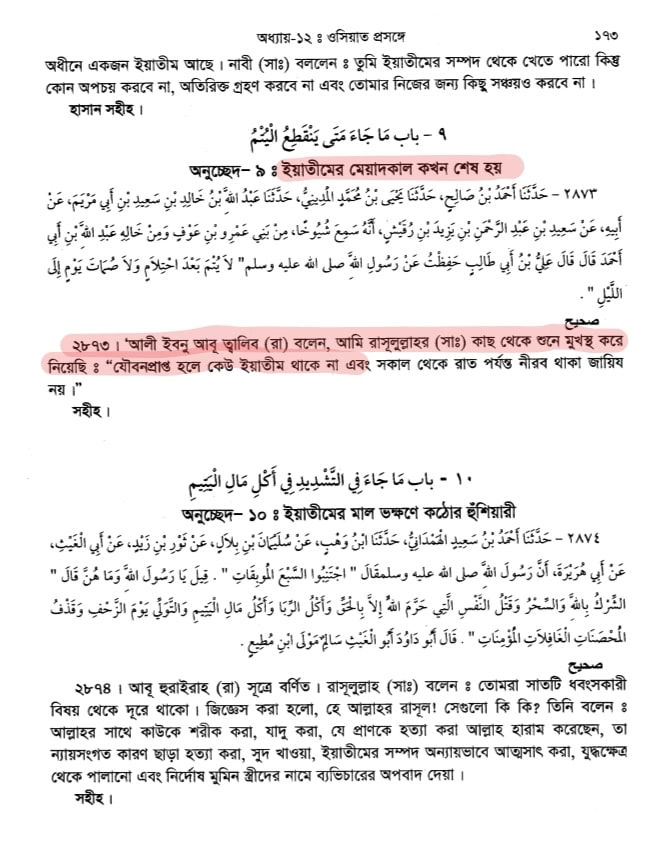
Abu Dawud’s report says “لا يُتْمَ بَعْدَ احْتِلَامٍ”—there is no orphanhood after puberty. The explanation in Awn al-Ma‘bud on IslamWeb likewise states that the designation ‘orphan’ in its proper sense ceases when the ordinary age of puberty is reached [11].
Al-Tabari Explicitly Says: ‘Those Who Have Not Menstruated Because They Are Young’
There is no need to speculate about the wording of Quran 65:4. Classical commentators themselves explained whom “وَاللَّائِي لَمْ يَحِضْنَ” refers to. Al-Tabari’s explanation is exceptionally direct. He writes:
وَكَذَلِكَ عِدَدُ اللَّائِي لَمْ يَحِضْنَ مِنَ الْجَوَارِي لِصِغَرٍ
Meaning: ‘Likewise, the waiting period of young girls who have not yet menstruated because they are young…’ [12].
Al-Tabari further specifies that the rule applies to girls whose husbands divorced them after consummation. This is no mysterious category of adult women who have not menstruated for medical reasons: at least the inclusion of young girls is entirely unambiguous to him. He uses “لِصِغَرٍ”—‘because they are young’. Accepting the interpretation ‘nisa means adult women only’ requires declaring this explanation by al-Tabari wrong.
Ibn Kathir: The Question Concerned ‘Young Girls, Elderly Women, and Pregnant Women’
Ibn Kathir also cites a report from Ubayy ibn Ka‘b concerning the verse’s background. The question was that the Quran had not yet specified the waiting periods of several categories of females: “الصغار والكبار وأولات الأحمال”—young girls, elderly women, and pregnant women. The revelation of 65:4 is then mentioned [13].
Here the word الصغار itself means little or young girls. In Ibn Kathir’s preserved explanation, one category is elderly women, another pregnant women, and another young girls. The modern claim ‘the verse says women, so children cannot be involved’ therefore directly contradicts his commentary too.
Al-Sa‘di and Al-Alusi Are Even More Explicit
Tafsir al-Sa‘di explains the verse directly as follows: [14].
وَاللَّائِي لَمْ يَحِضْنَ أَيْ: الصِّغَارُ، اللَّائِي لَمْ يَأْتِهِنَّ الْحَيْضُ بَعْدُ
Meaning: ‘Those who have not yet menstruated—that is, young girls whose menstruation has not yet begun.’
Al-Alusi’s Ruh al-Ma‘ani gives the same meaning. He explains “واللائي لم يحضن” as “الصغار اللائي لم يبلغن سن الحيض”—‘those young girls who have not yet reached the age of menstruation’ [15].
Ibn Ashur’s Al-Tahrir wa-l-Tanwir likewise defines the category as a female “التي لم تبلغ سن من تحيض وهي الصغيرة”—who has not yet reached the age of menstruation and is young [16]. This is no eccentric interpretation by one isolated commentator: numerous well-known commentaries from different periods repeat the same meaning.
IslamWeb Also Acknowledges the Inclusion of ‘a Young Girl Who Has Not Reached Puberty’
More significantly, this question was raised directly on the modern Islamic fatwa website IslamWeb. It quotes an objection: 65:4 may not by itself establish the legality of marrying a minor, since ‘those who have not menstruated’ might also mean adult women who have not menstruated for some reason. Although acknowledging some logical merit in the objection, IslamWeb ultimately states that contracting a minor girl’s marriage is permissible according to most jurists, including the four schools. Its own wording about the relevant category is: [17].
وَالْآيَةُ إِنَّمَا تَنَاوَلَتْ خُصُوصَ الصَّغِيرَةِ الَّتِي لَمْ تَبْلُغْ
Meaning: ‘The verse specifically includes a young girl who has not yet reached puberty.’
The same fatwa quotes Ibn al-Mundhir through Ibn Battal and uses Aisha’s marriage as evidence that a father may marry off a young girl whose permission has no legal significance at that point. It also quotes al-Shawkani: asking a young girl’s permission is meaningless because she does not understand what permission means [18].
The same Islamic source thus explicitly says that the relevant category includes ‘a young girl who has not reached puberty’, while the modern defence claims that no young girl can be included because the word nisa appears. Both statements cannot be true.
The Waiting-Period Rule Includes Divorce after Intercourse
Quran 65:4 is not discussing an abstract age category: it determines a divorced female’s waiting period. One category is elderly women whose menstruation has ceased, another those who have not yet menstruated, and another pregnant women. A three-month waiting period is prescribed for the “واللائي لم يحضن” category.
Under Quran 33:49, no waiting period applies when divorce occurs before touching the wife or consummating the marriage. When classical jurists understood ‘those who have not yet menstruated’ in 65:4 as young girls, the matter was therefore not restricted to a marriage contract on paper. Divorce and waiting-period rules incorporated into their legal framework marriages in which the young wife had not yet menstruated. Al-Tabari thus directly says that girls who have not menstruated because they are young also wait three months when their husbands divorce them after consummation.
That is why 65:4 is so important in discussions of Islamic child marriage. Showing that nisa translates as ‘women’ in Bengali or English cannot erase centuries of exegetical and jurisprudential meaning. Al-Tabari, Ibn Kathir, al-Alusi, al-Sa‘di, Ibn Ashur, and jurisprudential works long ago answered what the verse’s classical interpretation was.
‘Nisa Means Adult Women Only’: A Verbal Manoeuvre
The entire argument isolates a word from its sentence and interpretive history. The Bengali word ‘woman’ generally evokes an adult female for a modern reader; that modern impression is imposed on Arabic nisa to argue that the Quran’s use of ‘women’ excludes minors. But the meaning of an ancient Arabic religious text is not determined by the associations of a modern Bengali word. It is determined through Arabic usage, sentence structure, the relevant verses, and classical interpretation.
The classical commentaries are explicit [19]. Al-Tabari says those who have not menstruated because they are young. Al-Sa‘di says young girls whose menstruation has not yet begun. Al-Alusi says those who have not reached the age of menstruation. Ibn Kathir identifies young girls as a separate category. IslamWeb itself says the verse includes ‘a young girl who has not reached puberty’. Against all these statements, ‘nisa means adult women only’ is no linguistic explanation; it attempts to impose a modern meaning against classical Islamic interpretation.
Accepting this defence requires a modern interpreter to claim a better understanding of Quranic Arabic than al-Tabari, Ibn Kathir, al-Alusi, al-Sa‘di, Ibn Ashur, and centuries of jurisprudential tradition—and that all of them inserted an age category the Arabic word makes impossible. Merely saying ‘nisa means women’ provides no evidence. The Islamic interpretive tradition itself rejects the claim.
Does Quran 4:6 Establish a Minimum Marriage Age?
Quran 4:6 is also regularly used in modern attempts to deny the legality of marrying minor girls. Its Bengali translation says: ‘Test the orphans until they reach marriageable age’. It is then claimed that the Quran itself establishes a minimum age or maturity threshold for marriage and prohibits marrying any boy or girl before reaching that ‘marriageable age’. The verse is also invoked against Aisha’s marriage at six: the child-marriage hadiths attributed to Muhammad supposedly contradict 4:6 because the Quran first requires reaching a marriageable age.
This changes the verse’s subject. Quran 4:6 does not legislate when marrying someone is permissible or impermissible. It concerns when a guardian’s control over an orphan’s property ends and under what conditions that property must be returned. The verse begins by requiring the orphan to be tested, then refers to verifying puberty and sound judgement, and directly commands: ‘return their wealth to them’. The subsequent sentences likewise discuss not consuming that property wastefully, what a poor guardian may take, and witnessing the return of the property. The entire verse’s legal subject is guardianship of property, rather than prohibiting minors’ marriage.
وَابْتَلُوا الْيَتَامَىٰ حَتَّىٰ إِذَا بَلَغُوا النِّكَاحَ فَإِنْ آنَسْتُمْ مِنْهُمْ رُشْدًا فَادْفَعُوا إِلَيْهِمْ أَمْوَالَهُمْ ۖ وَلَا تَأْكُلُوهَا إِسْرَافًا وَبِدَارًا أَنْ يَكْبَرُوا ۚ وَمَنْ كَانَ غَنِيًّا فَلْيَسْتَعْفِفْ ۖ وَمَنْ كَانَ فَقِيرًا فَلْيَأْكُلْ بِالْمَعْرُوفِ ۚ فَإِذَا دَفَعْتُمْ إِلَيْهِمْ أَمْوَالَهُمْ فَأَشْهِدُوا عَلَيْهِمْ ۚ وَكَفَىٰ بِاللَّهِ حَسِيبًا
‘Test the orphans until they reach marriageable age. Then, if you find sound judgement in them, return their property to them. Do not consume their wealth wastefully and hastily for fear that they will grow up. Let a wealthy guardian abstain, and let a poor guardian take what is reasonable. When you return their property, have witnesses present.’ [20]
Translating ‘Marriageable Age’ Does Not Create a Legal Minimum Marriage Age
Much of the error arises after reading “حَتَّىٰ إِذَا بَلَغُوا النِّكَاحَ” in Bengali as ‘when they reach marriageable age’ or in English as “until they reach marriageable age”. To a modern reader, ‘marriageable age’ may suggest a fixed, state-prescribed minimum legal age. The Arabic verse, however, gives no number, declares no minimum age, and contains no prohibition such as ‘do not marry them before this’. Classical commentators generally understood “بلغوا النكاح” in the verse as reaching puberty or sexual maturity. They then instructed that property be returned when this puberty is accompanied by sound judgement in managing it.
Although the word nikah appears, this is no legal declaration that ‘permission to contract marriage begins now’. Arabic may describe reaching a condition through the name of its normal consequence or associated capacity. Classical commentaries read it this way. Rather than interpreting “بلغوا النكاح” as a prohibitive age limit for contracting marriage, they explained it through hulm, bulugh, menstruation, or signs of puberty.
Al-Qurtubi: ‘بلغوا النكاح’ Means Reaching Puberty
Al-Qurtubi explains the phrase directly. He writes “حتى إذا بلغوا النكاح أي الحلم”—meaning ‘when they reach the condition of marriage—that is, hulm or puberty’. He then discusses jurists’ disagreements about determining puberty. He mentions signs common to males and females, and menstruation and pregnancy as female signs; he also records differing juristic ages of fifteen, seventeen, eighteen, or nineteen [21].
حَتَّى إِذَا بَلَغُوا النِّكَاحَ أَيْ الْحُلُمَ
Meaning: ‘When they reach the stage of marriage—that is, puberty.’ [21]
Al-Qurtubi’s subsequent discussion shows that he does not read the verse as prescribing a specific ‘Quranic marriage age’. Had it fixed a minimum age for marriage, these different juristic calculations would be unnecessary. He instead discusses the signs of puberty, when age becomes an alternative indicator, and whether guardianship continues after puberty if the person cannot manage property. His focus is property and legal capacity; he derives no rule that ‘marriage before this is forbidden’.
Ibn Kathir Likewise Explains ‘بلغوا النكاح’ as Hulm or Bulugh
Ibn Kathir gives the same explanation. Citing Ibn Abbas, Mujahid, al-Hasan, al-Suddi, and Muqatil ibn Hayyan, he first explains “وابتلوا اليتامى” as testing the orphans. He then quotes Mujahid’s interpretation of “حتى إذا بلغوا النكاح” as “يعني الحلم”, meaning puberty. Discussion follows concerning boys’ signs of puberty, nocturnal emission, and age. Most importantly, in explaining the verse’s final part, he states directly that property must be handed over after puberty has been reached and sound judgement found in them [22].
فَإِذَا دَفَعْتُمْ إِلَيْهِمْ أَمْوَالَهُمْ يَعْنِي بَعْدَ بُلُوغِهِمُ الْحُلُمَ وَإِينَاسِ الرُّشْدِ مِنْهُمْ
Meaning: ‘When you return their property to them—that is, after they have reached puberty and sound judgement has been found in them.’ [22]
In Ibn Kathir’s explanation, the consequence is not ‘marrying them is now lawful’, but the question of returning their property can now be assessed. Puberty alone is insufficient: sound judgement must also be present. Deriving the validity of a marriage contract from this verse changes its predicate: the Quran says ‘give them their property if you find sound judgement’, while the apologetic interpretation turns this into ‘do not marry them before puberty’. The latter is neither a translation nor a logical consequence of the former.
Al-Jassas’s Ahkam al-Quran: The Entire Discussion Is Entitled ‘Handing Property over to the Orphan’
The Hanafi jurist Abu Bakr al-Jassas discusses 4:6 in Ahkam al-Quran under the chapter title “باب دفع المال إلى اليتيم”—‘The chapter on handing property over to the orphan’. Citing Ibn Abbas, Mujahid, and al-Suddi, he explains “بلغوا النكاح” as hulm—reaching puberty through nocturnal emission. His discussion then concerns lifting restrictions on an orphan’s finances, how long property may be withheld, and how rushd means the ability to safeguard property [23].
هُوَ الْحُلُمُ؛ وَهُوَ بُلُوغُ حَالِ النِّكَاحِ مِنَ الِاحْتِلَامِ
Meaning: ‘It means hulm: reaching the pubertal condition appropriate to marriage through nocturnal emission.’ [24]
Al-Jassas’s discussion matters particularly for this apologetic claim because Ahkam al-Quran is not merely linguistic exegesis: deriving legal rules from Quranic verses is its principal purpose. Yet he derives no rule prohibiting minors’ marriage from 4:6. He reads the verse as governing hajr (legal restriction), financial capacity, puberty, and returning an orphan’s property. If the verse truly established an explicit Quranic prohibition on marriage before puberty, its absence from a Quranic jurist such as al-Jassas’s discussion would be highly significant.
Ibn Atiyya and Al-Jalalayn Give the Same Meaning
In Ibn Atiyya’s Al-Muharrar al-Wajiz, “بلغوا النكاح” is explained as “بلغوا مبلغ الرجال بحلم وحيض أو ما يوازيه”—males and females reaching puberty through nocturnal emission, menstruation, or comparable signs. The discussion of rushd then requires assessing judgement and the ability to manage property and conduct transactions [25]. Al-Jalalayn’s concise commentary likewise says to test orphans’ religious and financial conduct before puberty; “بلغوا النكاح” means becoming qualified through nocturnal emission or age [26].
None of these explanations interprets the phrase as ‘the Quran commands that contracting anyone’s marriage before this stage is forbidden’. The same pattern recurs: puberty is one condition, sound judgement another, and their consequence is gaining control over one’s property. That is an entirely different legal question. A guardian may perform other legal acts on a child’s behalf while withholding control of the child’s property before puberty. Full independent control of property and the validity of a marriage contract are not treated as the same legal capacity in Islamic jurisprudence.
| Source | Interpretation of ‘بلغوا النكاح’ | The Rule Discussed in the Verse |
|---|---|---|
| Al-Qurtubi | أي الحلم — puberty | Handing over property after puberty and sound judgement |
| Ibn Kathir | In Mujahid’s explanation, الحلم | Returning the orphan’s property after puberty and sound judgement |
| Al-Jassas | الحلم, puberty through nocturnal emission | When financial guardianship over the orphan ends |
| Ibn Atiyya | Nocturnal emission, menstruation, or comparable signs of puberty | Testing judgement in managing property |
| Al-Jalalayn | Puberty through nocturnal emission or age | Handing over property after puberty if sound judgement is present |
The Requirement of ‘Rushd’ Shows That the Verse Does Not Set a Threshold for Permission to Marry
The verse’s second condition, “فَإِنْ آنَسْتُمْ مِنْهُمْ رُشْدًا”—‘if you find sound judgement in them’—makes the apologetic interpretation’s inconsistency clearer. The Quran does not order property returned merely upon “بلغوا النكاح”. Even after puberty, the guardian must assess whether the orphan can manage property prudently. Citing Ibn Abbas, al-Suddi, and Sufyan al-Thawri, al-Qurtubi connects rushd to judgement and the ability to safeguard property. He even mentions the view that property should not be handed over without sound judgement, however old someone becomes. He states that most scholars require both puberty and sound judgement for handing over property [21].
دَفْعُ الْمَالِ يَكُونُ بِشَرْطَيْنِ: إِينَاسِ الرُّشْدِ وَالْبُلُوغِ
Meaning: ‘Property is handed over under two conditions: sound judgement being found, and puberty.’ [21]
An important logical consequence follows. If “بلغوا النكاح” establishes a ‘Quranic minimum marriage age’, why does the Quran require a separate test of sound judgement after that age? Because the verse is not testing informed consent or marital capacity; it is testing the ability to manage financial assets independently. Someone who has reached puberty under Sharia may still be financially foolish or wasteful, so property may remain withheld. The verse’s structure itself shows that puberty, sound judgement, and independence over property are three related but distinct legal concepts. The fourth conclusion, ‘therefore contracting marriage before puberty is forbidden’, does not appear in the Quranic sentence.
IslamQA Says Directly: This Verse Does Not Prohibit Marrying Young Boys or Girls
The most direct testimony against using this verse to prohibit child marriage comes from the modern Salafi fatwa website IslamQA itself. In 2017 it was asked essentially this question: if Quran 4:6 contains “بلغوا النكاح”, does the report of Aisha’s marriage at six not contradict the Quran? IslamQA offered no complicated linguistic reinterpretation. It stated directly that the verse does not prohibit children’s marriage and was not revealed to legislate marriage. Its wording follows: [27].
ليس للنكاح سن معين وبيان المراد بقوله تعالى (حتى إذا بلغوا النكاح)
21/جمادى الثانية/1438 الموافق 20/مارس/2017
السؤال 256830
لديَّ سؤال بخصوص الحد الأدنى لسن الزواج ، يذكر القرآن في الآية (6) من سورة النساء: (وابتلوا اليتامى حتى إذا بلغوا النكاح) ، فجاء في ” تفسير الجلالين ” ، وغيرها من كتب التفسير أنّ “بلوغ النكاح” يعنى بلوغ سن الخامسة عشرة ، والآن النبي صلى الله عليه وسلم تزوج من عائشة عندما كانت تبلغ من العمر ست سنوات ، فهل ما فعله النبي يناقض القرآن ؟ وكيف يمكننا فهم الآية 6 من سورة النساء بخصوص الحد الأدنى لسن الزواج ؟
ملخص الجواب
خلاصة الجواب :
أن الآية الكريمة ليس فيها منع تزويج الصغير أو الصغيرة، ولم تسق لبيان موضوع التزويج، وإنما هي في إيتاء المال لليتامى، وأن ذلك يكون بعد البلوغ، وغاية الأمر أنه جاء التعبير فيها عن بلوغ الحلم ببلوغ النكاح، مراعاة للغالب، وهو أن النكاح يكون مع البلوغ، وبه تتم مقاصده.
وبلوغ المرأة يكون بالحيض، وغيره من العلامات، ويكون ذلك قبل سن الخامسة عشرة غالبا، لا سيما في البلاد الحارة .
الجواب
الحمد لله والصلاة والسلام على رسول الله، وبعد:
ليس في الشريعة تحديد لسن زواج الرجل أو المرأة، وقد أجمع أهل العلم على جواز تزويج الصغير، وكذا الصغيرة إذا زوجها أبوها من كفء .
وقد دل الكتاب والسنة والإجماع على صحة تزويج الصغيرة التي لم تبلغ، وعدم تحديد ذلك بسن معين .
قال ابن عبد البر رحمه الله: ” أجمع العلماء على أن للأب أن يزوج ابنته الصغيرة ولا يشاورها ، وأن رسول الله صلى الله عليه وسلم تزوج عائشة بنت أبي بكر، وهي صغيرة بنت ست سنين، أو سبع سنين؛ أنكحه إياها أبوها” انتهى من ” الاستذكار ” ( 16 / 49) .
وقال ابن قدامة رحمه الله : ” : وإذا زوج الرجل ابنته البكر ، فوضعها في كفاءة : فالنكاح ثابت … أما البكر الصغيرة ، فلا خلاف فيها . قال ابن المنذر أجمع كل من نحفظ عنه من أهل العلم ، أن نكاح الأب ابنته البكر الصغيرة جائز ، إذا زوجها من كفء ، ويجوز له تزويجها مع كراهيتها وامتناعها .
وقد دل على جواز تزويج الصغيرة قول الله تعالى : ( وَاللَّائِي يَئِسْنَ مِنَ الْمَحِيضِ مِنْ نِسَائِكُمْ إِنِ ارْتَبْتُمْ فَعِدَّتُهُنَّ ثَلَاثَةُ أَشْهُرٍ وَاللَّائِي لَمْ يَحِضْنَ) فجعل للائي لم يحضن عدة ثلاثة أشهر ، ولا تكون العدة ثلاثة أشهر إلا من طلاق في نكاح أو فسخ ، فدل ذلك على أنها تزوج وتطلق ، ولا إذن لها فيعتبر .
وقالت عائشة رضي الله عنهما : ( تزوجني النبي صلى الله عليه وسلم وأنا ابنة ست ، وبنى بي وأنا ابنة تسع ) متفق عليه . ومعلوم أنها لم تكن في تلك الحال ممن يعتبر إذنها .
وروى الأثرم ، أن قُدامة بن مظعون تزوج ابنة الزبير حين نفست ، فقيل له ؟ فقال : ابنة الزبير؛ إن مت ورثتني ، وإن عشت كانت امرأتي ، وزوج علي ابنته أم كلثوم وهي صغيرة عمر بن الخطاب رضي الله عنهما ” انتهى من “المغني” (7/ 30).
ولا تعارض بين هذا وبين قوله تعالى: ( وَابْتَلُوا الْيَتَامَى حَتَّى إِذَا بَلَغُوا النِّكَاحَ فَإِنْ آنَسْتُمْ مِنْهُمْ رُشْدًا فَادْفَعُوا إِلَيْهِمْ أَمْوَالَهُمْ ) النساء/6
فإن هذه الآية في بيان متى يُدفع المال لليتيم أو اليتيمة، وأن ذلك بعد بلوغهم ورشدهم، والرشد: حسن التصرف في المال، وهذا لا يكون إلا بعد البلوغ.
والمقصود ببلوغ النكاح هنا : بلوغ الحلم، الذي يعرف بالعلامات المشهورة، كالحيض للمرأة ونبات شعر القبل، أو بلوغ سن خمسة عشر.
وإنما عبر عن بلوغ الحلم ببلوغ النكاح: لأن الغالب أن النكاح لا يكون إلا من البالغ، وهذا لا يمنع من نكاح غير البالغ الذي دل على جوازه الكتاب والسنة والإجماع.
وآيات سورة النساء في هذا الموضع نفسه تدل عليه؛ فإن الله تعالى قال قبل هذه الآية: ( وَإِنْ خِفْتُمْ أَلَّا تُقْسِطُوا فِي الْيَتَامَى فَانْكِحُوا مَا طَابَ لَكُمْ مِنَ النِّسَاءِ مَثْنَى وَثُلَاثَ وَرُبَاعَ ) النساء/3 ؛ وهذا دليل على جواز نكاح اليتيمة، واليتم لا يكون بعد البلوغ!
روى البخاري (2494) ومسلم (3018) عن عُرْوَةُ بْنُ الزُّبَيْرِ، أَنَّهُ سَأَلَ عَائِشَةَ رَضِيَ اللَّهُ عَنْهَا، عَنْ قَوْلِ اللَّهِ تَعَالَى: وَإِنْ خِفْتُمْ أَلَّا تُقْسِطُوا [النساء: 3] إِلَى وَرُبَاعَ [النساء: 3]، فَقَالَتْ: يَا ابْنَ أُخْتِي؛ هِيَ اليَتِيمَةُ تَكُونُ فِي حَجْرِ وَلِيِّهَا، تُشَارِكُهُ فِي مَالِهِ، فَيُعْجِبُهُ مَالُهَا وَجَمَالُهَا، فَيُرِيدُ وَلِيُّهَا أَنْ يَتَزَوَّجَهَا، بِغَيْرِ أَنْ يُقْسِطَ فِي صَدَاقِهَا، فَيُعْطِيهَا مِثْلَ مَا يُعْطِيهَا غَيْرُهُ، فَنُهُوا أَنْ يُنْكِحُوهُنَّ إِلَّا أَنْ يُقْسِطُوا لَهُنَّ، وَيَبْلُغُوا بِهِنَّ أَعْلَى سُنَّتِهِنَّ مِنَ الصَّدَاقِ، وَأُمِرُوا أَنْ يَنْكِحُوا مَا طَابَ لَهُمْ مِنَ النِّسَاءِ سِوَاهُنَّ.
قال الحافظ ابن حجر رحمه الله: ” وفيه جواز تزويج اليتامى قبل البلوغ، لأنهن بعد البلوغ لا يقال لهن يتيمات” انتهى من فتح الباري (8/ 241).
وقال القرطبي رحمه الله في بيان المراد ببلوغ النكاح: ” قوله تعالى: (حتى إذا بلغوا النكاح) : أي الحلم، لقوله تعالى: (وإذا بلغ الأطفال منكم الحلم) ؛ أي البلوغ ، وحال النكاح.
والبلوغ يكون بخمسة أشياء: ثلاثة يشترك فيها الرجال والنساء، واثنان يختصان بالنساء، وهما الحيض والحبل.
فأما الحيض والحبل: فلم يختلف العلماء في أنه بلوغ، وأن الفرائض والأحكام تجب بهما.
واختلفوا في الثلاث، فأما الإنبات والسن: فقال الأوزاعي والشافعي وابن حنبل: خمس عشرة سنةً : بلوغٌ لمن لم يحتلم. وهو قول ابن وهب وأصبغ وعبد الملك بن الماجشون وعمر بن عبد العزيز وجماعة من أهل المدينة، واختاره ابن العربي. وتجب الحدود والفرائض عندهم على من بلغ هذا السن…” انتهى من تفسير القرطبي (5/ 34).
وقال القاسمي رحمه الله: ” وَابْتَلُوا الْيَتامى أي اختبروا عقولهم، ومعرفتهم بالتصرف، حَتَّى إِذا بَلَغُوا النِّكاحَ أي بأن يحتلموا، أو يبلغوا خمس عشرة سنة” انتهى من تفسير القاسمي (3/ 29).
وقد قلنا: إنه عبر عن بلوغ الحلم، ببلوغ النكاح، مراعاة للغالب؛ وهو أن النكاح يكون للبالغ، وهو الذي يتحقق به تمام مقاصد النكاح، لا سيما إنجاب الذرية، فالمراد: لا تدفعوا إليهم أموالهم إلا بعد بلوغهم مبلغ الرجال والنساء، مع الرشد.
قال النسفي رحمه الله: ” حتى إِذَا بَلَغُواْ النّكَاحَ أي الحلم، لأنه يصلح للنكاح عنده، ولطلب ما هو مقصود به وهو التولد ” انتهى من تفسيره (1/ 473). ومثله للزمشخري (1/ 473).
وقال البغوي رحمه الله: ” حتى إذا بلغوا النكاح أي: مبلغ الرجال والنساء” انتهى من تفسيره (2/ 165).
وقال الرازي رحمه الله: ” المراد من بلوغ النكاح: هو الاحتلام المذكور في قوله: (وإذا بلغ الأطفال منكم الحلم) [النور: 59] .
وهو في قول عامة الفقهاء: عبارة عن البلوغ مبلغ الرجال، الذي عنده يجري على صاحبه القلم، ويلزمه الحدود والأحكام، وإنما سمي الاحتلام بلوغ النكاح لأنه إنزال الماء الدافق الذي يكون في الجماع” انتهى من تفسيره (9/ 498).
والحاصل: أن الآية الكريمة ليس فيها منع تزويج الصغير أو الصغيرة، ولم تسق لبيان موضوع التزويج، وإنما هي في إيتاء المال لليتامى، وأن ذلك يكون بعد البلوغ، وغاية الأمر أنه جاء التعبير فيها عن بلوغ الحلم ببلوغ النكاح، مراعاة للغالب، وهو أن النكاح يكون مع البلوغ، وبه تتم مقاصده.
وبلوغ المرأة يكون بالحيض، وغيره من العلامات، ويكون ذلك قبل سن الخامسة عشرة غالبا، لا سيما في البلاد الحارة .
وهذا يبطل قول من اعتمد على هذه الآية في تحديد سن للزواج، فالآية أشارت للبلوغ، والحكم بالبلوغ بناء على الحيض مجمع عليه كما تقدم.
وانظر للفائدة: جواب السؤال رقم (177280)، ففيه الرد على من حد للزواج سنا معينا.
ثم إننا مع هذا نقول: إنه لا ينبغي تزويج الصغير أو الصغيرة، بل ُينتظر بلوغهما، ليختارا لأنفسهما، وينظر للمرأة في مصلحتها ، مع مشورة والدها ، أو وليها .
وهذا كله أيضا : من حيث العقد.
وأما الوطء، فلا توطؤ الزوجة إلا إذا كانت تطيق ذلك، ولا يضرها، ويمنع الأب تسليم ابنته الصغيرة لذلك.
قال النووي رحمه الله في شرح مسلم (9/ 206): ” واعلم أن الشافعي وأصحابه قالوا: يستحب أن لا يزوج الأب والجد البكر حتى تبلغ، ويستأذنها؛ لئلا يوقعها في أسر الزوج وهي كارهة.
وهذا الذي قالوه: لا يخالف حديث عائشة؛ لأن مرادهم أنه لا يزوجها قبل البلوغ، إذا لم تكن مصلحة ظاهرة يُخاف فوتها بالتأخير، كحديث عائشة، فيستحب تحصيل ذلك الزوج؛ لأن الأب مأمور بمصلحة ولده، فلا يفوتها والله أعلم.
وأما وقت زفاف الصغيرة المزوجة، والدخول بها، فإن اتفق الزوج والولي على شيء لا ضرر فيه على الصغيرة: عُمل به.
وإن اختلفا: فقال أحمد وأبو عبيد: تجبر على ذلك بنت تسع سنين دون غيرها.
وقال مالك والشافعي وأبو حنيفة: حد ذلك أن تطيق الجماع، ويختلف ذلك باختلافهن، ولا يضبط بسن، وهذا هو الصحيح، وليس في حديث عائشة تحديد، ولا المنع من ذلك فيمن أطاقته قبل تسع، ولا الإذن فيمن لم تطقه وقد بلغت تسعا. قال الداودي: وكانت عائشة قد شبت شبابا حسنا رضى الله عنها” انتهى.
والله أعلم.
المصدر: موقع الإسلام سؤال وجواب
English translation:
There Is No Fixed Age for Marriage, and the Meaning of Allah’s Words ‘Until They Reach the Stage of Marriage’
21 Jumada al-Thani 1438 AH, corresponding to 20 March 2017
Question 256830
I have a question about the minimum marriage age. Quran 4:6 says: ‘Test the orphans until they reach the stage of marriage.’ Tafsir al-Jalalayn and other commentaries say that reaching this stage means reaching fifteen. Yet Muhammad married Aisha when she was six. Does what he did contradict the Quran? How should we understand 4:6 concerning a minimum marriage age?
Summary of the Answer
The answer in brief:
This verse contains no prohibition on marrying off a young boy or girl and was not revealed to explain marriage. It concerns returning orphans’ property to them after puberty. Puberty is expressed as ‘reaching the stage of marriage’ because marriage generally relates to puberty and its purposes are fulfilled through it.
Female puberty is determined through menstruation and other signs. It generally occurs before fifteen, particularly in warm regions.
Answer
Praise be to Allah, and blessings and peace upon His Messenger. To proceed:
Sharia sets no specific marriage age for males or females. Scholars agree that marrying off a young boy is permissible, as is a father marrying off a young girl to a suitable husband.
The Quran, Sunnah, and scholarly consensus establish the permissibility of marrying a minor girl who has not reached puberty, without specifying a particular age.
Ibn Abd al-Barr said: ‘Scholars agree that a father may marry off his minor daughter without consulting her. Allah’s Messenger married Abu Bakr’s daughter Aisha when she was a young girl of six or seven; her father married her to him.’ — Al-Istidhkar, 16/49.
Ibn Qudama said: ‘If a man marries his virgin daughter to a suitable husband, the marriage is effective… There is no disagreement concerning a minor virgin girl. Ibn al-Mundhir said: All scholars whose views we know agree that a father may marry his minor virgin daughter to a suitable husband. He may do so even if she dislikes it and refuses.
Evidence for marrying a minor girl is Allah’s statement: “For those of your women who have ceased menstruating, if you doubt, their waiting period is three months, as is that of those who have not yet menstruated.” Allah assigns three months to those who have not menstruated. A three-month waiting period arises only from divorce or annulment after marriage. This establishes that such a girl may marry and be divorced, and her permission is not considered.
Aisha said: “The Prophet married me when I was six and consummated the marriage when I was nine.” Al-Bukhari and Muslim narrate it. It is known that she was not then old enough for her permission to be considered.
Al-Athram narrated that Qudama ibn Maz‘un married al-Zubayr’s daughter just after she was born. Asked about it, he said: “She is al-Zubayr’s daughter. If I die, she will inherit from me; if I live, she will be my wife.” Ali also married his minor daughter Umm Kulthum to Umar ibn al-Khattab.’ — Al-Mughni, 7/30.
This does not contradict Allah’s statement: ‘Test the orphans until they reach the stage of marriage. If you then find sound judgement in them, return their property to them.’ — Quran 4:6.
This verse explains when an orphan boy’s or girl’s property is returned: after puberty and after rushd, or sound judgement, is found. Rushd means the ability to manage property properly and is assessed after puberty.
‘Reaching the stage of marriage’ means reaching puberty or the stage of nocturnal emission, determined through recognised signs such as female menstruation, pubic hair, or reaching fifteen.
Puberty is expressed as ‘reaching the stage of marriage’ because marriage generally concerns those who have reached puberty. This does not prohibit marriage for a minor whose marriage is established as permissible by the Quran, Sunnah, and scholarly consensus.
The surrounding verses in Surah al-Nisa also demonstrate this. Before this verse, Allah says: ‘If you fear that you cannot deal justly with orphans, marry whichever women you like, two, three, or four.’ — Quran 4:3. This establishes the permissibility of marrying an orphan girl; a person is not called an orphan after puberty.
Al-Bukhari (2494) and Muslim (3018) narrate that Urwa ibn al-Zubayr asked Aisha about Allah’s words ‘If you fear that you cannot deal justly with orphans…’ through ‘four’. She said: ‘My nephew, this concerns an orphan girl under her guardian’s care whose property is shared with him. He admires her wealth and beauty and wishes to marry her, but will not deal fairly concerning her dowry—that is, give what another suitor would give. They were therefore prohibited from marrying those orphan girls unless they treated them justly and gave them the highest customary dowry. They were instructed to marry other women they liked instead.’
Al-Hafiz Ibn Hajar said: ‘This establishes the permissibility of marrying orphan girls before puberty, because after puberty they are no longer called orphans.’ — Fath al-Bari, 8/241.
Al-Qurtubi explains: ‘Allah’s words “when they reach the stage of marriage” mean reaching the age of nocturnal emission, as He says, “When your children reach the age of nocturnal emission”: reaching puberty or the condition of marriage.
Puberty is determined by five things: three apply to males and females, and two only to females—menstruation and pregnancy.
Scholars do not disagree that menstruation and pregnancy indicate puberty and make religious obligations and rules applicable.
They disagree about the other three. Concerning hair growth and age, al-Awza‘i, al-Shafi‘i, and Ibn Hanbal say that fifteen counts as puberty for someone who has not experienced nocturnal emission. Ibn Wahb, Asbagh, Abd al-Malik ibn Majishun, Umar ibn Abd al-Aziz, and a group of Medinan scholars hold the same view, which Ibn al-Arabi adopted. They say that hudud punishments and obligatory duties apply at this age…’ — Tafsir al-Qurtubi, 5/34.
Al-Qasimi says: ‘“Test the orphans” means test their intellect and knowledge of managing property. “When they reach the stage of marriage” means experiencing nocturnal emission or reaching fifteen.’ — Tafsir al-Qasimi, 3/29.
As explained, puberty is expressed as ‘reaching the stage of marriage’ with the usual situation in mind: people generally marry after puberty, when marriage’s purposes, particularly procreation, can be fully realised. The verse therefore means: do not return their property before they reach male or female puberty and sound judgement is found in them.
Al-Nasafi says: ‘“When they reach the stage of marriage” means reaching the age of nocturnal emission, when one becomes suited to marriage and capable of its purpose: procreation.’ — His commentary, 1/473. Al-Zamakhshari gives the same explanation, 1/473.
Al-Baghawi says: ‘“When they reach the stage of marriage” means reaching the stage of men and women.’ — His commentary, 2/165.
Al-Razi says: ‘“Reaching the stage of marriage” here means nocturnal emission, mentioned in Allah’s words, “When your children reach the age of nocturnal emission”. Most jurists understand it as reaching the condition of a grown man, when the pen of legal responsibility applies and hudud and other rules become obligatory. Nocturnal emission is called “reaching the stage of marriage” because it discharges the flowing semen also discharged during intercourse.’ — His commentary, 9/498.
The conclusion is that this verse contains no prohibition on marrying young boys or girls and was not revealed to explain marriage. It concerns returning orphans’ property after puberty. Puberty is expressed as ‘reaching the stage of marriage’ with the usual situation in mind: marriage generally accompanies puberty, when its purposes are fulfilled.
Female puberty is determined through menstruation and other signs and generally occurs before fifteen, particularly in warm regions.
This refutes anyone who relies on this verse to set a specific marriage age. It refers to puberty, and scholars agree on determining puberty through menstruation, as already explained.
For further benefit, see question 177280, answering those who prescribe a specific marriage age.
Nevertheless, we say that young boys or girls should not be married off: one should wait until puberty so they can choose for themselves. The girl’s interests should be considered, with consultation involving her father or guardian.
All the foregoing concerns the marriage contract.
As for intercourse, it must not occur until the wife can endure it without harm. Her father must prevent handing his minor daughter over to her husband in such circumstances.
Al-Nawawi says in Sharh Sahih Muslim, 9/206: ‘Know that al-Shafi‘i and his followers say it is recommended that a father or grandfather not marry off a virgin girl before puberty and that he seek her permission afterwards, so she is not bound under a husband against her wishes.
This does not contradict Aisha’s hadith. They mean that avoiding marriage before puberty is preferable unless an evident benefit risks being lost through delay. If a particular benefit exists, as in Aisha’s case, securing that husband is preferable: a father is instructed to protect his child’s interests and should not let them be lost. Allah knows best.
Regarding when a married minor girl is sent to her husband and consummation begins: if husband and guardian agree on something causing her no harm, their agreement is followed.
If they disagree, Ahmad and Abu Ubayd say a nine-year-old girl may be compelled, but not a younger girl.
Malik, al-Shafi‘i, and Abu Hanifa say the limit is her ability to endure intercourse. This differs between girls and cannot be determined by a fixed age. This is the correct view. Aisha’s hadith sets no specific age limit: it does not prohibit intercourse with a girl able to endure it before nine, nor permit it with one who reaches nine but cannot endure it. Al-Dawudi says Aisha had developed physically well.’
Allah knows best.
Source: Islam Question and Answer — Question 256830
IslamQA then explains that the verse concerns when an orphan’s property is returned. It states that “بلغوا النكاح” essentially means bulugh al-hulm or puberty; ‘nikah’ is used because marriage ordinarily relates to puberty. The same answer explicitly says this language does not prohibit minors’ marriage. It instead cites 65:4, Aisha’s marriage at six and consummation at nine, Ibn Qudama, and other jurists to show that being a minor is not itself a legal obstacle. Nor does its final discussion of consummation establish a universal puberty requirement or fixed age: it quotes later jurists’ indefinite, hypothetical criterion of ‘being able to endure intercourse’. IslamQA’s complete answer therefore does not support using this verse apologetically to claim ‘the Quran prohibits child marriage and sexual marital life before puberty’.
IslamWeb: Quran 4:6 and Quran 65:4 Do Not Conflict
IslamWeb has a separate fatwa addressing this precise objection: do “بلغوا النكاح” in 4:6 and the waiting periods of divorced girls who have not menstruated in 65:4 contradict one another? IslamWeb answers no: they concern different subjects. It says 4:6 was revealed concerning a guardian’s treatment of an orphan’s property and when to return it [28].
الْآيَةُ الْأُولَى نَزَلَتْ فِيمَا يَحِلُّ لِكَافِلِ الْيَتِيمِ مِنْ مَالِ يَتِيمِهِ وَمَتَى يَدْفَعُ إِلَيْهِ مَالَهُ
Meaning: ‘The first verse was revealed concerning what is lawful for an orphan’s guardian regarding the orphan’s property and when that property must be returned.’ [29]
The same answer explains 65:4 as concerning the waiting period of a divorced female whose menstruation is absent through old age or young age. In IslamWeb’s own reading, “بلغوا النكاح” in 4:6 therefore does not prohibit minors’ marriage and invalidate 65:4’s classical meaning. The verses concern different legal fields: 4:6 concerns managing and handing over an orphan’s property; 65:4 concerns divorce and waiting periods. Modern apologetic interpretation sets the first against the second, whereas IslamWeb itself denies any contradiction.
Turning a Verse about Financial Capacity into a Prohibition on Marriage
The grammar and sequence of 4:6 also clarify the issue. Its two principal imperatives are “وَابْتَلُوا الْيَتَامَى”, test the orphans; and “فَادْفَعُوا إِلَيْهِمْ أَمْوَالَهُمْ”, return their property. Between them, “بلغوا النكاح” and “آنستم منهم رشدا” appear as conditions. Testing continues; once puberty and sound judgement in managing property are found, the property is returned. The verse then continues discussing ‘their property’, ‘do not consume it’, ‘let the wealthy guardian abstain’, ‘let the poor guardian take reasonably’ and ‘have witnesses when returning the property’. The subject remains the same from beginning to end.
Deriving ‘marriage before puberty is prohibited’ requires adding a prohibition absent from the Arabic sentence. The Quran does not say “لا تنكحوا اليتامى حتى يبلغوا النكاح”—‘do not marry them until they reach marriageable age’. It does not say “لا يجوز النكاح قبل البلوغ”—‘marriage is invalid before puberty’. Nor does it specify an age required for a marriage contract. The actual command concerns handing over property. Seeing the word nikah in a sentence does not permit changing both its grammatical object and legal subject to manufacture a new prohibition.
Prohibiting Marriage before Puberty Directly Conflicts with Classical Jurisprudence
If 4:6 genuinely meant ‘marriage before puberty is forbidden’, classical Islamic jurisprudence should clearly reflect this. The actual picture is the opposite. Many classical jurists accepted marriage contracts for minor girls through fathers or suitable guardians, used Aisha’s marriage at six as a principal precedent, and applied ‘those who have not yet menstruated’ in 65:4 to minor wives’ divorce and waiting periods. Earlier sections presented these explanations from al-Tabari, Ibn Kathir, al-Alusi, al-Sa‘di, Ibn Ashur, and IslamWeb.
More significantly, IslamQA’s answer specifically about 4:6 quotes Ibn Abd al-Barr, Ibn Qudama, and other jurists to discuss the legality of marrying minor girls. It explicitly says 4:6 does not contradict that position because its subject is not the marriage contract. ‘Classical Islam misunderstood; the Quran actually prohibits child marriage in 4:6’ is therefore no natural reading of classical exegesis or jurisprudence. It is a modern interpretation produced by isolating a phrase from its property-related context.
‘Marriageable Age’ Does Not Itself Prohibit Marriage or Intercourse before Puberty
Another important mistaken inference arises here. Suppose “بلغوا النكاح” means ‘reaching the physical stage appropriate to marriage’, or puberty. It still does not follow that contracting marriage earlier is forbidden or consummation with a minor wife legally prohibited. In classical Islamic law, puberty, the marriage contract, and permission for intercourse were not governed by identical rules. Many jurists accepted a minor girl’s marriage; likewise, they set no universal puberty requirement or minimum age for intercourse. The phrase “بلغوا النكاح” in 4:6 therefore cannot be read as a statutory threshold below which both marriage and sexual marital life are forbidden under Sharia.
Aisha’s case makes the distinction clear. Conventional authentic reports place the contract at six and the beginning of marital life at nine. But neither the Quran nor hadith makes nine a universal minimum age of marriage or intercourse for Muslim females. More importantly, neither puberty nor menstruation is made an indispensable prerequisite for intercourse with a minor wife by the Quran or Aisha’s hadith. Neither ‘marriage before puberty is prohibited’ nor ‘intercourse before puberty is prohibited’ can therefore be derived from 4:6.
Some later jurists, discussing handing a minor wife over to her husband and intercourse with her, used “أن تطيق الجماع”—whether she can endure intercourse. This is not a condition supplied by Aisha’s hadith. The hadith contains no instruction to ‘test her ability; have intercourse if she is capable, otherwise do not’. It is a later jurisprudential criterion. It fixes no age, requires neither puberty nor menstruation, and the quoted discussion supplies no measurable physical test or objective criterion for ‘being able to endure intercourse’. Who determines this ability, through what signs, and how much physical development is sufficient are not specified.
وقال مالك والشافعي وأبو حنيفة: حد ذلك أن تطيق الجماع، ويختلف ذلك باختلافهن، ولا يضبط بسن، وهذا هو الصحيح، وليس في حديث عائشة تحديد، ولا المنع من ذلك فيمن أطاقته قبل تسع، ولا الإذن فيمن لم تطقه وقد بلغت تسعا.
Meaning: ‘Malik, al-Shafi‘i, and Abu Hanifa say the limit is her ability to endure intercourse. This differs between girls and cannot be determined by a fixed age. This is the correct view. Aisha’s hadith sets no particular age limit: it does not prohibit it for one able to endure it before nine, nor permit it for one who reaches nine but cannot endure it.’
This is al-Nawawi’s jurisprudential interpretation, not Aisha’s hadith’s direct wording. Its most important parts are “ولا يضبط بسن”—it cannot be fixed by a specific age—and “ولا المنع من ذلك فيمن أطاقته قبل تسع”—the hadith supplies no prohibitive age limit for those under nine. In this framework, being a minor or not having reached puberty is therefore not itself a legal prohibition on intercourse. The ‘endurance’ condition used by some jurists is not equivalent to a rule about age, puberty, or free sexual consent. It is an indefinite physical notion without a fixed age, and cannot be presented as a modern minimum age, age of consent, or precise medically established safety threshold.
Presenting 4:6 as ‘the Quran establishes a minimum age for marriage and sex’ is therefore wrong. The verse discusses puberty and sound judgement in returning an orphan’s property. It does not prohibit marriage before puberty, prohibit intercourse before puberty, or specify a numerical age. Classical law recognises minor girls’ marriage and does not universally prohibit intercourse with a minor wife because she is a minor, has not menstruated, or has not reached puberty. Some later jurists use ‘endurance’, but that vague criterion cannot be transformed into a Quranic minimum age or general prohibition on sexual relations with children.
Thus “بلغوا النكاح” does not automatically entail either ‘marriage before this is forbidden’ or ‘sexual marital life before this is forbidden’. In the classical legal framework found in the relevant commentaries and jurisprudential works, minority is not itself an obstacle to marriage, and puberty is not itself an indispensable legal prerequisite for intercourse. Equating ‘reaching the stage of marriage’ in 4:6 with a modern statutory minimum marriage age or age of consent changes both the verse’s subject and the classical legal tradition.
What Does Quran 4:6 Actually Establish?
The rule clearly established by 4:6 is that a minor orphan must not receive full independent control of property; the guardian must test the orphan’s ability to manage it; even after puberty, rushd or financial judgement must be evident; when both conditions are satisfied, the property must be returned, with witnesses at the transfer. The principal direction of al-Qurtubi, Ibn Kathir, al-Jassas, Ibn Atiyya, al-Jalalayn, and other commentaries is the same.
What the verse does not say is equally clear. It sets no numerical minimum age for girls’ marriage, contains no sentence prohibiting marriage contracts before puberty, does not declare minors’ marriage forbidden, and says nothing rejecting Aisha’s marriage at six. Addressing this precise apologetic objection, IslamQA itself says the verse does not prohibit young boys’ or girls’ marriage and was not revealed to legislate marriage. IslamWeb says the property rules in 4:6 do not conflict with the waiting periods of young divorced wives in 65:4.
Citing “وَابْتَلُوا الْيَتَامَىٰ حَتَّىٰ إِذَا بَلَغُوا النِّكَاحَ” to claim ‘the Quran establishes a minimum marriage age for girls and prohibits earlier marriage’ therefore matches neither the original Arabic verse, its sentence context, classical exegesis, nor established jurisprudence. The subject is an orphan’s property; “بلغوا النكاح” is classical language for puberty; and the legal consequence of puberty together with sound judgement here is regaining control of one’s property. Presenting this property-guardianship rule as a Quranic prohibition on minors’ marriage is a modern reinterpretation that changes the context.
‘A Girl Becomes a Woman at Nine’: Authenticity and Misuse of the Statement Attributed to Aisha
Another statement frequently used to defend Aisha’s marital life with Muhammad beginning at nine is that she herself supposedly said: “إذا بلغت الجارية تسع سنين فهي امرأة”—‘When a girl reaches nine, she is a woman.’ Several distinct claims are manufactured from this sentence: Arabian girls generally reached puberty at nine; nine automatically transformed children into fully grown women; therefore sexual relations between nine-year-old Aisha and a man over fifty were unproblematic. Examining the source, chain, and Islamic scholars’ explanations establishes none of these claims.
The first problem is fundamental: no authentic chain is known for this statement attributed to Aisha. Al-Tirmidhi mentions it but supplies no chain reaching her. Al-Bayhaqi likewise mentions it without a connected chain. Even the modern Salafi website IslamQA explicitly acknowledges this. It says the statement, although widely circulated among jurists, appears in hadith collections as mu‘allaq—without a chain—and numerous researchers searched without finding one [30].
هذا الأثر رغم كثرة تداول الفقهاء له؛ إلا أنه ورد في المصنفات الحديثية معلقا من غير إسناد.
Meaning: ‘Although widely circulated among jurists, this report appears in hadith collections as mu‘allaq, without a chain.’
IslamWeb reaches the same conclusion, stating directly “لم نجد هذا الأثر عن أم المؤمنين عائشة مسندا”—‘We have not found this report from Aisha, Mother of the Believers, with a chain.’ It adds that both al-Tirmidhi and al-Bayhaqi mentioned it without a chain [31]. It is therefore no authentic hadith capable of conclusively establishing Aisha’s physical condition at nine.
IslamQA’s Full Examination of the Chain
IslamQA answer 324575 presents the Arabic, al-Tirmidhi’s and al-Bayhaqi’s suspended citations, al-Albani’s chain criticism, and the explanation linking nine to menstruation together.
خبر عائشة: إذا بلغت الجارية تسع سنين، فهي امرأة.
324575
تاريخ النشر : 11-02-2020
المشاهدات : 11432
السؤال
عن عائشة أنها قالت: “إذا بلغت الجارية تسع سنين فهي امرأة” ورد في سنن الترمذي، فهل هذا القول صحيح؟
ملخص الجواب
هذا الخبر، سواء ثبت عن عائشة، أو لم يثبت : ليسا عاما ، بظاهره ، لجميع من بلغت التاسعة؛ وإنما معناه : أن من بلغتها ، وحاضت، كما قد يحصل في بلاد العرب : فإنها تكون امرأة ، يحكم لها بحكم البالغات .
الجواب
الحمد لله.
هذا الأثر رغم كثرة تداول الفقهاء له؛ إلا أنه ورد في المصنفات الحديثية معلقا من غير إسناد.
حيث قال الترمذي رحمه الله تعالى:
” وَقَدْ قَالَتْ عَائِشَةُ: إِذَا بَلَغَتِ الجَارِيَةُ تِسْعَ سِنِينَ فَهِيَ امْرَأَةٌ ” انتهى من “السنن” (3 / 409).
وقال البيهقي رحمه الله تعالى:
” ورُوِّينا عن عائشةَ أنَّها قالَت: إذا بَلَغَتِ الجاريَةُ تِسعَ سِنينَ فهِىَ امرأَةٌ ” انتهى من “السنن الكبرى” (2 / 433).
وقد تتبعه كثير من الباحثين فلم يقفوا له على إسناد.
قال الشيخ الألباني رحمه الله تعالى:
” رواه الترمذي، والبيهقي تعليقا بدون إسناد…
قلت: وقد روي مرفوعا من حديث ابن عمر كما سيأتي في “النكاح” وبلفظه: ( إذا أتى على الجارية تسع سنين فهي امرأة ).
أخرجه أبو نعيم في “أخبار أصبهان” وعنه الديلمي في “المسند” عن عبيد بن شريك، حدثني سليمان بن شرحبيل، حدثنا عبد الملك بن مهران، حدثنا سهل بن أسلم العدوى، عن معاوية بن قرة قال: سمعت ابن عمر به.
قلت: وهذا سند ضعيف، عبد الملك بن مهران قال ابن عدى: “مجهول”.
وقال العقيلي: ” صاحب مناكير، غلب عليه الوهم، لا يقيم شيئا من الحديث “.
قلت: ومن دونه لم أعرفهم … ” انتهى من “إرواء الغليل” (1 / 199).
فالحاصل؛ أن هذا الخبر لا يعلم له إسناد صحيح.
لكن مع عدم وجود إسناد صحيح له؛ إلا أن معناه له وجه من الصواب؛ وهو أن الجارية في بلاد العرب ربما حاضت في سن التاسعة.
وأشار إلى هذا المعنى البيهقي رحمه الله تعالى؛ حيث قال عقب الخبر المنسوب لعائشة رضي الله عنها:
” تعني والله أعلم: [إذا بلغت تسع سنين] ، فحاضَت : فهِي امرأَةٌ ” انتهى من”السنن الكبرى” (2 / 433).
وأشار إليه أيضا البغوي رحمه الله تعالى؛ حيث قال:
” وذهب أحمد، إلى أن اليتيمة إذا بلغت تسع سنين، جاز لغير الأب والجد تزويجها برضاها، ولا خيار لها.
ولعله قال ذلك، لما عُلم أن كثيرا من نساء العرب يدركن إذا بلغن هذا السن، قالت عائشة: ( وإذا بلغت الجارية تسع سنين، فهي امرأة ) ” انتهى من “شرح السنة” (9 / 37).
والحيض علامة على البلوغ ، وتنتقل به البنت من الطفولة فتصبح امرأة.
قال ابن القطان رحمه الله تعالى:
” واتفق أهل العلم إلا من شذ، ممن لا يعد خلافه: على أن الاحتلام ، والحيض : بلوغ.
وأجمع أهل العلم على أن المرأة إذا حاضت ، وجبت عليها الفرائض ” انتهى من “الإقناع” (1 / 125).
والحاصل:
أن هذا الخبر، سواء ثبت عن عائشة، أو لم يثبت : ليسا عاما ، بظاهره ، لجميع من بلغت التاسعة؛ وإنما معناه : أن من بلغتها ، وحاضت، كما قد يحصل في بلاد العرب : فإنها تكون امرأة ، يحكم لها بحكم البالغات .
والله أعلم.
هل انتفعت بهذه الإجابة؟
Aisha’s Report: When a Slave Girl/Bondwoman Reaches Nine, She Is a Woman/Adult Female
Question: Is the report from Aisha in Sunan al-Tirmidhi authentic: ‘When a slave girl/bondwoman reaches nine, she is a woman/adult female’ ?
Summary: Whether or not attribution to Aisha is established, this is not a general statement applying to every nine-year-old slave girl. It refers to a girl who has attained maturity and menstruated, as occurs in Arab countries. She is then considered an adult woman and the rules for adult women apply to her.
Detailed answer: Praise be to Allah. Although jurists cite this as evidence, its widespread circulation has adversely affected many people. Modern writers also quote it without mentioning a chain. It was narrated from al-Tirmidhi:
‘When a slave girl/bondwoman reaches nine, she is an adult woman.’ (End of the quotation from al-Sunan, 3/409.)
Al-Bayhaqi also said:
‘It is narrated from Aisha that she said: When a slave girl/bondwoman reaches nine, she is an adult woman.’ (End of the quotation from al-Sunan al-Kubra, 2/433.)
Many researchers followed al-Bayhaqi but did not agree concerning the chain.
Shaykh al-Albani said: ‘Al-Tirmidhi and al-Bayhaqi narrated this hadith without attaching any chain.’
I (the respondent) say: Yes. It is narrated as a marfu‘ report from Ibn Umar in the chapter on marriage with this exact wording: ‘When a slave girl/bondwoman reaches nine, she is an adult woman.’
The Transmitted Chain:
——–
Abu Nu‘aym narrated it in Akhbar Isbahan, and al-Daylami in his Musnad, from Ubaydullah ibn Sharik, who said: Sulayman ibn Surahbil narrated to me; Abd al-Malik ibn Mihran narrated to us; Sahl ibn Aslam al-Adi narrated to us from Mu‘awiya ibn Qurra, who said: I heard it from Ibn Umar.
I say: This chain is weak. Abd al-Malik ibn Mihran is described by Ibn Adi as ‘unknown’.
Al-Uqayli says: Reports from someone who has been disparaged or fallen into confusion are not included among hadiths.
I say: Apart from al-Uqayli’s comment, these are not known individuals; the chain transmitted through them is therefore not authentic.
In short, no authentic chain is known for this hadith.’
Nevertheless, even without an authentic chain, the statement has a proper interpretation: it refers to slave girls in Arab regions who menstruate at nine. Al-Bayhaqi indicated this interpretation when citing the statement as Aisha’s report.
‘This is my interpretation of the report. Allah knows the correct interpretation best.’
Chapter: ‘If a slave girl is nine and menstruates’, al-Sunan al-Kubra, 2/433.
Al-Baghawi also indicated this explanation, saying:
‘Ahmad also narrated that when an orphan girl reaches nine, it is permissible to marry her with her agreement without her father’s or grandfather’s permission. “This girl has no consent.”’
He may also have said that when most Arabian females recognised the age at which they attained maturity, Aisha said, ‘When she reaches nine, she is an adult woman.’ (End of the quotation from Sharh al-Sunna, 9/37.)
Menstruation is a sign of maturity, and a child attains maturity through menstruation.
Ibn al-Qattan said:
Apart from misguided scholars, everyone agrees that nocturnal emission and menstruation constitute maturity.
Most scholars agree that Sharia’s obligations apply when a girl menstruates.
In conclusion, whether or not attribution to Aisha is established, this is not a general statement applying to every nine-year-old slave girl. It means a girl who has attained maturity and menstruated, as occurs in Arab countries. She is then considered an adult woman and the rules for adult women apply to her.
Al-Tirmidhi Includes the Sentence but Gives No Chain to Aisha
Discussing scholarly views after Jami‘ al-Tirmidhi 1109, al-Tirmidhi writes [32],
وَقَالَ أَحْمَدُ وَإِسْحَاقُ إِذَا بَلَغَتِ الْيَتِيمَةُ تِسْعَ سِنِينَ فَزُوِّجَتْ فَرَضِيَتْ فَالنِّكَاحُ جَائِزٌ وَلاَ خِيَارَ لَهَا إِذَا أَدْرَكَتْ، وَاحْتَجَّا بِحَدِيثِ عَائِشَةَ أَنَّ النَّبِيَّ صلى الله عليه وسلم بَنَى بِهَا وَهِيَ بِنْتُ تِسْعِ سِنِينَ، وَقَدْ قَالَتْ عَائِشَةُ: إِذَا بَلَغَتِ الْجَارِيَةُ تِسْعَ سِنِينَ فَهِيَ امْرَأَةٌ.
Ahmad and Ishaq said that if an orphan girl is married after reaching nine and agrees, the marriage is valid and she subsequently has no right to annul it. They used Aisha’s hadith that the Prophet consummated marriage with her at nine as evidence. It is also attributed to Aisha: ‘When a girl reaches nine, she is a woman.’
The text clearly shows al-Tirmidhi quoting this sentence in Aisha’s name while discussing jurisprudential views after the principal hadith, but supplying no chain such as ‘Aisha → so-and-so → so-and-so → al-Tirmidhi’. Consequently, grading hadith 1109 ‘hasan’ in an edition does not create a chain for Aisha’s separate sentence. The principal hadith’s chain and a statement quoted without a chain in subsequent commentary are different things.
Ignoring this distinction, people often say ‘Al-Tirmidhi contains an authentic/hasan hadith: Aisha said a girl becomes a woman at nine.’ The statement does appear in al-Tirmidhi’s writing, but no chain explains how it reached him from Aisha. Its presence in the book and its authentic attribution to her are separate questions. The first is true; the second is unproven.
Al-Bayhaqi Also Mentions It without a Chain
Al-Bayhaqi’s Al-Sunan al-Kubra likewise includes the statement in Aisha’s name: [33]
ورُوِّينا عن عائشةَ أنَّها قالَت: إذا بَلَغَتِ الجاريَةُ تِسعَ سِنينَ فهِىَ امرأَةٌ
Meaning: ‘It has been narrated to us in Aisha’s name that she said: When a girl reaches nine, she is a woman.’
Al-Bayhaqi also supplies no complete chain to Aisha. Quoting al-Albani, IslamQA says both he and al-Tirmidhi narrated it “تعليقا بدون إسناد”—as a suspended report without a chain [34]. Finding the sentence in two books therefore does not establish two independent chains. Under Islamic transmission methodology itself, quoting the same chainless statement in several works differs from having several independent authentic chains.
The Marfu‘ Version Attributed to Ibn Umar Is Also Weak
A statement attributed to Muhammad through Ibn Umar is also quoted to support Aisha’s chainless statement: “إذا أتى على الجارية تسع سنين فهي امرأة”—‘When a girl reaches nine, she is a woman.’ It appears through Abu Nu‘aym’s Akhbar Isbahan and al-Daylami. Al-Albani examined its chain and declared it weak. IslamQA quotes his assessment verbatim.
قلت: وهذا سند ضعيف، عبد الملك بن مهران قال ابن عدي: مجهول. وقال العقيلي: صاحب مناكير، غلب عليه الوهم، لا يقيم شيئا من الحديث… ومن دونه لم أعرفهم.
Meaning: ‘I say: This chain is weak. Ibn Adi said Abd al-Malik ibn Mihran is unknown. Al-Uqayli said his reports contain irregularities and error predominates in him… I also do not know several narrators below him.’ [35]
IslamQA then concludes:
فالحاصل؛ أن هذا الخبر لا يعلم له إسناد صحيح.
Meaning: ‘In short, no authentic chain is known for this report.’
After this conclusion, claiming ‘an authentic hadith records Aisha saying a girl becomes a woman at nine’ is directly wrong. What is established is a widely circulated saying attributed to Aisha, quoted without a chain in al-Tirmidhi and al-Bayhaqi; a marfu‘ version with a weak chain; and acknowledgement by both IslamQA and IslamWeb that no authentic chain reaching Aisha is known.
Even If Authentic, It Would Not Mean ‘Every Nine-Year-Old Girl Is a Woman’
IslamQA could not authenticate the report and does not interpret it as a general statement about all nine-year-olds. Its summary explicitly says that, whether established from Aisha or not, its apparent meaning does not apply to every nine-year-old girl. Rather, a girl who reaches nine and menstruates is treated as a pubescent female under Sharia.
هذا الخبر، سواء ثبت عن عائشة، أو لم يثبت: ليس عاما، بظاهره، لجميع من بلغت التاسعة؛ وإنما معناه: أن من بلغتها، وحاضت، كما قد يحصل في بلاد العرب: فإنها تكون امرأة، يحكم لها بحكم البالغات.
Meaning: ‘Whether or not this report is established from Aisha, its apparent meaning is not general to every girl reaching nine. It means that one who reaches nine and menstruates, as can sometimes happen in Arab regions, is counted as a woman and the rules for pubescent females apply to her.’
IslamQA itself does not make nine an automatic threshold of adulthood. Its explanation requires the additional condition of menstruation. It therefore rejects the second step in ‘Aisha was nine → all nine-year-old girls are women → Aisha must have been fully grown’. Al-Bayhaqi’s explanation is the same. After the statement attributed to Aisha, he writes:
تعني والله أعلم: إذا بلغت تسع سنين، فحاضت: فهي امرأة.
Meaning: ‘Allah knows best: it means that if she reaches nine and menstruates, she is a woman.’ [36]
Al-Bayhaqi likewise does not consider calendar age nine sufficient by itself. His explanation combines nine and menstruation. Modern defences often omit the second condition and circulate only the number.
This Report Provides No Evidence of Aisha’s Own Menstruation
Even assuming the report is true, another fundamental problem remains. The general statement ‘a girl reaching nine and menstruating is called a woman’ does not entail ‘Aisha herself menstruated at nine’. The first is a general jurisprudential or social statement; the second concerns an individual’s physical history. Establishing the latter requires separate evidence of Aisha’s menstruation.
The age reports in al-Bukhari and Muslim describe consummation at nine but nowhere say her menstruation had begun then. A chainless general saying attributed to her cannot manufacture information about her own physical condition. ‘Some girls can menstruate at nine’ and ‘Aisha menstruated at nine’ are entirely separate claims.
Other frequently used arguments for her puberty—the mistranslation of أَعْقِلْ in al-Bukhari and the ‘menstruation’ rendering in Abu Dawud 4933—are examined separately below and likewise establish no menstruation at nine. The question is discussed further in Had Aisha Reached Puberty at Consummation?
Al-Tirmidhi’s Discussion Concerns Jurisprudential Rules, Not Biological ‘Full Adulthood’
Al-Tirmidhi is discussing neither medicine nor full female physical development. His subject is an orphan girl’s marriage, a guardian’s power, and whether she subsequently retains a right to annul the marriage. After mentioning different scholarly views, he gives Ahmad’s and Ishaq’s position: if a nine-year-old orphan girl is married with her agreement, the marriage is valid and she subsequently cannot annul it. They use Aisha’s consummation with Muhammad at nine as evidence [37].
The wording ‘فهي امرأة’—‘she is a woman’—therefore does not declare complete development of the brain, bones, pelvis, psychological capacity, and decision-making in the modern medical sense. It concerns particular Sharia rules becoming applicable. IslamQA accordingly says that upon menstruation she “يحكم لها بحكم البالغات”—‘is counted under the rules for pubescent females’. The age at which prayer, fasting, or marriage rules apply under Sharia differs from full adulthood in modern developmental science.
Conflating these concepts produces the false equation ‘pubescent under Sharia → fully grown → adult sexual partner’. Sharia’s legal classification cannot establish a nine-year-old child’s full physical and psychological maturity.
Beginning Menstruation Does Not Mean Physical Maturity
A more fundamental weakness is that even assuming Aisha menstruated at nine does not establish full physical and psychological adulthood. Menarche is one stage of puberty, not its completion. Bodily growth, bone development, reproductive maturation, pelvic growth, and neurological and brain development do not suddenly finish with the first period.
‘Has menstruated’ and ‘is fully grown’ are therefore not synonyms. An eight- or nine-year-old child can menstruate; doctors do not immediately declare her an adult woman. She remains a child by age and overall development. The physiological event means only that a particular reproductive stage has begun.
These distinctions between puberty, adulthood, competent consent, and child marriage’s health risks are discussed in detail in Child Marriage, Puberty, and Adulthood: Definitions, Consent, and Health Risks.
IslamQA’s Two Positions Do Not Agree with Each Other
An important inconsistency appears between IslamQA’s answers. An older answer on Aisha’s age claims girls reach puberty earlier in warm regions and cites ‘a girl becomes a woman at nine’ in her name as support [38]. It also uses observations attributed to al-Shafi‘i of girls menstruating at nine in Yemen and Tihama.
In a detailed examination in 2020, IslamQA itself acknowledges that no authentic chain is known for the statement attributed to Aisha. It also says the statement is not a general rule for all nine-year-old girls. A girl is not counted as a woman or pubescent merely upon reaching nine: menstruation must also begin. IslamQA’s own interpretation therefore rejects ‘nine years old = automatically an adult woman’.
Its later detailed analysis thus undermines the certainty with which the older defence treated ‘Aisha said a girl becomes a woman at nine’ as established historical fact. One cannot maintain with equal force both using a chainless statement as evidence of ordinary adulthood at nine and acknowledging that it has no authentic chain and does not apply to every nine-year-old girl.
The Chainless Saying Does Not Establish Aisha’s Adulthood
Using this statement to establish nine-year-old Aisha’s full adulthood fails on several levels. First, no authentic chain to her is known. Second, the comparable marfu‘ report through Ibn Umar also has a weak chain. Third, neither al-Bayhaqi nor IslamQA accepts it as a general rule for every girl reaching nine; both add menstruation. Fourth, even if true, the general statement supplies no evidence that Aisha herself menstruated at nine. Fifth, even proven menstruation would not establish full physical, psychological, or decision-making maturity.
Most fundamentally, the moral question of sexual relations with a nine-year-old child cannot be answered through ‘woman’ in a chainless saying. Counting someone under adult legal rules after an age or physical sign in a jurisprudential system differs from being an independent, mature, competent sexual partner in the modern sense. Turning Aisha’s age of nine into adulthood through ‘nine means woman’ therefore fails in transmission methodology, Islamic interpretation, and human development alike.
Inserting Puberty into Translation: Distorting Al-Bukhari 476 and Abu Dawud 4933
Two hadiths are regularly used to claim Aisha had reached puberty at nine. The first, al-Bukhari 476, concerns childhood memories; a widely circulated older English version rendered it “since I attained the age of puberty”. The second, Abu Dawud 4933, describes taking Aisha from a swing, preparing her, and sending her to Muhammad. Sunnah.com’s English attributes ‘I menstruated’ to Abu Dawud. Side by side, these translations appear to provide explicit primary evidence of her puberty and menstruation. The Arabic, however, contains no word for puberty in the first and no mention of menstruation in the displayed text of the second.
That is what makes these reports significant. Al-Bukhari and Muslim clearly describe consummation at nine, but the authentic age reports contain no direct statement that she menstruated or reached puberty then. These two separate translations are therefore invoked instead. Checking the Arabic destroys that foundation. Other claims are discussed in Had Aisha Reached Puberty at Consummation?
Al-Bukhari 476: The Arabic Says Nothing about Puberty
In al-Bukhari 476, Aisha describes childhood memories of her parents practising Islam. The wording is:
(86)Chapter: (If) a mosque (is built) on a road, it should not be a cause of harm for the people
Narrated `Aisha:
(the wife of the Prophet) I had seen my parents following Islam since I attained the age of puberty. Not a day passed but the Prophet (ﷺ) visited us, both in the mornings and evenings. My father Abu Bakr thought of building a mosque in the courtyard of his house and he did so. He used to pray and recite the Qur’an in it. The pagan women and their children used to stand by him and look at him with surprise. Abu Bakr was a Softhearted person and could not help weeping while reciting the Qur’an. The chiefs of the Quraish pagans became afraid of that (i.e. that their children and women might be affected by the recitation of Qur’an).
Reference : Sahih al-Bukhari 476
In-book reference : Book 8, Hadith 124
USC-MSA web (English) reference : Vol. 1, Book 8, Hadith 465
(deprecated numbering scheme)
Tawhid Publications’ Bengali translation renders it ‘As far as I know, I always saw my parents following the religion.’ This accords with the Arabic. The principal verb is أَعْقِلْ from the root عقل, meaning understanding, perceiving, knowing, or reaching the stage of recollection. The subject is not menstruation or sexual maturity; it is that as far back as her knowledge or memory reaches, she saw her parents following Islam [39] [40].
Sahih al-Bukhari (Tawhid Publications)
Book 8: Prayer
Chapter 8/86. Building a mosque on a road is permissible if it does not inconvenience people.
Al-Hasan al-Basri, Ayyub, and Malik said this.
476. Urwa ibn al-Zubayr reported from Aisha, the Prophet’s wife, who said: As far as I know, I always saw my parents following the religion. Not a day passed without Allah’s Messenger visiting us at both ends of it, morning and evening. Abu Bakr then needed a mosque and built one in his courtyard. He prayed and recited the Quran there. Polytheist women and children would stand watching him in amazement. Abu Bakr wept profusely and could not restrain his tears when reciting the Quran. This alarmed the leading polytheist Quraysh. (2138, 2263, 2264, 2297, 3905, 4093, 5807, 6079) (Modern Publications: 456; Islamic Foundation: 462)
Hadith grade: Sahih (authentic)
Narrator: Urwa ibn al-Zubayr
Narrated `Aisha:
(the wife of the Prophet) I had seen my parents following Islam since I attained the age of puberty. Not a day passed but the Prophet (ﷺ) visited us, both in the mornings and evenings. My father Abu Bakr thought of building a mosque in the courtyard of his house and he did so. He used to pray and recite the Qur’an in it. The pagan women and their children used to stand by him and look at him with surprise. Abu Bakr was a Softhearted person and could not help weeping while reciting the Qur’an. The chiefs of the Quraish pagans became afraid of that (i.e. that their children and women might be affected by the recitation of Qur’an).
The older English translation, however, said “since I attained the age of puberty”. Thus أَعْقِلْ or ‘since I learned to understand/remember’ was directly turned into ‘since I reached puberty’. The Arabic contains no bulugh (بلوغ), hulm (حلم), hayd (حيض), or any word denoting puberty or menstruation. ‘Puberty’ is therefore not a translated Arabic word here; it is a concept inserted from outside.
‘As far back as I remember’ and ‘since I reached puberty’ convey entirely different age information. One concerns the beginning of a child’s memory; the other concerns the beginning of physical sexual development. A five- or six-year-old can remember parents’ religious behaviour without having reached puberty. Inserting ‘puberty’ turns the hadith into apparent evidence of physical maturity, which the Arabic never supplies.
Current Sunnah.com Also No Longer Retains the Older ‘Puberty’ Translation
The error becomes clearer in Sunnah.com’s current translation. Its English text of the same al-Bukhari 476 now reads “since I attained the age of intelligence” [40]. The current text of the very website whose older ‘age of puberty’ wording was used to establish Aisha’s puberty therefore no longer says ‘puberty’.
(86)Chapter: (If) a mosque (is built) on a road, it should not be a cause of harm for the people(86)باب الْمَسْجِدِ يَكُونُ فِي الطَّرِيقِ مِنْ غَيْرِ ضَرَرٍ بِالنَّاسِ
Narrated `Aisha:
(the wife of the Prophet) I had seen my parents following Islam since I attained the age of intelligence. Not a day passed but the Prophet (ﷺ) visited us, both in the mornings and evenings. My father Abu Bakr thought of building a mosque in the courtyard of his house and he did so. He used to pray and recite the Qur’an in it. The pagan women and their children used to stand by him and look at him with surprise. Abu Bakr was a soft-hearted person and could not help weeping while reciting the Qur’an. The chiefs of the Quraish pagans became afraid of that (i.e. that their children and women might be affected by the recitation of Qur’an).
حَدَّثَنَا يَحْيَى بْنُ بُكَيْرٍ، قَالَ حَدَّثَنَا اللَّيْثُ، عَنْ عُقَيْلٍ، عَنِ ابْنِ شِهَابٍ، قَالَ أَخْبَرَنِي عُرْوَةُ بْنُ الزُّبَيْرِ، أَنَّ عَائِشَةَ، زَوْجَ النَّبِيِّ صلى الله عليه وسلم قَالَتْ لَمْ أَعْقِلْ أَبَوَىَّ إِلاَّ وَهُمَا يَدِينَانِ الدِّينَ، وَلَمْ يَمُرَّ عَلَيْنَا يَوْمٌ إِلاَّ يَأْتِينَا فِيهِ رَسُولُ اللَّهِ صلى الله عليه وسلم طَرَفَىِ النَّهَارِ بُكْرَةً وَعَشِيَّةً، ثُمَّ بَدَا لأَبِي بَكْرٍ فَابْتَنَى مَسْجِدًا بِفِنَاءِ دَارِهِ، فَكَانَ يُصَلِّي فِيهِ وَيَقْرَأُ الْقُرْآنَ، فَيَقِفُ عَلَيْهِ نِسَاءُ الْمُشْرِكِينَ، وَأَبْنَاؤُهُمْ يَعْجَبُونَ مِنْهُ وَيَنْظُرُونَ إِلَيْهِ، وَكَانَ أَبُو بَكْرٍ رَجُلاً بَكَّاءً لاَ يَمْلِكُ عَيْنَيْهِ إِذَا قَرَأَ الْقُرْآنَ، فَأَفْزَعَ ذَلِكَ أَشْرَافَ قُرَيْشٍ مِنَ الْمُشْرِكِينَ.
Reference : Sahih al-Bukhari 476
In-book reference : Book 8, Hadith 124
USC-MSA web (English) reference : Vol. 1, Book 8, Hadith 465
(deprecated numbering scheme)
‘Age of intelligence’ is also close to the Bengali ‘as far as I know’ or ‘since I became aware’. The current version no longer presents a physical puberty event. Continuing to rely on the old ‘puberty’ rendering to establish puberty at nine is therefore even weaker.
The timing also matters. Aisha says that as far back as she remembers, her parents were Muslim. Abu Bakr was among Islam’s earliest followers. Deriving puberty from this memory would place her puberty in the early Meccan period, creating another inconsistency with the conventional chronology of marriage at six. Reading the Arabic as knowledge or memory makes this artificial problem disappear.
A Translation Does Not Change an Arabic Word’s Meaning
An Arabic word’s meaning does not change because a translator writes ‘puberty’. Translation is interpretive work, not the original text. Building an important age argument on a translation requires first checking the Arabic word. Here it is أَعْقِلْ; no word for puberty appears. Bengali says ‘as far as I know’, and current English says ‘age of intelligence’. The older English ‘puberty’ alone cannot change the original word’s meaning.
Even using this hadith to argue for puberty at nine supplies no temporal connection. Aisha does not say, ‘At nine I reached the stage of أَعْقِلْ.’ She describes early memories. Even assuming ‘أَعْقِلْ = puberty’, the report does not date it to nine. Thus even accepting the mistranslation does not logically establish puberty at consummation.
Abu Dawud 4933: English Says ‘I Menstruated’, Arabic Says ‘She Panted’
The second hadith is more significant. In Abu Dawud 4933, Aisha describes her marriage in detail. Muhammad married her at six or seven; after arriving in Medina, her mother took her from her swing, women prepared her, and she was sent to Muhammad at nine [41].
General Behavior (Kitab Al-Adab)
(63)Chapter: About swings
Narrated Aisha, Ummul Mu’minin:
The Messenger of Allah (ﷺ) married me when I was seven or six. When we came to Medina, some women came. according to Bishr’s version: Umm Ruman came to me when I was swinging. They took me, made me prepared and decorated me. I was then brought to the Messenger of Allah (ﷺ), and he took up cohabitation with me when I was nine. She halted me at the door, and I burst into laughter.
Abu Dawud said: That is to say: I menstruated, and I was brought in a house, and there were some women of the Ansari in it. They said: With good luck and blessing. The tradition of one of them has been included in the other.
Grade : Sahih (Al-Albani)
Reference : Sunan Abi Dawud 4933
In-book reference : Book 43, Hadith 161
English translation : Book 42, Hadith 4915
حَدَّثَنَا مُوسَى بْنُ إِسْمَاعِيلَ، حَدَّثَنَا حَمَّادٌ، ح وَحَدَّثَنَا بِشْرُ بْنُ خَالِدٍ، حَدَّثَنَا أَبُو أُسَامَةَ، قَالاَ حَدَّثَنَا هِشَامُ بْنُ عُرْوَةَ، عَنْ أَبِيهِ، عَنْ عَائِشَةَ، قَالَتْ إِنَّ رَسُولَ اللَّهِ صلى الله عليه وسلم تَزَوَّجَنِي وَأَنَا بِنْتُ سَبْعِ سِنِينَ فَلَمَّا قَدِمْنَا الْمَدِينَةَ أَتَيْنَ نِسْوَةٌ – وَقَالَ بِشْرٌ فَأَتَتْنِي أُمُّ رُومَانَ – وَأَنَا عَلَى أُرْجُوحَةٍ فَذَهَبْنَ بِي وَهَيَّأْنَنِي وَصَنَعْنَنِي فَأُتِيَ بِي رَسُولُ اللَّهِ صلى الله عليه وسلم فَبَنَى بِي وَأَنَا ابْنَةُ تِسْعٍ فَوَقَفَتْ بِي عَلَى الْبَابِ فَقُلْتُ هِيهْ هِيهْ – قَالَ أَبُو دَاوُدَ أَىْ تَنَفَّسَتْ – فَأُدْخِلْتُ بَيْتًا فَإِذَا فِيهِ نِسْوَةٌ مِنَ الأَنْصَارِ فَقُلْنَ عَلَى الْخَيْرِ وَالْبَرَكَةِ . دَخَلَ حَدِيثُ أَحَدِهِمَا فِي الآخَرِ .
Narrated Aisha:
She said: He married me when I was six or seven. When we came to Medina, a group of women came. Bishr’s version says: My mother Umm Ruman came while I was swinging. She took me, prepared me, and dressed and adorned me. I was then presented to Allah’s Messenger, who consummated marriage with me when I was nine. My mother stood me at the doorway and I laughed loudly. Abu Dawud says: That is, I had menstruated. I was brought into a room where a group of Ansar women were present. They wished me goodness and blessings.
Sunan Abi Dawud, Hadith 4933
Hadith grade: Sahih
The relevant passage is “فَقُلْتُ هِيهْ هِيهْ – قَالَ أَبُو دَاوُدَ أَىْ تَنَفَّسَتْ”. Abu Dawud’s displayed Arabic explanation is “أَىْ تَنَفَّسَتْ”. tanaffasat (تَنَفَّسَتْ), meaning breathing, panting, or exhaling. No حاضت, حيض or comparable word for menstruation appears.
Yet Sunnah.com’s English says: ‘Abu Dawud said: That is to say: I menstruated…’ The displayed Arabic and English therefore do not agree [41]. If the Arabic means ‘she breathed/panted’, it cannot be translated ‘I menstruated’. Their meanings are entirely different.
Al-Bukhari’s Parallel Report Confirms ‘Panting’
Al-Bukhari’s parallel report clarifies Abu Dawud’s Arabic explanation. In 3894 Aisha describes the same event more fully. Her mother calls her from the swing, holds her hand, and stands her at the doorway; Aisha says: [42]
فَأَخَذَتْ بِيَدِي حَتَّى أَوْقَفَتْنِي عَلَى بَابِ الدَّارِ، وَإِنِّي لَأَنْهَجُ، حَتَّى سَكَنَ بَعْضُ نَفَسِي
Meaning: ‘She held my hand and stood me at the doorway. I was panting; then my breathing became somewhat normal.’
The context is entirely clear. Aisha has been hurriedly called from play, is panting, and her breathing settles after a while. After “هيه هيه” in Abu Dawud’s version, Abu Dawud explains “أي تنفست”—‘meaning she breathed/panted’. Al-Bukhari’s fuller account agrees. The displayed Arabic supplies no basis for introducing menstruation.
This parallel matters because the argument need not rely solely on dictionary definitions. Both describe the same event, doorway, and breathlessness. One has the brief “هيه هيه” and Abu Dawud’s explanation “تنفست”; the other directly says “لأنهج حتى سكن بعض نفسي”—I was panting, then my breathing settled somewhat. The reports explain each other.
‘I Menstruated’ Is Not Aisha’s Own Statement Either
The English sentence ‘I menstruated’ does not appear as Aisha’s own quotation. Her account comes first, then a separate “قال أبو داود”—‘Abu Dawud said’. It is the compiler’s comment explaining the narrative. Even accepting the translation would establish at most that Abu Dawud later interpreted a word as menstruation, not that Aisha herself said ‘I menstruated’.
Even that possibility is absent from the displayed Arabic, since his comment is “أي تنفست”. Claiming ‘Aisha says she menstruated at nine’ therefore fails twice: the statement is not hers, and Abu Dawud’s Arabic comment does not say menstruation.
An Authentic Hadith Does Not Make Every Translated Sentence Authentic
Al-Albani grades this hadith authentic. Some therefore argue, ‘The hadith is authentic, so the menstruation information is authentic too.’ This conflates authenticity with translation accuracy. The grading assesses the Arabic report’s transmission and text; it does not certify a modern English translator’s rendering of تَنَفَّسَتْ.
The authentic Arabic itself contains tanaffasat. Respecting its authenticity therefore requires prioritising the displayed Arabic. ‘The hadith is authentic, so the English “menstruated” is authentic’ places translation above the original.
Neither Translation Establishes Aisha’s Puberty
Both al-Bukhari 476 and Abu Dawud 4933 are invoked for puberty, but neither Arabic text supplies it. In al-Bukhari, أَعْقِلْ concerns awareness, knowledge, or memory, not puberty. Current Sunnah.com also replaces the older ‘age of puberty’ with ‘age of intelligence’. Abu Dawud’s English says ‘I menstruated’, but the same page’s Arabic comment says “أَىْ تَنَفَّسَتْ”—she breathed or panted. Al-Bukhari 3894’s parallel account likewise describes panting and subsequent recovery of normal breathing.
Neither hadith therefore proves menstruation or puberty at nine. They instead show how relying on one translated word without checking the Arabic can manufacture new historical information. No direct authentic statement establishing puberty at nine has yet been found.
Even assuming menstruation does not resolve the issue: its onset is not full physical, psychological, or decision-making maturity. That separate scientific question is explored in Child Marriage, Puberty, and Adulthood: Definitions, Consent, and Health Risks.
Dolls and Playing with Friends: Was Aisha a ‘Fully Grown Woman’?
After accepting nine, defenders try to present Aisha as fully mature. They say a present-day nine-year-old cannot be compared with seventh-century Aisha: although nine, she was physically and mentally mature. Primary Islamic accounts do not support this presentation. Al-Bukhari, Muslim, and Abu Dawud portray her playing with dolls and girls her own age, and as a young girl keenly interested in entertainment.
These directly document her childlike social position. Besides dolls, playmates, group play, and strong interest in entertainment, classical interpretation gives a more specific conclusion: she was allowed dolls because she had not reached puberty. Presenting nine-year-old Aisha as fully grown therefore conflicts with both the reports and their classical interpretation.
Al-Bukhari: ‘I Used to Play with Dolls in the Prophet’s Presence’
In al-Bukhari 6130, Aisha herself says:
كُنْتُ أَلْعَبُ بِالْبَنَاتِ عِنْدَ النَّبِيِّ صلى الله عليه وسلم وَكَانَ لِي صَوَاحِبُ يَلْعَبْنَ مَعِي، فَكَانَ رَسُولُ اللَّهِ صلى الله عليه وسلم إِذَا دَخَلَ يَتَقَمَّعْنَ مِنْهُ، فَيُسَرِّبُهُنَّ إِلَىَّ فَيَلْعَبْنَ مَعِي
‘I used to play with dolls in the Prophet’s presence. Some friends also played with me. When Allah’s Messenger entered, they hid; he sent them back to me and they played with me.’ [43]
Muslim 2440 gives nearly the same account. Her friends came and played; when Muhammad entered they withdrew through shyness, and he himself sent them back to her to play [44]. Abu Dawud 4931 preserves the same subject [45].
This is no isolated story. Several collections preserve the same scene in Aisha’s name: dolls, friends her own age, and group play. Muhammad did not stop it; when her friends hid, he sent them back.
Ibn Hajar’s Explanation Links Permission for Dolls to Minority
One familiar classical interpretation allows young girls dolls as educational toys despite the general prohibition on images or figures of living creatures. A widely circulated English version of al-Bukhari 6130 cites Fath al-Bari to explain that Aisha was allowed dolls because she was young and had not reached puberty [43].
Although 6130 gives no precise year, its classical interpretation is clear about her condition. Al-Khattabi says she was allowed dolls because she had not reached puberty; Ibn Hajar quotes him. Reinterpreting this as ordinary recreation by a fully grown, postpubertal woman conflicts with that explanation.
The Winged Horse Doll: Toys Remained after Khaybar or Tabuk
Abu Dawud 4932 provides a fuller account. Returning from Khaybar or Tabuk, Muhammad sees wind move a curtain in Aisha’s room, revealing dolls, including a cloth horse with two wings. He asks, ‘A horse with two wings?’ Aisha replies: Has he not heard that Solomon’s horses had wings? He laughs so heartily that she sees his back teeth [46].
فَكَشَفَتْ نَاحِيَةَ السِّتْرِ عَنْ بَنَاتٍ لِعَائِشَةَ لُعَبٍ … وَرَأَى بَيْنَهُنَّ فَرَسًا لَهُ جَنَاحَانِ مِنْ رِقَاعٍ
When the wind moved part of the curtain, her dolls appeared; among them was a cloth horse with two wings.
The narrator himself is uncertain whether this happened after Khaybar or Tabuk, in 7 or 9 AH respectively. The report records dolls after the expedition but never states she was pubescent. Assuming puberty from chronology and using that assumption to interpret the report imports information from outside the source.
IslamQA attempts to place her after puberty through this hadith. It argues that conventional chronology makes her approximately fifteen or older at Khaybar or Tabuk, so she was pubescent and dolls might also be permitted for adult women [47]. The hadith supplies no puberty information. The conclusion rests on the unproven premise that she was already pubescent.
The doll reports do not establish puberty. They directly record her world of toys, friends, and play, while a clear classical interpretive strand links permission for dolls to her minority.
Al-Bukhari Calls Her ‘a Young Girl Fond of Play’
In another authentic report, Muhammad screens Aisha with his cloak while the Abyssinians perform with spears in the mosque, allowing her to watch for a long time. She says she watched until tired. The report then says “فَاقْدُرُوا قَدْرَ الْجَارِيَةِ الْحَدِيثَةِ السِّنِّ الْحَرِيصَةِ عَلَى اللَّهْوِ”—consider the situation of a young girl interested in play and entertainment [48].
فَاقْدُرُوا قَدْرَ الْجَارِيَةِ الْحَدِيثَةِ السِّنِّ الْحَرِيصَةِ عَلَى اللَّهْوِ
Meaning: ‘Consider the situation of a young girl keenly interested in play and entertainment.’
The Arabic الحديثة السن means young or of tender age, while الحريصة على اللهو means strongly interested in play or entertainment. No modern critic invented this language to make Aisha ‘childlike’: the original Islamic report itself describes her age and fondness for recreation.
Playing with Dolls: Evidence of Aisha’s Minority in Classical Interpretation
There is no reason to dilute the doll reports into mere ‘childlike behaviour’. Given the general prohibition on figures and images of living creatures, classical scholars themselves explained why she was allowed dolls. Al-Khattabi was direct: she was permitted them because she had not reached puberty. The widely circulated explanation from Fath al-Bari accompanying al-Bukhari 6130 says the same: she was a young girl who had not yet reached puberty. [43]
“The playing with the dolls and similar images is forbidden, but it was allowed for ‘Aisha at that time, as she was a little girl, not yet reached the age of puberty.”
Al-Nawawi likewise explains that the dolls were young girls’ toys and the report indicates Aisha’s very young age. IslamQA’s older discussion also quotes his statement: “What is meant by dolls is these toys that young girls play with; this highlights that she was very young.” [49]
These explanations matter because Aisha was no ordinary Muslim woman unknowingly continuing a forbidden practice. She was Muhammad’s wife, a prolific hadith narrator, and a principal jurist and religious authority in later Islamic tradition. Muhammad himself saw her playing and summoned her friends to join her. If the classical explanation is that such dolls were not generally permitted after puberty, and her minority justified the exception, reinterpreting this as ordinary adult recreation contradicts that explanation.
Ibn Hajar quotes al-Khattabi in Fath al-Bari:
قال الخطابي: وإنما أرخص لعائشة فيها لأنها إذ ذاك كانت غير بالغ
Meaning: ‘Al-Khattabi said Aisha was permitted to play with these [dolls] because she had not reached puberty then.’
This explanation directly links her dolls to minority rather than treating them as personal taste. Al-Bukhari describes not merely possessing dolls alone, but playmates joining her, hiding when Muhammad entered, and being sent back by him. Dolls, companions, and group play fit a nine-year-old child’s social world.
IslamQA later adopted another explanation to blunt this evidence. A 2019 answer claims Aisha could have played with dolls after puberty and permission was not limited to minor girls. Its principal basis is Abu Dawud’s report of Muhammad returning from Khaybar or Tabuk and seeing her winged horse. It then assumes she was already pubescent. [47]
The problem is that IslamQA supports this conclusion with the same weak material that fails elsewhere. It claims Arabian girls reached puberty rapidly and invokes ‘a girl becomes a woman at nine’. Yet its own 2020 examination acknowledges no authentic chain for the statement and adds that nine alone does not make a girl a woman: menstruation must begin too. No direct authentic report establishes Aisha’s menstruation at nine or before Khaybar.
Using the winged-horse report to prove ‘Aisha played with dolls after puberty’ therefore first assumes precisely what remains unproven: that she was pubescent. This assumption then prevents the doll hadith from counting against puberty. That is circular reasoning.
One of the oldest and most direct classical explanations is clear: she had not reached puberty. Al-Khattabi says so, Ibn Hajar preserves it, and al-Nawawi treats the dolls as indicating very young age. Against these sources, saying ‘adults can play with dolls too’ does not legitimately turn the event into neutral behavioural information. A clear strand of Islamic interpretation reads the doll reports as evidence of minority.
The Doll Hadith Cannot Be Reversed into Evidence of Puberty
Another problem appears in IslamQA’s discussion: dolls at Khaybar or Tabuk supposedly show she must have reached puberty because ‘people in that country reach puberty early’ and Aisha supposedly said ‘a girl becomes a woman at nine’. Both arguments’ problems were established earlier. No authentic chain for the saying is known, and a general claim about Arabian girls cannot establish Aisha’s individual physical condition.
The winged-horse report never mentions puberty. Inferring it from Khaybar or Tabuk’s chronology adds an outside assumption, not the hadith’s statement. This report therefore cannot establish Aisha’s puberty.
The Picture in Islamic Sources
Making nine-year-old Aisha ‘fully mature’ originates in later defence, not primary sources. They give her age as nine and describe swings, dolls, a winged toy horse, playmates her age, and a young girl’s intense interest in entertainment. Al-Khattabi adds directly that she was not pubescent when playing with dolls. The Islamic corpus does not portray her as a fully mature adult at nine.
No direct authentic report establishes menstruation at nine. A principal classical interpretation of the doll hadith invoked to establish puberty says the opposite: she was not pubescent. Against the recurring accounts of swings, dolls, friends, and play, ‘she was fully mature despite being nine’ is unsubstantiated.
‘Girls Reached Puberty at Seven to Nine in Antiquity’: A Scientifically Unfounded Claim
One of the most common defences of consummation at nine is ‘Girls grew up much faster then.’Some claim puberty routinely occurred at seven or eight; others say Arabia’s heat made girls ‘ripen’ rapidly like mangoes and jackfruit. Evidence offered includes grandmothers’ early marriages and childbirth or individual women becoming mothers young. The problem is not merely absent evidence: much research on development and menarche over the last century and a half shows the opposite trend. In many populations, modern girls enter puberty earlier than previous generations.
Puberty’s onset, first menstruation, and full adulthood are separate stages. Initial signs generally begin with breast development; menarche follows considerably later. Bodily, skeletal, pelvic, reproductive, and brain development continue afterwards. Initial signs at nine therefore do not make a girl fully grown at nine. Even an exceptional child menstruating at nine does not establish adulthood for all nine-year-olds in ancient Arabia. These distinctions, including competent sexual consent, are discussed in Child Marriage, Puberty, and Adulthood: Definitions, Consent, and Health Risks.
Research Shows the Opposite: Puberty Has Shifted Earlier in Modern Girls
‘Girls in earlier times reached puberty much earlier than girls today’ faces a major problem: long-term studies find the opposite trend in many populations. Over one to two centuries, average menarcheal age has declined substantially. Improved nutrition, childhood growth, healthcare, and living conditions accompany earlier menstruation than among mothers, grandmothers, and older generations. Medicine calls this long-term decline the secular decline in age at menarche.
A 2020 systematic review and meta-analysis of thirty studies worldwide found that between 1977 and 2013, puberty’s onset marked by breast development advanced by approximately 0.24 years—roughly three months—per decade. Initial signs therefore occur younger than several decades ago. Regional differences existed, but the overall direction was not ‘everyone matured earlier in antiquity’: it was puberty advancing in recent times [50].
Similar shifts in menarcheal age are documented in many countries. Average ages declined over decades or generations in the United States, Europe, China, Indonesia, Saudi Arabia, and elsewhere. Studies across regions show this trend [51] [52] [53] [54] [55].
The same finding appears across geographically different populations [56] [57] [58] [59].
These studies do not mean every region changed at precisely the same rate in every century. They do clearly reject a general biological rule that girls naturally became adults at seven to nine in the past and modern civilisation delayed it. Much available evidence instead shows pubertal signs appearing younger with improved living conditions.
Modern Saudi Research Undermines ‘Hot Arabia Means Very Early Menstruation’
‘Arabia’s climate was different’ makes Saudi Arabia’s own data particularly relevant. A Riyadh study found average menarche at approximately 13.08 among the current generation and 13.67 among their mothers. In the same country and broad climate, one generation apart, daughters therefore menstruated earlier [59].
| Age at First Menstruation | Current Generation of Girls | Their Mothers |
|---|---|---|
| Mean age | 13.08 ± 1.1 years | 13.67 ± 1.4 years |
| Ten or younger | 4 (1.5%) | 7 (2.6%) |
| 11–14 years | 239 (90.2%) | 172 (64.9%) |
| Fifteen or older | 22 (8.3%) | 86 (32.5%) |
| Sample | 265 girls | Their 265 mothers |
The study compared 265 girls with their mothers. The daughters’ mean was slightly over thirteen; only 1.5% menstruated at ten or younger. Over 90% first menstruated between eleven and fourteen. This is a specific modern Saudi sample, not direct seventh-century data. It nevertheless does not support ‘Arabia is hot, so nine is the normal age of adulthood’. Even modern Saudi evidence shows menstruation at nine is not usual.
The study found a downward generational trend: daughters menstruated younger than mothers. If older Arabian conditions made girls mature more rapidly, such generational evidence should at least support it. The finding points in the opposite direction.
‘Malnutrition Makes Girls Mature Faster’ Also Reverses the Evidence
Another strange notion is that ancient hardship made children’s bodies mature faster. Human development does not work that way. Nutrition, available energy, physical growth, and body fat influence pubertal timing. Chronic malnutrition, low weight, and disease burden can generally delay sexual maturation rather than accelerate it. Improved nutrition and sufficient energy, conversely, correlate with earlier puberty in many populations.
Systematic reviews of childhood nutrition and menarche also identify nutrition as an important factor in pubertal timing. Menarche occurs relatively late in female puberty and generally around twelve to thirteen in present-day populations [60].
| Nutritional Factor | Study Finding | Association with Menarche |
|---|---|---|
| Total energy or calorie intake | With higher intake, relative risk of early menarche RR 3.32 (95% CI 1.74–6.34) | Associated with earlier menstruation |
| Total protein | With higher intake, relative risk of early menarche RR 3.15 (95% CI 2.87–3.44) | Associated with earlier menstruation |
| Animal protein | Each additional daily gram of animal protein consumed in childhood was associated with menarche approximately 0.13 years—about 1.5–2 months earlier | Associated with earlier menstruation |
| Iron | With higher intake, relative risk of early menarche RR 1.20 (95% CI 1.03–1.40) | Associated with earlier menstruation |
| Polyunsaturated fatty acids (PUFA) | With higher intake, relative risk of early menarche RR 1.25 (95% CI 1.05–1.49) | Associated with earlier menstruation |
| Dietary fiber | With higher intake, relative risk of early menarche RR 0.83 (95% CI 0.69–1.00) | Associated with relatively later menstruation |
| Monounsaturated fatty acids (MUFA) | With higher intake, relative risk of early menarche RR 0.66 (95% CI 0.50–0.86) | Associated with relatively later menstruation |
| Malnutrition | Research cited in the review found malnutrition associated with delayed menarche | Associated with delayed menstruation |
A systematic review and meta-analysis of sixteen prospective studies involving 10,884 girls. It describes menarche as a relatively late pubertal event, generally occurring around twelve to thirteen in current populations [60]
This evidence points directly against ‘harsh ancient conditions made girls mature faster’. Sufficient calories and protein correlate with earlier menarche; malnutrition correlates with delay. Presenting food scarcity, malnutrition, and hardship as causes of generally rapid sexual maturation at seven to nine therefore has no scientific basis.
It is scientifically unfounded to automatically imagine an ancient society of food shortages, infection, poor healthcare, and hardship as having earlier puberty than a well-nourished modern society. No population-based seventh-century Arabian evidence is offered for the claim either.
‘Our Grandmothers Became Mothers Young’ Does Not Establish Earlier Puberty
Using family history as scientific evidence repeats the error. ‘Our grandmothers married at ten or twelve and gave birth young; therefore girls matured faster then’ conflates separate events. Early marriage establishes the existence of that practice, not faster bodily development than modern girls.
Nor does a young girl’s ability to conceive establish a fully mature body safe for pregnancy and childbirth. Biological fertility and safe motherhood are different. Pregnancy may become possible after menarche while bodily and pelvic growth continue in early adolescence. Child marriage and early pregnancy are therefore distinct public-health problems.
‘Someone’s grandmother married at eleven and later gave birth’ establishes only an individual family history. It establishes neither the average menarcheal age of seventh-century Arabian nine-year-olds, Aisha’s own menarcheal age, nor competent sexual consent at nine.
‘Fruit Ripens Earlier in Hot Countries, So Girls Do Too’: Humans Are Not Fruit
One of the poorest analogies is ‘mangoes and jackfruit ripen quickly in hot countries, so girls do too’. Comparing fruit ripening with human puberty has no scientific basis. Puberty is governed by interactions between endocrine systems, heredity, nutrition, body composition, health, environment, and many other factors. No general biological rule makes a child fully grown several years earlier simply through hotter air.
Menarcheal ages also differ greatly among warm regions, including Africa, South Asia, the Middle East, and Southeast Asia. Nutrition, poverty, health, altitude, lifestyles, and population characteristics affect timing even within similarly warm regions. Although more than half the world lives in warm or subtropical regions, their girls do not generally become fully grown at seven to nine.
Saudi data alone suffice to expose this analogy. Despite extreme heat, the study’s average menarcheal age is approximately thirteen. If heat directly made girls women at nine, modern Saudi evidence should look entirely different. It does not.
Possible Menstruation at Nine Does Not Establish That It Happened to Aisha
Some girls may menstruate at eight, nine, or ten; medicine records examples. Modern Saudi research also includes a small proportion menstruating by ten. But an event being possible differs from its having occurred in a particular historical individual.
For Aisha, where is the evidence of menstruation at nine? The authentic age reports in al-Bukhari and Muslim do not say it. No authentic chain for ‘a girl becomes a woman at nine’ is known. Al-Bukhari 476’s Arabic mentions no puberty; Abu Dawud 4933’s displayed Arabic mentions no menstruation. ‘Some girls can menstruate at nine, therefore Aisha certainly did’ is pure speculation.
The same reasoning could be applied to any nine-year-old child. A physical event being possible at that age does not justify assuming it occurred in an individual. The claimant bears the burden of proof. Possibility cannot be turned into history without direct evidence about Aisha’s body.
Even Assuming Menstruation, a Nine-Year-Old Does Not Become an Adult
The defence’s greatest problem comes afterwards. Suppose Aisha really menstruated at nine. The question of sexual relations with a nine-year-old remains, since menarche is not the final stage of physical maturity but an event within ongoing puberty.
Growth does not end with menarche. Bones and pelvis continue developing, height and body composition change, and brain and decision-making development continue for years. Fertility’s onset differs from an adult’s physical and psychological maturity.
That is why medicine does not declare an unusually early-menstruating nine-year-old an ‘adult woman’. She remains a child. A pubertal stage has begun; this does not alter her age, psychological development, or capacity for sexual consent. Even proven menstruation would therefore not morally defend child marriage.
No Evidence of Average Pubertal Age in Seventh-Century Arabia Is Presented
‘Arabian girls then grew up at seven to nine’ has a major evidential void: its advocates supply no population-based data on seventh-century pubertal timing. There are no statistics showing how many girls menstruated at each age, their nutritional conditions, or regional differences.
Instead, three things appear: a modern child menstruating at nine, a later scholar’s observation, or folk ideas about girls maturing faster in hot countries. None is direct historical evidence about nine-year-old Aisha in seventh-century Medina.
The evidential position is simple. Consummation at nine is directly narrated in Islamic sources. No direct authentic report establishes menstruation then, nor population evidence that all ancient Arabian girls were fully grown at nine. Modern research instead shows puberty and menarche advancing over time in many populations. ‘Girls matured rapidly at seven to nine then’ is no evidence: it is an assumption manufactured to fill a specific historical evidential gap.
Even if true, it would not remove the central problem. Puberty’s onset is not adulthood; menstruation’s onset is not full physical maturity; and no physical sign gives a nine-year-old adult-equivalent sexual-consent capacity. Jurisprudential sayings such as ‘Do girls become women at nine?’ and speculation about heat cannot make Aisha an adult.
Contradictory Ideas about Ancient Humanity in the Same Preaching Environment
To normalise Aisha’s age, defenders claim ancient people matured much faster: Arabia’s heat, lifestyles, or different physical nature supposedly made a nine-year-old equivalent to a modern adult. No contemporary demographic or medical evidence is offered. Stranger still, the same Islamic preaching environment circulates the opposite conception: ancient lifespans were ten to fifteen times greater, with abnormally prolonged life cycles.
This second idea is not merely a modern speaker’s fantasy; primary Islamic sources describe extraordinary longevity. The Quran directly says of Noah [61],
وَلَقَدْ أَرْسَلْنَا نُوحًا إِلَىٰ قَوْمِهِ فَلَبِثَ فِيهِمْ أَلْفَ سَنَةٍ إِلَّا خَمْسِينَ عَامًا
‘I sent Noah to his people; he remained among them for one thousand years less fifty.’
According to the Quran, Noah therefore remained among his people 950 years. Calling this his total lifespan is not entirely accurate: the verse specifies his time among his people. Many classical commentaries give longer total lifespans. Ibn Kathir’s commentary on 29:14 quotes Ibn Abbas: Noah was sent as a prophet at forty, remained among his people 950 years, and lived another sixty after the Flood. This totals 1,050 years. Ibn Kathir prefers this over some other reports [62].
بُعِثَ نُوحٌ وَهُوَ لِأَرْبَعِينَ سَنَةً، وَلَبِثَ فِي قَوْمِهِ أَلْفَ سَنَةٍ إِلَّا خَمْسِينَ عَامًا، وَعَاشَ بَعْدَ الطُّوفَانِ سِتِّينَ عَامًا
Meaning: ‘Noah was sent at forty; he remained among his people one thousand years less fifty, and lived another sixty after the Flood.’ [63]
Islamic tradition contains several views of Noah’s total lifespan. IslamQA’s detailed review records ancient figures of 950, 1,020, 1,050, 1,400, 1,650, and 1,700 years. It concludes that the Quran and authentic Sunnah do not establish his precise total lifespan; what is certain is that the Quran places him among his people for 950 years [64]. The internal debate is not whether 950 years is ‘excessively long’, but whether his total life was 950, 1,050, 1,400, 1,650, or more.
Hadith likewise gives Adam approximately one thousand years. In al-Tirmidhi 3367, Muhammad describes Adam seeing David among his descendants and requesting a longer lifespan for him. Told Allah allotted David forty years, Adam offers sixty of his own. When the angel of death later comes, Adam says ‘One thousand years were written for me.’ Al-Tirmidhi calls the report hasan gharib; Sunnah.com’s Darussalam grading also lists it as Hasan [65].
قَدْ كُتِبَ لِي أَلْفُ سَنَةٍ
Meaning: ‘One thousand years were written for me.’ [65]
Another version has Adam give David forty years. Al-Tirmidhi 3076 gives David an original sixty and Adam requesting forty more from his own lifespan [66]. Commentators therefore differ about Adam’s exact lifespan. A classical commentary on IslamWeb says one version makes him live one thousand less forty—960—while another says he completed one thousand [67]. ‘Adam lived one thousand years’ is common in tradition, but the reports differ concerning his precise age at death.
| Person | Period/Lifespan in Islamic Sources | Source | Explanation |
|---|---|---|---|
| Adam | 1,000 years were allotted | Jami‘ al-Tirmidhi 3367 | Adam says, ‘One thousand years were written for me.’ Here he gives David sixty years; another version gives forty. His actual age at death therefore differs between reports. |
| Noah | At least 950 years among his people | Quran 29:14 | Not his total lifespan: the Quran directly describes his time among his people. |
| Noah | Approximately 1,050 years in total | Report attributed to Ibn Abbas; Tafsir Ibn Kathir on 29:14 | Prophethood at forty + 950 years among his people + sixty after the Flood. Ibn Kathir considers this closer to the truth. |
| Noah | 950, 1,020, 1,050, 1,400, 1,650, or 1,700 years | Various early/exegetical reports collected in IslamQA 105695 | Ancient accounts of his total lifespan differ; 950 among his people is the certain Quranic figure. |
Ibn Kathir preserves another interesting statement about longevity. Through Mujahid, Ibn Umar is reported as saying that since Noah’s time, human lifespans, أحلام (understanding/judgement), and character have continually declined [63]. At least one exegetical strand thus imagines ancient humans as much longer-lived, rather than rapidly growing beings with shorter life cycles.
A wholly different lifespan is given for Muhammad’s community. In al-Tirmidhi, he says ‘My community’s lifespans are between sixty and seventy; very few exceed that.’ [68]. Religious accounts themselves therefore envisage a vast change: approximately one thousand years for Adam, at least 950 for Noah, and generally sixty to seventy for the later community.
How Does Ancient Longevity Produce ‘Full Adulthood at Nine’?
Here the problem with ‘ancient people matured faster’ becomes stark. Extraordinary longevity does not entail that childhood became shorter and ended at seven to nine while an entire life lasted a millennium. Long lifespan and rapid childhood are separate biological claims; one does not entail the other. Equating an ancient nine-year-old with a modern eighteen- or twenty-year-old requires separate evidence about puberty, menarche, skeletal maturation, growth, and reproductive development. Religious longevity stories supply none.
Some popular preaching stretches longevity so far that people hundreds of years old are called children. The video below tells of a three-hundred-year-old ‘infant in arms’. No Quranic or reliably authentic hadith evidence supports that specific claim; it is the speaker’s own or a circulating exaggerated tale. It nevertheless exposes an inconsistency in the same preaching environment: ancient life cycles are prolonged until centuries count as childhood, while defending Aisha’s marriage requires childhood to end and full womanhood begin at nine.
These ideas cannot be alternated as convenient. If ancient life cycles differed fundamentally, the nature of the difference must be proved. ‘People lived one thousand years’ does not entail ‘nine-year-old girls became adults faster’. It raises the opposite question: if life was so long, why should childhood have been abnormally short? Religious longevity tales provide no answer.
The conclusion for Aisha must remain evidence-based. No direct authentic report establishes menstruation at nine; no authentic chain for ‘a girl becomes a woman at nine’ is known; no scientific evidence establishes faster ancient puberty; modern Saudi data instead show menarche near thirteen, with daughters menstruating earlier than mothers. Against this evidence, tales of Adam’s or Noah’s centuries of life do not biologically transform a nine-year-old into an adult.
‘Many People Practised Child Marriage Fourteen Centuries Ago’: A Defence Built by Distorting History
Another common defence says ‘it was normal fourteen centuries ago’, ‘every society married girls young’, or ‘modern age standards cannot judge the seventh century’. It mixes a true fact with a false generalisation. Many ancient and medieval societies had early marriage; parents often arranged it; a modern minimum of eighteen was not universal. This does not entail that sexual marital life between a nine-year-old and a much older man was normal in every developed society.
‘It happened somewhere’, ‘it was practised in one society’, ‘the law permitted it’, and ‘it was normal everywhere’ are separate claims. Examples of the first do not prove the fourth. Contracts, betrothal, cohabitation, and sexual marital life likewise differ. Evidence of early betrothal or contracts does not make sexual consummation at nine the society’s general standard.
Muhammad’s case concerns more than when marriage paperwork was completed. Authentic conventional reports place marriage at six and marital life at nine. Historical comparison must therefore concern that specific event: a nine-year-old child’s marriage to a much older man. A child’s betrothal somewhere or a twelve- or thirteen-year-old’s marriage does not make this event universally normal for its period.
Centuries before Muhammad’s Birth, Roman Law Set Twelve as Girls’ Minimum Marriage Age
‘There was no marriage age then’ collapses against Roman law. Centuries before Muhammad’s birth, a lawful marriage required a girl to be twelve and a boy fourteen. Under the ordinary rule, a nine-year-old was not of lawful marriageable age. Beryl Rawson’s edited volume The Family in Ancient Rome: New Perspectives clearly discusses this rule and marital consent [69].
The Roman Family 21
First marriages, at least, were normally arranged by the parents of the couple. Although these marriages must often have been intended to suit the interests or ambitions of the parents rather than the inclinations of the couple, the law required that when betrothal and marriage took place both partners should be old enough to understand the vows and both should consent.
Since boys were normally older than girls at marriage (a five-year difference was probably most common) and would already have begun some of the activities of a citizen, a son’s wishes may have been taken more seriously than a daughter’s. The grounds on which a daughter could withhold her consent were severely restricted: she had to claim (and prove?) that the proposed husband was of bad moral character. One suspects that sometimes the young rakes were more attractive potential partners to young women than were sounder, duller men, and that they would not necessarily withhold their consent from such matches. Cicero’s daughter Tullia and her mother chose the dissolute Dolabella for Tullia’s third husband when Cicero was safely out of the way in his province in 51 BC. Cicero probably disapproved, and foresaw the unhappiness that this marriage would bring his daughter, but he was a fond enough father to hope that the women’s judgement would be justified.60 Tullia had had two previous marriages arranged for her by her father, and they may have given her no reason to associate soundness of character with the ability to make a wife happy.
Moreover, at a girl’s first betrothal she was probably very young and not in a strong position to press her preferences against those of her parents. The legal minimum age of marriage was 12 for girls and 14 for boys, and betrothal could take place some time before that: Augustus fixed the minimum age for betrothal at 10. In exceptional circumstances, such as the need to make dynastic arrangements in the imperial family, betrothal did sometimes take place in infancy. Claudius’s daughter Octavia was only one or two years old when her engagement to Lucius Iunius Silanus was announced in AD 41 (the boy was probably in his early teens). But there was no question of contracting any sort of marriage until Octavia reached an age probably associated with puberty. In fact, several years later the engagement was broken because Claudius, a loving father, was persuaded that Silanus was
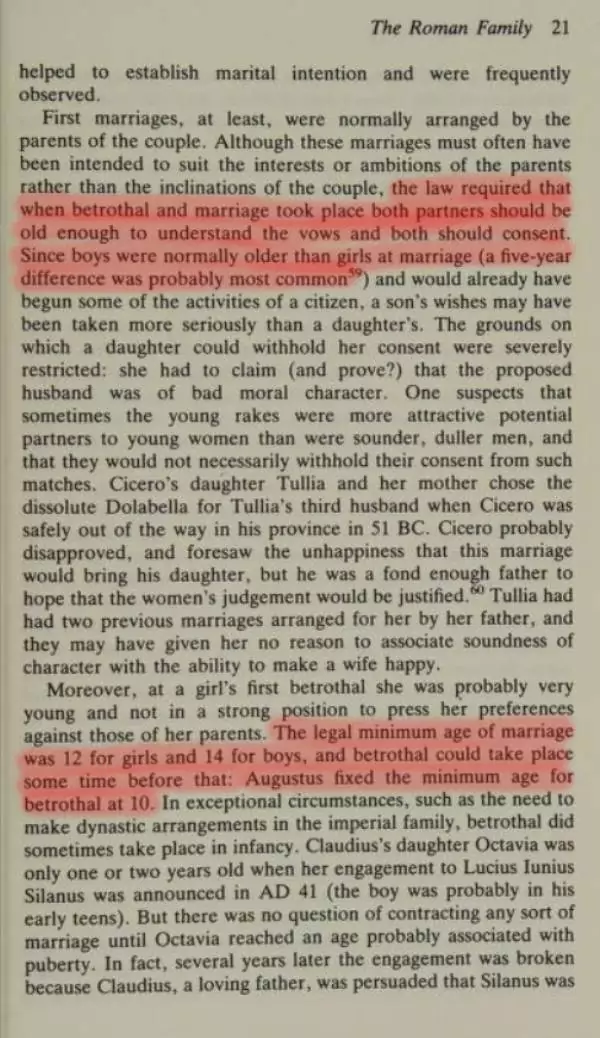
Roman law set twelve for females and fourteen for males and recognised the need to understand the commitment and both parties’ consent. Parents generally arranged first marriages and a daughter’s opportunities to object were limited; nevertheless, nine was not lawful marriageable age.
Rawson also explains that initial betrothal could occur much younger; Augustus fixed ten as its minimum. Betrothal and marriage were not conflated. Royal children were sometimes betrothed for political reasons, but lawful marriage required the girl to be twelve. Roman examples therefore highlight the need to distinguish betrothal from consummation.
A Legal Limit Does Not Mean No Marriage Occurred Below It
A Roman minimum of twelve does not mean no younger marriage occurred. So-called marriages or marital relationships below the limit are documented, and jurists discussed their legal consequences. Legal rules and every actual social event were not identical.
This does not rescue the defence; it illustrates sound historical method. Violations do not erase a law’s existence. Illegal under-eighteen marriages today do not establish that a country legally permits child marriage. Likewise, isolated under-twelve Roman marriages do not establish that Romans considered marriage at nine ordinarily valid. The question is whether the legal framework provided children this protection.
Scholars have also extensively debated Roman girls’ actual marriage ages. Striking literary examples of very young marriage cannot automatically represent average population behaviour. Demographic and inscriptional research shows that isolated early examples do not accurately reflect usual marriage ages. Collecting exceptional low ages to claim ‘everyone did it’ is methodologically wrong.
The Christian Byzantine Empire Also Retained Twelve and Fourteen
These limits did not disappear with pre-Christian Rome. The later Eastern Roman or Byzantine Empire retained twelve for girls and fourteen for boys. Lynda Garland’s research on Byzantine women identifies those minimums and the requirement of parental consent [70].
This supplies the legal framework of a major civilisation near Muhammad’s time. The world surrounding seventh-century Arabia was not uniformly accepting of sexual marriage with nine-year-olds. Roman-Byzantine law maintained a clear threshold above nine for centuries.
‘Fourteen centuries ago, concepts such as twelve, fourteen, sixteen, or eighteen did not exist’ therefore contradicts history. The modern international standard of eighteen did not exist, but ancient laws directly attest age-based capacity and marriageability limits.
Ancient Greek Thought Did Not Universally Hold ‘The Younger, the Better’
Greek societies also had different marriage practices, laws, and city-state customs. ‘Everyone in Greece married children’ is therefore ahistorical. Ancient thinkers themselves objected to early sex and marriage. In Politics, Aristotle proposed approximately eighteen for women and thirty-seven for men, discussing physical growth and suitability for reproduction [71].
Aristotle recommended women marry around eighteen and men considerably later, and discussed how early sexual relations could harm physical development.
His recommendation was not every Greek society’s actual law. Nevertheless, it is relevant against ‘ancient people saw no problem with early marriage’. His statement directly refutes that claim. An influential fourth-century BCE philosopher argued for female marriage around eighteen and discussed physical problems with early sex. Age and physical maturity were therefore considered before modernity.
Sparta Does Not Support Marriage at Nine Either
Sparta also attracts exaggerated claims. Describing Spartan women’s marriages in Life of Lycurgus, Plutarch explicitly says they did not marry when “small and unfit for wedlock” but when “in full bloom and wholly ripe”—considered sufficiently physically mature [72].
“For their marriages the women were carried off by force, not when they were small and unfit for wedlock, but when they were in full bloom and wholly ripe.”
Plutarch wrote centuries later, so this is no direct record of Sparta’s statutory marriage age. It does show an ancient distinction between girls ‘small and unfit for marriage’ and those sufficiently mature. No universal assumption that nine automatically suited a child to sexual marital life appears here.
‘It Happened Then’ and ‘Everyone Considered It Normal’ Are Different Claims
History includes adult men marrying young girls. Dynasties arranged political child betrothals; societies married girls very young; some laws permitted ages extremely low by modern standards.
This does not establish Muhammad’s actions as his era’s universal, uncontested standard. Widespread occurrence differs from uniform normality and legality. Rome’s twelve, Byzantium’s same limit, Aristotle’s eighteen, and Plutarch’s ‘small and unfit’ versus ‘ripe’ distinction show that the ancient world itself differed about age and marriageability.
An accurate account is that child and early marriage existed widely, but standards varied across periods and societies; sexual marital life at nine was not every civilisation’s identical norm. ‘Everyone did it then’ is no historical summary: it erases different civilisations, laws, and customs in one sentence.
Even If ‘Everyone Did It’ Were True, It Would Not Be a Moral Defence
Even assuming every seventh-century society normalised adult men’s sexual marriages to nine-year-olds, that would not establish morality. Widespread practice and moral rightness differ. Slavery, sexual enslavement of captive women, denial of women’s property and political rights, child labour, corporal punishment, and countless harmful customs were normal in many societies. Social normality is no standard of moral truth.
At most, ‘everyone did it’ could explain why a historical individual did not consider it unusual. It removes no harm, changes no child’s age, and creates no consent capacity. Social history may inform moral evaluation; it does not certify moral legitimacy.
‘He Was a Man of His Time’ Creates a Greater Problem for Muhammad
An ordinary seventh-century Arabian’s acts might be explained through cultural influence. The Islamic claim about Muhammad is broader: he is not merely an Arab of his period. His acts are Sunnah, his behaviour an example to follow, and his approval a source of law. Later jurists used Aisha’s child marriage to establish minors’ marriage as permissible. This is explored in The Legality of Child Marriage in the Quran.
Opposing positions cannot defend the same event. If the act establishes permissibility for Muslims of every age, it cannot be insulated from criticism as merely a local seventh-century custom. If it was only a limited contemporary custom with no modern moral relevance, its basis as evidence of permanent Sharia permissibility also weakens.
This dual position is the central inconsistency: criticism makes Muhammad ‘a man of his time’; establishing legal permissibility makes him ‘the ideal for every age’. A historical act cannot simultaneously receive moral exemption through its period’s limitations and serve as a timeless legal ideal.
‘She Is Young’ for His Own Daughter: Fatima’s Marriage and the Age Gap
An event in Muhammad’s own family matters particularly against claims that age gaps were irrelevant, older men’s marriages to young girls entirely normal, or only modern people consider age problematic. An authentic report in al-Nasa’i says Abu Bakr and Umar both proposed to his daughter Fatima. He rejected both with the same words: “إِنَّهَا صَغِيرَةٌ”, ‘She is young.’ When Ali proposed, he married her to him [73] [74].
خَطَبَ أَبُو بَكْرٍ وَعُمَرُ رضى الله عنهما فَاطِمَةَ فَقَالَ رَسُولُ اللَّهِ صلى الله عليه وسلم: «إِنَّهَا صَغِيرَةٌ». فَخَطَبَهَا عَلِيٌّ فَزَوَّجَهَا مِنْهُ.
Abu Bakr and Umar proposed to Fatima. Allah’s Messenger said, ‘She is young.’ Ali then proposed and Muhammad married her to him.
The chapter title is also significant. Al-Nasa’i places it under “باب تزوج المرأة مثلها في السن”—a woman marrying someone of her own or a similar age. The phrase “إنها صغيرة” cannot therefore be dismissed as an irrelevant remark that Fatima happened to be young. The compiler himself classifies it under spouses’ compatibility in age.
Fatima Was ‘Young’: Why Was Youth No Obstacle for Aisha?
This directly raises a question about Aisha. Rejecting Abu Bakr and Umar for Fatima, Muhammad objected, ‘She is young.’ Yet Islamic sources say he married Aisha at six and began marital life at nine. His own behaviour therefore prevents calling youth completely irrelevant to marriage: he explicitly considered age for his daughter’s prospective husband.
The report does not establish a general prohibition on every age gap, as his own marriages show. It directly establishes that a girl’s youth and compatibility with a suitor’s age mattered in Muhammad’s society and his own marriage decisions. The universal claim ‘people then did not consider age differences at all’ is therefore false.
Abu Bakr was among his closest companions and Aisha’s father; Umar was also a leading companion. The hadith cites neither bad character, religious inadequacy, poverty, nor low status as the reason for rejection. Muhammad’s direct response concerns Fatima’s youth, followed by acceptance of the younger Ali. Age therefore affected the actual decision.
IslamWeb Also Identifies Fatima’s Youth and Ali’s Similar Age as the Reason
This is no modern critic’s invention. Asked directly why Muhammad rejected Abu Bakr and Umar and married Fatima to Ali, IslamWeb answers that it was not Ali’s religious superiority but Fatima’s youth and his proximity to her age [75].
إنما كان ذلك لصغر سن فاطمة … وقرب سن علي من سنها
Meaning: It concerned Fatima’s young age and Ali’s age being close to hers.
Another IslamWeb fatwa is clearer: similar ages should generally be considered because they promote intimacy and love; Muhammad rejected Abu Bakr and Umar and accepted Ali because of the proximity of ages [76].
‘People then had no concept of compatibility in age’ therefore also conflicts with Islamic sources’ own explanation. At least for Fatima, similar ages are favourable and a large gap grounds rejection.
Muhammad Married Young Aisha: Why Object When Fatima Was Young?
The contrast is so apparent that commentators address it. IslamWeb quotes Dhakhirat al-Uqba fi Sharh al-Mujtaba asking how ‘she is young’ can be explained when Muhammad himself married young Aisha.
The explanation is that age compatibility matters, but a husband’s special standing or qualities may compensate for the gap and justify an exception. Muhammad’s own special status supposedly made his enormous gap with Aisha acceptable, whereas for Abu Bakr and Umar, Ali’s age compatibility was preferred [76].
This does not solve the problem; it clarifies the double standard. If similar ages promote marital love and stability, the consideration should also apply to Aisha. The explanation instead exempts Muhammad because of his personal status. Age-related protection considered reasonable for Fatima is thus suspended for Aisha through his special standing.
‘Age Did Not Matter in That Society’ Fails
Fatima’s case directly rejects a specific part of ‘everyone did it’. Age differences were not unknown in seventh-century Arabia. Muhammad cited youth when rejecting proposals; al-Nasa’i classified the report under similar-age marriage; later commentators also identified Ali’s age as the reason.
Defending Aisha’s marriage with ‘no one thought about age differences then’ is therefore not history. The same tradition contains contrary evidence. Muhammad’s own decision shows that youth and age gaps could affect suitability.
Why Consider This for Fatima but Not Aisha?
The hardest question is moral. For his daughter, Muhammad valued youth and accepted similar-aged Ali. For Abu Bakr’s daughter Aisha, he was himself the much older husband and began marital life at nine. ‘The customs of the period’ cannot erase this difference: two decisions by the same person in the same period are being compared.
IslamWeb’s own explanation sharpens it: similar ages are generally desirable, but Muhammad’s special standing overcomes Aisha’s gap. A consideration recognised for Fatima is suspended for Aisha because he is the suitor. This is not ‘age did not matter then’; age mattered, but an exception is claimed for Muhammad.
This hadith neither changes Aisha’s age nor creates a new prohibition. It disproves the claim that no one considered a girl’s age or the spouses’ age gap in ancient Arabia. Muhammad himself did. After rejecting two older suitors for his daughter with ‘she is young’, explaining his enormous gap with Aisha merely as contemporary normality contradicts Islamic sources’ own testimony.
Rabindranath, Bankim Chandra, and Sheikh Mujib: Does Another Person’s Child Marriage Vindicate Muhammad?
Defenders often invoke famous Bangladeshi and Indian historical figures: Rabindranath Tagore married young Mrinalini Devi, Bankim Chandra Chattopadhyay married a five-year-old, and Sheikh Mujibur Rahman’s wife was a child when marriage was arranged. Why object only to Muhammad? Two strategies operate here. One is tu quoque or ‘others did it too’, assuming another person’s similar act makes this one permissible. The other groups three different events under ‘child marriage’ and erases important distinctions.
None of their reputations warrants moral exemption. Wherever an adult married a child, the act is subject to the same criticism. Where the groom was himself a child and his family arranged the marriage, however, he cannot be treated as an independent adult decision-maker. The cases must first be distinguished accurately.
| Name | Bride | Ages | Type of Event |
|---|---|---|---|
| Rabindranath Tagore | Mrinalini Devi (Bhabatarini) | Rabindranath: 22; Mrinalini: approximately 10 | Family-arranged marriage; adult groom |
| Bankim Chandra Chattopadhyay | Mohini Devi | Bankim: approximately 10–11; Mohini: 5 | Both children; family-arranged marriage |
| Sheikh Mujibur Rahman | Sheikh Fazilatunnesa (Renu) | Approximately thirteen and three when arranged; approximately eighteen and eight at the later formal marriage | Initial decision by family elders; Mujib was also a child |
Rabindranath Did Marry as an Adult Man to a Child Bride
According to the Scottish Centre of Tagore Studies, when Rabindranath married Mrinalini Devi—then Bhabatarini—on 9 December 1883, he was twenty-two and she only ten. Both families wished the marriage [77].
This was a twenty-two-year-old man marrying an approximately ten-year-old child. Anyone judging adult men’s marriages to nine- or ten-year-olds immoral must apply the same criticism here. His Nobel Prize, cultural stature, or humanist thought does not make this act moral. The same applies to Muhammad: cultural or religious standing changes no child’s age.
Invoking Rabindranath instead backfires. ‘He also married a child, so Muhammad cannot be criticised’ logically means one adult’s child marriage makes another adult’s child marriage moral. The second’s morality does not follow from the first’s existence. Both must be judged on their own facts.
The same chronology places Mrinalini at approximately thirteen when their first child Madhurilata was born [78]. The event therefore cannot simply be dismissed as ‘a nominal childhood marriage without marital life for many years’. Accurate comparison must also acknowledge that Aisha’s consummation at nine is directly stated in hadith, whereas the sources cited here give Mrinalini’s marriage age without an equivalent direct account of the precise beginning of sexual life. Criticising Rabindranath’s child marriage while preserving that distinction is sufficient.
Rabindranath’s Marriage Is Not Equivalent to Muhammad’s Case
‘Rabindranath married a ten-year-old but is not called a paedophile; why call Muhammad one?’The comparison’s first problem is differing decision-making structures. Biographical sources describe Rabindranath’s marriage as arranged by the fathers and families. On 9 December 1883 he was twenty-two and Mrinalini about ten. Her youth is historical fact, but the available evidence does not establish that he personally sought out and selected a ten-year-old or accepted her as a wife because he was attracted to her young age.
Islamic sources preserve a different event for Muhammad and Aisha. He himself was a party to the marriage, married her at six, and began marital life at nine; al-Bukhari and Muslim directly give those ages. Placing Rabindranath’s family-arranged marriage alongside Muhammad’s own decision and saying ‘both did the same thing’ erases important historical differences.
Another manoeuvre turns a society’s child-marriage practice into a defence of a particular adult man’s marrying and having sex with a particular child. Social custom and individual decision differ. Family-arranged child marriage was widespread in nineteenth-century Bengal; having one’s own marriage arranged within that system does not directly establish personal sexual preferences. For Muhammad, the information at issue concerns his own marriage and sexual marital relationship with nine-year-old Aisha.
Rabindranath’s name does not establish innocence; the comparison itself is weak. A single outward resemblance—marrying a young girl—cannot erase who decided, how the marriage was arranged, the man’s personal role, or evidence of the age at which sexual relations began. Without comparable evidence of Rabindranath’s personal selection or attraction to young girls, presenting the two as identical examples is unreasonable.
Bankim Chandra’s Case Is Entirely Different: The Groom Was a Child
Bankim’s case does not share the same structure as Rabindranath’s or Muhammad’s. Biographical sources give approximately ten or eleven for his own first marriage and five for his wife. The Indian Express gives eleven and five, and EBSCO’s biographical summary gives the same information [79] [80].
An adult man independently deciding to marry a five-year-old is therefore not the situation. Eleven-year-old Bankim was a child too. The social and family system marrying the five-year-old also decided for him. It was clearly child marriage, but presenting him as an adult decision-maker equivalent to Muhammad is factually wrong.
This does not make his wife’s marriage acceptable. Marrying a five-year-old is itself an appalling social practice. Analysing responsibility, however, also requires identifying who decided. An eleven-year-old boy’s family-arranged marriage and a man over fifty beginning marital life with a nine-year-old both involve children, but their power and decision structures differ.
Using Bankim to defend Muhammad therefore fails twice: his child marriage does not morally justify another, and his own childhood makes comparison with an adult groom erroneous.
Sheikh Mujib Was Also a Child When His Marriage Was Arranged
Sheikh Mujib’s case further shows why ‘he married a three-year-old’ alone cannot recount history. In The Unfinished Memoirs he says he was approximately twelve or thirteen and Renu about three when the marriage was arranged. Family elders registered it amid circumstances involving her family’s property and guardianship. He writes that he did not understand its significance and that it happened on his father’s instruction [81].
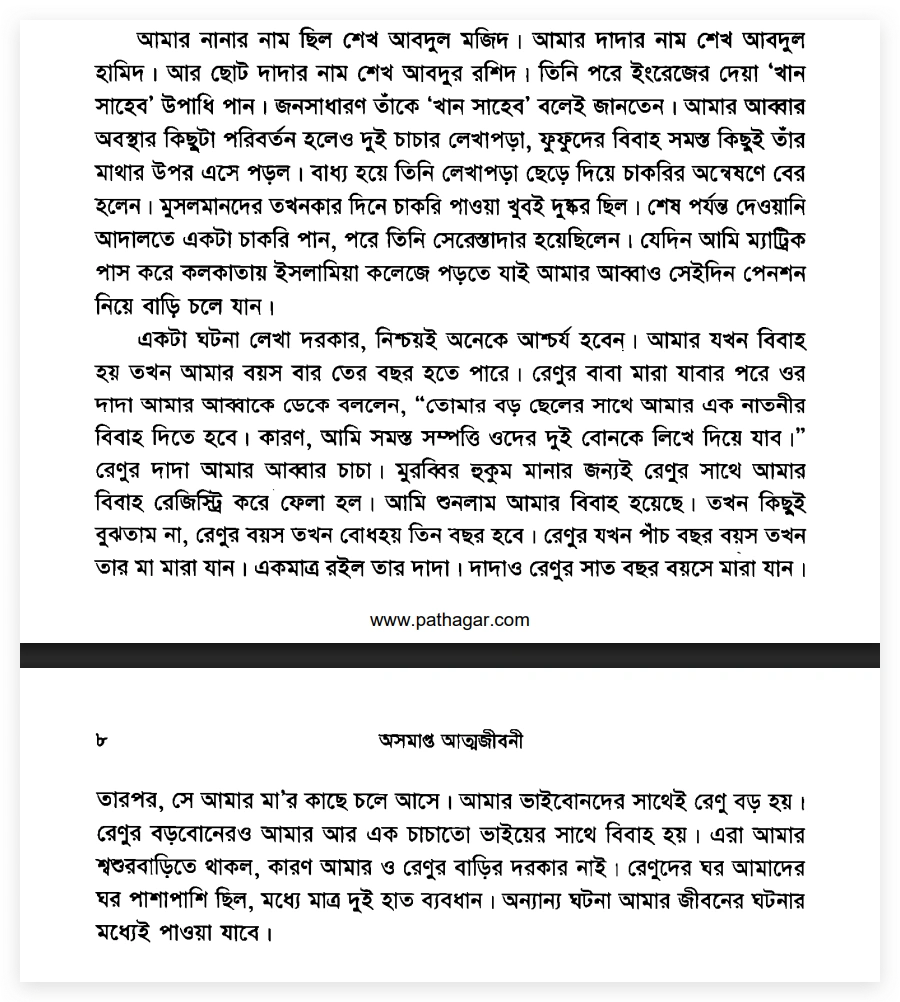
Later biographical information clarifies further. New Age says he was betrothed or the marriage arranged at thirteen; at the later formal marriage Renu was about eight and he about eighteen [82]. ‘Thirteen-year-old Mujib married three-year-old Renu and began marital life’ distorts the sequence. The initial stage was family-arranged registration or marriage arrangements; he himself was a child and says he did not understand their meaning.
At three or eight, Renu was a child. The key distinction is that Mujib was also a child at the initial decision, made on his father’s instruction. Islamic accounts portray a man over fifty marrying a six-year-old and beginning marital life at nine. ‘Young bride’ in both cases does not erase differences in the decision-maker’s age and power.
Applying the Same Standard Is Enough; Historical Figures Need No Protection
None of these figures’ stature alters the moral assessment. Rabindranath’s adult marriage to a ten-year-old deserves criticism. Bankim’s five-year-old wife’s marriage does too, while he himself was about eleven. Renu’s was also child marriage, while Mujib was about thirteen and subject to family decisions when it was arranged.
None changes Muhammad and Aisha’s case: her age does not increase, his does not decrease, the consummation account does not disappear, and no new evidence of her free consent appears. Others’ wrongdoing cannot exonerate this act. Applying the same standard makes the answer straightforward: Rabindranath’s adult–child marriage, the system marrying Bankim and Renu as children, and Muhammad’s marriage to Aisha all warrant criticism on their own facts.
Muhammad’s Religious Status Creates an Additional Question
Followers need not treat these figures’ marriages as permanent religious law. Admiring Tagore’s poetry does not make his marriage to a ten-year-old exemplary; accepting Bankim’s literary contribution does not require approving his family-arranged child marriage; assessing Mujib’s politics does not require making his childhood marriage arrangements a moral ideal.
Muhammad’s position differs within Islam. His words, acts, and approvals are sources of Sunnah; later jurists used Aisha’s marriage as a legal precedent for marrying minor girls. Normalising it through Tagore ignores this fundamental difference. No religious law must defend Tagore’s wrongdoing today; Aisha’s historical marriage became evidence for subsequent Sharia rules.
‘Tagore did it’, ‘Bankim did it’, and ‘Mujib did it’ are therefore no arguments for Aisha’s child marriage. At most, they show child marriage as a real, enduring South Asian social problem. That history strengthens the need to judge it consistently, regardless of social or religious standing, rather than weakening criticism.
‘Aisha Could Annul the Marriage after Puberty’: Misusing the Option of Puberty
Another common defence says a guardian’s marriage of a minor girl can be annulled at her wish upon puberty. This is generally presented as khiyar al-bulugh—the right to retain or end marriage after puberty. The argument continues: had Aisha been unhappy, she could easily have annulled it; since she did not, it continued by her will.
This makes a conditional jurisprudential rule a universal right. It does not apply identically to every minor marriage. Rules vary according to the guardian—father, paternal grandfather, brother, uncle, or another—and between schools. Hanafi jurisprudence particularly distinguishes a father’s or grandfather’s marriage from another guardian’s. Abu Bakr contracted Aisha’s marriage. Directly applying the option of puberty available in another guardian’s marriage to her is therefore wrong.
Aisha’s Case in the Bengali Edition of Ahkam al-Quran
Ahkam al-Quran gives the rule as follows in Bengali [83]:
For those of your wives who have ceased menstruating, if you are in doubt, the waiting period is three months. This also applies to those whose menstruation has not yet begun.
(Surah al-Talaq: 4)
Divorcing a young girl who has not menstruated is therefore valid, and divorce is valid only in a valid marriage. The verse consequently implies that marrying a young girl is entirely permissible. Muhammad also married Aisha when she was only six; her father Abu Bakr arranged it. This establishes two points: a father may validly marry off a young daughter, and upon maturity she does not gain the right to retain or reject that marriage. It is binding, since the Prophet did not grant her that choice after maturity.
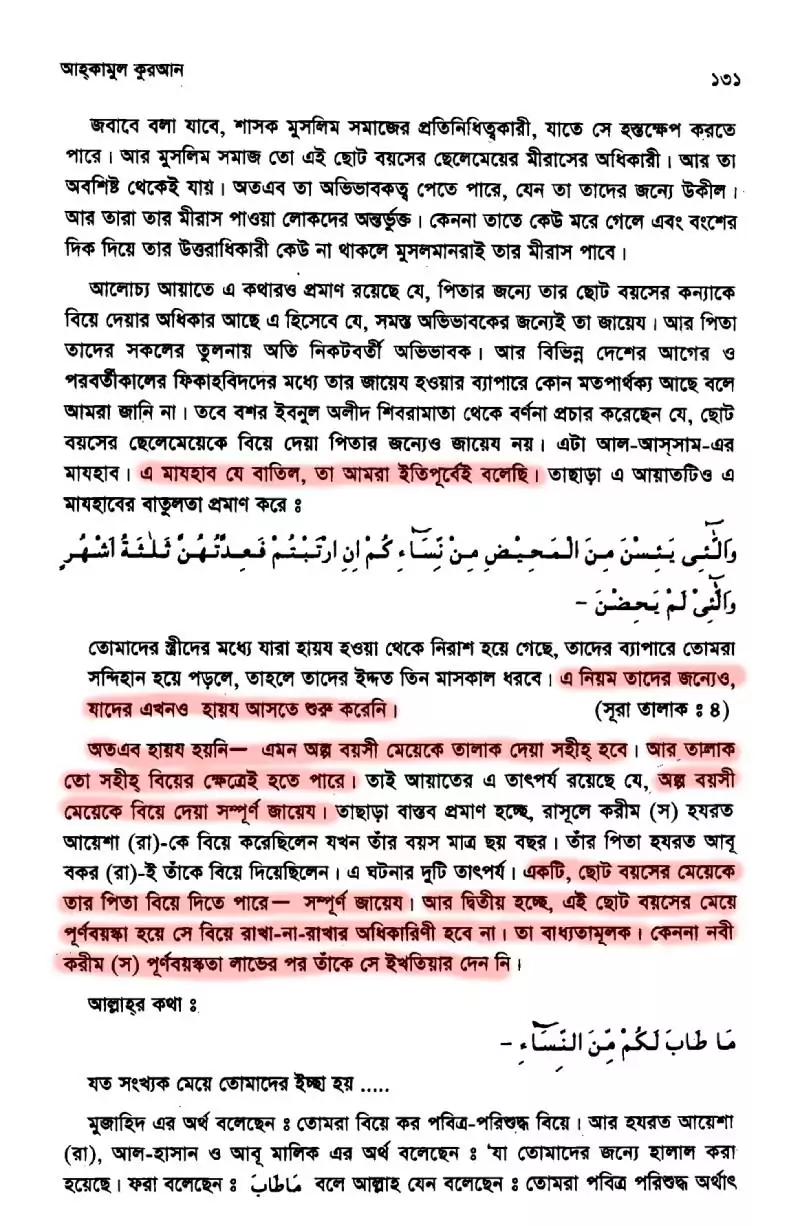
Under Hanafi Law, a Father’s or Grandfather’s Marriage Gives No Option after Puberty
Discussing jurists’ views on minors’ marriage in Ahkam al-Quran, al-Jassas explicitly gives Abu Hanifa’s position: a relative guardian may marry a minor boy or girl, but if the father or paternal grandfather contracted it, no option of annulment follows puberty; if another guardian did, the option arises [84].
فقال أبو حنيفة: لكل من كان من أهل الميراث من القرابات أن يزوج الأقرب فالأقرب؛ فإن كان المزوج الأب أو الجد فلا خيار لهم بعد البلوغ، وإن كان غيرهما فلهم الخيار بعد البلوغ.
Meaning: Abu Hanifa says the nearest guardian among inheriting relatives may marry a minor. If that guardian is the father or paternal grandfather, no option follows puberty; if another person contracts it, an option follows.
This directly disproves ‘a minor girl can always annul her marriage when she grows up’. The familiar Hanafi option principally concerns another guardian acting for the minor. A father’s marriage is not in the same category.
Al-Jassas Uses Aisha’s Marriage to Say She Had No Option after Puberty
No inference is needed here: al-Jassas himself uses their marriage as proof. Muhammad married her at six and Abu Bakr arranged it, establishing a father’s right to marry a minor daughter and the absence of a later option to accept or reject, because Muhammad granted Aisha no such option after puberty. IslamWeb quotes him verbatim [85].
وقد حوى هذا الخبر معنيين أحدهما: جواز تزويج الأب الصغيرة، والآخر أن لا خيار لها بعد البلوغ لأن النبي صلى الله عليه وسلم لم يخيرها بعد البلوغ.
Meaning: ‘This report contains two implications: a father may marry off a minor girl; and after puberty she has no option, because the Prophet did not give Aisha an option after puberty.’
The clash between modern defence and classical jurisprudence is direct. The modern claim says ‘Aisha could annul it after growing up if she wished.’ Al-Jassas concludes the opposite: she received no option after puberty, and he uses this to prove its absence in a father’s marriage.
Defending the marriage through the option of puberty is therefore particularly inconsistent. An event used by an early jurist to establish ‘no option after puberty’ cannot establish ‘Aisha could leave upon puberty if she wished’.
IslamWeb Also Acknowledges Juristic Disagreement
The same fatwa first states that jurists permit a father to marry a minor daughter, then discusses disagreement about obligatorily consulting her after puberty. Some say consultation is unnecessary and cite al-Jassas’s Aisha example; others endorse a later option [85].
This disagreement disproves ‘every minor marriage automatically grants a later right to leave’. If an established position does not make a father’s marriage depend on renewed consent, ‘Islamic child marriage is unproblematic because she can always leave afterwards’ is false. Some views and circumstances recognise a later option.
IslamQA’s Older Explanation Also Gives the Majority Position: No Option
In a detailed discussion of minor marriage, IslamQA states “وذهب جمهور العلماء إلى أنه لا خيار للزوجة إذا بلغت”—most scholars give no option after puberty. It then cites Aisha: Muhammad married her young and did not later offer renewed acceptance or rejection [86].
وذهب جمهور العلماء إلى أنه لا خيار للزوجة إذا بلغت، وقد تزوج النبي صلى الله عليه وسلم عائشة رضي الله عنها وهي ابنة سبع سنين ولم يخيرها عند البلوغ.
Meaning: ‘Most scholars say the wife has no option after puberty. The Prophet married Aisha young and did not give her an option after puberty.’
Another fatwa is more specific: “إذا زوج الأب ابنته الصغيرة غير البالغة، فلا خيار لها إذا بلغت”—if a father marries his minor daughter, she has no option after puberty [87]. It quotes Ibn Abd al-Barr that a father may marry her without seeking her opinion and cites Aisha’s marriage.
‘Islam gives the child complete freedom afterwards’ therefore conflicts with these websites’ own older explanations, which describe a father’s minor marriage as binding and use Aisha as evidence.
The Option in Another Guardian’s Marriage Is Presented as the Rule for Every Minor Marriage
The option of puberty most clearly recognised in Hanafi law principally concerns another guardian’s marriage. A newer IslamQA answer quotes Al-Mawsu‘a al-Fiqhiyya: most Hanafis consider a brother’s, uncle’s, or other guardian’s marriage of a minor boy or girl to a suitable spouse valid, but give the minor an option to annul after puberty [88].
Isolating this rule produces ‘Islam permits child marriage, but the girl can later annul it’. The quoted Hanafi rule itself contains the condition “إن زوجهما غير الأب والجد”—someone other than the father or paternal grandfather must have arranged it. Abu Bakr arranged Aisha’s marriage himself. Using this to defend her case omits the relevant condition.
This is no minor technical distinction. No option for the father’s or grandfather’s marriage, but an option for another guardian’s, is central to the Hanafi rule. Omitting it changes the meaning of the option itself.
Some Later Scholars Recognise an Option, but It Does Not Create Aisha’s Earlier Consent
Jurisprudence is not unanimous. Some later and contemporary jurists support granting the girl an option upon puberty. IslamQA’s 2020 answer quotes Ibn Uthaymin: even a father’s marriage of a minor daughter to a suitable person may be rejected by her when she grows up. Some Hanbali views require permission once she reaches nine [88].
Even accepting these views does not resolve consummation at nine. A later right to end marriage differs from free consent to sex at nine. Entering sexual marital life without consent as a legal condition, then being offered departure years later, does not make the original intercourse previously consensual.
Even the view recognising an option therefore establishes no childhood consent. It provides a later legal route to end the relationship. ‘She can leave later’ and ‘she consented freely from the outset’ are entirely different.
Does Quran 33:28–29 Establish Aisha’s Independent Right to Annul Marriage?
Another defence says Muhammad later allowed his wives freely to leave, so Aisha could have ended the marriage. Quran 33:28–29 is generally cited: he must tell his wives that if they desire worldly life and luxury, he will provide some property and ‘release them graciously’; if they desire Allah, His Messenger, and the Hereafter, a great reward awaits [89].
يَا أَيُّهَا النَّبِيُّ قُلْ لِأَزْوَاجِكَ إِنْ كُنْتُنَّ تُرِدْنَ الْحَيَاةَ الدُّنْيَا وَزِينَتَهَا فَتَعَالَيْنَ أُمَتِّعْكُنَّ وَأُسَرِّحْكُنَّ سَرَاحًا جَمِيلًا وَإِنْ كُنْتُنَّ تُرِدْنَ اللَّهَ وَرَسُولَهُ وَالدَّارَ الْآخِرَةَ فَإِنَّ اللَّهَ أَعَدَّ لِلْمُحْسِنَاتِ مِنْكُنَّ أَجْرًا عَظِيمًا
Meaning: ‘O Prophet, tell your wives: If you desire worldly life and its splendour, come, I will provide for you and release you graciously. If you desire Allah, His Messenger, and the Hereafter, Allah has prepared a great reward for those of you who do good.’
Using this to establish ‘Aisha could annul her child marriage at any time after puberty’ is wrong. It is not khiyar al-bulugh or an automatic right conferred at puberty. It was revealed years later amid a particular conflict with Muhammad’s existing wives. Muslim describes their demands for maintenance and additional wealth, his displeasure and withdrawal for nearly a month, and the verses’ subsequent revelation [90]. This is no opportunity for a newly pubescent minor to ratify or reject her father’s marriage: it is a single choice offered after a crisis within an established marriage.
The report also fails to support ‘she could freely leave whenever she wished’. Muhammad first tells Aisha to consult her parents before deciding. Her response matters: they would never advise separation from him; she then chooses Allah, the Messenger, and the Hereafter. The account itself displays familial and religious pressures within the decision later portrayed as her independent annulment right [90].
The alternatives were also not neutrally ‘stay or divorce’. One was leaving by choosing ‘worldly life and its splendour’; the other was remaining by choosing ‘Allah, His Messenger, and the Hereafter’. For a believing Muslim woman, their religious value is unequal. Remaining is linked to Allah, Muhammad, and the afterlife; departure to worldly pleasure. Presenting this as a pressure-free, secular divorce option omits the verse’s structure.
Using this to justify child marriage also creates a temporal problem: the choice did not exist when consummation occurred at nine. It arose years later amid a particular household crisis. A later opportunity to leave under special circumstances does not prove free, informed consent at the earlier intercourse. Later consent or remaining cannot create earlier consent.
Two verses alone do not explain the whole background. Maintenance demands, prolonged conflict, nearly a month’s separation, fears of divorce, Abu Bakr’s and Umar’s interventions, pressure on Aisha and Hafsa, Surah al-Tahrim’s divorce threat, and the wives’ special legal position form a larger family crisis. The events, hadiths, commentaries, and verses are analysed in Behind the Threat to Divorce the Prophet’s Wives.
At most, 33:28–29 establishes a choice for Muhammad’s existing wives to stay or depart amid a particular marital crisis. It is not the option of puberty, an annulment right granted at Aisha’s puberty, or proof of free consent at nine. Using this separate event as substitute evidence conflates distinct legal and historical contexts.
Even an Annulment Right Leaves the Initial Imposition on a Child Unanswered
This defence avoids another fundamental question. Adults decide a major part of a child’s life and then say she may reverse it when grown: that does not substitute for initial consent. If marital bonds, social relationships, the husband’s family, sexual life, and possible pregnancy begin before puberty, later annulment rights do not erase them.
Islamic accounts place Aisha’s consummation at nine. Even if she could later leave, what was her free consent when marital life began? A later separation right does not answer that.
No Report Says Aisha Was Ever Given the Option
No report describes Muhammad or Abu Bakr calling her after puberty and saying, ‘You married in childhood; now you may annul it.’ Al-Jassas and the classical views quoted by IslamWeb and IslamQA instead use this absence for the opposite conclusion: Muhammad gave no option, so such paternal marriages carry none.
The later choice under Surah al-Ahzab between worldly life and separation or remaining in Muhammad’s household is not the option of puberty. It is a separate choice offered years later to established wives in specific circumstances. It cannot establish an option at the childhood marriage.
Why ‘There Was an Option of Puberty, So Aisha’s Marriage Was Unproblematic’ Fails
A universal defence erases jurisprudence’s distinctions. Hanafi law denies an option for a father’s or grandfather’s marriage and grants one for other guardians. Al-Jassas uses Aisha for the first category; IslamWeb explicitly quotes him. IslamQA’s older fatwas likewise give no option as the majority view and cite her. Later scholars endorsing an option do not establish consensus or retrospective consent at nine.
‘Aisha could annul when grown, so her child marriage was voluntary’ is no accurate summary. A strong classical strand concludes the opposite: Abu Bakr’s marriage was binding, with no renewed option upon puberty. Even views granting an option do not make childhood marriage and consummation previously consensual.
Do Adult Wives Rule Out Paedophilia? What Research Says
A common defence invokes Muhammad’s adult wives—Khadija, Sawda, Hafsa, Umm Salama, and others—to deny any connection to paedophilia or attraction to children. It assumes someone attracted to adult women cannot also be attracted to children. Clinical science and research directly reject this. Not everyone sexually attracted to children is attracted exclusively to children. A well-established category is the non-exclusive type, involving attraction to both children and adults.
Adult wives can establish the ability to be attracted to adult women. They do not establish that attraction to children is impossible. Medicine does not define the two attractions as mutually exclusive.
DSM-IV Already Distinguished Exclusive and Non-Exclusive Types
DSM-IV explicitly says some individuals are attracted only to children—the exclusive type—while others are attracted to children and adults—the non-exclusive type. Adult attraction therefore does not negate paedophilic attraction; the classification explicitly accommodates both [91].
302.2 Pedophilia
Topics Discussed: pedophilia.
Excerpt: “The paraphilic focus of Pedophilia involves sexual activity with a prepubescent child (generally age 13 years or younger). The individual with Pedophilia must be age 16 years or older and at least 5 years older than the child. For individuals in late adolescence with Pedophilia, no precise age difference is specified, and clinical judgment must be used; both the sexual maturity of the child and the age difference must be taken into account. Individuals with Pedophilia generally report an attraction to children of a particular age range. Some individuals prefer males, others females, and some are aroused by both males and females. Those attracted to females usually prefer 8- to 10-year-olds, whereas those attracted to males usually prefer slightly older children. Pedophilia involving female victims is reported more often than Pedophilia involving male victims. Some individuals with Pedophilia are sexually attracted only to children (Exclusive Type), whereas others are sometimes attracted to adults (Nonexclusive Type). Individuals with Pedophilia who act on their urges with children may limit their activity to undressing the child and looking, exposing themselves, masturbating in the presence of the child, or gentle touching and fondling of the child. Others, however, perform fellatio or cunnilingus on the child or penetrate the child’s vagina, mouth, or anus with their fingers, foreign objects, or penis and use varying degrees of force to do so. These activities are commonly explained with excuses or rationalizations that they have “educational value” for the child, that the child derives “sexual pleasure” from them, or that the child was “sexually provocative”—themes that are also common in pedophilic pornography. Because of the ego-syntonic nature of Pedophilia, many individuals with pedophilic fantasies, urges, or behaviors do not experience significant distress. It is important to understand that experiencing distress about having the fantasies, urges, or behaviors is not necessary for a diagnosis of Pedophilia. Individuals who have a pedophilic arousal pattern and act on these fantasies or urges with a child qualify for the diagnosis of Pedophilia. Individuals may limit their activities to their own children, stepchildren, or relatives or may victimize children outside their families. Some individuals with Pedophilia threaten the child to prevent disclosure. Others, particularly those who frequently victimize children, develop complicated techniques for obtaining access to children, which may include winning the trust of a child’s mother, marrying a woman with an attractive child, trading children with other individuals with Pedophilia, or, in rare instances, taking in foster children from nonindustrialized countries or abducting children from strangers. Except in cases in which the disorder is associated with Sexual Sadism, the person may be attentive to the child’s needs in order to gain the child’s affection, interest, and loyalty and to prevent the child from reporting the sexual activity. The disorder usually begins in adolescence, although some individuals with Pedophilia report that they did not become aroused by children until middle age. The frequency of pedophilic behavior often fluctuates with psychosocial stress. The course is usually chronic, especially in those attracted to males. The recidivism rate for individuals with Pedophilia involving a preference for males is roughly twice that for those who prefer females….”
DOI: 10.1176/appi.books.9780890423349.10311
The focus of the sexual arousal associated with the disorder known as paedophilia is sexual activity with a prepubescent child (generally aged 13 or younger). To be identified as a paedophile, a person must be at least 16 years old and experience sexual attraction towards a child at least five years younger. For individuals in late adolescence, a precise age difference is not specified, and clinical judgement should be used; both the younger person’s sexual maturity and the age difference must be considered. People with paedophilia generally report attraction to children within a particular age range. Some are attracted to boys, some to girls, and others to both boys and girls. Those attracted to girls generally prefer children aged 8 to 10, whereas those attracted to boys generally prefer slightly older children. On the basis of reported cases, girls are more frequently victims of paedophilic activity than boys. Some paedophiles are attracted only to children (the exclusive type), while others are sometimes attracted to adults as well as children (the non-exclusive type). The activities paedophiles engage in when they have an opportunity also vary. Some limit their sexual activity to undressing and looking at a child, exposing themselves and masturbating while looking at the child, or touching various parts of the child’s body with sexual intent. Others, when given the opportunity, engage in oral sex or cunnilingus with the child, or insert their fingers, penis or objects into the child’s vagina, mouth or anus, using varying degrees of physical force. The excuses used to justify these abusive sexual activities —distorted ideas also evident in child pornography— include claims that they have educational value for the child, that the child derives sexual pleasure, or that the child was sexually provocative. Because paedophilia can be ego-syntonic, people with this sexual disorder may not experience significant distress or mental anguish. It is essential to understand that identifying someone as a paedophile does not depend on whether that person is distressed by their paedophilic fantasies, urges or behaviour. Those who become sexually aroused by the thought of sexual activity with children and act on that arousal with a child are clinically identified as paedophiles. Paedophiles may restrict their activities to their own children, stepchildren or relatives, or may abuse children outside the family. Some threaten the child to prevent disclosure. Others, particularly those who repeatedly sexually abuse children, adopt elaborate strategies to gain access to them. They may gain the trust of the child’s mother, marry a woman who has a child they find attractive, or obtain information about potential victims from other paedophiles. In rare cases, paedophiles have adopted children from developing countries or abducted other people’s children in order to engage in sexual activity with them. Unless sexual sadism is also present, a paedophile may make efforts to meet the child’s needs in order to gain the child’s affection, interest and loyalty and prevent disclosure. Although this disorder usually begins in adolescence, some paedophiles report that they did not experience sexual arousal towards children until middle age. The frequency of paedophilic behaviour may fluctuate with psychological stress. Paedophilia tends to be persistent, particularly among those attracted to boys. The rate of reoffending among those attracted to boys is approximately twice that of those attracted to girls.
The meaning of this definition is straightforward. Having a wife, having sexual relations with her, having children, or also experiencing sexual attraction towards adult women does not rule out sexual attraction towards children. Exclusive attraction to children and attraction to both children and adults are two distinct types.
JAMA: attraction to children may be “exclusive or partial”
The 2002 review by Peter J. Fagan, Thomas N. Wise, Chester W. Schmidt and Fred S. Berlin in JAMA makes the same point explicitly. Their definition identifies the central feature of paedophilia as sexual attraction “exclusively or in part”—exclusively or partially—to prepubescent children [92].
“The essential feature of pedophilia is that an individual is sexually attracted exclusively or in part to prepubescent children.”
“or in part” directly answers the argument based on adult wives. Children need not be the sole focus of a person’s entire sexual interest. That person can also be attracted to adults. Consequently, the claim that Muhammad’s adult wives made sexual attraction towards a child impossible by definition does not accord with the medical definition.
In a study of 2,429 men, only 7 per cent belonged to the exclusive-attraction category
The widely cited 2007 review by Ryan C. W. Hall and Richard C. W. Hall, A Profile of Pedophilia: Definition, Characteristics of Offenders, Recidivism, Treatment Outcomes, and Forensic Issues discusses the distinction between exclusive and non-exclusive types more explicitly. Citing Abel and Harlow’s study of 2,429 adult men, they report that only 7 per cent of those classified as paedophiles identified themselves as sexually attracted exclusively to children. In other words, the overwhelming majority in that sample were not exclusively attracted to children [93].
“One of the first distinctions made when classifying pedophiles is to determine whether they are ‘exclusively’ attracted to children … or attracted to adults as well as children (nonexclusive pedophile). In a study … of 2429 adult male pedophiles, only 7% identified themselves as exclusively sexually attracted to children…”
The 7 per cent figure is the proportion in that particular sample of 2,429 men, not a global rate. The relevant finding is that a substantial majority fell into the category of attraction to both children and adults. The inference “he married an adult woman → he cannot be attracted to children” therefore conflicts with the research.
Current DSM-5-TR-based clinical guidance retains the same distinction
This is not merely an old DSM-IV classification. Current clinical guidance based on DSM-5-TR also calls for specifying whether a person’s attraction is exclusively towards prepubescent children or towards both children and adults. The MSD Manual’s clinical summary, updated in 2026, directly states that some people are attracted exclusively to children (the exclusive type), whereas others are attracted to adults as well as children (the non-exclusive type) [94].
Recent research also uses this classification in practice. A study published in 2023 classified 11 of 50 men with paedophilic disorder as exclusive and 39 as non-exclusive; non-exclusive meant attraction towards both children and adults [95]. Having an adult sexual partner or experiencing attraction towards adults therefore does not make attraction towards children impossible by definition.
Having adult wives does not rule out attraction towards children
The fact that Muhammad had Khadija, Sawda, Umm Salama and other adult wives establishes that he had sexual and marital relationships with adult women. That is all it establishes. It does not establish that he had no sexual interest in nine-year-old Aisha, because the primary Islamic sources themselves state that he consummated the marriage with her when she was nine.
The exclusive/non-exclusive distinction is sufficient to establish the general possibility that someone may be married to an adult woman and sexually attracted to a child at the same time. Thus, “he also had elderly and widowed wives” does not answer criticism concerning Aisha’s age. Attraction towards adults is not the logical opposite of attraction towards children.
Aisha was his most beloved: a description of particular affection
Authentic hadith identify Aisha as the person Muhammad loved most; that is true. Amr ibn al-As asked Muhammad whom he loved most, and he answered, “Aisha.” Asked about men, he named Abu Bakr [96].
Sahih al-Bukhari (Islamic Foundation)
51/ Military Expeditions (Maghazi)
Chapter: 2227. The expedition of Dhat al-Salasil. According to Ismail ibn Abi Khalid, this expedition was against Lakhm and Judham. Ibn Ishaq narrates through Yazid, from Urwa, that Dhat al-Salasil was a settlement founded by the tribes of Bali, Udhra and Banu al-Qayn.
Islamic Foundation number: 4019; international number: 4358
4019. Ishaq … narrated from Abu Uthman that the Messenger of Allah appointed Amr ibn al-As to command an expedition against Dhat al-Salasil. Amr ibn al-As said: After the expedition, I came to the Messenger of Allah and asked him which person he loved most. He replied, “Aisha.” I asked, “Among men?” He said, “Her father.” I asked, “Then who?” He said, “Umar,” and continued naming several others in response to my questions. I stopped asking, fearing that he might place me last of all.
Hadith grade: Sahih (authentic)
Narrator: Abu Uthman
But being “most beloved” is not the same as showing that “Muhammad’s primary sexual attraction was towards her age group.” A single fact about love, emotion, intimacy, intellectual companionship or marital preference cannot establish a predominant sexual preference for a particular age group. This hadith establishes that Aisha was Muhammad’s most beloved wife; it establishes no more than that.
Sawda gave her allotted night to Aisha
Sahih al-Bukhari 5212 is sometimes used to establish that Muhammad’s primary sexual attraction was towards Aisha. It shows that Aisha was allotted two nights: her own and Sawda’s. But the hadith itself explains why she received two nights: Sawda voluntarily gave her allotted night to Aisha [97].
Sahih al-Bukhari (Tawhid Publication)
67/ Marriage
Chapter: 67/99. A wife who gives her allotted day with her husband to a co-wife, and how the allotment should be divided.
5212. Narrated Aisha: Sawda bint Zam’a gave her allotted night to Aisha. The Prophet allotted two days to Aisha: her own day and Sawda’s day. [2593] (Adhunik Prakashani: 4829; Islamic Foundation: 4832)
Hadith grade: Sahih (authentic)
Narrator: Aisha bint Abu Bakr al-Siddiq
The hadith therefore does not say that Muhammad reduced his other wives’ nights and gave Aisha extra nights because of his sexual preference. Sawda gave her own turn to Aisha. Using this hadith to prove that “Muhammad allocated more sexual time to Aisha than to his other wives” omits the very reason the hadith gives.
Aisha’s special seven-night allotment as a virgin wife
Sahih al-Bukhari 5213 states that when a man who already has a wife marries a virgin, he should stay with the new wife for the first seven days and nights; if the new wife was previously married, he should stay with her for three days and nights, then return to the normal rotation [98].
Sahih al-Bukhari (Tawhid)
67/ Marriage
Chapter: 67/101. When someone who has a previously married wife marries a virgin.
67/100. Chapter: Treating one’s wives fairly.
Allah says: “You will never be able to maintain equality between your wives, however much you desire it … Allah is All-Bountiful, All-Wise.” (Surah al-Nisa 4:129–130)
5213. Narrated Anas: The Prophet’s practice is that if someone marries a virgin, he should spend seven days and nights with her, and if someone marries a widow, he should spend three days with her. (5214; Muslim 17/12, hadith 1461; Ahmad 12970) (Adhunik Prakashani: 4830; Islamic Foundation: 4833)
Hadith grade: Sahih (authentic)
Narrator: Anas ibn Malik
Although the rule is stated in general terms, among Muhammad’s own wives its practical application was specifically to Aisha. According to Sahih al-Bukhari, Aisha was his only virgin wife. Aisha herself used an analogy to ask Muhammad: if a man had two wives, one of whom had previously been approached by another man while the other was entirely untouched, which would he prefer? Bukhari’s explanation makes clear that Aisha was referring to herself, because Muhammad married no virgin other than her [99].
تَعْنِي أَنَّ رَسُولَ اللَّهِ صلى الله عليه وسلم لَمْ يَتَزَوَّجْ بِكْرًا غَيْرَهَا
Meaning: “The Messenger of Allah married no virgin other than Aisha.” [99]
Thus, although it is true that “giving a virgin wife seven nights is a general rule,” its consequence in Muhammad’s own marital life was specific. Because Aisha was his only virgin wife, this special initial seven-night allotment had no opportunity to apply to any other wife. Most of his other wives had been married previously; under the same rule, they were allotted three nights. Within the same marital arrangement, Aisha’s virginity therefore entitled her at the outset to a longer period of exclusive time than his other wives.
Aisha’s special position was not limited to the seven-night rule. According to Sahih al-Bukhari 5212, Sawda gave her allotted day to Aisha; Muhammad consequently gave Aisha both her own allotted day and Sawda’s [97]. Again, when Muhammad was asked whom he loved most, he directly named Aisha [96].
Taken together, these hadith clarify Aisha’s position: she was Muhammad’s only virgin wife; because of that virginity, the special initial seven-night allotment applied to her; Sawda’s turn later passed to her as well; and Muhammad himself identified her as the person he loved most. Presenting Aisha as a marital example entirely equivalent to his other wives therefore cannot justify disregarding the evidence of this particular preference and additional time.
Misuse of the quotation “primary or exclusive sexual interest”
Fagan and colleagues’ research is sometimes cited to argue that a child sexual offender can be called a paedophile only if his attraction towards children is “primary or exclusive”; because Muhammad had adult wives, he supposedly fails to meet this condition. First, the definition in the same study describes paedophilic attraction as attraction “exclusively or in part” towards children. Second, “primary” and “exclusive” do not mean the same thing. An interest may be predominant without being the only interest.
Researchers recommend that these imprecise uses be avoided, because although some people who commit child sexual abuse are pedophiles, child sexual abuse offenders are not pedophiles unless they have a primary or exclusive sexual interest in prepubescent children.
The researchers recommend avoiding indiscriminate use of the term paedophilia and similar terminology, because although some people who sexually abuse children are paedophiles, child sexual offenders are not paedophiles unless they have a primary or exclusive sexual interest in prepubescent children.
These studies also distinguish child sexual abuse from paedophilia. Not every child sexual offender has a persistent sexual preference for children, and not everyone with such a preference commits an offence. A single incident of sexual behaviour therefore cannot automatically establish the person’s entire pattern of sexual preference. For the same reason, having adult wives cannot rule out attraction towards children. Both shortcuts are mistaken [100].
What follows from the argument about adult wives
One point can be stated directly from Islamic sources: Muhammad consummated his marriage with nine-year-old Aisha. The same sources also establish that he had several adult wives. The second fact does not negate the first. Research establishes that attraction towards both children and adults can coexist in the same person; clinical classification recognises this as the non-exclusive type.
But the facts that Aisha was Muhammad’s most beloved wife, that Sawda gave her a night, or that there was a general rule granting a new virgin wife seven nights do not establish that “Muhammad’s primary or exclusive sexual interest was in children.” Those hadith do not provide information answering that question. Just as having adult wives cannot rule out paedophilic attraction, particular affection towards Aisha cannot establish a specific category of sexual preference.
The claim “Muhammad had adult wives, so sexual attraction towards children was impossible for him” conflicts with clinical definitions and research. Both exclusive and non-exclusive attraction are recognised, and in the non-exclusive type the same person may be attracted to both children and adults. Having adult wives is therefore not, by itself, a refutation.
Conclusion
Examining modern defences of Aisha’s child marriage does not change the original Islamic account. Several narrations in Sahih al-Bukhari and Sahih Muslim describe marriage at six or seven and consummation at nine. The reconstruction of an age of eighteen or nineteen rests on no direct narration; the number is constructed by combining Asma’s estimated age, an uncertain age gap between the sisters and calculations in later biographies. The same Sahih Muslim narration states that Aisha was eighteen when Muhammad died. Turning eighteen into the age of consummation therefore breaks the chronology of the explicit hadith.
Attempts to establish that Aisha was already a fully grown woman at nine also fail the evidentiary test. No authentic chain to Aisha is known for the saying “at nine a girl is a woman”; IslamQA itself acknowledges this and restricts the statement’s meaning to the additional condition of menstruation at nine. In Sahih al-Bukhari, the word أَعْقِلْ means understanding or memory, not puberty. The Arabic wording displayed in Sunan Abu Dawud, تَنَفَّسَتْ means breathing or panting; the translation “I menstruated” does not correspond to the original Arabic. Nor is there a direct authentic narration stating that Aisha menstruated at nine.
There are no demographic data from seventh-century Arabia supporting the claims that “girls matured faster in antiquity” or “in hot Arabia they became fully grown at nine.” Modern research has found the opposite trend in many populations: with improvements in nutrition and health conditions, the ages of puberty and first menstruation have fallen over time. The onset of puberty, first menstruation, full physical development and the capacity for independent sexual consent are also distinct events. Even if menstruation at nine is possible, that possibility does not establish that it occurred in a particular child or turn her into an adult sexual partner.
The claim “everyone did it then” is also historically unsupported. The minimum legal marriage age for girls in ancient Rome was twelve, Byzantine law imposed age limits, Greek thought included arguments for marrying at older ages, and Muhammad himself rejected Abu Bakr’s and Umar’s proposals for Fatima on the ground that “she is young.” Examples of child marriage in the lives of Rabindranath, Bankimchandra or Sheikh Mujib do not determine the morality of Muhammad’s conduct; they instead illustrate South Asia’s own history of child marriage. Nor can khiyar al-bulugh be presented as a universal right, because a substantial strand of classical jurisprudence did not recognise an automatic option on reaching puberty when a minor girl’s marriage had been arranged by her father or paternal grandfather, and used Aisha’s case as evidence for that rule.
The argument based on adult wives does not negate the case of nine-year-old Aisha either. Clinical literature and research on paedophilia recognise the distinction between exclusive and non-exclusive attraction; attraction towards adults is not the logical opposite of attraction towards children. Across all these defences, the same methods recur: indirect calculations in place of explicit narrations, translated words in place of the Arabic original, modern reinterpretation in place of classical exegesis, isolated comparisons in place of the specific historical event, and treating puberty as synonymous with full adulthood. None of these strategies changes the basic event described in authentic Islamic sources: Aisha was married as a child, and her married life with Muhammad began when she was nine.
References
- IslamQA — Age of the Mother of the Believers ‘Aa’ishah when the Prophet married her ↩︎
- Sahih al-Bukhari, Hadith 5133 ↩︎
- Sahih al-Bukhari, Hadith 5158 ↩︎
- Sahih Muslim, Hadith 1422c 1 2
- Sahih Muslim, Hadith 1422d 1 2
- IslamWeb — تفسير قوله تعالى: في يتامى النساء اللاتي لا تؤتونهن ↩︎
- Lisan al-Arab, 12/645 ↩︎
- Sunan Abi Dawud, verified edition, Allama Albani Academy, Hadith 2873 ↩︎
- Sunan Abi Dawud, verification by Allama Albani, Husayn al-Madani Publications, volume 4, page 173, Hadith 2873 ↩︎
- Abu Dawud 2875; al-Sunan al-Kubra of al-Bayhaqi, 6/57, Hadith 11642; al-Mu‘jam al-Kabir of al-Tabarani, 3422; al-Sunan al-Saghir of al-Bayhaqi, 2049; Sharh al-Sunna, 9/200; Fath al-Bari, 2/346; Umdat al-Qari, 21/107; Kanz al-Ummal, 6046 ↩︎
- IslamWeb — شرح حديث: لا يتم بعد احتلام ↩︎
- Tafsir al-Tabari — Quran 65:4 ↩︎
- Tafsir Ibn Kathir — Quran 65:4 ↩︎
- Tafsir al-Sa‘di — Quran 65:4 ↩︎
- Tafsir al-Alusi — Quran 65:4 ↩︎
- Tafsir al-Tahrir wa-l-Tanwir — Quran 65:4 ↩︎
- IslamWeb — دلالة قوله تعالى: واللائي لم يحضن على مسألة تزويج البنت الصغيرة ↩︎
- IslamWeb — the same fatwa ↩︎
- Child Marriage and Intercourse with Minor Wives in the Quran: Quran 65:4 and the Testimony of the Commentaries ↩︎
- Quran 4:6 ↩︎
- Tafsir al-Qurtubi — Quran 4:6 1 2 3 4
- Tafsir Ibn Kathir — Quran 4:6 1 2
- Ahkam al-Quran, al-Jassas — باب دفع المال إلى اليتيم ↩︎
- Ahkam al-Quran, al-Jassas — Quran 4:6 ↩︎
- Tafsir Ibn Atiyya — Quran 4:6 ↩︎
- Tafsir al-Jalalayn — Quran 4:6 ↩︎
- IslamQA — ليس للنكاح سن معين وبيان المراد بقوله تعالى حتى إذا بلغوا النكاح ↩︎
- IslamWeb — معنى بلغوا النكاح في آية وابتلوا اليتامى ↩︎
- IslamWeb — Fatwa 295897 ↩︎
- IslamQA — خبر عائشة: إذا بلغت الجارية تسع سنين، فهي امرأة ↩︎
- IslamWeb — إذا بلغت الجارية تسع سنين فهي امرأة.. أحكام ودلالات ↩︎
- Jami‘ al-Tirmidhi, Hadith 1109 ↩︎
- Al-Sunan al-Kubra, al-Bayhaqi, 2/433 ↩︎
- IslamQA — خبر عائشة ↩︎
- Irwa al-Ghalil, 1/199 ↩︎
- Al-Sunan al-Kubra, 2/433 ↩︎
- Jami‘ al-Tirmidhi 1109 ↩︎
- IslamQA — الرد على فرية زواج النبي بعائشة ولها 18 سنة ↩︎
- Sahih al-Bukhari, Tawhid Publications, Hadith 476 ↩︎
- Sahih al-Bukhari 476 1 2
- Sunan Abi Dawud 4933 1 2
- Sahih al-Bukhari 3894 ↩︎
- Sahih al-Bukhari 6130 1 2 3
- Sahih Muslim 2440a ↩︎
- Sunan Abi Dawud 4931 ↩︎
- Sunan Abi Dawud 4932 ↩︎
- IslamQA — Are dolls only for girls? Is it permissible to play with them after reaching puberty? 1 2
- Sahih al-Bukhari 5236 ↩︎
- IslamQA — Refutation of the claim that Aisha was 18 ↩︎
- Worldwide Secular Trends in Age at Pubertal Onset Assessed by Breast Development Among Girls: A Systematic Review and Meta-analysis ↩︎
- Girls beginning puberty almost a year earlier than in 1970s ↩︎
- Menstruation in Girls and Adolescents: Using the Menstrual Cycle as a Vital Sign ↩︎
- International Variability of Ages at Menarche and Menopause: Patterns and Main Determinants ↩︎
- Recent Decline in Age at Menarche: The Fels Longitudinal Study ↩︎
- Commentary: The decreasing age of puberty—as much a psychosocial as biological problem? ↩︎
- AGE AT MENARCHE AMONG IN-SCHOOL ADOLESCENTS IN SAWLA TOWN, SOUTH ETHIOPIA ↩︎
- Secular trends in age at menarche among women born between 1955 and 1985 in Southeastern China ↩︎
- Declining age at menarche in Indonesia: a systematic review and meta-analysis ↩︎
- Decline in menarcheal age among Saudi girls 1 2
- Nutrient Intake through Childhood and Early Menarche Onset in Girls: Systematic Review and Meta-Analysis 1 2
- Quran 29:14 ↩︎
- Tafsir Ibn Kathir — Quran 29:14 ↩︎
- Tafsir Ibn Kathir — 29:14 1 2
- IslamQA — How Long Did Noah Live? ↩︎
- Jami‘ al-Tirmidhi 3367 1 2
- Jami‘ al-Tirmidhi 3076 ↩︎
- IslamWeb — Reports on Adam’s Lifespan ↩︎
- Sunan al-Tirmidhi — أعمار أمتي ما بين الستين إلى السبعين ↩︎
- The Family in Ancient Rome: New Perspectives, Beryl Rawson, page 21 ↩︎
- Lynda Garland — Women, Byzantium ↩︎
- Aristotle, Politics 7.1335a ↩︎
- Plutarch, Life of Lycurgus 15 ↩︎
- Sunan an-Nasa’i 3221 ↩︎
- Sunan an-Nasa’i, Islamic Foundation — Book of Marriage ↩︎
- IslamWeb — Why Fatima Was Married to Ali Rather Than Abu Bakr or Umar ↩︎
- IslamWeb — الزواج مع التفاوت في السن 1 2
- The Scottish Centre of Tagore Studies — Mrinalini Devi ↩︎
- The Scottish Centre of Tagore Studies — Birth of Tagore’s First Child Bela ↩︎
- The Indian Express — Bankim Chandra Chattopadhyay ↩︎
- EBSCO — Bankim Chandra Chatterji ↩︎
- Sheikh Mujibur Rahman, The Unfinished Memoirs, University Press Limited, page 7 ↩︎
- New Age — Sheikh Fazilatunnesa Mujib’s birth anniversary ↩︎
- Ahkam al-Quran, Ahmad ibn Ali Abu Bakr al-Razi al-Jassas, translated by Mawlana Muhammad Abdur Rahim, Khayrun Publications, volume 3, page 131 ↩︎
- Al-Jassas, Ahkam al-Quran — باب تزويج الصغار ↩︎
- IslamWeb — مِنْ أحكام تزويج الأب ابنته الصغيرة 1 2
- IslamQA — الحكمة من تشريع تزويج الصغيرة دون البلوغ ↩︎
- IslamQA — هل يشترط إذن الصغيرة إذا زوجها أبوها؟ ↩︎
- IslamQA — هل يحق للمرأة الصغيرة الخيار إذا زوجت عند البلوغ أو قبله؟ 1 2
- Quran 33:28–29 ↩︎
- Sahih Muslim 1478 1 2
- Diagnostic and Statistical Manual of Mental Disorders, Fourth Edition — Pedophilia ↩︎
- Fagan PJ, Wise TN, Schmidt CW, Berlin FS. “Pedophilia.” JAMA. 2002;288(19):2458–2465. doi:10.1001/jama.288.19.2458 ↩︎
- Hall RCW, Hall RCW. “A Profile of Pedophilia: Definition, Characteristics of Offenders, Recidivism, Treatment Outcomes, and Forensic Issues.” Mayo Clinic Proceedings. 2007;82(4):457–471. doi:10.4065/82.4.457 ↩︎
- MSD Manual Professional Edition — Pedophilic Disorder ↩︎
- Altered Neural and Behavioral Response to Sexually Implicit Stimuli During a Pictorial-Modified Stroop Task in Pedophilic Disorder ↩︎
- Sahih al-Bukhari 4358 1 2
- Sahih al-Bukhari 5212 1 2
- Sahih al-Bukhari 5213 ↩︎
- Sahih al-Bukhari 5077 1 2
- Fagan PJ et al., JAMA, 2002; Hall RCW & Hall RCW, Mayo Clinic Proceedings, 2007 ↩︎