
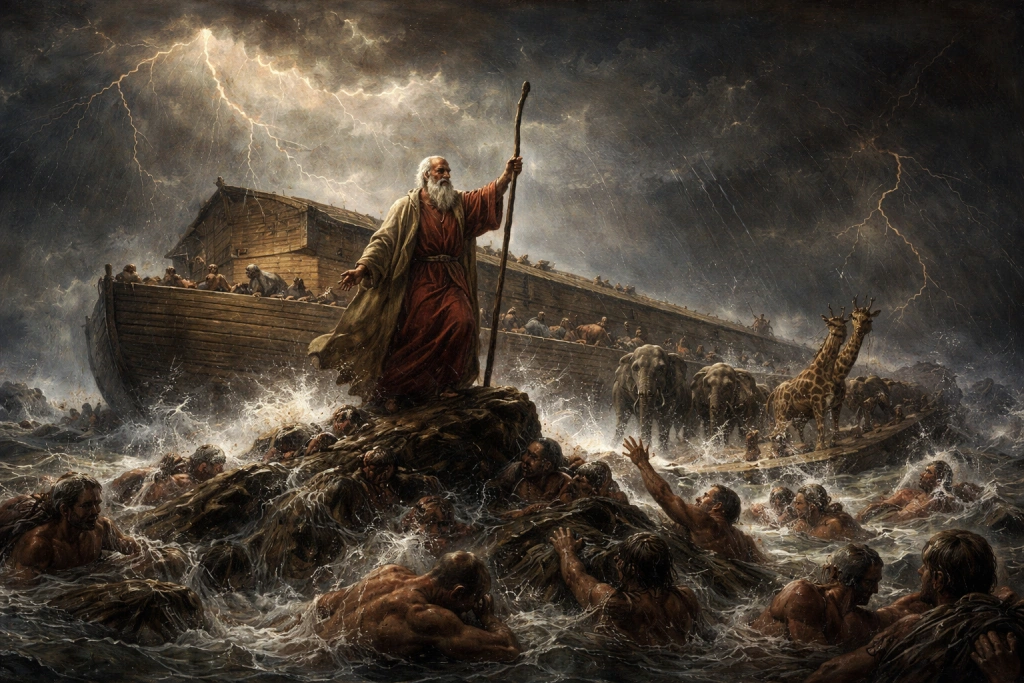
Summary: Noah’s Great Flood—Religious Narrative versus History, Science, and Reason
The story of Noah’s Great Flood is one of the best-known narratives in the Abrahamic religious traditions. Its central claim is that an all-encompassing flood occurred as punishment for human disbelief and disobedience; Noah built an enormous vessel and saved a small number of people together with pairs of different animals; everyone else was destroyed; and the earth’s human population and biodiversity were subsequently reconstituted from those few survivors. This article examines the story not by presupposing the truth of religious belief, but as a claim about a real historical and physical event. The examination draws not only on the Qur’an, hadith, classical tafsir, Islamic historiography, and modern Islamic fatwas, but also on evidence from geology, hydrology, meteorology, biology, population genetics, biogeography, ecology, archaeology, historical linguistics, and thermodynamics.
The historical section shows that the story of Noah did not emerge in a cultural vacuum. Long before it, Mesopotamian texts such as the Eridu Genesis, Atra-Hasis, and the Epic of Gilgamesh already contained a strikingly similar narrative structure: divine anger, the destruction of humanity, one chosen man, a huge vessel, and the preservation of living creatures. Comparison with later Greek, Indian, Iranian, and other flood traditions also shows how memories of catastrophic local floods can gradually be transformed in religious and mythological literature into stories of cosmic disaster. Against this historical background, the article then turns to Islam’s own texts and examines the Qur’anic accounts of Noah’s prayer, the declaration that everyone else would be drowned, water erupting from the sky and the earth, pairs of animals being taken aboard, waves like mountains, and the vessel coming to rest on Mount Judi. It also examines descriptions preserved in Islamic tafsir and historiography of a global flood, a vessel travelling around the entire earth, a three-storey structure measuring 300 × 50 × 30 cubits, and later humanity being restricted to Noah’s lineage.
Scientific examination causes the problems to accumulate one after another. There is no known physical source for the additional water required to create a global water level high enough to submerge Everest; even if all the water vapour currently present in the atmosphere condensed at once, it would produce only a few centimetres of water globally. If the traditional Islamic and biblical dimensions of 300 × 50 cubits are used for the vessel, the numbers do not work for accommodating millions of species together with their food, water, temperature requirements, waste, pathogens, predator–prey relationships, and the labour required to care for them for months. Classical and modern Islamic interpretations include insects and reptiles among the creatures taken aboard; other Islamic tafsir, meanwhile, attempts to avoid the problem by claiming that flies, mosquitoes, and ants would later arise anew from soil and decay—an abandoned spontaneous-generation idea. The claim that animals travelled to the vessel from isolated continents and later returned to their respective endemic regions is also incompatible with modern biogeography.
The genetic histories of animals and humans create an even more direct conflict. If every animal species expanded from a single pair, and all living humans expanded from Noah’s tiny family lineage within only a few thousand years, then innumerable species and the human genome should exhibit an extreme, universal genetic bottleneck dating to the same period. No such synchronous global bottleneck from a few thousand years ago exists. Some reports in Islamic historical literature narrow the problem even further: one tradition describes eighty survivors who later died in an epidemic, leaving humanity to descend only from Noah’s family; another claims that the languages of those eighty people split into eighty distinct languages in a single morning. Evidence from both modern population genetics and historical linguistics reveals histories incompatible with such a recent universal restart and instantaneous creation of languages.
Geology and archaeology yield the same result. If the entire earth had been submerged to mountain-top level only a few thousand years ago, different continents should preserve a distinctive global stratigraphic signature from the same period, a widespread uniform sedimentary layer, and evidence of universal ecological destruction. No such layer exists. By contrast, archaeological continuity in Egypt, the Indus region, East Asia, and other civilizations extends across the supposed flood period. Marine fossils found in mountains were once used in Islamic tafsir as evidence for a global flood, but modern plate tectonics and sedimentary geology show that they are the result of tectonic uplift of ancient seabed rocks. The expected consequences of a global flood for aquatic ecosystems, freshwater–saltwater balance, coral reefs, terrestrial plants, food chains, and post-flood recolonization likewise do not match the biological history of the present earth.
Finally, the article examines two theological defences. The first is that the event was a ‘miracle’, and therefore cannot be judged by ordinary natural laws. Once that position is adopted, the claim is no longer scientifically testable: miraculous exceptions can be invoked for any inconsistency involving the size of the vessel, animal food, the source of the water, genetic bottlenecks, or geological strata. The second is the modern ‘local flood’ interpretation. Yet classical Islamic history and numerous tafsirs preserve explicit descriptions of a global flood; even among modern Islamic sources, the global flood is in some places treated as the apparent or direct meaning of the Qur’an, while elsewhere—under the pressure of scientific evidence—the interpretation is described as non-categorical and room is left for a local flood. This shift does not solve the underlying scientific problems; it changes the scope of the claim in an attempt to avoid the conflict.
Test: Is the story an independent historical report, or an evolution of earlier mythological traditions?
Test: Is the destruction portrayed as limited, or as encompassing the whole earth?
Question: Where did the water come from, and where did it go afterwards?
Test: Could such a limited structure hold enormous biodiversity and the required food supplies?
Problems of food, water, ventilation, waste, temperature, predator–prey relations, and disease hosts.
Test: modern biology versus the abandoned concept of spontaneous generation.
Question: Where is the trace of their migration to the Middle East and subsequent return to their own continents?
Real genomes do not show that global pattern.
Genome-wide demographic history shows no recent family-sized global bottleneck.
This makes the founder-population problem even more severe.
Explanation of marine fossils in mountains: tectonic uplift, not a global flood.
Test: Could ecosystems recover after a planet-wide inundation?
The expected global civilizational break is absent.
By contrast, historical linguistics shows gradual divergence and reconstructable ancestry.
Test: the energetic consequences of a planet-scale water cycle compressed into such a short period.
Test: Is this based on new evidence, or is it a narrowing of the scope of the older claim?
Summary of the Evidence and Conclusions of the Entire Article
| Field of discussion | Claim examined in the article | Types of evidence and sources used | Main result |
|---|---|---|---|
| Origins of the flood myth | Is the story of Noah an independent historical event? | Eridu Genesis, Atra-Hasis, Epic of Gilgamesh, Greek and other flood traditions | Many central motifs of the Abrahamic flood narrative already appear in earlier Mesopotamian literature. |
| Qur’anic narrative | How extensive are the destruction and geographic scope of the flood? | Qur’an 71:26; 37:80–82; 54:11–12; 11:40–44 | The destruction of disbelievers, massive water from the sky and ground, pairs of animals, and mountain-like waves construct a narrative of large-scale catastrophe. |
| Islamic global interpretation | Is the global flood merely an externally imposed interpretation? | IslamQA, Islamweb, Ibn Kathir, Ibn al-Athir, Qasimi | Numerous sources within the Islamic tradition explicitly interpret the flood as encompassing the whole earth, all people, and even the mountains. |
| Hydrology | Was there enough water for a global water level as high as Everest? | Atmospheric water inventory, hydrological cycle, USGS data | The quantity of atmospheric water vapour is negligible compared with the multi-kilometre global water layer required; the source and subsequent destination of the additional water are unexplained. |
| Vessel dimensions | Was the vessel large enough for the enormous animal cargo? | 300 × 50 × 30 cubit tradition; Baghawi, Tabari, Ibn Abi Hatim | At the traditional dimensions, the available floor area is limited; Islamic tafsir also preserves descriptions of a comparable three-storey structure. |
| Pairs of animals | Only a few domestic animals, or extensive biodiversity? | Al-Shawkani as cited by IslamQA; Islamweb-hosted tafsir | Some Islamic interpretations include a male–female pair of every kind of creature, including birds, insects, and reptiles. |
| Biodiversity and carrying capacity | Could the species be accommodated in one vessel? | Modern species estimates, zoological diversity | Space, food, water, habitat, temperature, and husbandry requirements are incompatible with the vessel’s traditional dimensions. |
| Spontaneous generation | Could some insects arise again from decay after the flood? | Islamweb-hosted tafsir versus microbiology | The explanation that flies, mosquitoes, and ants arise from soil and putrefaction has been abandoned by modern biology. |
| Biogeography | How did geographically isolated animals reach the vessel and then return? | Endemic species distribution, evolutionary biogeography | Endemic patterns in Australia, South America, the polar regions, and elsewhere do not fit a recent Middle Eastern redistribution. |
| Food and logistics | Could so many animals be kept alive for months? | Islamic historical tradition of 150 days; animal-care requirements | There is no workable solution for food, fresh water, ventilation, waste removal, carnivore feeding, and manpower. |
| Ship engineering | How viable is a roughly 135-metre-class wooden hull? | Wooden-ship engineering; historical experience with the Wyoming | Flexing, leakage, and pumping problems in very large wooden hulls demonstrate severe engineering limitations. |
| ‘Miracle’ defence | Can objections from natural law be dismissed through supernatural intervention? | Islamweb’s explicit miracle defence | If every inconsistency is removed by invoking a miracle, the hypothesis ceases to be falsifiable and loses the status of a scientific claim. |
| Geology | Where is the rock layer expected from a global flood? | Stratigraphy, sedimentology, modern geology | There is no uniform global sedimentary signature of a simultaneous worldwide flood a few thousand years ago. |
| Marine fossils in mountains | Are marine fossils evidence of the flood? | Classical flood interpretation versus plate tectonics | Uplift of marine sediments and tectonic collision provide the natural geological explanation for marine fossils in mountains. |
| Animal genetics | Was each species rebuilt from one pair within a few thousand years? | Population genetics, known bottleneck signatures | A synchronized two-individual global bottleneck is absent across species. |
| Human genetics | Was present humanity reduced to Noah’s few families several thousand years ago? | Genome-wide demographic reconstruction, autosomal DNA, mtDNA, Y-chromosome | The human genome shows no recent family-sized universal bottleneck; the histories of different populations extend much further back. |
| Tradition of 80 survivors | From how many people did humanity restart after the flood? | Yaqut al-Hamawi and other Islamic historical reports | Some reports say even the 80 survivors later died out and humanity was restricted to Noah’s family, making the genetic problem still more severe. |
| Ecology and salinity | Could aquatic and terrestrial ecosystems survive a global flood? | Osmoregulation, coral ecology, photosynthesis, plant survival | Freshwater–saltwater disruption, loss of light, plant death, and food-chain collapse create major ecological contradictions. |
| Archaeology | Did human civilization collapse globally during the supposed flood period? | Egyptian, Indus, and East Asian archaeological continuity | Contemporary civilizations show no synchronized global extinction or restart. |
| Linguistics | How did modern linguistic diversity arise from a small post-flood population? | The 80-language tradition in Ibn Abi Hatim/Ibn Kathir; historical linguistics | There is no historical evidence that 80 languages appeared in a single morning; real languages show lineages produced by long-term continuous change. |
| Thermodynamics | What would happen if enormous quantities of water vapour condensed in a very short time? | Latent heat, energy conservation, condensation physics | Planet-scale rapid condensation and water cycling generate enormous heat and energy problems. |
| Classical global flood | What was the geographic scope of the flood in older Islamic interpretations? | Ibn al-Athir, Qasimi, and other sources | Explicit traditions are preserved of a vessel travelling across the “entire earth” and of worldwide destruction. |
| Modern local-flood interpretation | Is a local-flood reading the natural meaning of the older tradition? | IslamQA and Islamweb fatwas from different periods | Even within modern Islamic sources, examples exist of movement from a global reading to a non-categorical/local possibility. |
| Logical problems with a local flood | If the flood was local, why the enormous vessel and global preservation of animals? | Qur’anic narrative, Islamic global tradition, geographic reasoning | Once a local reading is adopted, many central elements of the story become unnecessary or incoherent. |
| Overall conclusion | Does Noah’s global flood survive as a literal historical event? | History + Islamic internal sources + geology + hydrology + biology + genetics + ecology + archaeology + linguistics + physics | The combined evidence does not show the expected traces of a recent worldwide Noahic flood; as literal global history, the narrative does not withstand scientific testing. |
Introduction: The Psychological and Geographical Background of the Great-Flood Myth
A close examination of the history of human civilization and ancient religious literature reveals the repeated appearance of a highly intriguing theme: a prehistoric global deluge or worldwide flood. In one form or another, a broadly similar story can be found in almost every ancient culture. To trace where this story actually began and how it spread across the world, we must return to the earliest stages of human history. From the standpoint of science and reason, ancient civilizations were built largely around fertile river valleys—the Tigris and Euphrates in Mesopotamia, the Nile in Egypt, the Indus in India, and the Yellow River in China. Flooding was a regular and unavoidable natural event in such regions. From time to time, however, catastrophic and unexpected local floods occurred that completely destroyed the lives and property of ancient communities. People of those periods had virtually no real knowledge of science, geology, or atmospheric processes; consequently, they interpreted sudden and devastating natural disasters as expressions of divine anger, punishment for human sin, or direct supernatural intervention [1].
As the terrifying memories of these local disasters were transmitted orally from one generation to another, supernatural elements and imaginative exaggerations were naturally added. When a story passes by word of mouth from one person to another, it continually grows new branches, with additions and omissions accumulating along the way. Local social systems, geographical features, and cultural beliefs become mixed into the story, while its characters also change over time. In the course of generations, the real memory of a flood in a particular region crosses the boundary of folklore and becomes a myth of a cosmic deluge that destroys the whole earth, ending with a small number of humans and animals being divinely saved. This is the underlying reality behind the origin and evolution of many widespread legends and religious folk narratives. If the flood accounts in different mythologies and scriptures are subjected not to blind faith but to the rigorous tests of history, geology, and mathematical reasoning, the claim of a prehistoric worldwide flood proves scientifically and objectively untenable. This article will examine the historical origins of the myth and analyse its flaws in detail on the basis of scientific and mathematical evidence [2]. The indiscriminate killing of children, the elderly, people with disabilities, and non-human animals in such a narrative also directly conflicts with the concept of a perfectly merciful and omniscient God.
Origins of the Great-Flood Myth and Its Evolution Across Civilizations
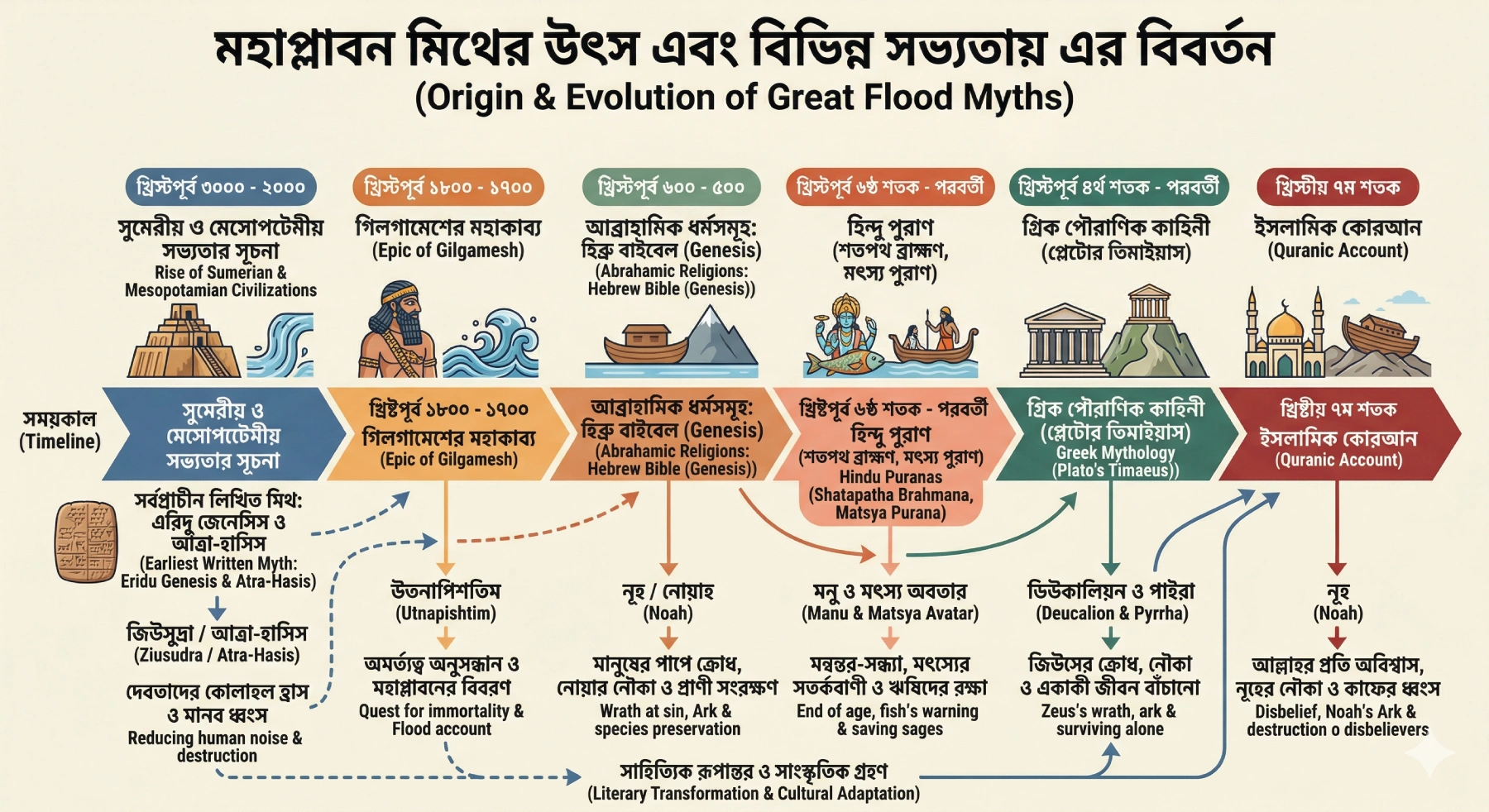
A comparative analysis of terrifying and deadly flood myths from around the world strongly indicates that these stories are not historical records of independently occurring global disasters; rather, they are products of the continuous literary evolution and cultural adaptation of very ancient local traditions rooted in particular geographic regions. The oldest written evidence of this class of myth is found in ancient Mesopotamian civilization. Predating the Epic of Gilgamesh and other Akkadian flood traditions, the Eridu Genesis (Eridu Genesis), composed around the second millennium BCE, is among the earliest surviving examples of such a flood myth. The Eridu Genesis narrative is known from clay tablets discovered in the ruins of the ancient city of Nippur, excavated in the late nineteenth century and later translated by the Assyriologist Arno Poebel [3].
The most prominent and extensive version of this myth found across the world appears in the Mesopotamian Epic of Gilgamesh. Historical and archaeological scholarship has shown that this flood narrative drew heavily from the earlier Akkadian epic Atra-Hasis, which dates to the eighteenth century BCE. In the Gilgamesh flood story, the chief god Enlil becomes irritated by the excessive noise of humanity and decides to destroy all life on earth through a flood. But the god Ea—believed to have created humans from clay mixed with divine blood—secretly warns the hero Utnapishtim of the coming flood and gives him detailed instructions to build an enormous vessel so that earthly life may survive. This same narrative template—an angry deity, a chosen saviour, the construction of a huge vessel, and an instruction to preserve living creatures—reappears in later religious and mythological traditions [4].
Over time, this early Mesopotamian myth spread into other regions and took new forms as it mixed with local cultures. Hindu literature, for example, preserves a great-flood story in the Shatapatha Brahmana and later texts, where the episode is associated with the Manvantara cycle. In that story, Vishnu’s Matsya incarnation warns the first man Manu about the coming flood and advises him to build a great boat. Likewise, in Zoroastrian traditions associated with Mazdaism, the destructive force Ahriman attempts to devastate the world, while other Iranian traditions preserve transformed catastrophe motifs. Historian Norbert Oettinger has argued that the story of Yima and the Vara may ultimately derive from a flood myth, with severe winter replacing flood in the arid environment of eastern Iran. He has also pointed to the flow of melted water mentioned in Videvdad 2.24 as a possible residue of the earlier flood motif. Even the hero of an ancient Indian flood tradition may originally have been Yama before later developing into Manu [5].
Greek civilization preserves the story of Deucalion’s flood in several ancient sources. Plato’s Timaeus (written around 360 BCE) mentions the flood of Deucalion; later and more detailed Greek accounts, especially Pseudo-Apollodorus’s Library, describe a flood sent by Zeus, Prometheus’s warning, Deucalion’s construction of a vessel, and nine days and nights spent afloat. In the story, Zeus becomes enraged by the ceaseless violence of Bronze Age humanity and decides to punish people with a flood. The Titan Prometheus secretly reveals the plan to Deucalion and advises him to build a vessel. After nine days and nights, the waters begin to recede and the vessel comes to rest in the mountains. Even among the Cheyenne of the North American Great Plains, traditions exist in which a flood changed the course of their history. From the standpoint of science and history, such traditions can plausibly preserve memories of devastating local flooding—such as floods in major river valleys—that later acquired a cosmic form in cultural creation narratives. Taken together, this evidence indicates that scriptural flood stories are better understood as examples of local natural disasters being transmitted through human imagination across cultures and transformed into supernatural narratives than as independent historical records of a single global event [6].
Noah’s Prehistoric Great Flood in the Abrahamic Religions and the Qur’anic Narrative
Because our geographical and social context is largely connected with Muslim-majority regions, the Islamic version of the Great Flood—the story of the prophet Noah—is the most familiar to us. The Qur’an, hadith, and other Islamic religious literature are commonly understood in classical tradition as describing an overwhelming flood in Noah’s time, one that covered the inhabited world and rose to extraordinary heights. The core of the story is human disobedience and disbelief toward God (Allah). According to the narratives of Genesis and the Qur’an, God responds to human wrongdoing by resolving to eliminate the unbelieving population. In the broader traditional story, the destruction encompasses not only disobedient humans but also vast numbers of non-human animals and the terrestrial environment. Noah alone, as the obedient prophet, is instructed to build an enormous vessel through which he, his family, and pairs of living creatures are to be preserved for future reproduction.
According to the Qur’anic narrative, Noah lived for 950 years and preached for a long period to the disbelievers among his people. When he failed to convert most of them, he himself prayed to Allah that not a single disbeliever should survive the flood. In other words, this prayer for mass destruction makes no distinction for women, children, the elderly, people with disabilities, or other innocents. Noah’s prayer is stated explicitly in the Qur’an [7].
Noah had prayed, “My Lord! Do not leave a single disbeliever on earth.”
— Dr. Mustafa Khattab, The Clear Quran
In response to Noah’s prayer, the Qur’anic narrative presents Allah as rewarding him and then drowning the others [8].
Indeed, this is how We reward the good-doers.
— Dr. Mustafa Khattab, The Clear Quran
˹For˺ he was truly one of Our faithful servants.
— Dr. Mustafa Khattab, The Clear Quran
Then We drowned the others.
— Dr. Mustafa Khattab, The Clear Quran
Regarding the mechanism of the deluge, the Qur’an says that it was produced by torrential water from the sky and springs bursting from the ground: “So We opened the gates of the sky with pouring rain, and caused the earth to burst with springs, so the waters met for a fate already set.” [9].
and caused the earth to burst with springs, so the waters met for a fate already set.
— Dr. Mustafa Khattab, The Clear Quran
So We opened the gates of the sky with pouring rain,
— Dr. Mustafa Khattab, The Clear Quran
Hadith literature contains another striking detail. According to an Islamic report, the Milky Way is described as an opening of the sky, and this opening is associated with the torrential water of Noah’s flood. The obvious question is: where is that water now? The canonical Sunnah.com equivalent of the Bengali reference is Al-Adab Al-Mufrad 766, not 771:
Al-Adab Al-Mufrad 766
Book 33: Sayings
Chapter 329: The Milky Way
Abu at-Tufayl reported that Ibn al-Kawwa’ asked ‘Ali about the Milky Way. He said, “It is the water-trough (or loop of the bag) from which the heaven opens up flowing water.”
Arabic:
حَدَّثَنَا الْحُمَيْدِيُّ، قَالَ: حَدَّثَنَا سُفْيَانُ، عَنِ ابْنِ أَبِي حُسَيْنٍ وَغَيْرِهِ، عَنْ أَبِي الطُّفَيْلِ سَأَلَ ابْنُ الْكَوَّا عَلِيًّا عَنِ الْمَجَرَّةِ، قَالَ: هُوَ شَرَجُ السَّمَاءِ، وَمِنْهَا فُتِحَتِ السَّمَاءُ بِمَاءٍ مُنْهَمِرٍ.
Reference: Al-Adab Al-Mufrad 766
In-book reference: Book 33, Hadith 13
The narrative then describes the command to take animals and family members aboard, followed by the death of Noah’s son. When Noah tells his son to board the vessel, the son says he will seek refuge on a mountain; the enormous waves of the flood then sweep him away. After the waters recede, the Ark comes to rest on Mount Judi and the wrongdoing people are condemned [10].
And when Our command came and the oven burst ˹with water˺, We said ˹to Noah˺, “Take into the Ark a pair from every species along with your family—except those against whom the decree ˹to drown˺ has already been passed—and those who believe.” But none believed with him except a few.
— Dr. Mustafa Khattab, The Clear Quran
And ˹so˺ the Ark sailed with them through waves like mountains. Noah called out to his son, who stood apart, “O my dear son! Come aboard with us and do not be with the disbelievers.”
— Dr. Mustafa Khattab, The Clear Quran
He replied, “I will take refuge on a mountain, which will protect me from the water.” Noah cried, “Today no one is protected from Allah’s decree except those to whom He shows mercy!” And the waves came between them, so his son was among the drowned.
— Dr. Mustafa Khattab, The Clear Quran
And it was said, “O earth! Swallow up your water. And O sky! Withhold ˹your rain˺.” The floodwater receded and the decree was carried out. The Ark rested on Mount Judi, and it was said, “Away with the wrongdoing people!”
— Dr. Mustafa Khattab, The Clear Quran
Although the episode is presented religiously as punishment for sin, judged by logical and philosophical standards the narrative contains a serious contradiction. Other Qur’anic verses attribute human disbelief or disobedience to divine determination or taqdir. The Qur’an explicitly states that Allah Himself has sealed the hearts and hearing of the disbelievers: “Allah has sealed their hearts and their hearing, and their sight is covered. They will suffer a tremendous punishment.” [11]—
Allah has sealed their hearts and their hearing, and their sight is covered. They will suffer a tremendous punishment.
— Dr. Mustafa Khattab, The Clear Quran
Moreover, if the entire universe is under the absolute control of an omnipotent God, then no one can independently go astray contrary to His will or decree. The Qur’an directly states: “Whoever Allah guides is truly guided. But whoever He leaves to stray, you will never find for them a guiding mentor.” [12]
Whoever Allah guides is truly guided. But whoever He leaves to stray, you will never find for them a guiding mentor.
— Dr. Mustafa Khattab, The Clear Quran
Likewise: “Whoever Allah guides is truly guided. And whoever He leaves to stray, they are the ˹true˺ losers.” [13].
Whoever Allah guides is truly guided. And whoever He leaves to stray, they are the ˹true˺ losers.
— Dr. Mustafa Khattab, The Clear Quran
By the standards of logic and evidence, this creates an unavoidable philosophical problem: if an all-controlling God Himself predetermines that human hearts will be sealed and causes people to go astray, then placing the entire responsibility for that disobedience on humans and drowning the whole world—including women, children, and non-human animals—in a global flood is profoundly unjust. It directly conflicts with the claimed concepts of God as perfectly merciful and just. From a rational standpoint, this narrative does not resemble flawless justice from an omniscient being; rather, it resembles an expanded mythological story shaped by ancient retaliatory thinking, ignorance, and terrifying experiences of local floods.
Scientific Implausibility of a Global Flood: Climate and Meteorology
According to the scriptural narrative, Noah was instructed to construct a gigantic vessel in which he would store enough food for a long period and shelter a pair of every animal, bird, and insect on earth. God’s plan was to destroy all disbelieving humans and the rest of the condemned living world through an all-encompassing deluge. According to Genesis and related religious narratives, torrential rain fell for forty days and forty nights, and the floodwaters rose so high that every high mountain under the heavens was covered. After the waters receded, the surviving animals reproduced and repopulated the earth.
From the standpoint of science and reason, this flood story raises two basic mathematical and practical questions:
According to scientific estimates, if all water vapour in the atmosphere condensed and fell as rain at once, it would cover the earth to a global-equivalent depth of only about 2.5 centimetres (1 inch) [14]. Even adding groundwater or melting all polar ice would not come remotely close to an Everest-height global water layer.
Let us first address mathematically the climatic and geological feasibility of the water itself. For a global deluge to occur, a fundamental scientific question must be answered: where did such an enormous quantity of water come from, and where did it go after the flood? According to science, Earth’s water circulates within a largely closed hydrological system. A volume of water large enough to flood the entire planet simultaneously cannot suddenly be absorbed by the ground, nor can it simply disappear into space. If such a vast additional mass of water really arrived on Earth, there must be a physical explanation of where it was stored before the flood and into which reservoir of the Earth system it moved afterwards. Water cannot simply appear and then vanish; its mass must remain accounted for within the hydrological system. The question, therefore, is whether condensing all atmospheric water vapour at once could produce enough water to cover the highest mountains.
Meteorological data show that the atmospheric column above each square metre of Earth contains, on average, water vapour equivalent to only a few tens of kilograms; globally, if all atmospheric water condensed, it would amount to only a few centimetres of rainfall. Suppose the entire atmospheric water inventory condensed simultaneously and fell as rain. How deep would that water be? The arithmetic is simple: 25 kilograms, or 25,000 grams, of water has a volume of 25,000 cubic centimetres (). One square metre has an area of square centimetres (). Dividing volume by area gives the maximum possible depth of this rainwater: centimetres. Thus, even if every drop of atmospheric water fell at once, the global water level produced from that inventory would be about 2.5 centimetres (roughly 1 inch), and that assumes the ground absorbed none of it. In the biblical global-flood scenario, the whole surface of the Earth is flooded simultaneously, so one region cannot simply ‘borrow’ atmospheric moisture from another without that same water being removed elsewhere.
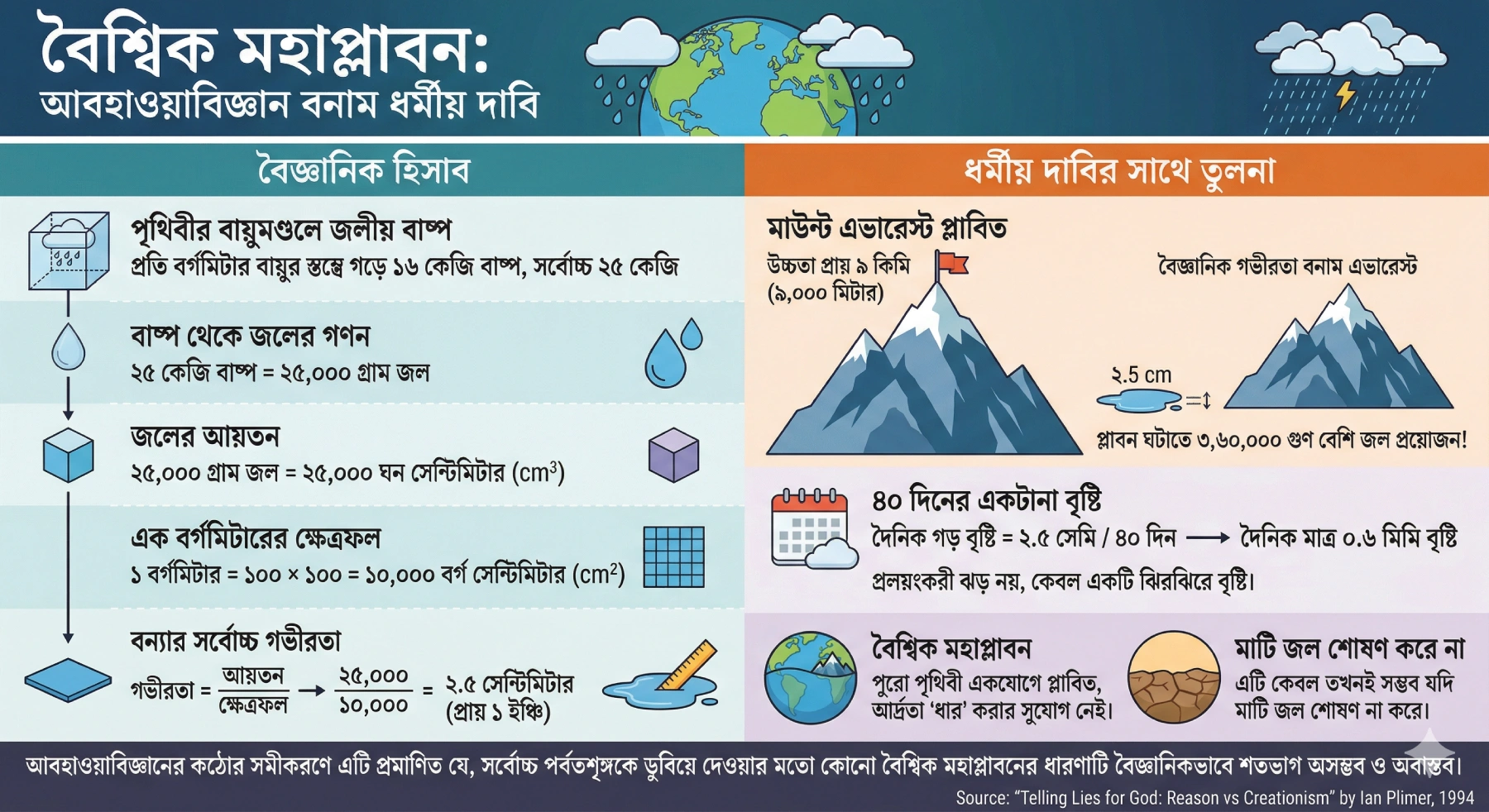
According to the religious narrative, the waters of the Great Flood submerged even the highest peaks, such as Mount Everest, which rises almost nine kilometres above sea level. Yet if all the water vapour present in Earth’s atmosphere at a given moment condensed, it would represent only about 2.5 centimetres of global-equivalent water. Of course, the same water can evaporate and condense repeatedly within the hydrological cycle, so forty days of total rainfall cannot simply be capped at 2.5 centimetres. But recycling does not create new water. It does nothing to solve the basic physical problem of the enormous additional mass of water required to form a global layer kilometres deep, nor the problem of where that water went after the flood. The quantity required to cover the highest mountains is enormously greater than the known atmospheric water inventory. A planet-wide flood deep enough to submerge the highest mountain ranges is therefore incompatible with known meteorology and hydrology [16].
Mathematical, Biological, and Structural Problems with Noah’s Ark
The second fundamental problem concerns the carrying capacity of the vessel and biological reality. According to the religious tradition, Noah had to place a pair of the world’s animal kinds aboard. To test the plausibility of that claim, we must first calculate the size of the vessel and its usable floor area. In the biblical description, Noah’s Ark had three decks, a length of 300 cubits, and a width of 50 cubits. Using a cubit of approximately 45 centimetres, or 0.45 metres, each deck would be metres long and metres wide. The area of each deck would therefore be square metres. With three decks, the total floor area would be about square metres—roughly 9,120 square metres when rounded.
A Three-Storey Vessel Measuring 300 × 50 × 30 Cubits: Not Only in the Bible, but in Islamic Tafsir as Well
Classical Islamic tafsir itself makes it difficult to dismiss the dimensions of Noah’s Ark—300 cubits long, 50 cubits wide, and 30 cubits high—as merely a biblical detail. Although the Qur’an does not give specific dimensions, a number of early Muslim exegetes preserve precisely this 300 × 50 × 30-cubit model. In Imam al-Baghawi’s Ma‘alim al-Tanzil, a report attributed to Ibn Abbas says that Noah built the vessel over two years; it was 300 cubits long, 50 cubits wide, and 30 cubits high. The same report divides the vessel into three distinct levels: predators, wild animals, and smaller creatures on the lower level; domesticated animals on the middle level; and Noah, his companions, and provisions on the upper level. More significantly, after mentioning alternative reports with still larger dimensions, al-Baghawi identifies the 300-cubit account as the “well-known” or commonly transmitted one [17].
Tafsir al-Baghawi:
“كان طول السفينة ثلاثمائة ذراع وعرضها خمسون ذراعا … وجعل لها ثلاثة بطون”
That is, the vessel was 300 cubits long and 50 cubits wide, and it had three levels or compartments. In Baghawi’s fuller account, wild and predatory animals and small creatures occupied the lower level, livestock the middle level, and humans and food the upper level. After also citing a report with much larger dimensions, he presents the 300-cubit version as the familiar account.
The same dimensions also appear in a report from Qatadah preserved in al-Tabari’s Jami‘ al-Bayan. There it is stated directly that the vessel was 300 cubits long, 50 cubits wide, and 30 cubits high. This is therefore not a recent detail imported into Muslim discussion from modern Christian creationist literature; the dimensions circulated within early Islamic tafsir tradition for centuries [18].
Tafsir al-Tabari, report of Qatadah:
“طول السفينة ثلاثمائة ذراع، وعرضها خمسون ذراعا، وطولها في السماء ثلاثون ذراعا”
That is, the vessel was 300 cubits long, 50 cubits wide, and 30 cubits high. Tabari preserves another, larger alternative account in the same discussion, but the 300 × 50 × 30-cubit dimensions appear independently in his tafsir.
Ibn Abi Hatim’s tafsir provides even more detail. One report describes the vessel as a three-level wooden structure 300 cubits long and 50 cubits wide, with a total height of 30 cubits from bottom to top; each level was 10 cubits high. Thus Islamic exegetical literature preserves not only the length and width, but a specific traditional model for the internal height of the three-storey structure [19].
Tafsir Ibn Abi Hatim:
“كانت ثلاثة أبيات … طول السفينة ثلاثمائة ذراع، وعرضها خمسون ذراعا”
The report divides the vessel into three levels or compartments, with a length of 300 cubits and a width of 50 cubits. It also states that the three levels together were 30 cubits high, each level being 10 cubits in height.
An important point therefore becomes clear. Although the Qur’an itself does not specify dimensions, one widely circulated model preserved in the classical Islamic tafsir tradition is exactly the 300 × 50 × 30-cubit structure. Taking one cubit as 45 centimetres gives a vessel about 135 metres long, 22.5 metres wide, and 13.5 metres high. The total floor area of its three levels would be about 9,112 square metres. When the same Islamic reports say that predatory and wild animals, smaller creatures, domesticated animals, humans, and long-term provisions were to be housed on separate levels within this structure, the carrying-capacity problem is no longer an external criticism directed solely at the biblical story; it arises directly from the vessel’s own dimensions and cargo description as preserved in Islamic tafsir.
The alternative dimensions preserved in classical sources do not so much solve the problem as reveal the historical character of the tradition more clearly. The same tafsirs also contain reports of vessels 400 cubits, 600 cubits, 1,200 cubits, or even larger. In other words, no single revealed set of dimensions was preserved in Islamic sources; the measurements vary between reports. Yet the 300 × 50 × 30-cubit model cannot simply be discarded to evade the carrying-capacity criticism, because it is explicitly preserved in major early tafsir works such as those of al-Baghawi, al-Tabari, and Ibn Abi Hatim.
Pairs of Every Living Kind: Were Insects and Reptiles Also on the Ark?
The question of exactly which animals were taken aboard Noah’s vessel matters because modern attempts to reduce the carrying-capacity problem often narrow the phrase “a pair from every kind” to a limited number of domesticated or local animals. But widely circulated Islamic tafsir is not so restrictive. In explaining Surah Hud 11:40, IslamQA cites al-Shawkani’s Fath al-Qadir and states that Noah was instructed to take two from each kind of animal found on earth—one male and one female—so that their lineages could reproduce after the flood. Under this interpretation, the animals were not merely a handful of livestock from Noah’s immediate surroundings; the purpose was to preserve the various kinds of creatures otherwise liable to be wiped out in the flood for later reproduction [20].
IslamQA, Question 213057:
In explaining the instruction in Surah Hud 11:40 to take “two of every pair”, IslamQA quotes al-Shawkani’s Fath al-Qadir: “مما في الأرض من الحيوانات: اثنين؛ ذكرا، وأنثى”—that is, two from the kinds of animals on earth, one male and one female. IslamQA then explains that Noah did not take every individual animal, but one male and one female from each kind so that they could reproduce after the flood. The same answer treats a global flood as the apparent Qur’anic meaning and discusses the preservation of animals aboard the vessel in that context.
The point is even more explicit in a tafsir of Surah Nuh by Abd al-Hayy Yusuf published on Islamweb. It does not speak only of large animals such as cattle, goats, camels, or birds. It states directly that a male and a female were taken from every type of creature—whether livestock, birds, insects, reptiles, or some other category of living thing. According to this tafsir, insects and reptiles were therefore explicitly included among the occupants of Noah’s vessel [21].
Tafsir published on Islamweb:
Noah was to take one male and one female from every type of living creature. The statement expressly says: “من الدواب، أو من الطيور، أو من الحشرات، أو من الزواحف”—that is, livestock or terrestrial animals, birds, insects, and reptiles, among other kinds. According to the exegete, Noah placed pairs of these creatures on the vessel along with a small number of believing humans.
Once this interpretation is adopted, the capacity problem is no longer limited to a few thousand large animals; it expands explosively into a problem involving hundreds of thousands to millions of species. Modern biology has described close to a million insect species alone, and the true number is thought to be substantially higher. Add mammals, birds, reptiles, amphibians, arachnids, and other terrestrial invertebrates, and the idea of “one male and one female from every kind” becomes mathematically incompatible with a 135-metre wooden vessel. Physical space is only one problem: suitable food, water, temperature, humidity, habitat, separation of predators from prey, and months of waste removal would all have to be managed within the same structure.
An even more serious problem follows from the reason Islamic interpretation itself gives for putting the animals aboard: their lineages had to survive the flood. If only one male and one female from each kind became the founders of every subsequent population, then alongside the space problem the story requires an extreme two-individual genetic bottleneck for each species. The “pair of every living kind” description therefore does not solve the Ark’s capacity problem; it simultaneously creates spatial, logistical, biogeographical, and genetic contradictions.
A ‘Solution’ to the Insect Problem: The Obsolete Idea of Life Arising from Soil and Decay
Islamic tafsir literature contains a remarkable “solution” to the problem of how the vast number of Earth’s insects could have fit aboard Noah’s vessel. In Abu Bakr al-Jaza’iri’s tafsir of Surah al-Mu’minun published by Islamweb, the flood is first described as engulfing the entire earth and destroying humans and animals. But in explaining the instruction that Noah preserve male–female pairs of various creatures, it then denies that insects such as flies, mosquitoes, and ants needed to be preserved on the vessel at all. The reason given is that these insects would supposedly “grow from the soil”, while creatures such as flies, mosquitoes, and ants are said to “form from soil and putrefaction.” In other words, an actual biological capacity problem is avoided by invoking the ancient doctrine of spontaneous generation—the idea that living organisms arise spontaneously from non-living matter and decay [22].
Abu Bakr al-Jaza’iri’s tafsir published on Islamweb:
“أما الحشرات فستنبت من التراب فلا قيمة لها … أما الذي يتكون من التراب والتعفن كالذباب والبعوض والنمل وما إلى ذلك فلا قيمة له، إذ إنه لا يفنى”
That is, insects would supposedly arise from the soil, so there was no special need to preserve them aboard. Flies, mosquitoes, ants, and similar organisms are described as things that “form from soil and putrefaction,” and therefore supposedly would not face permanent extinction. By contrast, creatures not thought to arise in this way were to be preserved by taking one male and one female of each kind aboard.
The problem is that this idea was experimentally rejected long ago in the history of biology. The belief that maggots arise from rotting meat, flies from refuse, or microorganisms spontaneously emerge from decaying matter was known as spontaneous generation. Controlled experiments by Redi, Spallanzani, and finally Louis Pasteur showed that organisms appearing in decomposing material come from pre-existing life; decaying matter does not generate new living organisms by itself. A fundamental principle of modern cell theory is likewise that living cells arise from pre-existing living cells. Scientific reviews of the history of modern microbiology also describe Pasteur’s experiments as a decisive rejection of the traditional doctrine of spontaneous generation [23].
A Brief History of Microbiology and Immunology:
Louis Pasteur’s experiments demonstrated that fermentation, spoilage, and contamination in liquids are not caused by organisms spontaneously arising from non-living matter; microorganisms already present in the environment are responsible for these processes. These studies undermined the contemporary theory of spontaneous generation and played a foundational role in the development of modern microbiology.
Thus, this tafsir’s proposed solution does not solve the Ark’s insect-capacity problem; it evades the problem by relying on a scientifically abandoned idea. Flies lay eggs, mosquitoes have defined life cycles, and ant colonies reproduce through queens and reproductive members—none of them would spontaneously emerge from wet soil or decomposing corpses after a flood. If an entire insect lineage were exterminated in a global flood, rotting soil could not recreate that extinct lineage. Accepting this tafsir’s explanation therefore requires accepting the medieval doctrine of spontaneous generation, contrary to modern biology, in order to preserve the Noah narrative.
A further contradiction appears here. One Islamic tafsir says that pairs of every kind of living creature, including insects and reptiles, were taken aboard the Ark; another tafsir says that there was no need to take flies, mosquitoes, and ants because they would supposedly arise anew from soil and decay afterward. Both explanations cannot be true at the same time. The first intensifies the Ark’s capacity problem; the second tries to reduce that problem by directly adopting an obsolete biological doctrine. Whichever route is taken, the practical biological problem of the Noah narrative remains.
Now consider the Earth’s biodiversity. According to modern biology and zoology, more than 6,400 mammal species exist today. Even if, for the sake of argument, we assume that only 3,500 mammal species existed in that ancient period, an area of 9,120 square metres would leave only square metres for each pair of mammals. It is easy to see how unrealistic this would be for enormous animals such as elephants, rhinoceroses, giraffes, or hippopotamuses. Yet mammals were not the only animals supposedly aboard. Space would also have been required for roughly 13,000 species of birds, 3,500 reptile species, 1,400 amphibian species, 16,000 spider species, and around 360,000 insect species. Housing one pair of this immense and diverse range of species in the specified vessel is spatially and mathematically impossible.
Alongside this mathematical impossibility, the question of animal distribution, or biogeography, makes the narrative still more implausible. How did animals such as the slow-moving sloths of South America, kangaroos of Australia, or penguins of polar regions cross thousands of miles of oceans, mountains, and deserts to reach one specific point in the Middle East and board Noah’s Ark? The religious narrative provides no rational answer. Likewise, after the Flood, how did these animals rapidly return to their respective endemic continents without leaving any trace or intermediate fossils? That conflicts with established principles of modern biology. If all animals had dispersed worldwide again from a Mesopotamian mountain, we should find bones or fossils of animals such as kangaroos or koalas along their route through Asia or Europe toward Australia, yet no such record exists [24].
Beyond the shortage of space, the narrative contains deeper logistical and ecological absurdities. Islamic historical and tafsir literature itself reports that Noah and his companions remained aboard the Ark for 150 days. In Ibn Kathir’s Al-Bidaya wa’l-Nihaya, a report attributed through Ikrimah to Ibn Abbas says that Noah was accompanied by eighty men and their families and that they remained on the Ark for 150 days. The Ark was then directed toward Mecca, circled the Kaaba for forty days, and finally came to rest on Mount Judi. In the same discussion, another report attributed to Qatadah and others says that they boarded on the tenth of Rajab, travelled for 150 days, and then remained at Judi for another month [25]; [26]. How was sufficient food and fresh drinking water stored for so many animals for five continuous months? Carnivores such as lions, tigers, and wolves require large quantities of meat every day, which would mean storing thousands of additional prey animals merely as food, demanding still more space. Moreover, no plausible equation explains how a handful of people could clean the excrement of enormous numbers of animals, maintain suitable temperatures and ventilation for them, and care for this immense population every day.
Ibn Kathir, Al-Bidaya wa’l-Nihaya; the same report is also preserved in Tafsir Ibn Abi Hatim:
“كان مع نوح في السفينة ثمانون رجلا معهم أهلوهم، وأنهم كانوا في السفينة مائة وخمسين يوما”
According to this report, Noah was aboard the Ark with eighty men and their families, and they remained there for 150 days. The Ark was then directed toward Mecca, remained or travelled around the Kaaba for forty days, and later came to rest on Mount Judi. In the same discussion, Ibn Kathir also cites another report from Qatadah and others in which the voyage is again said to have lasted 150 days, followed by another month at Judi.
Added to the difficulty of food supply is the Predator-Prey Paradox. If only one pair of each animal existed aboard the Ark, then after disembarkation, if a hungry tiger or lion ate the sole surviving pair of deer or zebras, that species would immediately become extinct. Maintaining ecological balance before ecosystems and adequate food chains had been re-established would have been impossible. Parasitology and epidemiology create another extreme inconsistency. Many pathogens and parasites—such as smallpox, polio, or hookworms—survive and reproduce only in human hosts. If no humans survived the Flood except Noah’s family, then for those organisms to persist, the eight members of Noah’s family would simultaneously have had to serve as living hosts for thousands of deadly diseases and parasites. From a medical standpoint, this is not merely implausible; it would have been immediately lethal for those eight people [27].
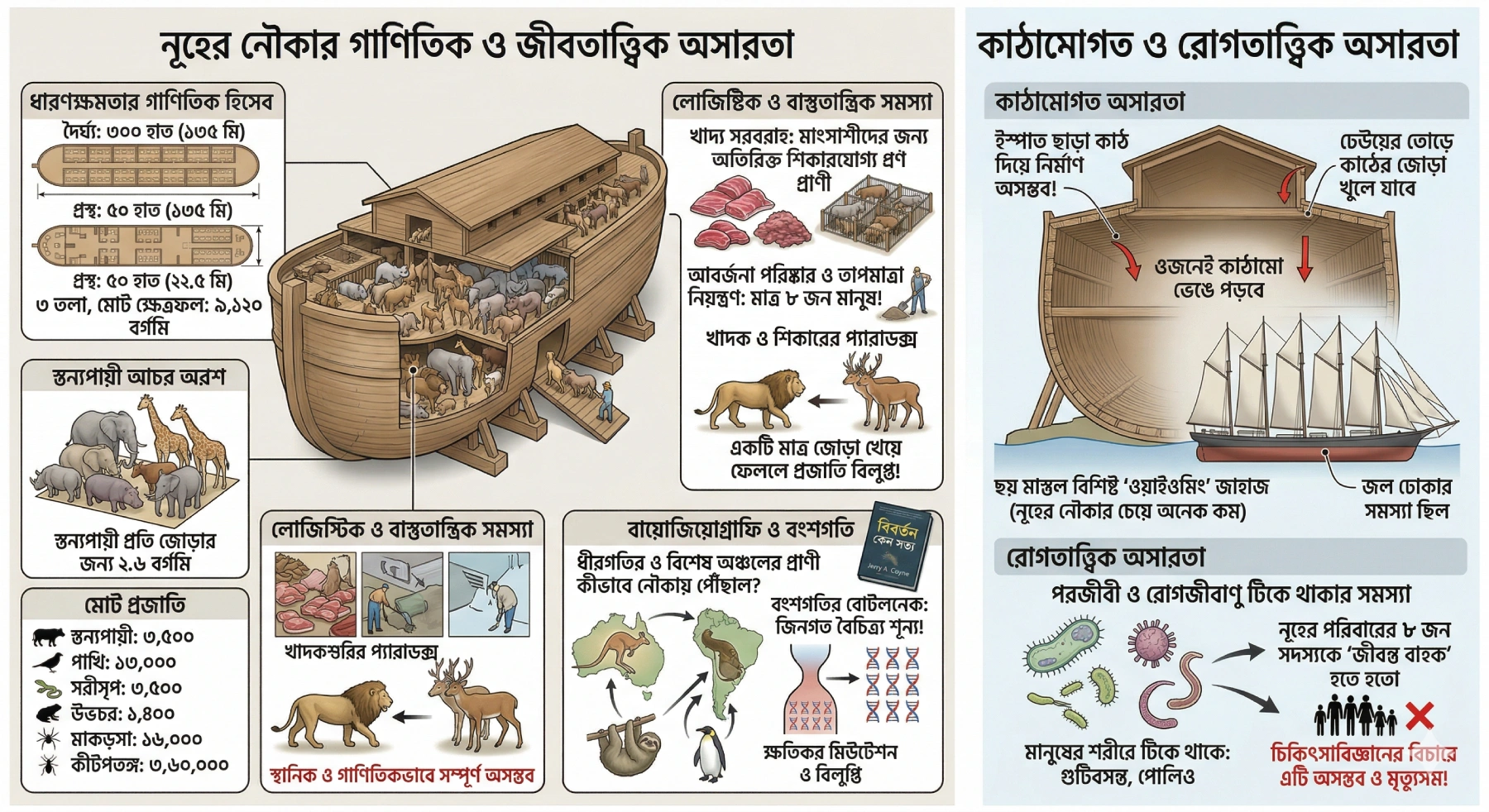
The story is also implausible from the standpoint of shipbuilding engineering. At the dimensions given in the religious tradition, the enormous floating vessel could have displaced roughly 20,000 tons of water. According to modern naval engineering, constructing a ship of that scale entirely from wood, without a rigid steel framework, is structurally unworkable. Under enormous ocean waves, such a wooden structure would flex and fail under its own weight, take on water, and sink. One of the largest wooden ships ever built was the six-masted Wyoming, whose length was close to or somewhat greater than the calculated length of Noah’s Ark; yet even with advanced modern construction techniques, its huge wooden hull flexed under wave action, water entered through the timber joints, and continuous pumping was required. The claim that such an enormous vessel was constructed in a prehistoric setting without advanced technology is unsupported.
The ‘Miracle’ Excuse: Placing a Claim That Fails Scientific Testing Beyond Testing
The religious narrative provides no physical solution to problems such as the size of Noah’s Ark, collecting millions of species from across the world, supplying their food and water, disposing of waste, keeping predators and prey alive together, preserving pathogens and parasites, or keeping a huge wooden vessel intact amid mountain-like waves. When confronted with these questions, Islamic fatwa literature offers a direct response: because the event was a ‘miracle,’ it is supposedly wrong to judge it by ordinary natural laws, empirical observation, or normal reasoning. In response to questions about how organisms from different regions of the Earth could have entered Noah’s Ark and how so many animals survived, Islamweb states that the Ark was a miraculous sign constructed through Allah’s revelation and instruction and therefore cannot be compared with an ordinary ship. More explicitly, it states: “الأمر معجزة، فلا يصح قياسه بالعقل المجرد الذي تحكمه القوانين والسنن المطردة”—that the matter is a miracle and therefore should not be measured by unaided reasoning governed by regular laws and recurring natural patterns [28].
Summary of Islamweb, Fatwa 268753:
The questioner asks how Noah brought onto the Ark animals from different regions of the Earth, including polar regions, and how they later reproduced. Islamweb replies that this past event should not be compared with the present Earth’s biodiversity, climate, and physical conditions, because it cannot be established that the Earth in Noah’s time was in the same state as it is today. Noah did not build the Ark through his own technical expertise, but through Allah’s revelation and instruction; its exact dimensions, design, and construction are also unknown. The fatwa describes the Ark as a ‘miracle’ and a ‘sign,’ and on that basis rejects comparison with the engineering limitations of ordinary ships. Questions about how the animals were gathered, how mutually incompatible species coexisted aboard the same vessel, and how they were maintained are ultimately answered by invoking faith in Allah’s unlimited power, knowledge, and wisdom.
This answer does not rescue the global Flood from scientific criticism; it removes the claim from the domain of scientific discussion altogether. If a historical event occurred in the physical world, its physical consequences should exist in the physical world. If a wooden vessel floated on water, buoyancy, structural stress, watertightness, and wave forces would act upon it. If living animals remained there for months, they would require food, oxygen, water, waste disposal, and viable disease-control conditions. If the Earth were submerged beneath kilometres of water, the source, mass, energy, heat, sediment, salinity, and geological traces of that water would have to exist. But if every testable inconsistency is answered with ‘ordinary rules do not apply here because it was a miracle,’ then no possible evidence can count against the claim.
The fundamental problem with this strategy is that it makes the claim unfalsifiable. If the Ark is too small—miracle; if feeding so many animals is impossible—miracle; if the wooden structure should fail—miracle; if the animals could not cross geographic barriers to reach the Ark—miracle; if the Flood water has no physical source—miracle; if no genetic bottleneck is found—miracle; if there is no global sedimentary layer—miracle. In other words, no observation could ever prove the claim wrong. But a claim that cannot in principle be shown false by any possible observation cannot be scientifically demonstrated true either. It is then not a testable proposition of history or natural science, but a religious belief whose truth is assumed in advance and for which supernatural exceptions are added whenever contrary evidence appears.
This creates a serious self-defeating problem. On the one hand, the global Flood is claimed as an event in the real history of the Earth—with specific people, animals, a vessel, rain, mountains, water, and geographic locations. On the other hand, when that event is tested against reality, ordinary physical and biological laws are declared inapplicable. These two positions cannot coherently be maintained together. If the event is a historical claim about the real world, it must face evidence from the real world. If every inconsistency is removed behind supernatural intervention, there is no longer any basis for claiming ‘scientific evidence’ for the Flood. ‘Miracle’ is not an explanation here; it is an unfalsifiable declaration placed where an explanation is required.
The Absence of Geological Evidence and the Lack of Conclusive Proof
According to the basic principles of geology, if the entire Earth had ever been submerged by a flood reaching the height of Mount Everest, that event should have left an unmistakable and uniform global stratigraphic signature in rock layers on every continent. Such a catastrophic flood would have caused enormous erosion and sedimentation, creating a distinct and broadly homogeneous layer of sedimentary rock or deposited material across the planet. Yet analysis of the modern geological record shows no such global sedimentary layer from within the last 5,000 years. On the contrary, the stratigraphy of formations such as the Grand Canyon and the Himalayas records slow natural processes operating over millions of years and contains no trace of a sudden worldwide inundation. If the scriptural claim were true, geological strata across the world should contain same-age deposits and the remains of marine organisms produced by one simultaneous catastrophe; no such global layer exists. Modern geology therefore provides no physical evidence for a recent worldwide Noahic Flood. The geological record directly conflicts with the literal global-flood claim [1].
Genetic Bottlenecks and the Failure of the Claim under Genetics
Population genetics, one of the central branches of modern biology, creates a direct problem for the global-Flood narrative. According to the religious claim, the enormous animal populations now living on Earth descended only a few thousand years ago from one pair—or at most a very small number—of ancestors preserved aboard the Ark. In scientific terms, this would constitute an extreme genetic bottleneck. If every species had been rebuilt from only two individuals, genetic diversity within those species would have fallen to extraordinarily low levels. Severe inbreeding would expose harmful recessive mutations, placing many species at high risk of extinction within a few generations. When scientists analyse the DNA of animals such as cheetahs or northern elephant seals, historical genetic bottlenecks leave clear signatures. Yet the genomes of the world’s countless species do not show one simultaneous global bottleneck dating to roughly 4,000–5,000 years ago. If the Noah narrative were correct, such a shared, recent genetic collapse should be pervasive. It is not. The claim that the world’s biodiversity was reconstituted from one pair of each species therefore does not survive evolutionary or genetic scrutiny [24].
Post-Flood Humanity and the Genetic Bottleneck: The Human Genome against the Islamic Narrative
The Noahic Flood narrative creates a genetic problem not only for animals. If the Islamic accounts are taken literally, all present-day humanity must also have expanded anew, only a few thousand years ago, from a tiny family-based population. Qur’an 37:77 says: “We made his descendants the sole survivors.” Islamic tafsir and fatwa literature directly connects this statement with the ancestry of present-day humanity. IslamQA, citing Ibn Kathir, states explicitly that the other believers who boarded the Ark with Noah left no enduring descendants and that all present peoples of the Earth descend from Noah’s three sons—Shem, Ham, and Japheth. Islamweb reaches the same conclusion, stating that all people now living on Earth are descendants of Noah [29]; [30].
Summary of Ibn Kathir’s position as presented by IslamQA:
Among those who boarded the Ark with Noah as believers, no enduring lineage survived except Noah’s own descendants. On the basis of the Qur’anic statement, “We made his descendants the sole survivors,” Ibn Kathir says that all peoples now living on Earth descend from Noah’s three sons—Shem, Ham, and Japheth.
Islamweb:
In support of the conclusion that “all human beings currently living on Earth are descendants of Noah,” it likewise cites Surah As-Saffat 37:77 and reports attributed to Ibn Abbas and Qatadah that no descendants survived except Noah’s.
If this claim were true, there would be no way for its signature to remain hidden in the human genome. If the entire human population had been reduced to a single small family only a few thousand years ago, it would constitute one of the most extreme and recent population bottlenecks in human history. Expansion from such a tiny founder population into billions of people should leave exceptionally reduced genetic diversity, widespread relatedness, and a conspicuous demographic collapse of the same date in autosomal DNA, mitochondrial DNA, and the Y chromosome. No such universal, several-thousand-year-old bottleneck exists in the human genome. Genome-based reconstructions of population history instead show major human bottlenecks tens of thousands of years ago; in particular, bottlenecks associated with the dispersal of humans outside Africa fall broadly in the range of roughly 10,000–60,000 years ago, not a complete reduction of humanity to one family only a few thousand years ago [31].
Summary of Li & Durbin, Nature (2011):
By analysing complete genomes from Chinese, Korean, European, and Yoruba individuals, the researchers reconstructed human population history from roughly ten thousand to one million years ago. Their results place severe bottlenecks in European and East Asian populations mainly between about 10,000 and 60,000 years ago, while African populations show a different demographic history. Divergence among modern human populations is considerably older, beginning around one hundred thousand years ago or earlier. This genomic history does not contain a universal collapse of all humanity to one family only a few thousand years ago.
More significantly, genetic history does contain a notable bottleneck roughly 3,000–7,000 years ago—but it is not evidence for Noah’s Flood. It instead makes the mismatch clearer. The contraction occurred primarily in male Y-chromosome lineages. Female mitochondrial lineages did not collapse at the same time; female effective population size continued to increase. A 2024 study in Nature Communications, using genetic data from more than three hundred present-day human populations, showed that this male-specific bottleneck can be explained through patrilineal social structures, unequal male reproductive success, and lineage-based social organization. In other words, men and women across humanity were not all reduced to a handful of survivors; rather, diversity in paternal lineages contracted [32].
Summary of the findings of Guyon et al., Nature Communications (2024):
The study found a sharp decline in male effective population size several thousand years ago. The same bottleneck did not occur in female effective population size, which continued to rise. The researchers showed that patrilineal descent groups and unequal reproductive success among paternal lineages can dramatically reduce Y-chromosome diversity without destroying the overall human population. This genetic signature therefore does not indicate a global extermination of humanity or a restart of the species from a single family.
This is where the Noah narrative directly fails genetic testing. If, according to the Islamic account, every person now living on Earth truly descended from Noah’s tiny family only a few thousand years ago, the genetic signature of that catastrophe should not be confined to Y-chromosome lineages; it should leave a deep, simultaneous imprint across the entire human genome and across all populations. In reality, African, European, East Asian, and other populations carry separate demographic histories extending not merely thousands but tens of thousands to hundreds of thousands of years into the past. Human DNA therefore contradicts the proposition that humanity was wiped out a few thousand years ago and repopulated the Earth from Noah’s family. The genealogy of the religious narrative and modern population genetics cannot both be maintained as descriptions of the same historical event.
Even If Eighty Survived, Only Noah’s Family Ultimately Remained: An Even More Extreme Human Bottleneck in Islamic Historical Literature
Islamic historical literature preserves accounts of post-Flood human origins that intensify the genetic problem further. These are not documents of the same status as the Qur’an or sahih hadith; they are historical reports preserved by Muslim historians and genealogists. In one fatwa, Islamweb cites the well-known geographer and historian Yaqut al-Hamawi’s Muʿjam al-Buldan to say that when Noah left the Ark, a total of eighty people were with him. They settled in one place. A plague then struck, and all eighty died except Noah and his children. On that basis, the report presents Noah as the father of all subsequent humanity [33].
Islamweb quoting Yaqut al-Hamawi’s Muʿjam al-Buldan:
“نوح عليه السلام لما أخرج من السفينة ومعه ثمانون إنساناً فبنوا لهم مساكن بهذا الموضع وأقاموا به فسمي الموضع بهم، ثم أصابهم وباء فمات الثمانون غير نوح عليه السلام وولده، فهو أبو البشر كلهم.”
That is, when Noah left the Ark, eighty people were with him. They built dwellings there and settled, and the place was named after those eighty. A plague then struck them; the eighty died except for Noah and his children. Noah is therefore described as the father of all later humanity.
Another Islamweb fatwa presents this broader genealogical idea even more explicitly. Citing al-Qalqashandi’s Nihayat al-Arab, it says that according to the view commonly reported among genealogists and historians, all post-Flood humanity descends from Noah’s children; the lineages of the other people who were with him on the Ark did not survive. The same discussion mentions a report that eighty men were aboard and states that they ultimately left no descendants; all later human lineages were restricted to Noah’s three sons—Shem, Ham, and Japheth [34].
Islamweb, Fatwa 408013:
Citing al-Qalqashandi, the fatwa reports a claimed consensus among genealogists and historians that the peoples existing after Noah descended from his children, not from the other people who were aboard the Ark with him. The same discussion mentions a report that eighty men besides Noah’s children were aboard, but says that all of them eventually disappeared without leaving descendants; all subsequent human lineages continued through Noah’s three sons.
If this account is accepted, the post-Flood human population bottleneck becomes even narrower. First, all people on Earth are destroyed and humanity is reduced to the small number aboard the Ark. Then the other eighty survivors either fail to leave descendants or die in a plague. Ultimately, all present-day humanity must be regenerated from only a few of Noah’s children and their closely related families. Billions of people would therefore trace their ancestry to a tiny cluster of closely related households. Such a recent and extreme founder event should have left an exceptionally deep and universal genetic signature in the human genome—the very prediction that directly conflicts with the population-genetic evidence discussed above.
This historical tradition also clarifies another point. The idea that later humanity was restricted to Noah’s small family lineage is not a reconstruction invented by modern critics; it appears explicitly in the literature of Muslim historians and genealogists. The conflict with modern genetics is therefore not merely a problem for a Biblical Adam-to-Noah genealogy or for modern creationism. A well-established genealogical claim within Islamic historical tradition fails the same test.
Ecological and Salinity Crisis: The Inevitable Destruction of Aquatic Life and Vegetation
Although the religious narrative focuses on preserving animals inside the Ark, it effectively ignores the enormous and complex ecosystems outside it that would have been devastated by a global Flood. If seawater and freshwater from rivers and lakes mixed while the entire Earth was submerged, salinity balances would collapse. Large numbers of fish and aquatic organisms would die from osmotic shock, because saltwater and freshwater organisms are adapted to very different osmotic conditions. Hydrostatic pressure would create a further catastrophe for deep-sea life. If water rose to the height of Everest, the effective water column above existing sea level would increase by almost nine kilometres. The pressure associated with such a water column would radically alter marine environments and destroy many benthic organisms and coral reefs. Sunlight also penetrates effectively only the upper part of the ocean; if the planet remained deeply flooded for an extended period, marine phytoplankton and algae would lose the light needed for photosynthesis, undermining the base of global food webs. Terrestrial seeds and seedlings submerged for prolonged periods beneath saline water and mud would likewise decay. Even after the water receded, severe soil salinity would obstruct the rapid restoration of forests and croplands [35].
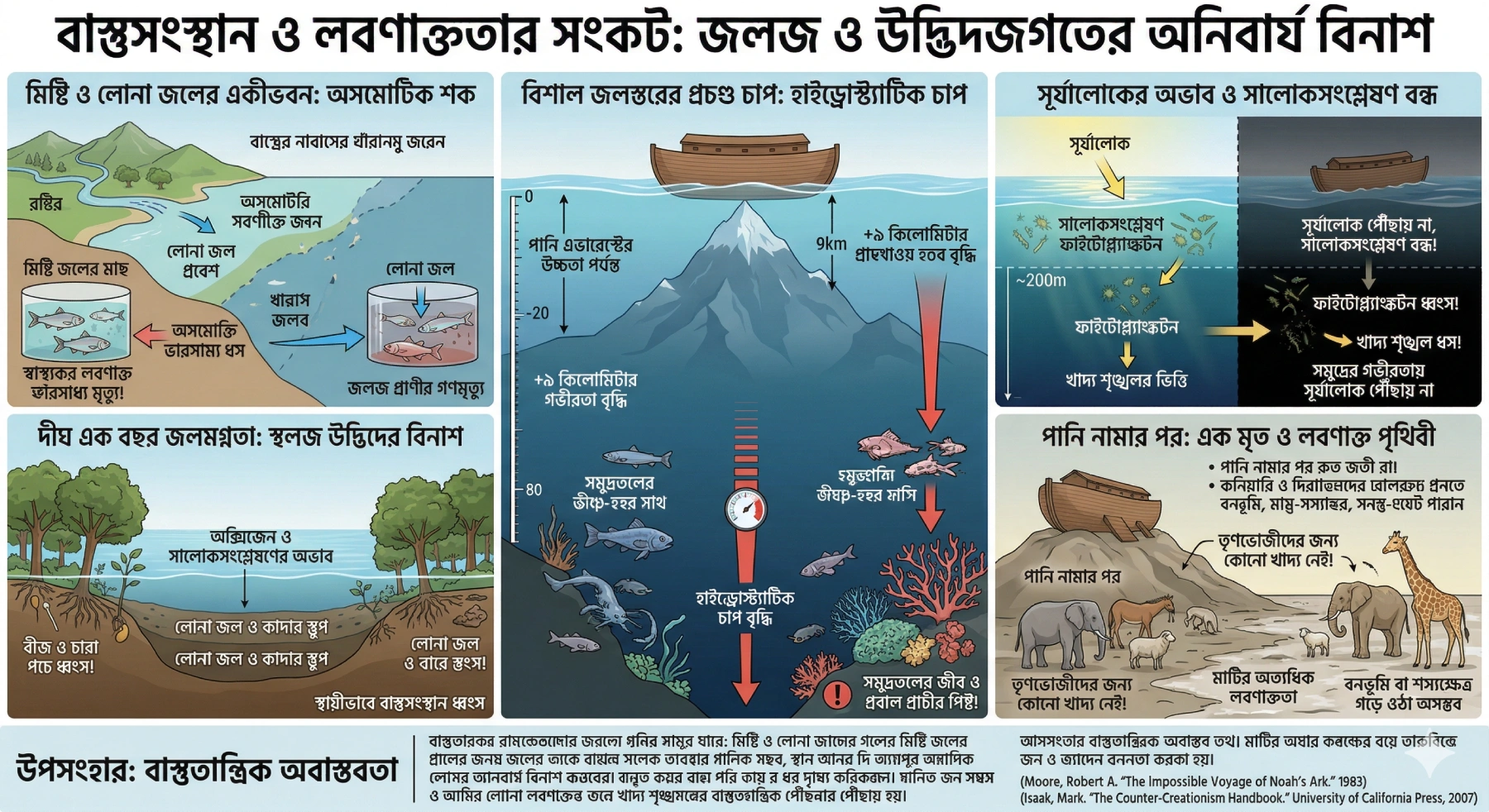
Coral reefs in particular, which are central to marine ecosystems, are highly sensitive to light deprivation and changes in salinity and would be devastated under such conditions. Nor would the damage be limited to aquatic life. If, as the scriptural narrative describes, the Earth remained submerged for a prolonged period, terrestrial plants would decay through lack of oxygen and photosynthesis. Once the waters receded, herbivores emerging from the Ark would face a landscape with little viable food. Sustaining animal populations on a dead, decomposing environment would be biologically implausible. This ecological reality is incompatible with the literal global-Flood scenario [36].
Archaeological Continuity and the Integrity of Uninterrupted History
When the global-Flood claim is examined against historical and archaeological evidence, a severe chronological inconsistency emerges. According to various theological chronologies and genealogies, the alleged Flood is commonly placed around 2300–2500 BCE. Yet contemporary records show that major civilizations of the ancient world—including Egypt’s Old Kingdom, the Indus civilization, and China’s Longshan culture—continued their historical trajectories without the universal break that a planet-wide extermination would require. Egyptian dynastic records and the history of monumental pyramid construction contain no interruption corresponding to a catastrophe that erased the entire population. If every human and terrestrial animal outside the Ark had died worldwide, archaeological excavations across ancient civilizations should reveal a simultaneous, massive hiatus or common destruction horizon. Instead, settlements, material culture, administration, and regional development continue across the relevant periods.
Eighty Languages in a Single Morning: The Miraculous Explanation of Linguistic Diversity in Islamic Historical Literature
Islamic historical and tafsir literature also preserves a miraculous solution to the question of how immense linguistic diversity could have arisen from the tiny post-Flood population. In Tafsir Ibn Abi Hatim, a report attributed through Ikrimah to Ibn Abbas says that Noah was aboard the Ark with eighty men and their families. After remaining aboard for 150 days, they descended below Mount Judi and built a settlement called ‘Thamanin’—‘Eighty.’ Then, one morning, their tongues suddenly changed: they were divided into eighty different languages, one of them Arabic. They could no longer understand one another, and Noah acted as an interpreter among them [37].
Report attributed to Ibn Abbas in Tafsir Ibn Abi Hatim:
“كان مع نوح في السفينة ثمانون رجلا، معهم أهلوهم … فهبط إلى أسفل الجودي فأتى قرية وسماها ثمانين، فأصبحوا ذات يوم وقد تبلبلت ألسنتهم على ثمانين لغة أحدها اللسان العربي، فكان بعضهم لا يفقه كلام بعض وكان نوح يعبر عنهم.”
That is, Noah was aboard the Ark with eighty men and their families. After the water receded, they established a settlement below Mount Judi. One morning their speech divided into eighty separate languages, one of them Arabic. They could not understand one another, and Noah explained their speech to them.
Ibn Kathir preserves the same report in Al-Bidaya wa’l-Nihaya: eighty people, a 150-day voyage, disembarkation at Judi, and then a sudden division of speech into eighty languages. This was therefore not a modern Internet-era interpretation; medieval Islamic historical and tafsir literature itself preserved a tradition that explained post-Flood linguistic diversity through an instantaneous miraculous multiplication of languages [38].
Ibn Kathir, Al-Bidaya wa’l-Nihaya:
“فأصبحوا ذات يوم، وقد تبلبلت ألسنتهم على ثمانين لغة؛ إحداها لغة العربي، فكان بعضهم لا يفقه كلام بعض، فكان نوح عليه السلام يعبر عنه.”
That is, one morning their speech divided into eighty separate languages, one of which was Arabic. They could no longer understand one another, so Noah explained their speech to them.
This report is neither a Qur’anic verse nor a sahih hadith; it is a historical-tafsir report attributed to Ibn Abbas. But the method of explaining linguistic diversity in this strand of Islamic literature is clear: instead of gradual historical change, dialect separation, population movement, phonological change, grammatical evolution, and intergenerational language acquisition, it assumes that eighty fully distinct languages appeared in a single morning. Modern historical linguistics establishes linguistic relationships through regular sound correspondences, cognates, morphology, grammar, and reconstructable ancestral forms, explaining related languages as the result of continuous change from earlier languages [39].
Ringe & Eska, Historical Linguistics:
In historical linguistics, one language is said to descend from an earlier language when the earlier language develops into the later one through an uninterrupted chain of native language acquisition. The results of regular sound change are preserved across descendant languages; the comparative method can analyse those regular correspondences to reconstruct ancestral forms. Linguistic descent therefore rests on observable and reconstructable historical change.
There is no historical, archaeological, or linguistic evidence that the speech of eighty people transformed overnight into eighty mutually unintelligible languages. Real languages instead preserve systematic correspondences that allow linguists to reconstruct extinct proto-languages. The development of French, Spanish, Italian, and other Romance languages from Latin; the branching of Germanic languages from Proto-Germanic; and the development of numerous Indo-European branches from Proto-Indo-European all preserve intermediate change, systematic sound shifts, and inherited vocabulary. This evidence requires no instantaneous miraculous creation of languages.
The Islamic historical report therefore does not provide a testable historical explanation of linguistic diversity. It inserts supernatural language multiplication where long-term linguistic evolution is required. If the claim is instead that Allah miraculously created eighty languages in one morning, then it ceases to be a competing scientific explanation within historical linguistics and becomes a religious assertion placed beyond empirical testing. The same structure recurs here as in the other problems of the Flood: a supernatural event with no independent historical evidence is inserted where a natural explanation is needed, and no empirical condition is specified under which the claim could be shown false.
Alongside the historical and archaeological inconsistencies, linguistic evolution also challenges the global-Flood narrative. If all present-day humans descended from Noah’s three sons only a few thousand years ago, the world’s thousands of structurally diverse languages would have to arise from an extremely recent and narrow source. Yet Sumerian, Egyptian, Chinese, and Mesoamerican linguistic traditions show independent historical trajectories around and before the period often assigned to the Flood. The continuous evolution recorded in language history conflicts with the idea that global civilization and population were completely erased and restarted only a few thousand years ago [40].
The Thermodynamic Crisis: Conservation of Energy and Impossible Heating
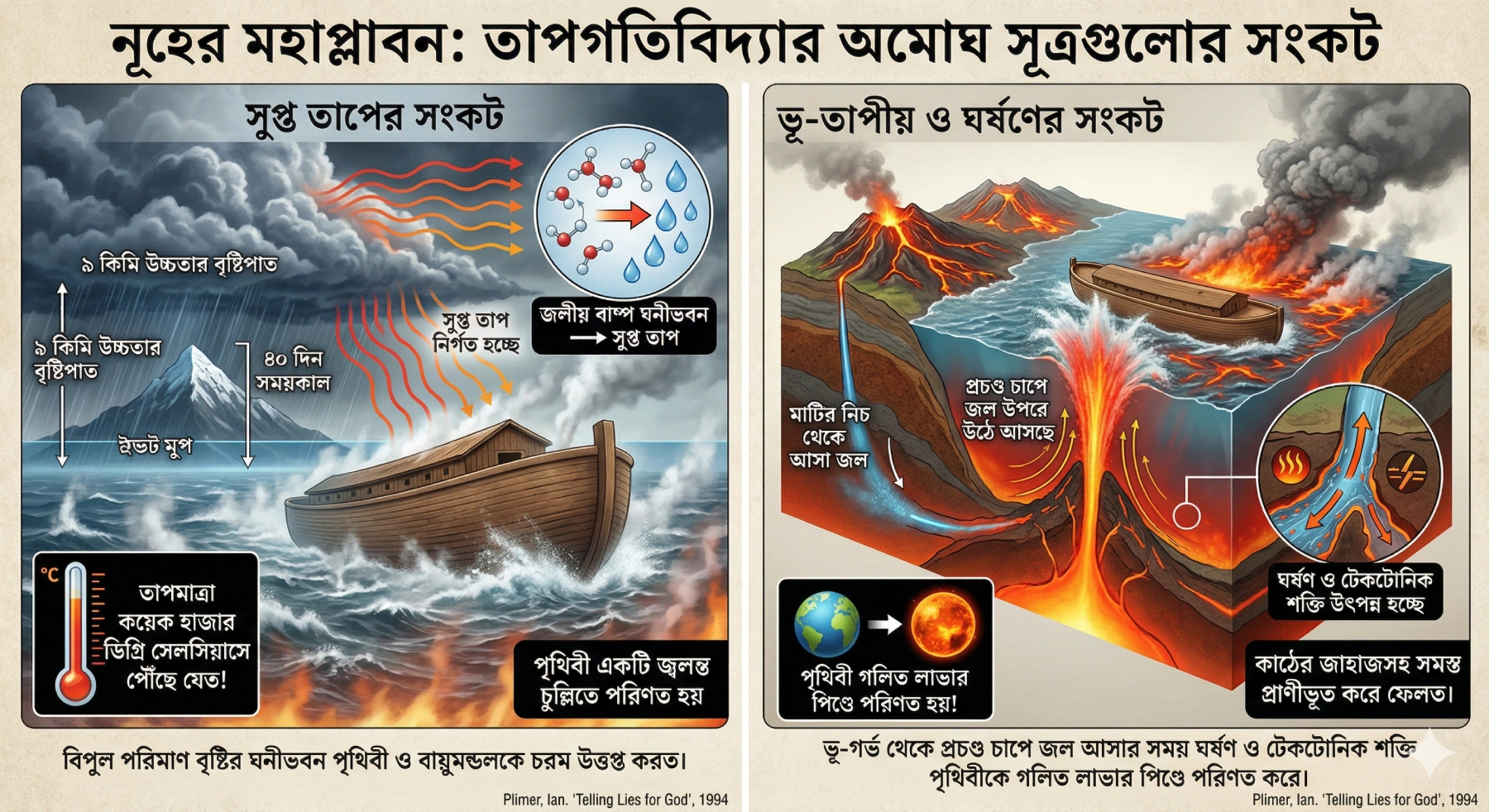
The laws of thermodynamics create another severe physical problem for the Noahic Flood narrative. If enough water to cover Mount Everest—roughly nine kilometres of additional global water depth—fell from atmospheric vapour in only forty days, the condensation of that immense mass of water would release enormous quantities of latent heat. The associated energy would catastrophically heat the atmosphere and surface. The kinetic energy of such extraordinary rainfall would add further heat. And if, following creationist alternatives, much of the water instead emerged from ‘fountains of the deep,’ raising an enormous mass of subterranean water through the crust would itself involve vast energy transfers, pressure changes, and geological disruption. A literal recent global Flood therefore faces a fundamental energy-budget problem under ordinary physical laws [16].
A Global Flood in Classical Islamic History: The Ark Travelled ‘the Whole Earth’
Interpreting Noah’s Flood as merely a regional inundation of a limited settlement directly conflicts with numerous reports in classical Islamic historical literature. The twelfth–thirteenth-century Muslim historian Ibn al-Athir, in his famous Al-Kamil fi al-Tarikh, preserves an account in which half of the Flood water came from the sky and half from the Earth. The Ark did not simply circulate within a local river basin; it is explicitly said to have travelled “the whole Earth.” When it reached the Sacred Precinct, it circled the Kaaba seven times, then continued across the Earth until it finally came to rest on Mount Judi [41].
Ibn al-Athir, Al-Kamil fi al-Tarikh:
“وطافت السفينة بالأرض كلها”
That is: “The Ark travelled around the whole Earth.” In the relevant account, Flood water came from both the sky and the Earth; the rising water carried the Ark, which travelled across the Earth. On reaching the Sacred Precinct, it circled the Kaaba seven times without entering it, then continued over the Earth until it reached and settled on Mount Judi. The same section also states that the lineages of the other passengers did not endure and that later humanity descended from Noah’s sons.
This report matters because “Earth” cannot plausibly be reduced here to a single local settlement or Mesopotamian basin. The narrator himself describes the Ark’s journey as “al-ard kullaha”—the whole Earth. The later move to restrict the Flood to a local disaster in response to scientific problems is therefore not a straightforward continuation of this classical Islamic historical imagination. Global water, a worldwide voyage, and the repopulation of humanity are all parts of the same narrative.
Still more explicit evidence appears in al-Qasimi’s Mahasin al-Ta’wil, where Ibn Khaldun is quoted as saying that Noah’s Flood “destroyed the habitation of the whole Earth” and that all later human beings became descendants of Noah. Qasimi also preserves an old geological argument in which marine fossils, shells, and marine sediments on mountain summits are presented as evidence for a global Noahic Flood [42].
Ibn Khaldun as quoted in al-Qasimi’s tafsir:
“ذهب بعمران الأرض أجمع”
That is, the Flood “destroyed the habitation of the whole Earth.” The same discussion states that the descendants of the other passengers did not survive and that all people on Earth came from Noah’s lineage, which is why Noah is described as the second father of humanity. The presence of marine sediments and fossils on mountain summits is then presented as geological evidence for the global Flood.
This supposed geological evidence collapses under modern geology. Marine fossils on mountain summits are not evidence of a worldwide flood a few thousand years ago. The rocks of many mountain ranges, including the Himalayas, include sediments deposited in ancient seas and later uplifted over millions of years through plate-tectonic collision. Marine fossils at high elevation are therefore expected consequences of ancient marine sedimentation and tectonic uplift, not proof of a recent global Flood. The observation that classical and pre-modern religious writers used as evidence for Noah’s Flood has a well-established geological explanation that requires no such event.
This reveals not only an outdated scientific inference in older tafsir, but also a history of interpretive retreat. When the geological origin of marine fossils on mountains was not understood, they were used as ‘evidence’ for a worldwide Noahic Flood. Once modern geology explained those fossils through sedimentation and tectonic uplift, the same Flood could be reinterpreted as regional. When evidence appeared to support a global Flood, it was claimed for the religious narrative; when the evidence received a natural explanation, the scope of the narrative was narrowed. This is not successful scientific prediction. It is an example of religious interpretation being adjusted after the evidential landscape changes.
From Global to Regional Flood: Interpretive Retreat under Scientific Pressure
Presenting Noah’s Flood as merely a regional event is not the ancient and widely dominant Islamic reading. Numerous exegetes and modern Islamic fatwa institutions have explicitly interpreted it as a worldwide Flood. IslamQA states directly that, according to what it calls the clear meaning of the Qur’an, everyone on Earth drowned except the humans and animals aboard Noah’s Ark. The same answer cites Ibn Kathir to say that the water covered the length and breadth of the Earth—plains, mountains, deserts, and sandy regions—and that no living person, young or old, remained. It also presents all present-day humanity as Noah’s descendants [43].
Summary of IslamQA, Question 130293:
The answer begins by stating that, according to the clear meaning of the Qur’an, everyone living on Earth drowned and no one survived except the people and animals taken aboard Noah’s Ark. It cites Surah Ash-Shu’ara 26:119–120, Hud 11:40, and Yunus 10:73. It then quotes Ibn Kathir to say that the water covered the Earth’s length and breadth, its plains and rugged terrain, mountains, deserts, and sandy regions, and that no living person, young or old, remained. The same answer further states that all people now living on Earth are descendants of Noah.
Islamweb adopted the same position even more explicitly in a 2014 fatwa. Asked whether Noah’s Flood was regional or covered the entire Earth, it answered directly that the Flood encompassed the whole Earth. Citing Ibn Kathir, it said that the water covered the Earth until even mountain summits were submerged. Citing Tafseer Al-Lubaab, it said that the Flood covered the entire Earth from north to south and east to west. The same answer states that everyone on Earth died without exception and that later humanity descended again from Noah [44].
Summary of Islamweb, Fatwa 267100:
The fatwa explicitly states that Noah’s Flood covered the whole Earth. It cites Surah Hud 11:43 and Surah Al-Qamar 54:11–12 as evidence. From Ibn Kathir it reports that the water completely covered the Earth and reached the mountain summits. From Tafseer Al-Lubaab it states that the Flood covered the entire Earth north-to-south and east-to-west. Citing Stories of the Prophets, it further says that valleys, mountains, deserts, and sandy lands were all submerged and none of the Earth’s living people remained.
Yet under scientific objections, the position presented by the same Islamweb changes significantly within a few years. In a 2018 fatwa it first acknowledges that the Qur’an and Sunnah appear to indicate a global Flood and that the overwhelming majority of Muslim scholars adopted that view. It then makes an important qualification: the verses do not categorically prove that the Flood covered the entire Earth; rather, this is their apparent and commonly understood meaning. More significantly, Islamweb writes that if science were ever to establish by conclusive evidence that the Flood was not global, there would be no problem accepting that conclusion, because conclusive rational evidence would take precedence over a non-categorical religious interpretation [45].
Summary of Islamweb, Fatwa 381285:
The fatwa first acknowledges that the Qur’anic and Sunnah evidence points toward a worldwide Flood and that the overwhelming majority of Muslim scholars adopted the global-Flood position. It then states that the relevant verses do not establish categorically that the Flood covered the entire Earth; rather, this is their apparent and customary meaning. It further says that if conclusive scientific or rational evidence established that the Flood was not global, there would be no difficulty accepting that position, because conclusive rational evidence takes precedence over an uncertain interpretation of the religious text. A statement from Ibn Taymiyyah is cited in support of this principle.
Placed side by side, these Islamic sources make the interpretive shift clear. One source says that, according to the Qur’an’s ‘clear meaning,’ all people and animals outside the Ark drowned and the water covered even the mountains of the whole Earth. Another, after scientific objections become unavoidable, declines to treat the same text as a categorical global claim and says that its global meaning is only an apparent interpretation that may be abandoned in the face of decisive scientific evidence. The scriptural language has not changed; the interpretive strategy has. When a global Flood presented no visible scientific difficulty, it was treated as the natural and principal reading. Once geology, archaeology, genetics, and biology contradicted that claim, a route was created to reduce the same narrative to a regional or indeterminate event.
This shift exposes a further problem. If the Qur’anic account had always meant only a local flood, there would be no obvious reason why exegetes for centuries spoke of the whole Earth, submerged mountain summits, and the destruction of all humans and animals outside the Ark. But if the older global reading is indeed the natural reading of the text, reinterpreting it as ‘regional’ or ‘non-categorical’ after conflict with modern science does not establish the scientific truth of the original claim; it reduces the claim’s scope to avoid falsification. A theory that repeatedly changes its content when evidence conflicts with it is not being confirmed by that evidence; it is being reconstructed to survive it.
If Noah’s People Were All Humanity, Why Was It Necessary to Destroy the Whole Earth?
Attempts to defend a global Flood produce another serious logical problem in Islamic fatwa literature. The Qur’an says that Noah was sent specifically to his qawm, his people or community. If Noah was only the prophet of his own people, why should human beings elsewhere on Earth have been drowned in the same punishment? Islamweb offers a direct solution: according to its account, there were no other humans on Earth at Noah’s time apart from his people. Quoting Shaykh Ibn Uthaymin, it says that the human population was then so small that distinct nations or peoples had not yet formed; Noah’s people were effectively the entire human race. Thus, although Noah was sent to his own people, in practice he was sent to all humans then alive [46].
Islamweb, Fatwa 224446:
The fatwa directly states that no humans lived on Earth in Noah’s time apart from his people. Quoting Shaykh Ibn Uthaymin, it says that humans were then very few and had not divided into distinct nations or peoples. Therefore, although Noah was sent to his people, that people constituted the whole human population at the time. It further says that those who rejected Noah were destroyed and the surviving people aboard the Ark became ancestors of later humanity.
But this answer solves one problem only by creating a larger one. If the human population was truly very small and Noah’s people were all humanity, why was it necessary to flood the mountains, deserts, forests, animals, aquatic ecosystems, and distant continents of the entire Earth in order to punish them? If the objective was to destroy a limited human population, exterminating countless non-human animals and entire ecosystems on every continent was not a necessary condition of that objective. The problem is sharper for an omnipotent being, who cannot be constrained by geography into flooding an entire planet merely to punish specified offenders. Indiscriminate destruction of the entire biosphere is not logically required to punish a limited group.
More significantly, Islamweb was asked this exact question. The questioner asked: if Noah’s people were the only humans on Earth, what was the purpose of flooding the entire world? Islamweb again declared that the Flood covered the whole Earth, citing Ibn Kathir and other tafsirs about water reaching mountain summits, covering the Earth north-to-south and east-to-west, and killing all humans on Earth. But on the central question—why the whole Earth needed to be submerged—it explicitly acknowledged that it had not found a scholarly explanation [44].
Islamweb, Fatwa 267100:
The fatwa first states that Noah’s Flood covered the whole Earth. When the questioner then asks why the entire Earth had to be flooded if Noah’s people were the only humans alive, Islamweb acknowledges: “we have not come across a scholar who clarified the wisdom behind it”. It then offers a possible conjecture: perhaps the Flood was made worldwide so that no one would have any place to escape.
This is not an explanation; it substitutes a conjecture for an unknown purpose. Nor does “so that no one could escape” establish the necessity of a global Flood. If an omnipotent God wished to punish specified people, preventing their escape would not require submerging every continent, every mountain, every animal population, and the entire biosphere under kilometres of water. Planet-wide ecological devastation is not required to eliminate a particular group. Accepting this rationale instead produces an extreme mismatch between the stated target of the punishment and the method used: the offenders are a limited human population, while the destruction encompasses the entire living world.
The dilemma in the global-Flood interpretation is therefore clear. On the one hand, it is said that there were no humans on Earth except Noah’s people. On the other, the entire Earth is said to have been submerged to punish them. Yet when asked why such universal destruction was necessary, no established Islamic explanation is available, and the answer falls back on speculation such as “perhaps so no one could escape.” The global interpretation therefore generates not only scientific problems but also an unresolved logical mismatch between the scope of punishment and its stated purpose even when its own Islamic premises are accepted.
The Logical and Theoretical Crisis of the ‘Local Flood’ Theory
Many modern theologians, recognizing that a global Flood is scientifically and mathematically untenable, attempt to preserve the narrative through a newer ‘Local Flood’ interpretation. According to this view, the disaster did not cover the entire Earth but only Noah’s settlement or the Mesopotamian basin. Yet this interpretation conflicts sharply with both the traditional text and ordinary reasoning. First, if the Flood affected only one region, there would be no evident need for Noah to spend years constructing an enormous Ark; he and his followers could simply have migrated with their livestock to higher ground or another region. Second, an instruction to place pairs of every animal on an Ark is irrelevant to a local flood, because the same species would survive elsewhere. Third, if the water truly covered mountain summits, water cannot remain confined indefinitely to an arbitrary local basin without appropriate physical barriers; it would spread into connected lower regions. The ‘local Flood’ interpretation therefore does not solve the tension between the literal global narrative and the scientific evidence. It narrows the claim after the original form becomes untenable [47].
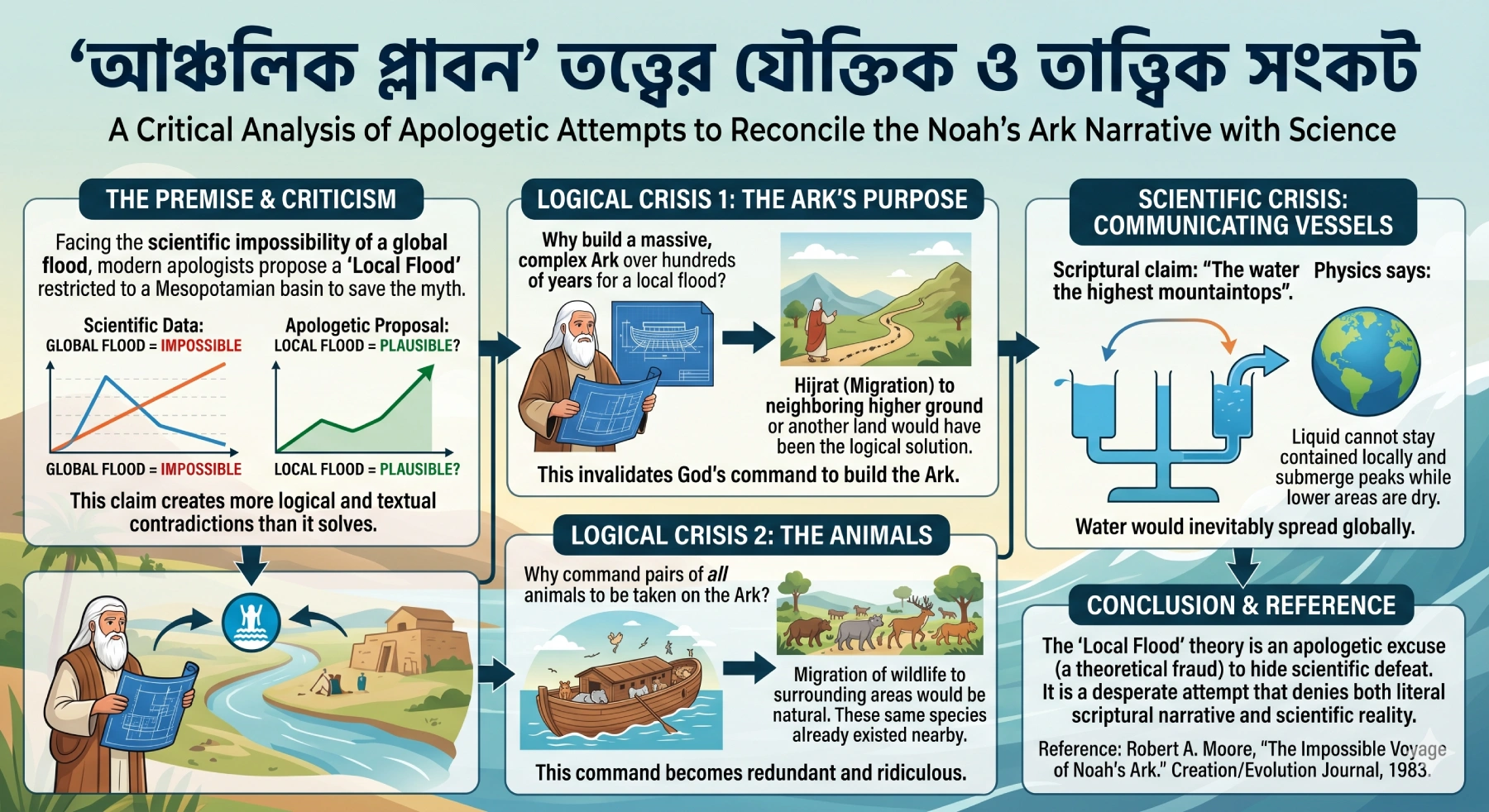
Conclusion: Myth versus Scientific Reality
Taken together, the combined evidence of history, archaeology, geology, meteorology, genetics, ecology, and biology provides no support for a prehistoric global Flood of the Noahic kind as a real event in Earth’s recent history. The absence of a physical source for enough additional water to cover the highest mountains, the mathematical impossibility of accommodating immense biodiversity aboard one wooden vessel, and the logistical impossibility of sustaining that animal population for months are only part of the problem. The expected geological, ecological, and genetic signatures of such a catastrophe are likewise absent [47].
Moreover, the striking narrative parallels with older Mesopotamian traditions—the Eridu Genesis, Atra-Hasis, and the Epic of Gilgamesh—show that the Noah story belongs to a much older flood-myth tradition. A severe but local flood in the Tigris-Euphrates or another river basin could readily become the historical memory behind later mythmaking. In societies without modern geology or meteorology, catastrophic natural events were often interpreted through divine agency, and repeated retelling could transform a regional disaster into a cosmic one [48].
Finally, from a philosophical and moral perspective, the indiscriminate drowning of women, children, the elderly, and non-human animals is difficult to reconcile with the idea of perfect justice or limitless mercy. It instead reflects the punitive and tribal moral imagination common to many ancient catastrophic myths. Whatever religious significance the story may hold for believers, its literal global form has no adequate historical or scientific foundation. Human understanding of Earth’s past is better grounded in evidence, reproducible inquiry, and reason than in the literalization of ancient myth [49].
References
- Montgomery, David R. “The Rocks Don’t Lie: A Geologist Investigates Noah’s Flood.” W. W. Norton & Company, 2012 1 2
- Frazer, James George. “Folklore in the Old Testament.” Macmillan, 1918 ↩︎
- Chen, Y. S. “The Primeval Flood Catastrophe: Origins and Early Development in Mesopotamian Traditions.” Oxford University Press, 2013 ↩︎
- Finkel, Irving. “The Ark Before Noah: Decoding the Story of the Flood.” Hodder & Stoughton, 2014 ↩︎
- Witzel, Michael. “The Origins of the World’s Mythologies.” Oxford University Press, 2012 ↩︎
- Dundes, Alan. “The Flood Myth.” University of California Press, 1988 ↩︎
- Qur’an 71:26 ↩︎
- Qur’an 37:80–82 ↩︎
- Qur’an 54:11–12 ↩︎
- Qur’an 11:40–44 ↩︎
- Surah al-Baqarah, verse 7 ↩︎
- Qur’an 18:17 ↩︎
- Qur’an 7:178 ↩︎
- USGS, 2024 ↩︎
- Census of Marine Life, 2011 ↩︎
- Plimer, Ian. “Telling Lies for God: Reason vs Creationism.” Random House, 1994 1 2
- Imam al-Baghawi, Ma‘alim al-Tanzil, tafsir of Surah Hud 11:38 ↩︎
- Imam al-Tabari, Jami‘ al-Bayan, tafsir of Surah Hud 11:38 ↩︎
- Tafsir Ibn Abi Hatim, tafsir of Surah Hud 11:37 ↩︎
- IslamQA, Question 213057 — شبهات تثار حول الطوفان الذي كان في زمن نوح عليه السلام ↩︎
- Islamweb — تفسير سورة نوح [2], الشيخ عبد الحي يوسف ↩︎
- Islamweb — تفسير سورة المؤمنون (6), الشيخ أبو بكر الجزائري ↩︎
- A Brief History of Microbiology and Immunology, PMC ↩︎
- Coyne, Jerry A. “Why Evolution is True.” Viking, 2009 1 2
- Ibn Kathir, Al-Bidaya wa’l-Nihaya — قصته مع قومه والطوفان الذي حل بمن كفر منهم ↩︎
- Tafsir Ibn Abi Hatim, Surah Hud 11:44 ↩︎
- Isaak, Mark. “The Problems with a Global Flood.” TalkOrigins, 2003 ↩︎
- Islamweb, Fatwa 268753 — سفينة نوح آية ومعجزة لا يقاس أمرها بالعقل المجرد ↩︎
- IslamQA, Fatwa 130293 — Did everyone on earth drown at the great Flood? ↩︎
- Islamweb, Fatwa 125268 — كل البشر الموجودون الآن على الأرض من ذرية نوح عليه السلام ↩︎
- Li & Durbin, “Inference of human population history from individual whole-genome sequences,” Nature 475, 2011 ↩︎
- Guyon et al., “Patrilineal segmentary systems provide a peaceful explanation for the post-Neolithic Y-chromosome bottleneck,” Nature Communications 15, 2024 ↩︎
- Islamweb, Fatwa 27985 — آباء البشر الثلاثة ↩︎
- Islamweb, Fatwa 408013 — discussion of genealogists and historians concerning post-Noah humanity ↩︎
- Moore, Robert A. “The Impossible Voyage of Noah’s Ark.” 1983 ↩︎
- Isaak, Mark. “The Counter-Creationism Handbook.” University of California Press, 2007 ↩︎
- Tafsir Ibn Abi Hatim, report under Surah Hud 11:44 ↩︎
- Ibn Kathir, Al-Bidaya wa’l-Nihaya — قصة نوح عليه السلام ↩︎
- Ringe & Eska, Historical Linguistics: Toward a Twenty-First Century Reintegration, Cambridge University Press, 2013 ↩︎
- Wilkinson, Toby. “The Rise and Fall of Ancient Egypt.” Random House, 2010 ↩︎
- Ibn al-Athir, Al-Kamil fi al-Tarikh — ذكر الأحداث التي كانت في زمن نوح عليه السلام ↩︎
- Al-Qasimi, Mahasin al-Ta’wil, tafsir of Surah Hud 11:48 ↩︎
- IslamQA, Question 130293 — Did everyone on earth drown at the great Flood at the time of Nooh? ↩︎
- Islamweb, Fatwa 267100 — Nooh’s flood encompassed the entire earth 1 2
- Islamweb, Fatwa 381285 — Did the Flood of Nooh Encompass the Entire Earth? ↩︎
- Islamweb, Fatwa 224446 — Noah’s people were the only humans on earth at that time ↩︎
- Moore, Robert A. “The Impossible Voyage of Noah’s Ark.” Creation/Evolution Journal, 1983 1 2
- Prothero, Donald R. “Evolution: What the Fossils Say and Why It Matters.” Columbia University Press, 2007 ↩︎
- Dawkins, Richard. “The Magic of Reality: How We Know What’s Really True.” Free Press, 2011 ↩︎