
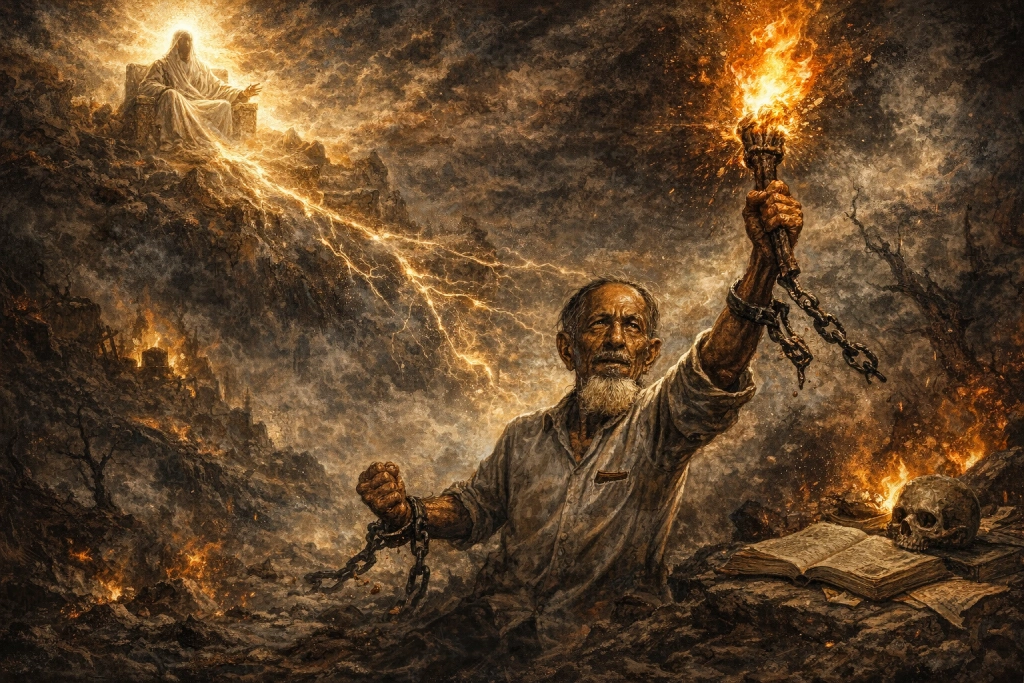
Introduction: Aroj Ali’s Emergence in Bengal’s Vernacular Philosophy
In the intellectual world of twentieth-century Bengal, Aroj Ali Matubbar (১৯০০–১৯৮৫) stands out as an exceptional figure. Without institutional higher education or formal training in any particular philosophical tradition, he independently explored fundamental questions about religion, nature, humanity, and knowledge. His thinking did not imitate an imported theory; rather, it was a distinctive philosophy of life shaped through his own observations, experiences, and relentless questioning, with the indomitable power of reason against blind belief as its central pillar. The rationalist foundation of this philosophy reminds us that truth is never the exclusive property of any class or institution. It is every person’s inherent right, allowing even a farmer rooted in village soil to seek answers to questions about the cosmos. His questions were not confined to personal curiosity; they also challenged the established authorities governing the acquisition of knowledge. His own life demonstrates that, even without an institutional degree, a person can build an independent intellectual world through sustained study, observation, and reasoning. This posed a profound challenge to the educated society of his time: a self-taught philosopher like him had shown that someone outside institutional learning could grasp the central ideas of science and philosophy and express them in the language of ordinary people.
Aroj Ali Matubbar’s emergence occupies a unique place in Bengal’s vernacular intellectual tradition because, unlike an affluent or urban intellectual, he did not simply occupy himself with abstract theory. Rising from the margins of rural life, he explained cosmological and metaphysical questions through accessible examples. The rationalist foundation of his philosophy was questioning and an uncompromising search for truth, which inspired him to strike at the roots of superstition, religious dogmatism, and unscientific beliefs prevalent in rural Bengali society. Yet this challenge sprang neither from hatred nor from a desire for revenge, but from a humane sense of responsibility born of an intense desire to know the unadorned truth. His books, such as Satyer Sandhan (In Search of Truth) and Srishti Rahasya (The Mystery of Creation), are not merely collections of questions. They represent an intellectual revolt against centuries of blind belief, showing that the pursuit of knowledge requires only an irrepressible curiosity and the courage to examine everything in the light of reason. This is why Aroj Ali’s importance in the history of Bengali freethought remains difficult to deny. Perhaps his greatest contribution was not the construction of a finished philosophical system, but the extension of the right to question established beliefs into the intellectual lives of ordinary rural people.
Early Life and the Awakening of Consciousness: A Tragic Turning Point
Aroj Ali Matubbar was born on 17 December 1900 into a poor farming family in Lamchari village, in Charbaria Union, Barishal. Poverty, the loss of his father in childhood, and family responsibilities severely limited his opportunities for formal education. The harsh realities he faced after losing his father at only four years of age gave his thinking a deeply materialist and experience-based character. Although he received a little religious instruction at the village maktab, his naturally inquisitive mind never remained confined within the boundaries of popular belief; instead, it continually questioned the mysteries of the world. The most decisive turning point in his life and philosophy, however, came with the death of his mother, Meherunnesa, in 1933. This was not simply a personal bereavement. It marked the beginning of a profound epistemological crisis, in which his lifelong faith in the established religious order was permanently shattered.
After his mother’s death, Aroj Ali had a photograph taken to preserve her memory, an ordinary human desire that became a symbol of ‘sin’ and disrespect in the conservative rural society of the time. Local religious leaders and clerics issued a fatwa declaring that unless he burned the photograph and repented, they would not lead his mother’s funeral prayer and she could not be buried according to Muslim rites. Aroj Ali refused to submit to this profoundly inhumane demand. He neither burned the photograph nor repented, and ultimately buried his mother without an imam or cleric. The incident did more than wound him: it gave rise to a philosophical realization. A religion or rule that cannot show compassion to a grieving heart, and that dishonours a dead person’s final farewell over an inanimate photograph, rests on irrationality and superstitions hostile to humanity. Here, the parallels between his thinking and that of major philosophers are clear. Like Socrates, he became a ‘gadfly’ by questioning society’s established rules; like Spinoza, he chose the path of reason rather than submitting to the decrees of religious authorities and excommunication. Just as Spinoza exposed the irrationality of religious practices in his Tractatus Theologico-Politicus, Aroj Ali came, through a personal tragedy, to see religion as a human creation, a perspective resembling Feuerbach’s critique of religion.
This tragic event transformed Aroj Ali into a genuine researcher and questioner. He resolved to examine impartially the foundations of popular religious beliefs, a vernacular version of Descartes’s ‘methodical doubt’. He began spending day after day in Barishal’s libraries, delving into science, philosophy, history, and comparative religion. Without a teacher or institutional guide, he taught himself subjects ranging from Marxism to Darwin’s theory of evolution, turning his self-education into an extraordinary philosophical journey. His personal library became a vast storehouse of knowledge, demonstrating that the driving force of learning is neither a degree nor a certificate, but an insatiable thirst for knowledge and a rational cast of mind. It was from this point that Aroj Ali evolved from ‘Matubbar’ into ‘the philosopher Aroj Ali’, whose central aim was to break the chains of blind belief and illuminate society with the light of truth. His method resonates with Voltaire’s struggle against religious blindness and with Hume’s scepticism, in which experience and reason serve as the ultimate judges. This tragic turning point was therefore more than an episode in one man’s life: it became the birthplace of a rationalist revolution in Bengal’s vernacular philosophy. It still teaches us that the search for truth requires no outside authorization; courageous questions and fearless inquiry are enough.
The Mystery of Creation and Cosmic Wonder: A Farmer’s Questions Reaching for the Sky
Aroj Ali Matubbar was not merely a man of the soil. His eyes were turned towards the sky, as though perpetually drawn to an endless inquiry into the cosmos. When he gazed at the stars late at night in the dim light of an oil lamp in a secluded Barishal village, the wonder that arose in him could not be quieted by a divine revelation, a scriptural narrative, or a priest’s explanation. This sense of wonder gave rise to his enduring work Srishti Rahasya (The Mystery of Creation) (১৯৭৮), an epistemological revolution in which he subjected conventional religious accounts of miraculous creation to the uncompromising test of science. He came to understand deeply that the universe is neither a magician’s toy nor simply an expression of God’s will. Rather, it is governed by complex, orderly, and unchanging natural laws, with no place for supernatural intervention. This understanding made his thinking not merely scientific, but philosophically materialist, and later became the cornerstone of his entire philosophy of life.
To appreciate the depth of Aroj Ali’s thinking in this area, we must consider how a self-taught farmer, without a modern telescope, a laboratory, or institutional training, could grasp the central ideas of astronomy simply by reading in libraries. His questions were simple yet incisive: “If the sky is a roof, where are its pillars?” “If the sun revolves around the earth, why do the seasons change?” Through such questions, he brought conventional religious cosmology directly under scrutiny. Aroj Ali’s approach corresponds to Copernicus’s heliocentric model: drawing on rural observations and the few books available to him, he challenged the geocentric, or earth-centred, conception, just as Copernicus had challenged established religious cosmology through mathematical reasoning. Aroj Ali’s distinctiveness, however, lay in reaching the same conclusion without mathematics or instruments, relying only on straightforward observation, reasoning, and the torn pages or old books he could obtain. This made him a philosopher of cosmic wonder comparable to Giordano Bruno, who rejected religious limitations through his conception of an infinite universe.
A peculiar sadness and solitude ran through his writing. Seeing people around him abandon reason and pursue blind imitation awakened a deep sense of isolation. Yet this loneliness did not weaken him; it drew him further into research. He believed that human beings are neither separate from the universe nor a specially privileged part of it, but the product of a long evolutionary process, a view directly connected with Darwin’s theory of evolution. Here, his thinking echoes Kant’s famous observation: “Two things always fill me with wonder: the stars in the sky and the inner nature of moral law”. Aroj Ali, too, did more than feel wonder as he looked at the sky. From that wonder, he developed a humane, scientific philosophy in which he saw human beings as part of the cosmos, without divisions of nationality, religion, or caste.
In Srishti Rahasya, he discussed subjects ranging from astronomy to geology, an extraordinary synthesis for a self-taught individual. With deep concern, he explained why it was essential to move beyond the ancient misconception that the sun revolves around the earth. This was not simply a matter of scientific truth, but a path to liberation that could open the human mind to the infinite cosmos. His perspective was more than a collection of facts: it expressed an intense human yearning for truth, much as Lucretius had challenged religious fear through the materialist cosmology of De Rerum Natura. Aroj Ali believed that the right to know the truth was not the exclusive possession of royal palaces, universities, or a scholarly class. It was the inherent right of every working person in Bengal. This democratic philosophy connects him with Enlightenment thinkers such as Voltaire and Russell, who sought to bring knowledge to ordinary people. His questions reaching for the sky were therefore more than a farmer’s private sense of wonder. They represented a scientific and humanistic revolution in Bengal’s vernacular philosophy, one that still teaches us that the search for truth requires neither instruments nor degrees, but only the courage to question and the light of reason.
Evolution and the Radiant Flame of Materialist Philosophy
One of the most important and illuminating parts of Aroj Ali Matubbar’s philosophy concerned human origins, biological evolution, and a materialist understanding of life. It elevated his thinking beyond science alone to a profoundly philosophical and humanistic level. At a time when rural Bengali society regarded Darwin’s theory of evolution as ‘unbelief’ or an anti-religious doctrine, Aroj Ali Matubbar defended it with extraordinary courage. In his work on logic and in other essays, he discussed human biological evolution and the development of the mind in detail, undertaking a groundbreaking intellectual journey. He firmly believed that human beings were not fashioned from miraculous clay or by God’s hands, but had acquired their present form through millions of years of slow, continuous change under nature’s inexorable laws. This perspective did more than directly support Darwin’s On the Origin of Species. It gave rise to a materialist metaphysics in his thought, in which nature is the sole creator and change the only constant truth.
At the heart of this materialist thinking lay a philosophical affirmation of human freedom and pre-eminence. He maintained that people are the makers of their own destiny, a statement closely resembling Marxist materialism, which regards human beings as part of nature while identifying them as the creators of history. Yet Aroj Ali’s distinctiveness lay in expressing this materialism through the harsh experience of rural poverty. His writing advances an emotionally charged philosophical challenge: if a soul exists, why does it disappear when the body is destroyed? Why is it only the flesh-and-blood person who suffers pain, anguish, and poverty, while no one ever sees the ‘soul’? These questions are not merely rationalist; they also resonate with Feuerbach’s critique of religion, which sees religion as a projection of humanity’s own qualities. They connect, too, with the ancient materialism of Epicurus and Lucretius, for Aroj Ali likewise challenged fear of the afterlife and urged acceptance of the realities of this life. His own harsh circumstances, and the sight of people crushed by poverty neglecting this life in the hope of another, caused him deep anguish. He therefore wanted people to learn to love this flesh-and-blood world and to make service to humanity the highest purpose of life.
When this fearless explorer of freethought wrote works such as Smaranika, he knew perfectly well that the society around him would not readily accept him. Nevertheless, he continued writing with a sage-like calm and determination. For him, science was neither a matter confined to laboratories nor a luxury of the elite. It was an entire outlook on life, resonating with Hume’s empiricism and Darwin’s scientific method. He demonstrated that an ordinary farmer who remains steadfast on the path of reason is no less worthy than a founder of logic such as Aristotle or a rebel against religious fanaticism such as Voltaire. Every word he wrote was a burning torch against the darkness of ignorance and blind belief, continuing to guide those who practise freethought in Bengal. This materialist philosophy is therefore more than a theory: it is an understanding of life that frees people from religious imaginings of an afterlife and returns them to service to humanity in this world and to the light of reason. Aroj Ali’s radiant flame endures in Bengal’s vernacular philosophy because he showed that the search for truth recognizes no boundaries of class or education; fearless reasoning and a humane sense of responsibility are enough.
A Solitary Struggle and Social Obstacles: The Thorny Path of Truth
When Aroj Ali Matubbar began bringing his rationalist writings and questions before the public, he faced an intensely hostile social environment. In rural society, religion was treated as the sole inviolable truth, and any inquiry could become an offence of ‘heresy’. Cases were filed against him, he was arrested, and repeated attempts were made to subject him to social boycotts, ostracism, and harassment by village power brokers. These experiences turned his life into a thorny path. With society’s united opposition on one side and an impoverished, illiterate farmer on the other, this unequal struggle was both the greatest tragedy of his life and a symbol of enduring courage. Even amid these adversities, he did not stop writing or asking questions. Different recollections offer different accounts of his attitude towards his opponents; in his published writing, however, the conflict between belief and reason receives greater attention than personal revenge.
The religious leaders of the time declared him an ‘unbeliever’ and issued fatwas against him, but Aroj Ali never departed even slightly from the path of reason. He studied in solitude and demonstrated simple scientific experiments to ordinary villagers, sowing seeds of doubt in their minds. This was a Bengali version of Socrates’s method of elenchus, exposing ignorance through questioning and dialogue. The pain of his isolation found its sharpest expression when he said, “I was not born to proclaim the truth; I was born to search for it.” His personal library and his long-standing habit of self-directed study became his principal means of overcoming this intellectual isolation. Although he read books on various philosophies, science, and social thought, he did not fashion himself into the follower of any single philosopher. Instead, he sought answers to his own questions in his own way.
His struggle was not simply against religion. It was an ongoing rebellion against intellectual inertia, mental servitude, and social and cultural shackles. He demonstrated that a body can be imprisoned, dragged before a court, or even isolated from society, but independent thought cannot be bound in chains. This insight connects directly with the philosophy of intellectual freedom expressed in Milton’s Areopagitica, as well as with the historical example of Galileo’s refusal to bow before the Inquisition. Aroj Ali’s solitude was therefore no sign of defeat; it was a profound philosophical expression of unwavering fidelity to truth. He showed that even when rational thought stands against society’s collective consensus, it remains unconquerable, however solitary it may be, because the thorny path of truth ultimately becomes history’s illuminated road. His struggle remains an enduring inspiration within Bengal’s vernacular philosophy, teaching us that however powerful social obstacles may be, no darkness can last forever in the light of independent thought.
Death and an Unusual Will: A Man of the Soil Merges with the Sky
The final chapter of Aroj Ali Matubbar’s life was the most powerful, coherent, and visible expression of his entire philosophy. He no longer merely spoke: he turned his own dead body into living testimony to his beliefs. When his life came to an end on 15 March 1985, he left behind an unprecedented philosophical example that has continued to illuminate Bengal’s vernacular philosophy. He knew in advance that after his death, disputes over funeral prayers, religious rituals, and burial might arise again, just as they had when his mother died. That bitter memory haunted him. He therefore left an explicit will directing that his body be donated after death to Sher-e-Bangla Medical College in Barishal [1]. He wanted his body to be used in medical research rather than decay in a grave. He even donated his corneas so that a blind person might see the light of the world. This decision was the ultimate and unequivocal expression of his philosophy: he made even death a part of reason and service to humanity.
This preparation for death demonstrated extraordinary philosophical courage, closely resembling the ancient materialism of Epicurus and Lucretius. Just as they rejected fear of the afterlife and held that nothing remains after death, making service to humanity in this life the only meaningful purpose, Aroj Ali likewise showed that helping people in this world is far nobler and more rational than seeking imagined rewards or fearing punishment in another. There was no pomp, no religious ceremony, no funeral prayer or customary burial. A man who had arrived quietly departed just as quietly, surrendering himself to science. This donation of his body was a final, resounding rebuke to blind belief, bringing the story of his mother’s death full circle. Where religious dogmatism had once dishonoured human grief, he now rejected that dogmatism for good, declaring through his actions that the human body belongs not to religion, but to science and humanity.
He wanted people throughout Bengal, beginning with his own village of Lamchari, to understand deeply this truth: “When a person dies, the body decays, but their deeds and ideals remain in the hearts of succeeding generations” [2]. This statement is more than an emotional saying. It summarizes his entire materialist philosophy, in which deeds and ideals, rather than imagined souls or an afterlife, attain immortality. His donation of his body is especially significant as a final decision consistent with his philosophy of life. The man who had questioned religious authority, the soul, the afterlife, and established rituals while alive wished, after death, to place even his own body at the service of practical human welfare.
Conclusion: Aroj Ali’s Legacy in Bengal’s Vernacular Philosophy
Aroj Ali Matubbar occupies a distinctive place in the history of Bengal’s freethought and rationalist thinking. He is sometimes called the ‘Socrates of Bengal’, chiefly because of his questioning approach. Yet understanding his significance does not require seeing him as a counterpart of any European or Greek philosopher. The social reality from which he emerged, and the language in which he posed his questions, are precisely what distinguish him. Every stage of his life, from a tragic turning point through cosmic wonder, evolutionary materialism, and a solitary struggle to his death, teaches us that the pursuit of truth requires neither prestigious university degrees nor institutional approval. What it requires is a courageous, impartial mind and unwavering commitment to reason.
The cosmic questions he raised in the plain language of rural Bengal remain unresolved and intensely relevant within theoretical philosophy. Despite the spread of science and technology, superstition, religious authority, and unsupported beliefs continue to exert a powerful hold on society. In this reality, Aroj Ali’s questioning method remains relevant. His thought reminds us that rationalism is not an aristocratic luxury; it is the inherent right of every working person. The Aroj Ali Matubbar Public Library that he established remains a living testament for those who thirst for knowledge, demonstrating his conviction that the democratization of knowledge is the most powerful weapon.
He wanted a society in which people would be judged by their intelligence, humanity, and actions, rather than their religion, caste, or ethnicity. At the centre of his humanistic outlook was the idea of valuing people as human beings instead of through their religious identities. We need not regard every aspect of his thinking as accurate or definitive in the light of present-day knowledge. His enduring significance lies instead in that independence of mind which refused to place any claim beyond questioning merely because it was sacred, ancient, or popular.
Perhaps Aroj Ali’s most important legacy is not a particular philosophical doctrine, but the habit of questioning. No religious or social claim can stand above scrutiny simply because it is ancient, popular, or sacred. Herein lies his lasting importance in the history of Bengali freethought.