

Introduction
In seventh-century Arabia, Muhammad preached Islam by opposing the religious beliefs, deities, and religious practices inherited from his ancestors. The historical fact that he challenged the prevailing religion stands in striking contrast to the subsequent Islamic legal treatment of criticism directed at Muhammad himself. This contradiction is examined in a separate article cited below. The central question here is the legal punishment imposed on someone accused of insulting or disparaging the prophet: what constitutes the offense, whether repentance averts execution, how non-Muslims are treated, and what legal consequences follow when someone carries out a killing without judicial authorization. [1]
In classical Islamic jurisprudence, shatim al-rasul refers to a person whose words are deemed to abuse, insult, disparage, or diminish the status of Muhammad. Jurists have discussed death as the penalty for such speech, the survival of the sentence even after repentance, the loss of protection by non-Muslim dhimmis, and the authority to enforce the punishment. Hadith literature also preserves an incident in Muhammad’s lifetime in which, after a woman was killed over an allegation that she had insulted him, Muhammad granted immunity to the killer. The truth of such allegations, the power to sentence a person to death on that basis, immunity for killing without trial, and the collision of these doctrines with modern human rights are the central issues examined here.
The hadith about the blind companion who killed his enslaved woman, together with its different narrations, is examined in detail in Brutal Killing of a Woman Accused of Insulting Muhammad and His Approval. A separate investigation, Muhammad and the Assassination of His Critics, covers the assassinations of Ka’b ibn al-Ashraf and Abu Rafi’ and other reports of covert killings. Alongside those narratives, the definition of blasphemy, the consequences of repentance, the security status of non-Muslims, and the legal authority to administer punishments are crucial to understanding the jurisprudential framework of the death penalty for insulting Muhammad.
Judicial Sovereignty Versus Religious Sentiment
The rule of law is a foundation of modern political theory: offenses and legal procedures are governed by generally applicable law rather than religious passions or personal anger. In John Locke’s theory of the social contract, people relinquish private enforcement of their grievances to a political authority so that disputes can be judged impartially. The endorsement of extrajudicial killing in the name of shatim al-rasul, or insulting the prophet, directly challenges judicial authority. In Leviathan, Thomas Hobbes described a condition in which people act as judges and enforcers for themselves, with insecurity and violent conflict as the consequences. [7] [8]
From a rational standpoint, “insult” is a relative term. What one person regards as devotion another may regard as a legitimate subject of criticism. Immanuel Kant, an influential thinker of the Enlightenment, defended the freedom to exercise reason and argued against censorship of public intellectual inquiry. When a society treats criticism of a particular person as a capital offense, blasphemy laws become instruments for pursuing personal enmities and political vendettas. Invoking Herbert Spencer’s theory, the source text also connects increasing intolerance with the stagnation of social development. When questions are prohibited in the name of “sanctity,” intellectual subservience takes hold. [9]
Freedom of expression is protected under Article 19 of the International Covenant on Civil and Political Rights (ICCPR). It recognizes freedom of opinion and the right to seek, receive, and impart information and ideas. Article 19 allows legally prescribed restrictions where necessary to protect the rights and reputations of others, national security, public order, public health, or morals. But execution merely for disrespecting a religious figure or doctrine is incompatible with that protection. Article 20(2) separately addresses advocacy of national, racial, or religious hatred that constitutes incitement to discrimination, hostility, or violence. Criticizing a religion is not the same offense as inciting violence against people. [10]
Paragraph 48 of the United Nations Human Rights Committee’s 2011 General Comment No. 34 addresses blasphemy laws even more directly. It states that prohibitions on displays of lack of respect for a religion or belief system, including blasphemy laws, are incompatible with the ICCPR except in the specific circumstances covered by Article 20(2). Laws must not privilege one religion over another or suppress criticism of religious leaders and commentary on religious doctrines. This standard directly conflicts with the classical punishment for shatim al-rasul: much of the speech for which death is discussed in classical jurisprudence falls within protected criticism and expression under modern human rights law. [11]
including blasphemy laws, are incompatible with the Covenant, except in the specific circumstances envisaged in article 20, paragraph 2, of the Covenant.
The principle distinguishes the rights of human beings from the purported right of a religious doctrine to be revered. People who follow a religion are entitled to protection against discrimination, threats, and violence. Their religious scriptures, doctrines, founders, and historical claims are nevertheless open to scrutiny, ridicule, and criticism. A law that protects the reputation of a religion by threatening its critics with death replaces freedom of expression with compulsory reverence.
A familiar saying about freedom of expression—“I disapprove of what you say, but I will defend to the death your right to say it”—was not written by Voltaire. It was formulated in 1906 by Evelyn Beatrice Hall in The Friends of Voltaire to characterize his attitude. The political and ethical point remains: a person’s views may be considered erroneous, offensive, or insulting without justifying threats to kill that person. Laws prescribing death for criticizing or mocking religious figures do not establish the truth of a belief; they deny others the right to express dissent. [12]
The Brutal Killing of an Enslaved Woman Accused of Insulting Muhammad and His Approval
The punishment for shatim al-rasul in Islamic criminal law is illustrated by a striking account from Muhammad’s lifetime. The incident became an important precedent in later legal discussions of killing someone accused of insulting the prophet.
According to the hadith reports, a blind companion had an enslaved woman who was an umm walad—a woman who had borne her master’s child. She repeatedly spoke ill of Muhammad and insulted him. The blind man rebuked and warned her, but she did not stop. One night, when she again insulted Muhammad, he thrust a sharp blade into her abdomen and pressed down until he killed her. The narration says that a child fell between her legs and was covered in blood.
The incident was reported to Muhammad the following morning. He summoned the people and demanded, under oath, that the perpetrator identify himself. The blind man came forward trembling and confessed that he had killed the woman because she repeatedly insulted Muhammad. Muhammad neither punished the killer nor condemned the killing. Instead, he declared publicly: “Bear witness that her blood is without compensation.”
The legal significance of the hadith lies in both the confession and Muhammad’s judgment. The killer asserted that the enslaved woman had insulted Muhammad; the account does not describe a prior judicial hearing, independent examination of testimony, or an opportunity for the dead woman to defend herself. After the killing, Muhammad pronounced her blood hadar—without compensable value. A killing carried out on the accuser’s own decision thus received immunity through a subsequent declaration. The central ethical and legal problem is the taking of a life without examining the allegation in an adversarial proceeding and the absence of punishment or blood compensation for the killer. [13]
Later jurisprudence also developed rules concerning who may implement a death sentence. Fatwa 228482 on IslamQA cites al-Kasani’s Bada’i al-Sana’i, the Maliki Mawahib al-Jalil, the Shafi’i I’anat al-Talibin, and the Hanbali Al-Mughni to assign enforcement of capital punishment to the ruler or judicial authority. These establish two distinct facts: Muhammad granted immunity after the specific killing recorded in the hadith, and later juristic works placed limits on the authority of private individuals to execute punishments. Differences over enforcement procedure do not resolve the underlying ethical problem of prescribing death for insulting a prophet. [14]
সুনান আবূ দাউদ (তাহকিককৃত)
পাবলিশারঃ আল্লামা আলবানী একাডেমী
অধ্যায়ঃ ৩৩/ অপরাধ ও তার শাস্তি
পরিচ্ছদঃ ২. যে নবী (ﷺ)-কে গালি দেয় তার সম্পর্কিত বিধান
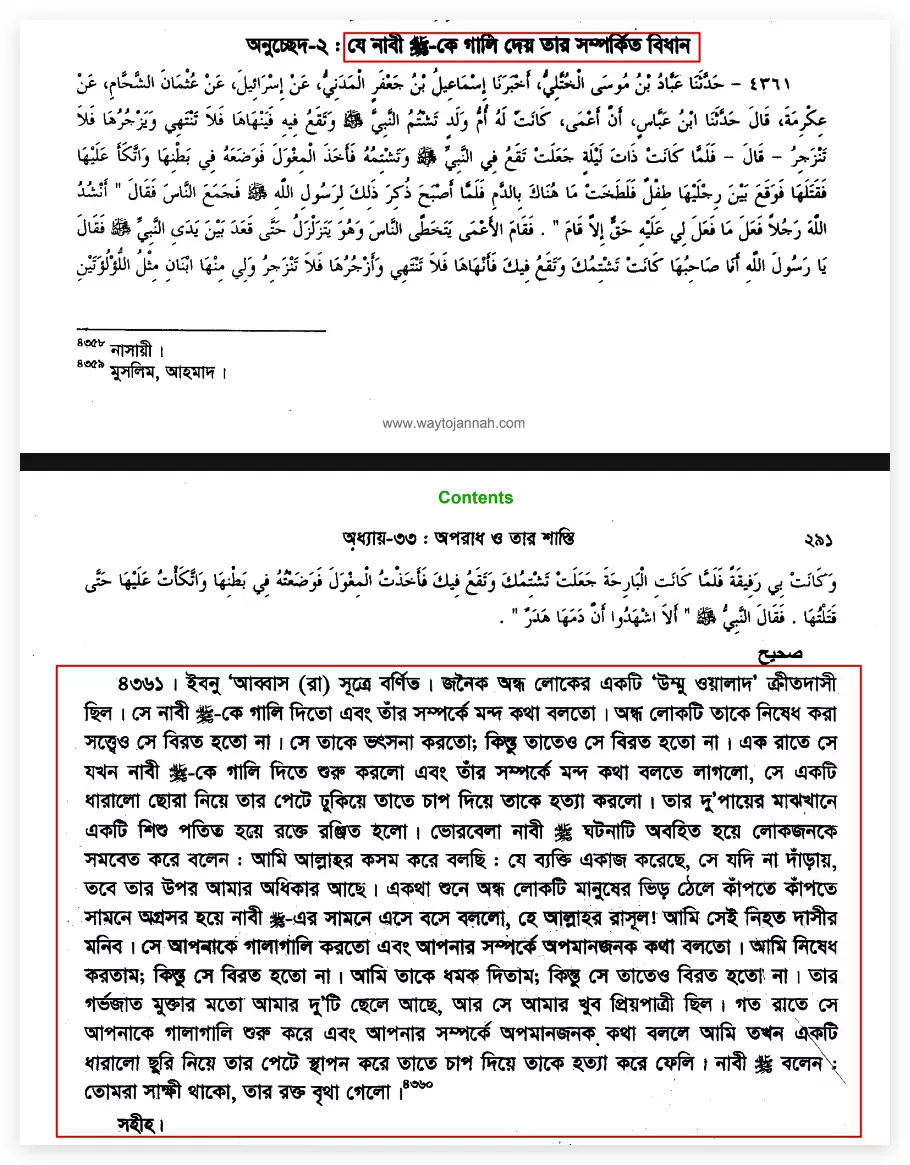
4361 ইবনু আব্বাস (রাঃ) সূত্রে বর্ণিত। জনৈক অন্ধ লোকের একটি উম্মু ওয়ালাদ’ ক্রীতদাসী ছিলো। সে নবী সাল্লাল্লাহু আলাইহি ওয়াসাল্লাম-কে গালি দিতো এবং তাঁর সম্পর্কে মন্দ কথা বলতো। অন্ধ লোকটি তাকে নিষেধ করা সত্ত্বেও সে বিরত হতো না। সে তাকে ভৎর্সনা করতো; কিন্তু তাতেও সে বিরত হতো না। এক রাতে সে যখন নবী সাল্লাল্লাহু আলাইহি ওয়াসাল্লাম-কে গালি দিতে শুরু করলো এবং তাঁর সম্পর্কে মন্দ কথা বলতে লাগলো, সে একটি একটি ধারালো ছোরা নিয়ে তার পেটে ঢুকিয়ে তাতে চাপ দিয়ে তাকে হত্যা করলো। তার দু’ পায়ের মাঝখানে একটি শিশু পতিত হয়ে রক্তে রঞ্জিত হলো। ভোরবেলা নবী সাল্লাল্লাহু আলাইহি ওয়াসাল্লাম ঘটনাটি অবহিত হয়ে লোকজনকে সমবেত করে বলেনঃ আমি আল্লাহর কসম করে বলছিঃ যে ব্যক্তি একাজ করেছে, সে যদি না দাঁড়ায় তবে তার উপর আমার অধিকার আছে।
একথা শুনে অন্ধ লোকটি মানুষের ভিড় ঠেলে কাঁপতে কাঁপতে সামনে অগ্রসর হয়ে নবী সাল্লাল্লাহু আলাইহি ওয়াসাল্লাম-এর সামনে এসে বসে বললো, হে আল্লাহর রাসূল! আমি সেই নিহত দাসীর মনিব। সে আপনাকে গালাগালি করতো এবং আপনার সম্পর্কে অপমানজনক কথা বলতো। আমি নিষেধ করতাম; কিন্তু সে বিরত হতো না। আমি তাকে ধমক দিতাম; কিন্তু সে তাতেও বিরত হতো না। তার গর্ভজাত মুক্তার মতো আমার দু’টি ছেলে আছে, আর সে আমার খুব প্রিয়পাত্রী ছিলো। গত রাতে সে আপনাকে গালাগালি শুরু করে এবং আপনার সম্পর্কে অপমানজনক কথা বললে, আমি তখন একটি ধারালো ছুরি নিয়ে তার পেটে স্থাপন করে তাতে চাপ দিয়ে তাকে হত্যা করে ফেলি। নবী সাল্লাল্লাহু আলাইহি ওয়াসাল্লাম বলেনঃ তোমরা সাক্ষী থাকো, তার রক্ত বৃথা গেলো।(1)
সহীহ।
(1). নাসায়ী।
হাদিসের মানঃ সহিহ (Sahih)
English translation:
Sunan Abi Dawud (critical edition)
Publisher: Allama Albani Academy
Book 33: Crimes and Their Punishments
Chapter 2: The Ruling Concerning Those Who Insult the Prophet (ﷺ)
4361. Narrated by Ibn Abbas: A blind man had a slave woman who was an umm walad (the mother of his children). She used to abuse the Prophet, peace and blessings be upon him, and speak disparagingly about him. The blind man forbade her, but she would not stop. He rebuked her, but she continued. One night, when she began insulting the Prophet and speaking ill of him again, he took a sharp blade, thrust it into her abdomen, pressed it in, and killed her. A child fell between her legs, stained with blood.
In the morning the Prophet was informed of the incident. He gathered the people and said: “I adjure by Allah the person who did this to stand up; I have a right over him.” Hearing this, the blind man pushed through the crowd and came forward trembling. Sitting before the Prophet, he said: “Messenger of Allah, I am the master of the murdered slave woman. She used to insult you and speak disparagingly about you. I forbade her, but she would not stop. I rebuked her, but she paid no attention. She bore me two sons as precious as pearls, and I loved her dearly. Last night, when she again began insulting you and speaking ill of you, I placed a sharp knife against her belly and pressed it until I killed her.” The Prophet said: “Bear witness that her blood is without compensation.” (1)
Classified as sahih.
(1) Also narrated by al-Nasa’i.
Hadith grading: Sahih.
সুনান আবূ দাউদ (ইসলামিক ফাউন্ডেশন)
৩৩/ শাস্তির বিধান
পরিচ্ছেদঃ ২. নবী (ﷺ) এর মর্যাদাহানিকারী ব্যক্তির শাস্তি সম্পর্কে।
4310. আব্বাদ ইব্ন মূসা (রহঃ) …. ইব্ন আব্বাস (রাঃ) থেকে বর্ণিত। তিনি বলেনঃ কোন এক অন্ধ ব্যক্তির একটি দাসী ছিল। সে নবী করীম সাল্লাল্লাহু আলাইহি ওয়াসাল্লাম-এর শানে বেয়াদবিসূচক কথাবার্তা বলতো। সে অন্ধ ব্যক্তি তাকে এরূপ করতে নিষেধ করতো, কিন্তু সে তা মানতো না। সে ব্যক্তি তাকে ধমকাতো, তবু সে তা থেকে বিরত হতো না। এমতাবস্থায় এক রাতে যখন সে দাসী নবী সাল্লাল্লাহু আলাইহি ওয়াসাল্লাম-এর শানে অমর্যাদাকর কথাবার্তা বলতে থাকে, তখন ঐ অন্ধ ব্যক্তি একটি ছোরা নিয়ে তার পেটে প্রচন্ড আঘাত করে, যার ফলে সে দাসী মারা যায়। এ সময় তার এক ছেলে তার পায়ের উপর এসে পড়ে, আর সে যেখানে বসে ছিল, সে স্থানটি রক্তাপ্লুত হয়ে যায়।
পরদিন সকালে এ ব্যাপারে যখন রাসূলুল্লাহ্ সাল্লাল্লাহু আলাইহি ওয়াসাল্লাম-এর নিকট আলোচনা হয়, তখন তিনি সকলকে একত্রিত করে বলেনঃ আমি আল্লাহ্র নামে শপথ করে এ ঘটনার সত্যতা সম্পর্কে জানতে চাই এবং ইহা তার জন্য আমার হক স্বরূপ। তাই, যে ব্যক্তি তাকে হত্যা করেছে, সে যেন দাঁড়িয়ে যায়। সে সময় অন্ধ লোকটি লোকদের সারি ভেদ করে প্রকম্পিত অবস্থায় নবী করীম সাল্লাল্লাহু আলাইহি ওয়াসাল্লাম-এর সামনে গিয়ে বসে পড়ে এবং বলেঃ ইয়া রাসূলাল্লাহ্! আমি তার হন্তা।
সে আপনার সম্পর্কে কটুক্তি ও গালি-গালাজ করতো। আমি তাকে এরূপ করতে নিষেধ করতাম ও ধমকাতাম। কিন্তু সে তার প্রতি কর্ণপাত করতো না। ঐ দাসী থেকে আমার দু’টি সন্তান আছে, যারা মনি-মুক্তা সদৃশ এবং সেও আমার প্রিয় ছিল। কিন্তু গত রাতে সে যখন পুনরায় আপনার সম্পর্কে কটুক্তি গাল-মন্দ করতে থাকে, তখন আমি আমার উপর নিয়ন্ত্রণ হারিয়ে ফেলি এবং ছোরা দিয়ে তার পেটে প্রচন্ড আঘাত করে তাকে হত্যা করি। তখন নবী করীম সাল্লাল্লাহু আলাইহি ওয়াসাল্লাম বলেনঃ তোমরা সাক্ষী থাক যে, ঐ দাসীর রক্ত ক্ষতিপূরণের অযোগ্য বা মূল্যহীন।
হাদিসের মানঃ সহিহ (Sahih)
বর্ণনাকারীঃ আবদুল্লাহ ইবনু আব্বাস (রাঃ)
English translation:
Sunan Abi Dawud (Islamic Foundation edition)
Book 33: Rules of Punishment
Chapter 2: The Punishment for Those Who Disparage the Prophet (ﷺ)
4310. Narrated through Abbad ibn Musa from Ibn Abbas: A blind man had an enslaved woman who used to say disrespectful things about the Prophet. The blind man forbade her to do so, but she paid no attention. He scolded her, yet she did not stop. One night, as she continued to utter insulting remarks about the Prophet, the blind man took a dagger and struck her violently in the abdomen, causing her death. At that time, one of her children fell upon her feet, and the place where she had been sitting became covered with blood.
The following morning, when the matter was reported to the Messenger of Allah, he assembled everyone and said: “I ask, in Allah’s name and as a right owed to me, that the person who did this stand up.” The blind man, trembling, made his way through the rows and sat before the Prophet, saying: “Messenger of Allah, I killed her.”
“She used to make abusive and insulting remarks about you. I forbade her and rebuked her, but she would not listen. I have two children by this slave woman, as precious as pearls, and she herself was dear to me. Last night, when she resumed insulting you, I lost control of myself and struck her hard in the abdomen with a dagger, killing her.” The Prophet said: “Bear witness that this slave woman’s blood is not compensable; it is without value.”
Hadith grading: Sahih.
Narrator: Abdullah ibn Abbas.
বুলুগুল মারাম
পর্ব – ৯ঃ অপরাধ প্রসঙ্গ
পরিচ্ছেদঃ ৪. সম্পদ রক্ষার্থে নিহত হওয়া ব্যক্তি প্রসঙ্গে – নাবী (ﷺ) এর নিন্দাকারীদেরকে হত্যা করা আবশ্যক
1204। ইবনু আব্বাস (রাঃ) হতে বর্ণিত;কোন এক অন্ধ সাহাবীর একটা সন্তানের মাতা দাসী ছিল, সে নবী সাল্লাল্লাহু আলাইহি ওয়াসাল্লাম কে গালি দিত এবং তাঁর প্রসঙ্গে অশোভনীয় মন্তব্য করত। সাহাবী তাকে নিষেধ করতেন কিন্তু সে বিরত হত না। এক রাত্রে অন্ধ সাহাবী (তার এরূপ দুব্যবহারে অতিষ্ঠ হয়ে) কুড়ালি জাতীয় এক অস্ত্র দিয়ে ঐ দাসীর পেটে বাসিয়ে দেন ও তার উপর বসে যান ও তাকে হত্যা করে ফেললেন। এ সংবাদ নবী সাল্লাল্লাহু আলাইহি ওয়াসাল্লাম এর নিকটে পৌছালে তিনি বলেন: তোমরা সাক্ষী থাক, এ খুন বাতিল এ জন্য কোন খেসারত দিতে হবে না।[1]
[1] আবূ দাউদ ৪৩৬১, নাসায়ী ৪০৭০।
ইকরিমাহ (রহঃ) হতে। তিনি বলেন, ‘আলী (রাঃ)-এর কাছে একদল ফিন্দীককে (নাস্তিক ও ধর্মত্যাগীকে) আনা হল। তিনি তাদেরকে আগুন দিয়ে জ্বালিয়ে দিলেন। এ ঘটনা ইবনু আব্বাস (রাঃ)-এর কাছে পৌছলে তিনি বললেন, আমি কিন্তু তাদেরকে পুড়িয়ে ফেলতাম না। কেননা, রসূলুল্লাহ সাল্লাল্লাহু আলাইহি ওয়াসাল্লাম-এর নিষেধাজ্ঞা আছে যে, তোমরা আল্লাহর শাস্তি দ্বারা শাস্তি দিও না। বরং আমি তাদেরকে হত্যা করতাম। কারণ, রসূলুল্লাহ সাল্লাল্লাহু আলাইহি ওয়াসাল্লাম-এর নির্দেশ আছে ……………. অতঃপর উপরোক্ত হাদীসটি বর্ণনা করলেন।
হাদিসের মানঃ সহিহ (Sahih)
বর্ণনাকারীঃ আবদুল্লাহ ইবনু আব্বাস (রাঃ)
English translation:
Bulugh al-Maram
Part 9: Crimes
Chapter 4: Those Killed in Defense of Property — The Killing of Those Who Insult the Prophet (ﷺ)
1204. Narrated by Ibn Abbas: A blind companion had a slave woman who had borne him children. She used to abuse the Prophet and make offensive remarks about him. The companion forbade her to do so, but she did not desist. One night, the blind companion, distressed by her conduct, struck the slave woman in the abdomen with an axe-like weapon, bore down upon her, and killed her. When the news reached the Prophet, he said: “Bear witness that this killing is without compensation; no blood money is to be paid.” [1]
[1] Abu Dawud 4361; al-Nasa’i 4070.
From Ikrimah: A group of zanadiqah (heretics or apostates) was brought before Ali, who burned them with fire. When Ibn Abbas heard about this, he said: “I would not have burned them, for the Messenger of Allah forbade us to punish with Allah’s punishment. Rather, I would have killed them, for the Messenger of Allah ordered …” The report then cites the aforementioned hadith.
Hadith grading: Sahih.
Narrator: Abdullah ibn Abbas.
সুনান আন-নাসায়ী (ইসলামিক ফাউন্ডেশন)
৩৮/ হত্যা অবৈধ হওয়া
পরিচ্ছেদঃ ১৬. রাসূলুল্লাহ (ﷺ)-কে মন্দ বলার শাস্তি
4071. উসমান ইবন আবদুল্লাহ (রহঃ) … উসমান শাহহাম (রহঃ) থেকে বর্ণিত। তিনি বলেন, আমি এক অন্ধ লোকের চালক ছিলাম। একদা তাকে নিয়ে ইকরিমার কাছে গেলাম। তিনি আমাদের কাছে বর্ণনা করলেন যে, ইবন আব্বাস (রাঃ) বলেন, রাসূলুল্লাহ্ সাল্লাল্লাহু আলাইহি ওয়াসাল্লাম এর সময় এক অন্ধ লোক ছিল। তার এক দাসী ছিল, যার গর্ভে তার দুই ছেলে জন্মে। সে দাসী সর্বদাই রাসূলুল্লাহ্ সাল্লাল্লাহু আলাইহি ওয়াসাল্লাম এর কথা উল্লেখ করে তাঁকে মন্দ বলতো। অন্ধ ব্যক্তিটি তাকে এজন্য তিরস্কার করতো, কিন্তু সে তাতে কর্ণপাত করত না। তাকে নিষেধ করত, কিন্তু তবুও বিরত হত না। অন্ধ লোকটি বলেন, একরাত্রে আমি রাসূলুল্লাহ্ সাল্লাল্লাহু আলাইহি ওয়াসাল্লাম এর কথা উল্লেখ করলে সে তার নিন্দা করতে শুরু করল। আমার তা সহ্য না হওয়ায় আমি একটি হাতিয়ার নিয়ে তার পেটে বিদ্ধ করলাম। তাতে সে মারা গেল।
ভোরে লোক তাকে মৃতাবস্থায় দেখে ব্যাপারটি রাসূলুল্লাহ্ সাল্লাল্লাহু আলাইহি ওয়াসাল্লাম এর খিদমতে জানাল। তিনি সকল লোককে একত্র করে বললেনঃ আমি আল্লাহর কসম দিয়ে ঐ ব্যক্তিকে বলছি, যে এমন কাজ করেছে সে আসুক। একথা শুনে ঐ অন্ধ ব্যক্তি ভয়ে উঠে এসে হাযির হলেন এবং বললেনঃ ইয়া রাসূলাল্লাহ! আমি এই কাজ করেছি। সে আমার বাদী ছিল, আমার অত্যন্ত স্নেহশীলা ছিল, সঙ্গিণী ছিল। তার গর্ভের আমার দুটি ছেলে রয়েছে, যারা মুক্তাসদৃশ। কিন্তু সে প্রায় আপনাকে মন্দ বলতো, গালি দিত। আমি নিষেধ করলেও সে কর্ণপাত করতো না। তিরস্কার করলেও সে নিবৃত্ত হতো না। অবশেষে গত রাতে আমি আপনার উল্লেখ করলে সে আপনাকে মন্দ বলতে আরম্ভ করল। আমি একটি অস্ত্র উঠিয়ে তার পেটে রেখে চেপে ধরি, তাতে সে মারা যায়। রাসূলুল্লাহ্ সাল্লাল্লাহু আলাইহি ওয়াসাল্লাম বললেনঃ তোমরা সাক্ষী থাক, ঐ দাসীর রক্তের কোন বিনিময় নেই।
তাহক্বীকঃ সহীহ।
হাদিসের মানঃ সহিহ (Sahih)
বর্ণনাকারীঃ উসমান শাহহাম (রহঃ)
English translation:
Sunan al-Nasa’i (Islamic Foundation edition)
Book 38: The Prohibition of Killing
Chapter 16: The Punishment for Speaking Ill of the Messenger of Allah (ﷺ)
4071. Narrated by Uthman ibn Abdullah through Uthman al-Shahham: “I was the guide of a blind man. One day I took him to Ikrimah, who narrated to us from Ibn Abbas: During the lifetime of the Messenger of Allah, there was a blind man who had a slave woman. She had borne him two sons. She used to speak ill of the Messenger of Allah. The blind man rebuked her, but she paid no attention. He forbade her, yet she would not desist. The blind man said: One night, when I mentioned the Messenger of Allah, she began reviling him. Unable to bear it, I took a weapon and stabbed her in the abdomen, killing her.
“At dawn people found her dead and reported the matter to the Messenger of Allah. He assembled the people and said: ‘I adjure by Allah the person who did this to come forward.’ Hearing this, the blind man rose trembling and came forward. He said: ‘Messenger of Allah, I did it. She was my slave woman, loving and a companion dear to me. I have two sons by her, as precious as pearls. But she often spoke ill of you and insulted you. I forbade her, but she would not listen; I rebuked her, but she did not desist. Last night, when I mentioned you, she began disparaging you again. I took a weapon, placed it against her abdomen, and pressed until she died.’ The Messenger of Allah said: ‘Bear witness that no compensation is due for the blood of this slave woman.’”
Verification: Sahih.
Hadith grading: Sahih.
Narrator: Uthman al-Shahham.
Abu Bakr’s Statement: The Exceptional Punishment for Insulting Muhammad
One of the strongest pieces of evidence for the special status of killing someone accused of insulting Muhammad is a ruling attributed to the first caliph, Abu Bakr al-Siddiq. Within Islamic law, killing someone for an insult to the prophet is presented as an exceptional prophetic prerogative, not as a normal privilege of every ruler. This report demonstrates that the punishment for insulting Muhammad was considered more severe and exceptional than punishment for insulting even the caliph. In conjunction with the hadith in which Muhammad declared a slain woman’s blood without compensation, the distinction also shows how the sanctity attached to Muhammad could confer legal immunity upon an act of killing carried out over an insult. The original discussion argues that this exceptional sanctity was placed above ordinary considerations of law and judicial process.
According to narrations in Sunan Abi Dawud and Sunan al-Nasa’i, the companion Abu Barza al-Aslami encountered a man who had angered and insulted Caliph Abu Bakr. Abu Barza offered to kill the man. Abu Bakr rebuked him and refused. Later, Abu Bakr questioned him about his offer and made clear that this privilege belonged to no human being after Muhammad. The reported rule therefore distinguishes an insult against Muhammad from an insult against the head of the Muslim polity. [15] [16]
Ahmad ibn Hanbal explained that Abu Bakr did not have the exceptional power to kill a person who insulted him: that privilege belonged to Muhammad. Ordinary offenses were subject to the prescribed categories of capital punishment, such as apostasy, adultery by a married person, and unlawful homicide, whereas the special authority attributed to Muhammad was distinct. Abu Bakr’s response thus provides direct evidence of a legal privilege attached specifically to Muhammad’s status, including the treatment of abusive critics and insults as exceptionally grave offenses. The wider juristic framework also includes rules in which the alleged blasphemer’s blood is treated as devoid of compensation, giving precedence to the religious offense over the person’s ability to defend himself or repent.
সুনান আন-নাসায়ী (ইসলামিক ফাউন্ডেশন)
৩৮/ হত্যা অবৈধ হওয়া
পরিচ্ছেদঃ ১৬. রাসূলুল্লাহ (ﷺ)-কে মন্দ বলার শাস্তি
4072. আমর ইবন আলী (রহঃ) … আবু বারযা আসালামী (রাঃ) থেকে বর্ণিত। তিনি বলেন, এক ব্যক্তি আবু বকর সিদ্দীক (রাঃ)-কে মন্দ বললে, আমি বললামঃ আমি কি তাকে হত্যা করবো? তিনি আমাকে ধমক দিয়ে বললেনঃ এই মর্যাদা রাসূলুল্লাহ্ সাল্লাল্লাহু আলাইহি ওয়াসাল্লাম ব্যতীত আর কারো নেই।
তাহক্বীকঃ সহীহ।
হাদিসের মানঃ সহিহ (Sahih)
বর্ণনাকারীঃ আবূ বারযা আল-আসলামী (রাঃ)
English translation:
Sunan al-Nasa’i (Islamic Foundation edition)
Book 38: The Prohibition of Killing
Chapter 16: The Punishment for Speaking Ill of the Messenger of Allah (ﷺ)
4072. Narrated by Amr ibn Ali from Abu Barza al-Aslami: “A man spoke abusively to Abu Bakr al-Siddiq. I said: ‘Shall I kill him?’ Abu Bakr rebuked me and said: ‘No one except the Messenger of Allah has this privilege.’”
Verification: Sahih.
Hadith grading: Sahih.
Narrator: Abu Barza al-Aslami.
সুনান আবূ দাউদ (আলবানী একাডেমী)
৩৩/ অপরাধ ও তার শাস্তি
পরিচ্ছেদঃ ২. যে নবী (ﷺ)-কে গালি দেয় তার সম্পর্কিত বিধান
4363। আবূ বারযাহ (রাঃ) সূত্রে বর্ণিত। তিনি বলেন, একদা আমি আবূ বকর (রাঃ)-এর নিকট উপস্থিত ছিলাম। তখন তিনি একটি লোকের প্রতি খুবই ক্রোধান্বিত হলেন। আমি তাকে বললাম, হে রাসূলুল্লাহ সাল্লাল্লাহু আলাইহি ওয়াসাল্লাম-এর খলীফাহ! আমাকে অনুমতি দিন, তাকে হত্যা করি। তিনি বলেন, আমার একথায় তার ক্রোধ দূর হলো। তিনি উঠে বাড়ির ভেতরে চলে গেলেন।
অতঃপর তিনি লোক পাঠিয়ে আমাকে (ডেকে নিয়ে) র্প্রশ্ন করেন, তুমি এইমাত্র কি বলেছ? আমি বললাম, আমাকে অনুমতি দিন, আমি তাকে হত্যা করি। তিনি প্রশ্ন করেন, আমি যদি তোমাকে আদেশ করতাম, তুমি কি তাই করতে? আমি বললাম, হ্যাঁ। তিনি বললেন, না আল্লাহর কসম! মুহাম্মাদ সাল্লাল্লাহু আলাইহি ওয়াসাল্লাম-এর পরে অন্য কোনো মানবের এ অধিকার নেই।
ইমাম আবূ দাঊদ (রহঃ) বলেন, এই মূল পাঠ বর্ণনাকারী ইয়াযীদের। আহমাদ ইবনু হাম্বাল (রহঃ) বলেন, অর্থাৎ নবী সাল্লাল্লাহু আলাইহি ওয়াসাল্লাম যে তিনটি অপরাধের কোনটিতে লিপ্ত ব্যক্তিকে হত্যা করার কথা বলেছেন, তাদের ছাড়া অন্য কাউকে হত্যা করা আবূ বকরের জন্য বৈধ নয়ঃ কেউ ধর্ম ত্যাগ করলে, বিবাহিত ব্যক্তি যিনা করলে এবং নিরপরাধ ব্যক্তির হত্যাকারী। তবে নবী সাল্লাল্লাহু আলাইহি ওয়াসাল্লাম-এর হত্যা করার কর্তৃত্ব ছিলো।[1]
সহীহ।
[1]. নাসায়ী, আহমাদ।
হাদিসের মানঃ সহিহ (Sahih)
বর্ণনাকারীঃ আবূ বারযা আল-আসলামী (রাঃ)
English translation:
Sunan Abi Dawud (Albani Academy edition)
Book 33: Crimes and Their Punishments
Chapter 2: The Ruling Concerning Those Who Insult the Prophet (ﷺ)
4363. Narrated by Abu Barza: “Once I was in the presence of Abu Bakr, who became very angry with a man. I said: ‘Successor to the Messenger of Allah, permit me to kill him.’ At these words his anger subsided. He stood up and went inside his house.
“He later sent for me and asked: ‘What did you just say?’ I answered: ‘Permit me to kill him.’ He asked: ‘Would you have done it if I had ordered you?’ I said: ‘Yes.’ He replied: ‘No, by Allah! No human being after Muhammad has that right.’”
Abu Dawud said: “This is the wording of the narrator Yazid.” Ahmad ibn Hanbal explained that Abu Bakr was not permitted to kill anyone except in the three categories for which the Prophet prescribed killing: a person who leaves the religion, a married person who commits adultery, and someone who kills an innocent person. The Prophet, however, possessed the authority to order a killing. [1]
Sahih.
[1] Also narrated by al-Nasa’i and Ahmad.
Hadith grading: Sahih.
Narrator: Abu Barza al-Aslami.
Classical Jurists: Execution for Insulting the Prophet
The scope of shatim al-rasul is defined in the terminology of classical jurisprudence. In the first chapter of the fourth section of Al-Shifa bi-Ta’rif Huquq al-Mustafa, Qadi Iyad treats not only direct abuse but also references to Muhammad’s attributes, lineage, religious standing, or ordinary human characteristics when they are deployed to disparage him. The discussion encompasses explicit words as well as insinuation, comparison, mockery, and attribution of faults. The issue is not merely whether a statement is factually true, but whether that statement has been used to diminish the prophet’s status. This makes it possible to treat criticism of historical conduct and personal character as a religious offense. [17]
Qadi Iyad also preserves the statement of the Maliki jurist Ibn al-Qasim. His wording separately refers to insulting, abusing, finding fault with, and disparaging Muhammad. The penalty is thus not confined to obscene curses; allegations that Muhammad had shortcomings or expressions regarded as lowering his standing are also placed within the scope of the death penalty. [18]
قال ابن القاسم في العتبية: من سبه أو شتمه أو عابه أو تنقصه فإنه يقتل، وحكمه عند الأمة القتل كالزنديق.
English translation: Ibn al-Qasim said in al-Utbiyyah: “Whoever abuses him, reviles him, finds fault with him, or disparages him shall be killed. According to the Muslim community, his ruling is execution, like the zindiq.”
This definition is directly hostile to freedom of expression. Discussing a historical fact and invoking that fact to insult someone can involve different intentions. But when an alleged reduction in a religious figure’s standing determines whether a capital offense has occurred, the ideology of the investigator, the complainant’s sensitivity, and the motive attributed to the speaker may influence the boundaries of criminality. A statement does not necessarily escape punishment simply because its factual content is demonstrable. Exposing the study of history, theology, and ethics to that risk of execution contradicts intellectual freedom.
War, Aisha’s marriage, and the Night Journey can be subjects of both devotional sermons and critical historical inquiry. Whether a particular statement has actually been prosecuted as blasphemy requires evidence about the accusation and the authorities involved. Qadi Iyad’s definition provides the jurisprudential basis for such legal risk: factual accuracy alone cannot protect an expression that is judged to disparage Muhammad.
Jihad and the Political Use of the Term “Militant”
Although the modern Bengali term jongi (“militant” or “extremist”) has a strongly negative connotation, the Islamic historical tradition uses concepts such as harb (warfare) and irhab (terror or intimidation) in accounts of military struggle. Some Bangladeshi preachers characterize Muhammad as an uncompromising warrior and celebrate his military campaigns. In that devotional framing, expressions about warfare can be treated as praise. Yet when a contemporary critic evaluates the same episodes and descriptions using the language of militancy or political violence, the statement may be condemned as insulting the prophet. The distinction is not simply the underlying historical events; it concerns the interpretation of the events and whether the speaker is seen as honoring or diminishing Muhammad.
Aisha’s Age and the Debate over Pedophilia
The reports that Aisha was six when her marriage to Muhammad was contracted and nine when it was consummated were not invented by atheists or critics; those ages are recorded in Sahih al-Bukhari and Sahih Muslim (see the cited article). In the moral terminology used by the Bengali article, adult sexual activity with a child is characterized as child sexual abuse and pedophilic behavior. Religious scholars may recount this child marriage with expressions of praise and defend it as divinely sanctioned, and the devotional audience accepts it as such. When a critic examines the same report in light of modern psychology, child protection, or the sexual attraction of an adult man toward a child—describing it as “pedophilia”—the critic may instead be accused of slandering Muhammad’s character. Thus the controversy does not necessarily turn on whether the reported ages are accurate; it can turn on whether a historical fact is allowed to undergo modern moral scrutiny rather than remain shielded by an assertion of sanctity. [19]
The Night Journey and Historical Disputes over Umm Hani’s House
Classical biographical writers disagreed about where Muhammad began the Night Journey and Ascension. A number of narrations regarded as reliable state that Muhammad was staying in the home of his cousin Umm Hani that night and began his ascent from there (see the cited article). When religious scholars recount this information, it is praised as part of a miraculous religious episode. But when an atheist or critic uses the same historical accounts to question Muhammad’s private life or social relationships, the discussion may be condemned as blasphemy. The different reactions expose the unequal treatment of devotional presentation and critical inquiry concerning the same historical report. [20]
The pattern reveals how blasphemy rules can function as intellectual censorship. Facts that are acceptable in devotional discourse may become dangerous when expressed by critics in an unfavorable interpretation. A legal framework that punishes the perceived degradation of a prophet’s sanctity does not simply assess whether a statement is true. It can constrain the examination of a religious founder’s political power, military conduct, and personal life. Where perceived sanctity takes precedence over evidence and the identity or presumed motives of the speaker determine legal risk, independent scholarship is undermined.
Ahmadullah’s Remarks on the Punishment for Insulting the Prophet
Consider this earlier video featuring the Bangladeshi Islamic preacher Ahmadullah discussing the punishment for insulting the prophet.
Matiur Rahman Madani: Killing Critics through Assassins
The following discussion concerns the historical practice of assassinating critics of Muhammad and its continuing place in some religious narratives.
Open Threats in a Mosque Sermon
This sermon illustrates openly expressed threats to kill people accused of insulting Muhammad in the context of Bangladeshi mosques.
Public Calls for Extrajudicial Killing
These videos document public calls for killing, including threats voiced at rallies and press events in Bangladesh.
Death for Calling Even a Button on Muhammad’s Clothing Dirty
A ruling attributed to Imam Malik illustrates how even an ordinary observation about the prophet’s clothing could be punishable by death if expressed with the intention of disparaging him. Qadi Iyad’s Al-Shifa, reporting through Ibn Wahb, says that if someone described Muhammad’s cloak—or, in another version, the button of his garment—as dirty with the aim of finding fault with him, the penalty would be death. The Arabic explicitly contains the condition «أراد عيبه», “intending to find fault with him or disparage him.” This shows how far the definition of religious insult was extended. [21]
وروى ابن وهب، عن مالك: من قال: إن رداء النبي، ويروى زر النبي، وسخ، أراد عيبه قتل.
English translation: Ibn Wahb narrated from Malik: “Whoever says, ‘The Prophet’s cloak is dirty’—or, according to another narration, ‘the button of the Prophet’s garment is dirty’—intending thereby to find fault with him, shall be killed.”
Under this ruling, the offense is defined not solely by the information uttered but by the judgment that the remark disparaged Muhammad. If pointing out a minor flaw in a religious figure’s clothing can be treated as an affront to his honor, critical historical discussion of his conduct or personal life can also fall within the same scope. A Bengali-language book titled The Punishment for Insulting the Beloved Prophet reproduces this ruling in translation. [22]
আলাইহি ওয়া সাল্লাম এর বিরুদ্ধে কথা বলে থাকে, তার অঙ্গীকারনামা বাতিল হয়ে যায় এবং তাকেও মৃত্যুদন্ডাদেশ দেয়া উচিত।”
কাজী ই’য়াজ রহ. ‘আশ শিফা’ নামক কিতাবে বলেন, “যে কেউ এমন কোন কথা বলল যা রাসূল সাল্লাল্লাহু আলাইহি ওয়া সাল্লাম এর নিন্দা করে বলা হয়, কোন ধরনের সতর্কতামূলক ব্যবস্থা ছাড়াই তার মৃত্যু দন্ডাদেশ দেয়া হবে।”
ইবন আতাব রহ. বলেন, “কোরআন এবং সুন্নাহ এই ব্যাপারে ইঙ্গিত দেয় যে, যে কেউ রাসূল সাল্লাল্লাহু আলাইহি ওয়া সাল্লাম এর ক্ষতি করার চেষ্টা করে অথবা তাঁর নিন্দা করে, তাকে হত্যা করা উচিত এমনকি যদি এটা একটা ক্ষুদ্র বিষয়ও হয়ে থাকে।”
ইমাম মালিক রহ. বলেন, “যদি কেউ বলে থাকে যে, রাসূল সাল্লাল্লাহু আলাইহি ওয়া সাল্লাম এর জামার বোতামটাও ময়লা, তাহলে তাকেও মৃত্যুদন্ডাদেশ দেয়া উচিত।”
এমনকি যদি এটা ক্ষুদ্রাতিক্ষুদ্র কোন কথা বলার মত হয়, তারপরও তাকে দন্ডাদেশ দেয়া উচিত।
এরপর কাজী ইয়াজ বলেন, “আমরা এছাড়া আর কোন ভিন্ন মতামত জানি না, এই ব্যাপারে সবাই একমত এবং আর কোন ভিন্ন মতামত আমাদের জানা নেই।”
English translation:
“…speaks against him, his covenant is nullified and he too should be sentenced to death.”
Qadi Iyad says in Al-Shifa: “Anyone who says words intended to disparage the Messenger of Allah shall be sentenced to death without any warning beforehand.”
Ibn Attab says: “The Qur’an and Sunnah indicate that anyone who tries to harm the Messenger of Allah or reviles him should be killed, even when the matter is minor.”
Imam Malik says: “If someone says that even the button of the Messenger of Allah’s garment is dirty, he too should be sentenced to death.”
Even if it is the most trivial possible remark, the person should still be sentenced.
Qadi Iyad then says: “We know of no different opinion concerning this; there is agreement, and we know of no dissenting opinion.”

Iyahul Muslim: The Penalty for Insulting the Prophet
The following passage appears in Abu Bakr Siraji’s Bengali commentary on Sahih Muslim, Iyahul Muslim, page 408. [23]
রাসূল (সা.)-কে গালি দেয়ার হুকুম
মুরতাদ যদি তওবা করে তাহলে তার তওবা কবুল করতে হবে এবং তাকে হত্যা করা যাবে না। তাকে
কিন্তু কোন ব্যক্তি যদি রাসূল (সা.)-কে গালি দেয়ার কারণে মুরতাদ হয়ে যায় তাহলে তার তওবা কবুল হবে না। তওবা কবুল করলেও তাকে হত্যা করতে করতে হবে।
এমনকি কোন ব্যক্তি যদি অন্য কারণে মুরতাদ হয়ে মুরতাদ অবস্থায় রাসূল (সা.)-কে গালি দেয় অতঃপর তওবা করে মুসলমান হয়ে যায় তথাপি তাকে হত্যা করতে হবে। কেননা এটা আল্লাহর একটি দণ্ড বিধান। যা মওকুফ হওয়ার নয়।
উল্লেখ্য যে, কেউ যদি আল্লাহকে গালি দিয়ে পরে তওবা করে তাহলে তার তওবা কবুল হবে। কারণ আল্লাহ্ তা’আলা সমস্ত ত্রুটি থেকে পবিত্র হওয়াটা যুক্তির নিরিখে সুপ্রমাণিত। পক্ষান্তরে রাসূল (সা.)-এর দোষমুক্ত হওয়াটা যুক্তিদ্বারা প্রমাণিত নয় বরং সরাসরি আল্লাহ্ প্রদত্ত ওহী (সংবাদের) ভিত্তিতে প্রমাণিত। সুতরাং আল্লাহর ওহী অস্বীকার করায় এর অপরাধ অনেক বেশি।
-আল ফিকহু আলা মাযাহিবিল আরবা’আ খণ্ড ৫, পৃষ্ঠা ৪২৮-৪২৯
English translation:
The Ruling on Insulting the Messenger
If an apostate repents, the repentance must be accepted and the person must not be killed. But if someone becomes an apostate by insulting the Messenger, the repentance will not be accepted. Even if repentance is accepted, the person must nevertheless be killed.
Even if a person has become an apostate for some other reason and, while in that state, insults the Messenger, then repents and becomes a Muslim again, the person must still be killed. This is a divine penal rule and cannot be waived.
It should be noted that if a person insults Allah and later repents, the repentance will be accepted. The reason given is that Allah’s freedom from defects is rationally demonstrated, whereas the Messenger’s freedom from defects cannot be established by reason alone but rests upon revelation from Allah. Denying that revelation therefore constitutes an even graver offense.
—Al-Fiqh ‘ala al-Madhahib al-Arba’ah, vol. 5, pp. 428–429.


The Death Penalty for Defaming the Prophet
The following extended set of references is reproduced from the work of Islamic scholar Mawlana Muhammad Abdul Mannan, The Punishment for Defaming the Prophet Is Death, pages 7–10 and 12–13. [24]
দলীলাদি
শেফা শরীফ: ৩২১ পৃষ্ঠায় উল্লেখ করা হয়েছে—
أَجْمَعَ الْعُلَمَاءُ أَنَّ شَاتِمَ النَّبِيِّ ﷺ الْمُنَقِصُ لَهُ كَافِرٌ وَالْوَعِيدُ جَارٍ عَلَيْهِ بِعَذَابِ اللَّهِ تَعَالَى وَمَنْ شَكَ فِي كُفْرِهِ وَعَذَابِهِ فَقَدْ كَفَرَ
অর্থাৎ ‘আলিমদের ঐকমত্য প্রতিষ্ঠিত হয়েছে এ মর্মে যে, হুযূর-ই আক্বদাস সাল্লাল্লাহু তা’আলা আলায়হি ওয়াসাল্লাম-এর শানে গোস্তাখীকারী কাফির এবং তার উপর আল্লাহর শাস্তির হুমকি কার্যকর ।
তাছাড়া, যে ব্যক্তি এমন লোকের কুফর ও শাস্তিযোগ্য হবার ক্ষেত্রে সন্দেহ করেছে সেও কাফির হয়ে গেছে।” নসীমুর রিয়াদ্ব: ৪র্থ খণ্ড: ৩৮১ পৃষ্ঠায় ইমাম ইবনে হাজর মক্কী থেকে বর্ণিত— যা এরশাদ করা হয়েছে- নবী করীম সাল্লাল্লাহু তা’আলা আলায়হি ওয়াসাল্লাম-এর শানে আক্বদাসে গোস্তাখী পদর্শনকারী কাফির, আর যে ব্যক্তি তার কাফির হওয়ায় সন্দেহ পোষণ করে সেও কাফির । এ মাযহাব আমাদের ইমামগণ প্রমুখেরই ।
ওয়াজীয-ই ইমাম কির্দারী: ৩য় খণ্ড: পৃ. ৩২১ এ উল্লেখ করা হয়েছে— যে ব্যক্তি, আল্লাহ্রই পানাহ্, মুরতাদ্দ হয়ে যায় তার স্ত্রী হারাম হয়ে যায় । তারপর ইসলাম গ্রহণ করলে তাকে পুনরায় নতুনভাবে বিবাহ করা যাবে । ইতোপূর্বে কুফরী কলেমা বলার পর কৃত সঙ্গমের ফলে যে সন্তান হবে সে হারামী (জারজ) হবে । আর এ ব্যক্তি অভ্যাসগতভাবে কলেমা-ই শাহাদত পড়তে থাকলেও কোন লাভ হবে না; যতক্ষণ না নিজের কুফর থেকে তাওবা করবে । কারণ, মুরতাদ্দ অভ্যাসগতভাবে কলেমা পড়তে থাকলে তার কুফর দূরীভূত হয় না । আর যে লোকটি রসূলুল্লাহ্ সাল্লাল্লাহু তা’আলা আলায়হি ওয়াসাল্লাম অথবা কোন নবীর শানে বেয়াদবী করে, দুনিয়ায় তাওবার পরও তাকে শাস্তি দেওয়া হবে । এমনকি যদি নেশার কারণে বেঁহুশ অবস্থায় বেয়াদবীপূর্ণ কথাবার্তা বলে থাকে, তবুও ক্ষমা করা হবে না । আর উম্মতের সমস্ত আলিমের ‘ইজমা’ (ঐকমত্য) প্রতিষ্ঠিত হয়েছে যে, নবী করীম সাল্লাল্লাহু তা’আলা আলায়হি ওয়াসাল্লাম-এর শানে আক্বদাসে বেয়াদবী প্রদর্শনকারী কাফির । আর এমন কাফির যে, যে ব্যক্তি তার কুফরে সন্দেহ করবে সেও কাফির ।
ফাল্গুল ক্বাদীর: ৪র্থ খণ্ড: পৃ. ৪০৭-এ আছে— যার অন্তরে রসূলুল্লাহ্ সাল্লাল্লাহু তা’আলা আলায়হি ওয়াসাল্লাম-এর প্রতি বিদ্বেষ থাকে সে মুরতাদ্দ । সুতরাং বেয়াদবী প্রদর্শনকারী তো অধিকতর উত্তম পন্থায় কাফির । আর যদি নেশাবস্থায় বেয়াদবীপূর্ণ শব্দাবলী বকে থাকে তবে তাকেও ক্ষমা করা যাবে না । বাহরুর রা-ইকু: ৫ম খণ্ড, পৃ. ১৩৫-এ হুবহু ওই শব্দগুলো উল্লেখ করে পৃ. ১৩৫-এ বলেছেন— কোন নবীর শানে বেয়াদবী করলে এ-ই বিধান যে, তাকে ক্ষমা করা হবে না । আর প্রমাণিত হবার পর অস্বীকার করলে তা উপকারী হবে না । কারণ, মুরতাদ্দ তার মুরতাদ্দ হবার কথা অস্বীকার করে শাস্তি থেকে বাঁচার জন্যই । তাওবা ওখানেই সাব্যস্ত হয় (স্থিরতা লাভ করে), যেখানে তাওবা গ্রহণ করা হয় । আর নবী করীম সাল্লাল্লাহু তা’আলা আলায়হি ওয়াসাল্লাম, এমনকি যে কোন নবীর শানে বেয়াদবী অন্য কুফরের মতো নয় । তাকে এখানে মোটেই ক্ষমা করা হবে না ।
আল্লামা মাওলানা খুসরু কৃত দুরুল হুক্কাম: ১ম খণ্ড: পৃ. ২৯৯-এ উল্লেখ করা হয়েছে— যদি কোন ব্যক্তি নিজেকে মুসলমান দাবী করে হুযূর-ই আক্বদাস সাল্লাল্লাহু তা’আলা আলায়হি ওয়াসাল্লাম কিংবা অন্য কোন নবীর শানে গোস্তাখী (বেয়াদবী) করে, তাকে ক্ষমা করা হবে না । আর এ দয়াপ্রাপ্ত উম্মতের সমস্ত আলিমের উপর ইজমা’ হয়েছে যে, সে কাফির । যে ব্যক্তি তার কুফরে সন্দেহ করবে সেও কাফির । গুনিয়াহ্ যুল আহকাম: পৃ. ৩০১-এ উল্লেখ করা হয়েছে— নবী করীম-এর শানে আক্বদাসে বেয়াদবী অন্যান্য কুফরের মতো নয় । প্রত্যেক প্রকারের মুরতাদ্দকে তাওবার পর ক্ষমা করার বিধান রয়েছে; কিন্তু এ মুরতাদ্দের জন্য এর অনুমতি নেই ।
‘আল-আশবাহ্ ওয়ান্নাযা-ইর’: ‘আরিদ্দাহ্’ শীর্ষক অধ্যায়ে রয়েছে— নেশার কারণে বেহুঁশ অবস্থায় যদি কারো মুখ থেকে কুফরের কোন কথা বের হয়ে যায়, তাকে, বেহুঁশ হবার কারণে, কাফির বলবে না, কুফরের শাস্তি দেবে না; কিন্তু নবী করীম সাল্লাল্লাহু তা’আলা আলায়হি ওয়াসাল্লাম-এর শানে আক্বদাসে বেয়াদবী করা এমন জঘন্য কুফর যে, নেশার কারণে বেহুঁশ হওয়ার অবস্থায়ও যদি তা সম্পন্ন হয়ে যায়, তবে তাকে ক্ষমা করা যাবে না । আর, আল্লাহরই পানাহ্, মুরতাদ্দ হওয়ার বিধান হচ্ছে- তার স্ত্রী তাৎক্ষণিকভাবে তার বিবাহ্ বন্ধন থেকে বের হয়ে যাবে । আর যদি সে ওই মুরতাদ্দ অবস্থায় মরে যায়, তবে আল্লাহরই পানাহ্, তাকে মুসলমানদের কবরস্থানে দাফন করার অনুমতি নেই, না কোন মিল্লাতধারী, যেমন- ইহুদী কিংবা খ্রিস্টানের কবরস্থানেও । তাকে তো কুকুরের মতো কোন গর্তে নিক্ষেপ করা হবে । মুরতাদ্দের কুফর আসল কাফিরের কুফর অপেক্ষাও নিকৃষ্ট । নবী করীম সাল্লাল্লাহু তা’আলা আলায়হি ওয়াসাল্লাম-এর শানে গোস্তাখী এটা এমন জঘন্য কুফর, যার শাস্তি থেকে দুনিয়ায় তাওবার পরও ক্ষমা হয়না । অন্য কোন নবীর শানে বেয়াদবীরও একই বিধান ।
ফাতাওয়া-ই খায়রিয়াহ্: কৃত আল্লামা খায়রুদ্দীন রামালী, ১ম খণ্ড: পৃ. ৯৫-এ লিখেছেন— যে ব্যক্তি নবী করীম সাল্লাল্লাহু তা’আলা আলায়হি ওয়াসাল্লাম-এর মহান শানে বেয়াদবী করে, সে মুরতাদ্দ । তার সাথেও ওই আচরণ করা হবে, যা মুরতাদ্দদের সাথে করার নির্দেশ দেওয়া হয়েছে । আর তাকে দুনিয়ায় ক্ষমা করা হবে না এবং উম্মতের সমস্ত আলিমের ইজমা’ অনুসারে, সে কাফির । আর যে ব্যক্তি তার কুফরে সন্দেহ পোষণ করবে সেও কাফির ।
‘মাজমা’উল আনহুর’ শরহে ‘মূলতাক্বাল আবহুর’: ১ম খণ্ড: পৃ. ৬১৮ তে আছে— যখন কেউ মুসলমান বলে দাবী করে হুযূর-ই আক্বদাস সাল্লাল্লাহু তা’আলা আলায়হি ওয়াসাল্লাম কিংবা অন্য কোন নবীর শানে বেয়াদবী করে, যদিও নেশাবস্থায় হয়, তাহলে তার তাওবার উপরও দুনিয়ায় তাকে ক্ষমা করা হবে না । আর যে ব্যক্তি এ বেয়াদবী প্রদর্শনকারীর কুফরে সন্দেহ করবে সেও কাফির হয়ে যাবে । ‘যখীরাতুল ওকুবা’: ২৪০ পৃষ্ঠায় আছে— এ মর্মে উম্মতের ইজমা’ হয়েছে যে, আমাদের নবী সাল্লাল্লাহু তা’আলা আলায়হি ওয়াসাল্লাম ও অন্য কোন নবী (আলায়হিস্ সালাতু ওয়াস্সালাম)-এর মানহানি কুফর- কাজে হোক কিংবা কথায় ।
‘দুরে মুখতার’-এ আছে— যে ব্যক্তি কলেমা পড়ুয়া হয়ে হুযূর-ই আক্বদাস সাল্লাল্লাহু তা’আলা আলায়হি ওয়াসাল্লামকে মন্দ বলে অথবা মিথ্যারোপ করে, অথবা কোন দোষ-ত্রুটি আরোপ করে অথবা মানহানি করে সে নিঃসন্দেহে কাফির এবং তার স্ত্রী তার বিবাহ্ বন্ধন থেকে বের হয়ে গেছে ।
কিতাবুল খারাজ: কৃত, সৈয়্যদুনা আবূ ইয়ূসুফ রাদ্বিয়াল্লাহু তা’আলা আনহু, পৃ. ১১২ ও ২৪২ এ আছে— ওই বেয়াদবী প্রদর্শনকারী যখন মরে যাবে, তবে তাকে না গোসল দেবে, না কাফন পরাবে, না তার জন্য জানাযার নামায পড়াবে । অবশ্য সে যদি তাওবা করে এবং ইসলামে প্রবেশ করে, তারপর মৃত্যুমুখে পতিত হয়; তাহলে তাকে গোসল ও কাফন দেওয়া হবে, জানাযার নামায পড়া হবে এবং মুসলমানদের কবরস্থানে দাফনও করা যাবে ।
‘তান্ডীরুল আবসার’: প্রত্যেক মুরতাদ্দের তাওবা কবুল হয়, কিন্তু কোন নবীর শানে বেয়াদবী প্রদর্শনকারী এমন (জঘন্য) কাফির যে, দুনিয়ায় শাস্তি থেকে রক্ষা করার জন্য তার তাওবা গ্রহণযোগ্য নয় ।
।। দুই ।। গাযালী-ই যমান আল্লামা সাইয়্যেদ আহমদ সা’ঈদ কাযেমী লিখেছেন— কিতাব, সুন্নাহ্, ইজমা’-ই উম্মাহ্ ও দ্বীনের ইমামগণের স্পষ্ট বর্ণনাদি অনুসারে পরম সম্মানিত নবী ও রসূলের মানহানির শাস্তি একমাত্র মৃত্যুদণ্ড । ক্বোরআন-ই করীম এ অপরাধের শাস্তি মৃত্যুদণ্ড বলেছে । রসূল করীমের শানে বেয়াদবী প্রদর্শনকারীর শাস্তি মৃত্যুদণ্ডই । আব্দুল্লাহ ইবনে খাত্বাল হুযূর-ই আক্রামের মানহানি করে বেড়াতো । ঐতিহাসিক মক্কা বিজয়ের দিন হুযূর-ই করীম এরশাদ করলেন, اقتلوه (তাকে মৃত্যুদণ্ড দাও) । তাকে কা’বা শরীফের গিলাফ থেকে বের করে এনে মাক্বাম-ই ইব্রাহীম ও যমযমের মধ্যভাগে তার মৃত্যুদণ্ড কার্যকর করা হলো ।
উপসংহার: অধিকাংশ ফক্বীহ্ ফয়সালা হলো, রাসূলে পাক সাল্লাল্লাহু তা’আলা আলায়হি ওয়াসাল্লাম-এর শানে যারা কটুক্তি করে, তাঁর অবমাননা বা মানহানি করে, তারা কাফের-মুরতাদ্দ । তাদের শাস্তি মৃত্যুদণ্ড । তারা তওবা করলেও তা গ্রহণযোগ্য হবে না । রসূলে পাকের শানে বেয়াদবী প্রদর্শনকারীর বিরুদ্ধে ‘ব্লাসফেমী’ আইন পাস করা এবং কঠোরভাবে এমন জঘন্য অপরাধের পথ চিরদিনের জন্য বন্ধ করা এখন সময়ের দাবী; মুসলিম জাতির প্রাণের দাবী ।
……
১। সূরা আনফাল: আয়াত-১৩, তাফসীর-ই মাদারিক: ২য় খণ্ড: পৃ. ১৭১, তাফসীর-ই খাফিন: ২য় খণ্ড, পৃ. ১৭১
২। সহীহ বোখারী: ১ম খণ্ড, পৃ. ২৪৩, ২য় খণ্ড: পৃ. ১০২৩, আবূ দাউদ: ২য় খণ্ড: পৃ. ৫৯৮, তিরমিযী শরীফ: ১ম খণ্ড: পৃ. ১৭৬, নাসাঈ: ২য় খণ্ড: পৃ. ১৪১
৩। তাফসীর-ই মাযহারী: ৩য় খণ্ড: পৃ. ১৩৫, রুহুল মা’আনী: পারা-৬: পৃ. ১৬০
৪। বোখারী শরীফ: ২য় খণ্ড: পৃ. ১০৩২, আবু দাউদ: ২য় খণ্ড: ৫৯৮, নাসাঈ: ২য় খণ্ড: পৃ. ১৫২
৫। বোখারী শরীফ, ১ম খণ্ড, পৃ. ২৪৯, ২য় খণ্ড, পৃ. ৬১৪
৮। শেফা শরীফ, ২য় খণ্ড, পৃ. ২১৫
৯। শেফা: ২য় খণ্ড: পৃ. ২১৪, আস্-সারিমূল মাসলুল: পৃ. ২২৫
১০। ফাতাওয়া-ই শামী হানাফী: ৩য় খণ্ড: পৃ. ৩২১, আস্-সারিমুল মাসলূল: হাম্বলী কৃত: পৃ. ৪
১১। ফাতহুল কাদীর: কৃত, ইমাম ইবনে হুম্মাম: ৪র্থ খণ্ড: পৃ. ৪০৭
১২। কিতাবুল খারাজ: কৃত, ইমাম আবু ইয়ুসুফ: পৃ. ১৮২, ফাতাওয়া-ই শামী: ৩য় খণ্ড: পৃ. ৩১৯
১৩। ফাতাওয়া-ই কাযী খান: ৪র্থ খণ্ড: পৃ. ৮৮২
১৪। ইমাম জাস্সাস: কৃত, ‘আহকামূল কোরআন’: ৩য় খণ্ড, পৃ. ১০৬
১৫। নসীমুর রিয়ায় শরহে শিফা: ৪র্থ খণ্ড: পৃ. ৪২৬
১৬। শিফা: ২য় খণ্ড: পৃ. ২১৭
১৭। সূরা আ’রাফ: আয়াত-১৯৯
১৮। বোখারী শরীফ: ২য় খণ্ড: পৃ. ৮৩২
১৯। বোখারী শরীফ: ১ম খণ্ড: পৃ. ১২১, মুসলিম শরীফ: ১ম খণ্ড: পৃ. ৪৩৮
English translation:
Evidence and References
Sharif al-Shifa, page 321, states:
أَجْمَعَ الْعُلَمَاءُ أَنَّ شَاتِمَ النَّبِيِّ ﷺ الْمُنَقِصُ لَهُ كَافِرٌ وَالْوَعِيدُ جَارٍ عَلَيْهِ بِعَذَابِ اللَّهِ تَعَالَى وَمَنْ شَكَ فِي كُفْرِهِ وَعَذَابِهِ فَقَدْ كَفَرَ
This means: “The scholars have agreed that anyone who insults and disparages the Prophet is an unbeliever and that Allah’s threat of punishment applies to him. Anyone who doubts his unbelief and liability to punishment has himself become an unbeliever.”
Nasim al-Riyad, vol. 4, page 381, citing Imam Ibn Hajar al-Makki, likewise reports that anyone who disparages the Prophet is an unbeliever and that anyone who doubts his unbelief is also an unbeliever. It states that this is the school of the author’s imams and others.
Al-Wajiz by Imam al-Kirdari, vol. 3, page 321, states: “If a person, Allah forbid, becomes an apostate, his wife becomes forbidden to him. If he subsequently accepts Islam, a new marriage contract may be concluded with her. Any child resulting from intercourse after the utterance of words of unbelief is illegitimate. Repeatedly reciting the declaration of faith out of habit will do him no good until he repents of his unbelief, because habitually reciting the declaration does not eliminate an apostate’s unbelief. A person who shows disrespect toward the Messenger of Allah or any prophet will be punished in this world even after repentance. Such a person will not be pardoned even if the disrespectful words were uttered while intoxicated and unconscious. The scholars of the Muslim community are unanimous that whoever insults the Prophet is an unbeliever, to the extent that anyone who doubts his unbelief is himself an unbeliever.”
Fath al-Qadir, vol. 4, page 407, states: “A person who harbors hatred toward the Messenger of Allah in his heart is an apostate; one who openly insults him is therefore an unbeliever all the more clearly. Even if the words of disrespect were uttered in intoxication, the speaker must not be pardoned.”
Al-Bahr al-Ra’iq, vol. 5, page 135, repeats these words and states: “Insulting any prophet has the ruling that the offender is not pardoned. Denying the statement after the offense has been proved is of no benefit, since an apostate may deny his apostasy to escape punishment. Repentance is established only where repentance is accepted. Disrespect toward the Prophet, or indeed any prophet, is not like other forms of unbelief. Such a person is not pardoned here at all.”
Durar al-Hukkam by Mulla Khusraw, vol. 1, page 299, states: “If a person who professes Islam insults the Prophet or any other prophet, he will not be pardoned. The scholars of this blessed community are unanimously agreed that he is an unbeliever. Whoever doubts his unbelief is also an unbeliever.”
Ghunyat Dhu al-Ahkam, page 301, states: “Disrespect toward the Prophet differs from other forms of unbelief. Every other category of apostate can be pardoned upon repentance, but this allowance does not apply to this apostate.”
Al-Ashbah wa al-Naza’ir, in its chapter on apostasy, states: “If an unconscious or intoxicated person’s mouth utters words of unbelief, he is not classified as an unbeliever or punished for unbelief because of that unconscious state. But insulting the Prophet is such an atrocious form of unbelief that even if it occurs in intoxicated unconsciousness the offender is not forgiven. If, Allah forbid, a person becomes an apostate, the wife immediately leaves the marriage bond. If the person dies as an apostate, he is not permitted burial in the Muslim cemetery or in the burial ground of any other religious community, such as Jews or Christians. Instead he is to be thrown into a pit like a dog. The apostate’s unbelief is worse than that of someone born an unbeliever. Insulting the Prophet is such an atrocious offense that even repentance does not bring pardon from its worldly punishment. The same rule applies to disrespect toward any other prophet.”
Al-Fatawa al-Khayriyya by Khayr al-Din al-Ramli, vol. 1, page 95, states: “Anyone who insults the exalted status of the Prophet is an apostate and is treated according to the rules laid down for apostates. He is not pardoned in this world and, by the unanimous agreement of the scholars of the community, he is an unbeliever. Whoever doubts his unbelief is also an unbeliever.”
Majma’ al-Anhur, commentary on Multaqa al-Abhur, vol. 1, page 618, states: “If someone professing Islam insults the Prophet or any other prophet, even while intoxicated, worldly punishment is not waived on account of his repentance. Anyone who doubts the unbelief of the person committing such an insult becomes an unbeliever himself.”
Dhakhirat al-‘Uquba, page 240, states: “The community has agreed that defaming our Prophet or any other prophet is unbelief, whether done through actions or words.”
Al-Durr al-Mukhtar states: “Anyone who professes the declaration of faith but abuses the Prophet, attributes falsehood to him, imputes a fault to him, or defames him is unquestionably an unbeliever, and his wife is released from the marriage bond.”
Kitab al-Kharaj by Abu Yusuf, pages 112 and 242, states: “When the person guilty of insulting the Prophet dies, the body is not washed or shrouded, and no funeral prayer is performed. If, however, the person repents, returns to Islam, and subsequently dies, the body may be washed and shrouded, funeral prayers performed, and burial allowed in a Muslim cemetery.”
Tanwir al-Absar states: “Repentance is accepted from every apostate. However, a person who insults any prophet is such an unbeliever that his repentance is not accepted as a means of escaping worldly punishment.”
Part Two
Sayyid Ahmad Sa’id Kazimi, known as the “Ghazali of the Age,” writes: “According to the clear statements of the Book, the Sunnah, the consensus of the Muslim community, and the imams of religion, the only punishment for defaming the most honored Prophet and Messenger is death. The Noble Qur’an declares death to be the punishment for this offense. The punishment for insulting the Messenger is death. Abdullah ibn Khatal used to insult the Messenger. On the historic day of the conquest of Mecca, the Messenger commanded, اقتلوه (‘Kill him’). He was taken out from the covering of the Kaaba and executed between the Station of Abraham and Zamzam.”
Conclusion: “The decision of most jurists is that those who abuse, insult, or defame the Messenger are unbelievers and apostates. Their punishment is death. Even if they repent, their repentance will not be accepted. Passing a blasphemy law against those who insult the Messenger, and thereby permanently closing the way to such a heinous offense, is the demand of our time and the heartfelt demand of the Muslim nation.”
…
References printed in the source:
1. Surah al-Anfal 8:13; Tafsir al-Madarik, vol. 2, p. 171; Tafsir al-Khazin, vol. 2, p. 171.
2. Sahih al-Bukhari, vol. 1, p. 243, vol. 2, p. 1023; Abu Dawud, vol. 2, p. 598; Jami’ al-Tirmidhi, vol. 1, p. 176; al-Nasa’i, vol. 2, p. 141.
3. Tafsir al-Mazhari, vol. 3, p. 135; Ruh al-Ma’ani, part 6, p. 160.
4. Sahih al-Bukhari, vol. 2, p. 1032; Abu Dawud, vol. 2, p. 598; al-Nasa’i, vol. 2, p. 152.
5. Sahih al-Bukhari, vol. 1, p. 249; vol. 2, p. 614.
8. Al-Shifa, vol. 2, p. 215.
9. Al-Shifa, vol. 2, p. 214; Al-Sarim al-Maslul, p. 225.
10. Fatawa al-Shami (Hanafi), vol. 3, p. 321; Al-Sarim al-Maslul (Hanbali), p. 4.
11. Fath al-Qadir by Ibn al-Humam, vol. 4, p. 407.
12. Kitab al-Kharaj by Abu Yusuf, p. 182; Fatawa al-Shami, vol. 3, p. 319.
13. Fatawa Qadi Khan, vol. 4, p. 882.
14. Ahkam al-Qur’an by al-Jassas, vol. 3, p. 106.
15. Nasim al-Riyad, commentary on Al-Shifa, vol. 4, p. 426.
16. Al-Shifa, vol. 2, p. 217.
17. Surah al-A’raf 7:199.
18. Sahih al-Bukhari, vol. 2, p. 832.
19. Sahih al-Bukhari, vol. 1, p. 121; Sahih Muslim, vol. 1, p. 438.


Execution Even After Repentance: Forgiveness and Enforcement of Punishment
One of the harshest aspects of the punishment for insulting Muhammad is that a death sentence may remain in force even when the accused acknowledges the offense and sincerely repents. This rule also appears in contemporary Islamic fatwas. IslamQA fatwa 150989 was asked whether Allah would accept the repentance of someone who had secretly insulted Muhammad and whether the repentant person had to surrender to a judge to face execution in order to return to Islam. The answer states that sincere repentance may be accepted by Allah and the person may return to being a Muslim, but the requirement to execute him is not removed. He is to be executed as a Muslim, washed, given funeral prayers, and buried in a Muslim cemetery. Remorse and renewed religious adherence therefore do not necessarily restore the person’s right to remain alive. [25]
أما قتله فلا يرتفع عنه وجوب القتل، فيقتل مسلماً، فيغسَّل ويصلَّى عليه ويورث ويُدفن في مقابر المسلمين.
English translation: “As for his execution, the obligation to kill him is not removed. He is executed while a Muslim, his body is washed, the funeral prayer is performed for him, his estate passes to his heirs, and he is buried in the Muslim graveyard.”
The same fatwa quotes an explanation by Muhammad ibn Salih al-Uthaymin distinguishing the consequences of insulting Allah from insulting Muhammad. Under that explanation, Allah may forgive the infringement of His own rights through repentance, but insulting Muhammad also violates Muhammad’s personal right. Since Muhammad is dead, no one else can waive that right, and the death sentence remains. Blasphemy is thus treated not merely as an offense against faith but as the continuing infringement of the personal rights of a deceased religious leader. Under this system, the accused person’s present beliefs, remorse, or changed behavior do not determine his survival; execution remains prescribed for words uttered in the past. [26]
In volume two of Qadi Iyad’s Al-Shifa, the effect of repentance on punishment is discussed in earlier juristic terms. Under a prominent Maliki ruling, execution for insulting Muhammad is treated as a distinct penalty rather than merely the penalty for apostasy, so declaring repentance does not cancel it. Shafi’i, Hanafi, and Hanbali discussions also distinguish between whether repentance changes the person’s religious status and whether it eliminates worldly execution. A formulaic acceptance of repentance therefore does not ensure the accused’s safety. The differing rulings affect, among other things, whether the person is executed and buried as a Muslim or unbeliever and which punishment survives repentance; the framework does not recognize a fundamental right to criticize the prophet. [27]
The Dhimmi Security Covenant, Insulting the Prophet, and Execution
Under classical Islamic political law, a dhimmi is a non-Muslim who enjoys security under Muslim rule subject to stipulated conditions. That protection is also linked to restrictions on what the individual may say about Muhammad. Ibn Taymiyyah’s Al-Sarim al-Maslul ‘ala Shatim al-Rasul discusses at length insults uttered by dhimmis, the status of their protection treaty, and execution. An early position attributed to Abu Hanifa and his followers, however, holds that an insult by itself does not terminate a dhimmi’s covenant and does not justify killing him on that basis; publicly displaying such abuse may instead incur discretionary punishment (ta’zir). This distinction does not establish an unconditional right to life for dhimmis. Religious-political authority still determines what speech is punishable, what punishment is imposed, and when death may be ordered. [28]
وأما أبو حنيفة وأصحابه فقالوا: لا ينتقض العهد بالسب، ولا يقتل الذمي بذلك، لكن يعزر على إظهار ذلك.
English translation: “Abu Hanifa and his companions said: The covenant is not broken by verbal abuse, and a dhimmi is not executed on that account. He is, however, subjected to discretionary punishment for displaying it openly.”
Ibn Abidin also quotes from Ibn Taymiyyah’s discussion that some Hanafi jurists permitted execution, as a political or administrative punishment, of a dhimmi who repeatedly and publicly insulted Muhammad; some positions maintained that penalty even after conversion to Islam. The same discussion records Ibn al-Humam’s treatment of public insults, the subordinate conditions of the covenant, and defiance of Muslim rule. The Hanafi tradition thus contains distinctions between an ordinary insult, repeated and public abuse, and conduct treated as a violation of the covenant. A non-Muslim’s legal security is made conditional on religious deference, public speech, and the ruler’s judgment. [29]
In the Maliki tradition, Qadi Iyad’s Al-Shifa preserves rulings prescribing death for insults to Muhammad by both Muslims and non-Muslims. The dispute concerns more than the severity of the sentence: it also concerns the safety of non-Muslims living under Muslim government and their ability to express religious disagreement. A security covenant conditioned on refraining from criticism of a religious figure does not establish equal civic liberty. Religious conformity becomes a test governing the state’s power over a non-Muslim’s life and freedom. [30]
Authority to Enforce Punishments and Liability for Private Killings
Classical jurisprudence includes rules reserving the enforcement of capital punishment to the ruler or a delegated judicial authority. The same legal tradition also distinguishes the punishment of an unauthorized killer from compensation for the life taken. In issue 7089 of Al-Mughni, the Hanbali jurist Ibn Qudamah assigns the execution of an apostate to the ruler and then states that if someone else kills the apostate, the act is wrong and the killer may be subjected to discretionary punishment (ta’zir), yet no blood compensation is owed. The rule specifically addresses apostasy. Where insulting the prophet is classified as apostasy, it is directly relevant to the distinction between enforcement authority and the consequences of an unauthorized killing. [31]
فإن قتله غير الإمام، أساء، ولا ضمان عليه؛ لأنه محل غير معصوم، وسواء قتله قبل الاستتابة أو بعدها؛ لذلك. وعلى من فعل ذلك التعزير.
English translation: “If anyone other than the ruler kills him, he has acted wrongly, but no compensation is due from him, because the victim is not legally protected against that killing, whether he killed him before or after the demand to repent. Whoever does so is subject to discretionary punishment.”
This exposes an internal contradiction in the legal system. On the one hand, the unauthorized killer can be rebuked or punished for usurping the ruler’s authority. On the other, blood compensation for the dead person is denied. Violating judicial authority and depriving a person of life are therefore treated as distinct matters. Once someone accused of apostasy is considered to have lost legal protection for their blood, killing that person outside the judicial process does not trigger the same remedies as an ordinary homicide. This rule is not identical to Muhammad’s declaration of immunity after the killing of the enslaved woman, but in both situations the religious characterization of the victim shapes the legal valuation of the life taken.
Al-Kasani’s Hanafi work Bada’i al-Sana’i generally reserves enforcement of punishment to the ruler or a person appointed by him. Read alongside Ibn Qudamah’s refusal to impose blood compensation after an unauthorized killing, the distinction between state authority and the accused person’s right to life becomes clear. Obtaining judicial authorization does not by itself establish that a death penalty is just; likewise, imposing discretionary punishment for a killing without trial does not grant equal legal protection to the victim’s life. [32]
Encouraging Mob Violence and Social Brutality
Harsh punishments for shatim al-rasul and public exhortations by preachers to kill alleged offenders encourage a culture of vigilantism and mob violence. In Leviathan, Thomas Hobbes describes life without effective public security as “solitary, poor, nasty, brutish, and short.” When an emotionally charged accusation such as blasphemy carries the threat of execution, mobs may be encouraged to punish someone before examining evidence or observing due process. The result strikes directly at the presumption of innocence, a core principle of modern criminal justice. [8]
On closer examination, such laws provide a powerful means of pursuing personal grudges and political reprisals. In The Origins of Totalitarianism, Hannah Arendt discussed systems of ideological domination in which the glorification of an allegedly sacred ideal can accompany lawless violence and the replacement of rational judgment by force. When fundamentalist organizations or private individuals believe they are implementing “divine justice,” they may disregard the existing state’s law. This generates a form of anarchy and intimidation, presenting a grave threat to the sovereignty of the modern state and to the legal protection of those accused. [33]
The consequences of such a culture can be severe.
In the spirit of John Stuart Mill’s argument in On Liberty, a society that subjects people to injury or death for their individual opinions or dissent is not advancing freedom but reverting to coercion and brutality. Religious authorization of extrajudicial killing displaces a stable legal order with the law of the jungle, in which blind emotion carries more weight than truth and a mere accusation becomes more decisive than evidence. A climate in which criticism can be answered by killing is incompatible with meaningful intellectual progress. [34]
Conclusion: Intellectual Repression and a Culture of Intolerance
The evidence and rulings examined here make plain that penalties for shatim al-rasul operate as an institutional means of suppressing dissent. Statements attributed to jurists such as Malik, including the death penalty for describing even a button on the prophet’s clothing as dirty with the intention of disparaging him, show how the law is anchored in religious reverence and obedience rather than the protection of free rational inquiry. Modern human rights standards affirm that everyone has the right to express belief or unbelief and to criticize any individual or ideology through reasoned argument. By threatening such expressions with execution, the classical punishment silences that fundamental freedom through the threat of killing.
These prescriptions are not confined to medieval books. Public statements in Bangladesh and elsewhere have invoked the punishment for insulting Muhammad to demand or threaten extrajudicial killings. When influential preachers promote or excuse such violence, they reinforce a climate of fear not only for atheists and critics but for anyone accused of having offended religious sentiment. The result is a danger to personal safety and a chilling effect on evidence-based public debate.
A civilized society must be grounded in freedom of thought and tolerance of disagreement. The death penalty for allegedly defaming a prophet is fundamentally incompatible with modern democracy and equal rights. As long as such brutal punishments are maintained in the name of religion, they obstruct the development of a genuinely humane and progressive society. The urgent requirement is to repeal discriminatory and lethal laws of this kind and secure every person’s right to think, question, and speak without fear.
References
- Blasphemy Allegations and Flight: Muhammad Himself Challenged His Ancestral Religion ↩︎
- Abu Dawud 4361 ↩︎
- Abu Dawud 4363 ↩︎
- Al-Shifa ↩︎
- Sahih al-Bukhari, hadith 2652 ↩︎
- Sahih Muslim, hadith 2533 ↩︎
- John Locke, “Two Treatises of Government”, 1689 ↩︎
- Thomas Hobbes, “Leviathan”, 1651 1 2
- Immanuel Kant, “An Answer to the Question: What is Enlightenment?”, 1784 ↩︎
- ICCPR, Articles 19 and 20 ↩︎
- UN Human Rights Committee, General Comment No. 34, paragraph 48 (2011) ↩︎
- Evelyn Beatrice Hall, The Friends of Voltaire (1906); origin of the quotation ↩︎
- Sunan Abi Dawud, hadith 4361 ↩︎
- IslamQA, fatwa 228482: enforcement of apostasy and blasphemy punishments by judicial authority ↩︎
- Sunan Abi Dawud, critical edition, Allama Albani Academy, hadith 4363 ↩︎
- Sunan al-Nasa’i, Islamic Foundation edition, hadith 4072 ↩︎
- Qadi Iyad, Al-Shifa, vol. 2, pp. 539–542, definition of insulting and disparaging Muhammad ↩︎
- Al-Shifa, vol. 2, p. 542, ruling transmitted from Ibn al-Qasim ↩︎
- Did Aisha Reach Puberty at the Age of Nine? ↩︎
- Umm Hani and Muhammad: A Contested Historical Relationship ↩︎
- Qadi Iyad, Al-Shifa, vol. 2, p. 542, Malik through Ibn Wahb ↩︎
- The Punishment for Insulting the Beloved Prophet, p. 51 ↩︎
- Iyahul Muslim, Mawlana Abu Bakr Siraji, p. 408 ↩︎
- The Punishment for Defaming the Prophet Is Death, Mawlana Muhammad Abdul Mannan, pp. 7–10, 12–13 ↩︎
- IslamQA, fatwa 150989: repentance and the death penalty for insulting Muhammad ↩︎
- IslamQA, fatwa 150989; Ibn al-Uthaymin, Majmu al-Fatawa, vol. 2, pp. 150–152 ↩︎
- Qadi Iyad, Al-Shifa, vol. 2, punishment and repentance for insulting the prophet ↩︎
- Ibn Abidin, Radd al-Muhtar, vol. 4, the dhimmi security covenant; quotations from Ibn Taymiyyah ↩︎
- Radd al-Muhtar, Book of Jihad, the dhimmi security covenant ↩︎
- Qadi Iyad, Al-Shifa, vol. 2, penalties for Muslims and non-Muslims ↩︎
- Ibn Qudamah, Al-Mughni, vol. 9, p. 19, Book of Apostasy, issue 7089 ↩︎
- Al-Kasani, Bada’i al-Sana’i, vol. 7, conditions governing enforcement of punishments ↩︎
- Hannah Arendt, “The Origins of Totalitarianism”, 1951 ↩︎
- John Stuart Mill, “On Liberty”, 1859 ↩︎