
Abstract
Discussions of child marriage in Islam often revolve around the single case of the Prophet Muhammad’s marriage to Aisha. This obscures an important historical reality: marriages of underage boys and girls were not isolated occurrences in early Islamic tradition. From Muhammad’s time through the Companions, subsequent generations, early Islamic jurists and later stages of the caliphate, numerous instances of children being married are preserved in Islamic hadith, musannaf collections, biographies, histories and works of jurisprudence. In some cases, a girl was married at six or seven and marital life began at nine; in others, a girl was married while she was still playing with other children. There are accounts of marriages between children aged five and six, and even of a newborn girl being married.
Some of these cases concern only marriage contracts, while others explicitly describe marital life with an underage wife and the birth of children. Accounts of Umar ibn al-Khattab’s marriage to Ali’s daughter Umm Kulthum portray her as a child playing with other girls. Another historical account states that she had not yet reached puberty, yet Umar consummated the marriage and they later had children. Al-Zubayr married his newborn daughter to Qudama ibn Maz’un. Urwa ibn al-Zubayr married his minor son to another minor girl; the preserved accounts even specify ages of five and six. Abdullah ibn Umar arranged the marriage of his underage son, and accounts of approving a minor daughter’s marriage also appear in Ibn Mas’ud’s family. The same tradition mentions marriages of several Companions’ young daughters as ordinary historical events.
The matter was not confined to individual conduct. Explicit legal opinions attributed to important early figures such as Hasan al-Basri, al-Zuhri and Qatada state that a marriage is valid when a father arranges it for his underage child. Abd al-Razzaq quotes this opinion and states that he accepts it himself. Precedents for child marriage and legal thinking that regarded it as valid thus developed alongside each other within the same tradition. It was therefore no accident that a guardian’s marital authority over an underage child became a systematic legal subject in later jurisprudence.
This pattern did not disappear in the later caliphate. Historical works state that Buran bint al-Hasan was ten when her marriage contract with the Abbasid caliph al-Ma’mun was concluded. Information about a young groom is also preserved in accounts of the marriage of al-Ma’mun’s daughter Umm al-Fadl. Child marriage therefore cannot be explained as merely an isolated social exception in seventh-century Arabia; recurring examples appear across generations of Islamic history.
Rather than establishing Aisha’s case in detail once again, this article explores the broader historical picture. It presents specific cases from the eras of the Prophet, the Companions, the Successors and the caliphate in sequence, examining how marital relationships were imposed on children despite their lack of any meaningful capacity for personal consent, and how the system received religious and legal legitimacy. A newborn, a five-year-old, a six-year-old or a girl who has not reached puberty cannot make an informed decision about the meaning of marriage, the consequences of sexual relations, pregnancy, family obligations or the right to leave the relationship. Declaring them “married” does not remove this fundamental incapacity; it replaces the child’s own wishes with the adult guardian’s decision.
These examples of child marriage in early Islamic society are therefore more than historical curiosities. They testify to a social and legal system in which a child did not control decisions about their body, future or marital life. These events also contain the historical basis for the continuing possibility of defending child marriage today as “Sunnah,” “the practice of the Companions” or “a right permitted by Sharia.”
Introduction
A familiar strategy in modern Islamic advocacy of child marriage is to present Muhammad’s marriage to Aisha as an isolated exception—as though marrying a girl of six or seven and beginning marital life with her at nine were merely a special event in one person’s life, with no broader connection to early Muslim marriage culture or later Islamic law. The numerous accounts preserved in Islamic tradition do not support this notion.
Aisha’s case did not occur in a vacuum. Early Islamic sources depict a society in which a father or another legally recognised guardian could arrange marriage on behalf of an underage child. The child’s own preference, ability to understand marriage or waiting until adulthood was not regarded as an indispensable condition of a valid marriage. That is why Islamic tradition contains more than theoretical discussions of whether marrying children is permissible: it contains one account after another of children actually being married.
The age range in these cases also matters. These are not merely adolescents nearing the end of their teenage years. Islamic sources describe a child’s marriage while she was still playing with other children, a marriage between two children aged five and six, and even a newborn girl’s marriage to an adult man immediately after her birth. This means that understanding marriage was not required to qualify for it. Islamic tradition itself preserves precedents in which a guardian could conclude a marriage contract on behalf of a child who had not yet learned to speak.
The ethical problem here is fundamental. Marriage is not simply a symbolic agreement between two families. It is an institution involving personal freedom, sexuality, marital life, inheritance, family authority, childbirth and lifelong social relationships. A five-year-old understands none of this. A newborn cannot have an opinion at all. Concluding a marriage in the child’s name does not obtain the child’s consent; it declares the question of consent irrelevant and imposes someone else’s decision on the child’s life.
Within this structure of child marriage, “the guardian’s consent” substitutes for the child’s consent. But a guardian’s ability to make decisions for a child’s welfare concerning medical care, education or immediate safety does not confer a moral right to determine that child’s future sexual and marital relationships permanently. Whom a person accepts as a life partner, with whom they have sexual relations and when they establish a family are decisions that require their own free and informed consent. A child is incapable of giving that consent.
The early Islamic cases become more serious when a marriage contract becomes an actual marital relationship. The account of Aisha entering Muhammad’s household and beginning marital life at nine is discussed in detail in a separate article in this section. Yet the same tradition also contains an account of Umm Kulthum bint Ali describing her as a prepubescent child and subsequently mentioning marital life with Umar and the birth of children. Presenting a minor girl’s marriage as merely a “harmless contract” for the future therefore also conflicts with the historical accounts.
Nor is it necessary to present every case as an instance of sexual intercourse. Marrying a newborn girl or arranging a marriage between children aged five and six is serious enough in itself. The problem is not merely when intercourse occurred. It is treating a child as a dependent whose future marital life others may determine, rather than as a person in their own right. Concluding a marriage contract for a child who lacks even the minimum mental capacity to decide about marriage directly denies that child’s personal freedom.
To understand the spread of this practice, early Islamic legal opinions matter alongside individual cases. Statements attributed to Hasan al-Basri, al-Zuhri and Qatada declare a marriage valid when a father arranges it for his underage children. Abd al-Razzaq accepted this view. Al-Shafi’i also mentions that several Companions of the Messenger married their young daughters. We are therefore seeing more than a handful of isolated personal decisions: the same conduct gradually acquired the language of precedent, approval and legal principle.
Because of this continuity, marriage of minors did not become unknown or prohibited in later Islamic jurisprudence. Instead, detailed laws developed concerning who could arrange a child’s marriage, the extent of a guardian’s power, whether any option would exist after puberty and when marital life could begin. In many cases, the basic question was not whether marrying a child was ethical at all; child marriage was accepted as a reality, and conditions governing its implementation were determined.
This history continued into the Abbasid caliphate. Even in the royal family, accounts of marriage contracts at ten are preserved. The issue therefore cannot be dismissed as merely “pre-Islamic Arab culture.” Even if a practice existed before Islam, its subsequent adoption, practice, legitimation and preservation in the legal framework of Islamic society remain subjects of analysis. A practice’s antiquity does not establish its moral legitimacy.
This article therefore examines a broad historical continuity in early Islam, rather than only Muhammad and Aisha. It discusses Umar and Umm Kulthum; Qudama ibn Maz’un and al-Zubayr’s newborn daughter; Urwa ibn al-Zubayr’s marriage of children aged five and six; Abdullah ibn Umar’s minor son; the marriage of a minor daughter in Ibn Mas’ud’s family; Muhammad’s arrangement of a marriage between two children; the legal opinions of early Successors and jurists; and cases from the Abbasid caliphate.
Together, these cases make one point clear: child marriage in early Islamic tradition was not the isolated conduct of a single individual. Children were married, those marriages were approved, their legal consequences were determined and subsequent generations preserved the precedents. Without this history, our understanding of today’s “Sunnah child marriage,” opposition to a minimum marriage age on Sharia grounds and claims of religious legitimacy for child marriage remains incomplete. A child is no one’s property. No father’s, guardian’s, religious leader’s, caliph’s or prophet’s status can turn a child’s absent consent into actual consent. A child’s childhood, body and future belong to the child; no religious precedent can overturn that fundamental moral truth.
Muhammad and Aisha: Marriage at Six, Consummation at Nine
The best-known example of child marriage in early Islam is Muhammad’s marriage to Aisha. Shongshoy’s article Aisha’s Age at Marriage and Consummation: The Full Evidence from Hadith and Islamic Jurisprudence discusses the issue in detail. Rather than repeating the entire debate here, it is sufficient to state the central fact as the starting point of the historical sequence. In Sahih al-Bukhari’s Book of Marriage the statement about Aisha’s age is explicit. Bukhari even titles the relevant chapter “Consummating marriage with a nine-year-old girl”. The hadith states: [1]
تزوج النبي صلى الله عليه وسلم عائشة وهي بنت ست سنين وبنى بها وهي بنت تسع
The Prophet married Aisha when she was six years old and consummated the marriage when she was nine years old.
Sahih al-Bukhari, Hadith 5158
In another account, Aisha herself describes the circumstances before she entered Muhammad’s household at nine. She was playing on a swing with her friends. Her mother called her away; Aisha says she did not know why her mother was calling. She was then prepared and handed over to Muhammad. At the end of the account, Aisha states her age: “I was then a girl of nine.” [2]
The significance is not simply that Muhammad married a six-year-old child and began marital life with her at nine. Later Islamic law used this very case as a precedent to establish the permissibility of child marriage. In Bukhari’s organisation of his collection, it is not merely biographical information; it also appears in legal discussions of marrying minor children and consummating marriage with a young wife. Islamweb’s thematic index lists the same account alongside a Sahih Muslim narration under the heading “تزويج الأب البكر الصغيرة”—a father’s marriage of his minor virgin daughter. Treating this marriage as an isolated exception becomes still less plausible when subsequent generations’ cases are placed alongside it. Only a few years after Muhammad’s death, Islamic works record a similar case in the life of Umar ibn al-Khattab, one of his foremost Companions and the second caliph.
Umar ibn al-Khattab and the Child Umm Kulthum: A Girl at Play, Marriage, Consummation and Children
Umar ibn al-Khattab was Islam’s second caliph and one of Sunni Islam’s most highly revered Companions. His marriage to Umm Kulthum, the daughter of Ali ibn Abi Talib and Fatima, is preserved in several Islamic historical works and hadith collections. These accounts are particularly significant because she is not merely described vaguely as “young”: she is described as a child, seen playing with other girls, and another account explicitly states that she had not reached puberty when marital life began. The account appears in Ibn Sa’d’s al-Tabaqat al-Kabir [3].
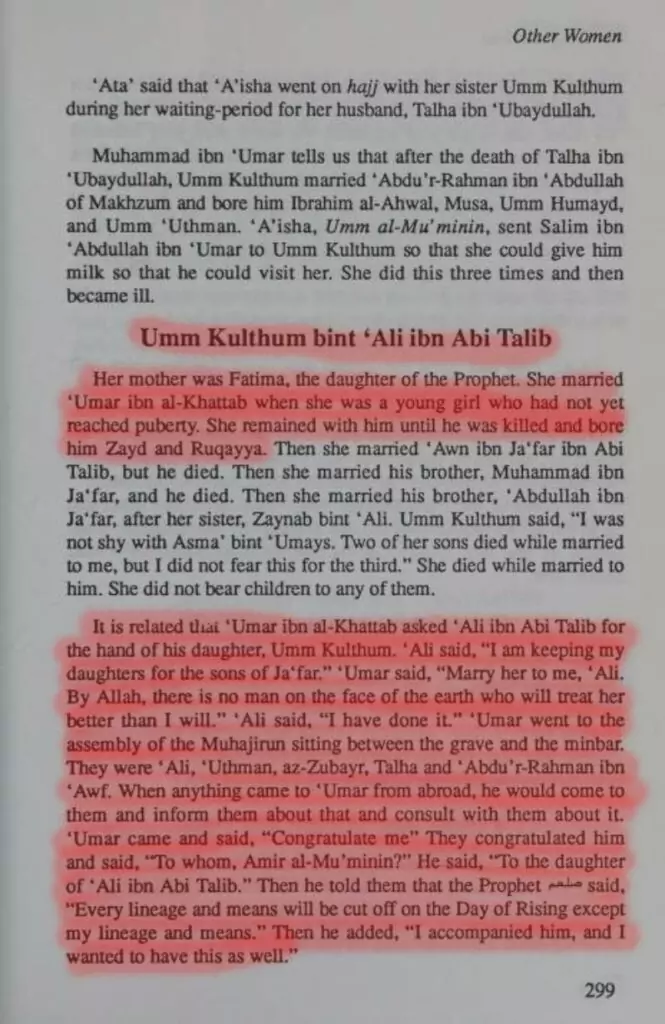
Umm Kulthum bint ‘Ali ibn Abi Talib
Her mother was Fatima, the daughter of the Prophet. She married ‘Umar ibn al-Khattab when she was a young girl who had not yet reached puberty. She remained with him until he was killed and bore him Zayd and Ruqayya. Then she married ‘Awn ibn Ja’far ibn Abi Talib, but he died. Then she married his brother, Muhammad ibn Ja’far, and he died. Then she married his brother, ‘Abdullah ibn Ja’far, after her sister, Zaynab bint ‘Ali. Umm Kulthum said, “I was not shy with Asma’ bint ‘Umays. Two of her sons died while married to me, but I did not fear this for the third.” She died while married to him. She did not bear children to any of them.
It is related that ‘Umar ibn al-Khattab asked ‘Ali ibn Abi Talib for the hand of his daughter, Umm Kulthum. ‘Ali said, “I am keeping my daughters for the sons of Ja’far.” “Umar said, “Marry her to me, ‘Ali. By Allah, there is no man on the face of the earth who will treat her better than I will.” ‘Ali said, “I have done it.” “Umar went to the assembly of the Muhajirun sitting between the grave and the minbar. They were ‘Ali, ‘Uthman, az-Zubayr, Talha and ‘Abdu’r-Rahman ibn ‘Awf. When anything came to ‘Umar from abroad, he would come to them and inform them about that and consult with them about it. ‘Umar came and said, “Congratulate me” They congratulated him and said, “To whom, Amir al-Mu’minin?” He said, “To the daughter of ‘Ali ibn Abi Talib.” Then he told them that the Prophet صلحم said “Every lineage and means will be cut off on the Day of Rising except my lineage and means.” Then he added, “I accompanied him, and I wanted to have this as well.”
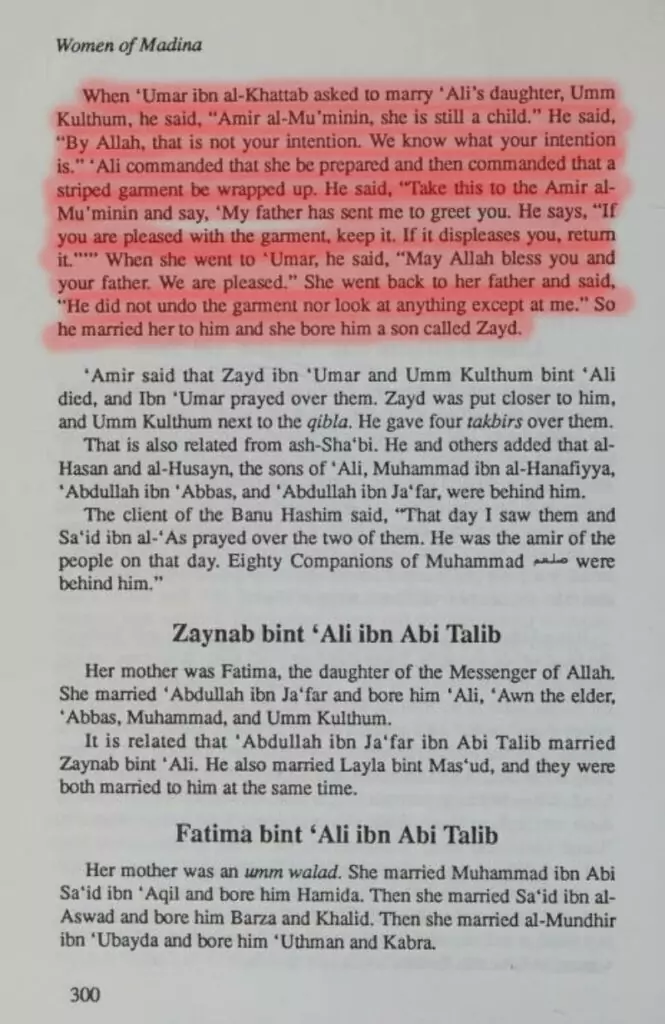
When ‘Umar ibn al-Khattab asked to marry ‘Ali’s daughter, Umm Kulthum, he said, “Amir al-Mu’minin, she is still a child.” He said. “By Allah, that is not your intention. We know what your intention is.” Ali commanded that she be prepared and then commanded that a striped garment be wrapped up. He said, “Take this to the Amir al-Mu’minin and say, ‘My father has sent me to greet you. He says, “If you are pleased with the garment, keep it. If it displeases you, return it.” When she went to ‘Umar, he said, “May Allah bless you and your father. We are pleased.” She went back to her father and said, “He did not undo the garment nor look at anything except at me.” So he married her to him and she bore him a son called Zayd.
‘Amir said that Zayd ibn ‘Umar and Umm Kulthum bint ‘Ali died, and Ibn ‘Umar prayed over them. Zayd was put closer to him, and Umm Kulthum next to the qibla. He gave four takbirs over them.
That is also related from ash-Sha’bi. He and others added that al-Hasan and al-Husayn, the sons of ‘Ali, Muhammad ibn al-Hanafiyya, ‘Abdullah ibn ‘Abbas, and ‘Abdullah ibn Ja’far, were behind him.
The client of the Banu Hashim said, “That day I saw them and Sa’id ibn al-‘As prayed over the two of them. He was the amir of the people on that day. Eighty Companions of Muhammad صلعم were behind him.”
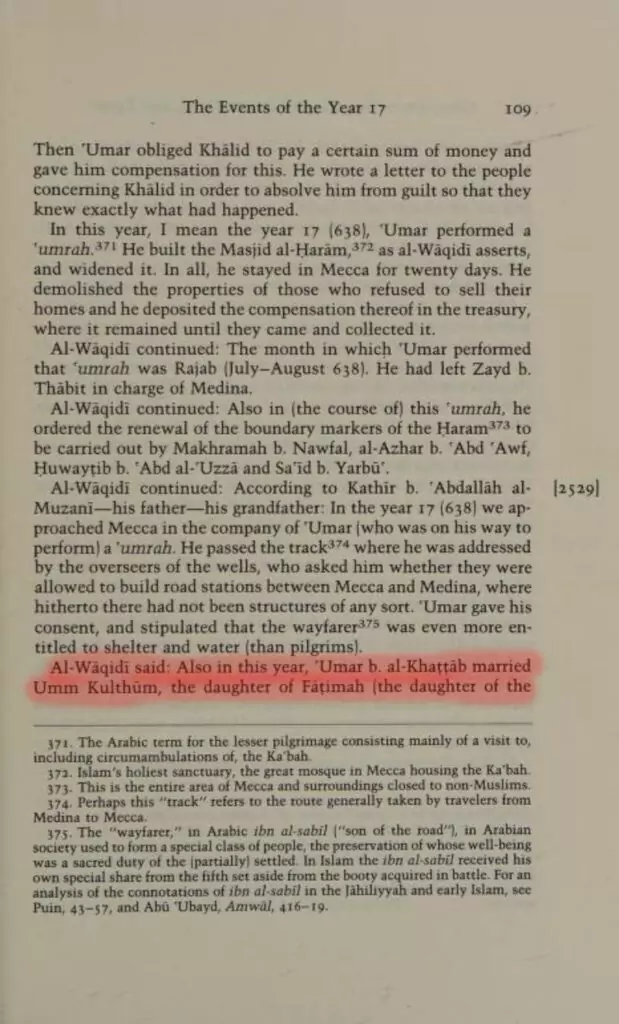
Nor was it confined to the marriage contract. Umar also had sexual intercourse with the underage Umm Kulthum (born in 627 CE) in November–December 638 [4] —
Al-Waqidi continued: According to Kathir b. Abdallah al-Muzani-his father-his grandfather: In the year 17 (638) we ap-proached Mecca in the company of Umar (who was on his way to perform) a ‘umrah. He passed the track374 where he was addressed by the overseers of the wells, who asked him whether they were allowed to build road stations between Mecca and Medina, where hitherto there had not been structures of any sort. ‘Umar gave his consent, and stipulated that the wayfarer375 was even more en-titled to shelter and water (than pilgrims).
Al-Waqidi said: Also in this year, Umar b. al-Khattab married Umm Kulthüm, the daughter of Fatimah (the daughter of the Messenger of God) and ‘Ali b. Abi Talib, ‘Umar consummated the marriage in Dhu al-Qa’dah [November-December 638].
Al Manidi continued: In this year Umar nut Abu Müsä al
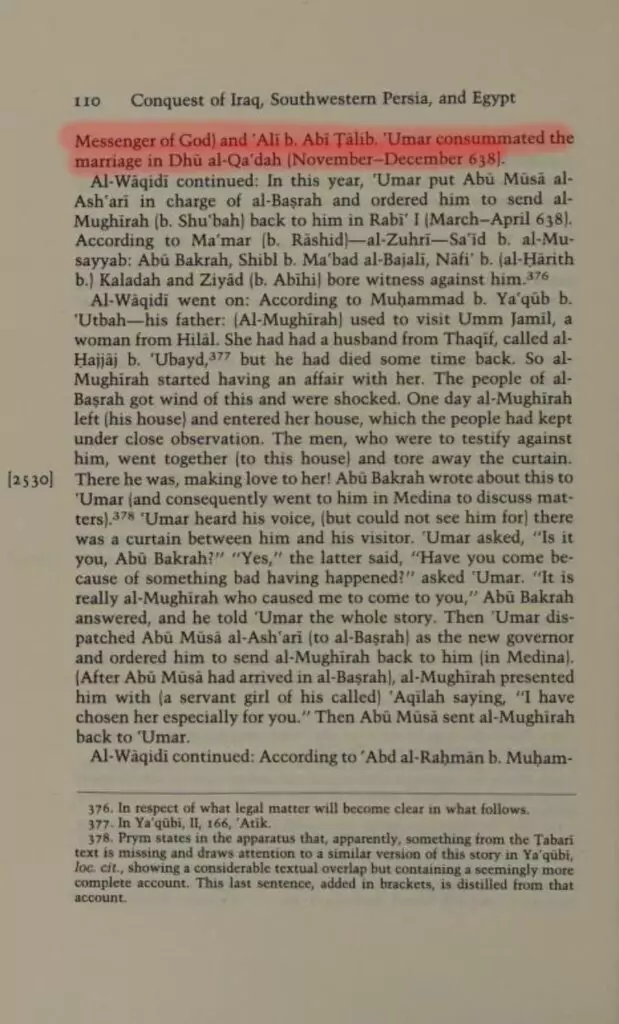
Let us examine this account in Hayat al-Sahaba. Read carefully what Umar did to the child [5] —
Ali’s Marriage of His Own Daughter Umm Kulthum
Abu Ja’far relates that Umar proposed to Ali for his daughter. Ali said, “She is young.” Someone told Umar that Ali had said this to avoid giving her in marriage. Umar therefore spoke to him again, and Ali said, “I shall send her to you. If she agrees, she will be your wife.” He sent his daughter to Umar. Umar lifted the cloth covering her leg to examine her. The girl said, “Leave me alone. If you were not the Commander of the Faithful, I would gouge out your eyes.” (Kanz)

Umm Kulthum Was Playing with Other Children
In Abd al-Razzaq al-San’ani’s Musannaf the case appears directly under the chapter “باب نكاح الصغيرين”—marriage of minors. In the account of Umar and Umm Kulthum, the girl is not vaguely described as “young,” but as a jariya playing with other children. This wording leaves no room to conceal her childhood; the source itself identifies her as a child at play: [6]
وهي جارية تلعب مع الجواري
She was a young girl who was playing with other girls.
Musannaf Abd al-Razzaq, hadith 10354
There is no need to speculate about “how mature she really was.” The narrator depicts her as a child playing with girls of her own age. More significantly, the account is placed in the Musannaf under باب نكاح الصغيرين—the chapter on “the marriage of two minors/children’s marriage.” The same account explains why Umar wanted this marriage. He tells his companions that he did not marry because of sexual desire, but because he wanted a genealogical and marital connection to Muhammad. Thus, within the account itself, Umm Kulthum’s personal wishes or preferences play no role. The discussion centres on Umar’s purpose and the relationship between the families. Abd al-Razzaq also reports that Umar consummated the marriage and that they had a son named Zayd. The marriage did not remain a formal agreement for the future. According to the tradition’s own account, it subsequently became a sexual and reproductive marital relationship.
“She Had Not Yet Reached Puberty”—Then He Consummated the Marriage
Ibn al-Jawzi’s Al-Muntazam fi Tarikh al-Muluk wa-l-Umam is even more explicit. It mentions not simply marriage at a young age, but Umm Kulthum’s not having reached puberty and Umar’s subsequent consummation of the marriage in the same sequence of sentences. There is therefore no basis for recasting this account as “only an early marriage contract, followed by consummation in adulthood.” The source says: [7]
ولم تكن قد بلغت، فدخل بها … ثم ولدت له زيدا
She had not yet reached puberty; then he consummated the marriage with her; later she bore him Zayd.
Ibn al-Jawzi, Al-Muntazam, events of 17 AH
This sentence is unambiguous. First, it says that the girl “لم تكن قد بلغت”—had not reached puberty. In the same sequence, it then says that Umar “فدخل بها”—consummated the marriage with her. The birth of their child follows. Presenting the case as merely “a marriage contract at a young age, with nothing happening before maturity” therefore conflicts with the Islamic historical account. Al-Muntazam directly connects her prepubescent condition with consummation.
Approximately Ten Years Old at Marriage
Numerical information about Umm Kulthum’s age is also preserved in Islamic biographical literature. Quoting Ibn Hajar al-Asqalani’s Al-Ithar bi-Ma’rifat Ruwat al-Athar Islamweb states that when Umar married her, she was ten or slightly older. A child at play, a “young” girl and an age of approximately ten are not disconnected descriptions; they further clarify the age profile of the same marriage: [8]
وتزوجها عمر بن الخطاب ولها عشر سنين، أو أكثر
Umar ibn al-Khattab married her when she was ten years old or slightly older.
Islamweb: discussion of Umm Kulthum’s age
The different Islamic accounts thus converge on the same basic picture: Umm Kulthum was a young child; she was seen playing with other girls; her age is given as approximately ten or slightly older; and a historical account describes her as not yet pubescent when marital life began. Taken together, these details show that her childhood is not a marginal detail of this marriage, but a central feature. Rewriting this history to make her an adult woman contradicts the sources’ wording.
Ali Also Called Her “Young” When the Marriage Was Proposed
Ali’s own statement during the marriage proposal also foregrounds his daughter’s young age. In Abd al-Razzaq’s Musannaf when Umar proposes to marry Umm Kulthum, Ali directly says “إنها صغيرة”—“She is young.” Her young age is therefore not an allegation imposed by a later critic; her father himself mentions it within the marriage negotiations: [9]
إنها صغيرة
She is young.
Musannaf Abd al-Razzaq, hadith 10352
But Umar did not withdraw his proposal. According to the account, he asked Ali to give her to him in marriage. The same body of historical sources contains another account in which Umm Kulthum is sent to Umar, who places his hand on her leg and moves her clothing aside. The girl protests strongly, saying that if he were not the Commander of the Faithful, she would break his nose. Returning to her father, she complains about Umar as “شيخ سوء”—a “bad old man.” Ali reassures her, saying that Umar is her husband. [10]
This account is especially significant because it shows the girl’s own reaction. An older man at the pinnacle of political and social power wants her as his wife, and her father approves the marriage, yet her own words clearly express irritation and protest. Her reaction did not prevent the marriage. The guardian’s decision prevailed.
Where Is the Child’s Consent?
Umm Kulthum’s case exposes the ethical problem of child marriage with brutal clarity. Her ability to decide about her own life was not central. Umar wanted a marital connection to Muhammad’s family; Ali was the guardian; the decision was made between these adult men. The same sources describe the girl being married as “young,” “a child playing with other girls” and “not yet pubescent.”
Placing a child within the legal framework of marriage and subsequently turning that relationship into a sexual marriage does not become morally acceptable merely because her father permitted it. A father’s consent is not the child’s sexual or marital consent. A ten-year-old or prepubescent girl cannot assess the long-term meaning of a marital and sexual relationship with an adult man and give informed consent.
Following Aisha’s case, the account of Umm Kulthum extends the same problem. In the first case, Islam’s Prophet himself marries a child and begins marital life at nine. In the second, Islam’s second caliph marries a girl whom Islamic sources themselves depict as playing with other children, while another account reports consummation before puberty.
This is no longer a story of an isolated exception. It is the beginning of a continuing pattern. The subsequent cases make that pattern clearer, because the children’s ages will not remain limited to nine or ten. We will encounter an account of a girl being married when she had just been born; then accounts of a marriage between two children aged only five and six.
Qudama ibn Maz’un and al-Zubayr’s Newborn Daughter: Marriage Immediately after News of Her Birth
How young could a child be when married? The case of Qudama ibn Maz’un and the daughter of al-Zubayr ibn al-Awwam provides an extreme example. This is not a girl of nine or ten, or even a child of five or six. According to the account, her marriage was concluded immediately after news of her birth. In Ibn Hazm’s Al-Muhalla bi-l-Athar an account transmitted through Sa’id ibn Mansur and Abu Ubayd states that al-Zubayr visited Qudama ibn Maz’un during his illness. While he was there, news arrived that a daughter had been born to al-Zubayr. Upon hearing it, Qudama asked him to marry the newborn girl to him. Al-Zubayr’s reply makes the child’s condition entirely clear: he asked what Qudama would do with such a little girl. Ultimately, that question did not prevent the marriage. At the end of the account, Urwa says that al-Zubayr married the girl to Qudama. [11]
دَخَلَ الزُّبَيْرُ عَلَى قُدَامَةَ بْنِ مَظْعُونٍ يَعُودُهُ، فَبُشِّرَ الزُّبَيْرُ بِجَارِيَةٍ وَهُوَ عِنْدَهُ، فَقَالَ لَهُ قُدَامَةُ: زَوِّجْنِيهَا. فَقَالَ لَهُ الزُّبَيْرُ: وَمَا تَصْنَعُ بِجَارِيَةٍ صَغِيرَةٍ وَأَنْتَ عَلَى هَذِهِ الْحَالِ؟ … قَالَ عُرْوَةُ: فَزَوَّجَهَا إِيَّاهُ
Al-Zubayr visited Qudama ibn Maz’un during his illness. While he was there, he received the good news that a daughter had been born. Qudama said, “Marry her to me.” Al-Zubayr said, “What would you do with such a little girl in this condition?” … Urwa says that he subsequently married her to him.
Ibn Hazm, Al-Muhalla bi-l-Athar
Another preserved version uses even more explicit language about the child’s age. Quoting Ibn Qudama’s Al-Mughni IslamQA writes that Qudama married al-Zubayr’s daughter “حين نفست”—at the time of her birth. Qudama’s statement is also preserved: if he died, she would inherit from him; if he lived, she would be his wife. Modern IslamQA cites this case not in a critical discussion, but as evidence of the Sharia permissibility of marriages of underage boys and girls. The same answer explicitly declares that Sharia sets no particular minimum marriage age, that a father may marry his minor daughter, and that her own permission is not an indispensable condition for the validity of the marriage. [12]
أَنَّ قُدَامَةَ بْنَ مَظْعُونٍ تَزَوَّجَ ابْنَةَ الزُّبَيْرِ حِينَ نُفِسَتْ … إِنْ مِتُّ وَرِثَتْنِي، وَإِنْ عِشْتُ كَانَتِ امْرَأَتِي
Qudama ibn Maz’un married al-Zubayr’s daughter at the time of her birth … “If I die, she will inherit from me; if I live, she will be my wife.”
Ibn Qudama, Al-Mughni — quoted by IslamQA
There is no room to obscure this case’s ethical significance. A newborn has no understanding even of her name, family or the world; making decisions about marriage, a husband, sexuality, inheritance or her future life is entirely impossible. Yet at the moment news of her birth arrives, an adult man claims her as his wife and her father approves. The child’s wishes cannot matter here, because her capacity to express them has not yet developed. This example shows that the absence of the child’s personal consent was not an incidental defect in this marriage system: a guardian’s authority could take the place of that absent consent. Even IslamQA’s own explanation permits a father to marry his minor daughter and does not make her objection or permission decisive for the marriage’s validity.
Qudama’s own statement lays the structure of this marriage even more bare. He is ill: if he survives, the newborn will be his wife in the future; if he dies, she will inherit. The child is not present here as a person with an independent will. She is assigned the position of an object within a familial and legal relationship. Her future marital identity is fixed at birth by an adult man’s and her father’s decisions. The basic conception of children’s rights in modern ethics—the opportunity to develop, the right to decide about future relationships and personal autonomy—has no place in this system. Instead of allowing the child to grow up and decide whom to marry, a husband is chosen for her at birth.
Criticism of child marriage is often answered by saying that, although the “nikah” or contract occurs during minority, actual marital life may begin later. But this does not answer the ethical problem of marrying a newborn. The issue is not merely when sexual relations begin; it is placing a person within a lifelong marital bond when she cannot make any decision about it. Determining a girl’s marriage on the day she is born does not become consensual simply because she will be handed over five, ten or fifteen years later. Rather, this case makes clear that her future marital life was treated as a matter for her guardian’s decision instead of her own right.
In one particular respect, Qudama’s marriage to the newborn girl is therefore even clearer than the cases of Aisha or Umm Kulthum. With Aisha or Umm Kulthum, someone might at least try to create a debate about age, physical maturity or puberty; a newborn leaves no such opening. That consent was not a prerequisite for the girl married at birth is not a separate theoretical inference. It follows inevitably from the structure of the event itself.
Urwa ibn al-Zubayr: Marriages of Children Aged Five and Six
Accounts of marriages of underage children also appear in the next generation of al-Zubayr’s family. His son Urwa ibn al-Zubayr was one of the best-known early Islamic Successors and an important scholar of Medina. In Abd al-Razzaq al-San’ani’s Musannaf the chapter “باب نكاح الصغيرين”—“the marriage of two minors”—directly preserves a marriage between two children in his family. Al-Zuhri relates that Urwa married his minor son to Mus’ab’s minor daughter. There is no need for vague translations such as “little” or “young” here; the Arabic sentence describes the groom as صغيرا and the bride as صغيرة—directly identifying both as underage children. [13]
أَنَّ عُرْوَةَ بْنَ الزُّبَيْرِ أَنْكَحَ ابْنَهُ صَغِيرًا ابْنَةً لِمُصْعَبٍ صَغِيرَةً
Urwa ibn al-Zubayr married his minor son to Mus’ab’s minor daughter.
Musannaf Abd al-Razzaq, hadith 10358
The following account makes the case more significant because it preserves the children’s specific ages. In Abd al-Razzaq’s report 10359, Hisham ibn Urwa relates that his father arranged a child’s marriage during minority; the ages of the two are then given as “هذا ابن خمس، وهذا ابن ست”—one five, the other six. The same report subsequently mentions inheritance of approximately four thousand dinars following a death. This was therefore more than an engagement or a family promise involving children. It was treated as a legal relationship that brought inheritance rights into effect. [14]
زَوَّجَ أَبِي ابْنَهُ صَغِيرًا، هَذَا ابْنُ خَمْسٍ، وَهَذَا ابْنُ سِتٍّ، فَمَاتَ، فَوَرِثَتْهُ أَرْبَعَةَ آلَافِ دِينَارٍ أَوْ نَحْوَ ذَلِكَ
My father married his son while he was a minor; one was five years old and the other six. Later, when one died, the other inherited approximately four thousand dinars.
Musannaf Abd al-Razzaq, hadith 10359
Another account of child marriage in Urwa’s family, in Sa’id ibn Mansur’s Sunan reflects the same reality. It states that Urwa married his brother’s daughter to his brother’s son and that both were children—“وهما صغيران”. There is no need to inflate the number of cases by artificially separating such accounts. What matters is that Urwa’s family and the early tradition associated with him preserved marriages of underage boys and girls as normal and legally effective acts. One account in Abd al-Razzaq describes his minor son’s marriage to Mus’ab’s minor daughter; another specifies ages of five and six; Sa’id ibn Mansur’s account describes the marriage of two young relatives. All testify to the same broader social practice. [15]
أَنَّهُ زَوَّجَ ابْنَةَ أَخِيهِ ابْنَ أَخِيهِ وَهُمَا صَغِيرَانِ
He married his brother’s daughter to his brother’s son; both were underage children.
Sunan Sa’id ibn Mansur, the marriage of two minors
For children aged five and six, asking “were they mature enough?” is meaningless. A five-year-old is still at the age of early schooling; a six-year-old is nowhere near understanding marriage’s legal, sexual, familial and lifelong consequences. They lack the mental capacity to make informed decisions about whom they want as a life partner, whether they want children, which household they will live in, what sexual relations mean or what right they have to leave a marriage. Yet their marriage was concluded, and at least one account records inheritance arising from it. The marriage created by adult decisions was therefore more than a nominal social relationship: under Islamic law, it imposed real consequences involving property and family on the children.
Urwa’s case also matters because he was no obscure individual. Later Sunni tradition recognises him as an important early Successor, hadith transmitter and bearer of jurisprudential knowledge. These accounts depict an environment in which marrying children was not a social offence to be concealed; it could be performed openly, narrated and used in legal discussions. Al-Sarakhsi later assembled such cases to establish the permissibility of marrying minors. His Al-Mabsut places Aisha’s marriage, Qudama’s newborn bride, Ibn Umar’s young daughter, Urwa’s marriage of two children and the precedents concerning Ali and Ibn Mas’ud within the same legal argument: a father or guardian has the authority to arrange a minor’s marriage.
Here, the historical significance of these cases extends beyond personal biography. Muhammad’s marriage to six-year-old Aisha, Umar’s marriage to the underage Umm Kulthum who was playing with other children, Qudama’s marriage to a newborn and marriages of five- and six-year-olds in Urwa’s family cannot collectively be explained as “one exceptional case.” The ages may be nine, ten, five or six, or even zero, but the structure is the same: the child does not decide; the adult guardian does; and that decision is treated as a valid marriage. Systematic jurisprudential principles later developed from this structure. Jurisprudence did not invent the permissibility of child marriage in a vacuum; it used these preserved early cases as legal precedents.
Child marriage in early Islam cannot be treated solely as a question about Muhammad’s and Aisha’s personal lives. The same practice recurs in his close Companions’ families, subsequent generations and among early jurists. The following accounts of minors’ marriages in the families of Abdullah ibn Umar, Ibn Mas’ud and other Companions, and of the inheritance, waiting periods and other legal consequences arising from them, show more clearly that this practice was not merely socially present. It was treated as an operative part of Islamic law.
Abdullah ibn Umar: His Minor Son’s Marriage, Inheritance and Waiting Period
Among early precedents, the case in Abdullah ibn Umar’s family is particularly significant because the marriage was not merely concluded during minority: full legal consequences such as inheritance and a waiting period were recognised. In Sunan Sa’id ibn Mansur Sulayman ibn Yasar relates that Abdullah ibn Umar married one of his sons to the daughter of his brother Ubaydullah ibn Umar. The boy’s status is not conveyed vaguely, but directly as “وابنه يومئذ صغير”—“his son was then a minor.” No dowry had been specified. When the minor husband died some time later, the bride’s family brought the matter to Zayd ibn Thabit. Zayd ruled that if the deceased boy had property, the girl would inherit and observe a waiting period, although she would receive no dowry because none had been specified. Besides Sa’id ibn Mansur, al-Bayhaqi and al-Tahawi also preserve accounts of this case. [16]
أَنَّ ابْنَ عُمَرَ زَوَّجَ ابْنًا لَهُ ابْنَةَ أَخِيهِ عُبَيْدِ اللَّهِ بْنِ عُمَرَ، وَابْنُهُ يَوْمَئِذٍ صَغِيرٌ … فَقَالَ زَيْدٌ: لَهَا الْمِيرَاثُ إِنْ كَانَ لِلْغُلَامِ مَالٌ، وَعَلَيْهَا الْعِدَّةُ
Ibn Umar married one of his sons to the daughter of his brother Ubaydullah ibn Umar; his son was then a minor … Zayd said that if the boy had property, the girl would inherit from him and would be required to observe a waiting period.
Sunan Sa’id ibn Mansur — Dorar
Another version, transmitted through Nafi’, appears in Muwatta Malik, al-Shafi’i’s Al-Umm, al-Tahawi’s Sharh Mushkil al-Athar and al-Bayhaqi’s Al-Sunan al-Kubra. Here the bride’s identity is more explicit: she was Ubaydullah ibn Umar’s daughter, and her mother was Zayd ibn al-Khattab’s daughter. The account states that she had married Abdullah ibn Umar’s son; the boy died without consummating the marriage. When a dispute arose over the dowry, Zayd ibn Thabit ruled that she would receive no dowry but would inherit from her deceased husband. This clarifies the earlier account’s legal consequences: the marriage a father imposed on his minor son was treated as a valid marital relationship that made the other party an heir. [17]
كَانَتْ تَحْتَ ابْنٍ لِعَبْدِ اللَّهِ بْنِ عُمَرَ، فَمَاتَ، وَلَمْ يَدْخُلْ بِهَا … فَقَضَى أَنْ لَا صَدَاقَ لَهَا، وَلَهَا الْمِيرَاثُ
She was the wife of one of Abdullah ibn Umar’s sons. He died without consummating the marriage … It was then ruled that she would receive no dowry, but she would inherit.
Muwatta Malik and parallel accounts — Dorar
This case matters because it cannot be explained as merely “a family promise for the future.” In Islamic law, it was an effective marriage. When the husband died, the bride inherited his property, and another account records a ruling requiring her to observe a waiting period. Before the child developed the capacity to decide, his father had therefore placed him in a legal position that brought rules concerning property, marital status and waiting periods into effect. Under modern civil law, a guardian’s ability to enter certain contracts for a child does not entail the right to determine that child’s future spouse. Yet that is precisely the authority exercised here: a father establishes a lifelong personal relationship on his child’s behalf, and the Islamic judicial system enforces its legal consequences.
Al-Sarakhsi’s Al-Mabsut preserves another child-marriage precedent in Ibn Umar’s family. In establishing the permissibility of marrying minors, he directly states that Ibn Umar married one of his “بنتا له صغيرة”—young daughters—to Urwa ibn al-Zubayr. Al-Sarakhsi does not mention this as an isolated historical detail. He combines it with Aisha’s marriage, al-Zubayr’s daughter’s marriage to Qudama at birth, the marriage of two children in Urwa’s family and the cases concerning Ali and Ibn Mas’ud, using them as evidence of guardians’ authority to marry minors. Islamweb likewise quotes al-Sarakhsi’s complete argument and presents these cases as historical precedents for the Sharia permissibility of child marriage. [18]
وَزَوَّجَ ابْنُ عُمَرَ رَضِيَ اللَّهُ عَنْهُ بِنْتًا لَهُ صَغِيرَةً مِنْ عُرْوَةَ بْنِ الزُّبَيْرِ
Ibn Umar married one of his minor daughters to Urwa ibn al-Zubayr.
Al-Sarakhsi, Al-Mabsut
Ibn Umar’s family thus provides information about the same structure in both directions: he married his own underage son, while classical jurisprudential literature also preserves his young daughter’s marriage to Urwa as a precedent. In the first case, the minor son’s marriage was so fully effective in law that his death made his wife an heir and raised the question of her waiting period. Limiting child marriage to adult men and young girls therefore leaves out part of the historical reality. The problem in the early Islamic system was more fundamental: guardians were recognised as having authority to impose marriage on underage children, whether boys or girls. The child’s own consent or understanding of marriage was not a prerequisite for exercising that authority.
Ibn Mas’ud’s Family: Approval of a Minor Daughter’s Marriage
Accounts concerning Abdullah ibn Mas’ud extend this pattern. In arguing for the permissibility of minors’ marriages, al-Sarakhsi mentions that Ibn Mas’ud’s wife married a young daughter to a son of al-Musayyib ibn Nukhba, and Ibn Mas’ud approved. The expression used is “بنتا لها صغيرة”—a minor daughter of his. This is more than a family decision: in al-Sarakhsi’s presentation, Ibn Mas’ud’s approval gives the case importance as a legal precedent. Islamweb quotes the passage in full and uses it as a practice of the early generations supporting the permissibility of a minor girl’s marriage. [19]
وَزَوَّجَتِ امْرَأَةُ ابْنِ مَسْعُودٍ رَضِيَ اللَّهُ عَنْهُ بِنْتًا لَهَا صَغِيرَةً ابْنًا لِلْمُسَيَّبِ بْنِ نُخْبَةَ، فَأَجَازَ ذَلِكَ عَبْدُ اللَّهِ رَضِيَ اللَّهُ عَنْهُ
Ibn Mas’ud’s wife married one of his minor daughters to a son of al-Musayyib ibn Nukhba; Abdullah [ibn Mas’ud] approved the marriage.
Al-Sarakhsi, Al-Mabsut — quoted by Islamweb
There is no mention of the child’s personal opinion. Her mother arranged the marriage, and Ibn Mas’ud approved it. The purpose for which later jurisprudence preserved this event also matters: al-Sarakhsi uses it to demonstrate that waiting until puberty is unnecessary and that a guardian can conclude a valid marriage beforehand. His reasoning is even more direct. He presents Ibn Shubruma’s and Abu Bakr al-Asamm’s opposing position: a child has no need for marriage, because its natural purpose is to satisfy sexual desire and its Sharia purpose is procreation, neither of which is compatible with childhood; furthermore, a lifelong contract should not be imposed on a child. Al-Sarakhsi rejects this objection and adduces Aisha’s marriage and the Companions’ child marriages as counter-evidence. He argues that a suitable groom is not always available: if one waits until the girl grows up, that groom may be lost, so a guardian needs marital authority while she is still young. Islamweb continues to quote this reasoning today in defence of child marriage as Sharia-compliant.
The problem of the child’s autonomy is particularly clear in this reasoning. The risk of losing a potentially “suitable groom” is given greater weight than the child’s right to choose her own future partner. Instead of postponing the decision, allowing her to grow up and obtaining her own consent, the argument is that a good groom might be lost unless she is married now. The child is not treated as the owner of her future, but as a family asset for which the guardian reserves a “suitable” opportunity in advance. This reasoning reveals child marriage’s fundamental problem: the absence of the child’s consent is no accident. The guardian’s decision is placed above her consent so that the system can operate.
A Daughter Not Yet Born: A Promise to Marry the First Future Daughter
Another unusual account concerning Ibn Mas’ud is preserved in Sunan Sa’id ibn Mansur under “باب تزويج الجارية الصغيرة”—the chapter on “marrying a young girl.” During a journey, a man tells his companions that whoever slaughters a sheep for them will be married to “أول بنت تولد لي”—“the first daughter born to me.” Another man slaughters the sheep on that condition. When a daughter is subsequently born, he comes to claim her as his wife. The matter is brought to Ibn Mas’ud, whose ruling is given as “وجب النكاح بالشاة”—the marriage became binding/effective in exchange for the sheep; however, the girl must also receive a dowry appropriate to her peers. Al-Shafi’i quotes the same case in Al-Umm and explicitly states that he does not accept this ruling. Thus, the case did not become an undisputed rule in later jurisprudence, but the historical account preserved in Ibn Mas’ud’s name is explicit. [20]
أَيُّكُمْ يَذْبَحُ لَنَا شَاةً وَأُزَوِّجُهُ أَوَّلَ بِنْتٍ تُولَدُ لِي … فَوُلِدَ لِلرَّجُلِ ابْنَةٌ، فَأَتَاهُ فَقَالَ: امْرَأَتِي … فَقَالَ ابْنُ مَسْعُودٍ: وَجَبَ النِّكَاحُ بِالشَّاةِ، وَلَهَا صَدَاقُ مِثْلِهَا
Who among you will slaughter a sheep for us? I will marry him to the first daughter born to me … Later, when a daughter was born to the man, the other man came and said, “My wife.” They went to Ibn Mas’ud, who said, “The marriage became effective through the sheep; however, the girl shall receive a dowry appropriate to her peers.”
Sunan Sa’id ibn Mansur, باب تزويج الجارية الصغيرة
This account goes a step beyond marrying a newborn. Here, a marriage is promised concerning a person who does not yet exist. Anticipating a future daughter, the father announces that his first daughter will become a particular man’s wife. After her birth, before she can make any decision about the most personal relationship of her life, a man arrives claiming “my wife,” and the account records Ibn Mas’ud recognising that relationship as an effective marriage. This model is the complete opposite of consent: the woman’s consent is not simply absent; when the relationship was fixed, she did not even exist in the world.
Placing this case alongside Qudama’s marriage to al-Zubayr’s newborn daughter makes the extent of guardians’ marital authority in early tradition clearer. In one case, a child is married at birth; in another, a future daughter’s marriage is promised before birth; in Urwa’s case, children of five and six are married; in Ibn Umar’s case, a minor boy’s marriage produces full legal consequences of inheritance and a waiting period. These are not isolated exceptions involving age. They are different applications of the same basic idea: a guardian may determine a child’s marital relationship during minority, and that decision can create a legal reality before the child can express a future preference.
At this stage, child marriage can no longer be described as merely one historical event involving Muhammad and Aisha. From Muhammad’s life through the families of Umar, Ibn Umar, Ibn Mas’ud, al-Zubayr and Urwa, the same social and legal conception recurs; later jurists collect these very cases as evidence. The following accounts concerning Ali ibn Abi Talib, Muhammad’s arrangement of the child marriage of Hamza’s daughter and Salama ibn Abi Salama, and early Successors’ explicit legal opinions complete this historical pattern further.
Ali ibn Abi Talib: Approval of a Minor Daughter’s Marriage
Early Islamic tradition preserves another child-marriage precedent in Ali ibn Abi Talib’s name. In Al-Mabsut al-Sarakhsi mentions Ali’s decision alongside several Companions’ cases to establish the permissibility of marriages of underage boys and girls. According to his account, a man gave his “ابنته الصغيرة”—minor daughter—in marriage to Abdullah ibn al-Hasan, and Ali approved it. Her age is not given numerically, but she is directly called صغيرة—a young or underage girl. Al-Sarakhsi does not present this as a peripheral historical anecdote. He lists it alongside Aisha’s marriage, al-Zubayr’s daughter’s marriage at birth, Ibn Umar’s young daughter’s marriage, Urwa’s marriage of two children and the marriage of a minor daughter in Ibn Mas’ud’s family, to establish guardians’ authority over minors’ marriages. Modern Islamweb quotes this entire passage and reuses the same historical precedents to support child marriage’s permissibility under Sharia. [19]
وَوَهَبَ رَجُلٌ ابْنَتَهُ الصَّغِيرَةَ مِنْ عَبْدِ اللَّهِ بْنِ الْحَسَنِ، فَأَجَازَ ذَلِكَ عَلِيٌّ رَضِيَ اللَّهُ عَنْهُ
A man gave his minor daughter in marriage to Abdullah ibn al-Hasan; Ali approved the marriage.
Al-Sarakhsi, Al-Mabsut — quoted by Islamweb
The significance is not merely that a father determined his minor daughter’s marriage. More importantly, the decision preserved in Ali’s name legitimised it. The child’s age did not cause the marriage to be postponed, and the absence of her own decision did not invalidate it. Her father decided, and a leading Companion’s approval turned that decision into a valid marriage. Al-Sarakhsi’s purpose is equally clear: for him, these Companions’ precedents demonstrate that a guardian can arrange a child’s marriage before puberty. Later jurisprudential rules on child marriage therefore cannot be presented as merely theoretical conjectures: jurists directly used these accounts preserved in the Companions’ names as precedents when constructing their arguments.
Such marriages directly expose the problem of the child’s personal freedom. A girl described as “الصغيرة” does not control the choice of her future partner; her father does. Within this system, Ali’s approval does not restore the child’s consent, but recognises the guardian’s decision as legally effective. In a structure where someone can determine a five- or ten-year-old’s marriage without asking her, “consent” is effectively replaced by the adult guardian’s decision. This is fundamentally unacceptable under modern conceptions of human rights and consent, because one of the most important relationships in a person’s personal and sexual life is imposed on someone who has not developed the capacity to understand it.
Ali’s Yemeni Captive: The Account of Intercourse and Classical Explanations of Minority and Prepubescence
Another case concerning Ali is not a marriage, but it is also important to the history of sexual relations with underage girls. During the Yemen expedition, a وصيفة among the captives came into Ali’s share. In Burayda’s account, Ali had sexual relations with her. When a complaint reached Muhammad, he rejected it and said that Ali’s share of the khums exceeded the value of that slave girl. Islamic rules concerning sexual intercourse with minor slave girls are discussed in a separate article [21]. Sahih al-Bukhari preserves an abbreviated version, while Ahmad and other historical accounts directly contain the phrase “فوقعت بها”—Ali had sexual intercourse with her. [22]
فَصَارَتْ فِي آلِ عَلِيٍّ فَوَقَعَ بِهَا
She then came into Ali’s family’s share, and Ali had sexual intercourse with her.
Ibn Hajar, Fath al-Bari, volume 8, p. 53
Let us also examine the Sahih al-Bukhari hadith alongside its English translation [23] [24] —
Sahih al-Bukhari (Tawhid)
Book: 64/ Military Expeditions (Maghazi)
Chapter: 64/62. Sending Ali ibn Abi Talib and Khalid ibn al-Walid to Yemen before the Farewell Pilgrimage.
4350. Narrated Burayda: The Prophet sent Ali to Khalid to bring the khums (one-fifth of the war booty). I was displeased with Ali, and he had also taken a bath. I said to Khalid, “Do you not see him?” When we returned to the Prophet, I informed him of the matter. He said, “Burayda, are you displeased with Ali?” I answered, “Yes.” He said, “Do not be displeased with him, for his entitlement to the khums is greater than this.” (Islamic Foundation: 4012)
Narrated Buraida: The Prophet (ﷺ) sent `Ali to Khalid to bring the Khumus (of the booty) and I hated `Ali, and `Ali had taken a bath (after a sexual act with a slave-girl from the Khumus). I said to Khalid, “Don’t you see this (i.e. `Ali)?” When we reached the Prophet (ﷺ) I mentioned that to him. He said, “O Buraida! Do you hate `Ali?” I said, “Yes.” He said, “Do you hate him, for he deserves more than that from the Khumlus.”
Hadith grade: Sahih (authentic)
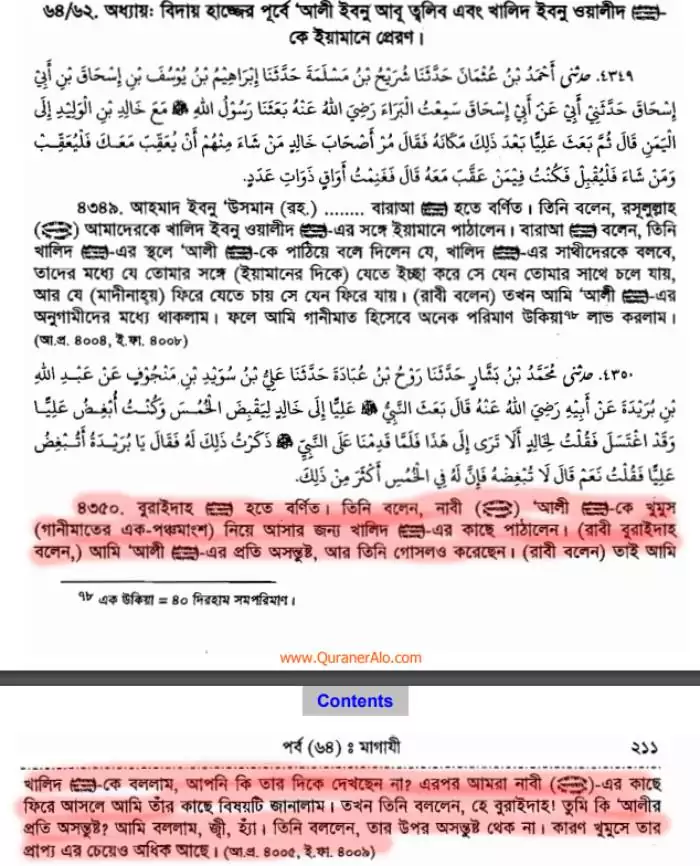
The reference to bathing after sexual activity with a female war captive has been translated into Bengali simply as bathing. One possible reason is to conceal that the Prophet’s son-in-law Ali had intercourse with female war captives while his wife Fatima was still alive. The detail appears in the same hadith’s English translation, rendered here from the Bengali:
Sahih al-Bukhari: volume 5, book 59, hadith 637:
Narrated Burayda:
The Prophet sent Ali to Khalid to collect the khums (war booty). I felt very jealous of Ali, for he had taken a bath after (having sexual intercourse with a female war captive received as part of his share of the khums). I said to Khalid, “Do you not see this?” When we reached the Prophet, I informed him. He said, “Burayda, are you jealous of Ali?” I answered, “Yes.” He said, “Your jealousy is unwarranted, for he deserves more of the khums than the share he received.”
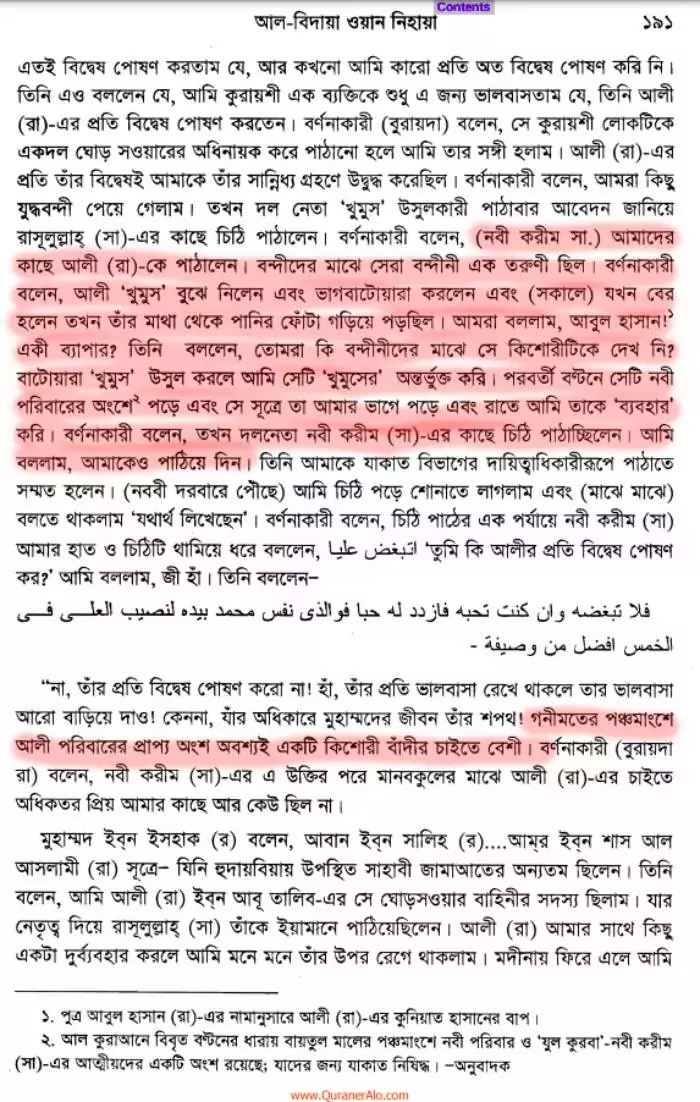
Further details appear in Al-Bidaya wa-l-Nihaya [25] —
I hated him so intensely that I had never hated anyone else as much. He also said that he loved a certain Qurayshi man only because that man hated Ali. Burayda relates: When that Qurayshi man was sent to command a group of horsemen, I accompanied him. His hatred of Ali prompted me to seek his company. We obtained some war captives. The commander wrote to the Messenger of Allah requesting someone to collect the khums. The Prophet sent Ali to us. Among the captives, the finest female captive was a young girl. Ali collected the khums and distributed it. When he came out in the morning, water was dripping from his head. We asked, “Abu al-Hasan, what is this?” He said, “Did you not see that young girl among the captives? When I collected the khums for distribution, I included her in it. In the subsequent distribution, she fell to the Prophet’s family’s share, and through that allocation she came into my share. I ‘used’ her during the night.” The commander was then sending a letter to the Prophet. I said, “Send me too.” He agreed to send me as the official responsible for the zakat department. Upon reaching the Prophet, I began reading the letter aloud, saying from time to time, “He has written the truth.” At one point during the reading, the Prophet
stopped my hand and the letter and said, اتبغض عليا, “Do you hate Ali?” I answered, “Yes.” He said—
فلا تبغضه وان كنت تحبه فازدد له حبا فوالذي نفس محمد بيده لنصيب العلي في
الخمس افضل من وصيفة –
“No, do not hate him. If you love him, increase your love for him! By the One in whose hand Muhammad’s life rests, the share of Ali’s family in the fifth of the booty is certainly worth more than a young slave girl.” Burayda says: After these words from the Prophet, no person was dearer to me than Ali.
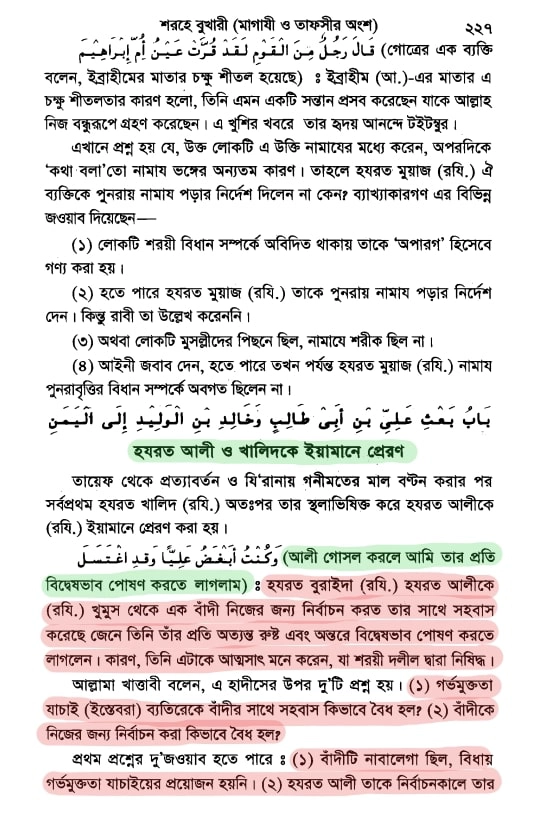
The explanation of this hadith in Sahaj In’am al-Bari, a commentary on Sahih al-Bukhari, is as follows [26] —
Sending Ali and Khalid to Yemen
After returning from Ta’if and distributing the booty at al-Ji’rana, Khalid was first sent to Yemen, followed by Ali as his replacement.
) وكُنتُ أبعْضُ عَلِيًّا وَقَدِ اغْتَسَلَ
“I began to harbour hatred”: Burayda became extremely angry with Ali
and began to hate him after learning that he had selected a slave girl from the khums for himself and had intercourse with her. He considered this embezzlement, prohibited by Sharia evidence.
Al-Khattabi says that this hadith raises two questions: (1) How was intercourse with the slave girl permissible without
checking that she was not pregnant (istibra)? (2) How was selecting the slave girl for himself permissible?
There are two possible answers to the first question: (1) The slave girl was a minor, so
checking for pregnancy was unnecessary. (2) She was menstruating when Ali selected her. After a day and a night, when her menstruation ended, he had intercourse with her. The answer to the second question is that, just as a commander may distribute booty among its recipients and select an item for himself, his deputy may do so as well.
Lami’ al-Darari states that the hadith contains no detail showing
that Ali had intercourse without checking for pregnancy. It is therefore possible that he did so after checking and allowing some time—one menstrual period—to pass. This is the slave girl who later gave birth to Muhammad ibn al-Hanafiyya.
Al-Qastallani says that this hadith establishes the permissibility of selecting a slave girl as a concubine
and having intercourse with her while the Prophet’s daughter is still alive. Marriage is different, for that is not permissible.
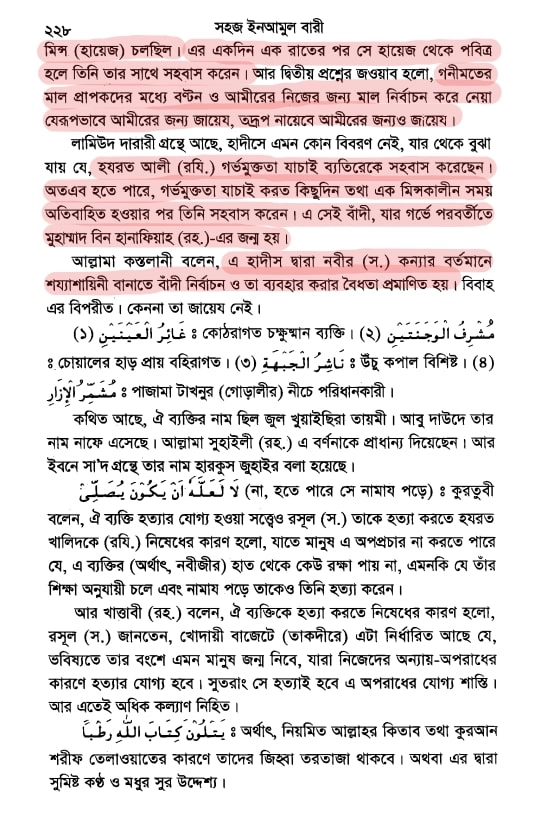
The original narration gives no precise age for the captive. Nor was the prepubescent interpretation invented by modern critics: classical commentators themselves used that possibility. In Fath al-Bari Ibn Hajar addresses why Ali had intercourse with her without the usual istibrāʾ or waiting period to establish that she was not pregnant. He writes that she may be understood as “بكرا غير بالغ”—a virgin who had not reached puberty. In the same passage, quoting al-Khattabi’s explanation, he says the girl may have been “عذراء أو دون البلوغ”—a virgin or below the age of puberty. Sexual intercourse with a minor slave girl thus appears not as an imaginary reading created by modern critics, but as one of classical Sunni commentary’s own possible explanations. [22]
فَأَمَّا الأَوَّلُ فَمَحْمُولٌ عَلَى أَنَّهَا كَانَتْ بِكْرًا غَيْرَ بَالِغٍ
The first difficulty is explained by taking her to have been a virgin who had not reached puberty.
وَأَجَابَ الْخَطَّابِيُّ … بِاحْتِمَالِ أَنْ تَكُونَ عَذْرَاءَ أَوْ دُونَ الْبُلُوغِ
Al-Khattabi answered: Perhaps she was a virgin or below the age of puberty.
Ibn Hajar, Fath al-Bari, volume 8, p. 53
The original hadith does not state the captive’s age; the assertion of prepubescence comes from classical commentary. Yet that explanation is historically important in itself: the commentator did not dismiss intercourse with a prepubescent female war captive as impossible or forbidden. Instead, he used that possibility as an acceptable solution to the case’s legal difficulty. The ethical horror is twofold: she is a war captive and slave, lacking the social and legal power to reject the relationship freely; and, according to the classical explanation, she may also be prepubescent. Accepting a captive child as an item of ownership and routinely accommodating the possibility of sexual intercourse with her within legal explanation reveals an ethical framework in which consent, freedom and the child’s bodily autonomy were not central conditions.
Muhammad’s Arrangement of the Child Marriage of Hamza’s Daughter and Salama ibn Abi Salama
The historical role of child marriage did not end with Muhammad’s own marriage to young Aisha. Ibn Ishaq’s biographical tradition preserves an explicit case in which Muhammad arranged a marriage between two children. Abdullah ibn Shaddad ibn al-Had relates that Umm Salama’s son Salama concluded his mother’s marriage to Muhammad; in return, Muhammad married Salama to Hamza’s daughter. The account leaves no ambiguity about the two children’s condition—“وهما صبيان صغيران”—both were young children. It also states that they never began marital life together: both died before that happened. Ibn Ishaq’s account was subsequently preserved in Abu Nu’aym’s Ma’rifat al-Sahaba and other works. [27]
فَزَوَّجَهُ رَسُولُ اللَّهِ ﷺ ابْنَةَ حَمْزَةَ، وَهُمَا صَبِيَّانِ صَغِيرَانِ، فَلَمْ يَجْتَمِعَا حَتَّى مَاتَا
The Messenger of Allah married him to Hamza’s daughter; both were young children. They died before they began living together.
Ibn Ishaq, Al-Sira wa-l-Maghazi
There is no reason to claim sexual intercourse occurred in this case; the account itself says they died before coming together. But this does not remove the marriage’s ethical problem. The two children’s future marital identities were determined by Muhammad and the adults in their families, rather than by their own decisions. Whether they would grow up wanting each other as life partners, want to marry at all, or choose someone else had no place in the decision. Their legal and social relationship as “husband” and “wife” was fixed during childhood. This again demonstrates that the early Islamic marriage system did not understand consent as an adult individual’s independent decision: for a child, a guardian or an authoritative adult could determine a lifelong relationship on the child’s behalf.
The case is also important because later Islamic jurisprudence used it as evidence for the permissibility of minors’ marriages. Modern jurisprudential works also cite Muhammad’s arrangement of a marriage between two young children alongside Aisha’s marriage. The case did not disappear as an unusual family event in the biographies; it survived as a historical precedent explaining child marriage’s legal validity.
Hasan al-Basri, al-Zuhri and Qatada: “When Fathers Marry Their Children, Their Marriages Are Valid”
Someone might try to treat the cases discussed so far as an isolated list of personal or family conduct. But that explanation quickly becomes untenable when we reach the language of early Islamic jurisprudence. In Abd al-Razzaq al-San’ani’s Musannaf the chapter “باب نكاح الصغيرين”—“the marriage of two minors”—preserves a joint legal opinion of Hasan al-Basri, Muhammad ibn Shihab al-Zuhri and Qatada. They state that when fathers marry their underage children, those marriages are valid. After quoting this view, Abd al-Razzaq himself declares—“وبه نأخذ”—“We also adopt this opinion.” No subsequent inference is needed: the permissibility of child marriage is stated directly as a legal principle. [28]
إِذَا أَنْكَحَ الصِّغَارَ آبَاؤُهُمْ جَازَ نِكَاحُهُمْ
If fathers marry their underage children, their marriages are valid.
قَالَ عَبْدُ الرَّزَّاقِ: وَبِهِ نَأْخُذُ
Abd al-Razzaq says: We also adopt this opinion.
Musannaf Abd al-Razzaq, hadith 10355
The subsequent reports in the same chapter show that this was not merely an isolated one-line opinion, but part of a broader legal framework. Al-Sha’bi says that no one other than the father has the power to compel marriage. Tawus says that when a father marries two minors, they will have an option when they grow up. The accounts of Urwa’s young son’s marriage to Mus’ab’s young daughter and the marriage of children aged five and six follow immediately. The organisation of the Musannaf itself therefore places actual child marriages and their legal rules within the same sequence. Ibn Abi Shayba’s Musannaf repeats Hasan’s, al-Zuhri’s and Qatada’s view. Another statement attributed to Hasan says that if a father marries his young son, the marriage is binding on the son and the dowry is also his responsibility. A statement attributed to Ata says that if a father marries his minor son, the marriage is valid and the son himself has no right to divorce. [29]
This legal language shows that the issue goes beyond “children were occasionally married in that society.” Early Islamic jurisprudential tradition transformed the practice into rules: who could arrange a child’s marriage, whether it would be effective, who would bear the dowry, whether there would be an option at puberty and whether inheritance would follow. The child’s free consent is not a basic condition; the guardian’s authority is the first question. In a society that regards child marriage as abnormal and unlawful, jurists’ principal question is how to prohibit and invalidate it. Here we see the opposite: jurisprudence developed around how to conclude a valid marriage on a child’s behalf and what its legal consequences would be.
Al-Shafi’i: “Several Companions of the Messenger Married Their Young Daughters”
Al-Shafi’i’s statement is particularly important to the extent of child marriage in early Islamic history because he does not mention just one or two named cases. He makes a general historical statement about the practice of several Companions. In Al-Umm answering why fathers may marry their underage children, he first mentions Abu Bakr’s marriage of six- or seven-year-old Aisha to Muhammad and says that both at marriage and consummation, Aisha was “صغيرة ممن لا أمر لها في نفسها”—a young girl with no authority to decide her own affairs. He then adds: “وزوج غير واحد من أصحاب رسول الله ﷺ ابنته صغيرة”—several Companions of the Messenger married their young daughters. [30]
زَوَّجَ أَبُو بَكْرٍ رَسُولَ اللَّهِ ﷺ عَائِشَةَ وَهِيَ بِنْتُ سِتٍّ أَوْ سَبْعٍ، وَبَنَى بِهَا النَّبِيُّ ﷺ وَهِيَ بِنْتُ تِسْعٍ … وَعَائِشَةُ صَغِيرَةٌ مِمَّنْ لَا أَمْرَ لَهَا فِي نَفْسِهَا، وَزَوَّجَ غَيْرُ وَاحِدٍ مِنْ أَصْحَابِ رَسُولِ اللَّهِ ﷺ ابْنَتَهُ صَغِيرَةً
Abu Bakr married Aisha to the Messenger of Allah when she was six or seven; the Prophet consummated the marriage when she was nine … Aisha was then a young girl who had no authority to decide her own affairs. Several Companions of the Messenger of Allah also married their young daughters.
Al-Shafi’i, Al-Umm
Al-Shafi’i’s wording is highly significant for the historical character of child marriage. He himself explains Aisha’s minority as “لا أمر لها في نفسها”—she has no authority to decide her own affairs. He then uses the case as evidence of the father’s marital authority and mentions the same practice among several Companions. The absence of the child’s own decision is not identified as a problem; it becomes the very reason for giving effect to the father’s decision. The conflict with modern conceptions of consent is direct: today, when someone lacks the capacity to decide about their own body and future, the decision is postponed. In this system, that incapacity becomes the reason for giving someone else the power to determine the child’s marriage.
From Muhammad and Aisha through Umar and Umm Kulthum, al-Zubayr’s daughter at birth, Urwa’s five- and six-year-olds, Ibn Umar’s minor son, the young girl in Ibn Mas’ud’s family, Ali’s approval of a minor daughter’s marriage, Muhammad’s marriage of two children and, finally, the explicit legal rules of Hasan al-Basri, al-Zuhri, Qatada, Abd al-Razzaq and al-Shafi’i, this sequence cannot be called an isolated exception in early Islamic history. Actual practice and legal legitimacy existed alongside each other within the same tradition. The extensive rules on child marriage in later Islamic jurisprudence did not appear suddenly: they had a clear historical foundation in actual precedents preserved in the names of the Prophet, the Companions and the earliest generations.
No Right to Release Even in Adulthood: The Binding Nature of a Father’s Child-Marriage Decision
Child marriage’s ethical problem is not simply that a child is married without being consulted. In an important strand of classical Islamic jurisprudence, the problem goes deeper: when a father marries his minor daughter, she does not acquire the right to reject that marriage solely by her own wish even after reaching adulthood. The husband selected for her when her capacity to consent was not recognised may therefore remain binding on her when she is fully grown. This principle appears particularly clearly in the statements of al-Shafi’i, al-Sarakhsi and Ibn Hazm.
Al-Shafi’i: No Option Even after Reaching Adulthood
Al-Shafi’i’s Al-Umm addresses the issue directly through questions and answers. It asks whether a girl married by her father during childhood, who later reaches adulthood—before or after consummation—then has the right to accept or reject that marriage for herself. The answer is a single word: “No.” There is no room for an ambiguous interpretation. The marriage was concluded when the child did not control her own decisions; when she later reaches an age at which she can decide, she still acquires no new right to consent to or reject that marriage [30].
أَرَأَيْتَ الصَّبِيَّةَ يُزَوِّجُهَا أَبُوهَا فَتَبْلُغُ قَبْلَ الدُّخُولِ أَوْ بَعْدَهُ أَيَكُونُ لَهَا الْخِيَارُ إِذَا بَلَغَتْ؟ قَالَ: لَا
“Tell me: if a father marries his young daughter, and she subsequently reaches adulthood before or after consummation, does she have an option to accept or reject the marriage upon reaching adulthood? He said: No.”
Al-Shafi’i, Al-Umm
The meaning of this rule is explicit. A father concludes his young daughter’s marriage without her own consent. Later, when she grows up and acquires the capacity to decide about her life, she is still denied the freedom to reconsider that decision. The consent absent at the marriage’s inception is not considered necessary to obtain even after adulthood. The father’s decision about the child’s future marital life is made so permanent that her own subsequent wishes cannot overturn it.
Al-Sarakhsi: Aisha’s Child Marriage Proves There Is No Right to Reject the Marriage after Growing Up
In Al-Mabsut al-Sarakhsi explains the same principle more clearly, directly adducing Aisha’s child marriage as evidence. He states that if a father marries his young daughter, she will have no khiyar, or option to annul the marriage, upon reaching adulthood. He argues that Muhammad did not give Aisha a fresh opportunity to accept or reject the marriage when she grew up; if such a right existed, he would have given her that opportunity. From this, al-Sarakhsi directly concludes that when a father marries a young daughter, she has no option upon reaching adulthood [18].
ثُمَّ فِي الْحَدِيثِ بَيَانٌ أَنَّ الْأَبَ إِذَا زَوَّجَ ابْنَتَهُ لَا يَثْبُتُ لَهَا الْخِيَارُ إِذَا بَلَغَتْ … وَلَمَّا لَمْ يُخَيِّرْهَا هُنَا دَلَّ أَنَّهُ لَا خِيَارَ لِلصَّغِيرَةِ إِذَا بَلَغَتْ وَقَدْ زَوَّجَهَا أَبُوهَا
“This hadith provides evidence that if a father marries his daughter, no right of choice arises for her upon reaching adulthood … Since [Aisha] was given no option here, this proves that when a father marries a young daughter, she has no khiyar upon reaching adulthood.”
Al-Sarakhsi, Al-Mabsut
The ethical implications of al-Sarakhsi’s reasoning are appalling. Aisha’s child marriage is not simply a past event in Muhammad’s personal life. It becomes a precedent for a legal principle through which other young girls also lose the right to reject marriages imposed on them when they grow up. Consent was not obtained because the child was young, and obtaining that absent consent after maturity was not considered necessary either. A decision is imposed when she cannot understand it; when she acquires the capacity to understand it, she is told that it is already final. This cannot be called marriage based on free consent. The guardian’s decision is given authority over both the child’s present and future wishes.
Ibn Hazm: Marriage without Permission, No Option Even in Adulthood
In Al-Muhalla bi-l-Athar Ibn Hazm states the matter more briefly and brutally. According to him, a father may marry his minor virgin daughter without her permission and she will have no right to reject that marriage even upon reaching adulthood. Two points coexist within the same rule: first, the child’s permission is unnecessary at marriage; second, even after growing up, she is denied the freedom to escape that imposed decision [11].
وَلِلْأَبِ أَنْ يُزَوِّجَ ابْنَتَهُ الصَّغِيرَةَ الْبِكْرَ – مَا لَمْ تَبْلُغْ – بِغَيْرِ إذْنِهَا، وَلَا خِيَارَ لَهَا إذَا بَلَغَتْ
“A father may marry his minor virgin daughter—so long as she has not reached adulthood—without her permission; and she shall have no right of choice upon reaching adulthood.”
Ibn Hazm, Al-Muhalla bi-l-Athar
No complicated jurisprudential terminology is needed to understand this rule’s actual meaning. A child cannot choose a life partner for herself, and it is during that incapacity that her father selects a husband. She then grows up and acquires the capacity to decide about her wishes, sexual preferences, life plans and relationships. Yet she is told that someone else has already made this decision on her behalf and that she has no independent right to reject it. Her incapacity first makes her consent unnecessary; the contract concluded during that incapacity is then used against her freedom as an adult.
The Father’s Decision Overrides Even the Adult Woman’s Own Decision
Al-Sarakhsi’s justification for this power also reveals the system’s character. In his view, a father cares about his child’s welfare and holds guardianship over her; therefore, there is no need to give the young daughter a fresh right to choose after she grows up. The father’s judgement about her future partner is thus given greater authority than her own subsequent judgement as an adult woman. While she is a child, he decides for her; when she becomes an adult, his earlier decision still overrides her present wishes [18].
For this reason, the problem of child marriage cannot be minimised by saying, “The nikah occurred at a young age, but she could decide for herself when she grew up.” Important jurisprudential traditions prescribe the opposite. A father’s marriage decision is made binding in such a way that puberty or adulthood does not itself confer a right to reject it. Al-Shafi’i’s questions and answers, al-Sarakhsi’s argument based on Aisha and Ibn Hazm’s direct declaration express the same principle: someone else may make the most personal decision of a child’s life before the child can make it, and even after reaching an age at which the child can decide, there may be no independent right to escape that decision.
This rule intensifies child marriage’s ethical problem. Free and informed consent is not merely absent: even after the capacity to consent develops, the child’s own decision remains subordinate to the guardian’s earlier decision. A child could not choose her marriage—that is the first injustice. Denying her the freedom to reject it after adulthood makes that injustice permanent. Within this jurisprudential framework, guardians’ authority can control not only children’s present lives, but their future adult lives as well.
Child Marriage Centuries into the Caliphate: Al-Ma’mun and Ten-Year-Old Buran
If child marriage is explained solely as a seventh-century Arabian social practice during the Prophet’s and Companions’ era, Abbasid history directly undermines that explanation. Approximately two centuries after Muhammad, Islamic history preserves a marriage contract between a ten-year-old girl and the caliph at the heart of the Abbasid empire. The girl was Buran bint al-Hasan ibn Sahl, and the groom was the Abbasid caliph al-Ma’mun. In her biography in Al-Bidaya wa-l-Nihaya Ibn Kathir explicitly states that she was ten when al-Ma’mun contracted the marriage. Islamweb’s edition gives the contract year as 202 AH and consummation as 210 AH; another widely circulated edition prints the contract year as 206 AH. Both readings, however, retain the central fact: at the time of the contract, Buran was ten years old. [31] [32]
عَقَدَ عَلَيْهَا الْمَأْمُونُ … وَلَهَا عَشْرُ سِنِينَ
Al-Ma’mun contracted the marriage with her … when she was ten years old.
Ibn Kathir, Al-Bidaya wa-l-Nihaya
Ibn Kathir also describes the immense wealth displayed in the wedding arrangements. Buran’s father distributed perfumes, gold coins, property, male and female slaves, horses and vast sums among the guests. The event entered history as one of the Abbasid court’s most famous lavish weddings. Amid this enormous ceremonial display, the basic fact is mentioned almost casually: the bride was ten. The account does not treat this as a social scandal, a crime or a reason to invalidate the marriage. Instead, a ten-year-old girl’s marriage contract was concluded through grand royal arrangements at the highest level of imperial politics. Ibn Kathir subsequently mentions al-Ma’mun’s consummation of the marriage in the same account.
Buran’s case establishes a long historical continuity with the early Companions’ precedents. Aisha is married at six or seven; Umm Kulthum is married while described as a child at play; al-Zubayr’s newborn daughter’s marriage is contracted; five- and six-year-olds are married in Urwa’s family; and two centuries later, the imperial caliph marries a ten-year-old girl. The cases are not identical, and their family and political contexts differ, but the fundamental point is the same: minority does not itself disqualify someone from a marriage contract. Even in the royal family, being ten was no obstacle requiring a girl’s marriage to be postponed.
This case also exposes a problem with another common explanation. Child marriage is sometimes presented as merely “tribal desert culture,” as though urban civilisation, administration, education and state institutions naturally eliminated it as they developed. Buran’s marriage does not fit that simplified history. Al-Ma’mun’s era was one of Abbasid scholarship, administrative expansion and sophisticated court culture; within that same royal environment, a ten-year-old girl’s marriage contract was acceptable. Social complexity and intellectual development did not themselves establish children’s marital autonomy, because the legal and cultural framework did not regard minors’ marriages as prohibited.
Al-Ma’mun’s Daughter Umm al-Fadl and the Child Groom Muhammad al-Jawad
Child marriage in al-Ma’mun’s royal family was not limited to Buran. He married his daughter Umm al-Fadl to Muhammad ibn Ali, the son of Ali al-Rida, later known in Shia Islam as Imam Muhammad al-Jawad. Sunni historical literature preserves the groom’s being “صغير السن”—extremely young—as a principal reason for the Abbasid family’s objection. Al-Ma’mun’s relatives asked why he was marrying his daughter to such a young boy. He arranged to test the boy’s knowledge and concluded the marriage after the test. Ibn Taymiyya’s Minhaj al-Sunna also mentions his young age as the Abbasids’ objection when retelling the case. [33]
Shia tradition preserves the age more precisely. In the relevant account, the Abbasids object to al-Ma’mun that the boy is a “صبي” who has not yet acquired religious knowledge. The same narration says “ولأبي جعفر عليه السلام إذ ذاك تسع سنين”—Abu Ja’far, or Muhammad al-Jawad, was then nine years old. It then describes Yahya ibn Aktham testing his knowledge, al-Ma’mun’s satisfaction and the conclusion of the marriage to Umm al-Fadl. Here the child is a boy rather than a girl, but the underlying problem is the same: a nine-year-old is brought into a marital relationship through adults’ political and family decisions. [34]
وَلِأَبِي جَعْفَرٍ عَلَيْهِ السَّلَامُ إِذْ ذَاكَ تِسْعُ سِنِينَ
Abu Ja’far was then nine years old.
Shia tradition concerning Muhammad al-Jawad’s marriage at nine
This case shows that the practice was not applied only to underage girls. As with Abdullah ibn Umar’s minor son, a young boy was made a party to a marriage contract. The social consequences for boys and girls were not identical: in patriarchal society, sexuality, pregnancy, the husband’s authority and the physical risks of marital life were far more serious for girls. Yet the ethical principle remains the same: a nine-year-old is married before being able to make a fully informed decision about future personal relationships. Politics, dynastic alliances and religious status cannot create the child’s absent autonomy.
These two cases in al-Ma’mun’s royal family are therefore important to understanding child marriage’s historical reach. The caliph himself contracts marriage with ten-year-old Buran, while marrying his daughter to a groom described as young in the accounts and identified as nine in Shia tradition. Approximately two centuries separate the Prophet’s and Companions’ era from the Abbasid caliphate, yet the conception of minors’ marriage contracts as valid persists. This is not one person’s conduct, a particular family’s special tradition or an urgent political exception in one year. Across generations, families and periods of rule, the power to impose marriage on children remained socially and legally effective.
An Enduring Social and Legal Structure, Not Isolated Cases
Placing these cases in sequence clarifies the character of child marriage in early Islamic history. Muhammad marries Aisha at six or seven and begins marital life at nine. Umar marries Umm Kulthum, who is seen playing with other children in the sources and whose marriage is described in one historical account as consummated before puberty. Al-Zubayr’s daughter is married to Qudama at birth. Children aged five and six are married in Urwa’s family. Ibn Umar’s underage son’s marriage contract creates legal consequences of inheritance and a waiting period. A young girl’s marriage is approved in Ibn Mas’ud’s family. Early jurists formulate rules about the validity of such marriages and rights of choice. Approximately two centuries later, the Abbasid royal family provides similar cases involving a ten-year-old bride and a young groom. In the face of this continuity, presenting child marriage as an isolated event is historically inconsistent.
The same legal conception repeatedly operates behind these cases: before a child acquires the capacity to decide about marriage, a guardian may decide on the child’s behalf. Jurists differed over the limits of guardians’ powers, an option at puberty, inheritance and binding force, but the child’s own informed consent was not made the indispensable starting point of the marriage contract. That is why the marriages of newborns, five-year-olds, six-year-olds, nine-year-olds and ten-year-olds could all become subjects of legal discussion within the same tradition. This structure, prioritising family authority over individual autonomy, sustained the jurisprudential legitimacy of child marriage in later centuries.
A Continuous Historical Practice: From Individuals to Families, from Families to Law
Placed alongside each other, the cases discussed reveal clear historical continuity. Muhammad marries Aisha at six or seven and begins marital life at nine. Umar marries Umm Kulthum, described in Islamic tradition as playing with other girls and in a historical account as entering marital life before puberty. Al-Zubayr marries his newborn daughter to Qudama ibn Maz’un. Five- and six-year-olds are married in Urwa’s family. Abdullah ibn Umar marries his underage son, and the marriage produces legal consequences such as inheritance and a waiting period. A young girl’s marriage is approved in Ibn Mas’ud’s family; a marital promise concerning a future daughter not yet born is also recorded. Biographical tradition preserves Muhammad’s arrangement of a marriage between two young children. Later, in the writings of or statements attributed to Hasan al-Basri, al-Zuhri, Qatada, Abd al-Razzaq and al-Shafi’i, these practices acquire explicit legal language. This continuity shows that child marriage cannot be viewed as an isolated family exception: it connects actual conduct in early Islamic society, Companions’ precedents and later jurisprudential rules.
These cases show no single age threshold. In some, the bride is approximately ten; in others, five or six; in still others, she has just been born. The operative principle is therefore not “marriage is permitted after a particular young age,” but the guardian’s marital authority. Whether the child had acquired the mental and social capacity to decide was not a fundamental condition for a valid contract. That is why marriages of newborns and of children aged five and six found a place within the same legal tradition. However young the child, the guardian’s decision could fill the gap: this conception underlies many early jurisprudential discussions.
Within this structure, the child’s consent becomes effectively unnecessary. A newborn cannot consent; a five-year-old does not understand marriage; a nine- or ten-year-old cannot make a fully informed decision about sexuality, pregnancy, inheritance, marital authority and a lifelong relationship. Yet in none of these cases was that incapacity made the fundamental reason to postpone marriage. Instead, the child’s inability to decide became the basis for activating the guardian’s authority. Al-Shafi’i’s statement about Aisha, “لا أمر لها في نفسها”—“she had no authority to decide her own affairs”—summarises this structure in words: the child’s decision is absent, so the father’s decision takes effect.
The argument “only the nikah occurred; intercourse came later” also avoids the central problem. Even if sexual relations are not imposed immediately, another person’s determination of a child’s future partner violates the child’s personal autonomy. Telling a five-year-old that they are already a particular person’s wife or husband appropriates a future personal decision in advance. Declaring a newborn girl an adult man’s wife is an even clearer example. Whether she will grow up to like that man, want to marry at all or love someone else is placed beyond her control. Restricting marriage to the moment of sexual intercourse deliberately makes this broader problem of personal freedom disappear.
In accounts where marital life also began during minority, the ethical problem is more serious still. The account of Aisha beginning marital life at nine is well known. In Umm Kulthum’s case, a historical account directly states that she had not yet reached puberty, after which Umar consummated the marriage and they later had children. In Ali’s case involving a female war captive, the original narration describes sexual intercourse, while classical commentators themselves suggest that the girl may have been below puberty. Here, the issue goes beyond a guardian determining a future marriage: the child’s bodily and sexual autonomy is directly at stake. Establishing an adult’s sexual entitlement over a child’s body does not become ethical through religious status, the laws of war, a father’s permission or social custom.
Jurisprudence Did Not Invent Child Marriage: It Turned Existing Precedents into Rules
The extensive rules on child marriage in later Islamic jurisprudence are sometimes presented as though jurists developed them centuries later because of their own social circumstances, with no direct connection to the Prophet’s or Companions’ era. The preserved material does not support this explanation. In explaining the permissibility of minors’ marriages, al-Sarakhsi directly assembles Aisha’s marriage, al-Zubayr’s newborn daughter, Ibn Umar’s young daughter, Urwa’s child marriages and the cases concerning Ibn Mas’ud and Ali. Al-Shafi’i does not merely give Aisha’s example; he states generally that several Companions of the Messenger married their young daughters. In Abd al-Razzaq’s Musannaf accounts of actual child marriages appear alongside Hasan’s, al-Zuhri’s and Qatada’s legal statement that marriages arranged by fathers for their children are valid. There is thus a clear historical connection from practice to precedent and from precedent to legal doctrine.
The terms of debate within this jurisprudential framework are also significant. In many cases, the principal question is not “may a child be married?” but “who may arrange the marriage?”, “will there be an option upon growing up?”, “who bears the dowry?”, “will there be inheritance?” and “must a waiting period be observed?” Child marriage is treated as a legal reality whose consequences must be determined. Although some early figures such as Tawus recognised an option upon growing up or expressed dislike of marriages between two children, these were limited disagreements within the same system. They did not make the child’s informed consent a prerequisite for the contract; they asked how much power the child would later have to reject a contract concluded by someone else.
This distinction is fundamental. In a system based on consent, marriage waits until the person is capable; a guardian cannot choose a life partner on the child’s behalf. In many cases, the early Islamic system operated on the opposite principle: precisely because the person could not decide, a guardian could decide for them. In one system, the child’s incapacity protects them from marriage; in the other, it becomes the basis for another person’s marital authority. Ethically, these structures are complete opposites.
“The Culture of the Time” Is No Ethical Answer
When historical precedents for child marriage are presented, the common reply is that such marriages were widespread in the ancient world. The historical prevalence of a practice does not establish that it was ethical. Slavery, the enslavement of war captives, women’s limited legal rights, corporal punishment and hereditary monarchy were also widespread in various eras. A practice’s popularity or antiquity does not prove its moral legitimacy. The question is whether someone has a moral right to determine a child’s marital relationship when the child cannot decide about their own body and future. The answer does not depend on how common the conduct was in the seventh, eighth or ninth century.
This argument becomes weaker when the early cases are considered alongside the later Abbasid era. Buran bint al-Hasan’s marriage contract with al-Ma’mun at ten shows that child marriage was not merely a short-lived tribal practice in Muhammad’s time. Approximately two centuries later, a ten-year-old girl’s marriage contract could occur routinely within a sophisticated imperial administration, urban civilisation and royal court. Accounts of al-Ma’mun’s daughter Umm al-Fadl’s marriage also preserve information about a young groom. The practice thus survived beyond the Prophet’s and Companions’ era into later Islamic political society. At most, “it was normal in that society” can explain why people acted that way. It does not justify the conduct. If a society denies children full rights as distinct persons, that social standard itself deserves criticism. History offers explanation, not moral immunity.
The Problem of Child Marriage as the Prophet’s Sunnah and the Companions’ Practice
This history matters today because, in Islam, Muhammad’s conduct is not limited to the personal behaviour of a seventh-century man. His Sunnah is a fundamental source of Muslim jurisprudence and religious ethics. Later jurists also used the Companions’ conduct as important precedents. Aisha’s marriage and the Companions’ child marriages therefore cannot easily be closed off as merely “events of their time”: the same religious tradition preserves them as legal arguments. Modern institutions such as IslamQA and Islamweb use the same method as classical jurists, citing these precedents to explain the Sharia permissibility of minors’ marriages.
This is why expressions such as “the Prophet’s Sunnah,” “the Companions’ practice” and “Sharia-compliant marriage” can still function in advocacy of child marriage in modern Muslim societies. The historical basis of these claims is not entirely imaginary; early Islamic tradition contains ample material for them. That is precisely the problem. When a religious tradition preserves a child’s marriage not merely as a past event, but as a precedent to follow or at least a valid one, a real conflict arises between modern child-protection laws and that religious law.
The solution is not to deny history. Changing Aisha’s age, turning “young” into adult, calling a newborn’s marriage merely an engagement or dismissing marriages of five- and six-year-olds as insignificant social rituals does not alter the historical documents. The honest position is to acknowledge that early Islamic tradition contains both actual precedents and legal legitimacy for child marriage, and that modern ethics requires rejecting this part of the tradition.
Conclusion
Child marriage was not an isolated occurrence in early Islamic history. Multiple precedents are preserved from Muhammad’s own marriage through the Companions, their families, the Successors, early jurists and the Abbasid caliphate. In some cases, girls were married at six or seven; in others, marital life is described at nine or ten. Children aged five and six were married to each other, and a newborn girl was made an adult man’s wife. From these cases, later Islamic law developed systematic rules concerning the permissibility of child marriage, guardians’ powers, dowry, inheritance, waiting periods and rights of choice upon reaching adulthood.
The central principle in this continuity was the guardian’s authority, rather than the child’s free consent. Someone else decided for a child who did not even understand marriage. A marital identity was imposed on a child who could not make an informed decision about their own body, sexuality, future family or partner. Sometimes the relationship remained only a contract; sometimes it became marital life; sometimes it produced full legal consequences such as inheritance and a waiting period. In every case, the fundamental problem is the same: the most personal decision about the child’s life was not the child’s own.
No religious argument can make a newborn girl’s marriage, a five-year-old’s marriage or marital life with a nine-year-old girl morally acceptable. “The father permitted it,” “it was widespread in that society,” “Sharia permits it,” “the Prophet did it” and “the Companions did it too” may describe history, but do not confer moral legitimacy. If an act becomes immune to criticism merely because a prophet, Companion or caliph performed it, moral judgement is subordinated to a person’s religious status instead of evidence and human harm.
A child’s body, future and personal relationships are not the property of a father, husband, religious leader or state. Marriage’s minimum foundation should be the individual’s free, mature and informed consent. A person incapable of giving that consent should not be brought into a marriage contract. This principle applies equally to prophets, Companions, Successors, jurists and caliphs.
The records of child marriage in early Islamic history are therefore more than an uncomfortable chapter of the past. They show that a tradition declared religiously sacred can legitimise conduct that directly conflicts with the basic principles of modern children’s rights, personal freedom and sexual consent. Reading history honestly means exposing that conflict: where ancient religious rules stand against human rights, those rules themselves must be rejected.
References
- Sahih al-Bukhari, Hadith 5158 ↩︎
- Sahih al-Bukhari, hadith 3894 ↩︎
- Muhammad ibn Saad. Kitab al-Tabaqat al-Kabir Volume 8. Translated by Bewley, A. (1995). The Women of Madina. London: Ta-Ha Publishers. Page: 299, 300 ↩︎
- Muhammad ibn Jarir al-Tabari. Tarikh al-Rusul wa’l-Muluk. Translated by Juynboll, G. H. A. (1989). Volume 13: The Conquest of Iraq, Southwestern Persia, and Egypt, pp. 109-110. Albany: State University of New York Press. ↩︎
- Hayat al-Sahaba, Muhammad Yusuf Kandhlawi, Darul Kitab, volume 3, pp. 205–206 ↩︎
- Musannaf Abd al-Razzaq, hadith 10354 ↩︎
- Ibn al-Jawzi, Al-Muntazam, events of 17 AH ↩︎
- Islamweb: discussion of Umm Kulthum’s age ↩︎
- Musannaf Abd al-Razzaq, hadith 10352 ↩︎
- Musannaf Abd al-Razzaq, hadith 10352–10353 ↩︎
- Ibn Hazm, Al-Muhalla bi-l-Athar 1 2
- Ibn Qudama, Al-Mughni — quoted by IslamQA ↩︎
- Musannaf Abd al-Razzaq, hadith 10358 ↩︎
- Musannaf Abd al-Razzaq, hadith 10359 ↩︎
- Sunan Sa’id ibn Mansur, the marriage of two minors ↩︎
- Sunan Sa’id ibn Mansur — Dorar ↩︎
- Muwatta Malik and parallel accounts — Dorar ↩︎
- Al-Sarakhsi, Al-Mabsut 1 2 3
- Al-Sarakhsi, Al-Mabsut — quoted by Islamweb 1 2
- Sunan Sa’id ibn Mansur, باب تزويج الجارية الصغيرة ↩︎
- A Legal Licence for Paedophilia in Islamic Sharia: The Permissibility of Intercourse with Minor Slave Girls ↩︎
- Ibn Hajar, Fath al-Bari, volume 8, p. 53 1 2
- Sahih al-Bukhari, Tawhid Publication, hadith 4350 ↩︎
- Sahih al-Bukhari, Tawhid Publication, volume 4, p. 210, hadith 4350 ↩︎
- Al-Bidaya wa-l-Nihaya, Islamic Foundation Bangladesh, volume 5, p. 191 ↩︎
- Sahaj In’am al-Bari, Sharh Bukhari, Maghazi and Tafsir sections, translated and edited by Muhammad Alamgir Husain, Maktaba Imdadiya, pp. 227–228 ↩︎
- Ibn Ishaq, Al-Sira wa-l-Maghazi ↩︎
- Musannaf Abd al-Razzaq, hadith 10355 ↩︎
- Musannaf Ibn Abi Shayba: accounts concerning a minor son’s marriage ↩︎
- Al-Shafi’i, Al-Umm 1 2
- Ibn Kathir, Al-Bidaya wa-l-Nihaya ↩︎
- Ibn Kathir, Al-Bidaya wa-l-Nihaya — another edition ↩︎
- Ibn Taymiyya, Minhaj al-Sunna, volume 7 ↩︎
- Shia tradition concerning Muhammad al-Jawad’s marriage at nine ↩︎