
Introduction
A well-known statement attributed to the Prophet Muhammad is “War is deception”—in Arabic, الْحَرْبُ خَدْعَةٌ. Classical commentators understood this statement, recorded in Sahih Muslim and Sahih al-Bukhari, as permission to mislead an opponent in war. The scope of that permission is not limited to concealing troop positions or the destination of a military expedition. Al-Nawawi accepted the permissibility of outright lying; Ibn Hajar understood Muhammad’s authorisation in the killing of Ka’b ibn al-Ashraf to include both explicit and indirect lying. The issue therefore raises a fundamental ethical question concerning military skill, truthfulness, personal trust and methods of killing.
Concealing troop positions, avoiding enemy surveillance or withholding a plan of self-defence is not the same as using trust arising from a personal relationship to lure someone close enough to be killed. The first concerns withholding information; the second involves deliberately creating a false belief and turning that belief into an instrument of killing. A religious rule permitting an act does not by itself make that act ethically justified. An appeal to religious authority cannot substitute for answers to questions about the reasons for that permission, who is harmed and how, or whether the same standard would be acceptable if applied by the opposing side.
Sahih Muslim: The Permissibility of Deceiving the Enemy in War
Sahih Muslim records the same statement in reports transmitted by Jabir ibn ‘Abd Allah and Abu Hurayrah. One report is rendered in Bengali as “strategy and deception,” while the other uses “stratagem.” The Arabic wording in both reports is identical: الْحَرْبُ خَدْعَةٌ. [1]
قَالَ رَسُولُ اللَّهِ صلى الله عليه وسلم «الْحَرْبُ خَدْعَةٌ».
English translation:
Sahih Muslim (Hadith Academy)
33. Jihad and Expeditions
Chapter 5. The permissibility of deceiving the enemy in warfare
Hadith Academy no.: 4431; international no.: 1739
4431-(17/1739) ‘Ali ibn Hujr al-Sa’di, ‘Amr al-Naqid and Zuhayr ibn Harb … narrated from Jabir that the Messenger of Allah said: War is strategy and deception. (Islamic Foundation 4389; Islamic Centre 4389)
Hadith grading: Sahih (Authentic)
Narrator: Jabir ibn ‘Abd Allah al-Ansari
The following report through Abu Hurayrah preserves the same Arabic phrase: الْحَرْبُ خَدْعَةٌ. Although the Bengali translation here renders it as “stratagem,” the Arabic uses the same word khud’ah as the preceding report. Interpreting the Bengali word translated here as “strategy” as referring only to neutral military planning or secrecy therefore narrows both the original term’s meaning and the sense conveyed by Muslim’s chapter arrangement. In the explanations of al-Nawawi and Ibn Hajar, this khud’ah includes deliberately misleading the opponent, indirect speech and, under specified conditions, lying. [2]
قَالَ رَسُولُ اللَّهِ صلى الله عليه وسلم «الْحَرْبُ خَدْعَةٌ».
English translation:
Sahih Muslim (Hadith Academy)
33. Jihad and Expeditions
Chapter 5. The permissibility of deceiving the enemy in warfare
Hadith Academy no.: 4432; international no.: 1740
4432-(18/1740) Muhammad ibn ‘Abd al-Rahman ibn Sahm … narrated from Abu Hurayrah. He said: The Messenger of Allah said: War is stratagem. (Islamic Foundation 4390; Islamic Centre 4390)
Hadith grading: Sahih (Authentic)
Narrator: Abu Hurayrah
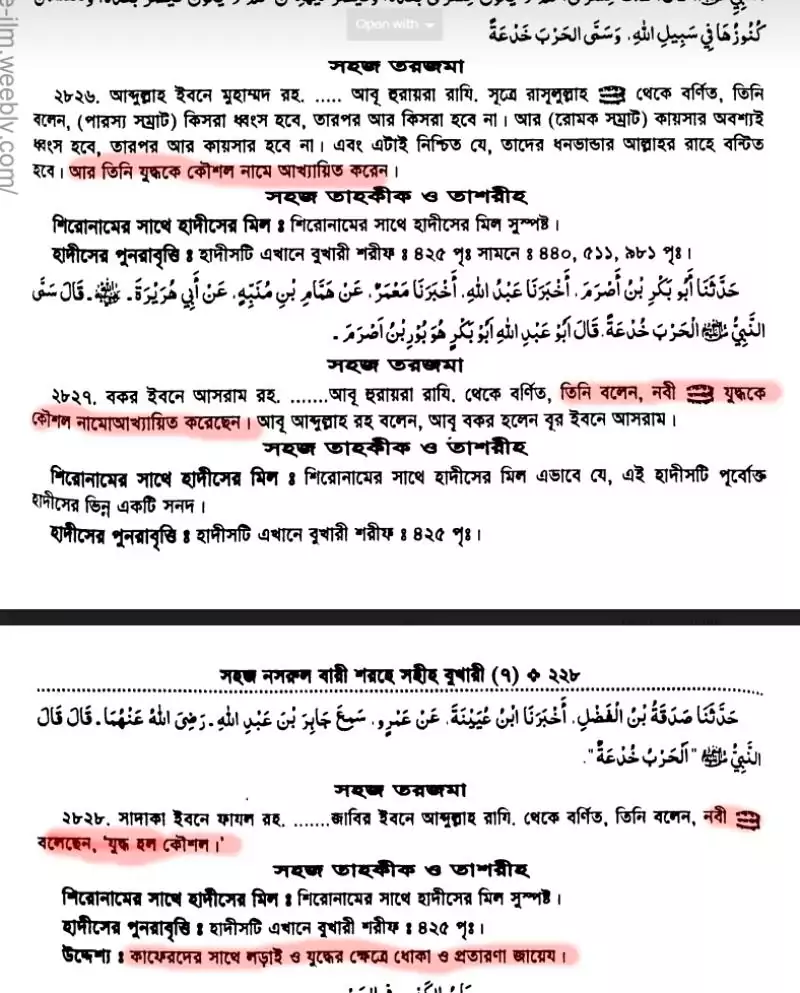
In Mawlana ‘Uthman Ghani’s Bengali commentary Sahaj Nasrul Bari, after several chains of transmission for the same report are presented side by side, the conclusion is stated even more directly under the section labelled “Purpose”: “Deception and deceit are permissible in fighting and war against unbelievers.” Thus, although the same commentary uses the word “strategy” in translation, its explanatory section explicitly identifies the meaning as “deception and deceit.” Restricting الْحَرْبُ خَدْعَةٌ to troop deployment, concealment of position, ordinary tactical planning or strategic manoeuvring is therefore inconsistent even with this Bengali commentary’s own explanation. [3]
2826. ‘Abd Allah ibn Muhammad narrated through Abu Hurayrah from the Messenger of Allah that he said: Kisra (the Persian emperor) will be destroyed, and after him there will be no Kisra. Caesar (the Roman emperor) will certainly be destroyed, and after him there will be no Caesar. Their treasures will certainly be distributed in the path of Allah. And he described war as strategy.
Simplified textual verification and commentary
Connection between the hadith and the chapter heading: The connection is clear.
Other occurrences of the hadith: The hadith appears here in Sahih al-Bukhari, p. 425; later at pp. 4440, 511 and 981.
حَدَّثَنَا أَبُو بَكْرِ بْنُ أَصْرَمَ أَخْبَرَنَا عَبْدُ اللَّهِ أَخْبَرَنَا مَعْمَرٌ، عَنْ هَمَّامِ بْنِ مُنَبِّهِ عَنْ أَبِي هُرَيْرَةَ . قَالَ سَمَّى النَّبِيُّ الْحَرْبَ خُدْعَةٌ ، قَالَ أَبُو عَبْدِ اللَّهِ أَبُو بَكْرٍ هُوَ بُوْرِ بْنُ أَصْرَمَ .
Simplified translation
2827. Bakr ibn Asram … narrated from Abu Hurayrah, who said: The Prophet called war strategy. Abu ‘Abd Allah said: Abu Bakr is Bur ibn Asram.
Simplified textual verification and commentary
Connection between the hadith and the chapter heading: This hadith provides another chain of transmission for the preceding report.
Other occurrences of the hadith: The hadith appears here in Sahih al-Bukhari, p. 425.
حَدَّثَنَا صَدَقَةُ بْنُ الْفَضْلِ أَخْبَرَنَا ابْنُ عُيَيْنَةَ، عَنْ عَمْرٍو سَمِعَ جَابِرَ بْنَ عَبْدِ اللَّهِ – رَضِيَ اللَّهُ عَنْهُمَا ، قَالَ قَالَ النَّبِيُّ الْحَرْبُ خُدْعَةٌ “.
Simplified translation
2828. Sadaqah ibn al-Fadl narrated from Jabir ibn ‘Abd Allah, who said: The Prophet said, “War is strategy.”
Simplified textual verification and commentary
Connection between the hadith and the chapter heading: The connection is clear.
Other occurrences of the hadith: The hadith appears here in Sahih al-Bukhari, p. 425.
Purpose: Deception and deceit are permissible in fighting and war against unbelievers.
Al-Nawawi’s Explanation: Outright Lying Is Also Permissible
In his al-Minhaj Sharh Sahih Muslim, al-Nawawi states that scholars agreed on the permissibility of deceiving unbelievers in war. He excludes from that permission deception involving the breach of a covenant or a guarantee of safety. On the question of outright lying, he quotes al-Tabari’s narrower interpretation before stating his own conclusion: the apparent meaning of the text permits outright lying, although limiting oneself to indirect speech is preferable. In his analysis, saying that indirect speech is preferable is not the same as saying that outright lying is prohibited. [4]
وَاتَّفَقَ الْعُلَمَاءُ عَلَى جَوَازِ خِدَاعِ الْكُفَّارِ فِي الْحَرْبِ وَكَيْفَ أَمْكَنَ الْخِدَاعُ إِلَّا أَنْ يَكُونَ فِيهِ نَقْضُ عَهْدٍ أَوْ أَمَانٍ فَلَا يَحِلُّ وَقَدْ صَحَّ فِي الْحَدِيثِ جَوَازُ الْكَذِبِ فِي ثَلَاثَةِ أَشْيَاءَ أَحَدُهَا فِي الْحَرْبِ قَالَ الطَّبَرِيُّ إِنَّمَا يَجُوزُ مِنَ الْكَذِبِ فِي الْحَرْبِ الْمَعَارِيضُ دُونَ حَقِيقَةِ الْكَذِبِ فَإِنَّهُ لَا يَحِلُّ هَذَا كَلَامُهُ وَالظَّاهِرُ إِبَاحَةُ حَقِيقَةِ نَفْسِ الْكَذِبِ لَكِنَّ الِاقْتِصَارَ عَلَى التعريض أفضل والله أعلم.
English translation:
The scholars agreed on the permissibility of deceiving unbelievers in war by whatever means possible, unless it involves breaking a covenant or a guarantee of safety, in which case it is not lawful. Authentic hadith establish that lying is permitted in three circumstances, one of which is war. Al-Tabari said that the permission to lie in war extends only to indirect or equivocal speech, not outright lying, which is unlawful. That is his statement. The apparent meaning of the text, however, permits outright lying, although restricting oneself to indirect speech is preferable. Allah knows best.
Al-Nawawi’s explanation clearly distinguishes three points. First, he reports scholarly agreement on the permissibility of deceiving unbelievers in war. Second, he places breach of covenant or guarantee of safety outside that permission. Third, on outright lying he does not adopt al-Tabari’s narrower position: where al-Tabari permits only ma’arid, or equivocal speech, al-Nawawi states that permission for outright lying is the apparent meaning of the hadith. His statement that “restricting oneself to indirect speech is preferable” does not prohibit outright lying; it ranks one of two permissible methods as preferable. The permissibility of outright lying in war is therefore not a modern inference drawn from al-Nawawi; it is his own explicitly stated interpretation in Islamic jurisprudence.
Ibn Hajar: Deception Means Showing One Thing While Concealing Its Opposite
In Fath al-Bari, Ibn Hajar al-‘Asqalani defines deception as showing one thing outwardly while concealing its opposite. In the same discussion, he takes the hadith as encouraging the deception of unbelievers. Reducing the word khud’ah to innocuous “skill” or “planning” therefore removes the deceptive meaning explicitly acknowledged by the commentator. [5]
وأصل الخدع إظهار أمر وإضمار خلافه. وفيه التحريض على أخذ الحذر في الحرب، والندب إلى خداع الكفار، وأن من لم يتيقظ لذلك لم يأمن أن ينعكس الأمر عليه، قال النووي: واتفقوا على جواز خداع الكفار في الحرب كيفما أمكن، إلا أن يكون فيه نقض عهد أو أمان فلا يجوز، قال ابن العربي: الخداع في الحرب يقع بالتعريض وبالكمين ونحو ذلك.
English translation:
The basic meaning of deception is to show one thing and conceal its opposite. The hadith urges caution in war and encourages the deception of unbelievers. Anyone who is not alert to this risks having the situation turned against him. Al-Nawawi said: they agreed on the permissibility of deceiving unbelievers in war by whatever means possible, unless it involves breaking a covenant or a guarantee of safety, in which case it is not permissible. Ibn al-‘Arabi said: deception in war occurs through indirect speech, ambushes and similar methods.
Al-Tirmidhi: Explicit Permission to Lie in War
Although the word khud’ah in the statement “war is deception” may leave room for ambiguity in translation, the report transmitted by Asma’ bint Yazid in al-Tirmidhi contains no such ambiguity. The word used explicitly is الْكَذِبُ—lying. The report first gives the general rule that lying is not lawful except in three cases, and then explicitly names “lying in war” as one of those exceptions. Thus, in war the hadith does not merely speak of withholding information, feints or equivocal speech; the word “lying” itself appears in the list of permitted exceptions. Al-Tirmidhi graded the report hasan. [6]
عَنْ أَسْمَاءَ بِنْتِ يَزِيدَ، قَالَتْ قَالَ رَسُولُ اللَّهِ صلى الله عليه وسلم: «لاَ يَحِلُّ الْكَذِبُ إِلاَّ فِي ثَلاَثٍ يُحَدِّثُ الرَّجُلُ امْرَأَتَهُ لِيُرْضِيَهَا وَالْكَذِبُ فِي الْحَرْبِ وَالْكَذِبُ لِيُصْلِحَ بَيْنَ النَّاسِ».
English translation:
Asma’ bint Yazid said that the Messenger of Allah said: Lying is not lawful except in three cases: what a man says to his wife in order to please her, lying in war, and lying in order to reconcile people.
Sahih Muslim 2605a also discusses the same three cases, but the attribution within the report differs. The statement that a person who reconciles people “is not a liar” is attributed to Muhammad, while the list of three cases—pleasing one’s wife, war and reconciliation between people—appears in that report as a statement by Ibn Shihab al-Zuhri. In al-Tirmidhi’s report, the same list is transmitted directly as Muhammad’s statement. Even with this textual distinction, the hadith tradition points in the same direction: war was treated as a permitted exception to the general prohibition on lying. In the later explanations of al-Nawawi, Ibn Hajar and Ibn al-‘Arabi, this principle was developed into a rule of Islamic jurisprudence. [7]
The Killing of Ka’b ibn al-Ashraf: Personal Trust as an Instrument of Killing
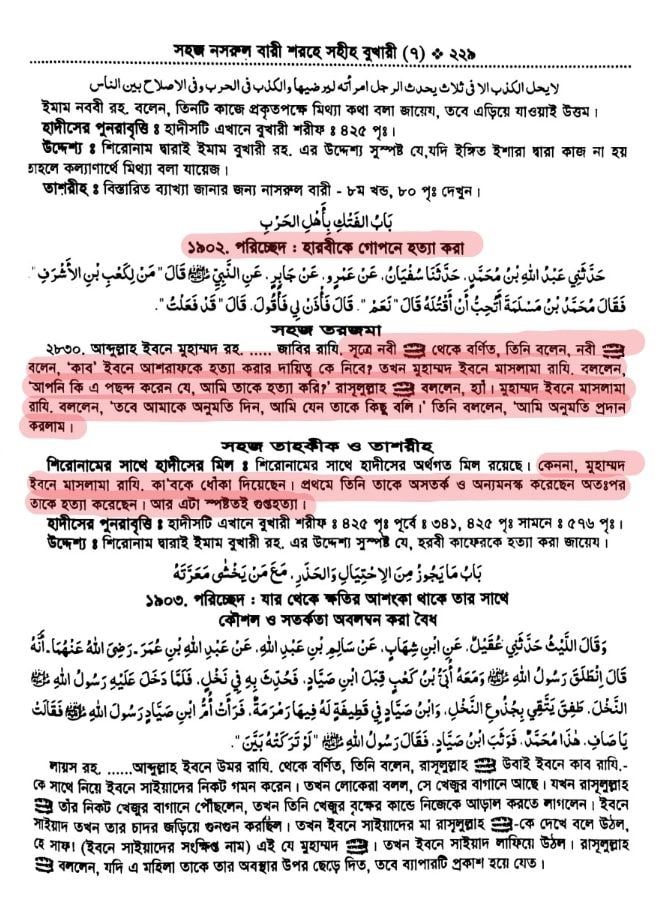
In the account of the killing of Ka’b ibn al-Ashraf, deception becomes part of a specific plan. Muhammad authorises his killing. Muhammad ibn Maslama asks for permission to say something and receives it. He then pretends to be dissatisfied with Muhammad, speaks of borrowing food and arranges to pledge weapons as collateral. At night, they call Ka’b out, accompanied by Abu Na’ila, his milk-brother (a brother through nursing). Because he knows them personally, Ka’b trusts them. After obtaining permission to smell the perfume on his head, Muhammad ibn Maslama seizes him firmly and tells the others to strike. This is not the concealment of troop positions; it is the use of personal trust to bring a person within reach of a planned killing. [8]
جَابِرَ بْنَ عَبْدِ اللَّهِ ـ رضى الله عنهما ـ يَقُولُ قَالَ رَسُولُ اللَّهِ صلى الله عليه وسلم «مَنْ لِكَعْبِ بْنِ الأَشْرَفِ فَإِنَّهُ قَدْ آذَى اللَّهَ وَرَسُولَهُ». فَقَامَ مُحَمَّدُ بْنُ مَسْلَمَةَ فَقَالَ يَا رَسُولَ اللَّهِ أَتُحِبُّ أَنْ أَقْتُلَهُ قَالَ «نَعَمْ». قَالَ فَأْذَنْ لِي أَنْ أَقُولَ شَيْئًا. قَالَ «قُلْ». فَأَتَاهُ مُحَمَّدُ بْنُ مَسْلَمَةَ فَقَالَ إِنَّ هَذَا الرَّجُلَ قَدْ سَأَلَنَا صَدَقَةً، وَإِنَّهُ قَدْ عَنَّانَا، وَإِنِّي قَدْ أَتَيْتُكَ أَسْتَسْلِفُكَ. قَالَ وَأَيْضًا وَاللَّهِ لَتَمَلُّنَّهُ قَالَ إِنَّا قَدِ اتَّبَعْنَاهُ فَلاَ نُحِبُّ أَنْ نَدَعَهُ حَتَّى نَنْظُرَ إِلَى أَىِّ شَىْءٍ يَصِيرُ شَأْنُهُ، وَقَدْ أَرَدْنَا أَنْ تُسْلِفَنَا وَسْقًا، أَوْ وَسْقَيْنِ ـ وَحَدَّثَنَا عَمْرٌو غَيْرَ مَرَّةٍ، فَلَمْ يَذْكُرْ وَسْقًا أَوْ وَسْقَيْنِ أَوْ فَقُلْتُ لَهُ فِيهِ وَسْقًا أَوْ وَسْقَيْنِ فَقَالَ أُرَى فِيهِ وَسْقًا أَوْ وَسْقَيْنِ ـ فَقَالَ نَعَمِ ارْهَنُونِي. قَالُوا أَىَّ شَىْءٍ تُرِيدُ قَالَ فَارْهَنُونِي نِسَاءَكُمْ. قَالُوا كَيْفَ نَرْهَنُكَ نِسَاءَنَا وَأَنْتَ أَجْمَلُ الْعَرَبِ قَالَ فَارْهَنُونِي أَبْنَاءَكُمْ. قَالُوا كَيْفَ نَرْهَنُكَ أَبْنَاءَنَا فَيُسَبُّ أَحَدُهُمْ، فَيُقَالُ رُهِنَ بِوَسْقٍ أَوْ وَسْقَيْنِ. هَذَا عَارٌ عَلَيْنَا، وَلَكِنَّا نَرْهَنُكَ اللأْمَةَ ـ قَالَ سُفْيَانُ يَعْنِي السِّلاَحَ ـ فَوَاعَدَهُ أَنْ يَأْتِيَهُ، فَجَاءَهُ لَيْلاً وَمَعَهُ أَبُو نَائِلَةَ وَهْوَ أَخُو كَعْبٍ مِنَ الرَّضَاعَةِ، فَدَعَاهُمْ إِلَى الْحِصْنِ، فَنَزَلَ إِلَيْهِمْ فَقَالَتْ لَهُ امْرَأَتُهُ أَيْنَ تَخْرُجُ هَذِهِ السَّاعَةَ فَقَالَ إِنَّمَا هُوَ مُحَمَّدُ بْنُ مَسْلَمَةَ، وَأَخِي أَبُو نَائِلَةَ ـ وَقَالَ غَيْرُ عَمْرٍو قَالَتْ أَسْمَعُ صَوْتًا كَأَنَّهُ يَقْطُرُ مِنْهُ الدَّمُ. قَالَ إِنَّمَا هُوَ أَخِي مُحَمَّدُ بْنُ مَسْلَمَةَ وَرَضِيعِي أَبُو نَائِلَةَ ـ إِنَّ الْكَرِيمَ لَوْ دُعِيَ إِلَى طَعْنَةٍ بِلَيْلٍ لأَجَابَ قَالَ وَيُدْخِلُ مُحَمَّدُ بْنُ مَسْلَمَةَ مَعَهُ رَجُلَيْنِ ـ قِيلَ لِسُفْيَانَ سَمَّاهُمْ عَمْرٌو قَالَ سَمَّى بَعْضَهُمْ قَالَ عَمْرٌو جَاءَ مَعَهُ بِرَجُلَيْنِ وَقَالَ غَيْرُ عَمْرٍو أَبُو عَبْسِ بْنُ جَبْرٍ، وَالْحَارِثُ بْنُ أَوْسٍ وَعَبَّادُ بْنُ بِشْرٍ قَالَ عَمْرٌو وَجَاءَ مَعَهُ بِرَجُلَيْنِ ـ فَقَالَ إِذَا مَا جَاءَ فَإِنِّي قَائِلٌ بِشَعَرِهِ فَأَشَمُّهُ، فَإِذَا رَأَيْتُمُونِي اسْتَمْكَنْتُ مِنْ رَأْسِهِ فَدُونَكُمْ فَاضْرِبُوهُ. وَقَالَ مَرَّةً ثُمَّ أُشِمُّكُمْ. فَنَزَلَ إِلَيْهِمْ مُتَوَشِّحًا وَهْوَ يَنْفَحُ مِنْهُ رِيحُ الطِّيبِ، فَقَالَ مَا رَأَيْتُ كَالْيَوْمِ رِيحًا ـ أَىْ أَطْيَبَ ـ وَقَالَ غَيْرُ عَمْرٍو قَالَ عِنْدِي أَعْطَرُ نِسَاءِ الْعَرَبِ وَأَكْمَلُ الْعَرَبِ قَالَ عَمْرٌو فَقَالَ أَتَأْذَنُ لِي أَنْ أَشَمَّ رَأْسَكَ قَالَ نَعَمْ، فَشَمَّهُ، ثُمَّ أَشَمَّ أَصْحَابَهُ ثُمَّ قَالَ أَتَأْذَنُ لِي قَالَ نَعَمْ. فَلَمَّا اسْتَمْكَنَ مِنْهُ قَالَ دُونَكُمْ. فَقَتَلُوهُ ثُمَّ أَتَوُا النَّبِيَّ صلى الله عليه وسلم فَأَخْبَرُوهُ.
English translation:
Jabir ibn ‘Abd Allah said that the Messenger of Allah said, “Who will deal with Ka’b ibn al-Ashraf? He has harmed Allah and His Messenger.” Muhammad ibn Maslama stood up and said, “Messenger of Allah, do you want me to kill him?” He said, “Yes.” He said, “Then permit me to say something.” He said, “Say it.”
Muhammad ibn Maslama went to Ka’b and said, “This man has asked us for charity and has caused us hardship. I have come to you to ask for a loan.” Ka’b said, “By Allah, you will grow tired of him.” He replied, “We have followed him, and we do not wish to leave him until we see what becomes of his affair. We want you to lend us one or two wasqs of food.” ‘Amr narrated the report to us more than once without mentioning one or two wasqs. Or I asked him whether it contained one or two wasqs, and he said, “I think it contains one or two wasqs.”
Ka’b said, “Yes, leave something with me as collateral.” They asked, “What do you want?” He said, “Pledge your women to me.” They said, “How can we pledge our women to you when you are the most handsome of the Arabs?” He said, “Then pledge your sons to me.” They said, “How can we pledge our sons to you? One of them would be insulted and people would say that he had been pledged for one or two wasqs. That would be a disgrace to us. Instead, we will pledge our armour and weapons to you.” Sufyan said that the word referred to weapons.
He arranged a time to return to Ka’b. He came to him at night accompanied by Abu Na’ila, who was Ka’b’s milk-brother. Ka’b called them into the fortress and came down to them. His wife asked, “Where are you going at this hour?” He said, “It is only Muhammad ibn Maslama and my brother Abu Na’ila.” In a version from narrators other than ‘Amr, she said, “I hear a voice from which blood seems to be dripping.” He said, “It is only my brother Muhammad ibn Maslama and my milk-brother Abu Na’ila. A noble man would answer even if he were called at night to be stabbed with a spear.”
Muhammad ibn Maslama brought two more men with him. Sufyan was asked whether ‘Amr had named them. He replied, “He named some of them.” ‘Amr said that he came with two men. Narrators other than ‘Amr named Abu ‘Abs ibn Jabr, al-Harith ibn Aws and ‘Abbad ibn Bishr. ‘Amr said that he brought two men with him. He told them, “When he comes, I will take hold of his hair and smell it. When you see that I have gained firm control of his head, go for him and strike him.” On one occasion he said, “Then I will let you smell it too.”
Ka’b came down to them wrapped in his garment, giving off the scent of perfume. Muhammad ibn Maslama said, “I have never smelled a fragrance as fine as this.” In the version of narrators other than ‘Amr, Ka’b said, “I have with me the Arab women who wear the finest perfume and are the most accomplished.” ‘Amr said that Muhammad ibn Maslama then asked, “Will you permit me to smell your head?” He said, “Yes.” He smelled it and then allowed his companions to smell it. He then asked again, “Will you permit me?” He said, “Yes.” When he had gained firm control of him, he said, “Now, go for him.” They killed him. Then they went to the Prophet and informed him.
Sahih al-Bukhari (Tawhid)
Book: 64/ Military Campaigns
Chapter: 64/15. The Killing of Ka’b ibn al-Ashraf
(Ka’b ibn al-Ashraf was a poet and leader of the Banu Qurayzah tribe who repeatedly circulated satirical remarks about the Messenger of Allah. He even composed ugly, indecent and outrageous statements about the wives and daughters of respectable Muslims. Exasperated by these activities, the Messenger of Allah finally instructed Muhammad ibn Maslama to kill him in Rabi’ al-Awwal of the third year after the Hijrah, and he was killed in accordance with that order.)
4037. Narrated from Jabir ibn ‘Abd Allah. One day the Messenger of Allah said: Who is ready to kill Ka’b ibn al-Ashraf? He has hurt Allah and His Messenger. Muhammad ibn Maslama stood and asked: Messenger of Allah, do you want me to kill him? He said: Yes. Muhammad ibn Maslama then said: Permit me to say some deceptive things. The Messenger of Allah said: Yes, say them. Muhammad ibn Maslama then went to Ka’b ibn al-Ashraf and said: This man—the Messenger—demands charity and has put us through great hardship. I have therefore come to you for a loan. Ka’b ibn al-Ashraf said: By Allah, he will trouble and torment you still more. Muhammad ibn Maslama replied: We are following him. We do not think it wise to leave him before seeing how matters turn out. I now ask you to lend me one or two wasqs of food.
The narrator Sufyan said: ‘Amr narrated this hadith to me several times, but he did not mention one or two wasqs. I said to him: This hadith contains mention of one or two wasqs. He said: I think the hadith does mention one or two wasqs. Ka’b ibn al-Ashraf said: You will receive the loan, but leave something as collateral. Muhammad ibn Maslama asked: What would you like as collateral? He said: Pledge your wives to me. Muhammad ibn Maslama said: You are a handsome man among the Arabs; how could we pledge our wives to you? He then said: Pledge your sons to me. He replied: How can we pledge our sons to you? They would be taunted and told that they had been pledged for merely one or two wasqs. That would be deeply shameful for us. We can instead pledge our weapons to you. The narrator Sufyan said that the word la’mah means weapons. Muhammad ibn Maslama then promised to return to him and left.
Later, at night, he went to Ka’b ibn al-Ashraf accompanied by Abu Na’ila, Ka’b’s milk-brother. Ka’b called them into the fortress and prepared to come down from the upper floor. His wife asked: Where are you going at this hour? He replied: It is only Muhammad ibn Maslama and my brother Abu Na’ila. Narrators other than ‘Amr report that Ka’b’s wife said: I hear a call that seems to drip with blood. Ka’b ibn al-Ashraf replied: It is Muhammad ibn Maslama and my milk-brother Abu Na’ila; they are not strangers. A noble man should respond even if he is called at night to be stabbed with a spear. The narrator says that Muhammad ibn Maslama went there with two more men. Sufyan was asked whether ‘Amr had named the two; he replied that he had named one. ‘Amr narrated that he had taken two other men with him. Narrators other than ‘Amr identified Muhammad ibn Maslama’s companions as Abu ‘Abs ibn Jabr, al-Harith ibn Aws and ‘Abbad ibn Bishr. ‘Amr said that he brought two other men with him and told them: When he comes, I will take hold of the hair of his head and smell it. When you see that I have gripped his head firmly, strike him with your swords. On one occasion Muhammad ibn Maslama said: I will let you smell it too. When Ka’b came down wrapped in a cloak, fragrance came from his body. Muhammad ibn Maslama said: I have never smelled a fragrance as fine as this. Narrators other than ‘Amr report that Ka’b said: I have with me noble and distinguished Arab women who use perfume. ‘Amr said that Muhammad ibn Maslama then asked: Will you permit me to smell your head? He said: Yes. Muhammad ibn Maslama smelled his head and then allowed his companions to smell it. He then asked again: Will you permit me to smell it once more? He said: Yes. He then subdued and seized him and told his companions: Kill him. They killed him. Then they went to the Prophet and informed him. (2510; Muslim 32/43, hadith 1801) (Adhunik Prakashani 3735; Islamic Foundation 3739)
Archived link to the hadith
Hadith grading: Sahih (Authentic)
Al-Bukhari places a shorter version of the same incident under the chapter heading “Lying in War”—باب الكذب في الحرب. In that report Muhammad ibn Maslama continues speaking to Ka’b as though dissatisfied with Muhammad and, in the wording of the narration, continues speaking to him until he gains control of him and kills him. Permission for the killing, concealment of the real intention and the creation of an opportunity to kill through deception all form parts of the same incident. [9]
In the immediately following chapter, al-Bukhari again presents the same killing of Ka’b. This time the chapter is titled “Secretly Killing Members of the Enemy”—باب الْفَتْكِ بِأَهْلِ الْحَرْبِ. In the shorter report, after obtaining Muhammad’s permission to kill Ka’b, Muhammad ibn Maslama says, “Then permit me to say what I need to say”; Muhammad grants that permission. In al-Bukhari’s sequence of chapters, the killing of Ka’b thus appears as a specific example both of lying in war and of secretly killing an enemy. [10]
عَنْ جَابِرٍ، عَنِ النَّبِيِّ صلى الله عليه وسلم قَالَ «مَنْ لِكَعْبِ بْنِ الأَشْرَفِ». فَقَالَ مُحَمَّدُ بْنُ مَسْلَمَةَ أَتُحِبُّ أَنْ أَقْتُلَهُ قَالَ «نَعَمْ». قَالَ فَأْذَنْ لِي فَأَقُولَ. قَالَ «قَدْ فَعَلْتُ».
English translation:
Jabir narrated that the Prophet said, “Who will deal with Ka’b ibn al-Ashraf?” Muhammad ibn Maslama said, “Would you like me to kill him?” He said, “Yes.” He said, “Then permit me to say what I need to say.” He replied, “I have granted you permission.”
Let us now examine what Sahaj Nasrul Bari says about this assassination. [11]
Abu Dawud and ‘Awn al-Ma’bud: Catching the Enemy Unawares and Resembling Them Outwardly
Abu Dawud preserves the killing of Ka’b ibn al-Ashraf under the chapter title “Attacking the Enemy Unawares and Resembling Them”—باب في العدو يؤتى على غرة ويتشبه بهم. Both elements of the heading directly concern the method used in Ka’b’s killing: keeping the target unaware of the actual intention to kill him and arranging the killers’ outward conduct so that they are not recognised as enemies. After receiving permission to kill Ka’b, Muhammad ibn Maslama asks for permission to “say something”; he then pretends to be dissatisfied with Muhammad, asks for a loan, discusses collateral and uses familiar relationships to gain Ka’b’s confidence. [12]
In ‘Awn al-Ma’bud, Shams al-Haqq al-‘Azimabadi explains the expression “being approached unawares” to mean that the enemy is unaware of the decision and intention to kill him. By “resembling them”, he does not mean only clothing or appearance; his explanation includes resembling the enemy’s outward form, conduct and customs, as well as using statements containing tawriyah. He cites Muhammad ibn Maslama’s words, “This man has asked us for charity and caused us hardship,” as an example and states that such statements would not be permissible under Islamic law outside that particular circumstance. [13]
وَيَتَشَبَّهُ أَيِ الْمُسْلِمُ الدَّاخِلُ عَلَى الْعَدُوِّ بِهِمْ أَيْ بِالْأَعْدَاءِ فِي ظَاهِرِ الْحَالِ وَقَلْبُهُ مُطْمَئِنٌّ بِالْإِيمَانِ فَيَتَشَبَّهُ بِهَيْئَتِهِمْ وَآدَابِهِمْ وَأَخْلَاقِهِمْ وَالتَّلَفُّظِ بِالْكَلِمَاتِ الَّتِي فِيهَا تَوْرِيَةٌ.
English translation:
“He resembles them”—that is, the Muslim who enters among the enemy resembles the enemy outwardly while his heart remains firm in faith; he resembles their appearance, manners and conduct, and uses words containing tawriyah, or equivocation.
Calling It “Tawriyah” Does Not Change the Purpose of the Deception
Ibn Hajar interprets the words spoken to Ka’b as allusive or equivocal rather than as direct lies. In this reading, the statement “he has caused us hardship” can refer, in the speaker’s mind, to the obligations imposed by religious commands and prohibitions while outwardly creating the impression of dissatisfaction; the speaker’s concealed meaning is therefore treated as true. At the same time, Ibn Hajar states that Muhammad’s permission included both explicit and indirect lying. Both parts of his statement matter: he characterises the particular words as allusive, but he does not restrict the permission itself to allusion. [14]
والذي يظهر أنه لم يقع منهم فيما قالوه بشيء من الكذب أصلا، وجميع ما صدر منهم تلويح كما سبق، لكن ترجم بذلك لقول محمد بن مسلمة للنبي صلى الله عليه وسلم أولا «ائذن لي أن أقول، قال قل» فإنه يدخل فيه الإذن في الكذب تصريحا وتلويحا.
English translation:
It appears that nothing they said involved an outright lie; all their statements were allusive, as explained above. But al-Bukhari used this chapter heading because Muhammad ibn Maslama first said to the Prophet, “Permit me to say something,” and he replied, “Say it.” This includes permission to lie both explicitly and by allusion.
In tawriyah, or equivocal speech, the speaker holds one meaning in mind while allowing the listener to understand another. In the killing of Ka’b, that misunderstanding was not accidental; it formed part of the plan to bring him within reach of the killers. Even if the speaker’s concealed meaning is treated as literally true, deliberately creating a false belief in the listener remains deception. Saying “I intended one potentially true meaning of the words” does not erase either the intention to mislead another person or the moral responsibility for using that misunderstanding to facilitate a killing. Bringing Ka’b’s milk-brother, establishing contact through the discussion of borrowing food and pledging weapons, and obtaining permission to smell the perfume on his head in order to seize him all helped turn personal trust into an opportunity for killing.
Hajjaj ibn ‘Ilat: False News to Recover Property
Ibn Hajar also cites the case of Hajjaj ibn ‘Ilat to support the permissibility of outright lying. In his discussion, Hajjaj obtains permission to say whatever he wishes about Muhammad in order to recover his property, and then tells the people of Mecca that the people of Khaybar have defeated the Muslims. Ibn Hajar himself states later in the discussion that the incident did not occur during active fighting. The example he uses therefore extends the permission to lie beyond an active battlefield. [15]
ويقويه ما أخرجه أحمد وابن حبان من حديث أنس في قصة الحجاج ابن علاط الذي أخرجه النسائي وصححه الحاكم في استئذانه النبي صلى الله عليه وسلم أن يقول عنه ما شاء لمصلحته في استخلاص ماله من أهل مكة وأذن له النبي صلى الله عليه وسلم، وإخباره لأهل مكة أن أهل خيبر هزموا المسلمين وغير ذلك مما هو مشهور فيه.
English translation:
This is further supported by the report of Anas concerning Hajjaj ibn ‘Ilat, transmitted by Ahmad and Ibn Hibban; al-Nasa’i also transmitted it, and al-Hakim graded it sahih. It records that, in order to recover his property from the people of Mecca, Hajjaj sought the Prophet’s permission to say whatever he wished about him, and the Prophet gave him permission. He then told the people of Mecca that the people of Khaybar had defeated the Muslims, along with other well-known details of the incident.
In the case of Hajjaj, the lie was not merely a matter of withholding information; news directly contrary to the actual military outcome at Khaybar was circulated. The purpose was to recover his property in Mecca safely. In Zad al-Ma’ad, Ibn al-Qayyim derives a general rule of Islamic jurisprudence from the incident: if it does not harm another person, it is permissible to lie about oneself or another in order to recover what is rightfully one’s own. He cites Hajjaj ibn ‘Ilat’s lie as an example of this rule. He then evaluates the grief and distress experienced by the Muslims in Mecca upon hearing the false news as a minor harm (mafsadah) compared with the greater benefit, joy and increase in faith that came later. [16]
وَمِنْهَا جَوَازُ كَذِبِ الْإِنْسَانِ عَلَى نَفْسِهِ وَعَلَى غَيْرِهِ إِذَا لَمْ يَتَضَمَّنْ ضَرَرَ ذَلِكَ الْغَيْرِ إِذَا كَانَ يَتَوَصَّلُ بِالْكَذِبِ إِلَى حَقِّهِ كَمَا كَذَبَ الْحَجَّاجُ بْنُ عِلَاطٍ.
English translation:
Another ruling derived from this is that a person may lie about himself or another person to recover what is rightfully his, provided that the lie does not harm that other person—as Hajjaj ibn ‘Ilat did.
Here a specific incident becomes the basis for a later generalisation in Islamic jurisprudence. That Hajjaj’s lie worked is a question of effectiveness; that Ibn al-Qayyim treats the lie as permissible under specified conditions is an assessment under Islamic law. Neither effectiveness nor permissibility under Islamic law automatically establishes ethical justification. Notably, the lie also caused temporary emotional distress to innocent Muslims. Ibn al-Qayyim does not deny that harm; he evaluates it as minor in comparison with the greater benefit. The ethical framework here therefore does not rest on an unqualified obligation to tell the truth, but on a comparative calculation of purpose, benefit and harm.
Taqiyya: Qur’anic Grounds for Concealing Belief and Displaying Contrary Conduct
Taqiyya is an established concept in Islam; it is also recognised in Sunni tafsir and fiqh. At its core is concealing one’s belief, or outwardly displaying its opposite, to avoid danger while preserving faith inwardly. Qur’an 3:28 prohibits believers from taking unbelievers as protectors or allies instead of believers, but includes an exception for acting “to protect yourselves from them.” Classical tafsir interpreted this exception as a basis for taqiyya. [17]
لَا يَتَّخِذِ الْمُؤْمِنُونَ الْكَافِرِينَ أَوْلِيَاءَ مِنْ دُونِ الْمُؤْمِنِينَ وَمَنْ يَفْعَلْ ذَلِكَ فَلَيْسَ مِنَ اللَّهِ فِي شَيْءٍ إِلَّا أَنْ تَتَّقُوا مِنْهُمْ تُقَاةً وَيُحَذِّرُكُمُ اللَّهُ نَفْسَهُ وَإِلَى اللَّهِ الْمَصِيرُ.
English translation:
Believers must not take unbelievers as protectors or allies instead of believers. Whoever does so has nothing to do with Allah, except when you take precautions to protect yourselves from them. Allah warns you concerning Himself, and to Allah is the final return.
Qur’an 16:106 makes the distinction between inward belief and outward expression still clearer for a person under coercion. A person who outwardly expresses unbelief while the heart remains firm in faith is not placed in the same category as someone who willingly embraces unbelief. [18]
مَنْ كَفَرَ بِاللَّهِ مِنْ بَعْدِ إِيمَانِهِ إِلَّا مَنْ أُكْرِهَ وَقَلْبُهُ مُطْمَئِنٌّ بِالْإِيمَانِ وَلَكِنْ مَنْ شَرَحَ بِالْكُفْرِ صَدْرًا فَعَلَيْهِمْ غَضَبٌ مِنَ اللَّهِ وَلَهُمْ عَذَابٌ عَظِيمٌ.
English translation:
Those who disbelieve in Allah after having believed—except those who are compelled while their hearts remain firm in faith—and open their hearts to unbelief incur Allah’s wrath and face a severe punishment.
Al-Tabari: Alliance Expressed Verbally, an Opposite Position Held Inwardly
In al-Tabari’s explanation, the exception in Al ‘Imran 3:28 is not a matter of ordinary social courtesy. He first explains the prohibition on taking unbelievers as religious and political allies; then, in explaining the clause “except when you take precautions to protect yourselves from them”, he identifies a specific situation—when believers live under their authority and fear for their own safety. In that situation they may verbally profess alliance while inwardly maintaining the opposite position. In the same discussion, a report from Ibn ‘Abbas likewise describes displaying outward friendliness towards a powerful opponent while continuing to oppose them in religion. [19]
إِلَّا أَنْ تَكُونُوا فِي سُلْطَانِهِمْ فَتَخَافُوهُمْ عَلَى أَنْفُسِكُمْ، فَتُظْهِرُوا لَهُمُ الْوِلَايَةَ بِأَلْسِنَتِكُمْ، وَتُضْمِرُوا لَهُمُ الْعَدَاوَةَ.
English translation:
Except when you are under their authority and fear them for your own safety; then you may verbally profess alliance with them while concealing hostility towards them in your hearts.
Ibn Kathir and Ibn al-Qayyim: Recognition of Taqiyya in Sunni Sources
In his commentary on Al ‘Imran 3:28, Ibn Kathir states that when a person fears harm from an enemy, outward conduct may differ from inward belief and intention. He quotes the statement attributed to Abu al-Darda’ about smiling in people’s faces while inwardly cursing them, Ibn ‘Abbas’s explanation of taqiyya through the tongue, and al-Hasan al-Basri’s statement that “taqiyya continues until the Day of Resurrection.” The word “taqiyya” itself is used here; the concept does not depend on a later external accusation. [20]
وقوله: (إلا أن تتقوا منهم تقاة) أي: إلا من خاف في بعض البلدان أو الأوقات من شرهم، فله أن يتقيهم بظاهره لا بباطنه ونيته، كما حكاه البخاري عن أبي الدرداء أنه قال: «إنا لنكشر في وجوه أقوام وقلوبنا تلعنهم». وقال الثوري: قال ابن عباس، رضي الله عنهما: ليس التقية بالعمل إنما التقية باللسان، وكذا رواه العوفي عن ابن عباس: إنما التقية باللسان، وكذا قال أبو العالية، وأبو الشعثاء والضحاك، والربيع بن أنس. ويؤيد ما قالوه قول الله تعالى: (من كفر بالله من بعد إيمانه إلا من أكره وقلبه مطمئن بالإيمان ولكن من شرح بالكفر صدرا فعليهم غضب من الله ولهم عذاب عظيم) [النحل: 106]. وقال البخاري: قال الحسن: التقية إلى يوم القيامة.
English translation:
Allah’s words, “except when you take precautions to protect yourselves from them,” mean that if someone in a particular land or at a particular time fears harm from them, he may protect himself through his outward conduct without changing his inward belief or intention. Al-Bukhari relates from Abu al-Darda’ that he said: “We smile at some people while our hearts curse them.” Al-Thawri said that Ibn ‘Abbas said: taqiyya is practised through speech alone, not through action. Al-‘Awfi likewise narrated from Ibn ‘Abbas: taqiyya is practised through speech alone. Abu al-‘Aliyah, Abu al-Sha’tha’, al-Dahhak and al-Rabi’ ibn Anas said the same. Their position is supported by Allah’s statement: “Those who disbelieve in Allah after having believed—except those who are compelled while their hearts remain firm in faith—and open their hearts to unbelief incur Allah’s wrath and face a severe punishment.” [al-Nahl 16:106] Al-Bukhari said that al-Hasan said: “Taqiyya continues until the Day of Resurrection.”
In Ahkam Ahl al-Dhimma, Ibn al-Qayyim defines taqiyya within a specific theoretical dispute. He rejects the idea that humanity’s primordial covenant could be interpreted as an acknowledgement made “under taqiyya.” In the course of refuting that view, he specifies the meaning of taqiyya: a person says the opposite of what he actually believes in order to protect himself from harm that would occur if he disclosed his true position. Ibn al-Qayyim’s definition therefore contains two principal elements—a deliberate mismatch between inward belief and outward speech, and the aim of avoiding anticipated harm through that mismatch. [21]
وَكَذَلِكَ قَوْلُهُمْ إِنَّهُمْ أَقَرُّوا عَلَى وَجْهِ التَّقِيَّةِ كَلَامٌ بَاطِلٌ قَطْعًا، فَإِنَّ التَّقِيَّةَ أَنْ يَقُولَ الْعَبْدُ خِلَافَ مَا يَعْتَقِدُهُ لِاتِّقَاءِ مَكْرُوهٍ يَقَعُ بِهِ.
English translation:
Likewise, their claim that their acknowledgement was made under taqiyya is certainly false. For taqiyya is when a person says the opposite of what he believes in order to ward off harm that would otherwise befall him.
The Hanafi jurist Shams al-A’immah al-Sarakhsi discusses taqiyya as part of the law of coercion in Kitab al-Ikrah of al-Mabsut. He first mentions a view that rejected outwardly displaying the opposite of what one holds inwardly as hypocrisy; he then rejects that position and states that taqiyya is permissible, citing Al ‘Imran 3:28 as evidence. In his explanation, uttering words of shirk under coercion while inward faith remains intact also falls within taqiyya. In the same discussion he notes a limit: taqiyya may not be used to save one’s own life by killing an innocent person. [22]
وَالصَّحِيحُ أَنَّ ذَلِكَ جَائِزٌ لِقَوْلِهِ تَعَالَى إِلَّا أَنْ تَتَّقُوا مِنْهُمْ تُقَاةً، وَالتَّقِيَّةُ أَنْ يَقِيَ نَفْسَهُ مِنَ الْعُقُوبَةِ بِمَا يُظْهِرُهُ، وَإِنْ كَانَ يُضْمِرُ خِلَافَهُ.
English translation:
The correct view is that this is permissible, on the basis of Allah’s statement, “except when you take precautions to protect yourselves from them.” Taqiyya means protecting oneself from punishment through what one displays outwardly, even while holding the opposite position inwardly.
Sunni tafsir and fiqh therefore permit taqiyya conditionally: under fear, coercion or the threat of serious harm, a person may preserve inward belief while outwardly displaying contrary words or conduct. Al-Tabari describes a verbal profession of alliance with a powerful opponent while inward opposition remains; Ibn Kathir discusses outward conduct differing from inward belief; Ibn al-Qayyim defines taqiyya as saying the opposite of one’s belief; and al-Sarakhsi’s jurisprudence permits uttering words of unbelief under coercion. These are different applications of the same basic structure. Concealing belief for self-preservation and concealing one’s real intention in order to bring an opponent within reach of a planned killing are ethically different situations, but both involve permission to separate outward expression deliberately from actual belief or intention.
Taqiyya in Twelver Shi’a Islam: Concealment of Religious Identity, Necessity and Limits
In Twelver Shi’a hadith tradition, taqiyya is a subject treated more systematically and discussed repeatedly. Al-Kulayni’s al-Kafi, in Kitab al-Iman wa al-Kufr, contains a separate chapter entitled “Bab al-Taqiyya”. The immediate context of one report in that chapter concerns standing in honour of rulers. When Mu’ammar ibn Khallad asked Abu al-Hasan about standing for governors, he quoted Abu Ja’far as saying: “Taqiyya is part of my religion and the religion of my forefathers; there is no faith for one who has no taqiyya.” The statement therefore appears not as an isolated slogan but as an answer to a practical question about outward conduct before political authorities. [23]
سَأَلْتُ أَبَا الْحَسَنِ عَنِ الْقِيَامِ لِلْوُلاةِ فَقَالَ قَالَ أَبُو جَعْفَرٍ التَّقِيَّةُ مِنْ دِينِي وَدِينِ آبَائِي وَلا إِيمَانَ لِمَنْ لا تَقِيَّةَ لَهُ.
English translation:
I asked Abu al-Hasan about standing for governors. He said that Abu Ja’far said: “Taqiyya is part of my religion and the religion of my forefathers; there is no faith for one who has no taqiyya.”
In the same chapter of al-Kafi, the application of taqiyya is tied to necessity and coercion. A report attributed to Abu Ja’far states: “Taqiyya applies in every case of necessity, and the person facing that situation knows it best when it arises.” Another report states that in matters to which people are compelled, Allah has granted them relief through taqiyya. Thus, although Shi’a hadith tradition uses strong language about taqiyya, its application is not defined as a general licence to conceal truth at will; necessity, fear and coercion form part of its framework in Islamic jurisprudence. [24]
التَّقِيَّةُ فِي كُلِّ ضَرُورَةٍ وَصَاحِبُهَا أَعْلَمُ بِهَا حِينَ تَنْزِلُ بِهِ.
English translation:
Taqiyya applies in every case of necessity, and the person facing that situation knows it best when it arises.
Shi’a fiqh also preserves an important limit on this permission. In al-Hurr al-‘Amili’s Wasa’il al-Shi’a, a separate chapter is explicitly titled “Taqiyya Is Not Permissible in Matters of Blood.” There, a report from Abu Ja’far is quoted from al-Kafi: taqiyya was instituted to prevent bloodshed; when the matter reaches the shedding of another person’s blood, there is no taqiyya. In other words, this principle does not include permission to kill an innocent person under the pretext of preserving one’s own life or safety. [25]
إِنَّمَا جُعِلَتِ التَّقِيَّةُ لِيُحْقَنَ بِهَا الدَّمُ، فَإِذَا بَلَغَ الدَّمَ فَلَيْسَ تَقِيَّةٌ.
English translation:
Taqiyya was instituted to prevent bloodshed; when the matter reaches bloodshed, taqiyya no longer applies.
Later Imami theology likewise describes taqiyya as a distinctive feature of Shi’a identity. In ‘Aqa’id al-Imamiyyah, Muhammad Rida al-Muzaffar calls taqiyya a distinguishing feature of Imamiyya Shi’ism and describes its historical function as protecting the Imams and their followers from harm, preventing bloodshed and preserving the community under persecution. At the same time, in his discussion taqiyya is not always obligatory: where openly declaring the truth is necessary to serve a religious purpose, it may be abandoned even at risk to life and property. In the Imamiyya framework, taqiyya is therefore a powerful religious principle, but it is neither unlimited nor applicable in every circumstance. [26]
Taqiyyah is still the distinctive feature of the Imamiyyah Shi`ah amongst the other sects and nations.
Restated in contemporary English:
Taqiyyah remains a distinctive feature of the Imamiyyah Shi’a among other sects and nations.
In both Sunni and Shi’a traditions, the basic structure of taqiyya is a deliberate difference, in permitted circumstances, between outward expression and actual inward belief. The principal difference lies in its theological importance and historical breadth: in Sunni fiqh it is discussed mainly as an exceptional rule concerning coercion, fear and particular wartime stratagems; in Twelver Shi’a hadith and theology it has a much more prominent place, with a dedicated chapter, repeated Imami teachings and a role as a principle of communal self-protection. Shi’a sources themselves, however, impose conditions of necessity and a limit where bloodshed is involved.
‘Abd Allah al-Qarni: Concealing Belief and Presenting a Contrary Identity for Wartime Purposes
In his study Dawabit al-Takfir ‘inda Ahl al-Sunnah wa al-Jama’ah, ‘Abd Allah al-Qarni does not restrict taqiyya to remaining silent while preserving faith inwardly. His definition includes concealing Islam for a permitted reason, refraining from displaying the religion, and outwardly displaying unbelief or sin contrary to one’s actual belief. He treats conformity between inward belief and outward conduct as the normal rule, but makes exceptions for coercion and particular wartime stratagems. Among his wartime examples are Nu’aym ibn Mas’ud concealing his conversion to Islam in order to create confusion among the enemy and Muhammad ibn Maslama pretending to be dissatisfied with Muhammad in order to kill Ka’b ibn al-Ashraf. [27]
التَّقِيَّةُ مِنَ الاتِّقَاءِ، سَوَاءٌ كَانَ ذَلِكَ بِكِتْمَانِ الدِّينِ وَعَدَمِ إِظْهَارِهِ، أَوْ بِإِظْهَارِ مَا يُخَالِفُ الإِيمَانَ مِنْ كُفْرٍ أَوْ مَعْصِيَةٍ فِي الظَّاهِرِ فَقَطْ.
English translation:
Taqiyya derives from the idea of self-protection; it includes concealing one’s religion and refraining from professing it openly, or outwardly displaying unbelief or sin that contradicts actual faith.
This definition and the examples he selects show two distinct applications for taqiyya. One is concealing religious identity out of fear of persecution or harm; the other is creating, for wartime purposes, an impression in the opponent’s mind that contradicts one’s actual religious or political position. In the killing of Ka’b, the impression that Muhammad ibn Maslama was dissatisfied with following Muhammad was created in order to gain Ka’b’s trust. Thus, although taqiyya, tawriyah and wartime deception are distinct terms, their practical methods converge here: withholding the speaker’s actual belief or intention and leading the target to believe the opposite.
Ibn al-‘Arabi: No Place for Reason in the Face of a Religious Ruling
The theological basis for permission to lie is even clearer in the statement of the Maliki jurist Abu Bakr Ibn al-‘Arabi. In Tuhfat al-Ahwadhi, ‘Abd al-Rahman al-Mubarakpuri quotes Ibn al-‘Arabi as saying that lying in war is an exception permitted by revealed text because Muslims need it, and that reason has no role in the matter. The person quoted here is the Maliki jurist Abu Bakr Ibn al-‘Arabi, not the Sufi philosopher Ibn ‘Arabi of the same name. [28]
وقال ابن العربي: الكذب في الحرب من المستثنى الجائز بالنص رفقا بالمسلمين لحاجتهم إليه وليس للعقل فيه مجال، ولو كان تحريم الكذب بالعقل ما انقلب حلالا انتهى.
English translation:
Ibn al-‘Arabi said: Lying in war is among the exceptions permitted by revealed text, as a concession to Muslims because of their need for it. Reason has no place in this matter. If the prohibition of lying were based on reason, it could not have become lawful. End of quotation.
In Ibn al-‘Arabi’s statement, the religious ruling itself provides the basis for the permissibility of lying, and reason is excluded from determining that permissibility. But religious permission cannot itself serve as proof that the permission is ethically justified; that would be circular reasoning. The claim that an act is permissible under Sharia is separate from the claim that it is ethically justified in light of the harm caused by deception.
The Prohibition on Breaching Covenants and the Exploitation of Personal Trust
In the explanations of al-Nawawi and Ibn Hajar, permission for wartime deception does not extend to breaking a covenant or a formal guarantee of safety; that limit forms part of their position in Islamic jurisprudence. But a formal aman (guarantee of safety) and trust arising from a personal relationship are not the same thing. The account of Ka’b’s killing does not say that he was given a formal promise of safety; instead, the plan exploited his trust in people familiar to him. The presence of his milk-brother Abu Na’ila reassured him. Even after his wife expressed suspicion about the nighttime call, Ka’b replied that those outside were Muhammad ibn Maslama and his milk-brother. The discussion of borrowing food and pledging weapons made the interaction appear ordinary while concealing its actual purpose. A flattering request to smell the perfume on his head then secured his permission to come close, and at that very moment he was seized firmly and the companions were told to strike. In the method described, trust arising from personal relationships was deliberately converted into an opportunity for killing. The absence of a formal aman in the technical sense used in Islamic jurisprudence does not alter the ethical nature of this relationship-based deception.
Military Success Is Not Proof of Moral Superiority
That a method can defeat an enemy is a claim about effectiveness. That the same method is justified is a moral claim. The second does not follow automatically from the first. A killer may successfully gain another person’s trust; that success does not establish his moral superiority. Likewise, if a plan is carried out with the permission of a religious leader, the plan may be considered religiously permissible, but its justification in human ethical terms must still be established independently.
In legitimate self-defence there is no obligation to disclose every piece of information to an opponent. But in evaluating deception, whether the war is just, the role of the target, the relationship exploited, the degree of harm and the availability of alternative methods are relevant. The word “war” alone does not answer all these questions. Simply calling the plan to use personal trust to bring Ka’b within reach of his killers a “war tactic” does not change its nature. Assessing this authorised conduct in relation to the claim that Muhammad is a moral ideal requires examining the conduct itself.
Conclusion
Across the Qur’an, Sunni and Shi’a tafsir and fiqh, hadith and classical commentary, there are multiple forms of permission to make outward expression differ from actual belief or intention. Sunni sources recognise taqiyya under fear and coercion; Twelver Shi’a hadith tradition contains a separate chapter on taqiyya, repeated Imami instructions and necessity-based rulings. In war, deceiving an opponent is permitted; in al-Nawawi’s explanation, outright lying is also permissible; Ibn Hajar includes both explicit and indirect lying within Muhammad’s permission; and the account of Ka’b’s killing records the concealment of real intent and the use of personal trust as part of the killing plan. At the same time, the sources also impose limits: al-Nawawi and Ibn Hajar prohibit breaching covenants and guarantees of safety (aman), while Shi’a hadith and fiqh do not extend taqiyya to the shedding of another person’s blood. These limits define the scope of permitted deception; they do not erase the permitted cases themselves.
It is inconsistent to present permission to lie as the finest example of truthfulness, or the exploitation of personal trust to facilitate killing as proof of humane character. Military effectiveness, permissibility under Sharia and ethical justification are not the same thing. Permission from a religious authority does not erase the moral responsibility involved in exploiting a person’s trust in order to kill them; the authority granting that permission must also be held accountable in that moral assessment.
References
- Sahih Muslim, Hadith Academy 4431; international no. 1739; Arabic original ↩︎
- Sahih Muslim, Hadith Academy 4432; international no. 1740; Arabic original ↩︎
- Sahaj Nasrul Bari, Sharh Sahih al-Bukhari, Arabic-Bengali, simplified translation and detailed commentary, Mawlana ‘Uthman Ghani, al-Kawthar Publications, vol. 7, pp. 227–228 ↩︎
- Al-Nawawi, al-Minhaj Sharh Sahih Muslim, vol. 12, p. 45 — Shamela; same explanation — Islamweb; quotation of al-Nawawi — IslamQA, answer 83093 ↩︎
- Ibn Hajar al-‘Asqalani, Fath al-Bari, vol. 6, chapter “War is deception” — Islamweb ↩︎
- Jami’ al-Tirmidhi, hadith 1939 ↩︎
- Sahih Muslim, hadith 2605a ↩︎
- Sahih al-Bukhari, hadith 4037, “The Killing of Ka’b ibn al-Ashraf” ↩︎
- Sahih al-Bukhari, hadith 3031, باب الكذب في الحرب ↩︎
- Sahih al-Bukhari, hadith 3032, باب الْفَتْكِ بِأَهْلِ الْحَرْبِ ↩︎
- Sahaj Nasrul Bari, Sharh Sahih al-Bukhari, vol. 7, Arabic-Bengali, simplified translation and detailed commentary, Mawlana Muhammad ‘Uthman Ghani, al-Kawthar Publications, p. 229 ↩︎
- Sunan Abi Dawud, hadith 2768 ↩︎
- Shams al-Haqq al-‘Azimabadi, ‘Awn al-Ma’bud, Kitab al-Jihad — Islamweb ↩︎
- Ibn Hajar al-‘Asqalani, Fath al-Bari, commentary on the chapter “Lying in War” — Islamweb; quotation of Ibn Hajar, fatwa 358705 ↩︎
- Ibn Hajar al-‘Asqalani, Fath al-Bari, chapter “Lying in War,” vol. 6, pp. 184–185 — Islamweb ↩︎
- Ibn al-Qayyim, Zad al-Ma’ad, vol. 3 — Islamweb ↩︎
- Qur’an, Al ‘Imran 3:28 ↩︎
- Qur’an, al-Nahl 16:106 ↩︎
- Al-Tabari, Jami’ al-Bayan, tafsir of Al ‘Imran 3:28 — Islamweb ↩︎
- Ibn Kathir, Tafsir al-Qur’an al-‘Azim, Al ‘Imran 3:28, vol. 2, pp. 30–31 — Islamweb ↩︎
- Ibn al-Qayyim, Ahkam Ahl al-Dhimma, vol. 2, p. 1038 — Islamweb; quotation of the same definition — IslamQA, answer 178975 ↩︎
- Al-Sarakhsi, al-Mabsut, Kitab al-Ikrah, vol. 24 — Islamweb ↩︎
- Al-Kafi, vol. 2, Kitab al-Iman wa al-Kufr, Bab al-Taqiyya, hadith 12 ↩︎
- Al-Kafi, vol. 2, p. 219, Bab al-Taqiyya; Al-Kafi, same chapter, hadith 18, with Mir’at al-‘Uqul ↩︎
- Wasa’il al-Shi’a, chapter 31: taqiyya is not permissible in matters of blood; report from al-Kafi 2:220 ↩︎
- Muhammad Rida al-Muzaffar, The Faith of the Imamiyyah Shi’ah ↩︎
- ‘Abd Allah al-Qarni, Dawabit al-Takfir ‘inda Ahl al-Sunnah wa al-Jama’ah; quoted in Islamweb fatwa 358705 ↩︎
- ‘Abd al-Rahman al-Mubarakpuri, Tuhfat al-Ahwadhi, vol. 5, p. 262, quoting Ibn al-‘Arabi — Islamweb ↩︎